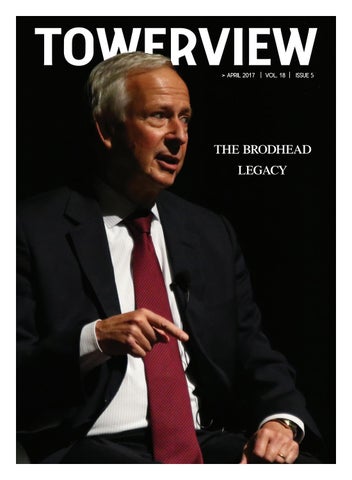
TOWERVIEW > APRIL 2017 | VOL. 18 | ISSUE 5
the brodhead legacy
TOWERVIEW
2 | WEDNESDAY, APRIL 12, 2017
BRASSFIELD SELF STORAGE Brand new storage facility just minutes from Duke, located at 2717 Western Bypass
The Chronicle
NOW OPEN!
ONE FREE MONTH!
For reservations or info, call
• 10x20 self storages • 5x10 up to 10x30 climate-control units • Free courtesy truck for your move!
(919) 251-8474 or email brassfield3@brassfieldselfstorage.com
The Chronicle
TOWERVIEW
WEDNESDAY, APRIL 12, 2017 | 3
How Brodhead changed Duke
Chronicle File Photo Brodhead has overseen a physical, cultural and financial transformation of the University.
Rachel Chason The Chronicle When President Richard Brodhead arrived on Duke’s campus in 2004, the Nasher Museum of Art was still a construction site. Walking around its grounds with the museum’s namesake Raymond Nasher, Brodhead, 69, was struck by the opportunity that came with the youth of his new university. He had arrived in Durham following a 32-year career at Yale University. Yale, one of the oldest colleges in the country, had an art museum dating back to 1832—six years before Duke was even founded. When Brodhead took the job at Duke, he knew he wanted a school with different opportunities than those at Yale. He viewed Duke’s youth as part of its potential. The Nasher was just one example of it. “They had just put up the steel supports that would frame the incredible skyline,” Brodhead remembers. “We’re at the moment of innovation, the moment of creativity. And to be here and to have that happening here and to get to watch the growth of the arts at Duke at that time, it was thrilling for me.” Since that day, the pace of change at Duke has not slowed—if anything, it’s sped up—leaving the University a demonstrably different one than what Brodhead found when he arrived 13 years ago. Duke offers an increasingly diverse student body more financial aid than ever before. Physically, West Campus has transformed. Durham has been revitalized, as has Duke’s relationship with the city. Duke Kunshan University is open, its undergraduate curriculum
approved. More than 3,600 students have volunteered more than one million hours through DukeEngage. Sitting in his office in the Allen Building with a Diet Dr. Pepper at his side, Brodhead reflects on those changes, as well as the University’s future. He speaks with rhetorical flourishes learned over decades spent as an English literature student and professor combined with the practiced diplomacy of a university administrator. When he thinks about the timing of his presidency, Brodhead says he realized there are some projects that fit well with his last year—including the conclusion of the Duke Forward Campaign and construction on West Campus. He also says he’s not worried about the projects that he won’t be able to see finished. “It’s really not the nature of the kind of job I have,” he says. “A university is always being created, in every dimension.” Brodhead’s biggest priority Brodhead initially demurs when asked about his largest accomplishment—“it isn’t the nature of my work that you think of it that way”—but then quickly settles on his response. “For the artifice of the interview, I’ll give you my answer—financial aid,” he says. “I’m not a boastful person, but I think I can say I’ve helped this University understand that this is not a cause among others, it is the cause that underlies and enables others.” In the final fundraising campaign before Brodhead took office, the University did not mention a financial aid goal. When Brodhead arrived, he made it a priority. The first major project launched by Brodhead, called the Financial Aid Initiative, raised $300 million.
Over the course of his tenure, Brodhead has raised more than $750 million for financial aid. Much of that came from Duke Forward, the university’s largest ever capital campaign, which successfully reached its goal of $3.25 billion in July, almost a year ahead of schedule. For the Class of 2020, the University also launched the Washington Duke Scholars program, designed to support first-generation students. Brodhead says his proudest accomplishment isn’t “the dollars,” but the Duke community’s understanding that financial aid is an issue “of the utmost importance.” When Brodhead arrived, about 40 percent of Duke undergraduates received financial aid. Today, more than 50 percent of Duke undergraduates receive aid. A study released in January showed that despite progress made, the wealth gap continues to pose an obvious challenge for Duke and many of its peer institutions. At 38 colleges in the U.S.— including Duke and five schools in the Ivy League—more students came from the top one percent of the income scale than from the bottom 60 percent. At Duke, 19.2 percent of students come from the top one percent, defined as families who make more than $630,000 per year, and 16.5 percent of students come from the bottom 60 percent, defined as families who make less than $65,000 per year. Brodhead, who says he had read the study with interest, notes that he was saddened but not surprised by its results. He calls the wealth gap and the correlation between low income and poor educational preparation the “the single thing that has been most dismaying in my academic life.” “The real trick of it is to get people to realize they could aspire to go to Duke
who don’t know anybody who ever went to Duke, who don’t know anyone who tells them they could get in there, who don’t know anything about the mechanisms of financial aid,” Brodhead says. The problem, he adds, is that income inequality and the unequal access to education that comes with it are not problems that can be quickly or easily solved. “This is a problem that you always have to keep working at, because the tide is flowing in the wrong direction,” he says. The overhaul of West Campus The physical alterations to campus that have taken place under Brodhead’s leadership are the most obvious changes to the University since he arrived. For much of his tenure, cranes dotted Duke’s skyline, sometimes leading to complaints from students and Durham residents. Although it continues on East Campus, construction on West Campus has largely drawn to a close — leaving West a newer and brighter space than it once was. Before the financial crash in 2008, Duke had plans to build a major residential space at the corner of Anderson and Campus Drive. But when the market crashed, that “become completely nonviable,” Brodhead says. “After the collapse, I think we looked at the West Campus and we said, ‘Wouldn’t something be wrong if you built a gorgeous, new residential campus and the core of the campus is in as bad of shape as West would appear,’” Brodhead says. With a gift from the Duke Endowment in Charlotte and a donation from David See CHANGED DUKE on Page 10
TOWERVIEW
4 | WEDNESDAY, APRIL 12, 2017
The Chronicle
In the eye of the storm The trials of President Richard Brodhead
Chronicle File Photo During his time at Duke, Brodhead has endured a number of high-pressure incidents.
Gautam Hathi The Chronicle When Richard Brodhead called up his close friends at Yale to tell them that he would be taking the President’s job at Duke, they were shocked. “People couldn’t believe it,” he said of his friends’ reactions. “I called my closest friend on the faculty. He just couldn’t get his head around it.” He had made “a life’s worth of friends” in New Haven and had more than a few admirers. “Everyone at Yale seems to love Richard Brodhead, and every person you encounter there is quick to tell you that,” The Chronicle reported when Brodhead took his job at Duke. It’s fair to say that Brodhead has not been loved by everyone while he has been at Duke. He has weathered a number of major storms, including the lacrosse case that loomed over his presidency. And Brodhead has also been drawn away during his tenure at Duke from what he has loved most in his career: teaching and scholarship. But Brodhead insists that he doesn’t miss anything that he left in New Haven. “I don’t miss a single thing about what I left behind,” he said. “I don’t. I loved my life when I was there and I’ll tell you, you know how long it took me to love being at Duke? About one day.” And after 13 eventful years in Durham, Brodhead says that he doesn’t spend time thinking about regrets. “I don’t see the profit in it. I’m telling you it’s factually true that I don’t. My job is always about looking forward,” he said. “I don’t feel that Duke turned out to have any deficiency that I couldn’t foresee,
and every time I think about it I just feel speech on campus. In a 2002 speech that regret. That’s just not true at all.” was later published as part of a book, Brodhead described several high profile Core principles incidents that he dealt with in the wake of Even if Brodhead doesn’t have regrets 9/11 that touched on freedom of speech. to dwell on, he certainly faced a variety His view—then and now—was that a of challenges during his tenure. Some of university has no business stopping even these he was well equipped to deal with, distasteful or offensive expression. while others found him in uncharted “When universities get in the business territory. of suppressing speech, however vile, it Brodhead faced a hectic beginning lends credence to the notion that it is a to his presidency in 2004—which began legitimate function of the university to just days after men’s basketball head suppress speech,” Brodhead said in his coach Mike Krzyzewski famously received speech. a tempting NBA offer. Then came an Free speech issues have occasionally even higher pressure flashpoint under arisen throughout his time as president, national scrutiny. and the University under Brodhead has Later that year, Brodhead had worked to allow organized forums with to deflect controversy that hit the controversial expression to go forward. University when Students for Justice in “He was pretty consistent in his Palestine held the annual conference of principles,” Burness said. the Palestine Solidarity Movement on When controversial social scientist campus, triggering significant backlash. Charles Murray was invited to speak on More than 82,000 people signed a campus earlier this year soon after his petition asking the University to cancel talk at Middlebury College was shut down the conference. by a protest that turned violent, Duke Brodhead didn’t step in to stop the put in place an extensive security effort conference, instead citing the principle in order to allow Murray’s event to take of free speech in an academic setting. place without disruption. The president and his team also trusted “If universities don’t stand up for the that there was something to be gained idea that nobody knows the whole truth from discussion about the controversy. yet and the only way we learn more of “We saw a controversial issue as a it is through exchange across lines of teachable moment for students,” said difference of opinion...who in the world John Burness, senior vice president for is going to?” Brodhead said. public affairs and government at the time. “Would that have been something that a ‘Every kind of terrible’ new president might have selected in his Nothing during Brodhead’s tenure or her first year on the job to have? No, has quite compared, however, to the but that’s not what being the president is tumult of the lacrosse case. The story about.” of the scandal has been repeated time This was not the first time Brodhead and again, and the impact of the events had dealt with the issue of controversial that followed from the 2006 party on
Buchanan Boulevard have been analyzed a thousand different ways. But lacrosse also had an impact on the University’s leadership. Brodhead told The Chronicle last year that he doesn’t spend much time thinking about lacrosse, much like how he doesn’t spend time thinking about regrets in general. “I live in the present tense headed toward the future tense,” he said. “I don’t spend my time looking back on this.” But others around Brodhead have suggested that the experience left a mark. Brodhead’s wife noted that the case was different from anything else he had previously seen. Even after more than a decade as Dean of Yale College, responsible for the full breadth of undergraduate student experience at Yale, Brodhead had not had to deal with anything quite like lacrosse. Indeed, few parallels existed to the sequence of events that took place during the case. “I thought when we came here that we’d seen every kind of terrible there was,” Brodhead’s wife Cindy said. “That turned out not to be true.” Cindy Brodhead added that lacrosse was the hardest thing that Brodhead has gone through during his time at Duke. “The whole lacrosse situation was terrible but you know, what doesn’t kill you makes you stronger,” she said. Burness explained that he believes Brodhead became less willing to engage publicly after the lacrosse scandal. “I don’t think he was as visible [after lacrosse],” Burness said. Burness noted that the scandal was fueled by Duke’s initial willingness to have media organizations from across the country on See TRIALS on Page 7
The Chronicle
TOWERVIEW
WEDNESDAY, APRIL 12, 2017 | 5
Inside the life of Duke’s first lady Cindy Brodhead makes her mark at Duke and in Durham Claire Ballentine The Chronicle Cindy Brodhead knows how to throw a party. Tucked away behind the football stadium and Blue Zone, the Hart House— where the Brodheads have lived for the majority of their 13 years at Duke—has three giant tents filled with sharp linen tablecloths and blossoming peonies on the afternoon I visit. Decorators and caterers scurry about, occasionally receiving nods of approval from Cindy as she positions centerpieces and table settings. There’s not a wedding or graduation celebration approaching—it’s simply a typical Tuesday afternoon for Cindy, who has opened up her home for the Duke community, so often that the Brodheads built an additional parking lot and a separate catering kitchen. The event she is currently setting up for is one of a series of thank-you dinners for donors to the Duke Forward fundraising campaign. “Our goal is to have as many kinds of events here as we can—student, alumni, community groups,” she said. “To get a lot of people in the house and to make people feel that it’s Duke’s house, it’s their house.” Cindy said she loves connecting people at parties, bridging gaps between often disparate figures to create friendships and even partnerships. “There’s a real connecting role that has been fun for me,” she said. “Introducing people and finding out two weeks later they met again and hit it off and are going to be working on something really important and interesting—that’s the best.” But Cindy is not just a party planner. She has a master’s degree in English literature
from Yale, where she met Brodhead, and earned her law degree from the University of Connecticut. She practiced law in Connecticut for many years before moving to Durham. Cindy explained that when they moved to Durham from Connecticut, she decided not to start from scratch in North Carolina law, opting instead to immerse herself in Duke. “I had seen some role models in the role of presidential spouse and had come to believe that that was a very important support role,” she said. “I like people, I love the life of a university. So I really wanted to kind of be all in on that, and I saw this role as a way of really getting to know the university, absorbing its values and excitements and then representing its values to the rest of the world.” While Brodhead sometimes speaks with the lofty rhetoric of an academic, Cindy speaks more bluntly, like the lawyer she is by training. “I was a lawyer all my life, I was constantly out in the community,” she said. “I was outwardly facing—I’m not an academic, I’m not a teacher.” Although she made the decision to stop practicing law when she moved to Durham, she has managed to make a name for herself through her volunteer activities. Right now, she is heavily involved with advisory boards for the Nasher Museum of Art and the East Durham Children’s Initiative. She previously served on a board for the Carolina Ballet—the arts are a particular passion for her, she said. Cindy also sits at the helm of the advisory board for the Duke Gardens and will soon lead its capital campaign. The Gardens have long held a special place in the Brodheads’ hearts, said William
LeFevre, executive director of the Gardens and a friend of the couple. Cindy first got involved with the gardens by volunteering to plant flowers—an activity she called “therapeutic.” “She’d be up to her knees in dirt,” said LeFevre, who described Cindy as a “doer” who doesn’t fit “the old model of just the president’s wife.” But if you’re going to classify Cindy as a “president’s wife,” she’s still in a category of her own, said Terry Chambliss, director of special events and university ceremonies, who works with the Brodheads to plan their many events. “There have been wonderful spouses of presidents at Duke, but she really has gone that extra mile to make a mark and get involved and get to know people,” Chambliss said. During an interview with The Chronicle in November, President Brodhead said Cindy chose to take an “active role” as a presidential spouse— something that not everyone in a similar situation chooses to do. Cindy’s role models include the spouses of presidents she’s met through the American Association of Universities, a group of 62 public and universities whose leaders meet in Washington, D.C. each year. Mostly, Cindy said, the presidents are men and their spouses are women, but she noted that’s increasingly changing. From the spouses, she’s seen the way different people accept and fulfill the role, Cindy said. “She has made her mark and is not just following in his footsteps,” Chambliss said. “She has truly been a leader.” Yet her life is inexplicably tied to President Brodhead’s, not just through their marriage vows but a shared commitment to Duke as an institution.
Cindy described her trips around the world with President Brodhead to DukeEngage sites in Uganda and Dublin and cities across the United States to meet alumni during the Duke Forward campaign. She was at Duke-NUS Medical School infor its first graduating class and toured Duke Kunshan University in its early stages. The Brodheads are very clearly a partnership, said Ruth Ross, Trinity ‘68, who was on the search committee that chose President Brodhead and has became a friend of Cindy’s over the years. “They both have a great commitment to higher education, and I think she has been a wonderful asset,” Ross said. “I think he has been very supportive of her and her time commitments.” Still, Brodhead’s job is exhausting and all-consuming, especially after 13 years, Cindy said. The hardest thing he’s gone through as president? She says that’s an easy one—the lacrosse scandal, by far. The drama certainly took a toll on both of them, she said. But hard situations were nothing new to either. With Cindy working as a lawyer and President Brodhead serving as a dean of Yale for 11 years, they had encountered their fair share of terrible events and circumstances, which Cindy said “just have to be faced up to and dealt with.” “I thought when we came here that we’d seen every kind of terrible there was,” she said. “That turned out not to be true.” Her solution to handling the curveballs is simply to soldier on. She doesn’t want to dwell on lacrosse, a matter put to rest long ago. Her description of that era in Brodhead’s presidency is ended with “what See CINDY on Page 9
Courtesy of Duke Photography Cindy Brodhead has made a name for herself through her volunteer work in Durham and her ability to connect members of the Duke community.
6 | WEDNESDAY, APRIL 12, 2017
The Chronicle
TOWERVIEW
Brodhead and basketball
From a K-Ville rally to dealing with the one-and-done era
Chronicle File Photo During his tenure, Brodhead’s relationship with head coach Mike Krzyzewski and the University’s most recognizable athletics program has changed tremendously.
fundamentally an educator? A coach in the NBA isn’t an educator. A coach in college is. The Chronicle That actually began a good understanding. I consider Mike a friend. We have good talks. I From Richard Brodhead’s first day in have a world of respect for him.” office June 28, 2004, his presidency was tied to head coach Mike Krzyzewski. ‘Something I really learned at Duke’ The three-time national champion at the After 32 years as a professor and dean at time was seriously pondering a five-year, $40 Yale, where he also received his undergraduate million offer from the Los Angeles Lakers degree and Ph.D., Brodhead’s decision to to jump to the NBA. As a result, Brodhead transition to Duke raised concerns to leaders took it upon himself to convince Duke’s most in Blue Devil athletics. recognizable icon to remain in Durham, Would a leading scholar in American joining students in Krzyzewskiville for a rally literature understand how sports, particularly and chanting through a megaphone for men’s basketball, fit into Duke’s culture? Krzyzewski to stay. “I think people were worried about him, “I can remember considering the Laker that he had spent his whole life at Yale, that position. All of a sudden, I see my new president he would try to make Duke Yale,” Krzyzewski out in Krzyzewskiville with a megaphone and said. “What he’s done instead—I think the doing some crazy things,” Krzyzewski said. “It greatest thing he’s done was keep Duke was neat, but then I didn’t want him to be in unique. He has helped Duke become even that position. I wanted to let him know first of more unique and develop its own personality all that I wasn’t going to go to the Lakers, but during a period of immense growth and also secondly, that I work for him.” a period when we had a very difficult situation Eventually, Krzyzewski turned down the here [with lacrosse]. I applaud him for that. high-profile NBA offer and became the It was one of the great leadership things that winningest men’s basketball coach in Division I I’ve seen to adapt to this environment, and history, adding two more national titles during not just adapt, but to flourish in it.” the first 11 years of Brodhead’s tenure. John Burness, former senior vice president Some of Brodhead’s most notable for government affairs and public relations, moments have related to athletics, including noted that such concerns are not unique. the infamous lacrosse case, ending Duke’s “I think when [former president Nan] old tailgate and hiring head coach David Keohane came, it was, ‘Oh, a woman from Cutcliffe to rejuvenate a lifeless football Wellesley,’ there was some of that then,” program. And since his first day, he has been Burness said. “It is not uncommon whenever there as Krzyzewski has taken one of the a new president comes to Duke, at least over nation’s most prominent athletic programs the past 25 to 30 years as Duke has risen so rapidly in the ranks to be one of the great to new heights. “Everybody knows that Coach K was academic institutions.” offered the Lakers job on my first day in Burness added that Keohane used to office. The consequence of that is I had refer to the University’s motto as “Eruditio long talks with him almost before I talked to et Basketballio” rather than “Eruditio et anyone else at the University,” Brodhead said. Religio.” “The choice for him was was he or was he not Despite the concerns, Brodhead had
Amrith Ramkumar
actually been a Duke fan since he started watching the NCAA tournament with interest in the early 1990s. As Grant Hill and company won the program’s first two national championships in 1991 and 1992, Brodhead’s interest in college basketball grew. With athletics in his purview as dean for 11 years at Yale and Hill’s parents Calvin—who was a standout Yale and NFL football player—and Janet as good friends, Brodhead said he actually thought he had pretty good understanding of men’s basketball fanaticism when he arrived at Duke. Still, there were bound to be new experiences as the face of a University that had been to 14 Final Fours before he arrived. One of those came when the Blue Devils made their first Final Four during Brodhead’s tenure in 2010, eventually cutting down the nets for their fourth national championship. “I had never been to Indianapolis. I had been to a Final Four unhappily when we were eliminated by [Connecticut] the spring I was coming in as president [in 2004],” Brodhead said. “When you go to the Final Four, if you’re lucky, there’s one game, then there’s a second game. But there’s a very long interval between them. What are you supposed to do with yourself? We ransacked guide books to fill our time. I went to Butler. I called on the president of Butler that year, that was kind of fun.” “So we went, we beat West Virginia, I would say we thrashed them, but that doesn’t prove anything. And then you’re going to play this upstart team [in Butler]. It was just incredible. I spent that entire evening in a state of transport, elation, amazing. When you win these games, I’ve never found it possible to go to bed before about 5 [o’clock] in the morning after those games. You’re just too excited about it.” Although he previously understood the
role athletics can play in educating students at a university, Brodhead’s appreciation for the joy that comes with winning has grown since his arrival in Durham. “I’m a scholar. I’m a man of intellect. I’m an educator. I’m never for a moment going to lose sight of the main thing at universities,” Brodhead said. “Nevertheless, the pleasure that can be taken through athletic events is something I really learned at Duke. Not only there, but if I can remember being in Indianapolis in 2010. What were the chances? Being in Indianapolis in 2015 [for the team’s fifth national championship]—it’s just a form of ecstasy when you win these things.” ‘Not my favorite feature’ Brodhead said the 2009-10 national championship team was one of his favorites because he got to watch four-year players grow—the main reason he prefers college sports to watching professional contests. But the past several years have seen that philosophy tested as the numbers of one-and-done prospects and transfers have increased steadily. “I can remember the first time I saw [2010 national champions] Nolan Smith and Jon Scheyer play,” Brodhead said. “They were very young. They got way better over the course of their careers, and then they won the national championship. And now I still have them around [as assistant coaches]. Now they can be my pals. I go places and we can all hang out and talk about things.” Since 2011, Duke has had seven players leave school early for the NBA Draft starting with Kyrie Irving. The Blue Devils brought in several potential one-and-done prospects in the Class of 2016 and have already received commitments from multiple high school seniors who are almost certainly eyeing the See BASKETBALL on Page 10
The Chronicle
TRIALS from page 4 campus as the events were unfolding, which may have impacted Brodhead’s thinking. The person who was known and beloved by all at Yale became somewhat more removed from the public eye. Other administrators have also said that lacrosse made the University—and perhaps Brodhead as well—a little less willing to take chances in situations when Duke’s public image could be affected. “I don’t think I’m in a great position to say whether [Brodhead] was gun-shy or not [after lacrosse], but I believe the institution is,” said Sue Wasiolek, associate vice president for student affairs and dean of students, in a 2015 interview with The Chronicle. “I know that I am. I know that I have a higher level of fear associated with just making decisions, and I have a much greater tendency to collaborate, to check in, to consult.…That’s how I would describe just the institution as a whole as a result of the lacrosse case.” ‘Lots of very challenging situations’ No crisis could quite compare to the tumult of lacrosse, but that doesn’t mean that everything was smooth sailing for Brodhead afterward. A combination of foresight, skill and luck ensured, however, that nothing else during Brodhead’s term quite blew up the way that the University’s signature scandal did. The economic shock in 2008 roiled the University’s finances. Duke lost a quarter of its endowment—more than a billion dollars—in two months. But expanded financial aid, one of Brodhead’s signature achievements, was protected in part because Brodhead had begun a $300 million fundraising campaign to support aid soon after he came to campus.
TOWERVIEW
“Had he not done that, things would have been really bad in 2008,” Burness said. Later in Brodhead’s term, issues of campus climate and inclusion came to the forefront. In 2015, Duke found itself in the crosshairs of controversial evangelical preacher Franklin Graham regarding a decision to broadcast the adhan—a Muslim call to prayer—from the top of the Chapel. After initially pushing forward with plans to hold the adhan, Duke later moved it to the chapel quad and then only held the adhan once. “In my line of work, I’ve been at the helm in lots of very challenging situations,” Brodhead said in an interview after the incident. “I don’t believe in bowing to forces of intolerance.” Later incidents did not have a significant impact on Brodhead. When nine students occupied the Allen Building last year, Brodhead says that he did not regard the commotion surrounding the occupation as a major disruption to the University in the grand scheme of things. “My university was shut down for six weeks by student activism when I was in grad school. [I do not accept] the notion that last spring was a time of high activism on campus,” he explained. “It was visible, but I did not regard the community as being convulsed by it.”
WEDNESDAY, APRIL 12, 2017 | 7
Chronicle File Photo Brodhead says that he does not spend any time thinking about his regrets.
teaching, but Brodhead still frames his job as that of an educator, and refers to what he enjoys most about the job in terms of education. “No one understands how fun this job is because on any given day something can move from the edge of your consciousness to the center of it,” Brodhead said. The same variety of experiences and daily learning that Brodhead loves so much about the job, however, has also presented him with unwelcome obstacles ‘Some place no one prepared to be at’ that have left their mark. And perhaps Despite his years of experience dealing after 13 years as president, Brodhead with administrative challenges, Brodhead may welcome a return to life as a scholar and educator. is, above all, a teacher and an educator. “I only ever went into academic life “How many years has he given to the because I wanted to be a teacher,” he said. public life of this order? To Duke alone, “That’s the deal. I spent my life in a state going into 13. This is a lot. This is a real lot,” said Thomas Ferraro, Frances Hill of total happiness as a teacher.” Life as an administrator has slowly Fox professor of English and a longtime drawn him away from the world of friend of Brodhead’s. “It’s required
him to not be a scholar every day, and so these are parts of you that you would want back, right?” After a year on sabbatical—which Brodhead says he was initially due for in 1993 but hasn’t quite found the time to take—the president will find himself back as a professor. When his sabbatical is over, Brodhead said he plans to keep Duke as his “institutional home.” Perhaps then he will have a chance to find in a new way the exploration and innovation that first drew him to Duke. “The kind of teaching that has always been fun for me is the kind where you start and then somebody has an idea and somebody has an idea and somebody has an idea and then you’re some place no one prepared to be at when you arrived,” Brodhead said. “That’s what my work is in this job. I regard the presidency as a seminar with unstable enrollment.”
The Chronicle App T H E I N D E P E N D E N T D A I LY AT D U K E U N I V E R S I T Y
WWW.DUKECHRONICLE.COM
Anywhere. Anytime.
Duke’s latest news, sports and opinions. Available in the iTunes store (search Duke Chronicle).
8 | WEDNESDAY, APRIL 12, 2017
The Chronicle
TOWERVIEW
From the archives: Brodhead in his element at Duke The Chronicle’s first article about the newly-arrived president
Chronicle File Photo Brodhead, who was born in Ohio, had a 32-year career at Yale as a student, scholar and administrator.
Emily Almas and Kelly Rohrs The Chronicle Editor’s note: This article was originally published April 2, 2004. When Richard Brodhead, dean of Yale College, sits in his office-—a place that oozes Ivy League tradition—it is difficult to imagine him as president of Duke. And then he begins to talk. “Duke is in an enchanted forest in the middle of a city,” he says, his face lighting up as he talks about his future home. “Duke is an urban, silvan campus.... You can walk around and feel that it’s a great school.” Suddenly it becomes the most natural thing in the world to think of Brodhead, who loves hiking, as the future president of Duke. He already owns a Cameron Crazie shirt, which a student gave him the weekend his appointment at Duke was announced. He is attending many of the NCAA Tournament games, flying to Atlanta and San Antonio with either his son, Daniel-—who graduated from Yale in 2001—or his wife, Cynthia. Although he confesses that he has not yet mastered the Duke fight song-—”just the timing of certain key aspects” are giving him difficulty, he says—the man who has spent all his life at Yale is slowly becoming a Blue Devil. As closely as Brodhead is associated with Yale, colleagues say it will not be long before his name conjures images of Duke. “I’m very sad for us and very happy for Duke,” says Thomas McDow, dean of Branford College, one of Yale’s residential colleges. “This might be the thing it takes for me to pull for Duke basketball.” Everyone at Yale seems to love Richard Brodhead, and every person you encounter there is quick to tell you that. Students say, “He’s a great guy.” “Oh, we’re so sad to lose him.” “Duke is really lucky.” Faculty look mournful at the thought of
his departure. “Many of us have never known a Yale without Dick,” says Deputy Provost Charles Long, who has known Brodhead since he first came to Yale as an undergraduate. Brodhead has been a fixture at the university for more than 40 years, first as an undergraduate student, then as one of the brightest English graduate students to walk the halls that have produced scholars among the likes of Harold Bloom. As a young professor, Brodhead’s classes drew praise and crowds. After only five years on the faculty, he won the university’s most prestigious teaching award. He is one of the world’s leading English scholars, specializing in American literature. His most noteworthy works concern Moby Dick and the works of Charles Chestnutt, a leading black author of the post-Civil War era. He also has done substantial work on the history of postemancipation North Carolina. He has won numerous scholarship awards, and in 2002 received a presidential appointment to the J. William Fulbright Foreign Scholarship Board. Clearly, the man is talented. But he’s also loved in an almost mystical way; no one will admit to having a negative experience with him. “I don’t know how Brodhead has captured that image-—the love of everyone,” junior Joe Light says. He paused for a moment, thinking about exactly why Brodhead is so admired. “Freshman year you learn that Dean Brodhead is a really cool guy. You’re not sure why he’s a cool guy, but he is.” Perhaps this aura originates from his freshman convocation speeches, which are legendary for their wit and ability to inspire. Four years later, many seniors report still vivid memories of hearing Brodhead bellow, “Welcome to Yale,” in his deep, distinctive voice. Even more students recall his passionate
plea encouraging them to take full advantage of their education both in and outside of the classroom. He takes on an unusually large number of advisees-—often juggling more than 20 at a time—and most student leaders have worked with him to some degree. Brodhead frequently ducks into the back of student performances, and when he walks across campus, he stops and chats with students he knew well at one time but no longer frequently sees. In one famous story, Brodhead was chatting with a group of students at a dinner and the topic turned to Dance Dance Revolution, a fully interactive dance video game. Two weeks after the conversation, Brodhead showed up at a freshman dormitory to see the game in action. “Whether I actually played, we won’t go there,” he says, smiling. Students say he played. Across campus he is known for this willingness to try new things and sense of humor. Students affectionately know him as “Dick” and jokes about his name are already commonplace at Duke. In typical manner, Brodhead stutters just a little as he declines to comment on his nicknames. “What I’m called behind my back is none of my business,” he says. He hesitates to talk about himself at all and is openly puzzled that anyone would want to read about him or his life. Only after much prodding does he admit to being a fan of Charlie Kaufman movies and a “card addict.” Even as Brodhead reveals how he spends some of his free time, he attests that the primary activity he does for fun is his job. He and his wife frequently entertain everyone from students to visiting dignitaries. So many of their guests are affiliated with Yale that they have reached “the point where you stop thinking about what’s fun and what’s work,” she says. Cynthia Brodhead, who will move to
Duke with her husband this summer, is a lawyer in New Haven, but she plans to settle into life in Durham before committing to a job in the area. “I’m really very interested to see what life in the South is like,” she says. Neither she nor Richard have much experience living outside of New England. Richard Brodhead was born in Ohio and moved to Fairfield, Conn. when he was six years old. He went to the Mass. boarding school Phillips Andover Academy before he attended Yale. He never joined a fraternity at Yale but his father, mother and brother were all Greek in college. He considers himself a product of the ‘60s and says that the events of that era reaffirmed his commitment to equality. Perhaps because of this value, Brodhead is very careful about his decisions. By all accounts, he thinks about the root of a problem before taking any action. For example, the Report on Yale College-—which Brodhead largely authored as the chair of the committee— includes not just a laundry list of desires for the university but also a detailed series of steps to implement them. He rarely takes action upon immediate demand. “He doesn’t like confrontation and he doesn’t like conflict,” Long says. “That doesn’t mean that he takes the easy way out.” Several colleagues and students surmised that it is Brodhead’s dislike of conflict that has kept him from commenting on unionization and other contentious issues at Yale. He has recently been criticized by Naomi Wolf, a former student of Harold Bloom who claims that she was sexually assaulted while a graduate student, for not acting on her complaints of sexual harassment when he was chair of the English department. At various points, women’s groups have faulted Brodhead for See IN HIS ELEMENT on Page 10
The Chronicle
BASKETBALL from page 6 2018 NBA Draft. Duke and Kentucky have set themselves apart at the top of men’s basketball recruiting, but Duke’s academic reputation is seemingly at odds with bringing in a high number of one-and-done talents. “It’s not my favorite feature, and if I were a coach, it would be my least favorite feature,” Brodhead said. “In the days when you got to nurture people’s growth over four years, you had experience on your team. We have some experience on our team now, but it used to be you had a few newbies and a lot of experienced people. Now the balance has shifted.” “I still would say the fact that our players have left for the pros have finished the year of study before they did so is immensely meaningful to me. The fact that Kyrie came back and did some more course work, you don’t hear about that at schools I will not name. You don’t.” After leaving Duke following his 2010-11 freshman season, Irving pledged to finish his degree in five years. But since becoming one of the NBA’s brightest stars, he has changed course, though to Brodhead’s point Irving and several former Blue Devils have continued working toward their degrees. “In this era of one-and-done, I’ve had really good talks with President Brodhead. One is that I want to make sure that people know that we’re still recruiting the same Duke kid that we’ve recruited 40 years ago,” Krzyzewski said. “They have to be talented on the court, talented off the court and be good guys. It’s just that some of them are going early. The thing that Dr. Brodhead always talks about is that they finish up.” “In other words, if a kid is going oneand-done, a lot of kids don’t even finish up their schooling that semester. All of our guys have done that, they’ve done it well
TOWERVIEW
and a lot of them have continued their with them.” education, so I know we’re in step with what Since ultimate admissions decisions our leadership wants.” rest with the Office of Undergraduate Admissions, admissions officers typically Flexibility with admissions dates evaluate players when programs have a Two primary consequences of players strong interest in the student-athlete and leaving early for the NBA Draft and frequent also feel that the recruits are considering transfers between schools are that programs Duke solidly as a potential destination, woo prized talents extremely early in the Guttentag explained in an email. recruiting process and high school seniors He said he could not speak about any often wait until late April or May to announce particular applicants, but noted that flexibility their college decisions. and early communication mean that the Last year, Duke recruited the top high evaluation process for recruited athletes has school freshman in the country, R.J. Barrett, not changed much in the past several years. and after the Cleveland Cavaliers won the Peter Lange, provost from 1999 to 2014, NBA championship, ESPN reported that echoed that point, explaining that the system 11-year old LeBron James Jr. already had was consistent during his time as Duke’s chief standing scholarship offers from the Blue academic officer. Devils and Kentucky. “There are many athletes that coaches Even though many players have the chance exclude from their recruitment lists to make a college decision very early in the because of our admissions requirements,” recruiting process, it is increasingly common Guttentag wrote. “The coaches tend to for top talents to wait to see how unexpected have a very good sense of who is and isn’t departures might affect their preferred teams. admissible, but the ultimate decisions rest In 2015, Derryck Thornton and Brandon in the admissions office.” Ingram waited until late April to commit to Duke, and Marques Bolden did not announce ‘The biggest honor’ his decision until late May. For Brodhead’s second-to-last graduation Such circumstances with varying offer ceremony in May 2016, he asked Krzyzewski to and decision dates are not unique to men’s be the commencement speaker—a decision basketball, and the result is that the University that was made a year before Krzyzewski has to be more flexible when evaluating actually spoke at Wallace Wade Stadium. prospective student-athletes. “The biggest honor—I’ve been fortunate “We’re always in concert with what the to get the University medal, to win national University wants academically. During the championships—one of the biggest private ever-changing landscape of men’s college moments was at his home, where we were basketball that takes place over these almost at a function a year in advance, actually the four decades, you have to make sure you’re graduation before,” Krzyzewski said. always on the same page with regards to “And he said, ‘I want you to do me a favor.’ summer school, recruiting, when you I said, ‘Certainly, anything.’ He said, ‘I would could offer,” Krzyzewski said. “One of the love for you to be our graduation speaker great people on our campus is Christoph next year.’ I said, ‘That’s a favor? That’s an Guttentag, our [dean of undergraduate] honor. I would love to do that.’” admissions. You can’t get everything in at “It meant the world to me. It turned out the time when you have to make decisions, well. I love this University and the fact that he at least initial decisions on youngsters, and gave me that opportunity.” they’ve worked with us and we’ve worked As Brodhead and Krzyzewski have
CINDY from page 5 doesn’t kill you makes you stronger.” Even after handling that, President Brodhead’s tenure wasn’t exactly easy, and Cindy said that throughout his time at Duke, he’s become even more calm in the face of adversity. “He’s become stronger and recognized that some things you can control, and some things you can’t control, and you have to figure out the difference,” she said. Brodhead certainly received negative feedback for his handling of lacrosse but Cindy said that aspect of his life hasn’t reached her. She never hears criticism of either herself or President Brodhead, she said. “It wouldn’t surprise me if all kinds of Special to The Chronicle people have criticisms of me, I can imagine Cindy Brodhead worked as a lawyer in New Haven before moving to Duke with Richard criticisms of myself,” she said. “But I can honestly say to you that people have been Brodhead 13 years ago. enormously kind to me.” People don’t even criticize her husband in front of her—then again, they might realize it wouldn’t do them any good, she said. Some view Cindy as a way to get something from Duke like money, noted Barker French, a Duke alum who founded and chairs the East Durham Children’s Initiative, a program which Cindy has been involved with that creates a pipeline of services for children from birth to college or career. But she has much more to offer than that, he said. “She is a really great rep for Duke by virtue of what she does for the community.” Soon, people won’t pursue Cindy for her influence at Duke—the end of President Brodhead’s tenure is quickly approaching, and Vincent Price is preparing to assume Special to The Chronicle the role. Cindy said that she’s become acquainted Duke Gardens, where Cindy has long volunteered, has been a special place for the couple.
WEDNESDAY, APRIL 12, 2017 | 9
Chronicle File Photo Brodhead was a regular at Cameroon Indoor Stadium for men’s basketball games and other sporting events during his presidency.
navigated the past 12 years as two of Duke’s most recognizable figures, their friendship has grown. Krzyzewski said he and his wife Mickie consider Brodhead and his wife Cynthia very close friends, adding that “we are definitely in debt to the Brodheads for the commitment they’ve made to Duke.” And as Brodhead prepares to hand the reigns to University of Pennsylvania Provost Vincent Price, he leaves with a keen appreciation for his front-row seat to Krzyzewski’s record-setting program. “A coach is in the human-potential unleashing business, you only bring people who are very, very good. But Mike Krzyzewski never told a single player you’re good enough already,” Brodhead said. “It’s helping people understand what they could do to become even better as an individual and as a member of a team. For me, if that’s not education, I don’t know what is.” with the Prices—whom she thinks will be great for Duke—during their trips to Durham. While President Brodhead has worked with Vincent to ready him for Duke’s top position, Cindy has spent time with his wife Annette, showing her the Hart House and talking with her about what she might do with it when they move in this summer. She also has advice for Annette as the wife of a president, but those tips remain between the two of them. “You know you have to be careful about giving people advice because the main thing about this role is that everyone will do it differently, but I do have pieces of advice,” Cindy said. She’ll certainly miss living in the Hart House, with its voluminous outdoor space, study room with built-in bookshelves, staff of caterers and florists ready to transform it into the perfect party destination at a moment’s notice. And more importantly, memories of holidays spent with loved ones and friends in their haven within Duke’s campus. When talking about the future, Cindy admits that she and her husband are kind of bad at planning. For past 13 years, life has come at them, and they’ve had to react. “There’s always just so much on offer to do that we can select the things we would like to do,” she said. “But now we have to figure out.” They might travel, they’ll definitely spend time with their new granddaughter. And President Brodhead has said in the past that they will continue to be part of Duke life. “Dick has had such an absorbing career and such all absorbing roles for the past 25 years,” she said. “I think we’ll just step back a bit and try to regain a perspective of the broader world.”
10 | WEDNESDAY, APRIL 12, 2017
CHANGED DUKE from page 3 Rubenstein, the chair of the Board of trustees, the University renovated Baldwin and Page Auditoriums and rebuilt West Union and what became Rubenstein Library. Rubenstein, Trinity ’70, was elected to become a member of the Harvard Corporation and will step down from Duke’s Board on July 1. Those changes weren’t just about improving Duke’s physical appearance, Brodhead emphasizes. He says that in the wake of the lacrosse case, the University recognized the priority of creating of communal social spaces on campus that were not associated with sports teams or Greek life. “The complaint about fraternities was that they alone owned space, that it was this organizing feature of social life that some groups owned space, and that there was very little space for anyone else to do anything in,” Brodhead says. “So we have really made quite a concerted effort on this campus to give priority to the creation of unowned, completely shared community space.” Examples he cites include the renovation of Marketplace on East Campus, the common space under GilbertAddoms dormitory, West Union, the Edge and the Link in the library. The biggest priorities for the University going forward, Brodhead said, are gathering the funding to renovate engineering buildings and focusing on student housing “after Central Campus leaves this world.” But he doesn’t think the University will see “anything in the next five years like what we saw in the last five years” in terms of the scope of construction. A changed culture? Brodhead says that it is not just the physical landscape of Duke that has changed since he arrived in Durham. If a student at Duke in 2003 “went into a deep sleep” and woke up on today’s campus, they would find it a very different environment than the one they were familiar with, Brodhead suggests. There are more ways to engage outside of the classroom—and there is more willingness to do so. DukeEngage, the immersive summer service program launched in the summer of 2007, and Bass Connections, the interdisciplinary research initiative created in 2013, are two examples Brodhead cites as opportunities Duke students have to engage outside of a traditional classroom setting. Ten years ago, Brodhead adds, 15 percent of students did an independent research project. Today, that number is roughly 50 percent. “Duke students were always as smart as the best students anywhere, but they didn’t always think of themselves that way,” Brodhead says. “And I would say I think there was a time when it used to be less cool to be smart than it is now.” In 2004, the University admitted 22 percent of its applicants. For the Class of 2021, 9.2 percent of applicants were accepted. Another part of the social change on campus can be attributed to decisions made by the University. In 2010, for example, Brodhead’s administration opted to permanently end Tailgate after a 14-year-old sibling of a Duke student was found passed out in a porta-potty. “The 14-year-old hadn’t just passed out,” Brodhead told The Chronicle in 2013. “The 14-year-old had been left in an outhouse passed out by a sibling who had gone on without even knowing it. That sibling didn’t deserve for the sibling to still be alive.” Brodhead, who told The Chronicle in
The Chronicle
TOWERVIEW
2013 that he had never attended tailgate, said “you couldn’t have the good part of it if it would always degenerate into the horrible dangerous part of it.” In the years since it was shut down, several groups, including Duke Student Government, have tried recreate the tailgating tradition, but no comparable tradition has emerged to replace it. Duke’s emphasis on Greek life has also changed during Brodhead’s time at Duke—with more selective living groups and independent houses lining the quads, where fraternities once dominated. After the lacrosse incident, a special University committee published a report suggesting that Duke should abolish the Greek system entirely. But the report—which Brodhead called “a blunt instrument”—didn’t explain what would happen to the historically AfricanAmerican sororities and fraternities or how SLGs would be affected. “We came to understand students have some freedom to affiliate as they choose, but what we wanted was to reach a better equilibrium of the perks for Greek life and the perks for everyone else,” Brodhead says. A big part of that was creating shared public spaces and making sure that the housing model allowed independent students to form the same sense of community that students affiliated with Greek Life or SLGs formed. Duke and Durham As the lacrosse case unfolded in 2006, the national spotlight was placed on Duke’s relationship with Durham. The New York Times declared,“New Strain on Duke’s Ties with Durham,” and ESPN went with, “Turbulent Times for Duke and Durham.” But Thomas Ferraro, Frances Hill Fox professor of English, says that although media coverage from the lacrosse case often focuses on the negative aspects of the Duke-Durham relationship, the work Duke has done in downtown Durham has been “very impressive.” Duke, he notes, leases more than one million square feet of office space in Durham, which it rents from businesses that pay taxes that go back to the city. Because of its nonprofit status, Duke would not have to pay taxes if it owned the space. “It costs us however much more a year, but look at what has happened to Durham,” Ferraro says. “Yale bought the buildings. Yale was trying to build a fortress. We were trying to open up the corridors. We have dedicated bus systems that take people not only to [the University of North Carolina at Chapel Hill], they take them downtown.” The University and Duke University Health System have also contributed to the downtown revitalization by developing historic buildings, investing in local economic partners and locating 2,000 employees in almost 528,000 square feet of office space downtown. Following the lacrosse case, Brodhead created the position of vice president for Durham and regional affairs and appointed Phail Wynn to fill it. Wynn immediately began conducting meetings with local government officials, community stakeholders, business leaders and neighborhoods to find ways to better engage Duke and Durham.
Chronicle File Photo Brodhead said he came to Duke for its innovative and creative spirit.
Brodhead was told his “being visible would be much appreciated.” It will be one of many trips to China that Brodhead has made as DKU has gotten off the ground. When The Chronicle spoke with Brodhead in March, he had just returned from a four-day trip to the University—which he said convinced him that progress was going well. “Duke used to not be very well-known in China,” Brodhead says. “When I was first president, people who were very well educated knew about Duke, but they didn’t know much about it. Now Duke is very, very well-known in China.” That matters, Brodhead says, because China “is the great fact of the next 30 or 40 years.” When seen in light of this, launching a four-year degree program at DKU is challenging but eminently worthwhile, he says. “A university that has found a way to engage [China] will be in a much stronger position, even for its students on this
campus, than a school which hasn’t found a way to engage it,” he says. But DKU had its share of stops and starts, including issues with construction and funding that contributed to a threeyear delay in its opening in Fall 2014. Last December, the Board of Trustees approved the establishment of a fouryear undergraduate liberal arts degree at DKU—meaning that those who graduate will receive a Duke diploma with a notation that says it was conferred at DKU. DKU is just one example of what Brodhead says was the forward-thinking innovation he knew he would find at Duke. He says the “balance of tradition and innovation” is set very differently at Duke than it was at Yale. “This place is so open to experimentation, innovation,” he says. “And so I thought, ‘that’ll be a fun place to be a president. At a place that’s not all about trying to keep things more or less how they are.’”
IN HIS ELEMENT from page 8
Brodhead has been “very supportive” and an “inspirational leader.” Lawrence Manley, an English professor who has been at Yale since 1976, says Brodhead had “a strong sense of the mission of undergraduate teaching.” Cynthia, who is reluctant to comment at all on her husband’s motives or way of life, says the main draw of Duke was the people Richard met there. The presidency of Duke was a natural fit. Richard Brodhead agreed, saying he “never intended to become a bureaucrat,” but the opportunity to become part of Duke was too appealing to turn down. “Duke doesn’t take itself too seriously--in the bad sense of the word,” he says, laughing at himself a little. Well, neither does its new leader.
not doing enough to promote women. Several minority groups have said that he has not done enough to address racial and diversity issues on campus. He has listened to groups’ concerns and seems to be supportive, but leaders claim there is little action taken as a result. “You get so caught up in Brodhead’s charisma and eloquence of what he’s saying,” says sophomore Emerson Davis, a member of Concerned Black Students at Yale. “Then he walks away and you realize what is lacking is the actual substance behind it in terms of initiating change.” Colleagues, on the other hand, say that
DKU and Duke’s impact abroad Brodhead’s commitment to being a good neighbor extends beyond Durham. The day after commencement, he will get on a plane to China. The tight turnaround, Brodhead says, is “a bit much” for him. But an advisory board for DKU is meeting, and Kunshan has a major conference taking place where Brodhead’s first passion has always been teaching and scholarship.
Chronicle File Photo
The Chronicle
TOWERVIEW
WEDNESDAY, APRIL 12, 2017 | 11
12 | WEDNESDAY, APRIL 12, 2017
TOWERVIEW
The Chronicle
find housing
at The Chronicle’s online guide to living near Duke.