T H E I N D E P E N D E N T D A I LY AT D U K E U N I V E R S I T Y
The Chronicle
XXXDAY, MONTH THURSDAY, JANUARY XX, 2013 31, 2013
ONE ONEHUNDRED HUNDREDAND ANDEIGHTH EIGHTHYEAR, YEAR,ISSUE ISSUE89 X
WWW.DUKECHRONICLE.COM
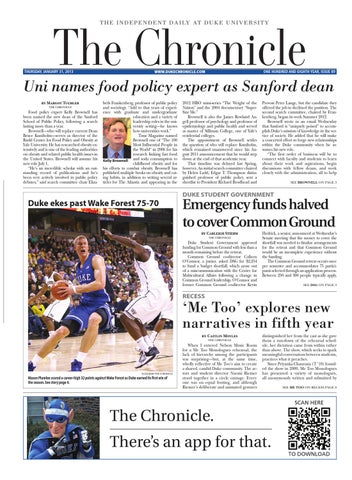
Uni names food policy expert as Sanford dean by Margot Tuchler THE CHRONICLE
Food policy expert Kelly Brownell has been named the new dean of the Sanford School of Public Policy, following a search lasting more than a year. Brownell—who will replace current Dean Bruce Kuniholm—serves as director of the Rudd Center for Food Policy and Obesity at Yale University. He has researched obesity extensively and is one of the leading authorities on obesity and related public health issues in the United States. Brownell will assume his new role July 1. “He’s an incredible scholar with an outstanding record of publications and he’s been very actively involved in public policy debates,” said search committee chair Eliza-
beth Frankenberg, professor of public policy and sociology. “Add to that years of experience with graduate and undergraduate education and a variety of leadership roles in the university setting—he knows how universities work.” Time Magazine named Brownell one of “The 100 Most Influential People in the World” in 2006 for his research linking fast food Kelly Brownell and soda consumption to childhood obesity and for his efforts to combat obesity. Brownell has published multiple books on obesity and eating habits, in addition to writing several articles for The Atlantic and appearing in the
2012 HBO mini-series “The Weight of the Nation” and the 2004 documentary “SuperSize Me.” Brownell is also the James Rowland Angell professor of psychology and professor of epidemiology and public health and served as master of Silliman College, one of Yale’s residential colleges. The appointment of Brownell settles the question of who will replace Kuniholm, which remained unanswered since his August 2011 announcement that he would step down at the end of that academic year. That timeline was delayed last Spring, however. An initial search committee chaired by Helen Ladd, Edgar T. Thompson distinguished professor of public policy, sent a shortlist to President Richard Brodhead and
Provost Peter Lange, but the candidate they offered the job to declined the position. The second search committee, chaired by Frankenberg, began its work Summer 2012. Brownell wrote in an email Wednesday that Sanford is “uniquely poised” to accomplish Duke’s mission of knowledge in the service of society. He added that he will make a concerted effort to forge new relationships within the Duke community when he assumes his new role. “The first order of business will be to connect with faculty and students to learn about their work and aspirations, begin discussions with fellow deans, and work closely with the administration, all to help SEE BROWNELL ON PAGE 3
DUKE STUDENT GOVERNMENT
Duke ekes past Wake Forest 75-70
Emergency funds halved to cover Common Ground by Carleigh Stiehm THE CHRONICLE
Duke Student Government approved funding for Common Ground with less than a month remaining before the retreat. Common Ground co-director Colleen O’Connor, a junior, asked DSG for $2,254 to fund a budget shortfall, which arose out of a miscommunication with the Center for Multicultural Affairs following a change in Common Ground leadership. O’Connor and former Common Ground co-director Kevin
Hedrick, a senior, announced at Wednesday’s Senate meeting that the money to cover the shortfall was needed to finalize arrangements for the retreat and that Common Ground would be an incomplete experience without the funding. The Common Ground retreat occurs once per semester and accommodates 75 participants selected through an application process. Between 250 and 300 people typically apply, SEE DSG ON PAGE 3
RECESS
‘Me Too’ explores new narratives in fifth year by Caitlin Moyles THE CHRONICLE
ELIZA BRAY/THE CHRONICLE
Mason Plumlee scored a career-high 32 points against Wake Forest as Duke earned its first win of the season. See story page 4.
When I entered Nelson Music Room for a Me Too Monologues rehearsal, the lack of hierarchy among the participants was surprising—but, at the same time, wholly reflective of Me Too’s aim to create a shared, candid Duke community. The actors and student director Naomi Riemer stood together in a circle onstage. Everyone was on equal footing, and although Riemer’s deliberate and animated gestures
distinguished her from the cast as she gave them a run-down of the rehearsal schedule, her dictation came from within rather than above. The show, which seeks to spark meaningful conversation between students, practices what it preaches. Since Priyanka Chaurasia (T ’10) founded the show in 2009, Me Too Monologues has presented a variety of monologues, all anonymously written and submitted by SEE ME TOO ON RECESS PAGE 8
SCAN HERE
The Chronicle. There’s an app for that. TO DOWNLOAD
2 | THURSDAY, JANUARY 31, 2013
Alum takes Kerry’s US Senate seat by Yeshwanth Kandimalla THE CHRONICLE
Mo Cowan, Trinity ’91, has been appointed interim senator from Massachusetts, following Sen. John Kerry’s confirmation as the new Secretary of State. Massachusetts Gov. Deval Patrick named Cowan, his former chief of staff, to the position, turning down former Rep. Barney Frank, D- Mass. Cowan will likely hold the seat until June 25, when a special election will determine the new successor. Mo Cowan “Mo is a highly respected public citizen, working to builder a stronger community… with preparation, perspective, sound judgement that has all earned him the respect, admiration and trust of the community,” Patrick said at press conference. Cowan would join Tim Scott, R-S.C., as the second sitting black senator, the first time in the Senate’s history. “I am honored and humbled by this action,” Cowan said. “I will go today with the needs and aspirations of our citizens in mind.” Cowan, a native of Yadkinville, a small town near Winstom-Salem, graduated from Duke with a degree in sociology before pursuing a career as a lawyer in Boston. Cowan, whose father died when he was a teenager, was the first person to attend Duke from his high school. “I want to thank my mom from the bottom of my heart for giving me the foundation that brings me here today,” Cowan said.
THE CHRONICLE
Student rear-ends C-1 on Campus Dr by Kelly Scurry THE CHRONICLE
A car driven by a student collided with a C-1 bus on Campus Drive Wednesday morning. The bus was stopped at the intersection of Campus Drive and Maxwell Street at approximately 11:30 am. when the student collided with the rear of the bus, Duke Police Chief John Dailey wrote in an email Monday night. “The bus was not damaged, [and] the car was towed from the scene,” Dailey said. Information about the nature of the accident will not be available until the police report is finalized Thursday,
A Dreyfus affair to remember
JISOO YOON/THE CHRONICLE
Members of the Duke community gather at a reception for a Perkins Library exhibit—’ A Mockery of Justice: Caricature and the Dreyfus Affair’—Wednesday evening.
ATTENTION SOPHOMORES: Are you thinking about getting a PhD? THE MELLON MAYS UNDERGRADUATE FELLOWSHIP PROGRAM AT DUKE IS CURRENTLY RECRUITING SOPHOMORES FOR ITS TWO-YEAR FELLOWSHIP PROGRAM If you are seriously considering attending a Ph.D. program after graduation in one of the following disciplines, please consider applying for this fellowship program: Anthropology and Archeology Area/Cultural/Ethnic/Gender Studies Art History Classics Computer Science Geography and Population Studies Earth/Environmental/
Geological Science and Ecology English Film, Cinema and Media Studies (theoretical focus) Musicology and Ethnomusicology Foreign Languages and Literature History Linguistics Literature Mathematics
wrote Sam Veraldi, Parking and Transportation Services director, in an email. The accident occurred while students and passengers were unloading the bus, Veraldi said. “No injuries were reported,” he said. “Everyone was checked [at the scene], and we were all very fortunate that no one was hurt.” Another bus was dispatched to the intersection and finished the C-1 route while DUPD investigated the accident. The bus involved in the accident was initially sent to the bus depot. But when inspectors determined that the bus was safe, it returned to the C-1 route and was “never taken out of service,” Veraldi noted.
Oceanographic/Marine/ Atmospheric/Planetary Science Performance Studies (theoretical focus) Philosophy and Political Theory Physics and Astronomy Religion and Theology Sociology Theater (non-performance focus)
The goal of the Mellon Mays Undergraduate Fellowship Program, funded by the Andrew W. Mellon Foundation, is to increase the number of underrepresented minority students (African American, Hispanic/Latino-a American and Native American) and others with a demonstrated commitment to eradicating racial disparities who will pursue PhDs in core fields in the arts and sciences. Mellon Mays fellows receive two years of support, an annual stipend of $7,500 ($3,900 for the summer and $1,800 each semester), a $750 summer housing allowance, and an annual research travel budget of $600. In addition, each senior fellow receives a $400 research budget to cover project-related expenses and a $600 allocation for a GRE prep course. Each mentor receives a yearly award of $800. For further information and application materials, check our website:
http://undergraduateresearch.duke.edu/programs/mmuf Questions? Contact: Dr. Kerry Haynie, 660-4366 (klhaynie@duke.edu); Ms. Deborah Wahl, 684-6066 (deborah.wahl@duke.edu)
Application deadline: March 8
THE CHRONICLE
THURSDAY, JANUARY 31, 2013 | 3
BROWNELL from page 1 develop a common vision for maximizing the impact of Sanford,� he said. Brownell will adapt quickly to the Duke community, said Brodhead, who knew him at Yale while serving as an English professor and later dean of Yale College. “I was Kelly’s colleague and dean for 10 years, so I know him extremely well,� Brodhead wrote in an email Wednesday. “He’s a natural leader in any community because he’s so genuine, so generous toward others, and so devoted to the public good. He was one of the
most successful residential college masters in Yale’s modern history— he loves students and is great with them. He will thrive in the Duke culture.� The new dean will bring research experience spanning disciplines including public policy, psychology, health, the environment, business and economics, said Michael Schoenfeld, vice president for public affairs and government relations. Brownell’s dedication to the improvement of Sanford extends particularly to the undergraduate experience, said senior Andrei Santalo, president of the Public Policy
DSG from page 1 Hedrick said. There were passionate opinions within the senate, both for and against the allocation of money. “I went to Common Ground, and it really did profoundly change my life in many ways,� said Executive Vice President Patrick Oathout, a junior. “This program gives a lot of value to the University and is full of Duke history.� Opposition came from senators concerned with using the Senate’s Legislative Discretionary fund to cover the shortfall. The fund contains $5,000. Vice President for Academic Affairs Nikolai Doytchinov, a sophomore, said that he questioned the logic behind spending “50 percent of the remaining budget on less than 2 percent of the student body.� Junior Stefani Jones, vice president for equity and outreach, said the benefits of Common Ground outweighed the financial burden. “We shouldn’t put this off any longer,� she said. “This is important. They need the
Studies Majors Union and a student member of the search committee. “He asked a lot of questions about the curriculum [and] our internship process,� Sanford said. “He seemed very enthusiastic. I sat through his presentation on the research he does at Yale and I was very impressed. He seems like knows what he’s doing and has a very interesting perspective on how to run a policy school.� Sanford also stands to benefit from Brownell’s reputation in the field and his policy engagement, Lange noted. One priority is to further the impact of Sanford faculty in policy making at the federal level.
money now.� Junior Marcus Benning, senator for Durham and regional affairs, said the Legislative Discretionary fund was not the proper source for the money. He noted that, traditionally, funding requests of this nature would be fulfilled using the surplus fund. Although the surplus fund has about $70,000, it would take at least a week to process a request to take money out of that account, Oathout said. He added that the retreat was too soon to “waste� more time. Benning said that it was not the responsibility of DSG to compromise their practices in order to fit another group’s timeline. “An emergency on their part doesn’t have to create an emergency for us,� he said. Vice President for Residential Life Jacob Zionce, a sophomore, said he had a different view on the role of DSG. “An emergency for the student body is an emergency for us, their representatives,� he said. Oathout said that approving the funding would not only permit the finalization of plans for the retreat, but it would also give a “DSG stamp of approval on a program that brings so
Brownell has proven successful in communicating and implementing his research to affect real change, said Jacob Vigdor, professor of public policy and economics and a member of the first search committee. Although many professors conduct meaningful research all the time, that research does not always yield concrete results. “One of the most frustrating things that can happen when you do research like that is sit there and watch research be ignored, and it happens all the time,� Vigdor said. “Brownell really offered an interesting perspective on that because, of course, this is what he spent the
much to the student body.� The motion passed, depleting the Legislative Discretionary fund by half. Benning said that because a large part of the Legislative Discretionary fund has been used—in his opinion—improperly, other projects that need to draw from the account cannot be funded. He introduced legislation to allocate funds for a staff appreciation event. The event would require about $1,600 from the Legislative Discretionary fund. During the debate on this funding, Senator for Social Culture Fedner Lauture, a sophomore, announced that passing the staff appreciation legislation would not leave enough money in the fund to pay for his current senate project. Lauture is planning a spirit week for the Duke vs. the University of North Carolina at Chapel Hill basketball game. He said plans include free food in Krzyzewskiville and a raffle. The staff appreciation funding was tabled, and Oathout said that he promised to have legislation to transfer money from the surplus fund into the Legislative Discretionary fund within the week to fund both projects.
better part of his career doing: taking research outside the ivory tower and actually making a difference.� Brownell’s predecessor leaves behind an impressive legacy at Sanford, Lange added. Kuniholm led Sanford in its transition from an institute to a school, after which he became its founding dean. “He’s sustained the long tradition of excellent teaching in this school, he’s expanded the faculty, he’s built interdisciplinary connections to almost all the other schools of the University, making Sanford a public policy hub, and he’s done that with enormous skill and good humor,� Lange said.
Oathout responded to tensions within the senate regarding the use of funds. “It has been very difficult dealing with the Senate tonight,� he said. In other business: President Alex Swain, a senior, said that talks with administration regarding the alcohol policy continued this week, but there is “nothing new with that.� She responded to an article published Wednesday in The Chronicle that examined conflicts of interest among the Young Trustee Nominating Committee. She said that although no rules were broken in the YTNC, she is “looking forward to an in-depth discussion� about the practices of the committee. Oathout said that there needs to be a dialogue about the ethics of YTNC members endorsing candidates after the finalists are announced. Senator for Services Lavanya Sunder, a freshman, said that Fix My Campus is “doing really well,� adding that she formed a new committee to help sort through the messages they receive because there are too many each week for one person to manage.
How shall I study? Let me count the ways. “Changing the future‌one child at a timeâ€? The Legacy Child Enrichment Center will soon be moving into its new home. At Legacy Child Enrichment Center, we’re committed to ensuring your child’s success and developmental growth by providing a nurturing, caring environment as he/she grows emotionally, socially, spiritually and intellectually. We provide outstanding care and learning opportunities for children ages six weeks to ďŹ ve years.
Why families are reserving their place at Legacy Child Enrichment Center now: Ŕ "MM DMBTTSPPNT GFBUVSF MPX UFBDIFS UP DIJME SBUJPT Ŕ 0VS OFX TUBUF PG UIF BSU GBDJMJUZ QSPWJEFT B GVO FOHBHJOH and stimulating atmosphere for learning and growth Ŕ )JHIMZ RVBMJţFE UFBDIFST XJUI TFWFSBM ZFBST PG UFBDIJOH experience Ŕ 0VS QSF TDIPPM QSPHSBN IBT MPOH CFFO SFDPHOJ[FE GPS excellence in early childhood education. Sponsored by Grey Stone Church in Durham, we are the longest operating day care program in the state of N.C. Ŕ $POWFOJFOUMZ MPDBUFE DMPTF UP UIF %VLF DBNQVT BOE offering a Duke employee discount Ŕ 1SFNJFS DBSF BU BO BŢPSEBCMF DPTU 'PS NPSF JOGPSNBUJPO WJTJU PVS XFCTJUF BU XXX HTMFHBDZDFOUFS DPN PS DBMM
Grey Stone Church )JMMTCPSPVHI 3E Durham, NC 27705
1. in Bostock 2. on the quad 3. in the gardens 4. by the pool 5. in the gardens and by the pool
general info & projected course offerings @
summersession.duke.edu summer@duke.edu
Sports
>> THE BLUE ZONE
The Chronicle
THURSDAY
Where does Mason Plumlee stand in the National Player of the Year race after his careerhigh 32 points? Read our analysis on the sports blog. sports.chronicleblogs.com
January 31, 2013 www.dukechroniclesports.com
Sneakin’ by the Deacons by Vaishnavi Krishnan THE CHRONICLE
WINSTON-SALEM, N.C.—Every time Duke tried to pull away, Wake Forest came right back. The Demon Deacons (10-10, 3-5 in ACC) never backed off the No. 5 team in the nation until the final seconds ticked off the clock at Joel Coliseum when Duke (182, 5-2) pulled away for a 75-70 victory and its first road win of the season. Both teams struggled to play a clean game, recording a combined 42 fouls and 32 turnovers. But as ugly as it was at points, Wake Forest had no answer for Mason Plumlee, who finished with a career-high 32 points on 12of-15 shooting from the field. Plumlee, who scored 19 in the first half, was not the only player to have an easy time getting buckets in the early going. In the first half, the two teams combined to make 54.5 percent of their field goals and went into the break tied at 40. With defense lacking on both sides, many of the baskets for both teams were uncontested. Plumle was the beneficiary, often having his way in the post and finishing a number of easy slams. The disjointed play led to both teams struggling to find a rhythm and gain any sort of separation as the Demon Deacons held the largest lead of the period at six points. “Jeff (Bzedelik)’s kids came out with great energy and… they started with a dif-
WOMEN’S BASKETBALL
ferent lineup to get more speed and they really push the ball down on us,” Duke head coach Mike Krzyzewski said. “I thought it knocked us back early.” On the first play of the second half, Seth Curry, who finished with 21 points, easily nailed a jump shot off the dribble, spurring an 8-0 Duke run. Wake Forest remained scoreless until the 16:56 mark of the second half but refused to let the Blue Devils pull away. At the 14:19 mark, the Wake Forest fans were back on their feet as junior Travis McKie got the Demon Deacons back within two with an emphatic breakaway dunk. From there, the lead swung back and forth with nobody taking control until Seth Curry hit a 3-pointer with 3:10 left to give Duke the lead for good. In the final stretch, fouls and missed shots sealed the Demon Deacon’s fate and Duke never gave up its narrow lead. “The second half our guys played defense, we got back better, played ball screen defense better, and did enough good things to beat a really good basketball team tonight,” Krzyzewski said. “We earned it but if they would have won they would have earned it. Both teams played winning basketball tonight.” Even though both teams had no problem putting up points, the loss of Ryan Kelly was felt by the Blue Devils. Kelly, who ELIZA BRAY/THE CHRONICLE
SEE M. BASKETBALL ON PAGE 8
Mason Plumlee had his way against the Demon Deacon defense with 32 points on 12-of-15 shooting.
MEN’S BASKETBALL
Duke looks A win can be more than just a win to stay hot in the ACC by Tom Gieryn THE CHRONICLE
WINSTON-SALEM, N.C.—In sports, wins are a statistic—the most important statistic. But even though a team’s record doesn’t ultimately count as anything more than a number, wins also represent experiences for a team. Wednesday night in Winston-Salem, the No. 5 Blue Devils earned another tally for their win column but also got a valuable experience beating an upstart Wake Forest squad on the road 75-70. Head coach Mike Krzyzewski spoke after the game and emphasized wins as numbers rather than experiences, aggressively downplaying any notion that this particular victory was any more important or meaningful than any other win. “Every game is important,” Krzyzewski said. “You don’t qualify wins. They don’t say at the end of the year, ‘How many did you win neutral?’” But this is not the end of the year. Teams learn and grow in different ways based on the experiences that they have and the adversity that they face. In the context of best setting up a team up to win even more games as the season goes along, some wins can mean more for a team than others, even if they all count the same at the end of the day. And to hear Mason Plumlee tell it, the challenge that Wake Forest presented Wednesday was a good experience for a Blue Devil team still working to define itself
by Jay Sullivan THE CHRONICLE
ACC play can be competitive and grueling. But this season, the ACC has barely challenged the Blue Devils on court. Coming off two recent victories against Clemson and Boston College, No. 5 Duke will seek to continue that dominance against against a physical Miami squad Thursday evening at Cameron Indoor Stadium. In Miami (14-6, Miami 5-4 in the ACC), the vs. Blue Devils (18-1, No. 5 8-0) will face a team Duke that lost by two points on a buzzer beater to Thursday, 7 p.m. Cameron Indoor Stadium No. 11 North Carolina in its last game. The last time Duke met the Hurricanes on the court, the then-No. 7 Blue Devils defeated No. 5 Miami 74-64 in February of last season. Coming into another competitive match-up, head coach Joanne P. McCallie has stressed to her team the importance of intensity on the court. “We’re really trying to improve all areas, ELIZA BRAY/THE CHRONICLE
SEE W. BASKETBALL ON PAGE 8
In a sloppy game, Duke and Wake Forest combined for 42 fouls and 32 turnovers.
SEE ANALYSIS ON PAGE 8
THE CHRONICLE
THURSDAY, JANUARY 31, 2013 | 5
Diversions Shoe Chris Cassatt and Gary Brookins
Dilbert Scott Adams
Doonesbury Garry Trudeau
The Chronicle Women zui xihuan de ziti: ‘full of cheese’: .................................................................... locopop kao ganlao la wei yumi pian: .............................................shwanth chew leanne:........................................................................... jewels succotash: ..............................................................................briggsy maya andelou: ...................................................................og abeats a lizard, channel me, deride, duh: .......... esu, crod, durand durand chin wad, yachi xiansheng: .........................................lyu, mr. teeth call me: ................................................................................... steamy xing bake: .................................................................................. Barb
The Duplex Glenn McCoy
Student Advertising Manager: .................................. Allison Rhyne Account Representatives: ..................... Jen Bahadur, Sarah Burgart Courtney Clower, Peter Hapin, Claire Gilhuly, Sterling Lambert Liz Lash, Dori Levy, Gini Li, Ina Li, Vivian Lorencatto, Lalita Maraj Parker Masselink, Cliff Simmons, James Sinclair, Olivia Wax Creative Services: .......... Allison Eisen, Marcela Heywood, Mao Hu Rachel Kiner, Anh Pham, Izzy Xu
Sudoku
Fill in the grid so that every row, every column and every 3x3 box contains the digits 1 through 9. (No number is repeated in any column, row or box.)
Solo cups are red, Crazies are blue, Place your ad here So it gets many views! Call to place your ad today
684.3811 Answer to puzzle www.sudoku.com
The Independent Daily at Duke University
The Chronicle
6 | THURSDAY, JANUARY 31, 2013
Critique Duke Duke is a school re- are told what defines a typinowned for its spirit. From cal college experience— the much-lauded Cameron namely parties, strong Crazies to the strong alum- social interactions and acani network, the University demic exploration and fulis seen as a place where fillment. We frequently see people can this bucket receive an exlist mentalieditorial cellent educaty—from the tion while also having fruit- list of unofficial graduation ful social, academic and requirements to the concommunity interactions. stant claim that college is However, this rose-colored the best four years of our perception of Duke can be lives. There is a pressure to a double-edged sword as fit everything in to have a it leads to an ignorance of true collegiate experience. the things that can have a No one wants to admit that negative impact on one’s their experience was less college experience. than satisfactory—doing Some of this can be at- so can make the past four tributed to the standard years seem like a waste. college narrative people There are some aspects are exposed to prior to en- of Duke’s culture that make rolling at a university. From this phenomenon even films and popular media, we more pronounced. First
“
There is a conceptual difference between a powerful entity’s coordinated efforts in drones, and collective individual actions that ... don’t actually bare particular coordination or institutional supporting structures. —“Tomek Brzezinski ” commenting on the column “U mad bro?” See more at www.dukechronicle.com.
LETTERS POLICY The Chronicle welcomes submissions in the form of letters to the editor or guest columns. Submissions must include the author’s name, signature, department or class, and for purposes of identification, phone number and local address. Letters should not exceed 325 words; contact the editorial department for information regarding guest columns. The Chronicle will not publish anonymous or form letters or letters that are promotional in nature. The Chronicle reserves the right to edit letters and guest columns for length, clarity and style and the right to withhold letters based on the discretion of the editorial page editor.
”
Direct submissions to:
E-mail: chronicleletters@duke.edu Editorial Page Department The Chronicle Box 90858, Durham, NC 27708 Phone: (919) 684-2663 Fax: (919) 684-4696
The Chronicle
Inc. 1993
YESHWANTH KANDIMALLA, Editor LAUREN CARROLL, Managing Editor JULIAN SPECTOR, News Editor ANDREW BEATON, Sports Editor CHRIS DALL, Photography Editor MAGGIE LAFALCE, Editorial Page Editor KATHERINE ZHANG, Editorial Board Chair JIM POSEN, Director of Online Operations CHRISSY BECK, General Manager KRISTIE KIM, University Editor TIFFANY LIEU, Local & National Editor ANDREW LUO, Health & Science Editor CAROLINE RODRIGUEZ, News Photography Editor PHOEBE LONG, Design Editor MICHAELA DWYER, Recess Editor SOPHIA DURAND, Recess Photography Editor SCOTT BRIGGS, Editorial Page Managing Editor MATTHEW CHASE, Towerview Editor ADDISON CORRIHER, Towerview Photography Editor ANNA KOELSCH, Social Media Editor SAMANTHA BROOKS, Senior Editor REBECCA DICKENSON, Advertising Director MARY WEAVER, Operations Manager DAVID RICE, Director of External Relations
is the high level of school spirit seen on and off campus. Students here proudly announce that they are Cameron Crazies and even after they have left the school, they still relish in Blue Devil pride. This has fostered a tightly knit community among students and alumni, but the pressure to feel so much pride in the University can make it difficult for students to express what aspects of Duke made them unhappy. Duke’s status as a hated school can also increase this desire for solidarity. This was certainly at play last week, when a Duke alumna and her friends were heckled at a basketball game for wearing Duke blue in the middle of anoth-
er school’s student section. There exists a need to identify oneself as a member of our community, especially when it is one that already receives so much criticism from outside of campus. Duke’s status among other universities also pushes students to have a positive opinion about the school. Duke has an inferiority complex when it comes to our ranking—we often try to mimic the success of other institutions, sometimes to the detriment of what is uniquely Duke. There exists this constant effort to make Duke stand out among its peers, and although this is usually a benefit for all parties, the school can sometimes ignore the needs of students.
Despite this, there can be benefits to critiquing Duke. For example, when students were frustrated at the reduction in the statute of limitations for reporting sexual misconduct, they raised a critique of the school and encouraged Duke to do better for its students. In this case, criticism helped everyone, as the campaign led to a reversal of the policy. It is imperative that students continue to feel like their complaints will be heard; addressing our shortcomings can be beneficial to all. It is important that students have a positive college experience. But, if this experience makes us blind to our faults no one benefits.
Women and wheelbarrows
onlinecomment
Est. 1905
THE CHRONICLE
commentaries
MARGOT TUCHLER, University Editor JACK MERCOLA, Local & National Editor DANIELLE MUOIO, Health & Science Editor ELYSIA SU, Sports Photography Editor ELIZA STRONG, Design Editor HOLLY HILLIARD, Recess Managing Editor CHELSEA PIERONI, Online Photo Editor ASHLEY MOONEY, Sports Managing Editor SONIA HAVELE, Towerview Editor MELISSA YEO, Towerview Creative Director NICOLE KYLE, Special Projects Editor MAGGIE SPINI, Senior Editor MICHAEL SHAMMAS, Recruitment Chair BARBARA STARBUCK, Creative Director MEGAN MCGINITY, Digital Sales Manager
The Chronicle is published by the Duke Student Publishing Company, Inc., a non-profit corporation independent of Duke University. The opinions expressed in this newspaper are not necessarily those of Duke University, its students, faculty, staff, administration or trustees. Unsigned editorials represent the majority view of the editorial board. Columns, letters and cartoons represent the views of the authors. To reach the Editorial Office at 301 Flowers Building, call 684-2663 or fax 684-4696. To reach the Business Office at 103 West Union Building, call 684-3811. To reach the Advertising Office at 101 West Union Building call 684-3811 or fax 684-8295. Visit The Chronicle Online at http://www.dukechronicle.com. © 2012 The Chronicle, Box 90858, Durham, N.C. 27708. All rights reserved. No part of this publication may be reproduced in any form without the prior, written permission of the Business Office. Each individual is entitled to one free copy.
F
or a few hundred years, the notion that way that wheelbarrows do not. The “long run” women are capable of completing tasks can take a very long time indeed—and if women historically completed by men has gradu- are being unjustly discriminated against because ally become more popular. of antiquated attitudes, that’s a Currently most U.S. schoolvery real “short term” problem. teachers are female. As late as Equal pay laws do not guarthe 1840s, however, it would have antee that men and women will been uncommon—although not be paid the same amount—they entirely unheard of—for a school guarantee both men and women to employ a female teacher. legal recourse if they have eviLet’s say you had a time madence to show that their employchine and went back to the year ers are paying different wages not elena botella 1835, and someone asked you the on the basis of their work product question: “Why are there so few fe- a rebirth of wonder but on the basis of gender. male teachers?” Some might say, “It’s not 1835, A free-marketeer might look at the status of surely employers have caught on to the idea that the labor market for teachers and say: “The in- gender discrimination is bad business.” But, invisible hand has wiggled it thus! If women were deed, they have not! In 2012, researchers at Yale as good at teaching, any schools that refused to performed a study with college professors in bihire women would be edged out of the market- ology, physics and chemistry departments at six place by the schools that do hire women. The major research universities; all the professors only explanation can be that women are infe- received nearly identical CVs, detailing the exrior teachers to men.” act same accomplishments and skills. The CVs The same sort of mistake could be made were alike in every way—except for the name if you were to go back seven more centuries at the top. The professors who read “John’s” reto medieval France and ask: Why are there so sume, instead of “Jennifer’s,” evaluated him as many stretchers and so few wheelbarrows? Once more competent, said they were more likely to again, a naïf might surmise that stretchers must hire him for their laboratories and offered him be better at carrying things than wheelbarrows an average starting salary that was 14 percent are. With a furrowed brow, and a very serious higher than Jennifer’s. As a woman graduating voice, you might insist, “If wheelbarrows con- Duke this year, the idea that I could be paid 14 ferred an economic advantage, nobody would percent less, year after year, than a male with the be using stretchers.” exact same abilities as me, alarms me. Fourteen As it were, if you carried a pile of manure percent annually is, for some women, the differfrom East to West Campus in a wheelbarrow, ence between living in poverty and the middle it would take you only half as much energy as class, between precarity and security. if you carried it in a stretcher. In the 1100s in I am glad that the 1964 Civil Rights Act gives France, wheelbarrow technology was spreading, me legal recourse if I find out that my employer but slowly. If you were to wait a few hundred is paying me less on the basis of my gender or more years, you could’ve walked all around Eu- race. I don’t think anyone should be refused a rope and seen lots of wheelbarrows and almost job, paid less or be harassed at work for being no stretchers. Buddhist or Jewish or black or white or male or There are at least two big similarities be- female. Of course, it’s not easy to prove why your tween the idea employees should be hired and employer is paying you less; because of the high paid according to their relevant experience, ex- burden of proof, it’s rare that individuals take hibited talent and work ethic, not according to pay discrimination to court and are successful. their gender and the idea that wheelbarrows are I chose my majors—economics and math— more efficient at carrying things than stretchers. because I think market forces are among the One: Both are good business practice. Two: Both most powerful forces in our society, but I think ideas could take centuries to disseminate. Even you’re profoundly foolish if you look at our when airtight evidence is readily available about globe’s sexism or racism or climate change or the benefits of a new idea, habit, stubbornness children in poverty and say: This is how it has to or deeply entrenched biases can prevent people be because the market tells me so. from changing their minds. One thing that distinguishes women from wheelbarrows is that Elena Botella is a Trinity senior. Her column runs women have feelings and goals; some might even every Thursday. You can follow Elena on Twitter @ say that women deserve to be treated fairly, in a elenabotella.
THE CHRONICLE
Why respect a Republican/Democrat?
“
Why should I respect a Republican or Democrat’s politWhen the Supreme Court rules on the constitutionality ical views on campus when he or she draws conclusions of California’s Proposition 8 later this year, they will in part completely contrary to my own?” Some of us at Duke be ruling on a tension between these two liberties. Those in answer this question with, “I shouldn’t have favor of upholding Proposition 8 argue that to. If my opponent is wrong, then there is it was a demonstration of political liberty— simply no reason to respect what I deem to as a referendum it represents the voice of be conclusively wrong.” the people. Those who disavow Proposition These individuals operate in a world of 8 argue it violates the personal liberties of black-and-white policy answers. But it surthe LGBTQ community. Therein we have prises me, at a school that arguably teaches a tension between two conflicting priorione of the best liberal arts curricula in our ties, one valuing political liberty, the other country, with hundreds of professors teachvaluing personal liberty. My guess is that an daniel strunk ing and debating conflicting ideas with one overwhelming majority of the Duke student another every day, that any Duke student can questions not asked population would value the personal liberty come away from his or her studies passionover the political liberty in this situation, ately believing that he or she has found definitively right but that does not wholly mean political liberty is a valueless answers to America’s policy problems at the humble age of priority. Nor does it mean those in America (or in the Duke 22. These students are paying $60,000 a year to ignore the community) who might value political liberty over personal prying hands of a Duke education that is desperately trying liberty are homophobic. On the contrary, there might be to open their minds. some citizens of America who voted against Proposition Today I’d like to make a threefold argument that one 8 and even support gay marriage, but feel that the will of should respect the conclusions of the Duke students that the majority must be guarded and respected. These people one disagrees with politically. By respect, I mean not imme- simply have differently valued priorities, and engaging an diately dismissing opposing conclusions when presented opponent helps to discover this fact, and maybe even better with them, and when engaging in debate, being sure to at- convince that opponent to shift those priorities. tack the logic or content of the conclusion rather than the Lastly, I’ve constructed this argument on the premise character of the individual espousing it. that there are shades of gray in policy conclusions, but First and foremost, if a person doesn’t respect the conclu- that’s not necessarily the case in some areas (i.e., slavery was sions of the opposing side, he or she is closed off to aspects unequivocally wrong). Let’s assume a Duke student really that might unite him or her with the opposition. I have often is just a racist, sexist, homophobic monster that comes to found that I am in agreement with my Democratic friends an inherently wrong conclusion. In situations such as this, I on the “ends,” if not the “means.” They want to alleviate pov- think it is best to uncover the underlying fallacies in logic/ erty. I want to alleviate poverty. They want racial and gender data that have led this person to his or her erroneous conequality. I want the same. It might falsely affirm one’s beliefs clusions, and demonstrate with one’s superior logic/data to think an opponent doesn’t truly care about some “end”— why he or she is patently wrong. Attacking the monster’s some segment of the population or some clearly defined character might make one feel better, but it won’t change problem that everyone agrees exists. But this ignores overrid- the monster’s mind or educate the public. Best to deming shared interests between us to achieve similar objectives, onstrate the logical or empirical fallacies in the monster’s albeit through different mechanisms. argument loudly and widely—if one can’t convince the Second, let’s assume that there is a situation in which monster to change his or her mind, at the very least one one disagrees with the “ends” that someone contains with- can help the public realize the logical erroneousness of the in their conclusion. In situations like this, it is very likely a monster’s conclusion. matter of differing priorities. For example, there is oftenThese are the principles under which I try to engage my times disagreement between those who dissimilarly value Duke political opponents in debate (who are very often my “personal liberty” and “political liberty.” Political liberty is friends). I ask others at Duke to consider adopting them as the expression of the majority sentiment, usually through well, if only to allow for more vibrant campus discussion on elected representatives voting on the people’s behalf. some of our country’s most significant problems. Personal liberties are rights of the individual set aside for protection—we’re all afforded free speech regardless of Daniel Strunk is a Trinity junior. His column runs every other whether the majority wants to take it away. Thursday.
young trustee endorsement policy The Chronicle will be running endorsement letters for the 2013 Young Trustee election beginning Monday, Feb. 4 and ending Wednesday, Feb. 6. We will accept letters from any and all student organizations until 6 p.m. on Tuesday, Feb. 5, so long as the groups adhere to the following guidelines: 1. Organizations must meet with all three candidates: seniors Ashley Alman, Gurdane Bhutani and Chris Brown. Organizations may not endorse if they do not meet with the candidates or must note that candidates declined the opportunity to be endorsed or did not attend an endorsement meeting. 2. In the endorsement process, organizations must give equal speaking and question time to each candidate. No candidate may receive more time than another. 3. Members of organizations who decide they want to participate in endorsements must remain in the room for every candidate’s appearance. Members may not leave and return, or arrive late. If they do so, they may not participate in endorsement voting.
THURSDAY, JANUARY 31, 2013 | 7
commentaries
4. The Chronicle trusts that members of organizations with significant personal or professional attachments or associations with candidates will remove themselves from the endorsement process. Members who sit on the Young Trustee Nominating Committee must recuse themselves from the process. 5. If an organization then wishes to endorse candidates in a Chronicle letter, the president of the organization must email chronicleletters@duke.edu. The email must include an attached endorsement letter and the following statement: “I, the president of [organization name], certify that all required endorsement guidelines were followed in the formulation of this letter. I understand that failure to adhere to the guidelines undermines the election process, as well as the integrity of my organization and The Chronicle.” There is no guarantee that any endorsement letters will be published. Letters may not exceed 325 words. Please contact Maggie LaFalce at mfl5@duke. edu with questions.
Want to influence campus dialogue? The Editorial Board is accepting applications for new members. Email ktz@duke.edu for more information.
On regret
R
egrets are not just the things we should not have done. They’re also things we should have done. Like missing the deadline to apply for a job you wanted, not e-mailing that visiting professor to get off the waitlist for her seminar or never kissing the boy who lived down the hall freshman year. Those are all regrets. And it’s easy to be rational and smug. To convince ourselves: “I’m great right now, and every decision I have made has led me to where I am right now, therefore, I have no regrets.” But that would be a lie, because regret is not so black and white— especially when we regret niva taylor something we never did. the next big thing Like how I didn’t study abroad. Maybe I should have listened to the horror story we’ve all heard. (The one about the engineer who didn’t study abroad, and got so depressed she flunked out of school. No one heard from her again.) Or at least I should have listened to everyone who has ever bragged: “Studying abroad changed my life!” Don’t get me wrong—it was not an easy decision to make. I got a lot of “What do you mean you’re not studying abroad?” People thought the concept of not spending a semester away from Duke was tragic. They acted as though I had nothing left to live for, half-expecting me to throw myself on the floor in an overgrown-7-yearold candy-aisle-style tantrum. My decision not to partake in the third-year mass exodus to Europe was not made lightly, but I chose to pursue a double major not conducive to spending a semester in a Spanish-speaking country and had goals I wanted to accomplish on campus—which grounded me in Durham. This is where everything becomes blurry. I do not regret staying at Duke. It may come as a shock to many, but I survived. I even flourished. I made great friends I would not have met otherwise, interned at the Nasher Museum of Art and spent Thanksgiving in San Francisco with my family. By all means, I had a great semester. It wasn’t until everyone else came back from abroad that I found myself missing something I didn’t have. I suddenly regretted not having a semester of freedom, new beginnings, curiosity, excitement and social reinvention. I had no new pictures from Oktoberfest and no great story about hitchhiking my way to Bulgaria. So can we regret something we’ve never experienced? Or is this feeling a bad case of FOMO (fear of missing out)? Or a desire for something we don’t have? Do I wish I could start over and get on that plane? Either route for me had its potential benefits. It is impossible to be in two places at once, and if I had gone abroad, I would not have been without nights thinking of all the things I was missing at Duke. I have found that it’s important not to dwell on these things. Not to beat myself up over them. My life is awesome. Still, there is nothing wrong in admitting I regret not going abroad. It shows that I’ve learned and changed. In fact, it makes me realize how fortunate I am. I had a choice between two great experiences, and I chose the one that seemed best at the time. Now I can reflect back to realize they both were great options. I don’t consider myself religious, but in times like this, I find it helpful to believe things happen for a reason. We don’t get into that dance performance club, a cappella group, fraternity, internship program or sports team we desperately wanted, and we are left feeling like our life is essentially over. But things aren’t black and white. There’s a reason for everything that happens. And other opportunities open up. I could have gone abroad and had a great time. But I didn’t. Instead, I stayed and enjoyed my time at Duke. To anyone else who chose to stay at Duke last semester: Brush off your shoulders, forgive everyone for flaunting how amazing their semester abroad was, accept partial regret and keep moving forward. To everyone who now is deciding whether or not to study abroad: Choose what feels right for you, independent of everyone else. If you choose to go, I hope it’s amazing. If you decide it’s definitely not for you, congratulations—you’re more confident than I was. And, if you’re not sure, consider yourself lucky. You have a great decision to make. Niva Taylor is a Pratt junior. Her column runs every other Thursday.
8 | THURSDAY, JANUARY 31, 2013
W. BASKETBALL from page 4 mostly rebounding—we’ve been improving in rebounding, getting 17 offensive boards against Boston College being more aggressive that way,” McCallie said. “So there are different things we are looking at, but each game you are trying to get better. The whole idea is improvement and growth. And I saw some great improvement with Boston College, now it would be nice to improve playing a very physical and athletic team like Miami.” The adversity Duke has encountered so far this season has been a result of a lack of consistent play on both ends of the court. Against then-No. 3 Connecticut, the Blue Devils went into halftime down two points, but ended the game losing by 30. The disparity of play between halves has become a problem for Duke and one that McCallie is actively addressing heading into Thursday’s contest. “A full 40 minutes is really challenging. You hope to be playing that way soon, but there is no question you are always striving to get a full 40 minutes,” McCallie said. “We haven’t done that yet. We did a little bit better in that against Boston College. But overall I think that’s the nature of basketball: To have fun pursuing standards. That’s the trick of it, and no doubt that’s hard to do.” Duke has recovered from subpar half performances with exceptional play from its major contributors. Junior guard Tricia Liston, who has assumed a role off the bench recently while she has battled cold symptoms, has averaged 17 points in the past two games. Against Boston College, Liston’s performance was supplemented by guard Chloe Wells, who had 10 points in the first half and 13 in the game. Even though previous starters like Liston have played well all season, McCallie attributed the lineup change to a strategic purpose. “I don’t really care much about coming off the bench,” McCallie said. “The finishers are the most important thing to me. Right now we have a bit of a smaller, a more athletic, defensive team. The lineups are more about a team concept. There might be some changes in lineup. That’s healthy, that’s good.” The Blue Devils have taken note of McCallie’s message and are looking to capitalize on a healthy roster contributing to on-court success in order to hit their stride going into heated ACC play. “I think it’s going to be key to defend and rebound. We’re midway through the ACC season, so we have to start putting together all the pieces,” guard Chelsea Gray said. Miami boasts two players who average double figures in scoring, Morgan Stroman and Stefanie Yderstrom, and success against the top women’s basketball programs. The Blue Devils plan to build off strong play from the entire lineup to gain some momentum going into the second half of the ACC season. “It’s good to have people stepping up as leaders. It doesn’t necessarily have to do with scoring but our team is doing an amazing job of feeding off each other and providing each other with energy,” Gray said. “We have to go out to the games in the same mindset and have that energy to withstand for 40 minutes. That’s when you start to become a good team.”
THE CHRONICLE
Duke earns its first road win
ELIZA BRAY/THE CHRONICLE
Amile Jefferson was forced to remain on the court with four fouls as a number of Blue Devils found themselves in foul trouble.
ANALYSIS from page 4 without Ryan Kelly. “It was so big,” Plumlee said. “This was our first true road win, and I like that it wasn’t—I mean, you’d like to win every game by 20, but that’s not realistic. So to win a close game on the road, to show that we were together. We executed down the stretch.” This conference contest against an improving Demon Deacon squad threw a series of different curveballs at Plumlee and his teammates, and even though the result was not especially pretty for much of the night, the Blue Devils adjusted well enough. Wake Forest head coach Jeff Bzdelik threw Duke off balance at the outset by going with a different lineup than usual. Small forward Arnaud William Adala Moto has typically been the fifth starter for Bzdelik alongside guards C.J. Harris and Codi Miller-McIntyre, wing Travis McKie and forward Devin Thomas. Against the Blue Devils, though, Bzdelik opted to start freshman Madison Jones, a point guard, to match Duke’s three-guard lineup. Bzdelik would only go so far as to say that he thought his team “matched up better” with the modified lineup, but Krzyzewski elaborated on the effect of the lineup change. “They started a different lineup, I think to get more speed and really push the ball down on us,” Krzyzewski said. “I thought it knocked us back early.” Duke struggled to handle the pace out of the gate, as dribble penetration by the Demon Deacon backcourt opened up easy looks for Thomas, who made four of his first five shots. Wake Forest shot 10-for-15 overall to start the game, with seven assisted field goals among the 10 makes. Both teams appeared somewhat unprepared for the uptempo start, as the teams combined for 12 early turnovers
alongside their 14 assists, and each squad struggled with defensive breakdowns that led to easy baskets. “It was a little hectic out there,” Plumlee said. Plumlee in particular had to make a different sort adjustment as well, as he picked up his second foul with 3:14 to play in the first half and then a crucial third foul fewer than five minutes later, with nearly 19 minutes still on the clock in the second half. To make matters worse, all three fouls were offensive, contributing to his seven giveaways on the night. Joining him in foul trouble were Rasheed Sulaimon and Amile Jefferson, who each had three personals by the 12:00 mark. Even with Tyler Thornton struggling on both ends, Krzyzewski had to turn briefly to a lineup featuring Thornton, Josh Hairston and Marshall Plumlee all at once. Even once Mason Plumlee returned to the game, his defensive effectiveness was clearly diminished against big-bodied Thomas who finished with 15 points on 7-of-10 shooting. With six minutes to play, Jefferson picked up his fourth. He looked to the bench for a sub, but none came. “I was definitely a little surprised, but he left me in there and I’ve just got to play better.” Jefferson said. “You don’t give coach a reason to take you out.” Krzyzewski was forced to improvise, but his team clung to its lead nonetheless. Hairston was called upon more as well, even after a rough showing in the first half. He came up with a big loose ball in crunch time that helped seal the win for Duke. “I thought he played very poorly in the first half,” Krzyzewski said about Hairston. “Most kids—that’s it for the night.” For many teams, any one of these unexpected developments might have been “it for the night”—just ask N.C. State or Virginia, two ACC contenders who have both lost at Joel Coliseum since the holiday break. But none of those twists did in Duke Wednesday night, and sometimes a win like that can be more than just a number.
M. BASKETBALL from page 4
Empowering Citizens to Take Back Their Government Join Congressmen David Price, D-N.C., and John Sarbanes, D-Md., for a discussion of possible solutions to the impact of big money on the democratic process. Moderator: Gunther Peck, Assoc. Professor History and Public Policy
Reception in the Sanford Lobby at 4:30 pm Free and open to the public For more information please contact Mary Lindsley at mary.lindsley@duke.edu, (919) 613-7315 or visit www.sanford.duke.edu
is out indefinitely with a foot injury, has always been a force against the Demon Deacons with four career 20-point games against them. Freshman Amile Jefferson and junior Josh Hairston could not match that level of production, only putting up two points cumulatively. Although Rasheed Sulaimon also had a quiet night with just six points after his 25-point performance against Maryland last Saturday, he hit a critical jump shot with 29 seconds left to extend Duke’s lead to five. Quinn Cook also added 12 points, an improvement from his 0-for-11 performance against the Demon Deacons at home. But Plumlee’s performance stole the show. “Before the game coach said ‘give Mason the ball’,” Plumlee said. Duke’s bigger line-up allowed for the forward to get open looks as the Wake Forest forwards were drawn out of the paint to defend the guards. Plumlee was continually fed inside and had wide-open dunks on numerous occasions, quieting the Demon Deacon faithful. “The guys got me the ball in good positions, a lot of it was sets, it wasn’t really moves, a lot of it was just layups. I thought we could have played better, but in the end of the day we won,” Plumlee said. “Obviously there is room for improvement, I think we can be smarter in some situations, but overall I mean this is our first real [road] win and this first real win feels so good.” And after the Blue Devils began conference road play with losses to N.C. State and Miami, the road win was just what they needed. “We didn’t die today, we are living,” senior Seth Curry said.
Recess
volume 14 issue 17 january 31, 2013
(RE)M
O O T E M
MONOLOGUES student performance shares diverse narratives
PAGE 8
SOPHIA DURAND/THE CHRONICLE
mike daisey
local natives
return with 4-star album
PAGE 3 SPECIAL TO THE CHRONICLE
restraining order
controversial monologuist brings show through dP
Dan Ariely presents exhibition on self-control
PAGE 6
CENTER SPECIAL TO THE CHRONICLE
SPECIAL TO THE CHRONICLE
recess
PAGE 2
R
ecently I learned that my grandparents are coming for graduation. I was astonished to hear that they had found somewhere to stay in Durham, given the hoopla that’s already precluded hotel bookings within a 10-mile radius of Duke’s campus. In her email to my mom, my grandmother mentioned a good rate and a place that included breakfast. Surprisingly, though, the confirmation was in British Pounds. As it turns out, my grandparents—the psychologists who discourse freely on Ingmar Bergman and first introduced me to The New Yorker—had accidentally booked a hotel in Durham, England. It’s a silly mistake and a good story. And—worry not—they’ll be joining me for my rite of passage (stateside) after all. Unlike my grandmother, however, I’d heard of the English Durham, but hadn’t looked into it beyond noting its distinction as our Durham’s sister city. It was our Durham that was recently selected for the New York Times’ well-known “36 Hours” travel feature—a journalistic stamp of approval that essentially means your city’s made it, that your renaissance (rejuvenation, reclamation, gentrification) is in good health. “36 Hours” has become a worldwide currency—even repository—of customizable city-visits. Each piece breaks down the place in question into accomplishable experiences: Tour Duke at 3:30 p.m., and make sure to include the Nasher—the Matisse exhibit is great (it is); drink beer at Fullsteam at 9:30 p.m. (subtext: don’t stay up too late, because you have to catch the Farmer’s Market on Saturday morning). Sumptuous photos of food, nightlife and always (always!) a clothing boutique refer back to, and indeed proclaim, the city’s identity, no matter how diverse. The pieces
[recesseditors] let them eat... Michaela Dwyer...............................moldy clementines Holly Hilliard................................cheesecake brownies Ted Phillips......................................................my shorts Katie Zaborsky......................the best indian food in nc Dan Fishman.......................................................cookies Sophia Durand.......................................................oreos Emma Loewe..............................................more oreos?
always end with posh hotel recommendations, the logical answer to a cutesy conditional (“If you go”). I’ve relied on these guides while abroad: Upon my insistence, “36 Hours in Dresden” directed grumpy, rain-soaked American undergrads to a club styled after an East German living room. Once there, we sat on starchy green sofas, sipped Communist bloc beers and twirled to Joy Division until sunrise. Getting lost repeatedly on the way there only added to the splendor. My reaction to Durham’s being placed among the ranks of the small-town urbane is twofold, and muddled. Initially, I was thrilled that the NYT saw Durham as I see it. My little, beautiful, vibrant, cool, intelligent, artistic, progressive Southern town, I thought, as if turning it in my hand, the place that’s defined my early adulthood, empowered me, turned “community” into the most important concept I know and is now begging me to stay and grow old with it. Once I let the distinction settle, I started to think about how I usually spent 36 hours in Durham. I laze in bed in the mornings, propped elbows on my windowsill to get a hold of the precise view that links residential backyards to buildings downtown. A trip to Bruegger’s happens if I’m lucky and can catch a ride. I plug in headphones on my walk to the Center for Documentary Studies—now competing with the Ark for my favorite building at Duke—and lately Mount Moriah, a treasured Durham-based band, is my soundtrack. I take iPhone photos or scribble down fragments of people and things that intrigue me. Occasionally at night I’ll check into a restaurant or gallery downtown on FourSquare, but mostly I’m watching life unfold in Lilly, the Chronicle office or the Coffeehouse, and weaving myself into the buzz of each venue. Duke is a fundamental part of my Durham life, and it always has been: there’s no physical or metaphorical wall between the two. The city holds this pastiche of places, people and activities that have finally let me wrap my arms around this collective locale, stare it in the eye and unabashedly say, “love you; mean it.” Durham feels normalized to me—even the “cool” parts now relegated to the “to-do” list for the city’s newcomers. I slip between spaces and am smug with my knowledge of the city and university—topographically, socially, culturally. That is, until… …A rock wall in the middle of the Blue Zone looks like a remnant from a Civil War battleground. That wall gives way to a cemetery I never knew existed because I never walk here because I don’t have a car. The cemetery gives way to an impulse to choreograph a dance between the headstones and the trees. That impulse reminds me that I still love dance, and that the last time I felt that love completely—bodily, intellectually, spir-
DUKE PERFORMANCES In Durham, at Duke, a City Revealed. es!!! rformanc 4 More Pe INCENDIARY MONOLOGIST
MIKE DAISEY • AMERICAN UTOPIAS WEDNESDAY, JANUARY 30
THROUGH SUNDAY, FEBRUARY 3 PSI THEATRE IN THE DURHAM ARTS COUNCIL (120 MORRIS ST.)
—Michaela Dwyer
NASHER MUSEUM OF ART AT DUKE UNIVERSITY
Collecting Matisse and Modern Masters THE CONE SISTERS OF BALTIMORE FINAL WEEKS! Closes February 10 LEFT: Paul Gauguin, Vahine no te vi (Woman of the Mango), 1892. Oil on canvas, 28¾ x 17¾ inches (73 x 45.1 cm). The Baltimore Museum of Art: The Cone Collection, formed by Dr. Claribel Cone and Miss Etta Cone of Baltimore, Maryland, BMA 1950.213.
editor’sNOTE
January 31, 2013
itually—was while shimmying between people I sort-of recognized at the Pinhook on New Year’s Eve, when no other Duke undergrads were around. Being meticulously attuned to physical space is the equivalent, or a greater amplification, of engaging with a painting or novel or performance so fully that we term the effect in the apt-albeit-nebulous world of the ‘visceral.’ Doing something— writing, dancing, reading, acting—“from the solar plexus,” a phrase a friend borrowed from a beloved professor. Two years ago, I sat for several hours in the same Perkins armchair in order to finish Virginia Woolf’s To the Lighthouse. The process induced REM-reading; when I closed the book and rose from the seat, my eyes felt hollow, my skin prickly, and my walk undulating like Woolf’s textual waves. I don’t see this as very different from my inability to sit still during dance performances. To be physically capable but consigned to the realm of “audience” produces a physical tension unlike any other I know. Walking to class along the opposite sidewalk or taking a “wrong” turn in downtown Durham—or even booking a hotel in the “wrong” Durham—produces new spatial awareness, but the real nugget is documenting that difference, calling it out as unusual. Traversing unaccustomed earth on the ground and in your notebook. Last semester a writing professor advised our class to conduct interviews in motion. Talking to someone while walking— en route to the State Capitol or down the hallway to the janitor’s closet—introduces a new scenario to inhabit and reconcile with our own smug ways of ambling through the day-to-day, whether numbed to the normal or aspiring toward a “cool” espoused by the New York Times. Treating life as an individualized creative project encourages us to get lost—intentionally—and generate the type of experience a travel guide cannot reproduce or categorize. Fundamental to the art of storytelling is the understanding that we’ve taken stock of where we’ve been, and that our pathways are unique. If I bristle at you the next time you ask me that question—“What are you doing next year?”—it’s because I’m interested in inverting it. What we’re “doing” too easily assumes two things: that a job or position entails a precise way to pattern our days, and that said patterned position entails spatial, physical, holistic happiness. Lately I’ve been thinking of my current and future life in terms of where I am and where I’ll be. It makes me feel more comfortable with my full intent to insert myself into something that’s emerging and learn its contours indefinitely—and, no, I don’t necessarily mean that “emerging city” of newsgiant fodder.
ay!!! this frid NORTH INDIAN SAROD MASTER
AMJAD ALI KHAN
WITH AYAAN ALI KHAN & AMAAN ALI KHAN FRIDAY, FEBRUARY 1 8 PM • PAGE AUDITORIUM
rday!!! this satu
TRANSCENDENT QUARTET
ST. LAWRENCE STRING QUARTET
FEAT. STEPHEN PRUTSMAN, PIANO BRITTEN, FRANCK, ELLEN TAAFFE ZWILICH SATURDAY, FEBRUARY 2 8 PM • REYNOLDS THEATER ASCENDANT 90-PIECE ORCHESTRA
CHINA NATIONAL SYMPHONY ORCHESTRA FEAT. CHUANYUN LI, VIOLIN
U KE
ST
EVERY SHOW. ALL SEASON. TAKE ADVANTAGE.
GET TICKETS: WWW.DUKEPERFORMANCES.ORG WW W DU | 919-684-4444 UDE NT
“...samples the extraordinary trove of European art” amassed by two American sisters. – The New York Times Tickets on sale now: 919-684-4444, nasher.duke.edu/matisse or in person at the museum. Nasher Museum members receive two free tickets per day.
X
$10
Plus dozens more shows...
TI
D
BEETHOVEN, ZIA GUAN, ZIANHAO HE / GANG CHEN THURSDAY, FEBRUARY 7 8 PM • PAGE AUDITORIUM
This exhibition is organized by The Baltimore Museum of Art, The Jewish Museum, New York, and the Vancouver Art Gallery. In Durham, the exhibition is presented in collaboration with the Nasher Museum of Art at Duke University. At the Nasher Museum of Art, lead foundation support is provided by the Crow Creek Foundation. Lead corporate support is provided by Wells Fargo. The media sponsor is NBC17.
recess
January 31, 2013
local natives
PAGE 3
amor de dias
HUMMINGBIRD FRENCH KISS
THE HOUSE AT THE SEA MERGE
Local Natives are in the midst of a new maturity. After listening to the band’s sophomore album Hummingbird, their debut album sounds youthful, summery and brash. With time the band’s outlook has become darker, more uncertain and much more vulnerable, and a few tracks demonstrate how much more earnest Local Natives has become. “Three Months” feels like it was written in the aftermath of Gorilla Manor’s “Airplanes”: while both tracks convey desire for another person, “Airplanes” expresses that desire in a boisterous, almost childish fashion as it repeats the chorus, “I want you back.” “Three Months” maintains the same yearning, but takes a more grounded approach: its chorus repeats “I am ready for you now.” A similar switch happens in the tracks’ different instrumental impulses. Whereas “Airplanes” is a catchy march—with a positive tone that seems somewhat removed from desire—the backdrop of “Three Months” is devastatingly sincere. Taylor Rice sings grittily and with a falsetto reminiscent of Sharon Van Etten, who has used the producer who helped with Hummingbird. The subtle backdrop, combining piano and percussion, comes across as bruised but beautiful. It’s a feature that extends throughout most of Hummingbird, and Local Natives have developed instrumentation that more intimately connects with their lyrics. Beyond the band’s new emotional maturity, they seem to have also become more confident experimentalists. While recording Gorilla Manor, Local Natives were concerned about making songs that could easily be performed live, but the band has discarded that inhibition and started taking more creative liberties. Opener “You and I” sets the tone for the album with its mesmerizing instrumentation. With the track, the band has stepped away from the staples of folk rock and created something that more readily fills a stadium. The arrangements are orchestral: there are fewer individual guitar riffs and drum solos, but the series of vocals and instrumentals better resonate and integrate harmoniously. The sound pulses but never frantically and maintains a continuously moving and evolving soundscape.
SPECIAL TO THE CHRONICLE
Their lead single, “Breakers,” is a good example. It starts off like a track from their first record—folk-rock guitar riffs and upbeat drumming—before crashing into a soaring and full-bodied chorus, a surprising but gratifying affirmation of something new. It’s a bold step for a band that attained a solid fan base for their driving, youthful indie rock vibe. The album does have its moments of frustration— moments when Local Natives have yet to fully incorporate their new maturity. “Black Spot” has a nice build up, but it lacks candor and its vocals and instrumentals don’t fit well together. “Mt. Washington” feels sluggish, drones on and doesn’t go anywhere. These miscues, however, don’t distract too much from the album’s brilliant moments. “Wooly Mammoth,” which starts feverishly with piano chords and continues into a determined and cascading chorus, represents the best musical synthesis I’ve yet heard from Local Natives. “Colombia,” too, is stirring, and it achieves where “Black Spot” failed. Lyrics like, “Am I loving enough?” and “Am I giving enough?” grip the listeners with a glimpse into the underlying uncertainty that weaves throughout the album. “Colombia” leads directly into the final track, “Bowery,” a chilling piece with disconnected harmonies and distortions. It’s a fitting conclusion to another solid Local Natives album, and it’s a testament to where they’re headed. —Kathy Zhou
Call for Submissions Deadline: February 10, 2013 The Duke Political Science Standard is currently accepting submissions for its third edition. Submissions will be accepted until February 10th, at which point the editorial board will begin its review process. The Editorial Board of the Duke Political Science Standard is seeking submissions of scholarly papers including but not limited to research on current or historical political, economic, and social phenomena and analysis on the theoretical foundations of political institutions. Submissions are limited to work from current undergraduates and class of 2012 graduates. Successful submissions may cover a wide variety of subjects, but embody the qualities of original scholarship, cogent argumentation, and thorough research.
Submissions Author Anonymity - Because manuscripts are evaluated anonymously, please include the author’s name and contact information on a separate title page only. Length and Abstract - Normal length of published manuscripts is 8-35 doublespaced pages. A 100-150 word abstract is encouraged although not required for submission. Manuscript Preparation and Style - The Duke Political Science Standard follows the Chicago Manual of Style for standards of citation, punctuation, and other editorial considerations.
Please email submissions to Editor-in-Chief Justin Zhao at Justin.Zhao@duke.edu with “2013 Spring Submission” in the subject field no later than February 10, 2013.
The House At Sea is the sophomore album from Amor de Dias, the collaboration between Alasdair MacLean of The Clientele and Lupe Nunez Fernandez of Pipas. Both indie pop bands, The Clientele and Pipas met on tour and formed Amor de Dias to further express their Spanish influences. The album feels like the moodier cousin of the duo’s first effort, Street of the Love of Days. Their debut album is grounded in drowsy synth-pop, but The House At Sea is slightly schizophrenic. Composed of a few pop songs and whale-noise tracks, the album is left swimming in a sea of ambient pop-less pop. The songs are too lethargic and quiet to dance to despite their flamenco undertones while slightly too melodic and guitar-heavy to count as typical ambient music. The sleepy melodies float in and out of consciousness like thoughts on a beach. Every sound is precise, but has the feeling of reaching your ears after some delay. The clouded clarity of the vocals lends an ethereal quality to the album, but also reminds you of Atlas Sound in a straightjacket. The album is chock-full of tunes with slow, introspective vocals and cheerful-sounding flamenco guitar pressing on underneath. “Voice in the Rose” has a beautiful conversation between two guitars, while “The Sunlit Estate” opens with just the sound of whooshing wind, which continues through the song. Two delicate Spanish-language songs are buried midalbum (“Piedras Rotas” and “Viento del Mar”). The effect of the songs, at least for non-Spanish speakers, is to de-emphasize lyrics and increase awareness of MacLean’s and Fernandez’s silky, whispery vocals. Amor de Dias incorporates an odd mix of instruments, from horns and electric guitar, to what sounds like pan pipes, to ambient synthesized wave noises. The arrangement of instruments is unique in every song, partially as a result of inviting friends to play on the album. “Day” and “Jean’s Waving” are the most pop-y of the bunch. They’re more uptempo and bass-driven beach tunes. Despite the frequent instrument changes, the songs all sound very similar. Most songs include at least a minute of reSEE AMOR ON PAGE 8
recess
PAGE 4
January 31, 2013
Through Sunday, Feb. 3, monologist Mike Daisey will be performing his latest monologue, American Utopias, at the PSI Theater at Durham Arts Council. In his one-man shows, Daisey presents his unique brand of storytelling in the context of contemporary theater—crafted yet extemporaneous, playful yet visceral. Recess Arts Editor Katie Zaborsky spoke with Daisey about his approach to storytelling, the difficulty in categorizing his work, and the monologue he is bringing to Duke and Durham. Visit Duke Performances’ website for tickets and showtimes.
SPECIAL TO THE CHRONICLE
Recess: You performed your first monologue, Wasting Your Breath, in 1997 when you were 21 years old. Did you base your storytelling style on performers you’d seen before, or were you purposely trying to carve an original niche for yourself in the world of theater? Mike Daisey: I mean, I was living in Seattle, performing in the Garage Theatre in Seattle, and I wanted a form of performance that was as composed and direct as traditional theater, that had the form and the rigor of that, but I also wanted the theater to be alive so that each time it was performed, the decisions being made would be made in the moment of the story being told…I grew up in northern Maine, and there was a rich storytelling tradition, so I think that is part of it. I also did a lot of modern forms of storytelling like speech and debate in high school, and I feel like what I wanted was to find what I’m doing now—a place where the words happen in the air with the audience in real time…it’s not terribly unlike jazz. Those are the things that drove me to find it, and when I found the form with that first show, it was really clear that I would pursue it, that it would take my entire life to attempt to unearth the complexities. R: In retrospect, looking back at that first monologue and the ones you perform now, what’s the biggest difference in your approach to performance? MD: The first works were the works of a very young man, and now I’m much older. When you first start out as an artist, you’re trying to find yourself, you’re desperate to know who you are, you’re afraid you’ll find out who you are and you won’t like who that person is. For me, the biggest difference— and I think this is true of a lot of people who make a career in the arts—I know myself now, so I just know a lot more about the kind of artist I want to be, the kind of work I want to do. My work is a lot more political now than when I started in ’97, although the seeds of it were there even then. And that’s because, you know, I’m a more political person now than I was in ’97, and so I feel like the work has evolved because it reflects me, it sort of shines through me, so the changes for the most part are the changes that I’ve undergone. I’m kind of more political now than I was, a little more weathered, a little more scarred. And I hope, and I think it’s the hope for a lot of people, that you try to tell good stories in order to touch something about the truth…and create this environment in which people can interact. I feel like I understand that process a lot more now than I did when I started, although fundamentally it’s a mystery. R: Your monologue The Agony and the Ecstasy of Steve Jobs, where you describe traveling to China and examining the working conditions in Apple factories, only really became controversial once you decided to bill it as ‘nonfiction.’ I think this speaks to the public’s desire to know explicitly what is “true,” because the idea of truth is what separates nonfiction from fiction in the crudest sense. Do you think your monologues transcend these categories? MD: I mean I feel like there was a time when “story” was “story” and then we made a decision at some point to divide story into fiction and nonfiction, which I feel can more colloquially can be described as “fake” and “not fake.” And I feel that the term “not fake” kind of tells you…why there are fundamental problems with it as a category. It sounds like you protest too much. The truth is that all stories are fiction, or more accurately, all stories are stories. And then what becomes interesting to me is, you know, how we decide to define authority. You know, who do we trust, and what do we mean by trusting them? And it is a question that I think we’ve seen again and again that our journalism in this country is very ill-equipped to deal with. Generally, what happens
Recess Interviews: Mike Daisey
recess
January 31, 2013
is that if there’s any question, there’s a heightened hysteria. And after the hysteria passes, there’s total amnesia so that we never analyze the fact that the myth of objective journalism is actually a myth, that there’s a reason why people make film in front of the White House…it’s not because it makes it more objective. It actually works the opposite [way]. They’re using the tools from my universe, the tools of the theater, so that they can have the White House in the background and that will lend their words more authority. What I’m trying to say is that theater and news have been tied together forever, and the truth is that the form of journalism could not survive without the tools of theater, that it uses constantly…And so because we won’t acknowledge that those two things actually live in tension with one another, it makes it very difficult to even have real conversations about how we hear the truth, what we mean when we say something is a fact. We can’t talk about those things. We’re not very good at it. R: The monologue you will be performing at Duke, American Utopias, explores the liminal spaces we create to live out extraordinary fantasies in a seemingly ordinary world. Of the three threads—Disney World, Burning Man, and Zuccotti Park—your description of Disney World was especially powerful because you go from stripping away the calculated “magic” of Disney World to seamlessly discussing Walt Disney’s abusive childhood. The performance becomes notably quieter and more solemn when you talk about how Disney managed to create a childhood for so many others, and then you launch back into sardonic humor. How did you develop that technique of tonal shift? MD: Like a lot of things, you build from older, wiser, often dead masters. In this case, I feel like that central technique of alternating comedy and tragedy and trying to get those to stand close together to one another but not blur and overlap with one another owes a lot of Chekhov, in terms of the structural system. In terms of the performance of it, it owes a lot to listening to great storytellers…The fundamental idea, and it’s certainly not mine, it’s a very old and I think a fantastic one, is the old idea that the act of comedy is, at its heart, an act of community. And I mean that in the deepest sense, not some light—when we use that term ‘community’ in a washed-out way. It’s an intense connecting that happens when we laugh or when we feel that pleasure pass through a room. That’s a very powerful, intimate thing. R: You just performed a monologue called F**king F**king F**king Ayn Rand, which sounds like it would be delightful. Considering how many people over the age of sixteen share your sentiment, do you have plans to take the show on tour? MD: You know it’s so funny, we’ve been doing a brand new show every single month for a year now…and this is one of those new monologues. And, I’ll just be honest with you, my first inclination was, “no.” …But the intensity of the reaction to it, combined with how fundamentally interesting Ayn Rand is as sort of a very flawed—and in some ways—complicatedly tragic figure, I do think we are going to do it again. I think we are. I think we’re going to look for ways to get that story out to people. I think she strikes at something very essential to understanding what’s happening in the American psyche right now.
“What I’m trying to say is that theater and news have been tied together forever, and the truth is that the form of journalism could not survive without the tools of theater.” _________________________
PAGE 5
recess
PAGE 6
rust and bone DIR. JACQUES AUDIARD WHY NOT PRODUCTIONS
Rust and Bone is an arresting drama that retains its poignancy without succumbing to sentimentality. Writer-director Jacques Audiard, well known for his engrossing prison epic A Prophet, trains his eye on the lives of an unemployed father, Ali (Matthias Schoenaerts), and a killer whale trainer, Stephanie (Marion Cotillard). Set mainly in the Cote D’Azur city of Antibes, the plot unfurls gradually against the backdrop of their developing relationship. At its core, Rust and Bone is a film of contrasts. The scenes are lit naturally and typically shot handheld, eschewing wide shots for tighter, more revealing images of the character’s expressions. These cinematographic choices add an extra level of intimacy to the story’s unfolding. Most scenes are dominated by dark, somber interiors that reflect the inner unrest or the sun-drenched Mediterranean beach that breathes hope for renewal. The soundtrack—ranging from Bon Iver to Katy Perry—would have been jarring under normal circumstances. However, the exuberant pop and melancholic folk’s incoherence coalesces appropriately with the mixture of emotions conjured up by the story. The film’s remarkable quality rests on this tight balance of pathos that Audiard deftly crafts. His direction propels the film and keeps it from falling prey to a thin narrative that lacks focus towards its conclusion. Schoenaerts and Cotillard shine in their respective roles and pay back the viewer’s two hours on the merit of their performances alone. With their relationship catalyzed by tragedy, the brawny Ali is juxtaposed with the incapacitated Stephanie, their apparent disparities creating an unexpected but strong connection between the two. The pair elicits emotion without sensationalizing their desperate and often overwhelming situations. Organically developing during the course of the film, Schoenaerts keeps up a stolid aura that is eventually shattered, sending the audience into a chaotic tumult— albeit slightly too late to lend heft to the plot. Not to be shown up, Cotillard’s acting is mesmerizing. She preserves her elegance and dramatic power in a role which normally evokes a sense of pity that would mitigate the intensity of her character. SEE RUST ON PAGE 8
January 31, 2013
Restraining Order uses art to explore economics by Lucy Hicks THE CHRONICLE
The image of “the artistâ€? has become a universal trope— free-spirited, impulsive, unpredictable. The recent exhibit at the Center for Advanced Hindsight, headed by professor of behavioral economics Dan Ariely, challenges this notion with the installment Restraining Order: The Art of Self-Control. Twenty-six local artists participated in the exhibition and reflected on selfcontrol through their work in both written and visual forms. Over the allotted two months of the project, Ariely requested weekly pictures of the developing pieces, documenting the progress and requiring the artists to incorporate self-discipline in their artistic process. Many of the participants were returning artists from the center’s previous exhibitions “Creative Dishonesty: Cheat Codesâ€? and “Poor Quality: Inequality.â€? “I really like the social awareness values that this [project] has, that many other art exhibits don’t have,â€? said artist Gracelee Lawrence, who also has been involved with the previous two shows. “[They bring] in outside research, ideas and experiences in a really upfront way‌rather than something that might be in the background.â€? While self-control is a very prevalent idea in behavioral economics, Ariely also has a personal connection to this exhibition’s focus. His interest in self-discipline and immediate versus long-term rewards began at a stay in the hospital, where he was required to take medications with unpleasant side effects. “It was something that was good for me in principle in the long term, but every particular day it was just miserable,â€? said Ariely. While he did not find the long-term goal of eventually improving his condition particularly motivating from day to day, he used smaller daily rewards as incentive for taking his injections. From there, Ariely began to think about other ways where our short- and long-term priorities tend to conflict. “I started to think â€Śâ€˜Where else are there cases where we don’t do the right thing for ourselves in the long term but we could fix it?’â€?
Attention PPS and other undergraduate Majors!
Study Abroad at University of Glasgow in Fall 2013 Information Meeting: Friday, February 1, 2013 4:00 – 5:00pm Room 225 Sanford Building You are strongly encouraged to attend this meeting if you are interested in studying abroad at the University of Glasgow during the Fall 2013 semester. Students who have participated in the Glasgow program in the past will also be present to answer questions and share their experiences. Refreshments will be served. The Duke-In-Glasgow application can be completed at the Duke Study Abroad website found at: http://studyabroad.duke. edu/home/Programs/Semester/Duke_in_Glasgow. Email anita.lyon@duke.edu for additional information.
With this exhibition, Ariely hopes to tie in both the scientific and artistic aspects of human behavior to provide additional insight about the topic. He sees both mediums as distinctive ways to accomplish similar goals. “Art is a way to reflect on life and science is a way to reflect on life, so I think the beginning of the two are very similar‌ What fascinates me is that they provide you with two very different types of lessons to observe the same things,â€? he said. In the exhibition, the artists took many different approaches to this project, some incorporating personal experiences or knowledge of self-control into their art, while others employed self-discipline techniques while creating their piece. Lawrence allotted 30 minutes every day for the creation of her paper installation, providing an additional challenge to her craft. “My [interpretation] was quite literal – my own restraint was in the creation of the piece,â€? she said. In another piece, an artist used a seven-by-eight matrix to represent the days of the week over the two-month period. If he completed his work from his second job, he allowed himself to fill in a portion of the painting that week. If he did not accomplish his work goals or if he did not exercise, he wrote the words “poorâ€? or “flabbyâ€? on the painting. “He used the art to make him behave very differently,â€? said Ariely. Artists also felt that this exhibit showcased to viewers the self-control necessary in an artistic career. While many people may see artists as less organized or disciplined, the participants argue the opposite. “There’s a lot of stereotyping that goes on about art and the people that make it their careers; about how artists are spacey or disorganized or overly subject to their emotions,â€? Kimberly Gormley, whose work is also in the exhibition, wrote in an email. “As an artist, and as the daughter of two artists, I can tell you this couldn’t be farther from the truth. Fine artists are all self-employed to a degree, which takes an incredible amount of self-control and discipline.â€? Ariely anticipates that the exhibit spurs discussion surSEE RESTRAINING ON PAGE 8
0H[LFR KRPH WR SLQWR EHDQV VDOVD DQG 4XHVR
-DSDQ KRPH WR VXSHU KHDOWK\ 1RUL VKHHWV DQG ULFH
DQG QRZ 1& 86$ KRPH WR WKHP ERWK
,QWURGXFLQJ 7KH QHZ Ĺ’9HJJLH %XUU 5ROOĹ“
3LQWR EHDQV VDOVD ULFH DQG FKHHVH GLS LQ 1RUL VKHHW _
cosmic cantina
1920 1/2 Perry St. at Ninth Street Just a block from East Campus
50¢ OFF ANY ROLL WITH THIS COUPON!
recess
January 31, 2013
PAGE 7
“7 Words” engages philosophy and music by Dan Fishman THE CHRONICLE
At first glance, the disciplines of philosophy and music appear to have little in common. Whereas philosophers strive to create clear arguments using definable concepts, musicians compose melodies and symphonies that resist linguistic understanding. Whereas philosophy is hyper-verbal, music is predominantly non-verbal. When commenting on music, philosophers often speak in roundabout or simplistic ways (e.g. Schopenhauer once wrote that “music is the answer to the mystery of life”). Likewise, many composers explicitly allude to philosophical texts—e.g. Richard Strauss’ Also Sprach Zarathustra—but few musicians would say that their philosophy-inspired compositions have added to the substantive philosophical arguments or discussions surrounding the thinker’s work. Despite these difficulties, philosophers and musicians have long studied each other’s disciplines for both inspiration and new understanding. At Duke this week an event series called “7 Words” showcases a philosopher, Jean-Luc Nancy, and a composer, Olivier Dejours, who have worked together to create spaces in which music and philosophy can resonate. The two Frenchmen have collaborated on an arrangement of music and spoken word that was premiered on Tuesday evening by the Galuppi Ensemble in the Duke Memorial Chapel. The piece, Seven Words, is a melodrama according to the classical music’s sense of the word: a work that combines performed music with nonsung speech. The instrumental portion of the performance combines sections from Joseph Haydn’s “Seven Last Words of Christ” with sections of contemporary music—composed by Dejours—interposed with Haydn’s piece. Spoken over the modern segments are words from a philosophical-poetic text—written by Nancy—that evokes the last seven phrases Christ voiced in the gospels. The chosen form complicates the boundaries of music and philosophy. “Melodrama is a very specific hybrid genre that mixes something purely musical—the instrumental sections— with something that is not [typically considered] musical: spoken language,” said Jacqueline Waeber, a musicologist and an associate professor of music at Duke. Because it mixes music and speech, it’s not hard to imagine how the concept of the melodrama would provoke questions from the philosopher of art: has Nancy’s text become musical by virtue of its backdrop? Does the text harmonize with the music and in what ways? The other two events in the series continue lines of questioning from Tuesday’s performance. On Thursday, Nancy will speak with Duke faculty, students and guests via teleconference on subjects such how a philosopher might best approach writing about music, especially religious music. Nancy is in a unique position to comment on religious music: he is a regular collaborator with musicians—beyond his work on Seven Words, he has worked on pieces with musicians Marc André and Michael Levinas—and he has written entire texts on the study of music including his meditation on the sound and timbre of music entitled L’écoute (in English: Listening). Nancy’s relationship with artists does not stop with musicians: he has worked on a project with choreographer Mathilde Monnier, and his autobiography provided inspiration for experimental filmmaker Claire Denis’s 2004 full-length feature L’intrus (The Intruder). Nancy is also a former theologian, and he has been heavily influenced by a tradition of French and German philosophers— especially Nietzsche, Heidegger, Blanchot and Derrida—who all wrote regularly about music and problems in aesthetics. “He’s one of those rare philosophers who thinks artists can say things that are meaningful about their own work and helps make their work palpable,” said Anne-Gaëlle Saliot, an assistant professor of French Studies who is the brainchild behind the “7 Words” series. Few philosophers in the United States would be willing to talk about music as a significant method to approach contemporary philosophical problems. In general, U.S. philosophers tend to dismiss artistic disciplines in favor of more logical and epistemologically rigorous methods of understanding. (Case in point: looking through the multitude of sponsors listed on the “7 Words” website, the most striking absence is Duke’s Philosophy Department, though Saliot said she contacted them early in the process of planning the series.) It’s not the only difference between the ways philosophy is practiced in the U.S. and France. French philosophers are often much more directly involved in social discourse (e.g. Nancy has written pamphlets against some of former-President Sarkozy’s political decisions). Nancy also gives conferences on philosophy tailored especially for children, something that, to my knowledge, doesn’t happen in the States. “He can actually talk to ten-year-olds and make them understand what it means to die,” Saliot said. “I’ve seen him do it.” The event series concludes with a symposium that will take place from 2-5 p.m. on Friday in the Smith Warehouse. The panel is composed of two philosophy professors—Fran-
çois Noudelmann from the European Graduate School and Richard Fleming from Bucknell University—as well as the aforementioned Jacqueline Waeber and Olivier Dejours. The discussions will center on the role that music plays in contemporary questions in aesthetics, though each of the speakers will likely talk about their own particular area of expertise. “7 Words” is one of countless interdisciplinary arts ventures that have happened on Duke’s campus over the past few years. The project stands out in part because of the involvement of one of France’s seminal philosophers and because the series discusses two disciplines that, at least in the United States, are only rarely and controversially bridged. Jean-Luc Nancy will present a lecture via teleconference that can be viewed in the FHI Garage in Bay 4 of Smith Warehouse on Thursday, January 31. Friday’s symposium also takes place in the FHI Garage and will run from 2-5 p.m. SPECIAL TO THE CHRONICLE
Due to the renovations of the Textbook Store, beginning February 1, textbooks will be temporarily moved from the Textbook Store to our off-campus Distribution Center.
ANNOUNCEMENT:
Textbook Requests & Information regarding the Return of Books to Publishers
TEXTBOOK REQUEST DELIVERY SCHEDULE Monday - Friday Textbook Requests Books requested by 9am: available by 11am. Books requested by 1pm: available by 3pm.
Weekend Textbook Requests: Books requested after 1pm on Friday or Saturday: available by 11am the following Monday.
Mid-Level, Bryan Center • 919.684.6793 Email: textbook@duke.edu Store Hours: Monday - Wednesday: 8:30am - 7pm Thursday & Friday: 8:30am - 8pm Saturday: 9am - 6pm www.dukestores.duke.edu/textbook.php Department of Duke University Stores®
Textbooks can be requested at the Textbook Store Service Desk, which will remain in the lower level of our Bryan Center Store. The books will be delivered, and made available for purchase according to the delivery schedule. We encourage all students to purchase the books they anticipate needing for the remainder of the Spring Semester in the Textbook Store by Tuesday, January 29. Beginning Wednesday, January 30, books can be requested and delivered according to our delivery schedule. Spring 2013 textbooks will be returned to publishers beginning March 11. Please plan to purchase any of the remaining textbooks you will need for the Spring 2013 semester by Friday, March 8.
recess
PAGE 8
ME TOO from News page 1 members of the Duke community. The performance seeks to spark meaningful conversations about identity and has expanded to include a diverse set of topics such as race, ethnicity, culture, gender, religion, class, sexuality, family and community. Twenty of the 70 monologues submitted are included in this year’s line-up, which may be Me Too Monologues’ most diverse ever. At least two monologues were written by heterosexual men, while other monologues address previously untouched subjects such as disability, depression and what one writer describes as Duke’s “secret society” of virgins. The production team was very intentional about seeking out heterosexual male voices in response to feedback from last year’s show, Riemer said. One monologue is a breakup letter written by a senior male to his freshman girlfriend, and the other is written from the perspective of a Jewish man who struggles with his promise to his grandfather to marry a Jewish woman. Riemer attributes this increase in diversity both to personal outreach on the part of the production team and to new writers who stepped forward to respond to perspectives they disagreed with. “People are motivated by what they didn’t see in the previous show,” Riemer said. “Other people who were frustrated by monologues that didn’t resonate with them last year took the time to share their take on a particular topic this year.” Many of the monologues offer new perspectives on recurring issues such as lack of financial means, gender relations, eating disorders and rape. “We didn’t want there to be just one overwhelming theme, which is what a lot of the feedback we got from last year suggested,” said assistant producer Tara Gavcovich. “We want people to remember several monologues when they leave the show, rather than just one or two.” Me Too Monologues has become part of expanding efforts at Duke to create venues for more meaningful exchange between students of different backgrounds, as evidenced by the work of organizations such as the Center for Race Relations, which hosts Common Ground. On a campus where some students see the social scene as dictated by rigidly defined groups, Me Too Monologues allows students to listen to personal narratives about issues that they may not have considered before. “I feel like the social scene here is very cut and dry, and people are in their separate groups,” said sophomore Imani
January 31, 2013
AMOR from page 3
MELISSA YEO/THE CHRONICLE
Ifedi. “It’s kind of saddening. What I really like about this show, is that even if you don’t say ‘me too,’ your reaction can be, ‘Oh, that happens?’ Surprise is a very good reaction too.” Senior Neha Sabharwal said that the anonymity of the monologues is one of the performance’s key strengths. Because the audience cannot match an author’s face with the story, they shed any preconceived notions or biases they may have had about the author and become more willing to consider another point of view. “There’s a lot more buy-in with Me Too because there’s so much curiosity about who said it,” Sabharwal said. “Was it my best friend? Was it my roommate? That opinion could be anyone’s.” Freshmen are jumping into the ring as well. Kari Barclay, who is performing in Me Too for the first time, said he worked with a few friends to start a forum for more meaningful conversation among freshmen as a project for his public policy class. “We called it the Duke Dialogue Project,” he said. “We had facilitated meetings every Friday night to talk about things you wouldn’t normally talk about.” Barclay sees Me Too Monologues, like his class project, as a much-needed open forum for meaningful discussion between Duke students. “Especially at this time of year, a lot of the discussions on the bus say, ‘Oh, where are you rushing?’ or, ‘Oh, what classes are you taking this semester?’” Barclay said. “It’s all the same conversations over and over again. Me Too gets to a deeper level of reflection and talks about things you aren’t going to hear on the bus.” Me Too Monologues will be performed January 31-February 2 at 7:30 p.m. in Nelson Music Room. Admission is free. The first 45 attendees in line at each performance will receive free t-shirts.
peating the same phrase over and over, often the title of the song, and the rhythms are only rarely different. “Maureen” and “The Sunlit Estate” sound different from the rest of the album, but are very similar to each other. They still follow the same repetition-of-lyrics formula, not to mention they’re less enjoyable— “Maureen,” the last song on the album, concludes with a 25-second jack-in-the-box-winding-type melody. At its best The House At Sea recalls songs like “April Come She Will” and “Scarborough Fair” by Simon and Garfunkel (Amor de Dias’ “Under the Glass” and “The House at Sea,” respectively), and at its worst it sounds like a lot of whispering laid over acoustic guitar. Amor de Dias’ latest album is pleasant, if slightly monotonous. The recycling of songs does invoke the idea of the motion of waves, pushing forward and pulling back, over and over again. While calming, this bunch of similar songs doesn’t excite. —Megan Rise
RUST from page 6 In their natural, restrained dispositions, the protagonists and supporting cast relay the tribulations of poverty and disability in modern France with gravitas. The film’s full force is hindered by an underdeveloped screenplay, but Audiard’s latest effort is a visual delight and an experience that transcends its underdeveloped screenplay. Rust and Bone portrays parental and romantic relationships with an unflinching directorial hand and Oscar-caliber performances that hit the audience hard. —Derek Saffe
RESTRAINING from page 6 rounding how we use self-control in our day-to-day lives, and how we each see the world differently. The artists hope that through this project, audiences can see the work and development that goes along with its creation. “An important thing is to look deeper into the process of the pieces rather than the just the finished product,” added Lawrence, “thinking about how the concepts came to be and also how the specific pieces of artwork came to be – instead of just looking at them as an object, thinking of them as a process.” Restraining Order: The Art of Self Control will be on display at the Center of Advanced Hindsight, located at 2024 W Main St, Bay C until Feb. 22.
CLASSIFIEDS
MIDRIFFS
The Chronicle
AND
CHAIRLIFTS ON & OFF SNOW GAMES, BEACH PARTY, TERRAIN PARK CHALLENGES, LIVE MUSIC, RED BULL DJ BATTLE, NIGHTTIME PARTIES, COMEDY SHOWS, FASHION SHOW, VIP EVENTS
classified advertising www.dukechronicle.com/ classifieds rates All advertising - $6.00 for first 15 words 10¢ (per day) additional per word 12:00 noon 1 business day prior to publication ad submission
online: www. dukechronicle.com/ classifieds 877.441.4386 snowshoemtn.com
email: advertising@ chronicle.duke.edu fax to: 919-684-8295 phone orders: (919)684-3811 No refunds or cancellations after first insertion
HELP WANTED
TRAVEL/VACATION
TO ASSIST WITH THERAPY FLOATING for half hour with me (69 year-old retired Duke prof) in Lenox Baker pool. Pool/ caregiving experience necessary: explain experience in under ten lines via email. Tues/ Thurs 5:45-6:15pm. $30-40/session depending upon experience. lorr@duke.edu
BAHAMAS SPRING BREAK
WANTED: DUKE UNDERGRAD to give one-time unofficial tour of the campus for prospective student & his dad, Sunday Feb 3, 3-6 PM. Compensation negotiable. stevensloman@earthlink.net
CHILD CARE CHILDCARE PROVIDER
To provide consistency and care to the littlest members of our congregation with particular focus on the care of the children during Church School, Worship, Wednesday night care and occasional church meetings at Watts Street Baptist Church. Please email letter of interest. Email shallfish@earthlink.net
$189 for 5 days. All prices include: Round-trip luxury party cruise. Accommodations on the island at your choice of thirteen resorts. Appalachia Travel. www. BahamaSun.com 800-867-5018
HOMES FOR RENT BEAUTIFUL HOUSE FOR RENT - Graduate or Professional Students
3 bedroom 1 bath unfurnished house. The monthly rent is $ 800 and comes complete with Yard Service including a 2 man maintenance staff. Owner has carefully updated this house and seeks a very Responsible person/s to take care of the property. (NO smokers or Pets allowed). Minimum rental period of 1 year required and no subleasing. House has new appliances, new carpet and wood laminate floors, washer and dryer included, fenced 1/2 acre yard with storage building, new gas logs, cable and satellite access throughout, central air, convenient to Duke and shopping malls. Contact: Wayne Smith Cell: 919-638-6141 Email: wsmith1547@aol.com