T H E I N D E P E N D E N T D A I LY AT D U K E U N I V E R S I T Y
The Chronicle
WEDNESDAY, JANUARY 16, 2013
Italian in the LSRC?
ONE HUNDRED AND EIGHTH YEAR, ISSUE 79
WWW.DUKECHRONICLE.COM
Alum founds innovative local school
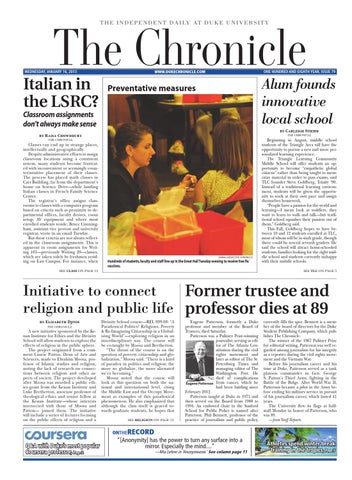
Preventative measures
Classroom assignments don’t always make sense
by Carleigh Stiehm by Raisa Chowdhury
THE CHRONICLE
THE CHRONICLE
Beginning in August, middle school students of the Triangle Area will have the opportunity to pursue a new and more personalized learning experience. The Triangle Learning Community Middle School will offer students an opportunity to become “empathetic global citizens” rather than being taught to memorize material in order to pass exams, said TLC founder Steve Goldberg, Trinity ’90. Instead of a traditional learning environment, students will be given the opportunity to work at their own pace and assign themselves homework. “People have a passion for the world and learning—I mean look at toddlers, they want to learn to walk and talk—but traditional school squashes their passion out of them,” Goldberg said. This Fall, Goldberg hopes to have between 10 and 12 students enrolled at TLC, most of whom will be in sixth grade, though there could be several seventh graders. He said the school will attract home-schooled students, families looking for the right middle school and students currently unhappy with their middle schools.
Classes can end up in strange places, intellectually and geographically. Despite administrative efforts to assign classroom locations using a consistent system, many students become frustrated with inconvenient or seemingly counterintuitive placement of their classes. The process has placed math classes in Carr Building, far from the department’s home on Science Drive—while landing Italian classes in French Family Science Center. The registrar’s office assigns classrooms to classes with a computer program based on criteria such as proximity to departmental offices, faculty desires, room setup, AV equipment and where most enrolled students reside, Bruce Cunningham, assistant vice provost and university registrar, wrote in an email Tuesday. But these criteria are not always reflected in the classroom assignments. This is apparent in room assignments for Writing 101—previously Writing 20—classes, which are taken solely by freshmen residing on East Campus. For instance, when
EMMA LOEWE/THE CHRONICLE
Hundreds of students, faculty and staff line up in the Great Hall Tuesday evening to receive free flu vaccines.
SEE TLC ON PAGE 5
SEE CLASS ON PAGE 12
Initiative to connect Former trustee and religion and public life professor dies at 89 by Elizabeth Djinis THE CHRONICLE
A new initiative sponsored by the Kenan Institute for Ethics and the Divinity School will allow students to explore the effects of religion in the public sphere. The project originated from a comment Laurie Patton, Dean of Arts and Sciences, made to Ebrahim Moosa, professor of Islamic studies and religion, noting the lack of research on connections between religion and other aspects of society. The project developed after Moosa was awarded a public ethics grant from the Kenan Institute and Luke Bretherton, associate professor of theological ethics and senior fellow at the Kenan Institute—whose interests intersected with those of Moosa and Patton— joined them. The initiative will include a series of lectures focusing on the public effects of religion and a
Divinity School course—REL 999.08: “A Paradoxical Politics? Religions, Poverty & Re-Imagining Citizenship in a Globalizing World”—exploring religion in an interdisciplinary way. The course will be co-taught by Moosa and Bretherton. “The thrust of the course is on the question of poverty, citizenship and globalization,” Moosa said. “There is a kind of paradox in politics and religion: the more we globalize, the more alienated we’re becoming.” Moosa noted that the course will look at this question on both the national and international level, citing the Middle East and the Occupy Movement as examples of this paradoxical phenomenon. He also emphasized that although the class itself is geared towards graduate students, he hopes that SEE RELIGION ON PAGE 12
Eugene Patterson, formerly a Duke professor and member of the Board of Trustees, died Saturday. Patterson was a Pulitzer Prize-winning journalist, serving as editor of The Atlanta Constitution during the civil rights movement and later as editor of The St. Petersburg Times and managing editor of The Washington Post. He died of complications Eugene Patterson from cancer, which he had been battling since February 2012. Patterson taught at Duke in 1971 and then served on the Board from 1988 to 1994. An endowed chair in the Sanford School for Public Policy is named after Patterson. Phil Bennett, professor of the practice of journalism and public policy,
currently fills the spot. Bennett is a member of the board of directors for the Duke Student Publishing Company, which publishes The Chronicle. The winner of the 1967 Pulitzer Prize for editorial writing, Patterson was well regarded among journalists for his integrity as a reporter during the civil rights movement and the Vietnam War. Before his journalism career and his time at Duke, Patterson served as a tank platoon commander in Gen. George S. Patton’s Third Army, fighting in the Battle of the Bulge. After World War II, Patterson became a pilot in the Army before ending his military service in pursuit of his journalism career, which lasted 41 years. The University flew its flags at halfstaff Monday in honor of Patterson, who was 89. —from Staff Reports
ONTHERECORD
Q&A with Duke’s most popular Coursera professor, Page 2
“[Anonymity] has the power to turn any surface into a mirror. Especially the mind....” —Mia Lehrer in ‘Anonymeanie.’ See column page 11
Athletes spend winter break training in the tropics, Page 7
2 | WEDNESDAY, JANUARY 16, 2013
THE CHRONICLE
Ethics prof teaches thousands how to argue students can learn from each other how to write effectively.
Walter Sinnott-Armstrong, Chauncey Stillman professor of practical ethics, launched the highestenrolled course last Fall on Coursera, the massively open online education platform. He teaches “Think Again: How to Reason and Argue” with Ram Neta, associate professor of philosophy at the University of North Carolina at Chapel Hill. Shortly after its inception, the course boasted the largest enrollment of any Coursera class. The course is the third to appear under the Duke banner and is offered free of charge. The Chronicle’s Kristie Kim sat down with SinnotArmstrong to discuss the opportunities of the new online initiative, the institution’s global trajectory and quick fundamentals on assessing arguments.
Q&A
The Chronicle: In the Fall, enrollment for your course, “Think Again: How to Reason and Argue” was the highest in Coursera. How many students are currently signed up? Walter Sinnott-Armstrong: Currently, there are well over 180,000 enrolled students. I think that the highest it’s been was 187,000. Someone told me that enrollment in Dan Ariely’s course [“A Beginner’s Guide to Irrational Behavior”] recently passed mine. My course and his actually complement each other quite well: His class is also about decision making, but it’s more from a psychological and empirical point of view. If you take those two courses simultaneously, you would have a really cool curriculum. TC: What do you believe has been so appealing to students on a global scale about your course?
TC: From your own experience in preparing for the course, do you foresee the large amount of work required for professors to convert their course into an online format as a hindrance from entering Coursera? WS: The amount of time that you have to put into a project is always a barrier, and Coursera is no exception. I was lucky in that I did not have any courses to teach this Fall, so I was able to put in a lot of time preparing. It would be very difficult—if not impossible—for me to have put that much time into the course if I had had to teach two courses at the same time. I would recommend to other professors that they begin preparation over the summer because to try to do all of this work during the teaching term would be difficult.
ELYSIA SU/THE CHRONICLE
This Fall, ethics professor Walter Sinnott-Armstrong launched an online class on Coursera, which now has the largest enrollment of any class on the site. WS: Everybody makes decisions, and everybody wants to make better decisions. Everybody forms beliefs, and everyone wants to form better beliefs. Arguments help us make better decisions and form better beliefs. This course is useful to everyone—that makes it have a broad appeal. It is a practical course aimed at teaching people how to improve their thinking and their decision making. So, it appeals not just to academics, but people out in the world who want to improve their logic. TC: Do you view the courses on Coursera as enhancing or competing with the traditional
courses students receive on campus? WS: I have never taught this course [on campus]. But, what I plan to do is to offer it in the Fall. The idea is to flip the classroom and have students watch the videos on Coursera and do all the exercises and quizzes, all of which will comprise about half of their grade. The other half will come from the work done in small groups with either me or other instructors and TAs. During this portion of the course, students would be asked to turn in short writing assignments and assess each other’s writing. Peer assessment will take up a large component of this section so that
TC: What is the role of online education in today’s landscape of higher education? WS: I don’t think it has one single role, but what I consider to be the primary role is to make high-quality education available to a wider range of people—not only people in the United States but also people overseas. Twothirds of my students are from outside the United States and many of them do not have access to this type of instruction. To many people, this provides life opportunities that they never hoped for in prior years. TC: What are your thoughts on the recent expansion of the University—whether it be via the web with Coursera or its expansion into China with Duke Kunshan University? Should we continue on that global trajectory?
Duke in SINGAPORE May 18 to June 28, 2013
Information Meeting Wednesday, January 16 5:00-6:00 pm Social Sciences 311
WS: Yes, definitely. I think Duke has so much to offer. It would be a shame if what the [institution] had to offer was limited only to Americans. As I understand it, one of Duke’s slogans is “knowledge in service to society” and this program fulfills that slogan perfectly. TC: In a subject like philosophy, where discussion is essential, what are the benefits or disadvantages of teaching it to a class so large? WS: The disadvantage for me is that I don’t get to engage in those discussions as much as I would like. But, I’m not sure that’s a disadvantage for students, because they are able to access the forums and hear what other students think. I have been amazed by the level of sophistication of some of the people within the forums, especially their ability to explain the concepts better than I did. If students go to the forums and help each other out, there’s not that much loss in discussion. It is simply that the discussion occurs over email, or over the web in the form of Google hangouts and chat rooms. The report by PBS NewsHour showed a particular group that met in a bar in San Francisco to discuss the course materials—a great example of how there can still be discussion in these large groups. It just takes a bit more effort. I suppose the biggest disadvantage is that when there’s a discussion group in a course, everyone is required. [However,] when there is a forum or a meeting in a bar in San Francisco, there’s no requirement, which means that some students won’t get as much out of the course as SEE ARMSTRONG ON PAGE 6
Free Wireless
FISHMONGER’S Restaurant, Crab House & Oyster Bar since 1983
Good Luck Blue Devils! Oysters $8/dozen Every Friday 2-6 pm Serving the freshest and largest variety of seafood in the Triangle, barbeque and homemade side-dishes. Follow us on Twitter @Fishmongers_Dur 806 W. Main Street • Durham (across from Brightleaf Square) Open 7 days a week serving Lunch and Dinner .
682-0128 • www.fishmongers.net
Earn 2 Duke Course Credits!
Topics Environmental Conservation Urban Tropical Ecology Global Education Office for Undergraduates
globaled.duke.edu
THE CHRONICLE
WEDNESDAY, JANUARY 16, 2013 | 3
Second inaugurations face U.S. weighs tough task in recapturing glow military aid for by Monica Hesse
THE WASHINGTON POST
WASHINGTON — It’s not like last time, and everywhere you look, someone wants to remind you of that. Hotel rooms are still available (not like laaaast time) and there will only be two official inaugural balls (not like laaaast time) and nobody is going to wait for hours in a cattle-packed tunnel, waving their purple tickets. (Last time! So fun!) The gargantuan platform affixed to the U.S. Capitol has been growing for weeks, but worriers seem convinced that when Barack Obama steps onto it for his second inauguration, it just won’t feel the same. “No, there isn’t quite the excitement there is with the first one,� allows Buffy Cafritz, the Washington doyenne who has hosted inaugural parties since 1984. But then again, “I can’t think of a second inauguration that was as exciting as the first,� she says. “You know the man. You know his policies. It’s normal.� Over at the Presidential Inaugural Committee headquarters, chief executive officer Steve Ker-
rigan argues that the second time around is equally wonderful— just different. Those two balls will hold nearly as many people as the 10 balls did last inauguration, he explains patiently. “We’re almost doubling the size of the Commander-in-Chief ball.� But still there’s this irritating perception that it’s all a setup to a letdown. It’s one we’ve been struggling with since the beginning of our country: The meaning of the second inauguration. How to summon the energy to do it all again. Once more (with feeling). The first inauguration of our first president happened in New York. There were cheers, a 13gun salute, and an eloquent address about the meaning of the office and the future of the United States. The day was merry. The nation was optimistic, and it was brand, brand new. Four years later, Washington was elected again. That inauguration happened in Philadelphia. His speech was 135 words. It said, basically, “Here we are again. Now I will take an oath.� “Things were getting a little more complicated� in the coun-
try, says Susan Dunn, a history professor at Williams College. “He was tired.� Exhausted, even. America was not the fresh daisy it once was, and he hadn’t wanted a second term. George Washington knew what the country has spent nearly 250 years learning: Second inaugurations are America renewing its wedding vows to the same man—the ceremony might be great, but you can’t ignore what you already know about the groom: He snores, sniffles and forgot to pay the electric bill last month. Thomas Jefferson’s second inauguration was also a little tired. There was no way to live up to the hype of the first, which was America’s first political party swap and thus a huge historic deal. His second victory was completely predictable, so expectations could be met, but they could hardly be exceeded. By contrast, James Madison’s second election, in 1812, had been bitterly close, and bitterness was on display at the inauguration. John Marshall, the Supreme SEE INAUG. ON PAGE 6
Look out for The Chronicle’s on-site inauguration coverage next week!
France in Mali by Anne Gearan, Karen DeYoung and Craig Whitlock THE WASHINGTON POST
The Obama administration is considering significant military backing for France’s drive against al-Qaida-linked militants in Mali, but its support for a major ally could test U.S. legal boundaries and stretch counterterrorism resources in a murky new conflict. The United States is already providing surveillance and other intelligence help to France and may soon offer military support such as transport or refueling planes, according to U.S. officials, who stressed that any assistance would stop short of sending American combat forces to the volatile West African nation. At the same time, the administration is navigating a thicket of questions about military support and how far it could go in aiding the French without violating U.S. law or undermining policy objectives. Direct military aid to Mali is forbidden under U.S. law because the weak rump government there seized power in a coup. U.S. moves are further complicated by uncertainty about which militants would be targeted in an assault.
The loosely affiliated web of Malian militants in the country’s north includes members of al-Qaida in the Islamic Maghreb (AQIM). But other fighters are longtime foes of the Malian government and pose no direct threat to U.S. interests. “Our goal is to do what we can,� Defense Secretary Leon Panetta said Tuesday during a visit to Spain. “The fundamental objective is to ensure that AQIM— al-Qaida— never establishes a base of operations in Mali or anywhere else.� France launched fresh airstrikes in Mali on Tuesday and said it will triple the size of its combat force there. The punishing bombing campaign has failed to stop the militants’ advance, and the additional forces suggest preparation for a ground assault. The Obama administration is wary of deepening its involvement in the conflict. But the United States shares French concern about the militants’ territorial gains. It is also eager to help a top ally with which it has worked closely on counterterrorism issues in Africa, a senior administration official said. On all sides, the overriding SEE MALI ON PAGE 6
Exciting Courses Spring 2013 in the
Department of Religion Seats still available! “Changing the future‌one child at a timeâ€? The Legacy Child Enrichment Center will soon be moving into its new home. At Legacy Child Enrichment Center, we’re committed to ensuring your child’s success and developmental growth by providing a nurturing, caring environment as he/she grows emotionally, socially, spiritually and intellectually. We provide outstanding care and learning opportunities for children ages six weeks to ďŹ ve years.
Why families are reserving their place at Legacy Child Enrichment Center now: Ŕ "MM DMBTTSPPNT GFBUVSF MPX UFBDIFS UP DIJME SBUJPT Ŕ 0VS OFX TUBUF PG UIF BSU GBDJMJUZ QSPWJEFT B GVO FOHBHJOH and stimulating atmosphere for learning and growth Ŕ )JHIMZ RVBMJţFE UFBDIFST XJUI TFWFSBM ZFBST PG UFBDIJOH experience Ŕ 0VS QSF TDIPPM QSPHSBN IBT MPOH CFFO SFDPHOJ[FE GPS excellence in early childhood education. Sponsored by Grey Stone Church in Durham, we are the longest operating day care program in the state of N.C. Ŕ $POWFOJFOUMZ MPDBUFE DMPTF UP UIF %VLF DBNQVT BOE offering a Duke employee discount Ŕ 1SFNJFS DBSF BU BO BŢPSEBCMF DPTU 'PS NPSF JOGPSNBUJPO WJTJU PVS XFCTJUF BU XXX HTMFHBDZDFOUFS DPN PS DBMM
Grey Stone Church )JMMTCPSPVHI 3E Durham, NC 27705
Modern Hinduism William Elison MWF 10:20-11:10am
REL89S-02
Messiahs and Messianic Movements Shalom Goldman and Laura Lieber MW 10:05-11:20am
REL89S-01 Formation of Christian Canon Julia Lillis
Old Testament/Hebrew Bible Melvin Peters
REL290S-02
REL145
WF 11:45am-1pm
How to See God and Other Questions of South Asian Visual Culture William Elison T 4:40-7:10pm
REL690S
TTH 3:05-4:20pm
Contemporary Judaism Laura Lieber MW 1:25-2:40pm
REL345
4 | WEDNESDAY, JANUARY 16, 2013
THE CHRONICLE
House approves a Sandy relief package by Rosalind Heldermen THE WASHINGTON POST
WASHINGTON — The House on Tuesday approved about $50 billion in relief for victims of Hurricane Sandy, a package designed to speed aid to devastated communities in New York and New Jersey and a vote that provided an early test of the resolve of GOP deficit hawks. The package was adopted on a 241 to 80 vote, on the strength of support from Democrats, as well as 49 Republicans, most of them representing communities hit hard by the Oct. 29 storm. It overcame a tough challenge from fiscal conservatives who believed the emergency spending should be offset with spending cuts in other parts of the federal budget to avoid adding to the federal debt. Most Republicans—179 in all— opposed the final package, an outcome that would have once been unthinkable in the GOP-led chamber. But it was the second vote in recent weeks to pass with a majority of Democratic votes. Most Republicans also opposed the tax deal that concluded the “fiscal-cliff” package this month. House Speaker John Boehner, ROhio, allowed both votes to proceed knowing they would likely be adopted mostly through the work of Democrats. A majority of Republicans also
supported a failed amendment that would have offset a large chunk of the spending with other budget cuts. The move was fended off by the same coalition of Democrats and a smaller number of Republicans who feared it would derail the bill in the Senate. But Boehner needed to get past the Sandy issue. He received a stinging rebuke this month from a fellow Republican, New Jersey Gov. Chris Christie, and designed a complicated legislative pathway to ensure its passage despite muted GOP support. First, the House agreed to an underlying bill that contained $17 billion intended to cover immediate relief needs, including $5.4 billion for the Federal Emergency Management Agency fund that funnels aid directly to individuals and local communities to rebuild. The measure passed on a 327 to 91 vote. Then, on a 228 to 192 vote, the House tacked on $33.6 billion in additional money to cover a longerterm effort to rebuild. Splitting the bill into two pieces allowed Republicans who wanted to provide immediate help to be able to withhold their votes from the long-term effort; only 38 Republicans backed adding the longer-term dollars. Supporters say all of the money is desperately needed—Christie and
Studying gender
SAMANTHA SCHAFRANK/THE CHRONICLE
Faculty members celebrate their peers’ recent publications on gender-related topics at In Print, an event in the East Duke Parlors Tuesday afternoon. New York Gov. Andrew Cuomo, a Democrat, have requested nearly $80 billion in federal aid. Together, the $50.6 billion, along with $9.7 billion for flood relief approved by the House this month, would equal a package passed in December on a bipartisan basis in the Senate. Backers had feared changes to the package could disrupt passage
cosmic cantina
in the Senate. “We don’t want to find ourselves with a bill the Senate can’t take, and we’ll have to ping-pong around here for a few months,” said Rep. Louise Slaughter, D-N.Y. “It’s important that we get this done and get it done quickly.” Sen. Charles Schumer, D-N.Y., said late Tuesday that the House bill, while not as good as Senate’s product, was “close enough” and
he would urge colleagues to pass it speedily. To appease conservatives, House leaders allowed votes on a dozen amendments—chosen from among more than 90 proposed by members—many of which would slice out spending projects that some conservatives consider not directly related to storm relief. Most were unsuccessful.
Stop Sitting Around, Get a Job. JcYZg\gVYjViZ hijYZcih lVciZY [dg V [jc! XgZVi^kZ _dW hZaa^c\ VYkZgi^h^c\ [dg dcZ d[ i]Z WZhi XdaaZ\Z YV^a^Zh ^c i]Z Xdjcign# HijYZcih l^aa gZXZ^kZ \gZVi hVaZh ZmeZg^ZcXZ VcY igV^c^c\ [dg bdhi XVgZZgh VcY \gVYjViZ egd\gVbh#
OPEN LATE GREAT ORGANIC FOOD s ON WEST CAMPUS TH ST s OPEN@TIL AM
Menu Sampling Old School Veggie Burrito
$2.86
Regular Chicken Burrito
$5.65
Cheese Quesadilla
$1.41
Chicken Quesadilla
$3.59
VeggieNachos
$4.12
Chips & Salsa
$2.06
Open until 4 am
1920 1/2 Perry St. at Ninth Street Just a block from East Campus Also serving from Chick-Fil-A on Campus
6XXdjci :mZXji^kZ edh^i^dch VkV^aVWaZ# HdbZ 9Zh^\c edh^i^dch Vahd VkV^aVWaZ# CZZYZY [dg HjbbZg VcY$dg &("&) HX]dda NZVg# - =djgh eZg lZZ`# info session Tuesday 1/22 @ 10am 101 west union
Contact Rebecca Dickenson for more information
Application Deadline friday, Feb. 1
Id Veean! ZbV^a XdkZg aZiiZg VcY gZhjbZ id GZWZXXV#9^X`Zchdc@Yj`Z#ZYj dg Ygde d[[ Vi &%& LZhi Jc^dc 7j^aY^c\
THE CHRONICLE
WEDNESDAY, JANUARY 16, 2013 | 5
TLC from page 1 Goldberg studied public policy and wrote for The Chronicle as an undergraduate, and returned to Duke to study for his Master of Arts in Teaching degree, which he received in 1995. He spent 12 years teaching middle and high school students at schools including Cary Academy and the Potomac School, which is located near Washington, D.C. Recently, he returned to Durham to start TLC in a building just blocks from East Campus. The space includes a large open room for class activities, a kitchen and a space for physical education. Each student will be issued a laptop. Goldberg will be the primary teacher, but he plans to maintain an eight to one student-teacher ratio. A year of TLC schooling will cost $13,000, with scholarships available. Goldberg said he draws inspiration from teaching innovator Salman Khan, founder of the free online education platform Khan Academy. Khan has critiqued education that tramples students’ confidence and curiosity. The online courses allow motivated students to pursue their own education paths. Because many public and traditional private schools are under pressure to have their students perform well on standardized and state exams, students lack the ability to explore the topics that interest them the most, Goldberg said. The TLC curriculum, though, will culminate in a six
month individual research project. Goldberg said he hopes to facilitate a “gradual release of responsibility” so that students will rely less upon teacher guidance as they progress. “If you need a teacher to always be telling you what to do, I will be able to outsource your job really quickly to China or India,” Goldberg said. “And that is what we are learning in schools, because that is how you make good grades.” Each day, students will read current events updates and discuss them with their peers. In the place of conventional math and science classes, students will engage in “problem solving and strategic thinking.” Physical education at TLC will vary greatly from a typical middle school, as the class will explore different exercises from around the world, such as yoga and cricket. During their lunch hour, students will be encouraged to engage in thoughtful conversation and question how their food made it to their tables. At the end of the day, students will be asked to reflect and assign themselves homework. Throughout a year at TLC, Goldberg hopes to bring visitors from different cultures in to “break bread” with the students. Ginny Brooks, the mother of a fifth grader at E.K. Powe Elementary School, said that she was interested in TLC because she was unhappy with the way public schools teach in order to pass standardized tests. She said that science had been overlooked in her daughter’s education, because until recently, it
had not been on a state proctored exam. “It is important to note that we are not running away from something that is not appealing, but we are seeking to find an option that is more appealing,” she said. “Science has been totally kicked to the curb in public schools.” TLC will focus on learning that is both interdisciplinary and practical for daily use, Goldberg said. Students will apply what they learn by blogging on the subjects they study and will have instant access to previous lessons online. “At some point, we will learn about World War I and at some point we will learn about World War II, but the time table isn’t what matters,” he noted. “Kids will learn and they will make connections between history and current events, and they will blog about it. I am not interested in covering materials, I am interested in uncovering knowledge and discussion.” Goldberg began to question traditional school settings after a canceled trip to Africa in the summer of 2005. He was planning to take a group of students to Ethiopia, but there were political circumstances that delayed the trip one year. During that year, Goldberg studied the political situation in Ethiopia and throughout Africa. He was surprised to find how little he knew about the world outside of the United States. “Growing up in the United States, it is easy to forget that there are other people in the world,” Goldberg said. “Most students are
CAROLINE RODRIGUEZ/THE CHRONICLE
This August, the Triangle Learning Center Middle School will open its doors. The school and its innovative teaching style was founded by Steve Goldberg, Trinity ’90. shocked to hear that less than 4.5 percent of the world’s population lives within the United States.” TLC is based on the principle that middle schoolers are capable of higher level thinking and civic awareness. TLC board member Kristoffer Kohl, a former fifth-grade teacher, wrote in an email that these students are at a pivotal point in their educational development. “Adolescence is when students begin making decisions for themselves, when they begin to identify their personal code of ethics and priorities,” he said. “They have been exposed to the world in challenging and rewarding ways, so giving them the skills to impact the world can completely flip the
expectations they have of themselves.” Goldberg hopes that in the next five years, TLC will expand to over 50 socioeconomically diverse and civically engaged students. Though the TLC model will be new for many, it will not sacrifice the rigor and depth of traditional education in the process of pursuing “fun and passionate” learning, Goldberg said. “Young people are really capable and we don’t treat them as such, but we really should,” he said. “We are going to have deep, sophisticated conversations about important topics, and it won’t be easy at first, but we will be building a community within our classroom.”
Howard Hughes Summer Research Programs Applications Now Open The Howard Hughes Research Fellows Program
The Vertically Integrated Partners (VIP) Program
For rising sophomore applicants In Trinity College and Pratt
For rising sophomores, juniors and seniors In Trinity College and Pratt
Research in all areas of the Biological and Biomedical Sciences
Research in select labs:
including: • • • • • • •
Molecular Biology and Genetics Evolution and Ecology Cell Biology Biochemistry Neurobiology Animal Behavior Biomedical Engineering
$4,300 STIPEND HOUSING ON CAMPUS PROVIDED
JUNE 3 – JULY 26, 2013 Application Deadline: February 12, 2013
• Psychoneuroimmunology • Models and Mechanisms of Human Disease • Molecular Genetics and Evolution of Plant Perceptions of the Environment • Primate Genomics and the Evolution of Diet • Molecular Biology and Evolution of Olfactory Circuits
$5,500 STIPEND May 20 – July 26, 2013 Application Deadline: March 1, 2013
WEBSITE: http://undergraduateresearch.duke.edu/programs
6 | WEDNESDAY, JANUARY 16, 2013
INAUG. from page 3 Court chief justice tasked with the swearingin, reportedly smirked throughout the ceremony, showing his displeasure with the incoming president. Madison gave a lackluster address—he was a bad public speaker and regularly bungled social situations. “The whole thing was just kind of awkward,” says Kevin Gutzman, a Madison biographer. “Then again, whenever you had Madison in a room with lots of people, it was kind of awkward.” Basically, says Gutzman, “He went through it because we had this precedent that he had to.” Yes, he had to. And we have to. Not the balls (those were added by Dolley Madison, who was as gregarious as her husband was socially inept), and not the dinners and the parade. But the president must take an oath, because saying it is required by the Constitution. Article 2, Section 1, Clause 8. Even if the president is tired. Even if the people are tired of the president. Second inaugurals are less like clean slates than hastily wiped-down ones: There will be an inevitable reckoning of the vision previously laid out: whether the promises made stayed intact or were broken. If you look at a list of America’s presi-
THE CHRONICLE
dents and their terms, you will notice a large block of one-termers throughout the 19th century. This is not always because the gentlemen couldn’t get elected again. It’s because in some cases — James Polk, James Buchanan—the politicians had promised the exhausted American public that they wouldn’t even try. Of course, there’s a problem with this— this tidy little parable of diminishing returns. The problem’s name is Lincoln. As any historian or schoolchild or Daniel Day-Lewis fan could tell you, the time of Lincoln’s second inauguration was emotionally charged and politically fraught. Lincoln read the mood beautifully. “His first inaugural was a long, rational address, directed to the Southern states,” who feared what the election of a Republican president meant to them, says Ron White, a historian and author of “A. Lincoln.” “I mean, it’s fine. But it’s not great.” Lincoln used words like “compliance.” He talked about “conclusive evidence.” He “reiterated” things. He sounded exactly like the lawyer he was. His second inaugural address, was just 701 words, of which 505 were one syllable. “Usually, second inaugurals tend to be longer—everything from fixing the economy to climate change,” White says. “And they’re also much heavier with one word:
ARMSTRONG from page 2
MALI from page 3
they would if they were required [to partake in discussion]. It also means, on the other hand, that students who don’t have the time to go to those discussion groups will still get what they are able to get out of the course.
fear is that the militants will create a terrorist haven in rugged northern Mali similar to the one that fighters secured in Afghanistan before the Sept. 11, 2001, terrorist attacks. U.S. officials have said publicly that they are evaluating France’s requests for further assistance. But privately, they say that one of the critical requests relates to intelligence that could be used for targeting purposes, said the senior official, who spoke on the condition of anonymity about intelligence and diplomatic matters. Evaluating the request involves “understanding what the French objectives are and really how they intend to go about them and against whom,” the official said. The official was not specific about whether the surveillance being shared with France comes from drones or from satellites. State Department spokeswoman Victoria Nuland said: “They’ve asked for support with
TC: If there is one thing that you hope students will take away from “Think Again: How to Reason and Argue,” what would it be? WS: The goal of arguments is not to beat down your opponents and make them look silly and make you look good. Instead, the point of understanding arguments is to understand people because you don’t understand another person’s views unless you understand the reasons why they hold that view—that is what you learn from looking carefully at their arguments.
I.” Lincoln only used the personal pronoun twice. “One of the triumphs of the Union was that an election could still take place in the middle of the war,” says White. “This was special.” Now whenever a Lincoln inaugural line is quoted, there’s a better than good chance that it came from the second one, embodying the integrity that the nation so often goes looking for, so infinitely craves: “With malice toward none, with charity for all, with firmness in the right as God gives us to see the right, let us strive on to finish the work we are in, to bind up the nation’s wounds.” Never fear. America is not in the habit of allowing its wounds to stay bound for very long. After Lincoln’s assassination, we made it through Andrew Johnson’s truncated presidency, though we chose not to give him a second term. We did choose to re-elect his successor, Ulysses S. Grant. In those days, Congress went out of session when the president’s term ended, not before, meaning that bills were produced up until last minute. The night before his second inauguration, Grant found himself knocking about the White House, wading through piles of looming legislation. The work carried over to the next day. Thus, on the morning that Ulysses S. Grant, airlift. They’ve asked for support with aerial refueling. We are already providing information, and we are looking hard today at the airlift question, helping them transport forces from France and from the area into the theater, and also at the refueling question.” The Pentagon has begun identifying transport and tanker planes that might be used, but U.S. officials cautioned that resources in the region are slim and that French requests have shifted. “We’re not providing logistics support, whether airlift, refueling,” yet, the official said. “There is a little bit of a cold-start aspect there.” Any additional U.S. help could go to French forces directly or to African backup forces, which are expected to begin arriving soon. The European Union said Tuesday that it will speed up a troop-training mission in Mali, which now is likely to be launched in the second half of February or in early March. The E.U. is not planning any direct
the Union hero of the Civil War, was set to be re-sworn in as the leader of the United States of America, he was lingering over a piddling bill that would allow former president Zachary Taylor’s daughter a monthly pension in the sum of $50. When Grant did take the podium, he used his address to grumble. “I have been the subject of abuse and slander scarcely ever equaled in political history,” said the president. “Which today I feel that I can afford to disregard in view of your verdict, which I gratefully accept as my vindication.” Nanny-nanny. Boo-boo. John Marszalek, the executive director of the Ulysses S. Grant Presidential Library, knows all the details about Grant’s second inauguration—the paperwork, the hurt feelings, the frigid temperatures that made everyone leave the unheated ball early. “The champagne didn’t flow,” he says. “It got so cold that everyone just went home.” He e-mails again later, with a final observation about the day’s festivities, or rather the decorative birds at the festivities: “Some 100 canaries died the day of Grant’s second inauguration.” But such is the presidency. One begins with lofty policy aspirations, one ends up fussing over budget issues. One begins as a messianic hero; one ends up with a pile of dead birds. combat role. The official said contingency plans for the use of armed drones were already in place and are being reevaluated. The official would not be more specific. France, the former colonial power in Mali and neighboring Algeria, has led international efforts to confront the Islamist militants who exploited last year’s coup to co-opt a homegrown Malian ethnic conflict. For months, French officials insisted that only African soldiers would fight. Despite early reservations, the United States backed French-led efforts to initiate an international military force backed by the United Nations. That force was to deploy later this year, but the militants have moved much faster. “We have one objective,” French President Francois Hollande said Tuesday. “To make sure when we leave, when we end this intervention, there is security in Mali, legitimate leaders, an electoral process and the terrorists no longer threaten its territory.”
Open Rehearsal Duke Chapel Choir TODAY Wednesday, January 16, 6:00 PM For more information, contact 684-3898
Quick links to all your Duke needs. www.qDuke.com
Sports
>> THE BLUE ZONE
The Chronicle
WEDNESDAY
How is Mason Plumlee stacking up in the National Player of the Year race? We update you on him and the competition. sports.chronicleblogs.com
January 16, 2013 www.dukechroniclesports.com
WOMEN’S BASKETBALL
Blue Devils enjoy working Undefeated Duke hosts VT vacation in the tropics by Danielle Lazarus
by Paul Pisani
THE CHRONICLE
THE CHRONICLE
Winter break is a time when most busy Duke students can finally relax after a busy semester—common activities include gorging themselves with homemade cooking, enjoying the comforts of home and hopefully spotting the first snowfall of the year. But for some Blue Devils, winter break meant warm weather and a working vacation. The men’s and women’s tennis and swimming and diving teams embarked on trips to tropical locations around the globe to train for their respective seasons. Also soaking up the sun was women’s golf senior Lindy Duncan, who took first place in the women’s category at the Copa de las Americas Tournament in Miami, Fla. Duncan and her partner, UCLA sophomore Erynne Lee, also came in third place in the men and women’s overall category. “We would have liked to win both [divisions], but we did pretty well,” Duncan said. “But I know what I need to work on now. There are a couple of things that I know I need to focus on going forward.” Family and friends made the half hour drive from Duncan’s hometown of Fort Lauderdale, Fla. to watch her play at the Doral Resort and Spa, the site of the tournament and home of the course infamously named the
Without a single game decided by fewer than 10 points, the No. 4 Blue Devils (15-0, 5-0 in the ACC) have yet to be challenged this season. The team enters its Wednesday night matchup against Virginia Tech (7-9, 1-4) as the last remaining unbeaten in Division I basketVT ball—men’s or women’s—and has vs. shown no signs of slowing down. No. 4 The Blue Devils host the HokDuke ies in a 7 p.m. contest at Cameron Indoor Stadium. Wednesday, 7 p.m. Duke is coming off a 73-44 win Cameron Indoor Stadium at Wake Forest, in which the Blue Devils took over in the second half, shooting 55.6 percent from the field and going on a 13-0 run to put the game out of reach. The team stepped up its play in the second half against Clemson last week, shooting 63.3 percent after another slow start. Duke has also been a nightmare for its opponents on the defensive end, forcing turnovers, grabbing rebounds and preventing secondchance points. Although the Blue Devils have continued to blow out opponents, head coach Joanne P. McCallie stressed that one half of solid play may not be enough against future opponents. “We’re trying to grow, but we’re growing in halves right now,” McCallie said. “Hopefully we can start playing games and get the whole 40 minutes.” SEE W. BASKETBALL ON PAGE 8
PHOTO COURTESY OF THE USGA
Lindy Duncan and teammate Erynne Lee hold their trophy for winning the women’s title at the 2013 Copa de las Americas as they represented the United States.
SEE VACATION ON PAGE 8
DIVING
Duke Olympians thrive in the college waters by Ashley Mooney THE CHRONICLE
Among the Duke swimmers and divers receiving roses Saturday on the athletic deck of Taishoff Aquatic Pavilion was Abby Johnston, the Duke diver who returned from the 2012 Olympic Games in London this summer with a silver medal around her neck. Duke lost to South Carolina in the dual meet, but the steamy Saturday also marked Senior Day for the Blue Devils. Johnston would have been a senior last year, but took off for training and returned with an Olympic silver medal in synchronized 3-meter springboard. “Last year was difficult for me to be handing out the roses to all of the seniors instead of walking across the pool deck, and it was really tough,” Johnston said. “But the senior class this year has really welcomed me as one of their own and what a fun way to go out [Saturday] at our home pool.” Johnston said she is now working on answering “the big question mark” of what she will do after graduation. She said she would love to keep diving, but has been battling shoulder injuries and will begin working on the daunting medical school application process in the next year. “Knowing that my collegiate career is coming to an end is a strange mix of emotions, emotions that I didn’t expect,” Johnston said.
DAN SCHEIRER/THE CHRONICLE
Duke diver and Olympic medalist Abby Johnston celebrated her Senior Day with a win in the 1-meter springboard. Fellow Olympian Nick McCrory, who earned a bronze at the Games would have been a senior had he not taken a year off for training, said he is just excited to be back with the team. “I took that year off for a reason, and obviously I’m glad I did. I wouldn’t have been able to accomplish all that I did had
I not done that,” he said. “It was a little bit sad because I won’t be graduating with all the people I came in with, but it just happens, and it’s something I had to do.” For McCrory, returning to Duke has been a tough, but good, readjustment. Last year, most of his time went to training and recovery.
“You just get used to whatever it is that you’ve been doing,” he said. “Now it’s like, ‘Oh, I’m back in school now.’” Johnston also noted that without the Olympics looming, she has had a different mindset when competing for Duke this year. Saturday, in her second competition of the 2012-13 season, Johnston received ACC Female Diver of the Week accolades for her first-place finish in the women’s 1-meter springboard. On the 1-meter board, she has collected 22 collegiate wins. Despite her strong performance, Johnston noted that she wants to become more comfortable with competing again. “I don’t know if its just the pressure I put on myself, having the silver medalist title or whether my expectations have changed, but I’ve been a lot more nervous so I want to try to calm my nerves in competition,” she said. McCrory also secured a win in the 1-meter springboard and a second-place finish on the 3-meter board, in which classmate Jordan Long took first. McCrory said he is bringing lessons of perseverance from his Olympic training to this season. “So far I’m… training well, which is exactly what my goal is for right now,” McCrory said. “As the rest of the season progresses, I’ll be bumping up some of my degree of difficulty—adding some harder SEE DIVING ON PAGE 8
8 | WEDNESDAY, JANUARY 16, 2013
VACATION from page 7 Blue Monster. “Being in Florida was awesome,” Duncan said. “I’ve never gotten to play the Blue Monster, but they have a lot of professional events there so it was really cool to play that course, even though it was really tough.” But the best part of her trip? “It was like 80 degrees everyday,” she said. “It’s hard to beat that.” Also enjoying the hot weather were the men’s and woman’s tennis teams, who traveled to Honolulu, Hawaii to participate in the Hawaii Invitational. Both teams went undefeated in the tournament, with the No. 5 men’s team going 9-0 and the No. 3 women’s team going 17-0 to kick off their respective spring seasons. “A big thing was getting lots of practice outdoors with two days of matches,” women’s head coach Jamie Ashworth said. “But mainly, the priority was team building. We got to spend some time as a team before the season really starts, talking about different team goals and how we want to present ourselves.” Both teams took advantage of the many attractions Hawaii has to offer. Their activities included snorkeling, hiking up Diamond Head Volcano, touring the Dole Pineapple plantation and, most memorably, cage diving in Waikiki Beach’s shark-infested waters. “Shark diving in a cage—that was definitely an especially fun trip and definitely a great team experience,” Ashworth said. Meanwhile, 6,000 miles away, the swim team marked the midpoint of its season with a trip to Barbados. Although it did not participate in any meets, the team practiced for five hours a day, said head coach Dan Colella. “Pretty much every year we go on a training trip during a time when we’re out of school so we can really focus on training,” he said. “We were training for two and a half hours in the morning and again in the afternoon. But it’s nice to go someplace warm. One of the benefits of being in a place like Barbados is that it gives [the team] an incentive to work a little harder knowing that they’re in a beautiful place.” The Barbados trip came at the perfect
W. BASKETBALL from page 7 After winning its ACC opener against Wake Forest Dec. 22, 2012, Virginia Tech has dropped four straight games in conference play. Despite impressive performances from juniors Uju Ugoka and Monet Tellier, who average a combined 29.9 points and 13.5 rebounds per game on the season, the Hokies have struggled. Virginia Tech never led and shot just 27.9 percent from the field in
THE CHRONICLE
time: The team only has two meets left before ACC Championships take them through March. “At the beginning of the season, you’re really excited, but once you get to the halfway point it really drags on from working out that long,” senior Matt Carder said. “I think [the trip] was a good way to really focus before we make that last push into the last part of the season.” Although the trip was characterized by “a lot of swimming,” Carder said the team also found time for some fun. “We did take one afternoon off and a large group of them went on a snorkeling excursion with sea turtles,” Colella said. “Also our hotel arrangements were out on the beach so between workout sessions you could find a lot of swimmers soaking up the sun.” Even though each team was far away from each other geographically, they shared the same goals. “All of our big tournaments are in the spring, so the tournament really helped me figure out the parts of my game I really want to work hard on,” Duncan said. But while the tennis and swim teams also improved for the spring, they found that being with a team away from the pressure and routine of Durham allowed for a type of “forced team bonding,” Carder said. “When you go to a place like this, you typically squish four people into a room and you’re stuck on a plane with someone for five hours,” he said. “But you always end up with great stories about certain things that you wouldn’t talk about at school.” The tennis teams’ time in Hawaii also served as the perfect time for the team to come together. “They play fall tournaments but not as a group, so here we tend to learn about each other’s personalities and how to deal with each other in good times and bad,” Ashworth said. As Duncan gears up for the spring season, the men’s and women’s tennis teams will face Elon and William and Mary, respectively, Saturday and swimming will battle Virginia Sunday. Their training trips will serve as an invaluable springboard for the rest of the season, so these stronger, worldlier and tanner Blue Devils can prepare for the spring. its most recent defeat, a 74-45 rout on its home floor against No. 10 Maryland. The Hokies’ visit to Cameron Indoor Stadium may look one-sided on paper, but the contest will prove important as both teams gear up for the back half of their schedules. Even with a looming road matchup against No. 3 Connecticut next Monday, McCallie is focusing on one game at a time. “We’re always getting ready for the next game, and it’s a long season,” McCallie said. “We have some very good leadership,
DAN SCHEIRER/THE CHRONICLE
Duke diver and Olympic medalist Nick McCrory won the 1-meter competition against South Carolina.
DIVING from page 7 dives and looking to increase my scores.” Duke head coach Dan Colella noted that having Johnston and McCrory training with the team again is exciting. “It’s very exciting to have Nick and Abby representing Duke again, and for them to come out and perform the way they did was absolutely terrific,” Colella said. “There’s no question [that] whenever you have athletes of [Olympic] caliber it’s going to raise the bar.” Their presence on the team has also aided with recruitment, Colella added.
“The caliber of athlete that is really seriously looking at Duke on the diving side… has definitely gone up considerably in the last several years with what [Nick and Abby] have been doing,” he said. But all in all, Colella emphasized how thankful he is for the seniors on the team and what they have done in the past few years. “That was really great to send off our seniors, and we’re obviously very thankful for all that they have done for the last three years,” Colella said. “We want just to thank our seniors for all that they’ve done here, it was a great way to send them off at their last home meet.”
CLASSIFIEDS HELP WANTED
CHILD CARE
LAB TECH
SEEKING NANNY for fulltime in-home care in south Durham starting Jan. Superior experience, and background checks required. Send references/resume to mdwilkers@gmail. com
Research lab seeking Research Technician II. Do you like working with your hands but like using computers too? Are you neat and organized, and maybe just a little bit (but not a lot!) OCD? Are you interested in art, drawing, photography or journaling? Do you like biology AND math or physics? Do you think it’s cool to look at tiny things with microscopes? Do you look good in a white lab coat? Will your friends or family be impressed if you tell them you’re a Scientist? If you get a laugh out of any of these and they sound like you, give us a call and we can talk. We study the biophysics of muscular contraction using electron microscopy and X-ray diffraction. We’re looking to hire as soon as possible, and have funding guaranteed for the next 4-5 years. Contact Robert Perz-Edwards: 919-684-5674. Email edu
rj.perz-edwards@duke.
COACH WANTED
Wanted - Track athlete to assist with coaching a local high school track team. Should be able to coach either the hurdles or the jumps. Afternoons, 3:45 to 5:15. $12 per hour. Contact dennis.cullen@da.org. Email dennis.cullen@da.org
TRAVEL/VACATION BAHAMAS SPRING BREAK
$189 for 5 days. All prices include: Round-trip luxury party cruise. Accommodations on the island at your choice of thirteen resorts. Appalachia Travel. www. BahamaS
HOMES FOR RENT PARTNERS PLACE CONDO FOR RENT
Available In May 2013. 3 bed/3 ba condo minutes from Duke. Vaulted ceilings, skylights, sunroom, office. Over 1450 square feet of living with large bedrooms and great common areas. Ideal for 3 roommates or professionals. $1775/mo. Call Earle 919-618-5994 or E-mail kcjm4@ msn.com
Advertise here for the best results
BEAUTIFUL HOUSE FOR RENT - Graduate or Professional Students
3 bedroom 1 bath unfurnished house. The monthly rent is $ 800 and comes complete with Yard Service including a 2 man maintenance staff. Owner has carefully updated this house and seeks a very Responsible person/s to take care of the property. (NO smokers or Pets allowed). Minimum rental period of 1 year required and no subleasing. House has new appliances, new carpet and wood laminate floors, washer and dryer included, fenced 1/2 acre yard with storage building, new gas logs, cable and satellite access throughout, central air, convenient to Duke and shopping malls. Contact: Wayne Smith Cell: 919-638-6141 Email: wsmith1547@aol.comun.com 800-867-5018
The Chronicle classified advertising www.dukechronicle.com/ classifieds deadline 12:00 noon 1 business day prior to publication
THE CHRONICLE
WEDNESDAY, JANUARY 16, 2013 | 9
Diversions Shoe Chris Cassatt and Gary Brookins
Dilbert Scott Adams
Doonesbury Garry Trudeau
The Chronicle worst thing about rush: didn’t get key 3: .................................................edgar allen barney old trinity has weird rituals: ...............................................shwanth can’t eat the food: .................................................................. jewels having to blog about it on acb: ............................................briggsy bid day production: ...........................................................og abeats all the photos are posed: ....................................................crod, bri hungry :( : ......................................................................... bacce ball too weird for this #zooeyes: .............................................the greek Barb Starbuck doesn’t have to watch: ..................................... Barb
The Duplex Glenn McCoy
Student Advertising Manager: .................................. Allison Rhyne Account Representatives: ..................... Jen Bahadur, Sarah Burgart Courtney Clower, Peter Hapin, Claire Gilhuly, Sterling Lambert Liz Lash, Dori Levy, Gini Li, Ina Li, Vivian Lorencatto, Lalita Maraj Parker Masselink, Cliff Simmons, James Sinclair, Olivia Wax Creative Services: .......... Allison Eisen, Marcela Heywood, Mao Hu Rachel Kiner, Anh Pham, Izzy Xu
Sudoku
be classy. Advertise in the Chronicle Classifieds and reach your target audience with ease.
Fill in the grid so that every row, every column and every 3x3 box contains the digits 1 through 9. (No number is repeated in any column, row or box.)
www.dukechronicle.com/classifieds
Answer to puzzle www.sudoku.com
The Independent Daily at Duke University
The Chronicle
10 | WEDNESDAY, JANUARY 16, 2013
Keep thinking Think Before You Talk, of nasty language is somea new, freshmen-led cam- times related less to malice paign to reduce the use of than one’s upbringing, or derogatory words like “gay” the groups with whom an and “retarded” in everyday individual has previously asconversation, is a praisewor- sociated. As the campaign’s thy attempt to founders point tackle an imout, internaeditorial portant issue. tional students We particularly applaud the may be more prone to use initiative for its focus on derogatory words simply belanguage, which we agree cause they heard them once can needlessly foster hostile or twice and are not aware attitudes that have no place of their offensive nature. on our campus. We urge In these cases, awareness is the campaign to consider crucial—and even simple tweaking the popular one- posters and stickers can go a size-fits-all approaches to long way. addressing Duke cultural isBut it is important to recsues and to continue think- ognize that the initiative has ing creatively. its limitations. Any student Think Before You Talk attending Duke in the last has many positive features few years must have come and could potentially have across a similar poster cama strong impact. The use paign addressing another
“
As a transgendered, African/Asian American lesbian, I find this article completely reprehensible. I am not able to understand satire and sarcasm, so this article is REALLY upsetting me. —“Raquel88678” commenting on the column “Dookie rushes in.” See more at www.dukechronicle.com.
LETTERS POLICY The Chronicle welcomes submissions in the form of letters to the editor or guest columns. Submissions must include the author’s name, signature, department or class, and for purposes of identification, phone number and local address. Letters should not exceed 325 words; contact the editorial department for information regarding guest columns. The Chronicle will not publish anonymous or form letters or letters that are promotional in nature. The Chronicle reserves the right to edit letters and guest columns for length, clarity and style and the right to withhold letters based on the discretion of the editorial page editor.
”
Direct submissions to:
E-mail: chronicleletters@duke.edu Editorial Page Department The Chronicle Box 90858, Durham, NC 27708 Phone: (919) 684-2663 Fax: (919) 684-4696
The Chronicle
Inc. 1993
YESHWANTH KANDIMALLA, Editor LAUREN CARROLL, Managing Editor JULIAN SPECTOR, News Editor ANDREW BEATON, Sports Editor CHRIS DALL, Photography Editor MAGGIE LAFALCE, Editorial Page Editor KATHERINE ZHANG, Editorial Board Chair PARKER KUIVILA, Managing Editor for Online JIM POSEN, Director of Online Operations CHRISSY BECK, General Manager KRISTIE KIM, University Editor TIFFANY LIEU, Local & National Editor ANDREW LUO, Health & Science Editor CAROLINE RODRIGUEZ, News Photography Editor PHOEBE LONG, Design Editor MICHAELA DWYER, Recess Editor SOPHIA DURAND, Recess Photography Editor SCOTT BRIGGS, Editorial Page Managing Editor MATTHEW CHASE, Towerview Editor ADDISON CORRIHER, Towerview Photography Editor ANNA KOELSCH, Social Media Editor SAMANTHA BROOKS, Senior Editor REBECCA DICKENSON, Advertising Director MARY WEAVER, Operations Manager DAVID RICE, Director of External Relations
cultural concern—“Who Needs Feminism?,” “Breaking Out” and Blue Devils United “Day of Silence” are a few examples. While these kinds of campaigns raise awareness, they rely on the attention of interested passersby and thus can self-select for people already sympathetic to the cause. As more and more campaigns of a similar nature emerge on campus, their leaders run the risk of over-saturating their target audience. This phenomenon places an larger-than-usual burden on student leaders to think outside the box. Campaigns that attract interest in an innovative way—particularly those that engage students directly—will be more successful than their more con-
ventional peers. Posters are a good way to attract initial interest, but more active participation through discussions, lectures or workshops help ensure the message doesn’t get lost. Think Before You Talk has made a good start in having students sign a pledge to reduce use of derogatory language. This pledge should be a cornerstone of the campaign, perhaps with the addendum that signatories commit themselves to speaking out when friends use derogatory language. After all, real change is likely to occur only when use of derogatory words becomes sufficiently socially unacceptable. Students could also be encouraged to give feedback—perhaps through
videos or written testimonials—on how use of the words has affected them negatively. The more personal the campaign becomes, the more effective it is likely to be. None of this is to diminish the efforts of the campaign’s founders. That such an important and timely initiative came from freshmen is yet another reminder that no Duke student is too young or otherwise unqualified to lead. Complaining about societal ills is one things—doing something about them is another. All told, then, we celebrate the leadership of those behind this campaign and urge them to continue refining and improving it. Duke will benefit greatly from their call to think.
The wandering devil
onlinecomment
Est. 1905
THE CHRONICLE
commentaries
MARGOT TUCHLER, University Editor JACK MERCOLA, Local & National Editor DANIELLE MUOIO, Health & Science Editor ELYSIA SU, Sports Photography Editor ELIZA STRONG, Design Editor HOLLY HILLIARD, Recess Managing Editor CHELSEA PIERONI, Online Photo Editor ASHLEY MOONEY, Sports Managing Editor SONIA HAVELE, Towerview Editor MELISSA YEO, Towerview Creative Director NICOLE KYLE, Special Projects Editor MAGGIE SPINI, Senior Editor MICHAEL SHAMMAS, Recruitment Chair BARBARA STARBUCK, Creative Director MEGAN MCGINITY, Digital Sales Manager
The Chronicle is published by the Duke Student Publishing Company, Inc., a non-profit corporation independent of Duke University. The opinions expressed in this newspaper are not necessarily those of Duke University, its students, faculty, staff, administration or trustees. Unsigned editorials represent the majority view of the editorial board. Columns, letters and cartoons represent the views of the authors. To reach the Editorial Office at 301 Flowers Building, call 684-2663 or fax 684-4696. To reach the Business Office at 103 West Union Building, call 684-3811. To reach the Advertising Office at 101 West Union Building call 684-3811 or fax 684-8295. Visit The Chronicle Online at http://www.dukechronicle.com. © 2012 The Chronicle, Box 90858, Durham, N.C. 27708. All rights reserved. No part of this publication may be reproduced in any form without the prior, written permission of the Business Office. Each individual is entitled to one free copy.
I
t’s finally my last semester at Duke (God will- brings us together now, however, is in the moing). As I walk through the mess that we jok- ments we all stop in our tracks to appreciate its ingly call a student center, I can’t help but architecture in certain elements, whip out our think of how appropriately the structure reflects phones for a picture and continue with our day. my Duke experience. I don’t mean I’m not yearning for a day when this in some sentimental sense, church could unite us all for a where I’m looking for the cheaphigher cause. Church has always est metaphors to summarize the mystifyingly been able to advanyears that I’ve spent here (although tage the powerful in society as I can’t deny that I’m victim to that much as it has been to serve the impulse). I mean it quite literally: omnipotent. Elite universities like the spaces and structures we occupy Duke used to serve that privileged shape the way we interact with one class of rich, white, Christian males ahmad jitan another, the way we think, the way toward noble ideas. Now Duke we imagine our world and its pos- indecent family man serves the privileged class, as critic sibilities. As I’m preparing to leave Walter Benn Michaels calls it, of this place, I think about the changes I’ve seen in “rich kids of all colors.” Increasing the socioecothe scenery around me as much as my own per- nomic diversity of Duke through different finansonal development. There are plenty of people cial aid measures isn’t going to fundamentally who have been around this campus longer than change the make-up either; if you don’t arrive I have. There are people who have wiser insights a rich kid, the idea is you come to a place like on space and subjectivity, on the role of a univer- Duke to leave one. You can pretend you’re dedisity, on the inner workings of Duke’s bureaucracy. cated to knowledge and the academy, but you’ll For my first column as a second semester senior, just find yourself another part of the machinery. I don’t have much else to offer but some humble The decision to go into graduate school might reflections on my personal experiences as an un- be more cruel than becoming a slimy I-banker dergraduate at Duke University. or consultant. The people at McKinsey know that I’ve grown in these spaces. Into an activist, a they’re making money. The academic might decolumnist, a barista, a lover, a spiritual seeker, a ceive themselves into thinking they’re serving poet. I’m grateful for my growth at Duke, but I’m the production of knowledge when what they’re also aware of the struggles and depths I travelled really doing is ensuring that the world of ideas to get to where I am. To find spaces where I felt is owned by corporate structures. If the suicide safe enough to feel genuinely, to belong. At times of Aaron Swartz, whose only crime was making it was too unbearable that I had to leave. Because knowledge public, doesn’t make this clear then of this, I am grateful for what Duke has offered me it’s only a sign of how callous our spaces have albut also worried about its future. ready made us. The fact that the Bryan Center is an archiSo what am I doing here? Truth is I don’t tectural monstrosity is more than just a point of know. Sometimes I tell myself I came here beridicule and shame for the University. Its ugliness, cause of the unique gathering of inspiring indiits absurdity, is only reflective of what I see as the viduals that make up the place. Sometimes I reincreasing irrelevance of this elite university to its ally believe that to be the case. At the very least, imagined ends. It allows us to really look at the I believe it’s what makes Duke not completely myth of “knowledge in the service of society.” Uni- hopeless. I still think bright, inquisitive, poetic versities are barely institutions of higher learning minds should have spaces to gather. I don’t know anymore. Yes, I learned here. And not just academ- if elite universities are that place anymore. Maybe ically, but also morally and spiritually. But when there’s a chance our young bright minds can be finance and consulting are the most popular in- creative enough to create the spaces ourselves, dustries Duke undergraduates pursue, one has to either within or without universities. Or maybe wonder what kind of spaces we occupy. When any- the greatest course at Duke is a course on wanwhere from one in four to one in five women are dering through late capitalism. Often I must find sexually assaulted on college campuses, we have to comfort in poetry, like that of J.R.R. Tolkien from wonder what kind of spaces we occupy. New talk of my childhood, “All that is gold does not glitter; interdisciplinarity is just a fancy way of saying that Not all those who wander are lost.” Duke can teach its students relevant knowledge for the ever-changing corporate world. Ahmad Jitan is a Trinity senior. His column runs Service used to have a more religious con- every other Wednesday. You can follow Ahmad on Twitnotation. The only way the Duke Chapel really ter @AhmadJitan.
THE CHRONICLE
Men act, states don’t
T
WEDNESDAY, JANUARY 16, 2013 | 11
commentaries
here is a tendency, in contemporary political and of its many, many members—is refusing to give all of economic discourse, to reduce conversations to the goods that it somehow possesses to Iranian citizens. the level of the aggregate. Thus, we speak in What we mean is that the Congress, the president and terms of “labor” seeking goals, “nations” taking action a small circle of privileged appointees have convinced and “society” handing the president a the individuals who make up the military mandate. Such a way of looking at the and law enforcement mechanisms of the world, as convenient and at times useful state to forcibly prevent a third group of as it might be, commits a serious error. individuals from engaging in peaceful, A great deal of grief might be saved by voluntary exchange with a fourth group framing our discussions around the indiof individuals. vidual, rather than the collective. That massive populations of peoThe basis for an individualist apple—such as those contained within a proach to economic theory rests on the nation—do not give rise to some superchris bassil recognition of one simple axiomatic human entity that exists in any way apart human action truism: that, as Ludwig von Mises wrote, from the various actions of its individual “Human action is purposeful behavior.” members is perhaps best crystallized in (In fact, Mises saw this insight as so fundamental to the the following passage, taken from a speech delivered by study of economics he used the sentence as the opener economist Joseph Salerno at Columbia University late to his thousand-page treatise on the subject). As Mises’ last year. “When the Soviet tanks, who were guarding the student Murray Rothbard later clarified, this simple yet remnants of the Soviet government in the parliament profound conclusion implied at least two things: that building—they had their turrets turned out at the peohuman beings act by employing means, and that they ple—when they saw the masses, who had now seen that it do so in order to achieve ends. was just a giant rip-off, all amassing outside, the turrets of The most immediate implication of this concept, the tanks turned around,” Salerno says. “And then what as Rothbard goes on to elaborate, is that only an indi- was left? A few scared guys, hiding in this building. That vidual can undertake action. If I am stranded alone on was the state. That was the great Soviet Union.” a desert island, for example, I might conceive of many To return for a moment to the idea that only individways in which I might employ certain means—hunting, uals are capable of action, another common objection fishing, building or searching for shelter—in order to holds that this view of the world is “atomistic.” It considachieve certain ends. If the next day I discover a com- ers my fellow castaway and me, the argument goes, as panion on the island, he and I might decide to pool isolated, hermetically sealed off individuals. This, howour labor. We might hunt in tandem, or I might build ever, is simply untrue. “To say that only individuals act a shelter for us while he hunts. This in no way implies, is not to deny that they are influenced in their desires however, that some magical alteration has taken place, and actions by the acts of other individuals,” Rothbard and that we are now both motivated to action by a “col- clarifies. I might convince my companion to share the lective will.” The existence of such a collective would game he catches with me, either by appealing to his suggest the almost mystical appearance of some entity sense of charity or friendship, inducing him to trade independent of our individual actions, which instead with me, or threatening to bludgeon him with a club. are now simply occurring cooperatively. In any of these cases, any influence I have on my comSome might object that this is an overly simplistic panion is an outgrowth of my individual action maniview of the world. It is easy to observe that no mystical festing itself within his individual response. It’s also un“collective” comes into existence when two people co- true that methodological individualism requires a set operate, but what about when two million people coop- of “fully rational” individuals. If pleading with, trading erate? What about when two hundred million people with or beating my companion fail to get me a share cooperate, on a national or international scale? Surely, of the catch, it doesn’t mean that I, as an individual, at this point, some sort of collective can be said to exist, didn’t employ means in order to attain certain ends. It and can clearly be said to influence people. After all, just means that I was wrong about which means would some of these collectives—such as “labor,” or even na- effectively get me to where I wanted to be. tions like the United States—exert a very real influence At first glance, the recognition of human action as in the sphere of human action. purposeful behavior might seem simple and straightIt would not be incorrect to say that a nation acts, as forward, but its implications, upon deep enough rumiRothbard might argue, as long as we keep in mind that nation, can lead us to a powerful conclusion. Once it the concept of a “nation” itself is merely a useful abstrac- is accepted that institutions such as the state are mere tion, or a short-hand. “To say that ‘governments’ act is collections of people, it becomes clear that they have no merely a metaphor,” he writes. “Actually, certain individ- existence of their own, and are an ill-fitting frame for the uals are in a certain relationship with other individuals ways in which we discuss political and economic life. and act in a way that they and the other individuals recogLife, after all, belongs to the living. nize as ‘governmental.’” So, when we say that the United States pursues a policy of trade sanctions against Iran, we Chris Bassil, Trinity ‘12, is currently working in Boston, don’t mean that some giant invisible organization—with Mass. His column runs every Wednesday. You can follow an existence all its own, outside of the wills and actions Chris on Twitter @HamsterdamEcon.
Anonymeanie
A
friend of mine is a long-term, highly devoted member of a certain Internet community that prides itself on upholding “free speech.” Since “free speech” in the view of the Internet and this community in particular seems to fall mostly along the lines of “letting me take upskirt photos of women and/or spread racist propaganda without having to own up to my actions,” I take a dim view of it. I expressed this view to my friend, and we had a civil discussion about it, culminating in his suggestion that I don’t have a problem with the community in mia lehrer general, but with anonymity. dino bino Now. If you’re a regular Chron editorial reader, you’ve seen my old commenting account. I admit I was pretty excited when Disqus allowed me to use my full name. Because, you know, I’m a child. Attention-seeking behavior and all that. Not a problem with anonymity at all! Besides, if you’re a regular Chron editorial reader from last year, you know that I spent a semester anonymously being a butthead to the student body and the administration. If making the previous editorial page editor uncomfortable with running into school officials in the Flowers building wasn’t embracing anonymity, I’m not sure what it could be called. Or so I thought. However, that was a temporary loss of name; Monday, Monday exists to be a faceless exaggeration of the undergraduate zeitgeist: a funhouse mirror of campus culture. When the column has run its course, the columnist emerges to deal with whatever the consequences may be. This is vastly different from anonymity as the Internet writ large understands it. At the time I began writing this (a while ago), there was a wave of “doxxing” making headlines on some of the larger blogs. The identity of Violentacrez, a man who spent his Internet life posting inappropriate pictures of young girls and harassing members of his community, was made public. It resulted in this man losing his job. The players on the Internet who were not anonymous—the bloggers, writers, reporters, Facebook connect users—were thrilled. The members of this man’s community were less so. The doxxing of Violentacrez had an impact that went beyond the life of the man behind the handle. It is a warning, or maybe a reminder; there is no right to anonymity. We have a right to privacy, yes, and to free speech, yes. These should be protected. But nothing is said or done in a vacuum. Not even on the Internet, as the recent suicides of bullied teens should remind us. If you choose to exercise your free speech, you must be willing to take responsibility for what you say. I’m not advocating punishment for speaking one’s mind—we all read “1984” in ninth grade—but I do believe that if a person chooses to behave in a way that may have consequences for his or her image, that person should accept these consequences, should they come. I mean, you do really believe that whore should kill herself, don’t you? You believe that the president is an uneducated racial slur who should be shot, don’t you? You believe that the members of your rival greek organization do, in fact, anally violate one another on a regular basis, don’t you? Oh. Oh. You mean, you don’t? Then why did you say it? Therein lie my concerns with anonymity as the Internet offers (or claims to offer) it. I said above that namelessness turns Monday, Monday into a funhouse mirror of campus culture. But here is the interesting thing about anonymity; it has the power to turn any surface into a mirror. Especially the mind. When a person anonymously enters a space composed of ideas, lack of an established identity makes that person more open to the ideas presented. The phenomenon of group polarization—when a large number of people with similar beliefs further convince one another of the truth of their convictions—occurs on an individual level. You—yes you, highly educated, driven, thoughtful student at a top-tier university—find yourself saying things you know, logically, you do not think. I know that if I were ever forced to answer for some of the things I have said on anonymous websites, I would be mortified. I’ve made an effort to curb this, not because I am against saying what one thinks, but because I have found myself espousing beliefs I simply do not have. I become a canvas. I become a mirror. If you hate minorities, gay people, women, poor people or even members of Alpha Beta Gamma Delta, and you feel the need to let other people know this, rock on, you crazy cat. You will be treated as you deserve. But if you find yourself expressing these views just because it seems the thing to do, or because you can, it’s a good idea to think: Is this me talking? Or is it the power of being faceless? Because someday you may have to answer for it. And if you’re going to be judged, it should probably be on what you actually believe. Mia Lehrer, Trinity ‘12, is currently a graduate student in geology at the University of Wisconsin, Madison. Her column runs every other Wednesday.
12 | WEDNESDAY, JANUARY 16, 2013
RELIGION from page 1 the initiative will encourage a campus-wide response. “We are hoping that this will create phenomenal energy on campus,” Moosa said. “We really want to invite undergraduates in particular to come to these public lectures, learn and ask questions in their own work and to have a sense of what is going on in a very important part of our global and national discourse.” Stephen Nowicki, dean and vice provost of undergraduate education, noted that undergraduate students can benefit from taking part in the initiative and involvement with the Divinity School. “I think it’s a good start to have it grounded in divinity graduate training,” he said. “I do know that the Divinity School likes to reach out to undergraduates.” Suzanne Shanahan, acting director of the Kenan Insitute, noted that she hopes the initiative’s scope will extend beyond Duke’s campus, targeting not just the University community but the greater Durham
THE CHRONICLE
area as well. “The hope is that Duke will be a central node in this increasingly vibrant national conversation,” Shanahan said. Ultimately, the initiative is meant to facilitate the study of religion in innovative ways that will both increase public interest in religion and introduce new methods of study for scholars in the field, Moosa said. The course is designed to show how, even on a small scale, religion impacts the lives of every day people. “People go to a hospital, and they take their medication, but they also pray,” said Moosa. “Religion always comes across in people’s lives in very mixed categories and crossed wires. What we tried to do in this class is lift up the veil and show why they cross.” Moosa also noted that he hoped the lectures will bring forth a combination of secular and religious opinions. “This is not only meant for religious people,” said Moosa. “All kinds of viewpoints are welcome in this conversation.”
3-Pack T-shirt Combo Colors: Royal, Black & Oxford Available Sizes: S - 2X Fabric Content: 100% preshrunk cotton Combo pack cannot be broken. Limited sizes and quantities available. Compared to $1395 each Advertised price does not include tax. Offer valid through Saturday, January 19, 2013 or while supplies last.
Available in the following locations:
The University Store
$
24
Upper Level, Bryan Center
East Campus Store East Union Building, East Campus
CLASS from page 1 junior Kayla Hudson took Writing 20 as a freshman, it met in Keohane Quadrangle on West Campus, even though the entire class of freshmen lived on East and the course instructor’s office was on East as well. “It was a hassle to take the bus to West for yet another class freshman year,” she said. “The instructor didn’t appreciate it either.” Professors dissatisfied with their room assignments can request room changes, Cunningham said, adding that the registrar’s office tries to accommodate such requests whenever possible. Complaints from professors usually concern classroom location or seating style, Cunningham added. Despite the efforts to accommodate faculty and students when assigning classroom locations, it is not always possible to place classes in the same building as the departments’ offices. “Unfortunately, not every faculty member can get [their] ideal classroom every time,” he said. “We try to come as close as possible to the desires of the faculty, but given the numbers, that doesn’t always work out.” The office may also change classroom locations from the initial designation on ACES/STORM to accommodate a significantly larger or smaller enrollment than originally expected. Sudden class relocations can generate other issues for students, though. Sophomore Tahsin Zaman’s Writing 20 course, originally assigned to meet in Trent Hall on Central Campus, was moved on short notice. Zaman made the trek from his dorm on East Campus in 90 degree weather, only to discover that his professor had sent an email a few hours earlier announcing that the class had relocated to Belltower Dormitory on East. “I made it to my actual class 90 minutes late, exhausted and swearing that I would check my email at least a dozen times a day,” he said. Professors who wish to take advantage of the Link’s technological resources can specially request classrooms in the Link. Those rooms are assigned based on how useful the unique features would be for the class, Cunningham said. He added, however, that the overall quality of the facilities has greatly improved over the past several years due to renovations and new construction, making classrooms more conducive to learning than they were in the past. Holding classes in buildings generally used for other purposes can lead to confusion as well. Sophomore Karthika Raja’s Writing 20 course, “Jesus and Gender,” was located in B106 of the Levine Science Research Center. Unfamiliar with the building—an interdisciplinary research facility with labs utilized by the Nicholas School of the Environment and the Center for Cognitive Neuroscience, among others— and not knowing that each building has a designated letter, Raja went to the basement of the first building and found herself in a storage room. “Overall, having a class in the LSRC was an interesting experience,” she said. Other times, classes end up in rooms that are inconvenient for students and professors. Sophomore Shelley Song took a Chinese class that was held in the John Hope Franklin Center for Interdisciplinary and International Studies at the busy intersection of Erwin Road and Trent Drive. When using the crosswalk to get to class one day, she nearly got hit by a car leaving the hospital. Certain locations pose difficulty for obtaining transportation to and from class locations in a timely manner. Sophomore Ernst Casimir discovered this when he took a Writing 20 course held in the Nasher Museum of Art. “Watching the countless C-1 Expresses pass by did little to build my patience and much to build my fury,” he said.
Medical Center Bookstore Lower Level, Duke Clinics
Make www.qduke.com your homepage!