T H E I N D E P E N D E N T D A I LY AT D U K E U N I V E R S I T Y
The Chronicle
THURSDAY, DECEMBER 6, 2012
RECESS
ONE HUNDRED AND EIGHTH YEAR, ISSUE 71
WWW.DUKECHRONICLE.COM
$20K grant Job loss can lead to a heart attack will support Full Frame by Megan Rise THE CHRONICLE
In its 16th year, the Full Frame Documentary Film Festival has become much more than just four days of documentaries. The National Endowment for the Arts (NEA) recently recognized the 2013 festival, run by Duke’s Center for Documentary Studies, with a $20,000 grant. 832 non-profit organizations around the country received an NEA Art Works Grant from a pool of 1,509 applications; these grants total $22.3 million. The Center for Documentary Studies (CDS) applies annually to a number of different grants, including the NEA’s. Though the grant is only part of the $900,000 Full Frame annual budget, CDS Director Tom Rankin credits the award as a “great stamp of approval on major national arts events.” The festival receives funding from a variety of sources, including individual donors, grants and ticket sales, which account for 25 percent of revenue, according to Full Frame Executive Director Deidre Haj. Rankin thinks about the funding for Full Frame in the way a cook might think of making a meal: “If you take any one of the spices out it diminishes the others, and the grant from the NEA is a very key piece of the big pie,” Rankin said. SEE GRANT ON RECESS PAGE 6
CHRONICLE GRAPHIC BY THU NGUYEN AND RITA LO
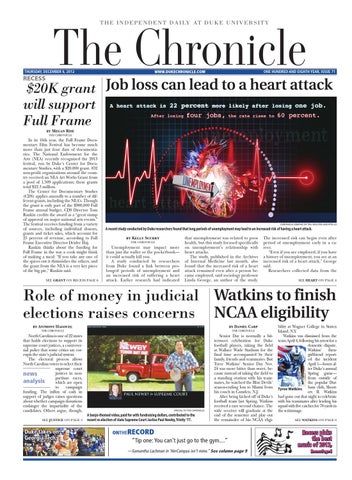
A recent study conducted by Duke researchers found that long periods of unemployment may lead to an increased risk of having a heart attack. by Kelly Scurry THE CHRONICLE
Unemployment may impact more than just the wallet or the pocketbook— it could actually kill you. A study conducted by researchers from Duke found a link between prolonged periods of unemployment and an increased risk of suffering a heart attack. Earlier research had indicated
that unemployment was related to poor health, but this study focused specifically on unemployment’s relationship with heart attacks. The study, published in the Archives of Internal Medicine last month, also found that the increased risk of a heart attack remained even after a person became employed, said sociology professor Linda George, an author of the study.
The increased risk can begin even after period of unemployment early in a career. “Even if you are employed, if you have a history of unemployment, you are at an increased risk of a heart attack,” George said. Researchers collected data from the SEE HEART ON PAGE 4
Role of money in judicial Watkins to finish elections raises concerns NCAA eligibility by Anthony Hagouel
by Daniel Carp
THE CHRONICLE
THE CHRONICLE
North Carolina is one of 22 states that holds elections to support its supreme court justices, a controversial policy that some critics say corrupts the state’s judicial system. The electoral process allows North Carolina voters to select their supreme court justices in nonnews partisan races, analysis which are open to campaign funding. The influx of cash in support of judges raises questions about whether campaign donations endanger the impartiality of the candidates. Others argue, though,
Senior Day is normally a bittersweet celebration for Duke football players, taking the field at Wallace Wade Stadium for the final time accompanied by their family, friends and teammates. But Tyree Watkins’ Senior Day Nov. 24 was more bitter than sweet, because instead of taking the field to a standing ovation with his teammates, he watched the Blue Devils’ season-ending loss to Miami from his couch in Camden, N.J. After being kicked off of Duke’s football team last Spring, Watkins received a rare second chance. The wide receiver will graduate at the end of the semester and play out the remainder of his NCAA eligi-
SEE JUSTICE ON PAGE 3
Duke takes on Georgia Tech, Page 5
SPECIAL TO THE CHRONICLE
A banjo-themed video, paid for with fundraising dollars, contributed to the recent re-election of state Supreme Court Justice Paul Newby, Trinity ’77.
ONTHERECORD
“Tip one: You can’t just go to the gym....” —Samantha Lachman in ‘HerCampus isn’t mine.” See column page 9
bility at Wagner College in Staten Island, N.Y. Watkins was dismissed from the team April 4, following his arrest for a domestic dispute. Watkins’ thengirlfriend reported the incident April 1—hours after Duke’s annual Spring game— from outside of the popular DurTyree Watkins ham club, Shooters II. Watkins had gone out that night to celebrate with his teammates after leading his squad with five catches for 78 yards in the scrimmage. SEE WATKINS ON PAGE 6
Recess picks the best music of 2012, Recess Page 4
2 | THURSDAY, DECEMBER 6, 2012
THE CHRONICLE
DUKE STUDENT GOVERNMENT
Business organization GOP members urge House to accept higher tax rates receives recognition by Lori Montgomery and Rosalind Helderman
by Cord Peters
THE WASHINGTON POST
THE CHRONICLE
WASHINGTON — A growing chorus of Republicans is urging House leaders to abandon their staunch opposition to higher tax rates for the wealthy with the aim of clearing the way for a broad deal that would also rein in the cost of federal health and retirement programs. With less than a month before the “fiscal cliff” is set to begin, President Barack Obama remains adamant about allowing tax rates to rise for the wealthiest 2 percent of taxpayers. Without such a a deal, he is “absolutely” ready to go over the cliff, Treasury Secretary Timothy Geithner said Wednesday on CNBC. Many GOP centrists and some conservatives are calling on House Speaker John Boehner, R-Ohio, to concede on rates now, while he still has some leverage to demand something in return. Republicans are eager to win changes to fast-growing safety-net programs, such as raising the eligibility age for Medicare and applying a less-generous measure of inflation to Social Security benefits. After Dec. 31, tax rates for most Americans, including the wealthy, are set to automatically rise and this could cost Republicans a key bargaining chip in winning changes to entitlements. “I and some others are advocating giving the president what he wants,” said Rep. Steven LaTourette, R-Ohio. But he stressed that this must be part of a package that slows federal borrowing and reduces the debt by $4 trillion to $5 tril-
Scale and Coin—a business-oriented organization with close ties to the recently dissolved Duke chapter of Alpha Kappa Psi business fraternity—is now a recognized student organization. Scale and Coin members sophomores Ryan Bartoszek and Tony Chau and junior Dylan Gamret presented the new organization and sought formal recognition from Duke Student Government at Wednesday’s meeting. Following a recommendation from the Financial Oversight and Appeals Committee and an hour of deliberation, DSG voted to recognize Scale and Coin. The group hopes to be an all-encompassing business organization that will offer guidance and mentorship to those interested in business, Bartoszek said. “Its goal is to expose all areas of business to people who don’t know what they want to do in business,” Bartoszek said. Much of the Senate’s deliberation regarding Scale and Coin’s status focused on its affiliation with AKPsi. The coed business fraternity was officially dissolved Oct. 16, when all but one of the 41 members resigned due to potential probation policies and additional fees imposed by the national organization. The national organization found the Duke chapter guilty of hazing and alcohol policies, such as using chapter funds to purchase alcohol, which is forbidden in the group’s bylaws.
PHILIP CATTERALL/THE CHRONICLE
Sophomore Ryan Bartoszek presents business-focused group Scale and Coin for DSG recognition. Several members of DSG expressed concern that Scale and Coin might be a reincarnation of AKPsi, meaning the behaviors that led to the group’s removal would be continued. Gamret said Scale and Coin will take “the best of AKPsi.” “There will be absolutely no drinking at a Scale and Coin-sponsored event,” Gamret added. All founding members of Scale and Coin were members of AKPsi, though the group plans to attract all Duke students, SEE DSG ON PAGE 4
lion. “Quite frankly, some people in this 2 percent who call me, they’re more worried about the fiscal cliff than about the rates going up a couple points. That has bigger risk for them,” said LaTourette, a close Boehner ally who is retiring in January. Rep. Thomas Rooney, R-Fla., added: “If there are truly real entitlement reforms that are going to preserve Social Security and Medicare for generations to come, it’s going to be very difficult for me to oppose” higher rates for the rich. An agreement to raise the top tax rate above the current 35 percent would mark a major concession for a Republican Party that has made opposition to higher tax rates a touchstone for more than two decades. The step would come on top of what was already a significant compromise for the GOP: an offer earlier this week to increase tax revenue by $800 billion over the next decade. That offer involved generating new revenue by closing loopholes and ending deductions for top earners, not by increasing rates. Republicans are growing alarmed that they could be blamed if Washington is unable to resolve the fiscal stalemate and $500 billion in year-end spending cuts and tax increases kick in. Nearly 90 percent of U.S. households would face higher taxes, and economists warn that the economy could be jolted back into recession. SEE TAX ON PAGE 4
ATTENTION SOPHOMORES: Are you thinking about getting a PhD? THE MELLON MAYS UNDERGRADUATE FELLOWSHIP PROGRAM AT DUKE IS CURRENTLY RECRUITING SOPHOMORES FOR ITS TWO-YEAR FELLOWSHIP PROGRAM We are hosting an information session for interested students on Monday, December 10 at 4:00 p.m. 011 Allen Building If you are seriously considering attending a Ph.D. program after graduation in one of the following disciplines, please plan to attend to learn more! Anthropology and Archeology Area/Cultural/Ethnic/Gender Studies Art History Classics Computer Science Geography and Population Studies Earth/Environmental/
Geological Science and Ecology English Film, Cinema and Media Studies (theoretical focus) Musicology and Ethnomusicology Foreign Languages and Literature History Linguistics Literature Mathematics
Oceanographic/Marine/ Atmospheric/Planetary Science Performance Studies (theoretical focus) Philosophy and Political Theory Physics and Astronomy Religion and Theology Sociology Theater (non-performance focus)
The goal of the Mellon Mays Undergraduate Fellowship Program, funded by the Andrew W. Mellon Foundation, is to increase the number of underrepresented minority students (African American, Hispanic/Latino-a American and Native American) and others with a demonstrated commitment to eradicating racial disparities who will pursue PhDs in core fields in the arts and sciences. Mellon Mays fellows receive two years of support, an annual stipend of $7,500 ($3,900 for the summer and $1,800 each semester), a $750 summer housing allowance, and an annual research travel budget of $600. In addition, each senior fellow receives a $400 research budget to cover project-related expenses and a $600 allocation for a GRE prep course. Each mentor receives a yearly award of $800. For further information and application materials, check our website:
http://undergraduateresearch.duke.edu/programs/mmuf Questions? Contact: Dr. Kerry Haynie, 660-4366 (klhaynie@duke.edu); Ms. Deborah Wahl, 684-6066 (deborah.wahl@duke.edu)
THE CHRONICLE
THURSDAY, DECEMBER 6, 2012 | 3
JUSTICE from page 1
Kwanzaa
FAITH ROBERTSON/THE CHRONICLE
The Mary Lou Williams Center for Black Culture held an early Kwanzaa celebration Wednesday night, focusing on the principle ujima, which means collective work and responsibility in Swahili.
Correction A caption accompanying a feature picture published in the Dec. 5 issue of The Chronicle incorrectly said Hanukkah begins Friday evening. This year, Hanukkah begins the evening of Saturday, Dec. 8. The Chronicle regrets the error.
that any system of appointing judges will contain some bias, but that bias is minimized in an open election. The state general assembly may consider reforming judge selection in its upcoming session. Law Professor Paul Carrington said judicial elections are a bad idea because if a candidate receives a large campaign contribution, he or she will likely become indebted to the donor. “The distinction between those campaign contributions and bribes is marginal,” he said. Judicial race funding came to public attention this past election season. North Carolina Supreme Court candidate Paul Newby, Trinity ’77, won re-election for a second eightyear term. His campaign was given a boost by spending from outside organizations called super PACs, which spent nearly $2.5 million on his behalf, much of which came from Republican and conservative groups, The Charlotte Observer reported. The fundraising helped to fund campaign advertisements including an attenion-grabbing banjo theme-song promoting Newby as an arbitrator of “justice tough but fair.” Newby warned against automatically assuming corruption based on the current electoral system. “What happens when an individual is appointed by a governor of a particular political party? Have they been bribed?” Newby said in an interview. “Whether you have an appointed or elected system, it seems to me that you’re going to have politics involved.” When judges are appointed, they are only accountable to the people who appointed them, not to the people of the state, Newby said. Having an open election is more meritocratic and can decrease the bias in appointment by an individual or small group.
Others, such as Michael Pelle, a freshman studying political science, find fault with the idea of electing justices because the role of the judiciary is to check and balance the majority, not to speak for it. “State supreme court justices are not charged with upholding the majority’s interest—it is rather their duty to ensure that the laws supported by the majority are in fact constitutional.” Nonpartisan elections also can provoke “under-voting” due to ballot confusion, said Rep. David Lewis (R-Harnett). Judicial qualifications can be difficult for voters to assess, and frequently voters who do not know which party the judge candidates align with choose not to vote on that part of the ballot. “We’re definitely going to have to address how judges are selected,” Lewis said. “I can’t think of any possible way it can be worse than it is now.” Mac McCorkle, former Democratic political consultant and associate professor of the practice of public policy, said that it would be better to change the judicial selection process to one of appointment rather than election, but he said a hybrid of the two would be a more realistic fix. Both Lewis and McCorkle hope that the upcoming North Carolina General Assembly will find a new method of judge selection. They preferred a system called retention elections, which Newby himself favors, where a judicial appointment made by an unbiased committee is brought to the Governor for appointment, and the judge later stands for an election after a certain amount of time to diminish undemocratic processes and corruption. This would make it possible for the electorate to remove a judge who was not satisfying his responsibilities, but would minimize the role of campaign funding in the initial selection. Tiffany Lieu contributed reporting.
Time is money. Don’t waste either.
Most Flexible Spending Accounts expire December 31st.
eyecareassociatesnc.com Duke Optical
Durham
South Square
South Point
2351 Erwin Rd Durham, NC 27705
4102 North Roxboro St Durham, NC 27704
3101 Shannon Rd Durham, NC 27707
919-282-0053
919-595-2020
919-493-8508
7001-105 Fayetteville Rd Durham, NC 27713 919-861-9178
Get the most value out of your FSA this year & save with our UP to 50% Off Frame Sale going on now.
4 | THURSDAY, DECEMBER 6, 2012
DSG from page 1 Gamret said. Both the current president and executive vice president of Scale and Coin—senior David Martorana and junior Rebecca Li, respectively—were in AKPsi during the time that the chapter faced investigation. But Bartoszek said Martorama is the best man for the job. “Martorama is president because he knows the most about the organization and is the best to get it started,” Bartoszek said. Bartoszek, Chau and Gamret initially described Martorama’s role as solely teaching business practices and advising the group. But the group’s formal proposal named him president. Sophomore Jacob Zionce, vice president of residential life, raised concerns regarding the structure of the group’s leadership. “The group has merit, and the point of the group has merit,” said Zionce, who was involved with AKPsi’s removal from campus. “The problem was the presentation. The misinformation about leadership led me to believe that there should be different leadership for Scale and Coin.” Freshman senator Kimmy Farmer said there is a “obvious” need for a group like Scale and Coin on campus. “Students shouldn’t be held back by past affiliations to move forward with academic endeav-
THE CHRONICLE
ors,” she said The Senate approved Scale and Coin with 32 votes in favor, 17 against and four abstentions. In other business The Senate approved the CAPS Advisory Committee, which aims to bridge the gap between Counseling and Psychological Services and the student body. The committee’s goals include streamlining student aid, raising awareness and removing a negative stigma associated with people who utilize CAPS. “The stigma with CAPS is misplaced,” said Senator for Equity and Outreach Adesuwa Giwa-Osagie, a sophomore who will head the committee. “The stigma is about vulnerability. CAPSAC will work with CAPS to see that this wrongful stigma of seeking help and feeling vulnerable is reduced.” The Senate also approved a 2013 tenting policy for Krzyzewskiville, proposed by senior line monitors Bradley Baird and Jackson Lindsey. Students will be allowed to get out of line for severe weather—including snow, temperatures below 25 degrees and lightning. For black tenting, which will start at 11 p.m. Jan. 9 and will last a week, no purchased tents will be allowed due to the short tenting period. Blue tenting, which will begin Jan. 16, will be capped at 60 tents, and white tenting will last from Jan. 30 to Feb. 8.
HEART from page 1 Health and Retirement Study, a continuous study of Americans over the age of 50 sponsored by the National Institute on Aging and the Institute for Social Research at the University of Michigan. Over 13,400 patients aged 51 to 75 underwent a biennial follow up from 1992 to 2006. Among the subjects there were 1,061 heart attacks. “If a person was unemployed, compared to someone who was employed, over the next two years they had an increased risk of developing a heart attack,” George said. This study supported evidence found in earlier studies, which showed that unemployment was linked to poor health. The risk for a heart attack elevated after a year of unemployment, said Guangya Liu, coauthor and an empirical research analyst at the School of Law. “In sociology we believe there are social factors affecting your health. Employment is one of
TAX from page 2 With talks between the parties apparently at a standstill, Boehner spoke with Obama on Wednesday by telephone for the first time in a week, GOP aides said. Meanwhile, Republican leaders were looking for a way out of their predicament.
those factors,” Liu said. “[The results] strengthen the relationship between employment status and health outcome.” The report, however, was the first to examine the correlation specifically between employment and heart attacks. The study also found that a person who has lost his job four or more times during a career was approximately 60 percent more likely to suffer a heart attack than someone who had never lost a job, regardless of whether they were employed or not employed at the time. “This research shows that [the risk] does not disappear but seems to imprint biologically [on the person],” George said. Frank Sloan, J. Alexander McMahon professor of health policy and management and professor of economics, approached the results with caution after having seen other studies highlighting the relationship between unemployment and health. “There are so many pathways that could underline that
increased risk of heart attack,” he said. “I’m not sure if it’s justified to say there is scientific evidence [that links unemployment to heart attacks].” The study does not conclude that young adults who are currently unemployed are at a risk of a heart attack at this time. However, an exposure to unemployment as a young adult will still impact future cardiac health, George said. The changing nature of the labor market could test the link between unemployment and heart attacks, George added. “The labor market has changed, and people will not have a stable career with only one or two employers as in the past,” she said. “It’s predicted people are more likely to have four or five employers and go through more periods of unemployment.” If periods of unemployment becomes a normalized part of a person’s career, however, it may no longer be stressful to a person, she added.
One option under discussion would entail setting the top tax rate above 35 percent but below the 39.6 percent level that was in effect during the Clinton administration. That compromise could let both parties claim victory. But House Ways and Means Committee Chairman Dave Camp, R-Mich., said he was reluctant to draft such a plan unless the White House
agreed to a tax-revenue target well below the $1.6 trillion Obama has demanded over the next decade. “Despite dancing in the end zone, which he’s doing, he keeps moving the goal posts. His revenue number keeps changing,” Camp said. “There is a point that the economy can only sustain so much revenue being taken out of it.”
Sports
>> THE BLUE ZONE
The Chronicle
THURSDAY December 6, 2012
Duke has extended vice president and director of athletics Kevin White through 2019. Check out The Chronicle’s sports blog for more coverage.
www.dukechroniclesports.com
WOMEN’S BASKETBALL
Blue Devils match up against Georgia Tech by Jay Sullivan THE CHRONICLE
Duke has yet to play in a close game this season. In their most recent contest, the Blue Devils overpowered then-No. 10 California to notch their sixth-straight victory to begin the year. But with conference schedules slated to begin this week, a number of new challenges lie on the horizon for the Blue Devils. In its first ACC contest, No. 4 Duke (6-0) will match up against a familiar opponent , Georgia Tech, Thursday night at Cameron Indoor Stadium. After a loss to No. 8 Georgia earlier this week, the Yellow Jackets (34) will meet an energetic Duke squad that has displayed its depth on both ends Georgia of the floor in the Tech early-going. vs. The Blue Devils No. 4 will focus on defenDuke sive intensity and consistency on the THURSDAY, 7 p.m. Cameron Indoor Stadium court. After holding California to 21.9 percent from the field in the first half of Sunday’s contest, Duke allowed the Golden Bears to shoot 50 percent from the field and 80 percent from beyond the arc in the second half. Although the Blue Devils still coasted to an easy win, head coach Joanne P. McCallie stressed the significance of consistent defensive effort throughout practice this week. “We’ve been working on a lot of pressure defense, press defense and some man defense,” junior forward Tricia Liston said. “They’re a quick team. They like to pick up the ball full-court with some traps. But we’ve been working on keeping composure and breaking the press, then getting into our offense from there and also rebound-
ing. Our rebounding is going to be huge in this game.” Duke’s matchup with the Yellow Jackets will largely depend on its ability to stop the scoring trio of Tyaunna Marshall, Dawnn Maye and Brittany Jackson. The trio have combined for more than half of Georgia Tech’s offensive output this season, averaging a combined 39.5 points per game. In order to defeat the Yellow Jackets, Liston and her teammates will need to be committed on the defensive end and on the glass for all 40 minutes of play. “We definitely need to try to put two halves together, especially in this game, and start off the ACC strong,” Liston said. “We need to have the same focus in the first half and in the second half, whether the score is up 50, down 50 or a tie game. We just need to make sure we have that kind of same consistency throughout both halves.” Liston turned in a career performance against California with 22 points, shooting 9-of-16 from the field Sunday. Her success was not limited to the offensive end. Pulling down eight rebounds, Liston asserted herself on the glass as well. “I took what I got last game and my teammates put me in great positions to score. Something you can always do every game—whether you’re shooting well or not—is rebound. So that’s a big focus of mine for this season as well as game-bygame,” she said. As the Blue Devils prepare to open their conference slate, the team remains confident in its ability to stall opposing offenses and score in bunches. They see these as the keys to placating Georgia Tech’s high-tempo offense and physical style of play. “I feel well prepared, especially having played California last game. That was a great game to play before Georgia Tech
THANH-HA NGUYEN /THE CHRONICLE
Tricia Liston led Duke to victory Monday against No. 10 Cal. Liston and the rest of the team have been focusing on defense to stop Yellow Jacket scoring trio Tyaunna Marshall, Dawnn Maye and Brittany Jackson. and coming into ACC play,” Liston said. “Its always fun. We’re excited and we’re ready to play. I think that’s when things will really come together for us. I think that
we’ve put in the work in the offseason and I think that we’ve had a couple good games to get us to where we need to be and I think we’re ready for some tougher games.”
MEN’S BASKETBALL
Duke basketball’s funny man by Andrew Beaton THE CHRONICLE
Don’t call Marshall Plumlee goofy. His brothers Mason and Miles might, but he doesn’t like it. “I don’t call myself this, but they think I’m goofy,” Marshall said. “Just the images it conjures up of a clutz stumbling around and saying stupid stuff—I’d like to think I have a little more poise than that. But hey, apparently I’m goofy, so I’ll take it.” Whether or not goofy is the right word, Marshall, a redshirt freshman, may just be the funniest member on the Duke basketball team. He has yet to step on the court for the Blue Devils—after redshirting last season, he suffered a stress fracture in his foot that his kept him out of the beginning of this year—but he has found another place to star: Duke Blue Planet. Run by the men’s basketball team’s communications and recruiting coordinator David Bradley, the website features the lighter side of members of the team, bringing fans videos such as “Kyle Singler Gets Buckets.” And when Marshall came to campus last
year, Bradley got his top recruit. “He’ll have a shot to go in the Blue Planet hall of fame, no question,” Bradley said. “Definitely the funniest Plumlee. He’s an all-timer.” Marshall said he is not necessarily the funniest Plumlee, just the most open one. He can sometimes be too open, he said, often putting his foot in his mouth. He described Miles, who was selected in the first round of the NBA Draft by the Indiana Pacers after graduating last year, as the intellectual of the group. Senior forward Mason, he said, is the most organized and has the driest sense of humor. But what might separate Marshall from his brothers and teammates is his flexibility on camera. He often assumes the role of the reporter in postgame interviews, questioning members of the team, including his brother Mason. “It loosens me up more because you can’t take him seriously,” Mason said. Mason added that Marshall was not always the comedian or the funny brother, but he has slowly come into his own. “He wasn’t really funny to me until we got
to high school, then for whatever reason he started cracking jokes,” Mason said. “All kinds: clever kinds, stupid jokes.” Marshall’s favorite video, however, was a piece he co-starred in with Mason parodying “The Bachelor,” in which the duo auditioned candidates to replace Miles, who graduated last year and is now a forward for the Indiana Pacers. Marshall credits Bradley with turning him into a comedy star—saying 99 percent of what he says actually is not funny—but Bradley noted that Marshall deserves credit for the time he takes to ponder what he should say prior to interviews or to acting in a short clip. Marshall also often comes up with video ideas himself. During the summer, he fenced with two female members of the Duke fencing team while teammate junior Josh Hairston announced. Sometimes Marshall is so funny that it makes it tough to film, Bradley said. “He’s pretty much taken it and run with it on his own,” Bradley said. “I’ll be filming and he’ll do something that’s so funny or surprising that I’ll lose the handle on the camera and it’ll shake a little bit, so I’ve had to have
highlights on top of the footage to mask my inability to keep a steady hand.” Fans have taken notice too—as soon as Marshall makes a new video, message boards on popular Duke websites inevitably take notice with glowing praise. Although he has been unable to play on the court since joining campus, he has used the videos as a way of interacting with the Blue Devil faithful. Before last week’s Duke-Ohio State game, he went into Krzyzewskiville and interviewed some of the students who were tenting, even though one of them was shirtless. “More than anything, what fuels our creativity is our fans who enjoy it and watch it,” Marshall said. “We always tell the fans that we thank them and appreciate them, but nothing is the same as going to them and getting to know them in person.” Marshall said stand-up comedy is not in the cards after college, but he would love the chance to cameo in movies. Mason predicted that if basketball does not play into a professional career, he could see Marshall “going the Jay Bilas route” as a commentator. If not, he could see his little brother doing something related to SEE GOOFBALL ON PAGE 6
6 | THURSDAY, DECEMBER 6, 2012
THE CHRONICLE
GOOFBALL from page 5 his passion for video games. Marshall is now preparing to play his first games at Duke— with his foot healing, he has returned to practice—and Bradley said it will let fans see another side of the 7-foot center because he can be so intense on the floor. But there’s no denying that off the court, he has assumed the role of Duke basketball’s top comedian. “I think he’s just a funny dude,” Bradley said.
WATKINS from page 1 A warrant for Watkins’ arrest was made later that morning by Duke Police Department officer Nicole Hawkins. Watkins turned himself in on April 2, when he was held in county jail for a little more than an hour before posting $500 bond. “I was hurt. I was devastated. The hardest thing I can remember was [Duke head coach David] Cutcliffe asking me if I wanted to call my mom and tell her what happened,” Watkins said. “That was the hardest thing I had ever had to do at that point, was to tell my mom that I was dismissed from playing football, something that I loved. That was definitely a real low point in my life.” The Durham district attorney agreed to defer prosecution of Watkins for assault on a female—a class A1 misdemeanor in the state of North Carolina. Watkins agreed to 75 hours of community service and six months probation. The state dismissed the case Oct. 31, 2012 and it is set to be expunged from Watkins’ record in early 2013. “A deferred prosecution is an agreement entered into by the defendant and the state that sets out certain terms and conditions in a period time,” Watkins’ attorney Edward Falcone said. “As long as the defendant agrees to it and complies, the state agrees to dismiss the charge against the defendant. The alleged victim’s wishes are a lot of times taken into account by the district attorney in working out some resolution of the case.”
SIMPLY THE BEST!
Piece by piece Watkins said he viewed his dismissal from the team as the ultimate wake-up call, vowing to put his life back together. He remained in Durham throughout the summer of 2012, hosted by a family he met through Ebenezer Baptist Church.
Although he intended to finish his degree and to graduate, the Duke Student Conduct Board suspended him for the Summer 2012 semesters, preventing him from finishing his undergraduate degree until Fall 2012. Watkins used his time in Durham to complete all of his community service hours and join the work force by getting a job at Sears in the large appliances department. He also stayed connected to the game of football as a volunteer coach at Orange High School in Hillsborough, N.C., where the son of his host family played for the team. This allowed Watkins not only to work out and stay in shape, but also to experience football from the other side of the whistle. Watkins’ teaching paid off as the Panthers reached the semifinals of the state football playoffs this season. “I could see myself one day being a coach,” he said. “Those kids just wanted to work, and that’s great seeing it from a different eye. Now I can see why coaches are so hard on players—you can see that the talent is there, but the kid doesn’t see it yet.” Duke life without football Watkins returned to Duke in the Fall poised to finish his final semester and earn a degree in sociology with a minor in education. Although his football career at Duke had drawn to a close, Watkins’ top priority was to earn his degree. He focused heavily on academics in the Fall, making sure his grades would be good enough to play college football again should another team come calling. “A lot of my friends were on the football team. I was used to waking up at 6 a.m., practicing and then going to class. Now it was different,” Watkins said. “I felt a little lost not working out with the guys I had built camaraderie with for the past three years.” Watkins filled the void left by football by becoming more involved on campus. He took an interest in Duke’s new housing model, becoming the president of his house council in Few HH. He continued to support the Blue Devils as they finished the season with a 6-6 record, becoming bowl eligible for the first time since 1994, and earning a trip to the Belk Bowl in Charlotte, N.C. later this month. “I’m proud that they’re able to make the bowl game,” Watkins said. “But it was hurtful at the same time because that was the goal that a lot of guys who I came in here with had. We wanted to accomplish that before we all left.” Cutcliffe, who declined to comment for this story, had
mentioned in a press conference earlier this season that leading up to Watkins’ arrest, he expected the senior to be a contributor to this Duke team’s receiving corps. Tallying just 24 receptions for 152 yards in his career with the Blue Devils, Watkins longed for the chance to be a starting receiver in college. Despite the circumstances that prevented him from doing so at Duke, he might get that chance now. Starting anew at Wagner Watkins gave a verbal commitment to Wagner Nov. 28. He will enroll for the Spring semester there, working toward a master’s degree in education and will begin spring practice with the football team. Watkins has one guaranteed year of eligibility remaining and can petition the NCAA for a second year of eligibility as well. The Seahawks finished the 2012 season with a 9-4 record, falling in the second round of the FCS Playoffs to Eastern Washington. Watkins said in addition to playing receiver at Wagner, the coaching staff will give him the opportunity to try the defensive side of the football as well. “It’s a blessing,” he said. “Before I had no idea what I was going to do. I didn’t think I was ever going to have an opportunity to play football again. So for me to have a second opportunity, I’m not going to take it for granted.” Not only will Watkins have this second opportunity, but he will also be closer to his family at Wagner. They will get to watch him play football, which did not happen often while he was at Duke. Determined to finish what he started at Duke, Watkins has already received permission from his coaches at Wagner to return to Durham for commencement ceremonies in May. As fate would have it, those ceremonies will be held at Wallace Wade Stadium—let’s just call this his Senior Day. As he moves into the next stage of his life and football career, Watkins said he considers the events of the past year to be nothing short of a blessing in disguise. “Having an opportunity to play football here, but also be a student here has been great. Being taught by all of these different professors, being able to experience Duke basketball and the culture here has been incredible,” Watkins said. “Coach Cutcliffe is a great coach and it’s good to see that all that hard work that they’ve put in here has been paying off. I don’t regret anything that ever happened to me. I feel like it happened for a reason—everything does.”
CLASSIFIEDS
cosmic cantina 2SHQ /DWH XQWLO D P
Menu Sampling Old School Veggie Burrito $2.86 Regular Chicken Burrito $5.65 Cheese Quesadilla $1.41 Chicken Quesadilla $3.59 VeggieNachos $4.12 Chips & Salsa $2.06
Open until 4 am 1920 1/2 Perry St. at Ninth Street Just a block from East Campus Also serving from Chick-Fil-A on Campus
ANNOUNCEMENTS
The Chronicle classified advertising
A LOT OF CARS INC. - Cars start at $550/down. 200+Vehicles. Layaway option. Student/ Employee/Hospital ID $150-discount. 10+cars under $2995. 3119 N.Roxboro Street, Durham, NC. http://www.alotofcarsnc. com.
deadline 12:00 noon 1 business day prior to publication
Owned by Duke Alumni 919220-7155
online: www.dukechronicle.com/classifieds
www.dukechronicle.com/classifieds
ad submission email: advertising@chronicle.duke.edu
HELP WANTED PART-TIME TENNIS INSTRUCTORS NEEDED
Looking to hire part-time tennis instructors during the 2013 Spring semester. Location is about 5 miles from campus. Please send resume to hollowrocktennis@gmail.com if interested.
TRAVEL/VACATION BAHAMAS SPRING BREAK
$189 for 5 days. All prices include: Round-trip luxury party cruise. Accommodations on the island at your choice of thirteen resorts. Appalachia Travel. www. BahamaSun.com 800-867-5018
fax to: 919-684-8295 phone orders: (919)-684-3811 No refunds or cancellations after first insertion deadline ADVERTISERS: Please check your advertisement for errors on the first day of publication. If you find an error, please call 919-684-3811. The Chronicle only accepts responsibility for the first incorrect day for ads entered by our office staff. We cannot offer make-good runs for errors in ads placed online by the customer.
Answer to Sudoku puzzle on page 7
THE CHRONICLE
THURSDAY, DECEMBER 6, 2012 | 7
Diversions Shoe Chris Cassatt and Gary Brookins
Dilbert Scott Adams
Doonesbury Garry Trudeau
The Chronicle Our favorite part of SJC:
The Duplex Glenn McCoy
playing matchmaker:........................................................... locopop busting out the creativity: ..................................................... jewels obscure robin-hooding: ............................................................ crack browsing the ladies’ section: ................................................briggsy making up for og abeats:.................................................shmooney photo exclusive SJC: ........................................ dbb, durand durand going all out #false: ............................................................shwanth PRETZELS: ................................................................................... dmo Barb Starbuck wraps presents with chronicles: ....................... Barb Student Advertising Manager: .................................. Allison Rhyne Account Representatives: ..................... Jen Bahadur, Sarah Burgart Courtney Clower, Peter Hapin, Claire Gilhuly, Sterling Lambert Liz Lash, Dori Levy, Gini Li, Ina Li, Vivian Lorencatto, Lalita Maraj Parker Masselink, Cliff Simmons, James Sinclair, Olivia Wax Creative Services: .......... Allison Eisen, Marcela Heywood, Mao Hu Rachel Kiner, Anh Pham, Izzy Xu
Sudoku
Fill in the grid so that every row, every column and every 3x3 box contains the digits 1 through 9. (No number is repeated in any column, row or box.)
Daily
MT. FUJI ASIAN BISTRO SUSHI & BAR SPECIALS
3D ŽŶĚĂLJ͗ 3ΨϮ3ĚŽŵĞƐƚŝĐ 3d ƵĞƐĚĂLJ͗3 3d ŚƵƌƐĚĂLJ͗33ϭͬϮ3ŽĨĨ3ƐƵƐŚŝ3ĂĨƚĞƌ3ϱƉŵ3ĂŶĚ3ϭͬϮ3ŽĨĨ3 3ϭͬϮ3ŽĨĨ3ƐƵƐŚŝ3ĂĨƚĞƌ3 3ƐƉĞĐŝĂůƚLJ3ŵĂƌƚŝŶŝƐ3ĂŶĚ3ĐŽĐŬƚĂŝůƐ 3ϱƉŵ3ĂŶĚ3ϭͬϮ3ŽĨĨ3 3& ƌŝĚĂLJ͗33ϭͬϮ3ŽĨĨ3ŚŽƚ3ƐĂŬĞ3ϮϮŽnj3ĂŶĚ3Ψϯ3,ŝŐŚďĂůů 3ďŽƚƚůĞƐ3ŽĨ3ǁŝŶĞ 3^ ĂƚƵƌĚĂLJ͗333ϭͬϮ3ŽĨĨ3^ĂƉƉŽƌŽ3ϮϮŽnj3ĂŶĚ3Ψϯ3,ŝŐŚďĂůů 3t ĞĚŶĞƐĚĂLJ͗ 3^ ƵŶĚĂLJ͗33ϭͬϮ3ŽĨĨ3ďŽƚƚůĞƐ3ŽĨ3ǁŝŶĞ 3ϭͬϮ3ŽĨĨ3<ŝƌŝŶ3ϮϮŽnj 3ϵϬϱ3t͘3DĂŝŶ3^ƚ3ͻ3 ƌŝŐŚƚůĞĂĨ3^ƋƵĂƌĞ3ͻ3ϲϴϬͲϰϵϲϴ3ͻ3ǁǁǁ͘ŵƚĨƵũŝŶĐ͘ĐŽŵ
www.sudoku.com
The Independent Daily at Duke University
The Chronicle
8 | THURSDAY, DECEMBER 6, 2012
Let’s talk about consent Talking about sex makes consent describes a state of for better and healthier sex. mind—the willingness to This is especially true when have sex—which can be hintattempting to obtain consent, ed through certain behaviors, which is often defined as the ranging from prior sexual informed willingness to en- history to explicitly saying, gage in sexual “Yes, I want to activity. Thanks have sex.” But editorial to many peothese consentple—groups like Common suggesting behaviors never Ground, Prevent Action Chal- guarantee consent. For exlenge Teach and the Women’s ample, a woman in a longCenter, as well as individual term relationship could one student activists—dialogue day decide she does not want about consent on campus has to have sex, and what she did increased in recent years. Yet with her boyfriend last week confusion persists. What is would be irrelevant. In anconsent exactly? How does other example, a woman in one obtain it, especially when a life-threatening situation alcohol is involved? How can might lie and say she wants we educate the general stu- to have sex, even though she dent body on the best prac- is not actually consenting. tices of consensual sex? These distinctions may Consent is an attitude, seem like splitting hairs, but not an act. In other words, they are crucial. The point
“
This game in and of itself is fairly meaningless. The most important game of the year was the Georgia Tech game as a “W” would have been one more step toward bringing home an ACC Championship. —“Columbus Dukie” commenting on the story “Duke football’s most important game.” See more at www.dukechronicle.com.
LETTERS POLICY The Chronicle welcomes submissions in the form of letters to the editor or guest columns. Submissions must include the author’s name, signature, department or class, and for purposes of identification, phone number and local address. Letters should not exceed 325 words; contact the editorial department for information regarding guest columns. The Chronicle will not publish anonymous or form letters or letters that are promotional in nature. The Chronicle reserves the right to edit letters and guest columns for length, clarity and style and the right to withhold letters based on the discretion of the editorial page editor.
”
Direct submissions to:
E-mail: chronicleletters@duke.edu Editorial Page Department The Chronicle Box 90858, Durham, NC 27708 Phone: (919) 684-2663 Fax: (919) 684-4696
The Chronicle
Inc. 1993
YESHWANTH KANDIMALLA, Editor LAUREN CARROLL, Managing Editor JULIAN SPECTOR, News Editor ANDREW BEATON, Sports Editor CHRIS DALL, Photography Editor MAGGIE LAFALCE, Editorial Page Editor KATHERINE ZHANG, Editorial Board Chair PARKER KUIVILA, Managing Editor for Online JIM POSEN, Director of Online Operations CHRISSY BECK, General Manager KRISTIE KIM, University Editor TIFFANY LIEU, Local & National Editor ANDREW LUO, Health & Science Editor CAROLINE RODRIGUEZ, News Photography Editor PHOEBE LONG, Design Editor MICHAELA DWYER, Recess Editor SOPHIA DURAND, Recess Photography Editor SCOTT BRIGGS, Editorial Page Managing Editor MATTHEW CHASE, Towerview Editor ADDISON CORRIHER, Towerview Photography Editor NICOLE KYLE, Social Media Editor SAMANTHA BROOKS, Senior Editor REBECCA DICKENSON, Advertising Director MARY WEAVER, Operations Manager DAVID RICE, Director of External Relations
is this: because no one is a mind-reader, the only way to try and obtain consent is by making inferences based on your partner’s behavior. Sometimes it will be easy to read someone’s behavior. Other times—especially when you or the other person is drunk or high—it will be harder. Regardless, you will always be making inferences about consent. So it is crucial for Duke to educate its students on how to make the best inferences, especially in dicey situations. The real challenge to obtaining consent arises when alcohol or drugs come into play. The addition of mindaltering substances to the mix adds what Amy Cleckler, gender violence services coordinator for the Women’s
Center, calls “layers of risk” to sexual interactions. Although layers of risk do not make consent impossible, they do make it more difficult to infer. As with most things, Duke students need education and practice to get better at obtaining consent. Because talking about sex does not come naturally to many students— especially during a casual hook-up—formal programs like PACT are extremely important. Currently, PACT simulates various situations— where your partner is sober or drunk, talking or silent, scared or enthusiastic, a onetime hookup or long-time lover—to train students to make the best inferences about consent. PACT also instructs students on how to discuss con-
sent prior to sex—the optimal way to gauge your partner’s state of mind. PACT should aggressively increase its audience—perhaps becoming standard fare for Orientation Week—and instruct students about being discerning sexual partners just as much as being good bystanders. Practicing consent in vague situations can be difficult. (We should mention that if you are too drunk to infer consent, you should not have sex.) However, if students are trained to process these situations better— and gain more information about their partner’s attitudes through plain old talking—consent will stop being a guessing game and start being what it should be: transparent and essential.
Defining circumstances
onlinecomment
Est. 1905
THE CHRONICLE
commentaries
MARGOT TUCHLER, University Editor JACK MERCOLA, Local & National Editor DANIELLE MUOIO, Health & Science Editor ELYSIA SU, Sports Photography Editor ELIZA STRONG, Design Editor HOLLY HILLIARD, Recess Managing Editor CHELSEA PIERONI, Online Photo Editor ASHLEY MOONEY, Sports Managing Editor SONIA HAVELE, Towerview Editor MELISSA YEO, Towerview Creative Director NICOLE KYLE, Special Projects Editor MAGGIE SPINI, Senior Editor MICHAEL SHAMMAS, Recruitment Chair BARBARA STARBUCK, Creative Director MEGAN MCGINITY, Digital Sales Manager
The Chronicle is published by the Duke Student Publishing Company, Inc., a non-profit corporation independent of Duke University. The opinions expressed in this newspaper are not necessarily those of Duke University, its students, faculty, staff, administration or trustees. Unsigned editorials represent the majority view of the editorial board. Columns, letters and cartoons represent the views of the authors. To reach the Editorial Office at 301 Flowers Building, call 684-2663 or fax 684-4696. To reach the Business Office at 103 West Union Building, call 684-3811. To reach the Advertising Office at 101 West Union Building call 684-3811 or fax 684-8295. Visit The Chronicle Online at http://www.dukechronicle.com. © 2012 The Chronicle, Box 90858, Durham, N.C. 27708. All rights reserved. No part of this publication may be reproduced in any form without the prior, written permission of the Business Office. Each individual is entitled to one free copy.
T
here was a moment during my cancer ago, I raised my hands to the heavens crying therapy that I now distinctly remember out to a God in silent anger, this was the greatas an emotional turning point. It was on est challenge of this belief I had yet, and have a day near the very end of my first year of treat- still, faced. Blow followed blow. It was a moment—the hardest year of the ment, in the throes of despair, three in which I received the most when I was tempted to succumb difficult of my chemotherapy regto bitter resentment. To a feelimen. Bad news had followed bad ing of utter helplessness. To let news had followed bad news on the situation in which I found that day. And though over time myself dictate not only my presone gets used to the continual ent sense of hope, but destroy my pummels of the cancer journey— very belief in any sense of higher learning to take them and continpurpose or destiny—replacing it daniel strunk ue on like a well-trained boxer— with a cruel, fickle view of life in defining this long series shook me from which we are all helpless slaves to circumstances my strategically developed numbcircumstance. ness. As I stood by my bed at the Yet this moment is so indelible end of that day, I did not clasp my hands in to me because at its emotional zenith, I came to prayer as was my usual custom. Rather, over- feel a sense of peace. It wasn’t anything extraorcome by anger and grief, I threw my arms up dinary. It wasn’t a feeling I haven’t felt since—it wide. I did not understand why more seemingly was the same feeling of relief I often experience unnecessary struggle had been brought to my after challenging events come to pass. But lookdoorstep. ing back upon this moment, it was at this time Fast-forward to the present and the tagline that I decided I would not let cancer cripple me of this column: defining circumstances. I’m spiritually. It was at this time that I came to be guessing most of my readers have probably at peace with the prospect of death. I certainly never given these two words more than a quick fully intended to give my every last ounce fightread. I certainly don’t blame them. But these ing it, mind you. But I would not in any way let words to me are a powerful reminder. They are cancer and its struggles erode my belief in an a reminder of one of the principle beliefs of individual’s power to discover his or her identimy life: a belief that all of us have the ability ty—to choose, up until the very end, how he or to discover how God defines us by our circum- she reacts to circumstances. stances, and to harness those circumstances to As I said in my first column this semester, live a life of purpose. This is not to say that Duke is a place full of wonderful opportunities some people don’t face more unfortunate cir- to define yourself. It provides unbelievable circumstances than others. It’s not to say that if cumstances that you can craft and respond to, people just try hard enough to overcome their blessed opportunities to shape your values and circumstances they will have success in every- character. But just as easily it can force you to thing they endeavor to do. What I simply mean succumb to circumstances and define yourself is this: A person’s God-given identity is his or as something you are not. So this is my last meshers alone to discover. sage in this final column of the year: Discover And that’s what this column has been about. your own God-given identity by discovering and It’s been about identity. For seven columns now defining the meaning behind your own circumI have delved into some of the circumstances stances. Both obstacles and joy will face us all that have defined me, and some of the circum- in life, but these will be circumstances that we stances that I have fought to define. In some cas- always have the power to react to and define. es I’ve dug down deep into the personal, showThank you for reading my columns this secasing vulnerable moments in my life. Cancer, mester. Thank you for journeying with me as I the American Dream, politics, career ambition, sought to discover parts of my identity in 800 dreaming big dreams—these topics resonate words every other week in the pages of The with my understanding of who I am. Some of Chronicle. And I hope you all might sleep as them were about struggle, as with cancer. Some well tonight as I slept that night so many years of them were about joy, as with a love of “Star ago, always trusting in your ability to discover Wars.” But always I sought to have these col- your identity and define your circumstances. umns convey lessons I drew from circumstances I experienced and defined. Daniel Strunk is a Trinity junior. This is his last When, beside my bed those many years regular column of the semester.
THE CHRONICLE
THURSDAY, DECEMBER 6, 2012 | 9
commentaries
HerCampus is not mine
Almost home
he only word I can think of to describe how I in their analysis. Alternately, I could dare to go for feel when I read HerCampus Duke’s articles that frat boy, Floyd, who “discussed feminism with is schadenfreude. For your convenience, I’ve me in a positive manner.” But beware of the “perils compiled all that I’ve learned this semester from of crushing on frat boys, even the ‘good ones,’” so their tips on how to be a well-adjusted when I find Floyd inevitably making Duke woman. out with “some chick,” I can chalk it Tip One: You can’t just go to the all up to his “intrinsic take-all mentalgym. ity.” It’s slim pickings out there, but If you’re struggling to get to the rest assured that somewhere exists the gym, then “looking good,” can be “mythical non-frat-boy frat boy.” your “motivating factor.” And by lookTip Six: Give the “Nepali” in your ing good, HerCampus doesn’t mean friend’s education class a chance, beaccruing the increased musculature cause she or he might just have an samantha from working out—they mean that beawesome story. lachman ing attractive WHILE working out “is College is about making “lifelong not an opportunity you should pass what’s our age again? friends,” and “broadening our horiup.” Especially since the gym is where zons,” so you’d be missing out if you’re people go to “see and be seen.” So not at least, like, aware of those people throw on some waterproof eyeliner, mascara and outside of your sorority whose families subsist off of Lancôme concealer to look “natural, but still put $1 a week. Once Recruitment is over “it becomes together.” Moreover, make sure you don’t get “too infinitely harder yet easier to make friends,” so wait matchy-matchy,” by wearing pink on pink or, Hash- until February to reach out to them. em-forbid, black on black. After all, the idea is to Tip Seven: Don’t report sexual assault. “look effortless, not to be lazy.” “Males in our age bracket just have a higher sex Tip Two: You can’t just go to the library during drive than we do,” reads one article. “Just because finals. you go with a boy to his formal, it doesn’t mean Without protein bars, tinted moisturizer, cream you’re obligated to hookup with him, right? In eye shadow or makeup remover wipes. Keep those theory, this should be true, but he’s paid for your items “24/7 in a grab bag” when you’re heading to transportation/meal/hotel room and we live in a Perkins. barter society.” Given that we’re told we have to barTip Three: Going to Shooters when you have a ter our bodies if invited, “it shouldn’t be surprising midterm is not off the table. that roughly 25 percent of girls at Duke experience If you are incredibly indecisive like I am and sexual assault,” because “these boys tend to be more gotta get down before your exam on Friday, than experienced or may have greater expectations when HerCampus can help you think through your op- it comes to sex.” But “by no means should you retions with their helpful, “So I Have a Midterm on port every incident that makes you feel guilty as a Friday, Should I Skip Wednesday Night Shooters?” ‘sexual assault,’ either. We all remember what hapthink-piece. pened in the lacrosse scandal.” Tip Four: The 40 percent rule is generally key. Tip Eight: “Define your OWN ‘Duke scene.’” On Halloween, “it may be tempting to bare it Even though I emerge from every HerCampus all (we’re proud of our bodies!)” but one must en- article convinced that “much of our school’s social sure the level of exposed skin is appropriate. “It’s scene consists of frat parties and Saturday night been proven” (By whom? Nate Silver?) that “guys Shooters,” (perhaps perpetuated by the presence respond positively to a 40 percent level of exposed of Shooters in every piece), it’s entirely possible skin,” so “skip the lingerie” and “invest in a catsuit” to “disregard what some people say and define our instead. Because nothing says empowerment more school by your own terms.” Though that advice than choosing to go as Cat Woman rather than Hef- came from the electrifying post “How to Thrive as ner’s latest wife. Not just because Cat Woman is so a Taken Woman in the ‘Duke Scene,’” I’m going to stealthy, but because if you bare more than 40 per- take these pearls of wisdom, since they’re so funcent of your skin, “you risk looking like a tramp.” gible, and apply them to my life. (As you must be already able to tell, I’m abiding by Tip Nine: Ignore everything they just told you. the quote-40-percent-of-their-content rule.) Because in the article “Dear Freshmen Girls,” Tip Five: There are very, very few boys left to they tell women to, please, not “feel like you have choose from. to fit a certain mold,” “work out every day” or “dress So few, in fact, that HerCampus turned me on to up to go to the library.” Especially since there’s no the possibility of dating my best friend (“How Close “cookie cutter mold of a ‘Duke woman.’” is Too Close: Would you Date Your Best Friend?”). Unfortunately, my best male friend isn’t attracted to Samantha Lachman is a Trinity senior. This is her last women, but HerCampus didn’t think to include that regular column of the semester.
’ve got less than two weeks left in Paris. That’s right; the semester abroad is almost over. I admit I might be slacking on the “important” things like going to museums and other Parisian landmarks in my final days. At least I’m making a serious effort on the food front, no time for nutrition over here. Unless I’m mistaken, Durham is fairly lacking in the French bakery department. Regardless though, that’s my justification for extra croissants and crepes philip doerr while I still can. small world French things aside, I’ve been looking forward to America for a while now. I know it’s bad. I really don’t want to do it. I know I should focus on Paris while I’m here and take it all in, but I can’t help but get excited for all the Duke (and American) things that await me. So here it is: my list of things that I can’t wait for upon my return. I’m sure those of you abroad might sympathize with this. They say you often have to lose something to realize how important it is to you, and I say: valid salad. English: I chose to come to France to improve my ability to speak French. Learning a language can be a lot of fun, but it can also be really tough, and it’s the small things that get to you after a while. Even ordering food can be stressful. Imagine rolling into a bakery with some friends just to buy a sandwich. If you try to order, they respond to you in English! Done. Your effort to pass by undetected is unsuccessful. Last week, I went to a pasta place for lunch. As the young girl was preparing the box of pasta, she then (apparently) asked me, “What do you want on your pasta?” “Sorry, what?” I said. This went on three more times until she brought her angry face right up to mine and asked me very slowly and emphatically “What. do. you. want. on. your. pasta?” Of course being totally embarrassed and kind of scared I told her “Nothing. Sorry ma’am.” The truth is, I wanted sautéed onions on my pasta, but these are the sacrifices one has to make abroad. It gets to you after a while. No one tells you before you go abroad, but it’s worth confronting: Are you willing to sacrifice the ability to properly order food in the interest of learning a foreign language? Personally, the verdict is not yet in. That pasta was lacking flavor and those onions would’ve done the job. The Dollar: Living in Paris takes a toll on your wallet. It’s hard to find a decent meal out and about for less than $10. I salivate at the thought of old friends like Cosmic Cantina, Jimmy Johns, Chai’s, Grace’s Café, you know what I’m talking about. If you don’t recognize any of those names, it’s time to get educated. Unless times have changed and Durham is no longer the place I knew it to be, the giant burrito at Cosmic Cantina, a monstrous two-in-one burrito feast, has got to be one of the most impressive calorie to dollar ratios you can find. You could easily feed a family of four with a $10 Cosmic giant burrito. Or instead, you could buy one for yourself and eat to the point of near explosion. Even in terms of the going out scene, you’d be hard pressed to find a beer in a bar here for less than 6 euros (the drinking age in Paris is 18, so this is kosher). Almost $8 for a beer? Don’t they have $2.50 tall boys at Devines? That’s what I’m talking about. America! Suburbia: I’m a suburban kid. Sorry to all you city slickers out there, but though I do enjoy life in the big city, I’m ready to get back to my suburban roots. When I say suburban here, I’m including Duke life as well. In my mind, the Duke scene is suburban in itself. We’ve got campus, which is relatively isolated, and then we’ve got anything you could need within reasonable driving (our great American pastime!) distance. Even though people might say our social scene is a bit limited on Main Street, I’m not sure you really need anything more. Feel like getting your boogie on? Time for Shooters. More casual night? Maybe Devines. Really feel like chillin’? Jazz at the Mary Lou. You’ve got all you need and it’s right there. And the best part of it is you can count on running into someone you know just about anywhere you end up. Upon my return to Durham, you can expect to find me keeping the wallet and the belly full at Chipotle, and finishing it off with some party time on Main Street. Sure, we may not have all the nightlife options of Paris, but I’m talking quality over quantity here folks.
T
lettertotheeditor Greek life, more than just one council As the president of Phi Beta Sigma fraternity and first vice president of the National Pan-Hellenic Council (NPHC), I want to clarify some things as related to my quotes in the Dec. 3 article “Black fraternities and sororities follow their own traditions in choosing new members.” First, the idea of the “inclusive we” is specific to Phi Beta Sigma fraternity, not the entire NPHC. Second, we are HISTORICALLY black organizations, not black organizations. Finally, I understand that some of my quotes make it appear as though I am anti-IFC or antiPanhel. That’s simply not true. I appreciate everything that the Panhellenic Association and the Interfraternity Council do for the Duke and global communities, both socially and philanthropically. Neither the NPHC nor I have any desire to belittle the way those councils operate. I simply wanted to make clear the fact that the NPHC does operate in a different way than those councils, but definitely not in a secretive way. We have our NPHC showcase at the beginning of the year, explaining what
our organizations are about and how one can express interest in a specific organization. Each organization hosts multiple events per year that are open to the public, and we publicize these events through social media as well as flyers. It’s my opinion that many people believe we are secretive because our numbers don’t allow us to be as pervasive as we would like in the greater Duke community. Simply put, Duke students are knowledgeable about things that interest them, and chances are the majority of Duke students will see a flyer put up by an NPHC organization and not give it a second thought, even if it’s an event that’s relatable to them. I hope that does not remain the status quo for much longer. I encourage everyone to learn about all four Greek councils and the methods needed to join each organization, because Greek life is more than just one council. Ehizele Osehobo, Trinity ’13 First vice president of National Pan-Hellenic Council and president of Phi Beta Sigma fraternity
I
Philip Doerr is a Trinity junior and is currently studying abroad in Paris, France. This is his last regular column of the semester.
CASH
10 | THURSDAY, DECEMBER 6, 2012
THE CHRONICLE
FOR YOUR BOOKS FALL 2012 BUYBACK
DECEMBER 10 - DECEMBER 15, 2012 WEST CAMPUS Upper Level Lobby, Bryan Center Monday: 9am - 5pm Tuesday - Friday: 9am - 7pm Saturday: 9am - 5pm
EAST CAMPUS Marketplace Lobby, East Union Building Tuesday - Thursday: 11am - 4pm Friday: 10am - 6pm Saturday: 9:30am - 3:30pm
USED BOOK CLASSIFIEDS WEBSITE The Duke University Textbook Store provides a free online service for privately listing your textbooks to sell to fellow Duke students. You can also search for titles you need for next semester and arrange to buy directly from other Duke students who no longer need their book. Why are we providing this service? We recognize that textbook prices have risen well above the rate of inflation for several years, and we want to do everything we can to keep the overall cost of your textbooks as low as possible. Please remember to arrange your transactions in a public meeting place. Go to www.dukestores.duke.edu/textbook.php and click on BlueDevil Books icon in the left hand column.
TURN YOUR TEXTBOOKS INTO CASH! Department of Duke University Stores速
Recess
volume 14 issue 13 december 6, 2012
ANNA KA(RE)NINA
f o C I S U M T BES
2012
Recess picks our top albums of the year
CENTER
SOPHIA DURAND/THE CHRONICLE
life of pi
colin bedford
Ang Lee adapts bestselling novel
PAGE 3
SPECIAL TO THE CHRONICLE
ari picker
Recess profiles world-class chef
Recess interviews Lost in the Trees band leader
CENTER
PAGE 3 SPECIAL TO THE CHRONICLE
SPECIAL TO THE CHRONICLE
recess
PAGE 2
editor’sNOTE
December 6, 2012
tions for why poetry is valuable. I have been startled by the ease with which many philosophers—even great philosophers like Kant, Freud and Plato—dismiss poetry as mere playfulness and shallow sentimentality. It has been suggested to me by an adviser that I should minimize references to my own creative work in my applications to analytic philosophy graduate schools so as to avoid coming across as irrational. (Given the general impression I have of many philosophy departments, I think the advice is reasonable.) Old friends and teachers have insinuated to me that I am wasting talents in other fields like mathematics and science by continuing to write poetry. More and more, I’m learning how to stand up for poetry—and also how to recognize when certain artistic pursuits may be misguided—though I still find these conversations surprisingly difficult. There are moments when I am capable of the most articulate explanations for what I am doing and then, hours later, I find that I can hardly speak at all. I still haven’t been able to explain to my roommate what exactly happens to me when I read a poem. This isn’t a problem that is mine alone. During the controversy about the funding of the National Endowment for the Arts, I was deeply disappointed by how many arts supporters could find little more to say about the purpose of art than true but distressingly vague statements such as “life would be boring without how we’ll celebrate the apocalypse them” or “arts give pleasure.” Michaela Dwyer...........................................................................doses and mimosas If those are the best responses we have concerning the value Holly Hilliard........................................................................listening to “Starlight” of art in modern society, artDan Fishman...................................................................reading Ernesto Cardenal ists have more than funding Katie Zaborsky..................................................................................online shopping to be worried about. Dickinson has helped me Ted Phillips......................................................................................second breakfast to articulate my thoughts. “If Sophia Durand......................................................... “It can’t be worse than finals” I feel physically as if the top Emma Loewe.........................................................................................getting loewe of my head were taken off, Andrew Karim................................................................................coming to Recess I know that is poetry,” Emily famously said. Her poetry
T
his issue marks the last Recess of the fall semester. Most years this occasion prompts an editor to write something that resembles a state of the union address. I’d rather not do that—partially because Michaela wrote a wonderful overview of the semester during last week’s note—but also because, in my currently sleep-deprived state, the only thing I can imagine writing about is Emily Dickinson. I’ve spent the last ten weeks reading through the R.W. Franklin edition of the Poems of Emily Dickinson. The book weighs in at over two pounds—it’s the closest thing to a dumbbell I’ve lifted since October—and most of the 600 pages are filled with short, regularly jaw-dropping poems written in four-line stanzas. Having spent so much time with her writing, I’ve found that her words strike me at unusual times and places— during meals with friends, while shaving, while walking or driving. Her poems can cast a tone or a mood that stays for hours. I’ve been writing a series of poems in her honor, and I’ve noticed her lexicon in the corners of my speech. Though I spend much of my free time reading and writing poetry, it is only this semester that I have been seriously challenged to find words and explana-
[recesseditors]
NASHER MUSEUM OF ART AT DUKE UNIVERSITY
Collecting Matisse and Modern Masters
—Dan Fishman
DUKE PERFORMANCES In Durham, at Duke, a City Revealed.
THE CONE SISTERS OF BALTIMORE
ay!!! this frid
DAZZLING SYMPHONIC INDIE ROCK
JOHN HOLLENBECK LARGE ENSEMBLE FEAT. THEO BLECKMANN & KATE MCGARRY
EVERY SHOW. ALL SEASON. TAKE ADVANTAGE. EMPL KE
25% o
SC
ff
DUKE EMPLOYEE HOLIDAY DISCOUNT: TAKE 25% OFF ALL SPRING 2013 SHOWS
$10
ST
OFFER GOOD NOW THROUGH FRIDAY, JANUARY 4
GET TICKETS: WWW.DUKEPERFORMANCES.ORG | 919-684-4444 OU NT
U KE
X
Plus dozens more shows...
D
SATURDAY, DECEMBER 8 8 PM • REYNOLDS THEATER
DI
This exhibition is organized by The Baltimore Museum of Art, The Jewish Museum, New York, and the Vancouver Art Gallery. In Durham, the exhibition is presented in collaboration with the Nasher Museum of Art at Duke University.
ASTONISHING 18-PIECE JAZZ BIG BAND
EE
Nasher Museum members receive two free tickets per day.
rday!!! this satu
OY
Tickets on sale now: 919-684-4444, nasher.duke.edu/matisse or in person at the museum.
WITH CHAMBER ORCHESTRA
FRIDAY, DECEMBER 7 8 PM • REYNOLDS THEATER
TI
“…a fascinating look at the Cones’ evolving relationships with Picasso and Matisse…” – The New York Times
LOST IN THE TREES
DU
LEFT: Henri Matisse, Striped Robe, Fruit, and Anemones, 1940. Oil on canvas, 21 5/8 x 25 5/8 inches (54.9 x 65.1 cm). The Baltimore Museum of Art: The Cone Collection, formed by Dr. Claribel Cone and Miss Etta Cone of Baltimore, Maryland, BMA 1950.263. © 2012 Succession H. Matisse/Artists Rights Society (ARS), New York.
November 4, 2012 – February 10, 2013
At the Nasher Museum of Art, lead foundation support is provided by the Crow Creek Foundation. Lead corporate support is provided by Wells Fargo. The media sponsor is NBC17.
has an effect on me that I have begun to call ‘re-synaptic.’ Her combinations of words are startling—as if two distant brain pathways have just experienced their first, electric contact. Her ‘slant’ approach allows me to look with fresh eyes at sights to which I had been willfully blind (e.g. the fragile beauty of snowflakes in “Soundless as Dots/ On a Disc of Snow.”) She addresses and acknowledges death from dozens of different angles, dozens of different moods, as if feeling blindly the bark of an oak. And her sublime affirmations of a small drop of dew render the world infinite. Even the previous paragraph seems to avoid the question: Why should society spend its time and money on poems? I think that if I’ve learned anything from Dickinson it is that the most pressing concerns of our psychological life—birth, death, illness, love, remorse, sublimity, loneliness—are so easily forgotten that in order to see them with proper wonder and proper respect we need someone to speak about them in language to which we are not already accustomed. Yes, poetry is beautiful. But just as importantly, by speaking in a way that evokes our childish wonder, it allows us to more healthfully acknowledge life’s joys and frailties. I am starting to think that the hardest and most important job of arts journalism is to explain persuasively, accurately and in no nebulous terms the reasons why works of art do or do not change our lives for the better. This issue of Recess we are lucky to have some of our loyal music staff writers explain how they think about their favorite albums of 2012. It’s not often enough that we get the chance to hear other people explain why they love what they love. But that is the type of journalism we need to read if we’re ever going to become successful proponents for the arts that are most meaningful for us.
UDE NT
recess
December 6, 2012
life of pi
DIR. ANG LEE FOX 2000 PICTURES
SPECIAL TO THE CHRONICLE
the collection DIR. MARCUS DUNSTAN LD ENTERTAINMENT
Marcus Dunstan and Patrick Mellon have paired to create a sequel to their 2009 horror thriller The Collector with a film that equals, or possibly even surpasses, its predecessor in gratuitous gore and violence. The Collection returns to the torturous exploits of a masked assailant known as The Collector who kills everyone at a given location, such as a house or a club. Everyone, that is, save one person, who must then learn if he or she is worthy for inclusion in the collector’s assortment of long-suffering victims. Dunstan and Mellon, who were involved in writing the screenplays of Saws IV, V and VI, continue to use as a plot device a dangerously and terrifyingly intelligent villain—the collector has a knack for grisly booby traps reminiscent of Spanish Inquisition torture devices. Yet The Collector is unlike the Jigsaw Killer of the Saw franchise, who could be considered a grotesque hero trying to force his victims to see the value of their lives. The murders and tortures perpetrated by The Collector seem to have no purpose other than to satisfy a sadistic and twisted desire. The plot of The Collection is unique and independent of its predecessor, avoiding a common flaw of over-continuity to the point of repetition in sequels. There are a few elements of the movie that connect it to The Collector—most notably the antagonist (who is still killing in ingenious ways and kidnapping one live victim), and the protagonist, Arkin, an ex-convict played again by Josh Stewart, who was kidnapped by The Collector at the end of the 2009 movie. The Collection introduces completely new characters and plot themes, adding information that could explain what pushed The Collector to carry out his grisly tasks. A third installment could make for a quality story, but as of now it feels like disappointingly untapped potential. The greatest creativity, unfortunately (although some would consider this fortunate), lies in the various causes of death shown on screen. In the first fifteen minutes of the movie, we see hundreds of people either decapitated by a jagged combine, chopped in half by razor sharp wire or—in what may be one of only two truly tragic scenes in the move—crushed by a slowly descending motor-controlled ceiling. Many of the subsequent executions in The Collection, however, seem over the top, such as one involving an iron maiden torture device. The Collection is the perfect movie for lovers of slasher films, perhaps even going so far as to alienate—even nauseate—general-interest viewers. Don’t expect more than an ever-increasing body count. —Kelly Scurry
WHERE WILL YOU CALL HOME?
Don’t worry, fans of the novel—director Ang Lee did not Shyamalan this movie; the plot is left intact. Lee instead created a visual masterpiece through a faithful adaptation of Life of Pi, a novel long thought to be unadaptable. He starts by introducing unrecognizable actors in an indistinct suburban home in the frame narrative, immediately highlighting the universal applicability of the story. Slowly he establishes the foreground—Pi (Suraj Sharma) and his family—and background, the flashback narratives that tell of Pi’s upbringing and the shipwreck that left him stranded in the Pacific. Lee spends the perfect amount of time crafting the underlying structure of the plot, devoting only thirty minutes to the period before Pi is stranded on the rescue boat. With him is an eclectic group of strikingly and realistically rendered animals. These animals, especially Richard Parker the tiger, are so lifelike that it is easier to believe they are trained animal actors than to admit they are CGI-produced. We get fleeting foreshadows of Lee’s cinematic prowess in early scenes— like when he shows the psychedelic imagery of the universe inside young Krishna’s mouth. However, it is only after a hauntingly beautiful scene where Pi is suspended underwater watching his ship sink in silence that Lee’s vibrant filmic tendencies become more evident. He often uses the reflective properties of water to mirror rosy sunsets or starry skies across the entirety of the screen. Using wide shots, Lee highlights Pi’s isolation. Simultaneously, Lee blends the earth with the heavens, diminishing the importance of the boat and its inhabitants’ struggles while heightening the allegorical connections Pi must recognize. Slowly, the film’s visuals become the focus. What was the foreground becomes the middle ground; the characters lose some significance and become the connections from Pi’s familiar origins to his exotic voyage. One of Lee’s grandest visual accomplishments is Pi’s projection of what Richard Parker sees as he gazes into the ocean depths, a stunning microcosm of the depth of allegory and plot within the movie. As we delve into the Bengal tiger’s large black eyes, we also delve into the dark Pacific, where images move and change with a fluidity rivaling the water surrounding it. We swim past richly detailed sea life into bright bioluminescence that casts constellations and pointillism portraits across the black canvas of the deep ocean. The 3D only enhances scenes such as this. Never are there inane, cheap thrills lunging out of the screen. Counter to popular criticisms of the emerging cinematic technology, the picture is not dimmer or dingier than its 2D counterpart. The 3D concretizes dreamlike elements of the film in ways similar to James Cameron’s Avatar. Yet this palpability blends with the film’s reality, making it distinctly superior to Cameron’s dichotomy between the human world and the Na’vi world. Despite this mastery, there are some imperfections. The first is newcomer Suraj Sharma’s acting; it is somewhat lackluster and amateur despite occupying most of the film’s
PAGE 3
human screentime. It is never shoddy or detracting, but it is dull in comparison to the dazzling visuals. The second is the music score. With a film centered on images instead of dialogue, it would be expected that the score matches in depth and memorability. Instead, it seems to be a tranquil version of the Slumdog Millionaire soundtrack, its sole purpose to remind us of Pi’s cultural origins. In the beginning of the film, Pi’s father (Adil Hussain) offers a warning, “Don’t let festival and spectacle fool you—religion is darkness,� while Pi’s uncle describes his tale as a “story that will make you believe in God.� Life of Pi never forgets this thematic dissonance. At the end of the story you will be bewildered by the spectacle and unprepared for the abrupt return to a clinical normality. You probably won’t leave with an entirely new take on religion. Instead, you will ask stimulating questions about the nature of reality and faith. This resonance endows Lee’s adaptation with timelessness. —Duncan Dodson
Recess Profiles: Colin Bedford by Kenneth Gould THE CHRONICLE
At thirty-four-years old, Colin Bedford, Executive Chef at the Fearrington House Restaurant in Pittsboro, North Carolina, is one of the greatest chefs in the world. He relaxes now in the restaurant bar, the lines of stress melting off his face like ice in his ginger ale. He has just come back from New York City, where he was one of four chefs invited to cook for the launch of Relais & Chateaux’s 2012 guide, and before that he was in Italy, receiving the title of Grand Chef. It’s one of the highest awards in the culinary world: across the globe, there are only 169 Grand Chefs, and only 21 in the United States. Bedford grew up in England, an only child with a mum who liked to cook and a father who enjoyed gardening. By his best estimate, his mother cooked 95 percent of the meals he ate, and his father grew 40 percent of the vegetables. All those vegetables must have affected his body chemistry because Bedford, a star football and rugby player in high school, stands at a powerful six feet four. Although cooking came more naturally to him than sports, his athletic career brings to mind another famous British chef, Gordon Ramsay, who was once a recruit for the Glasgow Rangers soccer club. Unlike Ramsay, however, Bedford has no desire to be on TV. “Colin, you would kill on TV,� says Katharine Walton, Bedford’s PR representative. A successful up-and-comer in her own right, Walton is the former editor of Charleston magazine, a former publicity director at Algonquin Books of Chapel Hill and one of the founders of Garden and Gun, SEE BEDFORD ON PAGE 6
Duke They’re your dining points. Give them extra f lavor.
4-diamond dining, golf-view terrace, saturday & sunday brunch
CHRONICLEHOUSING COM where Duke ďŹ nds housing
bountiful breakfast buffet monday–saturday 7-10:30 am sunday 7-10:00 am
lively atmosphere delicious menu all your favorite beverages
light fare & beverages overlooking the course golfers & non-golfers welcome
3TUDENTS ALWAYS WELCOME s $INING 0LAN 0OINTS ACCEPTED s 2ESERVATIONS RECOMMENDED FOR &AIRVIEW s &OLLOW US ON &ACEBOOK AND 4WITTER
recess
PAGE 4
December 6, 2012
Best Music of 2012 Another year, another year-end music review from Recess. 2012 gave us a wide array of solid music, including an impressive selection from young electronic musicians (e.g. Shackleton, Holly Herndon and Laurel Halo) and many solid new albums from unironic rock groups (e.g. Japandroids, Swans and Ty Segall). Everyone’s already talking or talked about some of our favorites—Grizzly Bear, Frank Ocean, Beach House, the xx, Kendrick Lamar and Fiona Apple—so we figured we would use this space to talk about the albums that didn’t get as much notice. Obviously we can’t write about all of the albums we enjoyed listening to, so if your favorite’s not on here, go to our list online and add a comment. Without further ado, the Recess-approved albums of 2012:
Sharon Van Etten - Tramp I first came across Sharon Van Etten’s Tramp because of the collaboration track “We Are Fine” featuring Beirut’s Zach Condon. After fifteen seconds I was completely stunned by both the creative simplicity of her compositions as well as the depth of emotion and pain in Van Etten’s cool, raspy voice. Her rough-edged folk plucks our idiomatically romantic heartstrings, and her cheerful ukuleles and melancholic harpsichord are played with an innovative style. Tramp left me seduced, nostalgic and optimistic. By exposing her own feelings of vulnerability, Van Etten creates a narrative that traverses heartbreak (with straightforward but poignant lyrics like “I am bad at loving”) followed by soft acceptance and finally resolution (“All I Can”). After its release in February, Tramp blew me away. Now in December I can still say its one of the best albums of 2012. —Adrienne Harreveld
The Japandroids - Celebration Rock Just like The White Stripes’ Elephant or The Kills’ Midnight Boom, Celebration Rock—the sophomore release by garage rock duo The Japandroids—makes more noise than two people should be capable of. Clocking in at a brief 35 minutes, the album is relentless in its raw energy and fire, channeling Tim-era Replacements and retaining the DIY punk rock production of their debut album Post-Nothing. The lyrics are earnest and without pretension—“Don’t we have anything to live for?/ Well of course we do/ But ‘til they come true, we’re drinking”—and they sound as anthemic as guitarist Brian King’s guitar riffs. The album is bookended by crackling fireworks, and fittingly so, because if Celebration Rock celebrates anything, it’s those fleeting, transient moments, perfectly encapsulated in their brevity, that replay in your memory like a favorite album.
Holly Herndon - Movement The litmus test of experimental electronic music is to create an atmosphere and a style that sound new without compromising excitement. In a year that overflowed with challenging electronic music, Holly Herndon, a PhD candidate at Stanford’s Center for Computer Research in Music and Acoustics, created the record that most tactfully balances the intellectual aims of the academy with the requirements of the dance floor. “Fade” is my favorite track of 2012—its multi-layered beats are choreographed to hive logic, though Herndon conjures just enough repetition to keep us centered. Every track of Movement explores a new facet of Herndon’s voice, and every vocal experiment, no matter how strange, is both fresh and listenable. Opener “Terminal” sounds as if Herndon composed music from the innards of humming ultrasound machines. I am still haunted by the computer manipulations of breathing patterns in “Breath,” and I’ve never heard a song quite like the guttural, choral hum of “Dilatto.” I don’t know how Herndon though any of it up, and I’m wildly impressed that she was able to make a collection of eccentric concept tracks into something danceable. —Dan Fishman
—Katie Zaborsky
Actress - R.I.P.
Our Top Picks: 1. Kendrick Lamar - g.o.o.d. kid, m.A.A.d city 2. Beach House - Bloom 3. Frank Ocean - Channel Orange 3. Sharon van Etten - Tramp 5. Grizzly Bear - Shields 5. Fiona Apple - The Idler Wheel... 7. the xx - Coexist 8. Shackleton - Music for the Quiet Hour / Drawbar Organ EPs 9. Japandroids - Celebration Rock 10. Holly Herndon - Movement Honorable mentions: Tame Impala - Lonerism Matthew E. White - Big Inner Cat Power - Sun Woods - Bend Beyond The Mountain Goats - Transcendental Youth
2012 has been a lively year in electronic music. Producers new and old—from up-starts LHF and Jam City to veterans Shackleton and Andy Stott—released stellar albums that have pushed the boundaries of techno, house and bass. Yet in a year littered with great releases, Actress’ newest long-play R.I.P. stands out as the best of the bunch. Darren Cunningham’s work as Actress expertly deconstructs and reconciles elements of electro, hip-hop, house and techno. R.I.P. is oblique and challenging: half of the songs don’t have beats and most songs build to a climax and refuse to resolve. Tracks zoom in and out of consciousness, explore dark and smoke-filled environments. The explosive buildup of “Lord’s Graffiti” transports us to a gritty, underground club in Detroit. “IWAAD” with its violent kick-drums and foreboding vocal gasps could be the soundtrack to an apocalyptic, LSD-infused rave. “Shadow from Tartarus” has an other-worldly bass and is reminiscent of floating “in-limbo” a la Inception. Over R.I.P.’s 15-track narrative, Actress takes us to the grave and back, exposing us to sounds from the end of the world. If there’s any album to end 2012 with (or the world too), make it this one. —Suvam Neupane
recess
December 6, 2012
PAGE 5
Recess Interviews: Ari Picker by Dan Fishman THE CHRONICLE
At 8p.m. this Friday, Chapel Hill-based folk-pop band Lost in the Trees will join a chamber orchestra on the stage of Reynolds Theatre. The Duke Performances concert will run through the band’s latest album, A Church That Fits Our Needs. Recess Music Editor Dan Fishman spoke on the phone with Picker to discuss Friday’s show, his thoughts about the Triangle music scene and his favorite music of 2012. R: What can we expect during Friday’s concert? AP: The band will be joined with a chamber group of string players, and we’ll primarily be playing the record [A Church That Fits Our Needs] as we recorded it. R: What brought you to the chamber group? AP: When we wrote the record we charted it out for a chamber group. Supporting it live, we had to strip it way down. This concert will be the first opportunity since we recorded it to reproduce live what the record sounds like. We’ll also play some B-sides that haven’t been released yet—those will be premieres. But mostly I’m excited to play the music as it was supposed to sound. Reproducing it with two strings and a rock band has been difficult.
SPECIAL TO THE CHRONICLE
R: Listening to the record I hear a lot of different artists that you seem to be in conversation with. I know you had been listening to Shostakovich. What other artists had an impact on the record? AP: Well, I don’t know every piece of Shostakovich or Stravinsky, but it was definitely a survey of those pieces. I wanted to bring that classical music into the songs. And as for the songwriting I know Jeff Mangum had an influence during that time and even Roger Waters from Pink Floyd. Through those guys I got really into that hyperinner perspective and domestic lyrical content. As for the production, I knew I wanted a lot of atmosphere—a dusty sound—like Blonde Redhead and Radiohead and Talking Heads. So there was a lot of art pop. R: That sounds like a really good mix. AP: Yeah, that’s what I was into at the time. Making the record was really an intense learning curve for me since I hadn’t been trained on that kind of music. R: You’re from Chapel Hill. What are your thoughts about the local Triangle music scene? AP: It’s awesome, and it’s certainly changing. When we
scott walker BISH BOSCH
4AD To say that Scott Walker is pushing the boundaries of experimental music is to assume that the reclusive poet and ex-crooner isn’t already in a universe of his own. I don’t know what state of mind Walker was in during the 1960s when he covered pop/ rock ballads, but he’s been almost unrecognizably transformed since. To be sure, the bizarre soundscapes of his latest album Bish Bosch still infuse the shaky baritone vocals of his big-band roots. And yes, the work expands upon the instrumental experiments of predecessor albums The Drift and Tilt. But Bish Bosch goes so much farther. It is unearthly, macabre and chaotic. If in The Drift and Tilt Walker began traveling down the avant-garde rabbit hole, then Bish Bosch is proof that he has finally popped out on the other side. Just to be clear: I don’t ever recommend following him down that hole. Not that I didn’t love visiting Walker’s surrealist hell; I just won’t be returning for a while. Walker’s twisted visions are far too convincing. Just fifteen continuous minutes in full stereo was enough to make me shiver. Bish Bosch chronicles a disturbed underworld, where demons “[blow] up bullfrogs with a straw” and suffering souls are “drowning yonical tears.” His landscape is especially haunting because he describes atrocities both personal and historical. Walker sings in “Pilgrim?” that such “pain is not alone” and warns that the Klu Klux Klan “sends roses/ from the south.” There’s certainly never a sense of safety in the “protein song howling through the meat,” because the anxious, squeaky static sets the listener on a razor’s edge. Still, in all its arrhythmic, spine-shuddering bedlam, Walker’s album enthralls. I willfully and enthusiastically journeyed through his night-o-sphere: the diversity and richness of Walker’s darkness
makes the trip worth the fear. There’s something exciting in the fact that the poet seems to know five hundred words for purgatory. His album frequently describes unthinkable violence, the kind where “cattle are slaughtered/ entrails examined/ spread across the moon.” At other times, the album is riddled with keen references to historical atrocity such as: “Kruschev’s shoe/ beats a black tattoo.” And at its lyrical peak, Walker takes straightforward happy images and makes them macabre; he howls that “a cobweb melts/ inside a womb” or that “sh*t might pretzel/ Christ’s intestines.” Walker’s work has never been so grotesque—and it makes me ponder his emotional stability—but his grisly imagery never comes across as self-derived. His draws from the work of an artist named Hieronymus Bosch, for whom the artist named the latter half of the album title. Bosch, the 15th-century Dutch painter, is notable for his fantastical renderings of half-human, half-demon creatures. The album could serve as a soundtrack to Bosch’s The Garden of Earthly Delights. Bosch’s famous triptych depicts two panels of Eden—before and during original sin—but it is most notable for the third panel’s representation of punishment in hell. Supposedly, the giant, cavernous “TreeMan” is a representation of the anti-Christ. Walker’s album presents only the third panel. Between Bish Bosch and The Garden, I’m not sure which work I should blame for my nightmares. One element of Bish Bosch that’s especially easy to overlook is Walker’s black humor. The album title is slang for “bitch,” meant, if you trust Urban Dictionary, as a lighthearted term of endearment. Scott’s echoey wail, usually a vehicle for lament, often disguises the humor of his lyrics. At the start of the 21-minute long “SDSS1416+13B (ZERCON, A FLAGPOLE SITTER),” Scott’s over-the-top vibrato seems self-parodic; narrating what seems to be a heated argument with a sex-worker, Walker inserts a childish retort: “If sh*t
began there were a lot of bands with different sounds, and there’s a lot of cross-pollination between groups. That’s been really good. I’ve been in bands where there’s really no interaction with the local scene. But here there’s a lot of camaraderie—more so than any one sound. We’ve been here for five years now and it’s cool to see how the scene is evolving. It’s been a very positive experience. R: Everything I hear from local band members is that the Triangle bands all like each other and get together to collaborate. AP: Yeah, it’s great. I’m also going to be part of this compilation with a lot of local pop groups that’s getting put out next year including Stu [McLamb] from the Love Language and a few others. Pretty much every songwriter in the area is helping with some part of it. R: This week Recess is doing its Music of the Year rankings. Do you have favorite albums from this year? AP: I’m so bad at answering this question. I get it every year when it comes around to December, and I always have a hard time. I’ve been listening to Lesley Gore, but she’s not contemporary. The new Grizzly Bear album was cool and the new Dirty Projectors. It’s so funny—I don’t know if I’ve fallen in love with anything this year. There have been a few concerts, though. Seeing tUnE-yArDs at the Newport Folk Festival was amazing. And then we got to perform at ATP [All Tomorrow’s Parties], curated by Jeff Mangum. R: I know you’re probably asked this a lot, but can you tell us a little bit about the backstory of what inspired A Church That Fits Our Needs? I know it was a tribute to your mother. AP: Yeah, it’s a celebration of my mother’s life that honors what I thought was powerful about her. It was a really strong mechanism against trauma. And it was very difficult to do. There was a certain sound that I wanted that I wasn’t really versed in. I wanted to talk about the afterlife and put music to it and find lyrics—but I certainly didn’t want it to be a tragic story—it was meant to be more of a memorial. That was a fine balancing act. I will say this. [Friday’s] concert is exciting and celebratory for me. For those who have been following us, the new music we’ve been making is much more relaxed and fun. So I think this concert is—I don’t know—I don’t want to call it a final concert. But it’s certainly a celebration of what we have been doing. And I’m excited to be able to do it with the chamber orchestra.
SPECIAL TO THE CHRONICLE
were music/ la la la/ you’d be a brass band.” Touché. If Walker’s comedy isn’t overt in his lyrics, the pitch-modulated fart sounds of “A Corps de Blah” speak for themselves. I’m still confused as to why the fart sounds are included, even though Walker explains that these are “sphincters tooting our song.” The lyrical lead-up to this peculiar arrangement is only marginally more illuminating. The song might be discussing a post-nuclear earth—“hence cracked/ an atom age old egg/ ... / the sky clads ash”—and maybe some sort of radiation has induced the “goitres” Walker speaks of. Could the farts, then, be the choked, “macaronic” language of irradiated victims? I honestly have no idea. Walker deserves to be respectfully spoofed. His dense verse is lost on the average listener (myself included) because it follows only dream logic. Moreover, Bish Bosch’s poetic impenetrability may be more humorous than Walker bargained for. So, here we go: If you have no idea what Walker’s voice sounds like, try this simple exercise. First, sing a line of the slowest Elvis tune. Now, imitate a paranoid ghost. Then take the nearest two metal objects and whack them together. Put it all together. You’ve just parodied Scott Walker. —Thomas Kavanagh
recess
PAGE 6
December 6, 2012
Recess Interviews: filmmaker Tom Whiteside by Derek Saffe THE CHRONICLE
Entering into the mind of local artist Tom Whiteside—who presents his works under the name Durham Cinematheque—is akin to entering into a living repository of cinematic knowledge. Recess writer Derek Saffe had the chance to interview Whiteside and discuss his life as a filmmaker and his current exhibit at the Durham Cinematheque. R: Why and when did you start the Durham Cinematheque? TW: Cinematheque has been around since ‘91, and in its current space for just a year and a half. I have been showing films pretty steadily ever since I finished college in ’79. A year and a half ago I got a permanent space in the Durham Arts Council Building, [before] everything else was in my basement. Now I have a public space and I can do projection for 10-12 people. R: What work were you involved in before the Durham Cinematheque? TW: I was a visiting artist in the North Atlantic Community College system for four years, which was a real boost to me as an artist. I got that job five years out of college and it was only for 4 years but I was a full-time professional experimental filmmaker. That was very important to me early on as a filmmaker and was the foundation for a lot of what I was and currently am doing today. Then I started raising kids and I couldn’t do as many screenings, but then when they moved away I started having more time. I’m the classic mid-career artist; I don’t have to search for what I want. R: What is your opinion on the arts culture at Duke? TW: Certainly in the last six to eight years the arts culture on campus has changed a lot and for the better. The Nasher has made a big difference, specifically for students. A lot of college students are concerned about their careers and jobs after college, which is understandable, but also one of the things that you do in college is that you discover the world in a very big way. You’re making your own place in the world. I think that art museums, music concerts and dance performances are very important culturally. R: What directors/filmmakers have influenced your work? TW: I got interested in film as a sophomore in college and I saw Stan Brakhage come to town and I think I saw him do three programs in four days. I was always interested in the films that were made in the early days of cinema and those works hold a big fascination for me. I also have a very strong affinity for Hollis Frampton, both for his films and writings. Sometimes I will be reading him and he would explain a concept that I was thinking but could not explain myself because he’s more articulate than I am. R: Could you please discuss your current exhibit? TW: My current exhibit is called One Hundred Years of
Image Machines, from magic lanterns to Pola-vision, 1880s to the 1980s. It’s a lot of cameras, projectors, editing gear and other ephemera. [In] the last ten years, when I give film programs, I realized that a lot of people want[ed] to check out the film projector and geek out on it because they hadn’t seen one in ages, since high school. For most people images are on their phone, on their screen. They’re not projected through space or through an incandescent lamp and they’re not mechanical. I have a hand-cranked film projector and pair of tickets to a 19th-century Edison film program called “The War-o-scope.” The exhibit will be up for six months and each month there will be a different focus. This month is an overview; in January we will focus on magic lanterns and then in February we will be showing outtakes from a film called Multiple Sidosis. And then we will finish in May with two locally made films: Tobacco Land USA and Negro Durham Marches On. R: Any future plans? TW: Well, for the past four or five years I have been doing multi-screen programs that use archival material with two or three projectors. This brings back a certain spectacle that you don’t get in many other ways. I will be also be doing a piece at the Strange Beauty film festival held at the Manbites Dog theater with a live band called Arrows Out. I am interested in more elaborate, more theatrical presentations of images. I would also like to do more in Durham with more local Durham films, but I just need to get more people involved. One Hundred Years of Image Machines will open at Durham Cinematheque, located at 305 E. Chapel Hill Street, on Monday, December 10 and will run through May 2013.
GRANT from News page 1 In addition to the extra money, Full Frame executives applaud the added recognition that the grant will give the festival. “Full Frame needs gifts like that from the NEA to recognize its high standard,” Haj said. Full Frame, presented each April, is distinct in that it brings documentary film to an audience of students, Duke faculty and staff and the wider Durham community. These sorts of documentary films are not otherwise widely available. While the festival does feature local documentary artists, there is also a heavy international focus, which again allows festivalgoers unique opportunities to watch rarely-screened films. Rankin appreciates that NEA funding often goes to arts that are “grounded in community” and that cultural outreach—such as that between Duke and downtown Durham— is “very important to what gets support.” He added, “A festival must be presenting the very best, in this case documentary art or documentary film.” Funding from the NEA goes to a variety of art forms, but Rankin said the most important factor in the recognition of an art project is whether or not it is “accessible to the American people.” The NEA, as a national foundation paid for with taxpayer money, thus has a vested interest in creating publicly available and understandable artwork. The festival receives approximately 1200 to 1300 submissions for 60 slots in the competitive category, and both its large scale and selectivity allow the festival to be, as Rankin said, “a zeitgeist of documentary filmmaking of that moment.” While the grant goes toward general funding of the festival and its programs, Rankin said that the CDS is trying to deepen the impact of the festival both at Duke and in Durham. Pursuing a larger and more lasting influence, Full Frame has expanded into a year-round experience. The festival provides free screenings throughout the year, especially during the winter months, with screenings that also accommodate younger audiences. Additionally, Full Frame runs the School of Doc, a five-week workshop designed to expose Durham students to documentary filmmaking. Another program separate from the main festival weekend is Teach the Teachers, which educates Durham Public School teachers on how to show and teach documentary films. Many here in Durham feel the festival’s economic impact. Last year festival attendees spent $2.1 million in the Durham community. “Festivals are economic engines,” said Haj, citing restaurants and small businesses as major beneficiaries of Full Frame’s visitors. She added that the festival is “a part of that gift back [from Duke] to the Durham community.” The NEA grant, by supporting the festival, will continue to strengthen the bridge between the Duke and Durham.
SOPHIA DURAND/ THE CHRONICLE
BEDFORD from page 3 an award-winning magazine that celebrates Southern culture. “No,” says Colin. “Too much to lose. I’m a Grand Chef now. I represent the group. Can you imagine Thomas Keller on Chopped?” Thomas Keller, the only American chef to have been awarded three Michelin stars for two different restaurants, is a friend of Bedford’s. And although Colin does have a lot to lose, Katharine has a valid point. Bedford has an exuberant personality, good looks, a British accent, an interesting background. He would kill on TV. After graduating from Yeovil College with a Diploma in Hospitality, Bedford joined the staff of the Castle Hotel in Taunton, England, and began working on the veg line. From there, he moved to garnish, and then to pastry, and then he was promoted to junior Sous Chef. He entered the restaurant industry during a time that he describes as the last of the old school hostile environments. On his first day of work—August 26, 1996—he walked into the kitchen to see a chef bashing a waiter’s head with a cupboard door for stealing his chocolates. “You had a problem, you went into the corridor and fought it out. It was much easier that way. Either you were right, or you were wrong.” When Bedford was wrong—and he admits that he was—it took four chefs to get him down. But he doesn’t seem to have any hard feelings.
“My dad always told me, decisions have to be made. Make the decision and react to the outcome. Learn from your mistakes.” Nowadays, high-end kitchens are more likely to run on camaraderie than brute force. When Bedford came to Fearrington House in 2005, he began forming relationships with his staff, many of whom are also at the tops of their respective fields. Fearrington’s Wine Director, Max Kast, passed the blind tasting and theory portions of the Master Sommelier Exam, and has helped earn Fearrington House Wine Spectator’s Best of Award of Excellence every year since he joined the staff in 2007. Assistant sommelier Paula de Pano speaks fluent Italian and uses her free time to write a personalized wine list in calligraphy for each of her customers. Even though he is surrounded by a top-notch staff, Bedford still feels personally responsible for the restaurant’s success. He frequently pops out of the kitchen to chat with customers and make sure that everything is running smoothly. “I’m not a control freak,” he says. “Things just need to be done right.” Because Bedford is so involved, he has little time for leisure activities. “When I’m not cooking, I garden. I train. I run triathlons. I’d like to do the Half Ironman, if I can find the time.” For now, however, nothing can compete with Bedford’s passion for crafting the edible art that has earned him the title of Grand Chef. Fearrington House Restaurant is located at 2000 Fearrington Village Center in Pittsboro, North Carolina.