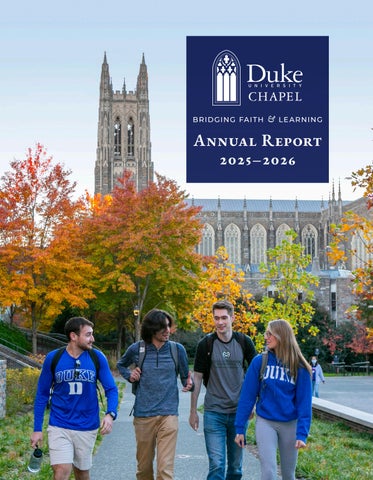
B R ID GIN G FA I T H & L E A R NIN G
Annual Report 2025–2026
Letter from the Dean Dear Friends of Duke Chapel, During the 2025–2026 academic year, the Chapel focused on JOY, the newest addition to the list of value words that circumscribe our work. We are committed to enlivening hope, compassion, community, justice, creativity, and joy in the work we do, in our service to the university, and within ourselves. Joy is one of the hallmarks of our faith and one of the fruits of the Holy Spirit. When we feel joy, it is a reminder of God’s work in our lives. At Duke Chapel, the words of the psalmist ring true:
for you, o lord, have made me glad by your work; at the works of your hands i sing for joy. Psalm 92:4 nrsv At Duke Chapel, we are dedicated to the care of students, the traditions of Christian worship, the beauty of our sacred music program, and the life of our community. Each of these is highlighted in this report. I hope that you will watch for our joy as you read. I see joy in the faces of our students as they bridge faith and learning in the classroom, in our sanctuary, and in the community. There is joy in sacred dance, joy in jazz, joy in preaching, joy in our songs of praise and thanksgiving. I understand that we live in times of turmoil and our days are often challenging, but the goodness of God is still with us. You are an immeasurable part of my joy, as Dean of Duke Chapel. In you, I see the future of faith—your faithful support ensures that our beloved Chapel will continue to welcome the grace of God and be a place for joyful song. I am grateful for your support. So, with the saints who have gone before us and those who will come after us, I say, “Rejoice in the Lord.” Be filled with hope and joy.
The Rev. Dr. Luke A. Powery Dean of Duke University Chapel PS: This year, in addition to all the activities covered in this annual report, the Chapel published its new strategic plan for 2026–2031. If you have not received a copy of the plan, please write to us at chapeldevelopment@duke.edu, include your mailing address, and we will be happy to send one to you. You can also view the plan online at chapel.duke.edu/strategicplan. Opposite page: Students pose for a photo in front of the Chapel on the first day of classes.
YOU R S U PPO R T M AT TE R S
Students smile for a photo at a baccalaureate service.
2,200+
Students Participate Regularly in Religious Life Groups
3,000,000+ Minutes Watched of Online Chapel Videos/Livestreams
264,000+ Visits to Duke Chapel
49,011
Social Media Followers
2
3,184
Cumulative Attendance at Pastoral Services (Weddings, Memorials, and Baptisms)
$81,874 Given to Local and International Nonprofits
136
Members in Chapel Choirs
150
Chapel Scholars
A Global Community of Supporters Faithful donors support the Chapel through annual giving, multiyear pledges, and planned gifts by bequest. Their gifts are added to the foundational support the Chapel receives from the University to enable our work. With their support, Duke Chapel responds to God’s allinclusive love at Duke, in Durham, and beyond. The map below represents the places throughout the country where our supporters live: the deeper blue colors signify greater concentration of donors between July 2025 and June 2026. Additionally, the Chapel received support from people in seven countries during the same period: China, Colombia, Germany, Italy, Philippines, Taiwan, and the United Kingdom.
2025 –2026
1,134
Chapel Supporters
2,149
Gifts from Donors in
45
States and
7
Countries
3
Students respond to the gospel music during a United in Praise concert.
150
Chapel Scholars
2,200+
$30,000
Grants to support Faith-Related Student Travel and Projects
7
Students Participate Regularly
Students and Recent Graduates Serve on
in Religious Life Groups
the Chapel’s National Advisory Board
S TU D E NT E N GAG E M E NT Students at Duke are smart and curious; like so many other college students, they share a desire to belong and be known. Many students also hunger for religious practice and spiritual depth during their academic years. Through an array of programs and groups, Duke Chapel and Religious Life at Duke come to know and support thousands of these students, nurturing communities of faith, service, and exploration. While this sometimes happens through large gatherings in the Chapel, such as the annual baccalaureate ceremonies or the Pluralism Lecture, more often it occurs in smaller gatherings of students who share a religious tradition, a set of questions, or a desire to serve. What follows are snapshots of communities led or sponsored by the Chapel that guide and support students in connecting faith and learning on campus.
RELIGIOUS LIFE GROUPS This past year, more than 2,200 students found a spiritual home through Religious Life at Duke. The two-dozen Religious Life groups on campus represent faith traditions ranging from various Protestant denominations and Catholic to Muslim and Jewish to Hindu and Buddhist. Each with its own weekly rhythm of prayer services and social events, these groups are led by experienced chaplains and other religious leaders. One student whose faith has grown at Duke is Sarah Diaz, T ’28. She came to Duke from a Jewish family in New York City and has been welcomed into multiple Jewish communities on campus and in Durham. She attends Shabbat dinners with both Jewish Life at Duke (the campus Hillel center) and the Chabad community at Duke, while also teaching Hebrew school at the local Beth El Synagogue. Through her involvement, she has been able to read Torah passages in services for High Holy Days.
“Coming into Duke, I thought I would love to learn a portion [of scripture] for Rosh Hashanah and do it for everyone,” Diaz says. “That was really meaningful because it was a tradition that I did every year at home, and I was able to carry that into Duke.”
Kimberly Samboy, T ’29, has also been nurtured by a spiritual community on campus. She says the Duke Catholic Center has been a “cornerstone” for her at Duke. “More than a religious community, I have found a family of students who also prioritize their faith,” Samboy says. “Whether it is an invitation to our Wednesday Adoration or a reminder to sign up for a retreat, it is very meaningful to have friends that invite you to pray.”
5
Students in the Chapel Scholars program in front of the Chapel.
CHAPEL SCHOLARS
6
Students in the Chapel Scholars program gathered on the steps in front of Duke Chapel last fall for a group photo, a prayer, and some words of welcome from Chapel Assistant Dean Rev. Bruce Puckett. They then headed next door to the Divinity Café for dinner. After dinner, Rev. Puckett led the students in a round of “speed dating” that was focused not on romance but on an opportunity to meet fellow students wanting to grow in the Christian faith. This annual welcome dinner is one way Chapel Scholars acts as a hub for students seeking ecumenical Christian study, service, prayer, and fellowship. This past year, the 150 students in the program also served in worship leadership roles, participated in book groups, prepared meals for people living at the Urban Ministries shelter, and committed to daily Bible reading. Anna Voelk, E ’26, says Chapel Scholars gave her opportunities to have spiritual conversations with students from across the university. “I love getting to know different people that are master’s students, that are PhD students, that are undergrads, that all come together,” she says, “and we get to speak about how the Lord is moving in our lives and on campus.”
For Drew Crocker, E ’28, forming genuine Christian relationships has been a hallmark of his experience as a Chapel Scholar. “I’ve gotten to grow in my faith and be able to be connected to Duke in just such a special way,” Crocker says. “The Chapel is such a centerpiece of our university; it’s really great to be able to form relationships centered around that.”
Rev. Bruce Puckett speaks to students in the Chapel Scholars program.
INTERFAITH ENGAGEMENT Graduate students learned about the faiths represented on campus through six Interfaith Campus Pilgrimages, which had a cumulative attendance of forty-seven. These monthly visits to sacred spaces at Duke introduced students to the major world religions, including Islam, Judaism, Buddhism, Hinduism, and Christianity. During each pilgrimage, the students heard from a Religious Life leader and were offered the chance to participate in a religious practice. For example, students joined Jewish Life at Duke for a Shabbat dinner, sat in on Muslim Jummah Prayers, and practiced Buddhist meditation. Public policy graduate student Andres Parraguirre, P ’26, says his experience of the pilgrimages was “truly transformative.” “[The interfaith pilgrimages] broaden your perspective, challenge your assumptions, and help you see the world through the eyes of others,” Parraguirre says. “The trust-based environment encourages honest conversations and genuine relationships across faith traditions.”
Organized by the Chapel’s Rev. Dr. Lyn Pace, assistant dean of Religious Life, the Pilgrimages were complemented by other interfaith programs. At an event presented in collaboration with the Office of the Provost, artists from the Middle East with different faith backgrounds—Jewish, Muslim, Christian, and Druze—explained how they promote mutual understanding through their art. At an event with Interfaith Photovoice, students used photographs from their lives as a prompt for discussing their different faith backgrounds.
SAY THE THING The Say the Thing initiative uses new technologies as well as ancient spiritual practices to give students community and frameworks to wrestle with life’s hard questions and to question their own answers. Say the Thing is a collaboration between Duke Chapel and the Kenan Institute for Ethics with support from the Purpose Project at Duke. The Green Devil Intern Program supported two internships for Say the Thing, giving student interns the opportunity to gain hands-on leadership experience in sustainability. Led by the Chapel’s
Rev. Dr. Lyn Pace (left) and students on an Interfaith Campus Pilgrimage at the Center for Muslim Life.
7
Rev. Leah Torrey, director of special initiatives, Say the Thing comprises a suite of programs, including The Booth—a console that records participants responding to questions about their life story—and Larks—campus pop-up events that prompt students to take a moment to use creativity for self-discovery. Last year, students and other campus visitors engaged The Booth 1,131 times and participated in Larks more than 3,000 times. Say the Thing’s Studio program gives students a chance to delve more deeply into self-exploration over the course of six weekly sessions. The thirty students in the Studio last year were introduced to ideas from thinkers such as Malcolm X, Abraham Joshua Heschel, Wendell Berry, Ocean Vuong, Robin Wall Kimmerer, Mary Oliver, Howard Thurman, and Rick Rubin. They then reflected on how these thinkers might shape how they tell the stories of their own lives. A saying from the theologian Howard Thurman—“The desire to be one’s true self is ever persistent”—has stuck with Aaron Ng, T ’27. “When I reflect on my own experience and my own life … that’s been a kind of guiding force, … this drive to be my fullest self and to understand what that means,” Ng says. “That’s one of the main goals in college, at least it is for me, and I think Say
8
Students show mementos they made at a Lark event run by Say the Thing.
the Thing has been a really amazing opportunity to explore that.” Say the Thing’s approach to student selfdiscovery has caught the attention of colleagues on campus and at other universities. Growing out of her leadership of Say the Thing, Rev. Torrey offered story-based workshops for Duke’s Program in Education, Center for Documentary Studies, DukeEngage, and TeachHouse. She was a featured speaker at the TriFaith Conference in Omaha, Nebraska. And, Lewis and Clark College, Young Harris College, and Southern Methodist University launched pilot programs of The Studio based on the curriculum developed at Duke. Find recordings of students’ original poems, and other inspirational videos, on the Say the Thing Instagram channel, @say.the.thing.
CHAPEL CHOIRS Each Wednesday evening, students, faculty, staff, and community members gather in the Chapel for Chapel Choir rehearsal. The rehearsals are focused on preparing for upcoming services and concerts but also provide an opportunity for cross-generational community as choir members catch up on each other’s lives. Of the thirty-one students in the choir, six of them serve as student leaders, advising Chapel Music Director Dr. Zebulon Highben on how best to reach, engage, and support students. “I find a lot of peace in the community—and love and support,” says Georgia Rabin, T ’27, vice president of the choir and a member since her first year at Duke. “Something that makes the Chapel Choir so unique is the depth of history and love of learning that is embedded in the way Zeb teaches us the music.” Students also find community and musical excellence in the Evensong Singers ensemble led
Students sing in a concert by two student-led groups, United in Praise and Something Borrowed Something Blue.
UNITED IN PRAISE by the Chapel’s conductor-in-residence, Dr. Philip Cave. This summer, an alumna from the choir returned to the Chapel as a leader of the Royal School of Church Music in America Carolina Summer Choral Residency. In introducing her homily during an Evensong service, the Rev. Imogen Rhodenhiser, D ’16, said her time with the Evensong Singers while at Duke Divinity School shaped her vocation as an Episcopal priest. “Without question, the most formative part of my time here was singing in this space,” Rev. Rhodenhiser said. “I am deeply grateful to return to a space that has meant a great deal to me with people that mean a great deal to me.”
Read more about the Chapel’s choirs in the Sacred Music and the Arts section.
Another group that comes together around song is the student gospel ensemble United in Praise. The group dates to the mid-1960s (then known as the Modern Black Mass Choir) when it was formed by African American students in collaboration with local churches. Today, it continues its mission of proclaiming the Gospel in song under the direction of Chapel staff member Nicholas Venable. In addition to performing on campus and at local churches, United in Praise sings in Duke Chapel for an annual concert, the university baccalaureate ceremonies, and the Martin Luther King, Jr. ceremony. The group rehearses weekly with sessions that combine prayer, fellowship, and music. “The one thing I appreciate about UP and the reason that I’ve stayed there since I began sophomore year is that it constantly feels like you’re participating in family,” says Taliyah Thomas, T ’26, the group’s president. “Even during rehearsal, we are making sure our heart posture is right and focusing on the messages of the song—we’re doing it united.” 9
DUKE CHAPEL STUDENT AMBASSADORS
STUDENT WORKERS
When visitors come to the Chapel, they may be greeted by a Duke Chapel Student Ambassador. These students complement volunteer docents in giving tours (formal and informal) of the Chapel and also serve as ushers at special events. They hone their knowledge in aspects of the Chapel related to their interests or major, which they then share with curious visitors. “From the two (or is it three?) wooden mice, to the Tower’s secret room, to the complex and beautiful history behind each of the three Chapel organs, the Chapel truly is the sum of each of its parts,” says Nick Hoffman, T ’28, a Chapel Ambassador. “Every new story has the potential to act as a catalyst for curiosity and adds to the Chapel’s importance as a religious, cultural, and historical center.”
Often behind the scenes, about a dozen students work at the Chapel filling essential roles from filing choir music to preparing the sanctuary for worship to photographing events. Their work benefits the Chapel while integrating them into the Chapel community. During her two years as a student worker, Shankul Lohakare, T ’27, photographed dozens of Chapel events, producing images that appear regularly on the @DukeChapel social media accounts. One of her photographs that captured the joy of two student ensembles singing in the Chapel was selected for the Duke Views series, which highlights one compelling photograph each week. “Being able to document the wide variety of events—from Chapel services to programs representing many different faiths and communities—has been both insightful and meaningful,” Lohakare says. “The role has given me valuable opportunities to grow as a photographer and build my portfolio.”
Religious Life leaders greet a student during an Orientation Week fair.
10
Students pose for a celebratory photo at a baccalaureate service.
A NETWORK OF SUPPORT AND GUIDANCE Supporting, guiding, and forming all these groups of students is a network of Chapel ministers and staff, Religious Life leaders, and Chapel affiliates. Convened by Rev. Dr. Pace, Religious Life leaders meet monthly to stay abreast of resources for students and to nurture bonds with one another. These leaders also gather for Interfaith Roundtable sessions, which allow for extended discussions of select topics—in the fall, the calling to religious leadership and in the spring, the meaning of “a good death”—from the perspectives of their respective traditions. Along with Rev. Dr. Pace, four Religious Life leaders serve as QuadEx Chaplains. Selected to represent a breadth of faiths—Christian, Jewish, Muslim, Hindu, and Buddhist—these chaplains reach
out to students for brief chats on the Bryan Center Plaza and also make themselves available for more indepth discussions of purpose and meaning. A Chapel affiliate, the Center for Christianity and Scholarship offers seminars for students that explore the Christian intellectual tradition through shared readings and faculty mentorship. Recent seminars have explored “Science and Faith,” “Can the New Testament Be Trusted?” and “Beauty, Suffering, and the Cross.” This past year, the Chapel co-sponsored the center’s et Religio symposium on “Was Jesus Raised from the Dead?” About 150 students attended the event, which featured perspectives from Christian, Muslim, and secular scholars. Read about two more student communities—the PathWays Fellows and Bridge Interns—in the Community Engagement section.
11
Chapel Dean Luke Powery preaches at Ebenezer Baptist Church in Atlanta.
25,000
Attendance at Chapel Worship Services
15,511
Streams of the Duke Chapel Sermons Podcast
85,000+
Online Viewership of Chapel Services
100+
Number of Times Students Served as Lectors and Assisting Ministers
CH R I S TI A N WO R S H I P Worship at Duke Chapel comprises generations of preachers, centuries of music, cultures from around the world, and forms of praise ranging from spoken prayers to organ preludes to liturgical dance. That tradition pressed forward this past year, led by Chapel Dean Luke Powery, Assistant Dean Bruce Puckett, Chapel staff and musicians, and the Chapel’s choirs. People attended Chapel worship services 25,000 times; in addition to radio and TV broadcasts, livestreams and recordings of services were viewed more than 85,000 times. Anchoring the Chapel’s preaching tradition is Dean Powery. In addition to preaching regularly at Duke Chapel, he is in demand as a guest preacher and speaker around the country and abroad. Last year, he delivered a sermon at the Castle Church in Wittenberg, Germany, made famous by the posting of Martin Luther’s Ninety-Five Theses, as part of a conference on “Homiletic Fire: Preaching and the Holy Spirit,” for which he was the keynote speaker. Closer to home, Dean Powery was the preacher at the Founder’s Day worship service celebrating the installation of Morehouse College’s new president as well as at a service at the historic Alfred Street Baptist Church in Alexandria, Virginia, with its national online audience. Most recently, Dean Powery was invited to preach at Ebenezer Baptist Church in Atlanta, renowned as the home church of the Rev. Dr. Martin Luther King, Jr. “In the presence of Christ, we may recognize the ways in which we are not well, and the truth of this is costly,” Dean Powery said in his sermon, The Hidden Cost of Healing, at Ebenezer Baptist in August. A key partner in Chapel worship services, the Congregation at Duke Chapel provides a spiritual home for people who consider the Chapel to be their primary place of worship. Through the Congregation, students, faculty, staff, and community members find fellowship at social events, grow in faith through Christian education classes, and participate in service projects in Durham. Congregation members also sustain worship at the Chapel by serving as lectors, torch bearers, communion servers, ushers, and altar guild members.
GENERATIONS OF PREACHERS Last fall, the Rt. Rev. Dr. Rowan Williams, former Archbishop of Canterbury, preached at Duke Chapel as part of a symposium organized by Duke Initiatives in Theology and the Arts (DITA). “What this is finally about is letting go so that God may give,” Dr. Williams said in his sermon. “Can we do that? No. Can we do it with the Spirit and strength of God? Yes.” The year saw three other especially notable guest preachers. In January, the Rev. Dr. Benjamin Chavis returned as a preacher in Duke Chapel for the first time since he delivered a Chapel sermon in 1979 while serving a lengthy prison sentence for
which he was ultimately exonerated. On the heels of a snowstorm in February, the Rev. Barbara Brown Taylor, a regular at the Chapel over the years, preached on Jesus’s description of his followers as “the salt of the earth” and “the light of the world.” And, for All Saints’ Sunday, the Rev. Dr. Willie James Jennings returned to Duke and Duke Chapel to preach a sermon on The End of Our Inheritance. The craft of preaching is being passed on at Duke Chapel. This year’s Student Preacher was Isaac Frank, a UNC-Chapel Hill student connected to Duke through the Robertson Scholars and the Chapel Scholars programs. In his sermon
13
The 2026 Student Preacher was Isaac Frank, a UNC-Chapel Hill student connected to Duke through the Robertson Scholars and the Chapel Scholars programs.
Looking Up When We’re Let Down, Frank addressed the topic of trustworthy leadership, saying, “Jesus is the leader who will never disappoint.” “I’m still very early in my faith journey and very young in the faith,” Frank said about preparing his sermon. “I’m speaking from my experience that where I have been able to listen to Jesus, I’ve just seen this radical transformation.”
14
Two other students had the challenge and opportunity of preaching in Duke Chapel. Divinity School student Keagan Bouman, D ’26, the Chapel’s intern for worship and student engagement, preached during a Holy Week midday service, and Anna Sorensen, T ’26, gave a homily during a spring semester Evensong service. Many more students have honed their preaching skills in Divinity School courses taught by Dean Powery, including the two he led last year, “Intro to Preaching” and “Deep River: Howard Thurman, Spirituality, and the Prophetic Life.” Preaching at the Chapel extends beyond the pulpit through digital technology. People listened to the Duke Chapel Sermons podcast 15,511 times
this year, and the Duke Chapel Recordings online digital archive received 26,397 page views. A “Short Edition” kiosk dispensed printed snippets of Chapel sermons to visitors 1,248 times in addition to 2,052 short stories. Subscribe to the Duke Chapel Sermons podcast at chapel.duke.edu/preaching.
The Rt. Rev. Dr. Rowan Williams, former Archbishop of Canterbury, preached at Duke Chapel as part of a symposium organized by Duke Initiatives in Theology and the Arts.
OFFERING PRAISE THROUGH MUSIC AND DANCE As guest preachers and students enrich the Chapel’s preaching, so guest artists contribute to worship by offering their talents. Instrumental groups such as the Amalgam Brass Ensemble, Bell Durham, and Mallarmé Music regularly bolster Chapel choirs and congregational singing, while professional soloists and guest organists provide regular musical leadership. A couple of guest artists stood out last year. In February, the Chapel welcomed the renowned Fisk Jubilee Singers who sang the spirituals “We Shall Walk Through the Valley,” “Soon-ah Will Be Done,” and others during a Sunday morning service, which included an extended vocal postlude by the singers. During a Sunday service in March, musicians Chenhui Sun and Gennifer Chang played instrumental renditions of Chinese hymns on traditional instruments, the pipa and guzheng. Matthew Rushing, Alvin Ailey associate artistic director and “artist-in-context” at Duke
Divinity School, offered his craft as a dancer in three Holy Week services. His choreography dramatized the Passion of Christ during anthems sung by the Chapel Choir, including “Christ Our Passover” by Richard Dirksen. Rushing consulted with Chapel Dean Luke Powery, among others, as he worked to expand a ballet based on the music of the spirituals. In addition to singing in the Chapel’s choirs, students have brought their musical gifts to worship services. This past year, these student soloists and chamber ensembles performed in Sunday services: Saxophone Quartet, Guanliang Lyu, K ’27 (piano), Maru String Quartet, Kameron Quartet, Cialde String Quartet, the Durham Children’s Choir, Enclave Duo, and Anna Brusoe, E ’27 (organ).
Matthew Rushing, Alvin Ailey associate artistic director, dances during an Easter service.
A student saxophone quartet plays during a Sunday morning service.
Read about the Chapel’s choirs and musicians in the next section on Sacred Music and the Arts.
15
MARKING THE LITURGICAL YEAR
16
Alongside weekly Sunday morning service, special Chapel services celebrate the Christian faith in an annual rhythm of remembrance and praise. With its grand architecture, compelling preaching, and majestic music, the Chapel is a popular destination for many in the Duke community and beyond to mark the major feasts of the church. Once again, the pews were filled at the four Christmas Eve services with the final Lessons and Carols service broadcast statewide on cable TV. The four Easter services—including a sunrise service in Duke Gardens and an afternoon Choral Evensong—gathered thousands of people to celebrate the resurrection of Jesus. Complementing Christmas and Easter, the Blessing of the Animals and All Hallows’ Eve services draw hundreds to the Chapel for distinct worship environments: Blessing of the Animals is held in front of the Chapel accompanied by the chatter of cats, dogs, and an occasional bird, while All Hallows’ takes place at night inside a darkened Chapel.
Jazz Vespers services have become a beloved part of the Chapel’s worship life. Held once per semester, the services have broad themes, thanksgiving in the fall and hope in the spring. Worshipers—about 200 at each service—are active participants, clapping along to the music, singing hymns, and participating in “jazz prayer stations” that include anointing with oil, lighting a candle, or individual prayers from a minister. The director of Duke’s Jazz Program, Professor John Brown, leads the music with his “Little” Big Band. Guided by the Anglican/Episcopal Book of Common Prayer, Choral Evensong tracks the liturgical year with special services for All Souls’ Day, Advent, Palm Sunday, and Easter. With an average of eighty people attending each service, the Chapel’s Evensong Singers lead the music, under the direction of Dr. Philip Cave.
The Durham Children’s Choir sings during a Christmas Eve service.
Dean Luke Powery leads a Jazz Vespers worship service.
Read about the Evensong Singers’ yearlong exploration of the Bible’s Song of Songs in the next section on Sacred Music and the Arts.
Opposite page: Rev. Bruce Puckett prays during a Sunday morning service.
Guest conductor Dr. David Rayl leads a performance of Handel’s Messiah.
6,000+
136
Attendance at Chapel Concerts
Members of Chapel Choirs
26,822
830
Online Viewership of Chapel Concerts
Participants in Music Clinics and Summer Training Programs
s acre d m u s i c & the arts Reporting on last year’s Messiah concerts, the (Duke) Chronicle said: “With a packed house, the event brought together family members of all ages to celebrate the holiday season with performances by the Duke Chapel Choir, a Durham-based music ensemble, Mallarmé Music and others…. As the orchestra transported the audience directly into an atmosphere of pure artistry and talent, the choir shaped the grandiosity of Handel’s Messiah.” The article serves as a reminder that even a beloved classic such as G. F. Handel’s Messiah is newly discovered each year by some number of students and others who come upon the majesty and message of the music. And, indeed, the audience for the Chapel’s Messiah performances is significant with more than 3,500 people attending three sold-out concerts and an online version of the concerts receiving 13,803 views during the Christmas season. With notable soloists, this year’s Messiah was led by guest conductor Dr. David Rayl. “It’s one of my favorite pieces of music, but also it’s so joyous during the Christmas season—so many people coming out to support us, to watch us perform,” says choir member Jun Tan, T ’26. “It’s just an incredible experience.”
CHAPEL CHOIRS OFFER PRAISE IN SONG At the heart of the Chapel’s music program is the Duke Chapel Choir with a repertoire ranging from congregational hymns and spirituals to medieval anthems and elaborate oratorios. Comprising students, staff, faculty, and community members, the 107-member choir sings in most worship services during the academic year, and, in addition to the Messiah performances, presents a spring concert. This past year’s Spring Oratorio, titled “Light from Light,” was prompted by the 1700th anniversary of the Nicene Creed and its phrase “God from God, Light from Light, true God from true God, begotten not made.”
“[The] concert is inspired by this notion that the passion of Jesus is the light by which Christians perceive everything else,” Dr. Zebulon Highben, director of Chapel Music, explained about the concert’s repertoire. A flexible chamber ensemble auditioned from within the choir, the Duke Chapel Schola Cantorum sings in Sunday morning worship services and festival services—and presents concerts on Duke campus and beyond. The Schola recently recorded a series of anthems, hymns, and spirituals to be released as an album, And Night Shall Be No More, on the Navona Records label. 19
Dr. Philip Cave conducts the Evensong Singers during their annual concert.
SHARING SACRED MUSIC ACROSS GENERATIONS The Chapel’s Evensong Singers, with its twentynine members, provide musical leadership for Choral Evensong services on alternating Sunday afternoons. Based on the Anglican/Episcopal Book of Common Prayer, the service is largely sung or chanted, with an introit, hymn, prayers, psalms, and an anthem. This year, the Evensong Singers focused on musical settings of texts from the Bible’s Song of Songs, which culminated in a concert “Singing the Song of Songs” that drew on three languages, ten scripture verses, and 700 years of music. “The Song of Songs is unique in the biblical canon: It’s a poem about love and longing using language that’s both literal and symbolic about human intimacy and an image of divine devotion,” says Dr. Philip Cave, the Chapel’s conductor-inresidence and director of the Evensong Singers. “There are well over 2,000 musical settings of verses from the Song of Songs, ranging from antiquity to the present day, so there’s a huge corpus of intriguing and beautiful music to explore and share.”
20
Read about how students find community in Chapel choirs in the Student Engagement section.
The Chapel’s organs provide a remarkable set of instruments for performance, practice, and worship. This was on display in the annual Organ Recital Series, with performances by Alan Morrison, Maxine Thévenot, and Chapel Organist Chad Fothergill (Katelyn Emerson’s recital was postponed to the current year due to inclement weather). One reminder that organ music is alive and well in the new generation of organists was a visit to Duke Chapel by a teenage musician from Greensboro, North Carolina. With coaching from Fothergill, Brody Bett played all four Duke Chapel organs and posted a clip of himself playing the Aeolian organ that was viewed more than 45,000 times. “I have had this on my bucket list for so long now,” Bett said in posts on Facebook and Instagram. “It was an amazing afternoon with Chad who was so kind to take the time to hang out with me and show me these beautiful instruments.” Another way organ music is being passed on is through the Chapel’s Organ Scholar program. Dr. David Lim served as last year’s organ scholar, honing his skills through coaching sessions and a full schedule of playing services, weddings,
rehearsals, demonstrations, and concerts. His talent and hard work landed him a coveted church musician job as the director of music at Gloria Dei Lutheran Church in St. Paul, Minnesota. “There’re innumerable things that I’ll take with me to that position,” Dr. Lim says. “Seeing how Dr. Cave and Dr. Highben lead rehearsals, you’re always, by osmosis, gleaning tips and tricks that are helpful to ensembles.” The Chapel’s Bach Cantata Series also reached across generations. Duke students joined professional singers and musicians to present masterworks by J. S. Bach juxtaposed with works by contemporaries Vivaldi, Dumont, and Handel. In the opening Bach & Vivaldi concert, students Yasmine Kwong, T ’28, and Justine Shih, G ’28, performed lead violin parts; in the final concert of the series, Bach & Handel, student members of the Evensong Singers sang alongside professional soloists. Directed by Dr. Philip Cave, attendance at the three concerts totaled 1,295 while online recordings garnered 2,340 views. Yet another way the craft of sacred music is passed on at the Chapel is through workshops,
Chapel Organist Chad Fothergill (left) and Organ Scholar Dr. David Lim at the Aeolian organ.
clinics, and classes. The annual Choral Clinic, led last year by Dr. Hilary Apfelstadt, brought 300 singers to the Chapel for a morning of training and preparation for the coming Lenten liturgical season. The Royal School of Church Music in America’s Carolina Summer Choral Residency gave the opportunity for fifty-seven girl choristers and adult singers to lead the music in two Chapel services. In his capacity as a Duke Divinity School faculty member, Dr. Highben taught a course on the church’s liturgical year with its implications for worship music. And, the Chorworks weeklong residential workshop selected twenty-four exceptional, early-career singers to hone their skills at Duke in sacred music sessions led by Dr. Cave and guest faculty. “I had no idea that this program would change my life and perspective of myself,” says Jay Hendricks, a Chorworks participant. “I grew more confident, assertive, and my passion and hunger for this art grew.”
Participants in the Chorworks early music summer program rehearse in the Divinity School’s Goodson Chapel.
21
MUSIC PUBLISHING: ‘BEAUTY WHILE ALSO PREACHING THE GOSPEL’ In November, Chapel Music Director Dr. Zebulon Highben was selected as Augsburg Fortress’s composer of the month. In an interview for the publisher’s website, he explained his inspiration for composing sacred music. “The church has been responsible for much of the greatest music we have, by composers known and unknown,” Dr. Highben said. “From the ‘simplest’ chants and hymns to the most elaborate oratorios and passions, sacred music can move us with its beauty while also preaching the Gospel and helping us encounter Christ.” This combination of beauty and Gospel proclamation propels the Music from Duke Chapel publication series with its thirty-six pieces, comprising newly commissioned works, modern
22
editions of historic repertoire, and liturgical music by a diverse array of composers. To date, 62,435 editions from the series have been sold to choirs around the world, and Chapel video recordings of the compositions have been viewed more than 100,000 times. Further contributing to the field of church music, Dr. Highben recently published a book on biblical descriptions of God in hymnody. In Sing Many Names: Scriptural Images for God in Hymnody, he presents the view that no single word or image conveys the mystery of God; instead, church music needs many divine images in lively conversation and even then, language cannot capture the fullness of the living God.
Dr. Zebulon Highben rehearses the Chapel Choir.
A Day of the Dead altar (“Ofrenda”) invites visitors to leave a memento honoring a deceased loved one.
VISUAL ARTS AND RELIGIOUS DEVOTION Duke Chapel, Say the Thing, and Duke Arts partnered again this year to present the Ofrenda to celebrate the Day of the Dead and All Souls’ Day. The altar was created by artists with the Inter-Latin American Artist Collective and featured traditional elements from Mexican culture, including paper marigolds and large, colorful replicas of skulls. This past year, thousands (and possibly tens of thousands) of visitors viewed the Ofrenda with hundreds contributing photos and notes in honor of loved ones, as is the custom. The Rev. Leah Torrey, the Chapel’s director of special initiatives, led the Chapel’s efforts to invite visitors to learn from and engage with the display. Pamphlets explained the religious and artistic significance of the altar. A concert outside the Chapel by a student mariachi band celebrated the Ofrenda and Mexican culture more broadly. Short videos featuring students explaining the Ofrenda (in English and Spanish) were viewed more than 10,000 times, and a local radio station interviewed the students about the Ofrenda’s origin and symbols.
“It ultimately is not just a day of sorrow for those who have passed,” Melanie Perez-Romero, T ’28, president of Duke’s Mexican American Student Alliance (MASA), said in the radio segment, “but really celebrating their lives and getting to recognize things that they loved—the people that we loved, the memories that we loved with them.”
In addition to MASA, these campus groups contributed to the presentation of the Ofrenda: Mi Gente, Duke Catholic Center, and the Hispanic House of Studies at Duke Divinity School. Complementing the ofrenda in a different liturgical season was a Stations of the Cross series on display during Lent and Holy Week. In the installation, Haitian artist Jean Sylvestre uses steel from discarded oil drums to depict the fourteen traditional scenes of Jesus’s journey from condemnation before Pilate to his death on the Cross and his entombment. The two exhibitions demonstrate the Chapel’s approach to the creative arts as both an expression of worship to God and an expression of human longing for God.
23
Students paint a house for a person in need during the Project Habitat Orientation Week program.
3,078
People Climbed the Chapel Tower
$81,874
4,400
Viewership of Dean Powery’s Chronicle column
7,000+
Given to Local and
Cumulative Listenership of
International Nonprofits
the Sounds of Faith podcast
CO M M U N IT Y E N GAG E M E NT Through a network of relationships that has built up over decades, the Chapel contributes to the well-being of its home city, Durham, as well as other communities around the world. This is done primarily through partnerships with nonprofits and faith communities. During Orientation Week and at other times during the year, students volunteer with Habitat for Humanity to help construct homes for families seeking a better life. With the Society of St. Andrew’s, Religious Life leaders and students bag potatoes for people in need. At vigils organized by the Religious Coalition for a Nonviolent Durham, students bear witness to the lives lost to violence in Durham. At Urban Ministries, students join members of the Congregation at Duke Chapel in preparing meals for people seeking a warm welcome and dinner. And, each semester, a group of students seeks to better understand how their lives intersect with the history of Durham and the stories of the Bible by participating in the DurhamCares Pilgrimage of Pain and Hope. The Chapel also supports these community organizations, and others, financially through the Mission of the Month program. Last fiscal year, the Chapel gave $81,874 to local and international nonprofits.
STUDENTS LIVE, LEARN, AND SERVE IN DURHAM Select groups of students had the opportunity to learn and serve in the community more intensely through the two Chapel programs based at the PathWays House in Durham’s West End neighborhood. During the academic year, five Divinity School students lived in the house as PathWays Fellows. Together, they sought vocational discernment, participated in retreats, and served in Durham. PathWays Fellow Ian Dyke, D ’27, says the program deepened his sense of calling to ministry. “The PathWays House is perfectly named,” Dyke says. “Living here this year has led me into a closer walk with Christ, a deeper appreciation for Durham, and so many friendships.”
The PathWays Fellowship is led by the Rev. Bruce Puckett, the Chapel’s assistant dean. “The PathWays Fellows not only learn what it means to build community within the walls of their home through regular practices of prayer and meals together, they also learn what it means to live in and love the city and people of Durham,” Rev. Puckett says. “They come to see how loving the place where one lives is part of the Christian vocation.” In the summer, the PathWays House is home to the Bridge Internship, a joint initiative by the Chapel, the Office of Community Engagement and Service at North Carolina Central University (NCCU), and the NCCU Wesley Campus Ministry. The program brings together undergraduate students from Duke and NCCU
25
Students from Duke and North Carolina Central University lived, served, and learned together in the Bridge Internship summer program.
26
to learn about each other’s different faiths, visit local religious communities, and serve in Durham nonprofits and other organizations. This past year, six students completed the program. They had internships with the Senior PharmAssist program connecting seniors with needed medication, a church sports camp for children, the Families Moving Forward homeless shelter, the Lyon Park neighborhood center, the North Carolina Council of Churches’ energy policy group, and Durham’s Resources for Youth Success & Empowerment (RYSE) program. Outside of their internships, the students visited local places of worship representing Christian, Jewish, Muslim, Buddhist, and Hindu faith communities. Amiya Stiles, a senior at NCCU majoring in social work, was one of the Bridge Interns. In her internship, she worked at a juvenile detention center assisting with assessments of teenagers at the center to connect them with supportive resources. “I learned how to connect with them, to really get their stories while also remaining professional,” Stiles says about her internship. A member of the NCCU Wesley group, she also gained an appreciation of other faiths through the Bridge Internship. “It’s very beautiful to see how faith and
belief systems are expressed through many different cultures, many different mindsets,” she says. The Bridge Internship is led by Rev. Puckett; the Rev. Gloria Winston, a district superintendent in the United Methodist Church; and Calleen Herbert, director of the NCCU Office of Community Engagement and Service. Through a grant from Wake Forest University’s Educating Character Initiative, these leaders explored ways for the program to expand by sponsoring community conversations on “Finding Meaning: Purpose and Metacognition” and “What an Education is For: Character and the Second Curriculum at HBCUs.”
STRENGTHENING THE CAMPUS COMMUNITY “A sense of awe and significance was palpable in the chapel as [Joy] Harjo approached the podium.” That is how the (Duke) Chronicle student newspaper described the start of the Chapel’s 2026 Pluralism Lecture on “Poetry and Spirituality” with former United States Poet Laureate Joy Harjo.
“It is important to make friends with silence,” Harjo said as part of the public conversation with Chapel Dean Luke Powery. “It’s so full of wisdom and knowledge and beauty and intensity…. When we listen to silence, if we listen long enough, we know who we are. We know what a lie is. We know what truth is.”
Following the talk, which drew an audience that filled the Chapel pews and more than 1,000 online views, Griffin Storm, T ’26, a Chapel Scholar, said, “I resonated with what she said about silence—that if you sit in silence long enough, you can tell lies and tell the truth.” Storm added, “She told us to take our earbuds out. I think that’s something we can all benefit from— avoiding the constant noise.” With its premise of promoting a generous and confident pluralism, the annual Pluralism Lecture is one way the Chapel contributes to strengthening the campus community, a pillar of Duke President Vincent Price’s Strategic Vision. Another important forum for shaping Duke’s campus culture is the Chapel’s annual William Preston Few Lecture, named in honor of Duke’s first president and his vision of education
promoting the courage to seek the truth and the conviction to live it. Last fall, the Few Lecture featured Hall of Fame basketball coach Mike Krzyzewski in a public conversation with Dean Powery. More than 600 people attended the event on “Faith, Sports, and Leadership,” while the livestream and recording were viewed more than 3,700 times. “I was never alone,” Coach K said about his faith in God. “One thing about faith is you are never alone.” Luke Tasker, E ’28, a member of Duke’s ROTC program, was in the audience. “I’m from a really small town with a Catholic faith, so to see somebody speaking out about sports and how he ties it in his life was a really big moment for me,” he said. In addition to hosting the two annual lectures—and preaching many Sunday mornings—Dean Powery also writes a biweekly column in the (Duke) Chronicle. The column brings wisdom, perspective, and a faith-angle to the Duke community with topics such as “Flourishing from an integrated education,” “Linking lamentation with love,” and “A call to heal.” His fifteen columns last year received more than 4,400 views on the Chronicle website, and
Former United States Poet Laureate Joy Harjo (left) held a public conversation with Dean Luke Powery for the 2026 Pluralism Lecture.
27
Longtime Chapel housekeeper Oscar Dantzler is celebrated during a Sunday morning service.
28
a chapbook collecting his columns, titled Joy on the Journey, was published last year as a gift for graduating Chapel Scholars students. Another way the Chapel is presenting its mission of bridging faith and learning is the Sounds of Faith podcast. Published biweekly during the academic year, the interview-based show uses audio clips of preaching, sacred music, and other sounds to bring to life examples of faith and the intellectual life meeting through Duke Chapel services, concerts, programs, and people. Launched in the spring of 2024 and produced by Chapel Communications Director James Todd, the show’s thirty-four episodes have accumulated more than 7,000 plays (times people have listened). In one episode of Sounds of Faith, Steve Hinkle, a longtime campus minister at Duke, shares lessons from his four decades of ministry and how he has seen students’ spiritual questions change over time. In another episode, Chapel Organist Chad Fothergill sits at the organ and demonstrates the range of musical techniques he draws on while playing for worship service. A special episode marked the retirement of longtime Chapel housekeeper Oscar Dantzler. In it, Dantzler tours the Chapel, reminiscing about his surprise encounters and quiet moments during his twenty-eight years serving the Chapel—all with his signature mix of wisdom and humor.
“You’ve got to love the building,” Dantzler says near the end of the interview. “You’ve got to love the people you work with.”
One more way the Chapel strengthened ties in the wider Duke community was through the Counting It All Joy! oral history project. The Rev. Dr. M. Keith Daniel, a triple Duke graduate, led a team of researchers in identifying and interviewing Black alumni from the four schools funded by the Duke Endowment who have created educational legacies by having family members attend these universities across generations. A member of the Chapel’s National Advisory Board, Rev. Dr. Daniel was program manager for Duke University’s fiftieth anniversary commemoration of the first five Black undergraduates and has a son who attended both Furman and Duke. DukeMag profiled the project in an article titled “Old Stories Retold.” “It was joyful all the way through,” Daniel says in the article. “Life is a pilgrimage. To watch people glow about getting through college, the peers, the experiences, I can’t really put it all in words.” Listen to the Counting It All Joy! oral histories online at duke.is/countingitalljoy.
A PLACE THAT BINDS PEOPLE TOGETHER In June, PEOPLE (magazine) ran a story on their website about a wedding at Duke Chapel. Jake Bobo, T ’21, married Mackenzie Cole, T ’22, in a ceremony at the Chapel, which drew the celebrity magazine’s attention because Bobo is a wide receiver for the reigning Super Bowl champion Seattle Seahawks. “Snagging the special chapel as their wedding location felt like fate, in more ways than one,” the article says. “The couple told PEOPLE about the first time that Bobo ever entered the building during his first recruiting visit, which included the now fortuitous moment that a tour guide turned to him and said, ‘Who knows, if you go to Duke, maybe one day you can get married here.’” While the Bobos’ wedding made national news, many other Duke couples and families privately mark important life milestones at the Chapel throughout the year. Last year, the Chapel hosted fifty weddings, four memorials, and fifteen baptisms, with attendance across the events totaling 3,184. Each ceremony creates a lifelong memory, and each is made possible by the planning and care of the Chapel’s hospitality team. The Chapel is also the site of significant university celebrations from the Martin Luther King, Jr. commemoration in January to the baccalaureate and graduation ceremonies in May. This past year, 4,630 people attended these events. As a major landmark on campus and in North Carolina, visits to the Chapel create bonds through a shared experience. That can be members of a research lab climbing the Chapel tower, a group from a retirement home learning about the Chapel’s history, or students from a local school being introduced to the Chapel’s gothic architecture. In each case, their experience is enhanced by the Chapel’s team of visitor relations assistants led by Beca Franca, director of hospitality and building management. This past year, Duke community
members climbed the tower 3,078 times, and eight volunteer docents gave tours to 938 people. Beyond the structured engagement, people have come to the Chapel many thousands of times to reflect, to pray, to marvel at the stained-glass windows, or just to sit quietly—the Chapel offers a warm welcome to all who enter.
Tamela Davis, a docent, leads a tour of the Chapel.
29
WE G I V E TH A N K S The Duke Chapel Staff OFFICE OF THE DEAN Rev. Dr. Luke A. Powery Dean of Duke Chapel Rev. Leah Torrey Director of Special Initiatives Ava West Assistant to the Dean Madison Daniel II* Program Coordinator for Say the Thing
DEVELOPMENT Amanda Millay Hughes Senior Director of Development and Strategy Jeff Compton-Nelson* Associate Director of Development Jimmy Paton Development Marketing Specialist Erica Thomas Staff Assistant for Development
MINISTRY Rev. Bruce Puckett Assistant Dean Rev. Dr. Lyn Pace Assistant Dean of Religious Life Dr. Craig Glover Hines Director of Community Ministry Caleb Harris Worship and Ministry Coordinator Nicholas Venable Music Director for United in Praise
COMMUNICATIONS James Todd Director of Communications Karen Huang Communications Specialist
MUSIC Dr. Zebulon Highben Director of Chapel Music Dr. Philip Cave Conductor-in-Residence Chad Fothergill Chapel Organist John Santoianni Ethel Sieck Carrabina Curator of Organs & Harpsichords David Faircloth* Program Coordinator for Chapel Music Jaclyn Brown Program Coordinator for Chapel Music Evelyn Kong Staff Specialist for Chapel Music and RSCM America Mitchell Eithun Chapel Carillonneur Aaron Colston Chapel Carillonneur David Lim* Organ Scholar Sophia Cornicello Organ Scholar
30
This list includes all current staff, with (*) indicating those staff members who have retired or left the Chapel in FY26 to pursue new opportunities.
BUSINESS & FACILITIES Joni Harris Senior Director of Business and Facilities Lisa Best Business and Facilities Specialist Tasha Braswell Financial Management Analyst Beca Franca Director of Hospitality and Building Management Christina van Werkhoven* Staff Assistant for Hospitality/Wedding Coordinator Leslie Rahman Wedding Director Paquita Burnette-Thorpe Wedding Director Karen Huang Wedding Assistant VISITOR RELATIONS ASSISTANTS Alan-Joshua Carrasco Ken Davenport Benny Edwards Larry Efird Ann Hall Trinity Henderson Andrea Moore Mary Salvarezza* Amanda Wu* UNIVERSITY HOUSEKEEPERS Oscar Dantzler* Beverly Jordan
The Duke Chapel National Advisory Board members serving during the fiscal year 2025 –2026 CHAIR Grace Lee, T ’79 VICE CHAIR Southgate Jones III EMERITUS MEMBER William E. King, T ’61, G ’63, G ’70
MEMBERS David Benjamin Adams, T ’08 Lauren Allen, T ’25 Charles Berardesco, T ’80 Carter Cribbs, T ’25 M. Keith Daniel, T ’90, D ’05, D ’16 Thomas Felgner, T ’94, B ’95 Elizabeth Grantland, T ’20 Zach Heater, T ’17 Carole Klove, N ’80 Kenneth Lee, T ’74 Arthur Maxwell Powell II, D ’24 Hananiel Setiawan, G ’23 Sanyin Siang, E ’96, B ’02 Emily Stout, T ’93 William Vogel, B ’76
Students pose for a group photo on the first day of classes.
31
Scan the QR code to give online.
Students enjoy listening to fellow students perform mariachi music in the Chapel.
VISION To respond to God’s all-inclusive love at Duke, in Durham, and in the world.
MISSION Rooted in the love of God in Jesus Christ, Duke Chapel bridges faith and learning by nurturing and embodying the intellectual, ethical, and spiritual life.
VA L U E S Hope Compassion Community Justice Creativity Joy
2025–2026 Annual Report
Box 90974 Durham, NC 27708-0974
Nonprofit Org. U.S. Postage PA I D Permit No. 60 Durham, NC