INSIGHT O f f i c i a l
M a g a z i n e
The Prophetic Breeze
Fatawa:
o f
D a r u l
U l o o m
C A N A D A
Nov/Dec ‘26 vol 5 issue 6
When My Phone Fell Into the Pool
• financial responsibility in accident • Islamic financing; musharakah, murabah • investing in stocks
13 06
about the cover
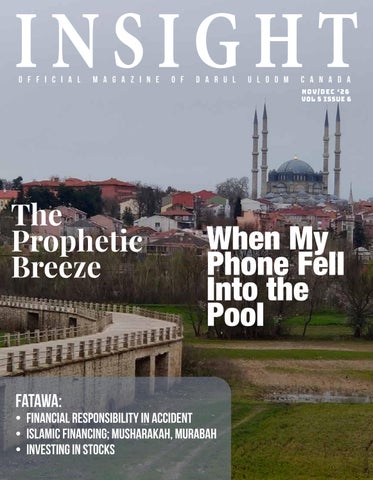
A bridge connects the royal palace where Sultan Muhammad Fatih was born (not seen in photo) to Uc Serefeli (Three Balconies) Masjid commissioned by Sultan Murad II, father of Sultan Fatih, in 1438. The Masjid was completed in 1447 and is a landmark masjid in Edirne, Turkey.
CONTENTS 06
ro
c i t e ph
f e n
ell
24
30 0
4 o h P e p e y y ool & r Th reez m e lo p c n g B 3 n 0 l l 5 he the ga ar t u f W to o rs p r n i r a n y i e A t y i t p l i p s a r On umi i d ve i H h D a
ir d E
: e n
sy
o r P
e en h p h
Im
am
M
W
: fo a w ys
ta o p a F h
h rt
e
a
W
30 52
ca
r
c c a
i
n e d
52 t
Patron
Hazrat Dr. Ismail Memon
Fatawa
Mufti Husain Ahmad Badri
Contributors
Mufti Omar Baig
Maulana Dr. Mateen Khan Dr. Kamran Karatela
Editor
Asim Ahmad
Attribution
Photo by Saad Chaudhry on Unsplash Photo by Stefanie Jockschat on Unsplash Photo by Karl Hörnfeldt on Unsplash Photo by seth schwiet on Unsplash Photo by Sergey Meshkov: https:// www.pexels.com/photo/close-up-shotof-black-mobile-phone-in-the-water-8481951/ Photo by Sergey Meshkov: https:// www.pexels.com/photo/close-up-shotof-black-mobile-phone-in-the-water-8481951/ Photo by Glib Albovsky on Unsplash
office@ducanada.org
Website
www.ducanada.org
Address
51 Prince St. N, Chatham, ON N7M 4J7, Canada The views expressed in the columns of Insight magazine do not necessarily represent those of Darul Uloom Canada. The articles published in this magazine may be reproduced with due acknowledgment.
4
INSIGHT MAGAZINE
I
n the Prophetic Breeze by Muhammad Azeem, a student of Darul Uloom Chatham, the author highlights how madrasa life embodies the spiritual essence and beauty of the Prophetic times. Through personal experience, he speaks of how his teachers live the very sacred knowledge that he could not have understood at a deeper level until he entered the confines of Darul Uloom Chatham. In When My Phone Fell into the Pool, Dr. Kamran shares his personal story of how the cellphone in particular and technology more broadly, controls, defines, and permeates our modern culture, feeding us the illusion that we are dependent on them for our mundane existence. After he lost his phone, the author realized that he could breathe easier seeing life as it actually is rather than how he perceived it to be through the shackles of his cellphone.
islahi majlis UPCOMING DATES
aug 2026 SEP 2026 OCT 2026 NOV 2026 DEC 2026 JAN 2027
Darul Uloom Canada 51 Prince St N, Chatham, ON N7M 4J7, Canada
22-23 19-20 17-18 NO MAJLIS 19-20 16-17
LISTEN LIVE https://darul-uloom-canada.mixlr.com http://duc.servemp3.com
www.ducanada.org www.alqaasim.com INSIGHT MAGAZINE 5
The Prophetic Breeze
by Muhammad Azeem
Living the prophetic era in real-time
The era of the Prophet s was profound, a certain divine presence that lingered in the air. From the gathering of the companions sitting with the Prophet s himself, to the streets of Medina, where the adhan of Bilal g was heard five times a day. In the heart of every Muslim, there lies a burning passion— an unconditional yearning— to feel the coolness of that breeze, but his desires remain unfulfilled; he suffers the unfortunate fate of being a latecomer to a lost age. Some, however, are fortunate enough to get a glimpse of that light. Those who Allah grants the blessing of the company of the scholars. The Prophet s describes the righteous scholars, “Indeed, the scholars are the heirs of the Prophets” (Tirmidhi). Therefore, it comes as no surprise that the environment produced by the scholars’ mimics that of the Prophet s.
INSIGHT MAGAZINE
7
I
walked in through the doors of Darul Uloom Canada in late 2019, the autumn leaves shrouding the old collegiate building. Being fresh out of a small town in western Canada, the practices and norms of the west were part and parcel of my everyday life. Many things seemed foreign, as if I had stumbled into a different world from the one I had been living in for 15 years. These changes, that upset the course of the life I had set for myself, would soon become my new norm. Only then would I be able to understand what I was experiencing. Only after studying the life and traditions of the Prophet s was I able to draw the parallels between the changes in my environment and the environment I was reading about in class everyday. I used to understand the hadith mentioned above as pure-
8
INSIGHT MAGAZINE
ly spiritual and theoretical, but after personally experiencing the company of the scholars, I was forced to accept that this hadith has many practical implications as well. In the first days of my traditional studies, I was learning something new every day from my teachers and the students around me. This knowledge ranged from essential issues to issues of little relevance for a beginner student. This new trove of knowledge coupled with my misplaced curiosity led to many headaches for my teachers. I would bring up irrelevant issues in the classes but my teachers out of their benevolent character would respond without a hint of frustration and never reprimanded me for my disruptive behaviour. (as I thought they would). This was my first experience of a prophetic quality displayed by a scholar— the first of
many such experiences. The Prophet s frequently had to deal with disruptive behaviour such as mine. The bedouins of the Arab lands were unacquainted with the protocls of how to behave around the Messenger of God s. They would come into the city, yell out the Prophet’s s name and demand answers for their erratic and often ignorant questions. You can likely grasp the analogy I am aiming to make here. The reaction of the Prophet s with the bedouins was similar to what I experienced from my teachers. I read the ahadith of The Prophet’s s relaxed and humorous demeanor with his companions. For example, Anas g narrates, “There was a bedouin named Zahir who would gift the Prophet s a gift from the village and when intended to return, the Prophet s gave him provisions [for his journey]. He s said, “Zahir is our bedouin and we his city dwellers.” The Prophet s loved him despite his unatrractive looks. Once, The Prophet s approached him while he was selling his merchandise. He embraced him from behind. Zahir g said, “Let go of me! Who is this?” He turned a bit and realised that it was the Prophet s and cleaved his back to the chest of the Prophet s. The Prophet s then said, “Who will buy the slave?” Zahir g said, “O Messenger of Allah, you will find no demand for me (i.e. nobody would want to purchase
INSIGHT MAGAZINE
9
someone as unhandsome looking as me)!” The Prophet s then said, “But you are handsome in the sight of Allah” [Ahmad; 3:161]. This should be read keeping in mind that the Prophet s was not an ordinary member of society. He was a leader, a lawmaker, and from Quraysh, the noblest tribe in Arabia. Regardless, the Prophet s remained humble and displayed the most beautiful character with everyone. With this in mind, I could not help but be reminded of the Shaykh al-hadith of our seminary, the leading hadith authority at Darul Uloom Canada. Despite his high rank and seniority in age, there was not a day in our Bukhari class in which he did not make us laugh, lighten the mood, and make our studies in hadith knowledge just a little more bearable. Narrations mention that the Prophet s took part in digging the trench during the famous battle of the Trench with his own two hands, despite his companions being ready to lay down their lives for him, not to mention digging a trench. Baraʾ bin Azib g narrates, “The Prophet s was carrying earth on the day of Khandaq and his abdomen was covered with dust, and he was saying,
10
INSIGHT MAGAZINE
“By Allah, without Allah we would not have been guided, neither would we have given in charity, nor would we have prayed. So (O Allah), please send sakina (i.e. calmness) upon us and make our feet firm if we meet the enemy that has turned on us, and if they intended harm, then we will not flee but stand up to them.” The Prophet s used to raise his voice saying, “Abaina! Abaina! (i.e. we would not, we would not)” [Bukhari; 4104]. I can say with the utmost confidence that anyone who has had the privilege of spending even a few days at Darul Uloom Canada will attest to the fact that this narration brings only one person to mind: the principal of Darul Uloom Canada, Moulana Mansoor. With the dozens of issues associated with the running of an institution, there is not a day that goes by but he is working with his hands to repair a piece of equipment or appliance.He may be seen climbing twenty-foot ladders to patch the roof or unclogging the water fountain. This is all, of course, side by side with the daily classes teaching senior students the advanced studies. The Prophet s was also known for always
keeping a positive attitude despite all the hardships he endured from an early age. He lost most of those close to him before his message became widely accepted. ʿAbdullah b. al-Harith g narrates, “I have not seen anyone who smiled more often than the Messenger of Allah s” [Tirmidhi] 3641]. The head Mufti of the seminary, Mufti Husain Badri, lives true to this prophetic way of life. Those close to him know of his hardships in life. Regardless, one thing always remains the same: the fact that he has the softest attitude with the student body and that one smile of his brightens up the entire day of whoever is on the receiving end. The goal of this essay is to emphasize spending time with the scholars, no matter your walk of life. Many times, we avoid scholars out of fear of rebuke or their perceived hard stance on issues, without giving them a chance to bless us
with their wisdom. We can take lesson from a description of the Prophet s, narrated by ʿAli b. Abi Ṭalib g: Whoever saw him once was in awe of him, and whoever came to know him better fell in love with him [Tirmidhi; 3638]. It is clear, therefore, that to experience the bliss of the gathering of the Prophet s, we must strive to sit in the gatherings of the scholars and through the love we gain from them, we pray that Allah creates love in our heart for the Best of all Creation s.
INSIGHT MAGAZINE
11
learn Arabic
MASJID - BOARDING SEMINARY - ISLAMIC SCHOOL
the prophetic teachings
Explained
A WEEKLY URDU COMMENTARY ON RIYADH US SALIHEEN By Mufti Husain Ahmad Badri
THURSDAYS AT 3:00 PM LISTEN LIVE: darul-uloom-canada.mixlr.com
www.ducanada.org www.alqaasim.com
12
51 Prince St. N, Chatham, ON N7M4J7, Canada
INSIGHT MAGAZINE
LISTEN - SHARE - BENEFIT
T
he moment seemed ordinary enough. I bent forward to lift my two-year-old out of the swimming pool, my attention entirely on keeping my little one safe. It was a simple, instinctive movement, the kind a parent makes countless times without second thought. But in that split second, something slipped from the front pocket of my shirt. Splash! My phone. For a moment, I could hardly believe what had happened. There it was, lying at the bottom of the pool, as though plunging for a dive on its own. I stared in disbelief, my mind racing faster than I could reach down to retrieve it. Being abroad made it all the more tragic. I didn’t use my phone just for calls. It was my personal assistant, my diary, my map, my bank, and my lifeline to the outside world. My bookings, itinerary, banking details, important messages, and WhatsApp conversations were all secured in that inseparable companion of mine. As I picked it up, a fleeting sense of relief washed over me. The latest Apple phones are advertised as water-resistant, aren’t they? But that relief did not last long. The screen began behaving strangely. The phone seemed to have developed a mind of its own, responding unpredictably, displaying odd things, and refusing to cooperate. My heart sank with every passing second. I had hoped it would dry
When My Phone Fell Into the Pool by Dr. Kamran Karatela
INSIGHT MAGAZINE
13
up and return to normal, but at this point the phone was haemorrhaging. In hindsight, I should have switched it off immediately, removed the SIM card, and allowed it to dry properly before seeking professional advice. I should not have continued trying to use it. Nor should I have resorted to the familiar household remedies of putting it in rice or using a hairdryer, neither of which is recommended for water-damaged electronics. But in that moment, panic had taken over reason. I tried to save it. I waited. I hoped. But the phone had gone blank on me. And then, rather unexpectedly, I discovered just how much of my sense of security had been resting in that little device.
The Feeling of Being Incomplete I never saw myself as someone particularly attached to social media. I did not post pictures, share updates, or hop from one platform to another. All I had was WhatsApp. I think that’s why always thought I was free from the death grip of the virtual world. How wrong I was. The moment my phone stopped working, I felt strangely incomplete. It was as though my limb had been chopped off. I felt vulnerable, disconnected, and almost helpless. My mind immediately began listing all the things I no longer had access to. How would I check my travel bookings?
14
INSIGHT MAGAZINE
What about my itinerary? How would I access my banking information? What if someone needed to contact me urgently? What would happen to my messages, conversations, and all the information I had come to rely upon? The questions multiplied and with them a growing sense of anxiety. I was travelling, away from the comforts of home, and suddenly the one thing I had unconsciously come to depend on was no longer available. I felt as though I had been stripped of my ability to manage even the simplest task. It was a disturbing realisation. How could a person who had lived perfectly well before the age of smartphones feel so incapacitated without one? Of course, I knew I could survive without a phone. There is nothing people didn’t do in the pre-smartphone era that we do in our time. I knew this in my mind, but I was struggling to
accept it from my heart. That is when a more uncomfortable question began to surface. Was I really dependent on my phone for practical reasons, or had I become emotionally attached to the sense of control, convenience, and constant connectivity it gave me? Perhaps it was a little of both.
The Invisible Pull of the Digital World In the days that followed, I began to notice something about myself that I had previously overlooked. How often did my hand instinctively reach for my phone? How many times during the day did I feel the urge to check something, even when there was nothing particularly important to check? An email. A message. A piece of information. A news update. Something that might entertain me for a few moments. And, how often did I interrupt a memorable moment with my family simply because my phone was within reach? We sit together at the dinner table, but our attention is elsewhere. We spend time with our children, but the ping of a notification pulls us away. We may be having a conversation with a loved one but are suddenly compelled to respond to a message that could wait for another time. We reach for our phones in moments of boredom, silence, discomfort, and even happiness. We fill every spare moment with stimulation. Waiting in a queue? Check the phone. Sitting in the backseat of a car? Check the phone. Taking a short break? Check the phone. We have become so accustomed to constant stimulation that a few moments of stillness feel eerie. And yet, what are we afraid of in those quiet moments? Perhaps, it is the unfamiliarity of being alone with our thoughts. Perhaps we have forgotten how to be fully present. Perhaps the endless stream of information and entertainment has trained our minds to crave the next distraction before we have even finished processing the last one.
The tragedy is that while we remain constantly connected to our devices, we can become increasingly disconnected from the people around us and from our own inner selves. Most concerning of all, we risk allowing this distraction to affect the most important relationship in our lives: our relationship with Allah.
When the Mind Cannot Sit Still Before Allah As Muslims, we are blessed with the extraordinary gift of salah. Five times a day, we are invited to step away from the affairs of this world and stand before our Creator. We leave our work, conversations, responsibilities, and our concerns to answer the call of Allah. Salah is not merely a series of movements performed at prescribed times. It is a meeting with our Lord, an opportunity to remember Him, to seek His forgiveness, to express our gratitude, and
INSIGHT MAGAZINE
15
to bring our troubled hearts back to the One who created them. Yet, how often we stand in salah present in the physical body but mentally somewhere else? Our bodies are facing the qiblah, but our minds are reviewing an unfinished task, replaying a conversation, planning the next day’s activities, or wondering whether someone has replied to a message. We recite Surah al-Fatihah while our thoughts wander through the day’s events. We bow and prostrate while our minds race. We say Allahu Akbar—Allah is the Greatest—yet allow the smallest notification to command our attention. There is an uncomfortable contradiction
ourselves to be distracted. Allah tells us in the Qur’an: “Certainly will the believers have succeeded: They who are during their prayer humbly submissive” (23:1–2). The verse invites us to reflect on the quality of our prayer, not merely its completion. Are we truly present when we pray?
True reliance upon Allah does not mean neglecting practical arrangements or refusing to use helpful technology. It means remembering that our ultimate security lies with Him, not with the devices we carry.
here. We expect to experience tranquillity in salah, but we spend much of our waking hours feeding our minds a continuous diet of noise, novelty, images, opinions, messages, and entertainment. We accustom ourselves to jumping from one thing to another, and then wonder why it is so difficult to concentrate when we stand before Allah. How can a mind accustomed to constant distraction suddenly go still simply because we have raised our hands for salah? Khushu—the humility, attentiveness, and reverence of the heart in prayer—requires effort. It requires us to bring our attention back to Allah, again and again. It is not something we can expect to cultivate effortlessly if we spend the rest of our day training
16
INSIGHT MAGAZINE
Do we understand what we are reciting? Do we appreciate the privilege of standing before Allah? Or have we become so accustomed to divided attention that even our moments of worship are affected? The phone itself may not be the problem. It can help us read the Qur’an, listen to motivational lectures, learn our faith, and stay in touch with family. The problem starts when a useful tool becomes an instrument of habitual distraction, when our desire to check is too difficult to resist, and when it takes precedence over what deserves our attention most. Our devices can serve us, but we must be careful to not become servants to them.
A Garden, a Bird, and the Price of Distraction Abu Talhah al-Ansari g, a distinguished sahabi of the Prophet s, was once praying in his garden when his attention was drawn to a bird fluttering about in the trees. He continued watching but became distracted and lost track of how many rak’ahs he had performed. After completing his salah, he was troubled by what had happened and decided to part with the garden. He immediately went to the Messenger of Allah s and explained what had occurred, offering the garden in charity for the sake of Allah. Another similar incident has been narrated about a Sahabi during the caliphate of Uthman ibn Affan g. He was praying in a garden of date palms when his attention was captured by the cluster of ripe dates. His thoughts wandered, and he lost track of how many rak’ahs he had performed. Disturbed by the realisation that his garden
INSIGHT MAGAZINE
17
had distracted him during prayer, he went to Uthman g and gave the garden away in charity. The account states that the garden was sold for fifty thousand dinars whose proceeds went to religious and charitable purposes. In deed what occupies our attention can affect the presence of our hearts before Allah. In these accounts, the gardens are not to blame. They were blessings and sources of beauty and provision. Yet when the Sahaba realised that their attention had wandered during salah, they examined their attachment to the cause of their distraction. We, too, need to examine our own distractions. Our date-filled gardens may not have birds flitting between branches. But there are the glowing screens, incoming messages, emails, WhatsApp notifications, and the endless stream of digital content available at our fingertips. We may not need to give away our phones, just as we need not abandon every worldly blessing that competes for our attention. But we must be willing to recognise when a permissible convenience has become an permanent appendage. The question is not whether we possess worldly blessings. The question is whether
18
INSIGHT MAGAZINE
those blessings are helping us fulfil our purpose or pulling us away from it. If a bird in a garden could become a distraction for a devotee to salah, what effect might hours of digital stimulation have on our ability to concentrate? If we spend the entire day training our minds to jump from one notification to another, can we reasonably expect them to become stationery the moment we begin to pray? Khushu requires effort, practice, and a conscious turning of the heart towards Allah. Perhaps we can begin by putting our phones aside, silencing notifications, and allowing ourselves to enter salah without carrying the noise of the digital world into our meeting with our Lord. After all, the greatest loss is not a phone that shuts down or a garden given away in charity. It is a heart so absorbed in the constant distractions that it struggles to experience the sweetness of standing before Allah. The question is not simply, “Do I own a phone?” It is, “How much of me does my phone own?”
The Sahabah and the Art of Letting Go
The Companions of the Prophet s lived in a world without smartphones, instant messages, or digital entertainment. Their lives were not free from worldly responsibilities: running families, managing businesses, untertaking trips, and serving communities. Some were merchants, farmers, leaders, and skilled workers. Yet their lives were shaped by a profound awareness that the Hereafter was more enduring than the fleeting affairs of this world. Allah describes the people of understanding in Surah an-Nur: “Men whom neither commerce nor sale distracts from the remembrance of Allah and performance of prayer and giving of zakah” (24:37).
Notice that the verse does not say these men had no business, trade, or responsibilities, but that their business did not distract them from remembering Allah. This is an important distinction. Islam does not demand that we abandon the world. It teaches us to live in the world without allowing the world to dominate our hearts. The Prophet s also warned against becoming excessively attached to worldly pursuits. He said, “Be in this world as though you were a stranger or a traveller” (Bukhari). A traveller understands that a temporary stop is not a permanent home. He takes what he needs for the journey but does not become so absorbed in the comforts of a place that he forgets his destination. How relevant this image is to our digital lives. Our phones offer endless opportunities to occupy ourselves, but our time here is limited. Every minute spent mindlessly scrolling is a minute that cannot be recovered. Every family conversation interrupted by an unnecessary notification is a moment of connection diminished. Every salah performed with a distracted heart is an opportunity to strive for a deeper connection with Allah.
We must learn to use the means of this world without forgetting the purpose for which we were created.
A Journey to the Haramain Without a Phone By the will of Allah, days passed, and I still could not recover the data from my phone. I was left without it with no quick way to access the digital life I had grown so accustomed to. At first, the experience was unsettling. But something unexpected began to happen. I started to feel lighter. The constant urge to check my phone gradually disappeared—not because I had suddenly become more disciplined, but because there was nothing to check. The device that had occupied so much of my attention was no longer there to summon it. And then came one of the most beautiful parts of my journey: I went for umrah. I cannot adequately describe how liberating it felt to be in the Haramain without my phone. I could walk, observe, reflect, and worship without the familiar temptation to reach into my pocket. I was not preoccupied with taking photographs, checking messages, or documenting every moment. I could simply be there. In Makkah, surrounded by peo-
INSIGHT MAGAZINE
19
ple who had travelled from every corner of the world to worship Allah, I was able to invest more of myself to the experience. My attention was not divided between the sacred space before me and the digital world waiting on a screen. I could focus on my tawaf, my duas, and my moments of reflection. I could absorb the atmosphere of the Haram without feeling the need to capture it for someone else. In Madinah, the absence of my phone gave me a sense of stillness. I could send salutations upon the Messenger of Allah s with greater devotion, reflect on his life and sacrifice, and appreciate the privilege of being in a place so deeply connected to our faith. I realised that I did not need to record every precious moment in order for it to matter. I did not need to photograph every sight in order to remember it. I did not need to share an experience for it to be meaningful. Some moments are best preserved in the heart. There is a special sweetness in worship especially when we are not imagining how it will look on a screen, who might see it, or whether we have captured the perfect picture. There is a freedom in doing something solely for the sake of Allah, without the need to turn it into content. For those days, my phone was no longer competing for my attention. And I began to wonder whether losing
20
INSIGHT MAGAZINE
it had given me something far more valuable than what I had lost.
When the Haram Becomes a Backdrop for a Screen It is difficult not to feel saddened when we witness the growing presence of phones in places of worship. At times, we see people walking around the Ka’bah while holding up their devices to film themselves. Others make video calls during tawaf, directing their cameras at the surroundings while trying to communicate with people elsewhere. Some appear so occupied with capturing their visit that the act of recording begins to overshadow the act of worship itself. We see similar scenes in the Prophet’s Masjid in Madinah where people may become more focused on their screens than on the profound significance of the place they are visiting. Of course, taking a photograph or using a phone for a legitimate need is not categorically wrong. People
may wish to share a meaningful experience with family, help someone who cannot travel, or preserve a memory. We should not presume to judge another person’s intentions merely by looking at them. But we must honestly ask ourselves where to draw the line between a useful act and a distraction that undermines the purpose of the visit. When we perform tawaf, are we directing our hearts towards Allah or are we primarily concerned with what the camera is capturing? When we stand in the Prophet’s Masjid and send salam upon Rasulullah s, are we giving the moment the reverence it deserves, or are we more concerned with capturing a good recording? When the adhan is heard, do we respond with our hearts, or do we continue watching a screen? The sacredness of a place is not diminished by a device in itself. But our appreciation of the sacredness can be diminished when our attention is repeatedly diverted from what we have come to do. The Haramain are not merely beautiful destinations to visit, film, and share. They are places of worship, reflection, humility, and remembrance. We travel great distances, spend our savings, make sacrifices, and pray for the opportunity to visit them. Hence, we should strive to give them our undivided attention. There is something deeply moving about making dua without a camera in our hands, performing tawaf without the urge to document ourselves, and sending salam upon the Prophet s without simultaneously conducting a
video call. Not every blessing needs to be broadcast. Not every spiritual experience needs an audience. And not every beautiful moment needs to be viewed through a lens. Sometimes, the most meaningful way to honour a moment is to be fully present in it.
The Phone Was Gone, but Life Continued My phone’s disappearance had initially felt like a tragedy. Yet the days passed and life continued. I still travelled. I still found ways to manage. I still communicated when necessary. I still worshipped. I still experienced moments of joy, gratitude, and connection. The world did not collapse. This was perhaps the most humbling part of the entire experience. I had imagined that I would be crippled without my phone, but I
INSIGHT MAGAZINE
21
discovered that much of that fear had been exaggerated by habit. Yes, a phone is genuinely useful. Losing access to travel documents, banking services, bookings, and important contacts can create real difficulties, especially while travelling. I do not wish to romanticise the inconvenience or suggest that everyone can simply discard their devices without consequence. But there is a difference between needing a tool and believing that we cannot function without it. I had confused convenience with necessity and constant availability with security. I had allowed myself to believe that being disconnected, even temporarily, would leave me helpless. In reality, I had far more resilience than I gave myself credit for. I also realised that some of the things I feared missing were not important at all. Many messages could wait. Many updates were unnecessary. Much of the information I
22
INSIGHT MAGAZINE
felt compelled to check would have made no meaningful difference to my day. How much of our mental energy do we spend attending to things that do not truly matter? How often do we sacrifice the present moment for the possibility that something more interesting might be happening somewhere else? And how frequently do we mistake the ability to access everything for the ability to appreciate anything? My phone had been a convenient gateway to the world, but it had also become a doorway through which the world could intrude upon almost every quiet moment. Without it, I began to rediscover the value of those moments.
A Digital Detox I did not plan this detox. I did not announce that I was taking a break from technology, set myself a challenge, or
decide to spend a week without a phone. It happened by accident. Yet, as I reflected on it, I began to see the experience as an unexpected opportunity to reconsider my habits and priorities. What had initially seemed like a loss became a lesson in detachment. Perhaps this is one of the ways Allah allows us to learn: through circumstances we would never have chosen for ourselves. An inconvenience can become an opportunity for reflection. A disruption can reveal an attachment we did not realise we had. Something we regard as a misfortune can prompt us to reassess our relationship with the blessings we have been given. I cannot claim to know the specific divine wisdom behind what happened to my phone. But I can choose to take a beneficial lesson from the experience. Allah reminds us in the Qur’an, “And whoever relies upon Allah—then He is sufficient for him” (65:3). My phone had represented a certain kind of reassurance: I could access information, contact people, check arrangements, and manage my affairs at any time. Losing it exposed how much comfort I had placed in that constant access. True reliance upon Allah does not mean neglecting practical arrangements or refusing to use helpful technology. It means remembering that our ultimate security lies with Him, not with the devices we carry. We can make sensible preparations, organise our affairs, keep important documents accessible, and use technology responsibly. But we must not allow our hearts to become so dependent on these conveniences that their absence makes us forget the One upon whom we truly depend. I had been so worried about being disconnected from the world that I had overlooked the possibility that disconnection might help me reconnect with Allah.
Reclaiming Our Attention, One Moment at a Time We do not all need to lose our phones in a swimming pool to learn this lesson. We can begin by making small, deliberate changes. We can leave our phones outside the room when we pray. We can switch off unnecessary notifications and resist the urge to check messages during salah. We can put our devices away during meals, family conversations, and time with our children. We can allow ourselves to experience a few moments of boredom without immediately filling them INSIGHT MAGAZINE
23
with entertainment. We can read the Qur’an without interrupting ourselves to check a notification. We can sit quietly after salah and make dhikr without feeling the need to reach for a screen. We can enter a masjid with the intention of worshipping, rather than documenting every detail of our visit. And when we go for umrah or hajj, we can make a conscious effort to prioritise the experience over the photographs. We can take the necessary pictures, if we choose, and then put our phones away. We can give ourselves permission to experience the Haramain with our eyes, minds, and hearts rather than through a camera lens. Most importantly, we can ask ourselves an honest question: Am I using my phone because I genuinely need it, or because I have become uncomfortable with the absence of constant stimulation? The answer may reveal more than we expect. A digital detox does not have to mean abandoning technology altogether. It means restoring balance, regaining control over our attention, and ensuring that our devices remain tools rather than masters. It means recognising that we have responsibilities to our families, our communities, our bodies, and our souls. It means understanding that attention is precious and that where we direct it, day after day, shapes the lives we lead. If we can spend hours absorbed in digital content, surely we can strive to give a few uninterrupted minutes to the Qur’an. If we can respond immediately to a message from a friend, surely we can make an effort to respond attentively when we stand before Allah. If we can remember the smallest detail of something we watched online, surely we can work towards understanding and reflecting upon the words we recite in salah. These changes may seem small, but they can help us develop habits of mindfulness,
24
INSIGHT MAGAZINE
discipline, and presence.
Alhamdulillah, My Phone Fell into the Pool When I think back to that moment by the swimming pool, I still remember the shock, the panic, and the sinking feeling as I watched my phone malfunction. I remember believing that I had lost something indispensable. But I also remember what followed: the unexpected freedom, the quietness, the days without constant notifications, and the beautiful opportunity to experience the Haramain with fewer distractions. What initially felt like a disaster became a turning point in how I engaged with technology. I am not suggesting that we should throw away our phones or pretend that modern life does not require
them. I am simply reminding myself and anyone who recognises a little of themselves in my experience, that we are capable of living with less digital stimulation than we imagine. The whispers of the nafs may tell us that we will miss out if we disconnect. Shaytan may exploit our restlessness, encouraging us to fill every spare moment with distraction and making it harder to turn our attention towards what benefits us. But we can resist these habits, one decision at a time, with Allah’s help. We can learn to put the phone down. We can learn to tolerate silence. We can learn to be present with our children, attentive to our families, mindful of our surroundings, and more focused in our worship. And we can learn that being unavailable to the digital world for a little while does
not mean being unavailable to life. In fact, it may be the very thing that allows us to experience life more fully. My phone fell into the pool, and for a few days, I felt as though a part of me had disappeared with it. Yet in its absence, I discovered something I had been neglecting: the peace of being present, the beauty of undistracted worship, and the freedom of not feeling compelled to reach for a screen every time a quiet moment appeared. Perhaps the greatest lesson was not that I could survive without my phone. It was that I could be more attentive to what truly mattered without it. I began the experience mourning the loss of a device. I emerged grateful for the opportunity to examine an attachment. And today, when I think about that unfortunate splash, I find myself smiling. Alhamdulillah, my phone fell into the pool. Perhaps I needed to lose my connection to the digital world for a little while to remember how desperately I needed to strengthen my connection with Allah. May Allah help us use technology in ways that benefit us, protect our hearts from excessive attachment to the dunya, grant us khushu in our salah, and allow us to be fully present in the moments He has blessed us with. May He make our phones tools that serve our lives, rather than distractions that consume them. And may we never become so connected to our screens that we forget the One to whom we must ultimately return. Ameen.
INSIGHT MAGAZINE
25
Learb Arabic
zilamun
Little , or small in quantity,; or mean, contemptible, paltry, or of no weight or worth
Zulm
Zulm (intr.) means to wrong; act wrongfully or unjustly; and when trans: he wronged, treated or used wrongfully, unjustly, injuriously, or tyrannicaly. Wrong; injustice; inequity; oppression; repression
Zalama [u]. is a com-
mon verb form that frequently appears in the Qur’an and hadith in the meaning of ‘to oppress; to persecute; to be tyrannical and unjust’. Literally, þalama signifies ‘putting a thing where it does not belong, or putting it in a wrong place.’ Zulm hap pens by exceeding the limit a little or a lot; or, by deviating from the proper time or place.
26
INSIGHT MAGAZINE
ظلم
muzlimun
intensely black, like sha’run (intensely black hair); nabatun, a plant intensely green, inclining to blackness by reason of its deep greenness; or yaumun, a day of evil
zalimun Zulmatun
p. zulumat (zulam) darkness; duskinessl gloom; murkiness; nonexistence of light [nur]; also used in the meaning of ignorance; belief in a plurality of gods; bahr al-zulumat. the Atlantic Ocean
Milk that is drunk before its becoming thick and its butter being extracted; a part earth that is dug (mazlum; i.e., dug for the first time; the male ostrich (because he digs for the laying and hatching of eggs
Azlama yuzlimu
[said of the night] it became dark or gloomy; Quran: when it became dark upon them (2:20)
INSIGHT MAGAZINE
27
On Arrogance & Humility part 3-4 Humility in the Lives of the Righteous by Mufti Husain Ahmad Transcribed & Summarized by Mawlana Zohaib Azfar
I
n the previous article, we saw how humility appeared in the life of the Messenger of Allah s and in the conduct of those closest to him. We now continue with further examples from the Companions l and the righteous successors.
ʿUmar and the Treasure of the Kaʿbah
ʿUmar g once sat near the Kaʿbah and declared that he would not leave until he had removed and distributed its buried treasure. Shaybah ibn ʿUthman gsaid, “You will do no such thing.” When ʿUmar g asked why, he replied, “The Messenger of Allah s knew that this treasure was here and left it untouched. Abu Bakr g also knew about it and left it untouched. Then, how can you remove it?” ʿUmar g immediately stood and departed. He did not treat the exchange as a matter of personal victory or defeat. Once the practice of the Messenger of Allah s and Abu Bakr g was placed before him, he abandoned his own opinion.
ʿUmar’s g Journey to Jerusalem
When the citizens of Jerusalem were prepared to surrender, they asked to see the leader of the believers. They stated that if he matched the description found in their scriptures, they would hand
Outward sins can generally be recognized through a little reflection. Inward sins, however, are not visible because they pertain to the heart and soul. him the keys without further fighting. ʿUmar g traveled from Madinah with only one servant. At one point, he removed his leather socks, placed them over his shoulders, took the camel’s reins, and walked barefoot through the mud. Abu ʿUbaydah ibn al-Jarrah g expressed concern about what the people would think of him. They were accustomed to displaying great honor before their leaders and elders, so they might interpret his appearance as lack of respect among the Muslims. ʿUmar g replied, “Had anyone other than you said this, I would have punished him severely. We were the most humiliated of people, and Allah honored us through Islam. If we seek honor through anything besides Islam, Allah will return us to humiliation.” Despite ruling a vast empire and inspiring
awe in the greatest rulers of his age, ʿUmar g remained one who was in submission to the Prophet s and the Book of Allah.
was a mark of honor, the daughters of the Messenger of Allah s would have been most entitled to it. A woman objected and cited the Qurʾan: Even if you have given one of them a great amount, do not take any of it back (4:20). She argued that since the Qurʾan mentioned the possibility of granting a large dowry without condemning it, ʿUmar g could not prohibit it. ʿUmar g responded, “The woman is correct.” Although his purpose was to prevent excessive dowries from becoming a source of pride, he immediately accepted her objection when she presented a verse of the Qurʾan.
ʿUthman g Sleeping upon the Pebbles
Hasan al-Baṣri recalled seeing ʿUthman g during his caliphate when the Muslim territory had expanded tremendously. Despite governing
ʿUmar Accepting Correction
ʿUmar g once discouraged people from setting excessively large dowries. He reminded them that if a high dowry
INSIGHT MAGAZINE
29
his own animals.
The Counsel of Luqman e Luqman a advised his son not to turn his face away from people in contempt and not to walk arrogantly upon the earth. Even a person’s manner of speaking and walking should reflect simplicity and humility. This was also the manner of the Prophet s. When someone addressed him, he turned his whole body towards that person rather than responding with his face turned away.
Hasan al-Basri and the Dog
this vast territory, ʿUthman g would take his afternoon rest in the masjid, sleeping directly upon the pebbles until their marks appeared upon his arms.
ʿAli g Feeding His Camels
While ʿAli g was in Makkah for hajj, he and ʿUthman gwere invited to a meal. When someone came to summon ʿAli g, he found him shaking leaves from a tree to feed his camels. Although servants were readily available and ʿAli g occupied the highest rank in the government after the Caliph, he continued attending to
30
INSIGHT MAGAZINE
Hasan al-Baṣri once saw a dog while praying and supplicated,
“O Allah, accept my prayer for the sake of this dog, for I am not worthy of acceptance.” The dog was not accountable under the Shariʿah and therefore bore no sin. Al-Hasan al-Baṣri considered this sinless creature more worthy than himself, despite the lofty rank Allah had granted him.
The Patience of Imam Abu Hanifah
Imam Abu Hanifah would spend his nights in prayer, recitation, and worship, resting only briefly at midday. A man once came during this time to test his patience.
The man knocked and said that he wished to ask a legal question. Imam Abu Hanifah came to the door, but the man claimed that he had forgotten it. He departed, returned after the Imam had laid down again, and repeated the same claim. When he returned a third time, he finally asked whether human excrement was initially sweet or bitter. Without showing anger, Imam Abu Hanifah replied that it appeared to be sweet initially and bitter afterward. When asked whether he had tasted it, he explained that flies gather upon it at first but not later. Even after being deliberately deprived of his rest and asked a frivolous question, he maintained his composure. When asked how he attained his rank, Imam Abu Hanifah identified two practices: “I never refused to benefit others, and I never felt ashamed to
seek benefit from others.” He regarded his knowledge as a trust from Allah that had to be conveyed whenever someone sought it. At the same time, he never considered himself too learned, old, or distinguished to ask another person and benefit from him.
Junayd al-Baghdadi and the Wrestler
Junayd al-Baghdadi used to be a great wrestler in the service of a ruler. No opponent could defeat him. One day, a weak elderly man challenged him. Before the contest began, the man whispered that he was a descendant of the Messenger of Allah s, that poverty had prevented his daughters from marrying, and that he needed both the prize and the recognition that victory would bring. During the contest, Junayd deliberately allowed the old man to defeat him. The match was repeated, but each time Junayd fell, accepting public humiliation before the ruler and the assembled crowd. He chose to lose his own honor for the honor of the family of the Messenger of Allah s. In surrendering outward
When someone addressed him, he turned his whole body toward that person rather than turning only his face in their direction.
victory, he defeated his ego.
ʿAbdullah ibn al-Mubarak in Kufah
ʿAbdullah ibn al-Mubarak was renowned as a scholar of hadith, jurist, worshipper, warrior, and merchant. His home in Merv was constantly filled with scholars, dignitaries, and visitors. Desiring solitude, he quietly moved to Kufah, where few people recognized him. When someone asked whether he felt lonely after leaving the crowds of Merv, he replied that he had found the very companionship and peace he had sought in solitude. He would draw his own water from the well, where people who did not recognize him pushed him aside. When one of his students was distressed by the treatment, he said: “There is no true life except this: that we are neither known nor honored.”
The World as an Inn
Imam al-Shafiʿi described the intelligent servants of Allah as those who recognized that the world is not a permanent home. They saw it as a deep sea and took righteous deeds as their ships. A similar lesson appears in the account of Ibrahim ibn Adham. While he was living as the king of Balkh, a man entered his palace and described it as an inn. Ibrahim objected, “Does this great palace appear to be an inn?”
32
INSIGHT MAGAZINE
The man asked, “Who lived here before you?” Ibrahim named his predecessor. “And before him?” Ibrahim named another. The man replied, “One person came and departed, followed by another. You too will not remain here. What else is an inn?” Regardless of its splendor, the world remains a place through which one passes.
Imam al-Shafiʿi’s View of Himself
Imam al-Shafiʿi wrote: “I love the righteous people and I
The intelligent servants of Allah as those who recognized that the world is not a permanent home. They saw it as a deep sea and took righteous deeds as their ships.
hope that through their means, I will obtain intercession in the Hereafter.” He further says, “I do not like the actions of those who remain involved in sins, but not because of vanity”. He continues, “although in the end, we are both the same, such that when a person sells or buys something, the result that comes out is the same.” He concludes “In terms of action, outwardly I am doing good deeds. If other people are outwardly doing something wrong, then fine.” From the perspective of being a jurist, he says that those wrong actions are wrong because the Sharia has given the prohibition, for that reason he disliked that action. His actions even though outwardly they appear to be good deeds and in the end, we are both equal because he feels his actions are insignificant.
Student and Teacher
Imam Ahmad bin Hanbal was a student of Imam Shafi’i, and he held Imam Shafi’i in esteem. Once Imam Shafi’i saw the Prophet s in a dream, in which the Prophet s mentioned, “Tell Ahmad bin Hanbal that a trial will come; he will be tested. He should remain steadfast in it, and if he remains steadfast on it, Allah Almighty will exalt his name until the Day of Judgment. Imam Shafi’i sends his student to tell Imam Ahmad bin Hanbal that the Prophet s has sent greetings and conveyed this message. When the student went to Imam Ahmad bin Hanbal, he felt elated that the Prophet s is even sending greetings. Such a great honor! Imam Ahmad bin Hanbal gives him his used shirt in exchange for the glad tidings. The student returns to
Imam Shafi’i and recounts the full story, and Imam Shafi’i asks, “Did he give you anything?” The student mentions “His used shirt.” Imam Shafi’i says, “I cannot ask for itbecause it is yours, but allow me permission to soak it in water. I’ll keep the water and return the shirt to you.” How much devotion there must have been, how their relationship with each other must have been! The Prophet’s s greetings are being conveyed, so what a status that man must have? Imam Shafi’i used to rub that water on his face as a blessing during his lifetime as well, and he requested that his funeral bath be performed with this water.
Mirza Mazhar and Shah Ghulam ʿAli
Shah Ghulam ʿAli once was
INSIGHT MAGAZINE
33
fanning his teacher, Mirza Mazhar Jan-i Janan. His teacher first told him to fan harder, then complained that he was fanning too hard. Frustrated, Shah Ghulam ʿAli remarked, “Pick one way or the other.” He was immediately dismissed. Rather than defend himself, he wept, apologized, and sought forgiveness until he was permitted to return. Near the end of his life, Mirza Mazhar told him, “Whatever I did with you was for your benefit and reformation.” Allah later granted Shah Ghulam ʿAli great spiritual distinction. Mirza Mazhar himself stated that he had spent thirty years with three spiritual mentors and endured thirty years of discipline before attaining complete selfeffacement.
Patience within the Home
Mirza Mazhar Jan-i Janan possessed an exceptionally sensitive and orderly temperament. Even minor irregularities could cause him severe discomfort. Despite this sensitivity, he endured the loose tongue of his wife with patience. When
34
INSIGHT MAGAZINE
a servant once responded angrily to her criticism, Mirza Mazhar said about her: “This woman has done me a great favor for Allah has granted me through my patience over her loose tongue.”
Trash Fell upon an Elder
An elder once dressed in clean clothing and set out early for the Friday prayer. As he walked beneath a house, trash was thrown from above and fell upon him. Instead of demanding to know who had thrown it, he said, “All praise belongs to Allah that fire did not rain upon me. I deserved that, yet Allah showed mercy and allowed only trash to fall on me.” He returned home, changed his clothing, and proceeded to the prayer. These examples show how the righteous guarded themselves against pride in many different circumstances. In the next article, we will turn to the training and struggle through which the later elders worked to overcome the ego. n
MASJID - BOARDING SEMINARY - ISLAMIC SCHOOL
the qur’an
Explained
WEEKLY URDU TAFSEER CLASS By Mufti Husain Ahmad Badri
TUESDAYS AT 3:00 PM LISTEN LIVE: darul-uloom-canada.mixlr.com
www.ducanada.org www.alqaasim.com 51 Prince St. N, Chatham, ON N7M4J7, Canada
LISTEN - SHARE - BENEFIT INSIGHT MAGAZINE
35
WWW.ALIFTAA.COM 36
INSIGHT MAGAZINE
WWW.ALIFTAA.COM
INSIGHT MAGAZINE
37
40 DUROOD, DUAA & LESSONS FROM THE LIFE OF
Prophet Muhammad By Mufti Husain Ahmad Badri
THURSDAYS AT 9:00 P.M LISTEN LIVE: darul-uloom-canada.mixlr.com
www.ducanada.org www.alqaasim.com 38
INSIGHT MAGAZINE
LISTEN - SHARE - BENEFIT
Pearls of wisdom Status is not determined by attire
All the scholars (ulama) of the past were sufi-like, righteous and austere people. Maulana Ya’qub Naunatawi’s father had a fondness for fine clothing and often met with people (due to his type of work) from high society. Someone once gifted him a coarse, unstitched lower garment (dhotar in Urdu) and requested he wear it for Jumu’a. He came out that day wearing a pricey shawl along with the same dhotar. After relating this story, Hazrat Thanawi asks, “Did he lose his status by wearing the dhotar,” and then added, “One will be hard-pressed to find a story of a king (or any powerful figure) that he wore this-and-that exquisite garment, but will surely read the account of an austere king who wore plain clothes (i.e., he was a zahid).” Point being that respect is not determined by the attire we wear and that we admire good qualities like simplicity and austerity more than we do superficial things. Hazrat says that he saw the Nizam of Hyderabad wearing plain clothes. The Nizam came out to pray in the Jami masjid and announced that no ceremonial procedures should be observed upon his arrival. Hazrat says, “Due to his simple nature, I was forced to ask which one was the Nizam (in the crowd).”
Allah fulfils the need of the time Hazrat Thanawi says, “Allah fulfills whatever needs there are
of any given era. Therefore, there was a time when people had extrordinary memories. But this was then. Now that the Deen is coded, the need for the same extraordinary memories has waned. I have also heard from people in the field that when there were less rivers, it would rain a lot more. But now that more rivers have formed, the need for rain has decreased, and thus, it no longer rains as much as it used to.”
Scholars visit Hazrat Thanawi
Some scholars came from Deoband to visit Hazrat. They mentioned that the owner of the tonga (two-wheeled horse cart) charged more to drop them off at Hazrat’s place, but on the return, the tonga-owner’s son charged them less. Hazrat said, “The younger crowd are comparatively more easygoing than their older counterparts. Some scholars have said citing Qazi Shurayh that if a need ever rises, then it is best to ask a younger person because they will answer the call much faster. Look at how quick Yusuf e was to forgive his brothers when they sought his forgiveness while their father, Ya’qub e, said that he would see to the matter at a later time. Though it is mentioned that he defered the matter to the last part of the night since the last part of the night is most effective for acceptance of duas, but it also said that because he was old, he took longer to forgive them. The varying differences in personality
among the prophets expressed itself in different ways. Some scholars have made an interesting point that one of the reasons that one will find so many restrictions nad regulations in relation to water in Hanafi mad-hab has something to do with the fact that Imam Abu Hanifa lived near plenty of water by the Euphrates and Tigres river. and ‘poured his heart out’ in laying out the rules and regulations on water. As for Imam Shafi’, he lived in Makka where water was scarce. Therefore, the regulations are more lenient in his mad-hab. Imam Malik, on the other hand, was in Madina where water was even more scarce. Accordingly, one will see his mad-hab the least restrictive in terms of rules and regulations on the topic of water. All of this proves that the the ijtihad of the Imams was influenced by their personalities that were shaped to some degree by the places they hailed from. The differences of the Elders can too be seen within this purview.
Second marriage
Men get married again but know nothing about the meaning of ‘adal (fairness). They have heard of the word but have no idea what it actually is. If one is to marry again, then it should be with the intention to do mujahada (struggle) because the more ‘adhab (punishment) you face here, the more reward you receive in the Akhirah. -Malfuzat of Hazrat Thanawi
INSIGHT MAGAZINE
39
EDIRNE
Diversity in full glory
W
hat did a synagogue have anything to do with a small Turkish town on the border of Greece? That was the first question that popped up when I first came across the image of a synagogue in Edirne, Turkey a town/city I had never heard of or visited before (even though I had traveled Turkey extensively). Turned out that Edirne was no small town, but a city boasting a rich history that spanned the Roman and Uthmani empires. I was in Istanbul for Ramadan and had two days before returning to the U.S. I thought, what better way to spend my Eid day than to be out with family going back in time visiting this quaint, historic city. Furthermore, I was intrigued by how the Uthmani sultans despite all their follies embodied the Islamic canon into their rule of law. Maybe this sojourn might
40
INSIGHT MAGAZINE
quench that thirst too. Before heading out, I did some research and learned that Edirne also happened to be the birthplace of Sultan Muhammad Fatih and the first capital of Uthmani rule until the conquest of Constantinople in 1453. Sultan Muhammad Fatih planned his siege of the impregnable city from Edirne and marched all the way to conquer Constantinople and receive the glad tidings of the Prophet s who said, “Constaninople will be conquered and what a great leader he is who conquers it and what a great army that army is” [that conquers it] (Mustadraq, 4/468 | Ahmad, 31/287). His burning ambition to conquer a city notorious for its impenetrable walls, Greek fire, and
CONSTANINOPLE WILL BE CONQUERED AND WHAT A GREAT LEADER HE IS WHO CONQUERS IT AND WHAT A GREAT ARMY THAT ARMY IS. the numerous fiascos of armies who tried in the past, was ignited by Aksemsuddin, a noted Sufi and descendant of Abu Bakr Siddiq g. Aksemsuddin was the spiritual mentor who fostered love for Allah and His Prophet s in Sultan Muhammad and raised him to believe that he was chosen for the impossible task of fulfiling a 1400 year old prophecy. Day trip The best way to see the different sites in so little time (we only had
one day) was by car. So, we rented a car and were on our way after praying Eid salat in Mihrimah Sultan masjid. Our first stop after settling down at the hotel was the synagogue. I was almost desperate to visit it. I needed to understand how minority ethnic and religious groups functioned under Muslim rule and if any of the Jewish community still resided in the former Uthmani capital. I came upon a large, unimpressive building painted in yellow which could easily be mistaken for an ancient monument had it not been for the Hebrew inscribed on the entrance to the synagogue. The guide told me that the Jewish INSIGHT MAGAZINE
41
community had at one time thrived in Edirne, which is significantly smaller than Istanbul. Currently, the population of the city is about 180,000, and by my estimate it could not have been more, if not less, in the early 20th century. But according to the books, Edirne had over 13 synagogues. The one I visited was the Grand Synagogue of Edirne, the largest synagogue in Turkey and the only remaining synagogue in Edirne today. It was commissioned by Sultan Abdul-Hamid II after a fire destroyed the other synagogues. By this kind gesture, the sultan was assuring the Jewish community that they were free to practice their freedom of religion. After the Jewish population migrated during the 80’s, mostly to Israel and North America, the synagogue was left abandoned. The site eventually fell victim to the elements of nature, though it was later restored as a museum by the Turkish government at a cost of $2.5 million in 2015. The synagogue is surrounded by a clutter of homes in a heavily residential area. What caught my eye was the architecture of
42
INSIGHT MAGAZINE
But Allah sent down His tranquility upon His messenger and upon the believers and imposed upon them the word of righteousness (taqwa), and they were more deserving of it and worthy of it. And Allah knows everything.
some of the 20th century homes that had survived years of abandonment but still stood testament to the Ottoman era. These were the homes of some of the Jewish inhabitants that built their homes around the synagogue as the centerpoint of their neighborhood. Even more astounding though was that within walking distance of the Jewish neighborhood was a masjid/madrasa. Called the Darul-hadis Masjid, this is where seekers of knowledge came to study the religious sciences culminating in the study of hadith in the final year. I opened the gate and walked in. The masjid was small in the typical Ottoman style with a minaret and azure dome. A garden layered with green grass and sparsely trees surrounded the masjid and was enclosed by a stone
wall with a walkway running throughout the entire premises. The veranda of the masjid held a raised wooden platform where some of the students may have studied in the summer days when it was too hot to study indoors. There was a well to the right of the masjid where the students pulled water. Navigating my way along the walkway to the back, I came to the grave of the Shaykh al-hadith and a washed-out mausoleum that seemed like it had been carved out
of a single slab of rock. The names on the door of the mausoleum bore the names of three celebis, or princes, the sons of Murad II and father of Sultan Muhammad Fateh. Some of Sultan Muhammad Fatih’s half-brothers were studying at this institution, likely died during their student years, and laid to rest near their beloved teacher and within the premises of the madrasa. The students of the madrasa either slept in the masjid or were locals who returned home after completing their studies for the day. I can only imagine a Muslim politician of our time depositing his son in a madrasa to study hadith. I know, it sounds like Sci-fi. Knowledge of deen was taught to imbibe good character so that the celebis became honorable statesmen that lived and died for their nation, served them like humble servants and felt a binding obligation to fulfiling their needs. The zeitgeist of Islamic life runs on the principle that Islam is a way of life and that every act with the right intention converts into an act of worship. The Prophet s said that seven people will be under the shade of Allah’s throne on the day when there will be no shade but His. Sitting under that shade will be the young man who devoted his youth to Allah, the believer who shed tears out of fear of Allah, the one whose heart was always connected to the masjid, and the just politician amongst others (Bukhari, 1/33 [h.660]). The celebis were taught the faith so that they would not be self-serving narcissists who abuse their power to serve their own ends. I can only imagine the scene of
The zeitgeist of Islam runs on the principle that Islam is a way of life and that every act with the right intention converts into an act of worship.
princes and other local students studying from leather-bound books, minds deep in contemplation as they traversed the vast ocean of knowledge under the tutelage of the Shaykh al-hadith. After the days end, they tuck the books under their arms, cut through the Jewish neighborhood draped in traditional thobes and turbans on their heads. What I see in the unfolding of this history in my mind’s eye is Muslims, Jews and Christians living together in harmony under the shade of Islamic rule. This is why Jewish leaders like Chief Rabbi Jacob Meir among many others remained loyal to the Ottoman
INSIGHT MAGAZINE
43
state during its waning years and even In time, he became one of swore to take up arms to defend it. the great voices of Sufism, Others like Rabbi Haim Nahum Efendi worked with Ottoman authorities reminding others that the to advocate for the Ottomans on the heart must be freed from global theater.
attachment if it is to return Selimiyye Masjid to its Lord in peace. My second stop was the Selimiyye
masjid. If Turkey is known for anything, it is the iconic domes and minarets of mega-masjids outlining the skyline of Istanbul. Most of those iconic masjids are the mastermind of Mimar Sinan, simply known as The Architect. He is the 16th century genius behind the Sulaymaniye Masjid, Mihrima Sultan Masjid and over 400 other masjids, caravanserais, complexes, and kulliye. I was mesmerized by his outstanding works many of which I had visited, and wondered how anything could vie with the Sulaymaniyye or the Walide Sultan Masjid in all their glory and open space. But in Mimar Sinan’s own words, the crown jewel of all his projects was the Selimiyye masjid. If that was the case, I had to see it for myself. Mimar Sinan chose the top of a hill for building the Masjid so that it kept a watchful gaze over the city and remind Edirneans of their five-time duty to Allah. First thing I did upon
44
INSIGHT MAGAZINE
entering the masjid was to pray two rak’a of tahiyyat al-masjid and then soak in the masjid. The open, uninterrupted space in the main hall gave the illusion of a gargantuan, singular dome floating in the air.
An Objection
The authentic hadith state that the saddle should not be tied but for three masjids, Masjid al-Haram, Masjid Nabawi, and Masjid alAqsa. This hadith could be taken quite literally to mean that going to the Selimiyye Masjid, or any other masjid for that matter, is a deviation
Entrance to Darul-hadis Masjid; Mausoleum to the rear of the masjid. INSIGHT MAGAZINE
45
A home of a Jewish family; facade of the Grand Synagogue; frame of chandelier with Star of David
46
INSIGHT MAGAZINE
Home o f religious studies of the celebis and students of knowledge adjacent to the Jewish neighborhood
INSIGHT MAGAZINE
47
or sinful. Some even swear by this belief. But if that truly was the case, then why did the Prophet s visit Masjid Quba every Saturday (Bukhari, 2/60 [h.1191) and encouraged others to do so by stating that praying in Masjid Quba is equivalent to an ‘umra (Ibn Maja, 1/453 [h.1411])? Here is the point: the hadith was not to prohibit us from visiting the masjids altogether, but that we should not consecrate a masjid and visit it with the reverence that is reserved for the three holy masjids. If we visit the Selimiyye Masjid with the intention to learn and understand what we were, where we are right now and how we got here, we have served the purpose of history. As someone said, “Those who don’t know their history are doomed to repeat it.” I agree. ner,
48
INSIGHT MAGAZINE
INSIGHT MAGAZINE
49
Prophesy
The unstoppable army from Khorasan will arrive in Iliya (Jerusalem), wedge their black flags there [and make bay’a with the Imam Mahdi (Muhammad bin Abdullah)]. Tirmidhi
Fatawa
Q
: I have a scenario in which an 11 year old girl who has never menstruated before, experiences bleeding twice a month. The first time, blood was seen on the morning of May 15th which ended at around Isha on May 16th. There was nothing seen after this until May 22nd around Asr time which ended after Isha on the same day. Is this considered hayd or istihadah? Another question related to this- can ‘red discharge’ ever be considered discharge or is it merely blood? : In the case described, the bleeding from May 15 until May 22 (including the days in between) will be considered hayd, since the total duration is at least 72 hours and does not exceed ten days. As for red discharge, it is considered blood. If the period from its first appearance until its last appearance is at least three days and does not exceed ten days, it will be considered hayd; otherwise, it will be considered istihadah. If the bleeding exceeds ten days and the woman has an established adat (a set number of days that she normally bleeds during each
A
52
INSIGHT MAGAZINE
menstrual cycle), the days corresponding to her adat will be considered hayd, and the remaining days will be considered istihadah.
Q
: I have a question regarding what Islam says about halal and haram and financial responsibility for damage caused in an accident. Zayd and Amr planned to go out on a Friday night. Although Zayd wanted to go with one group, Amr insisted on going with another group. They went with Amr’s preferred group, picked up two girls, and engaged in haram activities involving drugs and alcohol. During the night, the girls offered them fast gas (a gas inhaled from a balloon that can cause a person to lose consciousness). Zayd initially declined but eventually took it, as did Amr. Before Amr used it, Zayd warned him not to do so while driving because he could lose consciousness and cause an accident. Amr assured him that he would be careful. Later, Amr was driving Zayd home
while planning to continue the night with the two girls. While Zayd was asleep, Amr inhaled the gas on the highway. The girl sitting beside him tried to stop him, but he turned up the music, accelerated, and began swerving across the highway. He eventually lost consciousness and crashed the car. After the accident, Amr promised Zayd that he would pay for the damage to the car. However, now that the invoice is due in three weeks, Amr has changed his mind and
says that it is unfair for him to pay. Given that both Zayd and Amr participated in haram activities, who is Islamically responsible for the damage to the car? Is Amr required to pay for it, or does Zayd share any financial responsibility? : In the situation described, although both Zayd and Amr were involved in sinful activities, financial responsibility for the accident falls upon the person who caused the damage. Amr was driving the
A
Where a company has been properly screened (i.e., its core business is halal, and its interest-bearing debt and impermissible income fall within accepted limits), the dividends and capital gains would be permissible.
INSIGHT MAGAZINE
53
vehicle and, despite being warned not to use the gas while driving, he did so anyway, lost consciousness, and crashed the car. He is therefore responsible for the damage caused by his actions. Zayd’s participation in other sinful activities does not, by itself, make him liable for the damage to the car. Furthermore, Amr’s statement after the accident that he would pay for the car is also an acknowledgment of his responsibility. Therefore,
Amr should pay for the damage caused by the accident. Nevertheless, both of them should sincerely repent to Allah for the prohibited activities they were involved in.
Q
: Is it permissible in Islam to purchase a home through a Shariah-compliant mortgage or home financing company that claims to follow Islamic financing principles? Also, are there any reliable Shariah-compliant home financing companies that are approved or recommended by recognized Islamic scholars or Darul Ifta that you would suggest? : In principle, it would be permissible to purchase a home through Islamic home financing, provided the contract is genuinely structured according to the Shariah and is not a conventional interest-based loan under a different name. Recognised structures include murabahah (a sale at a disclosed cost plus profit), musharakah mutanaqisah (a diminishing partnership in which the buyer gradually purchases the financier’s share while renting the remainder from them), and ijarah (leasing) leading to ownership. Whether a particular company actually follows these structures depends on its contracts and how they are carried out in practice, which is why proper Shariah super-
A
vision is necessary. As for your second question, the Darul Iftaa has not vetted these companies itself, nor does it monitor them. However, we are aware of reliable ulama who have looked into the following providers: 1. Manzil (Canada) 2. EQRAZ (Canada) 3. Guidance Residential (U.S.) 4. University Islamic Financial, UIF (U.S.)
5. Stearns Salaam Bank (U.S.) Any questions about a particular provider, or requests for details, may be directed to that provider’s Shariah board. In any case, before signing, one should ensure that the contract actually follows the structure the company has presented.
Q
: I would like to use and deposit amount in accounts such as an RRSP, TFSA, or similar registered accounts.
My question is: Is it halal to invest in stocks, ETFs, or equity funds through investment companies that claim to follow Shariah-compliant screening? These companies state that they only invest in businesses that meet Islamic/Shariah requirements and exclude non-compliant companies. Would the investment returns, divi-
dends, and capital gains from such portfolios be considered halal? Also, could you please recommend any investment companies, portfolio managers, ETFs, or equity funds available in Canada that a reliable Darul Ifta or recognized Shariah scholars have reviewed or approved? I am specifically looking for options where there is proper Shariah supervision rather than simply relying on the company’s own claim that its investments are Sha-
INSIGHT MAGAZINE
55
riah-compliant. : In principle, it would be permissible to invest in stocks, ETFs, and equity funds through an RRSP, TFSA, or similar registered account, provided the underlying investments are Shariah-compliant. The account itself is merely a tax arrangement; the ruling depends on what is held inside it. Where a company has been properly screened (i.e., its core business is halal, and its interest-bearing debt and impermissible income fall within accepted limits), the dividends and capital gains would be permissible. However, the small percentage of impermissible income that remains in such companies should be given away in charity without the intention of reward. Many Shariah-compliant funds calculate this amount for their investors or purify it on their behalf. As for your second question, a company’s claim of Shariah compliance is only as reliable as the ulama
A
56
INSIGHT MAGAZINE
supervising it. You would therefore need either to research the screening yourself or to rely on the ulama on the company’s Shariah board, provided they are ulama you trust. We know of reliable ulama in this field who sit on the Shariah board of ShariaPortfolio Canada. The Darul Iftaa has not vetted ShariaPortfolio Canada itself, nor does it monitor it. Any questions, or requests for details, may be directed to its Shariah board. Beyond this, one may invest in any option that meets the above conditions. In principle, it would be permissible to invest in stocks, ETFs, and equity funds through an RRSP, TFSA, or similar registered account, provided the underlying investments are Shariah-compliant. The account itself is merely a tax arrangement; the ruling depends on what is
held inside it. Where a company has been properly screened (i.e., its core business is halal, and its interest-bearing debt and impermissible income fall within accepted limits), the dividends and capital gains would be permissible. However, the small percentage of impermissible income that remains in such companies should be given away in charity without the intention of reward. Many Shariah-compliant funds calculate this amount for their investors or purify it on their behalf. As for your second question, a company’s claim of Shariah com-
pliance is only as reliable as the ulama supervising it. You would therefore need either to research the screening yourself or to rely on the ulama on the company’s Shariah board, provided they are ulama you trust. We know of reliable ulama in this field who sit on the Shariah board of ShariaPortfolio Canada. The Darul Iftaa has not vetted ShariaPortfolio Canada itself, nor does it monitor it. Any questions, or requests for details, may be directed to its Shariah board. Beyond this, one may invest in any option that meets the above conditions. n
INSIGHT MAGAZINE
57