INSIGHT O f f i c i a l
Nov / Dec ’23
M a g a z i n e
o f
Love for the Prophet s
D a r u l
U l o o m
C A N A D A
Volume 1 Issue 7
18
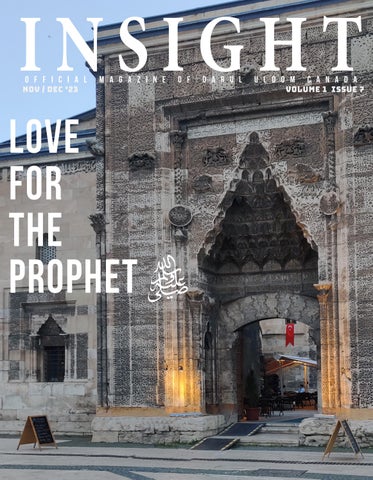
28 about the cover
The Buruciye medrese in Sivas, Turkey was built in 1271 (AH 670) during the reign of Seljuk sultan Gıyaseddin Keyhüsrev III (r. 1265–1284. The architect was Muzaffer Burucerdi who hailed from Hamadan in western Iran. The donor is named as Muzaffer bin İbâdullah el-Mufaddal el-Burhcirdi whose tomb is situated near the entrance of the medrese.
CONTENTS 06
o Pr
p
t he
16 t e d
s b ill
e
p de
o
l pu
a
18 28
n he h g o i w i l n s rt i o a t o rss Opo v e f esyd a r e e e h te h L tp kn 15 p i r a a a r o is e D Pr o p u l d e en S rom a d P n F et ’a n r a ren u Q w t3 e a is ? r t h a e t t l p Fa h a s i b l e c in uzu h W is k i rds t n y b m a a wo roo r h s A er e y n h th r t m a o n Le h a t f r o m o s w ve n o i r ti c e l f Re t
06
34
34
L
Patron Hazrat Dr. Ismail Memon
EDITORIAL
ove for the Prophet s is the bedrock of our faith and the impetus behind our adherence to His sunna. The more we know him, the more our love increases for him which facilitates adherence to the sunna. Mufti Borhanuddin covers this topic in his article Love for the Prophet.
M. Dr. Mateen in the sixth part of his series on the Prophet s speaks of the beginning of prophethood and how Khadijah j accepted his call while his uncle, Abu Talib, supported the Prophet s to his last breathe but never accepted Islam. His role as an ardent supporter of the Islamic cause did not end with his life. We see many non-Muslims today standing up for the truth at the cost of loss of jobs and ostracization. Their humanity refuses to remain silent in the face of persecution of a people who are our brothers in faith and their brothers in humanity. The spirit of Abu Talib runs in their veins compelling them to resistance against false propaganda and to stand for the truth despite the disbelief in their hearts. We need to pray for their guidance and that Allah bless them with Islam. But if the spirit of Abu Talib lives on to our times, than the spirit of Khadijah too must be alive in our troubling times. May Allah give us the taufeeq to imbue her spirit and support the mission of our beloved Prophet s.
4
INSIGHT MAGAZINE
Fatawa Mufti Husain Ahmad Badri
Contributors Mufti Omar Baig M. Dawud Alcox Maulana Dr. Mateen Khan Dr. Kamran Karatela Maulana Muneeb Tahir Uthmani M. Zubair Ahmad M. Bakhtiyar Ahmad M. Ahmad Amin Abu Saalem
Editor Asim Ahmad
Photo “The Prophet’s Mosque at night, Madinah, Saudi Arabia by Prof. Mortel is licensed under CC BY 2.0. Phone 519 360 1028 E-mail office@ducanada.org Website www.ducanada.org Address 51 Prince St. N, Chatham, ON N7M 4J7, Canada The views expressed in the columns of Insight magazine do not necessarily represent those of Darul Uloom Canada. The articles published in this magazine may be reproduced with due acknowledgment.
The sign of a brave man
This is something to remember: a brave man will always be compassionate while a coward always cruel. Look at the Turks. They are the bravest of nations and are compassionate and have empathy… suicide is also an indication of cowardice. Only he who is flimsy will contemplate suicide. He cannot handle hardship…Allah Himself has taken charge to hold a suicide accountable maybe because he is excused in the eyes of Allah. Who knows what he was going through and how he could not cope with it. Only Allah has knowledge of all things. Sawad A‘zam [Great Mass]
Today, everyone is about democracy [as a political thought) and decrying autocracy. [it is due to the prevalence [of this political thought] that some [of our own] suggest that wherever the majority is, that is the sawad a‘zam 1… even if we accept this premise, it doesn’t mean that the sawad a‘zam is defined by the majority of an era, but by the Khayr al-Qurun (Golden Era; era of the Prophet a, Sahaba, Tabi‘een and Taba tabi‘een), in which righteousness and piety was predominant. Whichever side the majority stood with in that era is the sawad a‘zam 1. Sawad a‘zam or the Great Mass is a prophetic term to describe the collective integrity of this umma and its innate inability to be united on deviation. He explained that when the Umma falls into disputes and dissolution, they should hold to the sawad a‘zam (Ibn Maja). In another hadith about the 73 sects, he states that they all will enter the Hellfire except the sawad a‘zam (al-Sunan al-Kubra).
OUR AKABIR
and not the period that followed it when “lies will prevail” (Ahmad). This last part of the hadith clearly proves that falsehood will prevail after the Khayr al-Qurun [then how can we consider the majority of every time as the sawad a‘zam). Some may raise the objection that Imam Abu Hanifa sometimes held a different opinion from the sawad a‘zam. The answer to that is that the majority did not impute falsehood to Imam Abu Hanifa either. In fact, they considered the possibility of Imam Abu Hanifa being on haqq, which means that the sawad a‘zam held a consensus upon the possibility of his being right. The importance of willpower
Nothing is difficult if one has the willpower to do it. The willpower [to do good] is borne out of sitting in the company of the pious; and by sitting in their company, I don’t mean that you cut off from your family, resign from your job, and farming your land and dedicate the rest of your life to sitting in his company. What I mean is that visit him as often as your schedule allows and keep him updated him via correspondence of your condition. Whatever he advises, act upon it, and if Allah wills, this will develop the [necessary] willpower [to do good and achieve closeness to Allah]. - taken from Malfoozat of Hazrat Maulana Ashraf Ali Thanawi
INSIGHT MAGAZINE
5
love for the prophet s by Mufti Borhanuddin
6
INSIGHT MAGAZINE
I
n the darkest moment of human civilization, Allah raised our Prophet Muhammad Rasulullah a. He made him a beacon of light to guide man out of the darkness to His light. He chose him from the best of people, the best of places, and chose his era to be the best of times.
Allah endowed him with the qualities that raised him above all of mankind and inscribed them for eternity in the Quran. Praising his intellect and reasoning (‘aql), He says, “Your fellow has neither missed the way, nor did he deviate.”1 His character and excellent conduct
(akhlaq): “And you are surely on an excellent standard of character.”2 His forbearance and perseverance: “For the believers he is very kind, very merciful.”3 His knowledge and wisdom: “It is taught to him by one (angel) of strong faculties.”4 His honesty and truthfulness: “He does not speak out of (his own) desire.”5 His heart: “Have We not caused your bosom to be wide open for you?”6 2. 68:4 3. 9:128 4. 53:5 5. 53:3 6. 94:1
1. 53:2
INSIGHT MAGAZINE
7
His comprehension: “The heart did not err in what he saw.”7 Allah even goes as far as to mention two parts of his blessed body: “The eye neither went wrong, nor did it exceed the limit.”8 “That had (almost) broken your back”9 And his voice: “Do not raise your voices above the voice of the Prophet”10 Others are instructed on how to address him: “Do not take the call of the Messenger among you as a call of one of you to another.”11 Even when Allah swears to avenge the transgressors, He does not forget the Prophet a and says, “I swear by your Lord (O Muhammad)!”12 And when He mentions the extent to which the sinners had gone to justify the eternal punishment, He swears, I swear by your life (O Muhammad)!”13 When He promises to please him, “And of course, your Lord will give you so much that you will be pleased.”14 Finally, all of His love for the Beloved a is embodied in, “And We raised high your name.”15 Be it adhan, dua, or the articles of faith, the name of the Beloved a is proclaimed alongside the name of his Lord, Most High. 7. 53:11 8. 53:7 9. 94:3 10. 49:2 11. 24:63 12. 19:68 13. 15:72 14. 93:5 15. 94:4 8
INSIGHT MAGAZINE
None is a[true] b his father, his ch Muhammad Rasulullah a where they will finally gain the coolness of their eyes. He will relieve them of their fears and tension. He will fall into sajda and stay in sajda for as long as Allah wills. Then Allah will give him the order and he will raise his head. All of mankind will be indebted to our Beloved Master a on that Day.16 “O prophet, We have sent you as a witness and as a bearer of good news and a warner, And as the one who calls (people) towards Allah with His permission, and as a luminous lamp.”17
An individual with extraordinary qualities is loved and revered by all. The love and respect we owe to Rasulullah a is a necessary and logical result of the innumerable favors Allah has endowed upon him. He is most worthy of respect and veneration, and a perfect role model for every aspect of human life can be found in his Seerah. All of this results in a deep appreciation and love of such a blessed being. Allah has made love for Rasulullah a an integral part of our iman and equated love for the Prophet a to love for Allah Himself. He says: “Say, “If your fathers and your sons and your brothers and your spouses and your clan and the wealth you have earned and the trade you apprehend will recede and the homes you like are dearer to you than Allah and His Messenger and Jihad in His way, then, wait until Allah comes with His command. Allah 16. Sahih Muslim, 193 17. 33:45-6
believer until I am more beloved to him than hild, and all of mankind . (Bukhari)
Allah made him the best of His creation, the leader of all of the Prophets and the greatest source of intercession on the Day of Qiyamah. People will be in distress and will go from one prophet to another seeking their intercession to be relieved of the great weight that is about to break their back on that Day. They will first come to Adam e but he will be too worried for himself and will direct them to Nuh e. Nuh too will be overwhelmed by his fears and he will guide the intercessors to Ibrahim a. Ibrahim will point toward Musa e who will then direct them to Isa e. Isa will finally send them to
does not lead the sinning people to the right path.”18 Thus, one who does not have the love for the Prophet a is sinful, corrupt, weak of faith and deserving of the wrath of Allah. Rasulullah a further explained, “I swear by the One who has my life in His hand, none of you can attain (proper) faith until I become more beloved to him than his parents, children [and all of Mankind]”19 Umar g narrates that he once said to the Prophet a, “O Rasulullah! You are more beloved to me than everything but my own life.” Rasulullah a said, “No, I swear by Allah, not until I am more beloved to you than your own life!”. Umar g then said, “Now, I swear by Allah, you are more beloved to me than my own life.” Nabi a announced, “Now, O Umar, now [you have attained proper faith].”20 The Sahaba of Rasulullah a, may Allah be pleased with every one of them, exemplified true love for the Prophet a and its manifestations once it penetrates the heart. We read in countless hadith that Sahabah l would address Nabi a, they would begin with, “My father and mother be sacrificed for you, O Rasulullah!” On the Day of Uhud, Rasulullah a found himself alone at one point. Talha g came in 18. 9:24 19. Sahih al-Bukhari, 14 20. Sahih al-Bukhari, 6257
INSIGHT MAGAZINE
9
front to shield him from the blows of the enemy. Talha gwas an expert archer with a remarkable aim. He would shoot his arrow at the enemy and Rasulullah a would peek to see if it hit the target. Talha g saw this and exclaimed, “Don’t do that Rasulullah! The enemy’s arrows may strike you. My life for your life O Rasulullah!”21 Some of the Tabieen narrate that they the saw the hand of Talha g paralyzed from the arrows he intercepted to defend Rasulullah a on the Day of Uhud.22 On the Day of Hunayn, Rasulullah a distributed large amounts of spoils to the leaders of the newly-converted Quraish who had accepted during or after the Conquest of Makka. Some young Ansari Sahabah commented, “Allah forgive his Messenger a! He’s giving to Quraysh and leaving us out, yet our swords are still dripping from their blood!” 21. Sahih al-Bukhari, 3600 22. Sahih al-Bukhari, 3836
10
INSIGHT MAGAZINE
Rasulullah a heard this and gathered all of the Ansar in one place and addressed them, “I am giving [this wealth] to new Muslims. Are you not pleased with the fact that people will return to their homes with wealth (cows, camels, goats, etc.) and you will return to your home with Rasulullah? By Allah, what you will return with is much better than what they will return with!” They all proclaimed, “We are happy with that, O Rasulullah!”23 Zaid ibn Dathina g was captured by the pagans and executed. When he was brought forward for execution, Abu Sufyan (who was not a Muslim at the time) asked, “Zaid, for sake of Allah, would you like to have Muhammad in your place right now, while you are safely 23. Sahih al-Bukhari, 2978
with the family?” Zaid g retorted, “I swear by Allah! I would not like to even see Muhammad pricked by a thorn wherever he may be right now while I sit safe and calm with my family!” Abu Sufyan was dumbfounded. He exclaimed, “I never saw anyone love a person like the companions of Muhammad love Muhammad!”24 Love for Rasulullah a is an ibada, a means of gaining closeness to Allah and an act of obedience. Every ibada must be performed with complete sincerity (ikhlas) and in accordance with the laws and limits set by the Sharia. Rasulullah a clearly defined these limits and said, “Do not exaggerate about me as the Christians did with Isa ibn Maryam. I am only His servant. So say, ‘the servant of Allah and His messenger’.25 Love for someone is manifested in actions. The deeper the love, the stronger the commitment to the person they love. If love truly exists in the heart, it will burst through the seams of the tangible and pervade every aspect of life. It calls for certain expressions, appropriate to the context of the beloved. Love for Rasulullah a invokes the kind of physical expositions that we saw from the Sahabah. Beyond the sacrifices of life and wealth, the love for Rasulullah a is proven in a number of ways within the bounds of the Sharia.
emulation. When people love a celebrity, they look to wear clothes like them, walk like them, talk like them, and even get a haircut like them! Our biggest celebrity is Rasulullah a. He was sent as an example for us to follow. “There is indeed a good model for you in the Messenger of Allah - for the one who has hope in Allah and the Last Day,”26 Following the Sunnah of Rasulullah a is a command of Allah: “And whatever the Messenger gives you, take it, and whatever he forbids you from, abstain (from it).”27 Further, Allah declares obedience to Rasulullah a obedience to Him. “Whoever obeys the Messenger obeys Allah.”28 Allah even makes adherence to the Sunnah the yardstick for gauging whether we have true love for Him. “Say (O Prophet): ‘If you really love Allah, then follow me, and Allah shall love you and forgive 26. 33:21 27.59:7 28. 4:80
Follow the Sunnah. The biggest sign of love is 24. Usdul Ghabah, 2/357 25. Sahih al-Bukhari, 3261
INSIGHT MAGAZINE
11
you your sins. Allah is Most-Forgiving, Very-Merciful.’”29 Send salawat (salutations) upon him excessively. Rasulullah a explained, “The closest people to me on the Day of Qiyama will be the ones who send the most salawat upon me.”30 Desire to see him at any cost. Rasulullah a said, “Among the people who have the strongest love for me from my Ummah, those who will come after me and will wish to see me, be it at the cost of their family and wealth.”31 Avoid excessiveness in regards to Rasulullah. As Nabi a explained, “Do not exaggerate about me as the Christians did about Isa ibn Maryam. I am only his servant. So say, ‘the 29. Surah Aal-Imran, 31 30. Sunan Tirmizhi, 484 31. Sahih Muslim, 2832
servant of Allah and His messenger’.32
Nusrah: Defend him and spread his Sunnah. Allah declared, “Indeed, We have sent you (O prophet,) as a witness and as a bearer of good news and as a warner, so that you (O people,) believe in Allah and His Messenger, and support him and revere him, and 32. Sahih al-Bukhari, 3261
pronounce His (Allah’s) purity morning and evening.”33 Learn his Seerah. It is not possible to love someone without knowing them properly. Animals recognized Rasulullah a and showed him reverence. Even trees expressed their love for Rasulullah a when permitted by Allah. A tree the Nabi a leaned on while addressing the Muslims began to sob uncontrollably. Camels raced against each other to be the first to be slaughtered by him and be honored to be his sacrifice. Stones gave salam to him. Mt. Uhud shook out of love for him when he came upon it. Clouds split for him and rushed to give him shade. Even the moon split into two with the gesture of his fingers. But the tragedy of our time is that the same people for whom he spent nights in sajdah and tears on, do not try to learn about him, much less love and revere him. “Or did they not recognize their messenger and therefore they denied him?”34
33. 48:8-9 34. 23:69
LEARN ARABIC
nazla nuzala
the semen of a fahl (male of any species), which is ejaculated (yunzilu) through the urethra.
like zukam is an apt description a runny nose.
al-nuzul
manzila
means to descend/ dismount: it is the root for an array of derived stems and source words, many of which are found in the Qur’an.
manzil
dhu nazl
means status or rank. People are either relegated or lose status and thus the word manzila. is a way station, rest area, or a home where someone stops and rests or settles whether temporarily or pernamently.
nazila
a disaster/ catastrophe that befalls a people, region. The plural is nawazil.
a generous and bountiful man who gives in abumdance to good causes.
nazeel/nuzl
nazeel is another name for a guest since he descends upon the house of the host. Nuzl is the food prepared to honor the guest.
nazzala/anzala
nazzala means to reveal in portions/ increments while anzala is to reveal at once. This is why nazzala is used for revelation of Qur’an while anzala for the previous scriptures since the Qur’an was revealed a little at a time while the Torah was revealed in one go: nazzala ‘alayka al-kitāba bil haqqi muüaddiqal limā bayna yadayhi wa anzalat taurāta wal injõl; (3:3); He has sent down upon you, the Book in truth, confirming what was before it. And He revealed the Torah and the Gospel.
Al-NUZULE Al-NUZULE Al-NUZULE Al-NUZULE Al-NUZULE Al-NUZULE Al-NUZULE
Prophesy
One of the signs of the Hour is that rural, unpopulated a the populated areas will be laid waste and ruined. In an lated city will be laid waste and will be repopulated in a 16
INSIGHT MAGAZINE
The city of Baltimore has over 20,000 vacant row houses and 300,000 fewer residents than at its peak.1 Reason? Suburbanization and urban sprawl. 1. https://ggwash.org/view/40638/baltimores-problem-is-sprawl-not-a-bad-economy
Baltimore, MD and suburb [Parkville, MD]
areas will be populated and nother narration: the popua different place. [Tabarani and Ibn Asakir] INSIGHT MAGAZINE
17
Seerah
Chapter Six:
Darkness &
18
INSIGHT MAGAZINE
& Light by M. Dr. Mateen Khan
INSIGHT MAGAZINE
19
B
araka’s eyes smiled as if to exclaim, “I knew it!” Her foster son, whom she so adored, now a man of forty years, informed her that he was a Prophet of Allah. Of course, she accepted it immediately and wholeheartedly, for she had witnessed his perfect character and extraordinary events for years. She was not alone. Those who lived with the Prophet s and knew him best finally had an explanation for his distinctive aura. The first to accept his Messengership was his support Sayyida Khadija, his ward and cousin Sayyiduna ‘Ali, the Prophet’s beloved free slave Zayd ibn Haritha, and his precious daughters Zaynab, Umm Kulthum, Ruqayya, and Fatima (may Allah be pleased with them all). They made up the core family that formed
20
INSIGHT MAGAZINE
the nucleus of Islam’s beginnings; the spark that would ignite human reformation. When people live in darkness for some time, they become accustomed to it. Therefore, the nur (light) of guidance was introduced slowly as Allah the Exalted at first commanded the Prophet a to approach those close to him, “O you, enveloped in a cloak, stand up and warn, and pronounce the greatness of your Lord.” (13) For some, the nur lightens the soul, brings warmth, and gives sight to their surroundings. They rub their eyes momentarily and then enter its embrace. Others, however, find the light disconcerting as they wince their faces, close their eyes, and raise their arms to block its rays.
The Light
Sayyiduna Abu Bakr exemplified the first group, those who were instantly drawn to the light of the prophetic message. In the words of the Prophet
INSIGHT MAGAZINE
21
22
INSIGHT MAGAZINE
INSIGHT MAGAZINE
23
a, “Every single person I invited to Islam stumbled, hesitated, and considered the matter, except for Abu Bakr.” He was an intelligent, gifted nobleman sought after and respected by the rich and poor, the young and old, commoner and tribe leader among the Quraysh of Makkah. He had long been a good friend of the Prophet a, and he immediately set to the magnanimous task of spreading the nur his friend was given. His personal calling illuminated many souls and led to the conversion of Uthman ibn ‘Affan, ‘Abd alRaḥman ibn ‘Awf, Saʻd ibn ‘Abi Waqqas, Zubayr ibn al-‘Awwam, and Talha ibn ‘Ubaydulla. Islam spread quickly throughout the town among those with hearts like yearning receptacles. Abu Bakr’s sincerity with Islam’s clarity caused many individuals from different tribes and areas to change their ways. They would meet quietly and ponder over Revelation in the House of Arqam. Thus, the homes of the Prophet, Abu Bakr, Arqam, and others were like lanterns in a moonless night. With rays upon rays emanating from these lanterns, the enlightenment of Makka’s darkness began in secret. The proclamation was straightforward: There is but one God, and Muhammad is His Prophet. Submit to your Creator with proper belief and practice what you have been commanded from good and refrain from evil. It was refreshing and harkened back to the pure religion of their patriarch, Sayyiduna Ibrahim. Humanity was experiencing an awakening with the Prophet a guiding them gently by the hand. As nur started piercing through the darkness, quiet preaching could no longer
24
INSIGHT MAGAZINE
contain it. Thus, Allah the Exalted commanded, “Warn the nearest people of your clan and be kind with humbleness to the Believers who followed you. If [your clan] disobey you, then say, ‘I am not responsible for what you do.’” (26:214-216) Obeying his Lord, the Prophet a stood immediately atop Mount Safa and faced the members of Quraysh. As a Prophet, he had knowledge of things unseen. As vividly as they saw him atop the Mount, he saw the Day of Judgement and Jahannam crouched in anticipation. His divine task was to warn them. However, history has shown us that darkness often rises when light rises. When the Prophet a presented the nur of guidance to his
clan, his own uncle Abu Lahab was the first to oppose him. From that moment and place, one a would spread the message to the entirety of mankind while the other fought it with closed eyes and raised arms.
The Darkness
The nature of oppression is cowardice. The Makkan oppressors were no exception. They descended with brass brutality upon the brittle and vulnerable among the Muslims. With a defiant word, Bilal, the African slave, was made to burn atop the summer sand and below a crushing boulder, while Khabbab ibn al-Aratt was scarred by fire. Sumayya gave her life to her Lord while her family and her Prophet a
were made to watch her trauma. Musʻab ibn ‘Umayr was stripped of his health and wealth until only his Islam remained. ‘Uthman ibn Maẓ’un lost an eye for his religion, and Khalid ibn Saʻid suffered beatings, dehydration, and starvation at his father’s hands. Abu Bakr endured multiple attacks. After one particular beating while his mother agonizingly gazed, Abu Bakr laid at death’s door concerned only about his friend. One after another, the Companions sacrificed themselves for nothing more than the pleasure of their Lord and the company of His Messenger a. May Allah the Exalted be pleased with them all! The Prophet a remained protected by
INSIGHT MAGAZINE
25
Abu Ṭalib’s tribal influence, but not due to the Quraysh’s lack of trying. At their behest, Abu Ṭalib approached his beloved nephew and asked him to desist from his message. With tears streaming from heart and eyes, the Prophet aoffered this reply, “O my uncle, by Allah, if they were to place the sun in my right hand and the moon in my left, and ask me to abandon this course, I would not turn from it until Allah makes it victorious or I perish therein.” So powerful was his stance that Abu Ṭalib reflected his nephew’s commitment with a promise to protect him until his last day. Not to be deterred, the Quraysh then turned to propaganda and spread lies about him a. They announced he was a soothsayer, insane, a possessed poet, and a magician. Yet the people realized that only the title of Prophet applied, and they continued to enter Islam in droves. In defeated desperation, they turned towards physical persecution. Abu Jahl threatened the Prophet a repeatedly until one day, while the Prophet was prostrating beside the Kaʻba, he had the innards of a camel placed upon him. At other times, they attacked him, set thorns on his path, poured filth at his door, and constantly barraged him verbally. In the darkness of these nights, Allah the Exalted would, at times, alight a new star for the Muslims. Stars like the Prophet’s a uncle
26
INSIGHT MAGAZINE
and brave warrior Ḥamza and the Qurayshi noble and man of principle ‘Umar ibn alKhattab entered Islam at crucial moments. With these two, the Companions of the Prophet a grew bolder and proclaimed their Islam openly. However, it was not yet time for daybreak. During this time, some of the Companions fled to Abyssinia, seeking solace from the Makkan sorrow. The Quraysh pursued them even there. The world, despite its enormity, could not contain their malice. The Christian ruler Negus protected the Muslims during their stay as honorable guests to an honorable host. However, the Quraysh would ratchet their rancor another rung for the Muslims that remained in Makkah. In the seventh year of the Prophet’s messengership, they decreed collective punishment on the tribes
of Banu Hashim and Banu ‘Abd al-Muṭṭalib. They banished the two tribes along with the Prophet a and his family to a valley, and in a document hung from the Kaʻba, forbade intermarriage and trade with them. The boycott was brutally enforced until survival became the only goal. The people ate leaves while the cries of children went unanswered. As if the night was not dark enough, they were now plunged into the depths of the ocean, wave upon wave.
their wives genuinely feel. Her enduring loyalty was matched only by his love for her. She, too, passed soon thereafter as another victim of the boycott. He would remember her through the rest of his prophetic mission. This was the Year of Sorrow which left our dear Prophet a empty and exposed, internally and externally.
The Year of Grief
Throughout all this, the Prophet a his Companions, and Islam persevered. The truth remained a lighthouse at sea, guiding those lost in the darkness. After three years of the boycott, a divine intervention disintegrated the document and ended the blockade. However, it was not without consequences. Abu Ṭalib persisted in his promise of protecting the Prophet a despite a crippling price to himself. He accepted everything on behalf of his nephew except one thing. Soon after the boycott, Abu Ṭalib passed away, not having accepted his a prophethood. This was a heavy lesson on humility and dependency that surely weighed on the Prophet a and the ummah. A man may embody every good trait and even have earned the love of a Prophet, but still, the matter belongs to Allah the Exalted. “You cannot give guidance to whomsoever you wish, but Allah gives guidance to whomsoever He wills, and He best knows the ones who are on the right path.” (28: 56) Sayyida Khadija stood by the Prophet athrough everything. Messengers endure a life of difficulty that perhaps only INSIGHT MAGAZINE
27
f ata w a
Q: Is it permissible to eat cheese that contains rennet?
A: There are four types of rennet: • vegetable/plant • microbial • fermentation-based • and animal. Vegetable/plant rennet is made fro chokes, nettles, thistles, and dried al rennet uses molds or fungi that c agulating power as animal rennet. is genetically modified bacterium, produces rennet enzymes through them coagulating properties.
Cheesemaker pouring rennet in copper pot to make cheese.
28
INSIGHT MAGAZINE
om plants like artid caper leaves. Microbicontains the same co. Fermentation-based fungi, or yeast that h fermentation giving
Animal rennet is obtained from the stomach lining, or mucosa, of a ruminant’s abomasum. This is one of the four stomach chambers that ruminants have. The main enzyme in animal rennet, chymosin, causes the casein proteins in milk to stick together and form a solid curd while releasing moisture (whey) and trapping the fats and minerals from the milk that are essential for making cheese. Over 90% of commercially-made cheeses in North America are now produced using fermentation-produced chymosin, plant or microbial as opposed to animal rennet. Some molds too naturally produce enzymes that can be used for curdling milk, though these are not used as commonly. There is a consensus amongst the scholars that the following types of rennet are halal: vegetable/plant, microbial, and fermentation-based. As for animal rennet, there are three scenarios: If the rennet originates from pig/swine, it will be impermissible to consume. If the animal was slaughtered in accordance to the Shari‘a, then the consensus is that it will be permissible to consume. There is a difference of opinion in regards to rennet derived from a halal animal that is not slaughtered in accordance to the Shari‘a, but the preferred opinion (Imam Abu Hanifa) is that it will be permissible to consume. In relation to the third scenario, the modern method under question filters the solution using thousands of litres of water during production, purifies the by-product (rennet), resulting in a rennet that does not contain any tissues/remnants from the animal’s stomach. Consequently, the final product would be considered pure and halal to consume. Therefore, it will be permissible to consume cheese that contains rennet other than that which is derived from pig/ swine. Q. What is the ruling for getting or donating INSIGHT MAGAZINE
29
for a transplant in Islam?
A. From the outset, transplants can be classified into four categories: (1) The use of prostheses (an artificial body part) such as a leg, heart, or dentures. This is permissible according to all scholars as long as it is derived from a lawful source. However, in case of necessity, prostheses from an unlawful source would also be permitted as stated in hadith, “Abdur Rahman ibn Tarafah said that his grandfather Arfajah ibn As’ad g who nose was cut off in the battle of al-Kulab had a silver nose implanted, but it started to smell so the Prophet s ordered him to get a gold nose” (Abu Dawud). (2) Xenotransplanta-
tion: The transplantation of animal organs and tissue. The jurists have agreed that this is also permissible with the condition that the animal organ is pure. Impure organs and tissues are not permitted for use unless there are no permissible alternatives. (3) Autotransplantation: The transplantation of organs or tissues from one part of the body to another in the same individual.
30
INSIGHT MAGAZINE
This is permitted provided that it is not done merely for beautification purposes. For example, if a woman suffers from premature balding, it would be permissible to transplant hair from one part of her body to the scalp to remove the defect. Similar examples can be found in classical books such as replanting one’s teeth, which the majority of scholars have permitted. (4) Homotransplantation: The transplantation of an organ or tissue from one individual into another of the same species. The ulama have written on the subject of organ transplant at great length. The majority of scholars have not permitted this type of organ transplantation with the exception of blood. Donating and transfusing blood would be permissible under dire situations i.e., severe loss of blood. As for other types of organ transplantation such as kidney trans(A) There is a high probability of recovery through organ transplantation. (B) The only treatment is organ transplantation. (C) The donor’s life is not endangered by donating the organ. Therefore, donating a vital organ which equates to destroying one’s life, would be prohibited. (D) The donor gives the organ of his own free will. idelines and conditions as follows:
(E) Selling one’s organ under any circumstance is not permitted. To conclude, there are both views from reliable scholars regarding the transplanting of an organ from one person to the other. Nonetheless, if there is an imminent fear of loss of life or danger of losing an organ, one may adopt the opinion of permissibility. Q: Zaid skipped sehri and woke up for work at 8am in the morning. He then decided to fast an optional fast for the rest of the day. Would such a fast be valid?
In principle, a person can make intention for a wajib mu‘ayyan (specified), sunnah, nafl, or Ramadan fasts any time before midday. A wajib mu‘ayyan fast is when a person vows to keep a fast on a specific day or date for the sake of Allah. The sunnah fasts are those which the Prophet s kept and encouraged others to keep, for example, fasting on the 9th and 10th of Muharram. The hours of midday are calculated from su-
bah sadiq (true dawn) to sunset. For example, if subah sadiq is at 5:30am and sunset is at 7:30pm, the intention for fasting can be made any time before 12:30pm. Since Zaid has made the intention to fast before midday, the fast will be valid. Q: Zaid invited a group of 10-15 people for a meeting an hour before prayer time. When the meeting finished, the prayer (in the masjid) was already over. If the group of people are not able to pray in one room (due to lack of space or any other reasoning), would it be permissible for the muqtadis to pray in two separate rooms?
In principle, a person should join the salah in a row which is closer to the imam and should refrain from leaving any gaps between the rows. However, the jurists have deemed a salah to be valid even if there is a gap between the muqtadis as long the salah is prayed in “one area” and the position of the imam is known. An example of a place
INSIGHT MAGAZINE
31
which is considered “one area” is a masjid or a house smaller than 40x40 dhira’ (which is equivalent to 3,600 square feet). Thus, if Zaid is leading the salah in such a house which is smaller than 3,600 square feet and the position of the imam is known to the muqtadis, the salah of the muqtadis will be valid. However, one should refrain from leaving any gaps (in between the sufuf) or praying in two separate rooms without valid reasoning as doing so will be makruh (tahrimi). Q: Are the halal meals offered by interna-
tional airlines permissible to consume?
32
INSIGHT MAGAZINE
Shari’ah emphasizes exercising caution in ensuring the food one is consuming is halal. A person cannot be certain about the meals offered on international flights being halal as we do not know the halal standards in different parts of the world. When one is unsure if the meals served on international flights are halal, he should abstain from them altogether.
When one is unsure if the meals served on international flights are halal, he should abstain from them altogether.
ْا ل ََّل ُُه ََّم ِإ ََّنا ََن ْْج ََع ُُل ََك ِف ي ُُن ُُحوِرِهْم ِِ ِ ُ ِ ُ ُ ََ ْوُذ ِب ََك ِم ْْن ُش ُُرو ِرِهْم ِ ِ َوَنُع ِِ O Allah, we put You face -to-face against them and we seek refuge in You from their evils. [Abu Dawud]
Du’a when facing a powerful enemy. INSIGHT MAGAZINE
33
34
INSIGHT MAGAZINE
REFLECTIONS ON MY SHAYKH PART 3 Asim Ahmad
T
here was once a devout worshipper who spent his days and nights in the remembrance of Allah. Shaytan came to him and said, “The dhikr of Allah requires a level of forbearance you can never achieve. Tell me, you have done so much dhikr, what did you get out of it? You devoted so much time, beat your brains out but got nothing in return,
not even a receipt of acceptance. This worshipper returned home in despair. He went straight to bed and made the intention that he was not going to get up for tahajjud. The words echoed in his head over and over again: what did I get out of tahajjud and devoting my days to the dhikr of Allah. He made the intention and fell asleep. That night, an angel appeared in his dream. The angel asked, “Allah
INSIGHT MAGAZINE
35
hasn’t received anything from you on this night and is wondering why you don’t remember Him anymore.” The man replied, “I have done a lifetime of dhikr, but never received a reply. I call out to Him but receive no salam or even a token response. I eventually lost all hope and gave up.” In response, the angel says, “Don’t you know that you have already received your answer? If your dhikr of Allah was ill-received, you would never have been granted the taufeeq to say the Holy Name again. Look at the whole world out there? How many are there remembering and chanting His name? Only those whom We grant the permission. When We have granted you the taufeeq, you are able to say it day after day, and that is proof of Our pleasure. When I first read this story from the malfuzat of Hazrat Thanawi, I was reminded of my own Hazrat. I asked him this same question a few times over the years. I would often be overcome with the depressed feeling that I am doing dhikr and all these other daily dhikr prescriptions. Where is it taking me and what am I going to get out of it all. Hazrat would say that the fact that you have been granted the taufeeq to utter His name is in itself a great blessing upon you. Had he not given taufeeq, you would not remember Him and would have no inclination for doing dhikr. I think our main problem is instant gratification. We live in a world where
36
INSIGHT MAGAZINE
we get what we want at the touch of a button and have come to expect the same service from Allah as we do from our devices. As if they are comparable in any way. We have already been told: As for those who strive for Us, We will surely guide them to Our ways (29:69). We cannot get Allah without some sacrifice. Our Hazrat would say that the way to Allah is easier than ever now. With a little bit of effort one can achieve the level of ihsan. It wasn’t as easy for the Sahaba who surrendered their lives and wealth in His path and would still be rebuked for the slightest mistake. Now, we have it easy, but still some level of
INSIGHT MAGAZINE
37
sacrifice is required. And Allah is always with the patient ones.
Attire
My wife had bought me this stylish white jacket. It was a little splashy for my liking but I wore it. It made me stand out from the crowd and even got me a compliment or two. Being the vain person that I am, I started to like it more and more. I would wear it to taleem and Hazrat would see it, but he never said anything. Then a strange feeling started settling over me when I wore it in his presence. It was more, I would say, a feeling of uneasiness than anything else. As I mentioned earlier, he never said anything but the jacket somehow discomfited me in his presence. One day, I came to talk to him about something else but decided to ask him about my jacket. Did he feel it was okay for me to wear. He paused for a second, scanned it up and down and finally said that it was not the way of our Akabir. He went on to explain that the Akabir generally wore longer coats that reached to their knees or, in the least, below their hips. They were simple in design and logos were hidden on the inside. He said that that was the libas of the people of taqwa. Later, I told my father about what Hazrat had said and he narrated a story corroborating what Hazrat had said. He told me that Hakeem Akhtar sahib came in the 90’s to meet Hazrat. That weekend, my father drove to Buffalo to meet Hazrat and Hakim Akhtar sahib. He said that winter was coming and one of Hakim sahib’s students had sent a coat as a gift knowing Hakim sahib was ill-prepared for the winter. Hakim sahib opened the package and 38
INSIGHT MAGAZINE
out came an expensive brand-name coat. My father looked on as Hakim sahib tried it out. It was a perfect fit and looked handsome on him. The logo was displayed on the front. Hakim sahib asked my father what he thought. My father said it seemed to fit on him but asked if Hakim sahib was comfortable in it. Hakim sahib said he did, but after a few minutes, he pulled it off and said, “It is not the way of the Akabir.” My father never clarified what Hakim sahib meant but stitching together what Hazrat had said to me with the statement of Hakim sahib, I presume it had something to do with the standout logo and the fact that the coat, as expensive as it was, hung above the hip. In any case, I changed my wardrobe after Hazrat’s intimation and made sure every coat I bought hung well beyond my hips, was simple in design and did not advertise its brand on my coat. Another lesson I learned from Hakim sahib’s statement was the fastidious
nature of our recent elders in following the ways of their predecessors since their lives embodied, “As for the dress of taqwa, that is the best” (7:26). This takes me to my next point. Hazrat’s love for his shaykh Hazrat Shaykh Zakariyya was incomprehensible, at least to the modern mind. He would often reminisce about his shaykh, recount his times, habits and share memories of the things he said and did at every opportunity. Whenever I asked him about anything, Hazrat shaykh’s name would invariably pop up somewhere during the conversation. Hazrat had imbued the manners, mindset and ways of his shaykh in such a way that if any of us ever went back in time to meet Shaykh Hadith for the first time, it would be like we always knew him. Even in the smallest things, Hazrat adopted the ways of his shaykh. He would keep a handkerchief on him at all times. I learned that this was Hazrat Shaykh’s habit. After witr salat, Hazrat would recite subhan al-malik al-qudus slightly raising the pitch of his voice and stretching the end longer than
usual. That too he took from Hazrat Shaykh. One of the projects I was working on for my hajj book was a 3D illustration of Jannat al-Baqi and the many sahaba and elders buried in it. I knew Hazrat Shaykh and his shaykh, Maulana Khalil Ahmad Saharanpuri, had been buried in Jannat al-Baqi, but I wasn’t aware of the location. I did know that if I could locate Hazrat shaykh’s grave, it would be easy to locate his shaykh, Maulana Khalil Ahmad Saharanpuri’s grave, since our Hazrat told us numerous times that Hazrat Shaykh was buried near his own shaykh. So, I asked Hazrat if he knew where Hazrat Shaykh was buried and he said that he was there at the funeral. On a side note: Our Hazrat was Hazrat shaykh’s personal physician and attended to him in the last few weeks of his life before he passed away in Madina Munawwara. Hazrat also wrote a short booklet of these last moments. I brought out a map. He pointed to the exact location where he and his shaykh’s shaykh were buried. Once, I INSIGHT MAGAZINE
39
received the first consignment of the book, I made a special trip to meet Hazrat. The moment he received it, he asked, “Where is the illustration of the Jannat al-Baqi?” I opened up to the page and showed it to Hazrat. He asked where Hazrat Shaykh’s grave was and I showed him. He was very happy and then without another question, pointed to one corner and told me to put the copies there. And that was it. He didn’t care to see anything else in the book. Years ago, the issue came up of washing the hands before eating. Hazrat insisted that two sinks be installed on the north mezzanine of Masjid Zakariyya. This area was within the masjid boundary and a temporary “cafeteria” for the people in itikaf during Ramadan. He insisted that washing hands before eating was Sunna as this was the opinion of Hazrat Shaykh, and therefore two sinks must be installed for the mu’takifeen to wash their hands before they eat iftar. One of the resident scholars opposed Hazrat and cited the opinion of other Akabir, but Hazrat was final on the matter only because of Hazrat shaykh. The two sinks were installed. For years, Hazrat had observed his shaykh’s vigorous adherence to the Sunna combined with Hazrat shaykh’s authority in hadith and fiqh. All this facilitated a profound trust in his shaykh’s opinions and a deep-seated
40
INSIGHT MAGAZINE
love in Hazrat to follow his shaykh every step of his life.
Wife’s bay’a
It was the early 2000’s. My wife requested Hazrat to take her in bay’a. Hazrat agreed and unlike his usual habit, did not ask her to make istikhara. I believe this was because my wife was from the first batch of students to join the girls’ madrasa. There was a shortage of teachers at the time. She volunteered to help in fulfiling many of the duties of the madrasa and its daily upkeep. Hazrat would be very happy and send many dua’s to her for her volunteer work. As anyone who knows Hazrat, he would say that he felt a kinship with anyone who served the madrasa in any capacity like his own shaykh, Hazrat Shaykh Zakariyya [who also said of himself that he felt a special connection with anyone who served and supported Mazahirul Uloom - Aap Beti]. In my estimate, this is the reason why when I made the request on behalf of my wife for him to take her in bay’a’, not only did he agree, but also offered to come to our house for the ceremony. I was shocked but also extremely happy as was my family. She had prepared some dishes for him. I remember him calling me after Zuhr and saying that he would be coming in a few minutes. My house was directly in front of his. I looked out the window and saw him coming.
I opened the door and he excused himself saying that he would wrap things quickly as they had a special guest coming in from Toronto. My wife was waiting on the other side of the door. She held onto a shawl from one side while Hazrat held onto the other. He told her that he didn’t want her to repeat the words of bay’a loudly and then proceeded to say the words of baya. We offered Hazrat the dishes my wife had prepared for the occasion, but he refused. He wanted to keep it simple to set an example for the rest of us and to avoid the many bid’a that have accrued in other parts of the world in these ceremonies.
of my previous articles can ever do justice to him, but am nevertheless honored for having the opportunity to write about his honorable and blessed life.
I ask Allah to grant my Hazrat Jannat al-Firdaus. I don’t think this or any
INSIGHT MAGAZINE
41