INSIGHT O f f i c i a l
jan/ feb ’24
Seerah
M a g a z i n e
from Lows to Highs
o f
D a r u l
U l o o m
C A N A D A
Volume 2 Issue 1
22 28
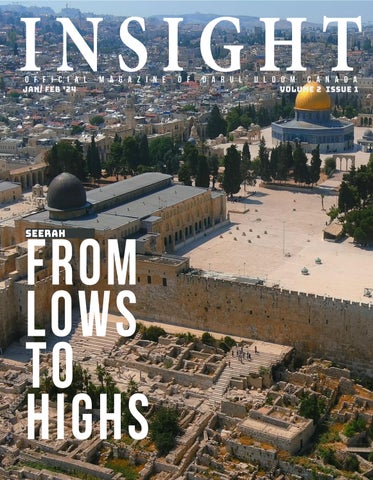
about the cover
An aerial view of Masjid Aqsa (foreground), the third holiest masjid in Islam and the f irst qibla of the believers until its abrogation 16 months after the Hijra. It is not to be confused with the Dome of the Rock, the golden-domed building, to the north of Masjid Aqsa.
CONTENTS 06
is
s ea
a 16 e s e
e e
a fo
m
on
th
14 28
ip lik h n ht s e o g d i ar li n ll b i i o h t y ms w s s Opf t e r s nd ne he usli A a k 12 p r s M a o er ahm D Pr hen p r e ro pa W e s S F w rge e a in n cha e, k w ri s dis a t t e Fam a g i n a l c h i t /s ty I g i i o l t a v ea aba n s r r to A : e s h e t ey rn r b m a a e my d Le l - d a ’s pens a r e o h t a a ya h f M y w an
32
ho
14
34
T
EDITORIAL
his issue includes a variety of articles. In My father’s death, Bint Ashfaq shares the poignant experience of her father’s death and how she was in denial though he was dying before her eyes. This is until she came upon an ayah, which lifted the veil and made her accept the reality of life. This is one of many reasons why people will not accept Islam. They wish to remain in denial about the realities. Even if their own belief is nonsensical, offers no solace, and brings no spiritual joy into their lives, it allows them to pursue their desires and be heedless of any impending fears of the future. In All is honor is from Allah, M. Waqqas Memon reminds us that honor and respect are not from within; they are granted by Allah, therefore, we should avoid seeking it anywhere else. He cites the example of Umar bin al-Khattab g when he came to Shaam to take the keys of Jersualem for the believers. Earlier, the Patriarch of Jerusalem had told the commander-in-chief, Abu Ubayda bin al-Jarrah g, that if the Ameer of the Muslims came to Jersualem, he will open the gate of the holy city and they all can be spared from loss of life on both sides. T. Islam understood the ayah, “With hardship is ease” in a whole new way. It personally guided her through the grueling stages of learning the Qa’ida to memorization of the Qur’an.
4
INSIGHT MAGAZINE
Patron Hazrat Dr. Ismail Memon Fatawa Mufti Husain Ahmad Badri Contributors Mufti Omar Baig Maulana Dr. Mateen Khan Dr. Kamran Karatela M. Zubair Ahmad M. Ahmad Amin Editor Asim Ahmad Photo Photo by Maximilian Bungart/-acouple-of-people-walking-along-abeach-next-to-the-ocean_Unsplash /p.18 Photo by Nick Fewings/sea-foamon-shoreline-after-storm/p. 16 Photo by Graham Well/ “Church of the Holy Sephulcre_licensed under CC BY-SA 2.0./ p. 36 Photo by Guilherme Rossi: brownmountains-in-close_Pexels.com/p Photo by Brett Sayles: rough-rockycliff-with-cracks-and-holes_Pexels/p. 19 Photo by: jakecolling/a-gloomyscorched-tree-in-darkness_Unsplash/ p. 22,23, 25 Phone 519 360 1028 E-mail office@ducanada.org Website www.ducanada.org Address 51 Prince St. N, Chatham, ON N7M 4J7, Canada The views expressed in the columns of Insight magazine do not necessarily represent those of Darul Uloom Canada. The articles published in this magazine may be reproduced with due acknowledgment.
INSIGHT MAGAZINE
5
AFTER
ان مع العسر يسرا
HARDSHIP
I
IS EASE BY T. ISLAM
realized the beauty of the Qur’an in Qur’an translation class, how each ayah was an actual wahi, containing a lesson and a story that we can all learn from in order to develop and strengthen our taqwa of Allah. Throughout my hifz (memorization of Qur’an) journey, I have had my fair share of ups and downs with my Qur’an. Setting the record for being in nazirah class (recitation of Qur’an from mus-haf) the longest wasn’t exactly easy for me. I struggled a lot. My little kid ego truly made me believe even before I started school that I would graduate from Darul Uloom in less than a year and become a television personality, ultimately graduating as a fluent hafiza. That was my vision as an eight-year older, and since no one wanted to break the truth to me, I went into Darul Uloom with that naïve intention, never imagining that my ego would come back to haunt me. I remember spending 3 months on the Qa’idah (elementary book for learning Arabic). I felt hopeless, as I was constantly failing my sabaq (homework). My teachers and parents were disappointed in me. It left a mark
continued on p. 8 6
INSIGHT MAGAZINE
on me, but with the grace of Allah, I somehow passed and went on to the Qur’an. I had no idea that nazirah of Qur’an would take me 10 times longer. I did qa’idah for 3 months, but still stuttered. I vividly remember crying one day. When my ustadah (female teacher) asked me what was wrong, I told her everything, and all she said was the ayah [which translates as] “Indeed, with hardship comes ease.” This ayah contains only four words and yet it wields so much power. The Prophet a received this ayah as a glad tiding, a reassurance that all of the challenges he was facing would eventually work to his advantage. It is revealed twice in the same surah, accentuating the fact that the Prophet a will overcome every obstacle with ease. It was a reminder to our Nabi a that he would eventually see the khayr in every adversity he faced. My ustadah further explained, “If this ayah gave inspiration to the Prophet a, then who are we?” Through this, I realized my ego got the better of me. Instead of paying attention to why I was here, I was focused on everything else. Shaytan was playing my nafs.This ayah brought me back down to earth, popping the bubble of delusions I was stuck in. From that day forward, every time I failed my sabaq, I kept telling myself, “Indeed, with hardship comes ease,” clinging on to it with all my might.
Too many talks, not enough sincerity Someone asked Hazrat (Maulana Qari Siddique Ahmad Bandhawi), “So many conventions and conferences and speeches and talks, but nor does anyone change nor does any change happen. Is it because the speakers themselves lack sincerity that their words are lost in the air?” He replied: This too is one of the reasons. If the speakers themselves are not practicing and sincere to the deen, then what effect can they have on others. But the majority of times the problem lies with the attendees because the effect of a talk corresponds to the level of sincerity, love, and devotion of the attendee to the deen. Unfortunately, the attendees don’t come with the intention to listen and then act upon what they learn. To sit and listen to a talk is a ritual. What effect is that going to have on anyone? The Prophet a too talked, counseled, and spread his mission [night and day], but the degree to which someone benefitted from his mission depended largely on their desire to learn and their openness to accept. Abu Jahl never accepted because he had no desire and he never listened with the intention to practice, while the Sahaba reached the highest ranks because they did. What is love for the deen?
There is a story about Hazrat Maulana Rasheed Ahmad Gangohi’s student who was strict upon his daily prescribed dhikr throughout his life. Near the end of his life, he once fell sick and his health deteriorated rapidly. The doctors advised him to stay in bed for 24 hours and warned him that any form of activity or movement could be his end. The problem was that tahajjud was his daily routine and he had never missed it his entire life. During this sickness, he was about to get up one night but his family and relatives forced him back to bed and insisted he must stay put and not make any movement. He was desperate and said, “Listen, let me pray tahajjud otherwise it will be the end of me!” This is what you call devotion to the deen that he feels like he is going to die if he doesn’t pray. Now, the situation is vice versa. We feel like dying if we pray two rak‘a, and from this we can measure
OUR AKABIR
what level of devotion and connection we have with the deen of Allah. Someone asked, “Hazrat, if anyone has violated our rights or they have hurt us a lot, should we forgive them or should we not with the intention that if we are in need of reward on the Final Day, we can collect his rewards for violating our rights to make it through. He replied, “It is better to forgive it because this forgiveness itself is such a reward that, if Allah wills, will outdo all the rewards you would collect from him stepping over your rights.”
Using others’ things without permission We see this a social norm today: people just taking others things and using them without permission whatever it may be, shoes, slippers etc. They pick up someone’s things without any compunction, whoever it may be, and start using it and then put it wherever they want once they are done with it. Do you think the blood that is produced from earnings gained from lying, betrayal, and stealing are going to produce nur in the heart? It will only increase darkness upon darkness! The person who looks for his own convenience at the expense of another’s anxiety and pain, will he ever be able to live this life in peace? Never! Such a person always struggles with anxiety and hardship. And how long is the earnings from stealing and perfidy going to last anyways? Such people are always made to go through difficulties and struggles throughout their life. Hazrat’s humility I {Muhammad Zayd Nadwi] stayed in a room next to Hazrat’s and saw him washing the guestroom bathrooms with his own hands. He urged me to do the same and said smiling, “To live in my neighborhood is not going to be easy,” and said, “Hazrat Maulana Husayn Ahmad Madani would clean the bathrooms of the guestrooms himself in the night, and no one would no the better; only then did he become Shaykh al-Islam Husayn Ahmad Madani.” - Malfuzat of Qari Siddique Ahmad Bandhawi
INSIGHT MAGAZINE
7
After two years of incessant failure, adversity, weakness, and disappointment, I finally saw the light at the end of the tunnel. I still remember the day I completed nazirah. Hugging my ustadhas, pulling my dad to the grocery shop to buy me a gift, and calling everyone in Bangladesh—even though it was midnight—just to let them know I overcame my biggest obstacle. It truly made me
feel like the happiest person alive and filled me with hope. The same ustadhah that motivated me and gave me the guidance I needed saw me and said, “Didn’t I tell you that, indeed, with hardship comes ease?” I still refer to this ayah whenever I’m facing difficulties, whether it is letting go of toxic individuals, battling for my iman, losing myself, or struggling to draw nearer to Allah. I tell myself, “With hardship comes ease.” The essence of
After two years of incessant failure, adversity, weakness, and disappointment, I finally saw the light at the end of the tunnel. 8
INSIGHT MAGAZINE
this ayah never fails to leave me filled with exuberance. Knowing that our Prophet a was reassured by this ayah despite the humiliation, pain, and persecutions he faced left me speechless. Even with hifz, I was struggling to memorize the Quran. I felt the cycle was repeating itself to the point where I was so deep in fitna that Shaytan convinced me and left me with no other choice but to give up, to leave hifz, and enroll in the secular system. I had completed 15 paras and remember being so scared to tell my mom how I was feeling. One day, while we’d been looking for parking for nearly an hour, I did it. I told her I wanted to leave hifz and go to high school to pursue my lifelong dream of becoming a doctor. When my mom heard this, she laughed and said to me, “I don’t know which Jinn possessed you, but as long as you’re under my roof, you’re not going anywhere.” When I came home, my dad went as far as buying a blood pressure monitor for me and then telling me to check my BP whenever I feel tense. The point is I was back to square one. I lost all my morals, this time depending on people, validating their opinion over those who truly cared for me. I realized I had dug a grave for myself, digging deeper and deeper with each passing day. My dad made me pray salat al-istikhara, which led me to this epiphany. I knew my iman was decreasing rapidly, and I was surrounded by hardships in every direction. My dad recited the same verse to me, inna ma‘ al-‘usri yusra. I realized that each time I derailed, this ayah brought me back on track. This ayah helped me through every route and exit I took, and I am convinced that this ayah enabled me to memorize the
INSIGHT MAGAZINE
9
Qur’an. It was this ayah that I began and concluded my hifz with. I’m constantly in awe of the ayah of the Qur’an. I feel more and more connected to it every time ustadhah teaches us in class, explains it, and draws numerous principles from a single ayah. I searched through my Qur’an translation for a single verse to use for my assignment, and came across numerous ayahs that altered my outlook on life in general. Before I came to the Islamic school, I had no idea what the Quran meant, but hearing the tafsir of each ayah inspires me and truly makes me want to be a better servant of Allah. I’ve learned a lot from this ayah, and I look forward to the day when ustadhah provides us with an even more comprehensive commentary of this ayah’s origins.
After two years of incessant failure, adversity, weakness, and disappointment, I finally saw the light at the end of the tunnel. 10
INSIGHT MAGAZINE
The Fathers and Sons of Deoband is a translation of an inspiring letter penned by the late erudite hadith master, Shaykh Muhammad Zakariyya, a few years before he passed away. Maulana Shahid, Shaykh Zakariyya’s grandson, asked him to explain why those associated with the scholars of Deoband are ever so loyal to their elders. More specifically, why do the scholars of Deoband (or those associated with them) evince this type of love only for their own elders? Furthermore, when a questionable statement or action is attributed to the elders of Deoband, it is always rebutted with interpretations. Yet, when others make such statements, they are not given the same benefit of the doubt. Why was that? The author brilliantly cites examples from the ahadith to show that the people who are known for their taqwa and being the friends of Allah are not measured by the same yardstick as everyone else. The reason we give the benefit of doubt to the scholars of Deoband is not merely due to our reverence for them. Instead, we do so because the senior scholars of Deoband were considered friends of Allah. Thus, we
would revere and grant the same benefit of the doubt with any pious person, whether they are from the scholars of Deoband or not. In Fathers and Sons of Deoband, Shaykh Zakariyya delves into the reasons behind this esteemed status of the Deoband elders. Each chapter breathes life and color into their noble characters, unveiling their unwavering commitment to following the sunnah of our beloved Prophet s. With meticulously organized stories, you will discover their exemplary dedication to prayer, fasting, giving zakah, performing hajj, and unwavering abstinence from doubtful matters. Unfortunately, most books written by the scholars of Deoband are not available in English. As for the few books that are, they are often poorly translated or translated in archaic English. The Fathers and Sons of Deoband is unique in that it is written by a world renowned scholars of Deoband, a muhaddith of his time, on high-quality paper with an easy-flowing English translation. Whether you are interested in reading inspiring stories of the pious or a brief introduction to the scholars of Deoband, The Fathers and Sons of Deoband is a must-read.
BOOK REVIEW
Title: The Fathers and Sons of Deoband Author: Shaykh al-hadith Muhammad Zakariyya Kandehlawi Translator: Asim Ahmad Pages: 140 Where to Buy? Mecca Books, Darul Hikmah Bookstore.
INSIGHT MAGAZINE
11
LEARN ARABIC
DARB
means to strike, beat or hit, but it does take idtirab other meanings that to be in a state of carry the same idea commotion, disturbance and conlike walking fast. fusion. When a When walking fast, person is unnerved you hit the ground by something as if harder with your feet. he has been struck This meaning is found by it, we say he is in the Qur’an. Allah mudtarib. This term says, “Who said about is also used in usul hadith for a hadith their brethren while that is weak because they travelled on the it conflicts with a earth [darabu fi al-ard] similar hadith ei(3:156). ther in the wording, chain of narrators, or the meaning.
darb
also means to mint a coin. A coin die [dye] is used to strike a coin and create an image on a blank metal. In the old days, the die was hammered to deform the image into the coin.
dareeba/ dara’ib don’t you feel the pain when you open your tax bill, bracing for the worst? Taxes are a beating to our being and our wallets. The Arabic language understands. The word for tax is dareeba.
dareeb
means head because it is the intersection of thoughts where there is constant commotion. The head is also where headaches happen when you are hit by stress.
AL -DARB BRAD- LA AL -DARB BRAD- LA AL -DARB BRAD- LA AL -DARB BRAD- LA AL -DARB BRAD- LA AL -DARB BRAD- LA AL -DARB BRAD- LA AL -DARB BRAD- LA AL -DARB BRAD- LA A L - D A R B BARLA- D DA- LRAB AL -DARB BRAD- LA AL -DARB BRAD- LA AL -DARB BRAD- LA
Seerah
From Lows to Highs Chapter 7
by M. Dr. Mateen Khan nlike the trials of the Muslims that Baraka j also endured, watching the heartbreak of the Prophet s when he lost both his beloved wife Khadijah j and Abu Talib uniquely wrenched her soul. She saw in his eyes the same orphan that who years ago lost his dear mother and protective grandfather. Sayyidah Khadijah was his support at home, whereas Abu Talib was his support outside. The latter’s passing without accepting Islam was crushing and a poignant reminder. Despite his immense love for the Prophet s and his tremendous support for the cause, he could not accept his nephew’s calling. Allah, the Exalted, informed the Prophet s that everything lies in His hands alone, “You cannot give guidance to whomsoever you wish, but Allah gives guidance to whomsoever He wills” ( 28:56). However, Allah, the Hakim, destined further formative events for His Messenger until only reliance upon Him remained in his heart and the hearts of his followers. Disbelievers, being authors of their own moral code, are skillful at dehumanizing those they disagree with and propagandizing the weak as oppressors. Both history and the present bear witness to it. Only the threat of a formidable
14
INSIGHT MAGAZINE
and influential figure can check their base impulses. Such was the role of Abu Talib. Once he passed, the disbelievers of Makkah let loose upon the helpless Muslims, including the Prophet s. By this time, many of the battered Muslims migrated to Abyssinia on the instruction of Allah and His Messenger s. For Allah said, “O My believing slaves, indeed My earth is spacious, so worship Me alone” (29:56), and the Prophet s said, “Perhaps you should go to the land of Abyssinia… until Allah provides you with relief from the situation you are presently in.” Included among the migrants were Sayyiduna ‘Uthman ibn ‘Affan, ‘Abd al-Rahman ibn ‘Awf, Zubayr ibn al-‘Awwam, and the Prophet’s s daughter Ruqayyah j. Unfortunately, those who remained and could not leave were increasingly brutalized. The Makkans escalated their merciless abuse by insulting and disparaging Allah’s Beloved s. The city that fostered him and the people that praised him had now resolved to harm him as Waraqa had forewarned a decade prior. Despite his
continued on p.18
Disbelievers, being authors of their own moral code, are skillful at dehumanizing those they disagree with and propagandizing the weak as oppressors. INSIGHT MAGAZINE
15
16
INSIGHT MAGAZINE
A time will come when nations will call each other upon you like people calling each other to a bowl [of food]...but you will be the foam [i.e., large in number] like the foam on the [surface of] a torrential flood (Abu Dawud).
INSIGHT MAGAZINE
17
In Masjid Aqsa’, he became the Imam to all Prophets, and they, Companions of his. Thereafter, he was elevated to heights that left angels behind until only his Lord and he remained. The lines between heaven and earth, the Arabs and mankind, and the seen and the unseen were blurred. tremendous love for the city of Makkah, he relented to traveling to Ta’if, hoping to find some solace and support there. Accompanied by Baraka’s husband and his mawla (freed slave), Zayd ibn Harithah, he met with the leaders of this land of lush foliage. Good people smile with open arms when an honorable man appears at their door, no less one who is broken and in need. Instead, the people of Ta’if threw a barrage of the ill-tempered against the two. Oppressors have a way of inciting the mob against victims just as hunters point out the prey to their dogs. Makkah was bad, but Ta’if was worse. After leaving the town bleeding, beaten, and exhausted, he took refuge in an orchard and raised his hands, beseeching Allah as only a true slave could do: “O Allah, to You, I complain of my weakness, my lack of resources and humiliation before the people. You are the Most Merciful, the Lord of the weak and my Master. To whom will You confide me? To one estranged, bearing ill will, or an enemy given power over me? If You are not angry with me, I care not, for Your favor is abundant for me. I seek refuge in the light of Your countenance by which all darkness is dispelled and every affair of this world and the next is
18
INSIGHT MAGAZINE
set right, lest Your anger should descend upon me or Your displeasure light upon me. I need only Your pleasure and satisfaction, for only You enabled me to do good and evade evil. There is no power and no might save in You.”
Comfort & Mercy
Even in dark times, Allah’s mercy abounds for all His creatures. The Quran continued descending upon the Messenger s and Muslims. As the Quraysh blocked people from guidance, many still found their way to it. Tufayl al-Dawsi stuffed his ears with cotton while standing next to the Ka‘bah. The most beautiful speech, i.e., the Quran, coming from the most perfect person, i.e., the Prophet s, resonated around him until it embraced his heart. Tufayl then embraced Islam and brought his entire tribe into its warmth. Not too far away, Abu Bakr set up a musalla in front of his house. The Quran flowed from his mouth as tears flowed from his eyes. People gathered by this stream of recitation and drank from its sweetness. In Abyssinia, the noble sacrifice of the Muslim migrants presented itself before their king, the Najashi. The mention of Sayyidah Maryam moved him to Islam. Years later, the Prophet a would lead a distant janazah
for him, one of the only times such an occurrence took place. Even cruel Ta’if wasn’t spared from His mercy. After his du‘a, the angel of the mountains flanking Ta’if presented himself before the Messenger s requesting permission to press the town into oblivion. He refused, hoping Allah would bring about people of tawhid from the tribe of Thaqif located therein. The acceptance of this request reached far out from the town. Not only would the town’s inhabitants accept Islam, but from among their descendants arose one that would bring it to the entire Indian Subcontinent. However, even these incidents were just a drop in the ocean of mercy that Allah would now awash the Messenger a and the Muslims.
The Journey & Ascension
To an outsider, and indeed to the disbelieving Arabs, the Prophet s appeared to be the lowest of the low, as they abused him and mocked him. However, one blessed night, Allah the Exalted placed him ahead of all the Prophets in worship to Allah, granted him unheard-of honors, and physically raised him to the highest of existent abodes.
“Glorious is He Who made his slave travel by night from al-Masjid al-Haram to al-Masjid al-Aqsa whose surroundings We have blessed so that We let him see some of Our signs.” (17:1). In Masjid Aqsa’, he became the Imam to all Prophets, and they, Companions of his. Thereafter, he was elevated to heights that left angels behind until only his Lord and he remained. The lines between heaven and earth, the Arabs and mankind, and the seen and the unseen were blurred. This was a journey no one had ever taken nor would ever take again. This was a meeting of the Lover and Beloved, for which time itself stood still as if holding its breath. So honored was he that even his followers were lavished the most precious of gifts. Allah, the Exalted, endowed the Muslims with five daily prayers – moments of divine intimacy – equivalent to fifty. From henceforth, each believer had a lifeline to transcend worldly boundaries and enter the courtyard of the Infinite. If trials are the cost of blessings, then the Prophet s is at once the most trialed and the most blessed. Through his sacrifice, we have been connected to our Creator. O Allah, send your highest blessings upon our beloved Muhammad!
INSIGHT MAGAZINE
19
20
INSIGHT MAGAZINE
INSIGHT MAGAZINE
21
My Father’s death: how an ayah opened my eyes to reality by Bint Ashfaq
22
INSIGHT MAGAZINE
December 2022:
The year ended on a sad note: my father was diagnosed with cancer, but in our hearts we knew , or at least thought, that he would win the battle..
January, 2023
My mother waited tensely at the doctor’s office for news to ease her anxiety. However, the doctor came out and informed her that her husband had only a few months to live. She burst into tears repeating to herself, “How could you leave me?” My father heard and smiled. He seemed very excited to be reunited with his Creator and comforted her saying, “Are you going to cry like this when I’m gone? You grieve over me as though you’re not going to follow me soon after.” My mother couldn’t help but smile through her tears with his witty remark. His comments would ease her, though the heartbreak of a year of failed cancer-treatments and
INSIGHT MAGAZINE
23
appointments clouded her thoughts. I never gave myself the chance to process my father’s slow-motion death the way I was able to in the weeks after his death. I witnessed his vitality and interest in life disappear. He would lose his memory of things and even forget his own identity. I saw fatigue and weakness in my father, but I never really took it in. It wasn’t until things got worse that I accepted that it was true; he was on borrowed time. I used to think his life revolved around mine until I realized that the doctor’s prognosis was a living reality. I disregarded whatever the doctors had to say, until it was apparent. Every day I saw him, he was the same. He knew who he was, he knew who I was. Yes, he needed more assistance but I told myself he’ll be here for a while. It wasn’t until he lost his appetite that I was hit with the realization that something was wrong and he started to rely on our assistance. It wasn’t until I had to lend him my hand the same way he lent me his when I took my first steps.
May 23, 2023.
Each ayah of the Qur’an resonates differently for each person. Some may be touched by one ayah, some by another. Sometimes, an incident in one’s life reveals a message from Allah in an ayah which they were previously dismissive of. The following ayah was translated in class, “And Allah created you, then will cause you to die. And among you (is one) who is sent back to the worst (of) the age, so that not he will know after knowledge a thing. Indeed, Allah (is) All-Knowing, All-Powerful.” This ayah resonated for me in a big way. It was an eye-opener, like a part of me was unlocked. Now I understood what I had witnessed. Allah reveals to you the hidden secrets during your time of difficulty. As I finished writing the translation and my mind was and continues to tremble from how heavy this ayah was for me.
Recollection of the 24
INSIGHT MAGAZINE
Beginning of May
The ayah took me back to a few weeks prior. Memories flooded my mind, and my heart filled with an overwhelming restlessness as well as excitement for the blessing of understanding my situation. Recalling what had happened, I wanted to piece together the puzzle and fill in the empty spaces. To finalize the puzzle all together will be a journey in itself. It was the memories which held so much weight. I sat there recollecting memories of when my father forgot my name. Forgot who I was, forgot the relationship he cherished. I consoled myself by saying. “it may have been a mistake”. It couldn’t be, it can’t be. Denial is really what we all fall into. How long can one be in denial if the truth is in front of us? You can only delude yourself for a time being. Consciousness reduced and confusion increased. He mixed up the names of my siblings but if he called on anyone, it was a win for all. My mother said, “He has let go of everything in this world”. Allah says, “He knows nothing after having knowledge,” to make the point that humans are created in weakness, and He is the provider of all knowledge and physical strength. Without Him, we are surely nothing.
Battling my own thoughts:
“He was okay not so long ago”, I told myself. “He thanked me not so long ago”. How did it happen so fast? I learned there was no turning back time. This one ayah opened the ayah for many more. Believers will be in dire need to go back in time and do good deeds. But I saw and was a witness that you can’t go back in time. I could certainly never take him back to when he remembered I was his daughter, that he had a family and even grandkids. It didn’t matter. You learn that when Allah decrees a matter, it’s a done deal. There still was some hope that maybe he’ll call me by my name one last time, but it nev-
provide for our own sustenance through our ‘own’ earnings. My father who was unbalanced, still continuously read the ayah from Surah Yaseen, “When he intends a matter, He says “Be and it becomes.’” He seemed to be at peace because he already accepted that the dunya is perishable. Nothing or no one mattered, and the idea of “Myself, myself” was ringing through my mind. No one’s there to help you and everyone will be reckoned with individually. Therefore, every feeling and attachment we have to this world has zero significance. I can testify to that you take nothing except the relationship you built with Allah.
Conclusion:
er happened. It never will. He was like any one of us the other day. Not any different. There’s no difference between him and I that something can happen to him but not to me. The cycle of life is rapid. The ending is abrupt and rather disruptive to your plans. Thinking of death was always outside of my comfort zone. The concept was too farfetched. The idea that the one who was once responsible for me, now I was his caretaker, and Allah had willed for the roles to change. I became obligated to care for the one who cared for me. Allah has reversed the roles to show that because of him I am where I am today. Arrogance and pride surely has no place in me. I felt as though I was a dust of particle, and if blown away, there surely would be no difference in the world. I almost chuckled at the fact that I own nothing, I am nothing. Livelihood portrays an illusion as though we
When Allah wills something, it will happen instantly. Change was never meant to be gradual. His weakness wasn’t something I would consider to be gradual. But this ayah helped me understand that in actuality change can happen overnight, or at this very moment. Memories were lost instantly. And for the promise of Allah, we feel as though we have so much time and every sign we see, we overlook it. Just like I did with him. I overlooked all the factors and symptoms of his weakness, and it took something as vital as his memories to be lost. Something so fragile and meaningful to be returned to the Creator for me to start to understand what was happening. I compare it to the situation that we all find difficult to comprehend. The fact that time is ticking and the only way we’ll accept anything is if something as major as the sun rising from the West to make us change. But there will come a day in which there will be no time. There’s no going back. It will happen. Denial is how we comfort ourselves, or we try to avoid thinking about it, because we feel as though we can’t detach from the things we worked so hard to ‘create’. Something major had to happen for me to sit near him and read to him while he was unconscious. Or, I would of continuously just made dua for him in seclusion. The ayah led me to understand that we are weak creatures, and He’s the reason to our
INSIGHT MAGAZINE
25
prosperity. We are nothing. I question my existence of “Who do I think I am? I can lose my memories in a blink of an eye, I can become mentally unstable and impaired right here and now. The ayah humbled me to the extent that I felt as though Allah is turning off the valve of my life without a moments’ notice. The ayahs of Surah Abasa repeated in my mind, “And they will run even from their spouse and children.” I could never imagine my mother pushing me away. I could never imagine them leaving me. I came to the realization that it was because I keep comparing everything that will occur to how things are in my personal world. My mother who would start worrying nonstop that if I edge too close to the water, I might fall into it, this same mother would run away and disassociate herself from me. I finally understood that it will certainly be exactly like Allah said. Was it not that my father had no care for whatever he had in this world during the last few days? He had no concern for his wife who was worried about him? He just couldn’t remember what relationship he even had, and he shouldn’t have to care because none of us could answer his questions on his behalf. The fact remains that every person is for themselves and this world is only designed to deceive us. It’s built with such great deception, amazing actually, where you only see through it if you actually even desire to. It’s not easy, and it’s not meant to be easy. Allah will destroy everything and we think time is in our favor. It will never be. The change will be abrupt; it won’t be what we expected because we don’t have the intelligence to grasp His complexity. Change was a concept I was able to understand 26
INSIGHT MAGAZINE
better, but this ayah helped me to see the bigger change that will occur. And surely the ayah my father unconsciously read “and when Allah intends somethings He says, “Be and it became,” is surely nothing but the Truth. The world will come crashing down, nothing will remain except the good deeds. As Allah erased his memories and left him only with what was really important: his hifz of Qur’an and Allah himself. Nothing remained except what our fitrah desired all this time. The most significant thing right now to us in reality holds no value. I walk in this world knowing that this world is built to deceive me, and in my last moment, it will mock at my downfall in which I earned ‘with my own hands.’
June:
Time gave me the ability to change my perception of what true victory is. I thought it was for him to overcome his diagnosis and to continue living in this artificial world. Surely, those who are victorious are those who are able to return to their Lord smiling.
“
“
The ayah led me to understand that we are weak creatures, and he’s the reason to our prosperity. We are nothing. i question my existence of, “who do I think I am? I can lose my memories in a blink of an eye, I can become mentally unstable and impaired. The ayah humbled me to the extent that I could imagine Allah flicking me without a moments’ notice.
“ INSIGHT MAGAZINE
27
f ata w a
Q: Is it permissible for a person to buy and sell clothing or newspapers that contain pictures of animate objects?
A: It is permissible for one to
purchase a newspaper that has pictures of animate objects if the purpose of purchasing is to read the contents of the newspaper. However, it will not be permissible to buy it for the pictures that it contains. Similarly, it will be permissible for one to buy clothing that contain animate pictures for the purpose of selling it since the animate object is not the motive of buying the clothing. One should however only wear such clothing once the facial features of the picture have been removed or covered.
28
INSIGHT MAGAZINE
Q: Would it be permissible for a woman to pluck, remove, or bleach their eyebrows? A: In principle, Shari’a has not permitted a woman to pluck or remove the hair of her eyebrows unless it is done to remove a defect. For example, if the hair becomes so thick that it seems unnatural or that they are joined at the glabella area of skin (between the eyebrows and above the nose). In such a case, it is permissible for one to remove the excess and/or stray hair and bring them to a normal size. Bleaching the eyebrows is normally done in two ways: 1. Bleaching the top and bottom of the eyebrows with a color similar to that of the skin. As a result, the eyebrows look as if they have been excessively plucked, thinned and shaped. 2. Bleaching the eyebrows fully with a color similar to that of the skin, and then drawing a fine pencil line on top of it. As a result, the original eyebrows are not visible due to the bleaching, and instead only a pencil line is noticed.
Since the bleaching of the eyebrows resembles and has the same effect as that of excessive plucking, and the substances used for bleaching can damage the skin or the hair, one should avoid doing so. Q: If a person has passed away and he had sajdah tilawah (remedial prostration) which he had not performed, how should the family compensate for the missed sujood? A: When one recites or hears a verse of sajdah from the Qur’an, it is compulsory upon him to perform the sajdah tilawah. If one does not fulfill their sajdah tilawah in their lifetime and passes away, there is no fidya (expiation) for the missed sajdah tilawah. The family should however do istighfar on behalf of the deceased. Q: In real estate, there is a contract known as “subject to”. Would it be permissible to purchase a property with such a contract? A: In principle, “subject to mortgage” reINSIGHT MAGAZINE
29
fers to a buyer purchasing a property while leaving the existing mortgage in place. The buyer pays the existing mortgage to the seller or directly to the original lender and takes over ownership of the property while the original mortgage loan remains in the name of the seller. From an Islamic perspective, the buyer gains ownership of the property and he is assigned as a wakeel (agent) by the seller to pay off his mortgage loan to the bank/ lender. It should also be noted that in some instances, the buyer pays directly to the seller. In such a case, the buyer is merely paying off the debt that he owes to the seller. Therefore, in either scenario, purchasing a property with a “subject to” contract would be permissible provided that there are no other elements found in the contract that are contrary to the Shari‘a. Q: Zaid drove his car into someone’s property due to brake failure. Would he be responsible for the damages he caused (in the Shari‘a)? A: In principle, if the car was in good condition and road-worthy, one would not be responsible for the damages he caused since there was no “gross negligence” on his part. “Gross negligence” also includes violating traffic laws and/or driving the car recklessly. Consequently, Zaid would not be responsible for the damages he caused provided that there was no recklessness on his part. Q: I am 30 years old and recently got married. My query is would it be permissible for my wife to freeze her eggs for the future so we can pursue our careers and have children later on? (On a side note, my wife is able to conceive and have a baby right now as well). A: In principle, it would not be permissible for a woman to freeze her eggs as this requires exposing one’s satr and is an unnatural method of procreation.
30
INSIGHT MAGAZINE
Shari‘a has only permitted the exposing of one’s satr in a dire situation which is not found in the aforementioned scenario. Q: Do I need to perform wudu for every type of vaginal discharge? A: Below are the three types of vaginal discharge along with their rulings: 1. Discharge from the outer/external section of the vagina. This will be considered pure and will not break one’s wudhu. 2. Discharge from the inner section of the vagina (vaginal walls). There is a difference of opinion in regards to this type of discharge. Imam Abu Hanifa states that this discharge will be pure and one will not need to make wudhu. Imam Muhammad and Abu Yusuf state that this discharge will be impure and will break the wudu. The preferred opinion is that of Imam Abu Hanifa. 3. Discharge which originates from beyond the vagina (fallopian tube, uterus, and cervix). There is a consensus that this type of discharge is considered impure and will break the wudu. Normal discharge can occur daily or less frequently as a means of cleansing dead cells and bacteria. This discharge originates from the vaginal walls (#2) as well as the cervix
(#3). However, it is most common to only originate from the vaginal walls. Therefore, normal discharge will not break one’s wudhu. However, if the discharge is not frequent, it would be better to make wudhu as a precaution. Note: It should be noted that the rulings for the first and second scenario are with the condition that it excretes naturally without discoloration or anything mixed
unaware of this. We were in sajdah until the imam said As Salamu Alaykum Wa Rahmatulla. Once we heard that, we all got up into qa’da position and said salaam. Is our salah valid or do we have to repeat it? A: In principle when praying in congregation, one should follow the imam. However, the correct method would be that the followers sit in qa’da, recite tashahhud, and say salam. In the aforementioned scenar-
Since bleaching of the eyebrows resembles and has the same effect as that of excessive plucking, and the substances used for bleaching can damage the skin or the hair, one should avoid doing so. with it such as blood or semen, and is not caused by arousal. Q: I was praying in congregation at the masjid. During the last rak‘a in the last sajdah, the imam got up into qa’da position without saying takbeer loudly. All the followers were
io, since the followers sat in qa’da and said salam without sitting for the duration of tashahhud, their prayer will be incomplete as it is compulsory to sit in qa’da up to the tashahhud.
INSIGHT MAGAZINE
31
ALl Honor is with ALlah by M. Waqqas Memon
Sophronius, Patriarch of Jerusalem, has agreed to peacefully surrender the holy city. However, he stipulates that Umar ibn al-Khattab, Ameer of the Muslims, must come to receive the keys to the city himself. 32
INSIGHT MAGAZINE
I
n 16 A.H., the leaders and residents of Jerusalem awaited the arrival of the leader of the Muslims. Sophronius, Patriarch of Jerusalem, has agreed to peacefully surrender the holy city. However, he stipulates that Sayyiduna Umar ibn alKhattab, Ameer (leader) of the Muslims, must come to receive the keys to the city himself. Sayyiduna Abu Ubaidah ibn alJarrah g, commander of the Muslim army in Sham, writes to Umar g informing him of the situation and conditions for a peaceful surrender. By this time, the Muslims are a forced to be reckoned with and its leader, Umar g, is the most powerful man on Earth. In what fashion do you imagine Ameer ul-Mu’mineen, Umar g making this journey to Jerusalem? Is it a massive entourage, a convoy or perhaps an endless motorcade of camels entering with all its pomp and glory? After all, it
Masjid of Umar g in Bethlehem, Palestine
is a momentous occasion: Muslims have conquered AlQuds, the third holiest site in the world. Sayyiduna Umar g, Leader of the Faithful, is seen wearing a patched outfit and bare-footed with sandals tied over his shoulder. There is no army behind him, no entourage; just Umar g leading a single camel with his servant mounted upon it. As simple as he was, Sayyiduna Abu Ubaidah g is taken aback by Ameer ul-Mu’mineen’s utter lack of show. He tries to persuade Umar g to reconsider and implores Umar g, “It will not be easy for me to get the people of this city to honor you.” This is a meeting with the Patriarch of the people of Jerusalem. It is only fitting that the leader of the Muslims dress for the occasion and display a position of power. This seems like a reasonable INSIGHT MAGAZINE
33
T h e type of honor and acceptan
proposition grounded in noble intention. Though, Umar g sees things differently. For he has witnessed true nobility in the example of Rasulullah a entering Makkah during its conquest, his head lowered in complete humility. Umar g responds to Abu Ubaidah g, “If it had been someone other than you saying this, I would have certainly made an example out him for the ummah of Muhammad a.” He further explains to Abu Ubaidah g, “We were a disgraced people and Allah honored us with Islam, when we seek honor from other than that through which Allah has honored us, then He will debase us.” In this statement, Sayyiduna Umar g has laid out a valuable principle for the ummah: Our honor rests in the hands of Allah and in adherence to our Deen of Islam.
It’s a common human tendency to seek honor and respect. We want honor and, in a way, we want to be accepted by those around us. In chasing
after this acceptance of people and this false sense of honor, many of us fall victim to compromising ourselves and our core values. Allah warns against this misdirected behavior in the Quran [which translates as], Do they seek with them honor? But indeed, honor belongs to Allah entirely (4:139). The type of honor and acceptance that Allah wishes to see in us transcends societal expectations. It is more a spiritual concept. Allah firmly reminds us that all ‘izza (honor) belongs to Allah, because He is Rabb ul-‘Izza. He will grant that honor to whom He wills. And Allah has decided that true honor belongs not only to Himself and His Messengers but also to the people of Imaan: and to Allah belongs [all] honor, and to His Messenger, and to the believers (63:8). The true believers are those that cling onto their faith dearly. They prioritize the teachings of
s transcends societal expectations. It is mo
ce that Allah wishes to see in u
re a spiritual concept. 34
INSIGHT MAGAZINE
Many a time, we face challenging situations and make a decision that suits societal standards and results in superficial benefits. In doing so, we often neglect teachings of our Deen and try to apply some twisted form of hikmah (wisdom) as a pretext. Although there may be room for some level of compromise in many cases, the pleasure and approval of Allah should be paramount in our hearts. The guiding element in our decisions should be obedience of Allah and His Messenger a. If we find ourselves compromising our loyalty to Allah and His Messenger a in an effort to achieve some form of respect, dignity, honor, social acceptance or whatever name we want to give it – it will only end in our disgrace
and humiliation. Remember the advice of Umar g, “When we seek honor from other than that through which Allah has honored us, then He will debase us.” Giving preference, over all else, to the honor that is bestowed by Allah may not always be the easiest choice. It may initially involve apparent disgrace, but the final outcome will be lasting respect and honor. In the Treaty of Hudaybiyya [6 AH], the conditions were partial to the pagans of Makkah and clearly humiliating for the Muslims. Adding to the humiliation, Rasulullah a and the Sahabah would turn back to Madina and not perform the ‘Umrah. All the Sahabah were disheartened to the extent that Sayyiduna Umar g was unable to contain himself. He came to the Rasulullah a and asked: “Aren’t you the true Prophet of Allah? Aren’t we on Haqq while they are in the wrong? Then why are we being humiliated like this in a matter of our Deen?” Rasulullah a replied with firm resolve and trust in
ike this in a matter of our Deen?”
“Aren’t you the true Prophet of Allah?
the Quran and the Sunnah of Rasulullah a over all else. They remain steadfast upon their Deen like a tree whose roots are firmly grounded in the earth. The most brutal winds can only sway them, but not uproot them.
n the wrong? T h en why are we being humiliated l
Aren’t we on Haqq while they are i
INSIGHT MAGAZINE
35
Allah, “Indeed, I am the Messenger of Allah, and I will not disobey Him. And He will aid me.” Just as Umar g fell silent, verses were revealed [which translate as follows], Indeed, We have given you, [O Muhammad], a clear conquest (48:1).
city, knowing it was in good hands. He had just witnessed the Muslims conquering with prestige and honor. The only thing he had left to say was, “So long as the Muslims have a leader like you, they will not be disgraced.”
On the surface, it seemed like all doors were being closed for the Muslims. However, Allah declared it to be an open and clear victory, which it was. The Treaty of Hudaybiyya was the precursor to the Conquest of Makkah and offered the Prophet a the unique opportunity to reach out to the Byzantine amongst other superpowers of the time. Only ten years later, we see the very same Byzantine Empire lined up on the streets of Jerusalem to welcome the leader of the Muslims. They observed Sayyiduna Umar g entering the city, head lowered, bare-foot, glorifying Allah. Their hearts inexplicably embraced the site. The peace document that was drawn up between Ameer ulMu’mineen and the inhabitants of Jerusalem was one that would maintain their rights and the sanctity of their faith. Sophronius (Patriarch of Jerusalem) also witnessed the Khalifah of the Muslims entering the city indistinguishable from the servant accompanying him on the journey. And yet, this man had an aura about him that commanded respect without him even lifting his gaze. With tears in his eyes, Sophronius surrendered his beloved
Say, “O Allah, Owner of Sovereignty, You give sovereignty to whom You will and You take sovereignty away from whom You will. You honor whom You will and You humble whom You will. In Your hand is [all] good. Indeed, You are over all things competent (3:26)
Church of Holy Sephuchlre [Jerusalem, Palestine] 36
INSIGHT MAGAZINE