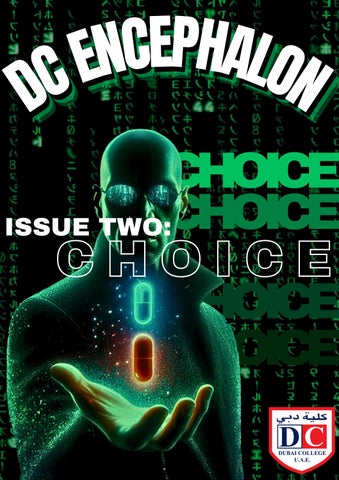
P E H C A P E H N C L A E N O L E O N C N DDC
CHOICE ISSUE TWO:CHOICE
CHOICE
CHOICE CHOICE
Neuroscience of Neuroscience of Free WIll Free WIll -- TS TS -Page 3 Page 3 To what To what degree degree are are a a protagonists.. protagonists.. -JQ -- Page JQ Page 10 10
How How do do socioeconomic socioeconomic factors... -- AP factors... AP -Page 15 Page 15
C O
N T E N T S
Illusion of Illusion of Choice Choice -- DA DA -- Page Page 8 8 What role What role does does ethical decision ethical decision making... -- VD making... VD -Page 13 Page 13 Paradox Paradox Choice -Choice Page 6 Page 6
of of RJ -RJ
Illusion of Illusion of free free choice -- DM choice DM -Page 18 Page 18
OF
THE NEUROSCIENCE FREE WILL: RETHINKING
CHOICE, ACCOUNTABILITY
& THE SELF By: TS For centuries, human societies have been built on the assumption that individuals have free will— that we make conscious choices, control our actions, and therefore deserve praise or blame. This belief underpins legal systems, moral philosophy, and even our everyday interactions. However, recent advances in neuroscience are challenging this foundational idea, suggesting that much of what we experience as conscious decision-making may actually be the product of unconscious brain processes. As scientists dig deeper into the brain's mechanisms, they are reshaping our understanding of what it means to choose freely, to be responsible, and to possess a coherent sense of self. At the center of the debate is the question: Do we truly have free will, or is it an illusion created by the brain? The roots of this controversy lie in a series of experiments, most notably by neuroscientist Benjamin Libet in the 1980s. Libet asked participants to move their wrists at a time of their choosing while noting the moment they became consciously aware of the decision. Astonishingly, brain activity that initiated the movement—the so-called "readiness potential"—was detected several hundred milliseconds before participants reported making the decision. This seemed to suggest that the brain had already "decided" before the conscious mind caught up. Subsequent studies using more advanced technology have reinforced and refined Libet's findings. Researchers like John-Dylan Haynes have demonstrated that brain activity can predict a person’s decision up to seven seconds before they are consciously aware of it. This body of evidence challenges the notion of a unified, autonomous self making rational, independent choices. Instead, it supports the idea that decisions emerge from non-conscious brain processes that only later become part of our conscious narrative.
The implications of this are profound. If free will is illusory, what does this mean for personal responsibility? Can we hold people morally or legally accountable for actions that may have been predetermined by brain chemistry, genetics, or environment? Some argue that abandoning the concept of free will could erode the basis of justice and social order. If no one is truly in control, then how can anyone be blamed? However, others propose a more nuanced view. Rather than abandoning responsibility altogether, we might need to rethink it. Philosopher and neuroscientist Sam Harris argues that recognizing the illusion of free will could lead to greater compassion and understanding. If someone commits a crime due to a combination of poor upbringing, brain trauma, or mental illness, this insight might shift our focus from retribution to rehabilitation. In other words, understanding the factors that shape behavior could help society respond more effectively and humanely. Moreover, not all scientists agree that free will is entirely dead. Some researchers argue that the brain's predictive activity doesn't completely undermine free will—it simply reframes it. The readiness potential might indicate a buildup of general intention or inclination, not a specific, finalized decision. In this view, consciousness still plays a crucial role in monitoring and possibly vetoing actions, giving us at least a form of "free won't." This suggests that while our control may not be absolute, it is also not nonexistent. The debate also invites deeper reflection on the nature of the self. Traditional views often picture the self as a consistent, controlling entity—like a pilot steering a ship. But neuroscience paints a more fragmented picture. The self may be better understood as a narrative the brain constructs after the fact, stitching together various experiences, thoughts, and emotions into a coherent story. This challenges the idea of a fixed "I" that governs choices and instead introduces a more fluid, emergent understanding of identity. This redefinition has ripple effects across many disciplines. In psychology, it calls into question the efficacy of models that assume a rational agent. In artificial intelligence and machine learning, it complicates attempts to simulate human decision-making. In philosophy, it revives age-old debates about determinism, consciousness, and the soul. Even in spiritual traditions, the illusion of self aligns intriguingly with certain Buddhist concepts of non-self (anatta), which hold that personal identity is a transient construct rather than a permanent essence. In light of all this, what are we to make of free will? Perhaps the most balanced approach lies in
accepting that human behavior is shaped by a complex interplay of biology, environment, and experience. Rather than clinging to a binary of free will versus determinism, we might adopt a more flexible model—one that acknowledges the constraints on our choices while still preserving room for meaningful agency. We may not be entirely free, but we are also not merely puppets of fate. Ultimately, the neuroscience of free will does not strip us of dignity or accountability—it invites us to redefine them. By understanding the forces that drive us, we can become more self-aware, more empathetic, and more deliberate in how we shape ourselves and our societies.
PARADOX OF
CHOICE:
HOW
MORE
OPTIONS LEAVE US
LESS SATISFIED By: RJ The paradox of choice is a counterintuitive idea which suggests that as the number of choices increase, making a decision becomes harder. When more choices are presented to a person, this leads to them feeling overwhelmed, which increases stress levels in the decision-making process. It also leads to individuals feeling less satisfied with the choice they make, since the opportunity cost increases, as they have more options. Having too many choices requires more cognitive effort to process all options, so consumers may not maximise their benefit. Choice overload can lead to: Decision fatigue: This occurs when so many decisions have been made, our mental resources become exhausted causing the quality of our decisions deteriorate. Having too many choices leads to mental exhaustion, therefore our brains start to opt for shortcuts such as default choices. Stress: More options can lead to people experiencing stress, they may become confused about what to consume leading them to avoid making a choice altogether. Whilst having an avoidance tendency can stop impulsive purchases, it may mean that in the future we are also more likely to procrastinate important decisions. Post-choice regret: As choice overload increases, post-choice regret also increases. One study that was conducted showed people who chose from a large portfolio of destinations were less satisfied and more regretful of their choice than those presented with fewer choices. Regret occurs because considering a lot of information at once is confusing, making
us less sure of our final choice. This can result in walking away from decisions as it is easy to lose track of the costs and benefits of all the options presented. Decision-making can become difficult because we have limited cognitive resources and having an overload of choices exceeds this limit. A study which illustrates the theory of choice overload was conducted in 2000 by Sheena Iyengar and Mark Lepper. They conducted the ‘Jam Study’. In this study, 24 jams were displayed in a busy supermarket and free tasting was encouraged. This abundance of choice attracted 60% of consumers to stop and taste the jam, but only 3% to make a purchase. Next, the researchers set up the display with 6 jam jars, this time 40% of consumers stopped to see the jam, however purchases of the jam increased by 30%. This study shows that people are more likely to purchase products when less choices are presented to them as the decision-making process becomes easier. It suggests that the paradox of choice can appear when we are confronted with any type of decision, even if the outcome is trivial. Schwartz also identified that the consequences of the paradox of choice impact maximisers the most. Maximisers are people who feel compelled to search until they find the best option available. They compare and evaluate all choices before they are ready to decide. In contrast, satisficers are content with products that meet their basic need and don’t feel the need to seek out the best. Maximisers try to optimise their choice and the more products there are, the harder it is for them to determine which is best. When there are more options, this leads to a greater opportunity cost, leaving people with more regret. However, fewer choices are not always better. In some cases, consumers may prefer to have more options. For example, the decoy effect suggests we feel more strongly about our choice when there are three options than if there are two. Therefore, instead of removing choices, nudging and choice architecture strategies can be used to help people make decisions. The way choices are presented can be constructed to nudge people towards options which are in their best interest. This helps them from feeling overwhelmed by the number of options they are faced with and also avoids the ethical issue of restricting people from freedom of choice.
THE ILLUSION
OF CHOICE:
FREUD’S
THEORY OF THE UNCONSCIOUS By: DA
MIND
Have you ever made a decision and then found yourself wondering, “Why did I do that?” Whether it’s deciding what universities to apply to, what to order for dinner, or what to wear, we as human beings often feel like we are in control of our choices when there is no strong direct external influence. But what if we aren’t? What if our choices are shaped by factors and forces that we don’t realize? This was theorized by Sigmund Freud, a renowned psychologist. According to Freud, the conscious mind, which is the part of the mind that we actively think with and are fully aware of, is only the tip of the iceberg when it comes to the human psyche. The part of our mind that dictates a lot of what we do is called the subconscious mind, which is filled with memories and experiences that quietly influence our behavior. Freud’s Model of the Mind Freud, as mentioned, thought the mind to be like an iceberg. With the upper layer being the conscious mind. The next aspect of the mind is said to be the preconscious. This includes memories that can be brought to awareness if needed, so you can pretty much think about these memories at your convenience. The final, deepest layer, is the unconscious. This consists of a vast array of repressed thoughts, primitive urges, and unresolved conflicts. According to Freud, most of our choices aren’t determined by the conscious or even the preconscious layer of our minds. Rather, the unconscious (or subconscious) aspect is the most significant and can lead to the illusion of a rational choice.
Unconscious Desires Freud proposed that childhood experiences, especially those that involve parents and emotional attachments, shape the subconscious mind. These buried memories, feelings, and experiences can often leak into adulthood and impact the way that individuals act as adults, even though they may have no recollection or memory of these childhood experiences ever occurring. This can lead to impacts on relationships, careers, hobbies, and virtually every aspect of life. Because of this, some people going into adult life may feel confused as to why they are the way they are, and why they often feel unexplainable overwhelming urges to make certain choices. These urges aren’t actually unexplainable, and the explanation is simply the subconscious mind and experiences during the mind’s formative years. Defense Mechanisms Defense mechanisms, in the context of choice, are ways that we unconsciously protect ourselves from discomfort associated with the choices we make as a means to convince ourselves that we made the right choice, presenting another illusion. There are two primary types of defense mechanism that humans use: Rationalization – This is when you convince yourself that you made the right choice. For example, this could you be you reassuring yourself that being late to an event is fine as the host would want extra time to prepare for it. Denial – This is when you outright deny the negative implications that a choice you made could have, or is having, on you. For example, this could be you taking on a lot more work in a week than you should, and then you deny that you’re feeling more stressed out that week. Conclusion Freud challenges our basic belief system with his theory of the unconscious mind. If our suppressed desires, fears, emotions, memories, and experiences are behind every choice we make then does “choice” in the way we know it really exist? To most, and I, it almost feels as if Freud proposed that we have no control over ourselves, and that our external and lived experiences rule us. Though, I find it beneficial to look at Freud’s theory from a different perspective. Rather than believing we have no control over our choices, and it’s all driven by the subconscious, I believe Freud intended his theory to make others aware of their inner world. Freud himself once said “Being entirely honest with oneself is a good exercise”. This suggests that through exploring what lies beneath our decisions and what may be unknowingly impacting them, we may be able to make choices that are truly ours by not allowing harmful past experiences to infect decisions of the present.
TO WHAT
DEGREE ARE A
PROTAGONISTS ACTIONS DRIVEN BY EXTERNAL FORCES VS
PERSONAL AGENCY?
In literature, protagonists often stand at the crossroads between external pressures and their own inner resolve. The tension between circumstance and choice drives narrative momentum and reveals core truths about human nature. By examining how external forces shape protagonists’ decisions and how personal agency asserts itself in moments of crisis, we can see how authors construct believable characters and compelling conflicts. Drawing on examples from Shakespeare’s Othello and Williams’s A Streetcar Named Desire, you could argues that while external factors frequently guide a protagonist’s trajectory, ultimately moments of personal choice define their moral identity and determine the story’s outcome.
By: JQ
From the opening of Othello, societal prejudice and the manipulations of Iago exert tremendous pressure on the Moor of Venice. As an outsider in white Venetian society, Othello faces latent racism that undermines his authority and self-confidence. Racial otherness in Venice enables Iago’s insinuations that Desdemona’s love is unnatural. When Iago plants the seed of doubt by suggesting that “She did deceive her father, marrying you,” Othello’s belief in external attestations of dishonour overrides his own judgment. This moment shows how societal bias and persuasive lies can overwhelm
individual reason. Othello’s response is not yet a matter of choice but a reaction to orchestrated circumstances. Nevertheless, Othello’s personal weaknesses compound the effects of external manipulation. Critic F.R. Leavis argues that “Othello’s tragedy does not come out of Iago’s evil, but Othello’s own weakness.” In the pivotal handkerchief scene, Othello chooses to abandon Desdemona without seeking a fuller explanation. Here, agency asserts itself; faced with ambiguous evidence, Othello opts for swift condemnation rather than reasoned inquiry. His decision illustrates that although an external lie initiates suspicion, it is his own willingness to trust appearances that seals his fate. In contrast, Blanche DuBois in A Streetcar Named Desire struggles against memory, desire, and the harsh realities of post-war New Orleans. External forces, poverty, social judgment, and her sister’s pragmatism, confine Blanche to a fragile existence. Stella’s household, presided over by Stanley’s earthy realism, offers no escape for Blanche’s cultivated illusions. When Stanley declares “We’ve had this date with each other from the beginning,” he enforces external reality on Blanche’s fantasies. Blanche’s illusions are crushed by forces beyond her control, illustrating the way circumstance can strip away self-delusion. Yet Blanche repeatedly exercises personal agency in choosing how to respond to her changing world. When she recounts her youthful tragedy and pleads for compassion, she chooses performance over confrontation. Blanche knowingly adopts a performative persona to assert control over an environment that would otherwise dominate her. Even as Stanley’s aggression intensifies, Blanche refuses to relinquish her fantasies, choosing denial over adaptation. This reveals that even protagonists beset by external forces retain the power to select their own mode of resistance. Narrative structure often hinges on the interplay between external constraint and internal decision. In Othello, Shakespeare calibrates rising tension by alternating Iago’s machinations with Othello’s choices to believe or to act. Each decision, to probe Desdemona’s fidelity, to confront her harshly, to strike her down, drives the plot from intrigue to tragedy. Similarly, Williams structures Streetcar around Blanche’s oscillation between hope and despair. Her choice to flirt, to fantasise, and ultimately to fall into an asylum marks the story’s climax. Protagonists’ choices punctuate the narrative arc, giving structure to what might otherwise be a passive unfolding of events.
The question of victimhood versus agency also shapes reader sympathy. If a character appears purely at the mercy of external forces, readers may view them as victims who lack moral responsibility. By contrast, moments of choice invite us to judge characters’ integrity. In Othello, Othello’s decision to kill Desdemona transforms him from a wronged outsider into an active perpetrator of violence. The audience’s response shifts from pity to horror. In A Streetcar Named Desire, Blanche’s refusal to acknowledge reality elicits both sympathy for her vulnerability and frustration at her self-destruction. Ultimately, protagonists inhabit a spectrum between victim and agent. Circumstance provides the context and can narrow the range of choices available, but individual decisions determine moral accountability and drive thematic depth. Authors exploit this dynamic to explore human resilience, weakness, and the complexity of ethical action. Readers learn that while we cannot control every external event, we remain responsible for the choices we make when faced with adversity. In this way, literature mirrors life, reminding us that personal agency, even when constrained, holds the key to our character and destiny.
WHAT ROLE DOES ETHICAL DECISION MAKING
PLAY IN
SUSTAINABLE HOSPITALITY By: VD
PRACTICES?
Ethical decision-making is at the heart of sustainable hospitality practices. In today’s globalised and environmentally sensitive world, hospitality businesses have a duty not just to deliver comfort and service, but to do so in a way that is responsible and fair to the planet, employees, local communities, and future generations. Ethical choices determine whether a hotel, resort, or restaurant is merely functioning for profit, or actively contributing to a more sustainable and balanced industry. One of the key roles ethical decision-making plays in sustainable hospitality is in how businesses treat the environment. For example, deciding to switch from single-use plastics to reusable or biodegradable alternatives isn’t just a cost-based choice, it’s an ethical one. The impact of hospitality on the environment can be massive, with high levels of water and energy consumption, food waste, and pollution. An ethically-driven organisation will factor environmental impact into their everyday decisions, aiming to reduce carbon emissions, source food locally, and limit unnecessary waste. These decisions not only help protect the environment but often improve brand image and customer loyalty, as more guests prefer staying in places that align with their own values. Ethical decision-making also shows up strongly in how staff are treated. In many hospitality businesses, especially in developing countries, employees face poor working conditions, low wages, and limited opportunities for progression. A sustainable approach to hospitality must involve treating
staff with fairness, respect, and dignity. That means offering fair wages, proper training, safe working conditions, and the chance to grow within the company. These aren’t just business practices, they’re ethical choices that signal a commitment to people, not just profits. Staff who feel respected are more motivated, deliver better service, and stay longer in their roles, reducing turnover costs and helping build a positive company culture. Another area where ethical decisions play a crucial role is in community engagement. Hospitality businesses often operate in areas where tourism can both benefit and harm local populations. Ethical operators must ask: are we giving back to the community? Are we using local suppliers and supporting nearby businesses? Are we protecting cultural heritage rather than exploiting it? For example, a hotel that sources ingredients from local farmers, hires local staff, and contributes to local charities is making ethical decisions that support sustainability. These actions help build trust with the community and ensure the economic benefits of tourism are shared fairly. It’s also important to consider how ethical decision-making impacts customer experiences. For instance, many guests now expect hotels to be transparent about their sustainability practices. Greenwashing, when a business pretends to be environmentally friendly without real action, is not only unethical but can damage a brand’s reputation. Ethical decision-making requires honesty and transparency. If a hotel claims to be sustainable, it should back that up with real policies and data: renewable energy usage, recycling programmes, ecocertifications, and genuine community partnerships. In this way, ethics and authenticity become central to building a sustainable hospitality brand. Ethical decision-making is the foundation of sustainable hospitality. It means looking beyond profits to ask deeper questions: Who is affected? Is this fair? Does it help the planet and the community? While ethical choices can cost more upfront—like paying fair wages or using green energy—they often pay off over time, especially as more consumers value sustainability. It's not about being perfect, but about striving to do better and leading with values. In the face of global challenges, hospitality businesses have a responsibility to make choices that create a better future for all.
HOW DO
SOCIOECONOMIC FACTORS INFLUENCE HEALTHCARE CHOICES? By: AP
Healthcare choices are deeply influenced by a complex web of socioeconomic factors that shape access, affordability, and awareness. These factors include income, education, occupation, race, and geographic location—each playing a distinct role in determining how individuals navigate the healthcare system. Understanding these influences is vital for creating more equitable health outcomes. 1. Income and Financial Barriers Income level is one of the most direct determinants of healthcare choices. Individuals from lower-income backgrounds are less likely to have health insurance, limiting their access to regular medical services. Even when insured, the cost of co-payments, deductibles, or uncovered treatments can be prohibitive. Consequently, people may delay seeking care, rely on emergency services for primary care needs, or skip medications entirely due to cost. This financial pressure often results in poor health outcomes and increased long-term costs for the system. For example, untreated chronic conditions such as diabetes or hypertension become more severe and costly to manage over time. 2. Education and Health Literacy Education significantly impacts health literacy—the ability to understand and act on health
information. Individuals with higher education levels are more likely to interpret medical advice correctly, adhere to treatment plans, and make informed healthcare decisions. Conversely, those with limited education may struggle to understand diagnoses or navigate the complexities of healthcare systems, leading to underutilization of preventive services. Moreover, misinformation can spread more rapidly among communities with lower health literacy, leading to the rejection of evidence-based practices like vaccinations or cancer screenings. 3. Occupational Status and Job-Related Benefits Occupation determines not only income but also the type of health insurance an individual might receive. White-collar workers often enjoy employersponsored health plans, paid sick leave, and wellness programs. In contrast, gig workers, parttime employees, or those in manual labor may lack such benefits, forcing them to choose between income and health. Hazardous or physically demanding jobs also pose higher health risks, yet those in such roles may lack the resources or time to seek preventive care, compounding long-term health disparities. 4. Geographic Disparities and Access Where someone lives can drastically affect their healthcare choices. Urban areas typically offer a wide range of healthcare providers and services, while rural or underserved regions often suffer from a shortage of doctors, specialists, and hospitals. Residents in remote areas may have to travel long distances for treatment, incurring both financial and opportunity costs. Moreover, in areas with few medical options, people may have little choice but to accept substandard care or forgo it entirely. Telemedicine has helped bridge some of these gaps, but disparities in internet access and digital literacy persist. 5. Cultural and Racial Influences Socioeconomic status often intersects with race and ethnicity, further complicating healthcare decisions. Racial minorities are statistically more likely to live in poverty and face systemic barriers such as discrimination in medical settings. Studies have shown that implicit biases can affect the quality of care received by patients of different racial backgrounds, influencing their trust in healthcare providers and willingness to seek care. Cultural beliefs can also shape attitudes toward medicine, mental health, and preventive care, influencing decisions like whether to pursue traditional remedies or accept invasive procedures. 6. Psychological and Social Determinants Social support networks, stress levels, and mental health are influenced by socioeconomic
conditions and, in turn, shape healthcare behavior. Chronic stress from financial insecurity, unsafe living conditions, or job instability can lead to both physical and psychological illness. Individuals in such environments may prioritize immediate needs (like food or rent) over long-term health planning, resulting in reactive rather than preventive healthcare choices. Conclusion Socioeconomic factors are more than just background variables; they are active forces that shape every aspect of a person's healthcare journey. From whether someone can afford a doctor's visit to how they interpret medical advice, these factors influence health outcomes on both individual and population levels. Addressing these disparities requires a multifaceted approach—combining public policy reforms, community outreach, education, and systemic healthcare improvements. Only then can we begin to close the gap and ensure equitable healthcare for all.
THE ILLUSION FREE
OF
By: DM
CHOICE
Are we really in control of everything, or is something else making our decisions for us? On the daily we make thousands of choices. What our breakfast is, how long should you wait to text someone back, which song to play on the way to school, or what contribution to add to a conversation. And it all feels like your choice. It feels like were in control of almost everything we do, basing our decisions on our mood at the time and the type of person we are. What if the so-called “choices” we make are more like pre-determined responses, shaped by everything around us. This idea isn't just science fiction or some latenight thought spiral. It's something that some of the smartest minds have been exploring for decades. And the more we learn about how the brain and human behavior work, the more it seems that free choice might just be an elaborate illusion. The Brain Decides Everything Before You Do One notable experiment took place at the hand of Benjamin Libet around 40 years ago. He asked participants to move their hands at random intervals (randomness being another rabbit hole that could be explored similarly in depth), while tracking brain activity with machines. And the results showed that the brain showed signs of making the decision a few hundred milliseconds before the participants were consciously aware of deciding. Basically, your brain makes decisions before you even realise anything has happened. Later experiments have shown similar results. Tiny patterns of brain activity can predict a person’s decisions seconds before they report making them. This raises a strange possibility: maybe consciousness doesn't initiate choices. Maybe it just reacts to what the brain has already set in
motion. But this then brings up the question, how associated are you with your brain, are you two separate entities, or just two sides of the same coin? Influenced by Everything Around Us Even if the brain is in control, It would be insane to assume we have no control over our actions, but much less certain that you would think. Look at how many of your opinions, likes and dislikes were decide before you even knew what was going on as a child . You didn't choose your culture, your language, your parents, or your early education. Yet all these factors shape how you see the world and what you think is correct. A good example of this is advertising. It’s designed to influence choices without us realising what's going on. When you pick a certain brand or product, is it because you really want it, or because you’ve been subconsciously pushed in that direction through extremely advanced advertising ploys? Another good example is peer pressure. Most people claim to make their own decisions, yet these choices are often influenced more than you would think by the people around you. And while its not necessarily a bad thing, it's just another example of how what feels like “my choice” might reflect outside influences. It brings up that adage that has been mentioned in so many talks on how you are truly the sum of the 5 people that you spend the most time with. Habits and Automatic Thinking Lots of things suggest that our decisions each day are made automatically, without deep much thought at all. We utilise habits, shortcuts, and routines to get through life. This kind of thinking is efficient, but not very conscious. Such as brushing your teeth, choosing the same meal from the canteen, walking the same route around school. But are these really decisions? Or are they just automatic behaviors triggered by your environment. The decisions that you made one day and just stuck to since then. Even big life choices can be driven by unconscious factors. University choices, relationships, beliefs. We will often feel drawn to the options that just feel like they are correct, without much basis as to why. That feeling might have come from the people around you, past experiences, connections to the decision or subtle biases that have been picked up over time. Is Free Will Just an illusion? So, if our brains are making our decisions before we even really know what’s going on, and those decisions are shaped by an hidden force that molds everything you do, where does this leave the idea of freedom and free will? Is it just something we use to provide comfort to everything we do?
Some scientists think so. They argue that free will is more about the feeling than the actual impacts, But it does have its uses. It helps us take accountability for our actions. It creates a sense of identity and control, even if the reality is so much more complex. Others argue that we still have some freedom, just of a drastically different from to our understanding of it. Maybe we cant control everything we do and decide on, but we can become aware of them, and that awareness may give us the confidence we need to look back on the decisions we made. It may not be a complete form of freedom, but it’s all we’ve got.