By: Alizeh A., Derin C., Artyom M., Arnav S., Ada Y.
The safety systems of AI-Driven Autonomous Vehicle?
Ada Y. - Page 4
The Engineering and Physics Behind Golf?
Modern Military Aerospace
Derin C. - Page 7
Arnav S. - Page 9
How NASA is Killing the Sonic Boom?
Zubin D. - Page 12
A Train Without Wheels? The Science Behind the World’s Fastest Trains
Robbert T. - Page 15
How Engineering Behind Wearable Technology Is Changing Sport
Callum A. - Page 19
Powering the Future: The Role of Chemical Engineering in Global Energy
Milena G. - Page 21
Engineering Principles behind the Detection of Dark Matter
Omair P. - Page 23
Future Technology
Samuel D. - Page 25
Process Control and Quality Assurance in Pharmaceutical Manufacturing Hyunmin K. - Page 28
Notes from editors
As editors, we are all extremely grateful for the submissions this year, which arrived with even greater range with a true deeper willingness to tackle the harder questions in our field.
We've worked hard to build on the foundation laid in our debut issue, refining how we present complex material and widening the scope of topics covered. None of that growth would mean anything without the people who have trusted us with their work a second time, and the new contributors who joined us for the first time this round. Your willingness to share knowledge, challenge assumptions, and push this field forward is exactly what we hoped this magazine would become a home for.
To our readers: we hope you enjoy reading and experiencing a true representation of DC’s engineering community.
Enjoy reading! -
Alizeh A., Derin C., Artyom M., Arnav S., Ada Y.
The safety systems of AI-Driven Autonomous Vehicle - Ada Y.
Self-driving cars are quickly becoming a real engineering challenge that the world needs to solve. Every year, around 1.35 million people are killed in road accidents globally, and over 90% of those crashes come down to human error so things like distraction, fatigue, or slow reaction times. The idea behind autonomous vehicles is quite simple however: replace the human driver with AI systems that do not get tired, do not get distracted, and can react in milliseconds. But actually building this is far more complicated than it sounds.
To drive safely, a car first needs to understand what is going on around it so autonomous vehicles use a mix of sensors such as cameras, radar, LiDAR (which bounces laser pulses off objects to measure distance), and ultrasonic sensors. However, each of these has weaknesses. Cameras struggle at night, LiDAR can be thrown off by heavy rain, and radar lacks detail. This is why AI sensor fusion is so important so rather than relying on one sensor, the system combines all of them in real time. This means that if one gives a poor reading, the others can fill the gap.
Once the car knows what is around it, it needs to act fast when something goes wrong. Automatic Emergency Braking (AEB) is one of the most important active safety features in modern AVs. The AI constantly calculates how much time the car has before it would hit something (time to collision) and if that number gets too small, it immediately takes over and hits the brakes with no input from the driver needed. The system can respond in around 100 to 200 milliseconds, which is way faster than the average human reaction time of about 1.5 seconds. To make this work mechanically, traditional hydraulic brakes are replaced with brake by wire systems. They eliminate the direct link between the brake pedal and the brakes, using electronic sensors and actuators to control braking via electric signals which then enables faster response time. Studies have shown AEB can cut rear end collisions by up to 38%.
Furthermore, AV path planning systems use high definition maps combined with live sensor data and AI models that have been trained to predict how pedestrians and other drivers are likely to move. Deep learning networks process all of this and recalculate the safest route thousands of times every second.
Drive by wire systems mean that steering, acceleration, and braking are all handled electronically rather than through direct mechanical linkages. This gives the AI full control, but it also means that if the electronics fail, the driver has no backup. This is why AV systems have to meet strict safety standards. The ISO 26262 standard, which governs functional safety in automotive systems, requires that the most critical components fail less than once in every hundred million hours of operation. Another issue is the heat as it is generated a lot by all the AI, so thermal management systems need to be designed specifically
Additionally, another problem to consider is bad weather, heavy snow or fog can seriously degrade sensor performance. Cybersecurity is another added concern as a connected vehicle is potentially a target for hackers trying to interfere with safety critical systems. Furthermore, there is also the ethical question of how an AI should make decisions if a crash is unavoidable. How should it decide who is at risk?
AI-driven safety systems have the potential to make roads much safer. But there is still a long way to go before autonomous vehicles are ready to handle every situation reliably. Getting there will take continued work to make sure these systems are not just smart, but truly trustworthy.
Ada Y.
References
Bojarski, M., Del Testa, D., Dworakowski, D., Firner, B., Flepp, B., Goyal, P. and Zieba, K. 2016. End to end learning for self-driving cars.
https://arxiv.org/abs/1604.07316
Checkoway, S., McCoy, D., Kantor, B., Anderson, D., Shacham, H., Savage, S. and Kohno, T. 2011. Comprehensive experimental analyses of automotive attack surfaces.
Green, M. 2000. 'How long does it take to stop?' Methodological analysis of driver perception-brake times. Transportation Human Factors, 2(3), pp.195–216.
Available at: https://doi.org/10.1207/STHF0203_1
ISO 2018. ISO 26262: Road vehicles — Functional safety. 2nd edn. International Organization for Standardization. Available at: https://www.iso.org/standard/68383.html
National Highway Traffic Safety Administration (NHTSA) 2022. Critical reasons for crashes investigated in the National Motor Vehicle Crash Causation Survey U.S. Department of Transportation. Available at: https://crashstats.nhtsa.dot.gov/Api/Public/ViewPublication/812115
SAE International 2021. Taxonomy and definitions for terms related to driving automation systems for on-road motor vehicles (SAE J3016). SAE International. Available at: https://www.sae.org/standards/content/j3016_202104/
World Health Organization (WHO) 2023. Road traffic injuries. Available at: https://www.who.int/news-room/fact-sheets/detail/road-traffic-injuries
The Engineering and Physics Behind GolfDerin C.
Tiger Woods was notorious for detecting miniscule errors made by Nike engineers; he famously noticed a 2-gram weight difference between supposedly identical drivers and a half-millimetre misalignment in a clubhead toe. This shows how the engineering discipline demands extreme precision, where even the smallest errors can be significant. In this article I will explore the engineering behind golf, focusing on: design features, manufacturing methods and material choices.
The Materials and Manufacturing behind Golf balls:
Golf balls are made up of 3 main layers, the most central one being the core of the ball. Cores are generally made from a synthetic rubber compound called polybutadiene which behaves elastically under the force from a clubhead, rapidly storing and releasing energy during deformation (when the ball compresses and expands). The rubber material is formed into a spherical shape via precision moulding and high-pressure compression processes. Premium balls feature multiple mantle layers between the core and outer cover that directly affect the spin rate and deformation of the ball. Engineers can adjust these layers to tailor a ball’s characteristics to suit a particular golfer’s playing style. The outer layers of golf balls are made from either Surlyn which is a hard ionomer plastic that creates lower spin shots for beginners or Urethane which is softer and generally created for more advanced golfers. The outer cover is applied to the inner layers via injection moulding into a mould with a dimple pattern.
Why do Golf balls have dimples:
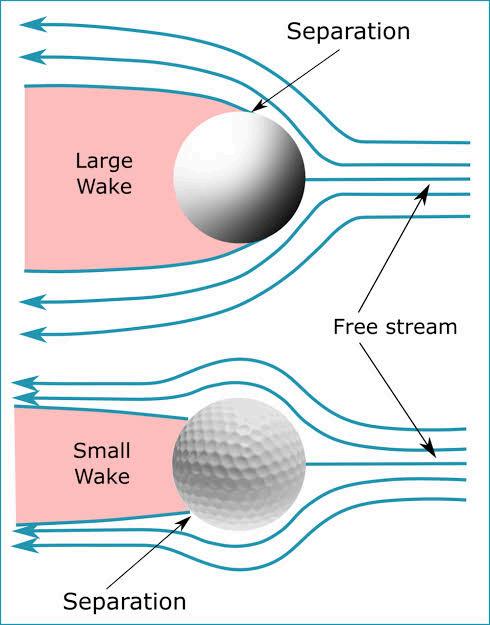
When designing golf balls, engineers have the primary objective of maximising the distance a ball can travel. One way they do this is by improving the aerodynamics of the balls; when a smooth ball is hit, the air in the boundary layer separates early from the surface. This creates a large lowpressure zone behind the ball - main drag force slowing the ball down as it travels through the air. Adding dimples to the ball, results in the formation of small ‘eddies’ in the dimples; creating a turbulent boundary layer of air on the surface of the ball. This means airflow remains attached to the ball for longer which results in a smaller low-pressure zone behind the ball and therefore less drag. Testing shows that golf balls with dimples travel significantly further than balls without them.
The Materials behind the Driver:
Drivers are made up of two main parts: The club head and shaft. Driver heads are typically manufactured by investment casting titanium alloys to form the different parts of driver heads; allowing them to be both strong and light. Tungsten weights (which are extremely dense) are then added to optimise the head’s centre of gravity –which can dictate launch characteristics. The driver shaft has a different role, determining how efficiently energy is transferred through the swing by controlling the flex and torque of the club. Modern driver shafts are made from carbon fiber reinforced polymer or steel. CFRP offers a high strength to weight ratio whilst also flexing; helping amateur players increase their club-head speed. Steel shafts trade off this flexibility for a more controlled and stable swing – this option is usually preferred by experienced players with already high club speeds.
The Biomechanics behind a Golf Swing:
The golf swing is a highly coordinated biomechanical motion meant to maximise club velocity and optimise club positioning at impact. It is made up of a series of energy transfers beginning from the feet that progresses up the legs, hips, torso and arms before finally reaching the club. After a player lifts their club and then begins their downswing, the shaft of their club flexes which creates a store of elastic potential energy. As the golfer rotates when beginning to strike the ball, angular velocity builds up in their torso which is then transferred to the arms and then the club. Also, the flexed shaft begins to extend, converting the store of elastic potential energy into kinetic energy right before the club contacts the ball. At impact, the clubhead transfers momentum to the ball over a very short collision time, resulting in a high impulse and immediate acceleration of the ball.
References
USGA (United States Golf Association) (2015) Science of Golf: Why Golf Balls Have Dimples. https://www.youtube.com/watch?v=fcjaxC-e8oY
The Decode Lab (2025) How Golf Balls Are Made | The Fascinating Engineering Behind the Perfect Shot. https://www.youtube.com/watch?v=GiZ4XybFio0 David Dusek. Golfweek (2014) Tiger Woods gives his insight on golf equipment. https://golfweek.usatoday.com/story/sports/golf/2014/08/20/tiger-woods-golfequipment-nike-golf-irons/76971654007/
Derin C.
Modern Military Aerospace - Arnav S.
Aerospace engineering is central to modern military capability, combining aerodynamics, propulsion, materials science, and advanced computing. Rather than focusing only on defence, much of today’s innovation is driven by the need for faster, more precise, and less detectable systems. From drones to hypersonic weapons, engineers are constantly improving how effectively these systems operate in contested environments. This article explores key military aerospace technologies, focusing on how they are engineered for performance and survivability.
Drones (Unmanned Aerial Vehicles - UAVs)
Drones are designed for efficiency, endurance, and precision. Most military UAVs use lightweight composite materials such as carbon fibre to reduce mass while maintaining structural strength. This improves fuel efficiency and allows longer flight times. Their propulsion systems are typically turboprop or small jet engines optimised for endurance rather than speed.
Control systems are a major engineering component. Drones use onboard flight computers that process data from gyroscopes, accelerometers, and GPS to maintain stability through feedback loops. Surveillance drones integrate electro-optical and infrared sensors, converting real-world signals into digital data transmitted via satellite. In strike roles, precision-guided munitions use laser or GPS guidance to adjust their path in real time. This combination of sensing, control, and communication makes drones highly adaptable but also dependent on secure data links.
Ballistic vs Cruise Missiles
Ballistic missiles rely on rocket propulsion, where high-speed exhaust gases produce thrust. Multi-stage designs improve efficiency by discarding mass during flight. After the powered boost phase, the missile follows a trajectory governed by gravity and inertia, similar to a projectile. Inertial navigation systems (INS) use internal sensors to track motion without external signals, making them resistant to jamming. Cruise missiles, by contrast, function more like aircraft. They use air-breathing engines such as turbojets, compressing incoming air before combustion to produce continuous thrust. Their wings generate lift, allowing sustained low-altitude flight that reduces radar visibility. Advanced guidance systems combine GPS, INS, and terrain contour matching (TERCOM), enabling precise navigation by comparing stored maps to actual terrain. This engineering allows cruise missiles to adapt mid-flight and strike targets with high accuracy
Hypersonic Weapons
Hypersonic weapons operate at speeds above Mach 5, where airflow becomes highly compressed and generates intense heat. Engineers must account for extreme thermal stress using materials such as ceramic composites and heat-resistant alloys. At these speeds, shockwaves form around the vehicle, significantly affecting aerodynamic performance.
Unlike ballistic missiles, hypersonic glide vehicles generate lift, allowing them to manoeuvre unpredictably. Some designs use scramjet engines, where combustion occurs in supersonic airflow, enabling efficient propulsion at extreme speeds. This combination of speed, heat management, and manoeuvrability makes hypersonic systems one of the most challenging and advanced areas of aerospace engineering.
Fighter Jets: Types and Features
Modern fighter jets are engineered for both performance and survivability. Their engines operate on the Brayton cycle, producing high thrust-to-weight ratios for rapid acceleration and agility Aerodynamic designs, such as swept wings and control surfaces, allow stable flight at high speeds while maintaining manoeuvrability. Stealth is a key engineering focus. Aircraft like the B-2 Spirit use carefully angled surfaces to deflect radar waves, reducing their radar cross-section. Radar-absorbent materials further reduce detectability by converting electromagnetic energy into heat. Internally mounted weapons reduce drag and radar signature. Advanced avionics systems integrate data from multiple sensors, giving pilots a real-time, comprehensive view of the battlefield
Stealth and Evasion Engineering
A major focus in modern aerospace is not just detection, but avoiding it. Stealth engineering reduces how visible an aircraft or missile is across different detection methods. This includes shaping structures to scatter radar waves, using materials that absorb electromagnetic energy, and minimising heat emissions to reduce infrared detection. Engineers also design flight profiles that exploit radar limitations, such as flying at low altitudes where terrain blocks signals. Electronic countermeasures can actively interfere with radar systems by jamming or sending false signals. These techniques demonstrate how aerospace engineering increasingly focuses on evasion as much as performance.
Lockheed Martin -F22
Radar Technology
Radar remains a fundamental technology for detection and tracking. It works by transmitting electromagnetic waves and analysing their reflections to determine distance, speed, and direction. Phased-array radar systems use multiple antennas to steer beams electronically, allowing rapid tracking of multiple targets without moving parts.
However, radar effectiveness is constantly challenged by stealth technologies. Reducing radar cross-section makes objects harder to detect, leading to continuous advancements in signal processing and detection methods. This ongoing competition between detection and evasion drives innovation in both areas.
Conclusion
Modern military aerospace engineering is defined by the balance between performance and survivability. From high-speed missiles to stealth aircraft, each system is designed to maximise effectiveness while minimising vulnerability. As technologies such as hypersonic propulsion and advanced materials continue to develop, aerospace engineering will remain at the forefront of innovation, shaping the future of global military capability.
Arnav S.
References
Royal Air Force (RAF) - Aircraft and Technology Overview
NATO - Missile Defence Systems Explained
Lockheed Martin - F-35 Lightning II Programme
Northrop Grumman - B-2 Spirit Stealth Bomber
U.S. Department of Defense - Unmanned Aircraft Systems Reports
Congressional Research Service - Hypersonic Weapons Overview
How NASA is Killing the Sonic Boom - Zubin D.
On the 24th of October 2003, the Concorde touched down at Heathrow for the very last time. It had been the only supersonic passenger aircraft to ever enter commercial service, capable of crossing the Atlantic in under 3.5 hours. The sonic boom the Concorde produced over land was so disruptive that the US banned overland supersonic flight in 1973, restricting it to only oceanic routes. This effectively killed the economics behind it, without transcontinental routes the Concorde was commercially unviable. Twenty-seven years of supersonic passenger travel ended on a runway in London: not because of the engineering, but the noise.
The Physics of the Problem
When an aircraft goes supersonic, it outruns its own pressure waves. These waves pile up and form a shockwave cone that extends downwards toward the ground. On a conventional aircraft, multiple shockwaves are created by different parts of the fuselage, and they overlap during their descent. Their pressure amplitudes add through superposition, producing a single sharp peak at ground level. That spike is what we hear on the ground - an instantaneous pressure jump of up to 100 Pa that sounds like an explosion. The Concorde generated ground-level noise signatures of about 105 EPNdB (effective perceived noise decibels) at cruise.
What the X-59 does differently
NASA’s X-59 - built by Lockheed’s Skunk Works - doesn’t try to eliminate shockwaves (they’re inevitable). Instead, it’s shaped so the shockwaves remain spatially separated, preventing constructive superposition that creates the boom. This means that whatever reaches the ground is a series of weaker, dispersed pressure ‘pulses’ instead of one sharp peak. The target noise level is 75 EPNdB - comparable to a car passing on a neighbourhood street (about 8x quieter than the Concorde’s perceived loudness). The design choices that achieve this are visible in the aircraft’s very unusual geometry - the nose is about 9m long - which is disproportionate to the 30m fuselage. This spreads the initial pressure rise over a much greater length, and weakens the bow shockwave before it begins its descent. The engine sits on top of the fuselage rather than underneath it, preventing its inlet shockwave from interacting with those generated below. The cockpit doesn’t have a forward-facing window, because a break in the nose geometry would distort the pressure field; so the pilot uses a 4K camera feed instead. The plane is designed around one constraint: keeping the shockwaves apart.
Image Credit: NASA/Jim Ross
Where It Stands
The X-59 flew for the first time on the 28th of October 2025, taking off from Lockheed Martin’s Palmdale facility and landing at NASA’s Armstrong Flight Research Center at Edwards. By April 2026, it had reached 43,000 feet at Mach 0.95. The first supersonic test flights (where they will be testing the low-boom shaping) are still ahead. Once complete, NASA plans to fly the aircraft over several US communities, and survey residents on how they perceive the sound. This data will go to the FAA and international regulators, who will decide whether or not the overland supersonic regulations will be revised.
The X-59 isn’t going to carry passengers: It’s a proof of concept, an argument that the sonic boom is just an engineering problem rather than a fixed limit. Private companies such as Boom Supersonic are already developing commercial supersonic jets, but they need a regulatory change before they can start flying overland routes, which will require the exact kind of data the X-59 is collecting. It’s doing what experimental aircraft have always done: proving something that the rest of the industry then builds on. Whether the data eventually reopens overland supersonic flight to commercial operators is still open for debate, but the physics appears to be on NASA’s side.
Image Credit: NASA/Jim Ross
References
NASA Quesst Mission Overview. nasa.gov/mission/quesst/ [Accessed April 2026]
NASAArmstrong — X-59 Completes First Flight, October 2025. nasa.gov
NASA Quesst Blog — Latest X-59 Flights. nasa.gov/blogs/quesst/2026/04/17 [April 2026]
NASA Glenn Research Centre — Beginner's Guide to Aerodynamics. grc.nasa.gov
NASA — Quieting the Boom: The Shaped Sonic Boom Demonstrator. NASA publication.
Zubin D.
A Train Without Wheels? The Science Behind the World’s
Fastest Trains - Robbert T.
Friction is the enemy of speed. It is why cars overheat, why brakes wear out, and why conventional trains hit a physical speed limit no matter how powerful their engines are. In a world where speed and efficiency drive every engineering decision, this invisible force is the one barrier that never goes away. So what if we could eliminate it entirely?
The answer lies in a principle anyone who has ever played with magnets will recognise: like poles repel. Maglev, short for magnetic levitation, uses this simple idea on an extraordinary scale. Powerful electromagnets built into both the train and the guideway, the specialised track Maglev runs on, generate opposing magnetic fields that push the train upward, lifting it approximately 10mm above the surface. It sounds like a small gap, but it is enough to remove all physical contact between the train and the track entirely. With nothing touching, there is no friction whatsoever. The only resistance the train faces is air. This allows Maglev trains to reach speeds exceeding 600 km/h, something no conventional wheeled train could ever achieve. Beyond raw speed, the absence of mechanical contact means far less vibration and noise, and virtually no moving parts to wear out or break down, making Maglev not just faster, but fundamentally more reliable than anything that has come before it.
So how does this actually work, especially in a world where safety is so important that a small chip on the turbine of a plane engine is enough to ground it entirely?
Levitation
The most important feature of Maglev trains is levitation. Sitting at a mere 10mm above the guideway, there is not much room for error before everything goes sideways. To maintain this crucial height, dozens of sensors measure the gap thousands of times per second. If the train drops too low, the current in the electromagnets increases, pushing it back up, and vice versa to drop it slightly. This happens constantly and automatically, meaning the system never stops correcting itself. If it didn't, the train would either crash into the track or float away entirely. Keeping the train centred is equally important, handled by a separate set of electromagnets on the sides of the guideway preventing any sideways drift. The train essentially sits inside a magnetic channel, completely surrounded by electromagnetic force, so derailment in the traditional sense simply cannot happen.
Propulsion
By this point, we have covered how the train stays on the track, but how does it actually move? Unlike traditional trains, Maglev has no engine of its own. All of the power comes from the guideway itself, through a system called a linear induction motor. A regular electric motor works by running electricity through circular coils, creating a rotating magnetic field that spins a shaft to drive wheels, fans, and pumps. Now imagine taking that motor and unrolling it into a flat, straight line. Instead of rotating, it creates a travelling magnetic field that moves along the guideway, pulling the train forward with it, like a magnet dragging a piece of metal across a table. The speed of this travelling wave determines the speed of the train, so to go faster, you simply increase its frequency. No fuel, no combustion, no moving parts on the train itself. This makes Maglev not just faster than conventional diesel and electric trains, but quieter, smoother, and fundamentally more sustainable.
CRRC (2025) The latest prototype of China s maglev train is capable of travelling at 600km/h [Photograph] In: The Guardian Available at: https://www theguardian com/environment/2025/aug/07/maglev-train-researchers-may-have-solved-tunnel-boom-shock-waves
The Real World
It would be a shame if such an elaborate system never made it into daily life, but luckily that isn't the case. China's Shanghai Maglev is the world's fastest commercial Maglev in operation, originally reaching a top speed of 431 km/h and covering 30 km from the city to its airport in just 8 minutes. Japan is pushing the technology even further. The SCMaglev set the world speed record of 603 km/h in 2015 on a test track in Yamanashi, and is scheduled to enter commercial service in 2034, connecting Tokyo to Nagoya in just 40 minutes at a top speed of 500 km/h. However, not every Maglev story is a success. In 2006, a Transrapid test train in Elmsland, Germany collided with a maintenance vehicle that had been accidentally left on the track. Travelling at 193 km/h, the crash killed 23 passengers and injured 11. A court ruled human error was to blame, and the German Maglev programme was discontinued in 2008, with the enormous cost of the infrastructure also cited as a factor.
The Catch
So why isn't every train a Maglev? The answer comes down to one word: cost. Building a Maglev guideway is estimated to cost three to five times more per kilometre than conventional high speed rail. Unlike traditional trains, Maglev cannot run on existing tracks. Instead, entirely new guideways must be built from scratch, meaning countries would have to invest billions before a single passenger boards. The electromagnets also consume vast amounts of electricity to run continuously, raising questions about long term energy sustainability. Because of all this, existing Maglev networks can only remain short and isolated. You cannot travel across a country on Maglev the way you can on conventional rail. Germany's abandoned programme is a blunt reminder that impressive engineering alone is not enough; economics, politics, and practicality always have the final say
Conclusion
Maglev trains represent one of the most remarkable achievements in modern engineering. By replacing wheels with magnetism, engineers have not only broken speed records but fundamentally reimagined what a train can be. The technology is quiet, smooth, and sustainable, and it offers a glimpse of what transport might actually look like in the future. Yes, the costs and infrastructure challenges are real, but as energy prices continue to rise and governments look for greener alternatives to cars and planes, Maglev might finally get its moment. The wheel has been with us for thousands of years. But in the race for the future, it might just have met its match. Robbert
References
Bonsor, K. and Chandler, N. (2025) How Maglev Trains Work. In: HowStuffWorks. Available at: https://science.howstuffworks.com/transport/enginesequipment/maglev-train.htm [Accessed: 26 April 2026].
U.S. Department of Energy (2016) How Maglev Works. [Online] Available at: https://www.energy.gov/articles/how-maglev-works [Accessed: 26 April 2026].
World Steel Association (n.d.) How steel hovers maglev trains above the right track. [Online] Available at: https://worldsteel.org/media/steelstories/automotive/how-steel-hovers-maglev-trains-above-the-right-track/ [Accessed: 26 April 2026].
Wikipedia (2026) Lathen train collision. [Online] Available at: https://en.wikipedia.org/wiki/Lathen_train_collision [Accessed: 26 April 2026].
How Engineering Behind Wearable Technology Is Changing Sport
- Callum A.
In modern sport, success is no longer determined by talent and training alone. Behind the scenes, engineering innovations are playing an increasingly important role, particularly through the rise of wearable technology. Devices such as the WHOOP strap and the Oura Ring are not just fitness gadgets they are examples of advanced engineering that are transforming how athletes train, recover, and perform.
At the core of wearable technology is a combination of materials engineering, electronic engineering, and data systems. Engineers design these devices to be lightweight, durable, and comfortable enough to be worn continuously, often 24 hours a day. This presents a significant challenge: the technology must be powerful enough to collect accurate biological data, yet small and efficient enough to fit into a wrist strap or a ring.
The WHOOP strap is a strong example of engineering in action. It contains sensors that measure heart rate, heart rate variability (HRV), and movement. These sensors use optical technology, where light is shone into the skin to detect changes in blood flow. Engineers must carefully calibrate these sensors to ensure accuracy across different skin tones, movement conditions, and environmental factors The device also includes battery systems designed for long life and continuous use, allowing athletes to monitor their bodies without interruption.
Similarly, the Oura Ring demonstrates how engineering can combine functionality with design. Unlike bulkier wearables, the ring must fit into a very small space while still housing multiple sensors. Engineers use advanced microelectronics to achieve this, integrating temperature sensors, accelerometers, and infrared LEDs into a compact structure. The choice of materials is also critical; the ring must be strong enough to withstand daily wear while remaining lightweight and comfortable.
Another key area of engineering is data processing. Wearable devices collect vast amounts of data every second, which must be processed and interpreted. Engineers develop algorithms that turn raw data into meaningful insights, such as sleep quality scores or recovery ratings. These algorithms are constantly refined to improve accuracy and reliability, ensuring that athletes and coaches can make informed decisions. The impact of this engineering is clear in how athletes train. Instead of relying solely on intuition, they can use precise data to guide their performance. For example, if an athlete’s wearable device shows a low recovery score, they may reduce training intensity to prevent injury. This approach highlights how engineering is not just supporting sport, but actively shaping it.
Engineering also plays a crucial role in improving safety. By monitoring physical strain and fatigue, wearable devices can help identify when an athlete is at risk of overtraining or injury. This is particularly important in high-impact sports such as rugby, where managing physical load is essential.
Engineers continue to develop more advanced sensors that can detect subtle changes in the body, potentially preventing injuries before they occur. Despite these advancements, there are still engineering challenges to overcome. Accuracy remains a key issue, especially during intense movement when data can be harder to capture. Battery life, data security, and device durability are also ongoing concerns. Engineers must constantly innovate to improve performance while keeping devices practical for everyday use. Looking ahead, the future of wearable technology in sport will depend heavily on further engineering breakthroughs. Developments in nanotechnology, flexible materials, and artificial intelligence could lead to even more advanced devices. For example, nanosheets made from biological materials may one day replace traditional components, making devices even thinner and more efficient. In conclusion, wearable technology is not just changing sport—it is a clear demonstration of how engineering can solve real-world problems. Through careful design, advanced materials, and intelligent data systems, engineers are enabling athletes to train smarter, stay safer, and perform at their best As technology continues to evolve, the influence of engineering in sport is only set to grow
References
WHOOP: https://www.whoop.com/ae/en/
WHOOP: How WHOOP works: https://www.whoop.com/ae/en/how-it-works/ Oura Ring: How Oura ring works: https://ouraring.com/how-it-works
Callum A.
Powering the Future: The Role of Chemical Engineering in
Global Energy - Milena G.
For many people, chemical engineering brings to mind lab experiments or factories making plastics But today, as the world tries to meet growing energy demand while cutting carbon emissions, chemical engineers are playing a much bigger role At its core, chemical engineering is about transforming raw materials into useful products, including energy, using principles like thermodynamics, reaction rates, and fluid flow. This makes it central to almost every modern energy system.
The Foundation: Oil and Gas
In 2026, the oil and gas industry isn’t just about drilling and refining anymore; it’s increasingly focused on managing carbon emissions. Chemical engineers still work on processes like fractional distillation and catalytic cracking to produce fuels, but their role has expanded One major area is Carbon Capture and Utilization Technologies using solvents such as monoethanolamine (MEA), as well as newer adsorption systems, are being used to remove carbon dioxide from industrial emissions Instead of simply storing this carbon dioxide underground, engineers are finding ways to turn it into useful products like synthetic fuels, methanol, and even building materials. This approach helps reduce the environmental impact of fossil fuels while still meeting current energy needs.
The Heavyweight: Nuclear Energy
Nuclear energy provides large amounts of low-carbon electricity, and recently it has been gaining attention again, sometimes referred to as a “nuclear renaissance.” Much of this is due to the development of Small Modular Reactors (SMRs), which are smaller, more flexible, and potentially safer than traditional plants. Chemical engineers are involved in managing the nuclear fuel cycle and improving reactor materials. For example, in high-temperature gas-cooled reactors, helium is used as a coolant, allowing for higher efficiency. Another interesting development is “pink hydrogen,” where nuclear energy is used to power hydrogen production. This shows how nuclear energy can support other clean technologies, not just electricity generation
The Green Revolution: Biofuels
Biofuels are often seen as a step toward more sustainable energy, especially for sectors like aviation and shipping where liquid fuels are still necessary. One of the biggest challenges has been breaking down plant material efficiently, particularly lignin, which is difficult to process. Recently, new methods using natural solvent systems (NADES) have made this easier and less energy-intensive. Chemical engineers are developing processes that can work with a wide range of raw materials, including agricultural waste and non-food crops. This flexibility makes biofuels more practical and reduces competition with food production.
The Universal Carrier: Hydrogen
Hydrogen is often described as a clean energy carrier, but how it is produced matters a lot. Currently, there is a shift from “grey hydrogen” (made from fossil fuels without carbon capture) to “blue” and “green” hydrogen. Chemical engineers design the systems used in both methods, such as electrolysers for green hydrogen and reforming plants with carbon capture for blue hydrogen. One major challenge is storage and transport, as hydrogen can weaken metals over time, a problem known as embrittlement. Engineers are working on new materials and coatings to make hydrogen infrastructure safer and more reliable.
The Heart of Portability: Batteries and Energy Storage
Energy storage is essential for renewable energy and electric vehicles, and this is an area where chemical engineering is rapidly evolving. While lithium-ion batteries are still widely used, newer technologies are emerging. Solid-state batteries, which replace liquid electrolytes with solid materials, offer higher energy density and improved safety. At the same time, sodium-ion batteries are becoming more popular because sodium is cheaper and more widely available than lithium. Chemical engineers are also improving battery cooling systems to make sure they remain stable and efficient, especially in extreme conditions.
Conclusion: Engineering a Sustainable Path
The future of energy won’t depend on just one solution. Instead, it will involve a mix of different technologies working together. From improving carbon capture in fossil fuels to developing advanced batteries and hydrogen systems, chemical engineers are helping turn scientific ideas into real-world solutions. Their work is essential in building a more sustainable and reliable energy system for the future.
References
What Nuclear Energy Technologies Are Actually Advancing in 2026? Available at: https://www.asme.org/topics-resources/content/what-nuclear-energy-technologies-areactually-advanci…
Carbon Capture and Utilization (CCU) in 2026: How CO2 is Turning into Fuel. Available at: https://greenfueljournal.com/post/carbon-capture-and-utilization-ccu-in-2026
Novel approach to a key biofuel production step. Available at: https://www.eurekalert.org/news-releases/1115035
Hydrogen Trends 2026: Global Scenarios for the Energy Transition. Available at: https://www.denora.com/en/newsroom/learn-with-us/hydrogen-trends-2026
8 Key Battery Trends Shaping 2026. Available at: https://www.pem-motion.com/post/8battery-trends-2026
Review on Biodiesel Upgrade Through Selective Partial Catalytic Hydrogenation. Available at: https://www.mdpi.com/2673-4591/124/1/26
Milena G.
Engineering Principles behind the Detection of Dark Matter - Omair P.
Everything we have seen in the universe only makes up 5% of it, so what is the other 95%? We currently have very little knowledge about the universe which consists of ordinary matter making up 5% of the universe. The remaining 95% comes from dark energy which makes up 68% of the universe and dark matter making up 27% of the universe. Dark matter is the invisible glue that holds the universe together. It does not interact with the electromagnetic spectrum meaning it doesn't absorb, reflect or emit any light making it very hard to spot. Research has shown the existence of dark matter from the gravitational effect it has on visible matter. In the 1970s astronomer Vera Rubin found that stars on the outer edges of spiral galaxies were orbiting too fast and should have flown off into space, but they didn't. The explanation for this was that a large amount of invisible matter was holding them in place.
Scientists have suggested several ideas for what dark matter could be but none have been confirmed The most prominent is the WIMP or Weakly Interacting Massive Particle a hypothetical heavy slow moving particle that passes through normal matter almost seamlessly interacting with almost nothing except gravity. Another idea is the axion, which is a lighter hypothetical particle that was first theorised in 1977 to solve the Charge Parity problem. Additionally, there are primordial black holes that were thought to have formed in the first moments of the Big Bang which can range from being the size of an atom to a size larger than the sun Stephen Hawking suggested these could have spread across the universe as dark matter. However, none of these ideas have been confirmed to be true Detecting WIMPs requires a detector sensitive enough to catch the rare moment one collides with a single atom and produces a tiny flash of light. The problem is that many other particles are constantly passing through everything on Earth's surface and would cause false readings, making any real signal impossible to identify. This problem was solved by going underground using the surrounding rock as a natural shield to absorb unwanted particles before they reach the detector. The LUX-ZEPLIN experiment sits more than a mile underground and uses seven tonnes of liquid xenon as its detection material. Xenon is used because it is very dense meaning more atoms are packed into a smaller space and so there are more chances for a dark matter particle to actually hit one. It is also chemically inert and so it does not react with the equipment from the detector or cause contamination that could look like a signal When a particle hits a xenon atom it produces two different signals, a flash of light and a pulse of electrical charge, which can allow the scientists to get rid of false data. The xenon must be kept at -108 degrees Celsius which is the point at which it becomes liquid, because in its liquid state it is dense enough to be useful as a detection material while being transparent to the light signals the detector needs to pick up. Keeping that temperature continuously across seven tonnes, while also keeping out interference from trace radioactivity in the surrounding rock and even small vibrations is very difficult After 280 live days of data collection, no evidence of a WIMP was found
Searching for axions requires a completely different approach. The ADMX experiment uses a powerful magnetic field combined with a microwave cavity which is a finely tuned metal chamber. The idea is that if an axion passes through a strong magnetic field it can convert into a photon which can then be detected. The problem with this experiment is that this conversion only happens at one very specific frequency, determined by the axion's mass, which nobody knows. This means that if you miss the frequency by even a small amount the axion will go undetected. Because of this engineers have no reliable starting point and must scan randomly across an enormous range of possible frequencies, adjusting the cavity while being accurate each time, which makes the search very slow. For primordial black holes the approach is also different. Unlike the previous detection methods there is no way to create a machine to detect a primordial black hole. Instead, scientists use gravitational wave detectors like LIGO. When two large objects like black holes collide somewhere in the universe they send out ripples through space like when dropping a stone in water. LIGO detects these ripples by measuring tiny changes in distance (smaller than a thousandth the width of a single proton) using laser beams fired down 4 kilometre long tunnels. By analysing the pattern of these ripples, scientists can find out what caused them and if a pattern shows up that does not match any known type of black hole collision it could suggest a primordial black hole.
Overall, despite various complex engineering techniques, none of these experiments have produced a confirmed detection, and what dark matter actually is remains completely unknown.
Omair P.
Future Technology - Samuel D.
Technology is incredible in the world of engineering as it allows us to achieve impeccable feats, however, one issue with technology is that it also holds us back. Future technology is a class of technology which is available to us in the future and is being developed and improved as of today. This technology will unlock a diverse and unique range of potential for engineering, it is significant for engineers to utilise future technology as it will improve their efficiency, safety and effectiveness of their projects additionally the scope of the problems they can solve are able to be stretched further to incorporate a higher level of complexity. One of the most prolific examples of future technology is Artificial Intelligence (AI), AI will accelerate human innovation through automation and the removal of human error. Future technology is extremely significant for societal development and there are various examples that I would like to cover in this article including technology that has been developed but not yet introduced in everyday life and others that are deemed not appropriate for everyday life.
Nanotechnology
Nanotechnology differs from standard technology as it allows engineers to manufacture on a molecular level and achieve more desirable characteristics. For example, lightweight and high-strength new materials, such as carbon fibre composites and advanced alloys, possess enhanced durability benefiting. the aerospace and automotive sectors by keeping vehicles lightweight allowing them to transport more efficiently solving the problem of expensive transportation whilst maintaining safety through high durability and exceptional strength. However, one of the leading disadvantages of nanotechnology is the potential health concerns and prolonged biological damage to humans when inhaled. This is an issue as the damage caused by nanotechnology is not yet completely understood which could lead to the product being unsafe for human use. Furthermore, if nanoparticles accumulate in the environment, it can potentially lead to the disruption of ecosystems and harming of wildlife. This creates ethical concerns as well as sustainability issues which is a key quality which engineers consider with the use of new technology. For this reason, nanotechnology is not quite ready to be deployed for safe use across the world. Despite that, mechanical engineers are aiming to use nanotechnology to create ‘self-healing materials’ via the integration of nanotechnology. This sustains the materials’ durability which are used in mechanical engineering which will reduce the necessary maintenance required saving costs and increasing the materials’ life span
Solid-state batteries are a unique battery which use a solid electrolyte to conduct electricity instead of the standard liquid lithium electrolyte. The solid state of the electrolyte creates a higher density of energy compared to the typical lithium battery this increases the battery life of many devices. Another benefit in the use of solidstate batteries is their enhanced rate of charging; it can be 6 times more effective than standard lithium batteries. Additionally, the solid-state batteries can actually perform better when temperature increases, unlike the lithium ,making the solid-state batteries far more versatile.
The primary disadvantage of solid-state batteries is their difficulty to produce, due to them still being in their early stages of development, furthermore, as they are in early stages of development their potential is still unknown and they may be underutilised. Another flaw observed with solid state batteries is that they are quite unstable from mechanical degradation which can cause the battery to deteriorate at a rapid rate giving it a shorter lifespan.
The current progression of solid-state batteries is the use of semi solid-state batteries; these use a partially solid cathode which makes them more efficient than the standard liquid batteries but cheaper and easier to produce than the solid-state batteries. Lastly, solid state batteries become increasingly necessary as our society develops into using more electronic devices, for example, electric cars are becoming far more prevalent in modern society and expected to be everywhere by 2030. This gives solid-state batteries more of a demand and important place in our future.
Conclusion:
Overall, future technology will play a crucial role in advancing society by enhancing efficiency, innovation, and problem-solving capabilities within engineering. Developments such as AI, nanotechnology, and solid-state batteries demonstrate significant potential to improve performance and sustainability across industries. However, these technologies are not without limitations, including safety concerns, environmental risks, and production challenges, which currently restrict their widespread adoption. Therefore, while future technology offers substantial benefits, further research, testing, and regulation are essential before full integration into society can occur. Ultimately, a balanced approach is required to ensure that innovation is achieved without compromising safety, ethics, or long-term sustainability.
Samuel D.
References
Applications of Nanotechnology (2025) National Nanotechnology Coordination Office (NNCO). Available at: https://www.nano.gov/aboutnanotechnology/applications-nanotechnology/ (Accessed: 13 April 2026).
TheKnowledgeAcademy (no date) Advantages and Disadvantages of Nanotechnology: Explained, The Knowledge Academy - Online certification training courses provider. Available at: https://www.theknowledgeacademy.com/blog/advantages-and-disadvantages-ofnanotechnology/ (Accessed: 14 August 2026).
Admin (2023) Importance of Nanotechnology in Mechanical Engineering, Bennett University. BENNETT UNIVERSITY’S Blog. Available at: https://www.bennett.edu.in/media-center/blog/media-center/blog/importance-ofnanotechnology-in-mech… (Accessed: 14 April 2026).
Solid-state Battery and Their Pros and Cons - Sinexcel-RE (2025) Sinexcel. Available at: https://www.sinexcel-re.com/blog/solid-state-batteries-pros-consadvantages-disadvantages/#Principl… (Accessed: 15 April 2026).
Bonnen Battery (2026) Solid-State Batteries 2026: Advances, Challenges & Applications, Bonnen Battery. Available at: https://www.bonnenbatteries.com/solid-state-batteries-advances-challengesfuture-use-cases/ (Accessed: 15 April 2026).
Process Control and Quality Assurance in Pharmaceutical Manufacturing - Hyunmin K.
The Role of Terahertz Radiation in Non-Destructive Tablet Measurement
Chemical engineering is the application of chemistry to design and control processes that convert raw materials into useful products in a controlled and efficient manner. People often associate chemical engineering with large scale industrial processes due to its traditional applications such as oil refining and chemical production, which require continuous, high volume production. Alternatively, it is also commonly used in energy related industries, such as power generation, battery development, and biofuel production, where precise management of chemical processes is vital. Even with these large-scale industrial applications, one of the most impactful areas of chemical engineering is pharmaceutical manufacturing. In this field, the focus shifts to a combination of high-volume production and extreme consistency, ensuring safety in medicines. Pharmaceutical production embodies the core ideas of chemical engineering, as it utilizes raw materials into essential and functional products on a large scale, while making certain that each tablet is precisely manufactured in both composition and dosage to guarantee safety. The industry of pharmaceutical manufacturing has many complex processes that result in a seemingly simple product. It transforms active chemical compounds into a form that can be effectively used by patients. This is where chemical engineering plays a key role, as it is responsible for designing and carrying out the manufacturing process of producing the final tablet. With this in mind, production starts by combining active drug substances targeting a specific medical issue with other materials known as excipients to improve stability and determine how the drug is released in the body. Next is powder blending, where engineers consider the particle size, flow behaviour and physical properties of the chemicals in use to prevent segregation of particles and ensure the even distribution of ingredients (Prescott and Barnum, 2000). In the granulation stage, chemical engineering concepts are used to control the transformation of fine powder into larger, more uniform granules of material by regulating the moisture, binding forces, and mixing intensity, all directly affecting the material’s physical behavior in later stages (Aulton, 2018). During compression, understanding of force and deformation is implemented to convert granules into solid tablets found every day at pharmacies, with consistent density, dosage and distribution, guaranteeing predictable effects when consumed (Sun, 2011). Lastly, in the coating stage, engineers control spray and drying conditions so that the coating of the tablet is applied evenly, determining the release of the chemicals once ingested. Across the entire process of producing pharmaceutical tablets, chemical engineering concepts provide the foundation necessary for controlling variables such as
distribution of ingredients, release timing, and dosage, confirming that the final tablet’s quality meets standards. The performance of a pharmaceutical tablet can be determined by adjusting the physical properties that are carefully designed using chemical engineering principles. Performance is not random, rather it is predetermined, influencing how the drug is released, how fast it dissolves, and how effectively it works in the body. The first key physical property is thickness. Thickness is dependent on the amount of material compressed into the tablet and the compression force used. From an engineering perspective, thickness is controlled by regulating variables such as pressure exerted by rotary tablet presses, which have sensors continuously monitoring force and automatically adjusting it in real time to maintain consistency during the process (Sun, 2011).
Another factor affecting performance is density, which is controlled by how efficiently the powder is packed before compression and is influenced by granule design and feed conditions. Chemical engineers would manipulate the granule size by controlling the binder concentration and mixing speed of the materials (Aulton, 2018). In addition, the feed speed is regulated by a closed loop feedback control system, where sensors measure the weight and tablet fill consistency and the system adjusts feed rate when deviations are detected (Seborg, 2017).
One of the most vital properties is porosity. Porosity is the amount of empty space between compressed particles inside the tablet. This influences the speed of absorption and disintegration when ingested. The degree of porosity is regulated by particle plasticity and elasticity. Chemical engineers would control this by the choice of excipient. For example, when choosing a binder, engineers may use microcrystalline cellulose, making the particles more plastic, decreasing the porosity as particles flatten and fill gaps better. Elasticity is also determined by this as if particles are too elastic, they rebound after compression creating more void spaces and hence increasing porosity (Sun, 2011).
All these variables are controlled through engineering systems combining sensors and feedback loops. This helps chemical engineers to preserve process conditions and material properties, ensuring that the tablet behaves in a predictable way when ingested. By linking real time control systems with an understanding of material science, chemical engineers can reliably produce tablets with little variations in product quality, guaranteeing safety and consistent effects (Seborg, 2017).
Even with the intricate procedures taken to produce pharmaceutical tablets, mechanical errors are inevitable. Traditional quality control of these errors is heavily dependent on batch sampling methods, which is the random selection and testing of a few tablets to r
represent the whole manufactured batch. This poses a serious limitation as quality issues within a batch may go undetected as only a small proportion is tested. Due to this, variables previously mentioned such as thickness, density and porosity may not be up to standard. These inconsistencies can affect how the drug is released when ingested, potentially causing reduced effectiveness to harmful health effects. Furthermore, many of the methods used in batch sampling methods are destructive, meaning the tablet must be irreversibly physically damaged during analysis to assess its quality.
For example, tablets are often crushed or dissolved to evaluate proper composition, internal structure, and dissolution rate. The drawback of destructive testing is that the tested tablets are unable to be reused, leading to material waste and preventing further analysis on the same sample. In addition, since testing occurs after production, it does not allow for instantaneous adjustments to the manufacturing process. This is a weakness, as traditional quality control is reactive instead of preventative, highlighting the need for a more real-time method of ensuring quality
Due to the limitations of traditional quality control, pharmaceutical manufacturing requires a method that measures tablet quality without damaging the product, and gives continuous data of its properties in real time. To address this, chemical engineers develop advanced process analytical technologies (PAT). One such method is using terahertz radiation. Terahertz radiation has a frequency of around 10^12 Hz, which is between microwaves and infrared light (Ferguson and Zhang, 2002). It is able to act as a non-destructive sensing tool within process control systems, enabling measurement of key physical properties.
iStockPhoto
This is possible as the terahertz waves are transmitted through the tablet, interacting with the material boundaries and creating reflections where there are changes in properties such as refractive index and density (Zeitler and Gladden, 2009). Chemical engineers are able to use this reflected signal to model internal structure, producing live feedback to adjust compression force, feed rate, and coating spray rate, ensuring consistent product quality (Zeitler et al, 2007).
To conclude, chemical engineering plays a critical role in pharmaceutical manufacturing as it guarantees consistent production of medicines with controlled properties. However, traditional quality control methods have significant weaknesses, particularly in methods such as batch sampling. Terahertz radiation offers a solution by addressing the reactive nature of these methods, enabling real-time monitoring and continuous feedback to support adaptive process control. Overall, terahertz radiation offers significant benefits to health and safety by improving the consistency and reliability of pharmaceutical products.
Hyunmin K.
References
Aulton (2018) Aulton’s Pharmaceutics The Design and Manufacture of Medicines
Ferguson and Zhang (2000) On Powder Flowability
Seborg (2017) Process Dynamics and Control
Sun (2011) Mechanisms of Tablet Compaction
Zeiter and Gladden (2009) In-vitro tomography and non-destructive analysis using terahertz spectroscopy
Zeiter et al (2007) Terahertz pulsed spectroscopy of pharmaceutical solids
Thank you
To every contributor who shared their expertise with us for this edition, and to every reader who continues to make this community what it is, thank you. This magazine exists because of you, and we're truly excited for what is next to come for DC’s engineering community.
By: Alizeh A., Derin C., Artyom M., Arnav S., Ada Y.