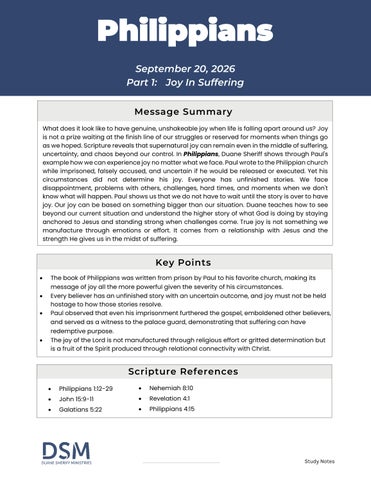
Philippians September 20, 2026 Part 1: Joy In Suffering key points
Message Summary What does it look like to have genuine, unshakeable joy when life is falling apart around us? Joy is not a prize waiting at the finish line of our struggles or reserved for moments when things go as we hoped. Scripture reveals that supernatural joy can remain even in the middle of suffering, uncertainty, and chaos beyond our control. In Philippians, Duane Sheriff shows through Paul's example how we can experience joy no matter what we face. Paul wrote to the Philippian church while imprisoned, falsely accused, and uncertain if he would be released or executed. Yet his circumstances did not determine his joy. Everyone has unfinished stories. We face disappointment, problems with others, challenges, hard times, and moments when we don't know what will happen. Paul shows us that we do not have to wait until the story is over to have joy. Our joy can be based on something bigger than our situation. Duane teaches how to see beyond our current situation and understand the higher story of what God is doing by staying anchored to Jesus and standing strong when challenges come. True joy is not something we manufacture through emotions or effort. It comes from a relationship with Jesus and the strength He gives us in the midst of suffering.
Key Points • • •
The book of Philippians was written from prison by Paul to his favorite church, making its message of joy all the more powerful given the severity of his circumstances. Every believer has an unfinished story with an uncertain outcome, and joy must not be held hostage to how those stories resolve. Paul observed that even his imprisonment furthered the gospel, emboldened other believers, and served as a witness to the palace guard, demonstrating that suffering can have
•
redemptive purpose. The joy of the Lord is not manufactured through religious effort or gritted determination but is a fruit of the Spirit produced through relational connectivity with Christ.
Scripture References •
Philippians 1:12-29
•
Nehemiah 8:10
•
John 15:9-11
•
Revelation 4:1
•
Galatians 5:22
•
Philippians 4:15
Study Notes
Philippians September 20, 2026 Part 1: Joy In Suffering
Discussion Questions •
Duane describes a 'higher story' running beneath every personal trial, where God is working behind the scenes — how do you actively train yourself to look for that higher story when you are in the middle of a painful and unresolved situation?
•
Paul wrote Philippians from prison, facing possible execution, and yet the letter overflows with joy — what does it reveal about the nature of true joy that his circumstances did not silence it?
•
Jesus declares in John 15 that his joy is meant to remain in his followers and become their joy — what does it look like practically to abide in his love in a way that sustains that joy during seasons of prolonged uncertainty?
•
Paul says in Philippians 1 that even those preaching Christ from selfish ambition and envy are still advancing the gospel, and he chooses to rejoice in that — how do you personally reconcile the tension between caring about integrity in ministry and trusting God to work through imperfect messengers?
•
Duane uses the image of sun tea as a picture of Christ's indwelling presence — how does a deeper understanding that Christ literally abides in you change the way you face opposition, suffering, or fear?
•
Nehemiah 8:10 declares that the joy of the Lord is your strength, and the sermon connects this to the fruit of the Spirit described in Galatians 5 — in what ways have you experienced joy functioning as genuine strength rather than simply as a feeling during a hard season?
Study Notes
Philippians September 27, 2026 Part 2: Humility key points
Message Summary What does it take to be great in the kingdom of God? The world tells us that greatness comes through self-promotion, gaining influence, accumulating power, and climbing over others to reach the top. Philippians 2 reveals a radically different path. In Part 2 of Philippians, Duane Sheriff teaches that true greatness in God's kingdom is found through humility, selfless service, and adopting the mind of Christ. Paul calls believers to be like-minded, united in love, and joined together in genuine fellowship and partnership in the gospel. Not a superficial unity that agrees on everything, but a Spirit-led commitment to love one another, serve one another, and esteem others above ourselves. Jesus is our ultimate example. Though equal with God, He made Himself of no reputation, took the form of a servant, humbled Himself, and became obedient even to death. He chose the downward path of humility so God highly exalted Him. Duane challenges believers to work out their salvation with reverence, stop complaining and disputing, and become people who genuinely serve others. The path to greatness in God's kingdom is narrow— but Jesus has already shown us the way.
Key Points • • • • •
The world's path to greatness is built on self-promotion, conquest, and pushing others down, and this mindset has infiltrated the church. Koinonia, the Greek word for fellowship, means genuine partnership, contribution, and social intimacy in the gospel and in the Spirit -- not superficial church attendance. God's path to greatness is the opposite: humility, servanthood, and preferring others above oneself. Jesus is the supreme model of the mind believers are called to adopt: he did not exploit his equality with God but emptied himself, took the form of a servant, and obeyed unto death. Because of Jesus’ humility and obedience, God highly exalted Jesus above every name.
Scripture References •
Philippians 2:1-16
•
Philippians 1:3-6
Study Notes
Philippians September 27, 2026 Part 2: Humility
Discussion Questions •
Duane draws a sharp contrast between the world's story of greatness through conquest
and Jesus's story of greatness through self-emptying service — where do you see the world's story most subtly infiltrating the culture of the church today? •
Paul describes the path to greatness in God's kingdom as humility and serving others rather than self-promotion and conquest — in what ways have you personally struggled to embrace this narrow path, and what has made it difficult?
•
Philippians 2 describes how Christ, though equal with God, took on the form of a servant and humbled himself to the point of death — what does it practically look like for a believer to adopt this same mindset in their everyday relationships?
•
Paul urges believers to work out their own salvation with fear and trembling, suggesting that God's will is already at work within each person — how does this inward focus challenge the tendency to meddle in or judge the spiritual journey of others?
•
Duane observes that even sincere believers can pursue God-given callings in ways that are driven by selfish ambition, dishonoring others in the process — how do you discern whether your pursuit of purpose is rooted in humility or hidden pride?
•
Koinonia is described as more than casual fellowship — it involves partnership, contribution, and genuine care for one another in the gospel — what specific steps
could you take to move from surface-level church attendance to meaningful koinonia? •
Paul's commendation of Timothy and Epaphroditus highlights individuals who genuinely cared for others above their own interests, with Epaphroditus even risking his life — what does this level of commitment challenge you to reconsider about your own investment in the people around you?
Study Notes
Philippians October 4, 2026 Part 3: Being Found In Him key points
Message Summary Where do we place our confidence? Are we building our confidence based on our accomplishments? When we compare ourselves to others by race, title, background, education, or success, we are placing confidence in ourselves instead of Christ. In Part 3 of Philippians, Duane Sheriff teaches what it means to be found in Christ. In Philippians 3, the Apostle Paul presents an impressive list of earthly credentials. He points to his heritage, religious standing, zeal, and blameless obedience to the law. Yet Paul counts it all as loss compared to the surpassing worth of knowing Jesus. Paul's example challenges us to examine where we find our identity, righteousness, security, worth, and significance. Paul modeled three disciplines for growth: forgetting what lies behind, reaching toward what is ahead, and pressing toward the goal. Forgetting does not mean pretending the past never happened. It means refusing to allow past failures, hurts, or even successes to define the present or sabotage the future. We should desire to know Christ, experience the power of His resurrection, remain faithful through suffering, and keep pressing toward the upward call of God in Christ Jesus.
Key Points • • •
Identity rooted in flesh, whether racial heritage, religious title, educational achievement, or cultural standing, is worthless compared to being found in Christ. True righteousness does not come from law-keeping or human accomplishment but through faith in Christ, a righteousness that comes from God. Paul's impressive resume of fleshly credentials, including being a Hebrew of Hebrews, a Pharisee, and blameless under the law, was counted as loss and garbage for the sake of
•
gaining Christ. Being found in Christ means finding in him one's security, worth, significance, authority, and destiny.
Scripture References •
Philippians 3:3-18
•
Philippians 1:21
•
Philippians 2
Study Notes
Philippians October 4, 2026 Part 3: Being Found In Him
Discussion Questions •
Duane draws a sharp contrast between Rome's story of power and control and Jesus'
story of humility and servanthood -- in what practical ways does the world's story of self-promotion still shape how you navigate conflict, competition, or criticism in your daily life? •
Paul describes his impressive credentials after the flesh only to call them loss compared to knowing Christ -- what accomplishments, titles, or identities in your own life are you most tempted to find your security and worth in rather than in Christ?
•
Duane points out that only one church, Philippi, truly partnered with and supported Paul in his ministry -- what does that sobering reality reveal about the difference between
attending a church and genuinely being in koinonia with one another? •
Paul says in Philippians 3 that he wants to know Christ both in the power of his resurrection and in the fellowship of his sufferings -- which of these two dimensions of knowing Christ do you find more difficult to embrace, and why?
•
Duane distinguishes between forgetting as spiritual amnesia and forgetting as a deliberate choice not to let the past define the present -- what past hurt, failure, or even success. Are you still living in what is preventing you from reaching toward what is ahead?
•
David is held up as an example of someone who refused to let Saul's persecution and hatred define who he was -- who in your life, past or present, has shaped your identity in ways that belong only to Christ to define?
Study Notes