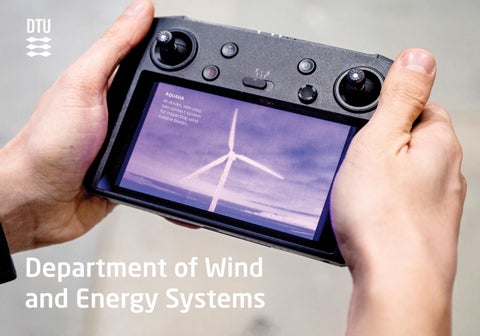
Department of Wind and Energy Systems
“The energy world is transforming rapidly, and a true energy system revolution is underway.”
At DTU Wind and Energy Systems, our role is to advance the knowledge, technologies and skills needed to design, develop and operate an efficient, resilient and sustainable energy system. Working with more than 500 companies and organisations worldwide, we connect scientific excellence with real-world challenges and opportunities. Our ambition is to be the global go-to knowledge partner that researchers, students, public authorities, organisations and industry reach out to when looking for the best minds in the field. I am proud to work every day with the greatest colleagues who have deep competencies and access to world-class facilities, and who develop technology solutions with real impact on the energy system revolution. Morten Jeppesen, Head of Department
We believe that the development of technologies, the systems that integrate them, the rules that govern them, and the actions of people who inhabit society are all part of the solution.
Our vision A society fully powered by renewables with wind as its backbone.
Our mission Lead by scientific excellence and impact-driven research that enables a sustainable, large-scale deployment of wind energy and the development of an integrated and resilient energy system.
Strategic aspiration Our research is guided by impact, focused on addressing key barriers and developing opportunities to achieve a 100% renewable energy system and support continued Danish and European leadership in wind energy.
Lead large scale trend-setting projects We lead large-scale trend-setting projects with world-class partners to set the standards for new developments in the energy sector.
Fertile environment for break-through research
Guided by impact
The go-to global knowledge partner
Develop our organisational capacity
Grow and develop our department by building teams
We provide a fertile environment for breakthrough research based on an academic culture of excellence and access to state-of-the-art facilities.
We grow and develop our department by building teams that can attract the best minds to work together across scientific disciplines to offer unique integrated solutions to partners.
We develop our organisational capacity and professionalism across the management of facilities, tools, data, and people to fully unlock the powerful synergies.
Collaboration DTU Wind collaborates with companies, public authorities, and research organisations worldwide through direct partnerships and 200 ongoing research projects. We combine world-class research, advanced software, state-of-the-art test facilities, and the expertise of our more than 450 researchers, engineers and technicians to advance wind energy technologies and energy system solutions.
We have active collaborations with more than 500 organisations across 50 countries, including:
167
384
Academic partners
Business partners
*Figures include unique business partner organisations linked to records with an end date on or after 1 January 2026.
Four Strategic Challenges
Advancing the next generation of wind energy
Designing a resilient renewable-based energy system
Educating tomorrow’s technology leaders in renewable energy systems
Enabling a fast and fair, sustainable energy transition
Research 200 research projects covering the full wind energy and energy systems value chain. From the smallest components to integrated energy systems that power societies, advancing knowledge and turning research into solutions for affordable, reliable, resilient and scalable renewable energy.
*Figures include unique research projects with a project end date on or after 1 January 2026.
Case I
Case II
Micromechanical computational models
Energy systems living lab
DTU researchers use advanced computer simulations to understand how wind turbine blade materials behave at the smallest scales. This knowledge helps develop better repair and recycling technologies, extending blade lifetime and supporting a more circular wind energy industry.
For 20 years, DTU has pioneered research based on Bornholm as a living lab for future energy systems, providing a real-world environment for developing and testing solutions for smart grids, renewable energy integration and energy storage.
Publications Our research is validated through scientific peer review and reflected in publications used by the global renewable energy community. This demonstrates the quality and reach of our work and strengthens our position as a trusted knowledge partner.
204
159
Scientific, peer-reviewed articles in WoS indexed journals
Other publications from DTU Orbit (excl. patents)
67
30
Scientific, peer-reviewed articles in other journals
PhD theses published in DTU Orbit
177 Scientific, peer-reviewed contributions to conferences
*Figures are based on 2025 data.
637 Total publications
Wind resource assessment
Scientific Advice
Renewable energy integration
Independent, research-based advice for the energy transition. Market design and policy The energy transition raises complex questions across technology, systems, and policy. We provide the knowledge, data, and analytical tools that support evidence-based decisions for authorities, national and international organisations, and industry in Denmark and worldwide.
Infrastructure planning and design Information at global scale
Deployment support
Request scientific advice Tell us about your question, and we will direct it to the right expert. wind.dtu.dk/Scientific-advice
Standards and certification
60,000 users per month from 240 countries and territories DTU Wind’s Global Wind Atlas is the worldwide reference for free data and maps about wind resources. *Figures as of August 2026.
Innovation Research-driven solutions, tools, and technologies for society and industry. Through DTU’s innovation ecosystem, research is transformed into new technologies, tools, and solutions that create value for industry and society.
Innovation in practice Examples of technologies, tools, and solutions developed through research and collaboration:
AI-assisted automated inspection of wind turbine blades
Tool for real-time power system stability management
Software suites for component design, wind turbine development, and wind farm siting
Hybrid composite materials for future energy applications
Tool for real-time data management and data-driven innovation
AQUADA Can wind turbine blades be inspected without stopping the turbine? AQUADA (Automated Quantification of Damages) is an AI-driven, non-stop, non-contact system for inspecting wind turbine blades. It detects and assesses blade damage while turbines remain in operation. The technology has the potential to reduce CO₂ emissions by 30–50% per turbine inspection while enabling faster and safer inspections.
Education Research-based education connected to real-world challenges Across Bachelor, Master, and PhD levels, we combine solid theoretical foundations with hands-on experience in laboratories, research turbines, and energy systems, in close collaboration with industry.
Practical skills
126 final projects were completed in collaboration with industry partners, helping students develop practical experience and career-relevant competencies.
*Diplomingeniør, Bachelor of Science, and Master of Science final projects, academic year 2025/26.
43
22
Master’s graduates (Degrees awarded in 2025)
PhD graduates (Degrees awarded in 2025)
Continuing Education Ready to take the next step in your professional development? Discover more than 30 online courses at wind.dtu.dk/Education/Continuing-education.
Test Centre Østerild
Research Infrastructure
Test Centre Høvsøre
First class facilities for research, testing and innovation.
ComponentLab
DTU’s research and test facilities enable researchers and industry partners to evaluate performance, verify new concepts and accelerate technology development. The facilities support activities across the entire wind and energy value chain, from materials and components to turbines, power systems and integrated energy solutions.
PowerLabDK Facilities
Materials Lab
Poul la Cour Wind Tunnel
Rain Erosion Test Facility
Risø Hybrid Power Plant Facility
Research Wind Turbine V52
LIDAR Calibration
FloatLab
Software Research transformed into tools for the energy transition At DTU we develop research-based software that supports the planning, design, and operation of wind energy systems. Used by industry, researchers, and decision-makers worldwide.
Assess the site
Lay out the farm
Our tools help improve efficiency, reliability, and scalability while addressing key challenges in renewable energy integration and energy security.
Design the turbine
Operate the farm ▪ AQUADA
Integrate into the grid
▪ WAsP
▪ PyWake
▪ HAWC2
▪ PyWAsP
▪ TOPFARM
▪ BECAS
▪ CorRES
▪ EllipSys
▪ EnergyDataDK
▪ Balmorel
All Software Explore the full software catalog at wind.dtu.dk/software.
Mean wind speeds at the Serra de Santa Luzia wind farm, Portugal, modelled with PyWAsP.
Finances Income
€50
Ordinary operating costs
€46
million
11%
4%
22%
Research subsidies
Other revenue
Other operating costs
(core government funding)
2% Education subsidies (government funding)
45% External funds (research)
*Figures are based on 2025 data.
million
78% Staff (salaries)
38% Commercial revenue
Employees
471 Employees
58%
27%
58%
Researchers
Women
International background
20
89
Professors
PhD fellows
*Figures are based on 2025 data.
Organisation Management Head of Department Morten Jeppesen
DTU Wind and Energy Systems is organised into 4 divisions and 23 sections. The latest organisational chart can be found at wind.dtu.dk.
Administration and Business Support
Division
Division
Division
Division
Wind Energy Materials and Components
Wind Turbine Design
Wind Energy Systems
Power and Energy Systems
Sections
Sections
Sections
Sections
▪
Blade Design and Testing
▪
Test Centres
▪
▪
Energy Markets and Analytics
▪
Mechanics of Damage
▪
Turbine Response
Meteorology and Remote Sensing
▪
Power Systems
▪
System Engineering and Optimisation
▪
Distributed Energy Systems
▪
Blade Materials Manufacturing and Testing
▪
Structural Inspection and Digital Technologies
▪
Integrity and Reliability
DTU-Total Energies Centre of Excellence
▪
Rotors
▪
Test and Measurements
▪
Renewable Power Plants
▪
PowerLabDK
▪
Flows
▪
Society, Market and Policy
▪
Power-to-X and Storage
▪
Research Software Engineering
▪
E-Mobility and Prosumer Integration
▪
Resource Assessment and Meteorology
▪
Energy Systems Modelling and Impact Assessment
Locations Test facility DTU Wind and Energy Systems operates across campuses, research infrastructure and test facilities, enabling collaboration between industry, academia and public stakeholders to advance sustainable energy solutions.
Campuses Living lab collaborations
Østerild
Høvsøre
Denmark
Lyngby
Jutland
Risø Zealand Funen
Bornholm Energy Island
Bornholm
Technical University of Denmark
DTU Risø Campus
DTU Lyngby Campus
Frederiksborgvej 399 4000 Roskilde
Nils Koppels Alle Bygning 403 2800 Kgs. Lyngby
wind.dtu.dk