Adult Protective Services Quarterly News | Winter 2021
INSIDER
SMART GOALS Learn how to plan for success this year
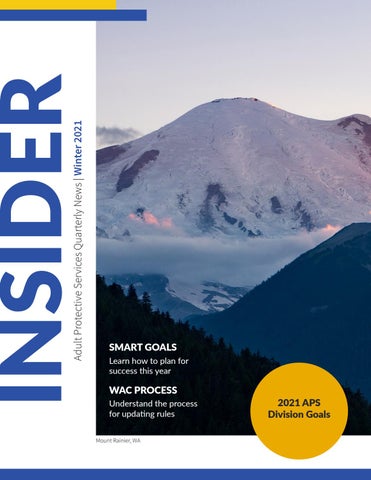
WAC PROCESS Understand the process for updating rules Mount Rainier, WA
2021 APS Division Goals
WINTER 2021 | TABLE OF CONTENTS
07
Regional Success Stories Celebrating our work protecting others
11
WAC Process
13
SMART Goals
Understanding WAC process & updates
Establishing realistic goals for 2021
02 | DIRECTOR'S WELCOME 03 | DEPUTY DIRECTOR’S WELCOME
HELP US NAME OUR RISK SCREENING TOOL!
05 | GOALS & ACCOMPLISHMENTS
APS received a grant from the Administration for Community Living in the fall of 2019. One objective of this grant is to develop and integrate a risk screening tool for investigations. Because “risk screening tool” is not a great name, we’d like to turn to APS staff to develop a better name!
07 | SUCCESS STORIES 09 | TIVA2 CHANGE REQUEST PROCESS 10 | EDI CERTIFICATION PROGRAM 11 | WAC REVISIONS 13 | SETTING SMART GOALS 14 | HEADQUARTERS SPOTLIGHT/ EVENTS
Please email Victoria (Victoria.gawlik1@dshs.wa.gov) with your name ideas by Monday, February 1st. Leadership will select a name from the submissions and the winning submission will be announced in the next issue of the newsletter!
HELLO FROM
KATHY MORGAN
THANK YOU
[
2021 GOALS HEADQUARTERS
[
PANDEMIC RESPONSE
Implement Safe Start – Resume plan, to transition back to all activities.
RISK & SAFETY TOOL
Pilot the risk and safety screening tools with regional staff.
FORENSIC INTERVIEWING
Partner with UW to create a forensic interviewing curriculum.
CHAPTER 6
Development of new policy manual to streamline processes.
WAC
Updating WAC for consistent terminology and clarity.
What can be said about 2020 that hasn’t been said already? It was definitely an unforgettable year filled with challenges, changes, difficult situations and unforeseen circumstances. In the midst of it all, APS continued to serve vulnerable adults, responded to reports promptly and refined processes within the division. It’s amazing to look back at all of our achievements and advancements throughout the past year. The magnitude of what we accomplished even in spite of the constant changes and adversity is truly remarkable. I’ve said it for a long time and it continues to hold truth: APS staff get the job done, no matter what. In December, we held an all-day APS leadership meeting where we discussed topics related to developing skills as strong, equitable, intentional leaders. Each region and headquarters also shared details about accomplishments from the year and goals for 2021. As we listened to each presenter, it became apparent that we successfully completed an overwhelming number of accomplishments and made great strides towards improving our services. In this magazine, we will highlight the achievements shared at the meeting. While we do not have enough space to accurately represent all of the milestones and accomplishments, please know that the work you do every day contributes to the strength of our division and our successes, both big and small. I hope the New Year brings you new hope. Wishing you a bright and healthy 2021! Thank you for your continuous hard work and dedication. Let’s keep the momentum going and see what this year will bring! 2
HELLO FROM PAULA HUGHES
physical stress. There are numerous apps you can download for free that walk you through breathing exercises, or you can simply shut your eyes and focus on your breath.
HAPPY NEW YEAR The new year is always one of my favorite times of year. It’s always nice to look back on the previous year and reflect upon the challenges, triumphs, growth and changes. This past year was particularly challenging and while there were many hurdles, it’s important to still recognize everything you did. Our successes may have looked different (like changing out of pajamas for work), but they were successes none the less. The culmination of the holidays and the universal unknowns from this past year can really add up. As we begin this fresh, new year, it’s important that we take a moment to ourselves to regroup, reflect and recharge. We often talk about the importance of selfcare, especially in our line of work protecting vulnerable adults. Burnout from our daily work paired with pandemic fatigue can begin to wear you down. I encourage you to carve out some time (whether that be daily or weekly) to really check-in with yourself and allow yourself time to unwind. Here are some ideas that work well for me: • Breathing exercises: Deep breathing for 2-3 minutes helps me re-energize my body and relieve some of the mental and 3
• Getting outside: In the winter months, it’s tempting to avoid the cold and rain and stay hunkered inside. I find that I feel my best when I can get outside, even for 10 minutes a day. I try to set an achievable goal for myself (like walking around my neighborhood loop once a day) to help remind me to take a break outside. • Tech free time: This one is especially hard being home all the time with constant distractions like TVs, phones, computers, tablets and more. When I’m plugged in all the time, I can feel it draining my personal battery. To help with this, I try to carve out uninterrupted chunks of time on the weekend where I do tech-free activities, including chores, reading a book or just hanging out with my family. These are just a few small things that I do to practice self-care. There is no right or wrong way to do it. The important thing is to carve out time for yourself and do a personal “temp check” on how you’re feeling. If you need assistance or would like to explore additional options, you can check out the Employee Assistance Program. This past year was challenging, but I’m looking forward to a brighter new year. Cheers to a happy, healthy and hopeful 2021!
REGIONAL EMPLOYEE SPOTLIGHT Seattle, WA
Jennifer Chapa
Jeff Quigley
Ranae Recardo
Social Services Specialist 3 Region 1
Program Manager Region 2
Operations Manager Region 3
Jennifer joined the Kennewick APS team in February 2019. She is very task oriented and has admirable organizational skills. Jennifer excels in managing her caseload and conducts thorough work even when presented with numerous challenging investigations simultaneously.
Jeff has worked with APS for many, many, (many?) years. His sense of humor and natural leadership style makes him an excellent program manager in Region 2.
Ranae is definitely a behind the scenes hero that has really stepped up to serve during the COVID-19 crisis. She ensures our offices have necessary supplies, including masks, hand sanitizer and other PPE. She has personally driven to offices to quickly deliver items on multiple occasions.
She is reliable and quickly volunteers to help others. Jennifer willingly covered parts of the region outside of her designated area while seamlessly managing her work. Jennifer is a great addition to our team. Thank you, Jennifer, for all that you do!
He has a wealth of APS experience and has watched the division grow throughout the years. (Did you know that APS used to serve six regions and conduct long-term care services assessments?) In his spare time, he enjoys fishing and spending time with his family. We are so fortunate to have Jeff as a member of our team!
Ranae serves as the Region 3 emergency coordinator and is the point of contact for N95 testing. Ranae cares deeply for others and is a natural leader. She is a great teammate and a superstar in Region 3! 4
2020 ACCOMPLISHMENTS 2021 GOALS
5
2020 ACCOMPLISHMENTS Region 1
Region 2
Region 3
• Developed Employee Ideas Advisory Committee
• Developed IRT and substantiation process document
• Initiated Trauma Informed Approach committee
• Modernized IRT
• Conducted goal exercises across the region
• Successfully piloted CISM program
• Enhanced focus on EDI practices • Opened two new large ALTSA offices and relocated staff (one was completed during the pandemic)
• Hosted getting to know you visits with leadership • Developed online process through SharePoint where staff can request assistance on certain tasks
• Implemented a trauma informed approach (TIA) approach to work plans • Developed a time management tool
Headquarters • Developed a versatile and inclusive reporting database (data mart) • Enhanced APS Academy training and implemented “train the trainer” • Centralized the Due Process Unit • Utilized Administration for Community Living grant funds to achieve grant goals and outcomes
In addition to the challenges and hurdles, 2020 also presented us with numerous achievements, both large and small. This is a tiny snapshot of all of the amazing work we do every day to transform lives of vulnerable adults. While this list does not begin to capture everything, we want to recognize you for your work and thank you graciously for your continuous dedication to APS.
2021 GOALS Region 1 • Improve substantiation rate by providing additional resources • Improve QA process and consistency • Focus on supporting employees, improving morale and retention • Continue work with the Employee Ideas Advisory Committee
Region 2 • Encourage and establish peer-topeer mentoring • Additional mentoring opportunities for staff from management • Create leadership development opportunities • Implement regular staff engagement meetings
Region 3
Headquarters
• Consistently prepare and train supervisors through regional supervisor training plan
• Continue response to the COVID-19 pandemic
• Allocate time and space for management team to process information
• Create field guide for training and onboarding
• Integrate a traumainformed approach to Region 3 culture
• Develop training for forensic interviewing
• SharePoint Redesign • Continue to improve collaboration between HQ and regional staff 6
Snoqualmie Pass, WA
REGION 1
REGIONAL SUCCESS STORIES
PATIENCE & PERSISTENCE We received a report alleging the self-neglect of an individual that lived in a rundown trailer. The investigator was seriously concerned for the individual’s wellbeing. The investigator found the individual alone and in significant pain. The person had poor hygiene and couldn’t remember when their last meal was. The investigator called emergency services, but the individual refused to be transported for evaluation and didn’t want to receive any services. The investigator made multiple visits to build trust with the individual. During these visits, the investigator noticed that the person’s medical condition was worsening and turned to community partners to help get the individual hospitalized to receive necessary care. The person had been using an assumed name for the past 40 years and didn’t provide any details about family members. The investigator used excellent problem solving skills and was able to locate an obituary for the individual’s mother, which resulted in additional leads to finding the individual’s sisters. The sisters are looking into ongoing care options for the person.
7
REGION 3 EMERGENCY CARE
We received a report on a late Friday afternoon about an individual that had visited a medical clinic to treat a serious health condition. The individual was instructed to go straight to the emergency department to receive appropriate care. The person refused and went home.
REGION 2
TIMELY SERVICES A report was received regarding an elderly, non-verbal person living with and receiving care from their adult child. The report alleged neglect, mental abuse and physical abuse. The investigator attempted to complete an interview with the person, but the adult child would not allow APS to enter the home. The investigator requested a welfare check by local law enforcement who verified that the situation looked concerning. The investigator contacted the individual’s home health insurance provider and discovered that the person needed to receive acute care in a skilled nursing facility. The provider also informed the investigator that the individual was scheduled for an upcoming outpatient surgery and would be transported to the hospital by ambulance. Within the next four days, the investigator completed a petition for a vulnerable adult protection order (VAPO) and worked with medical professionals to admit the individual to the hospital. The individual is receiving necessary medical services. The investigator completed a guardianship petition and the final VAPO hearing continues. This is the beginning of the story for this individual’s care and the progress was the result of the investigator’s quick work.
The investigator visited the individual’s house and discovered the person had been drinking alcohol and overusing prescription medications. The investigator attempted to coordinate with local law enforcement and crisis responders, but was unable to receive assistance due to other emergencies in the area. The investigator contacted the individual’s daughter to assist with bringing the individual to the hospital over the weekend. The investigator didn’t leave until all resources had been exhausted for the day. On Monday, the investigator discovered that the individual had not gone to the hospital. The investigator coordinated with the individual’s caregiver and the person was admitted to the hospital for ongoing treatment. The investigator’s diligence helped secure the appropriate care for the individual.
8
ASK THE EXPERTS
TIVA2 CHANGE REQUEST PROCESS We’re always collecting recommendations to improve TIVA2. Here’s how we take your suggestions and transform them from ideas into implemented features! Step One You have an idea about how to improve TIVA2 – Awesome! Write up your idea and send your change request to your TIVA2 regional point of contact for consideration. Step Two Your regional team will review the change request and determine if it is an already known request or whether it should be sent to headquarters. Requests are sent to headquarters when the regional team agrees that the proposed change will have a positive impact on statewide TIVA2 work. Step Three Headquarters receives the change request and the TIVA2 administrators and the leadership team analyze the request and consider: • What positive impact would the proposed change have for APS staff?
9
• Will the proposed change make the work process in TIVA2 easier, more efficient or more accurate for APS staff? • Will the proposed change benefit any current or future APS reports? • Does the proposed change align with policies? • How much IT development time will the proposed change take to build? Step Four If approved, the headquarters team will prioritize the change request for a future release. Step Five Future requests are scheduled 12-18 months out. Step Six TIVA2 administrators work with the TIVA2 IT team to determine requirements, provide mock-ups and conduct testing. Step Seven TIVA2 administrators send out release updates prior to each release that include details about the new items, publication schedule and updated TIVA2 user guides.
EQUITY, DIVERSITY & INCLUSION CERTIFICATION PROGRAM Did you know that many of our ALTSA leaders are certified in equity, diversity and inclusion courses, including all of our APS leaders? The certification program we use at ALTSA consist of two different certifications: Certified Diversity Executive (CDE) and Certified Diversity Professional (CDP). The CDE program is designed for executive decision makers within the administration, such as the assistant secretary, division directors, office chiefs and regional administrators. The CDP program is designed for staff who work in the field and are practicing EDI principles in their daily work. The purpose of the certification programs is to educate leaders and staff about how to integrate EDI practices into our work with the administration. The goal is to provide safe spaces to learn about EDI and ongoing support even after the certification program has been completed. The courses cover a broad array of topics related to EDI, including the role of a diversity practitioner, the business case for diversity and inclusion, reinventing diversity training, handling difficult conversations, empowering women in the workplace, LGBTQ+ inclusion, measuring the impacts of EDI and much more. The course concludes with a comprehensive exam that includes multiple choice questions and is designed to challenge the user’s perceptions of
EDI. The practitioner must score an 80% or higher to pass the exam. All participants spent extensive time independently studying the materials and preparing for the exam while simultaneously creating a capstone project for the end of the course. After completion, the certification is valid for three years and participants must complete continuing education units. EDI and the certification process is important to our work with APS because it provides a framework for developing successful EDI practices within our division. The formal certification process provided participants with tools to develop person-centered, equitable services while teaching them effective ways to communicate with diverse teammates. The ALTSA EDI administrator, Tavares Terry, is working with regional EDI specialists and certified practitioners to develop training materials for all staff members. The goal is to create resources that are relevant to state services and directly apply to our work with APS. This is the beginning of our work as an administration and we hope to use this information to enhance our teams statewide. Congratulations to everyone who successfully completed the certification process!
10
WAC PROCESS Our work to help protect vulnerable adults stems from compassion, problem solving and patience. However, state laws, regulations and policies determine how we perform our daily work. The base of our work is determined by the law or Revised Code of Washington (RCW) in chapter 74.34 and states that DSHS is required to receive and respond to reports of harm against vulnerable adults. This chapter also outlines the framework for these requirements. Our administration develops policy that determines the “how” of APS work and includes detailed processes from start to finish about APS work. This policy is found in Chapter 6 of the Long-Term Care Manual. In the middle of the law and policy hierarchy (from RCW to policy) are regulations called the Washington Administrative Code (WAC). The WAC for APS is found in chapter 388-71. WAC Development Generally, the development of the WAC is a public-facing process and involves the subject matter experts at DSHS, stakeholders, the public and sometimes other state agencies. A finalized WAC is considered the law. However, the WAC does not need to be passed by the legislature or signed by the governor to become law. WACs are formalized through a process called the “Administrative Procedure Act” (Act) under chapter 34.05 RCW. WAC Rulemaking Process The Act requires DSHS to notify the public when we intend to 11
make, modify or repeal rules. This notification is done through a form filed with the Code Reviser called the “CR-101.” Through this form, DSHS generally invites the public to signup to participate in the rulemaking process. The process can include sharing draft language, meetings where participants help draft the language and soliciting requests to be included on the mailing list for the formal proposal of rules. Once the language is prepared, it’s formally proposed and a hearing is scheduled for DSHS to take oral or written comments about the proposed language. This process is completed through the “CR-102” form and is filed with the Code Reviser. The form includes the proposed language, establishes the hearing date and determines a deadline for written comments. After the hearing and deadline for comments, DSHS must respond to the comments in a “concise explanatory statement.” This statement explains whether DSHS will accept or reject the changes and the reasoning behind the decisions. The statement also details any changes from the CR-102 draft language compared to the final, adopted language. At the end of this process, the rule is adopted by providing the finalized language on the CR-103 form. This sets the date for when the new rule will become effective (at least 30 days after the CR-103 is filed). And just like that, a new rule is made!
WASHINGTON ADMINISTRATIVE CODE (WAC)
RULEMAKING PROCESS
Salmon La Sac, WA
12
Planning a SMART Start to the
NEW YEAR New Year’s resolutions can be daunting and difficult to stick to. A more effective way to plan for the upcoming year is to set Specific, Measurable, Achievable, Relevant and Time-Bound (SMART) goals! The concept of SMART goals was developed to help individuals create realistic goals that could be measured for success. Here’s how to get started on developing your goals! Specific Your goal should be clear and specific. Otherwise, you won’t be able to focus your efforts and feel motivated to achieve it. When drafting your goal, try to answer the five “W” questions (what do I want to accomplish, why is this goal important, who is involved, where is it located, which resources or limits are involved). Measurable It’s important to have a measure to your goal so you can accurately track progress and meet deadlines. The measurable aspect of your goal should determine how you know when your goal is accomplished. Achievable Your goal needs to be realistic and attainable to be successful. It should encourage you to stretch your abilities while remaining within a realistic realm of possibility. Relevant This step helps ensure that the goal actually matters to you! It’s a lot easier to focus on something that holds meaning or value to your life. The relevant aspect of the goal includes determining if it seems worthwhile and aligns with your life. Time-Bound Every goal needs a target deadline date to help keep you on track. This aspect will help remind you to keep the goal as a priority. Some examples of doable SMART goals: • Organize desktop files once a week for three months. After the three months, reassess your system. • Cook three new recipes at home by February 28. • Organize your dresser drawers and donate all unwanted items by April 1. • Complete 10 hikes or nature walks by June 15. 13
HEADQUARTERS SPOTLIGHT
MARY PASION Mary serves as the administrative assistant to APS Director Kathy Morgan and Deputy Director Paula Hughes. She began her career with DSHS in 2004 and worked in the Tumwater Home and Community Services (HCS) office. Mary joined the APS headquarters team in 2016 and has been an invaluable team member ever since. Mary enjoys building relationships, engaging with staff and partaking in statewide activities. She’s truly inspired by all of the work our staff do to help protect the people we serve, especially during the pandemic. Kathy Morgan says, “I could not do my job without Mary! I have worked with Mary for many years and she is beyond incredible. She is compassionate, always willing to assist others and exemplifies outstanding service. I’m fortunate to have Mary as my trusted assistant!”
Upcoming EVENTS Coffee Break with Kathy January 26
9 AM - 9:30 AM
Afternoon Insights
January 5
1 PM - 2 PM
Afternoon Insights
February 2
1 PM - 2 PM
Afternoon Insights
March 2
1 PM - 2 PM
Afternoon Insights A monthly webinar series featuring speakers about impactful topics related to the field of social work and relevant to our work in APS.
APS Academy Headquarters staff and regional program managers worked together to develop an exciting, new APS academy that will officially launch in January 2021! The academy includes 37 initial cohorts scheduled through 2022. The first four cohorts are dedicated to supervisors and program managers.
14
Coffee Break with Kathy
January 26 | 9:00 AM
Grab a cup of coffee and call-in to chat with APS Director Kathy Morgan! This casual chat is the perfect opportunity to learn about what’s new with APS and ask any question you’d like! Want to learn more about employee engagement, training, roadshow updates or Kathy’s favorite restaurant? Ask away! She’s happy to chat about anything.
15
APS
COMMUNICATIONS Did you know that ALTSA and APS have a communications department? The small yet mighty team is dedicated to serving staff and creating products for internal and external audiences. The team is well-versed in audience identification, campaign planning and adding the “secret sauce” (or graphic design work) to products.
SERVICES
HOLIDAY CHEER
• Copy writing • Editing • PowerPoint Design • Graphic design (brochures, posters, flyers, postcards, digital materials, etc.) • Website updates • APS magazine • RAMI training • Media interview training
CONTACT She may have a new name, but she’s still committed to serving you!
Region 2
Amanda McCarthy (formerly Williams) amanda.mccarthy@dshs.wa.gov Skype chat and calls
The Region 2 leadership team celebrated the holidays with virtual festivities, including a holiday scavenger hunt, holiday bingo, ugly sweater contest and of course, a bit of holiday karaoke! The team shared in some much needed laughter (and are very grateful that the karaoke portion was not recorded!)
16
Photo by Garth Kofoed, Region 1
LET US KNOW! Do you have content ideas or success stories for the next quarterly APS Magazine? Let us know! Send your thoughts to amanda.mccarthy@dshs.wa.gov