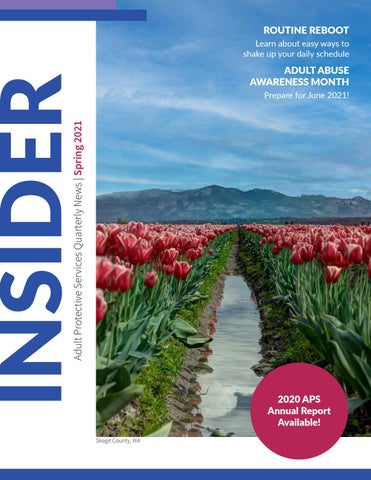
ROUTINE REBOOT Learn about easy ways to shake up your daily schedule
INSIDER
ADULT ABUSE AWARENESS MONTH
Adult Protective Services Quarterly News | Spring 2021
Prepare for June 2021!
2020 APS Annual Report Available! Skagit County, WA
SPRING 2021 | TABLE OF CONTENTS
05
08
Centralization of Due Process
13
Routine Reboot
Learn what’s changed with the due process unit
Regional Success Stories Celebrating our work protecting others
02 | DIRECTOR'S WELCOME 03 | DEPUTY DIRECTOR’S WELCOME 04 | EMPLOYEE SPOTLIGHT 05 | SUCCESS STORIES 07 | ASK THE EXPERTS
Simple tips for shaking up your day
08 | CENTRALIZATION OF DUE PROCESS UNIT 09 | GETTING TO KNOW ONE ANOTHER
SHARE YOUR PICTURES!
11 | ADULT ABUSE AWARENESS MONTH
Do you enjoy hiking, boating , exploring your own backyard or traveling around the beautiful state of Washington? Submit your pictures and see your art featured in an upcoming magazine!
13 | ROUTINE REBOOT 14 | HQ EMPLOYEE SPOTLIGHT/ANNUAL REPORT 15 | GRANT UPDATES 16 | LEGISLATIVE SESSION UPDATE 17 | COFFEE BREAK WITH KATHY 18 | UPCOMING EVENTS
You can send your pictures at any time to Amanda McCarthy at amanda.mccarthy@dshs.wa.gov.
HELLO FROM
KATHY MORGAN
Whether you’ve known me for years or have yet to meet me, here are six facts you may not know about me! 1. My favorite color is black. (I hate pink!)
THANK YOU The signs of spring are beginning to show and this new season brings us the promise of longer days, new growth and hopefully sunshine. As we begin this next chapter, I encourage you to take a little extra time to reflect upon your accomplishments of this past year and find pride in all that you’ve done in the midst of these difficult times.
2. I was in Future Farmers of America (FFA) and Head, Heart, Hands and Health (4-H) growing up. I raised beef cattle and my favorite animal to this day is still a cow! 3. I love baking and trying new recipes. My Pinterest addiction is a real thing. If you’re looking to try something new, I highly recommend this excellent Pasta E Fagioli soup and a decadent dessert of Baklava. (Insider tip: I take a shortcut with the soup and use canned beans. It saves time and turns out great!)
It’s been a while since I’ve formally introduced myself to everyone. If you’re new to APS or if I haven’t gotten the chance to meet you yet welcome! The work we do daily to transform lives of vulnerable adults is challenging, yet incredibly rewarding. We have an amazing team of experts with APS and I encourage you to participate in educational opportunities, learn from your peers and always ask questions.
4. I’m an introvert at heart and if I could, I’d live on a 1,000-acre farm in Montana.
I have worked with DSHS for 31 years and began working with APS in 2008. I’ve overseen APS since 2012 and have truly enjoyed the journey! I earned my degree in public administration and was drawn to social work so I could serve as an advocate for vulnerable adults. There are so many people who don’t have support in their lives and APS may be the only outlet for some individuals’ voices to be heard.
I want to thank you for your continuous dedication to serving vulnerable adults. Your daily work is not easy and your efforts truly do make a difference in the lives of others. Remember to take care of yourself and don’t forget to engage with your colleagues! (Maybe you can learn a few new fun facts about them, too!)
5. I love watching movies, especially mysteries and sometimes Hallmark movies! 6. I worked in a flower shop in high school and love being creative. My ideal retirement plan would be to run a small flower shop or country store.
2
HELLO FROM PAULA HUGHES
SAFE START UPDATE
GRATITUDE SUBMISSIONS SHARE A MOMENT OF JOY Joy can be found even during difficulty. What are some little bright spots you’ve experienced throughout the past year? Did you learn a new hobby? Go on an adventure in your own backyard? Spend more time with your family and pets? Create something? Celebrate in a new way? We want to hear from you! In our next edition, we’ll be sharing the bright spots from our staff. Send a brief description and a photo to Amanda McCarthy at Amanda.mccarthy@dshs.wa.gov by June 11 to include your bright spot in the summer edition of the magazine!
3
We’ve officially passed the one year mark since the majority of our workforce transitioned to remote work and we shifted the way we performed certain investigations. Adult Protective Services continued to serve vulnerable adults throughout the entire pandemic by adapting safety and screening protocols and communication methods. As of March 15, 2021, we have resumed in-person investigations for all allegation types. Our team has worked to develop comprehensive plans and training since last March to ensure safety for staff and those who we serve. Our preparation has included work groups, webinars, staff trainings, listening to and implementing guidance from the CDC and the Department of Health (DOH) as well as addressing staff concerns and challenges. Our APS Safe Start – Resume Guide was approved in October 2020 and has since been used as a model for other divisions and agencies when constructing their own guidance. Similar to other statewide transition plans, our approach included four phases. Phase one focused on effectively transitioning staff to remote work. Phase two included pre-transitional planning and identifying areas for process improvements to prepare for in-person investigations. Phase three marked the resumption of all investigations, for all allegation types, back in-person, and phase four will occur when the state is ready to reopen offices to the public. Thank you to our staff who have participated in the necessary trainings and preparation work. We will continue to follow guidance from the CDC, DOH and the governor’s office and will provide ongoing communication as we continue through the process.
REGIONAL EMPLOYEE SPOTLIGHT Mount Rainier, WA
Linda, a program manager extraordinaire in Region 1, is retiring. Linda has been an incredibly valuable teammate in Region 1 since she began her career with APS in 2007. Linda quickly transitioned from a Social Services Specialist 3 to a supervisor and then a program manager. Linda’s passion for horses is unbridled. She spends her free time with some of her closest equestrian friends, Angus and Sonny.
Linda White
Program Manager, Region 1
We’ve all learned a lot from Linda and are better people from having her as a teammate. Region 1 will miss Linda and wish her the very best as she continues the next chapter of her wild ride in retirement. Thank you, Linda, for everything you’ve done! Larry was born and raised in Selah, WA. He is a diehard Coug that proudly graduated from WSU and has worked in social services for 45 years. Larry joined APS in 2002 and is known for his reliability and admirable dedication to serving vulnerable adults. He used to drive from Bellingham to Mount Vernon in the snow to make sure intakes were being processed!
Larry Davis
Supervisor, Region 2
Larry now supervises a team of investigators at the Holgate (Seattle) Office. He has a great sense of humor and can be found sipping his signature drink – coffee mixed with hot cocoa. Thank you for your continuous work and dedication, Larry!
Elvira is a team player and her peers continuously express their appreciation for her positive attitude. She cares for her teammates and works diligently with staff to ensure the safety of clients. Elvira is known for her innovative ideas, many of which have been adopted by the management team in Region 3. Elvira proposed the concept for Motivational Mondays, which is now a staple in the region.
Elvira Ajanovic
Supervisor, Region 3
Elvira was recognized as the 2020 Region 3 Supervisor of the Year! During her time as a supervisor in the Vancouver office, Elvira has succeeded in building a positive culture among her teammates and is recognized as a great leader. Thank you, Elvira, for everything you do to support APS!
4
Ronald, WA
REGION 1
REGIONAL SUCCESS STORIES
SECURING SERVICES We worked with an individual that had a long history of self-neglect. The person’s health had deteriorated due to throat cancer. The individual had stopped eating, was not bathing and was unable to manage personal care at home. The person agreed to move to a facility, but later requested to return home. Home health assisted the individual with care. During one visit, the home health nurse became concerned about the individual’s condition and recommended a transport to the hospital. The person refused to go to the hospital. The APS investigator assigned to the case worked quickly to coordinate with the local response team for intervention and the person was transported to the emergency room for care. The investigator received a call the next day from the home health organization who thanked the investigator for being a “miracle worker.” Thanks to the investigator’s quick work, the individual is safe and receiving necessary medical care.
5
REGION 3 SUPPORTING SAFETY
An investigator received a call directly from an alleged victim that has a history of mental health challenges. The individual was experiencing suicidal thoughts and needed immediate support. The investigator coordinated with law enforcement to visit the individual along with a crisis mental health team. Law enforcement did not detain the person, but the crisis team and the investigator stayed with the individual and were able to convince that a voluntary detainment was necessary.
REGION 2
OVERCOMING CHALLENGES We received a report alleging the self-neglect on an individual who was deaf, mute and illiterate. A family member had attempted to secure assistance for the individual in the past, but was unsuccessful. The individual was living in an abandoned home for several years and went to the local foodbank weekly for food and basic necessities. The investigator faced challenges contacting the individual’s family, but was finally able to reach a sibling. The investigator coordinated an in-person visit that also included the sibling and a Home and Community Services (HCS) employee. During the visit, the team was able to provide the sibling with medical and financial Durable Power of Attorney documents and appoint the sibling as the authorized representative for paperwork and service coordination. The investigator’s persistence paid off and HCS was able to assist with securing services for the individual at an adult family home. The sibling is now officially the durable power of attorney for medical and financial decisions.
The investigator stayed throughout the entire process to ensure the individual was safe from harm and had necessary services lined up.
TIVA2 UPDATES • Began improving dashboard and email notifications Bug fixes • TIVA2 uploads section will no longer timeout • Person search will now show results when searching by alias name
6
ASK THE EXPERTS
EQUITY, DIVERSITY & INCLUSION WHAT IS ALTSA DOING TO SUPPORT EDI EDUCATION? Training is always an important step when preparing to embark on adventures or adapting to new processes. We’ve conducted numerous trainings related to Equity, Diversity and Inclusion work throughout the past several years. However, a common understanding is that, “training changes skillsets, but education changes the mindset.” That concept leads us to the question, “what happens after the training?” Our goal is to help employees adapt an educational mindset that provides us with the humbling mindset that we always have room for growth. With that mindset, we can address EDI work as an ongoing journey and better look inwards to identify our biases, triggers and social messages that influence our daily lives. The goal of continuous education and growth is to better learn how to celebrate our differences, connect through our similarities and foster meaningful interpersonal communication. To support this educational mindset, DSHS is embarking on a department-wide journey to promote Truth, Social Justice and Dismantling Racism. The department has identified 10 objectives in a three-year action plan that represent a starting point to becoming an anti-racist, equitable, transformational organization.
TRUTH
SOCIAL JUSTICE
Tell the real stories of committed action
Focus on career advancement, retention and succession planning
Conduct equity impact assessments Include anti-racism, anti-poverty and antidiscrimination metrics in the strategic plan
Increase Office of Minority and Women’s Business Enterprises (OMWBE) Contracting Networks Hire/Promote More BIPOC individuals in EMS/WMS Positions Establish a DSHS Non-employee Discrimination Complaint Process
DISMANTLING RACISM Increase Racial Awareness and better understand the effects race has on our work Include an EDI component in Annual Performance Evaluations Provide and Support Intentional Spaces for Difficult Conversations
To ensure that we as a department achieve these goals, each administration within DSHS identified goals to concentrate their efforts on in 2021. For ALTSA, the goals include: • Tell the real stories of committed action • Develop racial-ethnicity-language equity impact assessment template forms and sample procedures for pilot use with DSHS budget decision packages to support inclusion of an equity assessment in each decision package • Increase opportunity for career advancement, retention and succession planning for emerging leaders • Hire and promote more black, indigenous and people of color in EMS/WMS positions • Create intentional spaces for difficult crossracial/ethnic conversations resulting in
increased buy-in from employees for DSHS becoming an anti-racist organization.
OPPORTUNITIES TO GET INVOLVED • Truth to Action: Elevating Voices for Social Justice and Dismantling Racism Tour • ALTSA Listening and EDI Roundtable Sessions The EDI work is never-ending. We have a lot to learn about ourselves and the goal within ALTSA is to create a space where everyone feels seen and heard. The expectation is not to change minds, but to provide tools to help us reach a better understanding when interacting with things that challenge our beliefs. Each little step we take helps lead to equitable and sustainable changes in the world. Track the progression of our work at ALTSA through upcoming magazine articles, the ALTSA Update and all-staff emails.
CENTRALIZATION OF DUE PROCESS UNIT On July 1, 2020, APS created a centralized Due Process Unit at APS headquarters. The team includes the unit manager, legal benefits advisors (LBAs) and paralegals. Previously, the team operated and focused services regionally. The purpose of centralizing the unit was to establish statewide consistency and increase efficiency for all aspects of due process. This includes supporting each region’s IRT, reviewing and sending substantiation letters, representing APS in administrative hearings and ensuring perpetrators are added to the APS registry. Centralization has provided the opportunity to distribute cases more equitably and provide coverage statewide. It has also expanded the ability to provide support to the IRT process. The APS Privacy and Program manager joined the team and oversees public disclosure, handles privacy and confidentiality matters and manages court-ordered disclosures of APS information. The team continues to improve processes and provide support to hold perpetrators accountable and keep vulnerable adults safe.
8
GETTING TO KNOW ONE ANOTHER Understanding how our unique experiences contribute to a diverse workforce
Are you intrested in sharing your unique story? Email Amanda McCarthy by May 21 to share your story in the next edition!
Paula Hughes is a professional, mother, wife, veteran, caring friend and an adventurer. For the past 15 years, Paula has dedicated her talents towards serving vulnerable adults and has worked for APS in both Washington state and Arizona. We currently know Paula as the deputy director for APS, but she has previously served in numerous roles including field investigator, intake worker, intake supervisor, field supervisor and program manager. She began her grad school education at Santa Clara University in the marriage, family and child counseling program and transferred to the University of Puget Sound where she earned her master’s in counseling psychology.
PAULA HUGHES - APS DEPUTY DIRECTOR
PAULA’S STORY (CONTINUED) Paula’s adventurous nature may stem from her experiences living in Japan, Florida, California, Arizona, Pennsylvania and Washington. As a Japanese-American, Paula was born in Okinawa, Japan and was naturalized when she was 14 years old. Her mother grew up in Sendai, Japan and her father is Scotch-Irish and grew up in the United States. Paula’s childhood reflected a beautiful blending of cultures. She describes it as a, “very southern and Japanese home that was certainly unique.” Her father grew up southern Baptist and her mother practices a smaller sect of Buddhism. Throughout her childhood and adolescence, Paula noticed differences between her home and the homes of her peers. While some of her peers’ homes were filled with furniture and décor from department stores, Paula’s house displayed artifacts and furniture from around the world. Masks from the Philippines and art from Egypt, Korea, Vietnam and Japan adorned the walls and all of the furniture came from overseas. Her family cooked food that included dishes from Korea, the Philippines, Japan and US southern comfort food. They celebrated traditional holidays in the US and also attended Obon festival. Paula came to the US at a time when assimilation is encouraged. However, she’s thankful that her family was able to continue integrating their diverse cultures into their daily lives. Paula served in the United States Air Force (USAF) during Desert Storm and Shield as an engineering assistant using CAD (computer-aided drafting). She was a member of a mobility team and was among the first people to deploy as needed. Paula enjoyed her time in the USAF for it provided her with the opportunity to build relationships with people from all over the world. Her engineering unit team consisted of people from El Salvador, Mozambique, Africa, Italy, Texas and Alabama. The individuals from El Salvador and Mozambique had fled their countries with their families due to strife and had lost everything when they left their countries. Paula valued their stories about their previous
homes, the challenges they endured and how they chose to embrace the US as their new home. Paula’s greatest adventure in her life is motherhood. Her 16-year-old son, Ren (which is Japanese for lotus or love), and her 19-year-old daughter, Bella, keep her on her toes! She’s always been a full-time working mother and has learned lots about herself throughout the parenting process. Paula says that motherhood has taught her humility. Her kids, “tell it like it is” by always speaking their truth. They are gracious, forgiving and always game for celebrating when things go right! Paula loves spending her free time with her family. Together, they enjoy going to the beach, camping and hiking. Paula also enjoys reading, going for walks, tackling home improvement projects and testing new recipes (which are not always a crowdpleaser with her family…) When we look at Paula through our “colleague” lens, we see her as a strong leader, a caring human and a knowledgeable professional. While these observations are true, they are merely a snapshot of who she is as a whole. Paula’s story is rich and unique to her and the details of her journey have helped influence who she is today.
10
THERE IS NO EXCUSE FOR ADULT ABUSE SEE. STOP. REPORT. June is Adult Abuse Awareness Month Neglect, self-neglect or physical, sexual, mental and financial abuse is not always obvious. Help protect our vulnerable adults and report suspected cases to Adult Protective Services (APS). Call 1-866-END-HARM or visit www.dshs.wa.gov/altsa/reportadultabuse to report suspected abuse or neglect. 11
ADULT ABUSE AWARENESS MONTH June 2021 Governor Jay Inslee proclaims June 2021 as Adult Abuse Awareness Month. In 2020, Adult Protective Services (APS) received more than 65,000 reports of vulnerable adult abandonment, abuse neglect, financial exploitation and self-neglect. This awareness month is designed to promote education, identification and reporting throughout the state.
HELP SPREAD THE WORD Talk to your supervisor and request to order posters to display in the office! Email Amanda McCarthy at amanda.mccarthy@dshs.wa.gov with your request.
12
Shake up your daily schedule
routine reboot After a long winter indoors, we could all use a bit of a change when it comes to our daily routines. As the daylight hours become longer and the weather (hopefully) gets nicer, it’s time to pack away our comfy quilts and TV binges and swap them out for small changes to help reboot our routine. Here are some easy ideas you can try! 1. Go on a spontaneous weekend road trip. Whether you head towards the beaches, mountains or desert, pick a day to hop in the car and see where the wind takes you! Washington’s diverse ecosystems make it easy to experience something new within a reasonable drive. 2. Rearrange furniture. Let’s face it; we’ve spent a LOT of time at home recently. You might be bored of looking at the same scenery day in and day out. Pick a room and re-imagine the layout. Moving furniture around can help shake up your space and help it feel like new! 3. Perform a random act of kindness. Drop off a homemade treat on your neighbors’ doorstep, mail a coffee gift card to a friend you haven’t seen in a while or leave a flower bouquet for someone you’ve been thinking about. Thinking about what will bring someone else joy will provide you with motivation and purpose! 4. Pick a day and only do your favorite things. We all have to do lists and things we “should” be doing. If you can, pick a day (or afternoon) and only do the things you want to do! Eat your favorite food, do your favorite activity or connect with your favorite people. Setting aside time to reward yourself with pleasurable experiences will leave you feeling refreshed and recharged.
13
NEW! 2020 APS ANNUAL REPORT For the first time ever, we created an annual report to showcase our 2020 data, share success stories and outline our plans for the coming year. The document serves as a snapshot of all the great work we do every day to transform the lives of vulnerable adults. The annual report is now available online! Check it out!
HEADQUARTERS SPOTLIGHT Libby Schmit - Operations & Data Specialist Libby is a team player and has worked with DSHS for three years and recently celebrated her one year anniversary with APS! As the operations and data specialist at headquarters, she enjoys building relationships with colleagues all across the state. In her position, she works with regional and headquarters staff to provide TIVA2 support. She takes pride in developing new reports that accurately showcase the great work of APS. Libby is known for her big smile, quick responses, thorough work, kindness and patience. This year, Libby plans to continue working with IT to enhance the TIVA2 system and find new ways to easily share information with all staff throughout the state. She hopes to continue providing additional support for staff and teaching system functionalities. Thank you, Libby, for all that you do! 14
CORONAVIRUS RESPONSE & RELIEF
SUPPLEMENTAL FUNDING The Coronavirus Response and Relief Supplemental Appropriations Act of 2021, recently passed by Congress, provided the Administration for Community Living (ACL) funding to support Adult Protective Services programs across the country. This is an incredible opportunity and the first time in history that there has been direct funding for Adult Protective Services programs under the Elder Justice Act (EJA). The Administration for Community Living (ACL) has established the ‘Coronavirus Response and Relief Supplemental Appropriations Act of 2021’ grants to enhance APS programs. The purpose of this grant opportunity is to enhance and improve adult protective services provided by states and local units of government in response to the COVID-19 pandemic. This grant funding opportunity was announced in January. This funding is intended to enhance, improve, and expand the ability of APS to investigate allegations of abuse, neglect, and exploitation in the context of COVID-19 and to respond to the needs of adults experiencing such abuse, neglect and exploitation. We have been working closely with ACL, the National Adult Protective Services Association (NAPSA) and with other states to better understand the spending parameters, seek guidance and share ideas. Funds for this grant must be expended on APS activities related to the Coronavirus emergency. Funding must be used to supplement our program related to COVID and it cannot be used to supplant or replace funding or cover funding reductions. Such things we are considering through this funding include: • Improving and supporting remote work • Enhancing systems for tracking, reporting and accountability • Costs associated with establishing new and improving existing processes for responding to alleged scams and frauds, especially related to COVID-19 • Costs associated with community outreach and education • Costs associated with providing goods and services to APS clients related to the pandemic • Acquiring personal protective equipment and other necessary supplies • Training costs related to COVID-19 • Travel funds related to COVID-19 • Costs associated with assisting APS clients to secure the least restrictive option for emergency or alternative housing The pandemic has greatly impacted the lives of the vulnerable adults we serve. From increased isolation to severe health concerns and reduced available services, this past year has presented additional challenges throughout all aspects of life for the people we serve. This additional funding will help us to begin to bridge the gaps in services and improve our efficiencies to serve vulnerable adults. 15
APS
COMMUNICATIONS • Regional Communication Support: In January 2021, we announced that a goal for the year was to work with regional staff to identify areas of improvement for communication materials. Amanda McCarthy hosted a series of virtual meetings with staff from all three regions and received a lot of great feedback. The suggestions were collected and proposed solutions are being discussed between leadership and communications. Stay tuned for more updates! (Keep your eyes out for modernized, user-friendly materials coming soon)! • Grants: We received funding from the Administration for Community Living to support outreach efforts related to COVID. We will use that funding to implement a statewide media campaign in the coming months that will include radio spots, TV ads, newspaper features and more. We’ll provide updates in the quarterly magazine as we continue through the process! • 2020 Fact Sheets: Updated fact sheets are now available on SharePoint with 2020 data!
CONTACT Amanda McCarthy (formerly Williams) amanda.mccarthy@dshs.wa.gov Skype chat and calls
LEGISLATIVE SESSION This legislative session is considered a budget year and the legislature continues to work towards passing the 2021-2023 biennial budget. APS decided not to pursue its own legislation this year. However, there were several opportunities to provide input and language proposals into other bills. Here are a couple of the bills APS is currently tracking: • Second substitute house bill 1320 – This bill would consolidate all six civil protective orders into one RCW chapter and includes vulnerable adult protective orders (VAPOs), which would be removed from chapter 74.34 RCW. APS saw an opportunity to work with the bill authors to relook at the definition of “abuse” in 74.34.020. Sections 167 and 168 of the bill would amend the definition from “willful” to “intentional, willful, or reckless.” • Substitute house bill 1411 – The main purpose of this bill is to expand the long-term care workforce by not automatically preventing employment for certain crimes and expanding discretion when reviewing a person for employment. The bill includes the call to form a workgroup to explore additional opportunities to expand the workforce. This may possibly lead to discussion over whether entry on the APS registry is permanent or not. Things change quickly in the legislative session and decisions are being made daily. Stay tuned for updates as session is scheduled to come to a close on April 25, 2021. 16
Coffee Break with Kathy
April 27 | 9:00 AM
Grab a cup of coffee and call-in to chat with APS Director Kathy Morgan! This casual chat is the perfect opportunity to learn about what’s new with APS and ask any question you’d like! Want to learn more about employee engagement, training, roadshow updates or Kathy’s favorite restaurant? Ask away! She’s happy to chat about anything.
17
UPCOMING APS EVENTS Afternoon Insights Month (Time)
Topic Area
Presenter(s)
April 1 PM - 2 PM
Policy Spotlight
Arielle Finney APS Policy & Legislative Program Manager
May 1 PM - 2 PM
Dementia & Alzheimer’s
Dr. Susan McCurry Professor, University of WA School of Nursing
June 1:30 PM - 2:30 PM
LGBTQIA+ Community
July 1 PM - 2 PM
Developmental Disabilities & working with DDA Clients
August 1 PM - 2 PM
Decision-Making Screening: SPACED
Registration Link
Marianne Ozum-Wells Equity, Diversity and Inclusion Manager, Economic Services Administration Michelle Sturdevant Joint Requirements Planner, Developmental Disabilities Administration Dave Beacham APS Training Program Manager Jackie Heinselman APS Intake Unit Manager
https://attendee.gotowebinar.com/register/2627741942494040079
Ideas and Resources for Staff Commit to Connect | ACL Administration for Community Living Activities | ACL Administration for Community Living Engage | ACL Administration for Community Living Eldercare Locator (acl.gov)
Long Beach, WA
18
San Juan Islands, WA
LET US KNOW! Do you have content ideas or success stories for the next quarterly APS Magazine? Let us know! Send your thoughts to amanda.mccarthy@dshs.wa.gov