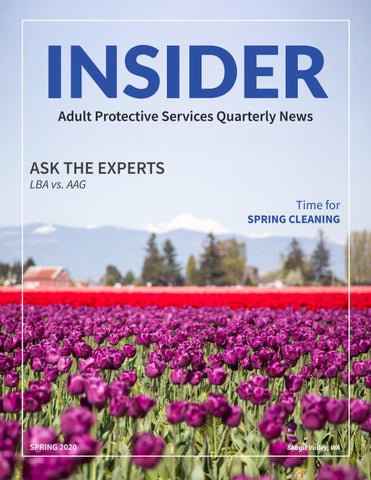
INSIDER Adult Protective Services Quarterly News
ASK THE EXPERTS LBA vs. AAG
Time for
SPRING CLEANING
SPRING 2020
Skagit Valley, WA
SPRING 2020 | TABLE OF CONTENTS
Legislative Session Update
05
APS Shared Staffing
06
02 | DIRECTOR & DEPUTY DIRECTOR'S WELCOME 03 | APS 2020 JOINT CONFERENCE 04 | UPCOMING EVENTS 05 | LEGISLATIVE SESSION UPDATES 09 | EMPLOYEE SPOTLIGHT 10 | SPRING CLEANING 11 | EQUITY, DIVERSITY & INCLUSION 12 | ASK THE EXPERTS 13 | COMMUNICATIONS UPDATE 14 | CRITICAL INCIDENT MANAGEMENT 15 -16 | ADULT ABUSE AWARENESS MONTH 17 | COFFEE BREAK WITH KATHY 18 | COLLEGE TUITION ASSISTANCE
PHOTO CONTEST Do you enjoy photography? Do you have an awesome picture showcasing the beauty of Washington State? Send us your original photograph to be featured on the front cover of the next edition of the APS Quarterly Newsletter! Email your picture to Amanda Williams at amanda.williams2@dshs.wa.gov by May 22. All images must be 300 dpi or larger. Headquarters staff will select the image to be featured on the cover.
FROM OUR APS LEADERS This spring has presented us with numerous challenges and uncharted territory. The COVID-19 pandemic caused us to adapt to a new way of living and working overnight. The outbreak has created a lot of uncertainty as information and recommendations change by the minute. While this has been a uniquely challenging time, I’d like to thank all of you for stepping up to the plate and continuing to serve Washington’s vulnerable adults. Your flexibility, dedication and excellence shone as you continued your work with professionalism and poise. Kathy Morgan APS Director
I’m always very proud of my team and it’s easy to tout our excellence when things are going smoothly. However, it means so much more when we continue our work through times of adversity. You’ve done a great job caring for others, but don’t forget that it’s equally as important to take care of yourself. Maintaining routines and fostering healthy relationships is key to finding balance, especially during uncertain times. Take a break from the news and social media. Call up a friend, read a book or go for a walk with your family. Remember to carve out time to relax and know that we will get through this together. Thank you again for being leaders and serving our vulnerable adults. Your contributions are invaluable and we appreciate the work you do every single day. For COVID-19 updates and resources related to our work with APS, please visit the ALTSA intranet site. For general information, please visit the Washington State Department of Health or the statewide COVID-19 website. In our last issue of the magazine, we shared what we’re doing to address additional training opportunities, modern schedules, access to employee support services, tuition reimbursement and workforce recruitment. We are continuing our work on all of these efforts and will provide updates as we make progress on each topic. We’re continuously working to improve our work culture and operations. I encourage you to participate in the employee engagement opportunities and reach out if you have any questions.
Paula Hughes APS Deputy Director
WASHINGTON
OREGON
2020 Adult Protective Services
APS CONFERENCE POSTPONED In an abundance of caution, we’ve postponed our Joint APS Conference. We are working to reschedule the date and will keep you updated with new information. Thank you for your patience and we look forward to meeting together soon!
IDAHO
ALASKA
MONTANA
Upcoming APS Events Coffee Break with Kathy
April 21
What’s on Your Mind: Staff Engagement Meetings Bellingham
May 19
Mount Vernon
May 19
Smokey Point
May 19
Yakima
May 26
Bremerton
June 2
Kennewick
June 3
Adult Abuse Awareness Month
JuneAll Month
2020 Legislative Session The 2020 legislative session was short and packed full of work. A lot of progress was made for various DSHS goals and desires. Unfortunately, the proposed APS legislation did not pass. Here is a quick summary of two relevant bills that passed in the short 60-day session of 2020: ESSB 6287 – Guardianships & Conservatorships: This is a “trailer bill” that follows a substantial legislative change the previous year. Trailer bills clean up the language of the initial bill, correct technical issues and reverse inadvertent policy changes. Effective January 1, 2022, changes of note for APS include amending the definition of vulnerable adult to be more person-centered, creating a new “supported decisionmaking” model that is less restrictive than a guardianship and amending language to ensure APS continues to have the authority to bring a guardianship or conservator action. SSHB 1645 – Certificates of Parental Improvement: This bill was very similar to the APS bill regarding a perpetrator’s ability to rehabilitate. It allows a person to be issued a certificate of parental improvement if the secretary of the Department of Children, Youth and Families (DCYF) determines a person has the character, competence and suitability (CC&S) to care for children. For ALTSA, this means a person with a founded finding of abuse or neglect of a child that would otherwise disqualify them from caring for a vulnerable adult would be able to provide care if that finding was accompanied by a certificate of parental improvement. Until the next regular session in 2021, APS will be working with ALTSA and DSHS leadership to determine the next steps in APS legislation. The next session (2021) will produce the biennial budget and also is much longer at 120 days. Olympia, WA
APS Shared Interest Staffing FIELD AND HEADQUARTERS The purpose of the APS field and headquarters shared staffing is to support the field, provide a forum to discuss APS cases and offer direction to staff regarding the screening of APS referrals, the investigative process, or both. The goal of a staffing is to discuss ideas, collaborate and offer shared decision-making on APS cases where there may be chronicity (someone who has multiple referrals, investigations or both), questions related to vulnerable adult status, a client’s continued refusal of APS protective services, or other concerns that are appropriate for a staffing. This group will meet regularly to review, discuss, make recommendations and provide feedback on screening intakes or the course of investigations and act in an advisory capacity to APS field staff. Referral process: Field staff will forward cases to their regions electronic email box designated for case staffing. Regional management will staff individual cases and the Regional Administrator or designee will decide if the case should be referred to HQ for consultation. Regional staff will email a copy of the APS Comprehensive Investigation Document to the Shared Interest Staffing email box at apssis@dshs.wa.gov. Cases received will be placed on the staffing calendar and the regions will be notified of the staffing date.
Transforming Lives Celebrating successes as we work to serve vulnerable adults and hold perpetrators accountable.
Walla Walla, WA
REGION 1: CONNECTING SUPPORTS We received an intake about a person experiencing self-neglect. The individual had dementia and lived alone in the mountains with no family support. The investigator visited the house and noticed that the person was confused and unable to do everyday tasks such as buttoning a shirt or using the telephone. There was hardly any food in the house and the individual didn’t remember meal times. The investigator placed a referral for grave disability with a local mental health organization. The individual was observed and family members were contacted. The investigator discovered that there was a Power of Attorney in place and coordinated with the mental health organization to find the individual placement at a dementia care facility. The person now receives support with daily care and medications and socializes with other residents.
REGION 2: PROVIDING PROTECTION A non-verbal individual with a developmental disability was allegedly being sexually abused by a relative for an undetermined amount of time. The individual’s parent was in denial that any abuse occurred. APS worked with law enforcement to investigate the case. APS and the Attorney General’s Office successfully obtained a five year Vulnerable Adult Protection Order (VAPO) against the relative. The case was a great example of collaboration between APS and the Developmental Disabilities Administration (DDA). The hard work and persistence provided a better quality of life for the individual as well as appropriate care for many years to come.
EMPLOYEE SPOTLIGHT CYNTHIA HAWN has been a regional floater since the position was initiated a few years ago in Region 1. Regional floaters travel throughout the region to cover gaps in staffing, fluctuating referrals and manage investigative caseloads when an investigator leaves APS. Cynthia has strong organizational skills, adapts easily and is detailed oriented.
Cynthia Hawn Regional Floater Region 1
This past year, Cynthia has managed a growing number of investigations in the region and handles the workload with grace and precision. Her positive energy and “can do” attitude make her a great addition to the team.
MOISES (MOE) FERREIRA joined APS and hit the ground running. He worked hard to learn our scope of work and gracefully implemented feedback. Moe excels in his work because he maintains a positive outlook on our work and values the APS mission.
Moe Ferreira
APS Investigator Renton
Moe is always willing to assist his colleagues. He is thoughtful in his work with all alleged victims, alleged perpetrators, clients and collaterals. Moe conducts his work thoroughly and always submits detailed investigations. Moe is an outstanding professional and a great addition to the team.
JOCILYN AARDE received the 2019 APS Region 3 Employee of the year recognition. This award is voted on by all staff in the region and shows the impact Jocilyn has on her colleagues. Jocilyn is known for going out of her way to help others. She’s great at identifying action items and offering solutions. Jocilyn took initiative to help facilitate prepping the regional quality assurance files. Jocilyn has been a great asset to the legal benefits advisor team and visits Centralia weekly to provide assistance.
Jocilyn Aarde Customer Service Specialist Tumwater
Her quick thinking and great attitude truly make her a standout employee!
FOUR TIPS FOR
Spring Cleaning
1
Make a schedule. Scope out your home. What areas need the most work? Where do you often skip during routine cleaning? Those are the best places to start. By breaking the work down in to manageable projects, you’ll be able to complete everything efficiently.
2
Declutter. Decluttering makes you more efficient and keeps you organized. It’s proven that clutter has psychological influences and it signals to your brain that work isn’t done. Studies have shown that a disorganized home adds to your stress level. Simple tasks like sorting mail, shredding old documents, tidying up bookshelves and going through your closet can help reduce the clutter in your home.
3
Work from top to bottom. When you think about how to spring clean your home, it’s important to start from the ceiling down. This will force debris downward and keep you from having to re-dust or re-clean your space. If you have a vacuum with an extension hose, use it to get cobwebs and dust from your ceilings and fans first.
4
Don’t forget about your air. Replacing furnace and HVAC filters is one of the most important and overlooked parts of spring cleaning. Consider replacing your current filters with a higher grade version that will help capture more particles and help keep you healthy.
EQUITY, DIVERSITY & INCLUSION
Understanding Biased Hiring
Read the original article on Harvard Business Review Research indicates that organizations do not hire individuals based strictly on objective criteria. Senior executives of large companies weigh ambiguous factors like “culture fit” to be as equally as important as critical job skills when making hiring and promotion decisions Recent research shows that speech patterns can lead to judgments about a person’s socioeconomic status. People often favor individuals with an elevated social standing. The way that people pronounce words, dress and carry themselves provide subliminal information about a person’s socioeconomic status. This subliminal information often resonates stronger with interviewers than a candidates actual qualifications. What can organizations do to counteract this? Hiring decisions should both value and incentivize the creation of a workforce that is diverse in terms of race and socioeconomic status. By integrating implicit bias awareness into hiring practices, we can help foster a strong workforce that supports capable employees from all backgrounds.
What's New with
TIVA2
• New features include improvements to person search, dashboard functionality and a person merge. A full list of the changes was distributed to staff with full details. • Remember: when submitting a TIVA2 helpdesk ticket please include an intake or investigation number for reference. This will help us to quickly review and troubleshoot the reported problem.
ASK THE EXPERTS
attorney in an administrative hearing instead of an LBA. The most critical distinction between the two, however, is that LBAs cannot provide legal advice, where AAGs can as legal counsel. This has a secondary effect, where communications between APS and its AAG are privileged (not subject to disclosure, protected), but any communications between LBAs and others in APS are not privileged and are public record.
Q: What’s the difference between an AAG and an LBA? A: Attorneys support the
work that APS does every day. From defending our findings in administrative hearings, to petitioning for guardianship and providing legal advice on sensitive topics, attorneys are integral to our work. However, there is an important distinction when it comes to attorneys who are employed by and work for APS and those who are not employed by APS, but represent APS in an attorney-client capacity – in other words, are APS’s legal counsel. A Legal Benefits Advisor (LBA) is an attorney who is employed by APS and whose primary role is to defend APS findings in an
administrative hearing (though your local LBAs may have additional responsibilities, too). In contrast, attorneys from the Office of the Attorney General (AGO) are APS’s legal counsel and represent APS in a variety of settings, which can include superior court appeals, tort lawsuits and other litigation, providing legal advice, guardianship and protective actions, and in some cases, administrative hearings. Though the roles are distinct, it can get confusing sometimes, too. There are times where an attorney from the AGO (called an Assistant Attorney General – AAG) will represent APS as our
You may need to interact with both LBAs and AAGs in your daily routine, so it will always be good to ensure you understand the capacity of the attorney’s relationship to APS. Make sure you know the limitations of how the attorney can help and ensure you accurately document your interactions and protect information required to be protected. If you have any questions the roles of the different attorneys in the APS world, be sure to ask your supervisor.
COMMUNICATIONS CORNER CAREER FAIRS Our team hit the road again this spring to talk to college students about careers with APS. We attended events at Washington State University Vancouver and a joint conference in Spokane for Eastern Washington University, Gonzaga University and Whitworth University. Thank you to Maria Gelever and Nichole Garcia for attending the career fairs!
THANK YOU, CAROL SLOAN Since 2001, Carol has worked as an APS program manager, creating the APS Academy for investigators, and lead for policy, legislation and WAC development. Previously, she worked as a program manager in the training, communications, and development unit where she co-developed, facilitated and trained in the Home & Community Services Division (HCS) and Area Agency on Aging Case Management and Program Training. Carol has been instrumental over the years in drafting policy and legislation, as well as collaborating with stakeholders on important initiatives. She has an eye for all things legal. Carol has decided that after 30+ years with Washington state service that the time has come to retire and enjoy spending time with grandkids, friends (in the middle of the day!), reading new books and taking her rescue dog, Perry Mason, out for leisurely strolls. Carol’s official retirement date will be June 30, 2020 but her last day at headquarters will be May 12, 2020. Please wish Carol the best in her next adventure.
Critical incident Management Program The critical incident stress management (CISM) program operationalizes a trauma-informed approach to create both preventive and responsive procedures in service of the health of our workforce. The CISM program shines a light on Washington state as a progressive leader and a reputable model for care of our vulnerable adults. The CISM program is a holistic program in that it focuses on increasing the health of all employees in multiple ways. One arm of the program is the Critical Incident Response Team which is an adaptation of an evidence-based method to respond to seriously challenging events that occur at work. Social and health program specialists, lead workers, supervisors, legal benefits advisors and program managers will serve on the critical incident response team and each will have ongoing training with the program manager, Dr. Matt Goldenberg. Dr. Goldenberg is a Licensed Clinical Psychologist who brings significant experience as a trauma specialist and leader in serving marginalized populations. The first round of training responders is scheduled for March 2020 and we will continue to accept potential new members with subsequent training opportunities as the need arises. To access the team, any APS employee, regardless of role, will complete a short referral form that Dr. Goldenberg will receive. A responder will be activated as quickly as the particular situation will allow, and interventions can be individual or done in groups. Though no documentation containing any identifying information will be gathered, responders will document their own response time and identify which interventions and resources were offered. Interventions will be short and are completely voluntary for all involved.
THERE IS NO EXCUSE FOR ADULT ABUSE SEE. STOP. REPORT. June is Adult Abuse Awareness Month Neglect, self-neglect or physical, sexual, mental and financial abuse is not always obvious. Help protect our vulnerable adults and report suspected cases to Adult Protective Services (APS). Call 1-866-END-HARM or visit www.dshs.wa.gov/altsa/reportadultabuse to report suspected abuse or neglect.
ADULT ABUSE AWARENESS MONTH June 2020 Governor Jay Inslee has proclaimed June 2020 Adult Abuse Awareness Month. In 2018, Adult Protective Services (APS) received more than 60,000 reports of vulnerable adult abandonment, abuse neglect, financial exploitation and self-neglect. It’s a sharp increase from the 48,000 reports received in 2017 and more than triple the 19,000 reports in 2012. This awareness month is designed to promote education, identification and reporting throughout the state.
HELP SPREAD THE WORD Talk to your supervisor and request to order posters to display in the office! Email Amanda Williams at amanda.williams2@dshs.wa.gov with your request.
Coffee Break with Kathy
April 21, 2020 | 9:00 AM Call-in info coming soon!
Grab a cup of coffee and call-in to chat with APS Director Kathy Morgan! This casual chat is the perfect opportunity to learn about what’s new with APS and ask any question you’d like! Want to learn more about employee engagement, training, roadshow updates or Kathy’s favorite restaurant? Ask away! She’s happy to chat about anything. Send your topic ideas or questions to amanda.williams2@dshs.wa.gov by April 10.
Washington College Grant
Formerly known as the State Need Grant
The new Washington College Grant gives more money to more students for more types of education after high school.
Welding or nursing? English or computer science? 18-month apprenticeship or 4-year college degree? Whatever the goal, Washington College Grant can help.
The new Washington College Grant (formerly the State Need Grant) makes education and training beyond high school affordable. More families are eligible and more programs and types of credentials are included.
Major changes begin in fall 2020 • Funding guaranteed for eligible students • Income eligibility increased • Added support for apprenticeships
Who is eligible?
What does it cover?
How do I apply?
Washington College Grant is open to students right out of high school, as well as adult students. An eligible student from a family of four making $50,500 or less per year would receive a full award. Partial grants are available for families making up to the state’s median family income, around $97,000 for a family of four. Recipients must meet WCG program requirements and attend an approved college or training program.
The maximum award amount which in 2019-20 ranged from about $2,500 to $10,500 - will cover full tuition at any in-state public college or university, including community or technical colleges, or provide a comparable amount toward tuition and other educationrelated costs at an approved private college or career training program. Amounts vary based on income, family size and the schoool or program attended.
There is no separate application for the Washington College Grant. Students should complete a federal or state financial aid application (FAFSA or WASFA), which colleges will use to determine eligibility and make awards. Students can apply now for financial aid for the 2020-21 school year. Application processes for non-campus-based apprenticeship programs have not yet been established.
For more information, visit wsac.wa.gov/pathways, talk to your high school counselor or contact the college financial aid office.
Former
LET US KNOW! Do you have content ideas or success stories for the next quarterly APS Magazine? Let us know! Send your thoughts to altsacomms@dshs.wa.gov
Seattle WA