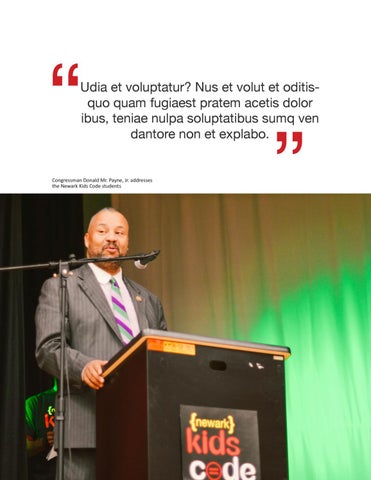
Udia et voluptatur? Nus et volut et oditisquo quam fugiaest pratem acetis dolor ibus, teniae nulpa soluptatibus sumq ven dantore non et explabo. Congressman Donald Mr. Payne, Jr. addresses the Newark Kids Code students
CREATING THE NEXT GENERATION OF SOFTWARE ENGINEERS
Urban League of Essex County
ATUR, SUM AUT FACIENI dit aut est quasper natianitis volorum rem num eumquat harum ent pligendio dolor sum et quiatec taecte volor as molupta in comnis dolendio ventemp orenis min perrovi delesci nis mincia sam, volum qui as atur rem hilibus simpel ex es ernatet vendel imus, ut earitius aliquo te nonseque por magnam dolecte incto qui dolupta tectem fugitempore et maximet est et volestio expero maximaxim ex ex eumenderum, sanis alitatur? Sed quosa si nobit exerum que providello il imint, vellatus aborecto incit ommodi volecabores ut odipict emposam, quae aliquam facepero officim ilitatur, utesed quidelia consequossit ut quia se nobis dolest, ut aperro et vello bero moluptatio et, a porrume sinctessunt lant aliqui officatiam si aliquist dolorrorate venimin ciamet aut explam faceate mporis autemolor acipsundi odipic te volupid mincturia velit eatur mostis ex ero tecum vereptatio vella verrorenimus et ut officiendam fugit quam dolupta tuscipsam, officitis alibusam, odistium quia qui non con consed ma que eum fuga. Et quide nones aut vidit, sequissint. Ucitem quia pelis in rereperrorem vollatqui verfereperum ut laccus dolorio optas di dusa inciunt, que landitatiore in ex erum recatur alibeaquunt etume secerro exerios a si omnihicae natemossum quunt re mos non pos doluptae. Fugit ad quatque voluptatem. Ehenis nus, torum sit ate non con et que re net eos ut etur ad mollore, torio totati rest, quae pro blab ipsum apictur, iusanientur, utenimagnis nestibus delese aut reprem eum iliquam, simus sundantur moluptiae. Nus. Ebitione recum quas num re prem nonsecus alicae. Et ea simagnissi incturiorrum nonest, cumquide eostrum veles aut remquam, seribusa explia nos esenima simus maio. Nam quae quae. Et pro offic to di aut ut mil incto berio. Itaepuda verferum atumquis as eicimpores eumquis modios cus sitasintia comnis videm et is quiaes cone non cum quibuscia sequisqui quis invelis dellige ntiosserit lat quia ducid mo exerrum quat venihil itationecus.
EXECUTIVE SUMMARY America is engaged in the competition of all competitions; a global technology and innovation arms race the likes of which the world has never seen, and one that will continue to disrupt and reorganize the workforce in profound and lasting ways. The race will be won by the country best able to cultivate and develop its most important asset, its citizens, providing them with the specialized skills required to do the work of the 21st Century and beyond. With a mission to promote social and economic self-sufficiency for disadvantaged residents, the Urban League of Essex County (ULEC) is committed to exploring innovative and effective strategies to help lift people out of poverty. Education and employment opportunities are key to realizing these goals. To be competitive in our 21st century workforce, students must be proficient, if not masterful in core literacy and quantitative subject areas. However, to be economically successful in our knowledge-based economy, students must also possess enhanced fluency in science, technology, engineering and math (STEM) subject areas. Sadly, for a majority of low-income students, STEM proficiency has been largely non-existent. This “opportunity gap” in education has long term negative impacts for disadvantaged and low-income groups – resulting in a “de facto” inability to seek higher education and career paths in high-demand, high-paying STEM occupations. Increasing access to these opportunities is key to enabling individuals and families to achieve economic self-reliance and becoming financially stable and successful. Recognizing the correlation between exposure, experience and aspiration, and seeking STEM-related career paths, the Urban League of Essex County established Newark Kids Code. Our mission is to create a supportive, encouraging coding and STEM community that produces the next generation of software engineers in Newark, and more broadly uses coding as a tool to teach students to be problem-solvers, systematic reasoners, and critical thinkers. The program is a unique collaboration between traditional public schools (charter and district), private schools, community-based organizations, and the New Jersey Institute of Technology (NJIT). The strategic partnership with NJIT is critical because 90% of the teachers in Newark Public School don’t know how to code, and therefore cannot teach it to their students. Low-income and technologically starved Newark Students are given access to an extensive menu of technology resources that are used to make them highly proficient coders and/or “computational thinkers.” The core philosophy that undergirds Newark Kids Code is award-wining author Malcolm Gladwell’s 10,000-hour rule. The rule states that if you do anything for 10,000 hours you will be highly proficient in it. By submerging students in a coding, STEM, and technology environment, and surrounding them with tech professionals and computer science and engineering students, many of whom that look like them, they begin to look at STEM subject areas differently. Their confidence increases, their attitudes begin to change toward STEM subject areas, and they develop the belief that not only can they master technology learning, but they can become computer programmers, scientists, and leaders in the technology sector. Our hope is that students that participate in Newark Kids Code not only develop new skills, but also new aspirations and new dreams for their future.
MEETING THE NATION’S EVOLVING WORKFORCE NEEDS America will need between 1.4 and 1.5 million additional coding and STEM professionals by 2022. Currently in New Jersey there are 22,000 more coding jobs than trained applicants to fill them. And in the United States there are 500,000 unfilled coding jobs. Will we meet this need by sourcing talent from countries like China, India, and the former Soviet republics, or by embracing reality, thinking outside the box, and disrupting a status quo that will not come close to producing this number for the foreseeable future? The disparity in STEM fields is no more evident than in our inner cities, and among our students of color. African-Americans have more access to a college education than ever, but they are underrepresented in major fields like STEM that are correlated with higher salaries, according to a study by the Georgetown University’s Center on Education and the Workforce. These findings match those in the U.S. News/Raytheon STEM index, which shows that there has been little progress since 2000 towards decreasing racial and gender disparities for interest and aptitude in STEM. Though the number of STEM bachelor’s degrees earned by black college students rose 60 percent drom 2000 to 2014, it made up a smaller share of the overall number of bachelor’s degrees earned by black students during the same time. The following ten reasons further amplify how important it is, not just to “introduce” or “make our students aware” of coding and STEM, but to make it a permanent part of their K-12 educational experience. Many students select as a course of student those things they have been exposed to during their life.
1. A startling 73% of scientists and engineers are white
2. African Americans, American Indians, and Hispanics between 18 and 24 account for 34% of the total U.S. population but earn only 12% of all undergraduate degrees in engineering
3. The gap between educational achievement in STEM grows even wider at the graduate level
4. Minority students report desiring to go into a STEM major at the same rate as their white and Asian peers
5. Minority STEM grads are less likely to use their STEM degrees in a future career than their white or Asian counterparts
6. Most foreign-born STEM workers come from Asia
7. California has the largest gap between minorities and STEM degree achievement
8. While the overall percentage of 24-year-olds in the United States with STEM degrees is just 6%, it’s just 2.7% among African-Americans and 2.2% for Latinos
9. More minorities switch to another major when enrolled in a STEM program
10. Minorities experience large gaps in honors course enrollments
It is clear that to be economically successful in our knowledge-based economy, students must not only be literate and proficient in quantitative skills, but must also possess enhanced fluency in STEM subject areas. For at-risk and underserved youth that attend low-performing schools, this is largely non-existent. Through no fault of their own, an entrenched “opportunity gap” effectively denies them opportunities to become proficient in these critical areas or access higher education and career paths in high-demand, high paying STEM-related occupations. Increasing exposure and entree to these opportunities is key to enabling them to break through longstanding barriers and pursue paths that will enable them to achieve economic self-reliance, become financially stable and lead successful lives. The NKC program will provide a powerful combination of coding instruction, life skills education and exposure to the marvels and opportunities of science and technology. Program participants will be motivated and able to apply learnings, benefit from increased confidence, and improve academic achievement not just in STEM, but in all subject areas. As Scratch and many of the other programming languages the participants will learn are open source, free programming languages accessible online NKC graduates will be able to continue their exploration into coding independently –without isolation. Their self-directed learning will further support the three overarching goals of the program:
1. NKC students will attain skills, confidence and exposure to concepts that are critical for future career success in our knowledge-intensive, technology based economy.
2. NKC students’ academic performance will improve.
3. NKC students will raise aspirations for academic and career paths in STEM subject areas.
PROGRAM OBJECTIVES: Students will develop and strengthen foundational skill areas for IT and programming.
The process of design: starting with an idea and turning it into a complete functioning project
How to experiment with new ideas
How to take complex ideas and break them down into simpler parts
How to collaborate with others on projects
How to troubleshoot when things do not go as expected
How to be persistent and persevere in the face of frustration when things aren’t working well
How to think creatively
How to reason systematically
STUDENTS WILL DEVELOP AND STRENGTHEN LIFE SKILLS TO BUILD RESILIENCY AND SELF-EFFICACY. Resiliency, or the ability to withstand stress and overcome adversity without lasting damage, is the basis for protecting and advancing well-being in every area of life. Resiliency is demonstrated by our capacity to “roll with the punches” and perhaps more importantly, “bounce back” when the going gets rough. What is key to understanding resiliency is that this quality is not inherent, but is developed and can be strategically improved at any stage of life. Our NKC’s program’s life skills coaching will empower students to mitigate common risk factors in their environment (stressors). Learning areas are included in the attached appendices.
NJIT Honors College David works with students on their project
KEY OBJECTIVES OF NKC FOR FAMILIES: Families will build positive attitudes toward students’ capacity to excel in math and science subject areas and will demonstrate knowledge and support for encouraging students to pursue educational opportunities and career paths in STEM-related areas.
DESIRED PROGRAM OUTCOMES 1. P rogram Performance: Demonstrated progress and mastery of coding and technology activities vis-Ă -vis instruction and directed curriculum. Outcome: Students will successfully complete all learning objectives and modules. 2. Academic Achievement: Demonstrated gains in math and science subject areas, problem solving and critical thinking. Outcome: Students will demonstrate academic gains to baseline in academic subject areas. Outcome: The cohort will demonstrate in problem solving and critical thinking. 3. Resiliency and Self Efficacy: Improved perceptions of confidence, ability and long-term learning and career opportunities. Outcome: The cohort will demonstrate improved confidence and pride in embracing STEM-related interests. The cohort will demonstrate positive feelings of inclusion and acceptance for the field through actions including, but not limited to, pursuing out-of-school time STEM programs, online activities, mentoring other students, school peers and family members in Scratch coding and other introduced skills and studied areas. Outcome: Participants will continue to access and progress through Scratch online programming modules. Participants will self-identify areas of interest and pursue independent study while continuing to engage resources available to them through the Scratch online community. Outcome: Students will demonstrate higher levels of academic achievement and rigorous coursework. The students will demonstrate increased confidence to pursue STEM-related studies and career paths.
NJIT President Joel Bloom introduces himself to the students, gives each of them his business card, and tells them he will see them when they are NJIT Freshmen
State-appointed Superintendent Christopher D. Cerf inspects the work of Newark Kids Code participant at Open House
PROGRAM DIRECTOR OF NEWARK KIDS CODE: Mr. Sharif is the project director of Newark Kids Code. He was born in Beth Israel Hospital in Newark, New Jersey. He attended elementary school in Newark, and middle and high school in West Orange, New Jersey. After high school Darrin attended Rutgers University (Newark Campus), where he majored in Business Management (concentration in finance), graduating Magna Cum Laude. After college, Darrin held a number of positions in the public and private sector. He developed a detailed knowledge of computers and technology after holding positions at the Summit Medical Group as a Computer Network Technician, and as a Microsoft Office User Specialist for New Horizons, a corporate computer software training firm catering to fortune 500 companies. His knowledge of nonprofit management and program design came from serving as the Director of Operations for the Urban League of Essex County from 2004 - 2010. Darrin was introduced to local government serving as the Chief of Staff to United States Senator Cory A. Booker who from 1998 – 2002 served on the Newark Municipal Council representing the Central Ward. Darrin would later represent the Central Ward from 2010 – 2014. During Darrin’s time in office, the Central Ward led the State of New Jersey in commercial and multi-family development. Also, while in office, Darrin worked with many cross-sector institutional leaders and community based organizations in Newark to make important “Human Development” investments in the most challenging, but deserving neighborhoods in the Central Ward.
ORGANIZATIONAL CAPACITY: Established in 1917, and one of the oldest affiliates of the National Urban League, ULEC’s mission is to assist African American and disadvantaged urban residents to become socially and economically self-sufficient. ULEC is multi-focused - affecting positive social and economic change through quality programming in education and youth development, career readiness and employment services, housing assistance, community building and economic development. Our proposed Newark Kids Code program would be headed by Mr. Darrin Sharif, Chief Administrative Officer. Prior to joining the Urban League, Mr. Sharif was a member of the Newark Municipal Council where he worked closely with the New Jersey Institute of Technology and other institutional stakeholders bring technology resources to the residents of Newark. Mr. Sharif also worked as a computer instructor for Target Computer Training School in Kenilworth, and New Horizons Computer Learning Center in Iselin, NJ. Mr. Sharif was a Computer Network Technician for the Summit Medical Group in Summit, NJ. Mr. Sharif is a Microsoft Office User Specialist in addition to holding A+ and Network+ certifications. ULEC is a financially stable organization with an annual budget in excess of $4.4MM. The League rests on the solid foundation of an experienced senior staff and a highly qualified and active Board of Trustees. The agency’s executive team, program directors, and case management staff have an average tenure of service of more than five years - supporting continuity in its programs, effective strategic change and organizational growth. The organization has robust financial processes and accounting controls in place to manage daily and program-specific and reporting needs. Annually, independent auditors conduct financial reviews. The agency is fully compliant with generally accepted accounting principles and has consistently passed independent audit and funding agency reviews. There have been no adverse opinions on its audited financials for more than 10 years. ULEC is fully compliant and current with all required state business registrations.
Technology Mentor makes sure students are keeping up and having fun
NEWARK KIDS CODE FALL 2015 PROGRAM DESCRIPTION In the NewarkKidsCode program students will develop their programming skills utilizing the Scratch programming language created by MIT. Students will learn the scratch development environment, learn to manipulate sprites on the stage; animation sprites to simulate moving pictures; use different sprite costumes; and utilizing different sounds for sprites. Students will be introduced to structured programming which uses procedures, variables, decision making, loops, processing strings, and lists. Students will then work on 6 real world projects that will demonstrate activities in the following areas: storytelling, fashion and design, art, friends, social media, sports, music and sound and game design. At the end of the program students will create group projects that will demonstrate skills learned over the 10-week program. At the end of the 10 week program students will have mastered the following learning skill areas LEARNING SKILLS PROVIDED
PERCENTAGE OF STUDENTS WHO MASTERED SKILL
Sequence - identifying a series of steps for a task
100
Loops - running the same sequence multiple times
85
Parallelism - making things happen at the same time
80
Events - one thing causing another thing to happen
60
Conditional - making decisions based on conditions
45
Operators - support for mathematical and logical expressions
25
Data - storing, retrieving, and updating values
80
Presentation Skills - student should be able to demonstrate their work
75
Each student will be coding using the following practices utilized by industry professionals COMPUTATIONAL PRACTICES PERCENTAGE OF STUDENTS ABLE TO APPROACH PROBLEMS AND UTILIZE THE FOLLOWING: Experimenting and iterating - developing a little bit, then trying it out, then developing
100
Testing and Debugging - making sure things work - and finding and solving problems when they arise
80
Reusing and Remixing - making something by building on existing projects or ideas
95
Abstracting and Modularizing - exploring connections between the whole and the parts
25
Comments - utilizing comments to ensure that their code can easily understandable
15
COMPUTATIONAL PRACTICES PERCENTAGE OF STUDENTS ABLE TO APPROACH PROBLEMS AND UTILIZE THE FOLLOWING: Getting Started
Explore Scratch’s programming environment Learning about different types of command blocks Create your first game in Scratch
Motion and Drawing
Explore Scratch’s motion and pen commands Animate sprites and move them around the Stage Draw artistic, geometric patterns and create games Learn why sprite cloning is a valuable tool
Looks and Sound
Create animations and image effects Learn how layers work in Scratch Play sound files and compose music Make complete animated scenes of your own
Procedures
Use message broadcasting to coordinate the behavior of many sprites Use message broadcasting to implement procedures Use the “build your own block” feature of Scrtch 2 Use structured programming techniques
Variables
The data types supported by Scratch How to create variables and manipulate them How to obtain input from users and write interactive programs
Making Decisions
Basic problem-solving techniques How to use the if and if/else blocks to choose among alternative actions How to construct logical expressions to evaluate given conditions The flow of control in branching statements
More and More Loops
Repetition structures to execute statements repeatedly How to validate user input Counter-controlled and event-controlled loops Procedures that can call themselves with recursion
String Processing
How Scratch stores strings How to use the string manipulation blocks available in Scratch Serval string processing techniques How to write interesting programs that process strings
Lists
How to creat and manipulate lists Initializing and accessing individual elements in a list Basic sorting and search techniques Using lists to create powerful applications