SEPTEMBER 2026 | VOLUME 50 • NUMBER 2
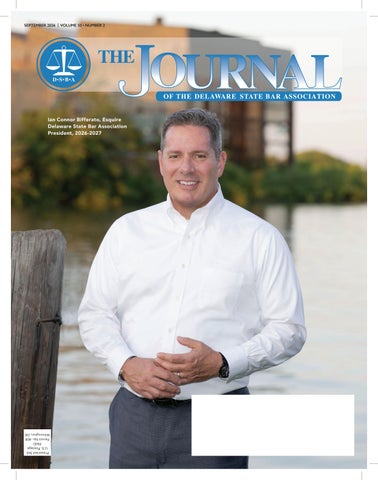
Ian Connor Bifferato, Esquire Delaware State Bar Association President, 2026-2027
Presorted Std. U.S. Postage PAID Permit No. 408 Wilmington, DE
DSBA BAR JOURNAL SEPTEMBER 2026 | VOLUME 50 • NUMBER 2 PRESIDENT Ian Connor Bifferato EXECUTIVE DIRECTOR Karl G. Randall EDITOR-IN-CHIEF Kristen S. Swift
Table of Contents
EDITORIAL BOARD Jason C. Powell Caixia Su
FEATURES
EXECUTIVE COMMITTEE LIAISON Francis J. Murphy, Jr.
14 Q&A With Ian Connor Bifferato, Esquire
EDITORIAL ADVISORY COMMITTEE Valerie A. Caras Claire M. DeMatteis Sara Beth Kohut Victoria S. Sweeney Holly O. Vaughn Wagner
16 Recipient of the 2026 Roxana Arsht Fellowship 18 Where You Bank Matters
20 Taking on Law School as an Older Adult
BAR JOURNAL ADVISOR Richard A. Forsten
24 Cyber Risk & Law Firms
EDITOR Danielle Bouchat-Friedman
28 In Memoriam: Patricia L. Quann, Esquire
37 New Annual Registration for Rule 55.1 In-House Counsel
The Bar Journal is published and distributed by the Delaware State Bar Association 704 North King Street, Suite 110 Wilmington, DE 19801 P: 302-658-5279 F: 302-658-5212 www.dsba.org © Copyright 2026 by the Delaware State Bar Association. All Rights Reserved. The Bar Journal is the independent journal of the Delaware State Bar Association. It is a forum for the free expression of ideas on the law, the legal profession, and the administration of justice. It may publish articles representing unpopular and controversial points of view. Publishing and editorial decisions are based on the quality of writing, the timeliness of the article, and the potential interest to readers, and all articles are subject to limitations of good taste. In every instance, the views expressed are those of the authors, and no endorsement of those views should be inferred, unless specifically identified as the policy of the Delaware State Bar Association.
COLUMNS 4
President’s Corner
30
Book Review
6
Editor’s Perspective
32
The Judicial Palate
10
Technology Tips
38
The Last Word
12
Let’s Talk: DE-LAP at Your Service
Side Bar: December Cover
9
Calendar of Events
Photo Contest
36
Bulletin Board
The Bar Journal is published monthly with a combined July/August issue. All correspondence regarding circulation, subscriptions, or editorial matters should be mailed to: Editor, DSBA Bar Journal Delaware State Bar Association 704 North King Street, Suite 110 Wilmington, DE 19801 or emailed to: dbouchatfriedman@dsba.org Letters to the Editor should pertain to recent articles, columns, or other letters. Unsigned letters are not published. All letters are subject to editing. Send letters to the address above, Attention: Editor, Bar Journal. The Bar Journal Editorial Policy is available upon request.
For Advertising Opportunities Call (302) 658-5279, ext. 1102 Email: dbouchatfriedman@dsba.org Read The Bar Journal online at www.dsba.org
DEPARTMENTS 8 9
Of Note
ON THE COVER: DSBA President Ian Connor Bifferato, Esquire, courtesy of DICK DUBROFF/ FINALFOCUSPHOTOGRAPHY.
DSBA Bar Journal I September 2026
3
PRESIDENT’S CORNER | BY IAN CONNOR BIFFERATO, ESQUIRE
The Delaware Way: Our Inheritance, Our Obligation
“
Every generation of Delaware lawyers inherits the responsibility to preserve our profession. .........................
E
very profession is defined not only by what it does, but by how it does it. For generations, Delaware lawyers have been guided by a tradition known simply as the Delaware Way. It is not a statute or a rule. It is a shared commitment to integrity, civility, reasoned judgment, and mutual respect. That culture of practice, work ing in concert with Delaware’s courts and legislature, has helped earn this state a reputation for fair, predictable, and trusted law.
For many of us, those values were instilled from the day we were interviewed as part of the character and fitness process or, at the latest, at the pre-admission conference. We learned them through daily habits: picking up the phone before 4
DSBA Bar Journal | www.dsba.org
filing a motion that might unnecessarily escalate a dispute, extending professional courtesies, remembering that our reputations endure far longer than any single matter. The practice of law, of course, has changed dramatically in a remarkably short time. Technology, remote practice, and the realities of the postpandemic profession have altered the rhythm of our work. Many younger attorneys came of age with social media as much a part of daily life as the morning paper once was. The pandemic accelerated trends that were already underway, and informal mentoring opportunities have diminished. That’s not failure. It’s opportunity. Every generation of Delaware lawyers inherits the responsibility to preserve what is most valuable about our profession. We cannot control every decision, political development, or business choice. We can control how we conduct ourselves every day. Every interaction either strengthens or weakens the confidence that clients, courts, and the public place in our legal community. Not long ago, written communication between lawyers took time. Letters had to be drafted, typed, reviewed, revised, and finalized. That process naturally encouraged reflection. Today, communication is nearly instantaneous. Emails, texts, electronic filings are sent within moments, often without the pause that once encouraged careful consideration of both message and tone. Yet one thing has remained constant. In a legal community like ours, reputations
are invaluable, fragile, and built over years through thoughtful conduct. Even adopting a simple personal rule, never sending a communication you would hesitate to place before a court, reflects the value that helped make Delaware the jurisdiction of choice for incorporation. It also honors the commitment each of us made when we took the oath of admission. The Delaware Way is our history. It is our competitive advantage. More importantly, it is our moral and professional obligation. We are stewards of a tradition that has served Delaware extraordinarily well. Its preservation depends not on any one institution, but on all of us. Let us recommit ourselves to that tradition. Let us teach it, model it, and preserve it for those who follow. The Delaware Way is our inheritance. It is also our obligation.
Connor Bifferato is the 79th President of the Delaware State Bar Association. Admitted to the Bar of the Delaware Supreme Court in 1994, he currently serves as University Legal Counsel to Wilmington University and as a professional neutral with The Bifferato Firm, P.A. He has more than 30 years of commercial and complex litigation experience in Delaware state and federal trial and appellate courts. He has demonstrated a longstanding commitment to upholding the Delaware legal community’s reputation for professionalism and civility through his service to the Delaware courts and the Delaware State Bar Association.
80 980
BUILDING BUILDING BUILDING RELATIONSHIPS RELATIONSHIPS RELATIONSHIPS 1980
for for
for
2022 2022
2026
OVER OVER 40 OVER 40 YEARS YEARS 40 YEARS OVER FOUR DECADES
|S U |STAFF | ME PP E ERMA R M A NN ENT ENTACCOCI ACCOCI AT AT EP E|E |RPA M PA RT ARTNE NE NENT R R|ACCO SU PP C PO PO I ATE RT RTSTAFF PART PL PL NACE EACE R ME S UPPORT NN T TS E SE RVICE RVICE STAFF S S PL ACE ME N T S E RV IC ES
215.981.5455 215.981.5455 kruza.com kruza.com 215.981.5455
kruza.com
DSBA Bar Journal I September 2026
5
UIRE
EDITOR’S PERSPECTIVE | BY JASON C. POWELL, ESQUIRE
A Case of the Mondays… having a case of the “Mondays,” regardless of what day it actually was, brought about several other similar and dissimilar interactions with other folks starting the workday. “Good morning—how are you?” is my standard hello when seeing someone in a hallway or entering an elevator. Responses vary, but seemingly fall into the general categories below. Do you agree? And what does the greeting’s response tell you about the speaker, I wonder. Standard responses (routine). “Fine, thank you.” Or, a responsive, “Fine, how are you?” The day is starting and your mind is on the tasks, meetings, filings, and appearances ahead. You are not so focused, however, that you ignore a greeting from a fellow colleague who may also be suffering from the “Mondays.” Common courtesies are not lost on these folks and they easily respond to friendly overtures by other colleagues and professionals.
“Let me ask you something. When you come in on Monday, and you’re not feeling well, does anyone ever say to you, ‘Sounds like someone has a case of the Mondays’?” I encourage you to watch the movie to see Lawrence’s response. His reaction is not only hysterical but also not exactly fit for print. At the beginning of a workday, or as you greet people throughout the day, I am always amused by responses that go beyond the routine and ordi6
DSBA Bar Journal | www.dsba.org
nary. Routine and ordinary in my mind are reciprocal and polite like responses: I say, “Good morning.” My greeting is met with a responsive, “Good morning.” I ask, “How are you?” The recipient responds briefly and we move on. However, that is not always the case as you probably know. Responses range from routine, sarcastic, or even positive and optimistic. My dad greeted everyone, everywhere, and I picked up this trait and, as the commercials say, I am presumably turning into my father. I greet people when they enter elevators. I always have and always will. Being in an elevator, recently, and probably
Standard responses (guarded). Maybe it’s just me, but oftentimes I feel like I startle someone with my initial greeting. Maybe I am too tall. Maybe I am too loud for a morning greeting. Regardless, sometimes the response is a reluctant, “Fine” as they quickly avert their eyes. I translate this to mean why are you talking to me, and what are you going to ask me next? But, at the end of the day, they responded and really what more can you ask for?
© istockphoto.com/ Yellow Man
I
n the movie “Office Space,” Peter Gibbons says to his neighbor Lawrence:
“Another day, another dollar.” This response seems to be a generational one—possibly used by folks older than me. As I write this, I don’t recall the younger generation responding with this phrase, as they have apparently moved on to using terms like “fire,” “low key,” and “6-7.” This is a phrase from decades ago that is still said at times. I see it as an attempt at humor; an attempt to give someone a smile beyond a standard and routine response. “Living the dream.” (sarcastic). The tone and delivery is what makes this response either fall into the sarcastic category, or the sincere category discussed below. You can hear the sarcasm when delivered, almost an exasperation if you will. Living the dream, sigh. I translate this to mean they don’t want to be here; I am actually not living my dream. How many people are really living their dream? The Detroit Tigers can only have so many star third basemen and there can only be one lead guitarist in Led Zeppelin. This dreary response seems to shut down any
further conversation and changes the vibe a bit. I am hopeful that my perception is wrong, or that their view could change to convert to the next category. “Living the dream” (sincere). Same response, but with enthusiasm. “Doing great,” or “What a beautiful day!” are also responses that fall into this category. This response has an immediate effect on the giver, the receiver and, frankly, the whole room, hallway, or elevator. Of course, some people are more outgoing and more outspoken, and these types of responses may be easier or natural for them. This, of course, also does not mean that people who do not emit such enthusiasm with a response are not happy and excited to start their day, as well.
so trivial. Maybe your enthusiasm is all the receiver needed to get them over the hump, or through the Monday; it could be infectious. Or, maybe, someone is overanalyzing your response so that it can be compartmentalized into some arbitrary category that will end up in a publication—who knows. Here is hoping that you are living the dream (sincerely).
Bar Journal Editor Jason C . Powell is the managing member of the Powell Firm, LLC. He can be reached at jpowell@delawarefirm.com. All opinions expressed are solely his own.
Our interactions throughout the day, personally and professionally, can define us and our relationships. In the morning, on Mondays, at lunch, in the courtroom, on our way out for the day, seemingly trivial interactions are had every day. Possibly, however, they aren’t
DSBA Bar Journal I September 2026
7
SIDE BAR
December Cover Photo Contest Are you a budding artist or photographer? Delaware State Bar Association members are encouraged to submit an original photo or visual artwork piece for the December cover of The Bar Journal. Entries should have a vertica l orientation, a nd be a 300 DPI high-resolution file (JPEG preferred). Image entries will be voted on during an editoria l board meeting. Please email your images to Danielle Bouchat-Friedman, Editor, at dbouchatfriedman@dsba.org by Oct. 2, 2026. Please include your name and a brief description of the image.
CONFERENCE ROOMS AND SPECIAL EVENT SPACE AVAILABLE THE DELAWARE STATE BAR ASSOCIATION
EXECUTIVE COMMITTEE Ian Connor Bifferato President
Francis J. Murphy, Jr. President-Elect Jennifer Ying Vice President-at-Large Frederick H. Mitsdarfer III Vice President, New Castle County D. Benjamin Snyder Vice President, Kent County Christophe C. Emmert Vice President, Sussex County Mae Oberste Vice President, Solo & Small Firms, New Castle County Jeffery A. Young Vice President, Solo & Small Firms, Kent County Stephen A. Spence Vice President, Solo & Small Firms, Sussex County Zachary S. Stirparo Secretary Paige C. Chapman Assistant Secretary Anthony V. Panicola Treasurer Brenda R. Mayrack Assistant Treasurer David A. White Past President The Honorable Kathaleen St. Jude McCormick Judicial Member Victoria R. Sweeney Assistant to President Thomas P. McGonigle Legislative Liaison
DELAWARE STATE BAR ASSOCIATION 704 North King Street, Suite 110, Wilmington, DE
Perfect for depositions, arbitrations, and committee formation meetings Visit www.dsba.org for more information about rentals and to reserve a conference room or event space. 8
Questions? Call (302) 658-5279
DSBA Bar Journal | www.dsba.org
Tayler D. Bolton Crystal L. Carey Richard A. Forsten James G. Griffin-Stanco Michael J. Hoffman Juan E. Martinez Claire M. DeMatteis Katherine H. Betterly Kelly Farnan Lisa Schmidt Denise Nordheimer Members-at-Large, appointed Karl G. Randall Executive Director
CALENDAR OF EVENTS / CLEs October 2026
Thursday, October 8, 2026 • 9 a.m. - 12:15 p.m. Accessibility, Inclusion and the Practice of Law
DSBA
Tuesday, October 13, 2026 • Noon - 1 p.m. A Beginner’s Guide to Delaware Capacity Opinion Letters
DSBA
Wednesday, October 14, 2026 • Noon - 1 p.m. Nervous System Regulation: Preventing Burnout
Potter Anderson & Corroon LLP
Tuesday, October 20, 2026 • 9 a.m. - 12:20 p.m. Bankruptcy Chapter 11 Nuts and Bolts
OF NOTE Condolences to the family of Harry Rhodes, III, Esquire, whose wife, Sandra Lou Crews Rhodes, passed away on July 4, 2026. Condolences to the family of Stephen B. Potter, Esquire, who passed away on July 21, 2026. If you have an item you would like to submit for the Of Note section, please contact Danielle BouchatFriedman at dbouchatfriedman@dsba.org.
DSBA
Wednesday, October 21 2026 • 9 a.m. - 11 a.m. How to Draft a Will for a Small Estate in Delaware
DSBA
Sunday, October 25 2026 • Save the Date Making Strides for Breast Cancer Bellevue State Park
Tuesday, October 27, 2026 • 8 a.m. - 10:30 a.m. Christopher White Awards Breakfast
Riverfront Events
Dates, times, and locations of events and CLEs may occasionally change. Please consult the DSBA website for the most up-to-date information at dsba.org.
TIME TO RENEW
Join DSBA Stay connected through DSBA. Renew your membership for 2026-2027 and enjoy uninterrupted access to all DSBA benefits.
Connect with
DSBA Like: Delaware State Bar Association
Follow: Delaware State Bar Association
www.dsba.org
Renewing is e a sy ! Renew tod ay and PAY O N LI N E by log ging into t he Members Area of w w w.dsba .org. DSBA Bar Journal I September 2026
9
TIPS ON TECHNOLOGY
Technology Tips From the Young Lawyers Section The executive board of the DSBA Young Lawyers Section is happy to share each of their tried and true (and perhaps hard-earned) technology tips. We hope that these help you in your practice as well!
Tips:
■ Excel filters are invaluable for reviewing privilege logs. You can filter for cells that contain or do not contain certain text and combine searches with AND or OR operators.
■ If you’re trying to search for a term across multiple pdfs (e.g., a series of depositions transcripts), consider combining them into one pdf first to streamline the search. Adobe even has a free online tool for this purpose, available at: https://www.adobe.com/acrobat/online/merge-pdf.html.
■ Mobile scanning apps that use your phone’s camera are surprisingly good. Adobe’s Scan to PDF app is free and works well for scanning a short affidavit or similar document.
■ Low-tech tip: if you’re having trouble accessing a paywalled news article, see if you can get access through your local library. Once you have a card and an online account, you can often get access through the library’s website. Some college and university libraries offer access to local residents, even if they aren’t otherwise affiliated.
Robby Erikson Robby Erikson is an associate in Block & Leviton LLP’s shareholder litigation practice and Treasurer for the DSBA Young Lawyers Section. Robby clerked for Chancellor Kathaleen St. J. McCormick of the Delaware Court of Chancery from 2022 to 2023. Robby grew up in the Midwest and now lives in the Philadelphia area with his wife and their three-legged cat, one-eyed-cat, and pug.
10 DSBA Bar Journal | www.dsba.org
Tip:
■ Creating a folder system in Outlook, or whichever program you use, that works best for you is a game
changer for efficiency and organization. An example of an effective folder system is to create folders by client, and add emails to their respective folders as they come in. I also like to have a “helpful” folder with emails that might not be client related but are otherwise informational and could be needed in the future as well as a “to do” folder containing emails related to my pending assignments and tasks. Once I finish the task, I then move that email to its client folder, if applicable.
Grace Best Grace is an associate in the government practice group at Connolly Gallagher, LLP practicing litigation in a range of areas and is the New Castle County Vice Chair for the Young Lawyers Section of the DSBA. She is from Annapolis, Maryland and enjoys running, baking, and spending time with friends and family.
Tips:
■ Calendar deadlines as soon as they are known and set reminders. Keeping an organized calendar supports effective deadline management and will help ensure timely completion of tasks.
■ As a lawyer, you should always be conscious of ongoing conversations surrounding the ethical implications of emerging legal tech, such as the use of Artificial Intelligence in the legal profession.
Jonathan Mills Jon is a corporate and commercial litigation associate at Esbrook P.C. and the Chair of the DSBA Young Lawyers Section. He is a Boston native and enjoys spending time with his family, friends, dog, and traveling.
Tip:
■ Adopt a consistent file-naming system. Beginning with the date in year-monthday format keeps files in chronological order. Including a matter number, short description, and version number makes searching easier and reduces the risk of editing—or filing—the wrong document.
Queen Nwangwu Queen is an attorney at Whiteford, Taylor & Preston LLP where she represents community associations, nonprofit organizations, and businesses in litigation, governance, and real estate-related matters. DSBA Bar Journal I September 2026
11
LET’S TALK: DE-LAP AT YOUR SERVICE | JIM DEEL, EXECUTIVE DIRECTOR
Before the Breaking Point: The Case for Early Intervention experienced by Delaware’s legal community. In April 1985, a Delaware attorney took the lives of his wife and two children before taking his own life.1 In a 1991 article in Delaware Lawyer, Justice Andrew G.T. Moore II wrote about the tragedy and the response that followed. His account described a legal community facing a difficult question: What should colleagues do when they know someone is in serious trouble but have no trusted way to intervene?
S
eptember is Suicide Prevention Month, and it gives us a reason to talk about something that can be difficult to discuss, especially when the person we are worried about is a friend, colleague, or family member. I have learned how hard it can be for members of the legal profession to ask for help. You are accustomed to being the person others turn to when something has gone wrong and in need of help. You listen, study the facts, and find a way forward. When you are the one struggling, asking for help may not come naturally. You may worry about what others will 12 DSBA Bar Journal | www.dsba.org
think. You may also wonder whether acknowledging a mental health or substance use concern could affect your reputation or career. Let me speak with you as a friend: There are times when each of us needs someone else. Sometimes the most important thing a person can say is, “I am not doing well.” At other times, our role is to notice that someone we know is having a hard time and ask the question, how are they really doing? A Painful Part of Delaware’s History The Delaware Lawyers Assistance Program traces its roots to one of the most painful events
At the time, Delaware did not have an organized and confidential resource devoted to helping attorneys and judges with substance use or mental health concerns. Some people tried to help, but there was no clear place to call and no established process for bringing the right support into the situation. Concerns about privacy and professional consequences also made people reluctant to speak. Without meaningful protection, people could reasonably fear that asking for help might expose a personal struggle or place a career at risk. Confidentiality was an important part of what followed. A revolving fund was established to help lawyers obtain treatment when finances stood in the way.1 Today, the Delaware Lawyers Assistance Fund has assumed that role. Working with DE-LAP, the Fund helps eligible members of Delaware’s legal community obtain needed treatment when they are unable to afford it. A person’s financial circumstances should never prevent that first call. The program has changed considerably since those early days. What began largely as a response to alcohol and drug concerns developed into a broader source of support for Delaware’s attorneys and judges. Today,
DE-LAP assists people facing mental health concerns, substance use, grief, stress, and other personal difficulties that may affect their lives or work. This history calls for a careful distinction. Mental illness should never be equated with violence. Most people living with mental health conditions are not violent. Suicide and acts of violence are complex, and it would be irresponsible to attribute a tragedy to one diagnosis or circumstance. The lesson is not that we cannot predict what another person may do. The lesson is that silence is not a plan. People need a trusted place to speak, and concerned colleagues need somewhere to turn before a difficult situation becomes a crisis. Why Pay Attention? A national study of nearly 13,000 practicing attorneys found that 28% of respondents reported symptoms of depression, 19% reported anxiety, and 20.6% screened at a level consistent with problematic drinking. The study also found that 11.5% had experienced suicidal thoughts at some point during their legal careers.2 Those figures are important, but I do not want the people behind them to disappear into statistics. The person who is struggling may be the attorney in the office next to yours. It may well be someone you see in court each week or a friend who outwardly appears to be managing everything well. I have learned that legal work can carry significant pressure. I won’t be the first to say that attorneys and judges routinely deal with conflict, other people’s crises and deadlines even continue when something is wrong at home. The pressure can begin to feel overwhelming. Some people respond by withdrawing. Others work longer hours or rely more on unhelpful coping strategies. Notice When Something Changes There is no single way that a person at risk of suicide looks or behaves. Still, certain changes deserve our attention, particularly when they are new or becoming more pronounced. The National Institute of Mental Health advises us to take notice when someone talks about wanting to die, feeling hopeless, being
trapped, or believing that they are a burden. A person may withdraw from others, take unusual risks, or experience a marked change in sleep or mood. Increased use of alcohol or drugs may also be a warning sign.3 You do not need to diagnose the person. You only need to notice that something has changed and care enough to ask. You can begin with something as ordinary as: “I’ve noticed that you haven’t seemed like yourself lately. How are you doing?” Breathe, and then give the person time to answer. If you are concerned about suicide, it is OK to ask directly: “Are you thinking about suicide?” Some people fear that asking this question will put the idea into someone’s mind. Research does not support that concern. According to the National Institute of Mental Health, asking directly about suicide does not cause or increase suicidal thoughts. The question may instead give someone permission to tell the truth about what they are experiencing.4 If the person begins to talk, listen. In that moment, what matters most may be showing them that they have been heard and that they are not alone. Tell Someone You Trust If you are the one struggling, please tell someone. You do not need to decide whether the problem is serious enough. You don’t have to know what kind of help you need. You can start with a trusted friend, family member, physician, therapist, faith leader, or DE-LAP. If someone tells you that they are thinking about suicide, take them seriously. I say that not only as someone who cares deeply about this community, but also from many years of professional experience assisting people in crisis. If there appears to be an immediate risk, do not leave the person alone. Do not promise to keep suicidal intent secret. Instead, help the person contact a trusted support or crisis resource. Call 911 when there is an immediate danger to life. The 988 Suicide & Crisis Lifeline is available nationwide by calling or texting 988. Online chat is available at 988lifeline. org. The Lifeline connects people with trained crisis counselors 24 hours a day.4 A Trusted Place to Begin My role at DE-LAP is to care for Delaware’s attorneys and judges. I take that
responsibility seriously. DE-LAP exists so that you do not have to work through a mental health or substance use concern by yourself. Under Delaware Supreme Court Rule 74, DE-LAP helps Delaware attorneys and members of the State Judiciary with alcohol, drug, gambling, emotional, behavioral, or other personal concerns that affect well-being and professional performance.5 DE-LAP offers a confidential place to begin. It is not a disciplinary program. My first job is to listen. From there, we can talk through what is happening and consider what kind of support may help. The history of DE-LAP reminds us that profound suffering may not always be visible and that Delaware’s legal community must have a trusted, confidential path to help. Suicide Prevention Month will end when September does, but our concern for one another will not end with it. If you notice that someone has pulled away, check on them. If you are having a hard time, give someone the opportunity to be there for you. If you are struggling—or if you are concerned about someone else—contact the Delaware Lawyers Assistance Program at 302610-8234 or visit www.de-lap.org. Notes: 1. “Hon. Andrew G.T. Moore II, “Ending the Code of Silence,” Delaware Lawyer, Vol. 9, No. 1, Spring 1991, at 6–8. 2. Patrick R. Krill, Ryan Johnson & Linda Albert, “The Prevalence of Substance Use and Other Mental Health Concerns Among American Attorneys,” Journal of Addiction Medicine, Vol. 10, No. 1 (2016), pp. 46–52 3. National Institute of Mental Health, “Warning Signs of Suicide,” revised 2025. 4. National Institute of Mental Health, “Frequently Asked Questions About Suicide;” 988 Suicide & Crisis Lifeline. 5. Delaware Supreme Court Rule 74; Delaware State Bar Association, Delaware Lawyers Assistance Program.
Jim Deel is the Executive Director of the Delaware Lawyers Assistance Program, where he works closely with attorneys and judges to provide confidential support in the face of personal and professional stress. With prior experience as a clinician embedded with law enforcement, he has worked alongside vulnerable seniors and families experiencing crisis. His approach emphasizes trust, practical support, and creating space for professionals to navigate difficult work without carrying it alone.
DSBA Bar Journal I September 2026
13
FEATURE
QA &
WITH IAN CONNOR BIFFERATO, ESQUIRE DSBA PRESIDENT 2026-2027 PHOTOGRAPH BY DICK DUBROFF/FINALFOCUSPHOTOGRAPHY
14 DSBA Bar Journal | www.dsba.org
important opportunities from participat- lawmakers, lawyers, and judges. Q What was your first position after and ing in the judicial application process to the Several Delaware lawyers have directly
you were admitted to the Delaware bar?
A
My first position after I was admitted to the Delaware bar was as an associate attorney at Evans & Bifferato, P.A., which was a small general practice litigation law firm. I primarily handled consumer injury-type litigation, although I also had several Court of Chancery trials, involving unexpected and interesting issues.
Q How long have you been a member
of the DSBA, and what do you enjoy most about being a member?
review and development of new laws that are part of the evolution necessary to keep our work relevant and effective.
Q Who are some lawyers who have
made a significant impact on your life?
A
I came from a family of lawyers; my father was a Superior Court judge for more than 30 years, my mother was a lawyer, my brother is a lawyer, and my brother-in-law is a lawyer. First and foremost, among Delaware lawyers who I admire and respect will always be my wife, Karen C. Bifferato.
A I have been a member of the in 1998, I went from working one moment to
Anyone who knows me well knows that,
DSBA since December 1994, nearly 32 years. I sincerely enjoy understanding how our American system of government works, including how and why laws are made and put into application in American society. It is a privilege to be a part of a system that is in place specifically to ensure that the civil and criminal laws, enacted by state and federal legislatures, are tested in court, and applied fairly and justly by state and federal courts.
Q
Why should a Delaware attorney join the DSBA?
A Attorneys should join the DSBA
to build and strengthen their relationships with one another, find ways to support the judiciary, and to develop and continue to support the evolution of the practice of law in Delaware. We are here to be good stewards of the franchise in which we practice, and that requires that we work together and to do so while putting aside any differences that might otherwise separate us. Together, in both sections and as members in general, we are able to identify sources for business development, and to identify and pursue issues that are important to the Delaware community in which we work as well as our own legal community. When Delaware lawyers work together, the DSBA as our primary trade organization should be in a position to address any issue, no matter how significant. Active participation in the DSBA provides amazing
learning, within hours, that I needed emergency brain surgery. On the night before my first surgery, then-Senator Joseph R. Biden Jr., and member of the Bar of the Delaware Supreme Court, came to the hospital and stayed with me through the night. At a moment when I desperately needed hope, he spoke to me in a way that drew upon my deepest faith and gave me confidence that I would survive and recover. I have never forgotten that extraordinary act of friendship and compassion. Karen was beside me that night and through every moment and every challenge that followed. Her unwavering love, faith, and belief in my recovery helped me get back on my feet and return to practicing law without any deficits. Senator Biden gave me strength at a critical moment; Karen sustained me throughout the entire ordeal. I would not be the person—or the lawyer—I am today without her. I have had the privilege of knowing people who were committed to maintaining respect for Delaware law and its critical importance to every aspect of the State of Delaware. There’s Judge William T. Quillen, who had tremendous respect for the history and traditions of the Bench & Bar of the Delaware Supreme Court. There is also Justice Randy Holland, whose writings and publications reveal his deep interest in, and respect for, the history of the Delaware Constitution. Justice Holland developed the concept of The Delaware Way as a description of the interaction between Delaware
impacted the direction of my career as a lawyer, and I will always be grateful: The Honorable Alan G. Davis, Chief Magistrate Judge; Clark Collins, Morris James; Allen Terrell, Richards Layton & Finger; Tom Mammarella, Gordon Fournaris & Mammarella; Manny Fournaris, Gordon Fournaris & Mammarella; John Carroll, Cozen O’Connor; Peter Walsh, Potter Anderson, Claire DeMatteis, Joe Asher and many others. I am sure I cannot identify them all. Today, I still rely on mentors and friends nearly daily in my personal and professional life. I cannot think of many people whom I respect as much as The Honorable Joseph J. Farnan, Jr., Chief Judge, U.S.D.C., District of Delaware (ret.). I have been and continue to be inspired by and seek the advice of The Honorable Myron T. Steele, Supreme Court of Delaware, Chief Justice (ret.). Dean Jan R. Jurden, Wilmington University Farnan School of Law, Delaware Superior Court, President Judge (ret.), and The Honorable Joseph R. Slights, III, Delaware Superior Court (ret.) Delaware Court of Chancery (ret.) have repeatedly given me unerring advice and support. I am very grateful to spend most of my days with my colleague, teacher, and friend Richard K. Herrmann, Wilmington University.
Q If you weren’t a lawyer, what
would you be?
A
I have always had tremendous respect for members of the American military. I have no illusion that I would have been qualified to serve in any specific branch of the Services, or that I would have succeeded in the military, but I have always been drawn to the adherence to discipline and living according to a code of honor, and in support of brothers and sisters in the American Services. I would not have been interested in an office position, although I respect the work of the JAG officers. If my path led me away from the law, I hope it would be to live and travel based on where I would be called to go, and where I could make a difference.
DSBA Bar Journal I September 2026
15
FEATURE
EMMA BALLENTINE, ESQUIRE Recipient of the 2026 Roxana C. Arsht Fellowship BY EMMA BALLENTINE, ESQUIRE
I
first heard about the Roxana C. Arsht Fellowship when Alexis Gatti, the Chief Prosecutor in Sussex County, sent me the details. She said I should consider applying because of the outreach work that I do as an attorney at the Delaware Department of Justice. I was incredibly honored that she, my supervisor and County Prosecutor, had thought of me when she read about the Roxana C. Arsht Fellowship. I was even more honored—and shocked—when I was chosen as the Fellowship recipient. This Fellowship, established by the Women and the Law Section of the DSBA and awarded through the Fellowship Fund at the Delaware Community Foundation, supports newly admitted attorneys who work in public interest law, including attorneys who work for the State. The Fellowship is named for the Honorable Roxana C. Arsht, one of the first women to be admitted to the Delaware Bar and the first to be appointed to the Bench in Delaware. Her inspiring story—one of a secondgeneration immigrant who spent her life serving as a trailblazer for women in law—makes the honor I feel in receiving this Fellowship even stronger. As the recipient of this award, I fully recognize how many women, including Roxana C. Arsht, have worked hard and broken barriers for this Fellowship to exist. I have the unique experience of working in a woman-led office at the Delaware Department of Justice in Sussex County. Since my clerkship in 2023 at the Delaware Department of 16 DSBA Bar Journal | www.dsba.org
Justice, I have noticed that most of my colleagues and role models are other women attorneys. Currently, every supervisor in my chain of command, all the way up to Attorney General Kathy Jennings, except for one, is a woman. As a woman in law, each of my female colleagues and supervisors has inspired me to be a better and more confident attorney. I am further inspired in my legal career by the fact that the Women and the Law section of the DSBA has chosen to award me with a Fellowship that, at its core, is based on a female attorney who overcame expectations and led the way in Delaware for women like myself to practice law. When I first read about the Fellowship, I was not sure if my work at the State was deserving enough of such a recognition. However, with the support of my office and the recommendation of my supervisors, I realized that the legal and community work that I do as a Deputy Attorney General at the Delaware Department of Justice is exactly the kind of public interest work that the Fellowship aims to encourage. The Delaware Department of Justice has been a great place to start my legal career. Delaware’s Attorney General, the State’s chief law enforcement officer, has broad responsibility to combat crime, safeguard families, fight fraud, and protect consumers in the First State. There, I work as a Deputy Attorney General in the criminal division in Sussex County. In the Criminal Division, I have learned that our goal is justice, which includes safeguarding
Emma Ballentine is an attorney barred in Delaware and Maryland. She is a Sussex County local who now works at the Sussex County office of the Delaware Department of Justice. Emma graduated from the University of Delaware in 2021 and went on to obtain her law degree from the Penn State Law School in University Park, Pennsylvania, in 2024. As a Deputy Attorney General, she handles felony cases in the Violent Crime Enterprise in Superior Court. Additionally, she works with the Community Engagement Unit to connect with the community and attend local events.
victims’ rights and ensuring defendants’ constitutional rights. I have had the opportunity to prosecute misdemeanors in the Court of Common Pleas, domestic violence and child abuse misdemeanors in Family Court, and felonies as part of the Violent Crime Enterprise Unit in Superior Court. I have worked with victims, witnesses, law enforcement, defendants, defense attorneys, and court staff. My role at the DOJ is incredibly public-facing, and that happens to be one of my favorite parts of the job. I enjoy getting to meet new people from all walks of life. A lot of times, when someone from the public is meeting me, it is because they have experienced one of the worst days of their life. For a lot of people, it is one of their few experiences with the criminal justice system. That means my performance and dedication to the job has the ability to influence how they view the criminal justice system as a whole. I consider it a big responsibility to make sure that I practice with integrity and purpose. Both of these statements are typically true for victims and defendants alike; part of my role is trying to make those situations as manageable and painless as possible. My goal is to do the right thing and make people as whole as possible. In my work with the Delaware Department of Justice, I have also found non-legal outlets for my passion for my community. I act as an attorney coach for the Cape Henlopen Mock Trial team. I mentor a middle schooler at Mariner Middle School during the school year. I work directly with Delaware Law Related Education Center as the Sussex County Department of Justice liaison. Through DELREC, I go to elementary, middle, and high schools around the county discussing civics, the law, and future legal careers.
organize and attend local community events. The goal with the Community Engagement Unit is to connect with the members of our community outside of the criminal justice system. I do not want to just meet community members on what could be the worst day of their life; I want to meet them where they are, any day, and help connect them with the resources that our State and county have to offer. Some of the events highlight a specific cultural subset in our county or a specific town. In addition to being great events for connecting community members with resources, they are also a lot of fun to attend. The Fellowship will be used to support my work at the Delaware Department of Justice, as the fund will aid my training and professional development. I look forward to seeing the work that I can do at the Delaware Department of Justice with this additional support, and I know that what I will learn through my training will make me a better attorney for Sussex County and my community.
Get Noticed!
Take advantage of the target audience of the DSBA Bar Journal and initiate new business through referrals and building your brand. Placing an ad is easy! For more information, contact Danielle Bouchat-Friedman at (302) 658-5279 or dbouchatfriedman@dsba.org.
BECOME A DSBA SECTION MEMBER Section Membership provides the chance to exchange ideas and get involved. To join a Section, visit www.dsba.org/about-the-dsba/membership.
My favorite part of work ing at the Delaware Department of Justice, though, is running the Sussex County portion of the Community Engagement Unit. There, I work closely with Corie Priest, the director of the statewide Communit y Engagement Unit, to DSBA Bar Journal I September 2026
17
FEATURE
Where You Bank Matters: The Hidden Impac t of Your IOLTA Account
A
BY MEGAN S. GREENBERG, ESQUIRE
t the Bench and Bar Conference in June, I had the opportunity to spend a few minutes talking about the Delaware Bar Foundation’s work. For those who were there, this article is a follow-up to one point I made there. For those who were not, it is an invitation to take a closer look at something that may not receive much attention in the day-to-day practice of law: the interest rate being paid on your firm’s IOLTA account. The message is simple: where you bank matters. Most attorneys understand the basic purpose of an IOLTA account. When lawyers hold client or third-party funds that are nominal in amount or expected to be held for only a short period of time, those funds are pooled in an Interest on Lawyer Trust Account. The interest generated is remitted to the Delaware Bar Foundation, which administers Delaware’s IOLTA Program on behalf of the Delaware Supreme Court. What may be less widely understood is how dramatically the amount of interest generated can vary depending upon the financial institution holding the account. The Same Client Funds. A Very Different Impact. The funds held in IOLTA accounts do not belong to the lawyer or the law firm. Because the amounts are nominal or held for too short a time to generate net interest for the individual client, the interest is instead pooled to support access to justice. Not all banks, however, pay the 18 DSBA Bar Journal | www.dsba.org
same rate on IOLTA accounts. Depending on the institution and the rate being paid, moving an IOLTA account to a Prime Partner institution can generate as much as eight times the interest income for access to justice programs from exactly the same underlying balance. The lawyer is not being asked to donate client funds. The client receives no less. The law firm is not being asked to write a check. The only difference is the financial institution selected to hold the IOLTA account and the rate that institution pays. The result, however, can be significant. IOLTA revenue supports civil legal services for Delawareans who cannot afford an attorney and law-related education that helps young people and members of the public better understand our legal system. These funds help Delawareans facing eviction and housing instability, domestic violence, consumer problems, family law issues and other civil legal problems that can fundamentally affect their safety and stability. The amount of money available for that work is directly affected by decisions made in law offices across the state. Know Your Rate!
seem modest when viewed on a monthly statement. Across many accounts, and over the course of a year, those modest individual amounts add up to substantial collective gains. That is why I asked attorneys at Bench and Bar to check their accounts. I make the same request here: Do you know the interest rate being paid on your IOLTA account? If you are a managing attorney, firm administrator, or signatory on an IOLTA account, please find out. Ask your financial institution what rate it is currently paying on your Delaware IOLTA account. Compare that rate with the rates available through the Foundation’s Prime Partner institutions. If the difference is significant, ask your bank why. Your firm can also consider moving its IOLTA account to a Prime Partner institution. Changing banks is an operational decision for every firm to make based on its own needs and relationships. But the IOLTA rate should be part of that decision. Too often, it is not. Lawyers Have an Important Role The success of Delaware’s IOLTA Program depends on a partnership among the Court, the Foundation, attorneys, and financial institutions.
The Foundation’s Prime Partner Program recognizes financial institutions that choose to pay the preferred rate on Delaware IOLTA accounts. By paying stronger rates, these banks help transform funds already sitting in pooled trust accounts into greater resources for legal assistance and law-related education.
The Foundation administers the program and works with banks to encourage competitive rates. Financial institutions establish and service the accounts and remit the interest. But attorneys make the banking decisions.
The collective impact is powerful. A higher interest rate on one account may
That gives the Bar a vital role in maximizing the program’s impact.
Law firms regularly evaluate the cost and quality of the professional services they use. We compare technology platforms, insurance products, office leases and other financial services. The interest rate on an IOLTA account deserves the same attention—not because the interest belongs to the firm, but precisely because it does not. Those dollars can do something important. At a time when the need for civil legal assistance remains significant, it makes little sense to leave potential IOLTA revenue unrealized when a stronger rate may be available. Attorneys can help simply by asking a question and making an informed choice.: What rate is my IOLTA account earning? IOLTA Is Also About Good Practice Management Interest rates are only one part of responsible IOLTA management. Trust account management requires careful attention to how accounts are established, what funds belong in IOLTA, recordkeeping, reconciliation, permissible fees, and the separation of client funds from firm funds. These obligations matter. They protect clients, lawyers, and public confidence in the profession. To help Delaware attorneys better understand both the compliance requirements and the practical realities of managing trust accounts, the Foundation will present IOLTA in Action: Compliance, Ethics, and Impact in Delaware on September 17 at noon at the Delaware State Bar Association. I will be joined by Jessica Tyler and Bobby Cecil of the Office of Disciplinary Counsel and Nina Pappoulis of the Lawyers’ Fund for Client Protection. The program is designed for attorneys who manage or are signatories on IOLTA accounts, as well as administrators supporting firm compliance. We will discuss the rules governing lawyer trust accounts, common compliance problems, banking and IOLTA mechanics, practical ethical scenarios and the broader impact of the interest generated by these accounts. Our goal is to help attorneys and firms understand what they should be looking
for, what questions they should be asking and how good account management protects clients while strengthening access to justice. If you manage an IOLTA account—or sign your name to an annual certification concerning one, I hope you will join us. If you are unable to attend, please feel free to reach out to me. I am happy to answer any questions about your account’s rate or other administrative questions. A Small Question With a Large Impact Delaware is fortunate to have a legal community with a strong tradition of service. Lawyers give their time, serve on boards, take pro bono matters, mentor young people and support charitable organizations throughout the state. IOLTA offers another form of collective impact. The money is already in the accounts. The infrastructure already exists. The opportunity is to make sure those funds are working as hard as possible during the time they are held. The difference can be as much as eightfold. For the Delawareans who ultimately benefit from the legal assistance those dollars make possible, that difference is anything but small.
Megan Greenberg, Esq., is the Executive Director of the Delaware Bar Foundation, the charitable arm of the Delaware State Bar Association. In this role, she leads the Foundation’s efforts to advance access to justice, support civil legal services, and promote public understanding of the law across Delaware. She oversees the administration of the state’s Interest on Lawyers’ Trust Accounts (IOLTA) program, which funds legal aid and law-related education initiatives, and works closely with the bench, bar, and community partners to strengthen the impact of the Foundation’s grantmaking and outreach. Megan is committed to fostering collaboration within the legal community and expanding innovative approaches to serving Delawareans in need. She can be reached at mgreenberg@ delawarebarfoundation.org.
Delaware’s IOLTA Prime Partners These financial institutions have demonstrated their commitment to access to justice by paying preferred rates on Delaware IOLTA accounts:
▪ Artisans Bank ▪ Bank of America ▪ Chase ▪ First Citizens
Community Bank
▪ First Shore Federal
Savings & Loan Association
▪ Franklin Mint Federal Credit Union ▪ Fulton Bank ▪ M&T Bank Where you bank matters. An IOLTA account at a Prime Partner institution can generate as much as 8X the interest of an account held at an institution paying a significantly lower rate—all from the same client funds. Ask your bank: What rate are you paying on my Delaware IOLTA account? Attorneys can find current IOLTA information, forms, and financial institution resources on the Delaware Bar Foundation’s website.
DSBA Bar Journal I September 2026
19
FEATURE
Taking on Law School BY ANDREW GLOVER, CPCU
20 DSBA Bar Journal | www.dsba.org
© istockphoto.com/juststock
as an Older Adult
T
he question comes with a hint of doubt and even mild shock: “Why did you choose to do that?” In other words, why, at an age when most people have a family, a stable life and an established career, would you take on the challenge and expense of law school?
My wife has been an absolute angel about it. Me, not so much. I admit to spending weekends studying at the library not because I can’t study at home, but because I simply can’t sit at my desk and study while watching her do the things around the house that I should be doing.
I’d give a simple answer if it existed. The best I’ve got is this: after thinking about it for years, an opportunity came up and it seemed like the right time.
We anticipated the challenges. Nobody believes law school will be easy. What I really didn’t know going in was whether I could actually meet those challenges and succeed. One of the biggest surprises is that with three years done and one year left, it looks like I’m rounding the home stretch.
Another question is easier: what was the biggest surprise about going to law school? Answer: at 6’5”, and at my age, I’m neither the oldest nor the tallest in my class. Questioners invariably respond with a quizzical look: “You’re not the tallest?” As gratifying as that response may be, what’s more gratifying has been working through the innumerable challenges and finding unexpected joy and delight along the way. Most of the challenges are what I expected. By day, I am a Claims Manager for a multi-national insurance company. Attending law school part-time evenings has meant hours of class each night after a long day at a demanding job, waking up at four a.m. to complete the studies I couldn’t finish after getting home late the night before, weekends studying at the law library, long research papers packed with Bluebook citations and the “excitement” I (almost) forgot about from undergraduate years when preparing for mid-term and final exams. My wife and I added a few extra challenges. Three months before school started, we bought a house in need of renovation to bring in my terminally ill 82-year-old mother-inlaw to live with us. I took the LSAT in our old dining room the night before the movers came to move us to the new house. We started tearing out the kitchen in the new house the week before classes began. The hardest part has been the loss of family time.
But that’s not the best part. The best parts have been my classmates who have enabled me to connect with different generations as peers. What most motivates me to get out the door and off to class in the evening, no matter how tired I am, is looking forward to seeing my friends. Some are younger and single and facing the trials that arise from that part of life. Others are married, having babies or raising toddlers. Some are in middle age or older; their kids are young adults still at home or going off to college. How do you maintain a home, work a day job and raise toddlers, teens or young adults while going to law school? How hard is that? As an empty-nester, I’m lucky. When people comment on the challenges I face, I think, “Nope, I’ve got it easy compared to my classmates.” Some older generations may look down at Millennials and Gen Z. My student peers from those generations are bright, hard-working, dedicated and devoted to doing what’s right. They’re also fun to hang with at the annual Barrister’s Ball. However, despite their best efforts, I will NOT be getting a tattoo. Then there are my professors. I’ve never met a more brilliant and dedicated group of people in one place anywhere else in my life. I also didn’t anticipate how much hard-won professional and life experiences help in
navigating law school. Through two semesters of Contracts, I drew regularly on my experience from decades of reading insurance contracts. In Property Law, many of us benefited from having bought, owned and sold houses during our lives. More generally, when faced with the overwhelming commitments of balancing law school with work and family, life experience helps you take the long view and put things in perspective. Unable to read a single case for class tonight? Not great, but I’ve faced worse; I’ll find a way through. Then there’s the subject material itself. None of the classes are boring. Going in, I most anticipated studying Constitutional Law. What I found is that it’s all interesting— even captivating. Even topics I had never considered, like, say, Civil Procedure. Or things I never knew existed, like Legal Writing. More than a few times, I’ve caught myself in class reflecting on how much fun it all is. Literally. Finally, there’s technology. I knew it had changed since my undergraduate years in the previous millennium, but WOW. E-books are awesome— and free with the purchase of a new textbook. For those of us whose handwriting might require the use of a Rosetta Stone, word processing software is a life-saver for note-taking and creating outlines. I also found word-search indispensable, especially when pulling up notes from previous classes during a lecture or discussion. When working as a teaching assistant, I sometimes drew a blank when students asked a simple question. No problem—using word-search from old notes and outlines, I could get the answer in about five seconds and continue looking like the expert they thought I was. Whew. Professors also record classes, so you can pull up the recordings and listen to them as often as you want— as long as you don’t mind listening DSBA Bar Journal I September 2026
21
my choice, there have been many more who encouraged the decision and have been an invaluable support throughout the process. In the end, the best way to tackle law school at any age is to meet the challenges directly and enthusiastically every day, leaning on your support network and watching for the delightful things that spring up in unexpected places. You never know what you’ll find along the way.
Andrew Glover, far right, with his wife, a classmate, and her boyfriend, at the Barrister’s Ball in April.
to yourself respond to the professor in class. I learned, among other things, that it’s possible to review Civil Procedure while prepping and painting rooms under renovation. Finally, the only way to get through something like law school is with a strong support network. I mentioned my wife is an angel—that doesn’t begin to tell the
story. Without her, I would never have considered doing this in the first place. And on the worst days, her smile and gentle encouragement keep me grounded and moving forward. I have also depended on the encouragement and prayers of my family and all my friends in our local and church community. For every person who has expressed doubt about
Andrew Glover is a Field Claims Manager for Chubb Insurance Company. He is enrolled in the inaugural Part-Time Evening Class of 2027 at the Wilmington University School of Law. He plans to sit for the Delaware Bar in July 2027.
Formerly Cover & Rossiter
CHANGE is inevitable.
STABILITY is essential.
At The Bonadio Group, formerly Cover & Rossiter, our trusted advisors prioritize building relationships, delivering exceptional client service, and helping you navigate uncertainty and seize opportunity.
Connect With Us: 302.656.6632 | bonadio.com |
22 DSBA Bar Journal | www.dsba.org
MAINTAIN YOUR CONNECTION TO THE
DELAWARE LEGAL COMMUNITY Choose a Class
It’s as easy as 1, 2, 3!
Visit www.dsba.org/ members-area/ membership-dues/
1 2
You’re connected!
Login and Renew
3
DSBA Bar Journal I September 2026
23
FEATURE
Cyber Risk and Law Firms: What You Don’t Know Could Cost You BY MIKE MOONEY
24 DSBA Bar Journal | www.dsba.org
C
y b e r at t a c k s a g a i n s t l aw f irms are becoming more widespread, sophisticated and costly. Law firms are especially attractive targets: they hold valuable, confidential client data—including personally identifiable information (PII), protected health information (PHI) and payment card or banking information (PCI)—along with sensitive intellectual property, business intelligence, and details on significant business transactions. Add in a heavy reliance on email and, in many firms, inconsistent cybersecurity practices. The result? A combination of high value and real vulnerabilities spurring breaches that carry major business consequences. According to the American Bar Association’s Cybersecurity Tech Report, nearly one in three law firms have experienced a security breach, yet only 40% of law firms report having Cyber Liability insurance. With law firm breaches costing an average of $5.08 million, as cited in IBM’s Cost of a Data Breach Report, the financial stakes of a breach far outweigh what most firms are prepared to absorb. Mitigating cyber risks starts with understanding the nature of these threats and closing gaps before they’re tested.
Most Common Cybersecurity Threats in the Legal Industry Industry studies and real-world claims point to a consistent set of cyber threats driving law firm losses. Understanding these is the first step toward closing the gaps in your firm’s defenses. The top five cybersecurity threats based on the number of claims we see are: 1. Ransomware attacks that lock down a firm’s IT systems until a ransom is paid; 2. Business email compromise, such as spoofing, that impersonates trusted contacts to access sensitive information; 3. Funds transfer fraud resulting from spoofing emails that direct wire transfers to cybercriminals instead of the intended accounts; 4. Hacking and unauthorized access where cybercriminals tap into sensitive information that should be under counsel’s care, custody and control; and 5. Staff mistakes, including employees manipulated by phishing and social engineering, or unintentionally exposing data through remote work without proper firewalls or secure Wi-Fi. Beyond these top threats, thirdparty and vendor vulnerabilities are
© istockphoto.com/ismagilov
Delaware State Bar Insurance Services, Inc. (DSBIS) is a wholly-owned subsidiary of the Delaware State Bar Association (DSBA). Originally formed in 2004 to offer low-cost malpractice insurance to Delaware attorneys, DSBIS now offers in collaboration with USI both personal and professional insurance policies to suit every need. Because DSBIS does not advertise outside Delaware and enjoys other costs savings over national carriers, DSBIS and USI generally offer extremely competitive rates on policies. In addition to providing a meaningful source of revenue to the DSBA, DSBIS has donated more than $700,000 to the Combined Campaign for Justice and its Profundo Bono play productions.
“ another common risk vector putting firms, and any client information those vendors can access, in jeopardy. Cyber Coverage Misconceptions Putting Law Firms at Risk Despite these growing threats, many firms continue to operate under risky misconceptions about cyber insurance —creating a false sense of protection and leaving them exposed to serious risks. “Our General Liability policy covers cyber risks.”
© istockphoto.com/ismagilov
Fact: Most commercial General Liability policies explicitly exclude cyberrelated losses. “Crime insurance will protect us from cyberattacks like phishing or hacking.” Fact: Traditional Crime policies typically cover theft and fraud, not cybercrime or broader cybersecurity events.
“Our Lawyers’ Professional Liability policy already includes cyber coverage.” Fact: LPL policies may provide limited cyber coverage for third-party losses, but about 70% of financial damages are first-party losses, such as IT response, forensics, and data recovery costs. These are generally not covered, as LPL responds only when there is a demand for money or services. “Business Interruption coverage will respond to a cyber incident.” Fact: Traditional Business Interruption or Business Income coverage is triggered by physical damage to insured property, leaving law firms on their own to absorb the cost of lost billable hours for days or even weeks following a cyber incident. “We’re too small to need separate cyber coverage.” Fact: Cybercriminals frequently target small and mid-sized law firms due to their limited IT resources, leading to even greater risks that require dedicated protection.
Nearly one in three law firms have experienced a security breach, yet only 40% of law firms report having Cyber Liability insurance.
These misconceptions highlight not only how easily firms can overestimate their existing insurance coverage, but also why there is a bona fide need for dedicated cyber protection. Proper Cyber Protection for Law Firms A dedicated Cyber Liability policy—designed to cover exposures that General Liability, Crime and Professional Liability policies don’t—is a critical piece of a comprehensive risk management strategy. While there are many standard policies on the market, law firms are best positioned to manage their unique cyber exposures with coverage built specifically for the legal industry. To address the specific risks facing law firms, USI Affinity offers comprehensive Cyber Liability insurance that enables legal professionals to effectively prepare for, respond to and recover from cyber incidents. This includes:
DSBA Bar Journal I September 2026
25
• Standalone Cyber Liability coverage built specifically for law firms, rather than a limited add-on to a General Liability, Crime, or Lawyers’ Professional Liability policy; • Protection against the threats law firms actually face, including ransomware, social engineering, wire fraud, and data breaches; • First-party coverage for costs such as IT forensics, data recovery, breach notification, crisis communications and lost billable hours; • Third-party coverage for costs arising from claims brought by clients or regulators after a breach, including legal defense, settlements and regulatory fines or penalties; • Support before, during and after an incident, including access to breach response resources such as forensics, legal counsel and recovery assistance; • Flexible coverage tailored to your firm's operations and risk profile that can scale with your firm's size and the sensitivity of the data you hold. Insurance alone isn’t a complete risk management strategy, but the right Cyber Liability protection becomes part of your firm’s broader defense, working alongside key internal practices that reduce your overall exposure. Additional Risk Management Strategies Beyond insurance, day-to-day practices play a critical role in reducing cyber risk. Taking these action steps can help prevent an incident and limit the damage if one occurs. • Conduct a comprehensive risk analysis. • Adopt strong data encryption practices. • Implement multi-factor authentication (MFA). • Enforce strong password management policies. • Limit user access to only the data and systems necessary for each role. • Regularly update software and 26 DSBA Bar Journal | www.dsba.org
apply security patches. • Provide ongoing employee training and education. • Develop and maintain an incident response plan. None of these practices are groundbreaking but consistently applying them strengthens a firm's preparedness and speeds recovery if or when an incident occurs. Closing the Gap No set of safeguards can eliminate cyber risk entirely. Pairing strong internal practices with the right cyber insurance coverage is what protects you r f i r m when pre vent ion i sn't enough. Understanding your actual exposure, not just what you assume is covered, is foundational to keeping a single incident from becoming a firm-defining loss. If you’re interested in speaking with a cyber insurance specialist to make sure your coverage matches your firm’s actual risk, visit usiaffinity.com. Mike Mooney is Senior Vice President and Professional Liability ` Practice Leader at USI Affinity, a national leader specializing in business insurance solutions for the legal profession. USI Affinity is proud to be the insurance partner of choice for law firms of all sizes and bar associations nationwide. Mike can be reached at mike.mooney@usi.com.
Open Call for Articles! Do you have a great idea? For more information on submitting articles for publication in the Bar Journal, please contact Danielle Bouchat-Friedman at dbouchatfriedman@dsba.org.
STAY ON TOP
of your CLE Credits w i t h D S B A!
A complete list of DSBA CLE seminars is available on our website at www.dsba.org. Delaware State Bar Association 704 N. King Street, Suite 110 Wilmington, DE 19801 (302) 658-5279
DSBA Bar Journal I September 2026
27
IN MEMORIAM
Patricia L. Quann, Esquire 1942 - 2026 BY LAURA BOSTROM
P
at Quann, 83, a lifelong educator/administrator specializing in civics studies and criminal justice processes, died May 17 in Wilmington, Delaware.
Pat loved and lived with verve and passion for her teaching, for her family and closest friends, for creating eclectic meals, and for her predeceased husband David Bostrom, whose law enforcement career melded so perfectly with hers.
She had particular fervor for her youthful students, teaching at a renowned school of the arts in the District of Columbia and—as just one example—organizing mock legal trials for high-school students throughout Delaware as part of a statewide educational program. After graduating high school from the University School (a prominent K-12 laboratory program operated by Ohio State University, 1960) and then college from the State University of New York, her career path ranged widely, including appointments in state and city government. She served as:
▪ Special Assistant for Criminal Justice for the governor of Pennsylvania; ▪ Reception Center Superintendent, Maryland Penitentiary; ▪ Youth Services Administrator, as part of the Washington, D.C. city government; ▪ Instructor at the Duke Ellington School of the
Arts in Washington, D.C.;
▪ And, a career zenith that continued for two decades: Working with students on law-related education. Pat organized the Delaware High School Mock Trial competition and other law-related education initiatives as part of the Delaware Law Related Education Center (DELREC). She retired as that institution’s Executive Director in 2023. Patricia Lee King was born June 20, 1942 in Kalamazoo, Michigan, to Paul Lawrence King and Beryl Dorlaska 28 DSBA Bar Journal | www.dsba.org
Johnson. Pat was predeceased by her husband, David, in 2008; She is survived by her daughter, Beverly Farmer, and five grandchildren; and by other extended family and innumerable friends who loved her presence in their lives. In lieu of f lowers, the family suggests contributions to The Redding House Foundation in Wilmington, Delaware, a historical landmark favorite of Pat’s that preserves the Louis L. Redding House as a community center and museum.
DSBA Bar Journal I September 2026
29
BOOK REVIEW | REVIEWS BY RICHARD A. FORSTEN, ESQUIRE
More Than a Justice
E
ven if he had not been appointed to the Supreme Court, Robert H. Jackson would still draw the interest of historians and legal scholars for his other accomplishments, including, most famously, as the chief prosecutor at the Nuremberg Trials following World War II. He was also Solicitor General and Attorney General under President Franklin Roosevelt, and actively involved in the Roosevelt administration and key aspects of the New Deal, as well as the principal author of the “lend lease” and “destroyer for bases” programs with Great Britain. Professor G. Edward White tells us about all those things, as well as Jackson’s Supreme Court years in his biography of the jurist, Robert H. Jackson, A Life in Judgment.
One of the most interesting aspects of Jackson’s life, ironically enough for a biography, is just how private a person he seemed to be. While his professional accomplishments were many, one has the sense that there simply was a lot behind the reserve that very few people ever got the chance to know. Even so, Professor White does an excellent job of drawing out not just the Justice, but the man himself.
Robert H. Jackson, A Life in Judgment By G. Edward White (Oxford Univ. Press, 2025)
As it happens, Justice Jackson was the last Supreme Court Justice to never have attended college, and never to have graduated law school (he did attend one year at Albany Law School). He “read” the law, working as a clerk for three years in the offices of a lawyer before taking and passing the bar exam. From there, he built up a very successful law practice in upstate New York. He was active in Democratic politics and came to know Franklin Delano Roosevelt. FDR was able to convince Jackson to come to Washington, D.C. in 1934 where he served in a variety of legal posts before being named Solicitor General in 1938, and then Attorney General in 1940. Jackson always described his tenure at Solicitor General as the happiest time of his public service. In 1941, FDR persuaded Jackson to join the Court as an Associate Justice (Jackson was hesitant, but FDR dangled the Chief Justiceship as his next appointment—something which Jackson did not get and led to some controversy). Many of the Justices (including Jackson) were somewhat frustrated during World War II that they were not able to more directly assist in the war efforts, often feeling like many of the cases with which they dealt were trivial and unimportant when the fate of the free world was being decided in Europe and the Pacific. After the war, though, President Truman asked Jackson to serve as chief counsel for the United States in the prosecution of Nazi war criminals in what would become known as the Nuremberg Trials. Jackson’s contributions to the trials were many, including suggesting the location itself. White’s description of Jackson’s examination of Herman Goering is particularly well
30 DSBA Bar Journal | www.dsba.org
done. At the time, commentators in the press thought Goering got the better of Jackson, but Goering’s answers nevertheless provided much of what Jackson needed. While Jackson was in Europe dealing with the trials, Chief Justice Harlan Fiske Stone passed away. Jackson wanted the job, but so did Justice Black, and each threatened to resign if the other were nominated. The controversy became public and did not reflect well on either. Ultimately, President Truman appointed Fred Vinson. Jackson returned to the Court in the fall of 1946 and took up his old post. In 1954 he suffered two heart attacks and passed away in the fall. He was only 62. Jackson is generally recognized as one of the most accomplished writers to have served on the Court, and many of his more trenchant and incisive quotes are still recognizable today. In a 1949 dissent, he wrote that: “There is danger that, if the Court does not temper its doctrinaire logic with a little practical wisdom, it will convert the constitutional Bill of Rights into a suicide pact” (note that this statement is often misquoted as simply “the Constitution is not a suicide pact”). In the 1943 case of West Virginia Board Of Education v. Barnette, he wrote the opinion for the Court striking down West Virginia’s mandatory requirement that school children start each day by reciting the Pledge of Allegiance, explaining: “If there is any fixed star in our constitutional constellation, it is that no official, high
or petty, can prescribe what shall be orthodox in politics, nationalism, religion, or other matters of opinion or force citizens to confess by word or act their faith therein.” In that same opinion he also observed that: “Those who begin coercive elimination of dissent soon find themselves exterminating dissenters. Compulsory unification of opinion achieves only the unanimity of the graveyard.” In another dissent, where Jackson thought the Court’s reasoning weak and not supported, he wrote: “Power should answer to reason none the less because its fiat is beyond appeal.” Jackson’s court opinions and dissents are full of such pithy observations and he had an ear for language. Jackson also once observed: “men are more often bribed by their loyalties and ambitions than by money,” and, another time wrote: “The very purpose of the First Amendment is to foreclose public authority from assuming a guardianship of the public mind through regulating the press, speech and religion. In this field, every person must be his own watchman for truth, because the forefathers did not trust any government to separate the true from the false for us.” In addition to his opinions, concurrences, and dissents, Jackson wrote elsewhere as well. In a 1951 article about advocacy, he advised: “On your first appearance before the Court, do not wa ste your time and ours telling us so. We are likely to discover for ourselves that you are a novice but will think
none the less of you for it. Every famous lawyer had his first day at our bar, and perhaps a sad one…. Be respectful, of course, but also be self-respectf ul, and neither disparage yourself nor f latter the Justices. We think well enough of ourselves already.” Perhaps Jackson’s most famous line, though, comes from a 1953 concurrence: “We are not final because we are infallible, but we are infallible only because we are final”—likely the greatest statement of judicial humility to ever appear in writing. Although a respected jurist in his day, a gifted writer, with a career in public service that would warrant a biography even had he not been appointed to the Court, Jackson seems little remembered today. His time on the Court was relatively brief, particularly given its interruption during his time at the Nuremberg Trials, and so his body of work on the Court, while full of memorable phrases, simply isn’t as extensive as so many other better-remembered Justices. But Jackson was an accomplished jurist and an accomplished lawyer and his legal career may be one of the most unique in America history given his role at Nuremberg. White’s biography paints a portrait of a man we should want to know and understand and remember a little better. Richard “Shark” Forsten is a Partner with Saul Ewing LLP, where he practices in the areas of commercial real estate, land use, business transac tions, and related litigation. He can be reached at Richard.Forsten@saul.com.
Eric M. Doroshow
• Coaching small firm partners • Achieve a better bottom line with less stress • Delaware Bar member for 50 years Connect with me on LinkedIn
ericd@dplaw.com www.esqcoach.com
DSBA Bar Journal I September 2026
31
THE JUDICIAL PALATE | BY SUSAN E. POPPITI, ESQUIRE
Savoring Our Semiquincentennial, Part Eight
T
his September we return to New England, where we began our 250th celebration in January. As Connecticut and New Hampshire remain on our itinerary, I highlight several dishes from those Original Colonies. In search of New England recipes, I discovered an interesting title called Rain, Hail, and Baked Beans; a New England Seasonal Cook Book.1
In this 1958 collection, the author, Duncan MacDonald, arranges recipes by season and available ingredients. MacDonald, a feature writer for Yankee magazine, observes in her Foreword: “Up to this time
the obstacle to writing such a book was that weather just didn’t seem to pay much attention to the calendar. In New England, at least, your calendar may say that it’s spring, while you are shoveling your driveway clear of snow.” The cookbook’s editor, Robb Sagendorph, knew something about weather as the editor of The Old Farmer’s Almanac in addition to Yankee magazine.2 After the seasonal chapters, readers can peruse “Favorite Recipes from New England Inns.” This section begins: To the experienced traveler—is there any New Englander who isn’t?—the ancient couplet “Coil up your ropes and anchor here
Till better weather doth appear” means, of course, the traditional New England Inn and its neverfailing success in being right on hand with just what “the doctor ordered” for weather fair or foul. But to find refuge from stormy going is by no means the only reason you will seek out one of the very many inns of this region. All are rich in history, beauty, comfort, and hospitality—and their food is justly famed.3 I hope the recipes I selected offer some comfort this end-of-summer and back-toschool season.
HONEY BUNS
Silvermine Tavern, Norwalk, Conn. 4½ ounces sugar
•
melted butter
•
2 eggs yolks
•
brown sugar
•
1½ teaspoon salt
•
cinnamon
•
1 cup milk, warm
1. Combine sugar, egg yolks, and salt.
•
4½ ounces shortening
•
1½ ounces yeast
2. Blend warm milk and shortening and add to yolk mixture.
•
½ cup water, warm
•
1 teaspoon sugar
•
1½ pounds flour
3. Crumble yeast into warm water, add a teaspoon of sugar. Dissolve and let rise a little. Combine with egg mixture. Gradually add flour until dough is stiff.
4. Place in a greased bowl, cover, and place in warm spot until dough doubles in bulk. 5. Roll dough out oblong and brush with melted butter. Sprinkle thickly with brown sugar and cinnamon. Roll up like a jelly roll and cut in 1-inch slices. 6. Place in buttered muffin pans, brown sugar and butter in bottom of pan. Let rise for about ¾ hour. Bake in moderate oven for 20 to 30 minutes until brown on bottom. Remove from pans as soon as taken from the oven. Makes about three dozen small buns.4
S u s a n E . P o p p i t i i s t h e o w n e r o f S u s a n Po p p i t i M a t h Tu t o r i n g L LC . Susan holds a WSET (Wine and Spirit Education Trust) Level 3 Award in Wines with Merit. You can contact Susan at spoppiti@hotmail.com and find a searchable collection of her “Judicial Palate” articles at cucinadipoppiti.com.
32 DSBA Bar Journal | www.dsba.org
© istockphoto.com/Maleo Photography
•
© istockphoto.com/Maleo Photography
While the next recipe does not hail (pun intended) from Connecticut or New Hampshire, the Toll House reference caught my eye. Yes, Nestlé® Toll House® cookies are named after this inn.5 Ruth Wakefield, the innkeeper, actually created chocolate chip cookies back in the 1930s when she incorporated Nestlé chocolate pieces into her cookies.6 Rather than sweets, we feature a simple clam recipe from the inn.
BAKED STUFFED CLAMS Toll House, Whitman, Mass.
•
1¼ cups chopped clams or 1 can chopped clams
•
3 tablespoons butter
•
2 tablespoons chopped onion
•
2 tablespoons flour
•
salt and pepper
•
4 clam or quahog shells
•
buttered breadcrumbs
•
dash of paprika
1. Drain chopped clams and heat the juice. 2. Melt butter, add onion, and cook until transparent. Add heated clam juice, cook and stir until thickened. Add chopped clams and season with salt and pepper. 3. Spoon into four large clam or quahog shells and sprinkle with buttered breadcrumbs. Shake paprika over the top and place in 400º degree oven to heat through and brown. May be made ahead and heated at serving time. Serves 4.7
CONTINUED >
DSBA Bar Journal I September 2026
33
Baked beans are a must in light of the cookbook’s title.
BAKED BEANS
As National Great American Pot Pie Day is celebrated on September 23, I decided to share this next dish. 8 Individual chicken pot pies seem like a simple back to school night option, comforting students as they return to class.
Lighted Christmas Trees Inn, Marlow, N.H. •
pea beans
•
salt
•
onions
•
black molasses
•
salt pork, diced
•
ginger
•
dry mustard
•
vinegar
•
2 cloves garlic
•
ham bone
1. Soak beans overnight. Next morning parboil until soft, along with a generous amount of onion, diced salt pork, two cloves garlic, and ham bone (good if some meat is still on it). Salt to taste. 2. Put in bean pot with enough real black molasses to make it dark (some like brown sugar as well) and a pinch of ginger, dry mustard, dash of vinegar.
BAKED INDIVIDUAL CHICKEN POT PIE The Red Barn, Westport, Conn.
•
1½ ounces cooked white chicken meat
•
1½ ounces cooked dark chicken meat
•
1 tablespoon cooked green peas
•
1 tablespoon cooked diced young carrots
•
butter or chicken fat
•
flour
•
salt and pepper
•
chicken broth or stock
•
pie crust
1. Place cooked ingredients in individual casseroles. 2. For each pie, cream 1 level tablespoon of butter or chicken fat with as much flour as will take up the grease in a frying pan. Add salt and pepper, and very gradually, while cooking, add chicken broth or stock until gravy is of desired consistency. It thickens further as it bakes. 3. Top each casserole with pie pastry and bake until pastry is brown.9
3. Leave in oven with anything else baking (except cake), for the longer beans are baked, the better they are. They are best the second day’s baking.10
In June, I recommended pairing a Pinot Gris with bouillabaisse, and I think the same wine would go nicely with this month’s chicken pot pie and/or clam dish. Joel Gott Pinot Gris from Oregon’s Willamette Valley is one I enjoyed recently. It has pleasant citrus flavors, and the label accurately describes “hints of honeysuckle and Asian pear.” The fruit and floral notes would balance out cream and spice. I expect the Pinot Gris would even go well with the baked beans!
rr
Notes: 1. MacDonald, D. (1958). Rain, hail, and baked beans: a New England seasonal cook book. New York: Ives Washburn. 2. MacDonald at vii-x. 3. MacDonald at p. 185. 4. MacDonald at p. 206.
6. https://newengland.com/food/toll-house-cookies/?_gl=1%2A1aqk09c%2A_gcl_au%2ANTEzNj Y3ODc4LjE3ODU4NTUyNzM 7. MacDonald at p. 192. 8. https://nationaldaycalendar.com/celebrations/ national-great-american-pot-pie-day-september-23 9. MacDonald at p. 197. 10. MacDonald at p. 201.
34 DSBA Bar Journal | www.dsba.org
© istockphoto.com/bhofack2
5. https://www.verybestbaking.com/toll-house/ about-us/
Complimentary Complimentary access access to to the the legal legal research research platform, platform, Decisis, Decisis, is is provided provided to to all all DSBA DSBA members members
Scan Scan the the QR QR code code and and start start using using Decisis Decisis (a (a $1,740 $1,740 value) value) today! today!
DSBA Bar Journal I September 2026
35
BULLETIN BOARD SERVICE
CDC - INDEPENDENT MEDICAL EVALUATIONS Serving attorneys from our Newark and Dover locations. Board-Certified. Fast Reports. Reliable Testimony. www.cdcime.com | 800-494-0321 | referrals@cdcime.com POSITIONS AVAILABLE
EMPLOYMENT AND EDUCATION LAW ASSOCIATE ATTORNEY Morris James LLP seeks applications for an attorney with 1-4 years of experience and a passion for navigating challenging education and employment law issues. The ideal candidate will have experience or significant familiarity with the representation of school districts or other public entities, employment law issues, providing advice and counsel, and drafting policy. Must be admitted to practice in Delaware or have the ability and intention to sit for the next iteration of the Delaware Bar exam. Join our thriving, friendly, and collegial working environment with a culture supporting mentorship and professional development. The position offers attractive benefits, bonus opportunities, and competitive salary commensurate with experience. At Morris James LLP, we foster a collaborative and inclusive environment where motivated professionals are empowered to excel and advance in their careers. We value teamwork, independent initiative, and professional development. If you thrive in a supportive team setting, are motivated to work autonomously, and demonstrate initiative and responsiveness, you may be a great fit for this position. Email Jennifer Lucas-Ross at jlucas-ross@ morrisjames.com. 36 DSBA Bar Journal | www.dsba.org
ATTORNEY – PERSONAL INJURY & WORKERS’ COMPENSATION Pratcher Krayer LLC is a fast-growing plaintiff ’s personal injury law firm dedicated to representing individuals injured in personal injury and workers’ compensation matters. In under nine years, our firm has expanded to three offices serving clients throughout Delaware in Wilmington, Dover, and Lewes. We are seeking a motivated attorney to join our growing team. This position offers an excellent opportunity to build your practice while gaining valuable litigation experience in a collaborative and fast-paced environment. Responsibilities include: 1. Managing personal injury and workers’ compensation cases 2. Attending depositions, arbitrations, mediations, hearings, and trials 3. Advocating for clients throughout the litigation process 4. Preparing cases for trial and representing clients in court 5. Working closely with attorneys and support staff to achieve successful case outcomes Experience handling personal injury and/or workers’ compensation matters is preferred but not required. The ideal candidate must be admitted to practice law in Delaware and be a member in good standing of the Delaware Bar and have a desire to litigate. We offer a competitive salary, comprehensive benefits package, and performance-based bonus opportunities. To learn more about our firm, visit PKinjury.com. To apply, please submit your resume and cover letter to: Cheryl A. Cycyk Office Manager cacycyk@pkinjury.com
L EG A L SERV ICE S COR POR ATION OF DE L AWA R E , I NC . EX ECUTIV E DIR ECTOR LSCD is seeking candidates for the position of Executive Director. LSCD is a statewide civil legal aid agency providing legal representation to low-income Delawareans. With a current staff of 27 in two offices and a strong annual budget, this is an opportunity for an attorney leader to build on the solid base established by current leadership and lead LSCD into the future. Ideal candidates will have the ability to develop LSCD’s culture and achieve a balance between effective systemic work and high-quality individual client assistance. They will help maintain LSCD’s major role among both state and national poverty advocacy organizations. A successful candidate should have management experience, including oversight of financial systems and controls, budget preparation and compliance and familiarity with grant application and grant reporting requirements. Skill at managing and allocating resources to achieve the goals of a legal aid program is desired, including the use of technology to improve client services and organizational efficiency. LSCD welcomes applicants who are poised to step into this level of leadership. The successful candidate must have a JD from an accredited law school and be a member of the Delaware Bar. LSCD offers a compensation package with a salary range for well-qualified individuals starting at $145,000 along with a robust benefits package including employer paid medical/dental/vision, 401(k) plan, paid parking, reimbursed bar registration and CLE, and paid holidays, along with 1.5 vacation days and .75 sick leave days accrued per month.Please send a resume with a cover letter which addresses qualifying factors such as pro bono or prior legal aid experience, management experience or other pertinent information to Katherine Marino at katherine@lscd. com, by September 30, 2026.
PRACTICE GROUP MANAGER Large Wilmington law firm is seeking an experienced Practice Group Manager to join our Marketing and Business Development team. For complete information and to apply visit https://bit.ly/4wfrZOu THE GENER A L A SSEMBLY ’S DI V ISION OF LEGISL ATI V E SERVICES is seeking an attorney for a contractual position working as a full-time legislative drafting attorney. The term of the contract runs from the date of hire until July 1, 2027. For more information, e-mail us at legislative.council@delaware.gov or visit our website at https://legis.delaware.gov/ Offices/DivisionOfResearch/DivisionCareerOpportunities. JOIN WILMINGTON UNIVERSITY FARNAN SCHOOL OF LAW.
ESTATE & ELDER L AW SERV IC E S OF DE L AWA R E L LC , a boutique Elder Law and Special Needs Estate Planning law f irm located on Centerville Road, seeks 1-2 attorneys with 3+ years of experience to work in the areas of estate planning, estate and trust administration, special needs and disability planning, guardianship, and long-term care planning. DE Bar admission required. Part-time schedule considered. In-office hours required. We offer work-life balance, 401k, generous holidays, and purpose-driven work. We expect successful candidates to take the Certified Elder Law Attorney exam when eligible under the rule. Please send your resume and cover letter to finance@eaels.com.
The Wilmington University Farnan School of Law invites applications for key positions as we continue to build a practice-ready, student-centered legal education program grounded in access, flexibility, and professional excellence. Now Hiring: • Professor of Legal Practice (Full-time) • Assistant/Associate/Full Professor of Law (Full-time) To apply, visit www.wilmu.edu/humanresources/index.aspx and select Careers at WilmU.
BULLETIN BOARD ADVERTISING INFORMATION Bulletin Board rates are $50 for the first 25 words, $1 for each additional word. Additional features may be added to any Bulletin Board ad for $10 per feature. The deadline to place a Bulletin Board ad is the 15th of the month prior to the month of publication. All Bulletin Board ads must be received electronically. Submit the text of the Bulletin Board ad and payment to dbouchatfriedman@dsba.org.
NEW ANNUAL REGISTRATION FOR RULE 55.1 IN-HOUSE COUNSEL Following rule amendments in July 2025, in-house counsel who are practicing in Delaware under Supreme Court Rule 55.1 must complete an annual registration process. Lawyers who hold Rule 55.1 certificates issued before April 1, 2026, must register by November 16, 2026. Registration will open in midOctober. Failure to register will result in automatic termination of the Rule 55.1 certificate. Action Steps • REVIEW THE RULE As part of the annual registration, counsel must certify their current eligibility under Rule 55.1. Certificate holders are encouraged to review the amended rule and the implementing order, which are available on the Supreme Court’s website. • UPDATE CONTACT INFORMATION Reminders and notifications regarding the process will be sent to the email addresses listed for Rule 55.1 attorneys in the Delaware Supreme Court Lawyer Management System (www. desclms.org). An initial communication and login credentials will be sent by September 18. Rule 55.1 counsel should log in and check that their contact information is current. Rule 55.1 counsel who do not receive credentials or a notification by September 18 should email Rule55.1@delaware.gov. • SPR E A D THE WOR D TO INHOUSE COLLE AGUES Members of the Delaware Bar are encouraged to share this article with colleagues who practice under Rule 55.1. Questions regarding the Rule 55.1 annual registration process may be emailed to Rule55.1@delaware.gov.
DSBA Bar Journal I September 2026
37
THE LAST WORD
D
NUMBER CRUNCHING ............
oes anyone else feel like the month of September is really the official start to a new year, rather than January 1? There is something about September that always makes me feel hopeful, while also a little anxious. Maybe it’s the start of a new school year, the cooler, crisp air, a return to routine. Whatever it may be, the month of September always feels special.Here are some facts about the month of September that you may not have known.
1
C
Only one U.S. president was born in September: William Taft. Only one president was assassinated in September: William McKinley.
M
Y
CM
MY
CY
9
CMY
September is the only month with the same number of letters as its numerical place in the year (nine letters, ninth month).
22
K
September’s birth flowers are the aster and the morning glory (pictured).
September 22 marks the start of fall! This year’s Autumnal Equinox will occur at 8:05 p.m. (EST). On this date, there will be approximately equal hours of daylight and darkness.
38 DSBA Bar Journal | www.dsba.org
© istockphoto.com/Elena Shutova
25
This year mark’s the 25th anniversary of September 11. September 11 is recognized nationally as Patriot Day and a National Day of Service and Remembrance.
Efficient, Streamlined Arbitration Administration Delaware ADR has a well-established process for administering arbitration proceedings. Our team handles scheduling, coordination, and procedural administration seamlessly, allowing the parties to focus on the merits of the dispute.
DSBA Bar Journal I September 2026
39
Help us prepare the next generation of lawyers.
Become a mentor at Farnan School of Law. If interested, please send an email to lawopd@wilmu.edu.
WilmU is a registered trademark of Wilmington University. All rights reserved. © Wilmington University 2026