OCTOBER 2026 | VOLUME 50 • NUMBER 3
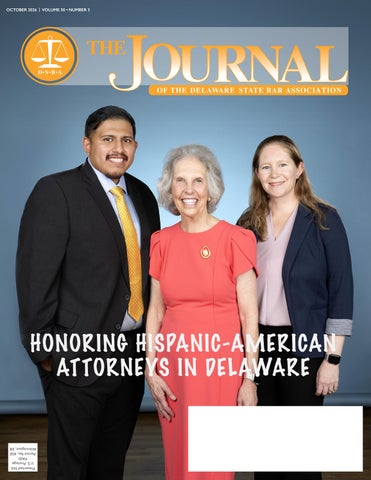
HONORING HISPANIC-AMERICAN ATTORNEYS IN DELAWARE
Presorted Std. U.S. Postage PAID Permit No. 408 Wilmington, DE
DSBA BAR JOURNAL OCTOBER 2026 | VOLUME 50 • NUMBER 3 PRESIDENT Ian Connor Bifferato EXECUTIVE DIRECTOR Karl G. Randall EDITOR-IN-CHIEF Kristen S. Swift
Table of Contents
EDITORIAL BOARD Claire M. DeMatteis Jason C. Powell Caixia Su
FEATURES
EXECUTIVE COMMITTEE LIAISON Francis J. Murphy, Jr. EDITORIAL ADVISORY COMMITTEE Valerie A. Caras Sara Beth Kohut Holly O. Vaughn Wagner BAR JOURNAL ADVISOR Richard A. Forsten EDITOR Danielle Bouchat-Friedman The Bar Journal is published and distributed by the Delaware State Bar Association
COVER STORY 14 Honoring Hispanic-American Attorneys in Delaware Judge Aida Waserstein Tabatha L. Castro, Esquire Stephanie Emmanuel-De Luna, Esquire Wilson A. Gualpa, Esquire Laura G. Readinger, Esquire
704 North King Street, Suite 110 Wilmington, DE 19801 P: 302-658-5279 F: 302-658-5212 www.dsba.org
25 Congratulations to our 2026 Chris White Award Winners
© Copyright 2026 by the Delaware State Bar Association. All Rights Reserved.
28 DCRAC Law: What Is Low Bono and Why Are We Doing It?
The Bar Journal is the independent journal of the Delaware State Bar Association. It is a forum for the free expression of ideas on the law, the legal profession, and the administration of justice. It may publish articles representing unpopular and controversial points of view. Publishing and editorial decisions are based on the quality of writing, the timeliness of the article, and the potential interest to readers, and all articles are subject to limitations of good taste. In every instance, the views expressed are those of the authors, and no endorsement of those views should be inferred, unless specifically identified as the policy of the Delaware State Bar Association. The Bar Journal is published monthly with a combined July/August issue. All correspondence regarding circulation, subscriptions, or editorial matters should be mailed to: Editor, DSBA Bar Journal Delaware State Bar Association 704 North King Street, Suite 110 Wilmington, DE 19801 or emailed to: dbouchatfriedman@dsba.org Letters to the Editor should pertain to recent articles, columns, or other letters. Unsigned letters are not published. All letters are subject to editing. Send letters to the address above, Attention: Editor, Bar Journal. The Bar Journal Editorial Policy is available upon request.
For Advertising Opportunities Call (302) 658-5279, ext. 1102 Email: dbouchatfriedman@dsba.org Read The Bar Journal online at www.dsba.org
26 From China to Delaware 30 Report: 2026 Annual Meeting of the ABA House of Delegates 34 Breakfast With Santa Annoucement
COLUMNS 4
President’s Corner
36
Book Review
6
Editor’s Perspective
38
The Judicial Palate
10
Technology Inn
42
The Last Word
12
Let’s Talk: DE-LAP at Your Service
DEPARTMENTS 8
Side Bar
33
Legal Notice
9
Of Note
41
Bulletin Board
9
Out & About
40
Disciplinary Action
9
Calendar of Events
ON THE COVER: Wilson A. Gualpa, Esquire, Judge Aida Waserstein, and Laura G. Readinger, Esquire, courtesy of DICK DUBROFF/FINALFOCUSPHOTOGRAPHY.
DSBA Bar Journal I October 2026
3
PRESIDENT’S CORNER | BY IAN CONNOR BIFFERATO, ESQUIRE
A Shared Commitment to Delaware
F
ollowing last month’s discussion of the Delaware Way, this month ’s President’s Corner follows the September 15th primary elections. Obviously, the Delaware State Bar Association and the Delaware General Assembly are distinct institutions with different responsibilities. The General Assembly makes our laws and answers directly to the people of Delaware. The DSBA serves the legal profession, promotes the administration of justice, and draws upon the experience of lawyers working throughout our courts, businesses, government agencies, and communities. Those roles differ, but our ultimate purpose is the same: to serve Delaware and its people. Our Association’s purposes include advancing jurisprudence, securing proper statutory reforms, upholding professional and ethical standards, and preserving the integrity of Delaware’s courts. The General Assembly is entrusted with transforming public policy into law. Both institutions therefore have a profound interest in laws that are clear, fair, workable, and consistent with the principles that have long distinguished our State. The General Assembly and members of the DSBA will not—and need not— agree on every issue. Legislators are elected to make policy judgments and to balance the competing interests of their constituents. Lawyers, too, may hold different views about the wisdom of a particular proposal. Those differences are both inevitable and appropriate. 4
DSBA Bar Journal | www.dsba.org
Politics aside, the DSBA should nevertheless always be available to and ready to work with the General Assembly to provide an objective assessment of the potential legal and practical effects of proposed legislation, and to assist in drafting legislation that effectively accomplishes the General Assembly’s objectives. That assistance should be apolitical. A careful analysis of how proposed language will interact with existing law, affect the courts, or operate in practice does not require agreement with the policy underlying the proposal. It requires legal knowledge, professional judgment, and candor. The DSBA best serves the legislative process when it identifies ambiguities, unintended consequences, conflicts with existing law, and potential administrative burdens, regardless of the party or legislator who advanced the proposal. The DSBA and its members are uniquely positioned to provide that assistance. Our sections include attorneys with substantial experience in nearly every field affected by legislation. Because they apply Delaware law every day, our members can often anticipate practical consequences that may not be apparent from the text of a bill alone. Their contribution is most valuable early in the legislative process, openly and with respect for the policymaking authority of our elected representatives. In turn, engagement with legislators helps the Bar better understand the needs and concerns of Delaware’s communities. It reminds us that the law is not an abstract exercise. Every
statute ultimately affects individuals, families, businesses, public institutions, and neighborhoods. Good legislation requires both legal precision and an understanding of the people it is intended to serve. Our State benefits when this relationship works well. Early communication can produce clearer statutes, reduce avoidable disputes, improve access to justice, and strengthen confidence in our legal institutions. It can also help Delaware respond thoughtfully to emerging issues while preserving the stability, predictability, and integrity our legal system is known for. The DSBA already monitors legislation affecting the profession and the administration of justice, communicates with legislators, and draws upon the expertise of its sections and members. We should continue strengthening that work—not as a partisan endeavor, and not simply to advance the interests of lawyers, but as part of our obligation to the public and to the rule of law. Delaware’s size has always allowed us to build relationships across institutions and across differences. We can speak directly, listen carefully, and solve problems together. That tradition is one of our State’s great strengths, but it must be continually renewed. One of the most important objectives of both the General Assembly and the DSBA must also be the protection of the Corporate Franchise. Again, this issue is beyond political debate. No legitimate argument can deny that a thoughtful, apolitical, reliable, and
consistent focus on Delaware General Corporate Law is the most important fiscal issue for both the General Assembly and the DSBA, and having the resources needed to fund our schools, maintain our infrastructure and keep us safe is in the best interest of all residents of the state of Delaware. As an organization, the DSBA and the members of the Delaware Bar, we should be ready to provide objective analysis and practical assistance whenever our knowledge can improve the legislative process. When the DSBA offers its expertise without regard to politics, and when the General Assembly regards the Association as a trusted resource, both institutions fulfill their respective responsibilities more effectively—and Delaware is better served.
United States Constitution and the Constitution of the State of Delaware commit to and inherit.
Connor Bifferato is the 79th President of the Delaware State Bar Association. Admitted to the Bar of the Delaware Supreme Court in 1994, he currently serves as University Legal Counsel to Wilmington University and as a professional neutral with The Bifferato Firm, P.A. He has more than 30 years of commercial and complex litigation experience in Delaware state and federal trial and appellate courts. He has demonstrated a longstanding commitment to upholding the Delaware legal community’s reputation for professionalism and civility through his service to the Delaware courts and the Delaware State Bar Association.
ARE YOU ATTRACTING NEW BUSINESS?
Placing an ad is s o easy! T ake advantage of the target audience of the DSBA Bar Journal and initiate new business through referrals and building your brand.
That is the alignment we should seek: not uniformity of opinion, but a shared commitment to sound laws and faithful public service. Not coincidentally, this is also one of the most important aspects of the Delaware Way, that those who serve both the
For more information, contact Danielle Bouchat-Friedman at (302) 658-5279 or dbouchatfriedman@dsba.org.
BUILDING BUILDING BUILDING RELATIONSHIPS RELATIONSHIPS RELATIONSHIPS 1980
for for
for
2022 2022
2026
OVER OVER 40 OVER 40 YEARS YEARS 40 YEARS OVER FOUR DECADES
|S U |STA | ME M AA NN ENT ENTACCO ACCOCI CI AT AT EP E|E |RPART MA PA RTNE NE NENT R R|ACCO SU PP C PO PO I ATE RT RTSTA PA F FRT FPL PL NACE EACE R ME S UPPORT NN T TS E SE RVICE RVICE STAFF S S PL ACE ME N T S E RVICE S
215.981.5455 215.981.5455 kruza.com kruza.com 215.981.5455
kruza.com
DSBA Bar Journal I October 2026
5
EDITOR’S PERSPECTIVE | BY CAIXIA SU, ESQUIRE
Meet Your New Bar Journal Editor in criminal law, a three-year program roughly equivalent to a J.D. in the United States. I later earned my Ph.D. in law from Renmin University of China in Beijing. After completing my Ph.D., the natural path was academia. I returned to my alma mater to teach criminal law and international criminal law. Teaching and research were among the most rewarding experiences of my professional life. I loved being in the classroom, conducting research, and publishing scholarship. I eventually became one of the youngest tenured full professors of law in China.
G
rowing up in a mountain village along the Yangtze River in China, one of my earliest ambitions was simply to walk out of the mountains and see the world beyond them. When I finally left home for college in Wuhan, I became the first college student from my village. I still remember my grandparents crying as they sent me off. At that time, Wuhan felt far beyond our reach, and the world outside the mountains seemed distant and intimidating—even though today Wuhan is only about a two-hour drive away. 6
DSBA Bar Journal | www.dsba.org
But education, for me, has never been limited to the classroom. Communication and exchange have been equally important. I have always been curious about how people in other parts of the world think, how other legal systems work, and how ideas develop when people from different backgrounds come together. Little did I know that this first journey away from home would eventually take me across continents and lead me to the practice of law in Delaware. Education has been one of the defining forces in my life. It changed my trajectory and gave me opportunities I could not have imagined while growing up in that small village. It took me from my village to Wuhan, then to Beijing, and eventually to Delaware. My legal education began at Zhongnan University of Economics and Law in Wuhan, where I earned my bachelor’s degree in law and a master’s degree
That curiosity led me to become a visiting scholar at the Max Planck Institute in Germany on two occasions, as well as at Columbia University and the Oklahoma City University. As an associate dean, I also had the opportunity to invite law professors from around the world to my university for academic exchanges. These experiences introduced me to people, ideas, and legal systems far beyond the world I had known growing up. Those international exchanges opened an even larger world to me. I became deeply intrigued by the American legal system—yes, it really is unique—and the seed of curiosity planted in me as a child was awakened again. I wanted not only
to study the American legal system from afar, but also to experience it from within. That desire ultimately led me to pursue my fourth law degree, this time a J.D. in the United States. Today, I practice as a litigation associate at Klehr Harrison Harvey Branzburg, focusing on commercial and corporate litigation. Practicing law in my second language has not always been easy. Litigation demands not only legal analysis, but also precise communication, quick thinking, and confidence in the courtroom. I am grateful that my firm has given me the time and space to continue learning and growing as a U.S. litigator. I have had the opportunity to participate in all stages of litigation, from discovery and depositions to motion practice and courtroom advocacy. My legal training in China gave me a strong foundation in legal analysis, while my international experience and relationships have helped me communicate with clients and businesses across borders. I have worked with clients and developed business connections in Mainland China,
and I have come to believe that professional discipline is closely connected to physical and mental fitness. I am honored and humbled to join The Bar Journal as an editor. This role feels like a natural extension of that journey—an opportunity to learn from Delaware’s legal community, share the experiences and perspectives of its members, and get to know the remarkable people who make up this distinguished bar. Taiwan, Singapore, Canada, New Zealand, and elsewhere. In many ways, my professional life continues the same journey that began when I left my village for college: staying curious, building connections, and continuing to see a bigger world. Outside the office, I find balance in simpler things. Gardening is my favorite outdoor activity. I maintain both flower and vegetable gardens, and there is something deeply satisfying about watching something grow after weeks or months of care. I am also an almost-every-day gymgoer. The legal profession is demanding,
Bar Journal Editor Caixia Su is an associate whose practice focuses on Delaware complex commercial and corporate litigation. Before immigrating to the United States, she was a nationally recognized legal scholar and law professor in China, where she ser ved as a full professor, director, and associate dean, authored or co-authored four treatises, and published more than 70 articles. She earned her J.D., magna cum laude, from Drexel University’s Thomas R. Kline School of Law and holds a Ph.D. in Law from Renmin University of China. A native Chinese speaker, Caixia represents clients in complex business disputes and is committed to serving clients with Chinese backgrounds doing business in the United States.
DSBA Bar Journal I October 2026
7
SIDE BAR
U.S. Navy to Visit First State for Navy Week The U.S. Navy is coming to Sussex County, Delaware, for the first time, for Sussex County Navy Week, Oct. 19–25, 2026.
EXECUTIVE COMMITTEE Ian Connor Bifferato President
Francis J. Murphy, Jr. President-Elect
Sussex County Navy Week will bring sailors to engage directly with communities in the Diamond State through a series of performances, STEM educational activities, community events, and service projects, showcasing the modern f leet and mission-ready sailors.
Jennifer Ying Vice President-at-Large
Navy Weeks bring the Navy to regions without a major naval presence, fostering connections and demonstrating how the Navy’s mission ensures security, prosperity and freedom for our nation. The Navy Week program has visited over 100 U.S. cities since the program’s inception in 2005.
Mae Oberste Vice President, Solo & Small Firms, New Castle County
As the nation celebrates its 250th anniversary in 2026, Navy Weeks continues to take sailors on a celebratory “Road Trip to 250,” serving as symbolic stops across the United States, highlighting the Navy’s history, heritage, and continued commitment to defending freedom and supporting American communities. “We’re excited to bring Navy Week to Sussex County for the first time and continue the 2026 tour in Delaware,” says U.S. Navy Cmdr. Richard Chernitzer, director of the Navy Office of Community Outreach. “As the first state, Delaware has a proud legacy dating back to the founding of our nation. Sussex County Navy Week allows us the opportunity to honor that history while strengthening the connection between our sailors and the communities of Sussex County.” Navy Week events will feature sailors from various commands across the fleet. The program aims to provide residents with a firsthand look at the Navy’s mission and the men and women who serve our nation around the world. For more details on Sussex County Navy Week, visit https://outreach.navy.mil/ navy-weeks/.
Law Firm Gives Classrooms a Back-to-School Boost
Frederick H. Mitsdarfer III Vice President, New Castle County D. Benjamin Snyder Vice President, Kent County Christophe C. Emmert Vice President, Sussex County
Jeffery A. Young Vice President, Solo & Small Firms, Kent County Stephen A. Spence Vice President, Solo & Small Firms, Sussex County Zachary S. Stirparo Secretary Paige C. Chapman Assistant Secretary Anthony V. Panicola Treasurer Brenda R. Mayrack Assistant Treasurer David A. White Past President The Honorable Kathaleen St. Jude McCormick Judicial Member
Fox Rothschild’s Wilmington office is helping ensure local children and their teachers start the school year with the tools they need to succeed. The team raised funds for school supplies and essential items benefiting five local schools in Wilmington, providing classrooms with resources to begin the academic year right.
Victoria R. Sweeney Assistant to President
The effort was led by Legal Team Assistant Dynah Mosley, whose leadership helped turn generosity into tangible support. The office’s contribution helps ensure students have the building blocks they need to stay focused on learning and achieving their goals.
Tayler D. Bolton Crystal L. Carey Richard A. Forsten James G. Griffin-Stanco Michael J. Hoffman Juan E. Martinez Claire M. DeMatteis Katherine H. Betterly Kelly Farnan Lisa Schmidt Denise Nordheimer Members-at-Large, appointed
The school supply drive is one of the ways our Fox colleagues are embracing the mission of Generation Fox, the firm’s charitable initiative focused on empowering children in the communities it serves. 8
DSBA Bar Journal | www.dsba.org
Thomas P. McGonigle Legislative Liaison
Karl G. Randall Executive Director
OF NOTE
CALENDAR OF EVENTS / CLEs October 2026
Thursday, October 8, 2026 • 9 a.m. - 12:15 p.m. Accessibility, Inclusion and the Practice of Law
Condolences to the family of William Wade, Esquire, whose wife, Barbara Jeanne Wade, passed away on August 30, 2026.
Tuesday, October 13, 2026 • Noon - 1 p.m. A Beginner’s Guide to Delaware Capacity Opinion Letters
Condolences to the family of David Skoranski, Esquire, whose father, Eugene S. Skoranski, passed away on September 10, 2026.
Wednesday, October 14, 2026 • Noon - 1 p.m. Nervous System Regulation: Preventing Burnout
Condolences to the family of Thomas L. Sager, Esquire, who passed away on September 14, 2026.
Tuesday, October 20, 2026 • 9 a.m. - 12:20 p.m. Bankruptcy Chapter 11 Nuts and Bolts
Condolences to the family of Laura M. Poppiti, Esquire, whose father, John Puppo, passed away August 23, 2026.
Wednesday, October 21, 2026 • 9 a.m. - 11 a.m. How to Draft a Will for a Small Estate in Delaware
Condolences to the family of Ciro C. Poppiti, Esquire, who passed away September 23, 2026.
DSBA
DSBA
Potter Anderson & Corroon LLP
DSBA
DSBA
Thursday, October 22, 2026 • Noon - 1 p.m. Haunted Habeas Corpus: A Legal Look at Spooky Movies DSBA
Sunday, October 25, 2026 • 8:30 a.m. Making Strides for Breast Cancer
If you have an item you would like to submit for the Of Note section, please contact Danielle BouchatFriedman at dbouchatfriedman@dsba.org.
Bellevue State Park
Tuesday, October 27, 2026 • 8 a.m. - 10:30 a.m. Christopher White Awards Breakfast Riverfront Events
Dates, times, and locations of events and CLEs may occasionally change. Please consult the DSBA website for the most up-to-date information at dsba.org. OUT & ABOUT
TABLE DAY AT DELAWARE LAW SCHOOL
S
tudent Bar Association Table Day took place on Wednesday, August 26 at Widener University Delaware Law School, and showcased the vibrant spectrum of student organizations shaping the future of legal advocacy. From public interest initiatives to professional development groups, students had the opportunity to connect, engage, and explore pathways to leadership beyond the classroom (including staff members from the DSBA)!
Connect with
DSBA Like: Delaware State Bar Association
Follow: Delaware State Bar Association
www.dsba.org
Pictured at right: Brendan Wallace, DSBA’s Marketing and Events Associate.
DSBA Bar Journal I October 2026
9
TECHNOLOGY INN
When uncertain, assume this policy applies and ask the designated responsible person before proceeding. 2. Core Principles
▪ Competence. Use an AI tool only
when you understand its purpose, material limitations, informationhandling practices, and likely failure modes. Do not test an unfamiliar tool for the first time on an important client matter.
▪ Confidentiality. Treat information
entered into AI as seriously as information disclosed to another person. Do not enter confidential, privileged, personally identifiable, or otherwise protected information unless the firm has approved the system and the proposed use for that information.
▪ Verification. AI may invent or
MODEL AI TECHNOLOGY USE POLICY FOR SMALL AND MEDIUM-SIZE L AW FIRMS
A
rtificial intelligence can improve research, drafting, organization, communication, and firm administration, but it can also expose protected information or produce convincing errors. This policy establishes practical safeguards for using AI safely, ethically, and effectively. AI may assist professional work; it does not replace independent judgment, supervision, or accountability. 1. Scope This policy applies to every lawyer, paralegal, legal assistant, administrator, intern, temporary or contract worker, consultant, and other person using AI for firm business or client matters. It covers legal and administrative work, research, writing, communications, marketing, meetings, transcription, and any other firm activity. “AI” includes generative systems and other technology that creates, summarizes, analyzes, organizes, records, transcribes, recommends, or otherwise processes information. 10 DSBA Bar Journal | www.dsba.org
▪ Honesty and candor. Never al-
low AI use to mislead a client, court, agency, opposing counsel, or anyone else. Follow all applicable rules, standing orders, disclosure duties, ethical obligations, and client agreements.
▪ Human responsibility. The lawyer remains responsible for professional judgment, client advice, filings, communications, supervision, and final work product. If you would not sign your name to the result, do not send or file it. 3. Permitted Uses Subject to firm approval, confidentiality safeguards, appropriate supervision, and human review, AI may assist with:
▪ Brainstorming issues, arguments, questions, and investigative paths;
▪ Creating outlines, checklists, preliminary drafts, presentations, and routine communications;
▪ Summarizing, organizing, and
comparing documents or information;
© istockphoto.com/Parradee Kietsirikul
BY RICHARD K. HERRMANN, ESQUIRE
distort authorities, quotations, facts, names, dates, and legal analysis, or omit important information. Independently check material output against reliable primary or original sources before relying upon it.
▪ Supporting legal research, provided
every material authority and proposition is independently verified;
▪ Assisting with administrative work and organizing meeting notes; and
▪ Transcribing or summarizing meetings when legally and ethically appropriate.
The level of review must increase with the significance and risk of the work. Internal brainstorming may require modest review; client advice, legal analysis, and court filings require careful lawyer review and verification. 4. Prohibited and Restricted Uses Unless expressly permitted under firm procedures, no person may:
▪ Submit AI-generated material to a court without verifying every material case, citation, quotation, statute, regulation, factual assertion, and legal proposition;
▪ Deliver significant AI-generated le-
gal work to a client without appropriate lawyer review;
▪ Enter protected client or firm information into an unapproved system;
▪ Delegate legal judgment, client
advice, strategic decisions, or final approval to AI;
▪ Misrepresent AI-generated information or conceal AI use when disclosure is required; ▪ Ignore an applicable court, agency,
client, or professional-conduct requirement; or
▪ Adopt a new AI product for client
work without completing the firm’s approval process. Do not assume that a popular product is safe for confidential legal work. Before approval, the firm should consider the provider’s data retention and use, training practices, access controls, security, contractual protections, reliability, integration risks, and material changes to terms or functionality. 5. Required Workflow
▪ Choose an approved tool. Con-
firm that the system and intended use are permitted.
▪ Minimize information. Provide only what is necessary, and anonymize or redact protected information where appropriate.
▪ Use careful instructions. Identify
the task, constraints, jurisdiction, source requirements, and desired format without assuming the system understands the matter.
▪ Review critically. Check com-
pleteness, logic, bias, tone, privilege, confidentiality, and consistency with the client’s objectives.
▪ Verify independently. Use pri-
mary sources or original records for legal authorities, quotations, dates, calculations, and consequential facts.
▪ Correct and document as appropriate. Preserve required records and follow matter-specific procedures for significant AI-assisted work. 6. Governance and Supervision The firm will designate an AI responsible lawyer or other appropriate person. That person will review products; maintain the approved-tool list and restrictions; answer proposed-use questions; monitor significant product, legal, ethical, and court-rule developments; coordinate training; and review this policy. In a solo practice, the solo lawyer performs these functions. Designation of a responsible person does not transfer professional responsibility. Each supervising or matter lawyer remains accountable for the use of AI by lawyers, staff, contractors, and technological systems under that lawyer’s direction.
security, legal, ethical, or operational de velopment s oc c u r. T he re v ie w should address approved tools, vendor terms and practices, court and ethics guidance, training needs, and observed incidents. Everyone covered by the policy must acknowledge that they have read it and agree to comply. Promptly report suspected disclosure of protected information, use of inaccurate AI output, unauthorized tools, failure to comply with a court rule, or any other significant AI-related incident to the appropriate lawyer or designated responsible person. Do not hide mistakes. Early reporting allows the firm to protect the client, investigate, correct the record, preserve privilege, meet notification duties, and prevent recurrence. 9. Practical Decision Test Before using AI, ask: Is the tool approved? Am I protecting client and firm information? Do I understand the system’s materia l limitations? C a n I i nd e p e nd e nt l y v e r i f y t he output? Is the level of review proportionate to the risk? Would I be comfortable explaining exactly how I used the technology to the client, supervising lawyer, or court? If any answer is no or uncertain: stop, check, and ask. AI should make the firm more productive, never less careful. Professional duties do not change because a machine assisted with the work.
7. Training Anyone authorized to use AI for firm business must receive practical, periodic training addressing confidentiality, approved tools, verification, hallucinations and other errors, human supervision, court requirements, security, and firm procedures. Users must seek guidance whenever a proposed use is unclear. 8. Re v ie w, Ack nowledg ment, and Reporting The firm will review this policy at least annually and sooner when signif ica nt technologica l, vendor,
Richard K. Herrmann consults with Wilmington University on Emerging and Innovative Technologies. He can be reached at richard.k.herrmann@ wilmu.edu.
DSBA Bar Journal I October 2026
11
LET’S TALK: DE-LAP AT YOUR SERVICE | JIM DEEL, EXECUTIVE DIRECTOR
Attorney Well-Being in 2016 and 2026: What the Updated National Survey Reveals
O
ver the past decade, many of us have noticed that conversations about attorney well-being have become more open and more honest. Concerns about stress, alcohol use, burnout, and the strain of practice are no longer whispered in hallways. They’re showing up in CLEs, firm meetings, and quiet conversations between colleagues who are trying to make sense of what they’re feeling. The 2016 national study on lawyer well being helped bring those concerns into the light. It offered a broad picture of how attorneys were doing and confirmed what many had already sensed.
Since then, interest in attorney wellness has grown. Courts, bar associations, law firms, and law schools have tried to respond in different ways. At the same time, attorneys continue to report the pressures of practice and the difficulty of reaching out for help. The publication of a new national survey in 2026 gives us a chance to revisit those concerns with updated information and a wider lens. It also gives us an opportunity to reflect on how the profession has responded and where more attention may be needed. The newer study is not simply a repeat of the earlier one. It expands the conversation by looking at burnout,
work–family conf lict, and workload in ways the 2016 research did not. It also includes a larger and more diverse group of attorneys. Taken together, the two studies help us understand what attorneys are reporting now and how those reports fit into the larger discussion about well being in the legal profession. The 2026 study, conducted by Patrick Krill and Justin Anker, builds on the foundation laid by the 2016 research and offers what the authors describe as the largest survey of actively licensed lawyers to date.¹ Delaware attorneys participated in both studies, but the findings discussed here reflect national results. Even so, our participation gives us a local connection to a wider conversation about attorney health and the concerns people carry when thinking about reaching out for support. The earlier study included 12,825 employed attorneys. The newer study included 39,036 employed respondents, with responses collected through 28 participating North American jurisdictions in 2025.² The expanded sample allows for a broader look at how attorneys are experiencing the demands of practice today. One of the clearest findings is that more respondents in the newer study reported symptoms of depression, anxiety, and stress. At the moderate or higher level, depression was reported by 21.6%, compared with 18.8% in the earlier study. Anxiety was 20.4%,
12 DSBA Bar Journal | www.dsba.org
“
Taken together, the updated survey paints a picture of a profession facing substantial demands and persistent barriers to seek ing help. ......................... compared with 10.7%, and stress was 18.9%, compared with 13.9%. These figures reflect self reported symptoms on standardized questionnaires, not clinical diagnoses, but they tell us something important about how people are feeling.³ The two studies were done differently, so we can’t treat the numbers as a direct before and after comparison. What we can say is that more attorneys in the newer survey reported feeling anxious, stressed, or depressed. That’s enough to keep the conversation going without asking the numbers to do more than they can.⁴ The alcohol findings tell a different story. When the researchers compared the same screening threshold, 26.4% screened positive for hazardous drinking in the newer study, compared with 36.4% in 2016. You may also see a figure of 41.8% reported from the new research. That figure uses a lower screening threshold, so it should not be compared directly with the earlier 36.4%. Neither screening result is a diagnosis of an alcohol use disorder. The distinction matters when we discuss the research and when we talk about an individual’s concerns.⁵
Beyond mental health symptoms and alcohol use, the updated study expands into areas that were not measured in 2016. The newer study adds a large scale look at work related burnout. Almost half of respondents, 47.5%, fell into the study’s high or very high burnout categories. The questions addressed physical and psychological exhaustion connected with work. Those categories are not clinical diagnoses, and the study does not provide an equivalent 2016 burnout figure for comparison. Even without a 2016 comparison point, the level of reported exhaustion is difficult to overlook.⁶
or a decision about what comes next. I would rather begin with what concerns you and what you would like to understand.
The study also asked about work draining energy needed for private life. More than one third of respondents, 35.9%, were in the high or very high work–family conflict categories. There is room to talk about that experience without needing to attach a clinical label.⁷
Taken together, the updated survey paints a picture of a profession facing substantial demands and persistent barriers to seeking help. My hope is that these findings encourage us to pay closer attention—to working conditions, to the questions people have about support, and to one another. If something in this article connects with your experience, I welcome that conversation. We can take the time to understand what is happening and consider what a helpful next step might be.
Long working hours were also associated with greater distress. After accounting for several differences among respondents, the researchers estimated moderate or higher stress symptoms in 42.2% of those working at least 71 hours weekly, compared with 13.5% of those working 31–40 hours. The survey cannot prove that the hours caused the distress. It does tell us that workload belongs in this conversation. It is important to understand what someone is carrying before moving too quickly toward suggestions about what they should do.⁸ Perhaps the most familiar findings concern reaching out. Confidentiality worries were reported by 53.3% of respondents, and 49.2% identified concerns about professional reputation or career opportunities. The authors note that similar concerns appeared in the 2016 study. Knowing that support exists and feeling comfortable using it are separate matters. In the newer survey, 75.2% were familiar with their jurisdiction’s Lawyer Assistance Program, yet concerns about seeking help remained prominent.⁹ Those concerns deserve a place in our conversations. If you are considering a referral, questions about privacy, the process, and what a service offers deserve clear answers. My hope is that we can talk through those questions together. You do not need to arrive with a polished explanation of what is happening
There is work for employers and professional organizations here, too. The authors point to staffing, workloads, more predictable schedules, flexibility, and confidential support as areas to address and evaluate. Their survey did not test whether those changes improve health, but it identifies practical directions for further work. The response from attorneys was clear: 81.3% considered greater professional efforts on mental health and substance use problems important or very important.¹⁰
Notes: 1. Krill & Anker, 2026 national attorney well being study. 2. Krill, Johnson & Albert, 2016 national attorney well being study; Krill & Anker, 2026 study. 3. Data from the 2026 Krill & Anker survey, pp. 8, 10. 4. 2026 Krill & Anker survey, p. 8. 5. 2026 Krill & Anker survey, pp. 3, 8, 10. 6. 2026 Krill & Anker survey, pp. 1, 3–5. 7. 2026 Krill & Anker survey, pp. 3–5. 8. 2026 Krill & Anker survey, pp. 6, 10. 9. 2026 Krill & Anker survey, pp. 8, 10. 10. 2026 Krill & Anker survey, pp. 8, 10–11.
Jim Deel is the Executive Director of the Delaware Lawyers Assistance Program, where he works closely with attorneys and judges to provide confidential support in the face of personal and professional stress. With prior experience as a clinician embedded with law enforcement, he has worked alongside vulnerable seniors and families experiencing crisis. His approach emphasizes trust, prac tical suppor t, and creating space for professionals to navigate difficult work without carrying it alone. Email him at JDeel@de-lap.org.
DSBA Bar Journal I October 2026
13
National Hispanic Heritage Month is observed each year in the United States from September 15th through October 15th to celebrate the achievements, histories, traditions, and cultural diversity of Hispanic/Latino Americans. In this feature, we hear from five HispanicAmerican attorneys who share how their heritage has shaped them and their practice of law. Special thanks to Juan A. Martinez, Esquire, Chair of the Multicultural Judges & Lawyers Section, who curated this feature.
14 DSBA Bar Journal | www.dsba.org
© istockphoto.com/:Iuliia Pilipeichenko
FEATURE
JUDGE AIDA WASERSTEIN
T
here were no Hispanic attorneys in Delaware and much fewer women attorneys when I bega n practicing law in Delaware under Supreme Court Rule 5 in 1973, and when I was formally admitted in 1976. I came here because there were no Hispanic lawyers even though there was a Latino community that needed representation. I quickly learned that I might be the first person like me whom most people had encountered in a legal role. During the 50 years that followed, first as a lawyer and later as a judge, I saw change but also learned that true commitment requires much more. True commitment means that everyone must be respected, heard, and given the opportunity to lead. My Hispanic heritage shaped my career. I had come to the United States as an unaccompanied minor who did not know English and was placed in totally English-speaking classes with no bilingual staff. I learned English through the “sink or swim” method and
Photo courtesy of DICK DUBROFF/FINALFOCUSPHOTOGRAPHY.
Aida Waserstein traveled from Cuba to the United States as an unaccompanied minor at age thirteen without knowing the English language. She did not reunite with her father for five years and with her aunt and uncle for six years. She graduated from Bryn Mawr College and the University of Pennsylvania Law School, now Carey School of Law. She was the first Hispanic lawyer to take the Delaware Bar and became a Delaware Family Court judge in 1995. She served on the bench for 21 years and published children's books in her early retirement years.
floundered for months. I was also in foster care for six years until the adults in my family were allowed to leave Cuba. A s a C om mu n it y Legal Services attorney just out of law school, I worked with Latino community members to start a bilingual program in the Wilmington school district. Said program was funded and, a year later, I represented the children in it to help them keep it. I filed a Motion to Intervene in Evans v. Buchanan, the desegregation case in New Castle County. I sought to intervene on the plaintiffs’ side because the initial plan for remedying the segregation of Wilmington students would have resulted in many of the Wilmington Hispanic children being sent to suburban schools, none of which had a bilingual program. Because of my background, I understood their plight. It was necessary to
evaluate the children’s language skills comprehensively upon their arrival at school and keep them together at first in a coherent program with properly trained bilingual staff. My Motion was granted and I actively represented the children in court for several months during the remedy stage of the case. My personal experience also gave me an appreciation for the sacrifices that mine and other Hispanic families made so that their children may be safe and prosper. It taught me the importance of community, perseverance, and personal responsibility. It also made me conscious of how I was viewed as “different” from others rather than for my abilities. While there were no Hispanic mentors or role models for me in my youth, DSBA Bar Journal I October 2026
15
even as an older attorney I sometimes had to overcome assumptions about whether I was indeed a lawyer. Like many lawyers from underrepresented backgrounds, I felt the responsibility not only to perform well, but also to avoid strengthening perceived stereotypes by others about me. On the other hand, when I achieved success, that became an opportunity to make the path easier for others who followed me. My heritage was also a strength in that it helped me to listen carefully to people whose experiences differed from those of others. It reminded me that the law is intimidating to those who lack familiarity with its terminology, and with how it structures the world around us. As a lawyer, that perspective strengthened my advocacy. As a judge, it reminded me that the legal process must be one where
16 DSBA Bar Journal | www.dsba.org
every person feels that her or his case was heard fairly, even when the result is not what one wished. Much has improved since I entered the profession. Delaware’s legal community today includes many of those groups who were previously absent. Young lawyers can now find more support and examples of leadership that did not exist when I began. While recognizing that much has been accomplished in fifty years, more is needed. I hope that new Hispanic attorneys are given meaningful support to enable them to develop and are invited to sit at the tables where the real decisions are made. My g u a rded opt im ism for t he future rests with those attorneys and those who encourage their develop-
ment. Today, more of them are willing to speak honestly about the difficulties that are encountered and are committed to searching for justice. I hope that their joint efforts will result in a future when young Hispanic attorneys will be in every area of practice and eventually in high levels of leadership. Hispanic Heritage Month honors our history, but it also challenges us to help shape the future for all of us. After more than 50 combined years in the practice of law and sitting as a judge, I know that progress is possible. Lawyering is a profession, not just a business. Each generation, however, must honor the trust that has been placed upon it. From what I have seen of the current newer Delaware Hispanic law yers, I’m hea r tened bec au se I believe that they ta ke this sacred trust seriously.
TABATHA L. CASTRO, ESQUIRE Tabatha L. Castro is the Founder and Managing Attorney of The Castro Firm, Inc. A graduate of Widener University School of Law, Class of 2002, she has practiced law in Delaware for more than 20 years and is celebrating the 20th anniversary of her law firm in 2026.
A
s we celebrate Hispanic Heritage Month, I find myself reflecting on what it has meant to be a Latina attorney in Delaware for more than two decades. The legal profession has given me opportunities, challenges, and a profound sense of purpose. It has also allowed me to witness both the progress we have made and the work that remains. In 2002, I graduated from Widener University School of Law, now Delaware Law School. I chose to build my career in Delaware because I saw a need in the Hispanic community for legal representation, advocacy, and trusted counselors who understood the cultural and linguistic barriers many families faced. More than twenty years later, that need remains. This year is especially meaningful because The Castro Firm, Inc. is celebrating its 20th anniversary. I founded the firm in Delaware in 2006, grew the offices to New Jersey and Florida, and have never looked back. Owning and operating a successful law firm for two decades has been one of the greatest privileges of my career. It has allowed me to serve thousands of clients, mentor young attorneys, create opportunities for others, and give back to the communities
that supported me. When I began practicing law, there were very few Latino attorneys in Delaware. At courtrooms, bar functions, and professional gatherings, it was often difficult to find someone who shared my background or life experiences. Representation has improved, but Hispanic attorneys remain underrepresented in the legal profession. Specifically, Latina attorneys embody only 2.9% of all attorneys nationally, despite Hispanics representing nearly one-fifth of the United States population. That gap is significant because the public should be able to see itself reflected in the lawyers, judges, and leaders entrusted with the administration of justice. Representation matters. It matters in our law firms, our courtrooms, our government offices, and our communities. Delaware has taken important steps to address that challenge. In 2022, the Delaware Supreme Court released its “Improving Diversity in the Delaware Bench and Bar Strategic Plan,” with recommendations spanning law-school pipelines, bar admis-
sion, attorney recruitment and retention, and judicial diversity. By its 2024 update, the Judiciary reported that nearly two-thirds of the plan's recommendations had been implemented or were in progress. Reforms have included changes to the bar examination and admissions process, expanded student outreach, internships and mentorship opportunities, implicit-bias training, and continued support for diversity-focused clerkship programs. These initiatives matter because representation is about more than numbers. Different backgrounds and experiences strengthen institutions, broaden perspective, and help build public confidence. As Delaware’s Hispanic population continues to grow, our legal community must continue creating pathways for Latino students to become lawyers, for lawyers to advance into leadership, and for qualified DSBA Bar Journal I October 2026
17
candidates from diverse backgrounds to reach the bench. The same commitment should extend beyond the profession. Economic opportunity, fair and safe workplaces, and access to affordable, stable housing affect families throughout Delaware and can be especially significant in communities that have historically faced barriers to opportunity. These are Delaware issues, and they deserve sustained attention from policymakers, community leaders, attorneys, and advocates. Despite these challenges, I remain optimistic about the future because Delaware is more than the place where I practice law; it is home. It is where I built my career, raised my children into adulthood, grew businesses, and formed lifelong relationships. Today, one of the greatest joys in my life is being a grandmother to my three-year old grandson, Jacobi. My grandson has become an important part of my world and a powerful reminder that the work we do today helps shape the opportunities available to the generation that follows. Delaware’s legal profession is also special because of what we often call the “Delaware Way”—a culture in which attorneys can advocate fiercely for their clients while remaining professional, cordial, and respectful toward one another. Having practiced law in Delaware, New Jersey, and Florida, I value the collegiality of the Delaware Bar and the way that professionalism benefits attorneys, judges, clients, and the justice system. Being a Latina attorney in Delaware has been both a responsibility and an honor. I am proud of the barriers we have broken and the progress we have made, but I also recognize the importance of continuing to build pathways for the next generation of Latino lawyers, judges, and leaders. My hope is that in the near future, a young Latina law student will look at Delaware’s legal community and see a profession that fully reflects the diversity, talent, and strength of the people it serves. That is a future worth fighting for! 18 DSBA Bar Journal | www.dsba.org
BECOME A DSBA SECTION MEMBER Section Membership provides the chance to exchange ideas and get involved. For information on how to join a Section, call DSBA at (302) 658-5279.
STEPHANIE EMMANUEL-DE LUNA, ESQUIRE Stephanie Emmanuel-De Luna is Of Counsel with Marks, O'Neill, O'Brien, Doherty & Kelly, where her practice focuses on civil defense litigation matters. She is admitted to practice in Delaware, Pennsylvania, New Jersey, Florida, and the United States District Court for the District of Delaware. Stephanie earned her undergraduate degree from Lehigh University, where she studied Political Science and Psychology, and her law degree from Rutgers University School of Law.
A
s we celebrate Hispanic Heritage Month, I have found myself ref lecting on how my heritage has shaped my journey, what has changed and remained the same since I began practicing law, and what I hope for in the future of our profession. Both of my parents were born in the Dominican Republic and although I was born in New York City, my upbringing was deeply rooted in Dominican culture. As a young child, I lived in the Dominican Republic before my family moved to Miami. We later returned to New York, first to Washington Heights and then to Yonkers. Growing up in each of those communities, I was surrounded by people who looked like me, sounded like me, and shared many of the same cultural values and life experiences. The language, food, music, and traditions that were woven into everyday life made my Hispanic identity feel natural, understood and celebrated. Just as importantly, I was raised with strong Dominican values that centered on family, perseverance, hard work, and resilience. Those values have guided me throughout my life and continue to guide the person and attorney I am today. Looking back, I realize how much
those communities shaped my sense of identity and belonging, and it was not until I left those communities that I understood the importance of seeing yourself reflected in the people around you. That sense of familiarity changed when I attended Lehigh University. For the first time, I found myself in an environment where very few people shared my background, and it was a genuine culture shock. While the experience broadened my perspective and challenged me to grow, it also made me realize how important representation and belonging were. Those feelings continued when I attended Rutgers Law School. Seeking a sense of community, I joined Alianza, the Latino law student organization. Alianza connected me with students who understood the cultural experiences that had shaped me and reminded me that I did not have to choose between my identity and my professional ambitions. While Alianza provided support and connection, it did not eliminate the reality that there were still so many spaces where I felt different or underrepresented.
In college, law school, and later in practice, I became much more aware of what it feels like to be one of only a few Hispanic professionals in the room. While it feels very isolating at times, it also taught me an important lesson that still resonates today: having a seat at the table is important, but having a community there next to you is better. Being Hispanic has undoubtedly shaped the way I practice law. While I speak Spanish, and my parents would probably tell you I could always use more practice, the language and culture have helped me connect with people from different backgrounds and appreciate the importance of making others feel heard and understood. Regardless of the type of case I am handling, I try to remember that behind every file and every case is a person who deserves respect. DSBA Bar Journal I October 2026
19
However, more recently, visibility has become a challenge. Even today, I often look around professional settings and realize there are not many people who share my background. Delaware has talented Hispanic attorneys and legal professionals, but we are not always connected to one another. Sometimes it can feel as though we are all doing great work in separate corners without enough opportunities to come together. For that reason, joining the Multicultural Judges and Lawyers Section was important to me. It gave me an opportunity to connect with attorneys and judges from diverse backgrounds and reinforce that representation matters, but connection matters just as much. It is not enough for diverse attorneys simply to exist within the profession. We need spaces where we can find one another, support one another, mentor one another, and create opportunities for those who come after us. As we celebrate Hispanic Heritage Month, I am grateful for the opportunities I have had throughout my career and optimistic about what lies ahead. While there is still work to do, I believe our profession is strongest when it reflects the diversity of the communities we serve and when we are committed to helping one another succeed. Looking ahead, I hope Delaware continues to build those connections, because when attorneys invest in one another’s success, the entire profession benefits.
20 DSBA Bar Journal | www.dsba.org
CHRISTOPHER W. WHITE
When I entered the legal profession in 2013, diversity was a topic of discussion, but Hispanic attorneys were still underrepresented in many spaces. More than a decade later, I believe meaningful progress has been made. Law firms, bar associations, and legal organizations have placed greater emphasis on diversity and inclusion, and it seems like there is a growing recognition that different backgrounds and experiences strengthen our profession.
ACCESS TO
JUSTICE
AWARDS
BREAKFAST
PROUD TO SPONSOR!
IN CELEBRATION OF PRO BONO WEEK OCTOBER 25TH - 31ST
Yo u n g C o n a w a y . c o m
P R O U D T O S U P P O RT
We proudly support the D S B A 2 0 2 6 C H R I S T O P H E R W. W H I T E A C C E S S T O J U S T I C E AWA R D S and congratulate this year’s honorees.
920 N. King Street | Wilmington, DE | RLF.com
WILSON A. GUALPA, ESQUIRE
I
was 13 years old the first time I sat at our kitchen table and tried to translate a lease agreement for my parents. I did not fully understand words like “summary possession” or “tenant obligations” myself; I only knew that I had to find a way to say them in Spanish, watch my parents’ faces for understanding, and then explain what they were about to sign in English. That was the job of the oldest son of immigrant parents from Ecuador. It was a lot of pressure for a child, but my parents never let me see it as a burden. They told me, in the plain and insistent way immigrant parents often do, that this was a responsibility—that being able to move between two languages and two worlds was not just a skill, but a debt to be paid forward. I did not know it then, but that lesson would become the foundation of my legal career. This December marks 11 years since I was admitted to practice law in Delaware. I am a partner at Morris James LLP, where I represent people who have been hurt at work or injured through the negligence of others. I spend my days working on workers' compensation and personal injury civil
litigation cases—areas of law that are dense and difficult even for clients who speak fluent English. For Spanish-speaking clients, navigating a workers’ compensation hearing or personal injury claim without someone who can explain the process in their own language is more than difficult; it can mean the difference between understanding their rights and losing them by default. That is the work I am proudest of: providing access to justice in my clients’ home language. That experience comes back to me often when clients arrive at my office with their children. More than once, parents have walked in with a teenage son or daughter beside them, assuming the child will need to translate words no child should have to manage: pain and suffering, injury, lost wages, outstanding medical bills, surgery, benefits, liability, settlement. I recognize that child immediately because I was that child. Then I greet the parents in Spanish, explain that we can speak directly, and
Photo courtesy of DICK DUBROFF/FINALFOCUSPHOTOGRAPHY.
Wilson A. Gualpa is a partner in the Morris James personal injury practice, with experience representing clients in automobile accidents, premises liability cases, and workers’ compensation matters. Wilson advocates for his clients to ensure they are rightfully compensated and receive all the benefits they are entitled to through alternative dispute resolution and litigation. An active member in the Delaware community, Wilson has served on the Board of Directors for the Latin American Community Center, a non-profit social services agency dedicated to addressing the needs of Delaware’s Hispanic community, since 2010. He is a bilingual attorney, providing counsel in both English and Spanish. Wilson’s exceptional legal counsel has garnered recognition from Delaware Today as a Top Lawyer since 2019 up to and including 2026. He also earned the Christopher W. White Distinguished Access to Justice Achievement Award in 2020.
watch the child’s shoulders drop. The child no longer has to carry the adult weight of the appointment. They can sit quietly, look at a phone, or simply go back to being a kid while their parents receive legal advice in a language they understand. In these moments, I am reminded that language access is not an abstract policy goal. It changes the emotional burden in the room. One of my favorite phrases to translate for clients is one every Delaware lawyer knows well: “The Delaware Way.” I explain it in Spanish as la Manera de Delaware: a tradition of civility, professionalism, and mutual respect among lawyers, judges, and litigants, even when they stand on opposite sides of a case. In my 11 years of practice, I have seen that tradition in practical ways, including attorneys working cooperatively when an interpreter is unavailable or when DSBA Bar Journal I October 2026
21
a client needs additional time reviewing and understanding documents, to understanding why a client might have two last names, which is prevalent in the Hispanic community. The Delaware Way, at its best, does not stop at the language barrier. Alongside that broader tradition of professionalism, Delaware has made real progress in improving access to justice for its Spanish-speaking community. Our courts and administrative agencies now have better access to certified court interpreters. Legal information is increasingly available in Spanish through websites, pamphlets, and public-facing resources. There are also more Spanish-speaking professionals in courthouses, legal aid agencies, law firms, and other settings where language access matters. Technology has made real-time interpretation and translated documents far more accessible. These changes matter enormously to families like the one I grew up in.
DELAWARE’S STRENGTH IS ITS CITIZENS.
At Morris James, we’re proud to serve our fellow First Staters. That commitment to our clients, colleagues, and the broader legal community has defined our firm and sustained our success for generations.
morrisjames.com | 302.888.6800 | @MorrisJamesLLP Wilmington | Newark | Dover | Georgetown | Rehoboth Beach
Unfortunately, some forms of progress have not kept pace. The number of Hispanic attorneys and judges in Delaware remains far too small. Even as Delaware’s Hispanic community has grown, representation within the legal profession and on the bench has lagged behind. Representation is not merely symbolic. It shapes whether people walking into a courthouse, a law office, or a hearing room see anyone who understands their language, culture, or story without an intermediary. It affects whether a parent can ask a hard question without turning to a child for help, and whether a child can leave the adult burdens to the adults in the room. My hope for the future is simple but ambitious: more Hispanic attorneys at the negotiating table, more Hispanic judges on the bench, and a Delaware legal community that reflects the people it serves in every county and every courtroom. ¡Si Se Puede! Happy Hispanic Heritage Month. 22 DSBA Bar Journal | www.dsba.org
Morris Nichols is proud to support the Christopher W. White Access to Justice Awards Breakfast and congratulates this year’s honorees.
morrisnichols.com Alternative Entity Counseling | Bankruptcy & Restructuring | Commercial Transactions Corporate & Commercial Litigation | Corporate Counseling | Intellectual Property Litigation Trusts & Estates/Private Client | Unclaimed Property
WILMINGTON, DELAWARE
LAURA G. READINGER, ESQUIRE
G
rowing up in Miami, Florida, Hispanic culture wasn’t a subculture; it was just in the atmosphere. My parents had moved from Guatemala in the early ‘80s at a time of deep political turbulence for the safety and stability of the United States. Miami was the perfect place to land. Latin American culture, food, language, and community were completely interwoven with daily life. (I still laugh at the fact that people are more likely to speak to me in Spanish in Miami than they are in Guatemala, where they immediately assume I’m a tourist.) Stepping outside of that world to go to college and attend law school was a major leap, but my heritage remained my anchor. And that same heritage served as the unintended catalyst for my entire legal career. Because luckily, my parents insisted that we speak only Spanish at home. And 16 years ago, after finishing law school, getting married, and moving to Philadelphia, I found myself in search of my first legal job. Not even knowing what it was, I decided to start working
on a Spanish-language document review project at Morgan Lewis. That bilingual fluency opened the door to an associate position in their eData practice group and set the foundation for my career in eDiscovery, a specialty I have now practiced in Delaware private practice for the better part of two decades. But moving my practice to Delaware brought a different kind of culture shock. I went from the vibrant cultural saturation of Miami, and the sizable diversity of Philadelphia, to a legal bar where Hispanic representation felt nearly invisible. That reality came into focus early in my time at my first Delaware firm, when an older Black partner shared a memory that has stayed with me ever since. He recalled that when he began his career decades earlier, every Black attorney in the state of Delaware could comfortably fit around a single large conference room table for maybe 30 to 40 people. It was a sobering thought meant to show how
Photo courtesy of DICK DUBROFF/FINALFOCUSPHOTOGRAPHY.
Laura G. Readinger is a partner in Potter Anderson & Corroon's Corporate Litigation and Commercial Litigation groups. She counsels clients and co-counsel on the many challenges associated with eDiscovery. She provides cost-effective and efficient project management solutions to clients in what is a complex and continually changing area of the law. Laura is a Certified E-Discovery Specialist by designation earned from the Association of Certified E-Discovery Specialists.
far things had come, but what struck me with immediate weight was the realization that at that exact moment, every Hispanic attorney in Delaware could still easily fit around that very same table. Even today, 16 years into my career, that visual remains uncomfortably close to the truth. That sense of being one of very few shaped even small choices early in my practice. I changed the way I pronounced my name from the Spanish pronunciation of Laura to the Americanized version because I worried about the awkward moments of having to explain my background, my identity, and my roots to every partner at the firm. Over the last decade and a half, however, there has been a tangible and meaningful shift. In recent years, I have watched younger partners DSBA Bar Journal I October 2026
23
and associates go out of their way to ask for and use the correct Spanish pronunciation of my name. It is a small gesture on the surface, but it represents a profound cultural evolution toward genuine respect for and interest in everyone’s unique identity and heritage. That broader cultural evolution reflects something I have always valued deeply about my Hispanic heritage: our collaborative, community-oriented nature. Throughout my career, I have attended countless legal conferences, industry panels, and professional organizations across the country. Yet, without fail, it has been the Hispanic affinity bar associations and networks that have yielded the most fruitful, genuine, and enduring relationships of my professional life. In these spaces, mentorship and networking isn't forced or transactional. Instead, it is built on shared persever-
ance, mutual uplift…and more than a little salsa dancing! That same instinct for connection has also shaped the way I practice law. In eDiscovery, our work revolves around finding clarity within chaos, interpreting nuances in human communication, and building consensus across multidisciplinary teams of litigators, technologists, and clients. Growing up bilingual and bridging different cultural landscapes taught me early on how to decode different perspectives and approach complex challenges with empathy, adaptability, and persistence. Looking to the future, my greatest hope is that the next generation of Hispanic lawyers in Delaware will never have to count their peers by the seats around a single conference room table. We need continued, intentional pipeline efforts that actively recruit, mentor,
and elevate Hispanic talent into equity partnerships, practice leadership, and the judiciary. For the young Hispanic and firstgeneration attorneys navigating spaces where you may still be the only one in the room: bring your whole self to work. There is no need to soften your name or set aside your roots to fit an outdated mold. Your background is not a hurdle to overcome. It is a foundational strength that enriches your firm, your clients, and our legal community. As we celebrate Hispanic Heritage Month, let’s honor how far we have come by mentoring, sponsoring, and creating real opportunities for those who follow. Let’s keep pulling up more chairs until our tables are wide enough for everyone.
Multicultural Judges & Lawyers Section
Member of the Month Queen Nwangwu
Queen is an associate at Whiteford, Taylor & Preston LLP. Her practice includes representing condominiums, homeowners, and housing cooperative associations, as well as handling commercial litigation, real estate disputes, contract matters, and general business counseling in Delaware and Maryland. Queen earned her J.D. from the University of Maryland Francis King Carey School of Law. She is admitted to practice in Delaware, Maryland, and Pennsylvania. Queen currently serves as Co- Vice Chair of the Delaware State Bar Association's Multicultural Judges & Lawyers Section. Proud of her Nigerian heritage, she enjoys traveling, trying new restaurants, and spending time with her Chihuahua, Taquito. 24 DSBA Bar Journal | www.dsba.org
the individuals and organizations making a lasting impact through service, dedication and a commitment to justice THE LEADERSHIP AWARD Morris, Nichols, Arsht & Tunnell LLP
THE COMMITMENT AWARD Michelle P. Quinn, Esquire Gabbell Beaver LLC
THE ACHIEVEMENT AWARD Leah E. Burcat, Esquire Young Conaway Stargatt & Taylor, LLP
THE SERVICE TO CHILDREN AWARD The Hon. Vivian L. Medinilla (ret.) Weiss, Saville, Medinilla & Houser, P.A.
THE LEGAL PROFESSIONAL PRO BONO AWARD Jennifer Dill Liguori & Morris
Special Thanks to our Sponsors
DSBA Bar Journal I October 2026
25
From China to Delaware: Beginning Again in the Law BY CAIXIA SU, ESQUIRE
26 DSBA Bar Journal | www.dsba.org
© istockphoto.com/Anson_iStock
FEATURE
B
efore immigrating to the United States, I spent more than a decade in China as a law professor, scholar, and academic administrator. I taught, published legal scholarship, spoke at national and international conferences, and held leadership roles at a top law school. By then, law had been my profession for many years. Then, in my forties, I arrived in the United States, enrolled in Drexel University’s J.D. program, and began again. Like many internationally trained professionals, I quickly learned that accomplishments do not automatically transfer across vastly different legal systems. The challenge was not only to learn American law, but also to build a new professional foundation without losing the value of an earlier career. Law school became the beginning of that second chapter and reinforced a lesson that still guides me: law is a profession of continual learning. Whatever our age or experience, every lawyer remains a student of the law. Going from law professor to J.D. student, reading textbooks until dawn, was a humbling experience. After graduating magna cum laude, I received another reminder that professional journeys rarely move in a straight line. I passed the Pennsylvania and Maryland bar examinations comfortably yet failed the Delaware Bar Examination on my first two attempts during the pandemic years. Passing on the third attempt taught me that persistence is often as important as talent, and that progress is not always measured by speed. I still remember studying during those uncertain years while working and raising a teenage daughter. Many evenings during those three years— the bar was administered only once a year then—found me at my desk, surrounded by outlines and practice essays, aware that although I had proved myself in one legal system, I still had to earn my place in another. Each unsuccessful result was difficult, but
it shifted my question from whether I belonged to what this jurisdiction still required me to learn. By the time I passed, the result felt less like a finish line than an invitation to practice with greater humility, discipline, and appreciation. When I began practicing in Delaware, I again held two identities at once: a new Delaware lawyer learning the practice from the ground up, and an experienced professional carrying decades of legal training from another legal system. Over time, I came to appreciate a simple truth: beginning again is not beginning from nothing. That truth became especially clear in my work with clients around the world with roots in China who were navigating cross-border issues and unfamiliar legal systems. My Mandarin skills, professional relationships, and experience in China were no longer separate from my American legal career; they became part of it. I am deeply grateful for the mentorship I have received at my firm and within the Delaware legal community. Among those mentors, Attorney Richard M. Beck has been especially generous with his time and guidance. In my early practice, I have received—and continue to receive— heavily marked-up drafts from my mentors. The edits are never just about grammar or style; they reflect a way of thinking—precise, disciplined, and careful with every word. Although I continue to have much to learn, that guidance has helped me find my footing, strengthen my skills, and grow as a Delaware lawyer. That sense of connection became especially vivid years later, when I presented with Richard M. Beck, Esq., in New York to introduce Delaware corporate law to attorneys from China. As a law professor in China, I had often welcomed professors from American law schools to my campus for lectures, conferences, and exchanges with students and faculty. Standing on the other side
of that exchange, presenting Delaware law with my mentor beside me, felt extraordinary. In that moment, my former life and current one felt unexpectedly connected, almost surreal. I have learned that life does not always move in a straight line; sometimes, it comes full circle. That realization has become one of the most meaningful discoveries of my journey. We often imagine legal careers as linear progressions. Mine has felt more like a series of crossings—from one country to another, from professor to student, from established professional to new lawyer, and from one legal culture into another. That experience is not unique to lawyers trained abroad. The modern legal profession demands constant adaptation—to new technologies, evolving client expectations, global commerce, and changing methods of legal service. At different stages of practice, every lawyer is asked to begin again in some form. Practicing in Delaware has shaped how I understand excellence in the profession. Delaware’s legal community is known for precision, professionalism, intellectual rigor, and civility. For someone entering the bar after a prior legal career elsewhere, those qualities have been both demanding and sustaining. They have taught me that excellence is not a status one reaches and keeps, but a practice renewed daily through preparation, respect for the court and colleagues, and commitment to continual improvement. A legal career is not defined by a single beginning. My own path has crossed jurisdictions, languages, and legal cultures, and it has taught me to keep learning, keep adapting, and bring each part of my experience to the work still ahead. Caixia Su, Esquire is a commercial litigation associate at Klehr Harrison Harvey Branzburg, LLP.
DSBA Bar Journal I October 2026
27
FEATURE
Why “low bono”? How Delaware Community Reinvestment Action Council, Inc. (DCRAC) Fills a Crucial Gap BY JACYLN QUINN, ESQUIRE
I
n my years as a nonprofit attorney, I’ve lost count of the colleagues who assume non-profit work is less demanding than private practice. Yes, our clients are grateful, and yes, it’s very meaningful to me and my team that our legal practice is also mission-driven. Generalizations about legal nonprofit work obscure the very real work that happens at DCRAC Law and at other legal-facing nonprofit organizations throughout Delaware. Nonprofit attorneys regularly handle some of the state and federal legal system’s most complex cases—often with the fewest resources, both in-house and on the client side. We typically meet people as their last resort and then step into situations in which a client has nowhere else to turn. With most cases, if we are unable to assist, chances are high that they will forego legal representation entirely, and we are acutely aware of that pressure with every intake. Since 2003, the DCRAC has operated an Internal Revenue Services sanctioned Low Income Taxpayer Clinic (LITC), through which we provide free legal representation to directly resolve federal tax controversies and advocate for our clients in tax and federal courts. While it may seem counterintuitive, low-income taxpayers are actually audited at a higher rate than those in higher brackets. Low income taxpayers are audited more frequently due to the 28 DSBA Bar Journal | www.dsba.org
nature of their returns and credits, and that complexity makes such cases even more difficult to resolve without skilled help. But that’s exactly why DCRAC exists. Over time, though, we noticed increasing tangled titles and Delawareans looking for probate help during foreclosure proceedings. In response, in 2019 DCRAC formed the “low bono” law firm DCRAC Law to expand legal services related to clients’ financial lives. Today, DCRAC Law also assists low and modest-income families with estate planning to ensure a smooth transfer of wealth and ease the future burden for their loved ones and to prevent future heirs’ property disputes. We estimate we’ve helped keep thousands of families in their homes and navigated over 10,000 files with the IRS. On a daily basis, we help families preserve the homes and wealth they worked generations to build. Without affordable legal support, many low-income homeowners risk losing their property due to tangled title issues, probate complications, or the lack of basic estate documents. Our work further protects housing stability, prevents displacement, and ensures that family homes can be passed on as generational wealth—not lost to crisis, confusion, or poverty. Even so, many of our clients come to us during a crisis—after a death, during foreclosure proceedings, once a threatening
IRS letter appears, or when generations of unresolved legal issues compound to jeopardize the future of a family home. DCRAC Law often untangles decades of deferred legal problems as we assist our clients in navigating the specific processes they came to us for and we’re able to do that extra legwork because we are mission-driven and nonprofit. When a taxpayer resolves their debt, or a family executes a deed to settle real estate questions, we know those benefits ripple out through the family we worked with and beyond into their community. Our clients benefit from our in-depth legal representation. DCRAC Law is considered “low bono” because we offer a sliding-scale fee schedule based on income and family size for most of our services. The scale is intended to allow us to serve more families overall because those who can pay more help us serve those who pay less. Standalone LITC services are actually free because an IRS grant provides the funds for the program. In both cases, because we aren’t tied to funding sources that mandate income limits, we fill an important niche and meet the needs of clients who both do not qualify for free services but also cannot afford mainstream legal fees, thereby filling an important gap. In too many cases, we become their last, best, and only option. In nonprofit legal work, attorneys must build and sustain our own infrastructure
© istockphoto.com/VecotMine
while representing clients in acute crisis. Not only do we have our duties to the client and the courts, but we must also keep the organization running smoothly. That means that, in addition to handling legal matters, we must also secure funding to make the representation possible in the first place. On top of writing briefs and filing cases, we write grants, cultivate donors and community partnerships, prepare board and funder reports, meticulously track impact and metrics, and constantly justify why this work deserves ongoing investment. Every hour spent representing a client is connected to many more hours spent making sure the program can and will survive financially. Without funding, many of our clients simply will not have access to legal help at all, and the communities around them will further suffer for it. At the same time, the legal work is rarely simple. Our usual cases concern emotionally difficult and legally complex matters involving taxes, foreclosure, death, tangled titles, generational family disputes, and
housing instability. Our clients are navigating systems that are confusing, inaccessible, and under-resourced, and we are constantly learning new skills and knowledge to serve them—but then we’re able to help where few others can. Community-centered legal work further reminds us that the law is not only about transactions and disputes; it is also about protecting dignity, preserving families, and strengthening neighborhoods. When nonprofit lawyers help marginalized communities secure housing, resolve legal barriers, and preserve generational wealth, we’re not simply practicing law—we’re helping communities build more stable and equitable futures. The persistent challenge is that the need for these services always exceeds the available resources. We are constantly balancing mission, capacity, and sustainability while trying to make sure vulnerable families do not fall through the cracks along the way. What makes the work worthwhile in spite of that is that our impact is tangible:
Keeping even one family in their home can stabilize an entire generation. But reaching that outcome requires much more than practicing law—it requires building and sustaining the ability to serve. DCRAC thrives due to staff, volunteers, and partners who deeply believe in the necessity and impact of this work. To learn more and discuss ways to get involved with DCRAC Law, contact Jaclyn Quinn at jquinn@dcrac.org Jaclyn Quinn, Esquire is the Deputy Director of the Delaware Community Reinvestment Action Council, Inc. (DCRAC). She joined the organization in 2011, first as a volunteer, then staff. Jaclyn was the organization’s Housing Director prior to launching DCRAC Law in 2019. She was admitted to the Delaware Bar in 2012 and is also barred in the U.S. Tax Court and the U.S. Immigration Court. Her practice focuses on tax, estate planning, and real estate, including tangled title cases. DSBA Bar Journal I October 2026
29
FEATURE
Report: 2026 Annual Meeting of the ABA House of Delegates BY WILLIAM C. CARPENTER, JR., HOUSE OF DELEGATES STATE DELEGATE
The Rule of Law is not self-executing. It requires lawyers to defend it as a core value of our democracy.
I
again start with this message as it is an important reminder as we celebrate the 250th year since the signing of the Declaration of Independence, the unique role we play as lawyers to defend what our founding fathers fought to create. Twenty-five of the fifty-six signers of the Declaration of Independence were lawyers and the democracy they created has been defended by lawyers and judges since that time. It is now our turn to ensure the Rule of Law and the independence of the judiciary remain as bedrock principals of our society. While the 2026 ABA annual meeting celebrated our Independence, it also recognized that the legal profession is continuing to face many challenges, for which your ABA is uniquely positioned to address as the largest organization of lawyers and judges in the country. Before listing the numerous resolutions discussed and passed by the House of Delegates, this year’s annual meeting was a true celebration of our past and future. The past was highlighted by a panel of justices from England, Canada and the United States who discussed our nation’s global roots and the continuing legacy of the Declaration of Independence. Retired Justice Breyer from the United States Supreme Court was joined by Lord Robert Reed and Lord David Lloyd-Jones of the Supreme Court of the United Kingdom, and Rosalie Abella of the Supreme Court of Canada in the discussion. The challenges of the future were highlighted by the speeches of incoming President Barbara Howard of Ohio and Presidentelect Laura Farber of California. Their commitment to the Rule of Law and the willingness to challenge conduct that undermines it was inspiring. We are fortunate to have such outstanding leaders in the organization. Of course, the meeting included some fun too with a black-tie dinner to celebrate the 250th and a wonderful and moving speech by George Will, a nationally recognized writer and political commentator.
30 DSBA Bar Journal | www.dsba.org
With these important messages the HOD got down to business adopting more than 39 policy resolutions, highlighted by a debate on amending the ABA Standards and Rules of Procedure for Approval of Law School that would eliminate the diversity and inclusion language in those standards. This resolution which was defeated by the House was brought before the House because of the U. S. Department of Education threat to no longer recognize the ABA’s role in accrediting law schools if the inclusion and diversity language remained in the Standards. The House concluded the language was an unwavering policy of the ABA and voted to stand by those principles. While all the resolutions before the HOD addressed critical issues facing the legal community and our country, I will highlight those that I believe will be of greatest interest. The following resolutions were adopted at the meeting. • Amended Model Rule of Professional Conduct 1.2 relating to the scope of representation and allocation of authority between Lawyer and Client. • Updated iteration of Model Rule of Professional Conduct 1.4 related to representation of clients with decision making limitations. • Adopted changes to Model Rule of Professional Conduct 1.4 relating to a lawyer’s duty to inform a current or former client of a lawyer’s material error. • Amended Model Rule of Professional Conduct 1.6 related to confidentiality of information; Rule 1.9 related to duties to a former client; Rule 3.8 as to the special responsibilities of prosecutors and Rule 4.2 relating to communications with person represented by Counsel. • Urges Congress to cap aggregate payments applied to federal student loan debt for individuals working in qualified public service legal fields. • Urges Congress to increase, sustain, and equitably allocate federal funding and programmatic support for the six ABA-accredited Historically Black Colleges and Universities law schools in recognition of their vital role in expanding access to legal education, diversifying the
and urges licensing authorities to adopt rules to incorporate such programs into its continuing legal education requirements. • Urges all state, local, territorial and tribal bar admissions authorities to develop and publish policies with clear deadlines governing the portability of Uniform Bar Examination (UBE) and NextGen Bar Exam scores. • Urges federal, state, local, territorial and tribal governments to enact, implement, and enforce laws and policies that establish 18 years of age as the minimum age for marriage. • Urges federal, state, local, territorial and tribal courts, legislatures and executive officials to preserve meaningful access to habeas corpus or comparable post-conviction remedies for persons alleging constitutional violations. legal profession, and advancing equal justice under law. • Urges broad promotion and voluntary adoption across the profession of the Pledge to Preserve the Independence of the Legal Profession and the Judicial System as an affirmation of the legal profession’s commitment to the rule of law, the independence of the profession, the Constitution and our legal system. • Urges Congress to adopt legislation and regulations that prohibit Medicare coverage solicitations during open enrollment when a beneficiary has requested not to be contacted. • Urges Congress to amend the Federal Tort Claims Act’s postal exception to provide that it does not bar claims arising from the intentional withholding, refusal to deliver, destruction, or other deliberate mishandling of letters or postal matter by Postal Service employees where the claim alleges that such conduct was motivated by discriminatory animus based on race, color, religion, sex, national origin, age, disability or genetic information, rather than negligence. • Urges Congress to amend the Federal Tort Claims Act’s to remove
“interference with contract rights” from the claims excepted under the Act’s waiver of sovereign immunity. • Urges Congress to adopt legislation that would ensure that federal employees and applicants for federal employment are afforded the same timelines for initiating and filing employment discrimination complaints as those available to employees and applicants in the private, state and local sectors. • Urges federal, state, local, territorial and tribal law enforcement agencies to prohibit the routine use of face coverings, masks or other identityconcealing gear, except where temporary anonymity is essential to officer or public safety and when such coverings are used, officers must display clearly visible, unique and verifiable identification. • Urges Congress to adopt and develop policies to accurately educate immigration officers when there is a requirement of a judicially issued warrant for the search of a home, dwelling or other constitutionally protected area. • Encourages entities that provide educational opportunities to lawyers to implement “Practice Readiness Programs”
• Urges that schools and higher education institutions ensure that all students have access to comprehensive, inclusive suicide prevention mental health services. • Urges Congress to enact t he Alyssa’s Act of 2025 and explore for all public schools the implementation of panic alert systems. • Urges the United States government to participate in the United Nations Organizations that are not contrary to the current interests of the United States and to participate in the International Organizations that facilitate the coordination of national security interests in countering asymmetrical and hybrid warfare and transnational organized crime and counterterrorism. • Rejected a request by the Section of Legal Education and Admissions to the Bar to amend Standard 206 related to Diversity and Inclusion in the ABA Standards and Rules of Procedure for Approval of Law Schools. For a detailed description of all resolutions and the report prepared in support, please see www.americanbar. org or contact me or other members of the Delaware delegation for additional information. CONTINUED >
DSBA Bar Journal I October 2026
31
The Delaware Delegation The House of Delegates is the primary policy-making body of the ABA and creates policy that guides the positions taken by the Association’s leadership. The Delaware delegation at this year’s mid-year meeting included the Honorable Calvin L. Scott, Jr., as the ABA Judicial Division Representative, Nicole M. Mozee, DSBA Delegate, and John “Jack” Hardin Young, Senior Lawyer Division Delegate and yours truly as State Delegate. This was Jack’s last meeting, and we thank him for his guidance and support of the past few years. Judge Scott and I also are members of the ABA Executive Committee that elects the officers of the organization. Your ABA On behalf of the Delaware delegation, if you are not a member of the ABA, we again encourage you to consider joining. It is important that lawyers have a strong voice in protecting the Rule of Law and our constitutional
32 DSBA Bar Journal | www.dsba.org
rights, and while it is difficult for a lone voice to make a difference, joining with thousands of lawyers around the country can. If you are a member already, consider becoming more active in the sections, divisions, and forums of the A ssociation. The House of Delegates will meet again in February 2027 at its mid-year meeting again in Chicago. If you have any questions or comments, please feel free to reach out to me (carpenteradr@gmail.com) or the other members of your Delaware Delegation.
Judge Carpenter retired in 2023 from the Superior Court of Delaware after serving nearly 30 years on the bench. Prior to his judicial service, he served 19 years in the United States At torney of f ice. In retirement, he has handled mediations, arbitrations and served as a discovery magistrate in Chancery/CCLD matters.
Get Noticed!
Take advantage of the target audience of the DSBA Bar Journal and initiate new business through referrals and building your brand. Placing an ad is easy! For more information, contact Danielle Bouchat-Friedman at (302) 658-5279 or dbouchatfriedman@dsba.org.
LEGAL NOTICE
IN THE COURT OF COMMON PLEAS OF BEDFORD COUNTY, PENNSYLVANIA CIVIL ACTION – LAW NO.: 152-2026 TO: Raymond V. Plumb, and all persons having or claiming to have any right, lien, title, interest in or claim against 6981 Chaneysville Road, Township of Monroe, County of Bedford, and Commonwealth of Pennsylvania, tax parcel ID: F.13-0.00-027-B. TAKE NOTICE THAT Coastline Capital, LLC has filed a Complaint in Action to Quiet Title in the aforesaid Court as of the above term and number, and praying the Court to adjudicate and decree their title and right of possession to said premises, more particularly described in the said Complaint, indefeasible as against all rights and claims whatsoever, and you are hereby notified to file an Answer within twenty (20) days following the date of this
publication, in default of which an Order may be entered as prayed for against you, requiring you to take such action as may be ordered by the Court within thirty days after the entry of such Order in default of which final judgment shall be entered. If you wish to defend, you must enter a written appearance personally or by attorney and file your defenses or objections in writing with the Court. You are warned that if you fail to do so the case may proceed without you and a judgment may be entered against you without further notice for the relief requested by Plaintiff. You may lose money or property or other rights important to you. YOU SHOULD TAKE THIS NOT IC E TO YOU R L AW Y E R AT
ONCE. IF YOU DO NOT HAVE A LAWYER AND WISH TO RETAIN ONE, PLEASE CALL THE NUMBER LISTED BELOW: LAWYER REFERAL SERVICE Bedford County Bar Association 232 E. Pitt St. Bedford, PA 15522 (814) 623-6189 CLYMER MUSSER & SARNO PC Christopher A. Sarno, Esq. 408 W. Chestnut Street Lancaster, PA 17603 (717) 299-7101
DSBA Bar Journal I October 2026
33
Delaware State Bar Association
BREAKFAST WITH SANTA Saturday, December 19, 2026 9:30a.m. - 11:30a.m.
DSBA Office | 704 N. King Street, Suite 110 | Wilmington, DE
$15 DSBA Members | $25 NonMembers $10 for each Additional Guest | Children 2 and under are Free Tickets Include: Photos with Santa and Mrs. Claus, Full Buffet Breakfast, and Craft Stations Donations for Emmanuel Dining Room West will be collected at the event: Cereal, Oatmeal, Pancake Mix, Coffee, Syrup, and items for their holiday dinners such as canned vegetables, boxed mashed potatoes, stuffing, etc. Please Register by December 14, 2026
34 DSBA Bar Journal | www.dsba.org
Skadden, Arps, Slate, Meagher & Flom LLP and Affiliates
Skadden is proud to support the Delaware State Bar Association.
skadden.com
STAY ON TOP
of your CLE Credits w i t h D S B A!
A complete list of DSBA CLE seminars is available on our website at www.dsba.org.
Delaware State Bar Association 405 N. King Street, Suite 100 Wilmington, DE 19801 (302) 658-5279
DSBA Bar Journal I October 2026
35
BOOK REVIEW | REVIEWS BY RICHARD A. FORSTEN, ESQUIRE
The Right Lessons?
I
t has been trendy now for some time to compare the state of the United States today to that of the Roman Republic’s later years. History repeats itself, as the old saying goes, and those who forget the past are doomed to repeat it. So, is the United States on a precipice? Is our republic in danger of becoming an authoritarian regime? And what lessons can we learn today from the “fall” of the Roman Republic in the years leading up to Julius Caesar’s assassination in 44 B.C. and Octavian’s rise to become Augustus in 27 B.C.? These (and more) are the questions that Professor Michelle Berenfeld sets out to answer in her short, readable book Lessons From A Lost Republic.
Lessons From a Lost Republic By Michelle Berenfeld (Spiegel & Grau, 2026)
The Romans, like Americans, did not like kings. Just as Americans fought the Revolutionary War for independence from the British crown, the Romans famously deposed their last king in approximately 509 B.C. and set up their republic. There was never a written Roman constitution, but the Republic did have a generally accepted structure. At the top were two consuls, annually elected. There were two as a way of dividing power, and preventing one-man rule (although, in times of severe crisis, when the normal political system would not work, the Romans would appoint someone as “dictator” for six months with, as the title suggests, dictatorial powers). Before someone could be elected as a consul, there was a course of offices which that person, at least in theory, needed to first hold. Consuls led the army. Roman individuals (primarily senators) competed for the various offices at annual elections (almost all offices were one-year affairs) seeking stature, fame, and glory for themselves and their families. Founded on the “seven hills” of Rome, the small city-state gradually grew in size with military success until it encompassed the entire Italian peninsula, and then overseas “provinces.” Over time the wealth and power of the Republic became more and more concentrated in those at the “top.” There wasn’t very much of a government bureaucracy in the Republic, nor, at least until near the end, was there much of a standing army. Legions would be raised and employed as needed, but the ideal Roman soldier was a farmer or other citizen who answered the call when needed and then returned to civilian life when the time for service was at an end. For several hundred years, the system generally worked, but as the Republic grew it also became more and more difficult to administer. Raw power and violence began to break down the system. In 133 B.C., Tiberius Gracchus, who instituted substantial land reform and other policies, was violently murdered by a mob of political opponents. Twelve years later, his younger brother, Gaius Gracchus, who also pushed for reform like his older brother, was also murdered. Gaius Marius was elected to the first of his unprecedented seven consulships in 107 B.C. and successfully dealt with several military crises. Despite the fact that no citizen was supposed to serve as consul in successive terms, by 100 B.C. Marius had been elected consul six times (he would later be elected one additional
36 DSBA Bar Journal | www.dsba.org
time). Sulla, a successful military general in the east, would march on Rome in 88 B.C. and was appointed “Dictator for Life” in 82 B.C. As part of taking power, Sulla engaged in the first “proscriptions,” in which Roman citizens were marked for death and their property taken by the state. Sulla would actually retire in 79 B.C. and died the following year. Following Sulla, the Republic limped along. In 60 B.C., Caesar, Pompey, and Crassus formed the “First Triumvirate,” pooling their resources and influence such that they effectively controlled elections and the political process, although, republican forms of government were still used and followed. Following the formation of the triumvirate, Caesar served as a consul for one year before assuming command in the province of Gaul and embarking on his famous Gallic campaign. In 49 B.C., with Crassus dead and Caesar himself at odds with Pompey, Caesar famously crossed the Rubicon, breaking Roman law by leading his army into the Republic. Civil war ensued, with Caesar emerging victorious, only to be assassinated on the Ides of March, in 44 B.C. Caesar adopted his nephew Octavian (the future Augustus) in his will, and Octavian and Marc Anthony would eventually divide the Roman world between them before finally engaging in another civil war which left Octavian as the effective ruler of the entire Roman world. As Augustus, Octavian became the undisputed ruler of the Republic, but he masked his one-man rule by using old Roman offices, flattering the Senate, and otherwise not attempting to appear to be
the dictator or emperor that he truly was. Thus, the Roman Republic was finally no more, although it had failed years before Augustus’s consolidation of power. So, why did the Roman Republic fail? Berenfeld offers several observations: • A senate that cedes power to an executive, for whatever reason, is likely not to get that power back; • “Emergency” measures and temporary powers tend to pile up, and become more accepted and normalized over time; • Governments which rely on individuals, rather than institutions and collective decision-making, are ultimately doomed to fail; • A society suffering from violence and precarity is especially vulnerable to autocrats; and • A republic does not run on autopilot (or, put another way, the price of liberty is eternal vigilance). Certainly Berenfeld makes some good points, and offers a cautionary tale, but there are also many differences between the Roman Republic and our country today. Mark Twain is famously credited with the twist on the famous saying about history repeating itself with the phrase: “history doesn’t repeat itself, but it often rhymes.” There are, in fact, many differences between the Roman Republic of the early second and first centuries B.C. as compared to the United States of the twenty-first century. For one, the Roman Republic lacked any real, full-time government, and as the Republic grew dramatically in geographic size, it never
really developed an effective method of centralized government, with full-time government employees, to administer all of its far-flung parts. Today’s bureaucracy and today’s technology makes administration easier (although it comes with other challenges). Perhaps the greater challenge facing the United States (as well as so much of the rest of the world) is the polarization and antipathy towards collaboration and compromise that infects so much of modern politics. In a modern era, where “compromise” is treated as failure, and where so many would rather create impasse than attempt to solve a problem that does not include their entire vision (and only their entire vision), any republic (whether created by our Constitution or something else) is going to run into trouble. In sum, the Roman Republic provides some important lessons, and its history tells a cautionary tale, but the issues facing modern America are also different. Sulla, Caesar and Augustus ultimately all took power by military force. If the American republic is to fall, it will not be by the point of a sword, but from a lack of mutual respect and a true understanding of what it means to be a republic. It will result from our failure to even try and reach consensus. Or, as Cassius observes to Brutus in Shakespeare’s Julius Caesar, “the fault, dear Brutus, is not in our stars, but in ourselves.” Richard “Shark” Forsten is a Partner with Saul Ewing LLP, where he practices in the areas of commercial real estate, land use, business transac tions, and related litigation. He can be reached at Richard.Forsten@saul.com.
Get Published! For information on submitting articles for publication in the Bar Journal, contact Danielle Bouchat-Friedman at dbouchatfriedman@dsba.org.
DSBA Bar Journal I October 2026
37
Savoring Our Semiquincentennial, Part Nine
I
t’s the time of year for one of my favorite sweets – apple cider donuts. One could argue that the apple is the fruit most associated with autumn. In fact, several Original Colonies, including New York, Pennsylvania, and Virginia, are among the top apple producers in the USA.1 Searching for apple recipes to celebrate our 250th, I found more than I could share in a 1940 collection called The Greater American Cookbook.2 In over 38 DSBA Bar Journal | www.dsba.org
700 pages, Ruth Berolzheimer, editor and director of the Culinary Arts Institute, organizes recipes by region—from New England to Southern to Continental America. Here are a handful of sweet dishes to showcase apples—beyond donuts—this October.
I like the idea of pairing apples with sausage for an autumn breakfast… along with some pancakes or waffles.
Southern Fried Apples (Fried Apples with Sausage for Sunday Breakfast) •
6 large apples
•
5 tablespoons butter or other fat
•
2/3 cup sugar
•
1 tablespoon cinnamon
•
1/8 teaspoon salt
Core, but do not peel tart cooking apples. Slice ½ inch thick to make perfect rings. Heat butter in heavy skillet until light brown. Place apple slices in skillet. Mix sugar, cinnamon and salt. Cover apples with ½ of this mixture. After 5 minutes turn the slices with pancake turner to avoid breaking. Cover with remaining sugar mixture. Sauté over low heat until almost transparent. Serve hot. Makes 8 portions.3
© istockphoto.com/nitrub
THE JUDICIAL PALATE | BY SUSAN E. POPPITI, ESQUIRE
This is an interesting alternative to stuffed apples, and I would make one substitution—maple syrup for the corn syrup.
Baked Apple Dumplings • •
2 cups sifted cake flour 1 teaspoon baking powder
•
½ teaspoon salt
•
6 tablespoons shortening
•
1 egg yolk, beaten
•
1/3 cup milk
•
6 to 8 apples, pared and cored
•
Sugar, Cinnamon
•
Butter
•
Juice of ½ lemon
•
1½ cups sugar
•
¾ cup water
•
¼ cup corn sirup
•
1 tablespoon butter
•
½ teaspoon vanilla
Sift together flour, baking powder and salt. Add shortening and mix lightly with a fork. Combine beaten egg yolk and milk; add to the first mixture. Place dough on a floured board and roll about ¼ inch thick. Cut into 6-inch squares. Place an apple in the center of each square; fill center of apple with sugar, sprinkle with cinnamon and add a small piece or butter. Pinch edges of dough together on top. Place in a well-greased pan. Sprinkle with lemon juice. Bake in a hot oven (450° F.) for 10 minutes. Combine the last 5 ingredients and bring to a boil; cook for 5 minutes. When dumplings have baked for 10 minutes, pour sirup over them and reduce heat to moderate (350° F.); bake 25 minutes longer, basting occasionally with sirup. Serve with cream. Serves 6 to 8.4
This summer I missed out on peach cobbler, but I won’t let the fall go by without trying this apple variation.
Apple Pandowdy •
4 tart apples
•
½ cup sugar
•
½ teaspoon cinnamon
•
2 tablespoons butter
•
1 recipe Baking Powder Biscuits
Pare and slice apples and arrange them in a well-greased shallow baking dish. Sprinkle with sugar and cinnamon and dot with butter. Cover with biscuit dough (see below), which has been rolled to about ½-inch thickness. Cut several gashes in dough to allow steam
to escape. Bake in a moderate oven (350° F.) about 30 minutes. Serve hot with a pudding sauce or nutmeg-flavored sweetened cream. You may call this Apple Cobbler. Serves 6. Cob Pie (Rhode Island) is Pandowdy sweetened with molasses instead of sugar. Both the Pandowdy and Cob Pie are served by cutting out squares of the biscuit, turning the squares upside down on the crust, adding butter, and covering with the apple mixture, then with thick unbeaten cream.
Baking Powder Biscuits •
2 cups sifted flour
•
3 teaspoons baking powder
•
½ teaspoon salt
•
4 tablespoons butter or other shortening
•
¾ cup milk
Sift dry ingredients together. Add the butter or other shortening, working it in with a fork or dough blender. Add milk to make a soft dough. Place on a floured board and toss lightly until the outer surface looks smooth.5
It seems fitting to pair a sparkling apple cider with apple desserts—either non-alcoholic or in the Champagne method. Looking forward to next month’s 250th Thanksgiving recipes.
Notes: 1.
https://usapple.org/news-resources/2025-26-apple-crop-outlook
2. Berolzheimer, R. (1940). The greater American cook book. New York: Pub. for Culinary art institute by Consolidated book publishers, inc. Chicago. 3.
Berolzheimer at p. 251.
4.
Berolzheimer at p. 139.
5.
Berolzheimer at p. 109, 142.
Susan E. Poppiti is the owner of Susan Poppiti Math Tutoring LLC. Susan holds a WSET (Wine and Spirit Education Trust) Level 3 Award in Wines with Merit. You can contact Susan at spoppiti@hotmail.com and find a searchable collection of her “Judicial Palate” articles at cucinadipoppiti.com. DSBA Bar Journal I October 2026
39
DISCIPLINARY ACTION SUSPENSION
In The Matter of Gabriel A. DiLeonardo, Sr., No. 97, 2026 Effective Date: August 18, 2026 On August 18, 2026, the Delaware Supreme Court (the “Court”) ordered the six month and one day suspension, with conditions, of Gabriel A. DiLeonardo, Sr. (“DiLeonardo”) for professional misconduct arising out of his handling of the books, records, and the attorney trust account of DiLeonardo Law LLC. The Court approved DiLeonardo’s Conditional Admission made pursuant to Rule 17 of the Delaware Lawyers’ Rules of Disciplinary Procedure (the “Procedural Rules”), to misconduct and imposed the suspension and terms that were consented to by DiLeonardo and the Office of Disciplinary Counsel (“ODC”). In DiLeonardo’s Conditional Admission, he admitted to misconduct in violation of Delaware Lawyers’ Rules of Professional Conduct (“DLRPC”) 1.15(a), 1.15(d), 1.15(d)(12)(C), 5.3, 8.4(c) (two counts), and 8.4(d) (two counts). DLRPC 1.15(a) provides that “funds shall be kept in a separate account designated solely for funds held in connection with the practice of law in this jurisdiction.” DLRPC 1.15(d) provides that a lawyer engaged in the private practice of law in this jurisdiction, whether in an office situated in this jurisdiction or otherwise, “must maintain on a current basis financial books and records relating and records related to such practice.”
DLRPC 8.4(c) provides that it is professional misconduct for a lawyer to “engage in conduct involving dishonesty, fraud, deceit or misrepresentation.” DLRPC 8.4(d) provides that it is professional misconduct for a lawyer to “engage in conduct that is prejudicial to the administration of justice.” On July 29, 2026, a panel of the Board on Professional Responsibility (the “Board”) convened to hear argument and statements regarding the Rule 17 Conditional Admission. After consideration, the Board determined that the agreed upon disciplinary sanction in the Conditional Admission was appropriate and consistent with Delaware precedent. The Board subsequently filed a Report and Approval of Conditional Admission and Order of Discipline by Consent with the Court pursuant to Procedural Rules 9(d) and 17(c). After the Court’s review, the Board’s Report was approved and the agreed upon suspension and additional conditions were imposed. In addition to the six month and one day suspension, DiLeonardo has agreed to the following conditions pursuant to Procedural Rules 8(a)(10) and 8(b): (a) Pursuant to Procedural Rule 27, pay all costs associated with disciplinary
proceedings, promptly upon presentation of a statement by the ODC; (b) Fully cooperate in good faith with a receiver appointed pursuant to Procedural Rule 24, for the wind down of his current Delaware law practice(s); (c) May not serve as the managing partner of a Delaware law firm nor be the Delaware lawyer in charge of books and records for a period of one year after reinstatement; (d) Notify ODC within thirty days if, at any point after one year from reinstatement, he begins serving as the managing partner of a Delaware law firm and/or becomes the Delaware lawyer in charge of books and records; and (e) For two years following his becoming the Delaware lawyer in charge of books and records, have completed a pre-certification by a licensed certified public accountant approved by the Lawyers’ Fund for Client Protection and shall promptly provide the pre-certification report to the ODC. By Order of the Court of Chancery, dated August 20, 2026, Joseph M. Jachetti, Esquire was appointed as Receiver of DiLeonardo’s Delaware law practice.
Eric M. Doroshow
DLRPC 1.15(d)(12)(C) provides that with respect to all fiduciary accounts, “No funds disbursed for a client or third party must be in excess of funds received from that client or third party.”
• Coaching small firm partners • Achieve a better bottom line with less stress • Delaware Bar member for 50 years
DLRPC 5.3 provides that a lawyer with supervising authority must make reasonable efforts to ensure that the conduct of nonlawyer(s) is compatible with the professional obligations of the lawyer.
Connect with me on LinkedIn
40 DSBA Bar Journal | www.dsba.org
ericd@dplaw.com www.esqcoach.com
BULLETIN BOARD SERVICE
CDC - INDEPENDENT MEDICAL EVALUATIONS Serving attorneys from our Newark and Dover locations. Board-Certified. Fast Reports. Reliable Testimony. www.cdcime.com | 800-494-0321 | referrals@cdcime.com POSITIONS AVAILABLE
THE NEW CASTLE COUNTY OFFICE OF LAW is seeking a dedicated and knowledgeable attorney to join our legal team as an Assistant County Attorney. The most qualified candidates will possess a strong foundation in various areas of law, including contracts, litigation, legal research, and investigations. This role requires a commitment to providing exceptional legal services while effectively managing client relationships and contributing to the overall success of the department. Pay: $80,113 - $143,868 per year, dependent on relevant experience. Benefits: pension and 401(a), 457(b), health insurance, flexible spending account, life insurance, paid time off – 20 days of vacation; 12 days of sick; and 14 ½ days of holiday (including 12 ½ designated and 2 floating days) Work location: Hybrid remote in New Castle, DE 19720. Please submit resumes to lawadministration@newcastlede.gov, attention Aaron Goldstein, County Attorney. Hard copies can be sent to New Castle County Government Center, 87 Reads Way, New Castle, DE 19720, attention Aaron Goldstein, County Attorney.
ESTATE & ELDER L AW SERV IC E S OF DE L AWA R E L LC , a boutique Elder Law and Special Needs Estate Planning law f irm located on Centerville Road, seeks 1-2 attorneys with 3+ years of experience to work in the areas of estate planning, estate and trust administration, special needs and disability planning, guardianship, and long-term care planning. DE Bar admission required. Part-time schedule considered. In-office hours required. We offer work-life balance, 401k, generous holidays, and purpose-driven work. We expect successful candidates to take the Certified Elder Law Attorney exam when eligible under the rule. Please send your resume and cover letter to finance@eaels.com. TRUSTS & ESTATES ATTORNEY – DOYLE LAW LLC – REHOBOTH BEACH, DELAWARE Doyle Law LLC seeks a full-time attorney with at least 1 year of estates and trusts experience to guide families through life's most important decisions—and own that work directly, not hand it up a chain. We’re a growing Sussex County firm building our attorney bench: mentorship comes straight from the partner, decisions move fast, and self-motivated attorneys get real autonomy early. Ideal candidates are compassionate, analytical, detailoriented, and strong communicators. Duties include drafting wills, trusts, and powers of attorney, and advising clients on estate planning and administration. DE Bar admission required. Primarily in-office, with remote flexibility once ramped up. If you want a seat in a big-firm machine, this isn't it—if you want ownership, we’d like to hear from you. Send a cover letter and resume to Rebecca Doyle, Esq. at rebecca@ doylelawde.com.
ALLEN & ASSOCIATES, LLC IS SEEKING A FULL-TIME ASSOCIATE TO JOIN OUR WILMINGTON, DELAWARE OFFICE. Recognized as a premier firm exclusively practicing Labor & Employment Law and Civil Litigation, our firm provides legal advice and counseling to employers, employees, and healthcare professionals. Managing Partner Michele D. Allen has been recognized by Super Lawyers Magazine and Delaware Today Magazine as a top attorney in Labor and Employment Law. We are seeking a candidate admitted to the Delaware Bar who will work closely with the Managing Partner and Associates on litigation matters, including wage and hour disputes, discrimination, contract disputes, unfair labor practices, and sexual harassment. Our firm offers competitive compensation and prioritizes work-life balance. Interested candidates are encouraged to submit an up-to-date resume to saada@allenlaborlaw.com. Qualified candidates will be contacted for a confidential discussion regarding the position. OFFICE SPACE
BEAUTIFULLY A PPOIN TED off ice space for lease on month-tomonthly or yearly basis in professional collegial environment. Furnished or unfurnished. Shared services and facilities include conference room, impressive reception room, copying, and phone hookup. Ideal for a solo or small practice. Contact Bayard Marin at 302-658-4200. Email: bmarin@bayardmarinlaw.com.
DSBA Bar Journal I October 2026
41
THE LAST WORD
SNE AK PE AK OF WILMINGTON’S HIS TORIC CUS TOM HOUSE
From left: Jim Deel, Executive Director of DE-LAP, Megan S. Greenberg, Esquire, Executive Director of the Delaware Bar Foundation, Karl G. Randall, Esquire, Executive Director of the DSBA, Francis J. Murphy, Jr., Esquire, President-Elect of the DSBA, and Ian Connor Bifferato, Esquire, current President of the DSBA, toured the Custom House last month.
T
he historic Custom House in Wilmington is currently undergoing renovations and an extensive expansion. EDis Company is leading the $76.7 million project for the Delaware Judiciary. The project adds a 51,650-square-foot wrap-around addition to the 15,000-square-foot landmark building—originally constructed in 1855 as the first federal building in Delaware—resulting in a 66,650-square-foot facility slated for completion in early 2027. The renovation will restore the building’s second-floor courtroom for ceremonial functions and legal proceedings, and will provide a permanent home for New Castle County Supreme Court offices, branch administrative offices, and the Judiciary’s Community Resource Center. The Custom House will also be the new home of the DSBA, DE-LAP and the Delaware Bar Foundation. According to a Delaware Public Media article, the federal government vacated the Custom House in 1973 and it was placed on the National Register for Historic Places the following year. Various developers used it as an office space until 1988. Wilmington University held classes there until 2004, and it’s been empty ever since. The courts acquired the building in 2018.
42 DSBA Bar Journal | www.dsba.org
Summary Statutory Proceedings PRIVATE EFFICIENT RESOLUTION
•
EXPEDITED ARBITRATION
with Delaware’s premier Professional Neutrals BOOKS & RECORDS • ADVANCEMENT
• RATIFICATION OF DEFECTIVE ACTS
ANNUAL MEETINGS • SECTION 225 • BOARD COMPOSITION • PROXY CONTESTS
DSBA Bar Journal I October 2026 43 Contact Delaware ADR, LLC at inquiries@delawareADR.com
Teaching. Mentoring. Inspiring. The Farnan School of Law Faculty
Join us. Become a mentor at Farnan School of Law. If interested, please send an email to lawopd@wilmu.edu. WilmU is a registered trademark of Wilmington University. All rights reserved. © Wilmington University 2026