NOVEMBER 2026 | VOLUME 50 • NUMBER 4
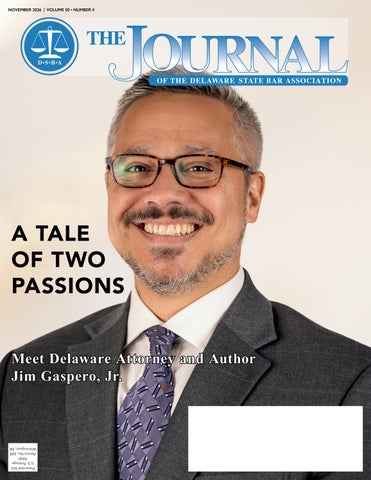
A TALE OF TWO PASSIONS Meet Delaware Attorney and Author Jim Gaspero, Jr.
Presorted Std. U.S. Postage PAID Permit No. 408 Wilmington, DE
DSBA BAR JOURNAL NOVEMBER 2026 | VOLUME 50 • NUMBER 4 PRESIDENT Ian Connor Bifferato EXECUTIVE DIRECTOR Karl G. Randall EDITOR-IN-CHIEF Kristen S. Swift
Table of Contents
EDITORIAL BOARD Claire M. DeMatteis Jason C. Powell Caixia Su
FEATURES
EXECUTIVE COMMITTEE LIAISON Francis J. Murphy, Jr. EDITORIAL ADVISORY COMMITTEE Valerie A. Caras Sara Beth Kohut Holly O. Vaughn Wagner BAR JOURNAL ADVISOR Richard A. Forsten EDITOR Danielle Bouchat-Friedman The Bar Journal is published and distributed by the Delaware State Bar Association 704 North King Street, Suite 110 Wilmington, DE 19801 P: 302-658-5279 F: 302-658-5212 www.dsba.org © Copyright 2026 by the Delaware State Bar Association. All Rights Reserved. The Bar Journal is the independent journal of the Delaware State Bar Association. It is a forum for the free expression of ideas on the law, the legal profession, and the administration of justice. It may publish articles representing unpopular and controversial points of view. Publishing and editorial decisions are based on the quality of writing, the timeliness of the article, and the potential interest to readers, and all articles are subject to limitations of good taste. In every instance, the views expressed are those of the authors, and no endorsement of those views should be inferred, unless specifically identified as the policy of the Delaware State Bar Association. The Bar Journal is published monthly with a combined July/August issue. All correspondence regarding circulation, subscriptions, or editorial matters should be mailed to: Editor, DSBA Bar Journal Delaware State Bar Association 704 North King Street, Suite 110 Wilmington, DE 19801 or emailed to: dbouchatfriedman@dsba.org Letters to the Editor should pertain to recent articles, columns, or other letters. Unsigned letters are not published. All letters are subject to editing. Send letters to the address above, Attention: Editor, Bar Journal. The Bar Journal Editorial Policy is available upon request.
For Advertising Opportunities Call (302) 658-5279, ext. 1102 Email: dbouchatfriedman@dsba.org Read The Bar Journal online at www.dsba.org
COVER STORY 14 From Law to Lore: Inside a Delaware Attorney’s Debut Book 16 80 Years of Civil Legal Aid in Delaware 19 Call for Executive Committee Nominations 20 A Tribute to Thomas L. Sager, Esquire 22 2026 Awards Luncheon Announcement 23 Breakfast With Santa Announcement 24 DELREC Makes Meaningful Expansion to Sussex County 26 It’s All About Perspective
COLUMNS 4
President’s Corner
28
Book Review
6
Editor’s Perspective
30
The Judicial Palate
10
Tips on Technology
34
The Last Word: MLK Jr. 2027
12
Let’s Talk: DE-LAP at Your Service
Annual Statewide Breakfast & Day of Service
DEPARTMENTS 8
Side Bar
9
Calendar of Events
9
Of Note
33
Bulletin Board
9
Out & About
ON THE COVER: Jim Gaspero, Jr., Esquire, the author of Penny and the Yeti. PHOTO CREDIT: Sarah Gaspero of Tuleya Photography.
DSBA Bar Journal I November 2026
3
PRESIDENT’S CORNER | BY IAN CONNOR BIFFERATO, ESQUIRE
Pro bono publico. Translated literally, it means “for the public good.”
“
Behind the Latin phrase is a person who needs help and a lawyer willing to provide it. .........................
L
aw school gave me a new appreciation for the Latin classes I took at Salesianum in 1984 and 1985. More broadly, it helped me appreciate the value of studying and learning—something I fear I did not fully understand until then. A year spent working in construction on new townhomes between college and law school helped prepare me for that realization. Working outside through a cold Delaware winter was the best motivation I ever had to appreciate the educational 4
DSBA Bar Journal | www.dsba.org
opportunities available to me—and to recognize that I should have taken greater advantage of them sooner. Like many children, I also took longer than I should have to appreciate my parents’ wisdom and experience. My father, who served in Superior Court for decades before I became a lawyer, often spoke about the legal profession he observed firsthand. He sincerely believed that much of Delaware’s pro bono legal service came from smaller firms and solo practitioners. Potential clients would walk through their office doors needing help, but unable to pay. The lawyers helped them anyway. For many years, King Street was home to dozens of law offices, including many small firms and solo practices. Some readers will remember their occupants as “the King Street lawyers.” The phrase may not always have been intended as a compliment. To me, however, it recalls lawyers whose practices were shaped by the needs of the people who came through their doors. They handled a wide range of matters, often as litigators willing to learn an unfamiliar area of law when a client needed their help. That breadth reflected resourcefulness and a willingness to undertake the preparation necessary to provide competent representation.
My father often said that many lawyers who appeared in his court from the 1960s through the end of the twentieth century represented clients who could afford to pay only part of their fees—or nothing at all. In his telling, that service was woven into the daily work of practicing law in Delaware. His observations remind me that pro bono service has a deeply personal dimension. Behind the Latin phrase is a person who needs help and a lawyer willing to provide it. That connection remains as important to our profession today as it was to the lawyers my father remembered. Lawyers in larger firms have also long supported the needs of the Delaware community, though their practices may offer fewer daily encounters with individuals seeking legal help they cannot afford. Organizations such as Delaware Volunteer Legal Services, the Office of the Child Advocate, and other advocacy groups help connect those lawyers with people who need representation, often providing training and guidance to support their work. For those considering how to approach our current significant need for pro bono service, reaching out to one of these organizations is a practical place to begin. Taking on a matter, volunteering at a clinic, or working alongside
an experienced colleague can make a meaningful difference for someone who needs help. Each offers an opportunity to carry forward Delaware’s valued traditions of service.
Connor Bifferato is the 79th President of the Delaware State Bar Association. Admitted to the Bar of the Delaware Supreme Court in 1994, he currently serves as University Legal Counsel to Wilmington University and as a professional neutral with The Bifferato Firm, P.A. He has more than 30 years of commercial and complex litigation experience in Delaware state and federal trial and appellate courts. He has demonstrated a longstanding commitment to upholding the Delaware legal community’s reputation for professionalism and civility through his service to the Delaware courts and the Delaware State Bar Association.
BECOME A DSBA SECTION MEMBER Section Membership provides the chance to exchange ideas and get involved. To join a Section, visit www.dsba.org/about-the-dsba/membership.
BUILDING BUILDING BUILDING RELATIONSHIPS RELATIONSHIPS RELATIONSHIPS 1980
for for
for
2022 2022
2026
OVER OVER 40 OVER 40 YEARS YEARS 40 YEARS OVER FOUR DECADES
|S U |STA | ME M AA NN ENT ENTACCO ACCOCI CI AT AT EP E|E |RPART MA PA RTNE NE NENT R R|ACCO SU PP C PO PO I ATE RT RTSTA PA F FRT FPL PL NACE EACE R ME S UPPORT NN T TS E SE RVICE RVICE STAFF S S PL ACE ME N T S E RVICE S
215.981.5455 215.981.5455 kruza.com kruza.com 215.981.5455
kruza.com
DSBA Bar Journal I November 2026
5
EDITOR’S PERSPECTIVE | BY CLAIRE DEMATTEIS, ESQUIRE
Delaware Attorneys and Nonprofit Board Service at DuPont in August as an attorney in the labor and corporate security group. Tom rose through the ranks, including serving as Chief Litigation Counsel, and he was promoted to Senior Vice President and General Counsel in 2008. Throughout his 37 years with DuPont, and after his retirement in 2014, Tom dedicated his time, treasure, and expertise to numerous nonprofit, educational, legal, and civic organizations. To name just a few, Tom served on and held leadership positions with the Delaware Community FoundaThe author with Tom Sager, Esquire at a Delaware Law School graduation. tion, the American Red Cross Delaware om Sager, who was a highly- Chapter, ChristianaCare, Widener Uniaccomplished Delaware attor- versity, University of Delaware Weinberg ney, former General Counsel Center for Corporate Governance, the of DuPont, and dedicated Delaware Law Related Education Center, community leader, taught a generation the Minority Corpoate Counsel Assoof Delaware attorneys what it means to ciation, and the Lawyers’ Committee for give back to our community by serving Civil Rights Under Law. (Read a tribute on nonprofit boards. Tom’s community to him, beginning on page 20.) service and his passing in September got That is just one example of a Delaware me thinking about the collective impact attorney serving their community. There of Delaware attorneys who volunteer are about four thousand attorneys in their time and expertise serving on the Delaware Bar. For a round number nonprofit boards. estimate, let’s say there are 500 Delaware First, some more about Tom Sager. attorneys serving on nonprofit boards. After graduating from Wake Forest Nonprofit management consulting firms School of Law in 1976, he passed the estimate that board members spend an avDelaware Bar that July, and started erage of about 100 hours per year on non-
T 6
DSBA Bar Journal | www.dsba.org
profit board responsibilities, including attending board meetings, preparation, committee work, organizational events, and related governance responsibilities. Conservatively, we can estimate that 500 Delaware attorneys provide 100 hours of their time every year to nonprofit boards, which means we are providing at least 50,000 hours of professional service annually to our communities. We could go a step further and assign an hourly professional services value of say $400/hour to estimate the economic value of that contribution. At $400/hour, 50,000 hours of professional service represents $20 million annually. To be clear, like Tom Sager, we serve on nonprofit boards because we are dedicated to the organization’s mission and want to give back. And these organizations welcome our participation. A recent economic impact study by the Delaware Alliance for Nonprofit Advancement (DANA) identified 951 nonprofit organizations actively operating in Delaware, employing nearly 73,000 people, paying $5.2 billion in wages, and supporting $14.1 billion in gross regional product. The report also identified 85,700 volunteers contributing more than 5.6 million hours of their time annually. Delaware attorneys account for a portion of those 5.6 million annual volunteer hours serving in governance and board roles. A column about Delaware attorneys serving on nonprofit boards would not be complete without highlighting the role of Delaware’s three legal services agencies and the board members of these
agencies: Community Legal Aid Society of Delaware; Delaware Volunteer Legal Services; and Legal Services Corporation of Delaware. It also is important to highlight that it was three Delaware attorneys who originally established Delaware’s first nonprofit civil legal services organization in 1946: the Legal Aid Society. According to an account by former Chancellor and Chief Judge Collins J. Seitz, Sr. in the book, The Delaware Bar In The Twentieth Century, he and attorney William Poole attended the 1945 American Bar Association annual meeting in Cleveland where they were inspired by a speech given at the meeting by American attorney and civics leader, Harrison Tweed, who was known as the father of legal aid in America. During what Seitz described as a very bumpy plane ride back to Philadelphia, the two young attorneys discussed the idea of starting a legal aid society in Delaware. A few months later, the Delaware State Bar Association created a committee to organize legal aid services, and the newly-appointed
Vice Chancellor, Collins Seitz, was appointed as a member. The three founding members of the Legal Aid Society were William Poole, Collins Seitz, and then-deputy Family Court Judge J. Caleb Boggs, who went on to serve as Delaware’s U.S. Congressman, Governor and U.S. Senator. Legal Aid Society of Delaware was incorporated on May 2, 1946, with a budget of $3,600 donated by members of the Delaware Bar Association. During its first year, Legal Aid provided free legal services to 204 clients in criminal and civil matters. The focus of the civil cases was on family matters and the benefits available under the new GI bill of rights for WWII Veterans. The Legal Aid Society grew to become the Community Legal Aid Society, Inc., a state-wide nonprofit agency of full time staff by the early 1970’s, providing civil legal services to thousands of Delawareans in matters of basic need—landlord/tenant, welfare rights, consumer protection, domestic violence and family law cases. Today, eighty years after its founding, CLASI employs more than 75 attorneys,
paralegals, and support staff who provide free legal services to nearly 20,000 individuals and their family members. The legal services they provide range from assisting clients faced with eviction and housing discrimination, to victims of domestic violence, helping people access and maintain public benefits, representing immigrant victims of crime and violence to obtain legal residence status, and protecting the civil rights of people with disabilities. From William Poole, Collins Seitz, and Caleb Boggs to Tom Sager and hundreds of other Delaware attorneys, members of the Delaware State Bar Association have a rich history of supporting our nonprofit agencies by serving as board members. Thank you for your community service. Let’s keep it going! Bar Journal Editor Claire DeMatteis is a Delaware attorney, past Chair of the Women and the Law Section, and member of the Delaware Women’s Hall of Fame.
DSBA Bar Journal I November 2026
7
SIDE BAR
INDIAN DELEGATES ATTEND DSBA CLE
EXECUTIVE COMMITTEE Ian Connor Bifferato President
Francis J. Murphy, Jr. President-Elect Jennifer Ying Vice President-at-Large Frederick H. Mitsdarfer III Vice President, New Castle County D. Benjamin Snyder Vice President, Kent County Christophe C. Emmert Vice President, Sussex County Mae Oberste Vice President, Solo & Small Firms, New Castle County Jeffery A. Young Vice President, Solo & Small Firms, Kent County Stephen A. Spence Vice President, Solo & Small Firms, Sussex County Delegates from PHD Chamber of Commerce and Industry in New Delhi, India, recently attended our Bankruptcy Chapter 11 Nuts and Bolts CLE. The delegates are pictured with speakers S. Alexander Faris, Esq. of Young Conaway Stargatt & Taylor, LLP and Laurel D. Roglen, Esq. of Ballard Spahr LLP.
Zachary S. Stirparo Secretary Paige C. Chapman Assistant Secretary Anthony V. Panicola Treasurer Brenda R. Mayrack Assistant Treasurer David A. White Past President The Honorable Kathaleen St. Jude McCormick Judicial Member Victoria R. Sweeney Assistant to President Thomas P. McGonigle Legislative Liaison Tayler D. Bolton Crystal L. Carey Richard A. Forsten James G. Griffin-Stanco Michael J. Hoffman Juan E. Martinez Claire M. DeMatteis Katherine H. Betterly Kelly Farnan Lisa Schmidt Denise Nordheimer Members-at-Large, appointed Karl G. Randall Executive Director
8
DSBA Bar Journal | www.dsba.org
OF NOTE
CALENDAR OF EVENTS / CLEs November/December 2026
Tuesday, November 10, 2026 • 9 a.m. - 12:15 p.m. Supreme Court Review 2026
Condolences to the family of John Weaver, Esquire, whose wife, Cathy Weaver, passed away on July 25, 2026. Condolences to the family of Steven Daniel Taylor, who passed away on October 16, 2026.
DSBA
Friday, November 13, 2026 • 8:30 a.m. - 12:45 p.m. Rubenstein-Walsh Seminar
If you have an item you would like to submit for the Of Note section, please contact Danielle BouchatFriedman at dbouchatfriedman@dsba.org.
Riverfront Events
Tuesday, November 17, 2026 • 9 a.m. - 12:10 p.m. Recent Developments in Technology Law CLE DSBA
Tuesday, November 17, 2026 • 1 p.m. - 4:15 p.m. The Law Office Guide to Practicing Safe AI DSBA
Thursday, November 19, 2026 • 6 p.m. - 7:30 p.m. Legal Ethics Mystery Thrillers Farnan School of Law
Friday, November 20, 2026 • Noon - 1 p.m. When “No Deal” Is Not the End: Emotional Intelligence in Mediation DSBA
Tuesday, December 15, 2026 • 8:30 a.m. - 4:30 p.m. Fundamentals of Lawyer-Client Relations 2026 DSBA
Saturday, December 19, 2026 • 9:30 a.m. - 11:30 a.m. Breakfast With Santa DSBA
Dates, times, and locations of events and CLEs may occasionally change. Please consult the DSBA website for the most up-to-date information at dsba.org. OUT & ABOUT
Connect with
DSBA
DID YOU CATCH THIS? Like: Delaware State Bar Association
Follow: Delaware State Bar Association
www.dsba.org
What is the Fortune 500?
D
elaware’s Corporate Franchise was featured in an episode of Jeopardy! that aired on Wednesday, Oct. 14, highlighting our State’s longstanding reputation as the Corporate Capital of the World. Do you know the answer?
DSBA Bar Journal I November 2026
9
TIPS ON TECHNOLOGY
THE NEXT GENER ATION OF SEARCH TECHNOLOGIES IN EDISCOVERY: BEYOND KEY WORDS BY ANDREW MCCLARY, ESQUIRE
TAR as a solution presented new challenges which scale along with the data at hand: more data in general results in more false-positive records, larger quantities of records incompatible with TAR, and increased risk as sensitive data is pulled beyond early case assessment into review environments with varying levels of security. Along with the burden of labor and risk, the cost of workflow management, data storage, and review continue to grow. How we communicate and how information is structured has also changed drastically, such as multiple short-message communication exchanges instead of more formal, detailed email communication. To manage various types of information, the way we search must also include variety. In the following paragraphs, we’ll look at popular technologies along with the challenges they solve and create. From simple Keyword Search to Vectorization and Knowledge graphs, and how this applies to current strategies. Keyword Search Lexical search, or keyword search, finds records in an index by matching exact words or phrases from the user. Prior to indexing, electronic searches ran in real time, crawling data to find matching patterns. Keyword indexing solves this inefficiency by creating an inverted index which maps each word to the locations where the word is found. When searching, the index returns the location(s) of each word queried. Variations on how an index is configured yields different results, but results are otherwise deterministic. Because keyword indexes are built on literal content without interpretation, unknown abbreviations, misspellings, and ambiguous words produce false negatives and irrelevant 10 DSBA Bar Journal | www.dsba.org
hits. Use of Boolean, proximity, fuzzy, and wildcard operators in keyword search improve the retrieval of word variations but will also introduce additional false positives. As the retrieval of data is limited by the user’s knowledge of its content, broad terms are often required to ensure the hits retrieved include relevant information, even though overinclusive. The need for overly broad searches, and false positive keyword hits, set up the case for semantic search. Semantic Search Unlike keyword search seeking exact matches, Semantic search is the objective of retrieving information based on meaning rather than exact keywords. Vector search is one of the most common mechanisms used for semantic search, although other techniques such as synonym expansion, entity extraction, graph traversal, and machine-learning classification can also contribute. We’ll use the query “Attorney” as a practical example: Keyword search will find documents containing the word “attorney.” Semantic search may also find documents containing lawyer or legal counsel, recognizing those concepts as related.
© istockphoto.com/:Dilok Klaisataporn
E
lectronic stored information (“ESI”) was once limited by cost of storage, licensing, and the speed of creation with the tools available. As cloud computing and storage depth grew, so did the volume of ESI. Just as keyword searching became a solution for digital communications emerging in a paper-driven world, tools like Technology Assisted Review (“TAR”), specifically those reliant on sample-based learning and machine classification, became a solution for voluminous reviews.
Vector Search
Knowledge Graphs
Conceptual relationships are not direct links between related records. Instead, each record indexed is converted into a high-dimension vector of numbers (“vectorized”) in the semantic index, or model. Words and document parts with similar meanings will be mathematically close in vector spaces. When a user runs a search, the search request is vectorized using the same model. The results returned by the search application are records which are found in nearby vectors.
Where a vector search identifies similar concepts by the proximity of their vectors, knowledge graphs store explicit relationships between entities. Typically populated during ingestion, systems extract information such as people, organizations, dates, topics, and locations to then graph relationships. It might include details like the following which connect the dots between Andrew and Antique Discovery:
To oversimplify vector search, imagine a model in only three dimensions rather than the hundreds or thousands of dimensions used in real-world systems. In our mental model, tokenized content is suspended throughout the space inside a cube. To identify relevant documents from a knownrelevant example, create a search radius around the example. Records within this radius are considered conceptually similar and therefore likely relevant. Unlike keyword search, semantic search is only deterministic as vectors and similarity calculations remain fixed once indexed. However, changes to the population, such as additional records indexed, can change which results are considered nearest matches, causing the results to evolve over time. Using a vector index, a user can leverage the model to identify conceptually related words in the dataset. Keyword searching can then be used to return the matching records after first using semantic search to identify related words which actually exist in the population. This hybrid approach leverages a semantic search to build a more complete keyword search by giving the user additional knowledge of the population.
▪ Andrew emailed Ed ▪ Andrew works for Copy Paste Inc. ▪ Ed works for Antique Discovery Vectors are able to find concepts, while knowledge maps explain relationships between entities. Knowledge graphs and vectors are increasingly used side-by-side with an LLM. Where the vector index can be used to answer “what content is semantically similar”, the knowledge graph explains the connections between those results. Modern AI Search In modern applications, technologies come together to create powerful search applications, such as Retrieval Augmented Generation (“RAG”). Using RAG, eDiscovery application agents can search for case data and return search results with narrated ‘understanding.’ Under the hood, RAG functions in several steps. First, each document is broken into manageable chunks and converted to vectors stored in an index. Next, the user asks a question which is also converted to an embedding. At this step, the LLM may also generate additional content to query. Semantic retrieval then occurs, finding the nearest document chunks to the user’s vectorized question. Each document chunk retrieved is then inserted to a prompt on the LLM. This prompt includes both the question, the retrieved evidence, and if part of the solution knowledge graph details associated with results, to then produce a generative response. An important limitation to understand is that these agents, using
RAG, are not reviewing the entire corpus of documents when a question is asked. Due to context windows, only a subset of topranking records from the retrieved search results are reviewed. This limitation means that of 100 hot documents, the agent may only see the top 20. Important connections between documents may be lost and narrated incorrectly. Or perhaps a very large document has been split into many chunks so only one portion is considered by the LLM. Larger context windows help improve the completeness of results, but an important detail could be “lost in the middle.” Comparison of Search Technologies Use of LLM and Generative AI to enhance search queries, retrieve results with meaningful, semantic similarities, and compose an overview of the results is an incredibly powerful tool. Users with no understanding of the population can ask questions in natural language and receive near instantaneous insights. But rather than relying on these as a complete and accurate representation, users should consider them facts to be verified as well as hint to the other questions that should be asked. Each search option can compensate for the weaknesses of others and be applicable to different steps along the way. The table below compares the capability, explainability, and court familiarity for various search and review methods. Keyword search is simple to explain and widely accepted, but it is limited to exact matches on the user’s criteria. RAG may be considered the most capable, but while RAG is usually deterministic in retrieval it is probabilistic in explanation.
CONTINUED, P G. 32 >
DSBA Bar Journal I November 2026
11
LET’S TALK: DE-LAP AT YOUR SERVICE | JIM DEEL, EXECUTIVE DIRECTOR
The Second Oath
M
ost attorneys and judges can remember the day they entered the profession.
beginning of something new. After years of perseverance, the moment they had worked toward for so long had arrived.
They remember the room. They remember the faces. They remember the anticipation that accompanies the end of a long journey and the
Yet the most important part of that day was not the accomplishment it recognized. It was the promise it required.
For a brief moment, pride gave way to responsibility. The new attorneys raised their hands and spoke words that connected them to something larger than themselves. They promised fidelity to their clients, candor to the courts, and support for the constitutional principles that make the rule of law possible.¹ The ceremony ended. The photographs were taken. Congratulations were exchanged. The day became a memory. The oath remained. Under Delaware law, every attorney admitted to the bar takes an oath or affirmation.¹ In In re Abbott, the Delaware Supreme Court observed that this commitment reaches back to the earliest days of the profession.² When Thomas Spry, the first lawyer admitted to practice in Delaware in 1676, sought permission to plead cases before the court, he was permitted to do so only so long as he behaved himself well and remained answerable for his conduct.²
The oath binds attorneys to something larger than themselves. It did so for Thomas Spry in 1676, and it does so for Delaware attorneys today. Across generations, the words may change, but the underlying commitment remains the same: to conduct oneself in a manner worthy of the trust placed in the profession. Perhaps that is why Veterans Day 12 DSBA Bar Journal | www.dsba.org
© istockphoto.com/:pamelasphotopoetry
The language has changed over the centuries. The responsibility has not.
causes me to reflect upon a group that occupies a unique place within Delaware's legal community. Throughout Delaware's legal community are attorneys and judges who have taken a second oath. At some point in their lives, they stood in another room, among different faces, and made another solemn commitment. Similar to the oath taken upon admission to the bar, it began with a pledge to the Constitution.³ Unlike most attorneys, however, they made that commitment knowing it could require hardship, separation from family, danger, injury, or even the sacrifice of life itself.³ Former Secretary of Defense James Mattis described military service as “signing a blank check to the American people, payable with your life.”⁴ Having spent eighteen years in the United States Marine Corps, I have always found that observation compelling because it captures the seriousness of such a commitment. Whether that ultimate sacrifice is ever required, the significance of an oath is not found in the ceremony in which it is spoken, but in the life that follows. The words may be recited in a matter of moments, but the obligation endures for years. For many veterans, the memory of raising a hand fades far more slowly than the ceremony itself. Veterans Day gives us an opportunity to recognize colleagues whose service may have begun long before we knew them. Some served decades ago. Some served more recently. Some speak openly about that chapter of their lives. Others rarely mention it. Yet veterans often recognize something familiar in one another. Shared experiences create an immediate sense of camaraderie. A story does not have to be told in order to be understood. One of the greatest strengths of any profession is the opportunity to build meaningful relationships. In a profession that can often feel demanding and isolating, those bonds remind people that they belong to something larger than themselves. That tradition of service has deep
roots in the legal profession itself. John Marshall served as a captain in the Continental Army before entering the practice of law and ultimately becoming Chief Justice of the United States.⁵ More than a century later, John Paul Stevens served in the United States Navy during World War II before beginning the legal career that led him to the Supreme Court.⁶ The spirit of shared service can also create opportunities to serve others. Delaware's Veterans Treatment Court draws upon that tradition through its volunteer mentor program, where veterans help encourage and support participants navigating the court process.⁸ It is a reminder that camaraderie has value beyond fellowship itself. It can become a means of helping others. In the end, the purpose is not simply to remember military service. It is to honor the people who served and to strengthen the community in which they continue to serve today. Recognition, however, should lead to something more than gratitude. It should lead to connection. That spirit of camaraderie is one of the motivations behind the effort to establish a Veterans' Law Section within the Delaware State Bar Association. Its objectives are to inform, organize, and advocate on issues affecting military members and veterans; encourage continued service within the profession and the community; and strengthen relationships among colleagues who share an interest in those efforts. Just as importantly, it offers an opportunity for veterans within Delaware's legal community to find one another, renew old bonds, build new friendships, and continue a tradition of service that did not end when they no longer wore the uniform. If you are a DSBA member interested in helping found the Veterans' Law Section, please contact: Michael Gonen mbgonen@duanemorris.com Office: 302-657-4920
You do not have to help organize the section to take part in the fellowship. If you are a Delaware attorney or judge who served and would like to hear about social events for fellow veterans in the profession, please let Michael know. I hope you will consider reaching out. For those who did not serve, there is a place in this conversation as well. Members of the legal profession can recognize what their colleagues have given and support their efforts to build that community. Every attorney and judge took an oath upon entering the profession. Some pledge a second oath. This Veterans Day, may we remember not only their service, but the commitments that service represents. And may we take the opportunity to know them not simply as veterans, but as friends, colleagues, and fellow members of a profession founded upon trust, service, and fidelity to principle. Notes: 1. 10 Del. C. § 1907, Oath of attorneys-at-law (requiring an oath or affirmation upon admission); In re Abbott, No. 676, 2006 (Del. May 2, 2007), slip op. at 9 & n.18 (quoting the attorney oath and citing Delaware Supreme Court Rule 54). 2. In re Abbott, slip op. at 9-10 & n.19 (quoting the record of Thomas Spry's admission and Randy J. Holland, Introduction to The Delaware Bar in the Twentieth Century xxi (1994)). 3. 10 U.S.C. § 502; U.S. Army, Oath of Enlistment; 5 U.S.C. § 3331, Oath of Office. 4. James Mattis, U.S. Military Academy Graduation and Commissioning, remarks delivered at West Point, May 27, 2017, U.S. Department of Defense. 5. U.S. Department of State, Office of the Historian, John Marshall (1755-1835). 6. Naval History and Heritage Command, H-Gram Special Edition: Passing of Supreme Court Justice Stevens. 7. Reserved. 8. Delaware Superior Court, Veterans Treatment Court Mentor Program.
Jim Deel is the Executive Director of the Delaware Lawyers Assistance Program, where he works closely with attorneys and judges to provide confidential support in the face of personal and professional stress. With prior experience as a clinician embedded with law enforcement, he has worked alongside vulnerable seniors and families experiencing crisis. His approach emphasizes trust, prac tical suppor t, and creating space for professionals to navigate difficult work without carrying it alone. Email him at JDeel@de-lap.org. DSBA Bar Journal I November 2026
13
FEATURE
From Law to Lore: Inside a Delaware Attorney’s Debut Book BY SARA BETH A.R. KOHUT, ESQUIRE
Some of Delaware’s finest legal minds are also published authors, dedicating their rare spare time to writing novels or compelling non-fiction. Taking a break from writing legal briefs to compose a book is more than just a great way to relieve stress—it can also make one a better lawyer. Whether it’s sharpening research skills, deepening empathy, refining the ability to write for different audiences, or expanding professional networks, creative writing and practicing law share a powerful synergy. This article launches our new series highlighting published authors within the Delaware bar community. If you have a book out, or know a colleague who does, please contact Danielle BouchatFriedman at dbouchatfriedman@dsba.org.
M
any of us set aside childhood pleasures as we transition into adulthood, trading hobbies for the pursuit of higher education and the rigors that come with a legal career. For James (“Jim” or “Jimmy”) Gaspero, that childhood pleasure was reading comic books, and he fondly recalls the thrill of collecting comics during shopping trips with his father. Though he drifted away from that hobby as life intervened, he rediscovered his passion for comics after becoming a father himself. “After my daughter was born, I started taking her to the Comic Book Shop on Marsh Road in northern Delaware,” Gaspero said. “Soon, I was reading comics again. Then posting [on social media] about them. Then doing a podcast, and eventually I wrote my own comic book. I wouldn’t have written 14 DSBA Bar Journal | www.dsba.org
my book without the Comic Book Shop.” His smile captures the full-circle moment of returning to the Comic Book Shop for a signing of his first book, a children’s comic titled Penny and the Yeti. Rekindling his interest in comic books has provided a welcome balance to Gaspero’s day job as an attorney with Nitsche & Fredericks, LLC, where he focuses on personal injury matters. A native of Delaware County, Pennsylvania, he now makes his home in North Wilmington, Delaware. While attending Saint Joseph’s University in Philadelphia, Gaspero explored his artistic interests and served as managing director of the college theater. Following graduation, he worked as a juvenile probation officer in Chester, Pennsylvania, before heading to law school at Temple University. He practiced criminal defense
and family law for eight years in Philadelphia, before moving his practice to Delaware. After starting as a corporate litigator and then working on trust and estate litigation and insurance defense, he joined his current firm in 2022, where he enjoys taking on the litigation challenges that others turn down as too complicated. Despite being a voracious reader as a child, Gaspero did not think about becoming a writer until his recent return to reading comics. “I read a lot of comics that were okay, and some that were not so great,” he said. “Those made me think maybe this is something I can do. So, I started writing short stories.” Gaspero also affiliated with the podcast Cryptid Creator Corner, through which he interviews comic book writers (among other creatives) and is close to completing 300 episodes. “It’s been like a masterclass on how to make comics,” he said. “It’s been enlightening to talk to several of my favorite creators.” And so, it’s little surprise that his first book, Penny and the Yeti, features a cryptid in comic book format. His children were also a driving force behind the book. “As a lawyer, it’s hard to show your kids what you do,” he said. “But I could share my writing with them. And I’ve been able to show them that if there’s something you love, you should pursue it.” Gaspero’s two young daughters, Penny and Charlotte, inspired his characters and helped to shape ideas for Penny and the Yeti. The story follows two young sisters navigating the challenges of a workaholic father who is always on the phone and has to be reminded to help out at home, while their exasperated mother has to be reminded to have fun amidst the struggle of juggling work and life. Penny befriends a yeti who magically appears and whose presence is instantly accepted. “I don’t think I’m on the phone all the time, but my family would probably disagree,” Gaspero admitted. “It’s fiction but inspired by real events. I didn’t want the readers to hate the parents, but to find them relatable.” Gaspero saw the empathy that his daughters showed for their friends dealing with the impact of divorce. “I wanted to show kids dealing with a tense situation in a way that would give them agency with a big, fun, fantastical adventure,” he said. In the short time since its release in April 2026, Gaspero reports that the response to Penny and the Yeti has been positive, both with kids and adults. Likewise, his colleagues in the bar have been supportive. One of the highlights for Gaspero has been the opportunity to talk to children at school. “It’s exciting to talk to kids, not just about the book itself, but about storytelling and comic books,” he said. Public speaking has always come naturally to Gaspero and is probably a factor in why he became a trial and litigation attorney. He has also found that the skills of a lawyer and a writer naturally complement one another. “As a lawyer, I’ve met so many types of people from all walks of life. That helps with capturing a character,” he said. “The writing helps with empathy and meeting clients where they are,
understanding where they’re coming from, and wanting to do the best job you can for them.” Publishing a comic book like Penny and the Yeti takes a different path than a text-only book. Guided by the assistance of his daughters, Gaspero developed the story into a script. He then connected with his illustrator, Amber Akin, and they worked to prepare a four-page digital comic that was initially posted online and later included in an anthology. They then built that out into a longer script to pitch for publication of a longer work. Gaspero pitched the book based on a 10-page script and outline. After receiving an offer for publication, he then had three months to complete the manuscript, all while maintaining his law practice. The result is a 130-page whimsical, colorful comic book that is available through his publisher’s website at papercutz.com, as well as mainstream booksellers. For other lawyers who aspire to become published writers, Gaspero advises to “make the time to pursue it. You’ll never find it unless you just do it. Don’t be precious about it, take five minutes, or fifteen. Do whatever you can to get your story down whenever you can.” Sara Beth Kohut is principal attorney at Enduraylant Law, LLC, where she focuses on business law matters. She is a member of the Journal’s Editorial Advisory Committee and author of Crossing Under Cover: Covered Bridges of Chester County, Pennsylvania and Surrounding Regions. DSBA Bar Journal I November 2026
15
FEATURE
In Pursuit of Justice: 80 Years of Civil Legal Aid in Delaware New Documentary to Explore the Impact and Perseverance of Delaware’s Legal Aid Agencies
I
BY MOLLY READ MCPHEETERS
n a national landscape where federal funding for nonprofits grows increasingly uncertain, even from previously dependable sources, Delaware’s legal aid agencies worry about the future. For Legal Services Corporation of Delaware, Inc. (LSCD), nearly 30% of its budget comes from a single federal source: the Legal Services Corporation, which distributes federal funds to legal services organizations across the country. For Community 16 DSBA Bar Journal | www.dsba.org
Legal Aid Society, Inc. (CLASI) and Delaware Volunteer Legal Services, Inc. (DVLS) losses in federal funding would mean fewer resources for their work in areas like helping domestic violence survivors find safety or advocating for the rights of individuals with disabilities—work that is already underfunded. W hile scar y, threats to federa l funding are not a new fight for these agencies. In fact, it is a recurring hurdle
baked into the 80-year history of civil legal aid in Delaware. A documentary, set to premiere next month, will trace the fascinating evolution of our state’s legal aid agencies and the ways leaders of the Delaware Bar have responded to these ongoing challenges with passion, creativity, and determination to ensure the work could continue. We owe the existence of DVLS and LSCD to the forethought of passionate Delaware lawyers who were driven to preserve
the work of legal aid, and their clients’ access to justice. The belief in the ideal, “and justice for all”, is a core pillar and value of American society but even now in our country’s 250th year it is one that can feel at odds with lived realities. The civil justice system still does not work for many Americans, based simply on their inability to afford an attorney. Unlike the criminal system, in most civil legal matters there is no constitutional right to a lawyer. The civil justice system can be equally as high-stakes as its criminal counterpart, leaving Delawareans alone to navigate complex and life-altering legal matters like housing stability, economic security, and safety from abuse. In 1946— decades before there was a national legal aid movement— four of Delaware’s legal titans, Collins J. Seitz, Sr., William Poole, Clarence A. Southerland and J. Caleb Boggs, recognized the urgent need to provide free legal services for those who could not afford representation. In post-World War II America, they were particularly concerned for the welfare of war widows and their children, which led to the creation of one of the oldest civil legal aid agencies in the country: the Legal Aid Society of Delaware, now known as CLASI. In the first year, the Legal Aid Society had a single parttime attorney on staff who served 204 clients, handling both criminal and civil cases involving family law and GI Bill eligibility. Since the 1940s, Delaware’s civil legal aid ecosystem has continued to evolve. In 1981, due to severe cuts in federal funding and shifting tides nationally regarding legal services for the poor, members of the Delaware Bar came together to establish DVLS at Widener University Delaware Law School to best position the pro bono arm of legal aid: connecting private volunteer attorneys to civil cases. They quickly learned that an organization dedicated to expanding the role of the private bar in providing quality pro bono legal services enabled more vulnerable Delawareans to be treated with dignity and receive
We hope you will join us at 4 p.m. on December 1 at the baby grand, in the Edith & Alexander Giacco Building in Wilmington, for a screening of our documentary 80 Years of Civil Legal Aid in Delaware followed by a panel and a cocktail reception. 1.0 Ethics CLE credit pending. Registration is required, tickets are an optional $15 donation to the Combined Campaign for Justice, which raises funds for the critical work of these organizations. For more information and to register: https://delawareccj. org/our-events/
the help that they needed in some of the darkest hours of their lives. Then in 1995, Congress passed regulations stating that, if an agency received even $1 of funding through the Legal Services Corporation, then onerous federal restrictions had to apply to all of its activities. While much of their funding had traditionally restricted the types of cases agencies could handle, this was the first time those restrictions would blanket all of their work. This would have significantly limited the scope of critical civil work that CLASI (the recipient of the LSC funds at that time) was actively doing, dramatically reducing the number of Delawareans it could help, including people with disabilities. Faced with an impossible choice, legal aid leadership recognized an opportunity for a creative solution—CLASI relinquished its LSC funding and those dollars began the Legal Services Corporation of Delaware, founded in 1996. The history of Delawares civil legal services movement is robust and DSBA Bar Journal I November 2026
17
You have the vision of justice for all and we’re all equal, but when it comes to how that truly [plays] out in…the world of the courts, individuals at the lower end of the economic scale are frequently shut out. They...simply can’t afford to retain an attorney [and] pay the expenses that go along with participating in litigation. —Cynthia L. DePue, Esq. Executive Director Legal Services Corporation of Delaware, Inc. In “80 Years of Civil Legal Aid in Delaware” Documentary
meaningful, as it continually informs the work of today’s modern legal aid agencies. Today, these agencies divvy up cases statewide by problem type and client populations to represent as many individuals and families as possible, whether helping them avoid homelessness, ensuring safety from domestic violence, or safeguarding access to critica l food and hea lth benefits. Legal aid’s impact on the state has been immeasurable — from its origins protecting widows and children in the wake of W WII to the shared work of CLASI, DVLS, and LSCD today, which together handled 8,700 cases and served over 21,000 Delawareans last year. Eighty years after the Legal Aid Society’s founding, we have a unique opportunity to celebrate the legacy and preserve the history of Delaware’s civil legal aid movement, while also looking toward an uncertain future. Working in partnership with local film studio Teleduction, the Delaware Combined Campaign for Justice is documenting perspectives from across the legal profession, from a paralegal who has worked at LSCD for over 20 years, to Chief Justice Collins J. Seitz, Jr. whose father was among the founders of the legal aid movement here in Delaware. Other voices you will hear from include current and past executive directors 18 DSBA Bar Journal | www.dsba.org
of the organizations, members of the Bar who helped create the Combined Campaign for Justice, as well as public officials and former Delaware legal aid employees like Chancellor Kathaleen St. Jude McCormick, U.S. Senator Christopher Coons, and Governor Matt Meyer.
Molly McPheeters is the Campaign Manager for the Combined Campaign for Justice. She can be reached at mmcpheeters@ delawareccj.org.
CLE at
HOME
DSBA CLE ONLINE
View an online CLE seminar ANYTIME, ANYWHERE. View the full online CLE catalog at www.dsba.org/cle.
Get Involved in DSBA Leadership! The Delaware State Bar Association is looking for a number of talented members to join the 2027-2028 Executive Committee and lead the DSBA to continued success. The following positions on the Executive Committee of the Association must be filled for the year 2027-2028: Vice President-at-Large; Vice President, New Castle County; Secretary; Assistant Secretary; Treasurer; Assistant Treasurer; Six Members-at-Large Note: The Vice President, Kent County and the Vice President, Sussex County will be those persons selected by, respectively, the Kent County Bar Association and the Sussex County Bar Association.
The Nominating Committee will consider all interested applicants. If you are interested in serving on the Executive Committee, please send a letter of interest identifying the position you are seeking, and the reasons you wish to serve, to DSBA Executive Director Karl Randall, by email to nominations@dsba.org or by mail at Delaware State Bar Association, 704 North King Street, Suite 110, Wilmington, DE 19801. The deadline for submissions is Wednesday, February 17, 2027.
WE NEED YOUR HELP TO FIND STRONG LEADERS FOR THE FUTURE! The Nominating Committee consists of: Mary F. Dugan, Chair David A. White, Vice-Chair J. Clayton Athey (2027) Roxanne M. Eastes (2027) Anthony Flynn, Jr. (2027) Julie O’Dell (2027) Misty A. Seemans (2027) George R. Tsakataras (2027) Elise K. Wolpert (2027)
New Castle County Stephen B. Brauerman (2028) Kate Buck (2028) Thomas Hanson (2028) Jenness Parker (2028) Srinivas Raju (2028) Greg Varallo (2028) Max Walton (2028)
Kent County Tetra Shockley (2027) Gary E. Junge (2028) Amit Vyas (2029)
Michael Allen (2029) Kimberly A. Evans (2029) J. Zachary Haupt (2029) Matthew P. Milana (2029) Michael Neminski (2029) Mark D. Richardson (2029) Patricia O. Vella (2029)
Sussex County Tom Carney (2027) Ross Karsnitz (2028)
Delaware State Bar Association 704 N. King Street, Suite 110 Wilmington, Delaware 19801 658-5279 DSBA Bar (302) Journal I November 2026
19
FEATURE
A TRIBUTE TO THOMAS L. SAGER, ESQUIRE, 1950 - 2026 Ref lections from some of his f riends on the Bench and Bar
Tom taught a generation of attorneys the value of a true mentor, someone who was always in your corner guiding your career. He reached the pinnacle of a career in the law as General Counsel of the venerable DuPont; yet, he always made time for his community. Many times throughout my career Tom encouraged me to push beyond my comfort level. And he gently insisted that attorneys whom he mentored stay engaged in nonprofit boards and community activities. I am a better lawyer, friend, and mentor thanks to Tom Sager. – Claire DeMatteis, Esquire
Widener University Delaware Law School mourns the passing of Thomas L. Sager, whose leadership and generosity left a lasting impact on the institution. Sager, former general counsel and senior vice president of DuPont, served on the law school’s board of overseers for more than 12 years and was known for his deep commitment to Delaware’s legal community. His service on the dean search committee that led to the hiring of former Dean Rodney Smolla reflected both the prominence of Delaware Law and the collaborative spirit of the state’s legal community. Sager was widely regarded as thoughtful, community minded and exceptionally generous with his time, offering steady support to Delaware Law over many years. Sager’s decades of service to the region—including his work with the Delaware Community Foundation, the American Red Cross of Delaware and the Minority Corporate Counsel Association—underscored his dedication to advancing the profession and strengthening the community. – Widener University Delaware Law School
20 DSBA Bar Journal | www.dsba.org
“
What a loss. It was delightful to work with Tom on the Dean Search Committee when I cochaired it. Tom was also a civil rights advocate and a great and early supporter of the Dignity Law Program at Delaware Law. – James R. May, Esquire
“
Tom’s legal legacy is second to none. While an unmatched business and community leader, he was even a better man—and friend. “Sager,” as he was fondly referred to at DuPont, shaped the lives of thousands of people around world —including mine.
Tom was a visionary General Counsel but an even better friend, mentor, and community-minded leader. – Alan D. Albert, Esquire
T
he International Institute for Conflict Prevention & Resolution (CPR Institute) mourns the passing of former CPR board member Thomas L. Sager, respected corporate counsel and influential advocate for alternative dispute resolution.
“Tom was a true legend of a lawyer,” said CPR board member Stephen P. Younger, Senior Counsel at Withers Worldwide. “His legacy included both encouraging the hiring of lawyers from varied backgrounds and promoting alternative methods of dispute resolution. He made a real difference in our profession.” Sager dedicated his career to advancing a more thoughtful, efficient, and collaborative approach to resolving disputes. As Senior Vice President and General Counsel of DuPont, he helped shape the legal profession's understanding of how corporate legal departments can create value through proactive dispute management, early case assessment, mediation, and arbitration. His leadership contributed to the development of the DuPont Legal Model, which became an important example of innovation in legal services and conf lict resolution. – The International Institute for Conflict Prevention & Resolution (CPR Institute)
We are saddened by the passing last month of Thomas Sager, a longtime advocate for inclusion in the legal profession, and Janet Bivins, a longtime CCWC® member and colleague of Tom’s. We honor their contributions and the lives they touched. Please keep their families, friends, and colleagues in your prayers. May their lights forever shine. – Laurie N. Robinson Haden, Esquire, President & CEO, Corporate Counsel Women of Color
– Anthony Farina, Esquire DSBA Bar Journal I November 2026
21
22 DSBA Bar Journal | www.dsba.org
DSBA Bar Journal I November 2026
23
DELREC Makes Meaningful Expansion into Sussex County BY BETSY RENZO, ESQUIRE
..................................................................................
D
ELR EC has existed since 1997 with the primary goal of enhancing law-related education in Delaware for K-12 students. Their mission is to promote active learning experiences for students who need to function in a society based on the rule of law, by: 1) increasing knowledge and interest of civics and the law; and 2) removing barriers to entry into legal professions. Knowledge is power, and legal knowledge is enfranchisement. DELREC works with over 6,000 students in grades K-12 in all three of Delaware’s counties each year, providing one-hour “legal lessons” that meet our state's civics standards. They bring attorney volunteers with us to every classroom, provide paid internship experiences each summer for first generation middle school, high school, and college students, connect students with shadow opportunities, and run the Delaware High School Mock Trial Competition each year. Delaware’s legal industry is large, profitable, and famous across the country. With over 150 law firms in Wilmington alone, there are numerous job opportunities for
24 DSBA Bar Journal | www.dsba.org
future lawyers. There are also jobs in finance, HR, social media, marketing, technology, court security, court administration, and paralegal services at these firms and in our courts. However, most of Delaware’s students have no knowledge of these opportunities. This problem is compounded by distance for the students in Sussex County. Of the 26 schools that participated in our statewide high school mock trial competition this year, only two were from Sussex County. One reason for this is that the schools have to travel sometimes 95 miles to get to the competition and must raise money to reserve hotel Kim Taylor, School Program Manager, Kent and Sussex Counties. rooms for the two days of the competition. Moreover, issues associates because the closest law schools of access and recruitment are far are over an hour away. Studies show that more pressing. about 60-70% of internships result in There are no law schools in Kent or full-time employment, and that number Sussex County. Judges and law firms jumps to 89% for law student internships. in the southern part of Delaware have (National Association of Colleges and a hard time recruiting interns and new Employers. August 11, 2025).
While DELREC cannot build a new law school downstate, it can help recruit local students interested in law before they leave home for law school. If students in high school and college are making connections to law firms and courts, they will be more likely to go back to those same firms once in law school. In Sussex, the dominant pathway is agriculture, and for good reason. There are many jobs in the farming industry in Delaware. As such, high schools offer pathways in plant science, animal science and engineering. Districts such as Smyrna, Milford, Woodbridge, Sussex Central and Lake Forest all offer these pathways. Conversely, because most of the legal jobs in Delaware are in New Castle County, few Sussex schools offer a legal pathway. A pathway in Delaware is defined as three courses that do not otherwise meet graduation requirements. In New Castle County, schools like William Penn High School, Howard School of Technology, and Middletown High School offer a legal pathway. They offer courses like introduction to legal studies, criminology, sociology of law, civil law, and mock trial. Higher level courses at Middletown and William Penn are co-seated at Wilmington University and students receive dual-enrollment credit for just $125 per person per semester. In fact, Wilmington University has a relationship with the Appoquinimink School District wherein students can gain up to 30 college credits by the summer after their senior years. This is an entire first year of an associate’s degree. Students can then pursue a 3+3 program at Wilmington University and Wilmington University School of Law and become lawyers by the age of 24. This opportunity can be made available to any Delaware high school that knows of it. Few Sussex high schools have legal pathway programs. Most of the students are missing critical access to internships, job shadowing, summer employment, and field trips. This year, DELREC received three critical grants, specifically to expand access in Sussex County, from the Longwood Foundation, The Siegfried
Advisory, and AccessLex. Because of this funding, DELREC was able to hire Kim Taylor as their new School Program Manager for Sussex County. Kim is an experienced school counselor and classroom lecturer. She worked for 22 years as a counselor at Delcastle Technical High School. She has also loaned her expertise to classrooms working with Literacy Delaware and Prevent Child Abuse Delaware. This expansion is designed to elevate Sussex pathways to those of their New Castle County peers. Schools in Sussex should have the support to recruit, train, and teach legal courses. Additionally, DELREC plans to implement internships and job shadowing opportunities in Sussex County with these new grants. The minimum impact DELREC expects to see is an increase in knowledge of the legal system amongst Sussex County students. Maximally, the impact of this initiative will be seen for generations to come. DELREC expects to see more engagement, more internships, and more connections between students and lawyers in Sussex. This will lead to more jobs, more access, and ultimately more prosperity for the citizens of Sussex County. It is critical to DELREC’s mission to serve all students in Delaware. This initiative places the resources directly where they need to be and specifically designate someone from the Sussex community to the Sussex community.
LOOKING TO
GROW AND
BUILD YOUR
CLIENT BASE?
Join the online DSBA Lawyer Referral panel at www.dsba.org. Opting in is simple and free to all DSBA members.
Betsy Renzo, Esq., currently serves as the Executive Director of the Delaware Law Related Education Center (DELREC). Betsy was a classroom teacher and program leader for ten years, teaching AP Government, Speech & Debate, Global Peace & Social Justice, and U.S. History. Before teaching, she worked as an attorney in Pennsylvania, focusing on juvenile criminal defense and family law. She holds a JD from Temple University Beasley School of Law and a Master’s degree in Education from Stanford University.
DSBA Bar Journal I November 2026
25
FEATURE
It’s All About Perspective BY SHANNON TRONCOSO, J.D.
E
People often paraphrase Kierkegaard as saying that life can only be understood backward, even though we have to live it forward. There may be no profession better designed to keep us from doing much looking backward because law keeps us focused on what comes next. There is always a deadline, a filing, a client who needs an answer, or a problem that needs solving. Taking the time to look backward can almost feel indulgent, but I have come to think there is some value in doing it occasionally. I came to law school as a nontraditional student, and long before I ever got there, I had watched The Paper Chase many times over the years. It fueled this idea I carried around for a long time that maybe, somehow, I would get there too. I had heard Professor Kingsfield’s famous speech more times than I could count: “You come in here with a skull full of mush; you leave thinking like a lawyer.” I’m sure there were a few moments during those three years when I half expected someone to hand me a dime and tell me to call my mother because there was serious doubt about my becoming a lawyer. 26 DSBA Bar Journal | www.dsba.org
© istockphoto.com/:Maria Vonotna
very once in a while, I go back and read a social media post I wrote when I graduated from law school. At the time, I thought law school was the hard part, and that seemed perfectly reasonable. It had consumed three years of my life, and I always had something to read, write, study, research, or worry about. Graduation felt like reaching the other side of something. The facts of those three years haven’t changed, but my judgment of them has. I suppose that is what perspective does.
Most of us have heard it: the first year of law school they scare you to death, the second year they work you to death, and the third year they bore you to death. Somewhere along the way, complaining about law school almost becomes part of going to law school. So it feels a little like breaking the code to admit that, looking back, I loved it. I know how easily that can turn into the cliché about something being the best years of your life, and that isn’t quite what I mean. I think what I miss is being immersed in something difficult while knowing, even on the days when it exhausted me, how much I had wanted the chance to be there. What I didn’t appreciate then was the grind itself and what was happening because of it. We spend so much time thinking about what all of that work prepares us to do that we may miss what it does to us along the way. I was too busy doing it to see that at the time. We know what the preparation is supposed to accomplish, but I’m not sure we stop very often to consider what the experience itself gave us. There is so much emphasis in this
profession on preparing for what comes next. Law school prepares us for the bar, and passing the bar opens the door to practice. Early work brings greater responsibility, and there always seems to be another point somewhere ahead that can make whatever we are doing now feel temporary. We become accustomed to examining what is in front of us because that is what the work requires. William James wrote, “My experience is what I agree to attend to.” I keep coming back to that idea because the legal profession makes enormous demands on our attention. We will always have unfinished work, which makes it surprisingly easy to overlook what has already happened. Work that once intimidated us eventually becomes work we know how to approach, and we learn how to begin solving problems that once seemed impossible. We may not notice that change while it happens because our attention has already moved somewhere else. Time gives us distance, but distance alone doesn’t give us perspective. Sometimes we have to look again to understand
the value of something we were too close to see clearly the first time. As another year comes to an end, perhaps there is some value in turning that habit of examination on our own experience once in a while. I think that is also why I understand the hard part differently now. It doesn’t necessarily end, and I no longer think it is supposed to. What changes is our ability to meet it. I appreciate my years at Widener differently now, not because they were easier than I remember them, but because I can see from here some of what I couldn’t see while I was in the middle of them. Maybe that is reason enough to look backward once in a while, even when there is still so much demanding attention. Of course, if you still have CLE hours to finish before the end of the year, perhaps not quite yet. Shannon Troncoso, J.D., is working with a law firm in Philadelphia, and preparing to take the Delaware Bar Examination in February 2027. She is a 2024 graduate of Widener Delaware Law School.
DSBA Bar Journal I November 2026
27
BOOK REVIEW | REVIEWS BY RICHARD A. FORSTEN, ESQUIRE
Tell Me Some Stories
T
he law is not rocket science—unless, of course, it is a patent case about rocket science. But even if the law, including patent law, is not rocket science, patent law is, nevertheless, a little different. Patents are earned. An inventor “invents” something. It must be new (or “novel”). It must not be obvious. It must be useful (i.e. have “utility”). The inventor files a detailed and highly specialized application with the government. The government examines the application. The claims may be narrowed. The application might be rejected. Or the application might be granted. And then, for a limited period of time, the application conveys certain exclusive rights on the grantee, who may use those exclusive rights to, at least in theory, make money from the patent. But then the “fun” really begins. Others might sue the patent recipient, claiming the patent is invalid. The patent recipient may sue others, claiming they are illegally using the patent.
Fun With Patents Kfir Luzzatto (Pine Ten, LLC, 2025)
In Fun With Patents, The Irreverent Guide for the Investor, the Entrepreneur, and the Inventor, author and attorney (with a Ph.D. in chemical engineering to boot) Kfir Luzzatto takes the reader on a tour of all things patent. This is not a dry, solemn, plodding “Patents for Dummies” type of book that simply describes the process for obtaining a patent and what rights a patent grants; rather, it is a book that uses stories and asides and colorful examples that often are, in the words of the title, “fun” even as the book does inform and teach. In order to be patented the invention must have “utility,” it must be useful. Of course, sometimes inventions get patented that might not meet this requirement. In 1980, the U.S. Patent Office granted a patent for the “Love Box.” What is a love box? In the words of the patent it is “a token between lovers for assuring their love to each other.” The box “is filled with love and no matter how often it is opened, it can never be emptied.” Just the thing for couples to exchange so as to ensure their love will last. The “love box” patent expired years ago, but, per Lazzatto, never should have been granted, as it is an example of an invention that lacks “utility;” and, indeed, how could one ever determine whether it worked or not? Or, as P.T. Barnum is said to have put it, “there’s a sucker born every minute.” Lazzatto also discusses the implications of artificial intelligence. What if AI “discovers” something? Is it patentable? Recent guidance from the U.S. Patent and Trademark Office (USPTO) says that the human contribution must be significant in order for an invention to qualify, and that merely using an AI system to solve a problem will not qualify for a patent. But, if the inventor designed/augmented/ created the particular AI system, then that may create patentability. If the inventor took something from an AI system and found a practical, useful application
28 DSBA Bar Journal | www.dsba.org
(i.e., the inventor made a meaningful contribution), then patentability may be found. But the implications of AI are still not fully understood. In the last year, AI has solved longstanding mathematical problems, and so how AI will impact the patent system long-term remains to be seen. Not surprisingly, La zzatto is a believer and a defender of the patent system. For example, he believes that absent a long-standing and strong patent system, pharmaceutical companies would not nearly have been in the position they were in to respond so quickly to COVID. And he takes issue with an article claiming that the “primary injured party” when company A was issued a patent for an invention allowing a TV viewer to record a show while watching another was company A’s competitor, company B. Why, exactly, should anyone feel sorry for company B or somehow think that company A should now be forced to give up the rights to a technology it invented? For Lazzatto, company B is “injured” in the same way that a bank robber is injured when the robber can’t simply walk into a bank and then walk out with other people’s money. With banks, this would be robbery. With patents, this would be infringement. Somehow the author of the article missed the point of patent protection, the incentives it provides, and the benefits it brings.
promote the Progress of Science and useful Arts, by securing for limited Times to Authors and Inventors the exclusive Right to their respective Writings and Discoveries.” Interestingly, the first patent act (the Patent Act of 1790) created the U.S. Patent Board, whose members were the Secretary of State, the Secretary of War, and the Attorney General. It was their duty in those early days of the Republic to determine whether a claimed invention met the three requirements for patentability. As Secretary of State, Thomas Jefferson was the lead member of the board and he is sometimes referred to as the first patent examiner. Patent law is not rocket science and, explained colorfully and with good examples, it can indeed be “fun.” For anyone looking to learn the basics and garner some insight —without being lectured to in a pedantic way—Fun With Patents will educate in an enjoyable way. Richard “Shark” Forsten is a Partner with Saul Ewing LLP, where he practices in the areas of commercial real estate, land use, business transac tions, and related litigation. He can be reached at Richard.Forsten@saul.com.
CONFERENCE ROOMS AND SPECIAL E VENT SPACE THE DSBA HAS MEETING & EVENT SPACE IN THE HEART OF DOWNTOWN WILMINGTON
➤ Perfect for depositions, arbitrations, and committee meetings ➤ Close to the Leonard L. Williams Justice Center ➤ Multiple meeting room options to suit your needs ➤ Free Wi-Fi ➤ Access to a kitchen ➤ Complimentary printing and shredding ➤ Competitive rental fees
For more information call (302) 658-5279
Patent protection, though, was not lost on the drafters of the Constitution, which grants Congress the power “to
Is Your Small Firm Practice Stressing You Out? • •
I help partners increase profits with less stress 50 year Delaware Bar member • Master Certified Life Coach • Free diagnostic session
Eric M. Doroshow, Esquire
ericd@dplaw.com www.esqcoach.com
DEL AWARE STATE BAR ASSOCIATION 70 4 N. KING STREET, SUITE 110 WILMINGTON, DE
DSBA Bar Journal I November 2026
29
THE JUDICIAL PALATE | BY SUSAN E. POPPITI, ESQUIRE
M
id-November is when I start seeking out holiday channels on the radio and, of course, tuning into Hallmark’s holiday movies. Speaking of holiday channels, here’s a bit of Guinness World Record music trivia: the “best-selling single for Christmas” is Bing Crosby’s 1942 recording of “White Christmas” with over 100 million records sold worldwide.1 If you’re wondering, as I was, about Mariah Carey’s ubiquitous “All I Want for Christmas Is You,” it holds a different recognition: the record for the “highest-charting holiday song on the Billboard US Hot 100 by a solo artist.”2 But let’s get back to Bing. Irving Berlin wrote the song “White Christmas” for the musical film “Holiday Inn,” starring Crosby and Fred Astaire. This holiday film ended up winning the 1943 Academy Award for best original song for that very holiday tune.3 So, when
This Charlottesville recipe for spoonbread could be an interesting Thanksgiving side dish. “In the picturesque foothills of the Blue Ridge Mountains, this Inn is only minutes from the airport, town and the University of Virginia…Nearby homes of Thomas Jefferson and James Monroe make history come alive while meals at this Inn bring to mind days of hospitality in an era of southern charm.” 30 DSBA Bar Journal | www.dsba.org
I came upon the title Cooking the Holiday Inn Way, I decided to search it for potential holiday recipes.4 This 1963 cookbook features recipes from Holiday Inns across the country. In her Foreword, editor Ruth Malone writes: Since the beginning of our country, some of the finest cooking in America has been found, not only in the home, but in the roadside inn. It was the heart of the village, often used as a meeting place before other structures were built…The old inns played an important part in the history of our country. William Penn was welcomed at the Blue Anchor Inn when he came to Philadelphia in 1682…Today company policies are created, and men and women are awarded honors and places of position in the convention rooms of Holiday Inns across the nation.5 Here are several recipes I found in the Virginia section to consider for your Thanksgiving table.
Old Virginia Spoonbread
•
2 cups milk
•
1 cup white ground corn meal
•
1 teaspoon salt
•
1 teaspoon sugar
•
2 tablespoons shortening
•
3 eggs, separated
•
2 teaspoons baking powder
Scald milk. Sift in the cornmeal, slowly to avoid lumps, and cook until thickened. Add salt, sugar, shortening and beaten egg yolks. When thoroughly blended, add the baking powder and fold in the stiffly beaten egg whites. Turn into a well-greased baking dish and bake in hot oven (400°) for 25 to 30 minutes. Serve with a spoon from dish in which it was cooked. Should be served at once as it falls like a souffle. Serves 4 to 6.6
© istockphoto.com/Alina Mosinyan
Savoring Our Semiquincentennial, Part 10
This cake from the Williamsburg inn could occupy a spot near the pumpkin, sweet potato, and pecan pies. “Walk on the same old cobblestones that echoed the footsteps of Thomas Jefferson, Patrick Henry and George Washington in ‘the city which turned back time.’ Visit the buildings where patriots thought, talked and evolved the plans which catapulted us from the status of oppressed colonial states to a free and independent nation. Then return to the Holiday Inn to Jet age conveniences…”
Old Williamsburg Ginger-Molasses Cake •
1 cup sugar
•
3½ cups flour
•
1 cup butter
•
2 teaspoons soda
•
3 eggs
•
½ teaspoon salt
•
1 cup sour milk
•
1 tablespoon ginger
•
2 cups molasses
Mix well sugar and butter and beat-in the three eggs. Add sour milk and molasses, alternately with flour sifted with the soda, salt and ginger. Bake in greased pan in slow oven for about 40 minutes.7
Some orange varieties are in season in fall and winter and could be showcased in this light, fluffy dessert. This Charlotte recipe is from the Petersburg inn. “This Inn is located in one of America’s most historic spots—as Petersburg played a part in the Revolutionary War—War of 1812—and the War Between the States. The Holiday Inn here is popular with tourists who visit the large battlefield.”
Orange Charlotte
•
1½ tablespoons gelatin
•
1/3 cup cold water
•
1/3 cup boiling water
•
1 cup sugar
•
3 tablespoons lemon juice
•
1 cup orange juice
•
3 egg whites
•
2 cups cream, whipped
Soften gelatin in cold water, dissolve in boiling water. Strain and add sugar, lemon juice and orange juice. Chill in pan of ice water; when set whip until frothy, add the beaten stiff egg whites and fold in the whipped cream. Turn mixture into mold lined with orange sections. Chill.8
Virginia is known for its dessert wines made with the Petit Manseng grape. This grape does well in Virginia’s humid climate, and its acidity moderates the late-harvest sweetness.9 I have enjoyed Petit Manseng in French blends and plan to seek one out from a Virginia vineyard. Wishing everyone a Happy Thanksgiving! 5. Malone at p. vii.
Notes: 1. https://www.guinnessworldrecords.com/world-records/72375-best-selling-singlefor-christmas 2. https://www.guinnessworldrecords.com/world-records/560633-highest-chartingholiday-christmas-new-year-song-on-the-us-hot-100-by-a-solo-ar 3. https://awardsdatabase.oscars.org/search/results
6. Malone at p. 240. 7. Malon at p. 248. 8. Malone at p. 245. 9. https://www.wineenthusiast.com/culture/wine/virginia-wine-petit-verdot-petitmanseng/
4. Malone, R. Moore. (1963). Cooking the Holiday Inn way. 2nd ed., with additions. Little Rock, Ark.: Pioneer Press.
S u s a n E . P o p p i t i i s t h e o w n e r o f S u s a n Po p p i t i M a t h Tu t o r i n g L LC . Susan holds a WSET (Wine and Spirit Education Trust) Level 3 Award in Wines with Merit. You can contact Susan at spoppiti@hotmail.com and find a searchable collection of her “Judicial Palate” articles at cucinadipoppiti.com. DSBA Bar Journal I November 2026
31
TIPS ON TECHNOLOGY
CONTINUED >
Questions to Ask Yourself Keyword search is often the agreed approach by parties. As technology advances, the volume of keyword results becomes less of a burden in theory. If you get 50,000 keyword hits, you may be inclined to agree to them because AI can review that many documents overnight. But remember that AI may still give you over-inclusive results. This can lead to a greater burden for your quality control, confidentiality, and privilege reviews. When working with AI-driven results, ask yourself:
▪ How was the search performed? ▪ Why were documents deemed responsive?
▪ Can rankings be reproduced? ▪ Can results be validated? ▪ Can emerging search methods be validated as effectively as traditional methods?
While this matter stresses the significance of parties working together to identify useful search criteria, it is also an example of combining search techniques. Ultimately, identification of the responsive population used both targeted keywords for precise matches, but also relied on TAR to surface other relevant documents outside of keyword results.
▪ Wright v. SLWM, LLC , 341 A.3d 551 (Del. Ch. 2025)
In an opinion decided in June 2025, the court remarks on the impact of volume and acknowledges that “Nor do terms that generate more hits necessary result in more responsive information.” To address the burden of search hits, the court goes on to suggest combining techniques used to identify relevant information, including the application of TAR.
What can we do today:
▪ Demand transparency (how is
this validated? Can the results be replicated?)
▪ Modernize search protocols alongside traditional keywords.
▪ Understand how Generative AI leverages search technology to find documents, and when it might leave data behind.
Andrew McClary is an eDiscovery and Data ` Forensics Professional working in the Wilmington legal community for over 18 years. He is the eDiscovery Support Manager at Potter Anderson & Corroon LLP.
The Court’s Opinions:
▪ Berger v. Graf Acq., LLC, 2024
WL 454011 (Del. Ch. Oct. 21, 2024) The court emphasizes that the producing party is best suited to determine the document review method, with the requirement that the use of TAR is done transparently. Furthermore, the court acknowledges that technology assisted review has shown to be at least as accurate as manual review.
▪ WorkCo, Inc. v. LiquiFi, Inc.,
2025 WL 1168234 (Del. Ch. Apr. 21, 2025) 32 DSBA Bar Journal | www.dsba.org
Open Call for Articles! Do you have a great idea? For more information on submitting articles for publication in the Bar Journal, please contact Danielle Bouchat-Friedman at dbouchatfriedman@dsba.org.
STAY ON TOP
of your CLE Credits w i t h D S B A!
A complete list of DSBA CLE seminars is available on our website at www.dsba.org. Delaware State Bar Association 704 N. King Street, Suite 110 Wilmington, DE 19801 (302) 658-5279
BULLETIN BOARD SERVICE
CDC - INDEPENDENT MEDICAL EVALUATIONS Serving attorneys from our Newark and Dover locations. Board-Certified. Fast Reports. Reliable Testimony. www.cdcime.com | 800-494-0321 | referrals@cdcime.com POSITIONS AVAILABLE
ALLEN & ASSOCIATES, LLC IS SEEKING A FULL-TIME ASSOCIATE TO JOIN OUR WILMINGTON, DELAWARE OFFICE. Recognized as a premier firm exclusively practicing Labor & Employment Law and Civil Litigation, our firm provides legal advice and counseling to employers, employees, and healthcare professionals. Managing Partner Michele D. Allen has been recognized by Super Lawyers Magazine and Delaware Today Magazine as a top attorney in Labor and Employment Law. We are seeking a candidate admitted to the Delaware Bar who will work closely with the Managing Partner and Associates on litigation matters, including wage and hour disputes, discrimination, contract disputes, unfair labor practices, and sexual harassment. Our firm offers competitive compensation and prioritizes work-life balance. Interested candidates are encouraged to submit an up-to-date resume to saada@allenlaborlaw.com. Qualified candidates will be contacted for a confidential discussion regarding the position.
ESTATE & ELDER L AW SERVICES OF DELAWARE LLC, a boutique Elder Law and Special Needs Estate Planning law firm located on Centerville Road, seeks 1-2 attorneys with 3+ years of experience to work in the areas of estate planning, estate and trust administration, special needs and disability planning, guardianship, and long-term care planning. DE Bar admission required. Part-time schedule considered. In-office hours required. We offer work-life balance, 401k, generous holidays, and purpose-driven work. We expect successful candidates to take the Certified Elder Law Attorney exam when eligible under the rule. Please send your resume and cover letter to finance@eaels.com. ASSOCIATE ATTORNEY – PLAINTIFF’S PI & WOR K ER S’ COMPENSATION Growing MOT‑area Plaintiff Firm seeking an Associate Attorney. Ideal for newer attorneys, those transitioning into PI/WC litigation or those who are looking for a results-based income structure. You’ll support litigation, client advocacy, and case management while developing skills in a fast‑expanding, small firm environment. Requirements •
Delaware Bar or pending admission
•
JD from ABA‑accredited school
•
Strong advocacy and writing skills
Benefits •
Competitive salary
•
Medical, dental, vision; 401(k) after one year
•
Mentorship and growth opportunities
•
Potential for performance-based bonuses
Apply: Submit resume to hlong@ injuryde.com
THE DISTRICT COURT OF DELAWARE is hiring a Pro Se Staff Attorney. Duties include: provides legal advice and assistance to the Court in connection with non-habeas corpus civil cases involving pro se litigants, the majority of which allege civil rights violations. The Pro Se Staff Attorney monitors the filings in such cases and drafts appropriate opinions and orders. To apply, go to: www.ded.uscourts.gov/employment. DEL AWA R E CH A NCERY LITIGATION ATTORNEY (5+ YEARS) Pashman Stein Walder Hayden P.C. is seeking an attorney with at least five years of experience to join our Wilmington, Delaware office. The ideal candidate will have substantial experience handling litigation matters before the Delaware Court of Chancery and other Delaware state courts. Admission to the Delaware Bar is required. Portable business is a plus. This position offers the opportunity to work on sophisticated Delaware litigation matters, assume significant responsibility, and play a key role in the continued growth of our Wilmington office. Qualified candidates should submit a resume in confidence to: Jen Lifschitz, Human Resources & Recruitment Manager: jlifschitz@pashmanstein.com OFFICE SPACE
BEAUTIFULLY A PPOIN TED off ice space for lease on month-tomonthly or yearly basis in professional collegial environment. Furnished or unfurnished. Shared services and facilities include conference room, impressive reception room, copying, and phone hookup. Ideal for a solo or small practice. Contact Bayard Marin at 302-658-4200. Email: bmarin@bayardmarinlaw.com. TROLLEY SQUARE-ADJACENT office space available in established law office building. One to three private offices; flexible leasing. Ideal for solo practitioners or small firms. Contact: kate@katebutlerlaw.com. DSBA Bar Journal I November 2026
33
THE LAST WORD
T HE DE L AWARE STAT E BA R A S S O C I AT I O N P RE SE NTS
DR. MARTIN LUTHER KING, JR. 2027 Annual Breakfast & Statewide Day of Service SAVE THE DATE DATE/TIME Monday, January 18, 2027 Breakfast: 8:00 a.m.
LOCATION
Chase Center on the Riverfront 815 Justison Street Wilmington, DE 19801 Keynote Speaker: Ta-Nehisi Coates Award-Winning Author & Journalist
"The time is always right to do right." -Dr. Martin Luther King, Jr. 34 DSBA Bar Journal | www.dsba.org
Delaware ADR moves at the speed of business, resolving even the most complex disputes on an expedited basis. DELAWAREADR.COM
Carefully crafted solutions for complex disputes. inquiries@delawareADR.com
(302) 566-7030
DSBA Bar Journal I November 2026
35
Continuing Legal Education Programs offered in partnership between Wilmington University and the Delaware State Bar Association Programs led by practicing attorneys and members of Delaware’s legal community The Law Office Guide To Practicing Safe AI The first 3 episodes of a 24-part series for the entire law office
Nov. 17, 2026 | 1– 4:15 p.m.
Current Trends and Future Issues in Data Privacy and Electronic Discovery Nov. 17, 2026 | 9 a.m.– 12:15 p.m.
Mystery Thriller Night: The Trilogy The Signal • The Archive • The Testimony
Nov. 19, 2026 | 6– 7:30 p.m. For information and to register, visit the Delaware State Bar Association at DSBA.org or call (302) 658-5279. Some classes will also be livestreamed via Zoom in Kent and Sussex counties. (Zoom link provided upon registration.)