The Bar Journal is the independent journal of the Delaware State Bar Association. It is a forum for the free expression of ideas on the law, the legal profession, and the administration of justice. It may publish articles representing unpopular and controversial points of view. Publishing and editorial decisions are based on the quality of writing, the timeliness of the article, and the potential interest to readers, and all articles are subject to limitations of good taste. In every instance, the views expressed are those of the authors, and no endorsement of those views should be inferred, unless specifically identified as the policy of the Delaware State Bar Association.
The Bar Journal is published monthly with a combined July/August issue.
All correspondence regarding circulation, subscriptions, or editorial matters should be mailed to:
Editor, DSBA Bar Journal
Delaware State Bar Association
704 North King Street, Suite 110 Wilmington, DE 19801 or emailed to: dbouchatfriedman@dsba.org
Letters to the Editor should pertain to recent articles, columns, or other letters. Unsigned letters are not published. All letters are subject to editing. Send letters to the address above, Attention: Editor, Bar Journal. The Bar Journal Editorial Policy is available upon request.
PRESIDENT’S CORNER |
BY IAN CONNOR BIFFERATO, ESQUIRE
Charting a Course: Key Initiatives for Our Bar Association’s Future
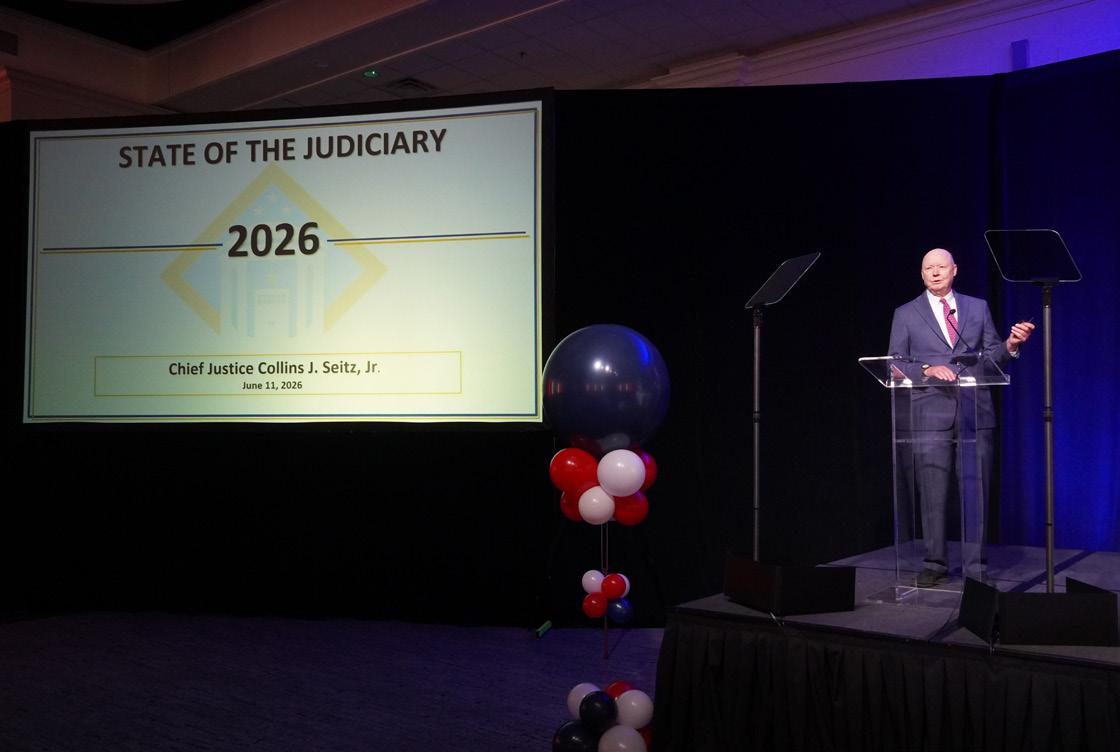
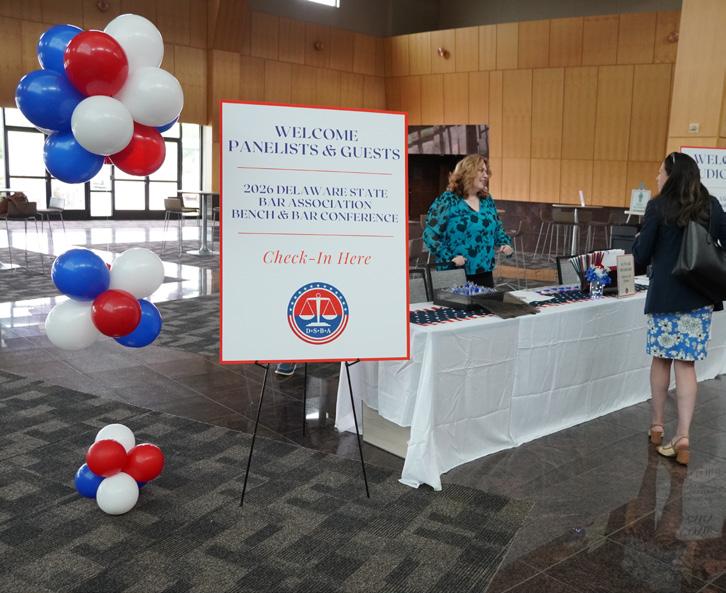
On Thursday, June 11, I attended the Bench and Bar Conference. I had the opportunity to speak about my goals for the upcoming year. Below is a portion of my comments.
I am honored to serve as the next President of the Delaware State Bar Association; indeed, it is the high mark of my career. Thank you for your trust and confidence. For members of the bench and bar who don’t know me yet, I promise I will earn your trust and confidence over the coming weeks and months.
Being a member of the Bar of the Delaware Supreme Court has been one of the most significant and defining aspects of my life, as well as my family’s legacy. In 1975, my mom, Marie C. Bifferato, was one of the first 50 women admitted to the Delaware Bar. In 1968, my dad, former Superior Court Resident Judge, Vincent Bifferato, was one of the youngest judges ever appointed to a Delaware Constitutional Court. My brother, Vince, a member of the Bar for 40 years and is a named partner in the law firm he founded in which he has practiced for the majority of his career as a Delaware lawyer. My brotherin-law, Arthur (Chip) G. Connolly, III, is also a founding member and named partner in the firm in which he practices, Connolly Gallagher. And of course, always first among equals in any room, my wife Karen, is also a partner and one of the original founding members of Connolly Gallagher.
When we swore the oath and became Delaware Lawyers, we became part of something exceptional. As Delaware lawyers we comprise a community bigger than ourselves, at least in part, because of our collective responsibility to uphold the respect, civility, and
integrity fundamental to being a member of the Delaware Bar.
For me, serving as President of the Delaware State Bar Association is like walking in my front door—it feels like coming home. Just like you, I cherish our history. I am very passionate about the present, about who we are, and the strong status and reputation of our Bar. And with that pride and passion comes an obligation to protect our standing and influence, not only for all future members of the Bar, but perhaps more importantly for all Delawareans.
In partnership with the experienced, talented and dedicated DSBA Executive Committee, there are three integrated initiatives that I believe we must pursue in the coming months and year. These initiatives are centered on sustaining the sacred and enduring responsibility to protect the unimpeachable notoriety and prominence of our Bench and Bar, as well as reaffirming Delaware’s position as the crown jewel of our country’s legal profession.
Under the leadership of my friend and colleague, former DSBA President Dave White, we have record membership, and our organization is as financially strong and stable as it has been for decades, operating with a very talented and committed organization. We have one of the highest memberships among voluntary bar associations in the United States. Executive Director Karl Randall and the incredibly talented, hard-working but still, very small staff, are effectively working together at a higher level than I can recall since I began my involvement with the DSBA Executive Committee in the 1990’s. Week after week, month after month, they create innovative and informative events and continue to unfailingly respond to the daily
needs of our membership as well as the communities in which we live and work. The DSBA team, the members of the Executive Committee, and the Finance Committee, together, have also been outstanding stewards of the finances of our organization. Over the past several years, we have secured our budget on unprecedented and solid footing, backed by fully funded reserves.
This leads me to three main initiatives that I hope to focus on over the next year.
First, with your support and engagement, the Bar Association will enlist Chief Information Officers, IT professionals, highly trained lawyers from firms large and small, solo practitioners, government attorneys, nonprofit counsel, and judges to strengthen the DSBA’s core functions and principles. Our Sections and Committees represent the heart and soul of the Bar Association. This is where we come together, hopefully in person rather than solely virtually, to do the important work of the organization. As has been our experience and our practice, we can always be so much more engaging and thoughtful when it is necessary to strengthen the grassroots and basic building blocks of our organization.
As part of the second direction that I hope we can focus on, the DSBA will continue to develop the resources to proactively address and educate on the use of advanced technologies, including Artificial Intelligence. We are already working with the chief information officers and IT professionals in some of Delaware’s larger firms. We want to encourage commitment and participation in this important initiative from all segments of the Bar Associations. As we have done with insurance, we can leverage our collective size and capabilities to create standards and balanced
access to technology, narrowing any divide in the advantages and obligations created by the rapidly evolving landscape of technology. It is part of the obligation to assist our members to effectively evolve, so we need to work with the existing committees and organizations of our state, as well as those created and organized in our courts, to identify and recommend guidelines for proper and acceptable uses of technology. Of course, there must be standards of practice in place. All Delaware firms and lawyers need to understand the thresholds and tolerances for AI use, starting with our law students. To minimize mistakes caused by the unavoidable and growing interactions that every Delaware lawyer continues to have with Artificial Intelligence, the Bar Association needs to be a source of information, knowledge, and expectations.
Third, we need to strengthen the Bar Association’s outreach programs and assistance for attorneys who are struggling. Whether caused by mental health challenges, substance abuse issues, health and wellness needs, or financial troubles, we need to find a way to support one another. Other bar associations, including our neighbors in
New Jersey, have identified and successfully implemented lawyers’ assistance programs that are available to attorneys, their staff and even their families and friends 24/7. We can learn from them and strengthen our solid foundation of lawyer assistance. None of us are immune from the effects of nearly chronic stress endemic to the practice of law. We all try to find ways to try to cope. Sometimes successfully; sometimes not as much. Removing any stigma associated with seeking professional help and support before breaking under the weight and pressures of our profession is long overdue. We should defer judgment, be more willing to reach out a hand, and to commend the courage it takes to find and accept help.
The Delaware Bar’s stellar reputation is built on professionalism, collegiality, and service; as well as dependability, strength, and reliability. The ever-intensifying challenges and demands of the practice of law can unite us and make us stronger by refusing to accept and avoiding the easier paths in favor of always finding a higher road. If we focus on what made us who we are, we will necessarily return to a place of solidarity.
When we recognize how to behave and practice, there is no need for hand wringing; because our actions will bring about not only our own expectations, but those of the world around us.
At this, our annual Bench and Bar Conference, let us resolve to lead by example, to elevate our discourse, to mentor the next generation, and to demonstrate through our actions that civility and excellence remain the hallmarks of our profession.
Connor Bifferato is the 79th President of the Delaware State Bar Association. Admitted to the Bar of the Delaware Supreme Court in 1994, he currently serves as University Legal Counsel to Wilmington University and as a professional neutral with The Bifferato Firm, P.A. He has more than 30 years of commercial and complex litigation experience in Delaware state and federal trial and appellate courts. He has demonstrated a longstanding commitment to upholding the Delaware legal community’s reputation for professionalism and civility through his service to the Delaware courts and the Delaware State Bar Association.
The Sounds of Summer Are Upon Us Again!
It’s that time of year where I fire up my pool and beachside playlists and share a selection of those songs with the Bar. Enjoy!1
1. “Party for You” by CharlieXCX. Viva la brat summer!
2. “Choosin’ Texas” by Ella Langley for those of us keeping it a little bit country.
3. “Ocean Eyes – Blackbear Remix” by Billie Eilish. A solid remix of an old favorite perfect for greeting the waves.
4. “Spitting off the Edge of the World” by the Yeah Yeah Yeahs and Perfume Genius.
5. “Dance Yrself Clean” by LCD Soundsystem.
6. “More than a Woman” by the Bee Gees. Can’t go wrong with this classic, always on repeat.
7. “Vacation” by Dirty Heads. Every single day is a vacation!
8. “10,000 Emerald Pools” by Børns. Who doesn’t want to swim in emerald pools?
9. “Black” by Pearl Jam.
10. “Island in the Sun” by Weezer. Enjoy each day as it comes and remember to turn up the music!
Note:
1. Some songs are explicit.
Bar Journal Editor Kristen S. Swift is a partner in Kaufman Dolowich LLP's Delaware office. All opinions expressed are her own.
Brian T.M. Mammarella, Counsel
Frank Y. Sun, Counsel General Transactions
Philip K. Micha, Counsel
Wilmington Office Rallies Around Families at Local Ronald McDonald House
Fox Rothschild’s Wilmington office held a wish list drive for the Ronald McDonald House Charities of Greater Delaware in May, collecting essentials, snacks and breakfast items for families staying at the Ronald McDonald House.
Ronald McDonald House provides a “home away from home” for families of seriously ill or injured children receiving treatment at nearby hospitals. By offering comfortable lodging, warm meals and a supportive community, the organization ensures that families can remain close to their children during critical times of medical care without the burden of additional expenses.
This effort was part of the firm’s Generation Fox initiative, a firmwide program dedicated to uplifting youth through charitable giving and community service.
EXECUTIVE COMMIT TEE
Ian Connor Bifferato President
Francis J. Murphy, Jr. President-Elect
Jennifer Ying Vice President-at-Large
Frederick H. Mitsdarfer III Vice President, New Castle County
Liam N. Gallagher Vice President, Kent County
Christophe C. Emmert Vice President, Sussex County
Mae Oberste Vice President, Solo & Small Firms, New Castle County
Jeffery A. Young Vice President, Solo & Small Firms, Kent County
Stephen A. Spence Vice President, Solo & Small Firms, Sussex County
Zachary S. Stirparo Secretary
Paige C. Chapman Assistant Secretary
Anthony V. Panicola Treasurer
Brenda R. Mayrack Assistant Treasurer
David A. White Past President
The Honorable Kathaleen St. Jude McCormick Judicial Member
Victoria R. Sweeney Assistant to President
Thomas P. McGonigle Legislative Liaison
Tayler D. Bolton
Crystal L. Carey
Richard A. Forsten
James G. Griffin-Stanco
Michael J. Hoffman
Juan E. Martinez
Claire M. DeMatteis
Katherine H. Betterly
Kelly Farnan
Lisa Schmidt
Denise Nordheimer Members-at-Large, appointed
Karl G. Randall Executive Director
Members of Fox Rothschild’s Wilmington office collected essentials for Ronald McDonald House Charities of Greater Delaware as part of the firm’s Generation Fox initiative, which supports youthfocused organizations nationwide.
CALENDAR OF EVENTS / CLE s
September 2026
Tuesday, September 9, 2026 • Noon - 1:30 p.m.
Advice for New Attorneys CLE DSBA
Tuesday, September 15, 2026 • 8 a.m. - 12:30 p.m.
Workers’ Comp Breakfast Riverfront Events
Wednesday, September 16, 2026 • 6 p.m. - 7:30 p.m.
Lessons Learned from Historic DE Trials Potter Anderson Corroon LLP
Dates, times, and locations of events and CLEs may occasionally change. Please consult the DSBA website for the most up-to-date information at dsba.org .
OF NOTE
Condolences to the family of Shae Chasanov Diluzio, Esquire, whose mother, Bonnie Dickerson Chasanov, passed away on June 22, 2026.
Condolences to the family of Phillip Giordano, Esquire, whose brother, Lawrence Giordano, passed away on June 30, 2026.
Condolences to the family of Stephen Doughty, Esquire, whose mother, Judith Doughty, passed away on July 2, 2026.
If you have an item you would like to submit for the Of Note section, please contact Danielle BouchatFriedman at dbouchatfriedman@dsba.org.
RESPONSIBLE USE OF GENERATIVE AI IN DELAWARE LEGAL PRACTICE
A Practical Guide for Law Firms
Considering AI Adoption
BY JOE LEONARD, ESQUIRE
Law firms evaluating generative artificial intelligence should treat adoption as both a technology decision and a professional-responsibility issue. AI tools can improve efficiency in drafting, summarizing, and organizing documents, but their value depends on careful governance. For Delaware firms, the practical question is not whether AI will be used, but how it may be used, by whom, with what information, and subject to what review before any output is shared with clients, opposing parties, or courts.
Delaware has not adopted a standalone professional conduct rule governing lawyers’ use of generative AI, but existing duties under the Delaware Rules of Professional Conduct (“DRPC”), as well as guidance in recent caselaw from both Delaware courts and other Federal jurisdictions provide a useful framework. Lawyers remain obligated to provide competent representation, protect client confidentiality, supervise lawyers and nonlawyers,
communicate appropriately with clients, maintain candor to tribunals, and charge reasonable fees. Those duties apply whether work is performed entirely by a lawyer, assisted by a paralegal, supported by a vendor, or accelerated by an AI tool.
To satisfy competency requirements under DRPC 1.1, a lawyer must understand enough about a tool’s capabilities and limitations to use it responsibly, including whether the tool may generate unsupported factual assertions or inaccurate citations, how it handles uploaded information, and what human review is needed before relying on its output. The DRPC supervision requirements necessitate that training should be provided to lawyers and staff, and the firm should revisit that training as technology evolves.
DRPC 5.1 and 5.3 require supervisory lawyers to make reasonable efforts to ensure that their reports comply with professional obligations. In the AI context, firms should not rely on informal understandings or ad hoc experimentation. A written policy should identify approved tools, prohibit unapproved public tools, define permitted and restricted use cases and information, and require independent verification of factual assertions, quotations, citations, legal conclusions, and filings. The policy should also address staff use, vendor use, clientfacing work, court submissions, billing, documentation, and escalation procedures when a lawyer is uncertain whether a proposed use is appropriate.
Not all AI products present the same risk profile. Enterprise legal tools may offer contractual protections, administrative controls, audit features, data-isolation commitments, deletion rights, and assurances that customer data will not be used for model training. Free or general-purpose consumer tools may involve broader data collection, unclear retention rules, and limited ability to control how information is used. Before approving a tool for legal work, a firm should review all documentation, including the vendor’s terms of service, privacy policy, security credentials, retention and access controls, encryption standards, incidentresponse obligations, deletion procedures, and any limits on professional-services use. That review should be documented
and refreshed when vendor terms or tool capabilities materially change.
In matters involving AI-generated filings, Delaware courts have focused on hallucinated authorities and the absence of meaningful human verification. In An v. Archblock, the Delaware Court of Chancery addressed filings containing incorrect legal citations apparently generated through AI use by a pro se plaintiff, requiring that future AI-assisted filings in the matter identify the tool used, the portions prepared with AI, and certify human review for accuracy and completeness.1 A similar order was issued by the Superior Court of Delaware in Lillard v. Offit Kurman. 2 While both decisions involved pro se plaintiffs, it is clear that, in Delaware courts, AI-assisted work must satisfy the same standards as any other legal work, and lawyers should be prepared to confirm that citations, quotations, factual summaries, and legal propositions were independently checked.
Confidentiality presents the most immediate risk of using AI tools. DRPC 1.6, requiring lawyers to protect client information and make reasonable efforts to prevent unauthorized access or disclosure, is implicated when client documents, deposition transcripts, privileged communications, work product, or commercially sensitive materials are entered into an AI platform. Before using a tool with client information, counsel should understand how the platform stores, transmits, retains, deletes, and protects data; whether the vendor may review inputs or outputs, whether information may be used to train a model, and whether contractual protections prohibit disclosure to third parties.
When AI tools will be used in the representation of a client, counsel should obtain informed consent, as established by the American Bar Association Committee on Ethics and Professional Responsibility’s Formal Opinion 24-512, published in 2024. The scope of consent will depend on the nature of the information, the purpose of the use, and the client’s expectations. Matterspecific communication is often the better practice, especially in litigation, transactions involving sensitive business information, or matters involving regulated data.
Recent cases at the federal level considering AI use have reached different conclusions as to how using AI tools impacts attorney-client privilege and the work product doctrine.
In United States v. Heppner, a criminal defendant asserted privilege claims over queries made to the Claude AI tool regarding the government’s investigation of him.3
The U.S. District Court for the Southern District of New York found that the queries were not privileged, as Claude is not an attorney, and neither were they work-product, as defendant had used the tool without informing counsel.4 Additionally, the Claude user agreement made clear that any tool input could be disclosed to third parties and would be used for training.
The U.S. District Court for the Eastern District of Michigan considered a similar question in Warner v. Gilbarco5, where a pro se plaintiff used generative AI tools to prepare for civil litigation. The court found that confidentiality was not broken, and that the queries were protected work product. The court noted that the confidentiality threshold for work product is lower than for attorney-client privileged communications, and that the use of free commercial AI tools, even those that collect user data for model training, does not necessarily waive work product protections or preclude the expectation of privacy.6
In Morgan v. V2X7 the District of Colorado cited to the Warner case, agreeing that a pro se plaintiff’s use of online AI tools did not necessarily waive work product. The court suggested a framework for acceptable use of AI in the form of a revised confidentiality stipulation, stating an AI tool must not: (1) store or use inputs to train the model, (2) disclose inputs to any third party, and (3) the tool must allow the user to delete all data from the platform upon request.8
Read as a whole, these cases support the idea that use of AI tools does not necessarily waive confidentiality, whether they are closed or open systems, so long as the queries to the AI tool are done at the direction of counsel. These cases do not establish a categorical rule that AI use automatically waives privilege or work product protection. They do, however, show why lawyers should consider how the use of AI tools
should be addressed in engagement planning, discovery protocols, protective orders, or confidentiality stipulations.
A practical implementation plan should begin with an inventory of current AI use by lawyers, staff, vendors, and embedded software features. The firm should classify use cases by risk, approve specific tools only after appropriate review, adopt a written policy, create procedures for client consent where needed; and develop a verification workflow for AI-assisted legal research, factual summaries, citations, and filings. Lawyers and staff should be trained on permitted uses, prohibited uses, confidentiality obligations, prompt hygiene, and human-review requirements. Additionally, engagement letters, vendor-management procedures, protective orders, and confidentiality stipulations should be updated where appropriate.
Generative AI can improve legal-service delivery when implemented through a governance framework that reflects existing professional obligations. For Delaware firms, the prudent path is to proceed deliberately, emphasizing training, consent and building core competence around AI tools and content verification with a documented process. Firms following this approach can capture the benefits of AI while reducing risk to clients, lawyers, and the integrity of legal proceedings.
Notes:
1. An v. Archblock, Inc., No. 2024-0102-LWW, 2025 WL 1024137, at *1 (Del. Ch. Apr. 4, 2025)
2. Lillard v. Offit Kurman, P.A., No. N24C-10-001 DJB, 2025 WL 800833, at *1 (Del. Super. Ct. Mar. 12, 2025)
3. United States v. Heppner, 820 F. Supp. 3d 292 (S.D.N.Y. 2026)
4. Id. at 297.
5. Warner v. Gilbarco, Inc., 820 F. Supp. 3d 629 (E.D. Mich. 2026).
6. Id. at 636.
7. Morgan v. V2X, Inc., No. 25–CV–01991–SKC–MDB, 2026 WL 864223 (D. Colo. Mar. 30, 2026).
8. Id. at *7.
Joe Leonard is Counsel at Morris James LLP in Wilmington, where the focus of his practice is e-Discovery and Information Governance. He is a member of the Richard Herrmann Technology Inn of Court in Delaware and the AI Virtual American Inn of Court.
Staying Well While Walking Alongside Seniors: A Wellness Guide for Those Practicing Elder Law
The work you do in elder law and on the bench matters deeply. It also carries weight in ways that aren’t always talked about openly.
You’re not just interpreting statutes or managing cases. You’re sitting with families during some of the most difficult moments of their lives—when a parent is declining, when decisions feel impossible, or when there are concerns about safety, capacity, or even abuse.
If you or a loved one has ever experienced this, this article is for you.
I write this with a great deal of respect for your role, and from my perspective
serving as Executive Director of a Lawyers Assistance Program. In that work, I have the privilege of supporting attorneys and judges while also drawing from earlier experience embedded with law enforcement as a clinician, working alongside vulnerable seniors and their families in situations involving cognitive decline, family conflict, and elder abuse.
What I’ve seen, from both vantage points, is this: the professionals involved in these cases often carry much more than anyone realizes.
If you’ve ever left your office or courtroom still thinking about a case, wonder-
ing about someone’s safety, or wishing there had been a clearer answer—you are not alone.
There is nothing wrong with you for feeling that way.
The Part of the Work We Don’t Always Talk About
Working with vulnerable seniors means regularly stepping into situations that are emotional, complicated, and often unresolved.
You see:
• families under stress;
• individuals losing independence;
• conflict, grief, and sometimes exploitation; and
• decisions that don’t come with clean outcomes.
From what I’ve seen—especially in crisis-response settings—these situations are rarely straightforward. People are doing the best they can with limited information, heightened emotion, and real-time pressure.
Over time, being close to that kind of work can take a toll.
One way this shows up is something known as compassion fatigue: the cumulative impact of caring deeply in high-stakes situations over time.¹
Closely related is vicarious trauma, where repeated exposure to others’ difficult experiences begins to shift your own internal sense of safety or perspective.²
It doesn’t always look dramatic. More often, it shows up quietly:
• feeling more drained than you used to;
• having a harder time “turning work off;”
• carrying certain cases with you longer than others; and
• wondering if you could have done more.
These responses are not a sign that something is wrong.
In fact, they are often a reflection of how seriously you take your role.
Why This Matters—For You, Too
The attorneys and judges who have the greatest impact in these cases are not just knowledgeable—they’re steady, thoughtful, and present.
That kind of presence requires something we don’t always talk about in the profession—taking care of yourself.
There can be an unspoken expectation to keep moving forward—to handle the next case, make the next decision, solve the next problem.
But this work accumulates. And without space to reset, even the most committed professionals begin to feel it.
Not because they’re not capable—but because the work itself is demanding.
Ways to Stay Grounded in This Work
There’s no perfect formula here, but there are ways to make this work more sustainable:
1. Give yourself permission to set boundaries
You can care deeply and still recognize that not everything belongs to you to carry outside of your role.3
2. Pay attention to your own signals
Fatigue, irritability, or difficulty concentrating are not weaknesses—they are early indicators that something needs attention.4
3. Make room for real recovery
Not just distraction, but genuine reset—whether that’s movement, quiet time, or stepping fully away from work.5
4. Stay connected
Talking with trusted colleagues or
accessing confidential support can make a meaningful difference. You don’t have to hold this alone.6
5. Let the quiet wins count
Not every success is obvious. Sometimes it’s stability, safety, or simply helping a family move one step forward. Those outcomes matter.7
6. Use brief, quiet reset techniques—even at your desk
In the middle of a demanding day, especially between difficult cases or hearings, it can help to take a brief moment to settle your breathing.
If it feels comfortable to do so, you might try inhaling slowly through your nose for a count of four, pausing briefly, then exhaling gently for a count of six.
This can be done quietly while seated at your desk, reviewing a file, or before entering a courtroom—no one needs to know.
There’s no need to force anything or “do it perfectly.” Even a few slower breaths can help your body settle, steady your focus, and create a small pause before moving into the next task.8
A Perspective That May Help
One idea that often helps in this work:
You are part of the support system—you are not responsible for carrying all of it.
You bring clarity. You create structure. You help move things forward. That matters. And it is enough.
A Final Thought
If you’ve been feeling the weight of this work, that doesn’t mean something is off.
It likely means you are doing this work the way people hope you would— with attention, care, and a sense of responsibility.
That is something to respect in yourself.
At the same time, your ability to continue showing up in that way depends on making space for your own well-being.
That is not separate from your role— it is part of it.
And if you ever need support, please remember that there are people and resources designed specifically for you— confidentially, without judgment, and with a full understanding of what this work requires.
You do not have to carry it alone. I am available to you through the Lawyers Assistance Program. Confidentiality is the foundation of this work, and any conversation is completely private and judgment-free.
You can reach me directly at jdeel@ de-lap.org or on my cell at 302-6108234.
Notes:
1. Am. Bar Ass’n Comm’n on Law. Assistance Programs, Compassion Fatigue, https://www.americanbar.org/ groups/lawyer_assistance/resources/compassion_fatigue/.
2. Law Soc’y of B.C., Compassion Fatigue in the Legal Profession (June 23, 2025), https://www.lawsociety. bc.ca/news-and-engagement/news/compassionfatigue-in-the-legal-profession/.
6. Wash. State Bar Ass’n, Member Wellness Program, https://www.wsba.org/for-legal-professionals/member-support/member-wellness-program.
7. Am. Bar Ass’n Comm’n on Law. Assistance Programs, Well-Being in the Legal Profession, https://www. americanbar.org/groups/lawyer_assistance/well-being-in-the-legal-profession/.
8. Valentin Magnon et al., Benefits from One Session of Deep and Slow Breathing on Vagal Tone and Anxiety, 11 Sci. Rep. 19267 (2021).
Jim Deel is the Executive Director of the Delaware Lawyers Assistance Program, where he works closely with attorneys and judges to provide confidential support in the face of personal and professional stress. With prior experience as a clinician embedded with law enforcement, he has worked alongside vulnerable seniors and families experiencing crisis. His approach emphasizes trust, practical support, and creating space for professionals to navigate difficult work without carrying it alone.
BY AMBER B. WOODLAND, ESQUIRE
When a family learns that a loved one requires assistance at home or in a nursing facility, the financial conversation often begins with a fear: that everything must be spent before any help arrives. That assumption is wrong, and it leads families to make decisions that unnecessarily deplete resources that could otherwise be preserved.
Delaware elder law practitioners regularly help families navigate Medicaid Long-Term Care eligibility in circumstances that feel, from the outside, like it is already too late. It is rarely too late. What follows is a practical overview of the planning options that remain available when a care need has already developed, along with the legal framework that makes them work.
Delaware Medicaid Long-Term Care: A Brief Overview
Delaware's Medicaid Long-Term Care program funds both home-based and community-based services and nursing facility care. Many of Delaware’s licensed nursing facilities and home care agencies accept this insurance, making it a realistic option for families across a range of care settings. Qualifying does not require exhausting assets first, and it does not limit beneficiaries to a narrow set of providers.
Eligibility is determined by both financial and medical criteria. The financial analysis turns primarily on two questions: what assets does the applicant own, and how have assets been used in the prior five years. Understanding both questions is the starting point for latestage planning.
A Note About Income
Income is part of Delaware's Medicaid Long-Term Care eligibility criteria and deserves a brief explanation. Delaware is an income-cap state, meaning an applicant's gross monthly income must fall below a defined threshold, currently $2,485 per month, to qualify. For applicants whose income exceeds that limit, eligibility is not foreclosed. Delaware permits the use of a Miller Trust, also known as a Qualified Income Trust, which is an income-only trust created specifically as a Medicaid planning tool.
When properly drafted and funded, income above the threshold is not a barrier to eligibility.
A Note About Quality of Care
A persistent concern among families exploring Medicaid Long-Term Care is whether adding this insurance means accepting a lower standard of care. That concern, while understandable, is not accurate. Home care agencies and skilled nursing facilities are subject to the same federal and state licensing, certification, and inspection requirements as any other licensed provider. The benefit status of a resident does not determine the standard of care they are entitled to receive, and facilities are prohibited from providing differential treatment on that basis. Many of Delaware’s home care agencies and nursing facilities accept Medicaid Long-Term Care; families should know that adding Medicaid as a funding source does not limit their choices. Individuals and families retain the ability to select their preferred providers, and acceptance of Medicaid benefits does not transfer that decision to anyone else.
Asset Categories and Countable Resources
Delaware Medicaid distinguishes between countable and non-countable assets. Countable assets generally include bank accounts, investment accounts, and most real property other than the primary residence. Non-countable assets include, among others, the applicant’s primary residence (subject to marriage, where care is received, and equity limits), one vehicle, personal property, and certain life insurance and prepaid funeral arrangements.
The distinction matters because eligibility does not require spending countable assets to zero. A single applicant must reduce countable assets
below a defined threshold. For a married couple, the community spouse retains a protected share of the couple’s combined countable assets under the Community Spouse Resource Allowance (“CSRA”), which in Delaware currently ranges from a statutory floor to a defined ceiling, adjusted periodically.
Critically, the asset limit applies to assets as they are classified at the time of application, not as they existed before planning began. Lawful restructuring of countable assets, carried out in conformity with Medicaid rules under advice from an experienced elder law attorney, can reduce what Medicaid counts without requiring those assets to be spent on care.
The Five-Year Lookback: A Planning Variable, Not a Barrier
There is a 60-month lookback period on Medicaid Long-Term Care applications, under which the state reviews asset transfers made during the prior five years. Transfers identified during that review may result in a calculated period of ineligibility.
In practice, the lookback is rarely the obstacle families, and even some practitioners, expect it to be. Prior gifts can often be cured. Where a penalty period is unavoidable, experienced elder law attorneys plan for it deliberately, structuring the engagement so the family has a defined way to bridge that period before benefits begin. In some situations, attorneys intentionally create a penalty period because the math supports it: the assets sheltered through a strategic transfer exceed the cost of privately funding care through the resulting ineligibility window.
The takeaway for practitioners is straightforward. The lookback requires awareness and careful analysis, but it does not bar planning. Regulations exist
A persistent concern among families exploring Medicaid Long-Term Care is whether adding this insurance means accepting a lower standard of care. That concern, while understandable, is not accurate.
to navigate it, even when a care need has already developed. It should not create hesitation in pursuing planning on a client’s behalf.
Planning Strategies Available at the Time of Need
Several well-established strategies remain available when a care need has already developed.
Exempt asset conversion involves repositioning countable assets into non-countable categories. Common examples include paying off a mortgage, purchasing an exempt vehicle, making home modifications for the community spouse, or prepaying funeral and burial arrangements. These transactions do not implicate the lookback.
Spousal planning for married couples is among the most powerful tools available. The Community Spouse Resource Allowance establishes a minimum protected amount, and attorneys can advise on annuity structures and other mechanisms to maximize the community spouse’s financial position within the rules. Most married couples can shelter almost everything, even last minute.
Practitioners should be aware that the regulations provide specific exclusions to the lookback rules, including the caregiver child
and disabled child exemptions, under which a transfer of the primary residence may be entirely exempt from penalty.
Spend-down planning, while often understood as simply paying for care, can be done strategically. Directing expenditures toward non-countable categories, purchasing goods and services of genuine value to the applicant or community spouse, and clearing debts can all legitimately reduce countable assets while preserving real value.
Why Timing Matters
The options available at the time a care need develops narrow over time. Each month that care is paid for with income and savings reduces the pool of assets available for protection and conversion. Families who seek legal counsel early in the process consistently have more tools available to them than those who wait until resources are nearly depleted.
Practitioners who receive calls from families in this situation should not assume that meaningful planning has already been foreclosed. A thorough intake that examines asset composition, marital status, prior transfers, and the anticipated care setting will almost always identify options that the family has not considered.
The goal of this planning is not to circumvent a program designed for those with no resources. It is to help families access benefits they are entitled to receive—at the time those benefits are most needed—without surrendering assets the law allows them to keep.
Amber B. Woodland, Esq. is a Delaware elder law and estate planning attorney with Procino-Wells & Woodland, LLC, where she became a named partner in 2014. Inspired by her own family's matriarch, Amber brings genuine compassion to serving senior clients and their families and has been recognized as a Top Lawyer by Delaware Today and the 2025 Best Estate Planning Attorney in Sussex County by Coastal Style. She is accredited by the Department of Veterans Affairs and is a cofounder of the Red Bird Legacy Foundation.
Passing Wealth to an Adult Child With a Disability: Five Key Considerations
BY WILLIAM W. ERHART, ESQUIRE , CELA* AND CATHERINE B. READ, ESQUIRE, CELA*
When parents think about estate planning for their children, their goal is simple—they want to make sure their children are cared for after they are gone. For families who have a child with a disability, that goal is significantly more complex. An intentional or accidental inheritance can jeopardize government benefits, expose the assets to mismanagement, or leave a vulnerable individual without the support and protection they need.
Even parents of means need to consider planning for an adult child with a disability in a manner to preserve means-tested public benefits. Individuals with disability rely upon public benefits to provide health care, housing assistance, and financial support. Many public benefits, for example, group homes, are difficult to replace using private resources. Receiving a small inheritance outright can disqualify an individual from beneficial programs. Many individuals lack the experience, judgment, or capacity to manage even modest assets. An inheritance intended to provide security and comfort can inadvertently lead to financial instability, family conflict, and exploitation.
Thoughtful planning can avoid these unintended consequences. There are an array of tools and techniques available to the conscientious counselor to preserve hard-earned family assets to support and supplement individuals with disabilities, preserve eligibility for benefits, and enhance the
quality of life. Understanding these issues is necessary to provide security and support for vulnerable individuals.
Following are five essential considerations in passing wealth to a child with a disability:
1.
Start With a Life Care Plan.
A first consideration is a Life Care Plan for the child with a disability which can be designed by a professional or a family member with the assistance of a professional. A Life Care Plan identifies future needs, establishes a standard of living, and estimates future cost. An assessment of current and possible future benefits is made. How will the financial needs be met? A balance between benefits and the family resources is made. Realistic goals are set regarding expenses, assets, and the rate of return.
2. Do Not Divide Assets Equally Among Children.
Parents typically think of dividing their assets equally among their children upon their death. There is an instinct that equal is fair. Many individuals with disabilities cannot support themselves either wholly or partly. The child who has the greater need should get the greater consideration. A best practice means determining what the child with the disability needs and then considering what remaining assets may be divided among children who can support themselves.
3. Access and Maximize Public Benefits.
Understanding how to access public benefits is critical. Many parents mistime the application for public benefits and as a result disadvantage their vulnerable children. Timing is a critical consideration. We have often seen parents apply for Supplemental Security Income (“SSI”) for their child as a minor, but the child is denied due to deeming of the parents’ income and resources to the child. The better time for many to apply is at age eighteen when parental deeming ends. Also, for a child to later receive Child Disability Benefits as a Disabled Adult Child on a parent’s work record of 50% monthly benefit at a parent’s retirement and 75% monthly benefit at a parent’s death, it is essential to establish a pre-age 22 disability onset date. Though the monthly cash SSI benefit is modest, SSI is the gateway to significant other benefits. In many states, including Delaware, an individual receiving SSI automatically receives Medicaid and Supplemental Nutrition Assistance Program (“SNAP”), and meets financial requirements for Federally Assisted Housing and Medicare Savings Programs. Many other state programs are also available.
4. Seek Powers of Attorney Over Guardianship.
Once a child turns eighteen parents often assume that a guardianship is necessary. But in many instances, a young adult does have the ability to make decisions, particularly
with the support of another person. Many individuals with diminished capacity are able to execute both medical and financial powers of attorney with supporting family members or others as their representatives. It may take time and patience, but we often find individuals with disabilities do have the capacity to execute powers of attorney. Medical documentation can be critical to support this assessment, but one should not assume individuals with severe physical handicaps or moderate autism do not have capacity to make legal decisions. They may need assistance and support in making decisions, but they do not need someone to take over.
5. Support the Child With One or More Supplemental Needs Trusts.
Other than powers of attorney or, if necessary, guardianship, the chief tool used in protecting assets of individuals with disabilities is a Supplemental Needs Trust (“SNT”). While an SNT can be created as a testamentary trust in a Will, or as a trust for the disabled beneficiary in a revocable trust, we find it most effective to establish an SNT as a stand-alone trust. The SNT can be either revocable or irrevocable depending upon various factors.
Additionally, a stand-alone SNT facilitates the funding of the trust by multiple people. If we know that there are others who care for our loved one with the disability, then an irrevocable SNT can be created with terms for the trust management, not subject to the whims of the grantor. This can be used to align the intent of multiple donors on behalf of the beneficiary. This reduces competing goals and direction.
components of plan design. Examples include trustee selection and use of ABLE (Achieving a Better Life Experience Act, 26 U.S.C. § 529A) accounts, which are savings and / or investment options for people with disabilities who qualify.
It is for these reasons planning for persons with special needs is part of the National Elder Law Foundation’s definition of “Elder Law”1 and is included in the National Association of Elder Law Attorneys Aspirational Standards for the Practice of Elder and Special Needs Law. 2 At the core is a vulnerable individual whose unique needs must be identified and holistically addressed.
Notes:
1. Nat'l Elder L. Found., Rules and Regulations 4 (2023), https:// www.nelf.org/assets/docs/NELFRules-Regulations-2023-V2.pdf.
2. National Academy of Elder Law Attorneys, Aspirational Standards for the Practice of Elder and Special Needs Law, pmbl., 14 NAELA J. 1 (2d ed. 2018).
The chief advantage of a stand-alone SNT is it can support one with the disability while the grantor is still alive, allowing the grantor to manage the trust and guide the beneficiary. This permits a test run of the SNT, including who may serve as a successor trustee in the future. It is not uncommon to have a parent share co-trusteeship with a healthy adult child to provide familiarity before the grantor’s death, which will avoid confusion and promote trust during a stressful time.
In modern society, many parents’ primary assets are retirement accounts. Retirement accounts pose a unique challenge in special needs estate planning because the laws relating to retirement accounts, tax, trusts, and public benefits are motivated by different public policy. Recent statutory developments afford a significant benefit to disabled beneficiaries: they may receive the lifetime stretch of distributions (as opposed to the ten-year period applicable to most beneficiaries) via a technically compliant SNT and maintain public benefits eligibility.
The foregoing five considerations lay the foundation for passing wealth to a child with a disability. Subsets of each consideration abound, and are necessary
William W. (“Bill”) Erhart and Catherine B. (“Kylee”) Read are partners of Estate & Elder Law Services of Delaware LLC, dedicated to Elder Law and Special Needs Estate Planning throughout the State of Delaware. Bill and Kylee are the only Certified Elder Law Attorneys and Special Needs Alliance members in the State. They can be reached at info@eaels.com and found at www. eaels.com, www.nelf.org, and www.specialneedsalliance.org.
*Certified as a Certified Elder Law Attorney By the National Elder Law Foundation Accredited by the American Bar Association.
Senior Scams: Keeping Our Loved Ones Safe
BY KARLA B. LEVINSON, ESQUIRE
America is aging at the fastest rate in over 100 years: from 2010 to 2020 the older population grew by 38.6%. 16.8%, or one in six, of us are over the age of 65.1
This affects us all, especially in the realm of cognitive impairment. Alzheimer’s dementia is the most common type of dementia, and approximately 11% of Americans over the age of 65 have it. This number gets even higher as we age: about 35.8% of Americans over 85 have Alzheimer’s dementia. 2
These cognitive impairment statistics make our seniors very susceptible to scams. The FBI released a 2025 report focusing on cybercrime alone. They received over one million complaints, and the total loss from these complaints was over $20 billion. The 60+ age group represented the greatest number of complaints (over 200,000) and the greatest amount of losses (over $7.7 billion).3 If we all stay informed of the most common scams, how to recognize them, and how to avoid them, we can try to keep ourselves and our loved ones safe.
Most Common Types of Scams
The FBI, the Federal Trade Commission (“FTC”), the Consumer Protection Unit of the Delaware Department of Justice (“CPU”), and other agencies all monitor and report on the most common types of scams.4 Both the FTC and the
CPU report that imposter scams are by far the most common. For example, someone calls pretending to be someone trustworthy, such as the IRS or the Social Security Administration and tells you that you owe money and if you don’t pay immediately, you will be arrested.
Other common scams include posing as a charity and asking for a donation, a debt collector trying to collect on debts you don’t owe, guaranteeing a loan remodification or promising to protect you from foreclosure, saying you won the lottery and need to pay upfront for taxes and fees, receiving a letter in the mail stating you won a prize and need to send money now in order to get something of value later, pretending to be a new love interest online and then asking for money or selling nonexistent goods or services.5
Red Flags and Tips to Avoid Being Scammed
While there are many different types of scams, these are some common “red flags” to look out for, especially with respect to imposter scams:
Someone you don’t know calls and asks for payment in the form of a wire transfer, gift card, or cryptocurrency.
If someone calls you unexpectedly, do not give them any personal information. If you think a message is real, find a phone number or website that you know is real and reach out to the
What to Do If You or a Loved One Has Been Scammed
▪ Report it immediately.
▪ If you are the victim of a scam in Delaware, you can fill out a consumer complain form at http://de.gov/consumercomplaint or call (800) 220-5424.
▪ If you spot an imposter scam, report it to the Federal Trade Commission: https:// reportfraud.ftc.gov/
▪ If you are the victim of a cybercrime, report it to the Internet Crime Complaint Center, run by the FBI: https://www.ic3.gov/
▪ If you sent money, immediately call your bank or wire transfer company.
Reporting a scam can not only help your loved one recover stolen property, but it can also help agencies educate the public and work to prevent similar scams in the future.
company or organization that way. Do not use the contact information from the unexpected call.
If someone reaches out to you and says you have to move quickly to avoid fines, or to “protect” yourself or your money.6 If this happens and you suspect it is a scam, you should hang up immediately and report the incident to the FTC by calling 1-877-FTC HELP or going online to ReportFraud.ftc.gov. Do not pay anything, and do not give any personal information. If they say there are from a specific organization, look up that organization’s number on an official website. Do not use the number that they called you from. If you did give personal information and had a financial loss, you should call your local police. You should also monitor your personal bank accounts and credit reports.
Other ways to protect yourself or your loved ones are to consistently
monitor bank accounts for suspicious activity and do research before paying for any kind of service, whether online or in person.
While this article touches on some important aspects of the issue, the problem itself is far too complex to be fully captured in a short piece. Please stay vigilant, and if you have a senior loved one in your life, be sure to share this information with them and have continued conversations. This may help them avoid becoming a victim.
Notes:
1. Caplan, Zoe. (2023, May 5). U.S. Older Population Grew From 2010 to 2020 at Fastest Rate Since 1880 to 1890. United States Census Bureau. https:// www.census.gov/library/stories/2023/05/2020-censusunited-states-older-population-grew.html
2. Alzheimer Association. 2026 Alzheimer’s Disease Facts and Figures. chrome-extension://efaidnbmnnnibpcajpcglclefindmkaj/https://www.alz.org/ getmedia/ef8f48f9-ad36-48ea-87f9-b74034635c1e/ alzheimers-facts-and-figures.pdf, p. 27.
3. FBI Internet Crime Complaint Center. (2025) Federal Bureau of Investigation Internet Crime Report
2025. Federal Bureau of Investigation. https://www. ic3.gov/AnnualReport/Reports/2025_IC3Report.pdf
3. BCP Staff (2026, May 7). New trends in reports of imposter scams. Federal Trade Commission. https:// consumer.ftc.gov/consumer-alerts/2026/05/newtrends-reports-imposter-scams; Consumer Protection Unit of the Delaware Department of Justice. Delaware’s Top 10 Scams 2025. https://attorneygeneral. delaware.gov/top10scams/
5. Consumer Financial Protection Bureau. (2024, Mar. 13). What are some common types of scams? https://www.consumerfinance.gov/ask-cfpb/what-aresome-common-types-of-scams-en-2092/
6. Federal Trade Commission Consumer Advice. How to Avoid Imposter Scams. https://consumer.ftc. gov/features/how-avoid-imposter-scams#avoid
Karla B. Levinson is the owner of The Levinson Firm, LLC. She took over the practice after her father passed away in 2014 and has been practicing exclusively in the areas of estate planning and elder law since 2007. She now has the pleasure of practicing with her younger sister Linda, S. Levinson, who joined the firm in 2020.
Did the One Big Beautiful Bill Kill Delaware LongTerm Care Medicaid?
BY LINDA S. LEVINSON, ESQUIRE
As Delawareans age, most of them (about 70%1 who reach age 65) end up needing some type of long-term care. Long-term care is a range of services and support for people who have a chronic illness or disability that makes it so they cannot care for themselves for long periods of time. Delawareans receive long-term care services at home, in assisted living, and in skilled nursing facilities.
Long-term care can quickly eat up a lifetime’s savings. In 2025, the median costs for long-term care in Delaware were $35 per hour for home care, $250 per day for assisted living, and $498 per day for a private nursing home room. 2 Medicare does not pay for long-term care. So, unsurprisingly, Medicaid covered approximately 16,590 Delawareans over 65 in 2025 and paid for the majority of nursing home residents’ care. 3
Delaware has long been committed to providing comprehensive long-term care Medicaid services (“LTC Medicaid”). A combination of state and federal dollars funds those programs, and a combination of state and federal rules determines eligibility. The One Big Beautiful Bill (“OBBB”) made significant changes to social safety net programs, including Medicaid. Now many believe that LTC Medicaid is gone, limited, or unattainable. But
only a few changes directly affect LTC Medicaid: (1) waiver programs must be budget neutral, (2) home equity is capped, (3) retroactive coverage is shorter, and (4) federal funding will decrease.
Medicaid Waivers
Delaware Medicaid can pay for home-and-community based services and assisted living because it applied for and received a Section 1115 waiver. Prior to OBBB, Section 1115 of the Social Security Act did not require budget neutrality: waiver services cost the federal government the same or less
than traditional Medicaid services. 4 But historically it has been executive policy, with each administration free to make changes.5 OBBB codifies budget neutrality. Delaware may experience roadblocks with future waivers, but it is too soon to tell.
Home Equity
A Medicaid applicant’s home does not count as an asset if the home equity is below the cap. 6 Delaware’s current cap is $752,000.7 The cap doesn’t apply if a spouse, child under 21, or blind or disabled child live in the home. The cap increases every year based on the
Consumer Price Index (“CPI”). 8 After January 1, 2028, the cap can’t get above $1,000,000, regardless of the CPI. Over time, this may artificially limit Delaware’s cap. Delawareans who need Medicaid may have to reduce their home equity with a reverse mortgage or line of credit.
Retroactive Coverage
Currently, Delawareans are eligible for three months of retroactive LTC Medicaid coverage.9 If someone was eligible, Medicaid will cover unpaid medical bills incurred prior to application. Starting January 1, 2027, OBBB reduces retroactive coverage to two months. OBBB does not limit Medicaid’s payment for services while a Medicaid application is pending.
Reduced Funding
Delaware Medicaid receives federal and state funding. OBBB limits how Delaware can finance its portion of its Medicaid budget. Delaware is predicted to lose $5 billion in federal Medicaid funding over the next 10 years. This figure includes all Medicaid programs. Delaware won’t realize the most drastic cuts in federal funding until 2028 at the earliest.10 Our representatives in Congress are vocal Medicaid advocates.11 But ultimately, Delaware may have to make difficult decisions about which Medicaid services stay and how to fund them.
What Didn’t Change?
OBBB’s changes could have impacted Medicaid asset protection planning, but it didn’t. Medicaid’s lookback period remains five years. Medicaid’s treatment of revocable trusts, irrevocable trusts, and qualified income trusts (“Miller trusts”) remains the same. Medicaid’s rules regarding annuities remain unchanged. Delawareans can still preserve assets and receive LTC Medicaid.
What Is the Delaware Takeaway?
OBBB hasn’t killed LTC Medicaid yet, but we won’t know the full impact until 2028 at the earliest. So, what should you and your clients know in the meantime?
1. LTC Medicaid is still paying for home-based, assisted living-based, and skilled nursing facility-based services for eligible individuals.
2. LTC Medicaid’s eligibility requirements are unchanged.
3. Medicaid asset protection planning is still available.
4. Pre-planning for high equity real estate is more important than ever.
Notes:
1. Johnson, R.W. (2019). What Is the Lifetime Risk of Needing and Receiving Long-Term Services and Supports? ASPE. https://aspe.hhs.gov/reports/what-lifetime-riskneeding-receiving-long-term-services-supports-0
2. CareScout. (n.d.) Calculate the cost of long-term care near you. https://www.carescout.com/cost-of-care
3. KFF. (May 2025). Medicaid in Delaware [Fact sheet]. https://files.kff.org/attachment/fact-sheet-medicaidstate-DE
4. Hinton, E. & Diana, A. (2025). Medicaid Section 1115 Waivers: The Basics. https://www.kff.org/medicaid/ medicaid-section-1115-waivers-the-basics/
5. Huberford, N. & Lawrence, M. (2026, February 19) Why It Matters: HR1’s Change to Medicaid Waiver Budget Neutrality Rules. https://petrieflom.law.harvard. edu/2026/02/19/why-it-matters-hr1s-change-to-medicaid-waiver-budget-neutrality-rules/; Lantz, P.M. & Hiltner, S. (2026, March 12). Addressing Health-Related Social Needs Through Medicaid Section 1115 Waivers: Challenges And Opportunities.
6. Ownership of Real Property by Institutionalized Individuals, 26 Del. Admin Code § 20320 (2026). delaware.gov
7. Del. Health and Social Services Division of Medicaid & Medical Assistance Policy & Planning Unit. Administrative Notice A-16-2025 (Dec. 10, 2025). https://dhss. delaware.gov/dmma/admin_notices/
10. Ingmire, B. (2025, September 2) State Medicaid Programs Face Huge Federal Funding Cut. https://www. multistate.us/insider/2025/9/2/state-medicaid-programs-face-huge-federal-funding-cut
11. DHA. (2025, August 20) Del. Hospitals, Congressional Delegation Discuss OBBBA Impact. https://deha. org/del-hospitals-congressional-delegation-discussobbba-impact/
Linda S. Levinson is a former advanced practice nurse who joined her sister at The Levinson Firm, LLC in 2020. Linda’s practice focuses on Medicaid asset protection planning, which the firm has done for over 20 years. You can reach Linda at info@levinsonfirm.com.
For i nformation on s ubmitting a rticles for publication in the Bar Jo urnal , contact Danielle Bouchat-Friedman at dbouchatfriedman @dsba.org.
CHRISTOPHER W. WHITE ACCESS TO JUSTICE AWARDS BREAKFAST
NOMINATE DSBA MEMBERS FOR THIS YEAR’S AWARDS
The DSBA and the Awards Committee are seeking nominations for the 2026 Christopher W. White Access to Justice Awards formerly known as the Distinguished Pro Bono Service Awards.
THERE ARE FIVE CATEGORIES FOR WHICH INDIVIDUALS, FIRMS, OR ORGANIZATIONS MAY BE NOMINATED.
THE LEADERSHIP AWARD
This award is presented to a legal organization (legal department or law office) that has demonstrated outstanding leadership in the field of pro bono service to Delaware’s indigent population based on the following criterion including, but not limited to:
• The number of pro bono hours the organization contributes to the direct representation of indigent clients.
• The number of cases the organization accepts for pro bono representation.
• Flexibility and accessibility in accepting cases.
• The organization’s commitment and service on committees dedicated to promoting and supporting the provision of legal services to those in need.
• Financial support to agencies providing legal services to Delaware’s indigent population.
• The percentage of attorneys in the organization who accept pro bono cases.
• Fostering a culture, which recognizes the value of pro bono service.
THE COMMITMENT AWARD
This award is presented to a member of the Bar who has demonstrated a sterling commitment to pro bono work throughout his or her career by dedicating time and energy to the support and provision of legal services . The criterion includes, but is not limited to:
• The number of pro bono hours devoted to legal representation of indigent clients over the lawyer’s career.
• The number of cases accepted for pro bono representation over the lawyer’s career.
• The lawyer’s commitment and service on committees dedicated to promoting and supporting the provision of legal services to those in need over the lawyer’s career.
THE ACHIEVEMENT AWARD
This award is presented to a member of the Bar who has shown an exemplary recent contribution to pro bono services (generally in the past one to three years) and stands as a role model to other attorneys. The criterion includes, but is not limited to:
• The number of pro bono hours recently devoted to legal representation of indigent clients.
• The number of cases accepted for pro bono representation.
• Consistency, flexibility, and accessibility in accepting cases.
• The lawyer’s commitment and service on committees dedicated to promoting and supporting the provision of legal services to those in need.
SERVICE TO CHILDREN AWARD
Awarded to an individual lawyer, legal professional, or organization principally including lawyers, which demonstrates outstanding commitment to, and work for, children in the provision of legal or community services. It may be given to volunteers or those employed in the provision of legal services for children. This award is given as warranted, not necessarily annually.
LEGAL PROFESSIONAL PRO BONO SERVICE AWARD
Awarded to a person, qualified by education, training or work experience, who is employed or retained by a lawyer, law office, corporation, governmental agency or other entity, who performs pro bono legal work in the pursuit of Access to Justice.
THE DEADLINE FOR NOMINATIONS IS AUGUST 14, 2026 . Nominations should be submitted to nominations@dsba.org. Please include: The name, firm, and title/occupation of the Candidate; name and contact information (firm, address, email, phone, and fax) of the individual nominating the Candidate; and a brief statement of the reasons the Candidate is deserving of the Award.
Who Gets to Say How Old Is Too Old?
BY SARA BETH A.R. KOHUT, ESQUIRE
“Age is an issue of mind over matter. If you don’t mind, it doesn’t matter.
To some, age is just a number. To others, it holds great meaning, as certain ages mark milestones in our lives. While elements of society tend to glorify youth and disfavor the elderly, there is undeniable value in the experience and wisdom that comes with age. Inevitably, however, there are situations where age becomes a factor that begs the question of how old is too old to do certain things, such as drive a car, manage one’s affairs, or continue working?1 And who gets to decide how old is too old?
—Mark Twain
These questions are daily headlines when it comes to our national public officials. The current U.S. President just turned 80 years old, while his predecessor is 83, with each having attained the title of oldest president to take office (at age 78 plus 7 and 2 months, respectively). The current U.S. Senate Minority Leader is 75 years old, and several well-known U.S. Senators and Representatives are even older.2 Four U.S. Supreme Court Justices
are more than 70 years old.
All of these office holders surpass the typical retirement age of 65. Many workers retire of their own volition, but it is not uncommon for law firms and businesses to have mandatory retirement ages. One driving factor for retirement is the anticipated decline in physical mobility and mental acuity that comes with advanced age. To be clear, death, disease, injury, and impairment can strike at any age. The lucky among us will be able to retire in good health at a young age, while some (perhaps the luckier among us) will remain in good health and capable of working well into senior years.
When it comes to elected officials, age is one of many factors considered by the voting populace. But it is trickier for appointed officials, such as federal judges appointed under Article III who “hold their offices during good behavior.”3 In the absence of Congress establishing judicial term limits, that phrase has been interpreted to mean they have lifetime tenure.
The public can only speculate how capable judges are at performing their jobs when dealing with the usual aches and pains that come with maturity, let alone a chronic or acute disease that may (or may not) be publicly disclosed. Older judges may stay on the bench for any number of reasons, such as prestige, financial considerations, not knowing what else to do, a sense of indispensability, or party/ideology.4 Increased staffing support has (for better or worse) enabled judges to stay longer than in the past.5
Congress has the ability to impeach and remove federal judges (including Supreme Court Justices), but has rarely exercised that power and generally reserves it for misconduct.6 It seems the preferred method for removal of a judge suffering from physical or mental impairment is for that judge to retire or resign from office, although there are many stories of infirm Supreme Court Justices who needed convincing from their family or colleagues on the bench.7 Additionally, the judiciary can internally investigate judges and take limited action for misconduct or disability under the Judicial Conduct and Disability Act.8
The question of how (or whether) to remove an allegedly impaired, aged judge is currently playing out at the U.S. Court of Appeals for the Federal Circuit, where 99-year-old Judge Pauline Newman has been suspended from hearing cases by her colleagues on the court. The Chief Judge launched an investigation of Judge Newman in 2023, purportedly prompted by long delays in her submission of opinions, allegations of odd behavior, and questions about whether her health inhibited her from keeping up with the hectic pace of the court’s business.
Newman filed a lawsuit challenging the investigation. Although the judge has submitted medical evaluations from doctors of her choosing who support her claims of good health, her suspension is based on failure to cooperate with the investigation. Judge Newman claims her indefinite suspension has effectively removed her from office without impeachment and the Supreme Court recently declined to consider whether there was adequate review of the suspension.
Regardless of her current situation, Judge Newman has enjoyed a distinguished career.9 And she’s already beaten the odds, as only a small percentage of the population will live to (let alone want to or be able to continue working at) age 99.
As the child of a nonagenarian, I have my doubts about the cognitive and physical abilities of our elderly public officials. But I also know it is a delicate and often reluctant process for a once vigorous, independent adult to transition to a different stage of
life. Still, I can’t help but admire Judge Newman’s tenacity and vitality in fighting for the right to determine—for herself, in accordance with the established tenure process—when it’s time for her to leave the bench. Only time will tell who gets to make that ultimate decision.
Notes:
1. As one scholar wrote, “In any discussion of aging and disability there is a special caveat to bear in mind: aging alone, unless associated with disability or various forms of mental or emotional illness, may be only one of any number of factors influencing decision making and may not even be an important consideration in any given situation. All too easily age can become a scapegoat for ideological disagreement, with judicial decisions sometimes spawning the most intense recriminations from critics.” David N. Atkinson, Leaving the Bench: Supreme Court Justices at The End, University Press of Kansas, 1999, at 166 (hereafter “Atkinson”).
2. Senators Chuck Grassley (IA), Mitch McConnell (KY), and Bernie Sanders (VT) are 92, 84, and 84, respectively. In the House of Representatives, Former Speaker Nancy Pelosi (CA) is retiring at age 86, while her colleagues Maxine Waters (CA), Steny Hoyer (MD), and James Clyburn (SC) are holding on at 88, 87, and 86, respectively. Notwithstanding the prominence of these elders, the largest share of U.S. Senators (about 33.3%) are in their sixties, while the smallest share (about 1%) are in their nineties. See https://ballotpedia.org/Ages_ of_members_of_the_119th_Congress_(2025-2026).
3. U.S. Constitution, Article III, Section 1.
4. Atkinson at 7-8.
5. Atkinson at 8.
6. The only justice to have been impeached was Associate Justice Samuel Chase in 1804, but the Senate acquitted him. Associate Justice Abe Fortas resigned in 1969 under threat of impeachment concerning alleged financial improprieties. See Federal Judicial Center, “Samuel Chase Impeached,” https://www.fjc.gov/history/timeline/samuel-chase-impeached; Oyez, “Abe Fortas,” https://www.oyez.org/justices/abe_fortas.
7. See generally Atkinson.
8. See Judicial Councils Reform and Judicial Conduct and Disability Act, Pub. L. No. 96-458, 94 Stat. 2035, recodified by Judicial Improvements Act of 2022, 28 U.S.C. 351 et seq.
9. Judge Newman earned a Ph.D. in Chemistry from Yale in 1952, but struggled to find a job, a common predicament for women in science at that time. She went on to earn a law degree from New York University in 1958 and worked as a patent attorney before being appointed to the Federal Circuit in 1984. See United States Court of Appeals for the Federal Circuit, “Judge Biographies,” https://www.cafc.uscourts.gov/home/ the-court/judges/judge-biographies/.
CONFERENCE ROOMS AND SPECIAL EVENT SPACE
THE DSBA HAS MEETING & EVENT SPACE IN THE HEART OF DOWNTOWN WILMINGTON
➤ Perfect for depositions, arbitrations, and committee meetings
➤ Close to the Leonard L. Williams Justice Center
➤ Multiple meeting room options to suit your needs
➤ Free Wi-Fi
➤ Access to a kitchen
➤ Complimentary printing and shredding
➤ Competitive rental fees
Sara Beth Kohut is principal attorney at Enduraylant Law, LLC, where she focuses on data protection and business law matters. She is a member of the Journal’s Editorial Advisory Committee and the immediate past chair of the DSBA Technology and the Law Section.
Why You Need a Will or Trust, a Power of Attorney, and an Advance Health Care Directive
BY JACKI CHACONA, ESQUIRE
Anyone who has helped a family, friend, or loved one navigate a medical emergency, sudden incapacity, or death understands that every adult, regardless of age or income, should have a will or trust, a power of attorney, and an advance health care directive. Those documents can eliminate, or reduce the accompanying heartache, anger, angst, and litigation. This is true for people with substantial assets, and it is equally true for those living on the edge, barely surviving on low wage jobs or fixed incomes, residing in subsidized housing, or like most people, okay but only one emergency away from crisis. Estate planning is often treated as a concern of the wealthy. However, estate planning’s central purpose is not the transfer of property, preserving generational wealth, or avoiding probate, it is the preservation of agency, dignity, and self-determination. Estate planning documents help protect a person’s voice, reduce confusion, and provide guidance at the moment someone may be unable to speak for themselves. Delaware law also recognizes less restrictive alternatives, including
supported decision-making, which can allow a person to retain authority while receiving assistance from a trusted individual, rather than more restrictive measures. The law increasingly reflects a simple principle: planning in advance offers families, providers, and courts far clearer guidance than trying to reconstruct a person’s wishes in the midst of crisis.
I have spoken with people across Delaware about the value of these documents, and I frame the issue in straightforward terms: if you do not choose who will act for you when you cannot act for yourself, you may not like the outcome. If the choice is not made by you, then it may be made by circumstance, conflict, or the court, and that is not ideal. Advance planning allows you to designate the person you trust rather than leaving it open to the possibility that the person making the decisions, while they may be suitable pursuant to statute or court order, they may not be the person you want making decisions for you. I will often explain that these documents can look like gifts that you give to yourself and to your loved
ones. Executing these documents (not just drafting and never signing them) can reduce family conflict, force long-overdue conversations, and spare loved ones from the emotional and financial burden of litigation.
I talk up these documents a lot when I meet with groups. I focus on the importance of choosing your agents and I tell them that the choice should be made deliberately and thoughtfully, not necessarily quickly. Choosing a financial or health care agent is not an honor that you are bestowing upon someone. It is a job of serious responsibility. The right choice should be grounded in conduct, reliability, judgment, and willingness to serve—not sentiment, guilt, or wishful thinking.
For some people, that decision is relatively simple. They have a spouse, an adult child, a sibling, or a close friend who has shown up consistently over time. Perhaps that person has taken them to appointments, helped manage benefits, picked up medication, or navigated a hospital discharge without complaint. In those cases, planning documents formalize a relationship
that already reflects trust and accountability; sometimes the challenge is choosing among several good options.
For many others, however, the situation is far more precarious. Our legal framework assumes, more often than it should, that most people have someone. When I was a young attorney, I made the same flawed assumption. I assumed that everyone could have documents naming a power of attorney, health care agent, and executor because they had or could find someone they could count on. I quickly learned that is not true. Often, the people I meet have only one or two individuals who might be willing to serve as agents, but increasingly, I talk with people who say they have no one at all. These people are truly alone, without close family or durable friendships. Others have relatives or acquaintances in their lives, but those individuals have repeatedly proven themselves untrustworthy, unstable, or incapable of helping themselves, much less a vulnerable adult. A daughter may be loving but in active addiction. A son may have mental health issues that render him incapable of taking care of himself let alone anyone else. A neighbor may appear generous while already overstepping boundaries or showing too much interest in someone else’s finances. Sometimes the problem is malice; just as often, it is instability layered on instability.
I f you do not choose who will act for you when you cannot act for yourself, you may not like the outcome. If the choice is not made by you, then it may be made by circumstance, conflict, or the court, and that is not ideal. “
questions more often than many of you would expect, and I do not have a satisfactory answer. I see a growing number of low-income older adults who live among other people yet remain functionally alone. They recognize faces in the building, but they exchange greetings in the hallway and may interact with an aide, a case manager, or a driver. But those contacts do not amount to a person who can consent to treatment, speak to a bank, protect property, arrange services, or intervene when cognitive decline makes urgent decisions unavoidable. Many of the people that I meet are aging, poor, isolated, and often understandably fearful, angry, or in denial about what lies ahead.
directive, appoint an agent for medical decisions, or sign a power of attorney for financial matters. Supported decision-making provides another less restrictive option for those who can still make decisions but need help understanding information, weighing choices, or communicating with providers. These are important tools. They preserve autonomy and often prevent unnecessary court involvement. But all of them depend on a basic condition that the law too often takes for granted: the existence of at least one suitable person to trust.
The most difficult questions arise from when the reality is that the person has no one and no clear options. What happens when there is no one to call? What happens when the available people are compromised by addiction, mental illness, broken relationships, poverty, or a history of harm? What happens when the few trusted people in someone’s life die first, leaving that person entirely alone? I am asked those
When I am talking to someone— and they share with me that they have no one in their life who is trustworthy—we discuss options and what could happen if, in the future, they lose the capacity to make their own decisions; including that it may be necessary for someone to be named as their guardian. While guardianship is extreme, if it is a choice between naming an untrustworthy person or the Court having oversite of a guardian, the option is clear. While statutes, forms, and medical systems are built around the expectation that there will be an agent, surrogate, family member, or at least a trusted friend, Delaware law, like the law in many states, offers tools designed to reduce the need for guardianship. A person may execute an advance health care
When I speak with people who are seemingly alone, the practical advice I can offer is often limited and given with words of caution. If there is even one potentially reliable person, the choice should be made slowly and honestly. Has this person handled money responsibly? Do they return calls? Have they shown up in emergencies? Do they follow through without creating additional problems? Do they respect boundaries? In some cases, the wisest course is to name one person for health care and another for finances. Naming a successor agent also matters, because the first choice may become unavailable through illness, distance, or simple inability to serve. Clear communication matters as much as the document itself. An agent cannot honor wishes that were never discussed.
For people who truly have no one, the advice becomes more sobering. Document what you can while you can. Complete the available forms. Keep them
where they can be located. Provide copies to physicians, housing staff, or trusted service providers who may be involved if a crisis occurs. If a case manager, social worker, or clinician knows the person well, that continuity may become critically important. Practical planning may also include simplifying finances, using direct deposit, organizing records, and reducing opportunities for exploitation. None of these steps creates the human support that is missing; however, they can mitigate harm.
Even so, there remains a larger and more deeply uncomfortable truth: for some people, our current system offers no adequate answer. We have developed a legal framework that values autonomy and encourages less restrictive alternatives, but we have not developed a social framework strong enough to support those aging without family, savings, or durable relationships. Social isolation among older adults is not incidental. It affects health, safety, access to care,
and the very possibility of meaningful self-determination. Rights may exist on paper while remaining practically unusable in real life because no one is available to help exercise them.
Despite its importance, this is why this conversation cannot simply end with a reminder to sign documents. We must also confront the fact that some people will need trustworthy community-based support and surrogate structures that do not push them into litigation simply because they are alone. Planning documents remain essential. They can mean the difference between order and confusion, dignity and conflict, self-direction and decisions made by strangers. But these documents are not a cure for isolation. They function best when backed by an actual human relationship.
I will continue to urge people, regardless of age or income, to sign the documents, to have the difficult conversations, and to choose carefully. I will continue to urge them not to wait until
after the diagnosis, the fall, the hospitalization, or the first clear signs of cognitive decline. But I will also continue to say plainly, that for the growing number of people who have no one, this is not only a matter of personal planning. It is also a policy failure, a community challenge, and a moral test. If we are serious about dignity, autonomy, and the right to age with safety and self-direction, then we must do more than tell people to prepare. We must also reckon with what preparation cannot solve for those who are truly alone.
Jacki Chacona is the Deputy Director of Delaware Volunteer Legal Services. She has been with DVLS for 25 years. If you are interested in volunteering, you can contact her at jchacona@dvls.org.
BENCH AND BAR CONFERENCE
2026
THURSDAY, JUNE 11, 2026 | CHASE CENTER ON THE RIVERFRONT | WILMINGTON, DELAWARE
The 2026 Bench and Bar Conference on Thursday, June 11 brought together another sold out crowd of more than 500 members of the DSBA at the Chase Center on the Riverfront. This year’s theme was 250 Years of Independence: Fortifying America’s Commitment to Democracy for All.
The day began with welcoming remarks from David White, DSBA President, followed by the State of the Judiciary Address by The Honorable Collins J. Seitz, Jr., Chief Justice of the Supreme Court of Delaware.
The morning CLE Session featured Keynote Speaker Senator Chris A. Coons. A U.S. Senator for more than a decade, Chris Coons has worked hard to find bipartisan solutions to the issues facing Delaware, the country, and the world.
The DSBA’s Annual Meeting was held in between the two CLE segments, during which David White gave his final remarks as outgoing President of DSBA and passed the gavel to the DSBA’s next
President, Ian Connor Bifferato.
At the Annual Meeting, DSBA also honored several attorneys and judges who have been admitted to the Delaware Bar for 50 years. In addition, the prestigious First State Distinguished Service Award was presented to Jack B. Blumenfeld, Esquire, Of Counsel, for Morris, Nichols, Arsht & Tunnell LLP.
For the afternoon CLE Session, attendees had the ability to choose one of four Breakout CLE Sessions: Criminal Law, Chancery Law, Civil Litigation, or Family Law.
The day’s events concluded with a Dessert Reception and recognition of the student artwork from the Delaware Court of Chancery’s Fourth Annual Student Art Competition. It was truly a wonderful event. The DSBA is grateful to the exhibitors and sponsors from this year’s event. We look forward to seeing you next year!
Honoring Our Senior Lawyers: A Culture of Experience and Continuity
BY DAVID A. WHITE, ESQUIRE
Among the DSBA’s greatest assets is the extraordinary community of Delaware lawyers and judges admitted to the Delaware Bar for 50 years, whose dedication, wisdom, and leadership have shaped our profession for over half a century. This year, the DSBA honored 70 of them at the Bench and Bar Conference in June, all of whom were admitted in 1976.
As I reflect on my tenure as President of the DSBA, I am filled with deep gratitude to those remarkable Delaware lawyers and judges, many of whom personally guided and inspired me. Their generosity of spirit and service continues to strengthen the DSBA and ensure its enduring impact on Delaware’s legal community.
Each stage of one’s legal career is significant, but the milestone of 50 years in
the profession carries special distinction. Those lawyers embody the collective memory of our profession—the traditions, values, and professional standards that help define what it means to be a Delaware lawyer or judge. They have lived through transformative shifts in the law, technology, and society, yet they have remained steadfast in their service to justice, the rule of law, professionalism, and mentorship.
Throughout my term as DSBA President, I was privileged to benefit from the counsel and encouragement of several of our 50-year lawyers—past DSBA Presidents, mentors, judges, colleagues, and friends. Their perspectives and calm in the face of complexity, their sense of humor born of experience, and their empathy for those at earlier stages of their legal journey have been invaluable. Their quiet leadership continues
to set the tone for what it means to lead with grace and integrity.
In recognizing the contributions of Delaware lawyers and judges admitted to the Delaware Bar for 50 years, the DSBA is launching an initiative to reinvigorate its Senior Lawyers Section, Delaware lawyers age 55 and above (the “Section”), to celebrate, engage, and connect with them.
Formed in 2018, the goals of the Section include: (1) developing and promoting programs for DSBA Members 55 years of age and above to keep them informed on matters pertinent to their age and experience; (2) providing an opportunity and forum for Section members to exchange ideas in areas of interest to the and to encourage and promote educational activities, as well as social engagements; (3) undertaking service to the DSBA, members of the
legal profession, and the public; and (4) encouraging members of the Section to perform service for the community or underserved individuals in the form of pro bono service.
The Section also strives to foster mentorship, and curate social and educational events tailored to senior Delaware lawyers’ interests and needs. Whether it be law practice transition planning, legacy-building, or simply gathering to share war stories and camaraderie, the Section will highlight the vitality and value of those who spent a career in the law.
From my perspective, our senior lawyers and younger attorneys have a lot to offer each other. The wisdom gained through decades of service complements the innovation and creativity of lawyers entering the profession. When generations of Delaware lawyers and judges connect, the DSBA grows richer and more resilient.
As part of my initiatives as DSBA President this past year, I wanted to demonstrate our commitment to building those bridges—offering programs that paired experienced practitioners with younger colleagues for mentorship and collaboration. A first-year lawyer navigating their first trial can gain invaluable confidence through the counsel of someone who managed countless courtrooms. Conversely, senior lawyers are often energized and inspired by
the passion of younger lawyers as they discover their professional purpose. It is this balance of tradition and renewal that keeps the practice of law alive and evolving. Indeed, we were fortunate to have senior lawyers leading several of our CLE programs throughout my presidency—and at the Bench and Bar Conference—and I believe they are a substantial reason why the programs had such high attendance.
As senior lawyers contemplate life beyond full-time law practice, many face new questions: How do I transition my clients responsibly? How can I remain connected to the Delaware legal community? What meaningful paths can I pursue with my skills and experience?
Through the Senior Lawyers Section, the DSBA is uniquely positioned to provide answers and support to our senior lawyers. Through specialized seminars and shared resources, we can assist our senior lawyers in navigating succession planning, protecting client interests, and preparing ethically and practically for retirement or reduced practice. Beyond logistics, we hope to help our senior lawyers design purposeful next chapters— whether through teaching, mentoring, arbitrating and mediating, volunteering, or engaging in civic leadership. The goal is to keep using the profound expertise of our senior lawyers in ways that continue to serve the profession and the broader community. To that end, we ask all
DSBA members age 55 and above to reach out to the DSBA and volunteer your time, ideas, and energy to help reinvigorate the Senior Lawyers Section and the programming around it. This is your DSBA and we want you to see the value added.
Whenever senior lawyers attend DSBA events, their participation elevates the gathering. Their presence links DSBA’s rich past with its dynamic present and aspiring future. They remind us of the progress we have made and anchor us in the shared values that will always define our work.
We are profoundly grateful for their continued involvement—whether at other DSBA functions, Section meetings, CLE programs, social events, or the annual Bench and Bar Conference. Very simply, the presence of our senior lawyers matter. They bring perspective, reinforce professionalism, and remind us that the law is more than a career—it is a calling sustained by those who have lived it fully.
The reinvigoration of DSBA’s Senior Lawyers Section is only the beginning of what I hope will become an even stronger culture of appreciation and connection across all generations of Delaware lawyers and judges. The DSBA is, and always has been, a community that values continuity, membership, and purpose. Our senior lawyers embody those ideals. It is through their dedication and example that the DSBA will continue to flourish. Their legacy is the DSBA’s foundation. And our shared mission is to ensure it endures for generations to come. If you are 55 years of age or older, please consider joining the Senior Lawyers Section. If you are interested in joining DSBA’s Senior Lawyers Section, please contact LaTonya Tucker (ltucker@dsba.org).
50 YEAR DELAWARE BAR MEMBERS
• Eliot Alazraki
• John Vincent Alexander
• G. Burgess Allison
• The Honorable Thomas L. Ambro
• William T. Barrett
• The Honorable Carolyn Berger
• Mary C. Boudart
• Gary A. Bryde
• David R. Bulkley
• Clayton E. Bunting
• The Honorable William C. Carpenter Jr.
• The Honorable William B. Chandler III
• Richard A. Cohen
• P. Clarkson Collins Jr.
• John James Conly
• Ira L. Conrad
• Eric M. Doroshow
• Edward F. Eaton
• John I. Ellis Jr.
• Charles S. Ernst
• John P. Fedele
• Geoffrey Gamble
• Ronald Goldstein
• Steven M. Goldstein
• Lawrence A. Hamermesh
• David L. Hamilton
• Brian J. Hartman
• David R. Hodas
• Jeremy W. Homer
• Frederick D. Hunter
• Barbara M. James
• Michael B. Joseph
• Edward F. Kafader
• Robert J. Katzenstein
• Charles J. Kennedy
• Richard C. Kiger
• Daniel L. Klein
• Marsha Kramarck
• Daniel H. Krapf
• James E. Liguori
• John E. Lindros
• James A. Littman
• William E. Manning
• Jeffrey S. Marlin
• Douglas D. Marshall
• J. Everett Moore Jr.
• Mark D. Olson
• George Pazuniak
• John J. Polk
• Lewis H. Pritzkur
• Joanna Reiver
• James Riesenfeld
• Thomas L. Sager
• Dana S. Shreve
• The Honorable Fred S. Silverman
• Thomas F. Smith
• Bayard J. Snyder
• Dennis Spivack
• Paul S. Swierzbinski
• The Honorable Mary Pat Thynge
• Michael K. Tighe
• William J. Wade
• The Honorable Aida Waserstein
• Edward P. Welch
• Robert W. Willard
• The Honorable William L. Witham Jr.
• Donald J. Wolfe Jr.
• W. Brinton Yorks Jr.
Pictured on the previous page
2 0 2 6
B E N C H & B A R
T h a n k y o u t o o u r s p o n s o r s !
C o n f e r e n c e a n d r e c e p t i o n m a i n s p o n s o r
P r i n t S p o n s o r
I c e C r e a m T r u c k
S p o n s o r
B u f f e t B r e a k f a s t
S p o n s o r
R e f r e s h m e n t B r e a k
S p o n s o r
t o t e b a g S p o n s o r
Michael S. Purzycki, Esquire 1945 - 2026
BY WILLIAM E. MANNING, ESQUIRE PHOTOS COURTESY OF THE OFFICE OF THE MAYOR
On Tuesday, May 19, 2026 Michael S. Purzycki died and Wilmington—its citizens and stakeholders— lost a great friend.
Mike’s story began 100 miles up the turnpike in Newark, New Jersey. His turf as a boy was small—running from the apartment building shared with his brother Joe and several cousins to the nearby playground. At the funeral mass, Joe told how Mike applied boxing lessons received from their father, “Iron Mike” Purzycki, an accomplished boxer, to drive the neighborhood bully from the playground. The episode ended with Mike being carried around on the shoulders of grateful kids. It would not be the last time that Mike applied strength, courage, and leadership to win the admiration of his peers.
politics, serving as counsel to the Delaware State Senate. In one way or another, the remainder of Mike’s life would be spent in those two worlds.
As he traveled through those worlds, Mike’s best friend and partner was his wife Bette (née Ritchitelli) and his most important world was family. Two children early on were followed some years later by the adoption of a third. Even as those children became adults, Mike remained a booster; a wise counselor and a sympathetic ear.
As “hometown Delawareans” know, the Fightin’ Blue Hens have brought us many good things. Among the best was Mike Purzycki. After accepting a football scholarship from UD, Mike set records as a wide receiver, leading to an invitation to try out for the New York Giants. As the 1967-68 season approached, Mike had survived all the roster cuts and would have been in uniform on opening day, but for a career ending knee injury suffered during the final pre-season scrimmage.
The Giants’ loss was our profession’s gain and, following a history degree from the University, Mike earned his law degree at Delaware Law School. After admission to our Bar in 1979, Mike applied his professional skills in two arenas: real estate and
In 1982, Mike was elected to New Castle County Council and served for 10 years— a period marked by contention over real estate development. That experience prepared him well for a role that changed Wilmington forever—in 1996 Mike was appointed Executive Director of the newly created Riverfront Development Corporation (“RDC”). Those who grew up in this area may remember the banks of the Christina as an industrial wasteland. Wilmington’s shipbuilding industry was long gone and only rusting cranes, oil tanks and polluted grounds remained—until Mike Purzycki and the RDC came along. Today, the Christina is a destination, lined with restaurants, hotels, a minor league ballpark, conference facilities, shops and apartments. It is no understatement to say that the Riverfront has transformed the City and attracted a new generation of Delawareans. A disclaimer: If Mike were peering over my shoulder as I write this article, he would be scolding me for suggesting that this transformation was all because of him. OK, it wasn’t. But as someone familiar with the intersection between
government and development, let me tell you that there aren’t that many Mikes in the world. It took rare skill, courage and imagination to pull together all the resources and enterprises that have made the Riverfront such a success. Putting it less gently, without Mike Purzycki, the RDC could easily have been a politics-infested failure.
During Mike’s tenure, the relationship between the RDC and Wilmington’s government was occasionally strained and, once the RDC had wind under its wings, Mike’s attention was increasingly drawn to City government. Indeed, one could not have lunch with Mike during those years without having someone approach to ask “Mike, when are you going to run for Mayor?” But Mike had doubts about his electability in a City whose population was mostly African-American and Latino. Ironically, Mike’s interest in the position had less to do with preserving the gains made by the RDC and more to do with his abiding commitment to Wilmington’s underserved. He anguished about the impact of race and poverty in the lives of too many Wilmingtonians. This commitment was neither impersonal nor distant. For example, Mike chaired the Hope Commission, whose mission is to assist those returning from incarceration.
As the 2016 elections approached, the city government was in financial disarray and Mike was loathe to let that condition worsen without trying to fix it. He threw his hat into a ring already filled with hats worn by those with distinguished city service, as well as an energetic young African American who had generated considerable support. (Time out for a political primer: Wilmington’s elections are all but over after its Democrat primary. Because State law limits primary voting to those who are registered with that party and because party registration in Wilmington is heavily Democratic, Wilmington’s next mayor would be selected by Democrats in the primary election. Republicans and Independents would have no say…unless they switched their voter registration.) And that they did. Over 1,300 Republicans and Independents switched their registrations and voted for Mike in the 2016 Democrat primary. Mike won by 234 votes.
• Although property taxes grew by less than 1.5%; the city’s fund balance grew from $34 million in 2017 to $94 million;
• An improved bond rating, reducing the cost of bonded indebtedness;
• A 50% drop in homicides;
• Nearly $100 million attracted from private sources for HBCU scholarships benefitting 8,000 students;
• Invested in over 1,500 affordable housing units; and
• Dramatic infrastructure improvements, including $147 million invested in the water system and 40 miles of road paving.
I mentioned Mike’s courage earlier. It extended beyond the playground and football field to the most sensitive subject of modern life—race. A practical man, Mike knew that he could never forge complete harmony, so he decided early on not to mince words about what seemed right to him. When controversy grew over the fact that Caesar Rodney, whose gallant ride was commemorated in Rodney Square, owned slaves, Mike knew there would be no easy answer. In the end, he removed that statue, offending many who argued against “changing history.” Mike’s reasoning was simple—while we cannot change history, we can choose which historical episodes
and figures to honor. He spoke of African Americans, perhaps waiting for a bus on Rodney Square, wondering, sometimes out loud, why Wilmington should pay homage to a man who might have owned one of their ancestors. Whether one agrees or not, one must concede it’s a fair question.
One cannot say that Mike enjoyed every minute of his job, but there was one aspect that gave him constant pleasure. As a man of considerable modesty, he was always surprised to learn that folks regard the Mayor as a celebrity. They want to introduce their families, chat him up about this’n’that, and tell their grandchildren that they shook the Mayor’s hand. Those small encounters, perhaps insignificant in the end, fueled Mike’s drive to serve.
Mike is survived by his wife, Bette; his brother, Joe (Sharon); his children Mick (Ally), Adriane (Andrew), and Gage, and five grandchildren. Wilmington will never forget Mike Purzycki; nor will I.
Bill Manning, Esquire is an experienced litigator who has practiced before each of Delaware's state and federal courts. While Bill has developed a multi-pronged practice over his long legal career, he now primarily represents businesses entities in contract and business tort disputes.
Just a few quick facts to demonstrate Mike’s extraordinary success:
BOOK REVIEW | REVIEWS BY RICHARD A. FORSTEN, ESQUIRE
Six Books to Consider on the Semiquincentennial of the Declaration of Independence
By the time you read this, the United States of America will be more than 250 years old, with the Continental Congress having first approved independence on July 2, 1776 (note: July 2 is not a typo, as it was on July 2, 1776 that Congress voted for independence;). There are many ways to think about the Declaration of Independence, and the Revolution more generally, and so, not surprisingly, there have been many books written on the subject in the last year or so, with many different perspectives and emphases. Below I offer a brief review of several.
Tom Paine’s War, by Jack Kelly (St. Martin’s Press, 2026). When we think of “the Founders,” Thomas Paine is almost never mentioned. He wasn’t a delegate to the Continental Congress. He wasn’t a delegate to the Constitutional Convention. He never served as a Representative or a Senator or a cabinet official or otherwise. His funeral was attended by only six mourners, and his remains were later dug up and taken to England (he was born in England), but were subsequently lost. And yet, despite his limited record of official service (he did serve briefly in the Continental Army), and his minimal recognition, Thomas Paine is
one of the most important and influential Founders. Common Sense was the blockbuster seller of its time, selling some 100,000 copies in a country of only 2 million in the first three months of 1776, and doing more than anything else to move public opinion in favor of independence.
Kelly’s book reminds us that Thomas Paine had a large, but now seemingly forgotten, impact on the cause for independence, and that Paine’s contributions should rank him as one of the important Founders. If the pen is truly mightier than the sword, then there may be no one more unmatched in history than Thomas Paine.
A Perfect Coincidence , by Jim Rasenberger (Scribner, 2026).
John Adams and Thomas Jefferson worked together on the Declaration of Independence and were vital to the success of the American Revolution as well as the start of our national government. Each served as a minister in Europe during the Revolution and they corresponded warmly during that time. Adams was our first Vice-President and second President; and Jefferson our first Secretary of State, second Vice-President, and third President. Each had their strengths and weaknesses. But it was during the early years
of the Washington presidency that they had their falling out, and they did not speak for many years thereafter.
In 1812, however, with a push from their mutual friend, and lesser-known fellow Founder, Benjamin Rush, they began a remarkable correspondence that would extend for the next 14 years. And then, on July 4, 1826, 50 years to the day from the adoption of the Declaration of Independence, these two founders, both passed away. Certainly an incredible coincidence.
With A Perfect Coincidence, author Jim Rasenberger tells something of a dual biography of these two men, their reconciliation and renewed correspondence, and the circumstances of their deaths. Adams’ purported last words on that July 4th were, “Jefferson survives,” but unbeknownst to Adams, Jefferson had passed away a few hours earlier.
Neither Adams nor Jefferson were perfect men, but the story of their public service and their reconciliation is perhaps more important now than at any time during these last 250 years.
National Treasure , by Michael Auslin (Avid Reader Press, 2026). The story of the Declaration of Independence is always worth reading, and it is told well here, although many of
the fine details of its writing are lost to history. But while the story of the Declaration’s creation and adoption is great history in and of itself, Professor Michael Auslin takes us on a longer journey—what happened to the Declaration after it was signed (in August 1776) and how has it survived to this day. The story of the Declaration after July 4, 1776 is just as fascinating as the creation of the document itself, and there were several times when the original signed parchment was nearly lost or destroyed.
To start at the beginning, after the Declaration was adopted, copies were printed, copies were distributed, copies were sent to King George—but Congress kept the original signed parchment rolled up with the rest of its records and treated it just like any other of its records. It (along with the rest of Congress’ records) made it out of Philadelphia before the British captured the city; later, during the War of 1812, it was amongst the records removed from Washington before the British set torch to much of the capital. For years it was in the possession of the State Department, simply kept amongst various other government documents, but available for dignitaries and influential sightseers to view if they called on the Department and could secure an audience. That the Declaration of Independence has survived 250 years is nearly as inspiring as the continued survival of our country—the longest surviving constitutional republic in the history of the world.
The Promise of America , (Simon & Schuster, 2026).
thousand years ago. The same groups of people argue against the same groups of people. Those arguments sow divisions within society. Those groups often fight wars against one another, and the nation itself makes little progress.
The other type of country is one based on core documents. Those documents lay out important values, including democracy, human rights, equality, and the rule of law. Those values endure and serve as guideposts for the nation over time. And even when that nation proves itself imperfect, its people draw on their shared values to call on the nation—and its government—to live up to its creed.
Between Breyer and Justice Neil Gorsuch there are 15 other entries, each with their own interesting perspective. If you’ve not been to the National Constitutional Center in Philadelphia, it is well worth the time, as are the essays in this book celebrating the Declaration.
In a relatively short paperback, the National Constitution Center has collected 17 essays from a wide-range of scholars and judges on the meaning of the Declaration and its ideals. The book begins with a forward from Justice Stephen Breyer, who begins with the observation that:
Commentators sometimes note that there are two types of countries. One type remains the same as it was a
Declaring Independence, Why 1776 Matters, by Edward J. Larson (W.W. Norton & Co., 2026). When the year 1776 began, America was not ready to declare independence, but by the end of the year, the country had done so. The year also saw the British driven from Boston, only to take New York and drive Washington’s army across New Jersey, and thereafter, to be surprised, when Washington crossed the Delaware, defeated the British at Trenton, and gave renewed hope to the American cause. Pulitzer Prizewinning professor Edward Larson tells the story of the year 1776 in a short, readable volume, from the publication of Common Sense, through the Declaration of Independence, to Washington’s surprise attack at Trenton. The war would go on for five more years, but 1776 was the year that started America on its road to winning independence and kept hope alive for eventual success.
The American Revolution And The Fate Of The World, by Richard Bell (Riverhead Books, 2025). When we think of the “Revolutionary War,” we sometimes refer to it as the “American Revolution,” but we hardly think of it as something reaching beyond our country. And yet, the war had impacts far beyond our shores. Professor Richard Bell tells the story of the Revolution’s worldwide effects. The shot truly heard round the world.
Bell’s book calls attention to just how farranging the effects of the American Revolution were. Although we naturally focus on the Revolutionary War from our own perspective in the United States, from a British perspective, there were multiple theatres of operations that had to be considered and balanced. Managing a worldwide empire is no small task. Put in perspective, the American Revolution was part of a larger global set of issues for the British in maintaining their many far-flung possessions.
A document of only 1,337 words, written 250 years ago, had impact not only in its time, but lasting to this day. Transcribed to parchment, and signed by all members of the Continental Congress (including those who served in subsequent sessions after July 1776), the “original” document survives to this day available to view in the National Archives in Washington, D.C. But while the document itself may have symbolic power, it is the words, it is the ideas, it is the ideals which have allowed our country to grow and prosper. While our history is not perfect, and the future never will be, we will always strive, in the words of the Constitution, “to form a more perfect union.”
Richard “Shark” Forsten is a Partner with Saul Ewing LLP, where he practices in the areas of commercial real estate, land use, business transactions, and related litigation. He can be reached at Richard.Forsten@saul.com.
THE JUDICIAL PALATE |
BY SUSAN E. POPPITI, ESQUIRE
Savoring Our Semiquincentennial, Part Seven
For our online summer issue, I decided on a puzzle contest —we are long overdue for a culinary word search. As we continue exploring the Original Colonies, we focus on Delaware and New Jersey, where many readers enjoy the warm summer months at the beach or shore.
Rather than include recipes, I share two menus from the 1939 New York World’s Fair Cook Book: The American Kitchen by Crosby Gaige.1 An author of cookbooks and cocktail guides, Gaige is described as “a high profile theater producer, writer, epicure, gourmand, bon vivant and ubiquitous socialite a difficult to avoid figure within the mid-Century New York mediasphere.”2 Also, a “fair” theme seemed ideal for such a celebratory summer.
In the Introduction to the collection, Gaige writes:
From crossroads fairs we progressed to county and state fairs, and now in 1939 comes the greatest fair the land has ever known—an international exhibition representative of every industry and art in our broad continent and reflecting at the same time the arts and industries of nearly every country of the rest of the world. …Now since the character of our fairs has been expanded so widely there, nevertheless, is still an occasion for food to be discussed in relation to such an event…This is a selection of recipes from the six geographical sections of the United States…Here is American cookery from coast to coast…3
After dividing the recipes by region, Gaige includes a section entitled “States’ Evidence”—I couldn’t have asked for a better title for our Bench and Bar! This section offers a menu from each state “prepared by leading home economists who either are natives of the states they represent or who have worked so long in the communities that they are thoroughly familiar with the produce of the local farms, orchards and streams....”4
The menus from Delaware and New Jersey serve a key role in our word search. Note there is no word bank. Instead, I have hidden 25 words from the menus in the puzzle. It is your mission to find 25 words, and I will get you started with one hint: Dover.
The first reader to email me with the solution after 12:00 p.m. on Wednesday, August 5th, will win a bottle of wine from Renault Winery in Egg Harbor, New Jersey. The winner can choose Champagne, white, or red—the one that suits your taste best.
The Renault Winery story is a fascinating one. Keep in mind, only wine from the Champagne region of France can be called Champagne. The Renault Winery was founded in 1864 by Louis Nicholas Renault, who came to the U.S. from the Champagne region and was essentially grandfathered into the wine appellation system. Renault made his wine in the French tradition and labelled his wine Champagne, so when the French Appellation of Origin law went into effect, Renault was exempt. The Renault Winery website reads: “To this day, Renault remains one of the only American wineries with the privilege of calling its sparkling wine Champagne.”5
DELAWARE MENU
Menu from Henrietta Fleck, Department of Foods and Nutrition, Women’s College, University of Delaware, Newark.
• Kitt’s hammock oyster cocktail
• Bouillon with Milford grated egg
• Baked Delaware Bay shad
• Brandywine frogs’ legs
• Henlopen chicken fricassee with dumplings
• Baked Newcastle loin of pork
• Roast Diamond State turkey with Hochessin [sic] mushroom stuffing
• Dover candied sweet potatoes
• Blue Hen riced white potatoes
• Rehobeth [sic] turnip greens
• Laurel creamed onions
• Sussex succotash
• Smyrna watermelon pickles
• Millsville pumpkin pone
• Harrington corn bread
• Selbyville tomato salad
• Lily of Kent apple pie
• Bridgeville strawberry shortcake
• Sliced Camden peaches and Guyencourt cream
• Coffee 6
NEW JERSEY MENU
Menu from Marie Doermann, Extension Service, State of New Jersey, New Brunswick.
• Bivalve oyster cocktail
• Consommé of Rutgers tomatoes
• Warren celery
• Essex radishes
• Cape May mixed sea-food grill OR
• Millville squab on toas, with choice of
• Cumberland milk-fed broilers
• Flemington capon
• Sussex white turkey
• Salem asparagus
• Camden baked onions
Notes:
• Glouster sweet potato balls OR
• Green Mountain shoestring potatoes from Mercer
• Ocean cranberry sherbet
• Mixed green salad from Bergen
• Monmouth brandied peaches
• Angel cake
• Burlington Stayman apple pie
• Pemberton blueberries with Sussex cream
• Demitasse7
1. Gaige, C. (1939). New York World's fair cook book: the American kitchen. [1st ed.] New York: Doubleday, Doran & Co., Inc.
2. Cocktail Kingdon Library. Crosby Gaige. https://library.cocktailkingdom.com/exh.figures.gaige_crosby. html
3. Gaige at vii-viii.
4. Gaige at 170.
5. Renault Winery & Resort. Our Story. https://renaultwinery.com/our-story/?cache=2
6. Gaige at 187.
7. Gaige at 236.
Susan E. Poppiti is the owner of Susan Poppiti Math Tutoring LLC. Susan holds a WSET (Wine and Spirit Education Trust) Level 3 Award in Wines with Merit. You can contact Susan at spoppiti@hotmail.com and find a searchable collection of her “Judicial Palate” articles at cucinadipoppiti.com.
ATTORNEY STATUS UPDATE
TRANSFER OF A DELAWARE LAWYER TO DISABILITY INACTIVE STATUS
DISABILITY INACTIVE
Supreme Court No. 221, 2026
Effective Date: June 3, 2026
By Order dated June 3, 2026, the Delaware Supreme Court transferred Kiadii S. Harmon, Esquire to disability inactive status effective immediately pursuant to Rule 19(c) of the Delaware Lawyers’ Rules of Disciplinary Procedure. Mr. Harmon is prohibited from practicing law in Delaware until such time that he is reinstated to active status.
CDC - INDEPENDENT MEDICAL EVALUATIONS
Serving attorneys from our Newark and Dover locations.
Board-Certified. Fast Reports. Reliable Testimony.
K&L Gates LLP seeks an experienced Senior Practice Assistant to join our busy litigation team. This in-person position supports a busy litigation practice with regular trial activity. Candidates must have prior litigation experience, knowledge of Delaware courts and e-filing procedures, and the ability to manage multiple matters in a fast-paced environment. Court of Chancery, CCLD, and District Court experience preferred. To apply, please email your resume to Natalie.wulf@klgates.com
WILMINGTON OFFICE OF WHITE AND WILLIAMS LLP, a large multi-practice law firm, is seeking an attorney with 1-3 years of experience to work in the areas of product liability, insurance coverage, and commercial litigation. DE Bar admission required. We offer a competitive salary, an excellent benefits package, and the opportunity for professional growth. Please send your resume to Recruiting@whiteandwilliams.com for consideration.
CITY
OF WILMINGTON LAW DEPARTMENT seeks an attorney for the position of Assistant City Solicitor. Minimum of two years legal experience is preferred. The Law Department offers a variety of practice areas, including litigation, transactional (contracts, real estate, and FOIA), employment/ labor, legislation, code enforcement, and environmental. Delaware Bar Admission required. Negotiable compensation with a targeted starting salary range for well-qualified individuals of $100,000 to $115,000. Robust benefits package inclusive of medical/dental/vision coverage, pension plan, CLE allowance, professional membership dues, yearly DE bar registration fee, 13 paid holidays, 2 floating holidays, 18 vacation days and 1 day per month accrued sick time. Tenure is provided following three years of satisfactory performance. Send resume, cover letter, and writing sample to: City of Wilmington Law Dept., Attn: Rosamaria Tassone-DiNardo, 800 French St., 9th Fl., Wilmington, DE 19801-3537, or email them to Javette Lane at jlane@wilmingtonde.gov. Full job descriptions available at www.wilmingtonde.gov.
THE GENERAL ASSEMBLY’S DIVISION OF LEGISLATIVE
SERVICES is seeking an attorney for a contractual position working as a full-time legislative drafting attorney. The term of the contract runs from the date of hire until July 1, 2027. For more information, e-mail us at legislative. council@delaware.gov or visit our website at https://legis.delaware.gov/ Offices/DivisionOfResearch/DivisionCareerOpportunities.
CASARINO CHRISTMAN SHALK RANSOM
& DOSS, P.A., Wilmington, Delaware, is seeking a full-time attorney preferably with 3+ years of experience. More experienced attorneys are also encouraged to apply. We offer great work-life balance and a family-friendly work environment. Our starting salary for 1st year attorneys is $125,000 + and higher depending on level of experience, plus a generous 2x/ year bonus program, health insurance, 401(k) with match, HSA with match and paid reserved garage parking directly adjacent to our building. Interested applicants, should send a cover letter and resume via email to: Kenneth M. Doss, Esq. at kdoss@casarino.com.
EMPLOYMENT AND EDUCATION LAW ASSOCIATE ATTORNEY
Morris James LLP seeks applications for an attorney with 1-4 years of experience and a passion for navigating challenging education and employment law issues. The ideal candidate will have experience or significant familiarity with the representation of school districts or other public entities, employment law issues, providing advice and counsel, and drafting policy. Must be admitted to practice in Delaware or have the ability and intention to sit for the next iteration of the Delaware Bar exam.
Join our thriving, friendly, and collegial working environment with a culture supporting mentorship and professional development. The position offers attractive benefits, bonus opportunities, and competitive salary commensurate with experience. At Morris James LLP, we foster a collaborative and inclusive environment where motivated professionals are empowered to excel and advance in their careers. We value teamwork, independent initiative, and professional development. If you thrive in a supportive team setting, are motivated to work autonomously, and demonstrate initiative and responsiveness, you may be a great fit for this position.
LEGAL SERVICES CORPORATION OF DELAWARE, INC. -
EXECUTIVE DIRECTOR
LSCD is seeking candidates for the position of Executive Director. LSCD is a statewide civil legal aid agency providing legal representation to low-income Delawareans. With a current staff of 27 in two offices and a strong annual budget, this is an opportunity for an attorney leader to build on the solid base established by current leadership and lead LSCD into the future. Ideal candidates will have the ability to develop LSCD’s culture and achieve a balance between effective systemic work and high-quality individual client assistance. They will help maintain LSCD’s major role among both state and national poverty advocacy organizations. A successful candidate should have management experience, including oversight of financial systems and controls, budget preparation and compliance and familiarity with grant application and grant reporting requirements. Skill at managing and allocating resources to achieve the goals of a legal aid program is desired, including the use of technology to improve client services and organizational efficiency. LSCD welcomes applicants who are poised to step into this level of leadership.
The successful candidate must have a JD from an accredited law school and be a member of the Delaware Bar. LSCD offers a compensation package with a salary range for well-qualified individuals starting at $145,000 along with a robust benefits package including employer paid medical/dental/vision, 401(k) plan, paid parking, reimbursed bar registration and CLE, and paid holidays, along with 1.5 vacation days and .75 sick leave days accrued per month.Please send a resume with a cover letter which addresses qualifying factors such as pro bono or prior legal aid experience, management experience or other pertinent information to Katherine Marino at katherine@lscd. com, by August 31, 2026.
JOIN WILMINGTON UNIVERSITY FARNAN SCHOOL OF LAW.
The Wilmington University Farnan School of Law invites applications for key positions as we continue to build a practice-ready, student-centered legal education program grounded in access, flexibility, and professional excellence.
Now Hiring:
Director of Experiential Learning and Pro Bono (Full-time) – Help strengthen and expand experiential learning and pro bono opportunities for law students and alumni. JD required, with a minimum of 3 years of relevant experience.
To apply, visit www.wilmu.edu/humanresources/index.aspx and select Careers at WilmU.
U.S. BANKRUPTCY JUDGESHIP VACANCY
DISTRICT OF DELAWARE (Wilmington). One vacancy. Refer to www.ca3. uscourts.gov for detailed announcement. Due date: Noon, August 12, 2026.
BECOME A DSBA SECTION MEMBER
Section Membership provides the chance to exchange ideas and get involved.
To join a Section, visit www.dsba.org/about-the-dsba/membership.
The Delaware Supreme Court celebrated its 75th Anniversary on Thursday, June 4, 2026 at the Hotel DuPont in Wilmington. The Delaware Supreme Court, along with retired US Supreme Court Justice Stephen Breyer and current and retired justices, judges and members of the legal community gathered to mark the founding of the Delaware Supreme Court in 1951.
Following a reception, Delaware Supreme Court Chief Justice Collins J. Seitz, Jr. welcomed the audience of more than 300 to the event. After dinner, the Supreme Court premiered a 20-minute video featuring interviews with the four most recent Chief Justices – Seitz and former Chief Justices Leo E. Strine, Jr., Myron T. Steele, and E. Norman Veasey. Also appearing in the video were Delaware Attorney General Kathy Jennings, Delaware Chief Defender Kevin O’Connell, State Senate Majority Leader and Delaware attorney Bryan Townsend, Delaware attorney David C. McBride, and Lawrence Cunningham, Presiding Director of the University of Delaware’s Weinberg Center for Corporate Governance. The evening concluded with a fireside chat between Chief Justice Seitz and Justice Breyer, where they discussed law, civics education, artificial intelligence, civility, and the art of being an attorney.
DE Supreme Court – L-R – Justice Gary F. Traynor, Justice N. Christopher Griffiths, Chief Justice Collins J. Seitz, Jr., Justice Stephen Breyer, Justice Karen L. Valihura, and Justice Abigail M. LeGrow / Photo courtesy of: Dick Dubroff, Final Focus Photography.
2026 Nominations Sought for 2026 Awards
The Delaware State Bar Association and the Awards Committee are seeking nominations for the following awards:
Daniel L. Herrmann Professional Conduct Award
Outstanding Service to the Courts and Bar Award
Distinguished Mentoring Award Government Service Award
Daniel L. Herrmann Professional Conduct Award
AWARDS DESCRIPTION
Awarded to a member of the Delaware Bar who, over the course of time, has demonstrated those qualities of courtesy and civility which, together with high ability and distinguished service, exemplifies the Delaware lawyer.
Outstanding Service to the Courts and Bar Award
Awarded to a Delaware lawyer or judge who, by exemplary service to the Delaware Courts and the Delaware Bar, has substantially assisted the courts and the Bar and has strengthened public trust and confidence in the courts in the state of Delaware and the Administration of Justice.
Distinguished Mentoring Award
Awarded to a Delaware lawyer or judge who, by distinguished mentoring of other Delaware lawyers (or future lawyers) over a period of many years, has served as an inspiration to and a model for those lawyers in striving for and maintaining the highest standards in their professional careers and in their community involvement.
Government Service Award
Awarded to a full-time government service employee in recognition of dedicated and distinguished contribution to the Administration of Justice.
These are not necessarily annual awards. All or some of these awards will be presented only upon the recommendation of the Awards Committee and approval by the Executive Committee of the DSBA. Please note that previous nominations must be renewed to be considered. These awards will be presented in a special Awards Luncheon in December 2026.
Delaware State Bar Association Awards Nomination Form
Name of Candidate: ______________________________________________________________________________
Title/Occupation of Candidate:_____________________________________________________________________ Award: ___________________________________________________________________________________