


PRESIDENT
David
EXECUTIVE
Karl G. Randall
EDITOR-IN-CHIEF
Laina M. Herbert
EDITORIAL BOARD
Jason C. Powell
Adria B. Martinelli
Kristen S. Swift
EXECUTIVE COMMITTEE LIAISON
Ian Connor Bifferato
EDITORIAL ADVISORY COMMITTEE
Valerie A. Caras
Claire M. DeMatteis
Sara Beth Kohut
Victoria S. Sweeney
Holly O. Vaughn Wagner
BAR JOURNAL ADVISOR
Richard A. Forsten
EDITOR
Danielle Bouchat-Friedman
The Bar Journal is published and distributed by the Delaware State Bar Association
704 North King Street, Suite 110 Wilmington, DE 19801
P: 302-658-5279 F: 302-658-5212 www.dsba.org
© Copyright 2026 by the Delaware State Bar Association. All Rights Reserved.
The Bar Journal is the independent journal of the Delaware State Bar Association. It is a forum for the free expression of ideas on the law, the legal profession, and the administration of justice. It may publish articles representing unpopular and controversial points of view. Publishing and editorial decisions are based on the quality of writing, the timeliness of the article, and the potential interest to readers, and all articles are subject to limitations of good taste. In every instance, the views expressed are those of the authors, and no endorsement of those views should be inferred, unless specifically identified as the policy of the Delaware State Bar Association.
The Bar Journal is published monthly with a combined July/August issue.
All correspondence regarding circulation, subscriptions, or editorial matters should be mailed to:
Editor, DSBA Bar Journal
Delaware State Bar Association
704 North King Street, Suite 110 Wilmington, DE 19801 or emailed to: dbouchatfriedman@dsba.org
Letters to the Editor should pertain to recent articles, columns, or other letters. Unsigned letters are not published. All letters are subject to editing. Send letters to the address above, Attention: Editor, Bar Journal. The Bar Journal Editorial Policy is available upon request.

BY DAVID A. WHITE, ESQUIRE
It is with a great deal of gratitude that I draft my final President’s Corner column. I am profoundly thankful to have had the opportunity to lead the Delaware State Bar Association this past year. As my term as President comes to a close on June 30, I find myself reflecting with deep gratitude on what has been an extraordinary year of service. It has been an honor to serve this organization and the Delaware legal community—a bench and bar that is widely respected for its professionalism, collegiality, and commitment to the rule of law.
First and foremost, I want to express my sincere appreciation to Executive Director Karl Randall and the dedicated staff of the DSBA: LaTonya Tucker, Deirdre Sadler-Crew, Aqueelah Harris, Danielle Bouchat-Friedman, Alison McLaughlin, Brendan Wallace, and Marybeth Daly. Your professionalism, efficiency, and unwavering support are the backbone of this organization. Too often, the work you do happens behind the scenes, but it does not go unnoticed. Whether organizing events and programs, supporting our Sections, assisting members, or ensuring that the day-to-day operations of the DSBA every day run smoothly, you have made my role not only manageable but genuinely enjoyable. I am deeply grateful for your partnership and your commitment to excellence.
To the members of the DSBA, thank you for your engagement, your ideas, and your trust. The DSBA thrives because of your active participation and your willingness to give your time and
talent in service to the profession. Over the past year, I have had the privilege of meeting many of you—at events, in Committee and Section meetings, and in more informal settings—and I have been consistently impressed by your dedication to improving both our organization and the broader legal community. Your energy and insight have shaped the work we have done together.
I also extend my gratitude to the lawyers up and down the state of Delaware who, whether or not actively involved in the DSBA, uphold the highest standards of professionalism and integrity. You are the daily stewards of our profession. In courtrooms, boardrooms, and communities throughout Delaware, your work reinforces public confidence in the legal system. It has been a privilege to represent you this past year.
To the Delaware judiciary, thank you for your leadership, your fairness, and your continued collaboration with the DSBA. The strength of Delaware’s legal system rests in no small part on the mutual respect and shared commitment between the bench and the bar. Special thanks to Chief Justice Collins J. Seitz, Jr., for his dedicated leadership of our courts. I am grateful for the opportunity to have worked alongside you and your judicial colleagues in each of our courts and to have witnessed firsthand their collective dedication to justice and the rule of law.
This past year has brought both challenges and opportunities. Like all organizations, we have had to adapt, to listen, and to think creatively about
how best to serve our members and the public. I am proud of the progress we have made—whether through membership, CLE programming, bar outreach, or strengthening connections across our Sections and Committees—and I am confident that the DSBA will continue to evolve in ways that reflect the needs of a changing profession.
No President serves alone. I have been fortunate to work alongside an exceptional Executive Committee, both elected and appointed, whose friendship, counsel, support, and thoughtful leadership have been invaluable. The collaborative spirit that defines this group of leaders of our bar is one of the DSBA’s greatest strengths. Special thanks to my law school classmates, Arthur Dent and Roger Landon, and to President Judge Eric M. Davis, Tom McGonigle, Claire DeMatteis, Shark Forsten, Wali Rushdan, Leroy Tice, Jeff Young, Stephen A. Spence and Christopher Damon, for answering my call to serve on the Executive Committee with me this year as my special appointments. You are the best of the best.
As I step aside, I do so with great confidence in the future of the DSBA. The leadership that follows me, Connor Bifferato, Frank Murphy and Jen Ying, is strong, capable, and committed. I know the DSBA will continue to grow and to serve as a vital resource for Delaware lawyers and judges.
On a personal note, I am deeply thankful to my wife, Kathleen Jennings, my amazing family, and Andrea Rocanelli and my colleagues at Delaware
ADR, for giving me the grace and opportunity to have served. It has been one of the most meaningful experiences of my professional life. I will carry forward not only the lessons learned but also the relationships formed over this past year.
Thank you again for the privilege of serving as President of the DSBA. It has been my honor.
David A. White is the 78th President of the DSBA. He is a former Superior Court Commissioner and former Managing Partner of McCarter & English, LLP. From March 2021 to November 2024, he served as Chief Disciplinary Counsel, an Arm of the Delaware Supreme Court. He is currently working as a Professional Neutral at Delaware ADR (www.delawareadr.com).


EDITOR’S PERSPECTIVE | BY ADRIA B. MARTINELLI, ESQUIRE

We are in the midst of graduation season—one I am acutely aware of this year as my daughter graduates from college. It caused me to think about ceremonies and celebrations in the practice of law.
As lawyers, we are very good at ceremonies; we line up for them early and often. We don caps and gowns and gather diplomas (at least twice!). We sit for the bar exam. We get sworn in and collect more frame-worthy certificates.
We are pretty good at passing awards back and forth to one another at various bar ceremonies. But, in large part, the ceremonies and celebrations stop. We all continue to have memorable moments—some good, and some bad. But there is no ceremony for the first time a client offers you sincere thanks
and gratitude for your help; for the first time you give advice without having to research or confirm with a partner that you were right; or for the perfect deposition question that yielded just the result you were looking for.
Research shows that collegial and supporting leadership—more than firm prestige or compensation alone—correlate strongly with job satisfaction for lawyers. Recognition and celebration of successes is an important part of feeling supported. Yet, many of us don’t take the opportunity to celebrate when we can. The victory celebrations— both with clients and just among colleagues—were meaningful to me at the time and stand out in my memory now.
My college-aged daughter and her cohorts talk often about their peers making them feel “seen,” as the highest
possible compliment. I heard the phrase repeated so much in speeches given to graduating seniors of her a cappella group that the phrase might have lost some meaning, and my cynical old eyes rolled. Yet, there’s no question that we all need to feel “seen,” and it seems the younger generations need that affirmation even more than prior ones.
Years ago, amid the fallout from the 2007 financial crisis, I wrote an article for an employment law publication about the State of New Jersey’s decision to stop giving their employees their birthdays off. At the time, my daughter was turning 6 years old, and I watched her bounce into her classroom with her birthday cupcakes and receive a huge group hug from her first-grade class. She felt special, and surely she felt “seen,” although I don’t believe that word had
come into use or overuse as it is today. I posited then that maybe—just maybe—the cost of one bonus day for New Jersey’s state employees was worth the payoff in making those employees feel special and recognized, for one day.
Whether in a formal ceremony, or more informal means, celebration of our achievements and successes as lawyers remains important long after we’ve earned our degrees and walked across the stage. Whether it’s a birthday or a legal victory—don’t forget the celebration!
Bar Journal Editor Adria Martinelli is a partner at DiBianca Law, LLP and practices primarily employment law. She has more than 25 years of experience including large law firm practice, in-house, and government service. She can be reached at amartinelli@dibilaw.com.

Widener University Delaware Law School announced that it will be moving from the suburbs of Route 202 to the heart of the business and legal district in downtown Wilmington. Widener University has taken ownership of the building at 1020 North French St., once known as Bracebridge II, downtown. The university is planning renovations to create a beautiful, modern educational space designed to prepare its Delaware Law students for the legal careers and courtrooms of the future. For more information, visit https://delawarelaw.widener.edu/about/news-events/news/ article/570.
Wilmington University formally named its law school the Farnan School of Law on May 1, 2026, recognizing The Honorable Joseph J. Farnan Jr. for more than five decades of service that have helped shape the University and guide the creation of its law school. The law school was initially named Wilmington University School of Law.
The dedication acknowledged Judge Farnan’s influence on Wilmington University across generations. His connection to the institution began in 1970, when he joined then-Wilmington College as a faculty member in political science. In the years that followed, he served in academic and student life leadership roles, established the College’s Criminal Justice program, provided legal counsel on significant institutional matters, and helped extend educational opportunities to traditional and non-traditional learners. For more information, visit https://blog.wilmu.edu/news/2026/05/04/wilmington-universitynames-farnan-school-of-law/.
David A. White President
Ian Connor Bifferato President-Elect
Francis J. Murphy, Jr. Vice President-at-Large
Jennifer Ying Vice President, New Castle County
Liam N. Gallagher Vice President, Kent County
Christophe C. Emmert Vice President, Sussex County
Leroy A. Tice Vice President, Solo & Small Firms, New Castle County
Jeffery A. Young
Vice President, Solo & Small Firms, Kent County
Stephen A. Spence Vice President, Solo & Small Firms, Sussex County
Mae Oberste Secretary
Michael J. Hoffman Assistant Secretary
Frederick H. Mitsdarfer III Treasurer
Crystal L. Carey Assistant Treasurer
Mary F. Dugan Past President
The Honorable Eric M. Davis Judicial Member
Christopher L. Damon Assistant to President
Thomas P. McGonigle Legislative Liaison
Tayler D. Bolton
Commissioner Emily A. Ferrell
Robert M. Kleiner
Brenda R. Mayrack
Zachary S. Stirparo
Anthony V. Panicola
Members-at-Large, elected
Claire M. DeMatteis
Arthur L. Dent
Richard A. Forsten
Roger D. Landon
Wali W. Rushdan, II
Members-at-Large, appointed
Karl G. Randall
Executive Director
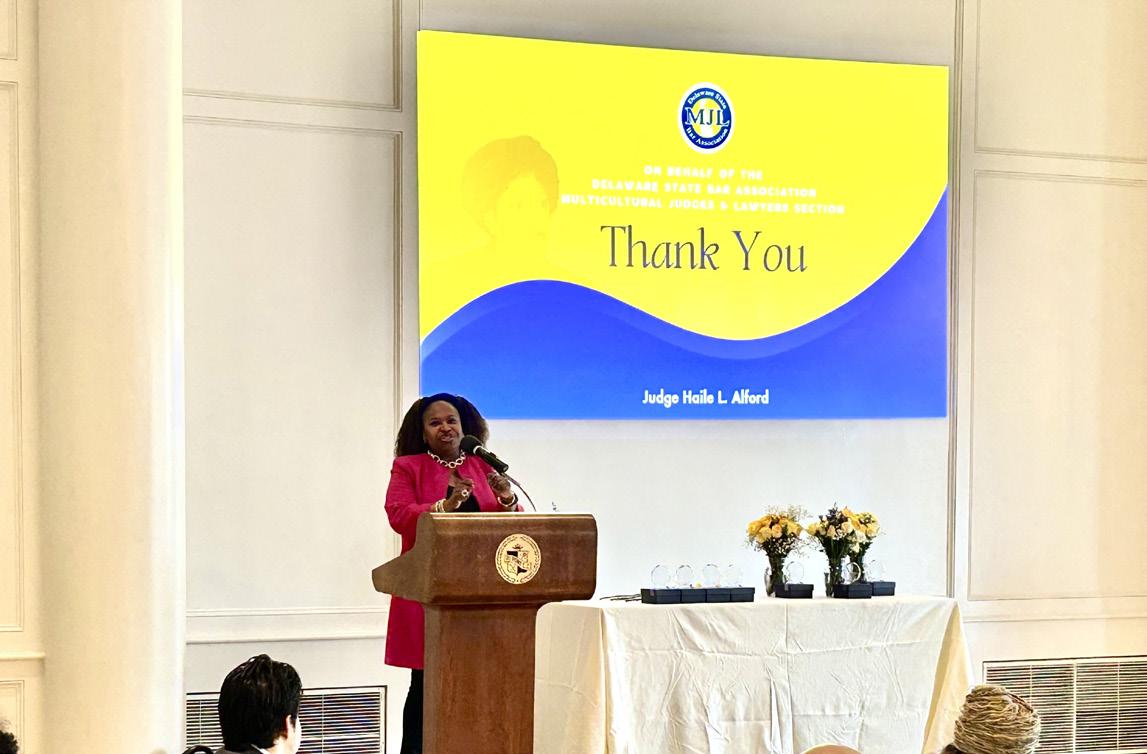
The DSBA staff had the pleasure of attending this year’s Judge Haile L. Alford Memorial Breakfast. Pictured is Theresa Brown-Edwards, Esquire, the founder of the Judge Haile L. Alford Memorial Breakfast and the first Black woman President of the DSBA. Congratulations to all of the award winners and scholarship recipients!
Thursday, June 11, 2026 • 8:30 a.m. - 3 p.m. Bench and Bar 2026 Chase Center on the Riverfront
Tuesday, June 16, 2026 • Noon - 1 p.m.
Section Officers Meeting DSBA
Wednesday, June 17, 2026 • Noon - 1 p.m.
How to Avoid the Top 10 Law Firm Management Mistakes DSBA
Thursday, June 18, 2026 • Noon - 1 p.m.
Cultural Sustainability and Heritage Laws CLE DSBA
Tuesday, June 23, 2026 • Noon - 1:30 p.m.
Men's Health CLE (with DE-LAP) DSBA
Wednesday, June 24, 2026 • Noon - 1 p.m. Section Officers Meeting DSBA
Tuesday, September 9, 2026 • Noon - 1:30 p.m.
Advice for New Attorneys CLE DSBA
Tuesday, September 15, 2026 • 8 a.m. - 12:30 p.m.
Workers’ Comp Breakfast Riverfront Events
Thursday, September 17, 2026 • Save the Date Delaware’s IOLTA Program CLE DSBA
Wednesday, September 23, 2026 • Save the Date Beau Biden Foundation CLE DSBA
Dates, times, and locations o f events and CLEs may occasionally change . Please consult the DSBA website for the most up-to-date information at dsba.org .
Condolences to the family of Janice Rowe Tigani, Esquire, who passed away on April 22, 2026.
Condolences to the family of David G. Culley, Esquire, whose mother, Susan Culley, passed away on May 4, 2026.
Condolences to the family of Pat Quann, Esquire, who passed away on May 16, 2026.
Condolences to the family of Mike Purzycki, Esquire, who passed away on May 19, 2026.
Condolences to the family of Martin Schagrin, Esquire, who passed away on May 22, 2026.
If you have an item you would like to submit for the Of Note section, please contact Danielle BouchatFriedman at dbouchatfriedman@dsba.org.
For more information on submitting articles for publication in the Bar Journal, please contact D Danielle Bouchat-Friedman at dbouchatfriedman@dsba.org.

BY RON BRIGGS, ESQUIRE, AND GIL PINKETT, ESQUIRE, WITH INTRODUCTION BY RYAN NEWELL, ESQUIRE
Information security has become a core legal obligation, not just a technical function. Law firms and legal departments are entrusted with highly sensitive, often privileged information, and informal or fragmented security practices are no longer sufficient in a landscape shaped by client expectations, regulatory scrutiny, and rising cyber risk.
Based on decades of experience at the intersection of legal operations and information security, the following article that was prepared for the Delaware Commission on Law and Technology, outlines how ISO/IEC 27001 supports a disciplined, defensible approach to protecting client information.
What is ISO 27001?
ISO 27001 is an internationally recognized standard for information security management systems (ISMS). It provides a systematic approach to managing sensitive firm and client information so that it remains secure. The ISO 27001 design includes people, processes, and IT systems by applying a risk management process.
The ISO standard helps firms of all sizes to protect their information in a systematic and repeatable manner, through the adoption of an overarching management process to ensure that information security controls continue to meet the organization's information security needs on an ongoing basis.
Key aspects of ISO 27001 include:
• Risk Management: Identifying, assessing, and managing risks to information security.
• Security Controls: Implementing a set of controls to mitigate identified risks.
• Continuous Improvement: Regularly reviewing and improving the ISMS to adapt to changing security threats and business needs.
By achieving ISO 27001 certification, organizations demonstrate their commitment to information security, which can enhance client trust and provide a competitive advantage.
1. Enhanced Data Security: ISO 27001 sets rigorous standards for managing information security, helping law firms identify and mitigate risks associated with data breaches. Implementing these standards ensures that sensitive client information is protected against unauthorized access and potential cyber threats.
2. Client Assurance: Clients increasingly demand assurance that their information is protected in line with best practices and relevant regulations. ISO 27001 certification serves as a comprehensive framework, providing rigorous standards for managing information security and demonstrating a firm’s commitment to safeguarding client data.
3. Competitive Differentiation: In today’s market, security certifications like ISO 27001 are becoming essential for passing third-party risk assessments, especially when onboarding new clients or renewing contracts. Achieving such certifications not only meets client expectations but also positions the firm as a low-risk, trustworthy partner, offering a competitive edge.
4. Regulatory Compliance: Adhering to ISO 27001 helps law firms comply with various data protection regulations, reducing the risk of legal penalties and reputational damage associated with non-compliance.
While the benefits of ISO 27001 certification are significant, getting certified may not be the right choice for all firms. There are several challenges to consider before heading down the ISO 27001 path:
1. Resource Intensity: Implementing ISO 27001 requires a significant investment of time, money, and personnel. Law firms must allocate resources for documentation, risk assessments, and audits, which can be overly demanding for smaller firms with limited budgets and lean staffing levels.
2. Complex Implementation: Achieving compliance involves restructuring existing security policies, implementing new controls, and ensuring continuous monitoring. Law firms may struggle with integrating these requirements into their existing workflows.
3. Employee Training and Awareness: ISO 27001 mandates a firm-wide cultural shift toward security awareness. Training employees to recognize security threats, adhere to protocols, and maintain compliance can be challenging, particularly for firms unfamiliar with structured security programs.
4. Ongoing Maintenance: Certification is not a one-time achievement but an ongoing commitment to maintaining security standards. Firms must conduct annual audits, monitor security risks, and update policies on an annual basis to ensure continued compliance.
(ROI) of ISO 27001 Certification
Investing in ISO 27001 certification entails costs related to implementation, training, and annual auditing. However, the ROI can be substantial:
• Cost Avoidance from Data Breaches: The average cost of a data breach in 2024 was $4.88 million.
By implementing ISO 27001 standards, law firms can significantly reduce the likelihood of such breaches, thereby avoiding these substantial costs.
• Increased Revenue Opportunities: ISO 27001 certification can open doors to new clients, particularly those who require stringent data security measures. This can lead to increased revenue streams that might not have been accessible otherwise.
• Operational Efficiency: The certification process often uncovers inefficiencies in data management and security protocols. Addressing these can lead to streamlined operations and cost savings over time.
ISO 27001 certification is a strategic business decision for law firms. While the journey to certification presents challenges, the benefits (enhanced data security, strengthened client trust, regulatory compliance, and significant ROI) make it a worthwhile pursuit. Investing the time and resources necessary to achieve certification will ensure that your firm is using an internationally respected roadmap for data security policies and practices. ISO certification is certainly not a one-size-fits-all solution. The time needed and cost to implement the program may not make sense for your firm. If you find that to be the case, using the guidelines found in the ISO 27001 documentation can help you to design a solid set of policies and procedures for your firm.
Most, if not all incoming client data security questionnaires are based on ISO 27001 and/or NIST standards. Having your firm’s security policies and procedures aligned with these standards will make it far easier to answer these questionnaires in a fashion that will satisfy most client needs.
Law firms that prioritize cybersecurity through ISO 27001 certification will be well-positioned to navigate the evolving digital landscape and maintain a competitive edge in the legal industry.
Notes:
1. Clio. “ISO 27001 Certified Law Firms.” Clio Blog. https:// www.clio.com/blog/iso-27001-certified-law-firms/
2. BDO. “SOC 2 Reports and ISO 27001 Certification for Law Firms: Why Now?” https://www.bdo.com/insights/ assurance/soc-2-reports-and-iso-27001-certification-forlaw-firms-why-now
3. Schellman. “Benefits of ISO 27001 for Law Firms.” https://www.schellman.com/blog/iso-certifications/ benefits-of-iso-27001-for-law-firms
4. ISMS Online. “Unpacking the Cost vs ROI of Achieving ISO 27001 Certification.” https://www.isms.online/ iso-27001/unpacking-the-cost-vs-roi-of-achieving-iso27001-certification/
5. SecureFrame. “Is ISO 27001 Worth It?” https://secureframe.com/blog/is-iso-27001-worth-it
6. ILTA. “What is ISO 27001 Anyway?” https://www. iltanet.org/blogs/john-verry/2016/04/30/what-is-iso27001-anyway
7. NIST. “Cybersecurity Framework Overview.” https:// www.nist.gov/cyberframework

Ron Briggs serves as Chief Information Officer for Morris Nichols Arsht & Tunnell LLP, where he oversees the firm’s technology strategy, information security, data governance, and enterprise systems operations. He works closely with the firm’s Executive Committee and practice leadership on technology innovation, cybersecurity risk management, and IT related business transformation initiatives.

Gil Pinkett is the Information Technology Director at Maron Marvel and a CISSP-certified technology leader with more than 30 years of experience in cybersecurity, infrastructure, eDiscovery, and information governance. He also serves on the Delaware Supreme Court Commission on Law & Technology.

Ryan Newell is the founder of Newell Dispute Resolution. He serves as a mediator, arbitrator, and court-appointed neutral in corporate and commercial disputes.

CURATED BY RICHARD HERRMANN, ESQUIRE
During the academic part of my career, the most valuable aspects of my classes were the visits from members of the Bench and Bar, who would look back on their careers and share the more important advancements and moments with our students.
I aim to continue facilitating these discussions through a column called “Sage Advice.” In this issue, I sought advice from Supreme Court Justice Karen L. Valihura.


QIf you wanted to offer one nugget of Sage Advice to those developing their legal careers in Delaware, what would it be?
AYou have to become good at what you do and that involves working hard and learning as much as you can. It is a big commitment. There is just no getting around that in my view.
QWhen you attended law school, did you have a thought as to what you would like to do with your career? And if you did, what was it?
AI was open-minded. I had some interest in public interest work and then I became interested in corporate
law. I was not really thinking about becoming a judge; however, being involved in the community was always important to me.
Q What was your first position after you were admitted to the Delaware bar?
A I took the Pennsylvania Bar first in 1988 and clerked for the Third Circuit Court of Appeals after graduating from the University of Pennsylvania Law School and then took the Delaware Bar in 1989 and joined the ranks of associates at Skadden Arps.
Q When you started your career, was it your plan to stay in that field until you retired or was this a stepping-stone to something else?
A
I became a corporate litigator at a time when there were very few women in that field. I think I was more focused on whether I would be accepted and would I do well enough to survive the demands. Once I got past that, I was focused on becoming a partner. The judicial interest developed over time thereafter.
Q
If you were to choose one person who had the most impact in the advancement of your career as a member of the bar in Delaware, who would that be and why?
A
I would say Ed Welch. He was a great mentor and a great friend. He had an encyclopedic knowledge of Delaware Corporate law. He contributed much to the community including his work with the Mary Campbell Center.
Q What was the most interesting matter in which you were involved in your career?
AIt was the hostile takeover attempt by Norfolk Southern of Conrail after Conrail had signed a merger agreement with CSX. It was a fascinating corporate drama.
Q What was your most challenging problem that you faced in your career as a member of the Delaware bar?
A I had to coach our summer softball team when I was a third-year associate. We were playing Richards, Layton & Finger (RLF) and I had to go to the mound and discuss with my RLF counterpart whether we were going to have a designated hitter. I bluffed my way through that as I did not know what that was, so I asked him if he was going to have one. He said he was, so of course, I said we
were also. I then walked back and asked who wanted to be our DH and someone thankfully volunteered. Staffing the team each game to include three women (a rule or you forfeit the game) was also hard.
QIf you had to start your career again, would it be as a lawyer in Delaware?
AYes, I would.
QWhat does work-life balance mean to you and did you have it?
AWork-life balance means to me being able to take time for things other than work that are important to you. I did not have much of it during the first part of my career. When I became a partner, I had more control over my schedule, but the time commitment was still very demanding. I did not mind that because I enjoyed my work and the fast pace of it.
Q
You started with a nugget that you wanted to leave those developing their practice or careers in Delaware. Is there another nugget you would like to offer?
AYour reputation is your biggest asset. Never forget that.
QIf there were a question that I failed to ask, but should have, what would it have been?
AWhat has been the highlight of your legal career? I would answer by saying having the honor and privilege of serving the people in Delaware as a member of our Supreme Court.

Richard K. Herrmann consults with Wilmington University on Emerging and Innovative Technologies. He can be reached at richard.k.herrmann@ wilmu.edu. `

ON TOP of your CLE Credits with DSBA!
Call the DSBA to schedule a time to view one of the many DSBA seminars offered on video every weekday. A complete list of all CLE videos is available on our website at www.dsba.org
Delaware State Bar Association 704 N. King Street, Suite 110 Wilmington, DE 19801 (302) 658-5279


June is usually seen as a month of celebration. School’s out. Families gather for vacations and cookouts. Summer finally arrives. We celebrate Father’s Day and spend time recognizing the men who helped shape our lives. At the same time, June is also recognized as Men’s Mental Health Awareness Month, and honestly, the connection between those two observances is more important than many people realize.
For some people, Father’s Day is joyful. For others, it can be complicated. Some are celebrating their fathers while others are grieving them. Some are estranged from family. Some grew up without much of a father figure at all. Others are fathers themselves and quietly wonder whether they are getting any of it right. There are also men who wanted children and never had the
opportunity. Days meant for celebration can sometimes bring reflection, sadness, gratitude, and loss all at once.
Father’s Day itself has meaningful roots. The modern observance is largely credited to Sonora Smart Dodd of Spokane, Washington, who wanted to honor her father, a Civil War veteran who raised six children after his wife died. The holiday was officially recognized in the United States in 1972 by President Richard Nixon. At its core, the day was always meant to recognize sacrifice, responsibility, and presence.1
Those expectations still exist today, although the pressure surrounding them may look a little different.
Many men continue to grow up hearing the same message: work hard, provide, stay strong, and handle your problems quietly. I’m sure most of us would agree we have
been conditioned by role models and society to admire men who appear stoic, self-made, and unaffected by stress. Somewhere along the way, many of us learned that asking for help or admitting something feels heavy is a sign of weakness rather than honesty. Over time, it becomes easy to look fine on the outside while carrying a great deal internally.
That becomes even more complicated in professions like law.
Attorneys are trained to stay composed, solve problems, absorb stress, and keep moving no matter what is happening personally. In many ways, the profession rewards endurance. Long hours become normal. Constant availability becomes expected. Many attorneys become very good at helping everyone else while quietly neglecting themselves.
Usually it doesn’t happen all at once. Someone may simply seem quieter than
normal, throw themselves deeper into work, or slowly disconnect from the people around them while still showing up professionally every day. Work can become the place where life feels most manageable because it offers structure, control, and purpose.
The difficult part is that isolation rarely looks dramatic at first.
Sometimes it simply looks like conversations stopping. Calls not being returned. Friendships becoming distant. Sitting in a room full of people while still feeling completely alone.
Research continues to show that men are less likely to seek mental health treatment despite experiencing significant stress, depression, anxiety, and substance use concerns. According to the Centers for Disease Control and Prevention, men die by suicide at substantially higher rates than women in the United States.2 The American Psychological Association has also written about how societal expectations surrounding masculinity can discourage emotional expression and help-seeking behaviors.3
The reality is that many men do not even describe themselves as struggling. They describe themselves as tired. Burned out. Distracted. Angry. Numb. Stressed. Busy. They keep functioning, keep working, and keep carrying things because that is what they believe they are supposed to do.
The legal profession has made real progress in talking about wellness and mental health over the last several years. Organizations such as the American Bar Association and lawyer assistance programs across the country continue encouraging these conversations, which matters.4 But stigma still exists, especially for men who worry that being honest about stress somehow reflects weakness, instability, or professional failure.
The truth is, many good attorneys, judges, and professionals quietly carry far more than people realize.
That is part of why conversations like this matter. Not because every difficult season becomes a crisis, but because people were never meant to carry everything alone. Sometimes the strongest thing a person can do is simply be honest enough to say, “This has been heavy.”
Father’s Day can be more than a celebration. It can also be an opportunity to pause and reflect. Am I truly present with the people I care about? When was the last time I had a meaningful conversation that was not about work? What example am I setting for my children, younger attorneys, or the people around me? Have I spent so much time taking care of responsibilities that I forgot to take care of myself?
Those are not signs of weakness. They are signs of awareness.
Notes:
1. Library of Congress. “Celebrating Father’s Day with Primary Sources from the Library of Congress.” Teaching with the Library of Congress Blog. Washington, D.C., June 15, 2017.
2. Centers for Disease Control and Prevention. Suicide Data and Statistics. Atlanta, Georgia: U.S. Department of Health & Human Services.
3. American Psychological Association. Men and Mental Health. Washington, D.C.: American Psychological Association.
4. American Bar Association Commission on Lawyer Assistance Programs & Hazelden Betty Ford Foundation. The Path to Lawyer Well-Being: Practical Recommendations for Positive Change. Chicago, Illinois: American Bar Association, 2017.
Jim Deel serves as the Executive Director of the Delaware Lawyers Assistance Program (DE-LAP), where he leads efforts to address the growing mental health and substance use crisis within the legal profession. Through confidential support, advocacy, and access to treatment, Jim works to reduce stigma and offer meaningful pathways to recovery for attorneys and judges facing mental health challenges, addiction, grief, and burnout.
With over two decades of experience spanning the criminal justice, behavioral health, and public safety systems, Jim brings a trauma-informed, multi-disciplinary approach to DE-LAP services. A U.S. Marine Corps veteran and former Department of Corrections employee, Jim has spent his career bridging gaps between legal, law enforcement, and clinical communities. He served on multiple advisory boards, including Wilmington University’s Human Trafficking and Behavioral Science departments, and continues to provide education and training on disaster mental health, de-escalation, and crisis intervention across Delaware.
Through his leadership at DE-LAP, Jim remains a steadfast advocate for healthier, more resilient legal professionals and systems.
Tuesday, June 23, 2026 at The DSBA
This candid and deeply personal CLE will explore the impact stress, pressure, and professional culture can have on the mental and physical health of men in the legal profession. Through lived experience, clinical insight, and intergenerational perspective, panelists will discuss burnout, isolation, emotional suppression, health decline, and the effect these challenges can have on families, careers, and personal well-being.
The discussion will also examine how identity, race, leadership, and the pressure of breaking barriers within the profession can shape the way men experience and respond to stress across generations. Attorneys, judges, and legal professionals are encouraged to join this important conversation as the legal community continues working toward greater awareness, connection, and well-being. Sign up at www.dsba.org/cle.

BY RYAN P. NEWELL, ESQUIRE
Whoever said, “never meet your heroes—they’ll surely disappoint you,” never met two of my idols, my father, Chief Judge Michael Newell, and his father, John Newell. With Father’s Day upon us, I know many people share similar fondness for their fathers. And within the Delaware Bar, there are many others like me whose fathers are also a member of the Bar.1
When I was asked to write this article about such dads and their children, many names came to mind. Famously, we have President Biden and his son, Attorney General Biden, as well as Judge Seitz and his son, our Chief Justice. Among the many lessons Chief Judge Seitz imparted on his namesake was the importance of short, declaratory statements. During my time with the Chief Justice at Connolly Bove Lodge & Hutz LLP, I often heard that mantra. Speaking of Connolly Bove, there were multiple generations of Con nolly’s (Art, Art, Jr., and Chip), Bove’s (Jan, Jeff, and Ramsay), and Hutz’s (Wer ner, Rudy, and Eric). Before he took the bench, my dad and I overlapped just long enough for me to receive a full-time offer after my summer associate stint. I have often joked that I owe my start in the law to Connolly Bove’s failure to enact an antinepotism policy.
For my dad, his path to the law came as a result of my grandfather’s encour agement. My grandfather dropped out of Salesianum to care for his siblings. He nonetheless valued education. As a postal carrier, he was promoted to work the legal district in Wilmington and befriended various judges while delivering mail. Those judges would speak to my dad out of friendship to my grandfather. Ultimately, one of my grandfather’s young colleagues (who would later serve on the Court of Chancery) enrolled in law school. When that happened, my grandfather again encouraged my father to follow suit.
to the following individuals for sharing
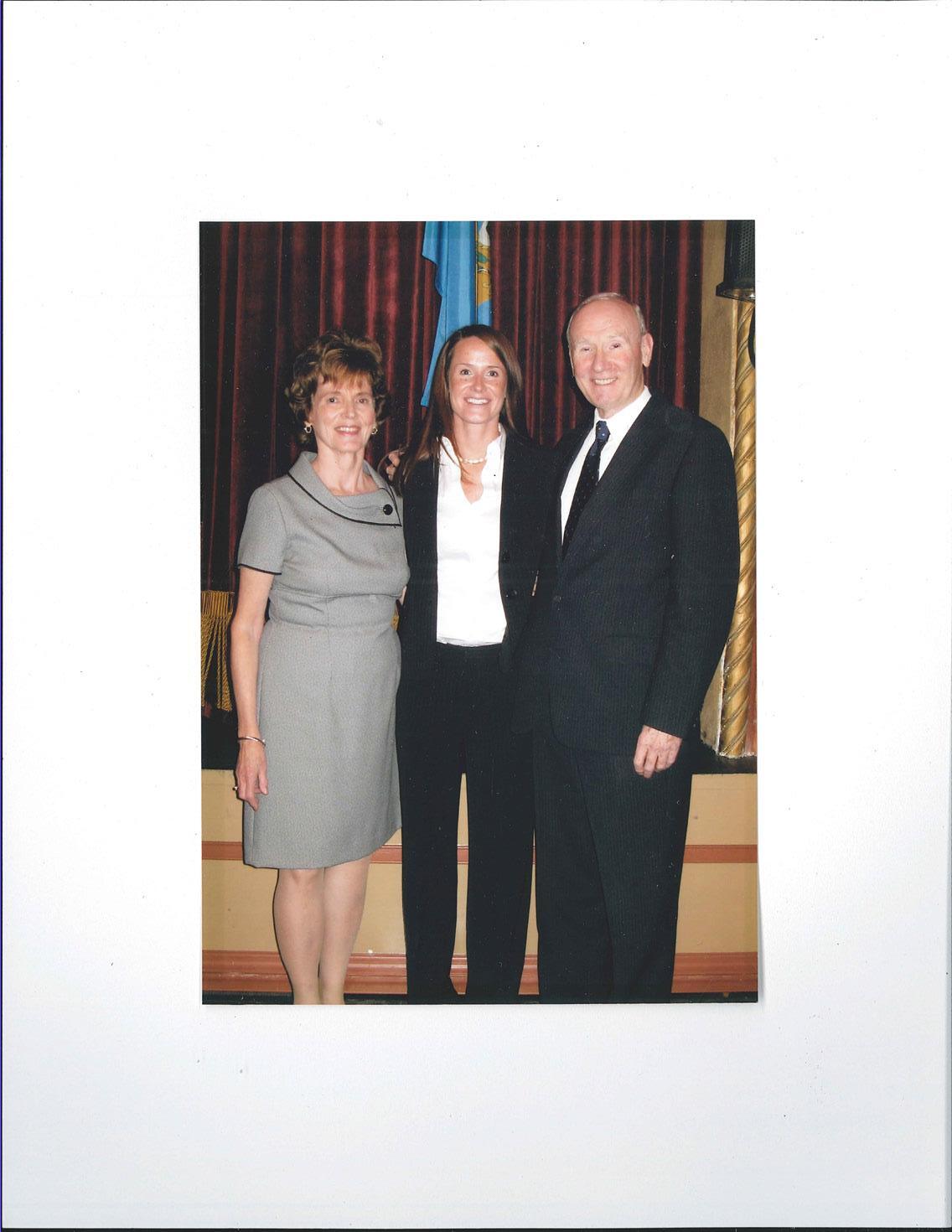
the Honorable N. Richard Powers
not until I began practicing that I realized the dad I grew up with at home was that same consistent, dedicated, and principled man in the office and on the bench. Time and again, judges, attorneys, and staff tell me how much they respect and enjoyed working with my dad. His intellect, his kindness, and his wit truly set him apart. He is a man that makes those around him always feel valued and respected. Having experienced the stress and pressure that this profession brings with it, I recognize how difficult it is to always be the best version of yourself to not only those you work with but also your family. My father did, and does, that in a way that appears effortless and I try to follow his lead in the course of my career.
The roles our fathers play often cast a long shadow. So for this article, I reached out to various “kids” in the Bar for their reflections on how their attorney fathers impacted their lives.
There are so many wonderful fathers, children, and even grandchildren in the Delaware Bar. In fact, research for this article by the Delaware State Bar Association identified more than 80 parents/ children who are members of the Delaware Bar dating back to the 1800s (Here is a link to the list to date: https://www. dsba.org/parentchild/2). While there is not sufficient space to cover all of their inspiring stories, I am sincerely grateful
I knew at a very early age that my dad was an attorney, but I didn’t really appreciate what that entailed. He was just my dad. The dad that showed up to every band concert, dance recital, and track meet. The dad that picked up pizza every Friday night after work and made sure we were at mass every Saturday at 5 p.m. The dad that brought his family to ABA conferences so we could enjoy all the exciting places he visited. No matter what was going on in my dad’s professional life, he was always present and he always prioritized our family. It was his quiet, constant presence and seemingly endless patience that made (and continues to make) him an incredible father and grandfather. It was
Growing up in Hockessin, Delaware in the ‘70s the Walsh family was naturally surrounded by many families whose fathers worked for DuPont or the Hercules companies. When the dinner bell rang around 5 p.m.—yes, back then kids actually played outside and were summoned home by bells or parents hollering for them—the neighborhood kids headed home. Not the Walshes. You see, dad was lawyer and lawyers worked late, in his case usually until around 7. One night a week he would work real “late,” usually until around 10 p.m. And then there were Saturday mornings in the office. On occasion, Dad would take us to the office —boring, except for the free Cokes! After becoming a bankruptcy judge his routine stayed much the same. As I half-jokingly remarked in eulogizing my father upon his passing in 2019, he was the exception to the saying that “no one on their deathbed ever said, ‘I wish I had spent more time at the office.’” As I observed as a young man
No matter what was going on in my dad’s professional life, he was always present and he always prioritized our family. - Beth Powers, Esquire
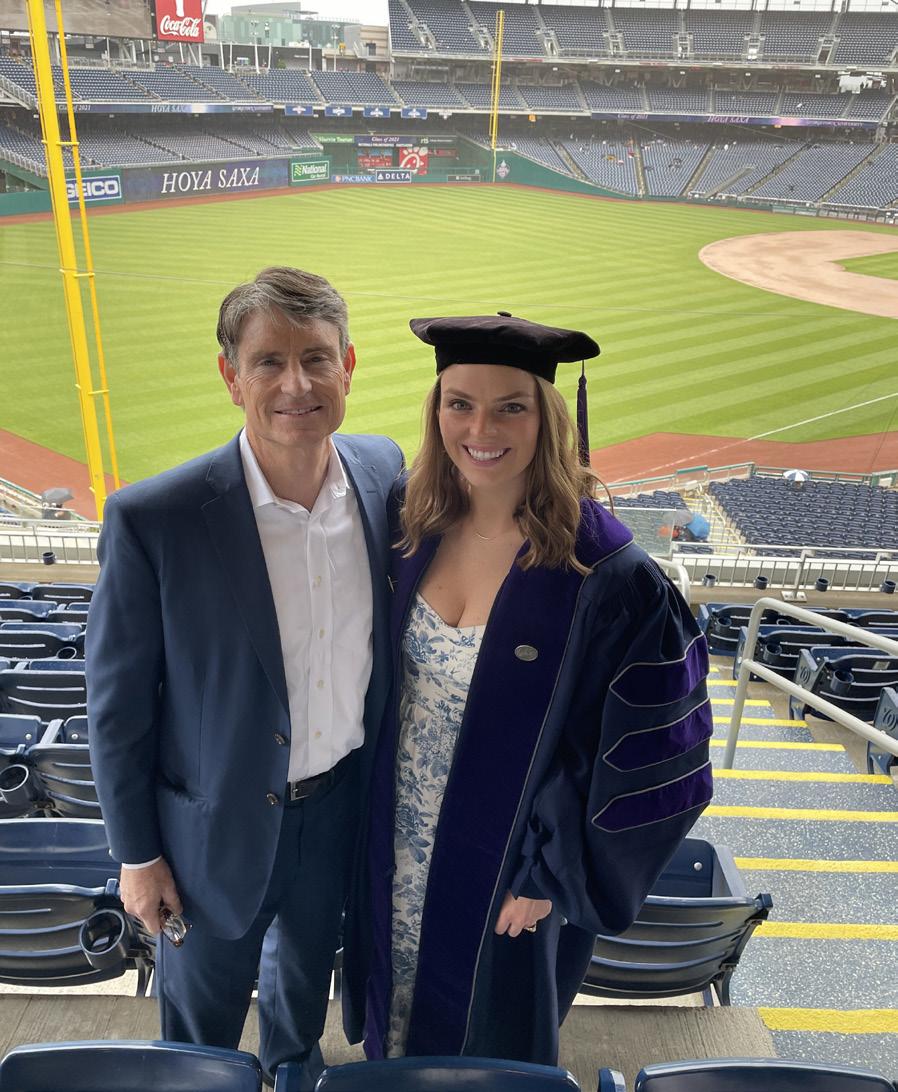
and experienced first-hand as a lawyer in private practice, the practice of law can be quite demanding and can intrude upon family life, particularly as a young associate or partner. These days, burnout among young lawyers is real, and we need to be mindful of trying to instill a sustainable work-life balance. At the same time, as my father taught me, being a lawyer can be immensely rewarding, intellectually satisfying and provide a life of contentment. Will I someday wish I had spent more time in the office? Surely not, but I certainly have no regrets in following in my father’s footsteps. And I am proud to say that one of my daughters3 has also chosen to follow in her father’s footsteps—at least for now!
My father has a passion for lacrosse. He was an All-American defenseman at Abington High School and a multi-position starter at the University of Delaware in the 1970s. In the mid-1990s, he co-founded the Atlantic Lacrosse Club, which introduced the sport to athletes in coastal Sussex County and grew into a strong feeder program for successful local high school teams. He coached not only me and my friends but also generations of young athletes, and he helped many parents become coaches and devoted fans.
Two pieces of advice stand out. First, his consistent response to my questions: “go look it up.” That simple directive serves a young lawyer well. By finding and
reading the source material yourself, you learn the fundamentals for both the immediate issue and future use, rather than relying on a senior lawyer’s conclusion. It’s the legal equivalent of “teach a man to fish.” It also sharpens your research skills and deepens your understanding of the broader context in which the answer sits.
Second, always inform the client and let them make the key decisions. Young lawyers may be tempted to avoid difficult conversations or decide what’s best on the client’s behalf. Instead, ensure the client is fully informed—good and bad—so they can decide how to proceed, and you can carry out or advocate for that decision. The lawyer’s primary role is to serve the client.
The part of my father’s legacy I hope to carry forward most has nothing to do with titles or accomplishments. It is how he treats people.

As the son of a successful judge, I have had plenty of people tell me they admire my father. But what has always stood out, and what I know would matter most to him, are the comments about who he is as a person. People describe him as even-tempered, quick with a sense of humor, and unfailingly respectful. They say he treats everyone the same way, with genuine attention and respect, no matter who they are or what role they have.
I have had the benefit of seeing that up close, and I know it is not something he turns on or off depending on the setting. It is who he is.
My dad has taught me that being a good lawyer matters, but how you treat people is what really lasts. More than anything else, I hope to carry that part of his legacy forward.

father, Mort Kimmel
Practicing law with my Dad was the honor of a lifetime. While he taught me so many things about how to practice—put yourself in your client’s shoes, work hard to make sure you get justice for your client, be prepared, treat opposing counsels and adjusters with the same respect as you would a friend or family member, return all phones calls and e-mails the same day they are received—he taught me the value of family above all else. Despite running a law practice and representing thousands of clients, my Dad attended all of my baseball and basketball games growing up. I expected my Dad to be at every game and never appreciated how difficult it was to balance his busy work schedule with family. Now that I am running a law firm and have three children of my own (two of which are in high school and have lots of sporting events), I now appreciate the effort it took to be there for me despite his hectic work schedule.
The legacy that my father left me are his values and how he lived them. These were manifested in his words.
“You only regret your economies (that could be time or money).”

“Don’t raise your voice, bolster your argument.”
“Just keep on researching until you find a case that supports your client’s argument. And while you’re writing this, remember your commas.”
My father really enjoyed watching sports. The only sports he played were croquet,
ping-pong, and Monopoly. He beat us in all of these, especially Monopoly, where he managed to corner the real estate market. And lastly, and most important he made it clear to me that whatever I decided to do, he would support me. The best example is holding the ladder while I, a two-year-old, climbed into the fruit tree.
Arthur G. (Chip) Connolly, III on his father, Arthur G. Connolly, Jr.
I had the incredible opportunity and privilege to work with my father for a large part of my professional career. I started with Connolly Bove Lodge & Hutz as an associate in 1989. My father had just turned 52 and had a very active litigation practice. I was very lucky to work on many cases with him over the next 20 years. I saw first-hand how my father treated everyone— clients, colleagues, staff, opposing counsel, judges and courtroom staff alike—with courtesy, dignity and respect, while at the same time being a strong and very effective advocate for his clients. We were lucky that my father joined Connolly Gallagher as an emeritus member of the Delaware bar when we formed in 2012. My goal since we opened has been to treat everyone here at Connolly Gallagher and our clients the way I know my father would.

that his divorce attorney was a therapist, rabbi or priest, and attorney all wrapped into one. That attorney—my dad—took the time to understand what this person was going through, personally and legally.

xxxxxxxxxxxxxxxxx
Not long after my grandfather had passed, I believe it was my junior or senior year at Salesianum, I had a conversation with our chaplain that I will never forget. He asked if my father was an attorney. He was. Our chaplain had offered support to a parent of a student going through a divorce. The parent politely thanked the priest for the outreach but declined. Instead, this parent remarked
There are various reasons I chose to follow my dad into the law, but that conversation and the realization of the personal impact my dad had through his profession have lasted with me through law school and practice. And on the many occasions when my kids get to see him working hard in his home office, I continue to be reminded of his service to others. He has been an amazing role model. Specifically, when my son John—named for his great grandfather— witnesses my dad’s dedication and success, I know my dad’s dad is smiling down. With gratitude to those friendly judges who encouraged my dad to attend law school. With pride at what resulted from his words of encouragement and the belief he had in his son. Happy Father’s Day to all the dads.
Notes:
1. I understand a similar article on mothers and their children is in the works—and I look forward to reading it.
2. The DSBA has been compiling an active list of parents/ children who are members of the Delaware Bar. If you have additions/edits, please email them to Danielle BouchatFriedman at dbouchatfriedman@dsba.org.
3. Kerry Walsh is an associate at Arnold & Porter in Washington, D.C.
Ryan Newell is the founder of Newell Dispute Resolution. He serves as a mediator, arbitrator, and court-appointed neutral in corporate and commercial disputes.
BY JIM HOLZMAN, ESQUIRE, MIKE HANRAHAN, ESQUIRE, AND BRUCE JAMESON ESQUIRE
On February 25, 2026, the Delaware bar lost one of its finest corporate and partnership law practitioners of his era when John Heggie Small passed away at the age of 79. John was the cornerstone of the corporate and alternative entities practice at Prickett, Jones & Elliott, P.A., during an extraordinary 39-year career marked by integrity, scholarship, and dedication to the development of Delaware business law. It was our privilege to be law partners with John.
John grew up in nine different states and attended three different high schools. A graduate of Georgetown University (1968), John served his country for two years on active duty with the United States Army (1968-70). He received a J.D. from the University of Virginia School of Law (1973) and was a law clerk to the Delaware Court of Chancery (1974). He then joined Prickett and quickly became a director of the firm. He retired from Prickett on December 31, 2013.
Sharing was important to John professionally. He taught generations of Prickett lawyers how to practice corporate law. However, his commitment to mentoring extended to young lawyers outside the firm, who also benefited from his example and guidance. John seemed to know every provision of the DGCL and alternative entity statutes. His work was known for meticulous analysis and commitment to clarity. He generously shared his encyclopedic knowledge with his colleagues at Prickett and other members of the bar in Delaware and beyond.
John was a longtime member of the Council of the Corporation Law Section of the Delaware State Bar Association. He chaired the Council, the Corporation Law Section and the Committee on Limited Liability Companies and Limited Partnerships. John was a principal drafter of Delaware’s alternative entity statutes.
Though John claimed he was not a litigator, he played a significant role in major Prickett cases such as Weinberger v. UOP and Smith v. van Gorkom . He was a behind-the-scenes advisor in many other corporate, partnership and LLC cases. Whether a transaction or litigation was involved, John always seemed able to identify the right legal path.
John was a respected authority on corporate and alternative entity law not only in Delaware, but nationally. He was Chairman of the Committee on Limited Liability Companies, Partnerships and Unincorporated Entities of the American Bar Association Section of Business Law. He served on the Council of the ABA Section of Business Law and as Chairman of the ABA Partnerships Committee. He was an ABA representative to the National Conference of Commissioners on Uniform State Laws and the ABA-NCCUSL Joint Editorial Board on Unincorporated Business Organizations Acts. He was a frequent panelist on ABA, DSBA and other legal programs on corporation and partnership law. In 2012, the ABA Business Law Section presented the Martin I. Lubaroff Award to John for his substantial contributions

reward for his ABA service was that, through the ABA, he met Gayle, who would be his loving wife for 28 years.
There are, of course, great memories of working with John, but the best memories come from our friendship with him and the many good times we shared. There were trips to Leipsic for crabs and beer and to John’s beach house in Rehoboth. John organized a memorable expedition with our Dallas co-counsel in van Gorkom to the frigid January 1981 NFC Championship game at Veterans Stadium between the Eagles and Cowboys. John, Mike, and Sam Glasscock, then a paralegal but later a Vice Chancellor, briefly shared a house on Clayton Street. Space and discretion do not allow for discussion of the legendary parties held at “Clayton Place.”
John was a man with many and varied interests. He was an enthusiastic baseball fan and especially avid Baltimore Orioles fan. He organized outings to opening day and other games at Memorial Stadium and later Camden Yards. He attended most of the Orioles’ World Series games in 1979 and 1993. John watched from the Camden Yards bleachers on successive evenings when Cal Ripken first tied, then broke Lou Gehrig’s consecutive game streak. He enjoyed recalling the moment when the number “2,131” was raised on the warehouse wall beyond the right field stands. John generously shared his Orioles Sunday season tickets. Courtesy of John’s generosity, Mike and his son Colin attended numerous Orioles games, which enabled Colin to get Cal Ripken’s autograph.
John loved to travel. He took a months-long sabbatical from Prickett to go on a world tour. He visited all 50 states. His other interests included fine art and fine dining. Through their support of the National Liberty Museum’s annual gala and art auction, John and Gayle spread their love of glass art to Mike.
John was close with his sisters and brother and visited them frequently. Uncle John was also a loving and supportive part of the lives of his nephews and nieces and later their children.
John Heggie Small contributed greatly to the development of the law of corporations, partnerships and other business entities. His mentorship, collegiality and wisdom strengthened the profession. He helped shape the careers and touched the lives of dozens of Delaware lawyers. He was a wonderful colleague and friend who we, and many others, will miss greatly.
Michael Hanrahan, Esquire is a director at Prickett, Jones & Elliott P.A. and practiced with John Small for more than 37 years.
James L. Holzman, Esquire retired as a director from Prickett, Jones & Elliott P.A. in 2015 after practicing with John Small for more than 40 years.
Bruce E. Jameson, Esquire is a director at Prickett, Jones & Elliott P.A. and practiced with John Small for more than 25 years.

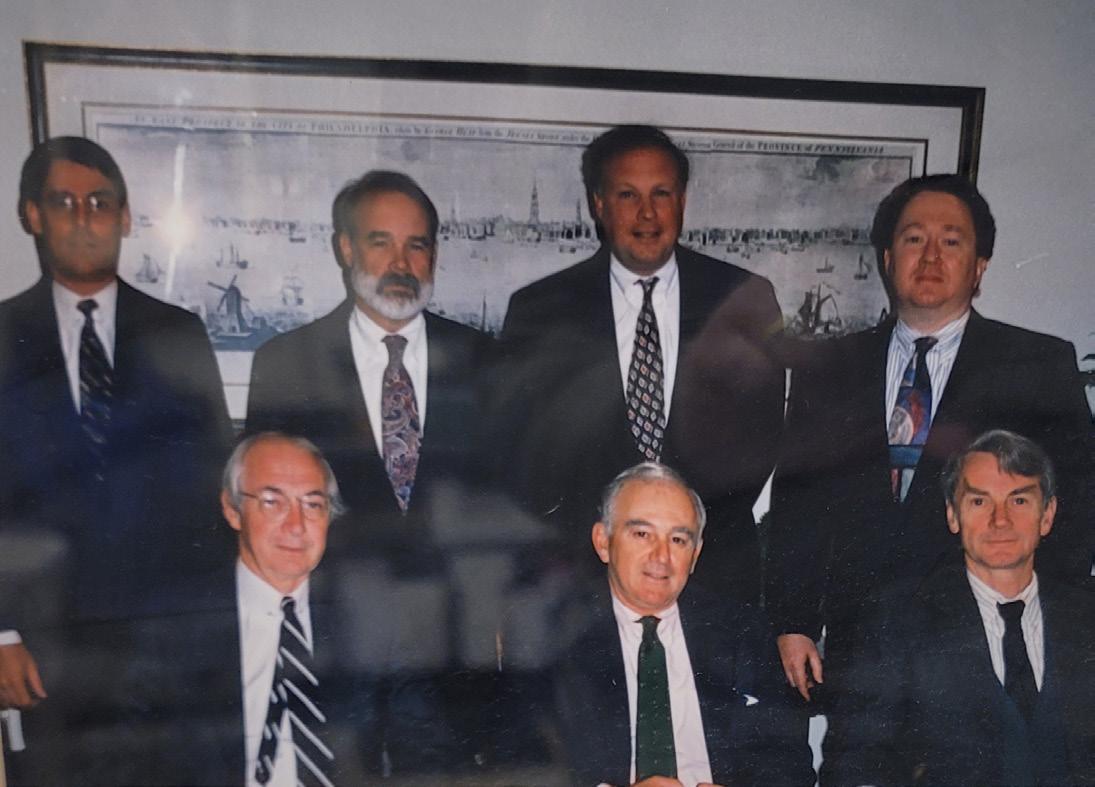


I had the good fortune to work with John Small for the first three years of my career. I was definitely one of the more clueless brand-new attorneys, but nevertheless John managed to teach me how to practice law. I learned a great deal from him, including that thoughtfulness was a virtue (“That’s a good question … let me think on it a bit.”), and that diplomacy was important at all times (“You put WHAT in the draft Minutes??”).
On one occasion, I was assisting him with the representation of a special board committee in connection with the consideration of a conflict transaction. That particular day, we were joining the company’s full board meeting to assist with the presentation of the special committee’s determination. The company’s in-house counsel began to introduce John: “And now let me introduce John Small, who has loooong walked the halls of the Court of Chancery….” Hearing this, I burst out laughing (Is he a ghost? Lost? Homeless?). John threw himself at the phone and then turned to me: “Never do that—BEFORE I HIT MUTE!!”

John’s office was filled with mementos of his travels and his legal career, and he was always happy to share the story behind them. One of my most treasured possessions is a litigation memento he gifted me after he retired. Unlike most litigation mementos, this one memorialized unsuccessful litigation. It reminds me that things don’t always go the way we want, even for the best of us. In those cases, John taught me it was okay to head to the Green Room (or alternative) for a glass of wine.
John remained a mentor and good friend even after I moved firms. He was always up for a drink or a phone call, and he even danced with me at my wedding. After he retired, we stayed in touch via emails, cards and periodic calls. He often declared that he was relieved to be retired, but then he’d ask, “So, what’s the latest news in town?” John’s humor and insight will be sorely missed, but his legacy will certainly live on in the number of lives he touched.
– Melissa N. Donimirski, Esquire
Larry Nagengast was a reporter for the News Journal whom I had gotten to know in the 70s and early 80s when he was covering the school desegregation litigation that I was involved in [Belton v. Gebhart and Bulah v. Gebhart , which later became part of Brown v. Board of Education]. By the early 2000s I had probably not seen Larry for 20 years when John stopped by my office and asked if I would like to join he and Larry for lunch. Since Larry had never reported on Chancery matters, I was puzzled and asked how John could know Larry. His answer: “We attended the same high school when I lived on Long Island.” We had a great lunch and repeated it some years later. It made me realize that John had many friends in many places.
In the ‘70s and ‘80s I tried to visit my mother in central Florida every March and would attend a few spring training baseball games every year. John envied that and in about 1976 he and his wife did a spring training vacation seeing games in different towns and I joined them in Lakeland and Winter Haven. Fast forward to about 1980 and John was no longer married and had changed his appearance. He had let his hair grow long and had grown a bushy, very black beard. I told him that I was making my annual Florida trip in March and he asked if he could come down while I was there and see some games together. I agreed and told him I would pick him up at the Tampa airport. It turned out his flight got in before noon and I had obligations to my mother and could not pick him up until 5.
So John flew in on the agreed day, stored his carry-on in an airport locker, caught a cab and watched a baseball game from which he returned to the airport in time to meet me. When I arrived I immediately saw a hippy-looking John surrounded by four or five men, two of whom were in police attire. As I approached, I realized John was clutching his carry-on and telling the police: “I’m a lawyer! I can prove it! I have a bar card!” and started reaching for his pocket at which point the two uniforms grabbed him and I started laughing uncontrollably as I approached. John pointed at me and said: “There’s my partner—he’ll tell you,” and the cops looked at me doubled over in laughter and must have thought they were in some kind of freak show.
The explanation turned out to be that the police were apparently investigating a pattern of drug smuggling wherein couriers would fly into Tampa with packages or luggage containing drugs, store them in a locker, and then come back later and retrieve the drugs. They surveilled John when he arrived and he apparently fit (and looked like) their suspected MO and they wanted to search John’s carry-on. After I stopped laughing and everyone calmed down, they did so and allowed us to leave with apologies, but it made me realize there were dangers associated with something as All American as going to a baseball game. It also allowed me to brag for decades that I had saved John from his only drug bust.
– Mason Turner, Esquire
Back in the day, when limited partnerships were king—in rain, snow, sleet or hail, John would trudge over to meetings of the limited partnership subcommittee of the Delaware bar to work on updates to the limited partnership act (LP Act). But then came limited liability companies and Delaware quickly needed an LLC statute. With John’s able insight and participation, the committee took the LP Act, changed the word “partner” to “member” (with a few additional conforming edits) and came up with a leading national statute. That statute is still in effect today with many valuable updates and additions from today’s much expanded “Alternative Entity Committee.”
John was a gifted lawyer and a good friend of many members of the Delaware and national bar associations.
– Walter Tuthill, Esquire

Most of my memories of John are of his kindness and friendliness—and thus boring—or are interesting, and thus not fit to print. One, however, is the time I let him down. We had gone to Boston for some legal matter, when I was a “legal assistant” at the firm, pre-law school. John had kindly gotten us tickets to a Red Sox game. As Mason mentioned, John loved baseball, everything about it. I, on the other hand, had been raised by a father who hated baseball, and would not suffer a game to be played on TV in our house—he loved football, but once that season ended, for us sports ended ‘till fall; other than playing softball in gym class, I had never seen a baseball game. During the game, when the visitors (forget who) were at bat, the batter hit a fly to center field, which the fielder muffed. He recovered and threw to first, wildly; that throw was mishandled by the first baseman, and the batter rounded first and decided to go for third. The first baseman’s throw to third was also mishandled, and the batter scored. The home crowd was deflated, but John was rapturous. He grabbed me and said, “Did you see that! Did you see that! In-the-park homer!” I wasn’t sure what to say, and managed, “Yes—the Red Sox don’t seem to field very well.” I don’t think John ever got over my lack of appreciation, or the fact that he had shared the moment with someone so utterly ignorant. He was crushed. “But, but . . . an in the park homer,” he tried again, without much enthusiasm.
- Thomas A. Mullen, Esquire “
John’s most enviable characteristic was his gregarious and engaging nature that allowed him to create so many enduring friendships.
For those of us who worked with John, his passing hits hard. I had the privilege of working with John as an associate and then partner for two decades at Prickett Jones. He was a uniquely talented lawyer and a great mentor to so many over the years. His professionalism, patience and willingness to share his time and expertise with young associates and colleagues instilled loyalty and gratitude.
But in my view John’s most enviable characteristic was his gregarious and engaging nature that allowed him to create so many enduring friendships. He was truly “hail fellow well met” in the most sincere sense. When I would accompany him on business trips, I was astounded by the number of times he would run into people he knew (or who knew him) in airports, hotel lobbies and restaurants. This was such a common occurrence I learned to build in time for these encounters in our travel schedules. John once took a six-month sabbatical to travel the world, and to hear him tell about it he had a friend or acquaintance waiting to great him at each destination, from Europe to the Middle East to Australia. And I have no doubt that he did. John will be missed, and by so many.
–
Thomas A. Mullen, Esquire
Luckily for me we remained friends, but I don’t think he ever regarded me as a full human being after that!
– The Honorable Sam Glasscock III (ret.)


I first met John at a meeting of the ABA Business Law Section Committee on LLCs, Partnerships and Unincorporated Entities. I was a relatively new associate at a Delaware firm just trying to find my way at the ABA. John was a former Chair of that Committee, an acknowledged leader of the Delaware Bar on alternative entities and, as a result, a national expert (because Delaware law on LLCs was, like Delaware law on corporations and limited partnerships, de facto national, if not international law). John was gracious and generous with his knowledge and relationships.
Later on, when I gained admission to the Delaware Bar Committee on LLCs, Partnerships and other unincorporated entities, I got to know John a little better. Though I was then a partner, I happily watched as John and the other senior members of the Committee expertly guided the progress of Delaware’s alternative entity laws. Last year, not long before he died, John made a point to attend the ABA’s Committee on LLCs, Partnerships and Unincorporated Entities dinner for purposes of presenting the Lubaroff Award and was as gracious and charming in his remarks as ever.
– Louis G. Hering, Esquire
The Hon. William T. Quillen, former Judge of the Superior Court, Vice Chancellor of the Court of Chancery, and Justice of the Delaware Supreme Court, passed away August 19, 2016. He penned the below for the Newsletter of the Committee on LLCs, Partnerships and Unincorporated Entities.
John Small, fresh out of the University of Virginia School of Law, had been hired by Chancellor Duffy for the 1973-1974 clerkship year. The Chancellor had formerly been a Judge on the law side of Delaware’s split system of law and equity and indeed had been President Judge of the Superior Court. In the early summer of 1973, Chief Justice Wolcott died, suddenly and unexpectedly, and in August 1973 musical chairs were played, with Justice Herrmann becoming Chief Justice of the Supreme Court, Chancellor Duffy becoming Justice Duffy and Judge Quillen, then still quite young, becoming Chancellor.
Since the clerkships had all been filled, John had to remain in the Court of Chancery with the new and untested Chancellor. I will always be grateful to John because, if he felt any regret about losing his well-earned opportunity to work for Chancellor Duffy, he never indicated it to me by word or manner. Indeed, he made it his personal business to make the first year of my Chancellorship a success. He was hard working, methodical and helped present the Court with a business decorum in every respect.
I had to depend on John more than any other clerk I ever had because on Memorial Day weekend 1974 I had a lawn mower accident which resulted in the loss of part of three fingers of my right hand. I was hospitalized briefly, in bed at home taking significant pain killers, returned to work with my right hand attached to my stomach so a skin graft could be completed on what was left of my index finger. Needless to say, this put a tremendous burden on my clerk, logistically as well as in legal production. Again John performed not only excellently as to the quality of his work but also in the most wonderful spirit always ready to do more.
John has made his own way choosing Delaware as his base of operations and contributing nationally at the highest level in the development of the corporate and business law. I shall always cherish his friendship and advice.
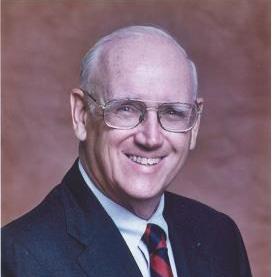
– The Hon. William T. Quillen



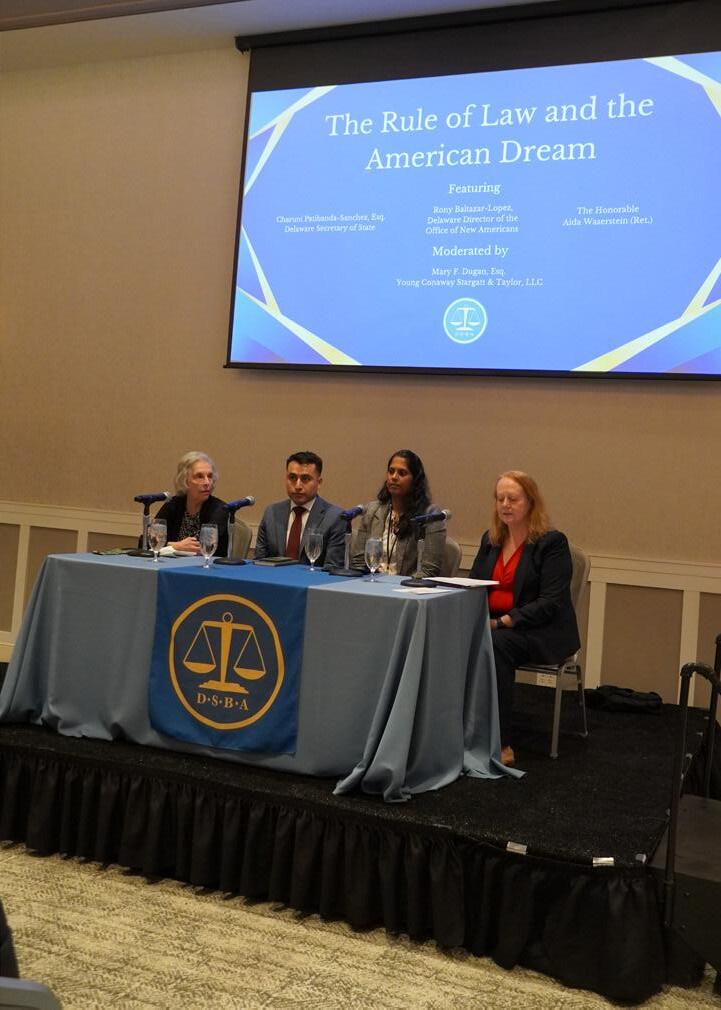
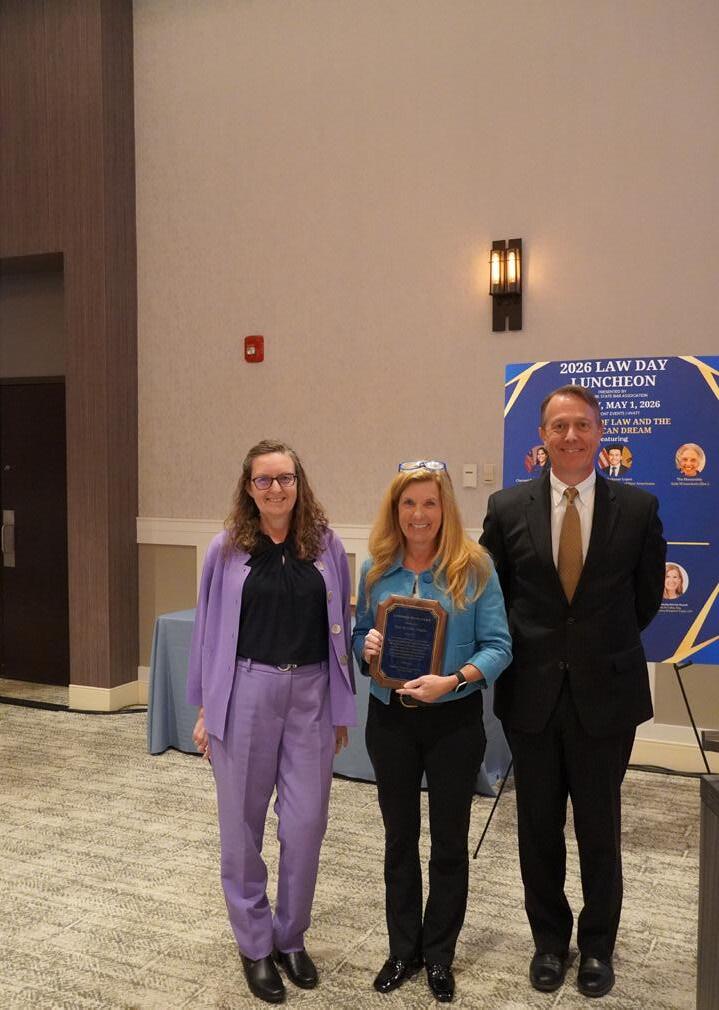
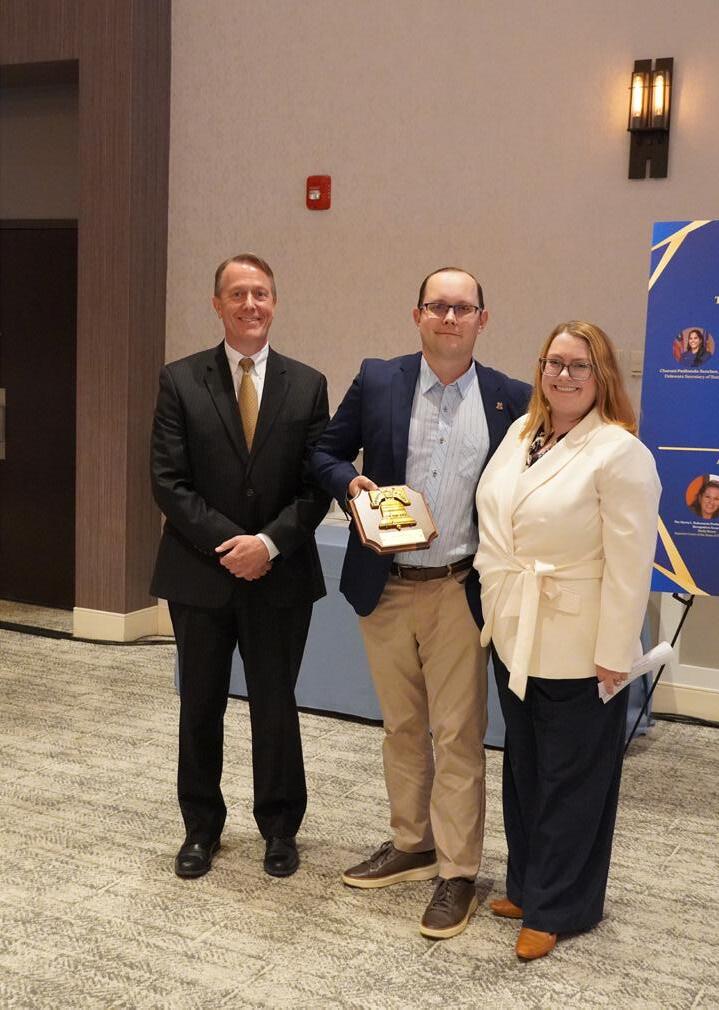
The DSBA held its annual luncheon on Friday, May 1 at Riverfront Events. Members of the Delaware Bench and Bar gathered to celebrate the 2026 Law Day Awardees: Shelly Beane, recipient of the Myrna L. Rubenstein Professional Support Recognition Award; Tania M. Culley, Esquire, recipient of the Community Service Award; and Benjamin Taylor, recipient of the Liberty Bell Award.
At the event, attendees enjoyed a thoughtful Roundtable Discussion around the theme for Law Day: The Rule of Law and the American Dream. The discussion was moderated by Mary F. Dugan, Esquire from Young Conaway Stargatt & Taylor, LLP. The panel included Charuni PatibandaSanchez, Esquire, Delaware Secretary of State, Rony Baltazar-Lopez, Delaware Director of the Office of New Americans, and The Honorable Aida Waserstein (Ret.)








MIDDLE ROW: Service and Social! Each year, the Delaware State Bar Association partners with the Delaware Bar Foundation to provide backpacks for Delaware youth aging out of the foster care system. These bags are graduation gifts filled with essential products and well-wishes as these students embark on their next chapter. Thank you to all the members who volunteered their time for this important cause!
REVIEWED BY ALEX J. MILI, JR., ESQUIRE
By Mollie Hemingway (Basic Liberty, 2026)
Three external forces that shape the U.S. Supreme Court’s docket are the federal government’s other co-equal branches, interest groups, and the media. Justice Samuel A. Alito Jr.’s practical originalism is the counterforce to all three in Mollie Hemingway’s Alito: The Justice Who Reshaped the Supreme Court and Restored the Constitution. At a mere seven chapters, Hemingway’s book is less of a biography and more of a snapshot in time that captures Alito’s 20 years on the Court as the practical originalist who interprets the Constitution’s text as originally written but emphasizes practical consequences of textual interpretation over purity of abstract legal doctrine.
Hemingway reveals Alito’s counterforce of practical originalism within the Court through relationships to current and former Justices with whom Alito served. Alito’s practical originalism was always expected to clash with Justices Ginsburg, Sotomayor and Kagan in the liberal bloc. But Alito’s practical originalism also clashes with Chief Justice Roberts and Justice Barrett, fellow originalists in the conservative bloc who sometimes let originalism acquiesce to other considerations. For Roberts, originalism acquiesces to public perception of the Court’s institutional legitimacy, which orients Roberts toward compromise over consequence. For Barrett, originalism acquiesces to incrementalism, which tempers Barrett to gradually chip away rather than overturn longstanding precedent at odds with originalism. For Alito, the practical consequences of originalism are paramount over perceptions of

institutional legitimacy and the stability of any precedent contrary to originalism.
Alito’s steadfast originalism paves him well as the counterforce to the dual force from the federal government’s co-equal branches that aim to shape the Court’s docket. Hemingway catalogues an array of formidable displays of force from each branch during Alito’s twenty years on the Court. From the executive branch, President Obama’s 2010 State of the Union address was his platform to rebuke the Court’s decision in Citizens United v. FEC that struck down government-imposed limits on corporations’ political contributions. From the legislative branch, Senator Chuck Schumer chose the courthouse steps as his platform from which to warn the Justices that they would “pay the price” for their stance on abortion when a decision was still pending in Russo v. June Medical Services (the challenge to Louisiana’s law that restricted abortions to doctors with admitting privileges at local hospitals).
Rebukes and threats also abound from another external force, interest groups, most notably gun control and abortion. Hemingway explores how both sets of interest groups advance their interests through the Court’s docket, with Alito as the counterforce resisting at each turn. As for gun control, New York State Rifle & Pistol Association v. City of New York gave the Court an opportunity to rule on whether the Second Amendment preempts state and local legislatures from restricting the right to
transport firearms outside the home. That case arose from the gun-control lobby’s strategy of persuading state and local legislatures to enact tight gun-transport restrictions, followed with litigation of test cases in the lower federal courts that upheld those tight restrictions under the narrowest possible judicial interpretation of the Second Amendment (the hairsplitting semantic distinction between bearing arms and transporting arms).
When one such case was appealed to the Supreme Court, the gun-control lobby feared a win for the National Rifle Association, which in turn prompted state and local legislatures to loosen their guntransport restrictions so that the Supreme Court could deny the appeal as moot. Among the amici cūriae who implored the Court to deny the appeal on mootness grounds, Senator Sheldon Whitehouse’s amicus brief warned that FDR-style courtpacking awaits if Congress disapproves of the Court’s decision. The Court’s majority heeded that warning and denied the appeal as moot, over Alito’s dissent that lambasted the majority for taking the exit ramp of mootness that dodged the constitutional issue of the Second Amendment’s right to transport arms.
No exit ramp was offered when Mississippi’s post-15-week-gestation ban on abortion reached the Supreme Court in Dobbs v. Jackson Women’s Health Organization Both adversarial parties in Dobbs asked the Court to either uphold or overturn Roe v. Wade, once and for all, when deciding the constitutionality of the ban. Roberts was prepared to uphold the ban without directly overturning Roe —an exit ramp that would let the Court confront Roe in another case on another day. Alito stood ready to confront Roe head on, just as he stood ready to decide the constitutional right to transport firearms in New York State Rifle & Pistol Association despite the majority’s agreement to relegate that decision to another case on another day.
And because no discussion of Dobbs is complete without touching on the infamous leak of Alito’s draft decision, Hemingway recounts the leak’s aftermath in detail, including the irreparable erosion of trust within the Court and the as-
“
sassination threats that loomed for the Justices who were poised to overturn Roe. Nevertheless, Alito forged ahead with his majority opinion in Dobbs that overturned Roe for its dearth of any textual support for a constitutional right to abortion. Ever the originalist, Alito would not be deterred by assassins’ bullets, the allure of deciding cases on narrow grounds that avoid divisive constitutional questions, or the external forces of interest groups’ gamesmanship.
Alito’s steadfast originalism paves him well as the counterforce to the dual force from the federal government’s co-equal branches that aim to shape the Court’s docket.
The media is yet another external force to bear. In Hemingway’s chapter entitled False Flags, she marshals evidence of the media’s disparate coverage of conservative and liberal Justices. Of lesser moment was the media’s coverage of Alito’s upside-down American flag that was misperceived as a distress signal in response to President Biden’s inauguration or a possible sign of solidarity with the January 6 rioters. Of greater moment was the dogged investigative reporting on Alito’s fishing trip with hedge fund billionaire Paul Singer as well as Justice Thomas’s relationship with billionaire real estate developer Harlan Crow, in contrast to Justice Breyer’s trip to Nantucket funded by billionaire Carlyle Group co-founder David Rubenstein that the media hardly noticed.
Media coverage of the Justices’ friendships with billionaires coincided with the debate on ethics reform for the Supreme Court. One side of the debate contended that ethics reform would restore public trust in the Court. The other side contended that ethics reform is a disguised recusal weapon that sets to reduce five-tofour majorities to four-to-four deadlocks, just as court-packing sets to shift five-tofour conservative majorities to six-to-five liberal majorities. Alito entered that debate when he answered media’s charges about his fishing trip in the commentary pages of
The Wall Street Journal, setting the record straight and exposing his detractors’ mendacity, much the way his judicial opinions dissect lower courts’ evidentiary records on appeal and deconstruct unsound appellate arguments with the syllogistic construct of practical originalism.
In all, Hemingway presents a comprehensive 20-year snapshot of Alito’s practical originalism that withstood rebukes from the Presidential podium, Congressional threats on the courthouse steps and in amicus briefs, conservative judicial colleagues who dilute originalism, liberal judicial colleagues who eschew originalism altogether, a leaked draft opinion, temptations to defer thorny constitutional questions, and journalists ready to scrutinize his flags and fishing trips. Can Hemingway’s snapshot in time save the nine?
Alex

Written
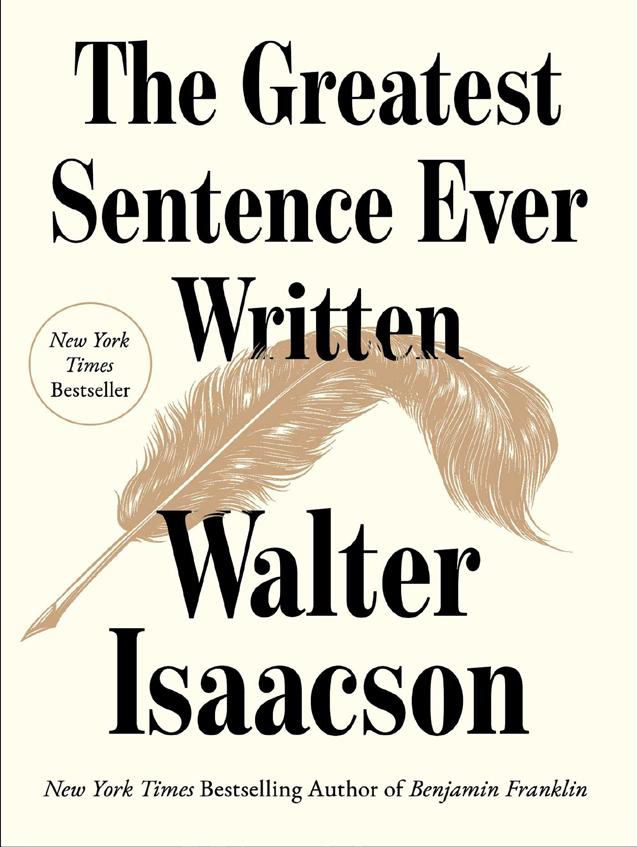
By Walter Isaacson (Simon & Schuster, 2025)
The second sentence of the Declaration of Independence is one of the most well known in all of American history: “We hold these truths to be selfevident, that all men are created equal, that they are endowed by their Creator with certain unalienable Rights, that among these are Life, Liberty and the pursuit of Happiness.” But that majestic sentence, and, indeed, the entire Declaration itself, was not quite so soaring and eloquent in its first draft. There were many changes and edits along the way, during the weeks from June 21, 1776, when Jefferson completed his first draft to July 4, 1776, when Congress finished with its edits and adopted the Declaration.
In The Greatest Sentence Ever Written , author Walter Isaacson, former editor of Time, former CEO of CNN, and currently professor of history at Tulane, tells the story of the second sentence, as well as other stories about the drafting and editing of the Declaration.
Consider the opening phrase. Originally, Thomas Jefferson wrote that: “We hold these truths to be sacred & undeniable…” It was Benjamin Franklin who replaced “sacred & undeniable” with the simpler and more powerful “selfevident.” But this was more than a simple edit. By saying that the truths were “self-evident,” the point was being made that they were more than just “obvious,” and more than merely “sacred.” Franklin knew the Scottish philosopher David Hume, and Hume divided the world of truths into two categories—those that depend on the confirmation of facts in order to be true (for example, to know that London is more populous than Philadelphia, one needs to know the population of each) and those which need no facts to be true (for example, all bachelors are not married, otherwise they would not be bachelors). By saying that the truths were “self-evident,” Franklin removed them from debate. They were true by definition. By contrast, “sacred” merely means they are considered very important, and “undeniable” invites counter-argument and denial.
The second phrase of the sentence originally read: “that from that equal creation they derive rights inherent & inalienable,” but here, the phrase was changed to “that they are endowed by their Creator with certain unalienable Rights.” With this change, the Declaration credited God, and not nature, with the creation of these rights. The delegates would also add the phrase “with a firm reliance on the protection of divine Providence,” to the last line of the Declaration so that it closes: “And for the support of this Declaration, with a firm reliance on the protection of divine Providence, we mutually pledge to each other our Lives, our Fortunes and our sacred Honor.”
In the second phrase, the word “inalienable” was changed to “unalienable,” although exactly how and why this change occurred is not fully understood. The two words have, essentially, the same meaning, and one can argue that “inalienable” sounds better and is today considered the preferred usage; but, “unalienable” is the word appearing in the Declaration as adopted. And, some suggest that un-alienable is a slightly stronger form than inalienable because when something is unalienable it cannot be taken, while if something is inalienable it might be subject to limitation.
The unalienable rights which include, “Life, Liberty and the pursuit of Happiness,” has a majestic ring, but originally these rights were described as “among which are the preservation of life, & liberty, & the pursuit of happiness.” “Life, Liberty and the pursuit of Happiness” is a bit shorter and flows better, although the Oxford comma after “liberty” in the original draft disappeared.
Almost everything can be improved with good editing, and the Declaration was no exception. Included in Isaacson’s short book is Jefferson’s first draft, as well as the final version known to history. Between the two, some 86 changes and edits were made, including 39 alone between July 2 (when the Continental Congress first passed the resolution in favor of independence) and July 4 (when the Congress adopted the Declaration).
Isaacson also points out that the ideas expressed in the Declaration were not entirely original. The nature of government and the rights of men and women had been the subject of philosophers for some time. Included in the book are excerpts from John Locke’s 1690 Second Treatise of Government , Rousseau’s 1762 The Social Contract , and the June 1776 Virginia Declaration of Rights. These works (and others) advance the argument that government derives its powers from the consent of the governed, and that all have rights; but it was the Declaration of Independence which put the issue to the
world, and our new nation became the first to put these principles to the test.
Isaacson, like many today, is concerned by the lack of civility in not only our politics but increasingly in everyday life. The media, the internet, social media, chatbots, and algorithms seem more intent on creating discourse and division than focusing on the common good. What can be done? As a biographer of Benjamin Franklin, Isaacson argues that we should focus on Franklin’s example—someone who worked hard to make his community better and to bring people together. He started the country’s first public library and first hospital. He founded the University of Pennsylvania. He contributed to the building fund for every church in Philadelphia. He organized police, fire, and street sweeping brigades. In 1787, he became president of the Pennsylvania Society for Promoting the Abolition of Slavery and presented a petition to Congress calling for abolition. Franklin worked tirelessly on behalf of his fellow citizens to make his city and his country better, and set an example that we should all seek to follow. And, he did it all without acrimony or personal attacks on others.
As our country celebrates its 250th anniversary this July, there is no better place to start than a careful reading of the Declaration. While the document was not perfect for its time, it nevertheless captured the aspirations and hopes and ideals that our country still seeks to achieve. In the words of the Constitution, we seek a more perfect union, and no doubt will always be seeking to make it more perfect, but the Declaration is the document that started it all and acts as our North Star.
THE DSBA HAS MEETING & EVENT SPACE IN THE HEART OF DOWNTOWN WILMINGTON
➤ Perfect for depositions, arbitrations, and committee meetings
➤ Close to the Leonard L. Williams Justice Center
➤ Multiple meeting room options to suit your needs
➤ Free Wi-Fi
➤ Access to a kitchen
➤ Complimentary printing and shredding
➤ Competitive rental fees
Richard “Shark” Forsten is a Partner with Saul Ewing LLP, where he practices in the areas of commercial real estate, land use, business transactions, and related litigation. He can be reached at Richard.Forsten@saul.com.



BY SUSAN E. POPPITI, ESQUIRE
While researching my article for June, a 1987 cookbook inspired me to take a detour—The True Essentials of a Feast: A Collection of Recipes from the Staff of the Library of Congress.1 These recipes were assembled from staff of “the oldest federal cultural institution in the nation.” Founded in 1800, the Library is the largest in the world and fills three buildings on Capitol Hill—the Thomas Jefferson Building (the original), the John Adams Building, and the James Madison Memorial Building. I think the 225 years-worth of books, manuscripts, films, sheet music, and other materials warrant a pause on our tour of Original Colonies. Here is just one of many remarkable statistics from the Library’s website: “Each working day the Library receives some 15,000 items and adds more than 10,000 items to its collections.”2
The Foreword to The True Essentials of a Feast explains that the LC Cooking Club, formed in 1949, put together the over 160 recipes from active and retired staff. (The Club sounds like one I would eagerly join for its cooking demonstrations and themed luncheons.)3 It appears the Club is no longer active, but I found a podcast from about ten years ago discussing attempts to bring it back. If anyone has more information about the Club, I would be happy to hear from you.
The Foreword continues:

The recipes in this book reflect a cross section of cultures and interests. They range from original creations, through timehonored family recipes, to adaptations of recipes encountered over years of adventurous cooking—and good eating…
The cookbook has itself been salted, spiced, sauced, and frosted with illustrations and quotations drawn from the vast and varied collections of the Library of Congress. We hope they will add zest to the contemplation and the process of cooking, as we trust the recipes herein will add to the delight of dining. For enjoyment is important, as noted in the line by Oliver Wendell Holmes from which the title of this book is taken: The true essentials of a feast are only fun and feed.4
I include this American version of the French classic—Bouillabaisse. The recipe looks long, but it’s simple to prepare. The spicy rouille is worth the extra effort.
• 1 medium onion, chopped
• 1 clove garlic, finely chopped
• 1 leek, finely diced
• 1 teaspoon fresh thyme (or ½ teaspoon dried)
• ½ bay leaf
• 4 cups canned plum tomatoes, crushed and drained
• 2 cups bottled clam juice
• 2 cups dry white wine
• 1 teaspoon crushed fennel seeds
1. Cut all seafood into serving pieces.
• pinch of saffron
• salt and pepper to taste
• 2 tablespoons parsley, chopped
Seafood: allow at least ½ pound per person and choose from:
• lobster (boil fresh lobster 1 to 2 minutes, cool under running cold water, and remove meat);
• shrimp (raw, shelled, and deveined);
• scallops and fish (snapper, cod, monkfish, or other nonoily fish).
2. In a large kettle heat the oil; add celery, onion, garlic, leek, thyme, and bay leaf and cook 5 minutes. Add tomatoes, clam juice, wine, fennel, saffron, salt, pepper, and parsley and simmer 15 minutes. Add seafood, bring to a simmer and cook for 5 minutes only. Remove from heat and serve as soon as possible—fish will overcook if held too long.
Serving Suggestions: The bouillabaisse can be served as is, but is wonderful if served in any of the following ways:
• With rounds of hard-toasted French bread. Cut bread ¾ inches thick, place on baking sheet, and dry out in 325-degree oven until golden (30 minutes), basting occasionally with butter. Place 2 rounds in bottom of soup plate before spooning in the soup.
• Sprinkle with freshly grated Parmesan cheese.
• Accompanied by rouille (garlic and pepper sauce, ingredients below).
Rouille to be added according to individual taste:
• 4 large garlic cloves, peeled
• 2 egg yolks
• 12 large fresh basil leaves (or 1 tablespoon dried)
• 3 dried red peppers
• ½ cup fresh white bread crumbs
• 2 tablespoons tomato paste
• 2 to 3 tablespoons hot soup stock
• ½ cup virgin olive oil
• salt and pepper to taste
1. Put all ingredients in food processor and process until they form a thick paste; add a little more stock if necessary.
~ Lee Decker (Congressional Research Service, Congressional Reference Division) 5
This traditional Creole side dish is a tasty way to incorporate one of summer’s special treats—corn on the cob.
CHOUX (CAJUN CORN) (A FAVORITE FROM GOURMET)
• 3 ears corn
• ½ medium onion, sliced
• 2 tablespoons unsalted butter
• 4 to 5 tablespoons heavy cream
• cayenne, salt, and pepper to taste
1. Cut corn from cob.
2. In saucepan, cook onions in butter until lightly browned. Add corn and 4 tablespoons cream and cook, covered, over low heat for 20 minutes, stirring occasionally. If mix begins to stick, add remaining cream.
3. Season with cayenne, salt, and pepper to taste.
~ Jim Riehl (Congressional Research Service, Congressional Reference Division) 6

• 1 cup sugar, or more to taste
• 1 cup cold milk
• juice and rind of 2 lemons
• 1 cup heavy cream, whipped
Dissolve the sugar in the cold milk. Combine with the lemon juice, rind, then fold in the cream. Taste for sweetness, adding sugar if necessary, and pour into an ice cube tray. Freeze for 2 hours. Beat the sherbet and then freeze again for at least 2 hours before serving. Serve plain or with raspberry syrup or crème de menthe.
~ Mary Ann Habib (Descriptive Cataloging Division) 8
Lemony desserts are a refreshing way to conclude summer meals.
• 1 cup butter or margarine, at room temperature
• ½ cup plus 1 tablespoon confectioners’ sugar, divided
• 2 1/3 cups unsifted flour, divided
• 4 eggs
• 1¾ cups sugar
• 1/3 cup lemon juice
• ½ teaspoon double-acting baking powder
• 1 teaspoon lemon peel
Preheat oven to 350 degrees. In medium bowl, cream butter or margarine and ½ cup confectioners sugar. Add 2 cups flour and stir with wooden spoon until well combined. Pat evenly into a 9 x 13-inch baking pan. Bake for 20 minutes.
Meanwhile, prepare the filling. Combine eggs, granulated sugar, remaining 1/3 cup flour, lemon juice, baking powder, and lemon peel in blender container. Cover and blend for five seconds.
Scrape down sides of blender container and blend another 5 seconds. Pour over partially baked crust. Bake 25 more minutes or until golden brown. Cool completely in pan on wire rack. Sprinkle with remaining confectioners’ sugar. Cut into squares.
~ Maurvene D. Williams (Congressional Research Service, Library Services Division)7
As last month I recommended a rosé, I suggest a Pinot Gris to pair with the Bouillabaisse. Pinot Gris is actually the same grape as the famous Italian Pinot Grigio. Yet Pinot Gris is how it’s known in France and here in the U.S.A. in Oregon and cooler California climates. Its citrus, apple, and stone fruit flavors complement the rich seafood dish, especially as a counterbalance to the rouille. Looking forward to gathering more summer recipes for our July/August edition…and wishing you a very happy 250th Independence Day!
Notes:
1. Library of Congress. (1987). The True essentials of a feast: a collection of recipes from the staff of the Library of Congress . Washington, D.C.: The Library.
2. https://www.loc.gov/about/
3. Library of Congress, p. vii.
4. Library of Congress, p. vii.
5. Library of Congress. p. 46-47.
6. Library of Congress. p. 94.
7. Library of Congress. p. 144.
8. Library of Congress. p. 150.

Susan E. Poppiti is the owner of Susan Poppiti Math Tutoring LLC. Susan holds a WSET (Wine and Spirit Education Trust) Level 3 Award in Wines with Merit. You can contact Susan at spoppiti@hotmail.com and find a searchable collection of her “Judicial Palate” articles at cucinadipoppiti.com.
Serving attorneys from our Newark and Dover locations.
Board-Certified. Fast Reports. Reliable Testimony.
www.cdcime.com | 800-494-0321 | referrals@cdcime.com
CITY OF WILMINGTON LAW DEPARTMENT seeks an attorney for the position of Assistant City Solicitor. Minimum of two years legal experience is preferred. The Law Department offers a variety of practice areas, including litigation, transactional (contracts, real estate, and FOIA), employment/ labor, legislation, code enforcement, and environmental. Delaware Bar Admission required. Negotiable compensation with a targeted starting salary range for well-qualified individuals of $100,000 to $115,000. Robust benefits package inclusive of medical/dental/vision coverage, pension plan, CLE allowance, professional membership dues, yearly DE bar registration fee, 13 paid holidays, 2 floating holidays, 18 vacation days and 1 day per month accrued sick time. Tenure is provided following three years of satisfactory performance. Send resume, cover letter, and writing sample to: City of Wilmington Law Dept., Attn: Rosamaria Tassone-DiNardo, 800 French St., 9th Fl., Wilmington, DE 19801-3537, or email them to Javette Lane at jlane@wilmingtonde.gov. Full job descriptions available at www.wilmingtonde.gov.
MELUNEY ALLEMAN & SPENCE is seeking to add an attorney to its corporate and commercial litigation practice. The candidate should be a member of the Delaware bar with 1-3 years of experience. The candidate must be an excellent writer and researcher and be detail oriented. Salary will be commensurate with experience, and the attorney will work in the firm’s Lewes, Delaware office. Please send resume to Heather.Alleman@maslawde.com.
WILMINGTON OFFICE OF WHITE AND WILLIAMS LLP, a large multi-practice law firm, is seeking an attorney with 1-3 years of experience to work in the areas of product liability, insurance coverage, and commercial litigation. DE Bar admission required. We offer a competitive salary, an excellent benefits package, and the opportunity for professional growth. Please send your resume to Recruiting@whiteandwilliams.com for consideration.

In the Matter of Christopher M. Donnelly, Esquire, No. 177, 2026
Effective Date: May 5, 2026
By Order dated May 5, 2026, the Delaware Supreme Court suspended Christopher M. Donnelly, Esquire immediately from the practice of law in Delaware pursuant to Rule 16(a) of the Delaware Lawyers’ Rules of Disciplinary Procedure (“DLRDP”), pending the disposition of this matter under the DLRDP.
The Court ordered that during the period of interim suspension, Mr. Donnelly shall:
(a) not practice law in Delaware directly or indirectly, nor shall he provide any law-related services unless he is directly supervised by a Delaware lawyer;
(b) not have any contact, direct or indirect, with clients, prospective clients, witnesses, or prospective witnesses for purposes of the practice of law or the provision of law-related services;
(c) not attend any court proceeding or ancillary court proceeding on behalf of a client, address a court on behalf of a client, or make any legal argument on behalf of a client;
(d) not advertise any law or law-related services;
(e) not independently, or with another lawyer, own, operate, serve as an officer or director of, or share any interest whatsoever, in any law firm, association, corporation, or other business entity, the purpose of which is, in whole or in part, the practice of law;
(f) not display to the public any indicia that he is a member of a law firm or available to take clients, including any signage, letterhead, or other written forms, websites, social media accounts or other internet web-based pages;
(g) provide a copy of this Interim Suspension Order to all employers whose purpose is in whole or in part the practice of law,
regardless of whether he is a W-2 employee or a 1099 independent contractor;
(h) fully cooperate with ODC in any efforts to monitor his compliance with this Interim Suspension Order and these conditions;
(i) report any change in employment (including the name of his employer and job responsibilities) to ODC within ten calendar days of his date of hire; and
(j) not share in any legal fees arising from clients or cases referred by him during the period of suspension to any other lawyer or in any legal fees earned for services by others during such period of suspension.


e DSBA o f f er s online p ostings as a f eatu re of the Bu lletin Board. B u lletin Board advertiser s now have th e option to have their printe d ad also appear on a d esignated p age of the DSB A website. C h e c k out the online Bulletin Board at ww w. dsba.org/ bu l letin-board/. For more informa t ion, contact Danielle Bouchat-Friedma n a t ( 3 02) 658-5279 or dbouchatfriedman@dsba.org.
The DSBA and the Awards Committee are seeking nominations for the 2026 Christopher W. White Access to Justice Awards formerly known as the Distinguished Pro Bono Service Awards.
THERE ARE FIVE CATEGORIES FOR WHICH INDIVIDUALS, FIRMS, OR ORGANIZATIONS MAY BE NOMINATED.
THE LEADERSHIP AWARD
This award is presented to a legal organization (legal department or law office) that has demonstrated outstanding leadership in the field of pro bono service to Delaware’s indigent population based on the following criterion including, but not limited to:
• The number of pro bono hours the organization contributes to the direct representation of indigent clients.
• The number of cases the organization accepts for pro bono representation.
• Flexibility and accessibility in accepting cases.
• The organization’s commitment and service on committees dedicated to promoting and supporting the provision of legal services to those in need.
• Financial support to agencies providing legal services to Delaware’s indigent population.
• The percentage of attorneys in the organization who accept pro bono cases.
• Fostering a culture, which recognizes the value of pro bono service.
THE COMMITMENT AWARD
This award is presented to a member of the Bar who has demonstrated a sterling commitment to pro bono work throughout his or her career by dedicating time and energy to the support and provision of legal services . The criterion includes, but is not limited to:
• The number of pro bono hours devoted to legal representation of indigent clients over the lawyer’s career.
• The number of cases accepted for pro bono representation over the lawyer’s career.
• The lawyer’s commitment and service on committees dedicated to promoting and supporting the provision of legal services to those in need over the lawyer’s career.
THE ACHIEVEMENT AWARD
This award is presented to a member of the Bar who has shown an exemplary recent contribution to pro bono services (generally in the past one to three years) and stands as a role model to other attorneys. The criterion includes, but is not limited to:
• The number of pro bono hours recently devoted to legal representation of indigent clients.
• The number of cases accepted for pro bono representation.
• Consistency, flexibility, and accessibility in accepting cases.
• The lawyer’s commitment and service on committees dedicated to promoting and supporting the provision of legal services to those in need.
Awarded to an individual lawyer, legal professional, or organization principally including lawyers, which demonstrates outstanding commitment to, and work for, children in the provision of legal or community services. It may be given to volunteers or those employed in the provision of legal services for children. This award is given as warranted, not necessarily annually.
LEGAL PROFESSIONAL PRO BONO SERVICE AWARD
Awarded to a person, qualified by education, training or work experience, who is employed or retained by a lawyer, law office, corporation, governmental agency or other entity, who performs pro bono legal work in the pursuit of Access to Justice. This is a newly-created award that is given as warranted, not necessarily annually.
THE DEADLINE FOR NOMINATIONS IS AUGUST 14, 2026 . Nominations should be submitted to nominations@dsba.org. Please include: The name, firm, and title/occupation of the Candidate; name and contact information (firm, address, email, phone, and fax) of the individual nominating the Candidate; and a brief statement of the reasons the Candidate is deserving of the Award.
OOn Thursday, April 23, 2026, members of the Bench and Bar celebrated the portrait unveiling for President Judge Jan R. Jurden and Judge John A. Parkins, Jr. The Honorable Kathy Jennings made brief remarks about Judge Parkins, and Delaware State Bar Association President David A. White spoke at the ceremony about Judge Jurden. Below is a portion of their remarks.
“With respect to Judge Jurden’s nearly 24-year tenure on the Superior Court…which began in May 2001...her service…but particularly her service as the first female President Judge…which began in January 2015 …reflects the very best of what our judiciary aspires to be.
n Thursday, April 23, members of the Bench and Bar celebrated the portrait unveiling for President Judge Jan R. Jurden and Judge John A. Parkins, Jr. Delaware State Bar Association President David A. White spoke at the ceremony. Below is a portion of his remarks.
Kathy Jennings: “I want to take a few moments to talk about Judge Parkins. What a fine human being. He worked as the first true appeals unit head at the office of the attorney general from 1977-1985. As I look across the room at the current judges, I know many of them benefited greatly from his wisdom. To me, he was a mentor. He was wise and very calm. And I have to say that takes a lot when you’re working with the criminal division in our office. He was the forerunner of the appeals unit as it is today. He was the pioneer who taught us all how to be trial lawyers.”
She brought to the bench that rare combination of discipline, intellectual rigor and curiosity, practical wisdom, and genuine humanity. Her decisions were guided…not only by a mastery of the law…but also by a clear understanding of its lasting impact on the lives of those who stood before her.
Throughout her distinguished career on the bench, President Judge Jurden earned the respect of colleagues, practitioners, and litigants alike. She presided over complex and high-profile civil and criminal cases with steadiness and clarity…ensuring that every case was handled with fairness and dignity.
Her courtroom was a place where the Rule of Law was upheld…with both firmness and compassion—an environment that inspired confidence in her…and in our legal system.
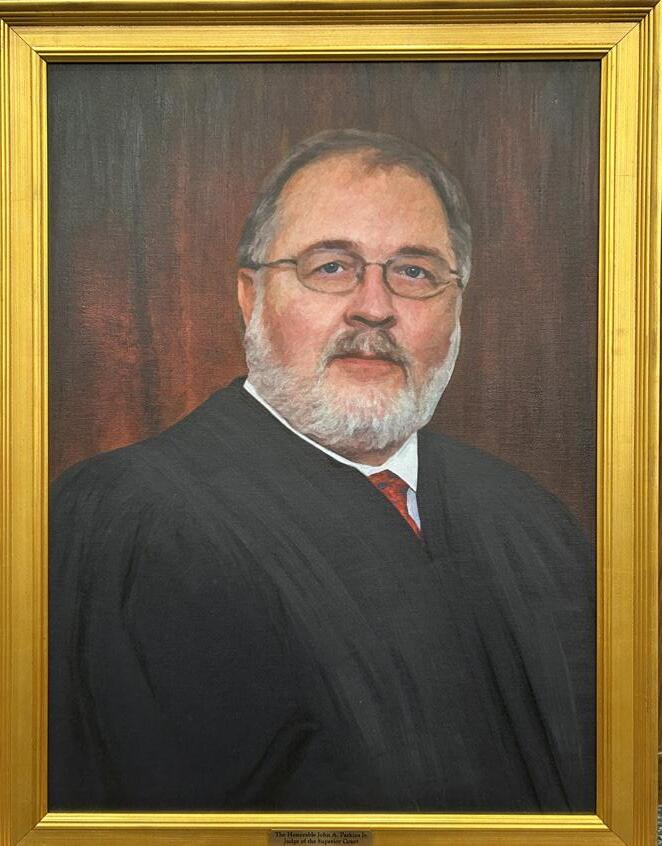
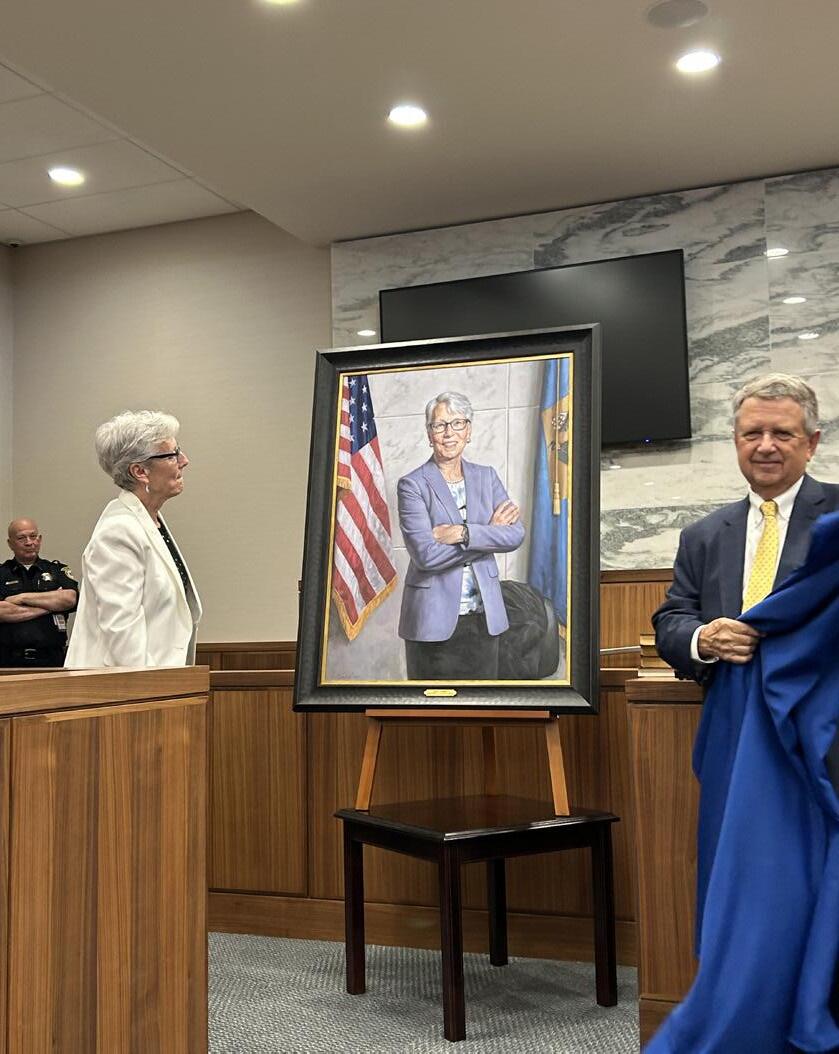
David White: “With respect to Judge Jurden’s nearly 24-year tenure on the Superior Court…which began in May 2001...her service…but particularly her service as the first female President Judge…which began in January 2015 …reflects the very best of what our judiciary aspires to be.
As President Judge, she demonstrated exceptional leadership during times of both stability and challenge. Take a moment to reflect on all the upheaval our trial Courts endured during the COVID-19 Pandemic.
She brought to the bench that rare combination of discipline, intellectual rigor and curiosity, practical wisdom, and genuine humanity. Her decisions were guided… not only by a mastery of the law…but also by a clear understanding of its lasting impact on the lives of those who stood before her.
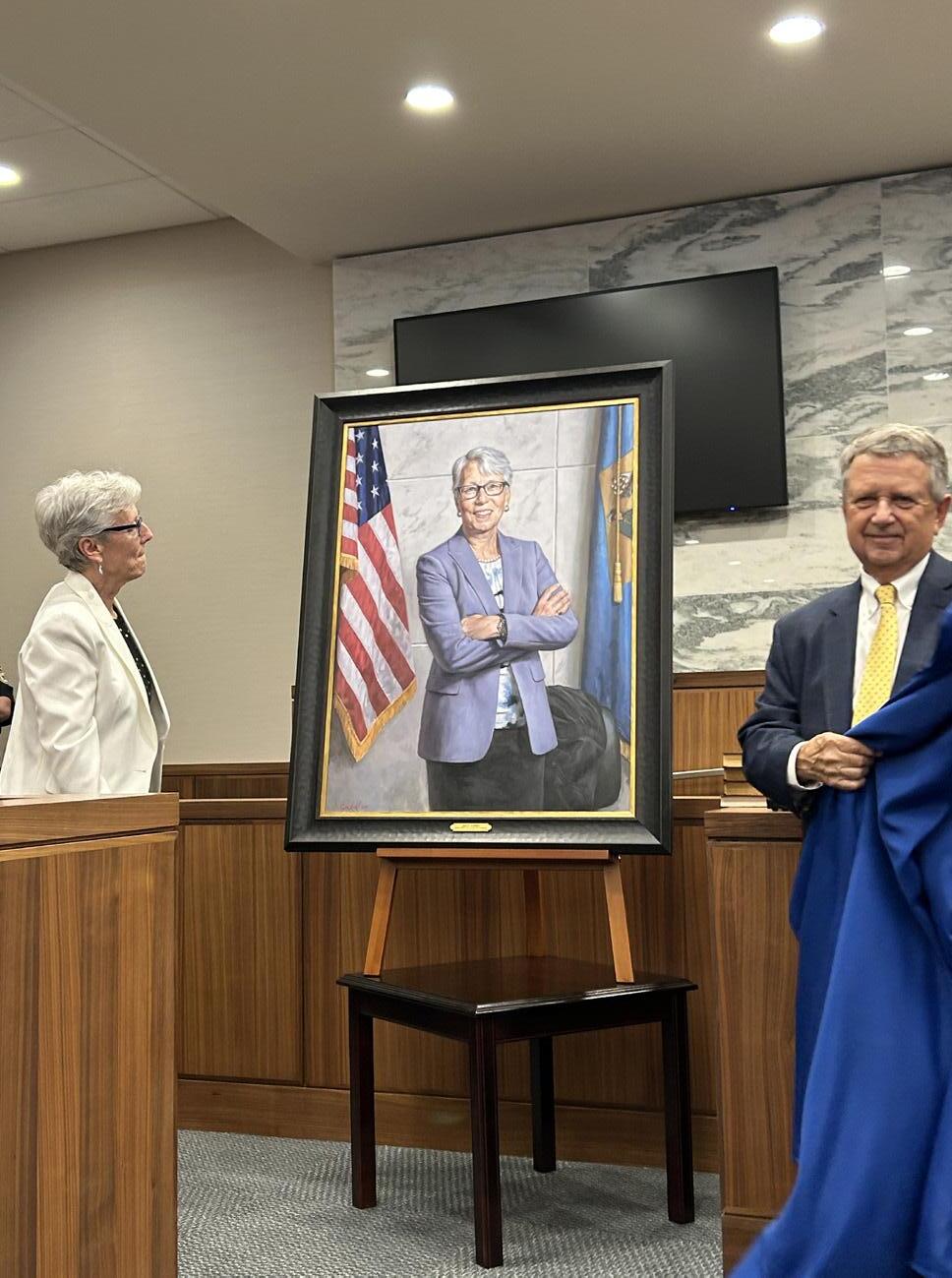
She also worked tirelessly to improve the administration of justice… by supporting her fellow Judges and Commissioners, the Prothonotary’s Office, the Bailiffs, the Court Reporters, Pretrial Services, Probation and Parole, the Department of Justice, the Office of Defense Services…and to strengthen the administration of justice and the overall functioning of the Superior Court. Her efforts helped ensure that Delaware’s judiciary remained the envy of our nation…and a model of efficiency, professionalism, and accessibility.
Throughout her distinguished career on the bench, President Judge Jurden earned the respect of colleagues, practitioners, and litigants alike. She presided over complex and high-profile civil and criminal cases with steadiness and clarity…ensuring that every case was handled with fairness and dignity.
Her courtroom was a place where the Rule of Law was upheld…with both firmness and compassion—an environment that inspired confidence in her…and in our legal system.
She worked tirelessly to improve the administration of justice…by supporting her fellow Judges and Commissioners, the Prothonotary’s Office, the Bailiffs, the Court Reporters, Pretrial Services, Probation and Parole, the Department of Justice, the Office of Defense Services…and to strengthen the administration of justice and the overall functioning of the Superior Court. Her efforts helped ensure that Delaware’s judiciary remained the envy of our nation…and a model of efficiency, professionalism, and accessibility.
The unveiling of President Judge Jurden’s portrait today also ensures that her legacy will remain a visible and enduring part of this Courthouse…where she served with such distinction…from the day we walked down King Street together in August 2002 and opened this Courthouse…until her retirement on February 28, 2025. It will stand as a reminder to future generations of Delaware lawyers and judges of the standards she set…and the values she embodied.” Photos courtesy of Sean O’Sullivan.
The unveiling of President Judge Jurden’s portrait today also ensures that her legacy will remain a visible and enduring part of this Courthouse…where she served with such distinction…from the day we walked down King Street together in August 2002 and opened this Courthouse…until her retirement on February 28, 2025. It will stand as a reminder to future generations of Delaware lawyers and judges of the standards she set…and the values she embodied.”
The Delaware State Bar Association and the Awards Committee are seeking nominations for the following awards:
Daniel L. Herrmann Professional Conduct Award
Outstanding Service to the Courts and Bar Award
Distinguished Mentoring Award Government Service Award
Daniel L. Herrmann Professional Conduct Award
Awarded to a member of the Delaware Bar who, over the course of time, has demonstrated those qualities of courtesy and civility which, together with high ability and distinguished service, exemplifies the Delaware lawyer.
Outstanding Service to the Courts and Bar Award
Awarded to a Delaware lawyer or judge who, by exemplary service to the Delaware Courts and the Delaware Bar, has substantially assisted the courts and the Bar and has strengthened public trust and confidence in the courts in the state of Delaware and the Administration of Justice.
Distinguished Mentoring Award
Awarded to a Delaware lawyer or judge who, by distinguished mentoring of other Delaware lawyers (or future lawyers) over a period of many years, has served as an inspiration to and a model for those lawyers in striving for and maintaining the highest standards in their professional careers and in their community involvement.
Government Service Award
Awarded to a full-time government service employee in recognition of dedicated and distinguished contribution to the Administration of Justice.
These are not necessarily annual awards. All or some of these awards will be presented only upon the recommendation of the Awards Committee and approval by the Executive Committee of the DSBA. Please note that previous nominations must be renewed to be considered. These awards will be presented in a special Awards Luncheon in December 2026.
Name of Candidate: ______________________________________________________________________________
Title/Occupation of Candidate:_____________________________________________________________________
Award: ___________________________________________________________________________________
Date: _________________________________________________________________________________________
Nominator: ____________________________________________________________________________________
Phone: _________________________________ Fax:_________________________ E-Mail: _____________________
Firm: _________________________________________________________________________________________
Address:
Brief statement of reasons that candidate is deserving of Award (see above Award criteria). Please attach sheet if necessary.
September 4, 2026 to nominations@dsba.org.

DSBA President 2025 - 2026
Delaware ADR has the experience, resources and infrastructure to assist parties with resolution of the most complex disputes, including multi-party disputes with numerous independent claims.
for