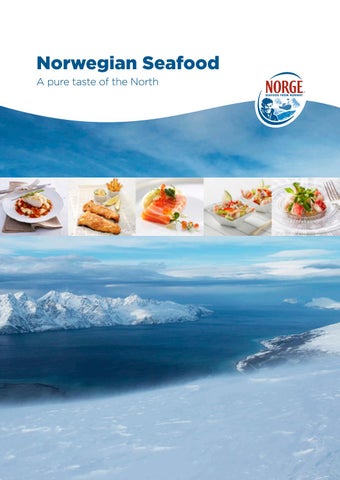
Norwegian Seafood A pure taste of the North
Photo: Johan Wildhagen
Front cover photo: Johan Wildhagen
01
Norway – A country defined by the sea
4
- Origin matters
6
- Sustainability is everything
8
- Safe seafood
10
- Committed to quality
11
02 03
Norwegian Fisheries
12
Norwegian Aquaculture
16
– Norwegian Salmon
19
– From roe to market
20
04
Species and recipes – Salmonids
24
– Whitefish
28
– Cured oroducts
36
– Pelagic species
40
– Prawns
44
– Shellfish
46
Norwegian Seafood Council | 3
01
4 | Norwegian Seafood – A pure taste of the north
Norway – A country defined by the sea
Photo: Johan Wildhagen
The unique combination of nature, culture and management gives Norwegian seafood a world-class position in terms of quality, tradition and sustainability. The sea has played an important role in our daily life for over a thousand years. Long fjords, small islands and minor inlets are perfect environment for fishing and aquaculture. These rich ocean resources have formed a solid foundation for vigorous local communities along the entire Norwegian coast. Here in Norway, fishing and aquaculture aren’t just an industry, it’s a way of life. People have exploited the resources with respect and knowledge built up over generations. There is no doubt that we are a proud seafaring nation with deep respect for our cold and clear sea, the long coastline and the high mountain ranges.
This pride is reflected in the unique taste of the Norwegian seafood, that emerges from the clear, cold waters of Norway. Norwegian seafood culture contributes to both good health and great cuisine. This is something also the world around us has discovered. Every day, more than 37 million meals of Norwegian seafood is served in more than 140 different countries across the globe. The production of Norwegian seafood has evolved in terms of technology, experience and knowledge, but it has never lost a sense of respect for the e nvironment, for the sea or for the people.
Norwegian Seafood Council | 5
Photo: Johan Wildhagen
6 | Norwegian Seafood – A pure taste of the north
Seafood from Norway – Origin matters
Look for this logo when buying seafood, and you will find the perfect choice for your best recipes.
Norwegian Seafood is a high quality product because it comes from the pure and cold nature of Norway. Premium products are something we strive to ensure customers all over the world. The red, white and blue oval NORGE logo, tells you that the seafood comes from Norway. When you find seafood with this logo you are guaranteed that the seafood: • Comes from the cold, clear waters of Norway • Is responsibly managed by the Norwegian government • Is handled by competent people
Norwegian Seafood Council | 7
Photo: Johan Wildhagen
Photo: Johan Wildhagen Photo: Johan Wildhagen
– Meeting the needs of the present without compromising the ability of future generations to meet their own needs
These aren’t our fish – We are just looking after them Because the sea is so important to us, we will always have a strong focus on it to ensure it will always maintain future generations. Norway therefore has a strong focus on sustainable management. The authorities, researches and the industry work closely together in order to make sure that the Norwegian fisheries and aquaculture are conducted within a sustainable framework. Because we are aware of the fact that whether it takes place on land or in the sea, all food production has an environmental impact.
8 | Norwegian Seafood – A pure taste of the north
The UN World Commission on Environment and Development defined sustainability as: “Meeting the needs of the present without compromising the ability of future generations to meet their own needs”
D I D YO U K N OW ? Norway has one of the largest research and development community for seafood in the world.
Sustainability is everything For many years, Norway has been one of the leading nations when it comes to developing a good fishery and aquaculture management, and work every day to improve this resource system.
1. Environment is a dimension of sustainability. Whether it is done on land or at sea, the production or harvesting of food has an environmental impact.
All the biggest Norwegian fisheries are certified in accordance with worldwide recognized international environmental standards.
2. Sustainability has a social dimension that focuses on equality. The seafood industry is among the industries that contributes most to enabling people to live and work all over the country.
Norway includes three important dimensions in the pursuit of sustainable development:
3. Sustainability also has an economic d imension in regard to profitability and p redictability for those who work in the industry.
Norwegian Seafood Council | 9
D I D YO U K N OW ? That Norway has its own parallel to EUs EFSA (European Food Safety Authority) called Norwegian Scientific Committee for Food Safety (VKM). Its role is to carry out independent risk assessments for the Norwegian Food Safety Authority for seafood in the world.
Safe seafood – Of vital importance for Norway A transparent and reliable risk management system through co-operation – an aim to deliver only high-quality, safe products to the markets.
As the second largest seafood exporter in the world, food safety is at the top of Norway’s agenda, and at the heart of all we do. The continued success of the Norwegian seafood industry, as well as Norway’s economy, is dependent on meeting and international food-safety demands. The Norwegian control regulations are fully harmonized with EU regulations and Norwegian companies comply with the regulations placed on hygiene and production rules for the EU. The Norwegian seafood safety system is based on mandatory HACCP programs and the Norwegian Food Safety Authority supervise that these programs are in compliance with regulations and guidelines. 2 To meet the demand for information regarding food safety, Norway has taken the following approach:
With the Ministry of Trade, Industry and Fisheries and the Ministry of Health and Care Services at the top of the governing structure, the Norwegian Food Safety Authority, the National Institute of Nutrition and Seafood Research (NIFES), the Directorate of Fisheries and other (institutions all work together with the seafood industry in a system based on internal control in every link of the food chain, dedicated to ensure seafood safety. Each organization executes its own tasks and co-operates to create the surveillance system. This system leads to thorough risk management, ensures seafood safety and protects consumer interests. In 2014 NIFES took over 11 000 tests of salmon and the results all confirm that salmon is safe and healthy to eat. The results are available for all to see. 2 1
HACCP (Hazard Analysis Critical Control Point): a systematic preventive approach to food safety from biological, chemical, and physical hazards in production processes that can cause the finished product to be unsafe, and designs measurements to reduce these risks to a safe level.
2
nifes.no/en/trygg-oppdrettsfisk
1 Develop a thorough system dedicated to ensure safety. 2 Have an open approach regarding all safety information in order to build trust.
Photo: Johan Wildhagen
An uncompromising commitment to quality The high quality and safety of food is ensured by: • a safe marine environment, • quality management at every stage of the food chain, • interaction with consumers, and • international co-operation to share scientific research and experiences
There has been a significant increase in the recognition of Norwegian Seafood over the last years. Its quality, nutritional value, freshness, taste, and other criteria have also been researched, and as a result, it has earned a good reputation for its taste and quality. Norwegian Seafood is recognized as a high-quality product that satisfies the consumers in taste as well as safety.
Norwegian Seafood Council | 11
02
Norwegian Fisheries
12 | Norwegian Seafood – A pure taste of the north
Photo: Johan Wildhagen
Norwegian fisheries combine generations of hard-earned fishing experience with the latest technology. This combination gives a high level of quality that shines through in the unique taste of the species from Norwegian fisheries. No one can say for certain when the story of Norway’s fisheries started, but we do know that it is a rich and hugely diversified history. Rock carvings in Northern Norway dating back to the early Stone Age show fishing of halibut from boats made of hide. Leiv Eiriksson, the famous Viking, sailed with supplies of stockfish when he discovered America, and the first ship exporting fish to Brazil sat sail with clipfish on board in 1692. The history is one thing, but there is so much more. Norwegian fisheries symbolize the future for many people, both in Norway and abroad.
Norwegian fishermen have easy access to large shoals of a great number of species. A fisherman can sail at dawn and return the same day with seafood of the highest quality as fresh as it can be. Our ultra modern fishing fleets have strong focus on quality. These vessels are supplied with equipment that allows the fish to be cooled to 0°C within a few minutes. The use of special freezing technologies enables the Norwegian fisheries business to work fast and efficiently as the vessels are unloaded in port. Some vessels stay at sea for weeks at time where they produce and freeze the fish to below -20°C within hours.
Norwegian Seafood Council | 13
The history of Norwegian fisheries shows that different dimensions of sustainability have at various times faced challenges, but also how the authorities, researchers and the industry have worked to meet these challenges: • Initiatives to counter unlimited fishing have been very important for Norway in order to ensure environmental sustainability. The authorities grant concessions to all who are involved in the industry, and each species is subject to comprehensive and detailed quota regulations. • The quotas are determined as a result of international negotiations. This means that the most critical management decision – the amount of fish that can be harvested from a given stock – is an internationally determined premise for a domestic decision-making process. The quotas are established based on national and international studies and research. • Throughout the entire process- from catching to processing, storing and exporting – the quality of the fish is monitored by the Directorate of Fisheries in Norway. • Norway has a ban on discard of fish, both because it is a waste of resources and also because such fish are not registered in the statistics, making it more difficult for researchers to calculate the size of stocks. Norway is the world leader in adopting measures to reduce discards of fish. • There is strict enforcement of rules regarding fishing gear.
14 | Norwegian Seafood – A pure taste of the north
Photo: Johan Wildhagen
Photo: Johan Wildhagen
Photo: Jean Gaumy
03
16 | Norwegian Seafood – A pure taste of the north
Photo: Johan Wildhagen
Norwegian Aquaculture
Norway’s deep, protected fjords give us waters with just the right current and temperature - a perfect aquaculture environment. Norwegian seafood is farmed in the cold, clear waters where it grows slowly and therefore gains a pure and fresh taste. Natural conditions combined by competent people contribute to give Norwegian farmed seafood it’s fantastic and distinctive character. This also ensures that the quality will be consistently high every time a new consignment arrives from Norway.
The aquaculture industry behind aquaculture also has a long history as it embraces businesses from the cornerstone of many Norwegian coastal communities. In several of these communities, aquaculture has created vital jobs for many people that all work hard to produce healthy and delicious products. Aquaculture is a major export industry and very important for Norway. Norway is in the forefront of innovation and development in this area, and we will provide the conditions for this to continue in the future.
Norwegian Seafood Council | 17
Photo: Johan Wildhagen Photo: Johan Wildhagen
Norwegian aquaculture operates in the natural environment that we all share, and that imposes obligations on everyone concerned. The industry and the public authorities are working together to manage aquaculture within a sustainable framework. Within the Norwegian aquaculture you find salmon, trout, halibut, shellfish and cod. Aquaculture makes it possible to offer seafood independently of the seasonal variations that limit traditional fisheries. In addition, it is one of Norway’s most important responses to the challenge facing the world today: to produce sufficient, healthy food for a rapidly growing population. Of course within the framework of what the environment can tolerate.
18 | Norwegian Seafood – A pure taste of the north
• All aquaculture businesses in Norway must be licensed by the authorities to operate a fish/seafood farm. • A typical fish farm consists of between six and ten cages, holding 3000 to 4000 tonnes of fish. The cage consists of a buoyancy element on the surface and a net bag in which the fish swim. • A typical net bag is between 20 to 50 meters deep. • The diameter of a typical net cage is around 50 metres. • The cage consists of 2,5 % fish and 97,5 % water
Photo: Tom Haga
Norwegian Salmon
Photo: Tom Haga
Norwegian Salmon is raised in the cold, clear waters of Norway. Not only is Norwegian Salmon’s delicious taste popular with all ages, it’s packed with proteins, Omega-3, vitamins and minerals, making it a highly nutritious choice. Salmon is the dominant and most important species in Norwegian aquaculture. Norway is the world’s largest producer of Atlantic salmon, and it accounts for about 70 % of Norwegian seafood exports. Each day 14 million meals of Norwegian Salmon are served worldwide and Norway exports salmon to more than 100 countries around the world. Salmon farming is a strictly controlled food production and there are stringent quality standards at all levels. The industry has committed themselves to several initiatives to reinforce efforts to combat challenges within aquaculture. There are precautions against salmon louse, measures to deal with escape, measures to secure fish health as well as the entire welfare of the fish. Research, development and innovation are central in the work to further develop the entire value chain in Norwegian aquaculture.
Norwegian Seafood Council | 19
Photo: Johan Wildhagen Photo: Johan Wildhagen Photo: Kaloian Somlev
From roe to market
20 | Norwegian Seafood – A pure taste of the north
ROE
PHASE 1
FRESHWATER
Our salmon start their lives on land, in an incubator tray. Just like wild salmon, the fertilisation of the roe takes place in fresh water. The roe are kept at a constant temperature for around 80 days before hatching. Established egg suppliers can scale their production to demand by obtaining more or less fish for breeding during the preceding season.
FRY SMOLT MATURE SALMON
PHASE 2 PHASE 4
After 10–16 months in freshwater, our salmon are ready to be placed into the se. At this stage, each fish weighs less than 60–100 g, but it has gone through a great change known as smoltification. This change enables a salmon to live in saltwater, and is now called smolt.
10–16 MONTHS
SALTWATER
After hatching, the salmon fry has a sac on its stomach that it uses to feed itself. Four to six weeks after hatching, the fry begin to eat feed and are now transferred to larger freshwater tanks.
PHASE 3
4–6 WEEKS
We rear the salmon in aquafarms in the sea and in fjords for 14–22 months. When the fish has reached a weight of 4–6 kg it’s ready to be processed.
PRODUCT
FINISHED
14–22 MONTHS
The salmon are taken by well boat to the fi shprocessing facility. They are then stunned, gutted, washed, sorted according to size and quality and laid on ice. They are then moved to processing in Norway, to the fishmonger or sent to 100 countries around the world.
Photo: Fry and smolt: Johan Wildhagen Farm fish and finished product: Tom Haga
Norwegian Seafood Council | 21
04 Species & Recipes Get to know our species and be inspired to try some of the great recipes.
22 | Norwegian Seafood – A pure taste of the north
Photo: Astrid Hals
Norwegian Seafood Council | 23
SALMONIDS
PRODUCTS Norwegian salmon is sold in the following forms: • Fresh or frozen fillets • Fresh or frozen whole fish • Smoked Farmed salmon from Norway is sold all year round. SIZE • 4–6 kilos
Atlantic Salmon Farmed salmon from Norway is enjoyed in more than 100 countries, and you find it on sushi menus all over the world. In fact, Norwegian salmon was the first type of salmon to be used in sushi dishes. Salmon is also known for its versatility and can easily be included in all kinds of cuisines. Norway pioneered the development of salmon farming. Since the breakthrough of ocean based farming in the 1970s, Norway has kept its position as the world’s leading producer of farmed Atlantic salmon. Since 1998, Norway has more than tripled its production of salmon, to around 1 million ton. Today, 14 million meals made with farmed Norwegian salmon are served every day. The popularity of farmed salmon from Norwegian can be explained by the steady supply and the controlled food production. Unlike many other types of fish and food items, fresh salmon is available all year round. Seafood from Norway also has a good reputation for having safe food regulations and strict quality requirements. Norwegian aquaculture is regulated by comprehensive guidelines that ensure that the fish is of the highest quality and is safe to eat. OCEAN FARMED Farmed salmon from Norway start life in freshwater, with small yolk fry hatching from the eggs. After 8 to 18 months, the fry have grown into smolt of around 100 grams and are ready to be moved to seawater. The smolt are usually set in large cages in the sea at sites where there is good water flow and favourable environmental conditions. In the sea the salmon grow from 100 grams to a weight of around 4-6 kilos, when it is ready to be slaughtered. This takes 14 to 22 months, depending on factors like the water temperature and the fish feed used. Knowledge is key to good fish health, and there is a lot of research and development carried out about fish welfare, management in the fishing industry and development of technical solutions. www.nifes.no/en/prosjekt/seafood-data
AREA • Farmed salmon is raised in cages in the sea along the Norwegian coast DIET • Pellets (http://laksefakta.no/index.php/ Norsk-havbruk/Dette-spiser-laksen) OTHER NAMES • Latin: Salmo salar • English: Atlantic salmon • French: Saumon atlantique • German: Lachs NUTRITION Atlantic salmon is especially rich in: • Protein, building and maintaining every cell in the body. • Marine omega-3 fatty acids that prevent and reduce the development of cardiovascular diseases, and which are important building blocks in the brain. • Vitamin D, which is necessary to get the right balance of calcium in the body to maintain and strengthen the bones. • Selenium, an important element in an enzyme that fights harmful chemical processes in the body. More nutritional data can be found at www.nifes.no/en/prosjekt/seafood-data
Nutritional value in 100 g raw farmed Salmon (edible part) Energy: 932 kJ/224 kcal Nutrients: Protein: Fat: Saturated fatty acids: Trans fatty acids: Monounsaturated fatty acids: Polyunsaturated fatty acids: Cholesterol: Carbohydrates, in total: Vitamins: Vitamin A: Vitamin D: Riboflavin: Foliate: Vitamin B12:
26 RAE 10 µg 0.11 mg 7 µg 3.5 µg
Minerals: Iron: Selenium:
0.3 mg 30 µg
Source: Matvaretabellen (http://www.matvaretabellen.no/ fish-and-shellfish-g4/salmon-farmed-raw-04.220) Havforskningsinstituttet (http://www.imr.no/ temasider/fisk/laks/laks_i_oppdrett/nb-no) Laksefakta (http://laksefakta.no/) Salmon academy (link)
24 | Norwegian Seafood – A pure taste of the north
20 g 16 g 3g 0g 5.9 g 5g 80 mg 0g
Photo: Synøve Dreyer
Baked salmon with creamy apple sauce 4 SERVINGS | 40 MIN | MEDIUM DIFFICULTY INGREDIENTS 600 g salmon fillet, skinned and pinboned olive oil salt Apple sauce 2 apples 2 shallots 1/2 dl whipping cream 2 tsp apple cider vinegar 250 g unsalted butter clarified butter To serve potatoes
PROCEDURE • Preheat the oven to 130 °C/266 °F. • Cut the salmon fillet into portions and brush with olive oil. • Sprinkle salt on a baking tray and place the salmon on top and leave for 20 minutes. • Cook the salmon in the oven for 10 minutes. Apple sauce • Peel the apples, remove the core and cut into small dices. • Finely chop shallots and cook in a little clarified butter. • Add apple dices, whipping cream and apple cider vinegar and reduce to half. • Gently whisk in a little butter at the time without the sauce boiling. • Smooth the sauce with a hand blender and strain through a fi ne-meshed sieve. • Taste with salt and pepper. Serve the salmon with the apple sauce and potatoes.
Norwegian Seafood Council | 25
SALMONIDS
PRODUCTS Fjord Trout is sold in the following forms: • Fresh or frozen in; o slices o fillets o as whole fish SIZE 2–5 kilos
Fjord Trout Norwegian trout, branded Fjord Trout, is an ocean farmed trout. It is raised in the pure and cold Norwegian fjords where seawater meets fresh meltwater from the glaciers and snow. Fjord Trout is a premium niche product renowned for its exquisite quality. There are several varieties of trout. Freshwater trout and sea trout are referred to as common trout, and are related to Atlantic salmon. The trout farmed in Norway is rainbow trout, which was brought to Norway from North America in the late 19th century. It is well known for its superb quality and has become a favourite amongst chefs all over the world. Fjord Trout is more sensitive to high temperatures than Norwegian salmon and is therefore perfect for raw, marinated and lightly cooked dishes. The skin of the Fjord Trout is similar to salmon, with a lustrous and silvery colour. Fjord Trout meat has a deep red-orange colour with white marbling that give the fillets a luxurious feel. The meat has a healthy sheen and is firm, yet tender and mellow. Fjord Trout has a remarkably rich flavour with a pure aftertaste. The taste resembles shellfish and crab and is often more complex and delicate than other types of red fish. OCEAN FARMED The success story of Norwegian fish farming started with Fjord Trout. The pioneering work established by the first Fjord Trout farmers was crucial for the development of the aquaculture industry as we know it today. Today, Fjord Trout is a niche product with a low production level – around 1/20 of the total production of salmon. Fjord Trout is farmed in the pure, cold Norwegian fjords where they grow to a weight of 2–5 kilos, which is generally a bit smaller than the salmon. To ensure consistent, high quality, the Norwegian Seafood Council and the Fjord Trout industry have developed a quality standard for Norwegian farmed trout. This Quality Standard has strict criteria for how to farm, pack and transport Fjord Trout. It is registered and approved in accordance with ISO norms, Standards Norway (standard n° NS 9412:2010).
26 | Norwegian Seafood – A pure taste of the north
AREA Fjord Trout is kept in cages in the fjords along the coast of Norway. DIET Pellets OTHER NAMES • Latin: Oncorhynchus mykiss • English: Rainbow trout • French: Truite arc-en-ciel • German: Regenbogenforelle NUTRITION Trout is especially rich in: • Protein that builds and maintains every cell in the body. • Marine omega-3 fatty acids that prevent and reduce the development of cardiovascular diseases, and which are important building blocks in the brain. • Vitamin D, necessary to balance calcium in the body, which maintains and strengthens the bones. • Selenium, an important element in an enzyme that fights harmful chemical processes in the body. More nutritional data can be found at www.nifes.no/en/prosjekt/seafood-data
Nutritional value in 100 g raw trout (edible part) Energy: 693 kJ/166 kcal Nutrients: Protein: Fat: Saturated fatty acids: Trans fatty acids: Monounsaturated fatty acids: Polyunsaturated fatty acids: Cholesterol: 7 Carbohydrates, in total:
19 g 10 g 2g 0g 3.5 g 3.2 g 3 mg 0g
Vitamins: Vitamin A: Vitamin D: Riboflavin: Folate: Vitamin B12:
32 RAE 16.9 µg 0.13 mg 5 µg 4.8 µg
Minerals: Iron: Selenium:
0.3 mg 30 µg
Source: Matvaretabellen (http://www.matvaretabellen.no/ fish-and-shellfish-g4/trout-farmed-raw-04.256)
Photo: Tom Haga
Fjord Trout beurre blanc With the fresh color and taste Fjord Trout is perfect to serve raw. In this recipe it is served with a thick beurre blanc and garnished with cress and salmon roe. 4 SERVINGS | 20 MIN | MEDIUM DIFFICULTY INGREDIENTS 250 g trout fillet, skinned and pinboned cress salmon roe Beurre blanc 2 tbsp shallots 1 dl dry white wine 1 1/2 tbsp white wine vinegar 100 g butter salt and white pepper
PROCEDURE • Cut the Fjord Trout in half along and cut each piece in slices of 2 mm. Beurre blanc • Finely chop shallot and bring to a boil with white wine and white wine vinegar. Reduce the liquid to 2 tbsp. • Turn the heat all the way down and whisk in butter, a little at a time, to a thick and even sauce. The sauce must not boil. • Taste with salt and white pepper. Serve the Fjord Trout slices with beurre blanc and garnish with cress and salmon roe.
Norwegian Seafood Council | 27
WHITEFISH
PRODUCTS Cod is sold in the following forms: • Fresh or frozen in; o slices o fillets o as whole fish • Dried • Salted MAXIMUM SIZE Up to 169 cm and 55 kg
Cod Each winter, Norwegian cod migrates to spawn along the coast. The cod taking this journey is called Skrei, and this is also the name used commercially to indicate its outstanding quality. The migration contributes to the fish’s distinctive firm, lean and tender flesh, giving it a superior taste and a wonderful flaky texture.
Norway has the largest cod stock in the world, and cod is one of the most common and economically important species for Norwegian fisheries. Cod is characterized by its long body, large head and distinctive chin barbell; a kind of beard used to search for food. It is a benthic fish (meaning that it lives near the bottom of the ocean), although larger cod also live in open waters. In Norway there are two main types of cod: the stationary coastal cod that lives at the bottom of the sea in shallow waters along the coast, and the migratory northeast Arctic cod that matures in the Barents Sea and appears at the Norwegian coast to spawn – this is the type the locals call Skrei. Over 90% of the Norwegian catch comes from the northeast Arctic cod stock, which grows up in the cold, clear waters of the Barents Sea. The cod can live for up to 40 years. WILD CATCH Cod fishing takes place all year around, but peaks from January to April when the cod is spawning. The main area for the cod to spawn is in Lofoten and Vesterålen. It is caught using various methods including bottom trawl, Danish seine, long line, gill net, fish pots and hand line. Cod is mainly wild catch, but it is also farmed on a small scale.
AREA Norway’s stocks of cod can be found along the Norwegian coast and in the Barents Sea. DIET Fish and crustaceans OTHER NAMES • Latin: Gadus morhua • English: Cod • French: Cabillaud, Morue • German: Dorsch, Kabeljau NUTRITION Cod is a lean fish and especially rich in: • Protein that builds and maintains every cell in the body. • Vitamin D, necessary to balance calcium in the body, which maintains and strengthens the bones. • Vitamin B12, which is important for the body to produce new cells, including red blood cells. Vitamin B12 can contribute to preventing anaemia. • Selenium, an important element in an enzyme that fights harmful chemical processes in the body. More nutritional data can be found at www.nifes.no/en/prosjekt/seafood-data
Nutritional value in 100 g farmed raw cod (edible part) Energy: 358 kJ/84 kcal Nutrients: Protein: Fat: Saturated fatty acids: Trans fatty acids: Monounsaturated fatty acids: Polyunsaturated fatty acids: Cholesterol: Carbohydrates, in total: Vitamins: Vitamin A: Vitamin D: Riboflavin: Folate: Vitamin B12: Minerals: Iron: Selenium:
20 g 0,5 g 0,1 g 0g 0g 0,2 g 82 mg 0g
2 RAE 0,7 µg 0,09 mg 12 µg 1 µg 0,2 mg 30 µg
Source: Matvaretabellen (http://www.matvaretabellen.no/ fish-and-shellfish-g4/cod-farmed-raw-04.326) Reference: Havforskningsinstiituttet (http://www.imr.no/temasider/fisk/torsk/ nordaustarktisk_torsk_skrei/nb-no)
28 | Norwegian Seafood – A pure taste of the north
Photo: Oliver Brachat
Cod with polenta and ratatouille 4 SERVINGS | 40–60 MIN | MEDUIM DIFFICULTY INGREDIENTS 800 g cod fillet, skinned and pinboned 2 cloves garlic 1 twig rosemary 1 tbsp sunflower oil 1 tbsp butter Polenta 1 tbsp shallot 5 dl chicken stock 1 dl polenta 1 dl single cream 1 tbsp butter 1 tbsp parmesan salt and pepper Ratatouille 1 shallot 1/2 red chili 2 plum tomatoes 1 red bell pepper 2 tbsp pumpkin 1 tbsp swede 2 tbsp root parsley 1/2 green squash 1 tbsp tomato purée 1 tbsp olive oil 1 tbsp fresh parsley
PROCEDURE • Cut the cod fillet in servings. • Finely chop garlic and rosemary. • Cook the cod fillets in sunflower oil with skin side down until the skin is crispy and the fish is barely cooked through, approx. 3–4 minutes. • Add garlic, rosemary and butter to the pan after half the cooking time. Polenta • Finely chop shallot. • Bring chicken stock to a boil and add shallot. • Add the polenta and cook for approx. 20 minutes while stirring. • Add single cream, butter and grated parmesan. • Taste with salt and pepper. Ratatouille • Finely chop shallot and chili, chop tomatoes and dice bell pepper, pumpkin, swede, root parsley and squash. • Sauté shallot and tomato purée in olive oil for 1-2 minutes. • Add chili, tomato and bell pepper, and let it cook for approx. 15 minutes. • Mix in pumpkin, swede and root parsley and let cook for 2–3 minutes. • Add squash and finely chopped parsley and bring to a boil. • Taste with salt and pepper. Serve the cod with polenta and ratatouille on the side.
Norwegian Seafood Council | 29
WHITEFISH
PRODUCTS Haddock is sold in the following forms: • Fresh or frozen fillets • As whole fish • Salted • Smoked
MAXIMUM SIZE Up to 1,1 metres and 14 kilos
Haddock Haddock belongs to the cod family and is easily recognized by the dark spot on its side. In Norway, it is often used to make traditional fish cakes – the delicate, lean meat holds together well, which makes it particularly suitable for minced fish dishes. It is also one of the most common species for fish and chips.
Haddock is a benthic fish found at depths between 40 and 300 metres, and it thrives in flat areas with sand, clay or gravel beds. There are several stocks of haddock; one in the Barents Sea; along the west coast of the United States north to Newfoundland; in the east from Portugal to Iceland, in Skagerrak; and in the North Sea. Juvenile haddock in the Barents Sea are relatively stationary, while larger adult fish migrate far and wide. When they are 8 - 11 centimetres in size, the fish drift with the current towards the seabed where they settle. Haddock matures between 4 - 7 years of age, when they are 40 to 60 centimetres long. They spawn from March to June, along the western edge of Tromsøflaket, part of the coastal banks of Northern Norway. The haddock has a lifespan of approximately 20 years. WILD CATCH The fishing of haddock takes place all year around. The most important fishing equipment is fishing line, nets, Danish seine, trawl nets and long line. In the summertime, pelagic long lines are used off the coast of eastern Finnmark.
AREA Norway`s stock of Haddock can be found along the Norwegian coast, from Stad to Svalbard DIET Benthos (small animals and plants living at the bottom of the sea), fish and roe from herring and capelin
OTHER NAMES • Latin: Melanogrammus aeglefinus • English: Haddock • French: Églefin • German: Schellfish NUTRITION Haddock is especially rich in: • Protein that builds and maintains every cell in the body. • Vitamin B12, which is important for the body in producing new cells, including red blood cells. Vitamin B12 can contribute to preventing anaemia. • Selenium, an important element in an enzyme that fights harmful chemical processes in the body. More nutritional data can be found at NIFES (www.nifes.no/en/prosjekt/seafood-data).
Nutritional value in 100 g raw haddock (edible part) Energy: 290 kJ/ 68 kcal Nutrients: Protein: Fat: 0,2 g Saturated fatty acids: Trans fatty acids: Monounsaturated fatty acids: Polyunsaturated fatty acids: Cholesterol: Carbohydrates, in total:
0g 0g 0g 0,1 g 46 mg 0g
Vitamins: Vitamin A: Vitamin D: Riboflavin: Folate: Vitamin B12:
2 RAE 0,5 µg 0,11 mg 9 µg 2 µg
Minerals: Iron: Selenium:
16,6 g
0,1 mg 30 µg
Source: Matvaretabellen (http://www.matvaretabellen.no/ fish-and-shellfish-g4/haddock-raw-04.110) Havforskningsinstituttet (http://www.imr.no/ temasider/fisk/hyse/nordostarktisk_hyse/nb-no)
30 | Norwegian Seafood – A pure taste of the north
Photo: Fabian Bjørnstjerna
Fish and chips 4 SERVINGS | 20–40 MIN | MEDIUM DIFFICULTY INGREDIENTS 700 g haddock fillet, skinned and pinboned salt and pepper frying oil Batter 240 g wheat flour 1 tsp salt 3 tsp baking powder 2,5 dl water Tartar sauce 2 egg yolks 1 tsp lemon juice 1 tsp Dijon mustard 1 garlic clove 2 dl oil 3 pickled gherkins 3 tbsp capers salt To serve pommes frites lemon wedges PROCEDURE • Dry the haddock fillet well and cut into desired pieces. • Sprinkle with salt and pepper.
Batter • Mix wheat flour, salt and baking powder and add cold water. • Stir until a smooth batter and let it rest in the refrigerator for 20 minutes. • Heat frying oil in a pan or fryer to 160 °C. • Dip the haddock in the batter and let some of the batter drip off. • Fry the fish in the oil, two at the time. • Let them fry for approx. 5 minutes until golden and crispy. • Place on a paper towel after frying. Tartar sauce • Mix egg yolks with lemon juice, mustard and pressed garlic. • Add a little oil at the time while stirring. • Mix in chopped gherkins and capers, and taste with salt. Serve the fried haddock with pommes frites, tartar sauce and lemon wedges.
WHITEFISH
PRODUCTS Saithe is sold in the following forms: • Fresh or frozen fillets • Whole fish • Clipfish/dried fish MAXIMUM SIZE Up to 1.3 metres and 20 kilos
Northeast Arctic Saithe Saithe has a more characteristic taste than most white fish species. Its distinctive flavour goes well with spicy dishes. Saithe meat also has a firm texture making it well suited to frying. Saithe is a codfish that can be found both near the surface and on the seabed down to a depth of 300 metres. It is a shoaling fish that may gather in large numbers where there is plenty of food. Northeast Arctic Saithe becomes sexually mature at the age of 5-6 years and spawns in winter along the Norwegian coast, from Lofoten to the North Sea. The spawning period peaks in February, after which the young drift passively northwards with the currents. Small saithe appear in southern and western Norway in spring, and by the coast of Finnmark as late as August. They migrate a long way from the areas where they feed and grow, and can live up to 30 years. WILD CATCH The fishing of saithe takes place all year round along the Norwegian coast. Common equipment is bottom trawl, purse seine, gill net, Danish seine and hand line.
AREA Norway`s stock of Saithe can be found all along the Norwegian coast from Stad to the Kola Peninsula DIET Copepods, krill and other pelagic crustaceans; herring, sprat, blue whiting, juvenile haddock and Norway pout OTHER NAMES • Latin: Pollachius virens • English: Saithe/Coalfish • French: Lieu noir • German: Köhler/Seelachs NUTRITION Saithe is especially rich in: • Protein that builds and maintains every cell in the body. • Vitamin D, necessary to balance calcium in the body, which maintains and strengthens the bones. • Vitamin B12, which is important for the body in producing new cells, including red blood cells. Vitamin B12 can help to prevent anaemia. • Selenium, an important element in an enzyme that fights harmful chemical processes in the body. More nutritional data can be found at www.nifes.no/en/prosjekt/seafood-data
Nutritional value in 100 g raw saithe (edible part) Energy: 292 kJ or 69 kcal Nutrients: Protein: Fat: Saturated fatty acids: Trans fatty acids: Monounsaturated fatty acids: Polyunsaturated fatty acids: Cholesterol: Carbohydrates, in total:
16.5 g 0.3 g 0g 0g 0,1 g 0.1 g 49 mg 0g
Vitamins: Vitamin A: Vitamin D: 0.8 Riboflavin: 0.20 Foliate: 12 Vitamin B12: 4
2 RAE µg mg µg µg
Minerals: Iron: Selenium:
0.1 mg 30 µg
Source: Matvaretabellen (http://www.matvaretabellen.no/ fish-and-shellfish-g4/saithe-raw-04.029) Havforskningsinstituttet (http://www.imr.no/ temasider/fisk/sei/nordostarktisk_sei/en)
32 | Norwegian Seafood – A pure taste of the north
Photo: Studio Dreyer-Hensley
Saithe tandoori with cucumber salad 4 SERVINGS | 20 MIN | EASY INGREDIENTS 700 g saithe fillet, skinned and pinboned 3 tbsp tandoori spice 4 tbsp oil Cucumber salad 1 cucumber 1 twig fresh mint 1 1/2 dl yoghurt
PROCEDURE • Cut the fish in servings and place on a plate. • Brush with oil and sprinkle with tandoori spice. • Fry the fish in oil on medium heat, 2–3 minutes on each side. Cucumber salad • Peel cucumber, cut in two along, remove the seeds and cut in thin slices. • Finely chop mint and mix with cucumber and yoghurt. Serve saithe tandoori with cucumber salad and naan bread on the side.
To serve naan bread
Norwegian Seafood Council | 33
WHITEFISH
PRODUCTS Atlantic Halibut is sold in the following form: • Fresh or frozen in; o slices o fillets o as whole fish MAXIMUM SIZE Wild catch: Wild female halibut can weigh as much as 200 kg. Ocean farmed: Farmed halibut is usually harvested when it attains a weight of 6–7 kg.
Atlantic Halibut Norwegian halibut is both a wild and an ocean farmed species in Norway. Its delicate white meat has a firm, juicy texture. It is the perfect choice for special occasions as it goes well with a variety of ingredients and cooking styles, making it easy to create a quality meal that can be enjoyed by many people.
WILD HALIBUT Atlantic halibut is a large flatfish found on both sides of the North Atlantic Ocean. Younger fish live in relatively shallow water, while older fish can be found as deep as 2000 metres. Spawning is between December and May, and females can lay as many as 3.5 million eggs in deep pits on the fishing banks along the coast and in the fjords. It takes 18 months to reach maturity. The Atlantic halibut hunts for fish just a few metres above the seabed. OCEAN FARMED White halibut is vulnerable to overfishing as it grows slowly, matures late and is territorial. To manage halibut stocks for long-term sustainability, halibut has been established as a farmed species. Halibut commands a relatively high market price, so fish farmers are focused on ensuring that they produce a premium product. Farmed halibut begin life in special indoor stock plants, a protected seawater environment, which prepares the halibut for relocation when they have reached approximately 2 kg. Then they are moved to selected fjords, where they mature in open sea net or land-based pens, and are reared on a special nutrition-rich diet, which ensures high quality roe. The living areas are expanded as the fish grow in size to 6 kg, at which time they are considered to be ready for harvesting. WILD CATCH Halibut fishing uses net, trawl, Danish seine and other fixed equipment. Fishing is prohibited between 20 December and 31 March. The rest of the year halibut is considered to be in season.
AREA Wild catch: Norway’s stock of Atlantic halibut can be found along most of Norway`s coastline and in the fjords. Ocean farmed: Farmed halibut reach maturity in the cold, clear deep fjords of northern Norway. DIET Wild catch: A predatory species that eats bottom fish such as tusk, cod, sculpin and haddock, and pelagic species like herring, capelin, and squid. Ocean farmed: Farmed halibut are reared on a nutrition rich diet of live processed seafood OTHER NAMES • Latin: Hippoglossus hippoglossus • English: Atlantic halibut • French: Flétan de l’Atlantique • German: Heilbutt NUTRITION Atlantic halibut is especially rich in: • Protein that builds and maintains every cell in the body. • Vitamin D, which is necessary to balance calcium in the body, which maintain and strengthen the bones. • Vitamin B12, which is important for the body in producing new cells, including red blood cells. Vitamin B12 can contribute to prevent anaemia. • Selenium, an important element in an enzyme that fights harmful chemical processes in the body. More nutritional data can be found at www.nifes.no/en/prosjekt/seafood-data
Nutritional value in 100 g raw Atlantic halibut (edible part) Energy: 515 kJ/123 kcal Nutrients: Protein: Fat: Saturated fatty acids: Trans fatty acids: Monounsaturated fatty acids: Polyunsaturated fatty acids: Cholesterol: Carbohydrates, in total: Vitamins: Vitamin A: Vitamin D: Riboflavin: Folate: Vitamin B12: Minerals: Iron: Selenium:
17 g 6,1 g 1g 0g 3,1 g 1,2 g 50 mg 0g
17 RAE 9,7 µg 0,05 mg 7 µg 0,7 µg 0,2 mg 60 µg
Source: Matvaretabellen (http://www.matvaretabellen. no/fish-and-shellfish-g4/halibut-atlantic-raw-04.014)
34 | Norwegian Seafood – A pure taste of the north
Havforskningsinstituttet (http://www.imr.no/temasider/ fisk/kveite/kveite/nb-no).
Photo: Alf Börjesson
Halibut with beurre blanc 4 SERVINGS | 40–60 MIN | MEDIUM DIFFICULTY INGREDIENTS 600 g skinless halibut fillet salt and pepper olive oil Beurre blanc 1/2 dl white wine vinegar 1 dl white wine 1/2 dl whipping cream 125 g unsalted butter 1 tbsp fresh chives salt and pepper To serve 12 asparagus 2 dl fresh peas salt and pepper olive oil butter cress
PROCEDURE • Cut the halibut into servings and sprinkle with salt and pepper. • Place in a deep frying pan and pour in olive oil so that it covers the fish. • Warm the oil to 70 °C using a cooking thermometer. • Cook the fish for approx. 5 minutes. Beurre blanc • Heat and reduce the white wine vinegar and white wine by two thirds. • Add the cream and bring to the boil. • Remove the saucepan from the heat and whip in the cold butter in small portions. The sauce must not be boiling while the butter is whipped in or it will become thin. • Taste with salt and pepper, and stir in the chives. To serve • Rinse the asparagus, and fry in olive oil and butter for approx. 2 minutes. Taste with salt and pepper. • Cook the peas in a little water with a little butter, salt and pepper for approx. 2 minutes. Serve the halibut with beurre blanc, asparagus, peas and cress.
Norwegian Seafood Council | 35
CURED PRODUCTS
Cured products Saltfish, Clipfish and Stockfish are cured products with a culinary history to tell. Cured products are produced based on traditional methods of processing and preserving, making each variety unique in taste and texture. Cured products is a generic term for salted, salted and dried, and dried products. Saltfish, Clipfish and Stockfish all fall into this c ategory. The methods used conserve the fish by removing water while still preserving all the nutrients and prolonging its premium quality. Driven by the strong traditions and natural conditions found along the Norwegian coastline, our fishermen have passed down this knowledge through generations, ensuring that only top-quality products emerge from our cold, clear waters. The different products are sorted according to quality and size, giving a wide assortment of ready products to suit your own needs. All cured products can be bought dry and then be soaked at home, or as desalted products that are ready to be cooked. With their distinctive flavour and texture, cured products lend themselves to countless cooking possibilities. Perfect for braising, stewing, roasting, frying, grilling – the opportunity to create new food experiences is unlimited.
Photo: Tom Haga
Saltfish, Clipfish and Stockfish from Norway have been appreciated for generations many places in the world, and contain important nutrients as well as having valuable health benefits.
For instance, Norway has been exporting Stockfish to Italy and Brazil since the 15th and 16th century. All three products can be made from either cod, saithe, ling, tusk or haddock – choose your own favourite. THE DIFFERENCE BETWEEN THE PRODUCTS ARE: Saltfish is salted and matured for 10–20 days, depending on the method used. The salt preserves the fish and gives it its valued taste and texture. After desalting, the fish is ready to be cooked, assuring a perfect result. Clipfish is drysalted and matured for about 20–25 days, then dried for approximately two to four days, which gives it a distinct flavour. The dried fish contains 47% water with all its nutrients preserved inside. It can then be kept for several months in chilled conditions until it is ready to be desalted and soaked in the kitchen. Stockfish is a product of nature, demanding first-class raw materials and the optimal weather conditions only found in Northern Norway. After being caught and cleaned, the fish is immediately hung outside on wooden racks to dry for about 3 months, then matured for 4–12 months. The perfected, finished product is achieved by a delicate balance of wind, rain, sun and a temperature just above 0°C.
Photo: Esten Borgos
Stockfish with herb dressing and salt-baked potatoes 4 SERVINGS | 60 MIN | MEDUIM DIFFICULTY INGREDIENTS 750 g stockfish, soaked and rinsed, ready to cook 1 tbsp butter 1 tbsp oil salt Dressing 1 tbsp red bell pepper 1 tbsp fresh basil 1 tbsp fresh parsley 1 tsp fresh tarragon 2 tbsp olive oil 1 tsp pink peppercorns Vinaigrette 1 tbsp fresh basil 2 tbsp extra virgin olive oil 1 tbsp red wine vinegar 0,5 tsp salt 0,25 tsp pepper Salt-baked potatoes 4 dl water 1 dl salt 12 almond potatoes
Vegetables 1 fennel 1 onion 1 red onion 1 yellow beet 50 g chanterelles 0,5 tsp salt 2 tsp fresh parsley oil PROCEDURE • Cut the stockfish in servings. • Fry in a mix of butter and oil, 2–3 minutes on each side. • Sprinkle with salt. Dressing • Finely chop bell pepper and herbs, and whisk together with olive oil and pepper.
Salt-baked potatoes • Mix water and salt, and cook the potatoes tender. • Let them steam off, cut in half and mix with the vinaigrette. Vegetables • Rinse and cut all the vegetables in even, small dices. • Fry tender in oil, and sprinkle with salt and finely chopped parsley. Serve the stockfish with dressing, and potatoes and vegetables on the side. Tip: Yellow beet can be replaced with swede.
Vinaigrette • Finely chop basil and whisk together with the other ingredients for the vinaigrette.
Norwegian Seafood Council | 37
CURED PRODUCTS
Saltfish with tomato stew 4 SERVINGS | 20–40 MIN | EASY INGREDIENTS 4 fillets desalted saltfish, skinned and pinboned 2 choricero peppers 2 cloves garlic 2 green bell peppers 4 tomatoes 2 onions extra virgin olive oil
PROCEDURE • Soak the choricero peppers for approx. 3 hours and scrape the pulp from the skin. • Finely chop garlic, bell peppers and onions. • Peel and dice the tomatoes. • Fry the garlic in extra virgin olive oil, remove it from the oil and set it aside. • Add bell pepper and onion to the same oil and fry. • Then add tomatoes and taste with salt and pepper. • Add the pulp of choricero peppers and let it simmer for approx. 5 minutes. • Place the saltfish on top of the tomato stew, cover the pan and let it cod for 5–7 minutes on low heat. The fish is ready when it starts flaking. Garnish the saltfish with fried garlic and serve with tomato stew. You can also garnish it with fresh herbs.
Photo: Studio Dreyer-Hensley
Clipfish with tomato sauce 4 SERVINGS | 40–60 MIN | MEDIUM DIFFICULTY INGREDIENTS 600 g clipfish, soaked and rinsed 1 l water 1 dice fish stock 2 cloves garlic 2 lemon wedges 1 dl apple juice 1/2 tsp black peppercorns Tomato sauce 3 shallots 2 cloves garlic 1/4 red chili pepper 5 sun-dried tomatoes 1 tsp tomato purée 2 tbsp olive oil 12 green olives 4 stalks fresh chives 400 gr. canned, chopped tomatoes 1 tsp honey 1/2 tsp salt 1/4 tsp pepper 12 cherry tomatoes
PROCEDURE • Cut the clipfish in servings. • Pour the water into a casserole and add the fish stock. • Finely chop garlic and add to the casserole with lemon wedges, apple juice and peppercorns. • Bring to a boil and let it simmer for 10 minutes. • Place the clipfish in the casserole and leave for approx. 10 minutes. Tomato sauce • Finely chop shallots, garlic, chili pepper and sun-dried tomatoes and fry in a casserole with tomato purée and olive oil. • Pit the olives and coarsely chop them. • Finely chop chives. • Add olives, chives and canned tomatoes to the casserole, bring to a boil and let simmer for a couple of minutes. • Taste with honey, salt and pepper, and add cherry tomatoes right before serving. Serve the clipfish with the tomato sauce and boiled or baked potatoes on the side.
To serve potatoes
Norwegian Seafood Council | 39
PELAGIC SPECIES
PRODUCTS Mackerel is sold in the following forms: • Fresh and frozen fillets • Whole fish MAXIMUM SIZE 65 cm and 3.5 kilos
Mackerel Mackerel from Norway is considered a delicacy in many parts of the world. It is a lively fish with juicy meat that is a great source of omega-3. Mackerel is a fast, pelagic fish – meaning it lives in the open waters being neither close to the bottom nor near the shore. It is found in the northeast Atlantic Ocean, from the northwestern part of Africa to the Barents Sea, and westwards from the Norwegian Sea to Iceland and Jan Mayen. Mackerel prefers relatively warm waters with a temperature over 6 degrees. In European waters, it is managed as one stock – northeast Atlantic mackerel, which is divided into three spawning groups: North Sea mackerel, which spawns in the North Sea and Skagerrak (May to July); western mackerel, which spawns west of Ireland and the British Isles (March to July); and southern mackerel, which spawns off the coast of Spain and Portugal (February to May). The fish spawn in the surface layers of the sea, and the larvae grow to 20 centimetre in a few months. The scope of the spawning stock is calculated by their annual egg production, measured in international, scientific surveys throughout the spawning season (February to July). During this time, the numbers of eggs produced by individual females are also measured. After spawning, the western and southern mackerel migrate to the Norwegian Sea, and later to the North Sea and Skagerrak where they mix with the North Sea mackerel. The mackerel does not have a swim bladder and has to swim constantly in order not to sink. It can live up to 25 years. WILD CATCH The premium catch period is September to November when the Mackerel swims from the feeding areas in The Norwegian Ocean and back to the spawning areas. This is when the fat content is the highest, making the mackerel especially tasty and packed with healthy omega-3 and EPA/DHA fatty acids. This explains the international popularity of Norwegian mackerel, which is caught when the fish is of the highest quality. Norway use mainly purse sein when fishing for Mackerel. This distinguishes Norway from other exporters and contributes to the high quality of Mackerel from Norway. Trolling line is also used along the coast and pelagic trawl at sea.
40 | Norwegian Seafood – A pure taste of the north
AREA Norway’s stock of Mackerel can be found in the North Sea and sometimes in the north of Norway DIET Plankton, fish larvae and small fish OTHER NAMES • Latin: Scomber scombrus • English: Mackerel • French: Maquereau • German: Makrele NUTRITION Mackerel is especially rich in: • Protein that builds and maintains every cell in the body. • Marine omega-3 fatty acids that prevent and reduce the development of cardiovascular diseases, and are important building blocks in the brain. • Vitamin D, necessary to balance calcium in the body, which maintains and strengthens the bones. • Selenium, an important element in an enzyme that fights harmful chemical processes in the body. More nutritional data can be found at www.nifes. no/en/prosjekt/seafood-data
NUTRITION Nutritional value in 100 g raw mackerel from May – June (edible part) Energy: 516 kJ/123 kcal Nutrients: Protein: Fat: Saturated fatty acids: Trans fatty acids: Monounsaturated fatty acids: Polyunsaturated fatty acids: Cholesterol: Carbohydrates, in total: Vitamins: Vitamin A: Vitamin D: Riboflavin: Folate: Vitamin B12: Minerals: Iron: Selenium:
18.6 g 5.4 g 1.2 g 0g 2,2 g 1.3 g 68 mg 0g
14 RAE 6 µg 0.36 mg 1 µg 12 µg 0.9 mg 30 µg
Source: Matvaretabellen (http://www. matvaretabellen.no/fish-and-shellfish-g4/ mackerel-may-june-raw-04.022). Havforskningsinstituttet (http://www.imr.no/ temasider/fisk/makrell/makrell/nb-no) temasider/fisk/kveite/kveite/nb-no).
Photo: Astrid Hals
Teriyaki marinated mackerel Grilled teriyaki marinated mackerel is a simple but delicious dish. Serve with jasmine rice and a salad. 4 SERVINGS | 20–40 MIN | MEDIUM DIFFICULTY INGREDIENTS 8 mackerel fillets 2 tbsp oil Marinade 1 clove garlic 1 lemon grass 2 cm fresh ginger 1 1/2 dl soy sauce 1 dl water 1/2 dl sugar Serve with rice lettuce tomato
PROCEDURE • Rinse and finely chop garlic, lemon grass and ginger. • Combine garlic, lemon grass, ginger, soy sauce, water and sugar in a pan, and bring to the boil. • Cook the marinade for 5 minutes and leave to cool. • Leave the mackerel fillets in the marinade for 10 minutes. • Remove the fillets from the marinade, dry it off and brush with oil multiple times. • Fry the mackerel fillets in a frying pan with a little oil for about 2 minutes on each side. Serve the mackerel with boiled rice and salad, and the rest of the marinade on the side.
Norwegian Seafood Council | 41
PELAGIC SPECIES
PRODUCTS Herring is sold in the following forms: • Frozen fillets and flaps • Whole frozen fish SIZE Norwegian herring are graded and sold by size. The most common size categories are: under 200 g, 200–300 g, 250+ g, 300+ g, 350+ g, 400+ g, and 1 kilo.
Herring Herring from Norway is world-famous for its quality and beautiful silvery colour. The cold and clear water in the north means slow growth and perfect tasting herring. Herring is a pelagic fish that lives in large shoals and migrates along the coast and out to sea, down to depths of 200 metres. There are two main populations of herring: Atlantic herring and Pacific herring. They are categorized according to where and when they spawn, their size, their growth and how they migrate. The Atlantic herring is the largest population and the two breeds are Norwegian spring spawning herring and the North Sea herring. The Norwegian spring spawning herring spawns in February and March, at the bottom of the sea along the coast of Norway. The eggs hatch after about 3 weeks and the larvae drift with the current northwards into the Barents Sea. After 3 - 4 years, the herring leaves the Barents Sea and migrates southward to join the spawning stock. Herring is itself an important prey for cod, saithe, sea birds and whales, and large numbers of killer whales follow the herring during migration. WILD CATCH The premium catch period of the North Sea herring is during summer, when the fat content can reach a level as high as 25 %. The fat content of Norwegian spring spawning herring varies throughout the year, but it is at its highest in the autumn. The herring can live up to 25 years. Common equipment used is purse seine, pelagic trawl and net.
MAXIMUM SIZE Up to 40 centimetres and 500 grams. AREA Norway’s population of Herring is found along the Norwegian coast in the North Sea and in the northeast Atlantic. DIET Plankton OTHER NAMES • Latin: Clupea harengus • English: Herring • French: Hareng • German: Hering NUTRITION Herring is especially rich in: • Protein that builds and maintains every cell in the body. • Marine omega-3 fatty acids that prevent and reduce the development of cardiovascular diseases, and are important building blocks in the brain. • Vitamin D, necessary to balance calcium in the body, which maintains and strengthens the bones. • Selenium, an important element in an enzyme that fights harmful chemical processes in the body. More nutritional data can be found at www.nifes.no/en/prosjekt/seafood-data
Nutritional value in 100 g raw herring winter (edible part) Energy: 776 kJ/187 kcal Nutrients: Protein: Fat: Saturated fatty acids: Trans fatty acids: Monounsaturated fatty acids: Polyunsaturated fatty acids: Cholesterol: Carbohydrates, in total: Vitamins: Vitamin A: Vitamin D: Riboflavin: Folate: Vitamin B12: Minerals: Iron: Selenium:
15,2 g 14 g 2,9 g 0g 5,9 g 3,3 g 68 mg 0g
6 RAE 11,5 µg 0,30 mg 11 µg 12 µg 1 mg 50 µg
Source: Matvaretabellen ( http://www. matvaretabellen.no/fish-and-shellfish-g4/ herring-winter-raw-04.032) Havforskningsinstituttet (http://www.imr.no/ temasider/fisk/sild/norsk_vargytende_sild/ nn-no)
42 | Norwegian Seafood – A pure taste of the north
Photo: Studio Dreyer-Hensley
Bolinhos with herring This recipe is a Norwegian twist of the classic bolinhos. These are made of herring, potato, garlic and spices, and served with salsa and aïoli. 4 SERVINGS | 40–60 MIN | MEDIUM DIFFICULTY INGREDIENTS 500 g herring fillets 500 g potatos 2 cloves garlic 2 shallots 1 egg 1/2 tsp cinnamon, ground 1/2 tsp sugar 10 drops tabasco 1 tbsp potato flour butter salt and pepper breadcrumbs corn oil Salsa 20 g sun-dried tomatoes 1 clove garlic 2 shallots 1/2 red chilli pepper 1 1/2 dl diced canned tomatoes 1/2 dl oil salt sugar
Aïoli 4 cloves garlic 2 dl mayonnaise salt and pepper lemon juice PROCEDURE • Peel potatoes, boil tender in unsalted water and drain well. • Fry herring in butter, about 2 minutes on each side. • Grate garlic and finely chop shallots. • Add potato, herring, garlic, onion, egg, cinnamon, sugar and tabasco in a big bowl and mash all well together. • Taste with salt and pepper. • Stir in potato flour until right consistency. • Make small balls and roll in breadcrumbs. • Fry the balls golden in oil, remove from the oil and place on paper towels that absorbes oil.
Salsa • Cut sun-dried tomato in thin slices and finely chop garlic, shallot and chili. • Mix all the ingredients for the salsa together and cooked for about 20 minutes. • Taste with salt and a little sugar. Aïoli • Grate garlic and stir into the mayonnaise. • Taste with salt, pepper and lemonjuice. Serve bolinhos with tomatosalsa and aïoli on the side. Sprinkle with fresh herbs if you got.
Norwegian Seafood Council | 43
PRAWNS
PRODUCTS Prawns are sold as in the following forms: • Fresh or frozen shell-on prawns • Cooked and peeled prawns in brine • Cooked or raw peeled prawns, frozen or in MAP MAXIMUM SIZE Prawns in the Barents Sea: 16 cm and 20g Prawns in the North Sea and Skagerrak: 18 cm Coastal and fjord prawns: 16 cm and 20g
Prawns Norwegian Prawns grow up in cold clear water. They have a firm texture and a light, pink colour. Prawns are considered a delicacy and a favorite among consumers. The fresh, sweet and slightly salty taste goes well with a wide range of hot and cold dishes. There are 3 Norwegian prawn populations: one in the Barents Sea, one in the North Sea and Skagerrak and one in the fjords. Prawns thrive in deep cold waters, but are found nearer the surface at night where they feed on animal plankton. The prawn is hermaphroditic – it starts life as a male and completes life as a female. The age of the sex change and spawning time are different for the 3 populations. The prawns in the Barents Sea complete the change at the age of 4–7 years and spawn from June-October. In the North Sea and Skagerrak, prawns change sex between 2–6 years of age and spawn in June-November, and the prawns in the Norwegian fjords, finally, go through the change between 1,5 and 2,5 years and spawn in October-November. The female prawn carries the roe under her abdomen and seeks out shallow waters where the larvae hatch. The larvae then float close to the surface to feed on plankton. Prawns live up to a maximum of 10 years. WILD CATCH The premium catch period is in the winter when the prawns carry roe. Prawns are caught with trawl all year around.
44 | Norwegian Seafood – A pure taste of the north
AREA Prawns in the Barents Sea: The entire Barents Sea, most often at a depth of 200–500 metres Prawns in the North Sea and Skagerrak: North Atlantic Coastal and fjord prawns: In most of the Norwegian fjords and coastal regions, often at a depth of 200–500 metres DIET Prawns in the Barents Sea: Organic matter, carrion, small crustaceans and worms Prawns in the North Sea and Skagerrak: Plankton, small benthic, dead plant and animal remains Coastal and fjord prawns: Organic matter, carrion, small crustaceans and worms OTHER NAMES • Latin: Pandalus borealis • English: Deepwater prawn • French: Crevette nordique • German: Tiefseegarnele NUTRITION Prawns are especially rich in: • Protein that builds and maintains every cell in the body. • Vitamin D, necessary to balance calcium in the body, which maintains and strengthens the bones. • Vitamin B12, which is important for the body in producing new cells, including red blood cells. Vitamin B12 can help to prevent anaemia. • Selenium, an important element in an enzyme that fights harmful chemical processes in the body. More nutritional data can be found at www.nifes. no/en/prosjekt/seafood-data Havforskningsinstituttet (http://www.imr.no/ temasider/skalldyr/reke/nb-no)
Photo: Studio Dreyer-Hensley
Marinated prawns 4 SERVINGS | 20–40 MIN | EASY INGREDIENTS 500 g peeled prawns 1 cucumber og 1/2 red bell pepper 3 tbsp fresh dill Mariande 1 red onion 3 dl water 2 dl lime juice 1 tbsp soy sauce salt and pepper
PROCEDURE • Place the prawns in a bowl. • Finely chop onion and mix with the other ingredients for the marinade. • Taste with salt and pepper. • Pour the marinade over the prawns and let marinade for about 20 minutes. • Peel cucumber, cut in half along, remove seeds and cut in slices. • Cut bell pepper in thin strips. • Mix cucumber, bell pepper and finely chopped dill with the prawns. • Pour away the marinade and divid the mix in small serving bowls. Serve with a little taco sauce dripped over and with lime wedges as garnish.
To serve taco sauce lime
Norwegian Seafood Council | 45
SHELLFISH
PRODUCTS Norwegian red king crab is available in the following forms: • Alive, frozen, raw or cooked as whole crabs (only the innards in the carapace are removed) • Clusters (3 legs and a claw joined together) • Single legs and claws MAXIMUM SIZE Up to 23 centimetres carapace length and 8 kilos. AREA Norway’s stock of Red king crab cab be found along coastal waters and tributaries in the southern region of the Barents Sea. DIET Bottom species, plants.
Red King Crab Red king crab is considered a delicacy and is particularly interesting because of its versatility. It can be used in both hot and cold dishes and the superb, juicy claw meat has a naturally sweet taste. The red king crab, also called Kamchatka crab, is native to the North Pacific. It was introduced to the Barents Sea by Soviet scientists in the 1960s, and has spread to Norwegian waters since then. The red king crab is a cold water species found at depths from 5 to 400 metres, depending on the season. As they grow they seek out to deeper waters, however they come out of the depths during the mating season. After hatching, spawning and mating, they return to the bottom of the sea and stay there until next year. They have a life span of around 15 years. WILD CATCH The Norwegian red king crab fishery in the Barents Sea started as an experiment as late as in 1994. In 2002, the fishery became commercial. Red king crab is caught year round in special crab pots for up to 100 crabs. As they are caught in limited numbers, the fishermen can handle each king crab individually. The whole process from catch to production is characterised by a high level of care and attention, which gives them a unique quality. The crab is a collective resource that Norway and Russia administer together.
46 | Norwegian Seafood – A pure taste of the north
OTHER NAMES • Latin: Paralitodes camtschaticus • English: Red king crab • French: Crabe royal • German: Kamschatka-Krabbe NUTRITION Red king crab is especially rich in: • Protein that builds and maintains every cell in the body. • Vitamin B12, which is important for the body to produce new cells, including red blood cells. Vitamin B12 can contribute to preventing anaemia. • Selenium is an important contributory substance in an enzyme that fights harmful chemical processes in the body. Source: Havforskningsinstituttet (http://www.imr.no/ temasider/skalldyr/kongekrabbe/nb-no)
Photo: Joel Wåreus
Red king crab with citronette and cauliflower purée 4 SERVINGS | 45 MIN | MEDIUM DIFFICULTY INGREDIENTS 2 legs of cooked red king crab
PROCEDURE • Divide the red king crab legs and cut into small pieces.
Citronette 2 shallots 2 tbsp rapeseed oil 1 tbsp honey 1 lemon
Citronette • Finely chop shallot and sauté in rapeseed oil without it getting brown. • Add honey and taste with lemon juice and lemon zest.
Cauliflower purée 1 cauliflower 2 dl cream To serve 1 packet salad 1 handful chervil
Cauliflower purée • Cut the cauliflower into small bouquets, and set one fourth to the side. • Cook the rest of the cauliflower in cream until it’s soft, about 20 minutes. • Mix the cauliflower with the cream to a smooth purée and taste with salt and white pepper. • Sauté the rest of the cauliflower in rapeseed oil until crispy and golden, about 5 minutes. Serve the red king crab with citronette and cauliflower purée, and garnish with salad and chervil.
Norwegian Seafood Council | 47
SHELLFISH
PRODUCTS Great Scallop is sold in the following forms: • Alive • Frozen • As frozen muscles • Gratinated • Muscles in a sugar and salt solution MAXIMUM SIZE Up to 18 centimetres and 500–600 grams.
Great Scallop Great scallop taste like shellfish with a hint of the open sea, making them an irresistible treat. They can be eaten raw, lightly steamed, fried or gratinated. To really impress your guests, serve them in their decorative shells. Great scallop live on sandy seabeds and in shallow waters as well as in depths of more than 100 metres. Many live at a depth of 10-30 metres, within reach of divers. They can be found from the Oslofjord to Vesterålen, although they are most common in the western parts of the country and Nordland in the north. The scallop is a hermaphrodite that spawns in the summer. Fertilisation takes place in the open water, where the larvae develop. The larvae then swim freely for a month before they settle on a firm foundation. It takes about 4-5 years for the shells to reach a size of 10-12 centimetres, when they are ready to be harvested. Norwegian scallop has a fine colour and muscle with good structure and taste. They can live for more than 20 years. WILD CATCH In Norway, great scallop are hand-picked and harvested by experienced divers. Kept free of sand and sorted according to size, they are delivered to the receiving facilities the same day in perfect condition. When reaching the receiving facilities they are stored in tanks with a good flow of fresh, cold seawater. This is a unique process: almost everywhere else, scallop are harvested using trawlers or dredgers. Harvest takes place all year around but they only carry roe some parts of the year, depending on where in the country they are found. Research is currently carried out on how to develop great scallop as a farmed species. After hatching, they are cultivated in crates in the sea and then set out on the seabed.
48 | Norwegian Seafood – A pure taste of the north
AREA Norway’s stock of Great scallop can be found all along the Norwegian coast from the Oslofjord to Vesterålen DIET Phytoplankton, bacteria, other microorganisms and dead organic material. OTHER NAMES • Latin: Pecten maximus • English: Great scallop • French: Coquille St. Jacques • German: Kamm-Muschel NUTRITION Great scallop is especially rich in: • Protein that builds and maintains every cell in the body. • Vitamin D, necessary to balance calcium in the body, which maintains and strengthens the bones. • Vitamin B12, which is important for the body to produce new cells, including red blood cells. Vitamin B12 can contribute to preventing anaemia. • Selenium, an important element in an enzyme that fights harmful chemical processes in the body. More nutritional data can be found at www.nifes. no/en/prosjekt/seafood-data
Nutritional value in 100 g raw scallop (edible part) Energy: 345 kJ/81 kcal Nutrients: Protein: 17.9 g Fat: 1.1 g Saturated fatty acids: 0.2 g Trans fatty acids: 0g Monounsaturated fatty acids: 0g Polyunsaturated fatty acids: 0.4 g Cholesterol: 126 mg Carbohydrates, in total: 0 g Vitamins: Vitamin A: Vitamin D: Riboflavin: Folate: Vitamin B12: Minerals: Iron: Selenium:
4 RAE 4.2 µg 0.09 mg 18 µg 4 µg 0.6 mg 20 µg
Source: Matvaretabellen (http://www.matvaretabellen.no/ fish-and-shellfish-g4/scallop-raw-04.114) Havforskningsinstituttet (http://www.imr.no/ temasider/skjell/kamskjell/nn-no)
Photo: Kim Holthe
Fried scallops with coriander oil and sweet potato purée 4 SERVINGS | 40–60 MIN | MEDIUM DIFFICULTY INGREDIENTS 8 scallops 1 tbsp coriander seeds 1/4 tsp salt 1/4 tsp pepper 1 clove garlic 1 red chili butter oil Sweet potato purée 450 g sweet potato 150 g butter 2 cloves garlic salt and pepper Coriander oil 1/2 pot coriander 2 1/2 dl sunflower oil To serve 4 wooden scewers 1 lime
PROCEDURE • Open and rinse the scallops if you use fresh shells. • If you use frozen scallops, leave them to defrost in the fridge before use, then drain on paper towel. • Make square patterns on one side with a sharp knife, to make sure the scallops get fried evenly. • Fry the coriander seeds in a dry frying pan on high heat to extract flavour, then crush in a mortar. • Season the scallops with the seeds, salt and pepper. • Finely chop garlic and chilli. Heat butter and oil in a frying pan until light brown, then add garlic and chilli. • Fry the scallops for about 30 seconds on each side – no longer as this will give them a rubbery texture. Pour over butter while frying. Sweet potato purée • Peel the potatoes and remove the bitter layer under the peel. Cut in chunks and boil in water until tender. Pass the potatoes through a sieve. • Melt about one-third of the butter in a pot and add finely chopped garlic. Add the potatoes and mash until smooth. • Add the remaining butter and season with salt and pepper. Keep the purée warm until serving. Coriander oil • Put the coriander in a food processor. Slowly add the oil. • Mix until smooth, for around two minutes. The oil can be stored in a sealed bottle in the fridge for up to three weeks. • Put two scallops and a slice of lime on each skewer. Serve the skewers with the coriander oil and sweet potato purée on the side. Garnish with fresh coriander.
Norwegian Seafood Council | 49
SHELLFISH
PRODUCTS Blue mussels are sold in the following forms: • Packages of 1 kilo. MAXIMUM SIZE Up to 10 centimetres in length.
Blue Mussel Blue mussels are found all along the coast of Norway. They are easy to prepare and can be served in many creative ways as a starter, a main course or as an ingredient in different seafood dishes. Blue mussels are found at a depth of 0 to 10 metres, often forming mussel banks on the shoreline in the intertidal zone (the area above the water at low tide and under the water at high tide). In Norway they are often harvested for recreational use. The season is all year around, but they are at their best in autumn and winter. Blue mussels usually spawn between April and June, when the water temperature is 8-10 degrees. The fertile eggs become larvae that swim freely for about a month until they attach themselves to stones, boats and mooring lines with strong filaments called byssus. Blue mussels live up to 20 years or longer. HARVESTING In blue mussel farming, spawning mussels are collected from wild populations. The mussels are cultivated using suspended long lines in seawater – ropes are suspended in the sea in locations with a good current, and the mussels attach themselves to the ropes as they drift by in the water. This method of cultivation gives several qualitative advantages. As the mussels are suspended freely in seawater, they do not accumulate deposits of sand and mud – neither inside nor outside the shell. The low winter temperatures make the shells robust, enabling them to withstand exposure to cold and ice. They also get a fresh sea aroma and whole shells. Even if the shells open when they are taken from the sea, they will soon close again if you tap or gently squeeze them. All commercial blue mussels must be approved by the Norwegian Food Safety Authority. The mussels and the water quality are checked thoroughly before they are shipped to market, and they arrive at the packing facility within hours after being taken from the sea. Consequently, you can be confident that Norwegian blue mussels in the shops have the highest quality and are safe for human consumption.
50 | Norwegian Seafood – A pure taste of the north
AREA Norway’s stock of Blue mussels can be found all along the coast of Norway, often in belts of vast quantities in the tidal waters or in the fjords. DIET Blue mussels live by filtering phytoplankton that float by in the seawater, thereby contributing to cleaner and clearer seawater. OTHER NAMES • Latin: Mytilus edulis • English: Blue mussel • French: Moule commune • German: Miesmuschel, Pfahlmuschel NUTRITION Blue mussels are especially rich in: • Protein that builds and maintains every cell in the body. • Vitamin B12, which is important for the body to produce new cells, including red blood cells. Vitamin B12 can contribute to preventing anaemia. • Selenium, an important element in an enzyme that fights harmful chemical processes in the body. More nutritional data can be found at www.nifes. no/en/prosjekt/seafood-data
Nutritional value in 100 g raw blue mussels (edible part) Energy: 229 kJ/54 kcal Nutrients: Protein: Fat: Saturated fatty acids: Trans fatty acids: Monounsaturated fatty acids: Polyunsaturated fatty acids: Cholesterol: Carbohydrates, in total: Vitamins: Vitamin A: Vitamin D: Riboflavin: Folate: Vitamin B12: Minerals: Iron: Selenium:
10.4 g 1.4 g 0.3 g 0g 0.3 g 0.6 g 41 mg 0g
14 RAE 0 µg 0.27 mg 37 µg 25 µg 5.8 mg 51 µg
Source: Matvaretabellen (http://www.matvaretabellen.no/fish-and-shellfish-g4/mussel-blue-raw-04.053) og Havforskningsinstituttet (http://www.imr.no/ temasider/skjell/blaskjell/nb-no) Havforskningsinstituttet (http://www.imr.no/ temasider/skjell/blaskjell/nb-no). Havforskningsinstituttet (http://www.imr.no/ temasider/skjell/kamskjell/nn-no)
Photo: Studio Dreyer-Hensley
Steamed blue mussels with garlic and chili 4 SERVINGS | 20–40 MIN | MEDIUM DIFFICULTY INGREDIENTS 1 kg blue mussels 2 shallots 3 cloves garlic 1 twig parsley 1 red chili 2 tbsp oil 1/2 lime 2 dl apple juice To serve bread
PROCEDURE • Finely chop shallot, garlic and parsley, and cut chili in thin rings. • Scrub and rinse the mussels. • Using your fingers or paring knife, remove beards (strings that hang from the mussel shells), and discard. • Dry shallot, garlic and chili in oil in a casserole until the shallot is soft, not brown. • Add the blue mussels, put a lid on and let steam for 4 minutes. • Throw away broken mussels and mussels that have not open after steaming. • When the shells have opened you add parsley, juice of lime and apple juice and bring everything to a boil. Serve the blue mussels with bread on the side.
Norwegian Seafood Council | 51
Photo: Johan Wildhagen
The Norwegian Seafood Council is the Norwegian seafood industry’s organisation for joint market development. The Norwegian Seafood Council works together with the Norwegian fisheries and aquaculture industry to develop markets for Norwegian seafood through market insights, market development and reputational risk management. The Seafood Council has its head office in Tromsø and representatives in twelve of Norway’s most important seafood markets. The Norwegian seafood industry finances the activities of the council through fees levied on all exports of Norwegian seafood. The Norwegian Seafood Council is a public company owned by the Ministry of Trade, Industry and Fisheries.
Norwegian Seafood Council Stortorget 1 9291 Tromsø Norway Phone: +47 77 60 33 33 E-mail: mail@seafood.no
www.seafood.no
Art. nr. 2566 | Photo: © Norwegian Seafood Council | Design: www.tank.no | Print: Gunnarshaug Trykkeri
Norwegian Seafood. From the cold, clear waters of Norway