DCi
DRY CARGO
international WWW.DRYCARGOMAG.COM
IS S U E N O. 289 A PR I L 2 0 2 5
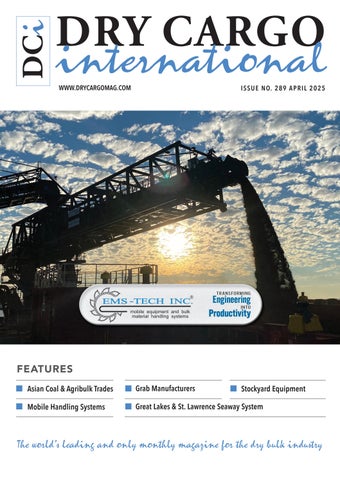
FEATURES Asian Coal & Agribulk Trades
Grab Manufacturers
Mobile Handling Systems
Great Lakes & St. Lawrence Seaway System
Stockyard Equipment
The world’s leading and only monthly magazine for the dry bulk industry
CONTENTS
DCi
Since 1988 EMS-Tech Inc. has been providing world-class bulk material handling solutions onshore and off.
EMS-Tech Inc. is comprised of specialists in engineering, design, manufacturing, and management of custom- designed bulk material handling systems. EMS-Tech’s portfolio includes stackers, stacker- reclaimers, reclaimers, shiploaders, receiving systems, vessel selfunloading and transshipment systems — Transforming Engineering into Productivity. EMS-Tech Inc. E: sales@ems-tech.net W: www.ems-tech.net
PUBLISHERS Jason Chinnock jason@dc-int.com
WWW.DRYCARGOMAG.COM
APRIL 2025 issue
Andrew Hucker-Brown
EDITORIAL Louise Dodds-Ely
Editor
louise@dc-int.com
Jay Venter
Deputy Editor
editorial@dc-int.com
Samantha Smith
Directories
directories@dc-int.com
Bernice van Wyk
Office Manager
accounts@dc-int.com
SALES Matthew Currin sales2@dc-int.com
Zack Venter sales@dc-int.com
Senior Sales Executive Advertisement Sales Executive
CORRESPONDENTS India Europe UK UK UK
Kunal Bose Barry Cross Maria Cappuccio Michael King Richard Scott
ADMINISTRATIVE OFFICE
HEAD OFFICE Trade Publishing International Limited Clover House, 24 Drury Road, Colchester, Essex CO2 7UX, UK Tel: +44 (0)1206 562552 Email: info@dc-int.com Website: www.drycargomag.com Twitter: twitter.com/drycargomag ISSN 1466-3643 Insta: www.instagram.com/drycargointernational
© Trade Publishing Int’l Ltd 2025
Grain trade weakness unfolding ASIA’S COAL IMPORTS: HURDLES EMERGING SEARCH FOR FOOD SECURITY LEADS CHINA TO DIVERSIFY ITS IMPORTS
SHIPPING & TRANSPORT
INTERCARGO responds to IMO’s decision on GHG reduction measures Steelpaint secures major 39-vessel order for Stelpant INTERCARGO welcomes ILO recognition of seafarers as key workers GRAVITYVIBE IN ACTION: REAL-WORLD VALIDATION AND SYSTEM OPTIMIZATION
PORTS, TERMINALS & LOGISTICS
Laying the groundwork for infrastructure investment in Cabo Verde Nueva Palmira had a mixed year for dry bulk in 2024 Alicante’s bulk un/loading facility now fully operational Paranaguá increases bulk storage facilities NECTAR SIERRA LEONE BULK TERMINAL: VITAL GATEWAY FOR IMPORTS AND EXPORTS
ENGINEERING & EQUIPMENT
Precision weighing solutions from Control Systems Technology Conveying Advice: Wake up and smell the rubber! GENMA domestic scraper ship-unloader: revolutionizing bulk handling operations Engineering the future of bulk material handling: EMS-Tech’s global impact STOCKYARD SYSTEMS: THE KEY TO EFFICIENT BULK HANDLING OPERATIONS COMPARING GRAPPLES AND ORANGES: GRAB MANUFACTURERS MAKING THE RIGHT MOVES WITH MOBILE BULK HANDLING EQUIPMENT
REGIONAL REPORT
SPAIN UNDER SCRUTINY: REGIONAL BULK DEVELOPMENTS GREAT LAKES & ST LAWRENCE SEAWAY SYSTEM: STRONG CANADIAN GRAIN SEASON THROUGHPUT
2 4 12 17 18 19 21 26 27 28 28 29 33 34 36 38 41 70 83
110 120
DRY CARGO
international
APRIL 2025
Trade Publishing International Ltd does not guarantee the information contained in Dry Cargo International, nor does it accept responsibility for errors or omissions or their consequences. Opinions expressed herein are not necessarily those of Trade Publishing International Ltd
TRADE & COMMODITIES
www.drycargomag.com
Business Publishing International Corporate Park, 11 Sinembe Crescent La Lucia Ridge, South Africa, 4051 Tel: +27 31 583 4360 Fax: +27 31 566 4502 Email: info@dc-int.com Twitter: twitter.com/drycargomag
featuring...
DCi
andrew@dc-int.com
DCi 1
BULK CARRIER TRADE & FLEET OUTLOOK
Grain trade weakness unfolding otential for negative influences to affect elements of commodity import demand during 2025 is evident, contrasting with signs of increases elsewhere. Estimates based on this outlook imply that world seaborne dry bulk trade growth may slacken, after growing solidly in the previous twelve months. Prospects for economic activity, in countries with a large impact on import demand for dry bulks, imply that there will not be a large improvement in 2025. An assessment published by the OECD organization in mid-March suggested that “recent activity indicators have begun to point to a softening of global growth prospects”. Changes in trade policies if sustained could contribute to restraining global growth, reducing this to below last year’s 3.2% increase in gross domestic product.
P
GRAIN & SOYA
www.drycargomag.com
Forecasts of world trade in soyabeans and soyameal trade, during the current 2024/25 trade year ending September 2025, point to a continued upwards trend, albeit decelerating after rapid expansion. The latest US Department of Agriculture calculations show a 6mt (million tonnes) or 2% increase, from 248mt in 2023/24, to 254mt, as shown by table 1. But by contrast the outlook for the bigger component of this market segment, trade in wheat plus corn and other coarse grains, is negative. USDA expect world trade in these grains to decline steeply by 47mt, a 10%
reduction, to 419mt in 2024/25. If this prediction proves accurate it will reverse the previous year’s growth. About twothirds of this decline is likely to be caused by China’s diminishing requirements, down by 33mt or almost half compared with the preceding twelve months.
COAL Global import demand for coal is overshadowed by slowing consumption trends in many countries. The International Energy Agency’s new analysis estimates that coal import demand is still growing, with a 1% increase in 2024. Conversely in the European Union, previously a major coal importer, there was a further decline in usage amid an increasing number of countries closing coal-fired power stations. Attention often focuses on the two countries comprising 50% of the world’s total seaborne coal imports, China and India. Both countries saw increases last year, and the growth was especially notable in China where enlargement has been remarkably strong since 2022. Currently there is little or no convincing evidence pointing to a slackening in Chinese buyers’ activity, but some observers doubt whether the upwards trend is likely to persist.
IRON ORE Expectations for stronger 2025 steel production in raw materials importing countries are mostly cautious. Some signs suggest that higher crude steel production may be achievable in the
European Union, while in India (a major coking coal importer) steel output could continue growing. Elsewhere flat or lower volumes are envisaged. At the end of March an analysis published by the Australian Government Department of Industry estimated global iron ore trade (including land movements but mainly seaborne) at 1,699mt in 2025, a 1% reduction compared with last year. A lower volume into China, down by 15mt or just over one percent to 1,223mt is envisaged, together with predictions of declines in Japan and South Korea.
MINOR BULKS Indications of movements in some elements of the minor bulk trades this year seem relatively bright despite obvious uncertainties. A number of elements connected with industrial (manufacturing and construction) activity, such as steel and forest products, bauxite/alumina and cement may see increases.
BULK CARRIER FLEET In the Panamax (70–99,999 deadweight tonnes) size group, including Kamsarmax vessels — comprising one quarter of the world bulk carrier fleet — expansion during 2025 may be similar to that seen in the past couple of years, exceeding 3%. Newbuilding deliveries seem likely to rise, but potentially an upturn in scrapping will offset most of the growth in new capacity, although more signs of higher recycling activity are still awaited.
TABLE 1: WORLD SOYABEANS AND SOYAMEAL IMPORTS (MILLION TONNES) European Union China Other Asia Others World total % change from previous year
2019/20 31.4 98.6 38.0 61.3 229.3 +9.1
source: US Dept of Agriculture, 11 March 2025
2020/21 31.3 99.8 38.4 62.1 231.6 +1.0
2021/22 31.0 90.4 38.2 62.0 221.6 –4.3
October/September marketing years
2022/23 29.1 104.5 36.7 61.5 231.8 +4.7
2023/24* 30.0 112.0 38.2 68.0 248.2 +7.0
2024/25* 32.2 109.1 41.6 70.8 253.7 +2.2
* forecast
APRIL 2025
TABLE 2: PANAMAX (70-99,999 DWT) BULK CARRIER FLEET (MILLION DEADWEIGHT TONNES) Newbuilding deliveries Scrapping Losses Plus/minus adjustments World fleet at end of year % change from previous year-end
2019 11.4 0.4 0.1 0.0 217.6 +5.3
2020 12.0 1.0 0.0 –0.1 228.5 +5.0
source: Clarksons (historical data) & BSA
*BSA March 2025 estimate
2021 8.6 0.7 0.0 0.1 236.5 +3.5
2022 9.8 0.8 0.0 0.1 245.7 +3.9
2023 10.9 2.3 0.0 0.0 254.2 3.5
2024* 10.0 1.5 0.0 –-0.1 262.5 3.2
DCi by Richard Scott, Bulk Shipping Analysis, Tel: +44 (0)12 7722 5784; Fax: +44 (0)12 7722 5784; e-mail: bulkshipan@aol.com
2
TRADE & COMMODITIES www.drycargomag.com APRIL 2025
DCi 4
Asia’s coal imports
hurdles emerging
Visakhapatnam port in India.
Richard Scott, Bulk Shipping Analysis Rapid expansion has been a feature of Asia’s coal imports in the past two years. Together with a weaker trend among other countries, especially in Europe, this changing pattern has resulted in the Asian region now comprising well over four-fifths of global seaborne coal imports. But most of the regional growth has been contributed by China. Currently, signs suggest that the upwards trend may be more difficult to sustain in the year or more ahead.
During 2023 and 2024 Asia’s coal imports saw a growth revival, after a flat performance in the previous period. The seaborne total rose by about 200mt (million tonnes) in the past two years, an increase of 20%. Within this increase China’s additional needs represented a large proportion, comprising over ninetenths, contrasting with limited enlargement elsewhere. For 2025, tentative indications point to lower purchases by Chinese buyers which may
not be fully offset by extra imports into other Asian countries. The region’s role as a supplier is also a prominent aspect of the world coal market. In particular Indonesia remains the number one exporter, with a total comprising over two-fifths of the world’s exports in 2024, after a 20% expansion over the past two years. Economic influences on coal imports into Asian countries have been increasingly accompanied by political ramifications.
TRADE & COMMODITIES
ASIA COAL TRADE — MAIN IMPORTERS (MILLION TONNES)
China Japan India South Korea Taiwan Other importers Total % change
2019 258 180 255 135 71 174 1,073
2020 238 168 227 117 67 188 1,005 –6.3
APRIL 2025
www.drycargomag.com
RISING ENERGY USAGE
6
2022 234 178 243 120 63 172 1,010 –1.8
2023 359 163 254 115 59 192 1,142 13.1
2024* 420 162 255 111 57 205 1,210 6.0
% change** +17.0 –0.6 +0.4 –3.5 –3.4 +6.8
* estimate ** 2024 compared with previous year source: Clarksons Research, Bulk Shipping Analysis
Government policy connected with environmental pressures and energy security has become a major driver of changes in coal purchases on the international market. Policy alterations are not always predictable either in timing or magnitude, resulting in forecasts of coal demand and imports having a large speculative element. About 80% of Asia’s coal imports consist of steam coal (or thermal) grades, with the remainder comprised of coking coal. The largest individual importing countries are China, India and Japan, while South Korea and Taiwan are also large buyers. In recent years a group of smaller south and southeast Asian importers has become more prominent.
DCi
2021 281 176 204 119 69 179 1,028 2.3
Broad trends in energy demand and how it is influenced by patterns in economic activity, affect usage of coal in Asia, and requirements for imported volumes. Coal supplies continue to be a vital support for regional progress, enabling rising energy use and economic development. Among energy sources, coal is often still accorded a high priority — frequently supplied wholly or substantially by imports — despite growing emphasis on ‘cleaner’ power sources. Meanwhile, in several larger individual economies, environmental policy is aiming to reduce coal consumption, imposing a shift towards alternative energy supplies. Economic growth rates across Asia showed a mixed pattern in 2024, with varying consequences for energy consumption. Gross domestic product growth saw contrasting changes, with some countries achieving brisk performances while others experienced more modest outcomes. According to recent (mid-March) estimates by the OECD organization, among the more vigorous performances last year was that experienced in India, where GDP grew by 6.3% compared with
the previous year. China achieved 5.0% growth, although this pace is slower than the country’s historically high expansion rates. Lower rises are estimated in other Asian coal importing countries. South Korea’s 2024 growth was 2.1%, while Japan narrowly avoided recession with a 0.1% advance. Energy consumption and more specifically coal usage by power stations, steel mills, cement manufacturers and other industries reflected the broad changes in economic activity. The general trend of economic activity, reflecting consumer, business and government spending patterns, provides indications of ongoing demand for the products of coalconsuming industries. Import demand for coal was also affected by domestic production of coal and coal stock changes in individual countries. Prospects for 2025 economic growth vary, and the outlook is overshadowed by changes in trade policies with widespread potential impacts on the pace of activity. Based on the OECD assessment, some countries are expected to slow while others gain momentum. China’s economic progress is especially consequential, with a major impact on regional as well as world growth. There is a fairly general expectation that the Chinese economy’s enlargement will slow over the next few years, including in the next twelve months, but great uncertainty surrounds both the pace and magnitude of this potential trend. The OECD’s recent report predicted a limited easing in China’s growth rate to 4.8% in 2025. The effects of changes in economic activity patterns are likely to be seen in industries in Asia, with implications for energy consumption, coal usage and imports. Yet in 2025, as seen in the recent past, two other influential factors probably will modify the coal import demand outcome. One is the shift albeit sometimes not entirely consistent away from coal in power generation in some countries,
combined with the drive in individual countries for self-sufficiency in coal supplies where this is achievable. Another is the effects of energy security becoming a bigger focus after the events of the past few years.
TRENDS IN COAL IMPORTS Asia’s coal volumes imported by sea reached a record high level in 2024, exceeding the previous year’s record level. After the preceding peak volume in 2019, seaborne imports fell during the first year of the Covid-19 pandemic in 2020 before recovering partially in the next twelve months and then weakening again in 2022. In the following year a resurgence began, a pattern shown by the Clarksons Research data shown in the table. Last year’s 68mt or 6% increase is estimated to have raised the Asian seaborne coal imports volume to around 1,210mt. Import patterns included in the table reveal that volumes into Japan, South Korea and Taiwan have been relatively stable, albeit with a tendency to decline in the past few years. By contrast China and India have experienced some fluctuations with a tendency to strengthen although India’s volume has only regained the previous peak seen several years earlier. The ‘other importers’ category — including Malaysia, Pakistan, Philippines, Thailand and Vietnam — has also resumed a growth trend, and in both 2023 and 2024 imports exceeded the previous annual peak. Steam coal grades, used mainly for electricity generation, are the dominant component, comprising an estimated 81% of Asia’s coal imports last year. Other significant consumers are cement producers and various manufacturing industries. The balance of 19% is coking coal, used in the steel industry by mills employing blast furnace technology (which also may use some steam coal) to make pig iron as the intermediate product for conversion into steel, usually in a basic oxygen furnace.
TRADE & COMMODITIES www.drycargomag.com APRIL 2025
DCi 8
Differing characteristics of individual domestic markets in Asia result in many countries using and importing both coal types, in varying proportions. An absence of domestic supplies, or domestic mines’ inability to supply sufficient quantities or qualities of the required grades, results in foreign purchases. When domestic supplies (where these occur) change from year to year, import volumes are affected, and changes may also reflect changing relationships between domestic prices and foreign supply prices. In India and China domestic coal production is extensive, satisfying a large part of the national market, while Japan, Korea and Taiwan rely solely or mostly on imported supplies. Electricity generation and steel production changes are large variables affecting coal imports flows into Asian counties, while changing output volumes of other energy consuming industries also have an impact. Another variable influence increasingly visible is alternative energy supplies — hydro-power, natural gas, renewable power from wind or solar energy, and nuclear power — contributing to electricity generation in many countries. But hydro and wind generation especially are dependent on unpredictable weather patterns that often cause substantial and unexpected changes in power output, with implications for coal and other energy imports.
LAST YEAR’S IMPORT CHANGES In 2024 coal import volume changes among
Asian buyers featured one very large increase, accompanied by a mixed pattern among other countries. Seaborne imports into China jumped by 61mt or 17% from the previous year, raising the country’s total to a record high 420mt. By contrast imports into both South Korea and Taiwan decreased by over 3%, to 111mt and 57mt respectively. Meanwhile volumes into Japan and India appear to have been almost flat at about 162mt and 255mt respectively. Other importers as a group, mainly in south and southeast Asia, saw a 7% increase to 205mt based on provisional data. Several changes affecting the vast Chinese domestic coal market explain another huge annual rise in seaborne coal imports into China (the seaborne total excludes the impact of variations in overland purchases from neighbouring Mongolia, a sizeable supplier) during 2024. Overall energy demand in China slowed sharply according to International Energy Agency calculations, to 2.9%, half the previous year’s increase, but coal supply shortages were experienced leading to additional foreign purchases. Among direct influences on coal usage, overall power consumption in China reportedly rose by 7% in 2024, providing a strong impetus for electricity generation. Renewable power supplies advanced, with wind and solar generation forming a fifth of total supplies. Production of crude steel was 2% lower at 1,005mt, a further negative influence, but support for imports was derived from marginal annual growth in
domestic coal production to reach 4.76 billion tonnes. This output proved insufficient to satisfy demand during a period when foreign supplies were available at attractive prices. During 2024 India appears to have experienced flattening coal imports, although estimates of the total vary, awaiting confirmation from official data. Major coal users and importers are the electricity generation, steel and cement industries. Output of crude steel, increasing by 6% to 150mt last year, is dependent on imported coal because high quality coking grades for this industry are not available in adequate volumes from domestic mines. Large imports remain an essential input, despite rising domestic steam coal output and rail transport capacity, amid government policy aiming to increase reliance on domestic coal producers. Japan is the third largest Asian coal buyer, and usage of this energy source is entirely dependent on imports. Energy consumption in 2024 was down marginally by 1%, reflecting the subdue trend in economic activity. A 3% decrease in crude steel production to 84mt had negative effects on coking coal use. Another adverse factor was increased nuclear power generation, amid this sector’s gradual revival based on power plant reopenings after most were closed down semipermanently well over a decade ago after the Fukushima power station disaster. Over the past few years South Korea’s
TRADE & COMMODITIES
coal imports have been lower than seen in the preceding period. Environmental improvement, especially air pollution reduction, has been prioritized by government policy that now emphasizes greenhouse gas reduction. Shifting towards cleaner alternative energy sources, including nuclear power, involves cutting dependence on coal. In Taiwan coal imports also have declined, amid the government aiming to reduce coal’s share of electricity generation. Volumes of seaborne coal imports into the ‘other importers’ group have expanded in the past two years. Steam coal imports into Malaysia, Pakistan, Philippines, Thailand and Vietnam — mainly for power generation — are a large sub-category comprising about 146mt or 70% of the entire Asian ‘other’ group’s total. Among individual countries the pattern has been mixed in recent years, with imports into Vietnam and Philippines emerging as growth markets.
APRIL 2025
www.drycargomag.com
COAL IMPORTS OUTLOOK
DCi 10
Potential for a downturn in seaborne coal imports into Asia is evident after the large expansion in 2023 and 2024. Doubts about whether China, comprising about a third of the total, will maintain its growth trend are at the forefront of the regional uncertainties. Estimates are largely speculative, while prospects for several countries including India are hard to assess, and in some cases forecasts are mostly conjectural, awaiting further clarification of the main influences. While prospects for economic activity are not implying an extra boost during 2025, energy demand trends remain buoyant in many countries and could provide support. Additional electricity demand and usage is now often satisfied by rising renewable power supplies, although in a number of countries coal-fired power stations are still contributing larger output. In individual countries specific factors are likely to be greater influences on coal consumption and imports than the broad regional trends in economic activity. Among direct drivers, with varying relevance in individual countries, is evolving commercial competition for coal from other energy sources, reflecting price and availability aspects. Also, the effects of governments’ environmental policies especially those designed to reduce carbon emissions, are prominent. In some countries, changes in domestic coal production — particularly in India and China where domestic mines supply by far the largest part of the market — affect
import volumes. Beyond the current year, an upwards trend in Asia’s coal imports seems difficult to envisage because of the restricting pressures clearly visible. Many governments across Asia are taking steps to tackle environmental problems and are shaping energy policies accordingly, which typically results in an emphasis on cutting coal consumption. Hence purely commercial influences determining coal use and imports are not always relevant. While governments’ interventions in the energy market are now a well-established pattern, these often result in greater uncertainty and unpredictability. Cutting greenhouse gas emissions over the longer term, and reducing air pollution to acceptable levels in the more immediate future, are clearly visible priorities. But the effects of changing policies envisaged as broad trends, affecting coal consumption and imports, and the precise timing, are sometimes not foreseeable. This aspect complicates analysis of the outlook for Asia’s coal markets. In both China and India, political decisions having a major actual or potential impact on coal focused attention during recent years. Together, the two buyers imported 674mt last year, well over half of the Asia regional coal imports total. While some aspects of broad government policies in these countries are widely known, the future impact of changes is difficult to predict. But it is clear that restraining influences on coal imports are evolving. Occasionally, an official target of substantially reducing or entirely eliminating coal imports into India over the next few years is repeated and emphasized. This aim may prove difficult to achieve, but gradual progress could weaken seaborne coal movements. Indications of an official ceiling on coal imports into China have not been evident recently. Nevertheless, various policy measures affecting coal consumption, domestic production and
market performance in China could be interpreted as implying reducing seaborne imports in future years.
A USEFUL FORECAST Among forecasters, cautious views of Asia’s coal imports in 2025 are evident, with a tendency to predict a somewhat lower regional volume than seen last year. Amid the uncertainties surrounding prospects in the top importing countries, this outlook is perhaps more plausible than expectations of a sustained upwards trend. Analysts at the Australian Government Department of Industry, Science and Resources published an updated forecast at the end of March this year. The calculations indicated that world coal trade may be weaker during 2025, compared with last year’s 1,515mt (including land movements but mostly seaborne trade). Asia’s overall coal imports are not specified, although a forecast for the region’s steam coal imports (about four-fifths of the area’s total) indicates a 45mt or 4% decrease from 1,020mt in 2024, to 975mt. The main change envisaged by the forecasters, within this Asian regional steam coal imports volume, is a reduction of 46mt or 11% in China’s 2025 quantity to 375mt. Among other countries in total a net marginal increase of one million tonnes is expected to be a partial offset this year, despite lower volumes in several countries including India (down by 3% to 168mt), Japan and South Korea. Reduced activity during 2025 at some ports in Asia where coal is discharged is one possible consequence of changes in import volumes envisaged, contrasting with additional activity in other ports. As seen in the past couple of years however, forecasts of coal trade contraction have not proved accurate. This feature emphasizes the uncertain impact of influences affecting import demand in many Asian countries, resulting forecasts for which tend to be somewhat speculative. DCi
ideegrafik.de
The ultimate coombination for uncompromised safety in port operatioon
Brakes, Coupl oupllings and a Componennts
SIBRE Siegerland Bremsenn GmbH Auf der Stücke 1 - 5 35708 Haiger - (Ge (Germany) info@sibre.de | www.sibre.de
TRADE & COMMODITIES
Shipping soybeans.
Search for food security
leads China to diversify its imports
Kunal Bose resident Donald Trump’s tariff war on agricultural produce against China is proving hurtful for US growers from soybean to wheat to cotton. The Trump move will also reinforce Beijing resolve to further reduce dependence on farm products imports from the US in favour of bigger purchases from South American countries.
APRIL 2025
www.drycargomag.com
P
DCi 12
President Donald Trump in his pursuit of making America great again (MAGA) has launched a fusillade of indefensible tariff measures upsetting the multilateral trading system. While this Trump campaign will prove hurtful for countries across the board — allies and those perceived as not friendly — the revised tariff has enhanced further the resolve of China to achieve food security whatever the cost, progressively reduce dependence on imports of agricultural products and diversify sources of imports, meaning actually buying less and less from the US. The aggressive pursuit of these goals will perforce negatively impact the US farm
sector, for China is a significant buyer of a number of agricultural products from soybean to coarse grains, excluding corn, to cotton to tree nuts. China is also a major market for the US origin beef, pork and dairy products. When in February the Trump administration notified that, starting 4 March, all Chinese goods would invite doubling of tariff to 20%, a reciprocal response from Beijing was on the cards. But instead of subjecting all imports from the US to an additional tariff of 10% or 15%, Beijing carefully chose those agricultural and horticultural products for extra impost to inflict maximum pain on the Midwestern soybean-corn-wheat growing states and also the cotton belt in southern US. As the tariff revision on aluminium and steel products will lead to price increases of all products made of these metals, therefore, causing distress to consumers, US growers and traders will bear the brunt of the quick and clever Chinese answer to
the US extra tariff burden. For commerce between two countries to prosper, stability in tariff is essential. In the case of agri trade between the US and China, the world’s two leading economies, political tensions and tariff uncertainties led to shrinkage in Chinese imports of US agricultural products in 2023 and 2024. Last year, Chinese imports of US farm items were down 14% to $27.29bn following a bigger drop of 20% in 2023. The principal Chinese imports from the US in 2024 were: soybeans worth $12.76bn, beef $1.58bn, cotton $1.48bn, and other coarse grains $1.26bn, pork $1.11bn, seafood $1.02bn, dairy items $584m, poultry meat $490.1m, wheat $556.9m and corn $327.9m. Not only did imports from the US fell last year, but the total value of China’s farm imports dropped 8% to $215bn. Even while Beijing remains committed to developing alternative sources of supplies of farm products away from the US and succeeding, still nearly half of
To reduce its dependence on soybean imports, China is looking at alternatives, including rapeseed.
TRADE & COMMODITIES
American soybean exports are shipped to China. Such exports, according to the US Census Bureau, totalled nearly $12.8bn in 2024. As Chinese soybean imports from the US were down 5.7% last year, the compensatory imports came from Brazil and Argentina. China’s General Administration of Customs says while total soybean shipments from the US fell to 22.13mt (million tonnes), arrivals from Brazil were up 6.7% to 74.65mt. For strategic reasons and benefits to be derived from a diversified supply sources, Beijing has so far enabled Brazil to raise its share of Chinese soybean imports to 71%. At the same time, the US share has shrunk to 21%. Argentina too is making good progress in the Chinese market where it more than doubled supply of soybean from 1.95mt in 2023 to over 4mt last year. Of the major farm items where Beijing has a lot of work to do, soybean remains at the top. The reason for this is that China is an importer of nearly 80% of the soybeans it consumes. Beijing’s strategy for this oilseed is twofold: first, expand the coverage of “full cost and production income insurance” for soybeans, which will encourage farmers to grow the oilseed. Second, steps will be taken to bring down
the use of soybean meal in livestock feed. Instead, China will stay engaged in the use of low-protein animal feed or alternative meals such as rapeseed and cotton. While it makes sense for China to vigorously pursue expansion of oilseeds cultivation since the country remains highly dependent on edible oils imports — foreign origin oils imports during 2022-23 and 2023/24 were 8.63mt and 8.43mt, respectively — Beijing continues to see positive outcome of pursuing the policy of food security, backed by grain stockpiling. One reason for the country making heavy imports of grain on a continuing basis is to
keep the grains buffer sufficiently large. The practice of buying grains in the world market for the purpose of domestic stockpiling has, however, drawn criticism from NGOs and social activists but with no effect on China. Many believe that Chinese big imports of some grains are keeping their world prices high. In 2024, China's total grain output reached a record high of 706.5mt, an increase of 1.6% compared to 2023, marking it the tenth consecutive year with a harvest exceeding 650mt. (Incidentally 650mt happened to be the production target for last year.) Remember, when it
Contact us for more details! info@kiepe-elektrik.com +49 211 7497-637
KIEPE – Quick Clamp System Simple, Safe and Fast Pull-Rope-Installation on Pull Rope E-Stop Switches
Optimized Installation-Components Save procurement time and reduce inventory Main Components from Stainless Sustainable, durable and re-usable
Keep a Good Thing Moving
Spring-Indicator Helps to set the right pull rope tensioning for a safe use 1-Person-Installation Reduces the efforts and optimize the installation processes 50% Time Savings Compared to conventional assembly methods
TRADE & COMMODITIES www.drycargomag.com APRIL 2025
DCi 14
One reason for China country making heavy imports of grain on a continuing basis is to keep the grains buffer sufficiently large.
comes to Chinese agriculture, production target is a bottom line goal, not ambitious in any way. Commenting on China’s new grain production record, Indian farm economy expert Om Prakash Dhanuka says, it is the “result of expanded acreage, use of technology and quality inputs and yield improvement.” Encouraged by sustained grain production rises, Beijing has raised the 2025 output target by 50mt to 700mt, though this happens to be 6.5mt less than last year’s production. In this context, China’s National Development and Reform Commission says: “With the implementation of the food crop production strategy of improving farmland management and increasing the application of technology as well as the improvement of our ability to guarantee food security, we have the foundation and support necessary to attain the goal.” China’s 2030 grain production target is 745mt, which looks achievable considering the present rate of progress in farm management. The challenge for both China and India, which have the world’s largest number of mouths to feed, is to ensure that further land degradation does not happen and the barren land is progressively recovered for farming. The two countries in their own ways remain engaged in the task even while
Om Prakash Dhanuka.
China has an edge over its neighbour in wasteland recovery. Beijing continues to invest heavily in restoring barren and degraded land for farming, primarily through programmes like the “grain for green” involving financial rewards for farmers to plant trees. Such initiatives results in significant improvements in soil health. Whatever that is, bringing new land for agricultural use is a slow process as urbanization, infrastructure development and building of industries will continue to lay claim on land. Like in India where fragmentation of farm land ownership has left per capita ownership to a meagre 0.74 hectares,
China too is beset with an identical problem. But as Dhanuka points out, Beijing is having success in consolidating fragmented plots by incentivizing farmers to join cooperatives. “The resulting bigger units under cooperatives is allowing largescale farming backed by use of modern technology. Large plots facilitating modernization of agriculture has led to productivity improvement,” says Dhanuka. China being a communist country, whatever be the wish of the party is the law and farmers or otherwise will fall in line. On the other hand, the small farm landholders in India, a functioning democracy cannot be forced to pledge their land to cooperatives, whatever the merits. During 2024/25 marketing year (MY), there was a marginal increase of 0.3% or 351,000 hectares in Chinese all grains land coverage to 119.3m hectares of which the share of rice was 29m hectares, wheat 23.6m hectares and corn 44.7m hectares. This — coupled with improvement in yield, resulting from better farm practices and technology inputs — found China harvesting 207.5mt of rice, 140.1mt of wheat and 294.9mt of corn. At the same time, overshadowing a 2% rise in corn production aided by increased planting of
Cleveland Cascades Ltd Global leader in bespoke dry bulk loading chutes
Ship Loaders
Silo Loaders
Truck Loaders
Cleveland Cascades are Specialists in the design and manufacture of bespoke dry bulk loading chutes. Our bespoke solutions are designed to meet each customer’s specific requirements from a tool kit of proven components, utilising the expertise of a team of specialist in house design engineers.
Tanker Loaders
We lead the loading chute industry & set the standard for dust emissions and environmental pollution control in dry bulk handling. Our worldwide reputation is built on high quality, well-engineered, robust, high performance chutes, backed up by excellent customer service and global lifetime product support.
Contact Cleveland Cascades Ltd Unit 22, Dukesway, Teesside Industrial Estate, Thornaby, Stockton-on-Tees, Cleveland, TS17 9LT, United Kingdom Tel: +44 1642 753260 | Fax: +44 1642 753270 E-mail: enquiries@clevelandcascades.co.uk | Website: www.clevelandcascades.co.uk
TRADE & COMMODITIES www.drycargomag.com APRIL 2025
DCi 16
high-yield varieties, growers have to contend with toxin contamination. In view of bumper production depressing corn prices, imports were restricted to around 14mt to give relief to farmers. Here too, Beijing, in pursuit of the policy to diversify sources of import, is buying larger quantities of corn of South American origin. Expectedly because of the combination of high internal production and weak demand, Chinese wheat imports are likely to fall by 37% to 8mt. MY 2024/25, however, saw rises in rice imports with purchases mostly made in Thailand and the balance originating in Myanmar, Pakistan and Vietnam. Relaxation of export restrictions by India led to improved buying by China. In the meantime, the US department of agriculture (USDA) says in view of falling global rice prices it has revised its 2025 forecast for Chinese rice imports upward by 200,000 tonnes to 2.2mt. According to a recent Food & Agriculture Organization (FAO) report, China’s total cereal import requirements for MY 2024/25 are forecast at a wellbelow average level of 37.5mt in an indication of ample carryover stocks following large imports in MY 2023/24 and record cereal harvest in 2024. Incidentally, China is the world’s largest importer of cereals and its buy orders of wheat or corn leave an impact on global prices. Dhanuka says, China’s food security law that came into effect in June 2024 is designed to ensure supply of grain and related products to the masses through a raft of initiatives, including farmland protection, limiting land conversion and supporting farmers’ income. He believes developing Asian countries seeking food security will do well to adapt a similar law, albeit making provision for local condition. To ensure that farmers are rewarded with prices for wheat and rice covering production cost plus a fair return, Beijing has in operation minimum support prices (MSP) for the two grains. MSP underpins food security by providing for government procurement and storing of grain. Take the case of wheat whose wholesale prices recorded a steady declining trend through 2024. This was due to excess market availability from the above average harvest last year and also large imports in MY 2023-24. Prices in 2025 first quarter remained stable but at levels 15% lower year-on-year. State interventions in the form of buying wheat were required in some regions following prices of the grain falling below MSP. A guaranteed price and state procurement are good for farmers. Equally important is the way MSP for a
Basmati rice crop. season is decided providing enough incentive in the price prompting farmers to put their best foot forward in the season ahead. Like China India too operates MSP, but its crop coverage is much bigger. For 2025, New Delhi will have MSP for 22 agricultural crops and also two commercial crops raw jute and copra. All this besides, India has in operation fair and remunerative price for sugarcane. Incidentally, India is the world’s largest consumer of sugar and its secondbiggest producer after Brazil. But Indian farmers are still in protest seeking legal guarantee for MSP, pension for farmers and farm labourers, no hike in tariff for electricity required for pumping irrigation water and redemption of prime minister’s promise of doubling income of farmers. The order of demands is something that the government finds it difficult to fulfil. Good rains are what both China and India need for a good harvest sparing them shortages and inflationary pressure on farm products. This is in spite of both the countries having made substantial investment in irrigation facilities. While 50% of China’s arable land has irrigation, in India 73m hectares amounting to 52% of gross sown area is irrigated. The occurrence of an above normal monsoon (June to September) is helping India to achieve record production of rice, wheat and maize during the 2024/25 crop year (July to June), foodgrain production target being 341.55mt. New Delhi claims that the continuous improvement in farm production is due to “raising application of high-yielding varieties, intercropping, crop diversification, better agricultural practices and securing
more and more land for cultivation.” Whether it is wheat, rice or sugar, India’s priority is to meet the rising local demand and keep domestic prices at a reasonable level. Exports, therefore, are always linked to surpluses. For example, New Delhi put a ban on wheat exports in May 2022 due to supply concerns and spike in prices raising concern of food security. Some government to government trade is, however, allowed. India lifted the ban on non-basmati white rice exports in September 2024, after previously banning them in July 2023, and also removed the minimum export price (MEP) of $490 per tonne. At the same time, New Delhi reduced the export duty on parboiled rice to 10% from 20%. Export outlook for nonBasmati white and parboiled rice improved following the liberalizing actions. The rice export ban happened to overcome domestic supply constraints and rein in prices. India is the world’s largest seller of Basmati and white rice, its annual shipments being around 18mt. Besides India, the other significant exporters of rice in Asia are Thailand, Vietnam, Pakistan, Myanmar and Cambodia. Helped by increased water availability giving a boost to productivity, the Thai rice production in MY 2024/25 will be marginally ahead of the year before at 20.1mt. The country’s rice exports last year reached a six-year high of 9.95mt, marking a 13% increase over 2023-24. Dhanuka says: “A strong brand recognition of its famed jasmine rice in the world market, care for quality, government support for exports and efficient supply chain management have helped Thailand to export half the production of rice.” DCi
ABOUT INTERCARGO
achieve decarbonization goals for international shipping as the global regulator. The industry needs global solutions that are transparent and simple to administer, especially for the small and medium-sized companies that form its backbone, rather than fragmented regional measures. Nevertheless, INTERCARGO welcomes the progress made by Member States in reaching a decision at IMO. As the voice of the dry bulk shipping sector — the largest by number of vessels and deadweight tonnage, with bulk carriers serving as the backbone of international tramp shipping — INTERCARGO remains committed to supporting the IMO’s efforts toward a just and effective energy transition.
International shipping is vital for the global economy and prosperity as it transports approximately 90% of world trade. The dry bulk sector is the largest shipping sector in terms of number of ships and deadweight. Dry bulk carriers account for 43% of the world fleet (in tonnage) and carry an estimated 55% of the global transport work. The International Association of Dry Cargo Shipowners (INTERCARGO) unites and promotes quality dry bulk shipping, bringing together more than 260 forward thinking companies from 30 countries. INTERCARGO convened for the first time in 1980 in London and has been participating with consultative status at the IMO since 1993. INTERCARGO provides the forum where dry bulk shipowners, managers and operators are informed about, discuss, and share concerns on key topics and regulatory challenges, especially in relation to safety, security, the environment, and operational excellence. The Association promotes its members’ positions to IMO, as well as to other shipping and international industry fora, having free and fair competition as a principle.
SHIPPING & TRANSPORT
At the landmark MEPC 83 (Marine Environment Protection Committee, 83rd session) meeting in early April, the International Maritime Organization (IMO) Member States assumed responsibility and agreed on a medium-term greenhouse gas reduction measure that differs from the levy-based approach INTERCARGO and industry partners have advocated for many years. INTERCARGO Secretary General, Kostas Gkonis commented,“INTERCARGO is concerned about the complexity of the measure taken forward by IMO, disregarding calls for a simple, practical and therefore predictable, enforceable, and effective approach.” He continued, “Despite these challenges, our Association remains committed to supporting the IMO process and its implementation. We will make every effort to help the industry progress toward the fair and practical transition required for international shipping and the dry bulk sector.” INTERCARGO will continue providing constructive input to IMO as this work progresses, aligned with IMO’s ambition to
NEWS
INTERCARGO responds to IMO’s decision on GHG reduction measures
NEWS SHIPPING & TRANSPORT www.drycargomag.com APRIL 2025
DCi 18
Steelpaint secures major 39-vessel order for Stelpant corrosion protection system Frequent impact from German coatings firm Steelpaint premium, coatings that reduce time grabs and bulldozers GmbH has secured a major order in the yard while enhancing causes significant wear to supply its specialist Stelpant structural longevity are becoming to and damage to system for application to 20 dry critical to competitive fleet conventional coatings. bulk vessels operated by one of the management.” world’s largest shipping companies. Developed in the early 1980s, An additional 19 bulkers are Stelpant is the result of decades scheduled for application next year. long research into zinc-rich The Singapore-based shipping polyurethane coatings designed for group, which manages a fleet of extreme environments. large bulkers totalling 16 million Unlike conventional epoxy dwt, has worked with Steelpaint for systems, Stelpant combines high over a decade. After initial success mechanical resilience with cathodic on a couple of vessels, the corrosion protection, making it A Stelpant corrosion protection system being especially suited for steel surfaces shipowner opted to apply the applied to the cargo hold of a bulk carrier. subject to heavy impact, abrasion, coating to 39 ships as part of a broad fleet maintenance initiative and prolonged moisture exposure. focused on steel preservation, Its unique formulation allows for reduced downtime, and operational flexible reapplication without full efficiency. system removal, enabling efficient Previous applications found that touch-ups during regular Stelpant outperformed convenmaintenance cycles. tional coatings, which were quickly First adopted in heavy civil damaged following high mechanical engineering projects such as sluice stress, resulting in frequent steel gates and sheet piles, Stelpant has replacement and recoating. gained growing recognition in the Independent testing and shipping industry over the past shipowner calculations estimate A Stelpant coated hold after decade for its performance in cargo that the Stelpant system can extend 20 months of operation. holds and ballast tanks, where maintenance intervals to 2.5 years conventional coatings often fail between drydockings, significantly prematurely. reducing the need for steel The bulk carriers included in the renewal. coatings order operate on major Dmitry Gromilin, Steel paint’s Asia–Pacific trade routes, moving Chief Technical Supervisor, said: iron ore and other minerals “Compared to competing systems, between Australia, New Zealand, trials under extreme mechanical and key markets in China and stress showed that Stelpant Southeast Asia. Four vessels have retained a protective film on highhad already completed coatings wear, high-impact areas after more work with three currently in than 17 months in service. For progress. operators, this can substantially reduce steel replacement in cargo holds, In each case, two 100m2 layers of the ABOUT STEELPAINT GMBH saving an estimated $4.5 million in lifecycle single component, zinc-rich polyurethane For more than 40 years, Steelpaint has savings per vessel.” coating will be applied — between 7,000m2 enhanced the life and durability of heavyVessels ranging from 70,000 to to 11,000m2 of paint per vessel. industry facilities, particularly in the 200,000dwt will undergo coatings work at The holds of six vessels have already maritime sectors. Thanks to onethree Chinese shipyards: Youlian been coated, with Steelpaint working component polyurethane resins, the (Zhoushan) shipyard, Youlian (Shekou) closely with local partners and shipyards to Germany-headquartered company’s special shipyard, and Qingdao Beihai shipyard. ensure the quality of surface preparation high-tech coatings have raised the SteelPaint Ltd (China) will supervise the and application processes. technological bar in corrosion resistance, application process. Steelpaint Director Frank Müller said offering impressive benefits over Li Yinlong, General Manager of the order marks a “significant expansion of conventional epoxy coatings solutions. Steelpaint Ltd (China) said: “Application our partnership with this owner”. He Steelpaint is a subsidiary of the coatings areas will focus primarily on tank tops and furthered that coatings renewal company Emil Harrasser, founded in lower hopper regions, where frequent programmes of this size are indicative of a Kitzingen, Germany in 1890. Its products impact from grabs and bulldozers can cause shifting industry mindset that prioritizes are used widely in port and offshore significant wear and damage to lifecycle efficiency and performance over facilities, sheet pilings, internal and external conventional coatings.” It is anticipated initial material costs. linings, tanks, bridges, and ship structures. Stelpant will also be applied to hatch “With demand for dry bulk tonnage They can be used in combination with coamings and inner bottom plating. remaining strong, and drydock space at a cathodic protection.
NEWS
A MILESTONE IN ADVANCING MARITIME LABOUR RIGHTS
SHIPPING & TRANSPORT
The International Association of Dry Cargo Shipowners (INTERCARGO) welcomes the recent decision at the International Labour Organization (ILO) to officially recognize seafarers as key workers under the Maritime Labour Convention (MLC). This long-anticipated outcome represents a significant step in ensuring fair treatment, safeguarding seafarers’ rights, and strengthening their access to medical care, mobility, and legal protections. “This recognition of seafarers as key workers by the ILO is both symbolic and substantive — a major win for the maritime community and a direct response to the urgent calls we and others made throughout the COVID-19 crisis,” said John Xylas, Chairman of INTERCARGO. “It is an acknowledgment of the essential role played by seafarers in global trade and the sacrifices they make daily. It is also a reminder that governments must now act to implement and enforce these changes at national level.” Throughout the pandemic, INTERCARGO was vocal in urging states and the IMO to treat seafarers as essential workers, demanding safe crew changes, prioritized vaccinations, and international collaboration. That experience has only deepened the sector’s resolve to prevent the recurrence of such hardship. INTERCARGO also welcomes the new reference within the MLC to guidelines on the fair treatment of seafarers in cases of detention, investigation, or criminalization. For too long, seafarers have faced uncertain legal protections in difficult circumstances. “Seafarers must never become collateral victims of institutional inefficiencies or regulatory gaps,” said Xylas. “We urge all ILO member states and maritime administrations to follow through with effective, uniform implementation. Recognition is not enough — rights must be protected in practice.” INTERCARGO continues to promote a responsible and respected maritime industry that offers safe, rewarding, and sustainable careers. With seafarer recruitment and retention under pressure, especially in the dry bulk sector — the largest in shipping — a global framework that supports dignity and decent working conditions is more important than ever. “We must guarantee a fair future for our seafarers,” concluded Xylas. “They deserve no less.”
ABOUT INTERCARGO International shipping is vital for the global economy and prosperity as it transports approximately 90% of world trade. The dry bulk sector is the largest shipping sector in terms of number of ships and deadweight. Dry bulk carriers account for 43% of the world fleet (in tonnage) and carry an estimated 55% of the global transport work. The International Association of Dry Cargo Shipowners (INTERCARGO) unites and promotes quality dry bulk shipping, bringing together more than 260 forward thinking companies from 30 countries. INTERCARGO convened for the first time in 1980 in London and has been participating with consultative status at the International Maritime Organization (IMO) since 1993. INTERCARGO provides the forum where dry bulk shipowners, managers and operators are informed about, discuss, and share concerns on key topics and regulatory challenges, especially in relation to safety, security, the environment, and operational excellence. The Association promotes its members’ positions to IMO, as well as to other shipping and international industry fora, having free and fair competition as a principle.
DSM Shipbrokers Floating bulk handling cranes
John Xylas, Chairman of INTERCARGO.
• •
floating bulk handling cranes new floating lemniscate cranes
Lemniscate cranes for bulk transshipments new and used. High output at low costs, built for proven long lifecycle and 24/7/365 operations.
NETHERLANDS
WWW.SHIPTRADE.NL
NEWS SHIPPING & TRANSPORT www.drycargomag.com APRIL 2025
DCi 20
New study confirms barnacle biofouling as big burden for the shipping industry Nearly one-fifth of a sample group comprising 685 vessels inspected in dry dock were found to have more than 20% of their underwater hull surface covered by barnacles, and as much as one-third of the sample had more than 10% coverage, a new study has found. High levels of barnacle biofouling on underwater hulls across the global shipping fleet can significantly drag down decarbonization efforts and increase fuel costs. The reality of barnacle biofouling burden on the global shipping fleet has been determined with findings from extensive analysis of hull condition across a large group of ships, of varying type and age, confirming that the presence of barnacle biofouling is extremely common. A new research study titled, ‘How much could barnacles limit shipping’s decarbonisation?’ published by I-Tech, developers of the barnacle repelling antifouling technology, Selektope, details how over one third of vessels in a 685sample group sailed into dry dock with barnacles covering more than 10% of their hull surface. More alarmingly, more than one fifth of vessels inspected in the sample group were found to have over 20% of their underwater hull surface covered with barnacle biofouling; whereas only 140 vessels inspected had the optimal condition of less than 0.1% barnacle biofouling coverage. The extensive data analysis that sits at the core of the new research study was conducted by an independent marine coatings consultancy group based on data collected from 685 vessel hull condition inspections undertaken between 2015–2025 on the majority of vessel types, with a range of trading activity levels. While this sample group is relatively small in comparison to the 55,000 merchant ships trading internationally, the high prevalence of barnacle biofouling found on this sample group of vessels gives indicative insight that should be of great concern to the industry considering the immense negative impact barnacle biofouling has on increasing vessel emissions. Barnacle biofouling was found on all vessel types however; it was present on tankers more than other ship types. For example, almost 90% of tankers were found to have barnacle biofouling present on their underwater hull with varying intensity, compared to around 70% of pure car carriers and container ships inspected.
It was also clear that lower activity vessels are at greater risk and barnacle biofouling is more prevalent on the flat bottom area compared to vertical sides or boottop hull areas. Variations in barnacle biofouling between vessel types can be attributable to a certain degree to different root causes; different paint systems, speed, activity and route. However, the presence of more than 10% barnacle biofouling coverage can result in significant added resistance, with 36% more shaft power required to maintain the same speed through water. This has a significant negative impact on a vessel’s fuel use and subsequent emissions to air. Extrapolating from published data taken from a 2011 study by Michael P. Schultz1, this level of hard biofouling could be responsible for at least 110 million tonnes of excess carbon emissions per year, and an additional US $15 billion spend for the global commercial fleet. The true figure is likely to be higher, as this is a conservative calculation based on today’s low sulphur fuel oil prices and only assumes a 10% coverage of hard biofouling. Therefore, the significant extent of hard fouling found across this sample of group of 685 vessels in the research study demonstrates the magnitude of unnecessary demand being placed on engines because of barnacle biofouling, increasing fuel consumption and emissions, and exacerbating speed losses due to increased hydrodynamic drag. Dr Markus Hoffmann, Technical Director at I-Tech says: “The findings that more than one fifth of vessels in this study had more than 20% barnacle biofouling is concerning. This reinforces the fact that antifouling coating systems with good static performance, boosted by the presence of biocides that target hard fouling, even under extended static conditions, are an
absolute necessity if barnacle fouling is to be reduced to much lower levels on a global fleet scale. “Data analysis on a sample group of vessels using coatings containing Selektope, conducted by the independent coatings consultants, showed that, in the majority, no barnacle biofouling was present. This confirms that good barnacle fouling protection is always worth the investment, not least because these organisms can really drag a vessel’s Carbon Intensity indicator (CII) down and thrust greenhouse gas (GHG) emissions up,” concludes Dr Hoffmann. From the conclusions drawn in the ‘How much could barnacles limit shipping´s decarbonisation?’ research study, I-Tech’s advice for ship owners and/or operators includes using careful consideration of hard biofouling protection components during antifouling coating selection process. Ensuring adequate hard biofouling protection, for all vessels, but particularly those at risk of longer idling periods while in-service, is essential for the adequate protection of the global shipping fleet from barnacle biofouling.
ABOUT I-TECH AB I-Tech is a biotechnology company that has developed the antifouling technology Selektope®, an active substance that prevents barnacle attachment on submerged surfaces such as ships and boat hulls. By increasing the anti-barnacle performance in marine paint systems (e.g. antifouling coatings), fuel and maintenance costs are reduced and vessel energy efficiency improved. I-Tech has obtained the necessary regulatory approvals for Selektope® and has several of the world’s largest manufacturers of marine antifouling coatings as customers.
real-world validation and system optimization
the impact of the system’s vibrations and how to minimize their transfer into the vessel’s hull structure. The company worked with leading international subsuppliers, and separately with the KTH Royal Institute of Technology in Sweden, to conduct thorough vibration and sound analyses. In both studies, vibration and sound readings were comfortably within the class-defined threshold.
PUTTING THEORY INTO PRACTICE MacGregor is now engaged in efforts to validate the system’s performance in practical analyses using a full-scale test rig in China. Already, the company has confirmed the findings of TUNRA, its subsuppliers, and KTH: GravityVibe efficiently discharges wood chip, manufacturing sand, and gravel, while both vibration and sound levels fall far below the upper limits
APRIL 2025
The pioneering solution is the result of extensive research and development (R&D) that draws on MacGregor’s decades-long experience in self-unloader design and comprehensive knowledge of material characteristics. Its benefits have also been recognized by renowned thirdparty specialists in materials handling. In upholding its commitment to quality and reliability, MacGregor has collaborated with various international institutions and organizations to verify GravityVibe’s feasibility in theoretical studies. In a simulation based on a theoretical model of the system, TUNRA — a wholly owned subsidiary of the University of Newcastle, Australia — found that GravityVibe functioned effectively with the three materials tested: wood chip, manufacturing sand, and gravel. MacGregor later sought to ascertain
www.drycargomag.com
Following extensive theoretical studies to verify GravityVibe’s feasibility, MacGregor is now engaged in the real-world validation and optimization of its pioneering selfunloading system based on in-house testing and customer feedback Evidence that verifies the advantages of GravityVibe has been accumulating quickly since MacGregor introduced the augmented gravity self-unloading system to market in February 2024. Developed to allow bulk carriers to deliver a wider variety of cargo in greater volume, GravityVibe eases the discharge of coarse materials from cargo holds. In contrast with a standard gravity selfunloading configuration, where slope angles range from 35–60° depending on the material, MacGregor’s system can discharge various cargo types with slope angles of just 15–20°.
SHIPPING & TRANSPORT
GravityVibe in action
DCi 21
SHIPPING & TRANSPORT
stipulated by class. Building on these encouraging results, MacGregor continues to validate GravityVibe’s performance in real-world tests. According to Mikael Hägglund, Sales Manager for General Cargo, the company has turned its attention to optimizing the system based on data gathered from the test facility. “All the materials we have tested have flowed without any issues, so we know GravityVibe works, which is the first and most important step,” he says. “As our approach to R&D emphasizes continuous improvement, we are now working to finetune the system’s performance by adjusting its parameters for even more efficient and reliable cargo discharge.”
CUSTOMER-CENTRIC DEVELOPMENT While theoretical studies and extensive inhouse testing are crucial aspects of MacGregor’s R&D process, the company also places great importance on customer demonstrations and feedback. “By discussing GravityVibe with our customers, showing them its functionality and inviting their input, we gain a deeper understanding of what matters most to their operations,” comments Tomas Wallin, Senior Product Owner, MacGregor. “Customer consultation plays an invaluable role in a product’s validation and optimization while nurturing confidence among our target audience. It therefore helps us to prepare our systems for a successful market launch.”
AUTOMATION AND MACHINE LEARNING
APRIL 2025
www.drycargomag.com
Involving customers in the testing phase also enables MacGregor to establish parameters for the programmable logic controller and software on board the
DCi 22
vessel, ensuring that GravityVibe executes the complete unloading process as smoothly and intelligently as possible. Ultimately, MacGregor’s objective is to enable the fully automated discharge of all kinds of bulk cargo. Critical to this aim is GravityVibe’s selfoptimization functionality. Extracting data from built-in sensors, the system ‘learns’ the characteristics of each material and adjusts its vibration frequency accordingly, achieving optimal flow regardless of the cargo being unloaded and without the
need for human intervention. As a result, the operator avoids overworking the system, which in turn minimizes energy consumption as well as operating and maintenance costs. In the coming months, MacGregor intends to validate GravityVibe’s performance with a wider range of materials to identify any operational limitations, making technical adjustments and functional improvements as needed ahead of the system’s imminent market launch. DCi
ASL eyes UK market — and responds to logistical challenges of increased lithium demand
LITHIUM DEMAND INCREASES
essential to maintain the integrity and quality of lithium for use in highperformance batteries.” ASL specializes in the safe, compliant movement of sensitive cargo across borders.
ASL APPOINTED BY MOONBOUND MINING FOR LONG-TERM LITHIUM LOGISTICS PROJECT IN SOUTH AFRICA In mid-2024, Moonbound Mining Ltd. appointed Adhira Shipping and Logistics
APRIL 2025
The development of new lithium mines in Africa to meet soaring demand also poses many logistical challenges, according to Capt. Pappu Sastry, CEO of Adhira Shipping & Logistics (ASL). “Global inventory levels of lithium are falling in 2025 and have triggered the opening of junior mines across the world, including Africa, to meet expected demand to produce batteries for electric vehicles
and grid storage,” said Capt. Sastry. He warns that mining companies must partner with experienced logistics providers to ensure this valuable commodity is shipped safely and securely from mine to market. “Mining companies must work closely with logistics experts who understand hazardous materials, ensuring lithium is transported efficiently and securely from the mines to processing facilities and manufacturers. This co-ordination is
www.drycargomag.com
LOGISTICS CHALLENGE WARNING AS
SHIPPING & TRANSPORT
Exciting times for Adhira Shipping & Logistics
DCi 23
SHIPPING & TRANSPORT www.drycargomag.com APRIL 2025
DCi 24
(ASL) as its logistics contractor for the Norrabees Lithium Project in South Africa on a ten-year contract. ASL will deliver a wide range of logistics services to Moonbound including transportation of high-grade lithium ore from the mine to the processing plant, bagging, transportation to warehouse, storage, weighing, container stuffing, export and ocean freight services. “We are delighted to have secured a long-term contract with Moonbound Mining to provide logistics services and management at the Norrabees Lithium Project. Our 15 years of working in the African mining sector means our unparalleled experience and expertise can provide efficient, cost effective and sustainable solutions to our customers,” said Capt. Pappu Sastry, CEO of ASL. Moonbound Mining Ltd is a mineral exploration company that is publicly-traded on the Canadian Securities Exchange (CSE). Capt. Sastry has led projects in some of the world’s most challenging environments while developing sustainable logistics operations. “We work with clients who share our vision of developing sustainable mining logistics solutions, that minimize environmental degradation, while enriching the communities that live close to the mines.” ASL has identified many areas where the mining sector can improve safety, efficiency and costs through integrated logistics management reducing waste and optimizing resources. Moonbound Mining Ltd, announced it is currently focused on developing its processing flow sheet by engaging industry experts in South Africa, made easier by the delivery of plant and machinery to process the existing stockpile of high-grade lithium ore, with early-stage production ramp-up during the summer months on 2024. In parallel, the company plans to launch a robust and comprehensive exploration programme targeting the 51 known mineralized pegmatite targets within its exploration licenses. ABOUT ASL Adhira Shipping and Logistics, specializes in providing customized solutions tailored to each client’s unique needs. The global team of expert professionals is committed to understanding the specific logistics requirements of each project and delivering a bespoke solution. Adhira Shipping and Logistics (ASL) has been a key player in managing logistics projects across Africa that were considered challenging. Its
solutions are comprehensive, and cover pit to port and port to buyer, thereby delivering competitive edge to African Shippers. The solutions are built around seamless logistics management and freight solutions.
INTERVIEW WITH CAPT. PAPPU SASTRY, CEO OF ADHIRA SHIPPING AND LOGISTICS
Adhira Shipping and Logistics delivers its customers’ logistics needs with professionalism, efficiency, and attention to detail. Capt. Sastry’s innovative solutions to traditional shipping issues have earned him recognition in several sectors and led him to become the only CCEO in Shipping, a certification awarded after extensive involvement with the CEO Institute in Australia. Capt. Sastry sits on the board of several publicly listed entities and serves on the advisory boards of mining companies and private equity funds. He is also an ardent speaker at various shipping and nonshipping conferences, addressing topics ranging from commodities and trade to Africa and critical minerals. In this insightful interview, he shares his career path, visions for the company, innovative ideas for the industry, and valuable suggestions for aspiring professionals in his field. Question: Capt. Sastry, how did you get started, and what led you to where you are today? Answer: “I did my schooling in Chennai, and after that, I had to choose between engineering and doing something completely different. I had a friend’s father who was the Chief Engineer on a ship, and I was very amazed by what he was doing. I
got into electronics engineering in Chennai, but I still wanted to do something else. Somehow, I managed to get an interview with a shipping company, and then I went on board ships as a cadet and worked my way up to become a Captain. I became one of the youngest Captains in 2001. I was only 27, and I started thinking about what to do next since I wanted to do something different from other Captains. I wanted to try and do something beyond just being a Captain all my life. “At the age of 30, I received a call to join a company called Fleet Management, where I was working as a Captain. I joined their Bombay office for three months, and then I went to Hong Kong and worked with them for two years in their Hong Kong office, where I was exposed to the commercial side of the industry. “Eventually, I joined another company called NEPA Shipping in Hong Kong, where I joined as Operations Manager and contributed a lot of ideas. They were a Dutch company with German management, and at that time, the market was growing, so they allowed me to experiment. With $50,000 in equity, I started NEPA Projects and Investments in 2006, which eventually transformed the company into a $300 million enterprise. When I returned the $50,000 within the first month, I still retained the partnership with NEPA. After running the company for nearly a decade, it started facing losses, which led us to disinvest and exit the business,. At the age of 42, I pursued a full-time MBA at the University of Manchester to better understand what I had been doing, and then I transitioned to corporate life with Asian Bulk Logistics in Indonesia. Initially, it was a relatively small company with a captive business. I used my MBA knowledge to grow the business, and within five years, we became the second-largest transshipment company in the world. I wanted to expand in Africa since it holds great potential. I also wanted to be based out of Dubai which is the focal point for Africa business, so I co-founded Adhira Shipping and Logistics (ASL) — previously with a partner as Arise Shipping and Logistics but since been taken over fully by myself. ASL focuses on mining commodities in Africa, and we will soon be listing the company in London.” Q: How do you stay ahead of the industry trends and ensure that your company remains innovative, in the face of stiff competition? A: “Most companies don’t define their
SHIPPING & TRANSPORT
Q: We would like to learn about your plans for the growth of your company. Can you share your short-term and long-term plans for ASL’s growth? A: For ASL, we made an announcement that we’re going to be listed in the UK by the first or second quarter of 2025. We have completed our initial rounds, and the preIPO funding is already in place. We aim to raise $100 million in the coming rounds of funding. We also have some exciting projects in Africa and outside Africa related to mining, which we want to attract and grow in the logistics and mining market as a strong player. The listing however may be
delayed to the second half of 2025 with several potential projects getting delayed in 2024. “We are also working towards becoming a logistics company that can not only manage logistics but also take over mining operations and earn royalties from the mines while running them. In the short term, we plan to expand the number of people and projects, focusing on critical minerals, mostly lithium and copper. Hopefully, by the end of 2026, we aim to be one of the largest lithium logistics players in the world.” Q: What advice would you give to aspiring entrepreneurs or leaders looking to make an impact in your industry? A: “I think advice is overrated, and I try not to give it unless people come to me for it. Many people think they need a mentor or guide in their journey to discover their potential, but I believe you should explore it yourself and not rely on someone else to tell you what to do. If aspiring professionals want to be successful in the long run, they should have the pleasure of making their own mistakes and finding their way through them. You influence people with your actions and handling of situations more than with your words. “I personally don’t believe in micromanaging. If I assign you a job, I don’t need to know how the work is done; I just want the result. How much effort you put into it depends on you and how you can handle it. For entrepreneurs, you should strive to differentiate yourself and determine if there is a need and purpose for your company in the market. If there is a purpose, then focus on it, and when you become successful, remember to stay humble and DCi keep your feet on the ground.”
APRIL 2025
Q: We would like to know more about your achievements over these years. Can you share some milestones and key achievements in your career span? A: “Balancing personal and professional life is very important. I think my greatest achievement is time management, as I manage family time and business by
prioritizing where I should be rather than working all the time. Time management is something I emphasize a lot within the office. Most of the time, people believe that CEOs don’t actually do much, but in reality, CEOs excel at managing their time and focusing on important things through multitasking. “Regarding milestones in my career, I would like to mention the time when I started my company and achieved huge success with NEPA Projects in Hong Kong. Though I faced many challenges, I made sure to be in the right place at the right time by exiting and entering markets strategically. The experience and the cultural differentiation I experienced in Indonesia has also taught me a lot about what to expect from others. When I started ASL in 2022, I received the International Bulk Journal (IBJ) Award for Entrepreneur of the Year. Back in 2015, I was listed among the World’s Top 50 Leaders in Shipping for the Next Generation, along with other recognitions. ASL has also won the IBJ award for ‘Bulk Logistics Excellence’ in 2023 and 2024.”
www.drycargomag.com
purpose. The purpose of a company should not be just to make money for themselves; there should be a reason for their existence, and they should be able to define that. We create a purpose statement, make a commitment, and specify what we’re going to focus on. We have innovated our business model to the extent that we are carving out a niche and also hiring people from different backgrounds, apart from shipping and logistics. They bring fresh ideas and can contribute, in management roles and in junior positions. We surround ourselves with people who will have a different way of thinking and can contribute significantly to the company’s well-being.” Q: What are some of the core values that guided your leadership style? A: “Learn from your mistakes, and you have to let other people have the pleasure of learning from their own mistakes as well. I believe that guidance at every step is not necessary, as people should learn by themselves. Each individual is different, and you can’t treat everyone the same way. Similarly, a single lesson will not be good relatable for everyone. The main thing I have learned is not to run away from failures. If corrections are needed, they should be for the good of the company and not for personal profit. Moreover, I like to keep my personal and professional life separate, and I think this has helped me build better connections.”
DCi 25
NEWS PORTS & TERMINALS www.drycargomag.com APRIL 2025
DCi 26
Laying the groundwork for infrastructure investment in Cabo Verde HPC FINALIZES PRE-
HPC, COPISA, AFRICOM, and other stakeholders met with the government of Cabo omprehensive market Verde to present the results analysis, terminal layout, of the study. The project and financial assessment received full political support, set the stage for investor and the process for Representatives of COPISA, AFRICOM, the Municipality of engagement and next-phase establishing a public-private Santa Cruz and HPC, at the Municipality of Santa Cruz. feasibility planning in Cabo joint venture to realize the Verde. and implementation of operations. port development was initiated. As a “This project responds to the first step, COPISA, AFRICOM, and the HPC Hamburg Port Consulting (HPC) growing need for efficient port municipality of Santa Cruz signed initial has successfully delivered a pre-feasibility infrastructure to support the economic documents formalizing their study for the development of a bulk development of Cabo Verde. By collaboration. HPC will continue to cargo terminal at Porto Fundo in Santa improving bulk handling capacity, the support the project’s advancement Cruz, Cabo Verde. Commissioned by terminal at Porto Fundo can strengthen through future planning and Spanish infrastructure company local supply chains, reduce import costs, implementation phases. COPISA, the study provides a and contribute to the country’s longThe Porto Fundo study reflects foundation for assessing the viability of a term growth with new export HPC’s broader commitment to new terminal on the island of Santiago opportunities. The terminal will also supporting sustainable infrastructure and sets the course for further provide capacity for the regional development in island contexts, where investment planning. transhipment of grain and hydrocarbons tailored planning, realistic investment Located on Cabo Verde’s largest and and, in the future, hydrogen products. pathways and close stakeholder most populous island, Santiago, Porto The pre-feasibility study lays the collaboration are essential. Fundo is strategically positioned to serve groundwork for turning this vision into a the country’s key agricultural region and concrete investment opportunity,” said ABOUT HPC half of its population. As part of the José Manuel Valero Pérez, Managing HPC Hamburg Port Consulting Sotavento Islands, Santiago also plays an Director of COPISA Cabo Verde. empowers ports, terminals, and important historical and logistical role The final report includes detailed hinterland operators worldwide to within the archipelago, lying between the market demand projections, confirming a achieve efficient operations, sustainable islands of Maio and Fogo and home to long-term need for dry and liquid bulk growth, and sound investment decisions. the nation’s capital, Praia. handling capacity in Cabo Verde. In Founded in 1976, HPC has delivered In its assessment, HPC analysed the response to project-specific over 1,900 projects across 135 market potential of a new bulk terminal, requirements, the terminal design was countries, guiding clients through every considering the competitive landscape, refined to accommodate the handling of stage of the port project cycle. proposed cargo mix, investment and hydrocarbons, ensuring alignment with HPC’s core expertise includes operational costs, and price positioning. anticipated cargo flows and operational automation, AI-driven operations, and Building on this foundation, HPC needs. digitalization, with solutions like Port developed a terminal operations and “The future bulk terminal at Porto Community Systems and Maritime Single layout concept, complemented by a Fundo will be more than a logistics asset Windows transforming the way ports financial analysis to support the next — it will open up new business operate. At the same time, HPC offers a stage of planning and investor opportunities for Cape Verde and make comprehensive portfolio of consulting engagement. the islands an important maritime hub services, addressing challenges from The study is intended to serve as a on the West African coast,” said Dr facility optimization to strategic business case for attracting financing Martin Schramm, the responsible Project decision-making — all tailored to unlock from various sources, including Manager at HPC. “By localizing key efficiencies and drive long-term success. multilateral and development finance cargo handling capacities, Cabo Verde With a team of about 100 specialists institutions, and to initiate a detailed can reduce dependency on — including terminal operators, data feasibility phase. COPISA, which intends transshipment routes, stabilize supply scientists, and logistics professionals — to construct the terminal and secure chains for essential goods like HPC blends deep industry insight with financing in collaboration with construction materials or grain, and cutting-edge technology to deliver AFRICOM, a Mauritanian investment strengthen its economic autonomy. Our impactful solutions. From container and company, engaged HPC to deliver the study shows that with targeted breakbulk handling to multipurpose independent assessment as a first step. A investment, this vision is well within facilities and hinterland logistics, HPC local subsidiary has already been reach.” builds on decades of experience to help established to manage port construction In early April, representatives from clients achieve sustainable prosperity. FEASIBILITY STUDY FOR PORTO FUNDO TERMINAL
C
PORTS & TERMINALS
In Uruguay, the Port of Nueva Palmira registered a 14% decline in total traffic in 2024 to 7.99mt (million tonnes). In 2023 it had handled 9.34mt. Overall Uruguayan exports shipped through the port grew by 76%, amounting to 5.3mt, although transshipment cargo declined by 58%. Nueva Palmira is predominantly an agribulk port, and these commodities did well on the year. The best performer was miscellaneous bulks, which increased by 397% to 126 tonnes, although soybeans performed well too, growing by 293% to 2.11mt. Barley grew by 230% to 414,677 tonnes and wheat by 76% to 1.17mt. There were two new bulk commodities handled on the year: corn (127,858 tonnes) and soybean meal (6,589 tonnes). Canola shipments, however, decreased by 67% (82,925 tonnes), those of fertilizer by 56% (15,465 tonnes), malt by 4% (249,954 tonnes), and cellulose by 1% (1.11 tonnes). As for transshipment cargo, miscellaneous cargo grew by 134% to 248,664 tonnes, coke by 32% to 136,829 tonnes, and soybean meal 6% to 203,368 tonnes. 5,015 tonnes of malt were also rotated out. There were also notable declines in hub cargo. Corn shipments fell by 96% to 7,300 tonnes, iron ore by 70% to 1.36 million tonnes, soybeans by 55% to 281,676 tonnes, and fertilizer by 19% to 436,351 tonnes. Barry Cross
NEWS
Nueva Palmira had a mixed year for dry bulk in 2024
NEWS PORTS & TERMINALS
Alicante’s bulk un/loading facility now fully operational The enclosed bulk loading and unloading facility, located on Dock 17 in the Port of Alicante in Spain, is once again fully operational. Owned by Eiffage, a floor subsidence two years ago effectively limited operations to just 20% of its 23,500m² total surface area, equivalent to no more than 100,000 tonnes. It is fully automated to minimize external emissions whilst optimizing performance both when receiving material and when loading vessels. The gate system can simultaneously process two HGVs, giving it a capacity of around 500 tonnes per hour for each lane. When these road vehicles are then unloaded dust is removed via a vacuum system. A covered conveyor transports unloads shipments to the stacking system entirely within the new facility. Once inside the warehouse, a stacker receives and stores the incoming material longitudinally from the upper level. When it is shipped out, the reclaimer deposits the commodity into a mobile telescopic chute, which then transports it to the ship’s hold. Barry Cross
Grain handling expertise at Konanfuto Grain Terminal
APRIL 2025
www.drycargomag.com
Konanfuto Grain Terminal Co., Ltd.
DCi 28
Situated in the Port of Kobe, Japan’s second-largest economic hub, Konanfuto Grain Terminal Co., Ltd, handles wheat, rapeseed, raw sugar, corn, and soybeans, and primarily serves food manufacturers. Konanfuto Grain Terminal’s private berth accommodates Panamax-sized vessels, and it has an unloader capable of unloading 10,000 tonnes per day. The terminal’s grain silo, with a storage capacity of 120,000 tonnes divided into four blocks,
supports the unloading, storage, and dispatch of approximately one million tonnes of food ingredients annually. In 2019, the terminal replaced two old unloading units with a single Bühler unloader, increasing its handling efficiency and enhancing its terminal’s capacity. Konan Pier, located at the Port of Kobe, is part of Japan’s national initiative to promote the “Hydrogen Smart City Kobe Concept.”
The city has been advancing hydrogen technology development and expanding its utilization in daily life. This includes collaborations between industry, academia, and government to push forward initiatives such as the demonstration projects for the liquefied hydrogen supply chain on Airport Island and the hydrogen fuel-based CGS (cogeneration system), positioning Kobe as a global leader in hydrogen technology.
Paranaguá increases bulk storage facilities Terminals PAR14, PAR15 and PAR25 at the Port of Paranaguá are due to be auctioned on 30 April. These facilities are aimed primarily at boosting storage for agribulk commodities and are expected to attract investment of $235 million. Ports and Airports Minister Sílvio Costa Filho stresses that they are needed to handle projected growth in agricultural commodities that the port is
expected to attract over the coming decades. He estimates that the investment by new terminal operators will double existing capacity for export produce, adding up to 20 million tonnes per year. According to the Minister, the auction at the port will be the first of the year, and should help expand logistics for the regional flow of agricultural production,
thereby guaranteeing modern, efficient and safe transport infrastructure. For 2025, there will be at least 20 port units auctioned in four regions of Brazil. Following a change in legislation in 2013, Brazil auctioned 40 port concessions in the period up to the end of 2022. A further 11 were auctioned in 2023 and up to a further 40 are SET to be offered to the private sector by 2026. Barry Cross
Vessel calls at NSBT’s new third berth.
vital gateway for imports and exports
PORTS & TERMINALS
Nectar Sierra Leone Bulk Terminal
With the arrival of first vessels, NSBT celebrates the launch of its new third berth in Freetown at the port by more than 30%, strengthening customer supply chains with enhanced global connectivity, increased reliability, and quicker turnaround times. Cargo movements have contained shipments of bagged rice, flour, crude oil and aggregates. Siamba Kamara, General Manager at NSBT commented, “Cargo handling at the terminal has been exceptionally efficient and well-coordinated. The team ensures smooth operations, from careful loading and unloading, minimizing delays and ensuring the safe handling of all types of cargo. The team’s expertise and commitment to quality service make for a seamless and reliable operations.”
Recent improvements at the QEII Terminal have proven to be instrumental in attracting recognized global players. The
APRIL 2025
IMPROVEMENTS TO FREETOWN’S PORT OPERATIONS
third berth’s capacity opens new avenues for trade, strengthens the logistics network and increases regional economic growth. Port enhancements are in line with the government’s medium-term national framework 2024–2030 (A Transformative Acceleration Agenda for Food Security, Human Capital Development and Job Creation). NSBT and Nectar Group have committed to addressing the region’s shipping challenges by strengthening port performance, efficiency, and resilience through increased investment in infrastructure, technology, and digitalization. A rolling programme of developments have been addressing key issues, including: v Upgrades to existing port equipment and the commissioning of new equipment to enable faster, versatile and safer cargo handling. v Traffic management has been greatly
www.drycargomag.com
Nectar Sierra Leone Bulk Terminal (NSBT) is celebrating the operational launch of a new third berth with the arrival of its first vessels, marking a significant milestone at QEII Terminal in Freetown, Sierra Leone’s principal commercial port and one of West Africa’s international trade gateways. The boosted capacity and modernization at the port is a significant source of Sierra Leone’s economic prosperity, serving as a vital gateway for import and exports. NSBT welcomed its inaugural vessel, the Safi Nalfi, to its deep-water berth on Friday, 20 December 2024, carrying bagged rice. This critical piece of infrastructure now accommodates vessels of 225 metres and 12 metres operational draught (design draught of 13m), increasing the port’s capacity to handle larger vessels and bulk cargo. With the steady arrival of vessels this year, the new berth has increased capacity
DCi 29
PORTS & TERMINALS
NSBT: all berths. improved to minimize bottlenecks and waiting times for vessels and to reduce the carbon footprint associated with each shipment. v Improved storage/warehousing facilities with enhanced space optimization. v Improvement to quayside/port lighting, more informative signage and utilization of solar power. v Technology and communication investments with real-time cargo updates, efficient scheduling, and transparent pricing structures. Through the integration of technology, enhanced efficiency, safety and sustainability, the dry bulk industry in Sierra Leone has a great opportunity for transformative change.
RENEWED DYNAMISM IN WEST AFRICA’S PORT SECTOR
APRIL 2025
www.drycargomag.com
Over the past 15 years, Nectar has
DCi 30
Aerial view of the port before the new development.
witnessed significant growth in the African dry bulk industry and has adapted to this Freetown. demand through investment, port equipment, terminal technology and quayside expansion. “Having been present in Sierra Leone for many decades, beginning operations in the 1980s by handling discharge and bagging activities for the World Food Programme, we are very pleased to make this significant investment and construction project as a vote of confidence in the future economy of the country,” says Christopher Boughton, Managing Director, Nectar Group. “We believe that the port expansion goes hand in hand with the country meeting its ambitious growth targets, and we are proud to be a part of this journey.” The project has played a part of the government’s strategy to develop easier
access infrastructure in Sierra Leone and has supported to revitalize the economy after Covid that has worsened the country’s health and economic conditions. According to 2024 IMF figures, Real GDP growth is set to reach 4.5% in 2025, as part of the expected rebound following the post-pandemic global economic recovery where the country hit –1.3% GDP. Growth is projected to improve largely driven by higher mining, construction and agribusiness exports on the demand side and by iron ore production and recoveries in agriculture and boosting agricultural productivity, manufacturing, and tourism sectors on the supply side. In 2025 and beyond, Sierra Leone, like other African nations, will largely see maritime trade patterns shaped by the African Continental Free Trade Area (AfCFTA) and the growing importance of maritime security to intensification trade with foreign markets, as well as regional collaborations boosted by intra-African trade. This demand for increased trade has accelerated port infrastructure investments and modernization of transport solutions including cargo handling and connectivity. Nectar Group’s Commercial Director, Guy Wilkes remarked “The Group’s ongoing dedication to Sierra Leone is unwavering, with its continued development efforts aimed at enhancing the port’s competitiveness and supporting the country’s economic and growth DCi strategies.”
ENGINEERING & EQUIPMENT
Indian company Trurol Conveyor Components is a major bulk handling equipment supplier, mainly to operators in Africa and Asia. Trurol Conveyor Components has been at the forefront of manufacturing highquality conveyor equipment for over 30 years. Its components are designed to handle a wide range of commodities, ensuring efficient and reliable bulk handling processes in various industries. Conveyors remain a vital tool to ensure efficient handling and storage in today’s stockyards. The company manufactures a wide range of conveyor-related equipment, including: v rollers; v pulleys; v bearings for pulleys; v conveyor belts; and v drive units.
NEWS
Trurol Conveyor Components: serving Africa and Asia with top-notch conveyor technologies
Bucket elevator pulley.
Trurol Conveyor Components’ equipment is capable of handling a diverse array of dry bulk products, including but not limited to: v coal/fuel; v grain; v minerals; v aggregates/waste management; and v cement. The company serves many of the major operators in the bulk industry, including: v MSPL Iron Ores, India; v Tsubaki Conveyor Systems Pvt. Ltd.,India; and v KiryanDongo Sugar Limited,Uganda.
emerging industry needs Trurol Conveyor Components has recently been awarded several significant contracts, including: v waste management conveyor components at SUSBDE Nagpur; and v fuel handling conveyor components at Uttam Energy. In terms of technological advancements, Trurol Conveyor Components has developed: Conveyor pulley in situ.
v Concentric pulleys that boast impressive precision, with concentricity [accuracy tolerance] of less than 0.5mm. This ensures exceptional performance and reliability in various bulk handling applications. v Trurol Conveyor Components’ longlife idler rollers are designed to perform reliably in any atmospheric conditions. These rollers are built with durable materials and advanced engineering to ensure longevity and optimal performance, even in the most challenging environments.
APRIL 2025
Founded in 2012, Trurol Conveyor Components has built a reputation for excellence in conveyor technology. Its team of dedicated professionals is committed to delivering top-notch products and services to its clients worldwide.
www.drycargomag.com
To remain competitive in the market, Trurol Conveyor Components focuses on continuous innovation and improvement. Recent initiatives include: v investment in advanced manufacturing technologies; v implementation of stringent quality control measures; and v expansion of its product line to meet
700mm-diameter pulley.
DCi 31
NEWS ENGINEERING & EQUIPMENT
A collaboration for a multitude of solutions for bulk logistics operations A major West Australian branch of Ports and Bulk is revolutionizing its operations with cutting-edge automation from RCT. RCT was selected to automate a process whereby the wharf crane loads the required product into a ship via a rotating container tipper, ready for transport in a safe, effortless and streamlined way. The client is one of Australia’s largest integrated providers of import and export logistics services and is well-known for embracing innovation to enhance financial outcomes, client satisfaction, productivity, efficiency, safety, and environmental performance. This is exactly what RCT has helped deliver to the client through close collaboration from initial concept to completion. Several requirements were identified during the project process, with all these needs being accommodated and incorporated in the final design. The streamlined process has entailed the deployment of RCT’s agnostic Automation, with a suite of sensors providing instant feedback to the operator
APRIL 2025
www.drycargomag.com
turn gives the operator more knowledge of the situation and tools and the ability to improve productivity or stop production immediately if something was wrong,” he said. “There is lots of value added in the sensor suite. RCT through the collaboration process incorporated more
DCi 32
for the crane sequence of operation. A self-cleaning camera system was also added on the rotating container tipper to provide instantaneous visual feedback to the operator, to deliver the best results. “The addition of the cameras and RCT’s data and information system was also necessary to provide instant, vital information to the operator,” said RCT Account Manager, Phill Dean. “This also provides maintenance staff both a remote and local access to view and confirm machine feedback live. This ensures that operators are made aware of any issues promptly. This was previously relayed by the operator themselves,” he added. These additional solutions ensure the sea containers are being picked up and its contents dumped onto a ship in a safe, timely and accurate manner. “There is now a greater transparency of reporting of what is happening, which in
feedback sensors required for operation whilst maintaining the on-machine enclosure configuration maintaining the current distribution panel footprints.”
This is the first time RCT has participated in a project of this scope, therefore it was tasked to RCT’s bespoke department, RCT Custom, which executed it effortlessly. RCT Custom Manager, Steven Appleton said the project was outside the department’s normal remote installation as they weren’t installing the technology on a mobile machine. “This project required the team to write an automation sequence to a fixed plant and getting the automation right was the most challenging aspect of the project,” he said. Prior to automating the process, it was a two-person job for safety reasons so there were ‘eyes’ on the ground and from the cab of the crane. The operator was in control of releasing the rotating container tipper locks, lifting the lid, closing the lid, re-locking it, and placing it back down again. “This process has removed the need for two operators and had automated the sequence into segments which streamline the process,” he added. The implementation of RCT’s extensive range of solutions not only met all the client’s desired requirements but also played a crucial role in safeguarding operators and significantly reducing dust pollution, which was vital due to the site’s proximity to the town centre.
ENGINEERING & EQUIPMENT and cross-reference data to improve wireless belt weighing accuracy, pushing the boundaries of real-time, wireless material monitoring. As part of its ongoing commitment to innovation, CST is developing the CST WIM4 Integrator, a next-generation system designed to enhance weigh scale integration and performance monitoring. The company is also exploring the application of machine learning and AI in belt weighing, aiming to improve data analysis and automate material measurement for greater accuracy and efficiency. This will enable smarter decision-making across bulk handling operations. CST collaborates closely with clients to engineer tailored solutions and supply advanced weighing technology that integrates seamlessly into their operations. By guaranteeing accuracy, automation, and data-driven monitoring, CST helps businesses optimize efficiency, reduce material waste, and lower operating costs. Committed to the evolution of belt weighing technology, CST designs purposebuilt solutions that enhance reliability, maximize throughput, and drive long-term operational success.
APRIL 2025
processes. This technology is often a preferred integration for major miners like BHP and Rio Tinto in Australia. Remote monitoring capabilities allow clients to access key scale information, including flow rate, belt speed, and pulses, directly from their computers. These systems enable CST to capture real-time data from individual scales 24/7, identifying potential issues before they escalate. For urgent matters, a service team can be onsite within 3-4 hours in key regions, while remote troubleshooting is available 24/7 via the call center, with technicians ready to provide solutions or arrange site visits as required. Recent advancements include the IntelliRoll® – an autonomous, self-powered weigh roller unit that simplifies conveyor system integration – along with nextgeneration volumetric scanners and intelligent remote monitoring solutions. The IntelliRoll, an autonomous, selfpowered, pre-calibrated weigh roller unit that integrates directly into conveyor belts, provides real-time weighing data accessible via a smartphone app, eliminating the need for maintenance, tachometers, and integrators. CST is also exploring how multiple IntelliRoll units can communicate
www.drycargomag.com
Founded in 1984, Control Systems Technology (CST) has over four decades of experience delivering precise and dependable belt-weighing solutions worldwide. CST provides a comprehensive suite of services, including installation, calibration, repair, and maintenance of weighing systems and has trade measurement-approved specialists based in Australia, North America, and South America. In addition, a global reach that extends to Kazakhstan and Korea, and the strategic acquisition of TD Micronic — a respected name in belt scales amongst Canada’s bulk terminals — has further cemented CST’s position as a major provider of belt-weighing across the world. CST operates from a 3,200m² facility in Sydney, NSW, which serves as the central hub for engineering, manufacturing, and research, and has additional Australian offices in Perth and Mackay. At the Sydney hub, CST’s mechanical, electrical, and software design teams develop and refine application-engineered weighing solutions, allowing it to deliver purpose-built systems that guarantee accuracy and integrate seamlessly into diverse material handling operations. CST serves a diverse clientèle, including major mining companies such as BHP Billiton, Rio Tinto, Oz Minerals, Glencore, and Vale. Other notable clients include Neptune, Portland, Canpotex, PCT, Pembina, Trigon, and Tier 1 EPC companies like Fluor, Lycopodium, DRA Global, Sedgeman, Worley Parsons, and Wood. The CST client base also extends to sectors such as agriculture, waste management, quarrying, minerals processing, and ship loading. CST’s solutions are used globally, their reliable belt weighers having been developed to guarantee accuracy of +/-0.1%. The company also manufactures products such as weigh feeders, tramp metal detectors and volumetric scanners, and their solutions are used in applications such as coal, iron ore, cement, food handling, grain, and potash. CST’s research and development efforts are driven by real-world industry challenges, ensuring new innovations address the practical needs of bulk material handling. CST’s precision weigh feeder systems ensure accurate material flow control, featuring short centres up to 800mm and sustainable accuracy from 0.5% using onstream calibration. They also offer a realtime laser scanning system for volumetric measurement and movement monitoring, enhancing accuracy in material handling
NEWS
Precision weighing solutions from Control Systems Technology
DCi 33
NEWS
Wake up and smell the rubber!
CONVEYING
The world market for industrial rubber conveyor belts is being inundated by rapidly growing levels of imports from Southeast Asia, primarily China. Over the past two decades, Chinese exports of manufactured goods have increased twenty-five-fold, with more and more of the manufacturing base in Europe succumbing to this growing dominance. Conveyor belt manufacturing is no exception. Low-grade, cut-price belting imported from Southeast Asia continues to grow at an unprecedented rate. As a result, more and more European belt manufacturers have either gone out of business or have had to reduce capacity by closing production plants Why is this happening? The attraction is simply a question of price. What are claimed to be ‘like for like’ specification belts manufactured in Asia are being sold at ultra-low prices that are usually at least 50% lower than the belts manufactured elsewhere, especially in Europe. Users of conveyor belts are finding it increasingly difficult to resist the temptation of this level of apparent saving. All too often, conveyor belts are being seen as a commodity rather than the crucially important and highly complex technical component that they actually are. In line with this growing perception has been a corresponding decline in life cycle, reliability and a parallel decline in the level of expectation amongst end-users. Next to this valuable technical support and advice is missing in this business segment. How do Asian manufacturers achieve such low prices? The answer to this question is also easy to explain. The most important factor to bear in The growing level of imported belt has seen a mind is that raw materials constitute between 50 to 75% of the total cost corresponding decline in belt longevity and reliability. of producing a conveyor belt. At least 90% Rubber polymers are the biggest part of that cost, so it is the biggest of belts opportunity to cut costs and gain a substantial price advantage. Nearly all imported conveyor belt rubber is synthetic. Dozens of chemical components and from Asia are polymers are used to create it so that it is able to cope with the many not resistant demands placed upon them. These chemicals and polymers are costly so to the lifeusing low-grade, unregulated versions at the absolute minimum levels, or shortening in some cases not using them at all, is integral to the manufacturer’s effects of ozone ‘lowest sales price’ objective. and For example, at least 90% of belts imported from Asia are not resistant ultraviolet to the life-shortening effects of ozone and ultraviolet degradation because degradation. of the omission for cost reasons of essential antioxidants in the rubber compound. Add to this the use of low grade, all polyester inner fabric
APRIL 2025
www.drycargomag.com
ENGINEERING & EQUIPMENT
ADVICE
DCi 34
Belt manufacturers located outside of EU/EEA member states are not subject to European environmental regulation.
plies rather than the more resilient polyester/nylon mix (EP) because nylon is 30% more expensive than polyester. These practices are why the first ‘warning sign’ of an abrasion resistant belt that is not abrasion resistant; an oil-resistant belt that is not oil resistant or a fire-resistant belt that burns like paper is the price itself. How can I tell the difference between a low-grade
BAGGIING & PALL A LETIZING
600
S TATEC BINDER GmbH
www.statec--binder.com
Industriestrasse 32, 820 0 Gleisdorf, Austria Tel . : + 43 3112 38580 - 0
ENGINEERING & EQUIPMENT
YOUR SP PECIALIST FOR R
NEWS
belt and a good quality one? In most cases, you can literally smell the difference. Apart from one or two exceptions such as some specialist heat- or fire- resistant belts, good quality rubber emits little or no smell. The smell should be comparable to what you experience in a tyre shops. However, a strong, pungent odour is invariably a sign that the rubber is very poor quality and, in some cases, potentially hazardous and environmentally unfriendly. One of the key points to remember is that manufacturers located outside of EU/EEA member states are not subject to European REACH (Registration, Evaluation and Authorisation of Chemical substances) regulation EC 1907/2006 and EU Low-grade recycled rubber is a common cause of the bad smell. Regulation No. 2019/1021 concerning the use of persistent organic pollutants (POPs). They are therefore free to use much cheaper unregulated raw materials, even though they may be entirely prohibited or have strict usage limitations within Europe. One of the most contentious issues involves the use of short-chain chlorinated paraffin’s (SCCP’s). REACH regulations stipulate that SCCP’s should either not be used at all or at least only used on a very restricted basis because of their category 2 carcinogenic classifications. Because they pose a threat to the environment they are also subject to POPs regulation. They are most commonly used in Asia. Their presence is a significant contributor to the smell of poor quality rubber. Another source of the odour is where a high proportion of recycled rubber of questionable origin has been used to reduce the cost of the rubber compound. The more and lower quality recycled content then the greater the smell and the higher a chance of the emission of dangerous VOC (volatile organic compounds). If you ever visit a trade fair where conveyor belts are present then it is very easy to pinpoint the stands where poor quality, imported belts are on display. And anyone involved in conveyor belts who has carried a piece of rubber belt in the back of their vehicle will testify to the fact that it is a smell that lingers for a very long time after the offending piece of belt has been removed! Conclusion: what is happening has several very serious consequences that impact, both in the short and the long-term, not only the European conveyor belting industry but also the users of industrial conveyor belts in Europe. It’s time to wake up and smell the rubber! Leslie David
ship-unloader has become the backbone of our grain unloading operations. It combines efficiency, user-friendliness, and outstanding reliability-excelling in every aspect.” In an era that prioritizes efficiency, safety, and environmental sustainability, GENMA leverages advanced Discrete Element Method simulation technology to drive innovation, delivering material handling solutions tailored to modern port operations.
ENGINEERING & EQUIPMENT
NEWS
GENMA domestic scraper ship-unloader: revolutionizing efficient and eco-friendly bulk handling operations
HIGH-EFFICIENCY MATERIAL HANDLING v GENMA’s scraper ship-unloader adopts advanced hydraulic drive technology, intelligent control system and unique material handling device to ensure the continuity and high efficiency of the reclaiming operation. v Dynamic boom adjustment accommodates bulk carriers ranging from 15,000 to 70,000dwt, adapting to tidal variations. v Flexible operation: cab control, remote operation, and pre-installed interfaces for future automation.
SAFETY DEVICE TO ENSURE OPERATION
APRIL 2025
www.drycargomag.com
v Equipped with windproof devices such as anchoring device, windproof cable, electric wheel chucker, and multiple safety protection devices such as vertical arm and boom anti-collision, blockage detection, and anti-foreign object, to ensure the stable operation of the equipment and the safety of the operators in the complex operating environment.
DCi 36
ENVIRONMENTALLY FRIENDLY DESIGN TO PREVENT POLLUTION
At the customer’s terminal, a striking red boom system emblazoned with the GENMA logo stands tall. As the equipment activates, the scraper within the boom operate seamlessly, efficiently transferring bulk materials from vessel holds to rear belt conveyors — delivering a highperformance, clean solution for grain unloading operations. Designed by GENMA’s R&D team and manufactured by Nantong Rainbow Heavy Machineries Co., Ltd., this domestically produced scraper ship-unloader achieves a
rated unloading capacity of 1,200tph (tonnes per hour), with peak performance reaching 1,320tph. Its fully enclosed structure is designed for efficient and clean unloading of grain, fertilizer and other granular and powdery materials. Since its commissioning in October 2024, the equipment has demonstrated exceptional operational stability and performance metrics, earning the client’s highest acclaim. Mr Qi, Technical Manager of the customer’s Process Engineering Department, stated, “The GENMA scraper
v Fully enclosed conveying eliminates dust emissions. v Baghouse dust collectors (99%+ efficiency) paired with adaptive control systems ensure stable performance across all operating conditions. The successful deployment of GENMA’s scraper ship-unloader represents a triple achievement in productivity, safety, and environmental compliance for China’s port sector. Moving forward, GENMA remains committed to localized technological breakthroughs, refining every detail with precision engineering to provide clients with superior, reliable solutions — powering the future of green, high-efficiency ports.
ENGINEERING & EQUIPMENT www.drycargomag.com APRIL 2025
DCi 38
Engineering the future of bulk material handling
In the demanding world of dry bulk cargo, efficiency, reliability, and innovation are the cornerstones of success. Few companies embody these principles as powerfully as EMS-Tech, a Canadian engineering firm that has shaped the global landscape of stackers, reclaimers, shiploaders, self-unloaders, transshipment, and stockyard systems for nearly four decades. Founded in 1988 in Belleville, Ontario, EMS-Tech was the brainchild of engineers Peter Sorensen and Brian Stafford, who envisioned a firm that would deliver
cutting-edge solutions in bulk material handling. What began as a small engineering consultancy has grown into a global leader, with a footprint extending across North America, Europe, Asia, and Australia.
STACKERS, RECLAIMERS, AND BEYOND EMS-Tech’s engineering team brings deep expertise to the design and delivery of critical bulk material equipment. The company’s stackers and reclaimers, including combined stacker-reclaimers, are recognized for their precision, scale, and adaptability. One standout project involved the delivery of a 1,500-tonne stackerreclaimer with a staggering 8,000 tonnes per hour capacity for iron ore handling. The logistics alone were monumental, with the massive machine transported by barge over 600 kilometres — an engineering and logistical triumph. EMS-Tech’s shiploaders and receiving
systems are equally impressive, built to ensure safe, continuous, and dustcontrolled operations at some of the busiest terminals in the world. In Martin Marietta’s Bahamas operation, EMS-Tech supplied a suite of equipment — including a shiploader, stackers, reclaimers, and extensive conveyor systems — helping transform the site into a model of operational efficiency.
INNOVATING FOR A GLOBAL MARKET With projects spanning five continents, EMS-Tech has consistently demonstrated
Delivering world-class engineered solutions n
SHIPLOA DING UNLOA DING T R A N S F OR MING
Engineering INTO Productivity
ENGINEERING & EQUIPMENT its ability to adapt its solutions to regional and operational demands. From power plants in Southeast Asia to iron ore transshipment vessels in Australia, EMS-Tech equipment is built not only to function but to thrive in demanding climates and complex logistical networks. EMS-Tech’s transshipment systems and vessel self-unloading technology reflect the company’s forward-thinking ethos, supporting environmentally responsible cargo handling and minimizing shore-based infrastructure requirements.
STRENGTH THROUGH ENGINEERING
APRIL 2025
www.drycargomag.com
EXCELLENCE
DCi 40
What sets EMS-Tech apart is its integrated engineering model. Each project is managed from initial concept through detailed design, fabrication, and commissioning. This seamless approach ensures accountability, quality, and performance — core pillars that have earned EMS-Tech the trust of some of the largest players in the dry bulk sector. To support this model, EMS-Tech employs state-of-the-art engineering and design tools. These include Discrete Element Modelling (DEM) for analysing bulk material flow, 3D modelling for precise equipment visualization, and automation
integration for optimized operation and control. Rigorous material testing and simulation techniques help validate system performance under real-world conditions, ensuring best practices are upheld in every design. This technological foundation allows EMS-Tech to deliver systems that are not only effective and efficient but also reliable over decades of service. The company’s growth has been powered by a culture of innovation, a deep commitment to client success, and a relentless pursuit of technical excellence. Even as technologies evolve, EMS-Tech remains a step ahead, leveraging digital tools, advanced simulation, and modular design to deliver smarter, faster, and more reliable systems.
SUPPORTING THE FULL LIFECYCLE OF OPERATIONS
In addition to world-class system design and delivery, EMS-Tech offers comprehensive field service support to assist with shutdowns, scheduled maintenance, and equipment overhauls. Whether for emergency repairs or longterm operational planning, EMS-Tech’s expert technicians are available to keep systems running at peak performance. The company is also well-positioned to
support both brownfield upgrades and greenfield installations, offering engineering flexibility and construction integration to suit existing facilities or entirely new facilities. This versatility allows EMS-Tech to deliver value across every stage of a project — from concept through commissioning and beyond. EMS-Tech’s commitment doesn’t end at installation. With a growing emphasis on after-sales parts support, the company ensures critical components are available when and where they’re needed, helping clients minimize downtime and extend the operational life of their equipment. This focus on lifecycle service reinforces EMS-Tech’s role as a long-term partner in bulk material handling success.
A LEGACY STILL IN MOTION With nearly 40 years of engineering expertise, EMS-Tech continues to lead the way in transforming the movement, storage, and shipping of bulk materials. Its portfolio of stackers, reclaimers, shiploaders, stockyard systems, and selfunloading systems stands as a testament to what’s possible when precision engineering meets global ambition. As the dry cargo industry faces growing pressure to deliver more with less — more tonnage, less downtime, fewer emissions — EMS-Tech’s proven systems and solutions are more relevant than ever. In every port, power station, and processing facility they touch, EMS-Tech is not just building equipment. They’re engineering the future. DCi
ENGINEERING & EQUIPMENT
Stockyard systems
the key to efficient bulk handling operations Louise Dodds-Ely
GBS Colombia SAS takes engineering approach to bulk stockyard solutions with specific technical coatings, motorization systems with frequency inverters, and galvanized or industrially painted structural components ensures reliable performance even in highly abrasive or corrosive environments. Furthermore, the incorporation of sensors for remote monitoring, speed control, vibration, and effective load positions these solutions as part of an intelligent operating ecosystem, ready to integrate with plant or terminal management systems. GBS’s technical and detail-oriented approach is reflected in its collaborative engineering processes, where design teams work alongside the client from the project conceptualization phase. A flagship example of this approach is the recently developed project at the mining terminal in Nouakchott, Mauritania. There, GBS participated in the tender for the design and implementation of a stockyard including metal silos, mobile conveyor belts, and a complete loading and reclaiming system for minerals destined for
APRIL 2025
technologies such as stackers, reclaimers, conveyor belts, and transfer hoppers, configured under flexible and scalable schemes that allow rapid implementation, reduced CAPEX, and high operational availability. One of GBS’s key strengths lies in the application of modular design principles, allowing equipment to be configured not only to adapt to the client’s layout but also to be relocated or extended over time. This philosophy is especially relevant in industries such as mining, cement, agribusiness, or port handling, where seasonality, variability in loads, and progressive expansion needs are common. This is achieved through the use of mobile conveyors with telescopic frames, selfsupporting chassis, and integrated traction systems. The equipment designed by GBS is used for handling a wide range of materials: from clinker, coal, and metal concentrates to fertilizers, grains, flours, and other industrial inputs. The selection of conveyor belts
www.drycargomag.com
In the dynamic environment of international dry bulk trade, where operational efficiency and logistical resilience are strategic determinants, stockyard infrastructure has become a critical link in ensuring the competitiveness of terminals, ports, cement plants, and mining operations. In this scenario, GBS Colombia SAS, a company within the GBS International group, positions itself as a key player in the design, supply, and operation of mobile, modular, and specialized solutions for bulk material handling, with a global vision integrated into the local realities of each client. GBS’s proposal stands out for its ability to adapt to diverse operational contexts, where ground conditions, the nature of the product, and loading or unloading rhythms require a personalized, efficient, and reliable solution. Since its inception, the company has developed an applied engineering approach that goes beyond the simple provision of machinery. Its portfolio focuses on the integration of mobile
DCi 41
ENGINEERING & EQUIPMENT
export. This project included not only the delivery of equipment but also 3D modelling of material flow, stacking simulations, planning of operational routes, and structural design of critical components. The result was the design of an integrated, adaptable, and rapidly executed solution that enabled the terminal to increase its operational capacity by more than 40%, maintaining high safety standards and significantly reducing downtime. This model has proven to be particularly efficient for temporary expansion projects, new production lines, or developing ports, where investment in permanent structures is not yet feasible, but where operational demands are high from day one. In this context, GBS offers not only machinery but also installation, commissioning, operational training, and specialized maintenance services, ensuring technical continuity throughout the project lifecycle. Strategically, GBS Colombia SAS serves as the technical and logistical centre for Colombia, while maintaining a role within the group for Latin America, Africa, and global projection. Its manufacturing and assembly capabilities are complemented by
global partnerships that ensure the supply of key components from Europe, North America, and Asia, under a certified quality management scheme and full traceability. This structure enables the company to maintain a competitive balance between delivery times, reasonable costs, and cutting-edge technology, which has been key to positioning itself against more traditional providers or those with more rigid structures. The business group it belongs to includes other units such as CI Global Traders SAS in Colombia, specializing in product innovation and process engineering, and Global Belting Solutions LLC in the United States, a commercial and operational platform for the Caribbean, Central America, and regions with preferential trade agreements. This organizational architecture allows GBS to handle multinational projects with a comprehensive, coordinated, and resultsfocused vision. Its accumulated experience in geopolitically diverse environments, from West Africa to the South American Andes, reinforces its ability to quickly adapt to local regulations, environmental standards,
and international safety and performance requirements. GBS’s recent evolution has been marked by a determined commitment to progressive automation of its equipment, energy efficiency, and sustainability. Pilot tests are currently underway with solar panels to power auxiliary systems, and recycled materials have been incorporated in the manufacture of non-structural components. Likewise, life-cycle analysis of equipment and the redesign of structures to facilitate their reuse or conversion have been integrated as part of the R&D process. In summary, GBS Colombia SAS’s proposal for dry bulk handling in stockyards fits within a logic of advanced engineering, global vision, and agile execution. Its ability to deliver adapted, mobile, high-performance technical solutions represents a tangible contribution to the ongoing challenge of moving more cargo, with fewer resources, in less time, and with greater traceability. In an industry where optimizing every tonne counts, GBS’s proposal is not only relevant — it is strategic.
APRIL 2025
www.drycargomag.com
Transnet revolutionizes belt cleaning at its flagship bulk terminal
DCi 42
The largest port operator in South Africa, Transnet, has made a fresh investment to boost productivity at its flagship bulk handling terminal by switching to innovative CleanScrape® belt cleaners from Martin Engineering. Transnet’s Richards Bay bulk minerals import-export line in KwaZulu-Natal on South Africa’s southeast coast handles 20 million tonnes of commodities every year — exporting magnetite, ferrochrome, bauxite and woodchips to destinations worldwide, and importing materials such as sulphur, coking coal and alumina. With a network of around 30 conveyors moving materials in and out of the port, 24 hours a day, seven days a week, an efficient operation is essential. Transfer times must be kept to a minimum so shipping remains on schedule — that means maximizing speed and volume without running the risk of excess spillages, blockages and buildups which, if left unchecked, can lead to conveyor damage or total breakdown. The plant also has some of the highest conveyor discharge points for loading the cargo holds of massive dry bulk carriers, making maintenance access challenging if things do go wrong. When the stakes are this high, only CleanScrape® conveyor belt cleaners were capable of achieving the desired result,
Transnet’s Richards Bay bulk minerals terminal handles an extensive array of materials for import and export (copyright ©Transnet Port Terminals 2025).
according to Transnet. Featuring unique patented technology, the system uses a matrix of tungsten carbide wear tips lightly tensioned across the discharge pulley in a three-dimensional helix shape. Despite the low contact pressure between the cleaner and the belt, this arrangement is proven to remove as much as 95% of potential carryback material, not only delivering superior cleaning performance, but also lasting up to four times the service life of conventional blades
— and in many cases much longer. Only occasional tension adjustment is needed after installation of CleanScrape®, with minimal ongoing maintenance and a significant whole-life cost reduction. Back in 2015,Transnet led the way as the first operator in South Africa to trial CleanScrape®, keen to see if it could improve performance on the plant’s most challenging conveyor belts at Richards Bay. Conveyors of 1,350mm and 1,500mm (54in. and 60in.) width were experiencing
W E CleanScrape® uses a matrix of tungsten carbide wear tips lightly tensioned across the discharge pulley in a three-dimensional helix shape (copyright ©Martin Engineering 2025).
C O N V E Y
Q U A L I T Y
Innovative Stacking & Reclaiming Engineered for Maximum Performance in Dry Bulk Handling
excessive spillage in the discharge zones with fines adhering to belts and causing carryback to spill along the belt path and accumulate underneath the framework and out into walkways. Following installation of CleanScrape® by Martin’s experienced technicians, it wasn’t long before the innovative design began proving its worth. Further installations followed on eight more conveyors, especially those at transfer points where access is difficult and space is limited, with no room for a conventional belt scraper and mainframe. Transnet’s Technical Supervisor, Cyril Dludla said: “There has been a huge improvement in terms of spillage since the new scrapers were installed, and as a result we will be installing more CleanScrape® belt scrapers to improve on spillage across the entire plant in Richards Bay. We are grateful to the team from Martin Engineering who installed the system at the site and continue to monitor performance.” Now, as part of a major plant overhaul, Transnet has followed through on its commitment with the installation of CleanScrape® cleaners on a further 12 belts, meaning that all the plant’s key conveyors are fitted exclusively with CleanScrape® primary cleaners. Complementing the primary cleaners are Martin’s SQC2 (SC16 in Africa) secondary belt cleaners, which feature a unique installation and removal guide/cradle for safe and easy servicing. The SQC2s are fitted with blades that can withstand the most abrasive bulk cargoes and, combined with CleanScrape® primaries, keep the belts running with virtually no spillage. Janco Shulze, Martin Engineering’s Sales Representative in KwaZulu-Natal said: “We’re grateful to the team at Transnet who put their faith in Martin Engineering and we are delighted to be working with them to achieve a clean and efficient operation. Thanks to the reliability and performance of CleanScrape®, Transnet’s maintenance teams can be deployed to other critical areas in the plant, ensuring hassle-free continuous running of essential belts.” Lindokuhle Qwabe, Technical Manager (Export) said the earlier CleanScrape® installations not only outperformed conventional cleaners but also surpassed everyone’s expectations: “Some of the CleanScrape® belt cleaners have been in place for over four years — they are adjusted or retensioned now and again, significantly reduced wear part costs and allowing us to keep production moving smoothly without frequent maintenance interruptions.” Janco Shulze added: “We’re confident that the latest
sales@schade-lagertechnik.com aumund.com
ENGINEERING & EQUIPMENT
The low-profile design of CleanScrape® makes it ideal for situations where access is difficult and space is limited (copyright ©Martin Engineering 2025). CleanScrape® installations will be a gamechanger for Transnet’s total productivity, and the arrangement we have in place allows our service team to operate a robust inspection and maintenance regime — not that our belt cleaners need much attention! Martin Engineering is all about solving problems and, thanks to
CleanScrape®, we’re preventing problems from arising in the first place.” Designed with safety and efficiency in mind, Martin Engineering equipment is engineered to offer agnostic, retrofitted and customized solutions to accommodate any belt speed and material characteristics. The company installs and services conveyor
APRIL 2025
www.drycargomag.com
Martin’s SQC2 Secondary Belt Cleaner features a unique slide-in/-out assembly for safe and easy blade replacement (copyright ©Martin Engineering 2025).
DCi 44
equipment at numerous ports around the world and understands the everyday challenges that busy bulk handling operations at ports experience. Improved performance, less spillage, longer equipment life, and easier maintenance all help reduce the labour needed for cleanup. Reducing workers’ exposure and access to conveyors means safer operations and allows Transnet to concentrate on other parts of the terminal, improving efficiency and lowering the cost of operation.
ABOUT MARTIN ENGINEERING Martin Engineering has been a global expert in bulk material handling for more than 80 years, continuously developing new solutions to make high-volume conveyors cleaner, safer and more productive. The company’s series of Foundations™ books is an internationally recognized resource for safety, maintenance and operations training — with more than 22,000 print copies in circulation around the world. The 500+ page reference books are available in several languages and have been downloaded thousands of times as free PDFs from the Martin website. Martin Engineering products, sales, service and training are available from 18 factoryowned facilities worldwide, with whollyowned business units in Australia, Brazil, China, Colombia, France, Germany, India, Indonesia, Italy, Kazakhstan, Malaysia, Mexico, Peru, Spain, South Africa,Turkey, the UK and USA. The firm employs more than 1,000 people, approximately 400 of whom hold advanced degrees.
one
conveyor endless
®
possibilities
telestacker Conveyor
ENGINEERING & EQUIPMENT
Smart stockpiling solutions from TAKRAF Group optimize operations
TAKRAF stacker for iron ore, Australia.
AKRAF Group’s stockyard systems and machines optimize resource utilization, environmental responsibility and operational efficiency.
www.drycargomag.com
T
Effective stockpiling enhances site performance and profitability, while promoting good environmental stewardship and ensuring workforce health and safety. A sound stockpiling strategy depends on a range of factors, key amongst them being selecting the right technologies for the stockpile layout. TAKRAF Group’s wide range of technologies enables it to provide the industry with individual machines or complete stockpiling installations, supported by in-depth advice on storage area layout and selection of the appropriate machines, taking into account site specifics and regulations.
APRIL 2025
PRODUCT RANGE
DCi 46
TAKRAF Group boasts an extensive history in designing and delivering stockyard equipment. The product range includes combined stacker and reclaimers that are suited to operations that require flexibility and do not require simultaneous stacking and reclaiming. The combined stacker and reclaimers are equipped with a bucketwheel boom and are primarily
employed where medium to high or even very high material flow rates are to be stacked and then later reclaimed by the same machine. The Group’s complete range of stackers for heaping of circular or longitudinal piles, as well as for homogenizing and blending material, has enabled it to supply fit-forpurpose machines across numerous commodities around the world, each with their own specific configuration. Depending on individual requirements, machines can be equipped with a boom TAKRAF bridge-type bucketwheel reclaimer in operation in Australia.
length of up to 200m, while a particularly special design is the ‘radial stacker’ to produce a circular-shaped pile. In the portfolio are also several reclaimer machine types, depending on the client’s material handling and homogenization requirements. Boom-type bucketwheel reclaimers are suitable for medium to very high flow rates, whilst bridge-type bucketwheel reclaimers are more suited to the blending of material with medium to high flow rates. Drum reclaimers excel at homogenizing materials for demanding
processes, particularly iron ore. The machines can be designed for one or two directional reclaiming and are fully automated. Scraper reclaimers are being increasingly employed worldwide in open storages, as well as in enclosed or covered bulk storages. The TAKRAF scraper reclaimer enables fully automatic operation of bulk storages and, depending on whether pure buffer storages or storages for homogenizing and blending of bulk materials are demanded, either side or portal scraper reclaimers or bridge-type scraper reclaimers are supplied.
STOCKYARD PROJECTS ACROSS THE GLOBE
crushing and washing plant for the Khondbond iron ore mine in India. TAKRAF Group also supplied four full portal scraper reclaimers to Bharat Heavy Electricals Limited (BHEL) for its Maitree super thermal power project in Bangladesh and four portal reclaimers to a new multicommodity power plant in Japan. The latter are some of the largest built. The replacement stacker at a bulk terminal on the Queensland Coast of Australia was not only one of the most technically advanced, but its massive 62m long curved boom was one of the largest ever delivered. In Africa, a 1,993tph (tonnes per hour) radial stacker for stockpiling crushed platinum ore was delivered in under eight months to Ivanplats’ Platreef Project in South Africa, while a complete stockyard system will be supplied for a Guinean iron ore complex. It is part of a contract for an integrated In Pit Crushing & Conveying (IPCC) and material handling system. The stockyard system was designed with
TAKRAF stacker reclaimer for iron ore pellets, USA.
scalability in mind, laying the foundation for future expansions. It comprises two stackers and two reclaimers, a complex conveyor system with transfer stations linking all parts of the system and two wagon loading stations with buffer silos. A urea bulk handling system for a mega fertilizer plant in Nigeria covered the handling of urea from receipt of the material from the granulation plant through to the storage yard, from where it is reclaimed for feeding a truck loading station. Handling urea in bulk storage is challenging, and thus the contract required special design considerations, such as the portal scraper being provided with a ‘de-lumper’ to break the lumps that are formed during storage. In the Americas, projects have ranged from a 7,200tph TAKRAF bucketwheel reclaimer from a repeat mining customer in South America to a 6,000tph TAKRAF railmounted stacker being replaced for a Mexican client within the contractually required three days.
360° SUPPORT
APRIL 2025
TAKRAF Group’s services cover the complete life cycle of a project from project development through material testing and simulation, equipment selection, integration and process optimization, to planning, installation and commissioning assistance. Equipment is supported by specialized maintenance solutions, which range from continuous condition monitoring and spare parts supply to major repairs, including complete refurbishments, and equipment relocation. The Group also offers this for equipment originally installed by another OEM. Innovation out of tradition — it pays to talk to a specialist.
www.drycargomag.com
TAKRAF Group’s stockyard equipment is in operation across a wide range of sectors, on six of the world’s seven continents. For example, TAKRAF Group boasts an extensive track record in Asia, including, recently, supply of machines for the final stacking and transfer sections of an 8mtpa (million tonnes per annum) integrated
ENGINEERING & EQUIPMENT
TAKRAF radial stacker in operation at the Platreef Project in South Africa.
DCi 47
ENGINEERING & EQUIPMENT www.drycargomag.com APRIL 2025
DCi 48
ASPEC Engineering: showing the way in bulk materials handling
Founded in 2003, ASPEC Engineering Pty Ltd (ASPEC) is an Australian multidisciplinary engineering company renowned for its expertise in servicing mining companies, ports, heavy industries, and government organizations. With a specialist focus and a national footprint, ASPEC has built a reputation for delivering high-quality engineering solutions with a strong emphasis on safety, sustainability, and innovation. ASPEC is widely recognized as a respected Australian independent consultant for bulk materials handling machines, including shiploaders, stackers, reclaimers, and stacker reclaimers. Over 50% of ASPEC’s business is dedicated to asset management and maintenancerelated engineering in this sector. With over 90% of its workload comprising repeat business, ASPEC’s long-term relationships with clients reflect its commitment to value-added solutions, flexible approaches, and engineering excellence.
requiring ongoing engineering support throughout their lifecycle. Unlike static structures such as wharves and buildings, these large mechanical structures, weighing hundreds of tonnes, are in constant motion and pose unique risks. They are susceptible to instability, corrosion, fatigue, and external forces such as high winds and collisions. ASPEC provides engineering services throughout the entire lifecycle of bulk materials handling machines — from initial procurement to decommissioning — helping owners and operators manage risks and enhance productivity. A core component of ASPEC’s work involves creating digital twins, advanced computational models that simulate realworld performance under different conditions. These models help assess wind response, earthquake resistance, abnormal loading, deterioration, throughput upgrades, and operational methods. By leveraging these simulations, ASPEC ensures that equipment operates efficiently and safely throughout its service life.
ENGINEERING SAFE AND SUSTAINABLE BULK MATERIALS HANDLING
SPECIALIST TOOLS FOR BULK MATERIALS
Bulk materials handling machines play a critical role in industrial operations,
HANDLING OPTIMIZATION
To enhance the efficiency of bulk materials
handling machines, ASPEC has developed specialist tools that streamline operational processes. One such tool is the hatch filling and clearance assessment software for shiploaders, which ensures that shiploader geometry can service the full range of vessels using a terminal. Another innovative tool is ASPEC’s simulation software for reclaimer operation, incorporating three-dimensional stockpile geometry. This software enables ASPEC to: v Model stockpile shapes ranging from small cone stockpiles to large rectangular stockpiles of up to 200,000 cubic metres. v Simulate reclaim methods, including Terrace, Pilgrim, Long Travelling, And Waltz stepping. v Assess machine sizes and configurations. v Calibrate models using SCADA (Supervisory Computer and Data Analysis) data. By utilizing this software, ASPEC can confirm average reclaim rates, optimize stockpile configurations, compare machine parameters, and identify inefficiencies that may affect operational performance.
ENGINEERING & EQUIPMENT
CASE STUDY: ASPEC’S ROLE IN RIO TINTO’S AMRUN PROJECT One of ASPEC’s most significant contributions to the bulk materials handling industry is its involvement in Rio Tinto’s Amrun project. ASPEC was first engaged in 2013 to support the South of Embley feasibility study, given its extensive experience with rail-mounted mobile materials handling machines. From 2013 to 2015, ASPEC provided technical engineering services that supported the project’s owner team in designing the overall layout and geometry of the materials handling machines, wharf, and stockyard. ASPEC also assisted with tradeoff studies and the development of technical specifications and tender documentation. In 2015, ASPEC was appointed as the independent design auditor for the project’s rail-mounted machines, which included a bucketwheel reclaimer, a stacker, and a shiploader. Designed and supplied by FLSmidth, these machines faced significant engineering challenges: v High throughput requirements (12,500tph [tonnes per hour] nominal rate for the reclaimer and shiploader). v Material handling challenges associated
with bauxite, including abrasiveness and fines management. v Environmental considerations such as spillage control. v High reliability and maintainability requirements for remote operations. Despite these challenges, ASPEC played a key role in the successful delivery of the machines. Key achievements included: v Development and commissioning of the world’s highest-capacity bauxite shiploader (12,500tph), featuring advanced automation and safety features. v Delivery of one of the world’s largest, fully automated bucketwheel reclaimers, with a 13m bucketwheel diameter and a 60m boom length. v Onshore Australian fabrication of the machines at Civmec’s Fremantle facility. v Modular construction and heavy-lift transport of the machines to the remote Amrun site. v Pre-assembly and trial fitment of the machines to minimize site work and streamline installation. The project culminated in the successful commissioning of the Amrun terminal, with
Rio Tinto making its first shipment in December 2018 — six weeks ahead of schedule.
COMMITMENT TO QUALITY, SAFETY, AND SUSTAINABILITY
ASPEC’s commitment to quality, safety, and environmental sustainability is reflected in its ISO 9001-certified design tools and systems. The company operates from multiple locations across Australia, including Brisbane, Newcastle, Perth, and Wollongong, enabling it to respond efficiently to client needs nationwide. ASPEC’s 60 highly skilled engineers bring extensive experience to every project, ensuring that bulk materials handling systems are designed and maintained to the highest industry standards. With its innovative approach, cuttingedge digital modelling techniques, and unwavering commitment to safety and reliability, ASPEC Engineering continues to be a leader in bulk materials handling in Australia. Through strong client partnerships, advanced engineering expertise, and a focus on lifecycle management, ASPEC is shaping the future of the bulk materials handling industry — one project at a time.
Revolutionary remote monitoring system for conveyor components now available for Rulmeca motorized pulleys HOW TO STAY AHEAD WITH THE ABILITY
APRIL 2025
www.drycargomag.com
TO MAKE TIMELY DECISIONS
DCi 50
Rulmeca has introduced its Rulmeca Monitoring System (RMS), a groundbreaking solution for continuous remote monitoring of conveyor components, now available for Rulmeca Motorized Pulleys. This innovative system enables real-time surveillance of vital parameters such as speed, oil temperature, vibrations, and current draw, allowing users to make informed decisions and avoid costly downtime. Designed with user-friendliness and efficiency in mind, RMS helps to: v reduce downtime; v improve operational efficiency; v enhance safety; v lower maintenance costs; v track service life; and v optimize maintenance planning. The RMS works through a simple yet
powerful architecture: v A user-friendly platform displays real-time diagnostics and alerts. v A Cloud system stores and interprets data from the components. v A Gateway collects information from the field and uploads it to the cloud. v Sensed motorized pulleys collect key operational data. RMS is currently compatible with the following Rulmeca Motorized Pulleys: MP 500, MP 630, MP 800, MP 1000. This system is ideal for a wide range of industries, including: mining, coal and lignite, recycling, crushing and screening,
ports and terminals, steel and power plants, salt and sugar plants, cement, quarries and tunneling. With the Rulmeca Monitoring System, maintenance becomes predictive, and operations more reliable.
Rugged Energy & Data Transmission Systems Motor Driven Reels • Monospiral and Level-Wind configurations • Rugged and dependable magnetic coupler for dusty environments
Cable Festoon • Corrosion-resistant, long-life rollers; precision sealed bearings • Systems customized for the application • Preassembled option, for easy installation
Conductix-Wampfler has one critical mission: To keep your bulk material handling operations running 24 / 7 / 365. You need proven, worryfree energy solutions - and Conductix-Wampfler has them. Our systems provide reliable electric power and water to stacker/reclaimers, barge and ship loaders/unloaders, bulk conveyors, tripper systems, and gantry cranes. Conductix-Wampfler systems are rugged, low maintenance, and timetested in tough, dusty environments. All products are backed by the largest sales and service network worldwide! www.conductix.com
Slip Rings • Allow infinite rotation • Combined power, control and media (water, air, oil, vacuum, other) • Available with ATEX and SIL 3 certification
ENGINEERING & EQUIPMENT www.drycargomag.com APRIL 2025
DCi 52
Fence it like Beckham: tackling dust & wind in the stockyard game Believe it or not, dust management in dry bulk handling is comparable to a fast-paced soccer match, writes Claire Cowie. Replace the ball with dust particles and the striker with a wind fence. While soccer involves manoeuvring the ball across the field with the goal of scoring on the opponent’s net, the strategy is the same for a port stockyard where wind is ‘manoeuvred’ by a
wind fence with the goal of scoring dust suppression, equipment protection and optimized operations. Strategy is strategy — plain and simple.
WIND FENCES 101: A BREATH OF FRESH AIR
Management of stockyard equipment in bulk handing and processing is nuanced and
complex. Dust in the wind? Not on our watch! Wind fences are positioned as a frontrunner for wind and dust control in stockyard management and can be adapted to any environment and almost any situation. A wind fence, also known as a wind break or wind barrier, is a porous structure that is designed and erected to reduce wind velocity and modify localized wind
ENGINEERING & EQUIPMENT
that are commonly seen with the erection of a solid windbreak. Conversely, when a wind fence is placed relatively perpendicular to outgoing winds, it is referred to as a downwind fence. A downwind fence acts as a catch fence and has a small sheltered area in front of the fence that allows dust particles to drop out of the air and collect. A small amount of the dust will still pass through the fence, but quickly falls to the ground in the protected zone on the leeward side of the fence, just as with the upwind fence. As wind directions change, an upwind fence may function as a downwind fence and a downwind fence may function as an upwind fence. You might be wondering how all of this pertains to managing your dry bulk stockyard? Let’s find out.
WIND-DOWN YOUR REPAIR BILLS: REDUCE UNNECESSARY REPAIRS WITH WIND FENCES
APRIL 2025
Equipment procurement, maintenance and repair contribute to a hefty portion of any stockyard operational budget and disruptions often lead to inopportune downtime and profit losses. When you factor in the effects of wind and dust, the situation is only further exacerbated. Stacker reclaimers and other stockyard equipment are not small investments to say the least considering that a stacker reclaimer can run anywhere from US$500,000 to $5,000,000. Just like a car, the more bells and whistles required, the higher the cost. Dust is insidious and creeps into all manner of nooks and crannies which can accumulate in equipment engines and clog filters. The result is an increase in maintenance requirements, repairs and early replacement — all of which are not good for your bottom line. A well-designed wind fence can reduce wind velocity by upwards of 75% not only minimizing stockyard winds, but the transport of dust and sand which is a known contributor to surface erosion and machinery degradation. Effective dust suppression is critical to protect your equipment investments. By reducing dust down to as little as one eighth that of an unprotected situation, as demonstrated by WeatherSolve Structures wind fences, leads to improved equipment lifespans and reduced repair frequency.
www.drycargomag.com
patterns. By disrupting wind flow, these fences can decrease wind speeds by up to 80% in localized areas and 50% over larger expanses. A fence that is placed relatively perpendicular windward to the protected area is referred to as an upwind fence. An upwind fence redirects the wind up and over the fence while allowing a small amount of air to still pass through the fence. This creates a sheltered zone on the leeward side of the fence that extends for eight to ten times the height of the fence. The sheltered zone has significantly reduced wind velocity which allows dust to settle quickly. The small amount of air that passes through the fence equalizes the differential pressure and minimizes the formation of turbulence and wind eddies
DCi 53
ENGINEERING & EQUIPMENT APRIL 2025
www.drycargomag.com
STACKER RECLAIMERS, DISRUPTIONS & FENCES, OH MY!
DCi 54
Stacker reclaimers are a mainstay of most stockyards. These behemoths of the machinery world are particularly susceptible to the effects of winds, especially gusts and high winds which can increase the risk of tipping and limit maneuvering leading to disrupted operations and impacted shipping schedules. Those in the industry know that wind loads increase exponentially with wind speed. In other words, when the wind speed doubles, the wind load quadruples. In the case of storms, an increase of ‘10m/s in wind speed is associated with a two-day average increase in the duration of disruptions’1 in port environments. It should therefore come as no surprise that even a slight increase in wind speed can have severe impacts on the operation of stockyard equipment especially cranes, gantries and stacker reclaimers. Wind fences have a proven track record of reducing wind velocity in port stockyard environments. A study conducted at a large port in China showed that wind fences reduced mean wind speed on average by 51.5% per annum and entrapped 50–80% of total suspended particles2. A reliable and consistent reduction in wind speed with a custom designed wind fence support stockyard operations and machinery to remain undisturbed and in working condition in windy environments. WeatherSolve Structures has extensive experience providing solutions for wind and dust related problems at port stockyards around the world. One realworld example takes us to a port in the
Southern Hemisphere where a solution was required for wind and dust at a steel pelletizing plant. The site was exposed to high winds with a large number of stockpiles up to 14m high and over 1km long. The plant was situated upwind across an open bay from a large housing area. The customer wanted to ensure that the surrounding community and environment was not impacted from unwanted stockyard dust emissions. WeatherSolve was tasked with designing an aesthetically pleasing wind fence that would effectively manage the wind and dust while blending in with the surrounding environment. Preliminary CFD analysis based on designs provided by WeatherSolve Structures estimated dust reduction of approximately 80%. A wind fence comprised of 47% aerodynamic porosity and with spans totalling 9km, heights up to 28m and 16 integrated access points was erected. A green-coloured fabric was selected for the fence panels enhance the aesthetic appeal of the fence. When a comparison of dust measurements before and after fence installation were analysed, the results showed that the overall dust reduction was upwards of 75% —- when dust near the ground is factored in, the reduction in dust was calculated to be well above the anticipated results of initial CFD analysis. The overwhelming success of the project led to multiple fence expansions.
KEEP CALM AND FENCE ON Implementing wind fences in stockyard environments proves to be an essential strategy for enhancing both operational
efficiency and equipment longevity. Much like a well-co-ordinated soccer match, where every move is designed to achieve a winning outcome, wind fences effectively manage dust and wind, ensuring that stockyard machinery, such as stacker reclaimers, remain undisturbed and protected. With their proven ability to reduce wind velocity and dust levels, these structures not only safeguard the equipment but also minimize repair costs and environmental impacts. As demonstrated by successful case studies around the world, investing in wind fences results in tangible benefits, including increased equipment lifespan, improved operational continuity, and a cleaner, safer environment for both workers and nearby communities. The future of dry bulk handling, especially in challenging wind and dust conditions, lies in embracing such innovative solutions.
REFERENCES & READING MATERIALS 1. Van Houtven, G., Gallaher, M., Woollacott, J., et al. “Act Now or Pay Later: The Costs of Climate Inaction for Ports and Shipping” RTI International March 2022 2. Cong, X.C., Du, H.B., Peng, S.T. et al. “Field measurements of shelter efficacy for installed wind fences in the open coal yard”. Journal of Wind Engineering and Industrial Aerodynamics. Volume 117, June 2013, pp 18-24. https://doi.org/10.1016/ j.jweia.2013.04.004 3. Moskovaya, I.V. et al 2017 IOP Conf. Ser.: Earth Environ. Sci. 87 042010 “Assessment of efficiency of windbreak and dust suppression walls for coal terminals”. https://iopscience.iop.org/article/10.1088/ 1755-1315/87/4/042010/pdf
Storage and reclaiming at US wood pellet plant.
STAGE
v Wood processing & milling: Bruks Siwertell’s robust milling machines,
v
v
v
v
Bruks Siwertell offers a highly comprehensive portfolio, delivering innovative and reliable solutions for bulk material handling and wood processing. The company helps its customers optimize their operations with its world-class expertise and cutting-edge technology.
CASE STUDIES COST-EFFICIENT OPERATIONS DELIVERED TO US WOOD PELLET PLANT
Drax Biomass’ Amite BioEnergy pellet plant needed a modern solution for handling over a million metric tonnes of green wood annually and a system for receiving dry wood. The result: a fully automated woodyard from Bruks Siwertell, removes the need for costly manual operations, enhancing material flows and profitability. Customer need: Headquartered in Monroe, Louisiana, Drax Biomass, subsidiary of Drax Group, wanted a modern solution for the woodyard at its Amite BioEnergy wood pellet plant in Gloster, southwestern Mississippi. The site receives over a million metric tonnes of green material annually, and from the outset, Drax was looking to automate the system to avoid costly manual reclaim operations. The plant also required bulk truck-receiving systems, hopper stations and conveyors for wood chips and bark, and a dry-shavings receiving and storage system.
APRIL 2025
COMPREHENSIVE SOLUTIONS FOR EVERY
v
including grinders, hammer mills, and knife ring flakers, are designed for durability and efficiency, capable of processing all types of wood materials. Chipping technologies: Bruks Siwertell offers disc and drum chippers, available in stationary and mobile configurations, ensuring flexibility and high performance. Truck unloading systems: designed for maximum efficiency, Bruks Siwertell’s unloading solutions streamline bulk material handling for bioenergy, pulp and paper, and particleboard industries. Conveying systems: engineered for seamless material transfer, Bruks Siwertell’s conveyors support a wide range of commodities, including coal, iron ore, biomass, and agricultural products. Automated storage solutions: Bruks Siwertell’s stacker reclaimers optimize stockyards and dry bulk storage facilities, with customizable designs to meet specific operational needs. Shiploading and unloading: from enclosed aeroslide loaders for fluidized materials to belt conveyor loaders for bulk commodities, Bruks Siwertell’s ship handling systems ensure high efficiency with minimal environmental impact.
www.drycargomag.com
Bruks Siwertell is a major supplier of dry bulk handling and wood processing systems. With thousands of installations worldwide, its machines handle raw materials from forests, fields, quarries and mines, maintaining critical supply lines for manufacturers, mills, power plants and ports. Bruks Siwertell designs, produces and delivers systems for loading, unloading, conveying, storing, stacking and reclaiming dry bulk materials, alongside equipment for chipping, screening, milling and processing wood for the biofuel, board, sawmill, pulp and paper industries. The company is both global and local. Bruks Siwertell’s main offices are in the US, Sweden, Germany, China, Philippines, and Taiwan, supported by a dedicated network of hundreds of representatives and dealers worldwide. Bruks Siwertell can handle virtually any dry bulk material and offers a highly comprehensive range of material handling and wood-processing equipment; from standalone units through to complete systems, all of which secure the success of vital industry applications and the dry bulk material commodities market as a whole.
ENGINEERING & EQUIPMENT
Keeping stockyards shipshape with Bruks Siwertell technologies
DCi 55
ENGINEERING & EQUIPMENT www.drycargomag.com APRIL 2025
DCi 56
In addition to Amite BioEnergy, Drax Biomass owns and operates two other manufacturing plants, Morehouse BioEnergy and LaSalle BioEnergy. All convert locally sourced wood fibre into compressed pellets. Each of the sites is served by a range of Bruks Siwertell woodprocessing and handling technology. Based on experience at its various sites, the company approached Bruks Siwertell for systems to handle processed wood residues so that it could make the most of their potential in the bioenergy market. The solution: Bruks Siwertell was selected to provide a complete engineering and equipment package to feed raw material to the plant. With a production capacity of around 525,000 metric tonnes of biomass pellets annually, the mill now receives wood chips and bark via 22.9m (75ft) truck dumpers and 3.66m (12ft) enclosed receiving hopper stations, with a dust-tight pivot cover design. These materials are stored, stacked and reclaimed with two fully automated circular overpile stacker reclaimers in a 56,634m3 (2,000,000ft3) and a 5,664m3 (200,000ft3) pile, eliminating the need for manual reclaim operations. For dry wood, the totally enclosed dryshavings receiving system ensures material flow consistency and protection from any external moisture, beneficial for bypassing the dryers. Shavings are transferred from the hopper onto an enclosed vibratory conveyor where the larger fractions are screened. Material is then fed into a silo, which features an underpile screw reclaimer that reclaims the dry shavings onto a conveyor based on demand for further processing within the plant. Outside the woodyard, Bruks Siwertell also delivered the dry-chip and pellethandling chain conveyors, along with all structural support towers. STACKER RECLAIMERS FUEL THREE VIRGINIA BIOMASS PLANTS
In a bid to diversify its bioenergy portfolio, Dominion Virginia Power, called for stacker Bruks Siwertell systems at Virginia biomass plant.
Storage and reclaiming at US wood pellet plant (and above).
reclaimer expertise to secure waste wood fuel for three of its biomass renewable energy plants in Virginia, USA. Bruks Siwertell technology offered the ideal solution, handling the most difficult wood residues. Customer need: Dominion Virginia Power, part of Dominion Energy, continues to expand its renewable energy portfolio, looking for ways to produce and supply
sustainable power. As part of this strategy, it looked to convert three of its coal-fired power stations to using biomass. Generating energy from waste wood, or end of life timber, makes good, sustainable use of a renewable natural resource. Recognizing this, and as part of its renewable energy drive, Dominion required new dry bulk material handling systems that were able to unload, stack and
ENGINEERING & EQUIPMENT
Bruks Siwertell systems at Virginia biomass plant.
reclaim difficult waste wood residues for these three newly-converted biomass power-generation sites in Virginia; Altavista, Hopewell and Southampton. The solution: Dominion’s original coal operations began in 1992 and the sites were converted to biomass in 2013 as part of its commitment to generate 15% of electricity from renewable sources by 2025. Furthermore, ash produced from the
Altavista station is used by local farmers to improve the soil for their crops. Following detailed considerations, Bruks Siwertell technology was contracted to serve all three separate locations, securing biomass fuel lines. At each power facility, Bruks Siwertell supplied a 84,950m3 (3,000,000ft3) stacker reclaimer and two 22.9m (75ft) back-on truck dumpers with reclaiming hoppers.
The three stacker reclaimers have been designed to stack wood residues at 270tph (tonnes per hour) and reclaim at a rate of 115tph. All systems have been designed to efficiently handle difficult wood waste at high capacities. Each site uses around 600,000 metric tonnes of biomass a year and delivers about 51MW of energy, contributing to more than half of the company’s 273MW biomass-generated power target.
Stacking and reclaimer at Virginia biomass plant. www.drycargomag.com APRIL 2025
DCi 57
ENGINEERING & EQUIPMENT www.drycargomag.com APRIL 2025
DCi 58
Tru-Trac’s new Apex Trough Tracker design excels at RBCT With its range of belt tracking solutions undergoing constant innovation, Tru-Trac has proven its patented Apex Trough Tracker under arduous conditions at the Richards Bay Coal Terminal (RBCT) in KwaZulu-Natal in South Africa — one of the world’s largest coal export facilities. Guy Fitt, Sales Manager at Tru-Trac, says that the company had achieved great success with its new Apex Trackers at mining operations and was keen to test the new design in challenging applications on wider and faster belts. RBCT was the ideal site, as it operates some of the most demanding conveyor systems, says Fitt. “These include 2.2-metre wide steelcord belts running at 6,7 metres per second and carrying up to 11,000 tonnes of coal per hour,” he says. “We already have some of our older-generation trackers on RBCT’s conveyors, and were excited to offer them the advantages of our latest innovation.” Tru-Trac placed its test unit on one of RBCT’s larger conveyors where the belt was experiencing frequent misalignment, causing damage to the conveyor structure and the belt itself. This was also causing material spillage, leading to production losses. Tru-Trac Technical Manager Gerhard Strydom explains that the new Apex design has reduced the amount of steelwork around the tracker’s cradle and uses cantilever wing rolls with an angle adjustment mechanism located below the rollers. This makes the cradle lighter allowing it to react more quickly to movements of the conveyor belt and eliminates protruding adjustment bolts on older models. “Even before the end of the initial four week testing phase at RBCT, the Apex Trough Tracker had proven its value by performing exceptionally well in keeping
The Apex Trough Tracker’s innovative cradle design simplifies installations in restricted conveyor spaces.
Designed for demanding conditions, Apex Trough Tracker excels in high-tonnage, high-speed conveyor applications.
the belt aligned,” says Strydom. “The RBCT team were so impressed with the performance that they placed an order for additional units.” Another important benefit of the Apex Trough Tracker is its adjustable wing rolls which allows for a range of adjustment from 10° to 60°, making it a versatile retrofit to any conveyor belt. When adjusted to the lowest level the unit is almost flat making storage, handling and installation much safer and quicker — especially when working with heavier belts
— as the tracker can be easily slid under the belt. “When working with belt widths of between 2.1 metres and three metres, the installation process of a conventional tracker may need special lifting equipment, which is not always available at short notice,” he says. “The adjustable wing rolls of the Apex Trough Tracker make for faster installation, so conveyor system uptime is optimized.” At RBCT, the installation process took a little over an hour, he says, compared to a typical installation time in the industry of between two to three hours. Ease of maintenance has also been improved by the new Apex Trough Tracker design. “The maintenance technicians can now simply drop the wing rolls down, slide the tracker out and install the new unit in the same way before adjusting the wing rolls to their operating angles,” he says. The Apex Trough Tracker installation at RBCT also demonstrated a further advantage with the new design. Previously it had been necessary to create space in the conveyor hoods or guards to allow for the adjusting rod protruding from the wing rolls. This required permission from the
Performance delivered Groundbreaking Solutions KOCH Solutions stands at the vanguard of material handling, driving progress with over three centuries of combined expertise and a global portfolio boasting 10,000 projects. At KOCH Solutions, we are redefining material handling excellence with our advanced stockyard systems. Meticulously engineered to cater to the dynamic demands of high-capacity operations, our solutions stand out for their modular innovation and seamless integration into existing workflows. Crafted from a blend of tried-and-tested components, each system we devise is a testament to our commitment to tailor-made efficiency. We don't just provide equipment; we deliver comprehensive, turnkey solutions that resonate with your unique specifications, ensuring operational effectiveness paired with economical investment and operating costs. Our ethos is to forge a path of progress in material handling that aligns with your vision of growth and efficiency.
Comprehensive Planning | Precision Manufacturing | Streamlined Delivery | Dedicated Service
KOCH Solutions GmbH | Karl-Koch-Str. 1 | 66787 Wadgassen Germany Tel: +49 6834 470 0 | Email: info@koch-solutions.com www.koch-solutions.com
ENGINEERING & EQUIPMENT
Faster safer installations made possible as the Apex Trough Tracker eliminates the need for special lifting equipment. Inset, the Apex Trough Tracker’s lightweight design ensures quick reactions and superior belt alignment.
APRIL 2025
www.drycargomag.com
Improved maintenance access with drop-down wing rolls ensures quick repairs and maximum uptime.
DCi 60
Efficiency and effectiveness prompted the RBCT team to order more Apex Trough Trackers after successful testing.
relevant safety personnel as well as some additional metalwork — all of which extended the installation time. “In our latest innovative design, the cradle no longer requires that section — so it allows a more universal installation ability as there are no restrictions to consider,” says Fitt. Tru-Trac’s ongoing innovation continues to enhance the performance of the Apex Trough Tracker, according to Fitt. The company is currently commissioning its own unique in-house injection moulded rubber lagging system. In addition to better turnaround times and quality control, this will also allow design improvements to the lagging itself, to deliver better grip and faster reaction times. “The performance of our latest Apex Trough Tracker at RBCT has definitely opened doors for us,” Fitt says. “It has given us a strong reference point to showcase our capability on high-speed high-tonnage conveyors in international markets — both in coal and hard-rock applications.”
Ben nd the la aws off size, s , strengt and speed. In mining and materials handling, the Hägglunds Quantum Powerr motor reshapes reality with shared DNA. Adding a slim new connection block to the proven Hägglunds Quantum, it opens up an unthinkable space – stretching to 170 rpm a new dimension of productivity with Hägglunds. We drive what drives you.
Hägglunds is a brand of Rexroth. www.hagglunds.com
ENGINEERING & EQUIPMENT
Latest developments with Van Beek Dino bulk truck loader
NEW MAINTENANCE CONTRACT FOR VAN BEEK’S DINO BULK TRUCK OFFERS
APRIL 2025
www.drycargomag.com
SIX MAJOR BENEFITS
DCi 62
The Dino bulk truck loader is the ultimate logistical solution when it comes to carrying out automated and low-dust loading of products into big bags, or loading loose bulk goods into bulk trucks. The product can be loaded within half an hour. And Van Beek’s bulk truck loaders come in many versions and sizes. Manufactured in steel or stainless steel. Available either for one specific product such as cement, or for products with high levels of hygiene requirements with the easy-to-clean Dino’s. Irrespective of whether they’re used in bulk handling stockyards, the chemical industry, for logistics services, transshipment companies or in the food industry — in all these sectors and all over the world, the Dino bulk truck loaders operate in the safest and most efficient way. On top of that, maintenance contracts ensure they remain operational for decades to come. This article, sets out a list of six benefits that make a maintenance contract worth considering.
BENEFIT 1: TRANSPARENT COSTS An important advantage of the maintenance contract is that the costs of annual maintenance are calculated in advance and are therefore transparent. The costs charged for the technician’s hours and mileage is a fixed amount, and not a subsequently added cost. Owners will also receive a price list for spare parts, with prices fixed for the entire year. So even if prices have risen in the meantime, owners will still only be charged at the price listed for that year. BENEFIT 2: ANNUAL MAINTENANCE PREVENTS UNNECESSARY DOWNTIME
Downtime is one of the worst words in the world of logistics. Downtime costs money, and can lead to unhappy customers. And regarding Dino bulk truck loaders, regular maintenance — i.e. having a annual maintenance contract — avoids unnecessary downtime. Therefore, in addition to transparency in terms of maintenance costs, there is also a lower chance of unexpected costs due to downtime.
BENEFIT 3: SERVICE WITH 24/7 AVAILABILITY Naturally, it can happen that even a Dino malfunctions due to a fault. For such instances, Van Beek’s repair service is available 24 hours a day, seven days a week. If there is a malfunction or problem that the user cannot solve, Van Beek’s team is always available to provide a solution as soon as possible. BENEFIT 4: A-BRANDS ARE ALWAYS USED This is maybe not the first thing that comes to mind, but it is nevertheless an important one. The Dino is a first-class machine and Van Beek wants to make sure it stays that way. Therefore, all parts in need of replacement will only be replaced with A–brand parts. There is then a further twelve month warranty on these replacement parts. This keeps the machine at the highest quality level — which is what users have come to expect from Van Beek. BENEFIT 5: VAN BEEK’S TECHNICIANS ARE DINO EXPERTS
Van Beek technicians know everything there is to know about the Dino. If they loosen a specific bolt, they will know
BENEFIT 6: A SAFER WORKPLACE AS A RESULT Safety must be a consideration wherever machinery is used. This is also true when working with Dino bulk truck loaders. With the maintenance contract, Van Beek carries out the annual maintenance during which its technicians pay special attention to safety. For example, they check that all safety sensors are working correctly and decide whether they need to be replaced or reset. They also check whether there are or could be sharp edges in areas of wear. Everything is done to ensure that the machines are safe to operate and continue to remain so.
VAN BEEK AND SUSTAINABILITY Saving energy, reuse and reducing CO2 emissions are more important now than ever before, for everyone, and for the environment. Together, it is possible to achieve a greener process industry. This
article details Van Beek’s contribution to this aim. UNIQUELY BESPOKE Compared to other transport technology, screw conveyor transport is one of the most sustainable solutions for handling bulk goods. Energy consumption is very low compared to alternative transport options such as aero-mechanical conveyor transport. In addition, Van Beek’s customized screw conveyors are perfectly adaptable to the product and the environment in which they operate. Not only do they have a long initial life cycle, but they are often given a second or third life through Van Beek’s Refurbished programme. Screw conveyors can reduce energy consumption, automate processes and are low maintenance. Van Beek carefully tailors all elements such as length, lift angle, speed, fill rate and capacity to the customer’s unique situation and objectives. As a result, screw conveyors contribute not only to a company’s increased efficiency, but also to its sustainability. SUSTAINABLE PRODUCTION Sustainability is a major priority for Van Beek. Its own energy is generated by 1,300 roof-mounted solar panels. Van Beek’s screw conveyors are manufactured with the least possible wastage of materials. Waste is disposed of for reuse, and we recycle wherever possible. Together with its partners, Van Beek ensures that
environmental impact is minimized. VAN BEEK IS CO2 NEUTRAL Van Beek complies with scope 1 of the CO2 footprint. This means that it both monitors its emissions and demonstrably reduces them by using solar panels, electric vehicles and heat recovery from air ventilation. A PRODUCT FOR LIFE Screw conveyors, screw heat exchangers and Dino bulk truck loaders are not disposed of until they are no longer viable, which, fortunately, is extremely rare. Van Beek products are genuinely custom-made, which means they experience very little wear and tear. Van Beek likes to say that ‘A Van Beek screw conveyor is for life.’ Highquality products last longer, as proven by all of the company’s machines. Van Beek buys back Van Beek machines that are no longer required through its Refurbished programme. These machines receive a full overhaul by Van Beek. This gives the company’s products a second or sometimes even a third life, with a warranty included.
ENGINEERING & EQUIPMENT
exactly what the consequences are. This ensures higher maintenance efficiency than having outside technicians carry out the work. And not only do technicians know everything there is to know about the Dino, they also know all the intricacies of the maintenance business. This enables them to disassemble the machine, clean and replace parts; they can grind, weld, repair dents, or do whatever is required to repair the Dino. This is a guarantee that everything will be put right immediately, so the operator’s machine won’t be subject to any unnecessary downtime.
CUSTOMER REQUESTS INSPIRE VAN BEEK’S SOLUTION
Screw conveyors are Van Beek’s speciality. It designs, manufactures, sells, installs and maintains screw conveyor systems, bulk truck loaders and screw heat exchangers for the internal transport of solid, paste-like and/or sticky substances.
www.drycargomag.com APRIL 2025
DCi 63
ENGINEERING & EQUIPMENT
REMA TIP TOP expands presence with new entity in Mexico REMA TIP TOP is expanding its activities on the American continent with the opening of REMA TIP TOP Mexicana in Querétaro. This strategic move strengthens REMA TIP TOP’s commitment to serving the growing market in Mexico and Central America, providing high-quality products and local expertise to support the region’s industries. REMA TIP TOP has long been recognized as an expert in the conveying, surface protection, and motion industries on the North American continent. In its initial phase, REMA TIP TOP Mexicana will primarily focus on the industrial market, providing conveyor belts, material processing, and surface protection solutions. Meanwhile, the motion customers will continue to be served by REMA TIP TOP North America, Inc. Leading the new regional operations is Valentin Kauffman, appointed as the Mexico and Central America Area Manager, with a particular focus on the industrial market. “We are thrilled to establish a dedicated presence in Mexico,” said Kauffman. “This expansion reinforces
Valentin Kauffman, Area Manager Mexico and Central America at REMA TIP TOP.
our commitment to the region and allows us to better understand and cater to the specific needs of this dynamic market. By being closer to our customers, we can provide more immediate and effective support.”
The new entity marks an important milestone for REMA TIP TOP as it enhances its ability to deliver innovative solutions to local businesses.
ABOUT REMA TIP TOP
REMA TIP TOP is a globally operating system provider of services and products in the field of conveying and treatment technology as well as tyre repair. The company has a global service network and offers a wide range of rubber products, linings and coatings for both the industrial and automotive sectors. Over almost 100 years, the company has built up unique expertise in materials development and industrial services and is active in the sectors REMA Conveying, REMA Surface Protection and REMA Motion. At the end of the 2023 financial year, REMA TIP TOP generated sales of about more than €1.4 billion. Worldwide the company employs 9,000 people and has more than 200 subsidiaries and associated companies — including well-known brands such as Dunlop Belting Products South Africa and Asplit.
Choosing a silo and reclaim system that DOES actually protect material (and employees)
APRIL 2025
www.drycargomag.com
When it comes to protecting dry bulk materials, choosing how to store them is undoubtedly one of the most important
DCi 64
Loading bulk soyabeans into a ship’s hold. Once these beans are processed into soyabean meal (inset), the cargo can be hard to handle, forming lumps, clumps, bridges and channel flow patterns.
factors of the planning process, writes Mandi Steffey, Laidig Systems, Inc. While some might opt to minimize their initial
investment when picking out a silo and unloading system, the way material is stored over time has a direct impact on the
centre of the structure, while advancing 360° forward around the silo’s perimeter at the same time. It agitates and unloads the material automatically with push-button technology, meaning employees don’t have to intervene or go inside the silo to deal with the material. The simple, yet extremely durable and heavy-duty configuration has proven itself inside thousands of facilities around the world. Although conventional or manual practices still persist in many industries, the so-called ‘old way’ may not be the best way. Automation is a vital consideration when it comes to material handling equipment. As it slowly becomes more widely adopted, more and more people are realizing the incredible financial and safety benefits of hands-free storage. From soybean meal to powders to hogged wood, each material is unique and deserves its own custom configuration to truly be successfully stored and unloaded. While it’s understandable to want to take shortcuts to save money in the early facility or storage planning process, expert insight and appropriate, automated equipment is often the difference-maker for success.
APRIL 2025
blocked flow — and may even resort to putting their employees at risk by sending them into the silo to break up blockages. Smaller, corrugated bins are also at risk of structural failure depending on the material volume. Thankfully, none of these outcomes are necessary with adequate, modern, automated reclaim technology. For many bulk materials, storing them in a steel-bolted or slipform concrete silo with a bottom reclaim system is the smarter choice. While there are more upfront costs associated with this method, a properly designed silo and reclaim setup can last decades. Some of the most immediate benefits to this configuration are saving money on silo cleanout services, silo wall repairs, and lost or spoiled material over time. Laidig Systems, Inc., a reclaim system designer and manufacturer based in the United States, has more than 60 years of experience with this methodology. The company’s auger-based reclaimers are situated on the bottom of the silo, where the auger continuously turns on its own axis, pulling material down and into the
www.drycargomag.com
final product — no matter what it is. Soybean meal is a great example. It is challenging to store because of its unique moisture and density properties. When you hold some in your hand, you might observe that it’s very fine and fluffy. In small amounts, it actually looks pretty harmless. But in bulk, it forms lumps, clumps, bridges, and channel flow patterns. When soybean meal sits for an extended period of time with no mechanical agitation to move or unload it, operators can quickly find a problem on their hands. In this worst-case scenario, those involved in site planning may have selected an inappropriate (yet inexpensive) storage silo and reclaim system, like a corrugated bin paired with a passive form of unloading like air or vibration. Those configurations can work, but when storing over 200 metric tonnes, that small-scale option becomes inadequate and is unable to actually protect the meal inside. Those who choose smaller, inadequate silos and equipment will eventually either have to deal with material quality issues, serious unloading delays, or completely
ENGINEERING & EQUIPMENT
Reclaim systems like these facilitate mass flow inside flat-floor or conebottom silos, and enable first-in, first-out (FIFO) material distribution.
DCi 65
ENGINEERING & EQUIPMENT
Early planning of transfer points crucial for EPCM success As the mining sector increasingly relies on Engineering, Procurement and Construction Management (EPCM) firms for new builds, expansions and plant optimization, the strategic integration of transfer points in the early stages of project planning is gaining recognition. Mark Baller, CEO of Weba Chute Systems, emphasizes that engaging transfer point specialists at the feasibility stage can significantly enhance plant performance and cost efficiency. “EPCMs play a crucial role in ensuring projects are executed efficiently, but to truly maximize value they need to involve transfer point specialists at the earliest
Weba Chute Systems’ customengineered transfer chutes, like these at a manganese mine, address material flow disruptions, reducing wear and improving operational efficiency.
This Weba transfer chute demonstrates the impact of strategic design in mining operations, showcasing how proper engineering minimizes downtime and maintenance costs.
APRIL 2025
www.drycargomag.com
Mark Baller, CEO of Weba Chute Systems, emphasizes the critical role of early transfer point integration in mining projects, advocating for EPCM firms to engage specialists at the feasibility stage.
DCi 66
phases,” says Baller. “Too often, transfer points are considered late in the process, leading to costly design alterations and operational inefficiencies.” He notes that in the past, transfer chutes were often regarded as minor components in plant layouts with more focus placed on high-capital items. However, the industry is now recognizing the substantial impact that poorly designed chutes can have on plant performance. “When transfer points are not optimally positioned or engineered, mines experience a range of issues from material choking and excessive wear to belt misalignment and spillage,” Baller explains. “These problems translate directly into increased downtime, higher maintenance costs and disruptions to the entire process.” By integrating transfer point expertise early on, EPCMs can avoid these challenges while improving cost predictability for their clients. Baller highlights that key factors such as chute height, ore flow dynamics and impact control must be considered before finalizing plant layouts.
“Once critical equipment positions and heights are set without our input, achieving optimal material flow can become a challenge,” he says. “Retrofitting solutions or making late-stage design adjustments inevitably increases costs, something no mine operator wants. Getting the design right from the start ensures efficiency and enhances the reputation of the EPCM.” A case in point, Baller notes, is a manganese mine in South Africa’s Northern Installed at a manganese mine, this Weba transfer chute highlights the importance of optimal positioning and engineering to prevent material choking and belt misalignment.
Cape that approached Weba Chute Systems after experiencing severe material flow disruptions due to inadequate chutes. The mine was plagued by high wear, frequent breakdowns and operational inefficiencies. “We stepped in to redesign and replace nearly 30 chutes at the site,” he recalls. “The results were immediate — improved material flow, reduced maintenance requirements and a return to normal operations.”
ENGINEERING & EQUIPMENT
One of the key advantages of Weba Chute Systems’ technology is its scientific approach to material transfer, ensuring that ore moves through the system with controlled velocity and minimal impact. This prevents excessive wear on conveyor belts, extends the lifespan of plant equipment and reduces dust generation, which is a growing concern in many mining operations. Additionally, Weba’s customengineered chutes are designed to handle a variety of materials ensuring optimal performance across different mining applications. Beyond efficiency, Baller also underscores the safety benefits of Weba Chute Systems’ maintenance-friendly designs. “Our chutes are engineered for easier access and quicker maintenance, reducing downtime while ensuring a safer working environment for maintenance teams.” With EPCMs continuing to shape the future of mining infrastructure, Baller urges them to rethink their approach to transfer points. “Considering transfer chutes early is not just a design choice — it’s a strategic move that optimizes plant performance, minimizes costs and enhances overall project success. By leveraging our proven expertise, EPCMs can ensure long-term operational reliability for their mining clients.”
This custom engineered Weba transfer chute at a Northern Cape manganese mine resolved severe operational inefficiencies and reduced maintenance requirements.
Weba Chute Systems’ technology delivers controlled material flow, reducing dust generation and extending equipment lifespan, as seen in these manganese mine installations.
www.drycargomag.com APRIL 2025
DCi 67
ENGINEERING & EQUIPMENT
Nine Dot Solutions: focused, quality engineering for dry bulk stockyards With a proven track record in structural analysis and design, Nine Dot Solutions has established itself in the field of bulk material handling, with successful projects completed for Richards Bay Coal Terminal, Transnet, HMG JV, Exxaro, MMD Africa, Bateman and ELB. It has forged a solid reputation on integrity, thoroughness, and the drive to go above and beyond in meeting customers’ needs. Nine Dot has successfully completed various projects focusing on specific customer needs. These projects include (but are not limited to):
STRUCTURAL EVALUATION OF BULK
APRIL 2025
www.drycargomag.com
MATERIAL EQUIPMENT
DCi 68
Nine Dot has audited various bulk material structures including but not limited to stackers, reclaimers, shiploaders and tipplers. The structural audits are conducted according to the requirements as set out in ISO 5049–I, FEM or customerspecific requirements. The typical audit process would consist of the following steps and would provide the customer with a detailed summary of the conditions and capabilities of his equipment. v Visual inspection of the structure to identify visible defects and familiarize ourselves with the condition of the structure. v Detailed Finite Element Analysis of the complete structure to determine the operational stress levels in the structures and identify possible hidden structural defects. v The Finite Element model stresses are verified by means of stress measurements, obtained by means of wireless strain gauging systems, requiring less installation time. v The results from the visual inspection, Finite Element Analysis and Stress readings are summarized in a detailed report, highlighting possible structural defects, and prioritizing them for the customers attention. v With the Finite Element Analysis results in hand, Nine Dot can provide the customer with valuable information regarding possible capacity upgrades or specific maintenance requirements. Nine Dot further assists customers in evaluating their newly acquired structures during the design and manufacturing phase to ensure the assets will perform as specified, once in production. Should shortcomings be identified, they can be
communicated to the supplier for action before the equipment is delivered to site.
CAPACITY UPGRADES AND REFURBISHMENTS
The described detailed engineering processes allows Nine Dot to evaluate current structures for possible throughput capacity increases. In past projects, Nine Dot assisted customers to rebuild collapsed reclaimer structures, while at the same time increasing the capacity or extending their expected service life. Old and damaged components on the structures are re-designed, allowing the fitment of new technology, while utilizing as much as possible of the original structural components. Complete CAD models of the structures are constructed and are modified to allow for the newly specified throughput capacities. The modified CAD models are then used to generate the required manufacturing data packs for upgrades or modifications. Throughput increase can be obtained by increasing the bucket volumes, speeding up the bucket wheels, boom conveyor belt and slew speeds. Material flow analyses are also completed to ensure the additional throughput capacity does not generate blockages in the system.
MATERIAL FLOW ANALYSIS Nine Dot Solutions makes use of Bulk Flow Analyst software to evaluate material flow through current and new bulk material designs. The software makes it possible to visualize material flow and identify maximum flow rates, particle speeds, material impact forces and highlight possible blockage positions in the material flow paths. Nine Dot has used the
Richards Bay Coal Terminal.
software to evaluate various bucketwheel designs, including cell type and cell-less bucket wheels, to reduce spillage while allowing maximum volumetric throughput. The results are compared with existing flow patterns, to ensure the models used in the analyses will provide accurate and repeatable results. Nine Dot uses the software to analyse material chute designs as well as to determine optimum sizes and positions for material bins and hoppers.
STRUCTURAL DESIGNS AND DATA PACKS Nine Dot Solutions has successfully designed and assisted in the manufacturing of various bulk material structures including a new generation tippler structure. The sizing station design was completed for MMD Mineral Sizing Africa, and forms part of a major capital expansion project for a local mining group. Nine Dot completed the detailed design of the structures based on a conceptual layout prepared by the customer. The structure was designed and analysed by means of Finite Element Analyses supported with detailed structural calculations. Nine Dot further laid out General Assembly drawings, as well as all detailed manufacturing drawings, and assisted MMD with manufacturing verification and quality control. The tippler structure was designed to accommodate any rail wagon, width and height, up to a 20t axle load, available in the South African fleet. The design has some unique features, making it possible to accommodate the wide range of wagons required by the customer. Nine Dot completed the layout, analysis, detailing and generated the manufacturing data packs. Two of these tipplers were successfully
ENGINEERING & EQUIPMENT
manufactured and installed in South Africa, and a third was manufactured and exported.
NINE DOT SOLUTIONS – SOLUTIONS BEYOND BOUNDARIES
Project name: RBCT various stacker reclaimers, stackers, shiploader and other structures Role: consultant and designer Name of client: Richards Bay Coal Terminal (RBCT) Project duration: 2006–2021 Project location: Richards Bay Coal Terminal
APRIL 2025
strategies, identifying and quantifying risk areas by means of NDT inspections at set intervals, defect trending and identification of risk indicators. The process identified definite trends, which if monitored, could indicate structural risk. The information was used to estimate remaining life on their equipment and was used as basis to allow for the planning and implementation of the Equipment Replacement Project, which was completed while monitoring the ageing equipment for during the replacement process. As part of the lifetime extension process for the RBCT equipment, Nine Dot recommended the replacement of the heavy and ageing electromechanical bucketwheel drives with smaller lightweight hydraulic drives. This was successfully completed and allowed for the removal of a significant amount of weight from the Reclaimer boom tip and counterweight structure. The removal of weight and improvement in controlling reclaiming forces reduce the operational stress in the structure, thereby extending the structural fatigue life. As part of the Equipment Replacement Project, Nine Dot completed detailed design reviews and audits on the replacement equipment, and highlighted areas of concern which was rectified during the design phase. As part of the process the slew bearings were also audited to ensure the expected design lives would be obtained. The stress data was documented in a way to allow RBCT to use the information to plan future inspection and NDT processes, which would ensure the planned 40-year DCi structural life would be obtained.
www.drycargomag.com
PROJECT OVERVIEW Nine Dot Solutions (Teqnovo) completed detailed structural analysis by means of Finite Element Analysis (FEA), verified by means of stress measurements, on all of RBCT’s bulk material handling structures, as shown below. By having the FEA results as well as accurate weight distributions and component weights available, Nine Dot was able to support RBCT with fast reaction to structural failures and repairs, possible upgrades as well as refurbishments and replacements as described below. RBCT had the requirement to safely replace a main boom pivot on one of the stackers. To reduce downtime, the requirement was raised to replace the bearing, without removing the boom assembly. Nine Dot used the available information and designed a removable jacking bracket to be introduced to the structure, which allowed the safe replacement of the bearing, without affecting the integrity of the main structure. The balance of the operational
reclaimers is critical to the structural integrity of the system. Any imbalance on the structures, can lead to excessive cylinder forces, inaccurate wheel loadings as well as uneven slew bearing loading. Nine Dot calculated the structural balance of RBCT’s reclaimer by measuring varying stress patterns on the bogie structures while slewing through the operational angles. The balance information was later used during a bucketwheel drive replacement project. During routine inspections while operating, excessive crack formation as well as corrosion and missing bolts were identified on two of RBCT’s shiploader structures. The cracks formed in the main girder structure spliced connection area and posed a severe structural risk. Due to operational pressures the machines had to be repaired and returned to service as soon as possible. Nine Dot used the available FEA models to generate a detailed repair procedure consisting of shear load brackets to span the cracked area, as well as the bolted connection with the failed bolts. The brackets were welded in situ, by positioning the shuttle car at the position generating the lowest stress at the failure position, ensuring the additional brackets were fully load carrying when in operation. This allowed for safe operation of the structure, until more detailed repairs could be performed. Nine Dot and RBCT embarked on an equipment replacement study where the main purpose was to quantify the condition of the operational equipment and estimate approximate remaining life. This process included research on possible replacement
DCi 69
ENGINEERING & EQUIPMENT
Comparing grapples and oranges
Grab Manufacturers
Jay Venter
APRIL 2025
www.drycargomag.com
Nemag Grabs: passion for performance
DCi 70
In the heart of global trade, where dry bulk commodities are constantly on the move, efficiency is everything. Ports and terminals live and breathe by how quickly and reliably cargo can be loaded and unloaded. And quietly working behind the scenes — yet playing a crucial role in this high-stakes operation — are the powerful, precisionengineered grabs from Nemag. For more than 100 years, Nemag has been a leading name in the design and manufacture of four rope operated grabs for handling dry bulk materials. From iron ore, coal, bauxite, aggregates and scrap metal to grains, fertilizers, and biomass. “Our NemaX grab has been on the market for almost eight years,”
says Rudy Bovée, Account Manager at Nemag. “With extensive studies and working together with our customers, we keep on extending the range of materials our NemaX is suitable of. After successful testing, our NemaX grab is now also available for bauxite and aggregates.”
faster, greener, and more efficient. Nemag is meeting these challenges head-on by focusing on engineering, flexible design, and client-specific solutions. Nemag works closely with its customers to anticipate and respond to their evolving needs.
GLOBAL REACH, LOCAL RELATIONSHIPS
ABOUT NEMAG
Nemag’s reputation is built not only on its products but on the partnerships it forms. The company serves many of the world’s leading port operators, power plants, steel plants, and logistics companies, including Liebherr, Konecranes, ZPMC, DHHI, Euroports, Sea Invest, Tata Steel, and HES International.
Nemag is a family business from the Netherlands, founded in 1924. Since its foundation, it has held a strong belief in the power of innovation to increase the efficiency of customers’ bulk handling operation. This made it one of the preferred partners of dry bulk handling organizations worldwide. Nemag helps its partners with a full range of four-rope operated mechanical grabs. Together with its high-quality rope connections systems the company always has a productive solution for what its customers are looking for.
ADAPTING TO A CHANGING WORLD The bulk handling industry is changing. Different materials flows, Environmental regulations are tightening. Materials are becoming more varied and complex. And logistics chains are under constant pressure to become
ENGINEERING & EQUIPMENT
Fast and effective grabs from ORTS GmbH Maschinenfabrik
A DHS-B 12m³ grab on its way to a customer in the middle East. The advantage of the diesel grabs is that the diesel engine provides the power for the grab, so no other power supply is needed. such equipment too. For this kind of bulk cargo the independent diesel-hydraulic grabs are available as orange-peel grabs with the ability to handle bulk cargo with high density. The biggest diesel-hydraulic orange-peel grab from ORTS has a capacity of 12m³. This DHM 12m³ is in wide use to discharge HBI. In terms of productivity, Orts emphasizes that this is dependent on three key factors: low dead weight, kinematics and the closing force of the knives. In fact, a 12m³ ORTS independent diesel-hydraulic grab can in theory achieve average loading rates of around 350–450 tonnes per hour (this depends on the density of the bulk cargo). “The reliability of the grab is also extremely important when discussing productivity. It is pointless to buy a cheap grab, if it then breaks down during vessel handling, effectively prolonging the length of the port call. The grade of filling is also crucial; the better the grade of filling of the grab, the shorter the loading/discharge
time,” stresses Orts. While other bulk discharge equipment manufacturers stress their ability to contain dust emissions, Orts underlines the fact that a well maintained grab will produce less spillage and that, in reality, most dust emissions are made when discharging dry bulk consignments into hoppers. In fact, Orts GmbH developed a 100% covered grab in the 1980s, specifically to address environmental concerns. Quizzed as to whether purchases of grabs are driven by price or technology, Orts unhesitatingly replies that both are important. “Technologically, the knives on our grabs offer a high closing force and have optimized kinematics. Add to this a high discharge rate and all-round reliability with a reduced need for parts replacement and you have a very cost-effective piece of equipment, especially when you consider the price over the whole life time of a grab,” Orts points out. Recent contracts have been agreed with customers in Germany, Chile, Australia and Southern Africa.
www.drycargomag.com
German manufacturer Orts GmbH produces a complete range of bulkhandling grabs for operators, stevedoreand shipping companies using mechanicalrope, electro-hydraulic and diesel-hydraulic equipment in either orange-peel or twoclamshell designs since over 50 years. Lifting beams up to 100t capacity are also available. Of particular note is the ORTS independent diesel-hydraulic grabs, which are the best suited grabs, especially for users that need to combine high productivity, reliability and flexibility in handling all kind of dry bulk cargo. “ORTS grabs are suitable for all types of dry bulk cargo. Of course, each type of material has its own physical characteristics, which could mean having to design a grab for specific products. However, in most cases, shipping and stevedoring companies need an ‘all-round’ grab, which they can use to handle different types of cargo efficiently,” explains Sigvard Orts, adding that scrap metal, pig iron, HBI and large stones also fall within the range of
APRIL 2025
DCi 71
ENGINEERING & EQUIPMENT www.drycargomag.com APRIL 2025
DCi 74
HSP Gripen: wide range of Swedish-made grapples and buckets Swedish bucket and grapple manufacturer HSP Gripen manufactures its products using the latest technology, to produce grapples of high quality. Production is carried out with cutting operations that use lasers, gas and plasma, as well as robotic welding in modern machines for efficient production. For the best finish, the grapples are then powder-coated before finishing treatment, mounted and checked one last time in its state-of-the art testing facility EOL1 = End of line test.
HSP Gripen recently delivered two buckets to a Norwegian customer. The 4000L is for heavier material and the 7500L is for the lighter material.
DESIGNED FOR MAXIMUM PRODUCTIVITY All of HSP Gripen’s grapples have a lowprofile and are light. They therefore take up little space and are easy to transport, and they provide additional lifting height. The design of the grapples’ claws allow for smooth and speedy operation in various materials enabling a smooth roll-in and a high filling ratio. All grapples, except the smallest ones, are equipped with dual hydraulic cylinders for a low axle load and end position cushioning for exceptionally good handling characteristics. Together with dual boom tubes, this provides a very stable and powerful grapple. Expander bolts are included as standard. “We deliver buckets for many different applications,” says Emil Asplund, Sales Manager, HSP Gripen, “From smaller trucks to bigger 300+ tonne material handlers. So, you will find our buckets and grapples in many different sectors.” The company’s products are mainly used in the Scandinavian and Baltic markets, “But you will find our products on most of the continents,” says Asplund. The company strives to be at the forefront when it comes to quality, productivity and to really listen to the customer’s needs. “And as we are manufacture everything by ourselves, it keeps us in control over the quality and design,” he adds. TERMINAL BUCKETS On the bulk side, there are sizes from 150L to 12,000L available now, however, says Asplund, “Sneak peak, there will be something bigger coming out later this year!” Higher density on the smaller sizes and lower density on the bigger buckets. The angle of HSP Gripen’s buckets is unique, to make sure the customer maximizes the productivity. The company’s Terminal Buckets are purpose-built for efficient, high-volume handling of bulk materials at sawmills,
timber terminals, ports, and other demanding environments. Engineered with a stable and heavy-duty design, they deliver outstanding reliability and ease of use. Optimized for maximum loading and unloading efficiency, these buckets ensure fast, smooth operation that boosts overall productivity. Available in sizes ranging from 4m³ to 12m³, they’re ready to meet the toughest material handling demands. TIMBER GRAPPLES The company also offers timber grapples, there are two versions, one Tip to Tip and one closing overlapping. Tip to Tip: “Engineered for highperformance, our Terminal Grapple is the ultimate solution for managing large volumes of timber at sawmills, wood terminals, ports, and more,” explains Asplund. Built with a durable and robust design, it offers exceptional reliability and user-friendly operation. Two 150 grapples from the LB Series.
Its tip-to-tip closing mechanism ensures a secure grip, while twin holding chains keep timber firmly in place — even when handling partial loads. Tip to Tip is available from 1.5m2 up to 5.0m2. During last winter the company delivered the first 5.0m2 grapple, which is now working in a port in Sweden. LB SERIES The Terminal LB (LowBuilt) Grapple delivers the same exceptional performance as the standard Terminal Grapple, but with a lower profile for optimized loading. Designed for efficient handling of large volumes, it’s built as a heavy-duty solution — featuring a robust, oversized structure with overlapping claws for a secure grip. HSP Gripen offers both the Terminal and Terminal LB models to tackle the same heavy lifting tasks. LB series is available from 0.80m2 up to 2.25m2.
ENGINEERING & EQUIPMENT
E-Crane Worldwide offers custom engineered attachments and grabs A 700B-Series E-Crane was fully operational during the E-Crane demo days in Adegem, Belgium. Photo by Exoss.
APRIL 2025
www.drycargomag.com
Founded on strong family values in addition to its passion for innovation, E-Crane Worldwide specializes in providing turnkey terminal solutions, primarily centred around its flagship product, the Equilibrium Crane, also known as the E-Crane®. With 35 years of experience in developing customized solutions for the bulk material handling, metal recycling, and dredging industries, the company is confident that it can tackle any challenge. Headquartered in Belgium, E-Crane Worldwide also has subsidiary companies in Poland, the Netherlands, the USA, Singapore, Indonesia, Bangladesh, Brazil, and Argentina.
DCi 76
PRODUCT RANGE UPPERS E-Crane’s modular design concept allows its engineers to tailor a custom solution for the customers’ needs, based on its proven core components. The company offers seven different series of machines based on capacity requirements: 700B, 1000C, 1500C, 1800C, 2000C, 3000C and 4000C. Within each series there are four models with different boom and stick configurations to suit the client’s outreach requirements. LOWERS Every E-Crane is custom designed to meet specific needs. E-Crane engineers will work
with the end-user to provide a solution that optimizes operations. E-Crane fixed pedestal lowers take up the smallest footprint, while the freestanding pedestal options minimize civil construction. GRABS E-Crane provides its customers with turnkey solutions and therefore include custom engineered attachments and grabs, which can all be used in combination with the E-Crane rotator and quick-change mechanical coupler or alternatively, with a hydraulic quick-change. The company’s entire range of products is compatible with attachments from any grab manufacturer and existing grabs can easily be modified to fit the quick-change twist-lock pattern. The quick-change devices allow for a safe and efficient switch between attachments. E-Crane Worldwide offers a wide variety of attachments: clamshell grabs, orange peel grabs, hooks, (semi-automatic) spreaders, magnets, etc. “The development of grabs and other attachments for the efficient handling of bulk material does not always concern the grab hardware itself,” says Lieven Bauwens, Ir. - CEO, E-Crane Worldwide. He explains further that, “Today, software is becoming an increasingly important component in the safe and efficient operation of lifting equipment. Like many other equipment manufacturers, E-Crane’s software allows
for tool-specific settings, such as grab closing and opening speeds, a soft stop option for grab opening, and even a special fine control mode. “Recently, E-Crane introduced an important new feature to its software, specifically developed for containerized bulk handling (CBH). The crane software not only assists the operator in controlling the specialized CBH spreaders, but it also enables emptied containers to be returned to the exact truck or railcar from which they were originally picked up — all without any assistance from other equipment on the dock. “This innovation not only results in significantly lower operating costs and increased quayside safety, but it also enhances the effectiveness and productivity of CBH operations.”
BULK MATERIAL HANDLING INDUSTRY DESCRIPTION When it comes to the bulk material handling industry, E-Crane has focused on dry bulk material. E-Cranes are found everywhere along the supply chain for bulk materials, from mining to shipping all the way to processing. Materials that can be assigned to dry bulk are for instance: v bauxite; v bulk minerals (sand, gravel, copper, limestone, salt); v cement; v chemicals (fertilizer, plastic granules,
Profession nal companies in more than n 110 countries worldwide work with Ve erst rstegen egen grabs grabs, b because b cause our grabs be b o offer off ffer them h the h highest hi h relia li bilit bili y and bility d best productivity. Combining our exttensive knowledge and exp perience with the feedback from our loyal custome ers results in optimized grabs for all bulk We call this ‘Grab Intelligen nce’. materials and unloading situations. W Looking ffo or increased reliability and productivity, lower mainte enance costs and an extended lifespan? Let us know, b because together we can move mountains.
LET ’S S MO M VE MOVE MOUNT M TAINS WWW.VERSTEGEN . NET W T
ENGINEERING & EQUIPMENT www.drycargomag.com APRIL 2025
DCi 78
synthetic fibre); v coal; v dry edibles (flour, peanuts, raw/refined sugar, seeds); v grain (wheat, maize, rice, barley, oats, rye, soybeans); v iron (ferrous & non-ferrous ores, ferroalloys, pig iron, scrap metal); and v wood chips
E-CRANE ADVANTAGES The E-Crane product line offers exceptional all-around flexibility and versatility. Lowers are available in fixed or freestanding pedestals, as well as rail and crawler models with high or low portal carriers. The upper is built around a wide range of boom and stick combinations, allowing for tailor-made ‘custom’ material handling solutions at off-the-shelf-prices. E-Cranes are built for duty cycle operations and have an excellent grab filling factor, even when handling difficult materials due to the push-down force. Grabs have fast opening and closing times.
The absence of cables and a mechanical connection between grab and stick allows for working underneath hatch coamings
ABOUT E-CRANE WORLDWIDE E-Crane Worldwide was founded in 1990 by a small team of experienced heavy equipment engineers. Today, it is recognized as a leader in the design and manufacturing of heavy equipment. Its flagship product, the Equilibrium Crane — commonly known as E-Crane — is acknowledged as one of the most advanced and efficient grab-type cranes for handling bulk materials and scrap. The company takes pride in providing comprehensive services to its customers, which includes engineering, manufacturing, assembly, testing, and technical documentation, while its strategically located service centres provide for the best possible support. E-Crane Worldwide handles repairs, spare parts, training, and preventive maintenance. Its growth is driven by an
increasing number of new and repeat customers. E-Crane makes substantial investments to deliver world-class engineering, technical support, service, and spare parts availability. These efforts support not only the existing equilibrium cranes but also the latest generation of E-Crane products. Its dealer networks in Europe, Asia, and the Americas have significantly expanded, ensuring a spare parts availability of close to 100%. The growth of the company’s service departments guarantee a rapid response to inquiries and quick troubleshooting by E-Crane technicians. Additionally, the company offers free technical support to help optimize its clients’ productivity and machine availability. The online E-Care application comes standard with all E-Cranes, providing real-time insights into crane performance and visualization of data. At E-Crane, the primary focus is on customer satisfaction.
ENGINEERING & EQUIPMENT
PEINER SMAG Lifting Technologies: Setting the standard in global bulk handling solutions Scissor grabs (SCG).
Four-rope orange peel grab (VMG) handling wood chips.
Four-rope dual scoop grab (VSG).
As shipping volumes increase and ports face mounting pressure to optimize operations, PEINER SMAG Lifting Technologies GmbH (PSLT), with its innovative, efficient and reliable grab technology, is constantly striving to remain at the forefront of the sector’s evolution.
www.drycargomag.com
GLOBAL EXPERTISE WITH LOCAL FOCUS Headquartered in Salzgitter, Germany, with additional production facilities in Shanghai, China, PSLT has strategically positioned itself to serve global markets with the responsiveness of a local supplier. This dual-continent manufacturing approach ensures timely delivery and service across major shipping hubs worldwide. The company’s over 70-year history is built on a complete service model that distinguishes it from competitors. From initial consultation and planning through commissioning and ongoing maintenance, PSLT delivers end-to-end solutions that minimize downtime and maximize operational efficiency — a crucial advantage in an industry where every hour of delay carries significant costs.
PURPOSE-BUILT SOLUTIONS FOR EVERY
APRIL 2025
MATERIAL
DCi 80
What truly sets PSLT apart is its specialized approach to grab design. Rather than offering one-size-fits-all equipment, the company has developed three distinct product families to address specific material handling challenges: The clamshell (dual scoop) grabs excel at handling homogeneous materials such as
Motor dual scoop grab (MZGL). coal, aluminum oxide, and grain – materials that form the backbone of global bulk shipping. Their precision design minimizes spillage while maximizing load capacity. For more challenging heterogeneous materials like scrap and waste, PSLT’s orange peel (multi-shell) grabs provide the versatility needed to handle irregularly shaped cargo efficiently – an increasingly important consideration as recycling and waste-to-energy sectors continue their rapid growth. Completing the line-up, PSLT’s two-tong grabs offer specialized handling for general goods such as logs for the timber industry, addressing niche but critical segments of the bulk handling market.
key markets, where environmental challenges demand exceptional engineering. The company’s rope and motor grabs as well as the essential slewing units are specifically designed to withstand the harsh conditions of maritime applications.
MARITIME EXCELLENCE IN EVERY CLIMATE
A GLOBAL SERVICE NETWORK
International ports represent one of PSLT’s
Perhaps most valuable in today’s fast-paced
ENGINEERING ADVANTAGES THAT DRIVE PROFITABILITY
The competitive advantages of PEINER grabs are evident in their performance metrics. Their remarkably short opening and closing times translate to higher handling volumes per loading cycle – often the difference between meeting tight vessel schedules or incurring costly delays.
Four-rope dual scoop grabs (VSG).
ENGINEERING & EQUIPMENT
maritime business is PSLT’s global service network. This infrastructure ensures that technical support is readily available in all major shipping regions, minimizing the
operational impact of any equipment issues. As bulk handling continues to evolve with the use of larger vessels, and the transport of more diverse cargoes,
PEINER SMAG Lifting Technologies remains positioned at the industry’s cutting edge — delivering the reliability, efficiency, and innovation that modern bulk terminals demand.
ENGINEERING & EQUIPMENT
Multiple grab options available from Guven Grab and Machine Inc. Founded in K. Maltepe/Istanbul in 1984, Guven Grab & Machine Inc. provides a comprehensive product portfolio designed for efficient bulk handling with a variety of grab types. The advanced technology behind Guven Grabs’ cargo handling solutions plays a key role in driving the development and enhancing the competitiveness of the maritime industry. The company’s cargo handling grab range includes approximately 20 different types, with the product portfolio continuously updated and tailored to meet market demands. Guven Grab designs and manufactures clamshell grabs, orange peel grabs, big bag spreaders, and loading hooks at its facilities in Cayirova, Kocaeli, Turkey. Maximizing cargo operation reliability is Guven Grab’s shared goal. With this in mind, the company doesn’t just continually improve its grabs as a whole, but also focusses on enhancing each individual component.
APRIL 2025
www.drycargomag.com
PRODUCTS
DCi 82
Guven Grab and Machine Inc. manufactures a variety of bulk cargo handling grabs and exports these abroad. 95% of the products are exported to foreign countries and especially oceangoing bulk carrier vessels. Sixty five per cent of exports go to China. Guven Grab’s main activity is to supply the grabs for bulk carrier vessels of first class ship-owners (Ultramax, Supramax, Handymax, Handysize vessels). Other customers are stevedores, ports and steel factories. The company’s grabs are competitively priced, are of European quality, require less maintenance, fewer spare parts and offer reliability. The products have been exported to more than 100 countries worldwide, nowadays mainly to first class ship-owners, Chinese and Japanese shipyards. PRODUCTS OFFERED BY GUVEN GRAB v radio remote control grabs; v electro hydraulic clamshell motor grabs; v electro hydraulic orange-peel motor grabs; v mechanical clamshell two-roped and four-roped grabs; v mechanical orange-peel two-roped and four-roped grabs; v hydraulic clamshell excavator grabs; v hydraulic excavator orange-peel grabs; v radio remote control orange-peel grabs; v mechanical clamshell touch down
grabs; v mechanical orange-peel touch down grabs; v timber & log grabs; v dredging facility grabs; v big bag spreaders; and v hoppers.
GUVEN PROFESSIONAL ENGINEERING TEAMS PROVIDES WORLDWIDE SERVICES
Guven offers service and spare parts supply to grab users and owners all over the world. Thanks to its online support network, necessary determinations are made urgently before the service organization and spare parts supply are carried out within 24 hours. Guven Grab is able to serve with its service network capable of serving all over the world through our service points located in the countries below: Turkey, China, Singapore, Indonesia, South Korea, Taiwan, Philippines, Brazil, United States of
America, Canada, United Arab Emirates, Jordan, England, Germany, India, South Africa, Vietnam, Spain, Portugal, Egypt, Morocco, Tunisia, Ghana, Nigeria, Lebanon, Ukraine, Russia, Mozambique, Cuba.
ABOUT GUVEN GRAB & MACHINE INC. Guven Grab & Machine Inc. carries out its activities in its factory, established on an area of 10,000m2 located at Çayırova / Kocaeli. The company produces and exports bulk cargo handling grabs for any loading and discharging operations. Its customer portfolio is mainly composed of bulk cargo ship owners, shipyards, stevedoring companies, ports, iron and steel factories, sea dredging and port construction companies. Its products are sent to shipyards especially in China, Japan and Korea in recent years and they are used as the equipment for Handysize, Supramax, Ultramax ships built in the shipyards. DCi
New material handler with hybrid system for demanding scrap recycling: the SENNEBOGEN 850 G Hybrid.
with mobile bulk handling equipment
ENGINEERING & EQUIPMENT
Making the right moves
Louise Dodds-Ely
New SENNEBOGEN 850 G series material handler with Green Hybrid system extremely economical and efficient.
MAXIMUM PERFORMANCE WITH GREAT ENERGY SAVINGS THANKS TO THE GREEN HYBRID RECUPERATION SYSTEM
MORE COMFORT AND SAFETY FOR THE DRIVER
The redesigned Maxcab installed in the 850 G Hybrid and the new-generation SENcon
APRIL 2025
The new 850 G Hybrid combines impressive performance with state-of-theart technology. The speed of the work functions — and therefore also the handling performance — has been improved and fuel consumption significantly reduced at the same time. A bonus for the environment and also for the owner’s wallet. As part of a rightsizing, the new material handler now has a highly efficient 231kW Stage V diesel engine, which runs at a standard speed of 1,725rpm. This not only reduces fuel consumption, but also the machine’s noise emissions in the long term. Special eco settings and the option of fuelling the machine with HVO enable particularly environmentally friendly operation. Large-dimensioned hydraulic valves and lines allow the best efficiency levels to be achieved and provide relief for the pump system, enabling the material
handler to work in a particularly resourcesaving and efficient manner. The absolute plus in energy saving and efficiency is achieved by the Green Hybrid recuperation system integrated for the first time in this machine size. The energy recovery system consists of a gas pressure accumulator installed in the rear of the machine and a third hydraulic cylinder on the boom. Similar to a tensioned spring, this system stores the energy generated when the boom is lowered in the nitrogen accumulator and releases it back into the lifting cylinders during the next lifting operation. This innovative energy-saving method has not only proven to be particularly reliable and safe for over 12 years, but also saves around 30% fuel — and therefore around 22 tonnes of CO2 per year. At the same time, the machine’s output is increased by 80kW to a total system output of 311kW.
www.drycargomag.com
More economical, faster, more comfortable — these are the keywords that can be used to describe the new generation of material handlers from SENNEBOGEN. In the medium size class with an operating weight from 62 tonnes, the versatile 850 in the G series has been relaunched and not only equipped with the new Maxcab including a new control system, but also enhanced with the Green Hybrid energy recovery system. The G-series is the new benchmark in the medium size class of material handlers too. Particularly developed for demanding steel scrap handling and port handling, the SENNEBOGEN 850 can also be used in a wide range of applications, not at least due to its diverse equipment options with reaches between 17 and 21 metres. SENNEBOGEN’s proven modular design principle also allows the new 850 G Hybrid to be configured according to customer requirements, including with undercarriage variants from stationary to mobile. Equipped with the new SENcon control system and the Green Hybrid recuperation system, the machine also proves to be
DCi 83
ENGINEERING & EQUIPMENT
control system launched at bauma leave nothing to be desired for the driver. The standard cab elevation has been significantly stabilized by the centrally articulated cab lift cylinder and increased to 2.8m, so that a comfortable viewing height of 6.1m is achieved. An optional height of 6.8m is even possible. The Maxcab impresses with a completely revised interior design that meets the highest standards of ergonomics and comfort. High-quality materials and a wellthought-out interior design create a pleasant working environment, while the continuous large windows ensure a generous feeling of space. The new and powerful automatic air conditioning system and a total of ten built-in air vents ensure an optimally tempered working environment whatever the weather. The heart of the new Maxcab is the ten-inch touch display, which offers quick access to all important functions. In addition, the most important functions can be assigned to buttons and switches. This is because the machine can be personalized to the highest degree for the respective operator or a specific type of application as part of the driver profiles. The driver is also supported by intelligent assistance systems that not only prepare the machine for (partially) automated operation in the future, but also ensure optimized performance and increased safety when handling the machine now.
Equipped with the revised Maxcab comfort cab and the brand new SENcon control system of the latest generation, the SENNEBOGEN 850 G Hybrid allows fatigue-free working and maximum machine availability.
OPTIMIZATION POTENTIAL AND COST SAVINGS FOR THE FLEET OPERATOR
APRIL 2025
www.drycargomag.com
The new SENcon control system also increases the communication capability of the material handler, which is not only beneficial for the operator, but also for the
DCi 84
machine owner or fleet operator. On the one hand, the connection with the
The new SENNEBOGEN 850 G Hybrid impresses in terms of energy efficiency and handling capacity.
SENNEBOGEN telematics system SENtrack provides the operator with a large amount of data, which allows him to derive analyses — for example on performance or machine condition. In addition, concrete cost savings can be realized by avoiding on-site customer service visits. Networking with the SENNEBOGEN troubleshooter helps the operator to rectify errors independently. On the other hand, customer service can connect to the machine and offer solutions remotely. Software updates can also be installed remotely. An important function that saves time and money and increases machine availability. As with all machines in the new SENNEBOGEN G series, the robust and clear machine design and easily accessible maintenance points prove to be particularly valuable in terms of ease of servicing, as they ensure reliability and safety in day-today use of the machine.
ENGINEERING & EQUIPMENT www.drycargomag.com
VIGAN: an expert in mobile systems, and so much more
VIGAN is a highly respected manufacturer of shiploaders and unloaders, headquartered in Nivelles, Belgium. Since its founding in 1968, the company has continuously provided innovative solutions for handling bulk materials such as grains, seeds, animal feed, and chemical products like alumina and soda ash. Renowned for its reliability, efficiency, and flexibility, VIGAN’s equipment allows customers to handle a diverse range of bulk cargo with ease. The company offers customized solutions: v Grain pumps: compact and mobile, these pumps are designed for rapid deployment, with capacities of up to 250 tonnes per hour. v Pneumatic and mechanical shipunloaders: available in fixed and mobile versions, these unloaders reach capacities up to 800tph (tonnes per hour), with mechanical options capable of handling 1,500tph. v Loaders: adaptable for bulk products and various vessel sizes, VIGAN’s loaders achieve mechanical loading capacities up to 2,000tph. v Terminals: VIGAN offers turnkey terminal solutions, including ship unloading/loading, storage, and bagging operations.
APRIL 2025
These systems seamlessly integrate into existing port and terminal infrastructure, ensuring optimal operational efficiency.
DCi 86
PNEUMATIC UNLOADING: A TECHNOLOGY OF CHOICE
Pneumatic unloading is becoming the preferred method for emptying large vessels carrying grains, oilseeds, and less
free-flowing materials such as dried grain solubles and soybean meal. This method relies on a vacuum system that transfers cargo through a piping network. To
optimize suction efficiency, VIGAN’s unloaders feature a specially designed ‘cutting’ nozzle, which fluidizes compacted materials before suction begins.
ENGINEERING & EQUIPMENT
CUSTOMER SERVICE: A COMMITMENT BEYOND THE SALE
OPTIMIZING INFRASTRUCTURE FOR THE FUTURE
A concrete example of VIGAN’s commitment to customer service is its recent project carried out in Portugal. This project perfectly illustrates VIGAN’s ability to optimize existing installations using cuttingedge technologies, even when the original equipment did not come from VIGAN. The main objective of this intervention was to replace the old high-voltage Roots pump from their 500tph ship-unloader with a more efficient and energy-saving solution. VIGAN installed multi-stage turbines of 250kW each, controlled by variable speed drives, along with a highly instrumented new control system (featuring numerous sensors) for suction and new airlocks. Thanks to this modernization, electrical consumption has been significantly reduced. Unlike a Roots pump, which operates continuously and cannot be easily stopped or restarted, VIGAN’s new installation enables optimized energy management. For example, during ship repositioning while unloading, VIGAN’s turbines can be instantly restarted, allowing the power supply to be cut off, leading to immediate energy cost savings. Furthermore, maintenance and aftersales service are now simpler and more cost-effective. Roots pumps are heavy and complex equipment to maintain, whereas
APRIL 2025
Customer satisfaction is at the heart of VIGAN’s philosophy. The integration of customer service within the sales department ensures a seamless experience for clients, from spare parts procurement to technical assistance. VIGAN doesn’t just provide spare parts for up to ten years — it continues to supply parts for machines that are 30 to 40 years old. Technical support includes comprehensive machine inspections, generating detailed reports on equipment condition, maintenance recommendations, and potential modernization solutions. At VIGAN, the company’s mission goes
beyond supplying port equipment such as bulk agricultural loaders and unloaders. It also leverages its expertise in modernization and engineering, offering tailor-made solutions adapted to the specific needs of its clients. While physical laws remain unchanged, technology evolves. To keep customers ahead of the curve, VIGAN proactively updates them on the latest advancements. The recent energy crisis has heightened the importance of efficiency, prompting VIGAN to develop retrofit modules that enhance existing machines with new electrical engines and frequency steering. These upgrades can reduce energy consumption by up to 25% with minimal impact on machine layout. The process involves integrating new engine frames within the existing cabin and installing electronic frequency steering. Additionally, VIGAN offers upgrades for piping, elbows, and other critical components on older machines. With detailed records of all active machines, including original drawings and photos, the company ensures precise modifications. These interventions are carefully planned with customers, who receive updated configurations and guidance on equipment preparation. These upgrades have payback times from two to four years through reduced energy costs, lower demurrage fees, and improved operational ease.
www.drycargomag.com
The principle of pneumatic unloading is based on air lifting. Factors such as airspeed, pipe diameter, length, friction, and air-to-cargo ratio all influence efficiency. While these are dictated by physical laws, VIGAN has spent over 55 years refining the process. By selecting steel alloys with excellent wear resistance and minimal friction, optimizing turbine power through software and hardware advancements, and incorporating the latest bearings and gaskets to maintain vacuum integrity, VIGAN ensures top-tier performance. The company’s software solutions further assist customers in managing and troubleshooting their equipment in real time.
DCi 87
ENGINEERING & EQUIPMENT APRIL 2025
www.drycargomag.com
VIGAN’s solution with turbines and variable speed drives offers increased responsiveness and easier maintenance. In the event of a turbine shutdown, the system allows for a bypass so that unloading can continue without interruption. With this retrofit, the initial capacity of 500tph, which was no longer being achieved, has not only been restored but even significantly exceeded. The turbine/variable speed drive system also offers unparalleled flexibility. Thanks to the Human–Machine Interface (HMI), it is possible to monitor and precisely control suction and turbine operation, ensuring
DCi 88
real-time adaptation to operating conditions. Suction parameters can be adjusted according to the different types of discharged products, offering optimal flexibility, as customer regularly handles various types of goods.
CONCLUSION VIGAN’s ability to combine performance, energy savings, and ease of maintenance, put it at the forefront of the industry in bulk material handling. By continually modernizing its equipment and offering tailored upgrade solutions, VIGAN ensures
that even decades-old machines remain in line with today’s technological standards. With a proactive customer service approach, VIGAN doesn’t just sell equipment — it builds lasting partnerships. By integrating the latest technologies, minimizing operational costs, and extending the lifespan of its machinery, VIGAN remains committed to optimizing port infrastructures worldwide. Whether through new installations or strategic upgrades, the company continues to push the boundaries of innovation, making bulk handling more efficient, sustainable, and future-ready.
ENGINEERING & EQUIPMENT
Repeat orders for Bruks Siwertell road-mobile ship-unloaders STRONG MARKET REPUTATION SECURES NEW NEXT-GENERATION SIWERTELL ROAD–MOBILE UNLOADER ORDER
Bruks Siwertell has secured a new order for a next-generation Siwertell 10 000 S road-mobile ship-unloader. It will deliver environment-friendly cement handling for an undisclosed owner. “The reputation of Siwertell road-mobile shipunloaders is going from strength-to-strength,” says Jörgen Ojeda, Sales Director, Mobile Unloaders, Bruks Siwertell. “Globally, the 10 000 S model is proving extremely popular and a great option for many cement handlers, with the bulk of sales over the last ten years for cement handling attributed to our next-generation Siwertell 10 000 S road-mobile unloader units. “With local experience of existing systems and this reputation, it comes as no surprise that this owner also wanted its cement operations to benefit from the performance capabilities of our road-mobile ship-unloading technology,” Ojeda adds. “Siwertell road-mobile ship-unloaders are very reliable and offer an extremely efficient and dynamic operating profile. They can serve multiple ports, do not need any major infrastructure or additional investment, and can be operational within an hour of arrival.” Siwertell road-mobile unloaders deliver totally enclosed material handling from the ship’s hold to the receiving system, which minimizes dust emissions and eliminates spillage. Furthermore, they have a dust filter installed at the top of the loading conveyor, creating negative pressure to minimize fugitive dust at transfer points. Next-generation road-mobile unloaders feature advanced digital technology that enables remote access, troubleshooting and service support; especially valuable for operators in remote or demanding locations. They are also equipped with Stage V/Tier 4F diesel engines, ensuring compliance with the latest European Union (UN) emissions regulations. The 10 000 S road-mobile model offers a continuous rated cement handling capacity of 300tph (tonnes per hour), discharging vessels up to 10,000dwt. It will be delivered fully assembled in the first quarter of 2025.
APRIL 2025
www.drycargomag.com
CEMENT HANDLER TAKES DELIVERY OF FOURTH SIWERTELL ROAD-MOBILE UNLOADER
DCi 90
Bruks Siwertell has delivered a fourth Siwertell road-mobile ship-unloader to a long-standing, undisclosed cement-handling customer. Its latest unit is a next-generation Siwertell 10 000 S road-mobile ship-unloader, further strengthening the technology’s reputation and market-leading position in the cement handling sector. “Siwertell road-mobile ship-unloading technology continues to set the standard for flexible, efficient, environment-friendly cement handling,” says Jörgen Ojeda, Sales Director, Mobile Unloaders, Bruks Siwertell. “The 10 000 S model, in particular, has become a favourite choice worldwide for cement operators. Over the past decade, a significant portion of road-mobile shipunloading system sales have been within this category.” The customer already operates three Siwertell 10 000 S road-mobile ship-unloaders, which offer a continuous rated capacity of 300tph and can discharge vessels of around 10,000dwt. Its current equipment trio includes one older-generation unit. With this latest addition, it will have three next-generation models. “With its extensive experience operating Siwertell road-mobile unloaders, the customer has developed a high level of trust and confidence in both the equipment and Bruks Siwertell’s ability to deliver ongoing operational support,” notes Ojeda. “Our road-mobile unloaders offer unparalleled reliability and adaptability,” he adds. “They require minimal infrastructure, are operational within an hour of arrival, and can effortlessly serve multiple port locations.” Siwertell ship-unloaders offer the highest levels of environmental protection as well. They have a fully enclosed material handling system that eliminates spillage and minimizes dust emissions, along with integrated dust filters that capture fugitive dust at transfer points; essential capabilities when handling powdery dry bulks, such as cement.
With delivery of the new DR300 S-line available within eight weeks, Van Beek now offers a fast solution for loading onto bulk trucks. The standard configuration of this type of bulk truck loader enables delivery within eight weeks. Where other models of the bulk truck loaders have a delivery time of 12 to 20 weeks, the DR300 S-line can be loading the contents of big bags on site within eight weeks.
PART OF THE CONSTRUCTION KIT IN STOCK Due to the high demand for bulk truck loaders, Van Beek always carries the required standard parts for the DR300 S-line in stock. As a result, this specific model can be delivered at short notice. Sales engineer Roel Kneepkens, also known as Mr Bulk Truck Loader, explains: “The DR300 S-line is equipped with the most commonly used and popular options, viewed from a market perspective. For example, the manual loading bellows, the hydraulic cylinder to raise the machine easily, the compressor (for the air seal, etc.) and the levelling position on the unit so it’s stable.”
OPTIONS INCLUDED IN THE STANDARD VERSION
The standard version is available with five additional options for the customer to choose from. These options range from an extension rim on the inlet tray (to increase the inlet volume), a lid that fits the big bag chute (to reduce dust) and aeration pads on the inside of the hopper (to improve product flow), to pneumatic hammers on the outside (for easier inflow into the screw) and a modified motor transmission
(to apply more power to the screw, so that products with a greater bulk density can be transported).
the outlet, or an integrated dust filter unit for dust extraction. Using a shoveller to load instead of a big bag is also an option. If desired, customers may choose initially to order an S-line, then add additional options at a later time.
ADDITIONAL OPTIONS Due to its modular design, customers can add more options to the bulk truck loader. However, it will then be necessary to take into account an increased lead time of between 16 to 20 weeks. For example, a customer may choose a magnet installed in
LOADING MORE THAN 30 BIG BAGS IN ONE HOUR
In around 60 minutes, the S-line can fill a bulk truck with approximately 30 to 35 big bags. This amounts to processing between 30 and 40 cubes per hour.
The bestt bulk truck lo oader in the w world
The Dino is the world’s best bulk truck loader for loading powders
Dino advantages:
*)&%*$#"! %$
* #% * $ $*! % & &%#!
* $ * ! # * * #* # $ ! %*$ $%& ! # &"* $ %"* $ * % "* %$ * + Steel or stainless ste eel version + Low maintenance + AT ATEX versions availab ble " * $ "* *
& * & $ *! For more info visit %$ $"
ENGINEERING & EQUIPMENT
New Van Beek Dino bulk truck loader model delivered within eight weeks
ENGINEERING & EQUIPMENT www.drycargomag.com APRIL 2025
DCi 92
First order from Saguenay Port Authority brings electric-driven Konecranes Gottwald mobile harbour crane to Canada
The Saguenay Port Authority in Québec has ordered a Konecranes Gottwald ESP.6B mobile harbour crane for a new cargo handling system currently under development. The order was booked in Q1 2025, with handover scheduled for Q3 2025. Situated on North America’s only navigable fjord, Port Saguenay provides cargo ships with year-round access to north-central Québec. The natural deepwater port can accommodate vessels of up to 100,000 tonnes. Capitalizing on this strategic location, the port authority is now expanding its facilities to handle more cargo traffic. This deal marks the start of a new partnership with the Saguenay Port Authority, which chose Konecranes for the flexibility, eco-efficiency and strong performance of its electric drives. The mobile harbour crane will run mainly on an external power supply, significantly reducing emissions compared to diesel-powered alternatives. The ESP.6B comes equipped with an electric cable reel at the boom top to operate an electric hook rotator and spreaders. With these special features and
its 125-tonne maximum lifting capacity, the crane can handle bulk materials — like de-icing salt and iron ore — as well as containers and general cargo. “By enabling the use of electricity, the Konecranes equipment will be instrumental in helping us to reduce our carbon footprint. With the extra handling features we’ve chosen, the crane is a true asset for the planned growth of the port and the world-class industrial port zone, one of the largest In North America,” says Carl Laberge, Chief Executive Officer at Saguenay Port Authority. “Konecranes’ industry-leading electric drive concept played a decisive role in securing this agreement. We are very happy to have the Saguenay Port Authority on board as we help more and more customers to reduce emissions while maintaining high operational performance,” says Andreas Moeller, Senior Sales Manager, Konecranes Port Solutions. This contract is part of Ecolifting, Konecranes’ vision to increase its handprint — meaning the beneficial environmental impact that can be achieved with our product and service portfolio — while reducing customers’ carbon footprints. From
eco-optimizing diesel drives, to hybridization and fully-electrified fleets, Konecranes will continue to do more with less. A strong focus on customers and commitment to business growth and continuous improvement are responsible for Konecranes’ strong position in the material handling industry. This is underpinned by investments in digitalization and technology, plus the company’s work to make material flows more efficient with solutions that decarbonize the economy and advance circularity and safety.
ABOUT KONECRANES Konecranes is a global expert in material handling solutions, serving a broad range of customers across multiple industries. It consistently sets the industry benchmark, from everyday improvements to the breakthroughs at moments that matter most, because it knows that it can always find a safer, more productive and sustainable way. That’s why, with around 16,800 professionals in over 50 countries, Konecranes is trusted every day to lift, handle and move what the world needs. In 2024, Group sales totalled €4.2 billion.
mhc-pro oduct-advisor.konecranes.com
Proven perfforman P nce on any terrain Rely on proven Konecranes mobile harbor cran ne technology for high-performance cargo handling at any kind of terminal. On any kind of terrain.
and versatility. On rubber-tired chassis, on railmounted portals and on barges to work on rivers e or even the open sea.
For nearly seven decades, Konecranes Gottwald a mobile harbor cranes have been known for relia ability
crane model for your application and terrain.
ENGINEERING & EQUIPMENT
Liebherr manufactures 2,000th LHM v Liebherr has been producing mobile harbour cranes for 50 years, a period that has seen the company establish itself at the forefront of the industry for over 15 years. The Liebherr plant in Rostock has reached a new milestone with the production of the 2,000th LHM. v The specially-configured LHM 600 for Marcegaglia has a lifting capacity of up to 154 tonnes and outreach of 61 metres, and features a tailor-made design on its slewing platform that combines maritime and regional aesthetics. v Marcegaglia, a global expert in steel processing, will utilize the crane for loading and unloading products such as steel coils, billets, and plates.
The LHM 600 will be headed to Ravenna, Italy. The ‘Italian’ side of the slewing platform is adorned with one of Ravenna’s famous landmarks, the Basilica di Sant’Apollinare Nuovo. It also features dock workers and an Italian inscription.
arcegaglia’s latest acquisition, the LHM 600, marks a significant milestone as the 2,000th mobile harbour crane produced and delivered by Liebherr. This crane is not only a testament to Liebherr’s engineering expertise but also a celebration of five decades of innovation in the maritime industry. The LHM 600 will be instrumental in handling steel products, and is the sixth Liebherr mobile harbour crane for the Italian company.
M
APRIL 2025
www.drycargomag.com
Tradition meets innovation for the 2,000th time. To be delivered to Ravenna, Italy, the LHM 600 will assume a pivotal role in Marcegaglia’s logistics. The crane is perfectly suited for handling ships up to
DCi 94
The 2,000th Liebherr mobile harbour crane is celebrated by the entire staff at Liebherr’s Rostock production facility. This historic moment underscores Liebherr’s five decades of engineering excellence and innovation in mobile harbour cranes.
New-Panamax size. Its main work will involve handling steel products like coils, sheets, and strips. The hydrostatic drive and control systems enable precise and seamless cargo handling. The goal: achieve overall flexible, smoother operations. For another notable highlight, the unique, handcrafted design of its slewing platform, inspired by the maritime heritage of both Rostock, Germany, and Ravenna, Italy, adds a touch of artistry to this historically significant engineering marvel.
A SYMBOL OF INNOVATION AND PARTNERSHIP
LOOKING AHEAD TO CONTINUED SUCCESS
ABOUT LIEBHERR-ROSTOCK GMBH Liebherr-Rostock GmbH is one of the leading European manufacturers of maritime handling solutions. The product range includes ship, mobile harbour and offshore cranes. Reachstackers and components for container cranes are also included in the product portfolio.
ABOUT THE LIEBHERR GROUP The Liebherr Group is a family-run technology company with a highly diversified product programme. The company is one of the largest construction equipment manufacturers in the world. It also provides high-quality, user-oriented products and services in a wide range of other areas. The Liebherr Group includes over 150 companies across all continents. In 2023, it employed more than 50,000 staff and achieved combined revenues of over €14 billion. Liebherr was founded by Hans Liebherr in 1949 in the southern German town of Kirchdorf an der Iller. Since then, the employees have been pursuing the goal of achieving continuous technological innovation, and bringing industry-leading solutions to its customers.
APRIL 2025
A handover ceremony is planned for the summer in Ravenna to mark the significant collaboration between the two companies, which are both rooted in family tradition. “This milestone LHM 600 exemplifies our commitment to delivering pioneering solutions for our customers,” stated Andreas Ritschel, General Manager Sales of mobile harbour cranes at Liebherr-Rostock GmbH. Integrating the crane into its logistics network, Marcegaglia will further streamline processes and support the company’s strategic goals. Accompanied by Liebherr’s global service network, the company can also rely on consistent
support and maintenance for its new crane. This LHM 600 ultimately symbolizes the synergy between two industry leaders, driving forward with a shared commitment to excellence.
www.drycargomag.com
The special slewing platform design of the 2,000th LHM epitomizes the innovative spirit and robust partnership between Liebherr and Marcegaglia. The design features a two-sided motif. One is an Italian side that includes a landmark from Ravenna, the Basilica di Sant’Apollinare Nuovo. It also features dock workers involved in port logistics, as well as an Italian inscription. The other side features a German text and lighthouse, highlighting the maritime and industrial tradition of Liebherr Rostock, from where the crane originated. These messages encapsulate the history and collaboration between Liebherr Rostock and Marcegaglia. The design ultimately reflects the blending of German engineering precision and Italian passion, symbolizing a shared commitment to
innovation and quality in the maritime industry. Since the turn of the millennium, the partnership between the two companies and cultures has been a defining feature of the Ravenna port’s evolution. The introduction of the first Liebherr mobile harbour crane in 2001, an LHM 400, marked the beginning of a transformative era. Over the years, four more mobile harbour cranes have joined the fleet, each one a testament to the enduring collaboration and shared commitment to excellence. And now, as the largest LHM in the Ravenna fleet, the sixth mobile harbour crane provides additional logistics capacity in style.
ENGINEERING & EQUIPMENT
The ‘German’ side of the slewing platform showcases dock workers from Liebherr and Marcegaglia, as well as a lighthouse and an inscription in German. Both sides feature a unifying theme of maritime tradition and engineering excellence.
DCi 95
ENGINEERING & EQUIPMENT
GENMA mobile harbour cranes arrive at customer’s port in the Americas Two GENMA 150-tonne mobile harbour cranes (MHC), manufactured by RHM, have safely arrived at a customer’s port in the Americas. The cranes, recognized for their robust engineering and advanced capabilities, were welcomed in a ceremony attended by the national leader and port authority officials on 11 March. The event marks the beginning of on-site assembly and testing before official handover.
ADAPTABLE DESIGN FOR MULTIFUNCTIONAL OPERATIONS
Designed to handle diverse cargo types — containers, bulk materials, and general goods — the MHC is equipped with interchangeable spreaders and grabs, ensuring flexibility across all port scenarios.
v Sway reduction: stabilizes loads during lifting and movement. v Collision avoidance: real-time sensors prevent accidents in busy port environments.
ECO-EFFICIENT PERFORMANCE
The GENMA MHC exemplifies the company’s commitment to delivering solutions that prioritize efficiency, safety, and environmental stewardship. Final commissioning will ensure seamless integration into the port’s operations, paving the way for smarter, greener logistics.
APRIL 2025
www.drycargomag.com
The MHC’s hybrid power system combines diesel engines with energy recovery technology, capturing excess energy during operation and converting it into reusable power. This innovation reduces fuel consumption and emissions by up to 30% compared to conventional systems, aligning with global sustainability goals.
DCi 96
INTELLIGENT FEATURES FOR ENHANCED SAFETY
Key smart technologies integrated into the MHC include: v Auto-loading precision: AI-driven path planning for efficient cargo handling.
THE STRATEGIC VISION OF GBS INTERNATIONAL GROUP In the world of dry bulk handling, mobility, efficiency, and flexibility in operations have become strategic factors for competitiveness. Mobile equipment such as telestackers, conveyor belts, wheel loaders, and mobile hoppers not only help optimize logistics flows but also reduce downtime, minimize environmental impact, and adapt more swiftly to the operational challenges of each industry. In this context, companies like GBS Colombia SAS are redefining how these processes are understood and managed in Latin America and beyond. GBS Colombia SAS, part of the GBS International Group, has positioned itself as a comprehensive provider of mobile solutions for bulk cargo handling, with a highly specialized technical approach and a support philosophy that goes far beyond the simple supply of equipment. Its portfolio includes everything from conveyor belts to next-generation telestackers, designed to operate in sectors such as ports, mining, aggregates, cement, and agribusiness. Each solution is developed under the concept of a ‘tailor-
made suit’, adapted to the specific operational conditions, type of material, handling volumes, and automation requirements of each client. Telestackers, for example, represent one of the most versatile technologies within GBS’s portfolio. These are telescopic conveyors mounted on wheels that allow
for the formation of conical stockpiles with minimal need for additional heavy machinery. Their technical configuration includes adjustable extension capabilities, automatic height and angle control, and integration with monitoring systems to prevent material segregation or crosscontamination. These features make them ideal for operations at port terminals, storage centres, and loading areas without fixed infrastructure. For this type of equipment, GBS works with renowned international manufacturers, ensuring both quality and ongoing innovation. Additionally, telestackers help reduce operational costs by lowering the number of required front loaders and extending the lifespan of stockpiles thanks to more uniform material distribution. As for the type of cargo these machines can handle, the answer is broad: coal, clinker, fertilizers, minerals, cereals, cement, among others. The key lies in selecting the right type of conveyor belt, a knowledge area in which the GBS engineering team excels. This allows the equipment configuration to be tailored to the specific characteristics of each type of bulk material
ENGINEERING & EQUIPMENT
Integrated mobile bulk handling solutions with a global outlook
ENGINEERING & EQUIPMENT www.drycargomag.com APRIL 2025
DCi 98
— from its bulk density to its abrasiveness—thus ensuring optimal performance and safe operation. Although GBS Colombia SAS has local design and manufacturing capabilities, it also integrates top-tier international brands into its offering, especially for large-scale solutions like telestackers. This synergy between in-house technical expertise and global partnerships enables the delivery of robust, reliable solutions aligned with the highest standards of quality and innovation. This approach is supported by a solid and well-structured corporate framework. GBS Colombia SAS is part of the GBS International Group, a dynamic conglomerate with continental reach and global projection, specializing in the development of bulk material transportation solutions. The group is made up of three companies working in perfect synergy: v CI Global Traders SAS, with over 14 years in the market, is the innovation hub of the group. Based in Colombia, it leads the technological development and applied engineering of bulk transport systems, with a focus on conveyor belts, automation, and operational efficiency. v Global Belting Solutions LLC, established in the United States in 2022, is strategically positioned to serve the markets of Central America, the Caribbean, and other key regions. From there, it drives the commercial expansion of the group, leveraging
efficient logistics and access to cuttingedge technologies. v GBS Colombia SAS, created in 2024 as the operational and commercial centre for the Colombian market, today also serves as the group’s engineering and technical support hub. Its proximity to clients and ability to deliver comprehensive solutions have cemented its position as a strategic partner for key industries in the region. Together, these three companies form an agile, modern, and highly specialized ecosystem capable of handling complex projects anywhere in the world with efficiency, speed, and ongoing technical support. From custom equipment design to component supply, commissioning, maintenance, and operations modernization, the GBS International Group offers comprehensive coverage with a global service mindset. One of GBS’s key differentiators is its strategic alliance with Emotron, a respected company in industrial automation solutions. Thanks to this partnership, GBS has incorporated intelligent control systems, predictive monitoring, and energy efficiency features into its mobile equipment. These advances enable, for instance, the use of adaptive variable speed drives to regulate material flow based on demand, reducing energy consumption and extending the lifespan of components. Moreover, the integration of sensors and monitoring
platforms with artificial intelligence capabilities is opening the door to a new level of operational efficiency and control. One of the most representative projects GBS has recently participated in was a technical study for a port terminal in West Africa, specifically in Mauritania. There, a mobile operation scheme using telestackers and hoppers was proposed to increase loading efficiency without the need to expand the existing port infrastructure. Although still in the development phase, this case illustrates the type of strategic vision, technical capacity, and problemsolving approach that characterize the company. In an environment where efficiency, sustainability, and adaptability are more than competitive advantages — they are essential requirements — having strategic partners who combine experience, technology, and a global outlook makes a real difference. GBS International Group, through its companies, continues to demonstrate that it is possible to integrate high-level technical solutions with close and flexible support, responding to today’s demands without losing sight of the future. For leaders seeking to transform their bulk handling operations with customized, scalable solutions backed by an international support network, GBS is not just a provider: it is a long-term partner. A partner that understands that behind every tonne transported lies a value chain in motion and a growth vision that cannot wait.
Handshake after the contract was signed (from left): Giuseppe Di Lisa, Erik Klingenberg and Gino Gherri.
From eco-optimizing diesel drives, to hybridization and fully-electrified fleets, Konecranes Gottwald will continue to do more with less. A strong focus on customers and commitment to business growth and continuous improvement put Konecranes at the forefront of the material handling industry. This is underpinned by investments in digitalization and technology, plus the company’s work to make material flows more efficient with solutions that decarbonize the economy and advance circularity and safety.
ABOUT KONECRANES Konecranes is a global expert in material handling solutions, serving a broad range of customers across multiple industries. It consistently sets the industry benchmark, from everyday improvements to the breakthroughs at moments that matter most, because it knows it can always find a safer, more productive and sustainable way. That’s why, with around 16,800 professionals in over 50 countries, Konecranes is trusted every day to lift, handle and move what the world needs. In 2024, Group sales totalled €4.2 billion.
APRIL 2025
Now this third crane will help us take a significant step forward in operational efficiency and meeting our environmental goals,” says Erik Klingenberg, Managing Director of the Klingenberg Group. The mobile harbour crane is also equipped with Konecranes TRUCONNECT for remote monitoring, so MGSF can collect and view usage data through the yourKONECRANES customer portal. Here the operator gets a full overview on the fuel consumption, CO2 emissions and handling performance of its entire Konecranes fleet. “MGSF benefits from strong synergies across its Konecranes equipment, while the lower fuel consumption of the hybrid drive is aligned with the latest Italian regulations. The deal once again confirms the industry’s trust in Konecranes technology and highlights our central role in enabling energy-efficient operations for ports of any size,” says Gino Gherri, Regional Sales Manager, Port Solutions, Konecranes. This contract is part of Ecolifting, Konecranes’ vision to increase its handprint — meaning the beneficial environmental impact that can be achieved with its product and service portfolio — while reducing customers’ carbon footprints.
www.drycargomag.com
Magazzini Generali Silos Frigoriferi (MGSF), part of the Klingenberg Group, has ordered a Konecranes Gottwald ESP.6 mobile harbour crane to support its operational and environmental goals at the Port of Naples. The deal was booked in Q1 2025, with delivery and commissioning scheduled for Q4 2025. MGSF will use the mobile harbour crane to handle a wide variety of project cargo, including large bags, paper pulp, coils and steel products. Konecranes has provided the necessary load curves for MGSF’s existing attachments, allowing the operator to easily bring the new crane into use and realize the full potential of each lifting or grab device. The crane comes equipped with a diesel-electric hybrid drive, supported by an ultracapacitor that can recover and reuse up to 125kW of energy. A built-in interface for an external power supply is also included, enabling full electrification when MGSF has the necessary harbour mains infrastructure. “Quality and reliability are paramount for us, so Konecranes is the natural choice. We’ve had very positive experiences with the technology and support provided by the company for our two existing cranes.
ENGINEERING & EQUIPMENT
Port of Naples cargo operator invests in energy-efficient Konecranes Gottwald mobile harbour crane
DCi 99
The new SMHW40G5 40-tonne material handler.
APRIL 2025
www.drycargomag.com
ENGINEERING & EQUIPMENT
SANY unveils next-generation of material handlers at bauma 2025
DCi 102
THE NEXT GENERATION OF MATERIAL HANDLING MACHINES
At bauma 2025 in Munich, SANY unveiled its new 40-tonne material handler, the SMHW40G5, for the first time. bauma is
the world’s leading trade fair for construction machinery, building material machines, mining machines, construction vehicles, and construction equipment, which this year took place from 7–13 April.
At its booth, spanning over 3,000m2, SANY offered visitors the opportunity to experience this innovative machine live for the first time. SANY is a globally renowned
POWERFUL DRIVE AND SUSTAINABLE
is ideal for heavy loading, lifting, and sorting tasks. The machine has been specifically designed for use in demanding environments, ensuring maximum productivity and durability. Key features of the new SANY 40-tonne material handler include: v Powerful Cummins Stage V Engine: 6.7litre displacement with 168kW output for optimal power and environmental compatibility. v Extended 17-metre loading equipment: ensuring efficient and precise material handling. v Perfect for scrap yards: robust construction for the toughest conditions. v Efficient heavy-duty handling: high capacity for faster work cycles and increased productivity.
TECHNOLOGY
At the heart of this high-performance machine is the 6.7-litre Cummins Stage V diesel engine, delivering 168 kilowatts of power. The engine meets the latest environmental standards while offering reliability and fuel efficiency.
MAXIMUM REACH AND PRECISE HANDLING With an extended 17-metre loading equipment, the 40-tonne material handler
WORLD PREMIÈRE AT BAUMA 2025 The official introduction of the new 40tonne material handler took place at bauma 2025. Visitors were offered the opportunity to experience the machine up close and discuss its innovative features with experts. With this new model, SANY once again demonstrates its expertise in developing powerful and environmentally friendly
machines for heavy-duty and port material handling.
ABOUT SANY SANY Europe is a company of SANY Heavy Industry from Changsha. This is one of the three largest manufacturers of construction machinery in the world, with a turnover — the SANY Group — of around €17.9 billion in 2024. Founded in 1989, the company offers a broad product portfolio with over 18 product families and more than 500 machine models. This is developed, realized and sold by almost 60,000 employees worldwide. SANY’s European site has been in Bedburg, near Cologne, since 2011. The site employs staff in sales, service and in adapting products for the European market. SANY Europe’s portfolio focuses predominantly on excavators, portmachinery, cranes and road-machinery. The SANY site, measuring approximately 14 hectares, provides space for a production hall and warehouse. Proprietary painting facilities, as well as an administration building and the SANY Hotel are also located on the premises. The internationally recognized brand Putzmeister, based in Aichtal near Stuttgart is also a company of SANY Heavy Industry.
ENGINEERING & EQUIPMENT
manufacturer of construction machinery, material handling machines, and specialty vehicles. With years of experience and technological expertise, SANY develops high-performance, efficient, and durable machines for various industries. In material handling, factors such as high load capacity, stability, precision, and energy efficiency are crucial for economic and sustainable operation. Equipped with cutting-edge technology, the new SMHW40G5 material handler sets new standards in efficiency, performance, and sustainability. Designed to meet the demanding requirements of scrap processing and heavy-duty material handling, this machine combines power, precision, and environmental friendliness.
With an extended 17-metre loading equipment, the 40-tonne material handler is ideal for heavy loading, lifting, and sorting tasks.
www.drycargomag.com APRIL 2025
DCi 103
ENGINEERING & EQUIPMENT www.drycargomag.com APRIL 2025
DCi 104
Polimak’s mobile big bag discharge and loading systems
In various industrial plants, bulk solids in powder and pellet form are stored and transported in big bags. Typically, these materials are moved using bulk tanker trucks, ensuring an efficient and dust-free transportation process. However, the process of loading and discharging bulk solids can be challenging, mainly due to the logistical or equipment limitations that make transferring materials from big bags to silos at the destination difficult, leading to inefficiencies and delays. This issue, along with challenges such as transportation via ships and trains and intermediate storage, emphasizes the need for effective equipment to streamline these processes. Polimak’s mobile big bag discharge and loading systems provide a solution to these logistical obstacles by ensuring smooth, dust-free handling of bulk materials. Designed to be mobile and versatile, Polimak’s systems offer a sustainable, safe, efficient, and cost-effective way to discharge big bags and load bulk tanker trucks, especially in situations where traditional methods are not practical. By improving the material handling process and reducing downtime, Polimak’s mobile solutions help industries optimize their operations, enhance productivity, and simplify the complexities of bulk solids transportation.
ADVANTAGES OF THE MOBILE BIG BAG DISCHARGE AND LOADING SYSTEM
v Ideal for big bags: specifically designed for handling dry bulk
v
v
v
v
v
materials stored in FIBCs, enabling efficient discharge and loading operations with minimal effort. Low dust emissions: ensures minimal dust release during loading and unloading, enabling a cleaner and safer workspace. Efficient operation: engineered for optimal performance across a wide range of industrial applications, ensuring consistent, reliable results and maximum operational efficiency. High protection standards: delivers superior protection for dry bulk materials, the industrial plant, and operators, ensuring a safe and secure environment throughout the operation. Economical: cost-effective design that reduces operational costs by increasing efficiency and minimizing material loss. Robust construction: built with durable materials to withstand demanding conditions, providing longlasting performance and reliability in industrial environments.
COMPONENTS OF THE SYSTEM BIG BAG DISCHARGE HOPPER Used to discharge big bags and transfer material to the screw conveyor. Available options include a cutting knife for quickly opening the big bags, fluidizing air jets to assist with material flow inside the hopper, and a vibrating engine to ensure smooth product flow.
SCREW CONVEYOR Facilitates the transfer of material from the cyclone to the tanker loading bellow. The conveyor can be repositioned when the system is moved to another location. It is powered by an electric motor with a gearbox, and the elevation is adjusted with screw jacks. SCREW JACKS The screw conveyor and telescopic chute can be raised and lowered according to the configuration’s requirements. During onsite setup, the screw jacks elevate the screw conveyor. After loading is completed, the screw jacks are used to lower the conveyor back to its original position. LOADING BELLOWS The telescopic chute or loading bellows is used for safe, dust-free loading of bulk tanker trucks. It is driven by an electric motor with a gearbox. DUST COLLECTION SYSTEM Captures the dust generated during the tanker truck loading process. The dustladen air is filtered, and clean air is released, while the dust is collected in the filter and transferred to the screw conveyor. AIR COMPRESSOR Provides the pressurized air required to operate the dust collector. It has a maximum pressure of 6 bars.
MOBILE CHASSIS The entire mobile big bag discharge and loading system is mounted on a mobile chassis, making it transportable to different locations using a towbar, forklift, or vehicle. The chassis is equipped with four wheels and swivel jacks to provide stability during truck loading. ADDITIONAL OPTIONS v Air jets: to aid material flow within the hopper. v Vibrator: to ensure fast and complete material flow.
WORKING PRINCIPLE OF POLIMAK’S PORTABLE BULK HANDLING SYSTEM
SYSTEM SETUP v The mobile big bag discharge and loading system is positioned near the bulk truck to be loaded. v The screw conveyor is elevated to the required height using screw jacks, ensuring the loading bellow connects to the tanker’s inlet port. BIG BAG HANDLING v The big bags are transported to the loading site using a forklift, towbar, or vehicle. v The big bags with flat bases are placed on the discharge hopper, which is
equipped with an inbuilt knife. v The big bag cutting knives cut an opening below the bag for material release, or in the case of bags with emptying spouts, the operator unties the spout to release the material.
loading bellow monitors the material level inside the bulk tanker. v The system automatically stops loading when the tanker is full, and the loading bellows retract to their initial position.
MATERIAL TRANSFER v The bulk material is transferred from the hopper to the screw conveyor. v The screw conveyor conveys the material to the loading, which then fills the bulk truck.
POST-LOADING PROCESS v Once loading is complete, the operator uses the control panel to lower the screw conveyor back into its original position using the screw jacks. v The system is designed to ensure safe and dust-free loading at all times.
LOADING BELLOWS OPERATION v The loading bellows are lowered at the start of the loading process. v The bellows automatically stop when the tanker’s inlet is reached, and a polyurethane-coated discharge cone seals the vessel inlet to prevent dust emissions. v Material flows freely through the inner side of the bellows into the tanker. DUST COLLECTION v Dust emitted during loading is captured by the dust collection system, which is connected to both the loading bellows and the big bag discharge hopper. v The filter units inside the system trap floating dust, which is then returned to the hopper by means of pulse jet valves. MONITORING OF THE LOADING PROCESS v The level sensor at the outlet of the
POLIMAK: RELIABLE AND INNOVATIVE
ENGINEERING & EQUIPMENT
ELECTRICAL CONTROL PANEL Controls all components of the system. It can be operated using a wired or wireless remote control, with the option to manage all functions from the electrical panel.
PORTABLE BULK HANDLING SOLUTIONS FOR DIVERSE INDUSTRIES
Polimak’s portable bulk handling solutions are engineered to efficiently discharge big bags and enable dust-free loading of bulk tanker trucks, serving the needs of various industries. The system is easily transportable, whether towed by a forklift or towbar, ensuring safe and convenient relocation. With 45 years of experience and technical expertise, Polimak provides sustainable, durable, high-performance, safe, and cost-effective solutions for a wide range of industries, including food, chemicals, mining, plastics, and cement. The company’s extensive product range offers customized solutions to overcome the challenges posed by portable bulk handling.
www.drycargomag.com APRIL 2025
DCi 105
ENGINEERING & EQUIPMENT
Telestack system loading rocks to Flexible Fall Pipe Vessel for DEME as part of groundbreaking Coastal Virginia Offshore Wind (CVOW) project
APRIL 2025
www.drycargomag.com
Telestack is proud of its instrumental role in the supply of two mobile shiploading systems to one of the world’s leading marine engineering and offshore energy companies, DEME, as part of the Coastal Virginia Offshore Wind (CVOW) project, a landmark initiative in the United States’ renewable energy sector. As the largest offshore wind project in the US, CVOW represents a pivotal step
DCi 106
toward clean energy and reducing carbon emissions, with Telestack’s innovative shiploading equipment playing a vital part in its success. CVOW, developed by Dominion Energy, is designed to deliver 2.6GW of renewable energy — enough to power 660,000 homes at peak output. The project involves the construction of 176 wind turbines, three offshore substations, and undersea cables, with onshore
infrastructure to channel renewable energy to the grid. Telestack’s two mobile shiploading systems have seamlessly integrated into the material handling element of the project, ensuring the efficient loading of large grade armour rock to Flexible Fall Pipe Vessels (FFPV). Telestack’s innovative shiploading equipment is operating in Bayside Canada where the company has supplied two
ENGINEERING & EQUIPMENT
AP 1500 D3 wheel mounted apron steel feeders and two x TB 52 (170ft) radial telescopic shiploaders for loading rock material to DEME specialized rock installation vessels at high loading rate.
THE TELESTACK SYSTEM - ‘ROCK TO VESSEL’ The Telestack system included a range of technical features and benefits which were vitally important for the long-term handling of these grades of rocks. The AP 1500
feeders included a heavy-duty steel apron chain c/w high grade cast steel flights and bearings for the large rock application. The feeder allows the wheel loaders to be fed over three sides for the ultimate flexibility and increased tonnages. Also, the integrated variable-speed drive on the feeder ensures a ‘controlled’ flow of material to the TB 52 shiploader, especially important for the large rock. The feeder is a wheel-mounted design to allow the operator to move the unit via tow hitch
around the quayside as required, ensuring the mobility of the system. The feeder then discharges to the TB 52 radial telescopic which is equally impressive in its innovative features to meet the challenges of handling this material grade effectively. The 52m (170ft) long telescopic boom conveyor can load the largest flexible fall pipe vessels in the world including the current DEME – Yellowstone vessel, which is currently the largest FFPV in the world with a 37,000-tonne capacity and over 14m
www.drycargomag.com APRIL 2025
DCi 107
ENGINEERING & EQUIPMENT www.drycargomag.com APRIL 2025
DCi 108
free-board/draught height. The design of the radial and telescopic features allows the operator to place the material easily within the rock hold while the material flows, minimizing the work of the vessel excavator to move the material within the hold, ultimately increasing the tonnage rate of the entire operation. The TB 52 shiploaders are both tracked mounted units, which allows them to easily move off the site when not required, ensuring their use on multi-cargo berths and jetties. The shiploaders include heavyduty rollers, belting and skirting complete with anti-roll back to handle the large rock along with 600mm spacing of the rollers to minimize ‘bounce’ of the material when the units stop in operation. This material is further controlled with the variable speed drive on the shiploaders, which work along with the feeder to ensure full operational control in all scenarios.
THE TELESTACK ADVANTAGE AND EXPERIENCE
This contract has once again shown why Telestack is at the forefront of the mobile bulk material handling industry, largely due to its experience and ability to design and manufacture innovative products that meet the high specific demands of this instrumental project. Telestack’s shiploading solutions are engineered for high throughput, operational efficiency and flexibility achieved through mobility. Telestack’s International Sales Manager Carl Donnelly explains, “Telestack
has a huge portfolio of international projects that demonstrate our expertise. Our team is experienced in high profile projects and value the pre-engineering stage that allows the solution to develop as a result of true collaboration, listening to the needs of the operation, using decades of experience. This process isn’t just one meeting — it takes time, patience and partnerships which we pride ourselves on.”
HEAVY-DUTY DESIGN FOR HEAVY-DUTY PRODUCT
Designed for the toughest applications, Telestack’s heavy-duty equipment is engineered to handle the most demanding materials with unmatched durability and efficiency. Built with reinforced structures and mine-spec componentry, Telestack’s shiploading solutions ensure performance regardless of the application. The high-capacity loading ability of the Telestack solutions enables the rapid transfer of rock materials, minimizing turnaround times for the FFPV. In addition, they ensure material is delivered to vessels accurately and in compliance with environmental regulations.
MOBILITY = PRODUCTIVITY AND OPERATIONAL EFFICIENCY
Mobile shiploading can significantly enhance the operational performance and productivity of a port by offering greater flexibility, efficiency, and cost savings compared to fixed loading systems. These mobile units allow ports to quickly adapt to
different vessel sizes and cargo types, reducing vessel turnaround times and increasing throughput. By eliminating the need for extensive infrastructure modifications, mobile shiploaders minimize capital expenditures while still providing high-capacity loading rates. Rapid deployment ensures that revenue streams start flowing almost immediately. Unlike traditional systems that experience downtime due to empty return cycles, mobile solutions enable continuous loading, maximizing throughput while reducing operating costs. Designed for simplicity, these machines require minimal training, are easy to maintain, and eliminate complex electrical systems, ensuring smooth, uninterrupted operations. By embracing mobile solutions, companies like DEME and others within the offshore industry can unlock unprecedented efficiency, safety, and environmental benefits in handling their offshore rock.
SHAPING THE FUTURE OF OFFSHORE PROJECTS
The CVOW project underscores the critical importance of partnerships and innovative solutions in advancing renewable energy. Telestack is honoured to have collaborated and worked closely with DEME to devise this shiploading system for groundbreaking endeavour, which will not only bolster the nation’s renewable energy capacity but also inspire confidence in offshore wind as a reliable, sustainable DCi energy source.
f 120 mh
the b beginning of f
a ne ew er ra V I S I T U S AT BRE A KBULK EUROPE BOOT H 2 J5 0 -K 5 4 M AY 13 –15, 2 0 2 5 · A HOY RO T T E RDA M, NL
Di s c o v e r M o r e Fuchs World-Clas s Material Handler s
w w w.terex.com/fuchs
© 2 0 2 5 Ter ex C or p or a t ion. Fuchs i s a t r a dem ar k ow n e d by Ter ex C or p or a t ion or i t s sub si di ar i e s .
REGIONAL REPORT
Spain under scrutiny The Port of Tarragona.
APRIL 2025
www.drycargomag.com
Ership Grupo: expanding port infrastructure in Spain and strengthening international presence
DCi 110
With more than 140 years of maritime tradition, Ership Grupo continues to grow steadily across all the ports where it operates. Investments in infrastructure, equipment, and mechanization are ongoing throughout its network. However, some locations, such as Tarragona and Cartagena, currently stand out due to the scale and strategic relevance of the projects under way. In 2024, the company has upgraded its facilities in these ports with a focus on integration, efficiency, and sustainability, while also making key moves beyond the Spanish market and agri-food sector.
TARRAGONA : EFFICIENCY THROUGH INTEGRATION
Tarragona remains a flagship port for
Ership Grupo, where synergies between storage capacity and mechanization have led to record-breaking throughput figures. In 2024 alone, over 4.2mt (million tonnes) of grain — primarily corn and wheat — were unloaded into the Aragon and Castilla berth, with discharge speeds up to 1,000 tonnes per hour. The group currently operates outside and inside the port with a total capacity of 800,000 tonnes. Of this, 42% are already equipped with conveyor belt systems that ensure higher efficiency, lower emissions, and reduced truck traffic. A major expansion project is currently underway at the Castilla berth terminal. Ership is developing new horizontal warehouses and connecting them to the existing concrete silos via mechanized
belts. This will add up to 100,000 tonnes of fully mechanized capacity and is expected to ease port congestion while significantly reducing CO2 emissions. Beyond the port perimeter, the company has recently acquired new warehouses, allowing it to broaden the range of storage solutions it offers to clients and better respond to evolving supply chain demands. These facilities will complement Ership’s existing port infrastructure and support continued growth in the Tarragona area. At the same time, Ership has requested additional space near the Aragon Berth terminal to build further warehouses — which may also be mechanized via existing silos or a new belt system — adding up to 212,000 tonnes of extra storage and
REGIONAL REPORT
Ership operations at the Port of Cartagena.
229,000 tonnes of mechanized capacity.
CARTAGENA : INVESTING IN MODERNIZATION
In the southeastern port of Cartagena, Ership Grupo is actively enhancing its
terminal at the Escombreras dock. The group currently operates more than 100,000m² of warehousing, both inside and outside the port, with a total capacity of 600,000 tonnes, and 20% of this area is already equipped with conveyor belts. The
belt system can handle up to 2,000 tonnes per hour, with even higher throughput when combined with parallel truck operations. Two key projects are currently under construction. The first involves expanding
REGIONAL REPORT
the horizontal warehouses at Escombreras by 2,600m², while the second connects these new spaces to a pre-existing 20,000m² facility via a new belt system. Together, these upgrades will add an additional 80,000 tonnes of storage and 320,000 tonnes of mechanized capacity — reducing CO2 emissions and improving overall port efficiency by easing bottlenecks and minimizing truck traffic within the terminal.
MODERN EQUIPMENT FOR MULTI-PURPOSE TERMINALS
Ership Grupo’s expertise is not limited to agri-bulk. In 2024, the group also focused on enhancing its capabilities in general cargo operations across Spain. A major milestone was the acquisition of two Sennebogen 895 M cranes for the port of Aveiro and Avilés — a highly versatile and powerful machine that will significantly improve operational performance. This investment concludes a broader crane renewal programme that began in early 2023, which included the purchase of two Gottwald ESP8B and one ESP9B cranes for the ports of Cartagena and Gijón, as well as two Liebherr LHM
APRIL 2025
www.drycargomag.com
Unloading one of the cranes from the renewal programme started in 2023.
DCi 112
550 units for Cádiz and Tarragona. These acquisitions are part of a strategic long-term plan to equip key ports with the right tools to handle increasing volumes with agility and safety.
STRENGTHENING PRESENCE IN NORTHERN EUROPE In a significant step toward international expansion, Ership Grupo — together with its partner Aug. Bolten — has acquired 100% of the shares of the Dutch company Maja Stuwadoors Group, including its subsidiaries Maja Stuwadoors, Maja Storage, and Maja Equipment. The transaction strengthens both companies’ presence in the dry bulk sector. Aug. Bolten is a shipping company with over two centuries of experience in dry bulk transport, working closely with Nova Marine Carriers in its strategic growth. Founded in 1972, Maja has a solid track record in bulk cargo handling and storage at the major ports of the Netherlands. With a team of more than 40 specialized professionals, Maja is recognized for its operational flexibility, client focus, and use of advanced technology and equipment. As part of the agreement, the Holleman
family — which has led the company for over 52 years — has stepped down, while ensuring the continuity of operations. The existing management team will remain in place, guaranteeing the same high level of service and efficiency that clients have come to expect. This acquisition reflects Ership’s goal of combining knowledge and best practices from both sides to develop integrated solutions in both the Dutch and Spanish markets.
CONNECTING MARKETS: SPAIN, PORTUGAL AND BEYOND
Ership Grupo has also recently acquired a bulk carrier, RUMA, reinforcing its capacity to manage intermodal logistics across key trade routes. The vessel is expected to operate in Europe — a market the company is expanding its presence beyond the Iberian Peninsula. With operations in over 25 European ports, offices in 30 cities across six countries, and a team of more than 1,000 professionals, Ership Grupo continues to invest with a long-term vision in infrastructure, technology, and international cooperation.
Terminales Marítimos de Galicia (TMGA) continues to strengthen its position as a major operator in the dry bulk cargo sector at the Punta Langosteira terminal, located in the Outer Port of A Coruña. With a strategic focus on operational efficiency and cargo diversification, TMGA
continues to consolidate this terminal as a key logistics hub for bulk cargo in the northwest of the Iberian Peninsula. From this strategic location, TMGA serves a vast hinterland encompassing Galicia, Northern Portugal, and Western Castilla y León, providing integrated
REGIONAL REPORT
TMGA drives growth at Punta Langosteira: establishes the Port of A Coruña as a strategic bulk cargo hub in the Northwestern Iberian Peninsula
logistics solutions tailored to various industrial sectors.
PRODUCT DIVERSIFICATION AND OPERATIONAL EFFICIENCY
Operations at Punta Langosteira are marked by their versatility and the
www.drycargomag.com APRIL 2025
DCi 113
REGIONAL REPORT APRIL 2025
www.drycargomag.com
terminal’s ability to handle a wide range of cargo types. TMGA currently manages regular shipments of concrete stone, fertilizers, coal, calcined coke, clinker, and urea — the latter primarily destined for the wood panel manufacturing industry, which has a strong presence in the region. Thanks to its modern infrastructure, TMGA is able to offer high levels of productivity, safety, and traceability, directly contributing to the competitiveness of its
DCi 114
industrial clients.
PUNTA LANGOSTEIRA : A HIGH-POTENTIAL LOGISTICS INFRASTRUCTURE
The terminal is equipped with facilities designed for large-scale operations, including deep draughts, expansive storage areas, and direct access to land and maritime connections. These features position Punta Langosteira as an ideal infrastructure for handling specialized and
complex logistics operations. The terminal is also well-prepared for continued growth in both cargo volume and cargo types, enabling TMGA to expand its client base and solidify its role as a benchmark logistics hub for bulk cargo along the Atlantic Arc.
EXPANDING AGRI-FOOD TERMINAL In April of this year, TMGA will inaugurate new 6,000m² warehouses, increasing its
REGIONAL REPORT
A SUSTAINABLE AND EFFICIENT MODEL Environmental sustainability is a cornerstone of TMGA’s infrastructure. Thanks to the technologies implemented at Punta Langosteira, thousands of truck journeys are avoided each year, effectively reducing pollutant emissions. Eco-friendly hoppers, specifically designed to minimize dust dispersion during unloading, reinforce TMGA’s environmental commitment. With these state-of-the-art facilities, TMGA enhances its competitiveness by reducing operation times and increasing handling capacity, directly supporting the industrial development of Galicia and northwestern Spain.
COMMITTED TO SAFETY, QUALITY, AND THE ENVIRONMENT
TMGA holds several certifications that reflect its dedication to excellence, including OHSAS 18001:2007, ISO
9001:2015, ISO 14001:2015, GMP (European Code of Good Practices), EMAS, the CRAEGA seal for organic production, and the AEO (Authorized Economic Operator) certification.
A CORUÑA , A GROWING PORT The Port of A Coruña closed 2024 with cargo volumes exceeding 14mt (million tonnes), representing a 5% increase and placing it among the port’s best years on record. Punta Langosteira, where TMGA primarily operates, handled 8.5mt, up from 4mt in 2022 and 6mt in 2023. With TMGA leading the way, Langosteira has become the main bulk port of the northwestern Iberian Peninsula, ranking as the largest bulk movement port in northern Spain. It plays a critical role in supplying raw materials essential for the livestock, swine, and poultry sectors across Galicia, western Asturias, León, and northern Portugal.
www.drycargomag.com
total storage space for the agri-food terminal to 36,000m² (and 42,000m² of total covered area in the Port of Langosteira). This expansion will allow for a storage capacity exceeding 250,000 metric tonnes. As a pioneer in the development of the outer port, TMGA has seen sustained growth in recent years. Last year, it launched an innovative closed-loop system for the transport of solid agribulk, backed by an investment of over €8 million. This advanced system includes covered conveyor belts, enclosed storage facilities, and automated processes for the reception, handling, and dispatch of bulk goods. Beyond boosting efficiency, the system meets stringent sustainability standards, featuring eco-friendly transport solutions and hoppers that significantly reduce CO2 emissions.
APRIL 2025
DCi 115
REGIONAL REPORT www.drycargomag.com APRIL 2025
DCi 116
New bulk terminal for Port of Sagunto
The Port of Sagunto is consolidating its activity with the promotion of a new terminal project. Specifically, the Board of Directors of the Port Authority of Valencia (PAV), at its meeting in early April, approved the specifications for the public tender which will lead to the granting of an administrative concession for the occupation of the port public domain for the construction and operation of a solid bulk terminal (excluding clinker and cement), with the granting of the concession at Muelle Centro 2 also pending. The aim of the PAV is to boost local and regional economic activity by attracting new investments and operators in the field of bulk solids compatible with current port operations. The dynamization of bulk traffic will not only strengthen the competitiveness of the port, but will also generate direct and indirect employment, favouring the growth of strategic sectors such as agro-industry, metallurgy and construction. The Port of Sagunto has significant potential to recover and strengthen this traffic, consolidating itself as a strategic node in the Mediterranean. Its proximity to industrial and logistics hubs, together with its infrastructure and land and rail connectivity, make this port an ideal location to attract new operators and diversify freight traffic.
COMMITMENT TO DECARBONIZATION AND THE ENVIRONMENT
In this tender to promote a new bulk terminal, equal weight has been given to both the qualitative evaluation (technical proposal) and the quantitative evaluation (economic proposal), with 50% of the total score being assigned to each of these blocks. This distribution reflects the commitment to sustainable development, respect for the environment and compliance with best environmental practices. The high score given specifically to the environmental criterion in the qualitative section shows the importance that the PAV attaches to protecting the environment and promoting responsible and sustainable initiatives. The aim is to select the best offer which involves the development of a modern and efficient infrastructure which guarantees compliance with operational and environmental standards. Also, in the Port of Sagunto, the meeting of the Board of Directors approved the substantial modification of the concession held by Intersagunto Terminales, by modification of the concessionary object, incorporating the activity of handling agrifoodstuffs bulk cargo.
ABOUT THE PORT AUTHORITY OF VALENCIA The Port Authority of Valencia (PAV), which
trades under the name of Valenciaport, is the public body responsible for running and managing three state-owned ports along an 80km stretch of the Mediterranean coast in Eastern Spain: Valencia, Sagunto and Gandía. The PAV, like other port authorities in Spain, reports to the Ministry of Transportes, Movilidad y Agenda Urbana and is governed by Spanish Legislative Royal Decree 2/2011 of 5 September under which the recast text of the Spanish Law on State-Owned Ports and the Merchant Navy was passed. This harmonized law lays down: v PAV’s role and functions as assigned by law. v PAV’s organizational structure. Additionally, the PAV Strategic Plan establishes the mission and the strategic objectives to be achieved by the port in the coming years. Valenciaport is Spain’s foremost Mediterranean port in terms of commercial traffic, due to its dynamic area of influence and an extensive network connecting it to major world ports. Valenciaport is not only a key element in promoting the Valencia Region abroad, but also the maritime gateway for production and consumer goods to and from the entire Iberian Peninsula.
STATE-OF-THE-ART NEWLY LAUNCHED DRY BULK TERMINAL
The outer port of A Coruña, Punta Langosteira is located in the northwestern part of the Iberian Peninsula, writes Nacho Lopez of GrupoNogar, which has a long-term concession at the port of A Coruño. This port
is brand-new, built by the Spanish government as a shelter port after the disaster of the Prestige in November 2002. Spain as a country decided then to build a shelter port in the northwestern coast so that if anytime again any vessel could be in the same situation as the Prestige, this port
REGIONAL REPORT
Port of A Coruña launches Punta Langosteira dry bulk terminal
would be a safe and independent shelter so that no more pollution could ever happen. The first vessel called in 2014, and the port is now working very well. There is a dust-free port handling facility in the old port of A Coruña. This facility was built back in 1996. The
www.drycargomag.com APRIL 2025
DCi 117
REGIONAL REPORT APRIL 2025
www.drycargomag.com
company chosen to provide the entire weighing system and the conveyor belts was equipment expert Bühler. The outer port of A Coruña (Punta Langosteira) has a quay of 1,200m with a draught ranging from –21m to –15m. Six warehouses have been built, and they are capable of storing about 500,000 metric tonnes of any grain, meal or pulses with a density of 0.75MT/m3.
DCi 118
Loading and unloading operations are carried out by mobile harbour cranes. The conveyor belt system has a capacity of 1,500 metric tonnes per hour. There is an efficient system in place for optimizing and trimming the warehouses. These warehouses vary in size and are equipped with an underground piping network that makes it possible to insufflate cool and dry air into the different cubicles,
if needed.
ABOUT GRUPONOGAR GrupoNogar is a 100% family-owned business in its third generation. Now handling over five million metric tonnes a year of different cargoes — dry bulk, liquid bulk, breakbulk and general cargo — in Spain. The group currently owns and operates facilities in Spain, Portugal and Peru.
REGIONAL REPORT
Consignaciones Toro y Betolaza: serving the bulk market and more at the Port of Bilbao
Grupo Toro y Betolaza is present in various sectors such as port logistics, transport, solid fuel marketing and real estate development and management. The company’s know-how and experience gained over more than 70 years, means that it understands the importance of highquality service, care for the environment, safety guarantees on its products, the safety and health of the people around and ethical and socially responsible management are essential to achieving satisfied customers. Grupo Toro y Betolaza has its own facilities in the ports of Bilbao, Pasajes, Gijón and Avilés and in the dry port of Azuqueca de Henares.
BILBAO IN FOCUS
www.drycargomag.com APRIL 2025
As a historic and specialized operator in the port, Consignaciones Toro y Betolaza has significant experience in the handling of solid bulk cargo; it handled 610,000 tonnes in 2024. Forecasts indicate sustained growth for this year. In line with its commitment to innovation and operational efficiency, Grupo Toro y Betolaza has recently completed the renovation of its industrial bulk terminal at Bilbao, one of the most modern facilities in northern Spain. The terminal is equipped with a semi-automatic loading system using conveyor belts, enabling cleaner and more efficient cargo handling. In addition to reducing product dispersion and environmental impact, the partial automation of the process has significantly increased the loading rate, optimizing turnaround times and enhancing service for Grupo Toro y Betolaza’s clients. The facility features a covered area of approximately 12,000m² and is designed to handle an average annual volume of over 600,000 tonnes. It is the only installation at the Port of Bilbao operated by a port company that includes a fully automated conveyor system for direct vessel loading. It also stands out for its high versatility, allowing for an expanded range of handled products based on client needs. Additionally, it incorporates two discharge stations and a high loading rate, making it a key facility for industrial bulk cargo traffic. For these cargoes and all other operations, Grupo Toro y Betolaza is fully committed to a strategy that combines infrastructure investments with innovation and service diversification, always focusing on nextgeneration logistics operations. The market increasingly perceives Grupo Toro y Betolaza as a comprehensive logistics operator, offering solid expertise in storage, inventory management, reverse logistics, and e-commerce solutions. DCi
DCi 119
REGIONAL REPORT
Great Lakes & St Lawrence Seaway System
APRIL 2025
www.drycargomag.com
Louise Dodds-Ely
DCi 120
The Europe-North America trade route is a vital transportation link and is a long standing and vital link for continental trade. Vessel traffic between the European continent and North America via the St. Lawrence River and Seaway System serves as one of the world’s foremost twoway trade. The Great Lakes–St. Lawrence Seaway System is a deep draught waterway extending 3,700km (2,340 miles) from the Atlantic Ocean to the head of the Great Lakes, in the heart of North America. The St. Lawrence Seaway portion of the System extends from Montreal to mid-Lake Erie. Ranked as one of the outstanding engineering feats of the twentieth century, the St. Lawrence Seaway includes 13 Canadian and two US locks.
The Great Lakes and St. Lawrence River have been major North American trade arteries since long before the US or Canada achieved nationhood. Today, this integrated navigation system serves miners, farmers, factory workers and commercial interests from the western prairies to the eastern seaboard. With economic output estimated at $6 trillion, the provinces and states bordering the Great Lakes–St. Lawrence Seaway System account for 30% of combined Canadian and US economic activity and employment. The region would rank as the third largest economy in the world if it were a country. Positioned at the core of this economic powerhouse, the Great Lakes– St. Lawrence Seaway System serves as a
QUICK FACTS v Cargo shipments on the Great Lakes-Seaway system generate $45 billion of economic activity and 238,000 jobs in Canada and the US. v The binational St. Lawrence Seaway serves as the linchpin within the broader waterway, connecting the lower St. Lawrence River to the Great Lakes. Beginning in Montreal and extending to points west, the Seaway’s 15 locks (13 Canadian and two US) enable ships to climb a total of 168 metres from sea level up to Lake Erie.
REGIONAL REPORT www.drycargomag.com APRIL 2025
DCi 122
vital supply chain. The Great Lakes/St. Lawrence Seaway was built as a binational partnership between the US and Canada, and continues to operate as such. Administration of the system is shared by two entities, the Great Lakes St. Lawrence Seaway Development Corporation (GLS) in the US, a federal agency within the US Department of Transportation, and the St. Lawrence Seaway Management Corporation in Canada, a not-for-profit corporation (ownership of the Canadian portion of the Seaway remains with the Canadian federal government). Three distinct vessel-operator communities serve the waterway. These include US domestic carriers (US Lakers) transporting cargo between ports on the Great Lakes, Canadian domestic carriers (Canadian Lakers) operating between ports on the Great Lakes and the St. Lawrence River and Canadian coastal waters, and oceangoing vessel operators (Salties), which operate between the region’s ports and overseas destinations. These carriers serve more than 110 system ports located in each of the eight Great Lakes states and the provinces of Ontario and Quebec. The economic impact of the Great Lakes–St. Lawrence cannot be overstated, as details in the table (right).
DE ELIVERIN NG AD DVA VANCED SHIP HIPP HIPP PING ING AND HA ANDLING G SOLUT TIONS
WORLDWIDE
By combining state-of-the e-art cargo o-handling technolog gy with over 100 years of operating experrience, CSL offers customised o solutions that feature the highest standards in operational and energy and environmental protec ction.
www.cslships.com
REGIONAL REPORT www.drycargomag.com APRIL 2025
DCi 124
ST. LAWRENCE SEAWAY BEGINS 67TH NAVIGATION SEASON The St. Lawrence Seaway’s 67th navigation season officially opened on Tuesday 25 March. The U.S. Department of Transportation’s (USDOT) Great Lakes St. Lawrence Seaway Development Corporation (GLS) joined its partner, the Canadian St. Lawrence Seaway Management Corporation (SLSMC), at the opening ceremony of the binational waterway, which took place in St. Catharines, Ontario, Canada. “The Great Lakes St. Lawrence Seaway System’s performance continues to highlight its resiliency and importance as a maritime supply chain,” said GLS Deputy Administrator Anthony Fisher. “An exceptional reliability record, coupled with significant investments in infrastructure and technology, are enhancing efficiencies and keeping the Seaway System safe and competitive. We look forward to building on last season’s accomplishments, which included the movement of more than 37mt [million metric tonnes] of cargo.” Speaking at the ceremony, GLS Deputy Administrator Anthony Fisher, U.S. Consul General in Toronto Baxter Hunt, and SLSMC President/CEO Jim Athanasiou welcomed the transit of the first commercial vessel of the navigation season — the articulated tug and barge Everlast and Norman McLeod. The St. Lawrence Seaway System is a critical artery to the North American maritime transportation system serving as the backbone of the American economy. The Great Lakes pathway has a long and demonstrated record of being a safe, reliable, and efficient passage for
commercial transportation, supporting 150,000 US jobs, $26 billion in U.S. economic activity, and $19 billion in business revenue annually.
GREAT LAKES VESSELS The topography of the Great Lakes — and specifically the dimensions of the locks in the System — mean that there are restrictions on vessel sizes, which has led to the development of the ‘Laker’, which maximizes the amount of cargo that can be carried. Seaway locks: each lock is 233.5 metres long (766 feet), 24.4 metres wide (80 feet) and 9.1 metres deep (30 feet) over the sill. A lock fills with approximately 91 million litres of water (24 million gallons) in just seven to ten minutes. Getting through a lock takes about 45 minutes. Seaway ships: ships measuring up to 225.5 metres in length (or 740 feet) and 23.8 metres (or 78 feet) in width (also known as the ship’s ‘beam’) are routinely raised more than 180 metres above sea level, as high as a 60-storey building. These ships can be over twice as long and about half as wide as a football field and carry cargoes the equivalent of 30,000 metric tonnes.
ABOUT THE SLSMC The St. Lawrence Seaway Management Corporation is a not-for-profit corporation responsible for the safe and efficient movement of marine traffic through the Canadian Seaway facilities, which consists of 13 of the 15 locks between Montreal and Lake Erie. The Corporation plays a pivotal role in
ensuring that the waterway remains a safe and well-managed system, which it shares with its American counterpart, the Great Lakes St. Lawrence Seaway Development Corporation. The Corporation’s mandate promotes efficiency and responsiveness to the needs of shipping interests, ports, marine agencies, and provincial and state jurisdictions.
ABOUT THE GLS The Great Lakes St. Lawrence Seaway Development Corporation (GLS) is a wholly owned government corporation created by statute 13 May 1954, to construct, operate, and maintain that part of the St. Lawrence Seaway between the Port of Montreal and Lake Erie, within the territorial limits of the United States. Trade development functions aim to enhance Great Lakes/St. Lawrence Seaway System utilization without respect to territorial or geographic limits. The mission of the Corporation is to serve the US intermodal and international transportation system by improving the operation and maintenance of a safe, reliable and efficient deep-draught waterway, in co-operation with its Canadian counterpart. The GLS also encourages the development of trade through the Great Lakes Seaway System, which contributes to the comprehensive development of the entire Great Lakes region. The GLS headquarters staff offices are located in Washington, D.C. Operations are located at the two U.S. Seaway locks (Eisenhower and Snell) in Massena, N.Y.
LATEST DEVELOPMENTS IN THE AREA
LOGISTEC’S RECENT ACTIVITIES IN THIS MARKET
LOGISTEC developed a strong partnership with its sugar customers in the Ports of Montreal, Hamilton, Toronto and Buffalo, enhancing sugar logistics capabilities. It is also actively improving fertilizer handling efficiencies at the Port of Thunder Bay. LOGISTEC is working closely with its gypsum customers to secure optimal loading/unloading and storage solutions to strengthen their supply chains, avoid any disruptions, and ensure consistent delivery to their plants.
ACTIVITIES & DEMAND IN THE REGION LOGISTEC is seeing growth opportunities in Albany, NY – it will continue to support grain movement through the Hudson River corridor, while also enhancing its facilities to increase the export volumes of scrap metal shipments through the region. It is exploring opportunities with mining companies to facilitate export logistics through the St. Lawrence system. LOGISTEC will continue to monitor growing infrastructure needs and equipment upgrades across its terminals to meet increasing customer expectations and cargo throughput.
APRIL 2025
LOGISTEC maintains a strong presence along the St. Lawrence River and Great Lakes, from Halifax to Thunder Bay and across the US market from Oswego to Milwaukee. Since 2023, LOGISTEC has expanded its footprint with the addition of several new terminals across the US Great Lakes region. LOGISTEC continues to invest in the optimization of bulk operations for key commodities: iron ore,
sugar, gypsum, alloys, fertilizer and road salt.
www.drycargomag.com
LOGISTEC, a prominent marine and logistics services provider, has provided details of its current activities in the Great Lakes region — and elsewhere.
REGIONAL REPORT
LOGISTEC takes advantage of growth opportunities
DCi 125
REGIONAL REPORT INDUSTRY PLAYERS & MARKET CONDITIONS
The US–Canada supply chain remains deeply integrated, with close collaboration across logistics providers, shipping lines, and terminal operators. The uncertainty surrounding 2025 tariffs is impacting customer planning, as well as optimization and investment projects. As LOGISTEC navigates through volatile market conditions, it remains focused on long-term resilience and preparing for future growth.
ABOUT LOGISTEC
APRIL 2025
www.drycargomag.com
LOGISTEC is based in Montréal (QC) and provides specialized bulk, break-bulk and container cargo handling services, and
DCi 126
logistics solutions including trucking and warehousing, to marine and industrial companies across its North American network of 62 ports and 85 terminals.
LOGISTEC also offers marine transportation services in the Arctic and marine agency services for shipowners and operators
REGIONAL REPORT
First vessel of Port Milwaukee’s 2025 international season arrives
APRIL 2025
www.drycargomag.com
‘PATAGONMAN’ SAILS THE ATLANTIC OCEAN TO MILWAUKEE
DCi 128
Port Milwaukee was excited to welcome the Singapore-flagged Patagonman as the first vessel of the 2025 international season on Sunday, 30 March. The Patagonman arrived in Milwaukee after unloading cargo in Sault Ste. Marie, Ontario, following its transit through the St. Lawrence Seaway from an oceanic port. The St. Lawrence Seaway locks opened on 22 March, connecting the Great Lakes to the Atlantic Ocean. The St. Lawrence Seaway is a binational system, with two American and 13 Canadian locks. The locks operate seasonally, with a standard maintenance period from early January through late March. Port Milwaukee’s international season corresponds with the opening of the St. Lawrence Seaway. For roughly nine months out of the year, Milwaukee welcomes vessels hailing from around the world. In 2024, cargo moved through the port was sourced from or destined for Europe, Africa, Asia, and the Middle East. Direct access to world markets via Port Milwaukee supports growers, producers,
and manufacturers throughout Wisconsin and the Midwest. “Port Milwaukee is a valuable link for businesses and farmers throughout the region who trade internationally,” Mayor Cavalier Johnson said. “World markets strengthen our economy, and it is great to welcome the first international arrival of the 2025 shipping season.” On Tuesday 1 April, Port Milwaukee staff went aboard the Patagonman to present Captain Eduard Kovalevskiy with a plaque in honour and celebration of being the first vessel of the 2025 international season. “The Patagonman’s arrival signals the start of Port Milwaukee’s international season, and we are hopeful we’ll go above and beyond 2024 tonnage levels,” Port Director Jackie Q. Carter said. “We wish Captain Kovalevskiy and his crew a safe voyage and are thankful for their role in
transporting Wisconsin products around the world. We look forward to welcoming more vessels this season.” After loading in Milwaukee, the Patagonman set sail for the United Kingdom. Port Milwaukee had 42 international vessel visits last year, carrying over 324,000 metric tonnes of cargo — an increase of roughly 70% compared to the previous year. The public can stay up-to-date on vessel arrivals and departures throughout the 2025 season by using Port Milwaukee’s virtual vessel tracker.
ABOUT PORT MILWAUKEE Port Milwaukee is an economic entity of City government governed by the sevenmember Board of Harbor Commissioners, a panel appointed by the Mayor and confirmed by the Common Council. It administers operations on the 467 acres that make up the port. It promotes regional shipping and commerce by providing access to domestic and international ships, rail, and over-the-road transportation.
If you’re reading this....
DCi
...then so, very probably, are your customers! TM
DRY CARGO
international
To find out how you can benefit from advertising in the world’s only monthly dry bulk publication contact Andrew Hucker-Brown on T: +27 31 583 4360 E: +info@dc-int.com W: wwww.drycargomag.com
HARNESS THE GLOBAL POWER OF A GREAT LAKES PORT. Regional, national and international logisticians count on Port Milwaukee for a turnkey approach to solve their transportation and supply chain needs. Strategically located in the industrial center of the U.S., Port Milwaukee provides premier access to domestic and world markets.
VISIT PORTMILWAUKEE.COM PORT@MILWAUKEE.GOV
REGIONAL REPORT
Port of Montreal anticipates strong growth in grain throughput
APRIL 2025
www.drycargomag.com
Operated by the Montreal Port Authority (MPA), the Port of Montreal is a fully diversified world-class port, connected to more than 140 countries. Every year, the port makes strides in its development and growth. The port is the largest container port in Eastern Canada, but it also handles significant quantities of dry bulk, which makes up around 24% of its throughput. It also handles grain transported in containers. The port handles all types of goods and operates in many industries.
DCi 130
GRAIN IN 2024 AT THE PORT OF MONTREAL Bulk grain is poised for strong growth in 2024, with an increase of 794,000 tonnes and more than 20% over 2023 (from 3.8mt [million tonnes] to 4.6mt). Containerized grain also represents an interesting sector for the Port of Montreal, with volumes exceeding 1mt over the past ten years. High-quality Canadian grain, including soybeans, lentils and dried peas, passes through the port’s partners on its way to various export markets.
This good performance is due to a range of factors: v Grain crops in general (+2%) and wheat (+5.4%1) in particular were excellent in Canada in 2024. Several grain varieties such as wheat, soybeans, canola and corn are traded via the Port of Montreal’s infrastructures; v Global demand is strong in markets such as Asia, Europe and North Africa, the latter region accounting for nearly 25% of what was exported from Montreal (Morocco and Algeria) in 2024. v The country representing the highest export volume for the port was Venezuela, with nearly 20% of total grain shipped. v In contrast to demand, wheat supply is under pressure due to geopolitical uncertainties, and more specifically the conflict between Russia and Ukraine, with Russia being the world’s largest wheat producer; v Finally, the low Canadian dollar makes Canadian grain very competitive on the markets. PORT OF MONTREAL ADVANTAGES FOR GRAIN PRODUCERS
There exists an efficient, economical
REGIONAL REPORT
operation between Thunder Bay and Montreal to move grain. There is also privileged access for Canadian grain to major export markets in Europe, North Africa and the Caribbean via reliable marine services.
FUTURE OUTLOOK Strong demand for Canadian grain, particularly wheat, should continue into 2025, and production should also increase slightly thanks to higher harvested areas and yields; The grain market is not, however, immune to geopolitical uncertainties and new US tariffs, for example, which could alter its equilibrium, as well as uncertainties related to weather conditions.
www.drycargomag.com APRIL 2025
DCi 131
REGIONAL REPORT www.drycargomag.com APRIL 2025
DCi 132
Strong year for Port of Québec in 2024 — similar success expected in 2025
PORT OF QUÉBEC ENJOYS SUCCESSFUL 2024
decline in some other traffic.
Despite a slight drop in tonnage compared with the previous year, 2024 was an excellent year for the Port of Québec. In fact, the port handled 26.5mt (million tonnes) of merchandise in 2024, compared with 27.8mt in 2023. This 4.7% drop can be explained by a general slowdown in certain steel-related traffic. However, other agrifood-related traffics posted record performances for 2024, offsetting the
TONNAGE STATISTICS (METRIC TONNES) v 2024 total tonnage: 26.5mt v 2023 total tonnage: 27.8mt v Average tonnage for the last five years (2020-24): 27.5mt
PORT OF QUÉBEC’S INDUSTRIES* v Agri-food (grain, fertilizers, sugar): 17% v Transport (refined petroleum
products, road salt, etc.): 14% v Construction (cement, gypsum, etc.): 6% v Petrochemical (crude oil): 44% v Mining, metals & energy (nickel & wood pellets): 2% v Iron & steel industry (iron ore, bauxite, scrap metal, etc.): 16% *The total does not add up to 100% due to rounding.
RECORDS BROKEN FOR 2024 The agri-food industry, one of the Port of Québec’s major sectors of activity, plays an essential role in meeting the world’s food needs, requiring robust logistics to ensure a continuous supply of agricultural raw materials. The Port of Québec is a key player in this supply chain, facilitating the transport of grains for animal and human consumption, raw sugar and fertilizers. The Port of Québec, notably through its port partners G3 Canada Limited and Sollio Groupe Coopératif, is actively committed to supporting the agri-food industry by providing high-performance, efficient infrastructures. This ensures the smooth flow of operations, contributing to the industry’s dynamism. In 2024, agri-food activities recorded record volumes, 31% higher than the average for the last five years.
REGIONAL REPORT
POSITIVE EXTERNAL FORCES THAT HAD A POSITIVE IMPACT ON THE BUSINESS
A major positive external force in 2024 was the exceptional Canadian grains market. Canadian grains enjoyed an exceptional season thanks to several favourable factors, leading to record volumes for the Port of Québec. In fact, favourable weather conditions overall contributed to a successful year. Abundant rainfall at the start of the season ensured optimal crop growth, contributing to yields well above expectations. In addition, crop quality was excellent, with a large proportion of harvested grains showing high quality grades, particularly in terms of protein content, which reinforced the competitiveness of Canadian products on international markets. Finally, global demand for high-quality grains remained strong, enabling Canada to increase its exports and consolidate its position among the world’s leading producers. All these factors combined to give Canadian grains a particularly successful year.
INFRASTRUCTURE IMPROVEMENTS IN 2024, AND EXPECTED IN 2025 As Canada’s oldest port, the Port of Québec owns a vast amount and type of infrastructure, some of which are over one
hundred years old. This brings major challenges in managing these assets, especially given that Canadian Port Authorities are self-sufficient in terms of revenues. The Port of Québec is investing heavily in modernizing a wide variety of its infrastructure to provide its port partners efficient and productive assets for the smooth flow of commodities for the Canadian economy. In 2024, the Port of Québec has invested more than $28
million in capital expenditure and plans to invest a further $38 million in 2025.
PORT OF QUÉBEC 2025 FORECAST Thanks to the Port of Québec’s strong business partners, strategic advantages and competitive edge, it expects to have a good year in 2025. However, it goes without saying that the uncertainty of the global geopolitical and economic context is a concern and an obstacle to international trade.
Ports of Indiana and Metro Ports extend bulk partnership at Burns Harbor ABOUT METRO PORTS “Metro Ports” is the brand representing the affiliated companies of Metropolitan Stevedore Co. and its parent company, Nautilus International Holding Corp. With roots dating back to the California Gold Rush, Metro Ports was incorporated in 1923 and is one of the oldest stevedoring companies in the United States. Headquartered in Long Beach, Calif., the family-owned company operates at 20 U.S. ports across the West, East, and Gulf coasts, in addition to its presence at Burns Harbor on the Great Lakes.
ABOUT PORTS OF INDIANA Ports of Indiana is a statewide port authority operating three ports on the Ohio River and Lake Michigan. Established in 1961, Ports of Indiana is a self-funded enterprise dedicated to growing Indiana’s economy by developing and maintaining a world-class port system, and by serving as a statewide resource for maritime issues, international trade and multimodal logistics.
APRIL 2025
and strengthening Indiana’s role in global supply chains.” Burns Harbor handles approximately three million tonnes of cargo annually and plays a vital role in the movement of critical commodities supporting the steel, agriculture and construction industries. “Indiana offers a strong business environment, and we’re very optimistic about the opportunities at Burns Harbor,” said Lee Swietlikowski, President of Metro Ports. “Ports of Indiana is making transformational investments in infrastructure, allowing us to expand capabilities and better serve the industrial and commercial markets across the Midwest. We are proud to be part of this forward-looking partnership.” Metro Ports’ tenure at Burns Harbor has been defined by development of strong customer relationships, according to Ryan McCoy, Port Director at Burns Harbor. “Metro Ports operates as an extension of our team,” he said. “Their unwavering commitment to service and innovation has earned the trust of our customers and helped drive substantial growth across multiple commodities.”
www.drycargomag.com
Ports of Indiana and Metro Ports have signed a five-year extension of their bulk terminal operating agreement at Ports of Indiana-Burns Harbor. The agreement reaffirms both organizations’ commitment to growing bulk cargo operations and providing high-quality customer service at Indiana’s Lake Michigan port. Metro Ports is a major national terminal operator and one of the longest-operating stevedores in the United States. The company has managed bulk cargo handling at Burns Harbor since 2017 and oversees the efficient movement of essential materials — such as coking coal, limestone, iron ore pellets, grains and minerals — via ocean vessels, Great Lakes ships, river barges and railcars. “Metro Ports has been an outstanding partner at Burns Harbor and their continued leadership will be instrumental as we increase bulk cargo-handling capacity at the port,” said Jody Peacock, CEO of Ports of Indiana. “Their decision to launch their first Great Lakes operation here in 2017 marked a pivotal moment for bulkcargo growth at our port. Today, we’re proud to continue building on that success
DCi 133
REGIONAL REPORT www.drycargomag.com APRIL 2025
DCi 134
Ports of Indiana-Burns Harbor welcomes ‘Pile’ as the first ocean vessel of the 2025 international shipping season Ports of Indiana-Burns Harbor celebrated the start of the 2025 international shipping season on Friday 11 April with the arrival of the Pile, a bulk carrier owned and operated by Polish marine line Polsteam. The ship arrived safely at Indiana’s Lake Michigan port 19 days after departing from Port of Ijmuiden, Netherlands, and navigating the North Atlantic and Great Lakes–St. Lawrence Seaway system. Burns Harbor Port Director Ryan McCoy presented Ports of Indiana’s ‘Steel Stein’ to Captain Janusz Szatanik on board the Pile. The stein presentation is an annual first ship-arrival tradition and represents Northwest Indiana’s role as ‘The Steel Capital of North America’. “We look forward to this day every year,” said McCoy. “It’s fun to share a little Hoosier Hospitality with the crew and present the Steel Stein, but most importantly, it signals to our global trade partners that Burns Harbor is open for business. It’s also a day celebrated by our skilled crane operators, dockworkers and port employees, who make their livelihood through hard work that boosts the Indiana economy every day.” The Pile delivered 8,300 metric tonnes of specialized steel products to Burns Harbor that will be used by local manufacturers. Port stevedore Logistec handled unloading with local workers from the International Longshoremen’s Association and the International Union of Operating Engineers. Polsteam has been in the business of maritime shipping on the global market since 1951. The Pile, a general cargo vessel
Burns Harbor Port Director Ryan McCoy presents the ‘Steel Stein’ to Capt. Szatanik (top, left), while cargo is unloaded from the Pile (bottom left). Polsteam’s Pile (right, top and bottom), docked at Burns Harbor’s Berth 10 on 11 April, delivering steel for manufacturers. built in 2024, is 656 feet long and 79 feet wide and has a dead weight tonnage capacity of 37,591 tonnes. Ports of Indiana-Burns Harbor handles three million tonnes of cargo each year, and steel-related products represent more than 50% of throughput. The port also handles raw materials for steel production such as limestone, coking coal and iron ore pellets. The St. Lawrence Seaway opened March 25 for the 2025 international shipping season — the 67th year of operations on the marine superhighway. The Seaway closes during winter for routine maintenance on the system’s 15 locks.
Ports of Indiana-Burns Harbor is open year-round to handle cargo via river barge, lake vessels, and truck.
ABOUT PORTS OF INDIANA Ports of Indiana is a statewide port authority operating three ports on the Ohio River and Lake Michigan. Established in 1961, Ports of Indiana is a self-funded enterprise dedicated to growing Indiana’s economy by developing and maintaining a world-class port system, and by serving as a statewide resource for maritime issues, international trade, and multimodal logistics.
Ports of Indiana-Burns Harbor.
The Algoma Endeavour self-unloader is Algoma’s final Equinox class vessel, bringing the series to a total of 12.
second quarter of 2025. These methanolready, ice-class product tankers will serve markets along the Canadian and US east coasts. As Algoma continues to modernize, diversify, and grow its fleets, each new addition will enhance stability, reliability, productivity, and sustainability, reinforcing Algoma’s commitment to its North American and global customers and the critical industrial and manufacturing sectors they support.
ABOUT ALGOMA CENTRAL CORPORATION Algoma Central Corporation is a global provider of marine transportation, owning and operating dry and liquid bulk carriers that serve critical industries throughout the Great Lakes–St. Lawrence Region and internationally. Focused on delivering exceptional customer service, utilizing fuel efficient vessels, and advancing innovative technologies, Algoma drives productivity while contributing to economic growth, strengthening communities,
APRIL 2025
product tanker, the Fure Vesborg. This climate-friendly dual-fuel tanker is expected to begin trading in Northern Europe in the second quarter of 2025. The remaining five vessels in the FureBear newbuild order are scheduled for delivery throughout 2025 and early 2026. On February 26th, the Algoma Endeavour (pictured) was delivered and is expected to arrive in Canada in late April. This 740ft forward-mounted self-unloader is Algoma’s final Equinox Class vessel, bringing the series to a total of 12 since the first vessel was delivered in 2013. These vessels are optimized for the Great Lakes and St. Lawrence Seaway and are dedicated to a long career serving Algoma’s bi-national US and Canadian customers. Endeavour is also the third in Algoma’s domestic dry-bulk fleet with a forwardmounted boom, joining the Algoma Intrepid and Algoma Innovator. In March, the Algoma East Coast and Algoma Acadian were delivered and are both expected to begin operations in the
www.drycargomag.com
Algoma Central Corporation has achieved a significant milestone, taking delivery of three new ships, from three different countries, within one week for the first time in company history. Since 2013, Algoma has built 23 vessels with 11 more on order or under construction. “This milestone reflects Algoma’s commitment to making significant capital investments to meet our customers’ needs — in the US, Canada, and internationally — with the most efficient, reliable, and costeffective fleet possible.” said Gregg Ruhl, President and CEO of Algoma Central Corporation. “This is a massive undertaking that clearly demonstrates our focus on customer service, fleet renewal, and strategic growth. Special thanks to our Bear Family and partners as these new vessels would not be possible without world-class collaboration and a world-class team.” On 25 February 2025, FureBear, a joint venture between Algoma and Furetank of Sweden, took delivery of its fifth new
REGIONAL REPORT
Algoma Central Corporation takes delivery of three vessels within one week
DCi 135
REGIONAL REPORT www.drycargomag.com APRIL 2025
DCi 136
Legacy Building Solutions provides new fabric-cladded facility at Port Milwaukee
With a history dating back to 1913, The DeLong Company, Inc. is a family-run enterprise that offers creative and costeffective solutions for various sectors, including coal, transport, farming, and retail. With 37 facilities all located in the United States, the company specializes in wholesale, agronomy (seed and fertilizer), and export services. Recently, DeLong added a maritime export facility at Port Milwaukee on Jones Island along the western shore of Lake Michigan. The location was a welcome addition to the state of Wisconsin’s agriculture community. With export providing DeLong’s main portion of the business, the Great Lakes region represented an expansion into new agricultural opportunities. To help it attain its objectives, DeLong required a building manufacturer capable of delivering a structure that could be tailored to accommodate distiller’s dried grains with solubles (DDGS), which are nutrient-rich animal supplements derived as a byproduct of ethanol production. DeLong worked with Port Milwaukee to review quotes, focusing on both price and construction time within the due diligence process. The project was ultimately awarded to
Legacy Building Solutions. “Legacy came to the table with a bid that was to spec and cost-effective for us,” said Sean Farrell, project manager for DeLong’s grain and export capital projects.
RIGID-FRAME FABRIC BUILDING Given the project parameters, the selection of Legacy made a lot of sense. The company was the first fabric structure manufacturer to marry together tensionfabric cladding with a structural I-beam frame. By replacing traditional web truss framing with rigid-frame engineering, Legacy was providing both a more structurally sound building and a more flexible design approach. DeLong saw the benefits of Legacy’s innovative building design and believed it would allow the company to meet its needs for housing multiple operations in one facility. One key benefit was Legacy’s ability to deliver long, clear-span dimensions to provide ample bulk storage space. The Port Milwaukee building measures 120 feet wide by 580 feet long for a total of 69,600ft2, a large enough area to hold 1.7 million bushels of grain. Within the open floor plan, DeLong uses precast concrete walls to store separate material piles, a popular solution
for bulk material handling applications since the wall systems can be rearranged as necessary. Built to handle various agricultural commodities, and specifically DDGS, the facility can load 6,000 metric tonnes daily with an annual export capacity of 160,000 to 300,000 metric tonnes. Every Legacy building begins with a clean sheet design, and the project for DeLong was no different. By using finite element analysis software, engineers can account for any equipment or other hanging loads that need to be supported by the structural steel frame, and then calculate the design required for each individual I-beam before fabrication. The steel frame for the Port Milwaukee facility was engineered to support a 1,000-lb/ft conveyor and a catwalk. Additionally, because the grain products stored in the building are highly combustible, the frames were also designed to accommodate a fire suppression system.
HIGH-PERFORMING FABRIC Demonstrating further why a fabric building became a preferred choice for DeLong, Legacy’s ExxoTec™ polyvinyl chloride (PVC) fabric is flame-retardant as well. “A Legacy building provides all the
cooler during the summer and warmer in the winter months, a perfect match for the Milwaukee area.
CORROSION RESISTANCE Fabric’s inherent resistance to corrosion offers a big advantage over metal-cladded structures. While the fabric itself does not corrode, the framing system itself requires careful protection, particularly in highhumidity conditions and for applications like bulk material storage. Hot-dip galvanizing is commonly used in the tension fabric structure industry and elsewhere to provide a measure of defence against corrosion. While effective in tame environments, it’s important to note that galvanizing provides a sacrificial layer designed to be eaten away slowly over
REGIONAL REPORT
advantages of a steel structure building with a fire-rated tension fabric,” noted Farrell. The premium PVC fabric offering from Legacy is also notable in an industry that had long relied on a less-expensive polyethylene (PE) option. Legacy introduced ExxoTec™ to provide users with greater cladding longevity, while maintaining a similar price to PE fabric. This was achieved by coating a highstrength woven fabric with additional primer and lacquer layers. Independent testing has shown the newer material to have more than twice the tensile strength of standard PE. Fabric roofing also offers a high degree of translucency, which allows natural light to permeate the inside of the building and provide ample illumination during daytime hours — saving users the time and money needed to install and maintain electrical lighting. “One of my favourite parts about the building is I never need lights during the day, even on rainy or cloudy days,” stated Farrell. “And the visibility inside with the natural light is so nice.” DeLong’s building is fully cladded with white ExxoTec Elite 28-ounce PVC fabric that has green trim to match the company’s branding scheme. The natural thermal characteristics of the white fabric also help keep the interior temperature
The opening of the maritime export facility at Port Milwaukee on Jones Island along the western shore of Lake Michigan
time. In effect, it is only slowing down corrosion but not preventing it. By contrast, the use of epoxy coatings takes corrosion protection to another level. The Port Milwaukee facility utilizes Legacy’s standard EpoxxiShield™ frame finishing. This treatment begins with a 3-mil base layer of zinc (much like galvanizing), and then follows it with a coat of epoxy. This forms a legitimate barrier that keeps the I-beam frame fully protected from any corrosive impact. DeLong was pleased with all aspects of the building, including the rapid construction time. The building design, high-quality materials used, and communication with Legacy all led to an optimal final result for the new Port Milwaukee facility.
www.drycargomag.com APRIL 2025
DCi 137
REGIONAL REPORT
Marcus Construction: a legacy of excellence in construction Since 1956, Marcus Construction has been a trusted leader in construction solutions across the agribusiness, commercial, industrial, and public works industries. As a family-owned company, it has built a reputation for integrity, craftsmanship, and innovation. Within the agribusiness and public works markets, it specializes in bulk single and multi-product storage solutions. As part of its continued commitment to deliver the most comprehensive bulk storage solutions in the industry, Marcus Construction acquired Northern Sierra Corporation in 2023. While Marcus is well known for its diverse line-up of multiproduct offerings, ranging from dry and liquid fertilizer storage to chemical and seed warehouses, the acquisition expanded its capabilities to offer full-service designbuild for single-product dome storage and clear span arch buildings. Marcus Construction can oversee all aspects of the process, from initial design and engineering to final construction. As an additional service, it provides maintenance and repair services for existing bulk dome storage buildings, ensuring long-term value and reliability for its clients. Marcus Construction’s first arch
Marcus Domes and Arch Building built in 1985 on the Saginaw River that is still fully operational today.
building, constructed in 1985 along Michigan’s Saginaw River, exemplifies the longevity and durability of Marcus Domes and Arch Buildings. Since then, its arch storage buildings have been built along major waterways such as the Mississippi River, Cape Fear
River, the Gulf of Mexico, and the Atlantic Ocean. Marcus Domes and Arch Buildings offer customized, clear span high-capacity storage solutions ideal for bulk handling, transloading, and long-term storage of commodities such as fertilizer, grain, salt, aggregate, and industrial materials.
APRIL 2025
www.drycargomag.com
The design of Marcus Domes and Arch Buildings are unique in that they contour the shape of the pile — making for strong and efficient storage solutions.
DCi 138
REGIONAL REPORT
Single-point loading is achieved via shuttle or tripper conveyors to actuated gates at the peaks of Marcus’ Domes and Arch Buildings.
BENEFITS OF MARCUS DOMES AND ARCH BUILDINGS The Marcus Dome and its larger counterpart, the Marcus Arch Building, are uniquely suited for off-loading bulk materials from ships and barges. There are a few key advantages which show why this is the case:
2. EFFICIENT LOADING Self-unloading bulk carriers are a common sight on the St. Lawrence Seaway and the Great Lakes. Marcus Domes can be
DCi
TM
DRY CARGO
international
WATERSHEDS
Bulk products are often stored in open-air piles near waterways, exposing them to environmental risks such as leaching and product degradation. This not only threatens local ecosystems but also lowers product quality and tonnage while damaging material handling equipment. Marcus Dome and Arch Buildings provide enclosed storage solutions that safeguard against these risks, ensuring both environmental protection and operational efficiency.
MOVING FORWARD WITH STRENGTH For nearly seven decades, Marcus Construction has been a premier builder and industry expert, delivering exceptional design-build services across agricultural bulk storage, commercial, and industrial construction. With the addition of dome and arch building storage solutions, the company is further enhancing its ability to meet the evolving needs of bulk material handlers across the country.
...for proving us right. Advertising really does work. To find out how you can benefit from advertising in the world’s only monthly dry bulk publication contact Andrew Hucker-Brown on: E: info@dc-int.com T: +27 31 583 4360
APRIL 2025
Thank you
3. PROTECTING WATERWAYS, WETLANDS, AND
www.drycargomag.com
1. UNIFORM SETTLEMENT Many building sites on waterways contain poor soil conditions, posing challenges for traditional rectangular structures. The circular shape of a dome distributes weight evenly, minimizing structural issues associated with differential settlement. In cases where ground improvements are required, a dome will typically need fewer reinforcements, such as aggregate or helical piers, compared to a conventional building.
constructed with electrically, hydraulically, or manually actuated gates at their peaks, allowing for highly efficient single-point loading. The dome’s shape naturally mimics the product pile, ensuring seamless material flow. For the Marcus Arch Building, singlepoint loading with equal distribution is achieved via shuttle or tripper conveyor. The engineered laminated wooden arches provide a strong anchor point for conveyor systems and catwalks that run the length of the structure. Additionally, pre-cast concrete divider walls can be added or adjusted to accommodate multiple product types, enhancing the building’s flexibility for different storage and transloading operations. Many ports design their storage facilities with future leasing opportunities in mind. Rather than building for a single client, Marcus Domes and Arch Buildings are constructed to appeal to a broad range of bulk product operations, maximizing their marketability.
DCi 139
Private sector operator G3 Canada is to build a new grain terminal at the Port of Trois-Rivières, in Québec. This will replace an existing facility and, in doing so, boost both efficiency and safety, as well as reducing the environmental impact of handling grain. The terminal will have an annual handling capacity of 65,000 metric tonnes. Landside access will be via a three-lane gate corridor to ensure a much faster and more efficient system for processing HGV arrivals. There will additionally be three new shiploaders that incorporate dust control technology in line with an ongoing project to reduce the environmental impact of dry bulk handling operations at
terminals 16 and 17. Demolition of the existing grain silos operated by G3 at the port was due to commence in March 2025; construction of their new replacements is scheduled to be completed before the 2027 growing season. In the interim, G3 says it aims to continue collaborating with producers in Québec through ad hoc facilities at its St-Denis and Québec locations.
ABOUT THE PORT OF TROIS-RIVIÈRES As part of the 17 Canadian Port Authorities and active since 1882, the Port of Trois-Rivières is an important player in regional, national and international economic development for major industrial
sectors such as the aluminum industry, construction and agri-food. The respect of the highest environmental standards and harmony with the community are essential for the Port of Trois-Rivières. Strategically located halfway between Montreal and Québec City, the Port of Trois-Rivières welcomes 60,000 trucks, 11,000 railcars and more than 250 merchant and cruise ships annually originating from over 100 different ports in more than 40 countries around the world. It handles over 4.2 million metric tonnes of traffic, has an annual economic impact of nearly $220 million and supports more than 2,000 direct, indirect and induced jobs.
REGIONAL REPORT
New grain terminal at Trois-Rivières
ABOUT G3 G3 was created with the vision of building a smarter path from farmers’ fields to global markets. Today, G3 is transforming the way grain moves with an expanding network of facilities that set new standards for fast, safe and reliable operations. It focuses on efficiency to create opportunity for its customers across Canada and around the world. G3 Terminal Vancouver, a state-of-the art export facility, is bringing more speed and efficiency to its grain supply chain. G3 is a Canadian company, and is headquartered in Winnipeg, Manitoba.
www.drycargomag.com APRIL 2025
DCi 141
REGIONAL REPORT
Co-operation agreement between North Sea Port and the Ports of Montréal, Québec Saguenay, Sept-Îles, and Trois-Rivières On January 30, the port authorities of Montréal, Québec, Saguenay, Sept-Îles, and Trois-Rivières approved a memorandum of understanding with North Sea Port. This initiative will strengthen supply chains between the Saguenay-St. Lawrence and North Sea maritime corridors, stimulating economic growth and fostering innovation. This agreement builds on a memorandum of co-operation signed in March 2018 between the Port of Québec and North Sea Port. By integrating the ports of Montréal, Saguenay, Sept-Îles, and Trois-Rivières, the agreement establishes a framework for concrete actions in terms of trade, innovation, and energy transition, which will benefit the various stakeholders involved and the companies using the organizations in this partnership.
A strategic alliance will boost trade and accelerate the transition to more sustainable maritime transport between the Saguenay-St. Lawrence region and Northern Europe.
BOOSTING TRADE The signatory ports are committed to promoting opportunities for the industries they serve, particularly in the bulk cargo sector. Working together, they will identify the most promising sectors and optimize logistics chains linking the hinterland of the Saguenay-St. Lawrence region and Northwestern Europe. These efforts will focus on business intelligence to improve port planning and operations.
APRIL 2025
www.drycargomag.com
SPARKING INNOVATION
DCi 142
The ports have launched initiatives to connect their customers with research institutes, universities, and start-ups. These initiatives will enable ports to become genuine laboratories for innovative maritime solutions. Sharing expertise and exploring new technologies, especially artificial intelligence, will bolster operational efficiency.
PROMOTING SUSTAINABLE MARITIME TRANSPORT
The ports will work together to reduce their carbon footprint, exploring lowemission solutions, greening port areas, and introducing alternative fuels. The agreement aims to define sustainable approaches for the medium and long term. “We’re proud to establish this collaborative partnership with North Sea Port, linking the Saguenay-St. Lawrence corridor with a vibrant region like the North Sea. The aim is to foster active collaboration between the two groups for mutually profitable benefits on important issues and opportunities like decarbon-
ization, business intelligence, and innovation,” emphasized Julie Gascon, Olga Farman, Carl Laberge, Pierre D. Gagnon, and Gaétan Boivin, CEOs of the port authorities of Montréal, Québec, Saguenay, Sept-Îles, and Trois-Rivières respectively. “Canada is North Sea Port’s fourth most important trading partner in terms of cargo throughput. Our location in Western Europe is of great strategic importance for co-operation with the Ports of Montréal, Québec, Saguenay, SeptÎles en Trois-Rivières. Co-operation with these five Canadian ports can only be beneficial,’ said Maarten den Dekker, Chief Sustainability en Digital Officer of North Sea Port. This strategic agreement is a decisive step towards strengthening commercial and environmental relations between the two regions, with beneficial spin-offs for all partners involved. It also represents a milestone in the new co-operation agreement between Québec’s five Canadian port authorities.
ABOUT NORTH SEA PORT North Sea Port is a cross-border port area stretching 60km from Vlissingen, on the North Sea in the Netherlands, to Ghent, 32km inland in Belgium, via Terneuzen. As a central hub in Western Europe, the port specializes in multimodal transportation (sea, rail, road, pipeline, and barge) and a
wide range of goods. North Sea Port generates €12.7 billion in added value per year, ranking third among European ports. In terms of cargo throughput, it ranks ninth among Europe’s largest ports, with 66.3mt (million tonnes). The port area is home to 550 companies, creating 106,000 direct and indirect jobs. North Sea Port is fully committed to becoming a climate-neutral port by 2050, which will be achieved through energy transition as well as the development of sustainable and efficient transportation.
ABOUT THE PORT OF MONTRÉAL Operated by the Montréal Port Authority (MPA), the Port of Montréal is the largest container port in Eastern Canada, a diversified transshipment hub that handles all types of cargo: containerized and noncontainerized, liquid bulk, and dry bulk. As the only container port in Québec, it is a port of destination served by the world’s major shipping lines. It is also an intermodal hub with a unique service offering in North America, with its own rail network directly dockside connected to Canada’s two national rail networks. The MPA also operates a Cruise Terminal and a Port Centre. The MPA integrates economic, social, and environmental components into its corporate initiatives. This commitment is
REGIONAL REPORT
Port of Montréal. governed by a sustainable development policy whose guiding principles focus on involvement, co-operation, and accountability. Port activity supports 590,000 jobs and generates $93.5 billion in economic benefits annually.
ABOUT THE PORT OF QUÉBEC The Québec Port Authority, a non-profit organization, manages the Port of Québec which is strategically located to serve North America’s industrial and agricultural heartland. This Canadian hub for international trade for both imports and exports is the only port in the province of Québec with a 15m water depth at low tide and a comprehensive intermodal
APRIL 2025
www.drycargomag.com
The Port of Sept-Îles.
DCi 144
infrastructure. The port facilities create 12,000 jobs and generate about $2 billion in economic activity each year. With its 2035 Vision, the Port of Québec aims to be recognized by citizens for the responsible management of its territory, respect for the environment and protection of biodiversity while positioning itself as a world leader in establishing sustainable supply chains for a more resilient economy.
ABOUT THE PORT OF SAGUENAY A strategic intermodal hub and one of Canada’s 17 port authorities, the Port of Saguenay is a year-round deepwater port with direct access to the North American
rail and highway networks. It is widely known for its operational efficiency and high capacity for receiving and shipping dry and liquid bulk goods. The Port of Saguenay is one of Eastern Canada’s largest shipping terminals for forest biomass to Europe. It is also responsible for international cruise ship operations in Saguenay, the busiest port of call along the Saguenay–St. Lawrence corridor in terms of ship and passenger traffic each year. The Port of Saguenay has one of Canada’s largest industrial port sites, with nearly 12km2 of land dedicated to large-scale industry adjacent to its marine terminal. Its development is guided by a vision focused on the responsible and sustainable
REGIONAL REPORT
Beauport Terminal at the Port of Québec. growth of its activities.
ABOUT THE PORT OF SEPT-ÎLES With diverse and efficient facilities, the Port of Sept-Îles is the largest mineral port in North America, with a projected volume of over 40 million tonnes in 2025. It is also recognized as the busiest port terminal for the primary aluminum industry in the Americas based on activity volume. In 2024, it received the award for Best Specialist Dry Bulk Port at the IBJ Awards 2024. The facilities at the Port of Sept-Îles play a vital and strategic role in the economy of Eastern Canada. Deeply committed to sustainable development, the port pioneered the first environmental monitoring observatory for its marine ecosystem and established a research chair at Université Laval dedicated to coastal ecosystems and port activities.
ABOUT THE PORT OF TROIS-RIVIÈRES As part of the 17 Canadian port authorities and active since 1882, the Port of Trois-Rivières provides a wide range of facilities and services to the marine industry year-round. The port plays a key role in regional, national, and international economic development for major industrial sectors such as the aluminium industry, forestry, and agri-food. Each year, the Port of Trois-Rivières handles 60,000 trucks, 11,000 railcars, and 270 merchant and cruise ships from around 100 ports in over 40 countries worldwide. It manages over 4.2mt (metric) of cargo and supports more than 2,000 direct, indirect, and spin-off jobs. DCi
INDEX OF ADVERTISERS Company
Page
Company
Page
CANFORNAV Limited
127
Negrini Srl
Inside Front Cover, 37
Cleveland Cascades Ltd
15
Nemag BV
Back Cover
Conductix-Wampfler GmbH
51
Neuero Industrietechnik GmbH
CRS - Container Rotation Systems Pty Ltd
3
ORTS GmbH Maschinenfabrik
72, 73
DSM Shipbrokers / Shiptrade
19
PAGE MACRAE ENGINEERING
81
E-Crane Worldwide
5
Port Milwaukee
129
RAM Lifting Technologies
89
EMS-Tech Inc
Front Cover, 39
Inside Back Cover
Ership S.A.
111
RIKON A/S
Guven Grab Machine Inc.
79
RULMECA HOLDING S.P.A.
49
Hägglunds
61
SCHADE Lagertechnik GmbH (AUMUND Group)
43
Italgru S.r.l.
85
Sept-Îles Port Authority
143
J & B Grijpers b.v.
75
Shi.E.L.D. Services srl
17
Kiepe Electric GmbH
13
SIBRE - Siegerland Bremsen GmbH
11
KOCH Solutions GmbH
59
STATEC BINDER GmbH
35
Konecranes Port Solutions - Konecranes GmbH
93
St. Lawrence Seaway Management Corporation
121
LD Ports & Logistics
7
Superior Industries, Inc.
45
Liebherr-Hydraulikbagger GmbH
9
Terex Deutschland GmbH
109
100, 101
145
The CSL Group Inc.
123
Morska Agencja Gdynia Sp. z o.o.
27
Van Beek
91
Nantong Rainbow Heavy Machineries Co.,Ltd.
97
Verstegen Grijpers BV
77
DCi
MGB & Company
DRY CARGO
international www.drycargomag.com FREE ACCESS to up-to-date news affecting the dry bulk and breakbulk industries FREE ACCESS to over 200 digital issues of Dry Cargo International magazine FREE ACCESS to the DCi online archive search utility FREE ACCESS to DCi’s unrivalled global market coverage
The world’s leading and only monthly magazine for the dry bulk industry
SHIP LOADER SPECIALIST NEUERO produces the most reliable and high-quality bulk ship loaders worldwide. Environmentally friendly with less dust, less noise and more efficiency | neuero.de/en