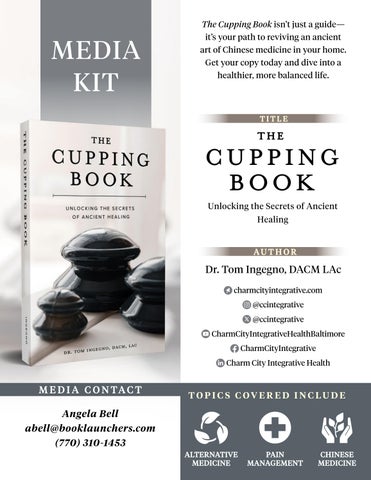
MEDIA KIT
The Cupping Book isn’t just a guide— it’s your path to reviving an ancient art of Chinese medicine in your home. Get your copy today and dive into a healthier, more balanced life.
TITLE
Unlocking the Secrets of Ancient Healing
AUTHOR
Dr. Tom Ingegno, DACM LAc charmcityintegrative.com @ccintegrative @ccintegrative CharmCityIntegrativeHealthBaltimore CharmCityIntegrative Charm City Integrative Health
M E D I A C O N TA C T
TOPIC S C OVERED INCLUDE
Angela Bell abell@booklaunchers.com (770) 310-1453 ALTERNATIVE MEDICINE
PAIN MANAGEMENT
CHINESE MEDICINE
E A R LY
REVIEWS “In The Cupping Book, Dr. Tom Ingegno, DACM, seamlessly marries ancient wisdom with modern practice, offering a bridge between age-old traditions and today’s quest for genuine wellness. His teachings transcend superficial healing, delving into the core of holistic wellness. The Cupping Book is an outstanding read that transcends the conventional, inviting readers to reclaim a piece of our shared human heritage in healing.” – Joe Mechlinski, New York Times Best Selling Author, Grow Regardless and CEO of SHIFT
“We are always looking for ways to help our patients heal their ailments without resorting to prescription medications or more invasive means - and cupping is one of those options! Dr. Tom, DACM, is a master at weaving the old with the new - incorporating healing techniques that have been around for thousands of years with newer, cuttingedge therapies. He skillfully makes the case that cupping therapy is an ideal modality to help with body aches and pains, respiratory issues, and even poor circulation. We highly recommend Dr. Tom’s insightful and practical guidebook to cupping therapy!” -Lynn Dudley, Pac, Turning Point Integrative Health Center
ABOUT THE
BOOK
Title: The Cupping Book: Unlocking the Secrets of Ancient Healing Publisher: Jun Zi Publishing ISBN 13: Paperback 979-8-218-26709-4; ebook 979-8-218-28510-4 Format: Paperback, ebook Price: Paperback $24.99; ebook $9.99 Pages: 133 Publication Date: January 17, 2024
Whether you are in pursuit of better health or working to treat past pain, positive healing starts with you. You may have tried all the usual treatments: massage, stretching, acupuncture, workshops on posture, weekly chiropractor visits, or more. The combination of holistic methods and conventional medical advice might have given some relief, but it’s what you do in between treatments that can make the difference in true wellness. Now, there’s a guide to a healing method rooted in 4,000 years of traditional medicine you can easily and safely perform from home to help yourself and your family feel and function better. Dr. Tom Ingegno, DACM, a trailblazer in acupuncture and integrative therapy, unveils the secrets of cupping—an ancient wellness practice often reserved for clinical practitioners but now tailored for home use. He has been teaching and writing about cupping therapy for health professionals and novices for over 20 years. He wishes to put this amazing healing modality back into people’s homes where it originated. Whether you’re a proactive advocate of preventive care, a dedicated fitness enthusiast seeking efficient recovery methods, or a nurturing caregiver with a penchant for natural remedies, this book provides practical and accessible knowledge for incorporating cupping into your holistic wellness routine—all from the comfort of your home. You’ll learn how to:
♦
Confidently master the foundational essentials of cupping therapy with guided walkthroughs and visual aids.
♦
Safely practice and choose the right tools with step-by-step instructions.
♦
Tackle pain management like a pro (back pain anyone?) while fighting against future injuries.
♦
Offer surprising relief from a slew of conditions like hypertension, allergies, lack of flexibility, and even anxiety.
♦
Seamlessly integrate cupping into your existing health practices, promoting a well-rounded approach to healing.
Unleash the ancient secrets of healing and empower yourself with the knowledge to transform your life, one cup at a time. The Cupping Book isn’t just a guide—it’s your path to reviving an ancient art of Chinese medicine in your home. Get your copy today and dive into a healthier, more balanced life.
AVA I L A B L E F R O M
ABOUT THE
AUTHOR
Dr. Tom Ingegno, DACM LAc, is a Doctor of Acupuncture and Chinese Medicine, integrative health specialist, and founder of Charm City Integrative Health, a multifaceted clinic that NYT bestseller and futurist David Houle called the “Future of Medicine.” With well over two decades of experience and a litany of awards, Dr. Tom, DACM, aims to make health accessible to all. Beyond his success inside his clinic, he is a featured healthcare expert, holistic health trailblazer, and author. As a practitioner, Dr. Tom, DACM, combines traditional modalities with cutting-edge therapies to help reduce inflammation. His mission lies in providing treatment that is aimed not only at alleviating symptoms but improving his patients’ overall quality of life. His passion has led him to many accomplishments such as being the chair of the Maryland State Board of Acupuncture, adjunct professor at elite Oriental Medicine institutions, former Director of Acupuncture for a chain of wellness centers, and author of You Got Sick—Now What?.
SAMPLE
TOPICS
Talk to Dr. Tom Ingegno, DACM, about unlocking ancient
cupping secrets, empowering self-care, seamlessly integrating holistic wellness, efficient pain management, and bridging ancient wisdom with contemporary health practices. ♦
The Secrets of Cupping: Reviving Ancient Wisdom in Modern Health
In addition to his doctorate, he has a master’s degree in Oriental Medicine and a bachelor’s degree in Professional Health Science. He was a board member of Edo Kai Traditional Acupuncture Society and a frequent contributor to the North American Journal of Oriental Medicine. He has lectured about acupuncture and integrative medicine to medical students at Johns Hopkins and the University of Maryland and guest lectures to healthcare professionals in the Department of Defense through Walter Reed Hospital. In addition to his accomplishments in treating humans, he is a certified animal acupuncturist. In this role, he has volunteered to treat animals with several Baltimore rescues. He has performed acupuncture on rescued pit bulls from Michael Vick, a camel in Egypt, and has even been a consultant to the Maryland Zoo.
♦
When not decoding ancient Chinese treatments, Dr. Tom, DACM, may be found lifting kettlebells, meditating, or spending time with his wife and two daughters.
♦
Unlocking the Power of Self-Care Through Home-Based Cupping
♦
Cupping Techniques for Fitness Enthusiasts to Accelerate Recovery and Enhance Performance The Role of Cupping in Preventive Health and How It Positively
Learn more at www.charmcityintegrative.com.
Impacts Well-Being
A S F E AT U R E D I N . . .
♦
Effective Pain Management Through Cupping for Common Ailments and Conditions
TO DOWNLOAD A HIGH-RESOLUTION AUTHOR PHOTO AND BOOK IMAGE, CLICK HERE
B O OK EXCERP T door quickly and with little expense. If you wish, you can pick up other sets at your local Asian grocery store, many acupuncture clinics, and other wellness locations. Prices range depending on the type of cups, the number of cups included in the set, and any accessories that may be included. It’s easy to get a budget-friendly kit that will last a long time with little maintenance.
Why Learn Cupping Therapy? “If there is free flow, there is no pain. If there is pain, there is no free flow.” ~ From the Huang Di Nei Jing Traditional healing interventions often work best at the first signs of a problem. Professional treatments can provide better relief, but being able to apply cups whenever you need them is a great benefit. Since cupping is fast and overwhelmingly safe, it should be thought of first when there is mild muscle pain or discomfort. Most home cupping sets are relatively easy to apply, and thanks to websites like Amazon, eBay, Wish.com and, Temu, you can have a set delivered to your
The variety of sizes of these home cupping sets makes them quite versatile. Larger cups may not easily adhere to small areas on the body, so you will use smaller cups on your calves and arms, for example. Pulling out a few small cups and placing them on your calves is a great way to improve circulation and reduce muscle soreness after a run. Some kits sell cups in specialized shapes for body parts such as elbows and knees. I’ve never had much success using those as most cups adhere more easily to flatter, broader muscle groups. Having a set of cups in your house will help you relieve all sorts of muscle pain, help with seasonal colds and chest congestion, and help with whole-body aches and unproductive coughs. Terms Used in Cupping This book introduces you to the different types of cups available as well as a number of terms that describe the different cupping types, which you might hear when discussing cupping. Some of the terms overlap and are interchangeable, others have specific meanings that are particular to one system or refer
to a specific technique. This book covers the two most common practices: static and sliding cupping. The glossary below will help you if you find yourself talking with someone who receives or performs different styles of cupping. Healthcare professionals, such as licensed acupuncturists, use many of these techniques. If you are interested in experiencing these forms of cupping, search for a licensed professional in your area. Cupping Glossary Dry Cupping: This term is interchangeable with static cupping but usually means “draws no blood.” Some may take this to mean that there is no application of oils or lotion, but that isn’t necessarily the case. Static or Fixed Cupping: This term indicates that the cups are suctioned to the body and stay in place. Sliding or Moving Cupping: For this method, a lubricant is first applied to the skin, then the cups. Once the cups attach, they glide across the area, providing both the benefits of cupping and a massage. Flash Cupping: Using this technique doesn’t necessarily produce bruising. Cups are applied and removed quickly across a large area. The idea is to increase circulation mildly in the region. Wet or Blood Cupping: This is a technique only someone with proper training should perform. “Wet” refers to blood being drawn
by first pricking or cutting the skin. The theory is that blood cupping is more potent than regular cupping. Instead of bringing blood to the surface, the blood is physically removed from the body. Hijama: This is the Muslim term for cupping—either wet or dry. In addition to having its own system of rules for how to apply the cups, hijama focuses on the spiritual aspects and includes principles of the Muslim faith, including applying cupping on specific holy days. Fire Cupping: This term refers to the traditional way of adhering cups to the body by using fire to burn the oxygen out of the cups to create a vacuum. There are many techniques for doing this, but it is safest to leave it to professionals. You may also find a few grandmothers who are quite proficient in this technique.
Benefits of Cupping Cupping at home allows you to provide yourself and your family relief from a slew of conditions. However, while it benefits many aches and pains, use good judgment when assessing health. With this in mind, please pay attention to this disclaimer. Cupping does not replace medical care. You should consult medical professionals when there are severe conditions or when there is a lack of improvement of symptoms. Before trying cupping, talk to your primary care physician to make sure it is
safe for you. The number one reason people try cupping is for pain relief. Most of us experience neck and shoulder pain throughout our lives. The pain may come from injuries or accidents, but our modern sedentary lifestyle, long working hours, and lack of movement can be other culprits. A recent review of the literature 1 on cupping, which looks at all the high-quality medical studies, shows that cupping therapy is effective for upper and lower back pain. The pain does not need to be intense. It can simply be the result of overdoing it at the gym or the normal soreness after a long day at work. As I mentioned earlier, silicone cups are very portable, and some people keep a set in their gym bags and use them before or after a workout to loosen up muscle soreness or painful areas. Cupping is beneficial for workoutrelated or injury-induced pain because it creates space. The suction pulls the skin away from the fascia—the connective tissue that covers the muscles and keeps the skin tightly attached. The fascia pulls away from the deeper muscle layers. The pull increases circulation to the tissue and creates space for inflammatory compounds like cytokines or lactic acid to move out, giving the muscles and joints some “room” to relax and alleviate the pain. A side effect of the suction is that the small capillaries at the surface break, leaving the body with the signature painless cupping bruises. These broken capillaries at the surface are not inert. They tell the body to keep
fresh blood circulating through the surrounding areas for days while the bruise breaks down. The initial treatment starts the healing effect, and the marks continue for days afterward. Cupping may have some mental health benefits as well, sparked by the whole-body effect of various types of bodywork. Our autonomic nervous system (ANS) is responsible for many of our body’s functions without conscious thought. It has two different modes of operation: the sympathetic (fight or flight) and the parasympathetic (rest and digest). When stressed, anxious, or depressed, our body is often “stuck” in fight or flight mode. Our ANS is telling our bodies we are in danger and must concentrate on survival and not worry about how we feel emotionally.
A L S O AVA I L A B L E F RO M T H E AU T H O R