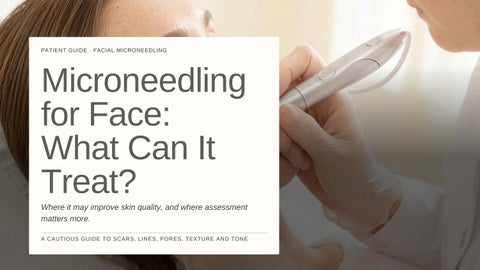
PATIENT GUIDE · FACIAL MICRONEEDLING
Microneedling for Face: What Can It Treat? Where it may improve skin quality, and where assessment matters more. A CAUTIOUS GUIDE TO SCARS, LINES, PORES, TEXTURE AND TONE
02
Controlled microchannels start a gradual repair process Specialised devices create precise microchannels, activating a controlled woundhealing response without removing the skin surface. Fibroblasts help produce and reorganise collagen; elastin supports resilience and recoil. The epidermis is the outer barrier; beneath it, the dermis contains collagen fibres, vessels and supportive tissue. Remodelling takes time, so visible improvement is gradual, not immediate. Read more: microneedling treatment. Sources: NCBI Bookshelf overview; dermatology reviews.
03 ACNE SCARRING
Selected atrophic acne scars may soften with treatment Atrophic scars form when acne-related inflammation alters the skin’s supporting structure. Scar depth, shape, tethering and skin type affect suitability. Microneedling may improve selected superficial or moderate scars by encouraging collagen remodelling. It does not remove every scar; deep, sharply defined or tethered scars may need alternative or combined approaches. MULTIPLE SESSIONS ARE OFTEN CONSIDERED. INDIVIDUAL ASSESSMENT REMAINS ESSENTIAL.
04 FINE LINES · EARLY AGEING
Fine lines and early ageing respond through gradual remodelling Ageing skin can show reduced support, changes in texture and fine lines across the cheeks and forehead. Microneedling may support improvements in smoothness, firmness and the appearance of fine lines over time.
Most relevant
Progressive
Different concern
Skin quality and superficial lines.
New collagen organisation takes time.
Dynamic wrinkles and volume loss may need other treatments.
05 PORE VISIBILITY
Microneedling can refine the look around pores — not erase pores Pore visibility reflects sebum production, genetics, skin characteristics and support around each follicular opening. With age, reduced firmness can make pores more noticeable. By improving surrounding texture and supporting dermal remodelling, microneedling may make pores look less prominent for some people. It does not permanently close, remove or eliminate pores, or change the underlying genetic structure that influences them.
THE GOAL IS A REFINED APPEARANCE, NOT PORELESS SKIN.
06
TEXTURE · CAUSE MATTERS
Uneven texture depends on what is causing it Microneedling may help selected surface irregularities, including roughness, mild post-acne textural change and early photoageing. Collagen remodelling can support a smoother-looking surface when the underlying concern is suitable.
More direct
Less direct
Variable
Superficial irregularities and reduced smoothness.
Pigmentation disorders concern colour and pigment biology.
Depth, cause, inflammation, skin response and treatment plan affect outcome.
07 SUN DAMAGE · UNEVEN TONE
Sun damage and uneven tone need careful treatment selection Ultraviolet exposure contributes to collagen breakdown, textural change and uneven pigmentation. Microneedling may support selected superficial skin changes, but is not a universal pigmentation treatment. Pigment and texture are related, but distinct concerns. Melasma and other pigmentation disorders need particular caution: inflammation can worsen colour change. Post-inflammatory hyperpigmentation is a risk, especially in darker skin tones. Daily broad-spectrum sun protection and an appropriate diagnosis are essential to the plan.
08
CHOOSING BETWEEN OPTIONS
Microneedling and skin boosters address different concerns Neither is automatically better. The practitioner considers the concern, skin condition, risk profile, treatment area and desired outcome.
Microneedling
Skin boosters
Device-based treatment using controlled mechanical injury to stimulate a wound-healing response. Commonly considered for selected scars, texture and early ageing. Recovery: redness and sensitivity usually feature.
Injectable products support hydration, skin quality or another intended effect, depending on the product and indication. Selection depends on product, anatomy, goals and practitioner assessment. Recovery: injection-related swelling or bruising can occur.
LEARN MORE ABOUT HOW MICRONEEDLING DIFFERS FROM SKIN BOOSTERS AND SKIN BOOSTER TREATMENT.
09
From consultation to recovery: what the journey involves 1.Consultation, medical history, skin assessment and suitability checks. 2.Cleansing and preparation; topical anaesthetic may be used where appropriate. 3.Controlled microneedling over the planned area. 4.Immediate redness, sensitivity, swelling or pinpoint bleeding may occur depending on intensity. 5.Early aftercare: gentle skincare, sun protection and avoidance of irritating active ingredients until recovered. 6.Over subsequent weeks, skin remodelling develops gradually.
AFTERCARE
Keep the early phase calm Follow the agreed aftercare plan. Avoid irritating active ingredients until the skin has recovered. Do not treat active skin infection or certain inflammatory conditions without clinical assessment.
RECOVERY VARIES WITH INTENSITY, SKIN RESPONSE AND THE TREATMENT PLAN.
10
Suitability depends on the skin concern and the person Microneedling may be considered for selected acne scars, uneven texture, early visible ageing or overall skin quality. Diagnosis, skin type, goals, medical history and ability to follow aftercare all matter.
FIVE TAKEAWAYS
01
Controlled injury and repair drive the treatment.
02
Selected scars and texture may improve.
03
Fine lines and skin quality change gradually.
04
Pores are not permanently eliminated; not every skin condition responds.
05
Professional selection and technique are essential.
Pause and assess Active infection, active inflammatory acne, impaired wound healing, a tendency to problematic scarring or other relevant contraindications. DR SALIM AESTHETIC MEDICINE · FACIAL MICRONEEDLING SUITABILITY IS ASSESSED INDIVIDUALLY.
EVIDENCE NOTE: NCBI BOOKSHELF OVERVIEW · 2017 DERMATOLOGIC SURGERY REVIEW · 2024 DERMATOLOGY REVIEW