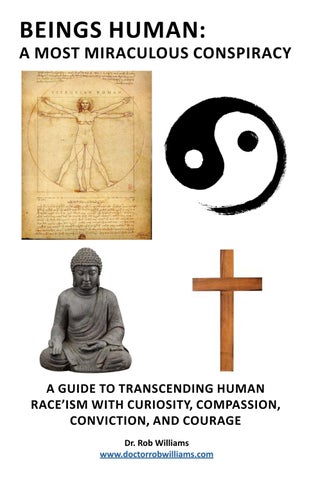
BEINGS HUMAN:
1
A MOST MIRACULOUS CONSPIRACY
A GUIDE TO TRANSCENDING HUMAN RACE’ISM WITH CURIOSITY, COMPASSION, CONVICTION, AND COURAGE Dr. Rob Williams www.doctorrobwilliams.com
2
Vermont Independence Press copyright 2022 Published under a Creative Commons license
3
To all who champion Team Human. You know who you are.
4
Dum Spiro Spero. (While I breathe, I hope.)
“History is a pact between the dead, the living, and the yet unborn.” – Edmund Burke
5
BEINGS HUMAN:
A MOST MIRACULOUS CONSPIRACY by Rob Williams, Ph.D. www.doctorrobwilliams.com
Introduction Part 1: On Being Humans
6 10
Peak Flow: Breathing for Life!
12
Life by the Horns
33
Part 2: On Being Storytellers
50
Media Mojo
53
The Post (Truth) World
128
Part 3: On Being Citizens
164
Plan ‘V’
168
COVIDtopia
196
Conclusion
216
6
Introduction Welcome to a most miraculous conspiracy! Conspiracy: from the Latin con (“together”) and spirare (“to breathe”). Beings Human, breathing together, for at least the past 200,000 to 300,000 years. Miraculous? Indeed, suggesting “a surprising and welcome phenomenon inexplicable by natural or scientific laws, and perhaps the result of divine agency.” Who are we? Why are we here? What is the meaning of Life? These questions’ answers remain mysterious, yet miracles are found as we live out the questions themselves – beings human, conspiring together – knitting together our own individual and collective destiny with those who have come before us, and those yet unborn, as Edmund Burke famously observed. Quick background sketch. Dr. Rob Williams, Team Human champion, at your service. After a near-death experience when I was young, I immersed myself in the study of spiritual and historical matters, captivated by stories exploring the human condition – love and loss, courage and cowardice, sacrifice and redemption, risk and reward. Beyond being Outside, Christianity and history proved my two biggest sources of inspiration, and I was fortunate enough to grow up with access to the world of nature and the outdoors. Breathing in fresh air, sunshine, the beauty of living creation, and the power of stories to inform our understandings of the world and our place in it have all served as collective boon and balm for me during complex and uncertain times. Fifty years on, the profound Mysteries embodied in Christianity, History, and Nature continue to beguile my senses, boggle my mind, and blueprint my journey.
7
Go back 2,000 years. In the early Christian church, believers embraced the practice of “conspiratio,” breathing directly into each other’s mouths to create an embodied collective spiritual community. “Conspiratio proved a basic somatic interchange creating a ‘unity which is manifest in the world but never belongs to it, a unity always out of the reach of instrumental human purposes,’” observed German philosopher Ivan Illich in a 1998 speech entitled “The Cultivation of Conspiracy,” “amplifying the metaphysical quality of our bodiliness,” he concluded, “which is outside of this world in which we now are.” Being in the world but not of it, as Jesus himself urged, is a challenging task for we humans, as we are highly evolved social creatures informed by those around us. Even more challenging in our overbuilt 21st century digitally networked world is to step back, silence our screens, and recognize, as our indigenous brothers and sisters have done for eons, that we are in a miraculous reciprocal dance of gratitude with the rest of living and breathing creation, and we have so much to learn from our fellow species, other non-Human “persons” who inhabit this world. “Each person, human or no, is bound to every other in a reciprocal relationship. Just as all beings have a duty to me, I have a duty to them,” writes biologist and Citizen Potawatomi Nation elder Robin Wall Kimmerer in her beautiful book Braiding Sweetgrass: Scientific Knowledge, Indigenous Wisdom, and the Teachings of Plants. “If an animal gives its life to feed me, I am in turn bound to support its life. If I receive a stream’s gift of pure water, then I am responsible for returning a gift in kind. An integral part of a human’s education is to know those duties and how to perform them.” Being human, then, is to breathe in this most miraculous conspiracy – as each of us is called to live a life of reciprocal gratitude in an ongoing dance with the rest of living creation. We breathe life into one another through the experiences and stories we share – by turns passionate, powerful, and poignant – and we extend our love and learning to the larger world, informed by what the rest of the planet’s inhabitants have to teach us.
8
I’ve roamed across this beautiful planet for more than half a century, fortunate enough to have found a beautiful woman, marry, settle down, raise two inspiring young humans, travel, work, build a home, and generate meaning and purpose with a wide variety of personal and professional projects. This Beings Human: A Most Miraculous Conspiracy manual is a loin-girding anthology of writings gleaned from my experiences – a Team Human guidebook based on lessons I’ve learned as I’ve navigated these interesting times. I’ve divided Beings Human into three sections, each with two essays and a few brief words of introduction. May it prove as fruitful for you to read as it has been for me to write.
Back to our “most miraculous conspiracy” – beings human, breathing together – and Kentucky poet, essayist, and environmentalist Wendell Berry, whose little book Life Is A Miracle: An Essay Against Modern Superstition has proved influential on my musings about matters human. Berry wrote his book at the turn of last millennium as a critique of Harvard biologist E.O. Wilson’s opus entitled “consilience,” in which Wilson suggested that “science” could serve as a unifying language for making sense of ourselves and our place in the universe. Two decades later, the limits and dangers of “science” appear increasingly obvious, and the rise of what many of us have dubbed “scientism,” a naïve quasi-religious faith in pseudo-scientific technocratic dogma, is proving a pernicious problem for Team Human. In Life Is A Miracle, Berry addressed these concerns head on – here are just a few moments from his powerful little essay. “The most radical influence of reductive science has been the virtually universal adoption of the idea that the world, its creatures, and all the parts of its creatures are machines – that is, that there is no difference between creature and artifice, birth and manufacture, thought and computation.”
9
“Our language, wherever it is used, is now almost invariably conditions by the assumption that fleshly bodies are machines full of mechanisms, fully compatible with the mechanisms of medicine, industry, and commerce – and that minds are computers fully compatible with electronic technology.” “We are alive within mystery, by miracle. ‘Life,’ wrote Erwin Chargaff, ‘is the continual intervention of the inexplicable.’ We have more than we can know. We know more than we can say. The constructions of language (which is to say the constructions of thought) are formed within experience, not the other way around. Finally, we live beyond words, as also we live beyond computation and beyond theory. There is no reason whatever to assume that the languages of science are less limited than other languages. “I see that the life of this place is always emerging beyond expectation or prediction or typicality, that it is unique, given to the world minute by minute, only once, never to be repeated. And this is when I see that this life is a miracle, absolutely worth having, absolutely worth saving. We are alive within mystery, by miracle.” To repeat. “We are alive within mystery,” Berry observes, “by miracle.” And I am haunted by Berry’s prophetic warning, arriving midway through his essay, when he writes: “It is easy for me to imagine that the next great division of the world will be between people who wish to live as creatures and people who wish to live as machines.” Humans as Creatures, or Humans as Machines? This “next great division of the world” is now upon US, as Berry foresaw decades ago. As a human species, we have a profound evolutionary choice to make. Let us choose wisely.
10
Part 1: On Being Humans
Part 1 is comprised of two essays. Peak Flow: Breathwork For Life explores breathing, Team Human’s secret superpower, based on my many years of studying breathwork protocols for optimizing the human mind, body, and spirit. Breathing is the most elemental activity we humans do, and yet we post-moderns are notoriously bad breathers. The good news? We can fix this, and Peak Flow shows us how. Life By The Horns unpacks field notes from my many years of farming, travel, and research into the world of the yak – a species with much to teach humans about optimizing in the face of adversity – with web links to different chapters of my emerging book, subtitled “our hairy, humpy, horny future – and the way yak.” Yaks have lessons to share – let’s we humans humbly embrace them. “Once you go yak,” I say, “you may never go back.” Bestselling Israeli historian Yuval Noah Harari offers perhaps the two most telling observations about being human. In his blockbuster book Sapiens: A Brief History of Humankind, Harari explains that humans are the planet’s most successful species because we’ve evolved to collaborate flexibly in large groups around shared
11
stories. During our lingering COVIDtopian moment, Harari points that human ingenuity has created conditions whereby we are now “hackable animals,” offering a simple equation by way of proof: Biology x Computers x Big Data = Humans as “Hackable Animals.” Until we learn to know ourselves better, Harari argues, we humans are now at the mercy of our own transhumanist technologies, capable of being manipulated by powerful technocratic forces such as governments, corporations, and globalist “public health” agencies. How do we learn to better “be human?” Begin with breathing, and humbly consider how other species live – the focus of these two essays ahead.
12
Part 1: On Being Humans
PEAK FLOW:
Breathing for Life!
Peak Flow: Breathing for Life!
13
Begin with the Breath. Inhale. Exhale. In. Out. We humans breathe on average 20,000 times during a 24-hour day, explains journalist James Nestor in his beautiful book Breath: The New Science of a Lost Art, and yet, 90% of us are breathing poorly: heavy breaths instead of light breathing; fast breaths instead of slow breathing; and shallow breaths through our mouths and into our chests, rather than deep breathing through our noses and into our bellies via our diaphragms. Who knew that how we breathe is essential to our overall health and wellness? Science now proves the way most of us breathe—both day and night— leads to sleep apnea, snoring, fatigue, and low CO2 tolerance. The troubling news, beyond sleep alone? Chronic shallow “mouth to chest” breathing is the most visible symptom of what Harvard University human evolutionary biologist Daniel Lieberman, author of The Story Of The Human Body: Evolution, Health and Disease (2014), provocatively calls the “dysevolution” of our species—we homo sapiens are literally becoming more diseased, more weak, and more unhappy, and 90% of us are nudging along these trends with every (bad) breath we take. The good news? We humans are resilient and adaptable, and we can rediscover how to breathe properly with coaching and practice.
14
Part 1: On Being Humans
Best of all? Optimizing our breathing leads to a cascading series of health and wellness benefits, especially given that we Humans live in the midst of interesting civilizational times. Read Dr. Andrew Huberman on “Vision and Breathing May Be the Secrets to Surviving 2020” in Scientific American (2020). LINK: https://www.scientificamerican.com/article/vision-andbreathing-may-be-the-secrets-to-surviving-2020/
Breathing for Life: Mind, Body, and Spirit Here’s a tour of optimal breathing’s many benefits on our mind, body, and spirit. Read Chopra.com editors on “How Breathwork Benefits the Mind, Body, and Spirit” LINK: https://chopra.com/articles/how-breathwork-benefits-the-mindbody-and-spirit
Breathing and Our Respiratory System: Optimizing daily breathing by practicing light, slow, and deep (LSD) breathing through our nose and moving air in and out of our lungs via our diaphragm, increases respiratory health. Our nose is evolutionarily designed to regulate airflow; our nasal passage cleans, warms, and humidifies incoming oxygen molecules; and our nasal cavity generates nitric oxide (NO), the “magic molecule” which opens up (vasodilates) our breathing passages and the many complex branches comprising our respiratory system, as well as fighting off bacteria, viruses, and other environmental toxins entering the body with every breath we take.
Peak Flow: Breathing for Life!
15
Breathing and Our Nervous System: Our breathing patterns influence our autonomic nervous system via three central nerve groups: 1) our vagus nerve, which extends down from our skull to stimulate our diaphragm, heart, and digestive system, and innervate (stimulate) our body’s vital internal organs; 2) our two phrenic nerves, which pass through our heart and connect to our diaphragm; and 3) our posterior thoracic nerves, which stimulate our intercostal muscles directly underneath our rib cage. Chemoreceptors located in our brain and blood vessels, meanwhile constantly monitor our blood PH, adjusting our ventilation based on the amount of carbon dioxide (CO2) in our body at any given moment. Strategic breathwork also has a direct impact on our autonomic nervous system. For high-stress moments, in particular, strategic breathwork is essential to responding—not simply reacting—and maintaining brain and heart coherence.
Breathing and Our Heart Rate Variability (HRV) / Blood Circulation: Our breathing also influences heart health and blood circulation, in collaboration with our autonomic nervous system. Every inhale slightly expands and speeds up our heart, moving us into a slightly more alert state (known as going “sympathetic”—our “fight, flight, or fright” state) and every exhale slightly contracts and decreases our heart rate, moving us into a slightly more calm state (known as going “parasympathetic”—our “rest and digest” state). Optimizing our breathing to increase “heart rate variability” (HRV)—a measure of how adaptable and resilient our heart is from moment to moment over time—is another powerful way in which breathing influences basic biological processes.
Breathing and Our Immune System: Optimizing our breathing also strengthens our immune system over time. Different breathing protocols complement one another here:
16
Part 1: On Being Humans
daily LSD breathing maintains healthier respiratory and circulatory systems and increases autonomic nervous system stability, while more hormetic breathwork such as the Wim Hof Method applies titrated doses of voluntary positive stress (beneficial stress also known as “eustress”) to our body—a process known as “hormesis”—building resilience of mind, body, and spirit over time. Combining various breathwork protocols optimizes our immune system via the many processes described above.
Strategic Breathing and Peak Flow’s Breathwork Ecosystem Strategic breathing is perhaps our most fundamental way to optimize Human experience. Imagine our “breathwork ecosystem” as a strategic set of breathing protocols allowing any Human to call on any breathing exercise at any moment to optimize Mind, Body, and Spirit in the face of a new, novel, unknown, and potentially stressful situation. Or, from another perspective, breathing according to your metabolic needs. Consider just three examples. Have trouble sleeping? Remember, 90% of us are shallow mouth-tochest breathers. Solution: Begin with mouth tape, retrain yourself to breathe through your nose at night, and use a simple LSD breathing exercise—4 seconds in through the nose, 6 seconds out through the nose—to bring your mind and body into a more parasympathetic (calm and relaxed) state. Feeling “blah” or “meh”? Chronic stress and anxiety, or the feeling of simply “languishing”—endlessly waiting for something to happen—is ubiquitous these days. Breathing plus exercises release dopamine—a key contributor to motivation, energy, and greater health. Solution: A daily morning dose of hormetic breathwork—three rounds of the Wim Hof Method—shortly after waking may help invigorate the mind and energize the body to prepare for the day ahead.
Peak Flow: Breathing for Life!
17
Looking to enhance your fitness and performance? Whether you are an elite athlete or a weekend warrior, breathwork can help. Solution: Try “bringing the mountain to you”—using breath-holds that simulate high altitude training—and cultivate “air hunger” while walking, running, trekking, lifting, working out, or swimming to increase your CO2 tolerance and build respiratory capacity. By training to elevate your CO2 tolerance, you can raise your fitness and sport baseline; science has proven this is key for elite athletes as well as overall human health. Those with low CO2 tolerance struggle with chronic mouth breathing, anxiety, sleep apnea, panic attacks—and the solution is strategic breathwork. But wait! There’s so much more. Once you learn how to shut your mouth and embrace the evolutionary reality that “your nose knows,” you can dive more deeply with mouth and tongue exercises to improve airway health. Moreover, you can use regular hormetic protocols like “monkey fingers” to practice rib cage massage—strengthening your intercostal and diaphragm muscles. Remember that your diaphragm is your 2nd thoracic pump—and this second heart is, in fact, a muscle you can strengthen through regular exercise just like any other muscle. Embracing regular cold water immersion—even 30-60 seconds in a cold shower several times weekly will build and strengthen your respiratory, circulatory, nervous, and immune systems over time, as well as provide subtle but noticeable psychological benefits. Our Peak Flow approach combines a wide variety of protocols for breathwork and beyond, and can be divided into three broad breathwork arenas: Health, Sport, and Work. Read Healthline.com’s article “8 Breathing Exercises to Try When You Feel Anxious.” (2019) LINK: https://www.healthline.com/health/breathing-exercises-foranxiety
18
Part 1: On Being Humans
Peak Flow: Breathwork for Health During the mid-twentieth century, Russian/Ukrainian doctor Konstantin Pavlovich Buteyko pioneered “breathwork for health” exercises now called the Buteyko Method. Working in Ukraine, Dr. Buteyko began to train his patients—many of whom suffered from asthma, COPD, and other debilitating and chronic illnesses—to breathe light, slow and deep. Buteyko’s techniques “were many and varied,” observes Breath author James Nestor, “but the purpose of each was to train patients to always breathe as closely as possible to their metabolic needs, which almost always meant taking in less air.” For many of his patients, Dr. Buteyko’s breathing exercises slowed, arrested, and even reversed chronic illness and disease over time, while athletes adopting his techniques reported improved fitness and performance. Fast forward fifty years. In 2020, when a novel coronavirus gripped the Human imagination and produced a disease dubbed “COVID-19,” neuroscientists and health professionals at New York City’s Mount Sinai Hospital discovered that regular breathwork exercises—teaching “long haul COVID” sufferers to practice LSD breathing twice daily—laid the groundwork for post-COVID recovery and healing. “Through breathwork, patients can consciously control their heart rate,” as well as “modulating the nervous system’s fight-or-flight response” which “may help regulate the immune system,” explains a March 2021 “Unlocking The Mysteries Of Long Haul COVID” Atlantic magazine article spotlighting Mount Sinai Hospital’s research results. “The key was the realization that the diaphragm and nervous system had to be coached back to normal function before further reconditioning” could begin, and daily breathwork, concluded the NYC hospital’s research team, helps “get patients to a place where the healing can start.” Buteyko’s Method is now being shared around the world and is built on three basic breathing protocols we call LSD breathing. “Light” refers to influencing our breathing biochemistry. CO2-sensitive chemoreceptors continually monitor our body’s carbon dioxide
Peak Flow: Breathing for Life!
19
levels—CO2’s presence, remember, is our body’s “trigger” to breathe. By strategically shifting from chronic heavy breathing (90% of us are shallow mouth-to-chest breathers) to light breathing, we can cultivate a higher “CO2 tolerance” in our body over time, leading to increased respiratory capacity. A healthy human breathes 12-16 times per minute, and breathing exercises designed to cultivate “air hunger” by breathing light can move us towards more optimal breathwork patterns. “Slow” refers to slowing down the pace of our breathing tempo or cadence. Most Humans breathe too quickly—sucking in too much air too aggressively through the mouth and into the chest/upper lungs—which increases the tempo of our breathing. Slowing down our breathing may feel uncomfortable at first, as we shift into nasaldiaphragmatic breathwork and slow down our respiratory system, breath by breath. But slowing down the cadence of our breathing is vital to improving health and wellness. “Deep” and diaphragmatic refer to becoming more mindful of breathing biomechanics. Placing our right hand on our belly and our left hand on our chest, and then practicing conscious breathing— moving air in and out through our nose and down into our belly and lower lungs via our diaphragm—we improve our breathing biomechanics over time. Remembering nasal-diaphragmatic breathing’s salubrious effects on our respiratory, circulatory, autonomic nervous and immune systems, too, note that strengthening our diaphragm leads to better functional movement and improved athletic performance—the diaphragm connects our lower torso’s pelvic floor with our rib cage and upper torso. Dr. Buteyko developed two simple baseline measurements for tracking a Human’s progress in any “breathwork for health” program. The Controlled Pause (CP) measures the number of seconds a Human can hold the breath before feeling “the first urge to breathe.” Take several regular breaths in and out through the nose, pinch the nose
20
Part 1: On Being Humans
on the exhale, and then record the number of seconds before you feel your body’s first desire to take a breath. Hold breath until first definite desire to breathe
Normal Normal breath in breath out
Normal nasal breathing
The Maximum Pause (MP) measures the maximum number of seconds a Human can hold the breath before hitting the red zone (i.e. feeling lightheaded or as if one is being suffocated). Take several regular breaths in and out through the nose, pinch the nose on the exhale, and then record the number of seconds before you feel your body’s strongest desire to breathe. Hold breath until you can’t hold any longer
Normal Normal breath in breath out
Large Recovery Breath— nasal breathing
Wrapped within our ten elements, our Peak Flow for Health breathwork program is designed to teach any Human to incorporate myriad strategic LSD breathing exercises into a regular routine, boosting CP and MP scores over time, and leading to more overall health and wellness. Our Peak Flow Health program also integrates other methods and airway exercises beyond Dr. Buteyko’s pioneering work.
Peak Flow: Breathing for Life!
21
We support our Peak Flow for Health programs with partnerships: a growing network of integrative medicine professionals, health care providers, and wellness clinics working alongside our Peak Flow advisory board, made up of MDs, NDs, and NPs. Most importantly? We at Peak Flow are building a Breathwork for Health community—weekly breathwork sessions and in-person retreats—built on our shared values, health conditions, and common goals, to help create a positive impact for natural healing and human optimization. Read four-time world free-diving champion Dr. Stig Severensin’s “Sports and Breathing” article in Breatheology (2019). LINK: https://www.breatheology.com/sports-breathing/
Peak Flow: Breathwork for Sport Breathwork pioneer Patrick McKeown of Ireland, who trained with Dr. Konstantin Buteyko, developed over more than a decade the Oxygen Advantage (OA) program to improve Human physical fitness and athletic performance. While many mistakenly equate the Buteyko Method with Oxygen Advantage, OA builds on Light, Slow, Deep protocols—what McKeown calls a “breathe light to breathe right” approach—by layering in breath-holds and simulated high altitude training, or, more technically, Intermittent Hypoxic Hypercapnic Training (IHHT). McKeown’s groundbreaking 2015 book The Oxygen Advantage details these techniques, as do a variety of other OA publications, including McKeown’s recent book The Breathing Cure. At Peak Flow, our “breathwork for sport” program combines LSD breathing protocols with the strategic introduction of breathwork techniques learned from our Oxygen Advantage training with McKeown, along with our ten elements to support daily breathing exercises. Light, Slow, Deep (LSD) breathing forms the foundation of our program, and adding in breath-holds while sitting, walking, running, biking, and playing field and court sports develops CO2 tolerance via regular cultivation of “air hunger.” CO2 tolerance, in turn, leads to improved endurance and performance,
22
Part 1: On Being Humans
as our Peak Flow participants learn to 1) retrain chemoreceptors to rebalance the body’s mix of oxygen and carbon dioxide; 2) readjust body biomechanics, including neck and spine posture; and 3) improve functional movement, strengthening the diaphragm and connecting the pelvic floor with the chest and upper torso. These are but three of the myriad benefits derived from our “Peak Flow for sport” program. Consider more closely the three phases of optimizing breathwork for maximum energy deployment into our muscles and other tissues as we pursue greater fitness and athletic pursuits. Phase 1: Breath by breath, LSD breathing increases the amount of air reaching the lungs’ alveoli—millions of tiny air sacs that capture oxygen—with each inhale, decreasing the amount of “dead space” in the lungs and optimizing energy efficiency, breath by breath. Athletes who shift from mouth to nasal breathing, then, train their bodies to more efficiently bring oxygen into the lungs – by some measures, 20% more oxygen arrives at the lungs via nose breathing instead of mouth breathing. Phase 2: LSD breathing slows down air coming into the lungs, breath by breath, and increases the production of nitric oxide, a powerful vasodilator, which optimizes the efficient transfer of oxygen from the lungs into millions of the body’s red blood cells. Athletes who use nasal breathing, then, increase the efficient transfer of oxygen from their lungs into their red blood cells delivering O2 throughout the body. Phase 3: LSD breathing optimizes the Bohr Effect, as the presence of carbon dioxide catalyzes the more efficient release of oxygen from the blood into the muscles and other tissues. Breath by breath, athletes who optimize nasal breathing also optimize the efficient transfer of oxygen from a) lungs to b) bloodstream to c) muscles and other tissues in the body. Based on Dr. Buteyko’s work, Oxygen Advantage founder Patrick Mckeown developed two simple baseline measurements for tracking a Human’s progress in any “breathwork for sport” program.
Peak Flow: Breathing for Life!
23
The Body Oxygen Level Test (BOLT) measures the number of seconds a Human can hold the breath before feeling “the first urge to breathe.” Take several regular breaths in and out through the nose, pinch the nose on the exhale, and then record the number of seconds before you feel your body’s first desire to take a breath. The Maximum Breathlessness Test (MBT) measures the maximum number of seconds a Human can hold the breath before hitting the red zone (i.e. feeling lightheaded or as if one is being suffocated). Take several regular breaths in and out through the nose, pinch the nose on the exhale, and then record the number of seconds before you feel your body’s strongest desire to breathe. Wrapped within our ten elements, our Peak Flow for Sport breathwork program is designed to teach any Human to incorporate myriad strategic LSD and IHHT breathing exercises into a regular routine, boosting BOLT and MBT scores over time, and leading to increased physical fitness and athletic performance. Our Peak Flow Sport program also integrates other methods and airway exercises beyond Patrick McKeown’s pioneering work. We support our Peak Flow for Sport programs with partnerships: a growing network of integrative medicine professionals, health care providers, fitness programs, and sports teams, working alongside our Peak Flow advisory board, made up of fitness researchers and medical professionals. Most importantly? We at Peak Flow are building a Breathwork for Sport community—weekly breathwork sessions and in-person retreats—built on our shared values, health conditions, and goals, to help create a positive impact for fitness, athletic performance, and human optimization. Read Michael Flannell’s “The Athlete’s Secret Ingredient: The Power of Nasal Breathing.” (2019) LINK: https://dentalsleeppractice.com/the-athletes-secret-ingredientthe-power-of-nasal-breathing/
24
Part 1: On Being Humans
Peak Flow: Breathwork for Work Dutch superathlete Wim Hof holds more than two dozen world records for feats of Human endurance, from swimming under a glacier longer than anyone on a single breath, to running marathons in Africa’s Namib Desert and Nepal’s high Himalayas clad only in shorts and sandals while consuming very little food or water. “We can be more than we think we can be,” explains Hof, whose family has popularized his three-pillar Wim Hof Method (Cold, Breath, and Mindset/Commitment) via Inner Fire, his family’s fitness company. Certified in the Wim Hof Method, our Peak Flow co-founders honor the pioneering spirit of Wim Hof, and have combined aspects of the Wim Hof Method with exercises from our LSD/health and IHHT/sport arenas and our ten elements, to create our “breathwork for work” program. Central to our Breathwork for Work program is the biological concept of “hormesis,” which refers to titrating regular doses of voluntary positive stress (also known as “eustress”) to build resilience of Mind, Body, and Spirit over time. “Toxicological rock star” Dr. Edward Calabrese, the world’s foremost hormesis researcher, explains that hormesis may be the key to deepening health, fitness, and longevity— and, he explains, it is much underappreciated in the West in the medical and scientific research communities. While all of us feel the impact of chronic stress on our lives, driven by events beyond our control, hormesis suggests that when we voluntarily embrace stress— exposing ourselves to regular rounds of hormetic breathwork or controlled bouts of cold water immersion, for example, as the Wim Hof Method teaches—we rewire ourselves to become more resilient over time. Consider our “breathwork for work” protocol. Controlled Hypoxic Hypocapnic Training (CHHT) refers to a hormetic breathwork approach based on ancient Tummo breathing practices and popularized by the Wim Hof Method that features the aggressive cleansing or “blowing off” of both oxygen and carbon dioxide from the body. A single round of CHHT breathwork features three phases: 1) 30-40 aggressive inhales and exhales, followed by 2) a long breath-hold
Peak Flow: Breathing for Life!
25
after the final exhale, ending with 3) a deep inhale and brief “hold” to rebalance blood chemistry. This is the most stress-inducing breathwork protocol in our Peak Flow program, and should only be done in a horizontal position after consulting with a doctor and creating a safe and comfortable environment for practicing the protocol. After several rounds of CHHT, many practitioners experience a slightly euphoric state, often accompanied by emotional release, slight numbness and tingling in the extremities, and increased mental clarity upon finishing. When strategically combined with LSD and IHHT breathwork exercises, our CHHT approach is a potent protocol for deepening leadership, both personally and professionally. Read Open Culture’s article “How Tibetan Monks Use Meditation to Raise Their Peripheral Body Temperature 16-17 Degrees. (2021) LINK: https://www.openculture.com/2021/01/how-tibetan-monks-usemeditation-to-raise-their-peripheral-body-temperature-16-17-degrees. html and Read “Business Leaders Around The World Are Finding Power In Their Breath—Here’s How You Can, Too.” (Forbes, 2020). LINK: https://www.forbes.com/sites/ forbescoachescouncil/2020/05/28/business-leaders-around-theworld-are-finding-power-in-their-breath-heres-how-you-cantoo/?sh=6da4043f6f8a
Peak Flow: Embracing Our Ten Elements All three Peak Flow breathwork programs’ impact—health, sport, and work—is dramatically enhanced when strategically combined with our ten elements. “Humans are happiest when they feel in control of their inner thoughts and feelings and experience a ‘flow’ state,” explains pioneering psychologist and researcher Mihaly Csikszentmihalyi, leading to “a sense of purpose, enjoyment, and meaning.”
26
Part 1: On Being Humans
Our ten elements are designed to help unlock “flow.” How, exactly? “Our brains are like muscles,” explains Stanford University researcher Dr. Andrew Huberman of the Huberman Lab podcast. “Regular titrated doses of attention, reward, and reinforcement develop (un)healthy habits and behaviors.” In other words, incorporating the ten elements into daily living and building a healthy foundation to support breathwork leads to lasting transformation over time. Element #1: Breath Begin with breathing! Remember that breath is the most elemental of human processes—we breathe on average 20,000 times daily, and 90% of us are breathing suboptimally. Breath is perhaps THE central element in optimizing Human experience—Mind, Body, and Spirit. “We can live without food for weeks and water for days, but air for just a few brief minutes,” explains Oxygen Advantage author Patrick McKeown. “The quantity of the air you breathe has the potential to transform everything you thought you knew about your body, your health, and your performance.” Read WebMD.com “Can We Learn To Breathe Better?” (2020) LINK: https://www.webmd.com/lung/ss/slideshow-learn-to-breathebetter Element #2: Community We humans are evolved to be social creatures. Science tells us social bonding improves our physical and mental health. “Our human species is the only one capable of flexible collaboration in large groups around shared stories,” explains Sapiens author Yuval Noah Harari. When you join Peak Flow, you join our growing community dedicated to a shared story: optimizing Human performance—mind, body, and spirit—through breathwork and beyond. Read the Harvard Medical School’s article “Staying Healthy: the Health
Peak Flow: Breathing for Life!
27
Benefits of Strong Relationships.” (2010) LINK: https://www.health.harvard.edu/staying-healthy/the-healthbenefits-of-strong-relationships Element #3: Stress Unlike chronic stress-induced when we experience circumstances beyond our control, we can harness positive stress—hormesis or “eustress”—to build resilience of mind, body, and spirit. “Hormesis is biology’s most underappreciated biological concept,” explains researcher Dr. Edward Calabrese, “and harnessing voluntary stress in titrated doses is of great benefit to us.” Join Peak Flow and learn how! Read the National Institute for Health article “Hormesis Can and Does Work in Humans.” (2010) LINK: https://www.ncbi.nlm.nih.gov/pmc/articles/PMC2836153/ Element #4: Sleep “A good night’s sleep improves performance by 9%,” notes Stanford University researcher Dr. Andrew Huberman.” Sleep is not a disposable luxury—it’s a non-negotiable biological necessity,” explains Why We Sleep author Matthew Walker. Join Peak Flow to learn more about the science linking better sleep to optimal performance, and how we can use breathwork and other protocols to improve our sleep. Read Harvard University’s TC Chan School of Public Health article on “Sleep.” (2020) LINK: https://www.hsph.harvard.edu/nutritionsource/sleep/ Element #5: Hydration “Water is the world’s first and foremost medicine,” as the old proverb says. Our bodies are mostly comprised of water, and yet we often neglect hydration as a vital element of Human performance. At Peak Flow, we prioritize hydration as a central element in Human
28
Part 1: On Being Humans
optimization. Join us. Read Harvard University TH Chan School of Public Health’s article “The Importance of Hydration.” LINK: https://www.hsph.harvard.edu/news/hsph-in-the-news/theimportance-of-hydration/ Element #6: Cold/Heat Regular controlled cold exposure boosts our immune systems, increases our metabolism, and strengthens our autonomic nervous system’s response to stress. Contrast therapy, applying heat to counter cold, can hormetically increase resilience even more. “Cold is Gold!” as we say in the Wim Hof Method instructor community. “Ice Is Nice!” Join Peak Flow, and learn how and why to heat up and chill out. Read the Institute for Integrative Health Care’s article “Contrast Therapy: Its Use and Effectiveness.” (2009) LINK: https://www.integrativehealthcare.org/mt/contrast-therapy-formassage/ and Healthline’s “What To Know About Cold Water Therapy.” (2020) LINK: https://www.healthline.com/health/cold-water-therapy Element #7: Mindfulness Mindfulness is difficult to achieve without harnessing the breath. Once we learn how to connect the breath with the mind, we open ourselves up to tremendous potential, replacing the chatter of the “monkey mind” with deeper thoughtfulness and clarity. “Thinking is a disease,” notes Oscar Wilde, “and humans die from it.” Join Peak Flow, and learn how to temper thinking with mindfulness. Read Mindful.org’s comprehensive overview “The Science Of Mindfulness.” (2020) LINK: https://www.mindful.org/the-science-of-mindfulness/
Peak Flow: Breathing for Life!
29
Element #8: Gratitude Science is revealing that a regular “gratitude practice” improves Human experience at so many levels. “Gratitude and complaining cannot coexist,” writes Miracle Morning author Hal Elrod. “You must choose the one that best serves you.” At Peak Flow, practicing gratitude is central to what we do and who we are. Join us and find out why and how! Read the Mayo Clinic’s article “To improve your health, practice gratitude.” (2019) LINK: https://www.mayoclinic.org/healthy-lifestyle/adult-health/indepth/improve-health-practice-gratitude/art-20270841 Element #9: Movement Daily movement is central to optimizing Human experience. As Humans, we are evolved to move 12-25 miles daily, and yet many of us have never been more sedentary. “If you learn to move fluidly, you’ll find a state of ‘effortless effort,’” writes Natural Born Heroes author Christopher McDougall. “You can do that your entire life without getting injured.” Join Peak Flow and learn how to incorporate natural movement into your personal life and professional work. Read the Center for Disease Control’s article “Benefits of Physical Activity.” (2020) LINK: https://www.cdc.gov/physicalactivity/basics/pa-health/index.htm Element #10: Nature “The further we get from Nature,” observes Breath author James Nestor, “the sicker we become.” Immersing ourselves in the natural world, even for a few minutes daily, is vital to optimizing Human experience, especially in our Digital Age of hyper-networked screendriven Life. Join Peak Flow and learn how to “digitally detox” and embrace nature more fully.
30
Part 1: On Being Humans
Read Nature journal’s article “Spending at least 120 minutes a week in nature is associated with good health and well-being.” (2019) LINK: h ttps://www.nature.com/articles/s41598-019-44097-3 In conclusion, optimizing your breathing leads to myriad health, wellness and fitness benefits over time. You don’t need a pill, or a prescription, or an injection, or a drug, or a doctor – simply bring more awareness to your breathing over time – make improving your breathing a lifelong journey. Breathwork – for life. More at our www.thepeakflow.com web site. Join our breathwork community, and learn how to optimize your potential, one Breath at a time. Choose your breath, change your life. Breathe on, and be well!
Peak Flow: Breathing for Life!
31
Additional Resources: More information about our Peak Flow “breathwork ecosystem”—> Buteyko Clinic International, Oxygen Advantage, and the Wim Hof Method. ADDITIONAL STRATEGIC BREATHING PROTOCOLS, BREATHING EXERCISES, and BREATHWORK INFORMATION More breathwork strategies, breathing exercises, and information and resources related to strategic breathing: Healthline, WebMD, the American Lung Association, John Hopkins Medicine, Harvard Medical School, Medical News Today, Wikipedia, MindBodyGreen, Chopra.com, VeryWellMind, Memorial Sloan Kettering Cancer Center, Headspace, and Dr. Andrew Huberman’s Stanford University Research Lab.
32
Part 1: On Being Humans
33
Our Hairy, Humpy, Horny, Human Future, and the Way Yak
34
Part 1: On Being Humans
Life by the Horns
35
Table of Contents: “The Way Yak” - Field Notes 2022 The link below connects you to an evolving Table of Contents for Life By The Horns, providing an overview of my emerging book on “our hairy, humpy, horny Human future,” and what the Way Yak has to teach we Humans about optimizing in Interesting Times. “The most important gift is to reclaim the adaptive nature of our species,” Australian aborginal philosopher Tyson Yunkaporta observes in his brilliant new book Sand Talk: How Indigenous Thinking Can Save The World. “Field Notes” captures on site travel experiences and documented impressions of yaks and their relationships with we humans, from our Steadfast Farm Vermont Yak Company agri’preneurial adventures to visiting with yaks at the farthest edges of the globe, including western Mongolia and the high Himalayas. Click: https://www.doctorrobwilliams.com/post/life-by-the-hornsour-hairy-humpy-horny-human-future-and-the-yak-way-book-fieldnotes-2022
36
Part 1: On Being Humans
Introduction: Yak Shaving The link below connects you to the Preface of Life By The Horns, exploring the wonderful phrase “yak shaving,” and the 2016 high Himalayan adventure up and over Mount Manaslu’s Larke Pass that provided the catalyst for beginning to research and write this book in earnest. “Yaks,” says my sherpa friend Tenzing, a surdar (lead guide) with whom I frequently trek, “They are mysterious.” Indeed. Let’s unpack the Mystery. Click: https://www.doctorrobwilliams.com/post/yak-shaving-prefaceto-life-by-the-horns
Life by the Horns
37
Chapter 1: To Hack The Yak Can we Humans “hack the yak?” What do yaks have to teach we Humans about living in Interesting Times? And are yaks elusive by evolutionary design? These three questions frame Life By The Horns. The link below directs you to chapter 1 – where I introduce the concept of “umwelt,” and how yaks as a species may offer insights into homo sapiens species optimization. “Each and every living thing is a subject that lives in its own world, which is the center,” explains scientist Jacob von Uexkull in his groundbreaking if largely forgotten 1933 book A Foray Into The World Of Animals And Humans. Peering into the world of the yak offers we humans insights into our own world – so let’s hack the yak and see what we can learn. Click: https://www.doctorrobwilliams.com/post/chapter-1-to-hackthe-yak-trekking-the-trail-of-one-of-our-planet-s-most-mysteriousmammals
38
Part 1: On Being Humans
Chapter 2: Go Wild The link below takes you to the story of Vermont Yak Company’s Steadfast Farm, our three family, two farm vision for importing yaks to Vermont’s Green Mountains and raising them for meat, fiber, and agri’tourism. “Go Wild” explores the weekly and seasonal rhythms our yak farm life, and what yaks had to teach us from the very first moments they arrived in Vermont’s Mad River Valley. We ran Vermont Yak Company from spring 2008 through spring 2013 – an epic on-farm adventure for yaks and humans alike. “Wild species are true Others, the components of wilderness, and at the same time are the external correlates of our innermost selves,” Paul Shepard observed in his 1995 The Wilderness Is Where My Genome Lives, one of the last essays published before his death. “Our Pleistocene specieshood,” he explained, “owes little or nothing to evolution during the last 10,000 years, except perhaps for some local shifts in gene frequencies associated with resistance to epidemic diseases, food allergies, or crowding, along with a widened diffusion of genes among races that were isolated early on.” In other words, to rediscover our true human nature, we must travel back more than ten thousand years, and see what we can learn. Yaks go wild – and we humans can do the same. Click: https://www.doctorrobwilliams.com/post/chapter-2-go-wild-takingstock-in-vermont
Life by the Horns
39
Chapter 3: Know Place What does it mean for a species to “know place?” “All organisms inherit a collective memory of their species by morphic resonance from previous organisms,” observes renowned British biologist Rupert Sheldrake, and “individual organisms are subject to morphic resonance from themselves in the past, and this self-resonance provides the basis for their own individual memories and habits.” How species like the yak come to “know place” is this chapter’s focus, and I connect “mything links” from the emergence of the ancient aurochs through bos mutus (wild yaks) to bos grunniens grunniens (domesticated yaks). Interestingly, both wild and domesticated yaks still are co-evolving, offering opportunities for cross species learning. Yaks know place – and we humans can do the same. Click: https://www.doctorrobwilliams.com/post/chapter-3-know-placesketching-planet-yak-s-myth-ing-links
40
Part 1: On Being Humans
Chapter 4: Free Range Adventure to the North American epicenter of Planet Yak – Colorado’s Rocky Mountains – for an October 2018 US YAKS gathering – YakSpo - of yaks and their co-domesticated humans in Loveland, Colorado. “There are not too many of us yak lovers out there. We need community and collaboration. No one in this country is an expert in yaks and we can learn from each other regarding health, promotion, breeding practices, meat, fiber and dairy production,” states the US YAKS web site. “We are planning regional shows and sponsoring trips to visit yak people in other countries, and US YAKS can register your animals in a nationally recognized DNA database and keep track of pedigree, so when you join US YAKS you will also be supporting research and advocacy on important yak issues.” The two-day YakSpo fiesta provides insights into the nature of yak/human relationships, featuring veteran yakkers from all over North America, and their hairy, humpy, horny four hooved companions. Yaks free range – and we humans can do the same. Click: https://www.doctorrobwilliams.com/post/chapter-4-free-rangeloveland-lovefest-in-colorado-country
Life by the Horns
41
Chapter 5: Get High Travel across the Roof of the World – from the high Himalayas to the Swiss Alps – to explore how yaks evolved to survive and thrive at altitude, and how some sapiens groups like the Tibetan sherpa have evolved to do the same. This chapter features in-depth interviews with Eurasian yakkers, whose deep wisdom of yak behavioral intelligence permeates the pages of this chapter. “Hormesis” is an underappreciated biological concept that suggests that titrated regular doses of positive stress – including altitude adjustment – help build resilience of Mind, Body and Spirit in any creature. “Hormesis studies have revealed animal performance benefits in response to changes in oxygen, temperature, ionizing radiation, heavy metals, pesticides, dehydration, gravity, and crowding,” explains a 2020 scientific essay entitled “A dose of experimental hormesis: When mild stress protects and improves animal performance.” “Almost universally, hormetic responses are characterized by increases in performance that include either increases in reproduction, longevity, or both.” Yaks get high – and we humans can do the same. Click: https://www.doctorrobwilliams.com/post/chapter-5-get-highbreathing-in-the-roof-of-the-world
42
Part 1: On Being Humans
Chapter 6: Grow Grassy Global debates about human meat consumption are hot, and this chapter explores our relationship with meat eating, beginning with the thousands of years of history of human/yak co-domestication built on pastoralism – grass farming. “The origins of human intelligence are linked to the acquisition of meat, especially through the cognitive capacities necessary for the strategic sharing of meat with fellow group members - shared evolved traits with humans [that] point to the origins of human intelligence,” observes Craig Stanford in his seminal book The Hunting Apes: Meat Eating and the Origins of Human Behavior. Stanford, a professor of biological sciences and anthropology at the University of Southern California and co-director of USC’s Jane Goodall Research Center, is one of many scholars currently exploring the deep evolutionary links between primates’ attraction to meat and our emergence as homo sapiens sapiens. “The intellect required to be a clever, strategic, and mindful sharer of meat is the essential recipe that led to the expansion of the human brain,” Stanford argues, noting that “the central importance of meat acquisition and meat sharing in modern and ancient human societies is simply undeniable.” From my decade-long agri’preneurial work as proprietor of the YakItToMe! Mobile BBQ food wagon in Vermont to gnoshing on a grass-fed Yac Donalds yak burger in the town of Kagbeni in Nepal’s northwestern Kingdom of Mustang, I make a case for grassfed locally raised meat as vital to the human/yak co-evolutionary project moving forward.
Life by the Horns
43
Yaks grow grassy - and we humans can do the same. Click https://www.doctorrobwilliams.com/post/chapter-6-grow-grassydigesting-the-yak-meat-of-the-matter
Chapter 7: Chill Out Travel to Europe’s highest mountain range – the Swiss Alps – to meet the Suisse yakking community and their hairy, humpy, horny fourhooved companions. Meet many of the players in the Swiss Yakking Federation, including Godfather of Swiss Yakking Daniel Wismer, and Switzerland’s yak whisperer Rosula Blanc, who has traveled overland through the Swiss Alps with small herds of yaks. “Yaks have ancient instincts, they are connected to an older way of being - yaks are smart, safe, and they know the way on these treacherous mountain trails when we head into the mountains every summer,” Swiss yak herder Regula Oerli explains. “If you lose your way or get lost, follow the yaks,” she says, smiling. Many think of the Swiss as tightly wound, but Suisse yakkers know how to “chillyax” with their grunniens companions. Yaks chill out - and we humans can do the same. Click: https://www.doctorrobwilliams.com/post/chapter-7-chill-outsuisse-yak-hoffing-in-the-alps
44
Part 1: On Being Humans
Chapter 8: Live Light This chapter will explore yak-made textiles and humans sourcing yak hair for the same, including Hong Kong-based Kora, London-based Khunu, Vermont/Kathmandu-based US Sherpa, and Tibetan-based Norhla. We’ll also explore lessons yaks can teach us about living more lightly on our beautiful Planet by downsizing our material existence and optimizing our health, strength and happiness via non-material means. Beautiful eleven-minute Norhla doc film: https://www.youtube.com/ watch?v=W4deJRvlCYw Yaks lives light - and we humans can do the same. Forthcoming!
Life by the Horns
45
Chapter 9: Be Herd What makes a “yak” a yak? This chapter explores ongoing debates about the answer to this question, discussions between members of the International Yak Association (IYAK) and US YAKS, two competing North American yak trade organizations. “Those of us who believe in yak DNA genetics and the whole history of the yak - we believe this is one of God’s best designed animals on the planet,” explains Colorado yakker Bob Hasse. “Man screws things up – the more domesticated an animal becomes, the more screwed up it becomes, the more disease intolerant it becomes, and the animal lose attributes God designed into it - fortunately, with the yaks, Man has not screwed around with the genetics that much.” This chapter’s spotlighted event – Denver, Colorado’s January 2020 National Western Stock Show (NWSS), where both IYAK and US YAK members gather to trade ideas, information and yaks. Yaks be herd – and we humans can do the same. Click: https://www.doctorrobwilliams.com/post/chapter-9-be-herdyak-wrangling-in-the-rockies
46
Part 1: On Being Humans
Chapter 10: Find Frontiers Travel to Alaska, the Land of the Midnight Sun, to meet some of North America’s largest yak herds, and explore the Alaskan yak farm-to-table effort being spearheaded by 49th State Brewing co-founder, master chef and beer master David McCoy. Along the way, meet the homeschooled family managing Alaska’s largest yak operation, and visit yaks across the state, from the Anchorage Zoo to the northern reaches of the Alaskan frontier. “Hundreds of years from now, I want us to look back to 2010, when we worked together to create a unique yak Alaska brand that we bring to the globe, a legacy that lasts - our locally grown food, matched with our locally brewed beer, matched with this beautiful environment,” explains Alaska master chef David McCoy. “We want to yak be an extension of the Alaska Mystique - and we want to be authentic.” Yaks find frontiers – and we humans can do the same. Click: https://www.doctorrobwilliams.com/post/chapter-9-free-rangechasing-yaks-across-the-land-of-the-midnight-sun
Life by the Horns
47
Chapter 11: Wrangle Resilience COVID wrought devastating socioeconomic and political transformations to the US and the world via unconstitutional lockdowns, mask mandates, the destruction of small businesses and farms, and beyond. Adventure across the United States in the midst of US COVID collapse - with visits to two dozen US yak operations in 19 states over the course of two weeks – and discover how yaks and yakkers cultivated resilience in the midst of difficult times. “We are ever-grateful for all of our challenges because, without them, we could not experience such an extraordinary appreciation for the unique abilities that we have to offer,” explains Colorado yakker Shannon Holder. “Yaks make us better people.” Yaks wrangle resilience – and we humans can do the same. Click: https://www.doctorrobwilliams.com/post/chapter-13-wrangleresilience-saddling-stress-in-the-midst-of-us-covid-collapse
48
Part 1: On Being Humans
Chapter 12: Stay Spirited Explore the power of resistance and resilience, a meaningful “stay spirited” equation for human and yak optimization, in this final chapter. What might a yak teach us as a Human about optimizing Mind, Body and Spirit? What might yak communities teach us Human communities about cultivating spirited resistance to the forces that might threaten our species? “The entirety of human experience and mental life arises because of, and not in spite of, our nature as selfsustaining biological organisms that care about their own persistence,” explains neuroscientist and Being You: A New Science of Consciousness author Anil Seth. “The quest to understand consciousness places us increasingly within nature, nor further apart from it – just as it should.” Yaks stay spirited – and we humans can do the same. Click: https://www.doctorrobwilliams.com/post/chapter-12-stayspirited-ruminations-on-resilience-and-resistance-drafting-no-photosyet
Life by the Horns
49
Conclusion: Yak to the Future, We Go! Yak to the Future, we go! Life By The Horns’ conclusion explores taking the Way Yak with us, into our hairy, humpy, horny human future. Once you go yak, you may never go back. Forthcoming!
50
Part 2: On Being Storytellers
Part 2 is comprised of two essays. Media Mojo: CommOn Power Tools + Strategic Simple Storytelling Strategies for our Digital Age offers insights into how to leverage Cyberia – our Virtual Internet Age – for maximum personal development and professional success. #OYOME – Own Your Own Media Experience! The Post (Truth) World: Fighting Fake News with a 21st century Propaganda Model for our Digital Age updates Manufacturing Consent co-authors Edward Herman and Noam Chomsky’s “propaganda model of news” for our digital age, adding five new filters, as well as sharing musings about fake news and real journalism for our new millennium. At the heart of being storytellers is the essential energetic role of information – storied content that shapes our Minds, Bodies, and Spirits. We post-modern screen-loving humans mistakenly locate the storytelling process in our brains. To be clear, our brains do not “process information,” “retrieve knowledge,” or “store memories” – and are brains are not computers. In fact, storytelling is an embodied energetic phenomenon, as the ancient mystics and cutting-edge neuroscientists both tell us.
51
Consider neuroscientist Dr. Joseph Dispenza’s growing body of research, popularized in a number of books like Breaking the Habit of Being Yourself: How To Lose Your Mind and Create a New One. Dispenza argues that “what syncs in the brain, links in the brain,” but that it is coherence of breath, heart, and brain via our body’s neuronal networks that informs us, moment by moment, creating the “collective familiar” known as “You” and “Me.” We can learn to retrain ourselves for human optimization through storytelling, Dispenza argues, by cultivating more coherence of mind, body and spirit via regular protocols such as breathwork and meditation, literally inscribing new, more powerful stories into our body’s neuronal pathways via feeling, explaining, and experiencing – what the Buddhists call a “be here now” approach to living. In doing so, Dispenza notes that we can learn to expand our “heart coherence,” emitting an up to three-meter-wide electromagnetic signal via our hearts, and teaching our brains to lay down information over the top of this expanded new heart frequency. Epigenetically speaking, our transformed environment triggers our genes (not the other way around), and we learn how to signal emotions, the end products of our experience, ahead of our environments, literally transforming ourselves moment by moment, and day by day. Astonishing. This is why the stories with which we choose to inform ourselves matter so deeply. Stories provide US with a moral raison d’etre, an ethical sensibility that infuses us with energy, purpose, and direction, and we can author our own stories via regular practice: craft our breathing, cohere our hearts, shape our stories, change our lives.
52
Part 2: On Being Storytellers
“We cannot be separated from our Stories.”
53
CommOn Power Tools + Simple Storytelling Strategies for our Digital Age
February 2020
54
Part 2: On Being Storytellers
CommOn Power Tools + Simple Storytelling Strategies for our Digital Age by Rob Williams, Ph.D. www.doctorrobwilliams.com
Introduction
55
Critical Media Literacy Education (CMLE)
59
Inside Our Sapiens Skull: Our Brains On Digital Media
59
Our 21st Century Media Culture’s Anatomy
62
8 Shifts: Why This Ain’t Your Daddy’s Media Culture
64
General Principles of Critical Media Literacy Education
70
The Art of Rhetoric: Learning the Language Of Persuasion
73
Backpack Journalism: From #OYOME to MOJO
76
From #OYOME to MOJO to STORY COACHING: A Step By Step Approach
80
Storytelling ABCs
87
Social Media: Ten Action Verbs
100
Conclusion: #TeamSapiens—Be The Media, Keep It Real
118
Appendix 1 Selected Reading Resources
120
Appendix 2 Your Story Coaching Guide
121
Handouts throughout can be accessed digitally at https://vermontindependent.net/vt-lit/
Media Mojo
Introduction: Our Digital Age Welcome to Cyberia. Our Digital Age. The Internet is changing everything, transforming our 21st century world in ways we are only beginning to understand. Here’s a simple example. The number sign—#—when deployed across the Internet, transforms this single symbol into a powerful force known as a “hashtag,” allowing us to #tag, #label, #group, #search, and #organize content. Pop culture loves to mock the hashtag, but step back for a moment and marvel at how “#” can offer us so much in our 21st century digital world defined by binary codes of “ones” and “zeros.” Go deeper. Beyond the # sign lies a rich and vital cultural conversation about the impact of our emerging Digital Age. The “Lords of the Cloud”—Schmidt, Zuckerburg, Bezos, and other high-tech Silicon Valley CEOs—are the first and the loudest to promote the Internet’s benefits: convenience, affordability, and the power of “connecting” with our “friends,” “sharing” in our “social networks,” and above all, shopping in safety 24/7 with the “frictionless” touch of a few buttons. On the flip side, we all bear witness to our Digital Age’s down sides. More and more former high-tech titans are going “rogue” and alerting us to the Internet’s dangers, such as psychologically addictive social validation feedback loops which tie our sense of self-worth to Snapstreaks, Likes and Emojis. Any Internet user, meanwhile, now experiences constant surveillance, as we “render” (give over) our personal data—recordable human behavior digitized into binary “ones” and “zeros” - to powerful corporations and centralized governments through networked data collecting technologies. From our tiny mobile phones to sprawling 5G telecommunication networks—the “Internet Of Things”—powerful
55
56
Part 2: On Being Storytellers
digital actors collect vast amounts of information from us through millions of networked transmitters. These corporations and governments take our “shared” digital experiences and “render” them (turn them into) Big Data, which is then collected, crunched through algorithms, and harnessed to create predictive behavioral futures markets, increasing the Cloud Lords’ control over us all, while profiting from this rendering. In short, as each of us use the ’Net to buy stuff and tell our stories, those who control the ’Net spy on us, and sell our stories as we tell them. What to do? Begin by cultivating a deeper understanding of the “trade offs” (the goods and the bads) of living in our Digital Age. This book, MEDIA MOJO, is a short guide to making sense of all of this. My two goals for you, dear reader? To make you as a Digital Age ’Netizen as powerful as possible, and to have as much fun as we can in the process. My hope is that you will walk away from this book with a deeper understanding of how you cultivate more freedom and more choice in our Digital Age, to use the ’Net rather than be used by the ’Net. So, about me. I’ve lived half my life without the Internet, and the other half deeply immersed in it. I’m too old to be labeled a “digital native,” as I grew up in a pre-Internet world, an era I call the Age of Analog (meaning “pre-digital”). Since the early 1990s, I have studied the Internet as it has emerged, teaching high school, college, university, and graduate school courses about our Digital Age, and creatively experimenting with the evolving ’Net as a musician, entrepreneur, journalist, publisher, public speaker, and consultant. In many ways, I have a deep affection for the Internet, using it daily to make sense of who we are, where we have been, and where we are going as a civilization and a species. I also am wary of the
Media Mojo
Internet’s ever-growing power over our lives, and I have deep concerns about where the ’Net may be taking us as a species. In short, given my own personal history and professional work, I have my own unique “take” on what the ’Net has wrought. As a thinker, I’m a big fan of interdisciplinary approaches in making sense of our Digital Age. Throughout the 1990s, I trained as an environmental historian, which at the time proved one of the first professional scholarly disciplines to honor holistic approaches to learning, promoting the critical weaving together of interrelationships among various disciplines. The other big conceptual framework influencing my thinking in MEDIA MOJO is known as “critical media literacy education” (CMLE). A mouthful, I know, but important. As we enter the 21st century’s Digital Age, CMLE is emerging as a fundamental approach underpinning so much of our educational and civic work, and a powerful way to deepen our understanding of the Internet and its impact on us all. A few key concepts and definitions as we get started. A medium, simply stated, is a “storytelling environment.” A bound paper book, a television program, and an Instagram page are three different examples of a medium—and the plural of a medium, is, of course, media. Let’s define communication as “the symbolic exchange of data, information, knowledge, and wisdom,” and we homo sapiens, the planet’s most cognitively advanced species, use “stories” to communicate with each other. What’s a story? “An account of events,” is perhaps the simplest definition at hand. Culture, meanwhile, refers to commonly held beliefs, behaviors and customs, or “a group of people enacting a common story.” With these definitions in mind, let’s situate ourselves in the grand sweep of evolutionary events—our sapiens story, or what I like to call our #TeamSapiens narrative.
57
58
Part 2: On Being Storytellers
Over millions of years, we have evolved into homo sapiens, our planet’s most successful story-telling creature. As best-selling Sapiens author Yuval Noah Harari insightfully explains, we are the only species that has learned how to collaborate flexibly and in large groups around our shared belief in “imaginative fictions” we call “stories.” Enter the Digital. In an evolutionary eye blink, the Internet dramatically amplified and expanded our ancient love for stories through the sudden rise of screen-centered mobile digitally networked worlds. As we move into our Digital Age, more than ever before in human history, it’s clear that media (“storytelling environments”) construct our culture, with many of us spending upwards of ten hours daily marinating in media experiences. #TeamSapiens’ ongoing obsessions with our 21st century “smart” phones, mobile screens, social media channels, and digital technology pose profound existential dilemmas for our species, as mobile digital networked technologies rapidly merge with our brains and bodies, and we “augmented humans” increasingly becoming “cyborgs”—part humans and part machines—with dramatic implications for our future. So! How do we sapiens individually and collectively maximize the benefits and mitigate the risks of our high-tech rapidly evolving Digital Age? This is one of our historical moment’s most profound questions, and this is where critical media literacy education (CMLE) steps in. A few more definitions. Being critical means to step back and gain some objective distance on a subject—in this case, our 21st century digital media culture. We’ve already defined “media” as “storytelling environments,” and “literacy” simply refers to our ability to “read/interpret and write/ publish,” broadly speaking.
Media Mojo
And “education”? Plato maybe said it best, when he observed that education is about “turning the soul towards light.”
Critical Media Literacy Education (CMLE) A potentially game-changing 21st century interdisciplinary teaching and learning approach to making sense of how the world’s most powerful species—us!—interacts with the most sophisticated media culture ever created by we sapiens. We can orient 21st century critical media literacy education with four action verbs. We want to access, analyze, evaluate and produce media. We can define 21st century critical media literacy education with three overlapping concepts. We want to deepen our level of media skills, knowledge, and activism. We can frame 21st century critical media literacy education with a two-word idea and a two-word practice. We want to understand the idea of trade-offs (the goods and the bads) inherent in any media experience, and we want to engage in Socratic Dialogue— the asking of critical questions. We can focus 21st century critical media literacy education with a single key life skill. We want to practice skepticism.
Inside Our Sapiens Skull: Our Brains On Digital Media Begin with our brain. Take your right hand, wave it around in the air like you just don’t care, and then gently place it on top of your skull and apply light pressure.
59
60
Part 2: On Being Storytellers
You are now massaging the most complex thing in the known universe. Amazing, right? Our sapiens brain is the most complex living thing in the known universe.
“Our Brain On Media” downloadable FREE handout. Available at www.vermontindependent.net/vt-lit
Media Mojo
Brain researchers have published countless big books with big words trying to explain our brains and how they work. Here are some “brain on media” basics. Our sapiens brain is actually three brains in one. Our reptilian brain, located at the base of our skull just above where our spinal column meets our brain itself, is the oldest evolutionary brain and is the most important of the three brains when it comes to keeping us alive as a species. Without us having to consciously think, our reptilian brain helps keep our heart beating and our lungs breathing every few seconds, and reminds us to eat—to feed our brain and our body with energy-rich nutrients—when we are hungry. When we are startled (Oops?), scared (Boo!), or threatened by danger (Look Out!), our reptilian brain instantly activates our “fight, flight, or fright” response—“do I battle this threat, do I run from this threat, or do I freeze and hope the threat doesn’t notice me?” Our second limbic brain, also called the “mid brain,” processes two very powerful kinds of media (“storytelling environments,” remember?): music and images. Music has remarkable sonic qualities that speak to us in evolutionary ways we don’t fully understand—we just know that we love music. And images? As the old saying goes, “a picture is worth a thousand words.” Why? Because, cognitively speaking, images are “processed” in our reptilian / emotional / feeling brain. We tend not to “process” pictures as critically in our brains as we do words—which makes the “language of the image” a particularly powerful and persuasive form of storytelling. Magazine pictures, newspaper photographs, television programming, movies, and now the screen-driven Internet have moved the Image’s unique power to the center of our Digital Age discourse—and we are just beginning to grapple with the consequences of living in an image-centered world. Our “neocortex,” our third and youngest brain, evolutionarily speaking, takes charge of words and how we use them. Learning how to read and write begins with recognizing letters—agreed-
61
62
Part 2: On Being Storytellers
upon abstract symbols, and is perhaps sapiens’ most sophisticated evolutionary and cognitive achievement. Building the neocortical connections that empower us to “interpret the abstract squiggles” we call letters, and how we arrange these letters to make words, sentences, paragraphs, chapters, books, and ultimately, MEANING—is an astonishing evolutionary achievement, and takes years of focused practice to master. Our “triune” brains—reptilian, limbic and neocortex—help us navigate Life’s complexities and share stories with one another. Our brain is the physical apparatus that helps make our “mind” possible, allows us as sapiens to “project” ourselves out into the larger universe, and connects us to our body’s many life-giving systems. Every media experience we have involves one or more of our three brains—and recognizing how Digital Age stories told through media “massage” our minds, our bodies, and our spirits is vital.
Our 21st Century Media Culture’s Anatomy Underneath and intimately connected to our brains is the entire rest of our human anatomy, and the scientific community is in deep discussion about the relative roles of our brains, our genes, and our natural and evolutionary environments in shaping our development as a species. As we begin to merge with our digital technologies, it makes sense to deepen our understanding of the anatomy and “power points” of our 21st century digital media culture (DMC). Like our own skeletal system, which supports our human frame and keeps us from collapsing into a quivering mass of jelly, the “hardware” of our 21st century media culture—devices, chips, and connective switching technology like cables or wireless, form the skeleton of our digital media culture. Meanwhile, our digital media culture’s “software”—protocols, codes, and software programs—function like our human body’s nervous system, keeping us constantly attuned to developments in our DMC’s body.
Media Mojo
Power Points: Our Sapiens Brain And The Anatomy Of Our Digital Media Culture “Anatomy/Power Points” downloadable FREE handout. Available at www.vermontindependent.net/vt-lit
Data, binary encoded digital information that can be transformed into text, images, music, and video, comprises the equivalent of our human body’s muscular system, pushing, pulling, and knitting together our digital communities.
63
64
Part 2: On Being Storytellers
And finally, and most mysteriously, our digital media culture is imbued with a “social” dimension—the sum of human actions, rendered into digital form, that might be considered the “hive mind” or “collective soul” of our Digital Age, as expressed through the ’Net. Admittedly, these metaphorical analogies are imperfect, but perhaps helpful in crafting ways to conceive of our 21st century digital media culture. In imagining where we might be going, perhaps the brilliant visionary and inventor Nikola Tesla said it best more than a century ago: “When wireless is perfectly applied, the whole earth will be converted into a huge brain, which in fact it is, all things being particles of a real and rhythmic whole,” Tesla provocatively observed. “We shall be able to communicate with one another instantly, irrespective of distance.” If Tesla’s prophetic musings are accurate, we’d better get ready.
8 Shifts: Why This Ain’t Your Daddy’s Media Culture As a guy with one foot in the Age of Analog and the other in Cyberia, I’ve borne historical witness to the dramatic transformations the Internet’s arrival has brought. Here are eight big shifts in our communications culture wrought by Digital’s sudden arrival, transformational trends with which we are still only beginning to grapple.
The Epistemological Shift Epistemology, “the study of the nature and origins and knowledge,” is an obscure but vital sub-branch within the tradition of philosophy (“love of wisdom”) that deals directly with questions of “truth.” The operative question: how do we know what we know? Repeat for dramatic effect. As we Internet users spend more time marinating in digital mobile networked worlds, this epistemological question
Media Mojo
grows ever more urgent. Quick history. For centuries, the culture of typography (print, processed in our thinking brains) monopolized our cultural conversations, and words, interpreted with sustained neural practice by our rational neocortex, helped establish shared cultural truth claims for we sapiens. Since the mid-19th century, the Image (processed in our limbic emotional feeling brain) has challenged the Word’s monopoly on Truth, and with the arrival of photography, telegraphy, movies, television, the Internet, and tiny screen-driven mobile devices, the Image now reigns supreme. Even reading words on screens dramatically transforms our literary experiences. When we read a book on a phone, we have a different epistemological experience than we do reading the same book in print. Remember our brains? Consider for a moment the civilizational consequences of shifting from a Word centered (rational brain) to an Image-centered (emotional brain) communications culture. This shift cannot be overstated. The big question: what are the trade-offs (goods and bads) of living in a 21st century media culture dominated by the Image?
The Technological Shift With the mid-20th century invention of digitization, we sapiens have invented a powerful way to package any medium’s (“storytelling environment”) experience—music, books, movies—into a binary code of ones and zeros for ease of storage and transmission. Our civilization’s technological shift from the Age of Analog into our emerging Digital era is profound, and we have yet to fully understand the consequences. Practical question—what happened to all the Tower Records, Blockbuster Video, and Borders bookstores that used to exist across the United States coast to coast? The short answer: Spotify, Netflix, and Amazon. The big question: what are the trade-offs of living in a 21st century media culture in which most forms of information can be digitized, converted into a binary code of ones and zeros?
65
66
Part 2: On Being Storytellers
“Eight Shifts” downloadable FREE handout. Available at www.vermontindependent.net/vt-lit
The Personal Shift I grew up in the 20th century Analog age of so-called “mass media,” with single centralized hubs beaming signals to mass audiences— the national broadcast television network model. If, for example, we TV viewers wanted to experience “I Love Lucy” on primetime TV, we only had a once-weekly chance to watch. Our 21st century Digital Age, by contrast, now allows us to “time and space shift”
Media Mojo
programs at will, which in many ways is a beautiful thing. We also exist in a digital media culture that compels us to be more personal and participatory, and the trade-offs here are growing more profound, especially in the age of surveillance capitalism, in which our personal privacy is under siege by corporations and governments which harvest our personal data for greater profit and control. The big question: what are the trade-offs of living in a 21st century media culture marked by this compelling personal shift?
The Aesthetic Shift Speaking of my childhood, I grew up in a media age marked by discrete media platforms. Watching television happened in our family room in front of a giant rabbit-eared set that functioned like furniture. Listening to the radio happened in our kitchen. The family room housed our bookshelves, while a kid on a bicycle tossed the daily newspaper onto our front porch every weekday afternoon. If we wanted to see a movie, we had to leave our house and go to what was called a “single screen theater,” which carried the same film for weeks at a time. In our 21st century Digital Age, by dramatic contrast, we enjoy the luxury of experiencing all these media experiences—television, radio, books, magazines, newspaper, movies, and yes, even phone calls—on a single so-called “smart phone”—a digital mobile device that grows smaller and more powerful every year. “Convergence,” this “merging together” of formerly discrete media platforms, is a central operating feature of our Digital Age, and transhumanists like Ray Kurzweil imagine a not-too-distant future where we sapiens completely merge with our machines—the ultimate form of ‘convergence.' The big question: what are the trade-offs of living in a 21st century media culture defined by “convergence”?
The Political Shift “Politics” is about “the exercise of power,” and “policy” refers to the rules, regulations and guidelines that “frame” our communications
67
68
Part 2: On Being Storytellers
landscape. Who gets to own which channels, and what kinds of stories can be told (or are not told)? Back in the 20th century Analog Age, media storytelling platforms proved relatively scarce— only three national television networks (NBC, CBS, and ABC), for example, provided US news and entertainment. In our Digital Age, bandwidth power has exploded, and our 21st century media culture has been REregulated for this “age of abundance.” The 1996 Telecommunications Act, overwhelmingly supported by members of both political parties in Congress and signed into law by thenpresident Bill Clinton, turned over billions of dollars’ worth of publicly owned television and radio airwaves to private for-profit corporations essentially for free, in exchange for promises of “more consumer choice” and “better programming,” as well as lifting “ownership caps” on how many media outlets a single giant media corporation could own. The result? A brief history of the US radio industry is illustrative. Prior to 1996, the US radio landscape proved diverse, locally owned, and eclectic, with daily programming reflective of every state and region across the country. After 1996, a few large corporations bought up hundreds and hundreds of the 12,000 plus radio stations across the US, gutted local programming, and hooked up radio stations to their new corporate mother ship to pipe in the same 500+ songs across each genre to radio stations across the country. Why is 21st century US radio now so boring and bland? Why do we hear the same songs over and over again when we travel coast to coast across this big beautiful diverse country? The short answer can be found in exploring this political shift, and the reregulation of US media outlets under the 1996 Telecommunications Act and Beyond. The big question: what are the trade-offs of living in a 21st century media culture?
The Economic Shift In our 21st century Digital Age, what Harvard Business School professor Shoshana Zuboff calls The Age Of Surveillance Capitalism: The Fight For The Future At The New Frontier Of Power, everything is now for sale, including the intimate details of our personal lives as “rendered” through our digital data. If the rise of consumer
Media Mojo
capitalism marked US in the 20th century, the 21st century is being defined by hyper-commercialism and the corporate consolidation of digital media experiences: Google now has an 80% monopoly on “search,” Facebook now has an 80% monopoly on “social,” and Amazon is now hoovering up one of every two US retail dollars while contributing to the collapse of small businesses and main streets in towns and cities from coast to coast. Prime! The big question: what are the trade-offs of living in a hypercommercial corporately consolidated 21st century media culture?
The Discursive Shift “Discursive” is a fancy word for “conversational,” and how news and information shape our public conversations is of paramount importance for all digital age ’Netizens. For most of the 20th century, US “news” outlets claimed to be “objective,” promoting disinterested “just the facts, please” approaches to our US news and information culture. By contrast, “subjectivity”—first person, biased, ideological—is the defining feature of our 21st century Digital Age’s news and information culture. We digital media users are being programmed (quite literally, through the use of algorithms and “filter bubbles”) for polarization through the weaponization of news stories and channels. One tribe’s truth is another tribe’s “#fakenews,” a new term for an age-old phenomenon referring to one-sided “news” stories published to persuade, rather than inform, to propagandize rather than enlighten. The big question: what are the trade-offs of living in a 21st century media culture - talk radio, shout shows, behavioral microtargeting through algorithms and filter bubbles—marked by subjectivity?
The Cultural Shift This last shift encompasses all the others. Our 21st century Digital Age is a brave new world for all of us, delivering storied digital information quickly and efficiently into our lives through ever more networked technologies. Amazing! And—every web site we visit, every digital program we consume, indeed, every keystroke we
69
70
Part 2: On Being Storytellers
type, is collected, aggregated, stored, and shared behind the scenes without our explicit knowledge or consent (beyond briefly signing EULAS—End User License Agreements—we rarely read). The big question: what are the trade-offs of living in a 21st century media culture quickly shifting from relative privacy to full scale digital surveillance? This is a big question, one with which we all must wrestle.
General Principles of Critical Media Literacy Education Here’s another way to make sense of our 21st century Digital Age media culture. Ask questions. Practice skepticism. Engage in Socratic Dialogue. Find our list of eight critical media literacy education questions below—sometimes called CMLE’s “general principles.” We can all internalize and apply these questions to any media experience, deepening our understanding of media’s power and influence over our lives. 1.
“Reality” Construction: Media “construct” our culture.
ASK: What “reality” does this medium/text construct? Who produced this media? How accurate is this “reality”? What “untold stories” are missing? 2. Trade Offs: ALL media experiences involve “trade-offs” (BOTH goods AND bads). ASK: What are the “goods” and “bads” of this media experience? On balance, is this media experience of value? 3. Production Techniques: Media use identifiable production techniques. Advertisers, the public relations industry, corporations, and other powerful media makers spend BIG time, energy and
Media Mojo
money carefully constructing media to influence the ways we think, feel, behave, and buy. “Deconstructing” or analyzing production techniques—camera angles, lighting, editing, sound effects, colors, font styles, symbols—can build awareness, leading to more careful and “literate” production and consumption of media. ASK: What kinds of production techniques does this medium/text use?
“General Principles” downloadable FREE handout. Available at www.vermontindependent.net/vt-lit
71
72
Part 2: On Being Storytellers
4. Ownership: Media are business, corporate, commercial interests. Most media are produced within the commercial industry—researching questions of ownership, production, and distribution is vital to understanding media’s influence. ASK: What are this medium/text’s commercial motives? Who owns and/or paid for this medium/text? 5. Value Messages: Media contain ideological and value messages. Some value messages are intended, while others are unintended. Messages can be positive or negative, and messages target specific groups. ASK: What kinds of value messages does this medium/text promote? 6. Individual Meaning: Media users construct their own meanings from media. Good media education considers how individuals interpret media messages. ASK: What meanings do YOU find in reflecting on this medium/ text? What differing meanings might other individuals/groups find? 7. Emotional Transfer: Most media operate primarily at an emotional level and are designed to transfer emotions from a medium/text onto whatever that medium/text is selling. ASK: What emotions does this medium/text tap? 8. Pacing: TV runs at approximately 30 frames per second and movies run at 24 frames per second (and getting faster). The conscious brain can process 8 frames per second. New digital image-driven media tend to keep us from conscious analysis and reflection. ASK: What do you observe about this medium/text upon reflection (showing media multiple times, or slowing down or stopping media regularly for discussion.)
Media Mojo
The Art of Rhetoric: Learning the Language Of Persuasion And here’s a final way to make sense of our 21st century Digital Age media culture. Study rhetoric—the language of persuasion. The ancients made “rhetoric” an integral part of their academy curriculum. We sapiens are uniquely persuasive and persuadable creatures when it comes to complex linguistic systems, and persuasion is as much art as science. More importantly, persuasive language can be used to build a house (MLK Jr.), and persuasive language can be used to burn one down (Adolf Hitler). “With great power comes great responsibility,” so use persuasive language wisely. Our free “Language of Persuasion” handout contains a definitional list of thirty plus persuasive techniques. When you learn to recognize them, you turn them into tools of analysis, and become more powerful while having fun in the process. Win win! Speaking personally, here are my 12 favorite persuasive techniques. 1. Symbolism: Persuading through the use of an ideaconveyance (like the Nike Swooshtika or a U.S. flag pin on a politician’s suit or dress) that transmits power by associating one thing (said politician) with another (support for his speeches or her policies). Symbols can be images (the famous “Earth seen from Space” photo), phrases (“Just Do It”), graphic brands (The Golden Arches) or icons (well-known sports figures or actresses). Symbols are rarely used by accident or chance; they are usually employed very carefully. 2. Humor: Persuading through appeals to the funny bone. When we are laughing, we are not necessarily _______________. 3. Defensive Nationalism (also called “the “Fear” Technique): Persuading by appealing to a real or imagined enemy: Communists, terrorists, “godless” liberals, “crazy” conservatives, etc.
73
74
Part 2: On Being Storytellers
“Language of Persuasion” downloadable FREE handout. Available at www.vermontindependent.net/vt-lit
4. Hyperbole / Glittering Generalities: Persuading by making exaggerated claims. Found all the time in advertising (The best smoke/truck/drink/laundry detergent ever!) and often in political propaganda. “Glittering Generalities” is a subset of hyperbole— (“Make America Great Again!” “Toxic Masculinity!”)
Media Mojo
5. Simple Solutions: Persuading by offering an easy solution to either a manufactured or more complex problem. (Examples: “We can solve America’s immigration problem by building a giant 8-foot-tall wall from California to Florida.” “Take this pill/shake/ drug and lose all the weight you want!”) 6. Scapegoating: Persuading by blaming problems on one individual or group (The Nazis blaming Jews for Germany’s problems during the 1930s, and Americans attacking Muslims after 9/11—“Islamophobia”—are two historical examples). 7. Plain Folks: The opposite of testimonial, persuading by appealing to “the common person” and portraying a product, politician or service as “just one of the guys/gals.” Watch any Bud Light advertisement, or a millionaire politician campaign as “just one of the folks” during election season. 8. Testimonial: Persuading with the support of famous individuals (athletes, pop stars, celebrated citizens) or respected institutions (like, say, any corporate commercial media “news” outlet, from NYT to MSNBC FOX). 9. Timing: Persuading through combining various production and persuasive techniques to enhance a medium/story’s meaning and power. (Study scary or tear-jerking movie scenes, or powerful advertisements or political speeches, to see this at work.) 10. Group Dynamics: Persuading by building a sense of “we are in this together” solidarity; replacing the “I” aloneness with “We” togetherness. Look for “we,” “us,” “our,” and other power words that create a feeling of togetherness. (A classic example: “We the People,” begins the U.S. Constitution. Advertisements, meanwhile, often display ordinary people [actors all] bonding together over the shared experience of eating X yogurt / drinking Y soda / driving Z car, etc.) 11. Bandwagon: Persuading by insisting that “everyone’s doing it/X.” Works in both advertising and political propaganda. In middle school, we call it “peer pressure,” remember?
75
76
Part 2: On Being Storytellers
12. Gas Lighting: Persuading an individual or group to question their own sanity or “reality” itself through the repeated strategic manipulation of a variety of persuasive techniques. Remember, the goal here is to have fun recognizing and naming persuasive techniques, and becoming more powerful in the process. The Greeks had a word for it: rhetoric!
Backpack Journalism: From #OYOME to MOJO #OYOME is about owning your own media experience, rather than being owned by your media experience, as a critical media-literate and well-educated member of #TeamSapien. Let’s talk about becoming a backpack journalist, cultivating your own storytelling media mojo by becoming your own MObile JOurnalist. (MOJO. See what I just did there?) You can read entire books on digital storytelling, or invest in entire degree programs in media, communications, and journalism. In the meantime, here are a few field-based practical suggestions to get you started as a backpack journalist working with video. You may wish to gear up—a simple camera tripod, clip-on microphone, and “dead cat” (pop-muffling microphone cover) go a long way. For now, start with your mobile phone, open the video camera, and turn your device horizontally. Unless! You are shooting video to post on Instagram. The relationship between the height and width of your video screen shot is called the “aspect ratio”—be sure to calibrate your camera for platform-specific publishing: Instagram, shoot vertically, most other platforms, shoot horizontally. Here are four basic production elements to keep in mind when you shoot and publish. Practice “beginner’s mind,” experiment, and have fun crafting stories of interest! Storyboard out your idea first— even a few “boxes” on paper representing a few different scenes
Media Mojo
taking shape in your mind go a long way as a creative catalyst, as well as saving you time, energy and maybe even money.
Lighting Not surprisingly, lighting matters. Be visually appealing and consistent. If each of your shots are too light, too dark, too “backlit” (too much light behind your subject—often sunlight), or too blurry, you are wasting everyone’s time. Shooting different scenes, and shooting both inside and outside, complicates your production, as does bright sun, scudding clouds, and dark rooms. So! Think through your lighting, and consider experimenting with adding a “key light” (a central lighting source, like a small focused lamp, to brighten or “mood up” your shot) and/or a “fill light” (a secondary lighting source to provide depth or higher quality light to your shot).
Sound Good sound is critical to a powerful video. Be sure your sound is audible and consistent throughout. This may seem counterintuitive, but sound matters more than we realize in videos. Three suggestions—always use a clip-on microphone for interviews, always test your sound before shooting to ensure your system is working, and be sure to capture at least 30 seconds of “nat sound”—the sonic background noise of an empty room or an outdoor space—so you can edit in “nat sound” to a finished video for audio consistency.
Camera Angles and Camera Motion Have fun experimenting with camera angles and motion. A little bit of camera motion goes a long way—be sure to keep your camera work steady and smooth, and completely still for
77
78
Part 2: On Being Storytellers
interviews and longer shots (again, a tripod or gimbal help here). Camera angles, meanwhile, are useful and help you tell your story. Shooting your subject from below makes her look more powerful, for example, while shooting your subject from above makes him look less so. Here are eight commonly used camera angles: ESTABLISHING shot: makes clear to the viewer WHERE we are— signs and symbols. WIDE shot: give us a “big picture” view of the scene (often works as an establishing shot, too). MEDIUM shot: often used as a transitional shot from wide to close up. CLOSE UP shot: speaks for itself, and don’t forget the “extreme” close up. LONG shot: goes on for at least 10 seconds, often including camera motion. DUTCH ANGLE shot: tilt your camera ever so slightly. No jerking. PANNING shot: move your camera across you subject—up/down, or side/side. Be fluid. ZOOM shot: move your camera or your lens in/out or out/in. Steady as she goes.
Editing A carefully crafted storyboard and “in camera” scene by scene shooting will save you hours of time in the editing room or in the editing app, where the bulk of most professional film production works takes place in what the pros call “post production.” Try different editing apps—there are dozens of them available online—
Media Mojo
to find the right one(s) for you. Don’t underrate free and easy-tolearn apps. iMovie, for example, is plenty robust for basic backpack journalism work, just be sure to avoid overused Apple music and text file templates. Be sure to stitch together a video that is smooth, consistent, and pay special attention to your story’s very beginning and very end—first and last impressions are both big. Two other basic considerations.
Rule Of Thirds When interviewing, use the “rule of thirds” by “cheating” your interview subject over to either the left or right side of the shot, slightly off of center. If you are interviewing multiple subjects, “place” each subject in a strategic manner vis a vis your other interviews, so the final story “flows” visually in the way that you wish. And remember—from subject to subject, be consistent with lighting, sound, and camera angles and motion!
Media Storage Even in our Digital Age of abundance, storing your video files quickly becomes an issue if you aren’t prepared. Keep your digital camera memory “clean,” always store and label your video files, and pay attention to storage availability on your device, especially if you are not using the “cloud” for backup storage. Most importantly, practice “beginner’s mind,” experiment, and have fun crafting stories of interest to you and your community!
79
80
Part 2: On Being Storytellers
From #OYOME to MOJO to STORY COACHING: A Step By Step Approach Repeat after me. #OYOME! Own Your Own Media Experience! In other words, do NOT be owned by your media experience. This section of MEDIA MOJO is about “story coaching,” how to approach our Digital Age for maximum strategic storytelling benefit. Begin, once again, with stories. Ever since I was a little kid, I’ve loved stories. You may have this same love. Storytelling is encoded in our DNA, a deep element of our homo sapiens’ evolutionary history. “We humans are narrative machines,” explains the evolutionary biologist E.O. Wilson. Writer Joan Didion observes that “we tell stories to live.” I’d say go even further and say that “we are the stories we tell.” Since I was a kid, I’ve immersed myself in books, music, movies, games—all of which are media environments channeling the magical power of stories. “We are all storytellers. We all live in a network of stories,” says Jimmy Neil Smith, Director of the International Storytelling Center. “There isn’t a stronger connection between people than storytelling.” Today, we live, work and play in the midst of the most powerful media culture ever created by human civilization. And remember, media are storytelling environments.
Media Mojo
In our 21st century Digital Age, it’s never been easier for us to share our stories with the world. How to tell your story, however, can sometimes feel like a challenge. If YOU are an entrepreneur, business owner, corporate executive, nonprofit leader, artist, or cultural creative interested in tapping into the power of storytelling to advance your work, this section of MEDIA MOJO is for you. As a professor, I’ve taught media and communications for decades. As an entrepreneur, I’ve used storytelling to start and sustain a number of successful entrepreneurial organizations, including a newspaper, a farm, a food cart, and a band. As a fund raiser, I’ve leveraged storytelling to raise money for a wide variety of entrepreneurial and nonprofit projects. As an adventurer, I’ve traveled all over the world—Asia, Europe, and the Americas—listening and talking with people about the power of stories and sharing my experiences. As a consultant, I’ve also shared my storytelling strategies with a number of clients who since have become colleagues, partners, and even friends. In this section of MEDIA MOJO, I will share with you what I’ve learned in my two decades of storytelling work. Together, we’ll chart out a comprehensive communications plan for you and your organization. One thing I’ve learned in my many years of work—every person and every organization has a unique story to tell, and unique ways to tell it. Working with you to figure out how best to tell YOUR story is at the heart of my consulting work.
81
82
Part 2: On Being Storytellers
I call my consulting process “story coaching.” My approach to story coaching—working with you and your organization to tell your best story—involves two vital elements. #1 is about fun. Great storytelling (and story coaching) is a fun process—strategic, yes, but also playful and provocative. #2 is about power. Great storytelling is about tapping into the power of our 21st century Digital Age, and your power to become a better storyteller. Fun and Power. Power and Fun. My approach to story coaching involves not just using social media platforms like Instagram, Facebook, or Twitter more effectively. Instead, my story coaching approach involves combining the fun and power of media programs and platforms with what I’ve learned about the fun and power of storytelling as a deeply human experience. So—what about you? What’s your story, and how are you telling it? Maybe you are starting from scratch—you have a new business, organization, nonprofit, or entrepreneurial startup—and you are seeking storytelling strategies to craft your story AND share your story with the world. Or. Maybe you are an experienced storyteller looking for strategies to allow you or your organization to 1) reach more people more
Media Mojo
efficiently, 2) promote your idea more effectively, or 3) sell your product or service more strategically. Wherever you are in your storytelling experience, this media power tools approach will offer you a comprehensive communications strategy for creating and maintaining a fun and powerful story for you and your organization. Fun and Power. Power and Fun. Are you ready? Begin here. Storytelling is our focus. Not “marketing,” or “selling” or “promoting.” As thinker Robert McKee rightly explains, “Storytelling is the most powerful way to put ideas into the world.” I want to quickly share the two most important starting points for developing a fun and powerful story for you and your organization. Here’s a question for you. Do you have a clear and consistent organizational communication plan to share your story with the world? When I ask this question in a crowded room, I’m often met with either blank stares or reluctant “Nos.” If this is you or your organization, I suggest that you do two important things before we go any further. First—conduct a communication asset mapping exercise to figure out what story your organization is communicating, and how you are sharing your story.
83
84
Part 2: On Being Storytellers
An asset, by the way, is simply a storytelling channel of value—a social media platform like Facebook, for example, or your organization’s web site, or an e-newsletter. Second—develop a communication plan for your organization, one that is clear, comprehensive and, most importantly, realistic. First things first. Start with a communication asset mapping exercise for your organization. Here’s how. Make a list of every communication “channel” your organization uses, both digital platforms and more traditional (we say “analog”— NON digital) storytelling channels. Next to each channel, make a note of who within your organization is responsible for managing the story on each channel. This is a vitally important exercise. Too often, we lose track of our story, who is telling it, and where, when and why. This is why this communication asset mapping exercise is vital—to get a precise understanding of your organizational story right now and how it’s in play in the world. For example, your organization may have created a Twitter account way back in 2009, when Twitter was first invented, but you haven’t used Twitter much since then. Think about what this means for a sec. If your organization is maintaining a Twitter account that hasn’t been used for ten years, you are telling the entire Twitterverse every day—hundreds of millions of tweeple—the Twibe—that you are essentially a dead organization.
Media Mojo
“Storytelling’s 6Ws” downloadable FREE handout. Available at www.vermontindependent.net/vt-lit
Better, perhaps, for your organization to delete your Twitter account—#DELETE—and concentrate your storytelling energy elsewhere. This is the kind of strategic question a communication asset mapping exercise can help you begin to answer. So—start with a communication asset mapping exercise.
85
86
Part 2: On Being Storytellers
Or, if such an activity might be challenging for you, hire a storytelling COACH (I know a good one!) to come in and conduct this exercise on behalf of your organization. Once you complete this communication asset mapping, you’ll have a clear sense of what’s going on regarding storytelling and your work. Second step. Develop a clear, consistent and realistic communication plan. How do you do this? My answer is to begin by taking a page from the world of journalism. Tell your story as a good news hound would, building your strategy on six basic questions. 1. WHAT is your story? Start with your idea, product, service, or mission, and build from there. We’ll explore this in more depth in a few moments. 2. WHO will tell your story? Be clear about WHO within your organization is in charge. More about this below. 3. WHERE will you tell your story? Building on what you learned from the communication asset mapping exercise mentioned above. 4. WHEN will you tell your story? Having a clear storytelling PLAN and SCHEDULE is vital. 5. WHY will you tell your story? Posting on Facebook because everyone else is posting on Facebook is NOT a good reason for using Facebook. Having a clear WHY for your storytelling work is vital. More on this coming up. 6. HOW will you tell your story? This is the overarching strategic question that cuts right to the heart of your organizational communication plan. We’ll discuss this more below.
Media Mojo
So—to recap. First, conduct a communication asset mapping exercise. Second, develop a communication plan. One last suggestion—don’t rush either of these. Make the time for them. It is vital to do both of these well so you can get your storytelling right.
Storytelling ABCs We’ve built our storytelling structure. Now, let’s move forward with our ABCs. Quick aside—you can use this ABCs approach to: 1. Start a storytelling strategy from scratch, 2. Evaluate your current storytelling efforts, or 3. Push the RESET button on your communications work to date, and redesign your plan using this ABCs approach.
A
The A stands for two powerful action verbs—assess and anchor. Assess means take a good close look at yourself and your idea, product, service and organization. The question to ask here is—“Who are YOU and what do you have to offer the world?” This is an important first step for both startups and experienced storytelling organizations.
87
88
Part 2: On Being Storytellers
“The ABCs of Media Convergence” downloadable FREE handout. Available at www.vermontindependent.net/vt-lit
The goal here is to begin with the basics. Too often we rush into storytelling without exploring our unique place in the world, what we are best positioned to contribute, and how we can craft a story that answers both of these questions and provide a foundation for our story moving forward.
Media Mojo
Every organization can benefit from regularly revisiting these questions and doing some storytelling editing, tweaking, adjusting— this is a natural part of the communication process. So—start with assess! Our second A action verb is anchoring. Anchor means to figure out how best to select specific communication platforms AND then set them up, focusing first on an anchoring hub or hubs from which you can build out your storytelling strategy. Typically, a primary anchoring hub is a web site, a platform that allows you to easily do a few things: 1. Add new channels (like social media platforms) as you build out your storytelling reach. 2. Produce and share dynamic content (new elements of your story) easily and efficiently with your growing audience and networks. Now, you may be thinking—I already have a hub for my organization. Often, however, a communication asset mapping exercise reveals that your current storytelling strategy has some holes or flaws, and it may be useful to think about a re-anchoring approach. If you are a new organization, anchoring may be a bit easier, as you can start from scratch. Either way, you want to make sure you have a primary storytelling HUB which also serves as your storytelling Headquarters—your HQ, or “one stop shop” for all elements of your story. And typically, web site is the easiest and most effective platform for this. So—assess and then anchor!
89
90
Part 2: On Being Storytellers
B Our B stands for two powerful action verbs—balance and believe. Begin with balance. I often hear from clients and colleagues that they “don’t have enough time” to share their story with the larger world—the hard work of managing a start-up or running an organization leaves little time for actually telling the story of the good work they are doing. This is a common problem. Balance means to find equilibrium between what I call the actual and the virtual. The actual is the work you are doing, every day, to move forward your idea, startup, business, or nonprofit in the real world. The virtual is the story you tell about your work—through all of your channels—this is your ongoing communication strategy with the larger world. Balancing your actual work with the virtual story you are telling about your work can be tricky. It is easy to let the storytelling slide, as you often get consumed by the challenges of running a real-life organization. This is where your organizational communications strategy comes into play. Let’s say that you are so busy that you only have time to share a single story (“Here’s what we did this week”) on a single platform (let’s say Facebook) with a single sentence, including a single picture. GREAT!
Media Mojo
Commit to doing this once weekly while you get your business or nonprofit up and running. You’ve now developed a successful storytelling strategy for your work. But wait—you might think. Is once a week enough? Here’s the thing—it is so easy for all of us to compare our storytelling work with the storytelling work of other people and organizations, and be critical of what we are NOT doing. Or think we should be doing more. DON’T DO THIS. I repeat. DON’T DO THIS. Instead, create your storytelling strategy, make it realistic, and stick with it. Balance is key here. Our other B is believe. As in—believe in your voice. You have a unique idea, service, or product to offer the world. And—you have a unique story to tell about your unique idea, service, or product. So! Don’t try to be someone or something you or not. Instead, believe in your own voice, and tell your own story. And balance your telling of your story with actually getting the good work done.
91
92
Part 2: On Being Storytellers
C Let’s jump right in with the C in our ABCs. The C stands for capture. As in capture information. Or, as I like to say, “train good stories to find you.” What does capturing information have to with storytelling? Everything. First, using the Internet to listen to what other organizations are doing is important. Listen to the stories of people and organizations you admire. Listen to the stories of people and organizations with whom you compete. Listen to the stories of people and organizations with whom you may want to partner. Listen to the stories of people and organizations that inspire you. This may sound exhausting—how do we keep track of all of these stories? The good news? In our Digital Age, capturing information—training stories to find you—has never been easier. Here are three ways to train. 1.
RSS, which stands for “Really Simple Syndication.”
RSS is a big phrase for a small but potentially powerful action—
Media Mojo
subscribing to any web site or blog sharing stories of value to you. To use RSS, you need to do two things. First, find an RSS reader—a simple program you can download and install onto your mobile device or laptop at no or low cost. An RSS reader is your headquarters for collecting all new content from blogs and web sites telling stories you care about. Second, go to any web site or blog sharing stories you find interesting. Start small—go to three or four blogs and web sites you like, find the RSS button (usually a little orange square icon with three little waves), click on the icon button, copy the RSS url, and paste it into your RSS reader. Voilà! Now, all new story content from that blog or web site will flow directly into your RSS Reader where you can read and use it. By the way, you can also subscribe to podcasts through any podcast app or through platforms like YouTube—this is another form of RSS I suggest you explore. When you subscribe to RSS, you save yourself hours of time and headache by capturing information—training stories to find you. You can experiment with RSS on your mobile device by downloading a simple app called “Feedly” and subscribing to a few of your favorite news channels. 2. The second way to train stories to find you is using Google Alerts. Google is the world’s most powerful search engine, and Google search bots continually crawl the web tagging and organizing new content as it is posted on the Web.
93
94
Part 2: On Being Storytellers
To use Google Alerts, go to your Google Suite of Tools through your Gmail account, and find and click on the big yellow bell icon. Type into the Google Alerts search box the key words and phrases related to your work, words and phrases that you want Google to send to you via your email account. One suggestion—start with the name of your organization, and the three most important key phrases related to your organization’s work. Here’s an example—I run a farm-to-table food cart business called “Vermont Yak Company,” so I have Google searching for three key words: “yak, yaks, and yakking,” as well as my company name. Ask Google to send you alerts once a day, or once a week, and bingo, you have now enlisted the world’s most powerful search engine to alert you to new stories you care about. 3. The third way to capture information—training stories to find you—is via social media hashtags and specific social media accounts. I follow the hashtag #yakking on Twitter, and follow a number of other yak related accounts and organizations on Facebook and Instagram. Doing so allows me to see what stories other yakkers are telling—I listen, learn, admire, and am inspired by these yak stories. To summarize, the three ways of capturing information—training stories to find you—are 1) subscribing to RSS feeds, 2) using Google Alerts, and 3) following specific hashtags and social media accounts. This may seem daunting, but remember… Start small. Get the hang of how our “C as in capture” approach works.
Media Mojo
Listening to other stories through the Web is just as important as telling your own, and strategically capturing information and stories is a powerful way to broaden and deepen your own storytelling work.
D
Our D stands for deliver. As in delivering your story to the world. I want to add two specific storytelling strategies here. First strategy—to best deliver your story to the world, create a weekly story delivery schedule. This can be as simple as a post-It note in your workspace with a list of days, times and messages which chart your delivery schedule. Here’s a simple example. Every Monday at 9am, post to your Instagram and Facebook platforms an invitational message to your community to attend an upcoming event or make a donation. Every Wednesday at 9am, post to your Instagram and Facebook platforms a specific image of your organization in action. Every Friday at 9am, post to your Instagram and Facebook platforms an awe-inspiring image to celebrate the arrival of the weekend and the beauty of the world. Having a weekly storytelling schedule keeps you honest, and provides a clear storytelling strategy that you can “evolve” over time, depending on your time, energy, and organizational capacity. Second strategy—consider creating and using an e-newsletter to deliver your story to the world.
95
96
Part 2: On Being Storytellers
An e-newsletter platform—like MailChimp, for example—is useful in many ways. An e-newsletter: 1.
is affordable and easy to use.
2. comes with measurement tools as part of its driving dashboard, so you can see how effective your story outreach has been on a page by page and receiver by receiver basis. 3. allows you to share robust story content—text, pictures, links, in an easily organized way. 4. gets delivered directly to users’ email box. As social media spaces get more and more crowded, email may be a more effective way of sharing your story with a larger community. So, to summarize, as you develop a plan to deliver your story to the world, 1) develop a regular weekly delivery schedule, and 2) consider using robust story sharing platforms like e-newsletters, in addition to a web site and selective social media platforms.
E
Our E stands for engage. As in engaging your emerging network. Engaging your network means going deeper with your storytelling strategy, using the power of our digital web and your ability to capture information to position your startup, nonprofit or entrepreneurial project as an emerging thought leader in your field, industry, or community. Here’s how to do it. First, create a dynamic element within your storytelling platform hub. I suggest a blog element—a page on your web site where you can regularly update visitors on the progress of your work. A blog is an
Media Mojo
easy and powerful way to create space for new content that you or your team produce. Second, review information you are capturing from your RSS subscriptions, Google Alerts and your ongoing work in the world. Keep an eye out for important nuggets of information related to your project, stories you can share with your growing audience through your storytelling channels. Third, create some time once monthly to write updates about your work, publish these updates as posts to your blog, and then promote these blog posts to your storytelling channels related to your organization’s story, posts that position your work and your organization as an emerging thought leader in your professional space. This may seem difficult at first—there are always other things to do as you move your organization’s story forward. And! This engaging work is vital for three reasons. First, engaging your network gives you the time, space, and confidence to begin speaking more professionally and publicly about your organization’s story. Second, engaging your network allows you to build a chronological archive of your organizational story to date, and to update the story in real time at your blog. Finally, engaging your network allows you to share information with potential customers, clients, partners, and collaborators as they approach you for conversations about the work you are doing and the story you are telling.
F
Jumping in to our letter F. F is for find—friends, colleagues and collaborators.
97
98
Part 2: On Being Storytellers
Founding and running a startup, entrepreneurial endeavor, or nonprofit organization can be a lonely business. Our F, finding, is about actively seeking out other people in your emerging network who can support you in your work, people who you can also support in their work, too. The basic idea? Reciprocity. None of us can ever know or learn enough to make our organization unequivocally successful. In a truly social digital universe, we all rely on the kindness of strangers—all of whom are potential friends, colleagues or coconspirators—to help us find our way. The trick with our F is turning strangers into collaborators. So! As you move forward your storytelling strategy, keep an eye out for other people who have skills, knowledge, or life wisdom that may be of use to you. These people may be folks you know in your real-life networks— family, friends, neighbors, or acquaintances who possess ideas or insights that can support your storytelling. Or! These people may be folks you meet virtually—through digital networks—as you expand your storytelling reach. Either way, make it a point to cultivate these “found” connections. Keep an electronic Rolodex of names, emails and phone numbers— people you meet who you can contact when you need a second opinion, a good idea, a question answered, or a shot of inspiration.
Media Mojo
And remember—you have wisdom to share with them, as well. Our Digital Age has made it ridiculously easy to keep in contact with one another. Our job? Be deliberate and strategic in finding friends, colleagues and collaborators who can help us on our journey, and who we, in turn, can help. F is for find. Keep your eyes and ears open!
G
Our G is for grow. As in, grow your story as you grow your startup, nonprofit, or business. Growing your story can seem daunting if you don’t have a strategic storytelling plan. But, if you do have a plan, and you follow our ABCs, storytelling becomes fun and makes you more powerful. As you consider how best to grow your organization and your story, be realistic about your capacity—your time, energy, and resources. And! Make sure you regularly take time to reflect and reevaluate your storytelling strategy as you move forward.
99
100
Part 2: On Being Storytellers
Social Media: Ten Action Verbs So-called “social media” platforms and channels are currently one powerful way for you and your organization to tell your story. So—in this section of MEDIA MOJO, let’s dive into using social media to tell your story. First things first. There is a ton of hype about social media these days, much of it (not surprisingly) coming from giant social media corporations themselves. Beware the hype. It’s easy to get sucked into the excitement, without having a clearly defined strategy for how best to use social media as part of a larger communications strategy. For example, chances are you post stuff on Facebook, but maybe aren’t quite sure why. Let me be clear here. Posting on Facebook, because everyone else seems to be posting on Facebook, is not a good reason to post on Facebook. Again, beware the hype. Instead, think strategically about of and how social media platforms can best be used to share your story with the world. In this section of MEDIA MOJO, we’ll do two things. 1. Look at ten different ways in which social media can be used for strategic action as part of a larger communications strategy. 2. Look at the pros and cons of ten different specific social media platforms that you may be using, or may want to consider
Media Mojo
101
using, for your strategic storytelling and communications work. A few introductory ideas, which may seem counterintuitive, even blasphemous. First, I want to repeat what I said earlier. Posting on Facebook, because everyone else seems to be posting on Facebook, is not a good reason to post on Facebook.
“Social Media 10 Action Verbs” downloadable FREE handout. Available at www.vermontindependent.net/vt-lit
102
Part 2: On Being Storytellers
Second, it may be that social media platforms are not the best way for you and your organization to share your story. Shocker, I know. Strategy is key. And maybe you possess better strategies for sharing your story than using social media platforms. Third, if you do use or are planning to use social media platforms to share your story, think about “less is more.” In other words, running fewer social media platforms effectively is way better than running many social media platforms poorly. If you or your organization have created social media platforms that you are not regularly using, you may want to rethink using those social media platforms at all. For example, as I mentioned earlier, if you have a Twitter account for your organization, and you haven’t posted anything to your Twitter in 6 months or more, you are saying to the Twitterverse, the Tweeple, the Twibe, that you are a dead organization. I think we can agree—this is bad strategy. Better to, at the very least, post a tweet to your Twitter redirecting visitors to your web site for more information until you figure out how best to use Twitter. Or, maybe you want to delete your Twitter when and until you figure out how best to use it, or even if you want to use it at all. This kind of strategic thinking around social media is vital. You want to invest your storytelling time, energy, and resources in the best way possible. Remember, everyone’s story is unique, and every organization demands a unique storytelling strategy for success.
Media Mojo
103
CONTENT SHARE Let’s jump right into our first social media action verb. Content Sharing. Seems like a mouthful, doesn’t it? Whenever you post anything on social media—a Facebook status update, an Instagram picture, a tweet on Twitter—you are sharing content. An effective storyteller begins by making every content sharing moment count. Too often, organizations share content without giving much thought to a larger storytelling strategy. So, the first thing to do with social media content sharing is to make sure that every post matters. In other words, whenever you choose to share content to tell your story, be strategic. Know why you are sharing what you are sharing, and make sure your content looks as good as possible. I’ve paired content sharing with the Instagram social media platform. Why Instagram? First, Instagram is perhaps the most popular social media platform in play right now. Second, because Instagram is all about pictures. As the old saying goes, “a picture is worth 1,000 words.” Why? Because pictures speak to our emotional, feeling, limbic brains. A good picture, in other words, gets our emotional attention.
104
Part 2: On Being Storytellers
Third, Instagram is not only a social media platform. Instagram is also a powerful mobile multimedia editing program. Using Instagram, you can take an ordinary image and make it extraordinary—using filters and other easy-to-use Instagram editing tools—in seconds. You can then take your Instagrammed image and share it across all of your communications platforms. Not just Instagram, but your web site, your blog, your e-newsletter, your Facebook. You get the idea. So—whenever you share content to tell your story, make sure you create content that looks good and reads well. Content Sharing. Our first of TEN social media action verbs. Instagram. Our first powerful social media platform.
CURATE Social Media Action Verb #2 is curating. And our featured social media platform? Pinterest. Curating may sound like a fancy word, but it’s important. Here’s a quick analogy. Imagine yourself in a museum, surrounded by awe-inspiring exhibits. As you wander room to room, you begin to appreciate the organizational strategy behind the “flow” of the museum’s exhibits. What does the curator of a museum do? Yep. The curator organizes the museum’s exhibits—each painting, sculpture, and artifact, and the information for each—for maximum storytelling value. Let’s bring the museum analogy back to your organizational story. When you curate your story on social media (and beyond) you are bringing the same strategic thinking a museum curator uses to
Media Mojo
105
how you organize YOUR story on your social media platforms (and beyond). So why Pinterest? Pinterest is a fantastic social media platform for exploring how to strategically curate content. Go take a quick look at www.pinterest.com. Pinterest is basically a digital pin board that offers you strategic ways to collect, tag, and share stories and information about any topic under the sun. Let’s say you want to build a “man cave” in your garage and fill it with essential power tools. You can create a Pinterest board titled MAN CAVE, and then search Pinterest for ideas for essential power tools, capturing and “pinning” each tool to your man cave pin board. Add text, explanations, other links, and share ideas with other man cave power tools Pinterest users, as well as bringing in ideas from the Internet as a whole and “pinning” them on your Pinterest pin board. Neat! So, Pinterest is a quick, powerful, effective way to curate— strategically organize content for—your story. Do you have to use Pinterest to tell your story? Not necessarily, but Pinterest gives you a quick and clear idea of how storytelling content can be strategically curated—gathered, tagged, and shared—for maximum effect. So—as you tell your story, think like a museum curator, and be strategic. Curating. Our second of ten social media action verbs. Pinterest. Our second powerful social media platform.
CONNECT Social Media Action Verb #3 is connecting.
106
Part 2: On Being Storytellers
And our featured social media platform? Facebook. Connecting. Talk about an overused buzzword. And yet! “Connect” is a powerful action verb. Connect refers to that first spark of interest, that initial moment of potential, that beginning point of possible collaboration And the best social media platform for connecting? Facebook. I know what you’re thinking. Facebook? Isn’t Facebook so, um, yesterday? Look, Facebook certainly has its issues. And! Facebook is home to more than 2 billion users. Despite all of its problems, and there are many, Facebook isn’t going away any time soon. So—how can we best use Facebook to connect? Here are a few ideas. First, whenever anyone 'Likes' your Facebook page, take a moment and connect with that person. Say thanks. Ask, "Why did you like our Facebook page? We’re curious." Invite a response by asking a question. "Can we help you? Are you interested in helping us?" In a busy world of two billion Facebook users, people don’t just Like your Facebook page at random. Chances are, they are interested in what you are doing, and the story you are telling. So—don’t pass up the opportunity to connect with each person who gives you that initial Like. You might be surprised what you find when you connect with each of them. So—connect! Our third powerful social media action verb. And Facebook. Our third powerful social media platform.
Media Mojo
107
CONVERSE Social Media Action Verb #4 is conversing. And our featured social media platform? Twitter. Conversing. Conversation. In our hyper-fast-moving 21st century digital age of monosyllabic sound bites, we forget about the power of conversation. Stop for 3 moments. (Count 1.2.3) Think about the power of creating space in your story for conversation—genuine, honest, meaningful conversation. Whenever anyone visits any of your storytelling platforms—your web site, blog, Facebook page, Instagram channel—they are opening up opportunities for conversation. OK. Let me be clear. I am not suggesting that you chase down every 'Like' on your Facebook page and try to start a conversation. No. But! What I am suggesting is for you to stay open to possibilities and opportunities for conversation. Remember Facebook Likes? When you reach out and inquire—“Why did you like our Facebook page?”—you are creating an opening for conversation. Think of it this way. Conversation offers ways of deepening connection. So Twitter. Why Twitter for conversation? I know. Twitter has plenty of problems. At its worst, Twitter can be a toxic cesspool of ranting. With hashtags. #Ranting. But!
108
Part 2: On Being Storytellers
More than maybe any other platform, Twitter at its best offers opportunities for real time conversation. With hashtags. #RealTime, powerful, searchable, indexable, “hashtaggable” conversation. Now to be clear—I am not suggesting you must use Twitter for your storytelling strategy. I am simply saying that Twitter as a platform shows us, at its best, how we can use conversation to share our own story with a larger community, and engage the Twibe, the Tweeple, the Twitterverse, in work and stories of mutual interest. So. Go forth and converse! Our fourth powerful social media action verb. On Twitter. Our fourth powerful social media platform.
COLLABORATE Social Media Action Verb #5 is collaborating. And our featured social media platform? Wikipedia. Rewind. So far, you are sharing content—your story—in a strategically curated way, and you are connecting and conversing with other people and organizations as you move forward your work and your story. Collaborating is about turning your ongoing connections and conversations into deeper strategic and meaningful shared work. Every connection, every conversation, has the potential for collaboration.
Media Mojo
109
Now. Obviously. You can’t and don’t want to assume for a moment that you can and should chase down every connection and conversation and turn it into collaboration. But! You can and do want to keep an eye and two ears out for opportunities for collaboration. Use Wikipedia as a metaphorical model. Wikipedia is the world’s most popular shared digital information commons—an organic, ever-evolving global encyclopedia with entries about any topic under the sun translated into dozens and dozens of languages. And, Wikipedia is a powerful example of people collaborating—working with a shared strategic purpose— together. How might you apply the collaborative Wikipedia model in your work? It begins by having a conversation with your connections about if and how they might work with you to advance strategic goals of mutual interest and benefit. For example, maybe you need more help managing your social media story on various social media platforms. You and your team are too busy to do it alone. And maybe you have connected and are in conversation with someone knowledgeable in your field or area of interest, someone who has a few hours a week of time to donate, someone who wants to pledge to help you and your organization. Voilà! With that initial connection, some conversation, and a clear set of guidelines, you have created collaboration with someone in your storytelling network. It can be that easy—and!—you’ll never know if collaboration is possible until you ask. So. Go forth and collaborate. Our fifth powerful social media action
110
Part 2: On Being Storytellers
verb. And use Wikipedia as a guide. Our fifth powerful social media platform.
COMMUNITY BUILD Social Media Action Verb #6 is community building. And our featured social media platform? Blogger, and blogging more generally. Flash back. So far, you are sharing content—your story—in a strategically curated way, and you are connecting, conversing and collaborating with other people and organizations as you move forward your work and your story. As you take all these action-oriented steps to create and share your story through all of your media channels, you will soon realize that you may have an emerging community on your hands. How do you take strategic “win win” steps to build and maintain your storytelling community? One powerful answer is blogging. Let me illustrate with a simple story. As a media professor, I have use blogs in my classroom to build community ever since they were invented back in the day. Here’s how I do it. Step 1: The first day of our course, I ask everyone to introduce themselves by answering a series of basic biographical questions, which they then share out loud with our group.
Media Mojo
111
Step 2: I create a simple blog platform—I’ve always used Blogger because it is free, accessible and easy to use—and invite all my students via email to join our blog. Step 3: I ask students to publish their biographical answers on our new course blog. By the end of our first class—VOILÀ!—instant community! Now, of course, it isn’t quite that simple. Building community takes time, talent, and most importantly, trust. But, by creating a shared space for publishing our emerging ideas over the four months, we use digital technology to curate the beginnings of a community. From there, each student takes on the weekly task of leading us through a weekly reading and blogging assignment, using our course blog as a platform for sharing their presentation. Meanwhile, every other student shares their reactions to the reading on the same course blog, so we can all read, digest and benefit from shared wisdom of the group. In this way, over time, community emerges out of chaos. Now I know what you’re thinking. I am not sharing my story in a classroom. I’m out in the real world. Indeed! So, how can you use blogging to create community in the service of sharing your story? Here are four ideas. 1. Invite members of your organizational team to draft and publish content—text, images, podcasts, video—related to your story at your organization’s blog. 2.
Invite special guests to do the same.
3. Highlight members of your team who have made outstanding contributions to your work and storytelling efforts. Celebrate success! 4. Promote other organizations doing nifty projects related to your mission, work, and story.
112
Part 2: On Being Storytellers
And when you do any of these, make sure you share your blog post through all of your media and communications channels. When you do this, you are now not just sharing your story. You are building community. So! Go forth and community build. Our sixth powerful social media action verb. And use Blogger (and blogging) as a model. Our sixth powerful social media platform.
CROWD SOURCE Social Media Action Verb #7 is crowdsourcing. And our featured social media platform? You have several options, strategically speaking! But first, a quick definition. Crowdsourcing refers to using the “wisdom or talent” or your “crowd”—your “community”—to help you solve a problem, accomplish a goal, or move forward your story. People in your community want to help, and crowd sharing is about empowering them to do so in a strategic way. This involves rethinking traditional top down models of sharing creative work. Here are a few simple examples: Maybe your organization is hosting a public event like a fundraiser. Instead of promoting the event yourself through your own channels, ask your community to HELP you co-promote the event, maybe by sharing the event information through all of their social media channels or email networks.
Media Mojo
113
Or, maybe you or your organization need help solving an organizational challenge—you are rebuilding an office space and are looking for volunteers to help move out furniture one weekend afternoon. You can ask your community for volunteers to help you do so. Here’s a third example of crowdsourcing, maybe my all-time favorite. Many years ago, I was conducting a day-long social media workshop for nonprofit leaders from across Vermont. Over lunch, I fell into a conversation with a young woman who was managing Burton Snowboards’ national youth snowboarding program with a small staff who were charged with overseeing 600 kids—young snowboarders—on 11 ski mountains across the country. She told me she was having a hard time “sourcing” pictures of their weekend events, because her staff was too busy and couldn’t be everywhere at once. Plus, some weren’t very good photographers and couldn’t capture their young snowboarders zipping downhill on their boards. Here’s what I suggested she do. Create a hashtag on Instagram—say, #BurtonKidsShred—and then invite all 600 snowboarders to post their photos to Instagram (which they were doing anyway) and use the new hashtag. Incentivize these young boarders—once weekly, go to the hashtag and select two winning photos and send the two kids who won some Burton shwag—a hat, pair of gloves, or a sticker. Now—look at what we just did by using crowdsourcing and a single hashtag to our advantage. 1.
We empowered 600 kids;
2.
We took the pressure off of her busy staff members;
3.
We captured hundreds of AMAZING photos;
114
4.
Part 2: On Being Storytellers
We accomplished her storytelling goals. And then some.
What a fantastic crowdsourcing opportunity! And it worked. So! Go forth and crowd source. Our sixth powerful social media action verb. And use any social media platform strategically— Instagram, Facebook, Twitter (know your demographic audience!) to do so.
CROWD FUND Let’s jump right in with Social Media Action Verb #8, which is crowdfunding. And our featured social media platform? Well, there are several fantastic crowdfunding sites, depending on the nature of your project. So—we all know that asking for money is hard. And! People want to donate their money to people, organizations, and projects doing work that they care about. Crowdfunding is a strategy that creates opportunities for you to 1) tell your story to a wider network, and 2) raise money to support your good work. Here is a simple step by step guide for crowdfunding. First, identify a strategic need or goal within your organization—the purchasing of some new equipment to enhance your work, or a renovation project on a building that will improve your ability to serve your community, are two good hypothetical examples. Second, calculate a specified amount of money you’d like to raise to make it happen. Third, explore crowdfunding platform options that might be best
Media Mojo
115
suited for your project. Every platform is a bit different. Kickstarter, for example, only funds entrepreneurial for-profit ideas, not nonprofits. IndieGogo is good for nonprofits and creative projects in the arts. Go Fund Me and Chip In work well for individual fundraising projects. Figure out which crowdfunding platform is best for you. Fourth, develop your crowdfunding story, including a 60-90 second video that creatively explains your need for fundraising, and how your money will be spent to improve the work and reach of your organization. NOTE: A well-made video is key to a successful crowdfunding campaign. Take the time, find the expertise within your community and do it right. Fifth, prepare a strategy to launch and run your campaign. This involves using ALL of your communication channels—web site, e-newsletter, social media platforms, email, word of mouth—in a strategic way to get out the WORD about your campaign, AND generate interest (and income). Be sure to do two things as you run your campaign: Thank everyone who donates when they donate, and ask donors to share your campaign with their networks. Once again, people want to support organizations doing work they believe in. So! Go forth and crowdfund. Our 8th powerful social media action verb.
CONGREGATE Let’s jump right in with Social Media Action Verb #9, which is congregating. And our featured social media platform? Let’s travel halfway around the world, and look at the world’s most powerful social media platform, which is not an American social media platform, but one from the People’s Republic of China.
116
Part 2: On Being Storytellers
It’s called WeChat. Or, in Mandarin Chinese, “Wei Xin.” (Say “way sheen.”) Why are we talking about a Chinese social media platform? Because WeChat—Wei Xin—has a remarkable feature called the “shake” embedded in its networked social media model. When you open up WeChat and “shake” your phone, WeChat will automatically reveal the presence of all other publicly identified WeChat users within a radius of 1/4 mile. You can then contact these We Chat users and say “Nihao!” (“Hello!") So—to be clear. I’m not suggesting you use WeChat or shake your way to success. What I am saying is—think of WeChat as a metaphor. You can use your social media platforms—in fact, all of your communication channels—to congregate your community in real time and in a real space. Let’s say, for example, that your organization is screening a documentary film related to the work you are doing. How do you get the world out? How do you, in other words, congregate a community to enjoy the movie together? The answer, of course, is to use your networked communications channels to maximum strategic advantage. Create an event. Congregate your community. And then, magic can happen. We sometimes get so focused on the virtual telling of our story that we forget about the power of real flesh and blood community. To congregate together is powerful, especially because we live in a digital world where we are spending more and more time exchanging digital information. So! Remember to use your social media platforms to congregate. Our 9th powerful social media action verb.
Media Mojo
117
CRITIQUE CONGRATULATIONS! You’ve made it to our 10th and last social media action verb. Critiquing. And our featured social media platform? Ello—“the Creators Network.” As in www.Ello.co. So! My guess is you’ve never heard of Ello, a social media platform founded in Vermont as an explicit critique of Facebook’s approach to the world of social media. Ello has two important features that make it different than Facebook (and most all other existing social media platforms). First, Ello, which established itself as a public benefits corporation, is committed to protecting user data, and thus, user privacy. Second, Ello is free of any advertising. How does Ello make money? Two ways: First, Ello sells “ad on” features to Ello users who choose to buy and incorporate them into their Ello user platforms. Second, Ello creates transactional spaces where Ello members can buy and sell to each other, and Ello takes a small percentage of each transaction. Again, Ello is a powerful critique of Facebook, positioning itself as a “thought leader” within the world of social media, and daring to do something different by protecting user data/privacy and prohibit advertising within its platform, two features outside the bounds of what everyone thought was possible. So—use your story to critique the existing status quo, and offer new and provocative ways to think about how we live, work, share stories, and play together in the world. An important element of this “critique” process, as I mentioned
118
Part 2: On Being Storytellers
earlier, is to use your communications strategy to position yourself as a “thought leader” within your field, industry or community. A second element is to have the courage to imagine a better world, building on the best of the existing status quo in new and exciting ways—whatever your organizational story is. So—get out there and critique. Our 10th and last powerful social media action verb. Remember, as we end this section of MEDIA MOJO exploring our social media and storytelling approach, that everyone’s story is unique, and every organization demands a unique storytelling strategy for success.
Conclusion: #TeamSapiens—Be The Media, Keep It Real As we wrap up MEDIA MOJO, let’s keep it real. Let me be a bit radical here at the end of our adventure. First, buy a $5 battery-powered alarm clock to wake you up each morning. Remove all screens and networked digital devices from your bedroom. Sound sleep is important. Real rest is vital. Reclaim fully 1/3 of your life from the Internet. Done. Next, turn off the tee vee. Stop reading screened MSM “news” and give yourself a break from being consistently marketed, manipulated, tracked, surveilled, and propagandized to. Breathe. And again. Then, read a really good book about all of this stuff. I recommend Shoshana Zuboff’s The Age Of Surveillance Capitalism: The Fight For The Future At The New Frontier Of Power. If dystopian
Media Mojo
119
novellas are more your speed, then read Feed, by MT Anderson. Moving forward, consider coming out of the closet. Talk to your family, friends and neighbors about cultivating MEDIA MOJO. Write a letter to the editor of your local newspaper calling bullshit on the excesses of our Digital Age, use the phrase “surveillance capitalism” in it, and sign your real name. Keep doing this. Speak the truth whenever the lies or hyped-up digital cheerleading come up. Yes, this may mean you can’t make polite political small talk at parties anymore. You might be “that person.” Embrace the label. Most importantly, stop saying, “I can’t do anything.” Once you’ve been doing this for a while and are comfortable listening, talking, and being a contrarian tempest of awesomeness, why not try to BE THE MEDIA? Backpack journalism, baby. Find remarkable stories about the unburnished realty of being a member of #TeamSapiens and help put these stories in front of the people. Hands. Head. Heart. Lift ’em up from your screens, and do something with them, other than clacking away 24/7 on a digital device. We sapiens need to prepare ourselves for the “Great Re-Skilling” ahead—the inevitable time when the Internet “breaks.” Grow a plant, raise an animal, meet a mate, have a baby and rear the kid to be a courageous and capable human, rediscover hand tools, and get outside and experience “the real world” as early and as often as you can, both alone without your devices (solitude is in increasingly precious supply in our digital age) and in the company of people you care about, and who care about you. Last. Gratitude and Celebration. For being alive, here, now. “What is it you plan to do with your one wild and precious life?” asks poet Mary Oliver. “Be ignited,” she answers, “or be gone.” Media MOJO! Ignite.
120
Part 2: On Being Storytellers
Appendix 1 Selected Reading Resources MT Anderson’s Feed (Boston: Candlewick Press, 2003). Jonah Berger’s Contagious: Why Things Catch On. (New York: Simon and Schuster, 2016). David Croteau and William Hoynes’ Media/Society. (California: Sage, 2019). Mickey Huff and Andy Lee Roth, Censored 2020. (New York: Seven Stories Press, 2019). Yuval Noah Harari’s Sapiens: A Brief History Of Humankind. (New York: Penguin, 2014). Mary Oliver’s Devotions—Selected Poems. (New York: Penguin, 2017). Neil Postman’s Amusing Ourselves To Death: Public Discourse In The Age Of Show Business. (New York: Penguin, 1985). Rupert Sheldrake’s Science Set Free: 10 Paths To New Discovery. (New York: Crowne, 2012). Rob Williams, The Post (Truth) World: Fighting Fake News With A 21st Century “Propaganda Model” For Our Digital Age (Waitsfield: Vermont Independence Press, 2019). Rob Williams, “Vermont Independent: Resistance and Resilience” web site, visit here: www.vermontindependent.net/vt-lit for free critical media literacy education handouts. Shoshana Zuboff’s The Age Of Surveillance Capitalism: The Fight For The Future At The New Frontier Of Power (New York: Hachette, 2019).
Media Mojo
Appendix 2 Your Personal and Professional Story Coaching Guide THE ABCs OF MEDIA CONVERGENCE How can you use these ABCs to more effectively create “convergence”? A: ASSESS the ACTUAL and AUTHENTICALLY ANCHOR yourself. Q: Who are you and what do you have to offer the world?
B: BALANCE the actual and virtual, and BELIEVE in your voice. Q: How can you best incorporate media convergence tools into your life and work?
C: CAPTURE information—“train information to find you.” Q: How can you use media convergence tools to gather relevant information for you?
121
122
Part 2: On Being Storytellers
D: DELIVER your story to the world. Be authentic. Q: How can you used media convergence tools to tell your story?
E: ENGAGE the convergence community. Q: How can you use media convergence tools to build a network?
F: FIND friends, colleagues, co-conspirators. Q: How can you use media convergence tools to build meaningful relationships?
G: GROW. Remember the actual, the authentic, the balance. Q: How can you use media convergence tools to grow—your self, your idea, your organization?
Media Mojo
SOCIAL MEDIA: TEN ACTION VERBS How you can employ these 10 action verbs to tell your story? 1. CONTENT SHARE
2. CURATE
3. CONNECT
4. CONVERSE
5. COLLABORATE
6. COMMUNITY BUILD
7. CROWD SHARE
8. CROWD FUND
9. CONGREGATE
10. CRITIQUE
123
124
Part 2: On Being Storytellers
COMMUNICATIONS PLAN TEMPLATE How can you use this template to craft a coherent organizational communications plan? Mission Statement
Identify organization’s objectives: 3-5 goals for your organization
1. 2. 3. 4. 5.
Identify audience: 1-2 sentence description of your audiences
Audience 1
Audience 2
Describe the persona: basic demo-, geo-, and psycho-graphic information of each target audience
Audience Persona 1
Audience Persona 2
• Demographics
• Demographics
• Age
• Age
• Gender
• Gender
• Job Title
• Job Title
• Location
• Location
• Income
• Income
• Interests
• Interests
1.
1.
2.
2.
3.
3.
4.
4.
5.
5.
Unique Selling Proposition: What makes your org. unique
125
Media Mojo Draft calls to action (CTA): What do you want your audience to do after they've read/ heard your message?
Audience 1 CTA
Choose your channels: Blogging
Channel 1
Email Social Media • Facebook • Instagram • Twitter • Pinterest • LinkedIn • Other Decide your publishing frequency: this will vary for each channel Identify your message: 1. Choose your audience 2. Determine their problem your product/ service solves 3. Craft messages that addresses this problem 4. Choose channels to deliver message 5. Schedule message publishing frequency Determine your important events; plan campaigns for each
Channel 2 Channel 3
Audience 2 CTA
126
Part 2: On Being Storytellers Set communication goals: Should link back to organization's objectives
Use marketing calendar to execute communications plan Measure your results: use metrics you created for each of your goals to track results
Media Mojo
127
128
2019
www.doctorrobwilliams.com
by Rob Williams, Ph.D.
129
THE POST (TRUTH) WORLD: Fighting Fake News With A 21st Century “Propaganda Model” For Our Digital Age by Rob Williams, Ph.D. www.doctorrobwilliams.com Introduction: The Post (Truth) World
131
How NOT To Consume “News” (And How Many Of US Do)
134
What Is “News”? – A Simple Taxonomy
135
What Is “Fake News”? – A Simple Taxonomy
136
Our 21st Century US “Truth Emergency”
138
“Fake News” versus “Real News”
140
The “Propaganda Model of News” — Analyzing the US “News Industry” in the Analog Age
142
The “Propaganda Model of News” 2.0 Approaching The “News Industry” in our Digital Age
146
TEN Filters For Our 21st Century Digital Age
148
Expanding the Conceptual Model
151
Conclusion — Towards a 21st Century Networked 4th Estate
156
Bonus: “Big Other” Is Watching — Welcome To The Age Of Surveillance Capitalism, a book review of Shoshana Zuboff’s The Age Of Surveillance Capitalism
158
130
Part 2: On Being Storytellers
If you don’t read the newspaper, you’re uninformed. If you read the newspaper, you’re misinformed. –Mark Twain, US humorist and anti-imperialist
Misleading news is worse than none at all. –Walter Lippmann and Charles Merz, A Test Of The News
“Freedom of the Press” is guaranteed only to those who own one. – A.J. Liebling, US journalist
The Post (Truth) World
131
Introduction: The Post (Truth) World Begin, appropriately enough, with Hollywood, and celebrated director Steven Spielberg’s 2018 movie The Post – a fictional film “based on a true story” focusing on the Washington Post’s 1971 publishing of the Pentagon Papers. Some context. For decades, Spielberg has served as our feel-good Frank Capra, polishing tarnished historical truths into shiny happy stories for commercial consumption on the world’s silver screens. The Post represents Spielberg’s post-truth Hollywood yarn spinning at its finest – a story of news, propaganda, censorship and journalism all wrapped up in a big red bow for audiences eager for a reminder of a time when our so-called “mainstream” (read: corporate commercial) US “news” press occasionally “spoke truth to power.” Calling The Post a mix of “biography, drama, and history,” the Internet Movie Database (IMDB.com) breathlessly summarizes The Post’s plot this way: “a cover-up that spanned four US presidents pushed the country’s first female newspaper publisher and a harddriving editor to join an unprecedented battle between the press and the government.” Sounds compelling, but given our post-truth age of news, propaganda, and (dis)information, Spielberg’s The Post is worth a more critical look. To wit. Clocking in at just under 2 hours, and featuring a Hollywood A game cast – top billing is Meryl Streep playing Post proto-feminist publisher Katharine Graham opposite Tom Hanks as likeably macho Post editor Ben Bradlee – Spielberg’s The Post makes mythical mincemeat out of The Washington Post’s decision to publish US marine-turned RAND analyst-turned government whistleblower Daniel Ellsberg’s “Pentagon Papers,” 7,000 “top secret” pages of classified information detailing US policymakers’ cover up of the Vietnam War debacle. Post pros? Spielberg is at his best in capturing the frenetic nature of the Post newsroom (Better Call Saul’s Bob Odenkirk as Post
132
Part 2: On Being Storytellers
reporter Ben Bagdikian steals the show) in the act of bringing a controversial, politically charged national news story into public view in the oh-so-cumbersome Age of Analog. Witness Spielberg’s lovingly filmed close ups of the setting of metal type, and his homage to mechanized lines of newspapers flying through giant industrial presses on their way to D.C. newsstands. Spielberg also excels at individual (if fictional) character studies, capturing the frisson and friction between friends – Graham confronting JFK’s Camelot in the form of D.C. party pal and “defense” secretary Robert McNamara (a charming if 21st century two-faced Bruce Greenwood) about the lies of Vietnam, and then challenging the corporate roosters gathered around her by daring to publish the Pentagon Papers against their collective masculine judgment –more a feminist battle cry than a critique of US foreign policy, in the hands of Spielberg (and a scene that prompted spontaneous clapping from Vermont filmgoers. #MeToo.) However. Spielberg concludes The Post at the DNC’s D.C. headquarters, in darkness, as a night cop discovers “burglars” prowling the building, thus giving a liberal Hollywood head-bashing to repulsive Republican Richard Nixon, Watergate, and the story that put The Washington Post on the map as a national-caliber investigative news journal – All The Presidents’ Men, and all that. On the Vietnam question, in The Post, Spielberg sets up Nixon to take the fall, despite the decades-long machinations of the Deep State, and the bipartisan imperial nature of the Pentagon promoted and CIA-goosed US invasion of Vietnam, quietly begun by 1950s Republicans (Ike), ramped up in secret by 1960s Democrats (JFK sent in “advisors,” and LBJ invented the Tonkin Gulf “false flag” and fed it to US news outlets to justify full scale US escalation), and ending in the 1970s with defeat and retreat under Nixon, after the deaths of 58,000 US soldiers, and three million Vietnamese men, women, and children. The divided country of Vietnam, having requested national sovereignty from the Great Powers for decades while under French occupation, again found itself under imperial attack by the US - military, industrial, chemical, and geoengineered – as part of a 10-plus year US occupation that laid waste to the entire country, courtesy of the Pentagon’s ‘Kill Anything That Moves” policy (see investigative journalist Nick Turse’s 2013 book of the same name).
The Post (Truth) World
133
Back to reality. Passing off The Post as “biography and history” obscures much more than it reveals, and Spielberg’s film functions as pop culture propaganda at a time when 21st century American citizens need a deeper and more nuanced understanding of our history as a global Empire. Here is but one Post-truth example: the CIA’s “Operation Mockingbird” saw hundreds of “intelligence operatives” “seeded” into US news organizations to “steer” national news stories in proUS imperial directions – playing US “news” outlets like a “Mighty Wurlitzer.” Beginning in the 1950s, CIA ally Frank Wisner and then CIA director Allen Dulles recruited Washington Post publisher Phil Graham (Katherine’s husband) to run “Mockingbird” within the US news industry, bringing into the Deep State fold respected news men at CBS, the New York Times, LIFE and TIME magazines, and other national news outlets. These cozy Deep State/US news connections, solidified through personal relationships at the dinner dances and cocktail clubs that Spielberg lovingly depicts in The Post, help explain why US “news” outlets remained silent on critical questions of Empire, even championing an aggressive pro-war stance for the US in Vietnam, while ordinary Americans courageously took to the streets to demand civil rights, challenge the Vietnam war, and confront the imperial Beast (a “street heat” 1960s and 1970s reality Spielberg turns into brief but bizarre “La La Land” moments in The Post.) And today? The Washington Post’s Graham family sold their newspaper for $250 million in 2013 to the world’s richest man, Amazon founder Jeff Bezos (now worth more than $100 billion). Amazon’s Bezos now sits on Pentagon boards, enjoys a $600 million cloud computing contract with the CIA, hoovers 1 out of every 2 US retail dollars out of our national retail economy, systematically guts working class wages, jobs, and small businesses from coast to coast, and (insiders say) orders Washington Post reporters to refrain from writing stories critical of, um, you guessed it – Amazon, as well as all of their advertisers. “Democracy Dies In Darkness” is The Washington Post’s new Bezos Era slogan. #NoJoke. Perhaps someday, Spielberg will make a sequel to The Post, his beautiful, thrilling, but simplistic propaganda piece – Hollywood disinformation about the US “news
134
Part 2: On Being Storytellers
business” at its finest. And when he does, Spielberg can correct the historical record, and simply call it Post Truth.
How NOT To Consume “News” (And How Many Of US Do) Hollywood aside, how ‘bout some 21st century personal responsibility for a moment? Let’s be honest. Most of us are lazy consumers of “news.” We lead busy lives, surrounded by increasingly ubiquitous screens that serve up incessant streams of 24/7 information (often called “news”), much of it negative, packaged in “news apps” that sort, sift, and select our “news” for us. Add to this the digital invention of “deep fakes,” propagandistic texts like online YouTube videos that show off the ability of digital technologists, via artificial intelligence programs, to alter textual, audio and video content to make anyone appear to say and do anything, no matter how fake. (Search online to find Jordan Peele’s playful use of AI with a facsimile of President Obama as an early example of what’s coming.) Not surprisingly, media observers are starting to use the phrase “infocalypse” to describe where we might be headed – a 21st century digital media “news” world in which no text, no story, and no news outlet can be trusted. To challenge this dystopian direction, we citizens must train ourselves to consume and produce news in media-savvy strategic ways. A simple suggestion: rather than relying on a single channel (FOX), a single news anchor (Rachel Maddow), or a single medium (television - the most impatient and least sophisticated transmitter of relevant information), we 21st century citizens are better served by consuming a wide variety of news sources through strategically creating and curating our own news ecosystem, as well as participating in the news gathering and production process via blogs, podcasts, social media platforms, and engagement with local place-based community news sources. A seemingly simple suggestion, but our ingrained habits of news consumption work against us. Retraining ourselves to forage more widely for news and information, as well as becoming our own news producers, is
The Post (Truth) World
135
imperative in this digital age. In short, we can’t rely on Hollywood or so-called “professional” journalists and corporate commercial channels to serve up news stories without critical engagement from us as citizens.
What Is “News”? – A Simple Taxonomy In considering questions of news, censorship, disinformation, and propaganda in what I call our 21st century “Digital Age of Disorientation,” Spielberg’s The Post is perhaps the finest example of what we might call “dis-infotainment” – powerful news-focused Hollywood-produced ahistorical propaganda - mythology for the movie-going masses. Blowing up The Post in the bigger picture? Anyone who has explored the concept of “news” knows that the term has a rich and storied definitional history. Here is a useful starting place, Tony Harcup and Deidre O’Neill’s March 2016 article “What Is News? News Values Revisited (Again).” “Although there are exceptions to every rule,” they write, “we have found that news stories must generally satisfy one or more of the following requirements”: 1) The Power Elite: Stories concerning powerful individuals, organizations or institutions. 2) Celebrity: Stories concerning people who are already famous. 3) Entertainment: Stories concerning sex, show business, human interest, animals, an unfolding drama, or offering opportunities for humorous treatment, entertaining photographs or witty headlines. 4) Surprise: Stories that have an element of surprise and/or contrast. 5) Bad news: Stories with particularly negative overtones, such as conflict or tragedy. 6) Good news: Stories with particularly positive overtones, such as rescues and cures.
136
Part 2: On Being Storytellers
7) Magnitude: Stories that are perceived as sufficiently significant either in the numbers of people involved or in potential impact. 8) Relevance: Stories about issues, groups and nations perceived to be relevant to the audience. 9) Follow-up: Stories about subjects already in the news. 10) Newspaper agenda: Stories that set or fit a news organization’s own agenda. This Top 10 list is useful, sort of, but let’s sharpen our definition of “news we can use” to consider our role as citizens charged with navigating this “digital disorientation” here in the US - the richest and most powerful Empire the world has ever seen.
What Is “Fake News”? – A Simple Taxonomy Let’s next explore the many varieties of “fake news” – “false or counterfeit information published by news organizations,” according to Merriam Webster - found in our 21st century US “news” culture. Critical Media Literacy and Fake News in Post-Truth America defines “fake news” as “purposefully false and provocative …misinformation and literally untrue news stories,” even as scholars recognize the ever-evolving politicized nature of the term “fake news” in an era when powerful corporate, media and state players push “fake news” terms for their own propagandistic purposes.” Here’s my bold claim: the biggest purveyor of “fake news” is the US “Deep State,” the subterranean network of US government officials, intelligence agencies, and corporate commercial “news” outlets who often collaborate to “manufacture consent” (to borrow Edward Herman and Noam Chomsky’s phrase) for US imperial policies. Drilling deeper, most of what is defined as “news” in the United States news’ scape is best classified in one of the following categories – a conceptual taxonomy, of sorts. 1) “Infotainment”: Any “one off” “news” story that promotes fluffy
The Post (Truth) World
137
“kitty in the tree” narratives falls into this category. Momentary glimpses of celebrities, sports figures, entertainers, as well as “feel good” stories (often referred to as “human interest” stories) or freakish “dog hit thrice by lightning” tales can all be classified as “infotainment.” These stories keep audiences watching, cultivate a “buyer’s mood,” and promote aspirational lifestyles and a culture of consumerism central to the ideological underpinnings of our US “news” culture. 2) “Junk Food News”: “Infotainment” on serialized steroids, “junk food news” refers to ongoing “news” stories driven by “sensationalized, personalized, and homogenized inconsequential trivia,” often filling space that otherwise could be occupied by “real news.” Project Censored founder Carl Jensen coined the term in a 1983 edition of Penthouse magazine, and since 2001, Project Censored has since devoted a chapter of their annual Censored book of top 25 censored news stories to an exploration of the top 10 junk food news stories from the previous year (Phillips, 2001). Jensen developed a humorous taxonomy for different kinds of “junk food news” that included 1) brand name/celebrity gossip, 2) sex’poses, 3) show biz stories, 4) “yo yo” news (daily ever-changing statistics like stock market numbers); 5) fads and fashion; 6) anniversaries; 7) sports and celebrity athletes; and 8) political campaign horse race “news” – which politician has raised the least or most money or is running ahead or behind in which state at any given moment. 3) “News Abuse”: Another term coined by Project Censored, “news abuse” refers to news stories that potentially have merit, but are presented by US corporate “news” outlets in a slanted or non-newsworthy manner. A classic example is the sensationalized and fabricated “Private Jessica Lynch” story as a stand in for more critical coverage of the US invasion and occupation of Iraq. I could fill this pamphlet with dozens of other “news abuse” moments – see any annual Censored book for a laundry list of examples. 4) “Deep State Disinformation”: Refers to secretive “news” campaigns waged by the Deep State to “seed” US corporate print, radio and television news outlets with public relations propaganda designed to “manufacture consent” for particular policy outcomes.
138
Part 2: On Being Storytellers
US wars of aggression are perhaps the most prominent examples of Deep State disinformation campaigns. Public relations firms like Hill and Knowlton provided “news” content to justify the 2003 US invasion of Iraq, and prominent national journalists like New York Times’ Judith Miller provided front page (dis)information reporting on Iraq president Saddam Hussein’s alleged weapons of mass destruction (WMD) programs, stories that turned out to be false, but in the moment helped provide the rationale for aggressive US war making in the Middle East, Africa and Beyond. As mentioned earlier, Deep State US intelligence services like the Central Intelligence Agency (CIA) have cultivated cozy relationships with prominent US journalists and publishers since the beginning of the Cold War (remember “Operation Mockingbird”), and now, even prominent Democratic Party operatives maintain intimate ties with US journalists, publishers, and news outlets, as revealed by 2016 documents published by WikiLeaks. The CIA’s start-up funding of Google, Amazon founder Jeff Bezos’ recent purchase of The Washington Post, and Amazon’s brokering of a $600 million data-sharing deal with the CIA, are but three specific examples that provide further evidence of the intimate ties between new digital media corporations, US journalism outlets, and the Deep State. 5) “Click Bait”: Broadly, this term refers to any web content that prioritizes the generating of click-through online advertising revenue over any effort to provide accurate, detailed, nuanced, or complex news content, usually through the deployment of eyecatching graphics or titillating headlines. Some of the most popular online “news” sites – Huffington Post, Upworthy, Buzzfeed, Salon, Townhall, and Breitbart – are driven by an obsession with providing profit-driven “clickbait” content.
Our 21st Century US “Truth Emergency” Tally up this “fake news” taxonomy, and US citizens are facing an unprecedented situation Project Censored refers to as our collective “Truth Emergency.”
The Post (Truth) World
139
Writes Project Censored’s Peter Phillips: There is a literal truth emergency in the United States, not only regarding distant wars, torture camps, and doctored intelligence, but also around issues that most intimately impact our lives at home. For example, few Americans know that there has been a thirty-five year decline in real wages for most workers in the country, while the top 10% now enjoy unparalleled wealth with strikingly low tax burdens. (Phillips and Kubiak in Censored 2004) At our news journal Vermont Independent, we offer a comprehensive top 10 list of underreported news stories that are vital to informing citizens of the US of Empire “what is really going on,” which journalist George Seldes argues should be the #1 definitional goal of “news we can use.” In the spirit of “clickbait,” here is our brief “Top 10” “news we can use” list, unfolding stories that impact all of us, drawn from our Plan ‘V’ – Designing a 2nd Vermont Republic pamphlet, available at www.vermontindependent.net: 1) The US financial sector’s debt-driven predatory capitalism, featuring a global economy driven by Wall Street, unaccountable moneyed institutions like the IMF, the World Bank, and the WTO, and the “Deep State.” 2) The Pentagon’s pursuit of a policy of “full spectrum dominance,” global arms sales, drone warfare, geoengineering, sequential energy wars, and aggressive creation of “failed states” in the greater Middle East. 3) The gutting of the US Constitution and the Bill of Rights in the name of “Homeland Security.” 4) Electoral Dysfunction—our votes as US citizens are no longer accurately counted. 5) A massive Orwellian surveillance apparatus—think Facebook meets Google meets the NSA—which spies on us all.
140
Part 2: On Being Storytellers
6) A bankrupt and oligopolistic two party Democratic/Republican political system that serves only the rich and powerful. 7) Mass media (including “news’) networks controlled by for-profit multinational corporations that distracts and divides us. 8) A US neo-colonial “empire of bases” (as many as 1,000) that seeks to control the entire Planet and outer space, a space-age exercise in “imperial overreach.” 9) A collective inability to face the civilizational challenges that confront US—geoengineered climate change, peak oil, and the threat of nuclear Armageddon. 10) Catabolic collapse—the Mother of all Dilemmas—systemic breakdown of a complex civilization that has overextended itself, a problem that has ultimately possessed and consumed every Empire over the past 10,000 years of world history. All of these stories are dramatically underreported within US corporate mainstream “news” channels and outlets – to our collective detriment and ignorance. Without a basic factual understanding and an informational grounding in US imperial policies, we as US citizens cannot even begin to discuss and debate the vital issues of our time.
“Fake News” versus “Real News” The term “Fake News” is a newly weaponized phrase for an old phenomenon – propaganda. In the face of fake news, let’s get real. Here is a simple definition. “Real news” stories are defined by “information that is recent, relevant, reliable, historically framed, hegemonically hip, and multiperspectival.” Let’s consider each of these six elements in turn.
The Post (Truth) World
141
1) “Recent” means that the news story in question has been recently introduced into the cultural conversation and is, 2) “Relevant” means “in play” across multiple platforms and in various arenas. 3) “Reliable” refers to clearly verifiable and explicitly named “go to” sources (as opposed to vague, unclear, or unnamed “government officials” or “sources claimed” language.) 4) “Historical framing” means that the news story is contextualized in some meaningful fashion, grounded in past precedents and events – it does not simply occupy what might be called “the amputated Now.” 5) “Hegemonically hip” means that the news story makes transparent the power relations inherent in any discussion surrounding political events, including the biases and subjectivities of the news source reporting the story – foregrounding the political economy of news on a story by story basis is a vital intellectual task. 6) “Multi-perspectival” refers to the importance of news stories embedding multiple points of view within their narrative, not simply a binary “he said/she said” or Dems/Reps sort of framing typically found in much of what passes for “news” today. While these six ingredients can be considered as a simple guide for defining “real news,” when applying them as a framework for analyzing stories produced and distributed within our 21st century digital news culture, it quickly becomes apparent how few “real news” stories are produced by our “news industry” outlets across print, radio, television and the Internet. Despite the seemingly endless variety of news and information available to us, few socalled “news” stories meet all six of these criteria. This leads to our next two questions. Why is “real news” so hard to find in the US? And, by extension, why are we journalists, news organizations, and
142
Part 2: On Being Storytellers
citizens unable to produce and deploy more “real news”?
The “Propaganda Model of News” Analyzing the US “News Industry” in the Analog Age To answer these questions, consider Edward Hermann and Noam Chomsky’s conceptual model known as the “propaganda model of news” (PMON). First published in their seminal 1988 book Manufacturing Consent: The Political Economy of Mass Media, the PMON is perhaps the most conceptually sophisticated critique of the US news “industry” ever produced. Begin with an overarching conceptual argument. The US “news industry,” Chomsky and Herman argued in 1988, is a “guided market system,” with the guidance being provided by the government, the leaders of the corporate community, the top media owners and executives, and the assorted individuals and group who are assigned or allowed to take constructive initiatives.” This “guided market system” creates daily storytelling opportunities within the “news industry” steered “by the government, the leaders of the corporate community, the top media owners and executives, and the assorted individuals and group who are assigned or allowed to take constructive initiatives. In other words, the PMON suggests that the “social purpose” of US “news” is to inculcate and defend the economic, social, and political agenda of privileged groups that dominate the domestic society and the state,” Chomsky and Herman concluded. “The news media serve this purpose in many ways: through selection of topics,
The Post (Truth) World
143
distribution of concerns, framing of issues, filtering of information, emphasis and tone, and by keeping debate within the bounds of acceptable premises.” Chomsky and Herman ended their book with a warning from former Washington Post journalist-turned-media scholar Ben Bagdikian, who observed that the institutional biases of the “news” media revealed by the PMON “does not merely protect the corporate system. It robs the public of a chance to understand the real world.” Words worth pondering. We’ll come back to them shortly. Manufacturing Consent was published in three editions: 1988, and then in 2002 with a new preface, and then again in 2008 with a new afterword. The book’s core structural argument relies on extensive analysis of The New York Times’ “news” coverage during the mid1980s. Chomsky and Herman used their data to posit a list of five “filters” through which all raw information has to pass before being published by “respected” (read: corporate commercial) US mainstream “news” outlets. These five filters, best understood as emerging out of intimate Corporate/State economic and political networks, allow the US “news” media “to mobilize support for the special interests that dominate the state and private activity,” wrote Chomsky and Herman, and the US “news industry’s” collective “choices, emphases, and omissions can often be understood best… by analyzing them in such terms.” Even in our 21st century’s highly charged political climate, many US “news” outlets claim to be unbiased, professional, and objective. After documenting systemic bias within the New York Times, Chomsky and Herman, by contrast, sounded a “reality check” for this deeply flawed view of the US “news industry.” “If the powerful are able to fix the premises of discourse, to decide what the general populace can see, hear, and think about, and can ‘manage’ public opinion by regular propaganda campaigns,” they argued in Manufacturing Consent, “the standard view of how the system works [unbiased, professional, and objective] is at serious odds with reality.”
144
Part 2: On Being Storytellers
In a moment, I will briefly review all five filters here, and then propose five additional filters for our digital age. Before doing so, let’s consider Edward Herman’s last published essay before his 2017 passing (see Censored 2018), in which he argues that their “Propaganda Model of News” (PMON) still holds up in the Digital Age, as well as providing updated scholarly and cultural contexts. His summary conclusions are worth quoting, with a few caveats from my corner. “The unique feature of the PMON is that it offers a radical analysis and critique of the dominant, mainly commercial and advertisingbased, mainstream media (MSM),” Herman wrote in 2017, “locating their regular behavior and performance in their elite-dominated corporate structures and relationships, not in journalists’ newsgathering practices or any supposed role as an independent watchdog serving the general public interest.” Two important observations here. Herman is quick to explain that individual journalists can still exercise some degree of professional autonomy within the “news industry.” And the term “radical” does NOT mean “wild eyed” or “trending off the deep end.” Rather, “radical” implies a structural analysis that “gets at the root causes of the thing in question,” in this case, our national “news industry” culture of fake news, censorship, propaganda, and disinformation. So again, the PMON “is a radical analysis and critique that traces poor media performance to media structures and relationships,” explains Herman in Censored 2018, and these structures and relationships are not “correctable by exhortation or superficial reforms.” Always good to define our terms here. Back to Herman in Censored 2018. Our PMON, he wrote a few months before his death, was “power-based, finding behavior and performance to originate from five sources related to institutional power.” These five sources are 1) the ownership and profit orientation
The Post (Truth) World
145
of the control group; 2) the impact of financial independence on advertising and advertisers; 3) the sourcing of news, with power accruing to dominant sources like the Pentagon, the State Department, or Apple’s headquarters, to which the media gravitate for credible and low-cost news; 4) flak, the negative feedback which is most important and influential when coming from agents of power; 5) ideology (i.e. – “anticommunism,”) which also derives from individuals and institutions with economic or political power. Three arguments for rethinking the five filters for our Digital Age. In his final Censored 2018 swan song, Herman conflates two of the filters – NEWS MAKERS (i.e. the POTUS, the FLOTUS, the SCOTUS, and other highly visible “news worthy” individuals and institutions) with NEWS SHAPERS (PR firms, think tanks, foundations, and “experts” who “shape” news). 1) I think it vital to separate the two, and 2) I will save IDEOLOGY (filter #5 in their original book) for the very end of my analysis, as a sort of Umbrella filter that contains all others. Finally, I am slightly reordering the filters here to make the PMON more accessible to students and citizens. Provocatively, Herman also notes a decided lack of interest in the PMON from the global scholarly community, referencing a twentyyear study of ten US and European media and communications journals in which scholars cite the PMON in only 79 of 3,053 articles (a 2.6 % reference rate), and within that tiny percentage, a majority of THOSE articles cite the PMON without any discussion. Furthermore, “much of the criticism [of the PMON] is extremely superficial and has failed to come to grips with its actual focus and claims,” Herman argues. The PMON, he makes clear, is NOT a “model of effects” or “a rigid or deterministic argument for conspiratorial elites consensually behaving badly, but rather a ‘broad framework for analysis.’” Channeling a sociological structure/agency model, Herman notes (once again) that the PMON analysis “also explained that journalists can do their work with complete integrity while still following party lines and ideologies imposed by the institutional structures within which they work.”
146
Part 2: On Being Storytellers
The “Propaganda Model of News” 2.0 (PMON 2.0) Approaching The “News Industry” in our Digital Age Finally, in his last published essay before his passing, Herman argues for the PCOM’s continued relevance in our 21st century Digital Age. “The main structural change that has affected the mainstream media (MSM) has been the growth of the Internet, with a rapid concentration process there and a huge drain in advertising revenue from the legacy media to the leading firms providing search information access and social media i.e. Google, Facebook, Yahoo, Microsoft, and Twitter,” explains Herman in Censored 2018. “Newspapers have been particularly hard hit, with a 60% drop in the workforce from 1990-2016, and a precipitous drop in advertising revenue from $65.8 billion in 2000 to $18 billion in 2014.” He also explains that our new Lords of the Cloud are quickly building powerful Big Data-driven monopolies – Amazon owns the world of US online retail, Google enjoys 88% market share in online searches and search advertising, and Facebook boasts 77% market share in mobile social media, to name but three examples. At day’s end, our civilizational shift from the Analog Age to the Digital Era means more of the same. Much more. “The propaganda model suggests that the ‘social purpose’ of the NEWS media is to inculcate and defend the economic, social, and political agenda of privileged groups that dominate the domestic society and the state, writes Herman in 2017. “The NEWS media serve this purpose in many ways: through selection of topics, distribution of concerns, framing of issues, filtering of information, emphasis and tone, and by keeping debate within the bounds of acceptable premises.” And finally, Herman channels media analyst Ben Bagdikian’s warning from Manufacturing Consent. The institutional bias of the private mass media “does not merely protect the corporate system. It robs the public of a chance to understand the real world.” Again, words from three decades ago, still worth pondering.
The Post (Truth) World
147
Herman ends his Censored 2018 essay with conviction: “The Propaganda Model is as strong and applicable as it was thirty years ago. The structural conditions have, if anything, given it more salience, with greater media concentration but still more competition for advertising revenue, enhanced power and reach of advertisers, and little if any diminution in the effects of the other three filters. What is more, the performance of the MSM in treating the run-up to the Iraq War, the conflict with Iran, and Russia’s alleged election “meddling” and “aggression” in Ukraine and Crimea offers case studies of biases as dramatic as those offered in the 1988 edition of Manufacturing Consent. The Propaganda Model lives on.” So, is Herman correct? Is the PMON still relevant for today’s Digital Age? I say, YES, with three caveats, five more filters to refine the PMON and, a bit of conceptual reinvention. Caveats first. The Digital Age is different than the Analog Age in many respects – more powerful and more pervasive, with amplified promise and peril. Herman is a bit too quick to equate the two. Second, the phrase “mass media.” found in the subtitle of 1988’s Manufacturing Consent, is somewhat misleading, as Chomsky and Herman focused on NEWS media (not television, or Hollywood films, or X), and framed their analysis around a single influential NEWS journal, the New York Times. Third, Herman shortens the PMON to the PM in his final essay. Again, we ought to remember we are highlighting “news” and the “news industry” in our analysis (not Hollywood’s fictional fabrications of the “news industry.”) These caveats aside, Chomsky and Herman’s PMON, a radical scholarly critique of the “news industry” using a filter-based framework – remains the most powerful starting place for understanding our 21st century news culture. Let’s revive and refine the PMON for our 21st century age, and take active steps to learn, understand, teach, and apply this PMON framework, as
148
Part 2: On Being Storytellers
journalists, publishers, scholars, and citizens. In doing so, I propose adding to the PMON FIVE more filters. Below, I briefly sketch out each of our now TEN filters, provide a current example of each in play in our Digital Age’s US “news industry” culture, and encourage all 21st century media teachers, communications schoars, citizens, and journalists to embrace and apply the PMON. More about this in our conclusion. First, our TEN filters.
PMON 2.0 – TEN Filters For Our 21st Century Digital Age FILTER #1: ADVERTISING With advertising, the free market does not yield a neutral system in which final buyer choice decides,” Chomsky and Herman wrote in their original 1988 edition of Manufacturing Consent. “The advertisers’ choices influence media prosperity and survival.” Agreed, and 21st century advertising is at once subtler and more pervasive in our Digital Age of Big Data, because more and more advertising is being micro-targeted at individual news consumers through sophisticated algorithmic coding managed by Google, Facebook, and other digital media corporations. Advertising is the lifeblood of our corporate commercial media culture, and the ceaseless “to be you gotta buy” consumer-happy promotion of goods, products, and services provides the majority of funding for US print, radio, television and Internet “news” media. Advertisers have tremendous power to shape stories that provide US our “news.” “He who pays the piper calls the tune,” as the old nursery rhyme goes. Example: Pick ANY corporate commercial “news industry” media outlet and pay attention to their advertising base. With print media, like the New York Times, this is easy – just peruse the pages of the newspaper (remembering that online advertising is an everincreasing and harder-to-spot reality.) “News industry” channels like the New York Times are as much in the business of delivering their
The Post (Truth) World
149
audiences to advertisers as they are in the business of delivering actual news, if not more so. Repeat this last sentence a few times. FILTER #2: OWNERSHIP The dominant media firms are quite large businesses,” wrote Chomsky and Herman in 1988’s Manufacturing Consent. “They are controlled by very wealthy people or by managers who are subject to large constraints by owners and other market profit-oriented forces, and they are closely interlocked, and have important common interests with, other major corporations, banks, and government. Agreed. In our 21st century Digital Age, many corporate commercial US “news” outlets are in turn owned by much larger corporate entities that have a vested interest in maintaining the US imperial status quo. As Ben Bagdikian’s extensive Media Monopoly research has chronicled, 90% of our media content – radio, movie, TV, web, magazine and newspaper outlets – are now ultimately owned by 6 transnational corporations with “little to tell but everything to sell,” in the words of communication scholar George Gerbner. Example: Research which corporation own your favorite “news industry” channel. Take MSNBC. Formerly owned by General Electric (which manufactures light bulbs AND Pentagon weapons guidance systems for global deployment), MSNBC is now owned by Comcast, the US’s largest cable corporation. I wonder how closely MSNBC “news” has critically covered the national debate over “Net Neutrality,” given interests of parent company Comcast? FILTER #3: NEWS MAKERS “The media need a steady reliable flow of the raw material of news [and] they have daily news demands and imperative news schedules that they must meet,” wrote Chomsky and Herman in Manufacturing
150
Part 2: On Being Storytellers
Consent. “Economics dictate that they concentrate their resources where significant news often occurs, where important rumors and leaks abound, and where regular press conferences are held. Again, agreed. In our 21st century Digital Age, so much of our daily “news” Is consumed by the most visible persons and organizations deemed “newsworthy” – the POTUS, the FLOTUS, and the SCOTUS, to name but three examples. Even a seemingly mundane “news” story – “President Obama rearranges his sock drawer with the family dog!” – often trumps more vital stories that go underreported. And speaking of Trump, the current POTUS’ individual tweets – 140-character micro blog messages squeezed off in the dead of night - now constitute front page news. This absurdity is a powerful example of the NEWS MAKER filter at work. FILTER #4: NEWS SHAPERS “The dominance of official sources is weakened by the existence of highly respectable unofficial sources that give dissident views with great authority,” wrote Chomsky and Herman in 1988. “This problem is alleviated by ‘co-opting the experts’ – putting them on the payroll as consultants, funding their research, and organizing think tanks that will hire them directly and help disseminate their messages.” True enough. Former Democratic presidential candidate and Vermont patrician/pediatrician Howard Dean, who represented (he said) “the Democratic wing of the Democratic Party” when he ran an insurgent presidential campaign in 2004, now routinely appears on US television “news” programs to denounce progressive policies like “single payer health care.” Prestigious US think tanks, foundations, and public relations firms, meanwhile, are in the business of producing “research” designed to generate news and (dis)information for our voracious 24/7 Digital Age news cycle. For a variety of reasons, news organizations often find it easier to simply “source” their information from these NEWS SHAPER organizations rather than conduct their own independent investigative research.
The Post (Truth) World
151
FILTER #5: FLAK “‘Flak’ refers to negative responses to a NEWS media statement or program,” wrote Chomsky and Herman in Manufacturing Consent. “It may take the form of letters, telegrams, phone calls, petitions, lawsuits, speeches or bills before Congress, and other modes of complaint, threat, or punitive action. Yes. “Flak” or “negative criticism,” are attacks on individual journalists or news organizations who stray beyond the boundaries of the accepted news status quo. The past few decades are littered with the careers (and occasional corpses) of US journalists who got too close to power in their pursuit of a story they deemed the public had a right to know, but offended the wealthy and powerful. Examples: NBC fired popular TV news personality Phil Donahue for his outspoken criticism of the 2003 US invasion of Iraq, and Pulitzer prize winning New York Times foreign affairs journalist Christopher Hedges chose to resign before he was fired by the newspaper for his outspoken criticism of the US invasion of Iraq. Numerous examples of “flak” abound. Taken together, these five filters together comprised Hermann and Chomsky’s “propaganda model of news,” and is my starting place for expanding the PMON for our 21st century Digital Age.
PMON 2.0 – Expanding the Conceptual Model Here are five additional filters, based on how news and (dis) information is produced, deployed and “shared” through 21st century digital networks. Again, “disorientation” seems a central hallmark of our Digital Age, given the mindboggling complexities surrounding the workings of our 21st century news industry” culture. These filters may help render some order out of chaos.
152
Part 2: On Being Storytellers
FILTER #6: “DEEP STATE” DISINFORMATION As mentioned earlier, the “Deep State” has for decades secretly partnered with “news” organizations and think tanks to “seed” stories into mainstream “news” channels designed to promote US imperial agendas, protect corporate interests, and advance the goals of what retired US general and departing Republican president Dwight D. Eisenhower famously called the “military industrial complex” in his 1961 farewell address. In our 21st century Digital Age, the concept of the “Deep State” is now cracking into mainstream cultural conversations in ways never seen before, and this phenomenon bodes well for independent news analysis and information access. An entire book could be written on the Deep State’s relationship with the US news media. Certainly, the DEEP STATE DISINFORMATION “filter” is difficult to spot, as it demands a deep critical knowledge of US history and politics, and the ability to see beyond media-manufactured false binaries – Red versus Blue, Democratic versus Republican, “liberal” versus “conservative, “for us or against us.” Example: Research “Operation Mockingbird” for the origins of one influential Deep State sponsored disinformation operation. Today, the use of the term “fake news” disguises myriad disinformation campaigns, a phenomenon Edward Herman explored in a lengthy Monthly Review essay a few months before his passing, in which he focused his attention on anti-Russian propaganda deployed through US “news industry” outlets, Specifically, the “Russia hacked the 2016 election” meme, which has turned out to be the biggest US “conspiracy theory” since the 2016 presidential contest. Despite the lack of any concrete proof that the Kremlin directly influenced the US 2016 election, US news outlets repeated the unsubstantiated charge ad nauseum for two years until the Mueller Report demonstrated the baselessness of said accusations. “It has been amusing to watch the New York Times and other mainstream media outlets express their dismay over the rise and spread of ‘fake news,’ Herman writes in fall 2017. “These publications take it as an obvious truth that what they provide is
The Post (Truth) World
153
straightforward, unbiased, fact-based reporting. They do offer such news, but they also provide a steady flow of their own varied forms of fake news, often by disseminating false or misleading information supplied to them by the national security state, other branches of government, and sites of corporate power. Herman also points to the role of information suppression, even outright censorship, as practiced by 21st century “pillars” of US journalism. “An important form of mainstream media fake news is that which is presented while suppressing information that calls the preferred news into question,” he explains. “Mainstream media fake news is especially likely where a party line is quickly formed on a topic, with any deviations therefor immediately dismissed as naïve, unpatriotic, or simply wrong.” Herman then historicizes this current phenomenon, providing a brief hundred-year history. “Fake news on Russia is a Times tradition that can be traced back at least as far as the 1917 revolution,” he explains. “The Times has taken the Russian hacking story as established fact, despite the absence of hard evidence.” Herman also connects the dots between the “Deep State” and the New York Times (an old story, as it turns out.) “While quoting the CIA’s admission that it had no hard evidence, relying instead on ‘circumstantial evidence’ and ‘capabilities,’ the Times was happy to describe these capabilities at great length and to imply that they proved something,” Herman concludes. “Editorials and news articles have worked uniformly on the false supposition that Russian hacking was proved, and that the Russians had given these data to WikiLeaks, also unproven.” In sum, the “Russians hacked the 2016 Presidential Election” meme is perhaps the most powerful example of the DEEP STATE DISNFORMATION filter bubble at work in our current US “news industry” 24/7 cycle. FILTER #7: ALGORITHMS Contributing to our 21st century Digital Age, too, is the widespread use of proprietary corporately-controlled news and (dis)information
154
Part 2: On Being Storytellers
platforms built on sophisticated ever-evolving computer code programs known as algorithms. Google, Facebook, Twitter, Amazon and other powerful global digital media corporations are constantly exploring new and novel ways to harvest consumer data and capture networked content for their true customers – advertisers and the third-party data harvesting companies who collect and share consumer information, often in secret our consent. To wit, our 21st century “news industry” provides vital content within the algorithmic mix, revealing intimate details about users’ personal data and our connections with others. Becoming more aware of the ALGORITHM’s evolving power is vital. Take a single but powerful example: Google’s April 2016 decision to divert online readership traffic away from independent “left leaning” news sites like Truthout, Alternet, RT, WSWS, and Truthdig, all of which saw their monthly visitor rates drop precipitously in the following weeks and months. Project Censored’s webmaster reported a similar drop. “Google, Inc., isn’t just the world’s biggest purveyor of information; it is also the world’s biggest censor,” writes USA News’ Robert Epstein in response to Google’s algorithmic manipulations. “When Google’s employees or algorithms decide to block our access to information about a news item, political candidate or business, opinions and votes can shift, reputations can be ruined and businesses can crash and burn.” Examples of what we might call “algorithmic censorship” abound – look for increased debate about this phenomenon (or maybe not?) as more of our news moves online. FILTER #8: FILTER BUBBLES Best considered in conjunction with the ALGORITHM, the FILTER BUBBLE is a conceptual term coined by MoveOn and Upworthy cofounder Eli Pariser. Think of the ALGORITHM that is something Digital Media corporations do to us, often without us knowing, while the FILTER
The Post (Truth) World
155
BUBBLE is something we do to ourselves. Each of us develops a “filter bubble” through repeated news and information searches online, as a combination of platform-specific algorithms and our own personal search choices construct a particular digital “reality” for each of us over time. If you and I search the exact same word or phrase on Google – “Russia Hack,” for example, we may get dramatically different search results, based on our aggregated personal search queries and decisions – our “digital search footprints,” if you will. Understanding the presence of our own “filter bubble” and taking active steps to push our search for news and information beyond the routine, habitual, or even comfortable is a vital element of critical 21st century news consumption. Otherwise, we end up wrapping ourselves up in our own “news reality” that merely reflects our own individual tastes, choices, and consumption habits. By extension, our “trusted friends” (a popular phrase in the world of digital media marketing) simply become foils for networking back to us what we already think we know. Fighting the FILTER BUBBLE, like developing an awareness of ALGORITHMS, is vital news consumption and production. FILTER #9: BEHAVIORAL MICROTARGETING What if 21st century Digital Age corporations could partner with political campaign strategists to reach into the Web and use social media platforms to “massage” a citizenry’s thinking, influence voter choices on particular issues, or encourage voters to support a particular candidate? Cambridge Analytica, a U.K.-based consulting company, claims they can engage in this sort of “behavioral microtargeting,” using an alleged (and astonishing) 5,000 pieces of individual data on each of 220 million American voters. We can’t know for sure, since their data is proprietary, but the use of “psychographic” data to manipulate behavior is sure to gain notoriety in the years ahead, and must be considered as a primary filter in shaping behavior regarding our “news” habits, particularly as our civic and consumer spaces become ever more intertwined with our digital selves.
156
Part 2: On Being Storytellers
FILTER #10: SOCK PUPPETS Finally, imagine if corporations or governments could create thousands of fake social media accounts to “pad” celebrity social media accounts (#FollowerFactory), or create, share, and promote or attack a particular candidate, campaign or ideological position? Already happening. SOCK PUPPETS is the filter naming these fake (often anonymous or stolen) social media accounts, which can be unleashed into digital and social media spaces via the ALGORITHM’s power and then used to spread messages, stories, and real or imagined claims (including so-called “fake news” stories) virally through various networks. Surely, being aware of the presence and use of sophisticated “sock puppets,” a powerful new digital filter in our brave new digital world of news and (dis)information in the 21st century, is of vital interest for all CMLE practitioners and independent journalists. To conclude, “DEEP STATE” DISINFORMATION, ALGORITHMS, FILTER BUBBLES, BEHAVIORAL MICROTARGETING, and SOCK PUPPETS constitute five new and powerful emerging digital filters that shape our “news industry” culture. When combined with the five analog filters posited by Hermann and Chomsky in their “propaganda model of news” (PMON), we gain a deeper and more complex understanding of how news and (dis)information can be used to “manufacture consent” in our 21st century Digital Age, rather than promote dialogue, discussion, and informed debate about vital topics of interest.
Conclusion Towards a 21st Century Networked 4th Estate FILTER #11: IDEOLOGY To return to Manufacturing Consent one last time. Chomsky and Herman named “ideology” as their final filter, focusing on the
The Post (Truth) World
157
pervasive “Anti-Communism” that permeated 20th century Cold War US news, information, and entertainment spaces. “Communism as the ultimate evil has always been the spectre haunting property owners, as it threatens the very root of their class position and economic status,” Chomsky and Herman wrote in 1988. “This ideology helps mold the populace against an enemy, and because the concept is fuzzy it can be used against anybody advocating policies that threaten property interests or support accommodation with Communist states or with radicalism. To understand how IDEOLOGY works in our 21st century Digital Age, recognize that the Cold War standoff between the Soviet Union and the United States collapsed in three short years – 1989 to 1991 – with the fall of the Berlin Wall and the (mostly) peaceful implosion of the Soviet Union. Absent “communism” as an existential threat to the US “way of life” (code for “corporate capitalism wrapped in an American flag), US political and economic elites needed a new Demon, and one soon materialized. Simply change the word “Anti-Communism” to “Terrorism,” wrap it in a powerful phrase – the “Global War On Terror” (A Bush’ian phrase the Obama administration quietly changed to “The Long War”) and leverage said mojo throughout the US “news industry” culture. Voila. The US is now combatting “Terrorism” with “Democracy and Free Market Globalization,” cover for what Project Censored’s former director Peter Phillips calls the transnational capitalist class. Their triune goal? Pro-corporate globalization, driven by the need to “privatize, financialize, and militarize” everything in sight. And yes, there is a name for this phenomenon: “neoliberalism,” or, as some have named it, “fascism.” So now what? When confronted with Neoliberalism/Fascism in a 21st century Digital Age, what do we do? Regardless of one’s politics, most thinking people agree that teaching critical media literacy education (CMLE) has never been more vital than it is now. And reviving and updating Chomsky and Herman’s “propaganda model of news” (PMON 2.0) is central to this collective work. To that end, I’ve summarized the TEN PMON 2.0 filters outlined here in an
158
Part 2: On Being Storytellers
easily accessed two page handout, along with dozens of other free CMLE resources, at www.vermontindependent.net – and our use of a Creative Commons license makes these handouts universally available for linking, copying, distribution and use. In memory of Manufacturing Consent, Noam Chomsky and Edward Herman’s vital if largely ignored work on the PMON, I’ll give the late great Edward Herman the last word, in the form of a question. Cui Bono is a Latin phrase that means “who benefits?” Herman ends his 2017 Monthly Review essay with this quiet rhetorical bombshell. “The mainstream [NEWS] media never ask cui bono?’ Herman’s vital question is one upon which we in the 21st century, might build an entire global critical media literacy education and “news industry” reform effort. R.I.P. Edward Herman. Thanks to you and Noam Chomsky for showing us a way forward, towards a more just, democratic, and humane 21st century culture of news we can use. Here’s to a revived Propaganda Model of News (PMON) 2.0 for our 21st century Digital Age!
“Big Other” Is Watching Welcome To The Age Of Surveillance Capitalism Like me, you may be feeling a deep and uneasy but somewhat inarticulate ambivalence about this present moment of our Digital Age. How to best describe it? A steady unrelenting stream of tweets, snaps, instas, and Facebook status updates (millions of messages, encased in binary codes of 1s and 0s) daily roiling across our tiny screens. Individuals unable to detach from their digital devices. Political polarization. Economic dislocation. Social FOMO. Fake news. Real consequences. And our seeming inability to slow it
The Post (Truth) World
159
all down, much less turn it all off. You are not alone. Welcome to The Age Of Surveillance Capitalism. Harvard Business School’s Shoshana Zuboff’s new book is easily the most accessible, comprehensive and provocative analysis of our present digital moment. Without overstatement, she subtitles her book “The Fight For A Human Future At The New Frontier Of Power.” As a stalwart member of Team Human (thanks, Douglas Rushkoff), I now have a much deeper understanding of what we’re up against, thanks to Zuboff’s epic 500 page analysis. After copious note-taking (analog style, reading a “book book” with what’s called “a pencil”) I thought it fitting to provide a comprehensive review here. Consider what follows a “deep dive” into one of the siost important mediafocused books of our time. INTRODUCTION Begin with Zuboff’s eight part definition of “surveillance capitalism,” a phenomenon she describes as “unprecedented” in human history, and thus, “necessarily unrecognizable” at first. We digital denizens are like the 16th century Taino people of the Caribbean when they first encountered the Spanish conquistadors (perceived as “gods”), or the arrival of the “horseless carriage” in horse-drawn early 20th century US society. Who could have possibly predicted what was to come? “Surveillance capitalism is a new actor in history, both original and sui generis,” Zuboff writes. “It is of its own kind and unlike anything else: a distinct new planet with its own physics of time and space, its sixty-seven-hour days, emerald sky, inverted mountain ranges, and dry water.” This book, she states, “is animated by the conviction that fresh observations, analysis, and new naming are required if we are to grasp the unprecedented as a necessary prelude to effective contest.” (14) PART I: THE FOUNDATIONS OF SURVEILLANCE CAPITALISM Zuboff begins her analysis by addressing surveillance capitalism’s
160
Part 2: On Being Storytellers
origins and early elaboration, the social conditions that “summoned the digital into our everyday lives and enabled surveillance capitalism to root and flourish,” and finally, a close examination of Google as the digital corporation pioneering the invention of surveillance capitalism as a radical new redefinition of socioeconomic and political relations within 21st century social spaces. “For all of Google’s technological prowess and computational talent, the real credit for its success goes to the radical social relations that the company declared as facts, beginning with its disregard for boundaries of private human experience and the moral integrity of the autonomous individual,” Zuboff explains. “Instead, surveillance capitalists asserted their right to invade at will, usurping individual decision rights in favor of unilateral surveillance and the selfauthorized extraction of human experience for others’ profit.” (19) Google proved the first corporation to codify a “tactical playbook,” building an institutional map over terra incognita, and inviting other corporations and state agencies to take advantage of their “new asymmetries of knowledge and power.” PART II: THE ADVANCE OF SURVEILLANCE CAPITALISM Here, Zuboff explores how surveillance capitalism migrated from the online universe to the real world, “a consequence of the competition for prediction products that approximate certainty” in the form of a new “reality business,” in which “all aspects of human experience are claimed as raw-material supplies and targeted for rendering into personal data.” The word “rendering” is particularly provocative – referring to 1) we as sovereign individuals voluntarily turning over our personal information to our digital overlords via “social media” and “search” platforms so they can 2) aggregate all human daily experience into predictive behavioral markets. “New automated protocols are designed to influence and modify human behavior at scale as the means of production is subordinated to a new and more complex means of behavioral modification,” Zuboff explains. “I consider surveillance capitalism’s operations as a challenge to the elemental right to the future tense, which accounts for the individual’s ability to imagine, intend, promise, and construct a future – an essential condition of free will, and more
The Post (Truth) World
161
poignantly, of the inner resources from which we draw the will to will.” Heady stuff – and prescient, as we netizens grapple with the new and unprecedented impact surveillance capitalism is having on our hearts, minds, and souls. “If industrial capitalism dangerously disrupted nature,” Zuboff wonders, “what havoc might surveillance capitalism wreak on human nature?” PART III: INSTRUMENTARIAN POWER FOR A THIRD MODERNITY Part III “examines the rise of instrumentarian power; its expression in a ubiquitous sensate, networked, computational infrastructure that I call Big Other; and the novel and deeply antidemocratic vision of society and social relations that these produce,” Zuboff details. “Instrumentarianism and its materialization in Big Other signals the transformation of the market into a project of total certainty, an undertaking that is unimaginable outside the digital milieu and the logic of surveillance capitalism,” built on the work of “radical behaviorists” like B.F. Skinner, whom Zuboff identifies as a key player in ushering in ideological justifications for the arrival of surveillance capitalism. “Instrumentarian society is imagined as a human simulation of machine learning systems: a confluent hive mind in which each element learned and operates in concert with every other element,” Zuboff explains. “Instrumentarian power aims to organize, herd, and tune society to achieve a similar social confluence, in which group pressure and computational certainty replace politics and democracy, extinguishing the felt reality and social function of an individualized existence.” (210-21) While early Internet cheerleaders like technophile Kevin Kelly, futurist Stewart Brand, and Singularity advocate Ray Kurzweil celebrate the potential of “hive mind,” Zuboff provides a much more comprehensive critique of this conceptual framework, championing both the “right to the future tense” and the “right to sanctuary.” “The human need for a space of inviolable refuge has persisted in civilized societies from ancient times,” Zuboff cautions,” but is now under attack as surveillance capital creates a daily world of ‘no exit’ with profound implications for the human future as this new frontier of power.”
162
Part 2: On Being Storytellers
CONCLUSION Zuboff’s dizzying historical and conceptual analysis of the arrival of surveillance capitalism concludes with both a warning and a call to action. “Surveillance capitalism departs from the history of market capitalism in surprising ways, demanding both unimpeded freedom and total knowledge, abandoning capitalism’s reciprocities with people and society, and imposing a totalizing collectivist vision of life in the hive, with surveillance capitalists and their data priesthood in charge of oversight and control,” she concludes. “Claiming dominion over human, societal, and political territories that range far beyond the conventional institutional terrain of the private firm or market,” Zuboff writes, “surveillance capitalism is best described as a coup from above, not an overthrow of the state but rather an overthrow of the people’s sovereignty and a prominent force in the perilous drift towards democratic deconsolidation that now threatens Western liberal democracies.” (21) What, then, must be done? “Only ‘we the people’ can reverse this course,” Zuboff states, “First by naming the unprecedented, then by mobilizing new forms of collaborative action: the crucial friction that reasserts the primacy of a flourishing human future as the foundation of our information civilization. In other words? “If the digital future is to be our home,” Zuboff asserts, “then it is we who must make it so.” The Age Of Surveillance Capitalism is a vital book at a unique moment in human history. Read and reflect on this book, share it with friends and colleagues, and consider how we might, individually and collectively, reverse course towards a more just and humane digital future.
The Post (Truth) World
163
164
Part 3: On Being Citizens
Part 3 is comprised of two essays. Plan V – Towards a 2nd Vermont Republic (2VR) argues for political decentralism and peaceable secession at a historical moment when US humans are caught between a Globalist rock and a Nationalist hard place. COVIDtopia – Ten Truths About Viral Tyranny, Health Freedom, and Human Destiny In An Age of Planetary TechnoFascism chronicles, in an evolving online format, the two years of global COVIDtopian madness from our little corner of the world: Vermont - the Kingdom of the North, our Green Mountain shires, hills, and dales full of many masked Hobbits. We live in interesting times, where the ancient concept of “citizen” – defined as a native of place who participates in collective governance by balancing one’s responsibility for civic service and public engagement with the enjoyment of civil rights and legal protections – is under attack all over the world. For thousands of years, citizenship has provided humans with a protective political framework – a story – offsetting individual rights with our political obligations to the larger whole.
165
Our state of Vermont’s three-word motto – “Freedom And Unity” – beautifully captures this creative tension. In simplest terms, champion “freedom” first, and “unity” naturally follows. To be fully fledged citizens and contributing members of our public communities, we must first have the freedom to self-optimize. And human optimization – including full-fledged citizenship – is under ominous attack. As Belgian psychologist, statistician and author Dr. Mattias Desmet explains in his new book, human freedom is being challenged by The Psychology of Totalitarianism, characterized by a large-scale phenomenon dubbed “mass formation,” which creeps into a troubled civilization when four preconditions are met: 1) A high percentage of humans feel alone and isolated; 2) A high percentage of humans feel their lives are pointless or meaningless; 3) Many humans feel high levels of anxiety and fear; 4) Anxious and fearful humans translate their “free floating” anxiety and fear into frustration and aggression against an aggressively identified threat – like a “novel virus,” or other humans who question the narrative of “mass formation.” Drawing on the work of Gustave Le Bon, Hannah Arendt and other observers of modern totalitarian systems, Desmet explains that “ideal subjects of the totalitarian state…no longer know the difference between (pseudo)-scientific fiction and reality,” becoming “atomized subjects” isolated from one another, their civic communities, and the natural world around them. Such a description captures in stark terms our current COVIDtopian civilizational moment, driven by topdown scientifically nonsensical protocols such as masking up, locking down, “socially distancing,” and injecting humans with “emergency use authorized” unregulated and untrialed experimental “medical”
166
technologies. Desmet quotes Hannah Arendt, who observed that “totalitarianism is ultimately the logical extension of a generalized obsession with science, the belief in an artificially created paradise: science has become an Idol that will magically cure the evils of existence and transform the nature of man.” The Psychology of Totalitarianism, Desmet concludes, leads to sinister outcomes – our beautiful living universe is replaced with a dead, mechanistic one. Beings Human, at its best, challenges the notion of a “dead universe” by continually imagining the world as a most miraculous conspiracy – living, breathing, beautiful, and with each of us as independent and sovereign creatures all having a vital role to play.
167
168
20%+ of ers t n o m r Ve rt o p p u s now a 2VR
PLAN ‘V’ Toward a 2nd Vermont Republic (2VR)
Plan ‘V’
To all who champion a 2VR. You know who you are.
PLAN ‘V’
Designing a 2nd Vermont Republic (2VR) 1. Declaration 2. Blueprint 3. FAQ
by Rob Williams Publisher, the Vermont Independent www.vermontindependent.net
169
170
Part 3: On Being Citizens
1. Declaration “The gods of the Empire are not the gods of Vermont!” Welcome to Plan ‘V’. ‘V’ for Vermont. Our 21st century vision for life, liberty, and the pursuit of our collective happiness here in the Green Mountains of Vermont. Imagine peace. Secure civil liberties. Small towns, small farms, and small businesses. “Human Scale”—community life lived in face-to-face contact with neighbors. Awe-inspiring yet inhabitable landscapes—mountains and meadows, streams and forests, lakes and rivers—collectively managed as our “commons” with enough room for all creatures. Decentralized renewable energy networks powered by water, wind and sunlight. Affordable public financing for Vermont’repreneurs, enterprising farmers, and aspiring students. Healthy locally grown food. Child-centered public education. A well-trained and well-armed citizenry, providing for “homestead security” and the common defense. Basic health care for all. Democratic debate, decentralized decision-making, and government transparency embedded in our “town meeting” tradition, with every Vermont citizen a legislator.
Plan ‘V’
171
“Live and let live tolerance” for all citizens of good will, regardless of race, religion, caste, or color. A local food revolution—featuring some of the world’s tastiest cheese, ice cream, maple syrup, organic vegetables, grass-fed meats, and craft beers. Imagine a 2nd Vermont Republic (2VR), right here in the Green Mountains of Vermont. To create our 2VR, we have only one viable option. Vermonters must peaceably secede from the United States of Empire. The 2017 Vermonter poll, conducted by the University of Vermont’s Center for Rural Studies, indicates that more than 20% of Vermonters now believe that the time has come to consider the creation of a 2nd Vermont Republic. Let’s look at what nonviolent secession and the creation of a 2VR mean. The United States and the “Problem of Empire” “Instead of union, let us have disunion now. Instead of fusing the small, let us dismember the big. Instead of creating fewer and larger states, let us create more and smaller ones.” – Leopold Kohr, The Breakdown Of Nations, 1957 Secession? Isn’t that crazy, not to mention unconstitutional? Quite the opposite. Secession is every American’s birthright. Secession is the core principle at the heart of the 1776 Declaration of Independence. 19th century New Englanders embraced secession as a constitutional option at the 1814 Hartford Convention in Connecticut. As Americans, secession is embedded in our founding DNA. An “Empire?” The United States? Are you mad? Read on.
172
Part 3: On Being Citizens
If you are awake, you know we live in a critical time for human civilization—peak oil, climate change, seemingly endless war, the threat of nuclear Armageddon, and a global Empire that seems to be spiraling out of control. Yes. The United States. US. “We are a monster country,” observed veteran US statesman George Kennan in 1993, “and there is a real question as to whether ‘bigness’ in a body politic is not an evil in itself, quite aside from the policies pursued in its name.” If you are paying attention, you know that US imperial realities are well documented. Here are ten interlocking “big picture” problems. 1) The financial sector’s debt-driven predatory capitalism, featuring a global economy driven by Wall Street, unaccountable monied institutions like the IMF, the World Bank, and the WTO, and the “Deep State” imperial matrix. 2) The Pentagon’s pursuit of destructive policies: “full spectrum dominance,” geoengineering of our skies, massive global arms sales, drone warfare, sequential energy wars, and aggressive creation of “failed states” in the greater Middle East and around the world. 3) The gutting of the US Constitution and the Bill of Rights in the name of “Homeland Security.” 4) Electoral Dysfunction—our votes as US citizens are no longer accurately counted. 5) A massive Orwellian surveillance apparatus—think Facebook meets Google meets the NSA - which spies on us all. 6) A bankrupt two party political system that serves only the rich and powerful. 7) A mass media network controlled by for-profit multinational corporations that distracts and divides us. 8)
A US neo-colonial “empire of bases”—as many as 1,000 - that
Plan ‘V’
173
seeks to exercise control over the entire Planet and outer space, a space-age exercise in “imperial overreach.” 9) A collective inability to face the civilizational challenges that confront US—climate change, peak oil, and the threat of nuclear Armageddon. 10) Catabolic collapse—the Mother of all Dilemmas - systemic breakdown of a complex civilization that has overextended itself, a problem that has ultimately possessed and consumed every Empire over the past 10,000 years of world history. We US citizens are all feeling the burn—of Empire. Simply stated - the United States is an Empire simply too big, too centralized, too corrupt, and too militaristic to be reformed or fixed by any person, program, platform, or party. Now consider the 2016 Trump revolution, which has dramatically accelerated events. As the 21st century unfolds, two elite imperial factions are wrestling for control of the US of Empire’s helm. Neoliberal pro-corporate globalists, fronted by the Democratic Party, and given voice by the Clintons and Obamas. Fascist pro-corporate and fundamentalist ultra-nationalists, fronted by the Republican Party, and given voice by Trumpian kleptocrats, thinly disguised as populists. Both political parties are deeply compromised by the Deep State, USbased multinational corporations, and their network of financial allies. Both political parties pursue policies that enrich the 1% at the expense of the 99%. Both political parties pursue only three bankrupt “solutions”— privatization, financialization, militarization—to any and all problems they confront.
174
Part 3: On Being Citizens
Both political parties, finally, seek to maintain the imperial status quo, regardless of the consequences for ordinary citizens here and abroad, our global commons, and the health of our planet. How do we know this? The signs are all around us. Consider just one, well researched. A 2014 Princeton University study, which baldly concluded that the US is now an oligarchy. “When a majority of citizens disagrees with economic elites and/or with organized interests, they generally lose. Moreover, because of the strong status quo bias built into the US political system, even when fairly large majorities of Americans favor policy change, they generally do not get it,” explain Martin Gilens and Benjamin Page. “We believe that if policymaking is dominated by powerful business organizations and a small number of affluent Americans, then America’s claims to being a democratic society are seriously threatened.” In plain English? “The wealthy few move policy, while the average American has little power.” The inconvenient truth? The US is now an Empire uninterested in the needs and concerns of its citizens. To quote master US imperial strategist Karl Rove from 2004: “We’re an empire now, and when we act, we create our own reality. And while you’re studying that reality—judiciously, as you will—we’ll act again, creating other new realities, which you can study too, and that’s how things will sort out. We’re history’s actors…and you, all of you, will be left to just study what we do.” When confronted with the reality of the US of Empire, the time for action is now. Let’s explore our options.
Plan ‘V’
175
The “Problem of Empire:” Eight Options “If the scale of the country renders it unmanageable, there are two possible responses. One is a breakup of the nation; the other a radical decentralization of power.” — Gar Alperovitz, The New York Times, 2007 When confronted with the “Problem of Empire,” we face several options. Consider eight. 1) DENIAL: Many choose to ignore the Empire and pretend that all is fine and well. Clap along, ‘cause I’m happy. 2) DETACHMENT: Many simply tune out the Empire. Let someone else worry. I am too burdened with my own problems. Apathy. Anomie. 3) COMPLIANCE: Many accept their fate, turn on the “Walking Dead,” and simply comply. McDonalds and Netflix binge’ing. Wal-Mart and Amazon shopping. Movies and video games. Pornography. Social Media. Endless distraction. 4) IMPLOSION: A very real possibility. See the falling of Germany’s wall, the peaceful “velvet” separation of the Czech and Slovak republics, and the Soviet Union’s almost overnight and mostly peaceful collapse. 5) REFORM: A favorite option of liberal Democratic “statists” in the US Empire can be fixed. Tinkered with. Adjusted. If we just support the right candidates, vote harder, or march in the streets enough. #FeelTheBern. 6) REVOLUTION: A very few suggest a violent confrontation with the Empire. This surely seems a suicidal prospect, given the awesome power of the US techno-fascist state. 7)
REBELLION: More are engaged in sustained acts of rebellion
176
Part 3: On Being Citizens
to challenge the imperial status quo. Witness the Dakota Access Pipeline protests of fall 2016, in which 10,000 protesters from around the world temporarily halted the construction of an oil pipeline. Think the #Occupy Wall Street movement, systematically shut down by the Obama administration over one weekend. Rebellion is vital and necessary, but it cannot be sustained indefinitely, and it offers no alternatives beyond resistance to the imperial status quo. 8) SECESSION: Our preferred option, in which we peacefully, lawfully, and constitutionally detach ourselves from the US of Empire and regionally reintegrate ourselves with neighboring states and provinces. Consider options #7 and #8. Rebellion and secession. “So far, the level of dissent within the US has not reached the point of rebellion or secession,” observed Human Scale author Kirkpatrick Sale in 2010, “thanks both to the increasing repression of dissent and escalation of fear in the name of ‘homeland security,’ and to the success of our modern version of bread and circuses—a unique combination of entertainment, sports, television, internet sex and games, consumption, drugs, liquor and religion that effectively deadens the general public into stupor.” But global Trumpism has proved a game-changer, accelerating events, laying naked the Empire as never before, and awakening US citizens from their slumber. Witness but two emerging stories. #Calexit - California citizens’ emerging referendum plan to peaceably secede from the United States, gathering steam in the former Bear Flag Republic. New Hampshire’s Free State Project - designed to elect representatives to the N.H. legislature who support a more independent and decentralist White Mountain State. “Live Free or Die.”
Plan ‘V’
177
Here in Vermont, now is the time for Plan ‘V.’ Secession, Independence, and the 1st Vermont Republic (1VR) What’s In A Name? “Only in Vermont was the concept of a state as a self-constituted political community fully and radically tested. In this sense, Vermont was the only true American republic, for it alone created itself.” — Peter S Onuf, The Origins Of The Federal Republic To fully understand our Plan ‘V’ proposal for a 2nd Vermont Republic, we must travel back in time. We Vermonters have a unique history as the only state of 50 to selfconceive as an independent and sovereign country. The original 18th century Republic of Vermont (1777-1791) was born out of a complex continental struggle, with the British Empire, indigenous Abenaki, wealthy New Yorkers, and a rebellious thirteen English colonies all in the mix. Most Americans, even in today’s Empire, are well versed in the famous language of inalienable rights from the second Continental Congress’ 1776 Declaration of Independence—“life, liberty, and the pursuit of happiness.” Many Americans can still recite from memory Jefferson’s provocative call in 1776 for secession, independence, and self-governance: “Whenever any form of government becomes destructive, it is the right of the people to alter or abolish it, and to institute new government, laying its foundation on such principles and organizing its powers in such form, as to them shall seem most likely to effect their safety and happiness.” Few Americans, however, are familiar with Vermont history.
178
Part 3: On Being Citizens
Few Americans know that even before the 13 English colonies successfully seceded from Great Britain and established themselves as a new country by 1783 treaty, our Green Mountain ancestors had established the Republic of Vermont (1VR), complete with their own constitution, a unique alchemy of self-reliance and communitarianism. Here’s a taste. “That we will, at all times hereafter, consider ourselves as a free and independent state, capable of regulating our internal police, in all and every respect whatsoever,” declared Vermonters in their January 15, 1777 declaration of independence, “and that the people on said Grants have the sole and exclusive and inherent right of ruling and governing themselves in such a manner and form as to their own wisdom they shall think proper.” Revolutionary Outlaws historian Michael A. Bellesiles offers this summary of the unique and small “d” democratic 1st Vermont Republic’s 1777 constitution and governance structure: “Vermont’s constitution [of 1777] demands attention for the way it lived up to its theoretical assertions, creating the most democratic structure of its time. It clearly established and protected certain basic rights: freedom of speech, print, and public assembly, a modified freedom of religion, the right to a fair and open trial before a jury, and the people’s right to form new governments as they saw fit.” “The state’s voters controlled every branch of government, electing the state’s executive officers and judges, as well as representatives of the unicameral legislature.” “Vermont failed to institute a separation of the branches of government. The governor and council of Vermont could NOT veto legislation.” “To maintain civic participation, the constitution required public legislative sessions and forbade the passage of any bill into law the same year it was proposed, mandating its printing for the public’s information.”
Plan ‘V’
179
“A septennial Council of Censors was to review all legislative and executive acts to ensure that the constitution was being fulfilled. The Council of Censors could amend the constitution by calling a popularly elected convention allowing ‘posterity the same privileges of choosing how they would be governed’ without resort to ‘revolution or bloodshed.’” In summary, the Republic of Vermont’s 18th century founding was an act of “radical democracy,” concludes author Adrian Kuzminski in his book about the “history of populism, ancient and modern.” And Vermonters, true 18th century populists, tied their political experiment to an egalitarian economic culture that tried to balance liberty and property, community and commons, in equal measure. Here’s Kuzminski again. “Vermonters in their hills were able to achieve widespread ownership of land as independent farmers and artisans without reckoning with an established wealthy elite in control of most resources, especially financial ones, and the government.” “Vermont came into existence from the ground up, wholly on the local level, farm by farm, and town by town—almost a textbook case of a free society founded in a state of nature.” “Vermonters were able to realize the populist vision, reconciling freedom and property in a locally rooted radical democracy.” In sum, 18th century Vermont’s populist approach to both political and economic life provided the foundations for the 1st Vermont Republic (1VR). Here’s the 1VR creation story in a nutshell. “During the fourteen years between Vermont’s Declaration of Independence (January 15, 1777) and its acceptance into the union (March 4, 1791),” writes Jim Hogue in Most Likely To Secede, “Vermont convened an elected assembly, adopted a constitution, coined its own money, operated a postal service, conducted military operations
180
Part 3: On Being Citizens
and diplomatic relations and trade, recruited and commanded its own militia, and wrote its own laws in a legislature elected at town meeting.” Sounds like the blueprint for a 2nd Vermont Republic (2VR). One last voice from the past. In March 1791, after 14 years as an independent country, Vermonters met to consider the question of whether the independent Vermont republic should join the new United States. After much debate, the majority of Vermonters present cast their votes in favor of union. One farmer from the town of Norwich, Daniel Buck, cast his vote in opposition, and rose to speak from the floor. His remarks are worth quoting at length as 21st century Vermonters look ahead towards the collapse of the U.S. of Empire. “It is necessary to consider the original cause of all government,” Buck explained to his fellow Vermonters in spring 1791. “Government is formed by ‘compact’ in order ‘for a man to enjoy the blessings of society, security of his person, liberty and property.’” “To form a compact creating a government, ‘each individual of the community must necessarily sacrifice a part of his natural liberty, his interests, and his privileges, so as to coincide with the common interests of the whole; yet this sacrifice must be in some measure proportional to the diversity of interest to be found in the several parts of the community—that the sacrifice of the individuals of a small community must be less than those of a large one, where the interest must be supposed more diverse.’” “Vermont has a ‘uniformity of interest,’ it has ‘no mercantile or landed interest,’ ‘lord and tenant were not known.’” “The affairs of government were managed, as it were, under the eye of the people, and the machine was so small that everyone could look and see how the wheels moved, and for this reason it was observable, that the people were all politicians.”
Plan ‘V’
181
“In the union, Vermont would ‘would be bound to the interests of the union’ with its greater and clashing interests.” “A few would benefit, but ‘this number must be but small, while on the other hand the affairs of government being at such a remove from the eye of the people, they could have no knowledge of their transactions, and would naturally degenerate into a state of ignorance.’” “All extensive governments have a natural tendency to destroy that equality among the people, which was necessary to keep one part of mankind from oppressing the other.” Prophetic words, Mr. Buck. Prophetic words. “The people were all politicians,” and “the machine was so small that everyone could look and see how the wheels moved.” Small “d” populist participatory democracy fused with Vermont’repreneurialism. “Small is Beautiful” here in the Green Mountains. Plan ‘V.’
182
Part 3: On Being Citizens
2. Blueprint “All power to Vermont in its effort to distinguish itself from the US as a whole, and to pursue in its own way the cultivation of its own tradition.” — George Kennan, May 1, 2002 letter to the 2VR As the US of Empire lumbers into the 21st century, Vermonters have managed to preserve much of our culture of entrepreneurialism, direct democracy, egalitarianism, political independence, and nonviolence. We celebrate our town meeting tradition, our unique history as an independent republic (1VR) before joining the United States, and our pioneering “freedom and unity” spirit and culture of “live and let live” tolerance that lives on here in our Green Mountain communities today. Since the 18th century, our Green Mountain towns, farms, and businesses have served as laboratories for forward-thinking ideas and innovative solutions. With each passing day, more and more 21st century Vermonters may be ready to roll up their sleeves and work for a 2nd Vermont Republic. Now it is time for Plan ‘V.’ Resilience and Resistance. Sovereignty and Secession. Here is a blueprint—presented as twelve interdependent initiatives. 1) FINANCE: Establish a Vermont Public Bank or equivalent financing mechanisms to promote expanded access to credit, support for entrepreneurial initiatives, learning opportunities, and job creation for Vermonters. 2) FUEL: Power a Vermont-wide decentralized town-by-town networked electricity grid by harvesting renewable energy from
Plan ‘V’
183
participating Vermont businesses and residences, and aggressively promote public transportation alternatives to the current fossil fuel status quo. 3) FOOD: Grow Vermont’s diverse working landscape by legalizing hemp and cannabis, make credit available through public finance mechanisms for young agri’preneurs interested in expanding Vermont’s agricultural opportunities, and promote permaculture techniques for more resilient Green Mountain communities. 4) EDUCATION: Promote personalized learning plans (PLPs) for every young Vermonter, and create a “communiversity” in every Vermont high school supporting citizen-taught courses in self-reliance, self-improvement, community resilience, Vermont’repreneurialism, and civic participation. Support publicly-funded education for all Vermont citizens through 12th grade, and affordable public college and graduate school education. 5) GOVERNMENT TRANSPARENCY: Combine new digital tools with traditional Vermont “town meeting” democracy to create more open, participatory and transparent governance at the local and state level. 6) ELECTION INTEGRITY: Protect and expand the time-honored Vermont town tradition of voting through hand-counted paper ballots in full public view by local boards of civil authority. 7) SURVEILLANCE-FREE CITIZENRY: Champion legislation banning all forms of corporate and state electronic surveillance in Vermont, including the use of spy drones and the illegal monitoring of Vermonters’ private electronic correspondence (including but not limited to email, text and phone messages), as well as explore encryption options for the protection and privacy of all Vermont citizens’ electronic information. 8) PUBLIC ELECTION FINANCING: Support “rank choice voting” for elections, outlaw private campaign contributions, and dedicate an annual 2 dollars per Vermonters to two separate public trust election
184
Part 3: On Being Citizens
accounts—one maintained by the county ($1) and the other by the state ($1)—with the fund being divided into equal parts for each eligible candidate running for public office, ensuring that elections are powered by ideas, rather than money. 9) HOMESTEAD SECURITY: Support Vermont’s tradition of hunter safety by promoting regular, accessible and appropriate training and safe use of firearms for Vermont’s citizenry. 10) COMMONS CREATION: Advocate the creation and maintenance of a Vermont “Commons” to protect all that we Vermonters share in common: our air, our water, our land, and our property, both individual and communal. 11) ECOLOGICAL INTEGRITY: Affirm that Vermont’s natural environment is the basis of the unique high quality life we enjoy, and protect the integrity of our natural communities, ecosystems, waters, climate, air, land and soils, plants, and wildlife. Champion the “precautionary principle” to guide development decisions, fully fund protection and restoration measures already enacted. 12) “SANCTUARY NATION”: Protect civil liberties and promote “live and let live” tolerance for all hard-working Vermont citizens and guests of good will, regardless of race, gender, caste, creed, or religious affiliation. The beauty of Plan ‘V’? It is already underway. With every new solar panel and wind turbine Vermonters deploy. With every Vermont residence and business that harvests its own energy and feeds it back to a decentralized networked energy grid. With every Vermont public school that converts its heating system from imported fuel stocks to more local biomass energy. With every acre of abandoned dairy farm land Vermonters reclaim and
Plan ‘V’
185
re-plant to create a truly diverse working landscape, including hemp and (soon) cannabis. With every financial transaction that shifts Vermont investments out of corporate commercial banks from “away” and into local, Vermontfocused entrepreneurial investment opportunities. With every weekly school board, select board, and zoning board meeting. With every annual town meeting featuring face-to-face dialogue, debate and discussion amongst Vermont neighbors about our collective future. With every public discussion in every committee room among citizen legislators and Vermont citizens at the Vermont statehouse—the “People’s House.” Plan ‘V’ can form the foundation for a 2nd Vermont republic, and a 2VR can help recreate the U.S. of Empire as a new re-confederated regional UNtied States of America. So lift your glasses to a 2nd Vermont republic, and join with us in proclaiming: “The gods of Vermont are not the gods of the Empire!”
186
Part 3: On Being Citizens
3. FAQ “I love Vermont because of her hills and valleys, her scenery and invigorating climate, but most of all, because of her indomitable people. They are a race of pioneers who have almost beggared themselves to serve others. If the spirit of liberty should vanish in other parts of the union and support of our institutions should languish, it could all be replenished from the generous store held by the people of this brave little state of Vermont.” — U.S. President (and Vermonter) Calvin Coolidge, Sept. 21, 1928 Q.
What is the 2nd Vermont Republic (2VR)?
A. First founded in 2004, the 2nd Vermont Republic (2VR) is an open source nonpartisan network of citizen Vermont’repeneurs seeking to peaceably secede from the “deep state” imperialism of the U.S. government, the domination and corruption of the national political process by US-based transnational corporations, and the economic monopolies and dysfunctional concentrations of wealth that are hallmarks of neoliberalism and corporate globalization as practiced by the same. Q.
What is the 2nd Vermont Republic’s (2VR) mission?
2VR is committed to restoring Vermont to its status as an independent republic, as it was from 1777-1791, freeing Vermonters to pursue life, liberty and happiness unimpeded by the demands of a rapacious and disintegrating US of Empire. We embrace “Freedom and Unity,” Vermont’s communitarian state motto, as well as Vermont’s unofficial creed of “live and let live” tolerance. We oppose both Empire building and state-sponsored institutional racism in all of its forms, While we welcome dialogue with decentralist organizations, we do not affiliate with any other secession movement that promotes racism, xenophobia, or intolerance, such as the League of the South (LOS) or Italy’s Northern League (to name but two).
Plan ‘V’
Q.
187
How many Vermonters support the creation of a 2nd Vermont Republic (2VR)?
The 2017 Vermonter poll, conducted by the University of Vermont’s Center for Rural Studies, indicates that more than 20% of Vermonters now believe that the time has come to consider the creation of a 2nd Vermont Republic (2VR). Q.
What is the Vermont Independent?
First founded in 2005 as Vermont Commons: Voices of Independence, the Vermont Independent is a multimedia news forum for exploring the idea of Vermont independence – political, economic, social, and spiritual. We are solutions-oriented, non-partisan, and interested in promoting ongoing and vigorous debate about a more resilient future for the once and future republic of Vermont. We are unaffiliated with any other organization or media, and interested in all points of view. Read more at www.vermontindependent.net. Q.
What is the Vermont Independent’s mission?
The Vermont Independent publishes articles, interviews and opinion written by citizen Vermont’repreneurs doing the good work required of us on a wide variety of fronts – finance, fuel, food, agriculture, governance, arts and media, and beyond. Some of our writers advocate nonviolent secession and others do not. All of our writers are fierce champions of localism and decentralization. Our visionary thinkers are helping us imagine a more sustainable and self-reliant Vermont future into which we can invest our time, energy, and financial and spiritual resources as the US of Empire moves into catabolic collapse. Q.
What is the Vermont Independent’s approach?
We have eight core foundational ingredients: 1) VERMONT COMMONS-FOCUSED: We are deeply interested in this place called “Vermont,” and we publish content focused on our commonwealth, all that we Vermonters share in common—our air, our
188
Part 3: On Being Citizens
water, our land, and our shared economic and political resources and destiny. 2) MULTI-MEDIA/MODAL: We recognize that individuals learn and share stories in a variety of ways, and “news” is no exception. We embrace a wide variety of “news” story-sharing platforms: traditional/ analog print, electronic “print,” social media (Facebook, Twitter, and Instagram—each with its own global communities and unique pros and cons), digital video, and (soon) audio podcasting. 3) CIVICALLY MINDED: We provide publishing spaces which are independent of both state and commercial influence, spaces that 20th century philosopher Jurgen Habermas called, collectively “the public sphere.” Imagine a Vermont-focused 21st century electronic multimedia coffeehouse or pub. That’s us. 4) SUBJECTIVE: We have a clear, consistent, and transparent point of view—resistance, resilience, and greater independence for our 21st century Vermont communities. (To get wonky for a sec— “Objectivity” with a capital O does not exist and never has existed. Rather, we suggest that high quality “news” has SIX ingredients: information that is a) recent, b) relevant, c) reliable, d) multiperspectival, e) historically and hegemonically contextualized, and f) inclusive of clearly-sourced multiple points of view. 5) NON-PARTISAN: We support no specific political party, platform, person, or program, but rather endorse what we call Plan ‘V,’ a series of overlapping initiatives for making more Vermont more resilient in our emerging 21st century, based on our conversations with forward-thinking Vermonters since 2005. 6) COLLABORATIVE: We seek and enjoy mutually supportive partnerships with other Vermont individuals and organizations. For example, we work with a) University of Vermont’s Center for Rural Studies on statewide polling, b) the Vermont community cable television community to produce and deploy our “Plan ‘V’-TV” television program, c) Vermont-based documentary filmmakers (we currently have 2 Vermont independence documentaries in production), and d) various college and university classrooms of students interested in producing Vermont-focused content as part of their emerging
Plan ‘V’
189
interest in independent multi-media journalism. We also teach a wide variety of critical media literacy education and journalism tools, concepts and approaches at the University of Vermont, and share them for free under our Creative Commons license. 7) ENTREPRENEURIAL: We are constantly innovating and seeking creative ways to move forward our efforts, funding our work through one-time and regular donors, 2VR/VI merchandise sales, forward-thinking philanthropic individuals and organizations, crowdfunding and other creative means. 8) EDUCATIONAL: We approach our content production through a critical media literacy lens, in conjunction with organizations like the Action Coalition for Media Education. Q.
Is the 2VR in contact with other U.S.-based secession efforts like #Calexit and the New Hampshire’s Free State Project?
Loosely. Every decentralist and secession movement has its own unique brand of politics, and, as we’ve demonstrated here, Vermont has its own unique history. Q.
Does 2VR support the creation of a Vermont independent political party?
Not at this time. Instead, we champion an open source nonpartisan network for all Vermonters of good will, a network that dialogues with our elected legislators. We believe that the United States is no longer a republic governed by its citizens, but an Empire that is immoral and essentially ungovernable. We believe that a sovereign state’s right to nonviolently secede, first championed in the United States by the citizens of 19th century New England, is a right that demands reexploration in the 21st century. We believe that, working in concert with our neighbors and the rest of the world, Vermont may better be able to feed, power, educate and care for its citizens as an independent 21st century commonwealth than as one of fifty states within the US Empire. Political parties are but one of many ways to achieve these goals.
190
Q.
Part 3: On Being Citizens
Why does 2VR want Vermont to peaceably secede from the United States?
The United States has become militarily, agriculturally, politically, economically, culturally, and environmentally unsustainable. US foreign policy is based on the doctrine of full- spectrum dominance, which is immoral, illegal, unconstitutional, and extravagantly expensive. US agricultural monoculture is dependent upon unpredictable and privately owned genetically modified life forms. US politics is entirely captured by corporate special interests that defend their incumbent privilege at all costs. The US is economically dependent upon the pixel wealth of the finance industry which creates a simulacrum of productivity and value out of thin air by issuing and repackaging debt and then making bets on it, to the detriment of investment in real production, innovation and progress. US environmental regulations support and encourage polluters and place no value on our Commons: our air, our water, our soil, and the other shared resources our communities hold dear. Q.
Why does 2VR think Vermont can do better as an independent republic?
First and foremost, the government of an independent Vermont will be able to respond to the needs and desires of its citizens better than it can if Vermont remains a part of the US Empire. Because it is dependent upon the US imperial machine for its livelihood, Vermont suffers greatly from blatant institutional capture by outside corporate special interests. Citizens of Vermont do not get a complete and fair vetting of ideas regarding the highest and best use of our government and treasure, because we are limited by the narrow menu of options served up by the federal government and their corporate partners. This menu of options includes: prosecuting illegal resource wars, subsidizing the planet-destroying fossil fuel industry and agricultural Industry, and allowing Wall Street, in collusion with both major political parties, to siphon away the wealth of the US. This institutional capture limits a full and honest discussion about how government can best serve its citizens.
Plan ‘V’
191
Secondly, the United States has become an Empire suffering from imperial overstretch, and has become unsustainable politically, economically, agriculturally, socially, culturally, and environmentally. Vermont finds it increasingly difficult to protect itself from the debilitating effects of big business, big agriculture, big markets, and big government. Third, the US government has lost its moral authority because both political parties—the Democrats and the Republicans—are owned, operated, and controlled by Wall Street and the Deep State. Fourth, US foreign policy is based on the doctrine of full- spectrum dominance, and is illegal, unconstitutional, and in violation of the United Nations charter. Fifth, as long as Vermont remains in the United States, our citizens face curtailed civil liberties, corporate domination, revocation of the social contract, and all of the other challenges that accompany an Empire that is collapsing. Q.
Could Vermont survive economically as an independent republic?
Unquestionably. Vermont has plentiful hydro resources with which to generate electrical power, a rich stock of forestry products with which to build, and a productive and innovative agricultural community that can feed all of us with plenty left over to share with our friends across borders. Vermonters are exceptionally entrepreneurial, creative and well educated. An independent Vermont would not need to be self-sufficient (though we could be), but rather would be a more empowered trading partner with our regional neighbors, including Quebec and the rest of Canada. Considering the world as a whole, of the roughly 200 independent nation-states in the world, 50 of them have a smaller population than Vermont’s 620,000. Five of the ten richest countries in the world as measured by per capita income are smaller than Vermont: Liechtenstein, Iceland, Luxembourg, Bermuda, and Cayman Islands. Independence does not mean economic or political isolation. More
192
Part 3: On Being Citizens
than 600 Vermont firms export nearly 24 percent of the state’s gross product. We see no reason why this should change after independence. Q.
Describe the steps necessary for Vermont to become an independent republic.
First things first. We must establish the desire for Vermont independence by providing a steady stream of reliable information to Vermont citizens, and supporting initiatives that strengthen Vermont sovereignty, rather than promoting dependence on the US of Empire. Example #1. If Vermont can form a public bank that allows ordinary Vermonters to reap the financial benefits, Vermonters will have one less logistical and psychological tie to Wall Street and the Empire it enables. Example #2. If Vermont can pass educational reform that improves our children’s educational experience without federal educational mandates and oppressive standardized testing schedules, then Vermont cuts another psychological tie with U.S. imperial dictates. Along the way, Vermont will reach a “tipping point” and realize that it doesn’t need the US of Empire to “solve” its problems. Q.
Does this mean nonviolent secession for Vermont?
Ultimately, yes. Q.
But isn’t secession unconstitutional?
No. As Thomas Jefferson wrote in the 1776 Declaration of Independence, “Whenever any form of government becomes destructive, it is the right of the people to alter or abolish it, and to institute a new government.” Just as a group has a right to form, so, too, does it have a right to disband, to subdivide itself, or to withdraw from a larger unit. The US Constitution does not forbid secession. According to the tenth amendment, that which is not
Plan ‘V’
193
expressly prohibited by the Constitution is allowed. All states have a constitutional right to secede, and secession is every American’s birthright. 19th century New England was the first region of the new United States to consider nonviolent secession in response to aggressive U.S. expansionism, decades before southern states seized upon secession to try and preserve a retrograde race-based system of slavery. Q.
Does the 2VR want to take over the government of Vermont?
No. The citizens of the 2nd Vermont Republic will decide how we govern ourselves. Unlike the Free State Project in New Hampshire, our aim is not to take over the government. For that reason, the 2nd Vermont Republic takes no official position on issues such as abortion, gay marriage, school prayer, or legalizing marijuana. These are issues for the citizens of Vermont to consider. Q.
So how would Vermonters govern themselves in a 2VR?
Vermont has a perfectly good state constitution and a long tradition of “town meeting” and direct citizen democracy upon which to build. As a starting place, we suggest a thorough review of Frank Bryan and John McClaughry’s 1989 book The Vermont Papers: Recreating Democracy On A Human Scale (Chelsea Green Publishing), in which the authors, both well-studied Vermonters, call on the Vermont state government to fund a strategic study exploring how to devolve power from the Montpelier state capital to a “shire system,” in which Vermont reconfigures its internal political boundaries along population and bioregional lines to maximize citizen participation in the affairs of government. (Thomas Jefferson proposed a similar system known as “ward republics,” writing in 1816 that “the true foundation of republican government is the equal right of every citizen in his person and property, and in their management.”) The Vermont Papers lays out goals, a strategy, and a timeline for re-creating Vermont’s political life under the shire system—now seems like a good time to revisit this proposal. Our 2012 book Most Likely To Secede may also be of use.
194
Q.
Part 3: On Being Citizens
Is Vermont independence politically feasible?
Yes. Ultimately, Vermont independence is a question of political will. Is the will of Vermont’s citizens for independence strong enough to overcome the will of the US government to prevent Vermonters from achieving their goal? Q.
For Vermont independence to be successful, what are the necessary political steps?
The Vermont legislature must be persuaded to authorize a convention of the people to vote on rescinding the petition for statehood approved by the Vermont Assembly in January 1791 and ratified on March 4, 1791. To be credible, the vote should pass by at least a two-thirds majority. Articles of Secession should then be submitted to the US President, Secretary of State, President of the Senate, and Speaker of the House. Diplomatic recognition should be sought from Canada, Quebec, Mexico, England, France, and the United Nations. And then the moment of truth—Vermont would start behaving like an independent nation-state. See our petition at http://www. thepetitionsite.com/920/793/343/convene-a-2027-state-conventionfor-vermont-independence/ Q.
What if 2VR and the Vermont independence movement fails?
Vermont will continue to provide a communitarian alternative to the dehumanized mass production, mass consumption, and narcissistic lifestyle that pervades much of the United States. Vermont is smaller, more rural, more democratic, less violent, less commercial, more egalitarian, and more independent than most states. Q.
How can I support a 2VR?
Visit our web site—www.vermontindependent.net—for a complete list of resources and initiatives. We welcome your support, ideas, and involvement.
195
“The only means to fight the plague is honesty.” –Albert Camus, The Plague (1947)
196
Part 3: On Being Citizens
COVIDtopia
197
Introduction: Parsing The COVIDtopian “Plandemic” Welcome to COVIDtopia. A new Civilizational conundrum, shaped by the strange story of a Novel Virus. Truth be told, our current COVIDtastrophe has never been about a “virus,” but about much bigger plans for Humanity. How do we know? Here are but three eye-opening examples. 1) Oddly, “global health partners” – the UN’s World Health Organization (WHO), the Bill and Melinda Gates Foundation, the Center for Disease Control (CDC), John Hopkins University, the Rockefeller Foundation etc. – have planned (“war gamed,” really) “COVID viral global pandemic” scenarios for decades. #Plandemic 2) Curiously, the US Congress introduced the US Coronavirus Aid, Relief, and Economic Security Act on January 24, 2019, fully ONE YEAR before SARS CoV 2’s arrival on the world stage. (The so-called US CARES Act – Public Law No: 116-13 – passed March 27, 2020.) 3) Strangely, the European Council, in collaboration with the organizations above, began planning for Orwellian “vaccine passports” years ago, developing a comprehensive “roll out” strategy by 2019. Fourth and most revealingly, this same group of organizational actors is busy planning their next “pandemic,” coming soon: 2025-2028. You can read their SPARS #Plandemic blueprints, complete with a helpful Table of Contents, right here.
198
Part 3: On Being Citizens
COVIDtopia
199
The list of COVID curiosities is lengthy, but let these four examples serve as illustrations as we begin our journey. To repeat, this has never been about a “virus.” The goal, rather, is the creation of COVIDtopia. In popular culture and historical imagination, “Utopia” has three meanings. 1) A place of ideal perfection, especially in laws, government, and social conditions. 2) An impractical scheme for social improvement. 3) An imaginary and indefinitely remote place. All three meanings apply to this COVIDtopia we bewildered humans find ourselves inhabiting. COVIDtopia, you ask? Whatever do you mean? I mean the strange “disconnect” between Reality as commonly understood until 2020’s beginning, and an imagined Viral Utopia that seems to have gripped the Human Psyche. I define COVIDtopia as a collectively imagined Viral Utopia, a Brave New World into which we are being ushered, a watershed moment in Human history marked by the swift and radical reorganization of all Human affairs around the Existential Fear of a Virus. Here’s a simple statement that captures the essence of COVIDtopia. “Even one COVID death is one too many!” I have read, heard, and seen this statement uttered over and over and over again for months now. This statement, of course, is nonsensical, in a US nation of 330 million citizens, where an average of three million Humans died in 2020
200
Part 3: On Being Citizens
(between 8,000 and 10,000 daily US deaths) of myriad causes, and new Humans were born – close to four million babies joined US in 2020 (roughly 11,000 daily births – the lowest birth rate since 1985). Lest you think I don’t care about “COVID killing Grandma,” I offer three nearly universally agreed-upon observations about Life and Death: 1) Every Life is sacred, 2) Death comes for us all, and 3) Life and Death are the only two certainties that define the complex shared Reality of Human existence. “But 500,000 US humans died of COVID – an extremely contagious virus – in year 2020!” you may be thinking, quoting the incessant drumbeat of daily death data that defines the 24/7 COVIDtopian MSM news cycle. No. 500,000 US humans died with COVID, officially, in 2020. Only 6% of these humans died exclusively of COVID, according to Center for Disease Control (CDC) data. That’s 30,000 US humans whose lives were officially extinguished by COVID alone. Not 500,000 deaths. 30,000 deaths. Remembering that as many as 10,000 US Humans die every day, 30,000 US Humans dying exclusively of COVID suddenly seems rather trivial, at least in the ruthlessly objective language of statistics. In fact, the CDC tells US that every year: 660,000 US Humans die from heart disease. 600,000 US Humans die from various cancers. 173,000 US Humans die from accidents (unintentional injuries). 150,000 US Humans die from strokes.
COVIDtopia
201
90,000 US Humans die from diabetes. So, every year, 1.6 million US Humans die from these six causes alone. If COVID is indeed a US “national public health emergency,” then COVID better get in line behind much more pressing public health emergencies, such as the six listed above. Let’s bring it back home to Vermont’s Green Mountains. One year into COVIDtopia, in a March 2021 open letter to my elected Vermont representatives, I made the following five observations: 1) The World Health Organization (WHO) reports that 99.96% of all Humans who have contracted COVID are recovering or have recovered with no long-term negative effects. 2) In his book Underreported Truths About COVID-19, veteran New York Times journalist Alex Berenson notes that this 99.96% figure represents 999 of 1,000 Humans, statistically speaking. 3) As of March 2021, we have lost approximately 200 Vermonters to the virus or “complications from the virus” this past year. Who were they? Our most vulnerable Vermont populations, mostly the advanced elderly and those with 3.8 co-morbidities (on average – see CDC’s web site). Most all died with COVID, but not exclusively from COVID. 4) To put this 200 COVID death rate number in perspective, Vermont loses, on average, 1,000 Vermonters annually, killed by tobacco-related illnesses. Every year. 1,000. Give or take. 5) COVIDtopia’s untold consequences to Vermont’s citizenry – in terms of un(der)employment, economic collapse, depression, anxiety, unpaid bills, housing displacement, alcoholism, drug abuse, suicide, family rifts, delayed medical procedures, etc. – are incalculable. Three of our four Vermont representatives acknowledged receipt of my letter. One representative responded in a short email urging me to contact the Governor’s office, while another responded by insisting
202
Part 3: On Being Citizens
that “Vermont’s COVID rules must be followed,” failing to acknowledge the WHO and CDC’s own data presented in my letter. Otherwise? Crickets. Time for US to speak truths (plural) about COVID and the world it has wrought. In ten truths, this online ever-evolving book explores how COVIDtopia arrived, what COVIDtopia means for both US and our Planet, and why we must resist COVIDtopia at all costs. Let us be clear. COVIDtopia, shaped by the current “COVID Crisis” – is not about a “Virus.” What’s at stake, rather, is the future of our Human species and indeed, the future of our beautiful Planet.
I write COVIDtopia from Vermont’s Green Mountains during spring 2021, exactly one year into what the US mainstream news media (MSM) refer to as a “global pandemic.” One year ago, I hiked to the top of a nearby 4,000+ foot peak called Camel’s Hump, surveying the snow-covered beauty of the Vermont landscape around me in the company of my 21-year-old daughter Anneka and a friend. The trail up proved icy, the wind chilly, but the view from the pinnacle – the grateful feeling of being alive after a few hours of exertion, punctuated by moments of laughter, meditation, and conversation – made the trek worth our time and labor. Returning home, we built a crackling fire in the wood stove, enjoyed hot mugs of tea, fired up the outdoor sauna, and enjoyed a quiet dinner with family. I vividly remember the evening, pregnant with portent in the midst of the snowy stillness. The next day, our world here in Vermont began to shut down. The “COVID-19 global viral pandemic” had arrived in the Green Mountains.
COVIDtopia
203
On March 24, 2020, Vermont Republican governor Phil Scott issued an emergency order, suspending the Vermont Constitution by executive fiat and calling on all Vermonters to “Stay Home, Stay Safe.” We need two weeks, Scott told Vermonters, to “flatten the curve,” slowing the spread of this “novel corona virus” to allow Vermont hospitals and health clinics to best prepare. “I want to be very clear about this: We need everyone to limit activities outside of the home and to practice social distancing at all times to slow the spread of this highly contagious and potentially deadly virus,” said Governor Phil Scott – March 2020. “We all must do our part to slow the spread of COVID-19 to minimize infections – particularly for those who are elderly or have underlying chronic health conditions – and prevent it from overwhelming our healthcare facilities. The more Vermonters who take this seriously and stay home, the faster we can return to normal.” By spring 2020, hastily erected viral “field hospitals” sat unused, medical personnel furloughed, hospitals in Vermont as quiet as ghost towns. One year later, Vermont Governor Phil Scott’s emergency order is still in place. While 200 Vermonters have died from this “novel corona virus” (most of them of advanced age in a few nursing homes with myriad co-morbidities) hundreds of thousands of Vermonters’ lives have been upended: massive un(der)employment, uncertainty, anxiety, stress, rising levels of opioid, alcohol, drug and child abuse, masked students in all Vermont’s public schools, colleges, and universities, and, most of all, Fear. How did most Vermonters, indeed, most of US, come to accept COVIDtopia as acceptable? Indeed, how did nearly the entire Planet find itself in COVIDtopia’s thrall? COVIDtopia, a book I began researching the day Governor Scott imposed the lockdown, explores answers to these two questions.
204
Part 3: On Being Citizens
To this book’s subtitle – let’s define our terms. Viral Tyranny. “Tyranny” is an old term referring to “cruel, unreasonable, or arbitrary use of power or control,” often applied to abusive or excessive government power. I coined this two word phrase after months of researching COVID data, and witnessing first-hand how government-imposed COVIDtopian viral policies – mandatory physical distancing, masking, economic lockdowns with no recompense, PCR “testing,” and now, perhaps, mandatory “vaccinations”- impacted citizens in Vermont, the US, and around the world. If the use of the word “tyranny” seems like a stretch, just look into the eyes of the hundreds of thousands of Vermonters who have suffered under COVIDtopia. Look into their eyes, and, if they will even meet your gaze, tell me what you see. Health Freedom. A phrase first coined during the post-World War II Nuremberg Trials, “health freedom” is a fundamental human right embedded in international law after the victorious Allies exposed the horrific medical war crimes sanctioned by the Nazi regime, grotesque experiments committed by Nazi doctors and supported by the German nation – at that time, the world’s most advanced country. Central to health freedom is the legal concept of “informed consent,” which states that any potentially performed medical procedure on any patient must first be subjected to two tests, posed here in the form of two questions: • Does the patient have a clear understanding of the medical procedure and potential consequences? • Has the patient fully agreed (“consented”) to said medical procedure?
205
COVIDtopia
Here is the 1947 Nuremberg Code “informed consent” for “health freedom” language, verbatim. “The voluntary consent of the human subject is absolutely essential. This means that the person involved should have legal capacity to give consent; should be so situated as to be able to exercise free power of choice, without the intervention of any element of force, fraud, deceit, duress, over-reaching, or other ulterior form of constraint or coercion; and should have sufficient knowledge and comprehension of the elements of the subject matter involved, as to enable him to make an understanding and enlightened decision.” 1947, Nuremberg Code What many Humans don’t realize is that WHO-recommended and US/Vermont government-imposed COVID policies like physical distancing, mask wearing, PCR “testing,” and “vaccinations” are all medical procedures of one form or another: top-down state-mandated interventions that deeply impact human psychology, physiology, and spiritual well-being, imposed on US for a full year now without any consideration of or public dialogue about “health freedom” or “informed consent.” More broadly, “freedom” isn’t merely an abstract concept. When we Humans feel and know we are free, we experience all sorts of profound physiological changes. Our brain functions quicken, our endocrine levels optimize, our body’s cells awaken to a higher degree, our energy output rises, and our Mind and Spirit awaken to the possibilities of our Potential. And without “freedom,” of course, the opposite is true. Our brain functions decrease. Our endocrine levels destabilize. Our moods swing, beyond our control. Our body’s cells go to sleep, our human energies go into hibernation, and our Mind and Spirit deaden. Without health freedom, in short, we Humans cease to be fully Human.
206
Part 3: On Being Citizens
Human Destiny. Quick history. The ancestors of we sapiens emerged from the trees tens of millions of years ago, and, in collaborative competition with other hominids like the Neanderthal and the Denisovan, we have evolved into the planet’s most successful species. We humans, too, are the only species capable of flexible collaboration in large groups around shared stories, explains Israeli historian and futurist Yuval Noah Harari in his best-selling book Sapiens. To wit: over the millennia, sapiens inventions like hunting and gathering tools, spoken and written languages, fire, agriculture, harnessed energetic power (the 1st Industrial Revolution), electricity (the 2nd Industrial Revolution), computing, (the 3rd Industrial Revolution) and the digital Internet merging with networked artificial intelligence (the 4thIndustrial Revolution) have given us more mastery over our lives and our Planet. Ironically, however, COVIDtopia, when treated as an unquestioned Official Narrative, leverages our most successful sapiens impulses – the ability to collaborate flexibly in large groups around shared stories – against us, as we will see. “Destiny” refers to the ability of both individual Humans and our species as a whole to co-creatively imagine our own Future, and then bring to bear all of our energies – spiritual, mental, psychological, and physical – in manifesting our imagined future, co-creating our Fate in real time. Human destiny is an evolutionary promise that COVIDtopia renders impossible. Human destiny is an evolutionary promise that COVIDtopia renders impossible. Planetary Techno-Fascism. The Italian dictator Benito Mussolini famously defined “fascism” as the merger of state and corporate power, at the expenses of individual
COVIDtopia
207
rights and democratic processes. Fascism is found on the Right in extreme Nationalist movements (think Nazism), and found on the Left in ambitious “one size fits all” Globalist projects (think Communism or the United Nations), and is often disguised within any ideology or “ism” that imposes one-size-fits-all initiatives onto the beautiful diversity of Human experience. Two examples. Woke’ism: an “ism” that views Humans as little more than victims of a System of interlocking oppressions defined by a seemingly arbitrary handful of social categories (Race, Class, or Gender). In the “Woke” world, individuals are grouped into “tribes” by their visible physical characteristics (skin color or sexual organ differences), rather than considering each sovereign Human’s unique skills, attributes, and potentialities. Safety’ism: an “ism” that prioritizes Safety (freedom from all risk) above all else within the Human experience. US elite liberal arts colleges’ obsession with Safety’ism – “safe spaces,” “micro aggressions,” “antibias hotlines,” and “trigger warnings” – capture this “ism” quite well. The term “Techno,” meanwhile, refers to an ominous civilizational trend – that of rendering to Technocrats (so-called “experts”) more and more of our collective human experience. As a species, we are being herded like cattle into a planetary Age of Techno-Fascism. Lest this observation seem hyperbolic, consider that in the span of merely a year, COVIDtopia has emerged across the Planet as a techno-fascist force defined by many names: The Great Reset: with COVID as catalyst, the Globalist Digerati class declare we must suddenly and with great haste and little discussion reinvent Human civilization, fusing our Human neurophysiological and biological systems with digital technologies, creating a… 4th Industrial Revolution: the intruding of artificial intelligence via digital networks into even the most intimate Human affairs, biohacking our minds and bodies, to engender a…
208
Part 3: On Being Citizens
Transhumanist Technocracy: a world of sapien cyborgs (part Human / part Machine) collectively “managed” via powerful digital networks by “experts” for “our own good,” leading to a… Singularity: the complete merger of Humans and Machines, which futurist Ray Kurzweil excitedly predicted would happen (back in his 2005 book) by mid 21st century. If the above words and phrases are unfamiliar to you, I suggest a bit of research may be in order. In the meantime, COVIDtopia will touch on them throughout our journey. Books are never written alone, but rather, through the collective efforts of bright and aware Humans doing good work in the world. So, gratitude to the following. Thanks to our Vermont Independent community of readers and contributors for their critical support; yak friends around the world for daily living and learning in the close company of a remarkably adaptable mammalian species (bos grunniens); the Our Geoengineering Age research team for demonstrating how interdisciplinary environmental research can work; and my university students for their friendship and hard work, and for enduring this COVID’addled civilizational moment with grit and grace. Special thanks to four Vermonters without whose friendship and support I would be lost while writing this book. Ian Baldwin, for his unflagging comradery, abiding mentorship, and deep wisdom. Pete Garritano, for his good grace, humble humor, and scientific dedication to weekly consulting the COVID Oracles, including everchanging World Health Organization (WHO) and Center for Disease Control (CDC) web sites. Andrew McClymont, for his wicked wit, entrepreneurial spirit, and unflagging optimism during our weekly F2F coffee chats and cold plunges in the Mad River.
COVIDtopia
209
Aimee Stephenson, for her courage in speaking out, her “can do” irreverence, and her willingness to share her deep understanding of science and medicine as a University of Vermont (UVM) trained PhD in microbiology.
One final introductory note. In the midst of any civilizational crisis, you can find three groups of Humans. Those who create the Illusion, those who believe the Delusion, and those who clarify the Confusion. I write this book with all three groups in mind. My hope, of course, is that COVIDtopia will inspire you, dear reader, to destroy the Illusion, reject the Delusion, and clarify the Confusion. Indeed, our Human destiny and the future of our beautiful Planet depends on it.
210
Part 3: On Being Citizens
TABLE OF CONTENTS (Search our spyglass @ www.vermontindependent.net – using specific terms: “COVID-19, masks, lockdowns,” etc. – we regularly update our web site)
Chapter 1: On Identifying COVID Obsessions truth #1: Outsourcing most all Human decisions and governmental policies to “Scientism” – a naive belief in For-Profit Scientific Technocracy disguised as Objective Science Inquiry – has ushered in a civilizational COVIDtastrophe.
Chapter 2: On Manufacturing COVID Origins truth #2: The “novel” SARS CoV 2 virus appears to be a “chimeric” (hybridized) virus – funded in part by the US “National Institute for Health” (NIH) via Eco Health Alliance grants and weaponized via “gain of function” (GOF) lab experimentation for two decades in both US and Chinese bioweapons laboratories (most famously at the Wuhan Institute of Virology). More ominously, the “molecular genetic code” for said “novel SARS CoV 2” virus appears to be a computer-generated model shared with the world by the People’s Republic of China’s Communist Party leadership via the World Health Organization (WHO), allowing for future “pandemics” to be manufactured via computer modeling rather than actual viral lab testing and isolation.
Chapter 3: On Programming COVID Stories truth #3: COVIDtopia’s biggest beneficiaries – Big Tech, the US Military, Big Pharma and their Pharma funded “News” Media minions, and Big Global “Public Health” Players like the UN/WHO and the BMGF / Wellcome Trust / GAVI / NIH – fund and fuel COVID 24/7 MSM news coverage (aka “Viral Fear Porn”).
COVIDtopia
211
Chapter 4: On Censoring COVID Debates truth #4: US Big Tech Corporations censor and US corporate “news” channels marginalize all vital COVID questions and debates. (Both YouTube and Vimeo have removed several Vermont Independent video interviews, citing “medical misinformation” that did not “conform to CDC and WHO guidelines.”)
Chapter 5: On Chronicling COVID Deaths truth #5: COVID “conflict of interest” computer modeling and death data counting are inaccurate, misleading, and dangerous.
Chapter 6: On Conjuring COVID Cases truth #6: COVID “PCR testing” is scientifically nonsensical and dangerous to Human autonomy and sovereignty.
Chapter 7: On Confronting (Locking Down) COVID’phobia truth #7: COVIDtopia thrives on Human Fear, Virtue Signaling, Tribalization, Compliance, and Dependency. Humans at their best exhibit Humility, Curiosity, Conscience, Courage, and Independence – as exhibited by both the Human entrepreneurial spirit (small businesses) and the Human desire to publicly gather for information sharing, story swapping and peaceable protest (1st Amendment and public debate, discussion and dialogue – hallmarks of any free and democratic society).
Chapter 8: On Masking COVID Protocols truth #8: Masks are ineffective at suppressing viruses (including COVID-19) and cause myriad harms to mask wearers. Here in Vermont,
212
Part 3: On Being Citizens
we recommend Amy Hornblas’ excellent work producing the 2021 Vermont Mask Survey, one of thousands of courageous Vermonters challenging this COVIDtastrophe, as well as this exhaustive list of COVID-19 specific scientific studies re: masks and viruses from the Swiss Policy Research group, and their TOP TEN reasons why so many members of #TeamHuman complied with such non-scientific nonsense.
Chapter 9: On Injecting COVID TRANShumanities truth #9: COVID “vaccines” disguise experimental untested human cell reprogramming gene therapy technologies whose health consequences remain unknown, although emerging data published by the CDC’s Vaccine Adverse Events Reporting System (VAERS) initiative indicates thousands of “vaccine” induced deaths and tens of thousands of “vaccine” induced “adverse events.” “The shots ARE the pandemic,” as Nobel Prize-winning French virologist Luc Montagnier observed in July 2021. Or, as the “vaccine” manufacturers themselves explain in their fine print, their injections suppress neither viral infections nor viral transmissions; their injections merely mask COVID-19 disease symptoms. In sum, “vaccinated” humans subject themselves to experimental injections out of Fear, Virtue, or Compliance, and then move through the world unwittingly transmitting disease because the injections merely mask their symptoms, while the “vaccinated” blame the socalled “unvaccinated” (Humans with healthy natural immunity) for viral spread due to “selfishness” or “ignorance.” Orwellian. Moving into summer 2022, the data clearly indicate that these “vaccines” do not “work” to stop infections or transmissions – just as their manufacturers stated months ago, even as they tout “booster” shots as the next “solution.” (natural immunity is far superior to vaccine-induced immunity.) Even more troubling, “sudden deaths” among the “vaccinated” are on the rise all over the world. See our colleague Dr. Mark Crispin Miller’s “sudden death” weekly posts on his Substack channel.
COVIDtopia
213
Chapter 10: Ending COVIDtopia (DNR) truth #10: COVID will never “go away,” if the global Transhumanist Technocrats funding and pushing the Great Reset and the 4th Industrial Revolution (the COVIDtopians) have their way. Time for #TeamHuman To Rise Up, Resist, and Be More Resilient. Do Not Resuscitate COVIDtopia. See our Conclusion below for dozens of ways to do so.
Conclusion: Beyond COVIDtopia Conclude with a beautiful reality. We Humans, each of us, is a highly evolved self-organizing system. In our gloriously flawed evolutionary uniqueness, we are each comprised of (give or take) 30 trillion cells, 40 trillion bacteria, and 380 trillion viruses in or on a Human body, claims Dr. Anthony Fauci’s National Institute of Health (NIH) initiative, dubbed the Human Microbiome Project (begun in 2007). 380 trillion viruses, you say? Yes, including corona viruses. Given our astonishingly complex Human microbiome, how do we highly evolved Humans, (both individually and as a species) become Healthy, Strong, and Happy? Dozens of ways. Practicing daily breathing protocols – we Humans have invented myriad options for deepening our spiritual life through mindfulness, prayer, and meditation. Cultivating clean water and growing fresh nutritious food. Pursuing regular exercise, Outside, in Nature: walking, hiking,
214
Part 3: On Being Citizens
running, swimming, climbing – all of which contribute to our ongoing evolutionary success as a species. Resting every evening, allowing our Minds, Bodies and Spirits to recuperate from the creative complexities of Daily Living. Developing relationships with other living Beings – plants, animals, and the Planet as a Whole. Nurturing our complex social ties with family, friends and colleagues, including, when we are ready, birthing families of our own. “Making a Living” through crafting meaningful Livelihoods – creative life-affirming work in the collaborative company of other Humans. Harnessing Nature for healing when we become Dis-Eased, from traditional homeopathic remedies such as herbs and other forms of “plant wisdom” to modern medicines including (for COVID-19) vitamins D and C, quercetin, bromhexine, zinc, hydroxychloroquine, ivermectin, and this FDA approved trio: the transplant-rejection drug cyclosporine, the cancer drug dacomitinib, and the antibiotic salinomycin. Millions of years of Human wisdom – hunted, gathered, grown and garnered by we sapiens as our species has evolved. In short, we Humans know dozens of ways to treat Disease without embracing COVID’astrophic viral protocols: Physical Distancing, Masking, Locking Down, “Staying Home (in isolation) To Stay Safe,” and Consuming the “News” while waiting for the Gates-funded WHOsters at the World Health Organization or Dr. Anthony Fauci to tell US it is OK to again resume living a Fully Human life. All of these 2020-imposed COVID protocols directly contradict millennia of what we Humans know – how to cultivate Health, Strength and Happiness for Human success. So why, then, have we collectively forgotten what we have known for millennia? Fear. Disinformation. Compliance.
COVIDtopia
215
Catalyzed by a global propaganda campaign unprecedented in modern human history. Courage, Team Human! One Breath at a time – and we’ll meet you Outside!
216
Conclusion: Beings Human - Creatures or Machines?
At the turn of last millennium, as Kentucky poet, essayist and environmentalist Wendell Berry published Life Is A Miracle: An Essay Against Modern Superstition, storyteller M.T. Anderson published a dystopian novel called Feed. Featuring an arresting cover image of a computer-chipped human head with lines of electromagnetic energy emanating outward to the book’s edges, Feed tells the story of a group of happy-go-lucky screenagers in a not-too-distant future. Moon trips are commonplace, schools are privatized, food and weather are both artificial and corporately owned and manufactured, and healthcompromised humans communicate via the feed, frittering away their lives while being “bannered” by 24/7 consumerist propaganda and mindless programming – Oh! Wow! Thing! - while the feed finishes everyone’s thoughts for them. Anderson’s Feed is an astonishing dystopian tour de force, Orwell’s 1984 meets Huxley’s Brave New World, a teenage love story with a deeply tragic and ominously prophetic ending. Lest Feed sounds too futuristic, consider the reality of our evolutionary moment. Beings Human – our species confronts an increasingly stark choice before us.
217
Will we choose to live as Creatures, or will we choose to live as Machines? Will we even have a choice in the years ahead…? Beings Human – a most miraculous conspiracy. Dum Spiro Spero. While I breathe, I hope. We got this, Team Human!
218
contact@doctorrobwilliams.com mobile #802.279.3364 web site: www.doctorrobwilliams.com