 Alfred Oesterheld
Alfred Oesterheld
1942
Gerhard Stalling Verlagsbuchhandlung. Oldenburg (Oldb)/Berlin
The German Labor Front
Office for Vocational Education and Management Specialist library
Cover and dust jacket by Kurt Tillessen, BerlinAll rights reserved, in particular those of translation into foreign languages, filming and distribution by radio. Copyright 1942 by Gerhard Stalling AG., Oldenburg (Oldb) / Berlin. Printed and bound 1942 by Gerhard Stalling AG., Oldenburg (Oldb) / Berlin. Printed in Germany.
The peoples of Europe have been greatly concerned with questions of large scale economy, especially since the Bolshevik threat to the continent was eliminated by the victorious advance of German and allied troops, and large areas of the eastern region can be included in the continental economic area under the leadership of Greater Germany. Thus, a young large scale economic area is under construction, the shaping of which into a secure district of European mankind places high and novel demands on organization, economy and entrepreneurship. The present book has the task to give an overview of the European shaping forces, which is not yet available in this completeness. It presents after a sketch of the historical development a systematic inventory of the continental sources of power in order to provide perspectives for the future.
This task, for which the material was sifted over a long period of time, had to suffer from many difficulties due to the war conditions. I am aware that even with careful observation the inventory cannot be complete. After all, it is being carried out in the midst of a difficult war, one of the most important tools of which is the economy, into whose final development and development of strength the enemy must not be allowed to look. The self evident protection of military economic secrets forces us to refrain from reproducing various latest findings and figures. On the other hand, there is no doubt that the significance of a number of statistical data is diminished by the progress of military, political and economic events. This is especially true for the description of the conditions in the Soviet Union.
Despite such unavoidable shortcomings, I hope that the present work can be a useful support for further theoretical and practical work on the development of the economic area of Europe.
Alfred Oesterheld.With the defeat of France and the most serious collapse of British influence in the European West, in the Scandinavian countries and in the Balkans, the way has been opened for the reshaping of the continent of Europe. The old continent can face a new future which will consciously weld it politically and economically into a unified bloc. This future will place the European bloc in the tide of the play of forces of the world powers as a breakwater that can be considered as the core of resistance of the entire Eastern Hemisphere. It is understandable that the great German victories have been greeted with jubilation not only with national pride and political satisfaction. They have also been regarded as the pacemakers of a new era by all circles involved in the reshaping of economic life, those who are witnessing the economic upheaval and sketching the desirable outlines of tomorrow's economy. It may be stated without exaggeration that even in the first weeks after the securing of Germany's military supremacy in Europe, an eagerness for the future was expressed in the economically leading circles as well as in the popular strata, which can observe the economic phenomena only from an indirect perspective, This can perhaps best be compared with the expectant mood of that New Year's night in 1834, when the tollgates went up on all German highways and, with the establishment of the Zollverein, Germany had become an economic unit, an economic area no longer separated by small state customs barriers. Until the return of Austria to the Greater German Empire marked the beginning of a new process of crystallization of the European areas, there were no fewer than 35 states into which Europe had disintegrated, partly as a result of the Versailles Dictate. To the extent that areas of German history were drawn into this new division into small states, they had already been reincorporated into the German national body before the victory over France. Saarland, Ostmark, Sudetengau, Memelland and the territories of the former Poland, together with the Protectorate of Bohemia Moravia, mark the stages of the expansion and unification of the German economic area. When the military occupation of the Nordic countries and the Western states further manifested the German claim to leadership in Europe, it seemed to many that the moment had already come to see the United States of Europe looming on the horizon of the great world events, in which the
traffic from country to country would take place smoothly without obstructing border posts, customs duties and currency difficulties.
However, this approach was too simplified and at least premature. It overlooked the fact that the war initially still claimed its own legality, especially in economic transactions, and that the closer unification of the separate European economic areas had to be left to a later time. It also overlooked the fact that a real convergence of economic processes would require long transitional periods. After all, the continent is home to so many different elements in its various regions, in its people and in its way of life, that welding it together into an economic bloc without internal borders still presents immense difficulties and thus still hinders the final maturation of the European idea.
In the initial enthusiasm, these and other difficulties were often underestimated. What remains important, however, is that at this moment the concept of a large scale economy has gained a firm foothold in Europe and can no longer be removed from the consciousness of the decisive peoples. Since the most recent political reorganization, it is a matter of course for Europeans that the heartland of mankind, which for thousands of years has been providing blood, strength and goods in lavish abundance for the penetration of the world with Western culture and civilization, must put an end to the political disruption and the fragmentation of its economic vital forces. That here, in the ancient homeland of occidental man, a secure living space will be formed, walled according to uniform principles, whose groups of inhabitants will work together instead of wasting their efforts in eliminating or outdoing each other this confidence will no longer disappear from the German's world view, even if the realization of the European continental idea in all its details will take the work of many years. The idea of European community work is spreading in the areas that are friendly to the Greater German Reich, and it is gradually gaining acceptance in the countries that have hitherto been politically aloof and have only been brought closer to the continental idea under the compulsion of the new circumstances. This awakens the old memory, long forgotten among the people, that the beginning of the Occident had already seen that vital and economic unity for which in our century, after long periods of confusion and fragmentation filled with the most crowded history, we are struggling again for the first time with the prospect of a successful future. Of the old German emperors, the people know little more than the legendary form; but it is perhaps sufficient to give an idea that from Charlemagne to the Spanish world ruler Charles V, the European continent north and south of the Alps, and in its vast west east extension, corresponded under an imperial authority, albeit at times only weak, to a great area of almost uniform economic spirit. Just as people came together from all over
the world to attend the imperial congresses in the feeling of a continental community or, with the emblem of German longing for unification, with the Emperor Barbarossa, went together to the Holy Sepulchre through the Mediterranean territories, so too the economic life of the Middle Ages did not yet know the disintegration into the many mutually exclusive state spaces as they began to develop until the Renaissance, until the epoch of emerging individualism.
For the new turning point of the continent, the fateful summer of 1940 is considered to be the birth of the idea of the Greater Economic Area and the Greater Economy. In reality, German trade policy turned these concepts, which throughout the post war period could only be the favorite children of isolated theorists, into a program of action a year earlier. Germany's economic negotiations in the Balkans, and especially the treaty with Romania of March 1939, were already of a different nature and had a much broader reach than was customary in agreements reached by trade policy makers up to that time. At that time, the concept of a large economic area had already begun to fill with blood warming life. But at first it was only the experts who handled this term. The general public could not yet do much with the word, which was appearing more and more in the public discussion. All of a sudden, however, the general thinking was preoccupied with the large scale economy; it was the blow to France and thus to its policy of turning away from the continent and toward the British Isles in the summer of 1940.
Now it suddenly became a generally accepted intellectual opinion that the new era must bring a new spatial design for Europe, a spatial design which quite apart from political desires and creative forces should secure and raise the standard of living of the European peoples. Therefore, it is useful to outline the historical and present foundations of the large scale economy and thus also the preconditions of the large scale economic area, in order to fill the terms, which have quickly become popular and are therefore easily associated with the danger of flattening, with the content which is decisive for the reconstruction or rather for the new construction of the continent of Europe.
It will be best to assume what is not to be regarded as a large scale economy in the sense which the German future envisages. In the days of the free world economy with its free access of all nations to many important production areas and markets, the slogan "My field is the world" might have appealed to the whole globe as a uniform and jointly usable space. But it was not a large scale economic area, but at best a wholesale area. The German merchant could certainly buy wool in Australia, copper from the Congo, grain in America and also sell the products of domestic industry all over the world. However, this was only a purely commercial exchange of goods, more or less dependent on
commercial coincidence. Economic cooperation at the preliminary stages of trade was rarely possible or even intended. It was possible only with the areas which were under the political influence of the empire, that is, in the main, in the colonies. Similarly, the trade agreements of the postwar period, despite all the thoughtful planning that already had to be devoted to them in the context of foreign exchange difficulties and domestic economic management, could not create actual economic areas. They likewise remained, perhaps apart from individual cases, limited to import and export, i.e. to the purely commercial in foreign relations.
In contrast to the trade, however, the economy is a much more comprehensive concept, which already includes a minimum of planning with the production. The trade can orient itself according to coincidental local and temporal circumstances. The production however, in the industry like in the agriculture, must take into account on broad view, on the combination of many and general economic factors. Accordingly, an economic area is an area whose individual production sites can be coordinated with each other. It thus has the primacy of politics as a precondition. For only state power makes possible a well thought out interplay of the forces of production through steering measures, which can range in the wide circle from general economic policy considerations and recommendations to thoroughly organized official control of the private economy.
The step to the large economic area leads beyond the national borders and beyond the own nation. However, large scale economy is not a purely economic entity, but rather "the economic side of a political concept." It presupposes that a leading political power provides the scales for the economic work of the united territories. Only a central power gives meaning to the economy in a supranational space by weighing which goods can be produced, which can be used. It will lift the natural division of labor of the various regions, created by historical development, out of coincidence and assign it an appropriate position in the overall picture of the economy. It is characteristic for this that the economic area of the medieval Hanseatic League, which reached beyond many national borders, could only last as long as these areas were politically weak. When the state powers strengthened, the time for an economic alliance of international scope based solely on private determination was over. The economic area created by the Hanseatic merchants could only have held its own if a superior state power had been able to protect and unify the various territories.
For the new Europe, since 1940, the leadership position of the Axis powers has secured the development of power necessary to prepare a large area for common peaceful cooperation. Thus, for the first time in history, the necessity
is suggested to examine the large economic area of Europe to what extent its tasks of feeding and clothing a population of more than half a billion people and maintaining them at a high standard of living are facilitated by fate. To what extent can the continent's mineral resources, its agricultural efficiency, its industrial organization, its transport exchanges be combined to form a unified large scale economy? These are the questions addressed in this book, which has set itself the task of tracing the line of development of the large scale economy as far as it affects the vital interests of the European peoples in the centuries that have passed. At the same time, they will show how closely political, economic and geopolitical conditions must influence each other if the multifaceted structure of a large economic area is to be viable.
For the first time, the German Hanseatic League shaped the economy of the European region according to great uniform principles. Its world historical significance lies not only in the fact that in the narrow medieval life, which in the small towns far away from the world still hardly went beyond meeting the needs of one's own farm and the neighboring craftsmen's workshops, it opened up trade with distant countries and the procurement of foreign goods. If this were the case, then it would have differed from many a large medieval trading house, which brought important foodstuffs and precious goods over difficult land routes and uncertain seas, only by its larger scale and the wide circle of cooperating comrades. The Hanseatic scope goes beyond this. It is a fateful consequence of a historical change that has influenced the development of the European continent for all future times.
The natural axis of the European continent had to be the east west direction. The Alps and their adjoining mountain ranges were the great barrier dividing the continent into a southern and a northern slope in times when freight trains did not yet cross the passes at short intervals, but when the mountains presented obstacles to traffic that were difficult to overcome. In spite of all the movements on the north south axis over the Alps, as they were represented in the penetration of the Roman legions into the Germanic lands, in the advance of the northern peoples to the shores of the Mediterranean, in the imperial campaigns over the Alps and in the arduous wanderings of the merchant with the goods of the Orient and the Nordic exchange products, in spite of the eternal longing of the Nordic man for the serene world of the warmer sun, the division of Europe into the southern and northern regions was prescribed by nature. The Alps remained at the same time a border and an axis, and after the collapse of the Roman Empire and the Mediterranean culture they emphasized this division of the European living space into two separate halves all the more, the more the aims of life of the European man extended to a new sea, as it were to a substitute for the Mediterranean coasts tired in centuries of history. The life of the continent, intent on expanding its
A. From the Hanseatic League to the crystallization of the European state system
sphere of strength, turned towards the Nordic Ocean, so that one can speak of a shift of continental cultural areas from Mediterranean to Atlantic Europe. The "Western Sea", to which the great rivers of the northern slope of Europe, the Meuse, the Rhine and the Elbe, flow, and the Baltic Sea, with the Oder and the Vistula, had to be opened up as a traffic area. To have realized this Atlantic idea before the conquest of America and thus before the increased importance of the Atlantic Ocean leading to new worlds, is the merit of the Hanseatic League.
The merchants of the German cities joined together to trade. But their cooperative work was not limited to the exchange of goods. For it opened up new territories to the need for colonization. It opened up new areas in which, thanks to the pioneering activities of the "common merchant of the German nation," as the members of the Hanseatic League called themselves, a rich economic culture and legal community could develop.
The German area had no political center. The emperors ruled from their ancestral seats or created residences here and there, which soon dissolved. A central place like Paris or London could therefore not develop for the German imperial power. Only from a superior political center, however, could a lasting and effective shaping of the economic areas have been possible.
The economy of the German area could only be based on a few and never quite finished political constructions. A hundred years before the awakening of the Hanseatic League, only one line of egress had been created for the move to the East, which was by no means interconnected. Munich was founded by Henry the Lion in 1143; in the same year, the Schaumburgs went to the establishment of Lübeck, and in between lay the already older Nuremberg, so that here a north south axis was given, from which the Hanseatic League, the Teutonic Knights and the Upper German League of Cities could let their efforts for the East as a German living space take effect. The Baltic Sea and the Danube were thus marked as the given flanks of a large scale economy, without there being at first sufficiently strong forces to sustainably carry out Central European politics of the East.
The Hanseatic League of Cities, which from the 13th century to the 16th century was the symbol of German economic policy, sought to make up for the lack of political organization by filling the vast area of the eastern region with its spirit. His task was not so much to gather economic power into a unified thrust but to spread it over an area of the greatest extent. This dispersion was the decisive factor. It was not only the line, the road that connected two trading points, that is, not only the supply of goods that constituted the deeper essence of the Hanseatic League. It was the space that the "düdeske hense", the "crowd" of Germanic origin, filled with German culture. This was
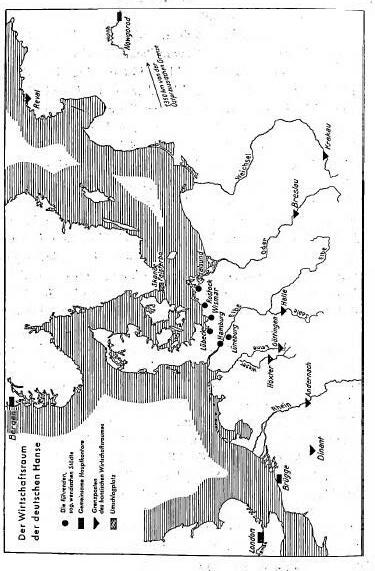
ensured by the multitude of comrades that spread over the vast lands facing the northern seas. Even if the official lists mention only 90 Hanseatic towns by name, according to reliable research, there are probably far more than 160 communities that actively participate in the Hanseatic economic life. Their area stretches from Guelders, Utrecht and Friesland in the west to the French speaking Dinant on the Meuse as the southernmost point, from Andernach on the Rhine to the outermost posts of Reval in the northeast and Krakow in the southeast. In the first place there is Lübeck, which is the leading city of the Hanseatic League and the meeting place of the "Tagfahrten", Rostock, Stralsund and Wismar, Hamburg as the sally port on the West Sea and Lüneburg as the main place of salt delivery. These so called Wendish cities ensure that the foreign stations remain pillars of an international economic area that enriches the lifestyle of the German citizen for centuries to come.
The steel yard in London, where iron, wine and silk went from the Rhine, while wool and cloth or tin were fetched from England, the house of the Easterlings in Antwerp and the Kontor in Bruges, collection points for Flanders textiles, linen from the Netherlands and Westphalia, cappel hooks for priests' vestments, metal goods from Upper German cities or Spanish lead, are the outermost bases of the Hanseatic economic area in the West. In the east, however, the distant Novgorod borders the area to which the Hanseatic merchant advances by ship, with wagons and carts, or with pack animals. In this vast and, with the exception of the steel yard in London, strictly continental area, the preferred goods of the time are moved, such as, in addition to the above mentioned goods, Bohemian iron, salt from Prussia and Livonia, sulfur, leather, parchment, the paper substitute of the time, beer and Russian products such as sable and marten skins, grain, hemp and flax, tar and potash.
But at the same time the stages have all the characteristics of an economic network built with economic prudence. Just think of the fact that the Hanseatic League, this union of sovereign cities and countries, by no means only concluded trade agreements for a short period of time, but mostly permanent economic agreements, the content of which was already based on far reaching economic planning. In the economic sphere of the Hanseatic League, market regulation was a matter of course.
In St. Peter's Court in Novgorod, economic policy was conducted in an almost modern way. The "Schar dere Dhutschen to Nogarden" was subject to a fixed order, as was necessary in view of the centralistic foreign trade system of the Russian Empire. For the purchase and sale of goods was mostly regulated between the Oldermann of St. Peter's Court and the Tsar's representative in a monopolistic manner, since the Tsar alone possessed the trading rights for Russian products.
guilds had the effect that no merchant adventurers could start a game with the business cycle. Remember also how German merchant spirit made the peninsula of Skåne, with its transhipment points Skanör and Falsterbo, for centuries one of the busiest transport centers in Europe, whose ecclesiastical buildings and secular ruins still bear witness to a rich and sidereal life. With fleets that numbered hundreds of sails, fishing was carried on in Norwegian waters and ore was brought in, and here again not only in purely merchant mediation, but in cooperative organization of commercial labor. And the pioneer activity, which provides for the consolidation of the German element in undeveloped areas, comes to light on the long way to the Russian markets, where it joins the colonization work of the Order's power in the East. Road building is also a part of it, as goods were partly transported over new land routes through the territory of the Order and over Kurland to Novgorod.
Therefore, the document from the year 1237, which is found in Lübeck in the "Trese" and in which Henry III assures the "merchants of Gotland" freedom of trade and customs in the English Empire, can be considered as the foundation of a European economic area by the German merchant. With the flourishing of the Hanseatic League in the two following centuries, this spatial economy continued until new state powers arose, against which the large economic area could no longer be defended by a bourgeois institution. In fact, the Hanseatic League owed its heyday to the state fragmentation of Germany as well as to the quarrels of the Scandinavian rulers, the Anglo French War and the struggles of the Roses in the 15th century, during which English absolutism emerged. The Hanseatic cities were able to master their economic area as long as they were the strong among the weak political powers of their time. As soon as the national will began to grow stronger under royal rule, as was most sharply expressed in England in the economic sphere, their influence waned, since the Hanseatic citizen received no support from any national power. When the Tudors won in England, France united its national forces with the expulsion of the English from its borders, the Wasas seized power in Sweden, and Ivan III built up the Tsarist empire and on this occasion closed the Hanseatic Kontor in Novgorod with bloody violence, the first German large scale economic area crumbled at all borders.
The Hanseatic rule of the 13th to 16th centuries had to give way to the Dutch trading power, which had already consciously turned against the German element for generations, in the 17th century, until this in turn had to cede its place to the rising world domination of the British in the 18th century. Even if in 1669 a last day trip of Hanseatic cities met in Lübeck, the once dominated
15
area had long since been dissolved. It says enough when, after the Peace of Westphalia of 1648, the mouths of all the great German rivers were under
foreign control, under Dutch, Swedish, Danish and Polish rule, and at that time one might have thought that Germany had become a landlocked country. An economic area is inconceivable without transport facilities. Before the railroad, the rivers were the decisive link between the areas and the access to the sea and thus to the world. After the Hanseatic League had connected the core of Central Europe to the Atlantic economic routes, the idea of a large scale economy of the German kind was all but destroyed after its disintegration. It was not until 1866 that the mouth of the Elbe came back into German hands; perhaps Germany's rapprochement with the sea should not be considered complete until the acquisition of Heligoland in 1890. The mouth of the Rhine, however, became the property of a new European economic area in 1940.
While the German Hanseatic League is making itself at home in the eastern region, the upheaval that will determine the face of the world for all time to come is already beginning, which will bring the spread of Europeanism in the
western hemisphere. The discovery of America has divided Western mankind into the peoples of the old continent and the colonial states of the New World. Certainly, it would be appealing to draw a picture of Europe as it would have
developed without the discovery and conquest of the American double continent. The voyages of Columbus and the underlying mental attitude of medieval man, who was driven to his western conquests by the longing for a new framework of life, coincided with a heyday of European colonization of the East. If the new territory at the other end of the Atlantic Ocean had not come into the sphere of interest of all those pioneers and adventurers who left their homeland on the oceanic "roads of fortune" and found in America the inexhaustible land without frontier and transplanted there popular forces which were thus lost to the mother continent, and if perhaps the passionate mood of overseas expansion had been wearied by some setbacks, then one might think that Eastern Europe would have entered an epoch of the strongest intensification. Perhaps with an undisturbed continuation of the Hanseatic spirit, with a permanent spread of the Ostland idea, that heavy tiredness could have been avoided, which spread in all later centuries in the deserted areas of the European East and allowed progress in cultural and technical life only to an inhibited degree. Perhaps the East, which remained backward until the 20th century, would have become a flourishing garden of European existence, which would have offered enough space to serve a lively European economy in a securing and balancing way.
But in the frenzy of overseas discoveries, the eyes of the European peoples were fixed on the West. This was not because really useful treasures made the relocation of the large scale economy to the upper sea seem worthwhile. Perhaps even more difficult than discovering the new continent was solving the problem of what to do with the new, vast world on the other side of the ocean that lay beyond all Western conceptions.
The first generations, which built the American area into their world view, had neither knowledge of considerable raw materials or other life goods of the American earth, nor the possibility to produce such in the new country or even to bring them to Europe, nor even the need to bring economic goods to the area of the domestic consumers on a larger scale. Foodstuffs and the raw materials of clothing, such as wool and flax, were sufficiently available for the European population. A mass supply hardly seemed necessary; it was hardly feasible even with the production and transport conditions of the time. It was only the luxury goods that could be considered for trade between Europe and the overseas world. This had changed little since ancient times. As then, even now, long distance trade could generally only have as its goal the supply of a thin, wealthy class with precious items such as silk or rare spices. Thus the overestimation of silver and gold, i.e. the symbol of the gradually awakening capitalist spirit, becomes doubly understandable. The precious metals were at first the only discovery in the New World with which something could be done.
It was easy to capture them and bring them to Europe, easier at any rate than to cultivate plantations in a struggle with the natives. Thus, first of all, the gold and the silver evoked the interest in the western half of the globe. And the passions whipped up by these supposed treasures shattered the serene community work, not yet burdened with a particular greed for profit, as it had been exemplarily demonstrated by the bourgeoisie in the occidental area, namely in Central Europe under the rule of the Hanseatic League, for centuries.
But it can be seen that the states, which at first had a share in the conquered world, made serious efforts to soon also fill economically the territory which the conquests of bold conquistadors had brought them. It is of interest to see similar principles prevailing at first in the creation of the first European American large scale economic area, as Hanseatic comrades and Knights of the Order had preserved in the construction of their work in the northern and eastern European economic area.
In the northeast of occidental Christendom, Prussia had carried the idea of the crusader state. The southwest was under a similar sign with the Castilian knighthood. Thus, this idea of the state also shaped the overseas space of the Spanish crown, which was to be reorganized. Under Charles V, the Spanish crown was not only the dominant political power in Europe, but a world empire in which the sun never set, an empire stretching over two continents.
In Madrid, the Council of the Indies ruled as the supreme headquarters of the great Spanish economic area. The name India was retained for a long time for the countries and islands that could be reached by sailing westward, since the error of Columbus, who believed to have found the outermost edge of the Orient in America; a distinction was made between the East Indian world of Asia, which represented the sphere of power of the Portuguese, and the West Indian world of America. The Indian Council created a colonial policy that was not only concerned with merchant exploitation of the overseas territories, but wanted to make the colonial empire a permanent settlement governed by state and ecclesiastical authorities. The two viceroyalties in the New World, New Spain in Central America, administered from Mexico, and Peru on the coast of the Pacific Ocean, ruled from Lima, were imbued with the occidental idea of political and spiritual crusading. This was expressed, in particular, in the position towards the natives, for whom, soon after the actual conquest of the old Indian kingdoms, carried out with bloody cruelty, protective legislation was enacted, characterized by humanity and cultural activity.
The economic ties between the European and American possessions of the
Spanish crown remained, by necessity, still small. One of the most important events was the arrival of the silver fleets in the Spanish ports, which brought the precious metal from the mines of the Americas into the circulation of European life and thus caused that flooding with silver and also with gold, which drove the transition from the Middle Ages to modern times with stormy impulses. However, a stronger attitude of the European consumer towards tropical crops, namely cane sugar, was already beginning to emerge. But also nut wood and dye wood, corn, cocoa and tobacco came to the European markets, while the building of civilization on the distant shores of the Pacific Ocean had to be done with the help of European goods.
Thus, in this Spanish world empire, rudiments of a conscious large scale economy can be seen more strongly than in the Portuguese overseas relations, which were confined to the east coast of South America, to Africa and the Asian island world. The Spaniard was a landowner and cattle breeder in the new territories. He was a settler, even if the highest ruling class, both the state officials and the high clergy, did not remain resident in America, but returned to the mother country after several years of activity. But a strong intermediate class formed, which made the colonial world a home for the white race. It was strengthened and carried by the great plan to create a unified sphere of power of the Western European man in the space of the Atlantic Ocean, which reached over from the Western countries of the Occident to the edge of the Silent Sea, which had been untouched for thousands of years.
For all the straightforward planning of this large Romanesque area, which was evident even in the layout of the cities in the colonies, whose streets starburst toward a central point, there was not the strength to build permanence. One was tempted to transfer medieval forms all too rigidly to a world that was still in the process of becoming. Medieval attitudes could not yet find the connection to the struggle with problems. Thus, it was believed that a unity and uniformity of life could be built up in the overseas areas in the same way as the medieval Occident loved it, aloof from all problems and incalculable development. But this self assurance, this insistence on the old narrow forms broke in the face of the chaotic activity of a young, stormy world, in which a religiously based idealism, which certainly cannot be denied to the Spanish colonizers, could not cope with the harsh reality.
In the long run, the Jesuit culture of the Romanesque overseas empire was no match for the intrusion of Dutch and British forces. The spiritual overlord of the world in Rome had probably done his best, in the interest of catholicity, to give the new spaces of the western hemisphere eternal permanence under Spanish Portuguese rule, which was faithful to Rome. In the Treaty of
Tordesilla, the pope had already approved the demarcation line in 1494, which granted all newly discovered lands east of a dividing line running from north to south and cutting through the South American continent to the Portuguese, while the territory to the west was to be reserved for the Spanish. With this papal blessing, the Romanesque area seemed secure. For the line of demarcation meant not only the division of the overseas world between the two Iberian states, but at the same time the privilege of the sea routes for Spain and Portugal. The other European nations were thus cut off from any participation in the territories beyond the ocean. The sea was closed, a "mare clausum", according to the Pope's arbitration. Its opening to the seafaring peoples outside the Pyrenean Peninsula was possible only when Spanish rule in Europe was broken.
The partition of the New World by the dictates of Rome thus had to lead to warlike entanglements in Europe. Slowly, the Dutch, the French and the English advanced into the world's oceans, first with daring pirate and corsair voyages by individual captains, then with units sanctioned by the state, until the Spanish great power, hollowed out in three state bankruptcies and weakened by political and military defeats, disintegrated and finally the sinking of the Armada in 1588 sealed its fate. With the collapse of the center on the southwestern peninsula of Europe, the first major economic area of European overseas character had to meet its end as a unified, planned entity.
In any case, the ocean remains the fate shaping power for the European idea of the large scale economy. The real successors of the Spanish Portuguese maritime empire are the Dutch, who broke away economically from the German area at an early stage and, with the freedom of the seas gradually won by the European nations, developed into the trading nation of the rising modern age. It is not without reason that the legendary figure of the Flying Dutchman, at home on all seas, has become a symbol of restlessness. The Dutchman brings cargo from all over the world to the European markets, and in his role as a carrier who needs refreshment stations, factories and power bases on his long voyages, he arrives at a colonial empire that can be addressed as a large scale economic area of the 17th century.
The basis of the Dutch trading area was, for all its orientation towards the western seas, the continent and here again that area which the German Hanseatic League had developed in its heyday. The Baltic Sea was regarded as the great trade school of the seafaring Europeans, as the "mother of all
commerce," and this water space was filled by the Dutch fleet, which fetched the wood for shipbuilding from northern Europe just as it fetched the grain of Poland for the supply of the large western cities. The Dutch skipper dominated the Rhine as the most important traffic route leading far into the continent. He sailed, though mostly not with an open Dutch flag, to the ports of the Iberian Peninsula. He steered the great "Straetvarders", the road drivers, through the Strait of Gibraltar into the Mediterranean to trade with Italy and Asia Minor. The task area of the small, laboriously from dikes against the water tide piled up country extended everywhere on the continental area, where connections to the sea trade could be established. Where the waterway did not lead, the borders of the Dutch economic area were set.
The small Dutch nation, which had known how to defend its independence against Spain behind the bulwark of its moats and fortresses, conquered not only the continental transhipment of goods, but also trade with Africa and Asia, and secured territories for settlement on the American continent.
The Netherlands was almost synonymous with the East India Company, which, from Amsterdam, ruled Asia with soldiers and cannons. Around 1620, Batavia was developed as the headquarters in the Indian archipelago, a whimsical image of a Dutch city with its canals, broad gabled Nordic houses, and uncluttered layout in the midst of a sprawling tropical wilderness. There, sixty or more of the high sided Dutch overseas sailors, the "potbellies," sailed annually, bringing cane sugar, coffee, cloves, nutmegs to Europe, which willingly paid the high prices charged by the East India Company to extract enormous dividends.
The East India Company was almost synonymous with the Dutch state itself, since the commanding offices of the Dutch Republic and the Company were often in the same hands, or at least in the same families. Thus there was a case, perhaps unique in history, in which the leadership of the state was identical with a large economic enterprise. This link probably explains the Dutchman's penchant for commerce and speculation. It was the Dutch merchants who ushered in the era of bulk cargo handling in Europe. It should be noted that in the 17th century Holland had a fleet of 35,000 ships, a trading power the likes of which the world had never seen. Mass shipping began with cane sugar, with tobacco and indigo, and eventually expanded to cotton and overseas metals.
The Dutch overseas empire expanded to China and Japan, where, however, it had to remain completely bogged down in the sparse exchange of goods. After all, the Dutch were the first Europeans who were able to remain in lasting contact with Japan, which was otherwise closed to them, since the Japanese completely suppressed the Catholic missions, which, with the appearance of
the Jesuit Francis Xavier, the apostle of India, believed they could gain a firm foothold in this easternmost island kingdom as early as 1549. Only the Protestant Dutch were allowed four ships a year, which Holland valued for its copper trade. In South Africa, Cape Land was declared a Dutch settlement area until it was lost to Britain at the turn of the 20th century. In America, Dutch settled on the Hudson. They founded New Amsterdam as a farming colony when the Dutch West India Company acquired Manhattan Island from the Indians for 260 thalers; this settlement was also, very soon, invaded by the English. The Duke of York renamed the conquered city in 1664: henceforth it is called New York and it has become the largest conglomeration of people in the world.
Even if the Dutch opened large scale plantation construction in their colonies on the Asian islands and the American mainland, thus laying productive foundations for a superior economic area, the speculative element, the mercantile principle remains their leitmotif. It is not without reason that the stock exchange game first came to its highest development in the Netherlands. It is not without reason that the first important monetary center in the Netherlands was established with the Bank of Amsterdam, which was founded as early as 1609. This was the expression of the formation of the Dutch economy into a trading area, which drew its wealth not so much from the production of economic goods as from the turnover of goods. It was with this that economic liberalism actually gained ground. The Netherlands deliberately attracted two elements of commercial domination of the world. First, the money, expressed in gold and silver, which lies in such large quantities in the banks and insurance companies of the Dutch cities that the interest rate on loan capital can be kept at two percent and below for decades; an additional advertisement for the Dutch merchant class in European business. Second, however, the Dutch attract all kinds of merchants to their exchanges. Portuguese and Spanish Jews are allowed into the country in great droves, driving the speculative sense to ever new heights.
Thus the Dutch large scale economic area was a trading area scattered all over the world and strongly interspersed with speculation, which could find no anchorage in down to earth elements. As in more recent times a Dutch minister of agriculture declared: "Our meadows lie on La Plata," so it is said of the Dutch economic structure of the 17th and 18th centuries: "Like bees, they suck sugar from all countries. Norway is their forest, the banks of the Rhine, those of the Garonne and the other French rivers are their wine hills, Germany, Spain and Iceland their sheep pasture, Prussia and Poland their arable fields, India and Arabia their gardens." This vividly expresses the unfolding into a commercial metropolitan area.
But of historical importance is the fact that with the Dutch and then the British domination of the sea since the French did not succeed in gaining decisive power on the sea the idea of a large scale economy of European mankind was finally detached from the medieval, Romanesque, Roman Catholic circle and now taken over by the world of Protestant Germanic thinking.
The world wide Dutch trade fell into disrepair because of the quarrel with its political friends from the time of the Spanish battles, the English. In three naval and colonial wars in the second half of the 17th century, England gained the upper hand over its former ally. Economic power was wrested from the Dutch.
The close economic relations with Russia, which began at the time of Peter the Great the "Tsar and Carpenter", who learned shipbuilding in Dutch shipyards in 1697 are already at the end of "onze Gouden Eeuw", the golden, the classical century of the Netherlands, which was also the heyday of science and painting.
As Holland had once begun as a carrier, as a sea and river transporter of the European peoples, so it became again a trading center. It still remained a country of wealth and valuable colonial possessions in Asia, but its former ambition to be master in a metropolitan area filled with economic planning was broken.
Before the domination of sea and space by Britain should come to a stronger development, an epoch of strongest centralization of the political power on the continent had to pass. With royalty, France had become militarily and economically stronger, and when in 1661 the twenty three year old King Louis XIV uttered the words in his first Council of State session: "I have decided to be my own prime minister," the century of absolutism had begun. The Roi Soleil not only made the terrible words "The state is me" true, not only drove imperialist France into the wars of robbery, but also created in the economy the system of circling around the central sun.
It was once said that English imperialism was dictated by the desire for very real booty; Spanish expansionism, as shown in the conquest of America, was filled with the religious, with the idea of spreading the Church in the world of the heathen; but France's objective lay in the intellect, in the passion for the constructive. The Frenchman is vain enough to see in the spiritual the
sufficient force for the safeguarding of the living space. This longing for the constructive to secure life runs from early French royalty to the decade of the Maginot Line. An exception, perhaps, was the Napoleonic era, when Bonaparte, who was not French, whipped up the French people to a spirit of adventure hardly otherwise in keeping with their character.
Colbert, the minister of Louis XIV, pursued the economic policy of mercantilism for France so thoroughly that mercantilism and Colbertinism have become synonymous terms. His goal was to make France the largest money owner in the world, to secure it with a large stock of precious metals against the enemy powers, admittedly in conjunction with a very powerful military force. In this way, he already anticipated the eternal parallel of all French considerations, which politically and privately appeal as an ideal to the pensioner type who feels financially secure, until for the last time the gold hoard of the Bank of France, swollen to billions in the war of 1940, had to provide proof of how weak constructive security is against the onslaught of living forces.
The France of the Sun King had extended its military power beyond the Rhine, raised the lily banner on the Apennine Peninsula, called the Mediterranean "le lac frangais" and sought to control this area economically as well. The centralization of all economic processes was pushed to such an extent that "no village road could be repaired, no church roof mended, without an instruction from Paris. The exaggerated intellectual trait of French mercantilism showed itself in the neglect of peasant labor. Certainly, here too there were interventions at times. When English merchants wanted to deliver Irish cattle and salted meat to France, they could proudly point out that French agriculture itself exported these articles. On the whole, however, the leading classes had no sympathy for the plains countryside, to the point that a contemporary French writer had to describe the peasants as a kind of man shy animals who, black and sunburned, churned up the soil with invincible perseverance. "They save other people the trouble of sowing, working, reaping in order to live. They well deserve not to lack the bread for which they have sown."
For this, Colbertinism promoted, with all state resources, the industrial production that would bring gold to the country. In this field, the closed system of economic policy, as practiced under Louis XIV with almost consummate scientificity, achieved much. In the economic area dominated by France, monopolies and privileges ensured the promotion of industrial activity. Almost every year something new was introduced in the French manufactory. The king paid subsidies out of his pocket to those manufacturers who saved foreign exchange on otherwise needed foreign goods through
domestic production. Fine cloth was no longer purchased from England or Holland; silk was produced domestically by growing mulberry trees. Colbert himself bought a machine invented in England for making stockings. The French mirror industry displaced the Venetian products. It was an industrial boom under the sign of mercantilism that gave the French economic area the expression of great unity in the industrial field.
In this area also fell the internal tariffs to facilitate the movement of goods, but not to Alsace, which with its German city of Strasbourg had been "reunited" with France by the raids of Louis. Colbert countered Cromwell's British Navigation Act with a French Navigation Act that allowed imports only from French ships, or at least imposed heavy taxes on foreign ships anchored in French ports.
Thus, France turned to a deliberate large scale economy. It was not only to encompass extensive parts of the continent. In addition, France resumed colonial attempts after the French overseas policy had been doomed to failure in the 16th century. Already the Cardinal Richelieu, who had prepared the powerful absolutism under the thirteenth Louis, appointed himself Grand maitre, chef et surintendant général de la navigation et commerce de France in 1626, expanded the fleet and undertook new colonizing foundations in Central America and later in the East Indies. Colbert, however, brought about a flowering of French colonialism. Frenchmen settled on the Mississippi River, and temporarily a French East India Company was established.
Although the expansion of French economic space into overseas territories did not remain very sustainable, the effort to acquire colonial possessions shows that France in that epoch firmly believed in the reach of its central power anchored in the old continent. It is significant, after all, that the German philosopher Leibniz, with a memorandum to Louis XIV, was able to attempt to recommend the conquest of Egypt to the French king in order to divert the king's attention from continental policy to colonial policy and thus to divert France's will to expand from the Rhine. Of course, it was Napoleon who first included the eastern Mediterranean in the circle of his conquest policy.
The French dominion was characterized by the uniformity of the law, by the order of the monetary system, by the control of the economic processes, as for example the export of grain was forbidden in times of need. It is in the nature of state planning in the economic sphere that mercantilism in France was able to lead to considerable growth the branches for which the central power was engaged. In the case of France, however, the peasant countryside was too much neglected as a productive factor, and the city and for the Frenchman, the city is synonymous with Paris and, at that time, with the court in Versailles was overbred. The extravagance of the absolutist regime added
to this. Of the 100 million livres that constituted the annual state revenue, no less than 40 million went for the glittering court. The aristocracy's nonsensical need for luxury quickly caused the French economy to deteriorate after Colbert's death. Finances fell into such disarray that the living reserves of mercantilism had to be called upon: all equipment made of solid silver had to be taken to the mint by royal order. Ludwig had to dispose of his elaborately chiseled tableware, silver armchairs and candlesticks. But with such financial aid, the decline of the French economy could no longer be halted.
When the Sun King died in 1715, the population of France had dropped from 22 million to 18 million in the course of half a century. Beggars roamed everywhere. The French colonial dream was largely over after important overseas territories were lost to the English and Portuguese in the Peace of Utrecht two years before Louis' death.
It was not until the middle of the 19th century that France again took part in an active colonial policy, first in the Mediterranean district with the conquest of Algeria and later of Tunis, then in the Indian Ocean with the domination of Madagascar and with Indo China in the East, in order to further expand its colonial possessions in North Africa during the Bismarckian era. What a strange line again from Leibniz to Bismarck, both relegating the French from the continent to the non European spaces, the one theoretically, the other by practical support, in order to bend the idea of revenge after the war of 1870/71 strange and yet inwardly justified by Germany's former lack of own colonial initiative.
Not unimportant for the development of the continental spatial economy in the 17th century are also the effects of French religious policy. When Louis XIV abolished the special religious rights of the Calvinist Huguenots with the revocation of the Edict of Nantes in 1685 and began a cruel persecution, half a million of the most skilled industrial workers and entrepreneurs emigrated from the French area of power. The economic area controlled from Paris thus lost significant economic power, which now benefited other states, namely Germany, Holland and England to a greater extent. The loss was all the greater because the emigrating Calvinists took many industrial secrets with them, including the secret of steel and tinplate production. Religio political fanaticism had triumphed in France in conflict with the principles of mercantilism, which was otherwise concerned with attracting labor for industrial expansion. It was only the beginning of the decline of the French idea of world order, which had to concede its rank more and more to the advancing British Empire.
When the 17th century dawned and the Elizabethan Age, an epoch of the flowering of English art and literature, became a thing of the past for England, no Englishman had yet taken up residence outside the British Isles or the European continent. It was only three centuries ago, then, that the British Commonwealth of Nations began to form, which finally laid claim to being the empire shaping the face of the globe on the basis of its wealth, its domination of peoples, its spread of languages. However differently the idea of an economic area may have been shaped in the course of the development of the British Empire, and only after the World War with the famous Ottawa Treaties did it take on a firmer form, British overseas possessions have always been understood as an economic area working into each other's hands. It can therefore be rightly said that in the history of the development of European economic thought, after the German Hanseatic League, the Spanish Empire, the Dutch colonial area and the epoch of French absolutism, the British Empire emerged as a large area of comprehensive economic exploitation and development of power, and has maintained its tendency to constant and ruthless expansion right up to our own time.
The first hesitant attempts on the part of England, still in the age of Queen Elizabeth, to participate in the exploitation of the world, at first reveal nothing of economic foresight. They were isolated piratical voyages of bold shipmen, who incidentally earned the fame of national pioneers, whose activity stands at the beginning of the Empire. And it is characteristic that the first discovery of an Englishman was not of space, but of goods, namely of man as a commodity. For the first Englishman to go on a great voyage overseas, John Hawkins, became the inventor of the slave trade, shipping Negroes on English ships from Africa to America as merchandise or as booty. Francis Drake follows him as the kingdom's greatest adventurer, raids Spanish ships in the West Indies, steals gold and silver, cargoes of spice and silk, and is knighted for it in London. "Jesus" was the name of the first British slave ship he commanded. At the end of the 16th century, Francis Drake made the first English circumnavigation of the globe. Slowly the English dream of an overseas world, which should serve as a base for the British, rises. The first American colonies were founded in 1606, in the north of the east coast Virginia and New England, named after the Virgin Queen, and in the south the settlement of Jamestown. Their economic importance consisted in tobacco plantations. And in 1620, the "Mayflower" brought the hundred Pilgrim Fathers to the New England coast, Puritans who had fled the Stuarts, who were leaning toward Catholicism. They are celebrated by American historians as the real founders of the American
nation, and indeed this immigration of the Puritans meant the foundation for the building of the American continent in the English spirit, with English nature and English language.
Around the same time, as a counterpart to the great Dutch colonial society, the British East India Company was founded, which was to play a decisive role in the development of the English island into the center of a world empire spanning the West and the East in the same way. Now England systematically goes about shaping the space that is to be filled with British life. The principle is established that the sea can be divided into zones of dominion and that the Oceanus Britannicus must constitute a sphere of power of England, not only as far as it washes around the British Isles, but as far as the southernmost corner of Europe, as far as Norway, as far as Iceland and Greenland, and finally as far as the American continent. Cromwell's Navigation Act of 1651 attempts to create this British economic space, consisting of wind and waves, islands and continental coasts, against any blow from the outside. It establishes by law the privilege for English ships to have a monopoly on the British sea. Foreign merchandise may be shipped to England only on English ships. Thus the first attack on the freedom of Europe was made by the British. The continental maritime powers were not strong enough to repel this insolence. Holland, the nation of Europe's freighters, found no more strength to do so than France, which attempted a feeble counterattack with the Colbert Navigation Act and whose overseas role only temporarily achieved greater importance.
The Englishman reckons up to the apostasy of the American states the First Empire, which after the fall of Napoleon was followed by the Second Empire under the sign of undisputed British naval supremacy and free trade, until towards the end of the 19th century, with the political independence of parts of the empire overseas, the Third Empire arose, which differs from its predecessor in the decline of the central power of the English island and, conversely, the rise of non European territories to the equal position of the dominions within the Commonwealth of Nations.
In its spatial development, the First Empire was initially much too much dependent on the coincidences of conquests, discoveries and individual undertakings to be able to speak of a conscious large economic area for that time. Nevertheless, the mercantilist worldview endeavored to bring a basic economic regulation into the relationship between the motherland and the overseas. This was easiest in the case of commercial settlements, for example in India, which, as the domain of the private East India Company, had to be content with the task of being a colonial exploitation area. The situation was just as simple in the case of the shipping hubs, which were immensely
important for supplying the ships traveling between the various overseas territories in the age of long sailing voyages for the supply of fresh water and vegetables against scurvy, as later in the age of technology as coal bunkers or oil tanks but which did not pose any problems for economic policy. This problem did not arise until the actual settling colonies, where immigrants coming from England or other areas very soon came to have their own political and social ideas. These immigrants saw the new country less as a branch of London than as a new, independent homeland. In contrast, purely economic motives tended to recede. Mercantilist speculation knew how to make good distinctions here. Very dependent areas, such as naval bases or young plantation colonies, whose plantations first had to be laboriously raised, cost the mother country money, and money was the epitome of mercantilist state control. The settlers, however, who had moved across the ocean to find a new home, created their own living space. They did not impose many costs on their homeland, but in the process gained extensive independence in the area of economic policy and thus became business partners of the merchants in London and the other English industrial cities. The generally ever present British feeling of togetherness ensured that this emerging trade of the settler colonies mainly took place with the mother country.
Only when this natural economic alliance colonial raw materials against England's industrial products was to be forced into rigid forms, when London began to fetter the young economy with paragraphs, only at this moment did the catastrophe of 1776 occur, which, with the declaration of independence of the United States, brought critical hours for the continued existence of the Empire. The colonies were ordered by the English Parliament to ship cotton and dye wood, cane sugar and tobacco, indigo and ginger only to England and, on the other hand, to receive European goods only through London. Free trade was thus restricted in important products. To cover it in modern terms, a spatial economic program was set up, the center of which was thought to be the English entrepreneur and the English factory workers, for whose benefit the trade of the colonies was to be rigidly tied to the mother country.
England won its colonial empire largely on the continent. Since the mid 17th century, English policy has been to play off the continental powers of Europe against each other, to form coalitions against the strongest states in each case, to let no continental nation become too powerful, but also none too weak, lest it be driven into the sphere of power of a larger European nation. In all the European entanglements of three centuries, from the middle of the 17th century to the middle of the 20th century, what has come out as a gain for England has been the expansion of her economic area in all parts of the world. All continental wars ended with overseas possession of Britain. So it
was in the War of the Spanish Succession from 1701 to 1714, in which England fomented the coalition of the German Empire, Austria, Holland and Portugal against France, that is, against the strongest war power of the time and the only nation still threatening to develop overseas ambitions for the future. While the European nations were engaged in war turmoil on the continent, England retained as gains Gibraltar, Canada, Newfoundland. So it was in the Seven Years' War, in which, according to a word of Bismarck, the grenadiers of Frederick the Great helped the English to conquer North America, while at the same time the Peace of Paris of 1763 confirmed the expulsion of the French from India by Lord Clive and opened to the British the possibility of bringing all India under their control in uninterrupted military and diplomatic struggles with the Indian princes until 1840. The Frederician wars, in which England stood in the background, brought about the balancing of the equilibrium of the continental powers which England had always desired; and in those years the decision was made that not the French but the English language should become the world language.
In this struggle with the continent, the mainland had only the one great victory to record, which was associated with the declaration of independence of the American states. With the support of France, which until the Napoleonic era still hoped for the destruction of English supremacy on the world sea, the detachment of the American colonies from the English mother country had been achieved, and the most important piece had been cut out of the area that England had just begun to develop into a large economic area. However, even with this singular misfortune of British overseas policy, France could not fatally affect its rival. For England's economic relations with the apostate colony continued. An inner bond of England and the United States of America persisted, which has had an effect namely in the economic and political cooperation in the last century again and again to reach heights of political economic support to the detriment of the European mainland in the World War and since 1940 in the Anglo German War.
By historical necessity, the idea of a large scale economy could only gradually reach maturity in the British Empire, resulting in an economic interconnectedness of the widely separated areas. Until the Napoleonic decades, a well thought out policy of a spatial economic nature was not possible, because the Empire was in a permanent state of war with its overseas parts. One only has to think of the long periods of unrest in the Asian part of British rule. The "jewel of the English crown," India, with its 300 million people, could only be conquered and held in ceaseless battles, and thus went a very different way in its economic condition than the American colonies of settlement. For the age of the machine, the emerging industrialization, also
gave the political shaping forces a different emphasized goal direction than the preceding times had been able to produce.
The British island became the stronghold of industry, and it shaped the subjugated territories and those reclaimed from the other European peoples according to its own visions of modern economic life. This is most clearly illustrated by the example of India. India, as the most important country of ancient Oriental trade, had an extensive textile industry. It processed its cotton for the clothing of the Indian population as well as for export to sometimes very distant countries. The rapid industrialization of England, brought about by the speed of the newly discovered machines, created a Manchester that needed enormous markets for the employment of its tireless machines. Therefore, in 1775, the Indian cottage industry of clothiers was banned and destroyed. Whereas up to that year India had sent its bales of cloth even as far as England, its exports now collapsed completely. Manchester supplied the calico; the Indians, who had woven their own clothes through millennia, had to buy the English cloth. In return, India was made commodity intensive. Its cotton plantations were expanded. It was driven to monoculture with all its risks. The line of forced economic development was similar in other areas occupied by England. In many cases, they were deprived of the basis of their self sufficiency. The members of the Empire were educated to become producers of raw materials on a grand scale, in order to become buyers of English factory goods. One only has to recall the pushing of Egypt into the role of a compulsory supplier of cotton, which took place at the end of the 19th century.
There are two lines of force that run through the struggles of Europeanism to shape economic areas up to the beginning of the 19th century. One line starts from the fact of the domination of the sea by England. It covers the military and political power that enables the island kingdom not only to conquer but also to hold spaces scattered all over the world. The second line, however, is drawn through modern technology. The fire powered machine ruthlessly urges a distribution of tasks in the Empire economy. The concern for the procurement of raw materials to keep the factories busy, on the one hand, and the effort to find markets for the products of the ceaselessly supplying English workshops, on the other, fill the British economic space until, after the Napoleonic era, free trade comes along, which makes the idea of the large economic space appear in a new light again.
The expansion of the British Empire's overseas possessions and the expansion of British industry have influenced each other. Times had passed when the British island believed that it should orient itself entirely to overseas. Around 1700, the term "British Empire" had emerged, which sufficiently illustrates the fact of English imperialism. This empire had already become almost remote from Europe. Before the declaration of independence of the American colonies, there were already serious discussions in the English ruling class whether the political center of the British Empire should not be transferred to North America. It was pointed out that the economic center of gravity of the British territories seemed to be in the New World. London in America! A parallel to some of the debates of the war since 1940. But both the separation of the United States of America from the mother country and the rise of island industry then very soon renewed interest in the European continent. The English interest was now not only in the balance of power of the continental states in order to keep a free hand in the overseas game, i.e. the political and maritime weakening of the mainland, but also in its exploitation as an economic area by the British merchant.
Napoleonic France intervened with renewed vigor in this centuries long struggle between island and continent. Perhaps one can speak of a Napoleonic economic area, although the period of power of the French emperor was too short and too much filled with purely military demands, so that an economic area of Europe under French leadership could not really have been formed.
At least Napoleon's Continental Blockade made an attempt, if not to create a unified continental economic area, then at least to exclude it from the British economic sphere. In November 1806, Napoleon's decree appeared, opening the Continental Blockade, the sealing off of the continent from the British large scale economy. The blockade was imposed over the British Isles, but more passively than actively. For to disrupt the connection of the Empire's central country with its overseas branches, the French fleet was not strong enough. After the Seven Years' War, France had already made efforts to upgrade its navy. But Napoleon found only a navy of little use, and he, who as a brilliant organizer had made the French army strong for war, did not succeed in making France's naval power truly capable of action either. Therefore, the Continental Blockade had to confine itself to closing off the continent, but could not achieve a constriction of the British economic area.
The Napoleonic blockade forbade all intercourse, correspondence, and exchange of goods with England. However, the decree was difficult to
implement for the entire continent. When in its justification it accuses England of wanting to raise its own trade on the ruins of continental trade and commerce, it designates as England's accomplice every European country that trades in English goods on the mainland. For the neutral European states, Napoleon could initially present only these moral reasons for participating in the Continental Blockade, while the territories subjugated by France were forced to comply with the blockade.
It must be borne in mind that most European states were still agricultural countries that were reluctant to do without the products of British factories. The whole of Scandinavia, Russia in particular, most of the Prussian provinces and the Austrian crown lands had settled into the role of food suppliers in exchange for British industrial products. At first, no thought was given to using the opportunity of England's elimination from the market similar to what the overseas raw material areas did during the World War when European supplies were eliminated to develop domestic industry. The fact that the Continental Blockade then brought an epoch of foundation and expansion for various French and German industrial areas is one of the historical, but not a priori intended, consequences of the great European upheavals of the Napoleonic era.
The Continental Blockade was planned only with negative omens. It was intended to damage the British economy. However, it lacked a positive program, which should have been aimed at developing the continent into a coordinated economic area. Yet there was no thought of this. As much as French industry initially flourished through the elimination of British competition, the plan of French tyranny did not include participation by the other countries in an economic upswing achievable through the isolation of England. The cities of the Grand Duchy of Berg Düsseldorf, Elberfeld, Barmen, Solingen, Remscheid, i.e. the Ruhr area which had been industrially oriented since time immemorial, initially experienced years of hardship because the French regime did not allow them any opportunities for commercial development. However, there were other German areas that were able to develop more quickly due to the banishment of English manufacturing, such as the Kingdom of Saxony, where home based work was now transformed into factory industry. Other industrial areas, on the other hand, were virtually destroyed because of the lack of exports to England, such as Brandenburg's cloth manufacture, the silk manufactory in Berlin, or the linen weavers of Silesia. This was because the consumer countries of the continent were reserved for the products of France's textile industry.
The disruption of the continental economic area was even aggravated by the Continental Blockade. Eastern Germany suffered particularly severely from the
trade barriers, and it will have to be attributed to Napoleonic economic policy if the one sided agrarian character of the East came into even sharper contrast than before with the industrially more freely mobile West.
To all these economic confusions, stemming partly from the given circumstances and partly from political jealousies, were added the political influences that opposed the French tyranny, boycotted the blockade in connection with it, and thus finally doomed the idea of a continental economic area to failure. After all, the smuggling of English goods via Stettin and Kolberg even secretly found official support from Prussia. British ships headed for the Baltic ports, were formally seized in agreement with their captains, towed into port, and the goods sold by the state. This even resulted in profits for the state treasury, which ultimately benefited the restoration of the Prussian army and thus the wars of liberation. Incidentally, even France secretly purchased British goods, which were imported via America for camouflage purposes.
The war against England was a decisive failure for Napoleon. If we look at it in terms of its importance for the development of the idea of spatial economy, the economic success is also to be found on the side of England. For England used the period of the blockade to further develop its overseas space. During this time, it substantially strengthened its fleet, expanded its colonial possessions and, above all, won the overseas markets for itself.
In the Congress of Vienna, which sanctioned a new system of states on the continent in 1815, England secured new bases in the Mediterranean with Malta and the Jonic Islands, having already taken Gibraltar from the Spanish a century earlier in the Peace of Utrecht, thus gaining possession of the entrance fortress to the Mediterranean territories. It also took over the Dutch colonies of Cape Land, from which it later conquered all of South Africa with its gold mines, Ceylon and Guyana and the French island of Mauritius, and finally, as a guard post in the German Bight off the main trade route to the continent, the small but important island of Heligoland. And it is only a further effect of this balance of power, regained after France's fall and thus on the European mainland, when in the same century Cyprus, Egypt, important bases in Arabia and finally, in the Boer War, the free states of Transvaal and Oranje of the South African Union could be annexed to the Empire.
The European incision of the Continental System had thus become the basis of the preeminent large scale economic area of English character in the Second Empire. This second rise of a British world empire meant even more than in the previous two centuries a large scale maritime space. Since England no longer had to fear any other sea power, it was able to establish a kind of British trade monopoly under the flag of free trade, in which it hardly mattered how the areas attached to the monopoly related politically to the world empire.
One can formulate it in such a way that the large economic area of this empire consisted of the line network of the English shipping. As much as London relied politically and militarily on its land masses and stations scattered all over the globe, the importance of this connection in economic political terms receded to some extent in comparison with the idea of world trade.
Thus, even as the Continental Blockade slowly crumbled away and disappeared altogether in 1812, England was able to re enter the European markets with fresh forces. After the final defeat of France, England was the dominant trading power in Europe, the rich land of coal and iron, the industrial region with highly developed factories, which knew how to exploit its lead over the only slowly developing continental industry. The best proof of this is the tremendous shortage of money that prevailed on the continent for many years after the wars of liberation, as gold and silver coins worth many hundreds of millions went into the coffers of the British island every year to pay for English imports.
London became the money center of the world, and it is significant in terms of the British metropolitan economy that long gone was the age of mercantilism, when such monetary power would have been pleased in the accumulation of gold and silver. Thus, the international purchasing power drawn from all parts of the world was reinvested as an advertising investment in all parts of the world. English money built the foundation of the technical age in its own colonies as well as in foreign states. It was invested in industrial and commercial enterprises, in the railroads of foreign countries, in water and gas supply plants, and later also in the power stations of foreign cities, thus creating the British large scale investment area. Since 1940, the Anglo German war has forced the sale of such capital investments on a large scale, so that a good part of this investment space has migrated from British to American hands.
The new penetration of England into the trading area of the continent after the fall of Napoleon can be regarded as a fortunate historical factor, despite the difficulties bitterly felt by contemporaries. It contributed a not insignificant building block to the later founding of the unified German Empire, in that it helped to prepare internally for its becoming an empire. While England imposed extraordinarily high tariffs on the import of foreign grain, thus disgruntling the German agricultural regions, it simultaneously
flooded the German market with its industrial products, thus provoking a countermovement that found expression in the Prussian customs law of 1818.
This customs law brought about two upheavals that are very interesting in terms of spatial economics. It meant a complete break with the prevailing principles of mercantilism by granting general freedom of trade. From now on, foreign products could be imported into the Kingdom of Prussia at will. The former prohibitions on foreign trade, which had been permeated by state control, were eliminated in one fell swoop. In exchange, foreign goods were burdened with high customs duties. These tariffs, however and this was the second important innovation now applied uniformly to the dispersed areas of Prussia. As a result, the spatially fragmented Prussian provinces became a unified economic area, and the tariff line advanced everywhere to the border of the monarchy.
Moreover, the Customs Act paved the way for the unification of the German states in terms of trade policy. The principalities, duchies and other small states enclosed by the Prussian provinces were now no longer averse to joining the Prussian customs system, if only to curb the rampant and uneradicable smuggling. But these inclusions had only local significance. For the time being, it was not possible to really unite the German states into one economic area. The tireless champion of German unification in the economic sphere was the Tübingen professor Friedrich List, and the association of merchants and factory owners from Bavaria, Saxony, Württemberg, Hesse and Nassau that he founded brought the idea of creating an economic area that could meet the requirements of modern industrialization ever deeper into the hearts of the people by abolishing customs borders. In 1820, the southern German states joined together to form a customs territory. Then a customs alliance was formed between Prussia, as the ruling power of northern Germany, and Hesse. Prussia's political opponents then founded a customs union of the central German states in order to prevent the establishment of an overarching economic area encompassing all German tribes.
Finally, however, after long efforts, the German Customs and Trade Association was founded in Berlin in March 1833, enabling the unhindered passage of all goods from one German state to another and thus uniting the entire German region into an economic area that could now strengthen all its forces in joint work. Germany, although not yet politically united, could face the world as an economic area of considerable size. At that time, the people were well aware of the significance of the event of the New Year's Eve of 1834, as Treitschke puts it in classic form: "On all the country roads of central Germany, the freight wagons waited heavily laden in long trains in front of the toll houses, surrounded by cheerfully noisy crowds of people. With the living
chime of the old year, the tollgates were raised; the horses pulled up, and with shouts of joy and cracking of whips, they went forward through the liberated country. A new link, firm and inconspicuous, was inserted into the long chain of time."
What had been neglected in Germany in generations that had seen the national strengthening of so many European states was now made up for in the field of labor, of economic activity.
The German area, of course, could not measure up to the economic territory of the British Empire, which extended over all parts of the world, or even to the other states with colonial possessions. It was still limited to the relatively small core of Central Europe between the Alps and the sea, which nevertheless housed 25 million inhabitants. Austria, in its old opposition to Prussia, had not joined the Zollverein. It even tried to establish a counter union that would have included the non German territories of the Austrian Crown, namely Hungary and Upper Italy, and would thus have represented an economic area under Austrian leadership that would have encompassed a population of 70 million from the Baltic and North Seas to the Adriatic and almost to the Black Sea. However, with the War of 1866, which finally secured Prussia's
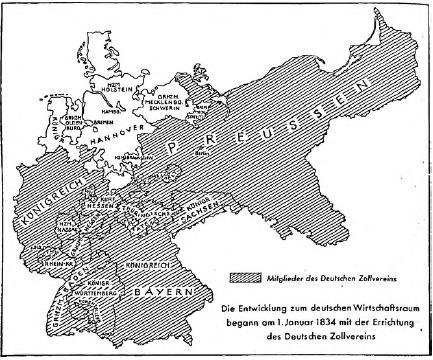
domination of Germany, the German Customs Union, admittedly without the entry of Austria, was guaranteed as the inviolable basis of the German economy, which contributed to the upsurge of German industry until it became an empire. The Empire, moreover, took over the organization of the customs system largely as it had resulted from the old customs alliance, which had been reformed several times, except that the Zollbundesrat was now replaced by the Bundesrat and the Reichstag.
Under the system of the Zollverein, Germany experienced the great technical and economic upheavals of the 19th century and developed from an agricultural country into a powerful industrial state. Only after the German area had become politically stronger and had also developed economically into a power factor acting jointly toward the outside world, could the step be dared to extend a large scale German economy to the overseas world. Admittedly, the decision came late, and it was not taken with unerring purpose and concerted force. The non European world was essentially divided up, so that colonial acquisitions by Germany could not be made from the outset according to a definite plan of economic policy. The time of discoveries and conquests was over.
German national power had migrated to the overseas regions in sufficient measure in all the earlier centuries. German blood had contributed greatly to the imprint of the American people, just as German cultural and economic goods had influenced the world view everywhere. But the German, having gone through the national disruption of centuries and the exhaustion of the Thirty Years' War, did not come to a national gathering in the non European areas. "Bad enough," complains the great German geographer Karl Andrees in the preface to his first work examining North American conditions, "bad enough that our industrious countrymen on the other side of the world's sea did not form an independent colony from which a great, independent German state could once have grown."
Despite the failure to divide the world, German explorers and merchants were able to bring to Bismarck's empire a number of territories in Africa and in the Australian world. Hamburg merchants brought their establishments in Cameroon and Togo under the protection of the German flag in 1884. At the same time, Karl Peters acquired German East Africa. His bold plans would have led to an acquisition of the whole of eastern Africa with access to the Nile, had not the Reich renounced the peripheral areas around German East Africa in the Zanzibar Treaty, in which it exchanged the island off the East African coast with England for Heligoland in 1890. A strong colonial initiative came from Bremen. The Bremen merchant Adolf Lüderitz, together with Heinrich Vogelsang, laid the foundation for the colony of German Southwest Africa. In
the South Seas, a part of New Guinea with the Bismarck Archipelago came into the territory of the Reich through the treaties of the Bremen merchant Otto Finsch, as did the Solomon and Marshall Islands. Shortly before the turn of the century, Kiautschou was gained as a leased territory, furthermore the Caroline, Palau and Mariana Islands were acquired from Spain by purchase, and finally some Samoa Islands were taken over by an agreement with England and America.
It should be noted that this expansion of the German economic area in the non European world, in contrast to the bloody subjugations, the warlike raids and the theft of territory of the older colonial powers, came about through the peaceful means of treaty making, commercial negotiations and the pioneering activities of individual explorers. The later robbery of the German colonial possessions by the peace dictate of Versailles therefore represented a double injustice; for it could not have been a question here, as in the case of numerous other processes of occidental history, of the seizure of possessions, which themselves would have been the fruit of violent intrusion, as still at the beginning of our century the incorporation of South Africa into the British Empire by the Boer War.
The Congress of Vienna of 1815 and the founding of the German Empire of 1871 are the two final events in the crystallization process of the European state system. When the 20th century dawned and an expectant humanity hardly dared to foresee the further effects of the great technical feats, the great organizational achievements and the great states of the white race, which seemed so secure, both the individual national economic areas had been developed and, under the sign of free trade, the idea of a supranational large scale economy had arisen as a shining lure. In theory, it was supposed to make the entire globe a trading domain for all peoples. But the theory only covered up the inner tensions of the system of commercial freedom, which were to be drastically and devastatingly discharged during the world war and even more so in the post war period.
In theory, for the living generations before the world war, for each individual country the large economic area covered all the habitable and cultivable parts of the whole globe. The German ships could fetch cotton from India just as well as the British cargo steamers. The French merchant could work in the Russian tsarist empire as well as the German technician. On the world market, machinery from German factories could compete freely with the products of British machine building establishments. The system of free trade had prevailed. Since the reorganization of Europe after the Napoleonic Wars, it had been vigorously promoted by England, although it was not until 1849 that England itself formally repealed the famous Navigation Act, now two centuries old, with its monopoly for British shipping. In the meantime, the superior position of the British merchant fleet had been secured to such an extent that free trade must ultimately benefit the Empire; after all, more than two thirds of the world's shipping space was in British hands.
Under the sign of this free trade, the structure of the world economy was now quite clear. On the whole, all lines of force radiated from Europe. This anciently cultivated territory of the white race still contained all the tensile forces to remain the center of a world which it had itself created; for the dominant form of world economic organization was filled with the dynamism of Europeanism. Nothing can express this fact more clearly than the victory of European dress mores in all continents. Countries of old, foreign cultures, which for centuries had closed themselves against the influences of the Occident, adopted the dress of the European. The Europeanization of the world must have seemed synonymous with a rationalization of all economic life. The Occident had evoked the spirit of technology, and this technical spirit, once set in the world, had taken complete possession of the spaces into which the Occidental influence penetrated. The technical thinking of the modern age has two sources, which had to have an effect also on the spatial economical organization. In contrast to antiquity and the Middle Ages, it springs from the masses of working brains and from the work of these brains, which pushes towards seamlessness. The extraordinary increase of the population of the occidental mankind in the last centuries set free a number of individuals for the thinking process which had never been reached before. Where formerly a problem could be worked on only by a small
crowd of people, now many thousands of mental forces could be employed for the solution. This increased volume of thought alone urged for a sharper processing of the intellectual results and thus accommodated the occidental drive for completeness, clarity and systematics in general. This not only provided the basis for the great achievements in all fields of science and research, but also made possible the rational construction of a new world.
Thus Europe has created the modern traffic network for the "great economic area earth"; it has given it the giant forces of the machines and has initiated a production of goods of the food, clothing, housing and all other civilization areas as it could never have been hoped for from earlier ages.
Europe's task seemed to remain for all eternity to shape the face of the world. And this shaping should mean rationalization, i.e. penetration of all inhabitable spaces, the ecumenism, with a uniform way of economy, in order to secure the greatest possible success with the smallest expenditure. The regulator of this economic method in the system of free trade was the yield. Producer and merchant wanted to extract dividends, and thus the dividend determined the expansion of the world of free trade.
The great empires that determined the economic development of the world in this sense were England as the sea dominating nation, France as a military state that was rapidly rearming itself after the war of 1870/71 and that both still had rich colonial possessions and maintained close economic relations with eastern and southeastern Europe through its political friendships, and finally the German Empire, which had moved into second place in world trade and was surpassed only by England.
These three European states formed the center of the large economic area "world". They held the law of trade firmly in their hands. It may well be said that in those areas which were at all in closer economic relationship with European mankind, no really decisive transactions and no development of raw material sources, production plants or transport facilities, in so far as they went beyond a local significance, could take place which would not have depended on a decision of high finance or government circles in London, Paris or Berlin. From a wider point of view, the economic events of that time must have given the impression of the circling of saturnine rings, which moved concentrically around the European industrial group. The inhabitants of the first ring supplied the central area with highly cultivated foodstuffs or natural mass goods, which shunned further journeys. Think of vegetables from Holland, tropical fruits from Spain and Italy, early potatoes from Malta, butter and bacon from Denmark, as well as timber and pulpwood from Finland and Scandinavia and Swedish ore.
The second ring already encompassed the semi tropical near zone, which was most subject to European influence, namely the African fringe on the Mediterranean and the Atlantic Ocean. Egypt and East Africa grew cotton for the European textile factories, South Africa supplied the wool, the Gold Coast the cocoa, the Belgian Congo the copper.
The Far Zone, as the third ring, also directed a major part of its supplies to the European central core. Canada and Argentina were the wheat farms of the major European cities. Brazil and Columbia, in the greatest one sidedness, had their economic work directed to coffee, and Bolivia supplied tin. Asia, with its cotton from India, oil fruit from China, rubber from the Malay states, tea from Ceylon, silk from Japan, became the supplier of the European consumer. Finally, Australia, at the remotest point of the third ring, had half of its exports in wool and the other half in wheat for the million strong population of European factory towns.
This circling around Europe as a buyer and controlling body for the mass goods of food, clothing and industrial activity would have been even clearer if the United States of America, as a branch, so to speak, of occidental mankind, had not already begun to form a young second nucleus of economic attraction. After all, before the World War, the United States was still in a semi colonial state, indebted to Europe by billions for its construction, so that for the time being the system of the world economy could still appear firmly centered.
But the boundaries of this space were now fixed. The expansion of Europeanism in the world had reached the dead center, both spatially and economically. There were no more new lands to be discovered that could be made culturally viable. The spaces had been divided, with the British Empire securing the main share. Industrial pioneering had reached a peak. The great inventions in technology and chemistry all seemed to have been accomplished. The organization of administration and transportation had been developed. It is curious to note that, with the predominant tendency of European enterprise toward overseas, Europe itself was almost neglected as an economic area. The forces of the European center were strained to the utmost in order to steal each other's booty in the non European world in a fierce struggle, while the domestic continent would still have offered sufficient opportunities for expansion in various directions. One need only refer to the years of neglect of agriculture in southeastern Europe or to the complete abandonment of agricultural intensification in England, to the industrial atrophy of the European East and to the unexploited raw material areas of the Balkans. Here, capital and labor would have found employment for decades to come if they had endeavored to lift the neglected areas of the home continent agriculturally, technically and culturally.
However, ever since the Atlantic Ocean had become the fateful route of Europeanism, and even more so since the overseas mass raw materials had begun to flood thanks to a mass unity of space, capital and technology, the gaze had been fixed on the overseas world. The purpose of the overseas expansion of European humanity had almost turned into its opposite. The non European world was supposed to be an aid and a supplement; it had become a factor of dependence and thus a ferment of decomposition for the security of European life. It almost seemed as if Columbus had not discovered America, but as if America and the other distant continents had conquered the old continent and taken possession of the European soul, despite the predominance of Europeanism.
In any case, with this attitude of European enterprise to the problems of the world economy, in the course of further development it came more and more to the point of only administering within the marked borders and dividing the administered property among themselves. Imperialist desires had to encounter the frontier and thus resistance in every direction. They led, because obviously the white race cannot find satisfaction in a stationary administrative work, and also because the rapid increase of population urged for further expansion, to the clash of forces in the central nucleus of this world economy, which had to cause the rings circling around this center to sway. With the outbreak of the world war in 1914, the idea of seeing the world as the field of a large scale economy had to be buried.
The world war itself has promoted the awareness of the colonial world and the non European world in general, which could already be observed in the preceding decades. It went in a double direction, namely in mutual interaction in the political and in the economic political direction. In the first place, the United States of America should be mentioned here, which only during the World War expanded its dominant position as a great military and economic power between the Western and the Oriental world and rose from a debtor to a creditor, especially of Europe. The isolation into which the European states had placed themselves as a result of the world war stimulated the enormous upswing of industry overseas, which in turn further loosened the trade ties to the former monopoly area of industry, to the European factory cities. The South American states joined this development to a certain extent, just as the entire Asian world in particular began on a large scale to gain economic independence, which Europe had wisely avoided in the age of free trade. In this way, the non European world as a whole came to a closer cooperation, in which the detour via Europe could be dropped more and more.
It is significant to observe this strengthening of the non European circulation of goods, especially in the large economic area of the British Empire. In the
two decades following the outbreak of the world war, India's trade with East Asia rose from about 25% to 40%, and with America from about 9% to 15% of its total trade. Australia had obtained 13% of its imports from the United States before the World War, but twenty years later it had obtained 25%, and there was also an increase in its trade with East Asia from 3% to 8%. Of its exports, only 3% had gone to the United States, but later 9%, and to the Asiatic region 3% and later 10%. These few figures alone give an explanation of the fateful necessity with which the great economic crisis in the postwar period had to come about. The structure of the world economy had thoroughly jumped out of its circles around the continent of Europe.
At the same time, however, the fragility of the former sense of cosmopolitanism propagated by the era of free trade had been fully recognized. All over the world, the national idea began to regain a foothold. One need only refer to the newly awakened national consciousness of Italy under fascism or, in the non European world, to the awakening self confidence of Japan, which was striving for a leading position in the Greater Asian region, or to the political strengthening of the young settlements in the British Commonwealth, such as Australia and South Africa, until finally, in 1933, the National Socialist rise to power in Germany began to form a new, cohesive force field.
This marked the end of the process of rationalization of the world economy that had once begun so hopefully. It had failed because it was supported only by the undoubtedly great technical achievements and was exploited commercially from the point of view of the highest possible dividend. It had to leave its place to the nationalization process, which in turn had to form a new order in terms of economic policy.
In the general retreat of the great economic nations after the world war and the world crisis toward the spaces subordinated to their own political power, England's renunciation of free trade is above all of fundamental importance, in political as well as in economic terms. The English mother island felt the need to strengthen the idea of empire in the years that made clear the disintegration of the commercial order in the world and, for far sighted observers, heralded political explosive forces.
The Third Empire, as the British force field of the 20th century, is not a federal state, as the German Empire was, but a loose union of completely independent
dominions. In this union, England does not have an essentially different position than, for example, Canada, Australia, New Zealand and South Africa, these young, but by the political and economic development in the last generations carried to independence overseas settlement areas of the British Empire.
Since the imperial conferences for the determination of the political will of the individual members of the empire arose in 1907, the dominions with the exception of India, which is still in a colonial constitution can be described as the actual building elements of the British Empire, which are also quite conscious of this role. Their governors general are, in relation to the empire, practically independent kings who are not responsible to the London Parliament, for example, but only recognize the English crown as a common bond. The English king himself, however, does not exercise any command over them that is laid down in paragraphs, but remains in the background as an advisory and, if necessary, balancing body.
Thus it becomes understandable that in more recent times, not only because of the catastrophe of the island of England in the German English War, some circles in British North America believe that in the future the leadership in the Empire will pass to Canada, mainly because of the great economic wealth of this country, which can still be greatly expanded. The flight of men and property which occurred with the threat to the mother country of German encroachment from England to Canada may have given new impetus to such predictions. On the other hand, the Empire consciousness benefits from the fact that each dominion cannot by itself resist the forces of the rest of the world. Even if since the world war the dominions have created their own military and maritime defense systems, in individual cases Canada finds itself all too neighborly to the powerful space of the United States, just as Australia or New Zealand represent rather lost positions within the Asian world if they cannot call upon the reserves of the entire empire. In spite of all the independence, even in spite of the many counter operations of the individual parts of the British Empire, one must not underestimate the necessity which binds overseas Britain together even without a rigid state formula. Admittedly, the pressure of the war has already brought other perspectives of which an independent Britain would never have dreamed before. At the beginning of 1941, very serious efforts were made to push for a union of the British Empire with the United States of America. The American Wendeil Willkie openly propagated a plan of union aimed at economic unity of the two entities, mutual abolition of immigration restrictions and equal treatment of American and British citizens. The plan also calls for the permanent fixing of the value of the pound to the dollar. These statements are a continuation of a
propaganda organization working in New York with British funds for the merger of the two Anglo Saxon powers. Its watchword is "Union now." But the slogan "Union now" already appears as a last cry for help from the British world, which fears that one way or another it will have to give up its independence, which it had proudly asserted through the centuries.
The cohesion in the Empire did not only consist in the person of the king as the common state organ of the Empire, but also in the imponderable but meaningful spiritual community created by British folklore, education and above all by the British language. To it fell the task of holding together the possessions of the British Commonwealth of Nations scattered in over a hundred places on the globe. Not an easy task; for the British Empire has been thrown together, as it was once put by the English side, in a fit of absentmindedness, so to speak, and with its fragmentation makes the spatial economic organization more difficult. The war against England since 1940 has proved these spatial economic difficulties sufficiently.
The British Empire comprises territories in all five continents according to the following administrative scheme:
King of England Emperor of India
United Kingdoms of Great Britain and Ireland
New Zealand Dominion South African Union Dominion Newfoundland Dominion
Malta and Rhodesia Self Governing Colonies
38 Colonies and protectorates
Sudan and Hebrides Condominiums
India Dominion Canada Dominion Australia Dominion
Ireland
Free State
8 Mandate territories including German colonies
The mother country and the five independent dominions are represented by their prime ministers at the Imperial Conference, which is convened on a case by case basis. In this loose relationship, major common problems are just as difficult to solve and common tasks are no easier to accomplish than in the case of treaties between foreign states. This is especially true in the field of economic policy, where the interests of the empire states are by no means always aligned.
Despite such difficulties, however, the Imperial Conference of 1932, held on Canadian soil in Ottawa, made the first attempt to unite the Empire into a large economic area. The Dominions were not very satisfied with such proposals. They refused many a sacrifice that was to be imposed upon them. In the end, it was only thanks to strong renunciations on the part of the mother country that the Ottawa Treaty actually represented a step on the way to a closed economic area, which at the same time had to mean that the relationship of this large economic area to the other economies of the world threatened to become increasingly tense. For Ottawa was synonymous with a strengthening of economic relations within the Empire and, accordingly, with a weakening of trade between England or its daughter states and the rest of the world. This decisive transformation was achieved by restructuring the tariff system. Imports from the empire countries were facilitated by exemption from duty or reduction of duty, while imports of foreign products were made more difficult, if not prevented, by high tariffs.
In its full extent, the intended Empire self sufficiency becomes understandable if one points out that the British Empire, as a result of its expansion to all climatic zones and all geological conditions, could have been almost self sufficient in normal times. Of 25 raw materials vital to food and industry, the Empire is adequately supplied in no less than 18 cases, satisfactorily in 2, and deficiently in only 5. Reference need only be made to England itself, which is a coal mountain on a base of iron. To Canada and Australia as granaries, to Australia and South Africa as wool producers, to the cotton of India and Egypt, and finally, again facilitating the importation of goods not produced in the Empire, to the gold and diamond wealth of South Africa. This circumstance even found its special emphasis in the detachment from the gold currency. The devaluation of the English pound was the most powerful manifestation of England's abandonment of the old principles of free trade, of which it had been the classic country for a century.
The most serious damage caused by the Ottawa plan to close the Empire economically was suffered by the South American states. For Argentina in particular, Ottawa resulted in an intolerable loss of exports. But the northern European countries were also the ones to suffer. Denmark, Sweden, Holland,
whose agriculture had worked mainly for the English market, fell into sales crises. Spain, Italy and France, namely fruit suppliers to the island, were also among the victims. Finally, the blow was dealt to the German export industry, which lost at least a quarter of its markets in the Empire as a result of the change in the British tariff system, and in particular suffered severe reductions in exports for the chemical industry, textile factories and mechanical engineering plants. This occurred at a time when the general world economic crisis had already fatally affected the economy and swelled the ranks of the unemployed into the millions.
It can be seen, therefore, that England wanted to push the imperial idea further just at a moment when closure to the world market was bound to bring the difficulties in all countries to a new climax. While in Central Europe business leaders and politicians were anxiously pleading for the dismantling of tariff walls so that a revival of world trade would once again save the liberalist system, while on the mainland millions were condemned to feast and desperately searched for outlets for their stockpiled products, England deliberately turned away from the continent and increasingly oriented itself toward non European areas.
In the further course of economic history, however, it became apparent that the Empire was not strong enough, or not sufficiently imbued with a unified will, to sustain this attempt at autarky. In Canada, protectionism was again replaced by a desire for a liberal economy, and the same is true of South Africa. Australia and New Zealand rarely advocated lowering tariffs. India was disgruntled at the loss of its trade freedom and gradually returned to a trade friendship with the Japanese island empire closer to home. Thus, on the whole, people were glad when, for the coronation celebration of King George VI, an Imperial Conference in London in the summer of 1937 noted the crumbling of the Ottawa ties and had to take into account the freer wishes of the overseas parts of the Empire.
As a result, the Empire's economic ties with the European continent as well as with non European countries could again become closer. If one wants to add these partly very close relations to the spatial economy of the British Empire, one can list the members of the "sterling club," i.e., those states that aligned their currencies with the value of the British pound. While in 1931 this sterling bloc included Denmark, Finland, Iceland, Norway, Portugal, Sweden, Egypt, Japan, Iraq, Iran, and Siam, by 1938 the bloc had expanded to include Estonia, Manchukuo, France with its colonies, Latvia, and the Netherlands with its colonies. Ottawa slowly began to belong to the past, when the rearmament and finally the war supply of the British island set completely different economic tasks. Then, with the start of the war, the British economic bloc was
abruptly shaken. By the end of 1939, most members of the pound bloc had already left the monetary community with Great Britain. Only France, Portugal, Egypt and Iraq were still part of it. With the war, however, the British economy was subject to difficulties quite different from those of currency or tariff policy; it had become dependent on the transport hazards posed by the development of the war.' And it remains a remarkable sign of ambition that had become modest that London celebrated the forced entry of the Belgian Congo into the pound bloc as a great event in early 1941.
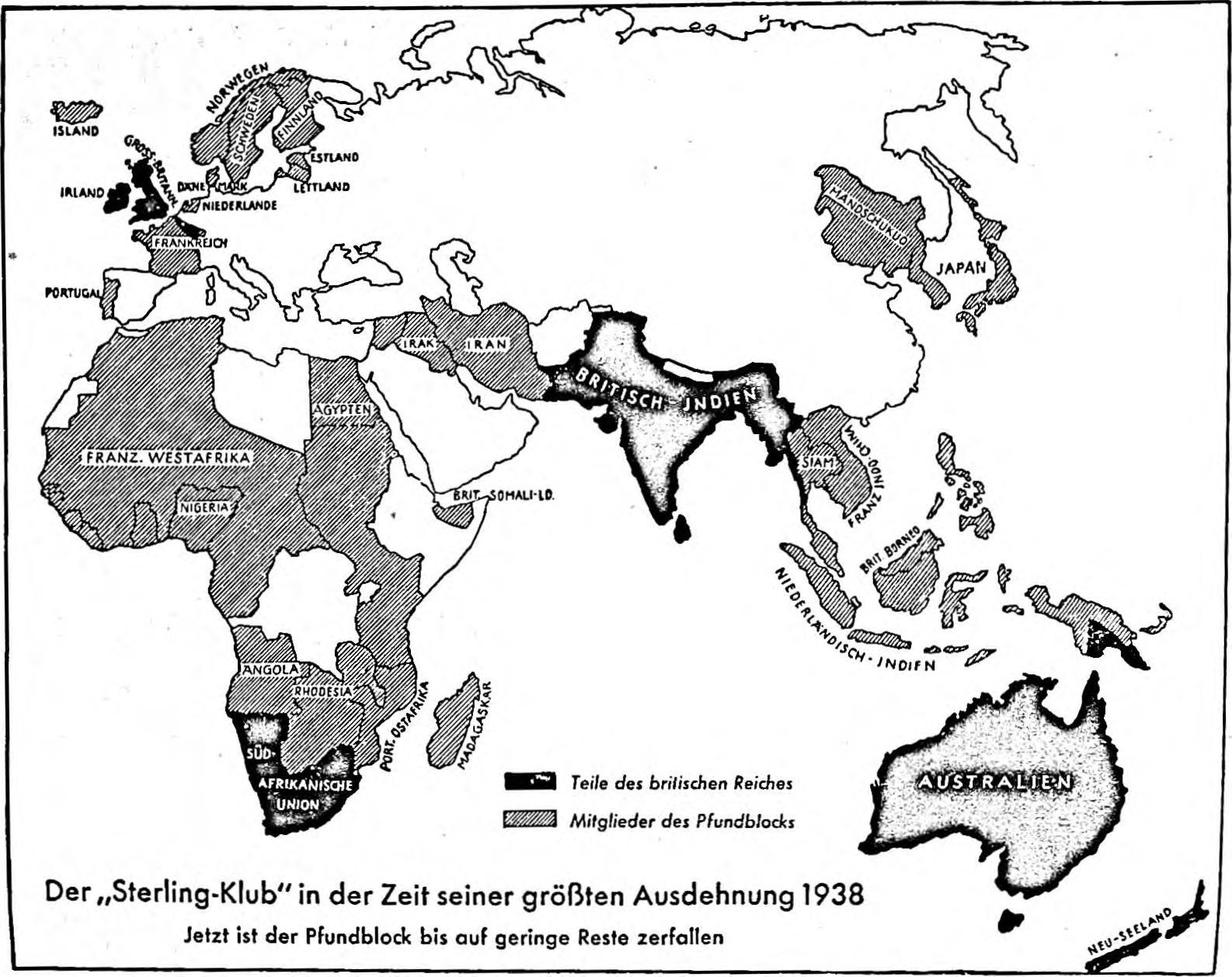
The "Sterling Club" at the time of its greatest expansion 1938
Now the pound block has crumbled to small remnants
The white race, once attached only to old Europe, has created in America a second home in the world, which politically and economically represents a much stronger unity than could ever be achieved on the maternal continent of Europe. From the very beginning, the spatial economic penetration of the American northern continent has been, one might say, a matter of course. It was dictated by the steady advance of the frontier of human settlement by the pioneers of nearly three centuries. American imperialism found a sufficiently broad field of activity in its own space until, with the development of the Californian gold fields in the west, the American mainland was conquered and the frontier pushed forward to the Pacific Ocean.
Thus, for God's own country and God's chosen people, for the first time, the necessity was given to economize with space itself. But the American people, accustomed to a carefree advance of the frontier, were not accustomed to a care of the soil such as had become second nature to European man through the centuries. Farms were left lying when the soil was sucked dry. In overexploitation, timber was taken from the forests, creating the later great danger of water and dust disasters, which in large areas destroyed much of the arable soil. Exploitation was also carried out on the mineral resources of modern demand, on coal and oil, and finally also on man himself, who was educated as in no other area of the white race to be an acquisitive man. If until reaching the Pacific Ocean the desire for conquest had been directed to space, around the middle of the last century the conquest had continued in the direction of technology, of machine power. Since the last generation, the United States of America has been the economic area most dedicated to mass production. The conveyor belt in the automobile factories and the farmer's machinery, which is a factory in the field, are the most vivid expression of an economic mentality that makes the French peasant or the merchant in the German Hanseatic cities look patriarchal.
For all the mineral resources that God's own country holds, the forward thrust of American man, directed nowhere and never according to a unified plan, could not escape the collapse that resulted in the postwar world economic disorganization. The free confusion of all forces had felt a constraint for the first time in the world war. At that time, due to the war economy, the first barrier was erected and the attempt was made to unite the forces scattering in all directions into a national unity. After the end of the war, it became clear that the wheel of history could never be turned back in the development of mankind and that an intermediate development could simply be dismissed as finished. Economic life did not find its way back to the old freedom without
friction. In the frenzy of post war speculation, it was open to all mental and financial entanglements and got caught up in the maelstrom of the world economic crisis, which caused the number of unemployed in the United States to swell to twelve million at times.
At that moment, the attempt to create a large scale economy in the great American area, blessed with so many economic goods and supporting 132 million people, began. In 1933 Roosevelt opened his government with exuberant decrees, surprising every American in this extent, in order to control the forces from the social and the production side. Social protections, crop restrictions on farm products, subsidies for farmers, and inflationary credits for industrialists ran haywire, were hard fought over, and some were dropped. Because it was a jumble of countless individual measures, without any success in underpinning the government's offensive to steer the economy with a grand, unifying idea, only temporary successes were achieved. The economic area remained largely unorganized and left to its own devices, and was therefore unable to find its way back to stability after all the crisis phenomena.
In relation to the other economic areas of the world, it can be seen that the United States of America is almost self sufficient. This area, which represents a continent in itself, includes, besides the Federal District of Washington, 48 states and, in the north, as a territory, Alaska, the former "Russian America", in Central America the Panama Canal Zone, Puerto Rico and the Virgin Islands, in Oceania the Hawaiian Islands, Guam and American Samoa, and finally controlling the Philippines on the South China Sea, possesses almost all land resources and agricultural possibilities. The United States has the largest share in the world production of coal and iron, copper, zinc, aluminum, lead, silver and gold, petroleum and natural gas. They combine in their territory, covering almost all climatic zones, the cultivation of grain, potatoes, sugar beets, cotton, tobacco, tropical fruits with the largest livestock in the world. Foreign trade, therefore, although the United States is the largest partner in world trade, does not play an overwhelming role for the population.
This second homeland of the white race is equally turned towards the two edges of the Eurasian continent. It lies if one takes Europe and Asia as the unity which they represent in the geographical sense so to speak in the middle of Eurasia. The United States can call itself the "Middle Kingdom" with more justification than the Chinese Empire once did. The American economic space extends in the same way to the West and to the East, to the territory of the Occident and to the Asiatic world. "Do not forget the location of America. It is an island between Asia and Europe," is the exclamation of a USA. senator. In fact, until recent times, American exports have taken far more of a route
across the Pacific than across the Atlantic Ocean. It is mainly directed to the overseas parts of the British Empire, notably India and Australia, but it becomes particularly interesting where it meets more closed major economic areas such as the Soviet Union or Japan. It is precisely in the case of these two partnerships that all the uncertainty and future implications of the world political situation are expressed.
Since President Roosevelt's recognition of the Soviet regime soon after his first inauguration, U.S. Russian economic relations have curiously declined sharply. Beginning in 1937, a trade agreement provided for Soviet Union purchases of American products to the tune of $40 million annually a modest sum in the context of the two great economies. For the first time in 1940, the year of the war, traffic had risen above this and probably doubled. Russia's interest went to the products of the American machine building establishments for the expansion of the Russian armaments economy. Petroleum and cotton were the other supplies favored by Russian buyers from the Amtorg Trading Corporation in New York. Roosevelt's active intervention in favor of the Bolshevik regime then led to increased shipments to the Soviets' East Asian ports in mid 1941. They have been made in the main against the gold of Siberia; and thus they only reinforce the accumulation of gold in the United States, which is unsustainable in the long run.
Equally uncertain, however, is the contact with the Japanese area. If in the first year of the European war America's deliveries to Japan reached a record level of about a quarter of a billion dollars, the political and economic factors of uncertainty, which in 1941 had already led to a boycott of deliveries, play the greatest role in further developments. Japan has considerable import needs, especially in its ongoing arms race with China. It had stepped up its purchases in America until the Japanese American goods embargo, since it had to remain questionable how long America, which had already banned exports of various war related products to the Japanese area, would remain willing to supply at all. Moreover, Japan can only pay for a small part of its imports with the counter delivery of silk and other Japanese special products. The autarky efforts which Japan intends to carry out energetically with the creation of a ten year plan in the Greater Asian region also point to the possibility of a substantially changed picture of the future here.
However, the links of the United States with the old Western space have gained fateful importance for world events. Since the World War, the supplies of the United States to Europe have far exceeded their absorptive capacity for European products, which has led to the heavy indebtedness of the European mother continent to the New World and to the lopsided accumulation of the gold treasures which once belonged to the Occident and are now senselessly
piled up in Fort Knox, the treasure vault in the state of Kentucky.
The United States has used its self sufficient position to make the strongest difficulties for European products. For all its freedom at home, which contributed to the failure of Roosevelt's reorganization of the social and economic system, American foreign trade is the domain of sharp government intervention. America has surrounded itself with high tariff walls and, moreover, has used its unique position as a major economic area for political manifestations. Long before the outbreak of the new war in Europe, it discriminated against German goods. Special tariffs and punitive duties placed a special barricade against the import of products from Germany, so that the exchange of goods between the two most important economic areas of the two continents had already come to a standstill when the outbreak of war brought the military blockade of the sea routes.
The new war has brought both a greater conversion of the domestic American economy and a significant change in the foreign trade relations of the United States, significant less because of its economic weight than because of its political side. American industry, especially after the third election of Roosevelt as President of the United States, has shown an expansion, and even more a conversion, to armaments production. The political side of foreign trade, however, is of special interest to the spatial economic development of the future. It probably culminated in material support for the anti German powers of the British Empire, and initially also of France, but went beyond that into expansion on the American southern continent.
In the first year of the war, i.e., the period from September 1939 to August 1940, the United States exported $3.9 billion in goods, about $1 billion more than in the same period of 1938 39. Imports, on the other hand, increased only slightly, so that the U.S. balance of trade was active at $1.4 billion, while the corresponding period of the previous year had yielded an export surplus of only $0.8 billion. This is the special problem of the U.S. metropolitan area, which is not succeeding in stopping the inflow of gold. But here lies also the activity of American imperialism already alluded to; for payment for the export goods has been made in large part in capital holdings which had hitherto been in British hands, in much the same way as the transfer of old warships to England has increased the space assets of the United States through the acquisition of various British islands.
If one disregards the increased supply of Great Britain with American aircraft, armaments and raw materials American exports to Great Britain rose by 56% in the first year of the war and those to Canada by 54% compared with the corresponding period of the previous year the penetration of U.S. trade into the South American republics is the most striking feature.
The South American states lacked the necessary sales territory after being closed off from the European markets, so that the trade offensive of the United States had to fall on fertile ground with them. The extent to which the U.S. exploitation of the economic situation will ultimately result in the political and economic integration of Ibero America into the North American economy is still an open question.
The Pan American idea, propagated from Washington in the interest of big capitalist imperialism, did not find a stormy response from the Ibero American states at the Havana Conference in 1940. Even the lure of the large capital of the Export and Import Bank in Washington, which wanted to make half a billion dollars available to the South American countries as credit in 1940 alone, did not bring about the unconditional union with the U.S. that the North American circles of politics and high finance would have liked to see. After all, there can be no illusions about the fact that governmental and private Pan American commissions are marking out the boundaries for a large economic area under North American leadership, which is highly significant for the future shape of the world economy. Indicative of the dollar war in the South American area are the large propaganda funds spent to influence public opinion under the Rockefeller Plan, and further, above all, the notorious "blacklists" designed not only to close off South American trade from the Axis powers, but at the same time to constitute control of the South American economy by Washington.
It is precisely these struggles of the American continent as a whole that show that in recent times the formation of large economic areas is by no means dictated by exclusively economic considerations, but that it is primarily subject to the primacy of politics. For most of the products of the South American states, which despite all the economic conversion since the world war are still stuck in colonial monoculture, cannot find a market in the United States. The mostly self sufficient U.S. economy is perhaps only really interested in tin and manganese, rubber, wool and coffee, but even here only to a limited extent. Since the principle of complementarity between the economies of the northern and southern continents is lacking, but American imperialism wants to take advantage of the circumstances created by the European war, an intensified merger of North America with Ibero America can only have the effect of bringing the South American countries under the financial control of Wall Street circles and causing them to lose their independence on the world market.
In any case, the American economic area is everywhere developing an intensified initiative to secure its place among the fields of force which our century is trying to bring to stability in a tremendous struggle.
Until the end of France's role as a European military power, the large economic area controlled from Paris shimmered strangely and enigmatically between black and white, between overseas construction and democratic political friendships with Western and Eastern Europe. Two tendencies filled France's conceptions of space, if one wants to disregard the third, the fear psychosis before the neighbor east of the Maginot Line. The first was towards the colonial empire, which was in part spatially closer to the French borders than any other colonial occupying country. And on the other hand, despite the world economic crisis and all the resulting efforts of other countries to achieve self sufficiency, France still remained committed to the idea of free trade regulated only by capitalist considerations, as long as it was still possible to win partners for this.
It is significant that the French colonial empire always entered the European imagination far less than the image of Britain's overseas spider's web. This was not only due to the fact that the British overseas possessions were far larger than the French colonial empire. France's possessions in Africa and in East Asia, not to mention the small French held territories on the American east coast, reached considerable dimensions, even if a glance at the large areas of French colonial space should not obscure the fact that the African soil is literally too hot and thus in large parts not suitable for settlement and exploitation. It was rather due to the Frenchman's attitude towards the colonial peoples, which was alien to other European racial feelings, that the African areas almost identified with the French motherland and caused France to perceive as its border in the south less the Mediterranean than the northern edge of the Sahara.
The attitude of the French ruling class, which was still nourished by the dogmas of the French revolutionary period, led to a blurring of the racial boundaries, which does not seem natural at all to the other colonial empires, neither to the German sensibility nor to the British colonization principle. In a better hotel in London, no Indian could be seen without being made aware of the color difference. For the Frenchman, however, all those living on French legal soil were first and foremost Frenchmen, either white francais d'origine or colored francais indigenes.
This development, of course, is explained not only ideologically, but perhaps even more by the serious "mortgage of death" weighing on the French people. For France's suffering in the living generations is the dwindling of the birth rate, the population decline, under whose dictate so many otherwise quite
incomprehensible measures or the drifting of things took place. It was like a paralysis over the people and the economy, and the colonial area therefore developed economically in a completely different way than the colonial areas of the other states. It has been said that the Frenchman approached the tasks on African soil with greater vigor than in his homeland. In any case, the fact remains that the mother country almost fearfully shut itself off from the overseas economy of its own state and allowed the trade relations of the colonial territories dominated by France to drift at will. Only shortly before the war, which was so unfortunate for France, did French politicians believe that they had to stand up for an imperial economy, for the development of the French colonial economic area. They said, very belatedly, that the architecture of an overall French economy had to be designed and the rivalry between the motherland and overseas France had to be eliminated. The fact alone that responsible circles in Paris had to establish a rivalry between European and non European France is indicative enough of the destruction within a state system that could actually have formed a real large scale economic area with its 40 million population on European soil and 60 million on non European soil.
In any case, the agricultural country of France has always been fearful of competition from its overseas territories. Instead of allowing the flow of goods between Europe and Africa to increase, it has opened the floodgates to the flow of people and let black blood into depopulated France in alarming quantities, just as France is the nation that first and already in the last century deployed colored troops on the continent against the white race.
Economically, France has always tried, as grotesque as it sounds, to make itself as independent as possible from its colonies. The constant crisis situation of the French peasantry must have been all the more stimulating for this, since, on the other hand, everything was done from Paris to maintain liberalism in the economy, the commercial principle. The fact that only partners were found in Europe for this purpose, who did not so much complement the French economy as strengthen its production of abundance, further distorts the picture. France's blessed soil, seven tenths of which was still arable land and meadows and vineyards, would have enabled the people to rest in themselves in terms of supply. However, the mercantile drive of Paris headquarters, with its conglomeration of industry and high finance, sought to save a European free trade that had long been in decay. While the British Empire retreated behind the protective wall of defense against foreign goods and provided only those countries of the sterling bloc that remained loyal to its currency with barely satisfactory sales opportunities, while the German Reich, since the world economic crisis, under the compulsion of the shortage of foreign exchange, took its foreign trade under state direction, while even the United States of America was defensive about the world market offer and all together
had more and more buried the idea of liberal trade influenced only by gold, partly by devaluation of money, partly by special measures, France clung with extreme tenacity to the idea that gold ruled the world. It became the leader of the gold bloc, that series of European countries that believed they could still maintain purely capitalist trade without currency devaluation.
The liberal Western states of Belgium, Holland and Switzerland belonged to this gold bloc, which was founded as a counterweight against the devaluation measures of England and America with which two powers France, on the other hand, again made the insipid experiment of a tripartite alliance in the field of currency. Initially, Italy was also inclined toward the bloc, but soon broke away. In keeping with France's political ambition toward the East, the gold bloc also included Poland.
Viewed as an economic area, the union of these countries, albeit only loosely, was not a happy construction from the outset. Holland, an agricultural country and at the same time a colonial owner like France itself, Belgium with its heavy industry and colonial raw material exploitation similar to that of France, small Switzerland as a consumer of only minor importance, and finally Poland as an agricultural surplus area between these countries, economic traffic could not solve the problems that a region working with a free gold currency faced when it was surrounded by monetary and economic areas of more or less state control. The countries of the gold bloc pursued a policy of deflation and hoped that by reducing costs internally they would be able to rejoin the world market. In the fall of 1936, however, the devaluation wave also began in France, Holland and Switzerland. The gold bloc was shattered.
Of particular importance for France was also the cooperation with Czecho Slovakia, until the German solution of the southeastern issues cleared up with the French influence, returned the Sudeten German territories to the Reich and brought the Czech and Slovak groups to new state construction. The economic connection with France was in any case rather one sided, limited to the armaments industry and, as a result, to the connection of high finance.
France did not know how to develop the only economic relationship that promised planned benefits in the long run, namely the relationship with Germany. How favorable a peaceful Franco German cooperation could have been could be seen in the example of the potash industry, which had been regulated in a tolerable way since the situation created by the world war. German and French potash had divided the world market between them and stood together smoothly in all matters of production and sales. Of even greater importance was the complementarity of the two economies through the exchange of German coal for French minettes, which stimulated cross
border traffic until, in the year before the outbreak of the war, political tensions had already curtailed the exchange of coal and minettes.
On the whole, France's domestic political situation, with its eternally changing cabinets, was far too fractured for any great line in the economy to have been maintained or even developed. It is astonishing how a country particularly blessed by natural and colonial possessions lost more and more of its importance as a force field in 20th century Europe, until finally the German victory of 1940 caused this ambition, no longer supported by any real force, to still play the political role of a major European power despite all its economic and organizational weaknesses, to finally collapse.
Only after this collapse and after the flight of numerous representatives of the old regime did France recognize the untenability of its theory of securing life through gold and purely constructive considerations, and practically turned to the German views on the value of labor. As little as anything definitive and forward looking can be discerned in the understandable jumble of thoughts and plans that dominated France in the lost war of 1940, the French people in their coming generation certainly seem to be under the sign of a labor theory of value, which, under the compulsion to rebuild the destroyed economic life, is ultimately also indispensable. The fact that the recovery of French agriculture is particularly important in this context is in line with the general policy of continental living space.
Italy's quest for empire is particularly interesting in the history of the development of the idea of the great economic area, and not only because of the dramatic agitation that accompanied the process of maturation into a greater Italy. Rather, the synthesis between political driving force and economic necessity is alive here in a particularly impressive way. In contrast to the motives associated with the emergence of the English or French overseas, Italy's drive for expansion is due exclusively to the most elementary economic phenomenon there is: popular growth. It can be said that the former Roman Empire, with which the western history had taken its active start, perished because of the population decrease, because of the birth fatigue of the old Roman family, while now the enormous growth of the population had to put modern Italy back on the track of the Empire with hard force.
Since the turn of the century, the Italian nation has grown by almost half a million people a year as a result of its birth surplus, and the cramped peninsula
has not been able to accommodate this growth either spatially or economically, especially since the poverty of the soil in terms of raw materials has not allowed industry to develop to the same tumultuous extent as in some other European countries. The too narrow economic space has driven about ten million Italians to emigrate. In the record year of 1913, emigration reached the enormous figure of 870,000, only to fall back to the fourth part of this figure in the post war period as a result of immigration difficulties abroad and Italy's new political course. Emigration was and is the central Italian problem. Italy's policy of conquest, which has settlement as its goal, is thus distinguished from the outset from the power political capitalist imperialism of many other states by its rationale, which lies in the popular.
Soon after Italy reached state unification it must be remembered that it was only in 1870 that the kingdom regained its capital Rome from the French attempts began to divert to its own territories the popular surplus that was lost to the national body when it emigrated to foreign territories. The Somali territory on the Indian Ocean and Eritrea on the Red Sea became Italian colonies. They had to be confined to minor importance, however, since the lost battle of Adua thwarted gaining Abyssinia as an actual hinterland. Libya and the Dodecanese with the large island of Rhodes were taken from the Turks in 1912. But even these territories did not offer a definitive solution to economic and population problems, all the less so because the African area presented the greatest difficulties for settlement. "Italy is not a collector of deserts", is a word of Mussolini that makes understandable the conquest of the Empire of Abyssinia that finally took place in 1936. Despite the sanctions imposed by the League of Nations, the incorporation of Abyssinia and the rounding off of Italian East Africa that it brought about created the Empire. It offers African settlement land in addition to important colonial raw materials, since the tropical location of these colonial areas does not mean too great a leap for the settler coming from Italy with its southern location. The Italian immigrant can adapt relatively well to the climatic conditions of at least the higher parts of Abyssinia, so that, according to experts, Italy's East African possessions could provide space for twelve million white inhabitants once they have been sufficiently developed. The tenacious defense of the Italians in Abyssinia against strong British forces thus has a special meaning beyond its purely military significance.
Finally, with the annexation of Albania, Italy expanded its bases in the Balkans. It thus reaffirmed its importance as the power that no longer wanted to be a prisoner of the Mediterranean, but claimed the Mediterranean as its habitat, until its entry into the war in 1940 led to the final confrontation with the world economic power, Great Britain. In the Mediterranean, empire stands against
empire, the opposites of the domination of the great pond stand between Europe and Africa as a homeland or as a thoroughfare on the journey to India.
All the more remarkable is the success with which fascism in the last decade has economically developed the motherland itself and interwoven it with the economic areas of the other continental nations. In particular, it was necessary to ensure food for the 40 million people who populate the peninsula, which in the past, despite the constant emigration, had been possible only with foreign bread. Wheat has played the main role in the import to Italy. Now, because of the annual battaglia del grano, the Italian farmer's grain battle, foreign importation has become almost unnecessary. Improvements in agriculture and extraction of fertile soil from marshes have led to a self sufficiency in food that in normal times leaves only a portion not worth mentioning as needing importation.
Just as systematically, however, the not too abundant mineral resources in the Italian economic area were made ready for extraction. The country had hardly any coal production around 1930, while domestic coal production is already on the program for 1941, which promises to cover almost half of the demand.
The extraction of domestic ores has been expanded, aided by supplies from Albania. Hydroelectric power has been developed to such an extent that electricity production, which is now completely independent of coal, exceeds by a factor of three that which existed before fascism came to power. In connection with this broadened base of raw materials and basic forces, Italian industry has also caught up strongly and has made possible significant progress in the productiaon of iron and steel and especially of textiles*).
In this way, an economic are has been systematically developed that was still considered one of the most neglected areas of Europe during the World War. Domestically, this development was made possible mainly by the 1934 division of economic forces into corporations, which, as organs of state administration, balanced working life according to the fascist view, facilitated the transition from a liberal competitive economy to a controlled economic system, and supervised the individual branches of production.
In terms of foreign policy, however, it is a straightforward consequence of Italy's realization that it won the world war but lost the peace alongside the former League of Nations states, if the last decade has created a completely different relationship with the continent. This policy of turning toward the continent has found particular expression in the interconnected economy with the Axis partner Germany, with which the exchange of goods has increased in many ways.
*) More detailed information in Part II in the chapter "The Italian Space".
The war of 1940 has made it necessary for Italy to defend itself against the blockade for the second time, and for the second time Germany, which, as is well known, had already not participated in the League of Nations sanctions during the Abyssinian War, is providing assistance with its strong forces. Whereas before Italy entered the war more than three quarters of all Italian imports arrived by ship, and most of them had to pass through the bottlenecks of Gibraltar and Suez, which were controlled by England, now it is the Alpine passes through which European goods roll to the peninsula. These include, above all, the coal trains from the German mining districts, which move south at short intervals day and night, ensuring the Italian economy complete freedom of movement in fuel consumption.
The generous planning of the German Italian interconnected economy is also reflected in the agreement concluded at the end of 1940 on cooperation in the agricultural field. In order to enable Italian producers to adapt more and better to the needs of the German market, long term planning is to exclude the effects of speculative world trade. For vegetables, fruits and tropical fruits, a balanced supply of the German consumption area should be achieved. Expert meetings on the exchange of breeding and breeding cattle, of German seed potatoes for Italian early potatoes, on the improvement of the dairy industry and on the control of plant pests are to prepare a uniform economic structure in the agricultural sector of the German Italian area.
In this context, Italy's economic interests with other mainland nations, especially with the countries of the Southeast, whose trade with Italy as an Axis partner has grown in volume, must be taken into account. Italy has thus successfully engaged in intensive European cooperation and, with its European African area, represents the force field which, along with Germany, will have the strongest influence on the greater economy of the future Europe. The extent of the wartime economic ties between Italy and Germany is shown by the agreement of February 1941, which eliminates all other trade restrictions on the exchange of goods and stipulates that during the war deliveries are to be made from one country to another without regard to the status of the clearing procedure.
Connecting the Atlantic Ocean with the Pacific Ocean, resting between two oceans and yet with its position shifted to the north, kept in latent unrest by the urge for more southerly sea edges, for warm water suitable for navigation and for connection to the oceanic world traffic this is how the territory of
the Soviet Union showed itself as a mysterious and tense space, whose rulers vainly tried to hide the political, economic and human tragedies of their system from the eyes of the world. The imperialist expansionism of Bolshevism, together with the urge to join world shipping and the world economy, reached its short lived climax in the invasions of Estonia, Latvia and Lithuania, which were forcibly incorporated into the Soviet space as new republics. Thus, the Kremlin's attempt to push its lines of force further west seemed initially successful. In the long run, this westernization would undoubtedly have added a special, difficult note to the development of the European metropolitan economic idea.
Spatially, the Union of Soviet Socialist Republics is not only the largest economic area in the world, 33 times larger than the Greater German Reich, but also the most unified. The colonial conquests of Russia were, so to speak, on the doorstep. The Siberian and Arctic colonization areas are spatially adjacent to European Russia, while the mountains of the Asiatic heartland close it off to the south and its inhospitable seas close it off to the north from other interested parties. The economic possibilities of the individual parts of the immense area, which on Russian maps shows western Europe as a dwarfed appendage, are, of course, all the less uniform.
The westernization of their domain enforced by the Soviets in 1940 was of the following magnitude:
In Million Area
In 1000 qkm of Poland: Western Ukraine and Belarus of Finland: Karelia a.o. of Romania: Bessarabia and Northern Bukovina
Estonia Latvia Lithuania
13,5 3,7 1,1 2,0 2,4
202 45 50 48 66 52 22,7 463
With this spatial expansion, the number of Soviet Socialist Republics had increased from 11 to 16 through the formation of the Karelian Finnish, Moldavian and Estonian, Latvian and Lithuanian SSRs. The population of the European Asian Soviet space had thus grown by 13% to 193 million. The Soviet Union includes all climatic levels of the earth, from the cold pole
The territorial expansion of the Soviet Union in the West in 1940
The newly acquired territories formed new republics or were added to existing republics
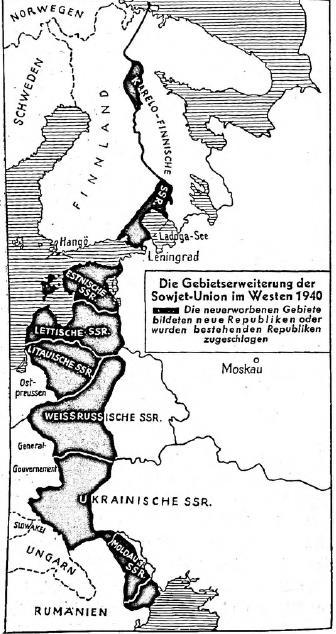
of northeast Siberia with subzero temperatures of 50° to areas with supertropical warmth, so that agriculture, but also every industrial activity of the numerous member republics of the USSR, are subject to extremely different natural conditions. A large part of the Soviet Russian territory is located more than a thousand kilometers away from the nearest coast, and is therefore accessible to world economic traffic only to a very limited extent. On the whole, although the Soviet Union comprises 193 million people, this large economic area is extremely sparsely populated by almost two hundred different peoples and tribes.
A central power now ruthlessly pushed into these spaces, which could hardly be surveyed, with total planning for the people and the economy. For the first time in world history if one disregards almost prehistoric and hardly reconstructable planning systems such as that of the ancient Indian Inca empire a state was oriented to the smallest details according to a theory, population, social stratification, property, activity, agricultural production and industrial production became planning points of a program which strove to bring the cultural and economic level, which had lagged behind for centuries, closer to the standard of other world powers. To appreciate the political and ideological character of Soviet planning is not the task here. Irrespective of this, however, it can be stated that the magnitude of the experiment and thus, of course, also the magnitude of the risk of its outcome
One remembers the food crisis of 1932/33 with its large mortality rate in the famine areas must mean for everyone a shattering fact in the formation of the world view.
The Soviet economic space was to be shaped according to purely mechanistic principles in five year plans, the first of which began in 1928. From 1928 the current, third five year plan counts. Under the rule of these paper plans, the one sided industrialization emerged with the characteristic of the absence of any organic growth. The destruction of any entrepreneurial initiative, of any efficient middle class, prevented Soviet industry from ever achieving a smooth start. The fact that the armaments industry experienced its particular bloating in this process characterizes the always latent aggressiveness of communism. Above all, schematic industrialization also led to a hasty urbanization of the rural population.
In the course of a decade alone, the major cities doubled their populations, for example Moscow from 2 million to 4.1 million and Leningrad from 1.7 to 3.2 million. In the Ural region and in Central Asia, large cities have emerged that did not exist at all in 1926. Nearly twenty million people have moved from the village to the city, a mass migration of the greatest magnitude, which must have incalculable consequences for further development in economic and
sociological terms. In connection with this urbanization, the partly quite primitive concentration of industrial activity in large scale plants was formed, which owed their emergence to the Russian tendency towards "gigantomania" of the first Gründerzeit. Slowly, the realization dawned on the Soviet rulers that their economy could not operate forever with the famous idling of the system. For in the third Five Year Plan, they began to move away from the exaggerated gigantomania. In the future, they wanted to avoid the massification of industry and now fell back into the opposite of the initial overzealousness by summarily prohibiting the construction of new plants in the two capitals of Russia, Moscow and Petersburg, but also in Kiev, Kharkov, Rostov and some other cities.
Thus, even more than in other economic areas, it is precisely the spatial economic character, the spatial economic task that enters the problem circle of the Russian force field. It was believed that the tasks would be made easier by full socialization. There is no longer any private ownership of the means of production, mines, factories, transport and trade enterprises. Similarly, in agriculture, the transition from individual farms to impersonal enterprises in the state sovkhozes, the state owned estates of former large landowners, and in the kolkhozes, the cooperative collective farms of former individual farmers, has been largely completed. Given the low level of culture in many areas, however, the lack of a sense of responsibility or the flight from responsibility into bureaucracy and formulaic bureaucracy had to be accepted, which explains the deficiencies in the quality and coherence of Russian goods production, which were most criticized in Russia itself.
In organizational terms, however, the spatial economic endeavors are hampered by the space itself. The remoteness from traffic, the sparseness of population and the inhospitable nature of large tracts of land always make it difficult to make rational use of natural resources and people's energy. The third Five Year Plan therefore again focused on transport equipment. It provided for new railroad lines, expansion of seaports and navigable waterways, and extension of the road network. The intention to develop the Volga, Europe's largest river, into an efficient shipping route is an indication of Russia's efforts to deepen its links with Western Europe.
But as long as the transport of goods is still in the process of development and Russia, even though it has dominated the Asian region for centuries, is only at the beginning of this most important colonizing task the forces cannot yet reach full development, despite all the progress in production. Nevertheless, before the beginning of the war, the Soviet Union was already among the world leaders in heavy industry, especially iron ore, manganese, aluminum, coal, and especially oil and cotton*).
*) For more details, see Part II in the chapter "The Soviet Space.
In these fields, as well as in the industrial production of manufactured goods, Russia has tripled and quadrupled its output compared to the pre World War period, at least according to the Soviets. On the other hand, the production of almost all consumer goods has lagged behind in a way that has kept the Soviet subjects at a cultural low hardly imagined in Western countries. In the context of European economic development, the Russian space still has an immense future potential, and its cooperation with the other large economic areas of the world, including the Greater Asian region of Japan and the American continent, will be of the greatest interest. Finally, the fact that the Soviet Union, with its numerous gold washes in Siberia and other areas of Asia, has already become the world's largest producer of gold after South Africa, and thus has strong international purchasing power, as long as gold continues to mean international purchasing power at all, plays a role here.
After the revision of relations between Germany and the Soviet Union in the autumn of 1939, a useful and natural line of economic policy seemed to be called for. The trade links, which at that time were expanding into a non aggression pact and a treaty of friendship from the point of view of realpolitik, gave rise to the expectation of expedient cooperation between the two large economic areas. The Soviet area was to be a supplier of raw materials and agricultural products needed by the overpopulated Western area, while highly industrialized Germany wanted to support the continued construction of Eastern factories. After German Soviet foreign trade had sunk to the level of business relations between two small states during the periods of mutual foreign policy isolation, preparations were now being made for an exchange worth billions. Here, too, the spatial situation initially required special efforts. One need only think of the necessity of transferring goods from Russian to German wagons at the border stations, since the trains could not pass through due to the wider gauge of the Russian railroad.
However, the attempt to cooperate with the Soviets was not sustainable in the long run. As the imperialist aims of Bolshevism became more and more undisguised, Germany decided to pre empt Soviet aggressiveness. On June 22, 1941, the weapons began to speak on the German eastern border, and in unanimous unison of the countries of the continent, the attack was made on the system of Bolshevism, on a large economic area that did not want to see itself faithfully managing the rich peelings of its territory.
7. Japan in the greater Asia region The Greater Asian economic area is still in urgent formation. Its developmentis of fateful importance for the rest of the world especially in so far as it brings the replacement of the English American influence in the Far Eastern area by the expansive Japanese race, while the Berlin Rome Tokyo axis has gained increased thrust by the historic proclamation of a three power pact in September 1940.
The Japanese urge for a large economic area also emanates as is the case with Italy and, of course, with Germany from the number of people that can no longer be secured within the old borders. Food and raw materials must be procured for 72 million people in Japan, whose population has doubled since 1880. For old Japan, the empire of ten thousand islands, of which only twenty are of any real importance, is particularly densely populated in its area, which is constricted by mountains and agriculturally serves almost only rice cultivation. Due to a lack of sufficient land resources, it was initially only able to pursue its desire for industrialization imperfectly. It was dependent on imports of the most important raw materials, especially from its main supplier, the United States of America. It had essentially only silk as an export commodity to pay for the vital import. Industry therefore remained at an early capitalist stage until almost our century, and the heavy industrial base in particular had to remain undeveloped.
As for Italy, emigration was therefore for a long time the valve through which the overpopulated island area could be relieved, until immigration bans made it impossible to leave for the United States and Australia. The island empire was therefore driven onto a continental trajectory of development.
Japan first entered the ranks of the political powerhouses of the 20th century on the day the Russian squadron sank under fire from Japanese warships in the Russo Japanese War of 1905. Thus, for the first time, an Asian power began to play an active role in world politics. After a few less significant seizures on the eastern edge of the Asian continent, Korea was annexed in 1910. Of greater importance was the gaining of political supremacy in Manchuria, which was placed under Japanese control in 1932 as the Manchukuo Empire. Manchukuo's large sources of raw materials enabled the Japanese to expand their heavy industry. However, there was still little sign of the elimination of shortages in the supply area for the island empire. The wading economic difficulties then led Japan to a confrontation with China, which had succumbed to English American influence to a great extent. The war that broke out in 1937 had already transformed large parts of the Chinese empire into Japanese territory, so that it is now possible to speak of a Greater Asian area under Japanese leadership.
It must be remembered that Japan is the only Asian country to have succeeded in transforming itself from a medieval feudal state into a modern industrial
state in two generations. Behind this is an astonishing spiritual, intellectual and organizational achievement that can easily be compared with the greatest development processes in world history. At the turn of the century, Japan, which was only then making the leap from cottage industry to factory operation, had only one third of a million industrial workers; now Japanese industry employs about four million people. Before the World War, the annual output of Japanese industry was little more than one billion yen, and in 1938 it was about 20 billion. Whereas in the past the industrial basis of the country consisted in the textile industry, in recent times the heavy industry, i.e. the armament industry, has become the main factor in the eternal war tensions in the East. Japan's young industry has thus had to develop under constant structural change, as it would hardly have been possible to build up large scale heavy industry under the early capitalist forms that have not long been overcome in Japan. The outbreak of the war in China in mid 1937 brought an essentially new direction in that the beginning of this great struggle in the East Asian region was the decisive prelude to placing the economy under the control of the state. Japan, which had just been in the process of converting its economy to the free trading method that characterized the condition of Europe at the beginning of the 20th century, which had barely recovered from the earthquake catastrophe of 1923 and which had been plunged into severe economic depression by the renewed advance of Anglo American trade in the East this mutable Japan has since been facing the new leap into the planned economy.
The Greater Asian region, consisting mainly of the three currency linked areas of the yen bloc Japan, Manchukuo and China is to be put in a position to economically secure its population of 500 million. The tasks of this yen bloc are to be mastered in a ten year plan announced by Prince Konoye in late 1940 in conjunction with complete state supervision of economic enterprises and a blow against liberalist speculation.
The Ten Year Plan assigns a specific task to each of the three member states and envisions economic independence in the East Asia region as the ultimate goal. Within the framework of the Greater Asia plan, Manchukuo and China are assigned the extraction of raw materials, primarily coal, ores and salt, in order to secure fuel and materials for Japanese industry. These countries are to work as the agricultural apron of the Japanese island population and increase their agricultural production in such a way that the 500 million people of the Greater Asian area of Japanese character will be independent in their food. The increased cultivation of soybeans is particularly important in this regard. The Chinese farmer should also increase cotton cultivation so that another world trade textile material is available in addition to Japanese silk, just as, moreover, the relocation of the Japanese textile industry to Korea and
China has been initiated because of the cheap wages on the mainland. Manchukuo also receives the electrical industry, mining and parts of the machinery industry. For China, mining, salt production, and light industry are earmarked.
Japan itself reserves industrial development in the ten year plan. The defense industry, toolmaking and precision engineering, and the chemical industry are to be further developed, so that on the whole, provided the difficult tasks are solved according to plan, the Greater Asian economic area could represent a closed circle from production to supply.
This is undoubtedly a generous and not problem free planning, which could only be achieved through many compromises between economic circles and military power. With its program of a large economic area of its own that is to be substantially restructured, Japan faces organizational tasks that are difficult to master, given the almost incalculable vastness of the Asian territories and the fact that the military penetration of the continental area has not yet been completed. Mastering them, however, seems all the more urgent in view of the seriousness of the tensions between Japan and the British and American economic areas. The limitations on the United States' desire to supply commodity demanding Japan had already been discussed. The British block on important export products to Japan in 1940 had already caused the Japanese buyer to look for suppliers, notably for petroleum, in the Dutch colonies. Thus, political compulsion is pushing for the consolidation of Japan's own economic forces, as has now been decided in the ten year program drawn up by the Japanese Imperial Planning Office.
In the future, the problem of raising the people's standard of living, which has fallen sharply since the war with China, will be at the forefront. The drop in the standard of living has taken drastic forms with the restriction of all consumer goods industries in favor of the armaments economy. From food, even the simplest rice dish, to clothing and social intercourse, there is no area of life that does not suffer from some decline, even if it is sometimes dressed up with the slogan of a return to the simple customs of the old days. It is precisely because of this problem that the Japanese dominion, which in recent decades has acquired the third largest merchant fleet in the world, will not be able or willing to cut itself off from the world economy. The exchange of goods with Germany will be the focus of interest in the future, especially since the Three Power Pact has brought Tokyo into close contact with Berlin and Rome.
The new policy of German metropolitan economy has grown organically with the individual stages of the great political upheavals in Europe. The spatial growth corresponds, first, to the reintegration since 1935 of lost German territories into the sphere of power of the state that was thus developing into the Greater German Reich. Furthermore, it runs parallel to the victorious advance of German troops since the fall of 1939 into the hostile or non neutral territories surrounding Germany. Third, the spatial economy has expanded in line with the political friendships linking the Greater German Reich with a number of continental states. Thus, by the end of 1940, almost the entire European continent has either been virtually subordinated to Greater Germany's claim to leadership or has come close in terms of economic policy through political cooperation. There is no longer any extra continental power that could assert any ruling influence in the continent's economic area. The expansion of Germany into the Greater German Empire is marked by the following annexations:
March 1935
March 1938
November 1938
September 1939
October 1939 May 1940
August 1940
Saarland Austria Sudeten German Territories Free City of Gdansk East Upper Silesia Eastern Territories Generalgouvernement Eupen, Malmedy, Morsesnet
Alsace Lorraine and Luxembourg
The following data are crucial for the influence of military occupation:
April 1940
May 1940
June 1940
April 1941 May 1941
Invasion of Denmark and Norway
Invasion of Holland and Belgium
Armistice treaty with France
Surrender of Serbia Stretching of arms of Greece
For the political friendships that are important in terms of spatial economics, the following data should be highlighted:
August 1939
September 1940
November 1940
March 1941
May 1941
June 1941
Protective relationship with the Slovak state Friendship and alliance pact with Italy
Three Power Pact Berlin Rome Tokyo
Hungary accession to the Three Power Pact
Romania accession to the Three Power Pact Slovakia accession to the Three Power Pact Bulgaria accession to the Three Power Pact Croatia accession to the Three Power Pact Treaty of Friendship with Turkey
It would only be playing with words if one wanted to determine whether, up to the outbreak of the European war, one could already speak of a large scale economy of Germany.
Of course, up to that time, one could not make any comparison with the large areas dominated by England or some other powers, which were based on particularly extensive economic areas or even on economic areas spread over several continents. Nevertheless, it should not be overlooked that before the outbreak of war, Greater Germany, including the Protectorate, already completely filled the core of the European continent and, with a population of about 90 million, represented an economic area that was of decisive size on the continent and was also one of the most important intercontinental production and consumption markets of the world economy. From the Memelland village of Nimmersatt as the northernmost point to the Steiner Alp in Carinthia as the southernmost corner, a national power and an area of land were already concentrated here that could certainly be considered the supporting stages of a large scale economy.
In order to characterize this importance in terms of the world economy and to be able to appreciate in its full depth the idea of an even larger large scale economic area, which emerged stormily during the war, it is necessary to take a brief look at the economic interconnectedness of this past, which, although recent, has long since been overtaken in essential points by the rapid pace of European change.
For all the greatness of the production battles, which were to ensure the feeding of the people from their own soil in the highest degree of efficiency, and the four year plan, which was to promote the domestic production of raw materials and materials, Great Germany had proved by deed up to the last
peacetime that nothing was further from its mind than dogmatic autarky. There was a great deal of effort put into foreign trade. One remembers the categorical imperative of a Führer speech: "Export or die!" That the exchange of goods with foreign countries could not rise above a not too high level was not due to the will of the German economic leadership, but to the political and economic conditions of the world's exchange of goods and money. When the "New Plan" brought total supervision of imports, with all the necessary quantitative restrictions and all the unavoidable bureaucratic restraints, this foreign trade policy was not intended as an offensive weapon for the realization of any trade policy dogma, but only as a defense against the multiple difficulties that inevitably resulted from foreign exchange shortages, political boycotts of German labor, and the dumping of countries equipped with currency devaluation. However, in the last year of peace, the exchange of goods could be maintained at a not inconsiderable level of 5 1/2 billion marks in imports and somewhat less in exports.
Especially with regard to the relations of the various major economic areas with each other, it is very noteworthy that Germany's continental trade has traditionally tended to yield the surpluses that could make possible the import of overseas raw materials. In earlier years, with great regularity, four fifths of German exports went to European countries and only one fifth overseas. Imports, in turn, were divided equally between purchases from Europe and from the overseas raw material markets. In other words, Germany was an important supplier to Europe, which provided it with the means to import raw materials from outside Europe. There is a compelling logic in this, insofar as the export goods of German industry naturally contained overseas raw materials to a large extent. In other words, the European buyer of German products had to ensure that Germany was in possession of non European materials in the first place.
But this relationship had already shifted in the last few years. Developments in trade policy prompted Germany to increase the proportion of its imports that came from Europe and to restrict overseas supplies in the same proportion. In turn, the share of European trade in exports fell to 70%, compared with the traditional 80% of total German exports.
Certainly, all such calculations have no definitive value. They do not indicate whether the imports from a continental state did not in fact consist of overseas material that had found its way to Germany not outright but through the mediation of a European partner. But a tendency is expressed in this whole development which could not appear to be conducive to Germany's role as a processor of overseas material.
Moreover, German trade policy makers had been able to deflect the dangers
of this shift of German foreign trade from overseas to the continent, which was not sustainable in the long run within the framework of world trade at that time, by a small technical trick in the clearing system. Cash peaks were built into the payment and clearing agreements with European countries. A certain portion of the credit balances resulting from German deliveries was not set off against corresponding claims of the foreign partner, but was to be received in cash and freely available foreign currency. This cash peak now made it possible to recover the share of overseas raw materials contained in the goods delivered by the clearing route.
The ranking of the connection between the German and the other economic areas was as follows: The largest volume of business was with the British Empire, both with the island empire itself and with the other members of the empire. In second place was the Dutch economic area; here again, the colonial importance of Holland as a possessor of raw materials was in the foreground. Trade with France and its colonial empire, on the other hand, increasingly faltered, even though the German and French economies had particularly useful complementarities, such as the French minette, which by its very nature depended on the counter supply of German coal. Trade with the Scandinavian countries was quite satisfactory, the most important of which was the supply of ore from Sweden, which was to be of fateful importance for the course of military operations.
On the other hand, relations with the United States of America declined to a fraction of their original volume, although Germany had always endeavored to make its large market available to the suffering surplus territory of the United States. In contrast, however, there was a strong revival of business relations with the Central and South American countries, whose emergence from the aftermath of the world economic crisis was largely due to the receptiveness of the German area to the raw materials of the American southern continent.
Of structural importance now became Germany's efforts to gain the European Southeast. If foreign trade with the countries of the Balkans had doubled in the last years before the war, and Germany had moved into first place as a supplier as well as a customer in these areas, the effect of a new type of economic policy was evident here. This German economic policy and this is important in the history of the idea of a large economic area was filled with an interconnectedness of economic processes in the German area and that of its partners that went beyond the purely commercial.
The development and constant refinement of the clearing system has sometimes been seen as a decisive point in the development of European trade. But for all the significant influence that clearing agreements must have on the nature and, above all, on the quantity of the interstate exchange of goods, the clearing system is, of course, not the primary thing. In the end, it takes place only as an effect of the movement of goods, just as in the age of the free gold currency gold was only the countermove of the commodity transaction, even if the flow of goods had to dry up at the moment when the flow of gold stopped because perhaps one of the partners no longer had a sufficient number of international tokens in his cash box. The system of clearing debts and credits has to some extent taken over the legacy of the balancing of accounts that gold used to accomplish. But it could no more have ushered in a new era of economic policy than gold itself. The historical transition from foreign trade to economic interconnectedness in the European districts could not have been achieved by a merely technical means. For this decisive turn in the further development of the economic area idea, a new creation of the political and economic world view was necessary among the leading men of European areas in general. And it is thanks to the pioneering work of German economic leadership that this new conception of economic cooperation has prevailed in interstate traffic.
This pioneering activity, ever since Reich Minister Funk particularly activated Germany's economic policy directed at the European southeast, has extended first and in ever greater depth to the Balkans, because here a large area still strongly capable of colonization provided one understands by colonization efforts not the attraction of people from other areas, but the raising of an economy not yet intensified lies at the gates of Central Europe. Its former ties with the Danube Monarchy provided well anchored economic points of reference anyway, after the former Austria became the Ostmark of the Greater German Empire. Vienna, as a mediator between Central Europe and the Balkans and to the near Orient, still had connections and understanding of the business peculiarities of the continental Southeast, often interspersed with Oriental tinge, from its former position as the political center of the Danube region. Prague was also linked to the southeast by many threads. Greater Germany, with its Ostmark and the territory of the former Czecho Slovakia, represents an area to which the six states of southeastern Europe were able to supply half of their export goods in the past, just as they used to supply half of their import needs from the export industry of Greater Germany. In 1938, Greater Germany already absorbed 36% of Romanian exports, 43% of
Greek and Yugoslavian, 48% of Turkish and even 63% of Bulgarian exports. Hungary covered 48% of its imports in Greater Germany, Romania and Yugoslavia 50%, Turkey 51%, Bulgaria 58%, and only Greece, which has always been all too dependent on England because of its merchant fleet, which is far too large in relation to the importance of the country, limited itself to 32%.
The economic political interdependence of the southeastern region with Germany is thus, of course, historically well founded. The task, however, was to make it even closer and to secure it in part against a British economic offensive, which indeed hoped to gain strong ground in the early part of the war. Exemplary for Germany's new southeastern policy was the economic treaty with Romania of March 1939, which was very significantly expanded at the end of 1940 by another treaty with the authoritarian government that had come to power in Romania in the meantime. At that time, however, the new and above all novel treaty was the very beginning of continental economic solidarity. Incidentally, it was immediately recognized by the Western powers as an act of great political importance; the world press, influenced by the Western powers, proved at that time with its attacks on the program points the decisive importance of the treaty for the internalization of the continental idea.
The agreement with Romania represented the first departure from a purely commercial intercourse between two nations. It replaced it with mutual economic assistance, and therein lay the fundamental novelty.
The earlier expansion of the Romanian economy was mainly carried out with Western capital. It is most evident in the internationalization of oil resources. Of the 11 billion lei of capital invested in the oil companies, only 3 billion came from Romanian shareholders. But 4 billion came from Franco Belgian capitalists, 3 billion from Anglo Dutch groups and 1% billion from American financiers. Romania, too, had fallen prey to the curse of developing countries, which is that foreign capitalists force loans on them that can then be misused for political purposes. This was especially dangerous because these colonization loans of high finance are almost always linked to unacceptable conditions. In 1938, the Romanian public debt to foreign countries amounted to 80 billion lei, and among them were bonds that bore interest at 7 % and 7 Vi %. What this interest burden means in economic terms, however, may be gauged from the fact that Romania's petroleum industry yields an average return of only 6 %, while agriculture is able to generate even only 4 % of its capital. The difference between this and the high interest rates abroad can therefore only be made if the people in general impose the greatest restrictions on themselves, i.e. if the standard of living is kept at the lowest possible level. And at the same time, this capital dependence on foreign
countries prevents planning in one's own country, throttles the possibility of shaping the economy according to aspects that are recognized as correct from the point of view of the national economy. In Romania, as in other countries of the Southeast, the development of individual sectors of the economy depended on the random interest of foreign financiers. Since liberal capitalist participation took place on a private basis, it was impossible to achieve a well thought out system in the shaping of the national economy. The overgrowth of individual production facilities, which had attracted the attention of foreign capital by chance or out of political interest, was countered by the neglect of important sectors of the economy, so that a healthy balance could not be achieved. Romania still suffers from overpopulation in agriculture, which could not be modernized. On the other hand, the one sided expansion of individual branches of industry has not been able to provide enough jobs for the otherwise desirable migration to urban districts.
Germany's active trade policy intervened in this internal imbalance of Romanian economic life. With the treaty of 1939, it attempted to harmonize the work and production of the two economic areas, the large industrialized German area and the economically weaker, not yet intensified Romanian area.
Of course, the German consumer is interested in increased agricultural supplies from Romania, in a broader sense from the granaries of the Balkans in general. But the Romanian farmer has the same interest in the development of agriculture. In the southeast of the continent, with its lack of fertile soils, there are relatively narrow limits to the spatial expansion of agriculture. Thus, the only option is to intensify agricultural work, which involves not so much the use of machinery as a scientific reorientation of cultivation. Romania lacked the expertise for this and, above all, the poor peasant population lacked the capital needed to buy seed or even to convert to new agricultural methods.
The farmer will have to change from the simple cultivation of cereals wheat and corn as it belongs to the traditional landmark of Balkan agricultural production, to the cultivation of the more difficult industrial crops cotton, hemp, flax, oil fruits in order to obtain higher yields from the same land area. He will be able to promote livestock breeding by transitioning to better breeds, for example, by switching to the wool sheep instead of the meat sheep previously favored in the Balkans. He will also be able to work more rationally if he replaces traditional pasture farming, which is not very laborious but takes up a lot of land, with stable feeding, which requires him to cultivate fodder accordingly, and also to make better use of the unemployed labor force in the countryside overpopulation of peasant areas is, after all, the problem that is pressing in the Balkans but difficult to understand in the rest of Europe.
This can only happen if he is given financial help for the transitional period, if he is instructed by experts and finally if he is guaranteed to be able to sell the future harvests at good prices. This is where the German Romanian treaty comes in, and we will immediately take as a basis the far reaching agreements of December 1940, in order to show the mutual economic interdependence. According to this agreement, the Romanian government intends to implement a comprehensive ten year plan for the economic development of the country, which, after its difficult territorial cessions to Russia, Hungary and Bulgaria, was particularly confronted with the solution of difficult economic problems.
Germany will support Romania's agriculture and forestry, both by sending experts and by supplying equipment and machinery; it will provide facilities for the drainage and irrigation of agricultural areas. Romania will pay for the German supplies in long term installments. It will purchase Romania's agricultural products at adequate prices this was already stipulated in earlier agreements and will be renegotiated in quotas to be fixed annually, depending on the shortfall in harvests.
We will also see, using the example of German Hungarian relations, how Germany intends to mobilize the agricultural services of the Southeast through the exchange of seeds, breeding stock, and agricultural experience. The foreign farmers should be able to do studies in Germany. Scientists and practitioners will be exchanged. It is impossible to imagine a more intimate economic interdependence between two countries than this cooperation at all the preliminary stages of trade. The new continental method of foreign trade differs in that joint work begins at the preliminary stages of trade, whereas the earlier liberal foreign trade was content with the purely commercial purchase and sale of goods,
But the modern methods of continental economic interdependence should also prove their worth in the industrial field. Although no one will think of setting up unnecessary industries in the as yet undeveloped countries or of initiating a hasty industrial expansion which would only upset the overall structure of the continent, Germany will nevertheless know how to promote the industrial development of the Balkans. For Romania's Ten Year Plan, Germany, in the treaty of December 1940, promised its technical and financial support also in the industrial sector. Here, too, it is a question of deliveries of production goods against credit. Romania's transport system is to be expanded; new roads and railroads are to be built to meet the requirements of the continental economy. New pipelines are to be built from the oil fields to the railroads and ports, just as German industry has already provided drilling equipment and machinery for the further development of the mineral oil fields, tankers and tankers for the onward transportation of fuel.
The mining development of the East is also subject to intergovernmental cooperation. The Southeast is "rich in poor ores." But the smelting of poor ores is best done at the place of extraction, so that an upswing in the heavy industrial field, with the help of German technology and capital, can create the desired work plans for the Balkans, but provide additional material for the German processing industry.
The advantage of such planning between two peoples is obvious. Secured sales markets, secured supply of food and raw materials these are factors that could never gain a foundation in purely commercial transactions. We pass over here the manifold and understandable difficulties that initially stood in the way of stimulating increased cooperation with Romania. They stemmed in part from the political trampling of British agents while they could still hold on in this district of Europe. At the beginning of the war, the British had attempted an economic counteroffensive in the Balkans, in which the well funded United Kingdom Commercial Corporation was to play a decisive role. This British trading company was supposed to buy away goods in the Southeast, but the military events of the summer of 1940 brought it to a halt faster than it was able to work.
Other difficulties arose during the necessary reorganization of the Romanian economy, which until then had been completely liberal, and the former stronger ties to the world market. This inclination of some circles toward the world market had for some time caused an undervaluation of the Reichsmark against the dollar, which was not to decline again until the end of 1940. Added to this were the losses of space in the Romanian economic area due to the invasion of the Russians and the Vienna arbitration decision, and finally the great domestic political upheaval. In the midst of all this turmoil, however, the new German economic policy of continental cooperation proved its worth. In 1938, as mentioned, Romania supplied 36% of its exports to Greater Germany. Now an export of 70% to Greater Germany is to be expected, and a corresponding increase in the supply of German products to Romania, which are to benefit its Ten Year Plan, as a sign that the idea of joint spatial organization has largely found its practical realization.
With Hungary, in the agricultural field, Germany has also come to the closer economic interdependence achieved by the modern method of spatial planning. For Hungary, too, it is important to move away from the previous monoculture, which culminated in the cultivation of cereals. Here, too, the conversion to intensive agriculture is achieved through a long term commitment, in which the Hungarian farmer can count on finding a steady outlet for his products on the Greater German market. Thus, by securing his future, he is given the opportunity to convert his work, with Germany again
providing assistance at the preliminary stages of trade. Scientific and practical experiences are to be exchanged. An official German Hungarian seed commission will have to supervise the cultivation of seeds particularly suitable for German soils, for which Germany has always been the best customer of Hungarian agriculture. German breeds are to be tried out in Hungary. Sweet lupine, oilseed, medicinal and spice plants will be made more indigenous in Hungary than before. Fruit production is to be standardized. The cooperation of German and Hungarian experts will also promote livestock breeding, especially horse breeding and poultry farming. In all this, the intention of a planned, rational cooperation becomes apparent, in which the smaller country can benefit from the comprehensive economic equipment and organization of the large Central European heartland, while on the other hand the Greater German area sees its understandable desire for a quantitative and qualitative increase of its agricultural imports fulfilled.
After all, it is in the interest of the entire continental large scale economy if each individual country is brought up to stable conditions. In the former monoculture of the Balkans this stability was not attainable. In the event of crop failures, such as those that occurred in 1940 in various parts of the southeastern region, the economic damage is more severe in an area geared to one sided production than if the agricultural economy can be based on diverse production. Thus, the new economic interdependence means a permanent value for the Balkans, since now the expansion of the southeastern edge of Europe, neglected in all previous times, can take place. It is colonization work on the continent itself.
The close cooperation with the Axis partner Italy was already appreciated elsewhere. However, it should be emphasized here that it is also guided in the agricultural field by the same tendencies that dominate the new continental policy in general. The agreement of December 1940 on joint agricultural work shows the same signs of rationalization, standardization and responsiveness of Italian producers to the needs of the German, and even beyond, continental markets, as the treaties described with other European nations. It is also promoted by time, space and price, i.e. by the long term and continuity of the willingness of a large group of consumers to pay reasonable and fixed prices. Thus, in general, the components are established which result in the modern economic interdependence of the continental large scale economic area: Time, space and fixed price components which, in comparison with the former free trade, whose certainly not to be despised advantages of manifold kind were always cancelled out by the speculative uncertainty, contribute to the expansion of goods traffic.
However lasting the effects of cooperation between the various states at the preliminary stages of trade, i.e. economic interdependence which is after all quite extensive, it is not a spectacle for the general public. For the time being, larger circles still lack an overview of the interstate possibilities of modern economic treaties; their expectations are often for the tangible pièce de résistance of complete economic integration. We have already spoken of the utopias that have temporarily appeared in some places, that the continent could be developed in all haste into a unified, unrestricted area of economic Europeans, if possible still with a European mark as a single currency, arbitrary shopping and travel possibilities, and we have pointed out the origin of this premature longing. In fact, for the time being, there can hardly be any talk of a fall of all customs borders, of a free movement of people and goods back and forth on the continent.
The caution with which the integration of foreign economies must be approached can be seen from the fact that it was not until October 1940 that the time was ripe to lift the customs barriers between the Reich and the Protectorate of Bohemia and Moravia. A period of one year was necessary here for the transition of the foreign economic processes to the rhythm of the Reich economy, although in terms of state policy and economic policy the preconditions were so favorable that they will hardly be found in the relationship with any other state on the continent. It must be borne in mind that the Bohemian Moravian area was already a highly developed industrial region, whose economic efficiency and structure were not dissimilar to the corresponding areas of the empire. Moreover, the empire had always been the best customer and the biggest supplier; thus, economic interdependence was already present to a great extent. Also, Czech exports to the rest of the world had always made extensive use of German railroads, North Sea and Baltic ports, German banks and insurance companies. Despite these favorable conditions, integration did not remain easy and might have been even more protracted had it not been for wartime conditions. However, the wartime economy had not only given Bohemia Moravia a strong impetus to adapt to the rapid heartbeats of the Reich economy, but also eased all competitive conditions with its hunger for materials. As a result, the adjustment of wages and prices was accelerated, and the money of the protectorate was brought into a fixed and permanent relationship with the Reichsmark, so that there was no longer any fear of the movement of goods being disturbed by the circulation of money or, conversely, of the currency relationship being disturbed by unsuitable goods traffic. Only under these circumstances could
the customs officer clear the border with the Protectorate and facilitate the passage of the goods into the Reich or the Protectorate.
The integration of some other areas may proceed at the same pace, where the problems do not encounter too many difficulties because of the smallness of the area, as in the case of Luxembourg, or because of the former membership in the Reich, as in the case of Alsace Lorraine. It is, after all, remarkable that as early as April 1941 all foreign exchange restrictions in traffic between Germany and Holland were lifted and a fixed conversion ratio between Reichsmark and guilder was established. In all cases, however, where the economic structure or standard of living of a country deviates more strongly from that of the Reich as a result of historical development, complete economic union is not conceivable without a long period of adjustment. The standard of living, which depends on economic, cultural and social performance, always affects the value of money and the market for goods. If customs barriers were lifted, or even if the currency were unified, whirlpools would form which could only inhibit the smooth continuation of work by all partners. One must never forget that in every nation the economy is a living organism that has grown up over generations and should not be confronted with harsh interventions.
For the European southeast, therefore, economic activation may be considered in a certain sense as a kind of colonization work. On the other hand, the inclusion in the continental economic community of the areas of the North and the West that were occupied by German troops during the war must be underpinned differently. Denmark and Norway, Holland and Belgium were lively provinces of the world economy, with all their relics of free trade and the belief in gold, before they were embraced by the belt of the German mainland idea.
It has already been shown how the agricultural areas of these countries formed the first ring in the supply of Europe especially of Europe including the British consumer islands with high quality foodstuffs and also with various raw materials. They were processing countries in that they mainly processed overseas feed and raw materials for export, just as Denmark processed foreign feed into butter, eggs and bacon. On this basis, which was to some extent preserved even through world wars and world crises, a considerable prosperity could be built up, supported by the connection to world traffic as well as partly by the possession of rich colonies. The countries of the North in particular, which for many decades had been outside all warlike entanglements, had achieved a certain harmony in terms of population, social and culture, which was the counterpart of their economic performance. The same is true of the Dutch, who, despite all the setbacks brought about by the
economic crisis with all its consequences, nevertheless felt themselves part of the world economy, cultivated valuable overseas territories and were thus able to maintain a rich material supply. It is quite understandable, therefore, if these peoples did not consider the inevitable inclusion in the new continental system, moreover under the hard blows of the war, by any means from the outset as a higher stage of their economic life. And this all the less so, since the spiritual winning of these countries for the continental idea had to begin of necessity at a moment when the leading powers of the continental movement, i.e. Greater Germany and Italy, were warring countries with all the deficiency symptoms of wartime.
It is all the more important to counter the purely trade based world and economic outlook of such countries with commercial considerations as well, which make inclusion in the economic bloc of the European continent seem at least not a bad deal for the future. One can refer to Denmark to note how dependent this country has been on its continental hinterland even in earlier times. Almost half of Denmark's exports in the years before the war were absorbed by continental countries, primarily by Germany. The other half went to Great Britain, but almost nothing went overseas. In other words, in terms of exports, continental incorporation for Denmark means only the transfer of one half of the export from Great Britain to the natural hinterland, that is, to Germany. This purely commercial act is moreover rewarded by the fact that the Greater German area represents a steady, well paying and secure sales market, which is always ready for long term ties with its partners.
Of course, exports are only of interest to a country to the extent that they make new imports possible. An economic area can never base its prosperity on exports, but only on imports quite contrary to the former views of mercantilism. With every export, a country becomes poorer, as the catastrophic sellout of Germany in the inflation years drastically demonstrated. Its prosperity is lifted only at the moment when, as a countermovement, foreign goods come in and replenish the basis of consumption.
It is well known how dependent on imports the agriculture of the North is. Their livestock needs foreign feed if the normal stock and thus the source of income for wide circles is to be restored. For the people's food foreign grain is necessary, for the industry the usual overseas fuels and raw materials. The supplies have been fetched mainly against the foreign exchange accrued from the export of the refined goods to England from overseas. Striking a balance in the European economy as a whole, as long as the European bloc has not yet been fully re integrated into the world economy, will undoubtedly remain a difficult problem. However, its solution, which was already initiated during
the war but was again made more difficult during the war, is to be found precisely in the development of the large scale continental economy with its links to the former Soviet economic area. Organizing the granaries of southeastern Europe and also the supplies from the eastern region in such a way that they can also meet in a reasonably satisfactory manner the supplementary needs of those continental areas which formerly looked mainly to overseas should not remain an insoluble task in the long term.
When it comes to the supply of raw materials, the relatively minor importance of the consumer power of many of the new members of the European bloc must not be misjudged. Denmark and Norway have fewer inhabitants than Berlin, while Holland and Belgium each have almost twice as many as the German capital. Even during the war, the German mining districts supplied the fuel poor areas with coal, so that the loss of English supplies could be made up. However bitterly the lack of overseas raw materials may be felt in the West due to the blockade of the continent, in the further future this supply problem will develop more or less in parallel with the situation in the Greater German Reich. It will be necessary to take advantage of the forward striving in the production of synthetic materials and fuels, as German industry has taught us for years, and on the other hand to find a connection to the access routes from the East opened by Germany. It would be wrong to assume that Germany is pursuing monopolistic tendencies in the European bloc. As much as Germany's armament and supply standards naturally take precedence in wartime, it is certain that when calmer times return, the other industrialized countries of the continent should also have access to the raw materials of the world market. For it is precisely a country as highly developed economically as the German Reich that expects more from trade with a likewise highly developed and efficient economic nation than, for example, with an economic area whose efficiency has been held back or which is undeveloped. The German efforts to develop the Balkan region speak quite clearly in this respect.
It remains certain, however, that in the Europe of the future no one wants to see the wartime necessity of autarky made into an economic dogma for peace. At the end of 1941, it is not yet possible to form a picture of how the relations between the various major economic areas of the world will look later on. If it is certain that the world will never in the long run dispense with exchanges between all its continents, it is also certain that Germany wants to be prepared for the times of the new great circulation of economic goods with the strongest export power, i.e. with a claim to intercontinental purchasing power. In the summer of 1940, the Reich Minister of Economics emphasized "that the Greater German raw materials base has improved enormously during the war and that at the end of the victorious war Germany will have an export potential such as has never been the case before."
For the time being, however, it is crucial that the countries that have only recently come to appreciate the idea of a continental community of destiny. In doing so, they can facilitate their understanding with a political critique of the past. For the latent state of war in Europe, which has lasted through the centuries, has its roots not least in the constant efforts of the British Isles to prevent the continent from gaining political strength. The new continental consciousness can grow out of this. Reference should be made to the formulation given by Carlo Scarfoglio for the concept of such continental thinking: "Everything that harms or oppresses one continental nation harms or oppresses the whole continent; everything that brings advantage to one continental nation without disadvantage to others is advantageous to the whole continent; whoever sets one continental nation against another is an enemy of the whole continent and must be put out of action without hesitation."
The continental large scale economic area contains in itself a healthy mixture of industrial precincts and agricultural areas, provided that the agricultural areas are brought up to the level of performance which represents the optimum. In German agriculture, performance has probably already reached a peak for the most part. Agricultural production here can hardly be increased in terms of quantity, but in some cases it can be increased in terms of quality. The eastern and southeastern agricultural districts of Europe, on the other hand, still have a great deal of room for improvement. In the west, France's task will be to increase production through soil improvement and wasteland cultivation, which is already partly on the work program.
The prerequisite for the development of the continent into a self sufficient area in important supply tasks remains, however, a unified point of view, which could never be achieved as long as, on the one hand, the unbound world economy led to a divergence of forces and goals and, on the other hand, British influence did not allow a unified continental interest to emerge. Germany, as the predominant power of the mainland, had for years exemplified the advantages of unified direction in the great questions of national economy as well as in the structure of organization. This method of economy, opposed to the former liberal tendencies of various countries, will continue to make its mark in the European area. It will be based on the following general principles: First, in the future the economic policy position of each individual country in Europe, and thus its relationship to the other members of the European bloc, will have to be firmly defined. To take one example, one will not want to think of artificially breeding in Norway or Romania an industry which is not appropriate there and which could only disrupt the existing tasks of the traditional industrialized countries. Secondly, the countries of Europe will have to come to a concerted attitude in their relation to the world economy,
that is, to foreign large scale economic areas, in which not the individual interest of a sub area but the need of the whole continent, which is under the leadership of the Axis powers, will be decisive. Thirdly, each country will have to decide on an order of production and of the market, without which it will not be possible to unify a continent not living in abundance into a large scale economy. The plans that the last months of 1940 have brought in this direction in the Balkans are already a significant beginning.
These are great, laborious and certainly problematic tasks. But their solution will strengthen the continent as a large economic area to such an extent that contact with the other large areas of the world can bring the advantages which must ultimately benefit every member of the European economic community.
If, due to the manifold differences of historical development, the great event of the founding of the German Customs Union of the last century cannot yet be repeated in its important unification for the whole of Europe, the preliminary stages to a smooth economic cooperation of the continent are all the more important. They were developed before the war, expanded during the war, and aim at an easy and smooth exchange of goods between the individual European countries. To emphasize it again, even the new, forward looking European clearing system cannot and will not recall the former "free play of forces". It seems quite inconceivable that in an area of scarcity, as which the European soil will probably always be regarded despite all the successes of the autarky efforts, any merchant will be able to buy any goods in any country at his own discretion. The new continent presupposes a great planning touching all states, and this planning must go first of all the way that the economic politicians of the different countries negotiate quotas with each other, in the fixing of which the production possibilities and the consumption needs of the whole European large economic area are taken into account. The conclusion of long term supply contracts, as we have already outlined, facilitates planning for the long term in this quota calculation.
If one notes the unavoidable restriction of trade activity, then at first the clearing system appears to be a step backward compared to the former gold payment traffic. But one must never forget that under the sign of gold payments from country to country, the balance of payments of the countries were covered as if with a veil, behind which serious economic dangers could accumulate, which usually became visible only when a financial catastrophe was about to happen because of the exposure to gold means of payment and
now, just at the critical moment, the gold standard simply had to be abandoned. The years since the Great Depression have brought enough examples of this.
In contrast, the system of clearing probably means limiting the purchase of goods, but it also means keeping track of the present state and future prospects of a country's balance of payments. It avoids possible catastrophes by classification in the present, thus creating at least clearer conditions than the game of gold, subject to many uncontrollable influences, could achieve. And that is much, if not all, in a large economic area that cannot be free of tensions and cannot draw from the full for a long time to come.
In any case, gold will no longer play a role for European currencies in the future. For the simple reason that there is not much left of this former currency metal and that various continental countries had shipped their gold treasures to London or New York before or during the war, where they are so well stored that the rightful owners are left out in the cold. Beyond this, however, the realization has prevailed on the continent that the value of the currency is to be seen exclusively in the proceeds of organized labor, that furthermore this organization of value creating labor is most consistently carried out in Germany, and that consequently the Reichsmark represents the expression of a stable economic performance. In this sense, for the European continent, the Reichsmark has taken the place of gold in balancing international payments. Gold, however, has thus become a metal that is neither available nor needed, but dependent on foreign powers and otherwise quite uninteresting.
With the return of the currency to the total sum of national labor, the possibility of the interstate exchange of goods on the basis of performance arises for the European area. Insofar as the individual members of the European family of states produce goods beyond their own consumption, they can also participate in the purchase of raw materials and finished goods offered in the continental area. This solves the currency question by itself. It is then, as Reich Minister of Economics Funk put it, only a problem of the right monetary technique. The problem is only how this exchange of goods can go beyond the framework of a barter transaction between two parties, i.e. to what extent Holland can supply vegetables to Germany in exchange for oil from Romania. This raises the problem of multilateral clearing.
The way to solve this problem is to set up a clearing system controlled from a European headquarters. It is due to the economic balance of power that the central office can only be in Berlin. The expansion of the Deutsche Verrechnungskasse, the clearing house affiliated with the Reichsbank, already took considerable shape during the war. At the beginning of 1941, twelve
countries besides Germany were already affiliated with the Berlin international and multilateral clearing: in the Western area Belgium, Holland and Switzerland, in the Northern area Norway, Sweden and Finland, in the Southeastern area Hungary, Romania, Bulgaria, Yugoslavia and Greece, and finally Italy and Albania.
Multilateral clearing works in such a way that credit balances of one country in Berlin can be used for purchases in another country. The advantage lies not only in the spatial expansion of the purchasing opportunity, but also in the fact that the importers of a country holding credit balances no longer have to wait as long as in the case of only bilateral clearing before they can take advantage of suitable transactions. If in the first period of development of multilateral clearing there are still restrictions, especially in the way that not every country can choose any partner from the circle of clearing members, but there are certain spatial ties, there is no reason not to expect a truly pan European exchange of goods by way of clearing via Berlin in the future. However, it can be inferred from the nature of future European economic planning that clearing traffic can never again be merely accounting processing and exploitation of receivables. The primary thing in the exchange of goods on the continent will always be the organization of the European market, i.e. the decision on the material content of foreign trade. However, once the hard constraint of the war economy is overcome, a further adjustment of economic relations will be able to turn the clearing system more and more to an automatism, as it is necessary, according to the former gold mechanism, for the smooth handling of international traffic.
In addition, however, the desire to use up existing claims at the clearing office as quickly as possible, which was understandable in the days of bilateral payment agreements, no longer needs to exist in the new European clearing system based on the Reichsmark. For a European country holding Reichsmark credit balances with the clearing house in Berlin can, given the general validity of the Berlin currency and the dominant position of the Reichsmark as the currency of the strongest European state, regard these credit balances as an advantageous and liquid investment, as a national savings account. The European central banks had previously held only fractions of these international liquidity reserves, which they needed to cover their national currencies and as a basis for the credits to be pumped into their economies, in gold. On the other hand, the currency reserves were invested in foreign exchange, in dollars, pounds or francs, depending on the economic or political situation. Thus, the transition to the Reichsmark meant only a change of position, only a political profession of faith, so to speak, in the idea of a mainland under German leadership.
The first to cover their own currency with Reichsmark regardless of whether this Reichsmark consisted of bills of exchange, credit balances or means of payment had been the central bank for the Generalgouvernement in Krakow, the new Belgian central bank in Brussels and the monetary institutions of various countries occupied by German troops. The "Reichsmark bloc," however, will continue to gain ground rapidly, as is already evident from the development of Berlin international clearing.
The German Reichsmark has thus become the "supreme currency" on the continent, according to which the national currencies of the various countries can follow a certain gradient, which depends in each case on the production power and thus the standard of living. In order for this "super currency" to fulfill the function of a national reserve of liquidity, it must, of course, be possible to convert the Reichsmark into goods at any time. In times of war, such convertibility will often be only relative, just as relative as the possibility of converting gold into goods. For however much gold the Balkans could not obtain machinery from England because, first, there is hardly any possibility of transport and, second, British industry is hardly capable of producing export goods. However, the Balkans can count on machine supplies from German factories in exchange for Reichsmark, even if the circumstances of the war may mean a longer waiting period or a shorter selection. The decisive factor, therefore, is again the spatial economic elements; they determine the value of the means of payment, and they have decided in favor of Germany after the German victories of 1939 and 1940.
If one takes the continental economic area of Europe as a whole, it not only has the strongest thrust in intercontinental trade with other major areas, but it also has a natural colonial upstream in close, organic proximity. It is only natural and also in line with historical development to regard the African continent as the upstream source of colonial goods for Europe. The image of Africa as a unified economic area is unusual. In the conceptualization of the European, the black continent has entered as a sum of disjointed exploitation areas of the colonizing European states. It offers completely separated settlement and life circles, which know neither a political nor a cultural commonality with each other, and with which one believes just as little to be able to seize the thought of a large scale economy, as they are connected with each other in terms of traffic in a planned way. In order to view the African continent, contrary to the confusing colors of the political map, from a spatial
perspective, a geographical approach remains necessary. Then the continent is divided into North Africa, which is close to Europe and was already part of the ancient world, and tropical Africa, which was only brought into the European sphere of interest in the age of discoveries and became the real colonial prey of the European states of the last centuries. The desert world of the Sahara clearly separates the two African areas.
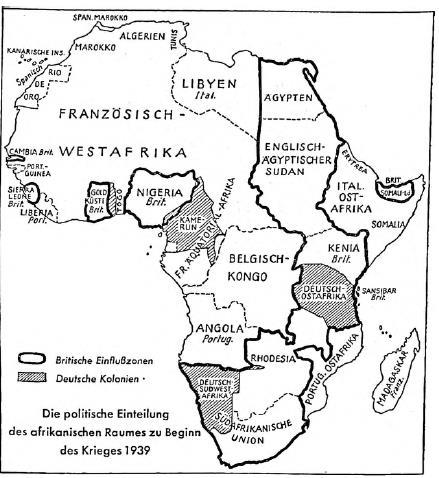
Opposite the European southern coasts, Oriental Mediterranean Africa lies as an offshoot of the great arid zone of the entire Euro Asian African land block, which extends from Inner Asia to the Near East to encompass westward the massive northern part of Africa. North Africa is Mediterranean in its historical attachment to the political development of European and Arab peoples, in its cultural development, and also in its economic conditions; but persistently this attachment is thwarted by the poverty of water, which has repeatedly prevented the full maturity of culture and has not so much been able to raise the life of the centuries to the level of European design as to stabilize it at the level of the arid regions of Arabia or Iran. In accordance with the difficulties which this trodden zone offers to the living organism, the population of North Africa, which can be compared in its spatial extent with that of the European continent up to the Russian border, has not exceeded 40 million. However, these 40 million people are more densely packed together than in Europe because, pursued by desert and steppe, they are concentrated in a few oases of culture, namely where the Mediterranean coast or the fertile banks of the Nile make higher forms of life possible at all. This African cultural landscape is divided into Egypt, which is subject to English influence, with the British Sudan to the south, Italy's Libya and, further to the west, the French territories of Tunis, Algeria and Morocco with the inclusion of the Spanish Moroccan zone.
Clearly, the economic forces and needs of this North African region point to the European continent, while trade relations with Great Britain, even before the war, had significant importance only for Egypt, where they also reached only up to a quarter of total imports and a third of total exports. North African exports are directed to the ports of the continent, in products that differ substantially from the tropical colonial products of the rest of Africa. They consist mainly of wheat the Nile Valley granary of Rome of antiquity , of the cotton of Egypt the best because longest fibered in the world and of olive oil, which fills a third of the world market in this fat product. For the industry of the European continent, mineral resources of western North Africa are important. The French and Spanish colonies supply iron ore, characterized by a high iron content of 50 to 60% (Swedish ores go up to 70%, German ore often only up to 30%), and phosphates, with which more than half of the world's imports can be covered. Also, the rare metals antimony, cobalt and molybdenum are mined in Algeria and Morocco. There are opportunities to increase the extraction of mineral resources in the North African region, considering the oil fields that have only recently been developed and the iron ores near Aswan that have not yet been exploited.
But any intensification of production is hampered by the lack of energy sources.
Africa is the continent without coal, which explains to a large extent its lagging behind in economic and cultural terms in the age of the machine, a continent without mineral oil of any noteworthy importance, and the continent whose water power, which in the North African region is in any case only outstanding in the Nile area, has not yet been developed. The hydropower reserves for the whole of Africa are estimated at almost 200 million HP., which would represent two fifths of the world's exploitable hydropower. But the development on the largest scale still belongs to the future tasks, so that for the time being the dependence of the African industry and the development of the raw material chambers on the energy supply coal, fuel from Europe or from the world market remains.
Despite this limitation, North Africa is an area of considerable economic activity; as important to mainland Europe as a supplier of food and raw materials as it is as a consumer of almost all industrial goods. It accounts for more than one third of the foreign trade of the entire African continent, if one takes as a basis the foreign trade of Egypt (including Sudan) and the French territory alone, with imports and exports of 1200 million marks each in 1937, and measures the total African import at 3500, the total African export of goods (excluding gold and diamonds) at about 3000 million marks. It thus reaches values that are not too far behind the foreign trade of the Balkans at that time.
With the southern wall of the desert space of the Sahara, which has been impassable for thousands of years, the European North African cultural district is closed from the actual colonial Africa of the tropics. In the early days of mankind, this wall protected the development of the Mediterranean culture against the intrusion of the African races; accordingly, however, it also prevented the cultural progress towards the south and has only been overcome in our century by the motor vehicle. The railroad, which must come one day, and the airplane will make Inner Africa more accessible to the colonial needs of the European. For the time being, however, the entire large scale economy of the black continent suffers from transport difficulties. It is precisely in this area that it is important to achieve planned development, if Africa is to fulfill its role as Europe's colonial outpost to a greater extent. The only waterways that can be used for bulk goods are the Nile and the Congo. Railroads do not form a unified transportation network as a result of the political disunity that has turned the African region into closed parcels of colonial land.} They were created without planning for the overall need and are difficult to unify into a uniform network even after the fact, if only because of the nine different track gauges in the individual colonies, which vary between 600 and 1435 mm. Neither is the road network sufficiently developed for motor vehicles, nor is the supply of fuel on the road assured. Africa not
only requires considerable colonization work, but above all general planning if its immense space is to be exploited to the full. The colonizing states of Europe cannot exactly be accused of having proceeded with great foresight in opening up the part of the world to their south.
This makes it all the more important to shape the Africa of the future. It was at least a sign of a lack of spatial economic insight if the various peaceful, moral offensives that Germany made in the years since its rise to power for the return of its colonies stolen by the Versailles Peace Dictate found no sympathy with the mandataries, above all with the British government. The Western powers had thus excluded from colonial activity a people whose recognized organizational and spatial economic skills in an African General Council, which could have been imagined before the war, would have benefited the entire large economic area of Africa.
Germany, even at a time when it was deprived of colonies, drew the practical conclusions from the realization that the decades of romanticism in activity in non European space are over and that the future belongs to scientific planning, to the trained industrious pioneer, to the economist, technician, settler. Therefore, a systematic colonial training has been carried out in the Reich for several years. The German Colonial School in Witzenhausen works as an imperial school, which after forty years of existence has achieved state recognition and a new flowering. It trains for the colonial service, e.g. the officials of the Reich Forestry Office in the questions of colonial agriculture and forestry. For the overseas profession of women, the Colonial Women's School in Rendsburg provides training. Retraining workshops for settlers exist in Bitterfeld and Letten near Lauf, where young craftsmen and farmers are trained for practical work in the colonies. The training house in Ladeburg near Bernau, established by the Colonial Policy Office of the NSDAP, is also worth mentioning, as its work is linked to the courses of the Reichskolonialbund.
For only with serious objectivity and with the commitment of personal and material sacrifice can the pioneer activity in tropical Africa make progress. Bismarck once said: "Our colonial undertakings are not calculated for a benefit in three or four years, but they can be compared in all respects to the mutation of a mine, which cannot be fully undertaken at once, but for which one nevertheless bequeaths to the heirs safe frontiers, which will not be crossed by other powers. In contrast, the earlier management of the colonial apron of Europe consisted in an "economic parasitism" of certain colonial powers, so that in the beginnings of modern colonization the term colonial policy was not appropriate at all, because in the large economic area of Africa any conscious control and objective was simply missing. But in tropical Africa, according to an old saying, you have to fertilize with silver if you want to harvest gold. The
colonial spaces require lengthy investments before they pay off with benefits. One need only recall how the first German steamships to Lake Tanganyika had to be transported in pieces by carrier caravans over many hundreds of kilometers, or that cotton plantations take eight years to reach full yield, or that every energy giving resource such as coal and gasoline has to be brought in by sea.
All the more the future fate of Africa as an economic subfield of Europe depends on a far sighted spatial policy, which could give the big guidelines for planned settlement, traffic equipment, production and economic way of the natives. If one divides the area of colonial Africa, which has already been gained from the geographical view, further, then the three large areas of West, Southwest and East result, independent of the political division.
West Africa comprises the tropical zones of the Atlantic coast. It is the supplier of the actual colonial products such as palm kernels and palm oil, peanuts, coffee and cocoa, bananas and also rubber. About 65 million people live in this area, including close to 15,000 non natives, and they have supplied Europe with colonial goods worth about 800 million marks annually. The goods came mainly from French West Africa (130 million), from the British Gold Coast (150 million), from the Belgian Congo (140 million), the important copper and tin area of the Black Continent, and especially from British Nigerien (240 million).
The two German colonies Cameroon and Togo*) are located in this West African region. Togo has always been considered a model colony of the German Reich and was until the World War the only one of the German colonies then in the process of economic development that did not require a subsidy from the Reich. After the World War, Togo became a partly British, partly French mandate territory. With its nearly 1.2 million inhabitants, including about 600 Europeans, it supplied colonial products to Europe for about 8 million marks annually before the 1939 war. The economy has shifted from the formerly dominant production of palm kernels, palm oil and rubber to cocoa. Rubber plantations have lost their importance. Cotton cultivation is considered to have a promising future. Cameroon, which was divided into a British and a French mandated territory after the Versailles Peace, has an annual export of 26 million marks from a population of about 3.2 million, including over 3000 non natives. Its value lies in the production of rubber, although it varies greatly, in the production of coffee, cocoa and palm kernels and, to an increasing extent, in bananas.
*) Statistical data on the German protected areas in Part II B.
With the southwestern area, the African continent passes into the area of greater settlement possibility by the white race, into the area of cattle breeding and gold. It begins with the old German colony of Southwest Africa, includes in the main the Union of South Africa as a British dominion and the British Rhodesia. Of the approximately 13 million inhabitants of this area, at least 2.1 million are white. In terms of goods, this area supplies the world market, mainly Europe, with an annual value of more than 700 million marks, of which almost 500 million from the Union alone. This does not include gold exports, mainly from Transvaal, the richest gold district in the world.
German Southwest Africa, which had a checkered political and economic history until the World War the discovery of diamonds near Lüderitzbucht in 1908 comes to mind suffered severe economic shocks when it was transferred as a mandate territory to the Union of South Africa. With great difficulty, the farming industry was able to rise again, while the mines are still awaiting future expansion. Livestock and fishing are the most important exports, along with wool and the skins of Persian lambs used for Persian furs. In the mining sector, diamond mining is only of modest extent after the diamond fields were temporarily shut down. However, the copper and lead mines (Otavi) and the tin mines are important. With future planning, the extraction of vanadium and tin, which was started earlier, will be able to gain importance. Gold is noted in several places, but is being developed only sporadically. German Southwest Africa is inhabited by about 300,000 people, including over 30,000 whites. Its annual exports hover around 45 million marks.
East Africa, with a population of about 33 million, including more than 7,000 whites, is estimated to have an annual export of colonial products worth 300 million marks, when viewed as a total of Portuguese East Africa, German East Africa, the British territories of Nyassaland, Kenya and Uganda, Italian East Africa and the French island of Madagascar. Its economic value in foreign trade lies in sisal, cotton, coffee, tea, peanuts, copra and livestock products.
The northern boundary of this area, which is situated on the Indian Ocean, is East Africa of the Italian Empire, located at the tense outlet of the Red Sea and thus on the road to India, which was rounded off by the annexation of Ethiopia in 1936 and the occupation of British Somaliland in 1940 during the war.
The German possession in this economic area is the Tanganyika Territory, the former German East Africa. The larger part of this territory was handed over to England as a League of Nations mandate for administration in trust, while its northwestern landscapes of Rwanda and Urundi were administered by Belgium as a mandate territory. Rwanda and Urundi form the most densely populated areas of tropical Africa. German East Africa as a whole has close to
9 million people, of whom about 10,000 are whites and some 30,000 other non natives. After the economic disruption of the World War, which destroyed the plantations and all means of transportation, the favorable economic condition of the pre war period was only gradually regained and surpassed, especially after the return and land ownership of Germans was again permitted since 1924. Since then, the number of German farms had surpassed that of British owned farms, though not in terms of space. German East Africa is significant agricultural territory, with cattle ranching and native plantations playing a major role. Cattle, sheep and goats are the wealth of the country, in addition to the cultivation of sisal, coconut palms, coffee, tea, tobacco, while the cotton fields are still of small extent for the time being. Forestry is still in its infancy after the great forest devastations of the natives in the pre European period. Gold and diamonds have been discovered, and a few coalfields are known to have been developed. German East Africa's exports amount to 55 million marks per year.
In order to assess the importance of Africa as a colonial apron for Europe, a brief overall picture of the goods deliveries of this large area to the rest of the world, which practically means to Europe on the whole, may be sketched. For the North African area we had already evaluated the last known annual export with 1200 million marks. The actual colonial Africa results in annual exports for the western region in round figures of 800 million marks, for the southwestern region 700 million and for the eastern region about 300 million, in total 1800 million marks. The current total value of the Black Continent as a supplier of agricultural products and other raw materials is thus in the order of magnitude of about 3 billion marks annually. This does not take into account gold production, which reached a peak of 1.2 billion marks in 1939 for the South African Union alone, and diamond mining.
The total export of 3 billion marks is at first astonishing because of its apparently small size. To compare this figure, it is worth remembering that Germany's annual imports alone are almost twice as large, despite the severe restrictions imposed since 1933. In the period before the world war, it amounted to 10 to 12 billion, and in the years of high world market prices from 1927 to 1929 it was as high as 15 billion annually. Accordingly, African products play a relatively small role for Europe. This fact, however, shows that the African apron is still in the stage of development, and that the lack of economic foresight has so far not sufficiently opened the door to further development. The African continent is inhabited by a little over 150 million people. Europeans are still few in number, except for the Union of South Africa, and in the end the economic efficiency depends on the efficiency of the organizing stratum of the population in terms of head count alone.
The German colonies in particular have been insufficiently developed because of the lack of people willing to work in the tropics for the mandate powers. Their agricultural, forestry, and mining capacities could be raised through planned employment in such a way that they would largely meet German needs for overseas food and raw materials. The colonial experts point out that in a few decades the German African possessions could be doubled in capacity through transport expansion, technical completion and planning.
To give a few illustrative examples: Increased use of machinery should accelerate the clearing of virgin tropical soil. The fuel issue for diesel engines can be eased by exploiting vegetable oils, such as soybean, peanut, sesame or palm oil, which have already been tried. Wood gas generators for the tractors are envisaged. The German research institutes have done preliminary work on the advantageous seeds needed to obtain good harvests.
The extensive grazing areas allow for an increase in livestock production, which could alleviate Europe's dependence on South American livestock markets. It is estimated that Africa has 55 million cattle, 135 million sheep and goats, and only 3 million pigs. However, the European continent, with its three times larger population and constrained feed supply, maintains over 100 million cattle, 130 million sheep and goats, and over 80 million pigs. Thus, for Africa, there is a need for intensification of livestock production, which in turn is a problem of technical loneliness, namely the solution of the irrigation problem in the great drought areas.
The tropical forest is particularly important for German wood consumption. It is a promising source of raw materials that has so far suffered from the overexploitation of the natives, who burned entire forests for farming. As important as the supply of African precious woods is, however, wood for industrial purposes is often a raw material with as yet unknown properties. The exploitation of colonial woods depends above all on the possibility of transportation, and this in turn depends on railroad construction, fuel procurement, or electrification, although the generation of power from the as yet untapped water forces remains an important task for the future. Modern industry's hunger for pulp brings to the fore the importance of colonial pulp sources. For pulpwood, the virgin forest seems less likely to be a sustainable supplier than the commercial forest, the care of which has been neglected in Africa. Therefore, even if the colonies do not immediately tap a large influx of pulpwood, rapid tropical growth results in a secure supply base for later times. However, tropical grasses, which have been used for the production of paper since ancient times, can already be used on a large scale, similar to the way straw pulp already occupies an important place in the paper industry in Europe. Of the tropical grasses, bamboo, sugar cane, elephant grass, which
occurs in enormous quantities as a detested weed, and also the extraordinarily strong banana pulp are useful.
There are also opportunities for further development in the mining sector, especially copper, lead, cadmium, tin and vanadium.
An estimate of the export performance of the German colonies under mandate*) shows a value of nearly a quarter of a billion marks for 1937. This figure includes not only the African district, but also the colonial possessions in the South Seas, as well as the gold and diamond output, which in New Guinea in particular resulted in an annual gold yield of 30 million marks. There are colonial politicians who predict a possible increase in exports to 600 to 700 million marks annually in the later future. Such an influx from its own overseas territory, however, could represent for Germany a saving of 12 15% of its total foreign exchange expenditure, consequently a substantial relief of the balance of payments.
On the whole, Africa as the forefront of the European continent will emerge in full significance only when a unified colonial policy connects the tropical economic areas more closely with the European homeland than could be the case so far under the sign of colonial imperialism. White labor in the black continent has hitherto been fraught not only with the natural difficulties of the tropical climate and the inaccessibility of the vast spaces, but equally with the risk of dependence on the fluctuations of the world market. The changing conjunctures of the world market have repeatedly brought plantation cultivation to hasty expansion and then set it back again. Cocoa cultivation in western Africa, for example, shows doublings and halvings from one year to the next that are related less to crop failure than to world market prices. In this respect, too, integration into European planning and order can stabilize the African large scale economic area
*) Statistical data in Part II B.
The transformation of the European continent into a large economic area under German leadership presupposes not only the military means of power which in 1940 secured the supremacy of Germandom. Even the economic equalization possibilities which the strong heartland of the European center is capable of organizing would in themselves make the penetration of the Old World only an action rooted in the purely technical, if the predominant influence of the German essence cannot also be secured from the spiritual point of view. In the first place, there are certainly the great intellectual goods that the German people have created in centuries of tradition and that have led to international recognition of German science and German art, as well as the triumphant advance of social ideas, under the sign of which the German Revolution since 1933 stands. The mediator of this intellectual influence, in the cultural as well as in the economic sphere, is language. And it remains of decisive importance for the fateful shaping of the continental metropolitan area and its radiations to the other metropolitan areas of the world to lead the language of the German people more and more to a world language.
The political and economic influence of Britishness throughout the world was due not least to the fact that the English language is spoken, or at least understood, by almost a quarter of humanity. While French had noticeably crumbled as a world language in the 20th century, English was regarded as the international language of business and maritime traffic, whereby not only the expansion of British possessions over all continents benefited the importance of English as a world language, but also the expansion of English speaking Americans in South America and East Asia.
After the lost world war, the Germans had initially refrained from advancing their language in the world. It is well known that the individual German abroad is eager to quickly use the language of his new place of residence, in contrast to the Englishman who is reluctant to learn foreign languages. However, the formation of blocks, which could have been beneficial to the development of the German language abroad, was out of the question in the post war period. The German representatives stood impotently by when only English and French were permitted as negotiating languages for the negotiations of the Geneva League of Nations. Even the representatives of the states of eastern and southeastern Europe, who were accustomed to German as an international lingua franca, were forced to abandon this means of communication in Geneva. Nor did Germany stir when the Baltic and Scandinavian countries, despite their other close ties with the German economy, made English their first foreign language. In Germany itself it went so far that the value of the
mother tongue as an international communication tool was artificially denied and experiments with the hopeless Esperanto were made in elementary schools.
Slowly, a change began to take place when the German Academy was founded in Munich in 1925 to foster German culture. This nurturing institution has done much to restore the prestige of the German language and thus of German culture abroad. In its German courses, the Goethe Institute of the Academy introduces foreigners to everything that can captivate them, provided they are interested in German cultural and economic values. It is therefore understandable that since 1933 the German Academy has been supported so energetically that it can serve the spread of the German language in European and non European countries to the greatest extent. This academy, originally conceived as a purely scientific institution, has intervened in practical life in many ways. It has established lectorates on the continent as well as in the Near and Far East or on the American continent, which are not only language schools but also centers of German cultural life, always with the aim of establishing German as a lingua franca and as a cultural asset.
The work in this field is of a not to be underestimated importance for the understanding, which must not be missing in the creation of the large economic area of Europe. Even before 1939, the year of the war, the German language was on the advance again on the European continent. This advance naturally intensified with the great military victories and expanded into a language policy which secured the position of the German language not only in the incorporated territories of the Protectorate, the Generalgouvernement, Alsace Lorraine and Luxembourg. For the future cooperation of the continent it is undoubtedly important that Germany's nearer and more distant neighbors, the Romance and Balkan peoples in the case of the latter it was already the case to a great extent get used to the supremacy of the German language, just as they got used to the supremacy of the Reichsmark in the financial economic field.
Already, various European states have moved to introduce German as the main foreign language in their schools. And it is not only a sign of the Axis policy that German is taught as the main foreign language for all students at the Japanese Imperial University in Kyoto. English, which used to predominate at the Japanese university, has become second in choice to Chinese. This is, after all, a certain milestone on the way to the world language, which wants to fight for its equal rights with the Anglo Saxon word.
In fact, the unification of the continental economy must lead to the deepening of the importance of a central language. The planning and support of the various economic areas of the continent by the Greater German policy one
thinks of the position of Berlin as a continental clearing center or of the exchange of experience with different countries in the various economic fields leads all by itself to uniform language use in interstate traffic and thus at the same time to further intellectual rapprochement. Germany's pre eminent position as the country of international trade fairs also plays a role here. The number of foreign visitors from continental countries to the Reichsmesse in Leipzig, the Deutsche Ostmesse in Königsberg, the Breslau, Cologne and Vienna fairs has grown extraordinarily. Here, business life and language form exert a reciprocal influence, which is of particular importance for the recognition of German as a valid language of the world economy.
German business promotion abroad plays a corresponding role. The participation of German industry and agriculture in foreign trade fairs has considerable advertising power for the Greater Region idea. It is supervised and promoted by the Exhibition and Trade Fair Committee of German Industry in Berlin, which, in cooperation with the Advertising Council of German Industry, is responsible for the systematic promotion of German exports and the cultivation of export markets.
Added to this is Germany's leading position as a country of research and science, which is of increasing value for continental large scale education. One need only point to the beneficial work of institutes that can most strongly influence the overall picture of the continental economy, such as the Kaiser Wilhelm Institute for Breeding Research in Müncheberg, from which the selection of varieties for soil tillage makes its way through the areas affiliated with the Greater German economy, to the Biological Reichsanstalt in Berlin Dahlem, to the Institute for Arable and Crop Production of the University of Berlin. Think of the numerous research establishments for grain processing, forestry, pond management, pest control, medical, technical, industrial and chemical research institutions, which have successfully served the rational development of the German economy in the early years of the Four Year Plan and can now be used for the rational management of the estimates of the continental economic area.
The scientific cultivation of a supranational spatial economy has been recognized as a necessity already some time ago. As early as 1929, the Central European Institute was established in Dresden, dedicated to the promotion of Germany's cultural and economic relations with the countries of southeastern Europe. This institute has especially taken care of foreign market research, developed special archives for cultural and economic life, which are heavily used by foreign countries, and until the war carried out the exchange of trainees of economists, doctors, veterinarians, foresters, farmers and technicians with the Southeastern countries. It has been transformed into a
foundation of the government of Saxony and has carried out an expansion of its scope even in wartime.
For the creation of an overall picture of the continental economy, however, an important task falls to the Gesellschaft für europäische Wirtschaftsplanung und Großraumwirtschaft (Society for European Economic Planning and the Economy of Greater Europe) in Berlin, which was founded shortly after the beginning of the war. The purpose of this association, founded by Werner Daitz, is to promote the economic and cultural cooperation of the peoples and states in the European metropolitan area by researching their various livelihoods, their economic structures and the resulting opportunities for complementarity. It cooperates with all relevant economic and scientific institutions, such as the Institute for World Economics at the University of Kiel, which has been known far beyond German borders for decades, and in 1941 it established its own Central Research Institute in Dresden, in which economic planning, economic guidance and large scale economy are to be examined in their scientific foundations.
Finally, reference should be made to the important work of the Reich Office for Spatial Planning in Berlin, which was established in 1935 and is of great scientific and organizational importance within the framework of Reich planning. In this office, spatial research has taken up the connection with the political, cultural and economic interests of the nation, which is to serve the consolidation of the national body in general. The development of large cities, the organization of traffic, the settlement system, and the culture of the country are some of the areas that can only be developed into an optimal achievement through a deeper knowledge of space, its possibilities and problems. In this context, the Reich Working Group for Spatial Research, set up by the Reich Office for Spatial Planning, carries out practical and scientific preliminary work, especially on the problems of spatial policy connected with the reincorporation of former German territories into the Greater German Reich. The aim of all these studies is the elaboration of a total spatial picture which can be used by the political leadership for the reorganization of the European space.
Thus, there are manifold efforts to scientifically substantiate the continental space, which is built up from the political and military, must be supported by the economic and should be filled with the spiritual content of the new era. They, too, form a network of lines of force which can be mastered only by a great community, and it is certain that the 90 million strong people of the continental center will bring forth the necessary, ever renewing impulses for this purpose.
Political Constitution of the Continent in July 1940
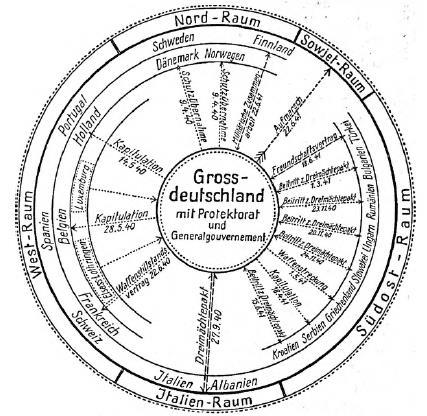
A. The countries of the continental economic area
Europeanism has been a moving factor in the history of the world almost since the beginning of mankind. A quarter of the earth's population today resides in the area which on the globe represents a small, peninsular extension of the largest mainland on earth. According to the established geographical terms, Europe begins where Asia ends, in the east at the Ural Mountains and the eastern edges of the Orenburg, Catherineburg and Chelyabinsk regions, and in the south at the crest of the Caucasus Mountains. If in this area lives every fourth person of the whole population of the Earth, undoubtedly only this dense agglomeration has made possible that dynamism, that spiritual and technical upward movement of the white race, the result of which in our time is a new high tension of forces. Europe counts 530 million inhabitants. If the population of the British Isles with about 50 million is not taken into consideration and if the population of the European Soviet Union with about 147 million is deducted, then a population figure of about 333 million results for the area which we want to call the large economic area of the European continent*).
While the geographical area of Europe covers more than 11 million square kilometers, the area just described has an area of about 4 million square kilometers. The heartland of this area, the Greater German Reich with its 90 million people, has a population density of 132 inhabitants per square kilometer in the Old Reich, while the population density in the Protectorate of Bohemia Moravia even rises to 143. An overview of territory and population illustrates the overpopulation of the continental center and the Italian peninsula as well as the sparse occupation of the agrarian areas in the north, west, east and southeast. However, the figures themselves do not allow any conclusions to be drawn as to how Switzerland is densely populated despite its low settlement ratio, since the non inhabitable mountains must be set aside, similarly to how the Nordic countries have more uninhabitable than cultivable areas, or in the Balkans, despite the low settlement ratio, the agricultural areas must be considered as translated as long as they are not subject to intensive cultivation.
The urbanization of Central Europe with its important consequences in political, economic and cultural respects is most strongly felt in the Greater German Area. Nowhere else on the continent, except for the most recent developments in Soviet Russia, has the distribution of the population between
*) The conquered Soviet area is left out of this consideration for the time being!
town and country changed so thoroughly in a few generations as in the core area of Europe. At the time of the war of 1870/71, Germany still had a two thirds rural population. Then the rapid expansion of industry, the establishment of large joint stock companies, the rise of many cultural fields of activity which require the labor of large numbers of people set in, and since the turn of the century the urban population has predominated to make up today more than two thirds of the total population. In the course of seventy years, the population ratio between the city and the countryside has been reversed. Whereas at that time two people working in agricultural production fed one person working in the urban sphere, now the feeding of two urban dwellers depends on one person working in agriculture. But also here the source of error lying in the purely numerical one shows up. In reality, substantial parts of the urban population constitute an agrarian productive force insofar as they provide the farmer with the scientific, technical and chemical aids for the intensification of agricultural work. In a country with a strong agricultural machinery industry, motorization, electrification or the production of synthetic fertilizers, it is no longer possible to draw a rigid line between rural and urban productive power.
It is now precisely the intimate interaction between agriculture and industry, such as may be achieved to the same extent in the world only in the United States of America, which enables the economy of the German Reich to become the center of continental economic forces. For the tasks which the continent offers for the future go to organize sources of food and raw materials. Both presuppose such a strong consciousness of economic capabilities as has been developed in Germany for generations and especially in the living decade. It shall not be repeated here what successes the production battles have achieved in the agricultural field and the Four Year Plan in the industrial field.
Rather, before going into the economic forces of the individual continental areas surrounding Greater Germany, a sketch will be sketched which will show the agriculture and industry of the European continent as a whole and in their relation to the Greater German center. A sketch of the continental coordination of important forces, which the continent of Europe needs before taking up a newly formed world economy.
In the times of the free world economy, the dependence of Europe in the supply of grain was greatly overshadowed by the overseas markets. In fact, even in the past, it was a matter of relatively small peak amounts that had to be additionally brought in by sea. Thus, the continental cereal balance of a time when most of the countries of Europe had not yet even thought of extracting an increased output from their ears gives the following picture of a deficit which does not yet reach 7% of the total demand.
Cereal balance of the continent annual average 1934 1938 (wheat, rye, barley, oats, corn combined) (in 1000 Tons)
German Empire
Former Czechoslovakia
Former Poland Netherlands Belgium Luxemburg France Switzerland Spain Portugal Denmark Norway Sweden Finland Hungary Romania Bulgaria Yugoslavia Greek Italy Albania
Harvest Import Export
23592 4678 12607 1390 1702 15020 230 8115 1009 2722 371 2610 1443 6130 10518 3003 8044 1371 11183 193
2702 68 1845 2397 1043 906 424 22 729 506 93 232 484 802 12
731 734 1469 198 663 115931
Import 8471
Of course, the value of such balances is very conditional. The former possibility of obtaining supplies on the world market not only actually covered the missing peak amounts, but also provided the purely psychological security of being able to operate to the full, even with poor harvests, and this feeling of security undoubtedly contributed a great deal to the smooth running of the supply system. In contrast, in the future, centralized management will have the task of mobilizing all continental reserves. In two respects, an increase in yield is possible. On the one hand, there are still enormous amounts of fallow land in Europe that can be cultivated, as in France, where an additional 5 to 6 million hectares can be put under the plow. Furthermore, however, yields per hectare can still be increased, as a glance at the strong differences in yields per hectare in the various continental regions shows. For reasons to be described in the treatment of the individual countries, the top yields of the compilation are unlikely to be maintained. If, on the other hand, the yields per hectare achieved by Germany in its production battles are
taken as the norm, there is still enormous scope for improving performance in large areas of the continent. Germany's role here lies mainly in stimulating the exploitation of the possibilities available in the various countries; it also lies in the exchange of scientific experience and in aiding the increased mechanization of agricultural operations. This applies especially to the capital poor regions of the Balkans, where, as will be shown in detail, economic agreements with Germany can facilitate the technical development of agriculture.
Very labor and capital intensive countries
Beligen, Denmark, Netherlands
Most labor and capital intensive countries
German Empire, Sweden, Switzerland
Most labor intensive countries
Finland, France, Italy, Norway
Labor intensive and capital extensive countries
Bulgaria, Hungary, former Poland, former Yugoslavia, Romania
German Reich, Sweden, Switzerland
21,8 18,7 15,0 9,6 18,7
29,1 23,0 16,9 9,6 23,0
28,3 20,6 15,1 9,3 20,6
*) Hans von der Decken, Die Intensivierung der europäischen Landwirtschaft (Vierteljahrshefte zur Konjunkturforschung 1940/41, Heft 2).
The real problem of the continent's food supply is thus less to do with cereals than with the well known fat gap. European livestock production was largely based on imports of overseas concentrates. In peacetime years, average annual imports (1936 to 1938) amounted to 4.7 million tons of oilcake, representing 87% of continental consumption, and 1.7 million tons of vegetable oil, representing 63% of continental requirements. Of course, the wartime solution to this intermediate problem, namely through the strictest quota control of consumption, is only a makeshift. But Germany has already shown ways of at least alleviating the shortages. This includes a stronger coverage of production through tight organization, as taught by the German market system. It is also important to make rational use of available products, such as feeding only animals that meet the requirements of modern
25,6 20,1 15,7 8,7 20,1
performance breeding, or making greater use of the fat content of milk in butter production. Further changes in feeding are also conceivable, with the increasing importance of the potato in pig fattening coming to mind, which in turn makes it obligatory for European countries to intensify root crop cultivation; for root crops also show similar differences in yields per hectare as cereals. It is also worth noting the attempts of the Nordic countries to obtain livestock feed from pulp. Finally, the expansion of oilseed crop cultivation, primarily in the southeastern countries, is on the agenda. Countless individual measures must be taken to combat the fat shortage from the various sides, and here, too, a large part of the initiative comes from Germany.
This general intensification of European agriculture is matched by a similar increase in all sources of energy on which industrial work is based. The coordination of the European coal supply is now in the hands of Germany, since not only have the supplies from the British mines ceased, but all the coal countries of the continent, mainly the former Poland, France and Belgium, are under German control. It should not be forgotten that the continent has an annual production of at least 410 million tons of hard coal and well over 200 million tons of lignite, which is almost half of the world's production. It is not too much to say that in the case of the most important economic raw material, coal, German economic management is completely at the center of the European lines of force and is thus capable of an economic policy which can serve both to maintain an industrial balance on the continent and to treat this valuable raw material with care. The overexploitation practiced in some countries up to now must be prevented, even if its prevention causes additional costs which were not bearable in times of competition on the world market. On the other hand, deposits must now also be developed, especially in lignite deposits, where higher cost prices previously precluded extraction. European coal planning can now be governed by the dictates of what is useful in terms of goods rather than by the exclusive dictates of returns.
This is linked to the systematic promotion of "white coal. In most countries, the use of water power to generate electricity is still limited. Under German leadership, however, working groups have already been set up with the aim of rapidly expanding power plants. In particular, there are plans to develop Norway, with its rich hydroelectric resources, into an exporting country for electricity.
In the field of fuel supply, the importance of overall European planning becomes particularly clear. The goal is to regulate the supply of the continent according to plan, also within the framework of a future world economy. The foundation of the Kontinentale Öl Aktiengesellschaft (Continental Oil
Company), headed by Reich Minister of Economics Funk, is intended to ensure a regulated supply to Europe. The company, for which a share capital of 120 million Reichsmarks has been earmarked, will manage the production of fuel, primarily through the participation of German capital in European and non European oil fields, and will also coordinate the defense and economic aspects of the exploitation of oil wells and generally act as the representative of the German oil industry. It is not without significance that, with the issue of shares in the new company, the type of German shareholder interested in European joint tasks is to reappear in broad public circles for the first time.
Continental planning is also the sign of the iron industry. After the world war, the rupture of the large economic areas had led to some countries of the continent being equipped with too much heavy industrial capacity, others with too little. One need only recall the rift in the Upper Silesian industry or the separation of the Lorraine minette from the German blast furnaces. Now the entire continental iron ore production and also the iron making industry is accessible to planning. Continental Europe can be considered self sufficient in the supply of iron ore. If it produced about 75 million tons of iron ore in 1938, the increased extraction of domestic ores in the Greater German area, in which the Reichswerke Hermann Göring, built as part of the Four Year Plan, played a decisive role, is likely to have increased this production in the years to come. In the past, non European supplies, mainly from North Africa and to a lesser extent from Newfoundland, accounted for only about 5% of total demand. The total output of the continent's ironmaking industry, based on earlier normal output, is probably at least 37 million tons of pig iron and 43 million tons of crude steel per year. With these figures, the continent does not lag at all behind the performance of the United States of America, the largest heavy industrial country in the world, in iron production and only slightly behind in steel production. There is still further scope for increasing the iron industry under Greater German leadership. For example, mining in the Lorraine Luxembourg Minette district will produce better results as new working methods replace the earlier overexploitation, in which certain parts of the ore supply were not developed in order to achieve low costs. Thus, new smelting methods that conserve raw materials will gradually become commonplace in all heavy industrial districts. Furthermore, however, raw material planning is merging into industrial planning. The times when industrially weak states tried to artificially breed a large industry for purely political motives are over. An example of this is the pipe mill built in a Balkan country, which was set up far away from any raw material base, could not find a sufficient sales market, and therefore operated unprofitably at excessive cost prices. Such bad investments can be avoided by pan European planning and thus contribute to the further rationalization of the most important economic foundation.
In the metal industry, the filling of demand gaps in several areas is also dependent on overseas supplies in the future. In the case of copper, lead and tin, European smelters can only cover their capacity requirements with large supplies of ores or concentrates from other parts of the world. Certainly, the continent still offers certain opportunities to increase its own production. For example, lead mine production can be revived in Spain and increased in the former Yugoslavia. Furthermore, Africa should be mentioned as a metal mine. For the rest, however, continental planning must be limited to economical use, careful collection of old material and, above all, the use of substitute materials. The field of new materials, in which Germany has gained the best experience in the Four Year Plan, is still virgin territory for non German Europe, offering vast opportunities.
In nickel as a steel refiner, only Greece and Norway play a minor role. Certain Finnish nickel deposits have yet to be exploited. Thus, the continent must make do with substitute metals such as molybdenum, chromium and manganese, the extraction of which is important in various European countries and can be increased in the future.
Careful planning has been initiated for aluminum. The supremacy of Greater Germany and the economic area under its leadership is fully assured in the case of light metals. Here, the supply tasks are to be solved on the drawing board, so to speak; for the continent has the necessary bauxite deposits and, on the other hand, sufficient factories to which cheap electrical power is available for the production of the light metal. The aforementioned expansion of the Norwegian hydroelectric power plants is of particular importance in this respect, since Norway, which already has a large aluminum production, is to become even more efficient in the production of light metal.
The distribution of roles among the continental countries in the fields of industrial raw material production, which are moving into the chemical sector, can already be outlined in broad outlines*). Greater Germany is the area of mineral oil synthesis, Buna production, plastics and synthetic staple fibers. Scandinavia, which with its ores is already an important base for the continental supply of raw materials, can become the location of electricity consuming raw material production with its enormous water energies, i.e., expand the light metal smelters already mentioned and also build nitrogen factories. The future demand for nitrogen, which is needed for the necessary intensification of the arable economy of France, the southeast and Spain, could be largely of Norwegian origin. Finally, the North, with its abundance of wood, would be able to take over more of the supply for European pulp and thus for the production of rayon.
*) Prof. Dr. Carl Krauch, Die chemische Industrie im europäischen Wirtschaftsraum (Der Vierjahresplan, January 1941).
France, with its valuable bauxite deposits, can devote itself to increasing light metal production.
Spain's* task will probably lie primarily in its contribution to the supply of Sdiwefel gravel and other ores. The area of the former Yugoslavia is suitable for the construction of hydroelectric power plants, which are important for certain large scale chemical productions. Its bauxite fields form an important basis for European aluminum.
Bulgaria and the rest of the Southeast participate in the supply of various raw materials. Its chemical industry will remain an important supplier of finished products to the European market.
The great importance of Romania for the fuel economy of Europe has already been largely initiated by Romania's cooperation with the Axis powers. Here, too, the expected further development offers the certain prospect of a further flourishing and growth of the Romanian petroleum and refining industries.
For Italy it is self evident that its highly developed electrical industry and its other organic and inorganic armaments will maintain and correspondingly increase their role in the overall supply of Europe in addition to the valuable Italian contribution in the elemental sulfur and mercury fields.
Thus Germany stands in the midst of a generous industrial planning which assigns tasks .to the individual areas of the continent for common supply, without depriving them of anything of their original, historically developed and site specific industrial activity. This planning presupposes the highly developed network of organization, both political and economic, which Germany possesses. Of course, the final political form of the new Europe has not yet been determined. State borders and state forms still await their elaboration. But a spatial system is already emerging which allows the political and economic power currents between Greater Germany and the other partners of the European community of destiny to be combined in a natural order. In concentric circles, the West, the North and the Southeast are the aprons of Greater Germany's economic policy, to which, to the South, the axis to the Italian area presents itself. In purely economic terms, the continental space around Greater Germany is structured according to the following scheme, which initially includes the territories in the west that have been reincorporated into the German Reich within the framework of the western space:
WestArea
The Netherlands Belgium Luxemburg France
Alsace Lorraine Switzerland Spain Portugal
NorthArea Denmark Norway Sweden Finland
Southeastarea Slovakia Hungary Romania Bulgaria
Former Yugoslavia with Croatia Greek Turkey
Italianspace
TheSovietspace
Within the framework of this division, the food, raw material and energy bases of the continental countries surrounding the Greater German Area and connected with it by an abundance of power currents will now be described.
The Maginot Line was not only the military borderline between France and Germany. It also manifested a rigid divorce between a Western and an Eastern Europe, whereby the buffer states east of the French border, the Netherlands, Belgium, and Luxembourg were included, as it were mentally, in the Western circle that believed itself protected by the Maginot Line. In this western region, old German cultural lands were artificially from its natural hinterland, the German essence and the German economy. Alsace Lorraine was incorporated into the French economic area without the latter finding the forces to bring the border region to economic development. After Versailles, the Grand Duchy of Luxembourg was schematically pressed into the customs union with Belgium, although neither the Luxembourg nor the Belgian economic circles expected anything favorable from this union.
Even if, in purely commercial terms, relations between the western region and the Greater German economy were not the worst, the political arrogance of the western countries and their economic approach, which was turned away from the continent and inclined toward British style world trade, always resulted in a state of constant tension between the strong economic power of the center, which was being rebuilt, and the economic regions of the west, which were not supported by a unified will and were fragmented into innumerable problems.
This western region, filled with all the continental tensions, is characterized first of all by its strong overpopulation and industrialization, which reaches particular heights in the east and decreases sharply as one progresses westward. The Netherlands and Belgium represent the most densely populated areas of the continent. France's population density, on the other hand, resembles that of sparsely developed Balkan countries. Belgium has 275 people per square kilometer and the Netherlands 252, which is almost twice as densely populated as the German Reich. Luxembourg and Switzerland have a population density of 116 and 101, respectively. In France, on the other hand, the square kilometer was inhabited by an average of only 76 people. Population density, and thus economic intensity, sinks even lower in the far western edge of the continent, where, behind the ramparts of the Pyrenees, Spain, struggling with the aftermath of the civil war, and Portugal lead, as it were, a special European existence.
While, as we shall see later, uniform economic structures can be demonstrated for both the northern and southeastern regions, and similar natural conditions and economic forces make it possible to draw continuous lines, the western region can hardly be reduced to a uniform denominator. The existing economic forces are too different to be covered by a catchword such as "agricultural region" or "industrial region", and the economic processes are too differentiated because of the close interconnection with the world economy and because of the partly extensive and rich colonial possessions. Therefore, the western region can only be characterized from a political perspective, insofar as liberalist economic attitudes and the free play of capitalist forces prevailed throughout until the collapse of the system in the summer of 1940.
It is difficult to look at the western region in isolation from its former world economic ties. It then appears as an area that had hitherto been under high pressure and has now suddenly lost its tension. Until it was cut off from the world market, the western region was the continent's major subsidy area. The foreign trade balances of the states on the left bank of the Rhine were almost entirely passive. Their consumption of raw materials and foodstuffs from other areas was constantly greater than their output of goods for foreign account.
The Netherlands Belgium Luxemburg France
Switzerland
551 + 2148 592
376 Gulden 1104 Francs 15395 Francs 290 Franken
Apart from the increase in exports in the Belgian Luxembourg customs union in 1939 due to the war, there were constant import surpluses in the goods economy. Thus, the western region has not produced so much economically useful material that its incorporation into the continental large scale economy could proceed without difficulty and without restricting consumption habits. This is because the import surpluses come mainly from the trade of the western region with overseas. It is significant that France's share of imports from the United States in 1938 was only 2.7%, while its share of exports although America's exports are always larger than its imports was 4.3%. The situation was similar for trade with the rest of the West. The Netherlands always purchased three to four times as much from the United States as it exported there. In the case of Belgium Luxembourg, the difference was not as great, but was nevertheless regular. In the case of Switzerland, on the other hand, purchases from the United States were twice and three times as large as the corresponding exports. This deficit in foreign trade can be traced for almost the entire overseas connection of the Western countries.
We will briefly describe the effects of dependence on overseas subsidies in the agricultural sector, without going into the economic political context. Holland and Belgium built up disproportionately high livestock on an overseas feed base. The abundant livestock, in turn, made it possible to cultivate fields with natural manure to a special degree, so that the yields per hectare of Dutch and Belgian agriculture were considerably higher than the simultaneous German harvests.
As a result, crop yields were relatively high in Holland and Belgium, despite the naturally small areas under cultivation, and, together with an unrestrained import of additional bread and fodder grains and oilseed crops, enabled increased feeding and thus the continuation of the processing economy. The
abundant harvests were therefore also based to a certain extent on overseas additions. France, of course, occupies a special position in this respect, as can be seen from the above compilation. Its yields per hectare are far below any continental average, which is related to the neglect of its peasantry that has become so important in economic and socio political terms.
Holland Belgium France Switzerland In comparison: Germany
27,3 24,6 15,0 23,5 21,7
22,0 22,7 11,0 20,3 16,3
24,7 29,5 14,2 21,6 20,2
183,9 196,0 103,6 179,6 188,4
286 339 266 360 337
After the shutdown of overseas supplies, various countries in the western region are forced to restructure their agriculture. Livestock numbers have been reduced from their former levels; arable farming must take account of the new requirements. As far as possible, the cultivated land must be increased in order to compensate to some extent for the necessarily diminishing yields per hectare in the future. The following chapters will explain these questions, which affect each country differently, in more detail. Viewed in this light, the understandable conclusion is that in a purely continental economy the surplus areas of the western region lose in importance. On the other hand, a remarkable balance is achieved by the fact that the economy is confined to the continent. Most of the processed products, and in the case of some products such as butter, even most of them, are sold to England. The discontinuation of these. The elimination of these supplies of continental foodstuffs to the consumption centers of the British Isles naturally favors the continental markets.
Belgium's deliveries to England were less significant than Dutch exports, but France's deliveries, especially of fruit and vegetables, were very strong. If we look at the share of Great Britain in the foreign trade of the western region, which has a global economic attitude, we see that the continent has been the giver to a much greater extent than the taker.
1937 24000 1000 64000 37000 11000 51000 12000 103000 27000
Bacon Lard Preserved milk Butter Cheese Potatoes Tomatoes Onions Legumes 517 Million Eggs
Tons
British share of foreign trade in the Western region
8,3 8,3 8,0 6,2
Holland Belgium Luxemburg France Switzerland
“ “ “ “ “ “ “ “ 22,7 13,7 11,6 11,2
21,7 13,6 11,4 11,7
Import in % of total import or export Export 1938 1937 1938 1937 8,1 7,9 7,0 5,9
These quotas indicate that in trade between the Western area and Great Britain, the continent has always suffered a loss of goods, which has been particularly significant in relations with the Netherlands. On the other hand, it should not be ignored that obviously part of the foreign exchange needed for the overseas purchases of the Western countries came from exports to Great Britain. It is, of course, extremely difficult to draw the balance here as to whether there is a greater or lesser advantage for continental traffic after the British business has ceased.
In the area of food supply, the agricultural future of France will be of particular importance. In area and natural fertility, France is one of the most important agricultural areas on the continent. Despite this character as an agricultural country, it has always required a surprisingly high level of food imports. This is because, for all the unsaleability of much of its own wheat crop, overseas grain, offered at knockdown prices on the world market, has represented a substantial item on the import side of its trade balances. From a purely material point of view, the French soil still contains great reserves of productive capacity, and if it succeeds in mobilizing them, the Western region
will present a very different face in terms of food economics than it can show in the first difficult period after its incorporation into the continental large scale economy under German leadership. The prerequisite for this is, of course, under certain other conditions, that the flat land of the French region becomes more populated again. For those areas that were French until the armistice and are now under German administration, i.e., mainly Alsace Lorraine, the new agricultural organization, which soon after the end of the military actions took the desolate land behind the Maginot Line under the plow, and the introduction of German peasant families will undoubtedly produce much higher yields in a short time than before.
If the problems of supply in the agricultural field are reserved for a protracted effort, in the case of land estimates it soon becomes apparent that the disappearance of the former rigid limitation of the western area to the east rather opens up new possibilities. The most important question of modern economic life, the supply of coal, should lead to a smooth settlement in the future after the rapid overcoming of the disturbance connected with the turmoil of war. The Netherlands has been self sufficient since the World War. Belgium is a surplus area; it had previously co supplied Luxembourg in exchange for Luxembourg minettes. The incorporation of areas on the left bank of the Rhine, some of them heavily industrialized, from the former French administration into the German economic area also brings complementary areas into duty free contact again with regard to coal supplies.
The coalfield of Lorraine, which directly adjoins the German Saar Basin, was almost completely shut down at the outbreak of the war because it was located near the German and French fortification lines. This meant that the second largest coal district in France was largely out of action, which dangerously increased the dependence on supplies from the English coal ports. This Lorraine district, with its annual production of nearly 7 million tons, meant a great deal for French coal needs, but it would not offer a superior source of subsidy in the context of the continental coal economy until its wealth, peeled to 4 billion tons, experienced a further expansion of production.
Coals Balance of the West Room in millions of tons (rounded down)
1938 or 1939 Coal Coke Mining Import Export Production Import Export
Holland
Belgium Luxemburg
France Switzerland
13 30 50 20 2
1,5 3 5 8 2 1
2 1
If we consider that France's wartime program had envisaged an increase in coal production to 60 million tons, excluding the mines in Lorraine, it is clear that, with improved organization, there is still considerable scope for increase. In fact, by the end of 1940, the French coal industry had already overcome a lethargy that had been fought mostly in vain in the past, and the future production of the French mines seems to be able to cover domestic consumption on the whole. Moreover, given the abundance of coal in the greater German area, the question of coal supply is less a problem of extraction than of transportation, so that the continental fuel supply can be satisfactorily regulated in the western region as well, especially as soon as normal conditions in the transportation sector are restored.
In addition to iron and steel, the basis of the technical age, the western region will provide a satisfactory supplement to the heavy industry of Central Europe. The western region includes important heavy industrial areas with a surplus of ore. After all, France is the largest supplier of iron ore after the United States of America and is ahead of the Greater German production of ore on the European continent.
Holland Belgium Luxemburg France Switzerland
0,27 7,70 37,77
0,61 10,10 0,05 18,40
The production figures for 1937 represent a high level of output which could not be maintained in the following year, but which was probably exceeded in 1939, the year of the preparations for war. France had already achieved production of 50 million tons in the best year before the war. However, the fact that Alsace Lorraine, which is now part of the German economic area, accounted for 20 million tons of the record figure of 50 million tons is an indication of how large a share of French ore production is attributable to Alsace Lorraine. Of course, the restoration of facilities destroyed during the war also plays a role in assessing the performance of the western region. On the whole, however, once the regular management of the work has been
established, the importance of the western region as a supplier of ore to the continental economy can be expected to increase.
To further characterize the heavy industrial importance of the western areas, reference should be made to iron and steel production, which for a good year like 1937 presents the following picture:
Iron and steel production in the western region
1937 In million tons Iron Steel Holland Belgium Luxemburg France
0,30 3,84 2,51 7,12
3,78 2,51 7,90
It is particularly noteworthy that France is one of the continent's most important aluminum producers in the western region. France's bauxite fields, which are otherwise not very widespread on the continent, have so far allowed an annual extraction of about 680,000 tons of bauxite and enable the production of more than 45,000 tons of aluminum. This is equivalent to a quarter of the production of the world's largest aluminum country, Germany. In addition, Switzerland, whose hydroelectric power supplies the cheap electricity for aluminum production, has an annual production of over 26,000 tons, so that the western region, together with Italy and Norway, best secures the dominance of the European continent in the world's aluminum economy.
The diverse processing industry in the western region, which naturally had to suffer many destructions in the areas through which the war passed, is faced with manifold new and certainly not easy tasks at the great turn of the times. They culminate in the question of the procurement of raw materials for all those branches of industry which cannot rely on domestic wealth, such as iron. The Western countries had followed Germany's long standing efforts to create down to earth materials only with derision. In mechanical engineering and in the armaments industry, for example, overseas metals and other raw materials were squandered in a way that had to be considered obsolete from the point of view of technically rational economic management. It will take some time for the factories of the western region to gain experience in modern processing methods, which have long been part of a production method in the German economy that has been made highly independent of foreign countries.
The other concern is sales, now that world market connections have been eliminated for the time being. But here it is necessary to point out the great needs of the continental living space, which in the future must first make up for the depression of the standard of living brought about by the war, and which, moreover, has vast areas which, like the German East and the Balkans, are still to a great extent in need of colonization. If even before the war
Greater Germany was almost across the board one of the best customers and suppliers of the Western peoples, the continental area under German leadership will later guarantee a stability and liveliness of trade relations that will enable the West to see some of the lost business relations to non European places.
To illustrate these problems, reference should be made to the textile industry, which plays a major role in the western region. In terms of its own raw material base, only France can boast a fairly substantial output of wool by continental standards, which, with an annual quantity of about 35,000 to 40,000 tons, is twice as high as the wool yield of German sheep farming, but in normal years also only covers 15 to 20% of the requirements of French textile factories. In contrast, the flax harvests in the western region, which have established the reputation of western linen weavers for centuries, are particularly remarkable.
1938 Holland Belgium France
36000 17100 23500
Tons
Tons “ “ 76600
At 76,000 tons, they account for almost one tenth of the world's harvest and, if Russian flax is excluded, even almost a quarter of the world's harvest. For the time being, the transition to synthetic spun fibers has been completed by the Western industries only in the field of artificial silk, where the largest artificial silk group in the world was formed around the Dutch artificial silk factories in Arnhem and Breda in the Algemeene Kunstzi jde de Unie. This figure is far from the production of the German mills, which is estimated at 67,000 tons for 1939, but it is almost one tenth of world production. The rayon industry, on the other hand, is still completely neglected. Only France made a modest start with a production of 7500 tons in 1939.
1939 Holland Belgium France Switzerland
11000 5500 22700 5300
Tons
44500
Tons
The future development of the Western textile industry is all the more important because the export of yarns, fabrics, clothing and other textile products have been decisive assets in foreign trade for France and Belgium. Even if a certain shift of the leading fashion creation from Paris to Vienna and Berlin is to be expected, the continental area will remain so absorbent in the future in view of the shortage in the textile field over many years that, from the point of view of exports, the integration of the western production centers into the large scale economy of the continent can only have advantages.
Generally speaking, however, the face of Western industry will only become clear when the continent has returned to normal work and regional planning can then also lead to stable conditions. The extent to which such normalization is also dependent on the solution of transportation problems has been demonstrated by wartime. The war devastation in the western region requires many years of reconstruction work, the pace of which cannot be determined in view of the many unsolved governmental and social problems in the west, especially in France. This also applies to motor transport, which is so crucial economically. France's motorization was strongly advanced up to the war; it had the relatively strongest stock of motor vehicles of all Europe.
“ “ “ 120
A motor vehicle for ... Residents Holland Belgium Luxemburg France Switzerland
148000 224000 12000 2192000 9000
58 37 25 19 45
By way of comparison, it should be mentioned that Germany had 1,710,000 motor vehicles at that time, which corresponded to a density of 44 inhabitants
per motor vehicle. Of the high vehicle population of the western region, a substantial part has been destroyed by the war, so that for the time being it is not possible to draw up a balance sheet of the degree of motorization or of the demand for fuels with which the western region will enter the continental community. In 1938, France's motor vehicle factories accounted for about 5% of world production, compared with 9% of the factories of Greater Germany.
Beyond this, however, the decisive factor is the repair of the damage which the war has brought to the road, rail and canal networks, and above all the replenishment of the rolling stock of the railroads. The last problem in particular is becoming a continental task, and the necessary construction of locomotives and wagons will continue to be a notable source of employment in the West as well as in the rest of the continent for a long time to come. The western region includes countries which have not only been lively partners in the world economy, but also possess productive colonies. The Netherlands, Belgium and France have been able to rely to a large extent on supplies of raw materials, foodstuffs and luxury foods from their own overseas territories, just as the financial returns from colonial possessions have helped to cover the deficit in the unfavorable trade balances of the Western Area. Thus, the full economic significance of the Western countries in the context of the continental economic area will only be fully appreciated when the world political situation has found its final order.
The attitude of the Netherlands toward continental politics had its roots in the fact that Holland could be considered the largest colonial empire in the world, if one puts its overseas possessions in relation to the numerical smallness of the population in the narrow Dutch area, which had been laboriously wrested from the North Sea. The rich Indian colonies, with their great distance and vastness, had to force upon the mother country the realization that it would never be able to muster the forces to defend the overseas area in the face of immense world political entanglements. After all, there were hardly more than 200,000 Dutch living in the Dutch East Indies, whose political and economic equipment could only have been based on the potential of a home nation of 8.8 million people. This prompted the Dutch government to align itself with the British Empire, which eventually had to lead to the events of the early summer of 1940. At that time, the overseas
British orientation, which had placed the homeland in opposition to the continental area under German leadership, had to give way to military
occupation by the German Empire, which was advancing westward. Since then, the Dutch economic structure has been dependent on interdependence with the continental economy, and this in turn must culminate in the observation that the Netherlands, even in its limited home area, has a not unsatisfactory balance of agriculture and industry, even if, in a period of isolation from world traffic, Holland's real source of wealth, international trade, has disappeared.
With 252 people on each of its 35,000 square kilometers, Holland is the most densely populated area of the continent after Belgium. At the same time, the area is an artificially maintained settlement area in that, without dunes and dikes, almost four tenths of the low lying land would be under water even at ordinary high tide.
Rich marshes and polders have been reclaimed from the water. In recent times alone, the draining of the Zuider Zee has increased the arable land by a tenth. The drainage, half of which has already been carried out, has resulted in a total land gain of 232,000 hectares, which means new settlement areas for 300,000 people.
About one third of the population belongs to agriculture, which is climatically under the balancing influence of the Gulf Stream, favorable especially for horticultural enterprises. However, almost a quarter of the total area consists of infertile sandy soils, bogs and heath, so that the cultivable space is disproportionately small. It should be noted that the Netherlands is the least forested area on the continent.
Farmland thereof cereals
Meadows and pastures Gardens
39% 24% 57% 4%
Ever since the Great Depression exerted its devastating influence on Dutch agriculture, Holland has moved to promote grain farming in the interest of greater self sufficiency. Cereal fields were expanded from 430,000 hectares to 562,000 in the decade from 1930 to 1940, increasing their share of the total land under cultivation from 19% to 24%.
122
The fertility of the soil is similar to that in Denmark, not least because of the abundance of manure available in the case of high livestock numbers. The yields per hectare of Dutch arable land are among the highest in the world.
Wheat Rye Barley Oats
Corn Flour Other Potatoes
Sugar beet Fodder beets
Onions
Legumes Rice Flax
Special crops
417 604 146 450 3050 1716 2900 175 186 130 8
661 55 142 47 728 100 32 161
The emphasis of Dutch agriculture on intensive livestock breeding and, on the other hand, the long standing habit of eating wheat bread have made the dependence on overseas cereals and oil plants alarmingly high. If, in spite of this, the agricultural balance for Holland closed with an export surplus in terms of value, this was due to the efficient finishing industry and the productivity of horticulture. It is therefore important to look first at the increase in livestock production in the period after the world war.
1939 1937 1921 in 1000 pieces
Horses Cattle Pigs Sheep Chickens
400 2817 1553 690 28000
300 2626 1406 608 26000
364 2063 1519 668 9600 123
The main emphasis has been placed on increasing the number of cattle and poultry, and thus on the production of the most valuable products, butter, cheese and eggs, as the cattle have been bred for the best milk yield. In contrast to the otherwise similar Danish livestock industry, pig breeding was
kept on a relatively small scale. In particular, the refined German Landschwein was bred, and to a lesser extent the lean pig for the export of bacon to England.
1938 in Tons thereof to Germany
Butter Cheese
Preserved milk Bacon
Pork Pork fat
Sheep meat Eggs
Chickens (in mill. pieces)
50863 58175 168500 26422 3222 3658 1665 80017 1,7
12395 17101 1880 3549 524 33 30256 1,35
Thus, only a relatively small part of the Dutch deliveries of livestock products went to Germany. The main customer was Great Britain, which significantly worsened the supply situation of the English island after it was cut off from the mainland. In addition to the cereal balance sheet, the discontinuation of overseas fat additions is a decisive factor in assessing Holland's future performance.
163 Oil cake 292 Linseed 390 Soybeans 24 Tran
8 Butter tallow
51 Butter 11 Magarine 111 Vegetable oil 3 Lard
The high export of fat was made possible by the high consumption of margarine by the Dutch population, estimated at over 60,000 tons per year. In
124
adapting to the conditions of the war economy, a reduction in the number of livestock is necessary for two reasons: the restriction of foreign imports and the need to clear grassland and strengthen the cultivation of cereals for bread. In this sense, Dutch horticulture will also have to see its future tasks in a
stronger emphasis on crops important for food. The export of horticultural products has already been reduced in the last decade.
1929 791000
Tons 1935 437000 “ 1938 483000 “
Almost one third of the horticultural products, of which almost half consisted of bulbs and flowers, were exported to Germany. Now the Dutch market gardening sector can sell its production in full on the Greater German markets, insofar as it exceeds domestic demand.
The fact that the Netherlands cannot be described as a one sided agricultural production center is evident from the fact that twice as many people are employed in industry and crafts than in agriculture. The actual upswing in industry, which initially lacked a heavy industrial base, did not begin until the Second World War. At that time, the development of coal mines began; ironworks were built, but iron processing started only a few years ago.
1938
Hard coal Lignite Coke
13,5 0,1 3,9
1914 In Million tons
2,0 1,8
The coal reserves are to be peeled to 1.5 billion tons. Their extraction is carried out with strong participation of the state, just as among the twelve coal mines the Maurits mine, Europe's largest, is state owned. The production of coke is remarkably high, as half of the hard coal is fat coal with more than 20% gas content. A fairly large foreign trade developed through traffic location and grade exchange; however, Holland's coal balance was mostly balanced in the final result. Holland's consumption of liquid fuels has remained relatively tight as a result of the favorable coal supply, compared to the earlier needs of 125
the smaller Nordic states. Imports of gasoline, of which the Dutch colonial empire is a major producer, have developed as follows in recent years.
In tons
1937 1938 1939
157000 240000 260000
In other respects, Holland is poor in mineral resources. The iron industry is completely dependent on the supply of foreign ores.
1939 1938 1937 In million tons Ore import Iron production Steel production
0,48 0,49 0,30 0,03
0,61 0,30
Foreign ores are mainly processed in the Ymuiden blast furnace plant. Increasing production of rolled iron in recent years has meant that 30 to 40% of the company's own requirements for sheet, bar and shaped iron can be met from domestic production. The traditional industry based on iron is the Dutch shipyards and their ancillary industries, with the number of shipyards and machine factories increasing from 3 before the World War to 21 in 1939. In 1938 they delivered 252000 gross tons of seagoing vessels and 13000 tons of river vessels.
The two other most important and internationally known industries in the Netherlands were also built on foreign raw materials: the margarine industry with the Unilever group and the artificial silk industry with AKU and Breda. The import of vegetable fats needed for margarine production had already been referred to. The wood requirements of the shipyards, the construction industry and mines, and above all the artificial silk factories, could be met entirely on the world market, given the country's lack of wood. These import figures indicate the industrial recovery that has taken hold since the economic
crisis. Finally, reference should also be made to the world reputation of the Dutch broadzasting industry with Philipps.
Holland's timber import
1937 1936 1935 in 1000 cubic meters
Hardwood logs
Pit wood Wood mass timber
Other softwood logs Hardwood logs Softwood lumber
Paper pulp
64 283 599 296 100 1826 150
56 251 372 186 84 1596 129
57 222 384 192 72 1494 115
Quite apart from its commodity opportunities associated with colonial ownership, the Netherlands was highly world market oriented. Its merchant fleet, with 1523 ships and 2.97 million gross tons, ranked seventh among the world's fleets in mid 1939. In proportion to the size of its population, it even ranked third after Norway and Great Britain. This fact, together with its tradition as a world trading country and trans shipment center of the continent, based on its historical development and geographical position, points to the difficulties for the Netherlands arising from isolation from world traffic. Rotterdam had the largest shipping traffic of any port in the world next to London. Amsterdam was one of the busiest banking centers in the world, with centuries of experience in money and credit. It is clear that the integration into the continental economic system under these circumstances brings with it problems that can only be finally solved when the world is politically stabilized. But it should be noted that Holland's economic interdependence with the Greater German area has always been the closest. German industry was the main supplier; on the other hand, Great Britain ranked first in Dutch exports.
This means that future cooperation between Holland and the continent can ease supply tensions, not least for Holland.
1938 Import Export From To 22% 8% 12% 5% 7% 11%
Germany Great Britain Belgium Luxemburg France Dutch Indies USA
15% 23% 10% 6% 10% 4%
The characterization of Belgium as an iron and steel country is undoubtedly exaggeratedly one sided, but it does already express the problems that the Belgian economic structure poses in terms of dependence on foreign supplies. After all, small Belgium is the most densely populated industrial country in the world, with a population density of 275 people per square kilometer. Although the fields are extraordinarily fertile, the cattle breeding is intensively practiced and after the Dutch border the country turns into garden culture, the 30,000 square kilometers do not offer enough agricultural space to fully feed 8.3 million people.
In addition, until the great transformation of 1940, nothing substantial was done to ensure food security for Belgium, which relied on its industrial profits, the wealth of its colonies, and its interconnectedness with the world market.
It was not until the fall of 1939 that the law decreed an increase in the area under cultivation, but without the desired success. The arable land reached about four fifths of the national territory.
40% Field
18% Meadows and pastures
42% Forest and wasteland
The partly horticultural cultivation of the land, abundant natural manure from
the large livestock population, and a remarkably high consumption of commercial fertilizers have brought yields per hectare to a level similar to that of Holland; they are considerably higher than those of German agriculture.
1939 1938 1937
In million tons
Wheat Rye
Oats
Barley Potatoes
Sugar beet
0,35 0,35 0,72 0,05 3,30
0,55 0,38 0,62 0,09 3,09 1,40
0,42 0,35 0,52 0,09 3,10 1,38
Thus, in a small area, the yields are relatively high, but they cannot fulfill the double task of feeding the population and, at the same time, providing the fodder base for high livestock production. On the other hand, in the case of a reduction in livestock production, the yields per hectare must be reduced to about the same level as in German agriculture because of the loss of natural manure. At the same time, the livestock has already shown a certain restriction in the last few years.
1938 1936 In million
Horses
Cattle Pigs
0,26 1,72 0,96
0,25 1,78 1,07
Naturally, the livestock population decreased more as a result of the war events. A census conducted at the beginning of 1941 showed that there were 0.94 million dairy cows and 19,000 fattening cattle. The reduction in the pig population was tolerable. If we take into account the imports that Belgium needed in the past to supplement its food supply and to run its livestock farms, we see the need for sharp changes in both consumption and agricultural production.
1,34 1,08 0,06 0,41 0,09 0,09 0,02 0,02 0,02
Bread cereals Feed grain Rice Oil cake Bran Margarine Preserved milk Cheese Meat
The preference given to wheat in the West had led to imports that far exceeded Germany's wheat imports.
1937 1936
In million tons
Wheat Rye Oats Barley Corn
1,07 0,05 0,43 0,05 0,91
1,14 0,14 0,43 0,04 0,93
“ “ “ “ “ “ “ “ In the future, more cereals and potatoes are to be grown, whereby the intention to maintain the pig population to a certain extent will benefit from the fact that potato harvests have already exceeded domestic consumption in the past. In addition to the necessary rationing measures, altered composition of bread flour and other restrictions, increased cultivation of vegetables and legumes is also planned, but on the whole the fact must always be noted that Belgium, as the most densely populated area of the continent, remains a grant country in the field of food supply.
The same applies to the supply of wood, which is of particular industrial importance in view of the great demand for pit wood. By its very nature, the Belgian forest is not very extensive. After the occupation of the country, increased felling in the domestic forests was initially envisaged in order to provide raw material for the excellent wood processing industry and in the interest of accelerating the reconstruction of the war ravaged areas. For the
rest, Belgium has always depended on supplies from the timber rich European north and France, and partly from its colonies.
In 1000 cubic meters
Hardwood logs
Pit wood Wood mass timber Hardwood lumber Softwood lumber Railroad sleepers
Paper pulp
106 584 185 99 935 103 174
46 544 143 99 1140 47 169
Compared to the strained supply situation in the agricultural and forestry sector, Belgium's position as a heavy industry area, which represents about three quarters of Belgium's total industrial output, is remarkably strong in the context of the continental large scale economy. Certainly, Belgium, together with Luxembourg, with which it has been linked by customs union since the World War, must be seen as a kind of economic unit that played an important role on the world market in the export of iron and steel, rolling stock and machinery, with Belgium in the lead with an annual production of more than 3 million tons of steel, while Luxembourg produced just under 2 million. As small as these quantities may seem in comparison with the enormous output of German steelworks, they were particularly significant because most of the steel produced was exported in the form of rolled products or machinery. The Belgian Luxembourg customs union thus contained a highly developed heavy industrial workshop.
Belgium has coal mines, but hardly any ore mines. Of the 10 million tons of iron ore it processed on average annually, 9 million came from France and the rest from Sweden. The decisive raw material base for Belgium's heavy industry was therefore in other countries on the continent. Luxembourg, on the other hand, mines ore itself and is also an exporter of iron ore, most of which went to the German mines; it lacks coal, however, so that the coke for smelting had to be brought from Germany.
The foreign trade figures for coal and coke show the effects of the Belgian Luxembourg customs union, i.e. Luxembourg's import dependency, just as, 131
conversely, the foreign trade in iron ore documents the import dependency of the Belgian metallurgical industry. During the military actions, of course, the coal and steel production suffered a heavy loss. By the end of 1940, however, coke production had returned to about 40% of its normal level, while coal production had probably risen to over 80% by that time.
1938 1937 In million tons
Hard coal Promotion Export Import Coke Production Export Import
29,6 4,7 4,5 4,7 1,9 1,2
29,7 4,3 6,2 5,9 3,2 1,3
Promotion Export Import
1938 1937 In million tons
0,20 9,39 2,05
0,27 12,41 2,28
The statistics of iron and steel production, in turn, reveal the superiority of the Belgian ironmaking industry, which has been based in the coalfields around Liège and Charleroi since the earliest times.
1938 1937 In million tons
Pig iron Belgium Luxembourg
Crude steel Belgium Luxembourg
2,46 1,55 2,21 1,43
3,84 2,51 3,78 2,51
In assessing the future shape of Belgian heavy industry, two factors must be considered first and foremost: the question of raw material procurement and the problem of sales. Even if the Belgian smelters, whose damage suffered during the war has been partially repaired, can obtain coal and blast furnace coke from the domestic mines, which have accelerated their efforts to repair the damage of 1940, the supply of iron ore still has to be ensured. For this, Belgium was dependent on Sweden and France. Transport reasons suggest a stronger supply from the French region, just as the western districts of Belgian heavy industry got going again more quickly than the Liège area. Before the war, sales were to a large extent oriented to the world market. Belgium, like Luxembourg, occupied an important place in European exports, as can be seen from their quotas in the international crude steel community of 1938.
Profiles Bar iron Heavy plates Center plates Universal iron Belgium Luxembourg Germany France
1938 Semi finished product
22,832 13,874 29,276 37,018
13,058 17,704 30,703 38,535
28,178 28,430 31,697 12,506
46,606 2,494 47,659 8,241
32,756 20,647 33,019 13,578
For the time being, replacements for failing overseas customers must be sought in the countries of the continental economic area. It should be remembered that Germany has always been the best customer of the Belgian iron industry. Modernization issues that could strengthen Belgium's importance as a continental iron supplier have already been discussed in industrial circles, notably the construction of a wide strip mill, of which only Germany and the Soviet Union have the best in Europe, while the United States of America has over 30 wide strip mills in its rolling mills. In addition, however, there is, at least for a longer transitional period, the greatly increased in house demand in the Belgian region resulting from the reconstruction of bridges, railroads and buildings destroyed during the war. Initially, this reconstruction will generate substantial additional orders, especially for heavy industry. Its magnitude can be seen if one considers only the building damage according to Belgian data given in January 1941.
To this must be added the destruction of roads, bridges, transportation facilities, railroad equipment, ships and barges. It has been calculated that the 133
37,979 52,134 9,887
total length of all destroyed bridges crossing the Sambre, Scheide and canals alone would amount to 70 kilometers. The orders from this reconstruction work will primarily benefit heavy industry, and it is noteworthy that by the beginning of 1941 unemployment among the Belgian industrial workforce had already eased considerably.
Residential Public buildings Factories
37000 1300 1300 all together 136000
The high level of the Belgian metal industry is particularly understandable if one recalls the rich mineral resources of the Belgian colonial possessions in Africa, from which the supply of copper in particular played a major role until the events of the summer of 1940. Two thirds of the exports from Belgian Congo were mining products, of which the copper industry was the most important. The Union Miniere du Haut Katanga, with its six mines, was the fourth largest copper producer in the world, and its ores were refined in Belgium at Hoboken and Oolen.
Mining production of Belgian Congo
1938 1937 1936 In million tons
Copper ore Tin ore
Lead ore Zinc ore Manganese ore
Silver Gold
123,9
150,6 9,2
97,5
10,1 4,6 4,1 3,7 86500 12100 391 99
Kilogram
13400 389 66
Belgian Congo, which fell into British dependence during the war, is also the third largest diamond producer in the world with small but valuable stones. Production has increased from 4.9 million carats in 1937 to 7.2 million carats in 1938. The Antwerp diamond industry, one of the most important in the world, had been able to partially resume operations in the fall of 1940 after large stocks of unprocessed diamonds that had been taken to France before the occupation were recovered.
Finally, the face of the Belgian economy was still determined by the highly developed textile industry, which had enjoyed an international reputation since the Middle Ages. However, it found a domestic raw material base only in flax, which has been cultivated for centuries, especially in the valley of the Leye (Lys). The English, who mainly bought the flax from Flanders, called the Leye the golden river, because the composition of its water obviously strongly influences the quality of the flax. However, the domestic flax was no longer sufficient to satisfy the hunger for raw materials of the Flanders linen industry. Especially the lesser varieties were imported from Holland or the Baltic countries. The other raw materials of the textile industry came without exception from overseas, cotton partly from Belgian Congo.
Cotton Wool
Flax
Artificial Silk
Jute
Various Clothing products
159386 136836 196827 1842 68529 42387 263
83673 80949 64908 3590 21621 89103 776
The high share on both sides of the foreign trade balance indicates the liveliness of the Belgian textile industry, which is mainly based in Ghent, Verviers and Kortryk. The last available business census of 1930 lists more than 3000 larger businesses, the most important of which belonged to the cotton and wool industries.
Cotton Wool Linen Jute
1930 Spindles Looms
2065000 810000 240000 72000
40000 7500 10000 3000
The further development of Belgian industry is a question of raw material supply. For the time being, restrictions on consumption and prohibitions on use have been imposed to solve the most urgent problems during the tension caused by the war. Among the exporting countries, Germany has always been the largest customer for Belgian textile exports, as the continent has always been of the greatest importance for the employment situation of the Belgian textile industry. The integration into the continental economy can therefore still be considered as a security factor for the Belgian economy in terms of sales. In this context, the tasks can be better surveyed already in the field of artificial fibers. Belgian production of artificial silk is only small compared with that of Germany and Italy; however, about one third has always remained available for export.
Production Import Export In tons
1933 1937 1938 1939
4700 7650 5450 6600
1150 1300 1260 1200
2680 2600 2650 3200
For the two living years, the figures also include rayon. About one third of exports went to Germany. An expansion of synthetic fiber production is being considered in Belgian textile industry circles.
For all its interconnectedness with the world economy, the Belgian merchant fleet has not been one of the significant merchant marines. It comprised about 0.35 million gross tons at the beginning of the war, and during the war it attempted to compensate for losses through purchases of foreign shipping. In the fall of 1940, total losses caused by the war were calculated at about one
fifth of the inventory. Since a large proportion of Belgian seagoing vessels were seized by Great Britain, it is difficult to overlook the future importance of Belgian ocean shipping. This makes inland shipping all the more important, as it is of the greatest importance in Belgium, which has the densest network of railroads and waterways. Vessels of up to 4000 tons, on average 2000 tons, can travel on various Belgian canals. Although almost a quarter of the inland fleet suffered war damage, at least the restoration of the waterways made such rapid progress in 1940 that coal and other transports by water can again take place smoothly.
Belgium's new life in the European economic community is particularly geared to the lines of commercial destiny that will link the continent with the other economic areas after the war. Close alignment with the economic requirements and tasks of the Greater German Economic Area will be necessary in order to secure desirable supplies for the area of Europe whose population is most densely packed. The fact that a large number of Belgian workers have found employment in the German labor force eases many of the small country's economic problems.
The integration of Luxembourg into the greater German economic area is not only politically and historically important, but also of the greatest economic interest, even though it is one of the smallest territorial entities on the continent, populated by a population barely equal to the head count of a small city. In its territory of only 2586 square kilometers, there are barely 300,000 people, which is about the population of Bochum. But per capita of this population an annual production of about ten tons of iron is calculated, a weighty production if one considers that in other highly developed heavy industrial countries average shares in iron production amount to at most one third of a ton.
In Luxembourg, a heavy industrial district is crowded together in a way that a French national economist once described as a model result of capitalism. Undoubtedly, the rapid development into a heavy industrial factor is not least due to the large participation of German, Belgian and French capital in the Luxembourg iron and steel industry. The country has always been a focal point of the world corporations that made the spurs of the Lorraine minette deposits extending into the Luxembourg territory the basis of an iron industry, while
two other important factors of the heavy industrial performance process had to be brought from abroad, the coal from the neighboring countries and the labor force from other areas.
Nevertheless, Luxembourg has never completely lost its former character of a rural and self sufficient countryside. Almost a third of its population has remained in agriculture. Although the agricultural production of such a small population or its consumption does not play a significant role in the continental European or even world economic context, it should be noted that Luxembourg is able to meet about four fifths of its food needs in its own country. Thus, the livestock breeding shows a remarkable level in relation to the population.
1937 17000 108000 146000 10000
Horses Cattle Pigs
The large scale farming economy has been particularly concerned with pig breeding, while small livestock is kept little. In fattening cattle and pigs there has even been a small scale export.
The heavy industry of Luxembourg could only revive when 80 years ago the advent of the railroads made the mass exchange of materials possible. Until then, the iron ore in the soil of Luxembourg (as well as the Lorraine minette) was not much used. The mines were therefore derisively referred to by the diminutive Minette, a word that later became the epitome of Western iron ores when technical innovations made the ores ideally suited for the production of iron and steel. Minette deposits in Luxembourg are estimated at 270 million tons, which, given the fairly low iron content of the ores, corresponds to 80 million tons of iron. The production of iron ore ranges from 4 million to almost 8 million tons per year. For comparison, it should be mentioned that the Lorraine mine deposits are calculated at 1800 million tons. However, looking at the situation from the point of view of capitalist interdependence, it should be noted that the Luxembourg heavy industrial groups have an enormous possession of ore mines in the other countries of the continent and also overseas, the total ore reserves of which are estimated at over 1000 million tons. As far as the Luxembourg ore itself is concerned, it is interesting to note that, in terms of transport, it was mainly made available
to the smelters in Belgium, which were better able to cope with the high silica content, while the blast furnaces in Luxembourg had switched to sourcing the limey ores from France for their needs. In the years under review, Luxembourg's iron ore production reached the record levels of 1929 again for the first time after a severe setback, but was unable to maintain this level.
1929 1933 1937 1938
7,6 4,0 7,7 5,0
It is difficult to draw a balance of extraction, import and export. After the World War, Luxembourg was linked to Belgium by customs union until it was reincorporated into the German customs territory in 1940. As a result, foreign trade statistics for this interim period appear as joint items of the Belgian Luxembourg customs union. It is therefore only necessary to recall here the fact that Luxembourg is a coalless coalfield which must obtain its fuel from German and Belgian mines, while the Belgian iron industry, although built on coal, has no ore base of its own. For the rest, reference is made to the ore and coal balance of the Belgian Luxembourg customs union in the chapter on Belgium.
The performance of the Luxembourg iron industry is as follows:
1929 1933 1937 1938
2,9 1,9 2,5 1,6
2,7 1,8 2,5 1,4
2,1 1,5 2,1 1,2
The production of iron and steel is almost entirely carried out in the Thomas furnace; the use of the Thomas process for the dephosphorization of iron in the 1980s was the reason for the real upswing in Luxembourg's heavy industry,
and at the same time also helped agriculture. The Thomas flour produced by the Thomas process, which amounts to 0.4 million tons per year, was not only exported, but its valuable fertilizing properties also made the barren areas of Luxembourg fertile, especially Oesling, which was threatened by desertification. In more recent times, electric steel production has also found its way into the Luxembourg iron industry, which has always been at the cutting edge of technology.
The steel produced by the Luxembourg smelters is mainly processed into heavy rolled products and sold abroad as semi finished products, beams, rails and bars. These products accounted for almost 90% of total production. A rather unusual ratio, which is partly explained by the production of Thomas steel, while the production of quality and stainless steels remained neglected; partly it is due to the historical economic development. For with the cutting off of Luxembourg from its natural connection with the West German and Lorraine coal and steel industries and its incorporation into the Belgian economy, the increasingly difficult competition on the world market drove a vertical expansion of the groups, which accelerated the expansion of finished production.
It is now of interest to touch upon the heavy industrial interdependence in this small area of the western region, but one that has been contested by the capitalist powers for generations. When towards the end of the last century technical innovations with a minimum of coal in the smelting industry appeared, the large Rhenish Westphalian companies that brought the coal with them migrated to the Moselle. Before the World War, the Deutsch Luxemburgische Bergbau und Hüttengesellschaft, a company founded by Hugo Stinnes, was in charge of Luxembourg's heavy industry. In addition, the Gelsenkirchener Bergwerksverein and Arbed (Acieries Reunies de Burbach Eich Dudelingen) were important. After the World War, Arbed and Gelsenkirchen, together with the French armaments company Schneider Creusot, founded Terres Rouge to take over Gelsenkirchen's property on the left bank of the Rhine, which today is completely merged with Arbed. The rise of Arbed thus stands in strange and, from a political point of view, remarkable contrast to Hadir (Societe des Hauts Fourneaux et Acieries de Differdingen St. Ingbert Rumelingen), which was founded after the world war with Belgian and French capital and which, as the successor of Deutsch Luxemburg, brought the old German works under French influence and exhibited an emphatically anti German attitude. After the outbreak of the war in 1939, for example, it stopped deliveries to Germany, so that the iron still coming from Luxembourg to Germany mainly came from the plants of Arbed or the Societe Miniere et Metallurgique de Rodange, which ranked third among
the groups operating in Luxembourg. Hadir itself had obviously fallen into the wrong hands; for, despite the sound foundations of the works it had taken over, it had run into difficulties soon after its foundation, and even later maintained its reputation on the world market only through the manufacture of its specialty article, the so called Gray beams. While Hadir joined the French economy, Arbed did not give up cooperation with its natural economic hinterland, the heavy industrial German coalfields, and developed into the most powerful heavy industrial entity on the continent next to Vereinigte Stahlwerke in Düsseldorf.
The enormous international relations can be seen from export statistics of the Luxembourg iron industry, which for the first time in 1937 reveal a picture of Luxembourg's export relations, which are otherwise hidden in the joint Belgian Luxembourg customs lists.
Luxembourg's heavy industrial export
1939 in millions of Luxembourg francs to Belgium to Germany to France to Holland to England to Scandinavia to other Europe to South America to North America to Asia to Africa
457 342 49 90 117 138 153 167 44 179 63
Thus, one of the main connections was directed to Germany, despite the customs constriction. Its expansion will be all the more difficult in view of the great demand of the German economic area, since after the events of 1940 the overseas markets for the Luxembourg iron industry are closed for the time being. As early as the fall of 1940, the customs union with Belgium was abolished and Luxembourg was assigned to the customs territory of Germany, including Lorraine. Thus, the old, natural raw material connections were restored; the path of coal from West Germany and minette from Lorraine is free again and, on the other hand, the German market is once again the most important calculation basis for the export of Luxembourg's heavy industrial products.
This development secured a new stability for the groups working in Luxembourg, especially after the transfer into fiduciary administration of German big industrial circles in March 1941. Hadir transferred the Differdingen Oettingen Rümelingen steel mill to Vereinigte Stahlwerke AG, while the St. Ingbert wire rolling mill was transferred to Dillinger Hüttenwerke. The Rodingen iron and steel mill, which belongs to the S. A. Ougree Marihaye group, was transferred to the industrialists Dr. Faust and Hai. Arbed remained independent with nine plants in Luxembourg.
The speed with which Luxembourg's economic life was able to resume after its incorporation into the German area can be seen from the normalization of deliveries of iron ore to the Belgian blast furnaces, which had already reached their former peak by the fall of 1940.
The assertion of historians that France passed the peak not only of its strength but also of its initiative two centuries ago, and that since then, with the exception of the Napoleonic era, which was strange to the Frenchman himself, it has been in constant regression, is corroborated not only with the rapid collapse in the summer of 1940. Even before that, the lack of energies, without which a modern metropolitan area could not be filled with rising life, became apparent in all areas, especially in the economic sphere. The Maginot Line and the Gold Treasure were, after all, nothing more than a means of camouflaging, both internally and externally, the lack of entrepreneurial courage of a people inclined toward the pensioner ideal. It is therefore quite consistent with the general view of the fatigue of the French people in the sector of constructive politics and work, when theoretical calculations about the extent of private entrepreneurship bring the result that in France in the years before the new continental war per inhabitant economic investments were made only in the amount of about 130 marks per year, while in Germany investment expansions resulted in the value of 245 marks. One can interpret such figures to the effect that the French people, whose family life is praised by good connoisseurs as happy and healthy in spite of the dwindling birth rate and the ease of Parisian manners, were able, satisfied with what they had already achieved, to devote only half as much initiative and energy to the further development of their living space as the German people, who, however, since the National Socialist turnaround, had been permeated in all areas by an unheard of development of power.
The French area on the continent, as it existed until the collapse of 1940,
reached with 551,000 square kilometers approximately the extent of the German area of the old empire. But with a population of only 42 million, corresponding to a population density of 76 people per square kilometer, this area was no more populous than the agricultural lands of the German East. It is therefore largely the population difficulties that are responsible for the weakening of the French state and the French economy, especially agriculture. In addition to the dangerous smallness of numbers, which was no longer sufficient to master the area, there was also the fact of a considerable foreign infiltration. According to reliable estimates, only 34 to 35 million of the total population of 42 million were French citizens. It is estimated that 3 to 4 million were foreigners and stateless persons, and 3.8 to 4 million were citizens of non French nationality, most of them colored.
Under these circumstances, it is not surprising if the French soil, despite variously high natural fertility and favorable climate, lost more and more of its nutritional importance. France is considered an agrarian country, and in fact half of the population is distributed between urban and rural areas, while in Germany two thirds of the people live in the city and only one third remain in the countryside. Despite this peasant structure, however, France's agriculture shows an extensive mode of farming rarely found in undeveloped parts of the continental East.
The land under cultivation shows a decrease from year to year, not because of other uses, as in Germany, where in the years before the war the construction of military installations, airfields, and the Reichsautobahnen also led to a reduction of arable land, but because of the inability to utilize the soil. Cultivated land was simply left fallow, either because there was a lack of labor or because economic and political circumstances made larger harvests unprofitable.
Thus, despite the annexation of Alsace Lorraine after the World War, the arable land under cultivation has decreased by about one tenth since 1913. Even the vineyards show a decrease, and the wasteland has increased by almost half. This comparison also shows the nutritional possibilities that the French area can offer to the continental supply, if it is possible to mobilize forces in this area. The extent to which the decline of tillage is linked to the shortage of forces is clearly shown by the extinct farming villages, which were a feature of the French countryside even before the 1939 war. Especially the southwest, Provence and Perigord know dead landscape. One example among many: The village of Montmaux in the department of La Drome still had 160 inhabitants in 1882; in 1913 it had 40, and now the village, whose church and houses have fallen into disrepair, is still inhabited by two people. One must not only take the birth fatigue and the strong rural exodus in recent times as a background for this development, but especially also the great human sacrifices of the French wars. After all, the world war required one million dead and 300,000 wounded from the French. The victims of the 1939/40 war will also weigh heavily, all the more so because the mass exodus from the war zones has severely disrupted French life.
From the perspective of this popular fatigue, it becomes understandable that the agriculture of France was content to provide only the bare necessities. This is expressed in the modesty with the lowest yields and in the aversion to labor intensive cultivation.
1935 1938
16,0 110,0 268,0
29,0 171,0 314,0
Average This low yield is all the more remarkable because the French soils are considered better on average than the German soils, the climate is favorable and the annexation of the Alsatian potash mines had also brought abundant commercial fertilizer into the country. In any case, the overall result was that
despite the particularly large area in relation to the size of the population, France significantly exceeded the German self sufficiency rate for cereals only in the case of wheat, and even lagged quite behind it in the case of barley.
Harvest Average Import on average 1939 1938 1935 1938 1935 1938 In million tons
Wheat Rye Barley Oats Corn
7,50 1,60 4,00
10,15 0,81 1,29 5,46 0,58
7,78 0,75 1,08 4,62 0,55
0,22 0,18 0,70
The low labor farming method is also reflected in the neglect of root crops, which require more labor.
Production Average Import on Average 1939/40 1938/39 1935 1938 1935 1938 In million tons
Potatoes Sugar 1,15 0,85 15,69 1,00 0,13
Consequently, France was one of the few continental areas that depended on imports of sugar.
The cultivation of industrial crops reached a larger scale only in the case of flax, for which the centuries old Belgian French flax tradition was decisive. However, France produced only about two thirds of Belgium's flax harvests, but it ranks alongside the Netherlands as an important player in the continental flax economy.
Flax Hemp Tobacco
1938 1937 In tons
23500 5100 33200
19000 4400 31200
For these crops, too, the French farmer harvests much less than the German farmer on the same area. For example, tobacco yields per hectare in France in 1938 were 17 quintals, compared with 26 quintals in the German tobacco regions. Finally, it should be remembered that France is considered a classic country of viticulture and fruit growing. In fact, next to Italy, France is the largest wine producer on the continent. French production is thirty times greater than that of German winegrowers, and it is therefore all the more astonishing when it emerges that in this field, too, France has imported more than it has exported.
Production Import Export Total including White Wine Red Wine in millions of hectoliters
1936 1937 1938
43,7 54,3 78,2
8,4 10,7 12,0
31,1 40,7 46,0
12,4 12,5 16,3
0,8 0,9 1,0
The preference of the French for wine as a daily beverage speaks from these figures. France has the highest wine consumption in the world, with an average annual consumption of 180 liters per capita, compared to 7 liters in Germany. Imports, however, were mainly of cheap Algerian wines, while exports of high quality wines represented a considerable asset in the balance of trade. For 1941, the harvest in metropolitan France is estimated at 70 million hectoliters.
As a fruit and vegetable exporting country, France can be of great importance to continental markets. Favorable climatic conditions, especially in the Rhone Valley from Avignon up to Lyon, place French early vegetables on a par with Italian crops. Until now, however, horticulture has also been neglected, so
that the harvests have not reached the high level that they could reach with sufficient care for fruit and vegetable production.
1938 1937 1936 In tons
Apricots
Peaches Cherries Dessert apples Table pears Plums Almonds Chestnuts Olives
18600 68400 43100 303800 39800 25100 125200
12100 64300 47300 212900 41900 27100 4900 142400 29900
12200 49100 41400 28100 5300 133800 46100
The economic mentality, which allowed to get out of the field and the garden only the most necessary, caused the same phenomena also in the cattle breeding. Despite its extensive meadows and pastures, the livestock in France does not bear comparison with German livestock breeding, if one disregards the fact that the French sheep population and thus the wool yield are twice as large as in Germany.
Horses Cattle Sheep Goats Pigs
2,7
3,4 20,5 4,7 2,6 23,8
The superiority of German livestock breeding and management over French agriculture is even more evident when comparing milk production.
In million kilogram
Milk
Casein
14368 208 224 13,1 3,5 12,7
25450 521 216 91,5 18,7 5,7
Butter Cheese Preserved milk Milk powder All these agricultural data cover, as can be seen from the dates, the old territorial status of France, i.e. including Alsace Lorraine, which was taken back into German administration in 1940. The extent to which France can integrate itself into the new Europe with an increase in agricultural output depends on numerous psychological and economic political circumstances. It remains uncertain whether the French will be able to break away from their previous economic mentality, which limited work to the bare minimum and proclaimed early retirement as the goal of life. It also remains questionable whether a unified agricultural organization will be able to consolidate itself in such a way that France as an agricultural country can really take on significant supply tasks for the continent. Attempts to create a unified cooperative organization of agriculture were initiated at the end of 1940. Some of them represent completely new territory, and it remains to be seen how they will play out. Of fundamental importance is a law enacted in February 1941 that places cultivation contracts between the government and farmers in the service of food security. Thus, in the case of potatoes, cultivation contracts were concluded for an area of 300,000 hectares, and in the case of legumes, for 150,000 hectares, giving the government the right of disposal over considerable quantities for the purpose of balancing the market and supplying seed. It is significant, however, that of the contract premium, one half is not paid out in cash, but credited for use in certain yield increasing measures, in order to prevent the rural population from living a retired existence with the money they have saved and from neglecting necessary farm improvements.
The lack of energy, which caused agriculture in the classic agricultural country to decline, had to have an effect on the energy sources themselves. The French coal supply was always fraught with problems, even though the French soil harbors rich coal deposits. While self sufficiency would have been possible,
France was dependent on English and German supplies, which led to difficulties, especially in times of war.
1939 1938 1937
In million tons
Coal Mining
Import
Coke Production
Import
50,0 46,5 17,7 7,9 2,2
44,3 24,0 7,8 3,6
During the war, of course, the demand for coal increased considerably. France would probably have just about managed with 80 million tons. The war program had also envisaged an increase in domestic mining output to 60 million tons, but this could hardly be achieved. For from the beginning of the war, the Lorraine mines were down, and the fate was completed when the German offensive shut down the northern French coal mines. The following table shows how coal production was distributed among the various mining districts in earlier times.
1938 Mining
Coal Basin
Coal Basin
Coal Basin
Coal Basin
Arras (Pas de Calais) Douai (Nord) Strasburg (Alsace Lorraine) Other districts
In million tons
19,1 9,1 6,8 11,5
Thus, the war began for France with a loss of coal (Alsace Lorraine) and continued in the most critical period with the loss of the decisive mining areas of the north. The compilation also shows what the reassignment of Alsace Lorraine meant for the French coal and steel economy. Two facts are important for assessing the northern French coal basin (Pas de Calais and Nord) and thus also for appreciating France's traditional coal problems: the coal is very impure and contains up to 25% slag compared with only 8% for Ruhr coal. Furthermore, the seams are not very thick and so irregular that there are
narrow limits to extensive mechanization. This is connected with the fact that the daily output of an underground worker in the mines of northern France is only 1.1 tons, compared with 1.8 tons in the Ruhr. It is interesting to know the sources of supply of the French coal merchants in order to understand the former economic interdependence in the field of coal supply.
1938 Hard coal Coke Briquettes
From In million tons
England Belgium Luxembourg Germany Holland Poland
6,3 3,5 5,5 1,2 1,5
0,6 1,0 0,6
0,1 0,5 0,2 0,1
A decisive part therefore came from the English coalfields. Equally important, however, were the supplies from the German mining areas, which were important for trade policy as exchange goods for the minette needed by the German blast furnaces, which had been on French territory since the Versailles border was drawn. For the reconstruction of France, the greatest importance had to be attached to getting the mining industry going again. By the end of 1940, the mines remaining in France, i.e. excluding the Lorraine shafts, had already reached production figures exceeding the pre war level, with over two thirds coming from the Nord and Pas de Calais coal basins. There are good reasons to hope that when France's economy returns to normal, it will be able to meet its coal requirements within its own borders, so that foreign trade will then be limited to an exchange of types. The close connection of the coal supply with the recovery of the transport life from its wartime devastation is obvious; 18 million tons of coal alone used to be transported on the extensive canals which suffered particularly from the war. France had been the most motorized country in Europe until the undoubtedly enormous losses of motor vehicles during the war. As already mentioned, according to the situation at the beginning of 1938, there was one motor vehicle for every 19 inhabitants. Of the 2.2 million motor vehicles counted at the beginning of 1938, 1.7 million were passenger cars and 0.5 million were trucks, a ratio roughly equal to the proportion of passenger cars and trucks in Germany. By the fall of 1939, this figure was likely to have increased substantially. In the fall of 1940, according to official statements published in the French press, there were still 1.2 million passenger cars and about 0.5 million trucks of over three tons in circulation
in France, despite the war losses. However, the last figure in particular seems to have been overestimated. According to the same source, the stocks of crude oil and gasoline should be able to meet demand until the end of 1942, with a restriction to 35,000 tons of gasoline per month, compared with an earlier monthly consumption of 200,000 tons. The earlier import of fuels now shows the following compilation:
1937 1936 1935
In million tons
Crude oil
Gasoline
Fuel and heating oil
6,2 0,6 0,5
6,0 0,5 0,2
5,6 0,5 0,2
The French fuel supply did not have any domestic auxiliary sources. Despite numerous experimental wells, French oil production was limited to the almost insignificant wells of Pecheibronn in Alsace. Ranking fourth among oil consuming countries behind the Persecuted States of America, the Soviet Union, and Great Britain, France sought to secure fuel through financial interests in the Iraq Petroleum Co. and in the oil companies of Galicia, as well as to expand domestic refineries to process the cheaper crude oil. The expansion of the tanker fleets was also promoted.
The French industry had only taken up coal liquefaction on an experimental basis, since the unfavorable coal balance would not have reduced foreign dependence even in the production of synthetic gasoline. Only recently have plans for the production of synthetic fuels on a larger scale emerged in France.
Synthetic gasoline production in 1938 was only 30,000 tons. According to recent reports, 0.9 million tons could be produced synthetically, 0.4 million from oil shale and 0.5 million from coal. However, for the time being, these are figures that are only on paper. In contrast, wood gas engines are also used on a somewhat larger scale.
The interim programs of the new France also apply to the development of electric power. For a country with limited coal resources but, on the other hand, large water forces, it is in itself right to switch from thermal power to hydroelectric power. France's electricity production amounts to about 19 billion kilowatt hours per year. Already 55% of electricity production is based on the use of hydroelectric power. In recent years, Paris, the west and northwest of France have been supplied with electricity from the Pyrenees,
the Massif Central and the Alps. Since 1938, a new energy plan has provided for a considerable increase in hydroelectric power generation, which will undoubtedly be pushed ahead rapidly for reasons of job creation. The project launched in 1938 covers, in particular, the enormous scheme on the Rhone at Genissiat and the equally important Aigle power station on the Dordogne in the Massif Central, both of which are expected to produce a combined coal saving of one million tons.
France was the continent's largest exporter of the iron ore. The past tense is appropriate in this case because nearly half of its ore production was based on the mining deposits of Lorraine, which are now again linked to German heavy industry.
1939 1938 1937
In million tons
Iron ore, mining Export
Pig iron, production
Crude steel, production 7,92 8,53
33,14 15,00 6,05 6,17
37,77 18,40 7,92 7,90
Ore production was concentrated in the Meurthe et Moselle district, which accounted for about 35% of total French production, and Alsace Lorraine, which accounted for almost 30%. In the case of iron, as in the case of coal, the same picture emerged: the decisive production centers were located in the outermost border regions in a concentration not often found in the world. From the outset, therefore, the war effort had to accept a serious concern in terms of the war economy.
With the outcome of the 1940 campaign, France's iron ore balance, which had been inflated since Versailles, shrank again, thus shifting one of the decisive foundations on which foreign trade between Germany and France had been built in the years after the world war. This was because the Lorraine minette had always been the exchange object for the German coke required by the French iron and steel industry during this period.
The production of iron and steel was also mainly concentrated in the two heavy industrial departments, and it is significant in this respect for the future organization that the Lorraine plants accounted on average for almost 30% of French iron production and for about 38% of steel production.
The future position of France within the continental heavy industry is therefore no longer comparable with its former importance. Likewise, the mines and smelters remaining on French territory still contain strong uncertainties. It is certain that every effort will be made to achieve high production and output figures for the reconstruction of the destroyed areas and also to improve the balance of trade through exports. In this connection, reference should also be made to Algeria's growing importance as a supplier of iron ore. Algeria reached a production of over 3 million tons in 1938. In any case, the entire organization of French heavy industry needs new forms in order to master the difficult tasks of the future. It is significant that the famous Comite des Forges, notorious for its one sided representation of employers' interests, was dissolved at the end of 1940 and had to make way for other organizations.
Some more important import figures from the French metal industry are given below.
1938
Copper Lead Zinc
Manganese ore Chromium ore
105000 47000 32000 314000
73000 32000 484000 38000
In the case of lead, there was a decline in imports in the last few years, as France, with the help of its African deposits, expanded its metallurgical lead production more strongly. Copper came mainly from the United States of America and Chile.
Of greater value than the small domestic production of nonferrous metals is France's capability in light metals. France has the world's largest bauxite production, which leaves a considerable amount available for export despite the large domestic demand for aluminum production. In the production of aluminum, France ranks second on the continent, although it achieves only about a quarter of the capacity of the German aluminum factories.
Bauxite mining Export Aluminum production
1938
682000 292000 45300
In tons
1937
669000 302000 34500
An indication of the importance of these figures in the context of the economy as a whole is given by the fact that approximately 15% of French electric power production is consumed by electro chemical and electro metallurgical production. As part of the reorganization of the French economy, there are plans to expand aluminum production to 100,000 tons, with the state taking charge of the expansion. France also expects to have to replace other metals, especially copper, more and more with light metals.
In the years after the world war until 1940, the French mining industry was also able to call the efficient potash shafts in Alsace its own. It should only be mentioned here that the Alsatian potash was not taken too seriously for French agriculture, since extensive arable farming made do with the least amount of fertilizer. On the other hand, France had succeeded in entering the potash world market, where the German potash industry had held a monopoly until the World War. In 1926, the world market was divided up and an agreement was reached on a 70% supply quota for Germany, whose potash districts in Central Germany were considerably larger than the mines in Alsace that had been ceded, and a 30% supply quota for France. For further details, please refer to the description of the raw material situation in Alsace Lorraine elsewhere.
France is already one of the more deforested areas of the continent. Only about one fifth of the country is still forested, so that the French may well regard the German lands, almost one third of which are still covered with forests, as a forest thicket. The French forest area is about 105,000 square kilometers, and the annual timber harvest is 25 million solid cubic meters, of which almost one third is timber. Consequently, wood is one of the passive items in foreign trade. Only in the mine wood, which went mainly to the Belgian mines, the export predominated.
Hardwood logs Import Wood mass timber Import
Softwood lumber Import
Paper pulp Import
Pit wood Export
Railroad sleepers Export
1937
91 708 817 872 527 62
1936 in 1000 cbm
128 529 759 731 369
The raw material base of the extensive French textile industry, which culminated in Lyon as the headquarters of silk and in Paris with its haute couture as the decisive world factor of fashion creation, was almost entirely abroad. Even if, as indicated, the production of wool was quite high by continental standards, and the French soil allows flax to thrive, and there is also a small amount of domestic silkworm breeding, the country's own production naturally covered only a tiny fraction of the demand. France has been the continent's largest importer of staple fibers, surpassed in Europe only by Great Britain, especially in cotton.
1938
Wool Cotton Silk
241 305 2,5
1937 In 1000 tons
213 313 2,5
The capacity of the French textile industry had greatly increased after the World War through the inclusion of the flourishing Alsatian manufacturing sector. Alsace, with 1.8 million cotton spindles, 0.7 million wool spindles and 44,000 mechanical looms, brought a large increase in textile capacity at the time, but this was severely suppressed by France in favor of the northern French industry, mainly clustered in Roubaix Tourcoing. Including the Alsatian textile industry, France's cotton industry had 9.8 million spindles and 194,000 looms.
In terms of value, it is difficult to overlook the balance of the French textile industry, since the "invisible export" resulting from purchases by foreign
visitors in Parisian fashion houses and textile stores has always represented a large but hardly controllable item. However, it is important for the future design in the context of the continental large scale economy that Lyon and, in general, the French textile producers processed mainly natural silk and attached less importance to artificial silk. The triumphant advance of artificial silk, which otherwise took hold of all countries of the world in the same way, was relatively weak in France. Accordingly, France's artificial silk industry is by no means in the position in the world that one should expect according to the other importance of the French textile industry.
1939 1938 1937 In tons 22700 28000 30100
The production of rayon has only been started in the last few years, to an extent that is not yet significant at all. It was not until the beginning of 1941 that the French discovered rayon, since the stocks of overseas staple fibers still available after the war are naturally limited. The extent to which France will be able to expand its production of artificial silk and take up rayon production cannot be overlooked for reasons of production technology, nor can it be overlooked because of the question of the supply of suitable starting pulp. Before the war, the addition of rayon to Normandy cloth and other fabrics was carried out with the help of German supplies of synthetic staple fibers, just as the French artificial silk mills received German raw materials on a temporary basis at the end of 1940.
It has not been wrongly asserted that France's tradition lies in agriculture despite its atrophy in living generations and in craftsmanship. French manufacturing industry has only in a few cases succeeded in developing into a large scale industry, and it is significant that, in contrast to the strong scattering in the German Empire, where industrial districts can be found in almost all areas, French industrialization culminated in an exaggerated concentration in Paris, apart from the equally one sided and war economically dangerous accumulation in a few heavy industrial districts on the eastern border. From the Maginot fortification, which swallowed up an inordinate part of all French investment, emanated a whiff of economic death, a mental and material torpor which even in the district of the armaments industry was unable to overcome obsolescence. When, after the armistice, German experts
visited the French armaments firm whose name had fascinated almost the whole world until then, Schneider u. Cie. in Le Creusot, they were astonished at the imperfect coordination of production processes, at the inadequate equipment of the large concern with coal mines, pig iron base and steel capacity, and, on the other hand, at the waste of materials, which corresponds to the Frenchman's tendency to economize to the full.
The decline has also been expressed in the shipbuilding industry. In the last decade, during which the merchant fleets of all countries, after the temporary setback during the world economic crisis, have made the greatest efforts to expand and modernize, the French shipping space has become smaller and smaller. The shipyard industry showed the typical signs of decline.
Share of world shipbuilding
1931 1934 1935 1936 1937 1938
103000 16000 43000 39000 27000 47000
6,3% 1,6% 3,3% 1,8% 1,0% 1,5%
It should be noted, however, that in recent years the French shipyards had been more heavily involved in the construction of warships. In any case, the merchant fleet was in rapid decline.
in 1000 gross register tons
1931 1936 1937 1938 1939
3566 3002 2870 2904 2953
The fleet was badly outdated when the war began. Vessels twenty years old and over accounted for over a quarter of the tonnage. Motor vessels
accounted for 15% of the total fleet, far below the usual level, which goes up to 62% in the Scandinavian fleets and averages 24%. War losses of the French merchant fleet were heavy. A large proportion of ships fell into British hands. Thus, the future importance of France in maritime shipping cannot be predicted in any way.
The fate of French industry seems similarly problematic. It, too, has suffered severe destruction in the battle zones. Its supply bases cannot be overlooked as long as the stability of the economic balance is still lacking on the continent, the roads to the colonies are not yet open, and the transition to a new world economy is still open. All in all, the future role of French economic life in the continental community of destiny will still require a thorough political and organizational reorganization of the French structure.
The two decades of affiliation with the French state will be remembered by Alsace Lorraine as a time of the greatest and most repeated conversion difficulties. After the World War, the country was torn out of its organic interconnection with the economy of the Reich. As much as the French were interested in the growth of rich mineral resources, which were to make France the leading country in heavy industry, the textile industry and an important factor in the supply of potash, they did not succeed in really developing these sources of strength. On the contrary, Alsace Lorraine had to constantly fight for its economic equality, especially in the field of the textile industry, to which a conscious opposition arose in the northern French coalfields. In addition, there were the difficulties arising from Alsace Lorraine's eternal role as a borderland, which reached their peak with the outbreak of the 1939 war. For at the same moment, the area on the left bank of the Rhine was considered only as a defense area, evacuated of all economic life. The industries were shut down, the population was withdrawn to the interior of France, the fields were left to desertification and the cattle were driven away. The devastation caused by the French raids in the Mulhouse district alone, 7,000 reports of damage to buildings were recorded also contributed to the protracted reconstruction of Alsace Lorraine. In May 1940, when defeat had already become tangible for the French, electric furnaces, roller mills and steam hammers were torn out of Lorraine's factories, loaded onto four hundred railroad cars and taken to southern France.
Thus, Alsace Lorraine, which covers 14,500 square kilometers and was home to nearly 2 million inhabitants in 1939, is facing a new beginning in the Greater
German area. Although it is an industrial region, agriculture, which is made up of small and medium sized farms, will continue to be the mainstay of this southwestern region of Greater Germany. The first reconstruction work was therefore also aimed at securing agriculture. The return of the population from the interior of France, the settlement of farming families, the help of the Party and the Wehrmacht in the initial cleanup of the damage to the land have initiated a reconstruction effort that gives reason to hope for a rapid recovery of agricultural conditions. Equipment, fertilizers and seeds were made available. In Alsace, in the first six months after the establishment of the German administration, 16,000 prey horses, 34,000 cows, 5,200 oxen, and 26,000 pigs were supplied to agriculture, along with many other things. In Lorraine, the livestock had been reduced to about half when the French evacuated, so that here, too, restocking of the stables must be carried out gradually. Thus, at the beginning of 1941, livestock breeding was still entirely in the process of development, just as land cultivation could only slowly restart after the end of military actions.
Horses Cattle Pigs Goats
44000 254000 140000 28000
51000 286000 234000 31000
Special reference should be made to the Alsatian tobacco grown near Erstein, Schlettstadt and Strasbourg. The Alsatian tobacco cultivation worked exclusively for the French tobacco government, and in 1940 the entire harvest was sold to the German economic area for the first time.
1935 1937 1940
in quintals
101000 87000 65000
As a result of the good prices of the German market, which surprised the Alsatian tobacco growers, an increase in cultivation can be expected again. Alsace is the area of textile factories and potash mines, Lorraine the area of heavy industry. The conditions of the Alsatian textile industry have already been described in the corresponding economic processes in France in recent years. Here, the development of the coal and steel industry will be discussed in more detail.
On its limited territory, Alsace Lorraine is particularly rich in mineral resources: coal, ore and potash, so that its mining importance had to increase the political interest in this borderland.
The coal reserves down to a depth of 1500 meters are estimated at 4.5 billion tons. They form the southern continuation of the Saar coal, with Lorraine at Merlenbach Freimengen having the strongest coal supply. However, mining is more difficult than in the German areas separated by the French border until 1940. However, mining by the French has been somewhat expanded, especially in the decade that has just passed, since in the post war period there must have been little illusion that the exploitation of the German Saar mines by the French state would be only temporary. Thus, replacements had to be found for the return of the Saar region to the Reich. Alsace Lorraine's coal production in the years under review was therefore around 7 million tons, which represented a good 15% of France's total production and must have been extremely valuable in view of France's unfavorable coal balance.
In million tons for comparison Saar area
1936 1937 1938
5,5 6,1 6,7
11,7 13,4 14,4
If the two coalfields are combined under German administration, the Saar Lorraine coal industry will have new opportunities for development and will rank fourth among the German coalfields.
The almost complete closure of the coal shafts in the war zone at the outbreak of hostilities already meant a loss for the French coal supply that was sensitive to the war economy. Once the damage caused by the war has been repaired
and further expansion has taken place, the Alsace Lorraine coal mining industry will once again be a valuable factor in the performance of West German industry.
Of almost fateful importance, however, are the Minette mines in Lorraine, which before the World War formed the ore base of Germany's western heavy industry. The Minette area stretches on this side and on the other side of the 1914 Reich border and covers an area of over 100,000 hectares.
The iron ore production in Alsace Lorraine reached in the best year 1929 a quantity of more than 21 million tons, which corresponded to almost half of the total ore production of France. In recent years, however, production has declined considerably.
In million tons 1913 1929 1937 1938
21,1 21,4 15,6 13,8
While after the World War it was believed that France would become the first iron country in the world with the help of the minette taken from the German Empire, it was not even possible to save the ore production from a serious decline. Nevertheless, it is possible to speak of overexploitation during the period of the French interim possession, even if, according to mining estimates, it is assumed that in itself the extraction could be increased to more than 50 million tons. However, the French extracted only the best lots, leaving the lesser ores with an iron content of less than 30% and achieving unrivaled cheapness of the ore by neglecting the backfill, i.e., the securing of the resulting cavities in the interior of the mountain by backfilling.
Before the invention of the Thomas process, the minette was considered inferior, a "small ore" because of its low iron content of 30 to 35% and, on the other hand, strong phosphorus content (mine in French means the ore itself, minette a throwaway diminutive form in contrast to the high percentage minerais de fers forts in the Aumetz area with an iron content of 45%). But its value lies in the richness of lime. The German ores, with the exception of some fields in the northern Harz, suffer from lime poverty, so that now the elimination of dependence on France for lime containing minette is of 161
considerable advantage to the German metallurgical industry. It is true that large quantities of minette have crossed the border under the Franco German economic treaties, some 5 to 6 million tons annually. But the insecurity of the supplies became apparent some time before the war, although French heavy industry was as dependent on the supply of German coke, the counterpart of minette exports, as the German blast furnaces were on Lorraine ore.
During the French period, the expansion of steelworks in Lorraine proceeded faster than the capacity of the blast furnaces built on the minette. The coal consumption of the blast furnaces must have played a role in this, as the constant shortage of coal in France made an increase in pig iron production undesirable. In any case, at least three quarters of French steel production came from the Lorraine mills, so that the overgrowth of the steel and rolling mill industry in Lorraine brought about certain structural changes in the heavy industrial economy compared to the time when Alsace Lorraine was still an area organically connected with the West German coalfields.
In April 1941, the coal and steel industry in Lorraine was once again incorporated into the German heavy industry groups, with those German companies that had already been associated with the Lorraine plants before the World War being entrusted with fiduciary management. Now the Rombacher Hüttenwerke (Societe Lorraine des Acieries de Rombas) are under the administration of Friedrich Flick K. G., Berlin, and the Kneuttingen Group (Societe Metallurgique de Knutange) is administered by the Klöckner Group, which held the majority of shares in this Lorraine group until 1919. The Röchling Group took over the administration of the Karlshütte (Hauts Fourneaux des Acieries de Thionville) in Diedenhofen, which in terms of capital also belonged to the Röchling Group until 1919. The fiduciary administration of the Forges et Acieries de Nord et Lorrain in Ueckingen was taken over by Neunkircher Eisenwerk A. G. vorm. Gebr. Stumm, while the Union des Consommateurs et Produits Metallurgiques (the former Thyssensdhen Stahlwerke in Hagendingen) and the de Wendelsche Berg und Hüttenwerke in Hayingen, Mövern and Roßlingen were assigned to Hermann Göring Werke for administration. The Differdingen, Oettingen and Rümelingen divisions of Hadir (Hauts Fourneaux et Acieries de Differdange) were placed under the trusteeship of Vereinigte Stahlwerke A. G., Düsseldorf, and the plants of S. A. Ougree Marihaye, Rodingen Works, also under a German group.
The potash wealth of Alsace Lorraine must also appear particularly interesting. It is calculated at 1.5 billion tons of crude salt, which corresponds to about 300 million tons of pure potash compared with 7 billion tons of the potash deposits in central and northern Germany. These potash deposits have made France, as already mentioned, temporarily the better of a world
monopoly alongside Germany. The former ten German potash companies had been merged into the state owned Mines Domaniales de Potasses d'Alsace, alongside which the private mine Mines de Kali Ste. Therese was still operating. The division of the world market into supply quotas of 70% for Germany and 30% for France enabled the French administration to increase potash yields and thus to obtain a good source of foreign exchange, since French agriculture uses artificial fertilizers only sparingly.
Production and sales of Alsatian potash, which has the advantage that it can be supplied to agriculture unprocessed, rose steeply.
In France Abroad Total in millions of quintals K₂O 1921 1929 1936 1937 1938
0,5 2,3 2,2 2,6 3,0
0,5 2,6 1,6 2,2 2,7
1,0 4,9 3,8 4,8 5,7
It shows the extent to which the benefits of the pioneering work carried out by the German groups (namely Wintershall) before the World War have benefited the French administration.
Finally, the Pechelbronn oil wells in Lower Alsace should be remembered. However, Pechelbronn does not even supply the tenth part of the remaining German production from domestic oil wells, which is known to be not considerable. It remains to be seen whether further wells can increase the importance of Alsace's oil production, which is primarily geared to good lubricating oil.
After the victory over France, trilingual Switzerland came to lie like an island between the continental territories dominated by Germany and Italy. This character of an island closed off from world trade, with which there had hitherto been the closest connection, now determines the economic structure of the small mountainous country, on whose 41,000 square kilometers lives a
population which, at 4.2 million, corresponds almost exactly to the population of the German imperial capital. The population figure of 101 people per square kilometer should not obscure the fact that the country is in fact one of the most densely populated areas on the continent. This is because six tenths of the area are alpine mountains. Nevertheless, the land area per inhabitant is much larger than in Germany; it is predominantly meadow and pasture and has led to the well known dense livestock farming in Switzerland.
in 1000 hectare
in % of total area
Field Grassland 199 2017 5% 49%
Agricultural land Forest Wasteland
2216 983 931
54% 24% 22%
In all soil products, therefore, Switzerland's supply is dependent on foreign countries, especially in the case of bread, where Switzerland's own cereal production is sufficient for only one fourth of consumption, while potatoes essentially meet demand.
Wheat Rye Oats Barley
0,17 0,03 0,03 0,01
Harvest
In million tons
0,21 0,02 0,03 0,01
0,46 0,02 0,09 0,04
In contrast to the inadequate bread supply, Switzerland can cover its meat requirements entirely from its own livestock. The strength of livestock farming, however, lies in the considerable dairy industry, which has led to the fact that in normal times, 500 liters of milk per capita were consumed annually in Switzerland in the form of milk, butter and cheese, compared to about 380 liters in Germany.
Cattle Pigs Sheep Goats
Horses Chicken
1940 1939 1937 In million
1,70 0,96 0,19 0,24 0,14 4,60
1,71 0,88 0,19 0,24 0,14 5,50
1,57 0,88 0,18 0,22 0,14 5,50
To call Switzerland an agricultural country would be inappropriate, despite the well developed livestock industry, if only because the agricultural balance sheet is quite passive. Exports of animal products do not play a particularly important role in value terms. In 1939, for example, exports of cheese and preserved milk did not even bring in as much foreign exchange as Switzerland spent on imports of coffee and sugar. Switzerland's foreign deliveries mainly consisted of cheese of the Emmental, Gruyère and Sbrinz quality varieties.
Milk Cheese Butter Permanent milk
Generation Generation Export Generation Export
28,40 0,52 0,20 0,29 0,06
29,20 0,51 0,22 0,31 0,07
The picture of Switzerland as a food subsidy area is rounded off by the observation that, at the beginning of 1941, butter rationing for the Swiss population brought the smallest butter rations of all Central Europe, since the foreign supplies of fats, cereals and concentrated feed necessarily dwindled without any stockpiling having been carried out in good time.
If one adds that Switzerland lacks all fuels, since only in the Valais and in the Zurich Oberland are tiny coal deposits worth mining, its special dependence within the continental economy is sufficiently marked.
Hard coal Coke Gasoline
Fuel and heating oil
1939 1938
In million tons
1,92 0,89 0,19 0,17
2,10 0,55 0,19 0,18
The coal supply of Switzerland provides particularly interesting insights into its former interdependence with the world economy. In this respect, it is clear that the decisive supplier has already been the Greater German area. The future satisfaction of Switzerland's import needs is now entirely dependent on the organization of economic relations with Germany.
1939 1938 In million tons
Germany France Belgium Holland England Poland USA
1737 584 567 441 413 184 40
1785 526 131 425 266 147 9
In view of the fuel difficulties, it is natural to think of replacing black coal with "white coal", since the snow covered mountains are a great reservoir of water power. However, after a rapid pace in the first period after the World War, the development of waterworks has almost come to a standstill.
1938/39 1937/38 1932/33 in millions of kilowatt hours
Energy exports 5600 1560 5500 1550 3960 980
Domestic sales
Total sales 7160 7050 4940
166
Since the World War, power generation has increased almost fivefold, with the full electrification of the Federal Railways being a particular example. The capacity of the hydroelectric plants in the Alps and on the rivers of the Central Plateau increased from 0.6 million kilowatts in 1915 to 2 million kilowatts in 1939. Sales of electricity abroad now represent a quantity equal to the entire production of the Swiss power plants during the World War, so that "white coal" compensates for part of the disfavor in the balance of trade caused by black coal. Several new power plants were under construction in 1940, including those on the High Rhine, the Rhone, and the expansion of the Grimsel dam. When completed, they would raise energy sales by 650 million kilowatt hours, but this would represent only a tiny saving in coal imports, considering that each kilogram of coal represents the output of 6 kilowatt hours. In turn, it is difficult to reduce energy exports. Swiss electricity goes mainly to Germany, the only supplier of coal to Switzerland, which could make its coal shipments dependent on the purchase of Swiss energy.
Although Switzerland's forested area accounts for almost a quarter of the total land area, it must be borne in mind when assessing its forestry importance that its forest area, at 1 million hectares, is naturally one of the smallest on the continent and is only about one third the size of the forest areas in the German Ostmark. The export of wood is therefore within narrow limits.
Switzerland's timber balance
1937 1936 in 1000 cubic meters
Hardwood logs Wood mass timber
Softwood round wood Hardwood lumber
Paper pulp
Import Export Export Import Import
54 117 86 30 21
40 54 51 17 20
Half of the working Swiss population is employed in craft and industry. With 8200 factories, the iron and metal industry occupies a large part of economic life, although here, too, the raw material base is lacking. Iron ore deposits have been identified. The mineable stock is estimated at 52 million tons and could cover Switzerland's needs for a century. In reality, there is no significant production. However, the processing industry enjoys a world reputation for many special products, especially precision machines, motors and turbines. The watch industry is important, with 1200 plants, and accounts for nearly half
of Swiss exports of metal industry products. The textile industry also has lively foreign sales In view of the declining supplies of textile raw materials only a small batch of Russian cotton arrived in 1941 Switzerland is shedding its negative attitude toward rayon. The first rayon mills were to go into operation in Rorschach and Widnau.
Also worthy of note is Switzerland's role as a producer of aluminum, with the production of aluminum using about one fifth of the country's electrical energy. With production of 26,500 tons in 1938 and 25,000 tons in 1939, Switzerland equaled Italy's annual output.
Each year, Switzerland consumed substantially more foreign goods than it exported. If the strongly passive foreign trade could be compensated in normal times by a favorable balance of payments, it was due to the "invisible export", to the position of Switzerland in tourism and in general as an important transit country of the continent. Despite Switzerland's hostility to traffic in a topographical sense, since, after all, the Alpine world still poses some difficulties for modern large scale traffic, the designation of Switzerland as the "hub of Europe" is not inappropriate. A large part of the continent's north south traffic uses Switzerland as a transit country, just as goods move from the European southeast to the western region via the Swiss railroads and vice versa. In all this, it must be emphasized that the strongest driving forces of Swiss economic life have always had to come from Germany. Whether it was the provision of raw materials for Switzerland, the purchase of Swiss products, the visit of Swiss restaurants or the share of transit traffic everywhere the strongest and most willing partner was the German Reich, and a look at trade relations in the times of international interdependence is therefore quite revealing.
The import difficulties of wartime mean a drop for Switzerland from its former high standard of living. The integration into the continental space economy will not be without problems, especially for Switzerland. As the island of 1940, which lies between the areas inhabited or dominated by the two Axis partners, Switzerland will, however, have to attach importance to particularly close integration with the Greater German and Italian economies.
It is Spain's fate to be caught in the middle of Europe's wartime developments with its reconstruction work, which was necessitated by the civil war and its severe destruction of economic life. It is understandable that this should have delayed the economy's return to healthy and stable conditions. Spain is struggling with the problem of feeding its population and alleviating the after effects of the civil war through industrial expansion. In this context, the vastness of the area west of the Pyrenees, which is still in the midst of traffic development, and its low population density must be taken into account. About 25 million people live in an area of 505,000 square kilometers, compared to about 23.5 million in 1930. More recent censuses give a population figure of 26 million, although this is probably somewhat inflated. In any case, the population density of 50 people per square kilometer is still below the settlement density of the European southeast.
Only a small part of Spain is cultivated land. According to an official announcement from the beginning of 1941, the use of Spanish land is as follows:
Field
Usable forest
Not usable forest Wasteland
200000 sq. km 50000 sq. km 150000 sq. km 50000 sq. km
Although Spain, with more than half of its people engaged in agriculture, is considered an agrarian country and in normal times hardly needs a supply of food from abroad, since the internal war the food questions have been very serious. It may suffice to characterize the agrarian difficulties as follows: the
fields need 500,000 tons of nitrogen fertilizer annually, while the domestic industry can supply only 20,000 tons and import is hardly possible. A factory near Valladolid was under construction at the beginning of 1941, but even its production can at best provide the market with 10,000 tons. The Spanish harvests show a sharp decline in wheat.
1940 1939 1935 In million tons
Wheat Barley Oats
Rye
2,30 0,60 0,40 0,50
3,04 1,40 0,47 0,44
4,30 0,50 0,30 0,45
Poorly fertile steppes, a lack of fertilizers, inadequate seeds and the after effects of the war, particularly in the transport sector, have called into question a smooth supply of cereals for bread and fodder. It must be borne in mind that Spain's yields per hectare are the lowest in Europe, barely half, sometimes not even a third, of those in Germany. The shortage of food was therefore considerable at that time, and the situation found a remarkable characterization in the following statement of a reporter from January 1941: "Spain has reached the limit of what can be endured by the tremendous stoic resistance of the people.
In the livestock sector, there has been a sharp decline in horses, mules, and donkeys, which is particularly aggravating in a country dependent on draft animals with the least motorization. In general, the lack of fodder has led to a reduction in livestock, except for sheep and goats, which have extensive grazing areas in the mountains.
For the large scale continental economy, the main products of Spanish agriculture are oranges and olive oil. However, orange groves in many areas suffered greatly during the civil war, not least because of the destruction of irrigation systems. As a result, Spain, which used to be Europe's largest supplier of oranges, is now able to produce at most half of its former export volumes. The German Spanish friendship has in this respect, after the armistice with France, which opened the way to the Spanish border, resulted in a favorable outlet for the Spanish orange growers. Thus, at the end of 1940, a delivery of 300 million kilograms of oranges had been agreed, which corresponded to about half of the harvest. In the production of olive oil, Spain
has also been the leading country in Europe, at times accounting for half of continental production. In the meantime, however, the Spanish olive crop has declined sharply, while Italy has made a considerable recovery. The last known figure for Spanish olive oil production of about 320,000 tons from the 1939/40 marketing year represents a decline of about one fifth compared with 1936/37. By contrast, Italy's production doubled in the same period. Spain had already set a record production of olive oil of 660,000 tons in 1929. In any case, 1940 brought another very poor olive harvest in Spain.
Viticulture, which is one of the most important economic sectors in Spain, also has difficult problems to solve before it can reach its former heights again. While Spain, after France and Italy, was one of the leading countries in the world in the culture of the vine, the civil war has caused a setback everywhere. The vineyards were neglected. Pest control has encountered growing difficulties and, moreover, transportation and foreign trade difficulties have put sales to a severe test. Total acreage, which had been about 1.6 million hectares, has declined by 12% since the Civil War. While the best harvest of 1928 had yielded over 28 million hectoliters of wine, and in normal years the production is to be peeled to 20 million, 1940 has yielded a yield of only 13 million. As the domestic consumption, which was already at a considerable level with an average of 60 liters per capita, has greatly increased, it will be difficult to recover export markets. Again, it is indicative of the situation of foreign trade in early 1941 that for table grapes that could not be shipped abroad, compulsory consumption had to be ordered in Spanish restaurants.
The barrenness of the Spanish region is due not least to the severe forest devastation of past decades, a consequence of overexploitation by the large latifundia owners. For the first time after the civil war, extensive reforestations were planned and started, especially in the river valleys of the Tagus, Duero, Ebro, Guediana and Guadalquivir. The work covers an area of 190,000 hectares. Also on the agenda is the expansion of artificial irrigation for over one million hectares of land and, in connection with this, the creation of 83 reservoirs. The value of reforestation for the future is shown by the fact that Spain has only 50,000 square kilometers of forest, capable of yielding 2 cubic meters of wood per hectare per year. Wood production is only 1.5 million cubic meters per year, while the actual demand is 4 million. In terms of box wood alone for shipping fruits, 0.9 million cubic meters are needed every year. The Spanish forest can be all the more valuable because its resin plays a special role in the world market due to its fineness and clarity. For climatic reasons, the segregation of the trees is much greater than in cooler countries. The normal resin extraction was 33 000 tons in the season and the extraction of turpentine oil was 10 000 tons. The customers are Germany and Italy. Thus,
the export in 1939 to Germany is estimated at 4300 tons of resin and 1200 tons of turpentine oil, and to Italy at 5400 tons of resin and 1900 tons of turpentine oil. Cork production usually reaches 35 000 tons, of which 20 000 tons are usually available for export.
Of European importance is the Spanish mining industry. Spain can be considered one of the richest mineral countries in Europe. Its deposits are estimated at 710 million tons for iron ore, 250 million for sulfur gravel, 30 million for lead, 21 million for zinc, and 5 million for mercury. Iron ore is characterized by high iron content. With an average content of 51%, it follows closely behind the Swedish ores.
1940 1939 1938 1937 1929 In million tons
Iron ore production
Iron ore own consumption
Iron ore export
Pig iron production
Crude steel production
2,8 1,2 0,5
3,2 0,9 1,0 0,5 0,5
2,5 1,1 1,1 0,4 0,5
1,0 0,8 0,1 0,1
6,1 0,7 1,0
The catastrophic decline in the production of ore mines during the Civil War is as clear from the list as the efforts to revive ore mining, but also smelting. The iron and steel mills are expanding. In house consumption of steel amounts to about 0.7 million tons, while it is hoped to increase steel production to 1 million tons per year, so that Spain could then enter the continental economy with supplies of finished products.
Spain is the largest producer of pyrite, one of the most important raw materials in the chemical industry. If the Spanish economy is heavily dependent on foreign, especially British, capital in the mining field, this is especially true of the sulfur gravel mines. The largest pyrite operation working in Spain is the British Rio Tinto Co. which exploits the sulfur gravel deposits in the province of Huelva. Rio Tinto ores are also characterized by stronger gold content. In 1935, Spanish pyrite production stood at 2.3 million tons. However, after the setback during the Civil War years, mining has largely recovered. For comparison, German production of sulfur gravel hovers around 0.4 million tons per year.
1939 1938 1937
In million tons
Export Of which to Germany 1,63 0,68 2,33 1,22 2,25 1,05
Despite the almost complete alienation of the mines by British capital, a large part of the Spanish production has gone to Germany in recent years. The national Spain opposes the alienation and rightly considers that the exploitation of the country's mineral resources is a matter for Spain and not for foreign interests. Therefore, in 1940, the Mining Law was amended to give the Spanish government strong rights of control and, under certain circumstances, even expropriation.
The alienation of the Spanish economy by foreign capitalists has accelerated the decline of metal production that inevitably resulted from the turmoil of the Civil War. This is all the more significant for the large scale continental economy because Spain itself consumes metals only to a small extent and, as a result, its exports could be substantial.
1938 1937 1929 In tons
Lead Copper
Zinc Mercury Silver
Mine production*)
Metallurgical production Consumption Mine production*)
Metallurgical production Consumption Mine production*)
Metallurgical production Consumption Production Production**)
*) Metal content. **) Spain and Portugal.
32000 36000 20000 30000 11000 11000 35000 7700 10500 1380
27000 30000 15000 28000 10200 10000 20000 5300 7500 20
117000 134000 25000 64000 21300 15100 53000 12000 9000 2476 83
Audi in copper mining, the Rio Tinto company, which operates with British capital, is in first place. In mercury production, Spain, despite having the richest deposits in the world in the Almaden mines, has been overtaken by Italy in recent years. The mercury mines are to be modernized and expanded in order to bring production back to a peak. In the future, an annual production of 2500 tons is to be achieved again, as mercury deposits are to be tackled in Castile in addition to the state owned Almaden mines, whose ore reserves are estimated at 60 million tons.
Of other mineral resources, tungsten is particularly noteworthy. The export of tungsten reached 76 tons in the period from April to December 1939, and it is noteworthy that no less than 74 tons of it went to Germany. Before the Civil War, exports had fluctuated annually between 70 and 90 tons.
Spanish coal mines satisfy domestic requirements as long as these are kept within moderate limits. According to Spanish data, production volumes are almost back to pre Civil War levels.
1939 1938 1937
Hard coal
Lignite
Coke production
6,8 0,2 0,9 0,1 0,7 0,1 0,6
Although the inherently insufficient coal reserves led to an accelerated development of hydroelectric power, an annual power generation of 2.4 billion kilowatt hours could only be achieved until the outbreak of the internal turmoil.
In addition to the coal and steel industry, the textile industry is one of the most important branches of industry. The importance of the cotton industry, which is naturally dependent on foreign supplies, is indicated by the high number of spindles in the factories, which was reported at 2 million for 1937, and the number of looms, which amounted to over 66,000. The complete lack of natural textile raw materials has brought to the fore plans to build up the country's own fiber industry. The small production of artificial silk almost collapsed during the civil war years. At the beginning of 1941, the construction of rayon mills was started, which would process esparto grass. The initial capacity is thought to be 9000 tons per year; later expansion to 25,000 tons is
planned. Another project foresees the processing of straw according to the Hirschberg process, with the aim of producing 10,000 tons of rayon per year.
On the whole, the westernmost part of the continent is a country that is facing serious difficulties in reorganizing its economy. Spain is called the bridge of Europe to Africa, and undoubtedly the country would also have enormous transport tasks one remembers the for the time being admittedly utopian project of the Gibraeltar tunnel. But it will take a long time to think of freeing Spain, separated from the rest of the continent by the Pyrenees wall, from its special existence and creating the economic foundations that will guarantee stability for the future. Spain's fleet has not only shrunk from a stock of 1.2 million gross tons to 0.8 million as a result of the Civil War, but it is also outdated. This is because 0.5 million gross tons are more than twenty years old and urgently await overhaul. Spain's railroads have a different gauge than the rest of the European continent up to the Soviet Russian border. While the European standard gauge is 1.435 meters, from the Spanish border on, the cars roll on the broad gauge of 1.674 meters. Through traffic to the continental center is therefore not possible. In addition, 27% of the locomotive fleet, 22% of the freight cars and 61% of the passenger cars, over 1000 transport structures and several hundred kilometers of railroad track were destroyed during the Civil War.
If, despite the manifold difficulties, the exchange of goods between Spain and Greater Germany by land has resumed and German Spanish foreign trade is looking forward to a certain flourishing, this shows the economic strength of the continental center, which is still able to penetrate the country beyond the Pyrenees with power currents.
Portugal, the country furthest from the Atlantic Ocean on the European continent and home to 7.4 million inhabitants in an area of 92,000 square kilometers, was undoubtedly the country least affected by the war in Europe in 1941. It was also, at that time, one of the few continental countries that could maintain economic relations with both belligerent sides, with England by water and with Germany by land. It also eventually gained unfettered access to its colonial possessions. But Portugal's striving for economic independence in the sense of the autarky movement of the totalitarian European states is particularly noteworthy. Since the national uprising of 1926, it has already had good successes. Portugal is predominantly a farming 175
country. However, agriculture is still very much in need of development, since only a relatively small portion of the land has been cultivated to date.
Forest Orchards
Vineyards
37% 26% 6% 6%
As part of its twelve year plan, Portugal wants to reclaim 400,000 hectares of land in the silted, steppe covered and swampy lowlands, on which tens of thousands of farms are to be replanted in order to reduce the dependence of the food industry on imports.
The great place occupied by the vineyards is striking. The wine plays a special role since two centuries ago an Anglo Portuguese trade agreement forced the unilateral transfer of agriculture to viticulture. Portuguese wines have found their way all over the world, to a considerable extent also to Germany.
1938 1937 in hectoliters
Ordinary red wines
Ordinary white wines
Regional wines
Madeira Wines
Porto wines
Liqueur wines
244000 107000 24000 38000 383000 36000
179000 72000 23000 42000 446000 32000
The main buyers of quality wines were Great Britain and France. Also the extensive export of tropical fruits, among which the melons with an annual harvest of 5600 tons play the main role, was mainly directed to Great Britain. The export of onions also increased in the last few years.
While Portugal is a major exporter of tropical fruits and other horticultural products, it is still dependent on imports in other areas of nutrition. Since 1930, Portugal has also had its "wheat battles" to make up for existing shortfalls.
Wine Corn Rice
1938 1937 In million tons
0,45 0,30 0,07
0,40 0,32 0,08
The production of olive oil is noteworthy, amounting to about 50,000 tons in the 1939/40 marketing year, but having already reached 97,000 tons in 1937/38. With these quantities, Portugal is not yet able to compete with the main producers, Italy and Spain. A special feature is cork production, about one fifth of which was exported to Germany before 1939. Germany.
Portugal's mineral resources are not significant. There is a great need for coal imports. With domestic production of 0.3 million tons a year, normal imports are about 1.2 million tons. For the rest, mining is almost entirely in the hands of British interests. British capital has mainly developed pyrite and tungsten ore mining. The best known mining operation is Beralt Tin and Wolfram Ltd. which produced about 2000 tons of tungsten and tin concentrates in 1938. Of the Portuguese mining output, mention should be made of pyrite, 0.6 million tons, titanium, 1450 tons, from 1937, and radium, 3 grams, from the Ugerica mine, which is in English possession. The export of Portugal is therefore limited to some special products. In 1939, Great Britain took the first place as a customer. Germany and the United States of America followed with about one third of the British share. British goods also accounted for the bulk of imports. However, German supplies came a short distance behind. The disconnection of England from the continent at this corner of the mainland would thus entail considerable changes for Portugal. It should be remembered that shortly after the outbreak of the war, the Portuguese currency had already broken away from the British pound sterling and aligned itself with the American dollar.
When, two years before the outbreak of the war, the economic circles of Europe once again participated in a world exhibition in Paris, the "Nordic countries" had created a common symbol for themselves, a map of the five Nordic territories, which pointed out that the Nordic area had a population of
16 million people, but that its share in world trade was six times greater than the share of the Nordic inhabitants in the world population. This already
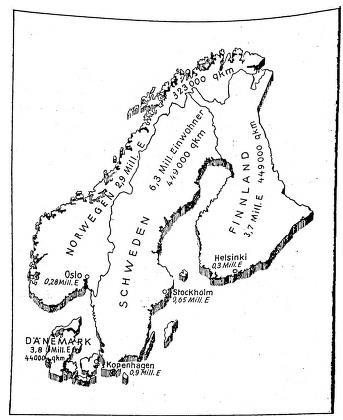
indicates the importance of these countries for the continental economy, but also the politically and commodity wise important fact that the Nordic region had to turn from its former world market orientation to a stronger interconnected economy with the European mainland. Denmark, Finland, Iceland, Norway and Sweden countries with the highest and most uniform standard of living among the continental areas had to go their own way in the war. Denmark and Norway were occupied by German troops in April 1940. Finland was involved in a losing war with the Soviet Union. Sweden knew to keep itself free from entanglements. However, the economic importance of these four countries of the northern region can only be fully appreciated from a unifying perspective. The economic weight of Iceland, with its population of scarcely 120,000, is small for the continental metropolitan economy, so that its economic condition can be passed over here, for all the interest shown in it by the Nordic area, and for all the importance of its considerable fishery.
In an economic study published in 1938 at the instigation of government delegations of the Nordic countries, it is stated that the Nordic area would be able to supply itself with the most elementary vital goods if necessary, but that its prosperity is based on its integration into the international division of labor.
To this explanation may be added the fact that foreign trade plays a far greater role in the life of the Nordic peoples than in most other countries:
per capita of the population
Denmark
Norway Sweden Germany
1939 1939 1939 1938
457 RM 434 RM 416 RM 148 RM
Therefore, the size of the Scandinavian merchant fleets corresponds to such a substantial involvement in world trade. Before the outbreak of the war, Norway's merchant fleet ranked fourth in the world despite its small population, and the fleets of Sweden and Denmark ranked eighth and ninth.
The development of the war years has confirmed the two statements quoted above. The Nordic region is dependent on a lively exchange of goods; it will therefore be a lively and stimulating partner in economic traffic in the future Difficulties in the conversion from the old style world economy to continental
interests are to be overcome wherever branches of industry were engaged in the refinement of world market products, such as the Danish livestock industry, which was engaged in the refinement of foreign feedstuffs into animal products as a high performance. It should not be forgotten, however, that this dependence on foreign material does not apply to large areas of Nordic life, that the Nordic area has to a large extent domestic sources of strength which allow it to integrate into the new economic Europe and also to compensate for its import needs from this hinterland.
It is true that agriculture has only a fraction of the Nordic area under culture. In Finland, Norway and Sweden the agriculturally sufficient area occupies only 9, 3 and 11 % of the total land, respectively. Denmark clearly differs from its Scandinavian partners in this respect and reaches the significant share of 76%, which tends to a livestock monoculture. On the whole, as a result of good yields per hectare, the need for imports of bread grain in the northern region can remain low. The relatively high imports in the past can be explained in part by the fact that domestic bread grain was used to feed livestock. However, the high livestock numbers, especially in Denmark, cannot be sustained without additional feed from abroad.
Although the Nordic countries lie on the same latitude as the infertile Siberian steppes or the icy soil of Alaska, agriculture is productive even in the far north due to the favorable climate caused by the Gulf Stream. Agriculture is promoted by good technical equipment of the farmer, by excellent seeds and by fertilization, which can be based to a large extent on animal manure in view of the high level of livestock breeding. Accordingly, there are good yields per hectare, which on average in the years 1933 to 1937 even exceeded the performance of the German soil.
Yields
The advantage of Danish agriculture is evident from the high yields as well as from the size of the sufficient areas, especially if one takes into account that in terms of space Denmark is surpassed by each of the other Nordic countries almost tenfold.
Denmark Finland*) Norway Sweden in million hectares
Wheat Rye Barley Oats Meng grain Root crops Pasture Other
0,15 0,16 0,35 0,37 0,34 0,52 0,74 0,09
0,07 0,24 0,13 0,14 0,03 0,11 1,26 0,20
0,03 0,01 0,06 0,09 0,01 0,07 0,55 0,02
0,27 0,23 0,10 0,67 0,28 0,25 1,67 0,25 2,70 2,51 0,84 3,72 *) Old area.
The agriculture of the Nordic region, however, has only indirect interest for the continent, insofar as it provides a basis for livestock breeding. In this respect, only Denmark is considered as a real supplier of slaughter cattle and meat. The export performance of the other Scandinavian countries has never been significant in this area, since in general the production of slaughter cattle was exactly in line with domestic consumption. The main emphasis has always been on milk production, which, especially in Denmark, has doubled the milk yield per cow in the last fifty years through conscientious selection of cows. The high level of cooperative dairies ensures an appropriate standard quality for the butter intended for export, so that the Nordic dairies have been able to achieve the considerable share of almost 30% in the world export of butter. Again, Denmark is the leader, as can be seen from a list of exports of dairy products in normal years before the war.
*) Old area.
It is important for the continental demand, especially with the reduction of livestock forced by the war, that the largest part of butter used to go to Great Britain, as well as the majority of canned milk, while for cheese Germany has already been the largest customer. When considering the level of Danish butter exports, however, it should not be forgotten that the Danes limited their own consumption to 30,000 tons a year and consumed an additional 80,000 tons of margarine, so that a continuing disruption in margarine supplies must have an effect on butter consumption.
Milk production was also the crucial basis for extensive pig farming. As Nordic livestock farmers turned increasingly to the English market, they had to work for years to convert their breeding from the fat pig to the meat pig popular in England. The fattening of the lean hog, whose meat, lightly smoked, was used to make the famous English breakfast bacon, required skim milk, buttermilk and whey, so that Denmark in particular was driven into an over refined refining production. However, bacon exports were very volatile. After peaking at 400,000 tons a year, it showed declines of up to half. Apart from Denmark, only Sweden was slightly involved in this, with about 5%.
In the last two generations, the Nordic region, again under the exclusive leadership of Denmark, has become the most important egg supplier to the world market. Denmark provided almost a quarter of the total world export of eggs and had far overtaken the classical egg suppliers Poland and China. Some importance has also Finland in the export of eggs.
1937 1936 1935
In 1000 tons
Denmark Finland*) 90 9 84 8 70 6
*) Old area.
On the whole, however, it should be noted how much the performance in all these areas of agricultural processing depends on the feeding of foreign products. Calculations of the share of foreign fodder in Nordic agriculture show that the import of grain, fodder, fertilizers, seeds and agricultural equipment accounts for 40% of the total export of northern agricultural products. A decline in overseas imports of feedstuffs was therefore inevitably followed by a considerable decline in livestock production in the Scandinavian countries.
All the more important is the supplementation of the food procurement in the Scandinavian economic area by the outstanding fishery. Here it is Norway with its large fleet that manages about a quarter of the European fish catch including Great Britain, which is known to be very important in this field while the other Nordic countries together contribute almost another eighth.
In 1000 tons
Denmark Finland Norway Sweden 1935 1936 1937
133 105 116
*) Excluding whales and shellfish.
23 1057 961 781
105 110
In addition, there are considerable quantities of shellfish, so that altogether the sea emerges as an essential source exploited by the Nordic fishermen for the continental supply. In contrast to Western European fisheries, Scandinavia's large catches consist mainly of herring, which are largely
processed into fish oil and fish meal, and thus again have industrial and agricultural significance. Whaling, which has become a Norwegian specialty, is even more dependent on the freedom of the seas for its future development than other fisheries. Of the total world production of whale oil, more than four tenths is accounted for by expeditions under the Norwegian flag.
The transition to the industrial importance of the North for the continent is made by the forest. Its value for the European market is all the greater because it consists mainly of pines and spruces and represents more than half of the total coniferous forests of Europe. In the general struggle for raw material, this asset is particularly appreciated, since three quarters of the total world demand is for coniferous wood, while only one third of the world forest is coniferous. Finland and Sweden are the most favored in this respect, while Norway, with its alpine character, is mostly bare rocky land. Despite low forest maintenance, the natural annual wood increment is still sufficient for the time being to prevent logging from turning into overexploitation. Theoretically, the increase in wood would significantly exceed Europe's total demand for sawn coniferous wood. If converted into cellulose, one year's growth alone would cover the world's demand for two years. In practice, however, these calculations lose their value mainly because of Scandinavia's own strong demand for firewood, which, in view of the complete lack of coal, must largely do without mined fuel for domestic and, above all, industrial heating. About one third of the annual wood growth may be absorbed in this self consumption. The Scandinavian forest is, in contrast to the ownership situation in some other countries, for the most part privately owned by the farmers. The state has only a small share; the state owned forests are mostly located in the remote areas of the north, and the forest districts acquired by the wood processing industry in recent decades are also found outside the actually inhabited areas.
For a century, wood has been the raw material for paper production, and for several decades it has been the raw material for the production of synthetic staple fibers. Wood pulp and cellulose have brought the Nordic countries to an almost monopolistic position on the world market; for it is through them that the extensive coniferous forests of the north, richer than in other accessible areas of the world and more accessible than correspondingly rich stocks in other areas, acquired their real value. Conversely, the continental economy can now rely on the pioneering work of the Nordic wood processing industry in its supply of pulp and paper. For the cellulose production of the Scandinavian mills reaches almost one third of the world production, that of groundwood pulp still a quarter of the world demand, and the production of paper amounts to about the tenth part of the world production. In terms of
newsprint alone, Nordic exports even reach about 40% of world trade, if one disregards Canada's large shipments of newsprint to the United States of America.
The Scandinavian ore has become a special politicum during the war. Preempting the English, German troops, by occupying Norway and fighting stubbornly and victoriously for the Norwegian export port of Narvik, secured supplies of Swedish ore to the Continent. Swedish ore, already known as an export commodity since the Middle Ages, only gained its outstanding importance when the Bessemer and Martin processes succeeded in converting phosphorus bearing ores into steel, making Grängesberg in central Sweden, Kiirunavara and Gällivara in Lapland centers of ore mining. It is important for the past and future development of the continental heavy industry that the highly developed Swedish steel industry claims the high grade iron ores of central Sweden for itself, while the phosphorus bearing ores go to the blast furnaces of the rest of the continental industry, which has enough coal for smelting. With an iron content of 60 to 70%, the Swedish ore represents the highest quality material in the world, while the Norwegian ores still have to undergo a concentration process before export. The importance of Scandinavian ores is particularly evident when comparing them with the import requirements of the German metallurgical industry.
Mining Export Mining Export Mining Export In million tons
1937 1938 1939
15 14 14 13 1 1 1 1,5 1,2
10,4 13,8 20,6 22
These figures alone show how strongly Sweden and Germany depend on each other in the heavy industrial field. This interconnected economy is complemented by some of Scandinavia's other mineral assets, of which sulfur gravel and molybdenum ore in Norway play the main role. Nor should we forget Norway's position as the world's third largest producer of aluminum from imported bauxite, the production of which is aided by cheap electric power.
If a high quality manufacturing industry is building up on these rich mineral
resources, comprising mainly engineering and armament plants, it must not be forgotten that these industries are entirely dependent on the supply of foreign coal. The total import requirements of the Nordic countries are greater than those of Italy, which is also coal poor:
In million tons
1937 1938 1939
4,2 3,9 4,3
1,9 1,5 2,7 2,3 2,7
6,6 5,8 15,4 13,5 12,4 11,8 10,9
Coal was sourced mainly from English and Polish mines, and to a lesser extent from German mines. After the European reorganization, Greater Germany was the sole supplier of coal to the Nordic countries and thus, in addition to its various industrial manufactures, had an important asset to balance its purchases from the Nordic region.
Until the outbreak of the war, the Nordic countries were notably inferior to British influence. Great Britain was, albeit with a fluctuating share, their predominant customer and supplier. Germany was far behind, followed by France and the United States of America. The Oslo Convention, which was supposed to bring about closer cooperation between Holland, Belgium Luxembourg and the Nordic region, had already suffered a miserable fiasco in 1938. Great Britain dropped out altogether in the course of the war. All the more intimate must be the community with Greater Germany as the leading economic power on the European continent. To consolidate it, the German and Nordic economies offer each other many opportunities for complementarity, and the question of meeting the former overseas import requirements, which corresponded to the elevated standard of living of the Nordic peoples, runs somewhat parallel with the solution of the similar problem on the German side in the future.
When in 1940 the. When the Nordic countries were included in the German
Denmarkdefense area in 1940, this marked the end of an era of the sharpest economic dependence on Great Britain for Denmark. It must be remembered that more than half of Danish exports used to go to Britain, just as one third of Denmark's import requirements were met in British countries. With the cutting off of the British merchant from the continent, therefore, there had to result for Denmark not only a change in the direction of its trade, but of its economic structure in general. For Danish agricultural refining was more attuned to the consumption habits of the British Isles than in other countries connected with the world economy. The Danish economy had to be all the more insistently affected by such a change, since with an export share of 457 marks per head of population in 1939, Denmark was the most export intensive country on the continent, indeed almost in the world. With such a high foreign trade quota, the small nation of 3.7 million people had included its economic area of only 42,930 square kilometers in international trade.
At the same time, however, this quota also expressed a certain susceptibility to crisis on the part of the Danish processing economy, which was completely at the mercy of the receptiveness of the world market. In 1931, the Danish farmer's pig herd amounted to 5.5 million head, and in 1938 only a herd of less than 3 million was worthwhile, since exports had fallen by more than half during this period.
Only in recent decades had Danish livestock breeding led to a one sided overbreeding that necessitated considerable foreign imports of foreign feed. After all, imports of 1 million tons of oilcake per year alone became the norm. At the same time, Denmark's field economy, which covers 72% of the total Danish area, is among the best on the continent. Yields per hectare considerably exceed those of German fields.
1939 1938 1937
In million tons
1,4 1,1
4,1 1,4 24,0 1,7 1,4
1,1 1,0
187 3,5 1,3 22,0 1,6 1,4
The cultivation of bread cereals has thus only secondary importance, with the addition that bread cereals were often fed. In addition to these crops, therefore, about 1 million tons of cereals, mainly corn, were imported during the year, in addition to the aforementioned oilcakes. As a result, imports of agricultural materials used in the processing industry accounted for more than 15% of total Danish imports. In the predominance of small and medium farms, which are particularly grouped together in cooperatives, livestock breeding has in any case reached its peak development.
Late 1940 1939 1938 1931
Horses
Cattle Pigs Sheep Chicken
*) Estimated.
2,0*) 27,0*)
0,56 3,10 3,13 0,19 32,4
0,55 3,07 3,08 0,19 26,4
0,50 3,06 5,45
This livestock pile allowed the agricultural cooperatives to concentrate on a few specialties for export: bacon, butter and eggs. "Danish Bacon," lightly smoked or cured meat from lean pigs raised on barley and skim milk, had become standardized quality goods for exclusive shipment to British supply centers. Exports, for which numerous special plants had been set up in Denmark, showed interesting fluctuations in terms of world economy.
In tons
1913 1932 1936 1938 1939
123000 384000 174000 174000 184000
Kopenhangener note in crowns per 100 kg
97 75 170 176 173
The level of world market prices for grain and the prices London allowed for bacon were the two poles between which production had to move. When, after the Ottawa Conference, England had to give preference to Empire goods, the export possibilities for bacon rapidly declined, only to recover slightly in recent years. After the elimination of England from the Scandinavian area, a large part of the bacon stocks has been taken over by Germany. However, the future development leads from the Bacon pig, which is expensive in terms of feed, to the fat pig. For the first time in the history of Danish agriculture, the weight limit of 70 kg imposed on pigs for delivery to export slaughterhouses has been lifted, so that a changeover to continental supply requirements has already occurred in this area. The feed situation, which is characterized by the discontinuation of overseas supplies and the ban on feeding bread grain, has also forced additional slaughtering’s to be carried out on an ongoing basis. According to the August 1941 census, there were 2.1 million pigs.
This somewhat more detailed description is intended to characterize the conversion task of Danish agriculture. The reduction of the herd also affects the horned cattle, which must be reduced not only in view of the feed supply, but also because of the loss of profitability for the farmer due to the fact that the conversion of the pig breeding limits the possibility of using the skimmed milk. Denmark is the most important butter producer in the Nordic countries. The Danish dairy products were divided between Germany and England in such a way that the bulk of the Danish butter went to the British market, while the cheese went to Germany to a greater extent.
Of which 1939 to In tons Germany England Butter Cheese 149000 9600 158000 9100 29% 56% 69% 12%
1939 1938
For cheese, the United States of America was also a customer, even to a greater extent than England. Denmark's future export performance in the fat sector depends, in addition to the necessary restraint in the livestock sector, on increasing domestic consumption of butter, since in earlier years the Danish fat supply was covered by the provision of about 80,000 tons of margarine in addition to domestic consumption of butter amounting to about 40,000 tons. Nevertheless, after the discontinuation of English purchases, more butter remains for export than Germany used to purchase from Denmark in earlier years.
Apart from bacon, the production of meat has been mainly exported to the natural hinterland of Danish agriculture, to the German area.
1939 1938
Pigs
Cattle
Cattle for slaughter
Poultry Eggs
137500 163000 77800 5100 85000
113900 Piece 134000 Piece 65700 Piece 3000 Tons 77100 Stairs
Of which 1939 to Germany England
99% 46% 92% 97% 27% 1% 69%
The extraordinarily high poultry population of over 32 million chickens at last count is likely to have been reduced to about 27 million by 1941, since 20 to 30 kg of grain are required per chicken. The average egg laying capacity is about 140 eggs per year, so that with Denmark's small population there are still considerable quantities available for export; for domestic consumption of eggs used to be only about one fourth of production, which amounted to 2037 million in 1938.
More generally, however, the conversion to domestic feed, which implies increased labor input, is of economic importance by its increased employment of people for a country like Denmark, which has never been free from unemployment. Thus, 0.2 million hectares of arable land are put under the plow for flaxseed crops alone, to compensate to some extent for the decline in oilseed imports.
Industry, easily forgotten under the common impression that Denmark is exclusively agricultural, is also turning to intensification. Undoubtedly, Denmark's industry will not be able to gain excessive expansion, especially within the framework of the new Europe, all the more so since it is completely dependent on processing foreign materials and on foreign fuel.
1937 1936 1935
In million tons
Coal Coke Gasoline
Fluorescent oil
Fuel and heating oil
190
4,2 1,7 0,30 0,09 0,29
4,1 1,6 0,28 0,09 0,27
3,9 1,4 0,24 0,07 0,23
It is clear that the supply of coal can only come from the Greater German coalfields, whereas previously around four fifths was covered by English supplies. Since Danish peat production can be increased from 0.5 million to 2 million tons per year, and since there is also scope for an increase in domestic lignite mining to about 0.4 million tons, the supply promises made in the negotiations with Germany amounted to about 3 million tons of coal and 1 million tons of coke, with these quantities representing a tripling of the previous supplies from the Greater German area. Things are similar in the area of iron supplies. In fact, total German deliveries to Denmark show an increase of about half compared with 1938.
Alongside agriculture and the associated food and preservation industries, shipbuilding and mechanical engineering constitute the largest sector of Danish working life. In particular, diesel ship engines, diesel locomotives and machinery for cement factories have brought world renown to Danish industry. Denmark's merchant fleet is also very considerable, especially in relation to the small population. At the beginning of 1940, it had 2600 ships with a cargo capacity of 1.17 million gross tons. Later in the year, however, only one third of these were under the direct control of Danish shipowners, while another third were employed in East Asia and the remaining ships had been requisitioned by England. A number of ships fell victim to the naval war.
From the Danish side, the high level of technical research was also put on the scale as a further asset for future European cooperation. The extent to which Denmark can become more involved in the continent's industrial sector is, of course, a question that remains subject to further planning. It should be noted that Denmark has so far avoided the problems of synthetic materials and has only recently begun to consider future possibilities in these areas. In any case, the further transformation of the Danish economy can only be carried out in close cooperation with the needs and possibilities of the neighboring Greater German economic area. In the course of the European reorganization, as emphasized at the outset, special activity is required for Denmark in particular, as a glance at foreign trade before the great decision of 1940 makes abundantly clear:
Denmark's trade
Export Import To From
52% 23% 5% 1%
Great Britain Germany Sweden USA
33% 27% 7% 7%
Britain's once large share of Denmark's foreign trade had enabled the Danish economy to build up its finishing industry with overseas raw materials. To some extent, the feedstuffs needed by agriculture will be able to come from the continental area. Naturally, imports decline in wartime after previous stockpiling. Denmark's trade balance, which used to be mostly passive, shows an export surplus for the first time in 1940.
In any case, German Danish relations are the decisive factor, and it is noteworthy that even in 1940, the war year, there were many study trips by Danish farmers, industrialists and social politicians to the German economic areas.
A country of stark contrasts between the remote solitude of the fjords and polar regions and the closest ties with the world economy this was the picture of Norway when the war not only severed the world economic ties, but also in April 1940, with the occupation by the German troops and the flight of the king and the government, referred political and economic life entirely to the future integration with the continental area under German leadership. It is difficult to think of the Norwegian population, which is numerically insufficient to settle a square kilometer with even one person in the northern rural communities and, in general, with its 2.9 million inhabitants, 323,000 square kilometers of land and thus an average population density of 9 people per square kilometer, inhabits the most deserted areas of Europe, as a continental economic nation. Norway has been called a "floating empire" and its large merchant fleet has been referred to as Norway's "colonies".
In fact, before the outbreak of war, the Norwegian merchant fleet represented the fourth largest in the world after the British, American and Japanese merchant navies. It entered 1940 with a ship capacity of 4.7 million gross tons. This means that Norway had a ship's tonnage of about 1570 gross tons per capita of its population, four times as much as Great Britain by the same calculation. Norway's fleet is characterized by the large proportion of newer ships built, having lost half its tonnage during the world war. Its strength lies above all in the field of fuel transport, since modern tankers alone account for 1.9 million gross registered tons, and in the field of the whale industry; Norwegian seamen have been among the pioneers of whaling for centuries. A further characteristic is the fact that no process of concentration has been able to establish itself in the shipping industry. This is because 90% of the fleet is owned by 500 small shipowners, who own up to four ships at most.
It should be noted that during the war most of the Norwegian ships were taken from their owners by the British tonnage robbery. The actual war losses were put at about 0.5 million gross tons in mid 1941. Even during the war, however, the efficient Norwegian shipyards went to work on building new ships.
The connection to the sea means that Norway has the most important fishing role on the continent. More than 110,000 people are employed in fishing, a considerable part of the total population. Norway alone contributes a quarter of the total yield of European fisheries. Its catches in normal years amounted to about 1.1 million tons, mainly of herring, a result achieved again in 1940, despite the disappearance of various fishing grounds. Norway is almost the only country supplying stockfish, which has been exported mainly to Italy and Africa. The industry of canned fish is correspondingly important, and finally the refining of whale oil, which was a considerable item in Norwegian exports, especially for the production of margarine and soap.
However, in the economic and maritime structural transformation that the year 1940 brought for Norway, the continental economy also gains emphasized interest for the country. Its development in the agricultural sector was focused on the development of self sufficiency and in the industrial sector on the expansion of the metal base and the conversion of the pulp industry.
The area of land suitable for agriculture has already been increased in recent years. In particular, the wheat harvest has increased, but the grain harvest has always been able to cover only a fraction of the consumption.
1937 1936 Annual average 1931 1935
In 1000 tons
Wheat Harvest Import Flour Import
Rye Harvest Import
Barley Harvest Oats Harvest Corn Import
68 176 39 11 134 129 188 155
57 140 32 10 123 115 171 130
28 11 110 174
A potato harvest of about 1 million tons is expected for 1940, which will provide some support for the food base.
With a relatively high livestock, Norway had a small surplus of meat and butter for export, a relatively high export of cheese, by the way, which had already gone mainly to Germany.
1938
0,19 Million 1,34 Million 0,45 Million 2 Million
Horses Cattle Pigs Sheep and Goats
It is understandable that with a reduction in the supply of foreign fodder, this livestock cannot be maintained at the full level, even if conversion to cellulose fodder from domestic wood can provide about one fifth of the previous fodder supply. However, it is noteworthy that at least the sheep population increased by at least 10% in 1940. Audi, fur farming plays an important role in Norway. In 1939, there were more than 493,000 silver foxes in about 21,000 farms, the number of which decreased during the war because of a lack of feed.
For the time being, the economy is still dominated by the reconstruction of the areas destroyed by the war, but also by the absolutely necessary expansion of the transport network. Even the two largest cities of the country, Oslo and Bergen, have been connected by rail only since 1909, while a continuous north south connection by land has been lacking, a fact that made the penetration of the north by the German troops so difficult and explains the arduous battles near Narvik. The whole of Norway has only 4000 kilometers of railroad lines, of which the greater part is in the south. Thus arises the necessity to build roads on a large scale. At the end of 1940, the first major road link between western and eastern Norway (Oslo Bergen) was opened. Above all, however, Norway is expanding the 2600 kilometer long Reichsweg Oslo Narvik Hammerfest Nordkap Kirkenes with a connection to the Finnish Arctic Ocean Road, most of which is to be completed by the beginning of 1942.
In the same way as the development of the transport network, the development of the energy supply is vital for the country, which has abundant water resources. This is because, in accordance with the natural conditions of the Nordic region, Norway is completely dependent on imports for its fuel requirements, with the exception of firewood.
Coal Coke
Gasoline
Fuel and heating oil
1937 1936 1935
2,6 0,8 0,17 0,32
In million Tons
2,3 0,7 0,14 0,28
2,2 0,6 0,14 0,25
As the country with the most water in Europe, Norway would have the task of achieving a high level of power supply, so that it could also supply electrical energy to its Nordic neighbors. Although Norway, with an annual electricity consumption of 1800 kilowatt hours per inhabitant, at prices of about 114 to 2 pfennigs per kilowatt hour, is at the top of the list of all countries in the world, the available water power has only been exploited to the tenth part. The power plants developed so far supply about 1.4 million kilowatts or about 12 billion kilowatt hours annually. In a four year plan, power plants are to be expanded within the framework of the German Norwegian "Working Group for the Expansion of Electricity in Norway," particularly in southern Norway, and the newly constructed capacity is to be used mainly for the electrification of railroads and for heating homes. In addition, however, larger quantities of this "white coal" are to be exported to neighboring countries; after all, Norway could generate energy quantities equal to Germany's consumption if its hydroelectric power were fully exploited. For the time being, however, Norway still needs to consume the most sparingly.
The continental economy is thus steadily gaining ground in Norway and will have to continue to strengthen primarily the two traditional areas of work with which Norway was involved in world trade, after a depression caused by the war: the pulp and iron industries.
Norway's timber exports, which were almost entirely directed to England, are relatively small, despite its extensive forests, which cover an area of 75,000 square kilometers, of which about 53,000 square kilometers are covered with coniferous forest. This is explained by the large domestic demand for pulpwood, as the export of cellulose and paper is significant.
1939 1937 1936
In 1000 tons
Paper pulp 1000 970 880
In million kilogram
Paper 410
For the year 1941 Norway has also planned the production of rayon. The exploitation of mineral resources has made considerable progress in recent years. Even if Norway does not reach the tenth part of the importance of Sweden as a supplier of minerals, the iron ores in particular are a supplement for the continental economy.
1939 1938 1937
In million tons
Iron ore export 1,18 1,42 1,47 1,01 1,03
Iron ore production
Before the war, half of the iron ore exported went to Germany, the other half to Great Britain and Holland. If it is added that production can be increased, Norway represents a considerable supplement to the needs of the continental smelters. In addition, Norway is the most important supplier of molybdenum ore after the United States. Despite its many ore deposits, Norway has not been able to build up its own iron industry. It is significant, however, that in early 1941 plans were made to build an ironworks to supply part of the country's own iron requirements. Of great importance to the Norwegian mining industry is sulfur gravel, with an annual production of 1 million tons. The sulfur gravels contain 40 to 50% sulfur and up to 2.5% copper. They are exported as sulfur gravel concentrate.
With its rich water resources and consequently cheap electricity, Norway is one of the most important aluminum producers on the continent.
1938
1937
In 1000 tons
Aluminum production 29 40 23
Bauxite import
Given the low level of domestic consumption, most of the aluminum produced is available for export; until now, it had mainly met Sweden's needs. Expansion of the Norwegian aluminum plants as part of the pan European light metal supply is planned.
Finally, the nitrogen and carbide industries are of greater economic importance. It should be emphasized that the important development of the Norwegian economy after the occupation is mainly based on German initiative. It is not without deeper significance that the German Reichskommissar was able to declare at the end of 1940 that a new period had begun for Norway in which the most lively economic activity would develop in cooperation between Germany and Norway.
Sweden, which occupies a special position in the political structure of wartime Europe, is the most important representative of Nordic industry. Its industry is built on the natural resources supplied by its colonial territory. For a colonial territory can be called almost the deserted, vast north of the state, where for many months of the year the sun hardly rises, where on the square kilometer on the average two people can be counted, while the southern districts have a population density up to 110 inhabitants. The north, however, is the supplier of wood and, to a greater extent, ore, on which Sweden's wealth has been based and which has also been decisive in the intertwining of Swedish economic life with the continental economy, which has intensified since the war. The 6.3 million people who populate the total area of 449,000 square kilometers thus have above average sources of valuable raw materials at their disposal.
Although the fertile plains of southern and central Sweden have developed a highly developed agriculture, the arable land, as in the other Nordic countries, is not sufficient to meet the needs of human nutrition and, at the same time, abundant livestock breeding. However, as a result of advanced agricultural technology, the yields of the land have steadily increased.
Wheat Rye Barley
Oats
Meng grain
1940 1939 1938
0,45 0,28 0,19 1,04 0,52
In million tons
0,85 0,38 0,23 1,28 0,60
0,82 0,40 0,27 1,38 0,66
However, the picture deteriorated in 1941 as a result of low wheat harvest of only 0.34 million tons.
Livestock farming, as in Denmark, is focused on strong production of dairy products, whereas pig fattening lags behind.
0,6 2,9 1,3 0,5
Million Million Million Million
Horses Cattle Pigs Sheep and Goats
The rearing of such a large livestock could only be done with the help of foreign feed. The supply of additional protein concentrated feed was possible in the former amount only on the world market. In 1938, about 190 million kilograms of oilcakes were imported, so that in their absence the livestock must be substantially reduced.
Butter production had risen sharply in the last few years. In 1939, dairies supplied 83.7 million kilograms of butter. The structure of domestic fat consumption is decisive for export. In the same year, domestic consumption of butter amounted to 54.3 million kilograms, leaving a considerable amount of about 29 million kilograms available for export, which was equivalent to about one fifth of Danish exports. However, this ratio was only achieved because the fat requirement was additionally covered by 59.5 million kilograms of margarine. As is the case with many countries which play a major role in butter exports, Sweden has thus increased its exports by simultaneously importing cheaper fats. This circumstance causes a shift in consumption at times when margarine raw materials, which have to be fetched
from the world market, are scarce.
However, Sweden's economic development is primarily related to the forest. The Swedish mainland is 53% covered with forest, 46% of which is owned by farmers, 26% by timber industry companies, 23% by the state and 3% by large landowners. On this raw material is built up an extensive production of pulp, paper and cardboard. In the main, however, the various types of wood are exported as semi finished products, and it is evident here, as in the case of iron, that the Swedish economy does not push the end product for the foreign market, but mainly provides it with the more or less processed raw material. The decisive reason for this is undoubtedly the shortage of coal in the Scandinavian countries, which is relatively expensive to purchase, so that the export of raw materials overrides this cost factor.
1937 1936 1935
In 1000 Cubic meters
Pit wood Wood mass timber
Other softwood logs
Softwood lumber
Railroad sleepers
Paper pulp
257 119 249 4063 12 2927
91 71 231 4015 9 2604
166 79 214 3567 10 2429
The following figures provide detailed information on Swedish exports of cellulose, which are of particular importance in view of the strong demand for this material in the European economy.
1938 1937
In million tons
Sulphite mass
Sulfate mass
Mechanical mass
1,0 0,7 0,3
1,3 0,9 0,4
In assessing the situation created by the war for the Swedish timber industry, reference should be made to the complete cessation of deliveries to Great
Britain and further to the difficulty of carrying out exports to overseas at all. Great Britain had absorbed almost a quarter of total Swedish exports in 1938. This shortfall, which in itself benefits Sweden's future performance on continental markets, has naturally led to stagnation in the export sectors for the time being. In 1940, for example, production by the pulp and paper industry fell to less than half its normal level. To compensate, the industry has made a switch to feed pulp and to sulfite fuel, which is intended to alleviate the shortage of fuel.
In this war related depression, it has been particularly welcome in Sweden that Germany has stepped up as a buyer of lumber and wood pulp, as well as supplying certain quantities of artificial silk pulp to Italy. The reorientation of the Swedish wood and pulp industry, whose good customers until the war had included above all the entire European West, towards the continental market is not only a war related measure. The American pulp industry has expanded so rapidly in recent years that Swedish supplies will no longer be able to play the same role on the world market as before.
Moreover, Sweden, like all other forest owning countries on the continent, is subject to the problem of tapping the less conveniently located wood reserves. For example, the pulpwood producing forests in central Sweden have been used up to a decisive extent. Of course, with the total wood stock of the Swedish forests amounting to 1.7 billion cubic meters, there can never be any question of a wood shortage. After all, the natural regrowth alone amounts to about 48 million cubic meters per year, which is offset by a wood demand of the pulp industry as the largest wood consumer of 14 million cubic meters, a charcoal production of 1.7 million cubic meters and an admittedly considerable consumption of firewood.
Sweden's traditional leading role on the world market of kindling is famous, which is explained in terms of raw materials by the many stocks of aspen wood, but economically by the international importance of the Swedish group, which has production facilities in forty different countries and was a determining factor in the international financial ruin during the world economic crisis with the collapse of Kreuger. After Sweden was cut off from the world market during the war and match production was completely shut down for a while, it was resumed on a small scale at the end of 1940.
The foundations of the Swedish economy were laid by the non phosphorus iron ore deposits of central Sweden, which since the Middle Ages have been the basis of an iron industry famous for its quality performance. However, when modern processes made it possible to use the phosphorus bearing ores for steel production, Sweden's real importance as an ore supplier began, as
already mentioned. The rich ore deposits of the north, which had remained untouched until the turn of the century, could now be exported to countries that had the necessary coals for smelting, first and foremost to Germany and Great Britain. The development has led to a situation where the central Swedish ores, which have a low phosphorus content, are reserved for the domestic iron industry. On the other hand, the enormous deposits of phosphorus rich ores from Grängesberg in central Sweden are destined for export. Ore reserves in the Grängesberg district are estimated at 110 million tons, with annual production hovering around 1.5 million tons. This ore is conveniently located for export. It is shipped by Sweden's largest and richest company, Trafik A. B. Grängesberg Oxelösund via the Baltic Sea port of Oxelösund. Far more extensive, but also much more difficult to load, are the Lapland ores, which are estimated at over 1.6 billion tons. It was not until the turn of the century that the exploitation for export of these ores with their high phosphorus content, whose iron content of 58 to 70% makes them among the best in the world, began. In 1902, the ore railroad to the Norwegian port of Narvik and the Gulf of Bothnia was opened, an early feat of modern railroad construction in the trackless, inhospitable mountains. This enabled the ore districts of Kirunavaara and Gällivara to be developed into the most efficient mining sites on the continent, where open pit mining predominates and the cost price thus remains relatively low despite high wages. In normal times, the government limited ore extraction in the largest mines to 9 million tons per year; however, the living years have brought an increase in the extraction quota. For the years 1938 to 1940, an additional quota of 2 million tons per year was approved. The Grängesberg Company is also closely connected with the Lapland ores; the exploitation of the Lapland ore deposits is divided equally between the state and the Grängesberg Company.
Sweden's single ore balance sheet
Extraction of which in Lapland Export in % of extraction
In 1000 tons
1935
These figures show that the Swedish iron industry manages with about 1 million tons of ore for its own needs each year. In the record year of 1937, when almost 15 million tons were produced, 12 million of which came from the Grängesberg operations alone, 8.82 million tons went to Germany and 2.14 million tons to England. In 1938, Germany received 8.4 million tons, while exports to England fell to 1.6 million, proof of the stable absorption capacity of the German economic area.
In addition to these weighty quantities of iron ore, the production of other ores does not play a major role. The copper mines of Falun, famous around 1800, have been exhausted. Sulfur pyrites, galena and zinc blende are still extracted there. New copper deposits have been found in Boliden without being outstanding fields. After all, copper production at the Boliden gold mine, which was about 7000 tons in 1938, has been brought up to an annual capacity of 12,000 tons. It is hoped to increase it by further expansion to 15 000 tons, which would be equal to one fourth of the domestic demand. In any case, Sweden's industry is dependent on additional imports for the nonferrous metals.
1937 Consumption Import 1937 Consumption Import In tons In tons
Copper Tin Zinc
64200 1700 15000
44700 1400 13600
Aluminum Lead 6800 18700 1700 17500
The Swedish gold production should also be mentioned, which has reached an annual output of about 6000 kg (1938 5890 kg), especially through Boliden Gruv A. B., although experts expect the gold mines to be exhausted around 1950.
Sweden's industry is dependent on a regulated supply of foreign coal. Coal and coke constitute the largest import item in Sweden, as in the other Nordic countries; fuel oil is the second largest import. Among the trade policy ties with which England sought to chain the Scandinavian states to itself was the obligation to purchase large quantities of British coal. Accordingly, 47% of the coal required by Sweden came from England. 11% was obtained from Germany before the outbreak of the war and 42% came from Poland. It is of extraordinary political and economic significance that, after England was cut off from the Continent, Germany agreed to supply Sweden's vital coal
requirements. The exchange of coal for ore and wood is the most important pillar on which Sweden's relations with the continental economic area will be based in the future.
1938 1937 In million tons
Coke Gasoline Hard coal
Mining Import Production Import Production Import
0,5 5,77 1,94 0,01 0,55
0,4 6,61 0,12 2,33 0,01 0,55
Domestic coal production in the country's southernmost province can only provide a small supplement to imports. Even though coal supplies from the Greater German coalfields are proceeding in a regulated manner, the Swedish economy requires the utmost economy. This applies even more to liquid fuel, of which Sweden is endeavoring to become partly self sufficient. Oil shale is being exploited and is expected to meet the navy's needs as early as 1941 with a production of 10,000 tons of fuel oil. Further planned factories could, according to expert predictions, increase the extraction of oil products from the shale deposits of the province of Närke to 100,000 tons annually. In addition, there is the production of sulfite fuel, which was previously available in large quantities as a waste product of sulfite cellulose. Here there is an opportunity for increase if the new processes for direct extraction from pulpwood are realized by reorganizing the pulp industry.
In any case, the supply of coal and coke, as well as charcoal, the production of which in Sweden has declined sharply in recent decades despite the great abundance of forests, has always been decisive for the development of the Swedish iron and steel works and the processing industries. Nevertheless, heavy industry has expanded considerably since 1926, so that by 1938 it was already able to cover around 60% of domestic demand. The production of quality steel was particularly promoted, so that these steels reached the considerable share of 43% of total production. The Stora Kopparsberg company, one of the oldest joint stock companies in the world, was especially employed for this purpose.
1939 1938 1937
In million tons
Pig iron Crude steel 0,58 1,20 0,68 0,99 0,66 1,13
In terms of volume, Sweden's iron and steel balance sheet shows that about 0.5 million tons of iron and steel are required as an import surplus. In value terms, the picture is altered by the fact that exports consist mainly of high grade steels, largely in processed form. In connection with this, reference should be made to the extensive armaments industry, the main representative of which is A. B. Bofors with its versatile production of guns, shells, armor plates and artillery vehicles.
Despite all the earlier links of the Swedish economy with the extra continental markets, it should be noted that the turn to the Greater German economic area does not represent a revolutionary innovation in terms of numbers. In 1938, the then German Empire supplied about 24% of Swedish import needs and absorbed over 18% of Swedish exports. If one adds the earlier trade relations with Poland, Gdansk and Czechoslovakia, there would be almost another 6% in Sweden's imports and another 4% in its exports, which would fall within the present Greater German Economic Area. Thus, even then, England was in second place, accounting for 18% of Sweden's exports and 25% of its imports. After all, the detachment from the British market meant a considerable change for Sweden. The war period initially dealt Swedish exports severe blows, but in the further course it also brought a recovery. Sweden wants to cultivate its relations with America by participating in the expansion of the Finnish port on the Arctic Ocean and the road leading to it, although this is only worthwhile for the highest value goods because of the long journey of the freight trucks.
For future development, the state of the Swedish merchant fleet after the war should also be considered. Of the more than 1.5 million gross tons of shipping capacity, about 0.25 million had to be written off as war losses by mid 1941. With Soviet Russia, with which trade relations had previously been extraordinarily loose, a somewhat livelier business relationship had been established, which was to serve, for example, the construction of the railroad from Kandalaksha to Kemijarvi in order to make the raw phosphates of the Kola Peninsula usable. Of vital importance, however, remains the smooth integration of Swedish foreign trade into the large economic association of the Greater German area.
Finland, the northernmost state on the continent, was interwoven with the world economy in an emphasized monoculture, if one can speak of monoculture at all in a small polity whose population of about 3.7 million is far below that of Berlin. For the development of a versatile economy, not only natural resources but also a minimum number of working people are prerequisites. Nevertheless, Suomi, the "land of a thousand lakes" and the "green gold of forests" had developed into a lively world trading country. Its contribution to the world economy comes from its forests and, finally, from its thousand lakes, inasmuch as the rich and well developed waterways favor the transport of wood.
After the reorganization in Europe, Finland, whose state independence is due to the German Finnish brotherhood in arms at the end of the World War, is again more connected to the continental economic area, instead of its former connection with the British market. It should be noted that in previous years, such as 1937, 45% of Finnish exports went to Great Britain and 7% to the United States of America. Incidentally, until 1940 Finland was the only country that paid off its World War I debt to the United States on time; however, with the deferral of the December 1940 payment, even this most punctual debtor of the United States defaulted on its repayments. The country, absolutely dependent on foreign products, met 22% of its import requirements in England and 8% in the United States. In contrast, Germany accounted for 13% of Finland's exports and 20% of Finland's imports. The connection with the Soviet economy had almost completely died. Russia was perceived as a competitor in the timber market, while it was neither a customer nor a buyer for Finland.
The famous Lappo March of 1936 of the peasants to Helsingfors, embittered by the economic difficulties, which in turn could not remain without repercussions on the Finnish Russian relationship, was not least an outgrowth of the economic antagonism of these two countries, which finally culminated in the invasion of the Finnish people by the Soviet Union at the end of 1939.
After the unfortunate war Finland had to accept heavy losses of land and economic forces in the" Peace of Moscow in March 1940. Then, in the summer of 1941, the Finnish army again joined shoulder to shoulder with the German Wehrmacht in the fight against Bolshevism.
The following sketch is based on the economic territory of Finland as it existed before the Moscow Peace.
The land use depends on the sparse population. On an area of 383,000 square kilometers (of which about 40,000 square kilometers had to be ceded to the
Soviet Union in the Russo Finnish peace treaty), there is an average population of 11 people per square kilometer, making Finland the least populated state in Europe after Norway. About 130,000 square kilometers are covered by bogs and swamps, and 34,000 square kilometers by lakes, of which 35,000 are counted. The agricultural area of the vast region is correspondingly small, half as large as in Greater Germany Altreich, Ostmark and Sudetenland together.
Two thirds of the Finnish land is covered with forest, while in Germany it is only 27%. Accordingly, the land use presents a characteristic picture.
Farmland
Grassland Forest Wasteland and lakes
7% 2% 66% 25%
Calculations show that Finland, with its favorable climate due to the Gulf Stream, which makes agricultural work possible up to the north, and the good cultivability of its clay soils, could accommodate a rural population five times larger than it ever feeds. The cultivation work, however, is limited by the lack of people, especially in the near future, when many hands will be needed for reconstruction as a result of the Russo Finnish war.
The most important bread grain in Finland is rye. The yields per hectare of arable crops are relatively high, as it is possible to add large amounts of manure to the soil due to the strong livestock farming.
1938
Oats
As in all Nordic countries, the livestock in Finland is maintained with special care. But it had decreased by about 14% after the first war with the Soviet Union.
1940*) 1938 In million
Horses
Cattle Pigs Sheep and Goats
0,3 1,5 0,4 0,9
0,4 2,0 0,5 1,0
Also worth mentioning is the reindeer industry in the north of the country, especially in Lapland and Petsamo; the stock is estimated at 200,000 animals. The hides are processed into fine leather. Silver foxes are also bred on numerous farms.
With its forest wealth Finland stands at the top of all European countries. The crucial wood supply is found in the southern parts, where better growing conditions prevail. The forests are 50% pine, 30% spruce and 20% birch.
Forest area
Timber stand
Timber increment
Timber production 1937 Timber Firewood
253000 sq. km 1620 million cc 44 million cc 30,5 million cc 10,0 million cc
The great extent of the forests and the sparse population mean that forestry is not carried out in a regulated manner. One could speak of overexploitation if natural growth did not always compensate for the northern location and the often poor soils. However, Finland can still gain as a supplier of wood to the continental economic area if it succeeds in the future in achieving a regulated
forestry culture. Finland's export performance had grown steadily until the war.
1937 1936 1935 In 1000 cubic meter
Hardwood logs
Pit wood Wood mass timber
Other softwood logs
Softwood lumber
Railroad sleepers
58 2085 1552 346 4764 10
43 2027 1071 296 5108 5
32 1818 1217 333 4841 8
If we take into account that the Finnish wood processing industry used to consume about 22 million cubic meters a year in 1937 for the lumber industry 12.8 million and for the wood pulp industry 9.3 million there is still a margin to the natural wood growth. But it is likely to be completely filled by the strong demand of the country, which completely lacks coal, for firewood, with consumption estimated in the order of at least 15 million cubic meters.
The timber industry is supported not only by an early developed railroad system, but above all by the efficient waterways. The "thousand lakes" are connected into a network of waterways on which the logs arrive in rafts to the processing plants, so that logging, using the snow in the long winter, is easier than, say, in the traffic challenged mountains of the Balkans or even the remote forests of Siberia. The largest of the four subsystems of the waterway network is connected by the 60 kilometer long Saima Canal with Viborg as the port of export. The numerous rapids of the Finnish rivers are conducive to energy production. The Imatra weir, which is connected to a powerful large scale power plant, is well known.
The main industry of the country is based on wood. In two special branches Finland almost dominated the world market. It supplied 30% of the total plywood demand of the world market and 80% of the demand for yarn reels. However, Finland's role as a supplier to the paper industry is crucial. It accounts for about the tenth part of the world's production of wood and pulp.
Sulfite cellulose Sulphate cellulose
Cardboard
Paper
1937 1936 Annual average 1921 1925
720 1040 440 160 610
In million kilograms
650 940 390 120 530
200 220 90 80 210
This upswing had continued until the outbreak of the war with Soviet Russia. However, as a result of the peace treaty, the Finnish processing industry suffered heavy losses, which amounted to 26% of the former capacity in the production of sulfate pulp and 24% of the former capacity in the production of sulfite pulp. For ground wood pulp and paperboard the losses were 11% and for paper 5%. Among the industrial sites lost and recaptured in 1941 was, most notably, the large Kexholm pulp mill, owned by the German Zellstoff Waldhof concern.
Finland's mineral resources are exploited only to a very small extent; they are of no significant importance for the continental economy, as can be seen from the fact that the export of metals accounts for barely 3 % of Finnish exports. However, the nickel mines of Petsamo are worth mentioning. These ore deposits are estimated at 5 million tons, containing 2% nickel and 1% copper.
With all this in mind, it is of vital interest for Finland to become more involved in the continental exchange of goods. It is remarkable that despite the war, trade with Germany has not decreased at all. The time of orientation to the world market is largely over for Finland. On the other hand, it can be pointed out that Germany and Finland complement each other well in their economic structure. Finland will be able to cover all its coal and coke requirements in Germany. Rolling mill products and fertilizers are also among the important German supplies. Conversely, German purchases have increased not only of Finnish wood but also of pulp, paper and cardboard, so that strong impulses for the economy of the future Finland will come from here.
The Balkan states' inclination toward the continent, and thus their departure from the Orient, is not a recent phenomenon. It is closely related to the 209
awakening of national consciousness in southeastern Europe, which began with the Balkan wars, made strong progress in the post World War period, and reached a climax in recent times with Romania's transformation into a totalitarian state. This striving for national independence has also brought about thorough structural changes in the Danube region and in the countries bordering the Black Sea and the Mediterranean, changes aimed at combining political consolidation with economic independence.
If one starts with the geopolitical concept of the southeastern region with Slovakia, a small country with particularly close ties to Greater Germany, it becomes clear that it would be inaccurate to define the southeast in terms of a single economic concept. The climatic, geological, and agricultural conditions are too different for that, as are the folk and cultural foundations. Nevertheless, the observer from the center of the continent may recognize the southeastern region as a characteristic part of the large scale European economy, precisely because of the complementary nature of the various regions. He may see in the Balkans the wheat and maize chamber, the rich vegetable, fruit and wine garden, as well as the fertile fields of a more southern sun, where oil and textile plants, spices and the oriental tobacco flourish. Also the lack of coal, except for some lignite fields, creates a common characteristic of the Southeast, which it makes up for with the oil fields and natural gas wells of Romania. The soil also hosts ore in many cases, besides iron, rich copper ores, lead zinc ores, chromium ores, antimony and mercury ores, bauxite and magnesite, in places also gold. This stock of mineral resources, which is not yet fully exploited anywhere, leads to a wave of industrialization that has been trying to mobilize the Balkans for two decades, although not with the same force in all countries. Compared with the more advanced continental phenomena, it has the peculiarity that it first turned to the production of consumer goods. The old ties with the pre war oriental economy had led to a capable artisan class, which explains the preference for meeting commercial needs in the production of goods. As a result, leather processing, textile production and pottery became the starting points of Balkan industrialization, which only gradually grew into the production of manufactured goods.
It is characteristic of almost the entire southeastern region, least of all Bulgaria, that the wave of industrialization that occurred in the last two decades was not so much the result of an organized development of production branches arising from economic life itself, as it was politically driven. The politicians of the Southeast, based on the Versailles Dictate, combined their power political dreams with an attempt at artificial independence by promoting a few branches of industry that were important
for rearmament. As the example of Yugoslavia showed, they could have been convinced of the failure of such efforts beforehand. It was clear from the outset that, given the high level of armaments technology, economically weak nations could never achieve the level of armaments of highly developed industrialized nations. Nevertheless, the ambition of various Balkan governments went beyond rational consideration and drove them to build heavy industrial plants, armament and vehicle factories, which, however, ultimately remained in a vacuum. For it is an inexorable law of economics that a large scale industrial enterprise can work effectively only if it can be supported by a broad industrialization of the country. As already discussed*), one of the tasks of the present and the future, which is also in the Balkan economy's own interest, is to harmonize the industrialization of the Southeast with the opportunities available on the ground, on the one hand, and with the needs of the continent as a whole, on the other.
This coordination with the overall continental economy is greatly facilitated with the German advance in the Balkans of 1941. The accession of Hungary, Romania and Bulgaria to the Three Power Pact created the precondition for a large working community. The surrender of Yugoslavia and the victorious advance of German troops in Greece also made the area between the Adriatic and the Aegean ripe for incorporation into a large scale economy.
Regardless of the political reorganization of this space, when considering the economic realities here, the territory of the former South Slav monarchy must still be considered as the old style Yugoslavia.
The southeast region interests the continental economy mainly as the Danube region. The four countries Hungary, Yugoslavia, Romania and Bulgaria, situated on the important west eastern axis of Europe, the Danube as the second largest European river, are important complementary areas in the supply of food and raw materials. Even though Balcanian agriculture will only reach a degree of intensive land utilization in later years, which the Greater German area has already shown for a long time, the land utilization is similar to German agriculture in terms of area. Of the total land area of the four Danube countries, 42% is arable land (in Germany 40%), meadow and pasture 19% (as in Germany) and 2% orchards and vineyards (in Germany just under 1%). Forestry accounts for 24% of the land area (29% in Germany). Of the total arable land, the following parts are used for the cultivation of various crops:
*) In the chapter "Greater German Space in the Center of the Lines of Force".
Forage crops
Potatoes, vegetables, legumes
Sugar beet, industrial crops
Fallow
79% 7% 5% 4% 5%
60% 18% 16% 3% 3%
German agriculture differs from the Danube countries mainly in the sparse cultivation of potatoes. Moreover, in the Balkans there is an exaggeration of cereal cultivation, which already leads to monoculture. This is reflected in the fact that in 1938 wheat accounted for 38% and corn for 39% of the total harvest in the Balkans, while in Germany it was only 13% and less than 1%, respectively. Correspondingly, the fluctuation in performance associated with monoculture has been great, since crop failure and the receptiveness of the world market have not allowed stabilization of exports. The following table, which applies to the four Danube countries, shows the drastic impact of these fluctuations on the Balkan economy:
1938 1937 1935
Corn Wheat Rye Barley
7% 13% 5% 8%
11% 20% 25% 17%
10% 10% 3% 9%
From the point of view of continental large scale economy, the actual performance figures of Hungary, Romania, Bulgaria and Yugoslavia are important for the supply of grain:
1933 1935 1937 1939
Corn Wheat Rye Barley In 1000 tons
1972 1032 1537 888
642 692 1961 1603
143 34 385 87
729 191 368 180
With the low intensification of agriculture, the efficiency of the field is little enough. The farmer in southeastern Europe hardly knows the use of chemical fertilizers. Soils fertilized with insufficient manure yield only about half of the harvest that is common in Germany in the context of production slaughter:
Danube countries In comparison Germany 1938
Wheat Rye
Barley
Oats Corn Potatoes Sugar beet
14,1 dz 11,2 dz 9,8 dz 8,6 dz 13,5 dz 72,5 dz 179,7 dz
26,2 dz 19,8 dz 24,6 dz 22,6 dz 15,0 dz 179,1 dz 305,0 dz
These data already indicate the path that southeastern agriculture must follow in order to fulfill its tasks in the continental economic community. The increase in the efficiency of the soil must be combined with the conversion to specialized products, for which the recently concluded economic agreements with Germany also offer the possibility.
The cultivation of industrial crops has made considerable progress in recent years; it is a very desirable factor for the needs of the European textile and fat industries. The cultivation of hemp has been promoted especially in Romania and Yugoslavia. Cotton has gained some importance in Greece and Bulgaria, but is also cultivated in Yugoslavia. The soybean crop is increasing rapidly in Yugoslavia, Romania, and Bulgaria. Bulgaria is producing notable yields of sunflower seeds, just as sunflower, important as an oil crop, is spreading strongly in Hungary and Romania. Yugoslavia is particularly suitable
for rapeseed, where the olive also produces notable yields for oil production in the coastal areas of Dalmatia. For oriental tobaccos, Bulgaria is favored by climate and soil conditions, but Hungary, Romania, and Yugoslavia also have famous tobacco fields, and outside the Danubian countries, Greece and Turkey are known.
The livestock breeding of the Balkans, which knows almost only the pasture instead of the more efficient stable feeding, also proves the lagging behind the high breeding farms of the German agriculture:
4,7 Million 0,6 Million 11,8 Million 10,6 Million 33,0 Million 3,5 Million 0,4 Million
Horses Buffalo Cattle Pigs Sheep Goats Donkey
3,7 Million 22,5 Million 26,4 Million 5,1 Million 2,9 Million
The strong sheep husbandry is striking, which, however, is not yet matched by a corresponding yield of wool. In the southeast, sheep have been used mainly for meat and milk (sheep's cheese) and are relatively most widespread in Bulgaria. The wool yield per sheep is far below the usual average; the inferior quality also makes Balkan wool difficult to utilize industrially. Efforts to breed high quality wool sheep have begun with German support. The following comparison shows how much cattle and pig farming can still be expanded:
Horses Cattle Pigs Sheep Goats
10 25 23 71 7
11 69 81 15 9
The forestry of the Balkans, whose forests had suffered severe devastation during the years of Turkish rule and because of the lack of fuel, contains, like agriculture, the possibility of greater increase in output. Yugoslavia is the country with the greatest forest wealth in the Danube region, four fifths of which is deciduous forest and one fifth coniferous forest. In contrast, Hungary is dependent on imports of wood. The total forest area of the Danube Region is about 20.4 million hectares, of which 17.8 million can be considered as wood producing area. The total annual timber harvest is 39 to 40 million solid cubic meters, of which 15 million can be considered as timber.
The development of mineral resources in the southeastern region has gained outstanding importance only in Romania, with its oil wells, and in Yugoslavia, with its copper, zinc and lead mines and bauxite fields. An overview of the extraction of the most important mining products reveals the following order of magnitude in the four Balkan countries for 1938:
Extraction of mineral resources of the Danube countries
Tons Tons Tons Tons Tons Tons Tons Tons Tons Tons Tons Kg kg
1938 7,2 Million 2,2 Million 1 Million 81000 145000 720000 863000 817000 60000 8000 42000 90000 8100
Crude oil
Natural gas
Iron ore
Manganese ore
Sulfur gravel
Copper ore Lead and zinc ores
Bauxite Chrome ore Antimony ore Magnesite Silver Gold
With the exception of Romania's oil and natural gas and Hungary's large bauxite extraction, Yugoslavia is the decisive producer. In the other countries, the development of mineral resources is still hampered by a lack of planning and has hardly progressed beyond an experimental stage. As in all semi colonial areas, the decisive factor here is the inadequate energy supply of hard coal, which has been identified but is only mined to a very small extent, and the water resources are also still waiting to be exploited. Therefore, the southeastern region is still one of the areas of the continent least touched by
electric current. This is true not only for the Danube countries, but also for the entire Balkan region, which in 1939 generated an estimated 4.5 billion kilowatt hours of electricity. It is distributed among the southeastern countries approximately in the following order of magnitude:
Slovakia Hungary Romania Bulgaria Greek Yugoslavia Turkey (European part)
0,3 Billion 1,6 Billion 1,1 Billion 0,3 Billion 0,3 Billion 1,0 Billion 0,2 Billion
Around 3 million
Around 13 million Around 13 million
Around 7 million Around 7 million Around 16 million Around 1 million 4,8 billion 60 million
Accordingly, this region has only about 80 kilowatt hours per inhabitant per year at its disposal, while in Central Europe the consumption per capita reaches in some cases twenty times this amount. The development of the power supply has also been haphazard, as foreign capital interests have just arrived. The power plants were built almost entirely with Belgian, French, Swiss and Swedish capital, which explains the concentration of power generation in a few worthwhile places. Only recently have expansion projects been initiated by the state and public corporations in Hungary, Romania and Bulgaria, partly with German participation. An intensification of the power supply in the southeast region, which in the future may lead to a tenfold increase of the present capacity, will not only raise the industrial production power and the standard of living, but will also be of interest to the German electro technical industry as an equipment supplier.
Since the reorganization of the southeastern region at the end of the World War, revolutionary political events have repeatedly shifted the state picture. The manifold border regulations naturally also had to have a lasting effect on the economic structure. With the disintegration of Czechoslovakia, Slovakia emerged as an independent state. The Vienna Arbitration Awards of 1938 and 1940 brought considerable territorial growth to Hungary. Romania's population decreased by a third in 1940 in the second Vienna Arbitration Award, and further by agreement with Bulgaria and by cession to Soviet
Russia. Bulgaria was enlarged by the return of territory from Romanian possession. Long years before, at the Lausanne Conference of Powers in 1923, Greece had already been reduced in its territorial status in favor of Turkey. All these disputes, to which must be added the political effects of the struggles in Yugoslavia and Greece and of the campaign against the Soviet Union, give reason to expect greater stability in the economic order only in the future. The overall picture of the economic importance for the continental economy has not changed too much with the new spatial and ethnic division of the Southeast, if one disregards the temporary disturbances that had to be accepted in the implementation of the political reorganization.
However, the exclusion of England from the Danube region remains of greater importance for the continental regional economy. Until 1940, Great Britain was Germany's adversary in the Balkans. In earlier years, however, it made only highly biased purchases in Southeastern Europe, and only during the war did it attempt to curtail deliveries of goods to Germany with "protection purchases" until its influence in the Balkans came to an end. His earlier purchases extended especially to high value specialty products that would benefit the continental space economy in the future.
1938 Hungary Romania Bulgaria Yugoslavia Greek
Wheat
Corn Meat Eggs Butter Hops Hemp Rose oil
Olive oil
Raisins
Currants
Gasoline
Fluorescent oil
Gas oil
Chrome ore
Bauxite
8% 43% 25%
13% 23% 94% 22% 23% 12% 12%
11% 50% 3%
42% 16% 20% 5% 16% 56% 4% 11%
It should be borne in mind that 1938 was a year of very small purchases; in
previous years, the British share of the southeastern market was in some cases much larger. Compared with these sporadic purchases, the cohesion of the Southeast area with the mainland economy offers the advantage of far greater stability and thus assured opportunities for disposition. The economic constitution of the southeastern states can now be described in a number of individual sketches.
Slovakia, as the youngest state entity on the continent, underwent a multiple crystallization process in the years from 1938 to 1939 until it was able to reach a final state of territory and population. Various border adjustments against Germany, the former Poland and Hungary had to be made, which now resulted in a national territory of about 38,000 square kilometers, the population of which is calculated at 2.7 million people. This means that on average there are 72 inhabitants per square kilometer, which is in line with the population density of the European Southeast. The population density is thus much lower than in the neighboring Protectorate, which is one of the most densely populated areas on the continent. However, the statistics are misleading in that a large part of the Slovak territory is inhospitable mountains, while the cultivable valleys and plains are overpopulated. Therefore, emigration of Slovaks used to be a frequent observation. It is said that more than 1.4 million live abroad, of which 0.6 million each in Hungary and the United States of America. In the homeland, Slovaks now make up 84% of the total population; Germans account for another 6% of the population of the Slovak state.
Slovakia is a distinctly agricultural country, despite its relatively small amount of arable land and, on the other hand, it’s not inconsiderable wealth of mineral resources. As a result of poor yields per hectare of soil per capita, crop yields are significantly lower for cereals than in Germany. Only in the case of sugar beets are they higher, thus enabling considerable sugar exports.
In million tons
quintals per hectare 1938
Wheat Rye Oats
Barley
Potatoes
Sugar beets
0,21 0,16 0,14 0,20 1,90 0,70
218 17,9 15,3 11,7 16,2 108,0 239,0
Although the year 1938 had produced above average crop yields, intensification of arable farming since then should in any case improve harvests.
Livestock farming is characterized by a neglect of pig breeding, which, however, in turn facilitates the supply of the population with bread and potatoes, since the inherently low arable output is not excessively used for the feed trough.
0,90 million 0,37 million 0,10 million 0,53 million
Cattle Sheep Goats Pigs
Forestry is very extensive. Of the Slovak forests, which cover 1.46 million hectares, 28% are spruce, 12% fir, 7% pine, so that almost half is coniferous forest. Another 32% is made up of beeches and 12% of oaks. About one third of the forest is privately owned, while the state and the church own two thirds of the forests. The annual timber production amounts to about 5 million cubic meters, of which about 2 million cubic meters were exported in 1939, almost entirely to the Greater German Economic Area. The importance of timber export, which makes up half of the total Slovak export, is evident from the fact that Slovakia ranks fifth in the list of continental timber suppliers.
1940
Softwood production
Hardwood production
Timber export
In million cubic meters
2,26 1,94 1,33
The wood processing industry, which until now has been able to absorb only about half of the annual wood production, is to be expanded, taking into account that the cellulose and paper mills exported considerable quantities to the Western European and Asian markets, which is now being offset by increased demand from Germany and Italy.
The industrial side of the country remained severely neglected during its affiliation with Czecho Slovakia. Only recently, with German help, has it begun to develop more strongly. First of all, the development of energy sources is important. Hard coal is lacking, but the lignite fields near Kriegerhay and Cakanovce are considerable. For the time being, annual production should be peeled to 0.8 million tons, which covers only half of the country's own needs, so coal will have to be imported from the Protectorate. A small production of crude oil is available. Experimental drilling gives hope for somewhat greater self sufficiency in the future. The supply of electricity is also only just beginning. The development of significant hydroelectric power is one of the most important public tasks for the future.
Among the mineral resources, the iron ore deposits, mainly in the German settlement areas of the Spiš Ore Mountains, are of interest. However, even here the exploitation is still in the initial stage, and Slovakia still lacks significant smelting facilities.
1939 1938 1937 In 1000 tons
Iron ore
Manganese ore
Copper ore
Lead and zinc ore
Antimony ore
766 56 124 11
693 50 43 112 6
770 63 57 4
Not insignificant according to this list is the copper, which also comes from the Spiš Ore Mountains. There are also considerable deposits of cinnabar, which allow the production of 95 tons of mercury. Finally, near Kremnitz and Schemnitz in the Slovakian Ore Mountains, some gold deposits are known, which allow an annual production of about 300 kilograms of gold.
Even if Slovak mining is not of considerable importance at present, a certain increase in wealth can be predicted for the young state if the mineral resources are further developed, which seems all the more certain since there is German interest in the various deposits.
The new Hungary, as guaranteed in its present borders by the Vienna Arbitral Award of August 30, 1940, by the two Axis powers, Germany and Italy, has grown again by a good two thirds in land area and population compared to its status, which had been reduced since 1920 by the Treaty of Trianon. It now covers an area of 161,000 square kilometers and has a population of 13.6 million.1 Its national composition, which was previously 85% Magyar, has become more differentiated. Hungarians make up 70% of the population, while 30% are national minorities, including 10% Romanians, 6% Jews, 5% Germans and the rest Ukrainians and Slovaks. The population density is about 85 people per square kilometer, as the reclaimed territories are sparsely populated and predominantly agrarian in character.
In general, Hungarian agriculture has gained in importance, but especially forestry. The greater Hungary consists of about 40% arable land, 20% meadows and pastures, and about 22% forests, so that the Hungarian timber industry, which was dependent on imports after the heavy loss of forest areas due to the Trianon Dictate, is facing the future much stronger. Already in recent years, the smaller Hungary has made lively efforts to reforest the lowlands of the Alföld, whose extensive forests were destroyed during the 150 years of Turkish rule. A reforestation plan established in 1935, which resulted in the planting of 36,000 hectares of young deciduous forest by 1937, is intended to make the lowlands, which have suffered from drought, usable as a granary through climatic recovery.
Conversely, the areas that have newly joined Hungary are proving to be consumption areas for the grain. For Hungary, only the export of wheat has been worth mentioning so far, but some time ago the economic politicians proved that after a decade the domestic production will not even be sufficient for the domestic demand. The need to increase the yield per hectare of arable land in the southeastern region in general has already been pointed out; this also applies to Hungary, especially after its recent population increase. For the new Hungary, an agricultural balance sheet can be drawn up which, on the basis of the harvest quantities of 1938, shows the following surpluses or deficits (with comparison to Trianon Hungary):
Hungary's grain balance (calculated according to the 1938 harvest)
Wheat Generation Consumption 3584 2785 2688 1886
Rye Generation Consumption
Barley Generation Consumption
Oats Generation Consumption
Corn Generation Consumption
Potatoes Generation Consumption
Sugar beets Generation Consumption
+801 1002 1165
193 948 1059
111 485 455
+802 804 790
+14 724 719
+5 310 310
+30 3428 3761 2662 2551
333 3785 3121
+664 1168 1428
+111 2140 2118
+22 969 969 260
This will result in new import requirements, and it is possible that even in the case of wheat, the quantities available for export may decline if the agricultural sector were to switch to the missing cereals. On the other hand, potato surpluses have increased. On the whole, the future position of the Hungarian grain industry within the continental large scale economy will depend on the increased performance of agriculture, whose cooperation with Germany will undoubtedly bear fruit in the truest sense of the word.
Very important for the continental market is the cultivation of fruits and special plants of Hungarian agriculture. The agricultural arrangements with Germany, with the establishment of an official German Hungarian Seed Commission, the exchange of practitioners and scientists, and the support of the Hungarian farmer by German specialists, will in the future increase the flow of these sources of vitamins and fats. The introduction of modern packaging and sorting methods should improve the quality of the fruit and
vegetables exported. Plum and apple trees are the most common. Extensive peach cultivation has been established near Budapest. Vineyards yielded 3.3 million hectoliters of must from 217,000 hectares in 1938. An increase in oilseed cultivation has been slow to materialize. Sunflower seeds are processed in the country. The Hungarian poppy is important for the production of oil and opium, as is the cultivation of castor beans. Hungarian paprika, whose important area lies in the south of the Great Plain near Szeged and Kalocsa, is unsurpassed.
For tobacco there has been a state monopoly for a long time. Crossing of Hungarian plants with oriental and overseas varieties has achieved first class qualities. In 1939, the harvest amounted to 22,000 tons, about half of which was exported. Of the fiber crops, flax and hemp yielded 14,000 tons each in 1940 (fiber production for flax in 1939 was about 4200 tons).
Livestock breeding has only gained from the expansion of the territory. This is especially true of the cattle population, which has grown far beyond the increase in population. The Hungarian cattle, bred for more than a thousand years, are the draught power of the still little motorized country, while the mainly existing Simmental cattle serve as meat and milk suppliers. The cattle population has developed as follows:
Cattle Pigs Sheep Horses
2,5 million 4,7 million 2,2 million 1,1 million
1,9 million 3,1 million 1,6 million 0,8 million
Accordingly, the pig population also allows export opportunities. Horse breeding has not gained to the same extent; its main part is made up of English half breeds with Arabian influence. In general, the further development of Hungarian cattle breeding depends on the extent to which it is possible to increase the yield of fodder from the soil.
Apart from lignite and bauxite, the old Hungary lacked almost all soil resources. It is now less dependent on imports of various mineral raw materials than the former state. The hard coal deposits near Egeres and Zsibo, which can supplement the lignite extraction between the Drava and Danube rivers near the former Yugoslavian border, which was strongly developed by
Hungary, have contributed to this. The improvement of the power supply is also served by oil wells, which have been neglected by the Romanians so far and which, certainly, will be developed by the Hungarian industry. This is an example of how a new division of space can lead to an increase in production in the entire economic area.
In the case of iron, Hungary cannot cover half of its needs, even though new deposits have been added in Transylvania.
1937 190000 25000 366000 665000
Tons Tons Tons Tons
Iron ore Manganese ore Pig iron Crude steel
The picture is completed by the newly added copper and antimony deposits of Transylvania, which until now had been almost at a complete standstill. The lead zinc ore of this area is expected to supply about 70% of Hungary's needs.
Most of the bauxite mined in the Bakony, mountains is destined for export, which amounted to about 570,000 tons in 1939. However, a company founded in 1937 has begun to remedy the iron shortage by producing aluminum, resulting in increasing self consumption of bauxite.
Most of Romania's former silver production of about 20,000 kilograms a year has now fallen to Hungary. Of Romania's gold production, Hungary has received about one third into its new territory, which corresponds to an annual production of about 2000 kilograms.
The new Hungary is an agricultural area to an even greater extent than the former smaller area, although industrial achievements have made considerable progress in the last decade. It is almost self sufficient in textiles, for which, however, it must obtain cotton from America and British India, and in steel products. It has achieved a respectable export of machinery and electro technical products, as well as of leather goods. The increase in exports of fashionable textile products is remarkable, since the Budapest fashion salons have become among the leading workshops on the continent. In the last few years, their main market was London. In the future, the wood and paper industry may be added as an export industry.
The political changes in the Balkans had the most profound impact on Romania, in three respects. First, after the new border demarcations, the Romanian space had become much narrower. It had had to cede its position as the largest southeastern state to Yugoslavia after the invasion of Soviet troops in 1940 reduced its territory by northern Bukovina and Bessarabia, the settlement with the Bulgarians by southern Dobruja, and the second Vienna arbitration award by Transylvania, which had been returned to Hungary in the north. The second transformation consisted in the formation of Romania into an authoritarian state, which set itself the task of state control and purification from non national influences in the economic sphere. The third decisive event, however, was the reconquest of Bessarabia and Northern Bukovina in 1941, during the war against the Soviet Union. Thus, Romania joined the continental large scale economy with a completely changed face. Externally and internally, its constitution has changed in such a way that the future significance of this southern sub region still contains strong factors of conjecture. One need only think of the great tasks arising from the national ten year plan, and also of the fact that Romania's struggle for new economic significance is being supported to the greatest extent by Germany on the basis of friendly agreements.
The former Romania had almost 20 million inhabitants on an area of 295,000 square kilometers. The new Romania has only 13.2 million people, who populate an area of 193,000 square kilometers. However, to this must be added the territories recovered in 1941, with which 49,000 square kilometers and 3.7 million inhabitants were lost at the time. In the area of the new Romania (excluding Bessarabia and Northern Bukovina), the ethnic composition had changed so that the Romanians now represent 84% of the total population. Of the minorities, 5% are Germans, 4.7% Hungarians and 2.6% Jews. The population density is 68 people per square kilometer.
Romania has been considered the land of wheat and oil. The new Romania has retained its position as a source of oil in the continental economic area, since its oil fields are located almost exclusively in the old kingdom and it ceded only the virtually untapped oil deposits of Transylvania to Hungary in the territorial cessions. The importance of Romanian oil will even increase as a result of the expansion work announced in the Ten Year Plan.
In the agricultural field, future development is largely determined by the recovery of the granary of Bessarabia. This is because Bessarabia and Bukovina return considerable cultivated areas to Romania.
Field Gardens and vineyards Meadows and pastures Forests
Romania mid 1941 Bessarabia and Bukovina
82000 sq. km 4000 sq. km 26500 sq. km 42500 sq. km
32000 sq. km 1400 sq. km 5000 sq. km 3200 sq. km
Accordingly, Romania's cereal exports are expected to rise again in the future, after earlier political developments had resulted in declines in recent years. The following table shows the shift in Romania's cereal balance, which is important for continental supply, as a result of the loss of former territories, including Bessarabia and Bukovina. Due to this balance, the annual export of wheat in particular had declined sharply.
(calculated according to the average harvest 1934 1939)
New Romania*) Old Romania In 1000 tons
Wheat Harvest Consumption 2150 1760 3360 2640
Rye Harvest Consumption
Barley Harvest Consumption
Oats Harvest Consumption
+390 130 210
80 540 490
+50 390 390
Corn Harvest Consumption 3650 3030
+720 390 320
+70 1030 740
+290 600 590
+10 5140 4540 +620 +600
*) excluding Bessarabia and Bukovina.
Now, this grain balance has to be supplemented by the harvests of the areas taken back from the Russians, which represent grain surplus areas to a large extent. Bessarabia alone accounted for 20% of Romania's 1937 wheat harvest, 33% of barley, and 16% of corn. The average grain harvest of Bessarabia from 1933 to 1937 was over 2.1 million tons, of which one third was free for export**).
Romania has attached great importance to its fruit crops, whose quality improvement and sorting capacity can still be raised. Especially apple and apricot trees have been planted. Of its vineyards, which used to cover an area of 369,000 hectares and were cultivated especially in some German settlements, it has probably lost well over a third after the reduction of its territory. But also here Bessarabia and Bukovina bring back a lot, because especially the Bessarabian winegrower used to record almost overwhelmingly large yields. Onions and melons belong to the special fruits of the Romanian horticulture. Interesting is the progress of the cultivation of the soybean, promoted on German suggestion, whose cultivated area has already reached one third of the fields reserved for the sunflower, in whose breeding Romania is leading among the Danube countries. Of the textile crops such as flax and hemp, with the ceded territories of Dobrudja and Bessarabia, vast fields had come to other states. However, within the framework of the "Wohltat Plan", German Romanian cooperation has already begun with an expansion of the cultivation of flax and hemp.
Cultivated area Harvest 1940 1941 1940 In hectares In tons
Flax Hemp 11600 27700 30000 45000 23000 110000
**) Romania's wheat harvest in 1940/41 2.45 million tons.
Special support is given to cotton. While in 1940 the area under cultivation was 30,000 hectares, in 1941 it is to be extended to 40,000 to 60,000 hectares and later to 150,000 hectares. In this case, harvests of 50,000 to 80,000 tons
could be expected, so that Romania, which used to import 15,000 to 20,000 tons of cotton annually, could become an exporting country for cotton. In general, the Romanian cultivation plan provides for increased areas for specialty crops, but its implementation depends on the supply of the necessary seed. Thus, in 1941, the areas for sunflowers reached 300,000 hectares, for soybeans 40,000 hectares, for peas 120,000 hectares and for beans 60,000 hectares. The expansion of these crops occurs at the expense of corn cultivation.
Naturally, Romania's transformations also had an impact on livestock audit, although not as strong as in arable farming. The livestock shows the following evolution:
New Romania*)
Horses
Cattle
Sheep Pigs
1,3 million 2,7 million 7,7 million 2,0 million
*) Excluding Bessarabia and Bukovina.
Old Romania
2,1 million 4,3 million 11,8 million 2,8 million
It should be taken into account that the livestock breeding in the areas remaining in Romania has shown a certain atrophy due to the neglect of meadows and pastures, the elimination of which can be addressed in the first place in the intensification of agriculture. Pigs will play a greater role in exports in the coming years, while cattle are expected to decline compared to previous years.
The Romanian ten year plan foresees above all an intensification of agriculture. A remarkable construction is evident in this program in that it is not to be applied immediately to the whole country, but is to cover one area after another gradually. Germany will participate in the supply of agricultural machinery and equipment, the cost of which is to be defrayed from the expected additional surpluses of the Romanian farmer. Above all, the Romanian government is also making efforts to reclaim new agricultural land. Swampy areas are to be drained by drainage, and arid areas are to be made fertile by modern irrigation methods.
Romania's forests are of particular value to the German economy. However, most of the existing trees, especially beech, are more than a century old and can hardly be used as timber. Cooperation with Germany in the forestry sector was therefore agreed as early as 1939. Expansion of roads and transport facilities will play just as important a role as reforestation in the near future. While the former Romania had about 6.3 million hectares of forest, the forested area of the new Romania amounts to about 4.2 million, with most of the ceded forests having fallen to Hungary.
As a country of oil, Romania has maintained its old importance in terms of territory. Since 1857, when the first oil refinery was built in Ploesti, oil production has been constantly increasing, but since 1937 it has suffered a setback due to the exhaustion of the fields in the Damboviya district, while the Prahova district, as the main area, has still been able to expand its production. Romanian production was as follows:
Crude oil Gasoline Fluorescent oil Gas and lubricating oil In million tons
1936 1937 1938
8,7 7,1 6,6
1,9 1,3 1,2
1,3 1,1 1,1
1,5 1,0 0,9
Since 1938, Romanian petroleum production has continued to decline, a remarkable development given Romania's role as the most important continental fuel source. For the present and the future, of course, the fact that only the continental economic area, i.e. Germany in the first place, can be considered for supply is significant. While Great Britain used to be Romania's largest oil customer, German purchases have taken the lead since 1938. The complete elimination of Great Britain, which during the war tried to put a disruptive fire, partly in a literal sense, on the Romanian production, freed up considerable quantities for the increasing export to Germany. For the more distant future, however, the fundamental question arises whether the sources are generally approaching exhaustion. The management of the Romanian Geological Institute, however, describes the decline in production as a temporary phenomenon that has no relation to the country's true reserves. The decrease is only a consequence of the reduced drilling activity, whereby in the previous years the British companies had neglected the deep
drilling for obvious reasons. The tangible reserves in the areas developed so far are estimated at about 45 million tons, so that they would be exhausted in about seven years. But the estimates have always proved to be too low. In 1906, the reserves were estimated at 60 million tons; since then, however, twice that amount has been produced. In any case, of the areas open to oil, barely 7000 square kilometers have been developed so far. In contrast, the potential oil fields in Moldavia and Wallachia are estimated at 22,000 square kilometers, where reserves of up to 200 million tons are said to lie, so that there is a strong counterweight here for the drying up in the areas that have been working for a long time. As early as 1939, the German Romanian Economic Agreement had brought about the establishment of a joint German Romanian company for the exploration of oil deposits and the implementation of a drilling program. The cooperation gets its special value from the fact that the German industry is able to supply everything that belongs to the machines and pipes for the drilling of the wells. In the ten year plan, special attention will be paid to the development of new wells and new deep boreholes in the older areas. This also includes the development of transport facilities, namely the laying of new pipelines to the railroads or to the port. Given their special economic and strategic importance, oil pipelines were among the first facilities to be nationalized during Romania's political restructuring. The state has taken control not only of the large pipelines to the Danube at Giurgiu and to the Black Sea at Constanza, but also of the many small pipelines between the individual oil fields or to refineries and railroad stations.
An overview of the earlier strong foreignization shows the following compilation of important petroleum companies, arranged according to their production output:
Astra Romana Romana Americana Concordia Steaua Romana Unirea Minier Kredit Kolombia Prahova
English, Dutch American
French, Belgian French, English, Romanian English Romanian French Italian
Capital Capital Capital Capital Capital Capital Capital Capital
In 1937, 42% of the production was accounted for by Anglo Dutch, 23% by French Belgian, and 6% by American companies. German capital was involved in only three small companies at that time. The future cooperation between
Germany and Romania, as well as the strengthening of the state influence of the authoritarian government on the economy, naturally changes the circumstances fundamentally in favor of the participation of the German large scale economy in the most important oil production of the continent. In this respect, an important role will be played by Kontinentale Öl A.G., founded in Berlin in 1941 for the purpose of acquiring foreign holdings in Romanian and other oil companies, and which began its activities with the purchase of shares in Concordia from French and Belgian ownership.
Audi the natural gas continues to be important Romanian economic factor. It occurs as "wet" gas in the oil fields and as "dry" gas in the parts of Transylvania between Cluj Napoca and Medias that remain with Romania. Production is about 2 1/2 million cubic meters per year. It is used for municipal gas supply through pipelines, but can also be sold in compressed form in steel cylinders.
The remaining coal and steel production has lost much of its not too significant role due to the downsizing of the Romanian state. The iron ore deposits show little change; but they are not sufficient for the needs of the Romanian smelters anyway, although the annual steel production is not greater than the German production of two days.
In this context, reference should be made to the heavy industrial Malaxa Group, which was raised in a somewhat adventurous manner without a sufficient raw material base and without sufficient sales markets. It owns the most modern tube mill, but only a fraction of its capacity is utilized, so that it could only operate unprofitably. With all due regard for Romanian national wishes and while keeping the plants in Romanian ownership, the concern was leased by a German Romanian consortium under the leadership of Hermann Göring Werke, which provided for the necessary coordination of production within the framework of the pan continental economy, for the necessary raw materials and for sales. Romanian gold was already known in the Roman times. In the Apuseni mountains there have been working gold mines for centuries. The production has increased during the last years. After ceding Transylvanian sites to Hungary, Romania's annual production will be about 4000 kilograms, surpassed on the continent only by Sweden.
Romania's economic life, which until now has had an almost colonial capitalist structure in which purely capitalist interests determined the course of production, is to slide over into a new social economic management, so that in the new Europe the new Romania can take its secure place.
Bulgaria, the farming country south of the Danube and on the Black Sea, shows the two southeastern problems in particular aggravation, namely the translation of agriculture with people and its one sided orientation towards grain. Therefore, the future organization of the Bulgarian economy, whose best customer and supplier has been Germany for many years, has lively interest for the continental large scale economic area. It boils down to the intensification of agriculture and its further conversion to special products. The country has about 6.7 million inhabitants, after the addition of Southern Dobruja from Romania with 420,000 people, increasing the area by 7,700 square kilometers to 111,000 square kilometers. Thus, on average, 61 people live on one square kilometer. The character of a purely agricultural country, mainly focused on wheat and corn, has been strengthened after the annexation of Dobruja, which is reflected in the fact that the quantities of these two products that will be exported in the future can almost double the export surplus of the former Bulgaria. Finally, as a result of the territorial acquisitions in Macedonia and Western Thrace made in 1941 by the Greek campaign, Bulgaria has become the largest producer of oriental tobacco, which will further benefit its future trade balance.
Of the total area of the new Bulgaria, arable land occupies a good 40%; meadows and pasture account for 16%, orchards and tobacco cultivation for 13%, and 27% is forested. The cereal surplus in the new Bulgaria, based on the 1938 harvest, is approximately as follows.
New Bulgaria Old Bulgaria In 1000 tons
Corn Generation Consumption 620 510 530 470
Wheat Generation Consumption
Rye Generation Consumption
+110 2330 2120
+210 310 220
+60 2150 2040
+110 210 206 +90 +4
The picture is not entirely forward looking, however, in that harvests have been extraordinarily volatile, as can be seen from a comparison with the 1940 results, which combined a bumper corn crop with a sharp setback in wheat.
1940 1939 In 1000 tons
Wheat Corn Barley Rye Oats
1683 1100 314 218 156
1937 951 334 246 128
Rice cultivation is developing well, yielding around 200,000 quintals per year. However, only modest quantities are eligible for export. However, intensification of rice cultivation may bring about a change, considering that the yield per hectare is 25 quintals, while comparatively in Italy it is 55 quintals. The development of viticulture is also noteworthy; Bulgarian winegrowers supply table grapes, whose most important customer is Germany.
In 1940, the government drew up a four year plan for the cultivation of Bulgarian agriculture, providing for Germany's participation in the intensification of agricultural work. The Bulgarian farmer is to be provided with modern equipment purchased from the German agricultural machinery industry. Strict control of seeds, the use of artificial fertilizers, the reclamation of swamps and bogs, the reclamation of mountain pastures and, above all, further conversion to tobacco, fiber plants and medicinal plants are intended to increase efficiency and, in particular, exportability. The cultivation of cotton has been promising; in 1939, over 14,000 tons were harvested, making Bulgaria the most successful cotton area on the continent after Greece. Of fat plants, sunflower performs best; the oil extracted from its seeds allows for an annual export of about 55 000 quintals.
The most important export, however, is the Bulgarian tobacco with its famous provenances from the Rhodopes, Thrace and Macedonia. Its cultivation was reduced in the last years because of sales difficulties, but in 1940 it again produced a record harvest of 50 million kilograms, of which 40 million
kilograms are available for export. The accommodation of even such a rich crop is for the most part secured in the continental large scale economic area. The tobacco industry has recently shown the following development:
1937 1938 1939 1940
35000 26000 35000 50000
22100 33500 34800
The territorial growth in the excellent tobacco areas of Thrace and Macedonia has further enlarged the efficient Bulgarian tobacco industry. Within the framework of the Bulgarian cultivation program, it is planned to achieve annual yields of up to 80,000 tons.
The increase in tobacco yield is due not only to the increase in the area under cultivation, but also to more careful processing of the tobacco leaves. The qualitative selection among tobaccos has already led to the fact that three quarters of the fields are cultivated with noble tobaccos compared to barely one fifth in 1938. Trials with the cultivation of American plants have been successful. Bulgaria's attempts to obtain edible oil from tobacco seeds are also interesting. It is believed that 200 kilograms of tobacco seed can be harvested per hectare, which would yield a total of J0 million kilograms of seed from an area of 50,000 hectares, from which 3 million kilograms of crude oil for margarine and other artificial fats could be obtained with a 30 percent oil yield.
Bulgaria expects the four year plan to promote pig exports. Breeding is to be intensified so that 300,000 pigs can be exported annually. In the larger country, livestock numbers are expected to remain at the following levels:
0,6 0,4 2,0 1,2 9,3
234
Million Million Million Million Million Million
Horses Buffalo Cattle Pigs Sheep Goats
Bulgaria has been systematically reforesting its forests for two decades. The forested area amounts to approximately 2.7 million hectares, mainly covered with oak and beech. The annual increment is peeled to 4 million solid cubic meters of hardwood and almost 1 million solid cubic meters of softwood. Felling falls far short of increment because transport difficulties make the wood too expensive for export, even for some domestic uses, so paper pulp is imported.
Bulgaria's mineral resources are still virtually untapped. Only its coal mines have some importance. The Pernik mines increased their output to 2 million tons in 1940, some of which was exported to neighboring countries. Deposits of copper, lead, antimony, silver, gold, manganese, iron and bauxite have been identified in the country and numerous concessions have been granted by the state, but development remains to be seen, especially because of transport difficulties. The Lom, Varna and Eastern Balkan districts are considered to have oil potential.
When Yugoslavia signed its accession to the Three Power Pact on March 25, 1941, it seemed at first glance that the continued existence of this largest Balkan state, which had emerged from the Versailles Dictate, was assured despite the diversity of its ethnic composition. After the World War, this mixed up state structure had initially called itself the "Kingdom of Serbs, Croats and Slovenes", thus already hinting at the internal problems of its existence, until finally the designation "Southern Slavia" was to become the state concept, of course, of a state in which, in addition to the three large groups mentioned, numerous minorities of Germans, Italians, Hungarians, Bulgarians, Romanians, Albanians, Greeks and Turks were united. If, in spite of the problematic diversity, Yugoslavia risked its integrity guaranteed to the pact powers, the young Serbian king provoked a destructive war, and after a few days, on April 18, 1941, the country capitulated, these events show the adventurousness of the conglomerate of peoples created by Versailles and disturbed by England in all its greatness.
In order to characterize the importance of the incorporation of this southeastern territory into the continental metropolitan economy, let us describe here the economic conditions of Yugoslavia as they result from its previous, now shattered, form of government. There is no doubt that the territory of the former Yugoslavia offers a great deal of economic interest,
precisely because of its differentiation in terms of people, culture, geography and climate. The population of this area of 247,000 square kilometers can be estimated at 15.9 million, after the last census a decade ago had established a head count of 13.9 million. Thus, on average, each square kilometer is populated with 64 people.
Of this population, slightly more than 4 million Croats are expected to live in the territory of the new, independent state of Croatia, which is one of the best developed parts of the former Yugoslavia in agricultural and industrial terms. Thus, about seven tenths of the wheat and corn, the two main products of Yugoslavia, come from the lowlands around the Danube, Sava and Tisza rivers, i.e. from the Banatas of Croatia and the Danube, which partly belong to the new Croatian state and partly were reoccupied by Hungary.
In general, despite all the industrial activity that has developed in the past decades, the region of the former Yugoslavia is still primarily of agricultural importance, since almost four fifths of the population is engaged in agriculture and forestry.
7,6 million 0,7 million 6,2 million 7,8 million 2,4 million
Hectare Hectare Hectare Hectare Hectare
Field Garden and vineyards Meadows and pastures Forest unproductive land
Wheat and corn are the products of particular importance for the continental markets. Large quantities are regularly available for export, but in the case of corn only in particularly good years, since the poorer population lives mainly on corn and pig fattening also requires considerable quantities.
1939 1938 1937
In 1000 tons
Corn Wheat Barley
Oats Rye
Harvest Export Harvest Export Harvest Harvest Harvest
4046 93 2876 215 424 448 243
4756 468 3030 110 421 327 227
5336 725 2347 318 383 295 209
The extent to which harvests, and thus export opportunities, fluctuate is shown by the new record corn yield in 1940 of about 5 million tons, making Yugoslavia the largest producer in the "corn chamber of southeastern Europe." However, the wheat harvest was very weak, so that exports could not fully benefit from the large yield.
The cultivation of potatoes and sugar beets is of no significance beyond domestic requirements. Rice cultivation has increased sharply, yielding 64,000 quintals in 1938 but playing a minor role overall. The cultivation of fodder and industrial crops, namely flax, hemp and cotton, sunflowers and soybeans, has developed rapidly. Along with Russia and Italy, Yugoslavia is Europe's largest supplier of hemp, the cultivation of which was introduced in the Danube Banat centuries ago by German colonists. Yugoslav opium is considered the best in the world, with an annual export of 1000 quintals. It is also worth mentioning the large hop harvests, which, with 15,000 to 20,000 tons annually, made Yugoslavia the most important hop country after Greater Germany.
1939 1938 1937
In 1000 tons
Hemp Flax
Sunflower
Rapeseed
Harvest Export Harvest Harvest Harvest Harvest
53 22 12 27 13 8
55 20 13 29 18 9
50 24 11 17 30 8
237 Poppy seed
The best Yugoslav tobacco, particularly suitable for cigarettes, grows in the Vardarbanat; its cultivation is a state monopoly. In 1939, 3100 tons were exported, compared to 5600 tons in 1938.
Livestock breeding has improved considerably in recent years, especially in terms of quality:
1,27 4,23 10,15 1,87 3,50
Million Million Million Million Million
Horses Cattle Sheep Goats Pigs
Cattle farming allows for increased exports of dairy products and hides. Pig fattening is also well developed; it represents significant values in the total export of Yugoslavia and has already gone mostly to Germany.
1939 1938 1937 In 1000 pieces
Pigs
Cattle Horses Small livestock
298 35 9 360
260 27 23
307 69 25
These figures also express the importance of poultry farming. In 1939, Yugoslavia ranked third in poultry production, behind Denmark and Holland. The main role in the importance of Yugoslavia for the European economy as a whole is played by the export of timber. Yugoslavia is the largest forest country in the Balkans. About four tenths of its area is forest land, namely 10.5 million hectares, of which, however, only 7.8 million are used for forestry, while the rest consists of deforested areas that have not yet been replanted. Here, as in the entire Balkans, deciduous forest is predominant. The heaviest forestation is found in the former Austrian areas of Lower Styria and Carniola, which were placed under German civil administration soon after
the first victories. There are the high forests with spruce and larch and in the lower altitudes fir and beech forests. It is the area of the Julian Alps and the Karavanke, which was already managed according to modern forestry plans. The Slavonian oaks are also famous in the new Croatia, which in itself has few forests. In the other forest districts of the former Yugoslavia there are extensive stands, but the forests are partly weather beaten, over aged, and above all, unfit for traffic. Yugoslav timber is mainly exported to Germany and Italy. The export in 1939 amounted to over 1 million tons of timber and 0.13 million tons of firewood.
In the southeastern region, Yugoslavia is the area of the most versatile mineral resources, the extraction of which, although advanced in recent years, still suffers from the lack of railroads and roads, and especially of energy sources. Hard coal must be imported. Only the lignite fields, especially in the Drina and Vrbasbanat, yield more. The lack of coal is all the more regrettable because the country's untapped coal reserves are estimated at, at least 50 million tons of hard coal and 5 billion tons of lignite. Likewise, the country's great water resources have not been exploited, so that further industrialization would first have to create an increased energy output as a prerequisite. Nevertheless, the minerals are already in their present production in the overall framework of the continental demand a welcome addition. The copper ores in Old Serbia, where the Compagnie Francaise des Mines de Bor operated as one of the few
Copper ore
Lead and zinc ore
Iron ore
Bauxite
Pyrite
Chromium
Antimony
Manganese
Molybdenum
Raw copper
Pig iron
Lead
Zinc
Antimony
Silver (kg)
950000 800000 600000 300000 130000 60000 20000 8000 50
42000 80000 20000 5000 1600 5000 1000
239 Gold (kg)
large industrial companies, should be mentioned in particular. The most important deposits of chrome ores are located in the Ljuboten Mountains. Important are the bauxite deposits all along the Dalmatian coast. The country has also gained a leading position in magnesite mining. The iron industry is being built up, but this is hampered by the lack of coking coal. Of the 300 million tons of iron reserves peeled, the few operating mines can produce only relatively small quantities. Half of the iron required by the domestic economy has to be brought in from abroad.
1939 1938 1937 In 1000 tons
Raw copper
Lead concentrates
Raw lead
Zinc concentrates
Chrome ore
Bauxite
Magnesite
298 65 7 47 44 267
260 90 6 60 50 380
307 84 3 58 60 388 20
The manufacturing industry is, as in the other Balkan states, mainly consumer related. In addition to the food industry, the wood, leather, textile and chemical industries are important. However, most of the demand for finished products must be imported. As a supplier, Greater Germany ranks first; in 1940, it supplied over 60% of Yugoslavia's total import needs, while Italy came in second, supplying 12%. Germany was thus Yugoslavia's most stimulating trading partner. How little regard the Serbian government had for the economic relations of its own country when it allied itself with England is evident from the fact that in 1940 only 3% of Yugoslav exports went to Great Britain and only 2% of imports came from Great Britain: even in earlier years, such as 1938, the figures were only 10% and 9% respectively. The economic integration of the individual regions of the former Yugoslavia into the German and Italian spheres of power will therefore offer a successful further development to this area of the Southeast.
Greece, from which the culture of the early Occidental period had once emanated as the ancient, classical Hellas, was still in the war year 1940 one of the areas that appeared politically most distant from the continental ideas of space due to its connection with the British sphere of influence, until in April the German troops took up the fight against this last bulwark of the English in the southeast corner of the European mainland. Economically, too, such marked differences from the other Balkan countries appear that the Greek country steps out of the framework of the economy of the Danube area. Its geographical position, characterized by vast inhospitable areas on the mainland and by the fragmentation over the islands of the Aegean Sea, is a factor in this, as is its eventful population history, the last upsetting event of which was the resettlement in 1923 of 1.2 million Greeks who had fled from Asia Minor and Eastern Thrace in exchange for 350,000 resettled Turks. The last known population of Greece amounted to 7.2 million inhabitants; its area covers 130000 square kilometers, of which almost 23000 square kilometers are in the archipelago. The population density of 55 people per square kilometer is the lowest in the Balkans. Nationally, Greece represented the most unified state in the southeast region, as the Greek element filled 93% of the population, while the rest included Turks at 3.1%, Bulgarians at 1.6%, and Jewish Spaniards at 1.2%.
Unlike the other countries of the Southeast region, the Greek economy is not purely agrarian. Agriculture here divides its economic life with the textile industry and also with mineral production, with maritime shipping, and, if one looks at things from an external economic point of view, with the Greek population living abroad, which can be estimated at more than half of that living in the homeland.
Despite the limited area of land available for agriculture, agricultural production has doubled in almost all branches since the influx of Greek refugees in 1923. Nevertheless, the population is dependent on foreign bread. In a year the import of about 0.5 million tons of wheat and 0.05 million tons of corn, of smaller lots also in other cereals is necessary. The situation is similar in the timber industry, since Greece is the least forested country in Europe as a result of the overexploitation practiced in earlier times. Greek agricultural exports are nevertheless significant, but they are limited to luxury goods that are sensitive to economic cycles, primarily tobacco and currants. Greek tobacco, which is particularly well known in Germany, has the highest yields of the entire Balkan tobacco industry:
1937 1938 1939
69000 42000 55000
43000 49000 40000
Greek exports of currants reached a peak of 88,000 tons in 1939. In value terms, tobacco and currants together accounted for about 60% of total Greek export earnings.
The textile industry occupied a special position. The National Cotton Institute had spread the cultivation of cotton throughout Greece, as far as the mountainous character of the country permits. Although the rationally operating large scale plantation is lacking, Greek cotton is first class, except for the insufficient fiber length. With the harvests obtained in recent years, Greece is able to meet the raw material requirements of its fairly extensive cotton factories for the most part; there are even certain export possibilities.
1931 1938 1939 1940
18500 68000 77000 79000
2964 14600 13600 19000
It is considered possible to increase the area under cotton to 180,000 hectares without affecting the cereal fields necessary for Greece's food supply, so that with about 20,000 tons of ginned cotton needed for domestic use, 20,000 tons would also be eligible for export.
Greek wool production is inadequate in quantity and quality because the 8.5 million sheep are inferior breeds and yield only about 1 kilogram of sweat wool per sheep. Of the production of about 8400 tons, only 400 tons are processed in the domestic carpet weaving industry, 300 tons in the rest of the textile industry, while the main part is used in peasant households. A batch of about 700 to 800 tons was exported. On the whole, Greece is dependent on
wool from overseas, despite its relatively high sheep population.
Greece is the second largest European silk producer after Italy. However, the annual production of raw silk in 1938 was only about 300 tons, compared to 2000 tons in Italy and 41,000 tons in Japan, the main silk producing country. In addition, Greece is the only country in the southeastern region to have an artificial silk factory, which expanded its production to 318,000 tons in 1939. The development of the mining industry in Greece was also lively for a while, but in recent years the mining industry has weakened again. In the absence of its own processing plants, production was almost entirely exported:
Greece mineral export 1939 1938 1937 In 1000 tons
Iron ore Chrome ore Magnesite Bauxite
230 56 179
310 36 168 139
340 52 162 122
Iron ore mines are mainly located on the islands of Seriphos, Cythnos and Kea, while the most important bauxite fields are found in the Parnassus Mountains, Eleusis and the island of Amorgos. For bauxite, Greece is the continent's largest supplier after Yugoslavia.
As the only country in the Southeast region, Greece has not been able to pay for the import of the necessary raw materials and finished products entirely with the proceeds of its exports. The balance of payments was balanced by tourism, by the remittances of Greeks living abroad and, above all, by the earnings of the merchant fleet operating in foreign service. The Greek tramp skipper was known for his low freight rates; he works cheaply because shipping is operated on the smallest scale as a family business in which the family members cooperate. In proportion to its population, Greece has the second largest merchant fleet in the world after Norway, which in 1940 consisted of nearly 600 medium sized steamers totaling 1.9 million gross tons. However, it is also the most obsolete fleet in the world. Its use in the war for British services marked not only the condition of the merchant fleet, but just as much the political attachment of the state to Great Britain, which eventually had to lead to the warlike involvement between Italy and Greece. It is worth noting that it was by no means economic interdependence that explained the
inclination toward England. For in foreign trade, Germany's partnership played the decisive role. The share of the Greater German area in foreign trade amounted to 32% of Greek imports and 43% of exports in 1938. Of the tobacco exports alone, more than half went to Germany. The British share in Greek foreign trade was much more modest. But Britain was Greece's most important creditor. Of Greece's foreign debt, British lenders accounted for two thirds, which explains British influence in this outermost district of the continental southeast.
We can only briefly touch on Turkey's economy here, where it is debatable whether it should be counted as part of Europe or Asia. Due to its Mediterranean location, Turkey's economy felt the consequences of the Mediterranean war early on and in a lasting way, since it was virtually cut off from world traffic for the duration of the war. The European part of Turkey covers 24 000 square kilometers (for comparison Albania 28 000 square kilometers, Belgium 30000 square kilometers) with only 1.3 million inhabitants, i.e. as much as the population of Essen and Breslau together.
Turkish agricultural balance sheet 1939 1938 1937 In tons
Wheat Barley Tobacco Cotton Wool Olive oil
Harvest Export Harvest Export Harvest Export Harvest Export Generation Export Generation Export
4,6 million 2,3 million 56500 43284 60000 9156 33650 14590 5770
4,3 million 0,1 million 2,4 million 0,1 million 53200 42066 66300 26198 31484 9000 34000 4397
3,7 million 0,1 million 2,3 million 0,1 million 63900 39691 60000 11396 29264 14540 62000 3335
Turkey's agriculture has experienced a lively upswing in recent years, both in the European and Asian regions, as a result of favorable government
measures. There are now in normal years appreciable quantities available for export. Thus, the quantities to be exported in 1940 are estimated at a minimum of 250,000 tons of wheat, 250,000 tons of barley, 40,000 tons of cotton, 7,000 tons of wool, 10,000 tons of oilseeds, 8,000 tons of olive oil, and, of course, tobacco, raisins, figs and other products under the southern sun. In previous years, harvests and production have been as follows:
Under the impact of the Mediterranean war, difficulties are also encountered by industrialization, which depends on the procurement of raw materials, machinery and spare parts. A first five year plan, completed in 1939, had achieved an average self sufficiency rate of 50% in the textile industry. Industrialization, moreover, has been carried out largely with German assistance, which should bring Turkey closer to the continental large scale economy in the future. It should not be forgotten that before the war Germany was clearly at the forefront of Turkish foreign trade, both as a customer and as a supplier. In 1938, 47% of Turkey's imports came from the Reich, while 43% of its exports went there. In second place in Turkey's foreign trade was Italy. For Turkey, however, not only were the Axis powers the largest partners, but also the balance was more favorable to Turkey than it was to the Western powers, since it last yielded export surpluses in Turkey's favor. In terms of economic policy, therefore, the treaty of friendship between Germany and Turkey, concluded on June 22, 1941, also rests on a sound basis.
In the course of a decade and a half, the unification of all forces by Fascism has developed the Apennine Peninsula into an active part of the continent, as could hardly have been predicted for this southern European area, which initially lacked the supply facilities for a rapidly growing population, as well as the soil treasures and thus an industrial outlet. The extraordinarily rapid growth of the Italian people changes almost from year to year the density of population in its homeland, bounded by the Alps and the sea. Whereas shortly after the World War the southern peninsula was populated by 38 million people, now it is 45 million, which means that the square kilometer is populated by 145 people, so that Italy, together with the Protectorate of Bohemia and Moravia, is one of the most densely populated continental areas. The ability to maintain the increasing population in the domestic area by creating work plans and by increasing the nutritional basis, after previous generations had considered emigration as the only viable solution to the
overpopulation problem, is undoubtedly the merit of an activation that, since Fascism came to power, has affected all spheres of life of the Italian people.
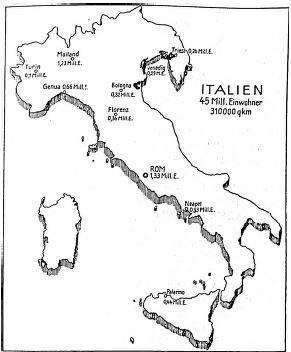
The magnitude of the task of making the popular mass of the Italian area independent of foreign countries in its food supply becomes clear when one considers the soil conditions of the southern peninsula. The fertility of the soil can only be low in a country where only 17% is flat land, while 43% is hilly and 40% mountainous. The barrenness of the soil, aggravated by the forest depletion of the past centuries, allows only one harvest per year in most of the southern areas; only the climatically favored northern Italian lowlands allow a more frequent exploitation of the land. Large areas are barren and swampy, and it explains the importance of the Lex Mussolini of 1928, when the great work of reclamation of swampy and feverish areas has already won almost 1 million hectares of land to human settlement and the cultivation of soil crops. The Pontine marshes, polluted for millennia, have become peasant land with clean towns, of which Littoria, as provincial capital, is as it were the symbol of a peaceful conquest of new territory.
The main objective was to free Italy from dependence on overseas wheat supplies, but otherwise to maintain the old diversity in cultivation, which meets the Italian needs of life.
Field thereof
Wheat cultivation
Corn cultivation Meadow and pasture vineyards, olive, fruit and mulberry plantations Forest
46% 75% 20% 21% 8% 19%
Agricultural reforms have substantially increased the yield of wheat land. An increase in the area under wheat from 4.8 million hectares to 5 million hectares in the last decade, although not very large, was added to eliminate the need to eat foreign bread. The development of Italian economic policy is particularly interesting in the wheat sector.
1927 1936 1937 1938 1939 1940
*) Only 7 months
In million tons
2,3
The grain battle, the Battaglia del grano, which began around 1926, has thus, especially with the increase in yields per hectare from 12 to over 16 quintals, reduced the need for imports to such an extent that, if necessary, even all imports can be dispensed with. That a special stockpiling policy was pursued for wartime is shown by the large covering purchases abroad in 1939, which were by no means due to crop failure. In fact, the "amassi", the stockpiling ordered by the state, became an important instrument in Italian economic management, especially in wartime. The extent of this in the case of wheat can be seen from a 1939 figure: At that time, wheat storage was no less than 4.1 million tons, so that half a harvest was available in addition. The further goal of Italian wheat cultivation is to increase yields per hectare to 17 to 18 quintals in order to be able to satisfy the needs of the population increase with harvests of 8.5 to 9 million tons while maintaining the same arable area. After all, the normal birth surplus brings with it an annual increase in wheat consumption of about 0.1 million tons.
From the wheat battle, however, a general intensification has radiated to all agriculture. There is hardly a crop whose yields have not been fundamentally increased in the past decade. In the case of corn, which next to wheat plays an outstanding role in the Italian diet, an increase in yield has been achieved even despite a reduction in the area under cultivation.
Wheat Rye Oats
Barley Corn
Potatoes
Sugar beets
Rice Beans
1940 1939 1938 In million tons
7,1 1,5 5,0 2,4 3,5 3,1 5,0 0,84 0,40
8,0 1,5 5,9 2,5 2,5 2,8 4,1 0,73 0,65
8,2 1,4 6,3 2,5 2,9 2,9 3,3 0,77 0,64
About 2.5 million tons of corn are needed for human consumption and about 0.8 million tons for fodder purposes, so that in favorable years or with appropriate restrictions, the demand can be met from domestic production. Harvests of rice, a particularly important food for Italians, have tripled in the past half century. Consequently, in the trough of an increase in consumption at home, a considerable quantity is usually free for export, varying between 0.2 million and 0.25 million tons a year, and representing a significant item in the framework of Italian agricultural exports. In the case of oats, barley and rye, there is hardly any need for imports. Potatoes are little eaten by Italians. As a result, Italy is a potato exporting country, with early potatoes being important for German imports. In 1938, Italy exported 0.14 million tons of early potatoes, half of which to Germany. Italy is also self sufficient in sugar production. The relatively abundant cultivation of sugar beets made it possible to produce 0.48 million tons of sugar in the 1939/40 marketing year, while domestic consumption was probably 0.40 million tons. Despite this, sugar beet cultivation is to be further encouraged in order to ensure supplies for distilling purposes. The most important crop in the rotation of southern Italy and the islands is the bean. Dried bean crops are usually supplemented by small supplies from the southeastern states, while gray bean, which comes mainly from northern Italy, has significant exports. Here a reference to the interconnected economy between the two axis partners, Germany and Italy, should be interposed. As indicated earlier, at the end of 1940 a far reaching agreement on cooperation in the agricultural field was reached between Germany and Italy. It is important for the Italian agriculture to be prepared for regulated and long term cancellation of those agricultural products which are eligible for export. Besides the important
maintenance of stable prices, the fundamental agreement on the type and quantity of Italian agricultural products to be sent across the Alps is crucial. Only in this way will it be possible for the Italian farmer to adapt his work to the German wishes in the long run.
Such an intergovernmental arrangement is particularly important for Italy's export intensive horticultural crop. Oranges, lemons, fresh and dried fruit, canned tomatoes, wine and finally, as a source of fat, olive oil, are the decisive items of the Italian export of agricultural products, indeed of the entire export. These products are therefore of particular interest for Italy's position as a supplier of the continental economic area. In the above mentioned agreements, therefore, it is emphasized that Germany attaches decisive importance to being supplied with vegetables and fruit, albeit in prepared form, not only during the relatively short harvest season, but also during the rest of the year. Consequently, it is necessary to examine how the Italian harvests can be shifted through new cultivation techniques and what exports can be made in a prepared state.
If we then examine the performance of Italian horticulture, which already in 1938 resulted in citrus, other fruits and vegetables accounting for 60% of total agricultural exports, we find that a total annual fruit production of 2 million to 2.5 million tons can be expected, as was again the case in 1938. Exports amounted to 0.65 million tons, of which 0.28 went to Germany. Exports to Great Britain were also significant. In addition to the British market, many other export areas were lost. These figures alone indicate that Italy must aim to increase its supplies to the German markets, as is also evident from the German Italian agreements.
Italy's importance as the continent's orchard lies largely in its "agrumi" (oranges, mandarins, lemons). The main areas of orange and mandarin
1938 In tons
348000
220000 25000 53000
Oranges
Tangerines
Lemons
Table grapes
Apples
Pears
Peaches
Apricots
Plums
cultivation, except in Sicily, are in the coastal areas of southern Italy. The citron culture is mainly at home in Sicily. One third of Italian fruit is made up of these citrus fruits, which in 1938 yielded a crop of 0.8 million tons, of which 0.35 million tons were sold abroad. The main grape growing areas are Puglia, Abruzzo, Lazio, Tuscany and Emilia.
The importance of Italy as one of the most important wine countries of the continent is evident even from the figures of an unfavorable grape harvest, as the year 1940 brought. The harvest of grapes amounted to about 5.2 million tons, which, with a content of 65%, allows a wine production of 34 million hectoliters. In better years, however, the harvests and, consequently, the wine production are a good quarter higher. Although the habitual consumption of the Italian is quite high, 85 liters of wine per capita, in normal years a considerable stock of wine remains free for export. It should also be mentioned that Italy harvests 4000 tons of tobacco annually, so that it depends on foreign tobacco only to a minor extent.
The meat consumption of Italians is low. On an annual average, he is content with 18 kilograms. The fact of a gap in meat supply is therefore not too problematic.
1937
0,80 million 0,80 million 0,42 million 7,29 million 2,81 million 9,10 million 1,80 million
In the last few years, emphasis has been placed on increasing the number of cattle. The total annual consumption of whole milk is 70 liters per capita. Butter production, which rose from 47,700 tons in 1937 to 51,000 tons in 1939, barely covers domestic needs. On the other hand, cheese exports are considerable. Of the total cheese production of about 0.23 million tons, about one tenth is exported.
Given the importance of the fat problem for the entire continental economy, Italy's olive oil production deserves special attention. In Italy, too, fat supply
is a bottleneck in times of closure of overseas supplies. The fat gap, which is normally filled by imports of copra, oilseeds, vegetable oils, lard, bacon and tallow, arithmetically amounts to about 0.2 million tons. This is because an average production of 0.24 million tons of olive oil and other vegetable oils is offset by a normal demand of about 0.43 million.
1937/38 1938/39 1939/40 1940/41
272000 181000 315000 250000
380000 320000
Italy is the most important continental producer of olive oil after Spain. Its supplies play an important role on the continental markets, especially with its main customer Germany. This makes it all the more urgent to expand Italian vegetable oil production in general, on which the German Italian agricultural agreements are not likely to be without influence. As part of its stockpiling policy, Italy had stored a reserve of olive oil of 0.18 million tons at the end of 1940, which alone would correspond to the 1938/39 harvest. A program based on grafting wild olive trees and on technical improvement envisages an annual production of 0.35 million tons as a self sufficiency target. But the promotion of other oil crops is also intended to further improve the fat balance. The areas under oil, pistachios, rapeseed, linseed, castor bean, cottonseed, soybeans and sunflowers are to be significantly increased, and progress is also expected in oil production from grape marc and corn kernels.
As is well known, Italy's fuel poverty has repeatedly led to the interplay of economics and politics. British continental policy believed it could rely on the dependence of Italian coal supplies on the world market. This was one of the decisive mistakes of the British politicians, who had underestimated Germany's readiness to help and the technical possibilities of transporting coal from the Greater German area to Italy, as well as the considerable expansion of Italy's own coal production. The last attempt to cut off Italy's coal supply from the West German mining districts by blocking the canal ports for coal shipments to the southern peninsula was immediately met with a counterattack by the Axis powers, the organizational magnitude of which can be considered almost unique in terms of war economy and even purely in
terms of transportation. After all, it represented nothing less than the solution of the task of channeling the main part of the coal requirements of a nation of 42 million people by rail and thus essentially over difficult Alpine passes. This is undoubtedly an example of continental interconnectedness that is only conceivable through the unison of two authoritarian states.
Italy itself has exploitable coal deposits in Sardinia and on the Istrian peninsula near Trieste, while lignite is mined mainly in Tuscany near Florence. The state owned coal company ACal. (Azienda Carboni Italiana), which since 1940 has been seconded in the field of lignite by a semi state owned company ALI., has made considerable progress in the exploration of deposits, but also in the extraction of coal, in the years that have passed. For all the increase in Italian self sufficiency, however, it must be pointed out that Italian coal is not of full value; its calorific value is barely three quarters that of foreign coals.
1939 1938 1937
In million tons
Hard coal Lignite Coke
Promotion Import Promotion Generation Import
1,5 10,9 1,9
1,0 11,8 1,3 1,7 0,2
0,8 12,4 1,2 1,7 0,3
The coal production expansion program provides for considerable increases in both hard coal and lignite, and it will be possible to bring the total domestic coal output to about 6 million tons in 1941. This quantity should then correspond to a calorific value of about 4 million tons of foreign coal, thus relieving Italy's passive coal balance to some extent. In any case, since France, the largest importer up to now, will have to rely mainly on its own coal mines in the future, Italy will be the largest supplier of coal in the continental economy, and it will be supported by Germany, its partner on the axis, which will be decisive for Italy's entire economic life, since Germany has taken on the task of covering the deficit in Italy's coal balance entirely from its various coalfields.
In this situation of the Italian coal industry, a look at the supply of electric power is particularly interesting. As a result of the increased utilization of hydroelectric power in the last decade, the share of steam power plants in generation capacity has fallen to less than one sixth, so that the power supply
is already largely independent of foreign fuel supplies. The ratio is even more favorable when related to actual electricity generation.
1932 1936 1937 1938 1940
13,18 14,39 14,30 19,20
Import Total in billions of kilowatt hours
0,39 0,57 0,81 0,80
0,21 0,19 0,24 0,25
10,20 13,78 15,15 15,35 20,25
The strong development of the electricity industry dates back to 1932, since the constant expansion of industrial production, especially the production of aluminum, magnesium, other metals, artificial fertilizers and cellulose, requires an annually increasing consumption of electricity. It is therefore particularly significant in this context that projects have been discussed in Italy to relocate the major electricity consumers, i.e. primarily the electrochemical and metallurgical industries, to Albania, whose water resources appear to be particularly promising.
In Italy itself, periods of water scarcity pose some difficulties for the power plants. Most of the hydroelectric power plants are located in the abundant water reservoirs of the Alps, where about 70% of the hydroelectric power is generated. The remaining power plants are distributed in central Italy along the Apennines. For temporary water shortages, therefore, steam power plants must always be kept in reserve, just as the capacity of the Italian hydroelectric power plants, which at the beginning of 1940 amounted to 5.2 million kilowatts, could be increased by 1 million through the inclusion of reserve plants, if the necessary water were available at any time of the year. Also noteworthy is the generation of electricity from the power of earth vapors at Lardellero near Florence, which has so far supplied 0.5 billion kilowatt hours a year and whose output is to be increased to 1 billion by 1942. The quantities of electricity imported mainly from Switzerland are of no consequence and only reflect the weather conditions, which are decisive for the water supply in the Italian areas. Crucial, in turn, for a uniform supply of electricity throughout the Italian area is the development of interconnection, on which strong work is being done to establish continuous electricity supplies from the
Alps to Sicily. The distribution of electricity among the various sectors of the economy is as follows: heavy industry and the chemical industry account for the bulk of the demand (about 44%); the railroads consume 10% of the total length of 17,000 kilometers, of which slightly more than 5,000 kilometers are electrified; the textile industry accounts for a good 9%, and lighting requires between 7 and 8%.
Petroleum the Italian area possesses only in Albania, where production has increased from about 1300 tons in 1932 to 120000 tons in 1939. of course, these quantities do not play a major role in the overall framework of the Italian fuel balance. The extent to which the demand for liquid fuels has increased is shown by a list of imports.
1918 1935 1936 1937 1938
January November 1939
0,29 3,15 1,82 2,25 2,62 1,79
The expansion of the Italian tanker fleet and the establishment of efficient refineries have attempted to keep the foreign exchange requirements for oil imports within moderate limits. In 1938, Italy had 328,000 passenger cars and 108,000 trucks. With a ratio of 100 inhabitants per motor vehicle, the level of motorization was therefore not yet half as high as in Germany. It is significant that Italy is devoting increasing attention to the utilization of natural gas for motorization purposes. The exploitation of this methane gas is all the more valuable for Italy, since it is not possible to turn to wood gas generators because of the scarcity of wood. It is estimated that 21 to 24 million cubic meters of natural gas will be available as fuel in 1941, which could cover almost 5% of the normal consumption of motor vehicles in the pre war period.
At the beginning of 1941, about 5000 motor vehicles were running on natural gas. Long distance pipelines to carry the natural gas to filling stations are planned.
The poverty of wood, caused by the overexploitation of centuries and the neglect of all reforestation, is one of the characteristic features of the Italian area. It was not until Fascism that a reforestation program was set up that
later times promised to facilitate not only the timber industry but also the water management of the soil. For the time being, Italy is forced to purchase wood from abroad in an amount equal in value to about one sixth of its coal imports. The following figures provide an approximate overview of the demand for wood:
1937 1936 1935
In 1000 cubic meter
Softwood logs Softwood lumber 546 876 345 657 473 1607
The scarcity of domestic mineral resources in the Italian region hampered the development of industrial activity until the time of the World War. In the meantime, the utilization of the limited raw material base has made considerable progress, especially in iron extraction, mercury production and aluminum production.
The extraction of iron ore has been increased from year to year by new mining methods, which also permit the exploitation of low grade deposits. Ore deposits are mainly found on the island of Elba, in Cogne and Nurra. Hopes are pinned on Albania, where mines operate between the Scumbi Valley and Lake Ochrida. However, in order to exploit the Albanian ore deposits economically, the construction of the Durazzo Elbasan railroad, which has been started, must first be completed.
1939 1938 1937
In million tons
Iron ore
Scrap metal
Pig iron
Crude steel
Promotion Import Import Production Production 0,95 2,73
1,01 0,39 0,61 0,86 2,32
1,02 0,18 0,55 0,79 2,09
A reorganization of the heavy industrial mills should be able to increase annual steel production to 4 million tons if the necessary ore supplies are secured. It should be borne in mind that Italy's heavy industrial production has so far been
has so far depended to a large extent on American scrap supplies. The attention paid to every possibility of broadening the ore base is shown by the projects to exploit the ferruginous sands of the Italian coasts, which, however, would require an extraordinary amount of labor because of the movement of enormous masses of sand.
Italy has become the most important country in mercury production within the continental large scale economy. It has far outstripped Spain, which was unable to expand its mines during the Civil War, and has thus established a strong position for itself in the international mercury cartel.
1934 1937 1938 1939*)
*) January July.
72000 184000 196000 104000
441 2308 2300
1096 1380
A large part of the export used to go to the United States of America and Japan. Since the last few years, however, Germany has been the decisive customer; as early as 1938, 60% of Italian mercury went to Germany. In terms of foreign exchange, the extraordinary price increase of the European mercury cartel is significant, in which Italy 45% and Spain 55% of the market shares best. While in 1934 a bottle of mercury brought only 575 lire, at the beginning of 1941 the price rose to 5000 lire.
Bauxite Aluminum
1942 1941 1938 1937
In tons
Promotion Export Production 60000 50000
383000 75000 25800
386000 130000 22900
In this field, therefore, a further strong expansion is also under way, as can be seen from the above plan figures for 1941 and 1942. The construction of new plants for the extraction of artificial cryolite for aluminum production is being considered in order to free Italy from this import as well.
Finally, the following figures show the importance of the Italian metallurgical industry:
1938 1937
In tons
Raw copper Raw lead Raw zinc Raw tin Silver
2900 43300 34100 1000 22
1500 39500 38000 600 21
In any case, Italy has carried out a drastic restructuring of its manufacturing industry in step with the expansion of its sources of power in the last decade. The upswing has been particularly strong in the metal industry, while the textile industry, which is also essential for Italy, has not been swept away by the rapid development. The reorganization of industry has been brought about in particular by the Institute for Economic Reconstruction 1RI, which began its activity during the economic crisis of 1930 to 1933 for the purpose of state participation and influence in the economy and is now a leader in heavy industry, shipping, shipyards, cellulose, rubber and electrical industries. Above all, the Institute also extends its initiative to the armaments industry, and it is indicative of the efficiency of the young industry in the Italian area that a battleship of 35,000 tons could be produced in a single year, or that the Alfa Romeo plant built near Naples supplied the first aircraft engines only a year after the foundation stone was laid.
Italy's textile industry sees its particular strength in silk, and incidentally also in its synthetic competitor, artificial silk. In the large continental economic area, Italy is the only territory that has a considerable production of raw silk. Silkworm breeding in Greece, on the other hand, plays only a modest role. However, compared to the world's major silk producer, Japan, Italy also provides only a small contingent; Japan's silk production is ten times greater than Italy's.
After a relapse in the last few years, the Italian silk industry again received special government support. It had suffered from the oversupply on the world market emanating from Japan, which was particularly evident in the important shipments to America. Given the interconnectedness of the silk industry with the economy as a whole, which extends from agriculture to textile mills and fashion workshops and creates considerable credits on the export side of the Italian trade balance, its new upswing is therefore of general importance.
Cocoon generation
56985 17354 31960 19990 28401
Price per kilogram cocoon Raw silk production In tons In Lire In tons 1924 1935 1937 1938 1939 1940
21,85 5,06 7,90 10,50 11,36 15,00
5255 1685 2860 2740 3000
The increase in the price of the cocoons delivered to the "Ammassi", the state controlled storage facilities, in order to rehabilitate silk production, can be measured in its importance by the fluctuations in production. The stocks of silk cocoons, whose harvest is mainly at home in Veneto, amounted to 19,500 tons in 1938/39, equivalent to a year's production at that time. Italian raw silk is almost entirely destined for export. Thus, exports in 1938 amounted to about 2530 tons of raw silk and 1070 tons of waste silk; customers were mainly the United States of America.
Italy is, of course, dependent on imports of natural fibers from overseas, with the important exception of hemp, for which the country accounts for more than a quarter of the world's harvest and thus has a favorable asset in the fiber industry within the framework of the German Italian integrated economy.
Cotton Wool Flax Hemp
Harvest Import Production Import Harvest Harvest
9000 157100 7000 35500 3600 108600
4000 166400 6000 42400 2800 108500
The cultivation of cotton in some particularly suitable areas of the Italian region was therefore not yet important compared to the normal needs of the textile mills. It must be taken into account, of course, that a large part of the consumption of the textile processors was due to the strong export of fabrics. This facilitates the transition to a self sufficient textile supply, which can also rely on a steadily increasing importance of synthetic fibers. It is calculated that artificial silk, rayon and milk wool cover 50% to 60% of the total demand of the textile industry.
In tons
Artificial Silk Rayon
Lanital
Production Export Production Export Production
54000 86000 3600
46000 22400 75700 14500 2000
48300 25700 70900 17200 1500
39000 49900 1500
Apart from Germany, Italy is the most important supplier of artificial silk on the continent and, above all, the only European country that has taken up the production of rayon to any great extent. In securing raw materials for synthetic staple fibers, Italy is attentively pursuing every possible avenue. Milk wool (lanital, for which the casein was imported mainly from Holland and Denmark) already occupies a significant space. For pulp production, reeds are grown, as near Udine. An expansion of broom cultivation has been initiated to eliminate the need to import Indian raw jute. The conversion of textile
processors to synthetic fibers is largely complete. As early as 1938, the Italian cotton industry processed 61,000 tons of rayon, while the wool industry took over about 12,000 tons of rayon and 1,500 tons of milk wool.
Italy's position within the continental large scale economy is firmly outlined. Its efforts to become a self sufficient economy had already reduced its dependence on non European spaces. Its integration into the goods traffic of the continental countries has been gaining in intimacy for years and has been further substantiated during the war period, first of all in the exchange of goods with the Greater German area, but also in a considerable way with the countries of the Southeast area. In 1938, the continental area supplied Italy with 56% of its imports. Since then, these deliveries have increased considerably, especially due to increased coal imports from Germany. The continental area absorbed almost 59% of Italian exports in 1938. This aspect of economic traffic has also increased considerably, and the German Italian interconnection will continue to strengthen the markets for certain Italian surplus products. In general, Germany is of course Italy's decisive partner in the economic field, not only in terms of the indispensability of certain goods required by Italy, but also in purely quantitative terms. Germany, including the then Czecho Slovakia and Poland Danzig, accounted for one third of the goods imported into Italy in 1938. However, the weight of German deliveries in Italy's balance of trade has increased considerably since then.
In the same way as for Germany, however, autarky is of course not an end in itself for Italy. Italy's lively overseas connections up to its entry into the war show that the Italian region must also have a lively interest in the exchange of goods with non European economic areas. It is significant that in 1938, of the 20 million tons of goods arriving in Italian ports, about four million came from the Americas. The strong and modern merchant fleet testified to the Italian will to maintain a good position in world traffic. In 1938, Italy's merchant fleet consisted of 1293 ships with a tonnage of 3.3 million gross registered tons. This means exactly a doubling compared to the period at the beginning of the World War. The launches reached about 22,000 gross registered tons in 1937. A small part of the fleet, which was in foreign ports when Italy entered the war in 1940, is out of the control of Italian shipowners. But the extent to which Italy hopes to participate strongly in the world economy after the political and economic reorganization of the world is proved by the omissions of Italian shipping circles, according to which a merchant fleet of 9 million gross registered tons is considered necessary after the war. The urgent demand for freedom of the two exits of the Mediterranean, the Straits of Gibraltar and Suez, seems all the more self evident in the light of Italy's active shipping policy.
Apart from this, however, the shift of the economic interests of the southern area from the direction of the Atlantic Ocean to the north south axis of the continent via the Alps has long been so strong that the partnership with Greater Germany, the southeast and the north of Europe and with the latter, for the time being, not by sea but via Germany as a transit country completely determines the economic face of Italy. It is no coincidence that Italy is always represented in the first place at the Reichsmesse in Leipzig, as well as at other German trade fairs, especially the Deutsche Ostmesse in Königsberg.
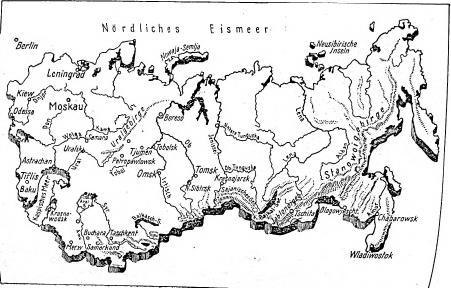
It is almost impossible to look into the economic conditions of the Soviet space. The Bolshevik economic agencies have always been anxious to keep their cards close to their chest. Soviet statistics often not only bear the character of improbability, but also deliberately obscure the correlations, for example, by not giving absolute figures, but only showing ratios of the alleged increase in production. In many cases, moreover, the figures are not those of actual production at all, but rather of planning. The unreliability of these figures is particularly evident when one takes note of the plan figures for the third five year plan, which will undoubtedly never be achieved. Nevertheless, an attempt will be made to show the Soviet economy as it presented itself to the public in mid 1941 at the outbreak of war in the following sketches. The destruction of important parts of the Soviet economy and the great German victories of 1941 have, of course, already led to the fact that many data have only historical significance.
Soviet agriculture endeavored, above all, to bring the badly shaken livestock back up to par, although in some cases considerable gaps remained compared to the height of the cattle pile in tsarist Russia.
1916 1933
Early 1938 Mid 1938
35,8 16,6 16,2 17,5
60,6 38,4 50,9 63,2
20,9 12,1 25,7 30,6
115,2 50,2 66,6 102,5
Even if the strong increase in livestock in the first half of 1938 was largely a seasonal phenomenon, the efforts to improve performance were nevertheless noticeable. A major boost had now come with the acquisition of rich livestock from the incorporated parts of the former Poland and from the Baltic states. It probably led to an increase of the Soviet livestock by 15 to 20%.
In general, there is still much room for improvement in this area of agricultural production, which is important also in terms of exportability. In the old Soviet Union, there were only about 15 head of cattle per hundred hectares of agricultural land. In Germany, on the other hand, the intensification of livestock farming has reached an occupation of 90 head. The heavyweight of Russian cattle and pig breeding still lies with the small peasant families, the
private kolkhoz farms, of which there are 19 million. The Russians hoped to achieve a greater increase in livestock by expanding the sovkhoz enterprises, the state farms, into large livestock farms. It is noteworthy that because of the lack of good breeding animals, the method of artificial insemination is widely used in these farms. In the third five year plan, by 1942 the stock of horses was to be increased by 35%, of cattle by 40%, of pigs by 100%, of sheep and goats by 11%. Whether such a strong intensification would have been achievable even without war, of course, remains another question. Admittedly, 220,000 new livestock farms had already been organized in 1940 alone. To clarify the significance of this figure, it should be noted that 400,000 cattle farms were created in the course of nine years.
Crucial is the further development of Russia as a grain producing country. Grain production, again according to the instructions of the Five Year Plan, was to be increased by 27% by 1942 by increasing yields per hectare. Here, too, many factors are at play that make increased intensification of agriculture seem difficult. Nevertheless, if technology can be brought onto the land to a greater extent and the use of synthetic fertilizers can be made more general, Russian grain production can still be greatly increased. Yields per hectare are far below the benefits that Central European agriculture derives from the field. While grain yield per hectare in Central Europe tends to range between 20 and 22 quintals, until a few years ago Russians harvested only 7 to 9 quintals. Even in the best harvest year of 1937, the average yield per hectare rose only to 11.5 quintals. It was hoped to reach a yield of 12 to 13 quintals in the future, which, however, would make the Soviet Russian grain harvest, already at the top of all grain countries, one third of the total world harvest.
1938
Million tons
20
Million tons
Million tons
Million tons
Million tons
Wheat Rye Barley
Oats
Corn
According to Russian data, the 1939 harvest has been further increased by raising the yield per hectare and by expanding the area under cultivation. With these figures alone, Russia's wheat harvest already exceeds the wheat harvest of the entire American continent. It can also be pointed out that Russian
harvests are three and four times those of Germany, although the population is only about twice as large. However, such comparisons are not very useful. The utilization of crops is not only a problem of cultivation and harvesting, but even more a question of transportation and storage, and in Russia some difficulties always lead to greater losses of grain than usual. After all, the total grain harvest for 1940 has already been estimated by "Izvestia" at nearly 112 million tons. It is also worth remembering the progress made in soil melioration. In 1940, new irrigation canals transformed 250,000 hectares of land into arable land, while in Belarus 67,000 hectares of marshes were drained.
In any case, Russian grain exports have fluctuated greatly, just as the entire export of the Soviet Union shows considerable differences in performance in different years.
1937 1936 1935 In 1000 tons
Wheat Rye Barley Oats
846 204 221 6
58 106 105 52
719 43 488 156
The cultivation of cotton has paid attention to the planning. Russia is already the largest cotton country in the world after the United States of America. It has surpassed British India and produces over twice as much as Egypt, accounting for nearly 15% of the world's harvest.
1928 1937 1938 1939 1942
270000 tons 820000 tons 802000 tons 835000 tons Planned 1600000 tons
The cotton fields are located mainly in Transcaucasia and in the Central Asian states of Uzbekistan, Azerbaijan, Turkmenistan, Tajikistan. There are now well over 2 million hectares planted. By the end of the current five year plan, the cotton harvest is to be increased to the enormous level of 1.6 million tons. However, until this increase is achieved, Russia will hardly join the ranks of the real cotton exporting countries. Until a few years ago it was even a buyer of American and English cotton in considerable quantities. Russian cotton entered the world market for the first time in 1935, but only in relatively small trial lots. For the time being, apart from occasional exports of little significance, domestic cotton is migrating to Russian textile mills, four fifths of which are engaged in the manufacture of cotton goods, since the wool supply from domestic sheep farming is not satisfactory. It should be noted that the Russian textile industry, despite its strong expansion, is unlikely to be able to adequately cover the domestic needs of the Soviet population for a long time to come. In the tsarist empire, half of the clothing required in Russia had to be procured from abroad.
Russia's position in the other fiber crops flax and hemp is outstanding. Well over half of the world's flax harvest is of Russian origin, and almost half of the hemp harvest:
1937 1938 570000 546000 123000
Flax in particular is a textbook example of how revolutionary agrarian processes can influence the regional economy. Two or three generations ago, Germany was a large flax field that could easily meet the population's need for linen, just as the extensive sheep breeding did not require any dependence on foreign wool imports. In the course of time, however, the area under cultivation had fallen from 250,000 hectares to the vanishingly small area of less than 5,000 hectares: similarly, flax cultivation had declined throughout Central and Western Europe. The reason for this lay not only in the triumph of cheap cotton and artificial silk with its transformation of fashion into light clothing, but equally in the difference in valuation between Western and Eastern labor. For flax cultivation is considered one of the most laborious crops, simply due to the fact that the flax cannot be mowed, but must be
tussled by hand. As a result, the Central European farmer abandoned flax cultivation and left it to the East, which was provided with cheap labor. Before the world war, Russia covered three quarters of the flax requirements of the European linen industry. After the war, flax supply was further improved by the start of flax cultivation in the peripheral states. Only recently, with a renaissance of linen fashion and the cultivation of domestic raw materials, has German flax cultivation again flourished considerably. However, the supply of Russian flax to the continental economic area will continue to be important in the future. In 1938, 22,400 tons of Russian flax were exported.
Soviet timber supplies are completely dependent on transport conditions. Undoubtedly, Russia represents the largest Eurasian forest block. Almost 45% of its space is forest land; the Russian forest covers a huge area of 9.5 million square kilometers, which is larger than the whole of Europe excluding the Soviet area. However, only just under half of this can be considered timber producing area, about 4.56 million square kilometers, and of this, the European part accounts for about 1.1 million square kilometers, to which must be added, since 1939, about 0.05 million square kilometers of forest land of the annexed Western Ukraine and Western Belarus. While the total timber stock of the Soviet Union is estimated at about 30 billion cubic meters, half of which is considered timber, and the natural increment of timber is assumed to be 600 million cubic meters per year, the logging is about 200 million cubic meters, reaching only one third of the current increment. More than four fifths of the forest area is located in Asian Russia. Well known are the immense forests of Siberia, which extend with slight interruptions to the Far East. In the European region, three quarters of the forest area is covered with coniferous forest (larch, fir and spruce) and one quarter with deciduous forest (namely birch). In the north, Karelia, Arkhangelsk, Vologda, Komi and Gorky have the greatest forest cover, while the south, according to Ukraine, is poor in forests.
The Asian forests are difficult or impossible to exploit, and the forest areas located on the European side also suffer from the lack of roads, railroads and shipping facilities, as well as forest workers. Thus, the importance of the Soviet Union as a supplier of timber to the world economy is inhibited.
The geographic location of transportation has led to the fact that the European forest area of the Soviet Union is partly overexploited, while the Asian part is almost not exploited at all, as the following comparison shows, which was made in 1934, but the basic proportions have not changed too much.
Hectare
Wood removal Cubic meters
Asian part 111 million 473 million 134 million 47 million
European part
This forest use means that 1.2 cubic meters of wood are harvested per hectare in the European part, but only 0.3 cubic meters in the Asian part. Because of the overexploitation in the conveniently located western areas, the Soviet Union had already enacted protective measures in 1936. Along the Volga, Don, Dnieper, Ural and Dvina rivers, logging is prohibited in a 20 kilometer wide belt on both banks, and restricted in other areas.
The total export of timber from the Russian forests, after a strong increase, has been at a standstill since 1935, which has also resulted in a decline in exports since then.
Total
Of which Timber In million cubic meter
1935 1936 1937 1942
208 202 201 Planned 370
116 118 111 206
An expansion of the transport possibilities from the less deforested forests of European Russia was planned, which should enable a considerable increase of the timber harvest. It was hoped that this would double the extraction of timber. This was also intended to remedy the downward trend in exports, which in recent years had resulted not only from normal transport difficulties but also, and above all, from the increased self consumption of Soviet industry in connection with the accelerated industrial expansion under the five year plans.
Hardwood logs
Pit wood
Wood mass timber
Other softwood logs Hardwood lumber Softwood lumber Railroad sleepers
1937 1936 1935 In 1000 cubic meter
0 1338 1525 482 0 4242 191
0 1385 2360 711 16 4690 248
1 1428 2828 1254 56 5085 248
Railroads play a disproportionately large role in the transportation of timber, since the waterways in the directions that the timber has to take to the burning areas are not yet sufficiently developed.
When considering the sources of energy, it is necessary to emphasize the fact that the Soviet Union accounts for the tenth part of the world production of both coal and oil. It should be taken into account that the coal deposits, which have been included in the scope of industrial exploitation so far, represent only about 8% of the total available reserves. However, almost one third of the world's proven and probable reserves of hard coal are located in the Soviet region. Coal production, which is crucial for the industrialization of the Soviet Union and thus has a strong impact on its relations with the European economic area, has increased at an astonishing rate. The Third Five Year Plan envisages further strong expansion up to 1942, namely in the Urals, in the Moscow mining district, in the Far East and especially in Central Asia, with coal production to be rationalized by introducing the Stakhanov system for miners.
Hard coal Lignite
Total In million tons
1928 1936 1937 1938 1942 planned
32 109 109 113
3 18 18 20
35 127 127 133 243
In spite of the increased production, the strong industrialization wave in the past years had necessitated an import of coal, even if not too significant. The Soviet oil industry is all the more interested in the non Russian areas. After the stormy development in the previous decade, oil production has gained a certain steadiness since 1935, which, however, according to the guidelines of the current five year plan, should again give way to an extraordinary increase. Since the Russian petroleum industry began with the conquest of Baku in 1806, Russian naphtha products have been of world importance; however, they have gained their actual dominant position only through the tremendous expansion of output in the last decade:
Total
1928 1937 1938 1939 1940 1941 planned 1942 planned
13,3 30,5 32,2 35 39 45 54
Of which Natural gas In million tons
2 2 2,2 3,1 4,1 5,5
The Baku area accounts for almost three quarters of production; the entire Caucasian region (in addition to Baku, namely Grozny and Maikop) supplies nine tenths of Russia's oil. However, the expansion of the coming years should extend less to the old Baku oil fields than to the area between the Volga and the Urals, the "second Baku."
The supplies from the Caucasian area are ensured by expanding the pipelines. An 800 kilometer pipeline runs from Baku to Batum, which has been doubled in recent years. The Grozny oil fields are also connected by pipeline to the Black Sea and Caspian Sea; they also have a pipeline to Rostov on Don, which is to be extended to Voronezh. From the Emba fields on the northern edge of Lake Caspian, an 800 kilometer pipeline to Orsk on the Urals was completed a few years ago. From the Caspian Sea, tankers go up the Volga, so that the distribution of Caucasian oil to all directions is taken care of. A distribution network has yet to be created for the new oil district between the Volga and the Urals, the expansion of which was envisaged in the third five year plan.
Crude oil
Gasoline
Fluorescent oil
Fuel and heating oil
Lubricating oil
1937 1936 1935 In 1000 tons
69 167 419 383 1421 253
207 658 416 1745 308
In order to assess the future supply possibilities, in which the European economic area, which has only the oil fields of Romania at its disposal as continental fuel sources, is certainly interested, a look at the motorization of Russia is appropriate. It is a fact that little of Russia's oil production has been left for export, even though the Soviet Union is still in the early stages of motorized operation. It should be noted, however, that fuel consumption per engine is four times higher than in Western countries because of overloading of cars, poor roads, low compression of engines, and inadequate knowledge of drivers. In Russia, there were only 700,000 civilian motor vehicles on the road, an extraordinarily small number in 1938, especially in relation to the population and the vast expanse of space. Fuel is consumed to a great extent by shipping and railroads, which are often operated with mazut (heavy fuel oil), and lighting oil by the population, since electric power is available only in the fewest places. In 1938, domestic consumption was already at least 28 million tons. Since then, however, the needs of industry have increased rapidly, and every effort is being made for motorization. It has been calculated that if the Soviet Union were to reach the American standard of motorization, it would require 150 million tons of petroleum, based on its higher population. This is, of course, a utopia for a long time to come; but the figure shows that even the large Russian fuel production may one day set limits to the rise of motorization. In any case, the expansion of the "second Baku" initiated in the current five year plan appears to be a necessary measure from this perspective, if the energy supply of the rapidly advancing Russian industry is to be ensured and exports are to be boosted at the same time. It is noteworthy that the Soviet Union in particular has closely followed German efforts to develop synthetic fuel. A large scale plant was to be built in eastern Ukraine to extract benzene and gasoline from coal, and another plant was planned in western Siberia.
Iron and manganese stamp Russia as the leading country in ore supply. In the case of iron ore, however, the interest of the Central European economic area
is only indirect. Russia hardly supplies any significant quantities of iron ore across its borders, although it ranks third in world production after the United States of America and France. The consumption of this significant quantity is all the more important as a yardstick for the intensification of its industry, which in turn can affect foreign trade relations with the other major economic areas. In the case of manganese ore, however, the Soviet Union is the undisputed world leader not only in production, but also on the world market, where only British India can boast exports of the same magnitude.
Iron ore production has tripled since 1938 and is expected to increase by almost half by 1942.
Million tons
1928 1936 1937 1938 1942 planned
6,1 27,9 27,8 26,5 40
3% 16% 13% 16%
Ukraine represented the old Russian ore base, characterized by the fact that the coal mines of the Donets Basin provide sufficient cokable coal so that the ores can be smelted under the best conditions. The second ore base in the East has been increasingly developed in recent years in the heavy industrial areas of the Urals, which, however, are not as richly endowed with coal as the ore deposits in southern Russia. Particularly noteworthy in the Urals is the iron ore deposit of Magnet Mountain, the yield of which supplies the well known Magnitogorsk Combine and the ironworks in the Kuznetjk region of Siberia.
The Soviet Union had the world's largest deposits of manganese ore, concentrated mainly at Chiatury in Georgia and Nikopol in Ukraine. Georgian mines have been particularly heavily developed, as Ukrainian ores are poorer in manganese content. Small deposits are exploited in the Urals and Western Siberia; these in particular should be developed at an accelerated pace to avoid transportation from Georgia and Ukraine over several thousand kilometers to the interior of the country.
1929 1936 1937 1938 1939
702 2796 2752 2270 2300
439 1790 1880
507 606 1001 446
In conjunction with a decline in exports, the production of manganese ore has decreased in recent years. However, a rationalization of the outdated mining technology was initiated.
The following table provides information on the performance of other important mining products:
Soviet non ferrous metal production
Chrome ore Copper Lead Tin Nickel
200000 92500 57000 77000 2500
200000 95500 69000 80000 2800
270000
The extraordinary increase in copper production in the third five year plan is remarkable. Already for 1939 the production according to the plan figures should have amounted to 135 000 tons. In the case of chrome ore, Soviet production is in line with the main suppliers of the world market, Southern Rhodesia and Turkey, without, however, any significant exports in the last few years.
Greater attention was paid to the production of light metals. The production of aluminum was to be tripled to the 1938 level by 1942.
1937 1938
Planned In tons
Aluminum production 230000 45000 250000 56800 180000
Bauxite mining
The first aluminum factories were established in 1932, on the Volchov and Dnieper rivers. Given its dependence on electric power, the further development of the aluminum industry, for which a number of other plants are under construction, will depend in particular on the increase in Soviet hydroelectric power plants. To sum up, the Soviet Union was undoubtedly one of the leading countries in the production of important basic materials. It ranked first in world production of manganese, second in oil and gold, third in coke, iron ore, pig iron and crude steel, and third in aluminum.
In assessing the Soviet foreign trade policy, one should not disregard the fact that Russia is the second largest gold producer in the "world after the Union of South Africa. Since 1927, gold production in the Soviet area has increased at a rapid pace, as economic planning has necessitated the import of foreign manufactured goods and materials, and payment in gold has been used to free oneself from the compulsion to re export. Every conceivable means has been used to promote the extraction of gold, which is namely the exploitation of the gold washes of Siberia. In fact, the success has been astounding. Although the amount of the annual production is kept as a state secret, formworks come to the conclusion that since 1938 the annual gold production, which in 1928 had been only 28,000 kilograms, has moved between 150,000 and 200,000 kilograms. This corresponds to a value of 420 to 560 million marks; a considerable amount, therefore, by which the Soviet Union could theoretically afford an import surplus in its foreign trade balance. In fact, Soviet foreign trade with various countries, especially the United States of America, is passive. From this point of view, the accumulation of a considerable state gold reserve also deserves attention. It was estimated at almost two billion marks for the middle of 1938, to which was added another billion, held abroad for the account of the Soviet Union.
On the whole, however, it should be remembered that this picture of the Russian economy was valid at best until mid 1941. Since then, decisive areas of Soviet economic power have already been broken out by the advance of German troops. The most important economic sources were withdrawn from
the Kremlin's disposal in 1941 by the loss of precisely those areas in which production had been most intensively developed. It should be noted that the territories conquered by the German and allied troops were among the main suppliers of the Soviet Union, especially for agricultural products, ores and industrial products, such as aluminum.
Population and territory. (Status as of the beginning of 1941.)
Population in million Area in 1000 sq. km
Greater German Space German Empire Protectorate
Gov. Gen. Alsace Lorraine Luxembourg
West Room
The Netherlands Belgium France Switzerland Spain Portugal
North Room
Denmark Norway Sweden Finland
Southeast Room Slovakia Hungary Romania Bulgaria Yugoslavia Greek Turkey*)
Italian area
90 7,4 12,1 1,9 0,3
8,8 8,3 40 4,2 25 7,5
3,8 2,9 6,3 3,7
2,7 13,6 13,2 6,7 15,9 7,2 1,3
681 49 94 15 3
35 30 536 41 505 92
44 323 449 342
38 161 193 111 248 130 24
Population per sq. km
132 143 130 126 116
252 275 75 101 50 81
88 9 14 11
71 85 68 60 64 55 55
Italy Albania 45 1,1 310 28 145 39
Soviet Room Old Republics*) Baltic Sea Republics Polish area of interest
*)European Part 276
130 6 11,5
6020 173 200
22 35 60
Population in 1000 1940 1930 1910 Berlin Wien Hamburg Munich Cologne Litzmannstadt Leipzig Essen Dresden Breslau
Frankfurt a. M. Düsseldorf Dortmund Hannover Stuttgart Duisburg Bremen Nürnberg Wuppertal Königsberg (Pr.) Chemnitz Magdeburg Gelsenkirchen Bochum Mannheim Posen Kiel Stettin Danzig Halle a. d. S. Kassel Graz Brunswick Oberhausen Karlsruhe Augsburg Straßburg Krefeld Wiesbaden Erfurt Aachen Mainz
4339 1930 1712 829 772 748 707 667 630 630 553 542 541 471 458 435 424 423 402 372 338 337 318 305 285 380 274 272 250 220 216 208 196 192 190 185 171 170 166 162 159
4243 1875 1129 735 757 605 713 654 642 625 556 541 499 444 415 440 323 410 409 316 351 307 333 315 275 249 218 271 235 209 175 153 157 192 155 177 181 165 160 145 163 143
2071 2031 931 596 517 404 590 295 458 512 415 214 359 302 286 331 247 333 339 246 288 280 170 137 194 157 212 236 170 181 153 152 144 90 134 102 179 139 109 111 156 111
155 152 144 141 140 138 136 135 134 133 129 128 128 128 126 121 119 117 115 115 114 113 112 110 108 104 101 101 100
129 148 107 122 140 133 74 127 115 129 121 109 127 109 130 90 79 111 93 81 28 103 114 99 101 101 99 101
99 89 83 90 51 113 62 43 58 105 78 68 66 83 63 65 57 67 90 73 35 87 121 3 84 72 88 68
Population in 1000 1940 1930 1910 Lübeck Hagen Ludwigshafen Münster i. W. Solingen Mulheim a. d. Ruhr Potsdam Kattowitz Bromberg Saarbrücken Bielefeld Linz München Gladbach Sosnowitz Hindenburg (O./S.) Rostock Dessau Gleiwitz Darmstadt Königshütte Wilhelmshaven Wesermünde Plauen Freiburg Würzburg Remscheid Bonn Beuthen (O./S.) Mühlhausen
Brünn Mähr. Ostrau Pilsen
990 296 129 120
1307 279 162 150
349 265 125 115
1179 221 118 113
864 152 72 67
224 126 37 80 Gov. Gen. Warsaw Krakow Czestochowa Lublin
Amsterdam Rotterdam The Hague Utrecht Haarlem Groningen Eindhoven
Brussels Antwerpen Liège Gent Charleroi
The Netherlands
Population in 1000 1940 1930 1910
801 620 504 165 141 122 113
907 491 253 213 181
Belgium
757 587 438 155 120 105 48
869 484 252 219 188
566 418 271 119 69 75 6
720 398 242 210 171
France 1936 1930 1910 Greater Paris (Dep. Seine) Paris Marseille Lyon Bordeaux Nizza Toulouse Lille Nantes Saint Etienne Le Havre Toulon Rouen Nancy Reims Roubaix Clermont Ferrand
4963 2830 914 571 258 242 213 201 195 190 164 150 123 121 117 107 101
Switzerland
4934 2891 801 580 263 220 195 202 187 191 165 133 123 121 113 117 103
4154 2936 551 524 262 143 150 218 171 149 136 105 125 120 115 123 65
1940 1930 1910 Zürich Basel Geneva Bern
321 162 123 121
250 248 124 112
189 132 115 91 279
Barcelona Madrid Valencia Seville Malaga Bilbao Saragossa Murcia Cordoba Granada Valladolid
Spain
Population in 1000
1940 1930 1910
1399 1195 403 253 232 228 212 177 142 134 107
1006 953 320 229 188 162 174 159 108 118 91
560 572 233 155 133 94 106 125 67 81 68
Portugal
1935 1930 1910 Lisbon Porto 659 592 240 435 194 North Room
Denmark 1939 1930 1910 Copenhagen 883 771 462
Norway
1938 1930 1910 Oslo Bergen 275 107 253 98 243 77
Sweden
1940 1930 1910 Stockholm Gotenburg (Göteborg) Malmö
648 281 154
605 243 128 168 83
Finland 1939 1930 1910
Helsingfors (Helsinki) 305 244 147 Southeast Room
Slovakia
1935 1930 1910 Pressburg (Bratislava) 139 124 78
Hungary
Budapest Szegedin Debreczin
Klausenburg (Cluj)
Population in 1000
1940 1930 1910
1518 141 128 100
1421 135 117 101
1098 113 93 61
Romania 1939 1930 1910 Bucharest Jassy Galatz (Galati)
648 104 102
631 103 101
338 76 72
Bulgaria 1934 1910 Sofia Philippopel (Plovdiv) 288 100 103 48 Croatia 1939 1930 1910 Agram 186 97
Yugoslavia
Belgrad Subotica (Maria Theresiopel) 267 239 100 91 95 Greek 1939 1928 1910 Athens Piraeus Thessalonica (Salonica)
494 284 265
Turkey
453 251 237
167 72 157
1935 1930 1910 Istanbul (Constantinople) 741 691 1200
Rom Milan Naples Turin Genoa Palermo Florence Bologna Venice Trieste Catania Bari Messina Verona Taranto Padua Brescia Livorno Ferrara Reggio di Calabria La Spezia Cagliari Modena Apuania
1940 1930 1910
1327 1225 929 702 662 437 357 322 287 262 255 216 205 168 155 153 137 136 124 124 122 122 106 106
Soviet Union
108 992 839 597 608 390 316 246 260 250 228 172 183 154 106 131 119 124 116 123 108 102 102 102
542 599 678 427 272 341 233 173 161 161 211 104 127 82 68 96 83 105 95 43 74 60 71 84
1939 1930 1910 Moscow
Leningrad (St. Petersburg) Kiev Kharkov
Gorkij (Nizhniy Novgorod) Odessa
Rostov on Don Dnepropetrovsk (Jekaterinoslav)
Stalino (Yusovka)
Stalingrad (Zaritzin) Sverdlovsk (Katherinenburg) Kasan Kuibyshev (Samara)
4137 3191 846 833 644 604 510 501 462 445 426 402 390
2026 1614 514 417 185 421 308 233 106 148 136 179 176
1506 1911 446 224 108 498 172 218 49 101 70 188 146
Riga Saratov Votonezh Lviv Yaroslavl
Zaporozhye (Alexandrovsk) Ivanovo ( Vosnessensk) Arkhangelsk Tula Perm Astrakhan Ufa Makeevka (Dimitrievsk) Minsk Mariupol Kalinin (Tver)
Voroshilovgrad (Lugansk) Vilnius Krasnodar (Ekaterinodar) Krivoy Rog Taganrog Izhevsk Chkalov (Orenburg) Grozny Vitebsk Nikolayev Nizhniy Tagilsk Penza Smolensk Shakhtiy (Grushevskaya) Dneprodzerzhinsk (Komenskoye)
Gomel (Homel) Kirov (Vyatka) Simferopol Rybinsk Reval (Tallinn) Poltava Ordzhonikidze (Vladikavkaz)
Population in 1000 1939 1930 1910
385 376 327 318 298 289 285 281 272 255 254 246 240 239 222 216 213 209 204 198 189 176 173 172 167 167 160 157 157 155 148 144 143 143 139 138 130 127
378 215 120 316 114 55 111 129 153 176 177 99 79 132 64 106 72 196 163 38 86 63 123 97 99 105 39 92 79 41 34 86 62 82 56 138 92 78
328 202 79 206 112 51 167 38 135 62 150 103 111 53 62 60 188 71 68 39 94 104 103 45 80 71 46 36 98 44 70 31 79 84 76 283
Tambow
Kostroma
Kursk Murmansk
Kishinev (Chisinau) Sevastopol
Orel
Chernivtsi (Cernauti) Gorlovka
Kowno (Kaunas)
Kerch Dzerzhinsk
Ulyanovsk (Simbirsk) Kirovograd (Yelizavetgrad)
Population in 1000 1939 1930 1910
121 121 120 117 113 112 111 110 109 108 104 103 102 100
72 74 82 9 117 75 78 111 23 98 36 9 70 66
61 67 83 118 77 91 68 80 57 76
The world's wheat harvests show extraordinarily strong fluctuations. In Europe, the authoritarian states have considerably promoted cultivation and yield within the framework of production battles in order to reduce dependence on overseas supplies (Germany: Erzeugungsschlacht; Italy: battaglia del grano). The continental harvests of the last years recorded maximum yields until 1939.
1940 1939 1938 1937 In million tons
Germany
Protectorate
Formerly Poland
Italy France Spain
284 *) 7,30 3,30
5,59 0,85 2,27 8,00 7,50 3,04
6,33 0,85 2,17 8,09 10,15 3,05
4,87 1,93 8,06 7,02
*) For the German Reich, the 1940 harvest estimate gave a total grain quantity of 24.6 million tons; to this must be added the total hulled grain harvest of Danzig West Prussia and Wartheland of 3.5 million tons.
Hungary Yugoslavia Romania Bulgaria Greek Portugal Sweden Belgium Holland Slovakia Denmark Switzerland Finland
1940 1939 1938 1937
2,08 1,98 1,65 1,50 0,93 0,45 0,34 0,27 0,15
In million tons
3,07 2,88 4,49 1,94 0,96 0,85 0,35 0,35 0,32 0,41 0,17 0,24
2,69 3,03 4,92 2,15 0,94 0,45 0,82 0,55 0,43 0,37 0,46 0,21 0,26
1,96 2,35 3,76 1,77 0,82 0,40 0,70 0,42 0,34 0,37 0,17 0,21
The average production of Europe excluding the Soviet Union (1938 boundaries) was 42.8 million tons annually in the decade 1930 1939, with a peak of 50 million tons in 1938 and a low of 37 million tons in 1930. The Soviet wheat crop was reported at 41 million tons for 1939.
Broken down by continent, the world's wheat harvests give the following picture:
1940 1939 1938 Average 1933 1937
In million tons
Europe Soviet Union Asia Africa North and Middle America South America Oceania
37,0 19,2 3,1 37,7 9,0 2,5
46,1 41,0 18,1 4,1 35,2 4,8 6,0
50,0 40,9 18,5 3,8 35,6 11,8 4,4
43,0 32,8 15,8 3,6 24,5 7,7 4,5
The total wheat harvest in the northern and southern hemispheres is estimated to have been about 150 million tons in 1940, compared with about 165 million in 1938. In the five year average 1933 1937, it had reached only 99 million without the Soviet Union and about 132 million including the Soviet harvest.
Germany Bohemia Moravia
Former Poland
Hungary France Spain The Netherlands Belgium Sweden Finland Denmark Yugoslavia Slovakia Bulgaria
The most important bread grain of the Greater German area, rye, has shown considerable crop improvements within the framework of the production battle, not by increasing the area under cultivation, but by increasing the yield per hectare. Germany, which has added large rye fields to its extensive cultivation through the annexation of former Polish territories, is, together with the Soviet Union, the world's most important rye producer. The European crop declines of 1940 are due to particularly unfavorable weather.
1940 1939 1938 1937
*) 0,73 0,70 0,30 0,27 0,23
In million tons
9,38 1,02 7,63 0,90 0,44 0,55 0,35 0,38 0,33 0,25 0,24 0,20 0,22
9,70 1,02 7,25 0,80 0,80 0,43 0,55 0,38 0,39 0,37 0,28 0,23 0,24 0,19
7,39 1,48 5,64 0,62 0,74 0,48 0,35 0,41 0,43 0,25 0,21 0,24
The Soviet Union achieved a harvest of 20 million tons in 1938. Non European areas are insignificant in rye cultivation.
Barley, as the feed grain that yields crops farthest north and highest in the mountains, is found throughout the European continent, which accounts for
*) See note under "Wheat".
nearly half of the world's harvest. Greater Germany is the main harvesting country.
1940 1939 1938 1937 In million tons
Germany Protectorate Former Poland Spain France Denmark Hungary Romania Yugoslavia Bulgaria Slovakia Italy Greek Sweden
*)
2,00 0,69 0,67 0,27 0,24 0,19
4,24 0,60 1,48 1,40 1,60 1,24 0,78 1,01 0,42 0,33 0,31 0,25 0,22 0,23
4,80 0,60 1,37 0,74 1,29 1,36 0,72 0,83 0,42 0,35 0,33 0,25 0,25 0,27
3,91 1,36 1,25 1,10 0,56 0,92 0,38 0,33 0,23 0,22 0,21
The 1939 world harvest yielded about 50 million tons. Of these, the Soviet Union probably accounted for about 8 million. Besides the Soviet Union, the most important exporting countries are Canada, the United States, Argentina, Iraq, Turkey.
The European countries account for about half of the world's oat harvests. Germany has the leading position, but its needs are not fully covered by domestic production.
*) See note under "Wheat".
Germany Protectorate Former Poland France Sweden Denmark Belgium Finland Italy Spain Romania Hungary Yugoslavia Slovakia Greek Norway
Harvest
1940 1939 1938 1937 In million tons
*) 1,13
0,60 0,46 0,43 0,19 0,17 0,16
6,83 0,77 2,88 4,00 1,28 1,02 0,72 0,78 0,59 0,47 0,48 0,36 0,35 0,16 0,18
7,21 0,77 2,66 5,46 1,38 1,14 0,62 0,84 0,63 0,32 0,46 0,31 0,33 0,16 0,15 0,18
6,39 2,34 4,35 1,27 1,02 0,52 0,73 0,62 0,51 0,27 0,30 0,14 0,17
The world harvest in 1939 was about 63 million tons. Of this, the Soviet Union accounted for about 16 million. Overseas harvesting countries were mainly the United States, which harvested about 17.7 million tons in 1940, and Canada with 6 million in 1940.
For continental livestock breeding, corn is of paramount importance, especially after the ban on feeding bread cereals. It is thus becoming the most important feed for horses, pigs and chickens, but has also gained entrance as a bread crop. Crucial are the harvests in the southeast region, the "corn chamber of Europe". The following list for 1940 reflects not only the extraordinarily high crop yields but also the political territorial changes in the Danube countries.
*) See note under "Wheat".
Yugoslavia Romania Hungary Bulgaria Turkey France
Greater Germany Italy Portugal Greek
Harvest
1940 1939 Average 1934 38
5,00 4,01 2,96 0,90 0,73 0,36
In million tons
4,05 5,16 2,33 0,89 0,71 0,60 0,50 0,35 0,30 0,26
4,69 4,15 2,31 0,81 0,56
The Southeast region had large quantities available for export, especially from the 1940 harvest, although increasing domestic consumption due to the gradual intensification of livestock breeding and the use of corn as bread flour must be taken into account.
The world crop is expected to be around 120 million tons for the year. The most important producers are the United States, Argentina and Brazil. The Soviet Union harvests about 4 million tons.
Rice, whose home is the swampy lowlands of East Asia, is grown on a modest scale only in a few southern countries on the continent. Italian rice is important for continental supplies on a large scale.
1939 1938 1937 In tons
Italy
Portugal Bulgaria Greek Yugoslavia
770000 70000 30000 10000 10000
790000 80000 10000 10000 10000
289 800000 10000 10000
Germany had imported around 290,000 tons in 1938. Italy, which exported nearly 160,000 tons in 1938, can thus cover a considerable part of Germany's requirements. The world harvest hovers around 150 million tons. The main producers and consumers are China, British India, Japan, Burma and Thailand. Burma, Thailand and Indochina are the main suppliers to the world market.
Given the importance of the potato as the most important food, livestock feed and versatile industrial raw material, the increase in yield achieved under the slogan of production battles is of crucial importance. The steady increase in harvests was achieved not by expanding the area under cultivation, but by an extraordinary increase in yields per hectare. It should be borne in mind that in the case of nitrogen, the quantities used before the World War increased almost fourfold, and in the case of potash, two and a half times. The intensification of root crop production is one of the most important achievements of German agriculture. Greater Germany achieved a maximum harvest of over 70 million tons in 1940. This includes the new Reichsgaue Danzig Westprussia and Wartheland with 11 million. Comparisons with earlier harvest figures are difficult because of the territorial changes. It should only be noted that the yield in the old Reich rose from 41 million in 1935 to 51 million in 1938.
1940 1937
In million tons
Greater Germany (former Poland) (former Czechoslovakia)
France Spain Hungary Belgium Italy The Netherlands Sweden Finland Romania Denmark Norway Switzerland
*) 1935. 290
70,10 3,80 3,44 2,24 1,52 1,40 1,22 1,13
40,22) 12,36) 14,72 4,95*) 2,56 3,10 2,87 2,50 1,89 1,34 1,92 1,32 0,86 0,88
The world harvest in 1937 amounted to about 240 million tons, of which the Soviet Union accounted for about 55 million. The yield of the continent (excluding the Soviet Union) at that time was 165 million. These figures indicate the significant share of this important root crop harvested by the German economy.
The systematic increase in root crop cultivation in Greater Germany also led to an abundant supply of sugar beet. (For sugar production, see Sugar.)
1940/41 1939/40 Average 1934/35 to 1938/39
In million tons
Greater Germany France Italy Sweden The Netherlands Belgium Denmark Hungary Spain Yugoslavia Romania Turkey Slovakia Switzerland
21,20 5,00 3,00 2,75 2,70 2,40 1,80 1,78 1,10 1,09 1,05 0,66 0,15
10,33 4,75 3,11 2,31 2,61 2,52 1,30 0,88 1,20 1,70 1,05 0,54 0,14
9,68 3,55 3,01 2,26 2,35 1,92 1,24 2,03 0,75 1,16 0,61 0,10
The Soviet Union's crop is estimated at 26.4 million tons for 1940/41.
Continental harvests of sugar beets (see sugar beets) have increased steadily in the years lived, especially in Greater Germany, whose production battles
emphasize root crops. However, only the Protectorate is a significant surplus area for sugar. Germany is self sufficient. Before the war, Holland, Belgium, Switzerland, Norway, Finland, Greece and Portugal were dependent on imports.
In millions of tons Gross value Germany, Protectorate, Generalgouvernement France Italy Bulgaria Sweden Holland Denmark Belgium Hungary Spain Yugoslavia Romania Turkey Slovakia Finnland
0,50 0,38 0,30 0,30 0,25 0,25 0,18 0,18 0,11 0,11 0,10 0,06 0,02
3,14 0,90 0,40 0,25 0,31 0,24 0,25 0,26 0,13 0,08 0,12 0,15 0,10 0,05 0,01
Germany had a peak sugar beet harvest in 1940. For France, it is not possible to estimate sugar production in 1940/41. World production in 1939/40 was 30 million tons, of which 11.6 million was beet sugar and 18.4 million cane sugar.
With the gradual re expansion of continental flax cultivation, its cultivation form as an oil plant (linseed, linseed oil) is particularly important for European supply. In contrast to the world harvest, linseed production on the continent has shown increasing yields in the last decade.
Harvest
1939/40 1938/39 1937/38 In tons
Germany including Protectorate
General governorate
France Belgium Hungary Yugoslavia 6000
93000 16000 7000
116000 17000 14000 5000 1000
The world harvest hovers around 3.5 million tons, of which the flax fields of the Baltic region and the Soviet Union alone account for about 0.8 million.
Among the oil crops of world trade, the soybean occupies the first place, namely for the production of margarine. Cultivation on the European continent is still in its infancy. It has been introduced in Romania and Bulgaria at the instigation of Germany (I.G. Farbenindustrie). Audi in Germany has achieved good results with an experimental plant. In terms of numbers, however, the continental harvests do not yet play a major role.
1939 1938 1937 In tons
Romania Bulgaria Yugoslavia
52000 46000 4000 4000
38000 9000
The only country of world importance in the export of soybean is Manchukuo with harvests ranging from 1.7 to 2.2 million tons.
Europe can be considered the land of olive oil, as it usually represents almost nine tenths of the world production. The olive tree is a characteristic plant of the Mediterranean coasts and Asia Minor.
1940/41 1939/40 1938/39 In tons
Spain Italy Greek Turkey Portugal
330000 250000 320000 315000 160000 60000 50000
320000 181000 94000 40000 36000
World production in the 1940/41 marketing year was around 750,000 tons; in 1939/40 it had been over 1 million tons. The average annual harvest for the years 1934/35 to 1938/39 was 880,000 tons.
The importance of pulp is best characterized by the fact that world demand for pulp has grown faster than for iron. The vast forests of Scandinavia and Finland make the Nordic region one of the continent's most important suppliers of pulp. For some years now, all types of wood have been used for the production of pulp, but mainly spruce and fir for the sulfite process, and pine for the sulfate process, which is used for the production of strong papers.
Sweden Greater Germany Including Protectorate
Finland Norway France Former Poland Slovakia
1939 1938 1937 In million tons
0,52
Production 2,39 1,89 1,44 0,46 0,12 0,11 0,10
In the world in 1938 production amounted to 13.38 million tons. Of this, the United States alone accounted for 3.9 million (about 4.6 million in 1939).
3.LivestockThe continental stock of horses is difficult to survey, as many countries do not report the number of military horses. More recent figures are often lacking. In general, it can be said that after a decline in the number of horses in recent years, which was related to motorization, horse breeding has increased again, not least because of the economic importance of draft animals. In war zones, there is naturally a rapid consumption of draft animals.
295 2,79 1,94 1,48 0,56 0,11 0,10 0,11
Germany (including Austria)
Former Poland
Former Czechoslovakia
France
Romania Yugoslavia Hungary Italy Sweden Bulgaria Denmark The Netherlands Greek Finland Belgium Switzerland
3,70 Million 3,90 Million 0,70 Million 2,70 Million 1,30 Million 1,30 Million 1,10 Million 0,80 Million 0,60 Million 0,60 Million 0,56 Million 0,40 Million 0,36 Million 0,30 Million 0,26 Million 0,14 Million
in 1937 in 1937 in 1938 in 1937
Estimate for end 1940 Estimate for end 1940 Estimate for end 1940 In 1937 In 1939
Estimate for end 1940 In 1938 In 1939 In 1936
Estimate for end 1940 In 1938 In 1940
The Soviet Union probably had about 19 million horses at the start of the war.
Given the importance of the cow as the most important source of fat, in Germany emphasis has been placed on the expansion of cattle farming, and in recent years cattle breeding has increasingly shifted from small farms to larger ones. Strict milk yield control has led to high quality of cattle material. In general, in the different countries the number of cows is about half of the total cattle population; only in some areas, which cultivate dairy products as a specialty, the share of dairy cattle exceeds this. The following figures do not allow a present day picture for all countries.
Greater Germany (of which Dairy cows
Former Poland Former Czechoslovakia France Yugoslavia Italy Denmark Sweden The Netherlands Romania Hungary Bulgaria Belgium Switzerland Finland Norway Slovakia
23,93 Million 11,93 Million) 10,57 4,93 15,75 4,23 3,53 3,18 2,90 2,82 2,70 2,50 2,00 1,72 1,70 1,57 1,34 0,90
In December 1939
In 1937 In 1938 In 1937
Estimate for end 1940 In 1937 In 1938 In 1939 In 1940 Estimate for end 1940 Estimate for end 1940 Estimate for end 1940
In 1938 In 1940 Estimate for end 1940 In 1938 In 1940
Spain had a cattle population of 3.57 million before the war. The Soviet Union had an estimated 60 million head of cattle. The major breeding countries include the United States, British India, Argentina, Brazil.
Pig breeding in the non German countries was always subject to strong economic fluctuations. In Germany, it had been systematically boosted as a result of abundant potato harvests. In those countries where the pig population required larger supplies of feed from overseas or where it was based on feeding bread grain, the restrictions on feed caused by the war led to greater slaughter. It is therefore not possible to give a reliable picture of German and, in general, continental pig breeding.
Greater Germany
Former Czechoslovakia
Former Poland France Hungary Yugoslavia Italy Romania Denmark
The Netherlands Sweden Portugal Switzerland Belgium Greek Norway
29,1 Million 3,6 Million 7,7 Million 7,1 Million 4,7 Million 3,5 Million 2,8 Million 2,0 Million 2,0 Million 1,5 Million 1,3 Million 1,2 Million 1,0 Million 1,0 Million 0,6 Million 0,5 Million
In December 1939
In 1938 In 1937 In 1937 Estimate for end 1940 Estimate for end 1940
In 1937 Estimate for end 1940 Estimate for end 1940
In 1940 In 1939 In 1934 In 1940 In 1938 In 1936 In 1938
Spain had about 5.4 million pigs before the Civil War. The Soviet Union's herd is estimated to have been 32 million pigs in 1940 after the incorporation of the Baltic States. The largest pig breeding countries in the world include the United States with about 45 million and Brazil with about 23 million.
Sheep breeding, which had suffered severe setbacks since the middle of the last century, is only slowly being rebuilt on the continent. The switch from meat sheep to wool sheep, particularly in the southeastern region, is playing a role in reducing the continent's dependence on overseas textile raw materials (see also "Wool").
Greater Germany
Former Poland
Former Czechoslovakia
Yugoslavia France Bulgaria Italy Greek Romania Hungary Norway Finland The Netherlands Sweden Denmark Switzerland
5,22 Million 3,18 Million 0,64 Million 10,15 Million 10,00 Million 9,30 Million 9,10 Million 8,44 Million 7,70 Million 2,20 Million 1,70 Million 0,85 Million 0,69 Million 0,45 Million 0,19 Million 0,19 Million
In December 1939
In 1937 In 1938 Estimate for end 1940 In 1937 Estimate for end 1940 In 1937 In 1936 Estimate for end 1940 Estimate for end 1940 In 1940 Estimate for end 1940 In 1940 In 1940 In 1940 In 1938
In Europe, sheep breeding was most intense in England, where more than 20 million head were counted in 1937. For the Soviet Union, only a common figure for the number of sheep and goats (about 100 million in total) is known. According to 1938 figures, sheep accounted for about 85 million of these. Spain had 19 million sheep before the Civil War. Largest sheep breeding countries in the world are Australia, United States, Union of South Africa, Argentina, British India.
In the last few years, the number of goats on the continent has decreased slightly. However, in connection with the full utilization of pasture land, there is a tendency to increase the number of goats.
Greater Germany
Former Poland
Former Czechoslovakia
Greek Yugoslavia Italy France Portugal Bulgaria
3,01 Million 1,12 Million 0,40 Million 5,51 Million 1,87 Million 1,80 Million 1,45 Million 1,30 Million 1,00 Million
In December 1939 In 1938 In 1937 In 1936 Estimate for end 1940 In 1937 In 1937 In 1934 Estimate for end 1940
Smaller herds have been left out of this list. Spain had 4.58 million goats before the civil war.
The production and export figures of the continental butter surplus areas of the last few years hardly allow any interpretation for the future. Two factors are decisive for the development: first, in several countries the number of cows has been reduced due to feed restrictions; second, in many cases, internal consumption has increased as a result of shortages of other fats (mainly margarine). In addition, however, two other circumstances act in the opposite direction. The utilization of milk for buttering is becoming more intensive and, in addition, in many areas the total fat consumption will level off in relation to the previous particularly high level. Nevertheless, the following figures give an idea of the order of magnitude.
Denmark Holland Sweden Finland Hungary Norway
Export 1939 1938 1939 1938 In tons
Production
106000 22000
193000 103000 80000 30000 11000 19000
149900 56400 158000 50900 28500 17100 3500 800
The Soviet Union, which had no significant butter exports, had obtained territories with Estonia, Latvia and Lithuania, which exported about 54 000 tons of butter in 1939. On the world market, major exporters were only New Zealand and Australia, none of which, however, approached the previous importance of Denmark. Switzerland had an import requirement for butter in the years under review, albeit a small one.
As a starting material for lanital (milk wool) and various plastics, casein has gained great importance beyond its use in food production. One kilogram can be made from about 38 liters of skim milk. Due to the lower consumption of whole milk, which is associated with the need for maximum butter production, the amount of skim milk available for casein production increases proportionately.
1939 or 1938 Production Export in tons Import France Germany Norway Italy Denmark Holland Former Poland Finland Switzerland Sweden Hungary Belgium
12000 10000 3200 3000 2500 2100 1250 630 350 220 190
9400 420 1080 380 760 2200 60 80 50
8570 230 2150 800 660 2230 260 1130 960
World production in 1939 was about 77,000 tons. The main exporting country is Argentina.
The development of the coal industry since 1939 is characterized by three facts: first, by a strong concentration of production in the Greater German area, namely by the inclusion of the Polish mines; second, by a strong increase in production to meet the needs of the fuel consuming industry and the chemical industry which requires coal as a raw material; finally, by the exclusion of England from the supply of continental markets, which causes increased export performance by Germany. In particular, Italy's entire import requirements are met from German coalfields.
Promotion 1938 1937 In million tons
Greater Germany
4. 194 36 44 30 14,3 0,9 0,8 0,5 0,4 0,3 0,3 0,3
Former Poland France Belgium Holland Spain Hungary Italy Sweden Yugoslavia Norway Portugal Romania
195 38 46 30 13,5 1,0 1,0 0,4 0,4 0,3 0,4 0,3
The coal production of the Soviet Union was in rapid growth. It reached over 123 million tons in 1939, which, however, barely covered the also rapidly growing demand. World production in 1938 was almost 1200 million tons.
Germany
Former Poland France Belgium Holland Switzerland Norway
1938 1938 Import Export Import Export In million tons In million tons
5,02 18,69 4,48 4,81 1,92 2,27
29,64 11,67 0,88 4,67 3,66 0,70
Sweden Denmark Finland Greek Yugoslavia Italy
5,77 3,86 1,53 0,90 0,23 11,83
As the table shows, the most important coal countries have, in addition to pure exports, a lively foreign trade turnover resulting from transport and grade exchange. The export volume of England from 193S with 47 million tons serves to characterize the former British deliveries.
Lignite is a typical German fuel and raw material. Only the Soviet Union still has a production worth mentioning to some extent. For the coal poor countries of the southeast region, however, domestic lignite production, albeit small, is also important.
1939 1938 1937 In million tons
Greater Germany
Hungary Yugoslavia Bulgaria Romania Italy France Slovakia Spain Holland Greek
215 8,3 5,3 2,1 2,1 1,3 1,1 0,7 0,1 0,1 0,1
205 8,0 4,6 1,8 1,9 1,2 1,0 0,7 0,1 0,1
303 9,5 5,6 2,2 1,9 0,8 0,2 0,1
World production in 1938 amounted to 265 million tons.
Germany leads all countries in coke production. It accounts for around one third of total world production.
Greater Germany including Protectorate General governorate France Belgium Holland Italy Spain Sweden
47,8 7,9 4,7 3,2 1,7 0,7
World production in 1938 was around 140 million tons.
45,1 7,8 5,9 3,4 1,7 0,7 0,1
On the European continent, apart from the Soviet Union, only Romania plays a role. Romanian production has been declining in recent years, while Russian oil wells have increased their efficiency through strong expansion. The oil production of other continental countries is insignificant; Germany has also promoted the development of its oil fields, but places the decisive emphasis on the production of synthetic fuels.
Romania Germany Former Poland Hungary Albania Alsace
Promotion 1938 1937 In million tons
6,59 0,62 0,51 0,04 0,13 0,07
7,15 0,49 0,50 0,01 0,09 0,07
Soviet Russian production has risen to over 30 million tons a year. Total world production is 300 million tons, of which the United States accounts for over 170 million.
The supply of iron ore to the continent is fully assured. All important iron ore mines are located in the Greater German security area, and the integration of the Lorraine mines into the German economy is particularly important. The supply of Swedish ores is secured by the occupation of Norway. Above all, Germany has developed domestic ores in the Hermann Göring area. Germany's production figures given below can therefore be considered outdated.
Promotion 1939 1938 1937 In million tons
Greater Germany including Protectorate General governorate France including Lorraine Sweden Luxemburg Spain Norway Italy Slovakia Yugoslavia Hungary Belgium Romania
3,20 0,67 0,64
15,40 33,14 13,93 5,04 2,50 1,42 1,01 0,72 0,61 0,30 0,20 0,14
11,90 37,77 14,95 7,70 0,99 1,01 1,02 0,77 0,62 0,29 0,27 0,13
World production stood at 165 million tons in 1938, but had reached 215 million tons by 1937.
1938 1937 Import Export Import Export In million tons
Germany, Protectorate, General governorate
France Belgium Luxembourg Holland Sweden Norway Hungary Yugoslavia Greek Italy Spain
22,58 0,49 0,45 0,39
15,05 7,34 12,69 1,47 0,38 0,31 1,15
21,20 0,61 0,40 0,18
18,40 10,13 13,76 1,03 0,50 0,34 0,85
In the last few years, Greater Germany has been able to greatly expand the heavy industrial basis of its economy through the Four Year Plan (Hermann Goering Works, domestic ores) and through political development (concentration of ore fields in areas controlled by Germany, reclamation of lost mining areas in the East and West, securing of Nordic ore supplies). In the supply of iron and steel, it represents the decisive country in the world, next to the United States. The production of pig iron is quite stable in the world at 75% of the quantities of crude steel produced.
1938 Pig iron Crude steel In million tons
Greater Germany France Belgium Luxembourg Italy Sweden Spain Hungary
Around 20 6,06 2,47 1,55 0,93 0,73 0,44 0,34
Around 25 6,19 2,29 1,44 2,32 1,00 0,47 0,65
World production of pig iron amounted to 102 million tons in 1939 and 137 million tons of crude steel. The Soviet Union produced 15.25 million tons of pig iron and 18.80 million tons of crude steel. By comparison, Great Britain produced 8.33 million tons of pig iron and 13.72 million tons of crude steel.
The versatility of the use of copper and the low supply of copper ores on the continent have meant that particularly strong substitutes for this metal have been sought and found in various plastics. In this way, copper has been widely sought both as a building material and as an electro technical material. In recent years, the German economy has made the greatest progress in this switch, so that the continent's own copper production has now become a decisive factor in consumption.
Germany Yugoslavia Belgium Finland Spain Sweden Norway Italy Slovakia France Romania
Production
1939 1938 1937 in tons of crude copper
41700 68800 42000 15000 18400 11000 10700 10500 2900 1800 1000 800
67500 39400 8000 11300 10200 9100 8300 1500 1800 1000 400
World production in 1939 was over 1.7 million tons. The major producers were the United States, which accounted for almost half of world production, followed by Chile, Canada, Rhodesia, the Belgian Congo and Japan. The Soviet Union's production reached about 109,000 tons in 1939.
Only in Greece and Norway does Europe have significant nickel deposits, which, however, can only be mined in very small quantities. The heavy metal has been increasingly displaced by many new materials that have the same insensitivity to chemical and atmospheric influences.
1938 1937 In tons
Greek Norway 1500 1100 1500 900
World production is almost entirely monopolized in Canada, which provides about 90%. It amounts to about 115,000 tons per year, but by 1932 it had already fallen to 22,000 tons.
In the case of zinc, the significance of the political development lies in the reincorporation of the Polish mines of Upper Silesia into the German economy, since a large part of the calamine deposits had fallen into Polish hands as a result of the Versailles border demarcation. Thus, Germany's leading position in the field of mine production of zinc was quite predominantly consolidated.
1938
Germany
Former Poland Italy
Yugoslavia Sweden Norway Greek Belgium
Other continental countries
220000 70000 88000 39300 36000 8000 6000 3000 8500
1937 in tons Zinc content
195000 72000 80000 35700 36000 8800 6400 3000 6600
The mine production of the world is in constant increase. In 1938, world production was 1.84 million tons of zinc content of ores with a probable mined out zinc content of 1.68 million tons. The most important mining countries are the United States, Canada and Mexico. The Soviet Union produced an estimated 70,000 tons. In smelter production, Greater Germany and Belgium have the complete preponderance in Europe. Consumption of crude zinc on the continent (excluding the Soviet Union) was 620,000 tons in 1938, making heavy importation of ore necessary.
Lead mine production has increased considerably in the last decade, especially in Europe. Similar to zinc, Germany has the leading position in Europe.
Germany
Former Poland
Former Czechoslovakia
Yugoslavia Italy Sweden Romania France Greek
Mine production 1938 1937 in tons Lead content
96000 5300 4000 77400 41000 9000 7000 5000 4100
83700 6200 3900 70900 36000 9300 6700 4600 4600
The world's mine production in 1938 was about 1.77 million tons of lead content. The main producers were the United States, Mexico and Canada. The Soviet Union accounted for 70,000 tons. European smelter production is concentrated mainly in Greater Germany, with Belgium, Italy, France, Spain further away. With a consumption of raw lead of about 610,000 tons, which the continent (excluding the Soviet Union) had in 1938, the import of lead ores was considerable.
The mining of tin is almost insignificant on the European continent, so that this metal, which is used mainly for tinning iron sheet (tinplate) and for the manufacture of tubes, must be used very sparingly. Of continental sites, only Portugal and the Saxon Erzgebirge are worth mentioning.
1939 1938 1937 In tons
Portugal Germany 800 800 300 1100 77
Consumption of crude tin in 1938 on the continent (excluding the Soviet Union) amounted to about 50 000 tons. World production fluctuates widely between 90 000 and 215 000 tons. The main producers are British Malaya, Dutch India, Bolivia, Thailand, China, Nigeria, Belgian Congo.
On the continent, cinnabar deposits for the extraction of mercury are held by Italy and Spain, and to a small extent by the Protectorate. Italian mercury production has far surpassed Spain's former leading production, which has fallen behind due to the Civil War. The two countries together reach well over 80% of world production.
Generation 1938 1937 In tons
Italy Spain Former Czechoslovakia
2300 1380 100
2305 95
World production is expected to exceed 5,000 tons per year. Outside Europe, the United States and Mexico are notable producing areas. Soviet Union production is estimated at 300 tons.
The continent's silver production is mainly in the Greater German area, but most European countries contribute a not inconsiderable part to the supply of silver.
1939 1938 1937 In tons
Germany
Yugoslavia Sweden Protectorate Italy Romania Spain and Portugal
France Norway Greek
19
217 77 31 28 24 25 17 8 5
213 71 30 23 22 21 20 17 9 11
The world production, which is strongly dependent on the silver purchase policy of the United States Treasury, amounted to about 8500 tons in 1939. The production of the Soviet Union exceeded 225 tons. The main producers are Mexico, Canada, the United States.
Europe has some minor gold discoveries only in its southeast region, some of which were exploited in Roman times, and in Sweden
Promotion 1939 1938 1937 In Kilogram
Romania Sweden Yugoslavia
6510 5270 5890 3100
5270 5890 2170
The insignificance of the deposits becomes clear with regard to the world production, which amounts to more than 1.25 million kilograms. The largest gold producers are the South African Union, the United States, the Soviet Union, Canada and Australia.
The German aluminum industry is the largest consumer of bauxite alumina. The purest bauxite deposits are found in southern France, where this alumina was first found in Beaux near Arles. Other deposits are found in Italy, on the coasts of the Adriatic Sea and in Hungary. The German bauxite fields in the Wetterau and Vogelsberg regions exhibit particular purity.
France Hungary Italy
Yugoslavia Greek Germany Romania
683 540 383 405 150 20 10
691 452 387 358 147 20 10
World production is about 3.7 million tons per year, in which Dutch Guiana, British Guiana, Dutch India and the United States are the main contributors.
Germany France Hungary Yugoslavia Greek Italy Norway
Import Export Import Export In 1000 tons
570 266 179
1185 50
292 362 380 139 75
In the field of light metals, the continent has the leading position in the world. Germany, where scientific research into light metals has progressed furthest, has the largest production of aluminum. The production of those continental countries that have cheap electric power is also considerable, since 20000 kilowatt hours of electric power are required to produce one ton of aluminum.
1939 1938 1937 In tons
Germany France Norway Italy Switzerland Hungary Yugoslavia
40000*) 25000 2800 2400*)
165600 45300 29000 25800 26500 1500 1300
132000 34500 23000 22900 2500 1200 200
The production of the continental factories can still be greatly expanded, since the starting material bauxite (for extraction and trade, see under bauxite) is abundantly available. Italy, for example, plans to increase its aluminum production to 60,000 tons by 1942. World production is estimated at around 680,000 tons for 1939.
1938 Import Export In tons
Germany France Belgium Luxembourg Switzerland Norway Sweden
*) Estimated
15200 2000 4700
14000 18000 28000
Germany's leading position in the production of light metals is also evident in the field of magnesium metal. Here, Germany is by far the leader of all producing countries. The raw materials for magnesium production are not limited to magnesite, of which Greece mined 159,000 long tons in 1937, Germany 21,000 long tons, and Italy and Norway smaller quantities. Magnesium salts and dolomite are also processed, so that the raw material is available in unlimited quantities.
Production 1938 1937 In long tons
Germany France Switzerland
Italy
14000 2000 300 200
12000 1800 230 70
The world production in 1938 was only 25 000 long tons. Of these, 1000 long tons were produced by the Soviet Union and 1500 by Japan, while the United States and Great Britain each produced 3000 long tons.
Sulfur pyrites (pyrite) is one of the most important raw materials for chemistry, especially for the production of sulfuric acid. The world's largest producer of pyrite is Spain, although it is noteworthy that Spanish sulfur pyrites mines are almost entirely under British capital control. The expansion of pyrite production in Italy and Norway is particularly substantial. Sulfur gravel usually has a sulfur content of 40 50%.
Spain Norway Italy Germany Portugal Greek Sweden France Yugoslavia
Promotion 1938 1937 1936 In million tons
2,30 1,00 0,92
2,20 1,05 0,92 0,42 0,40 0,25 0,17 0,15 0,13
1,03 0,86 0,30 0,35 0,21 0,13 0,15 0,08
World production, in which Japan is the leader after Spain, amounts to about 9 million tons per year.
Europe's importance as a cotton processor is evident from the large inventory of spindles and looms. The numbers of cotton apparatus working in Europe in 1937 amounted to 88.6 million spindles and 1.7 million looms. Of these, Great Britain accounted for 38.6 and 0.5 million, respectively, bringing the continent's total to 50 million cotton spindles and 1.2 million looms. The continent's total consumption (excluding Great Britain and the Soviet Union) of cotton was
5.4 million bales out of a world consumption of 29.7 million. The continent has some small cotton plantations almost only in the Balkans, although they can still be expanded.
Greek Bulgaria Romania Italy Spain Yugoslavia
16000 12000 6000 1000
15000 7000 2000 9000 2000 1000
20000 9000 2000 4000 2000 1000
The world harvest, almost half of which falls within the territory of the United States, showed a decline in 1939 to 6.2 million tons as a result of cultivation restriction, from about 8.4 million in 1937. The Soviet Union harvested about 0.83 million tons in 1939.
Greater Germany including General Government
France Belgium Holland Switzerland Denmark Norway Sweden Finland Yugoslavia Hungary Romania Greek Italy Portugal
94000 57000 39000 18000 27000 14000 3000 19000
453000 305000 122000 50000 28000 9000 4000 37000 14000 22000 27000 21000 3000 157000 28000
428000 313000 135000 63000 34000 9000 5000 34000 15000 21000 27000 17000 3000 166000 30000
After the collapse of sheep farming that Europe experienced with the advent of overseas wool in the second half of the last century, a slow increase can now be observed again. Whereas a century ago in Germany, with a population of 30 million sheep, the demand for wool could be met entirely from domestic production, by 1933 the sheep population had fallen to 3 million. Since then, subsidy measures have increased the stock again to 5 million. As to the significance of these figures, it should be pointed out that one sheep can supply the wool for about 2 meters of woolen cloth annually. Sheep breeding in the southeastern region, where the wool yield is to be gradually increased by means of suitable breeding material, is also considered to be capable of greater development. In general, the sheep population is increasing in countries that do not have sufficient feed supply for other large livestock, but do have grazing land, such as Spain, an important continental wool producer.
France Spain Romania Germany Yugoslavia Bulgaria Greek Italy Hungary Former Poland Norway Holland
14000 8000 8000
24000 18000 15000 13000 8000 7000 8000 5000
35000 27000 23000 16000 14000 13000 8000 6000 5000 5000 3000 2000
Total wool production on the continent is expected to hover around 200,000 tons annually. World production, of which Australia accounts for one third, is fairly steady at 1.8 million tons. Soviet Union production is estimated at over 140 000 tons. The continent's absorption capacity as a wool processor is shown by the following list of import surpluses.
France Germany Belgium Italy Holland Switzerland Sweden Yugoslavia Norway Hungary
Import (Excess of imports over re exports)
38500 14000 9000 3200 2000
214400 173900 64600 35500 9100 6200 7800 4500 800 1700
213400 128200 83800 42400 7900 5500 8900 2300 1100 1700
The continent's silk harvest is only significant in Italy, which is the world's largest silk country after Japan. Italian production, which has declined sharply in recent years, is to be boosted by price policy measures.
Italy Greek Turkey Bulgaria Yugoslavia
3000 2740 430 340 180 50
2860 240 180 160 70
World production hovers around 54,000 tons, of which Japan alone provided about 27,000 tons in 1939 and about 31,000 tons in 1938.
In the living generations, the flax fields on the continent, especially in Germany, had almost completely disappeared. Only the East and some valleys in France and Belgium and the Netherlands still cultivated flax. Germany in recent years has again significantly increased the cultivation of flax.
Greater Germany
Former Poland Belgium France The Netherlands Yugoslavia Hungary 11800
42000 40000 36000 23500 17100 12900 8700
46000 39000 23000 19000 14500 11100 1700
The decisive harvesting country is the Soviet Union, whose annual harvest, after the Baltic Sea states had brought further growth, amounted to about 650,000 tons. The world harvest varies between 800 000 and 850 000 tons. For information on oil production, see linseed.
The hemp plant is grown in more northern countries mainly for its fiber. Just like the cultivation of flax, Germany has promoted the cultivation of hemp. By far the leader on the continent is Italy, where hemp has more the character of the oil plant.
Italy Yugoslavia Romania Turkey Germany Former Poland Hungary France Bulgaria
107500 4200
108600 55400 30300 15000 12800 10000 5100 3800
108500 49900 27000 15000 12000 11500 11000 4400 4600
The world harvest reaches about 400 000 tons a year, of which the Soviet Union accounts for an average of 130 000 tons.
Artificial silk, the oldest of the synthetic staple fibers, has shown a considerable increase in production in the countries of the continent striving for self sufficiency in the last few years, which in Germany has led to a tripling of production capacity since 1932. This increased production has not only been used for traditional purposes, but has also opened up a wide range of new applications, so that the near future holds great potential for the development of artificial silk. Artificial silk is mainly produced as viscose silk, using cellulose as the starting material in addition to cotton. The capacity of the German factories has increased considerably during the war.
Germany*) Italy France The Netherlands Belgium Switzerland Slovakia Sweden Spain
70000 54000 23000 11000 6000 5000 1300 1000 1000
60000 48000 28000 9000 5000 5000 1000 1000
58000 54000 30000 11000 7000 5000 1000
*) Figures according to "Der Vierjahresplan" 1941 January and April issue.
World production for 1939 can be estimated at approximately 520 000 tons. The principal producers were the United States, whose output rose to 173 000 tons in 1940, and Japan, with about 110 000 tons. On the Continent, Italy and the Netherlands were among the exporting countries.
In recent years, the focus of synthetic staple fiber production in Germany has shifted from artificial silk to rayon. Germany not only pioneered in this field, but also built up an astonishing production capacity in a short period of time.
If in 1939 an annual production of 192,000 tons") had already been achieved, in 1940 the capacity of the German rayon mills had expanded still further. After the war, as President Kehrl announced in the "Four Year Plan," rayon is to be used mainly in pure processing and must then successfully compete with natural raw materials on the basis of its qualitative properties. The synthetic fiber pulp used during the war is not an ideal starting product for high quality rayon. The progress achieved suggests that a complete conversion of the starting product will be possible in a few years.
1939 1938 1937 In tons
Germany Italy France Belgium Sweden
192000 86000 8000 1000 1000
150000 76000 5000
99000 71000 5000
World production in 1939 was about 493,000 tons, of which Japan accounted for 140,000 tons.
The Netherlands
Trade balance
1939 1938 in millions of guilders
Import Export 1517 966 1415 1039 Import surplus 551 376
Import Product groups Export 1939 1938 1939 1938 in millions of guilders in millions of guilders 131 454 153 434 137 87
137 477 137 372 115 70
Mining Agriculture, fishery, forestry Chemistry Metal industry, shipbuilding Textile industry Wood industry
39 456 105 205 76 5
46 491 106 229 81 6
308 29 21 162 65 115 12 30 21 4 32 102 64 153
Germany
Former Czechoslovakia Former Poland, Gdansk Belgium, Luxembourg France
Import Export 1939 1938 1939 1938 in millions of guilders in millions of guilders From To 367 9 21 220 74 118 14 44 28 4 14 91 75 146
Great Britain Norway Sweden Switzerland Spain Soviet Union Dutch East Indies Argentina USA
138 4 10 90 51 226 14 41 26 8 17 101 13 42
159 12 13 106 60 234 16 36 21 8 23 100 12 37
Trade balance 1939 1938 in millions of guilders
Import Export 1517 966 1415 1039 Import surplus 551 376
2745 5842 4952 1149 820 19 131 698 175 781 72 591 227 53 2402 1231 722 120 20 19
Plant products Minerals Food, beverages Chemical products Wax Leather and smoked products Textile goods
Clothing and linen Wood Rubber Paper
Stones and earths Glass Metals Machinery Motor vehicles Watches Musical instruments Weapons
1756 1617 2561 410 1554 13 407 2395 229 145 106 335 1263 501 6246 1153 431 10 2 251
1874 1852 2727 467 1483 13 412 2150 213 140 138 347 1289 498 5706 1280 402 10 2 256
Import Product groups Export 1939 1938 1939 1938 in millions of francs in millions of francs 2055 4873 4359 1060 898 23 131 604 153 606 64 562 269 40 2165 1049 652 88 13 34
2599 3310 1833 2075 276 460 783 1934 597 951 2489 650
Germany France
Great Britain The Netherlands Switzerland Sweden
Import Export 1939 1938 1939 1938 in millions of francs in millions of francs From To 2363 3076 1618 1870 261 370 254 1623 408 1226 1961 511
Soviet Union Belgian Congo British Raj Argentina USA Australia
1998 2862 3022 3443 906 858 148 371 334 775 1882 180
2648 3324 2973 2610 588 576 444 410 357 687 1443 122 325
Trade balance
1938 1937 in millions of francs
Import Export 42981 30568 42391 23939
Import surplus 15395 18452
Food Fuels
Textile raw materials Machines
Hides, skins, fur products
Nonferrous metals
Chemicals
Paper Wood Rubber Jewelry Ores Metal goods Yarns Vehicles
Clothing, shoes
France 13574 8336 5158 1715 1739 1719 810 1333 979 760 786 683 521 466 351 346
Import 1938 1937 in millions of francs
15392 9533 5651 2043 1690 1685 997 898 887 803 754 722 516 449 404 244
Food Fabric Iron, steel Chemicals
Textile raw materials Machinery Vehicles
Hides, skins, furs Yarns
Ores Metal goods Jewelry Clothing, shoes Wood Paper
Export 1938 1937 in millions of francs
4668 2824 2688 2368 2054 1392 1349 1257 1196 1078 857 782 699 644 608
3791 2045 1998 1933 2206 942 1072 1311 790 911 599 395 528 430 445
Import Export 1938 1937 1938 1937 in millions of francs in millions of francs From To 3293 299 444 3159 3238 576 1187 215 650 987 621 192 141 254 1275 279 1401
3493 408 400 3060 3383 571 1056 397 822 814 719 315 118 328 1162 361 1010
Germany (including Ostmark) Former Czechoslovakia Former Poland Belgium Great Britain Italy The Netherlands Romania Sweden Switzerland Soviet Union Spain Turkey China British Raj Dutch East Indies Iraq
1975 405 356 4182 3551 485 1344 347 496 1924 173 389 73 194 178 136 12
1565 421 188 3146 2720 631 831 212 354 1446 112 425 53 132 119 78 10 327
Import Export 1938 1937 1938 1937 in millions of francs in millions of francs From To 368 558 1511 484 413 936 728 621 425 5235 1889 244 1508 4846 678 857 878 1566
338 597 1268 537 391 942 605 527 364 4033 4652 14 1510 3807 517 651 741 1322
Switzerland
Japan British Malaya Australia Egypt South Africa Argentina Brasilia Canada Chile USA French Indochina French Equatorial Africa French West Africa Algeria Madagascar French Morocco Tunisia other French colonies
100 36 119 321 159 729 300 167 55 1681 929 69 784 3783 388 710 980 757
161 39 74 182 80 534 189 139 47 1535 739 60 552 3290 291 484 799 562
Trade balance 1940 1939 in millions of francs
Import Export 1854 1316 1889 1297 Export surplus 538 592
Coal Machines Wheat Iron and Steel Cotton Sugar Wool Wine Instruments Vehicles Oats
Aircrafts Copper Gasoline Fruit Barley Coffee Brewing materials
Oil products
Vegetables Cotton fabric Tobacco Corn Eggs Wood Leather Silk Tar products Bauxite Woolen fabric Edible oil Hides and skins Cocoa Cotton yarns Schapperohstoff Slaughter cattle Butter
Import 1939 1938 in millions of francs
166 77 73 68 46 40 40 35 31 31 30 28 27 26 26 23 19 19 19 18 18 18 17 17 16 14 14 14 11 8 8 7 8 7 6 4 4
127 71 82 44 37 21 28 32 31 35 29 11 20 26 19 22 15 18 18 19 19 16 16 19 17 8 12 10 11 8 8 7 6 5 7 3 1
Machinery
Watches
Textile products Instruments Cheese Aluminum Shoes Hat braids Preserved milk Chocolate
Export 1939 1938 in millions of francs
253 201 195 175 70 49 25 17 16 5 1
198 206 241 184 57 48 41 20 14 6 2
Import Export 1939 1938 1939 1938 in millions of francs in millions of francs From To 440 275 135 138 70 109 6 24 21 34 29 9 11 30 132 78
406 229 116 68 55 95 5 13 18 25 25 29 12 24 125 58
Germany France Italy Belgium The Netherlands Great Britain Spain Denmark Sweden Hungary Romania Soviet Union Japan Canada USA Argentina
191 140 80 38 78 164 5 19 51 20 14 15 13 15 129 32
236 121 91 41 61 148 5 18 40 15 14 10 32 14 90 35
Trade balance 1940 1939 in millions of kronor
Import Export 1374 1508 1742 1575
Import surplus 167 Export surplus 134
Import 1939 1938 in millions of kronor
Textiles
Fuels
Food thereof
Seeds for oil production Fruits, vegetables Sugar, colonial products Oils
Fodder Iron, steel Machinery, apparatus Vehicles
Mineral oils Wood, wood products Chemicals
Fertilizers
Metal goods Non ferrous metals
1939 1938 63 34 35 18
213 201 180
75 32 32 23 153 146 90 84 78 75 67 60 53 42
194 155 187
225 113 75 76 75 63 51 65 46 31
Live animals, meat, Meat products
Dairy products Eggs Machines, apparatus Ships
Animal and vegetable oils
Fishery products
Export 1939 1938 in millions of kronor
530 400 147 68 66 42 41
482 405 140 70 74 56 36
Import Export 1939 1938 1939 1938 in millions of kronor in millions of kronor From To 490 42 32 28 574 15 61 40 126 20 12 41 13 22 29 127
429 38 29 20 562 16 62 41 9 107 20 23 36 14 16 19 128
Greater Germany, Bohemia Moravia, Poland Belgium Luxembourg Finland France Great Britain Italy The Netherlands Norway Romania Sweden Switzerland Soviet Union Other European Countries China Argentina Brasilia USA
389 22 20 16 826 11 29 56 1 77 19 31 21
319 23 24 22 361 6 26 41 15 74 11 1 24 5 7 17
Norway
Trade balance
1940 1939 in millions of kronor
Import Export 945 612 1362 808
Import surplus 333 554
Import January October 1939 1938 in millions of kronor Food Metals Vehicles Fuels Textiles Machinery Chemicals Feed
256 218 187 181 171 113 39 24
Metals
Wood pulp, paper Fish
Oils for food Fertilizers Furs Wood Feed
233 164 200 130 152 102 48 26
Export January October 1939 1938 in millions of kronor
200 174 130 61 59 29 18 13
193 171 115 50 55 40 16 18
Import Export
January October January October 1939 1938 1939 1938 in millions of kronor in millions of kronor From To 228 48 43 6 36 171 19 30 113 6 42 10 14 7 39 32 16 103
225 33 37 5 27 160 19 33 109 17 42 11 19 11 19 36 12 101
Sweden
Greater Germany, Bohemia Moravia and Poland
Belgium Luxembourg Denmark Finland France Great Britain Italy The Netherlands Portugal Sweden Switzerland Soviet Union Other European countries British Raj Dutch East Indies Japan Egypt Argentina Canada Curacao USA
111 19 27 11 29 151 14 23 11 63 7 3 18 5 15 7 8 71
116 18 28 10 45 151 20 17 13 57 4 7 19 5 12 8 8 50
Trade balance 1940 1939 in millions of kronor
Import Export 1999 1338 2489 1879
Import surplus 661 610
Import January September 1939 1938 in millions of kronor Metals Coal Textiles Food Machines Chemicals Vehicles Feed
273 259 247 221 169 138 121 45
189 228 202 225 143 107 103 65
Wood products, paper Metals Ores Wood Machinery Food Vehicles Weapons, ammunition Chemicals
January September 1939 1938 in millions of kronor
335 338 234 186 156 138 100 67 60 43
333 230 206 134 131 107 55 56 37
Import Export
400 57 50 15 43 181 22 56 46 24 64 25 22 42 25 20 26 238
Finland
Greater Germany, Bohemia Moravia and Poland
Belgium Luxembourg Denmark Finland France Great Britain Italy The Netherlands Norway Switzerland Soviet Union
January October January October 1939 1938 1939 1938 in millions of kronor in millions of kronor From To 474 96 49 18 69 211 27 72 50 30 60 12 20 38 26 33 25 288
Other European countries China British Raj Japan South African Union Argentina Brasilia Chile Curacao USA
299 35 75 67 52 312 29 54 100 6 56 13 20 21 29 115
317 41 61 63 40 306 27 41 90 14 60 11 17 20 24 115
Trade balance 1940 1939 in millions of kronor
Import Export 5180 3000 7566 7697
Import surplus
Export surplus 2180 131
Raw materials Food Machines Industrial goods
Import 1940 1939*) in millions of kronor
2,61 1,19 0,80 0,58
0,96 0,96 1,86 1,79
Export 1940 1939*) in millions of kronor Wood Paper Miscellaneous Animal Products
1,24 1,01 0,66 0,07
2,84 3,38 0,89 0,61
*) Old area
Import Export
January October January October 1938 1937 1938 1937 in millions of kronor in millions of kronor From To 1723 444 391 82 189 1864 101 370 161 234 1111 156 106 167 52 3 127 145 774
1804 518 452 96 234 2063 84 408 204 221 1127 112 132 195 54 4 213 140 775
*) Old area
Slovakia
Germany Belgium Denmark Estonia France Great Britain Italy The Netherlands Norway Former Poland Sweden Switzerland Soviet Union Czechoslovakia Japan Egypt Argentina Brasilia USA
1244 261 270 66 278 3753 156 375 96 40 405 16 44 16 43 70 114 34 773
1228 422 241 96 451 4250 141 347 198 18 463 21 58 14 98 98 92 50 740
Trade balance
1940 in millions of Slovak korunas
Import Export 2872 3175 Export surplus 303
Iron Cotton Coal Metals Wool Silk Machines Mineral oil Vehicles Confection Electrical engineering Chemistry
Import 1940 in millions of Slovak korunas
339 256 187 155 146 138 116 115 114 98 92 91
Export 1940 in millions of Slovak korunas Wood Ignition goods Iron Pulp, paper Grain Livestock Minerals Metals Chemistry
654 359 337 324 181 143 133 108 95
Import Export 1940 1940 in millions of Slovak korunas in millions of Slovak korunas From To 2198 129 118 125 94 20 15 20 19 10 4 120
Hungary
Hungary Romania Yugoslavia Switzerland Holland Turkey Bulgaria Belgium Sweden Other countries
2235 184 160 121 122 90 79 32 19 29 29 75
Trade balance 1940 1939 In millions of pengo
Import Export 598 503 489 606 Import surplus 95 Export surplus 117
Textiles
Iron and metal products Machinery and apparatus Wood Paper Coal Motor vehicles Crude oil Colors Southern fruits Rice Rubber
73 64 40 32 25 24 23 17 14 9 7 6
58 53 32 43 20 17 9 16 10 8 5 5
Wheat Pigs Machines and apparatus Cattle
Iron and metal products Poultry Butter and lard Meat Fruit and vegetables Seeds Feathers Flour Eggs Legumes Malt Wine Bauxite Corn Medicinal plants Peppers Tobacco
120 66 42 32 27 25 20 19 19 17 17 16 10 10 9 8 8 7 7 4 4
68 34 56 23 35 26 23 16 4 10 13 8 11 8 7 8 5 13 4 3 2
Romania
170 30 40 18 10 25 6 4 15 25 3 5 1 3 5 2 3 6 21
Germany
Protectorate Slovakia Former Czechoslovakia Romania Yugoslavia Switzerland Italy France Belgium The Netherlands Great Britain Sweden Former Poland Finland Bulgaria Greek Turkey British Raj Egypt USA
Import Export 1939 1938 1939 1938 In millions of pengo In millions of pengo From To 237 6 7 28 23 13 34 6 6 14 23 5 7 1 5 3 3 4 6 22
303 5 4 17 14 22 93 7 2 12 31 10 4 0 1 4 3 3 5 15
Trade Trade balance 1940 1939 in millions of lei
Import Export 27411 36780 22890 26809
Export surplus 9369 3919
238 21 20 15 16 44 9 3 8 42 10 5 1 5 1 4 4 7 12
Iron Machines Textiles Vehicles Nonferrous metals
Chemical products Wool
Animals, animal products Colonial goods Plants, seeds Wood, paper
Paints Rubber Stones, soils Toys, watches
Mineral oil Grain Wood Animals Seeds Animal products Hides, skins, wool Vegetables Fruits Beverages
Chemical products Various plant products
Import 1939 1938 in millions of lei
6763 4339 2949 1767 1739 756 710 560 533 480 475 431 381 381 269
3020 3341 2864 1453 791 618 880 519 525 531 419 402 423 386 261
Export 1939 1938 in millions of lei
11227 7210 2530 180 1360 958 492 394 346 169 126 101
9334 5227 2465 1206 1117 635 429 365 369 65 90 73
Import Export 1939 1938 1939 1938 in millions of lei in millions of lei From To 13990 3763 1010 1226 286 2615 335 229 530 109 256 233 202 1068 3763 1051
9000 3854 1342 1874 206 2017 522 534 428 160 482 232 313 719 10 197
Greater Germany Bohemia Moravia Great Britain France Greek Italy Hungary Belgium Luxembourg Egypt Palestine Switzerland Yugoslavia The Netherlands USA Bulgaria Turkey
16316 1804 4759 653 1235 3462 524 182 434 533 1439 1262 95 169 622 1208
8665 2908 3768 915 877 3246 818 743 518 525 653 431 357 275 295 180
Trade balance 1940 1939 in Millions of leva Import Export 7028 7019 5197 6065
Import surplus 9 Export surplus 868
Machines, instruments
Metal products
Textiles Vehicles
Fuels
Chemicals
Paper Colors
Leather goods Remedies
Colonial goods Glass, porcelain Rubber
Vegetable fat
Import 1939 1938 in Millions of leva
1373 1015 793 438 284 194 141 138 123 109 105 101 67 59
1128 1146 970 226 194 195 114 144 155 102 58 90 75 87
Tobacco Eggs
Grapes Wheat Fruit pulp Strawberry pulp Wine Prunes Apples Soybeans Sunflower seeds
Lamb skins Live pigs
Rose oil Oil cake Chickens Leather Sunflower oil Walnuts
Casings Charcoals Plum jam Fresh tomatoes Slaughtered pigs Rape Silk cocoons Medicinal herbs Big horn cattle Bran Peppermint oil Veneers
Export 1939 1938 in Millions of leva
2486 512 461 443 239 139 125 123 102 93 88 88 78 73 72 68 56 45 43 38 36 35 32 32 30 29 22 20 20 19 18
2364 437 554 361 39 84 133 64 27 39 78 126 57 97 104 63 22 25 35 8 24 85 10 21 7 41 30 15 14
Yugoslavia
2563 291 275 370 172 348 133 106 181 135 44 57 41 28 23 34 27 14 1
Protectorate of Bohemia and Moravia or former Czechoslovakia Poland Italy Romania Great Britain USA Switzerland France Hungary Turkey The Netherlands Sweden Greek Yugoslavia Belgium Egypt Palestine Denmark
Trade 4110 201 227 367 7 188 206 99 53 119 39 53 52 68 21 25 62 19 79
3284 255 318 422 8 267 190 99 83 70 31 93 21 33 11 36 96 27 113
Import Export 1939 1938 1939 1938 in Millions of leva in Millions of leva From To 3403 210 296 357 207 143 119 95 61 44 42 38 25 19 17 13 12 10 7
Trade balance 1940 1939 in Millions of dinars
Import Export 6019 6680 4757 5521
Export surplus 661 764 347
Finished hardware
Cotton fabric
Crude oil Coal
Cotton fabric
Raw cotton Silk yarns
Wool fabric Transportation Paper Rails Wool
Artificial colors
Green coffee Pig iron and iron semi finished products
Iron sheets Ceramic products Southern fruits Medicines
Iron pipes Leather and leather products Rice Aluminum Wool yarns Glass
Oil fruits and seeds Pulp
Import 1939 1938 in Millions of dinars
472 313 294 281 273 272 294 232 216 202 174 121 112 110 102 99 77 74 66 61 56 53 47 42
388 268 154 122 141 176 154 232 106 182 261 150 104 99 71 50 81 78 54 76 61 55 38 39 60 52 116 44 43 38
Timber Raw copper Hemp
Meat Tobacco
Pigs (1000 pieces)
Eggs Lard Wheat Hides
Lead concentrates
Cattle (1000 pieces)
Meat products Prunes Raw lead Fruit
Horses (1000 pieces)
Calcium carbide and cyanamide
Feathers
Tannins Wines Iron ores Firewood Medicinal herbs Soda
Small livestock (1000 pieces)
Railroad sleepers (1000 pieces) Poultry
Wooden goods Cement Hops Charcoal Beans
Cheese (including kashkaval)
Zinc concentrates
Opium Corn
Export 1939 1938 in Millions of dinars
1147 673 437 396 222 217 175 160 159 140 ? 136 135 132 122 97 93 91 80 77 68 60 49 47 47 34 30 28 27 21 20 19 19 11 1
853 441 232 282 93 484 160 140 375 128 138 107 62 124 36 175 29 83 64 55 34 67 28 36 30 36 45 44 33 45 109 15 37 25 19 23 99
Import Export 1939 1938 1939 1938 in Millions of dinars in Millions of dinars From To 3229 275 111 802 286 251 38 22 82 92 27 304 14 4
2268 308 242 557 248 170 55 96 58 59 67 130 29 4
Trade Germany Protectorate Great Britain Italy USA Hungary Belgium France Greek Switzerland The Netherlands Romania Sweden Denmark
350 2401 670 188 970 69 418 33 522 104 369 65 81 138 32
1762 769 366 583 280 289 348 140 135 167 103 65 59 14
Greek
Trade balance 1939 1938 in millions of drachmas
Import Export 12275 9200 14761 10149 Import surplus 3075 4612
Metal products
Textiles
Cereals and pulses
Livestock and fish Fuel Chemicals
Coal Wood Instruments Sugar Motor vehicles Paper Hides and skins
Colors Porcelain Ships Weapons Coffee
Import
1939 1938 in millions of drachmas
351 2278 1670 1660 1337 840 745 728 544 509 432 432 287 213 125 116 116 104 77
2651 1883 2785 1545 675 739 817 608 533 458 302 341 289 149 138 432 139 126
Export
1939 1938 in millions of drachmas
Tobacco
Olives and olive oil
Currants
Raisins Wine Raw skins
Rosin Southern fruits Figs Magnesite Turpentine oil Cotton yarn Pyrite Chrome ore Bauxite Tanning agent Iron ore Grapes Artificial fertilizer Emery Nickel ore Wool carpets Carob Almonds Mastic Sponges
352 3978 1226 1113 460 258 245 194 131 112 107 95 85 80 77 71 65 55 52 42 39 33 31 29 29 24 19
5119 907 933 529 247 238 150 178 184 98 52 64 100 55 52 49 69 99 33 25 27 34 42 49 31 39
Import Export 1939 1938 1939 1938 in millions of drachmas in millions of drachmas From To 3674,4 244,6 189,5 11,3 68,8 71,1 105,9 168,4 1479,1 653,0 413,4 229,8 15,9 1151,8 133,2 106,7 239,6 164,9 211,0 319,9 190,5 17,2 251,0 423,9 88,8 114,9 864,0 142,6
4477,7 241,2 332,3 60,8 150,5 38,1 99,7 228,6 1926,1 500,7 452,8 305,7 9,6 1516,2 173,7 85,9 364,6 272,8 108,6 224,0 263,6 12,2 77,1 142,7 147,9 325,5 1069,6 670,7
Germany
Bohemia and Moravia or former Czechoslovakia Former Poland Albania Belgium Bulgaria Finland France Great Britain Italy Yugoslavia The Netherlands Norway Romania Sweden Switzerland Soviet Union Turkey Hungary Egypt British Raj Japan Dutch East Indies Argentina Brasilia Canada USA Australia
2532,0 187,7 105,5 12,7 117,9 24,9 71,1 260,6 1258,9 582,2 197,4 309,6 31,8 197,3 327,6 171,9 14,8 103,8 92,4 208,9 4,9 20,3 0,5 146,6 11,8 8,4 1991,3 4,7
353 4072,2 295,8 245,4 24,2 121,0 30,0 124,0 295,8 843,4 525,3 226,1 221,0 27,4 224,2 49,9 97,3 31,5 66,0 150,8 218,6 2,1 14,8 0,6 94,4 16,9 5,2 1731,0 4,0
Trade balance
1940 1939 in millions of Turkish pounds
Import Export 69 111 119 127
Export surplus 42 9
Iron and steel
Cotton products
Agricultural machinery Other machinery Wool products Hides
Railroad wagons Motor vehicles Fuel oil Gasoline Illuminating petroleum Sugar Electric motors Coffee Medicines Paper Tea Car tires Colors Quinine Coal Lemons Copra
Import
1939 1938 in millions of Turkish pounds
Turkey 21,5 21,7 8,3 3,3 4,8 0,5 2,5 2,3 1,9 1,5 4,1 2,5 1,5 1,5 0,9 0,8 0,8 0,9 0,8 0,5 0,3 0,4
20,1 15,2 7,2 5,2 4,5 3,0 3,0 2,3 2,3 2,0 1,1 2,0 1,9 1,5 1,3 0,9 0,9 0,9 0,8 0,8 0,4 0,2 0,1
Tobacco*)
Pistachios Raisins Mohair Wool Figs Cotton Flax, hemp Hides Barley Opium Copper Beans Olive oil Chrome ore Casings Eggs Acorns Fish Licorice Coal Wheat Acorn tanning extract Canary seed
*) 1940 24.2 mill.
1939 1938 in millions of Turkish pounds
38,8 7,9 5,7 5,7 4,3 4,2 4,2 3,9 3,3 3,0 2,7 2,2 2,1 2,0 1,8 1,7 1,7 1,6 1,4 1,4 1,2 1,1 1,0 0,8
355 39,3 14,3 3,6 3,9 5,6 10,2 2,8 5,1 0,9 1,4 5,1 1,4 0,8 1,7 2,1 2,0 5,6 1,0
Import Export 1939 1938 1939 1938 in millions of Turkish pounds in millions of Turkish pounds From To 8,08 2,53 0,51 1,92 0,03 9,67 11,23 1,08 10,81 0,63 1,56 0,96 2,00 1,19 1,00 1,27 7,45
60,14 1,79 0,94 2,24 1,10 7,39 10,02 1,57 2,34 1,39 0,52 3,45 1,08 0,74 0,56 6,68 11,69
Germany
Bohemia and Moravia or former Czechoslovakia Belgium Luxembourg France Greek Great Britain Italy The Netherlands Romania Sweden Switzerland Soviet Union Hungary British Raj Egypt Brasilia USA
356 9,69 4,65 1,36 6,61 4,41 11,55 17,95 0,16 11,99 1,93 5,06 0,76 6,47 0,02 1,54 0,30 15,74
Trade balance 1938 1937 in millions of lire
Import Export 11124 10379 13942 10434 Import surplus 745 3508
47,50 6,06 1,73 5,63 1,61 7,30 12,75 2,47 1,79 1,76 1,92 3,98 1,56 0,08 1,55 0,39 18,21
Coals
Mineral oils
Cotton Machines
Nonferrous metals
Iron and steel Wool
Iron and steel products
Grain Hides Fish Wood Rubber Chemicals
Oilseeds
Coffee Silk, silk goods Meat Tobacco
Fruits
Cotton goods Silk, silk goods
Artificial silk Woolen goods Metal goods Machinery, apparatus
Hemp, flax, hemp, jute goods
Wine Motor vehicles Cheese Chemicals
Rice Olive oil
Tinned tomatoes
Rubber products Marble Hats
1939 1938 in millions of lire
1732 906 82 747 539 470 418 406 397 269 243 237 180 169 164 148 102 98 74
1741 950 1056 600 683 449 613 457 1579 562 247 320 224 351 511 200 99 122 44 1939 1938 in millions of lire
1417 983 691 482 397 391 335 320 282 259 225 210 201 184 166 143 108 93
1231 1090 603 566 371 361 274 356 271 624 224 176 188 156 194 159 109 110
Import Export 1939 1938 1939 1938 in millions of lire in millions of lire
From To 2981 252 314 170 248 92 703 150 134 252 373 177 7 187 187 27 268 110 214 175 23 33 54 80 271 137 41 1316
3221 275 197 192 491 67 561 254 119 395 412 121 105 100 410 60 503 107 475 241 109 72 91 65 1054 163 65 1539
Former Czechoslovakia
Former Poland Belgium Luxembourg France Greek Great Britain Yugoslavia The Netherlands Romania Switzerland Spain Soviet Union Turkey Hungary China British Raj and Ceylon Dutch East Indies Australia Egypt Eritrea Ethiopia Libya Italian Somali Argentina Brazil Canada USA
Trade 1983 135 113 133 322 93 580 219 150 138 489 104 1 95 161 19 162 40 66 263 1308 193 519 215 404 97 41 774
Even if the African region, if systematically developed, could provide the European continent with much larger quantities of goods than before, Africa's export performance, especially in the field of colonial products, was already
358 1792 138 103 137 438 84 640 192 130 129 507 57 9 129 201 59 148 45 61 308 1587 269 396 224 402 85 47 783
significant in the context of European demand for goods. A compilation by the Reichskreditgesellschaft gives an indication of the order of magnitude of the export goods of all African territories as of 1937. For the purpose of assessing these quantities, the imports of Germany (Altreich) are also attached as of 1937.
1937 in 1000 tons
Wheat Corn Sugar Coffee Cacao Oranges Wine Peanuts
Copra and palm nuts
Cotton seeds
Sesame Oil cake
Palm and coconut oil Cotton Wool
Sisal
Piassava and other plant seeds
Halfa and esparto grass, seaweed
Tropical woods
Hides and skins
Rubber Asbestos Phosphates
Iron ore Chrome ore Manganese ore
Copper
Gold (in 1000 kg)
Rough diamonds (in 1000 carats)
Export Africa’s In comparison: Germanys import
337,7 1179,6 824,1 128,4 449,7 228,5 1329,5 1206,1 780,3 574,1 45,5 269,3 266,0 617,9 138,7 150,3 101,7 376,0 523,1 85,8 33,3 90,7 4504,9 5036,5 459,5 1084,8 392,2 441,1 8356,2
1219,0 2158,9 9,6 177,9 73,8 94,7 106,6 288,2 532,2 8,5 16,5 109,4 33,7 349,6 128,2 57,6 8,3 30,0 34,4 157,7 123,2 24,0 1000,9 20620,9 132,2 554,2 262,5
For some key commodities, Africa has already achieved a high share of world production.
Cobalt Copper Chrome ores
Natural phosphates
Coffee Cocoa Peanuts Cotton Wool Gold (in kg)
Territorial scope 1914 divided into French mandate divided into British mandate
In tons
2964 377500 444700 4301800 128000 446500 1610000 710000 158300 424850
In %
85,3 16,5 32,9 27,8 5,1 63,7 24,6 8,6 8,9 39,3
87200 sq. km 52000 sq. km 33775 sq. km
Trade with the German Reich 1937 Import from Togo Export to Togo 0,9 Mill. RM. 0,6 Mill. RM
763000 Natives 400 Non natives
Among them from the German Reich France
Great Britain Netherlands Japan USA
6 Mill. Francs 7,5 Mill. Francs 22,5 Mill. Francs 5,7 Mill. Francs 5,7 Mill. Francs 6,6 Mill. Francs
Among them from the German Reich France
Great Britain Netherlands USA
405 tons 8028 tons 3045 tons 12452 tons 1760 tons 1633 tons 231 tons
6 Mill. Francs 50,7 Mill. Francs 4,6 Mill. Francs 1,0 Mill. Francs 6,3 Mill. Francs
Coffee Cocoa Copra Palm kernels Palm oil Cotton Kapok
349000 Natives 200 Non natives
Export 1936 192000 £ (without the shipments via the Gold Coast)
16000 tons 70 tons 180 tons 58 tons
Cocoa Cotton Palm kernels Kola nuts
Cameroon
Territorial scope 1914 divided into French mandate British mandate territory united with French Equatorial Africa (formerly New Cameroon)
790000 sq. km 431320 sq. km 88266 sq. km 277824 sq. km
Trade with the German Reich 1937
Import from Cameroon Export from Cameroon 14,3 Mill. RM 2,9 Mill. RM
1. French mandate 2377000 Natives 2400 Non Natives
Import 1937 258 Mill. Francs
Among them from the German Reich
Belgium France Great Britain Netherlands Japan USA
20,3 Mill. Francs 11,6 Mill. Francs 39,1 Mill. Francs 55,0 Mill. Francs 4,8 Mill. Francs 61,5 Mill. Francs 28,5 Mill. Francs
Belgium France
Great Britain Netherlands USA
24130 tons 12140 tons 2560 tons 26550 tons 38460 tons 9970 tons 17600 tons 11200 tons 18300 tons 1000 tons
23,6 Mill. Francs 4,3 Mill. Francs 143,8 Mill. Francs 6,8 Mill. Francs 68,2 Mill. Francs 7,8 Mill. Francs
Bananas Peanuts Coffee Cocoa Palm kernels Palm oil Timber Lumber Mahogany wood Ebony
2. British mandate
825000 Natives 400 Non Natives
Import 1936 243000 £
Great Britain
The Netherlands
French mandate Japan USA
128000 £ 31000 £ 3000 £ 6000 £ 19000 £ 7000 £
Export 1936 445000 £
Among them from the German Reich
Great Britain
The Netherlands French mandate
50860 tons 4850 tons 1670 tons 1530 tons 590 tons 5230 tons
354000 £ 32000 £ 18000 £ 33000 £
Bananas Cocoa Palm oil Palm kernels Rubber Wood
Territorial extent 834965 sq. km Mandate territory of the South African Union
Import from South West Africa Export to South West Africa 8,6 Mill. RM 3,0 Mill. RM 258300 Natives 30700 Europeans
Livestock 807000 Cattle 2000000 Karakul sheep 900000 other sheep 1230000 Goats
Mining 246 tons tin concentrate 5348 tons vanadium concentrate 197000 carats of diamonds
Import 1937 2,4 Mill.£
Among them from the German Reich
Great Britain South African Union USA
Export 1937 3,6 Mill. £
Among them from the German Reich Belgium France
Great Britain South African Union
Main export goods 1937
31000 115000 For 1222000 £ 3060 tons 30 tons 5180 tons 188000 carats
349000 £ 119000 £ 1576000 £ 109000 £
575000 £ 265000 £ 54000 £ 1989000 £ 605000 £
Cattle Sheep and Goats Caracul skins Butter Copper ore Vanadium ore Diamonds
Territorial extent 1914 995000 sq km divided into British Mandate Tanganyika 949540 sq km
Belgian mandate Rwanda Urundi 53200 sq. km
Trade with the German Reich 1937
Import from East Africa Export from East Africa 10,2 Mill. RM 5,0 Mill. RM 365
1. British mandate Tanganyika
5140000 42000
Among them 3000 4200 900
Livestock 5035000 1650000 2820000
Import 1937 3.9 mill. £
Among them from the German Reich
Great Britain
The Netherlands British Raj Japan USA
Export 1937 5,3 mill. £
Among them from the German Reich Belgium
Great Britain
The Netherlands British Raj USA
9000 tons
13830 tons 22600 tons 11700 tons 92000 tons 7650 tons 6 tons For 526000 £
Natives Non Natives Germans British and Boers Greeks
Cattle Sheep Goats
Main export goods 1937
526000 £ 953000 £ 92000 £ 211000 £ 934000 £ 254000 £
501000 £ 597000 £ 1030000 £ 211000 £ 418000 £ 233000 £
Rice Coffee Peanuts Cotton Sisal Copra Rubber Gold
3500000 Native 1700 Non native
Among them from the German Reich Belgium
Great Britain Dutch East Indies British Raj Japan USA
2,7 mill. Francs 10,4 mill. Francs 2,7 mill. Francs 0,6 mill. Francs 0,5 mill. Francs 18,1 mill. Francs 3,3 mill. Francs
Export 1936 55 mill. Francs of which to Belgium 50 mill. francs
1100 tons 170 tons 1320 tons 530 tons 1560 tons
Cattle skins Goatskins Coffee Cotton Tin ores
(The data also include the German protectorates under mandate in the South Seas).
Exports from the mandate territories 1937 In tons Value in mill. RM covered German import surplus
Oil fruits, oils Coffee Cocoa Bananas Cereals Sisal, flax Cotton Wool skins, hides Wood Rubber Mineral phosphates Gold Diamonds
230300 19900 49600 88200 38800 105000 14300 2250 6250 61000 2150 750000 493000 Ounces 185000 Carat
38 17 32 19 3 44 11 5 9 3 2 16 40 9
13 % 11 % 68 % 60 % 2 % 40 % 4 % 2 % 4 % 1 % 2 % 75 %