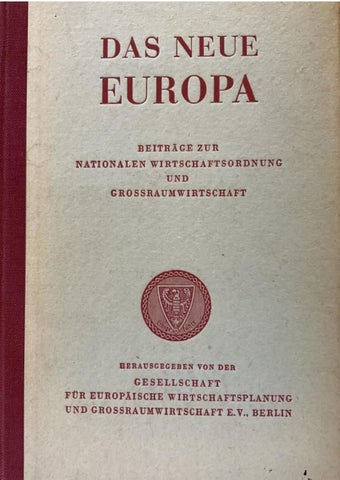
THE NEW EUROPE
The new Europe BEITRÄGE ZUR NATIONALEN WIRTSCHAFTSORDNUNG - UND GROSSRAUMWIRTSCHAFT
PUBLISHED BY THE
SOCIETY FOR EUROPEAN ECONOMIC PLANNING AND LARGE-SCALE ECONOMY E. V., BERLIN
MEINHOLD PUBLISHING COMPANY DRESDEN
ADOLF HITLER:
March 7, 1936 In front of the German Reichstag
"
How many worries would mankind and especially the
European peoples have been spared if natural and self evident living conditions had been respected and taken into account in the political shaping of the European living space as well as in the economic cooperation. But this seems to me to be absolutely necessary if one wants to achieve better and more satisfactory results in the future than at present. And this is especially true for Europe. The European peoples, after all, constitute one family in this world.... It is not very wise to imagine that in the long run it will be possible to maintain a community of nations of different legal order and legal value in such a limited house as Europe..."
Copyright 1941 by Meinhold Verlagsgesellschaft, Dresden Printed by C. C. Meinhold & Söhne GmbH, Dresden A1 Printed in Germany
THE SOCIETY FOR EUROPEAN ECONOMIC PLANNING AND LARGE-SCALE ECONOMY E.V.
The Society has the purpose and the task to promote the economic and cultural cooperation of the peoples and states in the European metropolitan area by researching their different bases of life, t heir different economic structures and the resulting mutual complementary possibilities in order to let Europe, the eternal central living space of the peoples of the white race, arise as a natural unity of life and space. The Society is registered in the Register of Associations and is composed of full, supporting and honorary members. Individuals or legal entities can become ordinary or supporting members. Their admission is decided by the Board of the Society. The Board also appoints honorary members fro m Germany and abroad. The members have the right and the duty to use the facilities of the Society, to participate in its meetings, to obtain its publications and to participate in its tasks.
The organs of the Society are: the Executive Board, the Füh rerring and the General Assembly. For the research tasks in the sense of the Society, special institutes can be established, committees and advisory boards can be formed on the proposal of the Führerring with the consent of the Executive Board.
The Board of Directors
Werner Daitz Envoy
First Chair:
Vice chairman
Ralf Brockhausen
and Chief Executive Officer:
Reichshauptquartierleiter
Alexander Bertelsson
PRESIDENT OF THE LEADER RING Werner Daitz Envoy
THE LEADER RING The ring of leaders gives direction to the work of the Society in accordance with its objectives.
Its members include: State Secretary Friedrich Alpers Reich Forestry Office State Secretary Herbert Backe Reich Ministry of Food and Agriculture Ministerial Director Dr. W erner Best Head of War Administration
Ministerialdirektor Staatsrat Prof. Dr. Wilhelm Börger Reich Ministry of Labor President Herbert Daßler Reich Office for Grain and Feedstuffs State Secretary Dr. Roland Freisler Reich Ministry of Justice Former Minister President Walter Granzow President of Deutsche Rentenbank Vice Admiral Dr. h. c. Otto Groos High Command of the Wehrmacht State Secretary Leopold Gutterer Reich Ministry for Popular Enlightenment and Propaganda Ministerialrat Prof. Dr. Martin Hammitz sch Director of the Dresden State Building School Ministerial Director Prof. Dr. Heinrich Hunke Head of the Foreign Department in the Reich Ministry for Public Enlightenment and Propaganda, President of the Adverti sing Council of German Industry State Secretary Wilhelm Kleinmann Reich Ministry of Transport, Deputy Director General of the German Reichsbahn State Secretary (retired) Gustav Koenigs Ministerialdirigent Wilhelm Marotzke Staff of Reich Marshal Hermann Göring Ministerial Director Dr. Willy Meerw ald Personal Advisor to the Fuehrer and Reich Chancellor
Ministerial Director Prof. Dr. R. Mentzel Reich Ministry for Science, Education and National Training, President of the German Research Foundation, Vice President of the German Research Council State Secretary Dr. Hermann Muhs Reich Office for Regional Planning Reich Office Director Willi Parchmann Ministerial Director at the Reich Forestry Office Reich Main Office Director Dr. Hermann Reischle Reich Office for Agricultural Policy Reich Main Offi ce Director Claus Selzner German Labor Front State Secretary Dr. Wilhelm Stuckart Reich Ministry of the Interior State Secretary Dr. Friedrich Syrup Reich Ministry of Labor State Secretary Hans von Tschammer and Osten President of the German -Italian Society and the German -Italian Studi ^ Foundation Prof. Dr. Theodor Vahlen President of the Prussian Academy of Sciences and Humanities
SCIENTIFIC ADVISORY BOARD The purpose of the Scientific Advisory Board is to promote and support the research and planning activities of the Society.
Chairman: Prof. Dr. Theod. Vahlen President of the Prussian Academy of Sciences
Vice-Chairman: Prof. Dr. Andr. Predöhl Director of the Institute for the World Economy at Kiel University
Its members include:
Prof. Dr. Wilhelm Hedemann Director of the Institute for Commercial Law at the University of Berlin Prof. Dr. Franz Heske Director of the Reich Institute for Foreign and Colonial Forestry, Hamburg Reinbek Prof. Dr. Reinhard Höhn Director of the Institute for State Resear ch at the University of Berlin Prof. Dr. Ernst Kelter Director of the Seminar for Economic History at the University of Munich Walter Lörch Director of the Central European Institute in Dresden Prof. Dr. Fritz Rörig Director of the Historical Seminar at th e University of Berlin Prof. Dr. Erwin Scheu Director of the Economic Geographical Institute of the Handels -Hochschule Königsberg (Pr) State Councilor Prof. Dr. Carl Schmitt Member of the Academy of German Law Prof. Dr. Karl C. Thalheim Director of the Institute of World Economics at the Leipzig Graduate School of Management ECONOMIC ADVISORY BOARD The Economic Advisory Board has the task of helping to orient the economic work of the Society according to practical experience and requirements. It consists of a Small and a Large Economic Advisory Board.
JOINT WORDS
In his speech on December 10, 1940, the Führer declared: "Man does not live from theories and not from phrases, not from explanations, not even from world views. He lives on what he can obtain fro m his earth, through his work, in food and also in raw materials. That he can process, and that he can eat." This word of the Fuehrer applies not only to Germany, but also to the whole of Europe, the eternal community of destiny of the peoples of the whit e race. Now that the Fuehrer, through the sharpness of the German sword, has liberated Europe from its outlived universalistic bonds, the European family of nations can reassemble itself in its common living space according to the natural weights of its pe oples into a more productive, crisis -proof order without coercion. A new European sense of community and continentalism will emerge - but not from theories, however impressive they may sound, but above all from the practical economic cooperation of the Eur opean peoples, which is necessary if they are to exist in the future independently of powers foreign to space and race. Common suffering unites more than common joy, and common hardship teaches common work and from it then develops a common faith: in this case the faith in Europe. That is why the European large scale economy is the peaceful means of education for a new Europe. The ideological differences of the European peoples that still exist today can best be bridged by common work. Thus, the most import ant means of educating the German people to become a community of the people was the general labor service, and thus the conscious European community of the peoples will also develop from the joint work of the peoples of Europe on a large -scale European economy.
AS A JOINT WORD for this work of the Gesellschaft für europäische Wirtschaftsplanung und Großraumwirtschaft e. V., the President of the Prussian Academy of Sciences, Prof. Dr. Theodor Vahlen, addressed the following open letter to the Pres ident of the Führerring of the Society.
Dear Mr. President Dear Party Comrade Daitz
The idea of "large -scale economy" has certainly appeared in many minds, especially since its necessity has been hammered into all thinking brains by our large-scale war . But your merit is and remains that you have been working, promoting and fighting for large -scale thinking in questions of economy for years by tireless work in lectures and publications. You have recognized the special position and task of continental Eu rope in the economy of the world, you have won over outstanding masters of economic thinking and acting for cooperation and you have created with the Society for European Economic Planning and Large -Scale Economy e. V. just the organ which was still missin g in the field of economy. This merit is all the more important because the resistance in this field was particularly difficult to overcome and therefore came late in the day; indeed, from an intellectual point of view, it has still not been completely ove rcome. You recognized and courageously advocated the necessity of a revolution in economic thinking already during the World War, the first phase of the world revolution. Our trade agreements, which came as such a surprise to the world on the principle of "performance for performance," are based on your outlines of a new trade policy, to which you pointed the direction arising from National Socialist thinking, as you did to transport, finance and credit policy. I have observed your courageous advance on the thorny path for years, congratulate you on your successes and am firmly confident that your work, your struggle will help National Socialism to an undisputed victory in the field of economics as well. Heil Hitler! Yours
Vahlen Berlin - Charlottenburg, January 14 1941
I. TO THE EUROPEAN MARKET REGULATION
THE FUNDAMENTALS EUROPEAN MARKET ORDER By Werner Daitz
In the last four hundred years the world oriented itself universally, after purely geographical points of view. By the addition of newly discovered earth parts the life of the existing biologically bound habitats expanded seemingly without restraint. This period is today finally closed: new earth parts cannot be discovered any more. The earth spaces newly ope ned in the last centuries become independent habitats by reorganization of the people resettled there from other habitats, as for example North America and South America. This regional division of the world into biologically bound habitats, according to biological and no longer according to geographical points of view, also causes a new political, economic, cultural and legal regionalism. This renewed binding of life to folklore and race, to national community and family of peoples, inevitably also brings a bout a new economic and legal order. The old view that the world economy is the sum of independently conceived individual economies is today doubly outdated. Just as the individual is bound to his ethnic community, his nation, its higher order of life and its living space - so today, in the further course of the reorganization of the world, peoples are consciously coming together to form biologically bound communities of peoples, families of peoples, with a common living space. Thus again a threefold bindin g of the economy arises. First: to the nation (as a national economy), second: to the family of nations (as a large -scale economy) and third: the bond of the large -scale economies with each other, in the exchange of services, as a new type of world economy . Thus we see everywhere in the Well as a principle of the present world revolution the slogan asserting itself: Biological regionalism instead of geographical universalism. It is realized in America in the call: North America to the North Americans! South America to the South Americans! In Europe, the same idea finds its expression in the new European metropolitan law and the new European morality: Europe to the Europeans! The European need must be covered first in Europe. In East Asia in the same way an E ast-Asian living space legal order arises: East Asia to the East Asians! And the Indian -Malayan family of peoples raises the demand: India to the Indians! The economies today thus become habitat economies. They are determined by the attitude, the lifestyle of the respective national community or family of peoples and the forces of their native soils and climate. The order of national economies and large -scale economies is therefore not 15
based on universalistic theories, such as free trade, international division of labor and the free play of forces in supply and demand, but on the law of life of the peoples and families of peoples. Similarly, economic law in national economies and large -scale economies will no longer be a legal construction as before, but will grow out of blood and soil. These new economic orders now find their practical effects in the market orders of the national economies and the mutual preferential treatment of the national economies in the metropolitan economies. Exemplary of such a l ife-law order of the economy is the new German national economy that emerged in the National Socialist revolution, which finds its most visible and characteristic expression in the National Socialist market order and economic guidance. In all three sectors of the economy it seeks to realize as perfectly as possible the supreme law of all orders of life, the law of autarky: to live in the first place from one's own space and from one's own strength. Freedom of food, freedom of raw materials, freedom of forei gn trade and freedom of gold - all in all, economic freedom - are the result. This new attitude of the National Socialist economy includes not only a German but also a European attitude. It no longer looks to foreign continents, as in the past, but first t o its nearest neighbors within the European family of nations to cover its needs beyond its own production. It thus proclaims a new European economic morality: European needs must first be met in Europe! This attitude of the National Socialist economy is only logical. For the pan European revolution of our day can only be accomplished through the national revolutions in Europe. Therefore, the National Socialist, the Fascist, the Falangist and the other revolutions of the European peoples, which still have to follow, are only national solutions of the pan -European reorganization, which has become necessary for world -political reasons. For today's European revolution, which aims at a political, economic and social reorganization of the common living space of the peoples of the European family of nations, was triggered by the fact that the newly discovered parts of the world, on which Europe believed it could rely for the last 400 years, are increasingly declaring their political and economic independence from Europe, are organizing their masses of people and space according to their own laws of living space, and are now ruthlessly pressing on Europe with their own weight. Thus European life, which can no longer adhere in foreign parts of the world, is rushing back into its original framework and must now reorganize itself here in order to develop a counter-pressure against the newly created weights which is great enough for the eternal core habitat of the peoples of the white race to be able, by its own strengt h, to consolidate anew its previous economic and political position in the world. This reorganization of the European peoples must develop a maximum of 16
political, economic and military fighting power and feudal might from Europe's own natural framework from Gibraltar to the Urals, from the North Cape to the African coast including the natural economic complementary areas of Western Siberia and Africa. Every people of Europe, which wants to remain, will therefore have to carry out the European revolution in its speciesappropriate way of life. The national revolutions of Europe are therefore national and European at the same time. Consequently, alongside the renewed faith in one's own people, there is also a faith in the European community of destiny. Thus, a new sense of life and continent awakens. In the same way that this new national attitude of the individual peoples of Europe requires a European attitude, the market order of the new economies also requires a European market order. The one is not feasi ble without the other in its ultimate consequences. Thus, the market order of Europe's nationally reorganized economies gives rise to the market order of Europe's large -scale economy. Europe as a living and economic unit establishes new rights and duties for the comrades of its community of nations. From the slogan "Europe for the Europeans", which demands that each people of Europe is first a citizen of its continent and only then a citizen of the world, follows in economic terms the duty: to satisfy Europ ean needs first in Europe and only then in parts of the world not belonging to the same region or race (European mutual preference). - It also follows, however, that the economic needs of the European family of nations must be met in the technically most p erfect way, with full respect for the sovereignty of the individual national economies, their quotas, prices, etc., without losses through unnecessary transport and intermediate profits, for the common good of Europe. From this new revolutionary insight th at the peoples of Europe form an inseparable community of peoples and thus of life and destiny, there arise unimagined prospects for an increase in the general standard of living. The idea of a united Europe demands that in the future it is no longer compa tible with the European duties of a people if it carries out its intra - and extra-European exchange of goods and services without regard for the other European peoples. While in the liberalist world economy the world was theoretically a single trading area through the most -favored-nation clause of the trade treaties, the Ottawa Treaties already created a trading area separated from the rest of the world by preferential tariffs, within which, however, the old liberalist economic order remained. The new econo mic areas, however, which are delimited and preferential, will also be organized within their area according to the principles of national economic management and planning and will not be held together only by the external means of tariffs (customs union). All this will find its ultimate expression in a European market and transport order. In the area of transport policy, for example, it will be necessary to 17
coordinate the maritime shipping of the European countries more closely than before and to regul ate their mutual competition to the detriment of Europe and to the benefit of other large habitats by means of European cooperation. The problem of excessive competition among European seaports, without regard to the common European interest, must also be brought to a new regulation. As a model for the future supply of Europe with one of its raw materials, namely wood and wood products, in the sense of a European large -scale economy and a European market organization, I refer to the processes described in the following article by Ministerial Director W. Parchmann: "European Forestry as a Model of Continental Market Regulation". The author, emerging from the school of R. Walther Darres, has done groundbreaking work here. If the production and exchange of the other raw materials of the food industry and the industrial economy are similarly organized in the European sense, there will be not only an as yet unforeseeable increase in production, but also savings in unnecessary transports and intermediate profits, w hich will benefit the standard of living of the European peoples. In this process, the individual national economies will not be dissolved, but will retain their national independence; indeed, they will actually gain it only through increased national divi sion of labor, which avoids monocultures as far as possible and excludes the principles of the English world economic system in the structure of the European large -scale economy in other respects as well. Thus, two main goals are to be achieved by this Eur opean market regulation:
1. a cheaper exchange by bringing together production and demand by the shortest route, avoiding the usual detours and intermediate profits, while fully maintaining the trade agreements, quotas, prices, etc., sovereignly concluded by the individual economies among themselves, 2. systematic promotion of European production and development of raw material sources, cultivation possibilities, etc., hitherto neglected in favor of foreign continents.
If it has already been possible with in the German and Italian national economies to achieve an unprecedented increase in performance, independence and enlargement of the national income by combining and directing all forces within the national economies in accordance with the laws of life, this will happen to an even greater extent in the case of a sensible and legally correct combination of the European economic forces. - Only very few people realize today what an enormous economic power a Europe united in a large European economy would repr esent. About 540 million people live in the 18
European living space. Although they make up only 26.6 per cent of the earth's population, they produce 45.5 per cent of the earth's basic production (raw materials and food). Compared to this enormous achiev ement of Europe, the shares of the other habitats pale. North America, with 24.8 percent of the world production, reaches only about half of the European production. Ibero America even comes to only 7.9 of the hundred, and the East Asian habitat with the Indian-Malayan together reaches only 16 of the hundred. Africa and Australia each have a share of only 2.9 percent of the world production of basic materials. A new Europe, united in a large -scale economy, oriented by market and traffic regulation and aware of all its tremendous economic forces, is also leading in the shaping of the rest of the world.
19
ECONOMIC FREEDOM FOR EUROPE By Gerhard Gebhardt, Essen
Shortly before the presidential elections in the USA, the full -time American "Journal of Commerce" wrote in a reflection on the economic development during the war: "The competent authorities of the United States must take measures to be applied in the generally expected economic war with Europe after the end of the war" (quoted aft er the V. B.). Clearly and unambiguously, it says "in the generally anticipated economic war." This voice is not isolated, and if one sees similar calls in other papers of the United States, this will only be seen as an underlining of the "general expectat ion." For the normal European, namely for the German, such omissions are at first completely incomprehensible. The German who still remembers the repeated statements of official representatives of the Reich or of leading German economic politicians on Germ an-American economic relations in the years before the war, who still remembers the explanations and attempts at understanding addressed to the American address with infinite patience, can hardly understand the reason for such "expectations". Such statements, however, are conclusive proof that the mere fact of a European union and the assertion of the claim of the European peoples to sovereignty in their own fiefdom and to access to the sources of raw materials in the zones of influence of Europe is suffici ent to be interpreted as an economic declaration of war. But they also show that the representatives of the Anglo-Saxon world economy have not recognized, and do not want to recognize, that the world today divides itself anew into racially defined and bound living spaces1) , which also want to secure their -economic foundations according to their own biological laws of life. This share of continental Europe with 45,5 of the hundred in the basic production of the world is all the more remarkable, as the popu lation share in the world amounts to only 26,6 of the hundred. These figures reveal like nothing else the economic strength of a united Europe, to which no other living space of this world is economically comparable. From this basis 1) the reborn peoples o f Europe have recognized the demand "freedom through self -defense", advocated by Werner Daitz for decades, as their law of life and their natural economic order. ²) 1) Werner Daitz: "Neuordnung Monatshefte, Episode 126/1940.
Europas
aus
Rasse
und
Raum".
NS. -
²) Werner Daitz: "Autarkie als Lebens - und Wirtschaftsordnung," NS. Monatshefte, Episode 129/1940. 20
The European peoples are becoming more and more aware today - and the voices from across the ocean only help to deepen this realization - that in the straitjacket of the Anglo -Saxon world economy they have surrendered their economic and thus also their political freedom for too long. This world economy was a straitjacket not only for the industrialized countries competing with England, but also for the raw material areas of the world. Its aim was to supply the British world power with the necessary raw materials without its own labor on the most favorable terms possible, to control the raw material purchases of the others - and thus their economic freedom - and finally to centralize production and sales to a large extent in order to be able to determine price and profit. This form of world economy - as a means of political pressure, combined with great economic profit opportunities - was successfully used by England not only in the colonial territories, but primarily for a long time against the European mainland. England's betrayal of Europe consists essentially in the fact that for centuries it has deliberately weakened the forces of Europe - the core area of the white race - and thus deliberately undermined Europe's self -sufficiency, i.e. life from its own strength and its own space. In order to checkmate Europe politically, England took three paths: the European raw material countries were penetrated capita l-wise, and the most important industrial raw materials were incorporated into the British monopoly system. The rest of European raw material production, as well as agricultural production, was exposed to competition with the world market dominated by England. Finally, England monopolized the raw materials of the colonial territories or deprived whole areas of European influence and exploitation by its policy of robbery. After all, England's hunger for land was by no means based on its own need or urge for activity, but served exclusively to maintain the basic law of monopoly. Versailles, which made Africa a British French domain, but which at the same time drew 2000 km of new customs borders in Europe itself, is proof of these methods, as is the fable sprea d by England of Europe's unconditional independence from raw materials. For Europe, the consequences of this British policy became visible not only in the biological and economic neglect of the European eastern regions, but also in the neglect of mineral r esources in most European states and in the permanent crisis of the European agricultural countries, not to mention the still unfulfilled European task in Africa. If it is noted today that valuable European mineral resources are still waiting to be tapped, or that, for example, the yields per hectare in the southeastern states are far below the normal level, that agriculture is completely inadequately equipped, that the purchasing power of some European states is too low, then the reason for all these phenomena is the disregard for the European laws of life under English influence. The means of control of this English policy was the world market 21
price. The result of the Anglo -Saxon world economy has been that England has turned the European law of life up side down. Instead of seeing the overseas areas as a supplement to Europe, it regarded Europe - especially since the World War - as an occasional supplement to its overseas sources of raw materials. The democratic "world economists" will naturally refuse t o let Europe be considered as something belonging together at all or even as a biologically and racially determined living space. They were citizens of the world after having brought the riches of the earth under their control. In fact, to use a word of Alfred Rosenberg, it is not possible to formulate the idea of Europe in such a way that it can be carried home in black and white. But even today, after centuries of turning away from the European domestic economy, there is still very tangible evidence of th e natural unity of the European area, which, according to an explanation by Werner Daitz, as the irreplaceable core habitat of the peoples of the white race, reaches from Gibraltar to the Ural Mountains and from the North Cape , to North Africa, and whose natural complementary and colonial spaces reach far across North Asia to the Sea of Okhotsk and the Bering Sea, and in the south deep into Africa. Crucial in this explanation of the European habitat is the emphasis on the biological -racial bases in contras t to the geographical boundaries that have been emphasized alone up to now. This racial Monroe doctrine, as first recognized and formulated by Werner Daitz as a new principle of order, has very real foundations. The fact that, in spite of all spatially ali en influences, there has not yet been a country in Europe - apart from England - which is not anchored in Europe with more than half of its trade turnover, speaks for itself. If, by the way, Africa and the Middle East are included in the European economic area (including the Soviet Union), which goes without saying in view of the economic affiliation of these regions, then Europe's internal trade comprises more than 60 % of imports and about 75 % of exports of all countries. The strong production -economy commitment also underscores the natural large-area relationships. For example, the high share of raw materials and semi-finished products in Europe's domestic trade, accounting for almost half of all goods, is striking. This confirms that there was already a n extensive division of labor in Europe. It is well known, for example, that countries which can undoubtedly meet their domestic needs nevertheless exchange certain raw materials or semi -finished products, such as coal, iron and textiles. The exchange of goods within Europe is therefore by no means limited to the primitive exchange of finished goods for raw materials," but shows a complicated interdependence, such as exists between the individual provinces of a country. In the future, it will be necessary t o build on these natural conditions of the continent, which have been preserved for centuries despite the neglect of European livelihoods by the leading political powers. 22
It is almost unknown how much the preconditions for this were already given so far. Anyone who has so far believed in the English propaganda formula of Europe's unconditional dependence on food and raw materials will be astonished to hear that Europe, including the Soviet Union, has so far had a share of no less than 45.5% of the total basic production of the world, i.e. of the production of unprocessed food and raw materials. Of the calculated value of world production of RM 258 billion in 1937, Europe accounted for about RM 117 billion. Compared to this enormous European production, th e shares of the other parts of the world pale into insignificance: North America, with 24.8 percent of world production, reaches only about half of the European production value. Asia, including India, accounts for only 16 percent, Ibero America for only 7 .9 percent, and Africa and Australia each have a share of 2.9 percent. In general, it is necessary to counter some views which have become widely accepted among the general public and which are nevertheless just as wrong as they have often enough been misu sed by certain political tendencies to weaken the European position. This applies especially to the role of agriculture in the overall European economy. Is it at first sight astonishing that of the total production of the world. While at first glance it is astonishing that more than three quarters of the world's total production of basic materials is accounted for by agriculture and not by mining raw materials, it is even more surprising that in Europe agriculture accounts for more than 80 percent of the pr oduction of basic materials. In 1937, Europe accounted for 47 percent of world production of agricultural products. European agriculture, which is so often neglected under the impression of enormous industrial production, thus accounted for almost half of world production of basic agricultural products. The next most important continent is North America with only one fifth. Europe also leads the rest of the world in the production of non -agricultural basic products (especially mining), although at 40.7 perc ent it is only just ahead of North America at 39 percent. Europe's alleged dependence on imports is strikingly refuted by such figures. Compared to the value of the total European basic production of RM 117 billion, the European import from other continent s with a total of RM 18.1 billion in 1937 looks quite modest. The share of imports in Europe's total consumption of basic products is therefore unlikely to have exceeded 10%. Despite its own enormous production, Europe is nevertheless the most important importer on the world market. In 1937, it purchased more than half of the goods put on the market by the other continents, primarily raw materials and foodstuffs. This unique position in the world as a major producer and importer is the best indication of th e superior economic power of the continent, which is not even remotely equaled by any other major area. This concentration of the world's economic activity in an area which, including the 23
Soviet Union, covers only one -fifth of the world's land area and only onefourth of the world's population is not clarified by the fact alone that the European countries have each accounted for more than two -thirds of the world's exports of manufactured goods in the last ten years. Much more decisive are the cultural le vel and the internal consumption of these 570 million people and especially of their core in Central Europe. With the exception of a relatively small remainder, this consumption is covered from within the continent, but its importance must not be underestimated. For the future orientation of the European raw materials industry, it will therefore be crucial to adapt the hitherto almost wild growth of European production to the new political objectives of the continent. The keyword here is "economic freedom". It is a matter of enabling the European peoples to live again from their own strength and their own space. A united Europe, freed from British domination, cannot afford to be hampered in its freedom of action in an emergency by supply gaps in vital raw ma terials, either accidental or created by the Anglo -Saxon world economy. Those raw materials which Europe needs in case of emergency for the vital supply of its population and for the maintenance of its armaments must be permanently available to it in suffi cient quantities, either in Europe itself or in the vicinity; everything which goes beyond this framework, and that is no small matter in view of the high standard of living of the European peoples, is a matter of world trade. In assessing the European sup ply situation to date, which must be the starting point for all future considerations, it is not so much the fact that Europe had overseas imports of RM 18.1 billion in 1937 that is decisive - this may also be more or less the case in the context of future world trade - but the composition of imports. An examination of merchandise imports shows that more than one third of the value of imports to date has been accounted for by five commodity groups, namely vegetable oils and fats, metals (except iron), texti les, fuels, and rubber. Since all these materials are important for economic freedom, this already shows the gaps in the necessary self -sufficiency. Summarizing the results of Europe's supply of raw materials to date, it can be seen that the continent has the advantage over any external threat of assured food freedom and a supply of the most important industrial raw materials, namely coal and iron, that is not too disruptive. The food supply has so far shown, apart from minor tensions, only a perceptible g ap in the supply of fat and fodder. This gap may not seriously threaten economic freedom, but it is at least unpleasant. In industrial raw materials, the level of self -sufficiency necessary to maintain economic freedom has not been reached in nonferrous metals, various steel refining metals and rubber.
24
On the other hand, it can be assumed that the supply of textile fibers and fuel is sufficient to maintain the vitality of the economy. The supply of textile fibers and fuel, on the other hand, may be assu med to be sufficient to meet vital requirements in an emergency. That it would be desirable to have a greater degree of freedom of action in textile fibers and fuels is another matter. The face of this record of past supply corresponds to the earlier econo micpolitical disruption and lack of plan in the pan -European economy, and to the indirect or direct influence of England on supply and the production of raw materials. It does not require great foresight to say that after the dismantling of the artificial barriers within the European living space, which were erected above all in Versailles, and the realization of a genuine large -scale economy, some of the weaknesses which have existed up to now will be reduced of their own accord. But this cannot be enough for the future. Securing economic freedom is a political task and will be realized with political vigor, just as it has already been done successfully in Germany and Italy in the years before the European war. Three clear demands for the future emerge fro m the experience gained so far: 1. strengthening Europe's natural agricultural and industrial raw material production, 2. strengthening of industrial (synthetic) raw material production, 3. generous development of Africa and the areas of the Middle East, i .e. the natural European supplementary areas. The question of the economic efficiency of such an increase in self -production, which has arisen on various occasions in the past, is already answered by the orientation to the extent necessary to secure econom ic freedom, which is to be determined in detail by the political and economic policy leadership. In any case, the production of such raw materials, which in case of emergency will determine the freedom and life of the European peoples, can never be paid for too dearly. It is already possible to say with certainty that, within the framework of a large -scale European economy, apart from the gap in the supply of metals, the bottlenecks in the supply of raw materials can be widened without further ado to the po int of covering the security requirements necessary for economic freedom. Experience in the German Four-Year Plan has shown that synthetic production can continue successfully where the efficiency of the soil actually ceases. Thus it is already clear that Europe, left to its own devices - apart from certain tensions in the metal supply, which could be compensated for by an appropriate stockpiling economy - would remain quite viable and, above all, capable of defense. In all 25
considerations of the future, however, one must not disregard the natural supplementary economic areas of the continent, namely Africa, the Middle East and the North Asian region with their enormous reserves, most of which are still untapped. Including these supplementary areas, Europe 's economic freedom is more than assured.
26
EUROPEAN FORESTRY AS A MODEL CONTINENTAL MARKET REGULATION By Reichsamt Director W. Parchmann Ministerial Director at the Reich Forestry Office, Berlin
By large-scale economy I mean th e union of the economies of independent countries in a larger area for the purpose of meeting the necessary demand for goods of all kinds of the countries belonging to the large area through the exchange of national products, while eliminating as far as po ssible trade or economic policy obstacles which still lie in the nature of the previous economic traffic from individual state to individual state. The ultimate goal is therefore to achieve the greatest possible self -sufficiency in the metropolitan area, without excluding foreign trade, which an individual state rarely achieves, especially because vital materials such as ores, coal, wood, etc. are not available in the necessary quantities in every country. Nothing, therefore, could be more natural and would correspond more to a rational economy if those states were to unite in an economic bloc which are already spatially dependent on one another and which, through such a union, would have the possibility of securing the vital needs of their peoples through m utual exchange of their national products. The liberalistic and highly capitalistic economic system which had prevailed up to that time was an extraordinary obstacle to such a union, which was not intended to limit but to strengthen the economic independen ce of the individual economies uniting to form a large -scale economy. The ultimate goal of this economic system is the domination of the economies of other countries and their penetration with capital for the purpose of making these peoples completely dependent and in bondage. Therefore also again and again the demand for free trade, under which cover the above goal could be realized best. Therefore also the refusal of each economically , meaningful order in the interstate economic traffic with the goal of securing also the vital need of the other People. To try to form a large economic area on the basis of liberalist, high -capitalist ideas would be to make it unviable from the outset. If these efforts are to be a "living success," they must be backed by the will to build up the European economy, i.e. the measures must be linked to the promotion of both the combined economies of the metropolitan area and the individual economies. The German economy has left the ground of the liberal, high -capitalist economy and is expanding this inner -German economy more and more in the 27
sense of the National Socialist economic management and world view. If now the reconstruction of the European economy begins, we believe to be entitled to take the reconstruction of the dist urbed European economy in hand, because we have thrown overboard the liberal and high -capitalist economy, which, as already noted, is the greatest obstacle to an economic understanding of the peoples. The construction and leadership of a large area can only lie with a state that has already freed itself from the liberal and high capitalist economic obstacles. The German forestry and timber industry was the first to fight liberalism and high capitalism in practice and to influence these branches of the econo my in the direction of the National Socialist economy through its market organization, which governed all parts of the forestry and timber industry from production to consumption, including regulation of imports. The genuine market order has proven its use fulness in peace and in war, and thus its applicability as an instrument for overcoming liberalism and high capitalism in general. These branches of the economy, which have been brought together today, also recognized the necessity of a large -scale economy at an early stage and began the preparatory work for its construction some time ago. This will be discussed in the following. Europe is to be seen as an economic body whose organically connected links are the individual economies of the countries, which complement each other. As already noted, the organic flow of the overall economy, which once existed, albeit in a very simple form, has been disturbed by the liberal and high capitalist economic form. To restore the organic process, or in other words, to re establish the mutual exchange of goods on the basis of need, had therefore to be the goal. The achievement of this goal was a long way off, given the more or less positive attitude of the various countries toward the liberal and high capitalist form of eco nomy. It was only through the war that the realizations were loosened up, as evidenced by the pronouncements of leading European statesmen in recent months. In the years after 1933, the forestry and timber industry, foreseeing that a change of attitude wou ld one day occur, contributed one building block after another, thus doing valuable preparatory work on which it is now possible to build. The arrangements made in the course of the last few years, which can be described as preparatory work for the creatio n of the Greater Region, were based on the principle that the individual economies of the countries which would later unite to form a Greater Region had to remain independent. The connection between these individual economies was to be as close as possible in order to ensure a trusting and profitable cooperation as the first prerequisite for the Greater Region economy. Furthermore, this cooperation had to be set up in such a way that all groups of an economic sector, from the 28
producer to the consumer, i. e. all those who have an interest in the course of the economic process, could also express their views on the most expedient way of handling economic relations. The latter is of importance. In the liberal big-capitalist economy, the groups involved in the course of the economic process were either played off against each other or pushed back and raped by the strongest group in each case. In accordance with these principles, the forestry and timber committees established jointly with the foreign countries i n the years following the assumption of power were set up as institutions to initiate cooperation. To ensure complete impartiality, the meetings were always chaired by a representative of the government of the country where the committee met. If the representatives of the business community, at all levels of the process, are brought together and led by a government representative who has the greatest possible responsibility in his country for the branch of industry concerned, he is in a position to shape th e decisions in such a way that they also have a chance of being implemented, and this in both countries, because the head of the other delegation is in most cases again a responsible government official in the branch of industry of his country. The best experiences have been made with such forestry and timber committees. They have not only promoted cooperation between the forestry and timber industries of two countries, but have also provided practical assistance in the form of joint work. A not insignifica nt part of the German timber import has been arranged by these committees, which, in so far as their arrangements have trade implications, are again to be regarded as subcommittees of the governmental committees. In addition, friendly relations have been e stablished between the foreign and German participants through these committees. These have very often helped to resolve disputes quickly and fairly. A major contribution to such a solution was the fact that & I convinced the foreign participants in the co urse of the negotiations that Germany was also interested in the economic development of the other country and put aside demands which obviously endangered this development. Such forestry and timber committees were created over the years with the following states: Italy, Bulgaria, Yugoslavia, Romania, Hungary, Slovakia, France, Sweden, Latvia, Estonia, Lithuania. With other countries the formation of the committees is in progress. On the basis of the agreement with the above -mentioned countries, the composition of the committees has been made in such a way that the forest producer, i.e. the forest owner, then the processor and the distributor (trade) should always be equally represented by both the one and the other state. I have already explained the reason s for this measure above. 29
Regarding the work of the forestry and timber committees, the following is to be noted, whereby I limit myself to stating only the basic principles. The company was interested in the development of the forestry and timber industry in the country and put aside demands that apparently endangered this development. Such forestry and timber committees were created over the years with the following states: Italy, Bulgaria, Yugoslavia, Romania, Hungary, Slovakia, France, Sweden, Latvia , Estonia, Lithuania. With other countries the formation of the committees is in progress. On the basis of the agreement with the above -mentioned countries, the composition of the committees has been made in such a way that the forest producer, i.e. the fo rest owner, then the processor and the distributor (trade) should always be equally represented by both the one and the other state. I have already explained the reasons for this measure above. Regarding the work of the forestry and timber committees, the following is to be noted, whereby I limit myself to stating only the basic principles. The top priority for every task to be solved was the principle of linking the forestry and timber industry of the foreign country with that of Germany by means of suitab le measures, i.e. to initiate joint development work in the course of time. The German demands for timber were based, among other things, on this principle, in that emphasis was placed on bringing in the timber surpluses to the extent that they were needed by the German market system. The basic idea of a large -scale economy, i.e. to mutually promote the economies of the countries by exchanging surpluses, was thus already largely realized in the field of forestry and timber. Furthermore, it was the task of t he above-mentioned committees to make practical suggestions that were suitable for improving and deepening the forestry and timber relations of the countries to the greatest possible extent. The committees were particularly suitable for this purpose, since their members came from forestry and timber industry practice. In the course of the years, many valuable proposals of the practitioners of the two countries in the mentioned branches of economy, originating from the economic life, have been realized by th e governments. Without this joint work with the countries in question, the German timber supply would not have been as well secured as it is, and the economic process would not have run as smoothly in peace as in war. The fact that, with the help of the fo restry and timber committees, which I call the building blocks of a large -scale economy, it was possible to reach fixed price agreements with some countries, which made possible greater security and consistency in the movement of timber from country to cou ntry and essentially eliminated speculation, contributed significantly to this smooth flow of interstate forestry and timber relations. The latter is very crucial. After all, speculation was an. The latter was crucial, since speculation was an effect 30
of the liberalistic-materialistic way of thinking, which tried to prevent, wherever possible, the honest exchange of surplus products from country to country. Wherever community work succeeded in creating fixed price relations in the form of margin prices, speculation ceased to a large extent and, after price and quantity were thus ordered, a calming down of the markets occurred in most cases, which, as was repeatedly acknowledged by foreign countries, had a particularly beneficial effect. The decisive facto r, however, was the establishment of firm economic relations from country to country, which were further developed in the course of the years and led to the realization that, given the nature of the joint development work, in particular the firm quantity a nd price relations and the security in the acceptance of the quantities of wood to be imported by Germany, the timber surplus country was also protected against sales difficulties in the timber sector in its dealings with Germany. But this already brings u s to a characteristic that must necessarily be inherent in the metropolitan area, the crisis -proofness of the economy, a characteristic that the representatives of the liberal and materialistic economy often deliberately prevented, because they very often had the greatest merits in times of crisis, of course at the expense of the honestly creating people. In Germany, the forestry and timber industry is absolutely crisis -proof. Foreign forestry and timber industries, whose countries are friends of ours and w ith whom we have initiated economic development work over the years, are making up their minds to become more crisis -proof in the field of forestry and timber. It would be too much to describe in detail the development work of the forestry and timber indus try committees in the context of this short essay. They are multifaceted, since their work covers the entire economic policy field of forestry and timber management in the contracting countries. The main task has always been to shape forestry and timber re lations through joint development work by all the groups involved in the countries with which we negotiated. The tasks of the above -mentioned committees were extended more and more in the course of the years and condensed, especially in Romania, with the simultaneous initiation of similar efforts in other states to a joint work in the sense of a large-scale economy. It is known that especially England and France, following their genuinely liberalistic and highly capitalistic method, tried again and again to penetrate especially the Balkans with huge financial resources. The purpose of this penetration is well known and far from the intention to do honest, common construction work with the help of huge sums of money. The intention was rather to subjugate the loaned country economically. On the other hand, in the course of the work of the forestry and timber committees, it became 31
apparent that foreign economic politicians concerned about their country recognized these dangers and themselves sought another fo rm of cooperation. This form was found in the German -Romanian agreement of May 13, 1939, according to which the forestry and timber relations of these two countries were substantially expanded. In this agreement, the focus was no longer on capital, but on German labor, which joined with Romanian labor in joint construction. In the aforementioned contract, Germany made its cooperation available for the development of Romanian forest areas and for the further intensification of the Romanian forestry and timbe r industry. Not only was the expansion of the forest road network, the supply of means of transport, machinery, etc. considered, but Germany also declared its willingness to undertake the construction and expansion of wood industry and industrial facilitie s in cooperation with the Romanian forestry and wood industry. In order to establish close economic relations between the two countries in the field of forestry and lumbering, it was agreed that the two countries would work together to set up a joint fores try and lumbering model and training operation for a long period of time, i.e. a large area of Romanian forest was to be combined into a forestry unit and managed by foresters from both countries under the leadership of a German representative. In connecti on with this, timber industry plants of all kinds were to be established in this forest area. This model operation was to serve at the same time as a teaching and experimental operation for foresters and wood economists of both countries. The students of t he Romanian forestry schools were to carry out their practical work in this training enterprise. Furthermore, it was agreed that the benefits resulting from this deepening of the economic relations in the field of forestry and timber management should equa lly benefit Germany and Romania. Supplies from Germany for the jointly operated forestry and timber industry were to be compensated by increased deliveries of timber. Here again the principle of a large -scale economy has become a reality, in that two countries not only exchange their surpluses, but the paths to an increased exchange of goods have been opened. In this treaty, there is no longer any talk of capitalist penetration; instead, labor is exchanged for labor. In execution of this treaty, Romania in itially made available 34000 hectares of forest, which were given to Germany on lease for 30 years. In the course of these years, as already mentioned above, this forest area is to be turned into a model farm through joint work. So there is no question of exploitation of the forests in the liberal and high capitalist sense. It is very decisive that this is not only an educational enterprise, but that the agreements contribute to increasing the trade between Germany and Romania, which was seen as the 32
main task on both sides. The leased company was taken over by the "Deutsche Forst- und Holzwirtschaftsgesellschaft" (German Forestry and Timber Company), founded in Berlin, which in principle has to export the timber material produced by this company to German y, as far as the German "Marktordnung der Forst - und Holzwirtschaft" (Market Organization of the Forestry and Timber Industry) requires the assortments. The wood material not required by Germany remains in Romania or can be sold to where it is needed. This opens up possibilities for a beneficial capital formation abroad, which again benefits both countries together. The branch of the "Deutsche Forst- und Holzwirtschaftsgesellschaft" is the "Silvarom" as a company under Romanian law with its headquarters in Bucharest. In order to emphasize the common will to build up, it is equally staffed with German and Romanian representatives, while, as already noted, the management is in the hands of a German representative. In the future, the "German Forestry and Timber Company" will have to solve tasks that go far beyond the scope of a commercial enterprise. It is one of the instruments of a joint effort to build up the economies of two countries. In the same spirit and with the same objective, corresponding agreements have also been reached in Slovakia, which are already beginning to have an effect. In the foregoing, I have tried to briefly describe the way in which the German forestry and timber industry has made preparations for the establishment of a large-scale economy through planned work. I have already emphasized that these are only building blocks. However, a foundation on which the forestry and timber industry can now continue to build has been laid by the many years of intergovernmental work of the forestry and timber industry committees and the far advanced, practical, economically linking work mentioned above. With the large-scale economy, the forestry and timber industry is not even entering new territory. It only needs to continue the work it has started in order to reach its goal. Of course, general, fundamental questions of economic policy still have to be solved if the entire economy now wants to enter the field of large-scale economy. The solution of these broader tasks is no longer the responsibility of the forestry and timber industry as such, although it is extremely interested in it. The task of the forestry and lumber industry was, first of all, to eliminate the effects of the liberalistic -high-capitalistic form of economy, the insecurity and disconti nuity in Germany, which has been done, and, secondly, to initiate the same security and continuity in the interstate, lumber industry traffic by means of suitable measures. The latter has also been achieved to the greatest possible extent. Thus, however, s ome preconditions for the formation .of a large -scale economy have already been created. This is all the more the case in the forestry and lumber industry, since forestry and lumber circles abroad are increasingly recognizing that the liberal and highly capitalistic economy has run its course and must be replaced by a new form. 33
A substantial part of the foreign forestry and timber industry is now on this path of realization - and not to the detriment of their honestly working and creating peoples.
34
SIGNIFICANCE OF THE TROPICAL FOREST IN THE EUROPEAN-AFRICAN METROPOLITAN AREA By Professor Dr.-Ing. Franz Heske Director of the Reich Institute for Foreign and Colonial Forestry, Hamburg -Reinbek
One of the most essential idea s, around which the present struggle is concerned, is large -scale economy and planned economy. As a result of overpopulation and industrial civilization, with its generously developed traffic and high standard of living, a planned development and use of la rge, organically coherent living spaces, controlled in the sense of the overall interests of a large living community of several peoples fatefully dependent on each other, within which all important living needs of the modern cultural standard can find the ir satisfaction, either self -sufficiently or by way of complementary exchange with other living spaces organically coherent in the same way, has become inevitable. The form of these future large areas, as a result of the increasing importance of the tropic al zone as a source of food, raw materials and energy, urges a north -south orientation. For climatic reasons alone, the centers of modern industrial civilization will mainly be located in the temperate zone, because here alone human energy and inventiveness do not flag. But these centers of civilizational power need to be supplemented by tropical areas, whose warm and humid climate makes them the vegetal reserves of mankind and the most important and productive future sources of food and raw materials for a griculture and forestry. Thus, in the West, the great Pan -American area is in the process of formation; thus, the island empire of the Far East, struggling for its fiefdom, seeks a complement in the tropical south of this area, and thus, Europe -Africa also forms a natural, cohesive, complementary great area. Europe and Africa are striving towards each other as the natural halves of a self -sufficient space extending from north to south, whose power and wealth will result from the union of European intelligen ce and energy with African natural potencies. - Among the sources of raw materials to be tapped and the enormous organizational tasks to be solved, the forest and forestry occupy an important position. This follows from the fact that the forest is a source of raw materials, the importance of which is constantly increasing in the context of modern industrial civilization, but at the same time it is the bearer of indirect benefits, so-called "welfare effects", on the undisturbed functioning of which, in the long run, the life and death of human culture literally depend. Even if the 35
development of forestry resources in the European part of the region (especially in Siberia) will receive valuable support in the wake of the political and economic reorganizatio n of this part of the world, especially in the sense of a better utilization of the forests of the wood surplus countries and a better supply of the wood demand countries, major forestry tasks of Europe also lie on African soil. The forest area of Africa a mounts to about 414 million hectares, of which, however, only about 175 million hectares can be considered as timber -rich closed high forest. Of this total forest area, 7.4 million ha are located in the north, i.e. in Tunis, Algiers and Morocco, which are forested with a total of 2.7% of their land area. However, the center of gravity of the African forest is in the west and in the center of this greater part of the country. From Senegal to Gambia, Portuguese Guinea, Sierra Leone, the Ivory Coast, the Gold Coast, Togo, Nigeria, Cameroon, Spanish Guinea, and on to French Equatorial Africa, the Belgian Congo and Angola, a forest area of around 300 million hectares extends. These parts of Africa are forested for almost one -third of their total area. The south and east are relatively sparsely forested. South Africa, i.e., German Southwest, the Union, Rhodesia, Basutoland, and Bechuanaland, have a combined area of about 73 million ha and just under one -fifth of their total land area is forested. East Africa, from British Nyassaland via Portuguese East Africa to German East, Kenya, Uganda, via Italian East Africa to Anglo -Egyptian Sudan, including Madagascar, has a total of 30 million hectares of forest, which corresponds to a forest cover percentage of just under 4 . Already from this it is to be seen that the actual forest raw material wealth of Africa is in the west and in the center. This large tropical forest hypha is of particular importance for the supply of raw materials to the industrial economy of the Europe an-African metropolitan area. The transport situation is favorable in that the sea route is relatively free from passage through politically jealously controlled straits, in that the forest terrain is relatively easily accessible and can be developed witho ut difficulty, in that the rivers have a favorable stream direction and can be well used in part for the transport of forest products. The forest 'is rich in wood species, the characteristics of which are expected to satisfy all the essential requirements of modern wood utilization. Some of these species can be grown well and, if they are fast growing, will be able to be mass produced in short rotations. Rational development of these West and Equatorial African hyaeas must be approached from various angles. The most important prerequisite remains the opening of this raw material source to the overpopulated and raw material -hungry countries of Europe. If one considers that the wood consumption of Germany amounts to 90 Mil. cbm annually and that of it the dome stic forest can cover with lasting use only 36
approximately two thirds, while an amount of 30 Mil. fm, which, moreover, will continue to grow in the future, remains uncovered, and if one further considers that even after the reorganization of the European continent, only a part of this gap can be satisfied by importing from the surplus countries of this large region, then it is obvious how fruitful this hunger for raw materials can influence the generous technical development of the large virgin forests of Africa. The inadequate knowledge of the technical properties and practical usability of the numerous African forest products can only be eliminated by systematic material testing, which, supplemented by appropriate state controlled advertising, will open the way to the consumer economies of Europe. The introduction of modern transport facilities adapted to the utilization requirements of tropical forests and a reduction in sea freight will promote the rational exploitation of this raw material source from the economic point of view. As the exploitability of even those by -products hitherto considered unusable develops, the extraction costs per unit of material will fall and with them the prices of the new raw materials. Rational planning, technically sophist icated equipment and investment of larger capital will put forest utilization on a more generous footing. The intensive use of the African forest will be paralleled by the need to maintain and improve its substance through appropriate measures of planned forest development. - This requires a thorough knowledge of the silvicultural biological properties of the numerous wood species of the African forest, most of which are still unknown to us even from this side. A preservation of the forest in spite of inten sively developing utilization will not only be necessary for reasons of maintaining or even increasing the possibility of utilization in the long term, but also for reasons of an undiminished function of the welfare effects mentioned above (balancing of the water balance, prevention of soil erosion, mitigation of climatic extremes, etc.). ), but also because the tropical primeval forest soil is in many cases characterized by a conspicuous lack of nutrients and requires a permanent forest cover to preserve i ts nutrient capital, i.e. avoidance of larger open or clear-cut areas. The systematic development of the African forest, which is as important as it is difficult and interesting, will require in particular the preparatory and constantly expanding cooperati on of the scientific community, which in most cases must first establish the foundations of African forestry and therefore requires generous support.
37
OPPORTUNITIES OF THE GERMAN AND EUROPEAN FACE SUPPLY By Walter Hübener Reich Representative of the Reich Office for Milk Products, Oils and Fats, Berlin
How long ago was it that we National Socialists were ridiculed or laughed at with pity by liberals of all shades because of our "dreams" of a large European economic area? In 1930/32, Werner Daitz, t he old champion of the idea of a large European economic area, as economic representative of the Reichsleitung of the NSDAP, had given the author the task of propagandistically representing the shift of the German demand for oilseeds, vegetable and animal oils and fats from Lake Ühersee to the continental European area; in doing so, he met with the same lack of understanding in a limited economic area that Werner Daitz encountered with his comprehensive basic ideas at every turn. Almost 10 years have passed since then, 7 years have passed since the assumption of power, and today the "reveries" have become a political reality insofar as our future economic planning has to and can essentially adjust to the large-scale economic idea after the German sword paved the way for it and swept away the possibility of the political counterplay of international forces. Just as the political and cultural fiefdoms of the future will be governed by the order of Volksbürger - Bürger Europas - Weltbürger, so in our economic planning the order of Großdeutsche Wirtschaft Europäische Kontinentalwirtschaft - Weltwirtschaft will have to be striven for in the future. Thus, we will meet our most vital needs first in our narrower German economic area, secondly in the wider European e conomic area, and only finally in the large overseas area for those needs of life which cannot be satisfied in Europe. Now that the nonsense of most -favored-nation treatment has long been broken, the conscious and consistent observance of this sound princi ple of economic and trade policy means the release of tremendous economic energies not only for Germany but for the whole of Europe. For this order of priority in meeting demand will take not only Greater Germany but continental Europe as a whole out of th e influence of the unbound forces of a so -called world economy and make it forever crisis -proof, just as Germany has 38
succeeded in doing in recent years by its own idiosyncratic organization of foreign trade and the domestic economy. Only in a crisis-proof European economy can the highest development of the productive forces be expected. In a large-scale European economy, the main thing will be to intensify agricultural production. Industrial Greater Germany not only has a peak in its industrial producti on, but, through its principle of market organization, it has also achieved a level of performance in its agricultural and rural production that makes the performance of other European countries, especially those with a predominantly agricultural orientati on, seem stunted. Thus, in 1938, bread and feed grains were harvested per hectare in tons:
In Germany In the countries of Southeastern Europe In the former Poland in the former Czecho -Slovakia in France in Italy
Wheat 2,34
Rye 1,75
Barley 2,20
Oats 2,15
Corn 3,00
1,41 1,24 2,02 1,86 1,58
1,11 1,23 1,88 1,29 1,35
0,95 1,16 2,01 1,70 1,20
0,86 1,17 1,81 1,68 1,40
1,35 1,43 2,23 1,70 2,20
Higher yields per hectare than Germany achieved in part better soil conditions and more favorable climatic condit ions only:
Holland with Belgium with Denmark with
Wheat 3,44 3,15 3,51
Rye 2,27 2,50 1,95
Barley 3,25 2,88 3,42
Oats 3,00 2,91 3,05
Corn -
The lower yields in the other countries, on the other hand, cannot be explained by poor soil or climatic con ditions, which tend to be better there than in Germany. As a result of decades of neglect of the agricultural production forces of France and southeastern Europe in particular, there has been a European surplus demand for bread and feed grains, protein fee ds, and oils and fats of vegetable and animal origin, which sought coverage in the large overseas area according to the principle of the cheapest price. 39
France covered its subsidy requirements for protein feeds, oils and fats essentially in the colonial area it dominated. Even with a moderate intensification of its own agricultural cultivation, it could in a short time not only become self -sufficient in its bread and feed grain supply, but contribute to the total European supply with surpluses. Therefore , we can at least disregard France in our considerations about the continental European supply of needs, no matter how the colonial question will be decided. Since the agricultural areas available in Europe for the cultivation of cereals and oilseeds are t o a large extent interchangeable, it is to be investigated whether continental Europe can make itself independent in the supply of these most important foodstuffs if the European countries emulate the German model in the intensification of the agricultural areas and how the supply picture of Greater Germany in this case emerges in the overall continental European area. It is not intended to examine the obstacles to such planning arising from the mentality and economic conditions of the various European peoples; even the theoretical calculation of the production volume resulting for continental Europe from the above point of view must be interesting and informative for the evaluation of the possibilities of European economic planning. In 1938, bread and feed grains were harvested:
In thousand tons Barley Oats
Wheat
Rye
in Germany including Ostmark in Bulgaria in Hungary in Romania in Yugoslavia Southern Europe total
6000 2150 2700 4820 3030 12700
9200 190 810 520 230 1750
4550 360 720 830 420 2330
former Poland former Czecho-Slovakia Total above 6 countries
2170 1810 16680
7250 1910 10910
1370 1330 5030
Corn total
Cereal
6800 100 310 460 330 1200
380 530 2660 5120 4760 13070
26930 3330 720 11750 8770 31050
2660 1400 5260
130 370 13570
13580 6820 51450
However, the German hectare yields of recent years, applied to the areas under cultivation to date, give for those European countries which would be particularly suitable for supplying Greater Germany:
40
For
In thousand tons Wheat
Rye
Barley
Oats
Corn
Cereal total
more than before
in Germany including Ostmark in Bulgaria in Hungary in Romania in Yugoslavia Southern Europe total
6000 3260 3800 8950 5050 21060
9200 330 1090 840 450 2710
4550 500 1000 2810 940 5250
6800 320 480 1400 800 3000
380 2100 3530 15000 8530 29160
26930 6510 9900 29000 15770 61180
3180 2700 17250 7000 30130
former Poland former Czecho-Slovakia Total above 6 countries
4100 2100 27260
10320 1780 14810
2600 1450 9300
6000 1660 10660
260 540 29960
23280 7530 91990
9700 710 40540
The theoretical additional yield calculated in this way therefore amounts to 40.54 million tons. This additional yield, again based on German average yields, corresponds to a total saved cultivation area of 16.82 million hect ares or a reduction in the cereal cultivation area required for the previous production volume from 39.46 million hectares to 22.64 million hectares. Based on German yields per hectare, only 4.0 million hectares of the saved acreage would be needed to meet continental Europe's current import requirements for bread and feed grains, which total 9.60 million tons. This would mean that if continental Europe were completely self -sufficient in bread and feed grains, 12.82 million hectares would still be available for other crops. In 1938, there were an estimated 1.3 million hectares of arable fallow land. Even with an oilseed yield per hectare of only 1 t, as is currently achieved on average in the countries of southeastern Europe, an area under cultivation of 14.12 million hectares would result in an oilseed harvest of 14.12 million t annually, with an assumed yield of 4 million t of vegetable oils and 10 million t of protein feeds. Since vegetable and animal oils and fats are to a large extent interchangeable and protein feedstuffs are ultimately to be regarded as fat raw materials (dairy cattle feed), we can compare these figures with the previous subsidy requirements of continental Europe, which are estimated at around 1.9 million tons of vegetable and animal oi ls and fats and 4.3 million t of protein feeds In other words, the possibility of bringing back to Europe other important agricultural products which have migrated from Europe to overseas in the course of the last 150 years. 41
The above calculation is not intended primarily as an agronomic demonstration, but merely to show how wide is the scope for intensification of the agricultural production forces of continental Europe with the aim of self-sufficient coverage of the most vital needs, and that the event ual attainment of this goal is not to be dismissed as a figment of the imagination; for: already the covering of half the distance would ensure the full satisfaction of the needs of continental Europe in cereals, protein feeds and oils and fats, even if one assumes that the intensification will have as a consequence an increase of the living requirements of the cultivated peoples. will have as a consequence. If we look for the reasons that have prevented an increase in the land yields of France and the Euro pean southeastern countries, we will have to note first of all that indifference, lack of need and settlement structure of the cultivated peoples are essential factors. Of equal, if not greater influence, however, were undoubtedly the circumstances that ma de the sale and proceeds of the extracted soil products uncertain from the outside. Thus on France's own cultivation colonial influences of its own sphere of power have acted, and on the European southeastern countries the impairments of the entire international market of the most important food commodities. In recent years, Germany has already provided assistance to the European southeastern countries by paying overworld market prices for a large portion of their agricultural surpluses. In the years before , the Southeast region was totally dependent on the development of overseas market values for the disposal of its surplus production. If we keep in mind that the international market values for the most important surplus products of the southeast region, w heat and corn, according to the Rotterdam quotations per 100kg in the decade 1928 to 1938, on an annual average were as follows annual average was approximately as follows:
Cereal 1928 1934 1936 1937 1938 Sept.
Cereal RM 22,64 6,21 9,86 12,25 6,48
1928 1935 1936 1937 1938 Sept.
RM 17,97 4,73 5,55 7,49 6,59
it is obvious that this crisis -like ups and downs of the prices already resulted in an uncertainty that had to kill every striving for an intensification of the tillage. Thus, internal and external c ircumstances prevented the intensification until then. 42
If we bear in mind that we have only marginally considered the vast areas of Soviet Russia, promising perspectives open up for the possibilities of a largely self-sufficient coverage of demand in th e large European economic area. The fact that England, of all countries, which must have had the greatest interest in the absorption of overseas bulk goods by the large consumer markets of continental Europe, should give the decisive impetus to the develop ment of the European large -scale economy is yet another example of the narrow mindedness of British policy. The overseas non -empire countries will thank England little for this.
43
II. TO THE EUROPEAN TRAFFIC REGULATION
THE TRAFFIC PROBLEMS OF THE NEW EUROPE By State Secretary Wilhelm Kleinmann Reich Ministry of Transport, Berlin
The watersheds of the German low mountain ranges and the Alpine -Carpathian system divide Europe into two large traffic areas: the wat ers flowing to the North Sea and the Baltic Sea mark a northern traffic area, while the catchment area of the Danube makes a southern traffic area emerge. The adjacent Russian area also opens - though only to a smaller extent - towards the Baltic Sea and the White Sea, and for the most part through the Dniester, Dnieper and Don to the Black Sea, and through the Volga to the Caspian Sea. If we now consider the location of the great continental European cultural and economic centers, we see that the lines of force radiating from them "were by no means always guided by simple basic geographical facts, but that man has often successfully tried to overcome the natural obstacles. Again and again the great dividing barrier of the Alps was overcome; close traffic re lations were established both from the south and from the north by warlike and peaceful means. The way to the open sea was preferred in the times of the world -wide free trade; the North Sea ports became enormous sally ports of Central European economy, alt hough Genoa and Trieste were not neglected either. After all, it was Central European, Leipzig trading circles that insistently demanded the crossing of the Suez isthmus, thus increasing the importance of the route via Trieste. Development paths that seeme d almost immovable in historical tradition fell into rapid decay during the World War and in the post -war period. From London and Paris, attempts were made to paralyze the vital forces of Central Europe and to force them into paths which corresponded neith er to natural nor to historical conditions. The consequence was that the leading spirits of Europe - as far as they had not become directly dependent on London and Paris - strove for almost radical solutions; the "equilibrium" of Central and Southeastern Europe created by the Paris suburb treaties satisfied neither the governments directly concerned nor Italy - not even the politicians of the artificially created states of Poland and Czecho -Slovakia, both of which tried to conceal their inner weakness by ma king exaggerated demands on their minorities and on their neighbors. But could there be a better solution in this situation than the reflection on the natural, the geographical conditions? Given were the surface forms of the earth, given the never to be 45
underestimated traffic importance of the watercourses. Given were also the peoples settling on ancestral ground and soil. Beyond that, however, there are historical-cultural and political connections of the peoples among themselves, which are based on har dly valuable emotional estimations. These ties are stronger than geographical barriers. Hardly weighable are also the economic relations which develop despite deepest socio -political contrasts based on racial-cultural differences. One can never grasp the d eep meaning of the German -Italian ties, which again and again overcame the obstacle of the Alps, by calculating ratiocination alone. One cannot explain scientifically the East -West and West-East movement of trade, the latent pressure of which was palpable even in the period when direct relations were cut off in the area between the Rhine and the Volga. Due to the lack of continental orientation of politics and economy, the naturally marked Danube route was so little developed by the riparian’s. The Danube region could be one of the richest areas in Europe - and yet, before and after the World War, the political and economic forces had not managed to develop it properly in terms of transport policy. The Baltic Sea region, too, could have been developed more i ntensively by expanding the means of transportation, in accordance with the level of economic development and the development possibilities of the neighboring states. Since the blockade policy of the capitalist, "world -trading" Western powers has attempted to seal off the whole of continental Europe from world trade, the following demands have become almost imperative: 1. development of means of transport directing the Baltic S ea region to closer cooperation . Through rail and road better connections of all Baltic Sea countries among themselves, from which the so -called "Vogelfluglinie" deserves special mention. 2. re-planning and development of transport links in the Southeast region. Preferably making the entire Danube system navigable. Construction of new main railroads and a denser network of trunk roads; the principles of planning are to be determined by the individual states in the closest cooperation, on their own initiative but according to continental economic criteria. 3. the connection of Italy with the industrial areas of Greater Germany, according to modern criteria. In particular, the major lines of communication from Venice and Trieste to Silesia and Romania can be improved. 4. the improvement of railroads, motorways and waterways connecting the Baltic Sea area with the Danube area and both areas with the Russian area. 46
5. planning mainly follows geogr aphical conditions; as a result the development of natural and artificial waterways will initially be able to meet this basic requirement. However , modern technology makes it possible to overcome natural obstacles should economic concerns require it. The final large -scale economic planning will therefore consciously overcome the geographical obstacles and thus create a traffic unit from the main tra ffic areas.
In the same way as the German railroads and the Reichsautobahn, without regard to obstacles, bind the German tribes and landscapes together, large scale continental European planning is intended to lead Europe to a productive transport unity. Transport planning, however, does not only comprise the technical tasks of building new lines and expanding existing transport facilities. Almost as important is the ordering of operations, the provision for the rapid and economical movement of people and goods. The intergovernmental work, which has to strive for the equality of the traffic conditions in all countries as an ideal goal, is based, however, partly on different economic and social preparatory work. Furthermore, the lowering of border barriers r equires profound new customs, pricing and police regulations, which can only be created by the future self -sufficiency policy of the European continental states. The long tradition of interstate rail traffic has already brought about many a gratifying sett lement. But improvements are also on the horizon in road traffic. It is worth recalling the intergovernmental conferences which dealt with the extension of the long -distance roads from the North Sea via the Reichsautobahn and further on via Vienna and Buda pest to the Black Sea (Bucharest-Konstanza) and to the Bosporus (Belgrade -Sofia-Edirne-Istanbul), which became known under the catchword London - Istanbul. At these conferences, there was a broad agreement on the technical development of the roads, on the traffic regulations and on the questions of assistance; however, the facilitation of border crossings could not be achieved to a noticeable extent for the drivers, because the general conditions for a planned large-scale economic cooperation were lacking. It cannot be denied that the anti -European influences of the Western powers held back the countries bordering the Danube from effective planning and development work. This will be different after the war. Even the ports and their access routes on this route , which is so important for the whole of southeastern Europe, have not been brought up to a standard that corresponds to the traffic pressure of the production of goods. The ship units are by no means sufficient for the traffic possibilities. As a result, the Danube freight rates have not yet been reduced to the extent that would be desirable 47
to encourage further transports. It need no t be emphasized that border and transit formalities also have an inhibiting effect on the Danube. A reorganization of the economies of Southeastern Europe has been underway for many years; however, a reorganization that will be beneficial to all states of continental Europe will not be achieved until transportation planning can be animated by generous large -scale ideas. Transport planning presupposes in -depth economic and social knowledge on a very long range. However, spatial planning, which should be considered as an organic unit, must always find its first and most important expression in transport constructions. European economic planning and, building on it, the European metropolitan economy will equally have to see their most urgent task in far-sighted transport planning.
48
WATERWAYS AND INLAND NAVIGATION IN THE EUROPEAN METROPOLITAN AREA By Gustav Koenigs State Secretary i. W., Berlin
The English economist John Maynard Keynes, who attended the Allied peace conference in Paris in 1919 as an English economic expert, gives a vivid picture of the atmosphere that dominated the peace conference in his book "The Economic Consequences of the Peace," published in 1920. "To one who had lived in Paris for the greater part of the 6 months which followed the armistice, an occasional visit to London was a strange experience. England stands outside Europe. Europ e's silent tremor does not reach England. Europe is for itself and England is not of its flesh and blood. But Europe is a solid body in itself. France, Germany, Italy, Austria and Holland, Russia, Rumania and Poland have the same pulse, and their structure and civilization are essentially the same. ... In any case, an Englishman who attended the Paris Conference and served as a member of the Supreme Economic Council of the Allies during those months was bound to become - a new experience for him - a European in his work and thought." It can hardly be expressed more clearly than it was 20 years ago by this Englishman, who is still held in high esteem today, that Europe, if it wants to assert itself, must remember its own continental life and face the strengthening overseas continents as a united entity. It is the great merit of the "Gesellschaft für europäische Wirtschaftsplanung und Großraumwirtschaft" and especially of its founder and president Werner Daitz to have recognized the secular profession of the Eu ropean continent and to have opposed the mendacious ideologies of the Western democracies with the simple and therefore so clear idea of the self -determination of the continents. We do not yet know what the map of Europe will look like after the war - Lloyd George has admittedly already told us that we would have to buy new atlases after the war - but we can already recognize one thing: As a consequence of the British continental blockade, we will come to a strengthening of the economic circulation between the European states among themselves, to a planned utilization of the mineral resources and energies of the European area, and to an orientation of the national economies of the European economic area toward a far -reaching economic independence of the Euro pean continent.
49
Every expansion of the continental European exchange of goods requires and results in an expansion of the transport routes. This is equally true for railroads, waterways, highways and airways. How does German waterway policy relate to t he objective of a large -scale European economy?
I. A German waterways policy only became possible when the waterways were taken over by the Reich in 1921. As long as the waterways, like the railroads and roads, were in the hands of the former German state s, there could be a particular waterways policy. Waterways policy is a section of state policy and, like the latter, is limited by the extent of the state territory. It remains determined by the transport and economic needs of that area. Prussia, Bavaria, Saxony, Württemberg, Baden, Hamburg and Bremen - to name only the federal states that were mainly concerned with waterway policy - decided according to their narrower state needs which work should be carried out on the waterways and which new waterways sho uld be tackled. Thus, Hamburg and Bremen, which felt responsible for the lower reaches of the Elbe and the Weser as the carriers of the two German world ports, were inhibited in the development and expansion of the seaward accesses to their ports because they could not dispose of the lower Elbe and the lower Weser. The Lower Elbe belonged to Prussia, the Lower Weser to Prussia and Oldenburg. If Hamburg and Bremen wanted to adapt the lower reaches of the rivers, which they rightly considered to be part of th eir ports in their function as seaward accesses, to the growing ship sizes in maritime shipping, they were dependent on the cooperation of the Prussian government and the Prussian administrative authorities, and Bremen was also dependent on the consent of Oldenburg and its administrative authorities. Prussia and Oldenburg, however, opposed the emerging Hanseatic cities and their overseas trade with the interests of their farmers and fishing rights holders affected by the river corrections, and did not make it easy for Hamburg and Bremen to develop the lower Elbe and the lower Weser. The efforts of the old Reich of 1871 to strike a balance were in vain. Even the major waterway constructions, which we today regard as the backbone of German imperial waterway po licy, were planned and started by the former German federal states and therefore sprang from particularistic roots. Prussia embarked on the Mittelland Canal, which was to connect the Rhine with the Elbe via the Weser and link up with the river and canal ne twork of the Mark Brandenburg and the East in Magdeburg, out of the needs of its Prussian state policy. With the extraordinary increase in traffic at the turn of the 20th century, the Prussian State Railroad Administration demanded that the Mittelland Cana l relieve the pressure on its railroad facilities in the Ruhr 50
region, because it believed that it would not be able to cope in the long term with the ever-increasing transportation of coal and ore by rail. The Prussian Minister of the Interior saw the M ittelland Canal as a link that would connect the two Prussian halves of the state, which had been separated until 1866, across the former Weifenreich, and welcomed the canal as a consolidation of the state structure. The Prussian Minister of War had recogn ized the value of the Mittelland Canal for the event of war and countered the agricultural political fears of the East Elbian agriculture, according to which the canal with its cheap ship freights would open the way for Canadian and Argentine grain to Berlin and Saxony and displace the East Elbian grain in these centers of consumption, with the defense -political moment of strengthening the inner front in the event of war. The Prussian Parliament, in which, according to the electoral law of the time, the agr arians of the East held a strong position, forced the Prussian government to make a compromise: according to the law of April 1, 1905, the Mittelland Canal was to be built only as far as Hanover. The construction of the stretch from Hanover to the Elbe was reserved for later. The canal from the Rhine via the Dortmund -Ems Canal and across the Weser near Minden to a few kilometers east of Hanover was handed over for operation in 1916 - in the middle of the World War. After the World War, the Constituent Assem bly of Prussia decided to build the Mittelland Canal all the way to Magdeburg. The decision had no effect, since it had already been decided that Prussia would hand over its waterways to the Reich. It was up to the Reich to decide whether the Mittelland Ca nal should remain as a torso or be completed. The reasons that had led the Prussian government to undertake the project 20 years earlier had all ceased to exist. Thanks to their improved organization and technical design, the railroads had become so efficient that they were able to meet all the requirements of the Ruhr region even without the Mittelland Canal, especially in view of the decline in traffic in the decade after the World War. The centripetal, state political power inherent in waterways no longe r needed to be exploited after the Province of Hanover had been so firmly welded together with Prussia and the Reich by the World War that there was no longer any need to anchor the new province, which had only become part of Prussia in 1866. In terms of defense policy, the Reich was at rock bottom after the Treaty of Versailles. Nevertheless, the intermediate empire took over the completion of the Mittelland Canal, but since it lacked a clear objective, it pursued the construction without inner strength an d lively energy. Bavaria had advocated a waterway link from the Rhine via the Main to the Danube early in the 19th century. The idea of connecting the Rhine with the Danube via the Main was more than 1000 years old. Charlemagne had already conceived the plan and in 793 had begun work on the site that 51
nature had marked out for it, namely on the watershed between the Main and the Danube, where the Rezat, a tributary of the Rednitz belonging to the river basin of the Main, and the Altmühl, a tributary of th e Danube, are only 2 km apart and a slight elevation separates the river basins of the Main and the . Danube from each other. Goethe counted the construction of a connection between the Rhine and the Danube among the three things he still hoped to see. Napoleon I commissioned the generals Andréossy and Marquis Dessoles and their engineers to make a technical survey of the area between the Main and Danube rivers and to draw up an expert opinion on the route of a Main -Danube canal. Between 1836 and 1846, the Bavarian King Ludwig I hewed the Ludwig Danube-Main Canal, which is still in use today and runs from Bamberg via Nuremberg to Kelheim on the Danube. The canal can only accommodate ships up to 120t deadweight and has lost almost all its significance in view of the ship sizes that are common on the Rhine and Danube today. The Prince Regent Luitpold and King Ludwig III of Bavaria resumed the idea of a full -fledged waterway connection between the Rhine and the Danube. The goal remained the promotion and elevati on of the Bavarian economy, which was to be strengthened in its production and its marketability towards the West and the Balkans. The intermediate kingdom also took over this project, which was still in the planning stage, and entrusted the construction t o the Rhein-MainDonau-Aktiengesellschaft, founded together with Bavaria, Baden and business circles under the leadership of the Deutsche Bank. The company was to exploit the water power generated by the canalization of the Main and Danube rivers and use its surpluses to finance part of the navigation route. By 1933, about two thirds of the Main had been canalized on the stretch from Aschaffenburg to Würzburg, the Danube below Regensburg was being regulated as far as Passau, and the rapids in the Danube abo ve Passau - the so-called Kachlet - which pose a danger to shipping, were dammed by a weir. If the construction work had continued at the same pace as it had from the end of the inflation until 1933, it could have been expected that the canalization of the Main and the construction of the connecting canal from Bamberg to Kelheim would have reached Nuremberg in 1958 and the Danube in 1988. For decades, Württemberg had wanted to see the Neckar expanded and its high-quality industry connected to the Rhine. At the same time, Württemberg hoped that the expansion of the Neckar would provide the basis for establishing a connection from the Rhine to the Danube via the Neckar. However, Württemberg had not reached any results in its negotiations with the riparian stat es on the Neckar, Baden and Hesse. When the waterways were made more accessible, the intermediate kingdom also included this project in its waterway construction program and promoted the work in cooperation 52
with Württemberg, Baden and Hesse to such an extent that the Neckar could be opened to large -scale navigation as far as Heilbronn in 1935.
II. The National Socialist government breathed new life and new energy into these three construction projects, which for a long time had been grouped together under the collective term of the state treaty constructions and had dragged on laboriously until 1933. It has lifted them out of their isolation and placed them in a waterway construction program that encompasses Greater Germany as a unit, free of particular restrictions. The direction and goal of this program is the creation of a waterway network that spreads evenly over the territory of the Greater German Reich. Inland waterways will only be able to render the great services they are capable of rendering to the economy when they are no longer bound to the natural rivers, but can cross over from one river basin to the other using artificial canals and serve traffic relations for which nature has not created waterways. Any railroad map or highway map shows a t angle of lines filling the area. They may be narrower or more widely spaced, but they cover the map area like a net and touch at a wide variety of points. A waterway map usually shows only lines that start at some point and end somewhere in the sea, but ar e rarely or only partially connected to each other. It is the great task of the Reich Waterways Administration to develop the waterways into a closed network in the same way as the railroads and land roads, which connect their lines at the most diverse points. Of such a network, nature has given us in northern Germany only the longitudinal branches, the Rhine, the Weser, the Elbe, the Oder, the Vistula and the Pregel, and offers us in southern Germany only a transverse branch, the Danube. However, she has n ot given us these rivers in a form that they meet the requirements of navigation at all times. We are therefore faced with a double task: to improve the navigation conditions of the natural rivers as far as it is possible. We are therefore faced with a dou ble task: to improve the navigation conditions of the natural rivers as far as is technically possible, and to replace the missing meshes in the waterway network with artificial navigation routes, i.e. canals.
III. The rivers have different dimensions and change in their water flow, both in their course from the source to the sea depending on the tributaries they have absorbed, and according to the seasons. They flood in their headwaters in 53
times of snowmelt and after heavy precipitation, and drop to b elow the depth necessary for navigation in times of drought. In winter, they freeze over. If the rivers are to become the backbone of a system of shipping routes, they must be developed to such an extent that they are available to shipping throughout the year. No technical means have yet been found to prevent the rivers from freezing over in winter. The farther east we look, the more the frost will affect the use of the rivers as shipping lanes. In Russia, we have to reckon with the fact that the rivers can only be navigated for 5 to 6 months of the year. In our latitudes, we expect navigation to be blocked for an average of 2 months due to frost. Fortunately, such severe and long -lasting frosts as we experienced in the winters of 1928/29 and 1939/40 do not occur too often. The economy here has adjusted to the seasonally recurring closures of shipping due to frost. When the rivers were open for most of the mild winter of 1929/30, waterway traffic remained light. The trade had anticipated the winter closure an d made its transport arrangements in such a way that it did not have to carry out any shipments in the unexpected open weather. The change in water conditions caused by floods or drought can be largely compensated. By narrowing the riverbed and installing groynes, the fairway can be consolidated to such an extent that it provides sufficient navigational depth for shipping even when the river's water flow is low (regulation). Rivers can be gradually dammed and made uniformly serviceable for navigation by installing locks next to the weirs (canalization). Finally, dams can be built in the headwaters and tributaries of the rivers to hold back flood waters and to release additional water in dry periods to replenish the insufficient water supply in dry periods. The Rhine is largely regulated according to these principles. The Weser is in the process of being canalized on the stretch from Minden to Bremen, and regulated on the section further upstream from Münden to Minden. The Elbe is being regulated and, for the Middle Elbe, receives supplementary water from the Saale Valley dams; on Saxon territory, it is to be enriched from a reservoir to be built near Pirna. In addition, a dam is being prepared in the Beraun, a left tributary of the Vltava in the Protectorate o f Bohemia/Moravia. The Odra river is canalized from Cosel down to Ransern below Breslau, from there it is regulated and receives supplementary water from the dams of the Neiße near Ottmachau, the Malapane near Turawa, the Klodnitz near Sersnow. Other dams near Schweidnitz and in the headwaters of the Oder are under construction or in progress. The Vistula needs to be regulated. Poland has set up projects, but nothing has been carried out. It remains the task of the German administration to turn the plans in to reality. The Danube is regulated on its course from Regensburg to the imperial border below Vienna. The rapids 54
near Passau have been dammed, the Greiner Struden will also be overcome by a weir with a double lock; work is under way at Ybbs - Persenbeug. Above Regensburg, downstream from Ulm, the Danube can only be made navigable by canalization. The development of the upper Danube is of particular importance because this region, which was highly developed in the Middle Ages, has had little share in the great economic upswing of recent times and can only be made accessible by an efficient shipping route. The expansion of the Elbe, Weser and Oder rivers was undertaken in order to open up the hinterland to the seaports of Hamburg, Bremen and Szczecin, which are located at the mouths of the rivers, and to give German import and export traffic a natural differential to the German seaports in the face of fierce competition from the Dutch -Belgian seaports of Rotterdam and Antwerp and the Polish port of Gdynia. W aterway construction policy will remain seaport policy in this section. The importance of the work and improvements on these rivers, however, is increased by the fact that they are at the same time becoming the longitudinal links of the Greater German wate rway network. In addition to the natural longitudinal meshes of the waterway network in northern Germany, there is the artificial waterway of the Dortmund -Ems Canal, which was opened for operation in 1899. It has given the Dortmund industrial area, with mo re than 1 1/2 million people, an outlet to the North Sea and has fully fulfilled the task assigned to it of making it easier for the coal mines of the Dortmund coalfield to export their coal and for the ironworks to secure their supply of Swedish ores. Tra ffic on the Dortmund -Ems Canal has increased to such an extent that the expansion of the canal, which had been built for ships up to 750 tons, has begun and progressed considerably to ship sizes of 1500 tons.
IV. The Mittelland Canal is the great transve rse canal linking the rivers of northwestern Germany and the Dortmund -Ems Canal, and its continuation in the canals laid out by the Prussian kings between the Elbe, Oder and Vistula rivers far into the East. Its final section between Hanover and Magdeburg was opened to traffic in the fall of 1938 and will reach its full capacity as soon as the canal bridge over the Elbe at Magdeburg is completed. We can already say today that the Mittelland Canal is not sufficient to connect the North German rivers. It need s to be supplemented by the Hansa Canal, the canal jointly demanded by the Hanseatic cities of Hamburg, Bremen and Lübeck, which, branching off from the Mittelland Canal at Bramsche, crosses the Weser above Bremen, reaches the Elbe at Hamburg -Harburg below Finkenwärder and also connects Lübeck to the Ruhr area via the Elbe and the 55
Elhe-Lübeck Canal, which is to be widened. The transport of coal, iron and ores between the Ruhr area and Hamburg and Lübeck via the Mittelland Canal and the Elbe is so lengthy , uneconomical and expensive because of the long detour that it cannot gain any importance. Nor is it justifiable that Holland and Belgium, with their geographically favorably situated ports of Rotterdam, Amsterdam and Antwerp, should take great advantage in traffic across the Rhine of the traffic brought to them by the German economy and use the proceeds from their ports in competition against the German economy and German overseas shipping. The German seaports have a right to have the geographical prepond erance of the Dutch and Belgian seaports balanced by a traffic route which will enable them to draw at least a part of the heavy cargoes from the Ruhr area for shipment via Hamburg, Bremen or Lübeck. The German seaports must make this claim irrespective of the political and constitutional fate of Holland and Belgium. The Hansa Canal therefore seems to me to be a political necessity. It also solves another problem. The much disputed question of Rhine shipping and seaports finds its natural synthesis in the Hansa Canal. What Rhine shipping loses in a traffic -geographical equation of Hamburg, Bremen and Lübeck on the journey below Duisburg -Ruhrort to the Rhine and Scheldt ports, it regains on the future Hansa Canal. The Rhine-Main-Danube link is the first longi tudinal link that connects the North German and South German waterway systems into a network. With the return of the Ostmark to the German Reich, it’s great, state -political significance was illuminated in a flash. It is no longer a question of giving Bavaria cheap mass transportation on an efficient major waterway, as the large northern German industrial areas have long had. The incorporation of Austria makes the following imperative demand: to integrate the Ostmark into the industrial development of the O ld Reich, from which the Ostmark was artificially kept away during the period of its forced isolation. The area between the Ruhr and Vienna had become a single unit and had to be opened up for the exchange of goods by inland waterways. The Ruhr area, Frankfurt/Main, Nuremberg, Linz with its smelters of the Reichswerke "Hermann Göring" being built there, and Vienna are the outer landmarks of future development. "The Reich waterway to connect the Rhine via the Main with the Danube is to be completed by the ye ar 1945. At the same time, the Danube will subsequently be developed as a Reich waterway as far as the Reich border below Vienna." With these programmatic words, the Fuehrer and the Commissioner for the Four -Year Plan announced the order for the constructi on of the Rhine-Main-Danube waterway in the Law on the Rhine -Main-Danube Connection and the Danube Outlet of May 11, 1938, and moved the construction of this first connection of North and South to the front of the line. Even if the war makes the deadline o f 1945 seem unattainable, the delay will have to be limited to the delay caused by the war. 56
A glance at the waterway map of the German Empire shows that it cannot possibly be sufficient if, of the five longitudinal axes of the North German system, only one in the west, namely the Rhin e, receives the connection with the Danube. Do not all the North German rivers, the Weser, the Elbe, the Oder and the Vistula, strive to reach out beyond their headwaters with canals and to take root in the south, in order t o open up the hinterland, hitherto accessible only by rail, to the German seaports located at their mouths by water as well? The connection of the Oder to the Danube is already under construction. On November 30, 1939, the groundbreaking ceremony for the O der-Danube Canal was held at the Adolf Hitler Canal above Cosel. The canal goes from the Adolf Hitler Canal in the valley of the upper Oder, crosses the watershed and descends in the valley of the March to the Danube. With its left wing it stays in the Morava River, with its right wing, built as a branch canal, it ends in the port of Vienna. Agreements have been reached with the government of the Protectorate of Bohemia/Moravia on the route and participation in the construction. Details are being negotiated in a permanent commission. As soon as the availability of labor, construction materials and machinery permits, construction will begin simultaneously in Silesia and in Vienna, and by the Protectorate Government also in the center. The connections of the Rhine and the Oder with the Danube have been raised many times in recent years as lines of competition. Bavaria was concerned that it would be pushed into a blind spot after the Oder" Danube Canal, Silesia feared that its coal sales in the Ostmark would be impaired by the connection of the Danube to the Ruhr coal. Both concerns are groundless. The effect of the two major transversal routes from the Rhine and the Oder goes far beyond favoring or disadvantaging one or the other part of Germany. Beyond their do mestic German functions, they have a far -reaching significance for traffic with the Balkans. Germany has begun not to limit its trade relations with the Balkan countries to the conduct of business which export or import companies have transacted with each other according to their interests. The German government has made planned agreements with the governments of Romania, Bulgaria and Yugoslavia and has undertaken to purchase a large part of the agricultural products in exchange for industrial products and promotes the cultivation of soybeans by promising their purchase at reasonable prices. As a result of these agreements, the volume of goods to and from the Balkans is constantly increasing. The Scandinavian states, as well as Holland and Belgium, which hav e hitherto traded primarily overseas, are forced by the direct or indirect effect of German arms to switch to continental European trade. They are also acting as buyers and suppliers in the Balkans and are using the traffic routes to the Balkans in transit through Germany. If anywhere, in the case of the Rhine -Main-Danube and Oder-Danube Canal, it may be said 57
that the new shipping routes need not first awaken traffic, but find the traffic needs and would already meet an urgent demand today, if only they were already in place. Rhine -Main-Danube and Oder-Danube do not mean planning in advance for an uncertain future, but meet the most urgent requirements of the present and must therefore be completed as quickly as possible and at the same time. The Oder-Danube link offers the possibility of establishing a connection from Prerau to the upper Elbe and thus creating a shipping route from Hamburg via the Elbe and the Danube to the Balkans. Agreements have also been reached with the government of the Protectorate of Bohemia/Moravia on this. It remains only a question of money and technical means to build this connection. Work on the Oder -Danube Canal will have to be sufficiently advanced beforehand so that its completion will not be delayed by the difficult bridging of the Elbe-Danube watershed. The third link between north and south will be created via the Rhine and the Neckar. A prerequisite for the Neckar -Danube canal across the Rauhe Alb is the canalization of the Neckar up to Stuttgart and Plochingen on the on e hand and the canalization of the upper Danube from Ulm to Kelheim on the other. Once the shipping routes from the north to Stuttgart and in the south to Ulm have been built, the intermediate section between Stuttgart and Ulm will inevitably be executed. The technical difficulties that arise for crossing the Rough Alb with a large shipping canal will probably also be overcome by then. The fourth connection of the North German and South German waterway network is planned with the construction of a canal fro m the upper headwaters of the Weser to the Main. The. Werra is currently being canalized from Hann.-Münden upwards. The further the canalization progresses into the Werra area, the closer the realization of the idea of building a canal from the upper terminus of the canalized Werra to the Main, which would meet the Main in Bamberg. The seaport of Bremen would thus be directly connected to its southern German catchment area. At the same time, a short and efficient connection would be created between the ore and smelting areas of the Reichswerke "Hermann Göring" in Salzgitter and in Linz. The Adolf Hitler Canal in Upper Silesia, which connects the Upper Silesian mining and industrial area in Gl eiwitz to the Oder, has lost its border political character. After the victorious Polish campaign, Upper Silesia, which was separated from the territory of the Reich after Versailles in a falsified evaluation of the Upper Silesian voting results and became part of Poland, became German again. With the return of East Upper Silesia, the compelling necessity arises to continue the Adolf Hitler Canal eastward to Katowice. A glance at the map shows that the canal must not end in Katowice, but must be continued to the Przemsa, because here it connects with the upper Vistula 58
with little means. The Vistula has always had a lively navigation in its upper course up to Krakow. This shipping would now be connected to the Greater German waterway network and would be called upon to carry traffic from Upper Silesia into the heart of th e General Government of Poland as the development of the middle Vistula progresses. East Prussia, which in its cut -off position had only a small share in the waterway traffic, has by the reclamation of West Prussia and Poznan again entered into the full us e of the Odra-Vistula waterway via the Warta networks, the Bromberg Canal and the Brahe. East Prussia will also be connected to the new German territories in the east via the Masurian Canal, which is nearing completion, and via a new canal that will extend the Masurian Canal to the Narew River, taking shipping across the Bug River to the middle Vistula River. The seaport of Königsberg would be given the opportunity to attract goods intended for import and export from the General Government of Poland. Thus, the German waterway construction program covers the entire Greater German Reich territory and lays a network of navigable rivers and canals across the Reich, enabling traffic between all areas of the Reich. The network can and is expected to be developed m ore densely. The decisive point is not that a new canal be built for this or that part of the country, or that it be completed sooner or later, but that the connection of the great natural watercourses with each other be established, thus creating the basi s for a closed shipping traffic.
V. The creation of the Greater German waterway network is a German concept. At the same time, it forms the core of a waterway construction program for a European metropolitan economy. Germany is the heart of the future Eur opean metropolitan area and needs this waterway network if it is to fulfill the transport tasks of the inner -continental economic cycle. If the European Greater Economic Area becomes reality, some additions will be necessary. The core remains unchanged. In the west, the German waterway network from the Rhine to the Meuse and the Scheldt is connected by the Dutch -Belgian canal system. The connection with France is provided by the Saar, the Rhine -Marne and the Rhine -Rhone canals. The Saar-Palatinate Canal, wh ich would connect the Saar region to the Rhine at Mannheim-Ludwigshafen, and the Aachen -Rhine Canal, which would connect the Wurm and Inde regions to the Rhine by means of a shipping route, were the result of explicit border policy demands. The extent to w hich these plans remain justified in the future reorganization of Europe is still unclear today. On the other hand, the plan for a Moselle canal, which was abandoned 59
before the world war, will have to be taken up again, since a changeover of the German ore supply to the Luxembourg, Lorraine and French ore districts is to be expected. In the southwest, the canalization of the High Rhine from Basel to Lake Constance is gaining increased importance in a large -scale European economy. After the Rhine regulati on from Strasbourg-Kehl to Basel has led to complete success, it will no longer be justifiable to leave the High Rhine, which flows through a heavily populated area, unused for traffic. Since the water forces of the High Rhine have been developed to a cons iderable extent, there is hardly a river that can be turned into an efficient shipping route with so few resources. The connection of Lake Constance to the Rhine navigation makes Lake Constance the largest European inland port. The Ostmark, which was economically and politically oriented towards the East in its thousand -year history, would gain a second front towards the West and would gain a connection to the great transatlantic ports of the North Sea coast. With the canalization of the High Rhine, the Wür ttemberg plan of a connection of the upper Danube with Lake Constance would also come to life, and Switzerland would have to think of seeking a connection of the High Rhine with the Rhone. The Danube-Lake Constance Canal, the Neckar -Danube Canal and the canalization of the upper Danube would turn Ulm into a traffic junction and Lake Constance into a crossroads of German -Swiss-French-Italian trade. Lake Constance could thus regain the importance it had for centuries in the Middle Ages. A waterway breakthroug h to the south to the Po will remain a dream for the living generation. The Alps are an insurmountable watershed for us. The connection between the Central European area directed towards the North Sea and the Baltic Sea and the Mediterranean area will have to be reserved for the railroad, the motor car and the airplane. In the southeast, the Danube must be regulated below the German border on Hungarian soil, and navigation through the Iron Gate must be improved. It is also necessary to build a canal from Ch ernavoda on the Danube to Constanza on the Black Sea, so that the sea -going vessels serving trade with Romania from the Mediterranean and the Black Sea will be freed from the long detour via the mouths of the Danube at Sulina, which are not only a source o f concern for shipping because of their danger of silting up, but are also burdened with high taxes. In the new eastern territories, too, the existing waterways will have to be thoroughly expanded and connections to the Greater German system created. First and foremost, the continuous shipping route from the Vistula to the Dnieper via the Bug, the Bug -Dnieper Canal and the Pripet must be developed.
60
VI. It is obvious to go to all waterways uniform dimensions and hew them out for a uniform ship. Nature h as set us limits in this direction, which cannot be exceeded without disproportionate expenditure of labor and money. We must be content with giving the waterways such dimensions that it will be possible for a standard ship of medium size to navigate all p arts of the Greater German and European waterway network. In the west, larger ships can operate than in the east and in the center. On the Rhine, the 1350t vessel is considered the most economical type. As far as traffic with Rhine ships is concerned, the West German canals, in particular the Dortmund -Ems Canal and the future Hansa Canal, must therefore also be given dimensions that allow at least this type of vessel to navigate. The Dortmund -Ems Canal will therefore be developed for the 1500 t ship and the se dimensions are also planned for the Hansa Canal. The small-scale shipping, which is predominant in the center and in the east, does not use the larger dimensions of the rivers and canals, but holds on to its barges of 250 tons. The small boatman can man age this type of vessel with his family members and is largely independent of outside labor and the technical handling facilities in the ports, even when loading and unloading. It is sufficient for the East and for the center of Europe to go to the canals such dimensions that the Danube ship can use the continuous waterways. The Zentralverein für die deutsche Binnenschiffahrt (Central Association for German Inland Navigation) has initiated a typification of inland waterway vessels and developed a series of ships which are adapted in length, width and depth to the dimensions of the waterways and the bridge clearance heights and at the same time have the highest degree of economic efficiency in operation. Every shipping company is able to build these types, an d most of them have adapted to the construction of these standard ships.
VII. If the European network of inland waterways is to serve effectively the exchange of goods of the large European economic area, the waterways must be made equally available to th e ships of the European economies whose states are connected to this network. No one has ever seen anything special in the fact that a traveler used a foreign railroad or drove his motor vehicle over the highways of foreign countries. The railroad traveler has to obtain a passport, and the motor vehicle tourist, in addition, has to procure the identification necessary for his car for the registration of the vehicle and his own or a driver's fitness to drive. For the waterways, a separate international law has been developed in the 19th century. The Congress of Vienna of 1815 had considered it a great achievement that the states, whose territories were located on the same river basins, opened these rivers to the mutual navigation 61
of their nationals. In fa ct, the common use of such rivers flowing through several states is only an outflow of natural law and was already recognized in the Peace of Westphalia of 1648. It was reserved to the Allies in the Versailles Dictate to distort this idea arising from the coexistence of peoples in the European cultural sphere and to use it as a pretext to deprive the German government of the administration of its rivers by setting up the International Navigation Commissions. The Fuehrer's declaration of November 14, 1936, b y which Germany renounced the provisions of the Treaty of Versailles concerning the internationalization of the rivers, eliminated these commissions. But today we still have stretches in the European waterway network which are reserved for national navigat ion. Such restrictions, if they still exist, must be removed. Exchange traffic and transit traffic must be open to the shipping operators of all nations that are located on the river basin or can reach it with their ships. Cabotage, i.e. the traffic betwee n two national ports, may be reserved to the national navigators. The practice of navigation within a state is a national trade and need not be permitted to foreign nationals without further ado. But even this principle has its limits where it makes a mutual exchange of goods uneconomical and thus actually prevents it. France had allowed German ships on its canals in exchange traffic with ports on French inland waterways, but excluded service to intra -French traffic. A Saar skipper was allowed to sail his b arge from a German inland port to Paris and load goods for Germany in Paris on the way home. However, he was not allowed to take goods from Paris to Nancy or Strasbourg on the return trip. Since inland waterway goods from Paris to Germany were hardly offer ed at all, the Saar skipper had little prospect of getting a return cargo and found himself struggling with the difficulty of how to bear the outward journey to Paris economically. Of course, the rationalization of mutual economic relations that began soon after the armistice with France has brought about a temporary change in this situation. The task of the future will be to reconcile legitimate national needs with the goals of an intracontinental exchange of goods.
VIII. If the waterways are to be availa ble to the navigators of all nations, the conditions for navigation must also become uniform. It is hardly bearable for the skipper to be confronted with new police regulations on navigation rules, navigation signs, requirements for his suitability as a sk ipper or conditions for his ship after every border crossing. For the territory of the Greater German Reich, after long negotiations, a German river and navigation police regulation has been created, which applies uniformly to all waterways with the except ion of the Rhine and the Danube. The Rhine Police Regulations, which have been 62
coordinated with France, Switzerland, Holland and Belgium, are essentially the same as the Rhine Police Regulations. The Rhine Navigation Police Ordinance, which is coordinat ed with France, Switzerland, Holland and Belgium, essentially corresponds to the provisions of the German Navigation Police Ordinance. The Danube Navigation Police Regulation, which applies to the entire course of the navigable Danube up to Braila, has a n umber of deviating provisions. In the other neighboring countries there are separate police regulations. It is necessary to form these different police regulations into a single European inland navigation police regulation. We have uniform regulations for maritime traffic, which were drawn up at the International Conference in Washington in the winter of 1889/90 and cover the whole world. We have for land road traffic driving rules and regulations on road signs which apply to Europe and some parts of North Africa. Why should we not be able to achieve the same for European inland navigation? These are not political but technical issues, which should be solved without difficulty. Transport has always been the most important function in the relations between the different economies and creates the conditions for an exchange of goods. If it is possible to remove the obstacles to waterway traffic in Europe caused by the lack of connections or by the diversity of regulations governing the practice of navigation, an important and significant step will have been taken in the direction of a large -scale European economy.
63
LUFTHANSA EQUIPPED FOR THE TASKS OF THE FUTURE
By Colonel (ret.) Carl August Freiherr von Gabieng Member of the Executive Board of Deutsche Lufthansa
More than twenty years ago, when air transport took its first experimental leaps in most of the cultural countries of Europe, all the personalities involved were aware that this new means of transport was destined to change the face of trade and cultural relations between peoples. Today, looking back on the development, it is clear that the expectations of that time have been exceeded. Even the European war that broke out in September 1939 does not change this fact, even if it may seem s o to the superficial observer at the first moment. Every type of traffic has the ambition and the task to bring together, to bridge separating distances and to bring diverging points into a closer connection. The commercial airplane, as a rapid mode of tra nsportation, has developed in the course of twenty years into a mode of transportation over great and long distances, and has proved that it is really capable and called upon to make the relations between nations more intimate and friendly. If today the facts seem to speak against it, it is because, especially in Europe, during the last decade, political forces have been at work that could not be reconciled on fundamental points. This applied to all ideological and real areas and manifested itself in an eve r greater isolation of states from one another, which also increasingly restricted trade and in some cases cut it off completely. In spite of this, the importance of air transport at home decreased from year to year in favor of international service. A sin gle example clearly proves this. Of the total airfreight transported by German air in 1938, only 7.4 percent went from one domestic port to another domestic port; the remaining 92.6 percent were goods traveling from Germany to a foreign country or vice versa, or touching Germany only as transit goods, coming from a foreign country and going to a foreign country. The situation is similar for passenger traffic, although here in particular the various travel obstacles of all kinds, such as the difficulty of ob taining entry and exit permits, obtaining foreign currency, etc., had a particularly unfavorable effect. The by nature unified European area, to which Asia must be added and which we tend to call Eurasia, could not be torn apart despite all efforts to the contrary. Before the outbreak of the war, it was possible to visit almost all European 64
capitals, which were up to 1000 km away from Berlin, in one day, i.e. an outward and return flight with a stopover of three to five hours could be accomplished in on e day. This alone gave a very tangible boost to interstate trade by air, because it makes a big difference whether, for example, a trip to London takes three days or only one day. After all, air traffic has made it so far that every European capital city t hat was connected to the air traffic network could be reached in one day. This is true for the cities located in the north, such as Oslo, Stockholm and Helsinki, as well as for the places located in the south of Europe, of which only Athens and Lisbon shou ld be mentioned, which are after all 2000 km and even more away from Berlin. Undoubtedly, the greatest advantage for commerce and change, but not less for the purely cultural relations, was the airmail traffic, which took place mainly during the night hours and made it possible that the mail posted in Berlin in the evening arrived the next morning in the destinations of Europe. On the largest airmail route in the world, the South Atlantic link Berlin -Santiago in Chile, which runs over 15,300 km and crosses the Atlantic Ocean and the highest American mountain range, the Andes, mail was flown day and night without interruption. The route was flown day and night without interruption, except for the short pauses required to transfer mail from one aircraft to ano ther and to take on fuel. Since in recent years the postal administrations have also sent so -called surcharge-free items in the European service by air, the recipients and senders were usually no longer even aware of the importance that air transport had already gained in the life of the people. Lufthansa's leading geographic location performance, which establish routes to possible.
position was not only due to Germany's favorable in Europe. Rather, the decisive factor was Lufthansa's always considered it its most noble duty to explore and the farthest points of German interests as quickly as
As early as 1926, Lufthansa sent an expedition equipped with two three -engine Junkers G 24 aircraft to Peiping under the leadership of Dr. Knauß, who was Lufthansa's authorized signatory and traffic manager at the time. With this flight, Lufthansa became the first airline to begin exploring air routes to the Far East. Over the years, a series of reconnaissance and ferry flights to China, Siam and Japan followed, includin g flights over the "roof of the world", over the three highest mountain ranges of Hindu Kush, Karakorum and Pamir with the Junkers aircraft Ju 52 D -ANOY "Rudolf von Thüna". After years of preparatory work, Lufthansa became the first airline in the world to establish regular air service over the South Atlantic in early 1934, and as early as 1936 began scheduled reconnaissance flights over the North Atlantic to New York. These significant successes were preceded by painstaking preparatory work dating back to 1926. However, it is important to keep in mind that Germany had no coastline on the Atlantic and no colonial 65
possessions! Some of the most important data from the history of Lufthansa's development prove that Hansa was the pacemaker in the creation of new air routes, even though it was the most severely hampered.
Lufthansa as the world's first airline
Explored 1926 Explored 1929/35 Explored 1933 Opened 1934 Maintains 1936/38 Explored 1937
Explored 1938/39
the air route to China the North Atlantic the South Atlantic regular South Atlantic service and carried it out until 1939 a regular North Atlantic service to New York The airway to the Far East via the "Roof of the World" The air way to Japan
2 flights 198 Partial flights 10 flights 496 flights 50 flights 3 flights
3 flights
But Lufthansa also led in organizational terms, in the field of air traffic control, blind flight training, the development of the catapult service, etc., and thus the entire European route network was formed around this European air traffic core, in which the other airlines participated according to their importance and geographical location. When, after the end of the war, there is a shift in the political center of gravity and thus in the economic and cultural centers o f gravity in Europe, Lufthansa will once again be faced with new tasks. It goes without saying that not all of these requirements, which will probably be very diverse, can be met immediately. It is just as certain, however, that Lufthansa will immediately respond to the demands of the new European order and the resulting change in the world situation. Since it is already clear today that this new order will indeed be an order, and not an arbitrarily directed equilibrium policy which tore apart natural econo mic relationships and thus forced the entire transport system into unnatural paths, the new development of air traffic will also be an organic one. The political, economic and cultural centers of the world are naturally overlaid by air crossings. These are to be found over. Europe, North America, South America, South Africa, East Asia, Australia and India. .These air traffic crosses already had connection among themselves. Thus Europe was connected with 66
America, Africa, the Far East and Australia by the large overseas or continental routes. The connections between Europe and Asia were not adequate and in line with the technical state of development, although it was precisely here that the geographically most favorable conditions existed. Here the near fut ure will bring a change and make possible an air traffic in Eurasia, as it will correspond to the actual requirements. There will then arise the demand to establish, in addition to a northern route, a middle route, which should run approximately on the already explored line crossing the Pamir Mountains. In addition, the oldest Far East route over India, which is considered a southern air route, retains its importance. Africa is already covered by an air traffic network that has a certain density in the south of this part of the world. Accordingly, the ground organization has been built up and expanded. Although Lufthansa has so far been prevented from flying over an African air traffic network, the Germany -Chile route has in part passed over African territor y. The major African entry routes previously flown by foreign airlines led either east or west to the south. The shortest route, which the airliner overcoming all ground obstacles should always take on its way to the destination, has not been flown so far. It follows approximately the 12th degree of longitude east and crosses, past the foothills of the Atlas, extensive desert areas, which offer no greater obstacle to planned air traffic than the vast expanses of water of the North Atlantic. There can be no particular difficulties for Lufthansa in this part of the world, either, if it is to take over a larger route network here, because flying in Africa never in India or other tropical areas is different from a weather point of view than in Europe, but not mo re difficult, because the weather instability of Europe is hardly exceeded. Lufthansa has extensive experience in flying under tropical conditions, since the regularly flown route network in South America, the route to India and the African peripheral rout e on the way to South America, gave numerous crews the opportunity to familiarize themselves for years with the special features of tropical air service. The establishment of a separate ground organization in the African colonies, corresponding to German n eeds, is obviously necessary. But since, as already mentioned, Lufthansa has very thorough experience in all tropical areas, this establishment is not a problem either, but only a question of time. Since the technical development and perfection of all equi pment and the evaluation of new experience have not been interrupted at Lufthansa, it is well equipped to face its new tasks. The German aircraft and aircraft engine industry, in close cooperation with Lufthansa, has created aircraft and engines which toda y fly as top products in domestic and foreign air traffic.
67
After a transitional period appropriate to the circumstances, which will be necessary to bring the currently limited air traffic operations up to their former level and to increase them beyond that, Lufthansa will be able to fulfill its greater tasks under politically favorable conditions.
68
THE PLANNING THE REICHSAUTOBAHN NETWORK A TASK OF METROPOLITAN PLANNING
By Dipl.-Ing. Rudolf Hoffmann at the Inspector General for German Roads Berlin
When the Führer took Germany's destiny into his own hands in 1933, the fundamental promotion of German motorization and the start of the construction of a Reichsautobahn network were among the first comprehensive measures he took. Both measures, which go hand in hand, were planned and set in motion from the outset with the longest possible view in mind; both were often misunderstood at the outset and felt to be too far reaching. Today, both have acquired their meaning, which is app arent to all: no one doubts any longer that motorization is and always will be of decisive importance for a continental power like Germany, in war as well as in peace, and it has become generally clear today how much the network of Reichsautobahnen, as the centerpiece of a generous continental European major transportation network, corresponds to the economic and political laws of this part of the world. The question of whether the existing network of rural roads should be gradually adapted to the demands o f growing motor traffic or whether these demands would be better met in the long term by the construction of a freeway network has been discussed for more than a decade in practically all countries with heavy motor traffic. For a long time, it was hardly ever decided in principle; at the same time, however, the practical development took place in such a way that the existing road network was constantly improved, expanded and added to, and that at the end of this "patchwork system", only a road network compo sed of countless individual pieces of better, moderate and poorer traffic suitability was available to motor traffic. Often enough, after less than a decade, newly built road sections were no longer adequate for the ever -increasing number, speed, weight an d size of vehicles. The development in Germany was no different until 1933. Until then, the construction of highways had not progressed beyond various incoherent plans and small individual approaches. It was not until the Fuehrer, with his unshakable will and his strong faith in the future, that highway construction got underway in Germany, and then also, immediately on the broadest basis and in the longest term. 69
The planning of the Reichsautobahn network is a transport planning task of unique size and importance. It is true that at the beginning of railroad construction there were also far -reaching plans of great men, most famously that of Friedrich List, but for political reasons they were not realized, even though the German and European railroad netwo rk finally grew together into a cohesive whole. In the design of the Reichsautobahn network, the great deed follows on the heels of the great plan, and the construction speed of 1000 km of Reichsautobahn per year represents a tremendous achievement in term s of construction technology and economics. The first draft of the Reichsautobahn network was drawn up in 1933/34 by the "Gesellschaft zur Vorbereitung der Reichsautobahnen e. V." (Society for the Preparation of the Reich Motorways). (Gezuvor). It covered some 7,000 km and was based on the principle of linking the most important major cities and economic centers in the territory of the Reich at the time. As early as 1936 to 1937, it became apparent that the planned network needed to be condensed in the course of the ever-increasing economic upswing and the establishment of new industrial locations; the total length of the network thus increased to 10 to 12,000 km. The reintegration of the Ostmark and the Sudetengau into the Reich in 1938 led to an expansion of the highway network for which preparations had already been made. A state treaty with the then Czechoslovakia led to the decision to build a north -south route from Breslau to Vienna, the so -called through freeway, which ran for about 80 km on Czechoslovakian territory, and this was started immediately. The campaigns of the present war have considerably enlarged the territory under German control or sovereignty and at the same time initiated the formation of a large -scale European economy, which is alread y making surprisingly rapid progress during the war, partly precisely because of the special circumstances of the war. It is clear that the planning of the Reichsautobahn network also follows this development. Naturally, the network was first extended to t he new Reichsgaue in the east, the once dividing corridor was cut through and the' connection of the Gau capital Posen was ensured. In the meantime, planning was advanced to the territory of the Generalgouvernement and the highway network in the west was i nitially extended to Alsace, Lorraine and Luxembourg. In the years 1933 to 1939, the European countries took different approaches to the planning and development of a Reichsautobahn network. In many cases, political reasons played a role, and it was then t he case that freeways were demanded from motoring and business circles because of their traffic and general economic advantages, but were rejected by the state leadership. This was particularly evident in England, where road expansion barely kept pace with the demands of motor traffic. In the smaller states of Holland and 70
Belgium, the question was considered more impartially and the construction of individual lines between the most important cities began. In Denmark, too, the idea of a freeway was being actively pursued, as it was in Czechoslovakia, where, even after the incorporation of the region into the Reich as the Protectorate of Bohemia and Moravia, the work that had been started was continued and the construction of a Prague -Vienna line was set in motion. It goes without saying that, as was once the case with the construction of railroads, so also with the construction of highways, supranational cooperation is necessary, whereby the clear technical model for the correct form of the traffic route to be built is clearly given in the Reichsautobahnen, as they have been planned and built in the Reich for more than seven years. The present network design of the Reichsautobahnen permits without further ado an extension of the network to the coming large -scale European economic area. Cost-effectiveness studies based on careful measurements on the Reichsautobahn on the one hand and on the Reichsstraßen on the other hand have convincingly demonstrated the market value of the new railroads: the achievable savings in operating costs and vehicle wear and tear are fully sufficient, even at medium traffic loads, to ensure an economic return on the national assets invested in the construction. Above all, the reduction of the accident risk also contributes to increas ing the economic value of the plant. In addition to traffic and economic considerations, psychological reasons also play an important role in the construction of the Reichsautobahnen. Such a uniform traffic network "from a single mold" can only become real ity in a state led by a strong hand and is thus at the same time a visible symbol of this state power. The "streets of Adolf Hitler" are also seen everywhere in the Reich as a sign of the unity of the Reich that has finally been achieved and as an object of national pride for the entire German people. They embody the building will of the Fuehrer, who is also in the process of creating monuments of eternal value in other areas, such as in the redevelopment of German cities and on the Reich Party Congress gro unds in Nuremberg. The Reichsautobahnen are far more than just a technical or traffic -related structure; in the sweep of their lines, in the sublime expression of their mighty structures, and in the way they blend in with the natural movement of the German landscape, they are of unique, timeless beauty. They are destined not only to carry enormous economic traffic from district to district and from country to country on the European continent, but also to provide all creative German people, to whom the Führer will give their own vehicle in the KdF Car, with the experience of the beauty of their homeland again and again, and thus to contribute to the inner consolidation of the German national community, which is called upon to be the bearer of a European econ omy and policy of large areas, for all time.
71
CONTINENT MOTORIZATION TASKS
By Professor Dr. Karl Krüger Technical University Berlin
The history of Germany teaches that despite the racial unity of North and South Germany, road construction and horse t raffic were not able to overcome the particularism of the German tribes in the long term. It is the great merit of Friedrich List to have recognized in the railroad an effective political means for a lasting unification of the Germans; he created the conce pt of a spatial economy underpinned by transport technology - even if he personally still failed due to the distrust of the tradition -bound Metternich and the timidity of small German princes. Step by step, the railroad and the locomotive overcame the barr iers of nature and proved to be more powerful than the provincial political spirit in the small states. The creative spirit of German technicians drove the construction of railroads in all parts of the German area - one forgot cunning, but worked almost in its sense. Even if it was not possible to eliminate particularism, at least a German Empire was created. For a long time, however, the superiority of the railroads in Germany inhibi ted the further development of roads (and the construction of canals). Whe n the World War forced the motorization of road traffic, no cries of distress from the authorities responsible for road maintenance were able to stop the development of motor traffic. Finally, the number of passenger cars and trucks increased to such an ex tent that even the railroad administration tried - in vain - to find ways and means to curb the dangerous competition. In this "rail versus road" struggle, the Führer's announcement of his long cherished plan for a rapid transit network for motor traffic h ad a redeeming effect: although the Führer placed the overall implementation of Reich highway construction in the hands of a proven road construction expert, the General Inspector for German Roads, Dr. Todt, he called in the Deutsche Reichsbahn for impleme ntation as an interim solution. This made use of the construction experience of the Reichsbahn engineers, but also prompted the leading men of the railroad administration to think ahead in the interest of road traffic. Thus, the most favorable balance betw een rail and road was achieved; the Reichsbahn began to operate its own motor lines on the Reichsautobahn. 72
The most significant aspect of the Fuehrer's work, however, is that the network of Reich highways - that is, the roads which, according to the pre sent state of technology, are safest even for very high speeds, and which can accommodate an extraordinarily large number of passenger cars and trucks without danger of overcrowding - will be better suited than the railroads to open up the German countrysi de to one another; since the Fuehrer, by creating the Volkswagen, will make it possible for every German to travel as the owner of his own car to the near and distant Gaue, the German tribes will also be brought closer together. Of course, the railroad wil l certainly retain its importance in the transportation of passengers and goods, especially in the shipment of heavy bulk cargo; but it cannot be denied that the freedom of movement of motor transport will be especially effective in overcoming particularism, especially since numerous measures of the Reich government, which have already led to the complete victory of the folkish idea of unity, have awakened in individuals a greater zest for life and thus also greater enthusiasm for technical things. The joy of mastering technology can always be fulfilled with special satisfaction in the possession of one's own motor car. The question has often been asked whether road construction is "productive" and whether it is worth spending billions on it. In the past, th e construction of the Reichsautobahn was rejected by some as "uneconomical. We have to keep in mind that in the liberal -capitalist economy it is generally the pressure of traffic, the "export pressure" of companies, towns and countries, and also tourism th at forces the construction of traffic routes. Almost regularly, the authorities sought to delay traffic constructions "for lack of funds" - although, however, the German authorities, especially in the German colonies, were always pleasingly concerned with the common good. In a socialist system of government which, in contrast to destructive Marxism, could be characterized by the collective term "constructive socialism" in view of National Socialism, fascism and other newly emerging forms in Europe, the concern for the common good of future generations induces the responsible authorities to accelerate, by all conceivable technical measures, economic improvements in performance in connection with social improvements. The authorities will therefore not wait unt il "export pressure" forces the construction of transport, but will seek to stimulate the production of goods throughout the country by means of transport planning and transport construction based on detailed social, economic -geographical and political preparatory work. In the socialist state, therefore, transport construction often and consciously precedes economic development! Consequently, the calculation of pensions of the transport constructions must be set up differently from the calculation of intere st of the capitalist economy. However, the calculation of annuities has fully proved the economic efficiency of the Reichsautobahn. 73
In this pension calculation, the operating savings on the Reichsautohahn compared to the Reichsstraße (not to mention roa ds of lesser quality) play a decisive role. The German example will inspire the other countries of the European continent to reflect and to imitate. Czechoslovakia was one of the first countries to draw up a plan based on the German model; Holland and Belgium even took action. England planned almost 5000 km of "motorways", but failed because of its capitalist system, which did not allow any legal means to expropriate reluctant landowners in a short procedure; furthermore, the political power of the railroad companies in England at that time was parliamentarily strong enough to stop undesired competition. Germany was well aware of its central position in Europe and had taken into account in its planning the possibilities of connecting other countries. It seem s obvious to us that the first connection to the Italian autostrada network was secured by the Berlin-Rome autobahn. It should also be emphasized here that the organization of the planning and construction of the German Reichsautobahn, above all the almost scheduled cooperation of people and machines on the construction sites and thus the otherwise never achieved construction progress, furthermore the social care for the followers and many other things are first and unique in the world. This fact should certainly be the greatest incentive for engineers in other countries. The politicians of the other European countries will see the incentive for imitation mainly in the political binding effects of good roads. In itself, this moment is known from all historic al times - last realized most impressively by the "engineer geographers" of Napoleon, then attempted in our days in the "Panamerican Highway", in the "Cape to Cairo Road", and so on. The advantages of a close cooperation of the international economy of Eur ope are so obvious today that every government should constantly strive not only to help stimulate the production economy by accelerated road construction in its own country, but also to promote the intracontinental exchange of goods with all its strength by building connections to the road networks of the neighboring countries. The progress of "constructive socialism", especially in Europe, already guarantees that the intracontinental transport economy of Europe will be intensified to a high degree and ste adily. The necessity of the accelerated development of the "black continent", the natural complementary area of Europe, will also bring to bear in Africa the principles of transport planning for the stimulation of the production economy. It is precisely in this area that the superiority of authoritarian colonization over liberalist -capitalist exploitation colonization will prove itself.
74
Through the immediate measures of the Reich government, motor vehicle production in Germany has been multiplied in the last six years. The improvement of road conditions and, not least, the simplification of types had a highly stimulating effect. However, the major sales of the Volkswagen will ultimately have a decisive influence on the German motorization curve! Concerned minds will now ask whether the motor traffic favored by road construction, the use of motor railcars on the railroads in competition with the motor car, and finally the use of motorized watercraft in inland waterway traffic do not represent an aberrant d evelopment because the necessary fuels and lubricants and the rubber needed for tire production cannot be procured in sufficient quantities, especially if, for some reason, the European or European-African economy has to rely on itself in peacetime. The an swer can only be reassuring, for, first, the petroleum reserves of Europe are far from being fully exploited (this is not the place to point out the reasons for the "signs of exhaustion"), second, the coal wealth of Germany, in particular, secures any desired quantities of raw materials for the extraction of the largest quantities of fuels and lubricants, Thirdly, the production of fuels from eternally renewable plants (both in Europe and especially in Africa) is only at an early stage of development (think of vegetable diesel fuels and, on the other hand, of wood gas generators). The openness of governments to the tasks of wide -ranging transport planning and corresponding motorization leads us to expect, with regard to practical feasibility and immediate su ccess for an intensified European continental economy, that the "transport sector" will become the most important field of work of practical large -scale economy.
75
III. ON EUROPEAN ECONOMIC AND TRADE POLICY
NEW WAYS OF EUROPEAN TRADE POLICY
By Envoy Dr. Carl Clodius
Trade policy has undergone profound changes in recent years. In the period before the World War, the activities of governments in the field of trade policy were generally limited to regulating in long -term trade treaties the legal basis for the establishment and exercise of trade and commerce by the nationals of one country in another, and also to regulating the freedom of traffic and, finally, to establishing treaty duties. The commercial treaties of the old time , which regulated the mentioned questions, were often valid for many years and even decades. They only set out in broad outlines the framework within which economic relations between states were to develop on the basis of the free initiative of the individ ual. For the first time the World War brought an upheaval of this system. During the World War, all states began to control and direct, in a more or less strict form, all foreign trade by the state. When, after the elimination of German inflation in 1924, it seemed that international trade policy would revert to prewar methods, an attempt was made for a few years, roughly from 1924 to 1930, to revert to prewar methods in the practical conduct of trade policy as well. The German -Italian trade treaty of Octob er 31, 1925, which is still in force today, and the German -French trade treaty of August 17, 1927, are not very different in form and content from treaties concluded by Germany at the turn of the century, for example. The so -called world economic crisis, t he first signs of which became apparent in the United States of America as early as November 1928, and the further stages of which in Central Europe were the collapse of the Kreditanstalt in Vienna on May 13, 1931, and of the Darmstädter Bank in Berlin on July 13, 1931, and which finally found its visible expression in the devaluation of the British pound and the devaluation of numerous other European currencies following the British currency, soon showed, however, that the increasingly difficult internatio nal economic problems could no longer be mastered with the old means. The decisive novelty, which has brought about the greatest upheaval that trade policy has ever experienced since the term was coined, is the realization that it is not enough to influenc e and steer the movement of goods along certain lines by means of customs measures and even by setting import and export quotas, but that it is above all necessary to tackle the problems from the side of payment transactions as well. In 1931, a number of C entral European countries, namely Austria, Hungary and Bulgaria, were the first to 77
subject payment transactions to controls based on certain restrictive guidelines. This laid the first foundations for the concept of foreign exchange control, which has become increasingly important in shaping trade policy over the years. The basic idea of any foreign exchange management is that a balance should be struck not only in the movement of goods, but in the entire movement of payments, by a planned control of fo reign trade and, at the same time, of all counts payable to foreign countries. In this process, every unnecessary import and every avoidable payment to foreign countries must be prevented. On the other hand, it must be achieved that the receipt of payments from abroad is increased both by increasing exports and, if possible, by increasing the yield of other sources of capital receipts, such as insurance transactions, services, freights and the like. The key is to balance the overall balance of payments while still meeting all of the country's pressing economic needs and making all unavoidable payments on time. In international trade policy, from about 1931 onward, two groups of countries can be distinguished; the one which initially believed that it would be possible to cope with the difficulties caused by the world economic crisis by devaluation, and the other group, which, apart from Germany, includes a whole series of countries on the European continent, which has followed the path of foreign exchange mana gement described above in order to achieve the same goal. Developments have shown that, in the long run, no country has been able to avoid, by means of currency manipulation, the imperative need for tight, strong control of foreign trade and of all economi c and financial relations with foreign countries, caused by the failure of the liberalist capitalist economic system precisely in regulating international trade relations. While most other countries have taken this path only by necessity, in Germany and Italy the fundamental views of the National Socialist and Fascist movements met with the necessities of the hour. The development of German Italian economic relations since 1933 is a prime example of what can be achieved when two countries approach the plann ed organization of economic and financial relations between them from the same standpoint. In the last seven years, it has been possible to almost triple the exchange of goods between Germany and Italy; in addition, the questions of payment transactions ha ve been settled so satisfactorily that it has even been possible to make many hundreds of millions of lire available for German travel to Italy. These great successes were only possible because of tight state control on both sides, within the framework of which the initiative of the German and Italian economies could develop fully and unhindered by crisis phenomena. The political events of recent times, i.e. since the declaration of war by 78
England and France on Germany, have again confronted the commerc ial policy makers of all European countries, and above all, of course, the heads of the commercial policy of Germany and Italy, to whom the leadership in the economic reorganization of the European continent during the war and after it is incumbent, with e ntirely new tasks. The attempt of England to bring to heel not only Germany and Italy, but the whole of Europe, by a ruthless blockade directed against the entire civilian population, including women and children, has once again shown' that a force which i ntends evil can also create good. The feeling of solidarity has taken a tremendous upswing among the European peoples. Everywhere the conviction is growing that, especially in the economic sphere, a closer union of the European states must bring great advantages for all concerned. It is no longer tolerable, not only for Germany and Italy, but for all the peoples of the European continent, that a power outside Europe can even hope to dictate its will to the whole of Europe through coercive economic measures. The European economy must be directed by the joint cooperation of the participating states in such a way that it can meet the most urgent needs of the continent from its own resources and from the resources of areas geographically accessible to it at all times. This does not mean that Europe can and should be completely self -sufficient. Even if the above -mentioned condition that Europe should be able to supply itself with the most urgent goods is fulfilled, there will still be an extensive and for both partners interesting trade between Europe and the overseas countries. If, through planned cooperation, the prosperity of the European peoples can be raised ever higher, European agriculture intensified and industry hewn out, then, on the contrary, the demand and, above all, the purchasing power in Europe will continue to increase, making Europe even more interesting as a sales area for the non -European territories than it already is today. Conversely, the increase in European production will create the conditions for a corresponding increase in exports from Europe to overseas countries. The economic development of the southeastern European countries in the last seven years has shown that it is no utopia to want to decisively increase the prosperity of Europe. S ince 1933, the German government has been pursuing a long-term trade policy aimed at constantly increasing the exchange of goods between Germany and the Danube basin. Since Germany, together with Italy, is in a position to absorb the entire export surplus of the Southeast, there was the possibility of promoting the economic strength of these countries quite considerably in this way. The fact that Germany has decided to buy the products of Southeastern Europe at prices far above the well market prices, and t hat these prices have been made crisis-proof on the basis of trade policy agreements and within the 79
framework of the state -controlled clearing system, has been the most important factor in significantly increasing the economic strength and thus also the purchasing power of the Southeastern countries in a disproportionately short period of time. In this way, these countries were put in a position to increase their imports from Germany, primarily through the purchase of useful capital goods, and in this wa y to further improve the performance of their economies. The relationship between Germany and Southeastern Europe in particular has proved that it is possible to make a virtue out of necessity, since the introduction of clearing trade, which was initially perceived in many cases as an inconvenient constraint and at best as a bitter necessity, has contributed to a considerable extent to promoting the favorable development described above. It goes without saying that the experience of the years 1933 to 1939 a nd, above all, the experience now gained during the war must be utilized in building up the European economy after the war. A return to the free and uncontrolled movement of goods and to the free movement of payments is out of the question. It has become clear that the world economy cannot be led to new prosperity in this way. State control of foreign trade and payments must therefore be maintained. Only this can create the conditions for the rebuilding of the European economy after the war and for its furt her strengthening. It is necessary to continue to ensure that Europe buys primarily in Europe, even when production conditions and thus prices may be less favorable than in overseas markets. Only in this way can the producers of agricultural products in pa rticular be assured of long-term economic advancement. The Protocol on German -Romanian Cooperation in the Implementation of a Ten -Year Plan for the Development of the Romanian Economy of December 4, 1940, lays down this principle in the following words: "In the organization of commercial relations between the two countries, the two Governments will take care to ensure that the German market for Romanian products remains a secure outlet with reasonable prices independent of economic crises, and that the impo rtance of the Romanian market for commercial transactions with Germany is further increased." Maintaining state control of payment traffic in no way precludes making it as elastic as possible within Europe. This goal can also be achieved by maintaining bilateral clearing agreements between the individual European countries. Since almost all European countries have already indicated that they are willing to cooperate and follow the same path, it will be possible to achieve extensive freedom of payments by mu tual clearing not only between two countries but also between three or more countries. Such a system, which has already been frequently discussed in public recently under the term central 80
clearing, combines the advantages of planned guidance with a min imum of restrictions on trade and traffic, and will also make it easier for the countries participating in it to obtain raw materials and other vital goods from overseas countries. It is only a natural consequence of the economic and political developments of recent times and of the pre -eminent position occupied by the Axis Powers in Europe that the centers of these central clearing systems will be in Berlin and in Rome. But it is equally self -evident that such a system of economic cooperation in Europe can reach a real flowering only with the active cooperation of all European states. It is a special pleasure to note that both the governments and the peoples themselves on the European continent have recognized the value of this cooperation. The aim of any t rade policy can only be to achieve an optimum of prosperity for the peoples in planned cooperation between the states involved. If this goal is achieved for Europe by means of European economic solidarity, this will be one of the most beautiful fruits of this war. And if in the future we no longer speak only of German trade policy, Italian trade policy, Swedish trade policy, etc., but if the word "European trade policy" enters the vocabulary of the peoples, then Germany and the National Socialist leadership of the German Reich can claim to have made a decisive and pioneering contribution to this success.
81
GREAT SPACE AUTARKY AND WORLD ECONOMY
By Professor Dr. Andreas Predöhl Director of the Kiel Institute for the World Economy at Kiel University
The victories of the German arms have brought the question of the European economic area to maturity. In recent years, in the wake of the National Socialist economic policy, there were already signs of a development that would lead to a closer ec onomic union of the countries of continental Europe. This development was probably strongly promoted by the British blockade. However, it did not reach its decisive stage until the victorious repulsion of foreign forces pushed Germany's sphere of influence to the west coast of the continent and the Continental Blockade excluded England from any influence in the area of Central Europe. Since then, the formation of economic space has become not only a topical but also a popular subject, which needs fundamental clarification more than ever.
The stages to large space formation: Turning away from yesterday The first step toward the formation of large economic areas was the abandonment of the old world economy. This world economy was based on the idea of the inte rnational division of labor, i.e. on the principle that the individual economies achieve the greatest possible yield of goods if they limit themselves to the production of those goods which they can produce with the relatively least effort and obtain the r emaining goods in exchange. Such a return on goods based on the international division of labor, however, can only be achieved at the expense of other interests of the people, above all at the expense of defense and security. Indeed, the international divi sion of labor can actually endanger the life of the nation if it is cut off from access to raw materials during a war. The world economy of the international division of labor was thus exclusively in the interest of the English economy and its European and non-European satellites. It was dominated by the English credit system and based on English naval power. In the case of all other countries, it contradicted the principles of genuine national economic policy. 82
Sooner or later, this realization took hold in all countries and aroused counterforces that led down the road to economic self -sufficiency. In many countries, genuinely free -trading economic policy did not even emerge. In the German Empire, the reversal began with Bismarck's protective tariff polic y in the 1970s. After the liberalizing era of the Wilhelmine period, it received a strong boost from the World War, which brought the dangers of economic dependence into practical view. The episode of powerlessness in the late liberal postwar period brough t an attempt to reintegrate the German economy into the old world economy, but led to its collapse in the crisis of 1931. The seizure of power by National Socialism marked a fundamental reversal and established the final supremacy of the goals of the peopl e as a whole over the one-sided economic goals of liberal trade policy.
Defensibility and security in the metropolitan area
However, the individual economy cannot follow the path of economic self sufficiency to the end. Self -sufficiency means, from a cer tain point on, an increase in expenditure or a decrease in supply. This must be accepted as long as it is connected with a strengthening of the interests of the nation as a whole. However, as soon as the economic burden becomes so great that defense and security are no longer promoted, the limit of self -sufficiency is reached. Any further pursuit of self -sufficiency would contradict the very goals for which the withdrawal from the world economy of the international division of labor is actually being carrie d out. Self -sufficiency is as little a value in itself as world trade. But while large -scale and richly endowed economies such as those of the United States of America and the Soviet Union can push self sufficiency relatively far without coming into confli ct with economic efficiency, others, such as the German economy, are faced with the difficulty of reconciling the requirements of economic efficiency with those of defense and security. This is where the second step toward economic largesse begins. It is p ossible to improve the basis of self -sufficiency considerably by exploiting technical progress, as was done in the Four -Year Plan. It is true that the annexation of colonies grants an extension of the scope for self -sufficiency. Beyond this, however, the decisive solution - especially in the interest of defense - remains the economic union with the neighboring economies. Through this union, the possibility of meeting the requirements of defense and self -sufficiency at the same time is extended in such a way that economies like Germany's come into a similarly favorable position as the large economies with spatial capabilities. It is as if autarky were now the goal. The concept of self -sufficiency is 83
boundless, it fits only the earth as a whole; with it we cannot grasp the large area. What matters is to create such a situation that the essential needs of the people as a whole, first and foremost defense and security, can be brought into harmony with the requirements of economic efficiency. Therein lies the norm of the economic living space.
The interests of small countries
This clearly limited urge to expand is now being met by the interests of the small countries - and this is the third step toward the formation of a large area. As long as the far -flung economic monetary and market mechanism was effective and the small countries believed they could rely on its permanent functioning, they saw their advantage in their integration into the English world economy. With the collapse of this mechanism, they succum bed to the tendency toward forced autarky, which was all the more dangerous because, in view of their low capacity for autarky, it placed a burden on their economy that seriously harmed their popular interests. Thus, in Ottawa, the British dominions sought economic ties with England, which, for its part, was forced into large-scale reorganization by the collapse of its world economy. And so, to an even greater extent, the small European free -trade countries must restore their economic equilibrium by joining the European metropolitan area. By meeting the needs of the core countries, they also serve the economic and political needs of their own countries. This is all the more true because the merger can take a variety of forms, depending on political condition s and mutual interests. From loose preferential links and bilateral supply contracts to customs and monetary unions, there are a number of intermediate stages in the formation of large areas. The formation of an economic metropolitan area is by no means on ly an act of self -defense against the onrushing chaos of a disrupted world economy. If the metropolitan area had nothing more to offer its members than a makeshift shelter, it would be a poor substitute for the former liberal world economy. What it does of fer is far more. First of all, the link to a fully-employed, steadily growing large economy is a stabilizing and security factor of the first order for the small economies, which is all the more effective the closer the link in imports and exports is forme d. Moreover, the division of labor within the metropolitan area offers possibilities of increased productivity not unlike those which the old liberal world economy sought, except that the division of labor within the metropolitan area is not burdened with the disadvantages which the liberal division of labor has had in its wake. Finally, the new metropolitan area is supported by political forces which are far stronger and steadier than the purely economic forces of the liberal
84
economy, and which are lea ding to an intensive economic growth which surpasses the old world economic expansion.
The new world economy
With this, however, the formation of an economic metropolitan area has actually become the prerequisite for the construction of a new world economy. The fourth step therefore already leads beyond the metropolitan area. For the increase in productivity of the metropolitan area and the economic growth which it entails gives rise to an abundance of new import requirements which bring with them new wor ld economic exchange relations. Certainly, it is possible to harness a large part of the increasing energies at the expense of the growth of additional self -sufficiency. But again, this can only be done to the extent permitted by the goals of the national whole. As soon as the goals of self -sufficiency have been achieved, in particular the defense capability has been secured, further self -sufficiency would mean nothing other than renouncing increased national wealth and increased world standing. In this con text, we must not only think of the possibility of additional and cheap raw material supplies, which would have to be paid for by increased industrial exports, but also of exports themselves. After all, products and services for foreign countries are carri ers of influence in the world, not least the industrial quality product and the flag of the home country in maritime shipping. They are all the more so, the more their influence is carried and secured by the large -scale economy which is consolidated in its elf. Where economic setbacks, unemployment and weak economic growth reduce the absorption capacity for imported goods, no strong and steady exchange can develop. However, to the extent that the narrowness of late liberal disorganization gives way to strong and steady economic growth abroad, the conditions for a new world economy will be created there as well. Then the pseudo-solidarity of the individual economies, interwoven on the basis of the division of labor, which disappeared with the old world economy , will be replaced by the genuine solidarity of the exchanging national economies. This can lead to a world economic exchange which will outshine everything in the past in terms of volume, continuity and growth.
85
THE NEW ORDER WORLD ECONOMY
By Professor Dr. Karl C. Thalheim Director of the World Economic Institute of the Leipzig Graduate School of Management
The word "world economy" shares with many other technical terms of economic science and economic life the fate of a heavy burden from the time of liberal capitalism: an initially essentially formal term received at that time, out of the specific economic view of this epoch, a very specific time -honored content, which today perishes with the economic system to which it belonged and which belonged to it. For the liberal approach, the world economy was not only a formal concept, but also a program of economic policy; it meant the unity of the world market, the supremacy of the international economic system over the national economies with their spec ial fiefdom conditions and fiefdom needs, it meant free trade, the renunciation of state control or restriction of economic exchange from country to country. World economy thus appeared as the conceptually ultimate unit within which economic life takes place. This liberal concept of the world economy was thus individualistic and cosmopolitan at the same time, like the whole worldview and economic doctrine of liberalism. For many who hear the word world economy, this attachment to the liberal conception of t he economy is still decisive today; this greatly impairs the usability of this concept and creates the cause of many misunderstandings and unfruitful discussions. By no means, however, has the term world economy in the past always been used only in this sp ecifically liberal sense. In many cases, German economics has really used it only as a formal term, not in connection with a specific economic policy content. Bernhard Harms, the founder of "Weltwirtschaftslehre" (world economic theory), defined the world economy as "the entire concept of the relationships and their interactions between the individual economies of the world, which are regulated and promoted by highly developed transportation systems and by state international treaties. Although this definit ion deviates from the strictly liberal view insofar as it includes state regulation as a constitutive factor, it comes close to it on the other hand insofar as it starts from the epitome of the relations between the individual economies of the earth. This individualistic way of looking at things, on the other hand, does not apply if one understands the world economy with Ernst Schultze as "the totality of economic processes and relations which touch the soil of at least two states". It becomes clear that th e world economy includes only those economic 86
processes which go beyond the borders of a national economy, and that the decisive factor is not the relations between individual economies, but between the national economies themselves. This is the root of the decisive contrast between national and world economic processes, namely that the national economies, as the true wholes of economic life, enter into contact with each other, even though the majority of world economic relations seem to take place between two individual economies, such as a coffee exporter in Brazil and a German import house in Bremen. It is also not only a question of these world economic relations leaving the territory of a monetary community, to which liberalism retreated in its incomp rehension of real national economic questions. That there will be economic relations beyond the borders of a national economy in the future should be just as clear as the fact that the liberal ideology of the world economy as a superordinate whole and of t he world market as a unit has collapsed. The first signs that this ideology had been shaken appeared already in the last decades before the World War, when national and social necessities forced one state after another to leave the orbits of unrestricted f ree trade. In the World War, a large part of the elaborate world economic edifice of the liberal era collapsed; what remained - after the fleeting episode of the "world economy of as if" in the years 1925 to 1929 - has been shattered to insignificant remna nts by the steadily intensifying national economic policies all over the world and then especially by the shocks of the Great Depression and, since the autumn of 1939, of the new European war. Later historians, as may be noted here, when describing the collapse of the "old order world economy", will have to note that the powers which so readily call themselves the guardians of the Grail of liberal ideology are primarily responsible for it. The rules of the system were contradicted just as much by the politi cal and economic gagging of Germany by Versailles and the reparations burden as by the United States' high protection tariff of 1929 and, almost a decade earlier, by the North American Immigration Act of 1921, which ushered in the period of immigration restrictions and thus deprived numerous European countries of the possibility of solving their population problems, as before, by handing over surplus masses of people to the overseas metropolitan areas. For if there is to be a world economy as a unity, then this must exist by its very nature in all areas of interstate economic exchange, the exchange of people and capital as well as the exchange of goods. Today, the dissolving single world market is being replaced by the coexistence of economic blocs consistin g of a number of spatially linked, structurally complementary economies that are linked to one another for the purpose of permanent, long-term cooperation. In these economies, the individual national economies find the external economic complementation the y need, 87
even with the optimal development of their own productive forces. The discussion of economic theory and the practice of economic policy in the last 20 years have clearly shown that, with the exception of a few large areas united by the state, ev en in large countries the basis for the exclusive development of the country's own productive forces is too narrow. Of course, the smaller the area and the more limited the productive forces of a country, the more clearly this narrow base becomes apparent. That is why today the problem of economic reorientation is so particularly difficult for the small countries with a high standard of living, such as the Scandinavian countries, Holland and Switzerland, which until now have had the whole world market at their disposal as a supplementary area and which now find themselves confronted with the fact that the basis of their economic construction, which had been shifted outside their own borders, has been shattered. The striving for an economic bloc in the form o f a large-scale economy is the necessary foreign economic counterpart to the construction of a state controlled national economy at home. For such an economy, the free, unguided world market is out of the question as an economic supplementary space, because the exchange with other national economies taking place on it is burdened with an intolerable risk factor. The essence of a state -controlled national economy does not include, in the last place, the striving for stabilization of the economic process with the goal of full employment, for the achievement of a dynamic rather than static equilibrium of the economy. However, this striving for stabilization cannot be reconciled with free foreign trade, since economic movements, such as cyclical fluctuations and structural changes, have their full effect on a "free" world market and, because of their international character, cannot be subject to the control of a single state. In a large-scale economy, on the other hand, there is the possibility of long -term planning on the basis of intergovernmental treaties, the goal of which - in accordance with the principles just established - is the stabilization of foreign economic relations as well. Such contractually regulated relations within the greater economy mean a tw ofold safeguarding: on the one hand, the safeguarding of supplies, especially in terms of defense; on the other hand, the safeguarding of sales, both in terms of quantity and price. Accordingly, both the purchases from the partners of the large -scale econo my and the sales on their markets can be included as fixed items in the calculation of the state economic management. This safeguard is of particular importance with regard to the development moment. The rapid development of the world economy in the decades before the world war was primarily due to steady spatial expansion, the inclusion of ever new areas in the interstate exchange of goods. This expansive development has come to an end today.1) 1) Cf . th e r e mar ks b y A n d re a s Pr ed öh l in h i s e s say "D i e s og en a n n t en Han d el sh e m mn i s s e u n d d er N eu au fb a u d er W e lt wi rt sc h a ft " ( " Th e so - ca ll ed tra d e b ar ri er s an d th e re con st ru c tio n o f th e wo rld eco n o my ") in "W el tw ir ts ch a ft li ch e s Ar ch iv ," Vol . 52 , 19 40 , Is su e 2. 88
Further expansion of the world economy is therefore only possible today by intensification within a given area. Such an intensification, however, can only be justified on a secure basis of calculation if it concerns production for the external market. A particularly typical example of this is the economic development of the countries of southeastern Europe, which until now have always been "in the shadow" of the old liberal world economy bec ause of their cost inferiority compared to the overseas agricultural areas. (From this special economic structural situation of the European southeast also the foreign trade theory is to be understood, which the well -known Romanian national economist Mihail Manoilesco developed in his book "The national productive forces and the foreign trade" and which means despite some weaknesses adhering to it a very remarkable attack against the foreign trade theory of the "classical school" still dogmatically believed by the orthodox national economy of some countries). Under the conditions of the liberal world economy, it would hardly have been possible for the countries of the Danube basin to expand and intensify their agricultural production, because it would have been very questionable whether, in view of the complete uncertainty of sales opportunities and pricing, the development costs to be incurred would have been economically worthwhile. It was only when a large, secure, and reasonably priced market for their ag ricultural surpluses was opened up for these countries in Germany in 1933 that they were able to carry out the conversion and expansion of their production that we see taking place today throughout the Southeast. There is no question that the present level of development is only a beginning and that the latent productive forces of this region can be developed to a much greater extent within the framework of a continental European economy. This is factual proof that it is precisely through the new forms of i ntergovernmental economic cooperation that development opportunities can be opened up which in the past have always had to remain unexploited, especially in those countries whose economic living space has hitherto been severely narrowed by their cost infer iority to other, stronger partners in the world economy. In the light of what has been said so far, it can be assumed with certainty that in the future a very considerable part of foreign trade relations will take place within the large-scale economies, especially in those parts of foreign trade where the security factor is of decisive importance. As far as the continental European area is concerned, which is of primary interest to us, it must be supplemented by colonial fiefdoms. The natural geographical c omplement for Europe is Africa; this is especially important because on African soil a shaking of European rule is not to be expected in the foreseeable future, and because there are areas of subtropical and tropical climate which Europe itself lacks, but whose products are absolutely necessary for the maintenance and further raising of the European standard of living. Hitherto the productive forces of 89
Africa have been utilized and developed only to a totally inadequate extent, and this because the prese nt distribution of this immense mass of land results exclusively from historical -political contingencies and does not correspond in any way to the needs and capacities of the European peoples. More than two thirds of the entire African tree has hitherto be en allotted to England and France, although England still possesses enormous unused productive forces in the other parts of her Empire, and although France, as a result of her folk biological weakness, is already insufficiently able to utilize her own spac e in Europe. There is no doubt that the production of Africa can reach a completely different high level in the future, if only the strongest dynamic forces and organizational abilities of Europe are put to the solution of the enormous tasks which present themselves here. Thus, in a development in the longer term, there is undoubtedly the possibility of covering in the African supplementary area a considerable part of the additional demand which Europe itself is not able to satisfy. Besides the intensificat ion of the exchange within the metropolitan area and the colonial supplementation of its production, there will also be exchange relations beyond the borders of the metropolitan areas in the future, especially since it is not necessarily said that all indi vidual countries of the world will also be members of some metropolitan area. It is well known to what extent the overseas territories became suppliers of raw materials and foodstuffs to Germany before and again after the World War, and to no lesser extent, and in some cases even considerably more so, to other European countries. The following table shows the share of German imports and exports accounted for by the overseas territories, including Africa, in 1913, 1929 and 1938:
Share of Year Total outside Europe Thereof Africa
1913 45,3
Import (in %) 1929 47,4
1938 45,7
4,6
5,1
7,0
1913 24,0
Export (in %) 1929 26,3
1938 32,2
2,1
2,4
3,8
The figures clearly show that even in recent years, just as before the World War, almost half of Germany's purc hases still came from outside Europe, while only about a quarter to a third of German exports went to these areas. It should be noted here, however, that Germany's imports and exports in 1913 amounted to about RM. 21 billion (imports almost 12 billion, exp orts about 10 billion), so that in absolute terms imports from overseas decreased by half from 1913 to 1938. The same applies to overseas exports. And this is only understandable because. Since the National Socialist takeover of power, 90
Germany has move d to reduce imports from overseas in the interests of freedom of supply, raw materials and foreign trade by increasing agricultural production and by producing its own overseas raw materials, such as fuel, textile fibers, rubber, and so on. Very considerab le changes have taken place in the ranking of suppliers; for example, between 1913 and 1938, the United States' share of reduced German imports fell from 16 to 7.6 percent, and of German exports from 7 to 3 percent. Similarly, the share of supplies from British overseas possessions has also fallen, albeit to a much lesser extent, while the Near East, Japan, Central and South America and the Dutch overseas possessions were able to considerably increase their share of German imports. As a result, despite the well-known efforts to intensify economic exchange with the countries of the Danube region, there had not yet been any significant Europeanization of Germany's supplies by 1938 in purely quantitative terms apart from the above -mentioned increase in domest ic production, which also represents a "Europeanization" of earlier supplies. However, when evaluating these figures, it must be taken into account that Russia, which accounted for no less than 13.7 percent of German imports in 1913, accounted for only 0.9 percent in 1938 and, even including Poland and the peripheral states, for only 6.1 percent. The following table shows the extent to which non -European territories have been involved in the foreign trade of other European countries: Country from Europe France Great Britain Belgium-Luxemburg Netherlands Italy
1717 4249 1310 1294 991
Import from outside Europe 2550 8424 981 831 820
Of which from Africa 949 977 235 72 160
to Europe 1308 2292 1500 1153 681
Export to outside Europe 1106 4131 635 421 685
to africa
603 990 130 55 404
These figures give a very clear picture of the fact that for a considerable part of the continental European economic area there has been an excessive dependence on non -European areas, both on the supply and on the sales side. From the basic requirements set out at the beginning of this paper, it is imperative to reduce this dependence in the future. It is no longer sustainable on the former scale for the following main reasons:
91
1. Such a high share of overseas production are as in the coverage of vital needs endangers the security of supply. This is true not only in the event of war and the possibility of cutting off supply routes by an overseas blockade; at a time of the greatest politicization of the world economy, there is every possibility that sources of supply will be cut off for political reasons even if an apparent state of peace is maintained. 2. such a high share of territories not belonging to the metropolitan area endangers the stability of the economic process. Wit hin the continental European macro-economy, the tendency toward economic stabilization will radiate from Germany as its center to the other partners in this economic bloc. On the other hand, there is no guarantee whatsoever that such a stabilization policy will be pursued everywhere else on earth, or even that it would be possible at all; for a number of countries this can even be denied with certainty. If, however, such areas with a fluctuating economic situation participate in European foreign trade to th e large extent hitherto, it must always be expected that European sales on these markets will decline in times of economic depression, thus endangering full employment in Europe's export economy. This endangers full employment in Europe's export economy. O n the other hand, it is also possible that, in such a situation, non -European supplier countries will try to compensate for their declining domestic sales by stepping up their exports to the European markets that have stabilized. In today's system of foreign trade management, such an effort can have only a limited effect; after all, it is a disruptive factor that must not be completely disregarded. 3. Finally, the need to restrict purchases from outside Europe is also given with a view to maintaining the ba lance of payments equilibrium. The above figures clearly show that the countries of continental Europe regularly had a large passive balance of their foreign trade with non -Europe as a whole. In the "old order" world economy, the balance was regularly crea ted by the earnings of European capital invested overseas; this is most evident in the case of England, which in 1937 had a liability balance of almost RM 4 1/2 billion in its foreign trade with non -Europe. In the future, this path will be viable to a much lesser extent than in the past. We can completely disregard England, whose overseas capital is now disappearing at a rapid pace as a result of war financing; after all, England has deliberately eliminated itself as part of the European economy. But in oth er respects, too, we see in general that, as a result of the economic strengthening of non -Europe and the advancing national economic tendencies, a mostly silent but tenacious and effective struggle against foreign capital and a gradual dismantling of the financialcapitalist dependencies which developed in the period of liberal world -market economy is going on, one of the most interesting and important world economic development tendencies of the present time. Thus, the possibility 92
of covering a liabili ty balance of the exchange of goods in the previous form is becoming less and less. In addition, the gold and foreign exchange reserves of most European countries have dwindled to such an extent that even short term fluctuations in foreign trade can only b e compensated for to a limited extent.
If, therefore, there is an unavoidable necessity to reduce foreign trade with non-European areas to a tolerable level, this reduction of relations beyond the continental borders must be compensated by an expansion of economic exchange within the continent, which in turn, as already explained above, presupposes a development of the hitherto fallow latent production possibilities in many parts of the continental European area. Such an expansion means for the countries i n which it takes place, on the one hand, increased supply possibilities; on the other hand, it brings them - let us only think of the Danube region with its extremely low standard of living due to low productivity of the economy - an increasing purchasing power, thus also creating increased sales possibilities for the industrial finished goods of the core areas of the continent. Only through this two -sided development can the conditions for a balance of payments equilibrium be created. If these conditions are fulfilled, it is quite possible that within the European economic bloc a monetary union will not be created, but at least the present compulsory exchange economy can be largely dismantled. Since May 1940, Danish agriculture has offered us a characterist ic example of such a change. Overseas fodder supplies, on which it has based its high -quality finishing industry, have been cut off for the time being; however, they can already be replaced in part by supplies from the Danube region, and this will be the case to an even greater extent in the future, when the still very modest yields per hectare here have been developed to a level that is well within the realm of possibility. But even with the optimal development of the inner European and the complementary A frican production possibilities, an additional import also from other regions of the world will nevertheless remain quite desirable; indeed, why should one not be able to count on the possibility that, as a result of the great economic upswing to be expect ed in Europe after the end of the war, this demand will be as great in absolute terms (even if not in terms of its share in the total supply of Europe) as in the past? However, for the reasons discussed above, a reallocation of foreign trade in terms of goods is to be expected in such a way that purchases from non European areas will mainly cover only additional, non -essential requirements. Even in the case of vital products, imports can be justified to the extent that they exceed the minimum level which mu st be secured in all cases and which, however, must be covered as far as possible by production within the 93
metropolitan area. Let us think, for instance, of fuels; with progressive motorization, Europe's fuel requirements will by no means be able to be covered by the petroleum production of the European continent. In principle, of course, it would be possible to cover the entire additional demand from the immensely rich coal reserves of the Greater German area by means of hydrogenation. However, this wou ld mean that a very considerable part of the national productive forces would have to be employed for this purpose. There is no sensible reason why the demand in excess of the economically necessary supply, which can be stopped immediately in an emergency, should not be covered at least in part by oil purchases from outside Europe. With regard to this future exchange of goods between the European continent and non-Europe, a number of questions now arise to which a definitive answer cannot yet be given, but which must be resolved without fail after the end of the war. First of all, I have already pointed out above that the larger the absolute share of non-Europe in the supplies and deliveries of the continental European area, the larger will be the possible f actor of disturbance for the maintenance of economic stability, which lies in the uncontrolled movements of unmanaged economies. The countries of continental Europe will therefore have to strive to base their exchange of goods with non -European countries a s far as possible on firm long-term purchase and supply contracts. Whether this can be achieved depends on the will of the partners to enter into such commitments, which - apart from political factors - presupposes that they, too, will undergo considerable corrections of economic liberalism and that the present economic constitution will be reorganized in the direction of state control and planning. A second important question is the regulation of intergovernmental payments, in particular whether the partne rs are willing to accept payments by way of clearing. If this willingness does not exist - which is certainly to be expected in at least some of these countries - the question must be decided to what extent gold should and can still be used as a means of s ettling balance-ofpayments balances. Third, it will have to be clarified to what extent the economic relations of non -European countries with Germany and the area led by Germany are influenced by political factors. If we think of the development of German foreign trade with the United States since 1933 and its influence by the predominantly Jewish anti -German boycott, we see very clearly how great the importance of these political factors can be. In particular, for the development of our economic relations with the Ibero-American countries, the extent of the political and economic' influence of the U.S.. and the tendency of its impact will play a major role. The development of German foreign trade with these countries in the years before the outbreak of the war showed that, 94
on the basis of the structural conditions on both sides, the possibility of a fruitful exchange does exist; unfortunately, Ibero -America did not make sufficient use of it. These countries took 230 million RM, too little from Germany, while they purchased 200 million RM more from the USA and Canada than they exported there, so that Germany made possible the import of the Ibero-American countries from North America. For this very reason, the Ibero American countries must consider very car efully whether the plans for a Pan American economic area emanating from North America - which have a strong political flavor - are really advantageous for them, i.e. above all whether the U.S. market is sufficiently absorbent for their large agricultural and raw material surpluses and is able to provide them with sufficient compensation for foreign trade with the European continent. Reich Minister of Economics Funk recently said on this subject: "The United States must give up the idea that it can impose i ts economic conditions on Germany or Europe. In order to be able to trade with the South American states, we do not need North American mediation. Either German -South American economic intercourse takes place on the basis of free agreements with sovereign South American states, or it does not take place at all." The plans for a Pan -American raw materials cartel, which in reality would be unilaterally led by the USA and oriented to its interests, have therefore met with a very cool reception in the Ibero -American countries themselves. A fourth essential question is to what extent and in what forms the continental European economic area will appear as a unity in the intercontinental economic exchange (just as the forms in which the internal cooperation of the partners of a metropolitan area will take place are still in the process of development and can by no means be regarded as completely clarified). There is no question that such a uniform appearance is necessary, even if the individual forms may be elastic. Even in the case of economic relations extending beyond the boundaries of a continental economy, the earlier form of economic exchange oriented exclusively to private -sector profitability considerations will undoubtedly not return; here, too, the guiding and planning influence of the state will be much stronger than in the period of liberal world market economies, even if it will certainly be less pronounced than the degree of control within the large -scale economies. The greater the extent to which this w ar will lead to the final elimination, through the political reorganization of the world, of the substances of conflict which in the past have repeatedly proved to be disruptive factors of the first order, also economically, the more it can be expected tha t the intercontinental exchange of goods will also reach considerable proportions and thus promote the standard of living of all the peoples involved.
95
PLANNED INDUSTRIALIZATION IN THE LARGE-SCALE ECONOMY
By Dr. Bruno Kiesewetter Head of Department at the German Institute for International Studies Berlin
Large-scale economy is the organization of all productive forces in a large scale area with the aim of increasing the total output for the community enclosed by the large -scale area. The metropolitan a rea, however, is not a "unit" in the strict and absolute sense; it encompasses within itself other, national economic "areas" which, in a certain sense, bear much more the characteristic of "uniformity" than the metropolitan area itself. The difference consists essentially in the following: National economic areas are usually not "areas" in the true sense of the word, i.e. they are self -contained units given by nature, based on a sufficient material basis and satisfying the requirements of a community econo my to a fairly comprehensive degree. They are historically formed entities, therefore politically formed in their demarcation of the natural conditions, which, however, have the one great advantage that they can compensate for the inadequacies of the "natu ral" equipment by a central authoritarian organ up to a certain degree and - also only up to a certain degree - develop into "unity". The conscious central political management, in which above all the strict concept of "unity" is to be seen, is lacking in the metropolitan economy; its advantage lies less on the state -authoritarian side than on the natural material side: the empirically given conditions for a more profitable economy, and thus one which serves the community, are present in it to a greater ext ent than in the closed national economies, so that after an ordering of the metropolitan economic relations the material equalization between them can better take place. The national economies existing in a large area will together, as a sum, never form a "unity"; they can therefore, as members of this area, only show the striving for "unification" of all endeavors existing in the field of economy. Instead of the principle of the authoritarian central authority, the decentralizing principle of a reasonable division of labor will take hold, instead of "domination" a new "order", instead of life -threatening "dependencies" a "cooperation" promoting all members. Since the metropolitan area can "develop organically" only if the more or less nationally conditioned sub-areas included in it unfold the forces resting in them, the organic development of the national -spatial economies based on 96
natural preconditions must not be hindered, because otherwise this would involve a violation of the dominant law of all life, namely organic growth. In a large-scale economy built on a community order, the enforcement of development tendencies on the basis of so -called "universally valid" ideological objectives is out of place, since they carry a foreign body into the organism which is not spatially determined. All "world -economic" doctrinaire thinking is thus ruled out as space -less thinking in the most actual sense. Industrialization within a large economic area can therefore also not be regarded as merely lying in the course o f a world-economic development phase and thus as sufficiently justified, but only results from a discrepancy of space and population capacity which is in contrast to the "natural" basis of the economy in question. The characteristic of organicity can only be attributed to it, however, if it is in harmony with the conditions of space and people: the basis of existence for the industries to be built up must be secured, i.e. there must be a secure raw material base and a sufficiently absorbent market of one's own. The industrialization of national economies in general, as well as the shifting of the industrial emphasis of an economy within a given metropolitan area, is therefore not only a matter of the autonomous economic policy of the country concerned. If tensions are not to arise within the metropolitan area, it must take into account existing developments in other countries and integrate its direction of development into the general system. Planned industrialization is therefore not a constraint imposed fro m outside, for example by the leading economic powers of the region, but arises as a natural task within the framework of an organism. It applies to the small as well as to the large, to the industrialized states as well as to the non -industrialized countr ies. Plannedness also does not mean deliberate, one-sided, interest -driven steering from a certain side, but rather the mutually conditioned integration of all. The fact that in this process the general orientation of the metropolitan area and its members towards the major economic powers present in them takes place and must take place appears natural in the truest sense of the word, for in nature, too, the strong is surrounded by the weaker. The demand for planning in order to avoid mutual obstacles to dev elopment results from a number of facts which are connected with every industrialization and which I would like to list here only in key words without claiming to be exhaustive:
1. Every industrialization which exceeds a certain limit determined by the above-mentioned natural conditions is subject to an immanent law of motion 97
which independently determines the further development. It is the law of mass production which guarantees economic efficiency. In consequence of this law, which is a technical one , a struggle for the markets would inevitably arise and thus a working against each other instead of a working together. In my opinion, the goal cannot be a later, more or less compromising, therefore unstable "understanding" about the markets and their or der, but only a previous understanding about the performance capacities to be built up, i.e. order within the production spheres. For this understanding, in realization of the economic principle, the old industrial countries of Europe will perhaps have to make the greater sacrifices. The unseemly export pressure, which has been steadily increasing since the beginning of the 20th century and which was created by the investment of surplus production capacities, must be removed from the economies. However, the coordination of capacities must not stop at an isolated production area, but must also extend to the entirety of production resulting from technical interconnectedness, e.g. also taking into account by-products which again form the basis of new industries , such as in the coal and chemical industries. 2. As a result of the law of mass production taking effect, industrialization once undertaken will never be confined exclusively to the domestic market, but will also penetrate the external market. This has gr eat dangers for the industrializing country, which can be avoided. The volume of sales in terms of goods in foreign trade has become smaller in the last 30 years. As a result of the development of consumer goods industries and highly mechanized and rationalized averages, foreign trade has become more and more limited to quality and specialized products. The progress of specialization necessitates a division of labor, for it seems impossible, and would be absurd and a waste of productive forces, if even smal ler economies with a comparatively small market, which can never be a vehicle for large -scale investment, wanted to build an industry that is self -sufficient in all areas. Since today the principle is generally recognized that export also implies import, t he very autarky tendency - even the healthy one - which was the decisive impetus for the start of industrialization, would be shipwrecked. Quite apart from the fact that in the export of quality goods the newly industrialized countries would encounter superior competition from the old ones, the necessary expansion of imports would also affect the already existing industrial structure and its capacities, as well as the employment situation, in purely commodity terms. 3. Any industrialization driven beyond a certain real level of need increases the demands on the market of raw materials which, in the present state of things, can be obtained only from overseas, thus increasing the dependence of the continent of Europe on the other continents. The excessive and 98
haphazard development of certain industries thus prevents the achievement of the political goal of Europe's liberation from the yoke of the Anglo -Saxon "world economy." Only those industries which help to develop and promote the independence of Europe w ithout weakening the overall performance of the continent in other fields fit into the structure of a large -scale economy in a planned manner. 4. However, planning includes not only the establishment but also the safeguarding of the continued existence of the industry. The safeguarding of production is connected with the safeguarding of sales. A receptive market as a result of industrialization will only develop wildly where labor input achieves the highest possible productivity and purchasing power increas es. This increase in purchasing power naturally finds a barrier in the limitation of labor input and the increase of capacity. There are also limits to industrialization, so that the self-sufficiency striven for perhaps out of an exaggerated national feeling cannot be realized in all conceivable areas. The division of labor and thus the reasonable economic cooperation of the peoples living in a large area does not cease, it only receives a different basis. It is no longer based on production costs as the ab solute determinant, but on the principles of a healthy autarky, i.e. a self -sufficiency in production that is feasible in vital areas for reasons of security. If, however, the peoples are not to be driven into uneconomic self -sufficiency out of a sense of insecurity and constant political threat, and if valuable productive forces are not to be tied up for relatively unimportant tasks within the individual autarkized economies, then political satisfaction of the continent is an absolute prerequisite before t he implementation of large -scale economic planning of industrial investments. The political tendencies toward autarky, which we have observed everywhere since the end of the world war, will have to return to a self-sufficient national economy without seeki ng the partly forced balance in all areas of production. The balancing of the economies will then take place not on the internal market, but on the external markets, which will be organized and secured in large spaces, in a new, healthy world economy.
99
FROM TRADE CONTRACTS TO ECONOMIC CONTRACTS
By Dr. habil. Karl Schiller Research Group Leader at the Kiel Institute for the World Economy Kid
The form and tasks of commercial contracts have undergone profound changes in the post-World War II period, but especially since the Great Depression. The usual traditional treaties, as they were formed in the 19th century and applied until the postwar period, were very simple and were essentially limited to only a few provisions: First, the most -favored-nation treatment was usually defined by appropriate norms, and second, a few special tariff agreements were made with respect to certain goods. Thus, foreign trade was given its framework conditions, and within these it could develop freely according to its i nherent laws. Roughly speaking, the more recent transformation of the form and function of trade agreements has taken place in four stages. Significantly, the results of the changes at each stage have survived to the present day; they have not been superseded by changes at the next stage. On the one hand, the framework conditions of international trade, which were previously represented only by customs tariffs, have been replaced by more far-reaching regulations that influence economic fiefdoms more intensi vely. First of all, the market order deliberately created by National Socialism for the purpose of directing the domestic and foreign economies in terms of price and quantity policy has given the previous trade treaties a fundamentally new character. Secon dly, the tasks of the trade agreements have changed because additional agreements regulating interstate trade, such as payment and settlement agreements, have been added to the trade agreements in the narrower sense, thus giving them completely different f unctions: The trade treaties in the narrower sense as a permanent general legal basis for economic relations between states, the payment and clearing agreements to fill out the general arrangements with concrete sales at certain rates and within the framework of certain quotas of goods within fixed periods. A third and very important stage in the change of function and form of trade agreements was reached when trade agreements in the broader sense no longer exhausted themselves in directing economic trade " from above" by means of tariffs, as 100
in the past, or by regulating quantities and prices, as in later times, but now themselves became a component of this economic trade by incorporating certain supply and purchase agreements. And the last stage in this development has been reached by trade agreements through the recently noticeable beginnings of intergovernmental production and consumption planning. The intergovernmental agreement no longer merely provides for a supply and consumption arrangement and le aves its fulfillment to the producers in the country of origin and the buyers or processors in the country of reference; rather, the intergovernmental agreement extends its scope on both sides one stage further: it ensures that certain means of production are made available for the fulfillment of the production requirement in the country of origin, and it also secures the consumption of this new production by keeping open a certain demand in the receiving country. With such an arrangement, the development o f the trade agreement, which loosely and selectively outlines certain framework conditions, into the comprehensive production-planning economic agreement has come to a certain conclusion. To summarize the change once again: In the past, state influence on foreign trade was limited to the conclusion of most -favored-nation and collective bargaining agreements and then allowed exchanges to operate freely within the framework thus established. With the progressive penetration of National Socialist ideas into tr ade treaty policy, this influence went much further. In addition, state import and export companies, import and export monopolies, monitoring agencies, etc. are active in the foreign trade of many countries in a self-serving and guiding manner. Their activ ities, and ultimately the control of the production branches essential for foreign trade, become the subject and content of intergovernmental treaties. Why has this transformation occurred? We must examine the factors responsible for it and, above all, ask ourselves whether they will continue to be effective in the future. The first important factor in the change of trade agreements was the emergence of numerous quantitative regulations in foreign trade, i.e. the displacement of the tariff as the maximum me ans of state intervention until then. The reasons for this transition from customs policy to quantitative regulation are manifold. One is the intensity of the great world economic crisis, whose national economic defense (against the world market price fall ) had to be borne by harsher means than those of mere tariff protection. In addition, quantitative import regulation is a better method of supporting a specific domestic production policy, an objective which has become increasingly important in recent year s. A second very important driving process for the transformation of trade agreements can be described as the transition from individual to global 101
regulation. In the past, tariff protection was only used on a case -by-case basis in response to the speci fic situation of individual industries; wheat or iron tariffs, for example, were legitimized and triggered by the individual plight of the domestic industries concerned. Today, on the other hand, most import and export regulations derive from the need to c ontrol the total volume of foreign trade of the country concerned. They have not been introduced because this or that industry is in distress, but have been created because, for example, the balance of payments situation or the trade policy position vis -à-vis certain groups of countries required an expansion or restriction of foreign trade turnover as such or vis -à-vis entire economic regions. Above all, however, achieving freedom of trade that overcame overall control of the
it was the National Socialist political objective of food, freedom of raw materials and freedom of foreign the old liberal trade contract doctrine and led to the national economy by the state1).
The transition from individual to global regulation is also characterized by external institutional features; it usually occurs when there is a general system of foreign exchange control in a country, or a general import licensing system, and the like. This change is also due to the particular intensity of the last world economic crisis, which, a s a total crisis (due to the simultaneous coincidence of agricultural, industrial and financial crises), caused total defensive measures in the individual countries affected by it. In general and beyond that, this turnaround is connected with the emergence of autonomous economic management as the economic policy which is decisive for essential economies of the Old World today. As is known, the state economic policy affects the foreign economy as a whole, the balance of payments, the commodity composition of imports (increased demand for raw materials), etc., especially when the authoritarian economy of a country is located in a world of predominantly downward or other -phase economic development. In this case, the regulation of individual import and export it ems must be based on the overall structure of the foreign economy in question, and can only be managed with its primary consideration. And if there is a need for such a global regulation, then the trade agreements must also become more comprehensive than before. They must no longer be confined to the fixing of a few trade conditions, but must deal with the total volume of exchange and its bre akdown by commodity and country. Closely related to this is a third factor that has become important for recent trade agreements: the advance of the reciprocity principle in foreign trade. The principle of reciprocity is a necessary correlate of autonomous economic policy, when the autonomous country in question has to reach a pairwise agreement with certain economies in order to satisfy its own increased import demand and to finance its growing imports through correspondingly coupled exports to these other countries. 1) Note by the author: We refer to the publication by Werner Daitz: "Wege zur völkischen Wirtschaft". 102
This necessary mutual coordination had to be carried out by other means than the former crude commercial treaties. Finer methods of bilateral expansion and shielding of exchan ge had to be incorporated into the trade treaty armamentarium. This movement has now been supported from a fourth side, as it were from within: namely, by the clearly perceptible tendencies of the internal economic market order everywhere. The implementati on of a large internal market, its organization according to National Socialist guidelines with the aim of internal market price support and production control, necessarily leads to the fact that, once implemented, the organs of such an internal market ord er grow together with corresponding organs in other national economies to form a new interstate cooperation. New vehicles of interstate trade thus enter the scene. Their foreign trade activities cannot be bound by a general clause such as most-favored-nation treatment; additional and more detailed agreements must be reached, the inclusion of which in the trade agreements gives them a different face. These factors, which have not always and everywhere come to full fruition, will continue to have an effect, e specially under the changed conditions of future exchange, and will give commercial contracts, or rather economic contracts, their tasks and shape their forms. However, those factors will also undergo a certain amount of change in the process. Whereas inte rstate trade in recent years was largely characterized by the principle of reciprocity, future exchange will be characterized by the fact that it is organized on a large scale, i.e., on the one hand, that there will be lively multilateral traffic between t he countries grouped together in large areas, and on the other hand, that trade between the large areas themselves or outside them will be subject to different conditions. In such a future international trade order, which is outlined here only in outline, the factors which in recent times have determined the change in the form and function of trade agreements will also be important, as has been emphasized. Thus, the quantitative regulation of foreign trade will be necessary for the orderly internal multilat eral balance of a large area. Only in this way will it be possible to limit foreign trade balances accordingly or to use them by coordinating trade with third countries. Similarly, the global regulation of foreign trade is also necessary, especially since we must presuppose that state economic management will continue to be at work for the economic development of the countries concerned. Above all, it will be necessary to carry out internal production planning in such a way that multilateral traffic in the metropolitan area becomes as intensive as possible, i.e. that the individual economies become as complementary to each other as possible. For this purpose, the means of the internal economic market organization must be used. Such a promotion and coordinati on of intraregional production requires at the same time a correspondingly different 103
regulatory treatment of intra -regional and extra-regional exchange, and it is precisely this task which again falls into the field of economic contracts. The regulatory techniques developed so far are available for all these tasks. To some extent, they have had other purposes up to now; for example, they were used for rigid reciprocal trade, whereas in the future they will be used for large-scale multilateral trade. Th is is therefore associated with a certain change in the function of the traditional regulatory methods. To some extent, it will also be necessary to jettison certain regulatory techniques after they have fulfilled their functions. However, the important fo rms of regulation which have been the mainstay of trade agreements up to now, which have been the most important institutional prerequisites for the preparation and implementation of intergovernmental supply and purchase agreements and, in general, for the intergovernmental organization of the market, will continue to exist in the future under even greater objectives. In summary, we note that trade agreements have already shown clear signs of expansion in the direction of comprehensive economic contracts. I n the future, they will have to be developed further in this direction under the changed conditions of the Greater Spatial Order, especially in view of the need for intergovernmental structural policy. Under the free -economy system of classical trade contr acts, the structures of individual economies were controlled by the mechanism of competition based on comparative costs and by balance -of-payments automatism; in this way, decisions were made as to which goods to produce and export and as to the direction of interstate exchange. In such a system of self-regulation, trade agreements could be exhausted in establishing some broad frameworks. These corrected interstate exchanges to the extent required by the need to protect certain of their own branches of prod uction and by trade cooperation between certain countries. With these corrections, the essential functional elements of the self -regulating international trade system have not yet been abolished. Today, on the other hand, quite essential functional element s of this old system have been eliminated or shut down, so that the sphere of activity of the trade agreements must expand immensely in order that the system, which is no longer self -regulating, can be controlled smoothly, indeed more smoothly than before. It is well known where those former functional links have been eliminated: on the one hand, entire sectors of the national economy (agriculture, parts of the industrial production of raw materials) have been detached from the previous market system and economically stabilized regardless of comparative advantages or disadvantages. On the other hand, state control of the economy has eliminated the mechanism of balance -of-payments adjustment and of foreign trade in general, and in the future a third essential change in the functional system of interstate trade will occur as certain national economies join together to form large economic areas with the aim of a particularly large exchange among themselves and the mutual coordination of their production structures. 104
The scope of trade agreements has thus been enormously enlarged and reshaped. Whereas in the past they represented only a relatively loosely knit band of hard-knit cooperation, they are now an expression and means of intensive intergovernmental cooperation. The countries that conclude such economic treaties with each other will certainly be more oriented toward each other, more dependent on each other , than was the case under the former trade treaty system. But at the same time, they will achieve a higher development of their own economic forces, a real economic stabilization that will make them independent of int ernational cyclical influences.
105
THE BALTIC SEA REGION IN THE EUROPEAN METROPOLITAN ECONOMY
By Professor Dr. Erwin Scheu Rector of the Königsberg Business School in Prussia
As a secondary sea of the Atlantic Ocean, the Baltic Sea penetrates deep into the European continent. Together with the Gulf of Finland, it separates the mass of Fennoscandia from the lowland areas of Central and Eastern Europe. At its southern edge we find the large landscape -determining accumulations of the Scandinavian inland ice, while in th e Baltic region the Russian tableland already approaches the Gulf of Finland and is covered with glacial accumulations, which gradually become thinner towards the east. These fills give the whole southern border a rather uniform landscape character, which is summarized under the Baltic Ridge. But also the soils are quite uniform in the most diverse parts, namely sandy-loamy with all transitions in detail. These are loose soils, which allow agriculture on large areas. In Scandinavia and Finland, on the other hand, the weathered soils have been eroded by the ice -age inland ice, so that the rocky subsoil largely forms the surface. Only in the valleys and depressions, as well as on the coastal plains of Sweden and Finland, have the soils of the pre-glacial period been filled in, to a fairly limited extent, to allow cultivation. Apart from the coastal plains of Fennoscandia and the central Swedish depression, agriculture has only been able to penetrate the land in a linear fashion. Also from the climatic point of view, the southern border of the Baltic Sea is much more favorable than Fennoscandia, where the summers are shorter and the cultivation conditions deteriorate rapidly, especially in the northern direction, so that only the less demanding crops can be culti vated. In the area of the Baltic Ridge, however, the climate also changes; it worsens the more continental influences occur, making agriculture more difficult. The climatic influences can also be seen in the composition of the forests. In the meridian of Königsberg the beech border runs; towards the east the mixed forests and finally the coniferous forests become characteristic, which occupy large areas at the end of the Finnish Sea H usk in the area of Lake Ladoga. Also on the northern side of the Baltic Se a, deciduous and mixed forests still appear in southern Sweden, but then, extending over the whole of Fennoscandia, begins 106
the region of huge coniferous forests, which have their importance for the whole of Europe. Thus, the natural basis of the habit ats becomes more and more unfavorable both to the east and in the northern direction. Accordingly, in both directions the population density decreases. In East Prussia it is 63 inhabitants per square kilometer, in Lithuania only 45, and in Latvia and Eston ia it decreases even to 30 and 24 inhabitants per square kilometer. In Fennoscandia, where the country areas reach enormous dimensions, the population density in Sweden is 15 inhabitants per square kilometer, in Finland 11, and in Norway, which we can still consider as a peripheral area, even only 9 inhabitants per square kilometer. The greater part of this population, however, accumulates at the edges of the sea and the depressions running from sea to sea, so that in the coastal regions the population dens ity is greater than the average, only to drop off all the more towards the interior. Despite the large land mass in the north, the absolute population is modest, for the three states under consideration have no more than 12.7 million inhabitants, while the three Baltic countries, with a much smaller area of habitat, still have 5.5 million. The uniform natural endowment has made the agricultural development in the adjacent areas of the Baltic Sea rather uniform. In the areas of the Baltic Sea, the aim is still to obtain as much grain as possible for food; however, since the climatic conditions make cultivation difficult and unsafe, after the World War the Baltic States, with the cooperation of the governments, have gone over to the special promotion of the li vestock industry and its products. Dairy farming in particular flourished in Estonia and Latvia, supplying butter for the world market. However, as a result of this processing economy, both countries were no longer able to fully cover their bread grain nee ds. Lithuania lagged behind in this respect; it was therefore able to provide a relatively large amount of grain for export. In the livestock sector, in addition to butter production, pig fattening for the production of bacon for the English market has been strongly promoted. In addition to agriculture, forests are also of economic importance in the Baltic States, although logging after the World War was far greater than increment. In Scandinavia and Finland, agriculture has followed similar paths. The hars h climate is more favorable for the livestock economy than for agriculture; they tried to at least cover their own needs for meat and butter, only Finland has an export of butter. The three Nordic countries can only partially supply themselves with bread g rain. Sweden and Finland must import 16 and 21% of their bread grain requirements, respectively, while Norway imports 89%. However, Norwegian fisheries also provide a substantial food export. The Nordic countries, however, have the immense coniferous fores ts at their disposal. The many water forces serve the numerous sawmills, which bring pit 107
lumber, boards and wood for the cellulose factories for export. But cellulose mills and even paper mills have also sprung up in the Nordic countries themselves, setting off industrialization in all three states, and especially strongly in Sweden. The Scandinavian mountain mass is also economically valuable because of its wealth of mineral resources. In Norway, ore exploitation takes a back seat to that of timber, wh ile in Sweden mineral resources strongly influence the direction of the domestic economy. The ores of central Sweden, with the help of charcoal, have contributed to the development of a metallurgical industry whose products have also stimulated further pro cessing. The Swedish Lapland ores, on the other hand, which are located high in the north, are mainly exported. As is well known, most of the ore is exported via the ice -free Norwegian port of Narvik, and a smaller part via the port of Lulea on the Gulf of Bothnia, which, however, freezes over in winter. Of the three Nordic states, Sweden is undoubtedly the most diversely endowed; its industry, built on wood and iron ores, still provides high -quality export products. Norway's economy is based mainly on timb er, ore and fishing, as well as on its impressive merchant fleet. Finland is the most lopsidedly endowed, being able to export only dairy products in addition to its timber industry. Large iron ore and nickel deposits are still being developed. But in the Baltic states, too, efforts were made after the World War, especially in Latvia, to build up an industry after the old factories from the pre -World War period had collapsed. A bridge between the mainland and the Scandinavian peninsula is Denmark in the truest sense of the word. Its subsoil is still formed by chalk clods covered by ice-age deposits. Its economic basis is therefore similar to that of neighboring northern Germany; agriculture is the main occupation given to the inhabitants by nature. Seduced b y the one-sided orientation toward the English world economic system, Denmark has abandoned agriculture, which was balanced for the food supply of its own people, and has turned predominantly to livestock farming. Fodder crops and grassland replaced bread grain; fodder was even imported by the cheap sea route, from overseas to such an extent that livestock farming was almost entirely based on foreign fodder. Cattle and pig farming now became the backbone of agriculture, which now exported meat and dairy products in exchange for bread grain. The agricultural cooperatives ensured the production of branded products for the world economy, making the Danish economy highly dependent on any world economic crisis, In bread grain, Denmark must import over 50% of its needs. It has also reached the densest population of 83 inhabitants per square kilometer among all riparian’s of the Baltic Sea. Due to the one -sided natural endowment of the areas around the 108
Baltic Sea, relatively few mass -produced goods and a few sp ecial livestock and industrial products are currently exported. The Baltic Sea serves them as a cheap sea route, which also leads out to the world sea. Until today, the situation of the Hanseatic period has been preserved with little differentiation, i.e. that the Baltic Sea region mainly supplied raw materials for the industrialized countries of Central and Western Europe. The return cargo for the Baltic countries is partly foodstuffs, but mainly highly developed industrial products for daily use, but also coal, machinery and certain raw materials for local industries, such as wool and cotton. Finished goods account for almost 50% or more of total imports from all suppliers. Raw materials and semi-finished goods follow with about 30 to 45%. In the export of these countries, on the other hand, raw materials and semi -finished goods are by far the most important. If we look at the spatial relations of the foreign trade of the countries of the Baltic Sea, we see that this great traffic area does not play the rol e in terms of foreign trade that one might suppose. The Scandinavian countries do not have the extensive exchange of goods with the countries bordering the Baltic Sea, including the German Reich, that one would expect. Of the Scandinavian countries, Denmar k and Norway conducted only about 32% of their foreign trade with the countries bordering the Baltic Sea. Sweden accounted for 36%, and Finland for only 18%. On the other hand, foreign trade with England was very considerable. Denmark's trade was 45%, Norw ay's and Sweden's 22 -23%, and Finland's 47%. From this we can see the extraordinarily strong economic influence that England and the English world economic system have had in the Baltic Sea region. However, it is not only due to the favorable transport relations across the North Sea and the Baltic Sea; behind it there is also English capital and English politics. This English influence is also known to states. Accordingly, the foreign trade between 28 and 33%. In contrast, the share of 36 to 43% in the foreign trade
have been very effective in the Baltic of these states with England ranged states bordering the Baltic Sea had a of the Baltic states.
Just from the consideration of the Baltic Sea area, the incorporation of foreign trade in this area should be m uch greater than before, at least 50% according to certain spatial laws. Here, the political and capitalist influence of England made itself felt in an almost disturbing way. With the creation of Greater Germany, the opening up of the Russian area, and the formation of the Greater Area economy, the Baltic Sea will become the link for the ever -increasing interconnection of the economies of the Scandinavian states with the Greater Area organized by Germany. The highly developed German industry and the enormous demand of Germany for raw materials and semi -finished goods of all kinds will guarantee the absorption capacity, as well as the supply of the Nordic states with industrial products. 109
IV. ON THE EUROPEAN LIVING AND SPACE DESIGN
EUROPEAN SPATIAL PLANNING AS A TASK FOR THE FUTURE
By Dr. Dt. habil. Martin Pfannschmidt Paderborn
A. The livelihoods of European spatial planning Soil and race and their connection to people and space are the lifeblood of European spatial planning. The richness of their differentiations in the narrowest space is unique, the knowledge of their differentiations a prerequisite of a successful spatial policy. The European soils show a large scale distribution of the same soil types and soil types only in pr e-war Russia, while in the rest of Europe the strongest alternation prevails. It is the merit of the German soil scientist Hermann Stremme, Gdansk, to have created the first generally recognized soil map in his Soil Map of Europe, which gives an overview of the European soil qualities and their natural suitability for agricultural and forestry use on the basis of soil mapping of the individual countries according to a uniform procedure. Likewise, a geological map of Europe was created by the former presiden t of the Prussian Geological Survey Krusch. As in the Middle Ages, German geologists will be employed in the future, now by the Reichsanstalt für Bodenforschung (Imperial Institute for Soil Research), for European deposit research in order to prepare its p lanned development. Large-scale mapping of agricultural and industrial holdings, their products and markets has been carried out by Germany, Sweden and other European countries as well as in the U.S.A. and only needs to be organized uniformly for all European countries in order to provide information on all phenomena of the European economy which cannot be illustrated by writing and numbers alone. After the end of the war, the military police will no longer be inhibited in this respect, as they have so far been forced to keep essential partial results secret. Exact maps of the distribution of race and population are available down to the smallest settlement units and are to be supplemented by the recording of movements and changes in the population as a caus e and consequence of political and economic changes. The Atlas des deutschen Lebensraumes published by Professor Krebs, Berlin, can serve as an example of such planned research of the völkische Lebensgrundlagen. The planning of further work in the field of spatial science will proceed in such a way that a number of European basic maps, such as the international soil map and geological map of Europe, which should be kept as small as possible, will be 111
compiled on the basis of uniform statistical surveys a nd characteristics in the same scales for each country and combined to form maps of Europe, on which the further research in the field of spatial science of the countries will then be based. For the newly won German eastern territories, such basic maps hav e been started by the Reich Working Group for Spatial Research and by the German Academy for Urban Development, Reich and Regional Planning.
B. The areas of responsibility of spatial planning A unified spatial planning is built on the study of the living conditions of the European countries, the most important sub -areas of which are planning of economy, settlement, transport and supply. Apart from the resettlement of national minorities to their home countries, which has already been carried out and is sti ll to be carried out, settlement planning is limited to the state areas, i.e. it is a task of the individual countries, while the planning of economy, transport and supply is of both state and interstate nature and, as the latter, represents the very own f ield of activity of the Gesellschaft für europäische Wirtschaftsplanung und Großraumwirtschaft e. V. (Society for European Economic Planning and Regional Planning). Nevertheless, it is necessary to include settlement planning in the field of European spati al planning. Economic planning and settlement planning are not only based on the same foundations of spatial research and are therefore equally involved in their implementation. They also complement each other, since all economic planning leads to changes in the capacity utilization of economic enterprises, i.e. it entails investments in land and settlement technology, and since, conversely, all investments in settlement technology are of economic importance. Finally, the planning of transport and utilities is determined by both economic and settlement needs. Contrary to the previous division of economic policy and settlement policy research and practice, it is therefore necessary to emphasize their closest connection within 'spatial research and planning.
I. The economic planning Within economic planning, foreign trade planning determines the extent of intergovernmental supplementary requirements for raw materials and goods. Trade agreements in the long term will bring about an increasing agricultural intensification of the South and East European fruit plains to cover the West and Central European supplementary requirements. Coordinating the quantity and price of domestic European raw material supplies against later expected colonial supplies poses new spec ial tasks in this respect. The exploration and development of mining deposits - lean iron ores, non -ferrous metals and raw 112
materials for fuel production - and the distribution of their products over the whole of Europe, including the Russian area, will require decades of the most tense planning activity. The industrial development of the agricultural countries of southeastern Europe goes hand in hand with the restructuring of the old industrial countries and will lead to the dismantling of outdated agglomerations harmful to the people and to a healthy interpenetration of agriculture and industry. Neither of these tasks has yet been solved in the British Empire and the U.S.A., but in Germany they were tackled with determination after the National Socialis t seizure of power. Within economic planning, foreign trade planning determines the extent of intergovernmental supplementary requirements for raw materials and goods. Trade agreements in the long term will bring about an increasing agricultural intensification of the South and East European fruit plains to cover the West and Central European supplementary requirements. Coordinating the quantity and price of domestic European raw material supplies against later expected colonial supplies poses new special t asks in this respect. The exploration and development of mining deposits - lean iron ores, non -ferrous metals and raw materials for fuel production - and the distribution of their products over the whole of Europe, including the Russian area, will require decades of the most tense planning activity. The industrial development of the agricultural countries of southeastern Europe goes hand in hand with the restructuring of the old industrial countries and will lead to the dismantling of outdated agglomeration s harmful to the people and to a healthy interpenetration of agriculture and industry. Neither of these tasks has yet been solved in the British Empire and the U.S.A., but in Germany they were tackled with determination after the National Socialist seizure of power. The natural locational advantages of the individual industrial areas will be fully exploited after the permanent pacification of continental Europe and the formation of viable state areas, if smaller states refrain from the development of uneconomic branches of industry and minimize defense industries without natural locational conditions.
II. Settlement planning A long-term clarification of the state and interstate subsidy requirements for economic goods will also enable state settlement planni ng to pursue a conscious policy of space and population and to make all investments in workplaces, dwellings and subsequent facilities usable for a planned settlement policy. Since 1935, the state planning communities in Germany, united under the Reich Off ice for Spatial Planning, have developed the program, administration and planning techniques of settlement planning in 113
cooperation with the ministries involved to such an extent that, after the reorganization of the political areas, only their organic connection with economic planning needs to be established in order to successfully solve even the most difficult settlement policy tasks. The decongestion of overpopulated industrial areas and the resettlement of underpopulated agricultural areas are at th e center of these tasks as the two manifestations, with reversed signs, of the future inner -European west-east migration in place of the previous east -west migration as a result of the overseas colonial policy. The spread of the small engine in the factory and in the transport vehicle forms the technical basis of the industrial loosening up. Settlement permits for new industrial enterprises and requirements for the residential accommodation of their workers are the economic and housing policy foundations of their settlement planning. Settlement planning is visibly reflected in spatial plans, which, like economic planning, are based on precise cartographic research of the basis of life in the nation and extend in seamless coherence from imperial planning to construction planning to local planning of the smallest community cells.
III. Traffic planning and supply planning The planning of traffic and supply will be spatially determined by the needs of economic planning and settlement planning. In intergovernment al cooperation, a coherent network of inner -European waterways, railroads, imperial highways and roads will be established. On all means of transport, the spread of small engines will multiply and cheapen the inland movement of goods. The competitive zones between sea transport around the European coasts and land transport on inland cross -country lines will thus shift in favor of the latter to closer proximity to the coasts. Through planned traffic development, transport -bound agglomerations of industry, po pulation and dwellings in the Atlantic coastal area will be dissolved and the inner European areas will be healthily supplied with blood through a balanced area traffic. The same will be true of the supply of cheap fuels and raw materials to areas far from the coast and poor in raw materials, which can be achieved by the planned exploitation of all sources of power from water, hard coal, lignite and fuel depots in intergovernmental cooperation. Karl Kruger's remarks on Russia's future fuel requirements1) in dicate that it will be necessary to meet
1) Karl Krüger, "The M otorization of Russia, Dresden 1940.
114
the growing fuel requirements of all European countries as their most important future needs in a planned manner. At the end of this development is Werner Daitz's long-standing demand for equal prices (Reichspreise) for industrial raw materials in the 1st or 2nd processing stage, such as coal, coke, fuels, metals and electrical energy, so that the processing economy can be started on the same footing th roughout the Reich, thus restoring and maintaining a healthy mix between industry and agriculture and dissolving the agglomerations created by the one -sided raw material orientation.
C. Spatial policy effects of spatial planning The effects on spatial pol icy of such a spatial planning based on uniform spatial research and carried out uniformly through partial planning of economy, settlement, traffic and supply will fundamentally change the face of internal Europe in the next decades. Up to now, German urba n planners have only succeeded in a few cases in implementing the basic objectives of German spatial planning in the European states under the influence of the former Western powers, and in these states the free competition of the German technician and engineer has been strongly inhibited by political ties, While German foreign trade planning was able to assert itself only with great difficulty prior to the political consolidation of the European southeast, in the future, after the elimination of the Britis h sphere of power and the liberalistic decomposition of the continental domestic economy supported by England, there will be a clear path for the European countries to grow together into a closely interwoven large economic area and a new cultural community . The settlement of the newly won German eastern territories will be supported by the abundance of people and the economic power of western and central Europe and will lead to a balancing of the west -eastern disparity of wealth and culture caused by outdat ed conditions of location and border tearing in violation of space. As the bearer of this European mission, Germany is thus resuming its medieval mission of annexing and opening up Eastern Europe. In contrast to the Middle Ages, however, the political cond itions are much more favorable, and the economic and technical means are greater than ever before to fulfill this mission. In peaceful competition and exchange of experience with Germany, the other countries of Europe will fulfill the same mission within their borders and thus establish the lasting peace and prosperity of Europe. In close connection with this, under the leadership of the Axis powers, a colonial spatial planning and spatial organization will be set in motion which will provide the European m etropolitan economy with indispensable supplements of colonial foodstuffs and raw materials without endangering the inner-European economy by the price pressure of its supplies. The proven colonizing forces and naval skills of Italy and the peripheral stat es of Western 115
Europe will be put to full use here. While the English world domination spread discord and misery over the whole world, while the English colonies became impoverished by overexploitation of people and soil and the U.S.A. is hardly able to cope with the devastating consequences of this overexploitation, the new European spatial planning, respecting the eternal laws of life of people and space, will lay the foundation for a new rise of the European continent and its colonial areas of influen ce.
116
V. ON THE HISTORY OF THE EUROPEAN LARGE-SCALE ECONOMY
THE CENTRAL EUROPE IDEAS OF FRIEDRICH LIST
By Gerhard Knoll; Brunswick
Friedrich List carried the idea and the splendor of the old Roman Empir e of the German Nation in his heart and gave to this idea the sense which is associated with it today: the sense of a spatial -political and spatial -economic reorganization of the European center and the southeast by Germany in association with other countr ies of this space.1) List fought against atomism and against the political cosmopolitanism associated with it not only because of the inclusion of national and ethical thoughts in political -economic science. Rather, he uncovered the political -historical starting point of the only seemingly apolitical purely economic doctrine of free trade. List found and showed Adam Smith in accordance with the national interests of England at that time. For this reason, List repeatedly emphasized the futility of transferring the doctrine of free trade to the Germany of the time, with its completely different, indeed opposite, political -economic preconditions. List saw his task essentially in enlightening Germany about this problem. For List, however, national and cosmopolit an ideas are connected. List does not know unnational, but supranational values, the spreading of which is the task of the most advanced nation. "Germany asked the destiny to civilize the Southeast." This is the leitmotif of his Central European idea2), wh ich accompanied him at all stages of development. The first economic -political stage of Germany after 1815 is still closely connected with mercantilism. It is the same time in which the idea of free trade comes from England to Germany and is taken up especially by science, civil service, but also by merchants and farmers. A synthesis between mercantilism and these new aspirations is the Prussian customs tariff of 1818, which abolishes internal tariffs in Prussia and protects the Prussian economy externally.
1) Friedrich List: "Die politisch -ökonomische Nationaleinheit der D eutschen," edited by Friedrich Lenz and Erwin Wiskemann, Berlin 1931, pages 186 to 192.
2) List: "The Political -Economic National Unity of the Germans," pp. 186 to 192.
118
List was seized by these ideas, especially with regard to the protection of young industry, when in Frankfurt in 1819 he had to write a petition to the Federal Council for the founding of a German trade association on behalf of factory owners and merchants. In it, Li st condemns the disintegration of the empire in terms of customs policy and calls for a customs system based on the principle of retorsion of the entire confederation against foreign nations. He presents the Prussian customs law as an example of this. In this first section of List's ideas, the first beginnings of his Central European thinking emerge. He presents the emperor with a memorandum for the Assembly of the Confederation Princes, in which he calls for a "Confederation of the Germans" and sees only r etorsion tariffs as the means to achieve a European trade congress. These plans make List suspicious as a revolutionary and Metternich has him persecuted because List threatened to endanger his un-German, dynastically conservative power policy. List's acti vity in the United States falls into this period. From there, he sent the King of Bavaria the plan of a Bavarian railroad system and a Hanseatic -Bavarian railroad, which should also have a connection to Southeastern Europe.3) The second stage of the develo pment of his ideas lasted from 1832 to 1841, barely 10 years. -Based on his experiences with other states and peoples and always looking at the whole and the unification of all productive forces, List arrived at a new construction of a possible community o f nations in continental Europe. He strived for a German -French alliance against England, after the two fleets wanted to ally. France should colonize in Africa, Germany on the other hand should create a strong industry, a fleet and colonies and put all this in the service of its overseas trade. The goal must be that the countries of the temperate zone trade with the countries of the hot zone. The protective tariff is important for the still underdeveloped continent, especially for Germany's young industry.4 ) In every respect, List based his plans at this stage of his development on Central Europe. His map of the railroad system from 1833 shows, in addition to the north-south and west -east lines, a double diagonal from the northwest to the southeast, from Ham burg via Berlin to Breslau and from Bremen via Hanover, Brunswick, Leipzig to Prague. In between are Leipzig -Berlin and Berlin-Magdeburg as connecting routes.
3) List: page 1 to 38. 4) List: page 1 to 38.
119
In the first volume of the Eisenbahnjournal, List particularly pointed out the importance of the Danube countries for the supply of raw materials to Germany. His remarks attracted the greatest interest in Austria until Metternich banned the newspaper for the reasons mentioned above. List's thinking on customs and trade policy necessarily had to include the southeast, since for him the Austrian monarchy belonged to Germany in the broader sense. Until 1844, List saw Austria as the imperial state, which "must be at the forefront of all great and nationa l affairs of the Germans if they are to mature to perfection. In the course of time, List had to give up this hope. List's gaze was also directed especially from his continental political and later imperialist gaze to the southeast. "All continental powers have a common interest, especially in this, that the two routes from the Mediterranean to the Red Sea and to the Persian Gulf should neither come into the exclusive possession of England, nor remain inaccessible through "Asiatic barbarism." Obviously the transfer of the custody of these important points to Austria would afford the best guarantees to all European nations. Furthermore, List believes that Germany has a great interest in ensuring that security and order prevail in Turkey and in the lower Danub e countries, so that not only commercial traffic but also German emigration can be directed in this direction. Under the present conditions in Turkey, it should not be impossible for the German states, in conjunction with Austria, to influence the improvement of the public conditions of those countries (in Southeastern Europe) in such a way that the German colonist no longer feels repulsed, especially if the governments themselves establish colonization settlements, participate in them, and continuously pro vide them with their protection. List reaches the climax on the third imperial -political stage of development of his life. The welfare of the worker is entirely tied to that of the nation. Highest freedom combined with strongest national power is List's go al. Freedom here in the sense of detachment from princely state narrowness and dynastic despotism. For List, the Zollverein is the tangible organization of the Germans. "The Zollverein is to unite the Germans economically and materially into one nation." Since 1841, List has become increasingly aware of the imperial character of British world domination, which was based on free trade and liberalism.5) "England, a world unto itself," this realization stands at the beginning of the Zollvereinsblatt and leads List further to the fundamental insight that the imperial stage of development goes beyond the national economic organization.6)
5) List: page 255. 6) List: "England, Ostindien und das Metro polkolonialsystem", 1842, page 503.
120
Since 1842, List has vaci llated between the declaration of war on England and the first idea of a German -English alliance.7) Since this time, he has been considering how to make English opinion realize that Germany needs industrial protection and power development. For Germany its elf he finds starting points and possibilities for a spatial economic and political development in the European southeast, while he now completely abandons the idea of overseas colonies. According to his new idea, German influence should be concentrated in Europe itself and not be lost in overseas possessions. But it was not until 1846 that List was able to create a link between the political -economic and civilizational expansion tendencies of Germanism and English imperialism. It was only now that List con tinued to develop the ideas of the national system over southeastern Europe, whereby for him the settlement of these areas by Germans was initially in the foreground. Austria is for him "the European America".8) List wants to alleviate the excessive increa se of dwarfism in the South and Southeast European areas by an increased emigration.9) The natural destination of this emigration, however, is not America and the English colonies10) , where a hard lot and loss of nationality awaits the emigrants, but the riparian lands of the Danube from Pressburg to its mouth, the northern provinces of Turkey and the western shores of the Black Sea. The emigration should take place in the form of group colonization. The key to the hinterland of the Southeast is Hungary. W hat enormous stream of power does Germany let flow to the ocean? Directed into the channel of the Danube, what could it accomplish? Certainly nothing less than the establishment of a powerful Germanic-Magyar eastern empire, washed on one side by the Black Sea, on the other by the Adriatic Sea, and animated by the German and Hungarian spirit. A free, enlightened Magyar empire aforementioned countries to German abundance of the German population ; things to make brotherhood with us Magyars are made to complement each
is not only able to open up the culture and German trade, to the it is also compelled by the nature of forever and ever.12) Germans and other.
7) List: "The English Alliance and German Industry," 1843, page 250. 8) List: "Why a Nation Cannot Find a Substitute for the Decline of its Manufactures in Agriculture." 9) cf. List: Note 1), especially also page 192. 10) List: "Die Auswanderung der Deutschen nach englischen Kolo nien", 1843, page 62. 11) List: "Der Zollverein Österreich -Ungarn," 1843. 12) List: "Der Zollverein Österreich -Ungarn," 1843.
121
In 1843, List wrote in the Zollvereinsblatt: "The lower Danube countries could feed 10 to 20 million industrious Germans and become for our industry and trade what the American hinterlands are to the United States. The Danube could become to the southern Germans what the Rhine and Elbe are to the northern. Just as signposts are placed along country roads, so should a column be erected along the banks of the Danube from mile to mile with the inscription: 'Wate rway to the Black Sea'. "13) In all these plans List never considered Hungary other than in close constitutional and economic connection with Austria. Austria never differently than in connection with Germany. List always gave preference to the state constitution, in this case the federal and national state, over the purely national, which he did not know in its present meaning. List never thought of uniting only German Austria with the rest of the Reich; he also rejected the separate annexation of Bohemia to the Zollverein. It must be admitted that List misjudged the nature and aims of Austria at that time and the diverging forces of the Danube Monarchy. However, the clearer it became that Austria did not want a federal reform of economic policy or an affiliation with the Zollverein in the German sense, the more List saw the importance of Prussia and the more he was willing to grant Austria -Hungary a special position in economic and customs policy. In this context, it is interesting that List wanted the cust oms union to be extended to France, Belgium and Holland.14) But beyond all doubt, it was clear to him that Germany and Austria belonged together even without customs union. In this period, List pursued a policy of protective and differential tariffs in the Zollverein that was not easily transferable to Austria. List moved furthest away from Central European ideas with his plan to link South American countries such as Brazil to the Zollverein by means of reciprocal preferential treatment and to place them on the customs policy front against England. During this time, List's gaze is directed to the West and overseas. This is also expressed by List's approval of a series of articles by the Frenchman Richellot about France and the Zollverein in the Zollvereinsbl ätt.
13) List: in Zollvereinsblatt, 1843, page 341. 14) List: "Der Zollverein und Frankreich, Belgien und Holland," pages 169 to 185.
122
Here List returned once again to the idea of the Franco -German continental alliance against England.15) In a modified form, List wanted to see his differential tariff plans applied to Austria and Central Europe, if he combined with them the idea of a German Navigation Act in the manner of Cromwell's Navigation Act. In the end, List could only pursue the logical custom s policy, taking into account the special position of the Habsburg monarchy: further expansion of the Zollverein under Prussian leadership in Germany, but at the same time a customs and economic policy form in Austria and Hungary with the later goal of a customs and trade policy rapprochement of both areas. At the same time, in terms of imperial policy, the Zollverein was to strengthen and expand towards the European West, Austria -Hungary towards the Southeast, and a stronger Central Europe was to grow out of this. With this thought in mind, List went once again to Vienna in October 1844 and from there to Hungary for the first time. Here he had the opportunity to study the real foundations of his plans. He formulated them to the effect that he did not want autarky in the narrower sense, but that the strengthening of all political-economic foundations in the Central European area as a whole, whose economy would then flow out into the world economy via Hamburg, Bremen, Amsterdam and Antwerp, but also via Venice , Genoa and Trieste, had to be at the forefront of all considerations. Within this framework, Hungary can become not only an emigration area for Germany, but also a source of raw materials: Hemp, flax, wine, tobacco, raw silk, sugar, rice could be exchange d from there for German and Austrian industrial products. First of all, trade between Austria and Hungary must be facilitated to the greatest extent possible, mainly for the benefit of Hungary. German and Austrian capital and German immigration could furth er contribute to the development of Hungary. Once Hungary, as a predominantly agricultural country, had been raised to a higher economic level and, on the other hand, German industry had developed to the level of Austria's, a customs union of Germany, Aust ria and Hungary could finally come into being, with the goal of a further economic expansion of the common sphere of influence in the southeast.16)
15) List: ibid. 16) List: "Österreich und der Zollverein," 1843; "Über die Zollvereinigung der österreichischen Provinzen mit Ungarn," 184 3.
123
List hoped to win over the Austrian government and industry as well as the Hungarian magnates for this program, but the whole trip was a failure. In the end, it failed because of Metternich's negative attitude. Since 1845, List has been casting all his hopes on Prussia. From 1845 to 1846, he published a series of essays in the Zollvereinsblatt on "the political economic national unity of the Germans," which contained his legacy to the nation. List emphasizes here tha t the Zollverein is not a financial -economic organization but an embodiment of the national will. But only with a protective policy that brings all of Germany's productive forces to bear can the Zollverein protect the nation from becoming a victim of the i mperial powers that are expanding ever more formidably, such as England, France, America and Russia.17) Despite all setbacks and disappointments, however, List finds it impossible to refrain from political action. So he abruptly breaks off his "legacy" and enters again into current politics. In March 1846, the idea of persuading the Prussian and English governments to enter into an alliance pact and to travel to England himself to do so takes final shape. But this plan, too, was doomed to failure. In 1846, List found no understanding in Prussia and his plan was rejected by England. England does not want a larger and more powerful Germany or German protective tariffs. Peel and Palmerstone are opposed to List's plans. In a letter to List, Peel agrees to an Ang lo-German alliance, but on the condition that Germany turns to free trade. Palmerstone tried to prove List's economic errors in a memorandum and praised the benefits of free trade.18) List's idea of Central Europe developed gradually, but was always orient ed toward the future of future German generations; List developed the old idea of the Reich politico -economically. For him, a German Empire of the future encompassed Central Europe culturally and economically, admittedly not with rigid German centralism, b ut with a federalism that also recognized the nature of foreign nationalities, but sought to give the strongest expansion to the productive forces of Germanness in union and friendship with them.
17) List; "Die politisch -ökonomische Nationaleinheit der D eutschen", 1845 to 1846, page 441. 18) Friedrich List: "Die politisch -ökonomische Natio naleinheit der Deutschen," edited by Friedrich Lenz and Erwin Wiskemann, Berlin 1931, in which Palmerstone's and Peel's remarks on the Alliance memorandum of August and September 1846.
124
List's idea of Central Europe remains subject to moral and spiritual goals, which for him culminate in Germany's civilizing task in the Central European area. List recognized the importance of sufficient space for the political -economic development of a great nation like no one before him. Nevertheless, he did not fall prey to an insubstantial romanticism of spatial -political desires, to a speculative spatial geometry. He was familiar with the fact that landscapes and seas can determin e the historical destiny only through the medium of the will of men and peoples, and that it depends on what the nations know how to promote from the space accessible to their sphere of influence in terms of productive forces of spiritual and material cont ent.19) List's idea of Central Europe is suitable to give indications for a European large-scale economy. The starting point for List's thoughts was the First German Reich. For us, too, the Reich, namely Adolf Hitler's Greater German Reich, has to be the b asis of a large-scale economy, as the ideological designer of National Socialist economic policy, Werner Daitz, has been demanding for 20 years20). We agree with List; when he sees a significant task for Germany in participating in the further development of the civilization of the Southeast; we extend this task as a cultural and economic one to continental Europe. It is undoubtedly true that England, in possession of or by means of possibilities of influence on the eastern Mediterranean outlets, injures continental European interests. List emphasizes the complementary possibilities between Germany and Hungary. We recognize precisely in this an essential feature of a large -scale economy, which we extend to all suitable countries of continental Europe. But List, too, already wants to draw Holland, Belgium and even South America into a bloc with Germany against England by means of preferential tariffs. List's goal is not autarky in the narrower sense, but strengthening the political economic foundations in Euro pe. We do not want absolute autarky either. Finally, as the crowning glory of all this, List gives the Reich the task of ensuring peace and order in southeastern Europe as far as Turkey. Today we too see in this an obligation on the part of Greater Germany to reorganize Europe in conjunction with Italy and to ward off the encroachments of foreign powers in the interests of all the peoples of continental Europe.
19) Erwin Wiskemann: "Mitteleuropa eine deutsche Aufgabe," Berlin 1933, page 44, N 20) Werner D aitz: "Der Weg zur völkischen Wirtschaft und zur euro päischen Großraumwirtschaft."
125
TO THE CONVERSION THE NATIONAL AND WORLD ECONOMY
This essay was written by Werner Daitz as early as February 1916, but was rejected by various newspapers and journals b ecause of the boldness of its ideas and the sharp attack it made against economic liberalism, and was not published until November 1916 in the Frankfurt semimonthly, Das freie Wort, Volume 16, No. 15/16.
The present world war is a revolution in the histor y of the world. It is incomparably greater than the Napoleonic wars of a hundred years ago, when the Corsican emperor became the bearer of the will of fate and through the mouth of his cannons proclaimed the idea of the French Revolution throughout Europe. Napoleon violently destroyed not only the surviving state absolutism of the European cultural nations, but at the same time also the absolutist economic constitution, the "mercantile system", the "Colbertism", which constricted the living economic organis m of the peoples like a tank and had to be blown up. In the course of the nineteenth century, however, the economic liberalism inaugurated by the French Revolution and Napoleon turned into the most extreme individualism. The nationally closed national econ omy was more and more dissolved in favor of an international world economy, the process of national division of labor, which had hitherto divided the work of the national economy, was more and more extended to the principle of the world economy, and the national division of labor was striven to become the international one. Thus the national basis of the national economy was unhinged and the state as an economic unit was deprived of its basis. Capital became international and formed that international capit alism which was necessarily followed like its shadow by international socialism. This ideological ideal of the world economy, which sprang from the excess of economic liberalism, has become one of the main causes of the world war, if it is not the main one . But also from this world fire the blaze of the eternal -creative strikes; with mightier power than ever. The world keeps itself in balance only through the opposites. The veil of blood and the voices of hatred and anger of the unleashed spirits of the ear th still conceal the great thing that is again wrestling free from the bosom of the world's will. Terrible are the birth pangs under which the history of mankind writhes to bring a new thing to light. Happy is he who is able to recognize it. He will be com forted. Triumphantly he
126
sees the sun of the Eternal -Creative rising above the human bodies torn apart by bullets and murder machines. The hour of birth of two world -important ideas has struck; a religious and an economic one. We will speak of the latt er in the following. Every idea needs external power in order to assert itself. Our time is filled with the gathering of power and the organization of the new economic idea: to transform autonomous capital, which has degenerated into an end in itself, into social capital. And that is social capital on a state basis. With tremendous blows the present hammers again into the brains of the peoples that only an economy which cannot be fatally hit by the enemy gives the first precondition, indeed only the possibi lity of a lasting victory of the weapons. The wave of economic liberalism which swept the world in the last century has left gaping holes in this fundamental principle of the state. In favor of a world free -trade idol, capital, created by the labor of the people's community, was granted carte blanche to settle wherever it pleased and to work under the flag that promised it the highest interest at the moment. This freedom of capital was no longer freedom, but state -economy: Anarchy. We see its consequences t oday. The much-vaunted "world economic interdependence of peoples," the much -vaunted, the most delicious fruit of the economic development of the nineteenth century, has transformed war into the cruelest form that can exist for the whole of the people, eco nomic war. This industrial and economic war has become possible only because each of the great continental peoples has been most deficient in protecting the lifelines of its national economy. The economies of the states of the Middle Ages and up to the mid dle of the nineteenth century could be seriously threatened only when the enemy broke into the country by force of arms. Today, however, we experience the paradox that Germany and her allies have their armies everywhere far into enemy territory and yet her national economy and existence are in great danger. Only the strongest economic power of modern times, the British Empire, is still best able to keep its far -flung economic system intact through naval supremacy. The burdens that England has to bear are gr eat, very great, greater than any of the other nations; but make no mistake - the integrity of its economic system as a whole has been preserved. Its size diminished, the balance of payments today showing a liability of some four billion marks, instead of an asset of equal size in peacetime. These are huge numbers. The bloodletting is weakening Britain's economy and wealth. But its capital is working, even if much of it is flowing abroad, and is not forced to celebrate as a result of cut off raw material su pplies or export opportunities. The German economy, which is based more than any other on industrial-technical and agricultural -technical production, suffocates in the 127
end with infallible necessity if the circulation of raw materials and export goods is permanently cut off. The German economy has become a single gigantic large-scale enterprise which has to work from and for the world market. It is the world refinery for raw economic goods; the qualitatively most developed industrial country on earth. Th at is why the new great economic idea, which will be the starting point of a new epoch - born of the need of the hour - consciously begins to stir in Germany, too. The iron necessity sits at the wheel and forces the economy after that world -wide goal which is attainable only to its view. In Germany, for the first time, the absurdity of the aimless, indiscriminate activity of German capital on the world market and in inland waterways has been grasped with all clarity, the immense danger it threatens the general public. The need of the hour has set the stone rolling which, swelling into an avalanche, will transform the world economic structure: the process of transforming private capital into social capital; the conscious subordination of free capital to the n ational economy has begun. But along with the content, the form is also changing. The new tendency of the economy implies at the same time a completely external transformation of the world economy. To the sea, above and below the sea, will be equipped in t he future more than ever. The "free sea", which seemed to embody the principle of free trade and the past liberal economic epoch in the most perfect way, today offers the most grateful and productive target for the military attack on the "economy of the la rge industrialized countries and trading states. This world historical example will not be forgotten. Thus the militarily and economically strengthened bloc of Central Europe sees itself compelled to lay its most important raw material supply and trade rou tes in such a way that it can always protect them with its land armies. The organization of the Central European economic alliance has begun; it will have to extend its railways if it wants to reach its goal, from Hamburg to the Persian Gulf. Only in this way will this economic alliance no longer be fatally affected economically and will provide each of the states belonging to it with sufficient protection of the supply and export routes1). The creation of this Central European economic association is a goa l of will, not a short-term, highly profitable business goal. Therefore, capital will have to be forced into this association - by the state, from the point of view of a national economy as closed as possible, which is the trump card again today. Make no mistake. The sea trade routes used up to now are burdened with lower transport costs and offer capital by far the greater opportunity to achieve high profits in short -term transactions. And since one gave to the capital unrestricted freedom, so from it the today's purely capitalistic, world economy developed, which was an end in itself. - The dawning economic epoch 1) The stacking of indispensable colonial raw materials can facilitate the achievement of this economic goal, but not make it dispensable.
128
will thoroughly do away with this self -purpose of capital and lead it back to being bound to state -economic interests. A new kind of state socialism is dawning. Quite different from what any of us had dreamed of or thought of. Private initiative and the pr ivate capital economy will not be paralyzed, but they will be regulated from a state -socialist point of view, in that capital will be concentrated in the national economy and directed outward with a unified thrust. State and economy are again intimately fused by the world war. For the conduct of the war, the state not only claims almost the entire economic output, but also devours, as bonds, the greater part of the entire working and fixed capital of the national economies. The state has become a bankrupt t o an unprecedented extent and is becoming more and more so. The creditworthiness of the national economy now depends on the creditworthiness of the state. And the creditworthiness of the state depends on the state of the national economy. This fusion of interests, in turn, imperatively requires the closed trading state. Only in this economic form is such a community of interests possible. The modern form of the closed trading state is to be brought to the central powers by the Central European Economic Unio n. - For this reason, too, an economic union of the two great groups of powers, which today are hostile to each other, will become necessary after peace is concluded, because the financial economy of the two groups of powers cannot be organized in any othe r way. Just think, Russia today pumps money into France, France borrows against documents from England, England pledges securities in America. Let us not even mention the bonds of Belgium, Italy, Serbia, Montenegro, etc., etc., which also contribute to tangling the financial system of the Entente into an ever more inextricable tangle. In any case, however, one thing is certain, that the liquidation of the Entente business will be a rather protracted one, and that the impossibility of payment must and will be compensated for by the granting of economic advantages. Certain financial transactions will also prove necessary between the powers of the new Triple Alliance and its adherents. These, in turn, will require, after the conclusion of peace, operation accor ding to common financial and economic principles. Thus, the intertwining of the credit and financial relations of the two hostile power groups brought about by the war will prove to be a common center of gravity of these confederations of states even later on, forcing them to form economic alliances. This moment has been given far too little consideration so far. Likewise, in the first period after the war, it will only be possible to pay with war bonds without loss within a closed economic association, each of which includes the states which waged the world war on a joint account. With the phrase of international freedo m of trade and capital, that of international socialism also collapses. The socialization of the state progresses in the same measure as the state becomes a debtor to the national 129
economy and to the general public. The longer the war lasts, the greater and more permanent the dependence of the state on the national economy, and the more socially conscious it will have to become, because it will have to adapt itself all the more closely to the national economy. This is not the place, and above all it is not yet the time, to show in detail in what way the new state socialism will and must operate within the individual states of the economic associations. Whoever knows how to interpret the signs of the times will, if he only opens his eyes, sense enough of the spirit of today, whose work cannot be blurred again. The same anonymous force that is shaping the external structure of the world economy with the force of destiny is at the same time organizing the internal reconstruction of the national economies by bringing about a new phase of development of capitalism. This transformation of capitalism naturally necessitates a reconstruction of its pre vious counterforce, international socialism. It smashes it into national socialisms whose slogan will be: the work over the phrase. Under this sign stands today also the crisis of German social democracy, which will finally secure for organized labor, the trade unions, the domination of the party dogmas.
130
THE OLD URBAN HEMP AND THE CONTINENTAL EUROPEAN ECONOMIC CYCLE
Speech given by Werner Daitz at the first meeting of the Nordic Society in June 1934. Published as an essay in issue 2 (1934) of "Ausfuhr ist not! Wirtschaftlichsoziale Weltfragen", edited by Dr. Ernst Schultze, Professor of Economics and World Economics at the Leipzig School of Economics, Director of the Institute of World Economics.
I. Revival of a proud tradition If I have taken the floor as a son of the old, glorious city of Lübeck and on the occasion of the first Imperial Conference of the Nordic Society in Lübeck at this historic site, it was in gratitude and reverence for the great leader of our movement. It is than ks to him that the great Hanseatic idea, which seemed to have been buried forever for four centuries, has been reborn in new strength. For its re-embodiment in a new spirit and new form is the continental European economic cycle, the continental European l arge-scale economy. In Lübeck the politics of the medieval world were once co -determined, the first continental European large -scale economy. Here the lots were cast by the envoys of the states of Western, Northern and Eastern Europe and the council delegates of the German Hanseatic cities over the economic organization and economic planning of a large part of the European peoples. And when I now speak as a National Socialist about the new construction of the continental European large-scale economy, there is a deep historical logic in it. One is reminded of Nietzsche's mystical doctrine of the eternal return and of the course of the great world year. For the great herald of Adolf Hitler's world view, our Pg. Reichsleiter Alfred Rosenberg, was able to announ ce a few weeks ago - without any foreign policy point - the re-embodiment and the renewal of the spirit of the Teutonic Knights in the attitude and organization of our National Socialist movement in Marienburg, which was ruffled by the wing beats of history; and today I am allowed to speak about the spirit and form of the newly emerging continental European economic cycle - at the same historical place where the first one, the old city Hanse, had its beginning. It is an error created by un -German historiography that the old Hanseatic League was founded as a purely economic association and was dominated by merchant spirit and profit -seeking. Genuine skill on a grand scale in all fields stands at the beginning of the Hanseatic becoming True Nordic Viking Spiri t. 131
The dichotomy, the polarity of his nature: irresistible urge and longing for faraway places with simultaneous, insurmountable inclination to the land and homeland: wanderlust and homesickness are the foundations of all true colonization. The nomad, on the other hand, roams the world, leaving behind him destroyed camps and villages. He is at home everywhere and nowhere. The Nordic man, on the other hand, is driven into the distance. But the longing and loyalty to the homeland ties him again and again to the ground and lets him found then a new homeland, if he cannot return to the old one. Thus the Vikings drive their dragon ships over all seas and return to the old homeland, or found a new one in the distance, if the old homeland soil does not leave them any more space. The Chinese subdivides his arable land in infinite multiplicity, therefore the crowd of people on the clod becomes ever narrower. The Nordic man, on the other hand, does not subdivide his soil. The Erbhofgesetz, the foundation of the National Socialist peasant economy, expresses this idea once again and thus requires of the newborn sons commercial or other activities, the establishment of new homes outside the Erbhof or the old homeland. That is why the Nordic man dwells at all watercours es and seas of the world and only here. Only because sea and land in their connection correspond to the polarity of his being.
1. Vikingism as a spiritual concept The Nordic man is a seafaring peasant, a Viking. Across the North Sea they once came on their nimble ships, haunted the coasts, went up the rivers, to the interior of the country. Appeared at the same time before Hamburg, and Paris. Crossed the Baltic Sea and founded the Varangian Empire in Russia in 862. Entered the Mediterranean Sea through the Strait of Gibraltar and founded the Sicilian Norman State. Conquered England from northern France in 1066. But even the vast ocean did not frighten them. They settled in Iceland and Greenland, and already around the year 1000 they entered the American mainland, half a year before Columbus. - What a mighty, heaven -storming spirit is revealed in these few dates! - It was not for the sake of vain glory that they defied and conquered the seas in their frail craft. It was their nature that drove them and drove them on and on. An indomitable urge towards the distant, the still unknown, the inner and outer necessity to discover and colonize new territory. A combative, bold, daredevil seafaring spirit, mixed with an equally strong, endless longing for the old homel and and for one's own soil: wanderlust and homesickness. Vikingism is a spiritual concept, is attitude, is the most genuine Nordic style. As a Viking, one does not let oneself be discovered. One discovers oneself. It was not possible otherwise than that we discovered the Indians, that we discovered the Negroes, that we 132
discovered the other worlds and not vice versa. - This Nordic blood has permeated all the peoples of Europe - only the degrees are different.
2. The large-scale economy of the German Han seatic League But back to the. German Hanseatic League, the first continental European large-scale economy, which was established in the years 1000 to 1500. While the emperors of the First Empire, the so -called Holy Roman Empire of the German Nation, orien ted their foreign policy ultra montes and on the other side of the Alps in Italy wasted the best German blood and property in streams, the Lower Saxon north built purposefully and with iron consistency the first continental European economy. - While the Teutonic Knights expanded their positions from the Baltic Sea down to Transylvania, the Hanseatic League took the agricultural surpluses from the southeastern region, moved them along the old Hanseatic army and trade route from Rhineland -Westphalia to Lübeck, and shipped them - mixed with products of German, Italian, Flemish, French and other trades - with their warships and merchant ships across the Baltic Sea into Russia. Via Russia, this flow of goods, money and traffic was completed by the exchange of smo ked goods and other Nordic products in the Baltic Sea region and in Russia. This first continental European economy, whose main pillars were the Hanseatic League and the Teutonic Knights, was an economy that covered internal and external needs. The peoples and national areas enclosed by it complemented each other in the best way. They adjusted their production to each other's needs, and strict attention was paid to maintaining the principle of demand satisfaction and to avoiding disorderly, irregular production or even overproduction. Inwardly, too, this first large -scale economy was bound by need, insofar as each profession, each guild was assigned a certain sector as a field of work, which it filled with inner freedom and self -government, and which did not interfere with the living spaces of others. From this consciously inwardly and outwardly regulated and directed economy grew the high culture and prosperity of the Middle Ages, its prosperity and its art. As the highest witnesses of the spirit of those da ys - infinite inner freedom in the natural outer bondage - the buildings of the magnificent brick Gothic of the Baltic Sea region still rise up everywhere: witnesses of a holy Germanic empire of the German nation.
133
II. The disintegration of the orga nized continental European economy by the "free economy". This well-ordered continental European large -scale economy, which excluded any catastrophe regulation, in which the production, the sales and the existence of each individual honestly working person were secured, and to whose guardians the just price and the honorable attitude were appointed, broke, however, when in the West a new free, seemingly unlimited space America - was discovered and the new sea route to India opened up. - The old natural order, bonds and statutes were destroyed, and an unrestrained production, the so -called "free economy", unfolded. For four hundred years, new markets opened up to accommodate wild, unregulated production unrestrained trade and the unrestrained activity of each individual to do whatever suited him. Free economy has free spaces as an inevitable prerequisite. Since the world war, however, these free markets have closed in the Far West and Far East, and now there is also an end to the free economy. The ideology of a superior world economy, a kind of super -economy, which had been distilled as the last idea from the chaotic mess of the so -called free economy, burst in the same way. The last German emperor also fell victim to this imperialist ideology, which demand s that in its favor the individual national economies should give up their natural independence, freedom and honor, and with him the Second Empire - just as once the emperors of the First Empire perished from the imperialist ideology of the Holy Roman Empi re of the German Nation.
III. The Restoration of the Cosmos of National Economies Now, all over the world, we are faced with the fact that the world economy is once again returning to its natural foundations, namely the national economies. The chaos of th e disintegrated world economy is gradually rearranging itself into a well -ordered cosmos of national economies, and these, after they have regained and balanced their own stability, then enter anew into orderly relations with each other. We call this group ing of economies large -scale economies. Today, such groupings are already clearly emerging in the world economic space: the American Block and the British Empire. The Sino -Japanese bloc and the continental European economy are in the process of formation. Russia, which lies between the latter two, is still an undifferentiated and undecided mass, whose final fate we do not know: whether it will tend to complement the continental-European or the Japanese -Chinese area. The regained stability of 134
the individual national economies is now based on the irrefutable realization proclaimed by National Socialism that agriculture is the basis of all economy. That it is therefore economy of the first degree. The industrial economy, on the other hand, is an economy of the second degree, because it can develop only in the surpluses of agriculture and grows out of them. And that, finally, the world economy is only the economy of the third degree, because it is merely the interstate trade and intercourse with the surpluse s of the agricultural and commercial economies of the peoples united into national economies. And also the second principle of National Socialist economic thinking: that only the free can be peaceful, gains general validity today in the construction of the individual economies of the world. - At the time of liberalism, one believed to have done enough for the defense, the freedom and the strengthening of the nation, if one maintained an army as large as possible and a fleet as strong as possible. The econom y, on the other hand, was left to the merchant. And the latter did as he was wise, that is, by means of the "cheapest" price, he moved the foundations of the national economies outside the military and naval power area. Grain was purchased wherever it was cheapest in the world, and the same was done with the other bases of the national economy: industrial raw materials, so that in the end none of them had the necessary iron rations in its knapsack, which allowed it not to consider every hindrance of foreign trade as a threat to its existence and to protect it by force of arms. In order to recapture and secure the basis of the national economy, which was disappearing from its military sphere of power, the army and the fleet were enlarged instead of limiting t he freedom of the merchant where he endangered the security of the nation. Thus the ever more enlarged armaments came into being, which finally led to a catastrophe, since everyone finally felt threatened by everyone. It is therefore to be hoped and expect ed that the new consolidation of the national economies in the National Socialist sense will cause the disappearance of innumerable areas of friction which were given by the liberalistic economic method, and that armaments will be limited to the minimum in dispensable for the defense of a nation. And still a third National Socialist economic principle is on the march into the world today, the old proverb: Honesty is the best policy. It says that only a fair price, i.e. a fair exchange of services, which is n ot distorted by violent measures of any kind, makes possible a maximum of production, consumption and general prosperity. Therefore, in the internal economic structure of Germany, strikes and lockouts were forbidden, as well as monopolistic prices that distorted the fair exchange of services. However, a similar distortion of 135
the fair exchange of services between two economies occurs when currency dumping measures, export premiums and the like are used. In interstate trade and transport, too, a fair and consolidated exchange of services can only come about again if all such distortions are abandoned. Therefore, Germany must not only proclaim a fair price for the intra -German exchange of services, but must also regulate the settlement of imports and exports uniformly according to the intra -German scale; for only if imported goods are paid for according to the German index can the foreigner buy German export goods without artificial price reduction. Only the national economies rebuilt according to these thre e basic principles are in a position to reunite and complement each other in a comradely way without giving up their freedom, their independence and their honor. The continental European economy and economic planning in the process of formation will be bas ed on these principles or it will not be. The future continental European economy is therefore not an imperalistic structure, but a cooperative collaboration of free economies for the common good. It is therefore necessary that the individual economies of the European continent again adjust to each other's needs for the purpose of comradely complementation. That no more surpluses are produced in an unregulated form for an unlimitedly absorbing world market, which no longer exists, but first for European nee ds. European economic planning on a very large scale is possible and, in fact, is already being formed: Europe for the Europeans! The European need must be covered first in Europe.
IV. The plight of the European continent What the insight of the individua l statesman or economist has not yet brought about is brought about by the general need of the European continent; for not only Germany, but the whole of Europe is passive in relation to the rest of the world, and it can only make up for this passivity whe n it again strengthens its own power of consumption and production. The same is true for the European economy as a whole as for each individual national economy. The great task, then, is to reconnect the European economic cycle, which has been increasingly stagnant for four hundred years, with the Northeast region and the Baltic basin, and - if once possible - to close both of them one day through Russia. The plans proposed by the Party's Foreign Policy Office, some of which are already being implemented, t o cultivate oilseeds such as soybeans, linseed, castor beans and peanuts in the Southeast, for example, are complemented by the suggestion that the countries of the Baltic region 136
should, above all, open up their existing stockpiles of non -ferrous metals and other commodities and make them available for European needs. European needs must first be met in Europe. One cannot repeat this thesis often enough. - The transfer of a large part of the oil demand from America and other parts of the world to the so utheast region of Europe will also be necessary one day. In any case, as soon as the Baltic region does not work only with the world market in a disorderly way, as it has done up to now, but consciously shifts to European needs in the first place, a very h igh importance will again fall to it, so that its peoples, after liberation from the false doctrine of a superior world economy, can form the firm foundation for the reconstruction of continental Europe. The Americans, too, who see in the Russian -Siberian area alone a field of activity for the future, have recently turned their interest to the Baltic region, in order to find from here a basis for their economic -political activity in Russia Siberia, after the way from the West has been blocked for them by th e Japanese barrier, which is becoming more and more impassable. "Especially in view of the American interest in Russia -Siberia, it will be all the more necessary that a close and firm cohesion of the peoples around the Baltic basin should take place, so th at the continental European peoples may be given due influence in a possible economic -political reorganization of the Russian Siberian area.
V. The Crisis Resilience of a Continental European Large -Scale Economy In the future, a new great world trade rout e will lead east through the Sound and the Belts. For five hundred years, from 1050 to 1550, the Baltic Sea was, as already mentioned, the most important sea of continental Europe; the face of Europe was during this time unchanged turned towards the East. For the next four hundred years until our days it then turned towards the west. Unrestrained, unbridled, without organic connection with the native soil, the power of the Nordic people was wasted in the free space and markets of the West. One of the poles of the Nordic structure, the indomitable urge to go far, could unfold without restraint, was no longer a means to the end of the organic expansion of the living space of the Nordic people, but became an end in itself. The Vikingism became a free prey. - Now the face of continental Europe is slowly turning again in its natural direction of vision: towards the East. The agreement with the agricultural economies of the Baltic Sea peoples, which has been successfully initiated by the German agricultural sector and is based on the principles of National Socialist trade policy, will and must be followed by an agreement and market regulation of the industrial economy of 137
Germany and the peoples of the Baltic Sea region. As soon as there is a clear understanding that not only the individual national economies but also continental Europe must first stand on their own and help themselves by their own efforts, it will not be difficult to bring about a convergence of the export and import desires and the mutual satisf action of the needs of the peoples of the Baltic Sea area. The foreign trade among these peoples will not become less, but on the contrary, more extensive and, in addition, far more stable and crisis-proof. It is only a question of changing the direction o f vision and reintroducing the principles of common sense in economic policy as well. Already today, the Baltic Sea traffic accounts for more than 12% of the total world trade. This alone shows how important the Baltic Sea has become as a crossroads of world trade and transport, how much more important the "Baltic Circle" is becoming than the "Mediterranean Circle". And how necessary, therefore, is a close community of interests of these peoples, which has to be bridged by mutual coverage of needs and comra dely cooperation, in order to bring this new world trade route under their own control as gatekeepers. Thus the great historical task arises for all of us, with the help of a natural economic and trade treaty policy, to purposefully rebuild the continental European economy and to meaningfully connect both the Southeast region and the Mediterranean region with the Baltic Sea basin, and then to set the whole in organic balance with the West, the British Empire and the American bloc.
VI. Germany's European Ta sk Germany, located in the center of the European continent, is by nature the appointed transporter of goods, the clearing house for the continental European exchange of goods and services. The German merchant must therefore deal again to a much greater ex tent than before with the higher mathematics rather than with the multiplication tables of merchanting: namely, transit trade. Only through this additional service can Germany activate its foreign trade and balance of payments in the long run. Triangular and transit trade, to which Germany is predestined by its location and the diversity of its needs and export possibilities, enables it with greater certainty than any other activity to activate its balance of payments and trade. This is because simple recip rocal trade is increasingly pushing for the greatest possible balance of payments and trade between the partners. However, the ever-increasing importance of Baltic Sea trade and traffic also requires a clear division of labor among German seaports. The Bal tic Sea ports must neither regain their organic function: To be carriers of Baltic Sea trade and traffic. The given hinterland of the North Sea ports are Rhineland -Westphalia and the Danube and southeast area, and their directions of view the west and the far 138
east and south, in order to organically direct and divide the trade and traffic in import and export directed to there. Hamburg and Bremen are the given places of purchase, the bridge to the Danube and southeast area. The Baltic cities, on the othe r hand, are the base of the entire Baltic trade and traffic. Their reactivation is a national necessity; only in this way will they be able to fulfill the great task of filling eastern Germany with people again. - During the period of the drive to the West , the East of Germany has become more and more depopulated and the West has been massed with people and commercial economy. It is now absolutely necessary to fill and massage the East again not only with arable population but also with down -to-earth industry and commerce through generous and organic relocation of traffic and industry. - Lübeck in the center of traffic - situated in the vertex between Rhineland Westphalia and East Prussia - will again play an outstanding role in this renewed economic traffic of the East in the future. Lübeck, the old head of the Hanseatic League, situated in the protected corner of the Baltic Sea, together with the other ports, will again become a link between the West and the East, between the Southeast region and the Baltic Sea basin.
VII The Relationship with France Let me say a few words about the role of France in the reconstruction of the continental European economy: It is well known that France, due to its economic structure and its geographical location, cannot play a particularly outstanding role in the continental European circulation of goods and traffic. For this reason, France has always been more of a money exporter than a goods exporter. It is just that France has so far mostly used its monetary surpluses to set up artificial political constructions that have inhibited the economic cycles in Europe instead of promoting them. The success was then regularly that France lost its money. For money can be put to advantage, i.e., at a profit and with the prospect of ge tting it back, only into a going concern. In an operation that has come to a standstill or is inhibited, it will certainly be lost. For example, France has not experienced any pleasure in its recent political construction, the Little Entente, in terms of e conomic policy. On the contrary, it will lose again the money lent to it - unless it allows these countries to dissolve inexpedient ties that are contrary to their repositioning and natural insertion in the Danube area. The time of artificial political constructions is over. The peoples and economies of continental Europe, dependent on each other for the satisfaction of their needs, demand a friendly cooperation which respects the freedom, the honor and the autonomy of each people and each economy, and which requires the elimination of inappropriate ties which stand 139
in the way. If France knows how to interpret the signs of the new times, it will recognize the great advantage which beckons to it today, and which consists in France's taking over the financ ing of the European economic cycle and, finally, in a clear division of labor with Germany, so that one country, France, according to its economic structure and geographical position, becomes the main financier of the continental European economy and Germa ny, according to its economic structure and geographical position, becomes the merchandise transporter for the same entity. This cooperation and natural complement of Germany and France on and in the European future is the historical task which is demanded today. Whether it is recognized will determine to a great extent the coming destiny.
VIII. The Rebirth of Europe If Europe does not want to be crushed between the transoceanic conglomerates, the British Empire, the American and the Chinese -Japanese blocs, if this old Europe wants to experience a rebirth and a new future - then the old Hanseatic thought must arise again in a new spirit and in a new form. The economic and cultural policy of our great leader shows here the only possible way: fundamental reje ction of every imperialist thought. Voluntary cooperation for the common good, with respect for the freedom, honor and independence of each people and each national economy. However, harmony and comradely cooperation within the country also mean peace towards the outside world. Thus the National Socialism renews the slogan, which stands on the old. Holsten Gate in Lübeck, the eastern gate of the medieval world:
concordia domi - foris pax Unity inside - peace outside
It will also be the motto of the new Eu ropean economy. In this sense, the recirculation of the old Hanseatic Holsten Gate into living traffic is also a process of high symbolic significance and compelling historical logic. And so the idea of a new great continental European cultural and working community on the basis of immutable natural democracy grows quite naturally out of the new spiritual structure of Hitler's Germany.
140
ENTREPRENEURIAL FORCES IN THE FLANDERS-HANSEATIC REGION1)
By Professor Dr. Fritz Rörig Director of the Historical S eminar at the University of Berlin
I would like to emphasize two points at the beginning of my remarks. It is important for me to grasp the economically creative human being as the bearer of the economy, not to fathom an abstract system of "capitalism" in its beginnings. And further I would like to look for these "entrepreneurial forces" not only, as it is the rule in the almost immense literature about the emergence of capitalism, in the sphere of the private economy of the single economic individual, but to pursue these entrepreneurial forces just also there, where a group of people solved tasks of an importance, which could be solved only by genuine, daring entrepreneurship. One of the most fatal errors of economic history research in past decades was probably a failure to recognize the psychological foundations of the economy. One distinguished, at least for Northern Europe, a time of the satisfaction of the "bourgeois food" reaching into the late Middle Ages from a later time, in which only a real striv ing for profit beyond the satisfaction of the necessary had gripped the people: that was then the famous "capitalist spirit". In the age of "early capitalism", i.e. around 1500, it had its first significant effect and overcame the narrowness of the economy that had prevailed until then narrow in space and in spirit. One overlooked thereby that already in the antiquity the auri sacra fames could stand abruptly beside the fr ui paratis praised by Horaz. at least as ideal. Above all, it was overlooked that th e satisfaction with the necessities of life and the striving for profit beyond what was absolutely necessary were not leitmotifs of successive periods of the economy. Finally, it was not taken into account that a different human attitude towards the things of the economy in general, but beyond that towards the attitude towards life and the organization of life as such, has always existed side by side.
1) This essay reproduces a lecture given at the International Historians' Day in Zurich on August 30, 193 8. With the consent of the publisher Köhler & Amelang, Leipzig, it is taken from the author's book: "Vom Werden und Wesen der Hanse", 1940.
141
Depending on the change of the political conditions, above all also of the technical-civilizational possibiliti es, the striving for profit could then, however, assume incomparably stronger intensity and force others to take upon themselves a tighter economic performance, if they wanted to satisfy their different ideal of life even to some extent. Labor output and t he quantity of goods produced could thus increase enormously; but in the old coexistence of quite different attitudes to the things of the economy nothing has fundamentally changed. Among the researchers who have always rejected a doctrine for the northern European Middle Ages that only wanted to grant the medieval economy the allegedly always self -sufficient spirit of craftsmanship, the master of Belgian and European urban history, Henri Pirenne2), occupies a significant position. He has drawn the economic man and his work for Flanders under complete ignorance of such and similar views - I let the word stage theory sound - but with an almost demonic desire for the concrete fiefdom of a past time. The problem that forms the actual starting point of this lect ure, the beginning of urban long-distance trade, clearly shows the fundamentally different view of things on the other side. In order to supplement their means of production and stocks of goods, so the implied doctrine would have it, the craftsmen and professional small traders living in a city were forced to make trade trips; they became thereby occasionally, so to speak against their own will, against their attitude directed only to the extraction of daily food, long -distance traders, possibly even wholes alers. But: only occasionally ! Handicraft and the small trader close to the craftsman still gave the city that character, which is only permissible within the framework of this construction and theory. Quite different Pirenne ! According to him, cities in the social, economic-legal sense did not exist at all or not any more around 900; for them the possibility had only come when with the end of the Norman invasions a political calming occurred and, what is most important, a population group emerged that fe lt in itself the economic and political power for real new formations: these were the marchands au long cours, merchants on a long journey. They were daring, rough fellows, filled with the desire for profit and ready to endure the dangers of long, long jou rneys in their service.
2) I mention here only two of his works: "Les villes du moyen äge", 1927, and the first two volumes of his Histoire de Belgique. Pirenne's contemporary political attitude can remain undiscussed at this point.
142
For therein lay their chance: to transport goods as far as possible so that they had the highest rarity value, and conversely to bring in goods far away for which the same applied on the return journey. However, two things were necessary for such a trade, whether it took place at sea or on land: personal fortitude and cooperative protection. The daring long -distance trade, not understandable without personal striving for profit and power, thus brought the like striving together and bound them with the firm bonds of a self -willed association, which exercised jurisdiction over the comrades. Above all, however, "such a group of merchants abroad" limited "the free trading activity of the individual member by taking into account the trading activities of the other traveling com rades. It subordinated the business interests of the individual to those of the whole." This is how Walter Stein excellently outlined this relationship in 1910 .³) It was men of this kind who, besides the princely castles on the Flanders coast, on the Meuse and the Scheldt, created the first real cities of Flanders in the course of the 9th century4). First of all, there are those portus (merchant settlements) in Flanders, which were attached to the count castra (castles). At that time, in the 10th century, c ities like Bruges, Ghent, Ypres, St. Omer and others were created. The portus, originally the goods depot of the wandering merchant, became the real city, living from the forces of its own population. Its economically, socially and politically advancing an d leading merchant upper class unites in the guild. Now the new cities emerge as a structural fact; above all also those large -scale city enlargements, around which the second fortress belts of enormous extent were laid in the 13th century. Just think about the enormous constructional achievements in the construction, expansion and fortification of the city at that time, and one will not be able to estimate these forces, which were focused on the urban community and its purposes of life, highly enough. In t he area between the Rhine and the Elbe, at the same time, for related reasons, a city system of a similar nature came to life; the earliest and most vigorous in Cologne, which very soon rose to become the leading city of the Lower Rhine. It was not the arc hbishop's civitas (city) that had experienced this rise from the forces at its disposal. Certainly, the archbishop, cathedral chapter, collegiate churches and monasteries, supported by their large land holdings, offered a very receptive consumer class, for whose needs it was worthwhile to work as craftsmen or merchants.
3) Hansische Geschichtsblätter Jg. 1910, p. 587 ff. 4) Cf. on this the informative works of F. L. Ganshof, e.g. in: "Forschungen und Fortschritte", 1937, No. 14;
143
The actual greatness o f Cologne begins, however, only in the period when spatially separated from the actual episcopal city in the 10th century in the Rhine suburb a commercial life begins to stir, which strived for far more than to live politically and economically in the shad ow of the rule. What the portus meant in Flanders, the Rhine suburb of St. Martin meant in Cologne; perhaps even more: for the archiepiscopal city5) was a far better consumer than the garrisons of the count's castles in Flanders. Among the merchants of Mar tin's suburb, who soon settled in the area of the rest of the city, there were real representatives of those "merchants on a great journey": they went to Regensburg, probably even to Kiev, London, France and the Netherlands were a well-known field of work for them. When in 1074 the famous uprising of the citizens of Cologne against their city ruler occurred, as described by Lambert of Hersfeld, the inner transformation of Cologne was obvious: the rich merchants, the praedivites, were the bearers of the upri sing caused by the abuse of the city ruler's banishment power. If this upper class, organized in guilds, is trustingly followed by the multitude of craftsmen, it becomes obvious that the coverage of the needs of the church and its corporations had already taken a back seat to what the merchant class had to offer the craftsmen in terms of orders: be it for their private needs, be it, and this is by far the most important thing, to cover the commercial demand for goods. Unusually early, much earlier than in t he Flanders cities, this Cologne bourgeoisie undertook a first great collective achievement: the fortification of the city area extended to the north and south in 1106. From 1180 on, the same bourgeoisie carried out the even more extensive, extremely state ly fortification of the city, of which today only a few gateways bear witness. In any case, the whole of Cologne, as it took shape from the end of the 12th century onwards, is the best testimony to the enterprising forces that had the courage to create it on such a scale. Cologne, however, outshines everything that the urban system of this area has achieved. That commercial entrepreneurial forces were also active in other cities of this region in the 12th century becomes visible in the foundation of the old city of Brunswick around 1120. In its structural layout, in the division of the areae, the residential properties, in the ownership of the high -quality market buildings, it clearly betrays its emergence from the work of a commercial entrepreneurial group6 ). 5) Here the old city of the archbishop and the Rhine suburb are only compared according to their economic conditions; constitutionally, the Rhine suburb was of course also a part of the archbishop's city. 6) This has been convincingly demonstrated by F . Timme, "Die wirtschafts - und verfassungsgeschichtlichen Anfänge der Stadt Braunschweig", 1931.
144
Here, then, is repeated what was first observed in the Flanders portus of the 10th century: the emergence of the bourgeois city in imitation of a sovereig n fortification out of commercial organizational force. The same forces created in the course of the 12th century also the further soft area of Brunswick, the Hagen, in agreement with Henry the Lion. Undoubtedly, the commercial entrepreneurial activity dir ected to Brunswick was already influenced by the fact that at that time the borders of the German national territory were expanding towards the East. The eastward migration began, which from a broader historical point of view is a return migration, because it concerned here for the most part areas, which Germanic tribes had once inhabited, but then abandoned in connection with their migrations. Slavic tribes had followed. Now, when there was again a Baltic coast in the German sphere of influence at the sout hwest corner of the Baltic Sea, tasks of an economic and political nature arose in the Baltic Sea, the solution of which belongs to the most magnificent things that daring entrepreneurial forces have achieved in the Middle Ages. In the Middle Ages itself, the only parallel to be mentioned is the energy with which Italian cities advanced towards the coast of Asia Minor in connection with the crusade movement. Again, it was men of daring long -distance trade who, from 1150 to 1250, carried out the complete env elopment of the Baltic Sea area. They carried it out by transferring the city, which had matured in the area from Bruges to the Elbe, in a rationally simplified form to the Baltic Sea area. Until then, the Baltic Sea region did not have a city system that fully deserved the name, especially in terms of its construction. In particular, these cities lacked the constancy of the individual residential plots, the areae, which is characteristic of a structurally mature city. Certainly, the new German cities are o ften built in places where there were settlements before, or next to them, like the castle in Reval or the fishing village in Rostock. In Szczecin it was even an already important place, which also served commercial purposes. But: as little as the Dorstede of the 9th century became decisive for the foundations of the 10th century on the Lower Rhine, namely in its structural shape7) , so little is there an inner connection between older settlements in the Baltic Sea region and the cities founded between 1150 and 1250. The old disappears, a new one arises of completely different origin, completely different shape, completely different function; the new German city system of the Baltic Sea means a complete cultural caesura for the Baltic Sea. In the
7) About Dorstat see now the informative remarks of B. Rohwer, "Der friesische Handel im frühen Mittelalter", Kieler Diss. 1937, p. 43ff., namely 4 8ff.
145
family tree of the Baltic cities are not Haithabu or Jumme -Vineta, not the fishing village Rostock or the pre -Hanseatic Stettin, but Gent, Cologne, Dortmund and Brunswick. From the West, from Flanders and Old Germany to the Elbe, comes the substance from which the Baltic city is developed structurally and according to land law. From the German west to the Elbe, ho wever, comes above all the economic goal and the man who fills the new cities with his nature and his nationality. The emergence of the Baltic cities cannot be understood at all from only local conditions, but only from an economic planning that extended t o the Baltic region as a whole. This already applies to the most important foundation from the beginning, that second Lübeck, as it was laid out around 1158 by daring entrepreneurs from the circle of the "merchants of the Roman Empire" in agreement with He nry the Lion and authorized by him8). What once applied to the cities of Flanders and Cologne, then to Brunswick, is also most clearly pronounced here: The leadership of the merchant upper class and their privileges in the distribution of landed property. However, the associated income from land ownership was not the main thing for the entrepreneurial leader group. It was only a means of securing their long -distance trading, entrepreneurial plans to get Baltic trade and shipping into their hands. And it succeeded in this to the fullest extent. With the founding of Lübeck, the German merchant became involved in Baltic shipping. The cog, which had been tried and tested in the North Sea, proved to be quite superior to the Scandinavian rowing ship of the Baltic Sea, which had been used up to that time, for regulated merchant shipping. Immediately after the founding of Lübeck, the venture was undertaken to gain a foothold on Gotland, the navigational center of the Baltic Sea, but also the home of the previous main Baltic Sea trader, the Scandinavian peasant merchant. The venture succeeds. Gotland and Wisby, now emerging as a city, become not only a local support for the German merchant, but also the center of his organizational efforts in the North Sea and the Balt ic. As soon as the political circumstances allow it - in 1201 - the complete refoundation of Riga9) 8) Cf. my essay: "Henry the Lion and the Foundation of Lübeck. Founding of Lübeck." Dt. Archiv f. Gesch. d. M. -A. Vol. I. 1937, p. 408 ff. 9) Regarding the recent attempts from Latvia to deny the foundatio n of Riga in 1201 and to assume a centuries older Latvian Riga, see my remarks in: Dt. Archiv f. Landes u. Volks- forschg. 2. jg., 1938, p. 781 ff. and "Reichssymbolik". p. 56, note 3.
146
takes place in connection with the plans of Archbishop Albert of Liveland, in which the motifs we know from Ghent, Cologne, and Lübeck are echoed: A dispute between the city rulers and the German merchants from Gotland who played a decisive role in the foundation. Riga's foundation opened up not only the Düna river basin for the German merchant, but also a land route to the old Warsaw-Russian stacking point for western Russian goods: to Novgorod. With the foundation of the German Reval at the foot of the Revaler Burgberg in 1230, with the further of Dorpat and Pernau the merchant striving from Lübeck via Wisby has created a broader base on the eastern shore of the Baltic Sea: by his organizational work Bruges in the west and Novgorod in the east have been brought into a sy stem of regular and intensive economic relations. With this certainly most important task of the Baltic city foundations, however, the achievement of the new entrepreneurial power working in the Baltic Sea region is not exhausted. Here, the founding of tow ns primarily served the needs of the grain trade, which at that time was developing strongly, and thus at the same time decisively promoted the rural settlement of these areas. The founding of cities on the southern shore of the Baltic Sea already clearly shows how much they stimulated the economic forces of the entire country they covered. This also applies to the Swedish city foundations, especially Stockholm. Again, the German founding of cities solved an important task in the history of trade. Central S weden with its surpluses of iron and copper, but also fats and hides, was integrated into the exchange of goods that was directed to Bruges10). With all this, towards the end of the 13th century, a work was completed in which genuine, creative entrepreneur ial forces set up their lasting monument. The North Sea and the Baltic Sea had been brought together to a degree of economic cooperation that was previously unimaginable. Within an ample century, the German merchant had developed the eastern wing of the tr ansport system aimed at Bruges and had given it a highly significant function for Bruges and Flanders itself: both for the sale of Flanders cloth and for the reception of raw materials from the East, from fur to grain. All this had only become possible bec ause its creators had not acted from the point of view of merely private economic profit, but in subordination to supra-personal goals. This is true not only of the already known ties to those guilds, which were the driving force behind the founding of cit ies and the commercial voyages; it is especially true of the consciousness of acting out of and for a much larger community. "The whole of the merchants of the Roman Empire visiting Gotland" is the name of the unit that organizationally includes the mercha nt from the Ijssel to Lake Peipus. Those city foundations 10) See W. Ko ppe, "Lübeck -Stockholmer Handelsgeschichte im 14. Jahrhundert", 1933.
147
in their interrelated totality were the indispensable prerequisite of his planned actions. "Economic enterprise and colonizing achievement are inseparably linked in them. At the end of this work stands with inner consistency not a nationally indifferent economic agreement, but the union of the cities of the Dudean Hanseatic League. Here, far more was created than a means, however successful, for the speculative exploitation of a momentary conjuncture, namely a reshaping of the face of the Baltic region, which lasted and endured for centuries. If we look at the process of the formation of the Baltic cities as a whole , we can say: the whole was there earlier than the parts. Certainly not as a real reality, but as a planning, creative idea of highest penetrating power. But then: the whole was more than the sum of the parts. Because all of these cities were assigned a sp ecific function within the overall construction from the very beginning, they grew out of these large contexts and within them to a significance that their isolated individual existence could never have given them within the framework of the local conditio ns of their immediate surroundings. Especially for the understanding of the economic function of the Baltic cities, the conceptual scheme that wants to see the medieval city only in the context of its local environment proves to be useless11). As much as one has to estimate the supra -personal forces and ties in order to appreciate the entrepreneurial forces in the Flanders -Hanseatic area, it would of course be wrong to overlook the economic activity of the individual. The striving to get ahead, to work one' s way up to richer enjoyment of life and, what is very essential, to higher social standing and political influence, was also here a driving force of elementary force. This is already true of that seafaring merchant around 1100, whom the recently deceased Walter Vogel described so extraordinarily vividly in 191212): St. Godrik of Finchale. From a small peddler this man worked his way up within four years to an itinerant merchant on a larger scale; then, however, he joins forces with ambitious young people for joint trading journeys over long distances, also at sea. The distances of the trade journeys increase, because their goal, as the source written around 1170 expressly points out, is to achieve the greatest profit
11) Cf. on this: H. Bechtel, "Wirtscha ftsstil des deutschen Spätmittelalters", 1930, p.31 ff. Further: F.Rörig, "Mittelalterliche Weltwirtschaft", 1933 and "Territorialwirtschaft und Stadtwirtschaft". Hist. Z. vol. 150, p. 45 7 ff. 12) W. Vogel, "Ein sefahrder Kaufmann um 1100". Hansische Gesch iehtsblätter, Jg. 1912, p. 239ff.
148
from the greater rarity value of the goods resulting from the greater distance by buying cheaply here and selling expensively there. The form of cooperative trade, which also made him the chosen shipmaster, increased his prosperity until he withdrew from the business of this world into the vita religiosa. Walter Vogel rightly calls him a strange representative of that family of city founding merchants and seafarers. I would like to add: He is a typical representative just also of the daring itinerant trade built up on a cooperative basis, which undoubtedly already bought goods on a large scale and, at least in part, sold them again on a large scale. The very ecclesiastical attitude of St. Godric, however, was by no mean s the rule; I need only recall the well -known complaints of the monk Alpert of Metz about the guild of merchants in Tiel. The age of the founding of towns in the Flanders -Hanseatic area still fell in the time of the wandering merchant, who, as the example of Tiel shows, was already striving for firm bases for his trade and was therefore the born pioneer for founding towns and building cities. For his trading activities, however, he was still dependent on extensive travel: only that the West German merchant, for example, was offered far more favorable bases for his long -distance trade by the towns he founded via Lübeck -Wisby all the way to Riga. Until well into the 13th century, the wandering merchants from the entire Hanseatic area actually met in Wisby on t heir trading journeys; this was the only reason why the Gothic community was conceivable at all. Then, however, came the great turning point that fundamentally put an end to the old -style itinerant trade. It was caused by the emergence of a bourgeois writt en form and the use of this written form to rationalize commercial operations. This process represents the major turning point in commercial operations in general. Everything else: from double -entry bookkeeping down to the technical means of the latest era , are basically only technical further developments of what was basically achieved at that time. The previous educational monopoly of the clergy is overcome by the commercial bourgeoisie. It is significant that clerks of clerical and later also of non -clerical origin now enter as clerc into a serving position to the merchants of the upper class. These merchants already had the ability to write themselves and to use Latin as an international merchant language in the 13th century13). 13) Only casually it can be pointed out here that the beginnings of the commercial writing correspond to a highly remarkable application of the writing in the civil administration. I mention above all the achievement of the Cologne land registry, which was recently emphasized by K . Beyerle and H. Planitz with full justificatio n in its unique importance, in particular the shrine maps beginning in 1135, of which 80 pieces are already preserved until 1220. I further mention the Lettres de foires of Ypres, made accessible by the merit of Des Marez. (Cf. 0. Redlich, Urkundenlehre, part III, 1911, p. 185, note 2.) I finally mention that Lübeck created its first city book in 1226. If o ne were to take the present state of the preserved m aterial as a basis,
149
The "cambre" of the cloth mer chant and cloth publisher of the Flanders cities, the "scrivekamere" of the early Hanseatic merchant became the bases of their writing and thus the center of their commercial business operations in general. The words "cambre" and "scrivekamere" may indicat e that the word and its content had long since evolved from the special Flemish -Hanseatic conditions when the foreign word "Kontor" displaced the native term. The astonishing thing now is how quickly and to what extent the possibilities for the intensifica tion of the commercial enterprise, which rested in the written form, were exploited and the ability of the merchant to act was multiplied with it. Seal and notch certificates14) gave the possibility to enter into credit transactions as creditor or debtor, if one did not prefer other certification possibilities, e.g. in the city book; in particular, the seal certificate gained importance as a bill of exchange document. With the help of merchant's letters, it was now possible to dispose simultaneously in the different areas of interest of the same business, for example in Bruges, Riga, Bergen or Frankfurt, and to bring these relations into a rational system. The commission business became another means aiming in the same direction. Constant mutual connections with business friends in different places are added. Business employees, who, if they prove themselves, are given a share in the profits with the side agreement of a wedderleginge15) , appear in considerably large numbers; trading companies of various kind s, including open ones, are formed. one would have to say that this civic -official use of writing preceded the commercial-private one and was far more intensive. This assumption, however, would be a fallacy, since, in contrast to the written monuments of a dministrative activity, the private ones have been lost except for a fractio n of a percent of what was once preserved. Cf. my "Hansische Beiträge zur deutschen Wirtschaftsgeschichte", 1928, p. 219. - Meritorious for the question of the emergence of a secul ar bourgeois writing is the work of E, Hajnal (Budapest), "Le role social de l'ecriture et Revolutio n europeenne", Revue de l'institut de sociologie Solvay, Brussels 1934. Only in this work the German achievement in this field has not been sufficiently pre sented. 14) About the notched charters in the Hanseatic area I refer to plate 10 of delivery 19 of series III of the "Monumenta Palaeographica"; bills of exchange, merchant's letters, trade books etc. are shown in plates 1, 2 and 7 of delivery 20. 15) These "wedderleginge" concluded between boss and employee correspo nded to the later South German "Fürlegung. Even though this was a form of company with a two-sided capital contribution, the capital paid in by the emplo yee was actually returned to the boss. Cf. on this F. Keutgen, "Hansische Handelsgesellschaften" in VSWG. Bd. IV, 1906, especially p. 493 ff. and V. Mayer, "Die ,Fürlegung4 in den Handelsgesellschaften des M ittelalters und des Frühkapitalismus," Diss München 1925. - I have referred on various occ asions to the extremely frequent use of wedderleginge in 14th century L übeck with the purpose of giving young people the
150
All this can no longer be mastered with documents and letters alone: the book of transactions gains a central importance for the co mmercial operation; from the beginning, not one, but several such books and notebooks have been kept, corresponding to the various sub -areas into which the commercial operation is divided. The business of the individual merchant is thus surrounded by a whole network of different agreements covering different areas, all with the same purpose: to better and more intensively exploit the profit opportunities. Compared to the time around 1150, a hundred years later, a completely different merchant class is at wo rk from Bruges to Novgorod. The strength of the merchant no longer lies in wandering with comrades, but in the best possible development of the business center. It is obvious that this intensification of the business had to stimulate the entrepreneurial po wer to an almost unimaginable degree. In addition, the great urban colonization of the Baltic Sea offered the best possible opportunities for an almost unlimited increase in the intensity of commercial operations; the transformation thus took place at a time of pronounced boom for the Hanseatic merchant. Now the community of the mercatores Romani imperii Gotlandiam frequentantes was fading away. The question is whether Wishy was able to take over the leadership of the old community, or whether it had to lea ve it to the city which, in connection with the described transformation, had become the seat of the most vigorous and modern merchant community in the entire Baltic region: that was Lübeck. Lübeck's victory was already decided at the end of the 13th century, even if for political reasons -- the advance of the Danish power under Erich Menved - a temporary setback occurred. The effect of this change is perhaps most clearly seen in the severe crisis -like effects in the interior of the leading city, Lübeck. Th ose affected by it are the bearers of the old business style and heirs of the old wealth. The descendants of those men who had successfully participated in the process of founding the city soon learned that the fortune with which they thought they could li ve a retired life was a trifle compared to the wealth accumulated by the men of the new commercial style, foremost among them Bertram Mornewech, a pronounced homo novus. After his death in 1286, large sums of money flowed back from his business operations and were invested in the Lübeck bond market, which was just then developing on a large scale. Bernhard
opportunity to work their way up. Cf. e.g. Hansische Beiträge p. 179; Hansische Geschichtsblätter Jg. 1933 (1934), p. 39. The uncommonly frequent occur rence of these wedderleginge concluded between boss and employee etc. in the societates register of the Lübeck Niederstadtbuch is an excellent testimony to the sense of community between boss and employee in the Hanseatic area. Cf. also the work of K.F. Be ug and F. Bastian, "Das wahre Gesicht des ,vorkapitalistischen* Kaufmanns," VSWG. Vol. XX III, p. 3 3 f.
151
Mornewechs capital influenced the annuity market from 1286 to 1293 to such an extent that it lowered the interest rate from 10 to 61/4%; its absence caused the interest rate to rise higher again. From 1286 to 1301, the widow Mornewech invested about 14,500 m. Lüb. in annuity purchases; that is in modern value well estimated approx. 1% million gold market. If it becomes clear here what kind of capital the new commercial form of business was able to create, the result becomes even more impressive when one has to state: the pension debtors of the widow Motnewech belong precisely to the old, respected families. They had, to a large extent still from the time of the foundation, the most valuable real estate of the city. This is now burdened with unusually high pensions; all too often the widow Mornewech has also become the owner of this property in this way, because the pension debtors were not able to pay t heir pensions16). But the decline of old families is only a negative symbol of the power of those who brought it about; infinitely more important is their positive achievement. It aims at multiplying the old trade relations and at their extension and consolidation by organizing production17). This organization of production is a characteristic of the medieval merchant of rank. It immediately proves that he was by no means only a cleverly intervening middleman, but one of the great constructive forces of his epoch. An unusually significant organization of production stands at the head of the Flanders -Hanseatic development. The Flanders merchant moved the hitherto rural wool weaving industry into the portus he had developed. He procured a particularly good woo l for it from England; but he also became the publisher of the cloth production, namely of a cloth production which - I use an appropriate formulation of Henri Laurent - differs from the older Flanders cloth production according to its nature as much as th e civitates and castra of the 9th and 10th century differ from the cities of the new type in the 11th and 12th century18).
16) These findings are based on o ur own research in the Lübeck Oberstadtbuch, which has not yet been published; cf. also Zs. Sav . -Stift. G. A. vol. 57 (1937), p. 451 ff. 17) In the closest co nnection with this is the deliberate and radical transformation of Romanesque Lübeck into Gothic Lübeck. Cf. my remarks in the compilation edited by H. F. Blunck: "Die nordische Welt", 1937, p. 200 f. 18) H. Laurent, "La draperie des Pays -bas enFrance et dans lespays mediterraneens (12.-15. siede)", Paris 1935, S.27.
152
Thus, this merchant as a publisher completely dominated the cloth -producing trades, especially the Weher themselves; in his hand s, of course, was the entire distribution, of the cloth. This cloth distribution has already led in the 12th century to the flourishing of the famous fairs of Champagne and Flanders, which were undoubtedly intended for the exchange of goods on a large scal e by real professional merchants19). The Flanders and Italian merchants met at the fairs of Champagne as partners of equal rank: the Flanders cloth is known to precede the Florentine cloth as a quality cloth and attracted the Italians to the fairs of Champ agne. They took over its further distribution to the Mediterranean area. We even know a particularly impressive testimony to the esteem in which the Germans in Flanders were held, especially by the Italians. Since 1288, the Italian merchants trading to Cha mpagne have chosen a name for their organization that is obviously modeled on the name that the "merchants of the Roman Empire", i.e. the Germans, used in Flanders20). It is impossible to investigate here, how far that Baltic city building itself already means an organization of the production; namely for the local handicraft. Let me remind you of the decisive importance that the merchant of the southern Baltic cities had in the 13th century for the organization of a wholesale grain trade. Towards the end o f the century, the Osterlinge, i.e. the Hansen, shared the organization of the Flanders cloth distribution with the Flanders merchant in such a way that the production and market preparation of the cloth intended for the Hanseatic area remained reserved fo r the latter, but the Osterlinge took over the cloth sales to the Empire and the entire Baltic Sea area21). At the same time, the grain trade to Norway was developed by the Hanseatic League, especially from Lübeck, into a monopoly of the German cities and brought into a fixed relation with Norway's own production, fishing. The German merchant brought the "heavy goods", especially the grain, to Bergen and in addition capital. With this capital, the fishermen were equipped with their boats and their fishing gear, or at least were provided with advance payments.
18) H. Laurent, o p. cit., pp. 37 and 39. 20) I have given more details in: Z. d. Sav. Stift, f. Rechtsgeschichte. G. Al vol. 59, 1939, p. 498. 21) Cf. now: H. vanWerveke, "Der flandrische Eigenhandel i m Mittelalter." Hansische Geschichtsblätter Jg. 1936 (1937), p. 7 ff. For the following rem arks on Norway, reference is to be made to: O. Röhlk, "Hansisch -Norwegische Handelspolitik im 16. Jahrhundert." Neum ünster 1935.
153
Their quid pro quo was the deli very of their catch at the market price in Bergen. "The dried fish was then processed by the German merchant in Bergen into those different, strictly separated varieties of stockfish, which had an outlet throughout Europe as a daily foodstuff. However, in this way Norway became economically dependent on the German merchant. But without his organizational activity, Norway would not have been able to develop its productive forces to nearly this extent, and not because only this German merchant was able at tha t time to create and secure such an extensive and constantly receptive market for Norway's raw materials, which were transformed into finished goods. The same is true of the intervention of the German merchant in Sweden, whose surpluses of metals and anima l skins found a safe market in Bruges; it is especially true of the organization of herring processing in Skåne and its distribution. Several hundred thousand tons of herring, worked by coopers from the Hanseatic cities, left Skåne annually on Hanseatic ve ssels. They were then distributed overland to the daily markets of Nuremberg, Frankfurt, Prague or Vienna and many other cities, e.g. also in Switzerland, which were regularly supplied with Scanian herring. Organization of production in direct connection w ith organization of distribution of this production, this is the goal of entrepreneurial activity in the Flanders-Hanseatic area and at the same time the basis and framework for the individual's pursuit of profit. Where the organizational activity was limi ted to the organization of local production, as in the Flemish cities, it could, however, take very precarious forms. To Espinas we owe the description of that veritable bandit industrjel, Sire Jean Boinebroke, who, as a cloth publisher in Douai, cynically and ruthlessly exploited the weavers, cloth dyers, cloth shearers, etc. dependent on him in favor of his brutal personal profit motive22). This was a patriciate "en decadence", and with a leadership of this kind, the Flemish city very soon sank from its h eights. The situation is different for the cities in the wide Hanseatic area. In so far as local cloth production played a major role in them, however, serious internal conflicts could arise here as well, and for similar reasons as in Flanders: Cologne and Brunswick may be mentioned. On the whole, however, it is already in the emergence of the Hanseatic economic system that its most important economic possibilities, as they were created only in some form of community -connected action, could continue to be u sed only in such a form. One thinks here of the educational and controlling role which the great foreign offices of the Hanseatic League in Bruges, London, Bergen and Novgorod played, in effect of the old tradition of 22) G. Espinas, Les origines du capita lisme: I. Sire Jean : Boinebroke. Lille 1933. cf. my review in Hansische Geschichtsblätter Jg. 1934 (1935), p. 246 ff.
154
the Gotland community, precisely for the private management of the individual. It was a matter of course here that the common good ca me before self-interest. Whoever violated it was threatened with danger to life and property, e.g. in the case of the violation of blocking measures, which the Hanseatic League enforced as a means of economic war23) and which demanded heavy personal sacrifices of the individual merchant. If in this second part of my lecture I wanted to emphasize the entrepreneurial powers of the individual, his personal striving for independence, it soon turns out that it certainly existed in a very strong form - I recall the homines novi of Lübeck around 1280. But even these could only operate within the framework once created, and, what is most important, they were forced to assume political responsibility, to join the council. However, it would be fundamentally wrong to u nderstand and value the ties thus created as ties arising from the spirit of the craft guild. Nevertheless, venturesome commercial entrepreneurship stands at the beginning of Hanseatic history, an entrepreneurship that from the outset took on tasks of such magnitude that they could only be solved in community work under a self-created political leadership and discipline. That is why the early Hanseatic centuries up to the middle of the 14th century are of unique greatness. For the same reason, they have cre ated lasting, for centuries to come, decisive. Certainly, when around the middle of the 14th century the maximum of what could be achieved from the idea of this system was reached, standstill occurred, and the standstill was followed by decline a good hundred years later. This period was more favorable to the rise of pensionerism and pensionerism than the tumultuous rise of the 13th century. The pensioner in the council tends to persevere, and in this striving he is inwardly closer to the craftsman intent o n securing the equilibrium of his economic existence than to the daring merchant who belonged to his ancestors. One becomes thoughtful and cautious in the council. Especially after the experiences of the internal unrest around 1400, everything that could make the little man in the city dissatisfied was avoided. A small event from the year 1475 illuminates in all clarity how much this whole development had worked to the disadvantage of the enterprising merchant. A Lübeck merchant named Hinrich Hengelke had t o demolish a copper smelter near Oldesloe because the Lübeck blacksmiths believed that their coals would become more expensive due to the operation of the copper smelter; not even the defendant's declaration that he wanted to buy his coals elsewhere protected him from this almost incomprehensible decision. But the council said it had made the decision:
155
"dat gemene beste betrachtende "24). The horizon in Lübeck threatened to become narrow: once the "common best" encompassed the wide circle from Bruges to Novgorod; its content was determined by the daring merchant. Now the "common best" is limited to the area of the city, and downright senseless demands of a craftsman's office bring down new, promising commercial ventures. Whoever compares this process w ith the great development of metal deposits, as it was done in the 15th century by the Nurembergers25) and then in the 16th century by the Fuggers, will be prepared to judge Lübeck and the Hanseatic League as a place of the narrowest economic spirit, limit ed to the city and dominated by the spirit of craftsmen. He will be ready to see greatness and farsightedness only in Nuremberg, with the Fuggers and of course in Italy26).
24 ) I h a v e p r in t ed th i s cou n ci l d ec i sio n in th e in tr od u c tion to th e "E i n kau f s b ü ch l ein d e r Nü rn b er g - Lü b ec ke r Mu li cb s au f d er F ran k fu r te r Fa s ten m e s s e d e s Jah r e s 1 49 5" 19 31 O p . 37 f. , wh i ch I e d it ed . 25 ) I h a v e t ri ed to sh o w th e fu n d a m en ta lly d i f fe r en t d e v e lop m en t of th e ec on o mi c atti tu d e in Lü b e ck an d N u r e mb er g in Vo lu m e I V o f P rop y l äen w el tg e sc h i ch t e (1 93 2), p . 33 5 ff . Th er e is at t h e b eg in n in g in st e ad o f: It w 'ar al r ead y " i s to b e r ea d : "I t wa s u n ti l n o w ". 26 ) To g i v e j u s t o n e e xa mp l e of h o w on e - sid ed ly d o g mat ic th e d oc trin e o f th e sol e imp ort an c e o f Ita ly fo r t h e e m er g en c e o f cr ea ti v e fo rc e s in th e e con o my of th e Mid d l e Ag e s wa s st il l ma in ta in ed e ve n wh en th e ' e con om y' o f I taly w a s n ot ye t in e xi st en ce . I w il l c it e th e b o ok b y A . v . M art in , "S oc iol ogy o f th e Re n ai s san c e ", a s j u st on e e xa mp le of h ow on e - sid ed ly d o g ma tic th e d o ct rin e of t h e s ol e i mp orta n c e of Ita ly for th e e m er ge n c e of c re ati v e f or c es i n t h e ec on o my o f t h e Mid d l e A ge s wa s m ain tain ed e ve n wh en t h e a lr ead y ex i stin g G er man , B el gia n an d Fr en ch l it era tu r e ab so lu t e ly d e m an d ed a cor r ect ion . Zu r Ph ys io gn o m ik u n d Rh y th mi k b ü rg er li c h er Ku ltu r. 19 32 . ( Cf . H an si s ch e G e s ch i ch t sb lätt e r Jg . 19 34 (1 93 5) , p . 25 0, n o te 6 .) - Th e wor k s o f J. Str i ed e r an d h i s sch ool , so m e rit ori ou s fo r th e Up p e r G er man e con om ic h i sto ry o f th e 1 6t h c en tu ry, h a v e n ot al way s b e en en tir e ly fr e e f ro m a ce rta in u n d e re st i mat ion o f th e Fla n d er s -Ha n se ati c a ch i e v e m en t o f th e 13 th an d 14t h c en tu r i e s. I f, f or e x amp l e, on e look s th rou g h th e ag ain h igh ly p en et ratin g an d for th e h i story o f th e p r iv at e fo rm s o f en t erp ri s e o f th e 16 th ce n tu ry r e su l t - ri c h in v e sti gat ion s o f C. Ba u er , " Un t e rn eh m u n g u n d Un t e rn e h mu n gs f or m en i m Sp ät m itt e lalt e r u n d i n d er b eg in n en d en N eu z e it ", 1 93 6, th en in t h e in t rod u cti on ( " Di e g es a mt wi rt sc h aft li ch e Fu n kt ion d e s F e rn h an d e l s i m 1 5. u n d 16 . Jah r h u n d ert " ) n e v erth e le s s man y th in g s , wh ich a r e a me ri t of th e 1 3th an d 1 4th c e n tu ri e s, ar e c la i med on l y f or th e m id d le o f th e 1 5th c en tu ry. In an y ca s e, it i s mi s le ad in g t o say in t h i s ch ron o lo g ica l con te xt : " Fl an d er s b ec a me t h e wo rld ma rk et of E u ro p e . " - It wou ld s e e m t o m e t h at th e u su a l id ea s of " ea r ly c ap i tal i s m" ar e clo s e ly con n e ct ed wit h th at ? on e -s id ed o v e re st i mat ion o f th e R e n ai s san ce a n d it s ach i e v e m en t, wh i ch , for exa mp le , al so in t h e h i s tory o f art, n ow cl ea r s th e f i eld for a fai r er as s e s s me n t o f t h e " Ro m an e sq u e - Got h i c" ach i e v e m en t.
156
As is well known, the ideas of German early capitalism as its forerunner Nuremberg, as whose main bearer the Fuggers are considered, have their roots in this view. The state of the Hanseatic League around 1500 was considered to be generally valid also for the early centuri es. That there was an error of opinion here has probably become obvious. Not Bruges and Lübeck of the 16th century, both already deprived of their actual livelihood or at least severely endangered and completely changed in their internal structure, can be compared with Augsburg of the 16th century, but the same cities in a much earlier stage of their development, about the end of the 13th century. Of course, this comparison also has something highly problematic. But it applies precisely to the economic spir it. For a Jean-Boinebroke or Bertram Morne wech in the 13th century, as well as for a Jakob Fugger, the saying applies: "he wanted to win while he could". And one more thing should be noted: A Jakob Fugger, as Strieder has clearly shown us27) , used two m eans to achieve his commercial goals: the advance of the producer, the publisher, and the transformation of the acquired raw product into marketable merchant goods. However, these are basically exactly the same methods that the cloth publisher in Bruges, t he Hansen used in the fish trade in Bergen and Skåne or in the grain trade of the Baltic Sea already in the 13th and 14th centuries. Organizers of the production were the Flanders and Hanseatic merchants at the conditions of their time just as a Jakob Fugg er. But the Hanseatic merchant business was frozen on what it had already achieved around 130028). The Fuggers, on the other hand, applied the same methods to the European mining industry, which reached unimagined heights around 1500, and became major industrialists themselves. Thus, they were involved in huge business transactions of a scope that no one in Northern Europe would have thought possible before. In addition, above all, the state powers of the 16th century, with their need for capital, but also with their wealth of sovereign rights to be exploited commercially, opened up possibilities of hitherto unknown proportions. This is the world whose economic possibilities were mastered by Jakob Fugger, but which also caused the commercial ruin of the seco nd generation. As natural as it is to sharply and clearly distinguish the age of the Fuggers with its completely new political and economic tasks from the then withering Flanders-Hanseatic economic circle, one should not let oneself be misled by the dazzli ng word early capitalism29) into overlooking the enormous entrepreneurial forces that created and expanded the Flanders -Hanseatic area from the 12th to the 14th century, or into devaluing them by a wrong conceptualization. 27) Cf. J. Strieder, "Jakob Fugge r der Reiche," p. 38. 28) See, for example, B. Koehler, "Das Revalgeschäft des Lübecker Kaufmanns Laurens Isermann (15 32 bis 1535). Kieler Diss. 1936, p. 41 f. 29) Cf. my "Medieval World Economy," p. 47, note 1.
157
Their strength lay, that is undoubtedly, in community-related action; but not that of the narrowly defined craftsmen's guild, but rather in the wide -ranging, community-connected entrepreneurial action under self -created, political leadership. Its bearers were, at least in the early Hanseatic per iod, the leading men in the economy of the entire Hanseatic area. The fact that Bertram Mornewech, as a Lübeck councilman, shared the burden of this responsibility, while Jakob Fugger saw Augsburg only as the seat of his own business, is perhaps one of the most important differences between the early Hanseatic period and the Augsburg of the Fuggers. Jakob Fugger is already the type of the private entrepreneur free of ties, who can manage his business, be it as a merchant, be it now also as an industrial ent repreneur, basically according to purely private economic aspects30). To the power of the state he stands in the relationship of an adversary, often promoted by it and making the greatest profits from it, but often also perishing from this partner, which i s dangerous for him. In the 16th century, there was hardly any room left for an urban association based on economic and political community work, as the Hanseatic League had been in its heyday. Its glory remains in having created out of this disciplined community spirit a whole whose rise, climax and decline took place in the imposing rhythm of the inner necessities of its own being. In its early and best times, the Hanseatic League performed European community work, which led to the first large -scale economy developed and sensibly managed by the Hanses31).
30) This does not mean, of course, to underestimate the magnificence of Jakob Fugger's global economic activities; nor does it mean to underestimate his willingness to intervene in the political situatio n on his own initiative to such a decisive extent, as he did, for example, in the election of Charles V. It only means: to establish that his economic activities were not subject to the political and public law obligatio ns that existed, for example, for th e Hanseatic merchant. It only means: to note that for his economic actions there were not those political and public -legal ties as, for instance, for the Hanseatic merchant in his best time. Now the "naked striving for profit" of only "cold -blooded m oney m en" could have an unrestrained and therefore disastrous effect in Germany. Cf. W. Andreas, "Deutschland vor der Reformation," 1932, p. 306, and his further, concise, highly descriptive account of the transformations In mining since the middle of the 15th c entury, to be supplemented by the comprehensive investigations of J. Strieder, "Studien zur Geschichte kapitalistischer Organisationsformen," 2nd editio n 1925. 31) On "large -scale economy," cf. now the remarks of W. Daitz in: "Der Weg zur Völkischen Wirtsc haft," Ausgewählte Reden und Aufsätze, 1938, e.g. Part I p. 66 ff, Part II p. 44 ff.
158
This joint work was borne by that secure sense of self which is characteristic of one who arranges his economic activities in such a way that his partners are not harmed by his own advancement, but are promoted. That is why the word Hanseatic League is still associated with a feeling of high esteem, so much so that even in this year (1938) Antwerp was able to call upon a large number of cities to attempt to overcome t he economic difficulties of the present in a Hanseatic spirit.
159
HANSEATIC MERCHANT HONOR
By Johannes Klöcking, Lübeck
At the time when we older people were growing up, a view of history was common, which called the Middle Ages "dark" and scolded them as a "time of bondage" backward. Only Renaissance man threw off the chains and rose to individual freedom. And this freedom of the individual personality was then traced like a red thread through the history of modern times: its "breakthrough" especially in the French Revolution and its completion in cosmopolitanism around 1900. Its leading type was first the Frenchman, then, the longer the more, the Englishman. For one thing, unfortunately, could not be concealed: great times of the German people did not fall into these centuries of Western -oriented freedom, but - earlier, just into the "bound" Middle Ages! At that time, in the time of the emperors and the Hanseatic League, Central Europe had the leadership in its hands, and the West , especially England, was an outskirt, even an appendage. One has therefore also avoided to mention the Hanseatic League, in connection with "darkness and chain", if one wanted to recognize in it - rightly - also no forerunner of English free purchase manhood. Today we are beginning to look at the bonds of medieval trade and the Hanseatic merchant with different eyes. In any case, an incalculable wealth of sources has been exploited since then. And the deeper the research dug, the closer the Middle Ages app eared to the present. Its trade, which because of the allegedly low turnover had been denied the ability to be considered even as a precursor of today's world trade, turned out on closer inspection more and more to be a trade that in fact included the whol e known world, stretching from Iceland to Smolensk and Portugal, and via Venice to the Orient. Products from this whole area were brought to every city market. For the food supply of large cities, overpopulated or climatically disadvantaged areas, he guided herds of cattle over long distances from Poland to Frankfurt, from Jutland to Hamburg, and grain ships over entire sea widths - from Lübeck to Norway, from Prussia to Flanders. The development was much more varied than it seemed; periods of stricter "bondage alternated with those in which the individual was freer, more mobile. The period of the interregnum, the transition from the Romanesque to the Gothic mentality, was particularly revolutionary. At that time, merchants traveling by ship stayed at home i n their "skrivkamere" and started
160
social business, sharing the risk of shipping with others and keeping business friends in the faraway places; they successfully penetrated the older patrician class as a whole layer of new rich people. Two hundred yea rs later, it is occasionally reminiscent of the plutocratic manner when, for example, a Lübeck resident finds the red -gold velvet from neither Flanders nor Nuremberg good enough, and only receives goods from Florence that meet his requirements. But a bondage prevailed, which the later centuries of Western intellectual attitude have abandoned, a bondage, which, however, was voluntarily sought. Forms and formulas, which might at first appear rigid to the backward -looking observer, prove to be a late, subseque nt definition of conditions that had become customary. The Swedish merchants of Lübeck did not join together until the 15th century to form the firm "Company of the Holmfahrer", but already throughout the 14th century they acted together, even living close to each other in the Fischstraße, keeping their own discharging and loading barge and their own porters - and most of them had immigrated from the various cities of Westphalia. They have just recognized from a hundred examples what advantages joint action has, and have sought one bond after another. Should not the German merchants in the Russia of that time come together under their own, better law for the common defense of their own higher culture? Whoever wanted to seek justice from the natives against a fellow Hanseatic was ostracized as a traitor to the superior culture. Therefore, as a matter of course, the "merchants of the emperor" met everywhere abroad on the German "bank", in the German house: in Bruges, London, Bergen, Naugard and in Sweden. And t he union became all the stronger, the more one achieved through , him. Thus the beach right of the sovereigns and coastal people had been eliminated, but one had long since gone beyond the defense and had brought it to the sole trading right in many places . No wonder that the community ties that had been tested abroad were carried back to the hometown and gradually brought trade and business life into solid forms. Even when someone sought admission to a business or a city, the essence of such a community of convictions became tangibly apparent to him. One looked closely at the new comrade, whether he promised to become a faithful follower. The "Bürgenzucht" demanded that old members stand up for him. And no one could count on acceptance in the Hanseatic worl d who had given up his citizenship in any federal city during a war - namely, to seek advantage in spite of an imposed trade ban - or had walked away with unpaid debts. Even the craftsman had to prove that he was not of Wendish origin - there were no Jews at all in Lübeck until after the Thirty Years' War - but was honestly born and produced in wedlock. The Bergen sailors, who could not use any sissies in the midst of a strong northern population, added a series of tests of courage
161
and hardship, the co nsequences of which often took weeks to bear for the person accepted. If someone was accepted, he was a co -conspirator to the same goal, a co bearer of common destiny, and his word was valid in the circle as well as among clansmen. Trade and monetary trans actions were based on good faith among the Hanseatic brothers. Only rarely did they resort to written or official safeguards. This was especially the case with the partnership agreements. When two or more merchants agreed to do business together or to do s o on a permanent basis, they announced their contract orally in Lübeck's town hall, where it was then entered in the so -called Niederstadtbuch. The Niederstadtbuch has thus become one of the richest sources of Hanseatic merchant history and at the same tim e represents the most incorruptible source of history of this time in general. In its essence, it already contains all those forms of commercial society that were thought to be reserved for the modern era. The individual transactions sometimes reach such a n extent that one sees the intention to monopolize the European market in a certain article - once it is turned - amber balls, of which several annual productions run through this business. Also the city itself appears sometimes as a partner in a trading company, often only to a business. The thousands of contracts between shipowners and skippers are no longer to be found in the city book; here, the fixed rules that had evolved from the usual were applied. The skipper received the freight money in advance. He was also entrusted with money for business friends living abroad, and was even given certain sums to buy whatever promised profit. If he missed the return trip in time - for example, by missing the connection to the convoy of the Baien fleet, which was bringing French sea salt to pickle the herrings - "unde blew he biliggende", he had to pay back the freight. If the voyage was only half completed, the same applied with a corresponding partial price. If he wantonly broke his contract, he was liable to the punishment that was usual for thieves in the Hanseatic Middle Ages - death! This is where the man of the present day comes to a halt. So it is! The dark, cruel Middle Ages, which are without sensitivity for the needs of the individual soul... But those ti mes had understanding for the state of mind of a manslayer; one had been in battle too often, so that the sword did not easily come out of the scabbard, if the honor seemed to be touched. Every manslaughter could therefore be atoned for by oath. Honor was higher than life. Even if it was not possible in every case to prove the preceding violation of honor, it was to be presupposed with everyone, whom one knew from some community, before such a serious act. A thief acts dishonorably, he breaks the community. He must be eradicated if the honor of the community is to remain unsullied!
162
The surviving news report little about the execution of such severe punishments; from the circles to which the captains belong, as good as nothing. It was a matter of honor t o faithfully carry out what one had committed oneself to. Loyalty to the city and the federal government were equally part of the honor of skipper and shipowner. It was a disgraceful punishment not to have carried the white and red "Lübschen Vlogel", the l ong pennant. Neutral goods on enemy ships - that was Hanseatic maritime law - could not be confiscated, but Hanseatic goods on enemy ships and enemy goods on Hanseatic ships could! In the event of an accident or distress at sea, the rescue of the crew came first, followed by the charterer's goods and finally the ship's equipment and cargo. Once in port, a new "constraint" sets in. All goods, unless they are in a recognized form and packaging, must go to the official scales. There are usually two of them, on e at the market and one at the port. Respected merchants are "entrusted" with them by the council; they collect the fee, but are responsible that their weigher weighs correctly and with proper weights. A skipper might bring in huge pound weights from Livon ia - Livonian pounds, soon called "Liespfund" - and the weights, or as it is called in Bruges dialect, the "Thgewichte", are "gheliiket"! What is weighed and measured in one Hanseatic town is recognized as correct in the other. The branded official mar k is regarded as proof. The coopers in Rostock and Lübeck, for example, produce the standard barrels for schonen herring. Tar is only recognized as full -sized if it arrives in oak banded barrels from Swedish or Livonian sister cities; otherwise it must be "tumbled" at the tar yard, i.e. transferred to such "right -sized" barrels. If a right-sized ton of Nordic pickled herring arrives, the herring packers must nevertheless check to see how far the contents have sunk and are obliged to repack to the brim or, as th eir technical term goes, to "verhögen"; only then is the newly sealed ton "gesarkelt", i.e. marked with the iron compasses Accordingly, the salt packers must wipe the salt two fingers wide over the rim when it is freshly filled, so that the barrel is fille d to the brim and sent to the recipient. These are many "compulsory regulations", to be sure; but just as many self desired ones! Behind them is the concern for the honor of the Hanseatic city and the "merchants of the empire". It is their honor and their only advertisement at the same time: What comes from their hands is unimpeachable, always corresponds to the agreed upon! Because one does not leave it with the care about measure and weight, it follows the more difficult quality test.
163
The tar servants have to drain the "Gailwasser" from the tar; the wrecker - the inspector who has to eliminate the bad as "wreck" - notes the degree of thickness on the barrel, for which he has five special branding irons at his disposal. Bergen's stockfish pieces - at that time the most important fasting food in Central Europe - must be sorted into six sizes; each corresponds to a trade name. The herring must not be called anything else "than by the name where it comes from and is salted"! The usual market fine of three marks - a considerable sum at the time - is even increased to ten in this case! All wine is tasted by the council itself through one of its members; at first it may only be stored in the council cellar, later also in a few other cellars under special supervision. Without a beer tasting by the council, no brewery product goes out, not even to the domestic market. In order not to disguise the origin of flax, it was stipulated that it should remain in its original binding; only if it had become wet on the way could it be re-bound, but with the previous binding. Here the punishment is even aggravated to the loss of the city dwelling! Laced and salted skins may not be softened and reopened. (Today, however, dates and prunes are steamed to make them look freshly p icked, and loose stalks are added in the hope that naive buyers will think they have just come from the tree). In order to ensure that the handicraft goods were also tradable in the Hanseatic sense from the outset, Reval set an "Olderman mang de Hannepspinner, dat it to dege (tauglich) ghemaket si", but did not want to vouch for hemp of inland origin. In 1465, Münster expressly promises that in the future the city itself will vouch by its seal for the measure and quality of the linen coming from there. Lübe ck does not allow its own city of Mölln to mark the gray cloth woven there with the "red harrows", the red selvages, by which the Lübeck, identical product is known. The quality control not only protects the buyer from overreaching, but also guarantees the seller his appropriate price. If, for example, a hop weaver, when taking his oath of office, declares a product subsequently "scolded" as having been found by him to be faultless, the buyer must accept it and pay the agreed sum without deduction. Similarl y, we are told of a council ruling on tallow that was unlawfully objected to. If a buyer makes difficulties by wanting to interpret the purchase conditions differently afterwards, then the testimony of the broker decides, because he is entrusted with his o ffice by the council and sworn to him. The council also turns to him if it wants information about earlier prices. And even after his death, his "Mekelrie -Book" is a fully valid proof of what happened during a purchase. Buyers wde sellers are therefore ful ly protected - or at least should be - by
164
the provisions made from the practice of trade by voluntary agreement.... For will not there, where there is much commandment, also be much transgression? And do not perhaps just the many small regulations sp eak of torn abuses? Let us examine the documents! In 1434, the Danzig council reported to the Lübeck council that salt that had come from there had been found to be black and had been burned in disgrace on the market; the mark, as the attached chip proved, was also unclear. Lübeck had to admit upon inspection that soot could have gotten into the salt in the newly built, still leaky salt works owned by a citizen of Lübeck in Oldesloe, and that the brand iron was indeed worn out; but for the rest, and especia lly in the future, one could vouch for all "Travesalz", of Lüneburg as well as Oldesloe origin, as the best goods. The council of Erfurt also sent a chip with a seller's mark when it had to complain about herrings that were not as good in the middle of the barrel as near the two bottoms. This case prompted the Lübeck Council to issue a supplementary regulation to the herring packers. Another. Sometimes the Council of Aalborg complained about hops containing too much stems and leaves; then again a complaint came from the Strasbourg Council about the Danzig before the Council in Lübeck that the size of stock fish in a ton did not correspond to that indicated on the outside. In all these cases, the most complete substitution is made for the disputed goods. Once the Lübeck council imprisoned a Rhenish merchant because his ginger was not a good merchandise; but the council of his hometown Nymwegen did not spare the trouble of three letters to vouch for the honor of the town and its citizen; he testified above all that the merchandise had left Nymwegen in good condition. Another letter from the same council vouches for the origin and goodness of all English cloth as soon as it is marked with his brand. This is the most substantial selection in the twelve encyclopedi a volumes of the Lübeck Document Book - which contains only documents from 1140 to almost 1470. These cases, all of insignificant importance, do not account for a fraction of a percent of the corporate contracts recorded there. Against the myriad of acts o f sale in three and a half centuries, they do not carry any weight at all. It should be noted that each of these small incidents was dealt with by two or three Hanseatic senates, which were otherwise used to working in high politics; so important and unhea rd-of did such breaches of commercial inviolability appear! The merchant orders, which are usually extended after such exceptional cases, are nevertheless nowhere conspicuous by their excessive length, so that one can in turn conclude from them the rarity of such incidents. It is in the nature of the historical sources that they report about commandments and transgressions, which just fall out of the usual, but not 165
from what is taken for granted. This can only be picked out from a thousand imponderables . Pay attention to the tone in which the merchants speak of themselves: the Hamburg merchants still call themselves "honorable merchants" as in the Middle Ages, while at the beginning of the "better, newer" times the English almost honestly use the express ion "merchant adventurers", which in our country is usually rendered much too tamely as "daring merchants" - out of the German's born sense of respectability, who does not believe of the opponent and competitor what he himself would shun. Today, however, we recognize more clearly that the title really means what it says: "commercial adventurer"! And that it concludes, as the final enhancement, the concept of a pirate in commercial disguise! When the merchant orders begin by speaking of "nutt der meynheit" and the commandments and gr ace of God, we are inclined to shrug our shoulders. But why? In the Middle Ages this was not a figure of speech, but a basis of the attitude to life. Only by the fact that later the "freer" adventurer -nationan continued to use the words camouflaged, its co urse value has fallen to complete wear and tear! But let us turn our eyes away from such official declarations, having become suspicious through the habit of world trade, and direct them to the letters, in which, from business friend to business friend, a formulaic dressing up of the common status is not necessary. Behold - also here the medieval merchant speaks of his pepper - i.e. his total trade in precious food and medicines from the Orient - as a fief granted to him by God! He thus claims the same conc ept of honor for his rank, which was valid for the Christian knighthood in the great imperial age! If the heyday of the concept of feudalism - and especially for the knighthood - was already over, nevertheless, the late medieval life is still pervaded by t he view that God has set two offices to rule over the earthly, the emperorship and the church. That is why, especially abroad, the Hanseatic comrade appears as "merchant of the emperor", although his power as well as the relationship of the Hanseatic League to him no longer put any tangible fact behind this concept. At that time, however, the feeling was tangible: Here we are dealing with feudatories and followers of the secular head of all Christendom; merchant's word is word of honor in the same sense as knight's word! How much the second power, the then still unified church, deepened this circle of vision, we today see almost in amazement by the wealth of the endowments that the merchant lo rd gave for the church and through it for the poor, for widows and orphans, or by its towers, which he could not raise high and proud enough to express with gratitude his own successes in the office given to him by God. "Two swords God gave to Christendom, " so begins the Sachsenspiegel. And German law with quick judgment and popular forms, which did not allow any lawyer's tricks, prevailed especially in the merchant cities, which had creatively developed the Magdeburg and Lübeck law and constantly perfected 166
it through the many decisions issued in response to queries from the entire eastern area of validity. The feeling that one had to be and wanted to be an honorable merchant was a self -evident and unshakable basis of life in the Hanseatic cities. In the end , it is not even important whether this view of life always manifested itself or in what proportion it manifested itself in individual actions - for people have always been fallible human beings - but rather that it remained obligatory for everyone as a st andard of conduct and that violations against it were also evaluated and treated as violations. The number of abuses increases immediately as soon as the strong and deep medieval ties are loosened, as soon as humanism, the Renaissance and the Reformation push the individua l soul forward, as soon as Roman law dissolves the sacred old legal custom, and as soon as economic transformations, even those of the world view, shake the traditions of the Hanseatic trading world. Soon that type appears on the expanded world market - at first as an English commercial adventurer - who sometimes delivers incredibly cheaply - in order to outdo other competitors - but who also on occasion delivers bad goods without hesitation, so that soon only the competition of the many remains as security for the buyer. This requires then again with the offer that one exceeds the other: the loud advertisement is born. The esteem of the profession sinks accordingly; to be a servant of a prince, a civil servant, is more valid. If individual cities still stri ve to uphold Hanseatic heritage, this is no longer possible without regrettable restrictions: "Tar should be put into real barrels if it goes to Denmark and Germany, since the Lübsche Wrake (still) applies," but tar exported further west is - "free"! The old Hanseatic merchant, with his respectability, retains his pride of status for a long time, but he cannot prevent "the world", which generally no longer holds the merchant in high esteem, from smiling at him. Around 1750, Dreyer, the Lübeck city syndic, h ad to exclaim in amazement when he leafed through old Hanseatic documents: "At that time, the German merchant's yes and no was as valid in England as an oath. It seems that in those times the merchant faith had been in the full or waxing moon!" ... In Lübeck, the institution of quality control lasted until around the middle of the 19th century. When the office of the last herring taster was to be abolished, the merchants and citizens objected loudly; they foresaw that from then on everyone would have to go t hrough the tiresome and cumbersome process of tasting themselves! And all of them were of the opinion that the Lübeck brown beer, since Senator P. no longer "tasted" it, was getting worse every year. .. Today we again have an eggwrake all over Germany ... After the collapse of the system and the doctrine of "free world trade", we 167
have become sensitive to the advantages of ties, voluntarily enter into cooperatives and want to shake off what "freedoms" disturb our newly growing edifice of mutual aid. - namely Jewish and Anglo -Saxon consciencelessness. In this way we are unconsciously linking up with ancient, forgotten customs of the Hanseatic past. It can only serve their development if we trace the connection across the gap of the last centuries and conscious ly place such overgrown forms before the eye of a future in which, as we hope, the former unity of Central Europe under German leadership shall become a new happy fact!
168
EUROPE WITHOUT ENGLAND?
By Carlo Scarfoglio
This essay by the first foreign honorary memb er of the Society for European Economic Planning and Large -Scale Economics is the unique classical formulation of the reorganization of Europe, seen through the eyes of fascist Italy. It reproduces a lecture given in Berlin on June 21, 1940, at the suggestion of the Society and at the invitation of the German -Italian Study Foundation. The lecture appeared on it as a writing, the society in three editions within a quarter of a year and is already out of print again.
A continental feeling can be founded only o n a thought that bears continental character; for neither the feelings nor the thoughts that express themselves in them arise of themselves. They are always the product of something, e.g. of a need, or of a reaction to something, e.g. to a threat. If we di d not consider our independence threatened by lack of a continental feeling, we would not have any need for a continental feeling. Therefore, the original form of continental feeling can only be negative. Only in a second stage can it change into a constructive form. The beginning must consist in denying that which threatens our independence. After that the edifice of ou r independence must be erected. The men who, around 1890, began to feel the need for a continental feeling in the purely negative form of de fense against the increasing English incursion into European independence, made a difficult and impetuous historical leap; for until then, and since 1821, the continent was not animated by any distrust of England; above all, it was very difficult to defend the point of view that the real danger to continental independence lay with England. Above all, it was very difficult to maintain that the real danger to continental independence lay with England, at least as far as transport routes were concerned - which are, however, the most important part of European independence - because until then, and indeed since 1821, England had been for European liberals the model and mother nation, indeed the true guarantee for the independence of the individual states, both i n principle and in application. Arguably, from the literature of the first years of the century, the anti -British reaction that followed the brutal intervention of Pitt and England in the affairs of Europe during the French Revolution and the first rise of Napoleon, and the support of European governments in suppressing the internal claims of their peoples to freedom, had come down to them. 169
But this anti-British current, which had taken on veritable forms of hatred, had been absorbed and stifled in the cours e of seventy years by the pro -liberal policy of England. To declare in 1890 that the real threat to the independence of the continent and its nations was English imperialism was tantamount to blasphemy. That there were men in Italy, earlier than elsewhere, who dared to declare this, is due to the fact that they, as inhabitants of the Mediterranean, were much more directly affected and touched than the thinkers of other parts of Europe by one of the most brutal events which gives proof of English encroachment upon the rights of the continent, namely, the bombardment of Alexandria and the occupation of Egypt (1882). Besides, they had witnessed the French invasion of Tunis, which was surprising and in violation of the promises given to Italy by England and Fran ce in the most official form. The two events indicated to them that two powers which prided themselves on being the cradle and touchstone of liberalism were not afraid to join forces to seize by brute force lands which were the common gateway for the continent, and to do so for the purpose of trampling underfoot the rights of smaller peoples, such as Italy, simply because there were two of them, and each of them was stronger than the country being trampled underfoot; to treat territories which were subject to European law as colonial territories, and to substitute the most open and avowed cynicism for liberalism unawares. These men saw that liberalism, which until then had been a sacred thing for the Italians, was nothing but a secret sign for gangsters in international politics; and they rejected liberalism. That this was the final crisis of liberalism is shown by a single historical fact. England, which did not feel strong enough to drop all scruples in the face of European opinion, tried to ally itself wi th Italy. But Italy refused in the shape of a liberal of purest water, Pasquale Stanislo Mancin is. This liberal jurist refused to believe that a free state could be invaded without challenge, and would not give his consent. Without him, Italy would be co -ruler in Egypt today. Considering the political school to which he belonged, his scruple was honorable. He showed the difference between a real liberal and a liberal of English type. This episode allows us to assert with absolute historical accuracy that with the bombardment of Alexandria, liberalism is dead in Europe. It was dead only in some hearts, but this is how political ideas die. From that moment on, every year a greater number of people clearly saw the fraud and realized that liberalism, having fulfi lled its historical function, was nothing more than a net thrown over the European peoples to assure their obedience. Therefore, all the really political schools that have emerged since 1882, from the extreme right to the extreme left, from nationalism to revolutionary syndicalism, have based their doctrines on the denial of liberalism. To deny 170
liberalism, however, was to deny England; and with it its political scheme of European quietism. England, for its part, sensed in its instinctive nature the fundamental character of the approaching upheaval, and fought individually and collectively all these schools, and especially nationalism as an idea, though itself wholly imbued with nationalism. But it was European nationalism that worried it. To replace liberali sm, which it recognized as dead, it raised and propagated the socialism of the Second International, which it rejected for itself, but which offered a great advantage for the continent in its eyes, since it did not have a national character like the other schools. The market on which the new product was offered and successfully sold for a long time was France. This was quite natural, since after the Fascoda incident in 1904 the two powers had renewed their anti -European alliance and concluded a pact which ha d only one purpose, to consolidate their hegemony on the continent and to keep it enclosed and imprisoned within its borders, while they themselves completed the division of what was left of the world. In fact, it is enough to remember that the anti -nationalism of European socialism manifested itself above all in an anti -colonial form; it is enough to remember that this was the most extraordinary contradiction imaginable. For if socialism has a reason to exist, it is that of colonization, that is, the acquisition of new land and new sources of labor for the proletarians. It is enough to remember that the two nations which propagated socialism and anti-colonialism, in the meantime, divided the. It is enough to remember that the two nations which propagated so cialism and anti-colonialism have in the meantime divided the world between them to understand who is the author of socialist anti-colonialism. It is also the case, by the way, that England and France killed socialism as they killed liberalism, and the his torical European progress has been accelerated instead of being retarded. Just as the events of 1881/82 had killed liberalism - first in some hearts, later throughout Europe - so the shameless distribution of the spoils made at Versailles and the system of shackling and blocking imposed on the European continent killed international socialism. Europe has seen and recognized the gangster flag with one blow. It has recognized that the international socialism was nothing else than the instrument of the democra cies to act from the outside on the inside of the nations that had to be kept impotent while the distribution was going on and consolidated. If international socialism had had sense enough to oppose Versailles, it might have saved itself; but, dominated by Freemasonry, it did not and betrayed itself. If the totalitarian states began their action by pouncing on the socialist parties of their countries, it is because, before taking up the struggle against the external enemy, they had to eliminate its internal ally. And all this, to repeat, was nothing but a negation 171
of England, of her claim to power and of her way of directing European affairs. In these matters, truly, no special authority is needed for interpretation. The reaction of the threatened countries is sufficient to make the character of the phenomenon clear to study. If totalitarianism had appeared to France and England simply as an internal political movement, they would have been careful not to interfere or declare war on it, as they did from the be ginning. Especially the English, who love bullfights and have a whole literature on this special subject, would have gladly attended the spectacle and would have made it worth their while to take the best seats. Many English lovers of bullfights in the beg inning seriously supported Italian fascism and its right to offer them a beautiful spectacle. But the political instinct of the English nation would not be swayed, and quickly recognized that Fascism was a radical negation of England and of the way of life it intended for the peoples of Europe; that National Socialism was a negation of England; that all totalitarianism, all of it, could be nothing but a negation of England. To put the political instinct of the English nation in discussion as to these questi ons would be a mistake. He saw correctly. On the other hand, it is now clear to us that, with regard to the problem which interests us, i.e., the emergence and development of a continental feeling, we are in a phase of great importance, namely, the phase of the negation of something which opposes the free life and the greatness of the European continent, considered as a unity; and this something is English action and English will. If the continent, or at least a large part of it, feels in its totality that there is something which must be actively or passively denied, it feels it together; it has therefore already acquired a continental feeling. To belittle this feeling because it is purely negative under the present circumstances would be to misjudge the met hods of the historical process. All new ideas have had to work with negation in their initial phase. One must also add that they have always been forced to do so. When ideas come into being, they think, in a guileless manner, that they can begin to build w ithout further ado; but the preceding ideas and systems do not permit this, and impose upon the newly formed ideas the obligation of negating and destroying the old before erecting a new edifice. Thus, when liberalism set out to transform the political sta tes of Europe into nation -states, it harmlessly believed that the rulers of the political states would give it permission to carry out its work. Only after he had gained bloody experience did he understand that he first had to negate and destroy the politic al states in order to build the nations afterwards. In the same way, European totalitarianism believed in the beginning, without any argument, that the democracies would allow it to carry out its work, even that they would welcome it with fraternal recogni tion. The history of its 172
disappointment is the history of the last eighteen years of European life. One day, having negated and destroyed the previous system within, he found himself faced with the necessity of negating and destroying it without, since it was from there that the attack came. But the following must be noted: Whereas the negation of the internal old systems was a special affair of the totalitarian states, which could find approval or not outside their borders, and which in fact did and did no t find approval, the negation of the English system for the continent, or, to express itself more precisely, the negation of England actively or passively found approval almost on the whole continent, and this shows that it was a continental necessity. It would be a mistake, therefore, to think that continental feeling at the present moment, merely because it is confined to the negation of something, would not be a positive and active feeling. Since the system imposed on the continent by England was composed , above all, of fetters and negations, negation in this case means assertion, and assertion is construction. One must therefore deny, deny and deny again; deny with passion, deny with fanaticism. To beat England is not as important as to deny England. It m ust be denied that an extra -continental nation has the right to possess parts of the continental soil in order to constitute a permanent threat to the peoples of the continent. It must be denied that a road of continental interest, such as the Suez Canal, which was not even built by England, but whose construction, on the contrary, she opposed, may belong to England. It must belong to the. It must belong to the continent, if only for the sake of the dignity of the continent, apart from its security. But bec ause it can belong to the continent, it must first be denied that it can belong to England. It must be denied not, from the particular point of view, but from the general, from the continental point of view. Only in this way will a positive continental feeling be formed. It is necessary to deny not only in the field of facts and the possibility of new wars. One must deny in the legal field, in the political field, in the moral field, everywhere what is unlawful, politically intolerable, immoral in the oppos ing system. The possibility must be denied that two nations, France and England, having called all Europe to their aid because they declared themselves to be under attack, should take advantage of it and seize two territories included in European law which form the lower part of the Mediterranean Sea -Syria and Palestine-and thereby change the whole condition of that sea -a politically intolerable matter. It must be denied that the same nations, having received a mandate for Syria and Palestine for only 25 yea rs, which will expire in five years, may violate the right they themselves established and convert the mandate into a permanent occupation. One must deny that only they have the right to speak with reverence of treaties, while they are about to break the 173
word given to the Arabs, Europe and the world, a fact that gives the right idea of their moral sense. What can such denial mean for the continent? It means that denial in this case means affirmation, because when we have sent England and France home, we can , in agreement with the Arab states, build the Baghdad railroad with continental capital and finally open a real highway between Europe and Asia. Even at the present moment, therefore, the seemingly negative continental feeling, which constantly works itsel f out in the active or passive denial of English interventions on the continent, is in the deepest positive. The reason for this is that the English system for the continent consists only in a series of hindrances and suppressions of the most basic and vit al needs of the continent, and that every rejection of an English encroachment initiates a way of life, the satisfaction of a deeply felt need. In the present situation of things it is necessary to establish the positive continental feeling by the method o f negation and then to proceed to the construction of the Europe of tomorrow. The positive continental feeling can only be the following: The continent, a geographical unity, cannot be anything but a moral and political unity, and this is how we will look at it from now on. Therefore, it is not necessary to create on paper another confederation of the united states of Europe. It is necessary, on the contrary, to beware of what is the main pastime of democracies, then, when the continent gives signs of resis tance. The continent must instead be made a moral and political unit by the simple system of considering in solidarity all the special interests of the continent as ours and treating them as such, even if they seem to be of no concern to us. In reality, there are no special interests on the continent. The specialnes s of interests is nothing but a l ack of insight. If a continental nation needs a railroad, it is the interest of the entire continent that it get it; for if its economy lifts, the economy of the c ontinent lifts. If a nation situated in the interior of the continent needs access to the sea, it is not necessary to sacrifice national territory of other nations to give it to her. But it is in the interest of all to grant it the necessary trade faciliti es, so that thereby the common maritime interests may be promoted. If, for example, Balkan nations need a direct route to Russia, it is foolish to oppose it; for this route is useful not only to them but also to the rest of Europe, and all Europe needs dir ect traffic routes to Russia and Asia. Now such a view is nothing but a complete denial of the English conception of European economy If, for example, England prevents any or all of the nations of the Continent from building a Baghdad railroad, it is the i nterest of the Continent to fight England without hesitation in order that the railroad may be built. The exact formulation of the continental sentiment can only be the following: Anything that harms or oppresses one continental nation harms or oppresses 174
the whole continent; anything that brings advantage to one continental nation, without disadvantage to others, is advantageous to the whole continent; anyone who sets one continental nation against the other is an enemy of the whole continent and must be put out of action without hesitation. This formula may seem simply a humane formula, but it is nothing of the kind; it is, on the contrary, a realistic and useful rule, and under the circumstances, and considering that continental English policy deals only with the intention of suppressing the continent, dividing i t up, and reducing it to a market, it is also a war formula. This latter character would not be lost if the war against English domination of the continent were not won; even then it remains a method of defending and securing the continent. The second reaso n why such a continental feeling must be created by us, initially felt and applied by ourselves, in order to radiate later on to the others, is the following: the war of 1939 must have a moral outcome, it is not possible to consider any other outcome. This moral obligation arises from the character of this struggle, from its basic character of the negation of England. Since the system of England is set to weaken the Continent, by maintaining a conflict between special interests which are not really valid, w e must bring the method of negation into use to the utmost with absolute rigor; we must negate the special interests by proclaiming the common interest; we must negate the conflict and negate any inference which might be drawn from it. Having negated the conflict of interests, we have created what is the real purpose of the war fought out at this moment: we have created a continent without England, because English supremacy on the continent is based only on this conflict of interests of the mainland and exi sts only through it. Thus the negation of an immoral system, which for 300 years has set the peoples of the continent against each other, used yesterday the Germans against the French, today the French against the Germans, is a negation in name only. In reality, it is a moral affirmation on which the future life of the continent is to be based. It can be expressed in this way: By denying England, we affirm the continent. If you think about it, there are in fact only two values in the balance. He who denies E ngland affirms the continent; he who denies the English system for the continent affirms the continental system for the continent. And a continental system for the Continent can only be based on the principle which we have enunciated and which constitutes the continental feeling. Today this feeling is already a reality; it only lacks public expression and the decision to apply it in the future in our intercontinental relations. If we 175
examine the recent history of Europe, we see, for example, that it was Fra nce and England who, in the twentieth century, brought into our political life an immorality unknown to previous centuries, brutal and immoral as they might have been: namely, the immoral invention of a permanent discrimination between victorious and defea ted peoples, even though the one is like the other peoples of the same continent. The aim of this manifest immorality was to maintain the continent in a state of discord and irremediable conflict, which would allow France and England to divide the mainland into two hostile camps behind trenches, and thus dominate it. This unbelievable condition has actually been maintained by two nations called democracies in the legal and political fields. Its moral value can be judged by the fact that it was it that led to the present war. But who can say that the European peoples have actually participated in this state of affairs? Who can say that they really felt themselves divided into victors and vanquished? The politicians who, as representatives of this system, were placed by England and France at the head of some states; the Benesch, Titulescu and similar people, have tried to maintain this state of affairs in miserable assemblies, in paper alliances, in League of Nations meetings. But the peoples themselves did not participate at all in this immorality. The politicians who represented them were driven out before the war began, and when it began, no one in Europe remembered that there were once victors and vanquished. Those peoples who, according to the Anglo -French plan, should have defended their right to win with arms, did not do so because they no longer remembered that they were the victors, and France and England stood alone, as they deserved. A continent that reacts in this way to an immorality imposed on it from outside is not the continent of Cain sons and man -eaters that England and France needed to pursue their pernicious policy. The best proof of this is that this policy has completely collapsed. The con tinental feeling, the feeling that the nations of the same continent are doing wrong if they obey these nefarious whispers, is thus present, present also in positive and active effect. This can be easily proved by a second example, which also comes from the recent history of Europe. A European nation, Spain, had fallen into deepest misery and political slavery, through an initially republican -democratic government that had turned into a communist terror committee, ready to impose itself through murder, and publicly supported by the two nations united for the purpose of oppressing Europe, England and France. The Spanish people took up arms to oppose this and become masters in their own house again. Two other nations, one of which was a Mediterranean nation that, according to the principles propagated by England and according to English morality, should have welcomed with joy the humiliation of Spain, intervened and gave all the help they could to national Spain to help her cause triumph. They challenged 176
the hatred and threats of the English and French, and did no t yield until Spain rose again. At the same moment, the Italian troops, saluted the Spanish flag and left the Spanish soil without asking neither for a mine nor for a treaty, they only asked for the friendship of Spain. With this act, the totalitarian governments of Europe, the Italian and the German, actually established the continental feeling. According to the English traditional policy, every continental nation should be glad of the destruction of the other continental powers. Two nations of the continent, Germany and Italy, have shown that they thought in exactly the opposite sense, and that the destruction of a historical continental power, such as Spain, me ant in their eyes a very serious loss, which must affect the whole continent. Now what did these two nations do to arrive at such a simple, so high -minded and useful conception? Nothing but to set themselves in opposition to the conduct and direction of th e mind of England on the Continent; nothing, in the last analysis, but to deny England, as one must always do in order to affirm the Continent, its rights and its dignity. And England herself shows the way in this respect. We have seen that there are certain cases, like that of Spain, where the negation of the English position in toto and the method of the exact opposite position lead to strengthen not only the material rights of the continent, but also its dignity. And in this the analysis of the continental feeling, which from now on must be cultivated in the European continent, is completed. Between us and England it is not only a quest ion of continental rights, but also and above all of continental dignity. In order to ascertain what we mean by continental dignity, we do not need any special formulations; it is sufficient to demand of England for all continental nations, even the smalle st, precisely the same thing which England considers indispensable for her own dignity. England would not tolerate the smallest part of her territory being treated as a colony merely because it might be useful to others; this is precisely what we must demand and enforce from England in the future, for any area of continental space. Such a statement, which, to repeat, is nothing but the denial of England's classical attitude toward the continent -that is, that parts of the continental area can and should belo ng to her colonial empire -solves in one sentence all questions of rights which England appropriates and maintains by force in Europe -for example, the question of Malta, Gibraltar, and others of the same nature. We need only, in order to restore the dignity of the continent, adopt the opposite attitude and declare that our conception of the dignity of the European continent forbids that parts of its territory can be regarded as colonies and treated as belonging to a colonial empire, and that we shall fight ten wars to prevent this. With one stroke we would have established a fundamental principle that will make this continent a true continent.
177
It is indeed necessary to say at this point that all these would be vain words or Platonic assurances, nothing more th an aspiration, if it were not quite clear to all that they are nothing of the kind, but on the contrary the precise and definitive will of certain nations of the continent, which are determined to to enforce what has been said and to bring it to recognitio n by all means, even if any violation of it does not seem to affect them directly, it must be clear that these nations make their own affair of continental dignity wherever and however it would be violated, that they are able to intervene immediately as if it were their - own affair. For there are no special matters of continental dignity, but whoever, even slightly, offends the dignity of a continental nation, offends the dignity of the whole continent. It is impossible to say of what importance a pri nciple of this kind would be once expressed and put into practice. With one blow everything on the European continent would change. Those who have studied these problems and their psychology, not only at the green table, but directly in contact with the nations, know that there are zones on the continent which can be called zones of inferiority, and these zones are precisely those in which anti continental politics more easily finds an open field of activity. In some of these zones the will of England or Fr ance, or both, has finally assumed the character of a fatum, which one cannot avoid, even if one abhors it. It must also be added that for centuries, until the Anglo -French treaty of 1904, there was practiced in these zones the subaltern but unavoidable ar t of making oneself healthy at the expense and behind the back of the other, and of setting one against the other in order to defend oneself. From 1904 on, even this pathetic form of defense was no longer possible. These are territories which England and Fr ance treat as colonies, and in which the observer therefore notices - although some of the oldest and noblest nations of Europe live there - that the political and civil spirit which prevails there is not European but semi -colonial in character. One need n ot, therefore, despise these nations or assume that they are degenerate peoples. It is the treatment to which these peoples have been subjected, and against which they have found no protection up to the present day, that has created this state of moral depression. One of these zones, for example, is that of the Eastern Mediterranean. Whoever studies its history will see that there is no brutality and no abuse of power that England and France have not taken against the peoples of this area. The history of th e Eastern Mediterranean is a history of bombardments, naval demonstrations, occupations of territory, threats and rapes of every kind. Not to be too long -winded, we need only recall the treatment to which, for example, Greece was subjected during the war o f 1914. Two allied democracies, professing to fight for freedom, justice and the right of small nations, did not hesitate to occupy the capital of a sovereign state, to depose its dynasty and send it into exile, and to force it to enter the 178
war against its will. It is not to be wondered at that in areas where such things are possible, the peoples, remembering the brutalities they have endured, have acquired a feeling of inferiority with regard to their own personalities, and that it will be difficult at the moment to demand continental feeling from them. These are also the areas which English policy uses to recruit its auxiliaries and to seek succor and support against the other nations of the continent. But it will be enough that in these areas the realizati on spreads that there is a sure protection against the Anglo -French rapes, and that. that it will be given unselfishly, and only from that high sense of the dignity of the Continent which all must have if we are to be worthy to call ourselves Europeans; if any foreign nation, or any ally of the foreign nation, allowed itself to threaten even approximately the smallest of the nations of the continent, it would have the whole guns of the continent against it, for the feeling of inferiority would disappear, the English will would no longer be regarded as a hateful fatum, and all the nations of the mainland would recover the feeling of their own unity and their own dignity. This is the feeling that the totalitarian states must awaken in Europe, and only then will the European continent be a dwelling place for free people. But why is this duty incumbent upon the totalitarian states? Why is it the totalitarian states that must awaken the continental feeling? Would it not be preferable for them to deal with their own problems? No, it would not be preferable; nor would it be at all advisable. If they were to take this course, they would renounce their historical function, and their revolutions would lose some of their significance. In their relations with the Continent they were born, as we said at the beginning, as a negation of England and of the English system for Continental life. It was necessary that time should pass for them to recognize it; but one day they ceased to recognize it, and, moreover, England herself took care to open their eyes, with her irreconcilable hostility, with her cold determination to see the day when she would overthrow and destroy them singly or together. From the first day they denied England, i.e. hedonism, mercantilism, birth restriction , the abandonment of the basic professions of the races, namely agriculture and arms, the abandonment of the national soil, the importation of food from distant continents. By denying these main theses of the English way of thinking, they denied England an d its influence on the life of the mainland, and England perceived this before they themselves noticed it. Consequently, they must continue in denial. Since English policy places the greatest emphasis on preventing the emergence of a continental feeling, a continental overall feeling, on the mainland, they must awaken it, give it a name, determine its content, arm it, apply and exercise it without hesitation, so that it spreads 179
among the others, of which there can be no lack. It is they who must confirm that all the legitimate, genuine and determinable interests of the continental nations are not individual interests, but common interests, and as such they must be dear to the hearts of all the continental nations. They are the ones who must confirm that it is the fundamental interest of the European continent to fully regain its political autonomy, in order to be able to freely as one being - discuss its affairs and assert its rights in a continental competition that is already gaining contours. Indeed, do we not see how another continent, proclaiming in its favor the Monroe doctrine, is preparing to intervene in Europe in its terror at the possible loss of the European markets, and have we not heard Mr. Churchill calling on it to "liberate" the European conti nent, that is, to impose on it anew the English yoke? We Italians know what is meant when we hear someone calling on foreign countries to "liberate" Italy. It is a cry we have often heard in our most tragic centuries. But there is no longer any need to fea r that, if that were to happen, the continental feeling, the spirit of the fundamental unity of our continent, its need to act together in the face of all foreign influences and burdens, would make its final breakthrough. Nothing else would be the result. We are not markets, as they believe in New York; we have a history behind us. Those who think they can treat us like recalcitrant markets in order to make us compliant will find that we are not markets, except where there are arms. But let us exercise restraint in the war of words, and come to the end simply and simply. If we want the rise to continental autonomy, which in Europe is shown in the foundation of the totalitarian states, in the condemnation of the Versailles dictate, in the rebirth of national Spain and in the present war, to take its logical course, it must lead to a lasting continental autonomy, rooted in sound spiritual foundations. And this, from now on, can only be the decision to treat all continental questions as a common question, which interests all to the same degree. It can only be the decision that all continental nations, which are formed according to a genuine and recognizable ethnic and historical principle and are not purely poli tical states created for the purpose of harm, must be recognized by us and brought to the recognition of others. Only then will they be nations of continental Europe, on condition that they do not break away from continental discipline. Once this has happe ned, our continent will again take its place among the others. No one will consider it any more as a market or as a traffic route. It will be in possession of its straits and access roads. Its two Mediterranean seas will be guarded by the peoples who live along them. It will regain its ancient links with Asia, it will maintain its exchange of goods on the basis, of equality, and it will no longer fear blockades, attempts at starvation, economic 180
wars, and similar ignominies that stain the mouth of the one wh o utters them, even if he threatens to do so in the name of civilization. So will this be a continent without England? In the old sense, certainly. England will neither disappear nor die, because nations do not die. Only, in our eyes, it will be a nation li ke any other. If it wants to participate in continental life, it must do so like any other nation. That would not mean a catastrophe at all. Only the people who see their papers tumble on the stock exchange can claim that civilization will collapse if England becomes a nation like any other in relation to us.