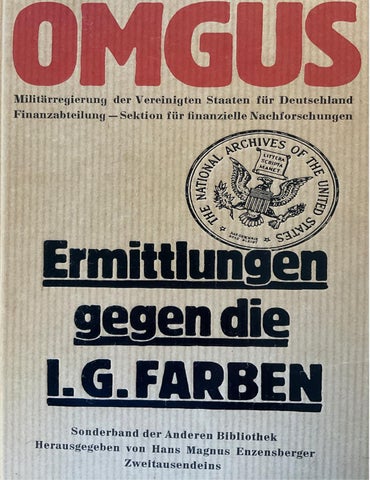
O.M.G.U.S. Investigations against I.G. Farben
Die Andere Bibliothek Edited by Hans Magnus Enzensberger - Special volume –
Investigations against I.G. Farbenindustrie AG - September 1945 –
Übersetzt und bearbeitet von der Dokumentationsstelle zur NS-Sozialpolitik Hamburg
Published by Franz Greno Nördlingen 1986
The translation was done by Heike Carstensen and Michael Martin (Summary, preface, chapter’s I-IV), Ulrike Bischoff (Chapters V and VI, Appendix A and B).
Copyright © 1986 for this edited edition by GRENO Verlagsgesellschaft m.b.H. Nördlingen. All rights reserved.
_____________________________________________________________
Table of contents
Introduction of the editors . . . . . . . . . . . . . . . . . . . . . . . . . . . XIII Summary of the results of the investigation on the occasion of the presentation of the I.G. Farben report to Military governor Lucius D. Clay in September 1945 Foreign participations
. 1 3
Assets in Switzerland and the United States
4
Assets in Latin America
7
I.G. Farben's Relationship with the NSDAP
10
Acquisition by conquest
11
Preface
13
I. Introduction
15
1. The Military Significance of I.G. Farben
15
2. Organization and power position
18
3. Expansion for the war
20
4. Exports and currency
23
5. Ownership and power of disposition
25
II. Foreign Assets of I.G. Farben
29
1. Summary
29
2. The Swiss and U.S. Assets of I.G. Farben
35
Statement of defense No. 1
37
Statement of defense No. 2
44
Statement of defense No. 3
61 —V—
T AB LE O F CON TE N TS
Statement of defense No. 4
64
3. Latin American assets
65
Character and scope of the company's of I.G. Farben in Latin America
67
List of companies
67
Reported assets
68
The policy of camouflaging the ownership of companies
71
Methods of controlling the company in directly owned companies
76
History of camouflage of companies directly owned by I.G.
78
Proposal to appoint National City Bank as a trust shareholder
78
Dietrich A. Schmitz
81
The 1940 conferences in Florence, Milan and Basel
85
Pool trust agreements
88
Distribution of shares in 1940
91
Companies and shareholdings under indirect ownership
91
Cia. Electro Chimica Fluminene, Rio de Janeiro
92
Cia. de Productos Chimicos Industrias, M. Hamers .S..A
93
Quebracho Brasil S.A. (Quebrasa), Matto Grosso
93
Industria Quimica Colombiana S.A. (inquico), Medellin
94
Union Nacional de Quimica Industrial Ltda. »Induquimica«, Medellin
95
F. Hilbek, Seminario, Lima/Peru
95
—VI—
T AB LE O F CON TE N TS
Jorge Labrusse - Tannery company, Lima/Peru
96
Indunal S.A. ( Industrias Nacionales), Lima/Peru
96
Cia. Peruana de Importaciones Ltda., Lima
97
Cia Ind. Verrando S.A., Sullana
97
Other production facilities in Peru
97
W. Justus & Co., Peru
98
Venezuela
98
Soc. An. Ind. & Com. Electroclor, Buenos Aires
100
Monopol Sociedad Responsabilidad Ltda., Buenos Aires
101
Max Taucher, Santiago
101
Argentine state contract for the construction of an explosives factory
102
Assets set aside
103
Further protective measures
109
Imports from neutral countries Bypassing the blockade
110 121
1. Via Italy and Holland until the end of 1939
123
2. Camouflaged deliveries via Italy until June 1940
123
3. Deliveries through Siberia
124
4. Blockade runner to South America
125
5. Exports to Argentina via Spain - 1943 and 1944
126
4. camouflaging ownership of I.G. patents in the united states.
127
—VII—
T AB LE O F CON TE N TS
III. The Bayer Division of I.G. Farben
133
1. Character and significance of the Bayer Division
133
Introduction
133
Bayer's contribution to the "reorganization" of Germany
135
Payments abroad to German diplomatic institutions and to the NSDAP
138
Sales to the Wehrmacht
138
The penicillin production
139
The Bayer Export Plan
140
Imports from Argentina during the war
141
The Latin American assets of the Bayer Division
142
Bayer inventories in Europe (outside Germany)
142
Latin American connections with US participation
143
2. The relationship between Sterling Products and I.G. Farbenindustrie, as revealed by the Bayer files in Leverkusen
146
Backgrounds
146
Objective
148
Material analysis
148
Closure
158
IV. Political Activities of I.G. Farben
161
1. Some Aspects of the Relations between I.G. Farben and the NSDAP Early support for the NSDAP —VIII—
161 161
T AB LE O F CON TE N TS
Connections of the I.G. with the NSDAP, the High Command of the Wehrmacht, the SS, the NS Foreign Organiza tion and other affiliated organizations
164
I.G. employee who performed special tasks for the Abwehr Performed
167
Regular donations to the NSDAP and affiliated organizations through the office of the Central Committee
169
Secret payments
170
I. G. personnel in government offices
172
2. Political activities in Latin America
174
I.G. liaison men
174
Liaison reports
176
Cooperation with the foreign organization of the NSDAP (A.O.)
178
German Chambers of Commerce
180
Cooperation with German diplomatic missions
181
Political Activities of Senior I.G. Employees
182
Financial support for Nazi organizations in Latin America
184
Pro-German Propaganda Activity in Latin America
187
V. New Acquisitions of I.G. Farben due to German conquests
193
1. Introduction
195
2. Austria
201
Introduction
201
The foundation of Donau Chemie
205
—IX—
T AB LE O F CON TE N TS
Consequences
208
3. Czechoslovakia
209
Aussig-Falkenau
209
Falkenau
216
Aussig
216
Teerfarbenwerke Aussig GmbH
218
Closure
219
4. Poland
219
Summary
219
Poland
220
Winnica
225
Wola
226
Other companies
226
Pabjanice
227
Closure
228
5. France
228
Summary
229
Introduction
229
Ceasefire negotiations
231
The organization of Francolor
235
War years
247
Closure
253
VI. The "reorganization" from the point of view of I.G. Farben
257
Objective
259 —X—
T AB LE O F CON TE N TS
1. Economic objectives
259
2. Military objectives
261
Closure
263
Appendix A: I.G. Farben Shareholdings in Germany and Abroad
265
Key to the "Proof" section
267
List 1: International direct and indirect Shareholdings of I.G. Farben
270
List 2: Direct and Indirect Shareholdings of I.G. Farben in Germany
294
Appendix B: Statement of Bernard Bernstein, Director of the Investigative Division of Cartels and Foreign Assets in the Office of the United States Military Government (O.M.G.U.S., Germany), before the Subcommittee on Military Mobilization of the Committee on Military Affairs of the Senate of the United States (Kilgore Subcommittee).
307
I.
Introductory remarks
307
II.
The Size and Power of I.G. Farben
309
III.
I.G. Farben made Germany self -sufficient in materials that had previously been lacking in war, and did so with the explicit the express purpose of preparing for a war of aggression
IV.
312
The production of I.G. Farben was indispensable for the indispensable for the German war potential —XI—
317
T AB LE O F CON TE N TS
V.
I.G. Farben was a Nazi intelligence agency for worldwide military and industrial espionage
VI.
319
I.G. Farben was the economic spearhead of the spearhead of the Nazi war plans
324
Propaganda dissemination
324
The provision of other propaganda agencies with foreign exchange
326
The conduct of economic warfare with the help of cartel connections VII.
327
I.G. Farben was Germany's largest single source of foreign exchange revenue
329
VIII. I.G. Farben's Dream of Conquering the World
330
IX.
The fruits of conquest
340
X.
The threat posed by I.G. Farben
344
Appendix C: Annotated Evidence on "reorganization" and post -war planning at of I.G. Farben
353
Introduction of the editor
353
Document 1: The Position of the German Imperial Patent in a European Economic Area under German Leadership economic area
371
Document 2: I.G. Farben memorandum on the planning tasks of Greater German Chemistry in the Greater European Area. General Part and France Section
—XII—
376
T AB LE O F CON TE N TS
Picture documentation (32 p.) between pages 214 and 215: I.G. Farben in the "Third Reich
List of evidence (Exhibits)
411
Notes
445
Notes of the editor
481
"The story of the Nazi use of I.G. Farben reads like a detective novel. The defeat of the Nazi armies will have to be followed by the eradication of such weapons of economic warfare." (President Roosevelt in a letter to Secretary of State H ull on Sept. 8, 1944) ¹
(1 ) Qu ot ed fr om H. W. A rmb ru st er, Tr ea son ' s Pe ac e, N e w Yo rk 19 47 p . 3 83
__________________________________________________________________________________
Introduction of the editor
Hectic weeks in Frankfurt
On March 27 and 28, 1945, units of the Third American Army captured Frankfurt. Street fighting raged around Opernplatz for a few hours. Then the way to Grüneburgweg was clear. One day later, on March 29, the first American soldiers entered the I.G. Farben high -rise located there. While most of Frankfurt lay in ruins, the economic citadel of Nazi "Großraumpolitik" remained unscathed. It h ad been spared from both sides. The Americans had a lot planned for the l.G. high -rise. But the fighting continued, and the operations of their Third Army we re successful after unexpectedly far reaching breakthroughs against the demoralized Army Group G south and north of Frankfurt. Therefore, only a small advance party was sent to the high ground; the first beginnings of the Supreme Headquarters of Western Al lied Forces (SHAEF) were modest. In the last days of March, a few financial specialists from the "task forces" also arrived. They inspected the gigantic file material of the corporate headquarters, made a few spot checks, and took a few key files.2 This wa s surprisingly little, considering that I.G. Farben was declared investigation target number one for Eisenhower's finance department (G 5 of the Civil Aff airs Division) and the coming American military government (U.S. Group, Control Council). However, the financial officers of the Third Army made such outrageous discoveries in the following fortnight that it becomes understandable why they could not take care of the huge file holdings in the I.G. building until mid -April. There was Bankhaus J. H. Stein, a private bank in Cologne, headed by Kurt von Schröder. Together with two sister banks in London and New York, it formed the financial background of many international cartels, especially the International Nitrogen Syndicate and the International Steel Carte l. E li min ati on o f G er m an Re sou rc e s for W ar, Hea rin g s B e for e a Su b co m mit te e o f th e Co m mi tt ee on M ili tary A f fai r s, S e v en ty -N in th Co n gr e s s, F ir st S es s ion (h e n ce f orth = K il go rc Un t er au s sch u ß), Pa rt 8 , T e sti m on y Joh n H. H il l d rin g, W as h in gton 1 94 6 , p . 1 04 5. On t h e cou r s e o f t h e f igh tin g P . E . S ch ra m m ( ed . ), Kri e g s tag eb u ch d e s O KW 1 94 4 -1 9 45, T e ilb an d II, Mu n i ch 19 82 , p . 1 20 1 ff .
—XV—
While looking through the files of the steel cartel in Luxembourg, the American financiers had come across these connections even before crossing the Rhine, and so after their flying visit to Frankfurt, they first continued their research in the Cologne region. The bank had been destroyed, the vaults lay inaccessible under meters of rubble. Not so Kurt von Schröder's private villa in Bonn. There, in the cellar next to the heating stove, the investigators found correspondence files of Schröders, titled "Reichsführer SS": the key documents of the "Friends of Himmler". During the search for the background of the International Steel Carte l, the close ties of one of the most renowned German banking houses and entire branches of industry with the SS had been revealed to the "Finance T -Force" of the Third Army.3 An even bigger surprise awaited east of Frankfurt when American soldiers entered the tunnels of a potash mine near Merkers on April 7. They noticed carefully stacked large containers and bundled sacks. When they opened one container, they had gold bars, gold coins, platinum, jewels, gold dental fillings, silver and securities in front of them. The SS fund of the Deutsche Reichsbank had been discovered. Even when taking over the SS loot, the Reichsbank had kept exact records. The accompanying lists showed everything down to the last brilliant opera glass. Since 1942, the Wirtschaf tsverwaltungs-Hauptamt der SS had sold precious metals and securities to the Reichsbank and converted them into Reich banknotes or, toward the end of the war, into foreign currency. For its part, the Reichsbank had sold the gold and jewelry treasury to the Deutsc he Gold- und Silber-Scheideanstalt (Degussa). Their melting quotas had increased tenfold by 1944. The total value of the SS loot, most of which came from the Polish death camps, was estimated by the Americans in a preliminary balance sheet at the end of 19 45 at over 20 million dollars.⁴ I.G. Farben had a lot to do with the International Stickstof f Convention, the "Friends of Himmler," and Degussa. It can be seen from the reports and memoranda of the financial officers that they were eager to finally get their hands on the I.G. central archive located in Frankfurt. But they still did not get around to it. The discoveries at Bonn and even more so at Merkers triggered frantic activity that continued to bypass the I.G. Farben colossus. After intense interrogation, some Reichsbank councilors came clean. They revealed another big secret. Since the end of 1933, the Deutsche Reichsbank had been building up a dormant gold reserve, which it had built up from "aryanizations" at home and then, since 1938, from the gold and foreign exchange reserves of the conquered European countries. In the first two weeks of April, Colonel Bernard Bernstein, financial advisor to Commander -in-Chief Eisenhower, deployed all the financial and cartel specialists of the American Army to locate and grind down this "July Tower" of the Reichsbank.
(4 ) E x te n si v ely d oc u m en ted in N A, R G 2 60 , 1 1/ 3 81 /8 to 11, 1 1/ 38 2/ 2.
—XVI—
His "Finance T-Forces" set up their headquarters in the Reichsbank building in Frankfurt, where the SS treasure had been taken in the meantime. Frankfurt became the starting point for extensive clandestine operations t hat reached as far as Austria, the border of Czechoslovakia, and Thuringia. In mid -April, the main Reichsbank depository was discovered in a salt mine in Thuringia. By late summer 1945, 98 percent of the Reichsbank treasury was in American hands. Its value was $238.5 million. The deposits of the greatest bank robbers in history were subsequently returned by the Finance Department to their rightful owners or, in the case of their proven murder by the Nazis, handed over to international aid organizations. ⁵ When the long-planned I.G. Farben investigation group finally moved into the high -rise building on Grüneburgweg on April 16, it was full of bitterness. She now knew how the financial institutions of the "Third Reich" had enriched themselves from the mass exterminations and looting in the occupied countries. Many a family tragedy had also been uncovered - some of the "investigators" came from Jewish families who had emigrated. But their investigative reports pointed beyond the Nazi regime and beyond concealed personal misfortune. The traces of the Reichsbank robbery led primarily to Switzerland, to the Bank for International Settlements and the Swiss National Bank. Under the eyes of the international financial world, the Reichsbank had handled the looting of va rious state coffers there and exchanged melted -down Degussa gold for Swiss francs and dollars in order to buy strategic raw materials. ⁶ Hadn't I.G. Farben also operated worldwide until the last months of the war? Was it a coincidence that I.G. CEO Hermann Schmitz and banker Kurt von Schröder, of all people, were the only Germans to sit on the Board of Directors of the Bank for International Settlements, together with Emil Puhl, Vice President of the Reichsbank and jointly responsible for the transaction of the SS gold and the "Julius Tower"? Anyone dealing with the entanglements of economics and politics in the "Third Reich" would do well not to limit himself to the territorial borders and the occupied territories of the Nazi state.
(5 ) R ep ort o n R ec o v ery of Re ic h s b an k Pr ec iou s Me tal s of 6. 9. 19 45 , a s w el l a s R .A . Ni xon ' s rep ort to Clay o f 1 4 .II. 1 94 5: Da s g eh ei m e Go ld r e s er v en p rog ra m m d er D eu t s ch en Re ic h s b an k in d er z w eit en A mt sz ei t Dü rin g Sch a ch t s, ib id , 1 1/ 40 2 /6. (6 ) I n th i s c on n ec tion , e sp ec ia lly : In v e st ig ati on of G old tran s act ion s R ei ch sb an k - B an k of In t ern a tion al S et tl e m en ts o f Ma y 19 4 5, ib i d ., 1 1/ 40 2/ 2 ; R ep or t on th e Ban q u e Nat ion al e d e B el giq u e Go ld a cq u ir ed fro m th e Ban q u e d e F ran c e, Ma r se il l es , b y th e Re ich s b an k B er lin of Au g. 1 3, 1 94 5, ib id . , 1 I/ 43 1/ I; R ep ort on t h e In v e sti gat ion o f Go l d ac q u i red b y th e Re ic h s b an k fro m th e N a tion a l Ban k of Boh e mia an d Mor a via, B erl in , No v e mb er 1 94 5, ib id ., 11 /4 01 /1 .
—XVII—
During this time, a lot had happened in the Frankfurt I.G. high -rise. After their liberation by the Americans, more than ten thousand forced laborers and deportees had set up home there, because there were no other accommodations in Frankfurt. In the first days of April 1945, it was still cold in Frankfurt. For the untrained squatters, many of them former I.G. forced laborers, it was perhaps an act of liberation to warm up a little with the help of the masses of files from the corporate headquarters. In the second week of April, an American commando arrived to make the high -rise fit for its new tasks. The soldiers made the disaster perfect. All the real estate and the entire mass of paper ended up in the courtyard, bulldozers then pushed them together into a huge mountain. We can 'imagine its dimensions when we consider that I.G. investigator s later estimated the weight of the files recovered in the I.G. building at three to four hundred tons. ⁸ So, one day after the recovery of the Reichsbank's "July Tower" in a Thuringian salt mine, it was high time. The "Finance T -Force" knew what was at sta ke, after all, and acted quickly. Together with the soldiers of another special unit that had come to Frankfurt to track down I.G. Farben's nerve gas and locate the last sarin-tabun transports on the basis of the Frankfurt records, it set about salvaging t he masses of files. A huge human chain was formed from German POWs and I.G. employees to salvage what could be salvaged down to the last document. Rough sorting was done in the west wing of the high -rise building. From there, starting on April 28, files we re transported to an annex of the Reichsbank headquarters. The financial officers, shrewd from their previous American experie nce as cartel officials or "in vestigators" of the Ministry of Finance, had to be very careful that nothing disappeared at the last minute. They were clever enough to keep a close eye on the I.G. employees. By always accessing them at the last moment, they obtained key documents without any special effort, such as the diary of an I.G. director, particularly sensitive international car tel agreements, and extensive I.G. plans for the economic policy "reorganization" of the world from 1940/41. They played a significant role in the preparation of the present report. ⁹ However, the recovery of the high -rise files was by no means the end of t he process of securing the records of the Frankfurt I.G. headquarters.
(7 ) Cf . th e li st o f d i re ct or s in Ch . H igh a m , Trad i n g wit h th e E n e my, An E xp o s e o f th e N azi Am e ri can Mon ey Plo t 1 9 33 - 19 39, N ew York 1 98 3 , p . 26 6. (8 ) For th i s Ki lg or e Su b co m mit te e, Pa rt 4 , Te s t im on y Joh n H. Hil ld r in g of Ju n e 2 9, 1 9 45, Wa sh in gto n 19 4 5, p .6 2 2 f. ; ib id , Pa rt 8, T e sti mo n y of D e ce mb e r 11 , 19 4 5, Wash in gton 19 46, p . 1 04 6. K il gor e e v en e s ti mat ed t h e tot al w ei gh t at 20 00 ton s, ib i d . p . 1 04 6.
—XVIII—
Bernstein's financial expe rts could imagine that there must have been extensive destruction of files prior to their access.10 But they could also assume that the I.G. directors, in defiance of all orders, were reluctant to part with their personal hand files. And they were experien ced enough to find the right key for their research - the corporation's accountants. Irreplaceable as they were everywhere, and often humiliated for years by their bosses, it was only a matter of tackling them with appropriate skill. The American investigators were successful. The Frankfurt chief accountant, Paul Dencker, knew all the names, departmental connec tions - and many hiding places. ¹¹ One I.G. director had placed his records in sixty different locations in the Frankfurt region. Others had buried t heir records watertight in the gardens behind their villas; still others had been content to store them in the air -raid shelter. One member of the I.G. Board of Management used spiritual help: 500 secret patents were stored in the refectory of a Würzburg m onastery. After their secret campaign against the Reichsbank, Colonel Bernstein's special units finally moved out a second time. In addition to Würzburg, they found patents in Kronberg im Taunus, in Heidelberg, Kassel, Munich, Ludwigshafen, Düsseldorf, in a rest home of the I.G. subsidiary Dynamit AG in the Harz Mountains, in Leverkusen, and also in Jena and Wolfen. ¹² Senior I.G. managers were not always to be found in the vicinity of their hand files, and the search for them therefore turned into a drama that was largely separate from the document research. In an apparent misjudgment of the realities, a surprising number of directors of other plants had fled to the future U.S. zone in addition to the top I.G. managers based in the Frankfurt -Heidelberg area. After a dayslong odyssey between Heidelberg and Frankfurt, which probably served the purpose of depositing key files, the board members Hermann Schmitz, Max Ilgner and August von Knieriem surrendered to American Special Forces in Würzburg. Georg von Schnitzler, also a member of the Board of Management and Chairman of the Commercial Committee, was arrested at his villa near Frankfurt after an absurd interrogation. Other board members, for example Heinrich Bütefisch, joined in the withdrawal of U.S. troops from Central Germany at the end of June. (9 ) Ki lgo r e Su b co m m itt e e, P art 4, p . 62 2; R . S a s u ly, I . G. Farb en , B e rli n 19 52, p . 30 1 T. (1 0) Th i s wa s fu lly con f ir m ed . C f . Stru ß' sta te m en t on th e d e st ru c tio n o f th e fi le s o f th e T ech n i cal C o mm itt e e, Ca s e VI, An k la ged oku m en t en b än d e (h en c ef orth = A DB ) 36, D ocu m en t N I- 83 2 4; a s we ll a s K arl von H e id e r 's su m ma ry s tat em en t ib id , Do cu me n t NI - 91 26 . Fo r th e in d i v id u a l main p la n t s, cf . N I - 89 76 ( G ri e sh ei m ), NI - 8 32 9 (Hö ch st ), NI - 66 32 (L e v erk u sen ). (1 1) An A m eri can con t e mp o rary wi tn e ss d e s cri b e s it th u s : " It wa s D e n ck er wh o su p p l i ed th e k ey, b eca u s e on an y su b j ec t h e kn e w wh at man i n t h e wh o l e o rg an izat io n wou l d h a ve th e an s w er an d h e kn e w w h e r e t h at man c ou l d b e fo u n d . " H e ch a rac ter iz e s h i m a s " rat fa ce d , an d r e se n t fu l fo r mo st o f h i s li f e. " Mar tin , Al l Ho n or ab l e Me n , p . 64 .
—XIX—
A considerable number of technical managers had remained in the main I.G. plants during the critical days, such as Ernst August Struß, the head of the I.G. Technical Committee office in Höchst, who then reorganized the files of the Frankfurt I.G. headquarters together with chief accountant Dencker. By the turn of the year 1945/4 6, two dozen top I.G. managers had been imprisoned in Preungesheim Prison in Frankfurt and in other prisons in the area. For the purposes of this investigative report, they were interrogated - mostly individually, but sometimes in groups - in the Reichsbank building in Frankfurt. ¹³ Thus, the belated access to key I.G. Farben information and individuals was successful after all. The Americans' special units acted with incredible speed and commitment. Until well after the surrender day on May 7/8, the investigators were not subject to any administrative constraints, and when the first laws of the military government came out - laws No. 52 and 53 were especially important in terms of economic policy - ¹⁴ they interpreted them extensively accordingly. Not least because of the terrible discovery of the money deposits of the SS and the Reichsbank, they did not stop at any safe, private villa, private casket or cellar hiding place. The barriers of private property were meaningless to the Allied Special Forces until the summer of 1945. For the I.G. Investigation Group, however, calmer times were by no means beginning. The identification of the SS and Reichsbank depots posed tremendously complicated problems, which it could not avoid. The I.G. files that had been moved to the Reichsbank building were not made accessible to some extent until August - they then moved on to the I. G. plant in Griesheim . Systematic interrogations were also out of the question at first, because the main I.G. leaders were often on prisoner transport until June. ¹⁵ Max Ilgner and Hermann Schmitz, for example, were questioned at Eisenhower's Versailles headquarters about their political relations in Switzerland, Latin America and, not least, the United States. August von Knieriem, the hea d of the Legal Department, flew to the U.S. at the end of May as a prisoner of the military government to testify before a New York district court about the cartel relations between LG and Standard Oil of New Jersey. 12 ) Ki lgo r e S u b c om m itt e e, P art s 4 a n d 8 , T es ti mon i e s Hi lld rin g. Hi ll d ri n g wa s ch i e f o f th e Ci v il A ff ai rs D i vi s ion in th e Wa r D ep art m en t ; rep ort s f ro m th e " Fin a n ce T - Fo rc e s " w er e re c ei v ed b y h i m. (1 3) K il gor e Su b co m mi tt e e, P art 8, T e st i mon y B e rn ard B ern s te in d at ed . II, D e c. 1 9 45, Wa sh i n g ton , 1 94 6, p . 10 6 6. B e rn s te in l i st s 2 2 d eta in e e s; th e A me ri can wi tn es s e s p u t si c h i gh er . On th e in d i vid u al a rr e st s al s o th e sta te m en t s o f G eo rg v on Sch n itz l er (N u r e mb er g d ocu m en t N I -5 19 1) , M ax I lgn e r ( Nu r e mb er g d o cu m en t N I -6 70 0) . (1 4) La w No . 5 2 a ll o we d fr e ez in g an d con t rol of a s s et s, La w No . 5 3 i mp o s ed ex ch a n g e con t rol . O n th is , N A , R G 26 0, 11 /4 1 /1 to 2, 1 1 /2 68 /4, 1 1/ 28 0/ 9.
—XX—
The Field Investigation Agency Technical (FIAT) constantly borrowed the top technicians and pharmacists to track down I.G.'s chemical destruction technology; the Office of Strategy Services (OSS) then questioned them about the I.G. plants located in th e Soviet occupation zone I.G. plants. Thus, it was not until the summer that the I.G. complex began to take shape for the investigators of Bernstein's Finance Department. They looked into the prehistory of I.G., which had emerged from the two "Dreibünden" of 1904 and the "Interessengemeinschaft" of 1916 and h ad finally been merged in 1925. ¹⁶ They studied how the top management of the group gradually consolidated, and in 1925 the mammoth organs shrank to a self -recruiting complex of supervisory board, executive board and central committee. From the files that Ilgner had transferred from Berlin to Frankfurt shortly before the end of the war, they were able to see how this acquisition center had built up dynamic decision-making aids in the subsidiary headquarters in Berlin NW 7 the Economic Department and the Economic Policy Department, while a central clearinghouse for the state armaments appar atus had worked alongside it in the form of the Mediation Office W (= Wehrmacht). Bernstein's cartel and financial experts naturally devoted particular attention to the I.G.'s internal money circulation. They started from the central accounting department in Frankfurt, which supervised the financial circulation between the sales associations of the production divisions, the Berlin central financial administration and the main plants. After all, they were not unaware that the core of the whole consisted of a dynamically interlocked horizontal and vertical production structure. Three superordinate production divisions had emerged from the territorial "operating communities" (Maingau, Central Germany, Lower Rhine and Upper Rhine): Division I for nitrogen, fuel and mineral oil; Division II for paints, chemicals, pharmaceuticals, light metals and synthetic rubber; Division III for photographs, synthetic fibers and plastics. Two parallel decision -making pillars, the Technical Committee (Tea) and the Commercial Comm ittee (KA), linked the production core of the I.G. with the administrative apparatus, the cash cycle and finally the highest corporate umbrella, the Central Committee or Board of Management. ¹⁷ (1 5) C f. Nu r e mb er g d o c u m en t s N I -6 54 4 an d 6 7 00 ; H . W. A rm b ru st er , T rea s on 's P ea ce, p . 34 1 f. ; J . Bork in , D ie u n h ei li g e Al lian z d er L G. F arb en , Fra n k fu rt /M . a n d Ne w York 1 9 81, p . 17 7f ; on th e m eth od ol o gy o f FI AT N A, R G 26 0, 4 4 - 4 5/ 10 /6 . (1 6) On th i s p re h i st or y , e s p e ci al ly G. von B rü n in g, " "E r wä gu n g en " zu Ca rl Du i sb er g s De n k sch ri ft "D ie V er ein i gu n g d er d eu t s ch en Fa r b en fab rik en " ", in : T rad i tion , Z e it sch ri ft Ju r Fir m en g e sch ich te u n d Un t e rn eh m e rb io gr ap h i e , 9. 19 64, H. 1; H. Ro th ( ed i tor ), "D i e Du i sb er g -D en k sch ri ft zu r V e re in i gu n g d er d eu t s ch e n Farb en fab rik en au s d e m J ah r e 19 1 5", in : Jb . f . Wi rt s ch a ft sg e s c h ich te, 19 6 6 Par t II I, p p . 23 6 f f ; R. Son n e man n , " Üb er d ie Du i sb e rg De n k sch ri ft au s d e m Jah re 1 91 5, " eb e n d a , p p . 1 19 f f.
—XXI—
All in all, then, a trust that, with its flexible internal structures and its principle of "decentralized centralization," was far ahead of comparable companies of its time. Externally, it had developed a dynamic that also gradually became apparent to the investigators: the cross -relationships with the trade associations, the Wehrmacht and the key ministries of rearmament, economic policy and foreign trade. The secret recipe for success had been that all key positions, both internal and external, were interwoven and held by some 30 top managers. In the course of the 1930s, they had transformed I.G. Farben into a dynamic and aggressive instrument of technical and economic expansion. Of course, the international connections of I.G. were of particular importance to the investigators. Here they kn ew best, for they had worked for years in the "Foreign Fund Control" of the Treasury Department resp. the "Economic Warfare Section" of the Justice Department against the camouflaged expansion of the I.G. in Latin and North America. Already at that time th ey had noticed a strange number of family connections, which always played a role where, for reasons of camouflage, the concealment possibilities of private law were no longer sufficient. But even they were amazed by the "family trees" of the I.G. "familie s", which were becoming ever more densely contoured. Hermann Schmitz, for example, the chairman of the board of management, had served his way up in the shadow of Carl Bosch since the First World War. Since the end of the 1920s, he had used new camouflage and transaction techniques to pick up where the Treaty of Versailles had severed ties. Schmitz had largely used family ties to do so. Brother -in-law Albert Gadow became a naturalized Swiss citizen and a member of the board of the Basel -based I.G. Chemie holding company. Brother Dietrich A. Schmitz acquired U.S. citizenship and advanced to become the main trustee shareholder of the Latin American I.G. subsidiaries, but also president of the I.G. subsidiary American I.G. Chemical Corporation (later General An iline & Film). Karl Pfeiffer, member of the board of the I.G. bank Deutsche Länderbank AG, had married a niece of Schmitz. Max Ugner, head of the Berlin headquarters NW 7, had Schmitz as an uncle, as did Rudolf Ilgner, who after his naturalization in the U .S. had become, among other things, vice president of the I.G. espionage headquarters in the U.S., Chemnyco Inc. ¹⁸ The family connections around Georg von Schnitzler, the Duisbergs and other top managers of the I.G. were similarly close.
(17) The best brief overview today is given by H.Schreyer, "Der I.G. Farben Konzern, seine Vorgänger und Nachfolger “, in: Archivmittteilungen, 1966, H. 3 and 4.
—XXII—
At least in the area of top commercial and economic policy management, family connections emerged behin d the functional center of the I.G. that resembled an association in the hands of three or four super godfathers. ¹⁹ Before it agreed on a program to reclaim its world power position in the course of the world economic crisis, this association had long sin ce sent its family members out to naturalize in the future neutral and enemy states.
First power struggle for the I.G. (May to early September 1945)
Not least because of the shock - and the success - of the search for the secret gold and foreign exchange reserves of the SS and the Reichsbank, the investigative group of the "Finance Division" was able to devote itself to its real objective fairly undisturbed until July. It had clear political ideas: It wanted to provide documentary evidence of all the previous arguments for the breakup of I.G. Farbenindustrie AG and, at the same time, deepen them analytically. The first step was to uncover the Group's international relations; the second step was to reveal its participation in the Nazi war of conques t; and the third step was to come to terms with its internal connections to the NSDAP and the Wehrmacht's rearmament program. Bernstein's investigators expected this work to have a signal effect. The illumination of the I.G. was one of the steps toward the realization of the policy document on American occupation policy (JCS 1067), which had been substantially influenced by Secretary of the Treasury Henry Morgenthau. The intellectuals whom Colonel Bernstein had assembled since the spring of 1945 from all br anches of the armed forces and from the staffs of the Treasury and Justice Departments devoted themselves enthusiastically to their task. But the Finance Department and the I.G. Investigation Group had powerful counterparts in the military government from the beginning.
18 ) Co m p il ed fro m Stat e Dep a rt m en t, Na tion al R ec ord s Cen t er Su it - lan d /Ma ryl an d , R G 8 4, Un c la s s if i e d Re co rd s o f U .S . E l e m en t o f t h e Tr ip art it e I. G. F arb en C on trol Grou p , 19 45 19 53, A c c e s s ion N o. 5 6 - . A 6 84 (h en c e fort h = S D, R G 8 4, Bon n I . G. Fa rb en ), Bo x 39 3, Fo ld er 21 7 (I. G . P er s on al it ie s ) ; an d Sch m itz p e r son n el fi le s , in NA, R G 26 0, 2/ 18 9/ 11 an d 12 . On th e v on Sc h n it zl er an d Du i sb er g fa m il ie s, s ee a ls o H . W . Ar mb r u st er, T rea s on 's P ea c e, p p . 73 f f, 77 f . 19 ) Cf . th e 5 th ch ap t e r i n Ar mb r u st er, ib id , p p . 69 f f . (Fa rb en ' s Roy al F am ily ). Ar mb r u st er h ad b ee n a s en i or st af f m e mb er o f th e An tit ru st Di v i sion o f th e D ep ar t m en t of J u s ti c e.
—XXIII—
Robert Murphy, Eisenhower's political adviser on a par with his financial adviser, was an intimate politic al enemy of Bernstein. From the beginning, the Economics Division of the military government was staffed by brigadier generals, colonels and majors who, in peacetime, did business on Wall Street and on the corporate floors of the U.S. electrical, automobil e and steel industries. In retrospect, it can be stated without exaggeration that, from the beginning of the occupation, they saw it as their main task to nullify Morgenthau's proclamation against the corporations of the "Third Reich" and for a radical restructuring of the German national economy in occupation practice. In this, they were anything but squeamish. As early as the summer of 1945, a senior officer of the Industry Branch, a subdivision of the Economic Department, asked Bernstein: "How can I be e xpected to get the German factories going again if I am not allowed to use Nazis and German cartels ?“²⁰ Only those who had the stronger power groups behind them from the outset were able to take such an unequivocal position in the first months of occupation. There was the European Division of the OSS, headed by the bank lawyer Allen W. Dulles, which as earl y as May 1945 - somewhat prematurely listed the top technical cadres "for the procurement of scientific and technical information" and otherwise endeavored to expose members of the "National Committees of Free Germany" returning to the U.S. zone via Swi tzerland.²¹ There was the State Department, which, after Murphy's appointment as political adviser to Deputy Military Governor Clay, provided him with a staff whose main task was to cold -call the Finance Department people at the top of the military governme nt. The most important allies were the majors and captains of the Industry Branch, almost all of them industrialists, who exercised their control functions according to a simple scheme: First, they locked the workers out of the factories and forbade union formation. Then they sat down with the management - also in the I.G. plants - to discuss what should be done. In I.G. plants where the withdrawal of U.S. troops was again imminent - for example, in the Leunawerke - they agreed on plant sabotage. In their o wn zone, they restarted production as far as was possible in view of the general transportation disaster and the energy shortage.
(2 0) K il gor e Su b co m mi tt e e, P art 8, T e st i mon y B e rn s te in , p . 11 08 . (2 1) O SS G er ma n y : T e ch n ica l In te ll ig en c e, L i st o f I. G . F arb e n t e ch n i ca l e xp e rt s, 15 .5 .1 94 5, SD, R G 8 4, Bon n I. G. Fa r b en , Bo x 2 34, Fo ld er 37 . Th e O S S r ec o m men d at i on w a s p r e matu r e in th at t h e I n t el li ge n c e Bran ch o f th e Fin an c e De p art m en t fo ll o wed u p an d arr an g ed for th e a rr e st. C f. a l so O SS R ep o rt N o. B -2 79 7 o f 5 Ju n e 1 94 5 : S wi s s "F r ee G er man y " In f ilt rat ion in to G er m an y , N A, R G 2 60, 1 1/ 29 2/ 5.
—XXIV—
This also happened in the only I.G. factory in the U.S. zone that had produced chemical warfare agents during the war. With the express approval of the control officers , it resumed production of the intermediate products that could also be used in an export -oriented peacetime economy. ²² The Economics Department and its Industry Branch also exercised no restraint in calling in their German collaborators. As early as the beginning of May 1945, an officer of the Industry Branch established contacts with the Foreign Trade Department of the Reich Industry Group - it had left Berlin for Bayreuth in March - in order to initiate cooperation with it. ²³ The heads of the Machine Reporting Department of the Reich Industry Group, which had been relocated to Gera, were also discreetly told in May that their location was still on the soil of the future Soviet occupation zone. Its relocation to the vicinity of the American headquarters - to Bad Nauheim - was completed in June. Since then, it called itself the "Statistical Office" of the Industry Branch and continued to work at full steam on data collection for the export -oriented survival program of the German economy²⁴. American liaison officers provided access to the necessary files in the central holdings of the Reich's economic policy authorities. Against the protest of the Soviets, the Americans had set up a "Ministerial Collecting Center" in an explosives plant of the I.G. subsidiary Dynamit AG in Hessisch Lichtenau, s outh of Kassel, where the mini sterial bureaucracy of the Reich Ministry of Economics and Finance, as well as the Reich Chamber of Commerce, worked on the economic policy problems of German continuity.²⁵ Thus, since the summer of 1945, the Economics Division had held the entire administrative apparatus of the Nazi national economy unchanged. It had some difficulty in keeping its German partners under control. When the last round in the power struggle within the American military government broke out in the fall, part of these functional elites went to the British occupation zone, where the economic and financial potential was kept out of denazification efforts from the beginning. 22 ) On th i s, K il gor e Su b co m mit te e, Part 8, Te s ti mon y B ern st e in , p . 1 1 0 7; on t h e a ct i vit i e s of th e Am e ri can s in th e Leu n a p lan t s in m id -A p ri l to th e en d o f Ju n e 1 94 5: B e fr ei t es L eu n a (1 94 5 -1 95 0 ), Di e G e sch i ch t e d e s Ka mp fe s d e r L e u n a - Arb e it er T ei l I I, B er lin 19 5 9, p . 2 4f T . (2 3) Be au ti fu lly p r e s en t ed in K. Alb re ch t, D a s Me n s ch li ch e h in t er d e m Wu n d e r - 2 5 Jah re Mit w irku n g a m d eu t sch en Wi rt s ch a ft sau fb a u , Dü s se ld o rf - Wi en 1 97 0, p . 16 f T. A lb r e ch t, h ead of th e p o st w ar p la n n in g o f th e Re ic h s gr u p p e I n d u str i e, wa s on e of th e b ac ke r s o f th e so - cal l ed Cal v in H oo v er Re p ort o f 1 0. 9. 45 . On th is in th e t ext b e lo w . (2 4) On th i s, F ed era l Ar ch i v e s Kob len z ( h e n c e fo rth = BA ), R 1 2 1/ 24 . (2 5) On th e c ro s s -r el a tion sh ip s b e t we en th e Min is t eri al Col l ec tin g Ce n t er an d th e Stat i sti ca l O f fi c e in B ad N au h e i m BA, R 7 An h . MC C /3 57 ; o n th e g en e s i s o f th e M in i s te ria l Co ll ec tin g C en t er al so N A, RG 2 60 , 4 4 -4 5 /1 0/ 3; on th e d eb a te ab o u t th e re or gan izat ion o f th e R ei ch Min i stry o f E c on o mi c s in th e MC C, ib i d , 2 /2 9/ 10 . Th e ca mp w as ca mo u f la ge d an d h ad th e cod e n a m e G OL DC U P.
—XXV—
Of course, the Finance Division did not remain unaware for long of what was happening in the I.G. Works and on the economic policy terrain. From the point of view of occupation legislation, it had all the arguments on its side: the actions of the Economics Division r epresented an open breach of all directives, manual instructions and laws of the military government. But against them stood the power of the factual - the unconditional maintenance of production, which, as far as the bottlenecks in transportation and coal supply allowed, was converted from a war economy to export products in the shortest possible time. Nevertheless, Bernard Bernstein, the counterpart of investment banker and head of the Economic Department William H. Draper, still held a key strategic position in the military government in the summer of 1945, and no adversary could get past him unscathed. While the I.G. Investigative Group accelerated its research, Bernstein enlarged the staff of the Finance Department to 140 men and continued to expand the "field offices" of his finance officers with the occupation forces. The Intelligence Section of the Finance Department was also strengthened (Intelligence and Liaison Branch headed by Richard Sasuly), as was the Foreign Assets Control Section. Civilian Tr unk A. Nixon intensified the activities of his Denazifi cation Branch. This denazification group, in particular, exerted remarkable pressure on the Industry Branch control officers for several months. ²⁶ When Senator Harley M. Kilgore toured the American occ upation zone in late May and early June, he received a special kind of support from Washington: Kilgore was shocked by what he found. And he did not mince words. In June, he opened a series of hearings in a Senate subcommittee on the question of eliminatin g Germany's war potential. In the opening statement, he argued that the German cartel lords were now successfully disassociating themselves from their political co -conspirators. By disguising themselves as "apolitical" economic leaders, they had already in itiated a third round in the struggle for world power. Reading these sentences, uttered on Capitol Hill on June 25, 1945, we realized why we had searched so long, unsuccessfully, in recent months for the transcripts of this series of hearings. ²⁷ Against the backdrop of the congressional hearings that had just begun, Bernstein opened the first round of the power struggle with the Commerce Department. (2 6) D ocu m en t s in SD, R G 8 4, Bon n I. G . Far b en , Box 2 3 4, Fol d e r 37 ; s u p p le m en t ary Bo x 23 2, Fold e r 9 . (2 7) K il gor e Su b co m mi tt e e, P art 2, Ki lg or e Stat e m en t, 2 5 Ju n e 1 9 45, Wa sh in gt on 19 45 .
—XXVI—
Behind the scenes, the disputes made waves for days. Obviously, all U.S. ministries responsible for occupation policy were involved. It is significant what finally came out at the beginning of July. Publicly, it was not yet opportune to abandon the previous line of occupation policy. Especially not in the poker game over I.G. Farben, since the Finance Department's investigation group had meanwhile come up with the first partial results. At the end of June, Bernstein and Draper, under pressure from Deputy Military Governor Lucius D. Clay, they worked out compromise papers. On July 3, orders came from Supreme Headquarters (SHAEF) that on July 5 at 6 p.m. the 55 I.G. factor ies located within the radius of action of the Third and Seventh U.S. Armies were to be militarily occupied.² ⁸ While the show was on, a General Order to Act No. 52 (Set-aside and Control of Property) was issued. This stated that in the interest of world pe ace, I.G. Farben's war potential was to be dismantled and made available for reparation purposes, and that ownership of the remaining civilian production was to be broken up into small units. In a special order No. 1, also issued on July 5, Clay additional ly announced that he had appointed Colonel Edwin S. Pillsbury as the American officer in charge of the I.G. Farben plants in the U.S. zone in anticipation of overall Allied agreements. Pillsbury was to see to it that production or restoration of I.G.'s arm aments potential ceased in the future; he was to make plants available for the forthcoming reparations; and third, he was charged with liquidating all I.G. holdings in other companies. The theatrical thunder was followed two days later by the point of compromise. According to a special instruction No. 2, the main representatives of the power struggle, together with a representative of the Legal Division, were sent to a joint advisory commission for Colonel Pillsbury. Thus appearances were kept up, the attac k of the Finance Division was cushioned, and the now o fficially appointed control offic ers of the Industry Branch were left further to define what they did and did not consider war production in the I.G. plants. German I.G. management used the pressure to disguise and repurpose genuine armaments plants to initiate a first secretive wave of postwar rationalization.
(2 8) All o rd er s an d r ep o rt s on th e a ct ion in SD, RG 84, Bon n I . G. Fa rb en , B ox 1 0 6, Fo ld er 60 . Th e c o mp ro m i se p ap er s of lat e Ju n e ca n b e f ou n d ib id , Bo x 3 3 3, F old er 1 3.
—XXVII—
For the rest, they agreed with their control officers to conceal actual developments from the sporadic teams of the Finance Department more effectively than before and to write off the armaments departments at an accelerated rate.²⁹ Overall, the gain in time was not very considerable. But I.G. managers and Industry Branch control of ficers had long known that every month gained meant an enormous amount. At least since the atomic bombings of Hiroshima and Nagasaki (August 6 and 8), it was clear to them that time was working for them and that at least the economic policy passages in the Potsdam Declaration of August 2 were as meaningless to the true balance of power in the U.S. zone as General Order No. 1.
Emergence and initial impact of the I.G. Farben report
But the I.G. Investigative Group was also aware that it did not have much time left. Shortly before the Potsdam Conference began, Secretary of the Treasury Morgenthau had resigned , ³⁰ and since then the staff, field offices, and project groups of the Finance Department had been without backing in the Washington power center. Moreover, in August/September, the Economic Department of the Military Government launched a new initiative that for the first time challenged i nternally-publicly the economic policy orientation of U.S. occupation policy that had previously been proclaimed and at least formally reaffirmed in the I.G. order. To save their continuity strategy, the German-American allies of the Economic Department ha d come up with a great idea: They claimed that, in order to ensure a minimum standard of living, industrial production potential had to be broadly reorganized because foreign exchange for food imports could be obtained only on the basis of a clear export orientation. The insiders knew perfectly well that the food crisis that was actually looming could not be mastered by more chemicals, steel products and products of the electrical industry, but only by consistent denazification measures (abolition of the ma rket order, land reform) and investment injections for the hopelessly undercapitalized agriculture. But this was precisely what Morgenthau's school of thought had always called for when it simultaneously advocated the dismantling of the chemical, steel and electrical industries (swords to plowshares!). (2 9) On th is , K il gor e S u b co m mi tt ee , Par i 8, T e sti m on y B e rn st ein , 11 . 12 .1 94 5, p . 11 07 f ; Ki lgo r e Su b co m mit te e, Part 1 1, Te s ti mon y o f R u s s el l A. Ni xon , W as h in gton 1 94 6, p . 1 53 5 IT . (3 0) On th e b a ckg rou n d J . M. B lu m, F ro m t h e Mor g en th au Dia ri e s ( Vo l.3 ), Ye ar s o f W ar 19 41 - 19 45 , B o ston 1 96 7 , p . 46 4 I T .
—XXVIII—
Nevertheless, the thesis paper of their counterparts in the news section of the Economics Department acted as a spark. The American -German continuity group now had its first macroeconomically arguing model against the Morgenthauplan in general and the Finance Department in particular. The "Calvin Hoover Report" of Sept. 10, 1945 ³¹ was the first systematic attempt to disavow the economic policy intentions of t he Allied powers through a unilateral West Zone export program. The primacy of exports had finally become, even for the Americans around Draper, the universal alibi for the preservation of private power of disposal over the large -scale industrial power potential of the "Third Reich." So it is not surprising that Hyman B. Ritchin, the head of the working staff for the I.G. Report, had been urging his staff to work with the utmost haste since August. By the end of July, four working papers had been submitted: a preliminary study by Edwin W. Cage of the key role played by Basler I.G. Chemie in camouflaging the I.G.'s North American subsidiary and holdings, an extensive memorandum on I.G. activities in Latin America, a text written by Bernard Glaser on the "War Guilt of I.G. Farben," and a revised study by project leader Ritchin on I.G.'s camouflaged foreign assets. ³² The level and detail of these papers were still quite variable. The most sophisticated were the papers on international relations (I.G. chemistry -US, Latin America, international camouflage techniques). The group found it most difficult to present in writing the knowledge they had just acquired about the internal structure, the political cross -relationships, and the significance of the I.G. for the armaments policy of the "Third Reich." In order to get to the end as quickly as possible, a working group was set up in August to revise the Glaser paper. The twenty-page text had initially been written for the newly constituted American representation of t he main Nuremberg war crimes trial, which in the summer of 1945 still intended to indict a few particularly exposed industrialists in the main trial. Five sections dealt with the early support activities of the I.G. toward the NSDAP and its mass organizati ons, with its relations to the political and military power centers since the seizure of power, with the importance of the I.G. for the Abwehr and the SD, with the positions of leading I.G. managers in the power apparatus, and with the role of party donations for the NSDAP. They were still quite cursory and contained a number of factual errors. Now they have been revised. In a corrected and expanded version, they have been incorporated into the fourth chapter of the p resent report (first section).³³ (3 1) R ep or t of th e G er man Co m mi tt ee on Li v i n g St an d ar d s, 1 0.9 .1 9 4 5, NA, R G 26 0, 4 4 45 /6 /9 ...
—XXVIV—
The great importance of the Glaser paper lies primarily in its fifth section (Acquisition of Factories and Property in Occupied Territory). Glaser was the first to begin evaluating documents on the economic policy of the I.G. in Poland and France. In his paper, he pointed out their explosive nature and suggested that this complex be worked up by a separate task force. This was done, and by the beginning of Septem ber an astonishingly sophisticated investigation had been completed, given the pressure of deadlines. It was placed at the end of the I.G. report; in the present edition, it forms the fifth chapter. A passage on the I.G.'s "reorganization" plans for Europe and the world economy was to be given special emphasis because of its paramount importance and came at the end. By the beginning of September, most of the contributions from which the overall report was to be compiled had thus been completed. They were st ill weighted differently, and some passages still needed the finishing touches. But it no longer came to that. In the first week of September, Bernstein instructed the team's steering committee to submit the report as soon as possible, probably to parry th e forthcoming Alvin Hoover Report. The trio responsible (Hyman B. Ritchin, previously a staff member of the Economic Warfare Section in the Justice Department; Orvis A. Schmidt, Assistant Chief of the Treasury Department of the Military Government; and Alb ert I. Edelman, Chief of the Foreign Assets Investigation Branch of the Treasury Department) had no choice but to resolve the imbalances, at least in part, by conversion: The Latin America report was spread over the second and fourth chapters, as well as a n Appendix B; most of the chapters were given summaries or brief introductions; and the least mature contribution on the importance of the I.G. to armaments policy was expanded to include passages on the internal capital structure and the role of the I.G. as a foreign exchange procurer and prefaced as an introductory chapter. In the second week of September, work on the investigation report was completed. It now consisted of the following chapters: I. Introduction II. Foreign Assets of I.G.
32 ) D ie Vor p ap i e re b e fi n d en si ch in N A, R G 2 3 8 (Wo rld War I I War Cr i m e s R ec ord s ), B ox 4 8 u n d 53 . D er B e itr ag von R it ch in sta m m te au s ein er Un t er s u ch u n g ss e ri e d es Ju st iz min i st er iu m s: Hy m an B . Rit ch i n , Rep ort on Con c ea led A s s et s of I. G . F arb en i n d u str i e. De p a rt m en t of j u s ti c e, E con o m ic W ar fa re S ect io n , Re p ort s o n I. G. Far b e n In v e st ig ati on , No. N Y -3 4 2, P art I vo m. 2 .5 . 19 44 . (3 3) V g l. B ern ard Gla s er , Th e W ar Gu i lt of I . G. F arb en , M e mo to Ri tch in , 3 0. 7. 19 45, N A, R G 23 8, Box 5 3.
—XXX—
III Political Activities of I.G. Farben IV. Acquisitions of I.G. by Conquest V. Reorganization Appendix A listed I.G. Farben's foreign holdings, and Appendix B contained documentation on I.G.'s activities in its Latin American subsidiaries. A register of the evidence used (Exhibits) was prepared, and the evidence sorted. They formed an imposing fourteen -volume documentary work and were supplemented by several volumes of files with charts. ³⁴ On September 12, Bernstein wrote a summarizing cover letter, which shows the hectic pace of these eventful days. ³⁵ The entire volume was presented to Deputy Military Governor Clay on the same day. What reactions did the investigation report signed and han ded over by Bernstein on 12.9. trigger? Clay remained silent - and acted instead, as we shall see in a moment. Given the overwhelming evidence of I.G. complicity in the Nazi version of crisis resolution, it was ill -advised to publicly attack the "radical crowd" within the military government. Instead, three tactical lines of "damage control" were developed. Using the first, the top brass of the Foreign and War Ministries sought to reinforce the impression that the future of the I.G. was in bad shape. The st atements of representatives of the Foreign Ministry before the Kilgore Subcommittee that the I.G. and the other economic powerhouses of the Third Reich had to be cut off from capital flight routes to Latin America via Switzerland and Spain must be seen in this context.³⁶
(3 4) SD, R G 8 4, Bon n I. G . Farb en , Bo x 19 1. Of t h e 1 4 d ocu m en tary fi le s , on ly volu m e s II a n d 13 ar e o ri gin a l. T h ey d o cu me n t th e s e cti on on I. G. a s se t s in S wi tz er lan d an d th e US A. (3 5) B ern s te in wa s ob v iou sly n o t f ocu s ed en o u gh to wr it e a r eal su m mar y, h e mo st ly h igh li gh t ed p a rt ial a sp e ct s. Un d er it e m 8. th e re are al so w ron g fi gu r e s : t h e L atin A m er ica n as s et s we r e sh ow n in t h e F ran k fu r t c en tr al a c cou n t in g wi th 2 1 m ill io n , an d n o t w ith 2. 7 mi ll ion . S in c e th i s i s c orr ec tly e xp la in ed in t h e la t er te xt, w e h a ve n ot cor re ct ed th e h i stor ic al ly si gn i f ica n t a cco mp an y in g le tt er . C f . al so th e ed it in g n ot e s t o th e su m mary . 36 ) Th e fir s t st at e me n t b y Un d er S e cr eta ry of S tat e Wi lli a m L. C layt on on th e d i m en s ion s of t h e " Sa f eh a v en " p r oj ec t i s e xp lo s i v e: K il gor e Su b c o m mitt e e, Pan 2, W ash in g ton 19 4 5, p . 38 f f. Th e s e con d s tat e m en t a f te r th e I. G. Fa r b en re p ort o f 1 2. 9. 45 wa s i s su e d b y th e For e ign E con o mi c Ad m in i st rat ion , wh ich b y th en h ad b e en p l ac e d u n d e r th e Stat e De p art m en t . I t wa s a lr e ad y co n sid er ab ly m or e r e str ain ed : i b id , Par t 9 , Wa sh in gto n 1 94 6. (3 7) H e ap p ea r ed in a " War D ep art m en t T e sti m on y" i m m ed iat ely b e for e B ern s te in : K il gor e Su b c o m mitt e e, Par t 8 , Wa sh in gto n 1 94 6, p . 10 43 I T.
—XXXI—
Major General John H. Hilldring, chief of the Civil Affairs Division and Bernstein's immediate superior in that capacity, also appeared before the Kilgore Subcommittee to testify to his respect for the accomplishments of the I.G. Investigative Group, ³⁷ Even Commander-in-Chief Eisenhower spoke up in the latter part of October. He was full of praise for the I.G. report. He said that it had finally become clear that the I.G.'s armament plants had to be destroyed, that its factories had to be fully included in the reparations program that was starting, that the I.G. had to be separated from the international cartels, that its research potential had to be taken over, and that the ownership of the remaining facilities had to be divided up as far as possible.³⁸ A short time later, even two Bavarian I.G. explosives factories were destroyed. The accompanying public hype was enormous. ³⁹ However, the I.G. shareholders knew better. The two blown -up plants had been owned by the Reich, and I.G. had only been responsible for t he production process. The shareholders interpreted this fact completely correctly - with the result that the prices of I.G. shares on the stock exchanges in Hamburg, Frankfurt and Munich, which had reopened in the meantime, skyrocketed. To save the show effect, Law No. 55 was hastily enacted, banning and criminalizing trading in I.G. shares.⁴⁰ The political timing of the continuity foundation had to be protected from the haste of the German Allies. The second tactical line concerned the investigation report itself: it was classified together with the extensive documentary material. The classification level was low "Restricted." But it was unusual in September 1945 for a report dealing with aspects of Nazi rule that did not include information on tech nical or research secrets. Thus, an action that at first glance seemed unremarkable took on a distinctly punitive character: no one was allowed to quote verbatim from the report. No one was allowed to take it out of their office. It could only be passed on within the military government, and even that only on the basis of precise regulations.
(3 8) N e w Y ork Ti m e s, 2 1 Oc t. 1 94 5. Qu ot ed in Bor kin , Th e Un h oly All ia n ce o f I .G . Fa rb en , p . 1 41 . (3 9) Th e R e ich - ow n e d exp lo si v e s p lan t s i n Ka u fb eu r en an d E b en h au s en , wh ic h I . G. h ad op e rat ed o n ly "i n tr u s t, " w er e b lo wn u p ; SD, R G 84, B on n I. G. Fa rb en , Box 2 34, F old er 38 . (4 0) La w No . 5 5 w a s en a ct ed on Jan u ary 29, 19 4 6 (P roh ib i tion of T ran sa cti on in Sto ck s an d Bon d s of I. G . Farb en in d u st ri e ). Th e d ocu m en t s sh ow th a t th e ma jor b an k s "tu rn ed " I. G. p ri ce s on ce a gai n i n th e cou r se o f 19 46 - d e s p it e th e p ro h ib iti on . Sd , R G 8 4, Bon n I. G . Farb en , F old er 2 23 (Ha n d akt en J. S. Ma rt in ) .
—XXXII—
Above all, however, the working group's way into the public eye was barred by this so inconspicuous measure. This, of course, disavowed its main objective, while Clay, for his part, took flight on October 1 and presented a technicist-no-nonsense "special report" on the "control of I.G. Farben . “⁴¹ Additional evidence, moreover, shows that the punitive character, based on internal military considerations, was also highly convenient for the U.S. State Department.⁴² The report's revelations about I.G.'s international and especially Latin American rela tions were considered by it to be so explosive that the report was not declassified even many years after the dissolution of the military government. Diplomatic institutions often act in stark contrast to what they publicly announce at the same time. But we have anticipated further events. The following section will first trace how U.S. ministerial decision -making centers built their third tactical line to eliminate left Keynesian I.G. opponents from the military government. Since the submission of the Calv in Hoover report by the Intelligence Branch of the Economic Department on September 10 and the I.G. Farben investigation report two days later, it was clear to all concerned that the status quo of the two rival parties within the military government could no longer be maintained.
Decisive struggle for the I.G. (September 1945 to January 1946)
On September 12, Clay took administrative action against Bernstein for the first time. He certainly did not do so on his own initiative; perhaps he had even tactfully waited until the I.G. report was submitted before issuing his orders. On the day the I.G. report was submitted, the Finance Department was disbanded in its previous structure. Its staff was transferred to a new "Finance Division," headed by U.S. Civilian Joseph M. Dodge. Apart from its ongoing activities in the field of monetary and foreign exchange policy of the military government, it was to deal only with the denazification and unbundling of the financial institutions of the "Third Reich."
41 ) Con t rol o f I .G . Farb e n in d u st ri e, Sp ec ial R ep o rt o i" M ili tary G o v ern o r U. S. Zon e o f 1. 10 . 1 94 5. S D, R G 8 4, Bo n n I. G. Fa rb en , Bo x 2 32 , Fo ld e r 2. (4 2) B er n s te in , in h i s st ate m en t ( Ki lg or e Su b c o m mi tt ee , Pa rt 8, p . 1 10 5), s p ok e on ly gen e ral ly o f go v ern m en t in t er v en tion , b u t sp e ci fi ed th at it wa s p ri m ar il y con c ern ed w ith Ar gen tin a. Th e con n e cti on w ith th e S tat e D ep ar tm en t ' s lat er " Au f t ei lu n gs " re co m m en d at ion r ega rd in g Lat in Am e ri can I. G. as s et s i s ob v iou s.
—XXXIII—
Bernstein received a consolation appointment as head of a new Division of Investigation of Cartels and External Assets (DICEA). This cut him and the I.G. Investigative Group off from any possibility of influencing Occupation practices. Bernstein was then also dismissed from I.G. Control Officer Pillsbury's advisory commission two days later. ⁴³ Left Keynesians in the military government had no illusions about the significance of these steps. They knew that Clay's move could only be revised, if at all, from Washington. For Lucius D. Clay, whom not only the Morgenthau entourage called a "fascist, " ⁴⁴ was a shrewd tactician, notwithstanding his sympathies for his fellow managers in uniform. Everything he did as the top occupation officer in Germany was guided by decision -making processes at the top of the American government. The Economics Division, it was concluded, was openly favored from Washington for the first time. Two weeks after the reshuffles described above, Bernstein flew to Washington. There was a new dispute between the War, State, and Treasur y Departments, about which information has not been found to this day. But its outcome is clear: Bernstein had lost, he was withdrawn from the Treasury Department. Only then did he address the American public. In October/November, he and Belle Meyer, a Treasury Department official, revised the September 12 I.G. report and submitted it to the Kilgore subcommittee in late November 1945. The report was published in the hearing transcripts in December, and an extensive excerpt of evidence from the original repo rt followed in February 1946. Bernstein was heard before the investigating c ommittee on December 11 and 12.⁴⁵ Although he indicated in the course of the hearing that he was resigned and would not return to Germany, Bernstein was only cautiously critical. B oth in the report and before the subcommittee, he stated without comment that he had had to withhold the chapters on the I.G.'s Latin American entanglements because they might harm the government; the fact that the sections on the I.G.'s international inte rstates in the "neutral" countries of Europe had also been omitted went unmentioned altogether.
43 ) For th i s p u rp o s e, S D , R G 84, Bon n I. G . Farb e n , Bo x 10 6, Fold e r 6 0. (4 4) Fr om th e Mo rg en t h au d ia ri e s: "Wh at d o y o u th in k ab ou t P atto n r ep lac in g C lay ? K il go re say s C lay i s a f as c is t. T h e Pr e sid en t ( T ru man ) lau g h ed v ery h ea rt ily, an d th en h e said , > Th at ' s h o w w e d u b b e d h i m wh en w e w er e in th e S en at eu " J. M . Bl u m , Fr o m th e Mor g en th au D ian e s, vo l .3, p . 4 6 4. (4 5) K il gor e Su b co m mi tt e e, P art 7 : I . G. Fa rb e n M ate ria l Su b mi tt ed b y th e War D ep a rt m en t, De c e mb er 1 94 5, Wa sh i n gton 19 45 ; ib id , Par t 8, T e sti mo n y Co l. B e rn ard Be rn st ein , De c e mb er 11 an d 1 2, 19 45, Wa sh in g ton 1 94 6; ib id , P art 1 0, I . G. Fa rb en E xh ib it s, F eb ru ary 19 46, Wa sh in gton 19 4 6.
—XXXIV—
Bernstein consoled himself (and his readers and listeners) with the fact that the statements about the participation of the I.G. in the Nazi armament program and about its institutional cross -relationships with the Nazi regime had gained considerably in scope and quality - which is quite true. It can be assumed that Bernstein, who did not resign from the leadership of DICEA until after the conclusion of the hearing on December 12, sought to protect his employees in the U.S. zone from adverse consequences. Nevertheless, Senato r Kilgore succeeded on several occasions in luring the publicly very reticent Bernstein out of the closet. Bernstein testified that the Industry Branch of the Economic Department had torpedoed all denazification efforts in the economic field from the very beginning, and after General Order No. 1 of July 5 had brought the I.G. Works all the more back into the fold. He described what the I.G. Farben controller Pillsbury had done to get imprisoned I.G. directors released and formally reinstated as highly paid managers. He pointed out the foreseeable consequences. He presented figures showing that 87 percent of I.G.'s production capital had remained intact, lacking only transportation and coal or electrical power. I.G. Farben, Bernstein concluded, would have to be destroyed. But for himself, he gave up the fight; he had, he thought, lost - and with him and his friends an entire program for securing world peace. Perhaps the members of his shrunken staff would have thrown in the towel, too, had they witnessed the b ehind-the-scenes strife in Washington. But they were in Germany, and their energy was undiminished. Yet their administrative position had deteriorated further. Effective October 1, the previous military government was comprehensively reorganized, and the U .S. Group, Control Council (USGCC) now became the Office of Military Government, U.S. (OMGUS).⁴⁶ It hailed elaborate directives, instructions for action, and delineations of authority. Only DICEA had not been considered; Clay thought it sufficient to ackno wledge its existence as a department of the military government. DICEA hung in the air without authority. This did not challenge the staff of "Acting Director" Russell A. Nixon, however, did not mind. After lengthy negotiations with I.G. Control Officer Pi lls- bury, they were permitted to use the records and resources of the "Control Office I.G. Farben" in continuing their investigations. The interrogations of the imprisoned I.G. representatives were continued, albeit to a limited extent. Additional documents were obtained, especially on the importance of the I.G. for the Four-Year Plan and rearmament; they were incorporated into the second report described above.
(4 6) On th i s Hi sto ry o f OM G US , M ay 1 9 45 -No v e mb er 1 94 5. N A, R G 2 6 0, 44 - 45 /1 / 3.
—XXXV—
Some special studies on patent practice, research policy, I.G.'s house bank (Deutsche Länderbank AG) and, of course, the international interrelationships with their "neutral" European starting points were added. ⁴⁷ There was also a lot of traveling: In Holland, for example, the Investigation Department for Cartels and Foreign Assets found what it was looking for; in Switzerland, the doors remained closed. The Left -Keynesians' investigative work on I.G. came to an end with reports on some divisions and main plants, f or example Agfa. Then it was the turn of the counterparts. Under their direction, the I.G. directors were allowed to write their own decartelization reports, which understandably re vealed less than they admitted. Despite all the restrictions that had been imposed in the meantime, Nixon's staff was by no means willing to settle for such an extra role. The field offices of the Internal Revenue Service, which had been separated from the working group, provided them with the necessary information about further developments within I.G. Werke. In addition, they shifted to their own research. What they found out was alarming enough. The number of prison releases of "non -political" plant managers of the second I.G. set increased from month to month. Nixon intervened forcefully. DICEA and the Intelligence Branch of the Treasury Department, moreover, had independently noticed that I.G. directors were increasingly being co -opted as employees of the I.G. Farben Control Office. For some of them, the main argument that the y were needed for the resumption of production was not valid, for they were senior employees from Central Accounting or the Commercial Committee. Here, Nixon was able to hold off the turnaround for a few months. But from the spring of 1946, Hans Kugler, Paul Dencker, Karl von Heider, Günther Frank -Fahle, Max Küpper, etc. also worked for the Americans in the I.G. case. As soon as the decartelization plans were transformed and concretized into concepts of the most optimal possible determination of plant size and efficient rationalization, they, too, had become indispensable, just as the chief chemists, chief engineers and plant managers had been before. But there were still tough disputes in the military government over this question, and Murphy intervened sev eral times in favor of the hard -pressed Pillsbury in order to discipline the alleged preachers of a "social revolu tion" in his own ranks. ⁴⁸ In addition to the Investigative Division of Cartels and Foreign Assets, the Finance Division was also unwilling to share responsibility for the accelerating reorganization of I.G. In October/November, Dodge engaged in a series of bitter controversies with Pillsbury and Draper. ⁴⁹ 48 ) K il go re Su b co m mi t te e, P art 1 1, Te s ti mon y of N ix on , p . 1 54 5. Mu rp h y con s id er ed d en a zi fi cat ion i t se l f a "s oc ial re v olu t ion ." On an oth e r oc ca si on - it i n vol v ed th e in d u str ia li st F re u d en b e rg - h e sa id (i b id .) ve rb ati m : " Wh at w e a re d oin g h e r e wi th d en a zi fi cat ion i s n oth in g le s s th an a so cia l re v olu t ion . I f th e Ru s sia n s wan t t o Bo ls h e v iz e th e ir s id e o f th e E lb e , th at i s th e ir b u sin e s s, b u t i t i s n ot u p to A m e ric an st an d ar d s to el i min a t e th e b a si s o f p r iv at e p rop e rty. " (4 9) On th i s, S D, R G 84 , Bon n I. G . Far b e n , Bo x 2 32 , Fold e r 9 ; Bo x 2 3 3, F old e r 3 3.
—XXXVI—
Two focal points emerged in the conflict. First, Dodge criticized the fact that even for plants that would have had to be dismantled even under the most generous interpretation of the regulations, the first extensions were now being ventilated. Secondly, he did not agree with the fact th at, contrary to the proclaimed dismantling and unbundling plans, the I.G. plants were reorganizing not only in the British (Leverkusen) and French zones (Ludwigshafen), but also on their own occupied soil (Höchst -Maingau). But even he, in a far more powerf ul position than Nixon, fell on deaf ears. By the end of 1945, the I.G. plants in the three western zones had already been clearly restructured according to the territorial principle of the late 1920s and early 1930s.⁵⁰ Measured against these facts, the en tire "unbundling debate," which did not reach its legally sanctioned conclusion until 1955, appears as a belated theatrical thunder in the administrative -political superstructure. As early as 1940/41, when the I.G. had reached the zenith of its power, ther e had been discussions (including, of course, the "Betriebsgemeinschaft Mitteldeutschland") on the part of the I.G. top management about a division of the corporate umbrella into several pillars in anticipation of further expansions: the complete territori al division of all divisions, administrative institutions and sales communities was under discussion in order to make the overweight colossus more dynamic again. This must be borne in mind when trying to understand the doggedness with which the Left Keynes ians tried to force a change of course once again toward the end of 1945. Their commitment becomes additionally understandable if we take note of the fact that, at the end of 1945, the State Department and the British Foreign Office had decided to divide E urope and the world on the case of German assets abroad, of all things - and thus primarily the I.G.. On October 30, the Allied Control Council had published Law No. 5, according to which German assets abroad were to be confiscated and distributed as reparations and restitution to the peoples and social groups most affected by Nazism. The value of the flight capital alone that had left Germany since 1944 was estimated at three billion dollars. In this calculation by the Treasury Department's Foreign Fu nds Control, the large corporations, led by I.G., were far in the lead. Together with the State Department, Morgenthau's department had compiled a card index of 500,000 individuals and companies involved with German assets abroad in an investigative projec t called "Safehaven .“⁵¹ (5 0) S e e th e t ran s cri p t o f a t el ep h on e con v er sa ti on b et w e en B ern st ei n a n d th e st af f o f t h e In v e st ig ati v e Di v i sion o n Car t el s an d Fo re ig n A s s et s, r ep rin t ed in K il g ore Su b co m mi tt e e, Part 8, p p . 10 50 f f.
—XXXVII—
Thus, the U.S. was well prepared when the Four -Power Commission on the Registration and Distribution of German Foreign Assets, prescribed by the Control Council Act, convened for its first informal meeting at the end of November.⁵² In his capacity as head of DICEA, Nixon represented the U.S. in this meeting. In a memorandum submitted to Clay, he had outlined the steps he intended to propose under the Inter -Allied Act and American Military Government Act No. 53 (exchange control), an d Clay had agreed in prin ciple. Nixon's misfortune was that he believed in the validity of laws of his own military government and the Allied Control Council. His government was of a different opinion: Since the summer of 1945, it had always created exactly opposite facts in matte rs of German policy, and in the interest of political timing for the emerging Cold War, the laws and orders then sometimes lagged considerably behind. In any case, Nixon was reluctant to believe in the instruction given him by the State Department shortly after the first constituent meeting. He was asked to vote in favor of dividing the world into three spheres in the dispute over German foreign assets: first, Latin America, where the Four-Power Commission was to stay out of it entirely, since the Latin American countries had already solved this problem satisfactorily with the U.S. government by now; second, the rest of the world, with the exception of Bulgaria, Hungary, Romania, Finland, and eastern Austria; and third, a belt consisting of the latter countr ies. In the second zone, the United States, England, and France were to decide jointly on the collection and liquidation of German assets, and the Soviet Union was to be limited to observer status. In the third belt of states, the Soviet Union was to decid e alone, and the Western Allies needed to be present only as observers. ⁵³ Nixon was fully aware of what this meant: the U.S. wanted to keep the Soviet Union out of negotiations with the European "neutrals," especially Switzerland, Sweden, Portugal and Spain. Otherwise, it was signaled that they intended to be the sole successor in Latin America. And Nixon knew what tough confrontations lay ahead, especially with Switzerland and Sweden. Without the joint pressure of all the Allied powers, it was hopeless fro m the outset to stop the flight of German capital at its central points of transshipment. This created an essential economic precondition for the survival of fascism in Spain, Portugal and Argentina - such an arrangement by the U.S. seemed unthinkable to t he Left Keynesian Nixon at the end of 1945. Today we know well enough that this track of the never-rolled-up transfer of wealth ⁵⁴ entailed a second transfer - the mass exodus of perpetrators who, after some time, made themselves useful again as Latin Ameri can heads of West German sales agencies. 53 ) E b en d a , p . 15 5 1. (5 4) Bu t it wa s ob s er v ed , an d u rg en t wo rk wou ld h a v e to b e d o n e on it : S tat e Dep art m en t , Nation al R e cord s C en te r, R G 8 4, E mb a s sy Be r n ; su p p l e men tary NA , RG 2 6 0, 2/ 22 3/ 4, 11 /4 2/ 1.
—XXXVIII—
Even if one or the other of them once makes the headlines of the world press, the historical-economic preconditions remain in the dark. The American representative did not play this game. He conferred openly with his Soviet negotiating partner Denisov and assu red himself of his resolute denial when he was told by his own government that the Soviets had agreed. A little over a month after Nixon's resignation, Swiss government representatives traveled to the United States for separate negotiations. Any contact with the Allied negotiating bodies was indeed rigorously refused by Switzerland and Sweden. For all these "neutrals," the stakes were high before the open propagation of the Cold War. In another case, the I.G. also played a prominent role in early economic negotiations among the Allied powers. This time, the British took the part of the divider. In the Potsdam Agreement, it had been agreed to initiate coordinated action to limit Germany's economic power in all four occupation zones. Accordingly, the Economic Directorates of the Allied Control Authority had met for the first time on August 19. ⁵⁵ In his capacity as U.S. representative, Draper had immediately brought with him an elaborate draft. After a brief debate, it was clear that it contained no key data to clarify the concept of "excessive economic power." The Soviet representative introduced a simple counterproposal at the next meeting on Sept. 12: the verdict of excessive concentration should begin where an enterprise employed more than 3,000 workers and e mployees and had an annual turnover of more than 25 million Reichsmark. The Americans' decartelization experts agreed and forced Draper to accept these binding benchmarks for the decartelization question. The Soviet proposal became the binding basis for fu rther negotiations. A protracted tug -of-war now began, as the British representative, Sir Percy Mills, openly resisted. A lengthy back and forth ensued, in the course of which Draper made a compromise proposal: a definition of the term "concentration" with key economic data was to be given quietly, but only as a recommendation. Finally, on October 20, binding key data were agreed upon, and the Americans later submitted the revised bill. On October 30, it was adopted by the "Legal Directorate" of the four po wers. But the law was not passed. The American military government was intervened several times from Washington. The decartelization department was stopped cold, and there were renewed negotiations. Finally, on November 27, the Coordinating Committee of th e four Allies met to discuss the draft of October 30, which had now been essentially restored. But the British could not be swayed and vetoed the draft, having previously come to a secret arrangement with Draper. (5 5) K il gor e Su b co m mi tt e e, P art 1 1, S tat e m e n t Nixon , p p . 1 53 9 et s eq .
—XXXIX—
In order not to cause a stir, the Americans and the British let a consolation bill pass for this: Law No. 9 of the Allied Control Council on the Seizure and Control of I.G. Farben's Assets. ⁵⁶ The preamble stated that the Control Council was determined "to make impossible any future threat to world peace by Germany." Since "the I.G. Farben industry had knowingly and to an outstanding degree been engaged in the expansion and maintenance of Germany's war potential," it would now be placed under control in all four zones. Then followed essentially the same announcements of "final objectives" that the Americans had already listed on July 7 - i.e., likewise without a timetable or target figures. With such a vague "legal" declara tion of principles, even the British could get along quite well. But it was time for the Americans to straighten out the internal front and to eliminate the left Keynesian troublemakers in their own ranks. For only under this condition did it seem possible to conceal the real intentions from the Soviets at another Allied negotiating level (I.G. Farben Coordinating Committee). ⁵⁷ In the course of December, the final decision -making struggle took place. By the middle of the month, the Finance Department and th e Investigative Department for Cartels and Foreign Assets were taking stock of what had happened in I.G. matters during the first half of the occupation. Suffice it to summarize the most important facts. Of 55 I.G. factories located in the U.S. zone, two h ad been destroyed and three others had been released for reparations - they had been Reich-owned explosives and munitions factories. Almost all of the other factories were producing and, in the meantime, were given preferential treatment in the allocation of transportation and energy.
(5 6) La w No . 9, Con f is c ation an d C on t rol o f t h e A s se t s o f I. G . Farb en in d u str i e, Of f ic ial Gaz et t e o f th e Con tro l C ou n c il in G er man y , No. 2, No v . 3 0, 45 , p p . 3 4 f. (5 7) Th e ta ct ic s w e re si mi lar to th o s e u s ed in th e d i sp u t e s o v e r th e g en era l u n b u n d l in g la w. On l y th i s t i me , th e Am e ri can s ca m e u p wit h m or e con cr et e p rop o s al s at t h e b eg in n in g, wh i ch th ey th en wa te r e d d o wn in r e sp on s e to th e ob j e cti on s o f th e B rit is h . C f. Con t rol Of f ic e I . G. Farb en , Pro p os ed Plan fo r Di s so lu ti o n an d D i sp er si on o f I . G. Farb en in d u st ri e, It s Su b sid ia ri e s a n d A ff i liat e s, d at ed Jan u ary 1 0 , 1 94 6, S D, R G 8 4, Bon n I. G . Farb en , Box 10 6. Fu rth er d e ve lop m e n ts u p to th e fin al b r ea k in th e sp rin g of 1 94 8 are d o cu m en t ed in NA, RG 2 60 , 1 1/ 11 - 2/ 1 t o 5, 11 / 22 - 2/ 1 t o 1 3, 1 1/ 23 - 1/ 5. (5 8) Th e con t ro v er sy s u rrou n d in g th e A m er ic an FI A T e xp ert Ca rl B. Pet e rs , w h o wa s arr e st ed b y th e CI C in Fr an kfu rt i n D ec e mb er 19 45, mad e p a rt icu lar ly st ron g wa v e s. P et er s tu rn ed ou t to b e a d ir e ctor o f Ad v an c e Sol v en t s Cor p . an d f or m er p re s id e n t o f Syn th et ic Nitr og en P rod u ct s Co rp , b oth U. S. su b s id i ar ie s o f I .G . Farb en . H e h ad n e got iat ed wi th on e of th e i mp r i son ed I . G. b oard m e mb er s a b ou t re su m in g p rod u ct ion at Nor sk Hyd r o, a Nor w eg ian ch e m ica l co mp an y in wh i ch I. G . h e ld a m ajo rity in t er e st. C f. Sp e ci al R ep ort, An n ex t o R ep ort on I . G. Far b en Op er ati on s o f D ec . 1 7, 19 4 5, N A, R G 2 6 0, 2 / 23 0 -3 /2, an d Ki lgo r e S u b co m m itt e e, Part 1 1, T e sti mo n y Ni xo n , p . 15 67 .
—XL—
At the Bavarian poison gas factory in Gendorf, the plant manager, former head of the Bavarian sales organization of I.G., was in the process of preparing the construction of a new power plant with the support of Ludwig Erhard, the Minister of Economics, in order to expand production capacity for the antifreeze ethylene diglycol, a precursor in poison gas production. The territorial cross-relationships were also functioning again; the "Sachzwang" to coordinate the flow of production had successfully been the godfather. High quality aggregates had been transferred to the main plants in the fall from Reich-owned armaments plants, which I.G. had operated only "in trust" before 1945. Apart from the top personnel of the corporate roof, the old plant managements had been fully re-established. However, the first cases of open cooperation between the still imprisoned I.G. representatives and experts from the military government (FIAT) had already occurred. They were tacitly "cleaned up" and thus covered up. ⁵⁸ The harsh treatment of the old Board of Management "merchants" now seemed anachronistic, considering that the core of directors of the old I.G. was now openly working for the I.G. Farben Control Office. The only thing missing was the global political prerequisites to launch a real export offensive with this potential. In 1945, I.G. was and remained hopelessly over -accumulated in relation to the dimensions of the national domestic market (even on the scale of Germany as a whole). Everything that its management and c ontrol officers undertook was, from the outset, corporate world policy. Antifreeze had nothing to do with the structural problems within Germany, espe cially the looming food crisis. In a coordinated action, the heads of the Finance and the Antitrust and Fo reign Assets Departments submitted their reports on Decemb er 17.⁵⁹ The reaction was prompt. The Finance Department was separated from the decision -making structures of the I.G. Farben offic e. The Investigative Division fo r Cartels and Foreign Assets, howev er, was placed under Draper's Economic Division. Nixon resigned. For a year and a half, there was a successor who continued to deal with the pretensions of the Industry Branch: James Stewart Martin. He soon had no influence over the I.G. control officer, h owever, and soon this last courageous man, to whom we owe an important report on the state of military government in 1946, also took his hat. ⁶⁰ In March 1946, Nixon vented his anger. He submitted another I.G. Farben report to the Kilgore subcommittee, a continuation of the Bernstein Report for the months September 1945 to January 1946. Unlike Bernstein, he was no longer on duty when he appeared for the hearing. He did not mince words. His account is the most significant of the hearing series in terms of con temporary history.⁶¹ After that, Kilgore's subcommittee was discreetly cut off. (5 9) F in an c e D i vi s ion , O MG U S, R ep or t on I. G . F arb en O p e rat ion s, D ec . 17, 1 94 5, N A, R G 26 0, 2/ 23 0 -3 /1 - 2; K il gor e Su b c o m mitt e e, Par t 1 1, T e sti mo n y Ni xon , p . 1 53 4I T. (6 0) J . S. Mar tin , A ll H o n orab le M en , Bo s ton 19 50 .
—XLI—
Backgrounds
At the turn of the year 1945/46, the power struggle over the future of the I.G. was over. The U.S.-German continuity founders rounded out their terrain, and many Left Keynesians headed home to the U.S., some angry, others resigned. As they said goodbye to the few Germans who had supported their work, they took with them a prophecy. These left -wing intellectuals and representatives of anti-fascist committees were already convinced at that time that t he old business bosses would soon pay them back for their present involvement. We are now approaching that period of time when the representatives of local contemporary history research begin to look for the beginnings of the Restoration and the Cold War. Before we go into this phase, the background of the struggle within the American military government should be briefly mentioned. Before the American invasion of North Africa began in December 1942, Commander-in-Chief Eisenhower had asked for a financial a dvisor for his general staff. This was because there were a lot of problems with the future currency of occupation and the exchange rate of the franc. The Treasury Department assigned a senior staff member - Bernard Bernstein. Bernstein was an energetic man with excellent organizational skills. Within the civil administration apparatus of the American armies, he organized a network of finance officers and staffs, all of whom came from Treasury Department backgrounds. In doing so, he and his colleagues took it for granted that they would remain in touch with their department regardless of the military command structure. Thus, in the course of 1943, a third planning partner for future occupation policy emerged, which the other two - the War Department and the State Department - tolerated only reluctantly. ⁶² And in this way, a group of Left Keynesians ("Treasury Crowd") stabilized in the U.S. Army, expanding with each new special assignment. For the I.G. Farben project, for example, soldiers were pulled out of t he fighting units in February/March 1945 who had previously been in the service of the Treasury Department and the Justice Department's Antitrust Division, respectively, as search specialists and cartel experts. ( 6 1) Ki lg or e S u b c o mm it te e, P art 11, Wa sh in g to n 19 46 . Wh en H o ward Wat son Ar mb ru st e r of th e An t itru s t Di v i si on o f th e D ep ar t me n t o f Ju st ic e an n o u n c ed t e sti mo n y o n th e go v ern m en t ' s co mp l ic it y in th e con d it ion s in t h e U. S. zon e, h e w a s n ot rea d m itt ed : H . W. Ar mb ru s te r, Tr ea son ' s P ea ce , N e w Yor k 19 4 7, p . 40 1: ". .. th e m o st d an ge rou s a sp ect o f th e G er man war p ot en t ial wa s th e p o lit ic al in flu e n ce o f col or s in sid e t h e Go v e rn me n t o f t h e Un i te d S tat e s. "
—XLII—
For Morgenthau, the appointment of these financial officers under Eisenhower meant that he an d his Treasury Department had uncensored knowledge of what was happening in the countries that the Western Allies had occupied since 1942/43. They were informed by Bernstein about the background of the coup in Algeria (Darlan Affair), where the British - and in their wake the Americans - unabashedly inherited the Vichy collaborators from "Free France".⁶³ Similar events occurred in Italy in the summer of 1943, when a fascist-royalist coup replaced the Mussolini dictatorship (Badoglio regime). ⁶⁴ In short, the American Left Keynesians witnessed how their State Department, in collusion with the British, organized clerical -royalist sign changes instead of liberation from fascism. Because of their knowledge of the international interconnections of Nazi Germany's e conomic and financial institutions, they could assume that all this would be only a prelude to far worse things to come. Since the summer of 1944, such a change of sign had been in the air in the case of Germany as well. And even if it did not work out, th ere were already alternative plans aimed at preserving Germany's economic potential from intervention from above or reform from below even in the event of unconditional defeat. In both cases, the Ministry of Finance was determined to pull the emergency bra ke. As for the impending coup, Morgenthau publicly stated in his late June speech, "The German war machine already has plans for survival ... Probably the Germans will offer us Hitler and the whole Nazi gang to beat out better peace terms. But we will not be bribed. Our conditions are called unconditional surrender. " ⁶⁵ A good two weeks after the failed July 20, Morgenthau flew to England to the Supreme Headquarters of Western Allied Forces (SHAEF) with his staff of advisors, including his monetary speciali st Harry D. White, who had just become famous at Bretton Woods, and the later I.G. prosecutor Josiah Du - Bois. He conferred with the staff of his chief financial officer on the status and content o f occupation plans for Germany. ⁶⁶ A comprehensive planning document from the United General Staff was available (CCS 551), a manual on occupation policy prior to defeat or surrender had been completed, and the State Department had adopted the first policy papers on economic policy. The tenor was everywhere the sam e and unambiguous. There was to be only a "mild" peace. The economy and finance were to remain untouched because they would be needed as the cornerstones for the reconstruction period in Europe.
(6 5) Qu o te d in J . M . Blu m, Fr om th e Mor g en th a u Di an es , vol .3 , p . 3 33. (6 6) Blu m, op . c it., p p . 3 33 ff ; Ha m mo n d , p p . 3 2 7 f f, 3 48 f f; D. R e e s, Ha r ry D ext er Wh it e, A Stu d y in P ara d ox, N e w Y ork 19 73, p p . 2 39 f f.
—XLIII—
For the Left Keynesians, it was clear what this meant. This was no longer just a matter of changing signs and keeping national resistance movements at bay. There was more at stake. In an internal paper commenting on a Treasury Department book project on the Germany problem after the successful arguments over Germany policy, we can read: "The mor e I think about this problem ..., the clearer it seems to me that the motive of most of those who oppose a weak Germany ... is simply an expression of their fear of Russia and communism. It is the 20 -year-old notion of the >bastion against Bolshevism< - one of the factors that ha s brought us the present war. " ⁶⁷ Since the late summer of 1944, most Left Keynesians had been convinced that whatever superficial arguments were put forward for the preservation of large -scale industrial power potential only masked the conception of transforming Germany as quickly as possible into a powerful outpost of the West that would "contain" the Soviet Union. They were right. The strategic course had been set by the War and Foreign Ministries against the Soviet Union since th e fall of 1944, long before the war ended. But it took the ousting of the Left Keynesians in the Treasury Department after Roosevelt's death and then the atomic bomb in July 1945 to enforce the decision for the Cold War. ⁶⁸ This change of course implied from the outset the preservation of the power potential of the "Third Reich." It was steered by American and British financial circles, which since the summer of 1944 had uncompromisingly gone to town against the Left Keynesians and the anti -Hitler coalition, not least out of fear of disclosure of their dirty business accounts in Switzerland (Bank for International Settlements), Germany (I.G. Farben, International Cartels), and Sweden (International Chamber of Commerce) and of their neutralization by the Bretton Woods Agreement. These connections can now be reconstructed archival.⁶⁹
(6 7) It i s n o t c le ar wh et h er t h e ci ted m e mo ran d u m wa s wr itt en b y Mor gen th au o r Wh it e, cf . Ha m m on d , p . 3 86 . Q u ote d h er e fro m R e e s, o p . c it. p . 30 2. (6 8) C f. B lu m, op . c it. p . 45 1 ff ; H am m on d , p . 4 31 f f; R e es , p . 31 5 f f; G . H e rke n , Th e H en n i n g We ap on , T h e At o mi c B omb in th e Col d W ar 1 94 5 -1 95 0, N e w Y ork 1 9 80 ; M. S. Sh e rry, Flan n in g fo r th e N e xt War : A me ri can Pl an s fo r Po s t war D e f en se , 19 4 1 - 1 94 6, N e w Ha v en 19 77 . (6 9) Th i s i n c lu d e s t h e e n tir e " Sa f eh a v en " co mp l ex an d Ban k for In te rn a tion a l S ett l e men t s (NA, R G 26 0, e s s en ti al ly OM G US F in an ce D ep a rt m en t fi l e s) w ith i mp or ta n t cr o s s - r ef e ren c e s to E u r op ean "n eu t ra ls . " Su b st an ti al ad d iti on s b y St at e Dep art m en t , RG 84, E mb a s sy B ern ; an d me an wh i l e an e xt e n s iv e li te rat u r e on th e re s i stan c e o f Am e ri can an d B rit i sh fi n an ce cap i tal to th e B re tton Wood s A gr e e me n t. Hi g h am h a s co m e ac ro s s i mp o rtan t ad d it ion a l mat e ria l on th e in t er act ion o f mu l tin a tio n a l co rp or ati on s; s e e h i s b i b li og rap h ic al re f er en ce s : Ch . Hi gh a m, T rad in g w ith th e E n e my , Ne w Y ork 19 8 3, p . 2 53 f f.
—XLIV—
The fronts were thus clearly marked out, and their representatives clashed fiercely ever since the Treasury Department interfered in occupation planning for Germany. In September 1944, at a U.S.-English summit meeting in Quebec, Morgenthau pushed through a fundamental revision of the previous planning for Germany. It has become customary to ridicule the German policy ideas of the Treasury Department by quoting a few passages from policy pap ers of the highest levels of power and to claim that the Amer ican left Keynesians intended to turn Germany into a "farmland." Here, too, we should disabuse ourselves of deep seated Cold War prejudices. The American Left Keynesians had an accurate picture of Germany's economic situation toward the end of the war. They assumed that the armament boom of the Nazi era had gigantically aggravated the structural imbalances: a bankrupt agriculture as well as undercapitalized consumer goods industry and construction industry were confronted with overcapitalized large -scale enterprises of the chemical, electrical and steel industry, which had appropriated the national economic resources and mass incomes without restriction. They wanted to reduce this catastrophic imbalance, and only in this way did they see opportunities for a permanently disarmed peace economy. ⁷⁰ In addition, the removal and distribution of the overcapacities of large -scale industry to the plundered neighboring countries was to make possible a Europea n reconstruction in which no country would be discriminated against, certainly not the states in which the Nazi economy had wreaked particularly havoc. In this context, the I.G. Farben trust appeared to be an exemplary case. The Morgenthauplan was to prove its validity by liquidating the I.G. companies and cartels. It is against this background that the decisive engagement with Germany by the American Left Keynesians becomes understandable, and it is here that their study of I.G. Farben gains its real significance. The men who set the course in Frankfurt in April 1945 during the first hectic weeks of occupation had been struggling since the fall of 1944 in close contact with Morgenthau for the directives on occupation policy. Bernard Bernstein was not only t he strategic mind behind the I.G. Farben Report. He and his colleagues in the management of the Military Government's Finance Department were also the fathers of the famous directive JCS 1067. Perhaps the historical significance of their defeat in the fall/winter of 1945 now becomes a little clearer.
(7 0) Th i s ap p roa ch , w h i ch go e s b ey o n d t h e p u r ely p u n iti v e ob j e cti v e, wou ld n e c e s sar ily h av e t o b e r ec on stru ct e d on th e b a si s of th e p l an n in g p ap er s . Th e " T re asu ry B ook " ca m e ou t u n d er th e t itl e : H en ry Mo rg en th au , G e rm an y i s Ou r P rob le m, N ew Y ork 19 45 .
—XLV—
Aftermath
Nevertheless, the defeat of the Left Keynesians did not mean that the process of establishing continuity with regard to I.G. Farben had already overcome all obstacles. There were still too many occupation officers who developed remarkably inventive delaying tactics after the key strategic positi ons had been brought into line. ⁷¹ Above all, however, there was still the American public, even after the Kilgore subcommittee had dried up. The political ly disempowered Left Keynesians turned to them. A Society for the Prevention of World War III resonated widely. It kept pointing out the I.G. Farben scandal, which was now gradually becoming known outside the compartmentalized agencies of power. And so a t ypical aftermath followed in the U.S. zone. The I.G. Group had to face criminal charges, and then the administrative approval process began for the facts that had been created by the end of 1945. Only after these purgatories was it allowed to re -enter the free economy of our free world and once again approach its expanding markets. In describing these events, we can be brief. They are broadly documented. On June 5, 1947, 24 top men of the I.G. were indicted before the Military Tribunal of the Nuremberg Succ ession Trials. The late date stemmed from the fact that there had been a twelve -month tug-of-war over the question of legal reckoning with the Nazi industrialists. The original intention had been to bring some business giants into the dock of the main Nure mberg war crimes trial. After the failure of this plan, a second main war crimes trial of the Allied powers was prepared exclusively against industrialists. For reasons that remain unexplained, nothing came of this either. Hermann Schmitz and Georg von Schnitzler, whom the Americans had chosen for themselves, had gotten away. Finally, the two were indicted together with a well -selected group of top I.G. managers. They became defendants in Case VI of the Nuremberg follow-up trials, now conducted by the Ameri cans alone.
(7 1) Si c w e re a cc ord in g l y h ated b y th e G er man e n tr ep r en eu r s . A typ i ca l exa m p l e o f an an ti Se m it ic u n d e rp i n n e d att ack : " Th e h ea d of th e . .. d ec i si v e A m er ic an s e cti o n in T RI FC O .. . i s th e f or me r Nu r e mb er g p ro s ecu t or N e w man , wh o fo r me rly li v ed in B e rl i n as Dr . N eu man n . Hi s ri gh t -h an d m an , M r. Act on , an A m er ica n o f Cz ec h o ri gin , coop e rat e d with th e p r o se cu t ion in t h e I . G. Fa rb en tria l. Th e q u e sti on ar i s e s. wh eth e r th eir in flu en ce wa s p ri ma ri ly in st ru m en ta l in en su r in g th at th e sp e cia l d i sc ri m in at io n ag ain st I . G. Fa rb en s h ou l d con t in u e in t h e s itu ati on wh ich h as ch a n g ed s in c e 19 4 5. " " Th e Cou n ci l o f th e G od s, " W ir ts ch a ft s - Ze itu n g, 7/ 26 /1 95 0.
—XLVI—
The indictment was excellently prepared - the documentary material and the reasoning far surpassed thos e of the other proceedings. This is not surprising: the core of the prosecution consisted of top -class lawyers from the Ministry of Finance. It may be assumed that the group around Josiah E. DuBois saw here a real chance to effectively slow down the restor ation process that had begun after their long lost political power struggle. This hope was by no means unfounded, for in the meantime they had succeeded in documenting the activities of the I.G. even where the I.G. Investigation Group had not made any progress by the end of 1945. The indictment now also dealt with medical experiments, forced labor and I.G. Auschwitz. On August 27, 1947, already in the midst of the international conflicts over the Marshall Plan, the trial was opened. DuBois' opening statemen t drew an impressive panorama of I.G. Farben during the "Third Reich." The prosecution was unwilling to separate the corporation's aggressive expansionist policies from its crimes against forced laborers and in occupied countries. I.G.'s plans for the "reorganization" of Europe and the world came out unvarnished. The whole approach of the prosecution shows that by the representatives of the corporation it meant a whole lot of other corporate leaders. The lawyers of the U.S. Treasury Department had only - of necessity - changed the terrain.⁷² This approach suited them badly. The ten -man prosecution team was opposed by more than 60 top representatives of the West Zone legal community, who recognized the tactical weakness of the prosecution after the first sign als of displeasure from the court. The prosecution's attack ran into trouble when it came to assigning blame to individual perpetrators. The overall I.G. context was left out after a few days of trial. But the prosecution persisted. One of the judges even stooped during the trial to claiming that there were too many "Jews" in the prosecution team and had inquiries made as to whether DuBois was a "Jew." Similar comments came from Congress: there was "a racial minority" at work here; it was known that DuBois had "studied Communist Party doctrine very carefully . “⁷³ Under these conditions, the defendants also gradually gained the upper hand. In the process, a tough struggle unfolded behind the scenes over the statements that some of them had made to the I.G. in vestigation team in the summer of 1945.
(7 2) Cf . Op en in g St at e m en t o f t h e Un i ted St ate s o f A m eri ca a gain s t Car l Kra u ch an d Co mr ad es , Au gu st 2 7, 1 94 7. (7 3) J.E . Du Boi s Jr, Th e De v il s Ch em i st s, 2 5 Co n sp irat or s o f t h e In te rn at ion a l Far b en Car t el Wh o Man u fa ct u r e Wa r, Bo sto n 1 95 2, p p .6 8, 1 93 .
—XLVII—
This dispute dates back to 1946 and is of particular interest in our context. Following the first series of interrogations by the Finance Department's investigative team, the leading I.G. representatives had been released from solitary confinement and taken to an internment camp in Kransberg near Frankfurt with the code name "DUSTBIN .“⁷⁴ During their first joint discussions under the eyes of FIAT (Field Information Agency Technical), quite revealing controversies arose. In order to cloak secret and incriminating details, the "merchants" of the I.G. board, especially S chmitz, von Schnitzle r, and Ilgner, had testified a great deal about the I.G.'s economic policy strategies and political connections. These were important clues for the preparation of the first investigative report. The "scientists" group had done it the other way around. It had shared a great deal of detailed knowledge with the technical experts of FIAT and the OSS, but had remained ironcladly silent to the investigators of the Finance Department. They were more capable than the "merchants" of keeping track of things even in s olitary confinement, and they were well advised to do so in their own interests. A lot could be said about the technical details of the development of synthetic rubber, new vaccines or brisance ammunition. It only became dangerous when the circumstances, t he decision-making structures and, above all, the victims were asked about. Involvement in the organization of mass exterminations and human experiments has a completely differen t quality than economic crimes. Thus, in Kransberg, there was solid criticism from the "scientists" of the garrulous "merchants". When it became known that a trial against the prisoners was imminent, the hydrogenation technicians, armament specialists and pharmacists took action. In order to "neutralize" a particularly outspoken memorandum by Chairman of the Board Hermann Schmitz, on March 30, 1946, Board member Fritz ter Meer drafted an extensive counter -memorandum on the history and organizational structure of I.G. Farben. Then the "merchants" were put under pressure. After "detail ed deliberations lasting several weeks," Schmitz came up with a "correction. Georg von Schnitzler and Max Ilgner joined in and declared "that the Denkschrift ter Meer must take the place of Schmitz's statement of 17.9.45. "⁷⁵ Von Schnitzler and Ilgner were subsequently subjected to similar treatment by the "technicians" of the Board of Management. The attempts to influence increased right up to the trial, because Schnitzler's and Ilgner's statements were one of the core elements of the prosecution's case. It is exciting to read in DuBois' account of the background of the I.G. trial how the prosecution managed to prevent such an intrusion at the last moment. Schnitzler stuck to his statements and made only secondary corrections. Ilgner produced summaries and n ew statements. Schmitz remained silent. ⁷⁶ (7 4) O n t h e g en e s is o f t h i s s ec r et ca mp for G er man b an ke r s an d in d u st ria li st s NA , R G 26 0, 11 /1 7 -1 /1 7, 44 - 45 /1 8.
—XLVIII—
In the final months of the trial, it became clear to the prosecution that the court would acquit the defendants on almost all the counts it considered essential, even though they were all meticulously documented: Participation in Preparations for Wars of Aggression (Count I), Robbery and Plunder (Count II), Joint Conspiracy (Count V). So essentia lly only the third count remained: forced labor and mass murder. On this, too, the prosecution had gathered a great deal of evidence, but the chain of proof was not sufficient to convict the entire board of directors of I.G. Auschwitz. This, however, was i ndispensable because even I.G. directors who had supervised the construction of Auschwitz Monowitz and had frequently been to Auschwitz claimed that they had known nothing about it. In this context, the defendant Otto Ambros once mentioned in a cross-examination details from weekly reports of the construction management of I.G. Auschwitz, which had not been introduced in the trial. This made the prosecution prick up its ears, and it pursued the matter in the final phase of the trial. DuBois reported what ca me out of it: From the I.G. Central Archives at the G riesheim plant, now headed by Ern st August Struß, whole truckloads of files had been brought to Ludwigshafen un der the eyes of the Americans.⁷⁷ There, Ambros' personal advisor, a Dr. Alt, had ordered eit her their destruction or their distribution among the plant's departments. Immediately before the arrival of the Nuremberg prosecutor, Alt had had more files removed. Finally, Emanuel Minskoff found a number of files labeled "Auschwitz" - they were empty. As Minskoff reported, there were even illegally organized connections to the defense at Nuremberg. The affair of the Auschwitz documents was certainly not an isolated case. It c an be assumed that the Griesheimer Zentralrachiv, most of whose staff had been in charge of the I.G. Zentralarchiv before 1945 , ⁷⁸ experienced several waves of purges. In order to downplay the affair, the defense then handed over several Auschwitz weekly reports to the prosecution. On July 29, 1948, after 152 days of hearings, the verdict was announced: Minimum sentences for individual defendants for looting actions, imprisonment for up to eight years for another group of defendants for their involvement in the organization of forced labor or the atrocities in the Auschwitz I.G. com plex. A joint responsibility of the I.G. in Nazi armament and expansion and in the war was denied. The majority of the defendants were acquitted and went free, the convicted rest were released in the early 1950s. The representatives of the prosecution understood that they had lost their last rearguard action in Germany. (7 7) Du B oi s, ib id . p . 1 7 3 f f ., 18 9 f f. In c id en ta l ly, th e cou rt al s o al lo w ed F rit z te r M e er d u rin g th e tr ial to tr av e l to Fra n k fu rt a s a fr e ed man an d on ly in th e co mp an y o f h i s l a wy er in o rd er to " s e e " d o cu m en t s. Th e p ro s ec u ti on h ad n o t b e en in for m ed a b ou t th i s. D u B oi s, p . 1 33 f . (7 8) S D, R G 8 4, Bon n I. G . Fa rb en , Bo x 2 34 , F old e r 4 7 a .
—IL—
While the military judiciary was sitting in Nuremberg to try the I.G., intensive work was already underway to restore unrestricted private power of disposal over its surviving production structures. A decartelization law of the military government (No. 56) of February 1947 served as the basis; the splitting of I.G. into - ever larger - "independent units" wa s played out on paper. If it is claimed in the historical literature that the Americans did not develop precise decartelization concepts until mid -1948, this is inaccurate. The files are full of plans from 1946 to 1948, except that the soldiers of the "Con trol Office I.G. Farben" and their German assistants were at a loss as to how to reconcile the valid decartelization guidelines with the facts, which wer e now already three years old.⁷⁹ The Nuremberg verdict in July 1948 came just in time. Its core stateme nt, namely the assertion that the I.G. could not be held jointly responsible for the preparation and unleashing of World War II, but had only carried out the commands of a dictatorial regime in a state of command emergency, was worth its weight in gold. An independent military tribunal had finally refuted the insinuations of the General Instruction of July 5, 1945 and of Control Council Law No. 9 of November 30, 1945, after extensive proceedings, and had thus effectively invalidated them. The "accusations a gainst I.G." were off the table. The shareholders' associations in Düsseldorf and Frankfurt finally caught a whiff of morning air. But time still had to be gained, despite all the commotion. The Control Office (BIFCO), now responsible for the I.G. plants i n the Bizone, once again resorted to a German panel of experts. After some preliminary skirmishing and useless lamentations about the past of future members, a German I.G. Farben Dispersal Panel (FA RDIP) was founded in June 1948. ⁸⁰ Gustav Brecht, to whom the Military Government's Finance Department had devoted an angry biographical digression in its report on Deutsche Bank just two years earlier, became chairman. ⁸¹ Among the five members, I.G. Director Oskar Löhr took on the immediate continuity role. The commission saw it as its main duty to restore competitiveness with foreign countries in the chemical industry as well: The carefully nurtured production potential finally needed a market that was appropriate for it.
(7 9) C f. ib id ., e sp e cia lly th e N e w m an ( N) an d Ac ton ( A ) h o ld in g s. (8 0) D ocu m en ts on th i s in N A, R G 2 60, 1 1/ 1 1 - 1 / 1; an d : Ba ck grou n d o f F AR DIP p er s on n el , ib id , 1 1/ 11 - 1/ 5. (8 1) C f. O M GU S, E r mit tl u n g en g e g en d i e D eu t s c h e Ban k, Nör d l in g en 19 85, p p . 30 1 f f.
—L—
FARDIP worked at full speed. The comm ittee mobilized the entire economic intelligentsia of the Western zones in order to compile the best "factual" arguments in all sub -areas for the coupling of "optimal company size," new rationalization possibilities and world market perspectives. The numbe r of expert reports ran into the hundreds. ⁸² It is significant that the first reports were devoted to the problems of foreign assets, patent rights, and so on: Before the I.G. trustees wanted to commit themselves to the future "independent units," the stil l vagabond property and know -how first had to be secured for them in principle. In handling this business, the connections between the I.G. directors inside (especially Paul Dencker) and outside the Bizonen Control Office (Oskar Löhr) functioned excellentl y.⁸³ Now it was the turn of the "independent units" themselves. Here, too, the actors within the Control Office and the FARDIP evaluators played ball with each other. Since the turn of the year 1949/50, the line of march had been set here as well, after the entry of the French into the previous "Bipartite I.G. Farben Control Group" became apparent. Under increasing pressure from the Germans, the Western Allies gave their basic approval in a report on April 24, 1950 (Am ick-BrearleyDenivelle Report ) ⁸⁴: The "plant communities" were to be sanctioned Maingau (Höchst), Upper Rhine (BASF), and, with a few exceptions for the time being, Lower Rhine (Bayer). However, there were still some efforts to create a ring of "independent units. The FARDIP Commission did not submit its final report until June 29, 1950, because a few plant managements in the "Maingau" (Casella) had surprisingly objected. ⁸⁵ The number of plants that were not to be included in the "operating communities" had been considerably reduced. The Western Allies followed suit again in late November 1950 with a revised "ADB Report" and made concessions to FARDIP, but still insisted on some major separations. Overall, the "independent units" project had morphed i nto the "core companies" model. For the shareholders, however, this was still far from far-reaching enough. The Adenauer government became involved. Federal Economics Minister Erhard had shrewdly filled the I.G. unbundling portfolio with two I.G. exe cutives (Prenzel and Rospatt). ⁸⁶ Now the shareholders, the chemical industry, the banks, the circle of I.G. directors in and around TRIFCO (Tripardte I.G. Farben Control Office), the Economics Ministry and the Chancellor formed a united front. (8 2) Th e b e gin n in g o f th e aw ard in g o f e xp e rt op i n ion s i s d o cu m en t ed in NA, R G 26 0, 1 1/ 11 1/ 9. Th e e xp ert o p in ion s th e m s el v e s ca n b e fou n d in S D, R G 84, Bon n I . G. Far b en , Ar ch i v e s Se ct ion - FA RD IP -A kt en , Box 2 52 - 27 7. (8 3) In th i s co n n e ct io n , e sp e ci ally O sk ar L öh r, Wal te r B ei l: D ie E n tf l ech tu n g d er ge w er b l ich en Sch u tz r e c h t e d e s I . G. - Kon z ern s , J u ly 1 94 9, t og eth e r w ith cor re sp on d en ce on th i s q u e st ion , S D, R G 8 4 , Bon n I. G . F arb en , Bo x 25 3, Fol d e r ( 4 9) 5 9. (8 4) Re p ort o f th e Tr ip a rtit e In v e st ig ati on T ea m Ap p oin te d to C on sid er Di sp er sa l Pr ob l e m s Re lat in g to I. G. Fa rb en , 24 . 4. 1 95 0. Ib id , B ox 10 6 .
—LI—
The Western Allies were presented by the German government with a high caliber group of advisors: Hermann J. Abs; Wehrwirtschaftsführer Gustav Brecht; Göring's Ministerialdirektor Helmuth Wohlthat; A. Menne, President of the Federal Association of the Chemical Industry. Before them, the Western Allies finally backed down. Hermann Groß, former head of the Vienna branch office of the Economics Department of the I.G., had backed up the circle of advisors with works of figures. Ac cording to his calculations, the reorganized I.G. with its three main groups would need some time to catch up again with the chemical giants in the USA and England. ⁸⁷ Was this the final restoration of the old I.G.? Not quite, for two reasons. The first: Th e reorganization program took up where the old I.G. had put its internal reorganization debates on hold after the transition to "total war" in 1942/43. The old I.G. was thus renewed. It anticipated a new Ara by further developing the old one. Secondly, the reorganizers had no access to the plants located in t he Soviet zone or later in the DDR.⁸⁸ This was, of course, painful. There was nothing left to do but to set up "absentee legacies" and wait for reunification on West I.G. terms. It was no coincidence th at the "Research Advisory Council for Questions of German Reunification" had been intensively involved with the chemical industry in the GDR since 1955, the ye ar of the I.G. Liquidation Act. On May 25, 1955, the I.G. liquidators took stock of ten years of post-war history. But there was no joy at the general meeting. They had just got away with it. The liquidation report explains why: (8 5) An e xe mp la ry c on f r on tat ion : Ca s ell a' s m an a ge m en t r e si st ed r en ew e d "p a te rn a li s m " b y th e "ol d Fr an k fu rt h ead q u art er s . Th i s ca s e - th is t i m e in th e f ac e o f d is s en t w ith i n th e co mp an y ' s o wn ran k s - wa s u s ed a s a n e xa mp l e to d e m on str at e th at th e " siz e o f t h e w orld ma rk et " w as th e on ly d ec i si v e fa ctor . On th i s p o in t, s ee ab o v e al l Fri tz B rin ck man n , Su m mar izi n g E xp er t O p in io n o n th e Un i fi c ation o f th e Ma in ga u Wo rk s o f I . G. Farb en in d u st ri e A kti en g e s ell s ch a ft i. A., 19 50 . Doku m en t ati on s st el le z u r NS - Soz ialp ol iti k, W.1 0. I. G . F arb en . (8 6) C f. H. -D . K r eika mp , "D i e E n t fl e ch tu n g d er I .G . F arb en i n d u str i e A G u n d d i e Grü n d u n g d er Nac h f ol ge g e s ell s ch a ft en , " i n : Vi e rt elj ah r sh e ft e fü r Z eit g e sch ich te , 25, 1 97 7, H . 2 , p . 23 3. 87 ) C f. He r man n G r oß, E i n Be itr ag zu r Au ft ei lu n g d er L G. Fa rb e n in d u s tri e Akti en g e se ll s ch a ft, K i e l, D e c e mb e r 19 49 ; d er s, Ma te ri al z u r Au ft ei lu n g d er I. G. Farb en in d u st ri e A G, K i e l Ju ly 1 95 0 ; d e r s, Na ch t rag zu m " Mat er ial zu r Au f te il u n g d er I. G. Farb en in d u st ri e A G “ , Ki el O ct ob e r 1 95 0. Gro ß' s fi gu r e s d o n ot sta n d u p to cr iti ca l s cru tin y ; aft er a ll, t h e a i m w a s to b an i sh th e d an ge r o f e stab li sh in g "d wa rf co m p an i e s" w ith e v e ry con ce i vab le ar ti fi c e. G r oß' s m e mo ran d a h ad a tre m en d ou s i n f lu en c e o n th e n eg oti ati on s. (8 8) R e s ear ch Ad vi s ory Cou n c il fo r Qu e st ion s of G e rm an Re u n i fi cat i on at th e F ed er al Min i st er for Al l - Ge r man Af fa ir s, S eco n d A cti v it y Rep ort 1 95 4/ 56, Bon n an d B er lin 19 5 6, p p .2 8, 5 2, 63 f f, 83 f f; T h ird Ac ti vi ty R ep ort 19 5 7/ 61, Bon n an d B erl in 1 96 1, p p . 4 7 f f, 6 4 f f, 67 f f, 2 17 ff . I n 19 55, t h e h op e o f a co rr e sp on d in g " ro ll b ac k" wa s p r ob ab ly n ot en ti r ely u n fou n d e d . Th i s wa s th e m ain r ea so n wh y th e old I. G. d id n ot fin a lly t ake i t s le a ve a ft e r all . An I. G. Fa rb en in L i q u id at ion w a s f ou n d ed , w ith Au gu s t von Kn i e ri e m a s Ch a ir man o f th e Su p er v i sory B oard . Th e co mp an y i m m ed ia t ely i s su ed l iq u id at ion s h ar e c er ti fi cat e s s o th at, in th e e v en t o f r e u n if i cati on , th e h o ld e r s wou ld b en e fi t f r o m " e v eryt h in g th at o n c e fal l s b a ck to E a s t Ge r ma n y .
—LII—
"It was the ... historical good fortune of the German people that the victors, so heterogeneously composed, had already begun to divi de at the moment of victory.“⁸⁹
The importance of the report
The I.G. Farben Report of the American Military Government of September 12, 1945, is both in one - an investigation into the activities of the economically and politically most important corporation in the "Third Reich," and a key document on early postwa r history. We therefore felt it was essential to point out the historical circumstances surrounding its creation. This report was actually a "draft report" which became the final report under the pressure of the September events. If the working group had h ad a few more weeks, it would certainly have produced a coherent text. The different ways of presenting the I.G.'s foreign assets and its policy of conquest, for example, are striking. Moreover, any attentive reader will recognize that the I.G.'s armaments policy is the least detailed. The authors have only recognized in outline the key role that the I.G. played in planning Nazi high armament related to short-term, highly mechanized offensive operations (Four -Year Plan - Blitzkrieg). Despite these breaks an d gaps, anyone familiar with both the internal and published literature on the Nazi history of the I.G. will quickly appreciate the significance of the Finance Department's report. No one before or since has critically investigated the Group's business man agement internals with such precision. The techniques of the donation practice towards the political authorities of the "Third Reich" are revealed. It is shown how the I.G. functioned in its internal organization 'and operated in its participation policy towards foreign countries; how the "ordinary" offense of tax evasion (and profit concealment) gradually developed into a closed camouflage system. The case of Latin America meticulously illustrates how this camouflage system was made serviceable to diplomat ic missions and foreign intelligence services. However, it was precisely this tangible economic basis of German foreign policy that was concealed until today.
(8 9) I. G . F arb en i n d u str i e Akti en g e se ll s ch a ft in Liq u id at ion Fra n k fu rt ( Main ), B er ich t ü b er d ie E n t fl e ch tu n g u n d L iq u id at ion , s u b mit ted on t h e oc ca si on o f th e An n u al G en era l M ee tin g on May 2 7, 19 55 , p . 7.
—LIII—
Overall, the study shows that the question of the relationship between economics and politics can only be competently discussed once the microstructures of economic power have been worked out in detail. Entire libraries of local file publications and monographs on this subject become obsolete as soon as one consults the exemplary case studies of the American antitrust and finance specialists. We believe that for this reason alone the edition of the I.G. report w as worthwhile. The last two chapters of the report deal with the relationship between capital accumulation through conquest and "peace planning." The continental European annexations wer e, it is concluded, only an intermediate stage for the I.G. on the way to the reconquest of its world power positions of 1913. The report exposes a frightening continuity. It makes it forcefully clear that it is not possible to separate the annexationism of 1938 to 1943 and the war aims policy that went beyond it from a historical tradition. We owe the authors the documents for this and at the same time a first comprehensive analysis. The complexity of this account, especially showing the relationships betw een annexation and collaboration and the different tactical lines of expansion in Eastern and Western Europe, has never been equaled again. Now that the report is finally being published, it can only be hoped that it will stimulate further research in this sense. The report's greatest significance, however, is because of the sections for which it was immediately classified. I.G. Farben was and remained a global corporation in all stages of the Nazi era. As a multinational of the 1930s, it was variously connected with the centers of the world economy of the time and at the same time penetrated them ever more intensively. Its world program was new, as we show from the annotated documentation on I.G.'s "reorganization" plans (Appendix C). With its program of ov ercoming crises, namely the formation of "large areas" of the world economy, the I.G. set a precedent. The economic stabilization success unequivocally associated with it was the prerequisite for an international policy of "appeasement" and, since 1939/40, of collaboration. This collaboration went very far. The European "neutrals" had, economically speaking, lost all neutrality status since 1939/40. The big bourgois of the occupied countries integrated themselves wherever they were given a chance to survive. But relations with the economic and financial centers of the Western Allies were never severed during the war. Although much research will have to be done on this, it can already be said that since 1941 there was only one truly uncompromising adversary i n the West - the American Left Keynesians, who knew of the I.G.'s pioneering role and acted accordingly. Their attack on the I.G. was directed at a world program that was also doggedly championed in the United States. The present report, with its sections on the Swiss-North American and Latin American linkages of the I.G., provides important evidence of this. In doing so, it continued studies that had been prepared since 1942/43 in the U.S. Treasury Department and the Economic Warfare Section of the U.S. De partment of Justice. —LIV—
The heads of the I.G. investigation group were highly placed employees in these ministries. Their report helps us to link up with knowledge that is now forty years old and has been buried. Nevertheless, the report still gives an incomplete picture of I.G. Farben's activities in the "Third Reich." We have already mentioned the still inadequate analysis of I.G.'s role in rearmament in the Four -Year Plan. In contrast to the sections on Latin America, the synopsis of the links that w ent via Switzerland to the U.S. is incomplete: here, the gaps were filled by the spring of 1946. Anyone working on this will have to consult the supplementary reports, as well as, of course, the extensive files which have accrued up to the present day on the occasion of the judicial "winding up" of I.G.'s international links. The Pharmaceuticals Division was not originally present in the original report because the working group was a week late with its report. We have included it as Chapter III in this iss ue. The analysis of the European expansion and occupation program is also incomplete: missing is an examination of the I.G.'s Southeastern European policy as a programmatic unit, the economic penetration of Norway, Finland, Vichy France (Rh one-Poulenc), the plundering of the Soviet Union. Finally, almost completely absent from the report are the workers of the I.G. corporation. This is particularly painful, since the restructuring of I.G. was always a reaction to bitter workers' struggles and workers' resis tance in the "Third Reich. I.G.'s company social policy urgently needs to be examined. For it was paradigmatic for the strategy formation within the "German Labor Front" developed by Robert Ley, a former I.G. chemist. With the exception of a digression on the recruitment of French workers for Ludwigshafen, there is no documentation of the tragedies suffered by the foreign workers in the I.G. plants. There is no mention of the I.G. Auschwitz complex. The authors omitted it because they did not have sufficien t evidence until the beginning of September 1945. In the months that remained after that, they searched all the more intensively. Thus, in view of the short time until September 1945, they could not ask one of the central questions of our contemporary hist ory: Why did the most automated corporation since 1940/41 develop the so terrible concept of "extermination through labor" and thus also show Himmler the way? We will tackle this problem in one of our next publications. ⁹⁰
—LV—
About the edition
In the course of our archival work in the holdings of the American military government on Nazi economic policy, we came across several references to an early I.G. Farben report. We have Joseph Borkin's book to thank for pointing us to a microfilmed copy in th e Library of Congress in Washington. ⁹¹ At first, it could not be found there. Just as we were about to abandon the search, one morning a reading copy was on the table. This was the beginning of the search for the evidence. They were not listed anywhere, there were no clues. A comparison of the evidence given in the report with the finding aids on the Nuremberg I.G. trial (indictment books, prosecution exhibits, document series NI - Nuremberg Industrialists) showed that the concordance was at best a quarter. Under these conditions, an edition was out of the question. Now we knew that there had been a series of hearings on German war potential in 1945/46 (Kilgore Subcommittee), at which representatives of the American military government had also been question ed about the I.G. Farben complex and had submitted a report. Perhaps the report of 12.9.45 known to us in the meantime was identical with this Senate committee report and thus also solved the problem with the pieces of evidence. We investigated accordingly. The Senate had turned over the Kilgore subcommittee files to the National Archives in Washington. But they were not available there either. The story began to strike us as odd. With some effort, we at least came into possession of the printed series. It did indeed contain a second I.G. report, also the responsibility of Bernstein, an extensive document translation, and the hearing transcript. The subcommittee version, however, lacked the key chapters on international entanglements, as well as the related documents in the document section. The extended sections on the role of the I.G. in rearmament and the Four -Year Plan as well as its relations with the top authorities of the "Third Reich" were of little interest from a research point of view, because they are comprehensively documented in the files of the I.G. trial of 1947/48. Of great importance, however, were Bernstein's statements on the status of the I.G.'s production potential on May 8, 1945, which is why we included his statement as a supplement to the I.G. report in our edition planning. ( 9 0) Th e Do cu m en t ati on C en t er f or Na zi So ci al Pol icy i s p r ep ari n g a se r ie s of p u b l ic ati on s th at wi ll b e p u b l i sh ed b y Gr en o - V erl ag st art in g in th e fa ll. In it, H e in e r Li ch t en st ein a n d Gab ri el e B eh l e r wi ll p u b li sh a d o cu men tat ion on th e I. G . Au s ch wi tz co m p le x. (9 1) Bo rk in , op . c it ., p . 14 1.
—LVI—
But that did not solve the problem of evidence, and we had to keep searching. Finally, we found what we were looking for in the National Records Center of the State Departmen t, where the files of the "Tripartite I.G. Farben Control Office" (TRIFCO) had been lying dormant since they were handed over from the Bonn Embassy. The report of September 12, 1945, was available in many subdivisions of the I.G. Farben Control Commission. Obviously, it had been used intensively. In the proof of a box, all 14 Exhibit files were also indicated, along with an Exhibit register. In fact, however, this box contained only two Exhibit files, as well as the register and a copy of Bernstein's statem ent before the Kilgore subcommittee. So we were quite a bit further along, but still not enough for an edition. However, we did not want to let up now. The TRIFCO files of the State Department opened up the whole background of the American military governm ent's dispute with the I.G., and the prehistory of the report also gained contours. Added to this was the importance of the two Exhibit files: They provided excellent evidence for part of the sections on the I.G.'s international entanglements. The material itself was not contained in the Nuremberg trial files and had been completely unknown until then. After some effort, we succeeded in closing the last gaps. In the National Archives, we were pointed to a fonds from which the documents for the industry follow-up trials had originally been taken (World War II War Crimes Records). In it we finally found most of the Exhibits to the I.G. Report, but in quite a mess. The evaluation first for the Kilgore subcommittee and then for the Nuremberg I.G. trial had left its traces. In our processing, we were finally able to start from the reconstruction of the evidence on the I.G. report. Wherever citations were made, we transferred the original quotations from the documents. The interrogation transcripts were almost with out exception English in the original. Since the retranslations on the occasion of the Nuremberg I.G. trial were often of poor quality, we have in this case retranslated them ourselves. The present edition contains some additions and rearrangements. A new addition is the third chapter on I.G. Leverkusen, which was missing from the original report because the report was not completed until 18.9.1945. As Appendix B, we have included Bernstein's statement to the Kilgore Subcommittee, as it addresses the defici encies in the first report and is also an excellent summary of the second I.G. Report. Printed as Appendix C are the key documents on the I.G. "reorganization" plan, which we have annotated. We have taken Schedule 2 to Appendix A, which was missing from th e original submission, from the exhibits to the second I.G. report.
—LVII—
We have not shortened the original text, but have rearranged some of it. The final part of the Latin America chapter, originally Appendix B of the original, has been restored by u s to its original context. In the chapter on I.G. acquisitions by conquest (Chapter V of this edition), important statements by I.G. managers are in the annotation apparatus; we have included them in the running text. On the other hand, we have made notes of some passages of a purely indicative nature, such as the concluding note of the third chapter and a note at the end of Bernstein's testimony before the Kilgore subcommittee. We have also carefully standardized the annotation apparatus. The citation style of the original changes from section to section, depending on the preferences of the editors. In most cases, pieces of evidence are referenced or cited. We have given them a sequential number for clarity; for scholarly purposes, the relevant concordance is recorded in the Index to Evidence. There you will also find a heading indicating which of the source documents went into the second report for the Kilgore Subcommittee or the Case VI indictment document volumes. The text is verified against the evidence . We have tacitly corrected only simple transcription errors. In a few cases, this also applies to the original documents themselves from which the authors quote. For example, Exhibit 186 is a back translation from Spanish that contained incorrect Spanish quotations ("doudoros" instead of the correct "donadoros"). We did not want to burden the editing apparatus with such obvious errors. Nevertheless, we could not do without our own editing apparatus. These annotations are placed in the running text and are bracketed to distinguish them from the annotations of the original. The apparatus helped us to avoid corrective interventions in the original. It also contains some further references. The I.G. report was completed at a time when the U.S. military government was still calling itself the U.S. Group, Control Council (USGCC), rather than the Office of Military Government, U.S. (OMGUS). We have nevertheless retained the abbreviation "OMGUS" for the book title because this book is part of a series of editions on key U.S. military government documents, most of which were produced after the renaming of the American military government on October 1, 1945. The preparatory work for this book was extraordinarily strenuous and elaborate.
—LVIII—
We have many institutions and individuals to thank: The archivists of the State Department (National Records Center) in Suitland/ Maryland, the National Archives Washington, the Federal Archives, the Archives of the Institute of Contemporary History, the Berlin Documen t Center, the State Archives Nuremberg, the Manuscript Department of the Lower Saxony State and University Library Göttingen; the librarians of the Library of Congress, the Roosevelt Memorial Library, the Kiel Institute for the World Economy, the State and University Libraries in Hamburg and Göttingen, the Commerzbibliothek Hamburg and the Hamburgische Weltwirtschaftsarchiv. We would like to thank all those who have provided crucial assistance. We would also like to thank all those who - no doubt often frustrated by our requests for acceleration - copied, filmed, photographed and verified large masses of documents for us. Perhaps they will forgive us when they get their hands on the book. Without the dedicated assistance of the staff of our documentation cen ter, the project would have been doomed to failure. The translators have mastered what is often an extraordinarily complicated text. I would like to thank the editor of this book, Michael Bischoff, in particular: He not only provided many critical comments and suggestions, but also steered this edition confidently through all phases of its development.
Karl Heinz Roth
Investigations against I.G. Farbenindustrie AG
_____________________________________________________________
HEADQUARTERS U.S. GROUP CONTROL COUNCIL FINANCE DIVISION (Germany)
12. September 1945
Subject: Report on the investigation of I.G. Farbenindustrie AG [1].
To:
Lieutenant General Lucius D. C lay Deputy Military Governor for Germany
1 I.G. Farben was the largest and most influential chemical company in the world, with a balance sheet value of 6 billion Reichsmark. Germany's military power was based to a large extent on the iron and steel indus try and precisely on I.G. Farben. At the same time, the relative importance of I.G. Farben increased considerably in recent years as a result of the shift in emphasis to synthetic products. I.G. Farben's primary task was to make Germany self sufficient in those goods that were essential to the war effort and without which the Wehrmacht would not have been able to fulfill its mission. 2 I.G. Farben is Germany's most powerful industrial enterprise; since its founding in 1925, it has often been referred to as the "state within the state" [2]. Without I.G. Farben's huge production facilities, without its wide -ranging research, without its rich technical experience, and without the economic power concentrated in its hands, Germany would not have been able to laun ch its war of aggression in September 1939. Dr. von Schnitzler, a member of the Central Committee of the Board of Management of I.G. Farben, found the following apt formulation for this in his welcoming address to the Spanish ambassador on February 10, 194 3:
—1—
Amber
"But it was not until the war that German chemistry was able to provide the great test of its capabilities. It is no exaggeration to say that a modern war would be inconceivable without the results achieved by the German chemical industry under the Four -Year Plan." [3]
3. This is a report on the investigation of I.G. Farben's foreign assets. Because of the size and importance of I.G. within the German economy and its worldwide influence on the chemical industry, the foreign assets of I.G. Farben can be correctly determined and classified only within the framework of the overall structure of this company.
4 I.G. Farben's foreign assets are of both military and economic importance. Because of its size, diversity, and importance to the econom ies of other countries, I.G. Farben's foreign assets contributed quite substantially to its efforts to assist the Nazi government in preparing for and carrying out the war. The report shows the methods I.G. Farben used to expand its world empire by appropriating companies in occupied countries; I.G.'s postwar plans for expanding its world -dominating position are a vivid example of Germany's economic expansionism in its final phase.
5 The actual extent of I.G. Farben's foreign holdings is not evident from t he company's balance sheets. Publicly, the company admitted holding interests in only a small number of companies outside Germany. However, its disguised and overt holding companies covered all of Europe, and its house banks, research organizations, and pa tent companies clustered around every major commercial and industrial center in the world. This web of camouflage raises serious problems now facing the United Nations. The difficulties in formulating a postwar policy for German industry as a whole, and fo r the German chemical industry in particular, are complicated by the problem of correctly identifying the corporate bodies that make up I.G. Farbenindustrie AG.
—2—
Summary
Foreign Investments
6 I.G. Farben camouflaged its direct and indirect ownership and control of hundreds of companies with every conceivable artifice, among other things through the use of straw men, loan agreements, option agreements, fictitious or nested transfers, dividend and loan agreements, pool trust agreements, blank endorsements, fiduciary deposits, guarantees, Lombard loans, rights of first refusal, management contracts, service contracts, asset transfers, creditors' rights, cartels, licensing agreements, withheld production knowledge, and other means.
7 In its central balance sheet of December 31, 1943, I.G. Farben valued its direct and syndicate holdings in its subsidiaries and branches at approximately 780 million Reichsmark, of which 65 million Reichsmark were foreign holdings. Both figures, but especially the latter, were extremely understated. An audit of I.G. Farben's central balance sheet during the course of this investigation on the same basis revealed that the foreign holdings represented by some 17 3 companies amounted to more than 100 million Reichsmark. Further investigation, however, revealed so many additional camouflaged foreign holdings of I.G. Farben that the total number rose to about 500 firms with a minimum value of 1 billion Reichsmark.
8 For example, the Latin American holdings were listed in the central balance sheet in Frankfurt at 2.7 million Reichsmark, while the realizable Aküva in Latin America, including items such as stocks and credit balances, as can be determined from other docu ments found in various parts of Germany, are estimated at more than 70 million Reichsmark. This figure does not yet include the disguised equity investments, assets that have been set aside, and black cash holdings that do not appear anywhere in the books in Germany.
9 The overviews of I.G. Farben ’s holdings and assets in the appendix to this report represent the summarized foreign assets as they appear from the company’s central accounting records, from the report on foreign holdings under Military Law No . 53, from the reports of the former German Finance and Foreign Exchange Management Offices, and from numerous other sources indicated for each of the companies concerned. —3—
Amber
Assets in Switzerland and the United States
10 The investigation of the Swiss and U.S. assets of I.G. Farben is in the main, though not exclusively, an investigation of the I.G. Chemie complex, since this company claims about 95% of the shares of General Aniline & Film Corporation that were seized by the U.S. Treasury Departme nt and later transferred to the Trustee for Foreign Assets. The value of these shares, in excess of $50 million, dwarfs the value of all other property seized and deemed seizable in the United States as German property. Other assets that were at some time owned by I.G. Farben and whose transfer is being investigated include, for example, an interest in Jasco held jointly with the Standard Oil Company and a group of patents transferred to a certain Walter Duisberg.
11. The material seized during this invest igation in Germany could be useful in defending against a possible claim by I.G. Chemie of Switzerland for restitution of ownership of General Aniline & Film Corporation or for compensation. In addition, the transactions and relationships identified in the course of the investigation are a crucial part of the overall picture of I.G. Farben's economic influence abroad.
There is evidence that larger parcels of I.G. Chemie's share capital were held on behalf of I.G. Farben by various other Swiss companies. Re cords of ownership of I.G. Chemie shares, however, were apparently considered secondary by I.G. Farben in view of the option and dividend guarantee contract concluded between the two companies in 1929. Among other clauses, this contract granted I.G. Farben the right to take over any or all of I.G. Chemie's investments at any time at book value. This contract, together with other legal and extra-legal ties, in effect gave I.G. Chemie the status of a subsidiary owned exclusively by I.G. Farben, and it was reg arded as such by the latter. I.G. Chemie's main objection is that the option and dividend guarantee contract was terminated in 1939 and 1940 and that all connection with I.G. Farben was severed. The present report contains evidence which undermines the credibility of the alleged termination of this contract between I.G. Farben and I.G. Chemie; it also supports the finding that even though the agreement was formally terminated, I.G. Chemie was so closely tied to I.G. Farben by other ties that the termination was practically meaningless. —4—
Amber
The following is a list of some of the reasons for doubting that the ostensible change in relations between I.G. Farben and I.G. Chemie affected the fundamental relationship between the two companies at all:
A. I.G. Chemie had been set up as an outpost of I.G., Farben in Switzerland by the Chairman of the Board of l.G. Farben, Hermann Schmitz, and had since been run as such by him and his German companies. One of the main features of the alleged break between I.G. C hemie and I.G. Farben in 1940 was Schmitz's resignation from the I.G. Chemie Board of Directors. This resignation is only brought into perspective by a report from the German consulate in Basel to the Reich Foreign Ministry, which states of Dr. Albert Gado w, a brother-in-law of Schmitz, that he "primarily conducts the business of this company (I.G. Chemie) ..." The consular report states that Gadow "applied for his naturalization in Switzerland at the request of I.G. Farbenindustrie (in order) to emphasize the distinctly Swiss character of his company," [4] Further information about the executives of I.G. Chemie coincides with the above.
B. Documents attached as exhibits to this report demonstrate the continuing camouflage of I.G. Farben's foreign assets by I.G. Chemie and its branches. An I.G. Farben employee who played a substantial part in such operations testifies that it was generally the task of I.G. Chemie's branches to act as camouflage for the German company. Obscure Dutch and Swiss firms were branc hes of I.G. Chemie; they had held the stock before the alleged break in the connection between I.G. Chemie and I.G. Farben. For one of these companies, a long and checkered history of camouflage for I.G. Farben is now documented here. According to a senior I.G. Farben employee, this latter Dutch camouflage company was recently dissolved so that its records (including those relating to the transfer of General Aniline & Film shares) could be destroyed to avoid confiscation by the American Army in Holland.
C. Although the connection between I.G. Farben and I.G. Chemie was formally severed in 1939 and 1940 so that the Swiss company could claim that German influence had been eliminated, I.G. Chemie continued to maintain secret connections with the German governm ent at least as late as 1942.
—5—
Summary
The German consulate in Basel, which had previously reported to the Reich Foreign Ministry on the formal separation, informed the ministry of I.G. Chemie's reaction to the seizure of General Aniline & Film in the U.S. in February 1942, adding, "My informants have urgently requested that the information they have communicated be treated confidentially so that it does not become known that I.G. Chemie, Basel, is in contact with official German agencies." [5]
These are events in the history of a company that declares to the United States government that it has "no other objective than to protect the legitimate financial interests of a neutral company" [6]. They are significant because I.G. Chemie must base its cla im to ownership on transactions in 1939 and 1940 in which I.G. Farben allegedly gave up any interest in I.G. Chemie and its assets.
Assets in Latin America
12 The history of the I.G. Farben organization in Latin America is first and foremost a story of f ront companies and siphoned -off assets. Initially, I.G. Farben pursued a policy of camouflaging its companies as national companies of the respective countries in order to obtain tax advantages for these companies. From 1937 onward, however, the camouflage was refined and improved - a measure admittedly taken in preparation for war. I.G. Farben's files contain countless ingenious methods and tricks designed to prove that the pretended shareholders were in fact the owners of these shares, and at the same time to ensure that I.G. Farben's usufruct remained intact; and many of these methods were used. In 1940, I.G. Farben was able to inform the Reich government: "According to our experience so far, our camouflage measures have also proved their worth in war, an d in numerous cases have even exceeded our expectations." [7] One important I.G. Farben company in Brazil was so well camouflaged that it never made it onto the U.S. embargo list.
—6—
Amber
13 In addition to camouflaging the ownership of its companies, I.G. Farben also used other means to set aside its assets. All of I.G. Farben's Latin American companies maintained secret bank accounts in the names of their executives that did not appear on the books. These accounts were used for deposits and withdrawal s of a confidential nature, for example, when dealing with companies that did not want to be caught trading with I.G. Farben firms on the embargo list.
14 As early as 1941, on the instructions of I.G. Farben in Germany, the Latin American companies began to set aside their assets to prevent confiscation by Latin American governments. The exact value of the assets set aside cannot be determined in Germany because of disrupted communications between I.G. Farben and its Latin American companies after the firs t half of 1942. However, cases have been found where I.G. Farben companies purchased office buildings, cattle ranches, and homes for their employees in order to avoid confiscation of their assets. The files contain correspondence discussing practical ways in which these set -aside assets could be "spun off" from the respective companies without these withdrawals appearing in the books.
15 I.G. Farben's assets in Latin America, which appear in the books, had a realizable value of over 70 million Reichsmark on December 31, 1943.
16 After the war began, I.G. Farben used various methods to procure goods for its Latin American companies. One of the first was to have Alfredo Moll, an I.G. Farben representative in Buenos Aires, act as a secret buyer in the United States, using a variety of cover addresses and third -party companies in Latin America as shipping addresses. When United States trade controls put an end to this practice in July 1941, Moll returned to Argentina and, with I.G. Farben's approval, separate d himself externally from its organization. After convincing the United States Embassy of his trustworthiness, Moll was able to operate in Argentina as an independent trader, supplying I.G. Farben companies with merchandise from the United States.
—7—
Summary
17 Before Italy entered the war, I.G. Farben expedited supplies to its Latin American companies through that country, apparently obtaining the necessary documents by bribery or false pretenses. In addition, considerable I.G. Farben lowers were ship ped to Latin America disguised as Japanese goods. From 1941 to 1943, I.G. Farben, along with a small number of other major German firms, shipped extensive quantities of goods on Reich government blockade runners via Bordeaux to Latin America and the Far Ea st. I.G. Farben continued to ship its supplies to Argentina through a liaison in Spain until the Allied invasion severed the connection between Spain and Germany.
18 I.G. Farben played an important role in the political and economic warfare of the German Reich in Latin America. Through its representatives in the most important Latin American countries, I.G. Farben provided the Reich government with an additional intelligence service that sent monthly reports to Germany on economic, political, and military events in the respective countries. All but two of these representatives were members of the foreign organizations of the NSDAP in the respective countries, and it is admitted that their loyalty obligation was twofold, to I.G. Farben and to the NSDAP. With I.G. Farben's approval, these representatives were used by the "Kraft durch Freude" organization to spread pro -German propaganda throughout Latin America. I.G. Farben regularly contributed its share of financial support to the local organizations of the N SDAP in Latin America and furnished libraries with Nazi literature and film projection equipment. I.G. Farben also provided various German embassies with substantial amounts of cash from the proceeds of its sales. Finally, I.G. Farben made regular contribu tions to "press committees" formed by the German -American press and, in cooperation with the Reich government, arranged for the inclusion of numerous anti -American, anti-British, and pro -German articles in newspapers throughout Latin America.
—8—
I.G. Farben's Relationship with the NSDAP
19 I.G. Farben provided financial support to the NSDAP even before it seized power, and before Hitler's election in 1933 it united with other important industrial leaders in Germany to support him. Thereafter, it ma de substantial payments to the SA and generally made its offices available for the dissemination of Nazi propaganda.
20 The I.G. Farben organization cooperated closely with the NSDAP, the Wehrmacht, the Abwehr, and the SS Security Service. Its foreign bra nches were used for intelligence and espionage purposes, both by existing personnel and by persons hired specifically for special Wehrmacht tasks. For the same purpose, I.G. Farben set up a dummy company so that it could not be held accountable in cases wh ere the agents' tasks could not possibly be presented as normal business activity [8].
21 I.G. Farben made substantial annual payments to the NSDAP and various welfare camouflage organizations, all of which benefited the NSDAP. In addition, for many years the company contributed to a special fund that Heinrich Himmler used to finance special tasks of his office.
Acquisition by conquest
22 Having made a substantial contribution to the war potential of the NSDAP, I.G. Farben was now raking in the profits f rom the war of aggression. Even before the Nazi campaign of conquest, I.G. Farben had been the largest chemical company in Europe. Nevertheless, its acquisitions by conquest were of immense scale. The chemical and dye plants acquired by I.G. Farben in the conquered countries together accounted for a value of about 350 million Reichsmark. It swallowed up or eliminated its competitors in the field of dye production in the conquered countries until there was not a single independent dye producer left. It also absorbed larger chemical companies. And by building new armaments plants in the conquered countries, I.G. Farben increased its investment capital by about 700 million Reichsmark. All I.G. Farben plants in the occupied countries were used for armaments prod uction. In addition, this increased the technical dependence of the conquered countries on I.G. Farben; because of this dependence, I.G. Farben hoped to regain its dominant position in the future. —9—
Amber
23 In June 1940, when the defeat of France was i mminent, I.G. Farben, in anticipation of the final war, drew up its postwar plans in a document entitled "Reorganization," which it submitted to the Reich Ministry of Economics [9]. According to these plans, the chemical industries of the occupied countrie s of Europe, including the British Empire, would have been included in Hitler's reorganization. In accordance with Hitler's policies, I.G. Farben's plans were aimed at the still free nations of the world. According to these reorganization plans, the primary goal of I.G. Farben was to secure the dominant position of the Wehrmacht.
B. Bernstein
Colonel GSC Director, Finance Division
—10—
_____________________________________________________________
Foreword
This is a report on the investigation of I.G. Farbenindustrie Aktiengesellschaft, Frankfurt/Main, Germany. The investigation is part of a series conducted by the Finance Division, U.S. Group Control Council (Germany), and Division G -5, USFET, concerning Germany's international as set position [1]. The report paints a picture of the complex financial and industrial construction of I.G. Farben. This picture lays the foundation for a presentation and evaluation of the significance of I.G. Farben's extensive and diverse foreign holdings. The report presents the methods I.G. Farben used to penetrate foreign countries in order to achieve world domination of the chemical industry, and the camouflage methods it used to conceal its foreign investments and holdings. The report further describ es how I.G. Farben expanded by plundering foreign industrial enterprises and foreign property after military conquest. It also presents evidence discovered in the course of the investigation concerning how the activities of I.G. Farben and its branches were embedded in the military needs of the Reich in preparation for a war of aggression. Most of the information comes from the files of I.G. Farben, collected from its various offices and registries throughout Germany and recovered from secret hiding places to which they had been taken when the American occupation seemed imminent [2], The remaining data were obtained by interviewing senior I.G. Farben employees who have been in custody since the beginning of the investigation [3]. This report presents the his tory of I.G. Farben based on the material that has been collected, translated, and analyzed to date. It is fully documented, but does not claim to contain the whole story. There is also evidence that many documents were destroyed and lost. Because of the i mportance of the facts uncovered in this investigation and the extensive current interest, we do not believe it is appropriate to delay further the compilation and presentation of this report. For the same reason, we have not attempted to revise the report again to make it a more perfect document [4],
—11—
Amber
The working group responsible for this study was headed by H. B. Ritchin and consisted of Neil A. Devine, H. K. Dreman, Bernard Glaser, Shepard J. Holländer, Lawrence Linville, John J. Purcell, Abe Weiss- brodt, Edwin W. Cage, Eberhard Guenther, Frank M. Harvin, William Freundei, Ralph H.Goldner, Paul N. Weil, Fred A. Williams, Nathan H. Volkman, and Alexander Stevenson. Lieutenant Albert I. Edelman, chief of the Foreign Assets Investigation Division, and Orvis A. Schmidt, Assistant Chief of the Treasury Department, were involved in directing this investigation [5].
B. Bernstein Colonel GSC Director, Finance Division U.S. Group Control Council
—12—
_____________________________________________________________
I.
Introduction
1. Die militärische Bedeutung der I.G. Farben
As early as 1927, Reich Chancellor Stresemann remarked about Germany's war fighting potential: "What trump cards do I have to play besides you, the I.G., and the coal people ? “ ¹ What was meant by this statement is still true today. Germany's military power rests to a very large extent on two pillars: the iron and steel industry and I.G. Farbenindustrie AG. In recent years, the relati ve importance of I.G. Farben has grown considerably, as will be shown. I.G. Farben is Germany's most powerful industrial enterprise; since its founding in 1925, it has often been referred to as the "state within the state." Without I.G.'s huge production f acilities, without its wide -ranging research, without its rich technical experience, and without the economic power concentrated in its hands, Germany would not have been able to launch its war of aggression in September 1939. Dr. von Schnitzler, a member of the Central Committee of the Board of Management of I.G. Farben, found the following apt formulation for this in his welcoming address to the Spanish ambassador on February 10, 1943: "But it was not until the war that German chemistry was able to provid e the great test of its ability. It is no exaggeration to say that a modern war would be inconceivable without the results achieved by the German chemical industry under the Four -Year Plan. "² I.G. Farben was the company whose p rimary task was to make Germany selfsufficient in those war essentials without which the Wehrmacht would have been unable to act. It fulfilled this task by producing important military synthetics such as rubber, gasoline, lubricating oil, fibers, pharmace uticals, plastics and countless other synthetic items from domestic raw materials. Dr. Carl Krauch, who succeeded Dr. Carl Bosch as Chairman of the Supervisory Board of I.G. in 1940, was General Plenipotentiary for Special Issues of Chemical Production und er the German Four-Year Plan and reported directly to Hermann Göring [1].
—13—
Chapter 1
During the preparations for war and during the war, the Wehrmacht was completely dependent on I.G. for a number of strategic armaments and almost completely depend ent on I.G. for a large number of other goods. I.G. Farben was the only manufacturer of synthetic rubber in Germany. The importance of this rubber to the German war economy can be seen in Chart 1, which shows the annual consumption of natural rubber, recyc led rubber, and synthetic rubber in Germany from 1938 to 1943 [2]. Although the I.G. had been conducting research on synthetic rubber on various occasions since 1910, commercial production did not begin until 1937. In 1938, only 5,000 tons of synthetic rubber and 97,000 tons of imported natural rubber were consumed in Germany. By 1943, the ratio had completely reversed; only 4,000 tons of natural rubber and 144,000 tons of synthetic rubber were consumed. In that year, I.G.'s production of synthetic rubber h ad reached such proportions that 25,000 tons were exported. ³ In 1943, moreover, I.G. Farben also accounted for 100% of German methanol production, which was essential for the manufacture of plastics, synthetic resins, and rubber; 100% of serums and lubrica ting oils; 95% of toxic gases ⁴; 95% of the total nickel production in Germany ⁵; 92% of plasticizers; 90% of organic intermediates; 90% of plastics; 88% of magnesium, which was essential for German aircraft and incendiary bomb production; 84% of explosives; 75% of nitrogen, which was essential for explosives production. In all, I.G. produced 43 major products. ⁶ Of these, 28 products were of primary importance to the Wehrmacht. Not only did I.G. have a monopoly or quasi monopoly in Germany on a large number o f end products; the other German companies in the chemical and related industries were also wholly or substantially dependent on it for many raw materials and intermediates needed to manufacture their end products. This was, of course, especially true during wartime. The German soap industry was totally dependent on I.G. supplies for raw materials for detergent production. The leather industry received about 30% of its synthetic tanning materials from I.G. The lacquer and varnish industry obtained 65% of it s raw materials (synthetic resins, solvents and plasticizing agents) from I.G. In the plastics industry, the Darmstadt firm Rohm & Haas, the only other independent manufacturer in this sector, was completely dependent on I.G. for certain important intermed iate products. Similarly, the only other dyestuff pro ducer in Germany, Geigy in Grenzach, was completely dependent on I.G. as a sup plier of its starting products.⁷
—14—
Introduction
The German chemical industry was also very heavily dependent on I.G.'s technical support, patents and production know -how. Thus, in the field of synthetic fuel, I.G. Farben produced only 23% of Germany's total output. However, if we include the synthetic fuel production plants in Germany that were operated under I.G. licenses and managed by its technical staff, the company was responsible for about 90% of Germany's total synthetic fuel production. This dominance of I.G. Farben strengthened considerably during the war, when many German chemical plants began manufacturing new products for Germany's war armament program. I.G.'s industrial strength was based on its research results and technical knowledge, which it managed to protect through an aggressive patent strategy. With the exception of Dr. Hermann Schmitz (I.G.'s last chair man of the board), technicians had always determined the guidelines of the company's policy. I.G. rarely ventured into fields already exploited by other companies in the industry, but did expand its production range into new areas. New developments of outs tanding importance in chemistry and related fields in Germany were mainly carried out by I.G.; large -scale chemical research was almost exclusively in its hands. ⁸ This meant that huge sums flowed into research. In the period between 1932 and 1943, I.G. spe nt almost 1 billion Reichsmark, representing an average research expenditure of just over 4.1% of gross sales. ⁹ Even during the war, the Reich government had to constantly fall back on I.G. to overcome bottlenecks in research and development, because the c ompany was a "combination of highly qualified chemists, large laboratories, and economic potential in patents and experience, and great financial possibilities. “ ¹⁰ I.G. Farben was mainly responsible for the Wehrmacht's new developments in the field of po ison gas production [3].
2. Organization and power position
I.G. Farben, as its very name suggests, was a "community of interests in the dye industry," the culmination of a series of mergers that be gan toward the end of the 19 t h century. ¹¹ Its industrial domain, however, extended far beyond the dye industry into related and unrelated fields such as rubber, fuel, light metals, coal, and even iron and steel. —15—
Chapter 1
It had attained this position through direct and indirect holdings of subsidiaries or branches. ¹² Its factories and mines are scattered throughout Germany. There is hardly a raw material or intermediate product required for its own manufacturing processes that I.G. does not produce within its own organization. ¹³ It has its own lignite and hard coal mines, ¹⁴ coking plants, bitter spar, gypsum, and salt mines. ¹⁵ "This industrial position of I.G. in Germany had no e qual in any other enterprise .“ ¹⁶ It is estimated that I.G. alone accounted for about 5% of total German economic activity. ¹⁷ In 1943, it employed about a quarter of a million people. ¹⁸ Vereinigte Stahlwerke, Germany's major steel producer, employed more people than I.G., and the state -owned Hermann-Göring-Werke had swallowed up so many companies that its capital and sales may have been higher than those of I.G., but "its scope of activity, earning power, and scientific capacity were incomparably smaller. " ¹⁹ I.G. Farben was the largest and most influential chemical company in the world. Its equity capital certainly amounted to more than 6 billion Reichsmark.²⁰ The I.G. world organization included both open and disguised companies in all countries of the world, valued at least 1 billion Reichsmark. Dupont de Nemours in the United States and Imperial Chemical Industries in England were the only chemical companies of comparable size. On the European continent, there were only three other major chemical companies in order of size: Montecatin i in Italy, Kuhlmann in France, and the Aussiger Verein in Czechoslovakia. However, I.G. was active in far more fields than these companies. "No other single company developed advanced scientific activities in so many fields as the I.G. ... Dupont was extr emely progressive ... The same is true of Union Carbide, of American Celanese, and also of the Eastman Kodak Company, but all these companies were much more specialized than I.G. and did not cover so large a field of research ... The I.G. represented the combined forces of companies which, even before the merger in 1925, had been the strongest and most active in chemistry in all of Europe, if not in the world. They formed the cells from which the entire technical expansion of the I.G. emerged. " ²¹ I.G. Farben supplied between 50 and 55% of Germany's total output of chemical and related products.
—16—
Introduction
It accounted for about 40% of total German sales in these areas. In the period of rearmament and during the war, its sales figures increased colossally year after year. In 1936, its total sales amounted to 786 006 000 Reichsmark; in 1943, the sales record of 3 115 667 000 Reichsmark was reached. In the same year, the sales of I.G.'s German subsidiaries amounted to another billion Reichsmark, of which at least 50% was accounted for by Dyn amit AG alone.²² Of the approximately 4,000 chemical companies spread t hroughout Germany, I.G.'s closest competitor in terms of sales was Henkel & Cie. in Düsseldorf, a manufacturer of soaps and other detergents with sales of about 200 million Reichsmark. The only other chemical companies in Germany with annual sales of more than 100 million Reichsmark were Deutsche Solvay Werke (of which I.G. owned 25%), a producer of lyes, and Schering AG in Berlin, a drug producer. These companies and the rest of the German chemical industry competed with I.G. only i n narrow sectors of prod uction.²³
3. Expansion for the war
After Hitler came to power, I.G. Farben invested enormous sums in new plants and mines, in addition to those already in existence. In the period from 1933 to 1943, the company, excluding its subsidiaries, invested more tha n 4/4 billion Reichsmark in new plants and in plant expansions.²⁴ In addition, I.G. Farben operated numerous other state -owned armaments plants. Dr. von Schnitzler characterized this period of major expansion as one of close cooperation with the government and the Wehrmacht in a joint effort to make Germany largely self -sufficient and to rearm it. This cooperation, he went on to explain, resulted in a comprehensive strengthening of I.G.'s potential and, at the same time, a considerable increase in its balan ce sheet. "The total increase in I.G. sales from a little over one billion marks to 3 billion marks in 1943 is 100% the result of the German government's rearmament and war policy.“²⁵ In Dr. von Schnitzler's opinion, this expansion was proceeding so rapidly that the company was getting out of control administratively. This began when Dr. Krauch was appointed General Plenipotentiary for Special Issues in Chemical Production by the Reich Government for the Four -Year Plan and the Wehrmacht began to give orders directly to the company's production managers. As a rule, these orders bypassed the management.
—17—
Chapter 1
Although these tremendous investments had been made, the value of I.G.'s operations and equipment on the company's books increased only from 402 million Reichsmark in 1933 to 625 million Reichsmark in 1943.²⁶ The reason for this lies in the generous loans and war-related write-offs granted by the German government during the rearmament and the war. The history of I.G.'s investments in the field of light metals provides an apt example of the company's prodigious arms -related plant expansions. On January 1, 1933, I.G. investments in light metal plants amounted to 8600000 Reichsmark. By January 1, 1942, this sum had risen to 13,540000 Reichsmark, an increase of about 1600 percent. ²⁷ The upward turn came in 1935, when total investment in this area jumped from 15 ,105,000 Reichsmark in 1934 to 42,575,000 Reichsmark.²⁸ These investments were mainly financed by "grants" from the Reichsluftfahrtministerium. On January 1, 1941, the investment sum in the light metal plants of the I.G. amounted to 87 million Reichsmark, and the book value to 20 million Reichsmark. The difference of 67 million Reichsmark in depreciated investment capital was explained by a director of I.G. Farben as follows: "This favorable result could of course not be achieved by normal amortization alon e, but has been substantially influenced by investment grants from the RLM for the Aken, Teutschental, Stassfurt plants. The normal amortization in this period amounts to 21, the grants from the RLM to RM 46 million (in round figures). The preferential tre atment has been granted essentially to the part of the plants producing magnesium. "²⁹ In parallel with the significant expansion of production capacity in the light metals sector, the associated sales and profits also increased ³⁰:
1935 1936 1937 1938 1939 1940 1941 (1 s t Half)
Revenue 49,321 55,381 65,769 77,099 109,008 126,148 71,430
Profit in thousand RM 9,015 8,457 8,725 9,410 17,127 21,943 13,603
—18—
Profit in % of sales revenue 18,3 15,3 13,3 12,2 15,7 17,4 19,0
Introduction
The gross profits of I.G.'s total business activities for 1943 amounted to 706,599,638 Reichsmark. After deduction of taxes and transfer of 291 203687 Reichsmark to reserves, I.G. reported a net profit of 81 700 000 Reichsmark in its published balance shee t. ³¹ It is difficult to determine the extent to which the reported profit included some or all of the income from investments in subsidiaries, since it was common practice for subsidiaries to reinvest profits in their own operations. Dyes were the largest constant source of profits for I.G., generating earnings that were betwee n 30 and 40% of annual sales.³²
4. Exports and foreign exchange
I.G, was the dominant factor in Germany's extensive export trade in chemical products. It accounted for about 10% of total German exports and about 50% of German exports of chemical and related products. Its position in the various sectors of the business varied widely, being strongest, in decreasing order, in pharmaceuticals, dyes, and photographic products. In 1935, I .G. exported 70% of its total output of pharmaceuticals, 65% of its dyes, and 40% of its photographic products. ³³ Its exports were far greater than its imports, and the net income from royalties and paten t sales was also substantial. ³⁴ These transactions m ade I.G. Germany's largest single foreign exchange earner, averaging at least 10% of the country's total fore ign exchange earnings.³⁵ Without this foreign exchange, Germany could not have acquired the strategic raw materials, equipment, and technical proce sses that were unavailable in Germany but essential for rearmament; furthermore, the German government could not have financed its espionage, propaganda, and other military and political activities abroad in preparation for and conduct of the war. Government pressure on German industry, and on I.G. in particular, to increase its foreign exchange earnings had always been strong. With the beginning of the Four -Year Plan, this press ure intensified considerably. ³⁶ The German mark, in turn, became "more and more a manipulated means of payment," so that freely convertible foreign exchange became the really important means of payment for Germany. At the same time, the NSDAP's pressure on I.G. Farben to pay donations in m arks was steadily decreasing. ³⁷
—19—
Chapter 1
Incoming payments of freely convertible foreign currency were strictly regulated by the government; all foreign currency received had to be delivered to the Reichsbank. A Reich office directly under Hermann Göring then distributed this foreign excha nge to the party, government, and private organizations, which received it in exchange for "manipulated marks." It is alleged that the Foreign Exchange Fund became a racketeering center from which the Nazi hierarchy lined its pockets: "In 1940 we were assi gned to negotiate with Standard Oil for the purchase of the Hungarian oil company >Maort<. At that time we got the impression that the Office had its own money fund for the Four -Year Plan, over which it seemed to be able to dispose without the intervention of the Foreign Exchange Management Office. We do not know whether the respective party office had to request foreign exchange from the foreign exchange management office or was allocated fixed lump sums over which it could dispose without individual control by the foreign exchange management office. There were many rumors in Germany, especially during the war, that party branches consumed large amounts of foreign currency and that prominent party members spent lavish amounts of foreign currency on personal items..... "³⁸ I.G. Farben cooperated fully with the government to obtain all possible foreign exchange for the government's goals. Thus, in order to obtain freely convertible foreign currency in Central and South America, I.G. had to "lower prices by ... a total of RM 1 million per year".³⁹ In Mexico, the I.G. gave pesos to the German embassy "in case of war" because the "Mexican press had to be influenced".⁴⁰ In Brazil, from the beginning of 1940 to January 1942, the Bayer I.G. agencies gave a total of 22,200 contos wor th the equivalent of 3,639,343 Reichsmark to the German embassy or representatives of the NSDAP for unknown purposes.⁴¹ When the German embassy in Spain needed pesetas, the company borrowed from Spanish banks to meet the needs of the Reich government and repaid these loans from later peseta receipts. ⁴² I.G. also circumvented United States dumping regulations to obtain foreign currency. ⁴³ In addition, as the foreign exchange situation became more critical, I.G. sold many of its holdings in American companies such as Hercules Powder, Atlas Powder, Penchlor Inc., Plascon, etc. ⁴⁴
—20—
Introduction
5. Ownership and power of disposal
I.G. Farben is a German -owned company. This ownership is held by a managing Board of Management, which supplements itself by co -optation. Its current capital consists of 3,928,838 common shares with a par value of 1,360,000,000 Reichsmark and 40,000 preferred shares with a par value of 40,000,000 Reichsmark.⁴⁵ The ordinary shares are bearer shares. A large percentage of the shareholders were represented at the annual general meetings by proxies who exercised voting rights. At the 1943 annual meeting, voting rights were exercised for shares worth 865,128,300 Reichsmark, of which 830,155,900 were represented by proxies. In total, German banks held depositary voting rights for shares worth 805,839,400 Reichsmark.⁴⁶ Representatives of I.G. Farben and its disguis ed principal bank, Deutsche Länderbank, exercised voting rights for shares with a par value of 316,773,200 Reichsmark, or about 37% of the common stock, which voted at the annual meeting. The Länderbank had voting rights for 10500000 Reichsmark based on its own block of shares and depositary voting rights for shares worth 107 568 200 Reichsmark. Max Bannert, who had the banking department of the I.G. headquarters in Frankfurt under him, exercised the voting right for shares worth 100 019 500 Reichsmark held for third parties by Dresdner Bank in Berlin [4]. In addition, he also exercised voting rights for shares worth 58,320,900 Reichsmark on behalf of other individuals and banks. ⁴⁷ Of the total 40000 preference shares issued, 38000 are registered in the I.G. share register for Ammoniakwerk Merseburg GmbH, a wholly owned subsidiary of I.G.; the remaining 2000 shares, represented by a bearer certificate, are owned by Deutsche Länderbank. ⁴⁸ In a 1934 investigation of ownership of I.G., the Central Finance Administration concluded that 87% of the common stock was owned by companies and individuals within Germany and 13% was owned abroad. Foreign share ownership was distributed among the following important countries⁴⁹:
—21—
Chapter 1
Switzerland England Holland USA Spain Czechoslovakia Belgium- Luxemburg
Ordinary shares of I.G. in RM millio n (par value)
Percent of total share capital
24,3 19,9 7,4 4,8 3,1 3,0 1,0
3,57 2,93 1,09 0,71 0,46 0,44 0,15
Dr. Max Ilgner, Director of Central Finance at I.G., estimates that just over 6% of I.G.'s common stock is currently owned by a combination of the following companies: Francolor, Paris (51% of whose shares are held by IG) Solvay et Cie, Brussels Dupont de Nemours, Wilmington, Delaware, USA Imperial Chemical Industries, London.
Francolor is estimated to own shares with a nominal value of 19,000,000 Reichsmark; Solvay et Cie. with a value of 27,750,000 Reichsmark; Dupont's nominal value is between 3,500,000 and 3,000,000 Reichsmark; Imperial Chemical Industries' nominal value is about 7,000,000 Reichsmark.⁵⁰ Thus, 85 to 90% of the capital of I.G. is in German hands. Of the 10 to 15% in foreign ownership, not a single block of shares, with one possible exception, the Swiss I.G. Chemie, is considerably above 3% of the total capital. The share capital of I.G. is widely distributed among at least 40,000 shareholders. However, the Board of Management of I.G. has a decisive share of the total share voting rights. The Central Committee of the Board of Managem ent nominated the members of the Supervisory Board, which in turn appointed the members of the Board of Management. ⁵¹ Therefore, the Board of Management of I.G. is in reality a self -supporting group that dominates the company: "During the last 12 years the annual general meeting of the I.G. had become a mere formality; all decisions were unanimously approved on the proposal of the chairman; there was never any discussion. I believe that in all' these years perhaps half a dozen questions were asked altogether, mainly on minor matters of minor importance.
—22—
Introduction
The chairman, formerly Mr. Bosch and later Mr. Schmitz, gave a brief report on the general situation of the company, and then the legal formalities were fulfilled. With all the formalitie s, the counting of the votes, the whole thing took about half an hour to three quarters of an hour. “⁵² It is worth mentioning that the preferred shares have multiple voting rights in the ratio 12/2:1 compared to the common shares, so that the preferred shares of I.G. Farben, all of which are directly or indirectly owned by the company, represent 36.8% of the total number of votes of the company ’s issued shares. However, a 1936 or 1937 Reich law prohibiting a company from voting shares owned by itself or it s subsidiaries [5] prevented the 38,000 shares of the Merseburg ammonia plant from voting. But if the I.G. Board had ever needed to use the voting rights of these 38,000 shares, it would have been a simple matter to transfer them to one of the front companies. Since the beginning of the war, the board of directors had in fact been Hermann Schmitz, who had been chairman of the company since 1935. At that time, he succeeded Carl Bosch, and Bosch became chairman of the supervisory board. Although Hermann Schmi tz had legally had the greatest powers since 1935, Carl Bosch controlled the board of management until the onset of his serious illness at the outbreak of the war. At that time, Schmitz took over and, according to Dr. von Schnitzler, became the “weak dictator” of the company.
—23—
_____________________________________________________________
II.
Foreign Assets of I.G. Farben
1. Summary
The investigation of I.G. Farben's foreign assets may be considered the largest fraud case in the history of industry and finance. Every day reveals new, hitherto unknown links in the I.G. Farben empire. A report on foreign ownership must necessarily be limited to the findings collected up to the time of the report. The actual extent of the foreign holdings of th e I.G. is not apparent from the company's balance sheets. Publicly, the company admitted ownership in only a small number of companies outside Germany. Its open and camouflaged holding companies, however, covered all of Europe; its house banks, research de partments, and patent companies clustered around every major commercial and industrial center in the world. This web of camouflage raises serious problems now facing the United Nations. The difficulty in formulating a postwar policy for German industry as a whole, and for the German chemical industry in particular, is complicated by the problem of correctly identifying the corporate entities that make up I.G. Farbenindustrie AG. I.G. Farben's foreign assets are of both military and economic importance. Because of its size, diversity, and importance to the national economies of foreign countries, I.G. Farben's foreign assets contributed quite substantially to its efforts to assist the Nazi government in preparing for and carrying out the war. Later sections o f this report on (1) the Latin American and (2) the Swiss and U.S. assets - the latter, however, dealing exclusively with the Internationale Gesellschaft für Chemische Unternehmungen AG Basel (I.G. Chemie) and the General Aniline & Film Corporation in the U.S. [1] demonstrate conclusively that I.G. Farben endeavored to deceive by camouflage. Numerous individual examples are cited and various methods are described. However, a few excerpts from a lecture given by Dr. Gustav Küpper, head of the legal departm ent of the Farben sales group, at a conference of the legal department in Berlin on October 2, 1940, are already intended here to illustrate the general principles on which I.G. Farben's camouflage measures were based. —24—
Chapter II
Küpper titled his lecture "Camouflage of German Representations Abroad" and gave eight reasons for the camouflage. ¹ In brief, they were as follows: "1) At the forefront, especially in the historical development, were tax considerations. The establishment of branches or official subsidiaries would have meant the creation of permanent establishments. The tax burden resulting from the taxation of these permanent establishments would have been a much higher one than where independent sales companies conducted the business. T he tax reasons are known in detail, so that it is not necessary to go into them again here. It should only be emphasized that in the case of branches and official subsidiaries, there was a particular danger of arbitrary taxation based on high estimates, because the huge total volume of the I.G. with its enormous tax power would have been readily associated with them. 2) The development of political conditions then forced us to camouflage in the interest of safeguarding our organization and our values in the most possible perfection because of the threatening danger of war. This system created the possibility of maintaining the commercial organization, of securing the values available at the sales companies and of prefinancing in connection with borrowing (bo rrowing would in most cases have been possible only for camouflaged companies of the country concerned, but not for branches or subsidiaries). 3) In the first post -war period, the weakness of the Reich, which did not offer sufficient protection to German i nterests abroad, also recommended a transition to a national character of the country concerned. 4) Purely commercial considerations also gave rise to camouflage. National companies that acted as sellers often offered some protection against boycott moveme nts. Even apart from boycott issues, the customer often preferred to buy from or through national companies of his country. 5) A branch or subsidiary would have led to a compulsory disclosure of important internal and often confidential balance sheet figu res of the I.G. itself due to the commercial legislation of British India. Also, from a purely tax point of view, in the case of branches or subsidiaries, it would in many cases only have been possible to protect oneself against arbitrarily high estimates if proof of the existence of the - smaller –
—25—
FOREIGN ASSETS OF IG-FARBEN
profit attributable to the permanent establishment had been provided by means of total sales and total profit figures of the I.G.. Thus, also from a tax point of view, the per manent establishment meant the danger of undesired disclosure of I.G. balance sheet figures. 6) In some countries, foreign companies or foreign subsidiaries were subject to stricter exchange controls or experienced difficulties in the exchange of document s with the clearing authorities of the country concerned. 7) The Antidumping Act of 1921 enacted by the U.S. provides that in a dumping investigation, the invoiced price under Section 201 et seq. shall be compared with 1) the foreign market value, i.e. the price at which the product in question or similar products are freely offered for sale in the domestic market (freely offered for sale), i.e. in practice the German price; 2) if the home price is not eligible hereunder, with the price charged when exporti ng to countries other than the USA; 3) if these two prices cannot be determined, with the cost of production. We must understandably emphasize that neither the German price nor the cost of production is used for comparison. The German price could be elimin ated by pointing out that our sales in Germany are all made with the prohibition of resale, so that the German sales are not freely offered for sale. We must therefore refer to the export prices to third countries. However, the anti-dumping law stipulates that only sales to free and independent dealers are comparable. In order not to endanger our export to the USA, free and independent dealers had to be created in Canada and Australia, apart from the tax considerations, where our participation did not appea r in any way. 8) In Spain there is an industrial protection law according to the Royal Decree of April 30, 1924 and of October 24, 1939, on the basis of which national industries, i.e. those in which foreign countries did not have a share of more than 25%, were granted fiscal customs and other advantages. We therefore transferred half of our 50% share in FNCE in Barcelona to Union Quimica y Lluch S.A. - now Unicolor S.A. - Barcelona. The prerequisite was, of course, that the German character did not appear at Unicolor S.A. either." —26—
Chapter II
Because they were tacitly included, Küpper could spare himself enumerating other important reasons for camouflage, as presented in the section after next on Latin America, e.g.: a. Acting as a listening post and economic intelligence service for the parent company and the Reich government; b. Acting as a propaganda post and, in some cases, as a headquarters for espionage activities against potential and actual enemy powers; c. Helping the German Reich to prepare for and conduct the war and providing the means for Germany to emerge from its military defeat with an undamaged economic foundation for later expansion. The history of I.G. Farben's organization in Latin America is primarily a story of front companies and siphoned-off assets. Initially, I.G. Farben pursued a policy of camouflaging its companies as national companies of the respective countries of establishment in order to obtain tax advantages for these companies. From 1937 onward, however, the camouflage was refined and improved - a measure admittedly taken in preparation for war. I.G. Farben's files contain countless ingenious methods and tricks designed to prove that the pretended shareholders were in fact the owners of these shares, and at the same time to ensure that I.G. Farben's usufruct remained intact; and many of these methods were used. In 1940, I.G. was able to inform the Reich government: "According to our experience to date, our camouflage measures have also proven themselves in the best possib le way during the war, and in numerous cases have even exceeded our expectations." [2] In addition to camouflaging ownership of its companies, I.G. employed other means to set aside assets. For example, all of I.G.'s Latin American companies maintained secret bank accounts in the names of their executives that did not appear on the books. These accounts were used for deposits or withdrawals of a confidential nature, e.g., unbooked proceeds from sales to firms that did not want to be caught trading with I.G. ' companies on the Allied Prohibition List.²Instructions from I.G. Farben in Germany to set aside its assets to prevent seizure by Latin American governments. The exact value of the assets set aside cannot be determined in Germany, given the disrupted comm unications between I.G. and its Latin American companies after the first half of 1942. However, cases have been noted in which I.G. companies acquired office buildings, cattle ranches, and residences for their employees in order to forestall the confiscati on of their funds. The files contain correspondence discussing the easiest way to "spin off" these set -aside assets from the companies without such withdrawals appearing in the books. ³ —27—
FOREIGN ASSETS OF IG-FARBEN
In 1940, when Germany was expected to win a military victory, I.G. Farben prepared to disguise its foreign assets. Küpper further stated in his above mentioned lecture of October 2, 1940, that with a German victory, most of the reasons for camouflage would cease to exist and that, in the wake of the peace treaties (Britain's imminent submission was expected), decloaking could take place in certain countries. He clearly believed, however, that 1940 was only an interlude in the worldwide war of aggression, and concluded that camouflage would have to be maintained in many countries for a variety of reasons [3]. Of the many seminars on camouflage conducted by I.G. Farben's legal department, mention is made of a conference in Berlin that produced an extensive presentation of camouflage methods, dated June 8, 1939. This paper⁴ reads like a complete economic mobilization order in preparation for war. It takes on additional significance when one recalls that I.G. Farben, as evidence secured in this investigation indicates, knew of Germany's impendin g attack on Poland no later than June 1939 [4], Basically, I.G. Farben's fixation on camouflage becomes understandable only when one realizes how inextricably linked I.G. was with the Nazi regime. Since it had long been Germany's leading exporter and chief foreign exchange procurer, consulting the Reich government at every opportunity, the company's camouflage procedures had to be relatively sophisticated. Directors of I.G. gave another explanation of why camouflage was pushed so far: The chairman of the bo ard, Hermann Schmitz, had made every effort to live up to the epithet "master of financial camouflage" that some of his fellow board members had given him. I.G. Farben camouflaged its direct and indirect ownership and control of hundreds of companies with every conceivable artifice, including. through the use of straw men, loan agreements, option agreements, fictitious or nested transfers, dividend and loan agreements, pool trust agreements, blank endorsements, fiduciary deposits, guarantees, Lombard loans, rights of first refusal, management contracts, service contracts, asset transfers, creditors' rights, cartels, license agreements, withheld production knowledge, and other means. The appendix contains two preliminary lists identifying foreign ownership an d foreign currency assets that were directly or indirectly owned or controlled by I.G. Farben. List 1 contains about 500 companies outside Germany, List 2 more than 500 others (for details, compare Appendix A) [5]. These lists are by no means complete. The y will be supplemented in the further course of the investigation. —28—
Chapter II
2 I.G. Farben's Swiss and U.S. Assets
The investigation of the Swiss and U.S. assets of I.G. Farben is primarily, though not exclusively, an investigation of the complex I.G. Chemie, since this company claims about 95% of the shares of General Aniline & Film Corporation, which were seized by the U.S. Treasury and later transferred to the Trustee for Foreign Assets [6]. The value of these shares, in excess of $50 million, dw arfs the value of all other assets seized and deemed seizable as German property in the United States. Other assets that were at some point owned by I.G. Farben and whose transfer is being investigated include, for example, an interest in Jasco held jointl y with Standard Oil Company and a group of patents transferred to a certain Walter Duisberg [7]. The main problem of the investigation described above is to salivate information with which to defend a possible civil action by the Internationale Gesellschaft für Chemische Unternehmungen AG Basel (I.G. Chemie) for restitution of the GAF assets or for compensation; and this section of the report concerns only this one central issue. Although the problem is ultimately a civil one, it also involves information o f various kinds without regard to whether its source is admissible or inadmissible in evidence. Substantial questions of American civil procedure law are not involved here; some are currently under consideration in the United States; further work on this c ase will, of course, be decisively influenced by the resolution of such questions. ⁵ Of the extensive exhibits appended, only about 105 have been translated to date; their perusal has been correspondingly cursory [8]. There are four strategies of response to such a civil suit that seem worth pursuing at this time: (1) That I.G. Farben held the controlling majority of shares in I.G. Chemie either directly or through one or more subsidiaries. (2) That I.G. Farben was the owner of I.G. Chemie and its assets by means of an option and dividend guarantee agreement and on the basis of other legal and extra -legal ties, and that there is no evidence that I.G. Farben relinquished its ownership by waiving all option rights with the measures of 1939 and 1940.
—29—
FOREIGN ASSETS OF IG-FARBEN
(3) That I.G. Chemie, whether or not certain legal ties were severed, was dominated by I.G. Farben and identified with its interests by virtue of corporate interlocks. I.G. Farben and was identified with its interests by virtue o f corporate interlocks, so that the measures taken in 1939 and 1940 were wholly unsuited to alter the practical relations between the two firms. (4) That the measures taken in 1939 and 1940, both on the part of I.G. Farben and on the part of I.G. Chemie, t o feign separation, amounted to a transfer of ownership for the purpose of defrauding creditors and must also be disregarded.
Statement of defense No. 1
It has been emphatically asserted by I.G. Farben directors in interrogations that I.G. itself does no t own and has never owned any shares in I.G. Chemie. I.G. Chemie and has never owned them; in view of the convoluted relationships that can be seen from the files of I.G. Farben for the relations between it and its other subsidiaries or branches, this asse rtion is probably essentially correct. ⁶ Whether I.G. Farben indirectly owned controlling shares in I.G. Chemie is another question. But the evidence - if we use that word loosely - on this question is scanty and inconclusive. The capital of I.G. Chemie at the time of the seizure of General Aniline & Film in February 1942 was as follows: (see table on p. 38) Only the preferred shares were registered; they were registered in two blocks, each in the name of Industriebank AG in Zurich and Societe Auxiliaire de Participations et de Depots in Lausanne. I.G. Chemie and General Aniline & Film Corporation claim in the documents they submitted to the United States government to prove ownership of the shares of I.G. Chemie
—30—
Chapter II Stock
Share
Preferred shares 20% paid up Ordinary shares fully paid Ordinary shares 50% paid up Totals
Nominal value
Deposited
-
100,000 sfr
10,000.000 sfr
2,000.000 sfr
-
140,000 sfr
70,000.000 sfr
70,000.000 sfr
-
110,000 sfr
55,000.000 sfr
27,500.000 sfr
350,000 sfr
135,000.000 sfr
99,500.000 sfr [9]
that the dividends on most of the shares had been paid in 1940 as follows: On 166,100 shares to Swiss citizens On 6497 shares to Swiss residents On 9,933 shares to persons who presented dividend coupons for payment in Switzerland On 86,671 shares to U.S. citizens On 35616 shares to German residents On
20749 324766
shares to persons resident in Norway
As noted above, the preferred shares of I.G. Chemie, divided into two parcels, are registered in the names of two Swiss companies. Affidavits of the presidents of the boards of directors of these companies have been submitted to the United States Government purporting to prove that these shares belonged to persons of Swiss nationality who could vote as they pleased, a nd that the two companies were not controlled, directly or indirectly, by contract or otherwise, beyond the voting rights attached to the shares ⁷. Now, these affidavits may or may not speak against the straw man function of these companies as holders of th e preferred shares of I.G. Chemie. In any case, there is a statement by Hermann Schmitz, Chairman of the Board of Management of I.G. Farben and former Chairman of the Board of Directors of I.G. Chemie, according to which these significant blocks of shares, which were endowed with weighty voting rights in accordance with the sums paid in by their owners , ⁸ were owned by Greutert & Cie, the Swiss house bank of I.G. Farben. ⁹
—31—
FOREIGN ASSETS OF IG-FARBEN
Before we briefly examine the significance of Greutert's shareholding, insofar as it can be substantiated, we want to deal with a package of 210,000 shares with a nominal value of 105 million Swiss francs, 20% paid up, which appear in the capitalization of I.G. Chemie before 1938. Hermann Schmitz had testified that this block of shares had been acquired by Greutert & Cie. and was in their possession , ¹⁰ and a memorandum dated April 1, 1938, found in the I.G. Farben registry, describes these shares as a "syndicate package subscribed and managed by Greutert of nom. Fr. 105 million with 20% paid -in common stock (virtually shelf stock) .“¹¹ ("Syndicate package" is a term that was commonly used at I.G. Farben for a disguised shareholding, although it does not necessarily have that meaning. ¹²) This memorandum also seems to indicate that I.G. Farben guaranteed to provide the necessary funds to Bankhaus Greutert i n the event that it was confronted with a request for payment on this share package. In view of the analysis of the ownership of I.G. Chemie, it is regrettable that this package of 210000 shares was eliminated from the stock of I.G. Chemie was eliminated ¹³; whether these shares were converted into fully paid-up shares, as the above memorandum suggests, and remained with Greutert is not known. Ed. Greutert & Cie. (now under the name Sturzenegger & Cie.) is referred to above as the house bank of I.G. Farben i n Switzerland. We do not propose here to re-examine the voluminous evidence of relations between I.G. Farben and Greutert that has been archived for some time with the U.S. Government. ¹⁴ In its tendency, this material proves that Greutert & Cie. was the pr operty of I.G. Farben, and it reveals, at the very least, that the Greutert banking house, which had substantial holdings in I.G. Farben companies (such as, for a time, in General Aniline & Film Corp.) was engaged for years in disguising financial transact ions for the German parent company. There is new evidence on both points. Despite repeated assurances by senior I.G. Farben officials, first to the Reich government ¹⁵ and now to United States investigators, that I.G. Farben had no stake in Greutert & Cie. it is quite clear that I.G. Farben and/or its Chairman of the Board Schmitz held most of the capital of the Swiss bank. From a series of files ¹⁶ seized at Metallgesellschaft AG Frankfurt/M., the well -known company for non -ferrous metals, and from the statements of Rudolf Euler, a member of the Board of Management of Metallgesellschaft:
—32—
Chapter II
The Metallgesellschaft had founded and operated Greutert & Cie. in Basel in the names of two representatives of the Metallgesellschaft; the board members of the Metallgesellschaft were very closely acquainted with Hermann Schmitz of I.G. Farben, and they allowed Greutert & Cie. to provide banking services for I.G. Farben, In 1926, at Hermann Schmitz's request, the Metallgesellschaft sold half of its shares in Greutert to an obscure Swiss company named Visca, which the Metallgesellschaft assumed was acting on behalf of Schmitz or I.G. Farben. Farben's business through Greutert increased, soon far outstripping and even interfering with similar transactions by the Metallgesellschaft; after negotiations with Hermann Schmitz, the Metallgesellschaft sold its remaining interest in Greutert in 1931, although at the time of this transaction it was dealing with a certain Carlo Mollwo, for whom the Metallgesellschaft re presentatives were to continue to hold the shares in Greutert & Cie. in their own name ¹⁷; as far as Euler (one of the two representatives of the Metallgesellschaft) was aware, no one disputed Hermann Schmitz's right to determine the course that Visca stee red in the Greutert company between 1926 and 1931, nor his right to determine the corporate policy that Greutert & Cie. pursued in the years after 1931. ¹⁸ Therefore, it seems likely that I.G. Farben (or Hermann Schmitz) held a controlling interest in Greut ert & Cie. up to the time the United States seized the shares of General Aniline & Film Corp. ¹⁹ The frequently disguised holdings of this company, now named Sturzenegger & Cie. in I.G. Farben companies emerge from a number of German tax documents.²⁰ There, Greutert is described as an inseparable part of the I.G. Farben group, with holdings in more than ten I.G. companies. (The exact relationship of the company to I.G. Chemie was unclear to the German tax offices). Among Greutert's holdings was a 64% share i n Deutsche Länderbank, I.G. Farben's house bank, which was housed in I.G.'s Berlin headquarters and which carried out its instructions as if it were a branch. ²¹ For example, at the end of August 1938 (before the Munich crisis of September), Greutert & Cie. guaranteed a deal in which a German branch of I.G. Farben borrowed 500 tons of lead tetraethyl for aviation fuel from an American firm at the behest of the Reich Aviation Ministry. ²² Greutert himself is referred to in one of these documents as a "man of c onfidence in I.G. Farben and today a director (member of the board of directors) of both Visca and I.G. Chemie. " ²³ The nature of the relationship between I.G. Farben and Greutert & Cie. itself, even at the time when Greutert was not yet owned by I.G. Farb en, can be seen in a letter in which Greutert mentions to I.G. that the company had concluded a contract with a company called Evag (Erdöl - und Kohleverwertungs AG Berlin); it states: —33—
FOREIGN ASSETS OF IG-FARBEN
"We hereby grant you the option to assume our part of the contract with all rights and obligations." "The amounts we have advanced in this transaction will be debited to you at the Reichsbank rate . “²⁴ We turn from the validity of possible evidence for the claim that Greutert held a majority of shares in I.G. Chemie, to some more general questions concerning the ownership of I.G. Chemie shares. Mention has already been made of the statistics submitted by I.G. Chemie and General Aniline & Film Corporation on the nationality of the shareholders of I.G. Chemie, insofar as this was evidenced by dividend payments. While these statistics certainly cannot prove what the Swiss wish to prove by their submission (namely, that the German share of ownership and control of I.G. Chemie had been small); this still does not clarify their true significance. The 324,776 shares listed in the large parcels constituted 93% of the stock; the 166,100 shares allegedly in Swiss hands obviously include all the shares held by Greutert & Cie. The information o n items 2 and 3 (a total of more than 16,000 shares), according to which the dividends were paid to persons resident in Switzerland or to persons who presented their dividend coupons for payment in Switzerland, does not of course exclude the possibility th at these shares could all have been held by German nationals. Of the 86671 shares of American citizens listed in item 4, 84900 belonged to the American I.G. (the General Aniline & Film). It is misleading to consider this package of boxes as American, when almost all of the issued stock of General Aniline & Film was owned by I.G. Chemie; nor is it accurate to consider it German. Perhaps the package should be treated as a company -owned shareholding. In that case, the crucial figure for the company's issued st ock would be 350000 minus 84900, or 265 100 shares. It has been conceded that 35,616 shares were owned by German nationals; if one assumes that I.G. Farben was in a weaker position with respect to its American holdings than is otherwise true of German owners, it would be appropriate to examine this block of shares more closely. Of the more than 20,000 shares allegedly held by persons residing in Norway, the largest portion (the exact number can probably be determined; it is stated by I.G. Farben executives to be approximately 17,000 shares) was owned by Norsk Hydroelectric. As in the case of General Aniline & Film, this block of shares represented a nested holding. Unlike in the case of Gener al Aniline & Film, however, the I.G. Chemie apparently did not hold the majority
—34—
Chapter II
of shares in Norsk Hydro. However, based on imprecise information provided by various I.G. Farben executives, it seems likely that I.G. Chemie's shares, together with the direct shareholdings of I.G. Farben and Bank der Deut schen Luftfahrt, formed a majority. In this variant of the nested shareholding between I.G. Chemie and General Aniline & Film, it could be argued that the I.G. Chemie shares held by Norsk Hydro should be classified as German [10]. To conclude this discussi on of the unsatisfactory state of the evidence in response to Statement of Claim No. 1, I would like to make one more remark: The files of German tax offices show that the tax authorities from time to time investigated the question of whether I.G. Chemie b elonged to I.G. Farben. I.G. Farben responded with the emphatic warning that it could do considerable harm to German interests if these inquiries were continued. As a result, the tax authorities refrained from their attempt to shed light on the ownership o f I.G. Chemie, although the reasons for this refrain are not entirely clear. "The management of I.G. Farbenindustrie AG ... justified this refusal at the time by stating that it feared the most serious economic damage, which would also have a very detrimen tal effect on the German economy and the German foreign exchange earnings, from the disclosure of this information. Although I.G. Farbenindustrie AG was prepared to take into account for tax purposes all the favors of these foreign companies that could be ascertained in any way by agreeing to the off -balance-sheet addition of acceptable estimated values for such favors, it denied in the strongest terms that it had any decisive influence on the management of these three companies; its entire influence was to prevent, as far as possible, anything happening in these companies that was against the interests of I.G. Farben. In the meantime, the relat ions between I.G. Farben and I.G. Chemie, Basel, and its subsidiary, American I.G., have been severed - at least externally - for reasons that will not be discussed here. For the past, therefore, we will refrain from further investigations into the extent to which the place of management of these two companies can be assumed to be in Germany. " ²⁵
Statement of defense No. 2
The second plea has the following operative part:
—35—
FOREIGN ASSETS OF IG-FARBEN
That I.G. Farben was the "owner" of LG. Chemie and its assets, and that there is no evidence that I.G. Farben relinquished its ownership by waiving all option rights with the measures of 1939 and 1940.
In this discussion, we do not further address whether "ownership" of I.G. Chemie or its assets is at issue. The most important basis for the conclusion that I.G. Farben was effectively the "owner" of the Swiss company prior to 1939 (regardless of whether it itself or one of its subsidiaries held the majority of shares in I.G. Chemie) is the option and dividend guarantee contract that had existed between the two companies since the founding of I.G. Chemie. Through this contract, I.G. Farben guaranteed the holders of I.G. Chemie common stock a dividend equal to that paid by I.G. Farben on its own common stock; in return, I.G. Farben received the option "to demand at any time, even repeatedly, the assignment in whole or in part of the investments and securities (of I.G. Chemie) at book value and the simultaneous payment of any amounts accumulated in the Reserve for Investments and Securities< account." [11] I.G. Farben could therefore intervene in all business transactions of I.G. Chemie as the owner of any or all of its companies. ²⁶ From the corresponding obligation of I.G. Farben to pay a dividend to the holders of I.G. Chemie common stock equal to the dividend on I.G. Farben common stock, it can be deduced that this legal obligation created a situation that can be better described by "ownership" than by any other term. More precisely, it was a property relationship in which the owner owed the subsidiary the amount of the book value of its investments. ²⁷ Other legal and also extra -legal ties linked the German and Swiss companies. ²⁸ I.G. Chemie was integrated into a network of I.G. Farben ventures and held interests in numerous companies for which I.G. Farben's management, technical knowledge, and sales contracts were indispensable. Personal ties - Hermann Schmitz was both Chairman of the Board of Management of I.G. Farben and Chairman of the Board of Directors of I.G. Chemie, and his brother -in-law Albert Gadow was on the Executive Committee of I.G. Chemie - further increased I.G. Farben's power of disposal over the Swiss company and i ts assets and underpinned its ownership function. This view of the relationship between I.G. Farben and I.G. Chemie is confirmed by the following statement, which comes from the files of I.G. Farben ²⁹:
—36—
Chapter II
A 1936 letter from the Frankfurt directorate of I.G. Farben to the Zentralfinanzverwaltung in Berlin refers to the transfer of shares in the British company of I.G. Farben to one of its Dutch front companies, N.V. Maatschappij voor Industrie en Handelsbelangen (a branch of I.G. Chemie) , ³⁰ whereby I.G. Farben received no money from the front company, only a promise to pay. As can be seen from the letter, the Central Finance Administration apparently thought that the entries in the books should have been made as if the I.G. was no longer the owner of the shares; it then states: "If we sold shares and at the same time granted a loan or deferred payment for the payment of the purchase price, we previously assumed that our shareholding would not be changed in economic terms as a result. Since our accounting records are not based on legal but on economic aspects, we did not enter a receivable in these cases, but treated them as >consortial investments<. In accordance with these accounting principles, we also reported such syndicate holdings in accordance with the provisions of the Volksverratgesetz. We do not wish to deviate from this procedure, as this would be contrary to our accounting principles. However, we must admit that we have made a mistake so far. As you know, we have so far not inform ed the Reichsbank under the heading of other receivables about our loan receivables in connection with share sales with simultaneous granting of loans. Such purely formal claims, which are never realized in practice, would also have to distort the Reichsba nk's statistics. We therefore ask you to inform the Reichsbank of our position. We are convinced that it will approve of our practice to date. We only explained to the Reichsstelle für Devisenbewirtschaftung, on the occasion of the approval for the transfer of our shareholdings, that it was necessary to allow the Maatschappij to act as the unrestricted owner of the shares in England. We did not mention any change in our books; on the contrary, we stated that there was no economic change at all. We therefore do not believe that our actions contradict our statements to the Reichsstelle für Devisenbewirtschaftung. The contradiction between economic and legal form cannot be eliminated in our business." ³¹ When I.G. Farben sold its American property (General Aniline & Film) to I.G. Chemie, payments were apparently made by I.G. Chemie. But as evidence for the "owner" theory, this is weaker than the facts from the letter above. On the other hand, the evidence is stronger in other aspects such as the option and dividend guarantee agreement and the control features. A second example: In 1939, I.G. Farben wrote to the Reich Ministry of Economics: —37—
FOREIGN ASSETS OF IG-FARBEN
"The disclosure of the option relationships with I.G. would initially result in our sales companies being treated as permanent establishments of our company for tax purposes .“³² Here, too, the head of the legal department of the Farben sales group reveals, in a 1939 memorandum concern ing an alleged transfer of ownership of shares, what I.G. Farben's view was of the assets owned by I.G. Chemie or one of its subsidiaries. The shares in question here were those of I.G. Dyestuffs Ltd, a British company, and these shares were owned by the D utch front company already mentioned above, N.V. Maatschappij voor Industrie en Handelsbelangen. It was now proposed that the shares be transferred to another Dutch front company, Mapro. The Dyestuffs company, which had received goods on consignment, was t hen being given the appearance of an independent importer. The head of the legal department objected to the proposed arrangement and wrote: "After implementatio n of the intended conversion of I.G. Dyestuffs Ltd. to an import basis, in the event of a confli ct with England, the resulting increase in the value of inventories would directly benefit I.G. Dyestuf fs Ltd. and indirectly its shareholders. Since I.G. Chemie has only a 60% interest in >Mapro<, 40% of the profits would therefore fall to third parties. "³³ Finally, the German Consulate in Basel expressed the following view of I.G. Chemie: "I.G. Chemie had originally been founded as a holding company of I.G. Farbenindustrie, Frankfurt/Main, to manage important equity investments of the latter company, esp ecially those in the United States of America. "³⁴ But even if I.G. Chemie could be forced to admit that it was owned by I.G. Farbenindustrie AG before 1939 through the option and dividend guarantee contract described above and other ties, it would still claim that this ownership relationship was terminated by transactions between the two companies in 1939 and 1940; the option contract was modified in 1939 to give I.G. Farben only a right of first refusal; but it is not clear whether any consideration was paid for this allegedly important change. In 1940, mainly in June, I.G. Farben and I.G. Chemie made three changes or alleged changes ³⁵:
—38—
Chapter II
(1) Hermann Schmitz, Chairman of the Board of Management of I.G. Farben, President of I.G. Chemie and former President of General Aniline & Film, withdrew from the Presidium of I.G. Chemie. (2) I.G. Farben issued its own shares in exchange for shares in I.G. Chemie, which were in German hands and subsequently passed on by Deutsche Länderbank to I.G. Chemie , to Sturzenegger & Cie. and to another Swiss company in exchange for foreign currency and shares in German companies. ³⁶ (3) The option and dividend guarantee agreement was publicly terminated. These three steps had been agreed upon between I.G. Farben, I. G. Chemie, and General Aniline & Film as minimal safeguards against the threat of economic warfare measures by the United States. General Aniline & Film had made them a condition for acquiring 950000 shares in GAF from I.G. Chemie and its shareholders. ³⁷ In the settlement of this transaction between Germany and Switzerland, the funds that flowed to I.G. Chemie from the American company were forwarded to Germany as partial payment for I.G. Chemie shares from German hands and used by I.G. Farben to support Re ichsbank maneuvers in Holland³⁸; in addition to this cash transfer, I.G. Farbenindustrie AG received shares in Westfälisch -Anhaltische Sprengstoff AG (of Wasag, a major German dynamite manufacturer) worth 5 500000 Reichsmark, but ceded the voting rights of these shares to the Army High Command for 10 years. ³⁹ What evidence is there to support the seriousness of the alleged change in the legal relationship between I.G. Farben and I.G. Chemie? There is some evidence to suggest that there may indeed have been a legally effective termination of the option agreement. In 1939, for example, I.G. Farben wrote to the Reich Ministry of Economics that it was now convinced that the option agreement had been terminated, "that real protection of our foreign sales companie s against the danger of wartime seizure can only be achieved by renouncing legal ties of an indirect or direct nature between the shareholders and ourselves, which legally give us the possibility of access to the shares of our sales companies, and by repla cing these legal relationships with such ties, that we grant access in this way to such neutral bodies which, on the basis of longstanding human and personal relationships, in some cases spanning decades, give an absolute guarantee that, despite their absolute independence and neutrality, they will never dispose of these assets in any other way than in a manner which fully take s our interests into account. "⁴⁰
—39—
FOREIGN ASSETS OF IG-FARBEN
The significance of this statement is admittedly diminished by the fact that senior I.G. Farben employees occasionally misled the German tax authorities about their own foreign holdings. ⁴¹ Apparently, the severe penalties provided by German law for failing to disclose information about German foreign assets did not apply to options that did not fall within the definition of property.⁴²Moreover, under Swiss law in 1940, owners of option property in Switzerland were not required to disclose the foreign option holders. It is therefore possible that a special option or several options on the shares of I.G. Chemie or on the shares of General Aniline & Film held by I.G. Chemie existed in favor of I.G. Farben. Such option would have been unaffected by the termination of the general option on assets of I.G. Chemie. Perhaps s ome other secret agreement was concluded between the parties, providing, for example, for a later re -enactment of the option and dividend guarantee agreement. Precise data supporting these conjectures are not available. But many circumstances cast consider able doubt on Swiss assertions that the option contract had been legally terminated and that, after the publicly announced separation of I.G. Chemie from I.G. Farben in June 1940, there had been no secret option or other contract relating to the shares of General Aniline & Film Corporadon held by I.G. Chemie [12]. Now, on what grounds is it doubtful that I.G. Farben would have relinquished ownership of the GAF shares held by I.G. Chemie in 1939 and 1940 by canceling all option rights to the Swiss company's property or shares? There is, of course, the possibility that I.G. Farben did not receive adequate consideration when it gave up its general option on the assets of I.G. Chemie. ⁴³ Perhaps a more detailed investigation will also reveal that the rights of th e individual shareholders of I.G. Chemie (who refused their consent and were beneficiaries of the dividend guarantee on the part of I.G. Farben) could not have been waived by the measures taken, so that the entire transaction was legally invalid for this r eason.⁴⁴ In addition to these possibilities, which might evaporate upon investigation, there are the following further grounds for doubt: (a) I.G. Farben and I.G. Chemie engaged in countless camouflage maneuvers and in the preparation of forged documents f or such maneuvers over a period of several years. Although countless other proofs of this could be produced, a few examples will suffice here. Dr. Küpper, head of the legal department of the Farben sales group of I.G. Farben and himself a key figure in dev ising camouflage measures, testifies that the branches of I.G. Chemie were generally used for camouflage purposes for the I.G. Farben industry. In a memorandum —40—
from I.G. Farben dated May 4, 1939, there is an overview of extensive camouflage measures carried out for I.G. Farben by one of these branches of I.G. Chemie, the N.V. Maatschappi ⁴⁵.⁴⁶ In a letter to the Reich Ministry of Economics regarding "measures to secure the shareholdings of our foreign sales companies," I.G. Farben described N.V. Maatschappij as a company "close to I.G. Chemie in Basel, which had been made available by the latte r in previous years at our request for the fiduciary administration of shares in our foreign sales companies. " ⁴⁷ And finally, the statement of I.G. Farben should be quoted again, although it is only of general importance for the discussion here: "The cont radiction between economic and legal form cannot be eliminated in our business . “⁴⁸ For a correct assessment of the documents and statements of I.G. Chemie, the above information should be supplemented by quotations from the Swiss company's statements abou t its independence from I.G. Farben. Of numerous examples, a few will suffice here: The option and dividend guarantee agreement "is often used as a pretext to attack the I.G. with the intention of calling into question the independent character of the comp any. This view has no basis whatsoever. The contract did not affect the independence of the company in any way. " ⁴⁹ "The distrust, if not malice, which some people continue to harbor toward our affidavits and declarations is discouraging ..." The use of subsidiaries as shareholders for I.G. Chemie "must speak in our favor, since their purpose was, among other things, to protect significant blocks of shares from undesirable influences that theoretically could have been conceived as long as the dividend guara ntee contract was in force. “⁵⁰ "However, in view of certain completely erroneous views about our company, we feel that it is of the utmost importance to prove once again to the U.S. authorities that we are a genuinely Swiss company and that we have in fact been pursuing a completely independent policy. This policy, we wish to reaffirm, has no other objective than the protection of the legitimate financial interes ts of a neutral company ...., "⁵¹ A second reason for doubting the cancellation of all option rights of I.G. Farben to the stock and assets of I.G. Chemie lies in the fact that senior I.G.
—41—
FOREIGN ASSETS OF IG-FARBEN
Chemie employees who participated in this formal severance of r elations were, according to the record, demonstrably straw men for I.G. Farben, other agents of I.G. Farben, and/or persons guilty of misrepresenting to the United States Government the relations between I.G. Farben and I.G. Chemie. In addition to Hermann Schmitz of I.G. Farben, the main figure in I.G. Farben's camouflage system, president of I.G. Chemie up to the time of the formal separation, and the main actor in this separation, we may also include the other members of I.G. Chemie's Board of Directors a nd the two auditors of 1940. According to their annual report, none other than the following men sat on the Board of Directors of I.G. Chemie: Dr. Felix Iselin , Dr. Albert Gadow, August Germann, Dr. Gottfried Keller, Carl Roesch and Dr. Hans Sturzenegger. The control office was occupied by Carlo Mollwo and Dr. A. Blatter [13]. Dr. Iselin succeeded Schmitz as President of I.G. Chemie. I.G. Chemie and, in this capacity, signed the declaration quoted above, according to which the option and dividend guarantee agreement "in no way affected the independence of the company." He had already been a member of the Board of Directors of I.G. Chemie in 1929 and therefore held this position for many years during which I.G. Farben dominated I.G. Chemie. When Hermann Schmitz retired from I.G. Chemie in 1940, Iselin wrote to him that he (Schmitz) had been the "true founder" of the company, to which he had rendered "outstanding services"; Iselin regretted Schmitz's decision to withdraw, which was "triggered by special circumstances"; and he expressed the hope that the "relations that have been so friendly up to now will continue unchanged in the future. " ⁵² Albert Gadow, brother -in-law of Hermann Schmitz, is mentioned in letters from the German consulate in Basel to the Foreign Office; copies of such letters, which had been forwarded to the Frankfurt tax office, were confiscated for the present investigation. On September 7, 1940, the consulate stated that Dr. Gadow, "who primarily conducts the business of this company (I.G. Chemie)," had applied for his naturalization in Switzerland at the request of I.G. Farbenindustrie in order to emphasize the distinctly Swiss character of this company.⁵³ A letter of March 20, 1941, indicates that Gadow kept in touch with the consulate .⁵⁴ On February 28, 1942, the consulate wrote, probably with reference to Gadow, but certainly to representatives of I.G. Chemie: "My informants have urgently requested that the information they have communicated be treated confidentially so that it does n ot become known that I.G. Chemie, Basel, is in contact w ith official German agencies .“⁵⁵ —42—
Chapter II
Dr. Keller Signed the letter to the U.S. Treasury quoted above, in which he stated that I.G. Chemie's business policy had "no other objective than the protection of the legitimate financial interests of a neutral company." Representatives of I.G. Farben testified about Carl Roesch, who is listed at I.G. Chemie with a residence in Aarau, Switzerland, that he had grown up in Ludwigshafen, the birthplace o f Hermann Schmitz, and was completely in bondage to Schmitz. ⁵⁶ About Hans Sturzenegger, the documents that were in the government's possession for a time say that he was the transmitter of a conspiratorial correspondence between Agfa -Ansco (a branch of Gen eral Aniline & Film) in the United States and I.G. Farbenindustrie. ⁵⁷ In this correspondence, a cable addressed to Sturzenegger referred to I.G. Farben's agents and competitors as "your agents" and "your competitors," respectively. In the present investigation, it was revealed that Sturzenegger, in cooperation with I.G. Farbenindustrie AG, proposed procedural tricks to camouflage property in England⁵⁸ and in the United States ⁵⁹.' Carlo Mollwo's activity as a straw man for I.G. Farben has already been discussed above. ⁶⁰ (c) A third reason for doubting the cancellation of all option rights of I.G. Farben to the shares and assets of I.G. Chemie lies in the following circumstance: German consulate reports suggest that the formal separation may not have been meant seriously. In a letter of September 7, 1940, to the German Foreign Office, the consulate reports that relations between I.G. Farben and I.G. Chemie h ad been "outwardly dissolved .“⁶¹ This view of the separation is repeated in a letter of January 30, 1942, in which the author says: "In view of political developments, the tw o companies had decided in the summer of 1940 to sever their connection, at least outwardly .“⁶² (d) A fourth reason for doubting the cancellation of all option rights of I.G. Farben lies in the fact that, in at least one case, I.G. I.G. Farben, at least in one case, continued to exercise control over I.G. Chemie's assets after the alleged separation. For some time, the U.S. government has had evidence that, after the alleged separation of I.G. Farben and I.G. Chemie in 1940, I.G. Farben made offers to Ameri can companies to sell them or exchange General Aniline & Film shares. ⁶³ New material about a Dutch company, designated by the abbreviation "Delft," which, like GAF, was a branch of I.G. Chemie , ⁶⁴ is of a similar nature. ⁶⁵ This company was engaged in the manufacture and sale of dyes and conducted its business on the basis
—43—
FOREIGN ASSETS OF IG-FARBEN
of a contract that granted I.G. Farben the power to issue instructions. At about the time of the alleged separation between I.G. Farben and I.G. Chemie, this management contract was also allegedly terminated. But although the connection between I.G. Farben and Delft was supposed to have been severed twice in this way, l.G. Farben continued to give Delft detailed instructions, and the latter carried them ou t. According to Dr. Küppers of l.G. Farben, "there was agreement between the two parties that the state of the contract must, for all practical purposes, continue to exist .“⁶⁶ (e) A fifth reason for doubting the cancellation of all option rights of l.G. Farben is that the shares of Teerfarben AG in Zurich, a subsidiary of l.G. Chemie, were transferred at about the time of the formal separation to two directors of Teerfarben, who acted as fiduciary shareholders for 1. G. Farben. ⁶⁷ One might now think that th is transaction would suggest that the option rights of l.G. Farben with respect to l.G. Chemie had actually been relinquished: that the purchase of the Teerfarben shares by the I.G. trustees had become necessary for l.G. Farben because it no longer control led l.G. Chemie. In reality, this transaction had a completely different meaning. Indeed, the ownership of Teerfarben shares would have been a clear indication of the connection to l.G. Farben, because the company Teerfarben was a well -known sales subsidiary of l.G. Farben in Switzerland. In the course of the ostensible separation from l.G. Farben, l.G. Chemie therefore sold the Teerfarben shares; it is revealing that it sold them to individual trustees of l.G. Farben. ⁶⁸ (f) A sixth reason for doubting the cancellation of all option rights of l.G. Farben to the shares and assets of I.G. Chemie is that , at the time of the U.S. Government seizure, the GAF shares were still held by companies which, according to documents of varying probative value, had demonstr ably previously acted as front companies for l.G. Farben. This objection requires a considerable amount of background information. When the stock of General Aniline & Film was seized by the United States Government in February 1942 that company had issued approximately 529000 shares of a common stock and 2 050000 shares of B common stock, with one vote for each A and B share; the principal packages were registered in the following names: Holder A-Shares IG Chemie 388,816 Osmon AG 66,632 Brown Brothers Harriman & Co., New 16,153 York Total 471,602 —44—
Chapter II
Holder >>Chemo<< Maatschappij, Amsterdam Eidgenössische Bank AG, Zürich N.V. Maatschappij voor I ndustrie en Handelsbelangen, Amsterdam L.D. Pickering & Co., New York Total
B-Shares 600,000 500,000 300,000 650,000 2,050.000 [14]
All of these shares, except those registered in the name of Brown Brothers Harriman & Co. (which belonged to I.G. Farben and were pledged to the bank) were claimed by I.G. Chemie, and none of the holders disputed this claim. The 650000 shares registered in the name of L.D. Pickering, a branch of the Bank of Manhattan Co. belonged, according to the holder, to the banking house of Ed. Greutert & Cie. in 1937, but in June the holder stated that N.V. Maatschappij was the disposing owner, or at least had been until a recent transfer. In accordance with this statement, I.G. Chemie claims that in the fall of 1939 the two Dutch companies "Chemo" Maatschappij and N.V. Maatschappij voor Industrie en Handelsbelangen h eld the power of disposition over 1,550,000 B shares of General Ani - line & Film, i.e., the majority of the shares. Following the freezing of Dutch assets in May 1940, applications were received by the U.S. Treasury Department for permission to transfer th ese shares to I.G. Chemie. ⁶⁹ This permission was not granted; the ownership of the designated blocks of shares was still unresolved when the U.S. Treasury Department seized them [15]. Since I.G. Chemie declared that the Osmon company was its branch, and be cause contemporary evidence shows a similar relationship for the "Chemo" Maatschappij and the N.V. Maatschappij⁷⁰, the share ownership can be summarized as follows: I.G. Farben held 16,153 shares, I.G. Chemie held 388,816 shares, subsidiaries of I.G. Chemi e held 1,616,623 shares, and the Eidgenössische Bank held 500,000 of the total of about 2579,000 issued shares of General Aniline & Film Corporation. It will be remembered that Eidgenössische Bank apparently acted temporarily as a straw man for the transfe r of the Greutert shares from Metallgesellschaft to I.G. Farbenindustrie and/or Hermann Schmitz. It had received the 500,000 shares registered in its name in 1930 as part of the initial issue of shares in the American I.G. (GAF), i.e., at a time for which I.G. Farben's control over the company cannot be disputed. ⁷¹ With regard to one of the above -mentioned branches of I.G. Chemie, the current investigation has provided detailed and extensive information.
—45—
FOREIGN ASSETS OF IG-FARBEN
Prior to the founding of I.G. Farbenindustrie, N.V. Maatschappij voor Industrie en Handelsbelangen in Amsterdam was owned by the I.G. Farben company Cassella⁷² ; the managing director of N.V. Maatschappij was a certain Jan Boissevain.⁷³ Ownership of this company was tr ansferred to I.G. Chemie when it was founded.⁷⁴ As quoted above, I.G. Farben reported to the Reich Ministry of Economics in 1939 that N.V. Maatschappij "is close to I.G. Chemie in Basel and has been placed at our disposal by the latter in previous years at our request for the fiduciary administration of shares in our foreign sales companies. "⁷⁵ I.G. Farben used the company extensively for camouflage and as a sham shareholder in foreign companies ⁷⁶ and also used it to disguise real estate holdings in Brusse ls and Porto, Portugal. ⁷⁷ One of the larger foreign companies involved was I.G. Dyestu ffs, Ltd. of Manchester, England. A clear majority of the shares in this company went from I.G. and Cassella to N.V. Maatschappij in 1935, without any payment being made for them.⁷⁸ Ninetynine percent of the shares in I.G. Dyestuffs were subject to a direct or indirect option held by I.G. Farbenindustrie AG. ⁷⁹ Although, according to the entries, N.V. Maatschappij was the majority shareholder in the I.G. Dyestuffs, the Eng lish company's business continued to be conducted essentially without N.V. Maatschappij's intervention, on I.G. Farben's instructions.⁸⁰ Around the time of the Munich crisis in the fall of 1938, when N.V. Maatschappij was the nominal owner of I.G. Dyestuf fs, I.G. Farben provided separate camouflage (in addition to camouflage of stock ownership) for the goods distributed by the English company. ⁸¹ Convinced that N.V. Maatschappij was at risk in the event of war with England, I.G. Farben eventually stripped it of most of its responsibilities and transferred them to another Dutch company called N.V. Chemikalien -Handel Maatschappij (short for Chehamij).⁸² This transaction, in which N.V. Maatschappij and its managing director Boissevain⁸³ appear to have been mere puppets, was handled in part using backdated documents.⁸⁴ This brief overview of the activities of the N.V. Maatschappij lends contours and weight to Dr. Küpper's statement that the branches of I.G. Chemie generally had the task of serving as camouflage fo r I.G. Farben.⁸⁵ In view of this factual situation, it is remarkable that I.G. Chemie did not attempt to assert its majority shareholding in General Aniline & Film by invoking "Chemo" Maatschappij and N.V. Maatschappij in the United States until after the Dutch assets had been frozen in May 1940, although, according to its own admission, the option held by I.G. Farben's option on the assets of I.G. Chemie had been —46—
Chapter II
reduced to a mere right of first refusal in 1939 (i.e., I.G. Farben should ha ve had only minimal or no influence). Moreover, as far as the author knows, no attempt was ever made to transfer the A shares, which were registered in the name of the obscure I.G. Chemie branch Osmon (the leading figure at Osmon was Hermann Schmitz), to a nother carrier.⁸⁶ The fact that the shares of General Aniline & Film remained with I.G.'s front companies supports the assertion that I.G. Farben never relinquished ownership of I.G. Chemie and its assets. (g) A seventh reason for doubting the cancellation of all option rights of I.G. Farben to the shares and assets of I.G. Chemie lies in the urgent suspicion that the documents purporting to prove that the majority of the shares of GAF were transferred from the Dutch branches of I.G. Chemie to the latter we re misdated. On May 10, 1940, Germany invaded Holland; as a result, Dutch assets were frozen by the United States. On June 12, 1940, an application was received by the U.S. Treasury Department from I.G. Chemie requesting permission to transfer the block of 650000 shares from the trust deposit of N.V. Maatschappij to a trust deposit in the name of I.G. Chemie. A second application, submitted by General Aniline & Film on August 29, 1940, sought permission to transfer the other two blocks of shares, 300,000 an d 600,000 each, from Dutch ownership to the name of I.G. Chemie in the books of these companies. Both applications claimed that all 1,550,000 shares in the company had been sold by the Dutch companies to Switzerland (to Greutert and Cie.) in September 1939, i.e. at a time when Dutch assets were not yet blocked. The first date, however, on which one of the documents proving the sale was allegedly in the United States is June 7 , 1940, when the Bank of Manhattan Co. received instructions on what to do with the blocks of shares held in trust. Among the documents received at that time was a letter from N.V. Maatschappij, dated November 24, 1939, instructing the Bank of Manhattan to hold these 650,000 shares for Ed. Greutert & Cie. and a letter from Sturzenegger & Cie. (Greutert & Cie.), dated May 8, 1940 (two days before Dutch assets were frozen), stating that these shares had been sold to I.G. Chemie. The long delay between the alleged transfer of the 1 550000 shares and the attempts to effect an official record in American registers, the intervening blocking of Dutch assets, and the matching dates of the Swiss letters to May 8, 1940, a date immediately preceding this blocking, arouse a distrust of the alleged date of transfer that is by no means unnatural. This distrust was heightened by other circumstances recorded in the U.S. Treasury
—47—
FOREIGN ASSETS OF IG-FARBEN
Department's report on General Aniline & Film , ⁸⁷ including the fact that the Dutch companies continued to give instructions regarding dividends from the blocks of shares in question even after the date of the alleged sale. ⁸⁸ These facts take on new significance in light of the information now available about the branches of I.G. Chemie in general and N.V. Maatschappij in particular. The last phase of the history of the N.V. Maatschappij - at least according to the information currently available - is as follows: In a written statement, Dr. Küpper claims that in 1944 it was concluded that there was a danger that American troops might occupy Holland and gain access to the files of the N.V. Maatschappij.⁸⁹ He refers specifically to files in which clues were preserved as to who owned the shares of the Amerikanische I.G. (the General Aniline & Film Corp.) had in their possession. It was therefore decided to destroy these files; but in order for this destruction to take place legally, it was necessary according to Dr. Küpper - to dissolve the company. This dissolution was allegedly decided upon and carried out by I.G. Chemie in cooperation with the in-house counsel of I.G. Farben, Gierlichs. The latter, who is not a willing witness, admits to having worked on the liquidation of N.V. Maatschappij on the instructions of I.G. Chemie, but denies having known the reason given above. He also denies that the liquidation of the company was actually carried out. Of course, far-reaching conclusions can be drawn from this evidence. We maintain - and this assertion can probably be proven - that I.G. Chemie attempted, with falsely dated papers, to bring under the prote ction of its Swiss name large parcels of GAF shares held by Dutch companies, one or both of which had in other cases acted as front companies for I.G. Farben. In view of I.G. Chemie's claims that it was independent of I.G. Farben, proof of this thesis would have to cast doubt on all of I.G. Chemie's claims and documents, including those with which it attempted to substantiate I.G. Farben's waiver of its option rights.
Statement of defense No. 3
The third plea has the following operative part: That I.G. Chemie, whether or not certain legal ties were severed, was dominated by I.G. Farben and
—48—
Chapter II
identified with its interests by virtue of corporate interlocks, so that the measures of 1939 and 1940 were totally unsuitable for changing the prac tical relations between the two companies. If legal examination should reveal that this defense is conclusive, there are numerous productive sources for its substantiation. In the case of General Aniline & Film Corp. ⁹⁰, patent contracts and contracts for the exchange of technical knowledge continued to exist between I.G. Farben and the American company; the American company continued to depend on I.G. Farben for precursors for its manufacturing process. I.G. Farben: I.G. Farben continued to act as guaranto r for General Aniline's main liabilities. Many persons who had long been in the service of I.G. Farben continued to hold important posts in the American company; some of them retained their rights under the I.G. Farben pension fund. If the settlement of some of these contracts stalled somewhat after 1939, this was probably not due to any consequences of termination of the option agreement between I.G. Farben and I.G. Chemie, but to the influences of the war in Europe. Dr. von Schnitzler, a member of the Boa rd of Management of I.G. Farben, takes a somewhat different view, but one that amounts to roughly the same thing. He attaches somewhat more practical importance to the formal separation between I.G. Farben and I.G. Chemie than we did in the description in the previous section, but then points out how dependent GAF was on I.G. and how nonsensical it is to assume that I. G. Farben would have continued to support a company in which it did not have a stake. I.G. Farben would have continued to support a company in which it did not have a stake; pressure would certainly have been exerted on I.G. Chemie to resume relations with I.G. Farben (if the latter continued to exist as a dominant group after the war). He concluded, "I would say that, without regard to the le gal situation and the books, a restoration of the former relations between I.G. Farben and I.G. Chemie and the dependent situation of the latter should have taken place. "⁹¹ To illustrate what evidence is available for Statement of Claim No. 3, reference should also be made to the European shareholdings that I.G. Farben held through
—49—
FOREIGN ASSETS OF IG-FARBEN
I.G. Chemie held. A chart by the German tax authorities enti tled "I.G. Farben Auslandskonzern " shows nine such companies owned by I.G. Farbe n through I.G. Chemie without the interposition of Greutert & Cie, one company owned by I.G. Farben through a joint investment by I.G. Chemie and Greutert, and ten companies in which I.G. Chemie had an interest only through its contribution to Greutert.⁹² The chart also indicates that there are other subsidiaries of subsidiary companies that remain unnamed. Special forms of control of I.G. Chemie branches by I.G. Farben - and thus of control over I.G. Chemie without regard to whether or not the option and dividend guarantee agreement continued to exist - apply to the following companies: Agfa Foto AG and Teerfarben AG, both in Zurich, were sales offices of I.G. Farben and apparently dependent on its supplies. ⁹³ Durand & Huguenin AG in Basel, a manufacturer o f dyes, was included in the I.G. Farben dye cartel as a company that was "owned or controlled by I.G. Farben"; the company also had a reciprocal license agreement with I.G., which remained in force after 1940.⁹⁴ (In this case, it is claimed that I.G. Chemi e's shareholding was sold to other Swiss chemical companies; if this sale was serious, this would also invalidate the argument of I.G. Farben's control of I.G. Chemie through Durand & Huguenin). Norsk Hydro and I.G. Farben were both members of an international stickstof f cartel.⁹⁵ In addition, Director Frank -Fahle of I.G. Farben states that I.G. Farben and the Bank der Deutschen Luftfahrt were involved in a capital increase of Norsk Hydro after the occupation of Norway. In any case, German control of this strategically important No rwegian company is probably obvious for this period [16]. Deutsche Gasolin AG, a fuel distribution company, and Westfalisch -Anhaltische Sprengstoff AG (Wasag), which produced explosives, both in Berlin, worked closely with I.G. Farben's giant Dynamit AG; t hey were also clearly under German control (through I.G. Farben) [17]. Finally, Deutsche Länderbank was the German house bank of I.G. Farben and depended on I.G. business connections for most of its turnover. ⁹⁶" Dr. Küpper says of it that it was "practical ly run by I.G., i.e., by Geheimrat Schmitz. "⁹⁷ These connections, which are cited only by way of example, show that the measures taken by I.G. Farben and I.G. Chemie in 1939 and 1940 were of little significance to the question of domination. Together wit h the personal relationships, as represented in the managing directors of I.G. Chemie⁹⁸, these connections ensured that I.G. Chemie continued to be dominated by I.G. Farben.
—50—
Chapter II
Statement of defense No. 4
The fourth plea has the following operative part: That the measures taken in 1939 and 1940, both on the part of I.G. Farben and on the part of I.G. Chemie, in order to feign a separation, were tantamount to a transfer of ownership for the purpose of defrauding creditors and must therefore also be disregar ded. ⁹⁹ A transfer for the purpose of defrauding creditors may be fraudulent even if it is made for adequate consideration. In order to establish the analogy in the present case, therefore, it is not necessary to claim that the release from the option and dividend guarantee agreement constitutes adequate consideration for the waiver of the option right. (The transfer to I.G. Chemie would have consisted mainly in I.G. Farben giving up its "ownership" by giving up the option right). However, when broken down into its 1939 and 1940 components, the transaction is not as simple as presented above; and if the option right was converted into a right of first refusal in 1939 without corresponding consideration, then this fact supports the charge of fraudulent transfer of ownership, which otherwise would have had to be based on intent alone. On this point, the facts would have to be further examined. The work to be done on this Response No. 4, however, relates principally to determining whether any similar transfers h ave been previously found to be fraudulent in American jurisprudence.
3. Latin American assets The history of l.G. Farben in Latin America, which we present in this section, is originally the story of a continuous acquisition of blocks of shares and equi ty interests as part of a plan to build a world empire in the chemical industry. In the early stages of its penetration into Latin America, I.G. made no serious attempt to disguise its capital holdings there. Only in later stages did it generally move to camouflage its holdings. As already explained, the main aim was to avoid the higher taxation imposed on German companies abroad in order to protect local industry. Camouflage was also used to protect against trade discrimination against known German compani es and to deal with other problems created by foreign legislation, such as antidumping laws, certain disclosure requirements imposed on the domestic —51—
FOREIGN ASSETS OF IG-FARBEN
subsidiary about its foreign parent, and other regulatory requirements that applied to the subsidiaries of foreign companies [18]. Apparently, as early as 1937, when leading representatives of I.G. Farben recognized the omens of war, it was considered essential to develop a more comprehensive camouflage program for the assets in Latin America. The primary concern was to protect against seizure in the event of war. However, considerable importance was also attached to the use of front companies, company representatives and employees to disseminate German propaganda and transmit important information to Germany. These significant goals created a strong motivation to improve and perfect camouflage techniques. Top I.G. officials devoted attention to such problems. The keynote for l.G. Farben's activities in Latin America was the pr otection of assets there. The cover maneuvers themselves to which l.G. resorted were products of the ingenuity of I.G. leaders and their lawyers. As events precipitated in 1939 and the years that followed, the I.G. found it necessary to constantly adapt it s camouflage techniques in order to be prepared for new situations and problems. Instead of German company representatives, it now used persons from the United States or Latin America, or citizens and companies from neutral European countries, as straw men for its holdings. When it was concluded that the camouflage methods then in use could cause "conflicts of conscience" among such straw men and endanger I.G. Farben's property, a new procedure was developed that supposedly resolved these conflicts without exposing I.G. Farben's interests. One of I.G. Farben's attempts, which apparently failed, was to give its holdings and activities in Latin America a respectable cover by using representatives of a U.S. bank as trustees. There was also a constant effort to take advantage of the continuing loyalty to I.G. Farben and the Reich of native Germans who had been naturalized by the United States or by Latin American countries. In all of this, the goal was always to perfect the camouflage so that even the most thorou gh investigation would not be able to reveal the true involvement of LG. Farben could not be brought to light. In addition to the measures taken to camouflage its Latin American assets, I.G. Farben resorted to other protective measures. These included set ting aside assets of the camouflaged companies, using secret buyers and companies in neutral countries to ensure that the Latin American branches were supplied from there, and finally, using blockade runners.
—52—
Chapter II
Evidence, including excerpts from I.G. Farben files, now follows in this section to support the facts summarized above. The information in this section, like that in Section IV. 2: "Political Activities in Latin America," is based primarily on a review of the files and on the interro gations of senior employees of I.G. Farben's Chemicals and Farben Sales Communities. In the case of the other I.G. sales groups that operated in Latin America (i.e., the Pharmaceuticals Sales Group or Bayer Division, whose headquarters and records are loca ted in Leverkusen, and the Photographic Products and Artificial Silk Sales Group (Agfa), which is headquartered in Berlin), a detailed review of the files and the interrogation of the senior staff members are still pending [19].
Character and Scope of I. G. Farben's Corporate Holdings in Latin America
List of companies
The following is a list of companies in Latin America that were directly owned by I.G. Farben. With the exception of companies headqu artered in Mexico, these companies distributed the products of the Dyes and Chemicals divisions. Allianca Comercial de Anilinas, Ltda. Rio de Janeiro Anilinas Alemanas, S.A., Buenos Aires (Business branch in Montevideo) Cia. General de Anilinas y Productos Quimicos Sec. Ltda., Santia go Cia. General de Anilinas S.A., Mexico Cit y (Dyes) La Union Quimica, S.A., Mexico ( Chemicals) Cia. General de Anilinas, S.A., Lima Cia. Colombiana Colorantes y Productos Chimicos, S.A. Bogota (früher Anilinas Alemanas Cia. Ltda.) Die Unternehmen für Farbstoffe und chemische Produkte, die gefunden werden konnten und an denen die I.G. Farben direkt oder indirekt beteiligt war, sind unten aufgeführt.
—53—
FOREIGN ASSETS OF IG-FARBEN
Some of these are long -established firms, while others were establishe d during the war to enable I.G. to import goods or continue production in Latin America. Details on the ownership of many of these firms are summarized in an I.G. report dated September 3, 1942, entitled "South and Central America, Participations and Inves tments. " ¹⁰⁰ Further details can be found in an I.G. program dated January 31, 1941, entitled "Establishment of Factories in Latin America, " ¹⁰¹ as well as in Overhoff's record of I.G. camouflage policies and practices. ¹⁰² Also, some additional material on these Finns is appended at the end of this section (II. 3).
Cia. Electro Chimica Fluminesc, Rio de Janeiro Cia. de Productos Chimicos Industrias, M. Hamers, S.A., Rio de Janeiro Quebracho Brazil, S.A. (Quebrasa), Matto G rosso Industria Quimica Colombiana, (Inquico) Medellin Union Nacional de Quimi ca Industrial, Ltda., (Induqui mica) Medellin F. Hilbek Seminario, Lima Jorge Labrousse, Lima Idunal (Industrias Nacionales) S.A., Lima Cia. Peruana de Importaciones, Ltda., Lima Cia. Ind. Verrando, S.A., Sullana G. R. Cornejo, Lima W. Justus & Co., Lima Alfredo Becker, Productos Industriales y Agricolas, Caracas Antonio Lehrmann y Franceschi, Caracas Soc. An. Ind. & Com. Electroclor, Buenos Aires Monopol Sociedad Responsabilidad, Ltda., Buenos Aires Max Taucher, Santiago In addition, I.G. was represented in the smaller Latin American countries by "independent agents" which were controlled by I.G.. The amounts owed to I.G. by these "independent agents" are shown in the section "Reported Assets. —54—
Chapter II
Reported assets
From the books of the I.G. in Frankfurt and Leverkusen, information was obtained on the total assets in Latin America on December 1, 1943, for the Farben and Chemikalien sales groups and for the other I.G . sales groups doing business in Latin America. In view of the I.G.'s camouflage practices, the black accounts, and the assets that were set aside and did not appear in the books of the branches or in the books of the main office in Germany, it is obvious that the value of the assets shown in the I.G.'s books is by no means reliable. Moreover, I.G.'s capital investments in important firms in Brazil, Argentina, and Mexico were written off in 1940 to more effectively disguise ownership of the firms. No one kn ew better about the gaps in the books of the I.G. than the I.G. executives themselves. Thus, a report by the central accounting department of I.G. Farben in Frankfurt in September 1942 revealed that the assets belonging to the dyestuffs and chemicals divis ions in Latin America amounted to June 30, 1942, according to the books, amounted to 21,375,691 Reichsmark; but about this figure a report of the Latin America Department of November 3, 1942, stated: "In calculating our total risk in Latin America, in cont rast to bookkeeping, which of course can only take into account the values recorded in the books, we start from the values effectively available over there (stocks in I.G. and foreign goods, cash on hand, factory equipment, real estate and other investment s less bank debts and obligations). Accordingly, we estimate the total risk to be RM 37,000,000. " ¹⁰³ The information from I.G.'s books as of December 31, 1943, also includes: Capital investment in directly and indirectly owned companies Investments Commission holdings Receivables from I.G. customers Receivables of the I.G. from its Latin American companies Also included are claims on numerous free -floating "independent agents" who
—55—
FOREIGN ASSETS OF IG-FARBEN
represented I.G. in the smaller Latin American countries and who were controlled by I.G. through open accounts and deliveries of goods on commission. Not listed are equity interests in 17 companies that were not recorded in the books, two of which were in Argentina, two in Brazil, two in Mexico, one in Colombia, four in Peru and six in other Latin American countries. The following is a statement of assets recognized by I.G.:
Evidence
I.G. Division ¹⁰⁴
155 156 157
Dyes and chemicals Pharmaceuticals Photographic products, Artificial Silk & Fragrances (Agfa)
Total assets reported RM 16,991.322 16,323.389 848,374 RM 34,163.085
Country Argentina Brasilia Mexico Columbia Peru Chile Other countries >>Self-employed representatives<<
Number of companies on the books 6 8 2 4 5 5 2 32 19 51
Book value of assets on 31.12.1943 RM 5,426.000 RM 15,027.000 RM 3,668.000 RM 4,156.000 RM 959,000 RM 2,717.000 RM 1,130.000 RM 1,080.000 RM 34,163.000 [20]
The above figures represent inventories at cost. If, however, the sales value of the inventories is applied, I.G. Farben had realizable assets in Latin America as of December 31, 1943, that were at least twice the amounts shown above, and all this without the unbooked assets. In his inventory, ¹⁰⁵ Overhoff estimates the retail value of stocks of dyes and chemicals in Latin America at about 31 million Reichsmark as of December 31, 1943, while senior Bayer organization officials put the value of stocks of pharmaceuticals at 3730000 Reichsmark as of the same d ate. ¹⁰⁶
—56—
Chapter II
The value of the Agfa organization's inventories in Latin America is not currently accessible and therefore not included above. However, according to an elaboration by Hans Münch, a senior employee of the Central Accounting Department ¹⁰⁷ , the value of all Agfa inventories at cost in all foreign countries as of December 31, 1943, was 8,315,142 Reichsmark. ¹⁰⁸
The policy of camouflaging the ownership of companies
In 1925, when the Organization for Dyestuffs and Chemicals was founded in Latin America, no great effort was made to camouflage ownership of the companies that made up this organization, and its shares were registered in the names of various I.G. executives in Frankfurt. ¹⁰⁹ According to Dr. Gustav Küpper, head of the legal department of the Farben sales group. "'... there was no proper camouflage in the past. The idea of the legal department was that the shares should be held by leading persons of the respective company and by other persons suitable for this purpo se. " ¹¹⁰ In 1935, however, I.G. took care to completely camouflage its corporate holdings in order to escape the increasingly drastic taxation of foreign companies in Latin American countries, and then later to be prepared for war. In a 1940 memorandum to the Reich Ministry of Economics, the I.G. board wrote: "The development of the post -war years, however, had led in almost all parts of the world to the fact that also the tax legislation was put in the service of the protection of the own industries and t he fight against foreign export industries, especially those of Germany. For this reason, individual states have imposed taxes on foreign companies through their domestic establishments and what they consider to be such establishments. We therefore had to decide at that time to disguise these new companies as independent companies of the country concerned, completely independent of us in terms of capital. By using these camouflaged companies, we achieved that the tax authorities in most countries did not ta x our company and thus our production and trading profit on the sale of our products, but only the foreign sales company with the small profit it reported. Since only this small profit of the foreign sales company was subject to tax abroad, we succeeded in avoiding larger tax burdens abroad, so that we were able to transfer a correspondingly higher equivalent value of our exports to Germany. This measure, which is also
—57—
FOREIGN ASSETS OF IG-FARBEN
applied by other German and foreign companies exporti ng to the countries concerned, has proved to be extremely useful, particularly in view of the foreign exchange emergency in the German Reich in recent years. The additional foreign exchange thus obtained, which is so necessary for the German economy, amoun ted to many millions of Reichsmark annually. In this context, it must be pointed out that in many cases the savings in foreign taxes were by no means only a question of more or less profit for us, but for many of our products were the absolute prerequisite for competitiveness against foreign domestic or other competing companies that were often even more favorably taxed than we were. Only in the last few years, since about 1937, when the danger of a new conflict became more and more apparent, did we endeavor to refine the camouflage measures we had taken, especially in the endangered countries, in such a way that they could, if possible, also withstand military involvement, so that at least an immediate seizure could be avoided. Even the delay of the seizure by months meant an extraordinary profit for us, as will be explained in detail. According to our experience to date, our camouflage measures have also proven themselves in the best possible way during the war and in numerous cases have even exceeded our expectations. ¹¹¹ A report on the legal stages of camouflaging I.G.'s foreign sales companies, dated March 1, 1934, reveals the principles of camouflage: "Externally, the shares in our sales companies are not taken over by I.G., but by other persons or comp anies, because of taxation and for other reasons. Here protection of the I.G. is necessary ... In the case of ordinary shares, the dividends of which are to be paid to the respective holder, it is sufficient if the holder of such shares irrevocably offers to sell them to the I.G. at the price which he himself has paid for them (Model Annex I) (sic), and if the Akden are deposited with someone whom we designate. In countries where such common stock is not authorized, the registered shares will be issued in b lank. We or another person acceptable to us may then become the owner of the shares at any time by mere acceptance of the offer to sell ... If there is any concern that the shares are represented by banks, they must be transferred to other companies or per sons. Incidentally, this is probably recommended in most cases, since it is better for tactical reasons if it can be clearly proven to the foreign authorities in whose hands the shares are. In this case, however, extreme care must be taken in the selection of the
—58—
Chapter II
shareholders who will act on behalf of the I.G. There are two conceivable ways of paying for the shares. It must be checked whether the person concerned can pay for them from his own funds. This is the most favorable way, because here there is the least danger that the shareholding will be exposed as fictitious. Such an acquisition of shares from own funds is, of course, only possible if the capital is not too high. With our agencies, the capital can usually be kept at a low level ... If the acquirers in question are unable or unwilling to purchase the shares with their own funds, there is still the option of granting them a loan for the purchase of the shares. This loan comes from us or from someone else acting on our behalf ... In order to safeguard I.G. in these cases, the offer to sell must be supplemented by a declaration of consent (specimen Annex II) (sic), which gives I.G. the right to offset the claims arising from this loan against the purchase price due on acceptance of th e offer to sell ... Since we cannot consider foreign shareholders in every case with regard to our dividend policy, it would be best if the dividends did not accrue to the shareholders. Compensation for the interest on the capital made available to the gentleman concerned could be secured by means of a supplementary agreement, while the dividends thems elves would be paid to us ... " ¹¹² Julius Overhoff, Director of the Latin America Department in the Farben sales community, sets out the goals of I.G.'s camouflage measures in a note. ¹¹²ᵃ In it, he writes that I.G. had aimed, among other things: "... that the majority of the shareholders always possessed the citizenship of the respective country, or at least not German citizenship. Of course, it was better if the South Americans were called Gonzales or Bedout and not Müller or Schulze. It was also better if the shareholder really paid for the shares with his own money and not with a loan from the I.G., but it was often difficult to find such men ... ... that there was the possibility of getting the shares or parts of them back at any time if necessary. Therefore, the I.G. had in every case, without regard to whether the shareholders had paid with their own money or with a loan from the I.G. had paid, an option r ight in the form of a >letter of acknowledgement<, i.e., a letter in which the shareholder declared that he had sold his shares or parts thereof to I.G. or to another person. The letter was already signed, and in urgent cases (e.g. the death of the owner) only the date had to be inserted
—59—
FOREIGN ASSETS OF IG-FARBEN
... In order to interest the shareholders, the I.G. usually gave them a certain return (interest). If the company paid a dividend, the dividend was part of the return." Hermann Collischonn, auditor for I.G.'s dye and chemical companies in Latin America, stated about I.G.'s camouflage measures: "In order to camouflage I.G.'s ownership of foreign companies, the shares were taken over by other persons, according to appearances. The persons appearing as partners in these companies are in most cases the managers of the agencies, employees of the agencies, persons known to I.G., or companies friendly to I.G. or dependent on I.G.. The funds required for the shareholding are either contributed by the shareholder, or the respective person obtains a loan for the above purpose from a bank, from the I.G. or from other sources. In order to ensure that the shareholding does not pass into the hands of persons undesirable to the I.G., an offer of sale is signed by the owner, in which it is stipulated that the shareholding may be sold only with the consent of the I.G. and only to persons designated by it. In cases where the shareholder has paid from his own funds, a fixed interest rate is set and gu aranteed for the amount invested. If the shareholder has taken out a loan, a loan statement is drawn up which provides that the interest to be paid by the shareh older will be reimbursed by the I.G. will be reimbursed . , „¹¹³
—60—
Chapter II
Methods of controlling the companies under direct ownership
With three types of documents signed by the shareholders of the I.G. dye and chemical companies in Latin America, I.G. was able to effectively retain control over these companies: 1. an "offer to sell" or an "offer to assign" - an option agreement under which I.G. was given the irrevocable right for 30 years to purchase a shareholder's shares without prior notice. 2. an "acknowledgment" in which the shareholder acknowledged that the funds to purchase his shares had been loaned to him by the I.G. and that the I.G. was entitled to purchase his shares in exchange for the cancellation of the loan. 3. a dividend agreement in which the shareholder (who paid I.G. six percent interest on his loan) agreed to reimburse I.G. for all dividends on his shares to the extent that they exceeded six percent, while I.G. stated that the shareholder would receive a dividend of not less than six percent. In the case of Max Hamers of Allianca Commercial de Anilinas in R io de Janeiro, who bought his shares with his own funds, the "acknowledgement" was not demanded; moreover, he was granted a dividend of eight percent. Hamers did, however, sign an "offer of assignment." We enclose copies of the relevant documents together with the related correspondence to the shareholders of the following companies: Allianca Commercial de Anilinas, Ltda. Rio de Janeiro ¹¹⁴ Anilinas Alemanas, S.A., Buenos Aires ¹¹⁵; Cia. General de Anilinas y Productos Quimicos Sec. Ltda, Santiago ¹¹⁶ Cia. General de Anilinas, S.A., Mexico City ¹¹⁷ Cia. General de Anilinas, S.A., Lima ¹¹⁸ Anilinas Alemanas Cia. Ltda., Bogota (Dieser Name wurde 1941 geändert in Cia. Colombiana Colorantes y Productos Quimicos, S.A.) ¹¹⁹
—61—
FOREIGN ASSETS OF IG-FARBEN
I.G.'s means of ensuring control over La Union Quimica, S.A. in Mexico City, which was administered by I.G.'s sales association chemicals, differed from the means used in connection with other companies in that the "offer to sell," the "acknowledgment," an d the dividend contract were not required of shareholders prior to 1937. Instead, shareholders simply acknowledged that the shares registered in their names were the property of I.G., or in the case of majority shareholder Juan Martin Fischer, that the sha res were deposited with Compania General de Anilinas in Mexico City. We attach copies of these acknowledgements and other related documents. ¹²⁰ In 1937, the share capital of Union Quimica was increased from 10,000 to 50,000 Mexican pesos. Dr. Herbert Stei n, head of the legal department of the Chemicals Sales Group, and Dr. Gustav Küpper, head of the legal department of the Farben Sales Group, Dr. Kurt Weiß, secretary of the Chemicals Sales Group until 1940, Dr. Fritz H. Walloth, sales manager of the Chemic als Sales Group, and Hermann Collischonn, I.G. Farben's auditor for Latin America, claim in a detailed statement that after the capital increase by La Union Quimica "... it can be assumed almost with certainty that the usual contracts (acknowledgement - loan agreement - option agreement and interest guarantee) have been executed ... and that the aforementioned contracts have been signed ..., “ ¹²¹ Efforts to find these contracts or copies thereof have been unsuccessful to date. The above-mentioned persons declare, after enumeration of all shareholders of La Union Quimica: "Of course, I.G. has the usufruct of the above shares .“ ¹²² In 1941, the safeguards at all directly I.G. -owned dye and chemical companies in Latin America were slightly modified, with add itional shareholders spending their own funds to acquire their shares; in the cases of Cia. General de Anilinas, S.A. in Lima and Anilinas Alemanas, S.A. in Buenos Aires, "pool trust agreements" were resorted to. In these, the shareholders declared that th ey would not sell their shares to outsiders. These changes are discussed below under the heading "Pool Trust Agreements".
—62—
Chapter II
History of camouflage of companies directly owned by I.G.
Proposal to establish National City Bank as a trust shareholder.
After I.G. decided to adopt a policy of camouflaging its ownership of its foreign branches, the first thought was to use the branches of the National City Bank in the various Latin American countries as trustee stockholders for the I.G. companies in those countries. A report of April 10, 1935, by the I.G. Legal Department on the cover of the Latin American sales organization states: "We have therefore decided to ... to establish stock corporations in Peru, Brazil and possibly also in Chile and to place their shares with third parties. For internal reasons, however, we would like to avoid having the members of the Board of Management of the stock corporations in Latin America become shareholders. We have therefore come up with the solution that, in addition to a reliable person to be selected by our sales department (e.g. a lawyer or similar), a senior official of the respective branch of the National City Bank should become a shareholder. Gentlemen of the German banks are out of the question, since then the connection of the shareholder with Germany would come to light without further ado. In the case of the National City Bank gentlemen in question, it seems essential to us that they be citizens of the country in which the branch is located. The gentleman named to us by the National City Bank would effectively acquire the block of shares in question and receive a loan in the amount of the purchase price ... Since it is possible that in some countries the lender has to be named in the tax return or at least on request, it is advisable that not we but a third party carries out the sale of the shares, the granting of the loan and the related arrangements with the gentlemen concerned. We have in mind the Maatschappij voor Industrie en Handelsbelangen i n Amsterdam. „¹²³ A letter from I.G.'s Central Financial Administration in Berlin to the Farben
—63—
FOREIGN ASSETS OF IG-FARBEN
Directorate in Frankfurt, dated May 15, 1935, reports a discussion between I.G. Farben and the Berlin representative of the National City Bank of New York on the bank's attitude toward I.G. Farben's proposal to appoint representatives or agents of the bank as trustee shareholders. The letter states: "We have informed you ... We have informed you that we ... agree to the involve ment of representatives of our friendly banks as fiduciary shareholders in the establishment of new sales companies in Latin America or in the capital increase of existing companies in accordance with the proposals you have made ... Today we again contacte d the local representative of the National City Bank of New York, who confirmed to us that his bank is in principle prepared to cooperate with us along the lines of your proposals. The National City Bank would examine in each individual case whether it wou ld be expedient to name one of its senior executives or another person with close ties to it, such as a member of the Board. In any case, of course, a completely reliable and trustworthy person would be named for us. Mr. Bants was prepared to contact his N ew York home about the cases of Mexico and Buenos Aires which you mentioned as urgent, but asked us still to inform him of the name of the companies to be considered here and the amount of capital to be taken over. We would be grateful if you could provide us with the relevant documents for this purpose. „¹²⁴ On June 4, 1935, the Zentralf inanzverwaltung wrote to Bants, the Berlin representative of the National City Bank: "... We would be grateful if you could name for us in Mexico and Argentina a person close to the branch of your bank there, who would be at our disposal for the above -mentioned purposes. In Mexico, the company in question is >Compania General de Anilinas S.A., Mexico, D.P.<, whose capital amounts to mex. gold pesos 50000. -, of which nomin al mex. gold pesos 24000. - shares are to be transferred to the person to be named by you. In Argentina the name of our representative office is >Anilinas Alemanas S.A., Buenos Aires<. The capital amounts to arg. pap.$ 100000. -, of which nominal arg.pap. $ 49 000.- would have to be taken over by the representative to be named by you. We ask you to treat our request in strict confidence .... , „¹²⁵
—64—
Chapter II
A review of the accessible files did not reveal any other documents indicating the outcome of the negotiations with National City Bank. The negotiator, Günther Frank-Fahle of the Central Finance Administration, claims that he cannot remember. It seems certain, however, that National City Bank was not used as a trustee to hold shares for I.G.'s dye and chemical companies in Latin America. Regarding the negotiations with National City Bank, Küpper, the head of the legal department of the Farben sales group, states: "... However, the plan never came to fruition. In any case, the Legal Department did no t insist that National City Bank take shares in the said companies. The opinion of the Legal Department was that banks were not good straw men, and the same was true of lawyers, who were taken as stockholders only when no better straw men were available. A s was evident from reports sent to Frankfurt by Dr. Overhof f on the occasion of his trip to the various South American countries, executives of the National City Bank were not eligible to be sham stockholders, since all who would have been eligible were ci tizens of the United States by birth...., „¹²⁶
Dietrich A. Schmitz
Instead of using the National City Bank, I.G. appointed Dietrich A. Schmitz of New York as the principal trustee for its dye and chemical companies in Latin America. Dietrich A. Schmitz acquired United States citizenship and was the brother of Hermann Schmitz, chairman of the board of I.G. Farben. Dietrich A. Schmitz was president of the General Aniline and Film Corporation until his ouster in September 1941. In 1936, he became a partner in all the abovementioned companies, with the exception of La Union Quimica S.A. in Mexico City. A report by the legal department of I.G.'s Farben sales group, dated July 10, 1936, discusses Schmitz's association with these companies. ¹²⁷ Referring to Allianca Commercial de Anilinas Ltda. in Rio de Janeiro, it states: "... At the same time we want to make a change in the person of the partners. Whereas up to now only gentlemen from Germany were partners, in the future Mr. D. A. Schmitz, New York, and Messr s. Max Hamers and Julius Marquardt are to become partners. We intend to
—65—
FOREIGN ASSETS OF IG-FARBEN
grant Mr. D.A. Schmitz a loan for the acquisition of the shares in the usual manner; we have proposed that Messrs. Hamers and Marquardt take over the shares from their own funds. In all three cases, the gentlemen will make commitments to us to reassign the shares to us or third parties. Furthermore, we will agree with the gentlemen that we will guarantee them a certain interest rate on a business shar e, while they will leave any excess profit to us." Regarding Schmitz's trustee function, Küpper states: "... Discussions within the I.G. resulted in the proposal that D. A. Schmitz, then a member of the Board of Management of the American I.G., should act as a shareholder. D. A. Schmitz was a citizen of the United States, and legally his company, Amerikanische I.G., was independent of I.G. Farben. D.A. Schmitz agreed and thus became a shareholder in the following companies ... The shares were not purchased with his own funds; D.A. Schmitz received a loan from I.G., i.e., the purchase price was deferred as a loan. Between I.G. and D. A. Schmitz and with the other shareholders, the usual agreements were also made ... to secure the interests of I.G. „¹²⁸ Overhoff testifies about Schmitz: "... It must have been 1936 or 1937 when a change occurred in the shareholders of our Latin American sales offices. In order to improve the system of camouflage, the legal department for dyestuffs wanted to eliminate the p eople from Frankfurt, such as Wiegand, Langensiepen, etc., as shareholders. This was done in the usual way (option for I.G., etc.). I remember discussions in the following period about how to make it clear that D. A. Schmitz had actually paid for the share s ... Our legal department was to settle matters in such a way that, if necessary, it could be proved that the respective shareholder had paid for his shares via a bank or in some other visible way. „¹²⁹ The proportion of shares in companies directly owned by I.G. held by D.A. Schmitz in 1939 is shown in a report in the files of the Latin America Department. ¹³⁰ It is noteworthy that in every case the letter "D" for "loan" appears after Schmitz's name, an indication that all the funds Schmitz had spent on the purchase of I.G. shares had been loaned to him by or on behalf of I.G.. The names of other persons, mainly I.G. employees in various Latin American countries, who acted with Schmitz as trustees for I.G. also appear in this report. —66—
Chapter II
In November 1939, however, I.G. was trying to improve the cover of the shares held by Schmitz, and Schmitz wanted to get rid of the shares. A let ter from I.G.'s Berlin Zentralfin anzverwaltung to the legal department in Frankfurt, dated November 20, 1939, states: "Whether Mr. D.A. Schmitz is prepared at the present time to expend his own funds for the effective acquisition of the South American holdings seems to us questionable. Should he do so, he will probably have to be given security. We are thinking of placing a deposit with Greutert in his favor in the amount of the sums to be paid by him. If Mr. Schmitz should not agree to a proposal to this effect, it is thought of asking Greutert to give him a loan secured by us in a form similar to what was done with the Chehamij construction in Sweden with the Enskilda Bank. In order to make the matter more inconspicuous, we would try to ensure that the amount of the loan is not exactly the amount of the loans to be repaid. „¹³¹ A letter from the Central Finance Administration in Berlin to Overhoff, dated December 14, 1939, states: "Following our telephone conversation with you, we contacted Dr. Gadow in Basel, who spoke again on the phone with Mr. D. A. Schmitz in New York. The result of the conversation was that the shares held in trust could not remain with Mr. D. A. Schmitz under any circumstances, in view of the possible resulting danger to other serious interests, and that the transfer to another entity had already been intended when only any suggestions for a cancellation of the existing situation had been received from Germany. „¹³² In early 1940, the I.G. continued its search for a means to improve the camouflage of its Latin American branches. A report on a conference on the organization of these agencies in Frankfurt on February 8, 1940, states: "When one of the Latin American countries enters the war, the agencies are already in a favorable situation in that the company's shareholders are all gentlemen or U.S. citizens resident in the country itself, with shares in the hands of Reich Germans forming the minority, which is in some cases very small ... In order to further improve the legal and moral position of all shareholders, it is decided to arrange for Dr. Duisberg to take over the loans in all cases if possible, i.e. to act as lender, while at the same time taking over the associated legal safeguards. Since
—67—
FOREIGN ASSETS OF IG-FARBEN
considerable funds are required for this purpose and it is not certain whether Dr. Duisberg is in a position to r aise them, the following order will be determined .... , „¹³³ The following is a detailed list of the funds Duisberg needed to pay off the loans that had been given to shareholders of the I.G. companies in Brazil, Peru, Colombia, Argentina, Chile and Mexic o. As mentioned below, the above proposals were not carried out because of difficulties with the name Duisberg, a well -known I.G. figure [21]. The question of the business shares held by Schmitz was finally resolved in a series of conferences in Switzerlan d and Italy in February and March 1940. These conferences are discussed in the following section of this report. In September 1940, I.G. was able to inform the Reich Minister of Economics: "Mr. D. A. Schmitz, New York, has so far held a substantial fiduciary interest in our Latin American sales companies, which, as is well known, are externally set up as independent companies (Stock Corporation or limited liability company) of the country concerned. Some time ago, Mr. Schmitz informed us that, in view of the domestic American situation, he was no longer in a position to continue holding these shares for us. We were therefore forced to look around for other people who could take over Schmitz's shares. We used the opportunity to iron out a few more hardships i n the construction of our sales companies in order to be prepared for any eventuality, even if complications with the USA should draw one or another Latin American state into the conflict ... For the duration of the war, we have replaced the existing Germa n shareholders or partners either completely or to such an extent by nationals of the country concerned that the majority is in foreign ownership. This was done with a view to the fact that, in the event of one of the Latin American states entering the war , the shares in German possession would be confiscated in any case. „¹³⁴
The 1940 Conferences in Florence, Milan and Basel In February and March 1940, the general situation regarding I.G.'s
—68—
Chapter II
Latin American interests was thoroughly discussed at a series of meetings in Italy and Switzerland. At these meetings, the decision was made to transfer D. A. Schmitz's shares in the Latin American companies to employees of these companies and to local lawyers who would also act as trustees. The key figure in these meetings was Alfredo Moll, one of the three directors of Anilinas Alemanas S.A. in Buenos Aires. Along with the request to come to Europe for the conferences, Moll received the following telegraphic instructions: "Have Rio requested im mediately send senior Mr. Buenos Aires to discuss with you before departure all the issues of our business Stop In the same way notify Chile, Peru, Ecuador, Colombia, Mexico with whom we also ask to discuss everything, if necessary by short flight stop Purpose of your trip oral discussion of all the problems of our business for all divisions served by our representations Stop". ¹³⁵ We attach the agenda items to be discussed at these meetings, which Overhoff had drawn up on February 5, 1940. ¹³⁶ Furthermore, a later statement by Overhoff, which elaborates on each of the agenda items mentioned, taking into account later developments, ¹³⁷ as well as a number of photocopies and translations of the reports on the negotiations at these meetings, ¹³⁸ one of these reports being prepared by Overhoff for the dyestuffs division and the other by Fritz H. Walloth, Sales Manager of the Chemicals Sales Group, each focusing on matters relating to these divisions. These reports, which are an excellent exposition of the general situation with regard to I.G.'s dye and chemical operations in Latin America in 1940, deal in detail with the question of camouflage for I.G. companies. For example, Overhoff's report states in part "Construction of Societies. Detailed discussions, especially in Basel with D.A. Schmitz and Dr. Duisberg, as well as with the gentlemen from I.G. Chemie, led to the following result: 1.) The existing companies must remain in existence as such. 2.) Mr. D. A. Schmitz cannot remain a shareholder in view of the known situation. 3.) The idea of having Dr. Duisberg take his place as a shareholder was dropped in agreement with Dr. Duisberg himself in view of the difficulties arising from the name.
—69—
FOREIGN ASSETS OF IG-FARBEN
4.) The share packages which become available are placed in Latin America even with Latin Americans. 5) The individual shareholders conclude a pooling agreement with each other and with the companies in which they undertake not to allow the shares of their company to fall into the hands of third parties. For this purpose, they seek a neutral trustee in Switzerland, where the option and tender rights for the shares rest. 6.) If such an agency cannot be found, it will be necessary to make do with pooling the shareholders among themselves. Mr. Moll was given the following suggestions for the redistribution of the share capital, which must of course be verified on the spot ..." This is followed by a detailed discussion of the changes required for those I.G. companies in which D.A. Schmitz was a shareholder. For example, it states: "Brazil: in lieu of Schmitz Salgado, authorized signatory of Allianca, Brazilian, with Rs. 300 000000 by loan. Marquardt ask to take the balance of his share of 100 contos not yet paid from his own funds itself. Mr. Marquardt operates his Brazilian citizenship. Argentina: Takeover of the Sprung share by Moll, takeover of the Schmitz share by attorney Dr. Linck or his partner Hosman, both born Argentines. Retirement of Dr. Wernicke and replacement by attorney Mario Williams, if possible self -payment of the shares Williams, Linck and Hosman. Composition of the board: President Linck in place of Wernicke, second man: Williams." Of the other attached file notes on the 1940 ¹³⁹ conferences in Italy and Switzerland, one refers to the plan to seek a trustee in Switzerland, with the help of Sturzenegger & Cie. (successor to Greutert & Cie.), to hold the shares of I.G.'s Latin American companies. ¹⁴⁰ It is interesting to note that Walter Duisberg, despite his American citizenship, was apparently very anxious to protect the interests of I.G. in Latin America in case one of the Latin American countries was drawn into the war with Germany:
—70—
Chapter II
"Despite the safeguards to be installed under 1), Mr. Sturzenegger is convinced that any trustee to be found would also demand a material backing from him. He would be prepared to provide such backing through his bank or another company close to him, if he in turn were covered by I.G. or I.G. Ch emie ... The whole plan was then gone through again in detail. Dr. Duisberg, partly supported by the gentlemen of I.G. Chemie - especially Mr. Roesch - urgently advised against its implementation, since the intended safeguarding would in reality mean a det erioration, especially in the event of the entry of one of the Latin American states into the war and possible resulting investigations. In Dr. Duisberg's opinion, the only correct course would be to pool the shareholders over there according to the draft he proposed and to cut off any connection with Europe. „¹⁴¹ Another memo refers to I.G.'s participation in Monopol Ltda. in Buenos Aires ¹⁴² and a final one, finally, to the joint participation of I.G. and the American and British companies Duperial in Ele ctro- clor S.A. in Buenos Aires. ¹⁴³ Both participations are discussed below.
Pool trust agreements
Whereas until the war I.G. had relied on its options to redeem the shares of its camouflaged companies to ensure its domination of these companies, after the outbreak of war it worried about "conflicts of conscience" on the part of its shareholders ... I.G. feared that the option contract might become embarrassing in the event of a Latin American country entering the war. It was looking for a way to protect its "The aim is to replace the option right, the existence of which can lead to conflicts of conscience among the shareholders in the event of an emergency, with a structure that excludes such conflicts but still provides us with sufficient security. We b elieve that we have found such a structure in the conclusion of a so -called pool agreement between the shareholders or partners of the selling companies, in which it is stipulated that none of the parties involved can sell their shares without the consent of the others and of the company, and that the old
—71—
FOREIGN ASSETS OF IG-FARBEN
shareholders or partners always have the right of first refusal in the event of a change of partners. Wherever possible, we try to insert a trustee as a further safeguar d, who has to represent the interests of the company - and thus our own - vis-à-vis the individual shareholders or partners. Where this appears desirable, this trustee will have his seat in Europe (Switzerland); where not, a trustworthy person in the count ry concerned will be selected for this purpose. ” ¹⁴⁴ The I.G. files contained a memorandum entitled "Securing the Latin American Sales Companies of Our Dyes and Chemicals Division .“ ¹⁴⁵ This memorandum, dated September 26, 1940, and prepared for the Reich Ministry of Economics, discusses the I.G.'s camouflage policy since World War I, including measures taken in the British Empire, France, and Latin America. With regard to Latin America, the I.G. formulated that it wanted above all to "to replace the direct agreements between the shareholders and us with a pooling agreement, a sample of which is enclosed. Irrespective of these formal measures, the shares shall continue to belong to us wit hout restriction. We therefore intend to set down even the dividend and interest guarantee known to you, according to which the gentlemen receive only a fixed interest rate for their contribution instead of dividends, in the form of a file note from our tr usted representative. Only instead of the option and loan declaration, the pool agreement is to be used externally, although in this case, too, the shareholders would be aware that this pool agreement is only intended to serve as a means of being able to b e presented to the authorities in the event of the states concerned entering the war and to deny the existence of direct agreements with us, while the gentlemen would still feel themselves to be our trustees. We also intend to cause the gentlemen to repay, as far as possible, the loans made to them by us for the purchase of the stocks and shares, so that they may be able to account for the expenditure out of their own funds, if necessary." After numerous proposals had been discussed at the conferences of 19 40 and afterwards, the instrument of the pool trust agreement was reduced to a regulation according to which the shareholders of I.G. in each Latin American country were to agree to sell their shares only in accordance with the instructions of a trustee, a certain Dr. J. Auer in Zurich; this Swiss lawyer (who was not on the prohibition list) had been recommended to I.G. by Hans Sturzenegger of the banking house Sturzenegger & Cie. In the event that a
—72—
Chapter II
shareholder's connection to an I.G. company was to be severed, the shareholder was obligated to sell his block of shares to the trustee at the trustee's request. Once the trustee had acquired the shares, the other shareholders were obliged to find a new shareholder willing to acquire them. We attach an example of such a pool trust agreement ¹⁴⁶; likewise, a statement by Overhoff with attached documents showing the details of the I.G.'s plans for these pool trust agreements. ¹⁴⁷ It is noteworthy that an agreement of this type came about only i n the case of Cia. General de Anilinas in Lima, since the other I.G. companies claimed that such agreements were illegal or otherwise impracticable. In Argentina, the shareholders of Anilinas Alemanas S.A. in Buenos Aires entered into an agreement among th emselves in which they undertook not to sell their shares to outsiders. It is also noteworthy that the shareholders of all the companies, with the exception of Cia. General de Anilinas in Lima, appear to have repaid the I.G. loans to purchase their shares.
Distribution of shares in 1940
The files of the Latin America Department contain a comparative list showing the results of the 1940 conversions and plans to reorganize the dye and chemical companies under direct I.G. ownership. ¹⁴⁸ This list shows the distribution of shares in the various companies before and after the changes made. In the files of the same department, there is also a note of a meeting that took place in November 1940 between representatives of I.G. and the NSDAP. ¹⁴⁹ This note discusse s the changes that became necessary in the organization of the Latin American companies as a result of the withdrawal of D. A. Schmitz. Finally, there is a list in the I.G. files showing the distribution of shareholdings in July 1941. ¹⁵⁰ Similar information for a later date does not seem to be available in Germany, since correspondence between the I.G. and the Latin American companies almost completely ceased after the first months of 1942, especially insofar as it concerned organizational issues of these companies.
Companies and shareholdings under indirect ownership
—73—
FOREIGN ASSETS OF IG-FARBEN
Evidence is also available on numerous enterprises that either belonged to companies under direct I.G. ownership or were set up and held in trust by I.G. executives in Latin America. ¹⁵¹ Many of these companies were not on the prohibited list. Some excerpts from this evidence are printed below, showing the I.G.'s power of disposition over these ventures and further details regarding the I.G.'s methods of ca mouflaging its operations in Latin America [22].
Cia. Electro Chimica Fluminense, Rio de Janeiro
In the minutes of the I.G. Farben Commercial Committee meeting of September 23, 1941, there is the following reference to this company: "Despite the danger of eventual shutdown, the operation of the Fluminense is to be maintained as long as possible and instructions given that all measures are to be taken to prevent the transfer of the Fluminense into English or North American hands .“ ¹⁵² According to an I.G. internal overview of 3.9.1942, the company capital of Fluminense totaled 3,500 contos, of which 3,003 contos or 85.8% were owned by Allianca Commercial de Anilinas Ltda. ¹⁵³ It further states: "According to a telegram from Buenos Aires dated 19.6.42, whic h, however, had to pass through several offices and must therefore be taken with caution, the current account debt of Fluminense to the agency for deliveries, loans, commission and interest amounts to total contos 3907,The telegram further stated that the stock holdings of the agency had since been resold, in part to the former owners, Motta, etc., and to Attorney Saboya, Lima, for total proceeds of Contos 3 485,4« This referred to a telegram dated June 19, 1942, which, however, says to the purchase of Fluminense shares by Saboya Lima: "As current owner makes payment on stuttering semiannually, Saboya Lima pays back to Allianca on basis of 96 contos monthly, of which 2 installments already paid, not as payoff, not buyer, but to maintain cover, from profit of his shareholding in Allianca .“ ¹⁵⁴
—74—
Chapter II
Cia. de Productos Chimicos Industrias, M. Hamers S.A.
The above-mentioned overview ¹⁵⁵ Farben bought from Max Hamers (its a 49% share in this company, whose reis, but that it agreed "first to sell transfer them to I.G."
shows that on July 1, 1940, I.G. representative in Brazil since 1913) capital stock amounted to 1 billion the shares to Allianca and later to
It further states: "According to the contract, I.G. further irrevocably undertakes to transfer at any time the share capital remaining to Mr. Hamers in the amount of nom. Rs 510000 000 to him at the price stipulated in § 6 of the contract ... ... In the eve nt of the death of Mr. Hamers, the I.G. irrevocably undertakes to purchase the share capital remaining to Mr. Hamers already before 1.1.1943 at the price mentioned in § 6." In a report to the Commercial Committee dated September 18, 1941, Overhoff writes: "The second venture of importance to us is the participation at Hamers. Although Hamers is known to have signed the contract according to which 49% of the shares belong to us, the situation is very delicate because we can no longer correspond with him beca use of controls and espionage if we do not want to endanger Hamers. ¹⁵⁶ A copy of the above mentioned contract is also available. ¹⁵⁷ Ein detaillierter Bericht über die Firma M. Hamers wurde separat vorgelegt.
Quebracho Brasil S.A. (Quebrasa), Matto Grosso
According to the above overview ¹⁵⁸, the share capital of this company amounts to 6,000 contos, of which 4,000 contos are (are) issued in the name of Mr. Hamers as trustee of I.G.". Consequently, Mr. Hamers has an external shareholding in Quebrasa with Contos 4000.
—75—
FOREIGN ASSETS OF IG-FARBEN
These registered shares are in the safe of the representation. The funds for the participation were made available to Mr. Hamers by Al - lianca as a loan. There was no settlement with Frankfurt ... Strict care must be taken to ensure that, in order to avoid difficulties for Mr. Hamers, the participation booked with the I.G. is not officially reported as such by us." Regarding Quebrasa, Hermann Collischonn, I.G. Farben's auditor for Latin America, stated: "Mr. Hamers' share is actually an investment by I.G. Farben. It provided him with the funds. „¹⁵⁹ Quebrasa never appeared on the banned list. A detailed report on this company was also submitted separately.
Industria Quimica Colombiana S.A. (Inquico), Medellin
According to the overview of I.G. Farben ¹⁶⁰, the company had a share capital of 600,000 Colombian pesos, of which 120000 pesos or 20% was owned by Anilinas Alemanas. (This I.G. Farben branch in Bogota later became known as Cia. Colombiana de Colorantes y Productos Quimi - cos). The overview further shows that Anilinas Alemanas held this 20% share for I.G. Farben and had a call option on 50% of the share capital. This option is discussed in the I.G. internal overview, which goes on to say: "In the meantime, Anilinas has contributed a small amount of mo ney for the maintenance of Inquico's operations through cash payments or the procurement of raw materials. According to a telegram from the Dir. Dept. Chem. of January 22, 1942, only against legalized bond or other security."
Union Nacional de Quimica Industrial Ltda »Induquimica«, Medellin
A report of Cia. Colombiana de Colorantes y Productos Quimicos S.A., Bogota (formerly Anilinas Cia. Ltda) dated January 27, 1940, states: —76—
Chapter II
"Camouflage Company. For various reasons, it seemed practica l to have a front company that is purely Colombian and that would be useful to us in various ways in our business. For example, since war insurance for North American supplies is at present secured by reinsurance with English companies, it has already prov ed necessary to have recourse to a purely Colombian company with a Colombian name. This Colombian company will, we hope, be able to supply even customers of French nationality with North American goods, for, as noted elsewhere, these customers will probabl y no longer buy goods designated as German from Germans. We therefore thought it appropriate to establish a purely Colombian company under the name of >Union Nacional de Quimica Industrial Limitada >Induquimica", which will of course be entirely under our control. We are thinking mainly of Induquimica making purchases for us in North America; the necessary arrangements with USA have already been made in its name. " ¹⁶⁰
F. Hilbek, Seminario, Lima/Peru
About this company, the I.G. internal overview states: "According to the report of 7.8.1942 of Mr. Janssen, who had returned to Germany, the representation in the name of Mr. G. R. Cornejo has a participation in the above company through the S. -Kasse with Soles 100000.-. This participation was primarily intend ed as a cover address for the purchase of chemicals, but later the company also had to be given responsibility for sales. By agreement, the profits were divided in half. In 1941, the net profit amounted to approximately Soles 35000, of which 50% was to be paid to the agency or Cornejo. In view of the uncertain conditions in Peru and the fact that changes may have occurred in the meantime or may still occur with regard to this participation, the amount of 100,000 soles was not booked in the participation account at the I.G., but for the time being to the debit of a current account >Comp. General de Anilinas, Lima - special account 'foreign goods'< in the special accounting department. " ¹⁶¹ —77—
FOREIGN ASSETS OF IG-FARBEN
The Peru report by Mr. Janssen mentioned above is available. ¹⁶²
Jorge Labrousse - Gerberei-Unternehmen, Lima/Peru
In this regard, from the aforementioned Peru report: "Tannery company, which was originally helped out by Messrs. Cornejo, Bank and Mehrkens from private funds with $ 3,333.00 each, and of which the shares of Mr. Cornejo and Mr. Mehrkens ... have also been taken over by the S -Kasse.“¹⁶³
Indunal S.A. (Industrias Nacionales), Lima/Peru
The following statement can be found in the I.G. internal overview: "This company was founded by Messrs. Cornejo and Kreitz (German technicians, immigrants from Chile) with the help of four intermediaries, with an initial capital of $ 70,000 (50% of which was G. R. Cornejo), on their own premises on Avenida Argentina ... T he company began to operate on 1.5. 1942... It is not clear from the report whether Mr. Cornejo took the funds from the S-Kasse, which can be assumed, but we do not have any accounting documents for this. It must therefore be ensured that, in the event of a possible later booking of the proportional amount of S 35,000 (50% of which is S 70,000) via the S -Kasse to the investment account, a foreign exchange permit is applied for. "¹⁶⁴
Cia. Peruana de Importaciones Ltda., Lima
Eine Notiz vom 26. Mai 1942 aus den Akten der I.G. Farben besagt: "On 1.2.1942 the Cia. Peruana de Importaciones S.A. was founded with a share capital of S/ 30000. -, fully in the hands of Mr. Cornejo. The
—78—
Chapter II
president of the board of directors is Dr. Ramirez Otarola. In the company is Mr. Breggi, who was advised by Mr. Roedenbeck. This company made the chemical purchases in USA (Chem. Dow., Gerhard & Hooper, San Francisco, and various smaller companies). "¹⁶⁵
Cia. Ind. Verrando S.A., Sullana
Overhoff stated in his report to the Commercial Committee: "The other small companies we own over there, i.e., Taucher in Chile and Cia. Ind. Verrando S.A., Sullana, as well as the small manufacturing plants in connection with our wholesalers in Argentina and Mexico, are coming through the war boom well, contributing to the supply of goods and yielding considerable profits. " ¹⁶⁶ The minutes of the conferences in Italy and Switzerland in 1940 show: "The supply of the agency in leather oils and various other auxiliaries by Cia. Ind. Verrando S.A., Sullana, is proceeding smoothly. It was interesting to hear from Mr. Moll that Cia. Peruana de Representaciones S.A.. (COPESA) is participating in the Cia. Ind. Verrando in Trujillo . A brother of Mr. Cornejo is a partner in the Copesa. " ¹⁶⁷
Other production facilities in Peru
The Peru report mentioned above reveals the fact that I.G. Farben built a plant under the name of one of its representatives: "Warehouse: Since it was not possible to rent a centrally located warehouse of the required size in the Edificio Mineria or nearby, we decided to also buy a site with well in Avenida Argentina ... (in the name of Mr. G. R. Cornejo and with funds from the S - Fund) to buy. There have be en built so far an open storage shed of about 15x30 m for heavy chemicals and a closed storage room of the same size for dyes; also equipment for office and accommodation for a guard. The boiler for the mixing plant and B aykanol dyestuff production has —79—
FOREIGN ASSETS OF IG-FARBEN
been erected on the Rest site, and small facilities for other occasional production have been created. The warehouse previously maintained at Agencias Unidas de Aduana S.A., Calle Manoya, where the Baykanol paint production a nd mixing plant was also located, has thus been closed down. The money invested to date amounts to approximately $30,000. " ¹⁶⁸
W. Justus & Co., Peru
Further, the aforementioned Peru report states: "The connection established with Fezandi & Sperle at the beginning of 1940, with W. Justus & Co. acting as a cover buyer, has been very beneficial to us in replenishing our stocks, especially in the common wool dyes, so that our range has not suffered for a moment. Sales in 1940/41 amounted to app roximately USA $ 100 000. - cif. Justus received 2/2% commission on the fob value and 1% on the puesto value of the goods they sold themselves to a small extent. ." ¹⁶⁹
Venezuela
During the war, I.G. Farben established several companies in Venezuela to maintain its business in that country. A memorandum dated July 28, 1942, on I.G. Farben's Venezuela business states: "The business will continue, albeit under more difficult conditions. Mr. Becker works under his own company, which is not blacklisted. With money from the I.G. he bought a house (storage room) in which office, laboratory, fabrication and storage room were set up for Mr. Müller as a subtenant. Mr. Müller works completely independently for himself or manufactures and mixes for Mr. Becker on a w age basis. Through appropriate pricing, Mr. Becker is able to transfer his salary to Mr. Müller. Fabricated at present:
—80—
Chapter II
Textile auxiliaries Turkish red oil Glauber's salt Biocal Tobacco and Turkey red oil -based pesticides. "¹⁷⁰ And in a memorandum dated May 27, 1942, concerning the Venezuela deal, it states: "Already a few months after the outbreak of the war, Quimica Bayer respectively Cia. was put on the English black list and later on the American one, which was extremely unfavorable f or the continuation of the business, since the American suppliers are not authorized to deliver to companies listed on the black lists. For this reason the company Alfredo Becker Productos Industriales y Agricolas was founded. By means of this emergency so lution, it was possible to bring in even larger quantities of chemicals as well as Quebracho from Brazil for the warehouse there. However, since it had to be taken into account that the American companies delivering to Mr. Becker make precise inquiries about the company before each shipment through the intermediary of the American embassy in Caracas, we decided at the time to found another company named Antonio Lehrmann y Franceschi in order to distribute the supplies in this way and not to disturb th e business between Fezandi & Sperle on the one hand and Mr. Becker on the other. "¹⁷¹
Soc. An. Ind. & Com. Electroclor, Buenos Aires
The I.G. internal overview shows that I.G. Farben was to receive a stake in Electroclor from Duperial (owned by Du Pont and Imp erial Chemical Industries), for the financing of which the Buenos Aires branch of the National City Bank provided an advance of 555,000 Argentine pesos; after an agreement between I.G. Farben and Duperial, however, the stake was revoked on January 19, 1940. The above-mentioned overview goes on to say:
—81—
FOREIGN ASSETS OF IG-FARBEN
"On January 19, 1940, Anilinas Alemanas S.A., Buenos Aires, concluded a contract with Elektroclor S.A., Buenos Aires. 19. 1. 1940 with Elektroclor S.A., Buenos Aires, a contract which gives Anilinas a share in the sale of Elektroclor's chemical products in the amount of arg. Pes. 840000 and to pay the commission thereon at a minimum annual amount of arg. Pes. 84000. - guaranteed. We were initially satisfied with this compr omise, but we explained to the Duperial that we would not thereby waive our rights contained in the practically concluded consortium agreement. " ¹⁷² With regard to the above -mentioned agreement between I.G. Farben and Duperial of January 19, 1940, the foll owing remark can be found in a memo by Walloth on a meeting with A. E. Moll in Florence on February 23, 1940: "It was interesting to note from Mr. Moll's remarks that the written agreement was officially recognized and legalized by the British Embassy in Buenos Aires .“¹⁷³ An I.G. report sheds light on I.G. Farben's future plans regarding Electroclor: "With the outbreak of war, this participation was reversed; however, there are plans to revive it after the war .“¹⁷⁴
Monopol Sociedad Responsabilidad Ltda., B uenos Aires
Indunidas" Sociedad Anonima Mercantil de Industrias Unidas, Buenos Aires, had bought Monopol S.R.L., an Argentine chemical factory, in 1938. Indunidas was owned by the banking house Carl Hinrich Donner in Hamburg and had for years handled the sale of certain I.G. Farben chemical products in Argentina. In October 1939, Anilinas Alemanas S.A., Buenos Aires, concluded a contract with Indunidas that included a profit guarantee for the profits that Indunidas would earn on the monopoly in the future and gave I.G. Farben a right of first refusal on 51% of the shares in the monopoly. In addition, I.G. Farben received the right to purchase the remaining shares in the event of a disagreement with Indunidas. A copy of this contract is available. ¹⁷⁵ On June 27, 1942, Anilinas Alemanas S.A., Buenos Aires, telegraphed to I.G. Farben:
—82—
Chapter II
"Against Elektroclor's loss for Anilinas in national anchorage as well as market and customer positions, we have taken advantage of the partial compensation option of 51% participation in Monopol and acquired the same against payment of around 370000 pesos. Hope by certain influence in monopoly with further friendly co -operation and participation Indunidas, despite well -known difficulties and procurement raw m aterial, market position monopoly to extend to be able. ¹⁷⁶ A statement by Fritz H. Walloth, the sales manager of the Chemicals Sales Group, on the background of the Monopol and Indunidas transaction is also available. ¹⁷⁷
Max Taucher, Santiago
In the I.G. internal overview, the following information is provided for this company: "On the basis of a resolution of the Farben Committee, an application was submitted to the RAV.M. (Reich Ministry of Economics) on September 21, 1938, for the purchase of the m anufacturing plant belonging to Mr. Max Taucher, Santiago de Chile, by our representative there, the company Anilinas Alemanas Cia. Ltda... the purchase price for the operation of the company Taucher amounted to Pes. 250000 . - and was payable immediately... These amounts were capitalized at the agency as purchaser of the manufacturing plant; no entry was made in Frankfurt. " ¹⁷⁸
Argentine state contract to build an explosives factory
In 1938, a subsidiary of I.G. Farben, Schießpulverfabrik Kö ln-Rottweil AG, succeeded in obtaining a contract from the Argentine government to build a
—83—
FOREIGN ASSETS OF IG-FARBEN
gunpowder plant, called Villa Maria. The contract stipulated that I.G. Farben was to build a saltpetre plant in Rio Tercero in Ar gentina. Ilgner reported on the contract negotiations for the gunpowder plant in December 1936 on his return from an extended trip to Latin America: "Shortly after the World War, a plan was made in Argentina to build an explosives factory in order to becom e independent of American, Swedish and the earlier German supplies. Köln -Rottweil AG and its representative in Argentina thought at the time that the decision was final; however, the revolutionary government declared the contract null and void in 1933 and annulled it. At the request of the Explosives and Chemicals Departments, I also took up this project again during my stay in Buenos Aires; I held intensive talks with the Argentine Minister of War to clarify in what way it might be possible for us to parti cipate in the expected new tender under certain circumstances. In the meantime, Dr. Frank-Fahle has had the opportunity to work closely with the Argentine arsenal administration on the design of the new public tender. The invitation to tender has now been issued; the bids must be submitted by the end of September 1937.... , " ¹⁷⁹ Although Köln-Rottweil was successful as a bidder - as can be inferred from Ilgner's remarks - the outbreak of the war prevented the completion of Villa Maria, and it was not possib le for I.G. Farben to deliver any equipment to the plant in Rio Tercero. Several memos ¹⁸⁰ found in I.G. Farben's files describe the contractual situation between Köln -Rottweil AG and the state of Argentina as it stood in August 1940. Fritz Walloth, sales manager of the chemicals sales group, worked out a detailed explanation of this contract. ¹⁸¹ According to Walloth, I.G. Farben had claims on the Argentine state in connection with the Köln -Rottweil contract in the amount of 1,082,454.43 Reichsmark.
—84—
Chapter II
Assets set aside
Despite their ingenuity in camouflaging their ownership of various companies in Latin America, I.G. executives were well aware of the limitations of the methods used and the risk of detection. It was clear to them that the entire assets of a disguised company could be frozen or even seized if the cove r was exposed. Therefore, they prepared a second line of defense by attempting to set aside substantial portions of the surpluses of these disguised companies, thereby spreading the risk of detection of the company's assets. At the same time, this provided funds that could have been used to rebuild I.G. organizations even if the Tarnfi rmen had been discovered. Various methods were used to accomplish this, ranging from the use of false invoices to covert investments of corporate funds in cattle ranches and other real estate. The following section and the attached exhibits provide details about the companies involved, the sums involved, and the various methods of concealment. Even before the United States entered the war, the policy of setting aside assets of disguised companies was applied. Thus Julius Overhoff states in a report of September 18, 1941, which he prepared for the Commercial Committee: "Furthermore, it must be ensured under all circumstances that our representations continue to work as long as p ossible. But this cannot be achieved simply by leaving the money over there, because then it might be confiscated. Some of our agencies, i.e. in Mexico and Peru, have started to build up small special reserves that do not appear in the books. In Mexico, the Quimica and the Agfa RM 100000 each. In Lima -Cornejo $ 20000, RM 7 800. This is, of course, relatively little. It should be considered whether the other agencies should not also be asked to hold money in reserve in the same way, which could escape possib le confiscation..... "¹⁸² The minutes of the Commercial Committee of September 23, 1941, state: "The sales communities will instruct their agencies in Ibero -America, in the manner they deem appropriate, to establish reserves equal to one year's total expen ses.“¹⁸³
—85—
FOREIGN ASSETS OF IG-FARBEN
In accordance with this policy, on September 25, 1941, the I.G. sent the following telegram ¹⁸⁴ to Max Hamers, the head of Allianca Commercial de Anilinas in Rio de Janeiro: "In order to be prepared for all eventualities consider appropriate a monetary annual requirement of the representations i.e. total salaries, wages, rents and other expenses against access stop The corresponding sum should therefore be paid out as soon as possible or in partial amounts st op We must leave it to the individual management in which form this diversion is to take place, with exact adaptation to the given circumstances in particular whether the amount is to be administered by leading gentlemen or other trustworthy personalities or divided stop In any case it seems appropriate to advance payment of a full annual salary to IG employees and reliable German employees of many years' standing for the purpose of setting up a private bank account from which, according to experience, it can be drawn even in the event of internment stop This payment is considered an advance payment in case of emergency so that until then current payments continue stop The amounts not intended for salary are to serve even in the event of an aggravation of the situation business operations and organization as long as possible even if the situation worsens stop
—86—
Chapter II
Issue in some Ibero -American countries more urgent than in Brazil We therefore request immediate to pass on instructions in the most cautious form to Argentina, Chile, P eru, Colombia and Mexico stop " ¹⁸⁴ At that time, I.G. assumed that it was necessary for its dye and chemical companies in Latin America to "split off" the following amounts from the company assets for a so -called "special action to secure the existence of the agencies in South America " ¹⁸⁵: Brasilia Argentina Uruguay Mexico Chile Peru Columbia
1,500.000 RM 392,000 RM 66,000 RM 300,000 RM 145,000 RM 70,000 RM 225,000 RM 2,698.000 RM
In the proposals of the Cia. General de Anilinas, there are some methods to set aside such funds: (1) Sale of consignment goods without the sale going through our books. Some companies that are blacklisted and want to get off try to make it appear that they are no longer doing busines s with us so that they cannot be reproached for it. There are also companies that officially no longer buy from us simply because they are afraid of being blacklisted. These companies use some kind of intermediaries, which they arrange with us, or they buy in cash without asking for an invoice, which we then issue only for internal use. So there is the possibility here, since none of these customers have any documents about such sales ... to split off funds and reserve them for the purpose in question ... (2) The far simpler way would be to simply make a payment to a third party to the
—87—
FOREIGN ASSETS OF IG-FARBEN
debit of your settlement account with us. This form would only have the disadvantage that in the event of a state audit of our settlement ac count with you for foreign exchange or political reasons, one might suspect that we have spent the money on political propaganda ... (3) Another way would be that pro forma all gratificación recipients would be authorized to withdraw one year's gratificati on plus 12 months' salary as an advance. This money would not be initially charged to the >Gratificaciones a la Geroncia< account for tax reasons, but would be charged to the >Varios Donadoros< account. The money would not be collected by the gratification recipients, but would be given to the management privately or to a trusted third party for safekeeping ... handed over. If the case of seizure or closure occurs, the employees have supposedly used the money and it is impossible to recall or recover it fro m them. (4) We have discussed another way out ... discussed. The idea was to use the reserve fund of 800,000 pesos that was set up in the last balance sheet. The reserve fund will probably increase after the end of this fiscal year, perhaps by 1,000,000 pesos, because despite all the measures already taken, we will not be able to reduce profits accordingly. However, as you remember, last year a clause was included in our company statutes according to which the partners or heirs cannot access the reserve fun d ... In order to distribute the reserve fund, the statute wou ld have to be changed again... However, it would certainly be unpleasant for our two Chilean partners to suddenly appear with such a high income from a small inversion, quite apart from the fact that a further amendment of the company statutes would be conspicuous. We ask for your opinion on the four possibilities outlined above ... In the event of a cable decision, we give you the following code words below.... Another issue is that of the inves tment of the funds drawn upon. In view of the obscure currency situation, it is perhaps good to have the after all not quite insignificant amount of 1 -2 million pesos in cash in a bank account, but to protect the same, as far as it is at all possible today , from devaluation and to receive an interest. An investment in industrial securities, on the other hand, is hardly an option, because the shares are all in the names of the owners. Bonos del Estado or Bonos Hipotecarios are probably the best, since they a re anonymous, and the owners generally do not show them in their tax returns, nor the income or interest from them. " ¹⁸⁶
—88—
Chapter II
December 16, 1941, the I.G. asked the Cia. General de Anilinas in Santiago to accept Proposal 1 and 2 and to do "All the rest at your discretion .“¹⁸⁷ As the war progressed, plans were made to "split off" further sums. This was stated in a telegram from the Cia. General de Anilinas in Santiago on June 30, 1942: "... will have over 20 million available by the end of this y ear. Significant transfers hardly possible. Proposals therefore in view of progressive demonetization and impossibility to invest available funds in goods of our industry acquisition earthquake -proof modern large building central location ... , "¹⁸⁸ There is no indication in the files whether this proposal was ever realized. On October 15, 194 2 telegraphed the Cia. Colombiana de Colorantes y Productos Quimicos Ltda., Bogota: "Since further importation of goods of our sector is impossible, Banco Republica will try freezing our liquid capital in the hands of the government with the risks that this measure entails including demonetization. We will try to avoid freezing through the following proposal: purchase of houses for the offices in Bogota and Medellin; enlargement of Inquico; purchase of houses for the employees in Bogota and Medellin; participation in agricultural and livestock farms and expansion of research application of fertilizers. " ¹⁸⁹ That same day, the I.G. responded: "Hereby authorize you to tak e all actions that seem necessary to you for the administration and maintenance of the assets located in Colombia, as well as for the purposeful investment of the same ., "¹⁹⁰ Further information on the disposal of assets can be found in a paper by Julius Overhoff dated August 6, 1945. ¹⁹¹ Be: the discussion of various I.G. camouflage companies in Latin America, "S cas- s" are occasionally mentioned in the documents. These were secret cash funds that each I.G. company maintained both in Latin America and in other parts of the world. They were kept alongside the I.G. companies' accounting records and allowed secret payments to be made without appearing in the company books. Some information about the nature and function of these cash funds can be found in the testimony of Overhoff and Collischonn. ¹⁹² When tracing the assets of disguised companies, the "S -Kassen" should not be forgotten. —89—
FOREIGN ASSETS OF IG-FARBEN
The fact that hardly any correspondence between the I.G. and the Latin American companies can be found in the files after the first half of 1942 makes it impossible to draw an up -to-date picture of the assets that these companies have set aside since then. However, it can be assumed that considerable values are involved.
Further protective measures
Although I.G. also had manufacturing facilities in Latin America, much of its disguised assets consisted of companies that functioned primarily as sales offices for dyes, chemicals, pharmaceuticals, photographic products, and other products manufactured by I.G. in Germany. These products were exported to Latin America and sold there by the disguised companies. Without a constant supply of imports, these companies could not exist. A considerable part of the I.G.'s Latin American assets therefo re consisted of business connections whose value depended largely on the continuation of I.G. exports to Latin America. After the outbreak of war in September 1939, the Anglo -French "Navicert" surveillance system, designed to prevent the export of German g oods to enemy (German) companies overseas and thereby cut off the flow of foreign exchange to Germany, threatened to cut this umbilical cord and thus destroy valuable I.G. assets. To counteract this and secure control over their Latin American outlets, the German company used two main strategies. One was to try to supply the Latin American representations indirectly with supplies from companies in neutral countries, mainly from the United States, the only neutral country that could supply goods in significa nt quantities. With these goods, the Latin American representations would have been able to continue to maintain their business relations. Second, the I.G. attempted to maintain its direct exports to Latin America by circumventing the blockade. The next two sections present material on how I.G. used these two means to secure its Latin American assets.
—90—
Chapter II
Imports from neutral countries
The story of I.G.'s efforts to supply its Latin American agencies with imports from neutral countries is largely the story of the activities of Alfredo E. Moll. He was one of the directors of Anilinas Alemanas in Buenos Aires, acting first as a secret buyer in New York and later, after the U.S. embargo list and licensing system for exports went into effect, w ith diminishing success in Buenos Aires. Among the most important points discussed at the 1940 conferences on stealth measures in Italy and Switzerland was the plan to have Moll procure goods in the United States for the I.G. companies in Latin America, si nce the I.G. itself could no longer send the necessary supplies from Germany. In a statement about Moll's activities, Overhoff said: "When the war broke out and it was no longer possible to send enough dyes from Germany to South America, the question arose as to whether it was possible to find a man who could try to obtain the necessary products elsewhere, mainly from the USA, in order to supply the agencies in all Latin American countries or at least the customers. Of course, this could not be a German. Th erefore, we had practically no choice...so we took Moll, and the Florence conference was scheduled for February 1940. At this conference Moll was authorized to do whatever was necessary in the interests of the I.G.. The main task was to procure dyes by any means possible in order to remain in contact with customers as long as possible ... As long as he was in the U.S., he received his salary from the Compania General de Anilinas in Mexico, because there were no restrictions in Mexico on sending money abroad. When he was in Argentina, the Anilinas provided him with money..... "¹⁹³ The minutes of the 1940 conference reveal how Moll was to work: "In-depth discussions have shown that the delivery of goods from neutral companies to any kind of perpetual addresses is not sustainable
—91—
FOREIGN ASSETS OF IG-FARBEN
in the long term, and that n o such addresses can be found in the smaller countries. Therefore, in the future, neutral goods should only be purchased directly by trustworthy customers who retain part of the goods purchased in this way for themselves, but sell the larger remainder on to the representative in cash. Mr. Schmitz and Dr. Duisberg did not raise any objections to this method of delivery from the States. In this way, there is the least conceivable danger for the neutral suppliers. In Mr. M.'s opinion, it will be possible to fi nd customers in practically all Latin American countries to carry out the transactions ... Correspondence with the neutral suppliers would have to be carried out accordingly by the ordering customers or companies and would always have to be initiated in such a way that German goods would no longer be available on the market, therefore offers would be requested for counter-products at the marketable prices, etc. ... The individual suppliers available were discussed with Mr. M. ... The most important source of supply will undoubtedly be the USA in the near future. As things stand now, the main suppliers are likely to be Fezandi & Sperrle, who will receive the goods both from GAW and GDC and, in agreement with Mr. Haibach and Mr. Moll, from the dealers and other USA producers. From Fezandi & Sperrle all the goods already go to Latin America under neutral names, i.e. not under the I.G. protected brands, such as Indanthren, Rapidogen, Ipegon, etc.; the agencies sell all the foreign goods under their own names. I n this way, there is no danger to our trademarks ... In all cases, Mr. M. will endeavor to have the suppliers agree to payment terms cif and make the insurance in the States, as this will make the goods travel more safely as North American property.... If, contrary to expectations, it should turn out in the States that the delivery of, for example, Fezandi & Sperrle to the customers directly is not feasible, separate companies might have to be founded for the import from the States, which would sell on to t he customers. In this case, small start ups, possibly even one -man companies, would suffice. They would not have to be established in all countries; for the time being, the following groups would suffice:
—92—
Chapter II
1 for Brazil 1 for Argentina, which supplies Uruguay and Paraguay, possibly even Chile (our previous Paraguay representative Scavone!) 1 for Peru, Bolivia and Ecuador 1 for Colombia and Venezuela 1 for Mexico, Central America and West Indies.
The owners of these companies would not be Germans, nor would they be shareholders or executives of our agencies. It would be possible, however, for them to >give away< one or the other salesman or technician from our agencies, who would then take over the care of the clientele. "¹⁹⁴ On March 9, 1940, Moll traveled from Italy to New York, where he pursued his task of procuring merchandise for I.G. in Latin America. In October 1940, I.G. learned that "shipments were being handled smoothly," ¹⁹⁵ but a full report had not yet been received. In October of the same year, Richard Metz, an American citizen who had dealt with I.G.'s Central F inance Administration in Berlin in 1940, ¹⁹⁶ traveled to the United States. He was instructed to tell Moll to send an activity report. (Metz is the son of the late Herm ann A. Metz, formerly an important I.G. representative in the United States). In its request to Metz, the I.G. wrote: "... It would probably be most expedient if this report were to go out from Mexico, or even be written in Mexico itself in neutral form, f or onward transportation via Peru, Brazil. There would be no objection if Mr. Moll were to use a short vacation for a car trip to Mexico. " ¹⁹⁷ In accordance with these instructions, Moll went to Mexico, from where he sent two reports to the I.G.; the first was dated December 13,1940 ¹⁹⁸, the second December 14,1940 ¹⁹⁹." The first report states: "I believe I can assure you that, thanks to a patient and steady work, it has been possible to establish normal and permanent connections between all the great places of Latin America and New York, by making it possible, in the first place, to modify the original rigid pricing policy of New York ...
—93—
FOREIGN ASSETS OF IG-FARBEN
It is, of course, very difficult for the gentlemen in New York to form a judgment about the conditions prevailing in Latin America, especially because they are accustomed to a stable market such as in the USA. But I would like to expressly emphasize here the friendly attitude and sincere cooperation that can be noted among Messrs. Haiba ch and Neisser, who are really trying to help as much as they can ... To date, according to the official New York figures, from the beginning to November of this year, the following people have been killed in action: Mr. Haibach, Mr. Neisser and Mr. Haibac h. Js. including USA $ 1 218345. exported ... I can assure you that, after overcoming many difficulties, it was possible to supply all the countries previously supplied by you, by not missing a single one in the list ... From the figures it appears that Chile and Colombia have been able to maintain practically their total sales volume, while even taking into account the strong stocks that Mexico, Brazil and Argentina had at their disposal when relations with you were interrupted, these countries have lost part of their sales, whether due to the activity of the competition or to the refusal of part of the clientele." The second report states: "... It has been observed with great satisfaction that the sales of Advance (Advance Solvents and Chemical Corp., New York) to our Latin American houses are steadily increasing, from which it is evident that relations are strengthening, which I very much welcome, because I consider it necessary that our gentlemen in Latin America should place their orders mainly with fri endly houses, which, if the situation should become complicated, would do everything humanly possible to continue supplies under all circumstances. " ²⁰⁰ A note in an "investment register" of the I.G. in Frankfurt proves that Advance Solvents and Chemical C orporation was wholly owned by the I.G.. By June 1941, however, economic controls, the embargo list, and a system of export licenses put into effect by the U.S. had considerably curtailed Moll's room for maneuver, so he returned to Argentina. In August 194 1, he wrote from Buenos Aires to the I.G.: "There was also certainty that the varied procedures that Latin American companies had used to disguise their purchases in the United States were known. This is also quite understandable, because in view of the foreign exchange regulations existing in the individual countries and the investigative work of the U.S. authorities, the traces of all conceived systems could be followed with ease. " ²⁰¹ —94—
Chapter II
In his final report on his activities as an I.G. war buyer in New York, dated September 2, 1941, Moll states: As of July of this year, AS (Advance Solvents and Chemical Corporation) has been able to do little or nothing because of government regulations that have since gone into effect. The U.S. official con trol agencies continue to increase their effectiveness, and the likelihood of escaping this vigilance is diminishing. The three ways to escape the purposes served by U.S. blacklists would be: 1. to do business through intermediation of the customers, who w ould undertake to return certain quantities after having received the goods. 2. to establish new neutral companies which, not being included in the black lists, could serve as intermediaries, concealing the true recipient of the goods. 3. to try to be remo ved from the black list. " ²⁰² With the exception of the first proposal, which could only be carried out in "relatively large countries," Moll believed in the success of the above measures to help I.G. obtain merchandise for its Latin American companies. Upon his return to Argentina on June 17, 1941, Moll outwardly separated himself from Anilinas and was thus in a position to resume purchasing merchandise in the United States. He proceeded by placing orders in the United States for companies that were not on the embargo list, including in these orders goods that were forwarded to the Anilinas Alemanas after their arrival in Buenos Aires. According to Overhoff, it had already been discussed at the conferences in Italy and Switzerland in 1940 whether it would be advisable to separate Moll from I.G.: "... we also discussed the possibility that Moll should leave Alininas Alemanas if necessary and act independently, perhaps as a trader. Of course, even in this case he should act only in the interests of the I.G. "²⁰³ According to the Department of Justice report NY -342 of May 2, 1944, prepared by Hyman B. Ritchin [23], on June 27 , 1941, Moll informed E.K. Haibach, president of the General Dyestuffs Corporation in New York:
—95—
FOREIGN ASSETS OF IG-FARBEN
"... I decided to separate immediately from my former business partners ... Today I can say of myself that I am completely free and independent. My next step was to contact the Commercial Attache of the U.S. Embassy, to whom I informed clearly and without hidin g anything about my person that in the future I intend to cooperate in the chemical business with the United States. I further informed him that my future business would have to be conducted with your company.... I believe that I have obtained the agreemen t in which you were interested. Are (you) still willing to establish the organizations you planned in this country?" But on June 18, 1941, Moll sent a telegram to the I.G. stating: "As a result of developments known to you and the latest events in the U.S.A., it is practically impossible to obtain goods in the present form, even if it is at all possible to increase the cover for Latin America Point After consultation with U.S.A. friends, I see the possibility of immediately and effectively withdrawing from Anilinas Alemanas S.A., Buenos Aires under its own independent Argentinean company to take up goods procurement of both divisions from U.S.A. for Argentina first Point This in full agreement with Sprung Flinsch Point Questionable possibility based on detai led last verbal discussion with most authoritative personality U.S.A. Point If we agree in principle, we ask you to wire us and at the same time indicate whether and in what form and which of your official agencies here are to be informed confidentially by the management "²⁰⁴ In response, the I.G. telegraphed to Anilinas Alemanas on June 21, 1941, as follows: "Concerns minor Your cable of 18.6.41 The following applies to the dyes and chemicals divisions: Thank you for your willingness and agree to the imme diate implementation of the proposal stop Ask you to cooperate closely with the management and to keep us informed of important events in an appropriately cautious manner stop Request wire proposals as to who should take over the share of Moll Anilinas Ale manas stop
—96—
Chapter II
Please inform the German ambassador immediately stop "² ⁰⁵ On October 15, 1941, Flinsch wrote from Buenos Aires: "After the resignation of Moll Anilinas Alemanas in June of this year, following this cable exchange, the German ambassador was informed. After the resignation of Moll from my company in the wake of th is cable change, and the corresponding complete severance of his relations with my company, as far as this seemed necessary from the outside, the old close and friendly contact between Moll and the management of my company continued unchanged, as also ment ioned in your cable No. 19. Consequently, the management of my company has been continuously informed in advance about all business steps and plans of Moll concerning the opening of business relations with the USA known by him and a possible supply of good s also for my company. In other words, everything was considered and dealt with jointly in a friendly manner. "²⁰⁶ As the letter progresses, however, it turns out that Moll presumably had difficulty getting suppliers in the United States to deliver goods, so that "since he has been here, any earning opportunities have not arisen." By December 1941, however, Moll had signed a contract with the General Dyestuffs Corporation by which he was able to obtain goods from the United States. On December 20, 1941, Flinsch wrote from Buenos Aires: "In accordance with the previous cable exchange (our cable of June 18, 1941 No. 38, your cable of June 21, 1941 No. 19), after agreement with you, the complete detachment from Moll took place in order to take up under his o wn company, also recognized by certain authorities as completely Argentine (sic!), the possibility of first taking up for Argentina the purchase of goods in a suitable form for our company ... ... In view of the further aggravation of the situation, it is clear that the purchase of goods in question can only be successful for our company if the appropriate camouflage measures are taken and implemented as far as possible ... In order to be able to exploit the possibility of a further supply of goods to our company via Moll in a suitable form, we have already given up those customers to the aforementioned company some time ago which we consider suitable for this purpose. These are mainly the known boycott customers, which should prevent Moll from indirectly
—97—
FOREIGN ASSETS OF IG-FARBEN
competing with our company (sic!) and thereby unnecessarily endangering the position we are striving to maintain. ... Even though these are mainly boycott customers, we still see opportunities to procure goods from these customers in an inconspicuous manner. " ²⁰⁷ Flinsch's letter then describes Moll's contract with the General Dyestuffs Corporation as sole importer for Argentina, Uruguay, and Paraguay; further, he reports a secret meeting with Moll arranged by Dr. Charles Linck, general counsel and stockholder of Alininas Alemanas, at which representatives of that company reviewed the contract and finally approved it. The aforementioned letter goes on to say: "Always proceeding from the original and probably also today deci sive guiding principle of exploiting the possibility of a possible further supply of goods for our company, we believe that we have acted correctly in your interest when we explained to Moll, who was personally very interested in establishing contractual r elations with the General Dyestuff Corporation, that we had no reservations about entering into a contractual commitment in question for an initial period of one year (sic!) ... Since, for reasons of camouflage, the separation between Moll and his company vis-à-vis us must be a complete one, especially in view of the further aggravation of the situation in the future, we will probably only be able to remain in contact with Moll indirectly via Dr. Linck -, it did not seem possible to us, as you kindly envisa ged, to provide Moll with his fixed salary and his commission share in a suitable neutral form on the part of our company. This would cause too many difficulties and risks internally. After consultation with Dr. Linck, we have therefore deemed it appropria te, through the latter personally, to initially make available to Moll a one -time amount of Pesos 10,000. This amount will not be (paid) by our company, but will come from the S treasury." On December 22, 1941, I.G. Moll transferred general power of attorn ey, which authorized Moll, "to represent the company issuing the power of attorney without limitation in all commercial matters in which I.G. Farbenindustrie Aktiengesellschaft has an interest within the territory of the Republic of Argentina. In particula r, Mr. Moll is authorized to generally and freely administer any property of our company, to freely dispose of our property and of our rights...., "²⁰⁸ —98—
Chapter II
According to Overhoff, both Moll and other I.G. representatives in Latin America were given general powers of attorney "because the United States had entered the war and there was a danger that other American countries would follow; these powers were to be the last resort to save I.G. property if there was no other way out ... . , " ²⁰⁹ A telegram from Buenos Aires dated January 23, 1942, to the Farben sales group in Leverkusen ²¹⁰ illustrates Moll's continuing activity for the I.G. after the United States entered the war. He benefited from the fact that his brother in-law Paul Prebisch had bee n appointed general manager of the Banco Central de Argentina at that time. In this telegram, Moll proposed on behalf of Prebisch or the Banco Central de Argentina to found a new company through which I.G. could import liver extract, an ingredient of a pha rmaceutical product known as Campolon, into Argentina. However, the other I.G. representatives in Argentina were not enthusiastic about this plan, and therefore nothing seems to have come of Moll's proposal. Apparently, relations between Moll and other senior employees of Anilinas Alema- nas did not always turn out to be unproblematic; Moll may indeed have broken with the Latin American company and the I.G.. ²¹¹ OverhofThat gave a credible-sounding explanation for this: "In my opinion, Moll's attitude can be easily understood. Due to the political situation, his situation became increasingly untenable. Therefore, he separated from the I.G. and Anilinas Alemanas and continued as an independent merchant ... Should Germany lose the war, Moll had rightly separ ated from I.G. and established an independent existence. Should Germany continue to do business in Latin America after the war, it would not be difficult to make arrangements with the I.G. again. He could always have claimed that there was no other option, and perhaps he could have sold to the I.G. the position he had built up in the meantime as a trader in the dye market. Therefore, it is possible that for a shorter or longer period after his break with Anilinas Alemanas he really worked for the I.G. until it was clear that Germany would lose the war. In my opinion, however, it is more likely that he behaved in a way that could eventually be interpreted as being in the I.G.'s interest should the I.G. return." Apparently, then, Moll's efforts to procure good s from the U.S. were not very successful after he was forced to operate from Argentina rather than New York
—99—
FOREIGN ASSETS OF IG-FARBEN
following the entry into force of the U.S. embargo list and licensing system for exports. However, at the time when he was able to operate freely, his work was exceedingly important. According to an overview²¹², the I.G. was able to purchase dyes worth 12,399,000 Reichsmark in the United States for its Latin American companies. This figure appl ies from the time the war began until the time Moll had to cease his activities in the United States. The total value of the chemicals purchased from the USA during this period cannot be determined.
Bypass the blockade
In addition to purchasing dyes and chemicals in the U.S. for sale in Latin America, as described in the previous section, I.G. used a number of other, more direct means to supply Latin America and the Far East with its products after the war interrupted regular shipping connections. Before the tightening of the blockade in January 1940, I.G. was able to ship goods on neutral vessels from Dutch and Italian ports. From January 1941 until Italy's entry into the war, I.G. occasionally shipped pharmaceuticals and Agfa products from Italy disguised as Italian goods. During the same period, smaller quantities of dyes were also shipped as parcels from Italy to Latin America. Before Germany invaded the Soviet Union in June 1941, I.G. shipped goods to the Far East and Latin America via Siberia. From Oc tober 1940 to September 1941, I.G. used blockade runners set up by the German government to ship goods to Latin America. Prior to the Allied invasion, which severed I.G.'s ties to Spain, dye shipments could be expedited to Argentina through an agent in Spa in in 1943 and 1944. The following table provides a compilation of all dyes and chemicals shipped by I.G. to Latin America via the above routes. Since only records of dyes and chemicals were kept in Frankfurt, it was not possible to determine the value of other products shipped this way, except for certain freights to the Far East.
—100—
Chapter II
Dyes and chemicals shipped to Latin blockade (value in RM) Italy and Holland (until 1940) Dyes/Chemicals* Italy (until June 1940) Dyes (parcel shipments) Siberia Dyes Blockade Breaker to Latin America Dyes Chemicals Via Spain to Argentina Dyes
America under evasion of the Allied
4,420.119 40,000 7,005.620 5,274.221 547,835
300,000 17,587.795 [24] *The total of all deliveries via Italy and Holland to all countries amounted to RM 1,835,564. The success of I.G.'s efforts to circumvent the blockade of the South American route is illustrated by a comparison of dye and chemical sales figures in Latin America for the years 1938 to 1941 ²¹³:
Dyes Chemicals
1938 RM 19,876.000 RM 9,436.000
1939 24,282.000 11,017.000
1940 18,611.000 8,495.000
RM 29,312.000
35,299.000
27,106.000
1941 28,083.000 11,736.000 (9 Months) 39,819.000
Even the incomplete figures for 1941 indicate that I.G. sales in Latin America were substantially higher than in 1940 and, in fact, the highest in the four year period cited. Various methods of circumventing the blockade are described below:
1. Via Italy and Holland until the end of 1939 Until January 1941, I.G. successfully exported considerable quantities of
—101—
FOREIGN ASSETS OF IG-FARBEN
goods via Italy and Holland. Overhof f stated that the blockade was not as strictly handled at that time as it was later and that it was possible to ship German goods on neutral ships: "The goods were delivered directly to various shipbrokers in Genoa, Amsterdam, and Rotterdam for onward transport; they were lightly camouflaged externally (no German trademarks) and in the shipping documents, so that their German origin was not apparent at first glance if Allied inspection officials came on board. However, if there had been a genuine inspection, the German origin of the dyes would have been immediately apparent. " ²¹³ᵃ In this way, I.G. supplied dyes w orth 4429119 Reichsmark and chemicals worth over 1,000,000 Reichsmark to Latin America.
2. Camouflaged deliveries via Italy until June 1940
At the beginning of 1940, negotiations were held with the aim of exporting dyes and chemicals to Latin America via It aly, which was neutral at the time. The intention was to use the Italian company Aziende Colori Nazionali e Affini (ACNA), S.A., in which I.G. had a minority shareholding. However, little or nothing was shipped in this way ²¹⁴ Small quantities were also sen t in parcel shipments from Italy to Latin America. ²¹⁵
3. deliveries through Siberia
The German-Soviet non-aggression pact of 1939 contained a provision allowing Germany to export goods to Asia and North and South America via Siberia.²¹⁶ According to Overho ff, this freight route was first used in the spring of 1940 for a shipment to the Far East. The insurance risk for these cargoes was shared 50% by Assicurazioni Generali in Trieste, Italy, and 50% by Gosstrach, the official Soviet insur ance organization.²¹⁷
—102—
Chapter II
A copy of the Soviet regulations, concerning this Trans -Siberian trade, is attached.²¹⁸ In December 1940, when Germany was unable to deliver all the machinery and other goods contracted for in 1939, the Soviet Uni on no longer allowed Germany to route cargoes through its territory. ²¹⁹ The importance Germany attached to its freight rights on the Siberian route is shown by a memorandum in the I.G. files ²²⁰ indicating that the German government had instructed the I.G. to place orders from the Soviet Union ".... before the needs of the Wehrmacht". By April 1941, the Siberian route was open again, and it remained so until the German invasion of the Soviet Union in June 1941. A description of the methods used by the I.G. to ship goods to destinations other than China and Japan via Siberia can be found in an I.G. memorandum ²²¹ dealing with the insurance of these cargoes: "Our shipments beyond Japan to the American continent, Siam, and the Philippines will, as you know, be J apanese in disguise, i.e., these shipments will appear to the outside world as Japanese shipments. It is to be expected that the enemy espionage system will scrutinize such shipments closely, and in any case, in the event of seizure of the goods by enemy n aval forces, detailed surveys will be made during the subsequent procedure for their re -release. To this end, it is essential that the consignees be able to prove that commercial insurance has been taken out and that this insurance has not been taken out i n Germany, for example. The applicants must therefore be in a position to present foreign insurance policies, since the insurance with German companies would readily allow a conclusion to be drawn as to the German origin of the goods." Dyes worth 7005620 Reichsmark reached Latin America by this route. ²²² Chemicals were not transported by this route because the freight costs were too high for anything other than high -value products.
4. Blockade runner to South America
In October 1940, I.G. received infor mation that the Reich Ministry of Economics had made arrangements with the German Navy to deploy blockade runners from Bordeaux to transport I.G. and other important German companies' goods to Latin America. ²²³ A memo from I.G.'s files dated October 23, 1940²²⁴ provides details of this plan. —103—
FOREIGN ASSETS OF IG-FARBEN
How the shipping documents were to be dealt with emerged from a secret letter from the Economic Policy Department to various I.G. directors: "The legalization of the documents is to be postponed and requested only about two weeks after the departure of the steamer from Bordeaux. A specific Consulate General is to be uniformly chosen as the consulting authority, and this will probably be the Brazilian Consulate General in Hamburg. The legalized documents should then be sent to Brazil with the "Lati" or by trusted courier, while an unlegalized copy should run with the carrier of the goods to eliminate technical difficulties for customs clearance. About the goods brought by the individual companies for shipment, the Reich Ministry of Economics will, at the expense of the individual companies, if necessary, notify the German Embassy in Brazil, which in turn will in due course confidentially notify the recipients of the goods. " ²²⁵ According to this plan, three ships, the Lech, the Hermann and the Natal departed from Bordeaux and also reached their ports of destination. On the return voyage, however, the first two ships were sunk or boarded by the British. The Natal returned happily from Brazil , arriving in Nantes, France, around August 1941 with a cargo of quebracho extract, cotton, and beryllium ore.²²⁶ Apparently, the voyage to Brazil was relatively safe for blockade runners, but the British were informed when ships were making their way home from Brazilian ports. According to Overhoff, ²²⁷ the United States had even ensured that it was impossible to acquire goods in South America that the Germans wanted to obtain with the help of the blockade runners. For this reason, attempts to break the blo ckade of the South American route were abandoned in September 1941.²²⁸ Through this route, I.G. transported dyes worth 5 274221 Reichsmark and chemicals worth 547 835 Reichsmark to Latin America.²²⁹ The Reich government also drew up a plan to ship goods to the Far East and Latin America via Japan. But since the first ships did not reach Japan until after Pearl Harbor, onward shipment to South America was no longer possible. ²³⁰
—104—
Chapter II
5. Exports to Argentina via Spain - 1943 and 1944
By using the services of the Spanish broker Christian Wübele in Barcelona, who was on the embargo list, I.G. was able to ship certain quantities of dyes to Argentina in 1943 and 1944 until the connection with Spain was interrupted by the opening of the second Alli ed front. Wübele's file in the Latin America Department was fo und empty. According to Overhoff s²³¹ , the contents of this file were burned "a few days before the occupation." However, other documents were found concerning I.G. shipments to Argentina via Sp ain, in which Wübele is not particularly singled out. ²³² Only small quantities of ink, worth about 300,000 Reichsmark, reached Argentina this way.
4. Camouflaging ownership of l.G. patents in the united states.
A review of the accessible books and record s of the patent departments of l.G. Farben revealed that, except for protective measures for U.S. patents, no attempts were made to camouflage I.G. patents in the neutral countries. It appears that such measures were considered desirable but were ruled negative by the l.G. Patent Commission. ²³³ However, this is not a definitive result, and investigation of the question continues. In October 1939, l.G. Farben began to transfer all important patents in the U.S. to friendly business partners. At that time, som e 2,000 of the company's patents and patent applications were registered in the USA. After the outbreak of World War II, senior l.G. Farben employees noted that it might become necessary to take protective measures in favor of the patents in the U.S. to prevent seizure, as had happened during the First World War. In this regard, von Knieriem noted in his interrogation: "At that time we already saw the possibility of war, and in the event of war these patents would probably have been seized; if we sold these patents to the GAF, with which we had a close relationship, we were, as we saw it at the time, at least securing our position in two directions: First, we received money, and second, the patents came to a company that probably would not be seized .“²³⁴
—105—
FOREIGN ASSETS OF IG-FARBEN
Many important patents were still registered in the name of I.G. Farben in the U.S., and although it was believed that seizure could be avoided in those cases where U.S. companies held the licenses, it was decided to tran sfer all valuable patents. In carrying out this plan, nearly 1,000 of the more important patents were assigned to several business partners of I.G. Farben, such as the Standard Oil Company (New Jersey), the General Aniline and Film Corporation, and Walter Duisberg. Duisberg, formerly a patent attorney for I.G. Farben in the U.S., was vice president and head of the finance department of General Aniline Works until 1939. I.G. Farben did not camouflage ownership of these patents in the conventional way. It arr anged apparently unambiguous sales against immediate payment of the total sum to closely allied American firms and individuals. The assumption was that such individuals could be counted on to make reassignments after the cessation of hostilities. The follo wing excerpts from minutes of the I.G. Patent Commission reflect these thoughts: "Perhaps it is possible to insert a restoration clause for the post -war period. But even after the war, the patents would remain in the hands of the purchaser. We could then a cquire a license on reasonable terms. If the partner is trustworthy, we might also get the patents or parts of them back. "²³⁵ "One should not look at the transaction from the point of view of whether it is a good deal; it is primarily a measure to secure I.G. patents, which are to be placed in the hands of friendly companies and are then most likely to be safe from seizure by the American authorities in the event of America's entry into the war .“²³⁶ According to the contracts of March 18, 1940, and May 4, 1940, I.G. Farben transferred 780 patents to the General Aniline & Film Corporation in New York and received $925,000 for them. Before mid -1941, I.G. received this total sum in foreign currency. In 60 patents from this package, technical knowledge and research experience were included. For 50 patents, the technical knowledge was withheld because it was believed that GAF did not have enough experience in this particular field. As for the rest of the patents, the parties agreed to exchange technical informati on and production knowledge on a regular basis in return for appropriate compensation. ²³⁷ In this context, it must be noted that I.G. Farben did not normally pass on its production knowledge. The fact that an exception was made in the case of GAF can perha ps be explained by the fact that it indirectly controlled this company via. I.G. Chemie.
—106—
Chapter II
An examination of the available information indicates that the transfer of patents to GAF was not a sale in the strict sense, and that I.G. Farben did not intend to relinquish its rights, titles, and interests. The vast majority of patents were transferred for a lump sum to be paid immediately in cash, on the condition that 25% of the net profits flowing from the use of these patents would be paid to I.G. Farben. This meant that during the entire period of validity of a patent, 25% of the profits would be paid to I.G. Farben, with the purchase price being offset against these profits. Considering I.G.'s dominant position in GAF, this was in fact only a licensing agreement, which is also evident from a statement by the Chairman of the Patent Commission of I.G. Farben: "It is our intention to assign to GAF the patents listed in the contract and the patents from the immediately adjacent fields. With regar d to payment, we are thinking of a lump sum that could be corrected later. "²³⁸ (emphasis ours) That it was not I.G. Farben's intention to give up the disposal of the transferred patents is also shown by the following quotation: "Above all, provisions must be made for the I.G. to regain influence over the patents now transferred after the war, perhaps in such a way that the surplus must be shared with the I.G. if the use of the patents exceeds the estimated purchase price .“²³⁹ Since it had been decided for security reasons to transfer to GAF only patents in fields in which it was itself active or with which it was closely associated, there remained about 200 more patents in the field of inorganic chemistry which I.G. felt it had to disguise. These patents we re transferred to Walter Duisberg in exchange for a sum of $10,000 in cash and a contract according to which the funds generated from the use of these patents were to be divided in a ratio of 80:20, with I.G. having the larger share. The contract concluded with a clause allowing I.G. to repurchase the patents from Duisberg and/or his heirs at the original selling price.²⁴⁰“ After the aforementioned transfers, the company was still left with close to 1,000 patents in the United States under its own name. I.G . did not consider these patents to be particularly valuable at the time. However, it could not be ruled out that some of them might prove important in the future. To rule out any later seizure by the U.S. government, blank transfers were made to GAF, to Duisberg, and to Butz & Joslin (I.G. Farben's sole patent attorneys since 1935). These were to be used only if the U.S. government threatened to intervene. —107—
FOREIGN ASSETS OF IG-FARBEN
"We had numerous agreements with Butz & Joslin, but I don't know that we had agreements with them similar to those we had with General Aniline or with Duisberg. I know of no agreement of this kind with Butz & Joslin. " ²⁴¹ "It is advisable, however, to send a blank certificate of title to America and deposit it with Butz & Joslin so that it can be used if necessary when a seizure is expected.“²⁴² No consideration was agreed upon when the Buna patent was transferred to the Standard Oil Company, but no production knowledge was passed on in the process.²⁴³ When I.G. Farben transferred its 50 percent share in Jasco Corporation to Standard Oil Company (New Jersey) in 1939, which subsequently owned 100 percent of the company, the transfer was made for a consideration of $4,000. This was done in accordance with the new provision of the Jasco contract, according to which Standard Oil was to receive the markets in the United States, the British World Empire, the French World Empire, and Iraq. The markets in the rest of the world went 100% to I.G. Farben. This division of markets for the use of Jasco experience was a wartime stopgap. It came about in view of the wartime conflicts in Europe and provided for future reparations in the event that one of the parties did poorly in the geographic division of markets. It is noteworthy that a t a meeting with I.G. executives in Basel in 1940, Standard Oil representatives demanded that the production know -how pertaining to the Buna patent also be transferred (I.G. refused on the grounds that its government would never permit such a transfer); fu rthermore, there was never an actual contract between Standard Oil and I.G. Farben to revise the Jasco agreement; rather, these arrangements were made through an exchange of telegrams. Because of the long -lasting close relationship between Standard Oil and I.G. Farben, these old friends apparently did not consider it necessary to conclude a formal contract, and I.G. probably knew that at a later date it would get back the disposition of its Buna patents from Standard Oil [25]. "In the conversation that Dr. ter Meer had with Ministerialdirigent Mulert, and in a later report by Dr. von Knieriem to the Chemical Industry Economic Group (Dr. Ungewitter), it was stated that the Buna patents were to go to a company with which I.G. would be on good terms after the war.“²⁴⁴
—108—
__________________________________________________________________________________
III The Bayer Division of I.G. Farben This report is based solely on information gathered during a fact -finding trip to I.G. Farben's Leverkusen site in early September. It is therefore limited in scope and does not claim to reflect the complete history of I.G. Farben's Pharmaceuticals Division [1]. The emphasis, however, is on the material dealing with the close and long -standing relationship between Bayer and a U.S. company, Sterling Products, Inc. -a partial aspect of the history of I.G. Chemie. It should be noted in advance that, although the Bayer files and reports, like the Frankfurt holdings, had been moved and hidden befor e Germany's collapse, they were not seized or confiscated by the Allies and were in the control of I.G. all along.
1. Character and significance of the Bayer Division
Introduction
Five of the companies that became part of the I.G. family when it was founded as a new group of companies in 1925 were involved in the production of pharmaceuticals either primarily or in addition to their dyestuff and chemical manufacturing operations. Th e most important of these companies were Farbenfabriken vorm. Friedr. Bayer & Co. in Leverkusen and Farbenwerke vorm. Meister Lucius & Brüning in Höchst. For a short time after the merger, the existing sales organizations of both plants handled the distrib ution of all pharmaceuticals, but in 1927 Leverkusen became the central distribution point for the entire production of all I.G. companies, including serums, dental products and pesticides. Production and manufacturing facilities remained decentralized, but over the years Leverkusen became the authoritative point not only in sales but also in the management and administration of all I.G. pharmaceutical holdings [2]. Wilhelm R. Mann, who was a member of the I.G. Board of Management and succeeded his father i n the post of Director of the Sales Association in 1931, was the outstanding personality and mainly responsible for this important sector of I.G. Mann's position can be compared with that of Dr. von Schnitzler in the field of dyes and chemicals [3].
—110—
Chapter III
According to estimates, world consumption of pharmaceuticals, excluding non-prescription drugs, reached $500 million per year, of which about 20% was of German origin. With the support and encouragement of the Nazi regime, a considerable part of German production was exported. More than half of all German pharmaceutical exports came from Bayer ¹; Bayer thus made an important contribution to meeting Germany's steadily growing demand for foreign currency in the years immediately preceding the war. "... 1938 was a successful year, and all the more so because the leaders of the state had declared the increase of exports to be the most urgent and important task of German economic policy, which still has priority now. The Reich Ministry of Economic s is planning measures to promote exports which will safeguard and continue the intensified Four -Year Plan and other measures which will necessitate higher imports to some extent. I.G. will continue to meet all requirements as far as possible. " ² In fact, Bayer complied with both these and other requirements and instructions of the Nazi regime. While exports to overseas had shrunk to a negligible size by the end of 1941, the military campaign of conquest to which most of the countries of Europe fell victim also led to a thorough subjugation of the private sector there, so that Bayer was able to increase its foreign sales from 90 million Reichsmark in 1939 to 154 million Reichsmark in 1943 through new acquisitions and through strict control of prices and prod uction.³ Only about half of Bayer's wartime production reached the German domestic market, in roughly equal parts to the German civilian population and the Wehrmacht. Despite the war and rising domestic demand, the other half was reserved for export. It is instructive to note that Bayer's total sales, including fungicides and insecticides, rose from 197 million Reichsmark in 1939 to 356 million Reichsmark in 1943 - an increase of nearly 90% in five years of war.4 Over several years, Bayer's importance withi n I.G. as a whole increased considerably. Bayer's share of total I.G. sales rose from 5% to 8 -9% at a time when total I.G. sales were also growing steadily. Far more important, however, is the fact that this & -9% of total sales accounted for about 12 -14% of I.G.'s total profits, a figure exceeded only by the earnings of the dyestuffs division. Within certain limits, Bayer's management tried - with partial success - to maintain a certain independence within I.G.. But at the highest level, it was the Economic Policy Department, the Central Finance Department, and other I.G. decision-making bodies that set both the economic and political direction of Bayer's activities. In many respects, Bayer's actions were far more favorable to the German economy than those o f many other I.G. divisions. —111—
The Bayer Division
Bayer's contribution to the "reorganization" of Germany
Bayer was actively involved in supporting and implementing the policies and ideology of the Nazi state. The following, albeit incomplete, examples show that there was a sustained commitment to Nazi ideology there at an early stage and in the period that fo llowed. As early as 1933, Bayer's directors sent a circular letter to the foreign subsidiaries asking them to "support the local groups of the NSDAP in a friendly manner. ⁵ Thus the foundations were laid at a very early stage for a policy that was later to be intensified. In advertising campaigns abroad, which swallowed up considerable sums due to the fact that many Bayer products were not available on prescription, the emphasis was placed on spreading Nazi ideology. The advertising media were carefully selected. In February 1938, the decision was made at Bayer: "Insertions in newspapers hostile to Germany should not be made under any circumstances; economic and propagandistic considerations must take a back seat to the overriding political point of view .“⁶ An "... intensified campaign against Germany ..." by a competitor company in Brazil was considered so significant that it was discussed and minuted at a meeting of Bayer directors on April 26, 1938. ⁷ Bayer received a letter of thanks for a gift of pharmace utical preparations to German authorities in the Sudetenland, "in which Minister of State Meissner expressed his thanks for our donation; it had also been brought to the attention of the Führer and Reich Chancellor. In addition, the Chief of Staff of the S A Lutze personally thanked the Chairman .... "⁸ The personnel policy was also faithful to the line by filling responsible posts abroad only with persons who were unconditional supporters of National Socialist Germany. There were a few, but relatively insig nificant, exceptions. The general line is expressed in the minutes of a meeting of the office of the Commercial Committee of the I.G., which state: "There is agreement that under no circumstances will gentlemen be sent out to our foreign representations wh o do not belong to the German Labor Front and whose positive attitude toward the new era is not clearly established.... Cooperation with the A.O. must be organized more organically. "⁹
—112—
Chapter III
In addition, the separation of "non -Aryan" employees who were still present was completed by January 1939, so that Bayer was able to inform the office of the Commercial Committee upon request that "we ... no longer employed any non-Aryan employees in the foreign sales organizations who were in a shareholder relationship with the I.G. " ¹⁰ With the exception of one company in Nicaragua, whose contract Bayer terminated shortly thereafter, there were no longer any "non -Aryan" companies among the so -called "independent agencies" (direct importers and wholesalers of Bayer products). ¹¹ For this and other manifestations of strict adherence to Nazi doctrine, the Reich government showed its appreciation. Bayer participated in the I.G. acquisitions made possible by military conquest by taking over and disso lving competing companies or by expanding its own existing production facilities. [4] Bayer was also able to expand its position considerably in neutral countries, especially in Spain. For example, considerable investments were made for the packaging and p ortioning of pharmaceutical products in the factory of Bayer's "La Quimica" agency. The same applied to the re -equipment of the German-Spanish company Fabricacion Nacional de Colorantes y Explosivos (FNCE), 50% of which belonged to I.G.. In the subjugated countries, independent companies were stifled. When in 1942 a Serbian group wanted to establish a new company for the production of chemical pharmaceuticals there, representatives of German companies raised "immediately objected to it and received assuranc es from Dr. Bergemann, the General Plenipotentiary for the Economy, that he would not approve the establishment of such a company .“ ¹²
—113—
The Bayer Division
Payments abroad to German diplomatic institutions and to the NSDAP
The sales agencies that Bayer maintained around the world were used to provide funds to institutions of the German government and the foreign organization of the NSDAP in neutral countries. After 1940, a total of 9,600,000 Reichsmark in the respective nati onal currency entered the black coffers of German embassies and Nazi foreign organizations in this way, mainly in Brazil and Spain.¹²ᵃ "These amounts were credited to the local representations in Bayer's books of account, and the Foreign Office and the NSDAP reimbursed the equivalent in Reichsmark to the central financial administration of the I.G. These foreign payments, whether voluntary or forced, were of the greatest possible use to the Reich government in acquiring goods essential to the war effort and in spreading its propaganda.
Sales to the Wehrmacht
Much of the increase in sales of Bayer products during the war can be explained by a growing demand for pharmaceuticals, especially for military use. Deliveries to the Wehrmacht were charged at prices set by the government, which varied depending on the product, but were generally only half as high as on the German civilian market. In 1942, for example, I.G. Leverkusen's deliveries to the Wehrmacht were calculated at 27.5 million Reichsmark, with the "Wehrmacht discount" accounting for 68.5 million Reichsmark, while in the same year total sales on the German civilian market amounted to only 94 million Reichsmark. Total sales to the Wehrmacht from 1937 to 1944, showing this price differentiation and also the relationship between deliveries to the Wehrmacht and sales on the civilian market, can be found in the following table ¹³:
—114—
Chapter III
1937 1938 1939 1940 1941 1942 1943 1944
Wehrmacht Invoice amounts (in RM million) Discounts 0,4 3,1 4,5 7,1 10,8 15,8 23,2 21,1 44,3 27,5 68,5 31,4 70,1 27,5 57,1
Civil market
38,0 44,0 54,8 64,2 78,0 94,0 108,0 110,0
A list from Bayer's Statistical Department ¹⁴ shows the main products supplied during this period. Preparations to combat typhoid fever and malaria took first place; together they accounted for almost a third of total sales in 1943.
The penicillin production
Despite numerous laboratories and extens ive research capabilities, Bayer had achieved little in the field of penicillin research by the end of the war. The first trials in this field began in the Höchst laboratories at the end of 1943, and a year later the first small quantities - perhaps 4-5 million units in all were sent to Berlin for clinical testing. According to I.G. executives, production and clinical testing were still in their infancy. At the end of 1944, the laboratory of the I.G. plant in Elberfeld also began producing penicillin. But this was done on a very small scale, because from April 1945 onward, only about 3 million units a month were to be available for clinical testing. Elberfeld was located in the British occupation zone. Obviously, economic and scientific managers of Bayer -Werke tended to downplay the healing successes attributed to penicillin and therefore reported: "... the exaggerated Anglo -American penicillin propaganda, which has led to exaggerated expectations as to the therapeutic effect of this preparation, does not a gree with the real results... „¹⁴ᵃ [4a].
—115—
The Bayer Division
The Bayer Export Plan
After the outbreak of war in 1939, Bayer had the Economic Policy Department of the I.G. (Wipo) submit a plan to the German authorities to ensure continuous exports of Bayer products. In addition to the sale of prefabricated products, which were to be portioned and packaged in Bayer's foreign branches, the plan was to keep exports at a high level for as long as possible. Under the name "Bayer Export Plan," this ventu re received blank approval from the Reich Ministry of Economics on April 4, 1940, which was extended for 1941. The main destinations and shipping methods were basically the same as for the dyes and chemicals division of I.G. ¹⁵ By the end of 1941, goods wo rth 14 million Reichsmark had been exported to Latin America alone. With the permission of the Reich government, about 2 million Reichsmark from the proceeds were invested in new facilities for Bayer's branches in Argentina, Mexico, Chile, Brazil and Colom bia to make them less dependent on German supplies. The success was demonstrated by the fact that Bayer sales did not decline in either Argentina or Brazil, the main countries in the southern hemisphere. Bayer's La Quimica branch not only supplied the Arge ntine domestic market, but in 1942 exported goods worth more than 2 million Reichsmark to other Latin American countries. ¹⁶ Even after the outbreak of war with the Soviet Union, the tightened naval blockade and the introduction of economic controls, Bayer managed to send small quantities to Latin America, mainly Argentina, through middlemen in Spain. Travelers returning to Argentina smuggled these shipments in containers weighing up to 40 pounds. A large shipment (30 tons) of key raw materials for the manu facture of aspirin, destined for La Quimica in Buenos Aires, was initially shipped to Spain, but because onward transportation was not possible, the material was later consumed by La Quimica in Barcelona. In total, the value of the known shipments that rea ched Argentina via Spain after January 1, 1942, did not exceed 350000 Reichsmark.
—116—
Chapter III
Imports from Argentina during the war
In Latin America, Argentina was also the main supplier of some pharmaceutical products that Germany lacked during the war. These were mainly insulin and concentrated liver extract, both produced in Argentina, the latter by La Quimica in Buenos Aires. The t otal value of the insulin imports was nearly 290000 Reichsmark (the shipment in 1941 was mainly by lati to Spain and from there to Germany). The seizure of a shipment of liver extract by British authorities in Gibraltar revealed that the shipment had left Argentina in August 1943 on the Spanish ship Monte Alberta and was addressed to Jose Escuder, Calle Provenza 279 in Barcelona. Escuder, a pharmaceutical wholesaler, had occasionally been used by the I.G. as a middleman for these and other purchases. Indust rial diamonds, platinum and business documents were also found in the double bottom of the shipment. This resulted in the British placing Escuder on their embargo list, whereupon he demanded compensation from Bayer, claiming that he had not known about this contraband. Even in internal correspondence, Bayer tried to shift the blame to the embassy in Buenos Aires or the German Foreign Office. Nevertheless, the fact remains that the contraband was found in a shipment destined for I.G. According to incomplete Leverkusen files on the case, ¹⁷ Escuder withdrew his claims for compensation in May 1944 in favor of preferential treatment in future purchases of Bayer products.
Das lateinamerikanische Vermögen der Bayer -Abteilung
A statement from the Bayer Department 18 shows the open investments and other capital investment in ¹⁸ Latin American firms as of December 31, 1943, insofar as they are included in the books, including inventories placed on consignment and accounts receivable. The total value of all these inve stments and participations is given as 16,300000 Reichsmark, with inventories calculated at cost. If the sales value is assumed, the capital investment or total risk of the Bayer Division in Latin America increases to at least 40 million Reichsmark.
—117—
The Bayer Division
Bayer inventories in Europe (outside Germany)
According to a list compiled by the Statistical Department in Leverkusen ¹⁹, the value of Bayer's stocks (at retail value) in European countries excluding Germany on December 31, 1944, more than 80 million Reichsmark. The main countries were Italy, Spain and Romania. More recent figures are not available, but as indicated by March 1945 figures for some countries , ²⁰ these stocks have since been reduced by ongoing sales. As late as March 1945, additional shipments were being readied for shipment to Switzerland, Spain and Portugal.
Country Denmark Norway Sweden Italy Switzerland Holland
31.12.1944 1,220.000 RM 572,000 1,265.000 10,132.000 1,111.000 1,420.000
-15.3.1945 750,000 RM 275,000 1,000.000 6,000.000 600,000 (maximum) 375,000
In at least one case, merchandise worth about 300000 Reichsmark, which certainly belonged to La Quimica in Barcelona, was stored in the name of Francisco Ceballos Garcia, an employee of La Quimica, at the firm of Pablo Soler Hijo, J. Soler Casamitjana, S en O., Avda. de Icaria 106 in Barcelona. ²¹ Most of this merchandise was originally purchased i n Spain for shipment to Germany. The assignment to Garcia was "legalized" in January 1945. ²²
Latin American Connections with U.S. Involvement
As we will discuss in more detail in the second part of this chapter, after the First World War all Bayer patents and trademarks seized by the trustee for confiscated enemy assets were acquired by Sterling Products, Inc. (Managing
—118—
Chapter III
Director Dr. W. E. Weiss) in Wheeling, West Virginia. The contract" excluded Sterling from the Latin American market, aspirin business was an exception. Here, Sterling was given responsibility, with I.G. receiving 75% o f the profits and Sterling I.G.'s share of the profits amounted to439,000 Reichsmark).
later "Weiss although the management 25% (in 1939,
After lengthy investigations by U.S. authorities and government action against Sterling, all contracts and agreements between Sterling and Bayer were declared null and void in September 1941 [5]. Although we will not attempt here to give a complete account from the German point of view of the changes that resulted from this abrupt break in what had previously been such close relations in Latin America, the f ollowing points are of interest in this connection: 1) At a conference in Florence, February 6 -8, 1940, attended by three high-ranking Bayer representatives and Messrs. McClintock and Vogel of Sterling, an agreement was reached that Sterling should supply Bayer's branches in Latin America with merchandise which could no longer be obtained from Germany. McClintock assured that "Sterling (would) do everything in its power to help with any problems arising from the present situation." This also applied to the England business. It was also agreed that in the event of difficulties between Latin American countries and Germany, Bayer New York's assets would be transferred to a straw man chosen by the New York branch. ²³ (2) By September 1941, "our friends (Sterling in USA) had delivered goods totaling about $850000, as invoiced, to our sales organizations in Latin America . “²⁴ (3) On August 5, 1941, Weiss proposed to Bayer by telegraph "to terminate our joint business in Latin America as long as circumstances permit on a contractual basis. " ²⁵ The Sterling proposal also included the assignment of all property rights and Bayer shares in two factories in Argentina and Chile (Laboratories Suarry and Laboratorios Hegemann). Bayer replied on September 14, 1941 (after the c ontracts had been officially declared null and void): "... After careful consideration of all sides, we cannot agree to your Latin America proposal for general reasons. "²⁶ (4) On September 22, 1941, Bayer telegraphed Hermann Kaelble, director of Chimica Bayer in Brazil and key figure of I.G. in South
—119—
The Bayer Division
America: "Frederick (Weiss) has been released by his authority from all obligations under our contracts stop We authorize you both for country 4 (Brazil) and for other Gifke countries (Latin American countries), with the understanding of local leaders, to take all measures ... suitable to defend and maintain our business position against this unilateral cancellation of contracts .“²⁷ (5) Sterling's response was swift and unequi vocal. Two months later, the majority shareholding in Laboratorios Suarry, which had been acquired jointly by Sterling and I.G. in 1937 in a ratio of 25% to 75%, was passed on to a company controlled by Sterling, S.A. Eliland in Buenos Aires. In the case of other joint shareholdings, a complete break also apparently took place. (6) With regard to the transfer of the Suarry shares, on December 2, 1941, Bayer instructed the representative office in Buenos Aires to "file a caveat with the competent authorities through attorneys against the announced transfer of business," claiming a 30% share as ownership. ²⁸ In response, the representative office informed Bayer: "Since we, for our part, are unable to produce any documents proving a partnership of I.G. Farbenind ustrie in Laboratorios Suarry, ... we are unfortunately not in a position to raise any objections to the transfer that has taken place. "²⁹ (7) According to Bayer's accounting records, of the 4875000 Argentine pesos that Sterling had advanced to I.G. for t he purchase of 51% of the Suarry shares, the sum of 1889 489 Argentine pesos was reimbursed. ³⁰ At Laboratorios Hegemann in Santiago, the entire sum advanced by Sterling for the 75% I.G. share was reimbursed. Undoubtedly, these amounts belong to the foreign assets of the I.G. However, the legal question arises as to whether the I.G. share merely corresponds to the equivalent value of the amounts actually reimbursed or whether a title of ownership exists here for which the difference would still have to be paid under the purchase contract. (8) So far, nothing has been found in the Bayer files to cast doubt on the authenticity of the severance of Latin American relations between Bayer and Sterling in September 1941.
—120—
Chapter III
2. The relations between Sterling Products and I.G. Farbenindustrie as they appear from the Bayer files in Leverkusen.
Backgrounds
In his capacity as director of Sterling Products Inc., William E. Weiss took over the American operations of Farbenfabriken Frie dr. Bayer & Co. in Leverkusen from the trustee for confiscated enemy assets after the First World War. A series of legal disputes arose between Weiss and the former German owners over the exact extent of his acquisitions. Since the contrary could not be proven, it had to be assumed that these were serious disputes. After much negotiation, the two parties reached a settlement in 1923, resolving all these disputes, dividing the world amicably into "Weiss lands" and "other lands," and agreeing not to compete w ith each other in the territories staked out. The Winthrop Chemical Co. in New York, which was completely independent of the U.S. Bayer Co. was wholly owned by Sterling. Since Bayer had promised to give Winthrop the use of all new pharmaceutical patents an d process technologies, Sterling conceded Bayer 50% of all Winthrop profits in return. It was also agreed that aspirin profits in South America would be split 25% for Sterling and 75% for the German company. Aspirin profits in Cuba and Canada were split 50-50. It is noteworthy that Weiss steadfastly refused to grant Bayer (or I.G.) any participation in the aspiring business in the U.S. at that time and in subsequent years, in accordance with his obligation to the trustee for confiscated enemy assets. I.G. Farbenindustrie AG was created at the end of 1925 by the merger of six major German chemical companies, including Bayer in Leverkusen. Under an agreement dated November 15, 1926, I.G. assumed the rights and obligations arising from the 1923 contract between Bayer and Sterling. This time Weiss agreed that the Germans would receive half of the Winthrop shares instead of the mere contractual right to half of the profits. Two types of Winthrop stock were created, of which Sterling owned all A shares and I.G. own ed all B shares. Both shared profits equally and differed only in that the owners of the A shares were allowed to elect two directors and the owners of the B shares were allowed to elect only one. Over the next two years, Winthrop expanded
—121—
The Bayer Division
considerably. The four most important acquisitions included H. A. Metz Laboratories and General Drug Co. in the chemicals and pharmaceuticals sector, and Cook and Antidolor in the field of dental anesthetics. The files in Leverkusen show that in 1928 I.G. sold its entire holding in Withrop, including the 1928 dividend, to the Swiss banking house Ed. Greütert & Cie. in Basel for $300,000, although the 1928 dividend alone amounted to $800,000.³¹ [6] The American I.G. Chemical Corporation, a foundat ion financed by the German I.G., acquired almost all I.G. assets in the United States in 1929, including Winthrop's B shares, which had been transferred by Greütert to a subsidiary of the American I.G., the General Aniline Works, on May l, 1929. When the Winthrop Chemical Co. was founded - for tax reasons in the U.S. state of Delaware - the shares were divided in exactly the same way between Sterling and the General Aniline Works. ³² All parties involved claim that the American I.G. owned the Winthrop B shar es through its subsidiary General Aniline Works. No one seriously doubted that this was true on paper. However, there is reason enough to believe that the American I.G. had only an empty legal title of ownership, and that the German I.G. Farben never relin quished its power of disposal. The material recently found in the Bayer files in Leverkusen supports this conviction.
Objective
The purpose of this section is to discuss that part of the Leverkusen material that supports the thesis that I.G. Farbenindust rie never ceased to be the owner and beneficiary of a 50% interest in Winthrop Chemical Co. The question of whether the same applies to further assets of Amerikanische I.G. goes beyond the scope of this section of the report. Also, the question of who owned American I.G. itself is addressed only to the extent necessary to explain I.G.'s conduct in dealing with the Sterling -Bayer complex.
Material analysis
It must be acknowledged at the outset that the Leverkusen files contain only part of the history of t he relationship between Sterling and the I.G...
—122—
Chapter III
A document in the handwriting of Dr. Bernards, the head of Bayer's C 3 Division (North America), may help explain why it is so difficult to find out the full truth. This document, marked " für Safe Dir. Secretariat" reads: "Questions concerning the balance sheets, profits and dividends of the American companies and questions concerning the New York management must never be discussed in correspondence, but only in personal conversation. As far as Bayer Products Ltd., London, and its branches are concerned, all questions may be discussed openly. " ³³ Dr. Bernards explained that this text had been dictated to him in 1935 after a meeting between Weiss and Consul Wilhelm R. Mann, the director of the Bayer sales association, and that both had subsequently signed it off. In view of such a practice, one may assume that only a few valid proofs will be found in the Bayer files. But it is precisely this policy of concealment that lends additional weight to the few important documents that have been found. We attach no significance to the fact that the General Aniline Works and the American I.G. continued to allow the German I.G. to run all Winthrop operations together with Sterling, which included settin g the dividend. ³⁴ Such evidence would fill volumes but prove nothing. Finally, even a completely independent owner would have little reason to interfere with a management that had turned Winthrop into such a profitable enterprise. However, even after 1929, there are exampl es of I.G. conduct that went far beyond business and corporate policy decisions - conduct that, in fact, only fits with the fact that I.G. was the true owner of Winthrops B shares. The material on this can be divided into two parts for analysis: first, the appearance of "Cook," and second, the history of the additional payments. 1. Cook. In 1928, Winthrop acquired the Cook dental anesthetic company. Sterling and I.G. also bought Carpule GmbH, which sold a similar product in Germany. Under the 1923 contract, Cook was to operate only in the "Weiss" countries, and Carpule was to conduct business in the rest of the world under I.G. administration. It was further stipulated in the contract at the time of these acquisitions that all Carpule profits were to be paid to Cook and from there by way of dividends to Sterling and to the I.G. This contract was well known to all concerned when the General Aniline Works acquired half of the Winthrop stock in 1929 and thus half of all the shares in Cook. Had the Winthrop share s been transferred in earnest, I.G. would obviously have lost all rights to share in the profits of Cook and Carpule. Three individual cases probably prove that the I.G. continued to hold these rights.
—123—
The Bayer Division
a) Rhodesia. In 1931, a pro blem arose in the interpretation of the original 1923 treaty. The issue was whether the former German colonies in Africa were >White Lands< or >I.G. Lands. In a letter to Consul Mann dated January 22, 1931, Weiss wrote: "In this case, of course, Antidolor and Cook dominate the market worldwide, and all profits from the trade, whether earned by you or by the companies directly, go to the Antidolor and Cook companies, and you share in those profits through the dividend distribution. It would not be necessary, therefore, to account separately for the Mandated Territories and Northern and Southern Rhodesia. I would appreciate it if you would confirm that you agree with me on this matter. " ³⁵ In a letter to Weiss dated February 21, 1931, Mann indicated his agreem ent.³⁶ Of course, this incident alone is not evidence against GAW or Amerikanische I.G., but it does shed light on how Mann and Weiss thought when it came to dealing with Bayer's "former holdings." b) Exchange rates. Two years later, Cook faced a different problem. In a letter to Weiss dated May 3, 1933, Mann wrote: "I am pleased to transmit to you herewith a statement of account showing Carpule profits for the year 1933 in I.G. countries. In view of the foreign exchange restrictions which, as in 1932, do n ot permit us to forward to you by check the amount due you, I would suggest proceeding as we did last year, namely, to have the Bayer Export Department transfer the sum of 24233.10 gold dollars (100% profit) in return for a simultaneous debit to our share of the South American aspirin business. "³⁷ (Although wholly owned by Sterling, the Bayer Co. in New York could transfer South American profits to I.G.). In his May 23 response, Weiss offered a slightly different method of payment: "As far as the payment o f the profits in the amount of RM 101,737.00 is concerned, I would suggest that, if it is possible for you to do so, you credit this sum to the Bayer Import Department and that deliveries on your part to this department be deducted from this credit. At the present time and to the extent of this amount, this would avoid difficulties which have arisen from the currency situation in connection with the payment of invoices. When shipments are received by the Bayer Import Department, it would pay Cook Laboratori es for such shipments up to the amount of RM 101,737 at the rate of RM 4.20/$. " ³⁸ —124—
Chapter III
In his June 21 letter, Consul Mann pointed out that the devaluation of the American dollar raised an exchange rate problem: "One must, of course, take int o account that Cook Laboratories is entitled to the amount in Reichsmark and that therefore the Reichsmark should not be exchanged for dollars at a rate of 4.20, as you have mentioned, but at the exchange rate in effect at the time we settle our accounts with the Bayer Import Department. " ³⁹ But Weiss stuck to his plan, and in his July 14 letter he argued: "Since all deliveries accepted and paid for by the Bayer Import Department are destined for companies in which we have a joint interest, it is really beside the point whether these Reichsmark are exchanged at today's rate or at the normal rate. The present rate would, of course, bring Cook more dollars, but at the same time it would reduce the profits of the other companies (in which I.G. had a share but GAW did not) through higher cost prices. Moreover, for the sake of tariffs, I would prefer that the sum be taken from Cook at the same conversion rate. Since the result for our common interests is the same in any case, I think you will have no objection. " ⁴⁰ And in his letter of August 3, Mann agreed: it was "... irrelevant whether the Reichsmark amounts cre dited to Cook for our deliveries to the Bayer import department are converted at the daily rate or at a fixed rate. " ⁴¹ The crucial point about this correspondence is that Weiss and Mann made a decision about Cook earnings that supposedly belonged to Weiss and GAW. But not only were they making a decision, they were deciding on a course of action that was significant to Sterling's and I.G.'s joint business in aspirin and to Sterling-GAW's business in dental anesthetics. Only a few thousand dollars were involved, but since GAW allowed its profits to be juggled in such a way, it can be assumed that it did not play the role of real owner. The only explanation for this is the one given by Weiss: "Since the result for our common interests is the same in either ca se, I think you will have no objection .“⁴² c) Carpule GmbH. The GAW or the American I.G. might have even greater difficulties in explaining why the Carpule profits clearly included in the 1929 transfer were transferred 50% to Sterling and 50% to the German I.G. in 1936. What the situation was in 1931 is clear from Mann's letter of February 26, 1931, and from Weiss's reply of April 22. Mann stated: —125—
The Bayer Division
My personal opinion is this: If the entire accumulated profits are remitted in full t o Cook Laboratories and the I.G. 50% share is forwarded to American I.G., together with other profit shares due to us which were earned directly by Cook in America, etc., which would mean a complete retention of all profits in America, then there is a poss ibility of complications arising, partly from internal reasons (statistics, bookkeeping, etc.) and partly from the fact that the tax authorities might object in auditing the books. I see the best solution in the payment of these profits as sending you a ch eck for the value of your 50 percent share, and I would appreciate it if you could agree to this arrangement for the time being. " ⁴³ Weiss replied: "Our legal counsel has just informed me that as long as Cook Laboratories Inc. are entitled to profits arisi ng from the sale of their products in the I.G. countries, there is no way around remitting profits to Cook and accounting for them for taxation and dividend distribution as usual. For this reason, it would not be advisable to deprive Cook of the profits to which they are really entitled and to give 50% of them to a company which has no legal connection with Cook. It would also be inadvisable to distribute profits accumulated by a company other than through that company itself in the form of dividends and af ter taxation in the U.S. "⁴⁴ Appeased but not convinced, Mann wrote on May 5, 1931: "I am, of course, happy to acknowledge the opinion of your legal experts. Nevertheless, it will certainly do no harm if we exchange our views on this subject again on the o ccasion of my forthcoming visit. " ⁴⁵ Later, Bayer did exactly what Weiss said was illegal. Of the Carpule profits of 1933, the I.G. kept half, and the other half, amounting to RM 54129, was transferred directly to Sterling. ⁴⁶ However, when confirming this receipt of payment on April 9, 1934, Sterling again referred to the rights of the GAW and the American I.G.. ⁴⁷ On page 8 of the minutes of the conference held at 230 Park Avenue in New York on April 24, 1934, there is the following notation: "Mr. McClintoc k pointed out that I.G. would have to account to General Aniline Works for the money I.G. had claimed as its share from profits generated by Carpule products in I.G. countries during the past year.
—126—
Chapter III
Since Winthrop in Delaware owns 100% of Cook Laboratories Inc. that company has legal obligations that preclude such distribution of profits without shareholder approval. " ⁴⁸ Thereupon, the I.G. transferred the remaining 50% of Carpule's profits. ⁴⁹ Unmoved, the I.G. directors intensified thei r efforts - and finally succeeded. The following note is found in the minutes of a confidential conference between representatives of Sterling and Bayer in New York on October 9, 1936: "Retroactive to January 1, 1936, the carpule business in the I.G. countries will be given a new contractual basis such that Sterling and the I.G. will receive the profits in equal shares (50:50). Mr. McClintock will formulate a draft of such a contract. The matter outlined above is to be discussed between Dr. Brueggemann and Dr. Schmitz of American I.G. "⁵⁰ Thereafter, the Carpule profits were shared directly between Sterling and the I.G., completely bypassing Cook, Winthrop, the GAW, and the American I.G.. ⁵¹ The minutes show that Dr. Bernards, who has already been mentioned a bove as the head of the C3 department at Leverkusen, was present at the 1936 conference. When interrogated on this matter on September 5, 1945, Dr. Bernards signed the following statement: "I hereby declare that, as far as I can recall, the Carpule contrac t in force from January 1, 1936, was amended to put the Carpule business in I.G. countries on a new basis, such that Sterling and the I.G. received equal shares of the profits (50:50). As far as I know, the American I.G. received no compensation for the lo sses resulting from the contract concluded in New York on October 9, 1936. " ⁵² 2. additional payments. Before 1928, Leverkusen reported income from Winthrop dividends as part of its profits. The funds flowing from this were available to Bayer for plant exp ansions, advertising or an increase in sales personnel - depending on what was decided in Leverkusen. After the I.G. sold its share, Bayer was left with only $300,000 of this valuable asset, half a million dollars less than its annual earnings. Consul Mann immediately set about recovering a portion of Winthrop's earnings for Bayer. No doubt he assumed that these funds, which were flowing into the American I.G., would continue to be available to the German I.G.. His position is clearly expressed in the minutes of a main Bayer conference held on June 9, 1932:
—127—
The Bayer Division
"Consul Mann considers it appropriate to discuss this question again with Dr. Weiss in view of the new and favorable situation. He points out in particular that it is only logi cal to make the money earned in the pharmaceutical field available again to the pharmaceutical field. Until now, these funds had been used via the A.I.G. had been used to finance other companies. "⁵³ Later developments seem to confirm Consul Mann's view. After promising American I.G. that it would receive a dividend payment of $500,000 from Winthrop, Weiss wrote on October 18, 1934: "I have thought of another plan which would avoid difficulties arising from our earlier proposal. Suppose we were to increase the payments to American I.G. and to ourselves from $500000, which we agreed upon in 1934, to $50000. Then American I.G. could pay you the 50000 dollars in cash for your expenses and at the same time honor the Weiss contract. In this way you would secure t he amount you rightfully believe you are entitled to, and there would be no further possible complications such as might have arisen from our earlier ventures. " ⁵⁴ Mann rejected this plan as "impracticable" and recommended that the matter be better dealt with in personal conversation rather than by letter. ⁵⁵ At a conference in Berlin in November 1937, some agreement was finally reached. This conference was attended by Geheimrat Schmitz, Chairman of the Board of Management of I.G. Farben, D.A. Schmitz, President of the American I.G., Consul Mann, and Dr. Brüggemann, the two most important men at Bayer. Mann's letter to Weiss of November 19, 1937, in which he discusses the conference, was marked "personal, strictly confidential." This letter is so important that we will quote from it at length and consider it in detail. It begins as follows: "Immediately after my return to Berlin, a conversation took place last Saturday, as arranged, between Privy Councillor Schmitz, Mr. D.A. Schmitz, Dr. Brüggemann and my self. This conversation, which lasted several hours, was very impressive, as it brought to light several new and interesting details about activities of the American I.G.. The situation is that all the money available, including the income from our öOpercent Winthrop holding, etc., is needed, on the one hand, for the payment of interest and dividends, and on the other hand, for expansion plans of General Aniline and Agfa Ansco. Therefore, the ideas I discussed
—128—
Chapter III
with you cannot be fully ex ecuted at this time. Nevertheless, I tried to convince Privy Councillor Schmitz how important and necessary it is for us in Leverkusen to also obtain a certain share through a direct participation. It was agreed that an attempt would be made to fulfill my wishes. "⁵⁶ It is noteworthy that Mann still speaks of "our 50 percent share in Winthrop"; and because of a share in Winthrop's profits, he addresses Privy Councillor Schmitz, and not, for example, D. A. Schmitz. The letter goes on to say: He has some doubts about the method chosen. First, he does not want to set the amount as a percentage, and then he does not find it desirable for Company X to be solely in the hands of Sterling Products. If I.G. itself is out of the question, then it should be General Aniline. This seems acceptable. It would then only be necessary to find a different wording for the amount to be fixed. No agreement could be reached on the total amount; Privy Councillor Schmitz thought that about 100,000 dollars a year would be enough, while I am still of the opinion that this sum should be between 12,000 and 150,000 dollars. " ⁵⁷ Company X," which is mentioned as part of the payment plan, was apparently never realized and replaced by another method. The crucial point, however, is that the decision on how much money to allocate to Leverkusen rested with Privy Councillor Schmitz. The basic tenor of the letter decidedly leaves the impression that Schmitz, as head of I.G. Farben, had the power of disposal over the American I.G. funds. Weiss informed Mann by letter on January 29, 1938, that negotiations on additional payments had been temporarily suspended: "An investigation is getting under way in Washington at the present time, and there will be a public hearing. Under the circumstances, the American I.G., as well as Mr. Ramsay, think it advisable that nothing be done in the matter you and I have been discussing until we know what develops out of the investigation. " ⁵⁸ The amount to be paid was eventually set at $150,000. A note in the minute s of the Bayer management meeting of April 13, 1938, reads: "We have now finally come to an agreement with our American customers, whom we supply at preferential prices in accordance with the contract, that we will receive a fee of $100,000 for the special
—129—
The Bayer Division
scientific help we give them, for the first time for 1938. For the maintenance of our sales department USA in Leverkusen, we will receive an additional amount of $50000 annually. " ⁵⁹ The idea was to make it appear as if these "American customers" had received something in return for their promise to pay. To add to this fiction, Leverkusen drafted a letter and suggested that Winthrop write it: "Now that you have agreed to accelerate and intensify the use of your research results , in the interest of promoting American business, we agree to pay you, in accordance with your proposal, the sum of $100,000 as compensation for the year 1938 .“⁶⁰ There is no evidence that Winthrop ever wrote such a letter. The Leverkusen files provide no information as to whether Winthrop ever paid. The money that was received apparently came exclusively from I.G. Chemie in Basel. ⁶¹ Probably the strongest evidence that these additional payments were made without consideration is found in a statement signed by Dr. Brüggemann on September 15, 1945. ⁶² Dr. Brüggemann, who was appointed to the Bayer Board of Management after Mann was replaced, had been associated with the company since 1911. For many years before he was given his new job, he had been responsible as a lawyer for all Leverkusen's legal affairs. His statements therefore carry great weight. The following excerpts are significant: "Q: At the meeting, Mr. D. A. Schmitz of American I.G. was persuaded that Leverkusen should receive additional payments ea ch year. The amount later agreed upon and actually paid in 1939 was $150000. Did Leverkusen deliver more in return for this allowance than had already been stipulated in the original contract with Weiss, or were such deliveries promised? A: No. Q: Do you know of any consideration that I.G. would have given to I.G. Chemie in Basel, American I.G., or General Aniline Works for this additional payment? A: No."
—130—
Chapter III
Closure
Perhaps the GAW and American I.G. have pieces of evidence that explain these transactions. But in the absence of such evidence, it seems clear that the I.G. activities involving Winthrop after 1929 were not the activities of a "somewhat more influential" business partner. The "legal" owners apparently did not object to I.G. behaving as if it had never given up its former 50% share in Winthrop. As noted above, the material presented here deals only with the portion of American I.G.'s assets represented by its 50% interest in Winthrop. However, a few examples from other areas wo uld suffice to prove that the "usufruct" of I.G.-Farbenindustrie AG went far beyond the Winthrop shares and actually extended to the entire assets of Amerikanische I.G.. With some certainty, this material is of some value in defending the suit against the U.S. Trustee for Confiscated Enemy Assets for restitution of Amerikanische I.G. (now General Aniline & Film). If the current "owners," presumably I.G. Chemie, Basel, want to trace their ownership back to the 1929 transfer, they must provide a plausible exp lanation for this chain of events, which otherwise proves that German I.G. was the true owner even after 1929. If I.G. Chemie has to concede that only a bare title was transferred in 1929 and that its claim to "usufruct" is based only on the cancellation o f the option in 1939 and 1940, then this gives the government an important tactical advantage over this "Swiss" claimant.
—131—
__________________________________________________________________________________
IV. Political Activities of I.G. Farben
1. Some aspects of the relations Between I.G. Farben and the NSDAP
In March 1933, the NSDAP came to power in Germany. Even before this time, and immediately thereafter, I.G. Farben provided the NSDAP with extensive financial support. From that time on, the activities of I.G. Farben were closely linked with those of the NSDAP and its aid organizations. At the same time, there was close and ongoing cooperation with the High Command of the Wehrmacht, with its economic, espionage, and counterintelligence departments. This chapter will present various events that prove that I.G. Farben's activities were an inseparable part of the German nation's preparations for war.
Early support for the NSDAP
In the mid-1920s, a group was formed within I.G. Farben, the "Kalle Circle," to take care of the company's political activities. According to this agreement, I.G. Farben supported the following political parties with about 400,000 Reichsmark annually: 1) German Democratic Party (ce nter, with socialist tendency), 2) German People's Party (center, with nationalist tendency), 3) German National People's Party (nationalist), and 4) Center (center, Catholic party). In 1931 and 1932, the NSDAP was included in the circle of parties ¹ that received financial support from I.G. Farben [1], At the end of February 1933, a meeting was organized by the office of the Reichstag President to which about twenty leading German industrialists were invited. Hitler, who spoke at this meeting, informed his audience that the NSDAP and the German National People's Party had formed an alliance for the coming election. At the end of this meeting, Dr. Schacht informed the industrialists that it would be necessary to collect three million Reichsmark for the upcoming election and to divide this sum between the NSDAP and the Deutsch-Nationale Volkspartei [2]. It appears that von Papen, who was
—133—
Chapter IV
officially a member of the Center Party, had reorganized the German National People's Party and brought about the alliance with the NSDAP. Hermann Schmitz and Dr. Bosch secretly made the final arrangements for the I.G. Farben donation, and although the actual payment has not yet been identified as such, it may be estimated at 10% of the total. ² In June 1933, Dr. Carl Duisberg attended as an I.G. representative the first meeting devoted to the newly created "Adolf Hitler Donation" fund. The chairman stated that the chemical industry had to collect three million Reichsmark as quickly as possible to alleviate t he great social need of 500,000 SA men [3]. Duisberg emphasized at that time that the I.G. 1) was prepared to pay its contribution to this fund immediately, 2) recognized the need to donate to this fund, and 3) supported the purpose of the payment. He furt her stated that I.G. Farben was favorably disposed toward early settlement of the three outstanding quarterly payments due later in the year. ³ Also in 1933, I.G. provided donations for a housing procurement program for the SA in Munich. These payments were made either by Deutsche Länderbank on its own account or by one of its affiliated real estate companies. This fact is also interesting because it proves that I.G. had long used Länderbank for things it did not wish to appear in its own books. It also appe ars that the Munich SA received money for winter clothing in 1933/34 and that these payments amounted to 200,000 to 300,000 Reichsmark.⁴ On July 22, 1933, Hitler appointed Hermann Schmitz as president of the board of trustees for the "House of German Art". This was an art gallery to be built in Munich and was one of Hitler's pet projects. After his appointment, Schmitz recruited a small gro up of industrialists that was essentially congruent with the group that had raised Hitler's campaign contribution in February 1933. The result of his efforts was 2 million Reichsmark. The group of donors included Robert Bosch, August von Finck, Friedrich F lick, Jacob Hasslacher, Krupp von Bohlen und Haibach, Paul Müller, Willi Sachs and Carl von Siemens. Schmitz himself made two individual donations of 100,000 Reichsmark each.⁵ On Hitler's 50th birthday in 1939, I.G. Farben donated 600,000 Reichsmark for a similar project. ⁶ From 1933 onward, all regular contributions to the NSDAP and its aid organizations appeared in I.G. Farben's books as instructions from the Central Committee office. However, there were also certain secret payments that were
—134—
Political activities
made only on Schmitzen's instructions. Since these payments were not originally recorded by the central accounting department in Frankfurt and were later allocated to the profit and loss account of subsidiaries only on Schmitz's instruction s, there is no precise information about them in the Frankfurt books. However, a list of such expenditures has been compiled. This list testifies that secret payments totaling 4339975 Reichsmark were made in the years 1932-1944. Of these, 2,963,940 Reichsmark (or about 68%) were for the years 1932-1934.⁷
Connections of the I.G. with the NSDAP, the High Command of the Wehrmacht, the SS, the NS Foreign Organization and other affiliated organizations.
The Central Financial Administration of the I.G. in Berlin NW 7 had become the I.G.'s liaison office to various Berlin ministries under the direction of Dr. Max Ilgner. In this context, the Economics Department of the I.G. (Berlin NW 7) was in constant contact and cooperation with the Army Weapons Office of the Reichswehr under Colonel Thomas even before 1933. Among the more important work that the Volkswirtschaftliche Abteilung later carried out specifically for the OKW was the collection of accurate data on the location and characteristics of industrial plants in enemy countries, which served as a basis for determining Luftwaffe bombing targets. ⁸ The data collected by the Economics Department and the European as well as overseas branches was made available by the I.G. to interested government agencies along with economic reports and analyses [4]. Because of the high quality of this work, various government agencies would have liked to take over this department entirely. These interested government agencies included the Trade Policy Department of the Foreign Office, the Reich Ministry of Economics (Foreign Affairs Department), the Reich Ministry of Food and Agriculture, and the Defense Econom ic Armaments Office of the OKW ⁹ The Abwehr Division under Admiral Ca naris had already concluded a working agreement with I.G. Farben before 1933. This organization was particularly
—135—
Chapter IV
interested in obtaining military information from I.G. Farben abroad. From time to time, I.G. Farben was asked to recruit m embers of the Abwehrabteilung. This is confirmed by a number of I.G. employees who carried out special missions for the Abwehr (see the account below). It is noteworthy that I.G. Farben was cautious about entering into a direct agreement and took over the financing of a dummy company, the "Gesellschaft für Verkaufsförderung,“ ¹⁰ whose main task was to serve as commercial cover for OKW activities. Its first head, Georg von Schnitzler, was a member of the I.G. Central Committee; he described its activities as follows: “In Berlin the other day I had the opportunity to talk in detail with Major Bloch of the O.K.W. about another matter relating to this area, namely whether and to what extent the O.K.W. wishes to avail itself of the services of the "Gesellschaft fü r Verkaufsförderung" (Society for Sales Promotion) under the direction of Mr. Künzler and Mr. von Puttkammer. This company is particularly well suited for conceived camouflage maneuvers, since a breakdown occurring with one of its emissaries can never lead to a catastrophe; in the worst case, this company would have to give up its activities in a single country and limit itself to the other neutral countries.” ¹¹ There was already a long -standing connection between I.G. Farben and Wehrmacht espionage, which took on special significance from 1937 onward. In 1936, Max Ilgner made a trip through Latin America. One of the results of this trip was the introduction of the so -called "I.G. liaison men." These secret employees of I.G. Farben were sometimes people who had lived outside Germany for a long time, and sometimes people appointed directly by Ilgner's office in Berlin. In all cases, however, the liaison officers were appointed directly by Ilgner. The liaison men had the task of implementing the general policy of the I.G. in the respective countries and of contacting the governments of these countries, the German legation, the German chamber of commerce, the banks and domestic institutions of the country concerned. ¹² All reports of the I.G. liaison men dealing with economic and political conditions had to be forwarded to the Abwehr. Moreover, these secret agents were expressly instructed by I.G. Farben to cooperate actively with local Nazi organizations, to attend their events, and to support them actively in th eir propaganda activities. "There is agreement that under no circumstances will gentlemen be sent out to our foreign representations who do not belong to the German Labor Front and whose positive attitude toward the new era has not been established without question. —136—
Political activities
The gentlemen who are sent out are to be made particularly responsible for representing National Socialist Germany. In particular, it should be pointed out that they should contact the local or national group as soon as they arrive at the agencies, and that they should regularly attend their events, as well as those of the Labor Front. The sales groups also want to ensure that they are provided with appropriate National Socialist literature. Cooperation with the A.O. (the NS foreign organization) must be organized more organically. It seems expedient to work out a uniform plan together with the A.O., from which it can be seen in what time frames the deficiencies still objected to in our foreign representations will be remedied. „¹³ I.G. Farben's cooperation in matters of espionage and counterespionage was not limited to the activities of individuals in individual countries. Rather, it appears that efforts were made during the war to make the entire network of Bayer organizations abroad available for such activities. The efforts of the SS Security Service in 1944, which the following quotation reveals, deserve special mention here: "Bütefisch informed me in the summer of 1944... that the SD, on his recommendation, had att empted to cooperate with I.G. abroad. - Since Bütefisch believed that Bayer had the best organized sales organization abroad - this attempt was made with Bayer. As Bütefisch told us, this question had been raised in SS circles.... The result of the experim ent with the Bayer organization did not correspond to what the SS or the SD had expected. „¹⁴
I.G. employees who performed special tasks for the defense
The following is a list of persons who, as members of the I.G. were entrusted with special missions of the OKW. ¹⁵ [5]. 1. W. von Flügge had been working for the I.G. in the Balkans on a fee basis since 1931. He regularly provided the Economics Department with substantial reports. These reports were forwarded to the Defense Department, which took a special interest in their content. During his stay in the Balkan countries, Flügge was in contact with Franz von Papen.
—137—
Chapter IV
2. Baron von Lersner had already been employed by the I.G. in Turkey before 1933. He regularly sent reports on the po litical situation in Turkey to the Abwehr. These reports went first to State Secretary Ernst von Weizsäcker in the Foreign Office, then to the Abwehr and to the Trade Policy Department of the Foreign Office. I.G. Farben received only copies of these report s. Lersner was also a close friend of Franz von Papen. 3. Dr. Kügler was employed by the Economics Department of I.G. in Berlin and was I.G. liaison in Bucharest. During the war, he was given a command in the Abwehr Department, but his free time allowed hi m to remain employed by I.G. Farben and also to work for the Abwehr while in Bucharest. Later, he went to Turkey on a special assignment for the Abwehr. 4. Roland Paschkes was employed by Sodanil, the Portuguese branch of I.G., and carried out special assi gnments for the Abwehr in addition to his normal duties. Through his work, he had the opportunity to visit many I.G. clients; he is said to have gathered information on Allied activities in Portugal and on "events in the Portuguese colonies" during his business contacts. 5. Willi Low was employed by the Sodanil branch of I.G. Farben and had the opportunity to visit various printing plants throughout Portugal. Because of his traveling, Low was able to make contact with people throughout Portugal and gather i nformation desired by the Abwehr. Unquestionably, he was working for the Abwehr, because when the I.G. attempted to send him from Portugal to Spain, the OKW instructed I.G. Farben to leave Dr. Low in Portugal. He is still there. The group of people who car ried out special tasks for the OKW also included Koch and Sichtermann in Portugal, Rohan in Hungary and Moldenhauer in Spain. The following list names a number of I.G. employees who carried out political and military activities abroad and at the same time held important positions within the local Nazi organization. ¹⁶ Empting (Managing Director - Dyestuffs). Country group leader of the NSDAP in Yugoslavia. Huber (Managing Director - Nitrogen) Economic Advisor to the NSDAP Foreign Organization in Spain.
—138—
Political activities
de Margerie (Authorized Representative - Bayer) Venezuela Country Group Leader of the NSDAP Foreign Organization Peter (Managing Director - Dyestuffs) Sofia Local Group Leader Pilling (Managing Director - Agfa) Party Judge Norway Urchs (Managing Director - Bayer) British India Country Group Leader (I.G. Liaison Officer) Roeder (Managing Director - Dyestuffs) Business Manager in Portugal Gerlach (Deputy Managing Director - Dyestuffs) Country Manager in Croatia Zoepfel (Sales Director -Dyestuffs) Country Manager Mexico Vollberg (Employee - Bayer) Country Manager Argentina.
Regular donations to the NSDAP and affiliated organizations through the office of the Central Committee.
I.G. Farben's regular and ordinary donations to the NSDAP and its affiliated organizations were processed through the Central Committee's office in Frankfurt. These payments were both statutory and voluntary contributions, which admittedly did not yet account for the entirety of I.G.'s dona tion activity (see below). An evaluation of the attached overview ¹⁷ shows donations to the NSDAP and affiliated organizations amounting to nearly 3 million Reichsmark in 1932: these donations reached their highest level in 1942 with approximately 13 million Reichsmark. These payments went to the following organizations: a) NSDAP, b) SA, c) SS, d) Jungvolk, e) Deutsche Arbeitsfront, 1) Nationalsozialistischer Deutscher Studentenbund, g) Kraft durch Freude, h) NS- Fliegerkorps, i) NS -Kraftfahrkorps and j) Hi tlerjugend. Payments to the "Adolf Hitler Donation of German Industry" were set by law at 3% of wages paid in the previous year and were originally used to relieve the social hardship of SA people. As shown earlier, I.G. Farben agreed to prepay these payme nts, which were supposed to be made quarterly, in the first year (1933) in view of the urgency of the situation. The NSDAP always had the power of disposal over these funds. ¹⁸
—139—
Chapter IV
I.G. Farben had to pay one million Reichsmark annually to the "Winterhilfswerk," which was also founded in 1933. In the first two years after the fund was established, I.G. paid slightly more than required. Later, until 1937, the amount to be paid was determined according to a fixed key. After 1937, there was no fo rmal determination of the amount to be paid. From 1937 to 1942 inclusive, I.G. Farben's annual donations to the Winter Relief Fund increased from 1,303,000 to 1,933,000 Reichsmark. The following example is intended to show the nature of certain donations that were described as charitable. ¹⁹ On September 30, 1938, Hermann Schmitz sent the following telegram to Hitler: "To the Führer and Reich Chancellor Adolf Hitler Berlin Under the impression of the return of Sudeten Germany to the Reich achieved by you, my Fuehrer, I.G. Farbenindustrie Aktiengesellschaft places at your disposal for use in the Sudeten German area a sum of half a million Reichsmark. Hermann Schmitz" Hitler replied through his secretary Meißner [5a] that the money should be transferred to the Bank der Deutschen Arbeit in Berlin, to an account for "donations for Sudeten German refugee work". The entry in the 1938 books of the Central Committee office reads "Don ation to Sudentendeutsche Hilfswerk." On September 22, 1938, I.G. Farben made 100,000 Reichsmark available to the Sudentendeutsche Hilfswerk to be used for the Sudeten German Free Corps.²⁰
Secret payments
As already mentioned, a list of secret payments was compiled from the books of the central accounting department in Frankfurt. The books do not reveal the purposes of these payments, but it very much appears that they were made on the instructions of Hermann Schmitz, who had determined that the profi t and loss accounts of certain 100 percent-owned subsidiaries of I.G. Farben should be debited with these sums.
—140—
Political activities
These payments were originally made under the code name "Cassella," and in the crucial years 1932 -1934, more than 1 mi llion Reichsmark were paid out under this name.²¹ The list includes two payments to Kurt von Schröder in 1941, one for the amount of 100000 Reichsmark, the other for the amount of 90000 Reichsmark. For 1934, a payment of 100000 Reichsmark is shown; it was ordered by Schmitz and went to Bankhaus Stein in Cologne, of which Schröder was the main shareholder. On the basis of this information, an investigation of the Stein banking house was carried out; in the process, a "special account S" of this same Kurt von Schröder was discovered, into which German industrialists paid donations for Heinrich Himmler. The donations went to the Himmler Circle, a group of industrialists identified as "Himmler's circle of friends." The following letter from von Schröders to Herm ann Schmitz proves that the latter was a member of this group. ²² "Herr Geheimrat Schmitz, c/o. I.G. Farbenindustrie AG, Berlin. Dear Privy Councillor! In previous years, at my request, your company has made an amount of RM 100,000 available to the Reichsführer-SS for its special tasks. I therefore take the liberty of asking you again this year to transfer the same amount for the Reichsführer -SS to the special account "S" at Bankhaus J. H. Stein, Cologne, and would be extremely grateful to you for fulfilling this request. As you know, the Reichsführer has always particularly appreciated this support and you can be sure of his gratitude." The donations were solicited by SS Brigadier Kurt von Schröder and used for "special tasks" of the Reichsführer SS (Himmler) [6]. I.G. Farben's contribution consisted of an annual payment of 100000 Reichsmark. Each year, the total donation exceeded 1 million Reichsmark, and von Schröder regularly reported the account balance to Himmler. ²³ Withdrawals from this account were possible only on the orders of Himmler, SS Brigadier Kranefuss, and SS Obergruppenführer and General of the Waffen -SS Karl Wolff, all members of Himmler's Personal Staff. The funds were then transferred to the Reichsführer SS's account, No. 30/6640/41 , at the Dresdner Bank in Berlin. ²⁴ (For a full discussion of this process, see the appendix to this report [7].) —141—
Chapter IV
When considering the assistance that I.G. Farben provided to the Nazi war effort, it is important not to ignore how I.G. rep resentatives and senior I.G. employees made themselves useful in government positions. Apparently, a large number of senior I.G. employees, mainly technical personnel, assumed important positions in the state administration from 1936 onward. Dr. Carl Krauch, Chairman of the I.G. Supervisory Board, is the most important example of how actively and proactively I.G. aided and abetted the "Third Reich" in building its war machinery. In 1936, the Office for German Raw Materials and Materials was established; it was headed by Dr. Krauch and was to provide for production expansion of certain strategic products such as synthetic oil, synthetic rubber, nitrogen, and so on. Later that year, Krauch was appointed Plenipotentiary General for Special Issues in Chemical Production under Goering's Four -Year Plan and brought to this office his closest technical associates and other I.G. personnel [8]. Albert Speer, head of the Reich Ministry of Armaments and War Production, said in his statement about Krauch's organization: " ... this gave the I.G. official status.“²⁵ Ein Direktoriumsmitglied der I.G. Farben stellte fest: »... Die Tatsache, daß Dr. Krauch diese führende Position bei der Aufstellung des Vierjahresplans hatte, war vielleicht die wichtigste Unterstützung der I.G. für die Partei, weil Dr. Krauch nicht nur die Mitarbeiter, die er in sein Büro nahm, zur Verfügung hatte; in seiner Eigenschaft als Vorstandsmitglied und später als Aufsichtsratsvorsitzender konnte er über die gesamte I.G. verfügen..«²⁶ According to the information available, the technical staff of the I.G. were particularly impressed by Hitler's promises in his program for German industry. Since this program, with its military undertones, opened up new possibilities for intensive scientific research, many technical employees of I.G. actively and co nvincingly supported the NSDAP. ² ⁷ The fact that many of them later held important positions in Krauch's organizations or in the Ministry of Armaments seems to confirm this point. It should be remembered that all of the persons mentioned here were permanently employed by the I.G.. Dr. Krauch from time to time employed all of the leading technical staff of the I.G. as volunteers in their respective specialties. This group of persons
—142—
Political activities
included Ambros, Bütefisch, Wurster, Schneider, Fischer and others. Those just mentioned, however, had additional responsibility for various committees of the Ministry of Armaments: Ambros - Buna and poison gases; Bütefisch - hydrogenation; Wurster - sulfuric acid;. Fischer - mineral oil synthesis [9]. In 1932, Bütefisch met with Hitler to clarify whether it was desirable, in line with Hitler's future policy, for I.G. Farben to continue conducting experiments on the production of synthetic gasoline, since i t had already lost several hundred million Reichsmark in the process.²⁸ As already mentioned, Bütefisch was a member of the SS and had close ties to Himmler's circle. For the valuable services he had rendered to the Reich, he was awarded the Knight's Cross of the Order of Merit in War, the highest award for wartime service in the non -military field. It was awarded to four other I.G. members during the war, Krauch, Ambros, Wurster, and Fischer. ²⁹ There are examples of senior I.G. personnel who served wholly or in part in governmental capacities. ³⁰ The governmental agencies for which they worked included: a) the Reich Ministry of Economics, b) the Reich Ministry for the Occupied Eastern Territories, c) the Supreme Command of the Wehrmacht, d) the Reich Industr y Group, e) the Chemical Industry Economic Group, f) the German Labor Front, g) the Reich Ministry of Armaments and War Production, h) the Reich Aviation Ministry, i) the Wehrwirtschafts - und Rüstungsamt des OKW (Thomas), etc [10].
2. political activities in Latin America [11]
The I.G. played an important role in both Germany's political and economic warfare in Latin America. With its agents sending monthly reports to Germany on economic, political, and military developments in their respective countries, the I.G. provided the German government with an additional spy service. With two exceptions, all of these agents were members of the NSDAP organizations in their respective countries and therefore had a dual loyalty relationship, first to the I.G. and the n to the NSDAP. With the consent of the I.G., the "Kraft durch Freude" organization used these agents throughout Latin America to disseminate German propaganda. All agents sent abroad by the I.G. were to be made "...to represent National Socialist Germanis m as a special
—143—
Chapter IV
duty." The I.G. regularly contributed to the financial support of local NSDAP organizations by furnishing libraries with Nazi literature. In addition, it provided various German embassies with substantial sums of money der ived from the profits of its local businesses. Furthermore, the I.G. made regular contributions to the "press committees" formed by the German embassies. These committees had the task of influencing the Latin American press; in cooperation with the German government, they placed numerous anti American, anti-British, and pro -German articles in newspapers throughout Latin America.
I. G. - Liaison men
The institution of the liaison officers had come into being in 1931. At that time, the Central Finance Admin istration in Berlin had appointed leading I.G. employees around the world as "liaison officers. This was intended as a protective measure against the foreign exchange losses caused by the devaluation of various currencies. The scope of these agents, rename d liaison officers in 1933, was gradually expanded until it finally encompassed the coordination of all I.G. activities in the respective countries. They supervised the implementation of the Central Treasury's policies; they visited I.G. organizations in t he countries concerned every month to discuss current problems or advise on new I.G. investments and holdings. They also kept the I.G. in Germany informed not only of developments in the various I.G.' companies, but also of general political, economic, and military events. In both Latin America and other countries, the liaison man was usually a representative of the leading I.G. company in his country and his deputy usually a representative of another I.G. company in the same country. In the more important countries, there were assistant liaison men who were responsible for the necessary detail work. In Argentina, for example, the liaison was Heinrich Homann, head of La Quimica Bayer S.A., a company belonging to the pharmaceutical division of I.G., and the d eputy liaison was Alfredo Moll, senior employee of Anilinas Alemanas S.A., a dyes and chemicals company.³¹ A list of liaison officers, their deputies and assistants in Latin America is attached. ³² The institution of liaison officers owed its origins to Max Ilgner, a member of
—144—
Political activities
the I.G. Board of Management, head of the Central Financial Administration, and also nephew of Hermann Schmitz, Chairman of the I.G. Board of Management. In 1936, Ilgner undertook an extensive inspection trip to the I.G. organizations in Latin America. A report on this trip³³ contains a detailed description of the liaison men's duties. Further details about this function can be found in an interrogation protocol of Max Ilgner ³⁴ and in a statement of Overhoff.³⁵ About the background and origin of some liaison men, Fritz Walloth, Sales Manager of the Chemicals Sales Group, said: "... Since various liaison men were even born in their countries or at least had good connections - e.g. Moll in Buenos Aires, whose brother in-law Prebisch was president of the Argentine central bank - it was obvious that they had better possibilities to obtain economic information than any newcomers sent abroad. ... In this way, the I.G. obtained an overv iew of possible developments in the various countries.... " ³⁶
Liaison reports
One of the main tasks of the liaison men was to prepare monthly reports on the economic, political and military conditions in the respective countries. These reports were submi tted to a department of the I.G., the Office of the Commercial Committee, which forwarded some of the information they contained to interested departments of the Reich government. According to Ilgner,³⁷ one of the I.G. directors even had a "general order f rom the Wehrmacht" to supply it with information from the liaison men's reports. In this way, the I.G. maintained a worldwide espionage service, which it used for its own purposes on the one hand, but also made available to the Reich government as a supple ment to the espionage opportunities that accrued to it from diplomatic and other channels. Ilgner noted on his return from Latin America in 1936: Return from Latin America in 1936: "... it is obvious that a concern such as I.G., with such a comprehensive and extensive world organization and, above all, with a qualified apparatus possible only on the basis of such a large turnover, necessarily possesses experience such as the official agencies cannot easily obtain
—145—
Chapter IV
... Just as it is the d uty of our leading men outside - here, too, there is a special function of the I.G. liaison officer - to inform all official and semi-official agencies dealing with economics (commercial attachés, economic advisers of the party and functionaries of the cha mbers of commerce) of their general experience, insofar as it is not of a markedly confidential character from the point of view of our concern, it is also the duty of the Berlin I.G. organization to inform the governmental and party authorities of the I.G . organization. It is also the task of the Berlin I.G. organization to inform the government and party offices in Germany as well as the trade associations accordingly and continuously on the basis of the information material received from abroad. In the p ast, we have repeatedly had the opportunity to see that such a trusting cooperation is mutually beneficial. ³⁸ In an interrogation, Ilgner provided additional details about how this information was used: "The information contained in these reports was evalu ated by the Economics Department. If an official agency was particularly interested in these elaborations, it requested them, for the I.G. had been instructed by various authorities to pass on reports to them ... Initially, it was the Security Service and the State Secretary in the Foreign Office, as well as Hitler's economic advisor Keppler, who instructed the I.G. to send them foreign reports during the war. The foreign organization of the NSDAP wanted reports and instructed the I.G. to send them such rep orts. From time to time, reports were also forwarded to other government agencies, such as the Wehrmacht... " ³⁹ A detailed statement by Kurt Krüger, an assistant to Max Ilgner, on the close cooperation between the Economics Department of the I.G., to which many of the liaison men's reports were sent, and the Wehrmacht is appended, ⁴⁰ as are a number of such reports. ⁴¹ In many cases, they contain information of military interest. With regard to political events, the reports contained information on numerous subjects; these included: domestic political developments and problems, the composition of new governments, the effects of the embargo list and the British blacklist, inter -American security, trade union, and other conferences, immigration issues, political reactions in the countries concerned to current events, propaganda activities for or against the Axis powers, the purpose of special diplomatic missions, the change of diplomatic —146—
Political activities
representatives accredited to the countries, and the Eucharistic Congress. Of military importance was information on the expansion of the merchant fleet in various Latin American countries; ship movements, including convoys; port transshipment statistics; port facilities; the construction of new overlan d roads and bridges; the condition of railroad connections between Latin American countries; the activities of Pan -American Grace Air Lines; deliveries of armaments to the United States and Great Britain; the Argentine military mission to the United States ; rearmament in Chile; and the establishment of air and naval bases by the United States. In addition to the information provided by its representatives in Latin America, the I.G. took care to provide the German government with any Latin American news it c ould get its hands on in Germany.⁴²
Cooperation with the Foreign Organization of the NSDAP (A.O.)
On his return from Latin America in 1936, Ilgner noted: "But it is gratifying to note that the cooperation between the German agencies in recent years - I have been able to make these observations continuously throughout my travels - has improved and intensified from year to year, just as the cooperation with the foreign organization of the NSDAP, in particular, is developing ever more positively; it is well known that in the early years the mutual views in this respect did not always coincide, and it is therefore all the more gratifying, as I was able to note just now on my Ibero -America trip, that these things belong to the past. "⁴³ The principles according to which the cooperation with A.O. was to be organized were determined at a meeting of the Commercial Committee on September 10, 1937. As can be seen from the minutes of this meeting, the following decision was reached: "There is agreement that under no c ircumstances will gentlemen be sent out to our foreign representations who do not belong to the German Labor Front and whose positive attitude toward the new era has not been established beyond doubt. The gentlemen who are sent out are to be made responsib le for representing National Socialist Germany. In
—147—
Chapter IV
particular, it should be pointed out that they should contact the local or national group as soon as they arrive at the agencies, and that they should regularly participate in their events, as well as in those of the Labor Front. The sales groups also want to ensure that they are provided with appropriate National Socialist literature. ⁴⁴ How this decision was implemented is illustrated by a series of declarations signed by employees o f the Chemicals Sales Group before they left for assignments abroad. These statements contain the exact wording of the first paragraph of the above quote, with only the last sentence deleted. It has been claimed⁴⁵ that no National Socialist literature was given to the employees of the Chemicals Sales Group when they left. Dr. Kurt Weiß, managing director of the Chemicals Sales Association until 1940, said: "... All employees who were sent to our foreign offices had to be informed about how they were to beha ve abroad. In the first place, they had to make it their duty to represent National Socialist Germany. This decision was carried out by the Chemicals Sales Group as follows: The man responsible for this, Mr. Bäppler, whose job it was to supervise the training of the employees destined for foreign countries and to take care of various formalities, presented the men with the text of the resolution passed by the Commercial Committee before they left, so that they would take note of it. The employees confirmed that they had taken note of it on the form provided for this purpose... " ⁴⁶
German Chambers of Commerce
In addition to requiring that its overseas employees work closely with the party's foreign organization, the I.G. also required its representatives to become members of the German Chamber of Commerce of the country in question, which was closely allied with the NSDAP. In his report on his Latin American trip, Ilgner states: "... Since I.G. is the largest German exporter and therefore also makes the most extensive use of the official and semi -official institutions responsible for export promotion, it is natural and necessary that we, for our part, support these institutions with all our means....
—148—
Political activities
In view of the above, it should also be considered necessary that our representatives outside Germany be members of the German Chambers of Commerce and participate as intensively as possible in the work done by these institutions...." ⁴⁷ Relations between German chambers of commerc e abroad and the NSDAP are illuminated in a report found in the I.G. files on a meeting between the Association of German Chambers of Commerce Overseas, the Foreign Organization, and the economic offices of the NSDAP abroad. This meeting took place in Hamb urg on July 10, 1934. This report states about the agreements reached there: "The purpose of the agreement is to give the NSDAP, the sponsor of the present state, the opportunity to take cognizance of all proceedings within the chambers of commerce and to take an active part in the management of the chamber as a member of the board. The board of directors and the chamber itself still remains an independent body. The Board itself shall decide, at its discretion and to the best of its knowledge, what appears to be necessary in the interests of German business and the German people. Through his membership on the board, the representative of the NSDAP's economic office shall have the opportunity, if necessary, to draw attention to the economic views, economic policy and general policy of National Socialist Germany. " ⁴⁸
Cooperation with German diplomatic missions
In addition to the support provided by the I.G. to the Party's foreign organization in Latin America, it also provided valuable assistance to the respective German diplomatic missions. Thus, I.G. provided the German representations in Latin America with considerable amounts of foreign currency through its offices, which came from sales revenues generated there. In this way, the I.G. pharmaceutical compan ies provided the German embassy in Santiago with 98,159 Reichsmark in 1940, the embassy in Buenos Aires with 1,186,777 Reichsmark, and the German embassy in Rio de Janeiro with 3,639,343 Reichsmark from February 1940 to the beginning of 1942. ⁴⁹ The equivalent value of these sums was reimbursed to I.G. in Germany by the Reich government. An interesting example of I.G.'s cooperation with the German
—149—
Chapter IV
diplomatic service is revealed in a memorandum concerning a January 10, 1941, conversation be tween Frank-Fahle, an I.G. director in Berlin, and Freiherr von Thermann, then the German ambassador to Argentina. ⁵⁰ Von Thermann requested that I.G. assign its engineer Brandt, who was in charge of the construction of an I.G. power plant for the Argentine government, to accompany a senior officer of the Argentine army to Germany. The memo states: "For the maintenance of the good relations still existing between Germany and Argentina, he (Thermann) considers it absolutely necessary that an Argentine should also come to Germany again sometime, in order to get a direct impression of the actual effects of the war, so that the enemy propaganda can be counteracted by the appearance. We think it would be best to inform Chief Engineer Brandt of this and ask him to arrange for a distinguished senior officer of the Argentine army to come to Germany with him in the plane in February. This would be the best way to find a plausible reason (Villa Maria powder factory)."
Political Activities of Senior I.G. Employees
In the aforementioned interrogation ⁵¹ Ilgner testified that one of the duties of a liaison man was to serve as a link between the Nazi foreign organization of his country and the I.G. companies located in that country. Regarding the political position of the I .G. liaison men, he said: "A: As far as I remember, there were the following I.G. liaison men or directors in South America who held positions within the NSDAP or similar functions: De Margerie, sales manager of La Qui - mica Bayer in Venezuela, country gro up leader for Venezuela, and Mr. Kaelble, the president of the German Chamber of Commerce in Rio de Janeiro. He was director of La Chimica Bayer in Brazil. I believe that Mr. Siering, who was in charge of pharmaceutical trade in Chile, was connected with t he NSDAP. He may have been an economic advisor to the party. Q: Can you recall any other names?
—150—
Political activities
A: Yes, as I recall, Fischer in Mexico, the head of the Compania General de Anilinas, was at one point chairman of the German Association in Mexico City. Q: Wasn't it the job of men like de Marge rie, Kaelble and Fischer to work closely with the foreign organization? A: Yes. But it depended on their position. De Margerie, for example, represented the party itself. Kaelble, as president of the German Chamber of Commerce in Rio de Janeiro, had to maintain contact with the embassy's economic attaché, the party's economic adviser, and also with other economic organizations in the country. Q: Would the other I.G. workers who were me mbers of the various local party organizations in Latin American countries have ever acted against party interests? A: No, they would not have. Q: So, on the whole, does that mean that the I.G. workers who were party members in the various Latin American c ountries collaborated with the party? A: Yes..." The names of other known I.G. representatives in Latin America who were active in organizations with, as Ilgner put it, "functions similar" to the NSDAP, emerge from a list ⁵² in which the I.G. listed the org anizational memberships of its representatives around the world in January 1941. ⁵³ The party in Germany gave no quarter if I.G. employees abroad, especially the important ones, were not good National Socialists. Thus, in the files of the Latin American Dep artment, there is a report dated April 8, 1943, entitled: "Objections of the A.O. against leading gentlemen of our representations .“⁵⁴ Apparently, the A.O. had Objections: "Against Alfred Moll of our representation in Argentina because of not necessarily positive attitude to the spirit of the new Germany (see file note of 14.11.1940). Against Theodor Sohm from our representation in Columbia, because from the German point of view to be regarded as unreliable (German and Chilean nationality) ..."
—151—
Chapter IV
In August 1943, the A.O. ⁵⁵ complained to the I.G. that Kurt Flinsch, deputy managing director of Anilinas Alemanas S.A., Buenos Aires, "takes a negative attitude toward all matters concerning National Socialist Germany..." The I.G. replied⁵⁶ that Flinsch had, on the contrary, ".... completely at the disposal of the German Embassy...", he had worked tirelessly for the survivors of the Graf Spee and was a "... Friend and associate of the German Naval Attaché in Buenos Aires..." However, the I.G. inform ed the A.O. that it would make inquiries to remedy the A.O.'s grounds for complaint. (Also interesting in this context is a statement by Richard Laubenheimer ⁵⁷ about the organization and membership of the NSDAP in Brazil. Laubenheimer, a former party membe r in Brazil, was an employee of the I.G. in Sao Paulo and returned to Germany in May 1941).
Financial support for Nazi organizations in Latin America
The common practice of the I.G. companies in Latin America was to contribute regularly to the general financial support of the NSDAP organizations in the respective countries. This was normally handled in such a way that the companies invoiced their contributions to the I.G.. It was feared, however, that direct payments to the NSDAP might damage the compan ies' cover, since only a German company was expected to provide funds to support the NSDAP. This was stated in a letter from Cia. General de Anilinas S.A., Santiago, dated October 28, 1938: "With your letter of 13.1.37 you authorized us to contribute with $ 150.monthly from December 1937 to the Sacrifice ring of the NSDAP here, first with $ 900 - for the months December to incl. May 1937, and with your letter of 31.5. 37 you renewed this authorization with further $ 900 - for the payment of contributions up to incl. November 1937... As mentioned above, these contribution payments have been made by the company here so far (account 9112). However, these payments are not considered as expenses by the tax authorities.... but have to be
—152—
Political activit ies
taxed as profit. We would therefore consider it better if in the future we were allowed to debit such donations to you directly in the account statement, because we also consider it appropriate, in view of other reasons, that donations such as the pre sent ones in particular are not made by our Chilean company here. " ⁵⁸ In addition to the sums paid for general support of party activities in various Latin American countries, from the first days of Nazi rule I.G. used its organization to raise funds for t he Winter Relief Fund. In this regard, there is a series of letters that I.G. sent in November 1934 to both its senior staff and its commercial agents in Latin America requesting funds from them for the Winter Relief Fund, stating that they had "contribute d to the donation for the promotion of national work during the past year .“⁵⁹ The contributions of foreign I.G. companies to the Winter Relief Fund, however, were as embarrassing to these companies disguised as domestic companies as the contributions to th e NSDAP. For the 1936 fund, therefore, I.G. paid an additional 200000 Reichsmark to the party, so that "... payments of our foreign branches to the Winterhilfswerk were settled". ⁶⁰ In 1937, I.G. informed its sales departments: "This year, we have contribut ed a sum of RM 1.2 million to the Winter Relief Fund of the German people. Our total payment again includes all our foreign agencies. We are informing you of this so that you have the opportunity to inform your sales companies abroad in the confidential fo rm required in view of the question of business premises. ⁶¹ When the A.O. demanded that the foreign branches of I.G. make direct payments to the Winter Relief Fund in their respective countries, I.G. protested to the Reichswirtschaftsministerium because "o ur sales companies in all countries of the world are set up as national companies in which we officially have no capital interest whatsoever. However, directing donations to the Winter Relief Fund of the foreign organization or the foreign group concerned would jeopardize the camouflage of the companies.⁶²” Nevertheless, the Latin American I.G. firms presumably made payments to the Winter Relief Fund of their respective countries, supplementing the central contributions of the I.G., so to speak, as stated i n a report of the Pharmaceuticals Sales Association dated November 27, 1940:
—153—
Chapter IV
"As far as we have been able to learn, the branches of the companies Merck and Schering have already each paid $ 3 000. - to the D.H.K. (German Chamber of Commerce) for these purposes, and at Siemens, too, a request for payment of m$n 10000. - as a donation from all divisions located in Argentina has been submitted by the head of the main branch to his management. Under these circumstances, it would be approp riate for I.G. to make a special contribution, and we therefore endorse the proposal submitted to us to subscribe to a contribution of m$n 5,000 on behalf of all I.G. divisions located in Argentina. " ⁶³ Regarding the use of I.G. payments in Latin America, Ilgner made the following comments: Q: "When sales agencies in Latin America made payments to the Winter Relief Fund and the Red Cross, did the I.G. receive guarantees that its contributions would be used for these purposes as well? A: I don't know, but I don't recall that being the case. Q: In other words, you could not be sure whether the funds you gave to the party were used for charitable purposes or for other purposes, such as propaganda? A: I never thought about it, but it seems possible to me that th e party used the money for purposes other than those for which they were originally collected .... . " ⁶⁴
Pro-German Propaganda Activity in Latin America
For years, the I.G. was interested in spreading pro -German propaganda in Latin America through school s, the press, libraries, and other channels. ⁶⁵The most effective means used was probably the press. In February 1938, at a conference of the heads of its various departments, the I.G.'s pharmaceutical sales group came to the agreement that "Insertion in an ti-German newspapers (should) not take place under any circumstances; economic and propagandistic considerations must take a back seat to the overriding political point of view .“⁶⁶
—154—
Political activities
Ilgner testified about I.G.'s particular contribution to pro -German press propaganda in Latin America: Q: "To your knowledge, did I.G. companies in Latin America provide funds to party organizations in connection with the press issue? A: If I remember correctly, this happened in Argentina in conn ection with Mr. Siemssen at a small German or national language newspaper whose name I cannot remember. Mr. Siemssen was country group leader for Argentina. Q: Was the purpose of these payments to Mr. Siemssen to influence Argentine newspapers and public o pinion in a pro-German sense? A: Yes. Q: Can you recall other instances where I.G. companies in Latin America provided money to influence public opinion in a pro -German sense? A: I can't think of any other cases myself at the moment, but I would like to assume that issues like those that occurred in Argentina have also occurred in other Latin American countries. " ⁶⁷ The Siemssen mentioned by Ugner is Paul Siemssen, foreign representative of the NSDAP and press attaché at the German embassy in Rio de Janei ro. Siemssen had founded a press committee consisting of representatives of the leading German companies in Argentina with the declared aim of carrying out pro-German propaganda. Such press committees existed in all major Latin American countries. After re turning from a trip through Latin America in 1938, Overhoff reported to the I.G. Commercial Committee: "In this connection, I may go straight to the special problem of the press question. The way in which this campaign might be countered is, of course, a matter of concern outside, not only to the diplomatic and party offices, but also to the business community and to our gentlemen, for the heads of our representations sit in part on the press committees formed outside. I refer here first to the letter of Mr . Homann, Buenos Aires to Dr. Ilgner of September 12, 1938. I was asked by Mr. Homann to mediate here and to give oral explanations. Press Attache Siemssen has asked the larger German companies represented overseas to support his propaganda fund by paying larger amounts than before, and with this request he also addresses Dr. Ilgner. As before, the money is to be used
—155—
Chapter IV
to make occasional grants to some small newspapers which show a definite right -wing tendency ... The methods used up to no w, the distribution of advertising orders according to a predetermined scheme, the free distribution of Transradio news, the newspapers published in German, i.e. the La Plata Zeitung, the Deutsche Rio Zeitung, the occasional publication of articles in othe r newspapers - all this has no effect. In my opinion, there is only one possibility: to gain control of a daily newspaper that already exists in the country, and this newspaper would have to be well -known and have many readers.... It was interesting to me to hear from Mr. von Schoen, our ambassador in Chile, that they are about to conclude a deal with a major newspaper there. "⁶⁸ After the outbreak of war, the I.G.'s contributions to press propaganda in Latin America increased considerably. A telegram from I.G. to Cia. General de Anilinas S.A., Mexico City, dated September 2, 1939, states: "In case of war Legation requests German Houses Mexico for loan of funds Amounts to be repaid by German government Item authorization monthly payments Pesos 10000 - for representations Item
Request all I.G.
Mexico press must be influenced Suggestions monthly contribution all I.G. representations Pesos 900 ask to wire. "⁶⁹ On this telegram there is the handwritten note: "Board agreed - Dr. Overhoff informed!" [12]. A memo dated May 31, 1940, found in the files of the Latin American Department, states: "Argentina/Press Donation. Letter Leverkusen from 27.5. We are of the opinion that further support is justified at the present time and are prepared to participate in the do nation. A participation of the chemicals department might also be possible. We would like to point out once again that we consider it necessary for Mr. Homann to exert influence on the appropriate use of the amount. "⁷⁰ —156—
Political activities
On this memo is the handwritten note: "Sept. 39 $ 20000 - paid. Now Quimica (La Quimica Bayer S.A.) pays immediately... then $ 1 000 - per month." An indication of the use of funds provided by I.G. and other German companies in Latin America to the press committee s can be found at the Aufklärungsausschuß, an institution responsible for propaganda overseas and maintained by the Reich government. The Enlightenment Committee had the task of unlearning propaganda articles in newspapers throughout Latin America [13]. A series of articles that appeared in the Argentine press from February 1, 1938, to March 31, 1939, had as their theme the "struggle against the United States in Latin America." A list of the titles of these articles, 381 in all, the names of the newspapers in which they appeared, and their dates of publication was sent by the Reconnaissance Committee to the I.G. in 1939. ⁷¹ In the letter accompanying this list, the I.G. was told: Fight against USA in South America We have been able to continuously obtain a large number of publications with articles, news and notes on this subject in the entire Ibero-American press. A list compiling the reprints from all the South American countries would become too voluminous. Therefore, in order to give a partial overview of the results of our work in this special field, we have compiled in the enclosed list all publications which could be effected in the press with material on the subject of the "Struggle against USA in South America< in the period from 1.11.38 to 31.3.1939 . Argentina The first part of this extensive list gives an overview of publications against the United States in the newspapers in Buenos Aires, while the second part includes similar printings in the Argentine provincial press. We would like to point out that the enclosed list, of course, summarizes only a part (albeit an important part) of all the publications carried out by the Aufklärungs-Ausschuss in Argentina during the above -mentioned period. In addition to the specimens mentioned in the list on the subject of the struggle against the United States, our archives also contain numerous copies of general political, economic, cultural and technical essays that we have published in Argentina. ⁷²
—157—
Chapter IV
In its response, the I.G. suggested other n ewspapers in Buenos Aires that it believed could be used effectively to disseminate articles. Furthermore, it was pointed out that the I.G. liaison in Argentina, Heinrich Homann, could be useful in promoting propaganda. ⁷³ An elaboration found in the I.G. files⁷⁴ reveals the close cooperation in the field of propaganda between the I.G. and the International Central Office "Joy and Labor" of the NSDAP, whose chief was Dr. Robert Ley, Reichsleiter of the German Labor Front. This paper, by Dr. Ernst Hackemann, gives the proceedings of a conference held by the KdF organization on April 13, 1938, at which the I.G. was also represented. It reveals plans according to which the liaison men were to be used for the propaganda work of this organization; in addition, the I.G. planned to distribute magazines published by the organization.
—158—
______________________________________________________________________
V. New acquisitions by I.G. Farben due to German conquests
1. Introduction "As far as I know, the I.G., its directors and employees approved the German attack on Poland, Czechoslovakia and France. The I.G. profited considerably from these attacks. „¹ [1] During the period of Nazi aggression, I.G. Farben's activities in the conquered countries of Europe paralleled the policies of the Nazi government - policies that consisted of war and plunder. Each conquest provided the springboard for further conquests, a s the Nazis turned one country after another into an army and weapons depot for their war machine. At the same time, they used the German war potential to build an economic empire for the Nazi top brass and industrialists who moved into the occupied countr ies on the heels of the Wehrmacht. To quote Dr. von Schnitzler: "From the >peaceful< conquest of Austria and Czechoslovakia to the military occupation of Poland, Norway, Holland, Belgium, and France (the peaceful annexation of Denmark fell in the interim), and with regard to the countries of southeastern Europe, the primary objective of the German government was to incorporate the economies of these countries into German plans. Without doubt, this meant that these countries had to work for the German war po tential.... In addition to the tremendous exploitation of the industries in the conquered countries for the German war machinery, there was a strong German influence on the economy of these countries. " ² After the Anschluss, for example, I.G. Farben was ab le to acquire Skoda Werke Wetzler and merge it with Deutsch -Matrei AG, which it controlled, to form Donau Chemie AG. In Czechoslovakia, I.G. Farben acquired a fifty percent interest in the Aussig -Falkenau Works in the Sudetenland. The other 50% was taken over by the German company Chemische Werke von Heyden. The Aussig Falkenau Works belonged to the Aussiger Verein, Prague, which was largely controlled by the Zivnostenska Bank. Shortly after the "Anschluss" and long before Hitler's troops marched into the S udetenland, I.G. Farben planned to take over Aussig-Falkenau-Werke. In April 1938, Ilgner began distributing Nazi propaganda in the Sudetenland. Before the occupation, von Schnitzler submitted a request to the Nazi authorities asking them to appoint his assistant, Dr. Kugler, as commissioner of the Aussig - Falkenau Works. This request was granted. —160—
Chapter V The interrogation protocol of Dr. von Schnitzler impressively illuminates the circumstances under which I.G. Farben appropriated the Aussig -Falkenau Works. "Q: When the German troops occupied the Sudetenland, wh at happened to Aussig-Falkenau? A: There were two commissars, Dr . Kugler of I.G. Farben and Mr. Brunner. Q: Was the Prague Association informed th at it had to sell the property? A: Yes. The Dresdner Bank insisted that the Zivnostenska Bank use its decisive influence in the Prague Association to persuade it to sell Aussig Falkenau. [2]. Q: If the Zivnostenska Bank had refused..., what measures would have been taken? A: It is difficult to say, b ut without a doubt the German authorities would have confiscated the property and placed it under permanent administration of commissars. Q: Were the Aussig -Falkenau factories important ch emical and paint manufacturers? A: Yes. I would say so. Q: Can you g ive us an approximate idea of their size? A: At the time we bought the plants, they had a turnover of about 200 million crowns in Germany and the Sudetenland and 100 million crowns in the remaining Czechoslovak territory. The textile industry was mainly in the German part. In the Czechoslovak part was the so -called chemical and heavy industry." After I.G. Farben took over a fifty percent stake in Aussig -Falkenau Chemikalien- and Farbstoffwerken, it founded Teerfarbenwerke Aussig, which it owned 100%, and transferred Farbstoffwerke Aussig to the new company. Thus, it took over the entire dyestu ff industry of the Sudetenland. I.G. Farben played a prominent role not only at the stage of the Nazi regime's preparations for war, but also in the exploitation of t he conquered countries for the Nazi war machinery. Max Ugner, who played a major role in the upheaval of the economy of Southeastern Europe in the interests of I.G. Farben and Germany, said: "With regard to the chemical industry and related industries in t he conquered countries, I.G. Farben played an essential role in their adaptation to the requirements of the Nazi war machine. Of all the German chemical companies, it played by far the largest part in orienting the chemical industry to the Nazis' armaments plans. "³ However, the Nazis and the industrialists did not wage war purely as an end in itself. They needed the war potential to build an economic empire. Ilgner: —161—
Acquisitions by conquest
"In practically all conquered countries, Nazi institutions such as the Hermann Göring-Werke and the SS seized valuable assets that had tremendous significance in the armaments sector. In my opinion, this was pure looting. " ⁴ The extent to which Nazi industrialists penetrated the economy of Czechoslovakia, looting property and taking possession of valuable patents and manufacturing processes is well known. Dr. von Schnitzler has described it well: "In Czechoslovakia, it was generally impossible for private industry to develop commercial activities because the Herman n Göring Works took over all the existing lignite mines, as well as the huge plant in Brüx, which produced more oil than Leuna. The aim was to achieve a production of 700,000 tons there. All this was carried out by the Hermann -Göring-Werke, based on the lignite areas of Brüx and Dux, where some 16 -18 million tons of lignite were mined. The Skoda Werke Wetzler were expanded enormously. The Hermann Göring-Werke also participated in this. Czechoslovak contributions to the direct armament industry were very i mportant. Part of Skoda, Prague Iron, Ringhoffen and then the famous iron works near Moravska -Ostrava..., which Göring also took over, made an enormous con tribution to the war potential. The way in which the individual Nazi state agencies, Hermann -Göring-Werke and the SS, penetrated the economy of Czechoslovakia was criminal, since it was practically a looting of private property. I.G. Farben had no stake in this whole area, limiting itself to its fifty percent interest in the Aussig -Falkenau Chemical Works . Goering took over everything himself, and I.G. Farben's experts had no opportunity to develop any activities in Czechoslovakia. " ⁵ [3] Another vivid example of Nazi looting is found in Hungary. Ilgner reports: "I know, for example, from the Manfred Weiss AG in Budapest that the SS forced them to sign a contract in which they transferred all their property to the SS. This is a blatant case of looting." But I.G. Farben also derived considerable benefit from the development of the Nazis' war machinery in the conquered countries of Europe. Beyond concentrating its new capital investments on the territory of these countries, it also took over entire competing companies, secured majority stakes in others, and had others liquidated. Ilgner wrote: "I.G. Farben acq uired new companies, increased its holdings in other companies, and made new capital investments of enormous amounts .“⁶ I.G. Farben had various methods of making new acquisitions on the basis of conquests. In some cases, it gave them a legal veneer, and in general, it can be said that it preferred >legal< forms of capital acquisition. In the case of Francolor, for example, the newly founded Franco —162—
Chapter V
German dye company, it exchanged shares with the French companies. As a result, it received 5 1%, i.e., the majority of the capital, in Francolor, while the French companies received a completely insignificant percentage of the I.G. Farben shares in exchange. It used a similar method in the case of Norsk Hydroelektrisk Kvaelstofaktiesselskab, Norwa y's largest company and sole nitrogen producer. Before the war, French shareholders controlled 60% of the shares in Norsk Hydro through the Ban - que de Paris et des Pays -Bas. After the Nazi occupation of Norway and France, I.G. Farben and the Bank der deut schen Luftfahrt acquired the majority of the capital, and the participation of the French shareholders was reduced to a minority [4], The following excerpt from an interrogation transcript of Ilgner discusses the acquisition of Norsk Hydro. "Q: What compen sation did the Bank of Paris receive for giving up the rights of the French shareholder s in the company (Norsk Hydro)? A: Certainly the Bank of Paris did not deal with the French shareholders in a real way, but you can assume that the Bank of Paris acted under pressure from the Nazi authorities and was forced to conclude this contract, which reduced the French shareholders it represented, who previously held a sixty percent capital majority in the company, to about 35%. I.G. Farben had to participate in th is contract jointly with the Nazi authorities." Nazi authorities to participate in "blatant cases of looting". For example, it took the initiative when it came to buying "Boruta," Poland's largest dyestuffs plant, from the Nazi authorities, although it was well aware that the Polish owners would get nothing for their property. And again in the case of Austria, I.G. Farben acquired the strategically located Skoda Werke Wetzlar from Creditanstalt, knowing full well that this transaction became possible only after the shares of the Rothschild Group, which owned a majority of the bank's capital, had been confiscated. These new acquisitions formed the basis for enormous new industrial developments, all of which contributed to strengthening the Nazi war machine. D onau Chemie, for example, planned new plants for armaments production with an investment volume of 192 million Reichsmark. It built a new refinery that refined Romanian crude oil into fuel for the Luftwaffe and constructed a new sulfuric acid plant on the banks of the Danube, which it later expanded. It enlarged another refinery, added a huge magnesium plant to the east of the sulfuric acid plant, and built a chlorine plant between the two to supply the magnesium plant with chlorine. In addition, Donau Chem ie took over numerous smaller plants. Dr. von Schnitzler wrote about these major new industrial developments: "The rigid adaptation of Austrian industry to Goering's Four -Year Plan was astonishing. —163—
Acquisitions by conquest Backed by Austria's water power..., work began immediately to build up a solid metal-processing industry. At least three large metallurgical complexes for metal processing were built between Vienna and the Czechoslovakian border, and I.G. Farben itself considered taking a stake in one of these enterprises during the summer in connection with the Moosbierbaum magnesium plant. The planned production of 12,000 tons of magnesium at Moosbierbaum was to be processed for the most part into end products within Austria. In addition, the dema nd for oil in Austria continued to develop, and for a time there was hope that the oil fields north of Vienna could become a second Pennsylvania with a yield of 6-7 million tons of oil. I.G. Farben also became involved in this area in the form of investmen ts, about which Dr. Bü tefisch immediately reported to the Board of Management. He was able to provide detailed information about this. These exaggerated hopes were later not fulfilled, and I believe Austrian production stopped at about 1 million tons. I.G. Farben built a hydrogenation plant at Moosbierbaum for processing the Austrian oil and the oil that would eventually come up the Danube from the southeast into high -octane fuel for the Luftwaffe. In the nitrogen sector, we built a plant in Linz, with a pr oduction capacity of 50,000 tons of nitrogen, which we financed in the form of a levy to be paid by the manufacturers according to their share of nitrogen sales... Austria made quite a handsome contribution to the war machinery. "⁷ Von Schnitzler testified about developments in Austria and Czechoslovakia: "The factories that had previously existed in Austria and Czechoslovakia, and in which I.G. Farben had a stake, were relatively small and required no substantial capital investment compared with the huge enterprises that I.G. Farben was setting up anew. But the old Donau Chemie plants, like Chemische Werke Aussig -Falkenau and Teerfarbenwerke - the former and the latter were wholly owned by I.G. Farben, and in the latter I.G. owned a fifty percent stake - had to reorganize their activities to meet the rearmament plan and later the wartime requirements. Many departments were converted from typical peacetime to typical wartime production. At the Teerfarbenwerke, for example, the department for naphthol A.S. pai nts - a typical export product destined primarily for India - now had to manufacture betanaphihylamine for buna production, and the Chemische Werke made new investments in typical war products such as carbon disulfide and hexamethylenetetramine. " ⁸ It must be emphasized that the intensive industrialization of Austria and Czechoslovakia, like that of other conquered countries, did not translate into a higher standard of living for the population. On the contrary, the Nazi occupation had devastating consequen ces for the economic well -being of the people. Goering's speech to the Austrian people is well known: —164—
Chapter V
"Now it's over with the coziness. You need to spit in your hands and get to work." The population of the occupied countries suffered as t he profits of Nazi industrialists and the German war machine increased. Thus, according to von Schnitzler, the Nazi occupation led to the impoverishment of the population. "By order of the Nazi authorities, immediately after the annexation of Austria and the Sudetenland, and later after the annexation of Bohemia and Moravia, the same economic system was introduced in the newly conquered territories as had prevailed in Germany. Normal peacetime production for consumption had to give way to armaments producti on, and after a short time the supplies that had been available in these countries when the German troops invaded were exhausted. The German troops and the traders who followed tried to get hold of as many imported goods as possible, whatever was available and in short supply in Germany - textiles, coffee, and so on. Production there, which was at the level of a highly skilled export industry, was converted to armaments. The speed with which this process took place surprised even those economic circles fami liar with the preceding development in Germany, and it was equally surprising how quickly the standard of living in these countries dropped to the level prevailing in Germany. This was true not only in the industrial sector, but also in the agricultural se ctor. Butter and Prague ham disappeared from the market just as quickly as coffee and chocolate, and even meat became scarce within a short time because the feed imported from abroad ran out. Workers in Aussig, for example, soon realized that their nominal ly higher incomes, translated into purchasing power, meant a step backward, and very soon the population began to feel the daily hardship. " ⁹ The extent of the profits I.G. Farben derived from its policy of aggression can be gauged from the value of its new acquisitions and investments in the conquered countries, estimated at more than 1 billion Reichsmark. I.G. Farben increased its assets in almost all areas; these included: high -octane fuels, light metals, lubricants, chemicals, pharmaceuticals, serums and vaccines, artificial silk, plastics, mines, nitrogen, synthetic rubber, oxygen, and dyes. It also systematically increased the technical dependence of the occupied countries by introducin g new techniques and processes. The following parts of this repor t [5] deal with individual examples of new acquisitions in Austria, Czechoslovakia, Poland and France. ¹⁰ —165—
Acquisitions by conquest
2. Austria
Introduction
For years before the Anschluss, I.G. Farben had tried to buy the Skoda Werke Wetzler powder factory, a large explosives plant in Austria. However, the purchase negotiations with Creditanstalt, one of the leading banks in Vienna, had never come to a conclusion. On March 13, 1938, Nazi troops marched into Austria. Shortly thereafter, I.G. Farben bought Skoda Werke Wetzler from Creditanstalt. Before the Nazi occupation of Austria, the Rothschild Group determined Creditanstalt's business policy. With the invasion of the Nazi troops, the Rothschilds' business shares were confiscated, and control of Creditanstalt passed to Deutsche Bank, Berlin [6]. Emil Puhl, Vice President of the Reichsbank, explained in an interrogation how the Rothschilds were deprived of their shares in Creditanstalt: "Q: Who owned Creditanstalt before the Anschluss? A: Before the Anschluss, the Rothschild Group held the supremacy. Q: Who owned Creditanstalt after the Anschluss? A: Without a doubt the Deutsche Bank. You could see that in Berlin. Q: How were the Rothschilds deprived of their shares in Creditanstalt? A: The German authorities confiscated the Rothschild assets, including the associated holdings. Q: And how did Deutsche Bank get them from the German Reich? A: I assume that Deutsche Bank bought them from the German Reich. Q: Was it common knowledge that the Rothschild group held the supremacy in Creditanstalt before the Anschluss? A: Yes. Q: Was it common knowledge that the Nazi authorities had confiscated the Rothschilds' assets and shares? A: Yes, I am sure it was in the newspapers." —166—
Chapter V
Von Schnitzler confirmed that it was common knowledge that the Rothschild Group had been robbed of its shares in Creditanstalt. Because of this looting of the Rothschild shares by the Nazis, it was possible for I.G. Farben to obtain the long-coveted Skoda Werke Wetzler [ 7]. On March 13, 1938, after the arrival of Nazi troops in Vienna, Max Ilgner, a leading negotiator in the purchase negotiations with Creditanstalt over Skoda Werke Wetzler ¹¹, reported to the I.G. Farben Board of Management: "The management of Creditansta lt and Skoda Werke Wetzler, with whom negotiations for the acquisition of shares have been conducted up to now, are changing; we are facing a new situation .“ ¹² The situation had changed so fundamentally that Ilgner himself became a member of the new Credi tanstalt Supervisory Board. He testified that he took this post with the approval of Hermann Schmitz, Chairman of the Board of Management of I.G. Farben. "I think I was asked to join the supervisory board of Creditanstalt, and I think I said in response th at they had to get Mr. Schmitz's approval first, because no one was allowed to join the supervisory board of another company without the approval of Mr. Schmitz, the chairman of the board, and I was told that Mr. Schmitz had agreed." The following appears in the minutes of the I.G. Farben Commercial Committee meeting of March 23, 1938: "The deliberation of the situation, changed by the last development, gives the result that, before the merger of the two companies planned at an earlier stage is decided, the re is now no obstacle to take the first step, namely the acquisition of the majority of Skoda - Wetzler, immediately. It is therefore resolved to... immediately... to contact Mr. Keppler, State Secretary and Reich Representative for Austria, in order to expedite the execution of this step." ¹³ And a few weeks later: “Reports by Häfliger, Haager and Schiller, some of which had already been submitted in writing and some of which were repeated at the meeting, showed that both the Party and the authorities in th e Old Reich and German Austria had no fundamental reservations about our long cherished plan to unite the Austrian chemical industry (i.e., DAG and Deutsch Matrei and Skoda Werke Wetzler, respectively) and recognized our participation in the management of the two companies ... as a logical development. as a logical development. „¹⁴ On June 2, 1938, the Viennese "State Commissioner in the Private Sector," Walter Rafelsberger, approved the takeover of the shares in Skoda Werke Wetzler by I.G. Farben:
—167—
Acquisitions by conquest
"I hereby authorize you to acquire the shares in Skoda -Werke Wetzler AG held by Creditanstalt-Wiener Bankverein in Vienna. Furthermore, I authorize the transfer of Carbid -Werke Deutsche Matrei AG and Skoda-Wetzler AG as well as Dyn amit Nobel AG to the newly founded Donau Chemie AG. Finally, I receive the approval for the new foundation of the Donau Chemikalien-Handelsgesellschaft. I also agree to the liquidation of Anilin -Chemie AG. Heil Hitler! The State Commissioner in the Private Sector. „¹⁵ After the acquisition of Skoda Werke Wetzler, I.G. Farben reorganized the Austrian chemical industry into a new company, Donau Chemie AG, which was wholly owned by I.G. Farben. The significance of the purchase of Skoda Werke Wetzler for I.G. Farben is clear from Schnitzlers' interrogation transcript [7a]: "Q: What was the importance of Skoda Werke Wetzler for I.G. Farben? A: It was the only factory in Austria that produced chemicals. It produced such common chemicals as acetic acid, bleaching powder for cleaning agents, superphosphates, and carbide. Q: So, with the purchase of Skoda Werke Wetzler, I.G. Farben controlled the chemical industry in Austria? A: It must be explained that Dynamit Preßburg, a subsidiary of Dynamit Troisdorf, which was itself controlled by I.G. Farben, also had a stake in the chemical industry in Austria. However, Donau Chemie was 100% owned by I.G. Farben, and Dynamit transferred two of its plants to Donau Chemie; as a result, its shares in the Austrian chemical sector decreased considerably." To this from Ilgner's interrogation transcript: "Q: What parts of the Austrian chemical industry did I.G. Farben control? A: For a long time I.G. Farben penetrated the Austrian dynamite group and its holdings in Czechoslovakia. In Hungary and other countries as well. Q: Did I.G. Farben control the most important chemical companies in Austria after the Anschluss? A: Yes." —168—
Chapter V
The foundation of Donau Chemie ¹⁶
The two important chemical companies in Austria were Skoda W erke Wetzler AG and Carbidwerke Deutsch - Matrei AG. As already mentioned, Creditanstalt held the majority of shares in Skoda Werke Wetzler. Carbidwerke Deutsch Matrei AG was wholly owned by Dynamit Nobel AG, Bratislava; 51.1% of its share capital was held by Dynamit AG Troisdorf, which in turn w as wholly owned by I.G. Farben. Skoda Werke Wetzler owned extensive interests in Austria and Dynamit AG, Bratislava, in Eas tern and Southeastern Europe. ¹⁷ A) The main holdings of Dynamit Nobel AG, Preß' - burg, in Austria were: 1. Carbidwerke Deutsch -Matrei AG, Vienna, with a capital of 2 800000 Austrian schillings, 100% owned by Dynamit Nobel AG, Bratislava. Its production plants were Deutsch -Matrei and Brückl. The plants produced chlor-alkali electrolytes and thei r derivatives . 2. Continentale Gesellschaft für angewandte Elektrizität, a joint stock company with its registered office in Basel. The company had a capital of 2400000 Swiss francs, issued in 300 000 shares with a nominal value of 8 Swiss francs per share. The shareholders were: Carbidwerke Deutsch -Matrei shares
204
Montana AG für Bergbau, Industrie und Handel, Vienna 100 shares
803 80
Continentale (parent company) shares
3
450
Dr. Aulicher, Basel
25 shares
Dr. Scherer Erben, Basel
25 shares
Swiss Bank Corporation, London shares
2,500
The production plant of the Continentals in Landeck had an annual capacity of 8400 tons of calcium carbide, 7 100 tons of high -percentage and 21 600 tons of low-percentage ferrosilicon. It had its own hydroelectric power plant with a c apacity of 55 000000 kilowatts. 3. Österreichische Kunstdünger, Schwefelsäure und Chemische Fabrik AG, 100% owned by Carbidwerke Deutsch -Matrei. The main products of its Deutsch- Wagram plant were superphos phates and sulfuric acid. —169—
Acquisitions by conquest
4. Österreichische Dynamit Nobel AG, Vienna, with a capital of 1 200000 Austrian shillings, 100% owned by Dynamit Nobel, Pressburg; it had an extensive network of holdings in Austrian manufacturing plants and sales agencies. B) The powder factory Skoda Werke Wetzler AG, Vienna, had a capital of 7 million Austrian schillings, of which Creditanstalt held 176 765 shares with a nominal value of 35 Swiss francs per share. Its most important branch plants were: 1. Chemische Fabrik Wagemann, Seybel & Co AG, Vienna, with a capital of 1 million Austrian schillings, 100% owned by the powder factory Skoda Werke Wetzler AG. Its operations in Liesing produced inorg anic acids and basic chemicals. 2. Sprengstoffwerke Blumau AG, Vienna, with a capital of 100 million Austrian crowns, 50% owned by the Austrian state; 25% each was held by Skoda Werke Wetzler AG and General Consul Paul Peelz. Sic were founded in 1923 with the Explosives and Trinitrotoluene Works in Blumau . Their capacity was 4000 kg of explosive ammonnitrate and 1 000 kg of dynamite per day. The Austrian state held a monopoly on their production. On April 9, 1938, I.G. Farben submitted an application to State Secretary Keppler for the acquisition of Skoda Werke Wetzler AG and for its merger with Carbidwerken Deutsch - Matrei. In its letter, I.G. Farben pointed out that this reorganization would enable it to make a valuable contribution to the Four Year Plan. It stated: "The preparation of the tasks falling t o the large-scale chemical industry of Austria within the framework of the Four -Year Plan should be approached without delay. “We therefore request approval... to continue our negotiations and preparations for the acquisition of a majority stake in Skoda Werke Wetzler AG and for the merger of Carbidwerke Deutsch Matrei AG with Skoda -Werke Wetzler AG.” ¹⁸ In a series of transactions, I.G. Farben acquired the shares held by Creditanstalt and some small shareholders in the powder factory Skoda Werke Wetzler AG , merged Wagemann, Seybel & Co with Skoda Werke Wetzler AG, bought Carbidwerke Deutsch - Matrei AG and Österreichische Dynamit Nobel from Dynamit Nobel, Pressburg, merged Continentale Gesellschaft für angewandte Elektrizität and Österreichische Kunstdünger, Schwefelsäure und Chemische Fabrik AG with Carbidwerke Deutsch-Matrei, and finally merged Skoda Werke Wetzler and Carbidwerke Deutsch- Matrei to form Donau Chemie, which was wholly owned by I. G. Farben. The nature of this merger was quite clear to those who carried it out. About the purchase of Skoda Werke Wetzler, on which the whole building of Donau Chemie was based, Dr. von Schnitzler said: —170—
Chapter V
"I.G. Farben bought Skoda Werke Wetzler from the Deutsche Bank, which had appropriated the plants by participating with Nazi authorities in the theft of these assets .“ ¹⁹
Consequences
With the acquisition of Skoda Werke Wetzler and the founding of Donau Chemie, I.G. Farben gained control of virtually the entire chemical industry in Austria and paved the way for its further penetration into the industry of southeastern Europe. However, this accounted for only a fraction of the gains that I.G. Farben derived from its occupation of Austria. It was able to produce large quantities of materials for the German war machinery in the new company's existing plants, and also greatly expanded the company's production facilities. In the words of Dr. von Schnitzler: "Under the cover of the newly founded Donau Chemie, I.G. Farben bought extensive real estate i n the so-called Tullener Feld near Tulln, a small town about 20 -30 km up the Danube from Vienna, which offered excellent site conditions for industrial development. In Austria, people generally wanted to locate only Austrian companies, and this was one rea son why I.G. Farben used Donau Chemie as a cover, but under this cover, the large manufacturing operations in Moosbierbaum were to be managed directly by I.G. Farben, and they were managed by it, for example, the hydrogenation plant and the planned Moosbierbaum plant. "²⁰ With the support of the Wehrmacht, I.G. Farben planned an investment program for Austria that amounted to 192 million Reichsmark. The Luftwaffe agreed to grant I.G. Farben 65 million Reichsmark of this sum as a loan and also 30 million Reichsmark as a grant. I.G. Farben built new plants in Moosbierbaum for the production of high -octane fuel I and II, lubricants, sulfuric acid I and II, nebulic acid, magnesium, and chlorine. It also built two power plants with six boilers, wharves, railroad connections, and so on. ²¹ I.G. Farben thus considerably increased its contribution to Germany's war potential.
—171—
Acquisitions by conquest
3. Czechoslovakia
Aussig-Falkenau
After I.G. Farben had taken over virtually the entire chemical industry in Austria, it turned its attention to the Nazi occupation of Czechoslovakia in anticipation of further profits. Commenting on the increasing Nazi agitation in the Sudetenland, the possibility of a conflict between Germany and Czechoslovakia in the summer of 1938, and political developments, Kugler, Schnitzler's assistant and destined to become the first commissioner of the Aussig-Falkenau Works, said: "Soon after the occupation of Austria (March 1938) there was considerable agitation in Czechoslovakia. I reme mber, for example, that when I went to Reichenberg - in May or June 1938 - the pass roads from Zittau to Reichenberg were blocked by Czech troops. If I remember correctly, the newspapers also dealt with the possibility of a conflict between Germany and Cze choslovakia due to the Sudeten German question already in the early summer of 1938." *** "In connection with this development, I.G. Farben was concerned about the question of what consequences it might have for the chemical industry if an agreement were to be reached concerning the Sudeten German area, which also included Aussig and Falkenau .“²² In the summer of 1938, I.G. Farben was preparing measures with a view to acquiring the Aussig -Falkenau Works. Kugler stated in this regard: "In view of the fact t hat the Prague Association was active in numerous fields other than chemicals and dyes (nitrogen, pharmaceuticals, cellular fibers, and so on), and because territorial changes would also have direct commercial and economic consequences in view of the stron g commercial pressure of the Prague Association on the countries of southeastern Europe, the Economic Policy Department and the Economic Department of I.G. Farben, respectively, were instructed in the summer of 1938 to prepare a report on the structure of the Prague Association according to the latest state of affairs. This report is dated July 28, 1938 —172—
Chapter V
(No. 3024) [8]. If I remember correctly, a meeting took place in Berlin in preparation for the report - around June/early July 1938 - which was attended by gentlemen from the Berlin office of I.G. Farben and heads of our Czech representations. " ²³ In fact, the minutes of the I.G. Farben Commercial Committee meeting of April 22, 1938, already report: "Dr. Ilgner suggests that the Sudeten German press be used to a greater extent for publicity. " ²⁴ By September 1938, official representatives of I.G. Farben had successfully negotiated with the Nazi authorities for the appointment of their directors, Dr. Wurster and Dr. Kugler, as commissioner s of the Aussig-Falkenau Works. In a letter to von Schnitzler and ter Meer, one of the leading men of I.G. Farben, board member Dr. Kühne, wrote: "Dear Gentlemen! From the telephone conversation this morning I gathered that you fortunately succeeded in fi nding understanding among the responsible authorities for our interest in Aussig and that you had already proposed commissioners to the authorities, namely Dr. Wurster and Mr. Kugler. I noted to myself that it had not been possible for you to talk to me about this action beforehand. I agree with the choice of these gentlemen. I take it for granted that the two gentlemen proposed by you as commissioners will behave in the closest possible manner with our commission, which was appointed for the Aussig affairs . As is well known, we have a number of agreements in the field of chemicals, both in the field of sales and in the field of production: I would remind you, for example, of the agreements in the field of titanium white, activated carbon, etc. " ²⁵ On September 29, von Schnitzler reported to his colleagues on the Board of Management that he had laid claim to the acquisition of Aussig -FalkenauWerke on behalf of I.G. Farben. He wrote: "Dear Gentlemen! You have been informed in general outline of the discussion s which I had at the end of last week with the Reich Ministry of Economics, with Mr. State Secretary Keppler and with the Sudeten German Economic Office concerning the situation of the Aussiger Verein. The negotiations were successful in so far as it was r ecognized by all sides that as soon as the Sudeten German territory is under German sovereignty, the factories of the Aussiger Verein located there must be administered in trust by commissioners >for the account of whom it may concern<, without regard to t he future separation from the main company in Prague. I —173—
Acquisitions by conquest
have argued that it is primarily a question of the Aussig and Falkenau plants and that at least the former plant, but also Falkenau, could only be operated by the I.G. and that the I.G. is therefore already staking a claim to acquire both plants. As far as the Aussig plant in particular is concerned, only products which I.G. is capable of expertly continuing to manufacture are manufactured there. Only I.G. produced tar d yes and titanium white in Germany, and of the intermediate products also made in Aussig, the vast majority were manufactured only by I.G.; relations with other companies played a purely peripheral role. Before the ownership situation was settled, it was fi rst of all necessary to maintain the visual and commercial operation by means of expert commissioners, and these commissioners could only be provided by I.G. In agreement with Dr. ter Meer, I proposed Dr. Carl Wurster for the technical part and Dr. Hans Ku gler for the commercial part. Both the Reich Ministry of Economics and the A.O. of the party, for which Mr. Schlotterer (RWiM) himself was able to appear, agreed to this program. Difficulties arose only with the Sudeten German Economic Office. The head of this office, Mr. Richter, an engineer by profession and resident in Aussig, with whom I spent several hours on Friday evening, could be convinced of the correctness of all our statements, except for the one point that he did not consider it necessary at th is stage to appoint a technical commissioner with extensive powers for possible conversions. On the contrary, he was of the opinion that among the Sudeten German plant managers remaining at the works there were certainly personalities who could continue to run the works for a transitional period, if the commercial side were looked after by the I.G. after the Czech -Jewish Prague management no longer had a say in the matter. Already in the course of the evening conversation, the head of Falkenau, Mr. Joh. Bru nner, was mentioned as a possible technical commissioner, and by Saturday morning, after Mr. Richter had in the meantime called at the RWiM, his candidacy had come to the fore in such a way that I was presented with the choice, albeit in a very friendly ma nner, of either agreeing to the Brunner/Kugler combination or seeing my entire plan fail altogether. The discussion I had in the meantime with State Secretary Keppler brought no conclusive result. In the interest of dealing with the matter in an expedient manner, I therefore believed I had no choice but to agree that Mr. Kugler would try to keep the factories going with Mr. Brunner for a transitional period, but added that it would very soon prove to be unavoidably necessary for the I.G. itself to take the two factories, or at least the Aussiger factory, into its own hands. This was not contradicted. As soon as I have the official letter concerning the appointment of the commissioners in my hands, I will report again. In the meantime, may I suggest that we co-opt Director Weber -Andreae into our commission as head of the chemicals sales group. " ²⁶ —174—
Chapter V
Prior to the invasion of the Wehrmacht, the Reich Ministry of Economics approved the appointment of Dr. Kugler and Dr. Brunner as commissioners of the Aussig-Falkenau Works. An I.G. Farben report describes the subsequent events thus: "On October 1 the invasion of German troops began, on October 3 Falkenau was occupied, on October 9 Aussig. All Sudeten German plants of the Prague Association were pla ced under the control of a commissar, Dr. Kugler (I.G.). " ²⁷ However, according to the decision of the Reich Ministry of Economics, I.G. Farben had to share its new acquisition, Aussig -Falkenau-Werke, with the German company Chem ische Fabrik von Heyden AG [9]. Aussig-FalkenauWerke belonged to the Aussiger Verein consortium, Prague, in which Zivnostenska Bank and the Solvay Group of Belgium held the majority of the capital, together holding about 55% of the shares. The Aussiger Verein did not take kindly to the appointment of I.G. Farben commissioners at the Aussig Falkenau plants. In a letter of November 1, 1938, to the I.G. Farben commissioners, the Aussig Association pointed out that under the given circumstances it could not consider itself a free negoti ating partner in any negotiations with the German companies concerning the Aussig -Falkenau Works. The letter from the Aussig Association states: "Before we go into the details of your letter of October 28, we consider it necessary to make a few basic remar ks. The wording of your letter clearly indicates that you intend to conclude a treaty between you and Prague as if two legally independent persons were sitting opposite each other. We must strongly contradict such a view, and with this letter we again point out to you that Aussig and Falkenau, for the temporary administration of which commissioners have been appointed, are merely plants of our company and that the management in Aussig has no legal competence whatsoever. The management of Aussig and both pla nts is nothing but a department of the same company as an entity owned and operated by our company. In this situation it is impossible and illogical to try to work out a contract. By means of a discussion between the various departments, one can at best ar rive at an internal arrangement, which has no contractual character whatsoever. " ²⁸ Nevertheless, in November 1938, I.G. Farben and von Heyden entered into negotiations with the Aussiger Verein about the purchase of the Aussig Falkenau Works. Von Schnitzle r commented on these negotiations in his testimony: "Rarely has such a large international economic agreement, containing so many —175—
Acquisitions by conquest
clauses and covering so many areas, been concluded as quickly as this one. In one day, an ag reement in principle was reached and the lump sum was fixed. In the following 30 days all the clauses were worked out, and after another two days of negotiations the treaties and supplementary provisions were signed in Berlin about December 7. " ²⁹ The following excerpt from Schnitzlers interrogation protocol sheds more light on the nature of this new acquisition: "Q: How were the negotiations with the Prague Association on the purchase of the Aussig -Falkenau Works initiated? A: The negotiations were conducted by the Dresdner Bank, represen ted by Rasche and Zinsser [10]. Q: Was the Prague Association informed that it had to sell the property? A: Yes. The Dresdn er Bank insisted that the Zivno stenska Bank use its decisive influence in the Prague Association to persuade it to sell Aussig Falkenau. Q: If Zivnostenska -Bank had refused to obey the orders of Dresdner Bank, what measures would have been taken? A: It is difficult to say, but without a doubt the German authorities would have confiscated the property and placed it under permanent administration of commissars." In an attempt to gloss over I.G. Farben's involvement in a transaction of this nature, von Schnitzler wrote: "I.G. Farben's main interest in the whole problem was the dye issue. I.G. Farben could not and would not allow Aussig -Falkenau to go to a third party that would have seized it in order to gain a foothold in this area. "³⁰ The importance of the Aussig -Falkenau works is illustrated by the following excerpt from Schnitzler's interrogation record: "Q: Were the Aussig-Falkenau Works important ch emical and paint manufacturers? A: Yes. I would say so. Q: Can you give us a rough idea of their size? A: At the time we bought the plants, they had a turnover of about 200 million crowns in Germany and the Sudetenland and 100 million crowns in the remaining Czechoslovak territory. The textile industry was mainly in the German part. In the Czechoslovak part was the so -called chemical and heavy industry. " ³¹ —176—
Chapter V
The final purchase agreement was s igned on December 7, 1938. I.G. Farben and Chemische Werke von Heyden founded a new company, Chemische Werke Aussig-Falkenau GmbH, in which each held a 50% interest. The purchase price corresponded to the annual sales of Aussig -Falkenau-Werke. The share capital of the new I.G. Farben -von-Heyden company, Chemische Werke Aussig-Falkenau, amounted to 10 million Reichsmark when the company was founded, of which 5 million were fully paid up. It was later increased to 14 million Reichsmark and ultimately to 16 million Reichsmark. Chemische Werke Aussig -Falkenau took over the two plants in Aussig and Falkenau as well as their lignite mines, the "Albert" and "Maria Antonia" mines (near Aussig) and the "Georg shaft" (near Falkenau). Both plants were large ly independent of an external supply of coal, as their mines supplied a lignite with a high calorific value. The annual output was about 800000 tons. It was estimated that the coal reserves could last until 1990 if the production capacity remained the same .³² In addition, the new company took over all stocks, the patent rights and the entire customer base. ³³
Falkenau
Capacity in tons per year Calcium carbide Calcium cyanamide Ferrosilicon Ferrochrome Formic acid Oxalic acid Sodium Hydrogen superoxide
35,000
3,000 1,200-1,800 360
Aussig
Aussig was the largest chemical plant in Czechoslovakia with about 2000 workers. Its main products were:
—177—
Acquisitions by conquest
Chlorine Caustic Soda Caustic potash Sulfuric acid Superphosphate Ammonia Nitric acid Fluorine compounds Hypermanganic potassium Trichloroethylene (capacity 3 000 t p.a.) Plasticizer Carbon disulfide (capacity 10000 t p.a.) Hexachloroethane (capacity 6000 t p.a.) (for military purposes) "Of the above production branches, the electrolysis plant (chlorine, caustic soda and potassium) is a particularly modern and efficient plant; the same applies to the carbon disulfide plant, which was built in 1943. The plant for hexachloroethane (related to the product ion of smoke screens) was built in 1940/1942 and financed by the Reich. During the years 1939 to 1944, the Aussig -Falkenau Chemical Works spent the following amounts on the design and construction of new plant facilities: 1939 1940 1941 1942 1943 1944 (geschätzt)
1,37 Mio RM 2,45 Mio RM 2,83 Mio PM 2,03 Mio RM 4,12 Mio RM 2,50 Mio RM 15,30 Mio RM
—178—
³⁴
Chapter V
Tar Paint Works Aussig Ltd.
I.G. Farben then founded Teerfarbenwerke Aussig GmbH to manage the Aussig plants for dyes and intermediates, and for this purpose bought the stocks, patents, and trademarks of the Aussig plants from Chemische Werke von Heyden for 6 million Reichsmark. The company's capital amounted to 500,000 Reichsmark and was wholly owned by I.G. Farben. I.G. Farben shut down part of the dyestuff plants in 1941, compensating to a certain extent for the decline in dyestuff production with comparatively larger production of intermediate products. It transferred production of certain intermediates to Aussig, such as phenylbetanaphthyla - such as phenylbetanaphthyl amine (antioxidant for rubber; 1941), Nibren wax (chlorinated naphthalene for electrical insulation; production 19 44: 270 tons), and synthetic tanning agents (startup 1945). From existing production, it supplied dinitrobenzene as an intermediate to Leverkusen, where it was further processed into explosives. ³⁵
Patents and production knowledge
Under the contract with the Prague Association, I.G. Farben received the following licenses: 1. duty-free exclusive licenses for: 17 Czechoslovak patents 14 German patents and patent applications 2 Austrian patents 2. duty-free non-exclusive licenses for: 32 Czechoslovak patents 5 German patents 11 patents in other countries. Although I.G. Farben made use of some patents and part of the production know-how, Aussig generally lagged far behind I.G. in process technology in the field of dyes and intermediates. —179—
Acquisitions by conquest
Closure
In anticipation of Hitler's invasion of Czechoslovakia, I.G. Farben planned to take over the Aussig -Falkenau Works. Even before the Nazi troops marched in, it took the initiative and had its executives appointed as commissioners of these plants. Fully aware that the Prague association was acting under duress, it bought 50% of the Aussig -Falkenau Works. In a subsequent transaction with its co-acquirer, Chemische Werke von Heyden, I.G. Farben took over the entire dyestuffs industry of Czechoslovakia.
4. Poland
Summary I.G. Farben derived great benefit from the Nazi conquest of Poland. Its top forces followed on the heels of Hitler's troops and gained control of Poland's three largest dye works, "Boruta," "Winnica," and "Wola." Fully a ware that the Polish owners would receive nothing for their property, I.G. Farben initiated everything possible to buy the largest company, Boruta, from the Reich, which it eventually succeeded in doing. Years before the Nazi conquest of Poland, I.G. Farben, with the support of Frossard - later the main French collaborator in the Francolor transaction ³⁶ - had successfully camouflaged its fifty percent stake in Winnica and thus gained a foothold in the Polish dye industry. With the occupation of Poland, this camouflage was no longer necessary, and I.G. Farben acquired 100% ownership of Winnica. Wola was "non -Aryan" property. At the instigation of I.G. Farben, it was liquidated, and I.G. Farben participated in the looting of its machinery. There were also four other, small dye companies in Poland. At the request of I.G. Farben, all four were shut down. Only Pabjanice, a Swiss -owned company, remained unmolested. Thus, I.G. Farben took over the Polish dyestuff industry [11].
Poland "A short time later, it may ha ve been in June, the first incidents were provoked on the German —180—
Chapter V Polish border and riots >arranged< in Danzig, and since we knew from the previous year in the Sudetenland how such things were handled, we were absolutely sure that Hitler would attack Poland if his demands were not met. " ³⁷ In the meantime, until the Nazi attack on Poland, I.G. Farben was primarily concerned with meeting the manifold needs of the Wehrmacht. As soon as the actual invasion began, however, it tried to take adv antage of it. The reasons for this were clear. In the words of Schnitzler: "It was only too natural that I.G. Farben had a strong interest in obtaining the Boruta plants. On the one hand, it wanted to take advantage of their operating facilities, which, al though not of great importance in terms of scale, nevertheless represented an interesting addition, particularly in the field of intermediate products, especially since Boruta had expanded this area considerably in recent years and I.G. Farben's main plant for these products, Leverkusen, was considered to be particularly vulnerable to air raids. Secondly, as long as the ownership issue had not been resolved, I.G. Farben was practically unable to undertake any technical improvement of the plant if it did not want to attract a possible new competitor within its own domain in the dyestuffs sector, which was its oldest and strongest domain. " ³⁸ Von Schnitzler acted immediately. On September 7, 1939, a week after the invasion began, he telegraphed Dr. Krüger of t he Berlin office of I.G. Farben to begin negotiations with the Nazi Ministry of Economics. The following is an excerpt from this telegram: "The factories (Boruta, Wola, Winnica, Pabjanice) have considerable and valuable stocks of intermediate and end produ cts, all of them almost exclusively in the field of tar dyes and related auxiliary products stop Without wishing to comment on the question of the continued operation of the factories at the present time, we would like to consider it absolutely necessary t hat the utilization of the aforementioned stocks in the interest of the German national economy be carried out by experts stop Only I.G. is in a position to provide these experts stop We have made provision for Mr. Schwab, the head of our Eastern European dyestuffs business here, to be made available for this task stop Further assistants, also of a technical nature, will of course be available stop We will be in Berlin personally in the middle of next week in order to initiate further discussions with the r esponsible Our local representatives in Lodz, primarily August Oppertshäuser Lodz Sienckiewicza 55 Arnold Seidel Lodz Kilinskiego 150 and Bruno Fulde Czackiego 15a in Warsaw, are of course available to the military and occupation authorities for informatio n and advice. von Schnitzler. "³⁹ —181—
Acquisitions by conquest
On September 10, 1939, the Berlin office of I.G. Farben replied: "Subject: Polish paint factories Haefliger and Prentzel have, on the occasion of a visit by Regierungsrat Dr. Hoffmann to the RWM on the 9th of this month, asked for experts to be made available to maintain the commercial and technical operations of the Polish paint factories. Mts. at the RWM concerning the provision of experts for the maintenance of the commercial and techn ical operations of the Polish paint factories falling into German hands in the sense of the telex from the Farben Direc torate addressed to Dr. Krüger. Regierungsrat Hoffmann explained that he saw no need for the RWM to appoint provisional supervisors or ot her experts who could intervene in the operation of the above -mentioned dyestuff factories. In the case of these factories, there was no danger of valuable supplies or auxiliary materials being carried abroad, nor was there any immediate need for production to be specially controlled. Since, as a matter of principle, great caution should be exercised in the use of enemy property, this applies all the more to neutral property, as is the case with the dyestuff factories in Pabjanice and Winnica. In the course of the conversation, however, Regierungsrat Hoffmann indicated that the RWM would not object to the appointment of trustees or other supervisory bodies by neutral major shareholders in the interest of the expedient continuation of the factories from a tec hnical and commercial point of view. The further procedure with regard to the purely Polish paint factories would have to be left to the development for the time be ing. Mr. Hoffmann was also informed that Dr. v. Schnitzler would be in Berlin in the middle of next week and would like to discuss this matter personally with Mr. Mulert and Mr. Hoff mann. Mr. Hoffmann was then given the addresses of the gentlemen in question from the Lodz representation and the address of Mr. Bruno Fulde, Warsaw. Mr. Haefliger reported on the result of this conversation to Dr. v. v. Mts. Mr. Haefliger was able to inform Dr. v. Schnitzler about the result of this conversation by telephone. Müller (Wipo) took over the task of arranging a meeting for Mr. v. Schnitzler with the RWM ne xt week. "⁴⁰ The very next day, I.G. Farben submitted a request to the Reich Ministry of Economics to appoint it as Reich trustee for the administration of the three dye plants Boruta, Wola, and Winnica, and asked for permission to "continue to operate or shut down" these plants. —182—
Chapter V
"to continue to operate or shut down these plants and to utilize the stocks of primary, intermediate and end products located at them". ⁴¹ On September 29, 1940, the Ministry of Economics appointed Schwab and Schoner, both senior I.G. Farben employees, as commissioner s of these three dye companies. Of these, Boruta was the largest; according to Kugler, Schnitzler's right -hand man, it produced 40 -50% of the dyes in Poland and was also the largest producer of int ermediate products. Its dyestuff production in 1938 was 580000 kg. In his letter to the Ministry of Economics of September 14, 1939, von Schnitzler emphasized the importance that Boruta's production would have for the Nazi war potential: "The importance of >Boruta< is much greater than can be seen from the above p roduction breakdown for dyes… Its importance for the German defense economy must be estimated all the higher at the present time because 85% of the production of tar dyes and their intermediate pro ducts is located at the I.G. plants situated in West Germany, and of this again a very substantial part is in Ludwigshafen, where the production of dyes is to be reduced to a minimum. " ⁴² Initially, the Reich Ministry of Economics and the Haupttreuhandstel le Ost (HTO) showed no willingness to sell Boruta; therefore, on November 10, 1939, I.G. Farben asked the Ministry of Economics to lease it the property, which the HTO granted on November 30, 1939. While negotiations on the lease were still pending, HTO in formed I.G. Farben on June 20, 1940, that it was considering selling its Boruta. On July 10, 1940, I.G. Farben replied: "With our best thanks, we acknowledge receipt of your above letter together with the enclosed notice from the Haupttreuhandstelle Ost (M ain Trust Office for the East) dated 20 pto, from which we were pleased to learn that instead of the originally envisaged lease, the acquisition of >Boruta< by I.G. can now be considered. As you know, we very much welcome this arrangement, since it eliminates, in particular, the various technical difficulties which would have existed if the company had been leased only for the war period. We therefore ask you to inform the Haupttreuhandstelle Ost that we fully agree to enter into purchase negotiations as so on as possible. "⁴³ On February 10, 1942, the Haupttreuhandstelle Ost confirmed the contracts on the purchase of Boruta by I.G. Farben. I.G. Farben thus purchased Boruta from the Haupttreuhandstelle Ost in full knowledge of the fact that the Polish owners had been deprived of their property. The following report is taken from a transcript of Kugler's interrogation: "Q: Did I.G. Farben negotiate with the Nazi authorities between 1939 and 1941 about the purchase of Boruta? A: Yes.
—183—
Acquisitions by conquest
Q: And the Polish owners of the company were never considered during these negotiations? A: No, all Polish property was confiscated, as well as the property of the bank, which was the main shareholder. Q: Did the Nazis or I.G. Farben have any claim to leadership with respect to the Polish paint industry? A: No. Q: What legal claim did I.G. Farben have to the Polish property? A: No legal claim, it was only a question of practical enforceability. Q: Then I.G. Farben made the Nazi authorities an o ffer to buy the Polish dye works from it? A: Yes. Q: And I.G. Farben had full knowledge that the Polish owners would get nothing in return? A: Yes. Q: And with this knowledge, I.G. Farben voluntarily offered to buy the property, and eventually acquired it from the Nazi authorities as well? A: Yes, under the pressure of circumstances. Q: That was true of Boruta? A: Yes. "⁴⁴ I.G. Farben founded Teerfarbenwerke Litzmannstadt GmbH to manage the Boruta works in Zgierz. The company's capital amounted to 500,000 Reichsmark; I.G. Farben held 375,000 Reichsmark and Ammoniakwerk Merseburg 125,000 Reichsmark . The following excerpt from a letter from Schnitzler shows which underground channels I.G. Farben used to push through the acquisition of Boruta. "Dear Mr. Schwab, Enclosed is a copy of my correspondence with Dr. J. C. Eichenauer, one of the leading officials of the Nitrogen Syndicate. As you know, Dr. Eichenauer has substantial merit in the fact that Mr. SS Gruppenführer Greifelt agreed to the acquisition of "Borut a" for I.G., and I therefore ask you to send Dr. Eichenauer a very cordial letter of invitation. "⁴⁵ —184—
Chapter V
After I.G. Farben purchased Boruta, it converted the plant to meet the requirements of the Wehrmacht. ⁴⁶
Winnica
A second important dye factory in Poland was established around 1931 or 1932 by Etablissements Kuhlmann, a French company. Outwardly, Winnica was French-owned, but in fact I.G. Farben controlled 50% of the stock. The circumstances surrounding this business participation are quite interesting. In Poland, German companies, unlike French ones, had no right of establishment. Both Kuhlmann and I.G. Farben were very keen to establish a plant in Poland. Consequently, after negotiations with I.G. Farben⁴⁷, the French company bought a soap factory and built a dyestuffs plant on the site. To the question, "Did I.G. Farben penetrate Polish industry before the war began in the same way it had done with the dye industry of other countries - by stealth?", Dr. Kugler replied, "Yes." After consultation with the French, I.G. Farben, through its Swiss subsidiary I.G. Chemie, Basel, secretly acquired 50% of the shares in the new company, which it paid for partly in money and partly in goods, mainly intermediates. Actual control of these shares remained with I.G. Farben. ⁴⁸ With the Nazi invasion of Poland, I.G. Farben threw off this cover and emerged as the real owner. Two years later, with the signing of the Francolor Treaties, the remaining 50% of Winnica shares also came under its control. When insufficient oil supplies made it impossible to keep Winnica in operation, I.G. Farben liquidated the company on May 20, 1942, and sold machinery and operating equipment to Boruta, which by now was, of course, also a wholly owned subsidi ary of I.G. Farben.
Wola Wola was a somewhat smaller company than Boruta and produced 290000 kg of dyes in 1938. In their case, a simple and unscrupulous arrangement presented itself. In his letter of September 14, 1939 to the Reich Ministry of Economics, von Schnitzler pointed out that Wola was in "non -Aryan" family ownership and recommended that the plant be closed. When this happened, and Wola's machinery, plant equipment, and stock were sold, I.G. Farben itself bought the battery acid plant. The Polish owners received nothing. —185—
Acquisitions by conquest
Other companies
Four small, independent Polish dyestuff plants, which together had a market share of about 5% of the Polish market, were also shut down at the request of I.G. Farben.
Pabjanice
A few days before his letter to the Reich Ministry of Economics on September 14, 1939, von Schnitzler sent the following telegram to Switzerland: "In the middle of next week, we will have the opportunity to contact the German government about securing Polish paint factories, utilization of warehouses, etc. We would like to ask you to inform us by telegraph of any wishes concerning Pabjanice. We would like to ask you to inform us of any wishes concerning Pabjanice by telegraph, von Schnitzler " ⁴⁹. From Switzerland came the reply: "Thank you for your message regarding Polish paint production stop. Pabjanice, please also take note for the attention of your government that Pabjanice must be regarded as a Swiss company on the basis of its shareholdings alone stop Expect, therefore, that coercive measures of any kind against our company will not be taken stop Have contacted our Federal Government Schmid Respinger " ⁵⁰
Closure
Thus, I.G. Farben took over the largest dye company in Poland, encouraged the elimination of the second largest in order to profit from it, participated in the liquidation of the third largest for its own benefit, and had four of the smallest companies shut down. As a result, I.G. Farben owned the entire dye industry in Poland, with the excepti on of the Swiss company Pabjanice. ⁵¹
—186—
Chapter V
5. France
Summary
After I.G. Farben had reached an "understanding" with the French industrialists in advance, it demanded and received a 51% stake in the French dyestuffs industry at the first Franco-German whale-stop negotiations in Wiesbaden in November 1940 [12]. In the spirit of this private understanding and collaboration between I.G. Farben and the French chemical companies, the Societe Anonyme de Matieres Colorantes et Produits Chimiques, Francolor, was then also founded; the founding capital was 800 million francs. The new company took over the most important dye -producing companies in France, including all their assets, factories, real estate and other immovable assets, patents, tradem arks, manufacturing processes, shares, foreign holdings and agencies, and so on. At the insistence of I.G. Farben, the remaining dye companies that it did not take over were liquidated, so that, as a result of the Francolor contracts, not a single independ ent French dye factory was left on the market. In return for relinquishing their majority shareholding in the newly founded S.A.Francolor, the French companies received less than 1% of the shares in I.G. Farben. Moreover - and this had far greater significance for I.G. Farben and the Nazi government - the French industrialists agreed to make the entire industry fully available to the Nazis for the expansion of the war potential, and gave their consent to the incorporation of the French chemical industry int o the fabric of Hitler's reorganization plan under the domination of I.G. Farben and the Nazis.
Introduction
The French contribution to the German war potential was enormous. "⁵²
In anticipation of France's imminent defeat, I.G. Farben entered into talks with
—187—
Acquisitions by conquest
the Reich Ministry of Economics in early June 1940 about the conditions to be imposed on the French chemical industry. According to von Schnitzler, head of I.G.'s Farben sales group and leading I.G. Farben representative in negotiations with French industrialists, the original plan was to force French industry to work for German armaments: "In the first phase after the armistice, we thought it necessary for the government to seize the entire French chemical industry to make it work for the German war potential." It soon became clear to the Nazis, however, that this was unnecessary and that the French industrialists were ready to join forces with them against the Allies. In fact, leading figures in the French chemical industry, especially J. Frossard, the leading man at the Etablissements Kuhlmann, whom von Schnitzler described as "the man who is still the soul of the French dyestuffs industry and its creator," were very interested in opening negotiations with the Germans. Von Schnitzler, however, who was kept up to date by I.G. Farben liaison officers in Paris on the mood among the top management of the French chemical industry, preferred "to let the French stew in their own juices." In a statement on the attit ude of the French dyes group after the defeat of France, he wrote: "Therefore, almost immediately - I think it was in August - Frossard made an effort to enter into conversation with us; he not only approached Dr. Kramer, but let me know through Mr. Koechl in of I.R. Geigy in Basel that he wished to have a discussion with us. We met Mr. Koechlin in Zurich in October 1940. Notwithstanding the requests that I.G. Farben had made to the German authorities, I was in no hurry to respond to their proposals - since we were not prepared to renew our relations with the French group on the basis of the old cartel agreement, but were seeking a much more deeply rooted arrangement. I thought it advisable to let them stew in their own juices and wait until they asked for su ch private negotiations through the official channels of the Armistice Commission. "⁵³ Thus, months before Hitler's meetings with Petain and Laval in October 1940 put Franco-German collaboration on an official footing [13], the French chemical industry was pressing for an understanding with I.G. Farben. The nature of the agreement Frossard sought is made clear in a report by the I.G. Farben liaison officer in Paris. An excerpt reads:
—188—
Chapter V
"One is fully aware at the E.K. (Etablissements Kuhlmann ) is perfectly clear that Germany is winning the war and that the economic organization of Europe will be carried out under Germany's leadership. Frossard offers to place his entire industry in the service of Germany in order to strengthen the chemical pot ential in the continuation of the war against England. The E.K. would be prepared to manufacture for the I.G. all preliminary and auxiliary products desired by Germany. He sought cooperation on the basis of trust...: - Closer ties through a >mariage<, name ly in the dyes and chemicals field. - Integration into the European economy under German leadership ...., "⁵⁴ This was collaboration in the truest sense of the word. As head of Etablissements Kuhlmann, France's leading chemical company, Frossard offered to join the Nazis in their war against the free nations of the world; he was even willing to participate in the disruption of the French economy and the enslavement of the French people by Nazi Germany. Frossard not only urged working for the Nazis himself, h e also offered to secure the collaboration of other French industrialists. ⁵⁵ "Should other leading gentlemen of Kuhlmann's group not be acceptable to I.G. for negotiations, he would be prepared to see to it that any persons named leave the service of E.K. "⁵⁶ Thus, before Laval's meeting with Hitler in October, before Hitler shook hands with Petain at Montoire and the period of collaboration at the government level began, leading Frenchmen in the chemical industry were already setting the stage for the fina l act [14].
Ceasefire negotiations
On November 21, 1940, the first meeting in the context of the armistice negotiations took place between representatives of I.G. Farben and the French chemical industry in Wiesbaden. Ambassador Hans Hemmen, head of the economic delegation of the German Waf fenstillstandskommission, chaired the
—189—
Acquisitions by conquest
meeting. Von Schnitzler, ter Meer, Waibel, Kugler and Terhaar represented I.G. Farben, Duchemin, Thesmar and Castes the French. At the meeting, a memorandum was read and handed to the French delegation, which von Schnitzler had prepared and which laid down the basis for Franco German relations in the paint industry. The memorandum stated that before the war, I.G. Farben had controlled more than half of the world's foreign trade and had set world market prices for dyes: "The claim of the German tar dye industry to leadership in the European region results on the one hand from its historical development, and on the other hand from the fact that until t he outbreak of war in 1939, the German tar dye industry accounted for around 55 -60% of world tar dye exports. Furthermore, I.G. has been the sole determining factor in international pricing without interruption. " ⁵⁷ But even this far-reaching control was n ot enough. Citing the damage inflicted on the German dye industry by the Versailles Treaties, I.G. Farben demanded redress in the form of complete domination over the French dye industry: "Consequently, it is a matter of common sense as well as an economic and politico-economic necessity that a complete adaptation of the activities of the French paint industry to those of the German one should take place .“⁵⁸ The contents of the memorandum were in line with official Nazi government policy, and I.G. Farben an d the French delegates were authorized to negotiate privately on condition that they communicate the results to their respective government representatives. Under Schnitzler's leadership, the I.G. Farben delegation did not deviate for a moment from its pos ition that the German company must obtain a majority shareholding - at least 51% - in the entire French dye industry: "Q: Did you demand a percentage share in the French color industry? A: I demanded the leadership claim. I can't tell you if we demanded a certain percentage in that first memorandum. Q: What ideas did the memorandum start from? A: I never demanded from the French any figure other than 51%. Q: You demanded 51% of the French paint industry and never less? A: Never less than 51%. After all, it was a matter of claiming leadership. "⁵⁹ —190—
Chapter V
On behalf of the French, Duchemin pointed out that the 1927 cartel agreement between I.G. Farben and the French had been beneficial to both sides, and quoted von Schnitzler's eulogy of this agreement on the occasion of its tenth anniversary in 1937: "This November 1937 marks the tenth anniversary of the day on which a treaty was signed between the German and French chemical industries to demarcate the field of tar dyes. This da y deserves special mention because it is the anniversary of an industrial agreement that emerged from the Franco-German economic negotiations of 1925 to 1927 and, in a certain sense, was able to take on a life of its own as an excerpt from the commercial t reaty of August 1927, which has survived all the vicissitudes of Franco -German commercial policy and, moreover, has become the nucleus of a number of other major treaties with third parties that today cover most of the world. Along with the great treaties on iron and potash, the Farbenvertrag has therefore always been rightly regarded as one of the key points of the fundamental issues of Franco German economic understanding. Both sides believe that they have demonstrated in these ten years how Germans and F renchmen know how to work together for common benefit, and both are equally convinced that, in addition to promoting the immediate interests of chemistry, they have also achieved something useful for their countries by coming together, after years of fierc e competition, to reach an agreement that has, at any rate, evened out the economic differences in the chemical field. " ⁶⁰ Now, however, von Schnitzler and Ambassador Hemmen refused to consider the French proposals because they had to be "clearly and unequ ivocally rejected as corresponding neither to the legal situation nor to the political and economic realities." "After all that had happened, the French position regarding the validity of the cartel had to be described directly as an imposition and as violating.“⁶¹ The "collaboration" talks between I.G. Farben and the French companies were therefore limited to negotiations about I.G. Farben's claim to leadership within the industry. The French representatives, especially Duchemin, continued to object that I.G. Farben's demand for a 51% shareholding was unreasonable, but the I.G. Farben negotiators remained adamant.
—191—
Acquisitions by conquest
In his report on a meeting with Duch emin on December 14, 1940, an I.G. Farben liaison wrote: "Duchemin replied that the French Government was also of the opinion that in the Wiesbaden memorandum there was little sense of the spirit of "collaboration" and that the I.G. demanded much and offered little.... The demands of the I.G. went too far and he would rather have his >hand cut off than sign such an agreement.... Duchemin mentioned again at this point that on a private -sector basis a 51% share in production could in no case be envisaged by the French ropes and that if, on the part of the Germans, this majority were to be forced by all means, this would only be possible by a corresponding condition in the peace treaty.... Duchemin... mentioned that he would like to avoid a rupture at all costs and whether it might not therefore be advisable, before the general discussions take place at all, for Mr. Frossard to discuss the whole complex of questions with Director Dr. v. Schnitzler or another gentleman of the I.G. " ⁶² The French Vichy government also feared the impact on French public opinion that a transfer of 51% of t he stock shares in the French dye industry to I.G. Farben would have. A conference on March 6, 1941, at the French Production Ministry, attended by Pucheux, Bichelonne, Barnaud, and Duchemin [15], revealed: "Pucheux stated..., (he could not), as the respon sible head of the Ministry of Production, although he was in favor of intensive Franco German cooperation, propose to Marshal Petain to give a 51% share to a foreign group for such an important key industry as that of dyes. The French government could not therefore agree to a 51% shareholding without fearing that the Ministry of Production would be reproached and made too difficult by popular opinion. "⁶³ Frossard von der französischen Delegation hingegen drängte darauf, die Bedingungen der I.G. Farben anzunehmen, und versprach, auf Duchemin und die anderen Druck auszuüben. Ein Bericht des Verbindungsmanns der I.G. Farben vom 31 .Januar 1941 besagt: "Mr. Frossard sought me out today and informed me that he was traveling to the unoccupied territory in the evening and that he intended to intervene personally in Vichy next week together with Mr. Duchemin
—192—
Chapter V
... Mr. Frossard stated that at his meetings in Vichy he would work to have 51% accepted and that he would also offer his resignation at these negotiations if the understanding was not reached. "⁶⁴ Apparently, his efforts had some success, for the I.G. Far ben liaison wrote in his report on Frossard's talks with his French colleagues: "On this occasion, Mr. Frossard mentioned that Mr. Duchemin had already reproached himself bitterly for using the expression >that he would rather have his hand cut off ... <"⁶⁵ Finally, on March 14, 1941, the French Production Ministry did agree to I.G. Farben acquiring a 51% interest in the French dyestuffs industry. After protracted negotiations, the French industrialists accepted I.G. Farben's demands, and on November 18, the articles of association of the new Franco German Farbstof fgesellschaft, Societe Anonyme de Matieres Colorantes et Produits Chimiques Francolor, were signed. ⁶⁶
The organization of Francolor
The contracting parties were, on the German side, I.G. Farben Aktiengesellschaft and, on the French side, Compagnie Nationale de Matieres Colorantes et Manufactures de Produits Chimiques du Nord reunies Etablissements Kuhlmann, Societe Anonyme des Matieres Colorantes et Manufactures de Produits Chimiques de St. Denis , and Compagnie Frangaise de Produits Chimiques et Matieres Colorantes de St. Clair -du-Rhone. Von Schnitzler and ter Meer drew for I.G. Farben, Duchemin for Kuhlmann, Thesmar for St. Denis, and Frossard for St -Clair-du- Rhone. The Francolor contract gave I .G. Farben de facto control over the entire French dyestuffs industry. The following is an excerpt from Schnitzler's interrogation protocol: "Q: Did the newly formed Franco -German company S.A. Francolor take over the entire French dye industry? A: Yes, except for two small factories. They did not harm us. Q: Did you have them closed down?
—193—
Acquisitions by conquest
A: Partly we let them close, and partly we let them distribute Francolor's products. Q: Did you have control over them? A: Indirectly, we controlled them. Q: What happened to all the stock and other assets? A: Everything was taken over. Q: What happened to the foreign ownership of the company? What happened to the business shares in South America? Were they taken over by the new Francolor? A: In principle, Francolor took over everything that concerned the dyestuff sector, including all foreign holdings, as far as they were accessible. "⁶⁷ The French companies transferred their dyes and intermediates plants to S.A. Francolor, which was controlled by I.G. Farben, including the land and real estate, patents, licenses, foreign holdings, manufacturing processes, production know-how, business shares, and so on. This constituted the total assets of the new company, as no additional capital was paid in. Its capital value was set at 800 million francs, consisting of 80000 shares with a nominal value of 10000 francs per share. In return for the transfer of their assets, Kuhlmann, St. Denis, and St. Clair du-Rhone received these 80000 shares, of wh ich they subsequently transferred 40800 shares, or 51%, to I.G. Farben. In return for the Francolor shares, I.G. Farben transferred to the French companies 12,750 I.G. Farben shares with a par value of 1,000 Reichsmark per share. Of these, Kuhlmann received 7,770 shares, St. Denis 3,442, and St. Clair -du-Rhone 1,530. Thus, in return for giving I.G. Farben a 51% majority stake in Francolor, the French companies received less than 1% of the I.G. Farben shares, and they also undertook not to sell them in any w ay, except among themselves. Francolor's Board of Directors consisted of eight members, four provided by I.G. Farben and four by the French companies. The representatives of I.G. Farben were von Schnitzler, ter Meer, Waibel and Ambros; the French members were Frossard, Duchemin, Thes mar and Despret. On the recommendation of the Germans, Frossard, the most ardent collaborator among the French, was appointed president of the board of directors.
—194—
Chapter V
Under interrogation, von Schnitzler said of Fro ssard's appointment: "Q: Who was the first president of the Francolor? A: Frossard. I have known him for 20 years. Q: Was Mr. Frossard a representative of the collaboration between Vichy and the Nazis? A: Yes. It may be that he was a Vichy man, he had a p icture of Marshal Petain above his desk. Q: Did you propose Mr. Frossard as president of Francolor because he was a representative of the collaboration between Vichy, I.G. Farben and the Nazis? A: We did, of course. Q: You? A: Yes, me." And with regard to the other French representatives: "Q: And who were the other French members of the Administrative Council? A: Duchemin. Q: Was he a collaborator? A: Yes, to a certain extent. Q: Were all the members who held leading positions on the French side collaborators? A: Yes, more or less supporters of Petain." The French companies gave up four plants, Kuhlmann its factories in Oissel and Villers-St. Paul, St. Denis the plant in St. Denis and St. Clair -du-Rhöne the factory in St. Clair. In his statement, Dr. Löhr emphasized the importance of the factories that the French companies brought in: "The takeover of the four major plants gave Francolor almost all the dye producing plants and a very large share of the production capacity for organic intermediates in France. Except for two intermediate plants owned by Rhone-Poulenc (salicylic acid, phenolmethylpyra zolone,
—195—
Acquisitions by conquest
resorcinol, and so on), only two intermediate plants of importance remained with Kuhlmann, a beta -naphthol plant at La Madeleine (Nord) and a benzidine plant at Brignoud (Grenoble department). Both plants were linked to the extensive production of inorganic products at Kuhlmann, which was obliged to maintain these branches of production for Francolor's needs, but had to shut them down if Francolor gave one year's notice (Article 24 of the contract). " ⁶⁸ 1. Oissel - This plant occupied an area of nearly 2 km2 and was the largest owned by Francolor. It had manufacturing plants, warehouses and research laboratories. Loca ted between the Seine and the Paris -Le Havre railroad, it had excellent transportation facilities. ⁶⁹ Originally, the Oissel plant produced explosives, but was later converted to the production of azo dyes and intermediates. However, the technical condition s were unfavorable, and shortly before the war Kuhlmann began to build new plants.In 1939, a new power plant and new buildings for naphthol A.S. products had been completed. Kuhlmann intended to move the manufacture of intermediates from the overcrowded Sp rengstoff factory to the new site, which would have made Oissel a state-of-the-art plant for dyes and intermediates. However, the outbreak of the war interrupted Kuhlmann's plans, and they were never realized. In 1938, the plant employed 1,187 workers; by 1942, their number had fallen to 879. The main products in Oissel ⁷⁰ were:
Dyes Organic intermediates Dyeing and printing auxiliary products Synthetic tanning agents
1938 2865 t 12146 t 83 t 48 t 15142 t
Figures on capacity are only available for some intermediates: Phenol 4800 t p.a. Aniline 1 200 t p.a. Hydrogen acid 400 t p.a.
—196—
1942 1639 t 2465 t 108 t 200 t 4412 t
Chapter V
2. Villers-St. Paul - This plant covered an area of almost 180 hectares with manufacturing plants, warehouses and research laboratories. It was modern and conveniently located in Villers -St. Paul (about 30 km north of Paris and 5 km north of Creil) on the Oise River, a tributary of the Seine navigable by barges. It was connected by a branch line to the main Paris -Calais railroad. Gas and water supply, sewerage, and internal transportation systems were well developed. Steam and electricity were supplied by a utility company, Societe de Vapeur et d'Electricite, 50% of which was owned by Kuhlmann. ⁷¹ In 1939, the plant had 1,705 employees, in 1942 only 1,454. The extensive production program ranged from chlorine and caustic soda to dyes, pharmaceuticals and various synthetic resins. The main products⁷² were:
Dyes Organic intermediates Dyeing and printing auxiliary products Synthetic tanning agents Plastics and resins Pharmaceuticals
1938 4970 t 9872 t 227 t 2551 t 169 t 17789 t
1942 560 t 5947 t 278 t 19 t 3856 t 50 t 10710 t
The plant had a small but modern electrolysis plant for the production of chlorine and caustic soda (capacity about 10 tons per day) and a plant for the production of sodium hydrosulfite. The amount of chlorine produced met the needs for the production of organic intermediates such as chlorobenzene (capacity 1 100 tons per year) and chlorotoluene products. Villers -St. Paul produced many organic intermediates needed in dye production. The following figures⁷³ are available on production capacity: Phthalic anhydride 2100t p.a. Anthraquinone 1320t p.a. The dyeing facilities included an indigo plant - a replica of the I.G. Farben plant in Höchst - and production facilities for alizarin and vat dyes within a fairly modern plant for dissolved vat dyes, which was more recent. Plastics and resins were produced:
—197—
Acquisitions by conquest
Phenol formaldehyde resins Formaldehyde resins Alkyd resins Maleic resins Cellulose triacetate Polyvinyl chloride The following figures ⁷⁴ are available on production capacity: Formaldehyde 30% 10 800 t p.a. Monochloroacetic acid 420 t p.a. Alkyd resins 2100 t p.a. Polyvinyl chloride 180 t p.a. Synthetic camphor was also produced. In addition to these production facilities, the plant had well -equipped laboratories, especially for studying the possible applications of dyes and other products. In 1939, the plant employed 105 chemists and engineers. 3. St. Denis - This oldest dye company in France was located in the Paris suburb of St. Denis, about 8 km from the city center. It consisted of manufacturing plants and warehouses and employ ed 935 workers in 1938, down from 628 in 1942. It was composed of three plants that had previously operated independently, all also connected by branch lines to the main Paris -Calais railroad. St. Denis produced a wide range of dyes and larger quantities o f important intermediates such as aniline, nitrobenzene and other nitration products. Production capacity ⁷⁵ was for the following intermediates: Anilin 3 000 t p.a. Nitrobenzol 4800 t p.a. Nitrotoluol 480 t p.a. Nitronaphthalin 1500 t p.a. Diphenylamin 500 t p.a.
—198—
Chapter V
In connection with the production of intermediates St. Denis had added some organic products outside the color softener sector to its manufacturing program, such as accelerators and antioxidants for rubber and stabilizers for gunpowder (Centralit). Production ⁷⁶ amounted to: (see table on page 242) The plant also produced certain inorganic chemicals such as sodium sulfide, sodium sulfate and hydrochloric acid.
Dyes Organic intermediates Dyeing and printing auxiliary products Accelerator and antioxidant
1938 2327 t 11142 t 72 t 625 t 14166 t
1942 984 t 8758 t 358 t 10100 t
4. St. Clair-du-Rhone - This plant occupied an area of about 45 hectares and included manufacturing plants, warehouses, and research laboratories. (It was located on the Rhone River, about 25 km south of Lyon.) In 1938 it had 425 employees, and in 1942 it still had 382. In addition to the operating facilities from the former St. Clair property, there were some buildings owned by the French state, and some owned by the Societe Anonyme pour l'Industrie Chimique de Mulhouse, which had moved some of its operating facilities there from Mulhouse, on the German border. Both buildings owned by the state and the Mulhouse company had been used for nitriding and other wartime manufacturing processes. The St. Clair plant specialized in synthetic organic dyes and intermediates. It had France's largest plant for the production of sulfur black (capacity 2,000 tons per year) and produced smaller quantities of azo and indigo dyes as well as intermediates for these. The following production figures⁷⁷ give an impression of St. Clair's importance:
Dyes Organic intermediates Dyeing and printing auxiliary products Synthetic tanning agents
1938 2071 t 1448 t 3519 t
—199—
1942 1300 t 866 t 18 t 146 t 2330 t
Acquisitions by conquest
Francolor also took over from the French companies all raw materials, auxiliary materials, fuels, materials, intermediate products, packaging materials and end products, whether they were in France, the French colonies and protectorates, abroad or in trans it. With regard to the final products owned by the French companies, it was agreed in the Francolor statutes, 1. that Francolor should take over both the stocks in France and other European countries, as far as they could be freely disposed of, and the proceeds from the sale of these stocks; 2. that Francolor should immediately take legal title to the inventories in those countries where the transfer of inventories or proceeds from the sale of inventories could not be freely effected (as soon as the transfer of inventories could be freely effected, they should be credited to the original French companies); 3. that inventories which could not be disposed of at all, that is, those in England and the Empire, the Dutch East Indies, Syria, and so on, should be kept on the books of the three French companies until further notice.⁷⁸ Francolor also took over the immovable assets owned by the French companies in France and Belgium in addition to the factories and operating facilities. These included residential build ings in the municipalities where factories were located and in their immediate vicinity, administrative buildings and warehouses in Toulouse, Pessac (Gironde), Floirac (Gironde), Tourcoing (Nord) and Brussels-Schaarbeck, a laboratory building in Suresnes ( Seine) that was mainly used for pharmaceutical research purposes, and an industrial site in Nogent (Oise) that had been leased by a subsidiary that manufactured barrels.⁷⁹ The French companies had to hand over all foreign holdings and sales agencies to Fra ncolor, as well as their two foreign subsidiaries, S.A. Francolor Beige in Brussels and S.A. Nacuma in Barcelona. They immediately took steps to transfer or close their sales agencies abroad in accordance with I.G. Farben's demands. Agency contracts of the French companies in China, Iraq, Egypt, Turkey, Palestine, Bulgaria, and Greece were terminated. With regard to Latin America, the agreements provided that the French companies were to instruct the Mario Costa Company, Porto, not to conclude any new contracts with agencies or employees in Latin America. They further undertook not to inform employees that Francolor would take over the business shares
—200—
Chapter V
of the three French companies on December 31, 1941. The conditions for the cancellation of the existing agency contracts were to be agreed upon by I.G. Farben and Francolor at a later date. I.G. Farben gained control not only over the tangible asse ts of the French Farbstoffindustrie, but also over the intangible ones. According to Article 17 of Francolor's articles of association, it could lay claim to all color inventions, manufacturing processes, experience, construction plans, and so on that were in Francolor's possession and not protected by patents, and use them duty free. Where patent pr otection existed, it could claim exclusive licenses to exploit these patents in Germany at reduced fee rates. For Francolor patents in the dyestuff sector outside France and Germany, it could claim exclusive licenses in return for reasonable fees. On the b asis of this contractual article, I.G. Farben obtained exclusive licenses to 276 foreign patents and 82 patent applications, distributed as follows:
Country France Germany USA Other Countries
Patents 141 17 47 71 276
Patent applications 12 29 12 29 82
Total 153 46 59 100 358
On patents and patent applications outside the dyestuffs sector, I.G. Farben received an option and an exclusive license to the German rights against payment of an appropriate fee. "I.G. Farben," however, according to Löhr, "did not make use of any license or option." In fact, it was far ahead of the French companies in the technical field. Löhr stated in this regard: "As far as the relative importance of the know -how that FrancolorWerke had is concerned, it must be re membered that part of this knowhow in the dyestuff sector at Villers -St. Paul and Oissel came from former I.G. Farben operations. In 1921 -1923, the Compagnie Nationale de Matieres Colorantes (predecessor of Kuhlmann -Farbstoffwerke) received a large number of detailed manufacturing processes for dyes and intermediates from Farbenfabriken, formerly Friedrich Bayer & Co. of Leverkusen, and other companies. Since then, Francolor -Werke had added a considerable number of new dyes to its program - partly under
—201—
Acquisitions by conquest
license from I.G. Farben - but on the whole, its technical status in 1941 was far behind that of I.G. Farben. " ⁸⁰ Francolor, dominated by I.G. Farben, thus gained direct control over the entire dyestuffs industry in France. O nly a few small plants remained outside: those of Mabboux et Camell in Lyon and the plants of Societe des Matrieres Colorantes Croix de Wasquehal (Burel) in Roubaix and Rieme -Ertvelde, which belonged to the French group, and the independent producer Steine r in Vernon. Even before the signing of the Francolor contract, their fate was sealed. In a report dated May 29, 1941, an I.G. Farben liaison in France wrote: "Croix de Wasquehal is going to be absorbed into the E.K. (Etablissements Kuhlmann) and here, too, preliminary work was already underway." And later: "During his last trip, Mr. Frossard reached an agreement with Mabboux and Camell about the decommissioning. Mr. de Kap -Herr is going to Lyon in the next few days to carry out the formalities necessary for absorption by Saint -Clair." Regarding the establishments Steiner, Vernon, it was agreed: "Mr. Frossard will enter into negotiations with Steiner, Vernon, with a view to inducing Steiner to relinquish its dyestuff, intermediate and auxiliary product pl ants in return for compensation in an amount to be determined. The contract in this regard should be concluded for a term of 100 years, so that it would be valid not only for the present owners but also for their legal successors. Steiner, Vernon, would th us remain outside the Franco -German dye convention and limit its activities to the production of confectionery su ch as apple kraut and so on. " ⁸¹ Article 22 of the Francolor Treaty provided: "Closure of various factories. The factories of Mabboux & Camell in Lyon and of the Societe des Matieres Colorantes Croix de Wasquehal (Burel) Roubaix and Rieme Ertvelde, which belong to the companies of the French group, will simply be closed as far as production in the color field is concerned. The Steiner and Vernon factories are to cease manufacturing products in the paint area, and all expenses in this connection are to be borne by Francolor after prior agreement." —202—
Chapter V
This was also carried out later. Francolor's exports were also subject to restrictio ns. The new company was only allowed to export dyes and dyeing and finishing auxiliaries to Belgium, Spain and Portugal. Exports to other countries required the prior consent of Francolor's contracting parties, i.e. approval by I.G. Farben. Francolor was completely prohibited from exporting intermediate products. Further restrictions existed, among other things, in terms of the production value that Francolor was allowed, and in the form of sales regulations and restrictive competition clauses. Finally, off icial representatives of I.G. Farben insisted that Francolor be completely "Aryanized.
Wartime years
The story of the Nazi exploitation of France during the occupation cannot, of course, be reconstructed from an examination of the I.G. Farben files alone . However, they and the testimony of men who held key positions within I.G. Farben provide sufficient material to clarify the role that I.G. Farben assumed in propping up the Nazi regime and converting the French economy to the Nazi program. During the occupation, the head of the economic department of the German military administration, Dr. Elmar Michel, was responsible for distributing the necessary raw materials to the individual French factories [16]. Because of this complete control, especially over co al, the Nazis were able to direct French production. In this regard, von Schnitzler: "Q: When the policy toward the French industrialists was changed in view of the handshake of Hitler and Petain from the originally planned confiscation to the new collabor ation line, was it the intention not to impose any restrictions or constraints on the French with regard to the chemical industry? A: I think that goes much too far. In these circumstances, coal was always a basic problem. No coal could be sent from Germany, the French demand for coal was always too small for the domestic market, and since the industry in France was developing relatively strongly, there was
—203—
Acquisitions by conquest
constantly the problem: Who gets the coal, who is the most important? There was a special authority in Paris, but getting coal from them was very difficult. Q: By directing the distribution of coal, the German military administration in France could determine which French industry could continue its production and which had to close down. Is that correct? A: That is absolutely correct." And further: "A: I remember that the intention was to adapt the French chemical industry to the German one. Trade between the two groups and distribution plans for raw materials wer e to be regulated on a German basis and under German leadership. Q: So Germany could determine the entire production and distribution not only for the chemical industry, but for the entire industry of France. A: Yes, that is one hundred percent correct. Q: So that even after Hitler's meeting with Petain in Montoire collaboration meant complete domination of French industry? A: Yes. "⁸² In France, von Schnitzler testified, "Francolor had to supply primarily the French consumer goods industry with dyes and au xiliary products, but a substantial part of the articles into which they were processed went to the Wehrmacht; the Wehrmacht received the manufactured intermediate products largely directly, since they were sent to I.G. Farben to complete its Wehrmacht supplies. Among them, the most important were phenol and stabilizers for gunpowder. " ⁸³ Francolor shifted its production, especially in V illers and St. Denis, to products outside the dyestuffs sector ⁸⁴ , which it increasingly supplied to Germany. ⁸⁵ Of the products listed in Löhr's elaboration ⁸⁶ , mononitronaphthalene and dinitrobenzene were used mainly for explosives, diphenylamine and centralite for stabilizing gunpowder and the accelerators D and G as well as phenylbetanaphthalene for manufacturing rubber. M ost of the other products were common intermediates suitable for various uses.
—204—
Chapter V
As far as pharmaceutical products were concerned, I.G. Farben received assurances as early as the beginning of September 1940 from Lieutenant Colonel Neef, head of the French Economic and Armaments Staff in Paris, that its interests would be protected vis -à-vis the leading French company for pharmaceutical products, Rhone -Poulenc. The report on these talks states: "Neef was briefed by Consul General Mann on t he pharmaceutical interests and plans of Leverkusen. The aim and approach of Leverkusen were approved by Neef - but with emphasis on the facts that the influence on the production of Rhone -Poulenc located in the unoccupied territory could encounter some di fficulties. Neef, however, hoped to counter these difficulties for our I.G. interests by introducing the permit requirement for the resumption of production which he had planned, and for this purpose requested appropriate documents in which separately for occupied and unoccupied territory - approximately the following should be listed: 1. ) Indication of the producing company 2. ) Products of this company 3. ) Reasons why a certain production should not be taken up 4. ) Statements about the possibility of how the French demand for products of the French company that has not been restarted can be covered by German supplies. " ⁸⁷ In subsequent discussions with the Chief of the Economic Department at the Military Commander's Office, Dr. Michel, I.G. Farben met with unqualified approval of its approach to French industry: "Ministerial Director Michel ... declared himself in complete agreement with the I.G.'s approach ... He himself declared that he was prepared, in his ongoing discussions with the State Secretar y of the French Ministry of Production, who was accredited in Paris, to draw particular attention to the patent injustice inflicted on the German pharmaceutical industry and the burden this would place on the future of French industry, in order to help us in this way to exert difficult influence on Rhone -Poulenc production, which was located in the unoccupied territory. " ⁸⁸ I.G. Farben also participated in the shipment of French workers to Germany. It found active support from the French collaborator Frossa rd, who offered to
—205—
Acquisitions by conquest
use French workers in German factories even before the Vichy government had officially agreed to it. In a letter to Krauch dated September 1, 1942, Ambros wrote: "Even before the official agreement between Germany and France, General Director J. Frossard made the proposal to send a certain number of his workers to Ludwigshafen as volunteers. Of the 100 people assigned to this work, 45 have now arrived; they are led by a chemist and work as a closed work group. Another 50 -60 people will arrive in the near future. These 100 people are specialists whom we have assigned to the fabrication in question; they are a help to us in carrying out the PSV and Buna project. Francolor is not thinking of sending any more workers to Germany at the moment because, as far as I know, there is an agreement between the French government and the industry that only a certain percentage of workers will be involved in this operation. " ⁸⁹ On August 21, 1942, an associate of Carl Krauch (General Plenipotentiary for Special Issues of Chemical Production to the Commissioner for the Four -Year Plan and Chairman of the Supervisory Board of I.G. Farben) wrote a letter to von Schnitzler requesting French workers for the German armaments factories and indicating that labor should be sent from the closed French factories, with which Frossard also agreed: "On the occasion of the group labor contract concluded between I.G. Farbenindustrie AG, Ludwigshafen plant, and Francolor, by which Francolor undertakes to bring 100 workers on closed assignment to Ludwigshafen, I would like to ask you to exert your influence on the part of Francolor so that the French company decides to send a larger number of workers on group assignment to Germany. Since the efforts made so far to substantially increase the deployment of French workers in Germany have led to the result that, instead of the 350000 workers originally planned, only about 36000 have been sent to Germany so far, all possibilities must be utilize d to substantially increase the number of French workers in Germany in order to meet further urgent German requirements. For this purpose, the General Plenipotentiary for Labor Deployment and my office have developed the group deployment. Under the terms o f a framework agreement with a German plant, the French company undertakes to meet the plant's precise labor requirements by forming a closed group of workers of the appropriate composition. In execution of the framework agreement,
—206—
Chapter V
individual employment contracts are concluded between the German plant and the workers provided by the French partner. The French workers become followers of the German plant for the duration of the contract, but remain members of the French parent company in th e form that the existing labor law ties are suspended for the duration of the assignment in Germany. For the French company, this arrangement offers the advantage over the individual assignment of workers that the French workers provided are returned to th e company in their entirety at the end of the temporary assignment. In addition to the negotiations to date, I have learned that Mr. Frossard shares the view of the German authorities involved that the group assignment is a suitable instrument for placing the assignment of French workers in German plants on as broad a basis as possible. With his characteristic initiative, Mr. Frossard also worked for the conclusion of the first group deployment agreement with I.G. Farbenindustrie AG, Ludwigshafen. I hope, t herefore, to be able to assume that the sending of further Francolor workers is in prospect. In the opinion of Ambassador Abetz, who himself would welcome the form of group deployment of French workers in Germany, and in the opinion of the military command er, it should be possible to provide some 700-1000 workers from the Francolor companies' entourage for group deployment to Germany. " ⁹⁰ On August 26, 1942, vo n Schnitzler replied that Fros sard was doing its best to send French workers to Germany, but that this was only possible to a limited extent because Francolor was producing in France for the Wehrmacht. "You may be convinced that Mr. General Manager Frossard treats the question of the secondment of workers on closed assignments to the I.G. plants with a s much understanding as good will, and there is certainly no doubt that there is no other company in France which is as receptive to the problem of the secondment of workers as Francolor. With this in mind, General Director Frossard expressed his willingne ss to cooperate to me here in Frankfurt and to Dr. ter Meer and Mr. Ambros in Ludwigshafen during his visit at the beginning of July. He has made arrangements with Dr. Ambros in particular about the details of the implementation, and I am therefore forward ing your letter with a carbon copy of my reply today to Dr. Ambros. He will probably be able to provide you with more precise figures on the contingents of workers that Francolor-Werke can continue to make available. The fact that these quotas are limited is solely due to the fact that the Francolor
—207—
Acquisitions by conquest
factories - insofar as they are located in occupied territory - are today to a large extent directly active for the armaments industry in the field of organic intermediate products and that the production of dyes, which is also only carried out to a limited extent today, ultimately also serves the armaments industry. . " ⁹¹
Closure
"I am sure that French industry would be only too happy to resume cartel relations with I.G. Farben.“⁹² Technical superiority was a powerful weapon that had even been used to modify the provisions of the Treaty of Versailles. Today, the French dyestuffs industry is far larger in terms of production capacity than it was after 1918. Technically, how ever, it is still dependent on I.G. Farben. The activities of I.G. Farben during the years of Nazi occupation greatly increased this dependence. "In the Francolor contract, we have always considered the clauses dealing with technical assistance to be the m ost important for the French group. Although the Francolor contract was in force for only a little more than two years, it has resulted in considerable technical assistance, especially in the field of auxiliary products for textiles and cleaning purposes. "⁹³ Thus, von Schnitzler expressed his complete confidence in the ability of I.G. Farben to restore its former influence over the French chemical industry in the postwar period. He said this even though he knew about the measures that I.G. Farben had impos ed on the French chemical industry after the Nazi conquest of France and about the complete military defeat of Nazi Germany. His conclusion, however, was not based on the "collaboration" of leading men in the French chemical industry -although it would, of course, be of considerable benefit. It was based mainly on his knowledge of the history of international relations in the dye sector and on his knowledge of the technical superiority of I.G. Farben. Even after Germany's defeat in World War I, the French ha d soon turned to
—208—
Chapter V
I.G. Farben for technical support. Von Schnitzler reports: "... negotiations were initiated with the French dyestuffs industry, represented by Mr. Frossard, which led to the conclusion of the so called Callus contract, wh ich provided for technical support in the entire dyestuffs sector by I.G. Farben companies. This support was handled under the direction of Dr. Krekeler, the first technical director in Leverkusen. In return, the French group paid a lump sum, of, I believe, about 6 million Swiss francs, and it also had to pay 50% of its net profit annually for a very long time. A third agreement was concluded by I.G. Farben in its favor ... with the Commission for Reparations; it replaced the clauses of the Versaille s Treaty, which stipulated the delivery of 25% of current production of dyestuffs and nitrogen as reparations to the Allies, with the obligation of I.G. Farben to supply the Allies at "most -favored-nation prices" with credit against the stipulated reparati ons. How successfully (I.G. Farben) had resolved this issue is shown by the fact that, instead of the 25% share of production to which it was theoretically entitled, the Commission for Reparations Services demanded an average of only 7% in the years 1920 -1925. Hand in hand with these three agreements, technical control within the factories by the control officers disappeared. Production control became so invisible that it was limited to mere price monitoring." And further: "For the French group, the main reason for concluding the Callus contract was the urgent need for technical support, since it was far behind I.G. Farben in this area .“⁹⁴ I.G. Farben, it was hoped, could now take advantage of this lead to restore its pre-war position. Von Schnitzler put i t this way: "This technical inferiority to I.G. Farben can probably be regarded to this day as the motive for French industry to renew its ties with I.G. Farben.“ Thus, due to its superiority, I.G. Farben had the necessary means to restore its supremacy in the French dyestuffs industry.
—209—
__________________________________________________________________________________
VI. The "Reorganization" from I.G. Farben's Perspective
In early June 1940, before the surrender of France, representatives of I.G. Farben began discussions with the Nazi authorities about post -war plans for the chemical industry in the conquered countries. Immediately thereafter, I.G. Farben prepared a document entitled "Reorganization, " ¹ which contained "the special suggestions as well as wishes concerning our company itself" regarding the measures to be imposed on the conquered countries in the forthcoming peace negotiations, with special attention to the chemical industry. I.G. Farben expected Germany to conquer Europe, and fitted its plans into the framework of Hitler's reo rganization plan for Europe [1]. "It must be remembered that in drafting the reorganization we were following the principles of the so -called Greater Area Policy whic h had been laid down by the Government. We were anticipating the overwhelming defeat of France and the possible surrender of England when we drew up this brief. " ² On August 3, 1940, it submitted the plan to the Ministry of Economics. The proposals related to the German chemical industry as a whole, but were mainly in the interest of the future expansion and domination program planned by I.G. Farben. It developed ideas with regard to those countries for which, in its estimation, peace arrangements would hav e to be made very soon, namely France, Holland, Belgium, Luxembourg, Norway, Denmark, England, and the British Empire [2]. The plan states: "Remarks on Poland and the Protectorate are also in preparation because of the expected fundamental decisions." And perhaps already in view of further assaults of the Nazis it goes on: "Preliminary work for the actual design of the European metropolitan area as such, including the Nordic and Southeast European area as well as Switzerland, has been initiated." I.G. Farben dealt with everything that could influence its supremacy within the European chemical industry. Among other things, its reorganization plan dealt
—211—
Chapter VI
with measures such as "customs duties, quotas, licenses, export regulation, certificates of origin," "foreign exchange and currency policy measures," "tax policy measures," "questions of patent and trademark law," "control of industrialization: expansion of existing industries, establishment of new industries," "procurement of raw materi als," and so on. Throughout its draft, it develops the idea of the German claim to leadership. Thus it states: "It may seem all the more justified, in the planning of a large -scale European economy, to give German chemistry once again a leading role and a position commensurate with its technical, economic and scientific standing.“³ And related to patents: "The most far-reaching and ideal solution would be to create a uniform patent for the entire European area under German leadership by regulating formal an d substantive patent law by a single law, the further development of which would be reserved to the German legislator, and by maintaining the Reichspatentamt as the only patent authority. ⁴
Objective
I.G. Farben set out the following postwar goals in its reorganization plan:
1. Economic goals
I.G. Farben integrated its plans into the Nazi government's plans, which envisioned completely subordinating the European chemical industry to the concerns of Greater Germany. It wanted to take on this task in Hitle r's "Greater Germany Economy." In its upheaval concept for the chemical industry in a conquered Europe, it proposed taking over companies, shutting down factories, and using cartels to control production under German domination. On the photographic industr y in Holland, for example, one finds the following statement:
—212—
The > Rearrangement <
"For the future arrangement of our business in Holland in photographic products, it would be desirable if the above -mentioned company "Neederlandsche Fotografische Industrie N.V.", Soest, were closed down, since the satisfaction of the Dutch market can be made in full by the German photographic industry ....“⁵ On the pharmaceutical industry in France, one reads: "Finally, such a reorganization of relations would have to be supplemented on the part of France by a ban on the establishment of plants of the pharmaceutical industry; in addition, a number of small and very small laboratories, most of which have only local significance, would have to be closed .“⁶ I.G. Farben suggested the formation of a large chemical syndicate for France that would be merged with I.G. Farben and whose leadership would be "in German hands and have its headquarters in Germany." In an interrogation, Karl von Heider, director in the chemicals sales group of I.G. Farben, testified: "Q: Did they make the proposal to use the cartels to co ntrol the French chemical industry? A: Yes, we intended to form cartels with the French producers. Q: And you intended to link the French cartels to the German ones? A: Yes. Q: Were these cartels to have their headquarters in Germany? A: Yes. Q: Under German leadership? A: Yes. Q: All French exports should go through these cartels? A: Yes." In addition, according to Karl von Heider, I.G. Farben recommended that the French chemical industry be completely controlled: "Q: Should Germany get complete control over the French chemical industry? A: Yes. The I.G. and the German chemical industry." [3] —213—
Chapter VI
With regard to trade relations between Europe and other countries, the I.G. Farben plan advised that the free nations of the world be excluded from the European market. Moreover, in the chemical sector, the imports of the occupied countries were to be restricted entirely to I.G. Farben and Germany, which it wanted to achieve by means of quotas, import restrictions, and tariffs.7 For example, to keep all other countries out of the French domestic market, I.G. Farben proposed: "Operation of a French quota and license system for the benefit of Germany, with the object that French import requirements should in principle be met only from Germany." With regard to England, it proposed that Great Britain should guarantee Germany a share of at least 30% of British dyestuff sales and that products not manufactured by British industry should be imported exclusively from Germany. Furthermore, British dye companies should be prohibited from direct or indirect exports to Europe (including the Asian part of Russia), the Americas (excluding Canada), China, Japan, and the Dutch East Indies. [4] I.G. Farben placed particular emphasis on driving the United States out of t he European market. For nitrogen, for example, it gave the following suggestion: "For the future, it is desired that Germany be given preference - in a manner similar to that proposed for other markets - for all grant requirements of nitrogen of any kind. This measure is intended to exclude or control North American imports in particular, as well as Chilean nitrate imports. "8 And for dental products: "Here, it would be necessary to demand that the purchases made so far mainly from England and the U.S. be s hifted to Germany in the future." However, I.G. Farben did not limit itself to driving the U.S. and other free countries out of the European market; it also expected fierce competition with American industry for the world's remaining free markets: "From European business for reasons which were effective before the war and which will be increasingly effective after the. The Americans will try with all their strength to maintain and demand the expansion of their chemical exports... "9 So, having advised the c losure of European markets to the U.S., it now recommended that appropriate measures be taken to counter U.S. competition in the rest of the world, Latin America included. —214—
The > Rearrangement <
2. Military targets
It was I.G. Farben's immediate goal to rigidly control the production facilities in the conquered countries in accordance with the military intentions of the Third Reich. According to von Schnitzler, it sought "strict control over the entire chemical industry of Europe, so that no new p lants would be built that produced chemicals for military purposes; moreover, the production of such chemicals in existing factories was to be monitored .“10 In the case of France, the draft notes: "A licensing requirement for the construction of new plants and the expansion of existing ones is indispensable for products of military importance. We assume that for these products, the licensing requirement will be supplemented by production control. "11 (emphasis ours) Anticipating that the Nazis would continu e their aggressive polity, I.G. Farben intended to maintain the superiority of the Wehrmacht in the field of chemical warfare; therefore, in proposing to reorganize chemical production in the greater European area and to deal with other countries, its cons iderations were primarily concerned with how to meet the military needs of the Nazi war machine. To achieve this goal, I.G. Farben wanted to make use of its tried -andtrue methods of "cartels, capital participation, and the exchange of experience." The "Re organization Plan" expresses it this way: "A large-scale economy thus organized from the point of view of self sufficiency.... must at the same time take into account all factors arising from the military requirements of the Greater German Reich. These requirements must be seen not only from the point of view of the pure supply of imported goods important for the defense economy, but also from the point of view that existing or possible future interlocking interests of the European countries within the Germ an sphere of influence with non -European countries, which could affect their defense-economic potential in the chemical field, must be arranged in such a way that the interests of Greater Germany are always taken into account; this includes, for example, c artels, capital participation and the exchange of experience "12. Von Schnitzler pointed out that I.G. Farben was well informed about the political line of the Nazi government and coordinated its activities accordingly. This policy was aimed primarily at t he USA. He said: —215—
Chapter VI
"It must be remembered that we knew well the aims and the political approach of the government; we knew that it was the intention of the government to strengthen its position vis -à-vis non-European countries. That meant, of course, vis-à-vis the United States, because they were the only strong country outside Europe with which Germany had to reckon. "13 Von Schnitzler also explained which methods I.G. Farben intended to use: "It is obvious that the main interest of the government was a military one. Therefore, the essential points in the reorganization plan were, of course: that no licenses or production knowledge for such chemicals should be given to chemical companies outside Europe without first obtaining the opinion of I.G. Farben. This measure can, of course, be understood as directed against the U.S., since, apart from Russia, it was the only country left with a large economic potential in the non European world."
Closure
According to its postwar plans, I.G. Farben ultimately wanted to gain dominance over the chemical industry of Europe by taking over or eliminating existing competitors, by controlling production facilities, and by establishing cartels under German domination; it wanted to drive all non -European countries out of the European market; it planned to use its own resources and those it had accumulated in dominated Europe as a weapon in driving free countries out of the world market; it intended to control the production of militarily-important chemi cals in Europe, and, in the event of a conflict with the United States, to try to secure for the German Wehrmacht its superiority in the supply of chemicals for armaments purposes.
—216—
__________________________________________________________________________________
Appendix A I.G. Farben's Shareholdings in Germany and Abroad
It is necessary to explain the concepts of "shareholdings and/or assets" in more detail, because the allocation of some of the items listed is based on a compromise between t he two concepts. List 1 certainly contains a few fins who might reject the idea of an I.G. Farben participation or ownership and would assign themselves to I.G. Farben's assets by proving that they were, shall we say, independent debtors. Although the term "assets" requires a reasonable interpretation, since otherwise I.G. Farben would purposefully evade proper investigation, it is not so arbitrary as to cause confusion. Standard Oil and Aluminium Co., for example, could be classified in List 1 on the basis of a wide variety of criteria. Certainly, I.G. Farben considered patents, production knowledge, and contracts to be its largest external assets, and still sees these companies as a temporary repository for its assets. Yet Standard Oil, like other large co mpanies, is better classified under international contracts<. It is interesting to note that even Georg von Schnitzler, senior commercial director of I.G. Farben, believes that the armaments plants built in southeastern Europe and Poland are technologically in slavish dependence because of their economic orientation toward Nazi war potential. On the question of converting these factories to peacetime production, he wrote on September 7, 1945, "... they will need the constant technical advice o f the scientific laboratories of I.G. Farben, since they themselves do not have the necessary facilities." (Exhibit 395) Schedule 1 is divided by geographic region in alphabetical order into the following major subgroups: Africa, Asia, Australia, Europe; L atin America, North America, and the Pacific Islands. Below this, separately for some 93 countries, appears the name and headquarters of the companies that were owned or controlled by I.G. Farben. For each of these companies, a capital letter is given unde r the heading "Verification," which is to be understood as a reference to the source reference. They mean: Proof A: Such holdings as are recognized and declared and appear in the
—217—
Proof A
parent company's general ledgers; they are derived (1) from a review of the files in the Central Accounting Department at Frankfurt/M, and (2) from I.G. Farben's declaration of its holdings under Military Law No. 53 of July 1945. These extensive findings and declarations relate to approximately 173 companies and, a fter comparative examination, yield the following information taken together:
1. company name and registered office. 2. total capital in the respective national currency as of December 31, 1937, December 31, 1943, and July 1945. 3. I.G. Farben's percentag e share of total capital stock as of the above dates. 4. book value in Reichsmark as of the above data. 5. names and addresses of other persons (i.e., mainly the trustees and straw men by whom I.G. Farben had its interests safeguarded) who held shares in such securities or participations. 6. name and address of the current holder. 7. when, where, and from whom acquired. 8. Reichsbank branch to which delivered under military legislation. 9. department or company within I.G. Farben that exercised primary supervision over the particular company; for example, dyes and chemicals in Frankfurt/M; pharmaceuticals in Leverkusen; photographic articles, Berlin; nitrogen and oil, Central Finance Administration, Berlin; synthetic fiber, Berlin, and so on. 10. heading "Remarks" - which often contained information on the identity of other shareholders, and so on. (In ' connection with its declaration of foreign business holdings under the Military Law, the Central Accounting Office of l.G. Farben in Frankfurt/M stated that foreign holdings were also kept in the securities accounts of the Central Finance Administration, Berlin, and that "some" of the many hundreds of German companies wholly or partly owned by l.G. Farben held foreign holdings about which no continuous records were kept. The statement went on to say, "Since these companies are required to make their own declarations and have their own administrations, it is
—218—
Shareholdings of I.G. Farben
impossible for us to indicate their foreign business holdings, espe cially since there is no possibility of contacting them or inspecting their records, if any." It should be noted that the list of foreign holdings of l.G. Farben is not based on the investigation of this one company in Frankfurt/M, but on the examination of hundreds of companies throughout Germany - and the world).
Key to the section >>Proof<<
Direct foreign investments recognized, declared and kept in the parent company's general ledgers; taken from (I) the .review of files in the Central Accounting Department, Frankfurt/M, and (2) the declaration of business interests.according to Military Law No. 53 Of July 1945. (Note: "recognized" does not mean that companies would be excluded from oth er listings).
B: Direct foreign holdings according to the main bure - g eh®?n/ as of December 31, 1937, taken off the books before, or choose; rend of the war because of alleged sales which in most cases were exposed as sham sales or sales with reservation of title. C: Section on Latin American Assets (II. 3), with exhibits from the present report and the report of July 17, 1945, with appendices on Latin American Assets [1]. D: Section on Swiss and U.S. assets (II. 2), with exhibits of the present report dealing with the I.G. Chemie - General Aniline & Film complex [2]. E: Chapter on "New Acquisitions by I.G. Farben as a Result of German Conquests," with exhibits of the present report dealing with certain holdings acquired by I.G. Farben through plunder in the wake of the Wehrmacht in Europe. F: Report of this department dated June 4, 1945, on "Foreign Effects in the Possession of I.G. Farbenindustrie" [3]. G: Department of Justice Report NY -372, April 19, 1945, pp. 101 -176, subtitled "Corporate Assets Outs ide Germany," a compilation of material prepared by the Office of the Trustee for Enemy Property, the Treasury Department, and the Department of Justice [4] .
—219—
Proof A
G1: Department of Justice Report NY -342, Part I, dated. May 2, 1944, concerning ce rtain disguised holdings of I.G. Farbenindustrie [5]. H: Information from the files of the Treasury Department. I: Various lists [6], minutes, reports, and correspondence of I.G. Farben. J: Individual reports, statements, and interrogation transcripts. K: Reports of the former German Tax Office and the Reich Office for Foreign Exchange Control [7], L: Other sources. Annual reports of certain subsidiaries, branches, and companies within the "group," lists of securities, dividend income, patents, licenses, and so on [8].
List 2 is a "Verzeichnis der Geschäftsbeteiligungen," pages 1 -139, with about 54 supplementary pages listing more than 1,000 German and foreign companies (most of which also appear in List 1), arranged alphabetically by company, with informat ion on 1) company name and address, 2) type of company, 3) total capital, and 4) I.G. Farben's share. The directory was an informal, non-consecutive record of I.G. Farben, which was not included as a source for List 1, since many of these companies had not been verified. [For this edition, only the German direct or indirect business holdings of I.G. Farben were compiled] [9].
—220—
__________________________________________________________________________________
List 1 International direct and indirect shareholdings of I.G. Farben
I. Africa 1. Abyssinia
proof
1. N.V. Handelsmaatschappij
Addis Ababa
G
Cairo
A
2. Bayer Pharma Langener & Co.
Cairo
A
3. Sabet, Sabet & Co.
Cairo
A
4. Grün Brothers, Pharm. Prod.
Alexandria
G
Rochereau
G
Luanda
G
Akkra
G
Mombasa
G
v./h.J.F. Sick & Co. 2. Egypt 1. Societe de Matieres Colorantes Waibel & Co.
Bayer 3. Algeria 1. D. Note 4. Angola 1. Zuid-Afrikaans Handelshuis (N.V), Prod. Pharm. Bayer 5. gold coast 1. woermann & Co, Pharm. Prod. Bayer 6. Kenya, Uganda, Zanzibar 1. Hansing & Co, Pharm. Prod. Bayer
—221—
International participation
7. liberia 1 A. Woermann, Pharm. Prod.
Monrovia
G
Casablanca
G
Lourenco
G
Bayer 8. france, morocco 1. Maurice Lebeau, Prod. Pharm. "Bayer" 9. Mozambique 1. Georg Schroeder & Leidenberg
Marques 10. Nigeria 1. N. V. Handelsmaatschappij
Lagos
G
Blantyre
G
1. Taeuber & Corssen Ltd.
Salisbury
G
2. Taeuber & Corssen Ltd.
Bulawajo
G
Freetown
G
v./h. J.F. Sick & Co, pharm. Prep. "Bayer" 11. naslaand 1. J. Abegg, Pharm. Prep. " Bayer" 12. rhodesia
13 Sierra Leone 1. Woermann & Co, Pharm. Prod. "Bayer" 14. Union of South Africa 1. Bayer Pharma Pty, Ltd.
Johannesburg,
A
Cape Town 2. Taeuber & Corssen Pty, Ltd.
Johannesburg, Cape Town
—222—
G
Appendix A
15, Tanganyika 1. Usagara Co, Ltd, Pharm.
Dares salaam
G
Tunis
G
Aden
G
Colombo
G
Shanghai
A
2. Bayer Pharma Co.
Shanghai
A
3. Afga China Co., Otto & Co.
Shanghai
A
4. Deutsche Stickstoff -Handelsges.
Shanghai
A
5. Jebson & Co.
Shanghai
G
6. Siemssen & Co.
Kanton,
G
Prod. "Bayer" 16. Tunisia 1. Establishments J. Bessis, Pharm. "Bayer" Prod.
II. Asia
17. Arabia 1. A. Besse Ltd., Pharm. Prod. “Bayer” 18. Ceylon 1. Hanseatic Trading Co., Ltd. 19. China 1. Deutsche Farbenhandelsges. Waibel & Co.
Krauch & Co.
Hong Kong 7. China Export -, Import und
Kanton,
Bank-Co. AG
Hong Kong
—223—
G
International participation
20. Franz. Indochina 1. Pharmacie Principale Solirene,
Saigon
G
1. Indanthren Co., Ltd.
Bombay
A
2. Agfa Photo Co.
Bombay,
G
Prod. Pharm .”Bayer” 21. India
Kalkutta 3. Havero Trading Co., Ltd.
Rangun, Bombay G Kalkutta, Madras
4. Finley, Fleming & Co., Ltd.
Rangun
G
5. Chemdyes Ltd.
Bombay
G
Teheran
G
Bagdad
G
1. Asai Bemberg Kenshi Kabushiki Kaisha
Osaka
A
2. Nippon Tokushu Seize k. k.
Tokyo
A
3. Bayer Yakushin Gomei Kaisha,
Kobe, Brandes
A
4. Doitau Senryo Gomei Kaisha
Kobe, Tokyo
A
5. H. Ahrens & Co., Nachf.
Tokyo
6. Agfa Gomei Kaisha
Tokyo, Asaka
A
7. Titan Tokio Kabushiki Kaisha
Tokyo
A
8. Cassella Gomei Kaisha
Kobe
B
22. Iran (Persia) 1. Ed. Schulter, Baza r Prod. Pharm. ”Bayer” 23. Iraq (Mesopotamia) 1. Fritz Puttmann, Pharm. Prod. ”Bayer” 24. Japan
Sakaemachi
—224—
Appendix A
9. Delacamp, Piper & Co.
Kobe
10. Titan Kogyo Kabushiki
G G
Kaisha 11. Edogawa Kogychaho Kabushiki
Tokyo
I
Chemulpo
G
Charbin
G
Kaisha 25. Korea 1. Carl Wolter & Co. Gomei Kaisha 26. Manchuria 1. China Export -, Import und Bank Co. AG
(Pinkiang)
2. A. van Ess & Co.
Jinkou
G
1. Paul Aberle
Jaffa
G
2. Green Bros., Pharm. Prod.
Haifa,
G
27. Palestine
”Bayer”
Tel-Aviv
28. Siam (Thailand) 1. Bayer Distribution Mentyel &
Bangkok
A
Bangkok
G, I
3. Hamburg Siam Co.
Bangkok
G, I
4. Windsor & Co.
Bangkok
G, I
Singapore
G, I
Co. 2. B. Grimm & Co., Pharm. Prod. ”Bayer”
29. Straits Settlements 1. N.V. Straits Java Trading Co. 30. Syria
—225—
International participation
1. Cheik Jamil el-Khazen, Prod.
Beirut
G
Damaskus
G
Samsun,
G
Pharm. ”Bayer” 2. Yordan Obegi 31. Turkey 1. Hochstrasser & Co.
Trabzon 2. Bayer Leverkusen Widmann ve Seriki
Istanbul,
H
Izmir
3. Turkamil, Sabri Atayolu ve Sirketi
Galata,
H
Istanbul 4. Max Unz
Galata,
G
Istanbul
III. Australia
32. Australia 1. Bayer Pharma Ltd.
Sydney
A
2. Dychem Trading Co. (Pty.),
Melbourne
G
Rabaul
G
New Zealand
G
Ltd. 33. New Guinea 1. G. Furter, Pharm. Prod. ”Bayer” 34. New Zealand 1. Dyes & Chemicals Ltd.
—226—
Appendix A
IV. Europe
35. Albania 1. ”Assim” Dépot de Produits
Tirana
G
1. Afga Photo S.A.
Brussel
A
2. Belgo-Pharma, Produits
Brussel
A
Brussel
A
Brussel
G
Sofia
A
Sofia
A
Sofia
A
Sofia
A
Sofia
G,L
1. P.M. Tserioti
Nikosia
G
2. Costas Christodonion, Pharm.
Nikosia
G
Pharmaceutiques et vétérinaires 36. Belgium
Pharmaceutiques 3. La Générale des Matières Colorantes, Produits Pharmaceutiques 4. Comptoir Chimique et In dustriel A. Bogaerts, Société de Personnes à Responsabilié Limitée 37 Bulgaria 1. BayerPharma AG für Chemische und Pharm. Produkte 2. Behring Institut für Sero -Bakteriologie und Biologie GmbH 3. ”Soja” Bulgarische AG für den A nbau Export von Ölsaaten 4. Verkaufsgesellschaft Deutscher Anilinfarben ”Veda” 5. Coloriska AG 38. Cypern
Prod. ”Bayer”
—227—
International participation
39. Denmark 1. Agfa Foto A.S.
Copenhagen
A
2. Danigefa A.S.
Copenhagen
A
3. Verpo A.S.
Copenhagen
A
4. Norgesalpeter
Copenhagen
G
Copenhagen
G
London
A
2. British Breda Silk Ltd.
London
A
3. Magnesium Elektron Ltd.
London
A
4. Trafford Chemical Co., Ltd.
Manchester
A
5. Agfa Photo Ltd.
London
A
6. British Carbo Norit Union Ltd.
London
A
7. I.G. Dyestuffs Ltd.
Manchester
A
8. Bayer Products Ltd.
London
A
9. Axe Trading Co., Ltd.
London
G1
10. Dyes & Chemicals Ltd.
Wellington
G
5. Norsk Hydros Salgkentor for Denmark A/S 6. Dansk Ilt & Brintfabrik A/S 40. England 1. Continental Photographic Importers Ltd.
11. Explosives Industries Ltd.
G
12. Fine Dyestuffs & Chemicals
Manchester
G
13. J.M. Stell & Co.
London
J
14. International Nitrogen Ass.
London
J
(INA) 41. Estland 1. Baltische Öl GmbH
G —228—
Appendix A
2. Agentur ”Estanil” Kursell und Randsep Tallinn
G
3. S. Frankel
Tallinn
G
1. Finnish Chemicals O.Y.
Aetsa
A
2. O.Y. Anilin A.B.
Helsinki
A
3. O.Y. Igefa Fennica A. B.
Helsinki
A
4. Soren Berner & Co. Düngerstickstoff
Helsinki
G
5. A.B. Mercantile
Helsinki
G
1. Agfa Photo S.R.L.
Paris
A
2. Bayer Agro Chemie S.A.R.L.
Paris
A
3. Produits Bayer S.A.R.L.
Paris
A
4. Société Anonyme de Matières
Paris
A,E
Paris
A
Paris
A
7. Chemische Werke Dornach GmbH
Mulhouse
A
8. Mülhauser Chemische Werke
Mulhouse
A
9. Nitrolac S.A.
Paris
B
10. Edmond Rigal & Cie.
Paris
B
42. Finnland
43. France
Colorante s et de Produits Chimiques Francolor 5. Société Générale des Applications Thérapetiques Théraplix 6. Société pour l’Importation de Matières Colorantes et de Produits Chimiques
11. Etablissementas Kuhlmann & Tochterges. und Zweignieder Lassungen in Frankreich —229—
International participati on
12. Rhone Poulenc
G
44. Free State Danzig 1. Chemische Fabrik Milch AG
G
2. Chemische Industrie AG
G
3. G. Pohl, Chemische Pharmazeutische
G
Fabrik 45. Greece 1. Agfa Photo AG
Athens
A
2. Phatina Handels- u. Pharma Ges. AG
Athens
A
3. Farben-u. Chemikalien-Handels-
Athens
G
Aktienges. ”Athanil” AG
Athens
G
4. Alexander Zacharion & Co.
Athens
G
5. Jenny & Vock
Saloniki
G
Amsterdam
A
2. Steen Kohlen -Handels-Vereeniging
Utrecht
A
3. N.V. Maatschappij Algemeen Beheer
Utrecht
A
4. N.V. Handels-Scheepvaart-
Rotterdam
A
Arnheim
A,D
6. N.V. Handelsmaatschappij Nedigepha
Amsterdam
A
7. Chehamij (N.V. Chemikalien -
Amsterdam
G1
Amsterdam
D
46. Holland 1. N.V. Handelsmaatschappij Het Indathren Huis
Maatschappij ”Wega” 5. N.V. ”Defa” Maatschappij v. Verstoffenhandel
Handel Maatschappij) 8. N.V. Maatschappij v. Industrie en Handelsbelangen —230—
Appendix A
9. Mapro-Maatschappij tot Bevordering
Holl. Ostindien
G1
10. ”Delft”
Holl. Ostindien
D
11. ”Chemo” Maatschappij v.
Amsterdam
D
Milan
A
Milan
A
3. Soc. Italiana Del Litopone
Milan
A
4. Soc. ”A.R.C.A” Aziende Piunite
Milan
A
Milan
A
Chemische Onder N.V. 47. Italy 1. Aziende Colori Nazionali Affini ”A.C.N.A” S.A. 2. Soc. Chimica Lombardo A.E. Bianchi & Co.
Coloranti e Affini S.A. 5. Agfa Foto S.A., Produtti Fotografici
6. Siprozolfi Soc. Incremento Produzione Rom
A
Zolfi 7. Societa Anonima Desidero
Milan
A
8. S.A. Magnesio Italiano Sulcis
Turin
A
9. S.A. Immobiliare La Dominica
Milan
A
10. S.A. Immobiliare La Galvani
Milan
A
11. Soc. Italiana Carboni Attivi
Milan
A
12. ”CC-FA” Compagnia Farmaceutica S. A. Milan
A
13. Societa Anonima Italiano per il
Bozen
G
1. Anilin A.D.
Belgrad
A
2. Juganil Hermann Seebohm k.d.
Belgrad
A
”S.I.C.A”
Magnesio e le Leghe di M agnesio 48. Yugoslavia
—231—
International participation
3. Bayer k.d.
Belgrad
A
4. Anilo Kemika d.d.f. Techn.
Zagreb
A
5. Jugoslawisches Serum Institut AG
Zagreb
A
6. Bayer Pharma k.d.
Zagreb
A
7. Juganil Hermann Seebohm k.d.
Zagreb
B
8. ”Jugefa” Georg Kleinschmidt k.d.
Zagreb
B
9. Bosnische Elekricitäts AG
Jajtze
G,L
10. Stickstoffwerke AG
Ruse
G,L
11. Vereinigte Jugoslawische Acetylen
Ruse
G
Zagreb
G
13. Kalkwerke Celje GmbH
Ruse
G,L
14. Titanit AG f. Chem. Industrie
Zagreb
L
15. Moster Lack- u. Farbenwerke AG
Zagreb
L
16. Aga-Ruse AG
Ruse
L
1. Pankreas Verwertungs -GmbH
Riga
A
2. I.G. Kontor GmbH
Riga
A
3. Agenturhaus ”Latanil” A.
Riga
B
Riga
G
5. Alberts Grabens
Riga
G
6. J. Spinch & Co
Riga
Chem. Industrie
und Oxygen-Werke AG 12. AG für Explosive und Chem. Erzeugnisse
49. Latvia
Kallning & Co. 4. ”Baltpharma ” Th. Neukirch, Pharm. Prep. ”Bayer”
—232—
Appendix A
50. Lithuania 1. Otto Wittkopp
Kaunas
G
2. Jürgen Buch & Co.
Kaunas
G
51. Luxemburg 1. A. Bogaerts, Chem. u. techn.
G
Erzeugnisse 2. Belgo-Pharma, Prod. Pharm.
G
”Bayer” 52. Malta 1. Boris Darmanin & Co., Prod.
G
Farm. ”Bayer” 53. Norway 1. A.S. Norsk Staal
Oslo
A
2. Studieselskabet f. Norsk Kraftexport
Oslo
A
3. Aktieselskabet Anilin
Oslo
A
4. Norrifefa A.S.
Oslo
A
5. Agfa Foto A.S.
Oslo
A
6. Nordisk Lettmetall
Oslo
A
7. Norsk Hydroelektrisk Kvaelstof
Notodden
J,E
8. A.S. Aniline Bergenskontor
Bergen
G
9. Kedell & Bemmen
Oslo
G
10. International Kvaelstof A.S.
Oslo
J
A/S und deren Zweigfirmen u. Tocherges.
( Intern. Stickstoffsyndikat) 54. Austria 1. Donau Chemie AG
Vienna —233—
A,E
International participation
2. Stickstoffwerke Ostmark AG
Linz
A
3.Agfa Photo GmbH
Vienna
A
4. Chemikalien Verkaufsges. Donau GmbH
Vienna
A
Vienna
A
6. Indanthrenhaus
Vienna
A
7. A. Schmidt GmbH
Vienna
A
8. Chemosan-Union AG
Vienna
A
9. Österreich. Chem. Werke GmbH
Vienna
A
10. Ostmark Pflanzenschutz -GmbH
Vienna
A
11. ”Detag” Dt. Teerfarben -u.
Vienna
B
Vienna
B
13. ”Vedepha” Vertrieb dt. Pharm. Prod.
Vienna
B
14. Donau-Öl GmbH
Vienna
I
15. Gewerkschaft Austrogasco
Vienna
I
16. Niederdonau Erdöl GmbH
Prinzendorf
I
17. Steinberg-Naphta AG
Vienna
I
18. Anilin Chemie AG
Vienna
(siehe l)
19. Carbidwerke Deutsch - Materei AG
Vienna
(siehe l)
20. Pulverfabrik Skoda Werke
Vienna
(siehe l)
Vienna
(siehe l)
Salzburg
J
5. Seratherapeutisches Institut Wien Wien GmbH
Chemikalien-Handels-AG 12. Elektrizitätswerke d. Österreich. Chem. Werke GmbH
Wetzler AG 21. Chem. Fabrik Wagemann, Seybel & Co. AG 22. Deutsche Magnesit AG —234—
Appendix A
23. Österreichische Magnesit AG
Salzburg
J
24. AG Dynamit Wien
St. Lamprecht
(Dynamit AG PressBurg)
25. Kalle & Co
Vienna
(WiesbaDen)
55. Poland 1. Chemische Werke Winnica AG
Winnica
A
2. Kalkwerke Kressendorf GmbH
Kressendorf
A
3. Deutsches Teerfarben u. Che-
Warschau
A
5. Bayer-Agro-Chemie GmbH
Krakau
A
6. Bayer-Pharma, Dr. W. Romer
Warschau
A
7. Behring Institut GmbH
Lemberg
A
8. Teerfarbenwerke Litzmannstadt
Zgierz
A,E
9. Elektro AG f. Angewandte Elektrizität
Ober-Lausitz
A
10. Fürstenoicibe GmbH
Kattowitz
A
11. Industire Gas Posen v. Hahn KG
Posen
A
12. Indanthrenhaus
Litzmannstadt
A
13. Agenturhaus ”Barwanil” Stanislaw
Lodsch
B
14. Agenturhaus ”Bielanil” K. König
Bielitz
B
15. B. Fuldi i Ska
Warschau
B
mikalien-Verkaufskontor GmbH 4. Agfa Photo GmbH
& Co.
(vorm. Boruta-Chem. Industrie Co.)
Messing Co.
16. Karpathen-Öl AG
G —235—
International participation
17. Ostdeutsche Chem. Werke GmbH
Posen
G
18. Fabryka Przetworrow Che -
Tschenstochau
G
Lodsch
G
1. Bayer Ltda.
Lissabon
A
2. Soc. De Anilinas Ltda. Sodanil
Lissabon,
A
micznych ”Dabie” 19. ”Vislana”-Agentur 56. Portugal
Porto 57. Rumania 1. Agfa Fota S.A.
Bucharest
A
2. Carbonit etc.
Bucharest
A
3. Coloranil S.A.
Bucharest
A
4. Colerom Chem. Fabrik R.A.G.
Zeiden
A
5. Romanil AG f. Teerfarben u.
Bucharest
A
6. Romigefa S.A.R.
Bucharest
A
7. Timanil S.A.
Timosara
A
8. Erste Rumän. Sprengstoffges.
Bucharest
G
9. Nitamonia S.A.
Bucharest
G, K
Chemikalien-Handel
10. Solagra S.A.R.
G
11. ”Soja” Rumänische AG f. d.
Bucharest
B
Bucharest
(Am-
Anbau u. Export v. Ölsaaten 12. Sardep
moniak Werk) 13. Erste Rumän. Sprengstoffges. —236—
Bucharest
L
Appendix A
58. Scotland and Ireland 1. I.G. Dyestuffs Ltd.
Glasgow
G
2. I.G. Dyestuffs Ltd.
Belfast
G
3. Max Roberts & Co., Ltd.
Dublin
G
1. Agfa Photo A.B.
Stockholm
A
2. A.B. Anilinkompaniet
Göteborg
A
3. Igefa Svenska AG
Stockholm
A
4. A.B. Arto
Malmö
B
5. Ing. Herbert Lickfett
Stockholm
G
1. Alliance Alluminium Co.
Basel
A
2. Kraftwerke Ryburg Schwerstadt AG
Rheinfelden
A
3. Igefa AG
Zürich
A
4. Internationale Ges. f. Stickstoff
Basel
A
5. Leukon AG
Zürich
B
6. Internationale Ges. f. Chem.
Basel
G1, D
7. Ed. Greutert & Cie
Basel
G1, D
8. H. Sturzenegger & Cie
Basel
G1, D
59. Sweden
60. Switzerland
Industrie AG
Unternehmungen AG (I.G. Chemie)
9. Visca
G1, D
10. Teerfarben AG
Zürich
11. Osmon AG
D G1, L
61. Spain 1. Agfa Foto S.A.
Barcelona
—237—
A
International participation
2. Fabricacion Nacional de Colorantes
Barcelona
A
Barcelona
A
Barcelona
A
Barcelona
A
Barcelona
A
7. Sociedad Electro -Quimica de Flix
Sevilla
A
8. Unicolor S.A. Colorantes y Productos
Barcelona
A
9. Union Quimica Lluch S.A.
Barcelona
B
10. Colorantes y Productos Quimicos
Valladolid
B
11. Compagnia Espanola de Nitratos
Madrid
G
12. Union Espanola de Explosives S.A.
Barcelona
J
13. Cros S.A.
Barcelona
J
1. Dynamit Nobel AG
Preßburg
A
2. Agfa Photo GmbH
Preßburg
A
3. Bayer Pharma Martineck & Co.
Preßburg
A
4. Pharma Bauer Grobel & Co.
Prag
A
5. Apollo Naphta-Handels-AG
Prag
A
6. Acetat-Kunstseide -Vertriebs-GmbH
Prag
A
y Explosives S.A. 3. Industrias Quimicas Reunidas S.A. ”Inquiresa” 4. Instituto Behring de Terapeutica Experimental S.A. 5. La Quimica Commercial y FarmaCeutica S.A. 6. Quimica Indu strial Espanola S.A. Quiesa
Quimicos
Jose Rodriguez y Cia S.L.
62. Czechoslovakia
—238—
Appendix A
7. ”Tefa” Teerfarben -u. Chemikalien -
Prag
A
8. Apollo Mineralöl-Raffinerie AG
Preßburg
A
9. Teerfarben Aussig GmbH
Aussig
A
10. Chem. Werke Aussig -Falkenau
Aussig
A, E
11. Kreditanstalt der Deutschen eGmbH
Reichenberg
A
12. Gefolgsschaftshilfe d. Chem. u.
Aussig
Handels-AG
GmbH
Teerfarbenwerke Auss ig GmbH 13. Hellco AG
Troppau
A
14. Chemische Industrie AG
Preßburg
L
15. Olea AG
Preßburg
L
16. Nobel-Bickford AG
Preßburg
L
Budapest
A
2. Behring Serum Institut AG
Budapest
A
3. Budanil Farbenwerk AG
Budapest
A
4. Krypton GmbH
Budapest
A
5. Magyar Pharma Gyogyaru R.T.
Budapest
A
6. AG f. Industrielle Sprengstoffe u.
Budapest
G, F
7. Sodafabriken AG
Raab
G
8. Chem. Fab r. Graf Batthgani AG
Budapest
L
9. Terra Chemie AG
Budapest
L
63. Hungary 1. Agfa Photo Verkaufsges. A.G. f. Phot. Art.
Zweigniederlassungen
—239—
International participation
V. Lateinamerika 64. Argentina 1. Anilinas Alemanas S.A.
Buenos Aires
B, C
2. Agfa Argentina – Dr. Kurt Oppenheim
Buenos Aires
A, C
3. Farma Platense S. de R.L.
Buenos Aires
A, C
4. Instituto Behring de Terapeutica
Buenos Aires
A, C
5. Laboratorios Suarry S.A.
Buenos Aires
A, C
6. La Quimica Bayer S.A.
Buenos Aires
A, C
7. ”Monopol” S.A. Quimica Industrial
Buenos Aires
C
8. Soc. An. Ind. & Com. Electroclor
Buenos Aires
C
9. La Plata Ozalid, S. de R.L.
Buenos Aires
C
10. Weyland Sigfrido
Buenos Aires
H
La Paz
C
2. Gustavo Schomann
La Paz
C
3. Hugo Ernst Rivera
La Paz
G
4. Lieriacks, Becker & Co., Prod.
La Paz
G
5. Hugo Ernst Rottmann y Cia. (wie l)
La Paz
C
6. Vorwerk & Cia.
Filiale a. Chile
C
1. A. Chimica Bayer Ltda.
Rio de Janeiro
A, C
2. Allianca Commercial de Anilinas Ltda.
Rio de Janeiro
B, C
y Cia
Experimental, S. de R.L.
y Commercial
65. Bolivia 1. Compania de Representaciones y Comercio en General Hero
farm. ”Bayer” Casilla
66. Brasilia
—240—
Appendix A
3. Farmco Ltda.
Rio de Janeiro
A,
4. Instituto Behring de Terapeutica
Rio de Janeiro
A, C
5. Quebracho Brasil, S.A. (Quebrasa)
Rio de Janeiro
A, C
6. Cia. Electro Chimica Fluminense
Rio de Janeiro
C
7. Cia. De Productos Chimicos Industrias
Rio de Janeiro
C
8. Agfa Photo Ltda.
Rio de Janeiro
G
9. Artigos Dentarios Paladon, leira
Rio de Janeiro
G
10. Cia. Chimica Rhodia Brasileira
Sao Paulo
G
11. Colorantes Prod. Chim. Fran -
Rio de Janeiro
G
Rio de Janeiro
G
13. Agro Chimica Lt da.
Sao Paulo
H
14. Adam A. Buchweitz & Cia.
Corumba
C
15. Ernesto Pflüger
Manaos
C
16. Jayne Coelho de Regende
Parnaiba
C
Belize
G
San Pedro
C
Experimental, Ltda.
M. Hamers
color Ltda. 12. Meridional Tintas e Composicoes Ltda.
67. British Honduras 1. G. Ayuso & Sohn, Pharm. Prod. Bayer 2. Juan Doborow
Sula 68. Chile 1. Cia. General de Anilinas y Productos
Santiago
A, C
Santiago
A, C
Quimicos Soc., Ltda. 2. Laboratorios Hegemann y Cia. —241—
International participation
3. La Quimica Bayer -Weskott y Cia.
Santiago
A, C
4. Max Taucher
Santiago
C
5. Vorwerk & Cia.
Santiago
C
1. Quimica Bayer S. A.
San José
A, C
2. Alfonso Altschul y Cia.
San José
C
3. Fritz Reimers & Co.
San José
G
Curaçao
G
69. Costa Rica
70. Curaçao (Holl. Westindia) 1. Fensohn & Co.
D.W.I 2. Walter Sachs
Willemstadt
C
Santo
C
71. Dominican republic 1. Bayer Co.
Domingo 72 Ecuador 1. Juan H. Kruger
Guayaquil
C
2. L.E. Bruckmann
Guayaquil
C
3. Gubitz y Schwark
G
4. Emmanuel Pauta Cordova
G
73. El Salvador 1. H. Wilmes y Cia.
San Salvador
C
(City) 2. Drogueria Bayer, Juan Doborow
G
74. Guatemala 1. Herm. Kaltwasser & Co.
Guatemala (City)
—242—
C
Appendix A
2. Adolfo Bieno y Cia.
Guatemala
G
(City) 75. Haiti 1. Pharmacie W. Buch
Port-au-Prince
C
2. Ernst Lüders
Port-au-Prince
C
3. Pharmacie de la Paix
G
76. Honduras 1. Juan Doborow
Tegucigalpa
C
1. Jamaica Agencies Ltd.
Kingston
C
2. Th. A. Peters
Kingston
C
1. Anilinas Alemanas Cia., Ltda.
Bogota
A, C
2. Instituto Behring de Terapeu tica
Bogota
A, C
3. La Quimica Bayer -Weskott y Cia.
Bogota
A, C
4. La Qimica Industrial ”Bayer Meister
Bogota
(wie 3)
77. Jamaika
78. Columbia
Experimental Cia., Ltda.
Lucius” Weskott y Cia.
B, C
5. Cia. Colombiana de Colorantes y
Bogota
C
Medellin
C
Medellin
C
8. Droguerias Aliades S.A.
Medellin
G
9. Productos Prolux
Bogota
G
10. Distribudora Hormona Ltda.
Bogota
G
Prod. Quimicos S.A. 6. Industria Quimica Colombiana S.A. (Inquico) 7. La Union Nacional de Quimica Industrial Ltda. (Induquimica)
—243—
International participation
11. Cia. De Anilinas y Prod.
G
Quim. Colombianos Farm a Interamericana Ltda. 12. Agfa Foto (H. Wolf)
Medellin
H
13. Foto-Almacen Lindner
Bogota
H
1. Albert Eppinger
Havana
C
2. Machinery & Chem. Supply Co., Inc.
Havana
C (wie l)
3. Bayer Co., Inc.
Havana
G
4. Caribbean Photo
Havana
C
1. Casa Bayer S.A. ( La Quimica Industr.)
Mexico D.F.
A,C
2. Compania General de Anilinas S.A.
Mexico D.F.
B,C
3. Instituto Behring de Terapeutica
Mexico D.F.
A,C
4. La Union Quimica S.A.
Mexico D.F.
B,C
5. Agfa Foto S.A.
Mexico D.F.
G
79. Cuba
80. Mexico
Experimental S. de R.L.
6. Beick Felix y Cia
G
7.Estambres y Artiselas S.A.
Mexico D.F.
G
8. Foto Mantel S.A.
Mexico D.F.
G
1. Bayer Agencia
Managua
A,C
2. W. Schöneke
Managua
C
3. R.E. Tefel & Co., Prod. Pharm. Bayer
Managua
G
81. Nicaragua
82. Panama 1. John de Haseth, Inc.
C
—244—
Appendix A
83. Paraguay 1. Anilinas Alemanas S.A.
Branch office
C
Of Buenos Aires 2. Standt y Cia.
Asuncion
C
3. Scavone Hermanos S.A.
Asuncion
C
1. Compania General de Anilinas S.A.
Lima
A,C
2. La Quimica Bayer S.A.
Lima
A,C
3. La Quimica Ind. Bayer Meister Lucius
Lima
B,C
4. F. Hilbek Seminario
Lima
C
5. Jorge Labrousse-Tanning Enterprise
Lima
C
6. Idunal S.A. (Industrias Nacionales)
Lima
C
7. Cia. Peruana de Importaciones Ltda.
Lima
C
8. Cia. Ind. Verrando S.A.
Sullana
C
9. G.R. Cornejo
Lima
C
10. W. Justus & Co.
Lima
C
11. Agfa Foto S.A.
Lima
G
12. Farma Peruana G.A.
Lima
G
San Juan
G
Belize
C
Port of Spain
G
84. Peru
Mann y Cia.
85. Puerto Rico 1. Proprietors Agencies, Inc. 86. Salvador 1. H. Wilmes y Cia. 87. Trinidad 1. J.N. Harriman & Co.
—245—
International participation
88. Uruguay 1. Compania General de Drogas
Montevideo
A,C
2. La Quimica Bayer -Weskott y Cia.
Montevideo
A,C
3. Anilinas Alemanas S.A.
Branch Office
C
Of Argentina 4. Farma Oriental Ltda.
Montevideo
G
5. Ernesto P. Pfahler y Cia.
Montevideo
H
Caracas
A,C
89. Venezuela 1. La Quimica Bayer -Weskott y Cia. 2. Alfredo Becker, Prod. Ind. y Agricolas
C
3. Antonio Lehrmann y Francheschi
C
4. Hadamovsky & Co.
Caracas
5. Productos Agricolas
H H
6. G. Hellmund & Co.
Caracas
C
1. Chemicals Ltd.
Montreal
A
2. Consolidated Dyestuffs Corp., Ltd.
Montreal
(see Axe-
VI. North America
90. Canada
Trading Co. England) 3. Agfa Ansco Ltd.
Toronto
(see Gen. An. & Film)
—246—
Appendix A
91. United States 1. General Aniline & Film Corp.
New York, N.Y.
A,G1,D
2. Magnesium Development Corp.
Wilmington, Del. A,F,J
3. Vegex Inc.
New York, N.Y.
A,J
4. Jasco Inc.
New York, N.Y.
B,J
5. Penchlor Inc.
Wilmington, Del. B,J
6. Plask
Toledo, Ohio
B,J
7. Standard I.G. Company
New York, N.Y.
B,J
8. Advance Selvents & Chemical Corp.
New York N.Y.
J
9. American Magnesium Corp.
Cleveland, Ohio
J
10. Chemnyco Inc.
New York, N.Y.
G1,J
11. General Dyestuffs Corp.
New York, N.Y.
G1,J
Weltevreden
A
VII. Pacific Islands
92. Dutch East Indies 1. N.V. »I.M.P.L.A.« Import M.V. Pharmaceutische 2. Mapro-Maatschappij tot Bevorde ring
D
3. N.V. Int. Credit en Handelsvereeniging Batavia
I
4. Geo. Wehry & Co.
Batavia
I
5. Harmsen, Verwey & Co., N.V.
Semarang
I
6. N.V. Behn Meyer & Co.
Batavia
I
1. Bayer Yakuhin Gomei Kaisha
Manila
A
2. Menzi & Co., Inc.
Manila
I
93. Philippines
—247—
International participation
3. Winthrop Chemical Co.
Manila
G
4. Philippine-American Drug Co.
Manila
G
—248—
__________________________________________________________________________________
List 2 Direct and Indirect Shareholdings of I.G. Farben in Germany
Key to column 5 Type of company: (a) In liquidation. (b) No longer active or management company. 1. With real estate. 2. Without real property. (c) Manufacturing, mining, or transportation company. (d) Trading company. (c) Non-profit corporations and cooperatives. (f) Banks
Shareholdings of the following I.G. companies: L = Dynamit Aktiengesellschaft vorm. Alfred Nobel & Co., Troisdorf district of Cologne. Status: 31. 12. 1943. M = Gustav Genschow & Co. Aktiengesellschaft, Berlin. Status: Dec. 31, 1942. N = Deutsche Grube AG, Halle/Saale. Status: Dec. 31, 1943. O = Riebeck'sche Montanwerke A. G., Halle/Saale - shareholding via: Rheinische Stahlwerke Essen. Status: March 31, 1944. P = Gesellschaft für Landeskultur GmbH, Halle/Saale - participation via: Ammoniakwerk Merseburg GmbH. Status: June 30, 1942. Q = Deutsche Gasolin -Aktiengesellschaft, Berlin. Status: Dec. 31, 1943. R = Chemische Werke Hüls GmbH, Marl District of Recklinghausen. Status: Dec. 31, 1943.
—249—
S = Aktiengesellschaft für Stickstoffdünger, Knappsack District of Cologne. Status: Dec. 31, 1941. T= Duisburger Kupferhütte, Duisburg. Status: Dec. 31, 1942. U= Chemische Werke Zscherndorf GmbH, Bitterfeld. Status: Dec. 31, 1941. V= Ammoniakwerk Merseburg GmbH, Merseburg. Status: D ec. 31, 1943. W= Kalle & Co, Wiesbaden -Biebrich. X=Deutsche Celluloidfabrik Eilenburg, Eilenburg.
—250—
Shareholdings in Germany __________________________________________________________________________________
registered office 1
Name of the Company 2
Share capital (RM) 3
Participation (percent) 4
Type of company 5
__________________________________________________________________________________
1 Augsburg 2 Bad Homburg v.d.H. 3 Bad Frankenhausen 4 Berlin 5" 6" 7" 8"
9" 10 " 11 " 12 " 13 "
14 " 15 "
16 "
17 "
Lech Elektrizitätswerke Bad Homburger Heilquellen GmbH Pfännerschaft zu Bad Frankenhausen (Kyffh.) Agfa-Film-Export GmbH »Agfa« Gemeinnützige Bauges.mbH Aluminium- Verkaufs GmbH Aluminium-Zentrale GmbH »Astra« Grundstücks AG
Bamag Meguin AG Carl Bauer & Co. Bayerische Stickstoffwerke AG Behring-Institut Berlin GmbH Beskiden Erdöl Verarbeitungs GmbH i.L. Braunkohle-Benzin AG Carbid-Vereinigung GmbH
CelluloidVerkaufsgesellschaft mbH Chemie Ost GmbH
¹40.500.000 ²32.400 ³20.000
RM 74.200
(c) — (c)—
2.500
100 Chemiewerk Homburg AG 0,24
(b)—
25.000
100
(d)—
3.000
95
(c)—
50.000
20
(d)—
21.000
16,67
(b)—
100.000
(b)—
5.982.000 391.750 25.000.000
95 Bayer Sti. Werke, 5 Bielefelder Sackfabrik 6,3 100,0 100,0
20.000
100,0
(b)—
250.000
20,0
(a)Q
125.000.000 53.500
(c)— (d)—
100.000
15,815 24,77 Knappsack; 14,95 Wacker 40,0
20.000
5
(b)² —
(c)V (c)M (c)V
(d)L
18 " 19 Berlin-Britz 20 Berlin 21 " 22 "
23 "
24 " 25 " 26 " 27 "
28 "
29 " 30 " 31 " 32 " 33 34 35 36
" " " "
37 "
38 "
39 "
Cuprma-Spinnfaser GmbH Curta & Co. GmbH Deutsche Bank Deutsche Industriebank AG Deutsche Industriebank
Deutscher Aero-Lloyd AG: Alte Aktien Neue Aktien Deutsche Gasolin AG Deutsche Oxhydrie GmbH Deutsche Sprengchemie GmbH Deutsche Superphosphat Industrie GmbH G.C. Dornheim AG: Stammaktien Vorzugsaktien Dresdner Bank Drugofa GmbH Chemische Produkte Elite GrundstücksGesellschaft mbH Erdöl-u. Kohleverwertungs AG Ethyl GmbH Fluor-Produkte GmbH Flussostwerke GmbH Forschungsgesellschaf t für Faserrohstoffe mbH Gemeinnützige Kulturfilm-Vertriebs GmbH Generatorkraft Aktiengesellschaft für Tankholz und andere Generatorkraftstoffe Gustav Genschow & Co. AG Stammaktien
50.000
50
(d)—
550.000
100 RM 28.700 0,6
(c)— (f)— (f)V
RM 8.000.000, Buchwert RM 1
(f)—
5.000.000 5.600.000 16.500.000 2.000
0,16 0,18 41 50
1.000.000
50 Wasag
(c)L (c)L (c)— (b)² — (c)—
65.000
1,84
(d)—
200.000.000
(c)M 752.000 48.000 150.000.000 200.000
RM 40.500 100
(f)— (d)—
100.000
64,5
3.000.000
75,0
(b)1 — (d)V
2.900.000 50.000 800.000 100.000
50,0 41,6 50,0 2
(e)V (d)— (c)— (b)—
20.000
40
(e)—
4.500.000
5,13
(c)—
4.000.000
51,45
(c)—
97,44
40 "
41 " 42 "
43 " 44 "
45 " 46 " 47 " 48 "
49 " 50 " 51 " 52 " 53 " 54 " 55 " 56 " 57 " 58 " 59 " 60 "
12,5 Prozent Vorzugsaktien 6 Prozent Vorzugsaktien Gesellschaft mbH zur Verwertung Chemischer Erzeugnisse Haus d. Chemiefaser GmbH Igerussko Handelsgesellschaft mbH Indanthrenhaus Berlin GmbH Lauersen Injecta AG Fabrik zur Fabrikation chirurgischer Instrumente Karbid-Vereinigung GmbH Kali-Chemie AG Köln-Rottweil Aktiengesellschaft Kontinentale-OelAktiengesellschaft (V.A.) KunstseideVerkaufsbüro GmbH Leuchtstoff GmbH F. von Lochow-Petkus GmbH Magnetophon GmbH H.A. Meyer & Riemann Chemische Werke AG Mineralöl-Bauges. mbH Niederdonau Oel GmbH Niedersachsen Ölgesellschaft mbH Ölsaat-VerwertungsGesellschaft mbH Pankreas-Verwertungs GmbH Plastica Tropas GmbH Plastro-Gesellsch. mbH,
120.000 18.000
100,0 100,0
— (c)—
1.000.000
100,0
(c)—
1.500.000
20,92
100.000
100
(b)1 — (d)—
125.000
92
(d)—
2.000.000
75
(c)—
69.500
19,06
(d)S
35.000.000 1.000.000
25,4 50,0
(c)V (d)L
50.000.000 30.000.000
3,75
(b)—
100.000
14,10
(d)—
400.000 2.000.000
25 18,0
(c)— (c)P
400.000 1.000.000
50 100 Wasag
(d)— (d)—
600.000
16,67
(b)—
1.000.000
14,5
(c)—
500
100
200.000
100
40.000
25
20.000 20.000
50DAG 50,0
(b)2 — (b)2 — (b)2 — (b)— (d)L
61 " 62 " 63 "
64 " 65 " 66 " 67 " 68 BerlinWeissensee 69 Berlin
70 " 71 Berlin 72 " 73 " 74 "
75 " 76 " 77 " 78 "
79 "
80 "
Verkaufsgesellschaft für Kunstharzwaren Propan GmbH Reichskraftsprit Rheinmetall-SoloFabrikations-und Vertraiebsges. mbH Rumänien Mineralöl GmbH Sauerstoff-Fabrik Berlin GmbH Schwefel-Gesellschaft mbH Soda-u. Aetzalkalien Ost GmbH Speyer u. Grund GmbH
20.000 1.900.000 50.000
64 5,79 41,0
(d)— (c)Q (d)L
50.000
16,0
(d)Q
150.000
50,0
(d)—
50.000
46,40
(d)—
30.000
11,67
(b)—
40.000
29,50
(d)—
SprengstoffVerkaufsgesellschaft mbH Stickstoff-Ost GmbH
100.000
65,0
(d)L
100.000
54,20
Stickstoff-Syndikat Berlin GmbH Walter-Strehle GmbH Carl Timmer oHG Transocean GmbH Transocean Gesellschaft mbH
247.200
59,79
(b)2 — (d)—
5.000 500.000 25.000
80 14,75 0,08 Riebeck RM 50 Dynamit mit Troisdorf 0,22
Transocean GmbH Ungine-PerrinVerfahren-GmbH Unsiversum Film AG (Ufa) Vanadin GmbH Verkaufsgemeinschaft Pyrotechnischer Fabriken GmbH
300.000 30.000
Vereinigte Sauerstoffwerke GmbH Vereinigung Sulfitlauge GmbH
23.970
¹37.000.000 ²3.000.000 5.000 20.000
33,33
100.000
RM 1.680.300 20 100 Dt. Pyrotechnis chen Fabriken 50
150.000
17,73
(d)— (c)— (c)O (c)L
(c)— (b)² — (c)— (d)— (d)—
(d)—
(b)—
81 "
82 "
83 " 84.1 " 84 Bernau bei Berlin 85 Bernburg 86 "
87 Bielefeld 88 Bitterfeld 89 " 90 " 91 Blankenburg (harz) 92 Bochum
93 "
94 " 95 Bonn
95a Bornlitz 96 Brehna
WestfälischAnhaltische Sprengstoff Actien Gesellschaft Chemische Fabriken Westf. Kohlenverkaufsgesells chaft Vollrath Weck & Co. Zementgemeinschaft Nord GmbH Zündschnur-VerkaufsGesellschaft mbH Deutsche Pyrotechnische Fabriken GmbH Deutsche SolvayWerke AG Syndikat Deutscher Aetznatronfabriken GmbH Bielefelder Sackfabriken GmbH Aluminiumwerk GmbH Braunkohlenhaus GmbH Wasserversorgungsges ellschaft mbH Blankenburger Grundstückerwerbsund Verwertungs GmbH Aktiengesellschaft der Kohlenwerkstoff Verbände Bergbau Aktiengesellschaft Lothringen Park-Hotel Haus Rechen Bochum GmbH Gemeinnützige Siedlungsgesellschaft Rheinische Heim GmbH Eibia GmbH für chemische Produkte Gartenstadt Genossenschaft
50.000.000
52,07 Merseb.;5,0 5 DAG
(c)—
1.094.034
1,05
(d)—
169.100
2,13
(d)—
20.000
—
2.000.000
17 DAG; 15 Gnaschwitz 65 DAG
(c)—
75.000.000
25,0
(c)V
20.000
30,0
(d)—
900.000
(c)—
50.000 70.000
87,5 Bayer. Sti. Werke 50 IG 8
(b)— (b)—
6.000
75
(c)—
20.000
100 Bayer. Sti. Werke
(b)—
4.000.000
0,025
(c)O
20.179.000
0,02
(c)L
240.000
3,10
(b)—
700.000
0,4
(e)—
300.000
100 Wolff & Co. —
(c)—
—
(e)—
97 Bremen
98 Breslau 99 "
100 " 101 Briesen 102 Danzig
103 Darmstadt 104 Denkendorf 105 Dehrn/Lahn 106 Dessau 107 Dormagen
108 Dortmund 109 " 110 "
111 Dresden 112 Duisburg 113 "
114 DuisburgMeiderich 115 Duisburg
Brehna u. Umgebung GmbH Kohlenhandelsgesellsc haft Lüders Mentzen & Co. »Agfa«-Photo GmbH Gemeinnützige Genossenschaft für Gefolgschaftsverpfleg ung GmbH Schmiedefelder Anschlussgleis GmbH Monturon GmbH RWS-Geco Munitionsgesellschaft für Polen oHG Gewerkschaft Götzenhain Zellwolle Lehrspinnerei GmbH Steedener Kalkwerke GmbH Anhaltische Rohstoff GmbH Gemeinnützige Baugenossenschaft GmbH Dormagen Friedr. Uhde Kom. Ges. Friedr. Uhde Kom. Ges. Ingenieurbüro Westfälische Kohlenhandelsgesellsc haft Gastrock, Mormann & Co. »Agfa« Photo GmbH Duisburger Kupferhütte Gemeinnützige Siedlungsgesellschaft Duisburger Kupferhütte mbH Gesellschaft für Teerverwertung mbH Kohlenhandelsgesellsc haft »Niederrhein« Weyer, Franke & Co.
2.589.943
1,12
(d)—
5.000 —
100 —
(d)— (e)—
4.600
4,35
(c)Q
100.000
50
17.500
100 Genschow
(b)² — (d)—
⁴100
100
1.020.000
23,63
(b)² — (b)—
6.000 66.000 60.000
100 100 IG 2,50
(b)² — (b)—
—
—
(e)—
—
RM 320.000
(c)V
(⁵)
(c)—
2.951.398
70 Merseburg 1,07
(d)—
5.000 12.000.000
100 90,52
(d)— (c)—
50.000
100
(e)T
20.000.000
2,105
(c)—
3.939.192
0,63
(d)—
116 "
Ruhrorter Transp ortGesellschaft mbH
5.000
117 "
Jos. Schürmann GmbH
100.000
118 Düsseldorf 119 "
»Agfa« Photo GmbH HüttenzementVerband GmbH Rheinische Senf und Weinessig-Industrie P. Eisenhardt GmbH Deutsche Celluloid Fabrik AG Eilenburg Deutsche Celluloid Fabrik Eilenburg Gefolgschaftshilfe GmbH Th. Hagemann Kohlenhandelsgesellsc haft mbH i. L. Th. Hagemann Kohlenhandelsgesellsc hafft mbH i. L. Milchhof Eisleben e. GmbH Badische SaphirSchleifwerke GmbH LagersteinVerkaufsgesellschaft mbH Zuckerfabrik Erdeborn GmbH Verkaufsvereinigung deutscher Flussspatgruben GmbH Gewerkschaft Morgenglück Pyrophor-Metallges. AG Rheinische Stahlwerke RheinischWestfälisches Kohlen Syndikat Ruhrgas AG SteinkohlenElektrizitäts AG
120 "
121 Eilenburg 122 "
123 Eisleben
124 "
125 " 126 Elzach 127 "
128 Erdeborn 129 Erfurt
130 Essen 131 EssenWerden 132 Essen 133 "
134 Essen 135 "
5.000 100.000
75 Rheinstahl, 25 J. Schürmann 100 Rheinstahl 100 5,05
(c)—
(d)— (d)—
60.000
19,67
(d)—
10.000.000
100
(c)—
20.000
50
(e)—
95.000
99,47 Riebeck
(a)O
95.000
(a)M
—
500 RM, 0,53 Genschow 320 RM
250.000
100
(c)—
20.000
(d)—
⁴600
51 Bad. SaphirSchleifwerke 12,5
20.000
7,50
(d)—
298.000
10
(b)—
240.000
100
(c)—
180.000.000 7.500.000
47,31 0,68
(c)— (d)—
28.000.000 25.000.000
0,54 1,05
(c)— (c)—
(c)—
(e)P
(c)O
136 Frankfurt/M Hoechst 137 Frankfurt/M 138 " 139 " 140 " 141 "
142 "
143 " 144 " 145 "
146 " 147 "
148 "
149 " 150 " 151 " 152 Frankfurt/M Griesheim 153 Frankfurt/M 154 "
Actiengesellschaft zur gemeinnützigen Beschaffung von Wohnungen »Agfa« Photo GmbH
3.500.000
100
(c)—
5.000
1000
(d)—
Aktivkohle Union Verwaltungs-Ges. mbH Alkali GmbH Anorgana GmbH
20.000
25
20.000 20.000
50 100
Boden-u. WerkstoffForschungs-Ges. mbH Hessen-Nassau Carbo-Norit-UnionVerwaltungs-Ges. mbH, in Liquidation Chemiewerke Homburg AG Chlorzinkprodukte GmbH Citrovin-Fabrik GmbH
100.000
7
(b)² — (d)— (b)² — (b)—
20.000
12,50
(a)—
1.000.000
52,40
(c)—
20.000
50
(d)—
20.000
(c)—
1.800.000
100 Chemiewerk Homburg AG 33,33
100.000
42,50
(d)—
76.500.000
2,4
(c)V
20.000
25
(d)—
60.000
29,50
(d)—
50.000 200.000
41,60 98
(d)— (e)—
100.000
50
(d)—
20.000
50
(d)—
Deutsche Aktivkohle Ges. mbH Deutsche Gesellschaft für Schädlingsbekämpfung mbH Deutsche Gold- und Silberscheide-Anstalt AG Elektrochemische Produkte GmbH EssigsäureGesellschaft mbH Fluor-Produkte GmbH Gemeinnützige Baugesellschaft mbH Gesellschaft für Aufbereitung mbH Gesellschaft für Synthese-Produkte mbH
(c)—
155 Frankfurt/M Griesheim 156 Frankfurt/M 157 " 158 " 159 "
160 " 161 " 162 "
163 " 164 " 165 "
166 " 167 " 168 "
169 "
170 Frankfurt/M 171 Fürstenwalde 172 Geesthacht 173 Gelsenkirchen Schalke
»Griesogen« Griesheimer Autogen Verkaufs-Ges. mbH I.G. Farbenindustrie Aktiengesellschaft Vorzugsakt B I.G. Gefolgschaftshilfe GmbH Indanthrenhaus Frankfurt GmbH »Liveg« Lizenzverwertungsges ellschaft GmbH Metallgesellschaft AG Ballas GmbH »Pyrodur« Vereinigte Härtemaschinen-Ges. mbH Schwefelkohlenstoff Verkaufsges. mbH Schwefelnatrium GmbH »Sextra« SchwefelExtraktions-u. Raffinations GmbH Sulfat-Vereinigung GmbH Studiengesellschaft f. Metallgewinnung Verkaufsgesellschaft f. Kunststofferzeugnisse GmbH Verkaufsgesellschaft f. Kunststofferzeugnisse GmbH Verkaufsstelle f. Oxalsäure u. Ameisensäure GmbH Chemische Fabrik Marienhütte GmbH HergedorfGeesthachter Eisenbahn AG Actiengesellschaft f. chem. Industrie
10.000
100
(d)—
(⁷)
—
(c)—
40.000.000 20.000
95 50
—V (e)—
125.000
100
(d)—
20.000
50 IG
(b)² —
63.000.000 12.500.000
10,96 100
20.000
50
(c)— (b)² — (d)—
20.000
10
(d)—
20.000
50
(d)—
21.000
50
(b)2 —
30.000
14,67
(d)—
50.000
50
20.000
25
(b)2 — (d)L
20.000
37,5
(d)—
12.000
12,50
(d)—
1.900.000
50
(c)—
¹7.100.000 ²900.000
Stück 435 Genußsch.
(c)—
3.500.000
36,31
(c)—
174 Genthin
175 Gerthe 176 Gnaschwitz 177 Goldbach 178 Göttingen 179 Hachenburg 180 Hagen
181 Halle/Saale 182 Halle 183 Halle/Saale 184 " 185 "
186 " 187 Halle
188 " 189 " 190 "
191 " 192 " 193 " 194 " 195 "
Kleinbahn Aktiengesellschaft Genthin Bergbau AG Lothringen Sprengstoff- und Zündschnurwerke Gnaschwitz AG Faßbolzfabrik Goldbach GmbH Faserholz GmbH
5.803.600
0,56
(c)L
—
RM 624000
(c)—
650.000
65,0
(c)L
300.000
100
(c)—
200.000
100
Hruby u. Co.
80.000
100,0
(b)1 — (c)M
Kohlenhandelsgesellsc haft »Mark« Siepmann, Schrader u. Co. Baustoffe u. Kohlen GmbH Deutsche Grube AG Gefolgschaftshilfe der IG-Bergwerke GmbH Geiseltal Grunderwerbs-GmbH Gemeinnütziger Bauverein Gartenstadt eGmbH Gesellschaft für Landeskultur GmbH Gewerkschaft des konsolidierten Steinkohlebergwerks »Breitenbach « Gewerkschaft ClaraVerein Gewerkschaft Kreuzbruch IV Hallescher VerkaufsVerein für Ziegelfabrikate AG Friedrich Jesan vorm. Wilh. Reupsch GmbH Kleinwohnungsbau Halle AG Kleinwohnungsbau AG Eduard Müller GmbH Riebeck-Kohle GmbH
3.404.125
0,83
(d)—
20.000
100
4.000.000 20.000
100 50,0
(b)² — (c)— (c)O
18.000
11,60
(b)—
—
300
(e)O
175.000
100,0
(e)V
⁴100
—
(c)—
⁴1.000
100
⁴100
100,0
(b)1 — (c)O
100.000
42,20
(d)—
50.000
100,0
(d)O
3.500.000
7,22
(e)—
2.500.000 100.000 90.000
15,0 30,0 100,0
(e)V (d)O (d)O
196 "
197 "
Riebecksche Montanwerke AG
200 HamburgAltona
Siedlung Möckerling GmbH »Agfa« Photo GmbH Ertel, Bieber u. Co. GmbH Essig-,Öl-,SenfVertriebs-GmbH
201 Hamburg
Guano-Werke AG
202 Hamburg
Indanthrenhaus Hamburg GmbH Kupferhütte Ertel, Bieber u. Co. Neue Norddeutsche u. Vereinigte Flussschifffahrts AG Joh. Oswaldowski AG Waren.CommisionsAktiengesellschaft Westf. Kohlenkontor Nachf. Emschermann u. Co. »Agfa« Photo GmbH Kohlenhandelsgesellsc haft »Westfalia« Wiesebrock, Schulte u. Co. Superphosphatfabrike n GmbH Pulverfabrik Hasloch GmbH Württembergische Kattunmanufaktur AG Verkehrsbetriebe Cosel-Hydebreck GmbH Gewerkschaft Admiral
198 Hamburg 199 "
203 " 204 "
205 " 206 " 207 "
208 Hannover 209 "
210 " 211 Hasloch 212 Heidenheim 213 Heydebreck 214 Hörde i. W. 215 Hüls
Chemische Werke Hüls GmbH
75.000.000
(c)—
2.000
90,25 Rheinstahl (Betriebsüb ernahme- u. Dividendeng arantievertr ag mit IG) 10
5.000 1.000.000
100 25,0
(d)— (c)T
20.000
(d)—
125.000
100 Oswaldowsk i, Hamburg Mehrheit Wasag 100
500.000
8,0
(a)L
4.000.000
0,9
(c)V
200.000 2.000.000
22,45 65,0
(c)— (c)L
3.342.415
0,50
(d)—
5.000 1.985.361
100 0,94
(d)— (d)—
4.680
4,49
(d)—
500.000
RM 325.000
(c)L
4.500.000
RM 144.000
(c)—
300.000
16,67
(e)—
⁴1.000
100 Rheinstahl 74
(b)—
5.600.000
120.000.000
(e)—
(c)— (d)—
(c)—
216 "
600.000
91,67
(e)R
⁴100
100
218 " 219 "
Gemeinnütziges Whonungsunternehme n Chemische Werke Hüls GmbH Gewerkschaft Auguste Victoria Gewerkschaft Stein V Gewerkschaft Stein VII
649.250 ⁴100
100 100
220 "
Gewerkschaft Stein IX
⁴100
100
221 "
Gewerkschaft Stein X
⁴100
100
222 IdarOberstein
Deutsche Edelsteingesellschaft vorm. Hermann Wild AG Deutsch-Koloniale Gerbstoff GmbH Baryt-Kontor GmbH Kohlenhandelsgesellsc haft »Gluckauf« Abt. Beck u. Co. Kieselchemie GmbH AG für Stickstoffdünger Actiengesellschaft für Stickstoffdünger »Agfa« Photo GmbH Clarashall GmbH Decker & Cie. GmbH
240.000
90,50
(b)1 — (c)— (b)1 — (b)1 — (b)1 — (c)—
50.000
100
20.000 2.031.987
15 0,88
(b)2 — (d)— (d)—
100.000 16.000.000
100 Eisfeld 100
(c)— (c)—
16.000.000
100
(c)—
5.000 200.000 12.000
100 50 29,17
(d)— (c)— (d)—
Eckert & Ziegler GmbH
100.000
100
(c)L
Fordwerke AG Gefolgschaftshilfe der AG für Stickstoffdünger GmbH Gemeinnützige AG für Wohnungsbau GmbH zur Verwertung chemischer Erzeugnisse Indanthrenhaus Köln Kohlenhandelsgesellsc haft »Hansa« Kallmeier & Co.
32.000.000 20.000
5,27 75
(c)— (e)S
—
0,48
(e)L
1.000.000
100 DAG
(c)—
100.000 2.993.129
100 0,63
(d)— (d)—
217 "
223 Karlsruhe 224 Kassel 225 "
226 Kieselbach 227 Knapsack 228 Köln 229 " 230 " 231 KölnKlettenberg 232 KölnBraunsfeld 233 Köln-Niehl 234 Köln
235 " 236 "
237 " 238 "
239 " 240 "
241 "
242 KölnBraunsfeld 243 Köln
244 " 245 Königsberg 246 Krefeld 247 " 248 KrefeldLinn
249 Langelsheim 250 Lauenburg
251 Leipzig 252 " 253 " 254 " 255 " 256 " 257 " 258 "
Lithopone-Kontor GmbH Rheinisches Braunkohlen-Syndikat GmbH Rheinische Elektrodenfabrik GmbH Rheinisches Spritzgusswerk GmbH Sachtleben AG für Bergbau u. chemische Industrie Union Generatoren GmbH »Agfa« Photo GmbH
62.200
23,47
(d)—
2.147.000
6,986
(d)—
250.000
50
(c)S
100.000
100
(c)L
22.500.000
5,63
(c)—
500.000
6,60
(d)—
5.000
100
(d)—
Chemische Fabrik Stockhausen & Cie.-KG Gemeinnützige Bau - u. Siedlungs-AG Zünderwerke Ernst Brünn AG
1.245.000
33,33
(c)—
1.242.000
1,45
(e)—
300.000
(c)—
Mitteldeutsche Sprengstoffwerke GmbH Gemeinnützige Wohnungsgesellschaft f. den Kreis Herzogtum Lauenburg »Agfa« Photo GmbH Brikettverkauf GmbH i.L. Chemische Werke Zscherndorf GmbH Deutsche Riechstoff GmbH Grudefeuerung GmbH Undanthrenhaus Leipzig GmbH Metallguß GmbH Metallwerk Karl Michlor GmbH
420.000
—
(Mehrheit Wasag über es. F. chem. Forschung u. Verwaltung) 37,42 SprengstoffVerk- Ges. RM 30.000
5.000 —
100 sehr gering
(d)— (a)N
240.000
100
(b)—
300.000
11
(d)—
30.000 100.000
46,66 99,5
(c)O (d)—
1.000.000 2.000.000
100 0,50
(c)— (b)—
(c)L
(e)—
259 "
260 "
261 "
262 "
263 "
264 "
265 " 266 Leuna Werke 267 Leuna 268 " 269 " 270 Leverkusen 271 " 272 " 273 Leverkusen 274 "
275 Limburger-hof 276 Ludwigshafen 277 " 278 "
Mitteldeutsches Braunkohlesyndikat GmbH, in Liquid. von 1920 Mitteldeutsches Braunkohlesyndikat 1932 GmbH i.L. Mitteldeutsches Braunkohlesyndikat 1932 GmbH i.L. Mitteldeutsches Braunkohlesyndikat 1937 GmbH i.L. Mitteldeutsches Braunkohlesyndikat 1937 GmbH i.L. Mitteldeutsches Braunkohlesyndikat 1937 GmbH i.L. Rentengutsgesellschaf t Merseburg GmbH Ammoniakwerk Merseburg GmbH Einsatz GmbH Gewoge GmbH Leuna Gefolgschaftshilfe Gemeinnützige Eigenheim GmbH Fluorit-Werke GmbH Gemeinnützige Eigenheim GmbH Titangesellschaft GmbH Versuchswerk für Kautschukverarbeitun g GmbH Obstbaugesellschaft Vorderpfalz Anorgana Gefolgschaftshilfe GmbH Anorgana GmbH Fluß- und Schwerspatwerke Pforzheim Döppenschmidt & Co. GmbH
57.000
6,28
(a)—
90.000
12,55 Riebeck
(a)O
90.000
0,55 Deutsche Grube 4,89
(a)N
90.000
11,11 Riebeck
(d)O
90.000
(c)N
1.347.000
0,55 Deutsche Grube 23,8
287.875.000
100
(c)—
20.000 1.380.000 20.000
75 23,9 50
(c)V (e)V (e)V
350.000
96,43
(e)—
20.000 350.000
100 96,43
(b)— (c)—
5.500.000
50
(c)—
50.000
50
(c)—
25.000
20
(e)—
20.000
75
(e)—
100.000 250.000
100 100
(c)— (e)—
90.000
(d)—
(e)V
279 " 280 " 281 " 282 Magdeburg 283 "
284 "
285 Mannheim 286 " 287 MannheimWaldhof 288 Mannheim 289 MannheimNeckarau 290 Marburg 291 Marl
292 " 293 Meissen
294 Merseburg 295 Mülheim/ Ruhr 296 München 297 " 298 "
299 "
Gemeinnützige AG für Wohnungsbau LuranilBaugesellschaft GmbH H. & M. Schmitz Stiftung Bergmannswohnstätte n-Ges. Offleben GmbH Förderstedter Kalkund Cementkalkwerke Schenk & Vogel GmbH Westfälische Kohlen u. Koks- Verkaufsges. Knaur & Co. Badisch-Pfälzische Flugbetrieb AG Kohlenkontor Weyhenmeyer & Co. Ligrowa GmbH
2.000.000
30
(e)—
100.000
100
20.000
50
(b2) — (e)V
5.260
12,16
(e)—
415.000
0,19
(c)N
629.629
1,05
(d)—
—
RM 20.000
26.543.879
0,34
(b) — (d)—
1.200.000
33,33
(c)—
Rheinische Gummiund Celluloidfabrik Schlidkröte Rhein. Damenwäsche u. Kunststoffwarenfabrik GmbH Behringwerke AG
1.000.000
60
(c)L
810.000
(b)—
600.000
100 Rhein. Gummi- u. Celluloidfab r. 99,9
Gemeinnützige Baugenossenschaft für das Amt Marl GmbH Westgas GmbH Vereinigte Zünder u. Kabelwerke AG: Vorzugsaktien Stammaktien Merseburger Überlandbahn AG Studien- und Verwertungs-GmbH »Agfa« Photo GmbH Alzwerke GmbH Bayrische EssigEssenz-Verkaufsstelle Cr. Dederer GmbH Bayerische Stickstoff Werke AG
—
—
(b)1 — (e)—
20.000
50
(c)R
8.000 3.487.500 3.300.000
— 0,09 4,5
— (c)L (c)V
30.000
2
(b)—
5.000 3.000.000 20.000
100 100 Wacker 29,50
(d)— (c)— (d)—
25.000.000
100 Merseburg
(c)—
300 " 301 "
302 "
303 " 304 " 305 " 306 München 307 " 308 " 309 Nachrodt
310 Neumarkt/ Oberpfalz 311 Neustadt/H. 312 Neustadt a. d. W.
313 " 314 Neustadt/ W. 315 Nordhausen 315a " 316 Nürnberg 317 NürnbergDoos 318 Nürnberg
319 OberhausenHolten
Chem. ForschungsGmbH Consortsium für elektrochemische Industrie GmbH Deutsche Heraklith AG
Deutsche Magnesit AG Elektroschmelzwerk Kempten AG Darwin GmbH Indanthren-Haus München GmbH »Movea« GmbH Dr. Alexander Wacker GmbH Westfälische Leicht,etallwerke GmbH Deutsche Pyrotechnische Fabriken GmbH Hoffmann u. Engelsmann Hoffmann u. Engelsmann Gefolgschaftshilfe GmbH Heimstätte Westmark GmbH Heimstätte Westmark GmbH A. Busse GmbH Gewerkschaft Graf Karl Martin Carbidkontor GmbH Gleisgesellschaft Sodafabrikgelände mbH RheinischWestfälische Sprengstoff AG Chemische Fabrik Holten GmbH
20.000
100 Wacker
(b)—
30.000
100 Wacker
(b)—
2.400.000
(c)—
20.000 100.000
Mehrheit Deutsche Magnesit AG 45 99,65 Wakker 100 Wacker 100
20.000 40.000.000
100 50
(c)— (c)—
30.000.000
(c)—
2.000.000
50 IG; 50 Verein. Stahlwerke 65,0
1.200.000
57,65
(c)W
20.000
(c)—
2.400.000
100 Hoffmann u. Engelsmann AG 0,83
—
RM 250
(e)L
40.000
50
(d)O
⁴100
100
2.610 25.000
100 Wacker 20
(b)2 — (d)— (c)Q
100.000
100
(d)L
2.000.000
30
(c)—
6.000.000 1.200.000
(c)— (c)— (d)— (d)—
(c)L
(e)—
320 Oberhausen 321 OberhausenHolten 322 Oberlar
323 Opladen 324 Pölitz 325 Pömmelte
326 Premnitz 327 Rheinfelden 328 Roitzsch 329 Rottenburg 330 Rottweil 331 Saarbrücken
332 Schafstädt 333 Schkopau 334 Schönebeck Elbe 335 "
336 Schöningen 337 Schwarzenberg 338 Schweinfurt
Chemische Verwertungsgesellscha ft Oberhausen GmbH Oxo-Gesellschaft mbH
20.000
50
(b)2 —
6.000.000
33,33
(c)—
—
RM 19.200
(e)L
—
—
(e)—
170.000.000 ⁴1.000
31,25 26,0
(c)— (c)O
—
—
(c)—
—
—
(e)—
Zuckerfabrik Roitzsch GmbH »Karato« GmbH
540.000
1,95
(c)—
20.000
100,0
(c)—
Kreisbaugenossenscha ft Rottweil eGmbH Kohlenhandelsgesellsc haft »Westmark« Ellenbeck, May, Müller & Co. Molkereigenossenscha ft Scahfstädt e. GmbH Buna-Werke GmbH Patronen,Zündhütchen- und Metallwarenfabrik AG vorm. Sellier u. Bellot Preußische Gewerkschaft Neue Hoffnung Bourjau & Co. KG
—
—
(e)—
3.478.149
0,68
(d)—
RM 2.240
(e)P
100.000.000 1.200.000
100,0 60,0
(c)V (c)L
⁴1.000
26,0
(b)—
700.000
50,0
(c)—
750.000
33,0
(c)—
1.800.000
29,50
(c)—
Gemeinnützige Siedlungsbau-Gen. eGmbH Gemeinnützige Bau Verein GmbH Hydrierwerke Pölitz Preußische Gewerkschaft »Neue Hoffnung« b. Pömmelte Baugenossenschaft Premnitz GmbH Baugenossenschaft
WasserstoffSauerstoff-Werke GmbH Fränkische Weinessigu. Konservenfabrik GmbH
—
339 Sehma/ Erzgebirge 340 Silberhütte 341 Sömmerda 342 Stassfurt 343 Stennewitz 344 Stettin 345 " 346 "
347 St. Ingbert
348 Stöbnitz 349 Stromberg 350 StrombergHunsrück 351 Stuttgart 352 " 353 Templin
354 " 355 Teutschenthal 356 Troisdorf
357 " 358 "
359 " 360 "
Richard Schubert AG
250.000
100,0
(c)—
I.F. Eisfeld Silberhütte GmbH Selve-Kronbiegel Dornheim AG Wohnungsbau Stassfurt eGmbH Dampfmolkerei Stennewitz eGmbH Agfa-Photo GmbH Naumann & Rietz GmbH »Union« Fabrik chemischer Produkte AG Pfälzische Pulverfabriken St. Ingb. GmbH Zuckerfabrik Stöbnitz R. Bach & Co. Gebr. Wandesleben GmbH Gebr. Wandesleben GmbH
600.000
65,0
(c)L
900.000
72,33
(c)L
197.400
15,20
(e)—
—
sehr gering
(e)P
20.000 12.000
100,0 29,17
(d)— (d)—
6.150.000
Mehrheit Wasag
(c)—
800.000
65,00
(c)L
1.750.000
1,60
(c)—
1.000.000
100,0
(c)S
1.250.000
100,0
(c)—
20.000 100.000 —
100,0 100 RM 200
(d)— (d)— (e)P
—
RM 300
(e) P
500
100
47.000.000 125.000
45,40 100
(b)2 — (e)— ——
—
RM 440
(e)L
100.000
100
(c)L
100.000
65 DAG; 25 Wasag 100
(d)—
Agfa-Photo GmbH Indanthren Landwirtschaftlicher Ein- u. VerkaufsVerein eGmbH Molkeigenossenschaft eGmbH Deutsche Molybdän Werke Dynamit-Aktien-Ges. vorm. Alfred Nobel & Co. (V.A.) Katholisches Vereinshaus Lindener Zündhütchen- u. Patronenfabrik AG SprengstoffVerkaufsges. mbH Venditor Kunststoffverkaufsges ellschaft mbH
20.000
(d)L
361 " 362 "
363 Walsrode 364 " 365 Wattenscheid b. Gelsenk. 366 Weissenfels 367 " 368 WiesbadenBiebrich 369 " 370 "
371 " 372 Witten/ Ruhr 373 WeserMündeWulsdorf 374 WünschenDorf-Elster 375 WuppertalBarmen 376 WuppertalElberfeld 377 WuppertalOberbarmen 378 WuppertalElberfeld 379 Zwiesel
Wohnungsbaugenosse nschaft eGmbH Süddeutsche Kalkstickstoff-Werke AG Wolff & Co. KG auf Aktien (S.A.) Ziegelei Graesbeck GmbH Hermann Schwarz KG
—
RM 71.700
(e)L
35.000.000
30
(c)—
2.380.000 120.000 91.770
78,78
(c)—
57,3
(c)—
300.000
51
—
250.000
4,0
(e)V
—
RM 270
(e)P
50.000
99,0
(e)—
20.000.000 20.000
100 100
(c)— (e)—
20.000
(d)—
400.000
25 Kalle; 25 Wolff & Co. 32,5
50.000
50,0
(c)—
Actiengesellschaft f. Lithopone-Fabrikation
1.290.000
48,43
(c)—
Hölkenseide GmbH in Liquidation
3.000.000
50,0
(a)—
200.000
55,0
(d)T
50.000
23,60
(d)—
100.000
100,0
(d)T
20.000
25,0
(e)—
Gemeinnützige Bau und Wohnungs-GmbH Milchhof Weissenfels eGmbH Gemeinnützige Siedlungsgesellschaft Kalle GmbH Kalle & Co. AG Kalle & Co., Gefolgschaftshilfe GmbH Zellglas-ExportSyndikat GmbH Gewerkschaft Bernhardsglück Donar GmbH für Apperatebau
Klüster & Co. KG
KupferkunstseideSyndikat GmbH Roheisenverkaufsges. Duisburger Kupferhütte GmbH Ostbayerische Schleif u. Fräswerk GmbH —270—
(c)—
¹ Ordinary shares ² Preferred shares ³ Sölden ⁴ Cuxe ⁵ No fixed capital ⁶ Shares ⁷ 1,36 Billion
—271—
__________________________________________________________________________________
Appendix B
Statement of Bernard Bernstein, Director of the Investigative Division of Cartels and Foreign Assets, Office of the United States Military Government (O.M.G.U.S., Germany), before the Subcommittee on Mobilization of the Committee on Military Affairs of the United States Senate (Kilgore Subcommittee) Washington, D.C., December 11, 1945.
I. Introductory remarks [1]
In April 1945, shortly after the American Army had taken Frankfurt/M, the Finance Division of the G -5, USFET, and the Finance Division of the U.S. Group in the Control Council, with staff sup port from the Ministry of Finance and the Ministry of Justice, began an investigation of I.G. Farbenindustrie AG. The initial task of this investigation was to uncover the nature and location of I.G. Farben's widely dispersed and carefully camouflaged fore ign assets, under the U.S. program later adopted by the USSR and England at Potsdam, which envisioned confiscating all German foreign assets in the interest of future world security and using them to rebuild the countries Germany had devastated in its atte mpt to conquer the world [2]. As the true role of I.G. Farben was revealed as the investigation progressed, it was recommended that the objective be broadened to determine what part I.G. Farben, as an instrument of the German war machine, had played in the preparation and execution of the war of aggression. Much of the information that came together in the course of the investigationcn came from I.G. Farben files gathered from various offices and repositories throughout Germany and from hideouts that I.G. F arben had created when the American occupation seemed imminent. Expecting an Allied victory, I.G. Farben - according to testimony by its responsible representatives
—272—
Appendix B
- destroyed thousands of important files shortly before the arrival of Allied troops, and with them many I.G. secrets burned. Some files were undoubtedly lost in the turmoil of war and in the disorder that resulted when numerous displaced forced laborers used I.G. Farben's main administration building in Frankfurt/Main as tra nsit quarters. The interrogations of I.G. executives, who had to be searched for all over Germany, also yielded considerable information. Significantly, this is the first in -depth investigation ever conducted in Germany into I.G. Farben, its files, and its executives. Neither during the Weimar Republic nor during the Third Reich was there ever a thorough examination of this self -confident and powerful corporation - not even by its own government. Investigation Report on I.G. Farben, which is before this Sub committee as part of my statement, substantiates and supports [3]. This report describes the history of an industrial and economic empire which, as a driving force in German industry, was involved twice within a generation in waging wars aimed at the destruction and enslavement of the entire civilized world. Now that the investigative report on I.G. Farben is available, it is to be hoped that the revelations about the criminal role of its leading representatives will lead to its indictment and conviction as a war criminal; and that the steps taken by the controlling authority in Germany to seize its assets will be followed by concrete measures capable of effectively eliminating the threat it poses to world peace and security.
II. Size and Power of I.G. Far ben
In 1927, Reich Chancellor Stresemann, then head of the "democratic" German government, said in an appreciation of Germany's economic potential: "What trump cards do I have to play but you, the I.G., and the coal people?" By I.G., he meant I.G. Farbeni ndustrie AG, the largest and most powerful chemical corporation in the world. What the Chancellor did not have to say is - as the I.G. Farben report conclusively shows - that without these trump cards, I.G. Farben and the rest of German heavy industry, Ger many would not have been able to prepare and carry out a war of extermination against the peace -loving nations of the world. And I.G. Farben, whose size more than doubled in twelve years of extraordinary expansion after 1927, was a trump card that, in
—273—
Bernard Bernstein
combination with the rest of German industrial potential, almost enabled Hitler and Goering to eliminate freedo m and human dignity everywhere. ¹ I.G. Farben, nominally a private enterprise, was and is in reality a huge empire that served the German state as an economic focal point for its plans to conquer the world. Its size and the breadth of its product range enabled this corporate giant to exert a powerful influence on the German economy and war machinery in the run -up to the Great War. With equity capital of at least 6 billion Reichsmark, I.G. Farben's domestic holdings included more than 380 German companies by the time hostilities ceased in this war. Their factories, power plants, and mines were spread throughout Germany. The e xtent of these holdings and the distribution of the factories can be seen from the two maps shown as Diagrams 1 and 2 in the appendix to the I.G. Farben report [4]. Almost all raw materials and auxiliary products that I.G. Farben needed in its production p lants were demanded or produced by I.G. within its own group. It owned its own lignite and hard coal mines, power plants, coking plants, magnesite, gypsum and salt mines. Their foreign holdings - recognized as well as disguised - amounted to over 500 companies and a value of at least one billion Reichsmarks. Its holding companies and factories covered all of Europe; its research institutes, patent offices, and agencies were clustered around every major commercial and industrial center in both hemispheres. Even at the time of its founding in 1925, Interessengemeinschaft Farbenindustrie AG was more than a mere community of interests, as its name suggests. It was also the world's largest producer of chemicals such as acids and caustic soda, and practically held the world monopoly for both the young, fast-growing pharmaceutical industry and the branches of high -pressure chemistry, of which the high production capacity of synthetic nitrogen built up in Germany during World War I [5] can be taken as a typical examp le. In the years that followed, I.G. Farben extended its industrial pre -eminence still further into related and unrelated fields, plastics and resins, light metals, artificial silk and other cellulose products, detergents, synthetic tanning agents, synthetic rubber, synthetic fuels and lubricants, noble gases, coal, and even iron and steel. It created this domain partly by expanding existing plants, partly by building new plants, and partly through a network of holdings.
—274—
Appendix B
"I.G. Farben's industrial position in Germany was unrivaled by any other company. "1 It was estimated that it alone accounted for 5% of Germany's total industrial output. In 1943, their sales amounted to more than 3 billion Reichsmark, a figure that no other chemical com pany in Germany could approach. Of the 4,000 chemical companies in Germany, only three had sales of more than 100 million Reichsmark: (1) Henkel & Cie, (2) Deutsche Solvay -Werke (of which I.G. Farben owned 25%), and (3) Schering AG. These three together pr oduced only a fraction of what I.G. Farben produced and, like the rest of Germany's chemical industry, could compete with it only in limited subsectors. Although the company's capital stock was spread among at least 140,000 shareholders, control of the dec isive percentage of votes was in the hands of the I.G. Board of Management. Since the Central Committee of the Board of Directors nominated the members of the Supervisory Board, and the latter in turn appointed the members of the Board of Directors, this w as practically a self-supporting group that completely controlled the business policy. Accordingly, the annual general meetings were a mere formality. In addition to the numerous foreign subsidiaries, the worldwide I.G. Farben branches also included hundre ds of separate non -German companies spread over a whole range of industries. I.G. had over 2,000 cartel agreements, including with major industrial groups such as Standard Oil (New Jersey), Aluminum Company of America, E.I. du Pont de Nemours, Ethyl Export Corporation, Imperial Chemical Industries (Great Britain), Dow Chemical Company, Rohm and Haas, Etablissements Kuhlmann (France), and Mitsui Interests in Japan. Through these innumerable cartels, arrangements, information exchange agreements, and similar contracts, I.G. Farben exercised enormous economic influence throughout the world. At the outbreak of the war, for example, at least 90% of the world's foreign trade in dyes was subject to the major international dyestuffs agreements and other supplementary treaties. I.G. Farben, which accounted for a good half of all exports, had by far the greatest influence on the business policy of this group. International agreements, in which I.G. Farben played a major role, also set the terms of world trade for many other organic chemical products, such as acetic acid, formic acid, oxalic acid, chlorinated hydrocarbons, accelerators, and antioxidants for rubber. In the field of inorganic chemistry, it was involved in far-reaching agreements relating to chlor -alkali electrolytes, caustic soda,
—275—
Bernard Bernstein
caustic potash, potash, sodium chlorate, sodium sulfate, sodium sulfide, phosphorus, supermanganese potassium, bichromates, titanium white, and noble gases. I.G. Farben also took a leading position in th e agreements on the manufacture and sale of light metals and steel refiners. In a convention regulating the sale of nitrogen products at the international level, it was one of the most important contracting parties. There were far-reaching agreements on f atty acids and similar agreements for entire branches of production such as high pressure chemistry, which included the basic processes for producing methanol, synthetic fuel, and synthetic rubber. I will deal elsewhere with the general implications of th ese agreements and especially with how they hampered our mobilization for war .
III. IG Farben made Germany self -sufficient in previously missing war-essential materials, and this with the express aim o f preparing a war of aggression
It was the task of I.G. Farben to make Germany self -sufficient in the supply of certain substances essential to the war effort, which it did not have itself but which were indispensable to modern warfare - rubber, fuels and lubricants, magnesium, fibrous materials, tanning a gents, greases, explosives, and so on. Dr. Struß, head of the Technical Committee of I.G. Farben and one of the leading experts responsible for carrying out this order, clearly explained its aim and purpose. In a 1938 speech, he urged that synthetic fuel p roduction be stepped up, stating: "Italy won the Abyssinia War with modern weapons. In modern wars, the fuel consumption of motorized units, tanks and airplanes is immense ... Although precautions had been taken, it was impossible to store such large quantities of fuel as were needed in the Italian coastal areas before the war. Lacking its own oil resources, Italy relied on constant overseas imports. The United States and the member countries of the League of Nations control almost all of the world's oil re sources. Consequently, if fuel supplies had also fallen under sanctions, as England and France suggested, the war would have ended very soon. Italy was able to win
—276—
Appendix B
the Abyssinian War and build its empire because England and France could not carry out their plan. This example shows you clearly that it is out of the question for Germany to take the risk of such a situation upon herself, and for this reason Germany will have to cover her own fuel requirements in the near future. " ² Between 1933 and 1943, enormous sums were invested in intensifying I.G. research. They served to develop substitutes for war products that were not available in Germany and to work out processes that would help expand the production of domestic raw materials. For example, to compensate for Germany's shortage of bauxite, the raw material for aluminum, I.G. Farben concentrated its efforts on developing magnesium. To make Germany independent of rubber imports, I.G. experts developed the famous Buna process for produci ng synthetic rubber. When Hitler came to power, Germany was not yet producing synthetic rubber; I.G. Farben perfected its Buna process and by 1943 had achieved an output of 144,000 tons. Before 1936, Germany produced its sulfuric acid from imported pyrite until I.G. Farben built a new plant in Wolfen that produced sulfuric acid from German gypsum. When Hitler began his war preparations, Germany had no oil of its own; I.G. Farben built an entire industry to produce oil. Germany needed serums for the army; I. G. supplied them 100%. Certain processes and materials that I.G. Farben's laboratories and warehouses could not supply the Nazis with directly, I.G. procured through its cartel groups abroad. In an article entitled "American Trade and Standard Oil's Plan f or World Trade," which appeared in the Petroleum Times on December 25, 1943, R.T. Haslam of the Standard Oil Company, New Jersey, defended his firm's relations with I.G. Farben. He declared that "the secrets brought to America from Germany 15 years earlier by American scientists have been turned into a potent weapon against Germany.“³ Among the files of I.G. Farben in Germany were discovered reports indicating that this article was the subject of detailed investigation for I.G. Farben scientists. In a thoug htful and factual response to Haslam's article, addressed to Dr. von Knieriem, I.G. Farben's chief legal advisor and a member of the all powerful Central Committee, three of its leading scientists, Dr. Pier, Dr. Zorn, and Dr. Goldberg, stated that I.G. Far ben had obtained technical information from America that was of far greater value to the German war effort than the information obtained from Germany by Standard Oil was to the American war effort.
—277—
Bernard Bernstein
This rebuttal described "the man y valuable contributions" that had accrued to I.G. "as a result of our contacts with the Americans ... through the treaties and beyond ... " and "which are useful to us just now in the war"; namely: iso octane, toluene, oppanol, buna, lead tetraethyl, poly merization, processes for dewaxing and desharpening lubricating oils, the pour point depressant Pa raflow, and finally the support in the purchase of a large stock of aircraft gasoline and lubricants, which I. G. Farben received "on account of its friendl y relationship with Standard -Oil," although it actually acted as "trustee for the German government." I.G. Farben's response is particularly vivid in describing the receipt of the newly discovered method for producing isooctane and its use for fuels. According to the German scientists, this process "actually originated entirely from the Americans and has become precisely known in its individual stages through our agreements with them and is used very extensively here with us .“⁴ The process for the production of lead tetraethyl, necessary for the production of aviation gasoline, was obtained by the Nazis through I.G. Farben in the same way. About this important new acquisition, the I.G. scientists said: "It need not be mentioned that today's warfare would be inconceivable without lead tetraethyl. The fact that we have been able to produce lead tetraethyl since the beginning of the war is only due to the fact that the Americans had provided us with turnkey production facilities with all the necessary e xperience shortly before. We were thus spared the difficult development work (we need only recall the toxicity of lead tetraethyl, which caused many deaths in the USA), because we were able to take up the production of this product with all the experience that the Americans had gathered over many years. It was, by the way, the first time that the Americans decided to give license (along with communication of unprotected secret experience) to a foreign country on this process, and only on our urgent request to Standard Oil to fulfill our wish; contractually we could not demand it, and we learned later that in truth the War Department gave permission only after lengthy deliberations. " ⁵ However, I.G. Farben used its cartel relationships with American companies not only to obtain these important processes, but also to procure certain critical materials. In 1936, for example, its connections with Standard Oil in
—278— Appendix B
New Jersey enabled it to conclude a purchase contract worth $20 million for high-grade aircraft fuels and lubricants. (In fact, $14 million worth of goods were shipped). In this case, I.G. Farben was acting on behalf of the German government, at the request of Dr. Schacht, Reich Minister of Economics, and General von Blomberg, Reich Mini ster of War. The fuel was transported to Germany and stored there; the German government provided the necessary foreign currency. In 1938, when Germany had not yet started production of lead tetrathyl, which was essential for the manufacture of aviation ga soline, I.G. Farben, at the request of the Aviation Ministry, in conjunction with one of its Swiss subsidiaries, arranged for the Ethyl Export Corporation in the U.S. to lend it 500 tons of lead tetrathyl. It never returned it to the U.S. company and deliberately allowed the $1 million deposit it had put up as security to lapse. In addition to procuring critical raw materials for the German war potential, I.G. Farben also took over the management of these materials. As early as 1935, it began to build up stocks of materials for the various arms branches of the Wehrmacht [6]. On behalf of the Luftwaffe, for example, it had drawn up plans for a large magnesium plant in Aken in 1933, and a short time later for another one in Stassfurt. In 1935, the plant in A ken was put into operation. On the orders of the Reich Ministry of Economics and the Reich Ministry of War, magnesium supplies were stored in the form of tubes packed in boxes. Dr. Struß explained:
"In Bitterfeld and Aken, a large part, probably even the largest part, of the production was manufactured in tubes ... They were packed in boxes and labeled >TextilhüIsen<. There was no doubt that these were parts for incendiary bombs. " ⁶ I.G. Farben not only stockpiled its own production, it also bought large quantities of magnesium from the Dow Chemical Company in America at the same time to replenish its reserves for the Luftwaffe. In 1936, it began gathering stabilizers for explosives from all parts of the world; and for stockpiling chemicals, it received exp licit instructions from the Wehrmacht to store as much phosphorus and cyanides as it could get.
—279—
Bernard Bernstein
IV. IG Farben's production was indispensable for Germany's war potential
The German war machinery could not have functioned without I.G. Farben's wide range of products. As the chart in the appendix to the I.G. Farben report shows, in 1943 the corporation manufactured 43 war -essential products, 28 of which were of primary importance to the German armed forces [7]. I.G. Farben was the sole manufacturer of synthetic rubber, methanol, serums, and lubricants in Germany. It supplied 95% of the poison gases and a good 90% of the nickel and plastics; 88% of the magnesium used by the Luftwaffe in its explosive and incendiary bombs came from I.G. Farben, as did much of the nitrogen and explosives in the V -weapons and V-2 rockets. But it not only supplied virtually all of Germany's needs for these and other materials essential to the war effort. All other German chemical companies and numerous strategically important industries in Germany were almost entirely dependent on I.G. Farben, its raw materials, intermediate products, and technical advice. The German detergent industry was entirely dependent on supplies from I.G. Farben for the basi c materials for cleaning agents. The tanneries obtained about 50% of their synthetic tanning materials from it, and the paints and coatings industry 65% of its raw materials. The only independent producer in the plastics sector, Rohm & Haas, Darmstadt, was completely dependent on certain intermediate products from I.G. Farben, and the only independent dyestuff producer in Germany, Geigy, Grenzach, was in the same dependency. On top of all this, the rest of the German armaments industry could not have operated effectively without the production knowledge that I.G. Farben provided. For example, I.G. Farben produced only 33% of the synthetic fuel in Germany. However, if one adds the synthetic fuel plants in Germany that ran under its license and the guidance of its technical staff, it was responsible for about 90% of Germany's total synthetic fuel production [8J. To meet the demands of this enormous armaments production, I.G. Farben naturally had to expand its production facilities considerably. In the years bef ore the war, it invested 4.25 billion Reichsmark, provided mainly by the German government, in new factories, mines, and power plants. An example of the military nature of this expansion is the story of its
—280—
Appendix B
investments in the light metal s sector. Between Jan. 1, 1933, and Jan. 1, 1942, their capital investment in this sector increased by 1,600%; from 1934 to 1935 alone, it had tripled. Just as the German government supported I.G. Farben's research activities because they were directed tow ard research objects related to armament problems, it also financed the expansion of its production facilities. As early as 1936, for example, the Wehrmacht guaranteed to buy the entire output of the many different plants built at its request. A convincing example of the special services that I.G. Farben rendered to the German armed forces in the production of weapons is found in the field of poison gases. In 1938, the German authorities, not satisfied with progress in the development and production of pois on gases, turned to I.G. Farben and asked it to take up the problem. I.G. started up new plants for poison gas production, eventually reaching 95% of total production, as mentioned above. By order of the German authorities, many of these plants and all of the existing stocks of poison gas were completely destroyed or wiped out before the Russians invaded. But at least one of the terrible secrets the Germans hoped to preserve for the next war was revealed. Our investigation revealed that a representative of I.G. Farben in Wuppertal -Elberfeld had developed the world's deadliest gas. This gas, unknown to the Allied military authorities, could have penetrated any gas mask in existence [9], I.G. Farben originally conducted its poison gas experiments on monkeys; later on humans. For this purpose, it used inmates of concentration camps. Its executives, whose only concern was the production of weapons of destruction, remained unmoved by this use of human guinea pigs. Dr. ter Meer, one of the leading I.G. scientists, justified these experiments not only on the grounds that the inmates of the concentration camps would have been killed anyway, but also from the point of view that they had a humanitarian side in that they had saved the lives of countless workers. After t hese gases had been used in experiments with helpless people, they were later used, with the knowledge and approval of I.G. Farben, to exterminate entire groups in concentration camps such as Auschwitz. The part I.G. Farben played in supplying the German W ehrmacht with weapons makes it clear that Dr. von Schnitzler was not exaggerating when he stated in a greeting to the Spanish ambassador on February 10, 1943: "But it was not until the war that German chemistry was able to provide the great test of its abi lity. It is no exaggeration to say that a modern
—281—
Bernard Bernstein
war would be inconceivable without the results achieved by the German chemical industry under the Four -Year Plan. "⁷
V. IG Farben was a Nazi intelligence agency for worldwide milit ary and industrial espionage
I.G. Farben served the Nazi state as one of the main agencies for military and industrial espionage throughout the world [10]. The I.G. headquarters in Berlin NW 7 had originally been established in the 1920s as a liaison office to government agencies in Berlin. Chart 13 in the I.G. Farben report gives an overview of the organization of this headquarters [11]. Dr. Max Ilgner conve rted it into the Wehrmacht's economic intelligence service. He was the nephew of Hermann Schmitz, Chairman of the Board of l.G. Farben, and also a member of the l.G. Board. What enormous expansion this headquarters underwent in preparation for and during t he war can be inferred from the fact that its expenditures amounted to 7 million Reichsmark in 1943, compared with 997,000 Reichsmark in 1932. The largest department of the Berlin NW 7 headquarters was the so -called Volkswirtschaftliche Abteilung, which Dr . Ilgner had established in 1929 under the direction of Dr. Reithinger. It compiled comprehensive statistics on economic, financial, and social data of many countries. Although the work of this department could not be justified from the standpoint of I.G. Farben's regular business operations, it was supported by l.G. management and the state. This vast collection of statistical data, most of which was of no significance to the corporation as a manufacturer of chemicals and dyes, was of inestimable value to the government of a country preparing to conquer the world [12]. With the outbreak of war, Berlin NW 7 became the focus for requests for economic information from many Nazi authorities. It now turned out to be what it really was - an appendage of the Germa n authorities. Several employees of the Economics Department were drafted into military service with the Wehrwirtschafts - und Rüstungsamt, but actually continued their service in the old posts at Ilgner's headquarters. The rich treasure of information that Dr. Reithinger and his people had gathered proved immeasurably valuable to the High Command of the Wehrmacht (OKW). In fact,
—282—
Appendix B
it valued the Volkswirtschaftliche Abteilung so highly that it considered taking over the entire department at the outbreak of war. This move, however, met with fierce opposition from other agencies that also depended on the Volkswirtschaftliche Abteilung for support. Meanwhile, the Volkswirtschaftliche Abteilung was able to respond to OKW inquiries so quickly and thoroughly that it remained part of the Berlin NW 7 headquarters. From 1937 on, Dr. Reithinger and his staff concentrated on the preparation of maps showing strategically important factories abroad. These general maps had been directly commissioned by the Wehrmacht, and the Luftwaffe used them to determine its bombing targets. The Volkswirtschaftliche Abteilung also made extremely important surveys of all European industries, especially in England, which concerned itself; these were mainly concerned with th e location and capacity of operating plants for the manufacture and transportation of aircraft, munitions, and other armaments, with the raw material situation of these industries, with oil imports, exports, and refineries. The High Command of the Wehrmach t also used this information for bombing and other purposes. As Dr. von Schnitzler said: "For all European countries they produced maps" - maps that were to enable death, destruction and total annihilation and almost led to complete success. ⁸ To fulfill these tasks, the Economics Department needed a well -organized, international information network. This network was available to it in the form of the extensive I.G. empire of foreign business holdings and connections. Since in most cases German ownership was carefully camouflaged, it provided the ideal organization for the selective espionage activity it was designed to carry out. In some cases, the foreign subsidiaries were owned directly by I.G. Farben. More often, however, it strove to maintain a semblance of legal independence, even though it controlled the companies completely. The corporation camouflaged its direct and indirect ownership of, and control over, hundreds of its foreign subsidiaries through every conceivable legal and "extra-legal" means; th ese included: The use of straw men, option agreements, fictitious or nested transfers, dividend and loan agreements, pool trust agreements, blank endorsements, escrow deposits, guarantees, Lombard loans, rights of first refusal, Management and service cont racts, patent agreements, cartels, and the withholding of production knowledge. Privy Councillor Hermann Schmitz, Chairman of the Board of Management of I.G. Farben, was known throughout the industrial world as a "master of financial camouflage"
—283—
Bernard Bernstein
- a reputation he more than lived up to. In 1940, I.G. Farben was able to proudly inform the German government: "According to our experience to date, our camouflage measures have also proven themselves in the best possible way during the war, and in numerous cases have even exceeded our expectations.“⁹ After the outbreak of war in September 1939, the Anglo -French "Navicert" control system threatened to cut off German exports to South America and other parts of the world, thus cutting Germ any off from both foreign exchange earnings and imports vital to the war effort. How I.G. Farben used hundreds of its seemingly independent foreign companies, which had no obvious connection to the Axis powers, to circumvent this blockade is now well known . Less well known is the role these disguised I.G. companies played in supplying the Volkswirtschaftliche Abteilung, and thus the Nazi High Command, with economic and political information. Chemnyco Inc., the economic intelligence service of I.G. Farben in America, forms an excellent example of these effective espionage methods. Under the guise of an American company, Chemnyco was able to pass on facts and figures about the American economy to the Wehrmacht. Through normal business connections, it sent enor mous amounts of material to Germany, from photographs and blueprints to detailed descriptions of entire new industrial complexes [13]. Originally, she sent the material directly to I.G. Farben. After the outbreak of the war, she forwarded it through I.G. o ffices and business partners in Italy and Portugal. How highly the value of these intelligence communications was estimated is shown by a letter from I.G. headquarters Berlin NW 7 to the Reich Economic Ministry dated August 3, 1940, which states: "The detailed information we continuously receive from Chemnyco about the American company is indispensable for our observations of American conditions, especially with regard to technical development, export possibilities, and the competitive situation of fore ign countries and foreign companies, especially England. Moreover, this material has been an important source of information for governmental, economic and military agencies since the beginning of the war. " ¹⁰ In 1939, in the midst of an investigation by U .S. authorities, Chemnyco Vice President Rudolf Ilgner, a naturalized American and brother of Max Ilgner, ordered a considerable portion of the company's files to be destroyed. He was charged with obstruction of justice and convicted [14J. —284—
Appendix B
I.G. Farben had liaison men all over the world. They were mostly senior employees of the leading I.G. representation in the respective countries. Their main task was to report monthly on economic, political, and military matters. In the political field, these reports contained information on domestic developments, the composition of new governments, the effects of the embargo list and the British blacklist, inter -American security measures, labor unions, immigration issues, political reactions within the respective countries to current events, propaganda for and against the Axis powers, and the objective of special diplomatic missions. In the military field, they covered such crucial issues as the expansion of the merchant marine in various Latin American countries, reports on ship movements, including convoys, port transshipment statistics, port facilities, the construction of new interurban roads and bridges, the condition of railroad links between Latin American countries, the activities of the Pan -American Grace Air Lines, the supply of armaments to the United States and England, the Argentine military mission to the United States, rearmament in Chile, and the establishment of air and naval bases by the United States.
VI IG Farben formed the economic sp earhead of the Nazi war plans
I.G. Farben rendered tremendous services to the Nazis in financing and disseminating propaganda aimed at sowing discord among the various countries and different political, religious, and racial groups within them. It provided equally great services to the Nazis by undermining the war potential of these countries through its cartel agreements, monopoly position, and penetration of the chemical industry and related industries throughout the world [15].
—285—
Bernard Bernstein
Propaganda dissemination
I.G. Farben prepared the share it intended to take in the Nazi propaganda program on a large scale as carefully and efficiently as it did its other wartime operations. First, it made sure that all its liaison men abroad were Nazis loyal to the line. On September 10, 1937, the Commercial Committee of I.G. Farben passed a resolution that specified in detail the following: "There is agreement that under no circumstances will gentlemen be sent out to our foreign representations who do not belong to the German Labor Front and whose positive attitude toward the new era has not been established beyond doubt. The gentlemen who are sent out are to be made responsible for representing National Socialist Germany. In particular, it should be pointed out that they should contact the local or national group as soon as they arrive at the agencies, and that they should regularly attend their events, as well as those of the Labor Front. The sales groups also want to ensure that they are provided with appropriate National Socialist literature. Cooperation with the A.O. must become more organic. It would seem expedient to work out a uniform plan together with the A.O., which would indicate the time frame in which the deficiencies still objected to at our foreign agencies would be remedied. " ¹¹ It needs no mention that this policy was carried out to the letter. Moreover, as I have already pointed out, the liaison men were in all cases extremely proven employees, carefully selected b y I.G. headquarters in Berlin NW 7 and confirmed by the Nazi foreign organization. A few examples of I.G. Farben's propaganda activities will suffice to show the nature and importance of its services to Nazi psychological warfare. I.G. Farben cooperated di rectly with the Aufklärungsausschuß, the German agency responsible for foreign propaganda, in disseminating anti -American propaganda in Argentina. In 1939, it reviewed for this German propaganda agency a series of 381 articles against the United States tha t had appeared in Argentine newspapers and suggested newspapers in Buenos Aires where such
—286—
Appendix B
articles could be successfully published. To this end, she arranged for the services of Heinrich Homann, the I.G. liaison in Argentina, to the Ge rman propaganda office. I.G. Farben, which had been engaged for years in disseminating pro -German propaganda through schools, the press, and libraries in Argentina, was particularly effective in securing a high degree of circulation for Nazi propaganda. One of their most common means of achieving the publication of propaganda was through the leverage of their advertisements. Thus, in February 1938, I.G.'s Pharma - zeutika sales group agreed on the following advertising policy: "Insertion in anti-German paper s (should) not take place under any circumstances; economic and propagandistic considerations must take a back seat to the overriding political point of view .“¹²
Providing other propaganda agencies with foreign currency
I.G. Farben not only took over th e direct dissemination of propaganda, it was also the main intermediary for supplying foreign currency to German intelligence agencies concerned with this and similar operations of psychological and economic warfare. In Brazil alone, from 1940 to January 1942, the agencies of the I.G. Bayer Division provided the German embassy and representatives of the NSDAP with the equivalent of 3,639,343 Reichsmark. When the German embassy in Spain needed Spanish pesetas, I.G. Farben borrowed from Spanish banks, which it repaid with later peseta income. A telegram from Cia. General de Anilinas S.A., Mexico City, to I.G. Farben states: "In case of war Legation asks German Houses Mexico for loan of funds Amounts to be repaid by German government Item Request authorization of monthly payments Pesos 10,000. - for all I.G. representations Item Mexico press must be influenced. " ¹³ A note at the foot of this telegram reads, "Board agreed, Dr. Overhoff notified!" Such foreign payments were important for the German authorities
—287—
Bernard Bernstein
to procure critical raw materials and to finance acts of sabotage, espionage and propaganda. All Latin American I.G. companies maintained secret cash accounts off the books, held at banks in the names of their executives. Through t hese accounts, they processed payments that were confidential in nature, for example, in sales to companies that did not want their business connections with the blacklisted I.G. companies discovered. These are the famous S -Kassen and SFinanzierungsbüros. The assets concealed here were apparently free of any taint of the Axis powers and were available for financing espionage and propaganda, for bribery, for paying Nazi foreign agents and for providing the necessary funds for their work.
Waging economic war with the help of cartel connections
Germany's economic policy was aimed at undermining the economic strength of countries with which it saw conflicts looming. In personal testimony, high ranking I.G. Farben representatives acknowledged this policy and also stated that they had played a major role in its formulation and implementation. As one of them stated laconically: "The primary objective of the Nazi government, I.G. Farben, and all other industrialists was to maintain the strength of the Wehrmacht against all other countries, including the United States .“¹⁴ As has already been shown before this and other Congressional committees, I.G. Farben used its extensive cartel connections with foreign firms to support this policy of the German government [16]. The dangers inherent in such monopoly contracts take on a new significance as soon as one of the contracting parties subordinates its conduct to the overall policy of its government. In its relations with its contracting parties, I.G. Farben acted as a pr oxy for the Nazi government. Because of its supremacy in the world's chemical industry, it was in an excellent position to use its numerous cartel connections to prepare Germany for war. To cite examples of this would be to repeat (for the most part) commo nly known facts. One outstanding example, however, is
—288—
Appendix B
their successful attempt, by means of cartel arrangements with Standard Oil, to delay the development and use of buna in the United States until at least 1940, while at the same time producing sufficient buna in Germany to make the German Wehrmacht and German industry independent of rubber imports. This investigation has confirmed certain details previously submitted to the Truman-Bone-Kilgore Committee by the Department of Justice con cerning this transaction which so seriously jeopardized the war preparations of the United States [17]. The process can be briefly summarized: Under the so -called Jasco Agreement, synthetic rubber was to fall within the sphere of influence of I.G. Farben. However, it was intended that Standard would have an absolute monopoly on the production of synthetic rubber in the United States as soon as I.G. Farben released the American rights to the process to Standard under the Jasco Agreement. Standard acted entir ely in the interests of I.G. Farben and prevented the production of synthetic rubber in the United States by dissuading the American rubber manufacturers from developing manufacturing processes in independent research efforts. It succeeded in this because it falsely gave the impression that it had already obtained the Buna process from I.G. Farben and was now trying to devise a plan under which it would license it to the American companies. In fact, I.G. Farben had no intention of giving away the process. S tandard's delaying tactics toward the other companies lead to the conclusion that it wanted to prevent them from continuing their own research in order to secure for itself the possibility of a monopoly position in this field. Dr. Löhr pointed out, for exa mple, that in a conversation between their representative Dr. Howard and I.G. Farben, Standard agreed to keep the American companies out of the synthetic rubber field and to let them participate only if they were forced to do so by influences beyond their control. By 1939, the development of synthetic rubber had reached a stage that led Howard of the Standard to declare that it was no longer possible to withhold information about the Buna process from the American companies. Nevertheless, he assured I.G. Fa rben that he would "get the matter under control." But as time passed without the licensing being foreseeable, the American companies protested so strongly that Standard, not wanting to reveal the real situation, turned to I.G. Farben with a request to give it an excuse for the rubber manufacturers. A Standard representative, at a meeting with I.G. Farben representatives in Basel in October 1939, explained that he would have to be given an excuse why the know -how would not be released. Obligingly, I.G. Farb en telegraphed to Standard Oil that the authorities would not authorize the release of the information to American firms. "It was then concluded," Dr. Löhr said, "that I.G. Farben was interfering with the military strength of the United States .“¹⁵ —289—
Bernard Bernstein
VII IG Farben was Germany's largest single source of foreign currency income
I.G. Farben was the dominant factor in Germany's important foreign trade in chemicals. It accounted for about 10% of the country's total exports and for about 50% of exports of chemicals and related products. Within the various lines of trade it occupied very different positions, being strongest in pharmaceuticals, dyes, and photographic products, in that order. In 1937, it exported 70% of its pharmaceutical pro duction, 65% of dyes and 40% of photographic products. Its exports far exceeded imports, and its net income from patent royalties and sales was substantial. All this made I.G. Farben the largest single earner of free foreign exchange. Without this foreign exchange, (a) Germany could not have purchased the strategically important raw materials, equipment, and technical processes that were not available domestically but were necessary for armament, and (b) the German government could not have financed its esp ionage, propaganda, and other military and political activities abroad before and during the war. Government pressure on German industry, and especially on I.G. Farben, to raise more foreign currency was always very high. With the beginning of the Four-Year Plan, it intensified acutely; but I.G. Farben cooperated very well with the authorities anyway when it came to making all possible foreign currency available for government purposes. Numerous examples of this have already been cited. When the foreign exc hange situation became completely hopeless, it even sold some of its foreign branches.
VIII. IG Farben's dream of conquering the world
From the day it seized power, the Nazi government harbored the plan to conquer the world and prepared for war. This in vestigation has proved beyond any doubt that I.G. Farben was not only aware of the Nazi policy, but that it was also in full agreement with it at all times, demanding it to the full extent of its power and with all the means at its disposal. This active su pport and cooperation can be traced back to the fall of 1932, when the corporation
—290—
Appendix B
seriously considered discontinuing its costly hydrogenation experiments. At that time, the company's top management was split into two camps, one group advocating the continuation of the experiments, while the other, in view of the losses of several hundred million Reichsmark, pleaded for their discontinuation. I.G. Farben sent two of its leading representatives to Hitler to find out what his position was o n the imposition of a protective tariff on crude oil imports. Hitler assured the delegation that he would levy this duty and that their experiments fit into his program. A few months later, in February 1933, the President of the Reichstag, approached by Hitler about this and at Dr. Schacht's urgent request, called a meeting of twenty leading industrialists in Germany. They provided funds amounting to 3 million Reichsmark to finance the NSDAP's election campaign. Dr. von Schnitzler, who attended this meeting , arranged for I.G. Farben's contribution, which was approved by Hermann Schmitz, Finance Director and later Chairman of the Group's Board of Management. Hermann Schmitz was subsequently appointed a member of the Reichstag. After the Nazis came to power, I .G. Farben visibly intensified its close relations with the Wehrmacht. "From 1934 onward, the Wehrmacht gained in importance, and after 1936 it increasingly came to the fore as a major factor. From 1934 onward, there were clearly pronounced tendencies in o ur company to invest in plants for the production of goods that were of vital military importance. The main objective of these efforts was to increase Germany's military potential. At the beginning, autarky efforts, the attempt to make Germany independent of imports, formed one of the leitmotifs. After the announcement of the Four -Year Plan in 1936, developments took on a completely military character and military considerations came to the fore. Hand in hand with this, relations between I.G. Farben and the Wehrmacht grew ever closer, eventually resulting in a continuous union between representatives of both sides, "¹⁶ One of the first steps that I.G. Farben took in this direction involved the establishment of an office dealing exclusively with military liaison, the socalled Vermittlungsstelle W, In a report dated December 31, 1935, its tasks are clearly outlined: "The aim of this work is to build up a streamlined I.G. defense
—291—
Bernard Bernstein
organization that fits smoothly into the existing st ructure of the entire I.G. as well as that of the individual plants. In the event of war, the I.G. will face the defense authorities as a large supply plant that will regulate its defense-related affairs - as far as this is technically possible - on its own without organizational intervention from outside. (Work in this direction is agreed in principle with the Reich Ministry of War (Wehrwirtschaftsamt) and from there with the Reich Ministry of Economics)... In addition to the organizational preliminary wor k and planning, the field of activity of the Mediation Office includes, in the longer term, ongoing cooperation with the Reich authorities and with the I.G. companies in matters of defense economy and defense technology. "¹⁷ As representatives of I.G. Farb en admitted, this office was set up because by 1934 the number of transactions between the concern and the Wehrmacht had increased and their relationship had deepened to such an extent that coordination became necessary. The German military authorities als o advised the establishment of this office. "It dealt mainly with problems connected with a possible war." Before the Allied invasion, I.G. personnel destroyed the files dealing with the affairs of Vermittlungsstelle W. At about the same time that Vermittl ungsstelle W was established, I.G. Farben received an order from the authorities to prepare production plans for the event of war. Dr. Struß testified: "I know that a representative of the Ministry of Economics, Dr. Lenz, and a representative of the Wehrwirtschaftsamt, Dr. Mureck, collaborated in the preparation of these plans. I remember that Dr. Mureck often told us that the Wehrwirtschaftsamt wanted the plans in this or that way. " ¹⁸ In accordance with these instructions, I.G. Farben began mobilizi ng for war in 1934 [18]. Each I.G. plant developed its production plans for the event of war and submitted them to the Vermittlungsstelle W, which submitted them to the Ministry of Economics and the Wehrwirtschaftsamt. By the beginning of 1939, these plans, the so -called "MOB" plans for the production of important military goods, had been approved by the Wehrwirtschaftsamt and were ready for implementation. According to Dr. Engelbertz, head of the I.G. plant in Griesheim, which produced many chemicals impor tant to the war effort, such as intermediates for explosives and carbon electrodes for aluminum and chlorine electrolysis, his plant received the approved "MOB" plans in March
—292—
Appendix B
or April 1939 with instructions to put them into effect at the outbreak of war. By the mid-1930s, I.G. Farben was so consumed by the war that it included the facilities of all its plants in war games and, in exercises dir technical problems that might "arise" in the event of war [19]. As Dr. Struß reported, the war games began in 1934 and 1935 under the supervision of Reichswehr representatives. In detail, he described them thus: "It is true that since 1934 or 1935, shortly after the establishment of the W exchange, theoretical war games have been conducted in the individual factories to determine what effect bombing would have on certain plants. Special attention was paid to the question of what would happen if 100- or 500-kg bombs were dropped on a partic ular factory and what the consequences would be ... it is also correct that the word >war games< was used for this. They were prepared by Herr Ritter and Dr. Eckell and later, partly on Dr. Krauch's personal orders, by Dr. von Brüning. Whether these war ga mes were on Prof. Krauch's own initiative or took place on the orders of the Luftwaffe is not known to me. The tasks were provided partly by the Wr Mediation Office and partly by Air Force representatives. A number of officers from all branches of the Wehrmacht (Navy, Air Force, and Army) participated in these exercises. They marked the impact points of the bombs on a ground plan to determine which parts of the plant would be damaged, for example, a gas tank or an important supply line. As soon as the attac k was over, plant management noted the damage and reported which departments had to stop work and how long it would take to repair the damage. In a subsequent meeting, the consequences of these war games were discussed and it was concluded that considerabl e damage was to be expected at the Leunawerk; it was found that changes to the supply lines in particular were necessary at considerable expense. " ¹⁹ It is important to note that in all these preparations for war, I.G. Farben did more than merely follow th e orders and directives of the Wehrmacht and government agencies. Rather, it assumed the function of a research institute of the German state, taking responsibility for discovering all possible means by which Germany's military power could be strengthened. On its own initiative, it initiated many projects for the Wehrmacht, of whose importance it convinced the latter only later. This aspect of I.G. Farben's working methods is clear from a report on its research and development work. It states: "A whole series of problems were first worked on by some I.G. Farben companies
—293—
Bernard Bernstein
on their own initiative, and only later, after certain experimental results had already been obtained, were Wehrmacht companies interested in these problems.... Relatively rare are the cases in which the Wehrmacht on its own initiative ... approached the I.G. with a specific question .... approached the I.G. with a particular question ..." According to estimates in this report, I.G. Farben submitted 30 -40% of the mil itary projects on which it worked "to the Wehrmacht on its own initiative .“²⁰ I.G. Farben's active cooperation with the Wehrmacht was not limited to its experts taking the initiative. With the appointment of its leading technical expert to the Four -Year Plan Authority, I.G. Farben's goals and intentions merged with the Nazis' plans for a war of aggression and became an integral part of those plans [20]. In 1936, General Milch, on behalf of Hermann Göring, appointed Dr. Carl Krauch, with the approval and sup port of the Commercial Committee of I.G. Farben, to head the Research and Development Department for the Chemical Industry in the Four -Year Plan Authority. Among the duties associated with this post were the compilation of statistical data and the exploitation of new processes. Krauch held this post in the Four -Year Plan organization until 1938, keeping his I.G. colleagues constantly informed about his work. He also continued to hold his post at I.G. Farben as head of Division I. As a result of an unusual incident, Göring appointed him General Plenipotentiary for Special Issues in Chemical Production. A report on certain technical processes had been submitted to Krauch's office for review and confirmation. In it was a list, not intended for Krauch, of the pr oduction quotas that the German chemical industry would achieve in 1938 -1939. Krauch realized that these figures were wrong and impossible for the chemical industry to realize. He immediately went to Göring and convincingly explained the facts to him. Ther eupon, Göring made Krauch plenipotentiary for the entire chemical industry in the Four -Year Plan [21]. Asked about his knowledge of Hi tlers war plans, Krauch stated: "Q: When the Wehrmacht showed great interest in your Buna in 1935, and later when you took up your work in the Four -Year Plan Authority in 1936 and helped to increase the production capacity of the German chemical industry, didn't it become obvious to you for the first time that the German government was heading straight for war?
—294—
Appendix B
A: I had the feeling that they were heading for war when Dr. Bosch told me in June 1938, and that was the time when I went to Göring with Lob's wrong figures and told him that we could not dare to go to war because the figures were all wrong. On that basis, we would lose the war. " ²¹ Thus, by June 1938 at the latest, 15 months before the invasion of Poland on September 1, 1939, Krauch, Bosch, and leading I.G. representatives possessed certain positive information about Nazi attack plans. It was Krauch 's task to help prepare Germany for war. From the point of view of the German aggressor, he did his job well [22]. Thus, before the Nazi troops attacked Poland, I G. Farben and the rest of German heavy industry had mobilized and were ready for action after many years of preparation. Dr. Schnitzler has described how well the "MOB" plans worked when they were put into effect: "By the summer of 1939, all German industries had mobilized, and the Chemical Economic Group gave the order to put the war plans into effect. In June or July 1939, I.G. Farben knew, as did all heavy industry, that Hitler had decided to attack Poland if it did not accept his demands. Of this we were absolutely certain in June or July 1939. German industry was fully mobilized for the invasion of Poland. " ²² These I.G. Farben activities alone leave no doubt that the I.G. had known for years of the German government's intentions to wage a war of aggression. Moreover, I.G. executives participated in the formulation and implementation of the Nazi regime's domestic and foreign policies that served this goal. Its chairman was a member of the Reichstag. Its leading scientific expert was one of Goering's most important aides in the Four -Year Plan organization. Its statisticians and economists ran an intelligence service for the Nazi High Command. Countless of its technicians were constantly working on loan for the Aviation and War Ministries. According to Dr. von Schnitzler, the war was "only the last step in a long prepared development" of Naz i policy. Months before the attack, Goering's office had officially informed I.G. Farben that Nazi troops would invade Poland in September 1939. Before Hitler moved against Czechoslovakia, I.G. had already made its preparations to take over its main competitor in that country. In addition to its war preparations and planning, it was already making considerations for the time when Germany would have conquered the world. Her plans were particularly concerned with the role she intended to play in the reorganiz ation and how she might use the anticipated spoils. —295—
Bernard Bernstein
In June 1940, when half of Europe was already under the Nazi thumb and the defeat of France was in sight, it seemed that Hitler's plans for world conquest would soon be realized. I.G. Farben, too, dreamed of a world empire - dreams that it translated with meticulous clarity into a document that bore the appropriate title "Reorganization." It submitted it to the Ministry of Economics, stating in the accompanying letter that it expec ted the German conquest of Europe and considered it necessary to supplement Hitler's "New Order" with a "New Order" for the world's chemical industry; it justified its plans by pointing out that the Allies had taken "unfair" measures against Germany after the First World War. "The current level of non -German production, however, is clearly the result of the political and economic power relations that have been directed against Germany over the past 20 years .“²³ The primary aim of this draft was to ensure th at the chemical companies in the occupied countries cooperated fully in production for the Wehrmacht. Another goal was the complete integration of the European chemical industry, including England and the Empire, into the fabric of Hitler's "reorganization . Third, U.S. competition on the world market was to be eliminated, and finally, I.G. Farben was preparing to use again its notorious weapons of economic warfare: Cartels, capital investment, and know - how, as it anticipated a possible conflict between Ger many and the United States. I.G. Farben proposed to undermine the European chemical industry by taking over companies, shutting down plants, and controlling production and distribution through German -led cartels. Under the reorganization it intended, trade relations between Europe and other countries in the chemical sector would have been limited solely to I.G. Farben and Germany. It wanted to achieve this complete control of the European economy by means of import duties, quotas, licenses, export regulation, certificates of origin, foreign exchange control, tax measures, patents, and trademarks. The plans in the I.G. Farben report show the care with which the Group worked out its specific plans for each country down to the last detail. Particularly notewort hy is the number of articles whose production was to be completely banned in the countries concerned, and the number of articles whose production was to be subject to approval. For England, I.G. Farben's reorganization plan stipulated that it would have to guarantee Germany a share of at least 30% of British dye sales and that
—296—
Appendix B
products not produced by British industry would be imported exclusively from Germany. In addition, it proposed that British dye companies should be prohibited from exporting directly or indirectly to Europe (including the Asian part of Russia), America (excluding Canada), China, Japan, and the Dutch East Indies. The economic blitzkrieg against the United States was especially planned by I.G. Farben. Dr. von Schnitzle r said: "It must be remembered that in drafting the reorganization we were following the principles of the so -called Greater Area Policy, which had been laid down by the Government. We were anticipating the overwhelming defeat of France and the possible su rrender of England when we drew up this brief. It must be borne in mind that we knew well the objectives and the political approach of the Government; we knew that it was the Government's intention to strengthen its position vis -àvis non-European countrie s. This meant, of course, vis -à-vis the United States, because they were the only strong country outside Europe with which Germany had to reckon. Therefore, we wrote in the >Neuordnung< that we intended to keep Germany as strong as possible militarily in relation to the United States. We could only achieve this by limiting arms production in Latin America. In the event of a possible conflict with the United States, we did not want to allow Latin America to supply the United States with war material. It shou ld be remembered that I.G. Farben had to follow the directives of the Nazi authorities. " ²⁴ Von Schnitzler also revealed what methods I.G. Farben intended to use when he wrote: "It is obvious that the main interest of the government was a military one. Therefore, the essential points in the reorganization plan were, of course: that no licenses or production knowledge for such chemicals should be given to chemical companies outside Europe without first obtaining the opinion of I.G. Farben. This measure can, of course, be understood as directed against the U.S., since, apart from Russia, it was the only country left with a large economic potential in the non European world. "²⁵ I.G. Farben linked the entire success of its reorganization to the outcome of its dispute with the United States.
—297—
Bernard Bernstein
"The center of gravity of the struggle for a reorganization of the world market will rest in relation to the North American corporations .“²⁶ With a greedy look, she stressed that Pan -Americanism had been strengthened by the war and could hinder the redistricting program: "The strengthening of the Pan-American idea will coincide with the effects of the fact that England will now completely lose the role of financier of the Latin American countries, wh ich was already shaken after the last war, and that the United States will take its place ...It will depend on the degree of order or disorder of the European economic area and the creation of purposeful conditions for trade policy to what extent and at wh at speed Europe, especially Germany, will be able to reestablish, maintain and expand its position on the Latin American continent as a pure >trading partner<. " ²⁷ I.G. Farben also placed special emphasis on driving the USA out of the European market. For the embroidery st uff products area, they proposed: "It is desired for the future that Germany be given a preference, similar to that proposed for other markets, for the entire grant requirement of nitrogen of every kind. This measure is intended in particu lar to exclude or control North American imports ... be excluded or controlled. " ²⁸ She also urged - and the Reich Ministry of Economics agreed with her that it was necessary "to remove the Americans from French production by every means available .“²⁹ Commenting on the Ministry of Economics' opinion on this issue, I.G. Farben said: "The firmness with which Ministerialdirigent Schlotterer argues this thesis leaves no doubt that one need not be at all selective in the choice of these means. " ³⁰
IX. The fruits of the conquest
Having made a considerable contribution to the Nazis' war potential, I.G. Farben raked in the profits from the policy of aggression. Even before the Nazi campaigns of conquest, it was the largest chemical company on the continent.
—298—
Appendix B
But the new acquisitions it made as a result of the German conquests were enormous. The value of the chemical and dye plants it took over in the conquered countries amounted to some 350 million Reichsmark. In the occupied territories, it e liminated one competitor after another through takeover or liquidation until not a single independent dyestuff plant remained. These forays bore some characteristic features: (1) they were planned in advance of any Nazi attack; (2) the takeover and managem ent of these plants took place quickly and ruthlessly; (3) the transactions were carried out under duress, and the rightful owners often received no compensation. After the occupation of Poland, for example, I.G. Farben acquired, among others, "Boruta," th e largest Polish Dye factory, in full knowledge that the Polish owners would receive nothing in return. Although sic paid for this new acquisition, it was paid to the SS organization responsible for the distribution of war booty in Poland [23]. It should a lso be mentioned that the large annual donations that I.G. Farben made to Heinrich Himmler, Reichs führer of the SS, undoubtedly made it easier for it to obtain concessions of this kind from the SS. In the case of Czechoslovakia, it was determined to prevent the Farben industry from falling into the hands of a third party, which would have impaired its supremacy in the world [24]. Accordingly, three months before the occupation of the Sudetenland, it convened a meeting attended by representatives of th e Berlin I.G. headquarters and the heads of the Czech agencies to decide how to proceed. On July 28, 1938, a memorandum on the structure of the Prague Association was available. By September 23, 1938, I.G. representatives had conducted negotiations with th e Nazi authorities, with the success of having two of their directors appointed as commissioners of the two largest plants of the Prague Association, the two Farben plants (Aussig and Falkenau) in the Sudetenland [25]. An I.G. Farben report describes the subsequent events thus: "On October 1, the invasion of German troops began; on October 3, Falkenau was occupied, and on October 9, Aussig. All plants of the Prague Association in the Sudetenland were placed under the control of a commissar, Director Dr. Kug ler (I.G. Farben). " ³¹ The Chairman of the Board of I.G. Farben, Hermann Schmitz, hurried to pay off his debt of gratitude for such prompt service. He sent a telegram to Hitler:
—299—
Bernard Bernstein
"Under the impression of the return of Sudeten Germany to the Reich achieved by you, my Führer, I.G. Farbenindustrie Aktiengesellschaft makes available to you a sum of half a million Reichsmark for use in the Sudeten German area. " ³² The Prague association protested in the strongest terms against the I.G. commissioners and their efforts to negotiate the "purchase" of the works. However, it had no choice but to sell the works for a price that corresponded to only one year's sales. Dr. von Schnitzler commente d on the quick handling of the negotiations: "Rarely has such a large international economic treaty, containing so many clauses and covering so many areas, been concluded as quickly as this one. In one day, an agreement in principle was reached and the lump sum was fixed. In the following 30 days, all the clauses were worked out, and after another two days of negotiations, the treaties and all the additional clauses were signed in Berlin on about December 7. " ³³ When asked what would have happened to the wo rks if the owners had refused to sell, Dr. von Schnitzler replied: "... without doubt, the German authorities would have confiscated the property and placed it under the permanent administration of commissars. " ³⁴ As for France, [26] I.G. Farben initially hoped to be able to "buy" the local chemical companies from the SS or the Wehrmacht at rock -bottom prices. Soon, however, it became clear to the Nazis that many French industrialists were more willing to support the Germans against the Allies than to lose their property; and indeed certain leading forces in the French chemical industry, especially Joseph Frossard, the president of Etablissements Kuhlmann, the leading French chemical company, which was the largest in Europe after I.G. Farben, were eager to e nter into negotiations with the Germans. Dr. von Schnitzler testified: "Therefore, almost immediately - I think it was in August - Frossard made an effort to enter into conversation with us; he not only approached Dr. Kramer in Paris, but let me know through Mr. Koechlin of I.R. Geigy in Basel that he wished to have a discussion with us. We met Mr. Koechlin in Zurich in October 1910. Notwithstanding the requests that I.G. Farben had made to the German authorities, I was in no hurry to respond to their proposals, - since we were not prepared to renew our relations —300—
Appendix B
with the French group on the basis of the old cartel agreement, but were seeking a much more deeply rooted arrangement. I thought it advisable to let them stew in their own ju ices and wait until they asked for such private negotiations through the official channels of the Armistice Commission. "³⁵ Months before Hitler's meeting with Petain and Laval put Franco -German collaboration on an official footing, the French chemical ind ustry was pressing for an understanding with I.G. Farben. The nature of the agreements that finally came about is described in a report by the I.G. liaison officer in Paris: "It is fully understood at Kuhlmann that Germany is winning the war and that the economic organization of Europe will be undertaken under Germany's leadership. Frossard offers to place his entire industry at the service of Germany in order to strengthen the chemical potential in the continuation of the war against England. The E. K. (Etablissements Kuhlmann) would be prepared to manufacture for the I.G. all preliminary and auxiliary products desired by Germany. He (Frossard) was looking for a trusting cooperation...: Closer ties through a "mariage" in the dyes and chemicals sector, integ ration into the European economy under German leadership. " ³⁶ Frossard was not only interested in working for the Nazis himself, he also promised to see to it that any executives in the Kuhlmann Group who might be found wanting were dismissed. He also offered to ensure the collaboration of other French industrialists. He also assisted I.G. Farben in obtaining French labor for use in Germany. Even before these assignments were officially approved by the Vichy government, Frossard offered to arrange for t he transfer of workers to German factories. "You may be convinced," wrote Dr. von Schnitzler, "that Herr Generaldirektor Frossard treats the question of the secondment of workers on closed duty with as much understanding as good will. " ³⁷ Frossard was not the only example of French collaboration; other chemical companies in France showed a similar willingness. Dr. von Schnitzler testified that only one chemical company in all of France displayed an "intransigent attitude." As a result of this cooperation, i t was not difficult for I.G. Farben to secure effective control of the French dye industry through the establishment of Francolor, in which it held a 51% interest. This company, founded in 1940 -
—301—
Bernard Bernstein
1941, took over the entire French d ye industry, so to speak. In return, the French companies received a share of less than half a percent of the share capital of I.G. Farben. I.G. Farben reaped these fruits of conquest as an accomplice, knowing about the crimes and participating in them. As Dr. Gustav Küpper, head of the legal department of the Farben sales group, testified: "As far as I know, the I.G., its directors and employees approved of the German attack on Poland, Czechoslovakia and France. The I.G. profited considerably from these at tacks. "³⁸
X. The threat posed by I.G. Farben
In summary, the I.G. Farben report has confirmed what had hitherto been pure speculation, and has disclosed a wealth of evidence that conclusively shows: (1) Without I.G. Farben's enormous production facilities, its intensive research activities, and its extensive international connections, Germany's warfare would have been impossible and unthinkable. (2) I.G. Farben directed its efforts not only toward arming Germany but also toward weakening its futu re victims. (3) This two -pronged attempt to expand Germany's industrial potential for war purposes and to limit that of the rest of the world was not planned and carried out in the course of normal business operations. For there is convincing evidence that the top management of I.G. Farben was fully aware of Germany's plans for world conquest beforehand, promoted them, adjusted its own course of action to them, and hoped to expand its economic empire on the basis of the captured spoils of war. As an example of aggressive management devoted to a program of world domination in disregard of all ethical values, I.G. Farben is emblematic of the role that the great industrial corporations in Germany have assumed. It is true that a giant industry which throws its f ull weight behind a despotic government actually holds the strings of power with regard to successful warfare. As Dr. von Schnitzler said: "By its conduct, I.G. Farben assumed a great responsibility; its substantial aid in the chemical field constituted es sential support for Hitler's foreign policy, which led to war and the ruin of Germany.
—302—
Appendix B
From this I must conclude that I.G. is largely responsible for Hitler's policies." Representatives of I.G. Farben estimate that 87% of the Group's wartime capacity (1943) remained undestroyed during the war. Today's capacity is far above the Group's wartime potential at the outbreak of war in September 1939. These plants need only the necessary supplies of oil and raw materials to resume operations o n a large scale. Virtually all the technicians needed to operate these plants are available in Germany. Chart 16 in the I.G. Farben report gives a graphic overview of the company's war potential in production figures according to the status at the end of t he war [27], If Allied policy pursues the goal that "Germany can never again threaten its neighbors and the peace of the world," then I.G. Farben and its arms production capabilities must be destroyed [28].
—303—
Bernard Bernstein
To the tables on the following pages
P.348/349: Dependence of the Wehrmacht on I.G. Farben Production (1943) (grouped according to military importance)
S. 350/351: I.G. Farben's wartime production capacities at the end of the war compared with production in 1943 (grouped according to military importance).
Translation of products and product groups by serial no. in both tables:
Group 1
24 Synthetic gasoline
1 Synthetic rubber
25 Synthetic fibers
2 Methanol
26 Artificial silk
3 Seren
27 Total fuels
4 Lubricating oil
28 Aluminum
5 Toxic gases 6 Nickel
Group 2
7 Plasticizer
29 Dyestuffs
8 Organic intermediates
30 Synthetic tanning agents
9 Plastics
31 Movies (Cinema)
10 Magnesium
32 Dying auxiliaries
11 Explosives
33 Caustic soda and potash
and
printing
12 Nitrogen 13 Solvent
Group 3
14 Gunpowder
34 Iron carbonyl powder —304—
Appendix B
15 Calcium carbide
35 Cellophane
16 X-ray film
36 Detergent base materials
17 Pharmaceuticals
37 I.G. waxes
18 Insecticides and fungicides
38 Color film
19 Synthetic resins
39 Roll film
20 Chlorine
40 Photoplates
21 Super gasoline
41 Noble gases
22 Industrial gases
42 Photo paper
23 Sulfuric acid
43 Cameras
—305—
Appendix B
__________________________________________________________________________________
Appendix C
Annotated Evidence on I.G. Farben's "Reorganization" and Postwar Planning
Introduction of the editor
More than 20 years passed after the writing of this investigative report before one of its most startling findings found its way into contemporary historical research. It was the discovery of a sophisticated strategy of the I.G. top managers for an economic -political "reorganization" of Europe and the world. To this day, it has been received only in part. ¹ Likewise, there has been no public debate about the enormity and, at the same time, the topicality of the economic policy planning papers, although they were once again discussed in detail in the I.G. Farben trial of 1947/48. ² Admittedly, the investigation group headed by Colonel Bernstein, under the pressure of the deadlines imposed on it, had hardly found time to il luminate its discoveries in greater detail. The last chapter of its report, in which it elaborated I.G. Farben's war aims policy from the world domination plans of 1940, was slim. There was no time left for further analysis. Bernstein's research group was torn apart in mid -September 1945. It was fully aware of the importance of the captured material on I.G. "reorganization": Apart from the documents on I.G. Auschwitz, there was nothing that had been so systematically destroyed or hidden by the I.G. people b efore the Allied invasion as their documents on "reorganization" or "peace planning". ³ In the following appendix, the most important documents on the I.G. "reorganization" are reported in their central statements; two key documents from 1940 are included. Most of the documents originate from the findings of Bernstein's investigation group in the summer of 1945. Occasionally, additional source material was used to fill gaps in the inventory of evidence for their report. Research and historical classification of I.G. Farben's "reorganization" and "peace planning" in the continuity of the German economy's grip on world power are still pending. ⁴ The debates among I.G. Farben managers about a "reorganization" of the
—310—
Appendix C
chemical industry and the economy as a whole by no means began after the Nazis came to power. They began in 1930. For in the second half of the 1920s, the global cartel agreements on chemicals, dyes, artificial fertilizers, and the new hydrogenation processes, which had come about under the leadership of I.G., had been caught up in the maelstrom of the world economic crisis. ⁵ In 1927, I.G.'s profitable patent package for ammonia synthesis (Haber -Bosch process) had expired. The world's largest chemical group since the 1925 merger had only succeeded with difficulty in securing its previous profit margins in a world nitrogen cartel. ⁶ The quota agreements in the nitrogen sector had led to further cartel negotiations on chemicals and dyestuffs, in the course of which the I.G. Group was ab le to outbid its competitors du Per, the I.G. Group and the I.G. Group. Group narrowly outperformed its competitors duPont de Nemours, ICI and Solvay. ⁷ In the most sensitive area of large-scale chemical innovation policy, the high -pressure hydrogenation of fuels and synthetic rubber from coal or crude oil, on the other hand, only a "division of the spheres of influence" had been achieved. In 1928 -1930, I.G. had concluded a complicated cooperation and demarcation agreement with Standard Oil of New Jersey, th e world's leading mineral oil producer and refiner at the time.⁸ The starting point was the Bergius process for extracting fuels from coal or crude oil, the world patents for which I.G. had acquired in order to once again secure a worldwide technological s upremacy following the expired Haber-Bosch patents. When I.G. and Standard Oil agreed on a joint development and investment policy for this technically far from mature process, the world's crude oil reserves seemed to last only a few more years. ⁹ As a result, coal was considered a thoroughly competitive feedstock for the Bergius process in those years, and the two giants therefore split the two lines of development. I.G. Farben took over fuel synthesis from coal for Central Europe, and Standard Oil obtained the rights for petroleum hydrogenation in the U.S. and the rest of the world. Joint development and exploitation companies (Jasco, Standard I.G.), stock transfers, and reciprocal shares in the profits from the granting of patents, licenses, and technical know-how in the hydrogenation sector were to consolidate the alliance. Otherwise, I.G. was to stay out of the petroleum field and Standard Oil out of chemicals. ¹⁰ When the Frankfurt I.G. headquarters revealed its arrangements with Standard Oil to the finan cial authorities of the "Third Reich" in October 1933, it wrote that, in addition to organizing its financial interests worldwide, its main concern was "to do this in such a way as to exclude as far as possible all dangers to the German
—311—
"Reorganization" - and post-war planning
economy arising from the Treaty of Versailles, the Dawes Plan, and the Young Plan. "¹¹ In plain language, this meant that the path to a world chemical monopoly and the "division" of gasoline synthesis into a German and a North American sphere of interest purposefully bypassed the realities of economic policy. Despite the unequivocal weakening of Germany's power potential as a result of the outcome of the First World War, I.G. resumed world power politics by technological means in 1930. When the world economic crisis of 1930/31 developed into a long -term depression, complacency was over for the leading companies of the chemical and hydrogenation cartels at the time. The well -defined equilibria of their global development, product ion and market agreements fell apart. New imbalances emerged, especially to the detriment of I.G. Farben. Oil prices plummeted - a trend reinforced by the discovery of new deposits in Texas. As a result, the synthesis of fuels from coal became unprofitable for decades, while the successful application of the Bergius process for the hydrogenation of crude oil, with its high yield, made it possible to partially compensate for the drop in oil prices. Standard Oil and its associated oil companies thus had a real chance of surviving the depression reasonably well. I.G., on the other hand, was sidelined: due to the lack of its own crude oil sources, the only option for it in the future was coal hydrogenation, but this meant that it had no chance of long-term profitability. In addition, the Bergius plant, which had been built in the meantime in Leuna near Merseburg, was costing hundreds of millions of Reichsmark without functioning on a large scale. In the meantime, a new international cartel battle was raging in the chemical and dyestuff sector for the shrinking sales markets, and this was reducing the profit margins from which the technological world power ambi tions of the hydrogenation specialists around Carl Bosch had previously been financed. Last but not least, the hopes of the I.G. engineers for a development line for the high -pressure synthesis of synthetic rubber (Buna) from coal and lime that would follo w the Bergius technology became a utopian dream in view of the continuing drop in the price of natural rubber. ¹² Thus, the moment of truth struck for I.G. Farben in 1930/31. Its technological world power perspective for the coming decade seemed to be built on sand. The new lines of development could no longer be financed from the company's own funds or from standard market loans. There were fierce disputes in the decision-making bodies. They came to an end in 1931, long before the Nazis came to power, in fa vor of unconditional adherence to the decisions of the
—312—
Appendix C
late twenties. The consequences were disastrous, for the I.G., together with the heavy industrialists, actually held the basic economic policy decisions of the Weimar state in their hands and were able to direct them according to their strategic goals. ¹³ In order to save its world planning, it, too, consecrated the Weimar Republic to doom. ¹⁴ The presidential cabinets it helped to presidential cabinets appointed by it were completely d ominated by the I.G. Farben's prospects for reorganization: - Carl Duisberg, the "political" gray eminence of I.G. alongside Carl Bosch in his capacity as chairman of the I.G. Supervisory Board and president of the Reich Federation of German Industry until September 1931, had been calling for a redistribution of mass incomes in favor of a "genuine increase in the production of the economy" in a series of radio speeches and lectures since 1930. The program of I.G.'s "technical" gray eminence, Chairman Bosch, was now to be saved by large -scale state subsidies. Because of its sociopolitical consequences, this naturally presupposed "an effective defensive wall" against "Bolshevism .“¹⁵ - In order to stabilize the embattled export earnings, from which the world power technology of the I.G. had to be additionally financed, new trade policy "preference systems" were to be developed: above all, the Southeast European developing countries were to be harnessed to the I.G.'s cart.¹⁶ - From this system of "bilateralized" isolation from the world market, a new power center, "Central Europe," was to be built, a "supranational economic area": "Only a united economic bloc from Bordeaux to Sofia will give Europe the economic backbone that it needs to assert its importance in th e world.¹⁷ Europe was to become the hegemonic starting point for I.G. in order to be able to hold its own again against its competitors in the U.S., who had gained a space advantage. The archive of I.G.'s Central Financial Administration, the forerunner of the later Economics Department, worked out the basic economic data for this two-pronged world power concept as early as July 1931. ¹⁸ These were the strategic premises under which the I.G., in association with the heavy industrialists, ensured that the presidential cabinets finally resulted in the Hitler-Papen government. Hitler's regime quickly consolidated itself and proved to be an accomplice who finally took action and gradually turned the dreams of the I.G. technocrats into reality: the so -called Gasoline Agreement
—313—
"Reorganization" - and post-war planning
at the end of 1933, the start of Buna planning in 1935, the expansion of the light metal sector in 1935/36, and finally, since 1936, the completion of the I.G. program in the Four -Year Plan - largely under I.G. control. What has happened since the Gasoline Agreement, the first marvel of state -economic technology policy, has now been researched. What has been ignored in this country is who had set the strategic course during the Great Depressi on and who had equipped the revisionist utopias of the generals as well as the Social Darwinist "Großraum" visions of the Nazis with the economic power of the leading German global corporation. ¹⁹ What is usually also overlooked is what was already very fa miliar to all actors of technocratic power politics at that time. For domestic political and socioeconomic reasons, the continued redistribution of mass incomes had to be paid for at some point in the future by real assets, just as the debt deficit had to be paid for in the national budget. The new fuel, buna, light metal and explosives plants of the I.G. were neither economically profitable nor could their products be sold on the world market. Consequently, in the long run, there was nothing left to do but to recoup the billions in subsidies to I.G. and the other armaments corporations in the most efficient combination possible of "cold" foreign and economic policy subjugation and lightning "hot" acts of war. When the time came, Carl Krauch, who along with Fritz ter Meer was now the leading I.G. technocrat and Göring's chief representative for special questions of chemical production, uttered these truisms in apologetically barely veiled phrases. He invoked an alleged encirclement of the Nazi bloc and, hence , readiness for preventive war when he reported to the General Council of the Four -Year Plan in April 1939 on the activities performed and still to be completed by the I.G. -controlled state armaments center.²⁰ But it still took some time until then. While the Nazi state was working to support the I.G.'s technology policy and at the same time was implementing the diplomatic and economic policy of Duisberg's program, formulated as early as 1931, of rolling up "the European problem from the southeast corner, " ²¹ the I.G. managers were sounding out their world power perspectives in greater detail. The woodcut -like course set in 1930/31 was repeated in refined variants since the combination of a decoupled technological offensive (Four Year Plan) and a forced expo rt policy ("New Plan" by Hjalmar Schacht). In this context, ideas were developed as early as 1936/37 that identify the I.G. Farben as a valid precursor of today's multinationals. Max Ilgner, an ardent Nazi supporter and nephew of the later I.G. Chairman He rmann Schmitz, was reserved to formulate internally what today is openly prayed for by the
—314—
Appendix C
multinationals as a credo of "controlled development": "Of course, from the point of view of the highly industrialized countries," the "switching into the industrialization process" of the three continents "must be a means to an end and not an end in itself. Only where this development cannot be stopped for reasonable reasons should one intervene." Ilgner wrote these sentences after an extended trip to Latin America at the end of 1936. ²² Four months later, he elaborated even further in an extensive memorandum on "Export Promotion within the Framework of the Four -Year Plan." On the one hand, the development processes in Africa, Asia, and Latin America were to be redirected in such a way that it would be possible to continuously mobilize their resources in the form of foreign currency for the benefit of the ongoing technological thrusts in the ' metropolises. On the other hand, the metropolises should d eliberately intervene "in the industrial development of the world" in order to link this plundering of resources with an opposing export policy in favor of their own technically advanced products. For, first and foremost, it is always a matter of "underpin ning one's own exports and securing a corresponding share of the purchasing power created or to be created .“²³ In this sense, from 1936/37 onward, I.G. Farben linked its metropolitan technology policy, disguised as "autarky," with a "bilateral" world marke t offensive in the direction of Southeastern Europe and Latin America. Their strategy gained resonance in the international financial centers and was gradually tacitly imitated. Thus a "fraternity" of economic centers emerged ²⁴ that more or less openly sided with the German version of overcoming the crisis and finally allowed the "German New Deal" to become courtly. ²⁵ What did it matter much that increasingly coarse chips fell in the further implementation of this path? Wall Str eet and the City of London were committed to "appeasement," and they accepted the increasingly violent acts of German expansionism with a nonchalance that is perhaps surprising only in retrospect. By the time the U.S. entered the war in late 1941, the I.G. had managed to extract astonishing concessions from its international cartel partners. The second chapter of this report has shown how easy it was for it to camouflage and keep intact its relations with the large companies of the future enemy states by us ing "neutral" holdings in Switzerland, Holland and Sweden.²⁶ But it is even more astonishing how far the foreign corporations went along when the I.G. -NS General Alliance set out to implement the "reorganization" plans of 1930/31 in stages. Austria had alr eady been annexed and the Sudeten territories occupied when the managers of I.G. and Standard
—315—
"Reorganization" - and post-war planning
Oil met again in March 1939 to adapt the agreements of 1929/30 to the new facts: "The enlargement of the German R eich as a result of recent political events makes it necessary that I.G.'s agreements with the oil companies b e adapted to the new situation.² ⁷ Everything proceeded in an orderly manner, and the old contracting parties reached a conclusion in The Hague at the end of September 1939, after the Wehrmacht had just overrun Poland and England and France had already entered into their "war of the heart" against the "Third Reich. In order to protect Standard Oil from the restless Left Keynesians in the U.S. Treasur y, the shares in the joint companies were transferred to it in a phased program, together with the associated patent packages - with the exception of some technical process know -how (especially Buna), which ensured the German war economy a technological le ad in key areas.²⁸ Otherwise, the world was redivided. In accordance with the changed balance of power, the patents, licenses, and development rights in the field of hydrogenation processes were awarded to Standard Oil for the United States and the Allied countries, and I.G. Farben was awarded the rest of the world. ²⁹ All in all, "every effort was made to work out a method of operation that would work for the duration of the war, regardless of whether the United States became a participant in the war or not .“³⁰ If they were able to bring about such improvements to the 1929/30 agreements as late as the end of September 1939, it is understandable that the representatives of I.G. could hardly see any reason to make any corrections now to the expansion program that they had strategically designed and that the Nazi regime had militarily and politically implemented. Who should stop the protagonists of a "new order of the world" after such an unbelievable stage success? Meanwhile, by the time the war broke out, mons trous things had already happened. The fifth chapter of the report showed how the I.G. had annexed Austria's large chemical industry after the Anschluss. The procedure was justified cynically: "Since in a small country like Austria there are limits to the development of a chemical industry, Austrian companies have always been affiliated with I.G. Farben industrie Aktiengesellschaft, "³ ¹ and the "Anschluss" propaganda of the Central European Economic Conference led by I.G. was not exactly of recent date. ³² Austria became the first practical domino in the European model of "reorganization," and Czechoslovakia, after Austria the most industrialized industrial country in southeastern Europe and the most interwoven with international economic interests, ³³ followed after a few months, long before the Munich Agreement. It was here that the I.G.'s
—316—
Appendix C
approach became more systematic. It became a key event in the "Neuord nungs" visions of the I.G. managers. ³⁴ From then on, they spoke of their model action in Aussig-Falkenau right up to their plundering actions in the Soviet Union. However, as the Blitzkriegs progressed, I.G. learned to tactically differentiate its strategic basis of gradually rounding out a Eu ropean development, production, and marketing monopoly emanating from the Four -Year Plan and the "Southeast Corner." Further action in Poland and then after the macabre interlude of the German -Soviet economic agreement ³⁵ against the Soviet Union increasingly took on the character of a raid and the incorporation without compensation of the conquered chemical -petrochemical production sites for the benefit of the Nazi war machine, which was gaining more and more momentum. Parallel to this, however, it took onl y a brief reflection on the offers of open collaboration coming from France, which had just been conquered, to try out an indirect line of annexation as well. In the course of June 1940, the I.G. leadership had briefly toyed with the idea of ruining France's chemical and dyestuff industries with the help of gigantically inflated reparation claims.³⁶ But when leading French chemical industrialists made it abundantly clear that they of Ten sided with the European victor, whom they considered to be a foregone conclusion, and intended to support him with their production potential in the destruction of the British Empire, ³⁷ the I.G. changed gears in a flash. In the course of July, the Economic Policy Department, under the direction of the Commercial and Central Committees, drew up two key documents on "peace planning " ³⁸, which were soon treated as complementary basic concepts³⁹: a memorandum on problems of industrial property protection and the "position of the German Reich patent in a European economic area und er German leadership " ⁴⁰, and the "peace plan" (general part and France section) presented in the last chapter of this report. ⁴¹ The latter was submitted to the Reich Ministry of Economics on August 3, 1940,⁴² and later, together with the patent memorandum, to a number of other Reich authorities. The response was enthusiastic. ⁴³ Other country memoranda emanating from the General Section followed: the elaboration on the Netherlands on August 23, ⁴⁴ the "I.G.- Desired Material" on Belgium on October 9, 1940⁴⁵ , the Denmark memorandum on January 8, 1941 ⁴⁶ , and the first "I.G. Proposals on Peace Planning" for Norway on May 8, 1941 - with a corrective memorandum on September 15, 1941. ⁴⁷ In the matter of England and the Commonwealth, we are groping in the dark: a number of file items indicate that here, too, a summary of diverse individual memoranda was produced, which, however, in contrast to the planning papers known to date, remained in the vaults of the I.G. and ha ve disappeared.⁴⁸ —317—
"Reorganization" - and post-war planning
The group of memoranda listed here clearly stands out from the entire "reorganization" planning of the I.G.. Here, an attempt was made to win over the industrialists of Western Europe and Sc andinavia as collaborators. But they, too, were clearly degraded to dependent junior partners. ⁴⁹ In the future, they were to limit themselves to their domestic markets and largely cede their colonial hinterland to the I.G.. ⁵⁰ In order to consolidate the ne w hierarchy within the European production center, the companies of the occupied Western European and Scandinavian countries were to be grouped together in a private trust and managed by the I.G. with a corresponding capital majority. Otherwise, the I.G. i ntended to shape innovation and cartel policy from its "Europeanized" patent monopoly under its own direction, as well as the structures of intra -European trade and, of course, the entire world market policy.⁵¹ If the I.G.-Nazi alliance had won the war, an alliance between the I.G. and the Nazis would have been possible. NS had won the war, a super corporation of the chemical, dyestuff, and eventually mineral oil industries would have emerged (I.G. Farben -Kontinentale ÖL AG). ⁵² He would have had years to spend recolonizing the economies of Eastern Europe and the Soviet Union, keeping his degraded junior partners in Western and Northern Europe happy, and forging a temporary arrangement from this position of power with the "Greater Italian Mediterranean" and the "Greater East Asian Sphere of Prosperity" of Japan against the British Empire and the United States. Until the conclusion of this global confrontation, which began on June 22, 1941, with the attack on the Soviet Union, gasoline and buna synthesis from coal which had meanwhile become ready for production after an enormous development and investment effort - were considered indispensable. ⁵³ But what was to happen to the "southeast corner" of Europe, which had played such an important role in the early h istory of the "new order"? Since its export offensive, I.G. had increasingly come to grips with the southeastern European dyes and chemicals market and had tapped additional sources of raw materials.⁵⁴ A series of bilateral economic treaties between Hitler 's Germany and the Danube and Balkan states had come into being and were largely tailored to I.G.'s expansionist interests. The summit of the contractually sealed controlled dependence of the Southeast European agricultural and raw material producers was t he trade agreement with Romania of March 1939, in view of which the I.G. -NS alliance sensed for the first time access to bodily sources of oil. ⁵⁵ Southeastern Europe fully became the hinterland of the I.G. in the spring of 1941, when the political -military authorities of the "Third Reich" on the one hand rushed to the aid of their Italian aggression partner,
—318—
Appendix C
who was in trouble, a nd on the other hand stifled the peasant and social revolts smoldering in the entire "southeastern corner". Earlier, at a Vienna meeting of the Central European Economic Conference, Max Ilgner had once again summarized how the I.G. envisioned the "controll ed development" of a pacified "southeastern region". The industrialization tendencies there were to be finally bent in favor of I.G. interests into a dependent "intensification". In order to transform Southeastern Europe into a "supplementary area" of the "Greater German" metropolis in the long run, "first and foremost an intensification of agriculture is necessary; furthermore, the development of transport conditions, expansion of domestic power sources, likewise the intensification of raw material extract ion and subsequently the initial refinement of agricultural and mining raw materials as well as the development of consumer goods industries for mass demand are of importance. "⁵⁶ Rigorously prevented for decades was any further industrialization step that could have challenged the import monopoly for cheap raw materials and the countervailing export of highly developed products. However, as a series of further memoranda shows⁵⁷, since 1941 the I.G. had to fight again for this nodal point of its "European r eorganization", which had already become a matter of course for it. It is true that nobody seriously disputed its hegemonic position, and the concept behind it became common knowledge. But the growing resistance to the annexation of Southeastern Europe, wh ich was now also being practiced militarily, required refinements in this program of exploitation, which was designed for the long term. In February 1940, under the direction of the Reich Ministry of Economics and the German Reichsbank, a South -Eastern Europe Society had been founded in Vienna.⁵⁸ Since then, it had set itself the goal of integrating the upper classes of Southeastern Europe more consistently than the Central European Economic Council as a partially sovereign comprador class in political economic terms. Right up to the Four -Year Plan authorities, it was demanded "that we should always listen not only to our plans but also to the opinions and views of the other countries to be brought into this order. " ⁵⁹ Another point of conflict was the Germa n-Italian government negotiations over the territorial demarcation of zones of rule in the Balkans. The I.G. was by no means in agreement with this. In the summer of 1941, it wrote an extensive memorandum in order to claim the entire southeast as an I.G. domain under the impression of the "Balkan campaign" of the Wehrmacht, which had just been successfully concluded. ⁶⁰
—319—
"Reorganization" - and post-war planning
Finally, the I.G. once again urgently spoke up in February 1942. After the failure of the blitzkrieg against the Soviet Union in December 1941, the armaments authorities in the Balkan states had launched a series of industrial development projects to expand their production potential. I.G. lodged a firm protest. It saw its monopoly over the "di rected intensification of the Southeast European area" seriously threatened. ⁶¹ All in all, after the blitzkrieg against the Balkans, the technocrats of the "Third Reich" felt that the conditions were in place to finally reach for world power. Right now, the I.G. managers were in the front line. In public, they claimed that, on the basis of the expansionist course pursued so far, the "European economy" "in the European region, which includes the Milteime area and Africa in the sphere of influence of Europe.. .. the task of supplying itself with the necessities of life is in any case solvable. " ⁶² But internally they kne w better. England and the Commonwealth were still resisting, and the confrontation with the United States was yet to come. In order to be able to dare it, the war potential had to be abruptly increased once again - by extending the Eastern European plunder zone to the economic resources of Soviet Russia. When on May 2, 1941, the top officials of the Wehrmacht Intelligence Service met with the res ponsible senior staff of the I.G. to discuss a corresponding expansion of their joint espionage activities, they agreed on "the processing of the following countries" as "a matter of priority": "Brit Empire, USA, UdSSR .⁶³ The documentary evidence of the I. G.'s contribution to the economic policy planning for the "Fall Barbarossa" has disappeared, ⁶⁴ and the behavior of the I.G. leadership in the weeks leading up to June 22, 1941 remains to be investigated. An individual case shows how the impending war of annihilation favorably influenced business. When an I.G. director was negotiating in the Foreign Office about the planned exploitation of the Finnish nickel deposits in Petsamo, he was informed on June 13, 1941, that "one need no longer worry about" the rela ted "Russian claims. internal staff lists were compiled in early July ⁶⁵ in order to be prepared "for the reorganization of Russian enterprises under German leadership (along the lines of Aussig Falkenau)".⁶⁶ The I.G. sensed a prospect of large -scale lootin g, a repetition on a mass basis, so to speak, of the experience gained in Czechoslovakia and Poland. It was so sure of its cause that for a while - for the first time verifiably for a board meeting on July ]0, 1941 ⁶⁷ - only the "former Soviet Union" was mentioned in the negotiations. In August 1941, negotiations began for the establishment of a "Chemie Ostland GmbH," and the "cannibalization" of the Soviet light metal plants followed on its heels, which was understood by the I.G. as —320—
Appendix C
compensation for deliveries under the past German -Soviet economic agreement.⁶⁸ The I.G. technocrats acted in the awareness that the destruction of the Soviet Union had initiated the great final struggle that would finally lead to the subjugation of the British C ommonwealth and finally bring the U.S. to its knees in its own "pan -American sphere. In this context, I.G. -intem discussions began again about what should be done with the Standard Oil - I.G. Farben contract package, which had, after all, only been advantageously revised in a first step. Even at the end of March 1942, after almost four months of a state of war with the USA, it was still considered possible to maintain and structure the agreement in a way that was favorable to I.G.. But the legal expe rts were not yet ready to make a clear commitment: "In itself, the contract does not entail any obligations that I.G. might find intolerable in the future. Certain aspects may speak in favor of maintaining the treaty, so that it is not advisable at the mom ent to take a binding position on whether the treaty is to be judged under German law and thus maintained, or whether it is subject to U.S. law and has thus become invalid for the future as a result of the war. " ⁶⁹ A year later, the great disillusionment s et in. The destruction of the Sixth Army in the cauldron of Stalingrad gave rise to significant modifications in the "reorganization" ideas of I.G. Farben. Richard Riedl, chairman of the supervisory board of I.G.'s Austrian chemical trust (Donau Chemie AG) and Max Ilgner's intimate, drew up an I.G. internal "General Plan East": "The Russian Question - Thoughts on the Reorganization of Eastern Europe .“⁷⁰ Riedl explained that the military facts now forced the company to modify its previous program of pure plu nder and mass destruction. The old annexation program of the Supreme Army Command and the economy from the time of the First World War celebrated its first day, admittedly updated by "ways to de-Bolshevize and de -Russianize the eastern region." A "national decomposition program" was called for. The elites of the national minorities of the Soviet Union were to be upgraded to compradors of the I.G. -NS alliance in order to finally smash the "Great Russian" Soviet Union with their help and to secure the key res ources of Ukraine, the Donets Basin and the Caucasian oil regions. All in all, it was an attempt to abandon the policy of extermination and plunder and to balkanize the "Eastern space" by tactically exploiting the "Bolshevik mistakes," especially in the ag rarian question. What had begun as a war of extermination for the short -term mobilization of Soviet agrarian and economic potential for the final battle with the Western Allies led - mind you, only under the pressure of the first strategic defeat of world -historical
—321—
"Reorganization" - and post-war planning
significance! development.
into
a
concept
of
"de -Bolshevization"
plus
"guided
If the I.G. tried to maintain the war goal of destroying the Soviet Union in the "Russian question" by tactical mod ifications, it began a little later to reinterpret the aggression against the Anglo -Saxon partners of the anti -Hitler coalition, for which it was equally responsible, as a "German appeasement". Behind this was an agonizing confrontation with the realities of "total war" and the emerging shifts in international power. As an Ilgner memorandum from March 1944 shows, the I.G. leadership found it more difficult than other German economic groups to prepare for long -term subordination to the postwar plans of the A nglo-Saxon Allies. When Ilgner emphasized that Germany should no longer emphasize the argument of the "knob -head" in the "continental European area," but should instead be more committed to the binding nature of intergovernmental agreements, he had in mind a "consolidation" of a "closed and well -organized area to strengthen its weight in later negotiations with the rest of the world" that could no longe r be achieved in any other way. ⁷¹ In the spring of 1944, the I.G. had thus by no means renounced its globa l "reorganization" models. But it was capable of learning. After the opening of the second front in Normandy, it switched gears quickly, as quickly as after the French offers of collaboration in the summer of 1940. From the summer of 1944 onward, it diffus ed into all bodies of the German economic authorities and associations in order to participate in the planning that had by then got widely underway to save the economic potential from the "Bolshevik" and socialization dangers of the postwar period. The I.G.'s "reorganization" plans were temporarily absorbed into the postwar concepts developed in these bodies: preservation of power in domestic and economic policy, debt consolidation in favor of tangible assets, rededication of the over-accumulated armaments potential to a large -scale export offensive, renewal of international cartel relations - finally modeled grudgingly under an Anglo -Saxon leadership that seemed to have no alternative becau se of the survival constraints. ⁷² In the end, the I.G. had no other choice, at the latest after the attempt to split the anti -Hitler coalition on the basis of a bourgeois -aristocratic military coup, which it probably secretly supported, had failed in the course of July 20, 1944. ⁷³ But even now, the I.G. was still trying to find some independent nuances. Ilgner's Austrian planning partner Riedl still produced a memorandum in the fall of 1944 in which he attempted for the I.G. to copy down to Europe the world trade and world currency plans of the Allies from Bretton Woods (cr eation of a European reserve currency, establishment of a European bank, etc.), which had become known in the meantime. ⁷⁴ —322—
Appendix C
In order to save its great "reorganization" vision, I.G. thus temporarily placed itself in the post -war planning of the entire economic and financial pillar of the declining "Third Reich". In the fall of 1944, the leading postwar expert of the Reichsgruppe Industrie was placed in charge of its planning powers, and in return, Anton Reithinger, the head of the Economics D epartment of the I.G., was entrusted with handling the international cartel problems. ⁷⁵ A year later, this postwar expert of the R eichsgruppe Industrie was Minister of Economics of the American military government in Bavaria. In this capacity, he then helped to ensure that the Left -Keynesians from the military government's financial authority did not tamper with I.G.'s armaments factories.76 Who could afford to forego such acts of solidarity? When talking about the strategic course that led from the Great D epression to World War II, the "reorganization" model of I.G. Farben will always have to be mentioned first. In terms of its military -political realization, it ultimately failed, even if by a narrower margin than we generally assume today. The I.G. lost the war with its "reorganization," but it won the postwar. The reports and investigations whose authors had other things in mind remained buried for 40 years.
—323—
"Reorganization" - and post-war planning
Document 1 (Exhibit 392a, abridged)
I.G. Farbenindustrie Aktiengesellschaft
Sent on behalf of Dr. v. Knieriem Ludwigshafen a. Rh. July 20, 1940
The Position of the German Imperial Patent in a European Economic Area under German Leadership
The peace treaty will bring far -reaching changes in the political and economic structure of large parts of Europe. It may be possible to assume that, under German leadership, a large European area will come into being which, in addition to Greater Germany, will include a number of other states which wi ll remain sovereign, will constitute an economic unit, and may later form a unified customs and monetary system. In such an economically unified area, it seems almost inconceivable to allow the present disunity in the field of industrial property protectio n to continue....
A. Patents
The most far-reaching and ideal solution would be to create a uniform patent for the entire European area under German leadership by regulating formal and substantive patent law by a single law, the further development of which
—324—
Appendix C
would be reserved to the German legislator, and by maintaining the Reichspatentamt as the sole patent authority. 1. ) Of course, it is considered that the German patent law should be extended to the whole area. However, it might be advisable to consider the incorporation of legal ideas from the patent laws of other countries on the basis of the present German patent law. Then, with a certain cooperation of the other states, a new uniform law would be created, the introduction of which in the individual sovereign states belonging to our metropolitan area will be psychologically easier to achieve than the adoption of simply the German law.... 2) Without further ado, the necessity would arise to introduce German as an official language. 3) Acts of prior use, which have been done in any part of the space, would have to establish a right of prior use in the whole space and, if they have been done obviously, would be detrimental to novelty for the whole space. 4) Patent infringement actio ns could be brought before the court of each state within whose district the infringing act has been committed, whereby, however, in a corresponding manner, as is now already the case in the Reich, a consolidation of the litigation could take place in cert ain courts. In order to ensure the uniformity of jurisdiction, however, only the Imperial Court of Justice could act as a court of appeal; nullity suits - and perhaps, following the Austrian model, also questions of dependency - would have to be decided exclusively by the Imperial Patent Office and by the Imperial Court of Justice. 5) Secret patents, like other patents, could only be granted for the whole area. 6. ) It seems to be essential to take care that the new regulation does not lead to an increase in the cost of patent protection, especially since the German patent law already has the most expensive annual fees that exist at all. Patenting authorities are now almost universally regarded as a source of government revenue. This does not seem justified. Rather, the fees, taxes, etc. should be such that they cover only the costs of the Reich Patent Office. It should be ensured that surpluses are used primarily to improve the patent office procedure (additional payment of the members of the Reich Patent Office, information trips, etc.). Nevertheless, remaining surpluses should be distributed among the participating states, by which provision the incentive to generate surpluses would presumably be eliminated.
—325—
"Reorganization" - and post-war planning
Against such a far -reaching solution it could perhaps be argued that for the states belonging to the greater area, which otherwise remain sovereign, it would virtually mean the partial surrender of sovereignty in the field of industrial property, that it c ould therefore only be imposed on the defeated states under pressure, and that it would not constitute an incentive for those states whose voluntary accession must appear desirable. This objection must be countered, however, by the fact that the unificatio n of the economic area will probably entail further restrictions of the sovereignty of the individual states, and that, in contrast, the restriction in the field of industrial property protection is likely to play a relatively minor role. Moreover, it woul d seem questionable whether a territorial border in the field of industrial propert y protection would remain tenable if the border were to disappear for other economic purposes, e.g. in the customs area. If one nevertheless wanted to consider what other, l ess far-reaching solutions might look like, then - apart from conceivable interim solutions - two possibilities in particular would have to be considered: (a) While maintaining separate patent laws in the individual states, which, however, would have to be largely harmonized, and while appointing the Reichspatentamt as the central patent office (as the sole examining and granting authority for the greater area), patent protection could be granted either for Germany only or also additionally for those other states of the greater area for which the inventor wishes it. Or else: b) Each state could grant patents for its own area while maintaining its own patent laws in the individual states, which would only have to be harmonized with each other in certain basic provisions, and while maintaining patent offices in the individual states; in addition, however, there would be the optional possibility that the inventor who takes out a Reich patent could claim its extension to a state or to several states of the greater area in approximately the same way as is still the case today with the legal institution of the introduction patents in various states. In favor of these solutions, it could be argued that many inventions are only tailored to the needs of a narrowly defi ned area and are not suitable for patenting in a large area, so that it would be expedient to allow the inventor
—326—
Appendix C
to take the patent protection as he sees fit. However, it must be pointed out that no matter how large or small the scope of a patent may be, there will always be inventions which are practically exploited only in part of the area, so that it will often be impossible to measure the scope of a patent in such a way that it covers the spatial exploitation possibility of each inven tion for all cases. On the other hand, however, the inventor has great advantages by extending the territorial scope of his patent and - if one arrives at a reasonable solution of the question of costs as advocated above - hardly any disadvantages. In the U.S., too, there are hardly any known disadvantages resulting from the size of the unitary patent territory, although the fact that the question of costs has been solved in a manner favorable to the inventor will probably also contribute to this. Against these two less far-reaching solutions, however, there is a strong argument that they would bring such a diversity and confusion of the patent system within the unified economic area that, in contrast, the advantage achieved must appear only slight. In addit ion, these two solutions also entail certain impairments of sovereignty for the participating states, so that it is more correct to arrive at a thoroughgoing ideal solution ... In the foregoing, the ideas for a unification of industrial property protection in a large European area are presented only in broad outlines and with a view to what the final regulation will look like. In order to reach this final solution as soon as possible, the transitional period will have to be shortened as much as possible. The individual questions arising in this process will not be discussed here. The only question to be raised is whether the existing German protection rights and perhaps also the protection rights existing in the other states of the Greater Area should be ext ended to the entire area. This could be considered, for example, for all patents existing in at least two. This could be considered, for example, for all patents existing in at least two countries, at least one of which is an examination country; in this c ase, of course, the rights of bona fide third parties would have to be reserved. A further extension could hardly be advocated, because in the case of patents existing in only one country there is obviously no need to extend their scope, and because the extension of patents valid only in non -examining countries would lead to a flood of unjustified patents. It will not be discussed here whether a similar unifying development could be envisaged in the field of industrial property for a large area under Italia n leadership.
—327—
"Reorganization" - and post-war planning
Document 2 (Exhibit 391, abbreviated).
I.G. Farbenindustrie Aktiengesellschaft Strictly confidential Postal address of sender: Farbenindustrie Aktiengesellschaft, Berlin NW 7, Unter den Linden 78
Mr. Ministerialdirigent Dr. Schlotterer Reich Ministry of Economics BERLIN W. 8 Behrenstr. 43 Berlin NW 7 Unter den Linden 78 3.8.1940 Dear Mr. Ministerialdirigent! On the basis of various discussions which we have had with you on the question of the possible organization of the European economic area, we have examined in the responsible committee of our company by what contributions we can facilitate the planning initiated by you, and to what extent we have special suggestions to make in this connection as well as wishes concerning our company itself. In pursuit of these considerations, surveys and preliminary work have been initiated, which are oriented according to the following basic ideas: 1. it is assumed that in the course of shaping a l arge-scale European economy, planning is also necessary for the chemical area. The aim of this planning is: (a) to ensure the economic independence of this area in the sense of securing its supplies to the greatest possible extent,
—328—
Appendix C
b) to organize the production forces of this region accordingly in a planned manner by rational utilization of the existing production facilities and to adapt them to present and foreseeable future needs in such a way that, above all, misallocations of lab or and capital are avoided. 2. After the end of the war, this continental area will have the task of organizing the exchange of goods with other areas and of competing with the production forces of other areas in rival market areas - a task which includes , in particular, the recovery and safeguarding of the world standing of the German chemical industry. The considerations and plans to be made from this point of view must above all take into account the shifts and development trends in international econom ic forces triggered by the last war, as is becoming increasingly evident, for example, in the increased influence of the USA in Latin America, Japan in the Far East, and Italy in Southeastern Europe and the Middle East. 3. A large-scale economy thus organi zed from the standpoint of self sufficiency and its planned orientation vis -à-vis the other economic areas of the world must at the same time take account of all factors arising from the military-economic requirements of the Greater German Reich. These requirements must be seen not only from the point of view of the pure supply of important defense import goods, but also from the viewpoint that existing or possible future interlocking interests of the European countries within the German sphere of influence with non-European countries, which could affect their defense potential in the chemical field, must be organized in such a way that the interests of Greater Germany are always taken into account; this includes, for example, cartels, capital participation and exchange of experience. The work carried out on the basis of these basic ideas will be divided into a "general section" and a section arranged by country. The "General Section" consists of a consideration of the situation on the international chemical market before the World War, the situation as it developed under the effects of the Versailles Peace Treaty in the years after the World War, and a brief description of the world economic balance of power which can be expected in the reorganization of the international chemical market. The first part, arranged by country, covers those countries for which, in the course of military and political events, economic policy negotiations on a
—329—
"Reorganization" - and post-war planning
fundamental reorganizat ion are to be expected in the foreseeable future within the framework of armistice or peace provisions, namely a) France b) Holland c) Belgium/Luxembourg d) Norway e) Denmark f) England and Empire Remarks on Poland and the Protectorate are also in preparat ion because of the fundamental decisions to be expected. Preliminary work for the actual design of the European metropolitan area as such, including the Nordic and Southeast European area as well as Switzerland, has been initiated. Their completion depends largely on concrete knowledge of the final design of this metropolitan area. The same applies to the considerations already made on questions of foreign trade in chemicals in the relationship of the European metropolitan area to other metropolitan areas. In drawing up the country -by-country descriptions, the following aspects in particular will be considered without regard to whether general regulations covering the entire German industry can be expected for individual points: (a) trade policy measures, su ch as tariffs quotas licenses Export regulation Certificates of origin and compulsory declaration registration, b) foreign exchange and monetary policy measures, c) right of establishment issues, specifically permanent establishment issues work permits, c) tax policy measures, e) patent and trademark law issues,
—330—
Appendix C
f) management of industrialization establishment of new industries,
expansion
of
existing
industries
g) treatment of shareholdings of foreign companies in Germany, h) questions arising from previous international capital links and, in particular, from the control system of the enemy arms industry in the chemical sector and its links with one another, and from the point of view of future involvement of German holdings in the cours e of the formation of a large area, i) questions concerning the relocation of the headquarters of international economic associations and organizations as well as institutes, k) procurement of raw materials and related issues. In view of the abundance of m aterial to be dealt with and the wide -ranging nature of the problem, a conclusive statement on all the questions arising from the above disposition will require a considerable amount of time. Since, on the other hand, a number of questions are to be regard ed as urgent, we believe that we should also proceed in your sense in such a way that we first anticipate the "General Part" and our statements on France for the negotiations already pending in Wiesbaden, and transmit our statement on the remaining questio ns as they arise. With this in mind, we take the liberty of submitting to you in the enclosure: 1. the "General Part" mentioned above. In accordance with a wish expressed by the Reich Ministry of Economics, a summary of the direct losses incurred by I.G. i n its legal predecessors and its Group companies as a result of the Versailles Peace Treaty has been appended to this section. A list of direct and indirect war losses incurred to date since September 1, 1939 is available upon request. 2. I.G. Farbenindust rie's statement on the questions arising in Franco -German relations in the chemical field with regard to production and sales. Our comments on Holland will follow as soon as possible. Heil Hitler! I.G. Farbenindustrie Aktiengesellschaft gez. Von Schnitzler
—331—
gez. Krüger
"Reorganization" - and post-war planning
General part
The starting point of a fundamental consideration of the planning tasks of the Greater German chemical industry in the European region and of the integration of this region into the world economy is the statement, that the German chemical industry of the pre -war period was by far the first in the world, both in terms of the absolute volume and value of its production and in terms of its position in foreign trad e in chemicals, and that, on the basis of the development trends prevailing in the pre -war period, combined with its capacity and scientific achievements, it was not only about to maintain its clear lead, but to increase it still further. The outcome of th e World War with all its economic consequences abruptly interrupted this clear development. Territorial changes, industrialization of former reference countries and measures of the enemy countries deliberately directed against German chemistry have brought about a shift to Germany's disadvantage of extraordinary magnitude. The full impact of this shift could only be demonstrated if reliable and comparable data were available on world production in the typical production areas of inorganic and organic chemis try in terms of quantities and values for the pre- and post-war period. Only on the basis of such production figures would it be possible to show the extent to which German chemistry lost ground as a result of the World War and the extent to which the star t of domestic production in numerous countries impaired German exports or made them impossible. If, in the absence of such production statistics, one were to attempt to illustrate the extent of the shift that occurred on the basis of figures from foreign t rade statistics, such an approach would be fundamentally flawed. After all, the volume of world chemical trade after the world war has inevitably lost its comparability with the pre -war figures from year to year as a result of the statistically unrecorded domestic production, and the comparability is further impaired by the fact that, on the other hand, a growing number of new areas and products appear in the export figures with their export values. Nevertheless, the following observations are based on fore ign trade statistics: Germany's chemical exports in 1913, the last year before the world war, amounted to 910 million gold marks. (Cf. manuscript of the Verein zur Wahrung der Interessen der chemischen Industrie Deutschlands e. V.:
—332—
Appendix C
"Überblick über den Arbeitsbereich Ende 1928" by Dr. Claus Ungewitter, page 219). In contrast, German chemical exports for 1924, the first normal year after the conclusion of peace, are reported at 610 million Reichsmark. Although a purely superficial compariso n of these two figures, which show a drop in German participation in world chemical foreign trade (2,730 million gold marks) from about one -third in 1913 to about one -fifth in 1924 (world chemical foreign trade - 3,150 million gold marks - values determined according to the official statistics of the individual countries and converted to gold marks, excluding Chile), Although the fact that the decline in German chemical exports would correspond to a simultaneous increase in the American, French, Italian and Japanese shares would vividly illustrate the significant decline in German chemical exports, it must be pointed out that the real extent of the decline in German chemical exports is by no means illustrated by the external figures in a manner corresponding to the actual situation. These figures do not show the loss which is due to the fact that - as already emphasized at the beginning - large markets such as England, the USA and Japan, which were importing countries before the world war, have to a large extent become self -suppliers of their own domestic market. Thus, if the German share as it appears for the first postwar period must be described as too favorable because the total volume of foreign trade against which it is measured is relatively smaller tha n before the World War, then, conversely, this German share also appears to be too high because the effective German exports of the first postwar years already include products which played no or only a subordinate role in German export values before the W orld War. Both factors have an increasingly strong effect in the following years. If, therefore, the figures for the years after 1924 show a certain increase in Germany's participation in world chemical trade - without, however, the German share being able to reach the nominal pre -war level again - this development only appears to mean a partial regaining of the lost German positions. The actual development is rather characterized by the fact that the German chemical industry, despite all measures directed against Germany even in these years, has endeavored with some success to compensate for initially irreparable losses through the interaction of research and production, commercial initiative and economic policy measures, through refinement of the old product ranges, creation of specialties and completely new types of products, and by awakening new consumer needs. For these reasons, the German share of world chemical foreign trade in 1938,
—333—
"Reorganization" - and post-war planning
at about one quarter, is favorable only at first glance, since it includes German participation in the export of chemical products which, such as nitrogen fertilizers with about 53 million marks compared with about 36 million in 1913, had a considerably smaller share i n chemical foreign trade before the world war, given the state of technical development in production and consumption. This structural change in foreign trade in chemicals, and the resulting difficulty in comparing foreign trade figures, becomes even more obvious when one considers that the total German participation of about one quarter is partly due to the fact that, for example, the item "Pharmaceutical products" is listed in the 1938 German export figures at about 127 million compared with about 70 million in 1913, and the item "Phototechnical products" at about 32 million compared with about 19 million in 1913. In the latter two areas, the increase reflects not so much the regaining of positions lost as a result of the World War as the typical fact that new consumption has arisen, in the development, control and satisfaction of which German chemistry has played an outstanding role. If, on the other hand, we restrict ourselves to an examination of the development of the German export share in the major ar eas of inorganic and organic chemistry, which are comparable to the period before the World War, it becomes clear that the loss resulting from the lost war has remained permanent. This is evident from the drop in export values for inorganic chemicals and charcoal products from around 186 million in 1913 to around 153 million in 1938. However, the most striking and severe loss to Germany's disadvantage was in the field of dyes and intermediates: Until the outbreak of the World War, organic tar dyes were prod uced almost exclusively in Germany - 82% of the world production in terms of volume. However, the 82% share does not yet fully reflect Germany's true position in world dye production. This is because, through appropriate patent and customs legislation, Fra nce, England and Russia forced the German dyestuff factories to transfer part of their production to these countries; this took the form of branch factories, whose production amounted to around 6% of world production in 1913. Germany's share of the world d yestuffs business thus amounted to almost 90%. The Swiss dyestuff industry, which was about the same age as the German dyestuff industry, produced only 6% of world output. Smaller down-to-earth dyestuff factories existed before the world war only in
—334—
Appendix C
France, England and the USA. Small -scale production, which still existed in one or the other country, played practically no role. The internal structure of dyestuff production outside Germany before the world war is determined by the fact that the necessary precursors and organic intermediates were supplied almost exclusively by Germany. The world picture for 1913 is as follows:
Germany Germanbranch factories in the Abroad France England Switzerland USA
Dye production in t 127000
% from total =82
10000 2000 5000 10000 3000 157000
=6 =1 =3 =6 =2 =100
=Mk. 350-400 Millionen World exports of tar dyes in the same year amounted to
from Germany from Switzerland
In to 109000 9000 118000
In Mill. Mk. 218= 23= 241=
90,5% 9,5% 100%
Organic intermediates for the production of tar dyes w ere production were exported in 1913 the following exports were made from Germany were made:
France England Switzerland USA Poland/Russia
to 1087 421 4191 3420 746 9865
In 1000 Mk. 1151 721 4298 3130 962 10262 —335—
"Reorganization" - and post-war planning
In the major consumer countries, the world war provided a welcome opportunity to take action against Germany's leading position, with the British in particular using the argument that organic dyestuff production was the basis of any chemical war industry. Thus, "national" dyestuff industries were established in a number of countries. From the outset, these efforts received government support in the form of the provision of funds at the time of foundation or through ongoing subsidies. After the end of the World War, strong protection was provided by import barriers and high tariffs, which were exacerbated in their effect by the anti -German attitudes of consumers, which were repeatedly rekindled. The new "national" production in the dyestuffs sector and the measures taken to build up and maintain it, some of which were enshrined in the provisions of the Versailles Peace Treaty, led to the shifts in the demand for dyestuffs and in world foreign trade in dyestuffs shown in detail in Annexes I and II. This shows that, as a result of the development of "national" dyestuffs industries in many parts of the world, the German economy in 1938 now accounted for about 27% (in terms of vol ume) and about 40% (in terms of value) of world demand, which amounted to about 700 million marks, compared with about 90% in 1913, and that German exports fell from 218 million marks (= 90% of world exports) in 1913 to 126 million marks (= 55% of world exports). In contrast, Germany could theoretically have participated in the foreign consumption in 1938 (i.e. world consumption without Germany) of about 550 mill. Mk. on the basis of its pre -war participation of about 90% with about 495 mill. Mk. Exports of intermediate products for tar dye production fell from about 10 mill. Mk. to about 4 mill. Mk. Undoubtedly, even without the world war, dye production would have started successively in various countries. However, the current level of production outside Germany is clearly the result of the political and economic power relations that have been directed against Germany over the last 20 years. The effects of this development radiate beyond the dyestuffs sector. This is because color chemistry provided the bas is for the start -up of further organic chemical production, especially in the field of dyeing auxiliaries and textile auxiliaries, pharmaceutical products, vulcanization accelerators, solvents, paints, plastics, etc. The following observations on the pre -Christian era were made at the beginning of the 20th century.
—336—
Appendix C
The above observations on the pre -war and post-war situation can be summarized as follows: As a result of the World War, the leading position of German chemistry in world produ ction and world trade in typical areas of large-scale production was transformed into a situation characterized by stubborn defense of sharply contested markets against growing competition from new foreign chemical producers, largely favored directly or in directly by the state. The indirect damage to the German chemical industry as a result of the World War is thus disproportionately greater than the direct loss of substance and value of I.G. alone, which can be expressed in figures such as confiscated receivables and warehouses, sequestered branch factories, etc. (For a summary of the direct damage, see the table below). (For a summary of the direct losses, see the appendix). It will undoubtedly not be possible to return to the conditions that existed at the outbreak of the World War, nor will it be possible to restore to the original state the economic developments that have taken place in the individual countries and territories over the past 20 years to the detriment of Germany. To a certain extent, the d eterioration of Germany's position compared with 1914 will have to be accepted as irreparable. It may seem all the more justified, therefore, to give German chemistry a leading position again in the planning of a large -scale European economy, and a positio n which corresponds to its technical, economic and scientific rank. However, a decisive influence on all planning for the European region will be the need to ensure that the inevitable confrontation with the emerging non -European economies is conducted in a purposeful and effective manner. In order to ensure a successful assertion of Greater German or European continental chemistry in this confrontation, it is an urgent requirement to clearly recognize the forces which will be decisive on the world market a fter the war. (The important question of the orientation of English chemistry in relation to European -continental chemistry and the equally significant question of the future position of Swiss chemistry within the continental area will be dealt with in the context of country-by-country presentations as soon as political conditions permit such a more concrete presentation). Their significance is briefly outlined below: 1. the emphasis of the struggle for a reorganization of the world market will rest in relation to the North American groups. Forced away from the European business for reasons which were already effective before the war and which will be increasingly effective after the war, the Americans will try with all their
—337—
"Reorganization" - and post-war planning
strength to maintain and promote the expansion of their chemical exports, which could be achieved during the war to countries other than Europe. In the foreground will be the Latin American market, whose importance must be judged not only by the value volume of prewar sales, but in the light of the economic development opportunities and trends which this part of the American continent holds for the future. American efforts in the prewar period to expand sales in Latin American markets were largely countered by trade difficulties in that the U.S. was unable to liquidate the balances on its exports to these countries by sufficient withdrawals from them and, on the other hand, these countries did not have sufficient free foreign exchange to ove rcome the limits imposed on the balance of payments by the balance of trade. It must be assumed that, in the wake of the war, a change will take place in U.S. relations with the main countries of the Latin American continent which will largely facilitate the position of American competition, and not only in the chemical field. The strengthening of the pan -American idea will coincide with the effects of the fact that England will now completely lose the role of financier of the Latin American countries, whic h was already shaken after the last war, and that the USA will take its place. In the course of a stronger influx of American capital, Latin America will not only be able to buy more in the USA, but will probably also have to buy more. It will depend on th e degree of order or disorder of the European economic area and the creation of purposeful trade policy conditions to what extent and at what speed Europe, especially Germany, will be able to re -establish, maintain and expand its position on the Latin American continent as a pure "trading partner". Incidentally, what has been said for Latin America should also apply to a certain extent to Canada. The second main field of the confrontation with the USA will be the countries of the Far East, including today's British India and Dutch India. The confrontation with the Americans in the Far East will be given a special touch by the fact that in the same area the decision will be made as to what extent the European position in the Far East can be maintained vis-à-vis Japan. The weakening of Japanese forces as a result of the Chinese conflict, which is still going on today, may offer trade and other opportunities to slow down or temporarily hold back the realization of the economic hegemony Japan is seeking in the area of the Pacific rim countries. In the longer term, however, it must be expected that the stronger pressure on European economic interests in the Far East will come from Japan, perhaps in conjunction with the effects of a new industrialization epoc h in China, rather than from the United
—338—
Appendix C
States. One would not be wrong to see in the difficulties already encountered, for example, by imports into Manchukuo, Japan and North China, the direction in which East Asian trade policy will mov e in the future. 3. it is not possible at the present time to comment in detail on the problem of the Italian chemical industry, since the possibilities for the formation of an Italian metropolitan area are still to be seen in detail. However, in view of t he special difficulties that will undoubtedly arise in relation to an Italian metropolitan area and in view of Italy's expansionist efforts in southeastern Europe and Latin America, which have already become apparent, it must be emphasized today that the g eneral German-Italian relationship, as it must be assumed for the period at the end of the war, it will be difficult to negotiate with Italy on the basis of the status quo from the period before the outbreak of the war, unless the desire for increased expo rts is initially replaced by a desire for a larger share in the supply of the domestic market. 4 A similar special presentation is envisaged for Russia, which must be mentioned in this context as a factor capable of influencing and disrupting the confrontation of European chemistry with the other major areas under unchanged political conditions. In assessing the influence of the forces described under 1 -4 on the plans to be made, one circumstance which has a general effect on non -European economic areas must not be disregarded. The present war has in turn triggered a wave of industrialization in non -European countries. This development not only directly affects chemical production in the form of new or expansion of existing chemical production facil ities in non-European countries, which will affect German and European chemical exports, but in addition, industries have been and will be established in these regions in the foreseeable future which manufacture products previously imported from Europe and require chemicals in the broadest sense for their production. However, the growing demand for chemicals in non -European countries will not be met in full by German and European producers, at least not at the same prices, because it will be subject to stronger competition, especially from the Americans and Japanese or from new national chemical producers. The scope and impact of this wave of industrialization are reinforced by the fact that European flight capital seeks investment in such non -European markets, especially in South America, and that this investment is partly supported by the transfer of processes and personnel and material experience.
—339—
"Reorganization" - and post-war planning
The above statements show the extent and significance of the relocations that occurred as a result of the World War to the detriment of the German chemical industry. In addition to a review of past events, a description is given of the forces which will confront not only the German, but ultimately the European continental chemical industry in serious conflict after the war. Retrospection and outlook show the necessity of directing all planning toward ensuring the success of this confrontation and, to this end, subordinating divergent interests in the European industr ialized countries that can be influenced by Greater Germany in terms of economic policy to this goal. This line of thought is guiding and decisive for the elaboration of our considerations and proposals to be made country by country....
France
The analysis is based on the assumption that in the course of industrialization, as it began in all large countries after the end of the World War, the chemical industry in France also underwent a certain development, which cannot be the ultimate goal of a European reorganization to completely reverse. In contrast to the large chemical industries of the other main industrial countries of the world, Germany, the USA and England, however, the French chemical industry was primarily oriented to the needs of its domestic market and made its presence felt in exports only in individual areas, and even in these often more out of prestige considerations than for reasons of economic necessity. Its technical level, even seen on a large average, was far from being able to satisfy the needs of its highly developed domestic standard alone. The normal need for imports was and remained a substantial one. If this was curbed in recent years in the wake of political and monetary developments, it did not reflect the real economic situatio n. In principle, therefore, we take the view that the French chemical industry should retain a life of its own in the coming reorganization, but that the artificial barriers which have been placed on German imports by excessive tariffs, import quotas, etc. , must be removed. Likewise, it will have to be assumed that, in general, exports by the French chemical industry should be maintained only as an exception and to the extent that they had already been established earlier, i.e., before the onset of the world economic crisis, and that French activity should be confined, mutatis mutandis, to its domestic market. In the following discussion, we have been
—340—
Appendix C
guided by the desire to draw up a program showing how the German and French chemical indu stries can work together to achieve the best possible economic results. For German imports into France, the Franco -German trade treaty of August 1927 had generally created a platform that held out the prospect of successful and economically sensible operat ions in France. As a result of the fact that, in the course of time, this trade treaty continued to suffer restrictions contrary to its original objectives, an actual state of affairs was created in recent years which precluded an activity of the German chemical industry on the French market which corresponded to the state of German technology and, at the same time, to French consumer needs. Therefore, the reorganization must not be based on the status quo of imports in the last years before the beginning o f the war, but on the period immediately following the conclusion of the Franco -German trade agreement, in which the volume of German chemical exports to France, according to French import statistics, reached a value of up to about 80 million Reichsmark per year. On the other hand, French exports were to be limited to such material and sales areas as corresponded to the natural and established level that had been achieved for decades up to the above -mentioned point in time before the world economic crisis. French exports, which especially in the last years before the war were made to various parts of the world, such as above all to Southeastern Europe, Scandinavia and South America, for purely prestige-political reasons, should be stopped as uneconomical. Before making proposals in the sense of the above, it seems appropriate to give a historical review of the status and development before and after the World War for the individual sales areas. (...)
II. Proposals of a fundamental nature arising in the Franco-German relationship with regard to production and sales
The foregoing overview of the development and status of the individual branches of French chemistry clearly shows that the emphasis of the obstruction of German interests on the French market was in the field of trade policy. Therefore, if a participation in the French market corresponding to the importance of German chemistry - the remaining colonies, protectorates
—341—
"Reorganization" - and post-war planning
and possible mandate territori es included - is to be established and maintained, this objective will only be guaranteed by a fundamental change in the forms and means of French trade policy in favor of German imports. In this sense it is proposed: I. 1. development of a French preferen tial tariff system in favor of Germany, whereby the absolute level of the preferential tariff must exclude any prohibitive effect to the detriment of Germany. The extent of preference vis-à-vis third countries should be fixed and bound on a position-by-position basis. 2. securing sufficient quotas, whereby, taking into account the need to balance the French balance of payments, purchases from third countries in particular should be redirected to Germany. This transfer must be carried out in particular with a view to ensuring sufficient sales of fully adequate substitutes (e.g. synthetic tanning agents, coating raw materials, synthetic fibers, plastics). 3. Consideration must also be given to German interests with respect to anticipated French foreign exchan ge and monetary policy measures. 4. Elimination of all discrimination in the area of certificates of origin, compulsory declarations and compulsory registration. II. questions of the right of settlement 1. residence permits for Reich Germans should be gran ted without restriction. 2. work permits for Reich Germans should be issued in accordance with the business necessities to be decided by the Germans. 3. free right of establishment should be granted, taking into account the trade police and similar provisi ons also applicable to French commercial enterprises. III Tax Policy Measures The establishment of permanent establishments of German companies within the meaning of the terminology of the double taxation conventions concluded by the German Reich (e.g. bra nches, manufacturing plants, branches, representative offices) as well as the establishment of subsidiaries of German undertakings must not be made
—342—
Appendix C
more difficult by tax measures. This is understood to mean: A. Permanent establishments: (a) Taxation must be limited to the assets, including real property, devoted to these permanent establishments, the income generated by them, and the turnover generated by them. b) The taxation of permanent establishments shall not be less favorable than that of other commercial enterprises in the country concerned with respect to the type of tax, the tax rate and the taxable event. c) The income may not be determined on the basis of the balance sheet documents of the German home company, but only on the ba sis of a percentage of the turnover achieved by the permanent establishment. This percentage must be agreed separately between the taxpayer and the tax authority for each type of product. In the event of a dispute, a mixed state commission of the two count ries in question shall decide. Insofar as the income of the permanent establishment is generated by the sale of products manufactured in Germany, only the dealer's profit, but not the manufacturing profit, is to be taken into account in determining this pe rcentage. B. For the taxation of subsidiaries of German enterprises, the above provisions under A.a) and b) shall apply mutatis mutandis. For the taxation of the profits of these subsidiaries, their properly kept books of account shall, in principle, be de cisive. If the foreign tax authority proves that the income resulting therefrom is manifestly disproportionate to the income otherwise obtained from transactions of the same or a similar kind, the income shall be determined on the basis of a percentage of the turnover obtained by the subsidiary. The provisions under A.c) shall apply accordingly. IV. Elimination of regulations, whether issued by an authority or by associations, etc., which discriminate against the use of German products in comparison with Fr ench products or products of third countries.
—343—
"Reorganization" - and post-war planning
III. wishes of a special nature for certain production areas
1. Dyes
In order to achieve the desired reorganization and to make partial reparation for the damage suffered in and by France, it would appear to be the most appropriate solution to ensure a uniform orientation of French production and sales for the future by means of a participation of the German dyestuffs industry in the French dyestuffs industr y in such a way that there can no longer be any impairment of German export interests. To this end, concrete proposals could be made, which we envisage, for example, allowing I.G. to acquire 50% of the capital of the French dyestuffs industry from the Reic h. In order to carry out such a transaction, it would be necessary for Etabl. Kuhlmann, which in addition to its dyestuff factories operates large plants in the inorganic and nitrogen fields, to spin off the dyestuff part again and in this the companies dependent on it: Compagnie Frangaise des Produits Chimiques et Matieres Colorantes de St. Clair -du-Rhöne, Paris Mabboux & Camell, Lyon Societe des Matieres Colorantes de Croix -Wasquehal (Burel), Roubaix Prolor, St. Die and Etablissements Steiner, Vernon. ( The Societe des Produits Chimiques et Matieres Colorantes de Mulhouse, Paris , and the Societe Anonyme pour l’lndustrie Chimique, Mulhouse -Dornach, have been omitted here in the subordination, since these companies, together with Alsace and Lorraine, fall back into the territory of the Reich). The Comp. Nationale would either have to merge with Soc. An. des Matieres Colorantes & Produits Chimiques de St. Denis or enter into a close community of interests. In one or the other case, the Board of Directors of one or both companies - mixed German/French - would have to be set up in such a way that an equal number of representatives from both sides would be delegated to it.
—344—
Appendix C
Furthermore, the following arrangements would have to be made within th e framework of the economic provisions of the peace treaty: a) The Franco-German dyestuff company or companies shall be granted the sole authority to erect new plants for the production of dyestuffs (including lacquer dyestuffs) and their intermediate prod ucts in France, to incorporate new products in existing plants or to expand the latter; furthermore, the French Government shall issue a ban on the erection of dyestuffs and their intermediate products. b) The production of the Franco -German company is in principle intended only for the French domestic and colonial market. c) In the case of imports into France, its colonies and protectorates, Germany shall receive preferential treatment in that those products which are not manufactured by the Franco -German Company shall, in principle, be obtained only from Germany, at tolerable tariffs. The most recently imposed minimum tariffs for dyes appear reasonable as long as the exchange rate of the ffrc. RM does not exceed 0.06. For the Societe des Produits Chimiques et Matieres Colorantes de Mulhouse, Paris, and the Societe Anonyme pour l'Industrie Chimique, Mulhouse -Dornach, we have provided the latter with a trustee in a letter dated July 13, 1940 to the Reich Ministry of Economics. The final fate of the two compan ies can only be decided at a later date. Since there will probably be no economic basis for the first-mentioned company after the war, the advisability of continuing to operate the company will be questionable.
Dyeing auxiliary products and textile auxili aries. We propose the inclusion of the following provisions: (a) Elimination of prohibitive and excessive tariffs and introduction of preferential tariffs for German imports. b) Handling of a French quota and license system in favor of Germany with the aim that French import requirements are basically met only from Germany.
—345—
"Reorganization" - and post-war planning
2. Chemicals
Because of the large number of products to be considered, we have summarized our individual wishes for the chemicals are a in a table. In general, we would like to say the following in advance: The introduction of preferential tariffs in favor of Germany is not only intended to make good the damage to the German chemical industry caused by the Versailles Treaty and the trade policy based on it, but is also necessary mainly with respect to non -European countries which, through currency devaluation and other measures, could disturb the market organization to be established with France. Consequently, importance must be attached to the fact that the normal rates of duty applied to third countries can be reduced only with German consent. Preferential import quotas will generally result from the syndicate agreements (see below). One reason for requiring preferential quotas on precursor products for products important to the defense industry, which will not have to be spelled out in the negotiations, is that the insight which our sales organizations will thus gain into the domestic market in question will make it possible to detect camouflaged armaments. A licensing requirement for the construction of new facilities and the expansion of existing ones is indispensable for products important to the defense industry. We assume that the licensing requirement for these products will be supplemented by production controls. In the case of non -essential products, too, such a permit requirement is necessary wherever there is or threat of overcapacity in the European area, in order to avoid misdirection of labor, raw materials and capital. In such cases, a waiver of the permit requirement could be provided for after a certain average employment level has been reached. Nor should technical progress be prevented by a rigid handling of the licensing law. We conceive of this provision in such a way that, in the presence of significant technical progress, a permit should generally not be denied if the generation of the new plant a) serves to satisfy additional sales, b) can be accommodated by simultaneous shutdown or curtailment of existing plants , i.e., in either case, does not directly or indirectly interfere with German producers and any arrangements with third country producers.
—346—
Appendix C
The cooperation between German and French industry, which is indispensable to ensure a planned eco nomy, is best achieved - usually by linking up with existing conventions - through the formation of long -term intergovernmental syndicates, which would have to be preceded by a corresponding merger of French industry. In contrast to the previous forms of F ranco-German chemical agreements, however, these syndicates would have to be under uniform, tight management, which would be in German hands and headquartered in Germany, in keeping with the greater importance of the German chemical industry. Exports of French chemicals would thus pass exclusively through these syndicates, unless the product in question is cleared for export to certain territories or to an otherwise precisely limited extent to the French industry. To the extent that the French industry is l imited to its domestic market, the syndicate may require that it share in the export losses. (...) 3. pharmaceutical products, dental products, pesticides and vet. med. products "Bayer". Sera and vaccines Behringswerke. On the basis of the considerable dam age to the pharmaceutical business of I.G. described under 1/3, and furthermore on the basis of the fact that the German pharmaceutical industry, and here above all "Bayer", have provided their scientific and economic qualification through the post -war development, we consider the realization of the following demands not only justified, but also necessary, in particular, for the achievement of a planned reconstruction in Europe. A. The return of all confiscated trademarks in the pharmaceutical field should be demanded. All trademarks which were confiscated during the World War and which were treated as trademarks after the war for lack of the possibility of procedural safeguarding, and which were therefore lost to us, must be returned to the owners and regis tered and safeguarded as trademarks with retroactive effect. B. The French market must be opened to free competition for the companies of the German pharmaceutical industry. In individual important pharmaceutical products, this free competition must be con trolled by convention agreements. The realization of this wish appears to be sufficiently assured by the wishes presented under II. On the part of the pharmaceutical industry, the following should be noted in detail: —347—
"Reorganization" - and post-war planning
To I 1) As a maximum duty for pharmaceutical specialties, a maximum duty of 10 to 15% on the exempt value is possible, to III A c) In determining the profit on sales, we consider a percentage of 5% of sales to be appropriate for the pharmaceutical business. C. In addition, various existing administrative regulations in France for the pharmaceutical business should be eliminated or amended with regard to their inhibiting effect: (a) Equality of treatment between German and domestic pharmaceutical products in tenders and other awarding of contracts by French authorities and public institutions must be ensured. b) The regulations enacted to protect the domestic serum industry must be dropped so that the unimpeded importation of German sera and vaccines is guaranteed. c) It must be prevented that the existing chauvinistic attitude, especially among physicians and pharmacists in France, is promoted by official bodies to the disadvantage of the German pharmaceutical industry by recommending, promoting or even prescribing the use of domestic remedies. Care must be taken to ensure that such practices are not introduced by administrative protectionist means. Conditions such as those existing at the French veterinary association must be eliminated; at the very least, German firms must be admitted as equal suppliers, d) In the field of plant pest control, the ban on the use of mercury seed dressings, which no longer reflects the current state of scientific knowledge, must be dropped so that modern pest control an d seed dressing can be applied on a broad scale, especially in the interest of French agriculture. D. In the interest of the necessity, as stated in the general section, of organically and purposefully orienting the entire pharmaceutical industry in the European Großrau m, under the leadership of the German pharmaceutical industry, to the tasks of the future, it is necessary to assign to the French pharmaceutical industry its rightful place. The French pharmaceutical industry should mainly focus its attentio n on the domestic market. Exports should be made only under simultaneous price and market-regulating agreements with the German companies of the
—348—
Appendix C
pharmaceutical industry. This is especially true for the main pharmaceutical chemicals, where they represent a part of the overall agreements for the whole world. It is reserved to submit separately the proposals to be made in this context by the German pharmaceutical industry. In order to secure such cooperation on export markets, either the for m of financial participation or affiliation with German export organizations abroad should be envisaged. This planned cooperation also makes it necessary to determine and examine the international links of the French pharmaceutical industry in order to ada pt them to the new conditions, if necessary, and thus prevent German ideas from reaching non-continental firms. In particular, the danger is pointed out that chemists currently working in France may emigrate to third countries in the future and, utilizing the French and possibly German manufacturing processes they have become aware of, set up local national industries there, which in turn will have a negative impact on German exports. In the course of the agreements, it would also have to be stipulated that the agreements concluded between us and the French companies Societe Parisienne d’Expansion Chimique (Specia), Paris, Les Laboratoires Frangais de Chimio -therapie (Chimio), Paris, Societe des Usines Chimiques Rhöne -Poulenc, Paris The French companies coul d terminate the license agreements for important pharmaceutical specialties that were concluded in the past in the light of the current situation. To the extent that the French companies actually benefit in the individual products, new license agreements c ould be concluded on a sound basis, granting the French partners the advantages to which they are entitled on the basis of their actual share in the discovery of the preparation. With regard to the serum business, economic arrangements should be made for the sale of French sera and vaccines, in particular those of the Institut Pasteur, in a manner similar to that proposed for the pharmaceutical industry,
—349—
"Reorganization" - and post-war planning
in that the French domestic market should be opened to free competition, while for export the French serum manufacturers, similar to that proposed for the pharmaceutical field, should be required to come to an agreement with the German industry on price matters and market regulations. This is to take into account the fact that the discovery of antitoxic blood immunity and the foundation of serum therapy based on it is a German creation. A special regulation is also necessary for the dental business in France, which is characterized by particularly complicated international interdependencies. The French market is largely supplied with dental products by the de Trey company (USA, England, Switzerland), which has strongly secured its market position through financial participation in the most important French dent al depots. In the interest of the German dental products industry, it is desirable that German dental products should also be available on the French market, possibly through agreements with the leading de Trey company. In this context, it should be demand ed that the purchases made so far mainly from England and the USA be shifted to Germany in the future. In the carpule field, the company Rhöne -Poulenc should be urged to come to an agreement with us, since their scurocaine cylinder ampule is an imitation of our legally protected carpule. Finally, such a new regulation of relations would have to be supplemented on the part of France by a ban on the establishment of plants of the pharmaceutical industry; in addition, a number of small and very small laboratories, most of which have only local significance, would have to be closed.
4. Photographs
For the future organization and reorganization of the export of German photographic products to France, it would be desirable if the further expansion of the French photographic industry, in so far as it extends to products which could be covered by German capacities, were prevented. In order to ensure the continued existence of the French photographic industry, a tariff protection of 5% for the photographic products, including cinema raw film, of the French industry is considered sufficient. This tariff
—350—
Appendix C
should be granted to Germany as a preferential tariff, while for the photographic industry of other countries (i.e. American and British photographic products) a tariff of 25% should be provided for imports into France. Under these circumstances, we consider quotas to be superfluous. They should therefore be abolished. In order to be able to participate in the supply of the French colonies as well, it would be expedient to put German photographic products on an equal footing with French products in terms of customs treatment. The French photographic industry should limit its sales to France and the French colonies. Exports to third countries should b e made only after coordination with the needs of German exports.
5. Fragrances
For the future organization of the export of synthetic fragrances to France, it will be necessary to remove the existing import barriers, in particular to reduce the duty from 20 plus 5% to 10% including all ancillary charges. In this context, it should be taken into account that the duty applies not only to synthetic fragrances, but also to fragrance compositions; whereby compositions are understood to be mixtures of oils, res ins and synthetic fragrances.
6. Synthetic staple fibers
Wishes for the future organization of the structure and development of German exports to France are submitted to the Reich Ministry of Economics with regard to rayon (Vistra, Cuprama, Lanusa, Aceta fiber) by the Fachgruppe Chemische Herstellung von Fasern or the Wirtschaftsgruppe Chemie for the entire German rayon industry. With regard to artificial silk, it would be desirable if, in order to avoid further damage caused to the German artificial silk industry by the sales policy of French competitors in the various foreign markets, a regulation were to be
—351—
"Reorganization" - and post-war planning
made by means of guidelines similar to those which exist for German manufacturers within the Association of German Artificial Silk Producers. In detail, the wishes for the entire German artificial silk industry are specified by the Association of German Artificial Silk Producers through the Economic Group Chemistry.
7. Nitrogen and nitrogen produ cts
In the field of nitrogen, it is not possible in the course of this paper to give suggestions for the future organization of relations between Germany and France without significant limitations. On the one hand, French production, as it was in the cont ext of the European Nitrogen Convention (CIA) before the present war, cannot be separated from the entire European nitrogen production in the future and must be considered separately. The organization of Franco-German relations in the nitrogen field must r ather be fitted into the structure which will take hold in the Greater German economic area after the final conclusion of this war. On the other hand, it is not the task of the I.G. alone to determine this structure, but of the Nitrogen Syndicate, in which the interests of all German nitrogen producers are safeguarded. Accordingly, detailed proposals for the future organization of relations between the European nitrogen industries should be left to the Nitrogen Syndicate. At this point, therefore, only a ro ugh outline of the problems involved will be given. In order to organize the nitrogen economy within the European economic area and to define its relationship with the rest of the world, three main problems have to be solved in themselves on the one hand and reconciled with each other on the other hand: 1. the development of agriculture in the European area and its relations with the agricultural markets of the world; 2. the organization of the European nitrogen markets, taking into account the import of Chilean nitrate, which is necessary from the point of view of trade policy, and the regulation of the export of nitrogen from the European economic area to the nitrogen markets of the world; and 3. the control of nitrogen industrialization within the border s of the Greater German Economic Area and the exertion of influence on the development of the world's other nitrogen capacities.
—352—
Appendix C
These problems are closely interrelated in many respects, so that they must all be taken into account in the ir interaction with one another in the course of a reorganization of the nitrogen economy. From these broad points of view, the following necessity arises for the nitrogen situation in France, taking into account the fact that until the outbreak of the war France's nitrogen production was insufficient to meet that country's own needs, and considerable quantities had to be imported (sulfuric acid ammonia, sodium nitrate, etc., for fertilizer purposes, and sal ammonia and urea for technical purposes): French industry should not be involved in exports in the future. This demand is based first of all on the situation described above; then attention is drawn to the fact that France's total consumption of nitrogen fertilizers in 1938/39 amounted to about 180,000 t ons of N. This figure compares with a consumption of about 1,000,000 tons of N in 1938/39. If this figure is compared with a consumption during the same period in Germany (including Ostmark) of 745,000 t N, it is clear that a large expansion of the consumption of nitrogenous fertilizers in the country itself is possible. The nitrogen input in France averaged about 5 kg of pure nitrogen per hectare of agricultural land, compared, for example, with 32.6 kg in Belgium and 21.4 kg in Germany. It must also be po inted out that France has appropriated the I.G. processes worked out in years of research and was able to significantly accelerate the expansion of its own synthetic nitrogen industry through plant espionage on the occasion of the occupation of Oppau. In December 1931, the Nitrogen Syndicate concluded a contract with the Comptoir Francais de l'Azote, Paris, granting the Nitrogen Syndicate preference for meeting France's additional requirements for sodium nitrate. This contract was confirmed by an exchange o f notes between the two governments. An agreement was reached each year on the quantities to be supplied by Germany, with delivery requests from other producers (Norway, Chile, USA) being taken into account in each case within the framework of the cartel arrangements. The contract has not been terminated. For the future, it is desired that Germany - in a similar way as proposed for other markets - be granted a preference for the total grant requirement of nitrogen of any kind. This measure is intended in pa rticular to exclude or
—353—
"Reorganization" - and post-war planning
control North American imports and Chile saltpetre imports. Chile saltpetre can be replaced by other synthetic nitrogen products, as has been done in Germany. In order to ensure German exports to France, the following existing export obstacles to France must be clarified or removed, both for German goods and for foreign goods - if they are exported through the intermediary of Germany: Licensing system Chaisse de Péréquation Levy of 4-5 Pfg. kg N (for the benefit of the French nitrogen industry and agriculture). Prohibitive duty on technical nitrogen products. In line with political developments, it will probably be necessary to control the armaments industry in countries that have been or are still at war with Germany. It should be pointed out that, for reasons of defense economy, such control in the field of technical nitrogen should usefully begin with the raw materials, e.g., nitric acid and ammonium nitrate. This control wo uld, among other things, be a task for a "central office" to be newly created at the Nitrogen Syndicate, Berlin, according to the plans of the Nitrogen Syndicate, which would include in a convention all nitrogenous fertilizers - thus also calcium cyanamide , which had not been taken into account by the former cartel - and nitrogenous products for technical purposes. Finally, it seems important in this context to point out the fact that French capital is interested in the Norwegian -domiciled Norsk Hydro Aktiengesellschaft, with which I.G. maintains close technical and commercial relations. However, this ownership is highly dispersed and is largely represented by French banks in terms of votes. Individual shareholders are I.G. and its Swiss friends, I.G. Chemie in Basel.
8. Import
On the question of imports, it should be mentioned that in recent years the I.G. from France, or its colonies and mandate territories, has been imported on average per year for about RM 1100100-.
—354—
Appendix C
and in particular Chrome ore, phosphate, bauxite odorous substances, antimony etc . has imported. The I.G. is, of course, highly interested in ensuring that imports of these products remain secure in the future. However, we refrain from formulating concrete proposals or requ ests at this point, since the imports of these products for the I.G. are relatively small compared to the import requirements of the Reich, and we also assume that the regulation of imports from France to be made by the responsible Reich agencies will also take the wishes of the I.G. into account. We reserve the right to supplement the suggestions and proposals mentioned in this summary as necessary and to deal in detail with further problems which may arise in the course of the negotiations.
—355—
The pieces of evidence __________________________________________________________________________________
Lfd. Nr.
Concordance to
Transfer to later
Description
the original text document collection *
and content (date)
__________________________________________________________________________________
* K= Exhibits to Bernstein's Subcommittee December 1945
I.G.
Farben
Report
before the Kilgore
ADB = Indictment Document Books of Case VI (I.G. Farben Trial). NI = Nuremberg Industrialists (complete in NA, microcopy T - 301). 11
11
12
12
13
13
14
14
15
15
Expenditures in research Synthetic rubber (Buna). Unsigned overview of I.G. Farben's annual research budget for synthetic rubber from 1927 to the first half of 1944. (9.7.1945) Expenditures in Research. Unsigned and undated overview of I.G. Farben's research expenditures from 1937 to the first half of 1944, broken down by the three production divisions. New Lines. Overview of development expenditures at the I.G. plants in Oppau and Merseburg for Division I (mineral oil, nitrogen, etc.), prepared by I.G. Director Struß (July 10, 1945). Expenditures in Research. Overview of I.G. Farben's research expenditures, broken down by special development costs, personnel expen ses, patent and license fees for the years 1936-1944. Prepared by I.G. Director Struß. (7.7.1945) Chemists in Division II (paints, chemicals, etc.),
16
16
K I, Exh. 4 NI-2519
17
17
K I, Exh. 2 ADB 2, NI-9286 NI-2518
18
18
19
19
20
20
K I, Exh. 5
21
21
K I, Exh. 22
22
22
K I, Exh. 1
broken down by establishments and activities, as of July 1, 1941. History of the Farben merger in 1925: paper by I.G. Farben Executive Board member Paul Haefliger on the reasons for the I.G. merger in 1925/26. List of 379 known direct or indirect shareholdings of I.G. Farben in Germany (identical with List 2 in Appendix A of this edition) Ramification within I.G. illegibly signed overview of the mutual dependence of the individual I.G. plants on raw materials and intermediate products (Aug. 21, 1945) Mining hard coal and lignite, output figures 1934 to 1943. illegibly signed technical and calculation lists of mining operations owned by I.G. Farben (Aug. 9, 1945, Sept. 4, 1945). Statement by I.G. Farben Board Member Georg von Schnitzler on I.G. Farben's Expansion Policy in the Chemical and Technical Fields (Aug. 20, 1945) Workmen and employccs to 1. 7.41. Employment statistics of I.G. Farben, broken down by its main plants in the respective occupation zones. (6.7.1945) Workers and Office Workers of I.G. 1.10.1944. General employee lists compiled by I.G. Director Ernst A.Struß (Aug. 21, 1945) Estimate of the net value of the I.G. Farbenindustrie AG.
23
23
24
24
25
25
26
26
27
27
28
28
Note by Paul Dencker, Chief Accountant of I.G. Farben (Aug. 22, 1945). Description of the most important German Chemical Firms. Undated and unsigned list of the most important chemical companies in Germany with details of their location, capitalization, I.G. holdings, etc. Plants of the Reich in connection with I.G. Farbenindustrie AG. Draft by I.G. Chief Accountant Dencker on the Direct Establishment of I.G. Plants by the Wehrmacht (Aug. 30, 1945). Investments ofl.G. 1925 1944. Unsigned list of the annual investment volume of I.G. Farben 1925-1944, broken down by the four occupation zones (Aug. 1, 1945). Financing ofnew plants and projects. I.G. Farben investments in the years 1933-1944, broken down by occupation zones and main plants. Compiled by I.G. Director Struß. (31.8.1945) Plants and equipments ofl.G. Farbenindustrie, investment figures for each of the end of 1933, 1939, 1940, and 1943, prepared by I.G.Chefbuchhalter Dencker (29.8.1945) Material for the meeting of the Chemicals Committee in Frankfurt on 16.12.1941. Documents on the planning and implementation of I.G. investments in the light
29
29
30
30
31
31
K I, Exh. 20
32
32
K I, Exh. 21
metals production sector (1.11.1941 to 16.12.1941). Note for chemists' meeting on 16.12.41 . Note written by W. Ziegler, director of the I.G. plant in Bitterfeld, for a meeting of the I.G. Farben Chemicals Committee on investment programs in the light metals field (15.12.1941). Government credits to I.G. for plants and plant extensions during the war. Statement by I.G. Director Günther Frank-Fahle on government credits to I.G. for plants and plant extensions during the war (July 24, 1945). Three elaborations by I.G. chief accountant Paul Dencker on the profits of LG. Farben in the years 1930 to 1943: - Entries in the book after the pre-balance sheet of I.G. Farbenindustrie AG (26.8.1945) - Net profit of I.G. Farbenindustrle AG in Reichsmark (1941 -1943) (27.8.1945) - Net profit of I.G. Farbenindustrie AG in Reichsmark in the years 1930 to 1940 (30.8.1945) Undated and unsigned statements of I.G. Farben's profits (pre-tax profits) in relation to the development of sales in the main production sectors, in particular at 33 33 dyes and chemicals, for the years 1936-1944.
33
33
K I, Exh. 16
34
34
K I, Exh. 18
35
35
K I, Exh. 19
36
36
37
37
38
38
39
39
Total I.G. sales in 1937, 1939, and 1943. 34 34 Breakdown of I.G. domestic and foreign sales according to I.G. Director Struß (July 4, 1945). Undated and unsigned lists of expenses, royalty payments, and patent balances of I.G. Farben since 1937 Foreign currency receipts from former export trade and other sources. Statement by I.G. Director Franz Anton Gierlich on Foreign Trade Development and Foreign Trade Profits of I.G. Farben (Aug. 21, 1945) Report by I.G. Farben Director Frank-Fahle on State Support for I.G. Exports since the Four-Year Plan (July 21, 1945) Statement on Z.A.V. (Zusatz Ausfuhr-Verfahren). Statement by I.G. Board member Georg von Schnitzler on the effects of the Reichsmark manipulations on pricing policy and credit development. at I.G. Farben (Aug. 13, 1945). Foreign Currency Control in Germany. Statement by I.G. Directors Frank-Fahle and Gierlichs (14.8.1945) Excerpts from an undat ed letter by I.G. Board members Georg von Schnitzler and Max Ilgner, probably addressed to the Vieijahresplan authorities, on the importance of I.G. Farben's foreign trade business for the entire German economy. German
40
40
ADB 45, NI-8937
41
41
K IV Exh. 24 NI-1087
42
42
43
43
44
44
45
45
K II, Exh. 2
economy (English transcripts only) Telegram from I.G. subsidiary Cia. General de Anilinas of Mexico City to Chemicals Sales Group on problems of financial support of German Embassy by German branches in case of war (same as Exhibit 328) (Sept. 2, 1939). Declaration of Günter Hausen, head of sales accounting at Bayer I.G., Leverkusen, concerning payments made by I.G. Farben to German diplomats and Nazi representatives abroad (Sept. 5, 1945). Statement by I.G. Director Franz Anton Gierlich on I.G. credit transactions for the benefit of the German Embassy in Madrid (Aug. 7, 1945) Pieces of correspondence between I.G. Director Paul Haefliger and colleagues on the Executive Board concerning dumping activities vis-à-vis the U.S. (Feb. 24, 1930 to June 28, 1936) Development of the Capital of the I.G. Farben AG. Elaboration by I.G. Chief Accountant Dencker (Aug. 20, 1945). List of Shareholders and Representatives of Shareholders at the Annual General Meeting of I.G. Farbenindustrie AG, July 30, 1943. Record of Wilhelm Ferdinand Kalle, Deputy Chairman of the Supervisory Board of I.G. Farben. (30.7.1943)
46
46
NI-2748
47
47
K I, Exh. 37 NI-3710
48
48
49
49
50
50
51
51
ADB 12, NI-8933 NI-534
K I, Exh. 40 NI-13225
Letter from I.G. Director Frank-Fahle to I.G. Chairman of the Board Schmitz concerning problems of I.G. preferred shares and the securing of share registers (Feb. 8, 1945) Note by the employee of the Economics Department of I.G., Bannert, for Dr. Kersten: Concerning ownership of I.G. ordinary shares (Fe b. 18, 1938) Statement by Max Ilgner, Director of Central Finance and Member of the Managing Board of I.G. Farben, on Foreign Shareholdings in I.G. Farben (Aug. 16, 1945) Rules of Procedure for the Supervisory Board of I.G. Farbenindustrie AG (Dec. 2, 1938) Directors of the I.G., status on 20.5.1944 (20.5.1944) Statement by I.G. Farben Board Member Georg von Schnitzler on the General Meetings of I.G. Farben (Aug. 16, 1945)
Chapter II (II.I.) 52
1
K II, Exh. 1 ADB 50, NI-8646
53
2
K II, Exh. 3 ADB 50, NI-2796
Camouflage of German Representations Abroad. Speech by Gustav Küpper lur the meeting of the Legal Committee of I.G. Farben on October 2, 1940 (2.10. 1940). Safeguarding I.G. Values Abroad. Confidential memorandum by Gustav Küpper, senior I.G. employee, for the I.G. Farben Legal Committee. (8.6.1939)
54
(II. 2.) 1
55
2
56
3
57
4
58
5
59
6
60
7
ADB 50, NI-8598
Excerpt from the Basel meeting of March 31, 1938, on stock transactions between I.G. Farben and I.G. Chemie, Basel (March 31, 1938). Audit Report of the Frankfurt/M. Tax Office. (Wurm, Müller) on I.G. Farbenindustrie's foreign relations, special report (" Report V) (January 1943). Two notes by managers of Metallgesellschaft AG (Traudes, Merton) about the Greutert banking house and about a conversation with Privy Councillor Schmitz about Greutert, respectively (G. 8.1931,20.10.1932) 328 File items (memos, letters, memoranda) from a file at I.G. headquarters on its relations with I.G. Dyestuffs Ltd, Manchester: primarily on I.G. Farben's relations with its Swiss holding company, I.G. Chemie, and with its Dutch camouflage companies. (1934-1940) Declaration by Rudolf Euler, senior employee of Metallgesellschaft AG, on the relations of I.G. Farben and Metallgesellschaft with Bankhaus Greutert (Aug. 15, 1945) Undated report on the foreign relations of I.G. Farbenindustrie AG Frankfurt/M. (III. Audit period = Report III) Files from the tax office Frankfurt/M., including: - Report on the Foreign Relations of I.G. Farbenindustrie AG (Special
61
8
62
9
63
10
ADB 39, NI-4922 (Excerpts)
Report = Report IV) (June July 1939) - Undated and unsigned memorandum, concerning the transfer and exploitation of patents and property rights in the field of hydrogenation. I.G. Farben Group, Diagrams: - Annex 1: Diagram of Merseburg ammonia plant. - Annex 2: Diagram Dynamit AG - Annex 3: Deutsche Länderbank, Berlin - Annex 4: Rheinische Stahlwerke AG - Annex 5: Riebeck'sche Montanwerke - Annex 6: Deutsche Gasolin AG - Annex 7: Sachtleben AG - Annex 8: Dr. Alex Wacker GmbH : l.G, Farbenindustrie AG : l.G. Farbenindustrie Auslandskonzern 60 files (memos, letters, memoranda) from the "Ethyl Export File" of the Finance Department of the U.S. Group of the KontroIIrat: documents on a capital transaction between l.G. Farben and the Swiss banking house Greutert, which served to import lead tetraethyl for the benefit of German war preparations (1938 to the end of Sept. 1939). Letter from the banking house Ed. Greutert & Cie. to the l.G. Farben Board of Management concerning its entry into the Berlin petroleum utilization company "Evag" (May 26, 1925)
64
11
65
12
66
13
67
14
68
15
69
16
70
17
71
18
NI-4860
NI-15192
Dyestuffs Europe. Excerpts from a Report by th e Technical Committee of l.G. Farben (13.11.1940) 23 file items (accounts and correspondence) from the "Mapro File" of the Finance Department of the American Group of the Control Commission (1938 to 1939). "Auxiliary Files l.G. Chemie, Basel." 13 files (correspondence between Bankhaus Ed. Greutert and the l.G. Farben Board of Management, on the one hand, and the German Consulate in Basel and the Foreign Office, on the other) on problems of the Swiss I.G. holding company l.G. Chemie in Basel (1930 to 1942). Excerpts from an undated memorandum on the U.S. activities of Main Group 2 of the Technical Committee of l.G. Farben Copy of a draft contract between l.G. Farben and l.G. Chemie, Basel (May 4, 1940). Two records of Deutsche Länderbank, Regarding exchange of l.G. Chemie Basel shares for l.G. Farbenindustrie shares (June 29, 1940). l.G. Chemie exchange, Board resolution. Excerpt from minutes on the share transfer l.G. Farben - l.G. Chemie Basel (Aug. 20, 1940). Memorandum by l.G. Farben authorized signatory Friedrich Silcher on the transaction of l.G. Chemie shares (May 24, 1940)
72
19
73
20
74
21
75
22
76
23
77
24
78
25
79
26
ADB 50, NI-5768
NI-5774
Letter from the I.G. Board (Krüger, Henze) to the Reich Ministry of Economics, Reorganization of our relations with the International Society for Chemical Enterprises, Basel. (15.5.1940) Remarks by Privy Councillor Schmitz at the Annual General Meeting on June 21, 1940 (21.6.1940) Minutes of I.G. Directors Kurt Krüger and August von Knieriem on a negotiation held in Basel on March 22, 1939, between l.G. Farben and I.G. Chemie on questions of the dividend guarantee contract (March 22, 1939) Unsigned memo to the file I.G.-'Contract with I.G. Chemie, Basel (April 15, 1940) Letter from senior I.G. employee Mediger to von Knieriem on problems of camouflaged patent transfer in connection with the I.G. Farben-I.G. Chemie contract, Basel (Oct. 11, 1939). Letter from Felix Iselin, President of I.G. Chemie, Basel, to I.G. Chairman Schmitz, on the past and future of the relationship between I.G. Farben and I.G. Chemie (July 1, 1940) File items from the Treasury Department's "Carl Gadow File," including a letter from I.G. Director Frank-Fahle to I.G. Board Member Hermann Waibel about Carl Gadow (7/29/1938). Statement by Gustav Küpper, head of the legal department
80
27
81
28
82
29
83
30
84
31
85
(II. 3.)
of the Farben sales group of I.G., on the holdings of Bankhaus Greutert in the various subsidiaries of I.G. Chemie, Basel (Aug . 20, 1945) 78 file items (file notes, correspondence, memoranda, etc.) from the file "Umstellung Maatschappij-Chehamij" of the Finance Department of the U.S. Group of the Control Council, primarily concerning problems of camouflaging I.G. Farben's foreign shareholdings (1937 to 1940). File note on the repurchase of shares in the Chehamij camouflage company by I.G. Farbenindustrie (Jan. 21/22, 1941) 39 file items (memos, correspondence, memoranda, audit reports) from the "Defa File" of the Finance Department of the U.S. Group of the Control Council, primarily concerning the use of Dutch front companies for I.G. Farben's foreign assets (1937 to 1942) Letter from the Board of Directors of I.G. Chemie Basel (Germann) to the I.G. Board of Management concerning payments by I.G. Chemie to I.G. Farben over the course of the year (April 5, 1939). Statement by I.G. Board Member Georg von Schnitzler on I.G. Farben's Economic Interrelationships (Aug. 23, 1945) Assignment of shares and increase in capital of Allianca
1
86
2
87
3
88
4
89
5
90
6
91
7
92
8
93
9
NI-1084
Commercial de Anilinas Ltda, Rio de Janeiro. Letter from the Central Financial Administration of I.G. (Kcrsten and Gierlichs) to the Reichsstelle für Devisenbewirtschaftung (undated copy). Foreign Exchange and Commercial Law Provisions from the "Boletin Judicial" of the Republic of Argentina (1926) Limited partnership Mr. Georg Molnar and Mr. Hugo Toepfer, various documents translated from Spanish into German (24.6.1926) Spanish document, probably on KG Molnar and Toepfer (cf. Exhibit 87) (Mar. 24, 1926). Notarial deed translated from Spanish, concerning company entry Anilinas Alemanas y Cia. Limitada (5/22/1926) Company entry No. 68, Anilinas Alemanas Cia. Ltda., Bogota (in Spanish) (Nov. 23, 1926) Some legal aspects for the organization of our foreign sales. Strictly confidential memorandum by I.G. lawyer Gustav Küpper (1.3.1934) Organization of I.G. business in countries I was in Charge of. Aufzeichnung des I.G. Dircktors Julius Overhof f (27.7.1945) Statement by Hermann Collischonn, Auditor of the I.G. Subsidiaries in Latin America, on the Tamungsmethoden der I.G. Farbenindustrie AG (June 13, 1945)
94
10
95
11
96
12
97
13
98
14
99
15
100
16
101
17
Correspondence between the I.G. Board of Management and various business partners, including North American partners, via Allianca Commercial de Anilinas Ltda, Rio de Janeiro (Sept. 1937 to Jan. 1938) Pieces of correspondence (like exhibit 94) concerning the shares of Anilin as Alemanas S.A., Buenos Aires (March to July 1936). Correspondence items (like exhibit 94) concerning Anilinas Alemanas Cia. Ltda., Santiago de Chile (1936 to 1938). Pieces of correspondence (like exhibit 94) concerning the shareholders of Compania General de Anilinas S.A., Mexico City (March to June 1936). Correspondence piecec (like exhibit 94) concerning the shareholders of Compania General de Anilinas S.A., Lima/Peru (March 1936). Pieces of correspondence (like exhibit 94) concerning the shareholders of Anilinas Alemanas Cia, Ltda, Bo gota/Colombia (1937). Pieces of correspondence (like Exhibit 94) concerning the company La Union Quimica S.A., Mexico (Oct. 1933 to Oct. 1936). Extensive correspondence concerning capital increases at La Union Quimica, Mexico, with a statement by senior I.G. officials about the capital transactions of the Mexican subsidiary before
102
18
103
19
104
20
105
21
106
22
107
23
108
24
1945 (June 1933 to Aug. 1945). Our Sales Organization in Latin America. Letter from the Farben Directorate to the Central Financial Administration of I.G. (10.4. 1935) Our Sales Organization in Latin America. Response Letter from the Central Finance Administration to the Paint Division (May 15, 1935) Our Sales Organization in Latin America. Letter from the I.G. Board of Management to the Berlin Branch of the National City Bank, New York, and other correspondence (June 4, 1935). Testimony of Gustav Küpper, head of the legal department of the Farben sales group, on camouflage methods of the I.G. abroad (July 20, 1945) Measures taken at our agencies in Latin America because of the plant question. Memorandum by Gustav Küpper on the connections of the U.S. I.G. representative Dietrich A. Schmitz with the Latin American branches of I.G. Farben (July 10, 1936). Statement by I.G. Director Julius Overhoff on Dietrich A. Schmitz's Connections with I.G. Farben and I.G.'s Latin American Branches (July 7, 1945) Overview of Capital Resources and Shareholdings in I.G. Farben's Latin American Subsidiaries (Nov. 17, 1939)
109
25
110
26
111
27
112
28
113
29
114
30
115
31
NI-624
D. A. Schmitz shareholdings in our sales companies in Latin America. Letter from the Central Financial Administration to the Legal Department of I.G. Farben in Frankfurt/M. (20.11.1939) Shares held in trust by Mr. D. A. Schmitz in the South American paint agencies. Elaboration by I.G. Director Franz Anton Gierlichs for Julius Overhof f, Latin America Department of the I.G. (14. 12.(?) 1939) Unsigned memorandum on the meeting concerning the organization of the Latin American representations on Thursday, February 8, 1940 (9.2.1940) Securing our Latin American sales companies. Letter from I.G. Director Overhoff to the Reich Ministry of Economics (5.9.1940) Telegraphic instructions from I.G.'s Latin America Department to Alfredo Moll, manager of Anilinas Alemanas S.A. in Buenos Aires, for a conference of the heads of I.G. Farben's Latin American sales companies (Jan. 2, 1940). Elaboration by I.G. Director Overhoff for Moll on the stock transactions to be negotiated in I.G. Farben's Latin American subsidiaries (Nov. 5, 1940). Statement by Overhoff on the negotiating points he drew up in 1940 for the meeting concerning the Latin American sales companies (July 19, 1945).
116
32
117
33
118
34
119
35
120
36
121
37
122
38
123
39
NI-618
K II, Exh. 3A ADB 50, NI-2746
ADB 50, NI-2746, NI-2746 A (Excerpts)
Note from the Chemikalien sales group about the meeting with Mr. Moll in Florence and Milan from February 21 to March 2 and in Basel on March 8, 1940 (3/11/1940, 3/13/1940) Note on the meetings in Basel on March 28, 1940. Further procedure for camouflaging the Latin American I.G. branches with the help of the banking house Sturzenegger & Cie. (March 30, 1940). Memorandum by the senior I.G. employee Fritz Wa lloth on the meeting with Mr. Moll in Florence on February 21 and 22, 1940 (March 15, 1940) Walloth's memo on a meeting with Mr. A. E. Moll in Florence on February 23, 1940. Securing the Latin American sales companies of our of our dyes and chemicals business. Unsigned memorandum from the I.G. Board of Management to the Reich Ministry of Economics (Sept. 26, 1940). Unfilled copy of a pool trust agreement of I.G. Farben (1940) Proposed pool ag reements for Latin American dyestuff agencies 1940/41. Statement by I.G. Director Julius Overhoff on I.G. Farben's pool trust plan for its Latin American subsidiaries (Aug. 2, 1945). Documents from I.G. Farben's Central Finance Administration, including a comparative list of the
124
40
125
41
126
42
127
43
128
44
129
45
130
46
NI-6087
K II, Exh. 4
capital and stock structure of the Latin American I.G. branches before and after the 1940 camouflage transactions (August 1940 to June 1941). Unsigned Excerpt from the Meeting of Leading I.G. Representatives at the NSDAP Foreign Office in Berlin on Monday, November 11, 1940, Concerning Latin America (November 14, 1940) Overview of Shareholdings in Latin American I.G. Branches I.G. Subsidiaries in Latin America, as of July 1941 (July 3, 1941) South and Central America, Participations and Investments, I.G.-internal overview (3.9.1942) List of factories in Latin America. I.G. Report (Jan. 31, 1941) Minutes of the 43rd meeting of the Commercial Committee on Tuesday, 23 Sept. 1941... in Frankfurt/M. Grüneburgplatz (Sept. 23, 1941) Telegram from Anilinas Buenos Aires to the Central Finance Administration of I.G. Farben concerning capital changes at an Argentine I.G. subsidiary (June 19, 1942). Note for K.A., report of I.G. Director Overhoff. to the Commercial Committee of I.G. Farben on participation problems in various Latin American sales companies (Sept. 18, 1941).
131
47
132
48
133
49
134
50
135
51
136
52
137
53
138
54
139
55
Partially coded agreement of I.G. Farben with of Cia. de Productos Chimicos Industriales M. Hamers S.A., on camouflage issues (Dec. 7, 1940) Report of the company Cia. Colombiana de Co lorantes y Productos Quimicos S.A., Bogota, to I.G. Director Overhoff on the camouflage of its relations with I.G. Farben (Jan. 27, 1940). Peru Report of I.G. Farben as of June 15, 1942 (7.8.1942) Memorandum from a senior I.G. employee on the camouflage of the I.G. sales company Cia. Peruana de Importaciones Ltda, Lima (May 26, 1942). Memorandum, regarding country report Venezuela (28.7.1942) Memorandum from Mr. von Massenbach, Venezuela Business (5/27/1942) Contract between I.G. Farben and Indunidas S.A. Mercantil de Industrias Unidas, Buenos Aires, and Anilinas Alemanas S.A., Buenos Aires (April 29, 1939). Excerpt from a telegram from Buenos Aires, concerning the capital relations of Anilinas Alemanas S.A. to Monopol S.R.L., both Buenos Aires (June 27, 1942). Monopol S.R.L. Buenos Aires. Statement by I.G. auditor Fritz Walloth on the background to the share transactions between the Latin American I.G. holdings Monopol and Indunidas (Aug. 17, 1945).
140
56
141
57
142
58
143
59
144
60
145
61
Memo, Concerning Powder and Explosives Factory in Villa Maria/Province of Cordoba (Sept. 1940) Unsigned memorandum, concerning synthetic nitric acid factory near Rio Tercero/Province of Cordoba (Sept. 1940) Minutes of the meeting at Köln-Rottweil AG with the gentlemen of I.G. Farbenindustrie, concerning the contract between Sprengstof-Fabrik KölnRottweil AG and the Argentine government on the construction of a gunpowder factory (August 29, 1940). Cologne-Rottweil. Declaration by I.G. auditor Walloth on the contract between Köln-Rottweil AG and the Argentine government for the construction of a gunpowder factory (Aug. 20, 1945). Telegram from the Office of the Commercial Committee of the I.G. to Max Hamers, Managing Director of Allianca Commerdal de Anilinas, Rio de Janeiro, with further tampering instructions. (25.9.1941) Unsigned list of the formation of I.G. special deposits for the Latin American branches (Sept. 24, 1941). Overview of I.G. Farben's Central Financial Administration, Special Shares Affected to Secure the Stock of the Representative Offices in South America (Oct. 7, 1941)
146
62
147
63
148
64
149
65
150
66
151
67
152
68
153
68A
NI-9633
Letter from Cia. General de Anilinas, Sandago, to the Central Financial Administration of I.G. Farben, Regarding Security for One Year of Income and Other Expenses in the Event of Seizure or Closure of Our Company (Nov. 28, 1941) Telegram from the I.G. Central Finance Administration to Lima Management, concerning further tampering measures (16.12.1941) Special Reserve of Money in Latin America 1941. elaboration by I.G. Director Julius Overhoff (6.8.1945). Telegram from Anilinas Santiago via Auswärtiges Amt, regarding conversion of liquid assets into tangible assets and investments (July 3, 1942). Note verbale Madrid. Telegram from Cia. Colom biana de Colorantes y Productos Quimicos, Bogota, to the German l.G. headquarters concerning the redirection of its liquid capital resources (15.10.1942). Reply telegram (draft for the Wirtschaftspolitische Abteilung der I.G. Farben) to Bogota (see exhibit 150) (Oct. 15, 1942) Secret Cash. Statement of I.G. Manager Julius Overhoff on Secret "S-Cashiers" of the Latin American Branches of I.G, Farben (July 3, 1945,July 9, 1945). S. (.Secrct) I'inance Offices in South & Central America. Testimony of I.G. auditor
154
69
155
70
156
71
157
72
158
73
159
74
160
75
161
76
Hermann Collischonn (cf. Exhibit 152). (19. G. 1945) Overall Risk in Latin America. Report of the Latin America Department of I.G. Farben (3.11.1942) Calculation of total risk I.G. Dyestuff & Chemical division Latin America Dec. 3Ist 1943. Statement by I.G. manager Overhoff on the status of the Latin American investment program as of Dec. 31, 1943 (9/3/1945). Bayer I.G. Farbenindustrie AG investments in South and Central America according to the balance sheet as of Dec. 31, 1943 (Dec. 31, 1943) Investment of I.G. Farbenindustrie AG in South & Central America according to the balances as per 31.12.43. Elaboration by Hans Münch, Senior Staff Member of the Cen tral Accounting Department of I.G. Farben (August 30, 1945). Statement by Max Brüggemann and two other senior I.G. Farben executives on the organization of Latin American pharmaceutical production and marketing (July 14, 1945) Statement by I.G. manager Julius Overhoff about the activities of the Latin American J.G. representative Alfredo Moll (July 18, 1945) Memo for the secretary's office of Director Krüger, concerning Mr. Metz's trip to the USA (10. 10.1940) Letter from I.G. Farben to Devisenstelle Berlin,
162
77
163
78
164
79
165
80
166
81
167
82
168
83
169
84
K II, Exh. 11
regarding foreign currency border certification for American citizen Richard Metz (June 29, 1940). I.G. Farben Sales Group, Moll Report from Mexico. Alfredo Moll's first report on his activities in the U.S.A. (Dec. 13, 1940). Frankfurt/M. Chemicals Sales Board, Second Report by Molt on the Involvement of U.S. Suppliers in I.G. Farben's Latin American Sales Companies (Dec. 14, 1940). Translation of a letter from Moll in Buenos Aires: increasing difficulties in involving U.S. suppliers in the business of Latin American I.G. branches (Aug. 21, 1941). Moll's final report from Buenos Aires (translation) (2,9.1941) Undated and unsigned overview of I.G. dye imports from the U.S. for the benefit of its Latin American subsidiaries since the outbreak of war Telegram from Buenos Aires to the Chemicals Directorate of I.G. Farben: Moll resigns from the management of Anilinas Alemanas S.A., Buenos Aires (June 18, 1941). Telegram from I.G. Farben to Buenos Aires Management: Approval of Moll's Resignation (see Exhibit 167) (June 21, 1941) Letter from Anilinas Alemanas S.A., Buenos Aires, to the Farben and Chemikalien Directorate Departments of I .G. Farben, concerning their further
170
85
171
86
172
87
173
88
174
89
175
90
176
91
177
92
K II, Exh. 12
cooperation with Moll (15.10.1941). Letter from Anilinas Alemanas S.A., Buenos Aires, to the Farben Directorate of I.G. Farben, concerning the successful involvement of General Dyestuffs Corp. New York in the supply business for I.G. Farben's Latin American sales companies (Dec. 20, 1941). General Power of Attorney of I.G. Farben Board Member Max Ilgner and I.G. Prokurist Friedrich Silcher for Alfredo Moll to Secure I.G. Farben's Argentina Business (Dec. 22, 1941) Telegram from Buenos Aires to Leverkusen Directorate about the continuation of Moll's activities in Argentina (Jan. 23, 1942) Telegram from Buenos Aires via the Foreign Office, concerning Moll's departure from I.G. Farben's Latin American business (May 11, 1942). Reply Telegram from the Economic Policy Department of I.G. Farben, also via the Foreign Office (June 26, 1942) Gross sales in Reichsmarks. Sales Statistics for I.G. Farben Dyes and Chemical s in Latin America 1940 -1942 (7.7.1941, 21.4.1942) Sales Combine Chemicals, Total sales of Agencies in Reichsmark. Extensive lists of I.G. Farben's Latin American sales statistics 1936 -1941. (5.9.1945) I.G.'s overseas exports during the war, especially to
178
93
179
94
180
95
181
96
182
97-100
183
101
184
102
185
103
186
104
Latin America. Elaboration by I.G. manager Julius Overhoff (Aug. 23, 1945). Files on warehouses for shipment to Japan (August 1941 to February 1942) Papers of I.G. employee L. Groll on shipments of goods to Southeast Asia Statements by I.G. Prokuristcn A. Capelle about shipments of goods to China and Manchuria during the war (17.8. 1945) Japan. Statement by I.G. employee Georg Spanier on dyestuff exports to Japan (Aug. 30, 1945). Documents on the inclusion of the Italian company Aziende Colori Nazionali ed Affini as a tam company for Latin American exports by the Economic Policy Department of I.G. Farben (January 26, 1940 to February 21, 1941). Disguised Export. Strictly Confidential Memorandum from the Economic Policy Department to Several Directors of I.G. Farben (June 29, 1940). Regarding USSR transit, discussion at the Reich Ministry of Economics. Confidential memo of I.G. Director Overhoff (2.5.1941) Transit through the USSR. Extensive Distribution List, Prepared by the Economic Policy Department of I.G. Farben (May 23, 1941). Memorandum by I.G. employee Eckert, Regarding Guidelines for the Control of Exports in Farmed Products (9.4. 1940)
187
105
188
106, 106A
189
107
190
108
191
109
192
110
193
111
194
112
Memorandum by I.G. lawyer Gustav Küpper to the Reich Ministry of Economics, Regarding Payment of Insurance Premiums to Foreign Insurance Companies (Oct. 7, 1940) Shipping Statistics. Balance Sheet of I.G. Farben's TransSiberian Dye Shipments to Latin America through the End of December 1940 (December 1940). Unsigned Overviews: Transportation and War Insurance for shipments of paints, chemicals, etc. via Siberia to overseas (Sept. 1939-June 1941). Letter from the Economic Policy Department (Müller, Gase) to I.G. Director Overhoff, Regarding Special Path South America (10/22/1940) Secret letter from the Economic Policy Department (Müller) to various I.G. directors, Regarding Transit South America (28. 10.1940) Secret letter from Müller to the senior I.G. staff member Langensiepen, Regarding Blockade Breach Import Side (Aug. 7, 1941) Secret letter from the Frankfurt/M. sales office to I.G. directors Frank-Fahle, Overhoff, Terhaar et al. concerning the "Transit" business (Feb. 28, 1941). Secret letter from the Economic Policy Department (Müller) to Frank-Fahle et al. concerning the "Transit" business (1.11.1940). Two further secret letters from the Economic Policy
195
113
196
114
197
115
198
116
199
117
200
118
201
119
202
120,121,122
Department on problems of breaking the blockade via Bordeaux (5. 11.1940, 31.1.1941) Secret letter from Müllerund Bianchi (Economic Policy Department) to I.G. Director Overhoff on problems of breaking the blockade, with overviews of shipments made so far attached (May 16, 1941). Illegibly signed letter to a number of senior I.G. Farben employees, concerning the "Transit" and "Transport" businesses (Sept. 8, 1941). Memo from the Economic Policy Department of I.G. Farben (Gase), Regarding Exports to Japan (3/22/1941) Compilation of shipments of the Farben and Chemicals divisions shipped in "Business Transport I, II & V." Lists of the I.G. Farben Sales Forwarding Company (8.1.1942) Letter from the I.G. sales forwarding agency to eight senior employees, Regarding "Business Transport II" (26.5. 1941) Unsigned list of goods value and insurance volume of a blockade shipment to South America handled via Japan (7.5.1942) Secret circular from the Economic Policy Department to various I.G. board members, Concerning Business Transport (July 11, 1942) Pieces of correspondence between the Frankfurt/M. Sales Forwarding Office, the Economic Policy Department
203
123
204
124 (IV. 2.)
205
125 (IV.2.)
206
126 (IV.2.)
207
(II. 4.)
NI-6701 NI-14517 (Excerpts)
1
208
2
209
3
210
4
NI-4690
and various I.G. directors concerning blockade shipments in 1942/43 (July 30, 1942 to February 18, 43) Secret memo of I.G. board members Hermann Waibel and Julius Overhoff Dye deliveries Argentina (June 4, 1943) Frank-Fahle's letter to Overhoff about I.G. liaison men in Latin America, including Alfredo Moll (3/22/1939). List compiled by I.G. Director Overhoff: I.G. Liaison Men in Latin America (8/27/1945) Max Ilgner: I.G.-KonzernBericht über meine Ibero Amerikareise August December 1936, Allgemeiner Teil und Beobachtungen in den einzelnen Ländern (135 p., with index and map appendix) (1937 Excerpts from the Minutes of the 45th Meeting of the Patent Commission of I.G. Farben on November 6, 1939(Nov. 18, 1939) Interrorgation of (August) von Knieriem by Mr ... B. Glaser (25.8.1945) Excerpt from the minutes of the 48th meeting of the Patent Commission on 30.4. 1940, Problems of camouflaging patents abroad (30.4. 1940). Second Supplement to Report on transfer of I.G. Patents to Third Parties. Prepared by Oskar Löhr, Member of the Board of Management and Chairman of the Patent Commission of I.G. Farben (Aug. 6, 1945).
211
5
212
6
213
Chap. III Exh. A
214
Exh. P Footnote 2
215
Exh. B
216
Exh. C
217
Exh. P, Footnote 4
218
Exh. P Footnote 5
219
Exh. P, Footnote 6
ADB 45, NI-8428
Report on the transfer of I.G. Patents to Third Parties. First draft by the senior I.G. employee Oskar Löhr (July 21, 1945). Excerpt from the Minutes of the 54th Meeting of the I.G. Farben Patent Commission on the Treatment of U.S. Patents and License Agreements (September 5, 1941) German Export of Pharmaceutical Products. Export statistics for the ye ar 1943 with comparative figures for 1937 and the shares of Bayer I.G., Leverkusen (Aug. 29, 1945). Excerpt from the minutes of a Bayer management meeting: Success report for 1938 (Dec. 23, 1938) Sales abroad by Principal Countries. Statistical overview for 1930 -1944 (29.8.1945) Total Sales Pharmaceutical Products. Statistical overview for 1930 -1944 (29.8. 1945) Excerpt from the minutes of a Bayer Directorate meeting on cooperation with local groups of the NSDAP foreign organization (Oct. 25, 1933) Excerpt from the minutes of a Bayer management meeting on the coordination of Bayer I.G.'s business activities with the institutions and goals of National Socialism (Feb. 16, 1938) Excerpt from the Minutes of a Bayer Directorate Meeting on an Anti-German Campaign in Brazil (April 26, 1938)
220
Exh. P Footnote 7
221
Exh. D
222
Exh. E
223
Exh. P, Footnote 8
224
Exh. J
225
Exh. F
226
Exh. G
NI-4445
Excerpt from the minutes of a Bayer management meeting on the acceptance of a "Sudeten" gift from Bayer I.G. by the Nazi authorities (Oct. 26, 1938) Letter from the Bayer Board of Management to the office of the Commercial Committee of the I.G.: the "Aryanization" of the staff of the foreign representations has been completed (Jan. 18, 1939) Memorandum of the Bayer Board of Management on the termination of the contract with a "non-Aryan" sales agency in Nicaragua (Jan. 20, 1939). Excerpt from the minutes of a "B Conference" on Bayer I.G.'s equity investments in pharmaceutical companies in Serbia (July 1, 1942) List of payments made by the Bayer Board of Management to the foreign organization of the NSDAP and the German diplomati c missions in Spain and Latin America since 1940. Compiled by Bayer chief accountant Günter Hausen (Sept. 5, 1945). Sales to the Wehrmacht. Table on Wehrmacht Sales 1937 to 1944, compiled by the Statistical Department of Bayer I.G., Leverkusen. (29.8.1945) Principal Products Purchased by Wehrmacht. Most important pharmaceutical purchases by the Wehrmacht from Bayer I.G. 1937 -1944, broken down by principal products. Tabular overview
226 a)
Exh. P Footnote 9
227
Exh. P Footnote 11
228
Exh. H
229
Exh. I
230
Exh. P, S. 8 above. top
231
Exh. K
232
Exh. L
233
Exh. P, Footnote 14
234
Exh. M
of the Statistical Department of Bayer I.G. (Aug. 29, 1945). Excerpt from the minutes of a "WB Conference" of Bayer I.G. on problems of penicillin research (7.3. 1945) Excerpt from the minutes of a Bayer management meeting on the Latin American supply of goods via Buenos Aires (23.6. 1943) List of Bayer I.G.'s holdings and investments in 18 Latin American companies. Status as of Dec. 31, 1943 (Aug. 14, 1945). Bayer I.G. shareholdings in companies in other European countries, status at the end of 1944 (5.9. 1945) Foreign additional goods depots of Bayer I.G. as of March 1945. Annex to the minutes of a Bayer management meeting (March 15, 1945). Spain storage of special items. Statement by senior Bayer I.G. employee Grobei on the scope and value of a goods depot at the Spanish I.G. subsidiary La Quimica, Barcelona. (4.9.1945) Minutes of the discussion between representatives of Bayer I.G. and Sterling Products Inc., New York, in Florence (Feb. 6 -8, 1940). Excerpt from the minutes of a "C Conference" in Leverkusen on the involvement of Sterling Products Inc. in Bayer I.G.'s Latin American business (Sept. 9, 1941) Telegram from the president of Sterling Products Inc,
235
Exh. N
236
Exh. O
237
Exh. Q
238
W-1, Cg
239
W-2, Cg
240
W-3 to W-10, Cg
241
W-11, Cg
William E. Weiss, to the Bayer Board of Directors, concerning capital transactions in Latin America (Aug. 15, 1941); reply telegram from Mann (Sept. 21, 1941). Telegram from the Bayer Board of Management to Hermann Kaelble, Director of S.A.Chimica Bayer in Sao Paulo, concerning capital transactions in Latin America (9/22/1941). Files on the cooperation between Bayer I.G. and Sterling Products Inc. in the Latin American business (1937 to 1941) Letter from Bayer's Buenos Aires Branch to Bayer's Leverkusen Board of Directors concerning stock transactions of Sterling Products Inc. (3.1.1942) Documents relating to stock transactions on the occasion of the reorganization of Winthrop Chemical Co., New York (1927-1931) Undated memo from the head of Bayer I.G.'s North America Department, Bernards, on securing Bayer's holdings in the U.S. (1935). Documents relating to the control function of the U.S. I.G. subsidiary vis-à-vis Winthrop Chemical Co. of Delaware (1929-1936) Letter from William E. Weiss, president of Sterling Products Inc. to Wilhelm Rudolf Mann, general manager of Bayer I.G., concerning the division of the anesthetics market in
242
W-15, Cg
243
W-16, Cg
244
W-17, Cg
245
W-18, Cg
246
W-19, Cg
247
W-20, Cg
248
W-21, Cg
249
W-22, Cg
250
W-23, Cg
251
W-27, Cg
252
W-28, Cg
South Africa and Rhodesia (Jan. 22, 1931). Mann's reply letter to Weiss: approval of subdivision plans (Feb. 21, 1931). Letter from Mann to Weiss concerning the mutual profit transfer of Bayer I.G. and Winthrop Chemicals Corp. from the South Africa and South America business (May 3, 1933). Reply letter from Weiss to Mann on problems of mutual profit transfer (23.5.1933) Letter from Mann to Weiss on the effect of the recent devaluation of the dollar on trade relations between the parent company and subsidiaries of Bayer I.G. (June 21, 1933). Reply from Weiss to Mann (cf. Exhibit 245) (July 14, 1933) Reply from Mann to Weiss (cf. exhibits 245 and 246) (Aug. 3, 1933) Letter from Mann to Weiss on the division of Carpule GmbH profits between I.G. Farben and Sterling Producta, Inc. (20.2.1931) Reply letter from Weiss to Mann (cf. exhibit 248) (Apr. 22, 1931) Reply from Mann to Weiss (5.5.1931) Correspondence between Bayer I.G. and Sterling Products Inc. regarding the division of Carpule GmbH profits from 1933 (1934). Confirmation of the profit distribution of Carpule GmbH proposed by Bayer I.G. by Sterling Products Inc. (9.4.1934)
253
W-29, Cg
254
W-30 to W-34, Cg
255
W-35, Cg
256
W-36 to W-39, Cg
257
W-40, Cg
258
W-41, Cg
259
W-42, Cg
260
W-43, Cg
261
W-45, Cg
Minutes of a conference held in New York between managers of Sterling Products Inc. and I.G. Leverkusen (April 24, 1934) Other pieces of correspondence between Bayer I.G. and Sterling Products Inc. concerning the distribution of carpule profits (1934-1936). Minutes of a New York meeting between managers of Sterling Products Inc. and Bayer I.G. on the treatment of their joint holding companies (Oct. 9, 1936). Documents on the Reorganization of the Distribution of Profits of Carpule GmbH between I.G. Farben and Sterling Products Inc. (1936-1939) Statement by Dr. Bemards, head of the North American Department of Bayer I.G., on relations between Bayer I.G. and its U.S. business partners (Sept. 5, 1945) Excerpt from the minutes of a main Bayer I.G. conference, primarily on overseas equity investments (June 9, 1932), and Professor Hörlein's report on a trip to the U.S. Letter from Weiss to Bayer General Manager Mann concerning further dividend payments by Winthrop Chemical Corp. to American I.G. Chemical Corp. (18.10.1934) Mann's reply to Weiss (cf. exhibit 259) (Nov. 26, 1934) Strictly confidential letter from Mann to Weiss concerning an internal I.G. dispute about the further
262
W-47, Cg
263
W-51, Cg
264
W-53, Cg
265
W-54 to W-55, Cg
266
W-56, Cg
267
IV. Chapter (IV.1.)
NI-1293
1
268
2
NI-2739
distribution of profits between Bayer I.G. and Winthrop Chemical Corp. (19.11.1937) Letter from Weiss to Mann concerning the temporary suspension of negotiations between Bayer I.G. and Sterling Products Inc. because of an ongoing antitrust suit against American I.G. Chemical Corp. (29. 1.1938) Excerpt from the minutes of a meeting of the Bayer Board of Management on the conclusion of negotiations with the U.S. business partners (April 13, 1938) Undated draft of a letter from Bayer's Board of Management for Winthrop Chemical Corp. concerning additional payments for the 1938 fiscal year. Files on additional payments to Bayer I.G. via I.G. Chemie, Basel Statement by I.G. director Max Brüggemann about his activities in Leverkusen and about additional payments by the American I.G. Chemical Corp. to the Bayer parent company (Sept. 5, 1945) Max Ilgner: Report about various questions. Report of the I.G. Board Member on the "Kalle Circle," the I.G. Liaison Men, his trip to South America, and I.G. Farben's U.S. connections (June 21, 1945). Undated statement by I.G. board member Georg von Schnitzler about an industrial
269
3
ADB 4 NI-3799
270
4
NI-1304
271
5
NI-3801
272
6
NI-3802
273
7
274
8
275
9
K IV, Exh. 11
276
10
NI-2694
277
11
NI-3803
meeting with Hitler in February 1933 Carl Duisberg's note concerning Adolf Hitler donation (June 16, 1933) Max Ilgner: Report on the financial Support of party & other institutions by the I.G. (30.6.1945) Letter from Bavarian Minister of the Interior Adolf Wagner to Privy Councillor Schmitz: Appointment of Schmitz as President of the "House of German Art" by Adolf Hitler (22. 7.1933) Letter from Schmitz to Fritz Thyssen, Betr. Founding contribution for the "House of German Art" (Sept. 27, 1933) Letter from the "House of German Art" to the I.G. Farben Managing Board, Regarding Construction of a Second Exhibition Building (June 3, 1939) Statement by Senior I.G. Employees Paul Dencker and Hans Münch on Special Donations by I.G. Farben (July 23, 1945) Minutes of an Interrogation of I.G. Farben Board Member Max Ilgner (July 9, 1945) Welche Hilfe wurde von Wehrmacht, SD, Regierung und Partei von der I.G. in Bezug auf das Ausland erbeten. Ausarbeitung des Max Ilgner (18.6.1945) Society for Sales Promotion. Statement by I.G. Farben Board Member Georg von Schnitzler (June 30, 1945) Co-operation between I.G. Farben and Wehrmacht.
278
12
NI-5898
279
13
ADB 49, NI-1300, NI-1447 To 1450
280
14
NI-1300a
281
15
NI-3803, NI-3804
282
16
283
17
K IV, Exh. 18 NI-2845
284
18
NI-1302
Record from the Supr eme Headquarters AIlied Expedition Forces (SHAEF) with a copy of a letter from I.G. board member von Schnitzler to Colonel Piekenbrock (Amt Ausland Abwehr des OKW) attached (24.3.1943, 29.5.1945). Interrogation of I.G. Board Member Georg von Schnitzler on I.G. Farben's Coop eration with the Wehrmacht Defense Forces (Aug. 22, 1945) Schnitzlers' correspondence with various correspondents about the "Society for Sales Promotion" (10.4.1940 to 26.1.1941) Extract from the minutes of an interrogation of Georg von Schnitzler (27.8.1945) Memo from Supreme Headquarters Allied Expedition Forces (SHAEF) on use of I.G. facilities by OKW, with letter from I.G. board members von Schnitzler and von der Heyde on functions of "Gesellschaft für Verkaufsförderung" in Wehrmacht espionage attached (28.5.1945,3.4.1940). I.G. Liaison Men. Elaboration of the I.G. Director Günther Frank-Fahle (1.7.1945) Excerpt from the minutes of the meeting of the Commercial Committee of I.G. Farben, agenda item: Strengthening our foreign representations and cooperation with the A.O. (= Foreign Organization of the NSDAP) (Sept. 10, 1937). Report of I.G. Director Julius Overhoff on Cooperation
285
19
NI-1295
286
20
NI-1296
287
21 NI-2795
NI-2795
KIII, Exh. 1
NI-1318
288
22
NI-1318
289
23
NI-1297
between I.G. Farben and the Foreign Organization of the NSDAP in Portugal, Spain, South America, and France (June 18, 1945) Co-operation and connection of I.G. with Nazi Party and Wehrmacht. Undated record of the I.G. director Günther Frank-Fahle. Subject: Donations and payments of dues. Tabular listing of I.G. employee H. Bäasler for the years 19331944 (June 30, 1945). Documents on I.G. Farben's Donation Practice: - Telegram from I.G. Chairman Schmitz to Hitler concerning a special donation of 500,000 Reichsmarks to the Sudeten Annexion. - Confirmation telegram, gez. Meißner, to Schmitz (9/30/1938) - Letter from I.G. directors Weber, Andreae, and Hoyer to Otto Meißner, head of Hitler's presidential chancellery, regarding Sudeten German Refugee Works (Oct. 4, 1938) - Letter from the Winter Relief Organization, gez. Reichsbeauftragter Hilgenfeldt, to the I.G. Farben Board of Management, Re. Sudetendeutsches Hilfswerk (Oct. 6, 1938) Documents on special donations by I.G. Farben to the "Sudeten German Relief Organization" (Sept. 22, 1938 to Sept. 27, 1938) Minutes of the Interrogation of Paul Heinrich Denkker,
Commercial Director of I.G. Farben (2.5.1945) 290
24
291
25
ADB 91, NI-2856
292
26
ADB 91, EC-453
293
27
NI-4687, NI-12195
294
28
295
29
296
30
NI-1298
297
31
NI-13374
Report of Paul Heinrich Denkker on donations made by I.G. Farben to Nazi organizations (no date) Letter from banker Kurt von Schröder to Privy Councillor Schmitz concerning further payments by I.G. Farben to special account "S" (March 16, 1944) Letter from Schröders to Himmler on the status of payments into the special account "S" (21.9.1943) Correspondence between banker Kurt von Schröder, SS-Brigadeführer Fritz Kranefuß and SSObergruppenführer Karl Wolff with transfer lists concerning the transfer of special account "S" payments to a special account of the Dresdner Bank in Berlin (11.12.43 to 18.12.44) Excerpt from an interrogation of Albert Speer, former Reich Minister for Armaments and War Production (May 29, 1945) I.G.-Personnel holding government positions. Record of I.G. Director Günther Frank-Fahle (7.7.1945) Statement by I.G. Board Member Paul Haeflinger On the Relationship of Leading I.G. Farben Personalities to the NSDAP (June 28, 1945) Max Ilgner: Report on I.G. personnel holding governmental positions (3. 7.1945)
298
(IV.2.)
NI-2780
127
299
128
300
129
301
130
302
131
ADB 49, NI-9557 To NI-9556
Two Interrogation Protocols of Max Ilgner on I.G. Liaison Men and on Relations Between I.G. Farben and the NSDAP Foreign Organization in Latin America (Aug. 10, 1945,Aug. 13, 1945) J.G. Liaison Men, Statement of I.G. Director Julius Overhoff(18.7.1945) Kaufmännischer Ausschuss (KA) and Büro des Kaufmännischen Ausschusses (BdKA), statement by senior I.G. employee Fritz Walloth (20.6.1945) History, Organization, and activity of the Statistical Department of Berlin N. W. 7. Statement by l.G. Director Kurt Krüger on the cooperation of the Economics Department of I.G. Farben with the Wehrmacht (Aug. 20, 1945). Excerpts from 24 Latin America reports by I.G. Farben liaison officers, mostly with cover letters from the Commercial Committee: - Excerpts from three reports by Heinrich Ho mann, I.G. liaison officer in Argentina, from Buenos Aires (Apr. 14, 1942, Apr. 30, 1942, May 28, 1942). - Situation report Argentina Sept.-Oct. 1941, written by Homann - Unsigned report on Argentina's economic policy and economic situation (21.3.1941) - Excerpt from an economic report Chile, signed by. Siering (Jan.-Feb. 1941)
ADB 49 NI-9557 To NI-9563
- Three reports by Homann on the economic NI-9557 situation of Paraguay in June, October, November 1941. - Mexico: excerpt from overview report June/. August by Dr. von Humboldt (Aug. 15, 1941). - Excerpt from Situation Report Mexico August/ October by Dr. v. Humboldt (Oct. 1941) - v, Humboldt: Concerning monthly report May to midJune 1941 - v. Humboldt: Concerning Industrialization Tendencies in Mexico (June 2, 1941) - Siering: Chile, economic report December 1940 - Mexico: Extract from the Economic Report October/December 1940 - Chile: Excerpt from the Situation Report by Mr. Siering, Santiago (Nov. 1941) - Extract from the Management Report Chile by Mr. Werner Siering, Santiago (Oct. 1941) - Extract from the Chile situation report by Mr. Siering, Santiago (Sept. 1941) Homann: Report on the Economic Situation in Paraguay in September 1941 - Chile and the European Conflict. Siering's Monthly Report on Sept. 1940 (Oct. 8, 1940). - Siering: The Chilean State Budget (8. 10.1940). - Siering: Chile. Import & Export (ß. 10.1940). - Unsigned Economic Report on Colombia (August 1940 )
303
132
NI-2846 NI-7320
304
133-135
ADB 44, NI-2790
305
136
ADB 45, NI-4959
306
137
ADB 45, NI-2782
307
138
308
139
NI-14141
- Corncejo: Concerning Monthly Report No. 42/43 for June- July 1941 (August 1941) - Corncejo: Subject Monthly Report No. 36/37 for December 1940-January 1941 - Extract from the economic report February/ March 1941 of Mr. G. R. Corncejo. - Two unsigned reports on the foreign exchange situation in Venezuela (G. II. 1940, 11.12.1940) Letter from senior I.G. employee Langensiepen to the Economic Policy Department, Regarding Paint Supplies to Argentina (July 23, 1943) Max ligner's correspondence with Latin American partners during his trip to South America in 1936, including with the Buenos Aires regional group leader of the NSDAP, Fritz Küster (25.8., 7. 10. and 22. 10. 36) Minutes of a meeting of the Commercial Committee of I.G. Farben in Berlin on South American and East Asian problems, I.G. liaison men and their cooperation with the foreign organization of the NSDAP (10.9.1937) NSDAP declarations of commitment for I.G. representatives in foreign missions (10.5, until 31.0. 1938) Statement by senior I.G. employees Weiß and Radtke on the importance of I.G. Farben's Commercial Committee (Aug. 22, 1945) Cooperation with the foreign organization of the NSDAP
309
140
NI-4445
310
141
ADB 45, NI-10712
311
142
NI-2779
312
143
NI-7342
313
144
314
145
NI-6654
and its economic offices abroad. Circular Letter from the Association of German Chambers of Commerce Overseas (10. 7. 34) Payments to German Diplomacy and NSDAP Representatives in Fore ign Countries, notes by I.G. procurator Günter Hausen (5.9. 1945) Memorandum by I.G. Director Frank-Fahle on a conversation with the German Ambassador in Argentina, von Thermann, concerning Anilinas Alemanas. S.A. (10.1.1941) Disle of heads of I.G. representations abroad performing functions in party, chambers of commerce, or other organizations, I.G. internal unsigned listing (Jan, 1041). Illegibly signed letter from the Economic Policy Department to the Chemicals Directorate of I.G. Farben, Petr. Arrests of Germans in Chile (20,9,1041) Unsigned Report of the Latin America Department of I.G., Farben on Concerns of the Foreign Organization of the NSDAP Regarding Some Representatives of I.G. Branches (Apr. 8, 1943). Letter of complaint from the foreign organization of the NSDAP (signed by head of office Christians) to I.G. board member Hermann Waibel about Kurt Flinsch, managing director of Anilinas Alemanas S.A., Buenos Aires (August 10, 1943).
315
146
NI-6654
316
147
317
148-149
318
150
319
151
320
152
321
153
322
154
NI-5951
323
155
NI-7339
Waibels reply to the foreign organization of the NSDAP in the matter of Kurt Flinsch (Aug. 13, 1943) Statement of Richard Laubenheimer, former senior employee of the I.G. branch in Sao Paulo (Aug. 20, 1945) Exchange of letters between the Gauamtsleitung der Auslandsorganisation der NSDAP and I.G. board member Waibel (1.1.1942,20.1.1945) Victims' ring of the NSDAP. Unsigned letter from the I.G. branch in Santiago de Chile concerning camouflage problems with donations (10/28/1938). Circular letter from I.G. Director Overhoff to the heads of the Latin American I.G. branches concerning donations for the Winter Relief Fund (Nov. 9, 1934) Memorandum from the Latin America Department of I.G. Farben, Regarding the German People's Winter Relief Fund 1936/37 (Jan. 14, 1937) I.G.-internal circular (gez. Hoyer, Zentralausschuß Büro) on the centralization of donations for the Winter Relief Fund (20.10.1937) Letter from I.G. Directors Krüger and Gierlichs to the Reich Ministry of Economics, concerning WHW (Winterhilfswerk) of the foreign organization of the NSDAP (2.2.1940) Letter from Bayer I.G. to the Latin America Departme nt of I.G. Farben, Regarding German Relief Work in
324
156
325
157
K IV, Exh. 19A ADB 45, NI-6126
326
157A
K IV, Exh. 20 ADB 45, NI-8428
327
158
NI-7984
328
159
ADB 45, NI-8937
329
160
ADB 45, NI-7336
330
161
NI-7334
Argentina 1940/41 (Nov. 27, 1940) Central Committee Offices of the I.G. with country group leaders of the NSDAP foreign organization in Latin America, primarily on the financing of NS propaganda (Dec. 31, 1936 to Aug. 28, 1939) Letter from Bayer I.G. to the I.G. Farben Board of Management, Regarding Aid for the Conversion of Deutsche School in Santiago de Chile (13. 6.1940) Excerpt from a Bayer management meeting: Prohibition on Bayer placing advertisements in magazines hostile to the Nazis (see Exhibit 218) (Feb. 16, 1938) Julius Overhoff: Lecture on Latin America at the Commercial Committee of I.G. Farben (Sept. 30, 1938) Telegram from Cia. General de Anilinas, Mexico, to the I.G. Chemicals Sales Group: request for I.G. funds for intensifying diplomatic activities and press propaganda in the event of the outbreak of war (2.9.1939) Memorandum of the Latin America Department of the I.G. Farben, dr. Argentina/Press Donation (May 31, 1940) Reconnaissance Committee Hamburg-Bremen, betr. Kampf gegen USA in Iberoamerika. List of 381 propaganda articles launched in Latin American newspapers (1.11.1938 to 31.3.1939).
331
162
K IV, Exh. 21 ADB 45 NI-2844
332
163
K IV, Exh. 22 ADB 45, NI-2900
333
164
ADB 45, NI-7335
334
165
ADB 45, NI-7333
335
166
ADB 45, NI-7335
336
167
NI-2801, NI-2802
337
168
ADB 44, NI-2847
Fight against USA in South America. Letter of the Reconnaissance Committee Hamburg-Bremen, attn. Johanssen, to I.G. Board Member Hermann Waibel (Aug. 24, 1939) Waibel's reply letter to Johanssen (cf. Evidence Exhibit 162) with additional suggestions for intensifying Nazi press propaganda in Latin America, especially Argentina (Sept. 22, 1939). Letter from the Reconnaissance Committee, Hamburg-Bremen, attn. Johanssen, to I.G., Farben board member Waibel with newspaper clippings to document the press war in Bolivia (Aug. 2, 1940, Jan. 1 to April 20, 1940). Letter from the Hamburg Bremen Reconnaissance Committee to Waibel with newspaper clippings evidencing the press war in Chile (Aug. 21, 1940, Jan. May 1940). Letter from Waibel to Johanssen of the Hamburg Bremen Reconnaissance Committee on Press Propaganda in Bolivia (Aug. 5, 1940) Correspondence between I.G. board member Max Ilgner and representatives of the NSDAP national groups Brazil and Argentina (Sept. 3, 1936, Sept. 15, 1936) Letter from Max Ilgner from the I.G. branch in Santiago de Chile to the NSDAP regional group leader in Chile, Hübner: Thanks for help provided and request
338
169
ADB 44, NI-2843
339
170
ADB 44, NI-2787
340
171
ADB 45, NI-2786
341
V. Chapter (V.I.)
KIII, Exh. 35
1 342
2
K V, Exh. 1 NI-2715
343
3
K V, Exh. 2
344
3A
K V, Exh. 5
for further cooperation (October 4, 1936). Letter of greeting f rom I.G. board member Max Ilgner to the NSDAP regional group representation in Sao Paulo (Dec. 23, 1937) Three letters from I.G. headquarters Berlin NW 7 to the NSDAP national groups in Buenos Aires, Sao Paulo, and Santiago de Chile with NS literature lists as shipping documents (12/14/1937). Extension of the promotional work of the International Central Office "Joy and Labor" to Ibero and Central America. Elaboration by a senior I.G. staff member for a meeting at the Central Office of the German Labor Front (April 14, 1938). Statement by I.G. Director Gustav Küpper on I.G. Farben's Participation in Nazi Aggression Policy (June 12, 1945) Statement by I.G. Board Member Georg von Schnitzler on the Exploitation of the Economy of Conquered Countries for the German War Machine (Aug. 15, 1945) Statement by I.G. board member Max Ilgner on Nazi policy in the occupied territories, especially on the subordination of their economy to the German war machine (Aug. 15, 1945) Undated and unsigned list of I.G. companies abroad in which I.G. Farben acquired or increased its shareholdings after 1937, with geographic map in appendix
345
4
346
5
347
5a
348
(V.2.) 1
K V, Exh. 7
K V, Exh. 12 NI-2798
348a
S. 122 Orig.
ADB 52, NI-9289 NI-6070 NI-6071
348b
S.122 f. Orig.
ADB 52, NI-9624
349
1a
NI-2804
350
2
NI-2798
Additional Statement by I.G. Board Member von Schnitzler on the Standard of Living and Industrial Conversions in the Occupied Territories (Aug. 21, 1945) Statement by Georg von Schnitzler on the Social Impact of the Conversion of the Economy of the Annexed Territories to the Demands of Nazi Armaments Policy (Aug. 21, 1945) Participations of I.G. Farbenindustrie in the territories occupied by Germany since 1936. Undated and unsigned lists Max Ilgner's Austria Report for the I.G. Farben Board Meeting on October 21, 1938 * (Oct. 21, 1938) Excerpts from minutes of meetings of I.G. Farben's Commercial Committee on the takeovers in Austria (March 23, 1938, April 19, 1938) Letter of approval from the state commissioner for Rafelsberger, State Commissioner for Private Industry in Vienna, to the I.G. Board of Management in Berlin for the new foundation of the I.G. subsidiary Donau Chemie AG (June 2, 1938). Chemical industry in Austria, works taken over 1938 by I.G. Overview of the Austrian I.G. plants in the context of the new foundation of Donau Chemie AG, written by I.G. director Ernst August Struß (8.-10.9.1945) Lists and charts of personalities and
351
3
352
5
353
1
354
(V.3.) 2
K V, Exh. 13 ADB 51, NI-4024
K V, Exh. 19 ADB 51, NI-3721
355
3
K V, Exh. 20 ADB 51, NI-3722
356
4
K V, Exh. 21
interrelationships in Austrian industry, including: Shareholding structure of Skoda Werke Wetzler and Dynamit AG Preßburg. Annex to the Austria report for the I.G. board meeting. Colors on October 21, 1938 (21.10.1938) Reorganization of Austria's large-scale chemical industry. Letter from the I.G. Board of Management (Haefliger, Krüger) to State Secretary Keppler (9.4. 1938). Diagram of Donau Chemie AG, Vienna, including the new I.G. plants in Moosbierbaum (13.8.1945) Prague Association. Statement by I.G. Director Hans Kugler on I.G. Farben's Expansion Policy in Czechoslovakia (Aug. 18, 1945). Letter from Hans Kühne to his colleagues on the Board of Management von Schnitzler and ter Meer concerning the appointment of I.G. commissioners for the Chemical Works in Aussig-Falkenau (23.9.1938) Schnitzler's reply letter (cf. evidence to Kühne und ter Meer on his negotiations regarding the "takeover" of the Chemischen Werke in Aussig-Falkenau (Sept. 29, 1938). Association for Chemical and Metallurgical Production (Prague Association). Confidential draft by the
357
5
K V, Exh. 22
358
6
ADB 54, NI-5194
359
7
NI-2806
360
8
NI-2806
361
(V.4.)
K III, Exh. 34 ADB 37, NI-5196
1
362
2
K V, Exh. 26 NI-2695
363
3
K V, Exh. 27 ADB 55, NI-8457
Economics Department of I.G. Farben. (29.1.1941) Letter of protest from the Prague Association to the I.G. Commissioners of the Chemical Works in Aussig Falkenau (1.11.1938) Statement by I.G. Farben Board Member Georg von Schnitzler on the "Acquisition" of Aussig Falkenau (July 5, 1945) Chemische Werke Aussig Falkenau GmbH and Teerfarben Werke . Elaboration of Oskar Löhr, I.G. Director and Member of the Technical Committee of I.G. Farben (Sept. 1, 1945). Aussig GmbH, Technical Aspect. Additional overview of Chemische Werke Aussig Falkenau after its reorganization by I.G. Farben and Chemische Fabrik von Heyden AG prepared by I.G. Director Löhr (Sept. 6, 1945). "Tense Situation" in summer 1939. Statement of Georg von Schnitzler on the preparations for the Nazi invasion of Poland (28.8.1945). Statement re Boruta. Statement by Georg von Schnitzler on the robbery of the Boruta Works in Poland (4.7.1945) Telegram from Georg von Schnitzler to I.G. Director Kurt Krüger: Instruction to enter into negotiations with the Reich Ministry of Economics for the purpose of taking over or plundering Poland's chemical industry (7.9. 1939)
364
4
K V, Exh. 28 NI-2969
365
5
366
6
K V, Exh. 29, ADB 55, NI-2749
367
7
ADB 55, NI-2998
368
8
NI-2848
369
10
NI-3745
370
11
NI-3745
Polish Paint Factories. Memo from the Economic Policy Department for I.G. Director Hans Kugler (Sept. 10, 1939) Letter from the I.G. Board of Management (von Schnitzler, Kugler) to the Reich Ministry of Economics, concerning Polish Paint Factories (Sept. 11, 1939) Concerning Polish Paint Factories. Letter from the I.G. Board of Management (von Schnitzler, Krüger) to Ministerialdirigent Mulert in the Reich Ministry of Economics (Sept. 14, 1939). Letter from the I.G. Board of Management (von Schnitzler, Küpper) to Privy Councillor Hans Mahnke (Haupttreuhandstelle Ost) concerning the "acquisition" of the Boruta chemical factory (July 10, 1940) Letter from Schnitzler to I.G. director Hermann Schwab about the role played by J. C. Eichenauer, man aging director of Stickstoff Syndikat GmbH and SS Gruppenführer, in the robbery of Boruta-Werke for I.G. Farben, with enclosed correspondence between Schnitzler and Eichenauer (April 22, 1942). Transcript of a telegram from Schnitzler to the Board of Directors of I.G. Chemie Basel about the Polish dye factory in Pabjanice (Sept. 14, 1939) Copy of the reply telegram from I.G. Chemie, Basel, attn. Schmid and Respinger (cf. Exhibit 369) (Sept. 14, 1939)
371
12
372
(V.5.) 2
K V, Exh. 36 NI-2728
373
3
K V, still Exh. 36
374
4
K V, Exh. 37 ADB 57, NI-6946
375
5
K V, Exh. 38 NI-5901
376
6
377
7
K V, Exh. 42 NI-6838
Undated and un signed maps, lists and statistics on I.G. investments in the Polish armaments industry, especially I.G. Auschwitz and Heydebreck. Statement by Georg von Schnitzler on the behavior of French chemical industrialists after the conquest of France (Aug. 30, 1945) Letter from Carl Koechlin to Georg von Schnitzler about his negotiations with Joseph Frossard, president of the Kuhlmann Group (Oct. 24, 1940) Report of I.G. Liaison Officer Dr. Kramer on his negotiations with Frossard on October 10, 1940 (see also Exhibit 373). (12.10.1940) Principles for regulating Franco-German relations in the dyestuffs field. I.G. Farben memorandum for the first meeting with the armistice delegation in Wiesbaden on November 21, 1940 (mid-Nov. 1940). 10 Years of the German French Color Treaty. Article by Georg von Schnitzler in the "Völkischer Beobachter," No. 317 of November 13, 1937 Schnitzler's memo on the meeting with representatives of the French dyestuffs industry in Wiesbaden on November 22, 1940: instead of the previous Franco German dyestuffs cartel, a company under German leadership is to be founded (November 22, 1940).
378
8
K V, Exh. 42 NI-3707
379
9
NI-4023
380
10
K V, Exh. 44 ADB 58, NI-3708 NI-6947
381
11
NI-6845
382
12
K V, Exh. 46, NI-6844
383
13
384
14
385
17,18
ADB 58, NI-6846 K V, Exh. 47 NI-3709 K V, Exh. 49
Regarding dyestuff negotiations. Note by I.G. liaison Kramer on a meeting with Dr. Kolb and Mr. Duchemin at the Hotel Majestic, Paris (Dec. 14, 1940). Note on a meeting at the Ministry of Production of the Vichy government (Pucheux, Bichelonne, Bamaud and Duchemin), concerning Franco-German color negotiations (6.3.1941). Report of the I.G. Liaison Officer Kramer on the Franco-German color negotiations (31.1.1941) Kramer's report on a meeting with Mr. Frossard (Jan. 14, 1941) Francolor contract. Minutes of the agreements of the Franco-German industrial delegation (Schnitzler, ter Meer, Duchemin, Frossard, Thesmar) on the foundation, statutes and fun ctioning of Francolor, Societe Anonyme de Matieres Colorantes et Produits Chimiques (Nov. 18, 1941). Société Anonyme de Matières Colorantes et Produits Chimiques FRANCOLOR - Technical Aspect. Elaboration by Oskar Löhr, member of the Technical Committee of I.G. Farben, on the organization of Francolor in January 1942. Articles of Association of Francolor (18.12.1941) Note by I.G. liaison Kramer about a meeting with Frossard (29.5.1941) Negotiations concerning peace planning in Wiesbaden
ADB 59, NI-6839
386
19
K V, Exh. 50
387
20
K V, Exh. 51 ADB 69, NI-9369
388
21
389
22
KV Still Exh. 51 ADB 69, NI-9369 K V, Exh. 52 NI-2728
390
23
K V, Exh. 53
391
VI Chapter
K VI, Exh. 2-6, ADB 51/II, NI-11252 NI-10164
1
(Aug. 29), Paris (Aug. 31 Sept. 2), Brussels (Sept. 4), and Wiesbaden (Sept. 5). Unsigned report from the files of I.G. Farben (Sept. 14, 1940). Letter from I.G. Farben Executive Board member Otto Ambros to Supervisory Board Chairman Carl Krauch about the planned deployment of French workers at the I.G. Ludwigshafen plant (Sept. 1, 1942) Letter from Krauch's office (gez. Ritter) to von Schnitzler about the planned group deployment of French factory workers (Aug. 21, 1942) Schnitzler's reply letter to Krauch's office about the group deployment of French workers in Ludwigshafen (Aug. 26, 1942) Declaration by Georg von Schnitzler on the collaboration of the French chemical industry with the German reorganization plans (Sept. 5, 1945) Declaration by Georg von Schnitzler on negotiations with the British and French trade associations since the conclusion of the Treaty of Versailles: the chemical industry of foreign countries had always been technologically dependent on I.G. Farben (Aug. 31, 1945). I.G. Färben-Denkschrift über die Planungsaufgaben der großdeutschen Chemie irn europäischer Groß - raum. General part and France section, as well as subsequent elaborations on
392
2
K VI, Exh. 12 NI-2731
392a
S.162 Quote without evidence
ADB 51/I NI-4695
393
3
394
4
395
Appendix A (Footnote 1, Exh. 3)
K VI, Exh. 10, NI-2733
the Netherlands, Belgium, Denmark and Norway. (3.8.1940) Enclosure to a letter from the I.G. Farben Managing Board (signed von Schnitzler, Krüger) to Ministerialdirigent Schlotterer in the Reich Ministry of Economics. Declaration by Georg von Schnitzler on the interaction of the I.G. reorganization plans and the Nazi Großraumpolitik to strengthen the German position vis-à-vis the USA (5.9,1945) The Position of the German Imperial Patent in a European Economic Area under German Leadership. Memorandum by I.G. Board Member August von Knieriem (20. 7.1940) Tabular compilation of I.G. Farben's plans to subordinate the French, British, and Polish chemical industries: proposals to introduce special import duties and export restrictions, broken down by main chemicalpharmaceutical products. Declaration by Georg von Schnitzler on a "New Plan" of I.G. Farben: the chemical industry of Europe was to be strictly controlled, and the granting of licenses to the U.S. chemical industry was to be made dependent on approval by I.G. Farben (Sept. 8, 1945) Elaboration by Georg von Schnitzler on technological questions of post -war
"reconversion" of I.G. plants at home and abroad (7.9.1945)
—411—
__________________________________________________________________________________
Remarks
Chapter 1
1 Exhibit 1: Statement of Georg von Schnitzler, August 8, 1945. Dr. von Schnitzler adds in his statement: "Chemistry in Germany and the I.G. are largely synonymous." 2 Exhibit 2: Speech by Georg von Schnitzler, February 10, 1943. 3 German rubber consumption for 1943, broken down by product group, is shown in Exhibit 3. A very small portion was consumed for civilian purposes. 4 The poison gases were produced in factories operated by I.G. but owned by the Reich. 5 For I.G.'s share in the storage of imported nickel, see Exhibit 4. 6 For I.G. production figures for these 43 products and their ratio to total German production, see Exhibit 5 [see the table at the end of Appendix B in this issue]. For the production ciphers of the individual I.G. products from 1937 to 1943, see exhibit 6. 7 Further examples in the elaboration by Dr. Oskar Löhr of August 31, 1945, exhibit 7. 8 Exhibit 8: Statement by Georg von Schnitzler, August 21, 1945. 9 Exhibit 9: Statement of E rnst A.
—412—
Struß, August 22, 1945. See also Exhibit 10 - a compilation of I.G. research expenditures by production group from 1927 to the 1st half of 1944, including the approximate number of research personnel, and Exhibit 11, from which the annual research expenditures for synthetic rubber from 1927 through the 1st half of 1944. See, in addition, exhibits 12 -15 [described in the index to exhibits in this issue]. 10 Exhibit 8 (note 8). 11 For the reasons for the merger in 1925, see exhibit 16: elaboration by Paul Haefliger, August 6, 1945. 12 For a detailed list of 379 known direct and indirect I.G. holdings, see Exhibit 17 [reprinted in this issue as List 2 in Appendix A]. A graphic representation of these holdings can be found in Chart 2. 13 See exhibit 18, an overview of the interdependence of individual I.G. plants on raw materials and intermediates. See also Exhibit 3, a graphical representation of the interplant dependence of raw materials and intermediates within Division II of I.G. (dyes, chemicals, plastics, light metals, etc.).
Notes to Chapter I 14 For the production figures of the I.G. mines, see Exhibit 19. 15 Chart 4 shows the I.G. plants with their respective normal labor requirements and the product groups produced there. I.G.'s mines in Eastern, Central, and Western Europe are shown in Chart 5. 16 Exhibit 20: Georg von Schnitzler's statement of August 20, 1945. 17 Dr. von Schnitzler estimated that the total value of Germany's industrial production in 1943 was between 80 billion and 100 billion Reichsmarks. The chemical and allied industries produced abo ut 10% of the total. 18 Details in exhibit 21. 19 Exhibit 20 (Note 16).
includes only holdings that appear in the books. It do es not include, for example, I.G.'s disguised holdings such as General Aniline & Füm Corporation, New York, with total assets of over $70 million, nor does it include the assets of other tam companies which this investigation is intended to unmask and valu e. P. Dencker values the company's patents at only 200 million Reichsmarks, but in 1942 alone I.G. received income from patents and licenses of about 30 million Reichsmarks. The Standard Oil Company (New Jersey) paid $30 million for the U.S. rights to use I.G.'s coal liquefaction patents alone. Both Dr. von Schnitzler and Frank-Fahle of I.G.'s Central Financial Administration considered Dencker's estimate of hidden reserves to be "conservative." 21 Exhibit 20 (note 16).
20 The total value of I.G. can only be determined after a comprehensive examination of the books of its companies and its open and disguised shareholdings. The book value of the compan y was 40250000 Reichsmark, but it was common practice for German companies, and I.G. in particular, to undervalue assets. Paul Dencker, I.G.'s chief accountant, estimated that another 1,377,000000 Reichsmarks were in hidden reserves that did not appear in the books. (On the question of how this estimate of hidden reserves came about, see Exhibit 22.) Even an estimate of 54020000 Reichsmark for the net value of I.G. must be seen as the lowest figure. Sic
—413—
22 See Exhibit 7. A graphical representation of the annual sales of I.G. and some subsidiaries from 1926 to 1942, broken down by main products, can be found in Chart 6. 23 A list of the most important chemical companies in Germany can be found in exhibit 23. 24 This figure includes i nvestments of about 200000000 Reichsmark in state-owned enterprises to which the IG had a five -year right of first refusal. From 1925 to 1932, I.G. invested 980800000 Reichsmarks in factories and equipment; see details in exhibit 24. For details of annual investment volume 1925 -
Notes to Chapter I 1944, see exhibit 25. Charts 7, 8, and 9 show the increase in I.G. investment in new plants, large plants, and medium and small plants from 1933 to 1936, 1937 to 1940, and 1941 to 1944; likewise, the sums invested in each of the main products. See also exhibit 26 for details on the financing of I.G.'s new plants and projects. 25 Exhibit 1 (note 1). 26 See also Exhibit 27: Statement by Paul Dencker on the Value of I.G. Farben Factories and Equipment, August 29, 1945. 27 Without taking into account the ancillary plants in Bitterfeld, the power plants, etc. 28 A list of investment sums and book value of investments by year from 1927 to 1941 can be found in Exhibit 28. 29 Exhibit 29: Note for a meeting of the Chema (Chemicals Committee) by Director Ziegler of Bitterfeld, December 16, 1941. See also Exhibit 30: Statement by Dr. Frank -Fahle, July 24, 1945, on government loans for the construction and expansion of I.G. plants during the war. 30 Exhibit 28. 31 For analysis of I.G.'s annual profits from 1930 to 1943, see Exhibit 31: Elaboration by Paul Dencker, August 27, 1945. 32 For this, see Exhibit 32: Statements of I.G. Farben profits (pre-tax profits) in relation to sales trends in the main production sectors, especially dyes and chemicals. This profit is further
broken down by sales in Germany, the United States, and the r est of the world from 1936 to the first half of 1944. A breakdown of costs and sales of the main product lines for the years 1934 to 1943 is shown in Chart 10. 33 Exhibit 33: Dr. Struß's paper of July 4, 1945, with a breakdown of I.G.'s domestic and foreig n sales by main product lines for the years 1937, 1939, and 1943. 34 For details, see Exhibit 34. 35 Exhibit 35: Statement by Gierlichs, August 21, 1945. The percentage figure is based on the relative position of I.G. Farben in German foreign trade. It doe s not include foreign exchange earned by I.G. subsidiaries or its income from sources other than exports, such as dividends, royalties, patent sales, etc. In 1941, total I.G. exports amounted to almost 11% of German exports. 8 to 12 firms accounted for about 35% of total German exports, 80 firms for 50%, and the remaining 50% of exports were distributed among 3600 firms. The largest German exporters and thus suppliers of foreign currency besides I.G. were the Rheinisch Westfälische Kohlensyndikat, the Kali-Syndikat, Siemens, AEG and Vereinigte Stahlwerke AG. 36 On July 1 , 1935, the government implemented its export subsidy plan (ZAV = Zusatz-Ausfuhr-Verfahren), which subsidized sales below cost. For sales below cost, the I.G. was granted subsidies that were up to 60% of cost price and varied by product and country. —414—
Notes to Chapter I
"I remember that sulfur black, was sold in the Femen East, also chemicals and nitrogen, and that in some cases the transportation costs for the goods made up a large part of the invoice amount" (Exhibit 36: Report of Dr. Frank-Fahle, July 31, 1945). 37 "... The mark became more and more a manipulated currency whose real value was indeterminate and led to indifference in price calculations. The more these expenditures increased , the more unbalanced the Reich budget became, and the more necessary it became to resort to all means of credit expansion. Money was readily available, and in parallel, the pressure that the NSDAP and its subdivisions had exerted with regard to payments was lessened because they had enough money at their disposal." (Exhibit 37: Statement of Georg von Schnitzler, August 13, 1945.) 38 Exhibit 38: Statement by Frank Fahle and Gierlichs, August 14, 1945. 39 Exhibit 39: Letter from Schnitzler and Ilgner to Prim e Minister Hermann Göring, no date. 40 Exhibit 40: Telegram from Cia. General de Anilinas, Mexico, to I.G. Farben, September 2, 1939. 41 Exhibit 41: Declaration of Günter Hauser, head of sales accounting in Leverkusen, dated September 5, 1945, concerning payments made by I.G. Farben to German diplomats and Nazi representatives abroad. —415—
42 Exhibit 42: Statement of Franz A. Gierlich, August 7, 1945. 43 Exhibit 43: Pieces of correspondence between I.G. Director Paul Haefliger and fellow board members about dumping activities vis-à-vis the United States. 44 Exhibit 36 (note 36). 45 See in this connection Exhibit 44: Paul Dencker's elaboration on the development of I.G. Farben's capital structure, August 20, 1945. 46 Exhibit 25 (note 24). 47 Ibid. Hermann Schmitz stated in his 1943 tax return that he owned I.G. common stock worth about 750000 Reichsmarks. When questioned, Schmitz admitted that he owned common stock worth 1 ¼ million. 48 Exhibit 46: Letter from Frank Fahle to Hermann Schmitz, Februa ry 8, 1945. 49 Exhibit 47: Note from Dr. Bannert for Dr. Kersten dated February 18, 1938. 50 Exhibit 48: Max Ilgner's statement of August 16, 1945. 51 The management of the Group was entirely in the hands of the Board of Management. The Supervisory Board h ad no de facto powers since the mid -1930s and to some extent during the war years, although according to the bylaws it had supervision over personnel policy and finances. For the duties of the Board of Management and
Notes to Chapter I
the Supervisory Board, see Exhibit 49. For the structure of the Group see Chart 10, Organization Chart of the Board of Management. For a list of all I.G. directors outside the Board of Management, including age, length of service with I.G., and date of appointment, see Ex hibit 50. Charts 11 and 12 are organizational charts of the group's three production divisions: Division I (nitrogen, gasoline and other synthetic fuels, oils, coal); Division II (dyes, organic products, pharmaceuticals, light metals, synthetic rubber); Di vision III (photographic products, rayon, vistra, fragrances). Chart 13 shows the organizational chart of the I.G. sales organization. 52 Exhibit 51: Georg von Schnitzler's statement of August 16, 1945.
Chapter II 1 Exhibit 52: Camouflage of German Agencies. Presentation by Gustav Küpper for the meeting of the Rechtsausschuss of I.G. Farben on October 2, 1940. 2 Details of this business in Section II. 3. 3 See section II. 3. 4 Exhibit 53: Securing I.G. assets abroad. Confidential memorandum by Gustav Küpper for the Rechtsausschuss of I.G. Farben. 5 It is also true that numerous questions of substantive law remain unresolved. Legal sources for the
solution proposed here were not accessible. 6 See, however, Exhibit 62: "Ethyl Export File," letter dated September 1, 1938. 7 See the affidavit of Theodor Wolfensberger dated October 25, 1940, and of Carlo Moll wo, October 28, 1940, attachment to "History of Ownership of securities of General Aniline & Film Corporation," December 4, 1940, filed with the Treasury Dept. of the United States filed by GAF.
—416—
Notes to Chapter II
8 Each preferred share, on which only 20 Swiss francs were paid up, had exactly the same voting rights as a fully paid-up common share of 500 Swiss francs. 9 Interview by Messrs. Berman of the Department of Justice and Johnson and Weiss of the Office of the Trustee for Seized Foreign Assets. 10 Ibid. 11 Exhibit 54: Excerpt from the Basel meeting of March 31, 1938. 12 Dr. Küpper, head of the legal department of the Farben sales group. 13 Schmitz stated to U.S. officials in the above-mentioned interview that he believed Greutert still held these shares. 14 See, for example, the Department of Justice report on General Aniline & Film Corporation, April 1943, passim, especially pp.65ff, 186ff. and 313 f. Audit Report of the Frankfurt/M. Tax Office on the Foreign Relations of I.G. Farbenindustrie AG, 1943, Special Report (V. Prüfungszeitraum, hereinafter referred to as Report V), § 53a. In 1941, after a discussion with Dr. Ilgner, a director of I.G., the tax office stated that "I.G. most emphatically denies having any direct or indirect interest in the company Greutert + Cie. (Sturzenegger), Basel. Nor had it ever provided capital for the founding of the Greutert bankin g house." The position of I.G. was —417—
obviously that it had never had any participation in the Swiss group. In the passage quoted above, after a reference to the difficulties in establishing the relationship between I.G. Farben and Greutert, the tax official stated, "The relations of I.G. Farben with the banking house Greutert + Cie. of Basle, however, still exist." 16 Since we assume that these Metallgesellschaft files have already been copied for transmission to the United States, we do not include copies he re as exhibits. Copies of two documents not previously in our possession are included as Exhibit 56: Metal Company Records of August 6, 1931, and October 20, 1932. 17 For a short time after the sale, they apparently held the shares for Industriebank and Ei dgenössische Bank, both of Zurich, and then, as noted earlier, for Mollwo. It can be assumed, however, that the two banks and Mollwo were merely involved as trustees between the directors of Metallgesellschaft and I.G. Farben (or Schmitz personally). Mollwo, who succeeded Greutert in the Metallgesellschaft banking department and signed the affidavit cited in Note 7, appears in all currently available annual reports (1940, 1941, and 1942) as an auditor for I.G. Chemie and is listed in one document of I.G. Farben as trustee of a disguised I.G. participation in the Dutch company N.V. Maatschappij voor Verstoffenhandel, A rnheim Exhibit 57: "I.G. Dye - stuffs File," p.
Notes to Chapter II
17. Mollwo took Swiss citizenship only after his German superiors had persuaded him to do so; see Exhibit 58: Declaration of Rudolf Euler, senior employee of the Metallgesellschaft. 18 Euler's information on this would only cover the years up to the time (about 1936) when he gave up his participation in Greuter t as a straw man. It is noteworthy that although Euler was initially a representative of the Metallgesellschaft with his shareholding in Greutert & Cie. and later of other parties, his partner Alfred Merton not only held a similar shareholding, but also continued the stated negotiations with H. Schmitz with regard to such shareholdings. Merton apparently currently resides in New York City, and it would seem advisable to interview him, providing copies of all currently available documents. 19 Cf. note 10. 20 Exhibit 59: Report on the Foreign Relations of I.G. Farbenindustrie AG (III audit period, hereafter referred to as Report III), §68 ff; Exhibit 60: Report on the Foreign relations of I.G. Farbenindustrie A.G. (Special Report) 1939 (IV audit perio d, hereafter referred to as Report IV), §55 ff; Exhibit 55, §24 ff; Exhibit 61: I.G. Farben Group, Charts, Exhibit 8: Chart I.G. Farbenindustrie Auslandskonzern. These confidential documents were officially produced by the Frankfurt tax office and, with th e exception of the 1943 report, were confiscated there by the American investigators. The latter document
was found in the possession of an I.G. director who had apparently obtained it illegally from tax officials. 21 Exhibit 55, Report V (Special Report), § 26. For I.G. Farben's firm denial to the German authorities regarding Greutert's investment in Deutsche Länderbank, see ibid, § 53 a. 22 Exhibit 62: "Ethyl Export File." Briefly, this file reveals that Germany had not yet started production of lead ethy l, but wanted to be independent of imports at some point in 1939. The I.G. contacted the London office of the Ethyl Export Corporation at the request of the Air Ministry. Arrangements were made for the loan of the lead ethyl; Greutert guaranteed it by depo siting one million dollars in the U.S., for which I.G. Farben gave a pledge; shipment of the 500 tons began shortly before the Munich crisis; and finally, after the outbreak of war in September 1939, Greutert (Sturzenegger) fulfilled the liability created by the guarantee and the German company's failure to return the goods. The file shows that Sturzenegger was informed by the Swiss company prior to issuing the guarantee that the stocks of lead tetraethyl in Germany were low and that it was desired "to be a ble to bridge any temporary import difficulties." He was also informed that "delivery should be made as soon as possible." (Memo to Dr. Sturzenegger dated 9.8.38). The Swiss company was also concerned at least as early as June 1939 about —418—
Notes to Chapter II
the danger of losing the sum paid in (Sturzenegger's letters to Gier lichs of June 6, 1939) and made some suggestions to I.G. Farben, not recorded in the attached file, as to how it could be protected against war risks in the United States (see the memorandum of June 12, 1939). In the latter memorandum, a director of I.G. Farben stated: "The question is whether Dr. Sturzenegger's concerns could not be eliminated by, by Greutert reallocating the amounts to other banks, thus avoiding the need to clarify the connections. If necessary, it could be considered that Greutert transfers the funds to an account of another Swiss bank without naming the bank - if necessary through the intermediary of another bank ..." See also the letter from I.G. Farben to the Chemicals Monitoring Office of August 3, 1939: "Greutert is of the opinion that, in the event of a military conflict between Germany and the United States of America, the sums deposited by him in America in connection with the lead tetraethyl business are subject to the danger of confiscation. It must be assumed that, in view of the known close relations between us and the Greutert banking house, in the event of war the acco unts held by Greutert in the disadvantaged countries will be subjected to particularly strict scrutiny. For this reason, Greutert proposes, in our interest, to dissolve the American deposits in question here and to transfer the $1 million to Switzerland." (Emphasis ours.)
Although there is no evidence that Greutert was involved in the deceptive maneuvers that followed, it is noteworthy that the main contract in this loan transaction was predated (cf. the letter from Ethyl Export Corporation to I.G. Farbenindustrie of October 7, 1938). 23 Exhibit 60: Report IV, § 55. 24 Exhibit 63: Letter from the banking house Ed. Greuert & Cie. dated May 26, 1925, to the I.G. Farben Executive Board concerning its entry into the Berlin oil exploitation company "Evag." For information on the "Evag," see the references in Note 20. 25 Exhibit 55, Report V, § 53 a. Cf. also earlier similar reports, exhibits 59 and 60. The question with which the authorities were concerned was really that of management; ownership would naturally have given I.G. the opportunity to manage. 26 The significance of the option becomes even greater if the book value of I.G. Chemie's assets is set low, which is evident from the evidence but not yet confirmed. 27 I.G. Farben assumed the risk and had a right to the profits from I.G. Chemie's business as if it owned all the shares in the Swiss company. As for the position of a bona fide Swiss citizen who held a share of I.G. Chemie stock (if we may assume that such persons existed), he was a shareholder of I.G. Farben in all but name, since he was guaranteed a dividend equal to that paid by I.G. —419—
Notes to Chapter II
Farben, and since the option and dividend guarantee contract provided that he could exchange his shares for shares of I.G. Farben stock at a fixed rate if the guarantee were terminated or if I.G. Chemie were liquidated. As a result of the dividend guarantee, he was more closely linked to the fate of I.G. Farben than if it had owned all the other shares of I.G. Chemie.
32 Ibid, p. 199, letter dated July 24, 1939. With the p revious quotation and the quotation below from the consular files, this quotation supports the theory that there was ownership of the assets of I.G. Chemie and not of I.G. Chemie itself. 33 Exhibit 65: "Mapro File," p. 40, memorandum to Küppers, February 14, 1939.
28 Cf. Statement of Defense No. 3.
34 Exhibit 66: Auxiliary files I.G. Chemie, Basel; letter dated January 30, 1942. This file was confiscated at the Frankfurt tax office. Exhibit 67, with excerpts from an undated memorandum on the U.S. activities of Hauptgruppe 2 of the I.G. Farbe n Technical Committee, is along the same lines.
29 Cf. also Exhibit 64: Dyestuffs Europe. Excerpts from a report of the Technical Committee of I.G. Farben, November 13, 1940. In the text section and table reproduced (which referred to 1938 and earlier years), General Aniline Works (a branch of the American I.G.) was treated as an I.G. Farben company when calculating I.G. Farben production on a world scale. 30 For evidence that N.V. Maatschappij was a subsidiary of I.G. Chemie, see Exhibit 59, Report III, §§ 17, 18; Exhibit 60, Report IV, § 19; Exhibit 61, Chart I.G. Farbenindustrie Auslandskonze rn. This relationship between N.V. Maatschappij and I.G. Chemie was part of the general knowledge of the directors. was part of the general knowledge of the directors of I.G. Farben. 31 Exhibit 57: "I.G. Dyestuffs File," p.450, letter dated July 5, 1936. This letter, of course, supports the theory that I.G. Farben was the owner of the assets of I.G. Chemie and not I.G. Chemie itself.
35 Cf. Exhibit 68, transcript dated May 4, 1940; Exhibit 69: Deutsche Länderbank record dated June 29, 1940; Exhibit 71: I.G. Aktennotiz (concerning shares of I.G. Chemie) of May 24, 1940; Exhibit 55, Report V, § 12; Exhibit 72: Letter from I.G. Farben to the Reich Ministry of Economics of May 15, 1940, stating that the transaction was urgent because General Aniline & Film wanted to file a statement with the SEC about the company relationship; Exhibit 73: Stat ements by Geheimrat Schmitz of June 21, 1940. June 1940, in which Schmitz, in an address to the annual meeting of I.G. Farben shareholders, referred to the severance of the relationship with I.G. Chemie and, in the next section of the speech, expressed his "satisfaction and pleasure" at the general
—420—
Notes to Chapter II
performance of I.G. Farben in the past reporting period and praised the company's loyalty to the "fatherland, its great leader and its splendid brave soldiers ...". Cf. also Exhibit 74: Minutes of a negotiation between I.G. Farben and I.G. Chemie on March 22, 1939, which show that steps had already been considered earlier to protect the interests of the parties. 36 The transactions, of course, required the approval of the Reich Ministry of Economics. 37 Exhibit 68, transcript dated See also Exhibit 75: Memo to the I.G. contract with I.G. Chemie Basel (private) of April 15, 1940. 38 Exhibit 75: Memo to the I.G. contract with I.G. Chemie Basel (private) file, April 15, 1940. 39 Exhibit 55, Report V, § 12; also Gierlichs' interview. 40 Exhibit 57: "I.G. Dyestuffs File," pp. 189-203, letter dated July 24, 1939. 41 Exhibit 55, Report V, § 53 a. 42 Director Dencker's statement. 43 Although one might assume that the option right given up by I.G. Farben was extremely valuable especially in view of the alleged discount prices at which I.G. Chemie's assets were booked directors of I.G. Farben, with some logic, that at the time of the alleged termination, the threat of seizure of General Aniline & Film had already so diminished the value of the assets subject to the option that
—421—
such seizure was also seen as a threat to dividends, bringing the dividend guarantee into play; and that under conditions of strict exchange control, this guarantee was a threat to the reputation of I.G. Farben, since it might well be that the company would not be authorized to meet its obligations to foreign shareholders of I.G. Chemie. For a further discussion of how adequate the considerations were in this transaction, see Statement of Defence No. 4. 44 Although this point has not been conclusively resolved, the legal problems of the alleged separation in the United States were examined by an expert in European law, who found no defect of this kind. Siche Treasury Department rep ort on General Aniline & Film, April 1943, page 507 ff. 45 This Dutch company has already been mentioned above. The short form of its name was used in I.G. Farben circles. 46 Exhibit 57: "I.G. Farben File," p. 4ff. 47 Ibid, pp.207, 208, letter dated June 26, 1939. 48 Exhibit 57: "I.G. Farben File," p. 350 f., letter from I.G. headquarters in Frankfurt to the Central Finance Administration, July 3, 1936. The mindset of the directors of I.G. Farben in 1939 can be seen in Exhibit 76, a letter from th e senior I.G. employee Mediger to von Knieriem, October 11, 1939, in which Mediger proposes transferring patents to three
Notes to Chapter II
persons who had long been American citizens. The author points out the problem that there was no previous corre spondence with the proposed candidates and that it would be undesirable for correspondence on this subject "to come to the attention of the American authorities." Dr. Mediger continues, "Special times call for special means, and I would even consider it justified, if absolutely necessary, for the various patent departments of the I.G. to make a total transfer of all the applications and patents in question in the United States to the three gentlemen. A letter may be attached to this assignment stating that the documents relating to the patent assignments "shall be in accordance with the arrangements made earlier<. With my knowledge of the character of the three gentlemen, I am sure they understand the importance and in this way will give our patents the best possible protection." Handwritten marginal notes on the letter state that "pro forma compensation" must be paid, and that while a transfer of smaller patents would be uneconomical, a transfer of all patents altogether would be too obvious and would call into question the benefit of the whole transaction." Cf. also below the discussion of the further retention of GAF shares after 1939 in the hands of front companies. 49 This statement of I.G. Chemie is signed by its president, Dr. Felix Iselin, and is in the files of the U.S. Treasury Department. Cf. the
application of General Dyestuffs for approval of a foreign exchange transaction under the mark NY 201434. 50 Letter from Sturzenegger to Karl Milde of General Aniline & Film, February 28, 1941, quoted in part in the April 1943 U.S. Treasury report on this company, p. 513. For I.G. Farben's account of I.G. Chemie's conduct in a letter to the Reich Ministry of Economics dated June 26, 1939, see Note 82. 51 Letter from I.G. Chemie to J.W. Pehle, Assistant to the U.S. Secretary of the Treasury, May 28, 1941. This letter is signed by Dr. Iselin and Keller. Cf. the U.S. Treasury report cited above, p.513. 52 Exhibit 77: Letter from Felix Iselin to H.Schmitz, July l,1940. 53 Exhibit 55: Auxiliary file s I.G. Chemie, Basel. Dr. Gadow had a brother, Carl Gadow, who entered the service of a predecessor of I.G. Farben in 1904, then later was managing director of the I.G. agency Defa in Shanghai, and at least until the end of the 1930s received considerable annual payments from I.G. Farben for services as a confidential advisor to the Central Financial Administration. See Exhibit 78: File Items from the "Carl Gadow File." 54 Exhibit 66: Auxiliary files I.G. Chemie, Basel. Copies of this letter went to the Rei ch Ministry of Economics, the Reich Ministry of Finance, and the High Command of the Wehrmacht.
—422—
Notes to Chapter II
55 Ibid. Letters dated March 27 and April 21, 1942, contain instructions that copies of consular records in this matter be kept "under lo ck and key at all times." In fact, the copies seized from the tax office were in a safe. 56 Thus the statement of Dr. Frank Fahle. 57 See the U.S. Treasury Department's report on the General Aniline & Film Corp. of April 1943, p. 445. 58 Exhibit 57: "I.G. Dyestuffs File," pp. 176f. 59 Exhibit 62: "Ethyl Export File." 60 See note 17 and the text to which it refers.
68 Ibid. In a transaction di scussed below, I.G. Farben transferred shares in I.G. Dyestuffs Ltd. of Manchester, England, from N.V. Maatschappij, the more or less vulnerable branch of I.G. Chemie, to another Dutch company, Chehamij, in 1939. I.G. Farben wrote to the Reich Ministry of Economics: "Provision has been made so that, if necessary, any surplus remaining to Chehamij ... will be paid to us after deduction of administrative costs." Exhibit 57: "I.G. Dyestuffs File," pp.242, 248, letter of June 26, 1939; see also ibid, pp. 238 - 241, letter of July 24, 1939. 69 See further below. 70 See note 30; Exhibit 59, Report III, § 23; Exhibit 60, Report IV, § 23.
61 Exhibit 66: Auxiliary files I.G. Chemie, Basel. Cf. also exhibit 55, report V, § 6.
71 See the U.S. Treasury Department report on General Aniline & Film Corp. of April 1945, p. 187.
62 Exhibit 66: Auxiliary Files I.G. Chemie, Basel. 63 See the U.S. Treasury Department report on General Aniline & Film Corp. of April 1943, pp.400f.
72 Cassella was later a subsidiary of I.G. and still later merged into the parent company. 73 Testimony Ilgner.
64 The company was owned by a subsidiary of I.G. Chemie, N.V. Maatschappij. 65 Exhibit 79: Testimony of Dr. Küppers, August 20, 1945. Küpper stated orally: "We hav e always dealt with Delft as if it were our property, -and this applies both to the period after and before the termination of the management contract." 66 Exhibit 79: Statement by Dr. Küpper, August 20, 1945.
67 Ibid.
of
Director
Max
74 Exhibit 79: Statement by Dr. Küppers, August 20, 1945. 75 Exhibit 57: "I.G. Dyestuffs File," pp.242, 243, letter dated June 26, 1939. 76 Ibid, p.4, memorandum. 77 Exhibit 80: Files on the Maatschappij-Chehamij changeover,pp.118 - 121, file notes dated March 17,1939.
—423—
Notes to Chapter II
78 Exhibit 57: "I.G. Dyestuffs File," p.4, 455-464. This might suggest the possibility that the shares of General An iline & Film Corp. held by N.V. Maatschappij were held by the latter in trust directly for I.G. Farben. This possibility is not to be ruled out, but the evidence available so far all boils down to the fact that I.G. Chemie had a real interest in the shares and that I.G. Farben's interest (at least the main interest) was mediated through I.G. Chemie. 79 Ibidem, p.4 ff. At least some of the shares involved had a signed blank assignment form, the original of which was kept by the I.G. Farben legal department. In February 1940, I.G. Farben appears to have given instructions that a copy of it held by N.V. Maatschappij was to be destroyed. Ibidem, p. 263. 80 Ibidem, passim. The correspondence between I.G. Farben and I.G. Dyestuffs contains clear allusions to the puppet character of the N.V. Maatschappij. See, e.g., p. 341. Letter from George (I.G. Dyestuffs) to Köhler (I.G. Farben), December 21, 1935: "Would you please be so kind as to see to it that the Maatschappij gives me power of attorney..." Cf. also ibid, p.339. With regard to the fiduciary status of the individual shareholders, Köhler wrote to George. "If the certificates were endorsed with this claim, anyone who set eyes on them would immediately discover that there was a secret agreement between
the shareholder and Maatschappij." Ibid, p. 340.
the
Some of the documents in this file were apparently backdated at the instigation of I.G. Farben. See ibid, pp. 416 and 439. Köhler, in a letter dated December 1935, suggested that the annual general meetin g of I.G. Dyestuffs, which was yet to take place, be recorded as having taken place the previous November. 81 I.G. ceded the stock of goods, which had previously been held on consignment, to another Dutch front company, Mapro; the terms of the insurance ta ken out on the goods in Mapro's name were determined by I.G. Farben, and when political tensions had eased somewhat after two months, the stock was transferred back to I.G. Farben. (Exhibit 65: File items from the "Mapro File.") Mapro received a small commission for this cover maneuver (ibid.). The question of ownership of the merchandise stock again became acute in the spring of 1939; N.V. Maatschappij was still officially the majority shareholder of I.G. Dyestuffs at that time, and to protect I.G. Farben, a plan was worked out by the German and British companies and their lawyers for the sale of the stock to I.G. Dyestuffs, with payment to be made by a loan from British banks secured by a lien on the merchandise. Ibid. 82 The capital of Chehamij had been only 10000 guilders when it was founded a few years earlier: it was half owned by Jan Boissevain. The approved capital was increased to 1000 000 guilders, of which 200000
—424—
Notes to Chapter II
guilders were spent to make "plausible" Chehamij's substantial involvement in the management of I.G. companies. Exhibit 57: "I.G. Dyestuffs File," p.4f. 242. The character and activities of the Chehamij were described by I.G. Farben in a letter to the Reich Ministry of Economics dated June 26, 1939, as follows: "The Chehamij, in order to keep the interest of the I.G. from appearing, will be provided with the immediately needed funds by the following means: We will maintain a credit balance with the Enskilda Bank in Stockholm for the amount of the loan required. Enskild a Bank will make a loan to one of its subsidiaries in the same amount. Another subsidiary of Enskilda Bank, a Swedish investment institution, will make a loan to Chehamij in the same amount without any connection from the second subsidiary to Enskilda Bank or to the first subsidiary because of this matter. While initially the maintenance of our account at the bank in the amount of the loan did not appear to Enskilda Bank and its lending subsidiary to be sufficient security, we have now achieved that no further security is required for the loan. Thus, we are only required to maintain an account with Enskilda Bank on an ongoing basis in the same amount in which the investment institution affiliated with the bank grants the loan to Chehamij. The achievement of the objective to prevent any legal The achievement of the objective of eliminating any direct or indirect
legal connection between Chehamij and I.G. is essentially conditional on the independence of Chehamij's shareholders. This independence should be documented by the fact that the three shareholder companies are foreigners, that they fully pay in hfl. 200000. - from their own funds, and that neither sic nor the Chehamij itself receive any grants or loans from the I.G.. There are no external relations between the Chehamij or its shareholder companies on the one hand and the I.G. on the other. On the other hand, when selecting the shareholders, decisive importance had to be attached to securing our influence on Chehamij to the full extent. We ha ve therefore considered three companies as shareholders which are close to I.G. Chemie, Basel, and the banking house Ed. Greutert & Cie, Basel, which is a friend of ours, and which therefore offer the guarantee of maintaining I.G.'s influence on Chehamij t o the full extent. The shareholders and we agree that we have a controlling influence over Chehamij, and in view of the fact that the shareholders, without having any influence over Chehamij, have raised the paid -up share capital of hfl. 200000.- from their own funds, it has been requested of them to guarantee them internally a minimum dividend of 6%. Provision has been made that, if necessary, any surplus remaining to the Chehamij from its dividend and interest income after payment of interest on the Swedi sh loan,
—425—
Notes to Chapter II
distribution of dividends on its capital, and payment of Dutch taxes will come to us after deduction of administrative expenses." Ibid, p. 247 f. Apparently, all shares in Chehamij were held by branches of I.G. Chemie and Greutert & Cie. Ibidem, pp.112 and 177. Sturzenegger, who was responsible for both companies, was involved in planning the change of camouflage in Berlin. In 1941, after the occupation of Holland had made it unnecessary to camouflage the control of Dutch com panies, I.G. Farben itself acquired the shares of Chehamij. Exhibit 81: file note of January 21/22, 1941. Further documents on the camouflage of Chehamij in Exhibit 82: file notes from the "Defa File," file note by Küppers of September 16, 1939: and Exhibit 57: "I.G. Dyestuffs File," p. 59, file note by Br ehm of May 17, 1939. In it, Brehm sets out several general principles of effective camouflage. 83 Jan Boissevain appears in numerous I.G. Farben ventures. In addition to his position as managing director of N.V. Maatschappij, he was also temporarily a shareholder of Chehamij (Exhibit 57: "I.G. Dyestuffs File," p. 7); a shareholder of Romanil, headquartered in Bucharest (ibid., p. 20); and a shareholder of Tefa, headquartered in Reichenberg, Czechoslovakia (ibid., p. 23). He was a director of "Defa," headquartered in Arnhem, Holland (Exhibit 82: "Defa File," pp. 8, 10, report, etc.), and he was "in —426—
charge of" and authorized to sign for Kantor, a new shareholder of Chehamij (see Exhibit 80: Conversion Maatscha ppij-Chehamij, pp. 9f.; Exhibit 57: "I.G. Dyestuffs File," pp. 112, 176 f.). 84 Exhibit 57: "I.G. Dyestuf fs File," pp. 38-55. 85 Dr. Küpper also testifies that I.G. Farben did not consider it necessary to include written safeguards - such as options - for front companies that were branches of I.G. Chemie, as it used them in other cases. The documents referred to in the discussion above support this in the sense-and only in the sense -that options were sometimes waived when the front company was a branch of I.G. Chemie. 86 See the report of the U.S. Treasury Department on General Aniline & Film, April 1943, pp.382, 384. 87 Ibid, siche pp. 499 ff. 88 The documents analyzed by the U.S. Treasury Department are not currently available here, but are being re-examined in the United States in light of the newly obtained evidence. 89 Exhibit 79: Testimony of Dr. Küppers, August 20, 1945. 90 Compare generally the U.S. Treasury Department report on General Aniline & Film Corp. of April 1943, pp. 402 ff. See also Exhibit 83: Letter from I.G. Chemie to I.G. Farben of April 5, 1939, with the contractual agreement to pay I.G. Farben the sum of 150,000 dollars
Notes to Chapter II
annually "in appreciation of the facts presented to us concerning the development of your relationship with the American enterprises that are also our friends."
99 This argument could also be assigned to Statement of Defense No. 2.
91 Exhibit 84: Georg von Schnitzler's statement of August 23, 1945, on I.G. Farben's economic ties. Not entirely coincident with this statement, von Schnitzler orally testified that he never regarded the terminations as a matter of real significance and assumed that the former ties could be restored at any time.
102 Exhibit 92: Record of I.G. Director Julius Overhoff dated July 27, 1945.
92 Exhibit 61: I.G. Farben Group, Schaubilder, Schaubild I.G. Farbenindustrie Auslandskonzern. 93 See Exhibit 79: Testimony of Dr. Küppers, August 20, 1945. 94 Ibid. Whether the cartel continued to exist after 1939 is disputed. 95 Ibid. 96 This statement is documented in a new special investigation of Deutsche Länderbank, the report of which, however, is not attached here as an exhibit. 97 Exhibit 79: Statement of Dr. Küppers, August 20, 1945. 98 See above under Statement of Defense No. 2 the references to the I.G. Chemie representatives. See in particular Exhibit 77: Letter from Iselin to Hermann Schmitz, July 1, 1940.
100 Exhibit 126. 101 Exhibit 127.
103 Exhibit 154. 104 The two divisions of I.G. operating in Latin America whose reported assets have not yet been determined are Kalle & Co, manufacturers and distributors of Ozalid duplicating paper, and Genachow & Co, manufacturers of air guns and oil stoves. The books of these two companies were kept separately from I.G.'s general ledger in Frankfurt and Bayer's ledger in Leverkusen. However, their Latin American assets are of relatively minor importance and are likely to be less than 300000 Reichsmarks. 105 Exhibit 155: Statement by I.G. Director Overhoff on the status of the Latin American investment program as of the cut -off date of December 31, 1943, dated September 3, 1945. 106 Exhibit 156: Bayer I.G. investments in South and Central America as per balance sheet as of Dec. 31, 1943. 107 Exhibit 157: Elaboration dated August 30, 1945. 108 See also Exhibit 158: Statement by Max Brüggemann and two other senior I.G. Farben employees on the —427—
Notes to Chapter II
organization of Latin American pharmaceutical production and marketing, dated July 14, 1945. 109 See Exhibits 85 -90 for references to the structure of these companies. 110 Exhibit 105: Testimony of Gustav Küpper on camouflage methods of I.G. abroad, dated July 20, 1945. 111 Exhibit 120: Securing the Latin American sales companies of our dyes and chemicals division. Unsigned memorandum from the I.G. Board of Management to the Reich Ministry of Economics, September 26, 1940. 112 Exhibit 91: Some legal aspects for the organization of our foreign sales. Strictly confidential memorandum by I.G. lawyer Gustav Küpper, March l, 1934. 112a Exhibit 92: Record of July 27, 1945. 113 Exhibit 93: Statement by Hermann Collischonn, June 13, 1945. 114 Exhibit 94: Pieces of correspondence of the I.G. Board of Management with various, also Latin American, business partners via Allianca Commercial de Anilinas Ltda, Rio de Janeiro, from September 1937 to January 1938. 115 Exhibit 95: Pieces of correspondence (as Exhibit 94, Note 114) concerning the shares of Anilinas Alemanas S.A., Buenos Aires, from March to July 1936.
116 Exhibit 96: Pieces of correspondence (as Exhibit 94, note 114) concerning Anilinas Alemanas Cia. Ltda, Santiago de Chile, from 1936 to 1938. 117 Exhibit 97: Pieces of correspondence (as Exhibit 94, note 114) concerning the shareholders of Compania General de Ani linas S.A., Mexico City, from March to June 1936. 118 Exhibit 98: Correspondence items (as Exhibit 94, note 114) concerning the shareholders of Compania General de Anilinas S.A., Lima/Peru, from March 1936. 119 Exhibit 99: Pieces of correspondence (as Exhi bit 94, note 114) concerning the shareholders of Anilinas Alemanas Cia. Ltda., Bogota/Colombia, from 1937. 120 Exhibit 100: Pieces of correspondence (as Exhibit 94, note 114) concerning the company La Union Quimica S.A., Mexico, from October 1933 to Octobe r 1936. 121 Exhibit 101: Extensive correspondence on capital increases at La Union Quimica, Mexico, with testimony by senior I.G. officials on the Mexican subsidiary's capital transactions before 1945-from June 1933 to August 1945. 122 Ibid. 123 Exhibit 102: Our Sales Organization in Latin America. Letter from the Farben Directorate to the Central Financial Administration of I.G., April 10, 1935.
—428—
Notes to Chapter II
124 Exhibit 103: Our sales organization in Latin America. Reply letter from the Central Finance Administration to the Farben Directorate Department, May 15, 1935. 125 Exhibit 104. 126 Exhibit 105: Statement of Gustav Küpper dated July 20, 1945. 127 Exhibit 106: Measures taken at our agencies in Latin America because of the plant question. Memorandum of Gustav Küpper on the connection of the U.S. I.G. representative Dietrich A. Schmitz with the Latin American branches of I.G. Farben, dated July 10, 1936. 128 Exhibit 105 (Note 126). 129 Exhibit 107: Statement by I.G. Director Julius Overhoff on Dietrich A. Schmitz's connections with I.G. Farben and the Latin American branches of I.G. Farben, dated July 7, 1945. 130 Exhibit 108: Overview of capitalization and shareholdings in I.G. Farben's Latin American subsidiaries, dated November 17, 1939. 131 Exhibit 109: Participation of D. A. Schmitz' in our sales companies in Latin America. Letter from the Central Finance Administration to the Legal Department of I.G. Farben in Frankfurt/M, November 20, 1939. 132 Exhibit 110: Shares held in trust by Mr. D.A. Schmitz in the South American Farben agencies. Drawn up by I.G. Director Franz Anton
Gierlichs for Julius December 14, 1939.
Overhoff,
133 Unsigned memo on the meeting concerning the organization of the Latin American agencies on Thursday, February 8, 1940, February 9, 1940. 134 Exhibit 112: Securing our Latin American Sales Companies. Letter from I.G. Director Overhoff to the Reich Ministry of Economics, September 5, 1940. 135 Exhibit 113: telegraphic instructions from I.G.'s Latin American Department to Alfredo Moll for a conference of the heads of I.G. Farben's Latin American sales companies, January 2, 1940. 136 Exhibit 114: Elaboration by I.G. Director Overhoff for Moll on the stock transactions to be negotiated in the Latin American branches of I.G. Farben, February 5, 1940. 137 Exhibit 115: Statement by Overhoff on the negotiating points he drew up in 1940 for the meeting concerning the Latin American sales companies, July 19, 1945. 138 Exhibit 116: Notes of the Chemikalien sales group about the meeting with Mr. Moll in Florence and Milan in the period from February 21 to March 2 and in Basel on March 8, 1940 - from March 11 and March 13, 1940. 139 Exhibit 117: Note on meeting in Basel on March 28, 1940, dated March 30, 1940; Exhibit 118: File note by senior I.G. employee Fritz
—429—
Notes to Chapter II
Walloth on meeting with Mr. Moll in Florence on February 21 and 22, 1940, dated March 15, 1940; Exhibit 119: File note by Walloth on meeting with Mr. Moll in Florence on February 23.
153 Exhibit 126: South and Central America, Participations and Investments. I.G.-intemer overvie w dated. September 3, 1942.
143 Exhibit 119 (note 139).
154 Exhibit 129: Telegram from Anilinas Buenos Aires to the Central Finance Administration of I.G. Farben on capital changes at an Argentine I.G. branch, June 19, 1942.
144 Exhibit 112 (note 134).
155 Exhibit 126 (Note 153).
145 Exhibit 120 (note 111).
156 Exhibit 130.
146 Exhibit 121: Unfilled.
157 Exhibit 131: Partially coded agreement between I.G. Farben and Cia. de Productos Chimicos Industriales M. Hamers S.A., on camouflage issues, December 7, 1940.
140 Exhibit 117 (note 139). 141 Ibid. 142 Exhibit 118 (note 139).
copy of a 1940 I.G. Farben pool trust agreement. 147 Exhibit 122: Statement by I.G. Director Julius Overhoffon I.G. Farben's pool trust plan for its Latin American branches, August 2, 1945. 148 Exhibit 123: Comparative list of the capital and stock structure of I.G.'s Latin American branches before and after the 1940 camouflage transacti ons. 149 Exhibit 124: Unsigned excerpt from meeting of leading I.G. representatives at the foreign organization of the NSDAP in Berlin on November 11, 1940 - dated November 14, 1940. 150 Exhibit 125: Overview of shareholdings in Latin American I.G. branches, as of July 1941, dated July 3, 1941. 151 See exhibits 92, 93, 116, 119, 126-139, 206.
158 Exhibit 126 (note 153). 159 Exhibit 93 (note 113). 160 Exhibit 132. 161 Exhibit 126 (note 153). 162 Exhibit 133. 163 Ibid. 164 Exhibit 126 (note 153). 165 Exhibit 134. 166 Exhibit 130: Report of I.G. Director Overhoff to the Commercial Committee of I.G. Farben. on participation problems in various Latin American sales companies, September 18, 1941. 167 Exhibit 116 (Note 138).
152 Exhibit 128.
—430—
Notes to Chapter II 168 Exhibit 133: Peru Report of I.G. Farben as of June 15, 1942, dated August 7, 1942.
185 Exhibit 145: Overview of I.G. Farben's Central Financial Administration, October 7, 1941.
169 Ibid.
186 Exhibit 146: Letter from Cia. General de Anilinas, Santiago, to the Central Financial Administration of I.G. Farben, concerning security for one year of income and other expenses in the event of seizure or closure of our compa ny, dated November 28, 1941.
170 Exhibit 135. 171 Exhibit 136. 172 Exhibit 126 (note 153). 173 Exhibit 119 (note 139). 174 Exhibit 127: List of production in Latin America. I.G. report of January 31, 1941. 175 Exhibit 137: Contract between I.G. Farben and Indunidas S.A. Mercantil de Industrias Unidas, Buenos Aires, and Anilinas Alema nas S.A., Buenos Aires, dated April 29, 1939. 176 Exhibit 138. 177 Exhibit 139: Monopol S.R.L. Buenos Aires. Statement by Fritz Walloth on the background to the transfer of shares between the Latin American I.G. holdings Monopol and Indunidas, August 17, 1945. 178 Exhibit 126 (Note 153). 179 Exhibit 206: Max Ilgner: I.G. concern report on my Ibero American trip August -December 1936 - from December 1936. 180 Exhibits 140 -142. 181 Exhibit 143. 182 Exhibit 130 (note 166). 183 Exhibit 128. 184 Exhibit 144.
187 Exhibit 147. 188 Exhibit 149. 189 Exhibit 150. 190 Exhibit 151. 191 Exhibit 148. 192 Exhibit 152: Testimony of I.G. Director Julius Overhoff about secret "S-Kassen" of I.G. Farben's Latin American branches, dated July 3 and 9, 1945; Exhibit 153: Testimony of I.G. Auditor Hermann Collischonn, dated June 19, 1945. 193 Exhibit 159: Statement of Director Julius Overhoff on activities of Latin American Representative Alfredo Moll, 18, 1945.
I.G. the I.G. July
194 Exhibit 116 (Not e 138). 195 Exhibit 160: Memorandum for Secretariat of Herr Direktor Krüger, Betr. Reise des Herrn Metz nach USA, dated October 10, 1940. 196 Exhibit 161: Letter from I.G. Farben to Devisenstelle Berlin, regarding foreign currency border certificate for Am erican citizen Richard Metz, dated June 29, 1940. 197 Exhibit 160 (note 195). —431—
Notes to Chapter II
198 Exhibit 162.
Reichswirtschaflsministerium. Confidential memo of I.G. Director Overhoff, May 2, 1941.
199 Exhibit 163. 200 Ibid.
217 Exhibit 177 (Note 213a).
201 Exhibit 164.
204 Exhibit 167.
218 Exhibit 185: Transit through the USSR. Extensive distribution list prepared by the Economic Policy Department of I.G. Farben - dated May 23, 1941.
205 Exhibit 168.
219 Exhibit 177 (Note 213a).
206 Exhibit 169.
220 Exhibit 186: Memorandum by I.G. employee Eckert, Re: Guidelines for the Direction of Exports in Managed Products, dated April 9, 1940.
202 Exhibit 165. 203 Exhibit 159 (note 193).
207 Exhibit 170. 208 Exhibit 171. 209 Exhibit 159 (note 193). 210 Exhibit 172. 211 See Exhibits 173, 174, 159. 212 Exhibit 166: Undated and unsigned summary of I.G. dye imports from the U.S. for the benefit of its Latin American branches since the out break of war. 213 Exhibit 175: Gross sales in Reichsmarks. Sales statistics for dyes and chemicals of I.G. Farben in Latin America 1940 -1942, dated July 7, 1941, and April 21, 1942; Exhibit 176: Extensive lists of Latin American sales statistics of I.G. Farben 1936 -1941, September 5, 1945.
dated
213a Exhibit 177: Elaboration by I.G. Director Julius Overhoff, August 23, 1945. 214 See Exhibits 177, 182, 183. 215 Exhibit 177 (note 213a). 216 Exhibit 184: Regarding transit USSR, discussion at
221 Exhibit 187: Memorandum by I.G. lawyer Gustav Küpper to the Reich Ministry of Economics, Re: Payment of Insurance Premiums to Foreign Insurance Companies, dated October 7, 1940. 222 Exhibit 188: Shipping Statistics. Balance sheet of I.G. Farben's trans Siberian dye shipments to Latin America up to the end of December 1940 -from December 1940; Exhibit 189: Unsigned overviews: Transport and War Insurance for Shipments of Dyes, Chemicals, etc. via Siberia to Overseas - September 1939 to June 1941. 223 Exhibit 190: Letter from the Economic Policy Department (Müller, Gase) to I.G. Directo r Overhoff, Regarding Special Route to South America, dated October 22, 1940. 224 Exhibit 186 (Note 220). 225 Exhibit 191: Secret letter from the Economic Policy Department
—432—
Notes to Chapter II
(Müller) to various I.G. directors, Regarding Transit South America, dated October 28, 1940. 226 Exhibit 192: Secret letter from Müller to senior I.G. staff member Langensiepen, Regarding Blockade Breaking on Imports Side, dated August 7, 1941. 227 Exhibit 177 (Note 213a). 228 Exhibit 196: Illegibly signed letter to a number of I.G. Farben executives concerning the "Transit" and "Transport" businesses, dated August 8, 1941. 229 More details about the deliveries in exhibits 194 and 195. 230 Details on this in exhibits 197 201. 231 Exhibit 177 (note 213 a).
Management and Chairman of the Patent Commission of I.G. Farben, dated August 6, 1945, p. 3. 238 Exhibit 207 (note 233), p.7. 239 Exhibit 209 (note 236), p.2. 240 Exhibit 211: First draft by senior I.G. employee Oskar Löhr on the transfer of I.G. patents to third parties - dated July 21, 1945, p.8. 241 Exhibit 208 (note 234), p.4f. 242 Exhibit 212: Excerpt from the Minutes of the 54th Meeting of the I.G. Farben Patent Commission on the Treatment of U.S. Patents and Licenses, September 5, 1941, p.5. 243 Exhibit 211 (note 240), p.4. 244 Ibid.
232 Cf. exhibits 203 and 177 (note 213a). 233 Exhibit 207: Excerpts from the minutes of the 45th meeting of the Patent Commission of I.G. Farben on November 6, 1939 dated November 18, 1939, p. 1. 234 Exhibit 208: Interrogation of August von Knieriem, August 25, 1945, p. 3. 235 Exhibit 207 (note 233). 236 Exhibit 209: Excerpt from the minutes of the 48th meeting of the Patent Commission of I.G. Farben on April 30, 1940, Problems of Camouflaging Patents Abroad, p. 1. 237 Exhibit 210: Elaboration by Oskar Löhr, member of the Board of —433—
Notes to Chapter III
Chapter III 1 Cf. Exhibit 213: German Export of Pharmaceutical Products. Export statistics for the year 1943, with comparative figures for 1937 and the shares of Bayer I.G., Leverkusen, dated Aug. 29, 1945.
9 From the minutes of a meeting of the Commercial Committee of I.G. Farben, Sept. 10, 1937 (Exhibit 305). Quoted here from ADB 45, Doc. NI-4959. 10 Exhibit 221: Letter from the Bayer Board of Management to the office of the Commercial Committee of I.G. dated Jan. 18, 1939, concerning the completion of the "Aryanization" of the foreign representations.
2 Exhibit 214: Excerpt from the minutes of a Bayer management meeting of Dec. 23, 1938: Profit and Loss Account for 1938. 3 Cf. Exhibit 215: Sales abroad by Principal Countries, statistical overview for the years 1930 -1944, dated August 29, 1945. 4 For details, see Exhibit 216: Total Sales Pharmaceutical Products. Statistical overview 1930 -1944, written by the Statistical Department of Bayer on 8/29/1945. 5 Exhibit 217: Excerpt from the minutes of a Bayer management meeting on October 25, 1933: close cooperation with the local groups of the NSDAP foreign organization is desired. 6 Exhibit 218: Excerpt from the minutes of a Bayer management meeting of February 16, 1938. 7 Exhibit 219: Anti -German activities in Brazil. Excerpt from the minutes of a Bayer management meeting of 4/26/1938. 8 Exhibit 220: Reaction of Nazi authorities to a "Sudeten" gift from Bayer I.G. (Vigantol donation). Excerpt from the minutes of a Bayer Direction meeting of Oct. 26, 1938.
11 Exhibit 222: Memorandum from the Bayer Board of Management on the expiration of a contract with a "non-Aryan" sales agency in Nicaragua, dated Jan. 20, 1939. 12 Cf. Exhibit 223: Excerpt from the minutes of a "B Conference" on Bayer I.G.'s equity investments in pharmaceutical companies in Serbia, July 1, 1942. 12a Cf. Exhibit 224: Undated list of payments made by Bayer's Board of Management to the foreign organization of the Nazi Party and the German diplomatic missions in Spain and Latin America since 1940. 13 Compiled from Exhibit 225: Sales to the Wehrmacht, Wehrmacht Sales of Bayer I.G. 1937-1944, compiled by the Statistical Department of Bayer I.G. on Aug. 29, 1945. 14 See Exhibit 226: Principal Products Purchased by Wehrmacht - Major Pharmaceutical Purchases by the Wehrmacht from Bayer I.G. 1937-1944, Broken Down by
—434—
Notes to Chapter III
Principal Products. Compiled by the Statistical Department of Bayer I.G. on Aug. 29, 1945.
Appendix to the minutes of a Bayer management meeting of March 15, 1945.
14a Excerpt from Exhibit 226 a: Minutes of a "WB Conference" of Bayer I.G. on March 7, 1945, on problems of penicillin research.
21 Cf. Exhibit 231: Spain - storage of special items. Statement by senior Bayer employee Josef Grobei, dated 4.9.1945.
15 Cf. the third section in the second chapter of this issue.
22 Cf. Exhibit 230 (Note 20).
16 Cf. for further details Exhibit 227: excerpt from the minutes of a Bayer management meeting of 23.6. 1943 on the supply of goods to the Latin American branches through Buenos Aires. 17 Bayer I.G., Leverkusen, was not in direct contact with Escuder or the Foreign Office. The Economic Policy Department of the I.G. (Wipo) conducted the discussions with the Foreign Office on this this matter. It informed Bayer that the Foreign Office refused to negotiate an arrangement with Escuder on I.G.'s behalf or to provide the Economic Policy Department with information on the direct origin of the contraband. 18 Exhibit 228: Bayer I.G. shareholdings and investments in 18 Latin American companies, as of Dec. 31, 1943. 19 Exhibit 229: Bayer I.G. shareholdings in companies in other European countries, as of Dec. 31, 1944, prepared by the Statistical Department of Bayer I.G., Sept. 5, 1945. 20 Cf. Exhibit 230: Foreign supplementary commodity deposits of Bayer I.G., as of March 1945.
23 Exhibit 232: Minutes of discussions between representatives of Bayer I.G. a nd Sterling Products Inc. in Florence, Feb. 6.-8.2.1940. 24 Exhibit 233: Excerpt from the minutes of a "C Conference" in Leverkusen on the involvement of Sterling Products Inc. in Bayer I.G.'s Latin American business, 9/9/1941. 25 Exhibit 234: Telegram fro m William E. Weiss, President of Sterling Products Inc. to Wilhelm Rudolf Mann, General Manager of Bayer I.G., dated 8/15/1941. 26 Reply telegram from Mann to Weiss dated 21 (not 14 as in the text). 9. 1941 (also exhibit 234). 27 Telegram from Mann to Hermann Kaelble, Director of S.A. Chi- mica Bayer in Sao Paulo, dated 9/22/1941, concerning the withdrawal of Sterling Products Inc. from the joint Latin American business (Exhibit 235). 28 Letter from Bayer I.G. to its Buenos Aires branch dated Dec. 2, 1941, concerning action against the transfer of the Suarry shares. File —435—
Notes to Chapter III
from Exhibit 236: Correspondence between Bayer and Sterling Products Inc. concerning the joint Latin American business 1937 1941. This correspondence further reveals: In fact, the funds for the joint acquisition of the majority of the shares (6,500,000 Argentine pesos) were advanced by Sterling in 1937, whereby it was agreed that I.G. would receive a share ... of up to 75% thereof (would receive) ..., and that it (the IG) would assume the obligation to repay ...75% of the purchase price which sum Sterling Products ... will advance to the IG account at an interest rate of 4% per annum." In a letter dated November 9, 1938, Bayer gave Sterling confirmation that ".... You are entitled to exercise all rights on our behalf - in particular the right to vote - with respect to the shares ... which we have so far acquired and as long as the purchase price advanced by you for our account has not been reimbursed by us." Un der the contract, the amount advanced by Sterling for I.G. was to be repaid from I.G.'s share of the accumulated profits of Suarry and Farma Platense in Buenos Aires. Sterling and I.G. also intended to gradually acquire additional Suarry shares from minority shareholders, giving I.G. "the option, in accordance with the clause contained in the contract with Suarry, to acquire these additional shares on a 75:25 basis ..." 29 Exhibit 237: Letter from Bayer's Buenos Aires Branch dated Jan. 3, 1942, to the Bayer Board of
Directors in Leverkusen concerning stock transactions of Sterling Products Inc. 30 Cf. the list of Bayer I.G.'s holdings and investments in 18 Latin American companies (exhibit 228). 31 The following exhibits to this section of the Inves tigative Report (Exhibits 238 -266) are from files marked "Bayer, Cg" and subsequently photocopied. 32 Cf. Exhibit 238: Documents relating to stock transactions on the occasion of the reincorporation of Winthrop Chemical Co. of New York, 1927-1931. 33 Exhibit 239: Undated memo from 1935 by the head of Bayer I.G.'s North America department, Bernards, on the safeguarding of Bayer's holdings in the United States. 34 Cf. Exhibit 240: File notes on the account function of the U.S. I.G. subsidiaries vis -à-vis Winthrop Chemical Co. of Delaware 1929 1936. 35 Exhibit 241: Letter from William E. Weiss, President of Sterling Products Inc. to General Manager Wilhelm Rudolf Mann of Bayer I.G., dated Jan. 22, 1931, concerning the division of the anesthetics market in Rhodesia. 36 Cf. Exhibit 242: Consenting reply letter from Mann to Weiss, dated Feb. 21, 1931. 37 Exhibit 243: Letter from Mann to Weiss on mutual transfer of
—436—
Notes to Chapter III
profits from South Africa and South America business, 5/3/1933. 38 Reply letter from Weiss to Mann dated 5/23/1933 (exhibit 244). 39 Exhibit 245: Letter from Mann to Weiss concerning the recent devaluation of the dollar and resulting exchange rate problems in the transfer of profits, dated 6/21/1933. 40 Exhibit 246: Reply letter fro m Weiss to Mann dated 7/14/1933. 41 Exhibit 247: Reply letter from Mann to Weiss dated 8/3/1933. . 42 Letter from Weiss to Mann dated 7/14/1933 (Exhibit 246, note 40). 43 Exhibit 248: Letter from Mann to Weiss of Feb. 20, 1931, concerning the division of p rofits of the German Carpule GmbH. 44 Exhibit 249: Reply letter from Weiss to Mann dated 4/22/1931. 45 Exhibit 250: Reply from Mann to Weiss dated May 5, 1931. 46 Cf. exhibit 251: Correspondence between Bayer I.G. and Sterling Products Inc. on the distribution of Carpule GmbH profits from 1933. 47 Cf. Exhibit 252: Letter from Weiss to Mann dated April 9, 1934, on the proposed distribution of Carpule profits. 48 Minutes of a conference held in New York between managers of Sterling Products Inc. and Bayer I.G., Leverkusen, dated April 24, 1934 (exhibit 253).
49 Cf. exhibit 254: Further correspondence between Bayer I.G. and Sterling Products Inc. on the distribution of Carpule profits 1934-1936. 50 Exhibit 255: Minutes of a New York meeting between man agers of Sterling Products Inc. and Bayer I.G. on the further treatment of their joint holding companies, Oct. 9, 1936. 51 Cf. Exhibit 256: File documents on the reorganization of the distribution of profits of Carpule GmbH between Bayer I.G. and Sterling Products Inc. from the years 1936- 1939. 52 Exhibit 257: Testimony of Dr. Bemards, head of the North American department of Bayer I.G., dated Sept. 5, 1945, concerning relations between Bayer I.G. and its U.S. business partners. 53 Exhibit 258: Excerpt fro m minutes of a Bayer main conference, 9/6/1932. 54 Exhibit 259: Letter from Weiss to Mann regarding Winthrop Chemical Co.'s continued dividend payments to American I.G. Chemical Co. dated 10/18/1934. 55 Reply letter from Mann to Weiss dated 11/26/1934 (exh ibit 260), 56 Exhibit 261: Letter from Mann to Weiss concerning an I.G. internal dispute over the further distribution of profits between Bayer I.G. and Winthrop Chemical Co. dated Nov. 19, 1937. 57 Quoted from ibid, p. 1 f.
—437—
Notes to Chapter III
58 Exhibit 262: Letter from Weiss to Mann concerning ongoing antitrust proceedings against American I.G. Chemical Corp. dated Jan. 29, 1938. 59 Exhibit 263: Excerpt from the minutes of a meeting of the Bayer Board of Directors on April 13, 1938, concerning the conclusion of negotiations with the U.S. business partners. 60 Exhibit 264: Undated draft of a letter from the Bayer Board of Directors for Winthrop Chemical Corp. concerning additional payments for the 1938 fiscal year. 61 Cf. Exhibit 265: File doc uments on additional payments to Bayer I.G. via I.G. Chemie, Basel, from 1939. 62 Exhibit 266: Statement by I.G. director Max Brüggemann dated Sept. 5, 1945, about his activities in Leverkusen and about additional payments made by American I.G. Chemical Corp. to the Bayer parent company.
—438—
Notes to Chapter IV
Chapter IV
1 Report of Max Ilgner on various questions dated June 21, 1945 (exhibit 267). 2 Statement by Georg von Schnitzler of May 15, 1945 (exhibit 268). 3 Record of Carl Duisberg on the Adolf Hitler donation of June 16, 1933 (exhibit 269). 4 Max Ilgner's elaboration on I.G.'s financial support of the party and other institutions, June 30, 1945 (exhibit 270). 5 Letter from Adolf Wagner to Geheimrat Schmitz, July 22, 1933; letter from Geheimrat Schmitz to Fritz Thyssen, September 29, 1933 (both Exhibit 271).
Georg von Schnitzler, August 23, 1945 (Exhibit 278). Letter from Rheinbabens to von Schnitzler, July 17, 1940 (exhibit 279). Letter from von Schnitzler to von Rhein have dated July 19, 1940 (exhibit 279). Letter from von Rheinbabens to von Schnitzler dated July 27, 1940 (exhibit 279). Letter from Puttkammers to von Schnitzler, January 26, 1941 (exhibit 279). Interrogation of Georg von Schnitzler, August 27, 1945 (Exhibit 280). 11 Letter from von Schnitzler to Dr. E. von der Heyde, April 3, 1940 (Exhibit 281). 12 I.G. Liaison Men . Elaboration by I.G. Director Günther Frank -Fahle, July l, 1945 (exhibit 282).
6 Letter from the "House of German Art" to the board of I.G. Farben, June 3, 1939 (exhibit 272). 7 Statement by Paul Dencker and Hans Münch, July 23, 1945 (exhibit 273). 8 Interrogation of Dr. Ilgner, unsigned, dated July 9, 1945 (Exhibit 274). What support the I.G. expected abroad from the Wehrmacht, the Security Service, the government and the party. Max Ilgner's elaboration, July 18, 19 45 (Exhibit 275). 9 Ibid. 10 Society for Sales Promotion, statement by Georg von Schnitzler, June 30, 1945 (exhibit 276). Letter from von Schnitzler to Colonel Piekenbrock, March 24, 1943 (Exhibit 277). Interrogation of
—439—
13 Excerpt from the minutes of the Kaufmännischer Ausschuss meeting of September 10, 1937, signed by von Schnitzler and Frank -Fahle (exhibit 283). For further details, see Section IV. 2: "Political Activities in Latin America." 14 Exhibit 275 (note 8). 15 Ibid. Report of I.G. Director Julius Overhoff on the Cooperation between I.G. Farben of I.G. Farben and the foreign organization of the NSDAP in Portugal, Spain, South America, and France (Exhibit 284). 16 Exhibit 275 (note 8). Exhibit 284 (note 15). Cooperation and liaison of the I.G. with the NSDAP and the Wehrmacht. Undated record of I.G. director Günther Frank-Fahle (exhibit 285).
Notes to Chapter IV
17 List of I.G. Farbe n donations and contributions. Listing by I.G. employee H. Bässler dated June 30, 1945 (exhibit 286).
24 Letter from Kranefuß to Kurt von Schröder, December 1, 1944. Letter from Karl Wolfis to Kurt von Schröder, Dec.
18 Exhibit 269 (Note 3).
Letter from Kurt von Schröder to Fritz Kranefuß, December 18, 1944 (all Exhibit 293).
19 Telegram from Hermann Schmitz to Adolf Hitler, September 30, 1938. Letter from Dr. Meißn er to Privy Councilor Schmitz, September 30, 1938. Letter from I.G. Farben to Dr. Meißner, October 4, 1938. Money order No. 121112, October 4, 1938. Letter from Hilgenfeldt to Privy Councilor Schmitz, October 6, 1938 (all Exhibit 287). 20 Letter from I.G. Farben to Hilgen- feldt, September 22, 1938. Note from Hoyer to Schmitz, September 22, 1938. Letter from SA office to Board members, September 22, 1938. Payment order No. 121080, September 23, 1938. Note from Hoyer to Waibel, no date (all Exhibit 288). 21 Exhibit 273 (note 7). Interrogation of Paul Heinrich Dencker, dated
25 Excerpt from an interrogation of Albert Speer - 4th session - of May 29, 1945 (Exhibit 294). 26 I.G. Personnel in Government Offices. Record of Günther Frank Fahle, July 7, 1945 (Exhibit 295). 27 Statement by I.G. Board member Paul Haefliger on the relationship of leading I.G. Farben figures to the NSDAP, June 28, 1945 (exhibit 296). 28 Exhibit 267 (Note 1). 29 Exhibit 296 (Note 27). 30 Max Ilgner's report on I.G. personnel in government offices of July 3, 1945 (Exhibit 297). Exhibit 295 (note 26). Frank-Fahles letter to Overhoff on I.G. liaison men in Latin America, including Alfredo Moll, dated.
May 2, 1945 (exhibit 289). Dencker's report on donations made by the
March 22, 1939 (exhibit 204).
I. G. Farben to Nazi organizations, undated (Exhibit 290).
32 See the list of I.G. liaison men in Latin America compiled by Overhoff on August 27, 1945 (exhibit 205).
22 Letter from Kurt von Schröder to Geheimrat Schmitz, March 16, 1944 (exhibit 291).
33 Max Ilgner: I.G. conce rn report on my Ibero-American trip August December 1936 - dated December 1936 (Exhibit 206).
23 Letter from Kurt von Schröder to Himmler, with attached list, dated. September 21, 1949 (exhibit 292).
—440—
Notes to Chapter IV
34 Max Ilgner interrogation transcripts of August 10 and 13, 1945 (Exhibit 298) .
Overseas, July 10, 1934 (Exhibit 308). 49 Record of I.G. proxy Günter Hausen, September 5, 1945 (exhibit 309).
35 I.G. Liaison Men. Testimony of I.G. director Julius Overhoff, July 18, 1945 (exhibit 299).
50 Exhibit 310.
36 Commercial Committee and Office of the Commercial Committee. Testimony of Fritz Walloth, senior I.G. employee, dated June 20, 1945 (exhibit 300).
51 Exhibit 298 (note 34). 52 List of heads of I.G. 'representations abroad who exercise functions in the party, chambers of comme rce or other organizations. I.G. internal unsigned list of January 1941 (Exhibit 311).
37 Exhibit 298 (Note 34). 38 Exhibit 206 (Note 33). 39 Exhibit 298 (note 34).
53 See also Exhibit 312: illegibly signed letter from the Economic Policy Department to the Chemicals Directorate, Regarding Arrests of Germans in Chile, dated September 29, 1941.
40 Testimony of I.G. Director Kurt Krüger on the cooperation of I.G. Farben's Economics Department with the Wehrmacht, August 20, 1945 (Exhibit 301). 41 Excerpts from 24 Latin American reports by I.G. Farben liaison men 1940-1942 (Exhibit 302). 42 Letter from senior I.G. employee Langensiepen to the Economic Policy Department, Regarding Paint Deliveries to Argentina, dated July 23, 1943 (Exhibit 303). 43 Exhibit 206 (Note 33).
54 Exhibit 313. 55 Letter of complaint from the foreign organization of the NSDAP to I.G. board member Waibel about Kurt Flinch, August 10, 1943 (Exhibit 314). 56 Exhibit 315. 57 Statement by Richard Laubenheimer, August 20, 1945 (exhibit 316).
44 Exhibit 305. 45 Statement by senior I.G. employees Weiß and Radtke on the importance of the I.G. Farben Commercial Committee, August 22, 1945 (Exhibit 307). 46 Ibid.
58 Opferring der NSDAP. Unsigned letter from I.G. Santiago de Chile branch on camouflage problems with donation payments - dated October 28, 1938 (exhibit 318). 59 Exhibit 319.
47 Exhibit 206 (Note 33).
60 Memorandum from the Latin America Department of I.G. Farben, Betr. Winterhilfswerk des
48 Circular of the Association of German Chambers of Commerce —441—
Notes to Chapter IV
Deutschen Volkes 1936 37, dated January 14, 1937 (exhibit 320). 61 Exhibit 321. 62 Letter from I.G. Directors Krüger and Gierlichs to the Reich Ministry of Economics, regarding WHW (Winterhilfswerk) of the foreign organization of the NSDAP, dated February 2, 1940 (exhibit 322).
Office "Joy and Labor" to Ibero and Central America. Draft by a senior I.G. staff member for a meeting at the Central Office of the German Labor Front - April 14, 1938 (exhibit 340).
63 Exhibit 323. 64 Exhibit 298 (note 34). 65 Cf. exhibits 206, 304, 325, 336 339. 66 Excerpt from a Bayer management meeting of February 16, 1938 (Exhibit 326). 67 Exhibit 298 (note 34). 68 Julius Overhoff: Lecture on Latin America to the Commercial Committee of I.G. Farben on September 30. 1938 (exhibit 327). 69 Exhibit 328. 70 Exhibit 329. 71 Aufldärungsausschuß Hamburg Bremen, on the fight against the U.S. in Ibero-America. List of 381 propaganda articles launched in Latin American newspapers November 1. 1938 to March 31, 1939 (exhibit 330). 72 Exhibit 331. 73 Exhibit 332. 74 Extension of the promotional work of the International Central —442—
Notes to Chapter V
Chapter V 1 Exhibit 341: Testimony of I.G. Director Gustav Küpper on I.G. Farben's participation in Nazi aggression policy, June 12, 1945.
10 Exhibit 347: I.G. Farbenindustrie holdings in German -occupied territories since 1936. Undated and unsigned lists.
2 Exhibit 342: Testimony of I.G. Board member Georg von Schnitzler on the exploitation of the economy of conquered countries for the German war machine, Aug. 15, 1945.
11 In a letter to Ilgner, von Schnitzler wrote: "It was you who took the first step early on to acquire Donau Chemie."
3 Exhibit 343: Testimony of I.G. Board member Max Ilgner on Nazi policy in the occupied territories, especially on the subordination of their economy to the German war machine, Aug. 15, 1945. 4 Ibid.
12 Exhibit 348: Max Ilg ner's Austria report for the I.G. Farben Board meeting on October 21, 1938. 13 Exhibit 348a: Minutes of the meeting of the Commercial Committee, March 23, 1938. 14 Exhibit 348a: Minutes of meeting, 4/19/1938. 15 Exhibit 348 b.
5 See exhibit 342. 6 Exhibit 344: undated and unsigned list of I.G. companies abroad in which I.G. Farben acquired or increased its holdings after 1937, with geographic map attached. 7 See Exhibit 342. 8 Exhibit 345: Supplementary statement by I.G. Board member Georg von Schnitzler on the standard of living and industrial conversions in the occupied territories, Aug. 21, 1945. 9 Exhibit 346: Statement by Georg von Schnitzler on the social effects of the conversion of the economy of the annexed territories to armaments production, Aug. 21, 1945.
—443—
16 Exhibit 349: Chemical Indu stry in Austria, works taken over 1938 by I.G. - Undated and unsigned overview of the plants of the I.G . newly founded Donau Chemie AG. 17 Exhibit 350: Lists and charts of personalities and interrelationships in Austrian industry, including: Shareholding structure of Skoda Werke Wetzler and Dynamit AG Preßburg. Annex to the Austria report for the I.G. Farben Board meeting on 21 Oct. 1938. 18 Exhibit 351: Reorganization of Austria's large-scale chemical industry. Letter from the I.G. Board of Management (Haefliger, Krüger) to State Secretary Keppler, April 9, 1938.
Notes to Chapter V
19 Statement by Georg von Schnitzler.
Works in Aussig-Falkenau, Nov. 1, 1938.
20 See Exhibit 342: Statement by I.G. Board Member Georg von Schnitzler, August 15, 1945.
29 Exhibit 358: Statement by I.G. board member Georg von Schnitzler on the "acquisition" of Aussig-Falkenau, 5.6.1945.
21 Exhibit 352: Diagram of Donau Chemie AG, Vienna, including the new I.G. plant in Moosbierbaum, Aug. 13, 1945. 22 Exhibit 353: Prague Association. Statement by I.G. director Hans Kugler on I.G. expansion policy in Czechoslovakia, Aug. 18, 1945. 23 Ibid. 24 Exhibit 348 a. 25 Exhibit 354: Letter from Hans Kühne to his fellow board members von Schnitzler and ter Meer about the appointment of I.G. commissioners for the chemical plants in Aussig- Falkenau, Sept. 23, 1938. 26 Exhibit 355: Reply letter from von Schnitzler (see Exhibit 354) to Kühne and ter Meer about his negotiations regarding the takeover of the chemical works in Aus- sig-Falkenau, Sept. 29, 1938. 27 Exhibit 356: Verein für chemische und metallurgische Produktion Prag (Prague Association). Confidential preparation of the Economics Department of I.G. Farben, Jan. 29, 1941. 28 Exhibit 357: Letter of protest from the Prague Association to the I.G. Commissioners of the Chemical
30 Ibidem. 31 Statement of Georg von Schnitzler. 32 Exhibit 359: Chemische Werke Aussig-Falkenau GmbH and Teerfarben Werke. Elaboration of Oskar Löhr, I.G.-Director and member of the Technical Committee of I.G. Farben, dated 1.9.1945. 33 Exhibit 360: Aussig GmbH, Technical Aspect. Unsigned overview of Chemische Werke Aussig-Falkenau after its reorganization by I.G. Farben and Chemische Fabrik von Heyden AG. 34 See exhibit 359 (note 32). 35 The quantities were: in 1942: 105 tons; in 1943: 102 tons; in 1944: 117 tons. 36 See section 5 of this chapter. 37 Exhibit 361: "Tense Situation" in Summer 1939. Statement by Georg von Schnitzler on preparations for the Nazi invasion of Poland, 28.8. 1945. 38 Exhibit 362: Statement re. Boruta. Statement of Georg Von Schnitzler on the robbery of Boruta works in Poland, 4. 7.1945.
—444—
Notes to Chapter V
39 Exhibit 363: Telegram from Georg von Schnitzler to I.G. Director Kurt Krüger: Instruction to enter into negotiations with the Reich Ministry of Economics for the purpose of taking over or looting the chemical industry in Poland, Sept. 7, 1939. 40 Exhibit 364: Polish Paint Factories. Memo from the Economic Policy Department (signed Müller) for I.G. Director Hans Ku gler, 10.9. 1939. 41 Exhibit 365: Letter from the I.G. Farben Board of Management (von Schnitzler, Kugler) to the Reich Ministry of Economics, concerning Polish Paint Factories, Sept. 11, 1939. 42 Exhibit 366: Re: Polish Paint Factories. Letter from the I.G. Board (von Schnitzler, Krüger) to Ministerialdirigent Mulert in the Reich Ministry of Economics, Sept. 14, 1939. 43 Exhibit 367: Letter from I.G. Board of Management (von Schnitzler, Küpper) to Haupttreuhandstelle Ost (Hans Mahnke) concerning the "acquisition" of the Boruta chemical factory, July 10, 1940.
Gruppenführer, in the robbery of Boruta-Werke for I.G. Farben, Apr il 22, 1942. 46 See Exhibit 345: Dr. von Schnitzler's statement. "The same applies to Boruta in Poland, where, of course, production was restricted throughout the war, but the dyes that were produced went practically all to the Wehrmacht." 47 Frossard, who played a leading role in the Francolor transaction, was also the main representative on the French side in these negotiations. 48 In interrogation, Dr. von Schnitzler testified, "From the business point of view, we had practically control of the other hal f of Winnica." 49 Exhibit 369: Undated transcript of a telegram from I.G. board member von Schnitzler to the board of directors of I.G. Chemie Basel (directors Schmid and Respinger) concerning the Polish Pabjanice dye factory, December 1939. 50 Exhibit 370: Copy of the reply telegram from I.G. Chemie Basel, attn. Schmid and Respinger (see exhibit 369), Dec. 14, 1939.
44 Statement of I.G. Director Kugler. 45 Exhibit 368: Letter from I.G. Board Member Georg von Schnitzler to Director Hermann Schwab about the role played by J. C. Eichenauer, Managing Director of Stickstoff-Syndikat GmbH and SS
—445—
51 Exhibit 371, Undated and unsigned maps, lists, and statistics on I.G. investments in Polish armament plants, especially I.G. Auschwitz and Heydebreck. 52 Exhibit 342: Statement of the I.G. Board Member Georg von
Notes to Chapter V
Schnitzler on the exploitation of the economy of the conquered countries for the German war machinery, dated August 15, 1945. 53 Exhibit 372: Statement by Georg von Schnitzler on the behavior of French chemical industrialists after the conquest of France, 30.8.1945. 54 Exhibit 373: Letter from Carl Koechlin, I.G. liaison in France, to Georg von Schnitzler about his negotiations with Frossard, president of the Kuhlmann concern, Oct. 24, 1940. 55 Cf. ibid. Dr. von Schnitzler testified that all important French industrialists in the chemical field had collaborated with the Nazis. 56 Exhibit 374: Report of the I.G. Liaison Officer Dr. Kramer on his negotiations with Frossard on Oct. 10, 1940 (see also Exhibit 373), Oct. 12, 1940. 57 Exhibit 375: Principles for regulating Franco -German relations in the dye field. Memorandum from I.G. Farben for the first meeting with the armistice delegation in Wiesbaden, Nov. 21, 1940. 58 Ibid. 59 Minutes of Georg von Schnitzler's interrogation, 17.7.1945. 60 Exhibit 376: 10 -year Franco-German colors treaty.
—446—
Article by Georg von Schnitzler in the "Völkischer Beobachter," No. 317, of Nov. 13, 1937. 61 Exhibit '377: Memorandum from Schnitzler on the meeting with representatives of the French dye industry in Wiesbaden on November 22, 1940: instead of the previous Franco-German dyestuff cartel, a company is to be founded under German leadership. 62 Exhibit 378: Co ncerning dyestuff negotiations. Note by I.G. liaison Kramer on a meeting with Dr. Kolb and Mr. Duchemin at the Hotel Majestic, Paris, 14.12.1940. 63 Exhibit 379: Kramer's note on a meeting with Messrs. Pucheux, Bichelonne, Barnaud and Duchemin at the Ministry of Production of the Vichy government, regarding Franco-German color negotiations, March 6, 1941. 64 Exhibit 380: Report of I.G. liaison Kramer on Franco -German dye negotiations, Jan. 31, 1941. Kramer's report on a meeting with Mr. Frossard, Jan. 14, 1 941. 66 Exhibit 381: Minutes of the agreements of the Franco -German industrial delegation (Schnitzler, ter Meer, Duchemin, Frossard, Thesmar) on the foundation, statutes and functioning of Francolor, Societe Anonyme de Matieres Colorantes et Produits Chimiques, Nov. 18, 1941.
Notes to Chapter V
67 Minutes of Georg von Schnitzler's interrogation, 17.7.1945.
84 The production development of Francolor up to 30.6.1944 is shown in Exhibit 382.
68 Exhibit 382: Societe Anonyme de Matieres Colorantes et Produits Chiciques FRANCOLOR - Technical Aspect. Elaboration by Oskar Löhr, member of the Technical Committee of I.G. Farben, on the organization of Francolor in January 1942.
85 A breakdown of products, quantities, and proceeds from sales to Germany is fo und in Exhibit 382. 86 Exhibit 382 (note 68).
70 Ibid.
87 Exhibit 385: Unsigned report: negotiations concerning peace planning in Wiesbaden (Aug. 29), Paris (Aug. 31-Sept. 2), Brussels (Sept. 4), and Wiesbaden (Sept. 5), dated Sept. 14, 1940.
71 Ibid.
88 Ibid.
72 Ibid.
89 Exhibit 386: Letter from I.G. board member Otto Ambros to supervisory board chairman Carl Krauch about the planned deployment of French workers at BASF in Ludwigshafen, Sept. 1, 1942.
69 Ibidem.
73 Ibid. 74 Ibid. 75 Ibid. 76 Ibid.
90 Exhibit 387: Letter from Krauch's office (signed Ritter) to von Schnitzler, regarding group deployment of French factory workers, Aug. 21, 1942.
77 Ibid. 78 Exhibit 383: Statutes of Francolor (in French) dated Dec. 18, 1941. 79 See exhibit 382 (note 68). 80 Ibid. 81 Exhibit 384: Note by I.G. liaison Kramer on a meeting with Frossard on 29 May 1941. 82 Minutes of the interrogation of Georg von Schnitzler. 83 Exhibit 346: Statement by Georg von Schnitzler on the social impact of the conversion of the economy of the annexed territories to armaments production, Aug. 21, 1945.
—447—
91 Exhibit 388: Reply letter from von Schnitzler to Krauch's office concerning group deployment of French factory workers, 8/26/1942. 92 Exhibit 389: Statement by von Schnitzlers on the coll aboration of the French chemical industry with German reorganization plans and on the front line of German "Großraumpolitik" toward the United States, Sept. 5, 1945. 93 Ibid. 94 Exhibit 390: Georg von Schnitzler's statement on
Notes to Chapter V
negotiations with the British and French authorities or trade associations since the conclusion of the Versailles Treaty: the foreign chemical industry had always been technologically dependent on I.G. Farben. 31.8.1945.
Chapter VI
1 Exhibit 391: I.G. Farben memorandum on the planning tasks of Greater German Chemistry in the European region. General section and France section, as well as later additional elaborations on the Netherlands, Belgium, Denmark, and Norway. The first two parts of this exten sive document were accompanied by a letter from the I.G. Farben Board of Management (signed von Schnitzler, Krüger) to Ministerialdirigent Schlotterer in the Reich Ministry of Economics, dated August 3, 1940. The following quotation is taken from this letter. 2 Exhibit 392: Georg von Schnitzler's statement on the interaction of I.G. Farben's reorganization plans and NS GroßraumpoIitik to strengthen Germany's position vis -à-vis the United States, dated September 5, 1945. 3 I.G. Farben memorandum on the planning tasks of Greater German Chemistry (Exhibit 391), cited in ADB 51/11, Doc. NI-11 252, p. 14af. —448—
4 Exhibit 392a: The position of the German imperial patent in a European economic area under German leadership. August von Knieriem's memorandum for the I.G. Farben Central Committee, July 20, 1940. 20.7.1940. Quoted from ADB 51/1, doc. NI-4695, P. 14. 5 Holland section from the I.G. Farben memorandum on planning tasks of Greater German Chemistry in the Greater European Area (cf. exhibit. 391) of Aug. 23, 1940, quoted from ADB 51/ II, Doc. NI-10 164, p. 36a. 6 France section of the I.G. Farben memorandum on the planning tasks of Greater German Chemistry (see exhibit 391, cited as note 3), p. 83. 7 Cf. the tabular compilations of I.G. Farben's p lans for subordination prepared by the investigative group (Exhibit 393). They list I.G.'s proposals to impose special import duties and export restrictions, by major chemical pharmaceutical products.
Notes to Chapter VI
8 France section of the I.G. Far ben memorandum (see Note 6), p.89. 9 I.G. Farben memorandum on the planning tasks of Greater German Chemistry, General Section, quoted from ADB 51/11, Doc. NI -11 252, p. 15 f. 10 Exhibit 394: Declaration by Georg von Schnitzler on the "New Plan" of I.G. Farben, September 8, 1945. 11 France section of the I.G. Farben memorandum (see note 3), p. 65 f. 12 Quote from the cover letter to the I.G. Farben memorandum of 3.8.1940, ADB 51/11, Doc. NI -11 252, p.2f. 13 Statement by Georg von Schnitzler, 8.9.1945 (note 10). The following quotation ibid.
—449—
Notes to Appendix B
Appendix B
1 Statement by I.G. Farben Executive Board member Georg von Schnitzler on I.G. Farben's expansion policy in the chemical and technical fields, August 20, 1945. I.G. Farben Ex- hibit No. 5 on the first chapter of the Bernstein Report for the Kilgore Subcommittee, identical with Exhibit 20 of our edition. 2 Ernst Struß, Die große Aufgabe der chemischen Industrie im Rahmen des Vieijahresplanes, mit besonderer Berücksichtigung von Treibstoff, Öl, Schmieröl und Gummi. Speech to the Technical Committee of I.G. Farben, May 13, 1938. I.G. Farben Exhibit No. 32 to the third chapter of the Bernstein Report, later became ADB 27, Doc. NI-8327 (also there only back translation from English). 3 R. T. Haslam, American Business and Standard Oil's Blueprint for World Trade, in Petroleum Times, December 25, 1943. 4 Comment on Professor Haslam's article in Petroleum Times, June 6, 1944. I.G. Farben Exhibit No. 7 to the fourth chapter of the Bernstein Report, here quoted from ADB 43, Doc. NI-10 551, p. 5f. Further quotations ibid. 5 Quoted from ibid, p. 12f. 6 Interrogation of I.G. Director Ernst Struß, Aug. 13, 1945, about the construction o f the Buna factory in Schkopau. I.G. Farben Exhibit No. 22 to the third chapter
—450—
of the Bernstein Report for the Kilgore Subcommittee. 7 Georg von Schnitzler's welcoming speech on the occasion of the Spanish ambassador's visit to the I.G. headquarters in Frankfurt, Feb. 10, 1943, cited in ADB 37, NI -6763. Identical with Exhibit 2 of this issue. 8 Interrogation of Georg von Schnitzler about I.G. Farben espionage activities for the Luftwaffe, July 21, 1945. I.G. Farben Exhibit No. 12 to Chapter Four of the Bernstein Report for the Kilgore Subcommittee. 9 Securing the Latin American sales companies of our dyes and chemicals division. Memorandum from the I.G. Farben Board of Management to the Reich Ministry of Economics, September 26, 1940. I.G. Farben Exhibit No. 3 A to the second chapter of the Bernstein Report, here quoted from ADB 50, NI- 2746. Identical with Exhibit 120 of this issue. 10 Letter from I.G. Farben Headquarters Berlin NW 7 to the Reich Ministry of Economics on its relations with Chemnyco, Aug. 3, 1940. I.G. Farben Exhibit No. 17 A to the fourth chapter of the Bernstein Report for the Kilgore Subcommittee. 11 Minutes of a meeting of the Commercial Committee of I.G. Farben, Sept. 10, 1937, I.G. Farben Exhibit No. 18 on the fourth
Notes to Appendix B
chapter of the Bernstein Report, identical with Exhibit 305 of this issue. Cited in ADB 45, doc. NI 4959, P. 10.
dated Dec. 31, 1935. I.G. Farben Exhibit No. 6 to the third chapter of the Bernstein Report, here quoted from ADB 6, Doc. NI - 2638.
12 Excerpt from the minutes of a Bayer management meeting held on.
18 Statement by I.G. Director E rnst A. Struß on industrial mobilization plans, Aug. 13, 1945. I.G. Farben Exhibit No. 9 to the third chapter of the Bernstein Report.
Feb. 16, 1938, I.G. Farben Exhibit No. 20 to the fourth chapter of the Bernstein Report, cited here from ADB 45, NI-8428 (identical to Exhibit 218 of this issue). 13 Telegram from Cia. General de Anilinas of Mexico City to the I.G. Farben chemicals sales group, dated Sept. 2, 1939, I.G. Farben Exhibit No. 20 a to the f ourth chapter of the Amber Report, identical with Exhibits 40 and 328 of this issue. Cited in ADB 45, Doc. NI-8937. 14 No source cited in the original submission. The content of the statement is consistent with several statements made by Georg von Schnitzler in July-August 1945. 15 Statement of I.G. Director Oskar Löhr, July 26, 1945, on relations between I.G. Farben and Standard Oil. I.G. Farben Exhibit No. 6 to the fourth chapter of the Bernstein Report. 16 Statement by I.G. Farben board members Georg von Schnitzler and Max Ilgner on the connections between the Wehrmacht and I.G. Farben, August 4, 1945. I.G. Farben Exhibit No. 2 to the third chapter of the Bernstein Report. 17 Development of the work of IO W, Confidential Report of IO W
—451—
19 Statements by Struß about "war games" in I.G. Farben plants. I.G. Farben Exhibit No. 13 to the third chapter of the Bernstein Report. 20 Development and experimental work by I.G. on behalf of the Wehrmacht or in cooperat ion with Wehrmacht agencies. Secret memorandum of I.G. Farben's W Intermediary Office of June 2, 1939. I.G. Farben Exhibit No. 20 to the third chapter of the Bernstein Report. Quoted here from Nuremberg Doc. NI-4669. 21 From an interrogation of Carl Krauch on the role of the Four -Year Plan in preparing for war. I.G. Farben Exhibit No. 33 to the third chapter of the Bernstein Report. 22 Excerpt from an interrogation of Georg von Schnitzler on August 18, 1945. I.G. Farben Exhibit No. 10 to the third chapter of the Bernstein Report. 23 I.G. Farben memorandum on the planning tasks of Greater German Chemistry in Greater Europe, General Section. I.G. Farben Exhibit No. 3 to the 6th chapter of the Bernstein Report, identical with Exhibit 391 of our edition. Quoted here from ADB 51/11, Doc. NI -11 252, p. 13 f.
Notes to Appendix B
24 Statement by Georg von Schnitzler on the interaction of I.G. reorganization plans and Nazi Großraumpolitik to strengthen Germany's position vis-à-vis the USA of Sept. 5, 1945. I.G. Fa rben Exhibit No. 12 to the sixth chapter of the Bernstein Report, identical with Exhibit 392 of this issue. 25 Statement by Schnitzlers on the "New Plan" of I.G. Farben dated. Sept. 8, 1945. I.G. Farben Exhibit No. 10 to the sixth chapter of the Bernstein Report, identical with Exhibit 394 of this issue. 26 I.G. Farben memorandum on the planning tasks of Greater German Chemistry (as note 23), p. 15. 27 Ibidem, p. 16 f. 28 I.G. Farben memorandum on the planning tasks of Greater German Chemistry, France secti on. I.G. Farben Exhibit No. 4 to the sixth chapter of the Bernstein Report, here quoted from ADB 51/11, Doc. NI-11 252, P. 89. 29 I.G. internal memorandum, Concerning Peace Planning, dated Sept. 7, 1940. I.G. Farben Exhibit No. 9 to the sixth chapter of th e Bernstein Report, here cited after ADB 51/1, Doc. NI-6840, P.3. 30 Ibid, p.3f. 31 Association for Chemical and Metallurgical Production (Prague Association). Confidential preparation of the Economics Department of I.G. Farben, 29 Jan. 1941. I.G. Farben Exhibit No. 21 to
—452—
the fifth chapter of the Bernstein Report, identical with Exhibit 356 of this issue. 32 Telegram from I.G. Chairman Hermann Schmitz to Hitler, September 30, 1938. I.G. Farben Exhibit No. 1 to the third chapter of the Bernstein Rep ort, identical with Exhibit 287 of this issue. Quoted from ADB 31, NI -2795. 33 Statement by Georg von Schnitzler on the "acquisition" of the chemical works in Aussig Falkenau dated July 5, 1945. I.G. Farben Exhibit No. 23 to the fifth chapter of the Bernstein Report, identical with Exhibit 358 of this edition. 34 Excerpt from Schnitzlers' interrogation on Aussig -Falkenau, I.G. Farben Exhibit No. 24 to the fifth chapter of the Bernstein Report. 35 Statement by Georg von Schnitzler on the behavior of French chemical industrialists after the conquest of France, August 30, 1945. I.G. Farben Exhibit No. 36 to Chapter V of the Bernstein Report, identical with Exhibit 372 of this issue. 36 Report by I.G. liaison officer Dr. Kramer on his negotiations with French chemical industrialist Frossard on October 10, 1940. I.G. Farben Exhibit No. 37 to Chapter Five of the Bernstein Report, identical with Exhibit 374 of this issue. Quoted here from ADB 57, Doc. NI-6946, P. 2.
Notes to Appendix B
37 Letter from Georg von S chnitzler to the General Plenipotentiary for Special Questions of Chemical Production, for the attention of Dr. Ritter, dated August 26, 1942. I.G. Farben Exhibit No. 51 to the fifth chapter of the Bernstein Report, identical with Exhibit 388 of this issue. Quoted here from ADB 69, Doc. NI-9369. 38 Testimony of I.G. Director Gustav Küpper on I.G. Farben's participation in Nazi aggression policy, June 12, 1945. I.G. Farben Exhibit No. 35 to the third chapter of the Bernstein Report, identical with Exhibit 341 of this issue.
—453—
Notes to Appendix C
Appendix C. Introduction
1 Not, however, in contemporary historical research in the FRG. It was left to the economic historians of the GDR to break the spell. Cf. their most important publications in chronological order: D. Eichholtz, "Die IG-Farben>Friedensplanung< , Schlüsseldokumente der faschistischen "Neuordnung des europäischen Großraums<", in: Jb. ft Wirtschaftsgeschichte, 1966, Part III; J. Schmelzer, Unternehmen "Südost", Südosteuropaplänen der IG-Farben, Wolfen 1966; id, Europa-Patent, Das IG-FarbenProjekt zur Neuordnung Europas, Wolfen 1967; D. Eichholtz, "Zum Anteil des IG-Farben-Konzerns an der Vorbereitung des zweiten Weltkriegs," in: Jb. f. Wirtschaftsgeschichte, 1969 Part II; ders, ""Wege zur Entbolschewisierung und Entrussung des Ostraumcs<, Empfehlungen des IG-FarbenKonzerns für Hitler im Frühjahr 1943," ibid. 1970, Part II; W. Schumann (ed.), Griff nach Südosteuropa, Berlin 1973. The documents presented in these publications were then exploited by international economic historical research since the beginning of the 1970s: J. Freymond, Le IIP Reich et la reorganisation economique de Europe 1940-1942, Leiden and Geneve 1974; A. S. Milward, The New Order and the French Economy, Oxford 1970; the ed, The
—454—
Fascist Economy in Norway, Oxford 1972. 2 Cf. the document compilation of the Nuremberg I.G. trial belonging here: case VI, ADB 50 and 51/1 -II; indictment on case VI, German edition, counts 79 -82; and the opening statement of the indictment of August 27, 1947, which, in establishing the historical connection between the world economic crisis and the I.G. "new order" (pp. 90-97), has by no means yet been caught up by contemporary historical research. The verdict did not dignify the prosecution's argumentation, which was so convincing and well documented here, with a single word. word. In the autobiographical publications of some former American investigators, the reorganization concepts of the I.G. came up again several times until the beginning of the 1950s. But they no longer had any effect, and even the only evocative voice of a German publicist remained almost without echo: Albert Norden, "Die IG Farben," in: Weltbühne, 1946, No. 4, p. 104 ft. 3 Cf. the interrogation of the director and former defense representative at I.G. headquarters in Frankfurt, Karl von Heiden Case VI, Minutes, pp. 1606 f. 4 For all those who studied contemporary history in the FRG in the sixties and early seventies, the
Notes to Appendix C
Fischer School's investigations of the war aims policy of imperial Germany in World War I were a seminal event - see especially F. Fischer, Griff nach der Weltmacht, Die Kriegszielpolitik des kaiserlichen Deutschland 1914/18, Düsseldorf 1961. In retrospect, it seems unbelievable that the debates triggered by this did not extend to the question of continuity in Nazi war aims policy, but instead the Nazi authorities ("politics") were assigned the sole blame for the renewed expansionist outbreak. Cf. the exemplary as well as concluding apologetics of B. Martin: "Friedens Planungen der mu ltinationalen Großindustrie (1932 -1940) als politische Krisenstrategie “, in: Geschichte und Gesellschaft, 2, 1976, H. 1. 5 On this, especially W. Berge, Cartels - Challenge to a Free World, Washington 1946; C. D. Edwards, Economic and Political Aspects of International Cartels, Senate Committee on Military Affairs Subcommittee on War Mobilization, 78th the Congress 2nd Session, Washington D.C. 1944; E. Hexner, International Cartels, Chapel Hill 1946; G. W. Stocking, M. W.Watkins, Cartels in Action, New York 1947. 6 Cf. A. Mittasch, Geschichte der Ammoniaksynthese, Weinheim 1951. 7 For details, see C.D. Edwards (note 5), and J. Borkin and Ch. Welsh, Germany's Master Plan, London-New York o.J.
—455—
8 For this, see the key documents compiled from several antitrust proceedings of the Justic e Department in NA, RG 238 (World War II War Crimes Records), Box No. 48. 9 This was the conclusion reached by a U.S. Presidential Commission in its report of September 6, 1926. Cf. J. Borkin, Die unheilige Allianz der LG. Farben, Frankfurt/New York 31981, p. 51 f. 10 Cf. the charts drawn by Frank A. Howard, president of the Standard Oil Development Co. (as note 8). 11 Letter from the I.G. Farben Board of Management of October 11, 1933, to the East Tax Office in Frankfurt/Main, as well as Annex 3: Überlassung und Auswertung von Patenten und Schutzrechten auf dem Gebiet der Hydrierung. U.S. Department of State, National Records Center Suitland/Maryland, RG 84, Bonn I.G. Farben, Container 233, Folder 26. 12 See K. Holdermann , Im Banne der Chemie: Carl Bosch - Leben und Werk, Düsseldorf 1953, p. 255 ff; F.A. Howard, Buna Rubber, New York 1947. 13 Cf. H. Wickel, IG -Deutschland, Ein Staat im Staate, Berlin 1932. 14 For this, see the compilation of documents in Case VI, ADB 3. 15 On this, C. Duisberg, "Der Weg aus der Krise," radio speech in Berlin on October 31, 1930, reprinted in ders, Abhandlungen, Vortrage und Reden aus den Jahren 1922-1933, Berlin 1933, p. 117 ff;
Notes to Appendix C
ders, "Ein Führerprogramm der deutschen Wirtschaft," in Spectator, NR. 1, of January 3, 1931, reprinted ibid, p. 349, under the title: "Bringt 1931 die Krisenwende?" 16 Cf. Duisberg, "Die Zukunft der deutschen Handelspolitik," speech to the Solingen Chamber of Industry and Commerce, November 12, 1930, reprinted ibid. p. 123 ff. 17 C. Duisberg, speech at the "Economy in Need" conference of the Bavarian Industrialists' Association on March 24, 1931, quoted in ibid, p. 173. 18 I.G. Farbenindustrie AG, Zentralfinanzverwaltung, Archiv, Materialien zur Europafrage, completed at the end of July 1931. 19 Here, above all, the almost apologetic monograph by W. Birkenfeld, Der synthetische Treibstoff 1933-1945, Göttingen, etc., 1964, should be mentioned. Petzina, too, omits the strategic political connectio ns in his expert study: D. Petzina, Autarkiepolitik im Dritten Reich, Der nationalsozialistische Vierjahresplan, Stuttgart 1968. The connection between the Four -Year Plan and the export offensive is first presented in E. Tei - chert, Autarkie und Großraumwi rtschaft in Deutschland 1930 -1939, Munich 1984. 20 Cf. working report of the General Plenipotentiary of the Prime Minister, Field Marshal Göring, for special questions of chemical production, Dr. C. Krauch,
—456—
before the General Council (of the Four-Year Plan) of 20/21 April 1939. 21.4.1939. Case VI, ADB 20, Document EC-282. 21 Carl Duisberg, speech of March 24, 1931 (see note 17), p. 173. 22 Max Ilgner, I.G. Group Report on my Ibero-America Reisc Aug./Dec. 1936, quoted from Nuremberg Document NI-14517, p. lOf. 23 Max Ilgner, Die Exportförderung im Rahmen des Vierjahresplans, Confidential and Personal Memorandum of April 15, 1937, here cited after ADB 48, document NI-1580. 24 Cf. the seminal publication by Ch. Higham, Trading with the Enemy, An Expose of the NaziAmerican Money Plot 1933 -1949, New York 1983. 25 For this, see Higham, ibid, pp. 23 ff, 53 ff, 151 ff; and, as a contemporary propagandist, G. K. Howard, America and a New World Order, New York 1940. This adept of Nazi "Großraum- politik" had initially been intended as head of the Economics Division in the American Beatzungsverwaltung and was replaced only after an intervention by the U.S. Treasury Department by a not quite so exposed confidant of Wall Street. Cf. the account in J. S. Mar tin, All Honorable Men, Boston 1950, p.24f.
Notes to Appendix C
26 Cf. the extensive material of Bernstein's investigation group, which was later included in the documents of the prosecution in the I.G. Farben trial: Case VI, ADB 42 and 43. How openl y the I.G. was able to promote its "reorganization" in the U.S. as late as 1940 is shown by the antecedents and content of an article by I.G. board member Georg von Schnitzler that appeared in the U.S. journal Atlantic Monthly in June 1940: G. von Schnitzl er, "Deutschland und der Wiederaufbau der Weltwirtschaft nach dem Kriege." The German original is in Nuremberg Document NI-1438. 27 Transcript of discussions with Mr. Howard in Berlin in March 1939, English translation in NA, RG 238 (World War II Crimes Re cords), Box No. 48. 28 Cf. the letter of I.G. directors Fritz ter Meer and Oskar Löhr to the Reich Ministry of Economics, October 5, 1939, Betr. Übertragung von Buna-Patenten auf Standard Oil Co. of New Jersey. Case VI, ADB 43, document NI-10468. The entire process is documented in detail in ADB 42 and 43. 29 Cf. the report by I.G. authorized signatory Fritz Ringer of 8.10.1939, who had negotiated the revision of the agreement with Howard: Case VI, ADB 43, Document NI- 10442. 30 Frank A. Howard, Report on Trip to Europe, October 12, 1939, here —457—
cited in Case VI, ADB 43, Document NI-10443. 31 Letter from I.G. Directors Haefliger and Krüger, April 9, 1938, to State Secretary Keppler in Vienna, Reorganization of Austria's Large Chemical Industry. Quoted from Nuremberg Document NI 4024, p. 2. 32 For an overview, see M. Asendorf, "Ulrich von Hassell's Europakonzeption und der Mitteleuropäische Wirtschaftstag," in: Jahrbuch des Instituts Jur deutsche Geschichte der Universität Tel Aviv, 7, 1978, p. 387 ff.; and H. Radandt, "Die IG Farbenindustrie AG und Südosteuropa bis 1938," in: Jb. f. Wirtschaftsgeschichte, Berlin 1966, T. III, p. 146ff; as a contemporary source additionally: "Entstehung, Entwicklung und Arbeit des Mitteleuropäisch en Wirtschaftstages," lecture by Tilo Frhr. von Wilmowsky on November 22, 1938, BA, R 63/186. 33 Cf. the economic-historical papers in the conference volume edited by K. Obermann and J. Polisensky: Die Hintergründe des Münchner Abkommens von 1938, Berlin 1959; additionally A.Teichová, An Economic Background to Munich, Cambridge 1974. 34 Cf. the account in chapter 5 of this edition. 35 I.G. Farben was the main supplier of key chemical technology to the Soviet Union in
Notes to Appendix C
1940/41, a function it fulfilled only reluctantly. It operated under constant pressure from the authorities, pointing above all to the strategic importance of the Trans-Siberian transport routes for the foreign trade of the "Third Reich" as the most important Soviet quid pro quo - along with the raw material supplies. Then, in the summer of 1941, the I.G. technicians partially "repossessed" facilities that they had delivered a few months earlier. The evaluation of the documentary material of the I.G. on the prehistory of th e invasion of the Soviet Union (cf. Case VI, ADB 63 and 64) is still pending. 36 Cf. statement of the Farben Directorate of June 27, 1940, on the armistice negotiations, according to which 50% of the capital of the French dye works was to be made directly available to I.G. as "reparations." Referred to in J. Schmelzer, Europa -Patent, Wolfen 1967, p. 31 f. In his further description, Schmelzer fails to take into account the tactical modification that then came into play in the Franco -German joint founding of Francolor. 37 Cf. the detailed documentation in the fifth chapter of this issue, and supplementary Case VI, ADB 57 and 58. 38 They were first mentioned on June 19, 1940, in a memorandum from the Farben Directorate, which reported on suggestion s from the Reich Ministry of Economics "for
the reorganization of economic relations in Europe after the conclusion of peace" (Nuremberg document NI-6842). Georg von Schnitzler, head of the Commercial Committee of the I.G., then invited on 24.6. to a special meeting on this question (Nuremberg Document NI 4897). The minutes of the two decisive planning meetings of the Commercial Committee of 28729 June and 18/19 July 1940 have been preserved (Nuremberg document NI-6293 and 6294). 39 They were sent jointly to the relevant Reich authorities as part of a second mailing campaign, after the Reich Ministry of Economics had already received the General Section and the France Section on Aug. 3, 1940. Cf. minutes of the 35th meeting of the Commercial Committee of Aug. 20, 1940, Nuremberg Document NI- 6160. 40 The author was August von Knieriem, the head of the Legal Department of I.G. Farben, who sent it to the Central Committee on July 20, 1940. Cf. Case VI, ADB 51/1, Document NI-4695. 41 Identical with Exhibit 39 1 of this issue. 42 Cf. cover letter from Schnitzlers and Krügers to Ministerialdirigent Schlotterer in the Reich Ministry of Economics, Aug. 3, 1940, original in BA, R 7/2159. 43 Cf. the memo of I.G. Director Terhaar of Aug. 7, 1940, concerning —458—
Notes to Appendix C
peace planning, Nuremberg document NI-6840; as well as Schnitzler's circular letter to the members of the
12.11.1940 discussed again (cf. Nuremberg document NI -1279) and referred back to the s ubordinate bodies. In the course of 1941, a summary memorandum seems to have been produced. In the summer of 1945, Bernstein's research group was still in a position to make a synoptic comparison of the I.G.'s plans using Poland, France and Great Britain a s examples. Cf. exhibit 393 of this issue.
Commercial Committee, dated 22 Oct. 1940, Nuremberg document NI- 6955. 44 Cf. Nuremberg document NI 10164. 45 Cf. Nuremberg document NI 1403. 46 Cf. Nuremberg Document NI 10164, p. 46 ff. 47 They are significant in that the initially rather restrictive demands of the May memorandum were relaxed again a few months later in favor of greater inclusion of Norwegian economic potential. Cf. Nuremberg Document NI- 7784. 48 One day before the OKW directive to prepare for the invasion of England ("Operation Sea Lion") was issued, on July 15, 1940, the Economic Policy Department of the I.G. made its preparations to "secure" important planning mater ial in England for the "reorganization"; cf. J. Schmelzer, Europa-Patent, Wolfen 1967, p. 37. After the invasion had been called off as a result of the failure of the "Battle of Britain," von Schnitzler explained in his letter on 22.10.1940 (cf. n ote 43), why the I.G. hesitated with the preparation of an England memorandum. At the 37th meeting of the Commercial Committee, the "England case" was discussed again on
—459—
49 Cf. the studies by Milward, who was the first to examine the economic history of France and Norway under occupation from the perspective of the Nazi "Großraum" concept and the I.G.'s "reorganization" plans (not e 1). 50 J. Schmelzer, IG-Farben stoßen nach Afrika, Wolfen 1965, passim. 51 Even when it took a step back tactically, the I.G. played hardball. Its representatives never forgot that they were acting in the slipstream of successful military operations. See, for example, the paper by Anton Reithinger, head of the Economics Department of the I.G., on "Preconditions and Orders of Magnitude of the Continental European Large-Scale Economy," December 11, 1940 (Nuremberg Document NI- 15214). 52 Kontinentale Öl AG was founded in the spring of 1941. Deutsche Bank AG was the syndicate leader of the credit pool. For its part, I.G. was sufficiently represented to take the real lead in the event of an actual stabilization of the "continental European area" with
Notes to Appendix C
direct access to the oil sources of Romania and the Caucasus. Research into Hitler's German oil plans is still pending. Cf. the first attempts at this in OMGUS, Ermittlungen gegen die Deutsche Bank, Nördlingen 1985, pp. 265 ff. 53 Cf. the remarks of I.G. Director Ernst A. Struß at the meeting of the Tea Bureau (Office of the Technical Committee of the I.G.) on July 9, 1940, Nuremberg Document NI 6783. 54 On this in overview A. Basch, The Danube Basin and the German Economic Spkere, London 1 944; H. Radandt, "Die IG Farbenindustrie AG und Südosteuropa bis 1938," in Jb. f. Wirtschaftsgeschichte, 1966 T. III; ders, "Die IG Farbenindustrie AG und Südosteuropa 1938 bis zum Ende des zweiten Weltkrieges," ibid, 1967 T. I. 55 Cf. G. Schwabe, Der deutsch rumänische Wirtschaftsvertrag von 1939, Berlin: Jur. Diss. 1968 (MS); and as a contemporary source: "Das Rumänische Erdöl," in: Wirtschaftsnachrichten, ed. Volkswirtschaftliche Abteilung der I.G. Farben, Jg. 1939, No. 13. 56 Max Ilgner, Deutschland und die wirtschaftliche Intensivierung der südosteuropäischen Länder [Germany and the Economic Intensification of Southeastern European Countries], paper presented at the Vienna meeting of the Central European Economic Conference, Vienna, September 2, 1940, p. 35.
57 They were preceded by intensive investigative activity on the part of the I.G.'s Economics Department. Cf. the overview in H. Radandt, "Berichte der Volkswirtschaftlichen Abteilung der IG Farbenindustrie AG über Südosteuropa“, in: Jb. f Wirtschaftsgeschichte, 1966 Part IV. 58 Its holdings have been largely preserved and are a first -rate historical treasure trove for Nazi I.G. plans toward Southeastern Europe. Cf. BA, fonds R 63. 59 Memo by Anton Reithinger to Max Ilgner, September 17, 1940, quoted in W. Schumann (ed.), Griff nach Südosteuropa, Berlin 1973, p. 94. 60 Cf. the informative memorandum of the Economic Policy Department of the I.G. on its interests in Croatia and Greece, written on June 4, 1941, on the occasion of the German-Italian government committee negotiations on the division of the spheres of power in Southeastern Europe. Polirisches Archiv des Auswärtigen Amts, Bonn -Bad Godesberg, Ges. Zagreb, Wi 2 No. 4, Pak. 96. 61 Cf. Documents for an I.G. Statement on the Question of the Development of the Chemical Industry in Southeastern Europe, draft dated Feb. 12, 1942, Case VI, Prosecurion Exhibit No. 2337. 62 Carl Krauch, "Die chemische Industrie im europäischen Wirtschaftsraum," in Von Werk zu —460—
Notes to Appendix C
Werk, Monatsschrift der Werksgemeinschaft der I.G. Farbenindustrie AG, April 1941, p.51. 63 Meeting report on the discussion on May 2, 1941, concerning cooperation between Abw I Wi and I.G., Case VI, Prosecurion Exhibit No. 1904. 64 But the elaborations of the I.G.'s national economic departments on the Soviet Union, which accumulated parallel to the start of the Wehrmacht's planning work on the "Fall Barbarossa," speak a clear language. Cf. Dokumentationsstelle zur NS Sozialpolitik, W. 10. I.G. Farben 9. (Country News 1940 and 1941 of the Economics Department of I.G. Farben). 65 Note by I.G. Director Paul Haefliger of 23 June 1941 on a meeting with Envoy Schnurre at the Foreign Office on 13 June 1941, Nuremberg Document NI -14 667. The fact that Haefliger did not record this conversation in writing until one day after the beginning of the attack on the Soviet Union is typical of negotiations that were initially conducted in top secret. 66 Cf. postal meeting minutes of I.G. No. 254, 7/7/1941, Nuremberg Document NI-1334. 67 Cf. Minutes of the 25th Board Meeting of the I.G. on July 10, 1941, Nuremberg. Doc. NI -8077. 68 On Chemie Ostland GmbH, cf. Case VI, ADB 63 and 64; on the "cannibalization" of light metal plants, letter from I.G. Dire ctor
Oskar Ziegler to Haefliger, Aug. 8, 1941, Nuremberg Document NI -14 531. 69 The Impact of the War on Contracts between German and U.S. Companies with Special Reference to the Standard Oil Contracts. Paper presented by Heintzeler, a senior I.G. employee , at the meeting of the I.G. Farben Legal Committee on March 26, 1942. U.S. Department of State, RG 84, Bonn I.G. Farben, Container 233, Folder 26. What Heintzeler did not know when he lectured: exactly one day earlier, the U.S. Trustee for Enemy Assets ha d seized the I.G. shares in Standard Oil. 70 BA, R 43 11/683 b. 71 Max Ilgner, Zur Steigerung des europäischen Rüstungs - und Wehrwirtschaftspotentials, memorandum of March 25, 1944. reprinted in W. Schumann and L. Nestler (eds.), Weltherrschaft im Visier, Berlin 1975, pp. 367 ff. 72 The most important committees with proven I.G. participation were: Europakreis at the Planning Office of the Reich Ministry of Armaments and War Production, Arbeitskreis für Außenwirtschaftsfragen at the Reich Ministry of Economics, Arbeitskreis der Reichsgruppe Industrie at the Institut für Industrieforschung headed by Ludwig Erhard. On the planning concepts of these interrelated groups, see L. Herbst, Der Totale Krieg und die Ordnung der
—461—
Notes to Appendix C
Wirtschaft, Stuttgart 1982, pp. 253 ff. 73 The sometimes striking parallels between the postwar memoranda of the I.G. since 1943/44 and those of July 20 alone speak for such a connection. In addition, I.G. Farben's connections to the economic and financial centers of the Western Allies had by no means been severed, so that it must have been particularly convinced of the necessity of certain political advance payments for a "Western solution. The decisive hub for this was Switzerland: I.G. Chairman of the Board Hermann Schmitz was a member of the Board of Directors of the Bank for International Settlements. Cf. Ch. Higham, Trading with the Enemy, New York 1983, p. 23 ff. However, these are only hints; systematic research has yet to be done. 74 Cf. Richard Riedl, "Weg zu Europa, Gedanken über ein Wirtschaftsbündnis Europäischer Staaten." Undated memorandum (fall 1944), reprinted in W. Schumann and L. Nestler (eds.), Weltherrschaft im Visier, Berlin 1975, pp. 373 ff. 75 Cf. the documents on this in BA, R 7/2303, in particular the undated overview of the postwar planning of the Reichsgruppe Industrie from the fall of 1944, p. 102 ff. 76 Cf. the report of the financial authority of the American military government on its failed attempt —462—
to shut down the I.G. plant in Gendorf: NA, RG 260 (OMGUS), 2/ 230-3/1-2. The first post -war Bavarian Minister of Trade and Industry was Ludwig Erhard in 1945/46.
Notes of the editor __________________________________________________________________________________
Notes of the editor Summary of the report for Clay
[1] We found the report, along with the cover letter to Clay, in the Library of Congress. It had been carded by the National Technical Information Service and filed under Publication Board, Nos. 25691, 86466. We later found a second copy in NA, RG 238 (World War II War Crimes Records), Box No. 48, as well as a raw version important for processing in the U.S. State Department, National Records Center Suitland/Maryland, RG 84, Bonn I.G. Farben, Box 191. [2] Bernstein's allusion to the book by H. Wickel, IG-Deutschland, Ein Staat im Staate, Berlin 1932. [3] Welcoming speech by I.G. Board member Georg von Schnitzler on the occasion of the visit of the Spanish ambassador to the I.G. headquarters in Frankfurt, February 10, 1943, identical with Exhibit No. 2 in this issue. [4] Letter from the German Consulate in Basel to the Foreign Office dated 7.9. 1940, evidence in note 53 of Chapter II of this issue. [5] Document in note 55 of chapter II. [6] And this in the dispute with the U.S. Treasury Department, which had had the assets of General Aniline & Film seized. Cf. Treasury
—463—
Department, Report on General Aniline & Film Corp, April 1943. [7] Securing the Latin American sales companies of our dyes and chemicals division, Letter from I.G. headquarters Frankfurt/M. to the Reich Mi nistry of Economics, September 26, 1940, cited in Case VI, ADB 50, Document NI-2746. [8] The "Society for Sales Promotion ". It existed even before the OKW's Ausland-Abwehr office took it under its wing. Cf. the documents on this in Case VI, ADB 49, especially NI-1301, 1446-1450, 3804. [9] The dating is incorrect. For the sequence of events in June -July 1940, see Appendix C of this issue, esp. note 38. [10] Bemard Bernstein, an employee of the U.S. Treasury Department, had been appointed Eisenhower's financial advisor (GSC = General Staff Council) in 1942, and in addition headed the Financial Division of the Civil Administration (G 5) of U.S. For ces in the European Theater of War. After the surrender of Germany, he then served as the first director of the Finance
Notes of the editor
Division of the U.S. Group, Control Council (U.S.G.C.C.), the precursor to the American Military Government (OMGUS). Cf . Bernstein's testimony before the Kilgore Subcommittee on his career: Elimination of German Resources for War, Hearings before a Subcommittee of the Committee on Military Affairs, United States Senate, Seventy- Ninth Congress, First Session, Part 7, Washi ngton December 1945.
Foreword
2] Cf. the account in J. S. Marin, All Honorable Men, Boston 1950, p.60T. [3] The I.G. managers arrested in the Frankfurt/M. region were initially sent to Preungesheim Prison or placed under house arrest. They were interrogated in the Deutsche Reichsbank building. The significance of the statements they made in the first post -war months is discussed in the editor's introduction. [4] The core of the report consists of partial investigations made in June-July 1945. The group of authors was under considerable time pressure; for example, they were unable to make rearrangements of articles in the overall text also in the Exhibit apparatus. Cf. the description of the document in the editor's introduction. —464—
[5] In the original, the military ranks are given in the abbreviations customary in the army. They show that it was a motley group of mostly conscripted intellectuals from all possible branches of the armed forces even a Coast Guard reserve lieutenant was among them. The leaders of the writers' group came from the Foreign Funds Control of the Treasury or the Economic Warfare Section of the Justice Department. In this edition, we have omitted the military rank designations.
Notes of the editor
I. Introduction
[1] The extensive materials collected by the investigation team in this regard were included in the indictment of the I.G. trial: Case VI, ADB 19-35. [2] There is an extensive file on this report, with charts and maps, which we found in the I.G. Farben holdings of the State Department: National Records Center, RG 84 (Bonn I.G. Farben), Box 191. The nine charts in the introductory chapter are titled as follows:
8. break-down of sales proceeds of Group 1, 2 and 3 for years 1934 to 1939 (9 sheets) 9. organization charts of I.G. with remarks on the charts of the Board of Directors Juli 1945, 7 p.) [3] The role of the I.G. as a producer of poison gas is not discussed further in this report; in the first post -war months another special unit of the Western Allies was responsible for this ("T Force"). The documentary material found by this unit was later partly used in the I.G. trial. Cf. Case VI, ADB 35 and 36.
1. Consumption of Natural Rubber, Degenerated Rubber, Buna in Germany (2 sheets). 2 Direct and indirect Participations of I.G. Farbenindustrie in Germany (31 BL) 3. flow chart of Production Group 2 of I.G. (1938, 1 sheet) 4. map showing I.G. plants keyed to normal labor requirements and to classes of products produced in each plant (2 sheets) 5. tables and maps: Mines of I.G. and Subsidiaries (Sept. 1945, 11 sheets)
[4] Interestingly, Bannen does not mention Deutsche Bank AG in his testimony, which was the most important external lender to the I.G., besides the in -house Deutsche Länderbank AG. Deutsche Bank AG was even involved in the financing of the I.G. complex in Auschwitz, cf. NA, T-83, Roll 83: Minutes of I.G. board meetings from April 3, 1944-March 5, 1945. Cf. for the rest OMGUS, Ermittlungen gegen die Deutsche Bank, Nördlingen 1985, pp. 116 ff, 252. [5] This refers to the Law on Stock Corporations and Partnerships Limited by Shares (Aktiengesetz)
6. I.G. Farben Sales from 1925 to 1943 (2 sheets)
of January 30, 1937, RGBl. I, 1937, p. 107 IT. The Finance Division of the American military government dealt with it in detail, cf. NA, RG 260, 2/181/7.
7. I.G. Investment for new plants from 1934 to 1944, large plants, middle and small works (August 1945, 4 sheets)
—465—
Notes of the editor
II. Foreign Assets of I.G. Farben [1] These sections are based on a preliminary report dated September 1, 1945: Interim Report on the Swiss and American Assets of I.G. Farbenindustrie AG. NA, RG 238, Box No. 48. [2] See note 7 for the summary of the report for Clay. [3] The passages on the complex of "unmasking" are revealing: "The power position of the Reich, given a won war, will now make it necessary to subject the camouflage system hitherto in use to a thorough revision. It will seem politically desirable in many cases that the German character of our foreign representations should become apparent. As a principle, it can be stated that, for justified political reasons, the German character of our foreign representations should appear wherever there are no compelling financial reasons within the scope of economic importance, or where a denudation would practically mean a threat to exports to the countries in question." Referat Küppers über Tarnung deutscher Vertretungen im Ausland, 2.10.1940, cited in Case VI, ADB 50, NI-8646, pp.2 and 4. [4] The material collected by the investigation group on this subject was included in the Nuremberg indictment in 1946, supplemented by important documents. Cf. Case VI, ADB 55 and 56. [5] List II was not included with any of the three copies of the —466—
Investigation Report known to us; it would have been too voluminous even for this edition. Instead, we have referred to the - Instead, we have drawn on the compilation of 379 I.G. holdings in Germany, mentioned several times in this report, which Bernstein submitted to the Kilgore Subcommittee in December 1945. Cf. the editor's notes on Appendix A in this issue. [6] Cf. Treasury Department, Foreign Funds Control, Report on General Aniline & Film Corp, Washington, April 1943. [7] Walter Duisberg was a son of the legendary Carl Duisberg, who was Chairman of the Supervisory Board of I.G. Farben until his death in 1935. Walter Duisberg was vice president of the General Aniline Works and had served for decades as a patent attorney for I.G. Farben in the United States. [8] The documents relating to this section are often closed files (cf. exhibits 55 to 84), which are significant far beyond the questions of the investigation group. In this case , only a very few fragments have been included in the charging documents of the I.G. trial, and the fonds themselves have been unknown to researchers until now. We found it in the State Department, National Records Center, RG 84, Bonn I.G. Farben, Containers 191 and 192, and supplemented some remaining gaps from NA, RG 238, Box Nos. 4B -52.
Notes of the editor
[9] Compiled by the Investigative Group from the fifth audit report of the Frankfurt/M. Tax Office, January 1943 (Exhibit 55), and the Treasury Department's General Aniline & Film Report, March 1943. [10] This assumption was later confirmed in the light of further documentary evidence. Cf. Case VI, ADB 65 and 92 (Rebutlal addendum to the indictment). [11] Quote not identified by the author group. It is taken from the contract between I.G. Farbenindustrie and I.G. Chemie of January 1, 1929, and is available as Annex 2 to a final investigation report of 1946: Control Office I.G. Farbenindustrie AG - Finance and Accounting Section, Report on the Connection between Internationale Gesellschaft für Chemische Unternehmungen AG, Basel, and I.G. Farbenindustrie AG, Frankfurt (Main), June 4, 1946. Department of State, RG 84, Bonn I.G. Farben, Container 193. [12] This assumption was further substantiated by the r eport of June 4, 1946 (see note 11). [13] Cf. Annex 3 to the Report of the Control Office I.G. Farbenindustrie of June 4, 1946 (note 11), which confirms the composition of the Board of Directors of I.G. Chemie, which is not substantiated in the present investigation report.
Länderbank AG as a deposit, but this did not become clear to the American investigators until 1946. Cf. Finance Division, Investigation of Deutsche Länderbank Sept. 1945-Feb. 1946, RG 260, 2/209/7. The exact shareholdings of the I.G. house bank in I.G. Chemie are recorded in a memorandum by O. Gierkes of Jan. 22, 1949, for the I.G. Farben Control Office, cf. Department of State, RG 84, Bonn I.G. Farben, Container 193, Folder J/10. [15] On the controversies that this step triggered, see Ch. Higham, Trading with the Enemy, New York 1983, p. 159 ff. GAF's balances in the National City Bank were soon released, and although the enemy's asset manager, Leo T.Crowley, fell over the affair fell, GAF got off more than lightly. [16] Beginning in October 1946, the Finance Division again investigated the Norsk Hydro involvement of the German Aviation Bank and was able to confirm this assumption once and for all. Cf. NA, RG 260, 2/214/3-4. [17] The material of the investigation group on the I.G. Dynamit AG complex was included in the indictment document books of the Nuremberg "I.G." trial. Cf. Case VI, ADB 33. [18] This was a course of action in which other German corporations were hardly inferior to I.G. Farben. The concealed struggle against the economic restrictions of the Treaty of Versailles was further
[14] Cf. Treasury Department, Report on General Aniline & Film Corp., March 1943. Some of the shares were held by Deutsche —467—
Notes of the editor
accentuated in the debt moratorium of 1931, which was extended until the end of the Nazi regime. The camouflage of foreign assets was even used to secretly rearm Germany from abroad. See, for example, OMGUS, Economics Division - Decartelization Branch, Report on Siemens & Halske AG of April 10, 1946. NA, RG 260, 17/214 3/25.
342, Part I. Submitted by Hyman B. Ritchin, Washington 2.5.1944.
[19] The report on Bayer I.G. Leverkusen was delivered one week after the completion of this report and was included by us in this issue as Chapter III, information on the location there. On Agfa, see OMGUS, Controll Office I.G. Farben, Report on Agfa Photographie Activitics, April 1946.
a bracketed passage that we have taken to be a note:
[20] No reference in the original. Cf. investigations and material compilations in Dept. of State, RG 84 (Bonn I.G. Farben), Archives Griesheim, containers 391 and 392. [21] Cf. note 7, as well as the reflections on the role of family relationships in the camouflage of foreign assets in the editor's introduction. [22J The following section was originally removed from the manuscript context and kept as Appendix B. Since I.G. Farben's activities in Latin America are largely unknown, we have restored it to its original state. [23] Cf. Department of Justic e, War Division-Economic Warfare Seetion, Report on Concealed Assets of I.G. Farbenindustrie, Report No. NY -
—468—
[24] In the submission, the total amount was not correct (17596795 RM). We have checked the line items against the evidence and corrected the total. [25] The quotation is followed in the original submissi on by the following
"In connection with trials in the United States, the Department of Justice has in its possession the most important documents relating to the patent relationships of I.G. Farben and Standard Oil. During the trials, this material was analyzed and presented, and is available in the U.S." (Report p. 87) The key documents on the I.G. Standard Oil connection can be found in the NA fonds, RG 238, Box No. 48. Important additions give Case VI, ADB 42 and 43.
Notes of the editor
III. The Bayer Division of I.G. Farben [1] This chapter was not included in the investigation report of September 12, 1945; the report written by Edwin M. Cage and H. K. Dramann: I.G. Farbenindustrie (Bayer Division), was completed on September 18, 1945. It is taken from the Nuremberg documents (document NI-1305). The related exhibits were found in the National Records Center of the Department of State, RG 84 (Bonn I.G. Farben), Archives Griesheim Box 802.
[4] However, I.G. Leverkusen also participated in the collaborationist variant of the annexation policy by bringing the chemical and pharmaceutical concern Rhone Poulenc, located in Vichy France, largely under its control. This fact was obviously unclear to the American investigators until September 1945, but it was well documented in the Nuremberg I.G. trial, see Case VI, ADB 59, 60, 92 (Rebuttal of the Indictment on Rhone-Poulenc). [4a] The authors' assumption that I.G. Leverkusen blocked penicillin development in order not to endanger its profitable sulfonamide production is correct. The Reich Research Council tried all the more intensively to accelerate penicillin research f rom 1944 onward. Cf. BA, R 26 111/27 (subject area penicillin).
[2] Exactly one year later, the Decartelization Branch of the Economics Division submitted a detailed study, which also shed more light on the historical background. Cf. Economics Division, Decartelization Branch, Activities of the former "Bayer" I.G. Farbenindustrie AG in the Pharmaceutical Industry, Vol. 1: General Report, September 1946. NA, RG 260, 11/2S-1/10. [3] Wilhelm Rudolf Mann, born on April 4, 1894 in Wuppertal Elberfeld, NSDAP member since 1931. Member of the I.G. Board of Management, head of the Pharmaceuticals Sales Association, Chairman of the Board of Directors of Degesch, Deputy Chairman of the Supervisory Board of Behringwerke, Chairman of the Colonial Economic Committee of the Reich Industry Group. Cf. Department of State, RG 84, Bonn I.G. Farben, Container 393, Folder 217 (I.G. Farben Personalities),
—469—
[5] This ended the cooperation between I.G. Leverkusen and Sterling Products Inc. in the Latin American business. However, this in no way impaired the excellent understanding between Sterling and I.G. as a whole, see Ch. Higham, Trading with the Enemy, New York 1983, p. 151 ff. During this time, Bayer I.G. looked for a new partner for Latin America, the "Roussel Group". Cf. OM - GUS, Economics Division -Decartelization Branch, German and French pharmaceutical trade in Latin America: Report on the "Roussel Group," July 1947. NA RG 260 11/12-3/47.
Notes of the editor
[6] A thorough perusal of the evidence that now follows shows that it is they have been too narrowly evaluated for immediate repo rting purposes. In fact, it is a significant parallel to the international hydrogenation agreement between I.G. and Standard Oil in the field of pharmap production: key documents for research into the world cartels of the pharmaceutical industry in the 192 0s and 1930s.
IV. Political Activities of I.G. Farben 1] The beginning of this chapter invites some tacit corrections (Nazi takeover only in March 1933, assessment of the DDP as a party of the "center with socialist tendencies"), which we have deliberately dispensed with in order not to distort the overall tone. It is important precisely for this reason that the financial support of the Nazis by the I.G., as stated by the author, corresponds to the facts even before 1933; cf. the documents in Case VI, ADB 3 and 4. On the "local" rapprochement between the Nazi movement and I.G. management, cf. additionally J. Schmelzer, Die braune Box, Zu den Anfängen der Zusammenarbeit Mono - poleNazismus-Neonazismus, Wolfen 1967. [2] In September 1945, this account was still based exclusively on interrogation protocols.
—470—
Research since then has confirmed it. Cf. especially K. Goßweiler, Großbanken, Industriemonopole, Staat, Berlin 1971; R. Neebe, Großindustrie, Staat und NSDAP 193(1-1933, Göttingen 1981. [3] Duisberg was concerned with splitting the unemployed movement, an explosive political goal: "The SA today consists of 900000 people, 500000 of whom are unemployed. To alleviate the social misery prevailing in these circles is the main purpose of the donation." (Quoted in Nuremberg Document NI-3799, p. 3, emphasis by the editor). [4] Extensively documented in the Nuremberg Indictment Document Volumes: Case VI, ADB 47-48.
Notes of the editor
[5] See also the file " I.G. people abroad," Department of State, National Records Center, RG 84 (Bonn I.G. Farben), Container 233, Folder 31. Most of these were highly qualified economists who published extensively within the I.G.. For an individual example, see W. von Flügge, Untersuchungen und Materialien zur türkischen Volkswirtschaft, in Sonderheit zum deutsch-türkischen Handelsverkehr, 7 vol. [5a] Otto Meißner, born March 13, 1880, was first Chief of the Presidential Chancellery under Reich President Hindenburg, then from 1934 to 1945 Chief of the Presidential Chancellery under Hitler, holding the rank of Reich Minister from 1937. [6] Cf. the first compilation of material by the American military government: Contributions of banking and industrial firms to the Reichsführer SS. NA, RG 260, 2/182/2; and the investigation files on Hermann Schmitz, ibid, 2/189/11-12.
Autarkiepolitik im Dritten Reich, Stuttgart 1968, discusses the connection between the I.G. and the Four-Year Plan only in passing. [9] The role played by the I.G. in 1941/42 in the transition of official arms control from the Four -Year Plan to the Reich Ministry of Armaments and War Production is still largely unexplored. The standard literature is unsatisfactory in this regard, but the archival starting point is not. See, for example, the transcripts of I.G. board meetings, October 6, 1941- March 5, 1945 in NA, T -83, Rolls 82-83; and the diary of I.G. Director Eduard Weber -Andreae, January 2, 1942-October 14, 1943, ibid, Roll 93; and finally the minutes of Technical Committee meetings from these years, which are scattered throughout the I.G. Prosecution's holdings (Prosecution Document Volumes and Prose cution Exhibits) and would need to be compiled urgently. [10] In fact, the documentary legacy of all these
[7] It was missing from all three copies of the investigation report that we found in U.S. archives. The account review of Dresdner Bank AG conducted by a Finance Div ision specialist regarding the "Special Account R" and other SS accounts can be found in BA, R 7 Anh. MCC/ 387. For further details, see NA, RG 260, 2/226/17: Investigation Report of the Finance Division on Kurt von Schröder.
In fact, extensive correspondence with I.G. Farben ca n be traced in the documentary legacy of all these institutions, in some cases complete files. Mention should also be made of the Südosteuropa Gesellschaft, in whose central planning committees, despite all tactical differences of opinion, leading I.G. exp erts were co-opted from 1942 onward; see BA, R 63, especially 293 and 300.
[8] See the extensive documents in Case VI, ADB 19-24. D. Petzina,
[11] Originally, this section of Chapter IV had been a continuation —471—
Notes of the editor
of the Latin America section in Chapter II. It was apparently separated by the group of authors in order to give the overall report a more even weighting. [12] The sender and addressee of the telegram were confused in the drafting of the report. According to the underlying evidence, the telegram was sent from the Cia. General de Anilinas in M exico on September 2, 1939, and arrived at the code department of the Chemicals Sales Group in Frankfurt/Main two days later (Exhibit 328). [13] The "Hamburg-Bremen Reconnaissance Commi ttee" was responsible for Latin America. The material gathered here was used in the I.G. trial, see Case VI, ADB 44 -19.
V. New acquisitions by I.G. Farben due to German conquests [1] The testimony of I.G. Director Küpper (Exhibit 341) has an explosive sequel: "The I.G. did not approve the attack on Russia and likewise Hitler's declaration of war against the United States, as we were well aware of American power. The I.G., its directors and employees are therefore responsible, and I believe that the Allied Powers must take appropriate measures so that such acts cannot be repeated." The importance Küpper attached to this statement is indicated by the fact that he wrote it down in —472—
German and English by his own hand - the statements made by I.G. managers to American investigators were almost always in English in the original. Even more significant is that this is one of the few open admissions of guilt penned by I.G. managers. Küpper's assertion that the I.G. did not agree with the globalization of the war as it began with the invasion of the Soviet Union carries all the more weight. There is overwhelming counter -evidence to this (see Appendix C). The historical truth may well be that
Notes of the editor
part of the second set of the I.G., namely the approximately 150 directors and procurato rs without mandates in the central decision making bodies, did indeed disagree with the further radicalization of the expansion course since 1941. Küpper was probably one of them, since in the fall of 1940 the I.G.'s camouflage expert was firmly committed to a peace agreement and thus to "unmasking". This is not at all contradicted by the fact that the "Council of Gods" assembled in the Central Committee in 1940/41 was undoubtedly in favor of the last stage of the struggle for world power and had a clear ma jority of the I.G. management behind it with this vote. [2] Cf. the testimony of the former Chief Director of the Zivnostenska Bank, Jan Dvoracek, for the I.G. trial of October 2, 1947, which confirms Schnitzler's testimony about the role of the Dresdner Bank. Case VI, ADB 54, Document N1-9632. Schnitzler's interrogation record is dated 8.8.1945. This apportionment of blame is too one-sided. In addition to the critical remarks of the study group on this issue, it would be necessary to examine how t he two largest banks of the "Third Reich" acted as a hinge linking the state looting actions with the "acquisition" efforts of large industrial enterprises. The Nazi looting did not result in a general bankruptcy, but was accompanied by a planned
—473—
restructuring of the entire social and economic structure. The contribution of Deutsche Bank AG and Dresdner Bank AG to the economic annexation of Czechoslovakia cannot be overestimated, and it was no coincidence that I.G. Farben used both credit institutions at th e same time. Cf. OMGUS, Investigation of Deutsche Bank, Nordlingen 1985, p. 214 ff; OMGUS, Finance Division, Report on its Investigation of the Dresdner Bank. NA, RG 260, 2/235/4, pp. 99 ff. [4] The effect of this transaction was that the I.G. only indirec tly appropriated the main resources of Norway's economy that interested it, as in the case of France. Behind this was a revision of the I.G.'s "reorganization*" plan for Norway, which was changed to collaboration in the course of 1941. Cf. the two I.G. mem oranda of 8.5.1941 and 15.9.1941, Nuremberg Document NI -7784. [5] They are incomplete, because the analysis of the "new acquisitions" of the I.G. in Scandinavia, Southeastern Europe and the Soviet Union is missing. The indictment of the I.G. trial has further fetched here. Cf. her documentary investigations on Norway in ADB 65 and 92 (Rebuttal supplement), on France with important additions on the annexations in Alsace -Lorraine (ADB 61 and 62) and Rhone Poulenc (ADB 59 and 60), and on the Soviet Union in AD B 63 and 64. All in all, a respectable foundation for further research - but nothing
Notes of the editor
more. Cf. for example the extensive additional files in BA, fonds Reichswirtschaftsministerium (R 7) and Südosteuropa-Gesellschaft (R 63), etc. [6] Cf. the Finance Division's investigation of relations between Deutsche Bank AG and Creditanstalt-Bankverein; NA, RG 260, 2/191/7. [7] The "takeover" of Creditanstalt that began after the Anschluss was more convoluted; Deutsche Bank AG had to share the newly acquired share capital with VIAG, an industrial holding company of the Reich Ministry of Finance, until 1942. Cf. OMGUS, Ermittlungen gegen die Deutsche Bank, Nörd lingen 1985, pp. 205 ff, and specifically on the Skoda -Werke Wetzlcr pp. 242 f. With regard to Emil Puhl's testimony, it should be noted that it became increasingly differentiated in the course of the intensive interrogations. Cf. NA, RG 260, Interrogations of Emil Puhl (June 19-15 fT.), in 2/201 -2/1-5, 2/204-3/1-6, 2/204-4/1-3. f 7a] No citation in the original. The quotation is from an interrogation record of 8 fl. 1945 concerning Skoda Werke Wetzler, cf. Case VI, ADB IG, Document N1 5191, p. 15fT. [8] Cf. Volkswirtschaftliche Abteilung der I.G. Farben, Verein für chemische und m etallurgische Produktion Prag (Aussiger Verein), No. 3024 of 28, 7.1938. This analysis was followed by a series of further studies by the —474—
Volkswirtschaftliche Abteilung on Aussig-Falkenau: No. 33G0 (1939), No. 4124 and 4125 (1940). Cf. works of the Economi cs Department on Southeastern Europe, BA, R 7/2270. [9] Documented in detail in Case VI, ADB 54. [10] Cf. the passages on the biographical profiles of the two most exposed representatives of Dresdner Bank AG in OMGUS, Finance Division, Report on the Invest igation of the Dresdner Bank (Note 3 of this section), pp. 243 ff, 258 ff. The interrogation protocol of Schnitzlers is dated 8.8.1945. [11] A postdoctoral dissertation from the GDR is available on this subject, which examines I.G. Farben's annexation poli cy in the context of economic policy in occupied Poland: B. Puchert, Fragen der Wirtschaftspolitik des deutschen Faschismus im okkupierten Polen von 1939 bis 1915, mit besonderer Berücksichtigung der I.G. Farben. AG, Berlin: Habil, Humboldt University, 1968. [12] The importance of this chapter lies in the fact that it unvarnishedly elaborates the collaborationist line that fell rather unexpectedly to I.G. Farben in the French case. The material in this section has been incorporated into the Nuremberg I.G. t rial and supplemented by the discussion of direct annexations in Alsace Lorraine and collaboration in the chemical and pharmaceutical
Notes of the editor
sectors, which is missing here: Case VI, ADB 57-62, 92 (Rebuttal to Rhone-Poulenc), [13] Here, the file publications from the Foreign Office would have to be used as a supplement: Akten zur Deutschen Auswärtigen Politik 1918-1945 (ADAP), Serie D, Bd.X, XI. 1, XI.2, Frankfurt/M., Bonn 1963-1964. [14] On this also A.S. Milward, The New Order and the French Economy, Oxford 1970, bes, pp. 23 ff, 147 ff. [15] The I.G. was continuously informed about all these conferences. Especially in France, its system of liaison men functioned excellently. It had an information advantage that could also be used to inf luence decisions in the German military administration. The relevant files (see note 12) provide an insight into efficient occupation policy. [16] Detailed in Milward (Note 14), p.45ff, 110 ff.
VI. The "Reorganization" from the Perspective of I.G. Farben [1] In this respect, the statements of all I.G. managers in the first post-war months are consistent. Only when it was revealed to them in 1946 that they were facing a military trial did they begin to look for ways to mitigate it. Cf. the description in the editor's introduction.
—475—
[2] Here some "Länderpläne" are mentioned, which could not be found until today; England and Empire, Poland, "Protektorat Böhmen und Mähren". At least the England and Poland plans must have been available to the group of authors. Cf. the tabular comparison of their contents with the I.G.'s conception of France in exhibit 393.
Notes of the editor
[3] This excerpt from Karl von Heider's interrogation record is not shown in the original. It is Interrogalion of Karl von Heider, 17.7.1945, reprinted in: Elimination of German Resources for War, Hearings before a Subcommittee of the Committee on Military Affairs, United States Senate, Seventy-Ninth Congress, Part 10 - I.G. Farben Exhibits, Washington 1946, Exhibit 7 to Chapter VI. [4] This summarizes the document on I.G. "Empire Planning." It is possible that it contained extensive sections on the pre -1940 "appeasement" period and on collaboration perspectives and was therefore classified at the instigation of the British. Cf. also Appendix C on this issue
Appendix A
Connection between Internationale Gesellschaft für chemische Unternehmungen AG, Basel, and I.G. Farbenindustrie Aktiengesellschaft, Frankfurt (Main),
[1] Cf. NA, RG 260, 2/181/3, and the final report of the Control Office I.G. Farben, which also processed these documents and is to be regarded as a continuation and specification of this annex: External property of I.G. Farbenindustrie AG, Report prepared by Finance and Accounting Section COIG, April 1947. NA, RG 260, 11/23 - 1/1.
Department of State, RG 84, Bonn I.G. Farben, Container 193. [3] NA, RG 260, 2/181/3. [4] Part of the series of reports by the Economic Warfare Section in the Department of Justice on investigations of I.G. Farben. Not located until editing is completed.
[2] In this case, too, the research continued. Cf. Control Office I.G. Farbenindustrie - Finance and Accounting Section, Report on the —476—
Notes of the editor
[5] H. B. Ritchin, Report on Concealed Assets of I.G. Farbenindustrie, Report on I.G. Farben investigations, No. NY -342, Part I, dated May 2, 1944. [6] Included in the holdings of the Control Office I.G. Farbenindustrie, RG 260, 11/11-1/1-12. The listings were not officially consolidated until 1949, see COIG, Official list of I.G. Farben enterprises, July 1949, ibid, 11/11-1/2. [7] The three audit reports of the Frankfurt/M. tax office used for the preparation of Chapter II. preparation of Chapter II. Cf. exhibits 55, 59 and 60 of this issue. [8] They are scattered throughout the Bonn-I.G. Farben holdings of the U.S. State Department. Cf. State Department, National Records Center, RG 84, Lists of unclassified records of the U.S. Element of the Tripartite I.G. Farben Control Group, especially fonds Acton (A) and Archives Griesheim (G). With regard to List 1, it should be noted that it only lists the I.G.'s holdings in the Baltic states, but does not include its involvement in the "Eastern companies" during the time of the occupation of the Soviet Union, which was considerable in some cases. This would have to be done on the basis of the BA, R 7/4154 4156. Moreover, the sharp distinction between assets and shareholdings, which is characteristic of both lists, is probably due to special provisions in U.S. anti -trust —477—
legislation. From the point of view of social and economic history, this does not seem to be of great importance, since in both cases it is a matter of superior power of disposal. [9] The second list, which is already frequently mentioned in this report, was included as Exhibit No. 2 in the first chapter of Bernstein's I.G. Farben Report for the Kilgore Subcommittee (see the editor's note 3 to ch. 6). Here, we were surprised by the evidence of often extremely low participation rates, which were not infrequently below the one percent limit. However, random checks have shown that this was by no means a case of senseless perfectionism or pedantry. For example, I.G. held only 0.6 percent of the share capital of Deutsche Industriebank AG. Along with Reichs -KreditGesellschaft, this bank was the most important branch for industrial operations of the Reich Ministry of Finance (cf. NA, RG 260, 2/205/12). When Finance Division investigators got to the bottom of the matter despite this low I.G. involvement, they discovered in January 1946 that Hermann Schmitz, Chairman of the Board of I.G., had been Chairman of the Supervisory Board of Deutsche Industriebank and from there had controlled I.G.'s many holdings in other medium-sized companies in Germany (see NA, RG 260, 2/189/11). I.G. thus also camouflaged its assets in Germany,
Notes of the editor
and irrespective of the reported shareholding quotas, List 2 represented - and still represents a significant starting point for further investigations.
Appendix B [1] We found Bernstein's statement in Department of State, National Records Center, RG 84, Bonn I.G. Farben, Container 191. [2] This was the "Safehaven" project launched by the Treasury Department when, in the course of 1944, German capital transfers to "neutral" foreign countries, especially Switzerland, assumed dramatic proportions. The facts that emerged up to 1946 are astonishing and would be worth a separate research project. For a first overview, see Project "Safehaven: Investigation and Control of German property and interests abroad, Reports August 1944-Oct. 1945, NA, RG 260, 1/42/1. [3] See Elimination of German Resources for War, Hearings before a Subcommittee of the Committee on Military Affairs, United States Senate, Seventy-ninth Congress, Part 7, I.G. Farben Material Submitted by the War Department, Washington December 1945; and ibid, Part 10, I.G. Farben Exhibits (To accompany Part 7), Washington February 1946.
[4] So far, we have only the printed version of the report (see note 3), and the two maps are missing. [5] See the overview in J. Borkin, Die unheilige Allianz der I.G. Farben, Frankfurt/M. und New York 31981, pp. 17IT, 42 ff; as well as the (albeit apologetic) account by I.G. Director K. Holdermann, Im Banne der Chemie: Carl Bosch Leben und Werk, Düsseldorf 1953. In addition, reference should be made to the excellent account by E. Stein, Die Entstehung der Leunawerke und die Anfänge der Arbeiterbewegung in den Leunawerken während des ersten Weltkrieges und der Novemberrevolution, Halle: Phil. Diss. Martin Luther University Halle-Wittenberg 1960, referred to. [6] The documents collected by the investigation team on this matter were included in the Nuremberg indictment: Case VI, ADB 41. [7] This chart was also attached to Bernstein's statement befo re the Kilgore Subcommittee and can be found at the end of Appendix B in this edition. [8] Cf. the closed documentation in Case VI, ADB 26 u. 27.
—478—
Notes of the editor
[9] These were the nerve gases sarin, soman, and tabun, which were developed in the res earch laboratories of Bayer I.G. in Wuppertal-Elberfeld, cf. Case VI, ADB 35 and 36, especially the statements of one of the inventors, Gerhard Schräder, in Nürnberg er documents NI-9770 and 7671. In the next section, Bernstein confuses this nerve gas with the mass production of the cyanide derivative "Zyklon B", which was produced by Degesch GmbH, a joint venture of I.G., Degussa and Th. Goldschmidt AG, and made available for mass extermination in the concentration and extermination camps. Cf. Case VI, ADB 82. [10] See the comprehensive documentation in Case VI, ADB 44 49. [11] The diagram was missing from the printed edition, cf. note 4, but it is reproduced in Case VI, ADB 46, Document NI-10 702, and shows the structure of the Berlin headquarters in September 1937. [12] Cf. the documentation of the Economics Department of the I.G. in Case VI, ADB 47. The compilation of its elaborations is a desideratum of research. [13] Cf. the first American investigation report from 1944: Department of Justice, War Division - Economic Warfare Section, Report on American Economic Intelligence Activities of I.G. Farbenindustrie - Chemnyco, Inc.
—479—
[14] See the documentation on the Chemnyco Inc. case in Case VI, ADB 48. [15] Bernstein's materials on this can be found in Case VI, ADB 42 and 43. [16] See J. Borkin, Ch. Welsh, Germany's Master Plan, London, New York, Melbourne, n.d.; and, as a summary report of the U.S. Department of Justice on the role of I.G. in the international dyestuffs cartels, W. S. Bowman, Confidential Report on I.G. Farben and the Dyestuffs Industry, October 5, 1944, Report No. NY 342, Part V. NA, RG 238, Box 53. [17] The Jasco agreement is archived there in Box No. 48: Plaintiff Exhibits, Case of Standard Oil Comp. v. James B. Markham, Alien Propert y Custodian. [18] Cf. the extensive documentation in Case VI, ADB 7 11. The core of this material also goes back to Bernstein's investigation group. [19] Cf. ibid., ADB 7. [20] Cf. case VI, ADB 19 -25. [21] Cf. the overview in D. Petzina, Autarkiepolitik im Dritten Reich, Stuttgart 1968, pp. 116 ff. [22] Cf. as a key document Krauch's activity report before the General Council of the Four -Year Plan in April 1939, Case VI, ADB 20, Document EC-282. [23] This is incorrect, the case was more involved. T he purchase agreement was very much made
Notes of the editor
with the Haupttreuhandstelle Ost, a subdivision of the Four -Year Plan authority, and Ulrich Greifelt, right-hand man of the "Reich Commissioner for the Consolidation of German Nationalism" Heinrich Himmler, had "only" lobbied for I.G.'s interests. Cf. the documentation in Case VI, ADB 55-56. [24] Here, too, the I.G. had to come to terms with a competitor for a while before it then came fully into its own. Cf. the account in the present inves tigation report, Chapter V, third section. [25] In the end, only one, the I.G. director Hans Kugler, remained. [26] And he did so by imposing "reparations" that were to amount to half the share capital of the entire French paint industry. Cf. Appendix C, note 36. [27] This chart also accompanied Bernstein's statement to the Kilgore subcommittee. We have included it in this edition. [28] This passage is followed by a paragraph which we have taken to be a note. The enclosed tables illustrate in graphic form the details of I.G. Farben's plans for the reorganization of the chemical industry in various countries. They also show, of course, how meticulously I.G. proceeded with these plans. The leftmost column lists chemical products that were probably of particular importance to I.G. Farben's sales interests. In the next column, the most important manufacturers of the
product in question are listed for each country. This is followed by information on the import duties applicable in each case and on the rates proposed by I.G.. The I.G. proposed a threefold breakdown of tariff rates: (1) for imports from Germany; (2) for imports from other European countries within the German sphere of influence; (3) for all other countr ies, including the United States. Products in the first group were to be allowed to be imported either duty-free or subject to a very low import duty. Products in the second group should, for the most part, be subject to a duty of of 30%. For the third gro up, the import duty was to be 50% or even higher. This arrangement would inevitably have resulted in all imports originating in Germany; it would have made imports from the U.S. virtually impossible. In addition, the I.G. suggested that the construction of additional production capacity for the individual products in the countries concerned should be made dependent on German approval, and that restrictions should also be imposed on the export of the products concerned by the listed manufacturers." These tables were attached to the declaration; they are identical with Exhibit No. 393 and are very extensive. We therefore had to omit them. However, they are indispensable for a special documentation of I.G. Farben's "reorganization" strategy, and a corresponding edition is planned. —480—
The investigation report Ermittlungen gegen die I.G. Farbenindustrie AG was published on April 19, 1986, by Greno Verlagsgesellschaft m. b. H. in Nördlingen as a special volume of the Andere Bibliothek. The document was prepared on behalf of the United States Military Government for Germany in 1945, by the Finance Department of that agency. The text was only reproduced internally and was classified. However, it is available, under the provisions of the U.S. Freedom of Information Act, at the Library of Congress and the State Department's National Records Center.
Unlike the other volumes of The Other Library, this book was phototypeset from Baskerville in various grades and printed on a web offset press. Also, the binding does not meet in all respects the qualitative criteria that apply to The Other Library. 1st edition, April 1986. ISBN 3891900198. Printed in Germany.
There is no special edition or magazine of this special volume of the Other Library. Informat ion about all other volumes of the Other Library is provided in the monthly magazine
__________________________________________________________________________________
The Documentation Center on Nazi Social Policy publishes regular monthly communications: Booklet 1: Research Projects of the Association (out of print; will not be reprinted) Booklet 2: The Scientific Normality of the Butcher - Josef Mengele Booklet 3: Falsification and Truth: Albert Speer and "The Slave State Booklet 4: Destruction and Development: The Nazi Reorganization of Europe and Bretton Woods; "General Plan East Booklet 5/6: "Versorgungswerk des Deutschen Volkes": The German Labor Front's reorganization plans for social insurance 1935 -1943; U.S. Coverup of Nazi Scientists: Operation Paperclip Booklet 7/8: Euthanasia; Triple exploitation of foreign workers; Analysis of Nazi biographies; Censorship Booklet 9/10: American nuclear war plan against the USSR of November 1945; Persecution of beggars and itinerants; Youth resistance to Hitler; Moringen youth camp; The German Association remembers (not) Booklet 11/12: Current programs in human genetics; "Polish Cu stody Camp Litzmannstadt"; BDM biographies; Expert opinion on compensation for forced labor at Flick; Documentation on the Kellermann case
__________________________________________________________________________________
Information and orders from the Documentation Center on Nazi Social Policy Laufgraben 37, D -2000 Hamburg 13.
Contributions to National Socialist Health and Social Policy
With the beggars, the asylum inmates and the unemployed of the Eastern European ghettos, the Nazis destroyed the visible poverty, all those who caused "dead costs" during their lifetime. Modernization by extermination was the basis of their success: to Auschwitz belongs also Wolfsburg, to the autonomy of the SS state the German Labor Front; the mass sterilization o f the "lowly" complemented the "New German Soul Healing" lur the "highly". The series "Contributions to National Socialist Health and Social Policy" examines the internal structures of the Nazi state, its economic, population and health policies. The series is edited by historians, physicians and social scientists who work together in the "Association for the Research of National Socialist Health and Social Policy".
The "Contributions published by Rotbuch Verlag Postdamer Str. 98 - 1000 Berlin 30
Contributions to National Socialist Health and Social Policy.
Volume 1
Segregation and death The clinical execution of the useless Götz Aly, Medicine for the Unfit / Angelika Ebbinghaus, Gert Preissler, The Murder of Mentally Ill People in the Soviet Union / Friedrich Pfäfßin, Hamburg Welfare / Matthias Hamann, The Murders of Polish and Soviet Forced Laborers in German Institutions.
Volume 2
Reform and conscience "Euthanasia" in the service of progress Götz Aly, Der saubere und der schmutzige Fortschritt / Maria Lehmann, Germany 1940 / Karl Friedrich Masuhr, Götz Aly, The Diagnostic Gaze of Gerhard Kloos / Ulrich Schultz, Poetry, Healing, Research: The Pediatrician Werner Catel / Karl Heinz Roth, Film Propaganda for the Destruction of the Mentally Ill and Disabled in the "Third Reich".
Volume 3
Herrenmensch and working people Foreign worker and Germans Ulrich Herbert, Ausländereinsatz. Fremdarbeiter und Kriegsgefangene in Deutschland 1939 -1945 / Jochen August, Erinnern an Deutschland. Berichte polnischer Zwangsarbeiter / Manfred Krieger, Berichterstattung über ausländische Arbeiter in einer deutschen Lokalzeitung / Christoph Schminck Gustavus, Herrenmenschen und Badoglio -Schweine. The Fate of Italian Military Internees / Vittorio Vialli, The Hi dden Camera. Fotobericht aus einem deutschen Kriegsgefangenenlager / Matthias Hamann, Erwünscht und unerwünscht. The Racial-Psychological Selection of Foreigners.