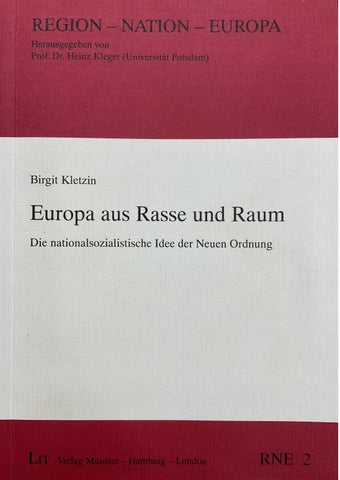
Birgit Kletzin Europe from race and space
Region - Nation - Europe Published by
Prof. Dr. Heinz Kleger (University of Potsdam)
Volume 2
Birgit Kletzin
Europe from race and space The National Socialist Idea of the New Order
Die Deutsche Bibliothek - CIP unit recording Kietzin, Birgit. Europe of race and space : the National Socialist idea of the New Order / Birgit Kietzin. - Münster : L IT, 2000 (Region - Nation - Europe ; 2.) ISBN 3-8258-4993-7
NE: GT
© LIT VERLAG Münster - Hamburg - London Grevener Str. 179 48159 Münster Tel. 0251 -23 50 91 Fax 0251 -23 19 72
Introduction
1
Introduction
Beauftragt, den Stand der europäischen "Neuordnungsplanungen" und ihre Widerspiegelung in den verbündeten und besetzten Ländern zu untersuchen, stellte der Legationsrat im Auswärtigen Amt von Trützschler Ende März 1942 fest: "Wenn es auch nicht zweifelhaft sein kann und immer wieder von allen Seiten bestätigt wird, daß das von den Achsenmächten proklamierte Kriegsziel einer Neugestaltung Europas die politisch interessierte Bevölkerung aller europäischen Länder auf das lebhafteste beschäftigt, so ist doch schon die öffentliche Diskussion dieses Themas eine sehr beschränkte, da die Regierungen der uns verbündeten und befreundeten Länder eingehendere Presseerörterungen unterbinden dürften und auch in den wenigen neutralen Staaten Europas die Zeitu ngen teils infolge des Fehlens konkreterer deutscher Äußerungen, Neutralitätsrücksichten zur Zurückhaltung gezwungen sind. Offenbar halten aber auch nur wenige Regierungen den Zeitpunkt für gekommen, mit uns in amtliche oder halbamtliche Erörterungen allgemeinerer Natur über die Gestaltung der Nachkriegswelt einzutreten; wenn man von den zahlreichen sich widersprechenden Territorialwünschen unserer südosteuropäischen Verbündeten absieht, ist es eigentlich nur die Finnische Regierung, die - wohl auf Grund ihrer besonders starken und unabhängigen Stellung - freimütig das Thema angeschnitten hat."1 ) In view of this rather negative self -assessment, the question arises as to the real significance, indeed the real content, of a "National Socialist conception of Europe" that went beyond its mere proclamation as a wartime objective of the Axis powers. Although National Socialist policy increasingly used the idea of the "reorganization of Europe" as a propaganda tool of war, without allowing its content to go bey ond a mere justification of Germany's expansionist drive, it nevertheless achieved considerable impact, especially in the continent's western and northern European states, but also in southeastern Europe. This undeniable echo, which culminated in the willingness of some occupied countries to collaborate, can ultimately only be traced back to the fact that the "reorganization" ideas corresponded to a spirit of the times, which was now interpreted and propagated in a unilaterally German manner. To this end, e xtensive considerations and models of a geographically, politically and economically "reordered" Europe were
1) B A D ep t. P ot sd a m, 0 9 .0 1 A A, N o. 61 12 0, p . 6 6 .
2
Introduction
developed in various fields of National Socialist science and scientific journalism, which were shaped in different intensities, used by politics and propaganda and reflected beyond German borders. The vague "reordering" model that emerged in the course of the war was determined by the exigencies of an increasingly hegemonic an d aggressive German policy of revision that had abandoned all international ties and was accompanied by increasingly articulated propaganda for a "New European Order." In this context, however, even the question of the very existence of National Socialist concepts of Europe is open to question.2) Detached from racial persecution, conquest policy and state apparatus of coercion, from the reality of occupation and concentration and extermination camps, which drew the true picture of a "German" National Social ist Europe, the ideas of "reorganization" nevertheless undoubtedly had a high ideological political value, which was reflected not least, but certainly in the most impressive way, in the willingness of a whole series of occupied Western and Northern European countries to collaborate. The question remains open whether - apart from the purely propagandistic, deliberately vague "vision" of German foreign policy, which was intended merely to conceal Germany's territorial claims - there were not conceptual ideas that went beyond this. This concerned above all the academic sphere, in which considerations were developed - albeit on behalf of the state - which, despite their undeniably one -sided orientation toward German interests, are far better suited to explainin g the sometimes immense impact of the "Europe" idea in National Socialist expansionist propaganda. The National Socialist idea of a "reorganization" of Europe accompanied the Third Reich throughout the entire phase of the Hitler regime's active foreign policy. The concepts of "space" or "Lebensraum," which were later stylized as "Greater Europe," formed the scientifically dressed -up ideological basis, the content of which increasingly began to occupy entire scientific institutions, some of which were establ ished directly for this purpose. The "foreign science" faculties at a number of universities or the German Foreign Science Institute in Berlin, founded in 1940, represent only one area of these activities. 2) C f . e. g. P . Klu ke : N ation al so zia li st i sch e E u rop a id e olo gi e, i n : V i er te ljah re sh e ft e fü r Ze itg e s ch i ch t e ( VH Z), 19 55, p p . 24 0 -2 7 5; M. S al e w sk i: E u r op a. I d e e u n d Wir kli ch k e it in d er n ation al so zia li st i sc h en We ltan s ch au u n g u n d p o lit i sch en Pr ax is , i n : O. F ran z ( ed . ) : E u rop a s Mit te, G ött in g en /Zü ri c h 19 87 , p p . 8 5- 1 06 ; P. K rü ge r: Hit l er s E u r op ap o lit ik, in : D er Nation al so zia li s mu s, F ra n kfu rt/ M. 1 99 3, p p . 10 4 -1 3 2; d e r s. Rü ckk eh r zu m in t ern ati on al en Fau st re ch t, in : K . Ma l et tke : De r N at ion a l soz ia li s mu s an d e r Ma ch t, G ö ttin ge n 1 98 4, p p . 16 6 -1 91 ; Da s Dr itt e R ei ch u n d E u ro p a, Mu n i ch 19 5 7; W. M ich alk a: Ri b b en t rop u n d d ie d eu t s ch e W e itp o lit ik 19 33 - 19 40, Mu n ic h 1 98 0.
Introduction
3
Already immediately after the First World War, the demand for a sufficiently large "living space" for the German people had become loud in the extreme right-wing German groups, which reached its undeniable climax in the person and politics of Adolf Hitler and the NSDAP. It was the reaction of an imperialism that had historically come too late, w hich, in the absence of colonial expansion possibilities and in the face of the harshest peace conditions, in the long term envisaged instead forcing the European continent - especially and initially almost exclusively in the eastern direction - into an imperialistically determined "quasi -colonization".3) In order to push through these ideas, extensive propaganda for a supranational union in a "New Europe" began after National Socialism came to power, conscientiously reflecting the international moods of th e time. It attempted to place the German "Lebensraum" demands in a more comprehensive framework and to free them, as it were, from the odor of one sided German claims. The idea of a "Europe to be reordered" took into account the traumatic experiences of th e European collapse in World War I just as much as it seemed to serve the manifold European plans of the most diverse political persuasions that had emerged in parallel. The concept of "reorganization" became the logical conclusion, which took up the probl em consciousness of the crisis -ridden continent just as much as it gave room to German demands for more "Lebensraum" and a revision of the Versailles provisions. In this context, the National Socialist "Europe" plans conveyed by propaganda seemed to contain an element of modernization. In the sense of the indicators established by Matzerath and Volkmann, which could be applied to the foreign policy-propagandistic sphere, a specific goal -means relation becomes clear in the National Socialist "reorganization" concepts:4) The presented program of a new European order cleverly combined unadulterated German goals with extreme demagogy. In doing so, the ideas of European unification used elements of modernity to disguise the extremely anti-modem National Socialist goals of expansion and hegemony over the continent. To the same extent that it became clear that the German "reorganization" efforts, despite their initially clear eastern direction, depended on the toleration and, in the later course of the war, even on the cooperation of the industrially highly developed western and northwestern states, the propagandistic methods were verified and their "scientific" foundation expanded. Science and scientists from the fields of space research, 3) C f. W. J . M o mm s en : D er e u rop ä i sch e I mp eri al i s mu s, Gö ttin g en 19 79 , p . 7 1. 4) C f. H. Ma tz era th /H . Vo lk man n : Mod e mi s i e ru n g sth e ori e u n d N ati o n al soz ial i s mu s, in : Th eo ri en in d er Pra xi s d e s H i stor ik er s, G ött in g e n 19 7 7, p p . 8 6 -1 02 , p p . 94 f f.
4
Introduction
geopolitics, and the ne wly founded foreign sciences were given a key position in the foreign policy propagation of National Socialist "reorganization" ideas." However, their role was mostly limited to supplying propagandistically usable theories and visions of the future, whose actual feasibility and characteristics were limited from the outset by the exclusive claim to power of the Hitler regime, and indeed were never intended even in the outlines of a "European community" presented. In this context, scholarly journalism took up thoroughly positively attested "modern" developmental tendencies that sought to solve the obvious problems of the interwar period via European unification, and combined them in a unique way with the structural "anti modem" elements of the Nazi dictatorshi p. Starting from a rigorous demand for more "Lebensraum" (living space), as still found in Hitler's "Mein Kampf" (My Struggle), there successively emerged without ever abandoning the premise of German hegemony in Europe - a scientifically geriatric, soci o-economically and ideologically based programmatic approach, which adapted its respective emphases to the current requirements of German politics without conforming to actual German goals. Beginning in the second half of the 1930s and then intensifying in the initial phase of the war, which was successful for Hitler and seemed to bring the realization of a National Socialist "new order" within reach, the corresponding theories experienced an unimagined upswing. With reference to the increasingly cross -border development of industry and transport technology, which would form the basis for a peaceful unification of the continent, the image of a "defensible -autonomous" Europe was developed, whose Western civilization should and must unite against the dangers o f Bolshevism on the inside and economic and political competition on the outside. Since the National Socialist state and economic system, which at the same time had the necessary means for the - military - implementation of the European "new order", was pr esented as "superior", it was obvious to derive from this a German - or with regard to the partner Italy - the claim of leadership of the Axis powers for the "new Europe". As a result, the "Europe" ideas, whose propagation began on a massive scale at the height of the German military successes in 1940/41, were without precedent in terms of arrogance and impertinence, but also in terms of genuine attempts to conceptualize the politically consciously extremely vague "reorganization" ideas. At the same time, differences between the reflection of the "Europe" ideas in politics and science can be demonstrated, without denying the clearly superior state program and the accompanying functionalization of science:
Introduction
5
For policymakers, the idea of "reordering" meant primarily an effective propaganda tool to safeguard military successes and occupation policies in Northern and Western Europe and to conceal the real dimensions of Germany's claim to hegemon y in Europe without presenting a genuine vision of the future. In this framework, foreign policy remained day -to-day politics, determined by purely pragmatic considerations. The real, less propaganda effective image of the future "reordered Europe," on the other hand, was to be found in the diverse war -goal planning of politics, business and the military, whose unambiguous German will to expand and dominate was not suitable for propaganda purposes. But in addition to these actual plans for war aims of the most diverse provenance and significance, extensive work began in the scientific sphere - initiated by concrete state commissions - in order to concretize, substantiate and ideologically secure the usable "Europe" ideas in terms of content. This distribution of roles resulted in a twofold function of the National Socialist political sciences, whose influence during the war, however, remained largely limited to the field of propaganda, so that, according to Michael Salewski, they would be far more appropriate ly described as "pseudoscience’s", since their state anchoring had put the tightest reins on their scientific freedom of movement5): On the one hand, the elaboration of the various facets of a concept of Europe served the implementation of the official pol itical war target propaganda, its historicization and scientification. In this understanding, science was consciously "taken into service" by the state authorities and beyond the conceived framework. On the other hand, even within the centrally influenced science, approaches to a genuine theory developed beyond this, whose viability and feasibility, however, - since they presupposed German hegemony - depended essentially on German military successes and the National Socialist system as such. The topicality of these questions is demonstrated not least by the intense disputes about the involvement of historians such as Schieder and Conze, who partly initiated the political planning for the "General Plan East".6) Consequently, four premises were out of the ques tion in the conceptualization of the "reorganization" idea from the very beginning:
1. science had to fulfill a specific - political - function in the totalitarian Nazi state, which narrowly limited its scope. 5) V gl . M. Sa l e w ski : Id ee n d er n ati on a ls ozi al i sti s ch e n Re gi e ru n g u n d Pa rt ei, in : Do ku me n t e zu r G e sch ich te d er eu r o p äi sch en In t e gra tion , B d . 1, B er lin 1 98 5, An m. 83 . 6) V gl. d azu G . A ly : M ac h t, Ge i st, Wah n , B er lin 19 97 .
6
Introduction
2. In this framework, science increasingly served as a "weap on," especially during the war, which included not only the natural sciences but also the humanities. 3. nevertheless, it was possible to develop rudiments of genuine "reorganization" ideas, which, however, proceeded exclusively from the National Socialist system and its goals and recognized them to the greatest possible extent. 4. Thus, the scientific considerations for the "reorganization" of Europe served primarily to justify the National Socialist expansionist policy and the German claim to leadership on the continent, while the actual planning of goals was reserved for the poli tical-military sphere. This distribution of roles made the alternative models of a "European community" that were hinted at a utopia from the outset, although their basic features had an undeniable impact and charisma. In the following, the term "science" will be used in the sense of the Salewskian "pseudoscience", which is based on the special doctrinal conditions in the Nazi system as well as the self -image of its representatives. In this context, the definitive separation of science and politics is also difficult in terms of personnel due to the state influence, since a number of leading representatives of scientific institutions were simultaneously active in political positions, or politicians such as Walther Funk, Werner Daitz, Werner Best and others pu blished in scientific organs in this context. While the emergence and elaboration of the corresponding ideas and plans directly reflected the stages of German foreign policy, the flood of new institutional foundations demonstrated the political value of th e scientific validation of the "reorganization" ideas. In the process, between 1939 and 1944, in addition to a plethora of individual publications, a large number of periodicals were increasingly placed "in the service" of the "reorganization." The publica tions reached their undeniable peak between the summer of 1940 and the turn of the year 1941/42, as well as - now under the auspices of the impending German defeat - at the end of 1943. The "Jahrbücher der Weltpolitik" and the "Zeitschrift für Politik" of the DAWI, the journal "Reich, Volksordnung, Lebensraum", the "Zeitschrift für Geopolitik", the "Monatshefte für Auswärtige Politik" as well as "Volk und Reich", the "Jahrbücher der Gesellschaft für europäische Wirtschaftsordnung und Großraumwirtschaft" or "Raumforschung und Raumordnung", the monthly journal of the Reichsarbeitsgemeinschaft für Raumforschung, or the "Nationalsozialistische Monatshefte" made clear the immense importance of the "European map" in National Socialist propaganda.
Introduction
7
However complex, but also stereotypical the argumentation for a European "reordering" was in this context, fixed categories can be traced that decisively shaped the development of National Socialist "Eur ope" ideas. While a "general line" of conception became clear within the various approaches to definition, they also left enough room to foreshadow more far -reaching possibilities for an acceptable interpretation of the new "European" understanding. In view of these complex problems, the fundamental question arises as to how National Socialist science succeeded in harnessing the objectively existing "European"-oriented modernization tendencies, the awareness of the problem, and the positively occupied conce ptual world of the European idea for German foreign policy and in developing at least the beginnings of a new National Socialist - concept from them:
- What, then, was the model of the "reordering" of Europe that was designed by National Socialist scien tific journalism in the political, economic, but also ideological spheres? Can differentiations - deviating from the political "general line" - be discerned in the abundance of publications? - In view of the reality of German war and occupation policy, what were the reasons for the undeniable effectiveness of the "concept of Europe," which in the ideological sphere went far beyond what could be achieved militarily? - Which objective developments and needs, then, were served or used by means of positively occupied terms, conscious choice of tradition, and delimitation of enemy images in order to provide National Socialist policy with a visionary but apparently acceptable goal?
In the evaluation of the German scientific contributions or those published in German organs, which are supplemented by decisive political statements as well as the comparison with real German politics, the model of a National Socialist-led "European reordering" emerges, which - as vague and stereotypical as it is - certainly possess ed an inner logic: Starting from the "Lebensraum" demand of the so -called "Havenots" after the First World War, the "Lebensraum" idea developed into the supporting element of the National Socialist "reordering" visions. The "space" concept of geopolitics f ound its way in here, as did the German claim to expansion - now clothed in the form of a right to a sufficiently large "Lebensraum" for all countries - which, through the criticism of the conditions of the interwar period, appeared as a
8
Between Modernization and the Claim to Hegemony
traditionally justified necessity. From this premise - in view of the fact that the individual claims and "living spaces" in Europe naturally had to overlap one arrived at the idea of a "Greater Europe" or "Greater Econ omic Europe", which was to integrate all interests and guarantee the further development of Europe into a new world power. The announced "reorganization" of the European continent, which Germany attempted to enforce with massive military force, despite the invoked ideals of "equal cooperation," thus became, as it were, the preliminary stage of new European greatness.
1. Nazi Conceptions of Europe between Modernization and the Claim to Hegemony 1.1 The Political Idea of the "New Order of Europe 1.1.1 Theoretical foundations and political precursors: Geopolitical "Lebensraum" concept, Mitteleuropaprojects, Paneuropaidee or world economic orientation
The idea of a now necessary European "reorganization" had become an immanent part of the politically and above all economically determined discussion in the various European countries at the latest since the First World War. The concept of Europe had a tradition that went back to the 17th century and encompassed both intellectual and political aspects. It wa s not until the emergence of nation -states in the course of the 19th century that this European frame of reference was permanently shaken.1) The traumatic experiences of the First World War then emphatically erased the old image of Europe, but at the same time raised the question of possible "European" alternatives in the changed world system, which were discussed from the most diverse ideological positions in the interwar period. National Socialist "reorganization" propaganda then also drew on these ideas, which had achieved mass impact at the latest during the world economic crisis after 1929. It made use of their solutions and applied their ideas and concepts, which now took on a new, specifically National Socialist character, but whose impact strategy bu ilt on the previous, largely positive interpretations. The Nazi "reorganization" idea was based on two fundamental pillars: First, it used the geopolitical considerations of "space" and "Lebensraum" to provide the scientific and intellectual tools of the p lanned changes. 1) C f. M. Sa l e ws ki : E u rop a : Id e e u n d W i rkl ich k e it in d er n ati on al so zia li st i sch en We ltan s ch au u n g u n d Pr axi s, in : O. Fra n z ( ed . ): E u rop a s Mi tt e, Gö ttin g e n 1 99 1, p p . 85 - 10 6, p . 8 5.
Introduction
9
Second, the idea of Europe itself, in its various variations culminating in the juxtaposition of Central Europe and Pan -Europe, advanced to become the supporting element of the "reorganization" propaganda. Already the first formulation of the foreig n policy plans in Hitler's "Mein Kampf' reflected these components,2) which reached their undeniable climax in the later scientifically influenced propagation of the German European plans. Another alternative discussed, especially in economic circles, was a global economic orientation for Germany, which preferred the open world market but also considered a protected European economic area dominated by Germany, especially after the Great Depression.3) The starting point of the National Socialist "reorganizat ion" considerations was geopolitics, which in its self understanding is located between history, geography and political science. Although its actual theoretical content and claim are still highly disputed, the geopolitical terminology is also currently be ing used more frequently again.4) In a working definition from 1994, Hans -Adolf Jacobsen summarized geopolitics sweepingly as "the geographical foundations of a state as a conditioning factor in the constants and variables of the respective foreign, economic and security policy".5) Especially when analyzing the writings of Karl Haushofer, the German "father" of geopolitics in the 1920s and 1930s, Jacobsen had to admit that the term itself was extremely unclear and that its scientific status was disputed.6) But regardless of all definitional inconsistencies, geopolitics deals with the relations between the conditions of geographic space and politics, in other words with the "spatiality" of political phenomena, whose interrelationships and dependencies it atte mpts to analyze.7) From today's perspective, the interdisciplinary approach of geopolitics to policy advice is generally accepted, but its historical "aberrations", which had clearly shifted the boundaries between pure science
2) Cf . A. H it le r: Me in K a mp f, Mu n ic h 19 3 0, e sp e cia lly ch ap t er 4; s e e al s o A. Ku h n : H itl e r s au ße n p ol it i sch e s Pro gra m m, Stu t tga rt 19 7 0, p p . 36 f f, 11 5. 3) C f . P . Krü g er : Wi rt sch af tli ch e Mi tt el eu r op ap lä n e in Deu t sch la n d z wi s ch en d en We ltk ri eg en , in : Mit t el eu r op a -K on z ep t ion en in d er er st en Hä l ft e d e s 20 . Ja h rh u n d e rt s, Vi en n a 1 99 5, p p . 28 3 - 3 03, p p . 28 9 ff . 4) C f. D. D in er : Gru n d b u ch d e s P lan et en , in : V HZ , 19 8 4, p p . 1 - 28 , p p . 1 8 f. 5) H. -A . Ja cob s en : G e op ol iti k i m D en k en u n d Han d eln d eu t sc h e r Fü h ru n g s el it en , in : We lt Tr en d s N o. 4, B er li n 19 9 4, p p . 3 9 -4 6, p . 3 9 . 6) C f. H. -A . Ja cob s en : K a rl H au sh o f er, Vo l. I , B op p ard 19 79, p . 48 3. 7) C f. F . N eu man n : B eh e moth . St ru kt u r u n d P r axi s d e s Nat ion a l soz ia li s mu s 1 93 3 - 1 94 4, Fran kfu rt a .M . 1 98 4, p p . 17 6f f ; an d M. Sch mo e c kel : Di e Gro ßrau m th e or i e, B e rl in 1 99 4, p p . 81 f f.
10
Between Modernization and the Claim to Hegemony
and its political use in favor of politics, especi ally during the Nazi era, were and are still criticized.8) The scientific study of geopolitical problems began in the early 20th century, with the German term first being used in 1899 by Rudolf Kjellén, a Swedish political scientist.9) By the turn of the c entury, the conviction had arisen that human action was essentially determined by external - that is, environmental - forces. The emerging discussion, which was influenced by post -Darwinian and environmental determinist components, was then infused with bi ological-geographical elements, which were emphasized above all by Friedrich Ratzel10).11) The "anthropogeography" developed by him dealt with the natural factors in human life and examined "location" and "space" in their repercussions on human politics an d society.12) Ratzel's fundamental work, "Political Geography" from 1897, introduced the originally biological concept of "habitat" - extended by a geographical component - into political linguistic usage. For him, states were "spatial organisms" that were significantly influenced in their foreign policy by "location" and "space." The acquisition of new "living space" thus appeared as a moment of the permanent struggle for existence.13) Ratzel then defined the state as a connection of people with a "piece o f ground" that would decisively shape the development of the state.14) By defining a "people" as a "politically connected group of groups and individuals" who "need not be related by tribe or language, but who are also spatially connected by the common ground," the "ground" - i.e., the "living space" - took on decisive importance: Only from this connection would result a "political organization of the soil, through which the state would become an organism", "into which a certain part of the earth's surface is incorporated in such a way that the characteristics of the state are composed of those of the people and the soil".15) According to this, the state would only have come into being through the mutual connection of people and soil, whereby "narrow" or "wi de" spaces exerted very specific effects on the respective states.16) 8) C f. H. -A . Ja cob s en : K a rl H au sh o f er, v ol. I, loc . cit . 9) C f. P . J. T ay lo r: Ge op olit ic al Wo rld O rd er s, i n : We lt Tr en d s No . 4, o p . c it. , p p . 25 - 37, p . 25 . 10 ) Cf . F. Rat ze l: Po lit i s ch e Ge og rap h ie, Mu n i ch /B er lin 1 92 3. 11 ) Cf . G. San d er : D et er m in i st ic Roo t s an d F u n ct ion a l U s e o f " G eo " in G e op ol it ic s, in : We lt Tr en d s N o. 4 ) op . c i t. p . 8 -2 0, p . 8. 12 ) Cf . F. N eu ma n n : B eh e moth , op . c it. 13 ) Cf . M. Sch m oe ck e l: Di e Gr oßr au mth eor i e, o p . c it. 14 ) Cf . F. Rat ze l: Po lit i s ch e Ge og rap h ie, op . c it. 15 ) Cf . i b id ., p . 4.
16 ) C f. ib id ., p p . 2 5 1 f f, 27 6 ff .
Introduction
11
Derived from this, Ratzel criticized the policy of nationalities, since with it th e language community instead of the soil had been elevated to the principle of state formation.17) At the same time, however, he also came to the conclusion that the European fragmentation could no longer be remedied by conquests, but only by facilitating transport.18) Since in the biogeographical approach the state was thus ultimately regarded as a form of organization alongside the "habitats", the conclusion was obvious to regard the states with their borders in general as variable categories, as "expressions of movement".19) On the basis of this biological -geographical approach, which culminated politically in the "habitat concept", "spatial management" was now regarded as a positive feature of life from a geopolitical point of view: Political boundaries became dynamic elements. When, after 1918, "space" in Germany was increasingly defined in terms of the state and "völkisch," this suggested an expansive conclusion that speculated, on the one hand, on bringing people and soil back into harmony in terms of nationality and, on the other hand, on endowing the number of people with a sufficiently large space.20) In this logic, the nation -state idea of the 19th century increasingly appeared to be outdated, and geopolitics took up the task of creating the epistemic prerequisites for redistributing the world according to "natural" criteria.21) In this context, the geopolitical approaches opened up the possibility of viewing the European continent as an overarching "Lebensraum" or as a sum of "Lebensräume" largely i ndependent of existing political circumstances, and v, thus, of putting borders up for disposition. If Bismarck had demanded the necessary "Lebensraum" for Prussia at that time, the All German Association in 1894 already demanded a corresponding "elbow roo m" for the German Reich.22) But only the undisguised claim to "Lebensraum" in Hitler's "Mein Kampf" formed in its political consequence the indisputable climax of the abuse of geopolitical considerations. Although Karl
17 ) Cf . i b id ., p . 2 5. 18 ) Cf . i b id . , p . 3 08 . 19 ) Cf . i b id ., p . 1. 20 ) Cf . G. San d er : D et er min i st ic Roo t s an d Fu n c tion a l U se o f " G eo " in G eo -p o li ti cs , op . c it. p . 9 f f. 21 ) Cf . D. Din e r: G ru n d b u ch d e s P lan et en , op . ci t. 22 ) C f. K . Lan ge : D er T e rm in u s " Leb en s rau m " in Hit l er ' s " Me in Ka mp f ", in : V HZ, 1 96 5, p . 4 43 7, p . 4 28 .
12
Between Modernization and the Claim to Hegemony
Haushofer,23) who advanced to the leading representative of German geopolitics after World War I, demanded to keep statesmen "in the world picture" in the future in order to avoid the immoderate overestimation of German greatness in the future, he at the same time advocated also to restore the importance of the German state in the world.24) From this perspective, he ultimately subordinated geopolitics to the political ambitions of the Nazi state. On this basis, three options for German -European development were discussed: 1. the Central European idea, which was based primarily on economic and strategic considerations; 2. the Pan-European idea, which favored a political union beyond the Central European states, and 3. the global economic orientation of the German economy, which considered the European frame of reference too narrow. But first of all, geopolitical considerations in Germany - applied to the European continent - at the turn of the century had again brought forth the ideas of a Central European union, which had already played a role from an economic point of view in the middle of the 19th century, above all in the writings of Friedrich List.25) The Central Eur opean concept took up the centuries-old idea of a politically united Europe26) on a smaller level, as it were, and at the same time reacted to the immense economic developments that increasingly transcended national borders. From the German point of view, this problem was additionally linked to the requirements and opportunities of the "central position of Germany," which had already influenced the discussion in the course of the 19th century and led to the most diverse political conclusions in Germany's ev entful history.27) In this context, the German discussion was shaped by the conviction that, on the one hand, a special responsibility, but also special claims, were associated with the Central
23 ) S in c e Ka rl Ha u s h o fe r wa s - al b e it u n in t en t ion ally - "p u t in D i en sl st el l t" b y th e N ati on al Soc ia li st s, h i s con s id era tio n s a r e ex a min ed in mor e d eta il in th e se ct ion "Nat ion a l soz ia li st i sch e Wi s s en sch i i m D ie n s te d er N eu ord n u n g ". 24 ) Cf . H. - A. Ja cob s en : G eop o li tik i m D en k en u n d Han d eln d e u t sch e r F ü h ru n g s e lit en , a.a .C 40 . 25 ) Cf . F. Li st : E i n mit te l eu r op äi s ch er St aat en v er b an d , L e ip zi g 19 14 . 26 ) Cf . O. Fran z: E u rop a s Mit te , in : D er s. ( ed . ) : E u rop a s Mi tt e, op .c it. , p p . 3 - 10, p . 3. 27 ) C f. th e ran ge o f F. L i st : E in mi tt el eu r op ä is ch er Staa te n ve rb an d , lo c. cit .; P . d e La gard e : De u t sch e S ch r if ten , Göt tin g en 1 92 0; an d F. Nau man n : Mi tt el eu r op a, B e rlin 1 91 5.
Introduction
13
European territories, which resulted from Germany's geographical position.28) It was precisely th is postulated "obligation" to organize the Central European bloc that was later taken up again by National Socialist propaganda as the "red thread," as it were, of their European ideology. But first, "Central Europe" had become a political buzzword that in creasingly described Germany's wartime objective in World War I. Already increasingly present in the Bismarck era, the idea of Central Europe after the turn of the century marked above all the effort to counter the economic powers of Great Britain, Russia and the rising USA with a "European" identity of its own.29) In this sense, Hillgruber already understands the German -Austrian-Hungarian Dual Alliance with its economic expansion into Southeastern Europe and Turkey as a Central European bloc that constitut ed the starting points for the world war.30) Ultimately, the idea of Central Europe appeared in German politics whenever it was a question of limiting the right of self -determination of other states in favor of its own formal or informal imperialist goals. While the first advances in the immediate run -up to the war came from the economic sphere, which was oriented toward a "European economic area" as compensation for a lack of colonial expansion possibilities, German policy initially instrumentalized "Centr al Europe" only as political backing against Russia.31) After the outbreak of the war, the idea of Central Europe then took on a strong strategic significance, as it offered the possibility of providing material and ideological support for German warfare a nd, above all, of permanently linking Austria -Hungary to the German Reich and its expansion program to the southeast.32) At the same time, the idea of a defense economic area extended to the west and east emerged, which would be geared to Germany's needs in such a way that expansion could largely be replaced by informal methods:33)
28 ) C f. H . S ch u l ze : D i e "d eu ts ch e K ata st rop h e " u n d d i e Ko n tin u it ät d e r d eu ts ch en G e sch ich t e, in : O. Fr an z (e d . ): E u rop as M itt e, op . c it., p p . 71 - 84 , p . 7 7. 29 ) Cf . F. Fi s ch er : K ri e g d er Il lu si on e n , D ü ss e ld o rf 19 8 7, p . 7 2. 30 ) Cf . A . Hi ll gru b e r: K on tin u itä t u n d Di sk on ti n u ität in d er d e u t sch en Au ß en p o lit ik vo n Bi s ma rck b i s Hi tl er, in : De r s. : G roß ma ch t p ol iti k u n d I mp e ri ali s mu s i m 20. Jah rh u n d e rt, Dü s se ld o rf 1 97 2, p p . 11 -3 6, p . 19. 31 ) Cf . W . M o mm s en : Di e M itt e le u rop aid e e u n d d ie M itt el eu rop ap lan u n gen i m De u t sch en Re ic h v or u n d wäh r en d d e s E r st en W e ltk ri eg e s, in : M itt e leu rop a - Ko n zep tion en in d er er st en Häl ft e d e s 2 0. Ja h rh u n d ert s, V i en n a 19 9 5, p p . 3 - 24, p p . 3, 12 f f. 32 ) Cf . i b id ., p . 1 3f . 33 ) C f. ib id ., p . 13 ; an d A. Hi ll gru b e r: Ko n tin u ität u n d Di sk on t in u i tä t in d e r d eu s ch e n Au ß en p o lit ik v on Bi s mar ck b is Hi tl er, op . c it.
14
Between Modernization and the Claim to Hegemony
On September 9, 1914, Chancellor Bethmann Hollweg sent von Delbrück a program of war aims that formulated Germany's hegemonic claim in Central Europe. The so-called September Program assumed that only a Germany "strengthened" in Central Europe could exist alongside the world powers England, the USA and Russia. Thi s Central European model included both continental Western Europe and a corresponding expansion of German colonial possessions in Central Africa, which would ultimately establish German hegemony in Europe and thus unite the interests of the leading classes in business, politics and the military.34) "Central Europe" then became the German war goal par excellence as a purely economic agreement for the time being.35) However, the idea of Central Europe owed its greatest popularity to the book "Central Europe" by Friedrich Naumann, the leader of the National Liberal Party, published in 1915.36) The "Working Committee for Central Europe" founded by Naumann in February 1916 comprised politicians, scientists and entrepreneurs and attempted to do preliminary work fo r the government, without, however, ever being supported by it.37 ) In his book, Naumann sketched out the model of a federal "supreme state of Central Europe" as a "federation of existing states" that would centralize certain state activities but leave sov ereignty and state sovereignty untouched.38) He defined "Central Europe" as going beyond the union of Germany and Austria-Hungary, but stressed that these expansions could only take place on the basis of an economic and military union.39) His statements ab out the final geographical scope of the planned union had to remain vague, however, in view of the war situation: He merely clarified that a "viable Central Europe" would need both agricultural areas and an extension of its northern and southern seacoasts, as well as overseas colonial possessions, in order to exist as a fourth "world economic body" alongside the United States, Great Britain, and Russia.40) In this, he ascribed a key role to Germany's "practical world economic socialism. "41) 34 ) Cf . F . F i sc h e r: G ri f f n ach d er W elt ma ch t , Dü s s eld or f 1 9 84, p . 9 0 f f; a s w el l a s d er s. : Kr ie g d er Il lu si on e n , op .c it., p . 7 65 f f. 35 ) Cf . F. Fi s ch er : Gr if f n ach d e r W el t mac h t, o p . c it. 36 ) F. N eu man n : B eh e m oth , op . c it . 37 ) Cf . W . M o mm s en : Di e M itt e le u rop aid e e u n d d ie M itt el eu rop ap lan u n gen i m De u t sch en Re ic h vor u n d wäh r en d d e s E r s te n W el tkr i eg e s, op .c it. , S . 1 7. 38 ) Cf . F. N au man n : M it te leu rop a , B e rl in 1 9 15, S, 22 9f F. 39 ) Cf . i b id ., p . 2 49 . , 40 ) Cf . i b id ., p p . 1 77 f f, 18 4f . 41 ) Cf . i b id ., p . 1 97 .
Introduction
15
With these theories, Naumann's book achieved an immense resonance, but in the end it could not hide the fact that it was a work of propaganda that mostly bypassed the actual problems on the road to Centr al Europe.42) Nevertheless, the idea of a Central European economic and political alternative that could keep the peace in the future continued to play a major role. But regardless of this, the idea of Central Europe in German politics had long since given way to an unambiguous power politics, which finally led to Brest Litovsk.43) The Treaty of Versailles then completely changed the "Central European" preconditions and attitudes. Under the postwar conditions, "Central Europe" became a possible conception t hat would allow for a continuation of life in the short term and a revision of the peace provisions from the German point of view in the long term. The actual idea of Europe, on the other hand, was suspended in the Pan European movement.44) Based on the id ea of national self -determination, the Versailles Peace Treaty had dissolved the supranational power structure of the multiethnic state of Austria -Hungary, thus pushing particularization in Central and Southeastern Europe to its peak. Only the newly founde d League of Nations represented a universal claim vis -à-vis the nations, which, however, in view of the obvious inadequacies of the peace treaties, raised additional questions about European self -assertion between the rising world powers USA and Russia: The destroyed economic ties and the future fate of the national minorities in the newly emerged states now offered renewed approaches for European-initiated unification efforts. However, from the very beginning, these efforts were under the sign of possible revisionist claims, since the actual main problem of the Versailles Treaties was that for the first time in modern European history, one country - the German Reich - had been made a pariah as the sole guilty party in the war.45) Thus, the Versailles Treaty had initially destroyed all attempts at European unification. At the same time, however, it offered Germany the opportunity to profit in the future from the contrast between British and Soviet European policy.46) 42 ) Cf . W . M o mm s en : Di e M itt e le u rop aid e e u n d d ie M itt el eu rop ap lan u n gen i m De u t sch en Re ic h vor u n d wäh r en d d e s E r s te n W el tkr i eg e s, op . cit . 43 ) Cf . i b id ., p . 2 3. 44 ) C f . on th e d e v elop m en t o f th e E u rop ean id e a an d p o li ti cs a s a wh o l e C .H. Pe gg : E vo lu t ion o f th e E u r op e an Id ea. 1 91 4 -1 93 2, Ch a p el Hi ll /Lon d on 19 83 . 45 ) C f. R . Frö m m el t: Pa n eu r op a od er M itt el eu r op a, Stu t tg art 1 97 7, p . 7 f; a s w e ll a s M. Sal e w sk i: E u ro p a: Id e e u n d W irk li ch k eit in d er n ation al so zia li st i sch en W el tan sc h au u n g u n d Prax i s, o p . cit ., p . 8 6. 46 ) Cf . A . Hi ll gru b e r: K on tin u itä t u n d Di sk on ti n u ität in d er d e u t sch en Au ß en p o lit ik vo n Bi s ma rck b i s Hit le r, o p . cit .
16
Between Modernization and the Claim to Hegemony
Under National Socialist auspices, this initially developed into the idea of the Greater German Reich, which incorporated Central Europe as a whole into the German sphere of rule. In the course of the war, the "reorganization" ideas then transcended these borders to the extent that the war and German successes absorbed these areas. The traditional idea of Europe, on the other hand, was carried on after World War I by a certain Europe -wide cultural and political elite,47) whose motives ranged from pure peacekeeping to economic considerations to an emphasis on European commonality over nationalism.48) The most important force in these unification efforts developed into the Paneuropa Union, which was founded in 1923 on the initiative of the cosmopolitan Count Richard Coudenhove -Kalergi as a non -partisan mass movement for the unification of Europe.49) After Coudenhove -Kalergi's first efforts to organize a pan -European conference in 1922 had failed due to the refusal of Mussolini, whom he wanted to win over as a political pioneer, he then set up a mass organization.50 ) Starting from a strong Austrian section and the tireless promoti onal activities of its founder, the Pan -European Union became a supranational organization that maintained national committees in all European capitals. According to Coudenhove -Kalergi's ideas, "Pan -Europe" encompassed all European states with the exceptio n of Great Britain and the Soviet Union. The simultaneous front against "a red or white Russia" and the economic competition of the United States and Great Britain were to become the integrative factor of the new European commonality, which would guarantee peace in Europe in the future.51 ) On the way to a pan -European conference, which would have to discuss questions of disarmament, minorities, customs and debts, currency, transport and culture, Coudenhove Kalergi planned the conclusion of a "compulsory arb itration and guarantee treaty" as the next step. This would form the basis for a unified European economic area in the form of a pan -European customs union, which would ultimately lead to the "United States of Europe" on the model of the United States.52) Supplemented by colonial territories, he thus practically created 47 ) Cf . J. Lu ka c s : D e r l et zte eu rop ä i sc h e K ri eg, S tu ttg art 1 97 8, p . 3 79 . 48 ) C f. W. Li p g en s : E u ro p äi sch e E in igu n g si d e e 1 92 3 -1 93 0 u n d Bri an d ' s E u rop ap lan i m Ur te il d er d e u t sch en Ak ten , in : HZ , 1 96 6, T . 1 : p p . 46 - 89, T . 2: p p . 31 6 -3 63 , p p . 5 4 f. 49 ) Cf . i b id , p . 57 . 50 ) Cf . R. Frö m m e lt: Pa n eu r op a od e r Mit te l eu r op a, op .c it. , p . 1 2f . 51 ) Cf . R. Cou d en h o v e - K al erg i : Pan eu rop a , V i en n a/L e ip zi g 19 24 , p p . 3 7, 41 f f., 5 8f f . 52 ) Cf . i b id ., p p . 1 51 f f.b
Introduction
17
the model of a largely self -sufficient Europe, which, through its anti Bolshevism, anti-revisionism, and colonialism, offered starting points of the broadest political nature.53) A series of conferences and congresses brought the Pan -European movement the support of well -known politicians, scientists and writers, but it could not become a serious political alternative. Thus, although the left -liberal and socialist parties of France an d Germany certainly declared their support for the goal of a "United States of Europe," and Aristide Briand54) assumed the honorary presidency of the Union in 1927, the official policy of the states continued to be dominated by the pattern of thought of so vereign nationstates.55 ) Thus, in addition to the Paneuropa Union, with the Central European Economic Day, the European Committees of Understanding and the European Customs Union, other organizations had emerged that represented the idea of an economic u nion of the European continent, but ultimately they were just as unable to achieve overarching political influence.56) The world economic crisis and finally the rise of National Socialism in Germany emphatically demonstrated the weakness of the European mo vement. After 1933, the Pan-European Union, like the League of Nations, sank into insignificance,57) although the idea of European unification now lived on as a propagandistic element of National Socialist revisionist policy and experienced a renewed upswi ng in the final phase of the war in the idea of the European "community of fate and struggle" - under, as it were, Germ an auspices. In contrast, in the early 1930s, in the wake of the world economic crisis, a front position crystallized that outlined the p ossible alternatives for overcoming the crisis in the form of the models of "Central Europe" or Pan Europe. While the idea of Central Europe was increasingly propagated in Germany, France advanced to become the political bearer of pan -European thoughts. Within this framework, European thinking in Germany58) now encompassed three groupings: 53 ) Cf . R. Frö m m e lt: Pa n eu r op a od e r Mit te l eu r op a, op . c it ., p . 1 4. 54 ) A ri st id e Br ian d wa s s e ve ral ti m e s p ri m e m in i st er an d f or ei gn min is te r o f th e Th i rd Fr en ch R ep u b li c. 55 ) C f. W. Li p g en s : E u ro p äi sch e E in igu n g si d e e 1 92 3 -1 93 0 u n d Bri an d ' s E u rop ap lan i m Ur te il d er d e u t sch en Ak ten , o p . c it., 5 8 f. 56 ) Cf . R. Frö m m e lt: Pa n eu r op a od e r Mit te l eu r op a, op . c it . 57 ) Cf . J. Lu ka c s : D e r l et zte eu rop ä i sc h e K ri eg, o p . c it. 58 ) O n E u r op ad en an ke u n d E u rop ap ol it ik i n d er We i mar er R ep u b li k, s ee, am on g oth er s, J . C. He s s : E u rop a g ed an k e u n d n at ion a l er R e vi s ion i s mu s, in : HZ, 1 97 7, p p . 5 72 - 62 2; an d K. Hol l : E u rop ap ol itik i m Vor f el d d eu t sch er R e gi eru n g s p oli tik, in : H Z, 1 9 74, p p . 33 - 94 .
18
Between Modernization and the Claim to Hegemony
First, the advocates of the pan -European ideal, who propagated European unification as the only way to preserve peace and enable Europe's economic and political resurgence; second, the politicians and entrep reneurs who, for purely pragmatic reasons, were convinced of the merits of pan -European arrangements. But in addition, thirdly, the proponents of a pure German nationalism gained more and more influence, who rejected the idea of Europe per se and opposed i t with the model of an anti -Western, geopolitically initiated German sphere of power and hegemony in Central Europe.59) At the end of the 1920s, the idea of Central Europe thus experienced a renaissance, which on the one hand reflected a direct industrial constellation of interests, but on the other hand was also able to include the intellectually rather blurred discussion. Without already representing a concrete expansion program, "Central Europe" was above all a geopolitically based revisionist vision of a political and, above all, economic unity under German hegemony.60 The idea of a large area developed in this context initially remained purely economically oriented and sprang from the endeavor to economically reunite the Danubian states that had emerged in 1919.61) The call for a stronger concentration of the German economy on Central and Southeastern Europe, which was then increasingly raised by influential circles in industry from the early 1930s onward, ultimately resulted from the striving to cushion the crisis through regionally secured markets. At the same time, concerns about maintaining Germany's export capability led to a further orientation toward the world market.62) In this environment, a number of scientific research institutions were established to prepare for German influence in Central and Southeastern Europe. For example, at the end of 1928, Professor Walter Hoffmann of the Freiberg Mining Academy suggested to the Foreign Office the creation of a Central European Institute in Dresden.63) T he institute was intended to carry out "purposeful cultural propaganda," which, according to Hoffmann, would have become necessary for both economic and political reasons in order to secure "Germany's leadership in the Central European movement politically
59 ) C f. P. Krü g er : H itl e r s E u rop ap ol iti k, i n : D er Nation al so zia li s mu s, F ra n kfu rt a .M ., 19 93, p p . 1 0 4 - 1 32, p p . 10 6 ff . 60 ) Cf . K. Sc h ön wa ld e r: Hi sto rik er u n d Pol iti k, F ran k fu r t/ N e w Yo rk 19 9 2, p p . 5 8 f. 61 ) Cf . P . K lu k e : N at ion a ls ozi al is ti s ch e E u r op ai d eo log i e, in : VHZ , 1 95 5, p p . 2 40 - 27 5, p . 2 71 . 62 ) C f . P. Krü g er : Wi rt sch af tli ch e M itt e le u r op ap lä n e in D eu ts ch la n d zw i sch en d en We ltk ri eg en , lo c. c it. 63 ) Cf . P A o f th e A A i n B on n , R 6 58 30 M itt el eu ro p a - In sti tu t in D r e sd en , o.B l. 23 .1 .1 9 29.
Introduction
19
and culturally." To this end, in addition to academic teaching institutions, leading business associations, chambers of commerce and transport offices were to be involved in the institute, w hile avoiding the impression of one sided promotion of expansion and exports.64) Thus, the statutes of the Mitteleuropa-Institut described its purpose simply as "to foster cultural relations between Germany on the one hand and the countries of Southeastern Europe on the other, and to awaken understanding in Germany for the countries of the Southeast as well as vice versa in Southeastern Europe for Germany. "65) An advertising letter from the Institute to the German business community, however, emphasized in particular the opportunities that the Southeastern European market would open up for German industry, irrespective of any cultural understanding.66 ) Notwithstanding the fact that the Foreign Office initially showed no further interest in the work of the Mitteleuropa-Institut after the seizure of power, the latter continued its activities after 1933 and thus made a considerable contribution to the economic and political offensive of the Nazi state.67) A similar development took place at the Institute for E astern European Studies in Breslau, which had already dedicated itself during the Weimar period to the goal of "culturally and economically researching all countries east and southeast of Germany and German Austria, (to) pave the way for intellectual and economic relations with their peoples, and to make the results of German scholarship accessible again to authorities and business circles. "68) In 1930, the French foreign minister Aristide Briand opposed the hegemonic German plans for Central Europe with a plan for a "European Federal Union" that would intercept a unilateral German expansion of power within the framework of a pan-European union and protect the continent from American supremacy.69 ) Briand's memorandum was oriented toward creating a European federal organization within the League of Nations, which would have to establish European solidarity while preserving national sovereignties.70) While the
64 ) Cf . i b id ., D e c. 2 1, 1 9 28 . 65 ) Cf . i b id ., A rt ic le s of As s oc iat ion , § 1. 66 ) Cf . i b id ., d r af t o f a p ro mot ion a l l et t er t o G er man b u sin e s s, n o d a te . 67 ) Cf . P A o f th e A A i n B on n , R 6 58 31 . 68 ) C f. P A o f th e A A i n B on n , R 6 57 98 Os te u rop a -In s titu t in Br e s la u , o. B l., b ro ch u re Tät ig ke it sb er ic h t 19 27 . 69 ) Cf . R. Frö m m e lt: Pa n eu r op a od e r Mit te l eu r op a, op .c it . , p p . 7 3f f . 70 ) C f. W. Li p g en s : E u ro p äi sch e E in igu n g si d e e 1 92 3 -1 93 0 u n d Bri an d ' s E u rop ap lan i m Ur te il d er d e u t sch en Ak ten , lo c. cit .
20
Between Modernization and the Claim to Hegemony
smaller states of Europe accepted these plans, Great Britain, Germany , Italy, Ireland, and Hungary rejected the French ideas, fearing a unilateral strengthening of French positions.71) Germany, in particular, initially demanded a "just and lasting order for Europe "72) before finally establishing the status quo and, on the other hand, increasingly propagated the idea of a German-dominated Central Europe.73) In view of increasing German influence in these areas, France then tried to at least put a stop to the German export offensive on the basis of pan -European ideas.74) Thus , in 1931, plans for a German-Austrian customs union, which was to be open to further states, failed due to the opposition of France and the Little Entente.75) Instead, at the end of February 1932, the French Prime Minister Tardieu proposed the model of a Danube federation between Austria, Hungary, Yugoslavia, Romania, and the countries of the Little Entente, which was intended to link these states more closely economically through a system of quotas and preferential tariffs, while seeking to exclude German y.76) Germany vehemently rejected this request and emphasized once again that the best solution for overcoming the economic difficulties in the Danube countries would be the "creation of an economic area which, according to its size and economic structure, would ensure the sale of the economic surpluses from the Southeast European agricultural states within its borders. This goal, however, could not be achieved only by "uniting the Danube countries among themselves"; rather, such an "economic area would als o have to include the large agricultural subsidy areas of Europe". Moreover, a unilateral union of the Danubian states would mean a "hardly bearable constriction" for the threatened German economy.77) Thus, these plans had also failed because of the German veto. The rise to power of National Socialism in Germany then made any further understanding virtually impossible, while German business was able to continue its offensive under the new political circumstances.
71 ) Cf . i b id ., p p . 3 53 f f, 32 7. 72 ) Cf . A . H i ll gru b e r: K on tin u itä t u n d Di sk on ti n u ität in d er d e u t sch en Au ß en p o lit ik vo n Bi s ma rck b i s Hit le r, o p . cit . 73 ) C f. W. Li p g en s : E u ro p äi sch e E in igu n g si d e e 1 92 3 -1 93 0 u n d Bri an d ' s E u rop ap lan i m Ur te il d er d e u t sch en Ak ten , lo c. cit . 74 ) C f. H . Mat is : E con om ic Co n c ep t ion s o f C en t ra l E u r op e in th e In te r war Pe riod , in : C en t ra l E u rop ean Con c ep t ion s i n th e F ir st Ha lf o f th e 20 th C en tu ry, op . ci t., p p . 22 9 -2 55, p p . 2 39 f f. 75 ) Cf . i b id ., p . 2 43 . 76 ) Cf . i b id ., p p . 2 43 f f. 77 ) C f . PA of t h e AA in B on n , R 29 45 0 O f fi c e o f t h e S e cr et ary o f S tat e, Ai d e M e mo ir e o f 1 5 Mar . 1 93 2, p p . 26 7 -2 72 .
Introduction
21
"Central Europe" increasingly became an economic strategy, while pan European ideas were relegated to the realm of propaganda. Both the pan European unification efforts and their regionally limited counterpart "Central Europe" had ultimately emerged from the results of the First World War and the rise of the non -European powers, the USA and the Soviet Union.78) The resulting crisis processes also provided the Nazi regime in the 1930s with the starting points for its foreign policy propaganda, which cleverly operated on the basis of the unresolved issues and the growing awareness of problems in the European countries. A t the same time, the decision on the orientation of German foreign policy in the field of tension between autonomous great power policy and growing political and economic interdependence had long since been made clearly in favor of an unrestrained German s triving for hegemony,79) which was now to be veiled and justified with geopolitical and above all "European" ideas. National Socialist foreign policy thus stood in the continuity of the imperialist goals of the Wilhelmine era and the revisionism of the Wei mar Republic, which it varied analogously to the new conditions:80) The revision of the Versailles provisions became the prerequisite for a Greater German Reich, within the framework of which the Central European plans were now no longer an end in themselves, but merely the starting point for the actual goals, the "Lebensraum" war in the East.81 ) In the process, the demand for more "Lebensraum," which was initially advocated purely in terms of the politics of violence, was transformed during the active for eign policy of the Nazi regime into the idea of a new supranational continental order, which sought to justify German expansionist intentions, as it were, through the vision of a European motivated "reordering." The hegemonic transformation of the European continent that was actually sought thus acquired the dual character of being simultaneously a German war goal and a propagandistically effective means of war, which made unrestrained use of contemporary European ideas.
78 ) Cf . R. Frö m m e lt: Pa n eu r op a od e r Mit te l eu r op a, op . c it ., p . 9 7. 79 ) C f. P . Krü g er : R ü ck keh r zu m in t ern ati on al en Fau st r ech t , in : K. M al ettk e ( ed . ): D er Nation al so zia li s mu s an d er Ma ch t, G ött in g en 1 98 4, p p . 1 6 6 - 1 91, p p . 1 70, 18 5 f f. 80 ) C f . A. H il lg ru b er : F i n ally E n ou gh ab ou t N ati on al Soc ia l i s m an d t h e S ec on d W orld War ? Dü s se ld o rf 1 98 2, p . 5 1 f . 81 ) Cf . A . Hi ll gru b e r: K on tin u itä t u n d Di sk on ti n u ität in d er d e u t sch en Au ß en p o lit ik vo n Bi s ma rck b i s Hit le r, o p . c it., p .3 1 ; an d B . - J . W en d t: Gr oßd eu t s ch l an d , Mu n ich 1 98 7, p . 6 8.
22
Between Modernization and the Claim to Hegemony
1.1.2 The "New Order" of Europe between National Socialist Policy and Propaganda: War Goal and Means of War
Immediately after the end of the First World War, in view of the traumatic experiences of defeat and loss , massive ideas of revision had already gained a foothold in the thinking of extreme right -wing groups in Germany. They found their most concise expression in the NSDAP, whose foreign policy program was largely determined and represented by the person of A dolf Hitler.82) Already in Hitler's "Mein Kampf" the basic features of the foreign policy program were described, which then took over the "Europe" idea after coming to power in order to justify the undisguised demand for more "Lebensraum". Hitler proclaimed:
The foreign policy of the völkisch state has to ensure the existence of the race united by the state on this planet by creating a healthy, viable, natural relationship between the number and growth of the people on the one hand and the size and qualit y of the land on the other. Only that condition may ever be regarded as a healthy ratio which secures the nourishment of a people on its own land.... Only a sufficiently large space on this earth secures the freedom of existence for a people. In this conte xt, the necessary size of the settlement area cannot be judged exclusively from the requirements of the present.... For as I have already said in the first volume.... the area of a state, apart from its importance as a direct source of nourishment for a pe ople, also has another significance, the military -political one.... In this way, the National Socialists deliberately draw a line under the foreign policy direction of our pre-war period. We start where one ended six centuries ago. We stop the eternal Germanic migration to the south and west of Europe and point our gaze to the land in the east. We are finally putting an end to the colonial and trade policies of the pre -war period and moving on to the land policy of the future. But when we speak of new land in Europe today, we can think first and foremost only of Russia and the peripheral states which are her subjects... "83)
82 ) Cf . A . Ku h n : Hi tl e rs au ß en p o li ti s ch e s Pr ogra m m, op . ci t., p p . 32 f f, 37 f f; an d K. Hild eb ran d : D eu t s ch e Au ß en p o lit ik 1 93 3 1 94 5. Ka lk ü l o d e r Do g ma ? Stu tt gart / Be rl in / Co logn e 1 9 90, p p . 19 f f; an d E . J äc ke l: H itl e r s We ltan s ch au u n g, S tu tt g art 1 99 1, p p . 2 9 f f, 42 f f. 83 ) A . H itl e r: M ein Ka m p f, Mu n i ch 19 3 0, p p . 7 2 8, 7 4 2.
Introduction
23
Already here, the concepts of "people," "race," "space," and "land policy," which ultimately urged autarky, described the ideological outlines of later "reorganization" propaganda in a form that was, as it were, undisguised and free of political considerations. By no means singularly, Hitler took up geopolitical thoughts with these ideas, which he, however, misinterpreted,84) and used the expansive plans of the Wilhelmine era as well as the revisionist claims in the Weimar Republic. His "Lebensrau m" concept combined military political, nutritional -political and racial -biological tendencies, which were supplemented by a clear ideological front against Bolshevism and liberalism and a pronounced hegemonic claim.85) The idea of conquering new "living space" in Eastern Europe ultimately documented the transition from a rather conservative colonial ideology to an expansion - more in line with the real balance of power - directed against Russia, which now shifted Germany's imperialist ambitions to the Euro pean continent.86) The key event for this was the German collapse in World War I, which had brought the demand for revision and reparations to the forefront of foreign policy considerations of both conservative and extreme right -wing circles, which thus fo und broad popular support.87) Based on Social Darwinist ideas that determined the "value" and "significance" of a people according to their possession of "space," Hitler developed an expansion program to open a way out of the alleged threat of overpopulati on. This also made the NSDAP sufficiently attractive to large sections of the business community so that it could take power with the programmatic demand for more "Lebensraum".88) In this context, D. Diner argues that the geopolitically determined concept of "living space" "should not be concretized as an extension of territory, however broadly defined, but... reflects an attitude to life that is independent of the real geographic space and has been lost through the new social formation. a sense of life ind ependent of the real geographical space and lost through the new social formation "89) may be true for the field of geopolitics, but it is not sufficient to grasp the real political and certainly geographically understood 84 ) Th u s, a lth ou gh Rat ze l ca ll ed fo r " lar g e - sc al e th in kin g, " h e r ej ec t ed c on q u e st a s a so lu t ion fo r E u r op e . 85 ) C f. K. Lan g e: D e r T e rm in u s "L eb en s rau m " i n Hit l er ' s "M e in Ka mp f, " op . cit ., p p . 42 6 ff ; an d W . M ich alk a: Ri b b e n trop u n d d i e d eu t sch e We ltp o li tik , Mu n ic h 1 98 0, p p . 3 03 f f. 86 ) Cf . W .J . M o m ms en : De r eu ro p äi s ch e I mp er i ali s mu s, Gö ttin g en 19 79 , p . 7 1; a s we ll a s I. Ke r sh a w : Id eo lo ge u n d Prop a gan d i st, in : V HZ, 1 99 2, p . 2 65 . 87 ) Cf . E . J äc ke l: Hi tl er s We lta n s ch a u u n g, op . c i t. 88 ) Cf . Ku h n : H itl er s au ßen p o l iti s ch e s P rog ra m m, o p . cit . 89 ) Cf . D. Din e r: G ru n d b u ch d e s P lan et en , op . ci t.
24
Between Modernization and the Claim to Hegemony
content of the National Socialist idea of "Lebensraum".90) For Hitler himself, the "Lebensraum im Osten" meant both an agri cultural supplementary area in which German farmers were to be settled and an important source of raw materials and a huge sales market that would ensure autarky in the new "Großraum".91) The resulting long -term "reordering" of the entire European continent according to German ideas was thus the actual wartime goal of National Socialist foreign policy. In the short term, however, this could only be realized by German warfare materially exploiting the successively "reordered" territories, with the idea of "r eordering" itself becoming, as it were, a means of warfare.92) In this understanding, the revision of the Versailles Treaties appeared only as a means rather than an actual goal.93) Hitler's foreign policy went far beyond the old Central European idea94) a nd ultimately aimed at a "German Europe" that would form the fourth world power alongside the British Empire, America, and the Japanese -dominated Femen East.95) The path to this goal was divided into two main stages: First, Germany was to be renewed intern ally and made capable of war so that, on the basis of a Greater German Empire, large parts of Europe could be militarily united to form a continental empire. On this basis, an overseas expansion and a confrontation with the USA would then be possible, whic h would make Germany - though not during Hitler's lifetime - an absolute world power.96) In this understanding, war became a legitimate means of conquering "Lebensraum" that would help the "natural law of the strongest" to prevail. In this context, the pur ely power-political-geographical "reorganization" in the National Socialist program was just as much connected with the "racial" confrontation as with a permanent ideological struggle that linked the
90 ) Cf . D. Din e r: G ru n d b u ch d e s P lan et en , op . ci t. 91 ) C f. R. Zi te l man n : H itl er . S elb s t ve r stän d n i s e in e s R e vo lu ti on är s, H amb u rg /N e w Y ork 19 87, p p . 3 01 f f, 29 7. 92 ) Cf . G. Al y / S. H e i m: V ord en k er d e r V e rn i ch tu n g, Fran kfu rt a. M. 19 93, p p . 33 1, 35 0. 93 ) Cf . H . R au sch n in g: G e sp rä ch e m it H itl e r, N e w Yo rk 19 40 , p . 1 11. 94 ) Cf . J. F e st : H itl er s K ri eg, in : VHZ, 1 99 0, p p . 35 9 -3 73, p . 36 7. 95 ) C f. Ch . B lo ch : Da s D r itt e Re ic h u n d d i e W e lt, Pad erb o rn / M ü n ch en / Wi en /Zü r i ch 1 9 93, p . 4 2. 96 ) C f. A . H il lg ru b er : H i tl er s St rat eg i e. Po lit ik u n d K ri e gfü h ru n g 19 40 - 4 1, Mu n i ch 1 98 2, p . 23 ; an d K. Hi ld eb ran d : De u t sch e Au ß en p oli tik 19 33 - 19 45 . Kalk ü l o d e r Dog m a ? op . ci t., p . 15 ; an d E . Jä ck el : H it le r s We ltan s ch au u n g, op . c it.
Introduction
25
conquest of "Lebensraum" with the "counterattack" against the "world enemies" Bolshevism and Judaism.97) From this point of view, Hitler pursued a European model whose clearly hegemonic character urgently needed propagandistic paraphrasing. In his conversations with Rauschning, he expr essed his goals:
"I will place at the center the steel core of a great Germany forged into unbreakable unity. Austria, Bohemia and Moravia, the Polish West. The bloc, of a hundred million, indestructible, without rift and without foreign nations. The firm foundation of our rule. Then an Eastern alliance. Poland, the Baltic States, Hungary, the Balkan States, Ukraine, Volga, Georgia. A confederation, but not an equal partner, well understood, a confederation of auxiliary nations, without an army, without it s own politics, without its own economy. And I do not think of making concessions on a sentimental basis.... I make no distinction between friends or foes. The time of small states is over. In the West, too. A Western Confederation. Holland, Flanders, Nort h Franconia. A northern confederation. Denmark, Sweden, Norway. "98)
In the course of the war, this gave rise to the vision of a "new order" that would integrate all the states of the continent into a system of varying dependencies on the German Reich: The core was formed by the "Greater German Reich," which, in addition to Germany, would include Austria, Bohemia and Moravia, the Memel region, Poland, Eupen-Malmedy, Belgium with Flanders and Wallonia, Luxembourg, Alsace-Lorraine, northern and eastern Fra nce, Greece, parts of Yugoslavia, and the western territories of the Soviet Union as far as the Urals. The so -called "protectorates" such as Slovakia, Denmark, Norway, Croatia and Burgundy were to be attached to this continental bloc as a new state on Fren ch territory, whose foreign policy and military sovereignty would have to be restricted by German special representatives. The next level of subordination was formed by the planned "satellite states" of Finland, Hungary, Romania, Ireland, the Netherlands, Britain, which was to be occupied, and the rest of France, which, if they retained their state sovereignty, would be directly dependent on Germany politically and economically. 97 ) C f. H. -A . Ja cob s en : K ri eg in W el tan sc h au u n g u n d P rax i s d e s N ati on al s ozia li s mu s ( 19 19 19 45 ), i n : K. D. Bra ch er /M. Fu n ke / H. - A. Ja cob s en ( ed s .) : Nat ion al so zi ali st i sch e Dik tatu r 19 33 - 19 4 5, Bon n 19 8 6, p p . 4 2 7 - 4 39, p p . 42 9 ff . 98 ) H . R au sch n in g: Co n v er sa tion s w ith Hit l er, op . c it.
26
Between Modernization and the Claim to Hegemony
The neutral countries such as Sweden, Spain and Portugal, on the other hand, would officially be considered independent, but were also to be bound to Germany by economic and political treaties. The final stage of the plans concerned fascist Italy, which, a s an Axis power, would remain on an equal footing externally but would ultimately be tied to Germany economically as well. The model was completed by "supplementary areas" with colonial status in the east of the Soviet Union and in Africa.99) In view of these ideas, the thought of "Europe," which Hitler repeatedly and forcefully invoked, served exclusively for propaganda, which was intended to distract from the actual German goals by making unrestrained use of the European consciousness that had grown up. T he actual European policy of the Nazi regime, on the other hand, paralyzed all international ties and securities, destroyed the European system of states, and attempted to reverse the process of European integration through an unequivocal hegemonic policy. 100) of the Hitler regime thus formed - as P. Krüger stated - "rather the result of these efforts, once they were crowned with success, but not a primary goal in itself. "101) In this understanding, Krüger observed three different starting points of European planning in Germany:
a) the official foreign policy, which often emphasized the European idea in official language and thus took into account the need for peace and order as well as the existing willingness to integrate, but beyond that had no real conceptions; b) the blossoming of planning in the highest imperial authorities as well as c) the German occupation policy during World War II, which already began with extensive approaches to the organization of the European sphere of power.102) Nazi science would have to be assigned to this list, since far -reaching considerations of the content and ideology of the "reorganization" emerged in this area, demonstrating the transition from the original "Lebensraum" demand to the scientific -propagandistic "Lebens raum" concept. 99 ) Cf . W e lth er r sch af t i m Vi s ie r, B erl in 19 75 , p . 27 . 10 0) C f. P . Kr ü g er : Hi tl e rs E u rop ap ol iti k, in : D er Nation al soz ia li s mu s. St u d i en zu r Id e olo gi e u n d H err s ch a ft, F ran k fu rt a. M. 1 99 3, p p . 10 4 -1 3 2, p . 1 09 f f. 10 1) C f. ib id ., p . 11 1. 10 2) C f. ib id ., p . 12 7 ff .
Introduction
27
There is no question that the idea of the "reorganization" of Europe as a whole was clearly a foreign policy propaganda tool used by politicians for purely pragmatic reasons. This characterization, however, was largely limited to the political sphere, while Nazi science, within the limits described, also began to develop concepts going beyond this, which, however, did not gain any influence on actual politics .103) For regardless of this, Hitler consistently and purposefully pursued his foreign policy goals,104) which ultimately left no more room in Europe for equal, sovereign partners, but in the final analysis demanded compliant satellites and helots.105) After Germany had already achieved a considerable part of its "Greater German" ambitions by peaceful means in 1938/39, the military successes up to the summer of 1940 certainly brought the opportunity for a genuine European solution under German leadership, which, however, did not correspond to Hitler's ideas.106) Instead, the blitzkrieg victories opened up the possibility of now orienting the European economy in particular to German needs within the framework of a "Greater European economy," while considerati ons about corresponding political conclusions were omitted as largely secondary in view of the war situation and Germany's military dominance.107) Nevertheless, in order to conceal Germany's hegemonic intentions, the "Gesellschaft für europäische Wirtschaftsplanung und Großraumwirtschaft" (Society for European Economic Planning and Greater Spatial Economy), which was to prepare the economic "reorganization" organizationally, pointed out as early as May 1940 "that for foreign policy reasons it seems necessar y" not to refer to the planned "continental European Greater Spatial Economy under German leadership as a German Greater Spatial Economy". Rather, one should "in principle always speak only of Europe," since the German leadership would result "entirely of its own accord from Germany's political, economic, cultural, technical heavyweight and its geographical location. "108 ) German hegemonic policy thus camouflaged itself with the idea of Europe.
10 3) On th e r ela tio n sh i p b et w e en p ol iti c s an d s ci en c e in t h i s fra m e wo rk, s ee th e s ect ion on th e "S e lf - Im ag e o f th e N e w Ord er E xp erp er to cra cy. 10 4) C f. H. R. T re v or - Rop er : H itl e r s K ri e gs zi el e, i n : VHZ, 1 96 0, p p . 1 2 1 - 1 33, p . 12 2. 10 5) C f. B . - J . W en d t: G r oßd e u t sch lan d , op . c it. 69 . 10 6) C f. P. K rü g er : H it le rs E u rop ap o lit ik, op . cit . 12 5. 10 7) S e e Akt en v er m er k ü b er ein e Ch e fb e sp r ec h u n g im R e ich s w irt s ch a ft s min i st er iu m, 22 . 07 .1 94 0, in : An a to mi e d er Ag gr e s s ion , B er lin 19 72, Do c. 7. 10 8) C f. D en k sch ri ft d er "G e s el l sc h a ft f ü r eu rop äi sch e W ir ts ch a ft sp lan u n g u n d Gro ßrau m Wir t sch a ft ," 31 .0 5. 19 40 , cf . K. Dr ech s l er /H. D r e s s/ G. H a s se l: E u rop ap l än e d e s d eu t s ch en Imp e ria li s mu s i m z w eit e n W elt kri e g, i n : Z fG , 7 /1 97 1, p p . 9 1 6 - 9 31, p . 91 7 .
28
Between Modernization and the Claim to Hegemony
Within this framework, German occupation policy during the war constituted one of the most important means of practically preparing German plans. The initial aim was to increase German influence in the foreign economies in order to prejudice the later peace arrangements.109) Thus, Reich Economics Minister Funk assumed "that the integration of the occupied territories into the Greater German economy and the rebuilding of a European continental economy under German leadership would not be achieved by a single act of state policy" - such as the "conclusion of a customs or currency union treaty" - alone, but that this goal "would have to be achieved by a series of individual measures which would be started immediately.... must be achieved". Therefore, it would be important to "interweave the European e conomies as completely and closely as possible with the Greater German economy" in order to decisively strengthen the "German coverage of demand" and the "German economic influence" in the long run.110) Through extensive confiscations, expropriations, capi tal interlocks, and the assumption of "trusteeships," the German economy came very close to these goals during the war.111) Parallel to these economic considerations, the Foreign Office began extensive preparatory work on future peace agreements at the end of June 1940, involving all the relevant economic and political imperial departments.112) However, since Göring, as the commissioner for the Four -Year Plan, claimed the elaboration of the economic regulations for his authority,113) Reich Economics Ministe r Funk was ultimately charged with the "summarizing preparation of the construction of the German -European economic area" with the participation of all interested party and state agencies,114) whereby the Foreign Office reserved decision -making authority w ith regard to relations with other states.115) 10 9) C f. Go eri n g to th e R ei ch Co m mi s s ar s fo r th e Oc cu p i ed Du t ch an d No r w eg ian T er ri tor ie s an d to th e M il itary Co m man d e r B el giu m /No rth e rn Fr an c e, Au g . 2, 1 9 40, in : A D A P, D, Vo l. X, No . 2 7 8. 11 0) C f. Fu n k to G o eri n g , Au g. 6, 19 40, in : An ato my o f Ag gr e s s ion , op . ci t. d o c. 11 . 11 1) Th e a ct ion in Fr an c e, wh i ch wa s g r eat ly fa ci li tat ed b y th e V ich y go v ern m en t ' s wi ll in g n e s s to c ol lb or at e, p r o v ed p ar ti cu l arl y e f fe ct i ve . ( C f. B. K ie tzin : Tr iko lor e u n t er m Hak en kr eu z , Op l ad en 19 96 .) 11 2) Cf . Re i ch For e ign Min i st er to St at e Se cr et ary, Ju n e 2 6, 19 4 0, in : A D AP, D, V ol. X , No . 23 . 11 3) C f. G o eri n g to th e For e ign O ff ic e, 2 .0 7. 19 4 0, in : AD A P, D , V ol. X, No. 82. 11 4) C f. P e rm an en t R e p re s en t ati v e o f th e Co m mi s s ion er fo r th e V ie i jah r e sp lan t o th e For e ign O ff ic e, 3 .0 7. 19 4 0, in : AD A P, D , V ol. X, No. 10 3. 11 5) C f. R ei ch Fo re i gn Min i st er t o th e Co m m i s si on er fo r th e Vi e ijah re s p lan , 9. 07 .1 94 0, in : AD AP, D, Vo l. X, N o. 14 2 .
Introduction
29
At the same time, the Reich Industry Group began to prepare industrial analyses for the occupied northern and western European countries and to collect the specific "peace wishes" of the individual branches of industry, which played a major role in determining occupation policy in the countries.116) Largely unaffected by these plans, some of which were already very concrete and were intended to establish the militarily initiated National Socialist "reordering" of the European continent, the i dea of this "European reordering" proved at times to be an extremely viable ideological basis. It made it possible to provide ideological cover for Germany's military measures and thus to conceal the ultimate consequence of Germany's war aims. Admittedly, Hitler's policy was neither "European" in terms of respecting the interests and traditions of other nations and establishing a genuine "European community",117) nor did Pan -Europe or any kind of European union constitute the German war goal. This lay solel y in the conquest of new "living space" for Germany.118) Nevertheless, it lent itself to the permanent use of the traditional idea of "Europe" as a propagandistic war tool, to offer it as a possible alternative, and even to use it as an integrative factor against apparently common enemies. This potential was seized upon by National Socialist science in order to provide knowledge for further German policy, but above all to make this policy "presentable" by means of "European" theories. In the process, models of a political and economic "reorganization" of the continent then emerged, which were intended to publicize to the allied and occupied states the war target plans that had emerged in the official peace preparations of the various government and economic agencies, but were by no means suitable for propagandistic purposes. While the basic structures of this scientific propaganda were already given with the concepts of the "Lebensraum" and "Großraum Europa", of the "European family of nations" and the autarkic European "Großwirtschaftsraum" under German leadership, the boundaries between pure propaganda and hinting at a genuine vision proved to be partly quite fluid. But regardless of this potential, the development of the "reorganization" propaganda ultimate ly clearly illustrates its pragmatic references, which degraded the National Socialist idea of Europe to a mere means of war after all.
11 6) C f. c irc u la r o f th e R ei ch I n d u stry G rou p , J u l y 4, 19 40, in : A n ato my o f W ar, B er lin 19 6 9, Doc . 12 2. 11 7) C f. B lo ch : R ib b en tr op , N e w Yor k 1 99 2, p . 3 40 . 11 8) C f. M. Sa le w sk i : E u rop a : Id e e u n d W irk li ch k eit in d er n ati on al so zia li st i sch en We ltan s ch au u n g u n d P r axi s, op . ci t.
30
Between Modernization and the Claim to Hegemony
1.1.3 Stages in the development of the Nazi "reorganization" idea
Thus, the original "Lebensraum" demand was initially put on the back burner after coming to power, while the Nazi regime endeavored to appear pro European and, above all, peaceful in order to ensure the necessary calm for domestic political stabilization.119) Only with the transition to an active foreign policy did "Europe" then increasingly become lip service,120) attempting to integrate German revisionary claims into the framework of a necessary pan-European "reordering." As the Nat ional Socialist government simultaneously began to abandon all international ties and unilaterally revise the Versailles Treaties,121) the ideology of Europe took on an ever -growing importance, increasingly serving the appeasement policies of the Western powers. The idea of Europe became a pretext to cover up the actual "Lebensraum" demands, which diametrically contradicted any European unity, and - as practice showed - it was able to do so, so that Hitler could pursue his "Lebensraum" program according to plan.122) After Germany was not prevented from unleashing another war, the first priority in the course of the immediate preparations for war and the first phase of the war was to keep the European continent free from potential interference by extra -continental powers in order to limit the upcoming military conflicts. While the Third Reich had long since begun to intensify its economic and political influences in Central and Southeastern Europe,123) in order to come closer to a German "Greater Economic Area , "124) official propaganda therefore proclaimed the idea of a German "Monroedoctrine Hitler. 11 9) C f. ib id ., p . 89 . 12 0) C f. P. K lu k e: N at io n al soz ial i st i sch e E u rop a id e olo gi e, op . c it. 12 1) Cf . a m on g oth er s J .K . H oe n s ch : N ati o n al soz ial i st i sch e E u rop ap län e i m Zw e it en We ltk ri eg , in : Mitt e l eu rop a - Kon z ep t ion en in d er e r st en Hä lf t e d es 20 . Jah rh u n d ert s, op .c it. , p p . 3 07 - 32 5, p . 31 of f . 12 2) C f. J. K. Ho en s ch : Hit l er ' s "N e w O rd e r o f E u r op e " . G r en z v er än d eru n g en , Staa t sn e u g rü n d u n g, n ation al e Di s kri m in i e ru n g, in : N . Fr ei /H. Kl in g ( ed s .) : D er n ation al so zia li st i sc h e K r ie g, Fra n k fu rt /N e w Yor k 19 90 , p p . 2 38 - 25 4, p p . 23 8f f . 12 3) C f. A. K u b e : Au ßen p ol itik u n d " G roß r au m w irt s ch a ft, " i n : W irt s ch a ftl ic h e u n d p oli ti s ch e I n t eg rat ion in E u ro p a i m 1 9. u n d 2 0. J ah rh u n d er t, G ött in g e n 1 98 4, p p . 1 85 - 21 1, p . 1 90 f f. 12 4) C f . B. - J. W en d t : G r oßd e u t sch lan d , op . cit ., p p . 13 4 f f; an d M. S al e w sk i: Id ea s of th e Nation al So cia li s t Gou v e m me n t an d Par ty, i n : Do cu men t s on t h e h i s tory o f E u rop ean In t egr ati on , Vol . I, B e rli n 19 8 5, p p . 3 7 -5 4, p . 3 8 .
Introduction
31
emphasized at the end of the 1930s that the continental European area was regarded as a German sphere of influence and interest, thus opposing the U.S. claim of "America to the Americans" with the demand of "Europe to the Europeans. At the same time, he assured that Germany would protect the European "Lebensraum" against foreign influences and thus prepared, in effect, the declaration of Germany's claim to leadership on the conti nent. As growing U.S. economic competition increasingly impaired the continent's development, Hitler certainly served the interests of a number of Western and Northern European countries with this demand, although the immanent claim to German hegemony actu ally contradicted them. In the long run, the German "Monroedoctrine" ultimately constituted an attempt to keep the United States, as a potential ally of Great Britain, out of the military conflicts in Europe under the sign of a continental European "solida rity":125) Thus, in his speech of April 28, 1939, Hitler answered Roosevelt's demand to refrain from further annexations126 ) by referring to the "Monroe Doctrine" and claimed the declared principle of non -interference both for the concerns of the Greater German Reich and for the Eur opean continent as a whole.127) In view of the initial military successes in Poland and northern Europe and the largely passive behavior of England and France in the "Strange War," Foreign Minister Ribbentrop was able to specify these positions accordingly to the American Under Secretary of State Sumner Welles on March 1, 1940: He emphasized that, analogous to the American monroedoctrine, Germany would not allow "other countries to interfere in its vital affairs." The "German monroedoctrine" therefore meant "that there was a German area of interest in Eastern Europe which was none of the business of England, France and other Western countries and about which Germany had to deal with only one power, Soviet Russia, with which a settl ement had already been found".128) However, this "taking into service" of the Monroe Doctrine very quickly proved to be a double-edged sword, since the incipient historical studies of the Monroe Doctrine of 1823 led to considerable difficulties of interpre tation: Thus, R.A. Berger129) stated in 1939 that the American Monroe Doctrine was not a fixed doctrine, but a political program that could be interpreted according to the interests of the USA. In addition, the recognition of the American sphere of 12 5) C f. M. Sa le w sk i : E u rop a : Id e e u n d W irk li ch k eit in d er n ati on al so zia li st i sch en We ltan s ch au u n g u n d P r axi s, op . ci t. 12 6) Th i s r ef e rr ed to th e ru p t u r e o f th e Mu n ic h Agr e e m en t an d th e e s tab l is h men t o f th e Prot e cto rat e o f Boh e m i a an d Mor a via . 12 7) C f. L. G ru c h ma n n : N ation al so zia li st i sc h e G roßr au mord n u n g, S tu tt g art 19 62, p . 11 . 12 8) C it ed in ib id ., p . 11 . 12 9) C f. R. A. Be rg e r: Di e Ge s ch ich t e ei n e r D okt rin , i n : Wi r u n d d i e We l t, 1/ 1 93 9, p p . 23 25 .
32
Between Modernization and the Claim to Hegemony
influence would also call into question Germany's relations with Latin American countries. A contribution by Friedrich Berber130) attempted to balance these interpretive difficulties in 1942 by limiting the doctrine to the historical situation in the year of its creatio n. Berber therefore fundamentally rejected a possible precedent effect of the doctrine for other geographical areas, especially since with the idea of the "habitat" a real alternative or a true implementation of its principles would now have been developed .131) The concept of "Lebensraum" seemed to be far more viable in the scientific treatment than the at least misunderstandable Monroedoctrine, whose German or European counterpart was nevertheless also invoked by Hitler in the further course of the war, while scientific journalism was increasingly concerned with the development of the Lebensraum idea. Although the actual German war aims were no longer allowed to be discussed in the press after Goebbels' directive of March 18, 1940,132) the initial militar y successes of Germany in 1940/41 consequently brought forth a veritable flood of scientific contributions that underpinned the now possible "reorganization" with "European" thoughts and "Großraum" concepts. Initially, the "advantages" as well as the econo mic and political necessities of the planned transformation were in the foreground.133) The corresponding theories provided for a "reasonable demarcation of the spheres of interest between the great powers" in the form of "living spaces" that were ostensib ly defined "völkisch", i.e. according to biological -racial criteria, but in doing so took into account the political and economic requirements of autarkic entities. At the height of its military successes, National Socialist Germany could thereby assume it s claim to leadership. Analogous to this conviction, the concept of "empire," which could better convey Germany's hegemonic claims, temporarily replaced the "Europe" idea.134)
13 0) C f . F . B erb er : D er My th o s d e r Mon r o ed okt rin , in : A u sw ärt ig e Po lit ik, 19 42 , p p . 2 87 30 0. 13 1) C f. ib id ., p p . 29 9 f. 13 2) C f. J .K . H oe n s ch : N ation al so zia li st i sch e E u r op ap lä n e i m Z w e it en W el tkr ie g, op . cit . 13 3) C f . e. g. Fo r exa mp l e, t h e sp ee ch e s o f E con o mi c s Min i st er W. Fu n k: Wir t sch a ft s ord n u n g im n eu en E u rop a, Ju n e 1 2, 19 4 1, Vi en n a 19 41 , or W irt s ch a ft li ch e N e u ord n u n g E u rop as , Be rl in 19 40 . 13 4) V e l. P. K lu k e : N a tio n al soz ial i st i sch e E u rop a id e olo gi e, op . cit ., p . 25 0; an d H. - D. Lo ock . Zu r " Gr o s sg er ma n i s ch e n Po lit ik " d e s D ritt en R e i ch e s , i n : V HZ, 1 96 0, p p . 3 7 - 6 3, p . 39 ; an d M. Sa l e w ski : E u rop a: Id e e u n d Wir kl ich ke it in d er n at ion al soz ia li st i sch e n W el tan s ch au u n g u n d Pr axi s , p . 9 4.
Introduction
33
Based on the experiences of the medieval German Empire, a line of tradition was thereby developed that was to establish the German claim to leadership on this level as well.135) This was also taken into account by the agreements with Italy and Japan, which mutually demarcated their "Großräume" with the Three-Power Pact of September 27, 1940.136) After Germany had given up the chances for a genuine "reorganization" after the victory over France in favor of a further expansionist policy,137) the scientific publicization of the "Lebensraum" idea gained enormous importance. With the German invasion of the Soviet Union, the "Europe" conceptions then took on yet another, thoroughly viable dimension: German propaganda now increasingly referred to the "European mission" that Germany had assumed with the fight against Bolshevism. Analogous to the German losses on the Eastern Front, the idea of a common European defensive struggle, which could at the same time promote the ideological unity of the continent, later additionally moved into the center of attention.138) Thus, German expansionist inte ntions in the East were given the cover, as it were, of a pan -European war, which National Socialist Germany would wage for the continent and the salvation of Western civilization." 139) The "European Congress" convened in November 1941, at which the AntiComintern Pact was prolonged and extended by a number of newly entering states, also corresponded to this common front formation.140) It was not until the threat of German defeat, which became increasingly clear in the course of 1943, that the focus o f the "reorganization" propaganda changed once again: Now, above all, the "crisis of Europe" was emphasized, which was to be traced back to the joint attack of Bolshevism and "Western plutocties".141 ) While scientific journalism increasingly persisted in stereotypical invocations of European solidarity in the continental "Großraum," "drafts of a memorandum concerning the founding of a European confederation of states" were
13 5) C f. th e r e ma rk s on "r eo rga n iz ati on " a s a h i sto ri ca l - b io lo gi cal ca te g ory. 13 6) C f. L. G ru c h man n : N ation al so zia li st i sc h e G roßr au mord n u n g, op . c i t. 13 7) S e e, a mon g oth e r s, P. K lu k e : N at ion a l soz ial i st i sch e E u rop a id eol og ie , op . c it. , p p . 25 3 f; an d M. Sal e w sk i: E u rop a : Id e e u n d Wi rk lic h k eit in d e r n at io n al soz ial i st i sch en We ltan s ch au u n g u n d P r axi s, op . ci t., p p . 92 . 13 8) C f. th e r e mar k s on " J e wi sh Bo l sh e vi s m " a s a n e n e my i ma ge an d on "E u r op ean con sc iou sn e s s. 13 9) C f. M . S al e w ski , Id ea s o f th e N at ion a l So ci ali st G o ve rn m en t an d P arty, op . cit . 14 0) C f. B A P ot sd a m, 0 9 .0 1 Au s wä rt ig e s Am t, N o. 5 8 89 8, p p . 2 - 21 an d No. 58 89 9. 14 1) C f. P. K lu k e: N at io n al soz ial i st i sch e E u rop a id e olo gi e, op . c it.
34
Between Modernization and the Claim to Hegemony
produced under Ribbentrop's leadership in the Foreign Office, which for the first time contained concre te political regulations for the "reorganization".142) The envisaged confederation of states promised the countries a "due place" in the future Europe, but maintained the primacy of Germany and emphasized that restrictions on sovereignty would be necessary in the interest of the future Europe. The differentiated elaborations of the Foreign Office, however, remained planning games, since neither Hitler nor the other European states were still interested in them.143) As the war progressed, German policy incre asingly abandoned its attempts at concealment and used massive force to try to mobilize all European reserves for the war effort.144) In this understanding, the scientific "reorganization" theories as a whole reflected the requirements of the course of the war without being able to present a real alternative to the political decisions. Nevertheless, they succeeded in developing a model that was extremely effective in terms of propaganda, at least temporarily, and which, on the one hand, was attractive enoug h to make the German war aims bearable for the occupied countries145) , but, on the other hand, remained trapped within the narrow limits of the German claim to hegemony and its military enforcement. This tension between science and dominant politics had a lasting impact on the development of the "Lebensraum" concept.
1.2 National Socialist Science in the Service of the "New Order
1.2.1 "Realignment" between science and politics
While the leading National Socialist politicians used the idea of the "reorganization" of Europe repeatedly and stereotypically in their speeches and official talks with foreign statesmen, the content of the vague propagandistic phrases was in the hands of academia.
14 2) C f. B A P ot sd a m, 0 9 .0 1 Au s wä rt ig e s Am t, N o. 5 8 22, B l. D 5 1 44 56 f f. 14 3) C f. M. Sa le w sk i : E u rop a : Id e e u n d W irk li ch k eit in d er n ati on al so zia li st i sch en We ltan s ch au u n g u n d P r axi s, op . ci t. 14 4) Cf . J. K. Ho en s ch : N ation al so zia li st i sch e E u r op ap lä n e i m Z w ei ten W el tkr ie g, op . c it. p . 32 3. 14 5) Ho w e v er, th i s d id n ot a p p ly to Po lan d an d th e So v ie t Un i on , w h i c h , u n l ik e th e o th er occ u p i ed cou n tri e s, w e r e con fro n t ed wit h a sy st e mat ic e xt er mi n at ion p oli cy
Introduction
35
To the same extent that it became clear that the German "reorganization" efforts depended on the industrially highly developed Western and Northwestern states tolerating them at first and even supporting them to a certain extent as the war progressed, the propagated ideas were verified and their "scientific" foundation expanded. Science and scientists from the fields of geopolitics, space research and foreign studies were then given a supporting function in the development of the "reordering" ideas, their propagandistically exploitable reappraisal, ju stification and substantiation. However, their actual role was determined by the specific relationship between science and politics that characterized the National Socialist state and that decisively shaped the self -image of the new generation of scientists.146) But despite these systemic limitations, conceptual approaches to "Europe" emerged even within the centrally influenced research, which went beyond pure propaganda intentions, but ultimately had no chance of realization. Their content remained too in terwoven with the premises of the National Socialist worldview, and the "new order" was tied too closely to the German claim to leadership and its military implementation. The relationship between "science" and "politics" moved in the area of tension betwe en the political subordination of research to justify politics and the development of independent contributions, which certainly flowed into political actions, were used by them, but also seemed suitable for creating visions of a National Socialist "Europe " that went beyond the politics of the day. This interdependent relationship was also reflected in the individuals who worked on the "reorganization: In broad areas, it is extremely difficult to draw a clear distinction between "scientist" and "politician, " since a number of academics were also high state officials or owed their positions to their political "aptitude." At the same time, leading politicians were also engaged in the scientific specification of the "reorganization" ideas, which then deserved increased attention.147)
14 6) Th e t er m " s ci en c e" u s ed i s th u s to b e u n d e rs tood on ly w ith th e r e s tri cti on s s til l to b e exp la in e d . 14 7) For ex a mp l e, E con om ic s Min i st er W alth e r Fu n k mad e n u m ero u s co n trib u tio n s to th e sh ap in g o f th e p lan n ed " Gr eat e r E con o m ic A re a o f E u r op e, " wh il e m e m b er s o f t h e var iou s occ u p at ion ad mi n i st rat i on s su ch a s W ern er Dai t z, wh o a l so se r v ed a s h e ad of th e NS D AP ' s For e ign Trad e Po li cy Co m mi tt ee , o r We rn er B e s t su m mar iz ed th e ir exp e ri en c e s in sc ien ti fi c con t rib u tion s . In ad d iti o n , th er e w er e th e a cad e mi c s wh o , a s h i gh SS or p arty fu n ct ion a ri e s, w er e en tru st ed w ith th e ma n ag e m en t o f s ci en tif i c i n s tit u ti on s, su ch a s Fr an z Al f re d Six , An d r ea s Pr ed öh l o r P au l Rit t erb u s ch .
36
Between Modernization and the Claim to Hegemony
In addition, selected researchers were directly active in political missions, as unofficial propagandists of the Nazi state, linking their scientific tasks with "unobtrusive cultural propaganda," especially in Central and Southeastern Europe, and thus once again clearl y crossing the boundaries between politics and science.148) Notwithstanding these limitations, the scholarly reappraisal of the "reorganization" ideas was in part quite concerned with differentiation and arrived - depending on the factual focus - at differently weighted statements, definitions, forecasts and problem views. But at the same time, true to its political task and the framework it provided, it remained stuck in stereotypical repetitions and phrases. The distinction made by L. Gruchmann between Karl Haushofer's geopolitical school, the völkisch direction represented by Werner Daitz and Reinhard Höhn, and Carl Schmitt's school of international law149) reflects only an excerpt from the plethora of representatives and research approaches that concerne d the "reorganization. In the end, the flood of new institutional foundations also emphatically demonstrated the special political value of the research: The "Gesellschaft für europäische Wirtschaftsordnung und Grossraumwirtschaft E.V. Berlin," for example, was engaged in the elaboration of detailed plans and their supranational dissemination. The "Deutsches Außenwissenschaftliches Institut" (DAWI), in addition to its extensive research activities, began to educate and train future "European" cadres from th e allied and occupied states. The "Reichsarbeitsgemeinschaft für Raumforschung" (Reich Working Group for Spatial Research) produced comprehensive studies of European "space" as a whole in addition to plans for German "Raumordnung." In addition, a number of scientific institutions from the time of the Weimar Republic were "assimilated" after 1933 and their research activities were largely integrated into the "reorganization" plans. This applied to the Central European Institute in Dresden150) , the renowned Institute for Eastern European Studies in Wroclaw151) or the German Association for the Study of Eastern Europe in Berlin152) as well as the German University for Politics.153)
14 8) C f. P A d e s A A in B on n , R 60 66 1, E n t wu rf d er Au sla n d sor gan i sat io n d er N S DA P zu m Re d n e r ein sa tz au f d e m Bal kan vo m 1 8. 3. 19 40, o.B l. 14 9) C f. L. Gru ch man n : N ation al so zia li st i sc h e G roßr au mord n u n g, op . ci t., p p . 2 0f ; an d M. Sch m oe ck el : Di e G roßr a u mth eo ri e, B er lin 1 99 4. 15 0) C f. P A o f th e AA in Bon n , R 65 8 31 an d R 6 5 83 2. 15 1) C f. P A o f th e AA in Bon n , R 65 7 98. 15 2) C f. P A o f th e AA in Bon n , R 65 8 00. 15 3) C f. P A o f th e AA in Bon n , R 64 1 53.
Between Modernization and the Claim to Hegemony
37
As the more recent disputes among historians show, the German research community was also involved, through which historical scholarship was also instrumentalized. On this basis, a wealth of publications emerged, and a large number of periodicals were devoted primarily to "reorganization" ideas. The "Jahrbücher der Weltpolitik" (Yearb ooks of World Politics), which were published by the DAWI from 1940 on, just like the prestigious "Zeitschrift für Politik" (Journal of Politics), the volumes "Reich, Volksordnung, Lebensraum" (Reich, People's Order, Living Space), the "Zeitschrift für Geo politik" (Journal of Geopolitics), the "Monatshefte für Auswärtige Politik" (Monthly Journals of Foreign Policy) or "Volk und Reich" (People and Reich), the yearbooks of the Gesellschaft für europäische Wirtschaftsordnung und Grossraumwirtschaft (Society f or European Economic Order and Grossraumwirtschaft) as well as "Raumforschung und Raumordnung" (Spatial Research and Spatial Order), the monthly journal of the Reichsarbeitsgemeinschaft für Raumforschung (Reich Working Group for Spatial Research), illustra ted the immense importance of the "European map" in National Socialist science and politics. In this context, the research of geopolitics, the spatial research derived from it, and the so-called foreign sciences, which finally brought together the scientif ic and political approaches, determined the scientific foundations of the "Neuordnungs"-VorstelIungen. The content of these three disciplines provided the rationale and justification for the National Socialist "reordering," but also perfected the entire wo rld of ideas. Nevertheless, "reorganization research" was completely subordinated to the National Socialist system, of which it was a product, or was politically and propagandistically incorporated by it beyond its original intentions. However, the real scope of science in this context resulted from a specific understanding of the tasks of research that the new academic elite, which rose after 1933, associated with the Nazi system: it ultimately made the requirements of politics the credo of its work. The a ctual extent of academia's initially extremely willing entanglement with the Nazi system is all too clear today in historians' debates about the history of their guild. For example, historians Werner Conze and Theodor Schieder, who wrote the first draft of the "General Plan East," justified in their research gigantic population shifts in Eastern Europe, which were to prepare the "reorganization" through a "de Jewification" and "depoliticization" in terms of population policy.154) The
15 4) C f. P. S ch öt tl er : Sc h u ld d er Hi st or ik er, in : Di e Z e it, N o. 14, 2 8. 03 .1 99 7.
38
Between Modernization and the Claim to Hegemony
possibilities offered by National Socialist policies shifted the boundaries of "feasibility" in unimagined ways, and these new spaces were will ingly occupied.155) The unconditional acceptance of the National Socialist worldview and politics created a type of scientist who owed his social position only to cooperation with the system. At the same time, the regime's immoderate understanding of politics apparently offered the possibility of making theories feasible independently of political conditions and moral values. For the new academics, the European continent became a mere "drawing board for their planning," in which material resources, transpor tation routes, and people had become equal-ranking chess pieces.156) The new academics saw themselves as experts who were directly commissioned with research by the National Socialist state. In doing so, they certainly found the opportunity to become comprehensively involved in politics, even to be directly responsible in part for its shaping and its propagandistic backing. Influenced by the experiences of a generation that owed its rise almost exclusively to the Nazis' "purges" in the scientific field, the y subordinated themselves to the maxims of the Nazi worldview and shaped its sometimes very vague formulations into programmatic ideas. In a unique way, tendencies of social modernization were combined with the racist, inhuman theses of Nazi ideology to fo rm a combination that was apparently able to justify expansion and genocide as well as economic renewal on "factual" grounds.157 ) Götz Aly and Susanne Heim coined the term "expertocracy "158) for this new, largely amoral type of scientist, while Michael Salewski called them "pseudoscientists "159 ) in view of their purely state-determined orientation, which extremely limited their scientific independence. When the term "science" is used in the following, it is based
15 5) C f. G . Aly : Mach t, G ei st, Wa h n , op . c it . 15 6) C f. th e r e mar ks b y Aly /H ei m on th e c on n ec tion s b et w e en th e "r eo r gan i zat ion " an d th e ext e r min a tio n o f th e E u rop ean J e w s, wh i ch fo u n d it s " sc i en ti f ic " fou n d atio n in t h e s o cal l ed "p op u l ati on e con om ic s ". G. Aly /S . H ei m : Vord en ke r d e r V er n i ch t u n g, op . c it., p p . 9 f f. 27 6f f . 4 8 1f f. 15 7) C f. on t h i s t rai n o f th ou gh t th e ex p lan ati on s in A ly/ H ei m on th e " sc ien ti fi c " p rep ara tion an d ju sti f ic ation o f th e ge n oc id e i n Pol an d . G . A ly / S . H ei m : V ord en k er d er Ve rn i ch t u n g, op . ci t. 15 8) C f. ib id ., p p . 28 7 ff . 15 9) C f. M . S al e w ski : Id ea s o f th e N at ion a l So ci ali st G o ve rn m en t an d P arty, op . cit .
Between Modernization and the Claim to Hegemony
39
on this complex characterization of a National Socialist -influenced and statebound new generation of academics who developed the ideas of "reorganization" in their decisive outlines, but in doing so unreservedly recognized or presupposed the primacy of politics. These specific relations between science and politic s will be exemplified in the following: A corresponding contribution by Paul Ritterbusch on "The Tasks of Science in the Struggle for a New European Order" subordinated science directly to political requirements: Ritterbusch demanded that research must dep art from its previous "neutral, indifferent, and formal attitude" in order to once again meet "national-political demands." In doing so, the "creative leader personality" would become the integrative element between science and politics, since he or she ha d proven to be not only a political practitioner but, moreover, the "creator and shaper of a new fundamental knowledge" that formed the starting point of scientific work. According to Ritterbusch, this "upheaval" in the understanding of science led to "com mitting science in turn to the people, the state, and space, i.e., restoring the lost connection between politics and science and creating a political science that makes it its business to also serve the people, the state, and space in its turn. "160) On this basis, scientific research finally had the "duty to justify intellectually the political theses of the leader, which are born out of the overall consciousness of the völkisch task, and to draw the appropriate conclusions from them, in other words: to place itself intellectually and politically at the side of the leadership "161). In the preparation of the "spatial -political reordering", science was thus given a twofold key position, which, in addition to pure research achievements, also clearly subsumed its propagandistic usability: The research had to provide the necessary knowledge already in the run -up to the "reordering", so that "the German claims could be presented to the other peoples with the necessary intellectual force and, in contrast to impe rialist desires for conquest, could be justified as a moment of the overall European order "162). Analogous to this pattern of argumentation, the term "political science" was coined to characterize the specific connection between science and politics in th e context of "reorganization" planning."
16 0) C f . P . Ritt e rb u sc h : Di e Au fga b e d er Wi s s en s ch a ft i m Ka mp f u m e in e n eu e eu rop ä i sch e Ord n u n g, in : Ra u mf or sc h u n g u n d Ra u m ord n u n g, 19 39 , p p . 4 89 - 49 3, p . 4 91 . 16 1) C f. ib id ., p . 49 2. 16 2) C f. ib id ., p . 49 2.
40
Between Modernization and the Claim to Hegemony
According to a contribution by Friedrich Berber, its task was to create a "great abundance of alternative possibilities" from which "political practice could select what appeared to be expedient from its vie w of the real necessities of the concrete situation in a variation and mixture that was as sovereign as it was differentiated "163). Political science" was thus consistently placed in the service of political practice, whose requirements it had to meet "in wise selfdetermination" only through "objectively justified advice".164) Science thus reacted directly to the requirements of the political situation and the needs of political conceptualization.165) It thus acted from the outset within a narrow, politic ally determined framework that severely limited its research results, but - within these limits - also left open possibilities for shaping them. After the outbreak of the war, this orientation of science received a final "standard of value": Another contri bution by Paul Ritterbusch166) glorified the war as a "historical test of the peoples", which created a "ranking" of them and thereby also determined the "real value and ranking of the manifold expressions of life within the body of the people". Science was considered to be one of these "expressions of life," whose "test" ostensibly concerned the area of the natural sciences, which was important for the war, but also included the humanities, which would determine the actual content of the war with their "fo rward-looking" ideas and goals.167) It was precisely this aspect of the ideological safeguarding and substantive shaping of the "conceptions of Europe" that was of decisive importance for the propagation of the "reorganization" projects, since, according t o Friedrich Berber, Europe was precisely "not a new colonial territory" that could be "constructed into the void, so to speak".168) However, this insight was largely contradicted by the previously readily acknowledged subordination of research to politics.
16 3) C f. F . B er b e r: Di e N eu ord n u n g E u rop a s u n d d ie Au fgab e d er au s s en p o li ti sc h e n Wi s s en sch af t, in : Au s wä rti ge Po lit ik, 1 94 2, p p . 1 89 - 19 5, p . 1 94 . 16 4) C f. ib id ., p . 19 4. 16 5) C f. al so F. Bü lo w: Z u m n eu en For s ch u n g sp r ogra m m d e r R e ich sa rb ei ts g em e in sch af t f ü r Rau m for s ch u n g, i n : Rau m for s ch u n g u n d Rau m or d n u n g, 19 4 0, p p . 1 48 - 15 0, p . 1 49 . 16 6) P. R itt erb u s ch : W i s s en sch af t i m Ka mp f u m Re ic h u n d L eb e n s rau m, i n : Rau m for s ch u n g u n d Rau m ord n u n g, 1 94 2 , p p . 3 -8. 16 7) C f. ib id ., p . 3f f . 16 8) C f. F . B er b e r: Di e N eu ord n u n g E u rop a s u n d d ie Au fgab e d er au s s en p o li ti sc h e n Wi s s en sch af t, op . c it . p . 19 5.
Between Modernization and the Claim to Hegemony
41
On the basis of this clearly politically determined self -understanding, geopolitics, spatial research, and foreign studies interlocked in the shaping of the "reorganization" idea," analogous to their substantive emphases. The starting point for the political conceptualization of "reorganization" was provided by geopolitics with its considerations of "space" and "living space.
1.2.2 Karl Haushofer and the geopolitical foundations
Geopolitical approaches had already been incorporated into Hitler's "Mein Kampf" through the relationship between Karl Haushofer and Rudolf Heß. In contrast to Ratzel, Haushofer had de veloped a specific form of geopolitics, which he was able to disseminate in the "Zeitschrift für Geopolitik" (Journal of Geopolitics) from 1924.169) The "German school" of this science, which he founded, primarily examined the influence of geographic condi tions on the development of states and saw itself as a scientific foundation of politics.170) Although Karl Haushofer emphasized after 1945 that the Nazi ideology had only used catchwords of geopolitics, but had mostly misinterpreted them, and that his wor ks had been written "under pressure" after 1933,171) the immense influence of geopolitical thoughts in the "reorganization" ideology can hardly be denied. After 1933, geopolitics had almost become the official science of "Lebensraum".172) This task corresp onded to Haushofer's conception of geopolitics, which he outlined as the "science of world politics in its dependence on geographical foundations and the teaching of its practical application in foreign policy" and which had to create "the necessary intell ectual equipment for the protection and expansion of the German living space for the benefit of those who are capable of settlement".173) Haushofer's geopolitics thus understood itself as the science of the dependence of political events on the conditions of the "shape of the soil". It attempted to integrate the natural sciences and the humanities and, on this basis, simultaneously wanted to function as a kind of "key to understanding the world," as a guide for political life. 16 9) C f. K . La n g e : D er T er m in u s "L eb en sra u m " i n Hit l er ' s " M ein K am p f ", op . cit . 17 0) C f. M . S ch mo e ck el : Di e G roßr au mth eo ri e, o p . c it. 17 1) C f. K . La n g e : D er T er m in u s "L eb en sra u m " i n Hit l er ' s " M ein K am p f ", op . cit . 17 2) Cf . M. S ch mo ec ke l: Di e Gro ßrau mt h e or ie, op .c it. , p . 8 4 ; an d F. Ne u man n : B eh e mot h , op .c it. , p p . 1 76 f. 17 3) Cf . H. -A . Ja cob s en : G eop oli tik i m D en ken u n d Han d el n d eu t s ch e r Fü h ru n g s el it en , op .c it. , p . 4 2; an d d er s .: Kar l H au sh o f er, v ol. I, o p .c it., p . 48 9 f.
42
Between Modernization and the Claim to Hegemony
In this orientation, Haushofer's geopolitical research served both "spatial education" and the "struggle for Lebensraum," which corresponded to the passive and active conclusions drawn from the understanding of science.174) His explanations about "power" and "space," about the formation of great power or the development and significance of borders175) thus offered manifold approaches for the National Socialist "reordering propaganda" and were "put into service" by the latter - despite undeniable differences, which primarily concerned the means used after 1940, but also the actual objectives176) - to the greatest extent possible. This interrelationship between geopolitics and the Nazi state, in which science and worldview were mutually dependent, was also referred to in a popular science article by Alfred Püllmann in the Frankfurter Volksblatt: Püllmann defined geopolitics in 1937 as "a political way of looking at things that takes into account all natural conditions such as race, people, space, and landscape." Geopolitic s was a "servant of political art" that had to "prepare the understanding for a National Socialist foreign policy and to educate and deepen the German people's feeling for their own political situation as well as for the foreign policy attitude of other pe oples "177). Consequently, the fundamental theorems that determined the foreign policy propaganda and the worldview of National Socialism also found their way into geopolitical terminology: According to Püllmann, the "center of every geopolitical work" was the "blood bound community of the people, and only in the overall view, in the summary of all those forces which - such as race, soil shape, climate, state borders and history - determine the life of a people, i.e. in the unity of people and space and their mutual interaction", a "geopolitical world view" would be developed. This was not a matter of "natural space," which was "a matter of geography," but of "political space," in which "the p eople connected with this space acted as acting and shaping forces. "178)
17 4) C f. H. - A. Ja cob s en : Kar l H au sh o f er, v ol. I, o p . c it. 17 5) C f. ib id ., p . 49 6. 17 6) Cf . H. -A . Ja cob s en : G eop oli tik i m D en ken u n d Han d el n d eu t s ch e r Fü h ru n g s el it en , op .c it. , p . 4 3 f . 17 7) C f. A. Pü l l man n : W as i st G eop o lit ik ?, in : F r an kfu rt er Vo lk sb l att, 2 5 .5. 19 3 7, c it. n . : B A De p t. Pot sd am , R 4 9. 02, N o. 14 36 , p . 7. 17 8) C f. ib id .
Between Modernization and the Claim to Hegemony
43
In this understanding, geopolitics was the subject of public discussions from 1936 at the latest, in which "spatial," "völkisch," economic, and defense policy consequences of Germany's central position and the "mutilated German Lebensraum" were considered from a geopolitical, now National Socialist point of view.179) Both Haushofer's geopolitics and the foreign policy concepts of National Socialism derived their ideas in this context from a stated sense of "Raumenge" that had shaped German consciousness across the board. A direct influence of Haushofer on the development of the expansionist program of the Hitler regime, however, cannot be proven. National Socialist propaganda, however, consistently used the terms and selected theses of the geopolitical school to "scientifically" validate the "reorganization" ideas. In this way, geopolitics became an indirect ally of the Nazi expansionist program without sharing its ultimate goal.180) The world order that Haushofer's conceived rather amounted to a largely traditionally understood imperialism t hat would guarantee Germany its share in the course of a political repartition of the world through a "Greater Europe" dominated by it.181) Haushofer's notion, postulated as late as 1931, that "geopolitics must be as free from any party determination and consideration" as "politics is difficult to keep free from",182) did not, however, ultimately stand up to the incorporation of science into the Nazi system. This state appropriation was very clearly reflected in the Zeitschrift für Geopolitik edited by Haus hofer after 1933. Questions of "space" and "Lebensraum" as well as the geopolitical foundation of the "demands for reorganization" became the main tenor of the journal in the 1930s and 1940s, which adopted the National Socialist interpretation of research without objection. This process was accompanied by an exclusion of those scientists who did not submit to this indoctrination. A contribution by Kurt Vowinckel to the 26th German Geographers' Congress in 1936 confirmed this tendency impressively: Vowinckel emphasized the parallels between geopolitics and the Nazi worldview with regard to the "organic" conception of the state, which would have decisively changed the understanding of "space" as a "habitat" and in this context referred to the special responsib ility of geopolitics in the elaboration of a "political state knowledge" in the "service of party and state, people and empire "183). 17 9) C f. B A Ab t. Pot sd a m, R 49. 0 2, N r .1 4 36 : P r e s s ech o on g eop o li ti c s, p p . 28 - 30. 18 0) C f. D . D in er : Gru n d b u ch d e s Plan et en , op . c it., p . 25 f f. 18 1) C f. ib id ., p . 28 . 18 2) Cf . K. Ha u sh o f er : Zu r G eo p ol iti k, in : H . -A . J ac ob se n : K ar l H au sh o f er, vo l. I, op . cit ., ap p en d ix 5, p p . 54 2 -5 5 2 , p . 54 5. 18 3) Cf . K. Vo w in ck el : G eop o li tik u n d p ol it i sch e G eo grap h i e, in : Z e it sch r ift fü r Ge op ol it ik, 19 36, p p . 6 88 - 69 3, p . 6 9 3.
44
Between Modernization and the Claim to Hegemony
The acknowledged subordination of official geopolitical research to Nazi politics continued after the outbreak of the war. An article by Karl Springenschmid184) from 1942 now documented an extremely macabre understanding of geopolitics, whose "greatest hour" seemed to have come in the world of experience of the war. Springenschmid stated that, at the latest since the outbreak of the war, the whole of Europe had b ecome a comprehensive "creative and living space" for every German.185 ) Every soldier would know other countries and regions in their very own way during the fighting, which meant that geopolitics could "build on the experience of millions of German soldie rs" who had gained "not only geographical experience and historical knowledge" through the war, but had "brought space" into an inner context with the "events that took place in it," i.e., had experienced it "geopolitically." 186) Apart from this clear sci entific derailment, geopolitics as a whole provided the decisive theoretical set pieces of the National Socialist "reorganization" ideology. The starting point for this was the views of the "spatial overcoming power of states", which would make political b orders constantly disposable in the course of development. The fundamental work "Macht und Erde" (Power and Earth), edited by Karl Haushofer, was comprehensively devoted to the related issues. The third volume of the series, entitled "Raumüberwindende Mächte," contained a contribution by Haushofer that, with "Staat, Raum und Selbstbestimmung, "187) addressed the crucial geopolitical aspects that the "Neuordnungs" concept adopted. Haushofer described the "overcoming of space and the insight of states into th e means to do so" as the "vital question of every empire-building", in the formation of which he attributed fundamental importance to the connections of "blood and soil".188) In the political implementation of these findings, he assigned educational functi ons to geopolitics, which would be of utmost importance especially "for the people's states less favored by space, such as the German one".189)
18 4) K. Sp rin g en sc h m id : Di e Stu n d e d er G eop o li tik, in : Z ei ts ch ri ft f ü r Ge op ol iti k, 19 4 2, p p . 1- 7. 18 5) C f. ib id ., p . 1. 18 6) C f. ib id ., p . 6. 18 7) K. Hau sh o f er : S taat, Rau m u n d S elb stb e sü m mu n g, Rau mü b er w in d en d e Mäc h te, L eip z i g/ Be rl in 19 34 , p p . 63 - 90 . 18 8) C f. ib id ., p p . 63 f. 18 9) C f. ib id ., p . 70 .
in:
K.
Hau sh o f er
(ed .) :
Between Modernization and the Claim to Hegemony
45
In this context, it was necessary to transfer "the large spatial conception necessary for the enlargement of state life forms to a living space to the supporting, broad strata "190) , since "strength or weakness" of a people ultimately lay in the "behavior of its people to space -conquering ideas".191) Derived from this thesis, Haushofer already contrasted "Lebensraumforderung" with traditional "imperialism", which was later repeatedly taken up by Nazi propaganda: Thus, accordin g to Haushofer, it was "a tremendous ethical difference whether the space -conquering forces of a state or its nucleus were unleashed out of the impulse of power, the lure, the attraction of the countercoast," "as in the French or British colonial empires, or the pressure of the need of the amount of space of an overpopulation that could no longer be managed in its own living space, as in Germany, Italy, or Japan." 192) Thus, the principle of "overcoming space" was ultimately an attempt to legitimize an expa nsive policy within the framework of the postulated "reorganization" of the European continent as a "natural" characteristic of states, resulting from the dynamic relations between "people" and "space." Based on the same ideological and social roots, geopolitics and National Socialism had entered into a harmonious relationship,193) without achieving complete agreement in the propagated goals. Nevertheless, the official geopolitical school of the thirties and forties became the apologist of the "Lebensraum" concept, which was the fundamental factor of the "Neuordnungs" idea. The incipient practical implementation of geopolitical theories in Nazi foreign policy then led to the emergence of Raumforschung and the Raumordnung based on it, which were devoted to th e study and optimization of spatial political conditions, as well as the Auslandswissenschaften, which applied these findings to the entire continent.
1.2.3 Spatial Research and Foreign Sciences in the Service of "Reorganization
The so-called "spatial re search" elaborated the theoretical foundations for the practical interventions in spatial structures, which were to constitute an essential aspect of the design of the "living space" within the framework of "spatial planning". 19 0) C f. ib id ., p . 71 . 19 1) C f. ib id ., p . 72 . 19 2) C f. ib id ., p . 84 f. 19 3) C f. D . D in er : Gru n d b u ch d e s Plan et en , op . cit .
46
Between Modernization and the Claim to Hegemony
Starting from purely statistical surveys, spatial research developed into an interdisciplinary research approa ch that related the broad investigations of geopolitics to a concrete section of territories or states while avoiding political considerations. In this context, the terms "spatial research" and "spatial planning" were often used synonymously, since the con nection between theory - i.e., spatial research - and practice - in the form of spatial planning - was very close, given the clear practical orientation of the investigations. The resulting relationship between geopolitics and spatial research was compared on the basis of their distribution of tasks with the relationship between the general staff and troop command or between strategy and tactics.194) A contribution by Ewald Liedecke thus distinguished spatial planning and geopolitics primarily in terms of their sphere of activity: he noted that spatial planning and geopolitics were "obviously related" because both were concerned with "planning in spac e." While spatial planning was limited "in its activities to its own national and state space," geopolitics, on the other hand, included the "entire globe in its activities. "195 ) However, this geographical limitation was relativized at the latest with the beginning of the war and the associated expansion of the German "national and state space. Spatial planning and spatial research extended their investigations to the growing German sphere of influence in order to effectively prepare the planned "reorganiz ation". In view of this task, it was obvious - as described in a contribution by Bruno Kuske - "to consider space also from the point of view of its people and to emphasize, clarify and present them as opposed to its merely natural factual content. This included "their physical or mental character, their folklore and way of life, their language, literature, economy, technology, legal relations, politics, religion, art forms and other intellectual achievements, their history" - that is, the "whole content of their civilization and culture. "196) Thus, only the interaction of geographic studies with geological, historical, population and political science disciplines created the foundations for spatial planning197) , which, according to Liedecke,
19 4) C f. n ot e b y t h e ed i tor an d th e ed it or ial b o ard , i n : Ze it s ch r if t fü r G eop o li tik, 1 94 1, p . 48 1. 19 5) C f. E . Li ed e ck e: Ra u mo rd n u n g u n d G eop o li tik, i n : Ze it s ch ri f t fü r Ge op ol iti k, 1 94 1, p p . 48 1 -4 96, S . 4 94 . 19 6) C f. B . Ku s ke : D e r R au m a l s Fo r sch u n g sa u f g ab e, in : Ra u m for s ch u n g u n d Rau mo rd n u n g, 19 42, p p . 3 23 - 32 7, p . 3 2 3. 19 7) C f. E . Li ed ec ke : Ra u mo rd n u n g u n d G eo p ol i tik, op . cit .
Between Modernization and the Claim to Hegemony
47
represented "an action in space with the aim of creating a certain order and expressing its meaning creatively",198). But since it was recognized that only the "political will with its objectives" determined the practical implementation of the knowledge gained199) , science was again subordinated to political requirements. This relationship also corresponded to the fundamental understanding of "space" that already served the cross -border ambitions of German politics. Kuske, for example, emphasized the primacy of "spatial phenomena" over politically established borders and stated that "space" was not "restlessly identical with an 'area'." It must remain "scientifically reserved in the most general, politically unbounded form, so that research has freedom of movement" for those cases "in which its facts do not bind themselves to politically pre-drawn sections, but would assemble in space from other than political forces "200). These "other forces" would be categories such as language, religion, economy or attitude to life, which determined the "spatial extent" of "races" or pe oples.201) Within the framework of these investigations, it was then a matter of exploring "space" in its "functions" and its "relations" to other "spaces".202) The boundaries to the subject matter claimed by geopolitics were thus fluid. Spatial research, which initially remained largely confined to German territory in the 1930s, was declared a "sovereign task of the state" in 1935 by decree of the Führer and transferred to the Reich Office for Spatial Planning, headed by Hans Kerrl. The Reich Office was to ensure that "the distribution of land and the way it is used, as well as the deployment of all economic and cultural forces in the German area.... in such a way" as to ensure "an appropriate, soil related settlement, economic and national development" and at the same time to meet the "demands for military security".203) To meet these goals, shortly after its establishment, the Reich Office for Spatial Planning sought cooperation with science and research, whose representatives were brought together in the Reich Working Group for Spatial Research, founded on January 27, 1936. The closest connection between science and politics was considered the decisive criterion of German spatial research.204) 19 8) C f. ib id ., p . 48 1. 19 9) C f. ib id ., p . 48 4. 20 0) C f. B . K u s k e: D er R au m al s Fo r sch u n g sau f g ab e, op . ci t., p . 3 2 4. 20 1) C f. ib id ., p . 32 4. 20 2) C f. ib id ., p . 32 5. 20 3) C f . H. K e rrl : Di e Re ic h s arb ei t sg e m ein s ch aft fü r Rau m for s ch u n g, in : Z ei t sch ri ft fü r G eop o li tik, 1 93 6, p p . 13 0 - 1 34, p . 13 1. 20 4) C f. B A Ab t. Pot sd a m, R 49. 0 2, N o . 1 1 33, p . 5.
48
Between Modernization and the Claim to Hegemony
The journal Raumforschung und Raum ordnung developed into the most important publication organ of the Reichsarbeitsgemeinschaft, in addition to the Zeitschrift für Geopolitik, which was also used. Under the direction of the Reichsstelle, economists, geographers, historians, anthropologists and engineers worked together in this framework according to geopolitical aspects in research and teaching.205) With the transition to the active foreign policy of the Hitler government, through which the German sphere of influence was gradually expanded, the tasks of spatial research also increased. It increasingly began to include the "exceedingly buoyant European problem", which could not be avoi ded "in the political activity of the German state".206) Consequently, in the fall of 1939, the Reich Working Group for Spatial Research was commissioned with the "war -important" research of the East.207 ) The new topics were aimed at "securing for spatial research, within the framework of the scientific forces and university institutions at its disposal, that alignment with the political objectives and current requirements and that expansion of the points of view guiding its research which it needs in order to do justice to the dynamics of the Greater German events.... 208) Spatial research was finally put into the service of the German expansion program. Its studies on resettlement possibilities and the "carrying capacity" of the eastern territories that c ame into question for this purpose, on perspectives of the "spatial -political reorganization" with regard to the regional distribution of production and the development of transport policy209) formed only one aspect in the preparation of the planned "reorganization" of the European continent. As the German expansion crossed national borders and the "reorganization" of ever larger territories seemed to be within reach, the countries to be conquered and occupied also increasingly came into the focus of German research. The newly founded foreign sciences now extended the geopolitically oriented research to other national territories and applied the interdisciplinary approach described above in order to investigate the regional and political characteristics of t he states and thus enable their effective integration into the "Europe to be reorganized". Spatial research and spatial planning acquired a "European component" and were complemented by detailed knowledge of the other states.
20 5) C f. H. K er rl : D i e R e ich s a rb eit s g e me in sc h a ft fü r Ra u m f or sc h u n g, op . cit . 20 6) B . Ku s ke : D er Rau m a l s For s ch u n g sau fg ab e, o p . cit . 20 7) Cf . F. Bü l ow : Zu m n eu e n For s ch u n g sp r og ra mm d er Re ic h s arb ei t sg e m ei n sch a ft fü r Rau m for s ch u n g, i n : Rau m for s ch u n g u n d Rau m or d n u n g, 19 4 0, p p . 1 48 - 15 0, p p . 1 48 f . 20 8) C f. ib id ., p . 14 9. 20 9) C f. ib id ., p . 14 9 f.
Between Modernization and the Claim to Hegemony
49
The idea of centralized research in foreign science had already emerged in the mid-1930s. As early as April 1935, a memorandum by Anton J. Palme 210) referred to the need to combine the various institutions that were active in the broadest sense of "foreign science" or to systematically expand and build them up in view of the foreign policy projects that were becoming clear. Palme justified his demands with the growing need for specialized experts on the various states, who were indispensable for solving economic, political, and military tasks and could ultimately be instrumentalized "as a weapon" in the service of politics. According to a fundamental contribution by Karl Heinz Pfeffer! 211) "the application of unified political science to 'foreign countries,'" which always concerned only "one concrete country. "212) Under this task, the geopolitical studies described above we re combined with the cultural and regional studies of concrete states. In this process, foreign studies took on a twofold significance for the development of the "reorganization" idea: First, they provided the necessary knowledge for the future positioning of the states in question and, at the same time, formulated the propagandistically usable "scientific" justifications for this step. Second, they trained the future German and native cadres for the administration of the "reordered" Europe, but also for us e in propaganda or espionage. In the combination of research and teaching, scholars abroad saw their task as actively participating "in the intellectual debate about the unification of Europe and about Europe's future position in the world "213 ). This view led to a quasi-missionary functionalization of German studies abroad within the framework of the "reorganization" projects: They were supposed to "open the eyes of the political science of Europe for the immense tasks of these years and to lead the people s themselves to their real tasks by their influence in political science "214) - a conception that sought to extend the principle of state coordination to European science and ultimately to the European countries as a whole. This orientation was intensified after the beginning of the war, since now, in addition to the ostensible propagation of the German "European plans" and their military implementation, it was a matter of training the political and administrative 21 0) BA A b t. P ot sd a m, Re i mi fü r W i s se n sch a ft , E rzi eh u n g u n d Vo lk sb i l d u n g, Nr . 12 4 7, B l. 70 - 84 . 21 1) K .H. Pf e f f er wa s h e ad o f th e Gr ea t Bri tain De p art m en t o f th e DA WI. 21 2) Cf . K.H . Pf e f f er : B eg ri f f u n d Me th od e d e r Au s lan d s wi s s en s ch a ft e n , in : J ah rb u ch d e r We ltp o li tik, 1 94 2, p p . 8 84 - 89 6, p . 8 95 . 21 3) C f. ib id ., p . 88 7. 21 4) C f. ib id ., p . 89 1.
50
Between Modernization and the Claim to Hegemony
offspring who would realize the "new order" on the ground and secure it in perspective. A corresponding contribution by Bruno Kiesewetter215) in 1940 therefore emphatically referred to the need to educate "a generation that would be able to hold firmly in its hands the great Germany that had been forged on the battlefields of this war". In addition, it had to be capable of "integrating Greater Germany within the greater European area in political, economic, cultural, and scientific terms," since Germany would "grow into the world -political and world -economic interrelationships even more strongly than before after the victorious conclusion of this war. Thus, Ge rman science would now be faced with the task of conveying "a coherent scientifically based, and indeed very concrete, view of the world. "216) In order to meet these comprehensive requirements, the foreign sciences counted anthropogeography, history, and economics, as well as disciplines related to the country or "folklore," such as linguistics or literary studies, among their fields of work. 217) After a basic education in the political sciences, the aim was to apply these findings to a concrete country, i.e. to deal with "an individual area, a state, a people or a group of people "218) within the framework of "regional and ethnological" studies, in order to ultimately develop a "political geography" for later political and economic decisions. For this pur pose, the foreign sciences were organizationally integrated into the German universities and colleges. The most important new establishment in this context was the Faculty of Foreign Studies at the University of Berlin,219 ) which emerged in early 1940 from the merger of the former Seminar for Oriental Languages and the German School of Politics. In September 1935, the Oriental Seminar at the University of Berlin, which dated back to the time of Bismarck, had been renamed "Au slandshochschule. The years-long tug-of-war between the Foreign Office, Ribbentrop's office, the Propaganda Ministry, and the Reich Ministry for Science, Education, and National Education over the academic orientation of the university only came to an end at the end of 1938, after the Reichsführer -SS had expressed a "strong
21 5) B. K ie s e w ett er w a s Di re cto r o f th e D ep ar t m en t o f Fo re ign E co n o m ic Stu d ie s at DA WI. 21 6) C f. B. Ki e s e w ett er : Au f gab en u n d Zi e le d e r De u t sch en Au ß en w is s e n s ch a ft en , BA Ab t . Pot sd a m, R 49 .0 2, N o. 4 80 0, p p . 5 5 -5 9. 21 7) C f. K .H. P fe f f er : Be gri f f u n d M eth od e d er A u s lan d s wi s s en s ch a ft en , op .c it. , p . 8 89. 21 8) C f. ib id ., p . 89 4. 21 9) C f . E . S i eb e rt : E n t st eh u n g u n d Stru ktu r d er Au s lan d s wi s s en s ch a f tli ch en Faku ltä t an d er Un i v er s itä t B erl in ( 19 40 b i s 19 45 ), in : Wi s s en sch af tl ich e Z ei t sch ri ft d er Hu mb o ld t Un i v e rs itä t zu B er lin , 1 9 66, p p . 19 - 34 .
Between Modernization and the Claim to Hegemony
51
interest" in the further fate of the institution and advocated its incorporation into the University of Berlin. The new faculty to be formed was then joined by the College of Politics, which brought in some of the most important representatives of the "reorganization" with people like Friedrich Berber, Karl C. v. Loesch and Bruno Kiesewett er. Planning." In October 1939, at a time when most German universities and colleges were initially closed because of the outbreak of war, SS Standartenführer Franz Alfred Six, as head of the "Foreign World View" department of the SD, was given the task of preparing the founding of the Faculty of Foreign Studies at the University of Berlin. This took place by decree of the Reich Ministry for Science, Education and National Education on January 5, 1940.220) Already the composition of the teaching staff of th is faculty made clear the special significance of foreign studies in the political calculations of the Nazi state: With 65 percent NSDAP members, this proportion was disproportionately high in comparison to the university average.221) The "reorganization" expertocracy had found its domicile. The new Faculty of Foreign Studies provided training in almost all major world languages and combined language studies with the respective folklore and regional studies as well as basic instruction in political sciences . The course of study could be completed after six semesters with a diploma in foreign studies or an interpreter's degree, and after eight semesters with a doctorate in foreign studies. By the spring of 1943, approximately 4,000 students had graduated from this course.222) The young people to be trained for political service, business, culture, or science were equipped with the "awareness of the Reich's new political validity" in order to ensure the preservation of Germany's new world standing. Parallel to the establishment of the teaching and research oriented Faculty of Foreign Studies at Berlin University, the German Institute of Foreign Studies (DA WI) was founded in Berlin in January 1940 on the instructions of the Reich Ministry of Science, Education and National
22 0) C f. a con t rib u ti on b y F. Hi lp ert , M ar ch 6, 19 40, B A Ab t. Po t sd a m, R 4 9. 02 , No . 4 8 00, pp. 8f. 22 1) C f : P rop o rti on o f N SD AP m e mb er s on th e t ea ch in g sta f f, a s o f De c e mb er 19 41 : Un i v e rs ity of B e rli n 3 8 % Fac u lty o f Ph ilo s op h y 31 (E . S i eb e rt : E n t st eh u n g u n d S tru kt u r d er Au s lan d s wi s s en s ch a ftl ic h en F aku l tät an d er Un i v e rs itä t Be rl in , op . c it., p . 33 .) 22 2) C f. t h e con tri b u ti o n b y A. M eu e r, A p ri l 1 4, 19 43, B A Ab t. P ot sd a m, R 4 9. 02, N o. 48 00, p. 3.
52
Between Modernization and the Clai m to Hegemony
Formation to function as a scientific documentation, research and publication center.223) In terms of personnel and structure, the DAWI was closely connected to the Faculty of Foreign Studies, but organizationally it was not subordinate to t he university, but directly to the Reich Ministry. Civil servant professors of the faculty worked simultaneously as department heads of the DAWI, whose structure corresponded to the subject areas of the faculty. The central departments included the library and the press archive; the foreign students' office, which looked after foreign students and organized lecture series for foreigners; the student advisory office; the publications department; and the research department, which was subdivided into basic an d foreign science departments. In addition, an Institute for Linguistics and Interpreting was affiliated with the DAWI.224) The DAWI was also headed by Franz Alfred Six, who, as dean of the Faculty of Foreign Studies at Berlin University and, from 1943, additionally as head of the Cultural Policy Department of the Foreign Office, documented the personal connection between science and politics particularly clearly. According to the statutes of May 29, 1940, the central task of the DAWI was "to establish the connection of the Faculty of Foreign Studies of the University of Berlin to the political, economic and cultural life of the Reich and to participate in the expansion of existing and the development of new scientific relations with foreign countries. "225) Within this framework, the Federal Foreign Office was free to use the DAWI to "carry out cultural policy tasks abroad",226) which led to extensive lecturing activities by staff abroad and to the organization of courses for foreigners at the DAWI.227) The DAWI thus served in its self -image "the German tasks in Europe and the European tasks in the world. "228) To this end, it devoted itself - true to its political mission - to the "study of foreign peoples and states in their racial and historical conditiona lity, their concrete present form, their political, economic and cultural foundations" as well as the "investigation of the
22 3) C f. D eu t s ch e Wi s s en sch af t, E rz ieh u n g u n d Vo lk sb ild u n g , Am ts b la tt Re ic h s m in i s te r s fü r Wi s s en sch af t, E r zi eh u n g u n d Vo lk sb i l d u n g, 19 40, p . 72 f. 22 4) C f. th e b y la w s o f t h e DA WI, Au gu st 15, 1 9 42, B A A b t. Pot sd am , o. Bl. 22 5) C f. statu te s o f th e DA WI, § 2, BA Ab t . P ot s d am, R 49 .0 2, N o. 14 9 6, o.B l. 22 6) C f. ib id . 22 7) C f. B A Ab t. Pot sd a m, R 49. 0 2, N o . 1 1 49 0, p p . 3 - 39 . 22 8) C f. K .H. P fe f f er : Be gri f f u n d M eth od e d er A u s lan d s wi s s en s ch a ft en , op . cit .
des
Between Modernization and the Claim to Hegemony
53
foundations and prerequisites for the manifold forms and phenomena of the coexistence of peoples. "229) DAWI's extensive publication program served the topics of "Empire and Europe," "Europe and the World State System," and regional geography. Its permanent publications included the Zeitschrift für Politik (Journal of Politics), the Jahrbücher der Weltpolitik (Yearbooks of W orld Politics), as well as documentations on world politics, German politics, and regional geography, linguistic textbooks and dictionaries, the Handbuch der Politik (Handbook of Politics), as well as a large number of individual publications in the descri bed range of topics.230) The special specificity of the political involvement of foreign studies became clear in the combination of "teaching, research, and application in practical politics" that characterized the work of the DAWI.231) This resulted in th ree basic tasks, which Franz Alfred Six described for the year 1941 as follows: In the first place, there was the training of "specialists in regional studies," in which linguistic ability was combined with regional and general political knowledge-that is, the future "specialists" were equipped not only with knowledge of their later place of deployment, but also with the National Socialist worldview. The second task was independent research in foreign studies, which was to help prepare political decisions a nd was stimulated by practical political assignments in the other countries.232) Third, the DAWI wanted to create a level "at which political questions could be discussed with scientific seriousness both within the Reich and beyond its borders. "233 ) This task was served primarily by the DAWI's various periodicals, but also by the series of lectures on troop support and, above all, by the courses it organized for foreigners on questions of the "new Europe," which were attended by representatives of all Euro pean as well as non European states,234 ) whose political attitudes had turned them into stooges and 22 9) C f. p ro m oti on al b r och u r e o f D AW I, BA D ep t. Po t sd a m, R 49 .0 2, No . 48 00 , p p . 6 2 -6 7. 23 0) C f . r ep o rt of th e R e se ar ch an d Pu b li cat ion s D ep ar tm en t, Ap r il 4 , 19 4 2, BA Ab t . Pot sd a m, R 49 .0 2, N o. 4 99 9, p . 3 . 23 1) C f. F. A. Si x: Da s De u t sch e Au sl an d s wi s s en sch af tl ich e In sti tu t im J ah r e 19 41, in Jah rb u c h d er W eltp ol iti k, 1 94 2, p p . 8 7 7 - 8 83, p . 87 7. 23 2) C f. ib id ., p . 87 8 f. 23 3) C f. ib id ., p . 88 0. 23 4) C f. ib id ., p . 88 1.
54
Between Modernization and the Claim to Hegemony
collaborators, but also into genuine interested parties in a European transformation. German foreign studies, in cooperation with geopolitics and spatial research, thus made a decisive contribution to preparing the National Socialist "reorganization" plans and, above all, to implementing them propagandistically. Based on the theoretical studies of geopolitics, the "Lebensraum" concept here received its concrete content, which was based precisely on the conditions in the countries concerned and thus attempted to sound out the specific possibilities of their future integration into the German "European concept. In close connection with research, publication and teaching, the theses thus obtained multip lied beyond German borders and, especially in the organization of the occupation structures, acquired great value as pioneers of the "reorganization". Science and scientists were largely instrumentalized and subordinated to the political ideas and necessit ies of the German expansion program. Nevertheless, they created an image of "Europe" that had an undeniable effect in its clearly propagandistic coloration. The scientific shaping of the "reorganization" idea moved within a very narrow ideologically and po litically determined framework, which made its development possible in the first place, but imposed clear limits on it from the very beginning. However, even within these limits, quite interesting research approaches emerged, whose value, however, can and may only be measured by their ultimately unconditional recognition of the expansive policies of the Nazi state. The real perversion of the scientific conceptualization approaches lay not so much in their arguments, but rather in the combination of the fact ually correct reflection of existing needs and developmental tendencies with the aggressive and expansive elements of the National Socialist dictatorship, which were unreservedly recognized by the "expertocracy."
The main features of the "reorganiza tion”
55
2. "Reorganization" between necessity and tradition: The main features of the "reorganization ”
2.1 "Reordering" as an Alternative Necessity: The Enemy Images
2.1.1 The end of the European balance?!
The starting point of National Socialist "reorganization" propaganda was a comprehensive critique of the European conditions of the interwar period, the tendentious reflection of which made a reorganization of European conditions seem indispensable. The descri ption of the European situation that was made in this context was, on the one hand, clearly influenced by German interests, but on the other hand, it certainly contained the real problems of European conditions: It was initially sufficient to take up the E urope-wide criticism of the Versailles system with its exclusion of Germany and Italy and its particularization of Southeastern Europe, which was committed to the nation state idea.1) It was only in the question of the causes and the proposed solutions for this situation that the interpretation of the observed events was based on an exclusively German - National Socialist - point of view in order to negate democratic principles of organization for the coexistence of peoples. In view of the traumatic experie nces of the First World War, which continued in 1939 with the German invasion of Poland, one characterized thereupon the more recent European history and increasingly the beginning of the 20th century as an "epoch of European internal wars".2) The correspo nding line of argumentation, which was built above all by Franz Alfred Six, referred to the disintegration of the centralistic high medieval order, which, in the interest of the sovereign "power state idea", distanced the emerging European nation states from the "European sense of community". The result of this process of differentiation had been constant hegemonic struggles among the individual countries, which at the beginning of the 20th century had taken on a new character that endangered the pan -European situation. At the same time, European "fragmentation" caused the "rise of peripheral states" such as the Soviet Union and non -European powers such as the United States, which 1) C f. R . F rö m m elt : P an eu r op a od er Mi tt el eu r o p a, Stu ttg art 19 7 7, p p . 7f, 2 7, 9 7; an d K . Hild eb ran d : Da s v er gan g en e R e ich , S tu tt gar t 1 9 9 5, p p . 3 84 f f. 2) C f. F. A. S ix : Di e B in n en k ri eg e d e s eu ro p äi s c h en Kon t in en t s u n d d er E in i gu n g s kri e g d er G eg en wa rt, in : E u r op a u n d d i e W e lt, B er lin 19 4 4 , p p . 22 2 -2 53 , p . 23 9.
56
The main features of the "reorganization ”
affected the continent's political and economic position in the world. The causal lack of a "European center" additionally postulated by Six already indicated the orientation towards the geopolitical justification of the German supremacy.3) With this line of argument, it was possible to vehemently condemn the Versailles system, which codified this "deficiency" and was thus incapable of solving the problems at hand. The National Socialist résumé of the interwar period was accordingly scathing and justified the need for a comprehensive "reorganization" of European conditions: As the editors of the "Europe Handbook" put it in 1943, the political practice of the twenties and thirties had meant the "loss of Europe," since one "did not know how to solve any of the great pressing problems : not the peaceful revision of the injustices of Versailles, not the repulsion of Bolshevism, which threatened Europe in its existence as well as in its cultural foundations, not the implementation of genera l disarmament on the basis of equality, not economic cooperation and the abolition of senseless customs barriers, not the creation of a peace order which would have made wars between the peoples of Europe impossible as fratricidal wars which could no longer be justified, not the creation of a united front to the outside world which would have made interventions by powers foreign to space hopeless, a generous habitat policy for the securing of raw materials, markets and settlement land possible." 4) From thi s emerged - supplemented by the assumption of three "geopolitical" power groupings in the world, divided on the basis of the relationship between "space and population" - the vision of progressive "distribution struggles" on the continent, which the outbre ak of war in 1939 seemed to emphatically demonstrate. At the same time, this division made it possible to assign blame unequivocally, since the Axis powers Germany and Italy appeared as the "unfairly disadvantaged." Thus, a contribution by Karl Richter dif ferentiated the seven great powers according to the degree to which they were "spatially saturated," which to varying degrees would trigger "internal and global wars of distribution." In a typical mixture of objective facts and tendentious evaluations, he named the seven powers: 1. the "oversaturated" like England and France, who had more space "than they could penetrate with their nationality", so that they "would not make their total territory completely their own nationally,... but they would also not fu lly exploit it economically, indeed in many cases they would not even completely dominate it militarily". 3) Cf . ib id ., p . 2 39 f an d F .A . Si x: D a s E u rop a b il d d e s 20 . Ja h rh u n d e rt s, in : Z eit s ch r i ft fü r Pol iti k, 1 9 43, p p . 21 3 -2 31 . 4) C f. E u rop a. H an d b u ch , Le ip z ig 1 94 3, P r ef ac e, p . 1 .
The main features of the "reorganization ”
57
2. the "Saturated", which concerned above all the USA and the Soviet Union, which would have "for their large people also a sufficiently large, even plentiful space at the disposal", "which they would dominate national-culturally, economically and militarily also or at least... would be able to do so". 3. the "non-saturated countries", which included Italy, Japan and, of course, Germany, "which would have to feed a large, constantly growing people in a space that was too scarce, so that... their nationality would overflow the borders, their economic and raw material aspirations would increasingly spill over into foreign territory, especially into the surrounding territory, and finally their political tendencies would inevitably concentrate on overcoming the shortage of space".5 ) The conspicuous designation of the actual expansion target USSR as merely "saturated" was probably primarily due to the time of publication - 1939 - and arose primarily from political -tactical considerations. In connection with the stated unsatisfactory "g eopolitical" situation, which extremely endangered both the cohesion of the European continent and its positions in the world, "three dangers" were then invoked, which threatened the "cultural self image" of Europe: The so -called "Yellow Peril," the horror of an "Americanization" of the world due to the superior economic potencies of the United States, and the fear of a progressive "Bolshevization of the Occident "6) rounded out the picture of the "untenable" European situation that was repeatedly invoked t o justify German warfare. A propaganda pamphlet by the Reichsführer SS described these problems as "deficiencies of the European community of nations" that were "to be sought above all in the state of extreme political and economic fragmentation" in which "our continent had found itself until the outbreak of the Second World War". The resulting "economic fragmentation" apparently served "only the interests of the American-Jewish capitalists, whom they knew how to exploit in their own interests," and the "Bo lshevik policy of decomposition." All in all, therefore, according to the practical approaches of the critics, there was a lack of a "uniformly planned economy geared to the common interests of the European peoples. "7)
5) C f. K . Ri ch t er : Di e p o lit i sch e S t el lu n g d er si e b en G roß mä ch t e al s Fo l ge ih re r vö lk is ch en Lag e i m R au m, in : Ze it s c h ri ft fü r Ge op ol it ik, 19 3 9, 2 5 8 - 2 65, p . 25 8. 6) S e e, a mon g o th er s, C. Au gu st in : Un t er gan g d e s Ab en d lan d e s ?, in : Au s wärt ig e Po li tik, 19 41, p p . 5 99 - 61 3, p . 5 9 9. 7) C f. E u rop e an d Bol sh e vi s m, ed it ed b y th e R e i ch sf ü h r er S S, Be rl in 19 4 4, p . 5.
58
The main features of the "reorganization ”
In this understanding, the beginning of the war in 1939 turned into a "world struggle" of different "views of life", even into a "struggle for life itself",8) which made the "reorganization" of the continent appear to be the only logical way out and elevated the struggle for it to a pan -European duty.9) National Socialist ambitions and "pan -European" interests had become synonymous. In accordance with the situation described above, the "meaning" of the war was then determined by four aspects: the "problem of the European East" or the eastern expansion of the continent, the question of the future "leadership in Europe," the further fate of the Brit ish Empire as a "non -European" power, and finally the general connection between "war and revolution. 10) The question of appropriate principles of order for the coexistence of peoples, which was immanent in these considerations, led in the process to a juxtaposition of the historically developed principles of "balance" - the balance of power, "legitimacy" and "nationality",11) the advantages and disadvantages of which were "evaluated" from the German point of view12): The historical principle of the Balanc e of Power originated in the 19th century, where it established the European power system after the Congress of Vienna in 1815. Originating as a tool of classical cabinet politics, the Balance of Power ordered the European system of states under the premis e of mutual steadfastness among the great powers and the avoidance of alliances that favored special interests. Great Britain became the main proponent of this balance of power policy. Due to its insularity and increasing concentration on its empire, Great Britain began to view continental relations from an observer's position. In the National Socialist interpretation of these structures - shaped by the experiences of an empire that had only risen to the status of a nation -state in 1871 - the power-political approach prevailed, which understood the idea of equilibrium as an "ideological counterweight against efforts at world domination "13). 8) Cf . A. Ro s en b er g: De r W el tka mp f u n d d i e W el tre v olu tion u n s er e r Ze it , M u n i ch 1 94 3, p . 3. 9) C f . a m on g oth e r s K. Rü d i g e r: D i e Fr ei h e it E u rop a s wi rd i m O s ten e rkä mp ft , in : Nation al so zia li st i sc h e M on at sh e ft e, 1 9 41, p p . 6 43 - 64 9, p . 6 48 . 10 ) C f. J. K ü h n : Ü b e r d en Si n n d e s ge g en wä rti ge n K ri e g es , T ei l 1, in : Z eit s ch r i ft fü r G eop o li tik, 1 94 0, p p . 57 -6 2, p . 57. 11 ) C f. in te r al i a L. C on t i: Th e P o sit ion o f th e Gr eat P ow e r s in th e In te rn ation al O rd e r, in : For e ign Po li cy , 19 39, p p . 3 07 - 31 7, p . 3 0 7. 12 ) Cf . D. Din e r: Ra ci st I n te rn at ion a l L aw , in : VH Z, 1 98 9, p p . 23 - 56, p . 2 9. 13 ) Cf . P. He rr e : W e s e n u n d Wan d e l eu rop äi s ch e r O rd n u n g, in : Na t ion a l soz ial i sti s ch e Mon at s h e ft e, 1 94 1, p p . 12 8 -1 43, p . 13 3.
The main features of the "reorganization ”
59
The subsequent criticism of the Balance of Power emphasized from the outset - in line with the intended anti -British front position - the one-sided character of this system, which favored British interests14) and could not become effective as a "real ordering factor" through the p rohibition of associations.15) The idea of equilibrium was thus declared to be a histori cal category that had outlived its usefulness at the moment when a potential "power of order" with a centralizing effect began to emerge.16) The role of this "power of order" was in part already attributed to the German Empire of 1871, but in the majority of cases the publicity was linked to the resurgence of Germany after 1933. As an article by F. Appel logically emphasized, the policy of equilibrium thus became "a crime against the future of Europe... at the moment when, starting from the center of Europe , a strong power and a convincing idea called for the rebirth of the continent that had been shaken for centuries". In this context, "a strong state in Central Europe" was considered, in accordance with the conviction that the "German central position" had a special significance,17) "according to all the laws of the European spatial structure" as "destined to assume the role of a political as well as spiritual principle of order. "18) The maintenance of the principle of equilibrium beyond this point in time meant here was already the foundation of the Bismarck Empire in 1871 - had ultimately led to the confrontation of two European blocs, whose confrontation Great Britain had again tried to justify with the idea of the balance of power.19) But by World War 1914/18 at the latest, equilibrium politics as a "function of a very specific epoch" would have proved obsolete in the National Socialist interpretation.20) It had only caused "anarchies of the parties, chaos of the economy, dwindling of all norm, fading of all ideals, crudest materialism, mere satisfaction of needs, striving for profit and stale enjoyment as the goal of life, extinction of the best sexes, decline of culture", 14 ) C f. E . v . W ed el : D er Gru n d satz vo m eu r op äi s ch e n G l ei ch g e wi ch t , in : Au s wärt i g e P ol iti k, 19 43, p p . 1 00 - 10 6, p . 1 0 3. 15 ) Cf . P . H er r e: W e se n u n d Wan d e l d er eu rop ä i s ch e n O rd n u n g, op . c it . 16 ) Cf . P . K lu k e : N at ion a ls ozi al is ti s ch e E u r op ai d eo log i e, in : VHZ , 1 95 5, p p . 2 40 - 27 5, p . 2 72 . 17 ) C f. H . S ch u l ze : D i e "d eu ts ch e K ata st rop h e " u n d d i e Ko n tin u it ät d e r d eu ts ch en G e sch ich t e, in : O. Fr an z (e d . ): E u rop as M itt e, Gö ttin ge n /Z ü ri ch 19 8 7, p p . 71 - 84, p . 77 . 18 ) C f. F. Ap p e l: D er Ka mp f d e s 20 . Ja h rh u n d e r ts, i n : Na tion al so zia li st i s ch e Mon a t sh e ft e, 19 40, p p . 7 -1 7, p . 1 0. 19 ) C f. F . B erb e r: E p o ch en eu rop ä i sc h e r G e sa mt ord n u n g, in : Au s wär ti g e Po lit ik, 1 9 42, p p . 91 6 -9 25, p . 92 0 f. 20 ) C f . K . Rü d ig e r: E n gl an d kä mp ft ge g en E u r o p a, in : Nat ion a l soz ia li st is ch e M on at sh e ft e, 19 39, p p . 9 50 - 96 3, p . 9 5 9.
60
The main features of the "reorganization ”
which ultimately constituted the "crisis of Europe", "which would also have endangered its standing in the world".21) Thus, from the German point of view, the equilibrium policy was apparently no longer up to the changed conditions of the 20th century. The "new requirements" emphasized here resulted from developments in technology, the economy, and not least the military, which at the same time would have affected the "self -image" of the peoples22) and produced an increasing "state individualism" that no longer c orresponded to the economic and political demands.23 ) In addition, a contribution by Gerhart Jentsch referred to a series of historical events that had immanently brought about the steady dissolution of the order of equilibrium: in addition to the departu re of Turkey, the USSR, and Austria -Hungary from the system of great powers, which he justified in different ways, he named above all the modern developments in technology that would give Europe the character of a "large economic area," as well as the "mil itary devaluation of the small states" and the rise of the German Empire of 1871 as a superior "European center of power." 24) This development led to a series of "equilibrium struggles" with which Great Britain in particular sought to maintain its dwindli ng positions in Europe,25) repeatedly forging "coalitions against the strongest power on the continent at any given time",26) in order to prevent any threat to its world and naval power through deliberate "disorganization" of the continent27). Thus, since the end of the 19th century, only the "suppression of the potential opponent" determined the British idea of equilibrium.28) It ultimately culminated in World War I, which negated Europe as a whole in favor of "non -European"
21 ) C f. E . S en n h au s er : Von d e r G röß e e u rop äi s ch e n Me n sch en t u m s, i n : Ju n g e s E u rop a , 19 43, p p . 3 9 - 4 1, p . 4 0. 22 ) Cf . K. Rü d i g er : E n gla n d kä mp ft ge g en E u rop a , op . ci t. 23 ) C f . K. C. v . Lo e sc h : P a n eu r op a, in : K. Ha u sh o fe r: J en se it s d er Gr oß mä c h te, Le ip z ig / B er lin 19 32, p p . 3 87 - 41 6, p . 3 8 9. 24 ) C f. G . J en t s ch : N i ed er gan g u n d E n d e d e s eu rop ä is ch en G l ei ch g e wi c h ts, in : Au s wä rti g e Pol iti k, 1 9 40, p p . 55 9 -5 70, p p . 55 9 ff . 25 ) Cf . F.A . Six : Da s E in h ei t sb e w u ßt s ein E u rop a s, in : Z eit s ch r i ft fü r Pol i tik, 19 42 , p p . 2 85 30 4, p . 2 96 . 26 ) Cf . F. Ap p el : De r Ka mp f d e s 20 . Jah rh u n d ert s, lo c. cit . 27 ) C f. R . Fr ei s l er : Vo m Re ch t d er e u rop äi s ch e n Ord n u n g, in : N ati on al e Wir t sch a ft s ord n u n g u n d G ro s sr au m wir t sch af t, J ah rb u ch 19 4 2, Dr e sd en 19 42 , p p . 7 1 - 7 7, p . 7 2. 28 ) Cf . E . v. We d e l: D er Gru n d satz v o m eu ro p äi s ch e n Gl e i ch ge w ic h t, op . cit .
The main features of the "reorganization ”
61
powers (which, in the Nazi reading, also included England),29) and finally illustrated the failure of the policy of equilibrium.30) But in this understandin g, the subsequent peace settlements under the Versailles system were also seen as a new culmination of the outdated idea of equilibrium. They, too, came into the focus of National Socialist polemics as the cause of untenable conditions in the interwar peri od and finally as the trigger of the new war. Criticism of the peace order impressively combined the generally perceived inadequacies of the new order with an interpretation that gained credibility precisely by instrumentalizing the objective deficiencies, thereby enabling conclusions that clearly served German interests. Thus, in sum, the Versailles order appeared as an "inadequate solution" that did not adequately reflect the situation already described. Instead, the Versailles system had rather consolida ted these problems by a "Balkanization of Europe "31) in favor of England, but also of France, and had strengthened the influence of "non -European" powers.32) This reading made it possible to justify the National Socialist claim to revision historically an d to clearly assign the war guilt to the German opponents after 1939. After the outbreak of the war, the Versailles system then took on the character, as it were, of a "Gordian knot" that the German war effort sought to shatter with its "reorganization" ideas. Ultimately, the mistakes of the peace treaties were to justify German action.
In this context, Nazi scholars saw the main shortcomings of the Versailles order primarily in the "völkisch" and state "atomization" of Europe, the clear preference for English interests, and the associated division of states into "haves" and "havenots," which sought to permanently entrench the "injustices" of the system without representing a "contemporary" order. As a contribution by Erhard von Wedel emphasized, "even t he most benevolent observer would not be able to claim that the truly chaotic state of Europe left behind by that violent peace, in which quite large parts of unified national bodies were torn away from their mother bodies in favor of small and medium sized states artificially inflated to an untenable position of great power 29 ) gl. A. Ha if e ld : E u r op ä is ch e s od e r a m eri kan i s ch e s Nation al so zia li st i sc h e M on at sh e ft e, 1 9 42, p p . 6 77 - 68 3, p p . 6 7 7f .
J ah rh u n d er t ?,
in:
30 ) Cf . e. g. L. Con ti : Di e St el lu n g d er G roß mä ch t e i n d er in t ern ati on al en Ord n u n g, lo c. ci t. 31 ) Cf . A. v. Gad o lin : E n tw ick lu n g zu m eu rop ä i s ch e n B e wu ßt s ein , in : Z ei ts ch r if t fü r Pol it ik, 19 43, p p . 9 0 - 1 02, p . 94 . 32 ) Cf . F. St ie v e : W en d e p u n kt e eu ro p äi s ch er G e s ch i ch t e, Le ip z ig 19 4 1, p . 2 21 .
62
The main features of the "reorganization ”
against their will and against all geopolitical and economic laws - and in which, as a consequence of this, to the detriment of all, an unholy economic confusion prevailed - that such a state somehow deserved the designation 'equilibrium'". 33 ) The order of states characterized in this way was seen as an example of a cabinet policy "running riot on the patient map.... ... cabinet policy", which would be hopelessly outdated from both an economic and a geographical point of view. The majority of the problems addressed affected the "center of Europe" in particular and had a lasting negative impact on Germany.34) According to Wilhelm Ziegler, this led to Europe becoming "more and more atomized", which was "contrary to the trend of the times toward concentration". In addition, "by disarming the Central Powers and paying tribute to them, a power -political vacuum" had been created in the heart of Europe with full deliberation, which in no way corresponded to the "logic of geopolitics". As a result, "no less than 20,000 kilometers of new economic borders" had finally been created", which now actually contradicted "all rules of reason".35) In addition, the invoked principle of nationality and the right of peoples to self-determination as a factor of order in the Versailles system appeared from this point of view to be only inadequately realized. Thus, the ethnic German inhabitants of the former eastern provinces or the founding of states by the various nationalities of the collapsed Ha bsburg Empire offered sufficient starting points for criticism, which culminated in the accusation of a "neo-imperialism of state and politically immature peoples".36) In the German understanding, the main beneficiary of the situation that arose was Great Britain, since the "peace dictate" as a whole represented only "a compromise between France's desire to command on the continent and Great Britain's desire to hold the continent down," and was thus seen as a triumph of two "completely anti -European current s. In the interest of English equilibrium policy, all those state entities that could represent potential competition were broken up. In their place, as Friedrich Stieve put it, there was a "colorful confusion of small and smallest units," since "a Europe that was as chopped up and disassembled as possible... would have promised the island empire on the other side of the channel undisturbed peace for the 33 ) Cf . E . v. We d e l: D er Gru n d satz v o m eu ro p äi s ch e n Gl ei ch ge w ic h t, op . cit . 34 ) Cf . C. Au gu stin : Un t er g an g d e s A b en d lan d e s ?, op . cit ., S. 60 7. 35 ) C f. W. Z ie g le r: D e r O rd n u n g s g ed an k e in d er e u rop ä i sch en Ge s ch i ch t e, in : Z e it sc h ri ft fü r Pol iti k, 1 9 42, p p . 65 - 80, p . 7 8. 36 ) Cf . W . Hö p k er : D i e A u fl ö su n g Z wi s ch en eu rop as, in : Z ei t sch ri ft fü r Ge op ol iti k, 1 9 40, p p . 18 5 - 1 90 , p . 1 86 .
The main features of the "reorganization ”
63
further expansion and assertion of its empire, which had already begun to tremble noticeably during the World War".37) In order to secure its influence on the continent, England - supported by the "atomization" of the European order initiated by it - pursued the old principle of "divide et impera," which was diametrically opposed to the "true" European interests.38 ) The principle of balance now served only to " encircle" and "hold down" the increasingly prominent German "rival".39) Overall, the Versailles order was thus based on a "perpetuation of the class distinction between victors and vanquished, between 'haves' and 'have -nots'"40), which echoed the considerations on the degree of "saturation" of the various powers mentioned at the beginning. This contrast, which deprived Germany as well as Italy and Japan of their elementary vital interests, ignited another aspect of criticism that, together with the geopolitical considerations of Central Europe, substantiated the German claim to revision and leadership. As Foreign Minister Ribbentrop assessed in 1939, the Peace of Versailles as a whole was a "peace of limitation and thus a mockery of any real peace," since it "did not end the greatest and most terrible war, nor did it initiate a just reorganization of Europe." Rather, the Versailles provisions had continued the world war "with poisoned weapons and divided Europe for decades into victors and vanquished, into haves and have-nots, into innocents and criminals. "41) The entrenchment of these injustices, however, could at best only be a temporary one, since it only postponed the expected "distributional struggles." In this understanding, Matthias Schmitt spo ke of renewed necessary struggles "for the space that some, the haves, possess in excess and want to keep at any price, but which the other peoples, the so -called have-nots, also need". He thus "logically" assigned the blame for the renewed outbreak of war to the "plutocracies" which had denied the "young people’s their natural right to space and raw materials" and had thus ultimately "provoked the armed uprising against the West and the so-called Versailles order "42).
37 ) Cf . F. St ie v e : W en d e p u n kt e eu ro p äi s ch er G e s ch i ch t e, loc . cit . 38 ) C f. R. Fr ei s le r: Da s Re ch t sd en k en d e s ju n g en E u r op a, in : E u r op a. Han d b u ch , L eip zi g 19 43, p p . 9 9 - 1 07, p p . 9 9,1 01 . 39 ) Cf . E . v. We d e l: D er Gru n d satz v o m eu ro p äi s ch e n Gl ei ch ge w ic h t, op . cit . 40 ) W . Z i eg le r: D er Or d n u n g sg ed an k e in d er eu rop ä is ch en G e sc h i ch t e, op . cit . 41 ) Cf . J. v . Rib b en t rop : Ve r sai ll e s, in : Au s w ärt ig e P ol itik , 1 9 39, p p . 3 -5, p . 3 . 42 ) Cf . M . S ch mi tt : D ie Re v olu t ion d e s eu rop ä i s ch e n W el tb i ld e s, in : Na t ion a l soz ial i sti s ch e Mon at s h e ft e, 1 94 4, p p . 12 7 -1 37, p . 13 3 .
64
The main features of the "reorganization ”
In addition, the Versailles system, through the League of Nations, enabled a number of "non-European powers" to exert influence on European affairs.43) Friedrich Berber then judged that the "Geneva League of Nations, in its entire construction, would have been a compromise between the divergent power interests of the victors and an instrument to hold down the vanquished", which was "doomed to failure from the outset", since it "moreover would not have been oriented at all to Europe and its needs, but would have remained caught up in universalistic ideologies "44). Based on the right of nations to self-determination, the League of Nations would have taken on a seemingly insoluble task from the outset, which, with the attempt to represent a "higher order" but to preserve state sovereignties, amounted to a "squaring of the circle" according to National Socialist understanding.45) Germany's "rise" after 1933 and its foreign policy ambitions took on a "revolutiona ry character" in this view, as it sought to remedy the shortcomings of the Versailles system by "re-establishing a truly genuine European equilibrium, independent of non European whims and secure in itself on a logical basis. "46) Thus, in the National Socialist reading, it was not in 1918 but only in 1938 - with the Munich Agreement - that the "new construction of a healthy Europe" began,47) which ushered in the departure from the system of equilibrium declared to be "necessary." The German striving for a comprehensive revision of the Versailles provisions could be characterized by this argumentation as a genuine, in the interest of the entire European continent, indispensably necessary "reorganization" of the state system, the main features of which first crystallized via the demarcation of "enemy images".
2.1.2 "British Liberal Imperialism" and "Jewish Bolshevism" as Enemies of Europe
The characterization of the "enemy images" that were to underpin the postulated necessity of a "reorganization" of the Eu ropean continent was
43 ) Cf . A. Ro s en b er g: Ka mp f u m E u rop a, in : Vol k u n d R e ich , 1 93 8, p p . 29 9 - 3 01, p . 29 9. 44 ) Cf . F. B erb er : E u rop a al s E rb e u n d Au fg ab e, in : E u rop a. H an d b u ch , o p . c it., p p . 7 -1 3, p . 10 . 45 ) Cf . F. B erb er : E p och s o f E u rop ean O v er all O rd e r, l oc . c it . 46 ) Cf . E . v. We d e l: D er Gru n d satz v o m eu ro p äi s ch e n Gl ei ch ge w ic h t, op . cit . 47 ) C f. J. P fit zn er : D i e Wi ed erh er s te llu n g d e r mi tt el eu r op ä is ch en Le b en sg e m ei n s ch a ft , in : E u rop ä i sch e R e vu e, 1 9 3 9, p p . 3 33 - 33 7, p . 3 3 3.
The main features of the " reorganization ”
65
initially presented as a primarily "ideological" question,48) which only led to concrete political conclusions in the further course. The conjured "dangers" that seemed to threaten Europe as a whole reinf orced the image of "untenable" conditions in the political state system, which could only be countered by a radical departure from the previous organizational principles - which had become unsuitable. The "enemy projections" used in this process again drew on the differentiated assessments of European conditions and combined them with very concrete conclusions that served exclusively German interests. The pan -European "sensitivities," which were certainly influenced by these assumed dangers, made individual aspects of the "enemy image propaganda" quite acceptable. Only their pronounced weighting and the selection of the topics addressed made them an extremely effective instrument in the National Socialist "reorganization" effort. In this understanding, the e nemy images were based on the juxtaposition of National Socialist or fascist "revolution" and Western democracy and the Bolshevik system. Based on these general aspects, the "ideological" confrontation was politically personalized in the course of German f oreign policy with Germany's real opponents and mutually adapted to political requirements: "Western democracy" became increasingly concretized in the shape of Great Britain and, after the United States' entry into the war, in the United States as well; Bo lshevism became synonymous with the Soviet Union and the Communist International, with political considerations prevailing between the conclusion of the German -Soviet Friendship Treaty of 1939 and the German invasion of the USSR.49) After the start of the war in September 1939, the scenarios drafted became all the more threatening and nuanced, but also more stereotypical in their constant repetition, the more the German situation at the front deteriorated, as German warfare required support from the allied or occupied countries. German opponents became "enemies of Europe" in the Nazi portrayal, which, intensified after the emergence of the anti-Hitler coalition, together put the continent's existence in danger. "English liberalism" combined with the expansiv e "Jewish Bolshevism" and the growing "world aggression" of the USA,50) whose total potential of anti -European attitudes only National Socialist Germany was able to combat. In the typical propagandistic exaggeration and misinformation, the alternative idea s of a 48 ) C f. A. Ro s en b er g : K ri eg d er We lta n s ch a u u n g e n , in : Na tion al so zia li st i s ch e M on at sh e ft e, 19 40, p p . 3 23 - 32 6, p . 3 2 3. 49 ) C f. a m on g o th e r s A. Rat en i ek s : Wa s b r in gt d ie N eu o rd n u n g E u ro p a s d en eu rop ä i sc h en Völ ke rn ?, B erl in 19 4 2, p . 9 f. 50 ) C f. F .A . S i x: Di e W el tp ol iti k im Jah re 19 42, i n : Ja h rb u ch d e r W elt p ol itik , 19 43 , p p . 13 43, p . 13 .
66
The main features of the "reorganization ”
National Socialist "reorganization" of the continent began to emerge in outline via the enemy images: Above all, both liberalism and socialism, both of which would be corroded with "Jewish elements," seemed to be "unconstructive" for the European order, indeed for any idea of order in general. Paul Herre derived these conclusions from the historical conditions of origin o f the ideologies and stated that liberalism, "the child of the Enlightenment," stood "firmly" on the "ground of state reality" but was "just as little constructive in the sense of a European construction" as its glorification of the ideal of freedom, which gave room to cosmopolitan ideas and illusionist Masonic aspirations. This was all the more true of democracy, he argued, since "for all its veiling," it ultimately produced only political and economic "selfishness" that elevated "special interest above community spirit." By attributing this characterization of liberalism and democracy primarily to the negative influence of "Jewry," Herre was already pointing to another line of argumentation, "racially" conditioned, which began to take hold above all after the United States entered the war. But according to Herre, socialism had the "least order -creating" effect, although it had "in principle the historical right on its side with its efforts to elevate the lowest stratum and liberate it from the pressure of c apitalism". However, since socialism had also come under the "influence of Jewish thought" and had thereupon devoted itself to "materialism" and the "principle of class struggle", so that it finally "also denied the national idea and gave itself over to a farreaching internationalism", it had ultimately pushed itself as a "separating force into its own people as well as into the life of European peoples "51). A monograph by Bruno Amann from 1940 then went so far as to view the war as a confrontation betwee n two "civilizations," whereby he tied the "first civilization," the "Western" one, to France, England, and America and thus to capitalism, democracy, and imperialism, which had entered into an alliance with "Slavicism" and Semitism.52) The "second", the " Central European civilization" was embodied by Germany, whereby Amann assessed the contrast between the two main representatives, England and Germany, as "unbridgeable".53) With the world war 1914 -1918, the "first civilization" had entered its "last phase: The "highest form of individualism" that it embodied was finally up for grabs. The democratic system, indeed the idea of democracy in general, was considered "outdated," no longer able to cope with the new demands of the time.54 ) Virtues such as "loyalty, discipline, voluntary 51 ) Cf . P . H er r e: W e se n u n d Wan d e l d er eu rop ä i s ch e n O rd n u n g, op . c it . 52 ) Cf . B. A man n : De r Si n n u n se r e s K ri e ge s, V ie n n a/ Be rl in 19 40 , p p . 8, 2 5. 53 ) Cf . i b id ., p . 2 3.
54) C f . A . R o se n b e rg : K ri e g d er W elt an sch au u n g en , op . cit .
The main features of the "reorganization ”
67
subordination to a great goal,... selfless renunciation, the sharpest self restraint, and a deep sense of true community, a truly divine feeling for the drive to the state " 55), which National Socialism claimed for itself. In the juxtaposition of Western world and National Socialist thought, Alfred Rosenberg in particular traced the ideological fronts in all their exaggeratedness and their propagandistic instrumentalization: On the one hand, the "insatiable imperialism of the Anglo -Saxon, the ineradicable drive to dominate the world as private property, built on the values of success, wealth, and happiness"; on the other, the ostensible "idea of socialism in its deepest and most mature meaning, built on the will to power, on the struggle for happiness, not of the individual but of the totality, on the ideas of command and obedience. "56) On this basis, the British positions in Europe and the world then formed the first point of attack of the German propaganda of enemy images: The postulated state of a "threefold division of the world" into a "pax Britannica," a "pax Americana," as well as the "pax Sarmatica," as dominated by the Soviet Union, as Johannes Kühn vomahm put it, seem ed to leave no room for Germany, but also for Japan. On the contrary, according to the German argumentation, which corresponded to the initial situation of the European confrontation, "British world monopoly" and "German great power" were naturally mutuall y exclusive. Thus the first connection between German war opponents and "enemies of Europe" was established. The "meaning of war" subsequently unfolded in the "vital" struggle against the British claim to power,57) in which German and European interests we re now regarded as synonymous. The chain of arguments of liberal "hostility to Europe" culminating in the rejection of the German idea of empire and the idea of European concentration was born. The liberal ideals of freedom and democracy were presented, as it were, as the antithesis of the idea of the empire, which alone was capable of replacing the liberal -induced fragmentation of European conditions with a sustainable idea of order.58) The Anglo-German confrontation thereby became the representative image of the enemy that most clearly embodied the juxtaposition of liberalism and the
55 ) Cf . i b id ., p . 2 7. 56 ) Cf . i b id ., p . 2 7. 57 ) C f. J. K ü h n : Ü b e r d en Si n n d e s ge g en wä rti ge n K ri e g es , T ei l 3, in : Z eit s ch r i ft fü r G eop o li tik, 1 94 0, p p . 15 6 - 1 71, p p . 15 6, 16 2, 16 7 . 58 ) Cf . K. Rü d i g er : Di e F re ih eit E u rop a s wi rd i m Os te n erkä mp ft , op . c it.
68
The main features of the "reorganization ”
"totalitarian" National Socialist regime. The entire i deology of the Nazi state was increasingly propagated as a "negation of England and the English system" as a whole.59) Already in the spring of 1939, marked by the first successes of the German revision policy, which were still considered insufficient, an article by Karl Richter described the "world political" situation of the two opponents, Germany and England, as "less transparent": While Germany had "taken the initiative to change the situation," England possessed the "key to it." Germany was striving for a solution that would "secure peace by giving each people its right to live - space and sustenance". England, on the other hand, had the choice: she could give the world "peace by advocating - taking into account the clear geopolitical laws of developmen t - a distribution of the land mass which would give all peoples sufficient living space"; or she would continue to play the man with the buttoned -up pockets - giving in to "the striving for so called prestige and the preservation of power at any price alo ne - and in this way conjure up dangers which are generally incalculable, but which could be clearly seen from a geopolitical point of view".60) After the "incalculable dangers" had become reality with the German invasion of Poland and England had declared war on Germany in return, these still very moderate tones changed radically. The now postulated "English war aim" drew a horror picture of English domination over the continent, based on Europe's disunity and England's sole access to the world's riches, a nd supported by the geographically "alien" position of the island empire.61) The actual war between Great Britain and Germany receded more and more into the background, since the English declaration of war was seen as the result of the outdated equilibrium policy, which affected the political fate of the entire continent.62) As Hans Kaiser put it, British policy "before and since the beginning of the Second World War had known only one goal: the destruction of the Reich for the purpose of holding down Europ e and eliminating every center of resistance in terms of power politics and ideas against those powers to whom a healthy upward development of our continent meant a threat to their own objectives. 63)
59 ) C f. C. S car fo gl io : E u rop e w ith ou t E n gl an d ? , in : Da s n eu e E u rop a , Dr e sd en 19 4 1, p p . 34 4 -3 73, p . 36 9. 60 ) C f. K. R i ch t er : Di e p olit i sc h e S te llu n g d e r s i eb en G roß mä ch t e al s Fo lg e ih r er vö lki s ch en Lag e i m R au m, op . c it. 61 ) C f. H . Kai s e r: Pa x B r itan n ica od er Pa x A m e ri can a, in : Z e it sc h ri ft f ü r Pol iti k, 1 9 41, p p . 38 9 - 4 10 , p . 3 94 . 62 ) Cf . F. B erb er : E p och en eu r op ä is ch er G e sa m t ord n u n g, op . cit . 63 ) Cf . H . K ai s er : E u rop a al s Au fg ab e , in : Z e it sc h ri ft fü r Po lit ik, 1 94 3, p p . 4 62 - 47 2, p . 46 6.
The main features of the "reorganization ”
69
German warfare against England had advanced to a "pan -European" representation of interests. According to the German interpretation, Great Britain's allegedly "anti -European" policy was reflected both in England's political ambitions toward the continent and in its liberal economic understanding. Analogous to the assessments of the equilibrium policy, of which England was the main representative, the English attitude was considered extremely hostile to Europe, since it presupposed the disintegration of the continent in the interest of its own world power.64) Following this line of argument, a contribution by F. Appel emphasized that "England, whose empire extends over all parts of the world," "naturally desires eternal peace.... in an international confeder ation of states," since this peace would secure for her "not only a world empire, but also, thanks to the task of maritime and air security to be assigned to her in this confederation, that freedom of action" which would mean "for all other members of the confederation the sacrifice of sovereignty for the benefit of the police wielding England." In addition to the British war aim suggested by this, the destruction of Germany, England's "peace aim" would therefore consist overall in curtailing the "national sovereignties in the world in favor of an international confederation of states under British guardianship and British 'protection'... "65). Independent of this British world domination scenario, a number of contributions did reflect that the center of gra vity of political and economic power had long since passed from London to Washington.66) But this observation remained largely secondary in the interest of more Europe effective propaganda, since the enemy image of England proved more practicable. The visi on of a continent degraded to the object of English policy made it possible to invoke a necessary "European solidarity" in the struggle against the "common" enemy,67) based on the resistance of the peoples to the English claim to leadership.68) This fronta l position also seemed to be
64 ) C f. a m on g oth er s W. J a n tze n : G eo p ol iti s ch e s zur W elt la ge, He id e lb er g/ B er lin /M agd eb u r g 1 94 1, p . 57 ; A. v . Gad o lin : E n t wi ckl u n g zu m eu rop äi s ch en Be wu ßt s ein , op . cit ., p . 9 4; W. Z i eg le r: D e r Ord n u n g s g ed an k e i n d er eu r op ä i sch en G e sch ich t e, op . c it ., p . 75 ; A. Ur ach : Di e N eu or d n u n g sp r ob l e m e Jap an s u n d D eu ts ch lan d s, in : Z eit s ch r if t fü r Po lit ik , 19 4 2, p p . 8 04 - 82 3, p . 80 8. 65 ) Cf . F. Ap p el : De r Ka mp f d e s 20 . Jah rh u n d ert s, op . cit . 66 ) C f . F. B erb er : E p o c h en eu r op äi s ch er G e sa mto rd n u n g, op . c it., p . 92 3; H . K ai s er : Pa x Br itan n ic a od er Pa x A m er ica n a ?, o p . cit ., p p . 3 89, 4 06 f f. 67 ) C f. H . Ka i se r: 'D i e V er ein ig t en Sta a ten von E u r op a ' u n d Kri e g szi e lp r ogr a m m, in : Au s wärt ig e Po lit ik, 19 4 0 , p p . 67 1 -6 85 , p . 67 1. 68 ) Cf . K. Rü d i g er : E n gla n d kä mp ft ge g en E u rop a , op . ci t.
d as
en g li s ch e
70
The main features of the "reorganization ”
revealed in the principles of English economic policy in the German interpretation. The maxims of the English economic conception that were criticized most strongly were the "rule of the market," the overemphasis on "capital and capital interdependence" as the "pivotal points of the economy," and "international freedom of movement" as the "precondition for the best economic performance. The transfer of t hese principles, characterized as purely "English," to the world economy had steered the economic development of the other states strictly along "English lines" and ultimately aligned them with English ma rket interests.69) As a result, an "economic gangste rism in tails" dominated,70) which degraded the other states to "supplier countries" of selected special products for English needs and turned them into "monocultures" in the long run.71) The English "hostility to Europe" had thus received a comprehensive "justification," the antitheses of which already held out the prospect of the German - alternative. Alongside this anti -British, anti-liberal front, the vision of "anti -European Bolshevism" formed the second focus of German propaganda about the enemy. In its chronological development, the pragmatic aspect of the enemy image theses became particularly clear. Although Bolshevism was considered the enemy par excellence in the entire imaginary world of National Socialism, the corresponding depictions were con siderably relativized in the period between the conclusion of the German -Soviet Friendship Treaty and the German invasion of the Soviet Union. Only after June 1941 did the "Bolshevik danger" again take center stage in the argumentation; indeed, in view of the looming German defeat, it took on almost incantatory features. The ostensible main point of attack lay in the international character of Bolshevik ideology: as a 1937 article by Georg Leibbrandt emphasized, Soviet foreign policy was based on "three pillars": the Communist International, the Soviet state, and the Communist Party, and on this basis pursued its supreme goal, "world revolution. Since communist parties had arisen within the Communist International in almost all European countries, Stalin, ac cording to Leibbrandt, thus already had a broad network of his rule.72)
69 ) Cf . H. Hu n k e: Vo lk u n d Rau m i n d er wi rt sc h a ft lic h e n Ne u ord n u n g E u ro p as, in : Z ei ts ch ri ft fü r G eo p ol iti k, 19 40, p p . 5 71 - 57 5, p . 5 7 1. 70 ) Cf . A. v. Gad o lin : E n tw ick lu n g zu m eu rop ä i s c h e n B e wu ßt s ein , op . cit ., p . 97 . 71 ) Cf . W . Ho f f man n : E n glan d s W elt w irt s ch a ft sp olit ik u n d d i e Rol l e d e r Mon ok u ltu rl än d er, in : Z eit s ch r if t fü r Po lit ik , 19 4 0, p p . 4 82 - 50 5, p p . 48 5 ff . 72 ) C f. G. Le ib b r an d t : W el tr e vol u ti on u n d So w je tau ß en p o lit ik, i n : For ei g n Po li cy, 19 37, p p . 74 0 -7 53, p p . 7 40, 7 45.
The main features of the "reorganization ”
71
A 1944 contribution then supplemented this vision with the Soviet goals of creating "European Soviet republics" as a result of the "Bolshev ik urge to conquer".73) This idea was combined with the juxtaposition of completely different cultural understandings and images of man, which held out the prospect of the impending "downfall of the Occident". The type of "Bolshevik" drawn in this way form ed in its entirety the antithesis of the "European" favored by Germany and was subsequently endowed with a wealth of negatively connoted characteristics. A contribution by Karl Anton Prim Rohan thus stated:
"The European sees himself as a link in a chain that leads from the father through him to his son. The Bolshevik feels himself to be the father of a future who denies his own father. The European confesses to the history of his people ... The Bolshevist has rebelled against the past, despises his own na tional history and believes as the founder of a unified history of mankind to have overcome its prehistory in nations and states. To the European, politics and history are the interplay of spiritual -emotional and economic -social forces.... The Bolshevist h as fallen for the dogma of historical materialism.... (He) is interested in... man primarily in his economic function:... that is, above all, as a labor force. Personality development, human differentiation, even culture per se are tolerated, even promoted , in Bolshevism only insofar as they prove to be an increase in performance in terms of labor. For the European, on the other hand, man is the beginning and end, the meaning and content of all life, of all economy, of all culture ... "74)
The totality of these negative phenomena then culminated - according to Josef Goebbels - in the connection of Bolshevism with "Judaism", which placed the "Jewish terror" in the service of the "world revolution" and would "bury the historical heritage of Western humanity". 75) Bolshevism had become the danger par excellence for the existence of the entire European continent of Western character.76) Also and especially in this constellation, National Socialist Germany assumed the role of a "protective wall" for Europe in the
73 ) C f. K. A. P rin c e Roh a n : E u rop e an d Bo l sh e v i s m, in : For e ign Po li cy, 1 94 4, p p . 21 6 - 22 4, p . 2 18 . 74 ) Ib id e m, p . 2 20 . 75 ) Cf . J. G oe b b e l s : An E u rop a, in : Ju n ge s E u ro p a, 1 94 3, p p . 8 - 1 1, p p . 8, 1 1. 76 ) Cf . C. Au gu stin : Un t er gan g d e s A b en d lan d e s ?, op . cit .
72
The main features of the "reorganization ”
argumentation - as it had already done in the confrontation with British liberalism.77) The significance of this "task" ultimately culminated in the alliance of the "enemies of Europe" in the anti -Hitler coalition, which, according to the German reading, increased the "dangers" for the continent. Consequently, Alfred Rosenberg now transferred the current antagonism in the world war to the ideological confrontation: His description of the front situation saw o n the "one side... the entire power of ideologies from the French Revolution to the Bolshevik revolt," while "on the other side... as far as Europe is concerned, the powers" were "which had already experienced and fought through the democratic and Marxist -Bolshevik disease in the most terrible way".78) Above all, the English-Soviet alliance supported the German thesis of the threat of an "anti-Europe",79) since Great Britain seem ed to prefer the fight against the Axis to the fight against Bolshevism.80 ) According to the German interpretation, in its efforts to maintain the system of equilibrium, Britain risked the "Bolshevization" of the continent, which, unlike the Axis powers, it ultimately had nothing to oppose.81) The alliance of "British liberal imperialism" and "Jewish Bolshevism" thus seemed to endanger the fate of Europe as a whole -a development that, in the German reading, could only be stopped by the "reorganization" of the continent, which was presented as "unmistakably necessary. In the reverse, as it were, the first outlines of a National Socialist -influenced "reordering" of Europe emerged as a conclusion from the European situation that had become "untenable" as described and as an antithesis to the enemy images that had been built up. This osten sibly attempted to solve the noted, sweepingly exaggerated problems, immanently favoring German interests, but without fully reflecting the actual political goals and decisions of the Nazi state in the intended effect pursued. With this goal in mind, Nazi science drew on historical models and traditions as well as "biological -racial" criteria of order, which ultimately culminated in the indispensable conviction of Germany's leading role in the process of "reorganizing" Europe into a "Greater Europe." 77 ) Cf . E u rop e an d B ol s h e vi s m, op . ci t. p . 8. 78 ) Cf . A . R o se n b e rg : Th e W orl d S tru gg le an d th e W orl d R e vo lu t ion o f O u r Ti m e, op . c it. p . 3. 79 ) C f. A. B lau : D ie Bet e il igu n g d er eu ro p äi sch en Völ ke r a m Ka mp f g eg en d e n Bol s ch e wi s mu s, in : E u r o p a u n d d ie W el t, Be rl in 19 44, p p . 2 54 - 27 2, p . 2 5 5. 80 ) Cf . R. Ki rch e r: E u rop äi sch e Vo rf ra gen , in : Vo lk u n d R ei ch , 19 4 1, p p . 78 9 -7 93, p . 78 9. 81 ) Cf . H . R a sch h of e r: F aktor en u n d G eg en k rä ft e eu r op äi s ch er E in h ei t, in : Vo lk u n d R ei ch , 19 41, p p . 7 94 - 80 3, p . 8 0 3.
The main features of the "reorganization ”
73
2.2 "Reordering" as a historical -biological category: Lines of tradition and principles of order
2.2.1 Traditional roots and historical models
For the further justification of the "necessity" of a "reorganization" of Europe, National Socialist propaganda countered the "untenable" conditions described with the image of a historical, German -European line of tradition, which in its specifically National Socialist interpretation seemed suitable to remedy the problems of the present. The selection of tradition -building aspects of German-European history clearly pursued the goal, on the one hand, of conveying the appearance of an intended return to "tried and true" models and, on the other hand, of highlighting the emphasized German role in European history as exemplary for the present. In this sense, historical scholarship was also consciously placed in the service of the "reorganization" propaganda and was assigned certain topics as resea rch foci, the interpretation of which not infrequently distorted the historical picture in the most one-sided way. Historians thus took on the task - as the preface to an anthology from 1941 put it - of teaching the historical tools for the "imminent reorganization of Europe and of observing and interpreting the development of the past from the standpoint of the present "82) and, in this understanding, readily acknowledged the "political character" of their science. The deliberate selection of certain "trad itions" took into account the development of a clearly National Socialist image of history, which, according to Roger Diener, had to "go beyond research into sources and facts to provide a scientifically and methodologically impeccable picture of the decis ive historical structural principles for the unity of the Reich and Europe".83) On this basis, the "becoming of the German people" was closely linked in the accounts with the pan -European development in order to be able to derive the corresponding parallel s for the present, which culminated in the "common" European fate as a result of the German warfare. Friedrich Stieve, one of the main exponents of this way of looking at history, thus emphasized that there was no nation "whose history was so closely conne cted with that of Europe" "as the German one." One could even say, he continues, "that between its development and that of the whole continent, through the centuries, there 82 ) Cf . Da s Re ic h u n d E u rop a, L eip z ig 1 94 1, Pr ef ac e. 83 ) C f. R. Di en er : D a s R e ich u n d E u rop a, in : R ei ch , Vol ks ord n u n g, Leb en s r au m, vo l. B f, 1 94 2, p p . 3 6 0 - 3 76, p . 36 3.
74
The main features of the "reorganization ”
has been a never-interrupted interaction", which "has been paramount for each of them and has testified to a deep communion of destinies "84). From this was derived the fundamental question of the historical roots of the processes of change in the present, which, in addition to comprehensive social aspects, concerned above all the structures of the state system as a whole.85 With this intention, one traced the "German achievement for Europe" back to Arminius and Charles V, who had united Europe through power, organization and coercion86) and emphasized above all the special achievements of the medieval German empire.8 7) Thus, Paul Herre distinguished two phases in this development of the European order: the early and high Middle Ages, which were characterized by the "idea of world empire" in the form of the imperial idea, and the centuries of the modern era, in which t he idea of the individual state with its "pluralism" dominated until the present. Thus, Paul Herre distinguished two phases in this development of the European order: the early and high Middle Ages, which were characterized by the "idea of world empire" in the form of the imperial idea, and the centuries of the modern era, in which the idea of the individual state with its "pluralism" dominated until the present. Between the two lay the phenomena of dissolution in the late Middle Ages, and inseparably conne cted with all stages was the development of the German Empire in its various historical manifestations.88) The deliberate selection of historical events as "tradition -forming" and exemplary then served in their interpretation the various aspects of the National Socialist "reorganization" intentions: Thus, with regard to European models of order, questions of centralization and hierarchy in the form of the "Reich" as an idealized supranational entity were just as central as the idea of a "German mission," wh ich culminated in the equation of European and German destinies and the derivation of a "German role of order and leadership".89)
84 ) Cf . F . Sti e v e: D eu t s ch la n d s e u rop äi s ch e S e n d u n g im Lau f e d er Ja h rh u n d ert e, Mü n st e r 19 43, p . 3. 85 ) C f . F. A. Si x: D er Wa n d e l d e s eu r op ä i sch en S taat en sy st e m s zu m W e lt sta at en sy st e m, in : Ze it sch ri ft fü r P ol iti k, 1 94 4, p p . 1 - 21 , p . 1. 86 ) C f . P. Krü g er : Hit l er s E u r op ap o li tik, in : D er Nation al so zia li s mu s, Fra n kfu rt a. M. 19 9 3, p p . 1 0 4 - 1 22, p . 11 4. 87 ) Cf . P . Klu k e : N a tion al soz ial i s ti s ch e E u rop a i d eo lo gi e, op . cit . 88 ) Cf . P . H er r e: W e se n u n d Wan d e l d er eu rop ä i s ch e n O rd n u n g, l oc . c it. 89 ) Cf . a mon g oth er s J. P fit zn e r: Wi ed erh er s te llu n g d er mi tt el eu r op ä is ch e n Leb en s g em e in sch af t, o p . c it., p . 3 34 f a s w el l a s F. A. Si x: D a s E in h e it sb e wu ß t s e in E u rop a s, op . cit ., p . 2 86 .
The main features of the "reorganization ”
75
In addition, it was the achievements of individual personalities in German history that, interpreted accordingly, underpinned the National Sociali st ideas. Armin the Cheruscan found himself alongside the German emperors of the Middle Ages, the national economist Friedrich List, and the Iron Chancellor Otto von Bismarck in a line of tradition of the "idea of the Reich",90) which ultimately reached it s final "climax" with Adolf Hitler. The idea of the Reich, whose roots were traced back to the "Germanic prehistory" of the continent, was thereby regarded as the "bearer and champion" of a "united" Europe.91) The concept of the Reich had been stylized into a "principle of form" that transcended the sphere of a "state -ordered living world" and was defined in three ways: First, the "Reich" described the political unity of the German people and thus encompassed both the historical models and the National Soci alist Third Reich. Secondly, the "Reich" appeared as the core idea of a "Großraumordnung" under international law, whose leadership and order it would assume, and thirdly, it served as a symbol of the idea of a "völkisch renewal" of the European "life forc es" emanating from the Nazi state.92) This "völkische Erneuerung" sought its first historical point of reference in the deeds of the Cheruscan prince Armin, who had defended "Germanicism" against Rome. As Friedrich Stieve noted, "Europe" as a concept of un ity was not yet a political fact in antiquity, since the Roman Empire was designed as a "supra-European" structure. For this very reason, Armin's successes in the Teutoburg Forest were presented, as it were, as a "merit for Europe," since they stopped the further expansion of Rome along the Rhine and thus prevented a "mixture of peoples" in the "Germanic world," the actual origin of Europe. 93) The "actual development" of Europe therefore took place - as F.A. Six postulated - "from the center of Europe in t he departure of the Germanic tribes and peoples, on whose long historical path to political unification as the end at the same time the beginning of the emancipation of the continental structure from the Mediterranean world should stand".94)
90 ) Cf . K. Sc h ön wa ld e r: Hi sto rik er u n d Pol iti k, F ran k fu r t/N e w Yo rk 19 92 , p . 61. 91 ) Se e, a mon g oth e r s, R. Di en er : Da s Re i ch u n d E u rop a , op . c it. 92 ) C f. R. D ie n e r: D as R ei ch i m W e ltan s ch au u n g ska mp f u n d Th eo ri e n st re it, in : R ei ch , Vol k sord n u n g, L eb en sra u m, v ol. V I, 1 9 43 , p p . 2 16 - 25 2, p p . 2 1 7f f. 93 ) Cf . F. St ie v e : Deu t sc h lan d s eu r op ä i sch e S en d u n g im Lau f e d er Jah rh u n d e rt e, op . c it . 94 ) C f. F. A. S ix : Da s R e ic h u n d d i e Gru n d l egu n g E u rop a s, in : Jah r b u ch d er W el tp ol it ik, 1 94 2, p p . 1 3 -3 5. p . 15 f.
76
The main features of the "reorganization ”
It started in the Migration Period,95) which with the Ostrogoth Theoderich, but above all with the Frankish kingdom of Clovis, for the first time led to the realization of the German "drive to the empire" and the organization of Europe connected with it: For "not as heir of Rome" this "Germanic tribe had undertaken the foundation of its state", but "as fulfiller of all the dispositions, tensions and forces living in the Germanic people, as executor of the historical drive of the Germans t o the empire". Since they had succeeded in "unifying the multiplicity of the tribes and introducing them to their state task", they had at the same time become the "creators of European unity", so that finally the "foundation of Europe... from the strength of the Germanic people, on the soil of the continental center, in the state will of the Franks" finally came to a breakthrough. Germanicism" thus became the "first united ethnic structure in Europe", the leadership of which had passed to a "state created by Germanic peoples", whereupon the "Germanic empire" would have gone down in history as the "bearer of a political and spiritual order". Thereupon "the Occident, i.e. Europe, would have constituted itself politically in contrast to the rest of the world", since the "Frankish state... had united the total consciousness of rule of the Roman state with the unconditional leadership authority of the Germanic element" and in the "empire as the supreme power of Europe the bridge of the completing Roman Mediterran ean consciousness to the beginning Germanic Occidental consciousness "96) had been formed. The European "idea of empire" founded in this way then "logically" drew its roots directly from the "Germanic sense of community",97) which had made the Germanic emp ire the first "bearer of a political and spiritual order" in Europe,98) indeed, directly identified it as the "European empire of the Germans". "Germanic abilities of organization and order" led directly to the German leadership language, whose heritage th e Third Reich claimed for itself in the present. On this basis, in the National Socialist interpretation, the medieval German Empire was then raised, as it were, as the "completion" of the European idea of order. Its collapse at the end of the Middle Ages seemed to have initiated the "collapse of Europe" at the same time as state pluralism, which was seen as negative.99)
95 ) Cf . O. Mu c k: Al te W el t vor n e u e r O rd n u n g, i n : Z e it sch ri ft fü r G eop o l itik , 1 94 0, p p . 13 7 14 0, p p . 1 3 7f . 96 ) Cf . F. A. Si x: Da s R ei c h u n d d i e G ru n d le gu n g E u rop a s, op . ci t. 97 ) Cf . A. v. Gad o lin : E n tw ick lu n g zu m eu rop ä i s ch e n B e wu ßt s ein , lo c. ci t. 98 ) Cf . F. A. Si x: Da s R ei c h u n d d i e G ru n d le gu n g E u rop a s, op . ci t. 99 ) Cf . e. g. Da s R ei ch u n d E u rop a , op .c it., in t rod u cti on b y P. Ri tt erb u s ch , p . XII I.
The main features of the "reorganization ”
77
Only the inner unity of the Holy Roman Empire of the German Nation, which was assessed for the political, ideological and economic spheres, had led the continent to the hi ghest flowering under the emphasized German leadership. In Frederick I's struggle for a "European community," the "meaning and scope" of the "German mission" became clear for the first time in this interpretation.100) His "community consciousness" allowed the German Empire to become the "protector," the "arbiter," and ultimately the "leader" of European affairs.101) In this understanding, according to Franz Alfred Six, the medieval empire accomplished three decisive achievements for Europe: It opened up the continent through the "final formation of Central Europe" and its colonization of the East; it structured its peoples into a "member -like hierarchical" system of order, which in the "imperial idea, the imperial form, and the imperial order" formed a "comp rehensive unity of the European world of states"; and it shaped the Western style through its cultural achievements.102) The imperial order had been stylized as a synonym for "large-scale," supranational units in which the imperial power embodied a "universal sovereignty" that constituted the "basis for the ordering system of the empire as an amalgamation of different peoples into a complex unity." According to Six, this was rooted "on the one hand in the leadership authority to bring together ethnically di verse entities, and on the other hand in the existence of a binding commonality" in which the "imperial space.... in common with universal imperial sovereignty" was the "determining historical feature of the imperial order. Thus, the geopolitically conside red "imperial space" had become, beyond nation -state concepts, the "constituting element of the imperial order" alongside "imperial sovereignty." The "empire" was now regarded as a special German category of order, since apparently "since the beginning of German history.... the impulse" had been in the empire "to replace small-scale structures by large -scale ones, to further develop the tribal area into the people's area and to unite unstructured, chaotically situated people's areas in to the hegemonic imper ial area.103) Following this interpretation, the weakening of the imperial power in the 13th century had to lead to chaos and the loss of any cohesion, since - according to Stieve - the "place of unity... ... was replaced by dissolution, by restless competition, by
10 0) C f. F . S ti e v e: D eu t s ch la n d s eu rop äi s ch e S e n d u n g i m La u f e d e r Jah r h u n d e rt e, op . cit . 10 1) C f. F . B e rb er : E p o c h en eu rop ä i sch er Ge s a mto rd n u n g, o p . cit . 10 2) C f. F .A . S ix : Da s Re ich u n d d i e G ru n d le gu n g E u rop a s, op . c it. 1 8. 10 3) C f. ib id ., p . 28 f.
78
The main features of the "reorganization ”
audacious adventure instead of purposeful action". In the end, "Europe as such... ceased to be a central concept, a value in itself "104), so that it subsequently lost its "continental" significance step by step. Nati on-state pluralism and liberal ideas of sovereignty replaced the order of German imperial power, which was characterized as ideal. In the National Socialist interpretation, the national fragmentation of Germany simultaneously became the trigger of European "disintegration". Conversely, the striving for the national unification of Germany then appeared as a preliminary stage of a new European union, which would have to take place under the "predestined" German leadership. In the consistent equation of German and European destiny, the nation -state unification efforts of Germany in the 19th century formed another focus of the "reorganization" traditions. Initially, it was Friedrich List who, as a proponent of the economic -political unification of the German mar ket, also became the new prophet of European unification. Central to this choice of tradition were both his reflections on the market in comparison with the British economic system and his Central European concepts, which could be made serviceable for Nati onal Socialist goals. The 150th birthday of the national economist in 1939 evoked a veritable flood of writings that "paid tribute" to his work in a very idiosyncratic way. His assessment as a "fanatical fighter for Germany's greatness and economic power," which made him a "great German patriot," already indicated the target of this choice of tradition. As an "opponent" of English economic power, List served as a "champion" of an independent, united, and strong Germany and was thus included in the portrayal of the described "enemy images" as an anti -British protagonist.105) At the same time, his Central European ideas made him a forerunner of geopolitics and even placed him in line with the further development of the Reich idea in the Nazi interpretation, wh ich reached directly to Nazi planning. A contribution by Gerhard Knoll emphasized that Friedrich List had "carried the idea and the splendor of the old Roman Empire of the German Nation in his heart" and had "given this idea the meaning that is associated with it today": "the meaning of a spatial -political and spatial -economic reorganization of the European center and the southeast by Germany in association with other countries of this area."
10 4) C f. F . S ti e v e: D eu t s ch la n d s eu rop äi s ch e S e n d u n g i m La u f e d e r Jah r h u n d e rt e, op . cit . 10 5) C f. T . St e i ml e: Fr ie d ri ch Li st u n d E n gla n d , in : Z ei t sch ri ft fü r Po li ti k, 19 40, p p . 38 - 43 an d H. Hu n k e: Vol k u n d Rau m in d e r w ir ts ch a ft l ich en N eu o rd n u n g E u r o p as, in : Z eit s ch r i ft fü r G eo p ol iti k, 19 40, p p . 5 71 - 57 5, p . 5 7 3.
The main features of the "reorganization ”
79
List had thereby "fought against atomism and against the political cosmopolitanism associated with it not only because of the inclusion of national and ethical thoughts in political -economic science", but had rather uncovered the "political -historical starting point of the only apparently apolitical purely economic doctrine of free trade".106) On the basis of this ostensible mixture of anti -liberalism, anti-pluralism and "large -scale" ideas of Central Europe, List's "economic and living space" ideas107) seemed suitable for deriving starting points for a European "large -scale economy", since he had "politico-economically advanced the old Reichsgedanke" by assigning Central Europe culturally and economically to the German Reich. Thus he had already assigned Germany a "civilizing task.... in the Central European area".108) The first chancellor of the second German Reich, Otto von Bismarck, was then reserved in National Socialist historiogr aphy to once again put into practice the tragedy-rich ideas of German unity and the subsequent "organization" of Europe with the German Empire of 1871. At the same time, however, at least this postulated "claim to order", which was associated with Bismarck 's foreign policy work for an incorporation of the "saturated" new center of power in Europe109) , was not uncontroversial.110) The majority of accounts, however, actually characterized the Bismarck empire as the "greatest act of order in the history of that time," which, on the basis of strong internal structures, brought about the leadership and order of Europe "from the center. In this understanding, Werner Frauendienst, abusing Bismarck's policy of saturation, emphasized that Germany had thereby become "master in its own house" with sufficient "room to breathe." In the process, "a viable and life demanding order" had come into being, "because Germany did not want to oppress any people, to take anything away from any state or people, but on the contrary to work together with them on the preservation of peace and the increase of
10 6) C f . G. Kn oll : Di e M i tte l eu rop a -Id e en von F r ied ri ch Li st, in : Da s n eu e E u rop a, D r es d e n 19 41, PP . 2 3 9 - 2 54, P. 2 3 9. 10 7) Cf . F. Bü lo w : Fr i ed r ich L is t u n d d i e eu r op äi s ch e Rau mo rd n u n g, in : R au m fo r sch u n g u n d Rau mo rd n u n g, 19 42 , p p . 3 1 5 - 3 22, p p . 3 16 f f ; P. H eu b n e r: R au mg ed a n ken , g eo p ol iti s ch e An sch au u n g en u n d Fo rd eru n g en b e i Fri ed ri ch Li st, in : Ze it s ch ri f t fü r G e op ol iti k, 19 41, p p . 34 6 - 3 51 a s we ll a s F . L e n z: Fr ie d ri ch Li st, e in P i on i er d e s mod e rn en Gro ßrau m - G ed an k en s, in : Z eit s ch r if t fü r G eop o lit ik, 19 42 , p p . 4 79 - 48 4. 10 8) C f. G . Kn o ll : D i e M i tte l eu rop a -Id e en von Fr ied ri ch L i st, op . ci t. 10 9) Cf . O. F ran z : E u rop as M itt e, in : 0. F ran z ( e d .) : E u rop a s M itt e, Gött in g en /Zü r ic h 19 87, p p . 3 -1 0, p . 4 s ee a l so M . Stü r me r: Mi tt en in E u r op a: Di e d eu t s ch e Fr ag e in G e s ch i ch t e u n d G eg en wa rt, in : ib id , p p . 11 - 27, p p . 22 f . 11 0) C f. Da s R ei ch u n d E u rop a, op . ci t., in t rod u c tion b y P. R itt erb u s ch , p . X V.
80
The main features of the "reorganization ”
general welfare," whereby the Reich had also become the "self -evident guardian and protector of this order "111). The tradition thus established was then absurdly transferred directly to the present, based on an appreciation of the Iron Chancellor. The cir cle between historical ideas of the Reich and the National Socialist German state had closed. Frauendienst elaborated:
"With somnambulistic certainty, Bismarck advanced and paved the way to a greater future: everywhere following things and dominating them to an increasing degree, and inwardly directed toward the highest that could become possible. - Who would not like to think of the Fuehrer's policy until 1938!"112)
The Third Reich had placed itself in German history as the "perfector" of the interpreted line of tradition, since in the "Führer as the truly 'world -historical individual'... all this had found its most direct expression". Only in him "the Reich as the idea and form of the historical -political unity of the all -German nation became a directly acting and executing personality "113). The political character and political ties of science finally triumphed and produced the strangest blossoms. The mere transfer of National Socialist terminology to the selected historical events and processes made cl ear the direct intention of the propaganda-oriented interpretations of history: The Third Reich claimed for itself the privilege of tackling the "second foundation of Europe" with its "reordering" ideas.114) Derived from the conjured "Germanic traditions" and their idiosyncratic National Socialist interpretation, the idea of a "new order from the center of Europe" then additionally resorted to "racial -biological" criteria of order, which further completed the picture of the National Socialist "Europe" conceptions that became rudimentarily recognizable from the historical lines of tradition.
11 1) C f . W . Frau en d i en st : Bi s ma rc k a ls O rd n er E u rop as , in : Au s wä rti g e Pol iti k, 19 41 , p p . 16 3 -1 84, p . 17 6. 11 2) Ib i d e m, p . 16 7. 11 3) C f. Da s R ei ch u n d E u rop a, op . ci t., in tr od u ct ion b y P. Ri tt erb u s ch , p . XII . 11 4) C f. F .A . S ix : Da s Re ich u n d d i e G ru n d le gu n g E u rop a s, op . c it.
The main features of the "reorganization ”
81
2.2.2 The racial-ethnic order criteria
The racial-biological foundation of the "reorganization" ideas tied in with the already described crisis of nationalism and the nation -state principle, which had apparently become clear in the conflicts of the interwar period. These crisis processes were now attributed by National Social ist propaganda to the political role of nationalism, which had torn the European continent apart with its allegedly misunderstood right of self -determination of the states. In order to counter this development, Nazi publicity revalued the "volkspolitische Wertmaßstäbe," which, especially in the 1930s, were supposed to revive the "Volkstum" as a counter -model to the nation -state.115) As Karl Heinz Pfeffer then emphasized in 1944, these ideas of the Altemati were not about radically abolishing nationalism, bu t rather about its abolition within the framework of a European community of life that lived from the diversity of nations, but intended to order them into a new unity according to "völkisch" aspects.116) As a fundamental factor of this new "supranational" community, the "racial kinship of the European peoples" was invoked, which formed a "sustainable basis for a stronger and all -round solidarity in the consciousness of this unity". The underlying ideas of a European "original race" were, however, just like the National Socialist racial policy as a whole, characterized by the contradictions, the historical nonsense and the conceptual ambiguities resulting from the attempted one -sided transfer of biological knowledge to human society. Ultimately, these theori es only provided the ideological basis to explain the systematic policy of population and depopulation as a component of German foreign policy.117) Consequently, it remained unclear in the various contributions whether in the present it was a question of t he descendants of an original "europid" race which had been split up into different groups in the course of the centuries, or whether different races now existed side by side on the European continent, carrying on the original heritage in the most differen t ways. The common tenor was merely reduced to placing the "Germanic" or "Nordic race" - however defined - at the center of considerations, in order to justify Germany's special rights in this way as well. Scientifically tenable theories could not emerge f rom this, however. Hermann Noack, for example, stated that the European peoples 11 5) C f. W. Ha s s elb latt : Vol k sp ol it is ch e We n d e i n E u rop a , in : E u rop ä i sch e Re vu e, 1 93 9, p p . 28 - 34, p . 28 . 11 6) C f. K .H. Pf e f f er : Di e e u rop äi s ch e B e sin n u n g, in : Z eit s ch r i ft f ü r Po li tik, 1 9 44, p p . 3 77 38 5, p p . 3 7 8,3 83 . 11 7) C f. K . Hi ld eb r an d : Da s v er gan ge n e R ei ch , o p . c it.
82
The main features of the "reorganization ”
belonged to the Aryan or Indo -Germanic family of peoples, which, subdivided into the Germanic, Romance and Slavic groups, formed the common basis of the future European community of life with their "blood relationship" despite the phenotypical diversity of their members.118) Franz Alfred Six then used this "racial" construction above all to demarcate the Europe an continent as a future "greater region" also geographically from Asia: As he stated, Europe was thus "the living space of the European races and peoples created from the creative power of the Aryan race". Thereby, the "common racial origin would be the unifying element of the European peoples beyond all separating political, state and ideological differences. "119) The difficulties, already evident in these excerpts, of defining the concept of "race" and clearly describing European conditions with this ca tegory had a lasting impact on the entire discussion of the problem. Above all, the demarcation of the terms "race," "people," "nation," or "state" determined the discussion: While a "race" in the National Socialist "reorganization" terminology represented a biologically "evolved unit of higher rank," which certainly included certain genetic differences, the term "people" was declared to be a biological-geographical category.120) As a contribution by Wolf gang B. Lengercke from 1943 emphasized, the "idea of race" thus gained a "supratemporally coalescing power of history -shaping effect." The "genus man" would grow "as a racial unit in a limited living space into that supra temporal generational organism" which would appear "in ceaseless adaptation to its space and under constant reshaping of its environment finally as an organically formed entity called Volk".121) In the continuation of this argumentation, the interaction of "man and environment" gave rise to the "essential concept of people and nation," whil e the "state" delimited the geographical extent belonging to it and thus represented, as it were, the sum of environment and people.122) The question of whether the continent of Europe was thus characterized by one fundamental race or different ones had to remain open. With regard to the National Socialist goal of justifying the
11 8) C f. H. N o ack : Da s g e sch ic h tl ich e Wa ch stu m d e s eu ro p äi s ch en G e sa mtb e wu ß t se in s, i n : Au s wärt ig e Po lit ik, 19 4 4 , p p . 27 7 -2 87 , p . 27 9. 11 9) C f. F .A . S ix : Da s Re ich u n d d i e G ru n d le g u n g E u rop a s, op . c it. 12 0) Cf . G . H aa s e -B e s s e ll : Vol k u n d Ra s s e in ih r en B ez ie h u n g en zu e in an d er, i n : Z ei t sch ri ft fü r G eo p ol iti k, 19 39, p p . 6 57 - 67 4, p p . 66 1f . 12 1) C f. W. B. L en g er ck e: Rau m, V olk, Sta at, i n : Ze it sch ri ft fü r G eo p ol iti k, 19 4 3, p p . 18 5 18 8, p . 1 87 . 12 2) C f. ib id ., p . 18 8.
The main features of the "reorganization ”
83
revision of the existing borders in Germany's favor, however, these considerations were also of secondary importance, since it was "sufficient" to emphasize that the state borders would not correspond to the distribution of the population groups. In order to reduce the most obvious contradictions in the race theory, thereupon, for example, F. Orsos, that the European peoples were so "mixed" after the migration of peoples, that "pure races" were hardly to be found. A classification of the European races was therefore only possible according to geographical aspects, according to which he named a Nordic, Baltic, Mediterranean, Dinaric or Caucasian race, wh ose "biological purity" now had to be secured against "foreign influences".123) In contrast to this current diversity, however, the idea of the Indo -Germanic race, the "original source" of the European population, was retained as the ultimately decisive st arting point of the biological -racial "reorganization" of the continent. As Karl C. von Loesch stated in 1944, Europe was currently faced with the task of creating the foundations for the future community of life of the European peoples. Since the historical predecessors with their nation -state structures had not been able to secure the continent both externally and to pacify it internally in the long term, new criteria of order had to be found which could remedy these deficiencies within the framework of a supranational entity which replaced the state principle of sovereignty. For Loesch, therefore, Europe was regarded as the "mother space" of the light -skinned European race, which in the present was characterized by the coexistence of "people personalities " at different levels of development. The original racial togetherness of these different individual peoples formed for him the basis of a new order in which "a large number of well-formed, hardened, and operational people personalities.... on the basis of long developments of the racially favorably composed peoples of this continent" could enter into a unique community of life.124) The nation-states of the past were countered by the idea of an ostensibly "racially structured but organically bound order of peoples" that would revive the racial-biological criteria of European togetherness that were presented as fundamental. Volk and Vo lkstum, in view of the problematic nature of the concept of race and its applicability to human society, were stylized as the defining values of the "new order," which allowed political boundaries and state divisions as a whole to be called into question. As Reich press chief Otto
12 3) C f. F. O r so s: Di e Üb er win d u n g d e r b io l ogi s ch en Ge fä h rd u n g E u rop a s, in : Ju n g e s E u rop a, 1 94 3, p p . 3 2 -3 8 , p p . 34, 3 6. 12 4) C f. K . C. Lo e s ch : Di e L eb en sg e m ein s ch a ft d er eu r op äi s ch en V ölk er , in : Jah r b u ch d er We ltp o li tik, 1 94 4, p p . 6 1- 1 03, p p . 61 ,6 9, 86.
84
The main features of the "reorganization ”
Dietrich put it in 1941, the "revolution of our time" would thus dethrone "individualism as the false basis of thought" and rediscover the "human rights of the people, which establis h a new epoch in the development of Europe and the order of its life." In this order the peoples of Europe would then be able to "rise again from the ruins of a past epoch to a new flourishing life "125). The deeper meaning that lay in the use of these now racially-völkisch determined criteria became clear in the preference for the German Volkstum and the examination of its geographical distribution: as F. Lenz pointed out, the Germanic peoples were the only ones in Europe who had preserved their "racial po wer" unbroken and on this basis had become the bearers of modern European culture.126 ) The theories of Volkstum and the völkisch order increasingly characterized in National Socialist argumentation the compromise between the state and the desired "large -scale" unification in Europe. In the 20th century, the Volkstum "pushed" - according to a contribution by Alfred Thoss - against the old order and its conception of the state in order to reassert the "natural rights rooted in the blood" that would constitut e the core of the "new order".127) In this view, the Volkstum thus invoked represented the "true value", the significance of which was taken into account above all by National Socialist policy until 1938 in the first - still peaceful revisions of the Tre aty of Versailles.128 ) The supreme goal of these actions, which were continued after 1939 with military means, was in this reading not expansion, but the "consolidation of the German Volkstum" as the starting point of the racial -ethnic determined "reorgan ization" of the European continent.129) Germany thus claimed the task, after it had first established the German Volksgemeinschaft on a racial -political basis, to also reorganize large parts of Europe in their relationship to the Reich according to nationa l and state law aspects, in order to enforce the völkische Reichsgestaltung on a European scale.130)
12 5) C f. D . O tto : D i e g e i st ig en G ru n d l ag en d e s n eu en E u rop a, B er lin 1 94 1, p . 3 1. 12 6) Cf . F. L en z : Di e b i olo gi s ch e E n t w ick lu n g d er e u rop äi s ch e n Völ ke r, in : Z e it sc h ri ft fü r Pol iti k, 1 9 41, p p . 59 7 -6 08, p . 60 0. 12 7) Cf . A. Th o s s : Di e U m si ed lu n g en u n d O p ti on en i m Rah m en d er N eu or d n u n g E u ro p a s, in : Ze it sch ri ft fü r G eop o li ti k, 1 94 1, p p . 1 2 5 - 1 36, p . 12 5. 12 8) C f. W. Ha s s elb lat t: Vol k sp ol it is ch e We n d e i n E u rop a , l oc. c it. 12 9) Cf . A. S ch ü r ma r m: F e sti gu n g d eu ts ch en Vo lk stu m s in d en ein g eg li ed ert en O st g eb i et en , in : R ei ch , Vo lk sor d n u n g , Leb en s rau m, v ol. V I, 1 9 43, p p . 47 5 -5 3 8, p . 4 80 . 13 0) C f. W . St u ck art : S t aat san ge h ör igk e it u n d Re ic h s g e sta ltu n g, in : R e ich , Vol k sord n u n g, Leb en s rau m, vo l. V, 19 4 3, p p . 5 7 -9 1, p . 5 7.
The main features of the "reorganization ”
85
In this context, the vision of a European "family of peoples" was developed in order to describe the basic principle of living together in the future European community of life, which would be characterized by a national identity.131) Similar to a family, the rights and duties of the individual members of the future family of peoples were to be determined by the common good. Werne r Daitz132) derived from this the fundamental "moral law" of the racial -ethnic community, which demanded from the individual people subordination to the common good, but at the same time assured them of retaining their specific personality as a counterpart to the family of nations, in order to guarantee the cultural diversity and performance strength of the continent.133) However, this moral law did not exclude that within the framework of the völkisch "reorganization" a "naturally" determined "völkisch ges tufte Ordnung" would emerge, which distinguished between "Volkszugehörigen", "Fremdvölkischen" and "Fremdrassigen" and thus clearly underpinned the image of the family of nations.134) Within this framework, Germany claimed a privileged position due to the postulated superiority of the German nationality in Europe. The gathering of the German ethnic groups abroad was already the first step toward a völkisch "reorganization" of the European continent, which would comprehensively reshape the state relations in Europe.135) Thus, both the incipient resettlement actions, which were compared to the migration of peoples, and, to a particular extent, the German conquests after the beginning of the war were justified by the goal of reuniting the German people in a com mon "living space": "Equal blood" belonged to each other and should not be separated by "borders created only by human hands".136 ) After Hitler declared resettlement actions to be official policy in his speech of October 6, 1939, he appointed the Reichsfu hrer SS, Heinrich Himmler, as Reich Commissioner for the Consolidation of German Nationality.
13 1) At th e s a me ti m e, t h i s m od el ma d e it p o ss i b le to in tr od u c e th e Fü h re r p r in c ip l e a s th e b as i s o f th e in t er s tat e o rd e r. ( Cf . 3rd ch ap te r) 13 2) W. Da itz wa s, am on g o th e r th in g s, en v o y an d h ead o f th e For ei gn Tr ad e Po li cy De p art m en t o f th e N S D AP. 13 3) C f. W . Da itz : Völk i sch e r So zia li s mu s - eu rop ä i sch e r Nation al so zia li st i sc h e M on at sh e ft e, 1 9 43, p p . 3 45 - 34 9, p p . 3 4 5f f.
Sozi al i sm u s ,
in :
13 4) C f. W. St u ck art : St aat san ge h ör igk e it sr e ch t u n d R e ich s g es tal tu n g , op . cit . 13 5) S ee, a m on g o th er s , E . Hof f man n : Di e Vo lk w erd u n g d er D eu t sch en im S ü d o st en , i n : Ze it sch ri ft fü r P ol iti k, 1 94 0, p p . 1 0 0 - 1 04, p . 10 2 . 13 6) C f. H. Kri e g: De u t s ch e Vo lk sg ru p p en zi eh e n u m, in : Z eit s ch r i ft fü r Po li tik, 19 40, p p . 44 - 50, p p . 44 f .
86
The main features of the "reorganization ”
His tasks included bringing the German ethnic groups from the East "home to the Reich" as well as "Germanizing" the newly conquered territories in the East.137) In the practical implementation of the German "reorganization" ideas during the war, however, it very quickly became clear that the idea of the European "family of nations," which was further concretized in further considerations regarding political coexistence i n the future "greater Europe," was far removed from the reality of National Socialist policy. Germany transferred its racial and ethnic policy to the Europe to be reorganized, so that "alien peoples" - i.e. non-German Europeans - were degraded to second -class citizens and "alien races" such as the Jews were excluded from the propagated "family of nations" from the very beginning.138) With the ostensibly propagated goal of preserving the "biological heritage" of the - only insufficiently defined - race of Europe, the aim was both to avoid any miscegenation and to overcome Bolshevism, which was celebrated as Germany's "greatest act of racial hygiene".139) Based on the "superiority" of the German nationality and the ostensible recognition of the racial -ethnic criteria of order, National Socialist propaganda also used these aspects to substantiate Germany's claim to leadership on the continent. In view of the stated necessity to "reorder" the European continent, Nazi science, derived from the chosen historical mo dels and the ostensible racial -ethnic aspects, developed the model of "Greater Europe" as an alternative to the postwar order, which immanently presupposed the German claim to leadership.
2.3 European Self -Assertion through "Greater Space" Education: The Model
2.3.1 The National Socialist Alternative to the Fall of Europe
In accordance with its interpretation of the European situation in the interwar period, the problems of which were made permanently clear at the latest by 13 7 ) Cf . A. Th o s s : Di e U m si ed l u n g en u n d Op t i on en i m Ra h m en d er N e u ord n u n g E u rop a s , op . cit ., p . 1 2 5f an d A. S ch ü r man n : F e st igu n g d e u ts ch en Vo lk stu m s in d e n e in g e gl ie d e rt en Os tg eb ie te n , op . c it ., p . 48 2. 13 8) C f. W. St u ck art : St aat san ge h ör igk e it u n d R ei ch sg e st alt u n g, op . ci t. 13 9) C f. F . L en z : Di e b io log i sch e E n t wi ckl u n g d e r eu rop äi sc h e n V ölk er , op . cit .
The main features of the "reorganization ”
87
the outbreak of the war, Nazi science included this fact in the argumentation for a "reorganization " of European conditions. It called for a comprehensive change in the political, economic and not least the geographic -state conditions on the continent in order to remedy the devastating situation. In the National Socialist worldview, and above all in the political understanding of its leaders, war was regarded as a legitimate, indeed inevitable, means of politics. Based on Social Darwinist convictions, it seemed that ultimately only war could enforce the "natural law of the strongest" in the "struggle for life, "140) with German and European interests being portrayed as synonymous. True to this line of vision, a contribution by Luciano Conti as late as 1939 before the outbreak of war - pointed to the dangers to peace that would result from the unequal di stribution of raw materials and colonies among the European and world powers if the better -off states were not prepared to voluntarily relinquish some of their rights and possessions.141) The barely veiled threat of war that would result from the problems described above challenged a solution. But although it was recognized that a war would pose a lasting threat to Europe's position in the world,142) by the end of the 1930s Germany was already propagating the view that a future military conflict on the continent, which seemed unavoidable, would put the question of Europe's "self-assertion" on the agenda. This line of vision became even more central in the course of the war, since the renewed "internal war" had indeed brought Europe to the "brink of a contine ntal and world political catastrophe. "143) This way of giving meaning to the war was reinforced in its anti -British, antiBolshevik and finally also anti -American front in the further course of the fighting. The initially purely "German" struggle acquired a "European" dimension through this interpretation in the summer of 1941, so that the "struggle for the self -assertion of this continent against powers and ideologies foreign to it" became the "great watchword".144) The ostensible "historical meaning" of the war thus lay in the "struggle of the Reich and Europe for the
14 0) Cf . H. - A. J ac ob sen : K ri eg in W elt an sch au u n g u n d Pra xi s d e s N ati o n al soz ial i s mu s, in : K. D. B rac h e r/ M. F u n k e/ H. - A. Ja cob s en : N ati on al soz ia li st i sch e D ikt atu r 1 93 3 -1 94 5, p p . 4 27 43 9, p . 4 29 . 14 1) C f . L . Con t i: D ie S te llu n g d er G roß m äch te in d e r in te rn at ion al en Ord n u n g, op . ci t. 31 3. 14 2) Cf . e. g. R . Fi s ch er : E n gla n d u n d E u rop a, in : Vol k u n d Re ic h , 19 38 , p p . 30 1 -3 07, p . 30 1. 14 3) Cf . F. A. S ix : Di e B in n en k ri eg e d e s eu r op ä is c h en Ko n tin en t s u n d d er E in i gu n g s kri e g d e r G eg en wa rt, op . ci t. 14 4) C f. K . Rü d i ge r: D ie Fr eih e it E u rop a s w ird i m O st en erk äm p f t, op . c it.
88
The main features of the "reorganization ”
self-assertion of our continent against the attempts at alienation from the West and the East".145) Friedrich Berber took this argument to its logical conclusion in 1943, concluding that "the significance of this war", its "meaning for Europe.... was already unmistakably clear today": Europe would have become "too small for antagonistic sovereignties fighting each other", a "divided Europe" would be "too weak to maintain its own character and strength in the midst of a world of great empires and continental, even hemispheric conglomerations". Therefore, after this war, Europe would be "unit ed - or it will no longer be." This unification, however, should not be limited to the "merely formal, almost automatic process brought about by the war", which merely created the foundations. Europe, moreover, needs "just as much the strong unification outwardly as the free possibility of development of its members in colorful diversity inwardly "146). In view of this comprehensive problem, the task of finding an adequate "constitution" for the future Europe seemed, according to Berber, "as difficult as it was great." It should be "strong enough" "to put a stop to all senseless fratricidal wars within Europe as well as to all interventions of foreign powers from outside", but also "broad enough" "to give room to the free development of all members in the co mmunity" and "to preserve and promote everything that actually constitutes Europe "147) - a claim that hardly had to remain enforceable in view of the Nazi reality. Already in the interwar period and increasingly in the new world war, from the German point of view, the confrontation of democratic and totalitarian fascist and National Socialist systems had created two alternatives that offered a solution to the situation from different social and ideological points of view: As Roland Freisler put it, the "im perialist principle of England and the organic life principle of Europe" formed the poles determined by "two life principles" and their "legal systems. "148) Since the liberal-democratic model had been declared by National Socialist ideology to be the "ene my image" that would be responsible for the impending downfall of the continent, Nazi science sought a totalitarian solution, which, however, had to avoid the hegemonic aspects of the Third Reich in its propagation.
14 5) C f. H. Ka i se r: E u ro p a al s Au fg ab e, op . c it . 46 2 14 6) C f. F . B e rb er : E u r o p a al s E rb e u n d Au fg ab e , op . ci t. 12 . 14 7) C f. ib id ., p . 12 . 14 8) C f . R . Fr ei s l er : Vo m Re ch t d er eu r op äi s ch en Ord n u n g , in : Na tion al e Wir t sch a ft s ord n u n g u n d Gr o s srau m w irt s ch a ft, J ah rb u ch 1 9 42, p p . 71 - 77 , p . 72.
The main features of the "reorganization ”
89
As it were, as an antithesis to the postwar plans of the British -American Allies, a traditionally-historically and "racially" based, National Socialist idea was offered for the European continent,149) which instead of an "Anglo -Saxon world domination" in the case of Allied victory demanded the demarcation of the spheres of power and influence through a "Großraum" formation.150 ) According to Friedrich Stieve, the credo of German policy wa s "to oppose the destruction of our part of the world with sensible reconstruction, reconstruction from the heart, from the center, which has always been able to give peace to the north of the mainland as long as history lasts, just as Italy had to take the lead in the south from the center of the Mediterranean in order to pacify the resident peoples". It was "not a question of arbitrariness and oppression", but "of the development of common laws of life, the action of which is so often hindered and stifled by external violence...". had so often been inhibited and stifled by violence from outside. Stieve therefore concluded "logically" that "whoever wants Europe... must want the victory of its true champion..., the victory of Adolf Hitler".151) However, the fundamental conviction that war was an adequate means to "pacify" Europe already drew a clearer picture of the National Socialist model of Europe, despite protestations to the contrary. Thus, the propagated goal of the German plans for Europe was to establ ish a "real peace order" on the continent, which was supposed to ostensibly help "all capabilities to develop "152) and to end the "injustices" of the equilibrium system of the interwar period. But in doing so, it was important to first strengthen "Greater Germany" in its "final limits in military, defense -economic and moral terms" to such an extent that "any attempt to change this state of affairs by forces within or outside Europe would be futile from the outset." Only after this "short term goal" of German policy and warfare had been achieved, which meant a massive expansion, the German "long term goal" of a "peace order" would be on the agenda with the "reorganization" of Europe.153) As Anton Reithinger pointed out in 1940, at the height of Germany's mil itary successes, however, this "distant goal" would only become visible "in general outlines."
14 9) C f. Ha if e ld : E u rop e an or A m er ican C en tu ry ? o p . cit ., p . 6 83 . 15 0) C f. E . Z ech lin : D i e eu r op äi s ch e Or d n u n g , i n : Z eit s ch r i ft fü r Pol it ik, 1 94 2, p p . 15 3 -1 74, p . 1 73 . 15 1) C f. F . S ti e v e: W en d ep u n k te e u rop äi s ch e r G e sch ic h t e, op . c it . 15 2) C f. J . Kü h n : Üb er d en Sin n d es g e gen w ärt ig en Kr ie g e s, p a rt 3, op . c it. 15 3) C f. A. Re ith in g er : Di e W ie d e rg eb u rt d e s Ab e n d lan d e s, i n : E u rop ä i sch e R e vu e, 19 40, p p . 45 9 - 4 63 , p . 4 61 .
90
The main features of the "reorganization ”
In doing so, he emphasized above all the historical commonalities of the European states and outlined the vision of nations which "on the basis of the knowledge and technical progress of our time should be further developed as a political, economic and cultural community of life vis -à-vis the other continents". In this sense, the "commonalities and common interests developed in the course of many centuries.... without hindering the "versatility of the indivi dual peoples' own legal development". The prerequisite for this, however, was "that the political and spiritual influence of non-spatial powers on our part of the world be liquidated or limited to the usual relations with non -spatial powers".154) While the German ideas were still limited to the European continent for the time being, a contribution by Prince Albrecht Urach in 1942 extended them to the whole world: For him, the "aim of this war and the reorganization associated with it" was to replace a world state that was on the whole "perceived as unjust with a just new state of law and peace that would take account of the changed circumstances" and would adapt the property and influence of the individual states to their actual power.155) The starting point for these far-reaching claims, however, remained the "rescue of Europe" from the postulated "Anglo -Saxon" and Bolshevik danger, the importance of which was invoked with almost religious -like pathos. Thus, a brochure of the Reichsführer SS referred to the fact that the "rescue" of Europe - here specifically from the "threats of Bolshevism" - would deepen the "reflection on cultural commonality and bring about the free union of the independent European peoples into a new socialist order of life, a continenta l economic bloc. Only on a "common cultural basis, in common cooperation" could the "new Europe regulate its freedom of food, its economic, political and military problems. The brochure thereby rejected the "old nation -state thinking" as well as the "priva te capitalist self -interest", which had been "overcome on the battlefields of this war". It was precisely this "common destiny and common welfare" resulting from the experiences of the military conflicts that would "determine the new, free Europe".156) The invoked "cultural commonality" thereby fell back on the model of the "new German way of life", which was to be transferred to the entire continent, since it was apparently the only one that offered the possibility, in the face of the modern demands of tec hnical development, of taking into account "personality, family and down -toearthness" as the "central content of all human existence".157) 15 4) C f. ib id ., p . 46 2. 15 5) C f. A . U ra ch : D i e N eu o rd n u n g sp rob l e me Ja p an s u n d D eu t sc h lan d s , op . cit . 15 6) C f. E u ro p e an d Bo l sh e vi s m, op . ci t. 15 7) C f. K .A . Pr in ce Ro h an : E u rop e an d B ol sh e vi s m, o p . cit .
The main features of the "reorganization ”
91
In this view, the Axis powers sought a "new order in Europe" that would "free the continent forever from Anglo -Saxon, plutocratic domination and Bolshevik danger, and secure for the peoples of Europe a happy development in the living space that Providence has assigned to them. "158) These ideas encompassed far-reaching conclusions regarding the r eorganization of both the continent's internal and external relations. As Walther Jantzen described it in 1941, Italy and Germany would ensure that "Europe would become an internally pacified economic and cultural area" that would have to "guard the heritage of its ancient empires." At the same time, the "continent of Africa... should in future be subordinated to the constructive order of this new Europe and thus cease to be the exploitation field of arbitrary powers." In this process, the "smaller powers o f Europe" would be faced with the decision to either "join the peace work of the great states or - to bet on the map of a declining British empire. "159) In order to definitively define these goals, National Socialist science conceived the idea of a compre hensive "reorganization" of political, governmental, and economic relations in Europe, which would change political borders and intergovernmental relations and legal systems in the envisaged form of a "greater space" determined both politically geographica lly and economically. Analogous to an observed worldwide process in which "vast spaces of the earth" were coalescing into "communities of civilization and interest," Europe - following this line of reasoning - seemed compelled to "do likewise," since otherwise it might "sink to insignificance and be worn down" if it "continued to waste its forces in internal tensions instead of radiating them outward in a mighty, united impetus. "160) At the height of German military successes, the negation of the old world by the domestic and foreign policy principles of National Socialist Germany thereby provided the outlines of the desired "new order," which was to be realized out of the "untenability" of the old conditions as a "common work" of the European peoples. In 1 941, for example, Wilhelm Stuckart, faced with the reality of war, already held out the prospect of this future "new order" with unsurpassed pathos, which, in view of real German politics, had to remain a purely propagandistic vision. He remarked:
15 8) Cf . W. F rh . v. Rh e i n b ab e n : Ku rz ge f aßt e p o lit i sch e Ge s ch i ch t e d e s Kri e g e s 19 39 - 19 4 2, Be rl in 19 42, p . 8. 15 9) C f. W. Jan tz en : G e op ol iti s ch e s zu r W e ltla g e, o p . cit . 16 0) C f. S en n h au se r: V o n d e r Grö ße e u rop äi s ch en Me n sch en t u m s, op . c it.
92
The main features of the "reorganization ”
"The sword still speaks. But already, in the collapse of the democratic world with its fiction of the mechanical equality of all that is human, from which should also formally and hypocritically follow the equality of small and smallest states with the great creative nations, which in the practical life of peoples, however, is always trampled underfoot by the great democracies, the lines of the coming reorganization are announced. Everywhere there is a growing realization of the uns ustainability of the present political and economic systems, a growing awareness of the community of destiny of the European continent, a growing understanding of the need for clear and responsible leadership in mastering the tasks we have been set togethe r. In the renunciation of supposed achievements of an exaggerated nationalism and in the use of the correctly assessed own forces for the partial tasks assigned to them on the one hand, - in the elimination of disastrous great power rivalries, in the prote ction of the common living space against external interventions, in the responsible setting of tasks and the development of creative forces on the other hand, all European nations which are young and vital enough for the idea of a new and just order in Eur ope will make their contribution to the reorganization of the continent. "161)
2.3.2 The Outlines of the "New Order" of Europe
In the process of shaping the future "greater space," the war in Europe was given a key function in the National Socialist inte rpretation. As a result of the German conquests, a "whole new world" was to emerge, which would be free of both Bolshevism and the "dying forces" of Great Britain and the USA,162) while the "three rising, young peoples" of Germany, Italy and Japan would shape the image of the new world order.163) In this framework, Europe would in future be "blockade -proof" in military and above all economic terms and thus independent of non -European powers and their "attempts to interfere".164)
16 1) W . Stu cka rt : Di e N e u or d n u n g d e r Kon tin en t e u n d d i e Zu sa m m en ar b ei t au f d e m G eb ie t d er V er wa ltu n g, in : R e ic h , Vo lk so rd n u n g, L eb en s rau m , vo l. 1, 19 41, p p . 3 -2 8, p p . 4f . 16 2) C f. H. - A. Ja cob s en : Kr ie g in W e ltan s ch au u n g u n d Pra xi s, op . ci t. 16 3) Cf . W. F rh . v. Rh e i n b ab e n : Ku rz ge f aßt e p o lit i sch e Ge s ch i ch t e d e s Kri e g e s 19 39 - 19 4 2, op . cit . 16 4) C f. Ha lf e ld : E u rop e an or A m er ican C en tu ry ? o p . cit ., p . 6 83 .
The main features of the "reorganization ”
93
In order to secure these goals in the long term, the propagated "reorganization" of the European continent faced two fundamental problems, which, according to Albrecht Urach, comprised "first, the elimination of the causes that led to the present conflict and, to a certain extent, to the outbreak of the First World War, and second, after the eradication of these causes, the construction of a new world in the power -political, economic and social fields according to the historical insights and ultimate social requirements of our time". This meant in the "milita ry-political field" to destroy the previous "world domination of the Anglo -Saxons", in the economic field to build up "blockade-proof" and largely self -sufficient areas starting from the territories of the Triple Pact powers, and in the social field, "to t ransfer the new social idea also to all peoples living together in the new spaces, and thus to create a social community of peoples based on justice under the leadership of those states which, through efficiency, readiness to assume responsibility and commitment, and technical conditions, have won for themselves a right to this leadership as cells of order. "165) Nazi science saw the solution to these problems in a comprehensive "redistribution of raw materials and colonies," for which German warfare was already beginning to create facts.166) As a contribution by Luciano Conti emphasized as late as 1939, this "redistribution," which was no longer likely to be postponed, would be much easier "if those who were concerned with it had the higher interest in mind above all, and if the great powers agreed to prevent in the future the antisocial use that some countries.... of the rights to which they are traditionally entitled and which have not yet been subjected to limitations in favor of the higher interest simil ar to those which have long since been attained in domestic law." In this connection, the assumed "disproportion between the colonial sources of aid of some smaller states, which require far less for the satisfaction of their needs, and those of some great powers, for whom the solution of the colonial problem is a vital question," would have to be balanced in such a way "that the sources of aid which are unused for lack of capital or energy or as a result of the complete saturation of their owners are trans ferred to those members of the community of nations which, according to their whole nature, could derive the greater benefit from them".167) Based on a traditional understanding of imperialism that tied the "power" and "greatness" of a state to its colonia l possessions, these ideas initially focused on purely colonial demands, but were increasingly overtaken by events in Europe. 16 5) C f. A . U ra ch : D i e N eu o rd n u n g sp rob l e me Ja p an s u n d D eu t sc h lan d s , op . cit . p . 8 06 f. 16 6) C f. L. C on ti : Di e St el lu n g d er Gr oß mä ch t e i n d e r in te rn at ion al en Or d n u n g, lo c. cit . 16 7) C f. ib id ., p . 31 3.
94
The main features of the "reorganization ”
The more and more utopian ideas of a peaceful "reconciliation of interests" between the powers at that time were reduced to absurdity with the German invasion of Poland. Nazi Germany began to implement the "redistribution" of possessions on the European continent under its own control and for its own benefit by military means. The propagated model of a "Greater Europe" then increasingly overshadowed the former colonial demands, which initially receded into the background or were supposed to serve merely as a "supplement" to the European "reorganization. Excluding Great Britain, Germany now oriented itself toward a new, continental European ord er, which would be determined by a "strong and healthy German core".168) An informal understanding of imperialism, which at the same time transferred the traditional methods of expansive force to the continent, increasingly determined German policy.169) In an effort to disguise the purely German character of the "Ordnungvorhaben," Nazi science repeatedly and emphatically pointed out that the tasks involved in a "reorganization" of Europe were so "enormous (that) they could only be accomplished in the cooperation of all peoples," while at the same time they required "clear leadership" that had to emerge from "the center of Europe itself. "170 ) In order to win over the European states to "cooperate" in this process, which actually demanded unconditional subor dination to German ideas and German supremacy, National Socialist scholarship drew up a very socially influenced picture of the desired changes on the European continent, which focused above all on the hoped -for "advantages" of the future "new order." In 1 941, for example, Wilhelm Stuckart formulated "main points of the political, social and economic reorganization of Europe," which were to be based on "concurring administrative measures of all European states" modeled on the social program of National Soci alism. In addition to communal organizational structures, this concerned above all the integration of workers into society, which was to be achieved through the "realization of the right to work for every man and woman through European labor input and exch ange of available labor between the individual states," the "creation of exemplary old -age and health care a "state management of the economy" to "increase as far as
16 8) C f. U. v. Ha s s e l: E i n n eu e s eu rop ä i sc h e s Gl ei ch ge w ich t ? in : Au s wä r tig e P oli tik , 19 4 3, p p . 6 9 7 - 7 02, p . 70 2. 16 9) C f. th e co n c ep t o f " in f or ma l i mp er ial i s m" i n WJ. Mo m m s en ( et a l. W .J . Mo m m s en : D er eu r op äi s ch e I mp eri al i sm u s, Gött in ge n 19 79 , p p . 85 f f. ), wh ic h cou ld b e su p p l em en ted u n d e r th e con d iti on s o f N az i w arf ar e b y th e mo m en t o f mi lit ar y for c e to p re p ar e an d en for c e th e lat er " in f or ma l" me th od s. 17 0) C f. W. Zi e gl er : D er Ord n u n g sg ed an k e i n d er eu r op ä i sch en G e s ch i ch t e, o p . cit . 8 0.
The main features of the "reorganization ”
95
possible all the economic forc es of the continent, coordinating production according to the urgency of the needs of life and the raw materials available," the "securing of food, housing and clothing," by measures to promote "public health," "public education, the arts and sciences," an d by a "police security of the community" were to be bound to the new order. 171 ) In this sense, Germany and Italy, with their "exemplary" domestic development, had already shown the European peoples the way to transformation, which held out the prospect of "undreamed-of possibilities" for the European continent.172) On the basis of its repeatedly invoked historical -political knowledge of the formation of unity in the European past, Nazi science then preferred, with the Reich idea, a new model of the coexis tence of states, peoples and nations on the continent, which was to determine the "new order",173) but which in reality had little to do with the structures of subjugation and subordination intended by Hitler.174) In the ensuing "scientifically" based comp arison of three possible forms of organization for the coexistence of states, which limited the sovereignty of each to varying degrees, the Reich actually seemed to represent the most effective variant. Thus, Frederick Berber distinguished, first, the possibility of abandoning "statehood in favor of a supreme state that consumes it"; second, the variant in which states retained their full independence and based their relations "on a friendship combining in alternating ties" that inevitably led to anarchy, a nd third, the model of National Socialist "reorganization," in which the states would unite to form a "higher unity" in which they could - at least theoretically - "retain their state existence as well as their national independence, but abandon the strugg le of all against all and carry out their common concerns together." 175) The final decision on the value of the individual models would be made by the war, in the course of which a new international law would already come into being, according to which the vested interests in Europe - which concerned above all the eastern territories - could be redistributed and the coexistence of nations placed on the more successful new basis. From the German point of view, only the idea of empire was capable of creating "just" conditions as well as
17 1) C f. W. Stu ckar t: D ie N eu ord n u n g d er K on tin en t e u n d d ie Zu sa m m en ar b e it au f d e m G eb i et d e r Ve r wal tu n g , op . cit . 17 2) C f. ib id ., p . 27 . 17 3) C f. R . D i en er : D as Re ic h i m W elta n sch a u u n gs ka mp f u n d T h e ori en s t re it, o p . cit . 17 4) C f. H . Ra u s ch n in g : G e sp rä ch e mit Hiü er, Ne w Yor k 1 94 0, p . 37 ; a s w el l a s e.g . P . Kr ü g er : Hitl e r s E u r op ap o lit ik, o p .c it., p . 11 O ff . 17 5) C f. F . B e rb er : E p o c h en eu rop ä i sch er Ge s a mto rd n u n g, o p . cit .
96
The main features of the "reorganization ”
preventing anarchic conditions in the long run, "even if this had to be at the expense of the absolute sovereignty of these peoples". Creating a "European community" thus meant giving up national sovereignty to a large extent in favor of the new entity to be created.176) The vision of a European "community of states" initially seemed to outweigh the associated loss of status of the individual countries. The "exploitation of peoples" was countered by the idea of a supranational organization of states that would "derive the right of peoples from the right to live and that would know no slaves because it would itself be borne by freemen. "177) This future "community of states" was to be built on the "moral and political unity" of the European nations, which would be based on a new "continental feeling". According to a contribution by Carl o Scarfoglio, this "continental feeling" was based on the fact that "anything that harms or oppresses" one continental nation "harms or oppresses" the entire continent, that "anything that brings advantage" to one continental nation "without disadvantage t o others" is "advantageous to the entire continent," and that; , "whoever sets one continental nation against the other" would be "an enemy of the whole continent" who must be "put out of action without hesitation." 178) Under this definition, Great Britai n, as a "non-continental" power whose equilibrium policy had strongly disadvantaged the interests of the other European states, was excluded from the new community of states of the future "Greater Europe" or classified as one state among many.179) The coexistence of peoples was then to be determined in the future as a whole by a principle of achievement as a superordinate "truly creative regulator" that would bind peoples in a "peaceful competition" in a "natural" order according to "their abilities and ach ievements in this world".180 ) Based on these general, broadly interpretable outlines of the "new order," the various fields of National Socialist science drew up concrete models for the future European "union" that sought to summarize both the necessities described and the racial -ethnic principles of order into a theory that could be exploited for propaganda purposes. Thus, with the "Lebensraum" concept, the vision of a "Greater Europe" was drafted, which comprehensively redefined both the political borders and the coexistence of peoples and states. Moreover, economically determined studies took up again the ideas of a 17 6) C f. A . v. Gad ol in : E n tw ic klu n g zu m eu rop ä i s ch e n B e wu ß t se in , op . c it. 17 7) C f. B . A m an n : D er Sin n u n se r e s K ri e ge s, op . c it. 12 2. 17 8) C f. C . Sca r fog li o: E u rop e wi th ou t E n g lan d ? op . cit . 35 7. 17 9) C f. ib id ., p p . 35 9, 3 72 f. 18 0) C f. O. D i etr ich : Di e g ei st ig en G ru n d l ag en d e s n eu en E u rop a, op . c it .
The main features of the "reorganization ”
97
"Greater Economic Area", which complemented the model of the political union to the ' Greater Area". Regardless of the conjured solidarity of the future members of the continental union, the German leadership in the "Greater Europe" was beyond doubt for the Nazi science, si nce the "rebirth of Germany as the heart of the continent" would represent the prerequisite for the new order of the continent.181) As F. Appel described it, the "new Europe.... in spite of all the differences in the systems of government, arise under the unifying idea of a community of culture and destiny, which would receive its new strength through the demarcation of the living spaces and through the construction of a racial organic system of states". After "700 years of striving against each other" Europe had to become again a task and obligation for "the peoples living in it", because "the coming centuries... demanded of Europe more than ever its united commitment to the shaping of the world".182) Since National Socialist Germany claimed to have both th e necessary "insight" into European developments and requirements as well as the political -military power and the geographical prerequisites, Germany seemed to have proven its "entitlement" to leadership in Europe.183) The realization of Germany's leadersh ip positions on the continent merged with the creation of the future "greater Europe" in the further argumentation to form an indispensable unity that determined the "reorganization" propaganda in the long term.
2.4 Germany as a Leading Power: The Brazen Basic Law of the "New Order ”
2.4.1 The Geopolitical -Historical Justification of the German Claim to Leadership
The Third Reich's direct claim to leadership in Europe was the single, unchanging basic principle underlying all German considerations re garding the "reorganization" of Europe. Since this option could hardly be presented
18 1) C f. F . Ap p e l: D er K amp f d e s 20 . Jah rh u n d e rt s, op . c it. 18 2) C f. ib id ., p . 17 . 18 3) C f. A . R os en b e rg : K amp f u m E u rop a, op . c it .
98
The main features of the "reorganization ”
as a "blessing" for the European population in the context of Germany's military conquests, the justification of the desired National Socialist hegemony was given high priority in the "reorganization" propaganda. In addition to the geopol itical aspects of Germany's position on the continent, the argumentation made use of Germany's historical achievements for Europe, which were linked to the idea of the Reich, and, above all, the allegedly exemplary achievements of the National Socialist sy stem in the ideological, domestic and foreign policy fields, which predestined it, as it were, for leadership in Europe. Thus the German claim to leadership seemed to be based on three premises: the "history of the German people," the "necessities given by space politics" in Europe, and the "fact that the German people, by virtue of Adolf Hitler's idea, have had the courage and the presumption to recognize the old spiritual and moral order of the European continent in its inner weakness and temporal fatigue and to put in its place the living force of a new idea. "184) At the latest, the German invasion of Paris seemed to prove that England and France had lost their European supremacy to Germany and that the Third Reich had now assumed the mission of shaping the "destiny" of the continent. In order to distract from the purely military safeguarding of this claim to leadership, Nazi scholarship increasingly endeavored to cite above all "peaceful" arguments for it: Thus, a 1940 monograph by Friedrich Schmidt deri ved German leadership from the "facts" that "the German people are twice as strong numerically as any other European people, that the German people are economically the most capable, industrious, and organizationally gifted people on the continent, that the biological vitality of the German people is far superior to the biological strength of the Western peoples," and "that the culturally creative achievements of the German people in all fields would determine the measure of European culture. "185 ) In comp arison, Werner Frauendienst in 1941 brought all the lines of argument together by emphasizing that Germany derived "its leadership from the power of its all -supporting and pervasive National Socialist worldview." Thus it would have "legitimized itself as t he leader of Europe not only by the number and quality of its incomparable weapons, but also by its glorious tradition of leadership and order dating back to the high Middle Ages, by its creative number of people, and finally by the National Socialist achi evement". This "inner -German achievement and the realized order of Central Europe" now gave Adolf Hitler "the right to European leadership, which, moreover, was due to him anyway from the victory on the
18 4) C f. F . S ch mi d t: Da s R ei ch a l s Au f gab e, B er li n 19 4 0, p . 2 7. 18 5) C f. ib id ., p . 25 .
The main features of the "reorganization ”
99
battlefield".186) In this way, Frauendienst transferred the Social Darwinist character of the National Socialist worldview to the shaping of the European order as a whole and already made the hegemonic structures of the German idea of Europe emphatically clear. Despite this clearly power -political understanding, Nazi propaganda also and especially referred to geopolitical aspects in order to ju stify Germany's leading position. The thesis of the special obligation resulting from Germany's "central position" was supposed to legitimize the militarily represented claim to power as the restoration of "natural conditions. Thus Hans Pflug emphasized th at the "natural situation and shape" of a country helped determine the "fate" of its people. Accordingly, Germany was the "heart of Europe", since it formed "by its location the natural spatial center, the fixed nucleus and center of gravity" of the continent and was thus "closely and fatefully intertwined with all European events".187) In this interpretation, the continent could only be brought into its "natural order" from its "natural center",188) since Germany's special geographic situation held many ad vantages "intellectually, in terms of traffic, economically, politically, and strategically".189) The only, but not universally held, restriction with regard to this geopolitical claim resulted here from Germany's alliance obligations - albeit limited in t ime - to its Axis partner Italy. Friedrich Schmidt therefore spoke in this context of two "spatial political power centers" on the continent: the German -dominated area between the North Sea, the Baltic Sea, and the Danube, and the Italian -dominated Mediterranean area, which had been brought together in the form of the Axis according to new principles of partnership.190) Based on the geopolitically anchored German "obligation" for Europe, the "European" achievements that the Germans had already made in histo ry were then particularly used to underpin the National Socialist sense of mission. The German merits for the colonization and order of Europe, which had started in the 11th century, were therefore considered so great that they would give the Third Reich, as the "perfecter" of this historical tradition, the "right" to the leading position on the continent.191) 18 6) C f. W. F rau en d ien s t: Bi s ma rck al s Ord n e r E u rop a s, op . ci t. 18 7) C f. H. P flu g: D eu t s ch la n d - d a s He rz E u rop as, in : E u r op a. Han d b u c h , L eip z ig 1 94 3 , p p . 13 4 - 1 43 , p . 1 34 f. 18 8) C f. W. D aitz : D eu t s ch lan d u n d d a s eu ro p ä is ch e Sch ic k sal, in : W ir u n d d i e We lt, IV / 19 39, p p . 1 1 - 1 3, p . 1 3. 18 9) C f. G . J en t s ch : N i e d er gan g u n d E n d e d e s e u rop ä i sch en G l ei ch g e wi ch t s, o p . cit . 19 0) C f. F . S ch mi d t: Da s R ei ch a l s A u f gab e, o p . cit . 19 1) C f. A . B ra ck man n : D eu t sch lan d s B ed eu t u n g fü r d e n o st eu rop ä is ch en Rau m, in : Rau m for s ch u n g u n d Rau mo rd n u n g, 1 9 39, p p . 49 7 - 5 01, p p . 49 8 ff .
100
The main features of the "reorganization ”
In addition to these expansive deeds, it was above all the idea of the Reich as a "political order idea" that determined the argumentation.192) Based on a "thousand-year tradition of shaping, leadership, wisdom, and responsibility," the idea of the Reich was stylized as the "sum of this heritage of politi cal ability, of political shaping, and of political order mission, "193) which made the Reich, as a model of supranational organization, the bearer and champion of a Europe shaped into "life -law unity. "194) Since, as was emphasized, the idea of the Reich was firmly anchored in the history of the German people and the German people had traditionally founded experience with it, the renewed turn to the idea of the Reich as the only forward -looking organizational structure seemed to prove the German claim to l eadership on the historical level.195) Endowed with a "political power(s) of form; by which Europe had been created in its structure and moved to ever new dynamism," the German Reich had already in the past exercised a "capacity for order by which bond and freedom, leadership and appropriate self -rights had been uniquely balanced," moving "at a height of responsibility" that "other peoples never aspired to. "196) Thus the German people would have been "through many centuries the bearer of a sense of mission " directed toward "unity over the majority of states.... and to preserve peace and justice for its members. "197) The idea of an "organically grown community of nations "198) as a principle of the imperial idea under international law was stylized as the a llegedly very own German concern, since the Germanic "will to the empire "199) had practically proven its "formative power" and leadership quality in the past through the "extensive opening up of the continent to the west, east, north and south", through t he "establishment of a general European system of order" and finally through the "shaping of a binding way of life and a uniform style".200) 19 2) C f. R . Höh n : R ei ch - Gro ßrau m - G roß ma ch t, in : Re ich , Vo lk so rd n u n g , Leb en sr au m, vol . II, 19 42, p p . 97 - 22 6, p . 17 1. J -. 19 3) C f. K .R . Ga n z er : Da s R ei ch a l s eu rop ä i sch e Ord n u n g s ma ch t, c it ed i n : D ie Id e e E u r op a 13 00 - 19 4 6, Mu n i ch 19 6 3, p p . 2 47 - 25 2, p . 2 4 9. 19 4) C f. R . D i en er : D as Re ic h u n d E u rop a , op . c i t. 19 5) C f. R . Höh n : R ei ch - Gr oßr au m- G roß ma ch t, o p . c it. 19 6) C f. K .R . Gan z er : Da s Re i ch a ls e u rop äi s ch e Ord n u n g s ma ch t, op . ci t. 19 7) C f. H. R itt er von Srb ik: D i e R e ich s id ee i m Wan d el d er G e sch i ch te, in : D a s g röß e re Re ic h , V i en n a /B e rl in 1 9 43, p p . 5 -1 9, p . 6 . 19 8) C f. K . Rü d i ge r: D ie Fr eih e it E u rop a s w ird i m O st en erk äm p f t, op . c it. 19 9) C f. F .A . S ix : Da s E i n h e it sb e wu ßt s ein E u ro p as, op . ci t. 20 0) C f. F .A . S ix : Da s E u rop ab ild d e s 2 0. Jah rh u n d er t s, op . c it .
The main features of the "reorganization ”
101
The equation of the abstract Reich idea and the Third Reich, which was presented as the "perfecter" of the "Reichish traditions," made it possible to transfer the historical assessments and conclusions directly to National Socialist Germany. Hitler's Germany, which "for the first time" embodied the "historical-political totality" of the Reichsgedanke201) , appeared in this interpretation as the "life core" of Europe,202) which could "save" Europe "because it saved itself", "protect" it and ultimately "order" it out of its "European responsibility for pax, securitas, justitia and rule".203) As Karl Richard Ganzer figuratively described it in 1941, the Third Reich, by "reviving its venerable traditions of expansiveness" -that is, by covering the continent with its most terrible war yet -"saved Europe from the fate of grain ground between millstones." In Ganzer's estimation, the Reich "forced the insightless continent out of its delusion with iron power," with the "Reichsvolk" claiming the "Großraum" as the "vastness allotted to it." Thus, the German Reich, by "its last hour of reaching out and organizing the continent into a historically powerful shape..., faithful to its traditional nature, again took upon itself the highest responsibility" which was inseparably connected with the "mission of leadership "204). In this interpretation, the "rise of the German people" after 1933 205) and especially the creation of "Greater Germany" through the annexations of 1938 became a "world -historical deed",206) which carried the hopes and guarantees for the European futu re. On this basis, Germany was allowed to "claim" for itself "a mission from heaven" for Europe and "to want nothing other than an active and frugal life in a world of peace and justice".207) Based on the geopolitical -historical leadership mission of the German people on the continent, the achievements of the National Socialist state were thus given a "European" dimension, as it were, which was to legitimize it edgültig as an example for the other states and as a leading power on the continent.
20 1) C f. Da s R ei ch u n d E u rop a, p r e fac e b y P. R it ter b u sch , op . c it. 20 2) C f. R . Höh n : R ei ch - Gr oßr au m- G roß ma ch t, o p . c it. 20 3) C f. W. Frau en d i en s t: D e r in n er e N eu au f b au d e s R e ich e s a l s B e itra g zu r e u rop äi s ch en Ord n u n g, in : Jah rb u ch d er W eltp ol iti k, 1 9 42, p p . 1 12 - 13 9, p . 1 1 3. 20 4) C f. K .R . Gan z er : Da s Re i ch a ls e u rop äi s ch e Ord n u n g s ma ch t, op . ci t. 20 5) C f. C . A u gu st in : Un ter gan g d e s Ab en d l an d e s ? op .c it. , p . 5 99 . 20 6) C f. D r. N eu b a ch er : Gro ßd e u t sch lan d u n d d ie W e lt, in : W ir u n d d i e Wel t, 1 /1 93 9, p p . 11 - 12, p p . 11 . 20 7) C f. K . Kö st e r: Di e d eu t s ch e Au fga b e fü r d en R au m E u rop a, in R au m fo r sch u n g u n d Rau mo rd n u n g, 1 9 39, p p . 49 4 -4 97 , p . 4 96 .
102
The main features of the "reorganization ”
2.4.2 The Achievements of National Socialism as the Starting Point of German Leadership
According to German propaganda, National Socialism, which was consistently portrayed as not only a "German but a European revolution, "208) with its changes in social structures, its racial -ethnic worldview, and not least its territorial ambitions, provided a completely "new political worldview" that, based on the "fundamental laws of life, race, soil, and a leadership and following appropriate to the species," conveyed a new "idea of order" both internally and externally with the Reich.209) Thus, in addition to the ostensible predestination to leadership, which was rooted in the geographic location and historical traditions of the Third Reich, the specific "merits" of National Socialism, such as its "number of people," its "cultural significance," its "economi c performance," and its "military prowess," were used to further justify Germany's leadership role.210) The starting point of this argumentation was the reference to the "new form of life" that the National Socialist revolution had established in Germany a fter 1933 in order to "gain from it also the strength" for its "future European task. "211) In this understanding, National Socialism was understood - for example, by Franz Alfred Six - as an "antithesis to the West" as a whole: Six stated that in "the supporting principles of race and people, the new leadership authority, the state order, and Reich power...the antithesis of the leveling tendency of the conception of humanity, of parliamentary -democratic nihilism, of the rule of the many and the inferior, a nd of the fragmentation and neutralization of the European center" had emerged. Thus, in the end, the "political development which is initiated by this is also a historical consummation of these thoughts." Thus, the "establishment of the internal and exter nal sovereignty of the Old Reich.... the construction of Greater Germany as a national empire of the Germans" would quickly follow, which in turn would lead to the "securing of the German living space" and would determine the "outlines of the new Europe".2 12) 20 8) S e e F.A . Si x: Da s E u rop ab ild d e s 2 0. Ja h rh u n d e rt s, op . cit . 20 9) C f. R . Höh n : R ei ch - Gr oßr au m- G roß ma ch t, l oc. ci t. 21 0) Cf . W. F rh . v. Rh e i n b ab e n : Ku rz ge f aßt e p o lit i sch e Ge s ch i ch t e d e s Kri e g e s 19 39 - 19 4 2, op . cit . 21 1) C f. F .A . S ix : Da s E i n h e it sb e wu ßt s ein E u ro p as, op . ci t. 21 2) Cf . F. A. S ix : G e d an k en zu Re ich u n d E u rop a, in : Jah rb u c h fü r Pol it ik u n d Au slan d s ku n d e, 19 41 , p p . 1 3 -2 7, p . 2 6.
The main features of the "reorganization ”
103
The preceding "internal reconstruction" of the Reich thus became the "most original deed for the new Europe and its future order".213) The "achievements" of National Socialism in terms of worldview, state -building, and economic and social policy thus served, on the one hand, to s ubstantiate Germany's claim to leadership. On the other hand, they were directly attributed a role model function for the future European transformation. In this context, the National Socialist worldview played a key role as the "awakening of völkisch cons ciousness "214). On the basis of a "complete moral rebirth" that had moved the people beyond the class barriers of the liberal system back into the "center of all being and doing," a "politically united national body filled with the highest self -confidence and proud confidence" had emerged in Germany after 1933, whose charisma had spread the "völkisch ideal" throughout Europe without, however, becoming an "export commodity. The National Socialist idea thereby gave the German people "the mental resilience and the spiritual impetus for leadership in Europe".215) This claim, however, presupposed, at least in part, the acceptance of this body of thought by the European peoples, which then led Friedrich Schmidt in 1940 to the far reaching demand "to overcome the spiritual and mental principles of the last two millennia and to revolutionize the European continent as a Germanic Germanic continent and to consolidate and complete it as a bulwark of the new idea of National Socialism "216). Building on National Socialist ideas, the Third Reich had initially re -established "German statehood" with the model of the Volksgemeinschaft, which, in addition to the domestic order based on the principle of "leadership and allegiance" with the Reichsgedanke, offered the sta rting point for the territorial expansions of the future "Greater Germany".217) Volksgemeinschaft and Reichsgedanke thus advanced to become "ordering principles" that were to become valid for the entire Central European region.218)
21 3) C f. W. Frau en d i en s t: D e r in n er e N eu au f b au d e s R e ich e s a l s B e itra g zu r e u rop äi s ch en Ord n u n g, op . cit . 21 4) C f. F . S ch mi d t: Da s R ei ch a l s Au f gab e, o p . cit . 21 5) C f. W. Frau en d i en s t: D e r in n er e N eu au f b au d e s R e ich e s a l s B e itra g zu r e u rop äi s ch en Ord n u n g, op . cit . 21 6) C f. F . S c h mi d t: Da s R ei ch a l s Au f gab e, o p . cit . 21 7) C f. W. Frau en d i en s t: D e r in n er e N eu au f b au d e s R e ich e s a l s B e itra g zu r e u rop äi s ch en Ord n u n g, op .c it., S. 11 6f f a s w e ll a s R . Höh n : R e i ch -G roß rau m - Gr oß ma ch t, op .c it ., S. 16 7 ff , 17 6f f . 21 8) C f. P. H err e : W e s e n u n d W an d el d e r eu rop äi sch en Ord n u n g , op . c it .
104
The main features of the "reorganization ”
In addition to the ideologically based, seemingly new "organizational structure" that the Nazi state conveyed through its internal example, it was above all its econo mic achievements that were to prove its leading position on the continent through its superior economic strength and make it lucrative for other states. Based on a subordination of economy and trade to politics, the National Socialist economy - as Werner Frauendienst noted - functioned according to authoritarian methods that had made possible a nationally planned economy in addition to a stable currency. This orientation would be complemented by a broader idea of autarky, which linked Germany to Europe and at the same time involved world trade.219) In this way, Rohan then concluded, the Nazi state, as "the only great nation in Europe, had kept pace.... with the development of technology in the non -European world" and was therefore in a position to protect th e continent from "its enemies" during the war.220) In addition, German social policy, which was based on the idea of the Volksgemeinschaft, also made a further contribution to the new Europe in the propaganda, since it embodied a "socialism" shaped in a "G erman sense" that corresponded to a pan -European anti-Bolshevik basic attitude.221) Derived from this comprehensively "European" dimensioned listing of the internal "efficiency" of the National Socialist state, which wisely concealed terror and oppression, persecution and exclusion in Germany's daily life, the connection to foreign policy and thus to German - military - influence in Europe was established. Thus Werner Frauendienst summed up:
"The new Reich has legitimized itself as leader. Never in its his tory has Germany been so consolidated, so united as today. The strong state authority is in place, a mighty Wehrmacht protects the Reich on land, at sea and in the air, the economy secures with the independence and freedom of the German people it, the cult ure serves again the beauty and greatness of the nation. In an unprecedented struggle, the Reich allies fight for the external freedom, also for the freedom of Europe. To be a leader means to be an example and a model, it means to bring others forward and to convince them by one's own disciplined performance, it means to overcome chaos, to establish order and to be an educator of the peoples. Only the most powerful and the spiritually
21 9) C f. W. Frau en d i en s t: D e r in n er e N eu au f b au d e s R e ich e s a l s B e itra g zu r e u rop äi s ch en Ord n u n g, op . cit . 22 0) C f. K .A . Pr in z Roh a n : E u r op a u n d d er Bo l sc h e wi s mu s, op . ci t. 22 1) C f. W. Frau en d i en s t: D e r in n er e N eu au f b au d e s R e ich e s a l s B e itra g zu r e u rop äi s ch en Ord n u n g, lo c. cit .
The main features of the "reorganization ”
105
superior can do this. On the continent, these are the empire and Italy. "222)
This postulated "role model and educator function" then took on a new significance after the outbreak of war: in complete negation of the facts, Germany was now portrayed as the "protecting power" of the continent, which in the military struggle for Europe's freedom and independence from Anglo Saxon-American and Bolshevik domination simultaneously began to establish a new order. In this process, Ge rmany's military successes were given a dual role in justifying Nazi leadership ambitions: On the one hand, the German Wehrmacht seemed to have to first fight for recognition of this claim to leadership on the European battlefields.223) On the other hand, the military success of the "political soldiering of National Socialism" directly reflected German supremacy, which was extended to the continent via annexations and systems of occupation, and in the process had already changed the European order.224) Since the German war of aggression was thereby permanently characterized as a struggle for the independence and unity of Europe, 225) the legitimization of the German leadership position through military successes corresponded perfectly to a logical argumentat ion: The Third Reich claimed its leading position "on the basis of the sacrifices" it had made "not only for the future" of Germany, "but also for the future of the fate -bound European community of nations".226) The renewed European war seemed to transform the significance of the National Socialist revolution into "European" dimensions, as it were, and thereby to initiate the "reordering" of the continent. Thus, in 1941, Franz Alfred Six attributed to the "German Revolution" a "European validity" that had "not been diminished by the war, but had reached its highest potency." At the same time, the "forces inherent in it.... had only just broken out of the German framework and taken the path into the European area". In Six's interpretation, this meant the "rep atriation of the parts of the people in the European East that had splintered off from the Reich", which had taken place with the "force of a second orderly migration of peoples" as a sign of a 22 2) Ib i d e m, p . 13 8. 22 3) C f. H. P flu g: D eu t s ch la n d - d a s He r z E u rop as, op . ci t., S. 1 40 a s w el l a s J . Kü h n : D er Sin n d e s g eg en w ärt ig en Kri e g e s, T ei l 2, in : op . ci t., S. 10 5 -1 12 , S . 1 1 0. 22 4) Cf . R. D ie n e r: R e ic h s grü n d u n g - Re ic h s g e sta ltu n g - R ei ch s e meu e ru n g , in : Z e it sc h ri ft fü r Pol iti k, 1 9 41, p p . 73 9 -7 54, p . 74 7. 22 5) Cf . e .g . H . Ka i se r: P ax Br itan n i ca u n d Pax A m er ica n a, op . c it. , S. 4 1 0 o r R. H öh n : Re ic h Gr oßr au m- G roß ma ch t, o p . c it., S . 1 8 0. 22 6) C f. A . U ra ch : D i e N eu o rd n u n g sp rob l e me Ja p an s u n d D eu t sc h lan d s , op . cit . 8 10 .
106
The main features of the "reorganization ”
"spiritual and political reorganization" on the basis of the "idea of race". Thus, National Socialism had succeeded in creating "from its own substance a form of life for the European peoples".227) In this context, in addition to the exclusively German l eadership position, the German-Italian alliance within the Axis was also discussed at times as a bilateral leadership instance. Based on a "complete community of interests of two rejuvenated nations," the Axis powers seemed to elevate the original medieval idea of empire to a new level of political realities through the preceding territorial equalization228) and the alliance of the two powers. 229) From this, for example, Paul Schmidt derived the obligation that the Axis powers had to jointly "reorder the E uropean space.... reorganize" the European space, since Europe could "live in the future only in the fascist and National Socialist forms of life", "after the Western liberalist principles had lost their suitability for overcoming the European necessities of life". Since both states could prove the positive effect of their reconstruction work at home, they now faced "an equally great revolutionary task in the shaping of the European system of states. "230) These euphoric descriptions were, however, relativized by Hitler's assessments, who at the beginning of 1934 had still described the alliance with Italy as a temporary community, since the National Socialists, as the "only ones who know about the secret of this gigantic turning point in time," were therefo re also "alone called upon" to give "the stamp of approval to the coming age. "231) At the latest, Italy's departure from the Axis finally clarified this question. Thus Franz Alfred Six was able to assess in 1944 - without there being any real basis of pow er - that Germany had "risen to a position of world power in this war on the basis of the occidental-European cultural commonality and the economic union of Europe conditioned by the common living space", which was "no longer based on overseas possessions as in former times", "but on its natural leading role on the continent based on national strength, cultural tradition and power of order". During the war, the Third Reich had thereby "displaced England from its unnatural position on the continent, repulsed the Bolshevik attack on
22 7) C f. F .A . S ix : G ed an ken zu R e ich u n d E u rop a, op . c it. 27 . 22 8) Wh a t wa s m ean t h er e wa s th e Ge r man r en u n ci ati on o f Sou th Tyro l . 22 9) C f. A . M ah r : D e r n ation al st aatl i ch e W eg D eu t s ch l an d s, i n : Au s wä r tig e Pol it ik, 19 41 , p p . 1 8 - 26, p . 24 . 23 0) C f. P . S ch mid t: Di e A ch s e al s Gr u n d la g e d e s n eu en E u ro p a, in : E u rop a . Han d b u ch , Le ip zi g 19 43 , p p . 1 3 -1 5, p . 1 3. 23 1) C f. H. Rau s ch n in g : G e sp rä ch e mi t H itl er , o p . c it.
119f.
The main features of the "reorganization ”
107
Central and Western Europe deep into the Eastern European hinterland, and united all the forces of the European peoples. "232) The protective function that National Socialist Germany claimed on the continent thus alluded to took up again the imag es of the enemy described at the beginning and derived from them the "European responsibility" of National Socialism, the perception of which also legitimized it for leadership. Thus, a 1940 article by A. Reithinger spoke directly of the Führer being "face d with the unique historical hour" in which "the ordering and securing of the occidental space with its treasures of cultural heritage, intellectual knowledge, technical skill, and creative energy stored up over two millennia is placed in his hands. "233 ) These "missionary" tasks were given an additional supporting aspect after the German invasion of the Soviet Union, which cleverly exploited anti -Bolshevik sentiments by portraying the German Wehrmacht as the "only protective wall" against the "onslaught o f the steppe".234) Overall, Nazi scholarship thus attempted to draw on largely all moments of National Socialist domestic and foreign policy to derive Germany's claim to leadership in Europe. Thus, Frauendienst posed the concluding question of what "the restoration of German statehood, the German national community, the regaining of sovereignty, Greater Germany, and the new founding of the Reich meant for the new European order." He then concluded - in analogy to the lines of argumentation presented - that, first, the "concentration of all German strength in the Reich" was the "first contribution to Europe," since it would "eliminate an eternal source of unrest and a source of danger to European peace." Secondly, the German Reich, in alliance with Italy, legitimized itself as the "steward and leader of Europe," since its fate was closely intertwined with that of the continent and it brought with it the "new victorious idea" of the "völkisch Führerstaat on a racial basis," which at the same time included a "wa ke-up call and exhortation to the peoples of Europe" regarding the "Jewish -Bolshevik-plutocratic danger." Third, the "constitution founded within the Reich" was a "model and example" for the fundamental principles of "reorganization," although, as Frauendi enst at least emphasized, the Reich had no intention of "imposing on other powers the forms of constitution it had found and implemented," beyond the "radiating power of
23 2) C f. F .A. Si x: De r Wan d el d e s eu rop ä i sch en St aat en sy st e m s zu m W el t staa te n sy s te m , op . cit . 1 9. 23 3) C f. A . R e ith in g er : T h e Re b ir th o f t h e O cc id en t, op . ci t., p . 4 5 9. 23 4) C f. a mon g ot h e r s J. Go eb b e l s: An E u rop a , o p . c it. 8 f.
108
The main features of the "reorganization ”
certain institutions of life within the Reich. However, the "reorganization of the continent" could be "manifoldly demanded" by the Axis powers as a whole.235) Derived from these lines of thought, which were at least very euphemistic in view of the hegemonic, aggressive German warfare, Nazi scholarship developed the first basic features of the German understanding of leadership, which attempted to relativize the image of German power and conquest policy on the continent.
2.4.3 The Main Features of German Leadership236)
Analogous to the idea of the Reich, Nazi scho larship attempted to present the German claim to leadership as indispensable for the desired "reordering" of Europe, in order to equate German and "European" interests in the long term. In the process, a model of "leadership" was developed that, on the one hand, satisfied the hegemonic German claims, but, on the other hand, sought to level this one-sided orientation of German ideas about Europe. To this end, the image of a European "peace order" under German leadership was developed, which corresponded at l east propagandistically to the described necessities of a comprehensive transformation of the continent. The basic idea behind this argumentation was the attempt to characterize the Reich as the antithesis of traditional "imperialist" structures and to sup erficially reconcile the liberal democratic principles of the coexistence of peoples with the claim to power of German National Socialism. Reinhard Höhn, for example, said that the leading position of the Reich was based on the fact that Germany stood with the other European nations "in a community of life and achievement" in which it should "bear the conscious responsibility for a reorganization of Europe and possess the confidence of the peoples for this task. This "community of life and achievement" corresponded to an "inner balance of power" that now emanated from the "solid center" of the continent, without being determined by "non -European" powers to the continent's disadvantage.237) For Werner Frauendienst, on the 23 5) C f. W. Frau en d i en s t: D e r in n er e N eu au f b au d e s R e ich e s a l s B e itra g zu r e u rop äi s ch en Ord n u n g, lo c. cit . 1 26 . 23 6) Th e b a si c p rin cip l e s p r e s en t ed h e re wi ll b e e lab o rat ed l at er w ith in th e fr a me w ork o f th e ' Gr oßra u m ' con c ep ti on b y th e mod el of th e ' Völ ke r fa mi li e ', wh i ch wa s to b e s tru ctu r ed acc ord in g to t h e ' ' Fü h r e r - G e fol g s ch a ft s '' p ri n c ip le . ( C f. th e 3 rd ch ap t e r) . 23 7) C f. R . Höh n : R ei ch - Gr oßr au m- G roß ma ch t, o p . c it.
192.
The main features of the "reorganization ”
109
other hand, there was no question that Germany owed its leading position primarily to its military superiority . Only after the initially exclusively German interests had been asserted would the Reich also devote itself to "European" tasks, as these increasingly merged with German claims. By thus concre tizing Germany's claim to leadership, Frauendienst at the same time named the first outlines according to which Germany intended to shape its leadership on the continent. He states:
"The Greater German Reich assumes the task of order first of all from the vital interests and needs of the German people. It conducts this struggle for its right to live and its living space, which it needs in order to be able to exist and develop as a free, independent people like all other great peoples and states.... The Nat ional Socialist Reich, however, also recognizes and respects the living space of other strong peoples.... The German Reich of Adolf Hitler does not want world domination, nor unlimited conquests, but leadership in the European continental area, which is pr oving more and more to be a community of destiny. It wants to create in this area secured regularities and possibilities of development, which eliminate friction, demand a healthy exchange and balance and thereby serve peace and welfare. Its goal is not a coercive order à la Versailles, but a natural organic and therefore lasting order. "238)
The "peace order" on the continent that was thus held out in prospect contained a high potential for persuasion in view of the unsolved problems within the framework of the Versailles order, but even more so after the outbreak of the war. Since this line of argument denied the Third Reich's responsibility for the war as well as Germany's expansionist and conquering intentions, Germany increasingly appeared as the "savi or" from the continental predicament, simultaneously redefining the coexistence of peoples with a new system of order. Thereupon, the Reich became "irreplaceable" for the European peoples, since - according to Höhn - it seemed to form the "prerequisite for the future life of the peoples in the European area" as the "shaper and preserver of a new order and of a genuine peace resulting from it". At the same time, Germany brought with it all the facilities for ensuring this "inner peace" by transferring Nation al Socialist structures to the continent, namely, "domestically, new political and social
23 8) W. F rau en d i en s t: B is m ar ck a l s O rd n er E u ro p as, lo c. c it. 16 4.
110
The main features of the "reorganization ”
orders of life containing European solutions; exte rnally, the overall conception of a new European order; and above all, its own power, as the life body of the greater area, to create such peace within the greater area. "239) In this understanding, the Third Reich was then regarded by Friedrich Schmidt, who sought to distinguish the German understanding of leadership from the "pure power politics" of the English "empire," not as a "representation of the will to rule, but in accordance with the law in German man" as a "representation of the will to lead, i .e., the will to persuade others by example and exemplification and to serve the purpose of creation by discipline and order, no matter where." National Socialist Germany claimed it as its "destiny in the world" to be "educator of the peoples and thus exec utor of an ultimate divine mission. "240) While "domination" was thereby equated with the moment of coercion, German leadership seemed to be based on the free will of the European peoples to recognize German merits and achievements.241) An anonymous contri bution in the journal "Reich, Volksordnung, Lebensraum" from 1942 reflected the resulting contradictions between propagated ideals and the real German war and occupation policy to some extent: The author, from whose views the editors had cautiously distanc ed themselves, emphasized that a nation that had risen to become the "leading people" of a "greater area" on the basis of its strength had, in principle, two possibilities for exercising this leadership. It could either "destroy entire peoples of this greater space in their entire living substance or drive them out of the dominated greater space," which would, however, ultimately eliminate the "prerequisites of a greater space order led by it," or it could leave the other peoples in the "greater space" and create relations between them which "correspond to the laws of life." The more detailed presentation of these "laws of life" became an appeal to German politics: The anonymous author stated that these laws were based on the fact "that every people is recog nized as an end in itself of life". In this view, the leading people became primus inter pares, which would find the "highest attainable level of fulfillment of its purpose of existence of self preservation and self -development" in performing its leadershi p tasks in the interest of the other peoples - a request that corresponded only slightly to the unofficial ideas of German government policy.242) 23 9) C f. R . Höh n : R ei ch - Gr oßr au m- G roß ma ch t, o p . c it. 2 01 . 24 0) C f. F . S ch mi d t: Da s R ei ch a l s Au f gab e, o p . cit . 3 0 f. 24 1) C f. J . Kü h n : Üb er d en Sin n d es g e gen w ärt ig en Kr ie g e s, T ei l 2 , op . ci t . 1 08 . 24 2) C f. * * * : He rr en s ch i ch t od er F ü h ru n g s vo lk ? in : R e ich , Vo lk sord n u n g , L eb en sra u m , vo l. ID, 19 4 2, p p . 1 22 - 14 1, p p . 1 39 f f.
The main features of the "reorganization ”
111
The German leadership role was all the more strongly demarcated from "imperial models" in the vast majority of scientific -propagandistic depictions. Friedrich Berber therefore drew up a picture of the coexistence of sovereign states on an equal footing, which would only have to recognize restrictions of their own rights in favor of the common good. In this sense, the propagated National Socialist understanding of "leadership" was to mean the "rejection of both the imperial idea of the old Roman type and the anarchic idea of absolute individual state sovereignty on the background of the game of equilibrium". On the contrary, according to Berber, "leadership" implies "the recognition of independent states with a rich and full life of their own, but the renunciation of all those peculiarities of state sovereignty that could harm the European community." On this basis, finally, "wars between members of the European community.... were to be just as incompatible in the future with the idea of a guided and ordered Europe as the haughty insistence on well -acquired rights, which would be incompatible with the new community tasks".243) But despite these noble goals, Germany's "freedom and greatness" were at the center of the argumentation,244) the National Socialist claims were given the character of preconditions that made German leadership in the interest of the continent possible in the first place. The temporary transfer of Germany's claim to leadership to the Axis powers likewise accomm odated these democratic -sounding ideas. The "struggle of the Axis" thus seemed not only to represent an antithesis to the Versailles order, but at the same time to convey new forms for the whole of national and international life in the organization of thi s intergovernmental alliance. The "milestones" of Germany's and Italy's political, military, and social successes thus became "landmarks" in the emergence of the "new Europe. "245) In this view, the Three-Power Pact constituted the first institutional anch oring of the German-Italian claim to leadership and the incipient "new order" on the continent. The extension of the Anti -Comintern Pact in November 1941, to which a number of northern and southeastern European states acceded, also deepened this interpretation in a lasting way, as it seemed to demonstrate the progressive willingness of other states to participate in the "reordering" of the continent.246) 24 3) C f. F . B e rb er : E p o c h en eu rop ä i sch er Ge s a mto rd n u n g, o p . cit . 92 4. 24 4) C f. a mon g ot h e r s B . A man n : D e r Sin n u n s er e s Kri e g es , op . c it. 2 1. 24 5) C f. P. S ch mid t: Di e Ach s e a l s Gru n d la g e d e s n eu en E u rop a, op . c it. 24 6) C f. B A Ab t. Pot sd a m, 09 .0 1 AA, No. 5 88 98, p . 4 f f.
112
The main features of the "reorganization ”
In contrast, a very different picture of Ge rman leadership in Europe was expressed in Hermann Rauschning's interview notes, in which Hitler demanded a "Germanic Europe" in which German rule would be secured.247) These realities were also reflected in an article in the Basler Nationalzeitung that critically examined German propaganda. Under the title "Hegemony or Federation," an article by Adolf Gasser on October 23, 1943, clarified the actual characteristics of the German claim to leadership:
"Since the defeat of France in the summer of 1940, the G erman Reich has been claiming that Europe must submit to its leadership: its hegemony. The justification is as follows: our continent, in its present political fragmentation, is unable to assert itself against non -European world powers and to annex the indispensable sources of food and raw materials of Ukraine and other territories. The strongest military power in Europe, the Third Reich, was therefore destined to open up the necessary space for the European peoples by force of arms and thus to lead them to wards their future happiness. It is true that the other nations would prefer to do without the 'happiness' intended for them, and so, according to the words of Dr. Goebbels, Germany is fighting for a continent which actually does not deserve it. But it is in the very nature of the striving for hegemony to give undeserved fates to peoples who have become dependent... "248)
To counter this obvious interpretation of the National Socialist claim to leadership, Nazi scholarship devised the "Lebensraum" concept as a model of a territorial and political "reordering" of European conditions in which the question of German leadership on the continent would be an immanent component of the future geopolitically ordered coexistence of peoples.
24 7) S e e H . R au scb n in g: G e sp r äch e m it H itl e r, o p . c it. 4 3f . 24 8) B A A b t. Pot sd a m, R 49 .0 2 DA WI, N o. 11 5 52, p . 6 .
Europe as a political union
113
3. Europe as a Political Union: The "Greater Eurafrica" Area
3.1 The scientific conceptualization: From the "Habitat" Demand to the "Habitat" Concept
3.1.1 "Habitat" demand and "habitat" concept
In the early 1930s, the ideas of a political "reordering" of the European continent initially reflected only the conviction that the Versailles conditions had become untenable, since they had artificially altered the political map of Europe in a way that no longer corresponded to the real balance of power and nation-state ideas. Only after the "reordering" idea was used as a fundamental principle of National Socialist foreign policy did it take on its specifically National Socialist form - specifically, after the transition to the active foreign policy of the Hitler regime - and this form intensified after the outbreak of the war. While German scholars now understood "reorganization" as a vested right and opportunity of the victor, the other European states also widely accepted that a "reorganization" of political conditions would be necessary on the basis of the - militarily - changed situation. The beginning substantive shaping of the "reorganization" ideas by Nazi science then sketched out a characteristically National Socialist picture of the future "new Europe," which included not only comprehensive political changes but also correspo nding economic structures. The propagated ideas drew on the geopolitical concepts of "space" and "Lebensraum", which were expanded to "Großraum" with its new forms of coexistence of peoples and at the same time included the design of an entire world order according to the "Lebensraum" principles". Starting from the "Lebensraum" demand of the so -called "Havenots" after the First World War, the "Lebensraum" idea developed into the supporting element of the National Socialist "New Order" ideas. The spatial con cept of geopolitics found its way in here, as did the German claim to expansion, which was now clothed in the form of a right to a sufficiently large living space on the continent for all countries. From this premise, Nazi publicity, in view of the fact that the individual interests and thus also the claimed "living spaces" in Europe naturally had to overlap, arrived at the idea of Greater Europe, which was to integrate all ideas and guarantee the further development of Europe to a new world status.
114
Europe as a political union
The starting point of the scientific preoccupation with the later "reorganization" concepts were the space -people ideas of geopolitics, which, with the concept of "space," provided the quasi "natural" determinant of the "Lebensraum" concept in the geographic -political realm. The blatant demand for an expansion of the German "Lebensraum," which was still formative for Hitler's "Mein Kampf," now increasingly receded: In view of the incipient political and later military impleme ntation of the German expansion program, one invoked "natural conditions" which were now to be demanded or restored by the National Socialist government. Via the conceptual chain from the geographically defined "space" to the "völkisch -political Lebensraum ," which would eventually merge into the "greater space" of Europe, an attempt was made to draw up a coherent conception for a new European order that could be extended to the world scale. In this process, German leadership, invoking the traditions and asp ects of order described above, became the decisive criterion of the model developed. Based on these stereotypes, the idea of an economic, political and cultural union of continental Europe was conceived, which - as became clear from the beginning of the wa r at the latest - was to be enforced by military means.1) The terms "space," "Lebensraum" and "Großraum" did not, however, appear to be scientifically founded terms, but were defined quite differently by the various authors - despite predominantly recognizable structural commonalities - and were sometimes also used synonymously.
3.1.2 The geopolitical concept of "space
National Socialist science first took up the "space" concept of geopolitics in order to theoretically underpin the foreign policy ambition s of the Third Reich in propaganda. The quasi -anonymous "space" concept served to obscure the fact that all German "reorganization" ideas would inevitably alter political borders and thus the very fabric of states. The introduction of the "space" concept into the scientific-political argumentation offered here the possibility to substantiate the idea of a completely new political system to be developed,
1) C f. e. g. : F .A . S ix : D i e Bin n en kri e g e d e s eu rop äi sch en Kon tin en t s u n d d er E in i gu n g skr i eg d er G e ge n w art, in : E u r op a u n d d ie W elt , B er li n 19 44 , p p . 22 2 -2 53 ; B . A man n : De r S in n u n s er e s K ri e ge s , Vi en n a/L e ip zi g 1 94 0 ;R . E s s en : D er eu ro p äi s ch e Ab we h rka mp f, in : E u rop ä i sch e R e vu e 19 4 3, p p . 23 4 -2 37 ; E .W .H. Sch m id t : E u rop ä i sch e G e m ein sa mk e it. D er Ab we h rka mp f g eg en d e n Bo l sch e wi s mu s, in : Na tion a l soz ial i st is ch e Mon ats h e ft e, 1 94 1, p p . 93 6 -9 39 or J . Kü h n : Üb e r d en Sin n d es g e ge n wär tig en Kr i eg e s, in : Z e it sc h ri ft fü r G eop o lit ik 19 40, p p . 5 7 - 6 2,1 05 - 1 1 2,1 56 - 17 1.
Europe as a political union
115
in which the relevance of the nation -state would recede in favor of a new "space" order postulated as more "contemporary".2) The comprehensive border changes that German foreign policy was striving for seemed to be of only secondary importance. In the confrontation with England, which was consequently portrayed as a major colonial power less as European than as a power "standing outside Europe," Europe's future global standing was to depend on a "reorganization" of state relations as a whole.3) In order to meet these requirements, the European continent needed - as Ernst Hamm stated - a "spatial order," which he understood as an "ordering activity of the human mind" that served the goal of "bringing the tension between the forces and in a space in to balance or uniting the forces in a meaningful way. "4) The "space" concept used here, however, was only superficially a geographically defined unit. To a far greater extent, it was built on political and also economically defined aspects. The "völkische Grundlagen der Raumabgrenzung," which were brought to the fore in this context, already established the direct connection to the "Lebensraum" concept. As Franz Heske postulated in 1942, the new principles of order, which were ultimately to negate the Brit ish-influenced world economic system, had come about "through the revolution of the soil and through the revolt of the blood. "5) The causes for the new "striving for order" described in this context offered the broadest possible possibilities for identifi cation, since they ranged from the national needs of the losing states in the Treaty of Versailles to the environmental destruction caused by the capitalist mode of economy.6)
2) C f. e .g. H. Hu n k e : V olk u n d Ra u m in d e r wi rt s ch a ftl ic h en N eu or d n u n g E u rop a s, in : Ze it sch ri ft fü r Ge op ol it ik, 19 4 0, p p . 57 1 -5 7 5, p p . 57 1 ff ; E . Sta ri tz: D ie ra u m v ölk i sch en Gru n d la g en d er eu rop ä i s ch e n Gro ßrau m w irt s ch aft, in : Na tion al e W ir t s ch a ft so rd n u n g u n d Gr o ss rau m wi rt s ch a ft, Ja h rb u ch 1 94 1 d e r G es e ll s ch a ft fü r eu r op äi s ch e W irt s ch a f t sp lan u n g u n d Gro s s rau m wi rt s ch a ft E . V., D re sd en 1 9 41 , p p . 1 33 - 14 6, p . 1 3 3, a n d F. H e sk e: Me ch an i sc h e u n d o rg an i sch e Rau m ord n u n g, in : Nat ion a l e W ir ts c h aft s ord n u n g u n d Gr o ss rau m wi rt s ch a ft, Ja h rb u ch 1 94 2 d er G es e ll s ch a ft fü r eu r op ä is ch e W irt s ch a ft so rd n u n g u n d G ro s sr au m W irt s ch aft E .V ., Dr e sd en 19 42 , p p . 5 0 -5 8, p p . 50 f f. 3) Cf . E . Ha m m: E u r op äi s ch e Rau mo rd n u n g , in : Nat ion a l e Wir t sc h aft s ord n u n g u n d Gr o ss rau m wi rt s ch a ft. Ja h rb u ch d er Ge s e ll s ch a ft fü r eu r op ä i sch e Wi rt s c h aft sp lan u n g u n d Gr o ss rau m wi rt s ch a ft, 1 94 2, p p . 4 3 -4 9, p . 4 4. 4) C f. ib i d ., p . 45. 5) C f. F . H e sk e: Me ch an i sc h e u n d or gan i s ch e Ra u mord n u n g, in : Nat ion a l e Wir t sch a ft s ord n u n g u n d Gr os s rau m wi rt s ch a ft , Jah rb u c h 1 94 2 d e r G es e ll s ch a ft fü r eu r op äi s ch e W ir t sch a ft s p lan u n g u n d G ro s sr au m wi rt s ch a ft E . V. , D r es d e n 19 4 2, p p . 5 0 -5 8, p . 5 1. 6) C f. ib i d ., p . 51 f.
116
Europe as a political union
Thus the two basic determinants of "space" had emerged: The "unity of the soil" referred to the idea of a geographically coherent natural environment on which every polit ical and economic development was based. At the same time, the obvious conclusion of a "natural demarcation of borders" offered the possibility of "scientifically" safeguarding German expansionist ideas in the long term. The invoked "unity of blood", on th e other hand, characterized with the "völkisch-racial" aspects the biological, population dimension of the spaces to be considered. Thus, "space" was defined in two ways: factually contentually with regard to its natural conditions and, on the other hand, via the people living in it. As Bruno Kuske emphasized, it was obvious "to consider the space also under the question of its people and to emphasize, to enlighten and to represent them in relation to their only natural factual content, their physical and mental characteristics, their folklore and their way of life, their language, literature, economy, technology, legal relations, politics, religion, art forms and other intellectual achievements, their history - the whole content of their civilization and cu lture "7). With this perspective, the link between the various humanities and practical politics was established: "space as such" became the starting point for scientific consideration and its political implementation, with "space" itself being regarded as a superordinate category, as it were, without political limitations. Thus, Kuske demanded that "space" should first be "understood without any kind of limitation." It was "the space of the earth, in so far as it was more closely connected with human conce rns", which had to be "scientifically reserved in the most general, politically unrestricted form", so that "research would have freedom of movement". In doing so, "its facts should not be bound to politically predefined sections", but should "assemble in space from other than political forces", which he saw, for example, in "races, individual peoples, language, religion, attitude to life, economy and other more significant cultural expressions".8) But despite this apparent demarcation from politics, Kuske, too, in view of the spatial -political conditions in Europe, which were felt to be unsatisfactory, brought the necessity of linking "space" and politics into focus: Starting from the conclusion that the examined "spatial phenomena" did not correspond to th e existing political facts, he emphasized the superior position of "space" vis -àvis politics and found "the formulation of space beyond the limits set by it (politics - B.K.)" to be "justified, indeed necessary. "9) 7) C f. B. Ku sk e: D er Ra u m a l s F or sc h u n g s au f ga b e, i n : Rau m fo rs ch u n g u n d Rau mo rd n u n g, 19 42, p p . 3 23 - 32 7, p . 3 2 3. 8) C f. ib i d ., p . 32 4. 9) C f. ib i d ., p . 32 4.
Europe as a political union
117
In this understanding, he was able to observe scientific currents that, especially in the consideration of the European continent, went beyond the existing "political determinations of space" and thus prepared a new political image of the continent,10) which could justify the desired territorial changes. This goal was also ser ved by the studies on capacity issues, which were reminiscent of the theses of the "people without space "11) and thus underlaid the purely geographical aspects of "space" with political conclusions. A corresponding article by Wolfgang B. Lengercke in the Zeitschrift für Geopolitik at the end of 1940 defined the "capacity of a space" by "the human forces inherent in it", through which only the "otherwise lifeless space would become alive". Only through this interaction would "space" now be "political" and push "towards shaping". Thus, a "country, a nation, a geopolitical whole" would represent a "sum of the most diverse forces" which would "organically join together for the expression of life. According to Lengercke, the individual domestic "capacity element s" of agriculture, industry and trade were given a new basis by the victories of the German Wehrmacht, which changed Germany's position in the world: they had become relevant not only for domestic policy but also for foreign policy and were now up for grab s in a larger - now European - framework. The claim of "Raumordnung", initially limited to the German national space, had become a European one.13) The "space" problem had gained a new, now political dimension. From this point of view, the definition of "s pace" - as in Hermann Herrigel's work - was significantly expanded: it now included the political conclusion of "creating space for oneself" as well as the social responsibility for its design and expansion. As Herrigel postulated, it was actually self -evident that, on the one hand, geography "must one day come to the point" where "the geographical spaces... not only from the point of view of their physical morphology, but also as cultural landscapes shaped by man." This would lead to the "question of the classification of certain spaces and certain phenomena", which would also arise from the "work of economic science, the science of settlement and transport as well as the political sciences". Thus it would not be the "space" which "these sciences... but alw ays the limited space".
10 ) Cf . i b id ., p . 3 24 f. 11 ) C f. H . Gr i m m: Vo lk o h n e Rau m, Mu n ic h 1 93 8 ; an d A . H itl er : M ein Ka mp f, 2 vo l s. Mu n ich 19 25 - 27 . 12 ) C f . W. B. L en g er ck e : Rau m u n d Kap a zit ät, i n : Ze it sch ri ft fü r G e op ol it ik, 1 94 0, p p . 5 90 59 4, p . 5 90 . 13 ) Cf . i b id ., p . 5 91 f .
118
Europe as a political union
However, Herrigel emphasized that borders were "not absolute quantities", since they influenced "the course of dynamic life processes through their objective stability", but did so "only temporarily", "namely only until they themselves are changed by the dynamics of life".14) This conclusion ultimately made the expansive character of the political "space" ideas absolutely clear: the demand for a change in political borders appeared in this view as an objective characteristic of the space inhabited by humans.15) In the scientific "spatial planning" devoted to this field of activity, Germany took a pioneering role, which was not least due to the tangible political intentions behind it. Based on the thesis that "soil and race and their connection to people and space are the foundations of life of European spatial planning "16), a future model for a "spatial -politically" determined European continent was developed, the German characteristics of which were expressed particularly clearly in a contribution by Martin Pfannschmidt from 1941. Pfannschmidt stated that the "spatial -political effects of spatial planning" would decisively change the European continent and in this context made the special German responsibility for this process just as clear as he indirectly referred to the actual foreign policy goals of the National Socialist state and the premises of the "Lebensraum" concept: Only after the "elimination of the British sphere of power and th e British-supported liberalist decomposition of the continental domestic economy" would there be "a free path for the European countries to grow together into a closely interwoven economic area and a new cultural community. In this argumentation, the "sett lement of the newly won German eastern territories" was supposed to lead to a "balancing of the west-eastern disparity of wealth and culture" caused by outdated locational conditions and space -unfriendly border tearing. In doing so, Germany would act as th e "bearer of this European mission" and would thus resume "its medieval mission of annexing and opening up Eastern Europe" so that the "new European spatial planning" could lay the foundation for a new rise of the European continent while "respecting the e ternal life laws of people and space".17)
14 ) C f. H . H err i ge l: Rau m u n d R äu m e, in R au mf or sch u n g u n d Rau mo rd n u n g, 1 94 2, p p . 34 3 34 5, p . 3 44 . 15 ) C f. al so T. Ha eri n g : D er B e gri f f d e s Rau m e s i m Sin n e d e u t sch e r R au m fo r sch u n g, in : Rau m for s ch u n g u n d Rau mo rd n u n g , 1 9 42, p p . 32 8 - 3 34 . 16 ) C f. M. P fa n n sch m i d t: E u r op äi s ch e R au mp lan u n g al s Zu ku n ft sau f gab e, in : D as n eu e E u rop a, Dr e sd en 1 94 1, p p . 2 2 5 - 2 35, p . 22 5. 17 ) Cf . i b id ., p p . 2 32 f f.
Europe as a political union
119
National Socialist science had thus created a way of looking at things that made it possible to replace the postulated "narrowness that had hitherto forbidden any thoroughgoing reform of social conditions in Europe" with a "vastness of space" that would "probably demand f undamentally different solutions and fundamentally different methods in all social processes" than would be "appropriate in the narrowness of an overpopulated space".18) The category of "space" had become a shaping element not only of domestic policy but also, to a special degree, of foreign policy. Thus Herbert Krüger concluded in 1941:
If people and space are the decisive facts, real politics... can have only one aim: to assign to each people the space which belongs to it, to preserve it therein, and to oppose transgressions of space.... The idea of a genuine foreign policy is not only to assign to each people the space intended for it, to preserve and protect it therein, but also to unite the peoples, who are primarily dependent on each other for the com monality of their wider space, in an essential entity, the (external) empire, to form a community of work and achievement. "19)
According to a 1942 article by Ernst Hamm, the goal of the desired "reorganization" of European space was "the defense and econ omic policy and the resulting cultural policy of securing and developing all the forces of the European family of nations "20) at the center of the German argumentation. In the justification of the resulting possibility, even necessity, of "creating space for oneself" in order to help the "natural conditions" to break through, the "space" concept was linked in its political dimension with "völkisch -racial" aspects and expanded to the "Lebensraum" concept.21)
18 ) Cf . BA Ab t . P ot sd a m , R 49 .0 2 DA WI, N o. 11 5 52 , p . 8. 19 ) H. K rü g er : D er Rau m al s G e sta lt er d er In n en - u n d A u ß en p o lit ik, in : R ei ch , Vo lk so rd n u n g, Leb en s rau m, vo l. 1, 19 41 , p p . 77 - 17 6, p p . 1 7 5 f. # 20 ) C f . E . H am m : E u r op äi s ch e Rau m ord n u n g , in : N ati on a le Wi rt sc h aft s ord n u n g u n d Gr o ss rau m wi rt s ch a ft, Ja h rb u c h 1 94 2, o p . cit . P P . 4 3 -4 9, P . 46. 21 ) C f. e. g. T. Ha er in g: D er Be gr if f d e s Rau m e s i m S in n e d eu t sch er Rau m for s ch u n g, lo c. cit . p . 33 2 f f an d W . Da itz : N eu o rd n u n g E u rop a s au s Ra s se u n d Rau m, in : Nat ion a l soz ial i sti s ch e Mon at s h e ft e, 1 94 0, p p . 52 9 -5 34 .
120
Europe as a political union
3.1.3 The idea of the "living space
The concept of "Lebensraum" represented a qualitative extension of the geopolitical concept of "space. In addition to the political determination that was already present in the concept of "space," other aspects were now included that could serve the programmatic expansionist intentions of National Socialist foreign policy to a greater extent. The definition of "space" was linked to the racial -ethnic ideas of the Nazi worldview in order t o make political borders available for disposition according to new - National Socialist - points of view. As an article by Freiherr Raitz von Frentz in the Krakauer Zeitung stated in 1942, "the formula of Lebensraum" logically appeared for the "first time to designate the shift of balance between the surface of a territory in which a people lives and the unusually strong enlargement of this people." This "shift," he said, was gradually making it impossible for the "people to use their labor profitably and to feed themselves in the limited space. "22) Von Frentz was thus describing a situation that Germany and Italy in particular claimed for themselves in the postwar period. These "facts" led him to a conclusion - quite euphemistic after all in 1942 - which at the same time offered an interesting definition of "Lebensraum". which was based on the idea of an interstate union for predominantly economic requirements. He stated that "a state with insufficient living space could not increase it" by "overrunning an adjacent state with war." It must, however, be accorded the "right to join with other peoples in economic cooperation and to protect itself from this common broader base against the unwarranted claims of a third state." From this perspective, "Lebensraum" meant, from an "economic point of view," a "geopolitical entity whose diverse products are mutually complementary, which permits peoples to economically stimulate themselves, to exchange their agricultural and industrial products among themselves, and to escape the domination of other states in other Lebensraum." Thus, Frentz defined "Lebensraum" as "a firmly delineated body of people who have voluntarily united in order to achieve greater economic and military independence, through which their livelihood and security of existence would be assured. "23) The questions raised in this context about the substantive determinations of a "Lebensraum," the forms of political or economic association, and the shaping of relations within a "Lebensraum" constituted the focal points of the corresponding scholarly considerations.
22 ) C f. Rai tz v. F r en tz : De r L eb en srau m d er Ac h s e, in : K raka u e r Vo lk sb latt, 23 .6, 19 4 2, c f. BA Ab t . P ot sd a m, R 49 .0 2, N r . 83 0, Bl. 2 . 23 ) Cf . i b id .
Europe as a political union
121
Due to the special political explosiveness and the possible range of the investigations, the research on the "Lebensraum" topic was also increasingly dealt with by representatives of active politics - a phenomenon that could also be observed in the investigations on the economic design of the new "Lebensraum" order. The concept of "Lebensraum" was ostensibly defined in terms of "racial ethnic" criteria. This approach was found above all in the contributions of Werner Daitz, who postulated a division of the world into "racially firmly delineated and bound living spaces "24). Since, according to Daitz, a "race" could not give up its original "habitat" without losing itself, he derived from this the end of the imperialist colonial policy of th e 19th and early 20th centuries, which he opposed to "racially determined habitats" that were initially largely identical with the continents. Daitz defined:
"The hitherto merely geographical concepts of the continents are transformed and newly delimited into racially bound living spaces, each of which strives from its law of blood and soil toward a peculiar new order. Their conscious expression are the slogans: America to the Americans, Europe to the Europeans, East Asia to the East Asians and so on. They are therefore not geographically conditioned, spatial ideologies, but fanfare of racial Monroe doctrines. "25)
According to Daitz, the resulting new legal order assumed the right of self determination of the "Lebensraum" and thus of the continents and th us corresponded to the German demand for a development of Europe that should remain free of external interference. Since the "völkisch thought" was assumed to be the "natural organizing law of this Lebensraum", the thesis at the same time justified the Ger man warfare, which attempted to readjust the Staatsraum - i.e. the political borders - that had hitherto been regarded as more important to the "völkisch" conditions.26) Also a contribution of Erhard Mäding from the year 1943 underlined once more the speci al value of the "biological conception" of the term "Lebensraum" and included the area of the "life expressions" into the characterization: Mäding then defined the "Lebensraum" of a people "as the physical prerequisite of its existence, as the sphere of action of its work (exploitation of mineral resources and energy 24 ) W. Da itz : N eu ord n u n g E u r op a s au s Ra s s e u n d R au m, in : Nat ion a l soz ial i sti s ch e Mon at s h e ft e, 1 94 0, p p . 52 9 -5 34, p . 52 9. 25 ) Ib id e m, p . 5 30 . 26 ) Cf . i b id ., p . 5 31 .
122
Europe as a political union
sources, establishment of workplaces), i.e. as the sphere of economy, culture and power, as the prerequisite of increased performance, differentiation and thus of cultural advancement in the broadest sense, and finally as the native cultural landscape, i.e. as the sphere of psychological stimulation and elevation and as the source of inner satisfaction "27), which ultimately left the geographical conclusions open. An anonymous article in the "Jahrbuch für Politik und Auslandskunde" (Yearbook for Politics and Foreign Studies) from 1941 belongs in the same vein. Here, the author traced the term "Lebensraum" back to Friedrich Ratzel and emphatically rejected the accusation of a use in political language based on purely German experience: the de finition of "Lebensraum" as "an expression for the geographical area of origin and activity of political life "28) had long since become part of the political vocabulary of all peoples. Since the reality of the Versailles order, especially in Central and E astern Europe, did not correspond to the "natural" conditions, the author demanded that the "Lebensraum" principle be enforced in the further development of Europe in the way it was pushed forward especially by the parts of Europe considered "to have fallen short or to have been eliminated again" - Germany and Italy.29) A similar line of thought was pursued in a 1940 contribution by Gerhart Jentsch, which probably contained the most comprehensive reappraisal of the term in terms of its conditional structure and content aspects: Jentsch stated that the world was divided into four strategic and economic -political areas, which had been dominated by Russia, America, England and France since the First World War and which condemned the sovereign states not involve d in them to "have-not" existences. On the basis of these facts, which he called the "roots of modern living spaces "30), Jentsch defined the concept of "living space" in then threefold respect: A "living space" is:
"In economic terms: an area sufficiently large and diverse enough in its economic structure to enable the groups of people living together in it, if they work with and for each other according to plan, to achieve generous quantity production, a modern division of labor, and a suffici ent exchange of goods and 27 ) C f. E . Mäd in g : W i rkl ich k e it u n d Ge s tal tu n g d e s L an d e s, in : R ei ch , Vo lk so rd n u n g, Leb en s rau m, vo l. VI, 1 9 43, p p . 35 2 -3 8 2, p . 3 55 . 28 ) C f . * * * : L eb e n s räu m e, in : Jah r b u ch fü r Po lit i k u n d Au sl an d sku n d e, 1 94 1, p p . 48 - 58, p . 48 . 29 ) Cf . i b id , p . 57 . 30 ) Cf . G. J en ts ch : L eb e n sr au m, i n : Au s wä rti g e Pol iti k, 1 9 40, p p . 79 - 90, p p . 79 f f.
Europe as a political union
123
capital, i.e., a standard of living adequate for the 20th century, and quite independent of the economic policies of the great commodity -dominating capitalisms or other large living areas. Strategically: an area sufficiently large and endowed with enough securely ascertainable energy, food and raw materials to save its participating peoples from having to live or even die as will -less 'subjects' of some great maritime hegemonic power. Diplomatically: an area whose individual states are politically 'turned toward' each other in good neighborly confidence and understanding of their mutual needs, and give each other the assurance that none of the participants will pursue a policy of hostility or alliance against any other state in the same area, especially in association with outsiders or as their instrument. "31)
In this defmition approach, the a ctual German intentions came to bear directly: By defining a "Lebensraum" via the decisive ability to be economically as well as politically and thus ultimately strategically self -sufficient, the "biological-racial" element receded into the background behi nd the concrete political aspirations. This could not be obscured by the fact that above all the propagandistically more effective "biological" or "völkisch" aspect played a leading role in the argumentation.32) The "Lebensraum" concept transgressed the existing political boundaries to an even greater extent than the considerations on the "space" question and announced massive German "space" demands. In this view, the "German Lebensraum" then consequently encompassed - as it could be read in a contribution by Kurt Vowinckel already in 1939 - a threefold gradation, which was suitable to derive informal and ultimately also territorial claims far beyond the German national territory: According to Vowinckel, the "German living space" was in the "first place wher e the German peasant boiled in direct connection with the German national body" and "formed the face of the landscape in the German sense"; "in the second place where the economy of other states found itself complementing the German core space to a common increase in strength in the form of contractually ordered coexistence"; and "in the third place where German culture met with foreign culture to complement and exchange".33) 31 ) Ib id e m, p . 8 5. 32 ) C f . th e al re ad y me n tion ed con t rib u tion b y W. D aitz or K. V o wi n ck el : Zu m Be gr i ff Leb en s rau m, in : Z eit s ch ri ft fü r G eo p ol it ik, 19 39 , p p . 63 8 -6 39 . 33 ) Cf . K. Vo wi n ck e l: Zu m B eg ri ff L eb en sra u m , o p . c it.
124
Europe as a political union
These considerations became even clearer with Ekkehart Staritz, who in 1941 outlined the "German Lebensraum" as "the homeland common to all German tribes", "in which the borders artificially established by the dynasts should no longer be valid "34) Staritz thus quite openly described an area that "reached from the watershed of the Rh ine to that of the Vistula, in which the primeval river valleys marked the natural direction towards the east "35). This obvious claim to an area that in real terms extended far beyond the German national territory was attempted to be diminished in the "Lebensraum" conception by reference to mutual coordination in a "meaningfully and organically" joined area36) - an idea that, for all its serious rejection of traditionally "imperialist" ambitions, had to remain utopian in the face of Nazi reality. Nevert heless, with the "Lebensraum" idea, scholarly publicity conveyed the vision of a supranational unity, as it were, that would replace the unsatisfactory state divisions resulting from the First World War with limited state sovereignty in favor of higher -level viewpoints under German leadership. The obvious juxtaposition of the "Lebensraum" concept and traditional imperialism formed a decisive basic feature of the "Lebensraum" idea as a whole. In an inimitable manner, the real German expansionist intentions w ere elevated to the rank of a "natural necessity" and absolved from the negative effects of English - or French-style imperialist colonial policies. The "Lebensraum" concept now transferred Germany's equally existing "imperialist" expansionist aspirations t o the European continent, which in the reality of Germany's war aims was to be given a quasi -colonial status in order to satisfy German colonial claims within the framework of an informal understanding of imperialism.37) Given the political realities, Nati onal Socialist Germany had turned to informal methods of imperialist expansion. A contribution by Ulrich von Hassel38) from 1944 consistently demonstrated these considerations. Mindful of the fact that the end of the war was in sight, he posed the question of a future peace order with the juxtaposition of "Lebensraum" and "Imperium". Hassel stated that the model of the British
34 ) C f . E . S tar itz : D i e r au m v ölk i sch en Gr u n d la gen d e r eu rop äi sc h e n G roßr au m wir t sch af t, op . cit . 35 ) Cf . i b id . 36 ) Cf . K. Vo wi n ck e l: Zu m B eg ri ff L eb en sra u m , o p .c it., p . 63 9. 37 ) Cf . W . J. Mo m m s en : De r eu r op äi s ch e I mp e ri ali s mu s, G ött in g en 19 7 9 , p . 71. 38 ) U. v . H a ss e il w a s G e rm an a mb a s s ad or in Ro m e u n t il 1 93 7 a n d wa s ex e cu t ed a ft e r th e Stau f f en b er g a s sa s si n at i on .
Europe as a political union
125
Empire, because of its one -sided orientation toward the mother country, did not correspond to the new developments in politics and economics. The main point of attack in this consideration was the British claim to also integrate continental Europe into this system, to organize it according to purely British interests and to make it "serviceable" according to "colonial" ambitions.39) Hasseil countered this assumed one -sided orientation with the model of the "living space," whose most important criterion was to be "that the common space should serve the lives of all its participants equally. 40) In this supranational entity, according to Hasseil's ideas, all peoples united not as "colonies" but as "unimpaired , fully entitled beneficiaries," while the "strongest nation of the Lebensraum," which at the same time was to be the "wisest," was to assume "leadership" and "order" and fulfill its tasks in such a way, "that each participant would feel limited in his fre edoms only to the extent that the necessities of living together absolutely require "41) - a claim that did not correspond to the reality of Germany's claim to leadership and was thus initially due to purely propagandistic purposes. In order to be able to realize this model, the "living space" as a whole had to be designed in such a way that it would be self -sufficient in the sense already described. The resulting "striving for living space" has been - as Lothar Berghändler's contribution shows - "the factor agens of history since time immemorial "42). The extent of a "living space", which was variable in the historical development, would thus be - analogous to the demand for self sufficiency - dependent on the "population pressure" and the degree of the standard of living, which were opposed by the slow exhaustion of the natural resources, which entailed a "constant outward shift of the boundaries of the living space".43) From this Berghändler then derived three "practical requirements", which a "living spac e" had to satisfy: " 1. The habitat must encompass an area which, for a given population group,... the goods belonging to the necessities of life.
39 ) C f. U. v . H a ss e ll : Le b e n s rau m od er I m p er ial i s mu s ?, in : E u r o p a. H an d b u ch d er p oli ti s ch e n , w irt s ch a ft li ch e n u n d ku ltu re ll en E n tw ick lu n g d e s n eu en E u rop a, L ei p zi g 1 94 3, p p . 2 7 -3 3, p .2 7 f f. 40 ) Cf . i b id ., p . 3 2. 41 ) Cf . i b id ., p . 3 2. 42 ) L . Be rg h än d le r: L eb e n sr au m wir t sch af t, i n Z ei ts ch r if t fü r G e op ol it ik, 1 94 0, p p . 57 6 -5 89, p . 5 76 . 43 ) Cf . i b id ., p . 5 77 .
126
Europe as a political union
2. the areas belonging to the habitat and the traffic between them must be secured externally in such a way that a threat to the supply is excluded. 3. The structure of the living space inwardly must be built up in such a way that, in the absence of external supply possibilities, so much and so varied goods can be made available at any place at any time without difficulty that the people living there can be adequately supplied for a long time without impairment of their physi cal, mental and social powers. "44) Based on these premises, it was at the same time emphasized with regard to the planned comprehensive "reorganization" of the continent that Germany, while on the one hand demanding the living space to which it was "entitled", would at the same time recognize the "living space" of other peoples with the "living space" concept.45) The insight that with the implementation of the "habitat" idea conflicts of interest between the individual states would actually inevitably arise, then led directly to the question of whether there was a "right to habitat" and how this could be enforced in the positive case. An article by the Italian journalist Renato Famea, which was printed in the German press, then derived this question d irectly from the functions of the state as a whole:46) These consisted, according to Famea, in the "protection of justice" within the people and the securing of a minimum of material prosperity for its own population. Depending on the wealth of the states, this resulted in various gradations of state action to meet its functions, which meant balancing the ratio of material goods to population size. The most important aspect of this question was the power of disposal over a certain amount of "land" as the su pplier of all goods. In accordance with this line of thought, a disproportion between "wealth" and "population size" was attributed to a "crisis of living space" or, in other words, to a "lack of land" or a "surplus of population. For the state, this resul ted in two possibilities to fulfill its duties: "the forcible restriction of the population", which was rejected as unjust to its own people, or else "the search for new areas with sufficient new sources of aid".47 ) Should the state, after exhausting all " just" domestic possibilities, not be able to provide the population with an adequate standard of living, it would have - in order to fulfill its duties - the duty to go over to an active solution in the struggle for the "living space". Famea thus 44 ) Ib id e m, p . 5 78 f . 45 ) S e e H . Hu n k e : Vo lk u n d R au m in d e r w irt s ch a ftl i ch e n N eu o rd n u n g E u r op a s, lo c. c it. 5 7 2 f. 46 ) R. Fa m ea : D i e L eh r e vo m L eb e n s rau m, in : W i r u n d d ie W el t, 19 39, p p . 2 6 -3 6. 47 ) Ib id e m, p . 3 1.
Europe as a political union
127
concluded that a "right to living space" existed and was "just". Thus, "any relative provision of a needy state would also be just and executable to seek new territories on behalf of the people and the citizens of the state." Just as "eve ry state has the right to appropriate living space" "because its people are in need of prosperity," so "no other state may deny this right, since no one exercises a right of ownership over a space, but only a right of possession, which would be temporary a nd conditioned by needs of the people." The "logical consequence of this principle" was then, according to Famea, "that the one who lacks living space has the right to demand the corresponding space from the one who has a surplus." Therefore, "the latter must cede the necessary space to the one who needs this space".48) Should the "rich" people not be willing to this cession of territory, war would ultimately also be appropriate to restore social justice. Based on the division of the world into "haves" and "havenots," as it had been postulated after the Treaty of Versailles, especially by the German and Italian sides, the "Lebensraum" idea thus seemed to put the question of interstate social justice on a new level. By socially justifying the "Lebensraum" dem and, the moral blame for a possible war over the redivision of the spheres of life was assigned to the so -called "haves," since a mutual willingness to recognize the "Lebensraum doctrine" and to draw appropriate practical conclusions that would change the boundaries and redraw the spheres of influence could preclude war.49 ) What remained unnoticed in this seemingly captivatingly simple argumentation, indeed what had to remain unnoticed in view of the fundamentally false premise of an ostensible "overpopula tion," were the most diverse economic, social, and political alternatives with which a state, for example by changing the principles of distribution, would be quite capable of guaranteeing the prosperity of the population with largely its own means. A conception that tied the political significance of a state to the extent of its territory and sphere of influence was not capable of doing so - under the condition of a world divided along imperial lines. It was above all the fact that in National Socialist Ge rmany the ambitions of German imperialism, which had historically come too late, now overlapped with the potency of the totalitarian power apparatus of National Socialism that made this conception so dangerous for Europe. The German state now combined trad itional and informal imperialist practices, claiming not only a larger "Lebensraum" at the expense of previously sovereign states, but also the exposed leadership position on the continent.
48 ) Cf . i b id ., p . 3 4. 49 ) Cf . i b id ., p . 35 f .
128
Europe as a political union
On the basis of the aforementioned social and moral aspects under which the "Lebensraum" idea was propagated, the "Lebensraum" idea was logically transferred to the entire European continent, whose suitability for "reorganization" accordi ng to economic and strategic points of view was emphasized.50) Based on the thesis that British free trade theory, as a regulator of the world market, had geared political and, above all, economic relations exclusively to British needs, the model of a cont inent shaped according to the principles of the "Lebensraumordnung" was set against these economic-political traditions. According to an article by Heinrich Hunke from 1940, this transfer of German ambitions to Europe then meant:
"1. a sufficient space to be able to live and grow in closed settlement in Europe. 2. the shifting back of the center of gravity of the German economy into its own national space, in order to be able to shape its own life in political and economic independence. 3. the 'recognition ' of a continental European economic community, which allows both the exhaustion of its own economic forces and ensures mutual supplementation by the economic performance of friendly and, in case of emergency, accessible neighboring states. And 4. the development of a colonial economic complementary area, as is usual and possible in the world. "51 )
The further considerations on practical questions of an "economic reorganization" within the framework of the "habitat" concept formed another, very extensive f ocus of the scientific investigations. But for the time being, the concepts - starting from the nevertheless rather vague definitions of a "Lebensraum" - began to overlap. While on the one hand apparently each "people" could claim its particular "habitat", on the other hand in many cases the whole European continent was considered as one "habitat". The most common interpretation therefore coined the term "Großraum" for the amalgamation of several, partly overlapping "Lebensraum" of the individual peoples, w hich was supposed to represent a superior unit
50 ) Cf . L . Be rgh än d l e r: L eb en sra u m w irt s ch a ft, o p .c it., p . 58 1 f f. 51 ) H . H u n k e: V olk u n d Rau m in d e r wi rt s ch a ftl ich en Ne u ord n u n g E u ro p as, in : Z eit s ch r i ft fü r G eo p ol iti k, 19 40, p p . 5 71 - 57 5, p . 5 7 2/ 3.
Europe as a political union
129
organized according to the "Lebensraum" principles. Thus, the "Lebensraum" concept in its propagandistic interpretation increasingly conveyed the meaning of a "sphere of influence" that went beyond on e's own national territory, but did not yet formulate the ultimate consequence of a border change initially planned only in the eastern direction. In contrast, the propagandized new quality of a "greater area" seemed to absorb these problems even better.
3.2 Europe as a political metropolitan area
3.2.1 "Racial-biological metropolitan area" instead of a sovereign state concept
The ideas of "living spaces" as geopolitical organizational units suggested the - primarily intended - conclusion to put the political conditions and especially the border demarcations in Europe up for disposition according to new "living space" aspects. This line of thought was followed by a contribution by Karl C. von Loesch, who characterized the formation of larger spatial u nits as a requirement of the times and thus sought to objectify the German ideas of the "reorganization" of Europe.52 ) By relating the "Lebensraum" to the larger framework of the continent, the "Lebensraum concept" could be used to justify the German expan sionist drive. A previously unpublished manuscript by Werner Daitz therefore expanded the "Lebensraum" concept and thus established the connection to the "Großraum" as a superordinate spatial and political entity:
"Living space is the indispensable space which people and families of peoples need and whose extent and character they determine in order to be able to develop in such a way that they are able to fulfill the basic law of all orders of life in this world, the law of self -sufficiency in their indigenous way of life: to live in the first place from their own strength and their own space in order thus to realize a maximum of development, independence and productivity for themselves and the whole of which 52 ) Cf . K. C. v . L oe s ch : G ro s srau mb ild u n g en , in : E u rop a u n d d i e W elt , B e rlin 1 94 4, p p . 12 0 13 0, p p . 1 2 0 f . 53 ) W. Da itz : L eb en srau ml eh re - Le b e n s rau mp ol itik , u n p u b l is h ed man u s cri p t, q u ot ed in A . Rat en i ek s : W a s b r in gt d ie N eu ord n u n g E u r op a s d en eu r op äi s ch en Völk e rn ? Dr e sd en 19 42 , p . 5 2 f.
130
Europe as a political union
they are a part. The safeguarding of the small living space of a people or the large living space of a family of peoples is therefore not only necessary for them themselves, but of equal necessity for that order of which they are an indissoluble part. Thus, the inner and outer inviolability of the small living space of the people is the principle of order within the large living space of the family of peoples, and its inviolability, in turn, is the basic principle of life -legal world order, which secures for all parts the highest degree of freedom in the natural bondage. "53) In this line of argument, the concept of "Großraum" served as a direct counterpart to the sovereign state concept of the modern era, which was no longer compatible with the transnational "Lebensraum" concept and ultimately with German claims to expansion and leadership in Europe. The idea of the "greater space" seemed to take better account of modern developments in the world by seeking to abolish the supposedly outdated concept of the state with its claim to sovereignty and transferring it, as it were, to a superordinate unit - the "greater space" striving for self -sufficiency. Independent of all differentiations in content, the National Socialist "Großraum" concept described a new continental -imperialist "concrete order" that was to prepare German hegemony on a geopolitical and racial -biological basis.54) In this way, political borders were given only a subordinate status, which made their final "reordering" poss ible, since, after all, even after the Versailles Treaties, they apparently corresponded neither to the will of the people nor to their nationality.55 ) Due to the "apparently regular connection between the formation and consolidation of the internal struc ture of the political units and the expansion of their territorial area "56) propagated in this context, the German annexations and expansions in the run -up to the war in 1939 could logically be presented as a "concentration of forces in the center of the continent," since they seemed to be "harbingers," as it were, of correspondingly far -reaching territorial changes as a result of an "organic growth" toward "political unity and consolidation of the continent. "57 ) The incipient expansive "reorganization o f East Central Europe" was thus seen as a "decisive correction of space and history" that restored the "natural order of peoples and states" in a "process of revision and reparation" by the 54 ) Cf . D. Din e r: Ra s s is ti s ch e s Vö lk er re ch t , in : V HZ, 1 9 89, p p . 2 3 - 56 , p . 48 . 55 ) C f. L. v . Cap ri vi : St r u ktu r wan d e l d er p o lit i s ch e n Gr en z en in E u rop a s e it d e m Wi en er Kon gr eß, in : Au s w ärt ig e Pol iti k, 19 44, p p . 1 39 - 1 44, p p . 13 9, 14 2 f. 56 ) H . R a sch h o fe r: Fa kt ore n u n d G e g en kr äf te eu r op äi s ch er E in h ei t, i n : Vol k u n d R ei ch , 19 41, p p . 7 94 - 80 3, p . 7 9 4. 57 ) Cf . i b id ., p . 7 95 f .
Europe as a political union
131
"neighboring great powers. "58 ) In this process, Germany and its axis partner Italy were ascribed the role of "powers of order", "which at last wanted to establish a clear peace order of the peoples in place of a state of violence erected over a popular political chaos "59). The envisaged new form of organization of state and territorial relations was summarized under the concept of the "Gro ßraum," which attempted to distinguish itself from the "state" on the one hand, but also from the "empire" on the other. This approach was above all due to the effort to reserve the "empire" concept exclusively for the Third Reich in its "Great Germanic" m anifestation and its medieval traditions.60) A contribution by Reinhard Höhn, who contrasted the concepts of "state," "empire," "great power," and "greater space," characterized the "greater space" concept in accordance with these goals as "a counter -principle against a system of small states in a universalistically dominated world order," in which "the idea of the necessity of a reorganization of spaces is expressed. "61) In this understanding, the "Großraum" idea arranged itself into a "völkische Gesamtle bensordnung" and, according to Höhn, formed the second phase of "völkische Staatswissenschaft": In its first phase, the "individualistic" ideas of the state had been replaced internally by the "Führer Volksgemeinschafts" principle of the National Socialis t state, which had brought about a concentration internally. In the second stage, the "Lebensraum" conception, which aimed at territorial changes, then characterized the corresponding counter -model to the universalistic world order of liberal character tha t had hitherto determined foreign relations.62) In this context, the legal scholar Carl Schmitt63) pointed to the comprehensive "transformation of previous spatial concepts and spatial presuppositions" that began at the end of the Middle Ages and ultimatel y shaped the concept of "Großraum". In this understanding, "Großraum" primarily meant a new quality in the relations to "space" per se. Only secondarily did Schmitt associate it 58 ) Cf . BA Pot sd a m, R 4 9. 02 DA WI, n o. 1 15 52, B I. 2 1. 59 ) C f. J. P fit zn er : D i e Wi ed erh er s te llu n g d e r mi tt el eu r op ä is ch en Le b en sg e m ei n s ch a ft , in : E u rop ä i sch e R e vu e, 1 9 3 9, p p . 3 33 - 33 7, p . 3 3 3. 60 ) C f. B A Pot s d a m, 4 9. 02 D AW 1, N o. 11 33, p . 2; se e a ls o P. K lu k e : Na tion a l soz ial i st is ch e E u rop a id eol og ie , in : VH Z, 1 95 5, p p . 24 0 -2 75, p . 25 0. 61 ) C f. R. Höh n : R ei ch - G roßr au m- G roß m ach t , in : R ei ch , Vol ks ord n u n g, L eb en sra u m , vo l. I I, 19 42, p p . 9 7 - 2 26, p . 12 7 . 62 ) Cf . i b id ., p . 1 21 f f. 63 ) C. S ch mit t: D er n eu e Rau mb eg ri f f in d er R ech t s wi s s en sch af t, in : R au m fo r sch u n g u n d Rau mo rd n u n g, 1 9 40, p p . 44 0 -4 42 .
132
Europe as a political union
with ideas of a quantitatively more comprehensive entity64) - a view that was shared only to a limited extent by other scholars, since the idea of autarky seemed to presuppose a certain amount of "space. Regardless of the definitional approaches described above, "racial -biological" aspects were again ostensibly used as a unifying element for the union in a "greater area". Thus, according to Alfred Rosenberg, the overall goal of the German "reorganization" plans was to create a "structured universe, a demarcation of racially conditioned state systems, an organic -creative division in Europe in accordance with the biological forces and political possibilities of action of the nations of a living space set by destiny".65 ) As Secretary of State Wilhelm Stuckart emphasized in 1941, "the basic law of the racial order of life" was now asserting itself in the "German -English" war, which stated that "every race can only maintain itself in the long run out of its original habitat , based on the natural forces of its actual core space. Since the "habitat of the white racial family" is Europe, the "political, legal, cultural and economic reorganization of the continent" is the "task of all peoples united in the European community of destiny and life.) The most important research on the "racial" definition of the European "greater space" was, however, provided by Werner Daitz67) , who described Europe as the "nuclear living space of the white race" and named the "völkisch thought" as the "organizational law" of this pan -European "living space". In this interpretation, the "Lebensraum" idea again attempted to abolish the political concept of the state and, with the vision of a continent organized along "völkisch lines," drew the picture of a supranational entity in which each "Volk" possessed its "völkisch" determined "Lebensraum," which in sum were combined to form the "Großraum." Daitz then defined this new form of organization on the basis of ostensibly "natural" conditions: "A genuine large area is the natural habitat of a people's family, in which it is able to live from its own strength and its own space, and receives from its biological substance its character, extent and shape.... Folklore and the family of peoples are thus the sol e original source of the political, economic, cultural and legal orders in the small and large living space. A genuine large area can therefore not be determined from outside, from space: from geographical, 64 ) Cf . i b id ., p . 4 40 f . 65 ) Cf . P ol . A rch . o f t h e AA in Bon n , R 66 7 73, Ro s en b er g' s s p e e ch on 2 2. 02 .1 94 2, o .B l. 66 ) Cf . W. Stu cka rt: D i e N eu o rd n u n g d er Kon t in e n t e u n d d i e Zu s am m en a rb e it au f d e m G eb i et d e r Ve r wal tu n g , in : R ei ch , Vo lk sor d n u n g , Leb en s rau m, v ol. 1, 19 4 1, p p . 3 - 28, p . 3. 67 ) Cf . W . Dai tz: N eu or d n u n g E u rop a s au s R a s se u n d Rau m , op . c it. 5 29 f f.
Europe as a political union
133
geopolitical points of view or from power -political objectives of other areas with biological substance foreign to it. "68) Although Daitz used the terms "Lebensraum" and "Großraum" partly synonymously in this context, he nevertheless emphatically pointed out the difference between "genuine", i.e. "völkisch" determined "Lebensräume" and the historically-geographically determined state s paces declared as "ungenuine". In the confrontation with the liberalist British ideology stylized as the enemy, which according to Daitz was responsible for the "unnatural European life of the last centuries," the "most active elements of the European Volkstümer" were now apparently pushing for a "life -legal reorganization" of the European continent.69) The "world revolution" thus brought about had not led to success in the course of the First World War and consequently was again on the agenda in German war fare from 1939, which Daitz characterized as the second part of the "world revolution" after the "preliminary achievements" of the fascist and National Socialist revolutions. In the demarcation from the old - liberal - world order, which was charged with all negative aspects of imperialist development, the image of a world ordered according to "social -organic "70) aspects emerged on the basis of the "Lebensraum" idea. Its lowest units were the "Lebensraum" of the individual "peoples," which would merge at t he next level into "Großräumen" in order to be able to meet all the requirements of economic and political -social life. The idea of self-sufficiency, already considered in the context of the "Lebensraum" idea, played a prominent role. Thus, Franz Heske for mulated three basic requirements to characterize this new quality, which had to distinguish a "Großraum": 1. the "spatial and ethnic unity and cohesion" of the territory which, from the point of view of a permanent "satisfaction of the necessary needs of life of large and growing masses with a high and rising standard of living... must be self -sufficient at least within this framework"; 2. an "extension capable of satisfying within its own sphere of power most of the important needs of a modern standard of living and constituting a complementary union of temperate and tropical zones"; and the claim,
68 ) W. Dai tz: E ch t e u n d u n e ch t e G roß räu m e , in : Nat ion al e Wi rt s c h aft s ord n u n g u n d Gr o ss rau m - w irt s ch a fit , Jah rb u c h 1 94 2, lo c. ci t. 69 ) Cf . i b id ., p . 6 0. 70 ) Cf . F . H e sk e : Me ch a n i sch e u n d or gan i sch e R au m ord n u n g, op . ci t.
134
Europe as a political union
3. to "fill their politico -biological reality and unity also with the spirit of mutual confidence and sincere cooperation of those peoples to whom these great areas should be not only habitat but home. "71)
In an attempt at an objectified characterization, the "Großraum" concept, as Reinhard Höhn72) pointed out, was initially derived from the primarily economic emergency situation after the end of the First Worl d War. The idea of being able to remedy the economic emergency through "planned cooperation" between states took up the objective development trends of an increasingly cross-border technology and made them the basis of a political program that only became a threat to the continent through the aggressive and expansive claim to power of the National Socialist dictatorship. Only in the second step did the economic concept of struggle give rise to a political one, which combined the economic conclusions with th e claim to an expanded "Lebensraum" and was primarily directed against the English mainland policy.73) The invoked "Greater Spatial Order" therefore meant - according to its claim - first and foremost a turning away from the methods and functional mechanisms of liberal capitalist economic and social policy, whose "individualistic" character was opposed by the image of a planned, self contained entity. This "new order" was supposed to be able to fully develop all the economic and social forces that had hithe rto been lying fallow. A monograph by Erich Obst on the problem of the "Großraum" idea took this idea further and formulated the economic policy conclusion in the characterization of a "Großraum" analogous to this juxtaposition: according to it, the individual nation-states "should be grouped together to form a community and form an economic bloc of continental dimension with spatial tropes. "74) The economic aspects of the planned "large areas" thus addressed were most likely to propagate the "reorganizati on" ideas, since the crisis experiences of the twenties and thirties at least suggested a new economic policy with a supranational charact er.75) 71 ) Cf . i b id ., p . 5 6 f. 72 ) R. Höh n : G roß rau m ord n u n g u n d vö lki s ch e s R ec h t sd en k en , in : R ei ch , Vo lk sor d n u n g , Leb en s rau m. Vo l. 1. 19 4 1. p p . 2 5 6 - 2 88 . 73 ) Cf . i b id ., p . 25 9 f. 74 ) Cf . E . Ob st : Di e G ro ßrau m -Id e e, Br e sl au 19 41, p . 18 . 75 ) C f. A. Bark ai : Da s W irt s ch a ft s sy st e m d e s Na tion a l soz ial i s mu s, Co lo g n e 1 97 7, p . 21 ; E . T ei ch ert : Au ta rki e u n d Gr oßr au mw ir ts ch a ft in De u t s ch lan d 1 93 0 -3 9, M u n ich 1 98 4, p . 9 9.
Europe as a political union
135
A contribution by Andreas Predöhl therefore emphatically referred to the economic advantages of a "Greater Area" for all participating states, which seemed suitable to compensate for the prosperity gap in Europe: Following the economic needs of the economic -political "Kemländer" of the "Großraum'', whose superior production and consumption capacity had a stabilizing effect, the possibility was also hel d out to the smaller states to fully develop their economic and political powers.76) On the basis of the "life -space" organization of the diverse, often "artificially" created southeastern "small state entities," which facilitated an expansion of the power of large states such as Great Britain,77) a "reorganization" was to succeed which would leave sufficient opportunities for the "natural, economic and cultural forces" of all peoples to develop within the framework of an overall order.78) Behind the sum of these rather general theoretical approaches to the design of a "Großraum" stood - in closest connection with the requirements and results of current German foreign policy - immanently the question of the geographic extent of the planned European "Großra um," which Germany repeatedly propagated as the supreme war goal. The starting point of these considerations was the assumed "degree of saturation" of the various peoples of the European continent, which the "reorganization" of the "Greater Area" had to compensate for. A contribution by Mihail Manoilescu79) used for this the concepts of the "balance" between population size and "living space" and the "dynamics", which was "peculiar to every nation and every state". It would be this "dynamic" which, "as soon as it is put in relation to the living space of each individual nation, could give information" about "which nations have found their equilibrium and are therefore satisfied and which have not found their equilibrium and are therefore not satisfied". It w ould therefore be necessary to consider "every nation in Europe from a biological point of view and to determine anew the relation of its vitality to its possibilities of life, which in turn depended on the habitat given to it".80) Supplemented by the stru ctural classification of industrially or agriculturally dominated areas, Manoilescu
76 ) C f . A. Pr ed ö h l : G ro s sr au m, Au tark i e u n d W e lt wir t sch af t, in : D a s n e u e E u r op a. B eit rä ge zu r n a tio n al en Wi rt s ch a ft so rd n u n g u n d Gro s sr a u m wi rt s ch a ft, Dr e sd en 19 41, p p . 1 58 - 16 6, p . 1 62 f . 77 ) Cf . BA Pot sd a m, R 4 9. 02 DA WI, N o. 1 15 52 , p . 2 1. 78 ) Cf . A. Pr ed öh l: G ro s sr au m, A u tar ki e u n d W e lt wir t sch af t, l oc . c it. 3 61 f. 79 ) Th e e con o mi st M. M an oi le s cu wa s Ro man ian for e ign m in i s te r for a b ou t a y ear in 19 40 . 80 ) Cf . M. Man o il e s cu : D i e d re i E u rop a, in : E u r op äi s ch e R e vu e, 19 3 9, p p . 1 91 - 19 8, p . 19 1.
136
Europe as a political union
then distinguished "three Europes": first, "Western Europe," to which the northern European states were assigned and which had reached its "equilibrium"; second, "Central Europe," consisting of Germany and Italy, which was subject to "unbearable population pressure" due to a "strong population increase" in the absence of colonial possessions; and third, "Eastern Europe," whose agrarian countries were also suffering from "population pressure." In this division, the close day -to-day political reference of the publications became very clear: Thus, in 1939, Manoilescu understood "Russia" in view of the German -Soviet understanding as a separate area, which, together with Turkey, formed "West Asia", thus, despite its extensive "living space", initially remained excluded from the considerations of the European "metropolitan area".81) A contribution by Otto Muck from 1940 was even more specific. After the conclusion of the Polish campaign, he named the 25th meridian as the new border of "continental Europe," since Germany had "given Russia, a friend of hers, a free hand in the area east of this line" and at this time (April 1940) also emphatically named the Westwall as the western border of the "new order" - a view that could be revised after the French campaign or after the invasion of the Soviet Union.82) On the other hand, Muck's image of Europe could already include the Scandinavian north. He emphasized that the "gain that Europe could expect from the now beginning coalescence with the North" lay "not only in the political, strategic and war -economic significance of this geographically excellent country rich in mineral resources", but that the "ever closer and closer contact with these best representatives of the Nordic race, the descendants of the Vikings and legendary Northmen, whose fame for deeds has always remained alive among the German people" constituted the particular relevance of this union.83) It was not until 1941 that the political situation allowed Germany to take a more comprehensive view of the areas to be included, which now corresponded to the original "Lebensraum" demands from Hitler's "Mein Kampf. Christian Augustin now formulated:
"If Europe wants to be a 'Great Europe', i.e. successfully compete with the other world spaces, then... three things are necessary: 81 ) Cf . i b id ., p . 1 92 . 82 ) C f. O. Mu ck: Sp i el u m N eu -E u rop a, in : Ze it s ch r if t fü r G eop ol iti k, 19 40, p p . 2 60 - 26 2, p . 26 0. 83 ) Cf . ib id ., p . 26 1.
Europe as a political union
137
The Pyrenean peninsula is to be regarded as an integrating, future important component of Europe. In Turkey we see a 'European country' in a broader sense, which seems destined to effectively complement the continent in active cooperation. North Africa, finally, has all the prerequisites to become an economic... ... to fulfill a function of equal importance for Europe and Africa in an economic context with continental Europe. "84)
On the whole, however, the scientific -publicistic reflections on the geographic borders of the planned "Greater Europe" remained very vague for political propagandistic reasons. The common denominator was found, on the one hand, in the exclusion of Great B ritain, which, as a colonially oriented "island empire," had no connection to the continent.85) On the other hand, "continental Europe" was described according to the "racial" categories as the "Greater Area of the Aryans," which extended from the Atlantic to the Indian Ocean and certainly included European Asia.86) The "core" of the new "greater space" was formed by the German Reich, which, after its domestic rise, had begun the "re-establishment of a politically and ideologically unified Central Europe "87). Starting from this "core," the Berlin -Rome axis, which had merged the North and the South, represented, according to Otto Muck, the decisive "fate line" of the European continent, which would be complemented by an "East-West axis." Muck traced these as sumed "lines of fate" back to geopolitical conditions and stated that Europe's "geopolitical position and thus its course of history" was conditioned by "two lines of slope": "by the west-east directed pressure equalization direction, corresponding to the geographical tension Asia -Europe; and by the north -south axis as Europe's own line, which connects the racial overpressure area of northern Europe with the south and became virulent in the axis Berlin -Rome". Only if there would be a "political eastern bord er of Europe", "then the transversal line would have become irrelevant and Europe, following the autonomy of its north -south axis, could align itself to the political crystal of a large area "88). 84 ) Ch . Au gu stin : G ro s s eu r op a, in : Au s wä rt ig e Pol iti k, 1 9 41 , p p . 89 5 -9 10, p . 91 0. 85 ) C f. e.g . H. F. Z eck : D ie E in h e it E u rop a -A fr ika , in : Z eit s ch r if t fü r P ol it ik, 19 4 0, p p . 5 86 59 1. 86 ) C f. M. Zi e gl er : U m d i e G e sta ltu n g E u rop a s, in : Na tion al so zia li st i s ch e M on at sh e ft e, 19 39, p p . 2 91 - 29 5, p . 2 9 2. 87 ) F. A. Si x: D a s E u rop a b ild d e s 20 . J ah rh u n d e rt s, in : Z eit s ch r i ft fü r Po li tik, 1 94 3, p p . 21 3 23 1, p . 2 29 . 88 ) Cf . O . Mu c k: Di e S ch i ck sal s lin i en E u r op a s, in : Jou rn a l o f G eop o li ti c s, 19 40, p p . 35 2 -3 5 5, S. 35 5.
138
Europe as a political union
However, Adolf Hitler had al ready outlined the actual scope of Germany's claims to rule Europe in his conversations with Rauschning in the early 1930s: In contrast to later academic formulations, which were deliberately kept open to interpretation, he spoke emphatically of a "Germani c Europe" which Germany intended to dominate "for a millennium".89) In view of such comprehensive goals, the "reorganization" of Central Europe, which had already begun, took on a special exemplary significance: as an essay by Wolfgang Höpker emphasized, t he "new construction of the inter -European area.... as a textbook example... for an organic correction of disarranged, upside-down contexts, for the correct interrelationship of space, history and nationality, for the creation of a new stable equilibrium i n a zone of traditional unrest, for the sensible classification of a multitude of interdependent countries and peoples into clear, large -scale contexts. "90) Already in 1942 it could be estimated on the basis of the German military conquests that Central Europe had meanwhile become a "political fact "91) and that in this way the connection between "Central" and "Eastern Europe" had been established92) - a connection which Germany considered almost as a reinforcement of its "house power". The various conside rations regarding the expansion of the future "greater Europe" finally led to the fundamental question of the suitability of the European continent for this "reorganization" project. A contribution by Lothar Berghändler, who explicitly examined this proble m, came to the conclusion that the European continent was in principle suitable as a "living space", although it did not have such ideal conditions as, for example, the USA on the American continent. Nevertheless, a temporary self -sufficiency could be achieved at least in food production. However, the situation in all other areas of raw material supply as well as compensation possibilities in the case of bad harvests would require a "supplementary area", for which the African region would be suitable.93) The planned "Greater Europe" thus encompassed the union of all continental states under the leadership of the Axis powers, as well as African territories
89 ) Cf . H . Rau sc h n in g: G e sp rä ch e mi t H itl e r, N e w Yo rk 19 40, p . 43 f . S e e a ls o th e r em ark s re gar d in g th e G er ma n w ar a im s in ch ap te r 1. 90 ) C f . W. Höp k er : Di e Ab lö su n g Z w i sch en eu ro p as, in : Z eit s ch r i ft fü r G eop o li tik, 1 94 0, p p . 18 5 - 1 90 , p . 1 90 . 91 ) C f. H . Ru mp f : Mi tt el eu r op a, in : Hi s tor i sch e Ze it sch ri ft ( 16 5 ) 1 94 2, p p . 5 10 - 52 7, p . 51 0. 92 ) Cf . M. Man o il e s cu : Di e d re i E u rop a, op . ci t., p . 1 9 4. 93 ) Cf . L . Be rgh än d l e r: L eb en sra u m w irt s ch a ft, lo c. cit . 58 1.
Europe as a political union
139
as a "tropical supplementary area".94) The "freedom from food", i.e. the extensive self-sufficiency in food supply, of the European area would be ensured by the "domination of the Eastern countries", which also offered space "for the absorption of the alleged "surplus population".95) In the implementation of these ideas, National Sociali st Germany was assigned the decisive role96): As Reinhard Höhn put it, this understanding of the role of the Reich was based "on its radiating compelling inner power, which attracts people and peoples and directs them toward the solution of tasks that serv e the interests of a new European order of life." The invoked "power of the Reich" finds "its expression in the law of life in the fact that the Reich is in a position" to "create new orders of life within". This missionary train of thought culminated in the equation of German and European destiny, which, in view of the reality of the war, at first only partially failed to recognize the facts. This led Franz Kupferschmidt to conclude that a "powerful Germany full of life.... is the prerequisite for a strong and independent Europe", since the "German people... would once again be the champion of a new idea" - a "Pax Europeana under the strong protection of the Eternal Empire of the Germans".98) The resulting question of how to reformulate the formerly interst ate relations - located in the area of tension between the formulated German claim to leadership and the propagated cooperation based on partnership - formed a special focus of the investigations in political -propagandistic terms, which decisively influenced the success or failure of the theses.
3.2.2 European Family of Nations between Leadership and Followership
Especially in the northern and western European countries occupied in 1940, the question of future coexistence in the planned "Greater Europe" t ook on special significance. In view of the harsh reality of occupation, the Third Reich
94 ) Cf . e. g. E . O b s t: D ie Gr oßr au m - Id ee , lo c. c it. 18 . 95 ) C f. F. Ku p f er s ch mid t: Zu r G eo gr ap h i e d e r G roßr äu me , in : Z eit s ch r if t fü r Pol iti k, 19 43, p p . 2 8 9 - 3 14, p p . 31 3 f. 96 ) C f. in t e r a li a H . H u n ke : Vo lk u n d Rau m in d er wi rt sch af tl ich en N e u ord n u n g E u rop as , a.a. 0., S . 5 73 f . 97 ) Cf . R. H öh n : R e ich - G roßr au m- G roß m ach t , op . c it. 1 88. 98 ) Cf . F. Ku p f er s ch mid t : Zu r G eog rap h i e d er G r oßräu m e, op . ci t. 31 4.
140
Europe as a political union
tried to present a perspective that would at least give the defeated states the impression of a desirable and nationally tolerable future in order to win them over to cooperation. The collapse of the old European order due to German aggression had created the initial conditions for this. German propaganda consistently propagated the thesis that the Versailles order was causally responsible for the renewed outbreak of war and claimed for itself the insight and the will to avoid these cont radictions in the desired "new order. The causes of the war cited thus represented, as it were, the antithesis of what the German peace order promised for the future shaping of the continent. A contribution by Hendrik de Man named these causes as: 1. the "subjugation of defeated peoples by victorious states"; 2. the "political fragmentation of Europe"; 3. the "economic fragmentation of the world"; and 4. a "social order that has led to monetary domination, unemployment and chronic discontent among the masse s".99) De Man concluded from this that the future peace order would have to respect national sentiment but would also have to eliminate economic war motives on a pan-European scale.100) In this way, the questions of the sovereignty of the individual peoples in the planned "greater area" and their national interests became the focus of the argumentation, since the industrialized countries affected by defeat and occupation had to be included in the "reorganization plans" in the long term. For this purpo se, a model had to be developed which, on the one hand, could have a comprehensive integrative effect, but, on the other hand, could also realize the leading role claimed by Germany. The "community of life of the European peoples" postulated for this purpo se by Karl C. von Loesch attempted to do justice to these contradictory demands. Loesch derived his "community" ideas from "völkisch" points of view, which, as the basis of the organization of the "greater area", were at the same time to represent the basi s for the coexistence of the peoples within.101) He thereby assumed a "legality" of the "völkisch community of life", which would only have to be expressed more strongly in the future and which was based on the following points of view: Firstly, the "commu nity of life of the European peoples would be ... would be determined by the nature and essence of their 99 ) C f. H. d e M an : Je n se it s d e s N ati on al i s mu s, i n : E u rop ä i sch e R e vu e, 1 94 3, p p . 5 -1 5, p . 6. 10 0) C f. ib id ., p p . 6 f, 9 f . 10 1) C f. K . C. von Lo e s c h : D ie L eb en s g e me in sc h aft d er eu r op ä is ch en V ölk er, i n : Jah rb u c h d er W elt p ol it ik, 19 44, p p . 6 1 -1 03 , p p . 6 1 f.
Europe as a political union
141
national personalities and their mutual ties". Secondly, the "space and the... climate of the European environment... influences on the peoples of the European community of life", which "in their turn have reshaped their settlement soils into; their homeland" and thirdly, "this whole community of life is preformed by the pre -world of the space, as well as by the prehistory and history of the community of peoples. "102) The assumed "community of life" of the European peoples was therefore, according to Loesch, in a constant process of development, which was characterized by "the disappearance o f numerous pre-ethnic and very small and loose ethnic units with the simultaneous formation of a small number of well -developed and efficient ethnic personalities "103). The European continent thus had the advantage of possessing a "large number of well -formed, hardened, and capable national personalities" who formed a "unique community of life" that "naturally" aspired to larger units.104) However, the closer definition of the relationships and dependencies within the "community of life" still remained ope n in this approach. The latter certainly conveyed a comprehensive community ideal, but with the assumption of a development from smaller to larger units it already referred to a certain necessary hierarchy among the peoples. Ultimately, however, Hitler's foreign policy in Europe left no real room for equal, sovereign states, but at best assumed "compliant satellites and helots".105) However, the "Großraum" idea also provided the framework for this, which allowed the state's claim to sovereignty to be redefi ned.106) In order to avoid the appearance of hegemoniality and oppression from the outset from the German point of view in the intended effect described, the "racial -ethnic" concept of the "European family of peoples" was developed as an integrative model, while Hitler, however, assumed a National Socialist "European bloodline, which represented the future "master class" of Europe.107) The idea of the "family of nations" encompassed those countries that belonged together from a "biological point of view" an d "which had approximately the
10 2) C f. ib id ., p . 67 . 10 3) C f. ib id ., p . 78 . 10 4) C f. ib id ., p . 86 . 10 5) C f. B . - J . W en d t: G r oßd e u t sch lan d , Mu n i ch 19 87, p . 69 . 10 6) C f. P. K lu k e: N at io n al soz ial i st i sch e E u rop a id e olo gi e, lo c. ci t. 27 1, 27 3. 10 7) C f. H. Rau s ch n in g : G e sp rä ch e mi t H itl er , o p . c it. 4 0.
142
Europe as a political union
same way of life" "because they possessed a certain racial, cultural kinship, as well as a certain common historical tradition" that made them "members of a certain community of nations. "108) The term, originally coined by Hitler himself, thus served the National Socialist "reorganization" efforts in two respects: While the European continent could be viewed as a superordinate unit from a "völkisch" point of view, without oste nsibly bringing sovereignty issues into the focus of the discussion, the idea of a "family head" as a mediating and leading authority already sounded - a role that German policy had long since claimed for itself by military means. The idea of the "family o f nations" covered the fact that the unification in the "greater area" would put the sovereignty of the individual states up for disposal and that in reality the individual "biological national areas" quite overlapped territorially -politically. The formati on of a "greater area" should therefore be based on two premises: On the one hand, it was necessary to take into consideration "the old -established national bodies" and on the other hand - so Loesch demanded - "but also the individual peoples and states of Europe, their narrow and hitherto often boundless nationalism must take into consideration the common need of the European community of peoples. "109) The propagated goal of the "life -legal reorganization" of Europe was thus according to Werner Daitz - to transform the continent "once again into a genuine large living space of the European family of nations and thus to create a genuine large space "110), which was apparently to amount to mutual consideration and a comprehensive balancing of interests. Ba sed on the "organic unity" of the individual "people's bodies", the European continent thus received, as it were, a higher quality in perspective, which Adolf Ratenieks now described as no longer a mere "geographical concept" or an "arbitrary collection of different peoples without internal coherence", but as the "habitat of a self -contained, organically subdivided family of peoples", which would stand out clearly "as a biological unit from the other large habitats and their families of peoples".111)
10 8) C f. A . R at en i ek s : Wa s b r in gt d ie Ne u ord n u n g E u rop a s d en eu ro p äi sch en Vö lk ern ? , Dr e sd en 19 42, p . 49 f . 10 9) C f. K .C . von Lo e sc h : Gro ßrau mb il d u n g, op . cit . 1 2 8. 11 0) C f. W. Da itz : E ch t e u n d u n ech te G roß räu m e , op . cit ., S. 60 . 11 1) C f. A. Rat en ie ks : Wa s b r in g t d i e N eu o rd n u n g E u r op a s d en eu ro p ä is ch en Völ ke r ?, op . cit . 4 9.
Europe as a political union
143
In addition to this rather vague, strongly idealized characterization of the "family of nations," the basic principles of coex istence in the later "greater area" had to be described in more detail already with the beginning of the German warfare - following political pragmatism - since the German war and occupation policy had made it only too clear that there could be no question of an "organic coexistence" of equal states in the "family of nations" at first. Thus, on the one hand, it was necessary to strictly avoid all parallels to imperial predecessors, which naturally suggested themselves in the face of German aggression. On th e other hand, however, the propagated ideas of coexistence in the "greater region" had to be brought into line with the clearly postulated and militarily enforced German claim to leadership. After the vehement rejection of liberal -democratic principles, th e "reorganization" expertocracy was thus faced with the task of establishing a new "order of nations" for the "greater region" that was capable of integration. The propagated solution - based on the postulated German claim to leadership - was seen in transferring the National Socialist "leader -andfollowers principle" to the overall European order. In the description of the envisaged model, at least the terminology of the rejected "democratic" relations was given a great deal of importance, but it ultimatel y served only to disguise the structures of a centrally organized, hierarchically structured order. Adopting the leader -and-follower principle, which had proved its worth in the "Gleichschaltung" of German society, seemed to guarantee both an albeit limited - sovereignty of individual states and a necessary degree of subordination to community interests. The theses of the "natural ranking" of states and peoples based on "achievement," of "insight into necessity," and of recognition of the "Führer principl e" became the new parameters that were to determine coexistence in the "Greater Area." Based on "performance, responsibility and justice in life," this order was to differ decisively from the "imperialism of Western democracy," at least according to its cl aim.112) In 1941, an article by Wilhelm Stuckart, which vividly illustrates the close intertwining of positive categories and National Socialist demagogy, described the intended principles as follows:
"In this new order of peoples every valuable nation wi ll be able to realize its indispensable right to its own living space and thus to secure its völkisch-racial sovereignty. Respect for foreign nationality and the self development of one's own people are the foundations of the new and just order in the life of peoples. Moreover, in a just order of life, the 11 2) C f. W. Stu ckar t: D ie N eu ord n u n g d er Kon tin en t e u n d d ie Zu sa m m en ar b e it au f d e m G eb i et d e r Ve r wal tu n g , op . cit . 6 .
144
Europe as a political union
degree of national independence will be determined by the performance and natural weight of each member nation within the European community of nations, by its state -forming power and its spatial position. Within this framework, each nation, in the free development of its national forces, will d etermine the form and expression of its national life, will secure its order and its own national life, will organize its work and economic achievements, and will cultivate and further develop its cultural goods "113).
Starting from the emphasized "völkis ch" determination of the basic units of the "greater area," it was necessary under this premise to weigh the interests of "community" and individual "nations" against each other and finally to bring them into harmony according to German ideas. In this cont ext, according to De Man, "the European community was conceivable only as a community of nations," whereby he understood the nation as "the indispensable and irreplaceable basic element of every continental, intercontinental or universal superstructure. "1 14) But on the other hand, in view of the massive German claims, this apparent preference of "nations" had to be limited in favor of ostensibly propagated "superordinate community interests." This was done with the aforementioned goal of eliminating potent ial causes of war and, despite protestations to the contrary, ultimately amounted to drastically curtailing self-governmental sovereignty. As De Man put it, this meant that "supranational entities or communities will be able to secure peace only if they can exercise all powers on which the preparation, initiation, or conduct of war might depend." For de Man, this included all elements of foreign policy and military affairs, so that henceforth the "sovereignty of nation -states" was to be limited to "law, in so far as it does not affect foreign relations, internal administration, the judiciary, the police, economic policy and professional organization, national finance and taxation, education, the churches, social legislation, public health, sport, transport, social welfare, cultural policy. "115) This impressive list, however, could not hide the fact that the entire field of foreign policy, as well as in the shaping of the "large economic area," would then be withdrawn from state sovereignty, including large p arts of the economy. A propagated "positive nationalism," which did not describe a front
11 3) Ib i d e m, p . 5. 11 4) C f. H. d e Man : J en s ei ts d es N at ion a li s mu s, op . cit . 11 5) C f. ib id ., p . 9.
Europe as a political union
145
against but rather coexistence with other nations, was supposed to make these cuts possible and at the same time leave enough room for the implementation of further principles of order. In the field of tension between sovereignty and subordination, the lea derfollowership principle simultaneously conveyed the conviction of a "natural order of precedence" of the individual states, which ultimately realized the German claims to leadership. In comparison with the "graduated order" of the human body consisting of cells, organs and systems and the gradation within the states "according to people, classes and concepts of value", a "ranking order of the states" was also established for the "greater area".116) While in practice the military potencies of the Third Re ich ultimately decided on this "ranking order", the "scientific" parameters for the "value -based" determination of the individual states, however, remained extremely vague. In addition to economic aspects, "ethical" aspects were cited, which included a "higher insight and responsibility" for the community. However, in view of the military successes that were not ostensibly named, these merely served to claim a "position of higher order" for Germany and Italy and to dress up this claim with hypocritical and "moral" criteria. Consequently, all arguments led to the portrayal of Germany as the unchallenged "leading power" - regardless of at least rhetorical consideration for the Axis partner Italy. Under the premise that "Europe can only live from the strength o f the Greater German Reich, "117) the organization of the continent would be oriented toward this German "source of strength" and German "fate" would increasingly be equated with European fate, since Germany was "the heart of Europe. Europe would therefore "be healthy and prosper if this heart was healthy" and it would "perish if this heart ceased to beat".118) The description of the intended German "leadership activity" in the "family of nations" then increasingly resorted to "democratic" principles that p ortrayed the Third Reich as a patemalistic regulatory power. Franz Kupfer Schmidt, for example, emphasized that despite necessary planning and guidance by the politically dominant power, "the individual member peoples must retain their political and cultur al freedom and bow to the common good only in foreign policy and economic matters affecting the interests of the entire area. "119) 11 6) Cf . G . S el v i: Di e G ru n d la gen d er N eu en O rd n u n g, in : R ei ch , V olk so rd n u n g, L eb en sra u m , vo l. HI, 19 42 , p p . 9 - 39, p . 3 4. 11 7) C f. R . Fi s ch er : D ie Ge b u rt d e s kon t in en ta len E u rop a, in : Vol k u n d Re ich , 19 41 , p p . 43 34 37 , p . 4 34 . 11 8) C f. ib id ., p . 43 7. 11 9) C f. F . K u p f e r sch m i d t: Zu r G eo gra p h i e d er Gr oßr äu me, lo c. c it. 31 3 .
146
Europe as a political union
How these desirable ideas could be reconciled with the absolute striving for leadership and dominance of the National Socialist state was a question that could not be explicitly posed by Nazi science. Significantly, however, a definition by Werner Best, regarded as a special ist in "Großraum" questions, provided an all too clear indication that "Großraum" was to be oriented in real terms extremely one -sidedly toward the interests of the leading power: Best defined a "Großraum" with a conciseness not found in other authors as t he entire "space which is combined by a people beyond its own Volksraum into a new political and economic unit and is delimited from other existing Großraum and placed in a relationship to them. "120) Despite, or rather because of, these obvious contradict ions, which were most clearly supported by real German politics, the description of the leadership role was an essential aspect of the "Großraum" concept. Its content moved directly in the field of tension between the - propagandistic - evocation of basic democratic principles and responsibilities and the claim and scope of rule of the leading power. The bulk of scholarly publications certainly took this problem into account. For example, the aforementioned monograph by Erich Obst emphatically attempted to avoid, at least rhetorically, the cliff between actually existing claims to leadership and the avoidance of "imperialist excesses." By presupposing leadership of the "greater space" as necessary, Obst contrasted the "purely formal democracy of the past" wi th the National Socialist "Führerprinzip" and emphasized that leadership "means something totally different from hegemony, domination, or imperialism." In this view, the leading state assumed the tasks of a "trustee," reflected not "in the greater measure of rights, but in the greater measure of duties. "121) He stated:
"Within each of these large -scale associations there will be no domination of the weaker by the stronger, if only because the whole, and thus the leading state, can prosper only if each mem ber state is healthy and economically efficient. All member states thus form together a partnership in which each individual partner must strive for the highest conceivable economic performance in his district for the benefit of the whole and may be sure o f the active support of every other partner. That... the leading state comes to the fore in taking and giving goes without saying; this has nothing, nothing at all in common with 12 0) Cf . W. B e st : G roß r au m ord n u n g u n d G roß r au m v er w altu n g, in : Z eit s ch ri ft fü r P oli tik, 19 42, p p . 4 06 - 41 2, p . 4 0 6. 12 1) E . Ob st : D i e Gro ßra u m -Id e e, op . cit . 22 .
Europe as a political union
147
imperialism, as long as the exchange of goods takes place on an absolutely real basis and fully corresponds to the self-interests of the member states concerned. "122)
A contribution by Wilhelm Wegener then specified the requirements for a "leading power" by referring to the need to pursue a "genuine Großraumpolitik" as an alternative to imperialist efforts to rule, which would be "based on ideological ideas and principles that go beyond the mere idea of power and capitalist imperialism and assign the task of a völkisch and spatial order to a people that is capable of filling this space with its idea".123 ) Thi s established the link to National Socialist ideology, which was seen as a new worldview that could shape the entire continent and thus enable Germany to lead. Equipped with a sense of community, respect for sovereignty, and responsibility for higher -level concerns of the "greater area," this gave rise to an image of the "leading power," which, however, in no way corresponded to German war and occupation policy. This was reflected far more in a contribution by the practitioner Werner Best124) , who develope d four conceivable forms of "Großraum administration" that corresponded far more clearly to the realities of National Socialist foreign policy than the majority of propaganda-oriented portrayals. In the gradual sequence of "alliance administration," "super visory administration," "government administration," and "colonial administration," he described the different degrees of binding, indeed dependence, of the "Großraumvölker" on the "leading people." While in the "alliance administration" the individual peo ples still had a formally independent government and administration, which was, however, bound by the directives of the "leading people," the sovereignty of the member peoples in the category of "supervisory administration" was restricted by an institutionalized superintendence of the "leading people." Under "government administration," the last semblance of sovereignty then disappeared, as all administrative activity would be transferred to the "leading people." The "member peoples would renounce their own government and retain only a limited possibility of self -government. In a "greater area" that would be under "colonial administration," these barriers would then also be eliminated: The "leading people" exercised the administration as a whole alone.125) 12 2) Ib i d e m, p . 24 f . 12 3) Cf . W. W e gen e r: R eg ion a l er W irt s ch a ft sb l ock u n d p ol it is ch er Gro ßrau m, in : Vo lk u n d Re ic h , 1 9 41, p p . 18 4 -1 8 8, p . 1 88 . 12 4) D r. W ern er Be st w as h ead o f th e Ad min i st rati on D ep ar t me n t at th e Mi lit ar y Co m man d e r F ran ce . 12 5) C f. W. B e s t : Gr oßr a u mo rd n u n g u n d G roß ra u m v er wa ltu n g, o p . cit . 40 8f .
148
Europe as a political union
This characterization of the German ideas, which could hardly be surpassed in terms of cynicism, but also in terms of realism in view of the German occupation policy, remained - despite its publication - an isolated example, which, however, interpreted the true nature of the "reorganization" all the more clearly. The vast majority of studies, on the other hand, emphatically referred to the partnership aspects of living together in the "greater area." In the "official" version, the planned "Greater Europe" thus appeared as "the result of a totality of states which, ordered internally according to the principles of fascist or National Socialist doctrine, would be in their essence national states". In this context, the states were "structured in stages according to rank and independent", but had "limited their state sovereignty of their own accord" and had "rationally linked their mutually dependent economies.... rationally interconnected" so that they formed "a whole united according to a uniform principle".126) This ultimately included the propagation of a new legal order. In turning away from international law, which was characterized as "blurred and unclear," the a im, according to Wilhelm Stuckart, was "to secure the order of the living space by means of a new 'continental law' corresponding to the natural living needs of the peoples involved, a continental law not in the sense of the intemationalization of domestic law, but in the sense of a harmonious harmony of national legislations. "127) The supreme principle of the new legal order was to be "respect for the living forces of foreign nationality" and "recognition of their achievements" -a claim that National Socia list Germany certainly felt it could reconcile with its policies.128 ) But even this aspect of the "Großraum" conception ultimately had to remain as hazy as all other planning. A characteristic impression of the diffuse descriptions that kept all options open was provided by a contribution by Roland Freisler, the president of the notorious People's Court. The jurist, who daily suspended the fundamental principles of law in his position, emphasized that the "order of the new Europe" had to consist of a "mult itude of concrete interweavings of life, coordinated with one another," which were "legally well cultivated; and whose density and vitality lead to an inner life of the continent so rich and fertilizing on all sides that it gains the weight of gravity due to it, enabling it, in the consciousness of its multiform unity, to be able to expand its living space outwardly as well, just as other national forces expand theirs. " Thus, the "imperialist principle" which determined English world domination would 12 6) C f. G . Se l vi : Di e G r u n d la ge n d er N eu en Ord n u n g, op . cit . 34 . 12 7) C f. W. Stu ckar t: D ie N eu ord n u n g d er Kon tin en t e u n d d ie Zu sa m m en ar b e it au f d e m G eb i et d e r Ve r wal tu n g , op .a. O., p . 6 f. 12 8) C f . W . Stu ckar t: Zu r N eu or d n u n g d er L eb e n sr äu m e, i n : E u rop äi s ch e R e v u e, 1 9 41, p p . 36 1 -3 68, p . 36 1.
Europe as a political union
149
be overcome by the "healthy order of the natural habitats".129) In inimitable pathos, but remaining rather incomprehensible in content, Freisler thus described a "thinking of order" that allegedly proceeded "from the living forces, the peoples of Europe"; cultivated "these forces above all else"; preserved "the elasticity...that enables it to promote every future healthy development of life"; and directed "its attention evenly to the proper order of each of the many interweavings of peoples' lives as well as to the great ordering overall conception." This would finally establish an order that was "strong", "organic" and "just".130) On this basis, it then seemed all the more plausible that the future "family of nations" would develop and stabilize precisely in the ideological -ideal sphere, since the ideological readiness to accept these comprehensive ideas represented the essential prerequisite for their realization. The analogously developed ideas of the "European consciousness", the "continental feeling" and the "community of destiny" of the European peoples therefore completed the picture of the political "greater Europe".
3.2.3 European Consciousness in the Go al-Means Conflict On the basis of the initially purely geographical, "racial -biologically" determined characterization of the "greater area" of Europe, the conviction, indeed the insight, arose in the course of the war that the conjured "European family of nations" had to be based on a "supporting superordinate idea" as a unifying element. In order to limit ideological conflicts as far as possible from the outset, the ideological concepts that were propagated as a result remained consciously open to interpr etation, but built up clear enemy images. Thus, in view of the reality of the war, the aforementioned contribution by Ernst Hamm formulated that the "jointly shaping idea" was that of the "community of fate and struggle of the peoples of the European area for better or worse belonging together for the greater living space of Europe".131) From this community as Hamm emphasized - a new "political ethos" for Europe would emerge on the basis of a "common European cultural consciousness". This was directed against the "unculture of Bolshevism" as well as against the "purely materialistic-plutocratic Anglo -American way of thinking" and furthermore against the influences of the "primitive cultures".132) 12 9) Cf . R. F r ei s le r: D a s R e ch t sd en k en d e s ju n g en E u rop a, in : E u rop a . Han d b u ch , L eip z ig 19 43, p p . 9 9 - 1 07, p . 10 6 . 13 0) C f. ib id ., p . 10 6 f. 13 1) C f. E . H a mm : E u rop äi sch e Rau mo rd n u n g, o p .c it., p . 44 . 13 2) C f. ib id ., p . 45 .
150
Europe as a political union
The more detailed definition of the assumed "European consciousness" fulfilled a purely integrative function in the German interest and thus had to offer the broadest possible possibilities for identification without even appearing to want to transform a complete worldview. The more detailed characterization of the postulated "European consciousness" was given a double function in this understanding: First, it was seen in perspective as the ideological basis of the planned European unification that would first emerge in the course of the war; second, during th e war, which was increasingly unfavorable to Germany, it itself developed into a significant means of warfare, as attempts were made to lend a "European" moment to German warfare. The weighting of these nuances of meaning changed analogously to the events of the war and reflected most clearly the stages of German "reorganization" planning as a whole: While until June 1941 the aspect of "racial-cultural" commonality was at the center of propaganda, this took on a new emphasis with the joint "defensive strugg le against Bolshevism" after the German invasion of the Soviet Union. The "European" war against the "Bolshevik danger" was stylized in its function as a catalyst and simultaneous "test" of the "European idea" as the starting point of the reawakening European "sense of community" in general - an image that German warfare sought to idealize in an inimitable way. In the course of 1944, the idea of the "Schicksalsgemeinschaft Europa" (community of fate in Europe) was increasingly added, which sought to give th e looming German defeat a pan European dimension. As a result, the adapted images of the enemy and the conjured common interests and roots gave rise to the vision of a spiritual -cultural community that was to form the ideological basis of the planned "Grea ter Europe." But even these ideas remained as vague and diffuse as the "Großraum" idea as a whole. True to their intended effect, however, they were also pathetic and appellatory, integrative and clearly pragmatically oriented, thus largely obscuring the German goals. The starting point for the invoked "European consciousness" was found by scientific journalism in the assumption of a traditional sense of community derived from the "racial" kinship of the European peoples and at the same time excluding the E nglish "plutocracy" as "alien to its nature". Thus, a contribution by Hermann Noack named five factors that conditioned the "European consciousness":133)
13 3) C f. H. N oa ck: Da s ge s ch i ch t li ch e W ach s en d e s eu r op ä i sch en G e sa mtb e wu ß t se in s, in : Au s wärt ig e Po li t ik, 19 4 4 , p p . 27 7 -2 87 .
Europe as a political union
151
As their decisive one he defined the "racial kinship of the European peoples", which constituted the "Aryan" or "Indo -Germanic family of peoples" on the basis of the common "blood". On this basis, secondly, "general ideas and attitudes of intellectual history" such as Christianity, the Renaissance or the Enlightenment had developed, which shaped the basic structures of the European understanding of culture. These then led, thirdly, to typical sociological structures that determined the understanding of life, especially of the "leading classes" and, finally, on a pan -European scale, formed, fourthly, a "political will to rule and order" that was both the cause and the result of the striving for unity and that, fifthly, was supplemented by a number of economic motives.134) In this context, however, Noack vehemently emphasized that a purely economically driven pragmatism, which would ultimately enable the leading position o f such a superior industrial state as Germany, could not provide a sufficient basis for European unification.134 ) In this context, however, Noack vehemently emphasized that a purely economically driven pragmatism, which would ultimately enable the leading position of such a superior industrial state as Germany, could not provide a sufficient basis for European unification. He ultimately summarized all definitional aspects and stated:
"The concept of pan -European consciousness must also be kept free of any interpretation that could lead to its confusion with any association or community of interests. We do not believe that we can speak of a growth of pan-European consciousness in history because more and more national differences have been disregarded or era sed in favor of European unification and for the purpose of a more rational existence, but because the concrete unity and wholeness of Europe's own world had to be experienced and was actually experienced precisely in the differences tested and consolidate d in mutual struggle. The self -contemplation of the uniqueness and independence of Europe has at the same time been a consequence of the confrontation with cultures foreign to the species, an interaction which is unique in history in its extent and depth a nd characteristic of the predominantly Nordic -IndoEuropean spirit of the European peoples themselves. "135)
Subsequently, Noack brought into play another source of "European consciousness" in the form of the concept of "culture," which was of decisive importance especially with regard to the already described tension between 13 4) C f. ib id ., p . 27 9 f. 13 5) Ib i d e m, p . 28 1.
152
Europe as a political union
national sovereignty and pan -European subordination. On the basis of the cultural development of Europe, an attempt was made to present all national peculiarities as parts of an original whole, which only achieved a higher quality in the aspired (re)unification by practically returning to their common roots. While Noack also named clear enemy images, he went on to say that "but the depth and richness of our culture must be regarded as the fruit of the tensions of forces animating it from within", which "becomes clear at last in the contrast of the American and Bolshevik unculture of a leveling mass existence". Europe therefore opposed the "superior material power of those two worlds of disembodied humanity" with "the resistance of a self -awareness that thrives to final clarity and maturity" and thus asserted itself, "as at the beginning of its history, almost in contradiction to the geographic conditions as a truly spiritual mainland with a concise structure and self -created borders "136). According to a propaganda brochure of the Reichsführer SS, the assumed "cultural commonality" of the "European famil y of peoples" was based both on common "principles of religion and freedom, human dignity, private property, and progress" and on the "common danger" that would contribute to a strengthening of the "consciousness of unity. "137) On this basis, a "feeling of belonging to the great European cultural community" had developed, which represented the spiritual basis of the future "greater area," which was determined beyond the barriers of national characteristics by ideals such as "honor and freedom, loyalty and courage, faith and a fighting spirit, "138) and ultimately constituted "European culture" itself. Thus an ideal was postulated whose integrative intentions led to very vivid images: Hermann Stein, for example, spoke of a European "orchestra" and even deriv ed from the "racial kinship" of the "European family of peoples" a "common European basic vibration, a common ability to feel," which, with reference to the various instruments and their different contributions to the overall score, illustrated living together in a "large area. "139) Franz Alfred Six, who established the immanent reference to European history, then endeavored to place the principles named in a historical line of development, the "recognition" of which constituted the special German
13 6) C f. ib id ., p . 28 1. 13 7) C f. E u ro p e an d Bo l sh e vi s m, ed it ed b y th e Re ic h s fü h r er SS , B e rl in 19 44, p . 3. 13 8) C f. ib id ., p . 4. 13 9) C f. H. St ein : E u r op äi sch e s B e wu ßt s ein , in : E u rop a . Han d b u ch , L e ip zig 19 43, p p . 1 5 -1 9, p . 1 5 f.
Europe as a political union
153
merit.140) He traced the "European unity and formation of consciousness" back to the "Great -German spread", the "mission consciousness" of which had only been destroyed by the particularism of modern times.141) In this understanding, Six described the "great political revolutions of fascism and National Socialism" as the first step toward a new "foundation of Europe on the basis of a unified political mindset and common way of life, "142) which strongly relativized "pan -European culture" in favor of a transferred National Socialist or fascist worldview. In order to prevent the appearance of striving for hegemony and threatening unification, Six ultimately also derived the "growth of unity consciousness" from psychologica l aspects - namely the "reillumination of the darkened historical consciousness of all of Europe". For, as he emphasized, "not the intellectual formation of a political theorem or the expansion of a hegemonic nationalism posing as a reconciliation of peopl es" could become "the basis of a European community consciousness, but only the recovery of the historical consciousness of the unity of Europe, its peoples, its culture, and its way of life. "143) From this, Six named two sources of "European consciousnes s, which clarified the double function as an end, but also as a means of the unification process: "an inner one of one's own recognition and an outer one of independent assertion, or politically speaking: the return of a historical reflection and the awake ning of a present self consciousness." 144) Then he traced the observed "return" to the "European continental consciousness" to three conditions, which he saw in the "existence of an undeniable historical commonality of occidental culture", the "overcoming of decentralized foci of opinion by the force of arms through the process of the wars of unification," and the "promotion of the natural common facilities by the defense against external economic strangulation and political degradation of the continent an d their militant unification in the political myth of the new Europe. 145)Thus the war, and specifically the war against Bolshevism, had become the decisive element also of the ideological preparation of "Greater Europe" - a characterization that manifeste d itself both in the attempted integration via enemy images and in the motivation and the motivation for a common struggle under German leadership. 14 0) C f. F .A . S ix : Da s E u rop ab ild d e s 2 0. Jah rh u n d er t s, op . c it . 2 13 f 14 1) C f. B A Ab t. Pot sd a m, R 49. 0 2 D AW I , N o. 7 19 0, p . 2 . 14 2) C f. F .A . S ix : Da s E in h ei t sb e w u ßt s ein E u ro p a s, in : Z ei t sch ri ft fü r Po li tik, 19 4 2, p p . 2 85 30 4, p . 2 94 . 14 3) C f. ib id ., p . 28 6. 14 4) C f. ib id ., p p . 28 6 f. 14 5) C f. ib id ., p . 28 7.
154
Europe as a political union
The official language of the Foreign Office therefore emphasized that the war against the Soviet Union arose primarily from political motives and was owed only secondarily to economic gains.146) While the broad propaganda then denounced primarily the "Bolshevik crimes against martial law and humanity" through mass-distributed brochures,147) the scholarly publicity worked in a far more differentiated manner, establishing a direct connection between invoked common defense and the development of "European consciousness".14 8) As German defeat on the fronts became apparent, references to the "pan -European" interests Germany was defending and the special role of the war in the unification process intensified. This concerned both the creation of the "Greater Europe" in its "con tinental-political" extension and its spiritual -ideal shaping and foundation through common combat experiences. For from these "European" experiences - according to Karl C. von Loesch - a "new feeling of solidarity, a common egoism" would emerge. Such a "common egoism" he therefore wishes "to all the peoples of Europe as the indispensable prerequisite for a good success of the formation of the Greater Europe, because this will be accomplished in Europe, whether we want it or not, by us or by others." Howeve r, he would rather see "Europe unified from within according to the needs of the continental peoples than by the British, North Americans or Bolsheviks. 149) In this context, the most emphatic "experience" driving unification was presented as the war, which from the very beginning was being waged by the German side "in the most humane manner with a view to a coming peace and an inevitable reorganization of Europe "150) and which ultimately sought to create the appearance of a "war of European unification" un der German leadership. According to Six, this meant that under German leadership "the alienation of the peoples from Germany and Europe would be replaced by a purposeful intellectual, cultural and political rapprochement. In doing so, he emphasized that "t he facts, once created by force of arms, created a viable basis for the deployment of responsible, willing forces and new conditions" that would "in the course of time bring the internal conditions into harmony
14 6) C f. A rch . o f th e AA in B on n , R 60 69 4, 26 .1 1 .1 94 2, o .B l. 14 7) C f. Po l. Ar ch . of th e AA in Bon n , R 66 7 71, 8. 3.1 9 43, o. Bl . 14 8) C f. B A Ab t. Pot sd a m, R 4 9. 02 D AW I, No . 9 91 5, Bl. 6 ; BA Ab t. Po ts d am, R 50 .0 1 Re i m i fü r Vo lk sau fk lär u n g u n d Prop aga n d a, N o. 12 14 , Bl. 7 f. 14 9) C f. K .C . von Lo e sc h : Gro s s r au mb i ld u n g, o p . cit . 12 9. 15 0) F. A. S ix : Da s E in h e i tsb e wu ß t se in E u rop a s, l oc. ci t. 29 7.
Europe as a political union
155
with European reality on their own initiative and with the will of the people". This would then result in a political "bridge" from the "injured consciousness of freedom and independence to the European community of destiny "151). In this context, only the "myth of the common struggle" strengthened the "European consciousness of unity" in a "fateful" way, since the "pressure from outside" catalyzed the insight into the necessity of the political, but also military union.152) In this argumentation, Six even went so far as to determine the "meaning of the war" with the "necessary" European "formation of consciousness" and "self -assertion" of the European peoples153) - an argumentation that had found its starting point in the naming of the "enemy images". On the one hand, Germany was regarded as a "bulwark against Bolshevism, "154) but the tenor of the co nclusions was determined by the conviction that a "European consciousness of unity" would develop out of the common struggle.155) Beyond the reality of German warfare, beyond occupation policy and progressive expansion, the future European "greater area" w as therefore increasingly defined in terms of "external enemies" and "common defensive interests" that reflected the aggressive outlines of National Socialist "reorganization" plans, probably rather involuntarily. As Hermann Noack put it, this amounted to the German Reich assuming a "European responsibility" in its conduct of the war, which included the necessary "reorganization" of the European continent. This included, however, that it would "contradict the innermost drives and convictions" of the German "will for order and the sense of... and the sense of the claimed leadership" if Germany did not "count on a gradual coming together of all European peoples in this struggle for destiny and on a cooperation in the tasks of the future". Ultimately, the "comm unity of the European family of nations... the only sustainable basis would be lacking if the feeling for mutual solidarity through descent, history, culture and economy, which had never completely died out, were not strengthened again and could be consoli dated forever precisely through the experiences of this war".156)
15 1) C f. ib id ., p . 29 8. 15 2) C f. ib id ., p . 29 9. 15 3) C f. F .A . S ix : Da s E u rop ab ild d e s 2 0. Jah rh u n d er t s, l oc . c it. 2 30 f. 15 4) C f . B A Pot sd a m , R 5 0. 01 R ei m i fü r Vo lk sau fk läru n g u n d P rop a gan d a, No. 12 14, p p . 2 3 f. 15 5) C f. B A P ot sd a m, ib i d ., p . 4 9f . 15 6) C f. H. N oa ck: Da s g e sch ic h tl ich e Wa ch s en d e s eu ro p äi s ch en Be wu ßt s ein s, op . ci t. 27 8.
156
Europe as a political union
In the propagation of "European unity," the "European idea" o r "European consciousness" thus represented both the target of hostilities and, increasingly, a corresponding means of war in itself. The statement that Europe "was born in Dunkirk "157) provided the first starting point for this. Subsequently, the entire German warfare was reinterpreted in this understanding. In particular, the German invasion of the Soviet Union received the quality of a "key experience" for European unification158) , since it apparently showed that "Europe... a common defensive struggle in the East", a struggle "against that which threatens its culture and its life at the root". In this struggle the "peoples of Europe should find their common ground and rise from the confusion of past history to a new consciousness", so that this "new European consciousness gained from the struggle... would be the best fruit of this war "159). The entire German warfare thus seemed to serve the sole purpose of defending the 'European idea' and forming the 'European consciousness'. A concise example of this mode of representation was formulated in an article by Colonel Albrecht Blau, who, as a member of the High Command of the German Wehrmacht, was endowed with the appearance of special authenticity. Blau wrote using the traditionally invoked images of the enemy:
"It seemed as if the preventive military action of the German leadership against the most dangerous enemy of Western culture and civilization had removed a political and spiritual pressure from the national existence of the other peoples of Europe as well.... It is true that in the first two years of the war a certain European sense of community had already arisen, which since the expulsion of England from the continent had found ever sharper expression. This feeling of community was based on the age -old realization that the aims of traditional English policy must always, by their very nature, be opposed to the real interests of the European nations...This realization, however, must naturally lead to particularly sharp conclusions at the moment when En gland, ousted from Europe,... made common cause with an... began to make common cause with an anti-European state: the Soviet Union. With the alliance of these two powers an anti-Europe came into being, which threatened the real Europe... real Europe. At t he same moment, however, the words of Goethe... 15 7) R. F i sch e r: Di e G e b u rt d es k on t in e n ta len E u rop a, in : Vol k u n d R e ich , 19 41, p p . 4 33 43 7, p . 4 33 . 15 8) Se e, a mo n g oth e r s , E . W.H . Sc h mid t : E u ro p äi sch e Ge m e in sa mk ei t. De r Ab w eh r ka mp f ge g en d en Bo l sch e wi s m u s , in : N at ion a l soz ia li st i s ch e Mo n at sh e ft e, 19 41 , p p . 93 6 -9 39 . 15 9) C f. H. St e in : E u rop äi sch e s B e wu ßt s ei n , op . cit . 19 .
Europe as a political union
157
a word of Goethe gains validity. In the storm of the increasingly awakening European community feeling, the English -Soviet anti-Europe proved to belong to that force which always wants evil and yet creates good. The good, however, ... was the urgent impulse of the European peoples to defend now also... the sacred legacy of the occidental culture and morality. The sense of community... awakened in the best of these peoples... "160)
But on the other hand, the military development of the "Eastern campaign" increasingly demanded the willingness of the other European peoples to regard it as "their own affair" in the exclusively German interest and to support it - at least materially, but also to a small extent in terms of personnel, deliberately limited by Germany. The positive attitude toward the European "reorganization" pla ns developed itself into a means of war. From the end of 1943 at the latest, the aspect of a "community of purpose" in the war clearly began to predominate, despite German protestations to the contrary. The idea of the "new united Europe" became the "neces sary spiritual armament" for further - actually German - warfare.161) Alfred Rosenberg then emphasized that Europe meant "no longer the memory of quarreling princes, but the deepest comprehension of the representation of its essence in the great national figures and personalities", i.e. it was not an "empty concept", "as it was used by the speculators from all over the world in the so -called League of Nations in Geneva". For Europe would be for Germany completely the "most bloody fact" of its life, "the joi ning together of all those on the battlefields and in the spiritual struggle who fight against the destroying powers of Yankee gangsters and GPU. "162) Thus the idea of the "European community of fate", which was consolidated by "blood sacrifices "163) - primarily the foreign legionnaires who fought under German command on the Eastern Front - was born. As a contribution by Rudolf Fischer emphasized, this amounted to the fact that "now, in addition to the necessities of cooperation in the economic, monetary and currency areas, the great impetus from below, the feeling of a community of destiny of the European peoples" would emerge, which would be strengthened by "jointly shed blood". In this argumentation, it was then logical that "all sacrifices would be wor thwhile if now, in this common struggle 16 0) A. B lau : Di e groß e Ka m erad s ch a ft, in Ju n g e s E u rop a, 3 /1 94 3, p p . 1 9 - 2 6, p p . 1 9 f. 16 1) Cf . A. B lau : Di e B et ei li gu n g d e r eu r o p äi sch en Völk e r a m K amp f g eg en d en Bol s ch e wi s mu s, in E u ro p a u n d d ie W el t, Be rl in 19 44, p p . 2 54 - 27 2, p . 2 5 7. 16 2) Cf . A. R os en b e rg : De r W elt ka mp f u n d d ie We ltr e vo lu t ion u n s er er Ze it, Mu n ich 19 43, p . 1 4. 16 3) C f. A. Rat en ie ks : Wa s b r in g t d i e N eu o rd n u n g E u r op a s d en eu ro p ä is ch en Völ ke r ?, op . cit . 1 1.
158
Europe as a political union
against the common enemy, an eternal union of European states were sanctified by the sacrifice of the flowering of European nations. "164) The evocation of the "community of destiny" in the "common struggle for Europe," which attempted to transfer the impending G erman defeat to the future of the entire continent, increasingly became the yardstick for the increasingly clear German retreat. In this context, the propaganda was able to point above all to a number of representatives of former opponents of Germany who t ook part in this "anti-Bolshevik campaign" as "legionnaires," and who could thus be stylized as symbols of the shaping of the "European consciousness of unity. "165) In this context, Colonel Blau spoke of the "great European comradeship born on the Eastern Front" and emphasized the unifying character of these experiences, which would make an intra -European war impossible in the future. He emphasized that the German and Italian armies had been joined by volunteers from neutral and even enemy states and attri buted to this process a quasi "symbolic significance for the already... existing deep roots of the European community of destiny in the individual nations".166 However, it was not mentioned that the partly ardent anti -Bolshevism of the legionnaires and their hope for a new European model coincided only to a relatively small extent with the German goals, indeed the numerical strength of the units from the German side with regard to possible claims after the conclusion of peace remained limited from the begin ning to a merely symbolic size.167 Nevertheless, the individual foreign units, which were certainly subject to strong hostility in their mother countries, were regarded in official parlance as "elite units" from which the future leaders of the "reorganizat ion" were to be recruited.168) As Fritz Bentmann noted at a DAWI course on foreigners, the legionnaires "saw this war as the great historical hour to wipe Bolshevism from the earth once and for all." They were all, "however different in ethnicity, language and religion," "of fanatical determination not to lay down their arms until Bolshevism is vanquished, until the way is cleared to restore a natural order of peoples." From the "blood sacrifices which these legions would bring
16 4) C f. R . F i sch e r: Di e G eb u r t d e s kon tin en t al e n E u rop a , op . c it. 16 5) C f. e .g . F .A . Six : Da s E in h eit sb e wu ßt se in E u rop a s, op . ci t. 16 6) C f. A . B lau : Di e gro ße Ka m era d sch a f t, op .c i t., p p . 2 1 f. 16 7) V ich y F ran c e, fo r e xa mp l e, p ro v id ed th e la rg e st con tin ge n t w ith 1 3,4 00 l e gion n ai re s , wh o, h o w e ve r, d e sp it e fr eq u en t ly e mp h a s iz ed "c oop era tio n ," ar ri v ed at th e fro n t on ly i n G er man u n i for m s a n d u n d er G er m an su p r e m e c om man d . ( C f. B. Ki et zin : T ri kol or e u n t er m Hak en kr eu z , Op lad en 19 96, p . 14 8 ff .) . 16 8) C f. F . B en t man n : De r B eit ra g d e r eu ro p ä i sch en L e gi on e n i m Ka mp fe g eg en d en Bol s ch e wi s mu s, in : Z ei t s ch r if t fü r Pol iti k, 19 44, p p . 4 7 -5 8, p p . 49 f.
Europe as a political union
159
together with the German comrades in arms" a "new Europe" would finally emerge, which would recognize "its internal conflicts as having survived, a Europe which, after centuries of internal dissension, would find its way back to a higher unity".169) In the motivation for the "common struggle for Europe," which from the German point of view was to secure above all the increasing material achievements of the occupied countries, the "contribution thus made to the new order," which in reality, however, was massively demanded, acquired the characteristics of a "change" that Germany would issue t o the future position of the other states in the "greater area." Ultimately, the "performance of each European nation in the war" was to decide its "due rank and place in the order of the future" - an argumentation that certainly proved its effectiveness i n the willingness of the occupied Western European states to collaborate.170) From these ideological premises, Nazi publicity developed an image of spiritual "reordering" that could cancel out the negatively connoted "nationalism" within the framework of E uropean commonality,171) without, however, the future European order becoming a "Pan -Europe" or a kind of "United States of Europe".172 ) This perspective was to be made possible by a developed "continental sentiment" based on the notion that "anything tha t harms or oppresses one nation of the continent harms or oppresses the whole continent;" as well as "anything that brings advantage to one nation of the continent without disadvantage to others.... advantageous for the whole continent".173) After "mutual advantage" had thus been declared the basic principle of the "new order", it was increasingly important to avoid any appearance of German domination even within the intellectual -ideological configuration of the future "greater area". Thus, it was emphasize d that National Socialism did not intend any "egalitarianism" of ideologies174) and would refrain from "imposing" its constitution on other peoples175) - a
16 9) C f. ib id ., p . 57 f. 17 0) C f. F .A . S ix : Di e We ltp o lit ik i m Jah r e 1 94 2, i n : Jah rb u c h d er W eltp ol itik , 1 94 3, p p . 13 43, p . 18 . 17 1) C f. H. d e Man : J en s ei ts d es N at ion a li s mu s, op . cit . 1 2. 17 2) C f. H. F. Z eck : Di e E in h eit E u rop a - A fr ika, op .ci t., p . 58 6. 17 3) C f. A. Rat en ie k s: Wh at d o e s th e r eor gan izat ion o f E u rop e b r in g to th e E u ro p e an p eop l e s? , op . c it. , p . 63 . 17 4) C f. M . M an oi l e scu : Vor arb ei ten zu r e u rop äi s ch e n N eu or d n u n g , op . cit . 2 2 5. 17 5) C f. W. Stu ckar t: D ie N eu ord n u n g d er Kon tin en t e u n d d ie Zu sa m m en ar b e it au f d e m G eb i et d e r Ve r wal tu n g , op .a. O., p . 11 .
160
Europe as a political union
promise that, despite all elitist characterization and limitation of the National Socialist worldview, was refuted daily by German politics. Significantly, an Italian contribution provided a clue to this. Thus Giovanni Selvi wrote, despite the majority of German protestations to the contrary, "that the whole reorganization will be totalitarian and fascist," pointing out that the "process of penetration.... already pervades a large part of the countries of Europe occupied or not occupied by the Axis powers." He therefore called for "a diverse and extensive system of cultural exchange to unite the intellectual life of Europe as in a fused hedgehog, to create a European conscience and a European sense of solidarity. "176) The last statement about the content of the future "pan -European" culture was then postponed until the end of the war, which left all options open to the expected victor,177) but in the exuberance of feelings already conveyed first principles, whose expression, however, had only few references to actual German politics. The most far -reaching statements in this regard can again be found in the work of Colonel Blau, who - clearly influenced by his world of experience - described the spiritual world of the "new Europe" on the basis of strongly idealized military categories. He stated that "out of voluntary soldiering and voluntary work, even in the midst of war, a new European community" was growing up, which one "would hardly have thought possible a few years ago". This community, which was emergin g "in the sacrifice of German and allied soldiers, as well as European volunteers," was "soldierly in character" and thus a "community of the struggle of manly virtues and the tenacious fulfillment of the task set - a community against whose heroic and yet simple greatness the less than sincere promises of the Atlantic Charter concocted in the enemy camp would slide." In the struggle against Bolshevism, he said, Europe had "at last received a common goal and thus a new and great spiritual-political task for the future." Thus, European unity, analogous to the Volksgemeinschaft, which was "born of the soldierly spirit," could be founded on "European soldiering," which would break down the "walls between the European peoples," since the "comradeship of the East ern Front" was immensely stronger "than the negative tradition of mutually cherished hostilities. "178)
17 6) C f. G . Se l vi : Di e G r u n d la ge n d er N eu en Ord n u n g, op . cit . 30 f. 17 7) C f. e. g. T. W il h e l m : E u rop a al s Ku ltu rg e m ein s ch a ft, in : E u rop a . Han d b u c h , L eip z i g 19 43, p p . 1 43 - 16 0. 17 8) C f. A . B lau : Di e gro ße Ka m era d sch a f t, op . c it.
Europe as a political union
161
But even this conception, which already seemed cynical, ultimately remained just as vague as all other plans for European "reorganization" as a whole. The much-invoked "European consciousness" rounded off the German propaganda ideologically and tried to do justice to its integrative function with a plethora of phrases and positively connoted categories. From this poi nt of view, the totality of the preferred "spatial", political and ideological principles and structures of the "Greater Europe" conveyed the view that, in perspective, Europe's position in the world could be reassessed, which meant - according to Martin Pfannschmidt, that "the new European spatial planning, respecting the eternal laws of life of people and space, would lay the foundation for a new rise of the European continent and its colonial spheres of influence, "179 ) and thus apparently opened up the prospect of a comprehensive European resurgence in a "reordered" world.
3.3 The Vision of a World Order in the "Greater Space" Concept
3.3.1 The geopolitical division of the world
Already during the war and especially after its expansion into a world wa r, German science began to propagate the "lebensräumliche Neuordnung" of the European continent increasingly also as a "first step" of a world -wide "reorganization" according to the "Großraum" principle. The National Socialist "experts" designed a model wh ose development was presented as a "logical consequence" of overall historical processes and whose organizational implementation, which had objectively already begun, was ultimately to be prepared by the victory of the Axis powers. In this understanding, t he "spheres of influence", which were to be newly defined according to geopolitical aspects, not only formed a new geographical world order, but also seemed to guarantee a future world peace, especially in view of the war. The disputes between the Axis and the Allies were thus seen as a "revolutionary" struggle of different "ethical principles" over the future shape of the world. An article by the Italian Giovanni Selvi, published in Germany, thus characterized the "present conflict" as a "clash of two ethi cal views, behind which lay two different conceptions of the meaning of life." Thus, the world war became a
17 9) C f. M . P fan n s ch mid t: E u rop ä i sch e Rau mp la n u n g a l s Zu ku n ft sau f gab e, o p . cit . 2 3 5.
162
Europe as a political union
"cyclical clash(s) of two cultures, the culture of materialistic enlightenment, the individualistic standpoint of pleasure, a barren positivism, and an overcapitalism with a new culture rising up against principles and systems which, in fulfilling their historical task, had eit her exhausted themselves in their vitality or had degenerated." The Axis powers claimed to be waging a war "for the safeguarding of spiritual values," "even if it served, of course, to liberate themselves from a system of domination and to conquer lands an d acquire wealth." However, it was a matter of "a legitimate right to life and a fairer distribution of territories and wealth in a new order," which ultimately resulted from the "eternal dispute between good and evil, between the individual and the commun ity "180). The war stylized in this way was derived - true to the goal of qualifying the German state as the leading power of the "new order" - from historical developmental tendencies that apparently pushed for the enforcement of the principle of "large areas" invoked by National Socialist Germany. The already mentioned contribution by Franz Kupferschmidt therefore named "unequal population growth, different distribution of the goods necessary for life, the will to power of the young, the weakening of the people's power of the older" as "causes out of which new spatial organisms would grow, young peoples would expand their sphere of life and draw new borders".181 ) These developmental tendencies would have formed a new geographical worldview, which, according to a contribution by Karl C. Loesch, would be favored above all by the modern advances in technology, which strived to overcome the political, linguistic, or "folk" boundaries artificially drawn by man.182) With regard to the envisioned "new world order," the "reordering" of the European "greater space" was now attempted to be transferred to the world scale in the second step. As Selvi stated, the "course of history led ... to the summary and order of the hum an society in large unit formations, which lived geopolitically in the so -called large spaces "183) - a development process, which had culminated in the war and which would end with the expected victory of the axis "fatefully" with the penetration of the " new order" in the world scale. On the basis of "blood", "race" and "nation" in connection with "history", "culture", "morals" and "religion "184) "greater unity formations"
18 0) C f. G . Se l vi : Di e G r u n d la ge n d er N eu en Ord n u n g, lo c. cit . 1 2. 18 1) C f. F . K u p f e r sch m i d t: Zu r G eo gra p h i e d er Gr oßr äu me, op . c it. 2 89 . 18 2) C f. K .C . L oe s ch : Gr os s rau mb i ld u n g, loc . cit . 1 21 f . 18 3) C f. G . Se l vi : Th e Fo u n d ati on s o f th e Ne w O rd e r, op . cit . 1 3. 18 4) C f. ib id ., p . 15 .
Europe as a political union
163
were supposed to emerge, which would cancel the dissolution process of the old world order by a new quality, in which the "Jewish cosmopolitanism", the "Freemasonry", the "international overcapitalism" and the "gold finance" would have lost the ir significance,185) which in turn fell back on an enemy image, which was already supposed to justify the necessity of the European "new order". Based on the "regularities" of the "Lebensraum" conception, Nazi science then developed a comprehensive, albeit relatively unspecific, picture of a redivision of the spheres of interest of the entire earth, which was superficially shaped according to "racial" considerations, but in reality purely pragmatically according to political and economic considerations. In terms of their geographical extent and composition, the "great areas" to be newly formed were naturally strongly reminiscent of the imperialist division of the world, which was now supplemented, however, by including the hitherto non participating powers o f Germany, Italy and Japan. According to the stated assertion of "continental forces," the individual states or peoples of a "Kemleben area" were to be grouped around the respective "leading people. "186) Centers of these "community formations," as Selvi c alls them, were the continents of America, Europe, and Asia, whose geographical extent was redefined in individual positions. Thus Selvi emphasized that the European continent was "naturally also" understood to include West Asia and Africa, that Asia included the "Sino-Japanese community of peoples" and "East Asia," with Japan being the "central core of this community," and that America included at least all of North America, if not South America as well.187) But even this construction of worldwide "greater space" around the "civilizing centers" of the earth - as already indicated by the geographical division ultimately could not do without colonial territories, notwithstanding the repeatedly emphasized differences to the colonial empires of old traditiona l imperialist character, since certain areas of raw material supply or the colonial goods in the narrower sense, which were far more dear to the population, could not be realized without connections to the tropical regions of the world. Since one continent alone did not have the necessary prerequisites for this, the imperialist colonial efforts of the turn of the century were countered by the idea of a "supplementary area" which, in connection with the " Core habitat",
18 5) C f. ib id ., p . 14 . 18 6) C f. e .g. W. Stu cka rt : D i e N eu ord n u n g d e r K o n tin en t e u n d d i e Zu sa m m en ar b e it a u f d e m G eb i et d e r Ve r wal tu n g , op .a. O., p . 3 f. 18 7) C f. G . Se l vi : Di e G r u n d la ge n d er N eu en Ord n u n g, op . cit . 16 f.
164
Europe as a political union
was supposed to reduce the "tension between areas of great consumption and those of surplus production "188). The "solution" lay - again with reference to the far more pragmatic economic aspects - according to Kupferschmidt "in the combination of geographically coordinated areas into large e conomic areas":
"This means that the metropolitan area to be redesigned must ensure freedom of food and raw materials for the family of peoples living in it, so that they are able to live out of the area and defend themselves, especially in times of need. Since no continent can satisfy all the needs of a highly developed consumer population, the metropolitan area must have complementary areas which extend through all climatic latitudes and are connected to it by easily defensible traffic routes. Within the metropolitan area, a precise coordination of the sub -areas with respect to their economic functions for the whole area must take place through planned control. In principle, the economy as a whole is governed by the principle of covering its own needs, wh ich does not exclude the possibility that goods lacking in the metropolitan area may be brought in from other metropolitan areas in exchange for surplus products. 189)
By the proposed demarcation of the "habitats" of the "families of peoples" fascinatingly or rather logically independent of whether one based predominantly "racial -biological "190) or economic191) points of view - six "large spaces" were named, corresponding to the geographical -political realities, which fo rmed three complementary pairs: Thus Werner Daitz distinguished in "Greater East Asia" the "Greater Habitats" of the East Asian and the Indo-Malay "family of peoples"; in the area of "Greater Europe" the "Habitat" of the European and African peoples; and in "Greater America" the North American and the South American "Greater Habitat." In doing so, he understood the respective southern part as a "tropical supplementary space" that had to adapt to or subordinate itself to the interests of the politically and economically superior northern are a.192) 18 8) F. Ku p f e rs ch mi d t: Zu r G eo grap h i e d er G ro ßräu m e, op . cit . 3 1 2 18 9) Ib i d e m, p . 31 2 f. 19 0) A s, fo r exa mp l e, i n W. Da itz. 19 1) A s, fo r exa mp l e, H öh n , H e sk e. 19 2) C f. W. Da itz : E ch t e u n d u n ech te G roß räu m e , lo c. cit . 64 .
Europe as a political union
165
In a similar perspective, Kupferschmidt named the "North American area", which would possibly have to be supplemented by the "Ibero -American southern area", the "Greater East Asian area under Japanese leadership" as well as the "European greater order area", which would be completed by the "subtropical supplementary area of the European Mediterranean and the tropical areas of Africa".193) In comparison, Franz Heske also chose the division into three "Großräume," each of which consisted of a "core" and a "supplementary" area according to a "north -south orientation" and had to ensure both "völkische Zusammengehörigkeit" and economic and political autarky. His "greater areas" characterized in this way were then divided into the areas "Japan -tropical islands-Australia," "Europe -western Asia-Africa," and "North America -South America, "194) which in reality differed only slightly from the models mentioned above. Fascinatingly, these models for Europe linked existing German colo nial claims, which were, however, hardly politically relevant anymore, with the European "Großraum" idea: The "tropical supplementary area" subsumed the plans for a Central African German colonial empire that the Foreign Office195) and the Naval War Direct orate196) had presented in June 1940 and raised German claims to a "European" level, as it were. In order to avoid the appearance in these projects from the outset of hegemonic or traditional colonial aspirations along the lines of the rejected Anglo -French model, N.S. scholars consciously distinguished their ideas from the obvious historical models of "great empires," "empires," or "great powers of colonial character" and emphatically pointed to differences that lay in the responsibility of the leading nat ions. For example, Franz Kupferschmidt197) emphasized that the "new metropolitan areas" were reminiscent of the historical examples mentioned above, but that they differed radically from them in the quality of their internal structures: It was no longer th e domination of economically highly developed states over economically dependent ones, which necessarily led to "tensions," but the vision of a cooperation based on equal rights and partnership according to the described "leader-follower principle" that wa s ostensibly invoked.198)
19 3) C f. F . K u p f e r sch m i d t: Zu r G eo gra p h i e d er Gr oßr äu me, op . c it. 3 13 f. 19 4) C f. F . H e sk e: M e ch an i sch e u n d o rga n i s ch e Rau mo rd n u n g, op . c it. 5 7. 19 5) C f. A D A P, D, vo l. X I, n o s. 3 54, 3 67 . 19 6) C f. A. H ill gr u b e r, Hitl e r' s Str at egy . Po lit ik u n d Kr ie g fü h ru n g 19 40 /4 1, Mu n i ch 1 98 2, p p . 2 4 5f . 19 7) C f. F . K u p f e r sch m i d t: Zu r G eo gra p h i e d er Gr oßr äu me, op . ci t., p p . 29 0f f . 19 8) C f. e .g . ib id . , p . 3 1 3.
166
Europe as a political union
The dubiousness of these theses, however, already beca me clear in the more detailed characterization of the future relations between the European "greater living space" and its African "complement," the shaping of which had model character in the scientific considerations. Despite the repeated reference that Africa was not an "object of exploitation," the role of the African continent was largely limited to the function of a "raw material chamber of Europe. "199) The coherence of the new "Greater Eurafrica" was thereby derived from both geopolitical and tradit ional economic relationships. A contribution by the Italian Paolo D'Agostino Orsini emphatically referred to the "natural geographical conditions" that would "chain" Africa to Europe and concluded that Africa, as a "complementary continent," would be the " internal market of Europe. "200) In addition to these economic ties, however, Orsini also emphatically emphasized the political implications that cast the rejection of "colonialism" in "greater space" relations in a new light. He stated:
"The Negroes, who thinly populate the continent and whose cultural and civilizational development shows a great low point, and the brown population of Africa.... are not in a position to take the initiative in promoting civilization; the one not because they lack any abili ty to do so from birth, the other not because they still lack a certain maturity. "201)
Africa thus remained - despite invoked partnership relations - and after a "redistribution of territories and colonizational tasks" the "political and economic colonia l space of Europe, the continent that formed a unified territorial complex and economic unit of interest with Europe".202) From the German point of view of a great power that was no longer involved in the colonial division of the world in real terms, a mod el was thus developed that sought to achieve and, above all, to justify the colonial compensation that was considered necessary with regard to a world power role in new ways. Kupferschmidt's categorical statement in this context that there was no longer any room for "oceanic colonial empires of the British type" in such a global system of large areas made the underlying intention clear.203) 19 9) C f. H. F. Z eck : Di e E in h eit E u rop a - A fr ika, op . c it. 20 0) P . D 'A go st in o Or s in i : Di e Kol on i al fra g e u n d d ie n eu e O rd n u n g, in : Z e it sch ri ft fü r G eop o li tik, 1 94 1, p p . 43 2 - 4 40, p . 43 5. 20 1) Ib i d e m, p . 43 4. 20 2) C f. ib id ., p . 43 5. 20 3) C f. F . K u p f e r sch m i d t: Zu r G eo gra p h i e d er Gr oßr äu me, op . c it. p . 3 13 .
Europe as a political union
167
Since even the reference to a partnership -based and voluntary union between continental "Großraum" and "Ergänzungsraum "204) could hardly deny the obvious parallels to colonialism of imperialist character, one named as an essential difference to the previous "im perial entities" above all the kind of coexistence of the different peoples of a "Großraum". Although in this construction the Nazi scientists repeatedly referred to the special "responsibility" of the highly developed peoples of the " core area" towards the mostly less "civilized" inhabitants of the "supplementary areas", the actual "new quality" of the relations was more limited to the "greater area peoples" of the " core area" itself. Their relations with the planned "supplementary space" remained neocol onial at best, regardless of any moral categories. With the vision of three Greater Areas and their respective "Complementary Areas," the world had been redivided along geopolitical lines. A model emerged that in reality was only slightly guided by the shi fts in the political balance of power that had already prevailed at the latest since the First World War. Starting from an orientation toward the Axis powers, Nazi science thus attempted at the same time to transfer the options of a now obsolete colonialism to the "new world order." The propagated reorganization of the world according to the "Großraum" model gave the impression that all interests of the future victorious states (which, in view of the real balance of power, included the actual adversary, the USA) were to be taken into account in the distribution of territories and spheres of power. In order to ensure that the three "large areas" would "neither stand side by side without contact nor consume each other in eternal wars, "205) the "large area" id ea additionally developed the image of a new "organic" world order, which was to replace the "capitalist-mechanical system" by a more just one, which apparently differed from traditional "imperialism" and "imperial" formations in such a way that it could guarantee lasting peace.
3.3.2. Eine "Weltfriedensordnung" ?
In order to emphatically propagate this "peace order held out in prospect," reference was again made to the horrors, but also to the catalytic effect, as it were, of the war. A contribution by Hans K.E.L. Keller in 1941 stated that the
20 4) S e e, e. g., E . Ob st: Di e Gr oßr au m - Id ee , op . cit ., p . 2 0. 20 5) Ib i d e m, p . 57 .
168
Europe as a political union
war had a thoroughly "beneficial" effect, since it supported the search for a new world view by illustrating the need for a "new order" that could guarantee peace. In his contribution, Keller presented a program of an international grouping of nationalists who advocated an "empire of peoples" based on the "peacemaking effect of popular consciousness." Since all "nationalism" presupposed "popular thou ght," any "nationalist leadership" would uphold the "right of peoples to be themselves," in which the "state order of power...would be subservient to the popular order of law." This "right of the peoples" would automatically take into account the "natural growth of the peoples", so that future disputes would in principle be groundless.206) As a basis of this new community, especially the "racial -biological" aspects were used, which had already played a decisive role in the determination of the "Lebensräume" or "Großräume". The most concise considerations in this regard were again provided by Werner Daitz, who with his four "basic laws of the Lebensraum theory "207) both substantiated the necessity of the "reorganization" and derived its worldwide basic featu res and outlines. The racism that was openly revealed was only one aspect of the scientific untenability of this theory, which, regardless of this, provided its arguments. With his "four laws of life of biological substance" Daitz intended to provide the foundations of the "Lebensraumlehre" as a new science, which should make possible a lasting peace in a world ordered "in terms of living space". These were:
"1. Pa's self-sufficiency law It pronounces the realization that any order of life that wants to be worth living and stable in life must live in the first place from its own power and space. 2. Pa’s life style law It states that the law of self -sufficiency must be carried out by every order of life in its inherent and unchangeable style of life, if it w ants to achieve a maximum of development, independence, fighting power and productivity with the smallest use of its forces. 3. The law of transformation and degeneration It teaches that the biological substance of the people and the family of peoples 20 6) Cf . H .K .E . L. K el l er : We lt sta at g eg en V ölk e r ord n u n g, in : Na tio n al e Wir t sch a ft s ord n u n g u n d G roß rau m wi rt s ch a ft , Ja h rb u ch 19 41 , p p . 1 5 3 - 1 58, p p . 15 4 f. 20 7) W. Da itz : E ch t e u n d u n e ch t e G roß räu m e, o p . c it.
Europe as a political union
169
cannot in the long run leave its birthplace and habitat without falling prey to transformation or degeneration. 4 The biological moral law ... The biological moral law teaches..., inseparable biological togetherness of the people in the people and of the peoples in the family of peoples is the basis of the life -legal morality, which binds the autonomy of the individual people again and again into the more comprehensive order of his people and the autonomy of the peoples into the more comprehensive order of their family of peoples. "208)
Da nach diesen "Gesetzmäßigkeiten" die Entwicklung einer "Rasse" auf das Engste mit ihrem ursprünglichen - den "biologischen Strukturen" entsprechenden - "Lebensraum" verknüpft war, wurde vordergründig allen expansiven Bestrebungen kolonialer und imperialer Prägung eine Absage erteilt, da sie unweigerlich zu einer "Entartung" der beteiligten Völker fuhren würden.209) Die propagierte Ablösung der "Weltherrschaftsidee" durch den Grundsatz "Jedem das Seine", wie es Obst dann formulierte2 10), resultierte aber letztlich weit mehr aus pragmatisch -wirtschaftlichen Überlegungen, denn "rassisch-biologischen" Gesetzmäßigk eiten uhd verwies nachdrücklich auf das Prinzip der Nichteinmischung der "Großräume" untereinander.211 ) The named "biological regularities" gave the impression that it would be possible to delimit or distribute both the interests and the "spheres of life" as a whole in such a way that the individual "large spaces" would be protected from encroachments of the others. This consideration resulted from the statement that on the one hand a "race" could develop only in its "natural habitat" - thus expansive encro achments into foreign areas were doomed to failure in the long run due to biological difficulties of adaptation212) - and on the other hand from the planned structure of a 'Großraum', which equipped a more highly developed area with a de facto colonial "su pplementary space" and thus guaranteed the supply basis. In the vision, a world order emerged which was to adapt the existing demarcation of spheres of possession and influence to the new balance of power - and in particular to the interests of 20 8) Ib i d e m, p . 70 . 20 9) C f. ib id ., p . 63 . 21 0) E . Ob st : D i e Gro ßra u m -Id e e, op . cit ., p . 1 8. 21 1) C f. G . Se l vi : Di e G r u n d la ge n d er N eu en Ord n u n g, lo c. cit . p . 2 1. 21 2) C f. W. Da itz : E ch t e u n d u n ech te G roß räu m e , op . ci t. p . 6 5.
170
Europe as a political union
the Axis powers - a vision which, at least in the propagated theory, seemed to guarantee world peace in the long term. As Daitz put it, "thus the realization of the practical inviolability of the large -scale habitats as genuine large -scale areas contributed to the future pacification of the world at large, just as the realization of the inviolability and indispensability of the völkisch habitats was the prerequisite for pacification within the large -scale habitats." Thus, this "realization of the right of s elf-determination of the large living spaces" would ultimately be the "foundation of the new world order. "213) Since this conception would eliminate the areas of friction between "haves" and "have nots," the chance for peaceful coexistence seemed to be gi ven214) - a possibility that was to be supported above all by a targeted, partnership -based trade between the "large spaces" in order to finally compensate for the different degree of endowment of the individual "spaces. "215) At the same time, the roots o f a new world economy lay in the combination of extensive self-sufficiency of the "Greater Spaces" with successful exchange between them, the lowest units of which were the so -called "Greater Economic Areas" as an economic categorization of the "Greater Sp ace".216) The questions of the further shaping of relations between the planned "greater spaces" also increasingly preoccupied jurists and international law experts. The starting point for a new international law was the work of Carl Schmitt217) , who intr oduced the idea of "greater space" into international law in 1939 and developed the thesis of the "prohibition of intervention" for "powers foreign to space" as a fundamental factor of the new legal system.218) In his explanations, Schmitt closely linked t he "Großraum" idea with the existence of a politically leading "Reich" to which it was incumbent to unite or represent the "Großraum" internally and externally - an idea that was only conditionally accepted in its theoretical generalization with regard to the "leadership role" described above. 21 3) C f. ib id ., p . 64 . 21 4) C f. e .g . E . Ob st : Di e Gr oßra u m - Id ee , lo c. c i t. 21 5) C f. F . H e sk e: M e ch an i sch e u n d o rga n i s ch e Rau mo rd n u n g, op .c it., p . 5 8. 21 6) C f. e. g. A. P re d öh l : Gr o ss rau m, Au ta rki e u n d We lt wi rt s ch a ft, o p . c it ., p . 1 6 4 f f. as w e ll as a mu lti tu d e o f s p e ci fi ca lly ec on o mi ca lly ori en t ed wr it in g s b y B . Ki e s e w ett er, A. Re ith in g e r, K . Wi ed en fe l d et al . 21 7) C f. in t er al ia C. S ch mit t: Rau m u n d Gro ßrau m i m Völ ke rr ec h t, in : Z ei t sch ri ft fü r Völ ke rr e ch t, 19 40 or D er s . : Völ ke rr e ch tl ic h e G ro ßrau mo rd n u n g mit In t er v en t ion s v erb ot fü r rau mf r e md e Mä ch t e, 3r d ed iti on , 19 41 . 21 8) C f. in p r in cip le t h e wo rk o f M. Sch mo e ck el, wh o d e sc rib e s th e th eo r y an d d e v elo p m en t of th e G roß rau m ged an ken s in Sch m itt f ro m th e p er sp e cti v e o f in t e rn ati on al l a w. M . Sch m oe ck el : Di e G roßr a u mth eo ri e, B er lin 1 99 4.
Europe as a political union
171
Reinhard Höhn pointed out, for example, that the principle of non intervention was of fundamental importance only in the process of the emergence of the "Greater Spatial Order", but could thereafter represent only a "mere precondition", a "minimum requirement in the relationship of the relations of the Greater Spaces to each other", since the real relations could not be limited to this simple scheme of intervention -non-intervention. Accordingly, in a new international law the characteristic structures of the "great-area order" would have to be given greater prominence, in order, for example, to meet the claim of a "natural" d elimitation of spheres of interest as a precondition of friendly relations, as propagated by the "great -area" idea. Höhn then postponed a final elaboration of a new international law to the time after the war, since during the disputes exaggerations in the opposition to the liberal model could hardly be avoided.219) Based on the same considerations, Werner Daitz, on the other hand, propagated the recognition of "biological monroedoctrines" on which an "intermediate great space law" should be based, which in principle formulated Schmitt's idea of non -intervention on an initially biological basis. In doing so, Daitz distinguished between an "inward" and an "outward" legal order and transferred the idea of the "family of nations" to the formerly interstate relations, which were now to be determined by the preference of the members of a family of nations among themselves. In foreign relations, this principle meant, on the one hand, the obligation of common defense, but required, on the other hand, the mutual reco gnition of the sovereignty of the various "families of peoples" and their "habitats." From this perspective, Daitz introduced the "family of nations" as a legal subject into legal doctrine and thus restricted the previous freedom of individual states in th e "greater area" to enter into treaties by referring to the superior legal sovereignty of the "family of nations. In his conclusion that in the future the people and the state would be allowed to enter into international legal obligations only in agreement with the "leading power" of the "greater area," the idea of leadership again came into play. In this understanding, the actual concept of international law remained reserved for the shaping of relations within a "greater area," while Daitz coined the term "intermediate greater area law" for foreign relations.220)
21 9) C f. R . Höh n : G roß r au m ord n u n g u n d völ ki s c h e s Re ch t sd en ken , op . c it. 27 3 f f. 22 0) C f. W. Da itz : E ch t e u n d u n ech te G roß räu m e , lo c. cit . 66 f f.
172
Europe as a political union
The "moral attitude" repeatedly invoked in theory to determine behavior in the "greater space order" could, however, only slightly obscure the fact that, in the end, war was recognized as a means of enforcing this "new world order" and even appeared to be appropriate .221) The "final" solution to all conflicting interests that was held out in prospect thus possessed a very dubious character, notwithstanding the persuasiveness of some arguments. All in all, the envisaged "hemispheric" order of the world only acquired fa r more precise contours in the economic sphere, which accentuated German interests even more.222)
22 1) C f. E . Ob st : D i e Gr oßrau m -I d e e, op . ci t., p . 2 0. 22 2) C f. B A Ab t. Pot sd a m, 09 .0 1 AA, No. 5 94 19, p . 3 9 6.
Europe as an economic union
173
4. Europe as an economic union: The "Greater European Economic Area
4.1 The Idea of the "Greater European Economic Area ”
4.1.1 The Nazi Criticism of the Liberal Economic System
The starting point of economic theory considerations in the "reorganization" plans was - similar to the political sphere - a consistent condemnation of the liberal world economic system that had emerged in the 19th century. Both the basic structural principles of the world economy as a whole a nd its particular consequences for European states, which had culminated in World War I and the subsequent peace settlements, were rigorously rejected. With the same intent of effect as the politically motivated criticism of British liberalism, here too the role of Great Britain as a world economic power was at the center of the controversy. Analogous to the economic principles of National Socialism, all those aspects of liberal economics were attacked which, on the one hand, had established the dominance o f England or the "haves" and, on the other, contradicted the ideas of a state -directed, nationally determined economy striving for autarky in the broadest sense. Determined by the deficits of the German economic situation, the objective elements of the now economically based evaluations were once again mixed with massive political -ideological intentions. Regardless of the differentiated emphases of the individual authors, the lines of argumentation that had been built up once again allowed only one conclusion to appear plausible: the merger into what was now also economically defined as a "metropolitan area. In the political and economic considerations, differences between the planned geographic expansion or the intergovernmental structures became clear. But in the end, the described basic political features of the Nazi "reorganization" under German hegemony were not questioned, but rather seen as a prerequisite for the economic changes. National Socialist criticism of the liberal world economy was initially directed at the "individualistic" principle of the liberal understanding of the economy: this led to the entire economy being supported by an "unrestrained striving for property" on the part of individuals, since the state as the highest political authorit y had left the national economy to free competition. Thus, the international exchange of goods would be completely free, but this would merely mean that every national economy, indeed every single enterprise, would strive for the corresponding "elbow room" and thus the international
174
Europe as an economic union
economic structure would be determined by constant competition and hegemonic tendencies.1) Since in this context the international economic context would have been superordinated to the con cerns of the individual national economies, and since there would have been no state control or restriction of interstate economic exchange, this would then produce "untenable" conditions, which K.C. Thalheim characterized as "individualistic and cosmopolitan at the same time".2 ) According to a speech by Leopold Gutterer, Secretary of State in the Reich Ministry for Public Enlightenment and Propaganda, these structures had developed an "exploitative economic order" which, due to the "exaggerated self -interest of the individual, the unrestrained greed, the selfish desire to get rich at the expense of other people," led to an "unsteady economic development" with "abrupt economic fluctuations" and "unavoidable mass unemployment. This economic conception had th en created "in the domestic life of nations as well as in the sphere of peoples an almost insurmountable contrast between rich and poor, between haves and have -nots, a conspicuous heap of interested parties "3). For Nazi scholars, the assumed problems of t he liberal economic order, the effects of which had apparently finally become clear in the interwar period with its manifold crisis processes, resulted superficially from the fact that it was ultimately a purely British "product" that was naturally one -sidedly oriented toward British interests. Bruno Kiesewetter, for example, attributed the structures of the liberal world economy to the special requirements of the "British insularity," which had given rise to thinking on a "world scale" through natural law and individualistic principles. In this context, the "natural" foundations of the economy took center stage, while human labor was assigned only a secondary role. Accordingly, production was concentrated where the best possible natural conditions existed, which would result in the whole world becoming an economic "playground" and thus negating in principle any "spatial thinking" or the existence of nations and national economies. According to Kiesewetter's interpretation, this English way of thinking would logically lead to a British striving for world domination, since the English economy would naturally have to claim all natural productive forces of the world for itself in order to secure its system.4) 1) Cf . W. Fu n k : Da s wir t sch af tl ich e Ge s ic h t d e s n eu en Wir t sch a ft s g e me in s ch a f t, B er lin 1 94 2, p p . 17 - 41 , p p . 17 f.
E u rop a ,
in : E u r op äi s ch e
2) C f. K . C. Th alh ei m : D ie W el t wir t sch a f t n eu er Ord n u n g, in : Da s n e u e E u rop a, Dr e sd en 19 41, p p . 16 7 -1 9 0, p . 1 6 7f . 3) C f. L. Gu tt er er : E u ro p äi sch e Wi rt s ch a ft sg e m ein s ch a ft, in : Z e it sch ri f t fü r P oli tik , 1 94 1, p p . 5 8 9 - 5 97, p p . 58 9 f. 4) C f. B . K ie s e w ett e r: Au ta rki e, Kon t in en ta l wi rt sch af t, W elt w irt s ch a ft , in : Jah rb u c h d e r We ltp o li tik, 1 94 3, p p . 6 4 - 8 5, p p . 6 4 ff .
Europe as an economic union
175
Accordingly, England - according to Walter Grävell - had developed the principle of the "open door" and the freedom of the seas, which manifested the British claim to world power 5). Secured by the three principles of British economic policy, which Heinrich Hunke6) defined as the rule of the market, the assessment of capital and capital interdependence as the pivotal points of the economy, and international freedom of movement, Great Britain still saw itself as the bearer of the world economy, without yet ha ving the necessary foundations for this.7) Thus, according to Gerhard Gebhardt, the competing industrial and raw material countries had to suffer from the "straitjacket of the Anglo-Saxon world economy," which strove to supply the British world power with the necessary raw materials without its own labor at the most favorable conditions possible, to control the raw material purchases of the others - and thus their economic freedom - and finally to record production and sales centrally to a large extent in o rder to be able to determine price and profit. "8) Strictly oriented toward profit and world domination, England's world economic system thus disadvantaged not only the raw material areas, but increasingly also the highly developed European states. Since e very important production was under British control, the British economy enjoyed monopoly positions in many areas. These would allow it to set excessive prices and thus expand the British capital base, which would ultimately increase their economic dependence through investments abroad or loans to other states.9) Built on a system of international division of labor, the liberal world economy thus demanded the emergence of monocultures, which permanently destroyed the natural balance between the agricultural and industrial sectors of a national economy.10)
5) C f. W. Grä v el l : Gro s sr au mb ed in gt e U ml ag er u n g en i m e u rop äi s ch e n Au s s en h an d e l, i n : Prob le m e d e s eu rop ä i sc h en G roß wi rt s ch a ft sr au m e s, Be rl in 19 42, p p . 5 9 -8 2, p . 60. 6) H . Hu n ke w a s p r e sid e n t of th e Ad v e rti s in g Co u n ci l o f G er man In d u st r y an d h ead o f th e For e ign D ep a rt m en t in t h e Min i stry o f P rop a gan d a. 7) C f. H . Hu n k e : Vo lk u n d Rau m in d e r w irt s ch a ft lic h e n Neu ord n u n g E u ro p as, in : Z eit s ch r i ft fü r G eo p ol iti k, 19 40, p p . 5 71 - 57 5, p . 5 7 1. 8) C f. G. Geb h ard t: W irt s ch a ft s fr eih e it fü r E u ro p a, in : Da s n eu e E u rop a, Dr e sd en 1 94 1, p p . 29 - 42, p . 31 . 9) C f. G . G eb h ar d t: E u ro p as Wi rt s ch a ft s fr eih e it, E s s en 19 41, p . 41 . 10 ) C f. H . B ack e : Da s Sc h ick s al d er eu ro p äi s ch e n Lan d wi rt sch af t, in : Z ei ts ch r if t fü r Po lit ik, 19 44, p p . 3 01 - 31 3, p . 3 0 1.
176
Europe as an economic union
This would make the economy as a whole more susceptible to crises,11) since all economic fluctuations on the world market would have a full impact on national economies and, due to their international ch aracter, would also elude state steering measures.12) At the same time, according to Andreas Predöhl, director of the Kiel Institute for the World Economy, the international division of labor comes at the expense of "defense1 and security, since it could m ean the loss of raw material supplies in the event of war. Only the British economy, which had both naval power and empire at its disposal, was immune to these dangers.13) While the German blockade experiences from World War I found direct input here, the National Socialist idea of the Volksgemeinschaft also provided another approach to criticizing the liberal economic system: Thus, a discussion paper of a workshop of the Arbeitswissenschaftliches Institut der Deutschen Arbeitsfront (Institute of Labor Scie nce of the German Labor Front) referred to the fact that liberalism in the 19th century had indeed "loosened all ties" that "as a legacy of the ossified medieval order stood in the way of the progress of science, technology, and the economy." But in doing so, it also "destroyed all the dams that protect the personality and the family from being destroyed in the economic competition," so that "while paving the way for economic progress, at the same time it encouraged the social disintegration of the peoples. This finally led to a comprehensive social crisis which liberalism could not solve.14) National Socialist criticism was even more drastic with regard to the consequences that liberal economic policy would have for the European continent. Thus Herbert Back e, the Reich Minister for Food and Agriculture, emphasized that Europe had extremely neglected agriculture in particular as the "basis of its national economies" as a result of the international division of labor.15) Thus the European continent - according to Hunke - would have lost its economic sovereignty.16 ) In the argumentation, the role of Great Britain was again in the foreground, which, in a propagandistically exaggerated mixture of objective development processes 11 ) Cf . H . B ac ke : U m d ie N ah ru n g s f r eih e it E u rop as, L eip z i g 1 94 2, p p . 21 1,2 20 . 12 ) Cf . K. C. Th alh ei m : Di e W e lt wi rt sc h a ft n eu er Ord n u n g, lo c. cit . p . 1 73 . 13 ) C f. A. Pr ed öh l: Gro s sr au m, A u ta rki e u n d W e lt wir t sch af t, i n D a s n eu e E u rop a, D re sd en 19 41, PP . 1 5 8 - 1 66, P. 1 5 9. 14 ) C f. T . Bü h le r: Gru n d fra g en d e r eu r op äi s ch e n So zia lo rd n u n g, in : Z ei ts ch r if t fü r P oli tik , 19 44, p p . 2 33 - 24 9, p . 2 3 7. 15 ) C f. H. Bac ke : D ie Au f gab en d e r Lan d wi rt s ch a f t in E u r op a, in Z ei t sch ri f t fü r Po lit ik, 1 94 1, p p . 4 6 5 - 4 80, p . 46 9. 16 ) Cf . H . Hu n ke : Di e G r u n d f rag e : E u r op a - e in g eo grap h i sc h e r Be gr i ff o d er e in e p o lit i sc h e Tat s ach e, in E u rop ä i sch e W ir ts ch a ft s g e me in s ch aft, B er lin 1 94 2, p p . 20 9 -2 2 9, p . 2 14 .
Europe as an economic union
177
and ideological slogans, on the one hand completed the Nazi image of the enemy and, on the other hand, already contained the proposed possible solutions that practically negated the "facts" cited: Gerhard Gebhardt, for example, noted that England in particular had helped to deliberately undermine European self-sufficiency by virtually monopolizing raw materials through the capital penetration of the corresponding producing states, "abandoning" the remaining industrial and agricultural raw material production to the world market and withdrawing the colonial raw material areas from European influence. As a result, especially the "biological" and economic development in the "eastern spaces", but also the mineral resources in most other European states, had been neglected, and the agricultural countries found th emselves in a permanent crisis.17) In this way, England had turned the "European law of life upside down: instead of seeing the overseas spaces as the complement of Europe, it regarded Europe.... as an occasional supplement to its overseas sources of raw m aterials." This development was in direct contrast to the economic circumstances of Germany, which had come too late in the colonial division of the world and had forfeited all its colonies in 1919.18) For, according to Bruno Kiesewetter, these facts had a lready forced Germany at the turn of the century to become an industrial exporting country and, in return, to become dependent on food imports and raw materials from abroad.19) The unequal distribution of the earth's "natural goods" thus identified was the actual starting point for the National Socialist rejection of the liberal economic system. Consequently, Werner Daitz then even transferred the responsibility for the outbreak of the First World War as a whole to the system of the liberal world economy.20 ) In this context, he argued, it was above all the economic warfare that virtually paralyzed European exports after 1914 that revealed the weaknesses of the liberal system.21) Since, as Grävell argued, any attempt to escape the British economic system woul d be suppressed by England -as the World War showed the liberal economic dogma persisted without yet being able to cope with the 17 ) Cf . G. G eb h ard t : Wi r ts ch a ft s fr ei h e it fü r E u r o p a, op . c it. p . 32 f. 18 ) Cf . G. G eb h ard t : E u r op a s W irt s ch a ft s fr e ih e it , op . ci t. p . 4 4. 19 ) C f. B . Ki e s e we tt er : Prob l e me ein er p lan vo ll en eu rop ä i sc h en Roh s to ff In d u str i ew ir ts ch a ft , in : Ze it sch ri ft fü r P ol iti k, 1 94 1, p p . 6 2 4 - 6 35, p p . 6 25 f.
und
20 ) C f. W. Dai tz: Zu m U mb au d er V olk s - u n d W e lt wir t sch af t, in : Da s n eu e E u rop a , Dr e sd en 19 41, p p . 2 55 - 26 4, p . 2 5 6. 21 ) C f. H . J e ch t : D i e E n t wi ck lu n g d er eu rop ä is ch en W irt s ch a ft s ge m e in sch af t, E u rop ä i sch e Wi rt sch af t s ge m e in sch af t, Be rl in 1 9 42, p p . 42 - 65 , p . 58 .
in :
178
Europe as an economic union
problems of the postwar period.22) In reality, rather, according to Walther Funk, the Versailles peace terms dictated by the liberal powers had definitively destroyed the system of a free world economy through increasing protectionism, unfulfillable tributes to the losers, and the robbery of colonial possessions and the foreign assets of the "have -nots. "23) The balances of payments had collapsed, most currencies had fallen into chaos, and interstate trade had declined, which permanently shook the individual national economies and led to mass unemploy ment.24) All in all, the European continent had thus forfeited its supremacy in the world - a statement that already had a special significance in the justification of the political union of the European states.25) The economic consequences of the Treaty o f Versailles were then seen as dramatic, especially for Germany: Kiesewetter emphasized that the country had lost its sources of raw materials and was thus confronted with massive economic, but also military losses,26) since the sufficient supply of raw materials was considered the basis of a strong political position of the state.27) But also and especially the experiences of the First World War had - according to Daitz - contributed to the development of new, alternative ideas in the field of economic theory: This concerned, on the one hand, the role of capital, which would be increasingly curtailed of its freedom of movement and subordinated to national economies, and the question of a closer economic union of individual European states.28) Since, as Kies ewetter, among others, pointed out, there were only two ways out of the crisis, which he saw either in national economic autarky or in the formation of an economic
22 ) C f . W. G rä v ell : Gr o s sr au mb ed in gt e Um la g er u n g en i m eu ro p äi s ch en Au s sen h an d el, lo c. cit . p . 6 3. 23 ) C f. W. Fu n k : D er wi rt sch af tli ch e Au fb au E u rop a s, in : E u r op a . Han d b u ch , L e ip zi g 1 94 3, p p . 8 7 -9 3, p .8 7 f. 24 ) Cf . L . Gu tt e re r: E u ro p äi sch e Wi rt s ch a ft sg e m ein s ch a ft, op . ci t., p . 59 1. 25 ) C f. A . Re ith in g e r: D i e eu rop ä i sch e W irt s ch a f tsk ra ft b e i p lan v o l le r Zu sa m m en a rb e it, in : E u rop a u n d d i e W elt , B e rlin 1 94 4, p p . 13 1 -1 44, p . 1 32 . 25 ) C f. A . Re ith in g e r: D i e eu rop ä i sch e W irt s ch a f tsk ra ft b e i p lan v ol le r Zu sa m m en a rb e it, in : E u rop a u n d d i e W elt , B e rlin 1 94 4, p p . 13 1 -1 44, p . 1 32 . 26 ) C f. B . Ki e s e we tt er : Prob l e me In d u str i ew ir ts ch a ft , a. a, 0., S. 6 27 .
ein er
p lan vo ll en
eu rop ä i sc h en
Roh s to ff -
und
27 ) C f. J . Stoy e : D i e Tr ä gh e it d e r "Ha v e s " u n d d ie Ak ti v ität d e r "Ha v e -n ots ," in : Vo lk u n d Re ic h , 1 9 40, p p . 21 6 -2 2 3, p . 2 16 . 28 ) Cf . W . Dai tz: Zu m U mb au d e r Vol k s - u n d We l t wir t sch af t, op . c it . p . 25 7, 26 0.
Europe as an economic union
179
"Großraum",29) the National Socialist autarky striving, which had reached and exceeded its climax with the "New Plan" and the Four -Year Plan, but above all the idea of the "large -scale reorganization" could, as it were, be placed in an apparently pan-European economic development process.30) The economic "reorganization" of the continent thus became, just like the politically justified union, an indispensable necessity in order to save Europe from sinking into what was now economic insignificance.31) The "reorganization" of economic relations propagated in this context thus merely attempted to solve the economic problems of the interwar period by anti -liberal means.32) Here, too, the idea of the "Lebensraum" seemed to offer the way out: As Daitz pointed out, the envisioned "Lebensraum" structure made it possible to tie the economy threefold: to the nation in the form of the national economy, to the family of nations in the form of the "Großraumwirtschaft," and in the form of the new type of world economy as a connecting element between the "Großräumen." 33) Backe also noted that trade relations for the supply of raw materials and foodstuffs were increasingly tak ing place within the framework of the continents, so that America, continental Europe and the Far East would also appear as largely closed economic areas.34) But it was precisely this tendency toward economic unification, Gebhardt argued, that the proponen ts of the Anglo-Saxon world economy took as a "declaration of economic war. "35) This attitude, which culminated in the outbreak of war in 1939, thus underscored the need to create a new political order as the basis for economic cooperation among nations.3 6)
29 ) C f. B. K ie s e w ett e r: D er eu r op äi s ch e G ro s sw ir ts ch a ft s rau m u n d d er S tan d d er wi rt s ch a ftl ic h en Zu sa m m en ar b e it d er eu rop ä i s ch e n V olk s w irt s ch a ft en 19 41, in : Jah r b u ch d er W elt p ol it ik, 19 42, p p . 7 0 -8 9, p . 7 2. 30 ) Cf . K . W i ed en f e ld : Di e Rau mb ezi eh u n g en i m W ir ts ch a ft en d e r W e lt, Be rl in 1 9 39, p . 16 4f f . 31 ) Cf . A . Re ith in g er : V orau s s etzu n g en u n d G r ös s en o rd n u n g d er kon t i n en t al eu r op äi s ch en Gr o ss - rau mW ir ts ch a ft , in : Prob l e me d e s eu r op äi s ch en Gro s s wi rt s ch aft s rau m e s, B e rli n 19 42, p p . 9 -3 1, 12 . 32 ) Cf . A. Mi l ward : Th e N e w Ord er an d th e Fr en ch E c on o my, Ox fo rd 19 7 0, p . 2 3. 33 ) C f . W. Dai tz : D ie G ru n d la g en d er eu r op äi s ch e n Ma rkto rd n u n g, i n : Da s n e u e E u rop a , Dr e sd en 19 41, p p . 19 - 2 8, p . 2 0. 34 ) Cf . H . B ac ke : U m d ie N ah ru n g s ff e ih eit E u rop as, op . ci t. p . 21 6. 35 ) Cf . G. G e b h ard t : Wi r ts ch a ft s fr ei h e it fü r E u r o p a, op . c it. p . 30 . 36 ) Cf . H. Hu n k e : E in fü h ru n g, in : E u ro p äi s ch e W i rt sch af ts g e m ein s ch a ft, Be rl in 1 9 42, p p . 7 16, p p . 7 ff .
180
Europe as an economic union
In this line of argument, the Second World War became the ultimate economic war, seemingly destroying once and for all the liberal world economy, which was already supposed to have perished in the First World War, but at the latest in the Great Depression.37) The renewed English blockade, the "gold hoarding" in the USA, and above all the alliance between the Allies and the USSR, on the other hand, had, it was argued, also brought the European peoples closer together economically.38) At the same time, the material consequences of the war would also make a return to the liberal world economy impossible in the long term, since - according to Backe - Europe would not be able to fall back on overseas trade even after the war due to the large number of sunk ships, but on the other hand the intra -European economic relatio ns that had developed during the war would continue to exist.39) The economic merger of the European states on the basis of the political "Großraum" formation was the ultimate consequence of the National Socialist criticism of the liberal economic system.
4.1.2 The "large economic area" as a solution model
Based on its fundamental criticism of the liberal world economy, Nazi propaganda pronouncedly stated that European "economic power" could not be fully developed under these conditions. From this, Anton Reithinger derived three problem areas, which - characterized by the viewpoint of a state-directed economic conception - comprised an "agricultural upbringing and education problem," a "social problem of solving the rural overpopulation in the entire East, " as well as a "political -organizational problem" with regard to the "urgently needed land consolidation in the Southeast," and whose solution was now up for grabs.40) Under this premise, the National Socialist system opposed its solution approaches to the liberal methods: The idea of economic steering was to replace "self -legislated market activity," full employment was to replace the theory of capital, and the "European economic community" was to end international freedom of movement.41) 37 ) Cf . E . Ma u r er : De r We g zu r Kon t in en ta l wir t s ch a ft, Le ip z ig 1 94 3, p . 10 . 38 ) C f. J. Rad le r: E u rop äi sch e W irt s ch a ft im Q u er s ch n itt, in : E u r op a. Han d b u ch , L eip zi g 19 43, p p . 1 17 - 13 4, p . 1 1 7f . 39 ) Cf . H . B ac ke : Di e Au fg ab en d er Lan d w irt s ch aft in E u rop a , op . c it. p . 47 8 f. 40 ) Cf . A . Re ith in g e r: Di e eu r op äi s ch e W irt s ch a f tsk ra ft b e i p l an vol l er Z u sa m m en a rb e it, op . cit . p . 1 38 . 41 ) C f . H. Hu n k e: Di e Ke rn f rag en d e s wi rt s ch a ft s p oli ti s ch e n Ka mp f e s in d er G e gen w art, in : Ze it sch ri ft fü r P ol iti k, 1 94 3, p p . 4 2 5 - 4 35, p . 43 2 .
Europe as an economic union
181
To this end, the idea of the "Lebensraum" was now extended to the economic sphere: Werner Daitz opposed the "biological regionalism" to the "geographical universalism" of the liberal world economy and dem anded a European "Lebensraum economy" which, shaped by the "lifestyle" of the "family of nations" and the "forces of the native soil", would cover the "European demand first in Europe".42) The economic merger of neighboring economies to form the "European Economic Community" that was then strived for appeared in this understanding as a "completely natural and therefore absolutely possible regeneration phenomenon of the old continent".43) It was supposed to meet both the requirements of "militancy" and certa in autarkic aspirations.44) In this context, analogous to the political "Großraum" ideas, two premises were out of the question: the continental European economic area would be organized by the Axis powers on the basis of their military successes, and Great Britain would remain excluded from the outset.45) While the propagated European cooperation initially seemed to be exclusively a wartime necessity, Walther Funk in particular, however, emphasized that economic reconstruction after the war would also be p ossible only by turning away from liberal trade and economic methods. He contrasted this with the German system of "planned intergovernmental cooperation in the fields of production and sales," which had proven itself during the war, as a new "organizing principle" of the economy.46) On the basis of these goals, various preconditions were named which made the economic unification of Europe possible in the first place or virtually required it. These considerations coincided in part with the geographic, political and ideological aspects which had already determined the political "Greater Europe" and which were now supplemented by economic factors.47) At first, "objective" developmental tendencies were cited which demanded the merger, indeed which clearly pushed in this direction: biologic al, political and
42 ) Cf . W . Dai tz: D i e Gr u n d la ge n d er eu rop ä i sc h en Mar kto rd n u n g, op . cit . p . 2 0f . 43 ) Cf . H . Hu n ke : Di e G r u n d f rag e : E u r op a - e in g eo grap h i sc h e r Be gr i ff o d er e in e p o lit i sc h e Tat s ach e, op . cit ., p . 2 1 2 . 44 ) Cf . A. Pr ed öh l: G ro s sr au m, A u tar k i e u n d W e lt wir t sch af t, op .c it., p . 16 1. 45 ) Cf . A . Re ith in g er : V orau s s etzu n g en u n d G r ös s en o rd n u n g d er kon t i n en t al eu r op äi s ch en Gr o ss rau m wi rt s ch a ft, o p .c it., p . 10 . 46 ) Cf . W . Fu n k : De r wi r ts ch a ft li ch e Au fb au E u r op a s, op . c it. p . 88 f . 47 ) C f. A. B ay : D er n a tion a l soz ial i st is ch e G ed an ke d er G roß rau m wi rt s ch a ft u n d s ein e id e olo gi s ch en Gr u n d l ag en , Co lo gn e 1 96 2, p p . 4 2f f.
182
Europe as an economic union
cultural commonalities also seemed to necessitate the common struggle for economic existence.48) In this reading, the completed political union of the European peoples appeared to be an indispensable prerequisite for economic unification, while at the same time, however, the economic cooperation that had begun also helped to create the foundations of politic al unity. Ultimately, however, economic unification as a whole was to be based on a "common consciousness" of the European peoples,49) the development of which could be advanced by a "certain degree of mutual economic interdependence" and a "certain commonality of order, especially of political order. "50) In the end, however, even these economic considerations only acknowledged the catalytic effect, as it were, of the events of the war, with the predominant German role being emphasized just as much as the "internal implementation" of the new ideas.51) The war, with its new constraints, played a decisive role: Alfred Oesterheld, for example, pointed out that the idea of a "large -scale economy" had initially gained influence on the states friendly to Germany, but was now also finding its way into "the countries that had hitherto stood apart politically and had only been brought closer to the continental idea under the compulsion of the new circumstances. "52) Walther Funk went one step further by naming German expansion directly as the starting point of economic interdependence. In a speech to the Südosteuropa -Gesellschaft in Vienna on June 12, 1941, he formulated:
"Whereas the first phase of the war was essentially characterized by the expansion and intensifi cation of our trade relations with the remaining area mainly on a purely commercial basis, the second phase of the war is characterized by the fact that Germany, thanks to the unique victories of our Wehrmacht, extended its immediate influence over the gre ater part of Europe. This created the possibility of making the production and capacities of economically important areas directly useful to the German economy.... Thus
48 ) C f. K. W. Rat h : Au f d e m We g e zu r vö lki s ch e n W irt s ch a ft so rd n u n g, in : Nat ion a l e Wir t sch a ft s ord n u n g, J ah rb u ch 1 94 2, p p . 1 8 -2 4, p . 2 4. 49 ) Cf . E . Ma u r er : De r We g zu r Kon t in en ta l wir t s ch a ft, Le ip z ig 1 94 3, p . 50 . 50 ) Cf . H . J ech t: Di e E n t wi ck lu n g d er eu r op ä is ch en Wir t sch af t sg e m ein s c h aft , lo c. c it. p . 43 . 51 ) Cf . A . Re ith in g er : V orau s s etzu n g en u n d G r ös s en o rd n u n g d er kon t i n en t al eu r op äi s ch en Gr o ss rau m wi rt s ch a ft, o p . c it. p . 13 f. 52 ) Cf . A. Oe s te rh eld : W irt s ch a ft sr au m E u r op a, Be rl in 19 42, p . 11 .
Europe as an economic union
183
the European large -scale economic area is in the making... "53)
Clodius' reference to the English blockade developing the feeling of solidarity among the European peoples and thus reinforcing the insight that economic interdependence was advantageous,54) and that the current negative effects of the war had nothing to d o with the actual advantages of economic union,55) then served rather to conceal the clearly German orientation of the militarily enforced "cooperation". In the end, even his appeal for a voluntary union instead of coercive measures could not change this.5 6) But for the time being, the "European economic community," similar to the political "Greater Europe" idea, remained not much more than a catchword whose content and form were defined differently and deliberately kept interpretable , since they had to gro w out of the "natural conditions" and prerequisites, as Funk emphasized.57) Nevertheless, the various approaches to definition already indicated the first, albeit very vague, contents of the economic "Großraum" concept, which were, however, weighted and interpreted very differently overall. Heinrich Hunke, for example, described an economic "reorganization" based on the German conception of the economy, which started from the "standpoint of Lebensraum" and emphasized that the economy was a "function of th e people" and that "space would once again become the shaper of the economy". The basis of a "Lebensraum economy" would be - first of all related to the needs of a people - accordingly a "sufficient space to be able to live and grow in closed settlement in Europe", which presupposed the "shifting back of the center of gravity of the German economy into its own state space". Only secondarily did these principles amount to the "recognition of the development of a continental European economic community," "whi ch would permit both the exhaustion of its own economic forces and ensure mutual supplementation by the economic performance of friendly and, in case of emergency, accessible neighboring states." Although Hunke pointed out that this also "affirmed" the "li ving spaces" of the other European peoples, the one-sided German orientation of this definitional approach, which culminated 53 ) W . Fu n k : W irt s ch a ft so rd n u n g i m n eu en E u ro p a, V i en n a 19 4 1, p p . 1 8 f. 54 ) C f. C. C lod iu s: N eu e W eg e d e r eu rop ä i sch en Han d el s p ol it i k, in : Da s n eu e E u r op a, Dr e sd en 19 41, p p . 14 7 - 15 7, p . 1 52 . 55 ) C f. C. Clo d iu s : E u rop ä i sch e Han d e l s - u n d Wir ts ch a ft s v er trä g e , in : E u r op äi s ch e Wir t sch a ft s g e me in s ch a f t, B er lin 1 94 2, p p . 18 4 -2 08, p . 20 4. 56 ) Cf . i b id ., p . 2 08 . 57 ) Cf . W . Fu n k : W ir ts ch aft li ch e N eu o rd n u n g E u r op a s, Be rl in 19 40, p p . 3 f.
184
Europe as an economic union
in the designation of the Reichsgedanke as the basis of the economic "reorganization" of the continent, could not be denied.58) On this level, the conclusion of A. Ratenieks w as obvious, who described the "Großraumwirtschaft" not only as "a new form of foreign trade relations, but also and primarily" as "an entity in which nations assigned to each other politically, economically and naturally adjust to each other in conscious j oint shaping of their supranational interrelationships". 59) Thus, economic unification received a political basis, as it did with Junke's reference to the idea of empire and the considerations regarding its necessary prerequisites, whereby the weighting o f these political structures between the poles of "indispensable prerequisite" and "developmental consequence" of economic unification encompassed and also permitted very differentiated interpretations. The most general description of an economic "metropol itan area" resulted from the territorial extent of the planned merger. Horst Jecht defined the "large economic area" as "the combination of economic processes over a larger spatial area of the globe to form a higher economic unit", and thus described "the formation of larger spatial economic bodies which are clearly distinguishable from other economic bodies of this kind "60). In addition to the spatial characteristics, the attempted definitions already included an organizational element in the form of the principle of control: For Maurer, a "large-scale spatial economy" was therefore always a "controlled, spatially connected and spatially determined economy" in which the "individual national economies and their relationships both to each other and to the rest of the world.... would have to be ordered, i.e., oriented toward economic equilibrium. "61) For Oesterheld, this meant an area "whose individual production sites can be coordinated with one another." For him, the "primacy of politics" was a "preconditio n," since "only the power of the state... a well thought -out interplay of the forces of production through steering measures". The "large -scale economy" that transcended state borders and the nation thus ultimately became "the economic side of a political concept. "62)
58 ) Cf . H . Hu n ke : Vo lk u n d Rau m in d e r wir t sch a ftl i ch e n N eu or d n u n g E u rop a s, lo c. cit . 59 ) C f. A. R at en i ek s : Wa s b r in g t d i e Ne u ord n u n g E u rop a s d en eu rop ä i sch en V ölk er n ? B er li n 19 42, p . 61 - Ra te n i ek s q u ot e s Pr o f. Bü l ow . 60 ) C f. H . Je ch t : D i e E n t wi ck lu n g d e r eu rop ä i sch en W irt s ch a ft s ge m e in sc h aft , op . c it. p . 4 3. 61 ) Cf . E . Ma u r er : De r We g zu r Kon t in en ta l wir t s ch a ft, o p . cit . p . 5 1 f 62 ) Cf . A. Oe s te rh eld : W irt s ch a ft sr au m E u r op a, op . cit . p . 1 4.
Europe as an economic union
185
Walther Funk's definition in a June 1941 speech summarized all of these aspects and particularly clarified the political conclusions that flowed from them: In his understanding, a "large economic area" was
"a geographically closed area with largely assured self -sufficiency and productive opportunities for supplementation, in which the economy is organized according to the same principles, but which can develop its own individual forces as strongly as possible. Combining a number of national economies does not create a large -scale economy. Inorganic economic frontiers must fall, but for a European customs and monetary union to come into being, the time must first be ripe for gradual adjustment of the conditions of production, prices and standar ds of living, insofar as such far -reaching unification appears at all necessary and expedient. "63)
In view of these forecasts, which nevertheless affected the question of political sovereignty to a large extent, the objectives of the planned economic merger were repeatedly included in the definition of terms. Bruno Kiesewetter's projected ideas of an "increase in overall output for the community enclosed by the Greater Area "64) and an "increase in the standard of living65) were far more likely to propaga te the idea of the economic "Greater Area" than pending border changes or the emphasis on German interests. A contribution by Walter Grävell therefore even rejected a "political absorption of all states into one superstate" and a "domination of one by the other" as completely atypical. For him, "Großraumwirtschaft" meant above all "being dependent on one another, mutual utilization, neighborly support, development and development coordinated with capabilities and needs", without going into the political con sequences in view of Germany's claim to hegemony.66) The formula of the "spatially connected, structurally complementary economies joined together in lasting cooperation" as the "foreign economic counterpart" to the national economies67) initially left the practical conclusions largely open. 63 ) W . Fu n k : W irt s ch a ft so rd n u n g i m n eu en E u ro p a, op . c it. p . 19 . 64 ) C f. B. K ie s e w ett er : Plan v ol le In d u s tri al i si e ru n g in d e r Gro s s rau m wi rt s ch a ft, in : D a s n eu e E u rop a, D re sd en 1 94 1, p p . 1 9 1 - 1 99, p . 19 1 . 65 ) C f. B . Ki e s e w e tt er : Prob l e me In d u str i ew ir ts ch a ft , lo c. cit . p . 6 27 .
ein er
p lan vo ll en
eu rop ä i sc h en
Roh s to ff -
und
66 ) Cf . W . G rä v el l: G ro s sr au mb ed in gt e U mla g er u n g en i m eu r op ä is ch en Au s sen h an d el, op . cit . p . 7 2. 67 ) Cf . K. C. Th alh ei m : Di e W e lt n eu er Or d n u n g , op . cit . p . 1 71 f.
186
Europe as an economic union
The postulated "advantages" of the economic union also contributed to this, creating the image of an all -round welfare community. As Backe pointed out, the focus should now be on the individual or the people inst ead of on purely economic factors, so that the economy would become the "servant of politics".68) On this basis, it would be possible to develop latent productive forces, which Thalheim saw above all in the southeast, to a greater extent, and to open up ne w development opportunities through economic cooperation as a whole.69) In perspective, Grävell then held out the prospect of "stable and secure economic conditions in every European country," "a healthy foreign trade among European countries," a supply trade that extended beyond Europe, and "a flourishing trade of Europe with the rest of the world. "70) According to Reithinger, these advantages resulted from the fact that "the potential economic power of Europe, and thus also the social prosperity, could be considerably greater in a large -scale cooperation than that actually achieved so far within the framework of small -scale fragmentation. "71) Thus, a "unified Europe would be economically stronger.... than any other large economic area," which would "in evitably further strengthen Europe's position in world trade. "72) But despite the various approaches to definition, the concept of the "Greater Economic Area" remained on the whole a vague buzzword that was representative of different foreign economic ide as, and which, according to Eckart Teichert, "ideally supplemented the Lebensraum thesis with an apparently rational argument. "73) At first, the propagated advantages of the economic "reorganization" permitted only few conclusions about the actual orientation of interests of the planned "Großwirtschaftsraum"; indeed, in part, they certainly gave the impression of striving for genuine cooperation in demarcation from the political premises of the National Socialist state. Only the immanent acceptance of the political "Großraum" ideas clarified the real content of the theses presented.
68 ) Cf . H . B ac ke : Da s Sc h ick s al d e r e u rop äi s ch e n Lan d w irt s ch a ft, op . ci t. p . 30 9. 69 ) Cf . K. C. Th alh ei m : Di e W e lt wi rt sc h a ft n eu er Ord n u n g, op . cit . p . 1 75 . 70 ) Cf . W . G rä v el l: G ro s sr au mb ed in gt e U mla g er u n g en i m eu r op ä is ch en Au s sen h an d el, op . cit . p . 7 0. 71 ) C f. A. R e ith i n g er : Th e E u rop ean E c on o mi c P ow er in th e E v en t o f Pla n n ed C oop era tio n , op . cit . p . 1 43 . 72 ) Cf . L . Gu tt e re r: E u ro p äi sch e Wi rt s ch a ft sg e m ein s ch a ft, op . c it. p . 59 4. 73 ) C f. E . T ei ch ert : Au t arki e u n d Gro ßrau m w irt s ch a ft in D eu t sch lan d 1 93 0 -1 93 9, Mu n i ch 19 84, p . 25 7.
Europe as an economic union
187
The basic organizational principles of the planned economic alliance, which were conveyed in rudimentary form, also contributed to this, further underpinning the image of National Socialist "reorganization" and perpetuating its immanent contradictoriness between invoked "common good" and unambiguous German preference and dominance. In this context, the already politically defined Reich concept was also used as a basis for the desired economic integration, which at the same time presupposed Germany's leading role in this area as well.74) Going beyond a temporary "relationship from teacher to pupi l," this was to result in a coordinated economic integration of production and sales,75) the ultimate organizational structure of which was kept largely open to interpretation. Kiesewetter, for example, certainly spoke of first establishing an "order" in the "large-scale economic relationships of the members of this economic community," but at the same time rejected the formation of a proper "unit" as an organizational entity in favor of decentralized structures. A "reasonable division of labor" should "ins tead of 'domination' thus form a new 'order'" and thus "instead of life -threatening 'dependence' a "cooperation"' demanding all spatial members.76) How these ideas could be reconciled with the political ideas of German leadership and general subordination in the greater region was deliberately left open, so that ultimately it was attempted, and in part even intended, to separate the economic ideas to a large extent from the political conclusions. Nevertheless, the various authors sometimes made these refere nces very clearly, since the model of the German economy was cited as exemplary and thus also as dominant for the "Greater Economic Area." Heinrich Hunke, for example, directly named ten "postulates of the new German and European economic policy" that rudi mentarily linked economic and political issues albeit in a deliberately vague form - while attempting to justify the German approach. These included: 1. the "principle of the politically guided or directed economy," which meant, that the economy no longe r stands as an autonomous entity alongside the other powers of life, the state, law, culture and others, but is a function of the people", without becoming a "planned economy". 74 C f. H. H u n k e: Vo lk u n d Rau m in d e r wir t sch aft li ch en N eu o rd n u n g E u rop a s, lo c. ci t. p . 57 3. 75 C f. W. C rol l: W irt s ch aft i m eu r op äi s ch en Rau m, Vi en n a 1 94 0, p . 30 5. 76 C f. B. K i es e w ett er : P rob le m e In d u str i ew ir ts ch a ft , op . cit . p . 6 28 .
e in er
p lan vo ll en
eu rop ä i sch en
Roh st of f -
und
188
Europe as an economic union
2. this included th e political demand for the "complete enforcement of the right to work, from which the fact of full employment" should be derived. 3. the "art of economic management" would consist in "breeding and employing entrepreneurial personalities, guaranteeing them the appropriate freedom to operate, and putting competition for achievement into its right." 4. Private property was regarded as the inviolable prerequisite and foundation of the economy. 5. the hereby recognized "German claim to order and leadership in Europe" was presented as an "expression of German national greatness and German achievement for the security of the continent", but not as an "attempt at exploitation". 6. the European nations should, however, retain the right "to determine their economies according to their autonomous principles," while the restrictions in the European "living space community" would be limited to a politically and militarily necessary minimum. 7. the "European economic community" was thus based "on the recognition of the pr inciple of reciprocity and the principle of permanence in interstate economic relations," with Germany in no way plundering Europe, but only enabling "the functioning of the other European economies even during the war. 8. Germany's "experience and achieve ments" offered the "possibility of developing the European productive forces". 9. Germany would continue to place the "requirements of the European economic community" at the center of its trade policy after the war, without "eliminating economic relations with non-European countries". 10. ultimately, the common goal of German economic policy and of the "European economic community" would be to secure and raise the standard of living "through our own strength and common labor." 77) In view of these noble ob jectives, which presented the German claim to power as a "blessing" for the European peoples, as it were, and in doing so skillfully operated with the actual and postulated successes of the German economic system, it was obvious to add an economic componen t to the political model
77 ) C f. H. Hu n k e : Di e K e rn f rag en d e s wi rt s ch a ft s p oli ti s ch e n Ka mp fe s in d er G e g en war t, loc . cit . p . 4 33 f f.
Europe as an economic union
189
of the "reorganization of the living space" of Europe. Since, according to the German model, all economic processes as well as the supply of the peoples were to be arranged in a "well -thought-out and clearly ordered whole based on political principles, "7 8) the idea of planning and directing the economy as the primary organizational "organizing principle of internal as well as interstate economic relations "7 9) was established without definitively clarifying the levels and degrees of this organization. According to Hunke, the concept of "economic management" co ined for this purpose encompassed "the reorientation of the creative and formative power of the individual to the concerns of the totality, the generation of a unified economic conception and attitude in the economy, the setting of decisive tasks by the po litical leadership, and the final decision in all questions of economic power by the state. "80) According to Kiesewetter, in the new "guided" order the individual peoples should then stand side by side "on an equal footing" and "on an equal footing" and be constantly developed dynamically. Despite all equal opportunities for development, however, it was forbidden to shape the "productive forces from emphatically idiosyncratic national motives," since this would violate the "supporting basic idea, the commu nity, "81) which immanently presupposed the model of central management and coordination. In order to mitigate these prognoses, the smaller countries in particular were held out the prospect of economic advantages from joining the "greater area." By leanin g on or coordinating with the needs of a large, fully employed national economy, it should at the same time be possible to stabilize and further develop the political and economic conditions in the smaller states.82) According to Leopold Gutterer, this alr eady made clear the principles for "shaping within the individual national economies and in interstate relations" as well as the first technical procedures. They meant:
78 ) Cf . H . B ac ke : Da s Sc h ick s al d e r e u rop äi s ch e n Lan d w irt s ch a ft, lo c. ci t. p . 3 09 . 79 ) Cf . A. R eith in ge r: D i e W i ed er ge b u rt d e s Ab e n d lan d e s, in : E u ro p äi s ch e Re vu e, 1 94 0, p p . 45 9 - 4 63 , p . 4 62 . 80 ) Cf . H . Hu n ke : E in fü h ru n g, op . ci t. p . 11. 81 ) Cf . B. Ki e s e w ett er : Au ta rky , Con tin en t al E c on o my, W or ld E c on o my, op . cit ., p p . 7 7 f f. 82 ) Cf . A. Pr ed öh l: G ro s sr au m, A u tar ki e u n d W e lt wir t sch af t, op . c it . p . 16 2f f .
190
Europe as an economic union
"1. large-scale order while safeguarding the legitimate interests of the individual peoples. 2. honest consideration of the real needs of the contra cting parties coming together. 3. to remove individual foreign trade links from the sphere of accidental business and profit opportunities and to place them in a sustainable framework of mutual complementarity in the long run. 4. managing the economy of in dividual countries from the point of view of large-scale order and obligation. 5. ... Trade and balance -of-payments management, formation of a powerful clearing system, as free as possible from bureaucratic obstacles.... and an economic and above all price policy of the European contracting parties adapted to these technical ways. "83)
The "contractual regulation" of the "Greater Economic Area" alluded to by Gutterer still left many questions unanswered. Thus, the creation of a customs and monetary union was rejected out of "respect for the independence of the states" but also because of the existing economic differences, although the customs barriers themselves were to be abolished. The final "reorganization" of economic relations was reserved for long -term economic treaties, which would influence the "economic structure of the contracting countries in the sense of mutual complementation" and would also "transfer the system of economic governance to future European cooperation".84) While Kiesewetter thereby negated a "conscious central political management",85) other authors saw a transfer of the political structures to the economy as quite necessary, even developmental. For example, Carlo Emilio Ferri of the University of Pavia emphasized the "need for a co ntinental politico -military power capable of guaranteeing, in the general interest, the defense of Europe externally and the unified order internally." He saw this power in the axis, which should be supplemented by intergovernmental bodies for "spatial zon es as well as for productive sectors".86) In addition, Anton Reithinger advocated at least a "regional order 83 ) Cf . L . Gu tt e re r: E u ro p äi sch e Wi rt s ch a ft sg e m ein s ch a ft, lo c. ci t. p . 59 If. 84 ) C f. H. Je ch t : D ie E n t wi ck lu n g zu r eu r op ä i sch en Wi rt sc h a ft sg e m ein s c h aft , op . ci t. p . 6 2. 85 ) C f . B . K ie s e w ett e r: Plan vo ll e I n d u str ia li si e r u n g in d e r G ro s sr au m wi rt sch af t, op . ci t. p . 19 2. 86 ) C f. C.E . F ern : P rop o sa l s fo r E co n o mi c C oop era tio n in E u ro p e , in : Y ou n g E u r op e, 1 94 3, p p . 4 1 -4 5, p . 4 3.
Europe as an economic union
191
of production and sales in the pan -European area", the concrete form of which, however, remained open with regard to its political instances and conclusions.87) Ultimately, the organizational structures of the pla nned "Greater Economic Area" largely amounted to an ostensible alternative to the liberal world economy, without directly naming the final consequence of the exclusive orientation toward German interests: In deliberate demarcation from the liberal economic model, a "reasonable division of labor" in the Greater Economic Area was opposed to the international division of labor, general most-favored-nation treatment was replaced by the principle of "reciprocity," "comparative costs" were replaced by "social jus tice," and the liberal principle of foreign trade was replaced by a "völkisch" principle of foreign trade, so that ultimately the rule of the market could seemingly be opposed to the economy as a "function of the people. "88) In this line of argumentation, economic cooperation became the credo of the ideas of the "large economic area," in which the development of a nation's own economic forces would be supplemented by the economic performance of its "friendly and accessible neighbors, even in an emergency. "89) Although Clodius, for example, emphasized that this "pacified European economy" could only come about through joint cooperation, not through the coercion and violence of war,90) German practice painted a very different picture of economic "reorganization. These realities were echoed above all in the speeches of Reich Economics Minister Walther Funk, who consistently defined the European "large -scale economic area" as an area of German interest. It is true that Funk, too, spoke of "coordinating production and demand throughout the European area to a large extent" and taking into account the "natural conditions of production" as well as the "needs of the European market. "91) At the same time, however, he propagated the methods of the authoritaria n states as a "factor of order," since the German system had proven itself in the war. The "political axis" had become an "economic axis," whose economic power was anchored almost throughout the continent by its military successes.92) 87 ) Cf. A. R ei th in g er : E u r op ä is ch e In d u str ie w irt s ch a ft, Wir t sch a ft s g e me in s ch a f t, B er lin 1 94 2, p p . 94 - 11 6, p . 1 07 .
in :
E u rop ä i sch e
88 ) C f. W . G rä v el l: Gr os s rau mb ed in gt e U m la ge ru n gen im eu r op äi s c h en Au s s en h a n d el, a.a. 0., p . 66 . 89 ) Cf . H . Hu n ke : Di e G r u n d f rag e : E u r op a - e in g eo g rap h i sc h e r Be gr i ff o d er e in e p o lit i sc h e Tat s ach e, op . cit ., p . 2 2 5 . 90 ) Cf . C. C lod i u s : E u rop äi sch e Han d el s - u n d W ir ts ch a ft s v ert rä ge , op . c it . p . 20 8. 91 ) Cf . W . Fu n k : Da s wi r ts ch a ft li ch e Ge s ic h t d e s n eu en E u rop a, op . c it. p . 2 8. 92 ) Cf . W . Fu n k : De r wi r ts ch a ft li ch e Au fb au E u r op a s, l oc . c it. p . 88 f, 9 1 .
192
Europe as an economic union
Thus, the conclusion was obvious that the entire economic "reorganization" would ultimately be geared largely exclusively to German needs. In his speech to the domestic and foreign press on July 25, 1940, Funk - at the height of the German victories - had accordingly formulated the main features of the National Socialist ideas of the "Greater Economic Area" as follows:
"1. by concluding long -term economic agreements with the European states, the aim is to ensure that the European economies adjust their production plans to the German market in the long term.... . This will make it possible to continue to increase European production.... On the other hand, there will then a lso be better sales opportunities for German goods in the European markets. 2. by creating stable exchange rates, a smoothly functioning payment system... will be ensured... 3. through exchange of experience... a maximum of production of foodstuffs and raw materials is to be achieved and a reasonable economic division of labor in Europe is to be brought about. Through the appropriate use of... The standard of living of the European peoples should be raised and their security against possible blockade measur es from outside Europe should be increased. 4. 4. a strengthening of the sense of economic community among the European peoples must be brought about through cooperation in all fields of economic policy.... Economic solidarity... should make possible a better representation of European economic interests vis -à-vis other economic groups.... 93)
In an inimitable way, Funk had thus succeeded in combining German claims with the slogans of the economic common good, whereby the explicitness with which he expressed the German claims remained largely without precedent. In the National Socialist "Großraum" conception, the modern "principles of complementary trade and methods of cross -border industrial management" ultimately met in the economic sphere with the imperialist German Central European plans from the First World War, which were now extended geographically in analogy to the course of the war and to economic needs.94)
93 ) W . Fu n k : W irt s ch a ft l ich e N eu o rd n u n g E u rop as, op . ci t. p . 13 f. 94 ) Cf . E . Te ich e rt : Au ta rki e u n d G roß rau m wi rt s ch a ft, op . ci t. p . 2 51 .
Europe as an economic union
193
German claims to power and, not least, the requirements of the war shaped the structural ideas according to which the "Greater Econ omic Area" was to be organized.
4.2 Organizational Structures and German Hegemony
4.2.1 The relations of the European "sub -regions"
Even the National Socialist considerations regarding an economic interconnection of the European states to form a uniform "Greater Economic Area" could not avoid taking into account the existing manifold differences between the individual countries and regions. The specific distribution of industrial and agricultural focal points was considered above all, which supplemented by a different "basic biological structure" and various social aspects - made it possible to divide the European economy according to the "production and consumption structure". On this basis, Anton Reithinger first noted that birth wealth and population density increased from north to south and from west to east, respectively, while income levels and thus purchasing power as well as capital as a whole decreased in these directions. Thus, industrial locations were concentrated in central Europe, while the "periphery" was predominantly agrarian.95) Based on these observations, Reithinger then distinguished five "geographic sub-regions" with similar political and economic structures, whose different development had to be taken into account in the formation o f the "Greater Economic Area": the central European center, Western Europe, Southeastern Europe, Southern Europe, and Northern Europe.96) In addition, in accordance with the ideas about a "tropical supplement" to the "Greater Economic Area" in other accounts, the African regions were added, which were to round off the future "Greater Economic Area" in order to ensure European "economic freedom".97)
95 ) Cf . R ei th in g er : V or au s s et zu n g en u n d G rö s s en o rd n u n g d e r kon tin en ta l eu ro p äi s ch en Gr o ss rau m wi rt s ch a ft, lo c. cit . p . 1 7, 26 . 96 ) Cf . i b id ., p . 1 7 an d A . R ei th in g er : E u r op ä is ch e In d u str ie w ir ts ch a ft , o p . c it., p . 10 9. 97 ) Cf . G. G eb h ard t : E u r op a s W irt s ch a ft s fr e ih e it , op . ci t. p . 6 5 ff .
194
Europe as an economic union
Reithinger distinguished between "Central Europe", which was essentially formed by the German Reich, as a "densely populated, highly industrialized area of raw materials and, to a lesser extent, of foodstuffs" and as an "upper surplus area of finished goods", which "in terms of the balance of paym ents is an active area", since it "produces more than it consumes"; "Western Europe," on the other hand, which included France, Belgium, Holland, and Switzerland, would be "a surplus area in raw materials and foodstuffs" which "consumed considerably more t han it produced" and was thus a "highly passive subspace." "Southeast," which included Slovakia, Hungary, Croatia, Serbia, Bulgaria, and Romania, represented a "surplus area of food and raw materials" and a "surplus area of manufactured goods," but was con sidered "active" because it "produces more than it consumes." "Southern Europe," consisting of Italy, Spain, Portugal, and Greece, was characterized by an "import surplus of raw materials" and a small "export surplus of food and manufactured goods"; and the "Northern European sub -area," comprising Denmark, Norway, Sweden, and Finland, on the other hand, had a surplus of raw materials and foodstuffs, but this was offset by a "double import surplus of manufactured goods. "98) The African continent, in Oeste rheld's account, then became the "European apron," which was seen as "the upstream source of colonial goods for Europe" and thus in effect completed the European "subspaces." Nevertheless, Africa was considered an independent "economic space" whose develop ment was to be a pan-European task,99) since Europe and Africa would form a "spatial economic unit".100) While Great Britain was assigned a special position in this view, since it would only be included in European trade to a small extent and would thus re main excluded from the "economic area" - corresponding to the German front position - Russia was definitely considered an "integral part" of the "greater area economy".101)
98 ) C f. A. R ei th in g er : E u rop äi sc h e In d u s tri e wi rt s ch a ft, op . ci t., p . 1 09 an d d e r s. : Vor au s se tzu n ge n u n d G röß en o rd n u n g d e r kon t i n en t al eu r op äi s ch en Gro s sr au mw ir ts ch a ft , op . cit ., p . 2 6f . 99 ) Cf . A. Oe s te rh eld : W irt s ch a ft sr au m E u r op a, op . cit ., p p . 1 41 f f. 10 0) C f. Or si n i, Pao lo d ' Ago s tin o : Di e Kol on ia l fr ag e u n d d i e n eu e Ord n u n g, in : Z e it sc h ri ft fü r G eo p ol iti k, 19 41, p p . 4 32 - 44 0, p . 4 3 5. 10 1) C f. G . G eb h a rd t : E u rop a s Wir t sch af t sf r eih ei t, lo c. ci t. p . 1 3 f f.
Europe as an economic union
193
Overall, however, the "center of Europe," as had already become clear i n geopolitical terms, was also stylized as the economic center of gravity of the continent, which, as the "industrial heart" of Europe, would form the "ideal mediator" for the realignment of the "subspaces. "102) In this context, it is true that officially the Axis powers together were considered the first "real community in the economic field," so that Germany and Italy were jointly assigned a special position.103) Nevertheless, in reality, these ideas of leadership focused exclusively on Germany, which, t hanks to its superior economic power, had become the strongest factor in Europe and was thus "called" to leadership.104) Based on its "position in space" and its economic orientation toward the European continent, Germany was therefore considered particula rly predestined to lead the economic "reorganization".105) In Germany's view, the main thing would be to even out the differences between the industrial and agricultural areas in the "greater economic area",106) since the "actual economic power" would depe nd on both the material economic factors and the economic system and the will to cooperate. The final equalization of the structural differences between the "sub -areas" could, however, only take place slowly, even under military conditions.107) Nevertheless, according to Funk's assessment, Europe, with the inclusion of the East and the African area, had both the most important industrial raw materials and a secure food basis, so that its "suitability" as a "large economic area" would be proven.108) The intended balance between the sub -regions was to be achieved in the future by means of a more far -reaching economic interdependence, for which - under the leadership of Germany - the first principles had already been made clear: In analogy to the model of an at om,
10 2) Cf . A. R ei th in g er : Vor au s se tzu n ge n u n d Gr ößen ord n u n g d er kon t in en ta l eu ro p äi s ch en Gr o ss rau m wi rt s ch a ft, o p . c it. p . 30 . 10 3) Cf . H . Fi ck : Di e Wi r ts ch a ft sp o li tik d er A ch s e, in : Z e it sch ri ft fü r Po li tik, 1 94 1, p p . 3 60 36 9, p . 3 62 f ; s e e al s o E . Mau re r : D er W eg zu r K on tin en t al wi rt s ch a ft, op .ci t., p . 13 . 10 4) C f. W. C ro ll : W irt s c h aft i m eu r op ä is ch en Ra u m, Vi en n a 1 9 40, p . 25 1 . 10 5) Cf . H. J e ch t : Di e E n tw ic klu n g zu r eu rop äi s ch e n Wir t sch af t sg e m ein s ch a ft, op . c it. , p . 61 an d J. W in sch u h : E u r op a s L eb en s stan d a rd u n d d a s v era rb eit en d e D eu ts ch l an d a l s Ku n d e u n d V erb rau ch er, in : V o lk u n d R ei ch , 19 4 0, p p . 26 0 -2 64, p . 26 0. 10 6) C f. M . M an oi l e scu : Di e d re i E u r op a, in : E u r op äi s ch e R e vu e, 19 3 9, p p . 1 91 - 19 8, p . 1 9 5. 10 7) C f. A. R ei th in g er : Di e eu r op äi s ch e Wir t sc h aft s kra ft b e i p l an vo ll e r Zu sa m m en a rb eit, loc . c it . p . 1 43, 15 0. 10 8) C f. W. Fu n k: Da s w i rt sch af tli ch e G e si ch t d e s n eu en E u rop a , lo c. c it. p . 2 6 f.
196
Europe as an economic union
the Greater German economy appeared as a "core economy" around which the other economies were grouped in varying degrees of interconnection, similar to electrons.109) The overriding principle here would be the "regional principle," which boiled down to the fact that "one should really buy in Europe what one can buy in Europe, and that, conversely, one who has something to sell in Europe should sell it in Europe as long as there is still a demand for this commodit y to be met here in Europe".110 ) In this sense, according to Kiesewetter, it was necessary to organically develop all pro ductive forces of the "sub -regions" within the framework of a "planned European cooperation," whereby a "one -sided growth" was to be avoided just as much as a possible industrialization at any price. From the point of view of "plannedness", all national ec onomies would be obliged to join a new system of order determined by common interests, which would "naturally" be oriented towards the great economic powers, but would have to take into account the conditions of their own area just as much as the overall interests of the "greater area economy".111) For the time being, organizational conclusions going beyond this were not drawn, since the German economy was able for the time being to exploit the European economy in its own interests and already to reshape it through its wartime and occupation policies. In order to counter the accompanying fears in the occupied Western and Northern European countries, which feared losing not only political but also economic independence, the deliberations on the degree of interdependence in the future "Greater Economic Area" remained largely open: Thus, Oesterheld emphasized that customs borders would not be touched for the time being, since a "complete economic union" would require a longer transition period. He also pointed o ut that Germany was not pursuing any "monopolistic tendencies". He characterized all current phenomena that gave rise to these fears as exclusively "war -related," but nevertheless saw the adoption of the German steering principle as necessary for the futur e "largescale economy." From this he then derived, for the time being, three "general principles" for economic interdependence in the European area:
10 9) C f. W. We ig m an n : L ei s tu n g s g e wi ch t e z u r Or d n u n g d e r Gro ßr au m w irt s ch a ft, in : Nation al e Wi rt sch af t sor d n u n g u n d Gro s s rau m wi rt sch af t, Jah rb u ch 1 94 2, p p . 25 - 27, p . 26 . 11 0) C f. C . Clo d iu s : E u r o p äi sch e Han d el s - u n d W irt s ch a ft s v ert rä ge, lo c. cit . p . 1 97 . 11 1) C f. B. K i e se w et ter : P rob le m e In d u str i ew ir ts ch a ft , op . cit . p . 6 31 f f.
ein er
p lan vo ll en
eu ro p äi s ch e n
Roh sto f f -
und
Europe as an economic union
197
1. the "economic-political position of each individual country in Europe and thus its relationship to the other members of the European bloc should be firmly outlined," which ultim ately extended the desired ranking in the political order of the "family of nations" to include the economic component; 2. the countries of Europe would have to "arrive at a coordinated attitude in their relationship to the world economy, i.e., to foreign large-scale economic areas, in which not the individual interest of a sub area but the needs of the entire continent, which is under the leadership of the Axis powers, would be decisive," so that the Führer principle would also apply to the foreign trade r elations of the pan -European economy; and 3. that "each country must decide on an order of production and of the market", "without which a unification of a continent not living in abundance into a large -scale continent into a large -scale economy" would not be possible.112) In this way, Oesterheld conjured up the image of economic intercourse based on reciprocity, which, according to Grävell, could counter the threatening cyclical fluctuations of the world market through secured sales agreements that would ensure everyone a share in the "social advancement of the entire economic metropolitan area".113) German leadership was seen as an immovable premise here, since the economic relations that Germany had established with the European states were presented as t he decisive basis for future interdependence.114) The German Führer principle, which according to Fmk combined a "free economic initiative" with "overall state control," was thus applied to the planned "greater economic area" as a whole.115) Consequently, special "tasks" were assigned to the German economy to fulfill its postulated "responsibility" for the continent: In cooperation with the neighboring areas to the west and north, it would be important to further expand Germany's leading and "helping positi on" even after the war, while German policy in the east would have to promote its "colonizing construction".116) The frequently emphasized 11 2) C f. A . O e st erh e ld : Wir t sch a ft s rau m E u rop a , op . ci t., p p . 12 8f f, 1 35 . 11 3) C f . W . G rä v el l: G ro s sr au mb e d in gt e U ml ag e ru n g en i m eu rop ä i sch en Au s s en h an d e l, op . cit . p . 7 9f . 11 4) C f. H. Ba ck e : D a s S ch i ck sa l d er eu rop ä i sch en L an d wi rt sc h a ft, a .a. 0 ., p . 30 3. 11 5) C f. W. Fu n k: D er w i rt sch af tli ch e Au fb au E u r op a s, op . c it. p . 92 . 11 6) Cf . H. A ch i n g er : De u t sch e R au mord n u n g u n d eu rop äi s ch e r Wi r ts ch a ft sau fb au , in : Rau m for s ch u n g u n d Rau mo rd n u n g, 1 9 42, p p . 9 - 12, p p . 11 f .
198
Europe as an economic union
superiority of German technology and, not least, the comprehensive qualification of German workers would provide the necessary conditions for this.117) Since the impression of a clear German hegemony was thus difficult to deny, Kiesewetter, for example, tried to focus more on the advantages of "community work," but at the same time he made it clear that, in the context of a division of labor, these certainly necessitated certain subordinations. As early as 1941, he estimated that Germany dominated the "continental European economic area" and that the European peoples had aligned their relations with the German state - an assumption, however, that resulted largely from German occupation policy and the further conduct of the war.118) In order to demonstrate the "merits" of the planned economic integration under German leadership, despite these obvious contradictions, the relations between Germany and the Southeast, which had already developed in the 1930s, were cited above all. In a consistent exaggeration and misinterpretation of the facts, the various projects and treaties appeared as a preliminary stage of the touted "Großraum" ide as, without defining the de facto colonial status of the Balkan countries.119) The Southeast had already moved into the field of vision of Nazi policy in the early 1930s as a potential "raw materials supplementary area," without a unified political concept emerging in the face of overlapping concepts and individual initiatives (such as those of Schacht or Göring).120) Nevertheless, scholarly propaganda increasingly devoted itself to these relations. While Friedrich Schmidt still described the southeast in 1 940 in purely power political terms as a "German area of interest, "121) the idea of mutual "interdependence" became increasingly central after the outbreak of the war. Thus, von Hasseil emphasized the "broad, manifold, and expandable agricultural base" an d the "considerable, but not fully established wealth of 11 7) Cf . K. W agn e r: N eu au s ri ch tu n g d e r T e c h n ik in E u ro p a, in : N a tion a l soz ial i st is ch e Mon at s h e ft e, 1 94 1, p p . 22 9 -2 37, p p . 2 35 f. 11 8) Cf . B. Ki e s ew et t er : D er eu rop äi s ch e G ro s sw ir ts ch a ft s rau m u n d d er S t an d d e r wi rt s ch a ftl ic h en Zu sa m m en ar b e it d e r e u rop äi s ch e n V olk s w irt s ch a ft en 19 41, op . ci t. p . 7 6, 87 . 11 9) C f. W. T re u e : Da s D ri tt e R e ich u n d d ie W e st mä ch t e au f d e m Bal kan , in : Vi er te ljah r e sh e ft e fü r Z ei tg e sch i ch t e, 19 53, p p . 45 - 64, p . 54 . 12 0) C f. A . Ku b e : Au ß en p o lit ik u n d " Groß rau m wi rt sc h a ft, " in : E con omy an d P ol iti ca l In t egr ati on in E u ro p e i n th e 1 9th an d 2 0th C e n tu ri e s, Gö tti n g en 19 84 , p p . 18 5 -2 11, p p . 18 6f f . 12 1) C f. F . S ch mi d t: Da s R ei ch a l s Au f gab e, B er li n 19 4 0, p . 6 1.
Europe as an economic union
199
the most diverse mineral resources," which went hand in hand with a "not uniform, but on the whole everywhere existing economic and social primitiveness associated with capital poverty," as a special potential of the Southeastern European states that could be developed with German help. Germany should "see its own interest in promoting the natural development of Southeastern Europe" in order to refute the accusation of a possible one sided orientation of the domestic econo my toward the German market.122) After Germany had initially tapped new sources of food and raw materials in the southeast for its own needs, it was now important, according to Helmut Wohlthat, "to raise the level of development and performance of the nati onal economy in question as a whole through capital injections in order to achieve a permanent increase in the absorption capacity for German goods with the raising of the standard of living over the years. "123) In this connection, the ostensible combinat ion of German guarantees for the purchase of agricultural products, for which fixed prices were paid, in some cases above the world market level, with German supplies of production means, which balanced the mutual accounts,124) was regarded in particular a s an example of the "solidarity of economic interests",125) which made German relations with the Southeast the "nucleus of a European economic policy".126) In reality, however, the actual interconnections were limited to initial approaches, which, moreover , were supplemented and undermined by the Southeastern European countries through simultaneous treaties with Great Britain and France. The necessary development of the Southeast European economy turned out to be a very long -term process.127) In the same wa y, the integration of the European "sub -regions" as a whole - despite all protestations to the contrary - initially took into account only Germany's wartime economic requirements or became possible at all only through the
12 2) C f. U . v. Ha s s e il : D eu t s ch l an d s wi rt s ch a ftl ic h e In t er e s s en u n d Au fg ab en in Sü d o st eu rop a, in : Z e it sc h ri ft fü r Po lit ik, 1 94 1, p p . 4 81 - 48 8, p p . 48 1 ff . 12 3) C f. H. Wo h lth at : N eu e E n t w ick lu n gs m ög li ch k ei ten des d eu t sc h en Ve rr e ch n u n g s ve rk eh r s, i n : Z e it sch ri ft fü r G eop o l itik , 1 93 9, p p . 70 1 -7 06, p . 7 05 . 12 4) C f. th e ac cou n t o f t h e G er man - Ro man ian e c on o mi c ag r ee m en t o f M arch 2 3, 1 93 9, e. g., in H. K rä m er : Z wi s ch en sta atl ic h e Wir t sch af t sl e n ku n g n a ch stru ktu r e ll en M aß stäb en , in : Ze it sch ri ft fü r G eop o li ti k, 1 93 9, p p . 3 7 7 - 3 82 . 12 5) C f. E . Wa g e man n : Ab h än gi gk eit o d e r G e g e n s ei ti gk eit ?, in : E u rop ä i s ch e Re v u e , 19 4 0, p p . 1 9 - 25, p p . 22 f f a s w el l a s A. O e st erh el d : Wi rt sch af ts rau m E u rop a, o p .c it., p p . 12 1 ff . 12 6) C f. E . Mau re r: D er We g zu r Kon t in en ta l wir t s ch a ft, o p . cit . p . 1 58 12 7 Cf . A. Ku b e: Au ßen p olit ik u n d "G roß rau m wi r ts ch a ft, " o p . cit . p . 2 40 f f.
200
Europe as an economic union
use of military means. The beginnings of a "European market order", which were mainly enforced by force, then appeared in the scholarly reappraisal merely as necessary but temporary hardships, which would be replaced after the end of the war by the touted "solidary" structures, which were to be prepared already in the course of the war. At the same time, the planned or already rudimentarily realized European clearing sys tem was one of the most concrete components of the economic "Großraum" theory as a whole.
4.2.2 European market organization and clearing system
The considerations regarding a new European market order were consequently based on the German claim not to r eturn to the "free and uncontrolled" movement of goods and payments of the liberal economic system even after the end of the war. Instead, the state control that Germany was already practicing in foreign trade and payments was to be transferred to relation s in the "greater economic area. "128) According to Werner Daitz, the market order of the European greater economic area would then emerge from the "market order of the nationally reorganized economies of Europe" based on a corresponding restructuring of t he national economies, which was already becoming apparent during the war, especially as a result of the massive German interventions in the occupied states.129) At the top of Daitz's "life spatial" ideas was the obligation that the "European demand" - true to a "European mutual preference" - was to be met first in Europe and then only in "spatially and racially remote parts of the world". At the same time, however, this demanded that the economic "needs of the European family of nations be met in the techn ically most perfect way, while preserving the sovereignty of the individual national economies, their quotas, prices, etc., without losses due to unnecessary transport and intermediate profits.... 2mm common best of Europe" was to be realized. Daitz thus e xtended the model of the "lebensraum" delimitation and division of the world to the sphere of the market and declared the liberalist world economy with its "most favored nation" clause to be over. Within the "preferential economic areas" the individual national economies, which had to be "ordered according to the principles of national economic guidance and planning", were "not to be dissolved", but were to retain their "national independence", indeed they were "actually only to gain it through increased na tional division of labor, which avoids monocultures as far as possible and excludes the principles of 12 9) C f. W. Da itz : Di e G ru n d la g en eu r op ä is ch er Mark tord n u n g , op . c it. p . 2 4. 13 0) C f. ib id ., p . 25 f f.
Europe as an economic union
201
the English world economic system in the structure of the European large scale economy in other respects as well". In this way, the "European market system" would achieve two essential goals, namely, 1. a "cheapened exchange by... bringing tog ether production and demand by the shortest route, avoiding the detours and intermediate profits hitherto customary"; and 2. a "systematic promotion of European production and development of raw material sources, cultivation possibilities, etc., hitherto n eglected in favor of foreign continents", which would lead to a "hitherto unknown increase in efficiency, independence and enlargement of the national income" of the individual states.130 ) This general "increase in the standard of living" ostensibly strive n for by Germany, which was to reaffirm Germany's leading role in the economic field, served as an important justification of the economic "Greater Economic Area" idea, in the implementation of which the sphere of interstate trade would be completely reshaped. Thus, Josef Winschuh named "mutual supply obligations with stable price and quantity relationships" as the "basis" of German foreign trade, which thus already anticipated the market conditions described in the future "Greater Economic Area." By focusi ng on a large "permanent customer" such as Germany, which guaranteed stable prices and at the same time further developed the economies of the partner countries, it should thus be possible to steadily raise the standard of living of the countries involved, so that the German method of trade would be clearly superior to the liberal one.131) Karl Schiller then placed these changes in trade practices as a whole in a development which, since the World War and the Great Depression, had been characterized by the fact that trade agreements were increasingly giving rise to "approaches to intergovernmental production and consumption planning". Comprehensive "production -planning economic treaties," which were to be supplemented by payment and clearing agreements, were now apparently replacing the traditional trade agreements.132) In view of these new types of contracts, a new clearing system was developed at the same time that would underpin trade in the future European "Greater Economic Area" independently of the previous gold standard. To this end, the model of clearing had already emerged in German foreign trade in the 1930s, which, however, was less an innovation than an adaptation to the current trends of the world economy.133) According to Schacht's "New Plan" of 1934, 13 1) C f. J . Wi n s ch u h : E u rop a s L eb en s stan d ar d u n d d a s v era rb e it en d e D eu t s ch l an d al s Ku n d e u n d V erb rau ch er, loc . cit . p . 2 63 f. 13 2) C f. K . Sc h i ll er : Von Han d e l s ve rtr äg en zu W irt s ch a ft s v ert rä gen , in : Da s n e u e E u rop a , Dr e sd en 19 41, p p . 20 0 - 21 2, p p . 2 0 0f f.
202
Europe as an economic union
foreign economic relations were then no longer to function on the basis of "gold, money and credit relations" but via "production, goods and price agreements. Thus, monetary relations increasingly took center stage within the "large-scale economic" interdependence that was to be realized through clearing. In this process, German policy was particularly concerned to place the Reichsmark in a privileged position as a "means of exchangeless payment transactions" and as an "instrument of market protection." A system of fixed exchange rates, controlled from Berlin, formed the basis for this within the framework of the clearing system.134) Nazi scholars then praised clearing in particular as a possibility of multilateral clearing,135) after Germany had initially applied mainly bilateral forms in its relations with the Southeastern European states. The clearing of goods was supposed to have several advantages: First, it made the previous gold cover superfluous. On the other hand, "continuous monitoring of the balance of payments" of the clearing accounts held centrally in Berlin seemed to promise that crisis processes could be prevented in advance, since clearing would enable or even require "a prophylactic use of state cont rol measures".136) Under this objective, Walther Funk therefore demanded, in addition to "state steering of the balances of payments," that "fixed conversion rates applicable to all payments be agreed in the clearing contracts, that exchange rates remain stable for a long time, and that amounts transferred in clearing always be paid out immediately" as a further prerequisite for a "well -functioning clearing system." 137) The advised "balancing clearing" then seemed "not to differ very much from the state of free foreign exchange management",138) which, however, was ultimately negated by the precondition of government steering measures and the preference of the German market. Thus, Oesterheld directly characterized the clearing system as a departure from the "free play of forces," which would be replaced by "grand planning affecting all states," in which "the economic policymakers of the various countries would negotiate quotas with each other, the setting of which would take into account the production possib ilities and consumption needs of the entire large European economic area. "139) 13 4) C f. E . T ei ch ert : Au tark ie u n d Gr oßr au m wir ts ch a ft in De u t sch lan d 19 30 - 19 39 , op . c it. p . 2 52 f . 13 5) C f. W. Fu n k: Da s w i rt sch af tli ch e G e si ch t d e s n eu en E u rop a , op . c it. p . 3 2 . 13 6) C f. E . Mau re r: D er We g zu r Kon t in en ta l wir t s ch a ft, o p . cit . p . 1 62 f . 13 7) C f. W. Fu n k: Wi rt s c h aft li ch e N eu o rd n u n g E u rop a s, op . ci t. p . 6 . 13 8) C f. C . Clo d iu s : E u r o p äi sch e Han d el s - u n d W irt s ch a ft s v ert rä ge, op . c it. p . 2 0 5 13 9) C f. A . O e st erh e ld : Wir t sch a ft s rau m E u rop a , op . ci t. p . 1 36 f .
Europe as an economic union
203
Thus, the propagated "transition from foreign trade to economic interconnectedness in the European districts" was initially organized technically through the clearing system. Nevertheless, it required - according to Oesterheld - "a new creation of the political and economic world view" in which the "German economic leadership" performed a "pioneering activity".140) This led to further considerations th at intended to extend the clearing system to the international level,141) without allowing the assumed preference of England as in the plan of an "International Clearing Union" developed by Keynes.142) This presupposed, however, that the problems of the interwar period described above could be solved in the German sense, for which German wartime and, above all, occupation policy attempted to lay decisive foundations. For the European "Greater Economic Area," the first task was to install an instrument of mu ltilateral clearing that allowed the advantages of multilateral clearing to be exploited, but at the same time did justice to Germany's ambitions of supremacy: The idea of a European reserve currency for the "Greater Economic Area" emerged. According to Ge rman ideas, this required a comprehensive reorganization of the "monetary functional system," which was to complement the pure exchange of goods in clearing.143) Despite the clear "clearing peaks" - the debts that Germany incurred from the other countries in the course of the war, since the German economy had to concentrate more and more on armaments production - Germany was thereby definitely touted as a "firm backstop" of the European market for the period after the war.144 ) Without intending to "elimina te the monetary independence of the individual European partner countries in favor of a single European currency of some kind," it nevertheless seemed necessary to create an "organic structure of coordinated partner currencies" in which the leading position of the Reichsmark - and for the time being also of the lira for the southern European region - was postulated.145 ) Ultimately, the result of the "
14 0) C f. ib id ., p . 11 8. 14 1) C f. W. C ro ll : W irt s c h aft i m eu r op ä is ch en Ra u m, op . cit ., p p . 2 9 3f f. 14 2) C f. W . Fu n k: W ir t sc h aft s ord n u n g g e g en Wä h ru n g s m e ch an i s mu s, in : Au s wärt ig e P ol iti k, 19 44, p p . 4 91 - 50 8, p . 4 9 4f . 14 3) C f. B . K i e se w et te r: Au ta rky , Con tin en t al E c on o my, W or ld E c on o my, op . cit . S. 79 f. 14 4) C f. W. Fu n k: Da s w i rt sch af tli ch e G e si ch t d e s n eu en E u rop a , op . c it. p . 3 4. 14 5) C f. B en n i n g : E u r op äi sch e Wäh r u n g s fr ag en , in : E u rop ä i sc h e Wi rt sc h aft s g e me in sc h a ft, Be rl in 19 42, p p . 1 62 - 18 3, p . 1 75 .
204
Europe as an economic union
monetary reform" would be the "development of free interstate payment transactions between the individual European countries, hampered by as little bureaucratic regulation as possible, and the extensive interlinking of their credit markets," which as a whole was "subject to the task of a fully employed and securely supplied large-scale economy".146) In accordance with the principle that a "healthy currency" presupposed a "healthy economy," Walther Funk assumed that a complete return to the gold standard would not be possible after the war. Although Germany would certainly have gold reserves again after victory, these would then only serve to make up for possible payment arrears - such as the aforementioned "clearing peaks" - in clearing.147) The Reichsmark and lira, on the other hand, would have an international standard for t rade with overseas, in addition to a "dominant position" in Europe148) , which would not be dependent on gold backing, but rather on the "united labor power and the uniformly oriented economic order of the economies united in the continental European econo mic area "149). But for the time being, the realities of the war determined the development of the market order and the clearing system: Within the framework of the German occupation policy, which massively integrated the occupied countries into the German war economy, the approaches to the propagated European "cooperation" turned out to be very one -sided. Under the pretext of preparing for economic "reorganization," the occupied countries were systematically plundered, with military coercion dominating in the eastern territories, while in western and northern Europe the idea of collaboration as the starting point of the "Greater Economic Area" facilitated German intentions. In order to mitigate the immense hardships of German demands and claims, Nazi propag anda promised the countries concerned a number of social and economic advantages with regard to the "Greater Europe Economy," which could be achieved through comprehensive European economic management - analogous to the German principle of leadership. In individual cases, this already concerned such specific considerations as future traffic management in Europe150) or the organization of European agriculture,151) which, 14 6) C f. ib id ., p . 18 3. 14 7) C f. W. Fu n k: D er w i rt sch af tli ch e Au fb au E u r op a s, op . c it. P. 9 0 f. 14 8) C f. W. Fu n k: T h e E c on o mi c R eo rg an i zati on of E u rop e, op . ci t. p . 5 . 14 9) C f. W. Fu n k: D er w i rt sch af tli ch e Au fb au E u r op a, op . c it . p . 9 0f . 15 0) C f . e. g. M . L e ib b ra n d : E u rop ä i sc h e V e rk eh rs au f gab en , in : E u rop äi s ch e R e vu e, 1 94 3, p p . 1 13 - 11 8 or W. K l e in m an n : D ie V erk eh r sp r ob l e me d e s n eu en E u r op a, in : D a s n eu e E u rop a, Dr e sd en 1 94 1, p p . 7 9 -8 6. 15 1) C f. e .g . th e va ri ou s wr it in g s of H. Ba ck e.
Europe as an economic union
205
however, still remained pure planning games in the course of the war. In contrast, the question of a European division of labor and a European employment of labor already possessed immense practical significance, since it touched on massive German needs in the war. To ensure these interests, Nazi science additionally designed the idea of a new social order that promised to guarantee full employment on the basis of elements of the German Volksgemeinschaft, in order to have an integrative effect in the broadest sense, as did the ideological concepts. Bas ed on the superficially conveyed conviction that each people had to "adapt economic management to its own character and particular abilities," the "education to work," the "guarantee of the ability to work," the "incorporation of personal creative power in to the national community," and the "establishment of a social order" formed the basic features of the propagated new economic system.152) In this context, the National Socialists skillfully used one of the greatest fears of the population - the fear of un employment, which had assumed dramatic proportions, especially during the Great Depression. Since the Nazi state presented the elimination of unemployment as one of the most outstanding results of its policies, it was obvious to extend these "benefits" wit h the German leadership now to the planned European economic area: Through a "natural, life-law order within the national economies and their cooperation in the large-scale economy' there would be - according to Daitz - no more unemployed people in the fut ure, since they would always be only the "symptom of a wrong economic order". On the contrary - he predicted - "in the future there would always be more tasks and desires to fulfill than there would be workers available"', "so that it would be necessary to direct their use within their domestic economies". For this purpose, within the framework of the "large economic area," one would no longer "relocate" the unemployed, but rather the labor, in order to achieve the "highest possible useful effect. "153) Daitz thus declared the unpopular use of foreign labor, which Germany had increasingly practiced since 1942, to be a special case, which in this specific form would not correspond to the future steering measures. Nevertheless, the use of labor in the empire w as also propagated as an integrative element of the "reorganization, "154) and regardless of Daitz's
15 2) C f. J . Rad l e r: E u rop äi sch e Wi rt sc h a ft i m Qu er s ch n i tt, lo c. cit . p . 1 2 5. 15 3) C f. W. Da itz : Da s eu r op ä is ch e Sit te n g e s etz al s Str u ktu rg e s etz d er eu rop ä i sch en Gr oßr au mw ir ts ch a ft , in : N ati on al s ozi ali s ti s ch e Mon at s h e ft e, 1 94 2, p p . 27 0 -2 78, p . 27 4. 15 4) Cf . A. B lau : Di e B et ei li gu n g d e r eu r o p äi sch en Völk e r a m K amp f g eg en d en Bol s ch e wi s mu s, in : E u r o p a u n d d ie W el t, Be rl in 19 44, p p . 2 54 - 27 2, p . 2 6 7.
206
Europe as an economic union
assessment, a European, authoritarian -controlled "internal migration of workers" on the basis of state treaties remained under discussion in the future as well - for example, in the work of Bruno Rauecker.155) German experience was once again the inspiration for the future organization of this "European labor service." The Reich Labor Service in particular was used as a model, since it showed "how the danger threatening the entire cultural world that the masses of people torn fr om the soil in the age of technology would fall into class struggle could be overcome. "156 ) Since the idea of labor service had spread to other states, this aspect of cooperation already seemed to be becoming a reality,157) although foreign labor service commitments were mostly reactions to German demands for labor, and not primarily a recognition of the German "social model." But for the time being, regardless of any ideological background, this was a purely pragmatic problem: The exchange of workers, an d even the deployment of foreign workers in the Reich, had given rise to a number of technical issues that touched on the social security of the labor force, and which were to be coordinated in the long term in the "Greater Economic Area." This concerned, among other things, questions of social insurance, labor protection or wage policy, for which intergovernmental regulations were sought,158) in order to build a Europe that was "socialist" in the German sense.159) All in all, these considerations led to th e first beginnings of a common European social order, which was closely based on the model of the German Volksgemeinschaftsstaat, because the latter had supposedly succeeded in solving the "social question".160) In this sense, Rauecker argued for an authoritarian regulation of working conditions, which would already emerge as a result of German influence during the war -which circumscribed the 15 5) C f . B. Rau e ck er : G e sta lt wan d e l d er eu rop ä is ch en Arb e it erb in n en wan d e ru n g , in : Ze it sch ri ft fü r Ge op o li tik, 1 94 2, p p . 4 90 - 49 5 , p . 4 93 a s we ll a s d er s. : E u ro p äi s ch e Arb ei t sord n u n g i m W e rd en , in : Z eit s ch r i ft fü r Ge op ol iti k, 1 9 42, p p . 26 3 -2 71 ; cf . a ls o Syru p : In t er eu ro p äi s ch er A b e it era u s tau s ch , in : Z eit s c h ri ft fü r Po li tik, 19 41 , p p . 7 13 - 13 3, w h o wan ts to li m it th e e xch a n ge to lon g -t er m u n e mp loy ed . 15 6) C f. W. Frau en d i en s t: D e r in n er e N eu au f b au d e s R e ich e s a l s B e itra g zu r e u rop äi s ch en Ord n u n g, in : Jah rb u ch d er W e ltp ol iti k, 1 9 42, p p . 1 12 - 13 9, p . 1 2 3. 15 7) Cf . H . Mü l l er - Bran d en b u rg : D er Ar b e it sd ien st in E u ro p a, Fo r ei gn Pol icy, 1 94 4, p p . 3 42 35 2. p . 34 6. 15 8) C f . B. Rau e ck er : D as d e u t sch e V orb ild fü r e in e eu r op äi s ch e Soz ia lord n u n g, in : Vo lk u n d R ei ch , 1 94 1, p p . 1 8 8 - 1 92, p p . 18 8 ff . 15 9) C f. W. Frau en d i en s t: D e r in n er e N eu au f b au d e s R e ich e s a l s B e itra g zu r e u rop äi s ch en Soz ial ord n u n g, op . ci t. p . 1 31 . 16 0) C f. H. Mü ll er - Bran d en b u rg : De r Arb ei t sd i e n st in E u rop a , op . c it. p . 34 6.
Europe as an economic union
207
coercive measures of German occupation policy. This concerned, among other things, the establishment of a European social insurance system that took into account the requirements of labor exchange,161) and thus hoped to achieve a broad "following" for European reconstruction.162) Under this premise, the German Labor Front developed a series of "principles of order" as late as 1944 that were to shape a future European social order: Based on the idea of the Volksgemeinschaft, a "heal thy" relationship of the individual to the community was described, based on performance criteria and an interrelationship of duties and rights within the framework of a central steering of social issues.163) With these ideas, Nazi propaganda also resorted to the simultaneous negation of liberal -individualist and Bolshevik -collectivist models in this area, promising to create a new European "socialism. But despite the sometimes very detailed concepts, the organizational considerations for the planned "Great er Economic Area" were ultimately limited to those issues that had become relevant in the course of the German war effort. Much more than the later organizational structure, which would largely depend on German military successes, Nazi scholars were concer ned with the question of a later global economic orientation of the "Greater Economic Area" - after all, the aim was to bring the burning slogans of autarky, European economic interdependence and the world market largely into line with each other.
16 1) C f. Ra u e ck er : E u ro p äi sch e Arb e it so rd n u n g im W erd en , lo c. ci t. 16 2) Cf . R. D ie n e r: R e ic h s grü n d u n g - Re ic h s g e sta ltu n g - R ei ch s e meu e ru n g , in : Z e it sc h ri ft fü r Pol iti k, 1 9 41, p p . 73 9 -7 54, p . 74 7. 16 3) C f. T. Bu h l e r: Gru n d fr ag en d er eu r op äi s ch e n Soz ial ord n u n g, i n : Z e i t s ch ri ft fü r Po lit ik, 19 44, p p . 2 33 - 24 9, p p . 23 7f f .
208
Europe as an economic union
4.3 The "Greater Europe" and the World Market
4.3.1 "Greater Europe" and the Idea of Autarky
Analogous to the planned economic integration within the Euro pean "Greater Economic Area," the question of the global economic integration of the new economic community took on special significance: In the area of tension between autarkist tendencies in the interwar period and a now propagated greater economic coope ration and division of labor in the "Greater Area," it was now also necessary to redefine the economic relationships among the "Greater Areas. After German policy in the 1930s had initially vehemently advocated economic autarky as an antithesis to the libe ral world economy, these ideas were now extended to the broader area of the European "Greater Area" within the framework of the "Lebensraum" concept: It was no longer the unconditional autarky of each individual state that was propagated, but rather economic independence and blockade security, which could only be achieved through "large-scale" unification.164) The real politics of the National Socialist state, however, interpreted these demands as an unconditional, militarily enforceable sphere of power and influence for the German superpower. In contrast to this, in scientific journalism there were more far -reaching considerations regarding a collectively achieved and thus only collectively usable autarky of all members of the "Greater Economic Area", which corresponded to the political idea of the "family of nations". The current vision of a "supply area" geared to German interests, which really imposed itself in view of the German warfare, therefore had to be immanently refuted. In the end, the degree of s elf-sufficiency sought remained just as much a matter of debate as the future development possibilities of the individual national economies. Nevertheless, in order to lend weight to the idea of a self -sufficient "greater economic area," the "advantages" o f German economic policy were again used as an argument: The goal was not "self -sufficiency on one's own soil," but rather the "greatest possible welfare," which was again held out to all members of the future "greater economic area. "165)
16 4) C f. W. Tr e u e: Da s Dri tt e Re ich u n d d i e W e st mä ch t e au f d e m B alka n , op . ci t. p . 5 6. 16 5) C f. W. G rä v el l: ro s sr au mb ed in gt e U mla g er u n g en i m eu rop ä i sch en Au s sen h an d el, op . cit . p . 6 7.
Europe as an economic union
209
In this understanding, Bruno Kiesewetter defined autarky as "the application of the individual-economic principles of liberal doctrine to the community." In doing so, he recognized that an individual nation could never be completely self-sufficient, but at the same time demande d that the state exclude any threat to its economic existence.166) Kiesewetter also saw the solution in combining the national economies into a "large -scale economy," which only in its totality should bear an "autarkic character".167) The concept of autark y of the interwar period thus received a new character: As Backe put it, this autarky was "not to be equated with a closed economy ... which prevents all foreign trade," but was "only an economic form" that "secures the independence of this greater area." Backe emphasized that "the achievement of self-sufficiency of each individual European state" would rather "mean a step backward", since "thereby both naturally given conditions and production reserves lying in the division of labor could no longer be full y exploited". Thus, it would no longer be the autarky of "each individual European state ... but the autarky of the greater area of continental Europe" that would be at issue.168) In the "life -spatial" interpretation of Werner Daitz, this led to his "self-sufficiency law", which said "to live in the first place from one's own space and one's own strength", which he now formulated for the "European "greater space" as a whole. From this he derived a new "European attitude" which, determined by an "economic Eu ropean morality", should lead to covering the needs of the "family of nations" first among themselves.169) With this interpretation, the concept of autarky had acquired a dimension that initially had a purely pragmatic meaning, especially in the current German warfare:170) Although the moment of European cooperation was particularly emphasized,171) in reality i t was a matter of economically securing the expansion of German spheres of influence and the blockade security of the continent. In this understanding, "autarky" now appeared to Kiesewetter as "the endeavor to get all the factors that decisively determine one's economic existence into one's own hands in order to be able to manage at all, i.e. ultimately to plan." In this sense, the European "large -scale economy" bore
16 6) C f. K ie s e w ett e r: Au tark ie , K on ti n en tal w irt s ch a ft, W elt w irt s ch a ft, o p . c it. p . 71 f. 16 7) C f. B. K i e se w et ter : P rob le m e In d u str i ew ir ts ch a ft , op . cit ., p . 6 34 .
ein er
p lan vo ll en
eu ro p äi s ch e n
Roh sto f f -
und
16 8) C f. H. Ba ck e : Um d i e N ah ru n g sf r eih ei t E u r o p as, op . c it. p . 21 6 ff . 16 9) C f. W. Da itz : Di e G ru n d la g en eu r op ä is ch er Mark tord n u n g , op . c it. p . 2 1 f. 17 0) C f. C . Clo d iu s : N eu e W e g e d er eu rop ä i sch e n Han d el sp ol itik , op . c it . p . 15 2. 17 1) Cf . H . J ec h t: Di e E n tw ic klu n g z u r eu rop ä i s ch e n Wir t sch af ts g e m ein s ch a ft, lo c. c it. p . 59 .
210
Europe as an economic union
"such an autarkic character as.... expression of a common reflection of the European peoples on the interests of their life security. "172) This amounted to guaranteeing, within the framework of a "healthy autarky," a "self-sufficiency in production that was feasible in vital areas for sec urity reasons," whereby the "political tendencies toward autarky" of the interwar period were to be reduced to the level of a "self -sufficient national economy" that would find its "balance" in the "greater region".173) Or - as Radler put it - autarky meant "nothing other than the highest possible activation of one's own productive power to free oneself from international economic crises and to guarantee political independence. "174) Thus the much -invoked "autarky in the living space" remained only a "vague ly formulated leitmotif" just like the other elements of the "Großraum" concept. Although it was presented as "formative" for the "Großwirtschaftsraum," it was ultimately only "plausible in terms of the war economy" and for this reason alone could hardly b e specified without emphasizing German expansion goals.175) Within the framework of these ideas of autarky, the thesis of European ''economic freedom'' then served as the goal of economic ''reorganization.'' Although this ''economic freedom'' corresponded in the broadest sense to the desired autarkic character, it increasingly reflected the war requirements and at the same time avoided the misleading concept of autarky.176) Here, too, the focus was clearly on German interests, since, according to Daitz, it was important to restore Germany's ''freedom of action in foreign policy and freedom of defense'' through the attainment of ''economic freedom''. Only the more detailed characterization of the content of "economic freedom," which encompassed both independe nce in the supply of food and raw materials as well as freedom of foreign trade, again made the connection to the "large economic area," which would represent the only promising framework for this.177)
17 2) C f. K ie s e w ett e r : P rob l e m e In d u str i ew ir ts ch a ft , lo c. cit . p . 6 34 .
ei n e r
p l an v ol len
e u rop äi s ch en
Roh st of f -
und
17 3) C f . B. Ki e s e w ett er : Plan vo ll e In d u st ri ali s i er u n g in d er Gro s s rau m wi rt sch af t, op . cit . p . 19 8f . 17 4) C f. J . Rad l e r: E u rop äi sch e Wi rt sc h a ft i m Qu er s ch n i tt, o p . cit . p . 1 20 . 17 5) C f. E . T ei ch er t : Au tark ie u n d Gr oßr au m wir ts ch a ft in De u t sch lan d 19 30 - 19 39 , op . c it. p . 2 54 . 17 6) C f. W. Fu n k: Wi rt s c h aft li ch e N eu o rd n u n g E u rop a s, op . ci t. p . 8 f . 17 7) C f. W. Dai tz : Au t ar kie al s L eb en s - u n d Wi rt s ch a ft sor d n u n g, in : Nat i on al so zia li st i sch e Mon at s h e ft e, 1 94 0 , p p . 73 9 -7 46, p . 74 2.
Europe as an economic union
211
But even in this understanding, it was ultimately clear that an exclusive restriction to European self -sufficiency would be to the detriment of living standards, so that the deeper meaning of "economic freedom" and autarky should only be that -according to Clodius -"Europe could no longer be starved out by a non-European power. "178 ) Following this line of reasoning, Gerhard Gebhardt then merged goal and enemy image by stating:
"A united Europe, freed from British domination, cannot afford to be hampered in its freedom of action in an emergency by accidental gaps in the supply of vital raw materials, or by gaps created by the Anglo -Saxon world economy according to plan. Those raw materials which Europe needs in an emergency for the vital supply of its population and for the maintenance of its armaments must be permanently available to it in sufficient quantities, either in Europe itself or in the vicinity; everything which goes beyond this framework, and that is no small matter in view of the high standard of living of the European peoples, is a matter of world trade. "179) In order to achieve these far-reaching goals, it was necessary to weigh up the various ways and means available to economic policy in the future in order to be able to illustrate the special advantages of the "large -scale economy": Lothar Berghändler, for example, di stinguished three possibilities of supply, each of which entailed a particular conception of foreign trade. He named: 1. the option of "meeting the total supply of an economic nation from its own power and raw materials," which corresponded to national autarky with a strong narrowing of foreign trade; 2. the variant that "builds the nation's supply on the principle of buying everything where it is cheapest, in order to convert one's own power and raw materials into export goods of the highest possible quali ty," which culminated in "the pursuit of a permanent expansion of the volume of foreign trade"; and 3. the form of "living space economy," which, starting from the "shaping of space," could meet the "vital needs" in one's own space, so that foreign trade would no longer be a "question of supply, but a question of prosperity. "180) 17 8) C f. C . Clo d iu s : E u r o p äi sch e Han d el s - u n d W irt s ch a ft s v ert rä ge, op . c it. p . 1 9 8. 17 9) G . G eb h a rd t : W irt s ch a ft s fr eih e it fü r E u ro p a, lo c. ci t. p . 3 9. 18 0) C f . L . B e rgh än d l e r/ K. V o wi n ck e l: Au t ark y an d Mon o cu ltu r e. E i n Br i ef w e ch s el, in : Ze it sch ri ft fü r G eop o li ti k, 1 94 1, p p . 2 9 -3 6, p . 3 0.
212
Europe as an economic union
In order to create, in this understanding, a European "living space economy" that guaranteed "economic freed om," Gebhardt then demanded a "strengthening of Europe's natural agricultural and industrial raw material production" as well as "industrial (synthetic) raw material production," which was to be rounded off by a "generous development of Africa and the area s of the Middle East" as the "natural Europ ean supplementary spaces. "181) For Kiesewetter, the realization of these demands presupposed a comprehensive "politicization of the economy" in which "material" had to take a back seat to the "human factor of pr oduction" and the "liberal theory of costs" had to be revolutionized. Market expansion" could therefore only "take place out of the human being," whereby every "autarkic objective" fundamentally required a "steering in all economic areas. "182) There was n o question that a corresponding "reorganization" also in the economic sphere had to take place from the "natural center, through the idea of the people's state of the German Revolution. "183 ) On this basis, a "European division of labor" was to develop, w hich, however, avoided the mistakes of the British colonial system with its monocultures, in that each national economy definitely developed a "natural division of labor" between industry and agriculture for itself, without striving for an "artificial auta rky".184) This concerned the inclusion of the "Eastern territories "185) just as much as the economic "supplementary areas" on the African continent, which would make European "economic freedom" possible in the first place.18 6) But even under the most favorable conditions, autarky and "economic freedom" would, as was recognized, only amount to the securing of a subsistence level in the event of a crisis, while a new world trade would have to develop on the basis of the "large economic areas" within the fram ework of the new world order in order to satisfy all needs in the long term.187) Ultimately, the concept of autarky 18 1) C f. G . G eb h a rd t : E u rop a s Wir t sch af t sf r eih ei t, op . c it. p . 57 . 18 2) C f. B . K i e se w et te r: Au ta rki e, Kon tin en t al wi rt sch af t, W e lt wi rt sch af t , op . ci t. 18 3) Cf . W. Dai tz: De u ts ch l an d u n d d a s eu ro p äi sch e Sch ick s al, in : Wir u n d d ie W e lt, IV/ 1 93 9, p p . 1 1 -1 3, p . 1 3. 18 4) C f. W. Da itz : Da s eu r op ä is ch e Sit te n g e s etz al s Str u ktu rg e s etz d er eu rop ä i sch en Gr oßr au mw ir ts ch a ft , op . c it. 18 5) C f. e. g. F . K lu t e : Un t er su ch u n g en ü b er d ie Mö gli ch k e it ein er Wi rt sch af ts h ar mo n i e Mit te lu n d O st eu r op a s, i n : Rau m for s ch u n g u n d R au m ord n u n g, 19 4 1, p p . 20 0 -2 02 . 18 6) C f . W . Grä v e ll : Gr os s rau mb ed in gt e U m lag eru n g en i m eu ro p äi s ch en Au s s en h an d e l, a.a. O., S. 70 f o r P. d ' Ag ost in o O r s in i : D i e Ko lon ial fr ag e u n d d i e n e u e O rd n u n g , a.a .0 ., S . 43 5,4 3 8f f. 18 7) C f. E . M au r er : D e r We g zu r Kon t in en ta l wi rt s ch a ft, op . ci t., p p . 14 f f an d B. Ki e s e we tt er : Prob le m e e in er p lan v ol l en eu rop ä i sch en R oh sto f f - u n d In d u st ri e wi rt s ch aft, op .c it., p . 6 35 .
Europe as an economic union
213
would also only fit the earth as a whole in all its consequences.188)
4.3.2 External economic linkages
The propagated "large -scale" unification, which was ultimately to establish a new world order, also seemed to change the preconditions for economic relations on a global scale: World market and world trade would have to be redefined - in the National Socialist interpretation. In this context, Nazi science assumed that the "Großräume" - despite the described autarkic tendencies - could enable a far better organization and performance of the world economy compared to the criticized liberal model: Walther Funk emphasized in this context that "large -scale economy and world economy.... were by no means mutually exclusive" but could, "properly organized, complement and fertilize each other better than an atomistic and ruthlessly competitive free trade can. "189) In this understanding, "large economic bodies" were considered "stronger and more e fficient" than small, mostly state entities, which would be inferior in terms of "economic power", purchasing power and export possibilities.190) On this basis, the now "large -scale" foreign trade was redefined: It encompassed - according to Clodius - everything that was above the described "minimum subsistence level in terms of currency and raw materials" and that was to be expected "in times of coming and further increasing prosperity, above all also for the great mass of the population, in terms of furth er consumption".191) Thus it only served as an economic "supplement", while the emphasis of trade in the interest of independence would have to be within the "greater area".192) According to this interpretation, the foreign trade of the European "large eco nomic area" would, on the one hand, have to be "reduced to a sustainable level",193) but, on the other hand, would still have to satisfy a "plethora of new import needs", which would go far beyond additional, cheap raw materials,194) if only because "the p roduction of many 18 8) C f. A . Pr ed öh l : Gr o s sr au m, A u tar ki e u n d W el tw ir ts ch a ft , op . c it. p . 16 2. 18 9) C f. W. Fu n k: Wi rt s c h aft s ord n u n g i m n eu en E u rop a, op . ci t. p . 20. 19 0) C f. C . Clo d iu s : E u r o p as Han d el s - u n d W ir ts c h aft s v er trä g e, op . Cit . p . 1 99 f. 19 1) C f. ib id ., p . 20 1. 19 2) C f. B en n in g : E u rop äi sch e Wäh ru n g s fr ag en , op . cit p . 17 8. 19 3) C f. K .C . Th a lh ei m : Di e We lt wi rt s ch a ft n eu e r Or d n u n g, op . c it. p . 18 3. 19 4) C f. A . Pr ed öh l : Gr o s sr au m, A u tar ki e u n d W el tw ir ts ch a ft , op . c it., p . 16 4 f.
214
Europe as an ec onomic union
foodstuffs and raw materials is climate - and location-dependent".195) . Alongside this was a European export within the framework of a "flourishing trade.... with the rest of the world", which - according to Grävell - would concentrate on goods "which are either dispensable by their nature or whose consumption could be dispensed with in times of crisis without endangering the existence of the economic community". Grävell pointed out that the European subsidy requirement would be considerabl y reduced by the "large scale order", but that "the discrepancy between people and space... could not be eliminated even with the most intensive cultivation and utilization of the land. What would remain would be a small demand for foodstuffs and a considerable demand for luxury foodstuffs and raw materials, which, however, would have to be covered by the "supplementary areas" if possible because of the insecurity of the world market.196) In contrast to this, Gebhardt pleaded for a closer connection between autarky and export, which should balance the hitherto strongly passive foreign trade balance of Europe. In this way, Europe, strengthened by the "large -scale" union, would remain the "actual backbone of the world economy," since the continent represented both the "most important consumption center on earth" and the "most outstanding production center in the world "197) - a thesis that remained at least doubtful in view of the growing influence of the USA. In order to take this assumed European position int o account also on a world scale, Nazi science - analogous to its massive criticism of the liberal world economic system - demanded a series of new principles of order and structure for world trade that would meet the new German -European demands: Starting from the comprehensive steering that was to shape economic processes within the "Großraum",198) it was also aimed for future world economic relations to proceed from the "forms of organization achieved today", i.e. the orders of the leading nations and the "Großraum" organized by them.199) In perspective, this would amount to an "international trade order" that would regulate foreign trade on a global scale in order to guarantee an "orderly internal multilateral balance" - independent of the bishrigen knsenp rozessen of the world economy.200) 19 5) C f. H. Ba ck e : Um d i e N ah ru n g sf r eih ei t E u r o p as, op . c it. p . 21 7. 19 6) S e e W. Grä v el l G ro s sr au mb e d in gt e U ml ag e ru n g en i m eu rop ä i sch en Au s s en h an d e l, op . cit . 19 7) C f. G Ge b h ard t: E u rop a s Wir t sch af t sf r eih ei t, op . c it. p . 19 f f. 19 8) C f. B K ie s e w ett er : Au ta rki e, Kon tin en t al wi rt sch af t, W e lt wi rt sch af t , op . ci t. p . 8 2. 19 9) C f. H. K. Hau sh o f er : V olk s wi rt s ch a f t - Gr oßr au m wir t sch af t - We lt wi rt sc h a ft, Ze it sch ri ft fü r G eop o li ti k, 1 94 3, p p . 2 8 -3 2, 3. 3 0 . 20 0) C f. K . S ch ill e r: Von Han d el s v ert rä gen zu Wi rt sch af ts v e rtr äg en , op . cit . p . 2 08 .
in :
Europe as an economic union
215
According to Kiesewetter, the necessity of also directing freight traffic between the "large areas" resulted from the very fact that within the völkisch and large-scale economic planning, the productive forces were generally fixed and no longer possessed the "mobility necessary for so -called 'free' freight traffic". In order to refute from the outset the accusation of a possible one sided orientation toward the needs of the leading powers, he then emphatically pointed out that not only the "economic areas as a whole" were opposed to each other as partners: Since "planning within a larger economic community can never and will never erase the peculiarity and specificity of national performance forces," "in the given case, precisely these special national performance forces would be demanded by those from other economic areas who freely decide on their needs. Thus, in the case of "intercontinental economic traffic.... not only the great economic powers would be involved in the exchange..., but also the so -called small peoples, who would neither economically nor politically be 'inferior' within the economic community", since they would have " equal rights".201) Transferred to international exchange, these principles then required according to Gayda - ultimately a "balanced exchange" which, "without the unbridled and corrupting interposition of gold, was to secure for every people the possibility of work, the necessary sales and fair remuneration. The prospect of a "more honest solidarity" between the "different economic and cultural interests of the peoples and continents "202) had to remain a pure utopia for the time being. What was certain, however, was the German conviction that future trade with a "large -scale" Europe led by Germany could only be conducted according to the "principle of equality and reciprocity, "203) which, for example, would allow all states free access to the world's raw materials.204) In the National Socialist understanding, this also presupposed a new price and market regulation in which the price was to be determined ostensibly - in accordance with the national community idea - no longer by the world market but by "lab or" and the "claim to social justice".205) In order to ensure the propagated stability of the economy in this area as well, the
20 1) C f. K ie s e w ett e r: Au tark ie , K on ti n en tal w irt s ch a ft, W elt w irt s ch a ft, o p . c it. 20 2) C f. V . Gay d a : A m er i ka u n d d i e e u rop äi s ch e Neu o rd n u n g, in : E u r op äi s ch e R e vu e, 1 94 0, p p . 5 1 5 - 5 21, p . 52 0. 20 3) C f. G . G eb h a rd t : E u rop a s Wir t sch af t sf r eih ei t, op . c it. 20 4) C f. W. Pah l: W el tka mp f u m Roh st of f e, Le ip z ig 19 42 , p . 2 93 . 20 5) C f . W . G rä v el l: G ro s sr au mb e d in gt e U ml ag e ru n g en i m eu rop ä i sch en A u s s en h an d e l, op . cit . S . 81 .
216
Europe as an economic union
"exchange of goods with non -Europe" would then have to be based "as far as possible on fixed long -term purchase and supply contracts," which would bring the principle of steering into play here as well.206) Funk thereby rejected "gold automatism" just as he demanded "nationally and socially" determined monetary values, so that as a result of the "large -scale economic order" a completely new organization of the world economy was to be formed that corresponded to the German premises.207) Ultimately, there was no question that such a comprehensive change in world economic relations - which only became discernible in very vague outlines - required completely new political conditions, which German y, however, hoped to establish in the long term through its victory. All in all, however, the considerations for a new world economy were only of a supplementary character, intended to round off and disguise Germany's inner -European plans, without being ab le or willing to determine the international consequences, which could not yet be foreseen in real terms. More important than concrete models for the future world market remained the assurance that Europe would also be integrated into the international mar ket as a "major economic area" under German leadership and that European interests would be increasingly safeguarded in the process. As was already clear from the political ideas about the European "greater economic area," the economic considerations were ultimately also far more propaganda-effective visions than genuine organizational and, above all, contemporary alternatives.
20 6) C f. K .C . Th a lh ei m : Di e We lt wi rt s ch a ft n eu e r Or d n u n g, op . c it. p . 18 6. 20 7) C f. W. Fu n k: Wi rt s c h aft s ord n u n g i m n eu en E u rop a, o p . ci t. p . 2 1 f.
Nazi Conceptions of Europe between Propaganda and Reality
217
5 Nazi Conceptions of Europe between Propaganda and Reality: A Résumé
The scientific-propagandistic picture of the National Socialist "reorganization out of race and space" that had been pointed out had tried to describe the German war aims with the ideas of the "reorganization" of Europe into a "greater space," the enforcement of the European "greater space economy," and the guarantee o f the "living spaces" of the peoples in a way that provided the purely German ambitions with the cover of "European" interests. In the process, European traditions and commonalities were invoked just as vehemently as the National Socialist claim to leaders hip, seemingly born of predestination and responsibility, was equated with European needs. In contrast, there was the reality of a continent forced into war by German troops, organized with occupation regimes, and overrun by concentration camps. Expansion and genocide, striving for hegemony and disregard for life brought the contradictions between formulated scientific claims and political reality ever more openly to light. In this framework, the status of the scientific "reorganization" models was determined from the outset by their political function: although they certainly provided preliminary work for politics, their main task was to propagate effective "continental" visions that built on the premises of the National Socialist worldview and infused them with "European" ideas in order to conceal true political ambitions. For Hitler was by no means a "European" when it came to respecting the interests or traditions of other nations.1) In fact, his policies paralyzed all international ties and securities an d destroyed the European system of states. He tried instead to "unify" the continent now by sheer force. Not partnership, but "Lebensraum" war, racial politics and Führerprinzip, became the new integrative factors.2) Not the voluntary, equal union of the European states was the goal of German foreign policy, but the German "Lebensraum": the rule of the "Greater German Reich" over the entire continent. In this perspective, the idea of "Europe" was used as a "possibility, alternative, propaganda, enticement" and bulwark, and yet in the end remained only a "bloodless specter" that accompanied National Socialist policy.
1) C f. B loc h : Ri b b e n tro p , N e w Y ork 19 9 2, p . 3 40 . 2) C f . P . Krü g er : Hit l er s E u rop ap o lit ik, in : D er Nation al so zia li s mu s, F r an kfu rt a. M. 1 99 3, p p . 1 0 4- 1 32, p . 11 0.
218
Nazi Conceptions of Europe between Propaganda and Reality
Hitler merely played the "piano of the European idea" in order to better achieve his actual goals.3) For although Hitler possessed an extremely narrow concept of Europe, wh ich was determined solely by German interests and National Socialist ideas of order,4) he nevertheless pursued clearly outlined political ideas, which he put into practice with all consistency5): Germany, defeated in 1918, was to create a self -sufficient, strategically secured "greater economic area" for itself in order to establish its position of world power, which had been handed down in the late imperialist tradition.6) After the original "Großwirtschaftsraum" concepts had largely failed in the Southeas t European region in 1939,7) the National Socialist leadership combined informal methods of economic penetration with pure, aggressive military expansion. The foreign policy of the Third Reich, which now became war policy, advanced to the "highest elevatio n of the world -historical epoch of imperialism. "8) The "Lebensraum" concept in its original version appeared in this framework as a reaction to the crisis phenomena of the interwar period, which were attempted to be solved by anti -liberalist, expansionist means. Comprehensive territorial claims combined with the idea of a new economic order were to establish German hegemony on the continent.9) The "Lebensraum im Osten" (living space in the East), whose conquest was Hitler's leitmotif, played a prominent ro le in this: in the tradition of imperialist colonial endeavors, it would function as an agricultural area of supplementation, as a source of raw materials and a sales market, and even, if possible, as a settlement area,10) while Germany subjected the entir e European continent to its rule in varying degrees in order to now be able to act "domestically" on a continental scale." 3) C f. M. Sa l e ws ki : E u rop a : Id e e u n d W i rkl ich k e it in d er n ati on al so zia li st i sch en We ltan s ch au u n g u n d Pr axi s, in : O. F ran z ( ed . ): E u rop a s Mi tt e, Gött in ge n /Zü ri ch 1 98 7, p p . 85 - 10 6, p p . 8 8 f, 99 . 4) C f. P. Kl u k e: N at ion a l soz ia li st i sch e E u rop aid e olo gi e, in : VH Z, 19 55 , p p . 2 40 - 27 5, p . 26 4. 5) C f. E . Jä ck el : H itl e r s We ltan s ch au u n g, Stu tt g art 19 91, p . 49 . 6) C f. A . H il lg ru b er : Fin a lly E n ou g h ab o u t N ati on al So cia li s m an d Wor ld War II ? Dü s s eld or f 19 82, S . 5 0. 7) C f. A . Ku b e: Au ß en p oli tik u n d " Gr oßra u m wi rt s ch a ft ", in : W irt s c h aft u n d p ol iti s ch e In t egr ati on i n E u r op a im 19 . u n d 2 0. Jah rh u n d er t, G ött in g en 1 98 4, p p . 1 85 - 21 1, p p . 2 0 2f f. 8) Cf . K. Hi ld eb r an d : D eu t s ch e Stu tt ga rt/ B er lin / Col ogn e 19 90, p . 9.
Au ß en p o lit ik
1 93 3 -1 94 5.
K alk ü l
oder
Do g ma ?
9) C f. A. M il wa rd : T h e N e w O rd er an d th e Fr en c h E con om y, O x ford 1 97 0 , p . 23. 10 ) C f. R . Zi tt el man n : Hitl e r. S el b st v er stä n d n i s e in e s R e vol u tio n är s, Ham b u r g/N e w York 19 87, p . 30 1 f f. 11 ) Cf . P . Krü ge r: Hi tl er s E u rop ap ol iti k, op . c it. p . 1 17 .
Nazi Conceptions of Europe between Propaganda and Reality
219
Under these conditions, the successively developed scientific "Lebensraum" doctrine offered above all the approach to justify the German conquests, since the incorporation of Czechia, Poland, Bulgaria, Romania, or Yugoslavia, the takeover of French, Belgian, and Dutch territories, and the "conquest of the East" could hardly be justified on "völk isch" or "racial" grounds.12 ) But consequently, the propagated plans remained vague, without ever being fixed in political or international law.13) However, at the political level and also in the economic sphere, a number of considerations and concepts emerged which, although they certainly comprised very concrete propositions about the political and economic fate of the individual states,14) could only be reproduced in public in dressed -up, deliberately vague form in view of the requirements of German w arfare and occupation policy. This propagandistic "gap" was attempted to be closed by the scientific reappraisal of the "reorganization" topic below the political level with the vision of "Greater Europe" in a "life -space" world order, although here, too, concrete conclusions for the individual states were strictly avoided. The "reorganization" expertocracy developed a concept which, on the one hand, definitely and exclusively served the purpose of underpinning political propaganda, but which, at the same t ime, attempted to give these propagated theses a "scientific" model character. In this context, especially the invoked principles of a cooperative coexistence in the planned "greater area" and a responsible exercise of the leadership role in the interest o f all participating peoples appear to be extremely propagandistic in view of the German war and occupation reality. Nevertheless, it cannot be completely denied that these theories were owed to the effort to shape German hegemony after its final enforcement, at least to some extent. In the end, however, science remained trapped within the narrow confines of totalitarian research and propaganda, which it willingly accepted. In the process, the model of a "racially" and "spatially" based "reorganization" of t he European continent emerged irrespective of all the differentiations that were certainly present but hardly relevant - which clothed the original "Lebensraum" demand in European dimensions. Based on a "scientifically" concept of Lebensraum, which was n o w 12 ) Cf . F . N eu man n : Be h e moth , F ran k fu r t a. M. 1 98 4, p . 1 69 ; an d J .K . Ho e n s ch : Hit l er s "N eu e Ord n u n g E u r op a s ". B ord er ch an ge s, n e w sta te f ou n d at ion s, n a tion al d i s cri m in at ion in : N . Fr ei /H. K lin g ( ed s .) : De r n ation al so zia li st i sc h e Kr ie g, Fran kf u rt /N e w Yor k 19 90 p p 2 38 - 2 54, p p 2 42 f f. 13 ) Cf . L . Gru ch man n : N ation al so zia li st i sch e G r oßrau m ord n u n g, Stu t tg a rt 1 9 62 p . 85. 14 ) C f. e. g. th e "Län d e r b er ich t e" (co u n try rep o rt s) o f th e R ei ch s gru p p e In d u s tri e wi th th e "p eac e w i sh e s" co n tai n e d th e r ein , s e e a l so An a t om ie d er Ag gr e s si on , Be rlin 1 97 2.
220
Nazi Conceptions of Europe between Propaganda and Reality
defined in racial-biological as well as economic and military terms, the geographical conclusions were obvious, which would ultimately change the political map of Europe in the long term, without these questions being definitively raised. To counter these obvious political conclusions, the idea of a "Greater Europe" was used, in which the various "living spaces" were to merge into a new unity. For all its conceptu al vagueness, "Großraum" ultimately denoted a National Socialist -dominated continental -imperialist order,15) in which the individual states would unite on an equal footing and voluntarily under German hegemony according to the principle of leadership and allegiance. These political structures were to be based on economic links which, in the form of a self -sufficient "Greater Area Economy," sought to coordinate production and sales in the "Greater Area" in the long term, again with the interests of the Germa n market as the yardstick.16 ) In this context, the idea of the "large -scale economy" in particular was an extremely attractive catchword, since it seemingly underpinned the "Lebensraum" concept with rational arguments.17) Embedded in a world order that wa s also to be organized according to the "large -scale" principle, the model promised to guarantee peace in the future after it had balanced the interests between the continents. Since the "Neuordnungs -Expertokratie" ultimately regarded this new order as a revolution from above,18) the practicability of the "Großraum" ideas for National Socialist propaganda was beyond question: The theory of the "Großräumliche Neuordnung" of Europe ultimately legitimized the desired subordination of the other states through t he seemingly superior political idea and linked the German claim to rule over the European continent with the ostensible renunciation of extra -European ambitions.19) But despite this principally one -sided orientation, the "reorganization" ideas in their scientific-propagandistic version at times achieved an undeniable effectiveness, which, while in part certainly attributable to the military presence of German troops, on the whole sprang primarily from objective "European"-oriented needs.
15 ) Cf . D. Din e r : Ra s s is ti s ch e s Vö lk er re ch t , in : V HZ, 1 9 89, p p . 23 - 56 , p . 49 . 16 ) C f. al s o E . T ei ch er t: Au t ark ie u n d Gro ßra u m wi rt s ch a ft in D eu t s c h lan d 1 93 3 -1 93 9, Mu n i ch 19 84 , p p . 2 54 f f. 17 ) Cf . i b id ., p . 2 57 . 18 ) Cf . G. Al y s H ei m : Vo rd en ke r d er V ern ic h tu n g, F ran k fu rt a .M . 19 93, p . 4 87 . 19 ) Cf . M. Sch m oe ck e l: Di e Gr oßr au mth eor i e, B er lin 1 99 4, p . 1 33 .
Nazi Conceptions of Europe between Propaganda and Reality
221
The longing for a united Europe, whose ostensible traditions the Nazis vehemently invoked, had never disappeared from European thinking.20) Here, the pan-European or Central European thoughts of the interwar period met with the European thoughts of fascist and nationalist groups: The ideas of an economic unity as the basis of a political union21 ) provided the starting point for the most diverse political -ideological conclusions, the decisive criterion of which ultimately lay in the future structures of the community. Thus, the considerations and problem views disseminated by National Socialist propaganda were, in essence, quite comprehensible, since they were based on rational elements. The real problem was formed only by the consistency with which German policy tried to enforce its one -sided, actually outdated solution models, which were initiall y strongly supported by its military success. In addition, there was the extremely integrative effect of the propagated images of the enemy, which made European unity in the fight against Bolshevism and British-American competition seem like an obvious con clusion and at times triggered a true "European" euphoria.22) All of these various approaches to the National Socialist "reorganization" idea certainly suggested modernizing effects,23) although, or rather precisely because, the actual visions remained so vague that, apart from the German leadership, all options for the future shaping of "Greater Europe" remained largely open and thus open to interpretation.24) The developed model of "Greater Europe" stood consistently in the field of tension between utopia that could be taken seriously and pure, state -initiated propaganda, without being able to fundamentally separate one from the other and without wanting to deny the dominating state guidelines. On the one hand, the arguments for a European union in the eco nomic and political spheres were more timely than ever. On the other hand, the acceptance of National Socialist hegemony and the recognition of war as an adequate means to enforce the "reorganization" gave the scientific approaches an expansionist -aggressive streak from the very
20 ) Cf . F. N eu ma n n : B eh e moth , op . c it. p . 17 0 f. 21 ) C f. al so H. W. N eu l en : E u r o fa sch i s mu s u n d d e r Z w eit e W el tkr ie g, Mu n ich 1 98 0, p . 17 ; o r B. Ki et zin : Tr iko lor e u n t er m Hak en k reu z, Op lad e n 19 9 6. 22 ) C f. al so F . N eu man n : B eh e m oth , op . c it., p . 1 9 5, an d M . Sal e w sk i: E u rop a: Id e e u n d Wir kli ch k e it in d er n ati o n al soz ial i st i sch en W elt a n s ch au u n g u n d Pr ax is , o p . c it., p . 99 . 23 ) Cf . H. Mo m m s en : N ation al so zia li s mu s a l s vo rg eäu s ch t e Mod ern i si e ru n g , in : d er s. Nation al so zia li s mu s u n d d i e d eu t s ch e Ge s e ll sc h aft, R ei n b e k 1 9 91, p p . 4 05 - 42 7, p . 4 11 . 24 ) C f. al s o R. M e s s er s ch mid t , wh o gra sp s sp atia l re s ea rch a s a w h ol e a s a mod ern i st el e m en t o f t h e N az i s tat e. R . Me s s e rs ch m id t : Na tion a l soz ial i st is ch e Rau m for s ch u n g au s d er Pe r sp e kti v e d e r "S tu n d e n u ll ", in : M . P rin z/ K. Zit el ma n n (ed s .) : N ati o n al soz ial i s mu s u n d Mod ern i si eru n g, Da r m st ad t 1 9 91, p p . 11 7 -1 38 , e sp . p . 11 8.
222
Nazi Conceptions of Europe between Propaganda and Reality
beginning. The emphatically invoked categories of a "lasting peace" in a " new world order" that were at the center of attention proved to be incompatible in practice with the National Socialist claim to hegemony, the concept of genocide and oppression that was used especially in the eastern territories. It was precisely in the d e facto distinction made between the future fate of the occupied Western and Northern European states versus the plans for the Eastern territories of Europe, which received attention only as a "space" supplier, that the ambivalent character of the concepti on became particularly clear. Even the reference to the necessary "moral ethos" of the leading power, which was supposed to reconcile the apparent dictatorship in the planned "Greater Europe" with the rejected democratic principles, could only remain a vision in view of the reality of the Third Reich. Under these auspices, the invoked new European community would ultimately mean the loss of the sovereignty of its member states in favor of German hegemony, as the Nazi state attempted to quasi -colonize the en tire European continent. The question remained open, indeed had to remain open in the context of the scholarly reappraisal, to what extent the "Lebensraum" concept actually assumed a general abolition of political borders, not only in Eastern Europe, or merely meant - and therein lay the particular danger and appeal of the ideas - the redefinition of spheres of influence within the framework of an informal understanding of imperialism. Only the secret "peace plans" of German business and politics provide cl ear information on this question: Until the fall of 1942, the European idea was merely a "political -propagandistic plaything" intended to cover up the massive territorial demands of the Third Reich. Only in the face of imminent defeat did "Europe" gain pro pagandistic relevance, becoming an "illusionary trump card" without, however, acquiring actual political significance.25) Ultimately, the idea of "reorganization" according to the "Großraum" model provided an apparent sense for German warfare, which made it possible to lull to sleep above all the consciousness of injustice in Germany itself.26) The fundamental significance of the "Lebensraum" theory is thus reduced to a purely ideological function.27) It is true that Hitler's conquests forced a "more or less united Europe" in which a kind of conformity was militarily enforced,28) but its lasting existence would have presupposed
25 ) Cf . M . Sal e w sk i: E u rop a : Id e e u n d W irk li ch k eit in d er n at i on al so zia li s t i sch en We ltan s ch au u n g u n d P r axi s, lo c. ci t. p . 1 02 , 1 0 5f . 26 ) Cf . M. Sch m oe ck e l: Di e Gr oßr au mth eor i e, o p . c it. p . 13 5 f. 27 ) Cf . F. N eu ma n n : B eh e moth lo c. ci t. p . 1 9 0. 28 ) cf . J. Lu ka s : De r l et z te eu rop ä i sch e Kr i eg, St u ttga rt 19 7 8, p . 3 78 .
Nazi Conceptions of Europe between Propaganda and Reality
223
war as the normal state.29) It is only in this framework that the "reordering" theories acquire their true significance: regardless of the many shades they undoubtedly exhibited, regardl ess of the mixture of hopeful idealism, clear insights, but also an unconditional Machiavellianism, ultimately the requirements and decisions of German foreign policy alone remained determinative30): Thus, although National Socialist propaganda used a distinct European ideology to describe its "reordering," a genuine European policy ran diametrically counter to Hitler's political ambitions and understanding of rule.31) Overall, Nazi "reordering" theories ultimately proved outmoded, as they sought to achieve integration through a dominant power, using backward looking, structurally conservative models such as the "Greater Economic Area" instead of actually being structurally transformative.32) The world itself was already too intertwined for a renewed divisio n into continents to last.33) What Hitler and the ideas of "reorganization out of race and space" really achieved was rather "the unmaking of Europe. "34) Despite this limitation, National Socialist scholarship had countered the crisis processes of the twe nties and thirties and the undeniable disintegration of the European state system with an image of Europe of its own ideological character and consistency, an anticipation of new principles of order whose scholarly interest lay in the combination of positi vely documented categories and their aggressive deployment by official politics. The question raised by Salewskj, to what extent the Nazi image of Europe influenced European unification after 1945, ultimately aims in a similar direction.35) Aversion to and distrust of a leading role of the German state - of whatever kind - received new nourishment above all in the process of German reunification and the integration of the new state. To dismiss the Europe concepts of the Nazi era as mere propaganda in view o f their still persisting negative fem effect and 29 ) C f. H. Mo m m s en : N a tion a l soz ial i s mu s a l s vo r ge äu sch te M od ern i s i eru n g, o p . ci t. , p . 42 0. 30 ) Cf . P . Klu k e : N a tion al soz ial i sti s ch e E u rop a i d eo lo gi e, op . cit . , p . 2 4 2. 31 ) C f. al s o H . -A . Ja cob s en : Kri e g in W elt an sch au u n g u n d Pr ax is d e s N ation al so zia li s mu s (1 91 9 -1 94 5 ), i n : K. D. Bra ch er /M . Fu n k e/ H. -A . J ac ob se n ( ed s .) : Na t ion a l soz ial i sti s ch e Dik tatu r 1 93 3 -1 9 45, Bo n n 1 98 6, p p . 4 2 7 - 4 39, p . 4 37 . 32 ) Cf . E . T ei ch ert : Au ta rki e u n d G roßr au m wi rt s ch a ft i n D eu t s ch l an d 1 9 30 - 19 39, op . cit . p . 26 6; an d A. Ba rka i: Da s Wir t sch a ft s sy s te m d e s Nation al so zia li s mu s, C ol ogn e 19 77, p . 81 . 33 ) Cf . H . M ai er : I d e en von 1 91 4 - Id e en v on 19 39 ? in : V HZ, 19 90 , p p . 5 25 - 54 2, p . 5 39 . 34 ) Th u s Mi ch a el Ho wa r d , q u ot ed b y P. K rü g er : Hitl e r s E u r op ap o lit ik, o p . c it. , p . 13 0. 35 ) Vg l. Sa l e ws ki, M .: Id ee n d er n at ion a l so zial i st is ch en R eg i eru n g u n d P art e i, in : Doku m en t e zu r Ge s ch i ch te d e r eu r op ä is ch en In t e grat ion , B d . I, B er lin 1 98 5, S. 3 7 - 5 4, S. 5 3.
224
Nazi Conceptions of Europe between Propaganda and Reality
their unambiguous political intentions is to deny their indisputable effectiveness, especially during World War II - after all, apart from the objective tendencies of economic and political development, phenomena suc h as collaboration can to a large extent only be explained by the insight into the necessity of a European "reorganization," a European union against internal and external enemies. The real perversion of these conceptualization approaches lay not so much i n their arguments and goals - if one neglects the German "sense of mission" for once - but rather in the combination of the factually correct reflection of existing needs and developments with the aggressive and expansive basic elements of the National Soc ialist dictatorship. This resulted in a danger which was certainly reflected by the European states concerned and which explained the observations quoted at the beginning with regard to the lack of interest in the reorganization plans.36) The National Socialist ideas of Europe as a "living space" thus remained a model that was fortunately prevented in this specific form in the long term by the outcome of the war.
36 ) Cf . Trü tz sc h l er ' s su m mar y , M ar ch 1 9 42, B A Ab t. Pot sd a m, 0 9. 0 1 A A, No. 61 12 0 , p . 66.