BEST RECTAL CANCER SPECIALIST IN CHENNAI
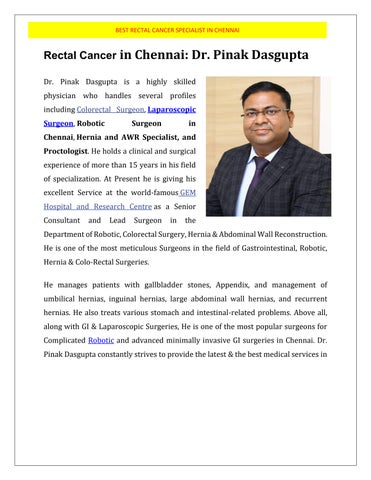
Rectal Cancer in Chennai: Dr. Pinak Dasgupta Dr. Pinak Dasgupta is a highly skilled physician who handles several profiles including Colorectal Surgeon, Laparoscopic Surgeon, Robotic
Surgeon
in
Chennai, Hernia and AWR Specialist, and Proctologist. He holds a clinical and surgical experience of more than 15 years in his field of specialization. At Present he is giving his excellent Service at the world-famous GEM Hospital and Research Centre as a Senior Consultant
and
Lead
Surgeon
in
the
Department of Robotic, Colorectal Surgery, Hernia & Abdominal Wall Reconstruction. He is one of the most meticulous Surgeons in the field of Gastrointestinal, Robotic, Hernia & Colo-Rectal Surgeries. He manages patients with gallbladder stones, Appendix, and management of umbilical hernias, inguinal hernias, large abdominal wall hernias, and recurrent hernias. He also treats various stomach and intestinal-related problems. Above all, along with GI & Laparoscopic Surgeries, He is one of the most popular surgeons for Complicated Robotic and advanced minimally invasive GI surgeries in Chennai. Dr. Pinak Dasgupta constantly strives to provide the latest & the best medical services in
BEST RECTAL CANCER SPECIALIST IN CHENNAI
What is Rectal Cancer? Rectal cancer is a condition in which cancer cells grow in the rectum. Rectal cancer forms when cancer cells form in the rectum, which is part of your large intestine. The rectum is a chamber that’s situated between your colon and your anus.
Who does rectal cancer affect? Rectal cancer impacts both men and women, though men are little more likely to develop the disease. In most cases, people analyzed with the disease are over the age of 50. However, it’s possible for teens and young adults to develop rectal cancer, as well. Around 5% of individuals will conceive rectal cancer at some point in their lives. Of those individuals, approximately 11% will be under the age of 50.
Symptoms of rectal cancer: In numerous cases, rectal cancers don’t induce symptoms at all. Regardless, some people may notice some warning signs. Rectal cancer symptoms may include: • Rectal bleeding. • Blood in your stool (poop). • Diarrhea. • Constipation. • A sudden change in your bowel habits. • Narrow stool. • Tiredness. • Weakness. • Abdominal pain. • Unexplained weight loss
Causes Of Rectal Cancer: The precise cause of rectal cancer is unknown. However, there are specific risk factors that raise your chance of developing the disease, including: • Age: Like most cancers, the risk of rectal cancer grows with age. The average age of
diagnosis is 63 for both men and women. • Gender: Men are little more likely to conceive rectal cancer than women. • Race: Statistically, Black individuals are more probably to develop rectal cancer. The
reasons for this aren’t fully understood yet. • Family history: If you have a family member who has been concieved with rectal cancer,
your chance of developing it is almost double. • Particular diseases and conditions: There are many health disorders that can increase your risk for rectal cancer, including inflammatory bowel diseases such as Crohn’s disease and ulcerative colitis.
BEST RECTAL CANCER SPECIALIST IN CHENNAI • Smoking: Recent research suggests that people who smoke are more likely to die from
rectal cancer than people who don’t. • Eating processed meat: People who eat a lot of red meat and processed meat have a higher risk of developing rectal cancer. • Obesity: People with obesity are more likely to have rectal cancer compared to people who are considered a healthy weight.
Rectal Cancer Diagnostic Tests: If Dr. Pinak Dasgupta thinks you could have rectal cancer, they may order some tests to confirm your diagnosis. These tests may include: • Colonoscopy: This test utilizes a long tube with a small camera to view the inside of your
colon and rectum. • Biopsy: Dr. Pinak Dasgupta takes a small sample of suspicious tissue and sends it to a
lab for analysis. • Computed tomography (CT) scan: This imaging test takes X-rays of your body, then stitches them together for a detailed view of your bones, organs and tissues. • Magnetic resonance imaging (MRI): Unlike X-rays, MRI uses radio waves and magnets to capture images inside your body.
PET scan (positron emission tomography): Before having a PET scan, your healthcare provider asks you to drink a special dye that contains radioactive tracers. (In some cases, the dye may be injected or inhaled.)
Treatment of Rectal Cancer By Dr. Pinak Dasgupta: Rectal cancer treatment relies on many factors, including the location, size and stage of your tumor, as well as your overall health and personal preferences. Options include:
Surgery: One of the most typical rectal cancer treatment is surgery removes cancer cells. There are a few various surgical choices based on your specific needs: • Transanal endoscopic microsurgery (TEMS): During this surgery, Dr. Pinak Dasgupta
removes small cancers from the rectum using a special scope inserted through your anus. This treatment is advised if your tumor is small, contained to one area and unlikely to spread. • Low anterior resection: Larger rectal cancers may demand full or partial removal of the rectum. The anus is preserved so that waste can leave your body normally. • Abdominoperineal resection (APR): When cancer is located near the anus, it may not be possible to remove it without harming the muscles that control your bowel motions. In this case, rectal cancer surgeon Dr. Pinak Dasgupta may remove the anus, rectum, and part of the colon. A colostomy is then performed so that waste can leave your body.
BEST RECTAL CANCER SPECIALIST IN CHENNAI
Chemotherapy: Chemotherapy may be used before surgery to shrink a tumor, or after surgery to destroy any remaining cancer cells.
Radiation therapy: Like chemotherapy, radiation therapy can be used before or after surgery. Radiation therapy uses strong energy beams to kill cancer cells or keep them from growing and dividing. It can be used in combination with chemotherapy.
Immunotherapy: Immunotherapy uses drugs to boost your immune system and teach your body how to attack cancer cells.
Targeted drug therapy: If you have extended rectal cancer, Dr, Pinak Dasgupta may advise targeted drug therapy in combination with chemotherapy. These treatments target typical abnormalities in the cancer cells, forcing them to die.
Words From Dr. Pinak Dasgupta: Being diagnosed with rectal cancer can be overwhelming. You may feel sad, scared, frustrated or angry, Dont worry Contact Dr. Pinak Dasgupta to know available sources. Knowledge is power. Having a full understanding of your diagnosis and treatment options can empower you and help you take back control of your health. . For more information and appointment, booking calls us on +91 88110
91676 book an appointment