The Financial Nervous System of AI-Driven Healthcare
The Financial Nervous System of AI-Driven Healthcare: A System-Level Framework for Integrating Insurance Intelligence, Payment Orchestration, and Staff Attribution
Abstract
Healthcare financial workflows remain structurally fragmented, relying on legacy systems that operate independently of clinical operations. This disconnection creates financial opacity for patients, administrative delays for providers, and operational inefficiencies across the revenue cycle.
This research note introduces the concept of a Financial Nervous System an AI-driven architectural framework that unifies real-time insurance verification, multi-modal payment orchestration, and event-based staff attribution. By embedding financial intelligence directly into the care continuum, the model enhances transparency, accelerates revenue realization, and supports predictive financial operations. The proposed framework represents a shift from transactional billing tools toward integrated system-level architecture designed for nextgeneration healthcare environments.
1. Introduction
Modern healthcare systems have rapidly evolved in diagnostics, clinical workflows, and digital patient engagement. However, financial operations insurance verification, payment processing, and staff compensation remain dependent on outdated, siloed infrastructures. This gap between clinical modernization and financial stagnation generates preventable costs, operational delays, and a diminished patient experience.
Financial processes are still treated as a back-office function rather than an integral system component. As a result, the revenue cycle remains reactive rather than predictive, and institutions face rising administrative burdens, inconsistent reimbursement timelines, and limited visibility into financial performance.
This paper proposes a unified architectural model capable of aligning clinical and financial operations into one intelligent, AI-enhanced system.
2. Background and Problem Definition
Despite the adoption of EHRs, automated billing tools, and digital intake platforms, healthcare finance suffers from three persistent structural limitations:
2.1 Insurance Logic Fragmentation
Eligibility checks, coverage rules, co-pay assessments, and pre-authorization workflows remain disconnected and often require manual intervention.
2.2 Payment Workflow Inflexibility
Most payment systems operate linearly: encounter → claim → denial → reprocessing. They rarely support multi-branch decision logic or hybrid payment scenarios involving multiple payers.
2.3 Manual and Retrospective Staff Attribution
Clinician and staff compensation models do not capture real-time contributions, leading to inequity, delayed payouts, and operational blind spots.
Together, these limitations prevent healthcare organizations from achieving transparency, predictability, and operational efficiency.
3.Architectural Framework: The Financial Nervous System
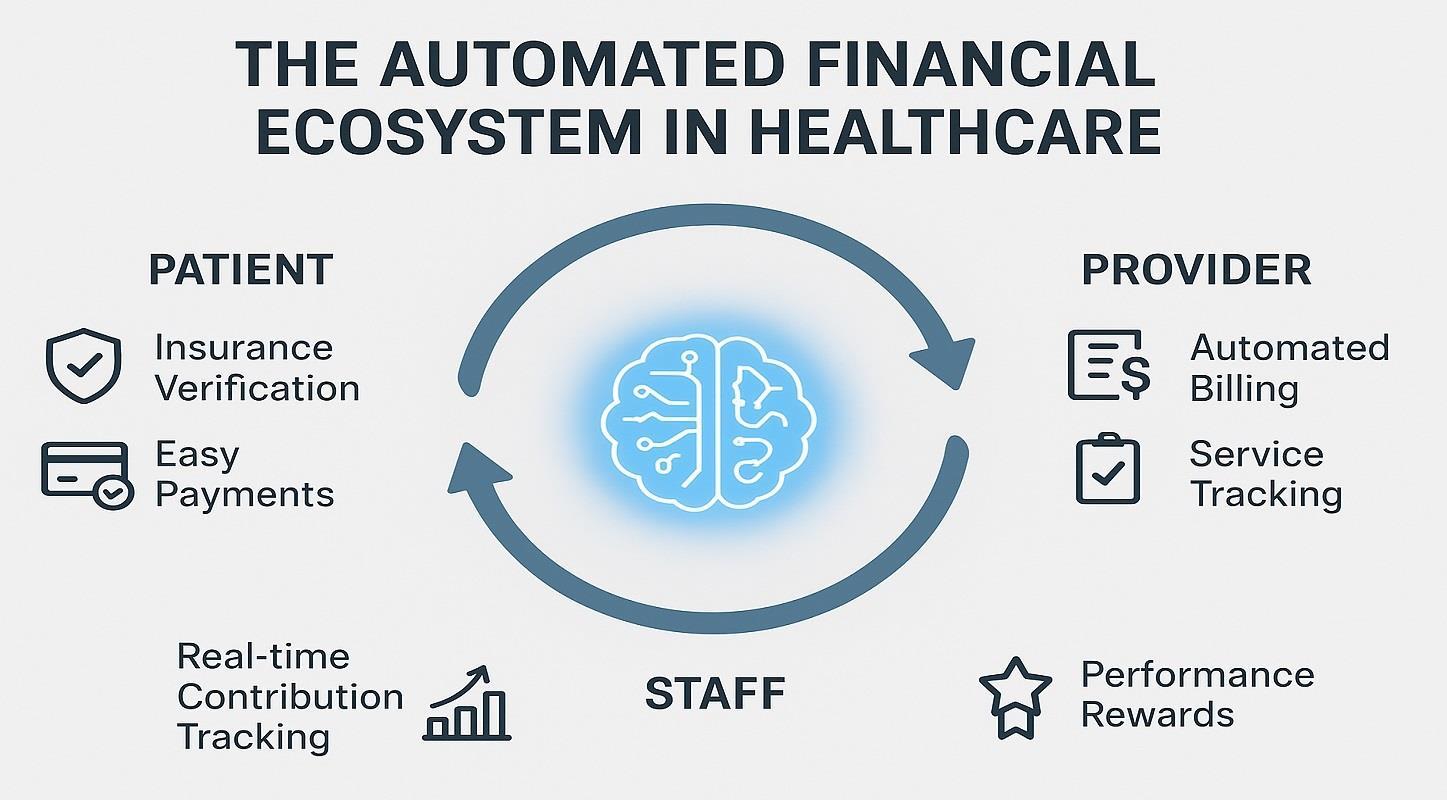
The Financial Nervous System concept draws inspiration from biological systems continuous sensing, real-time signaling, adaptive response, and integrated coordination.
The architecture includes three synchronized components:
1. Real-Time Insurance Intelligence
2. Multi-Modal Payment Orchestration
3. Event-Based Staff Attribution
These are coordinated through an AI-driven orchestration layer that transforms fragmented workflows into a unified operational system.
4. System Components
4.1 Real-Time Insurance Intelligence
The system converts payer rules into machine-readable logic and integrates directly with insurer APIs.
Capabilities include:
• Real-time verification of eligibility and benefits
• Predictive estimation of patient financial responsibility
• Automated detection of pre-authorization requirements
• Scenario-based simulation for planned procedures
Outcome:
Patients receive cost transparency before care delivery, and providers reduce denial rates through proactive verification.
4.2 Multi-Modal Payment Orchestration
Traditional revenue cycle management relies on sequential processing. The proposed architecture enables branching logic:
• Combining primary, secondary, and supplemental insurance
• Splitting charges across multiple financial entities
• Automated self-pay workflows
• AI-driven installment recommendations based on risk models
Outcome:
Payments become adaptive, transparent, and customizable to institutional and patient needs.
4.3 Event-Based Staff Attribution
Instead of relying solely on time logs and manual reporting, staff contributions are captured automatically:
• Telehealth sessions
• Care coordination
• Administrative workflows
• Remote monitoring interventions
Each event is recorded and weighted based on institutional compensation policies.
Outcome:
Compensation becomes fair, auditable, and reflective of real-world contributions.
5. System Integration Model
Integration occurs through an AI orchestration layer responsible for:
• Data harmonization across EHR, financial systems, and payer networks
• Real-time decision routing
• Anomaly detection
• Predictive financial modeling
Three dashboards support system-wide transparency:
Patient Dashboard
Coverage, expected costs, payment schedules.
Provider Dashboard
Service logs, documentation, staff attribution metrics.
The transition toward a Financial Nervous System yields measurable benefits:
• Reduced administrative burden through automation
• Accelerated reimbursement cycles driven by error prevention
• Higher patient trust via transparent cost communication
• Improved staff satisfaction from fair, real-time attribution
• Enhanced operational forecasting through predictive models
This positions the institution for value-based care models and future regulatory environments.
7. Conclusion
The Financial Nervous System framework reframes healthcare finance as a core architectural layer rather than a downstream operational function. By integrating insurance intelligence, payment logic, and staff attribution into a unified AI-driven system, organizations can achieve financial clarity, operational efficiency, and sustainable trust with patients and staff alike.
This model provides a foundational blueprint for healthcare systems seeking to modernize financial operations and bridge the gap between clinical excellence and financial performance.
8. References (Optional)
• Centers for Medicare & Medicaid Services (CMS) Eligibility & Claims Data
• World Health Organization Digital Health Systems Architecture
• Elsevier Health Revenue Cycle Transformation Studies
• IBM Watson Health AI-Driven Financial Modeling in Healthcare