
The Death of the 5-Year Plan: Why Static Strategy is Suicide in the Age of AI
By Dr. Nader Lohrasbi
Healthcare
Transformation Architect & AI Strategist
Post-DBA, Harvard Medical School (Crisis Management & AI)
Abstract
For decades, the "5-Year Strategic Plan" has been the sacred artifact of corporate governance. Organizations invest thousands of hours producing static roadmaps based on the assumption of a linear future. This paper argues that in the era of Generative AI where technological capability doubles every 6 months this ritual has become a liability. We introduce the concept of "Strategic Drift," a mathematical divergence between linear planning and exponential reality. Through
the lens of Adaptive Governance and Composable Architecture, we propose a shift from "Maps" to "Compasses," outlining a new operating model where strategy is not a document, but a continuous, algorithmic loop of adaptation.
1. The Ritual: Corporate Theater in the Boardroom
Walk into the boardroom of any major healthcare network or enterprise in January. The scene is identical.
Executives gather in leather chairs. Consultants present glossy slides. There is coffee, debate, and consensus. After months of effort, a heavy document is produced: "The 2025-2030 Strategic Plan."
It is a beautiful document. It has Gantt charts. It has revenue projections for 2029. It has "Milestones."
It is signed, printed, and placed on a shelf. Everyone breathes a sigh of relief. "We have a plan," they say. "We are safe."
This is not safety. This is a delusion.
In 2022, countless hospital networks finalized their 5-year digital strategies.
In November 2022, ChatGPT was released.
Overnight, every assumption in those 500-page binders—about patient communication, administrative automation, and coding workflows became obsolete.
The "Ritual" of long-term planning has become Corporate Theater. It gives leaders the feeling of control in a world that is fundamentally uncontrollable. We are using tools designed for the Steam Age to navigate the Age of Algorithms.
The danger isn't that the plan is wrong. The danger is that the plan creates "Cognitive Rigidity." It blinds the organization to peripheral threats because "it’s not in the roadmap."
2. The Mathematical Conflict: Linear Minds vs. Exponential Machines
To understand why static strategy is suicide, we must look at the math.
The fundamental conflict of our time is the clash between Linear Planning and Exponential Innovation.
The Geometry of Failure
• Human Organizations think Linearly ($y = mx + c$). We assume next year will be like this year, plus 10%. Our budgets, hiring plans, and construction projects are linear.
• Artificial Intelligence grows Exponentially ($y = e^x$). According to Moore’s Law and now "Jensen’s Law" (GPU performance), AI capability doubles roughly every 6 to 14 months while costs plummet.
Defining "Strategic Drift"
When you overlay a Linear Plan on top of an Exponential Reality, you create a widening gap. This is Strategic Drift
• Year 1: The gap is small. The plan seems to work.
• Year 2: The AI market has shifted. New models (like GPT-5 or Med-PaLM 3) have emerged. Your "Year 2 Milestone" is now solving a problem that AI solved 6 months ago.
• Year 3: The Drift is now a chasm. Your competitors, who didn't lock themselves into a 5-year vendor contract, are adopting tools that are 10x cheaper and 100x faster.
• Year 5: You reach the end of your plan. You executed it perfectly. And you are now irrelevant.
In the Age of AI, the cost of "sticking to the plan" is not just inefficiency; it is existential obsolescence.
3. The Solution: Adaptive Governance & The "Rolling Strategy"
If the Map is useless because the terrain changes every day, what do we use?
We use a Compass.
We must move from "Static Strategy" to "Adaptive Governance." This requires a fundamental redesign of how the C-Suite operates.
The 90-Day Strategic Sprint (The OODA Loop)
Instead of a 5-Year Plan, the modern AI-driven organization operates on a "Rolling Strategy" model.
The vision (The North Star) remains constant (e.g., "Best Patient Outcomes"). But the path is rewritten every 90 days.
We borrow the OODA Loop from military strategy (Observe, Orient, Decide, Act):
1. Observe (Day 1-15): What new AI models were released this quarter? What did our competitors launch?
2. Orient (Day 15-30): How does this invalidate our current roadmap? Do we need to pivot?
3. Decide (Day 30): Reallocate budget. Kill the zombie projects. Double down on the winners.
4. Act (Day 30-90): Execute furiously.
The Key Shift: In this model, changing the plan is not a sign of failure; it is a sign of Intelligence.
4. Case Study: The Monolith vs. The Modular
Let’s translate this into a concrete, technical reality. Consider two hypothetical healthcare organizations facing the Generative AI wave.
Hospital A: The "5-Year Plan" Victim (The Titanic)
• Strategy: In 2023, they signed a massive, 5-year exclusive contract with a legacy EHR vendor to build a "Proprietary AI Chatbot."
• The Architecture: Monolithic. Hard-coded. Tightly coupled.
• The Event: In 2024, a new open-source model releases that is 90% cheaper and more accurate than their vendor’s tool.
• The Result: Hospital A cannot switch. They are legally and technically locked in. They spend the next 3 years paying millions for an inferior "AI" that frustrates doctors.
• Outcome: Strategic Paralysis.
Hospital B: The "Adaptive" Architect (The Speedboat)
• Strategy: They refused the 5-year roadmap. Instead, they invested in a "Composable Architecture" (an API-first middleware).
• The Architecture: Modular. They built a "Model-Agnostic" layer.
• The Event: The same open-source model releases in 2024.
• The Result: Because they didn't buy a "Solution," but architected a "Capability," they simply swapped the API endpoint. In 2 weeks, they upgraded their entire system to the new model.
• Outcome: Antifragility. They gained from the market disruption.
The Lesson: Hospital A optimized for Certainty (a fixed contract). Hospital B optimized for Optionality (the ability to change). In the age of AI, Optionality is the only asset that matters.
5. The Architect's Mandate: Redefining Leadership
This shift changes the definition of the CEO and the CIO.
• The Old Mandate: The Leader as "Prophet." (Someone who predicts the future and writes a plan).
• The New Mandate: The Leader as "Architect."
You cannot predict the future of AI. No one can. Therefore, your job is not to guess what will happen in 2030.
Your job is to build an organization that can survive anything that happens in 2030.
This means:
1. Financial Liquidity: Moving from CapEx (huge upfront buys) to OpEx (subscriptions that can be cancelled).
2. Technical Modularity: Refusing monolithic software. Demanding APIs.
3. Cultural Plasticity: Training teams to unlearn and relearn every quarter.
Conclusion: The End of the Paper Era
The 5-Year Plan is a relic of a time when the world moved slower than the pen. Today, the world moves at the speed of light.
To cling to a static document in an exponential world is an act of denial.
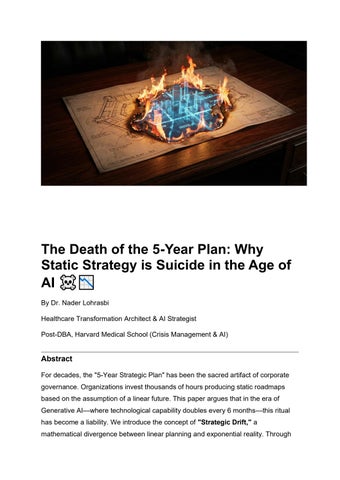
Burn the binder. Break the roadmap.
Build a compass. Build a sensor network. Build a team that can turn the ship in 90 days.
The future belongs to the fast, the fluid, and the formless.
Static Strategy is dead. Long live Adaptive Governance.
"In an exponential world, the only stability is your ability to change."
About the Author
Dr. Nader Lohrasbi
Healthcare Transformation Architect & AI Strategist
Dr. Lohrasbi advises C-Suite executives on navigating the "Crisis of Complexity" in modern healthcare. Holding a Post-DBA from Harvard Medical School in Crisis Management & AI, he specializes in designing "Antifragile" organizations that thrive in high-velocity environments.
#Strategy #AI #Leadership #HealthcareManagement #DigitalTransformation #AdaptiveGovernance #StrategicDrift #FutureOfWork