Dr. Louis Bourget DDS, Oral and Maxillofacial Surgeon Gander, Newfoundland; Dartmouth and Truro, Nova Scotia
INTEGRATING MEDICAL SCENT DETECTION DOGS INTO DENTAL PRACTICE: THE SCIENCE AND IMPACT OF CORTISOL DETECTION ON PATIENT CARE As an Oral and maxillofacial surgeon, I am intimately familiar with the affliction of anxiety around visits to the dentist. In my training at McGill and Dalhousie, and throughout my continued education, I’ve come to understand the profound impact that heightened stress levels can have on patient outcomes. Unfortunately, there are very few scientific methods to mitigate this problem, aside from being aware of it and honing a calm and compassionate approach.
But as with all areas of medicine, there is a constant search for improvement. As a practitioner who has completed over 1,200 continued education courses in my field, I am more than willing to pursue innovative measures, and I am thrilled to be among the first in the world to introduce a medical scent-detection dog into my practice. This initiative leverages the science of cortisol detection to improve both patient experience and surgical outcomes.
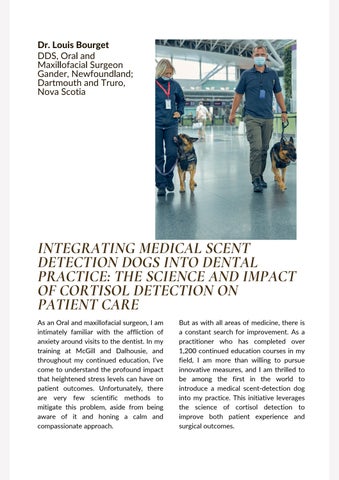
The Science Behind Cortisol Detection and Anxiety Cortisol is a glucocorticoid hormone released by the adrenal glands, and it plays a critical role in the body’s stress response. In situations of heightened anxiety, cortisol levels increase, triggering physiological changes that can negatively impact surgical outcomes, such as delayed wound healing, increased perception of pain, and heightened inflammatory responses. Conversely, reducing cortisol levels through effective stress management correlates with improved patient experiences and recovery metrics. Service dogs trained to detect biochemical markers of stress, including cortisol, present an evidence-based solution to mitigating anxiety. These dogs employ their remarkable olfactory senses to identify subtle changes in cortisol levels, offering a non-invasive method to assess and address patient stress in real time. In 2023, we introduced Finley to our practice, a golden retriever trained as a medical scent detection dog. Bred by Pam Smith of Mermaid Golden Retrievers in Pictou, Nova Scotia, Finley was selected at 42 days old based on his exceptional temperament, intelligence, and psychological profile. His training, conducted under the guidance of expert Bill Grimmer and supported by Medical Detection Dogs UK, focuses on detecting cortisol fluctuations in patients. This specialized training process equips
Finley to recognize and signal changes in cortisol levels with remarkable accuracy. These alerts enable our team to adapt treatment plans or introduce interventions tailored to the patient’s emotional and physiological state. Patients frequently experience preprocedural anxiety, marked by elevated cortisol levels. Finley interacts with patients prior to treatment, offering emotional support that naturally reduces stress hormone levels. This dual function —direct biochemical detection and emotional reassurance—enhances patient care in measurable ways: Improved Surgical Outcomes: Lower cortisol levels contribute to reduced intraoperative complications and faster postoperative recovery. Enhanced Patient Experience: Patients report feeling more secure and less intimidated, with Finley’s presence serving as a psychological anchor. Increased Accessibility to Care: For individuals who might avoid treatment due to severe anxiety, Finley’s support transforms the dental experience into a manageable, even positive, event. Finley’s integration into our practice exemplifies a holistic approach to healthcare that combines advanced science with empathetic care. By addressing both physiological and emotional aspects of dental anxiety, we are building a sense of trust and reassurance with our patients.
This model of care extends beyond dentistry. Medical scent detection dogs are proving valuable in detecting conditions ranging from diabetes to cancer, as well as assisting individuals with post-traumatic stress disorder. Finley’s success reveals the potential for broader applications of scent detection technology in healthcare. Dental visits will always be a source of stress, especially post-COVID, when protocols were severely heightened and fear of disease transmission became ingrained in so many people. The introduction of Finley into our practice has been a game-changer, providing relief and even joy for so many of our patients. For children especially, he has made the experience of receiving dental care a much more tolerable experience. We are excited to share the results of our experience with the broader dental community in hopes that scent-detection dogs like Finley will become a standard feature for dental care in Canada.