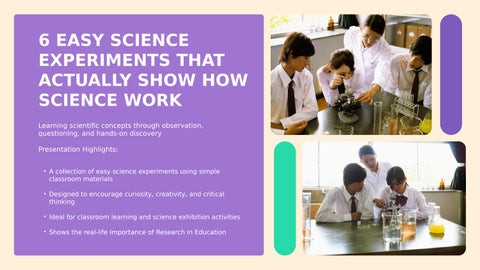
6 EASY SCIENCE EXPERIMENTS THAT ACTUALLY SHOW HOW SCIENCE WORK Learning scientific concepts through observation, questioning, and hands-on discovery Presentation Highlights: • A collection of easy science experiments using simple classroom materials • Designed to encourage curiosity, creativity, and critical thinking • Ideal for classroom learning and science exhibition activities • Shows the real-life Importance of Research in Education
EXPERIMENT 1: COLOR WALKING WATER (CAPILLARY ACTION) Aim: To show how water moves through paper. You Need: Cups, water, food color, paper towels Steps: • Fill two cups with colored water • Place paper towels between cups • Watch the water travel Result: Water moves and mixes colors. What We Learn: Plants use capillary action to move water. This is one of the most visual easy science experiments.
EXPERIMENT 2: SELF-INFLATING BALLOON (CHEMICAL REACTION) Aim: To show how gas is formed. You Need: Bottle, balloon, vinegar, baking soda Steps: • Put vinegar in bottle • Add baking soda through balloon Result: Balloon inflates on its own. What We Learn: Gas is created during a chemical reaction. A perfect easy science experiment for a science exhibition.
EXPERIMENT 3: FLOATING PAPER CLIP (SURFACE TENSION) Aim: To show invisible forces in water. You Need: Water bowl, paper clip, tissue Steps:
What We Learn Water has surface tension. This supports the Importance of Research in Education.
• Place tissue on water • Put paper clip on it • Sink the tissue Result: Paper clip floats.
Method:
EXPERIMENT 4: MINI VOLCANO (GAS PRESSURE)
• Add baking soda into the bottle. • Mix soap and food color. • Pour vinegar and step back.
Aim: To understand how pressure builds up and causes eruptions. Materials Required: • Baking soda • Vinegar • Liquid soap • Red food color • Small bottle
Result: Foam flows out like lava. What We Learn: Gas pressure causes eruptions. One of the most exciting easy science experiments.
EXPERIMENT 5: BENDING PENCIL (REFRACTION) Aim: To see how light changes direction.
Fill the glass with water.
Place the pencil inside.
View it from the side.
Result:
Scientific Explanation:
Pencil looks bent.
Light slows down and changes direction when moving from air to water. This effect is called refraction.
EXPERIMENT 6: BENDING PENCIL (REFRACTION) Aim: To show movement on water’s surface. Materials Required: • Bowl of water • Ground pepper • Liquid soap What Students Will Observe: The pepper quickly moves away from the point of contact.
Sprinkle pepper on water
Touch with soapy finger
Learning Outcome: This simple activity clearly reflects the Importance of Research in Education by encouraging students to ask “why” and discover hidden scientific forces.
FROM CLASSROOM EXPERIMENTS TO SCIENTIFIC EXCELLENCE Science is in every breath, every step, every meal
At Dr. Kishore's Ratnam Schools, easy science experiments are not just activities they are tools to build curiosity, confidence, and scientific thinking. These experiments are ideal for classroom learning as well as for preparing students for a science exhibition, where innovation and research-based understanding are essential.