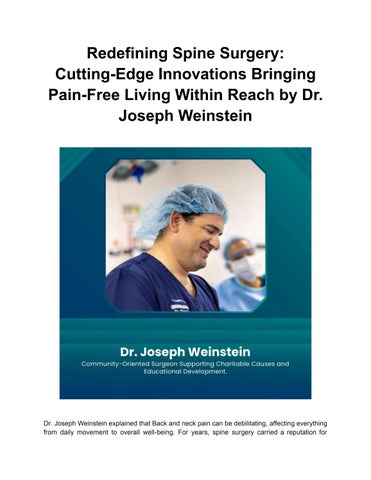
Redefining Spine Surgery: Cutting-Edge
Innovations Bringing
Pain-Free Living Within Reach by Dr. Joseph Weinstein

Dr Joseph Weinstein explained that Back and neck pain can be debilitating, affecting everything from daily movement to overall well-being. For years, spine surgery carried a reputation for
being invasive, risky, and requiring lengthy recovery times But today, modern orthopedic innovation has completely transformed spinal care. With the help of advanced technology, minimally invasive procedures, and regenerative therapies, patients are experiencing faster recovery, reduced pain, and restored mobility like never before.
One of the most important breakthroughs in spinal treatment is the widespread adoption of minimally invasive spine surgery (MISS). This approach uses tiny incisions and specialized surgical instruments to access the spine with minimal disruption to muscles and tissues Surgeons operate using real-time imaging and endoscopic cameras, allowing them to pinpoint the exact problem area without damaging surrounding structures. The result is less pain, reduced blood loss, and shorter hospital stays For many patients, minimally invasive spine surgery means walking within hours of the operation and resuming daily activities in a fraction of the time once required.
The emergence of robotic-assisted spine surgery is another leap forward in orthopedic care. By combining human expertise with robotic precision, these systems provide unmatched accuracy in procedures such as spinal fusion and screw placement Surgeons use 3D imaging to create detailed, patient-specific surgical plans, while robotic arms execute movements with millimeter precision This ensures proper spinal alignment, reduces the risk of complications, and enhances long-term outcomes Patients benefit from a more predictable recovery process and a quicker return to a pain-free lifestyle.
Artificial disc replacement has also redefined what’s possible in spinal restoration Unlike traditional spinal fusion, which eliminates movement by joining vertebrae together, disc replacement uses a prosthetic disc that mimics the flexibility and function of a natural one This innovation preserves spinal motion, minimizes wear on adjacent discs, and allows for greater mobility after surgery As materials and designs improve, artificial discs are providing long-lasting relief and helping patients maintain active, dynamic lives
Beyond surgical techniques, regenerative medicine is transforming the way doctors treat spinal injuries and degeneration Treatments such as platelet-rich plasma (PRP) and stem cell therapy harness the body’s natural healing abilities to repair tissues, reduce inflammation, and slow down degeneration These non-surgical therapies are giving patients with early spinal conditions a chance to heal without undergoing invasive procedures.