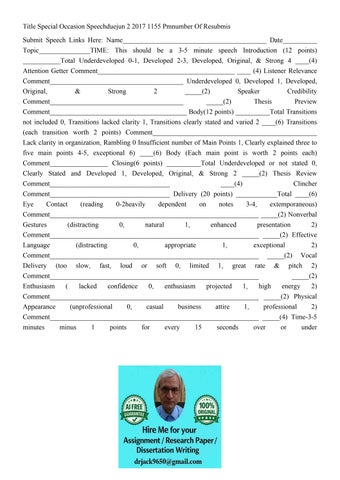
Title Special Occasion Speechduejun 2 2017 1155 Pmnumber Of Resubmis
Submit Speech Links Here: Name__________________________________________ Date__________
Topic_______________TIME: This should be a 3-5 minute speech Introduction (12 points)
___________Total Underdeveloped 0-1, Developed 2-3, Developed, Original, & Strong 4 ____(4)
Attention Getter Comment________________________________________ (4) Listener Relevance
Comment_______________________________________ Underdeveloped 0, Developed 1, Developed, Original, & Strong 2 _____(2) Speaker Credibility
Comment_______________________________________ _____(2) Thesis Preview
Comment________________________________________ Body(12 points) __________Total Transitions not included 0, Transitions lacked clarity 1, Transitions clearly stated and varied 2 ____(6) Transitions (each transition worth 2 points) Comment________________________________________________
Lack clarity in organization, Rambling 0 Insufficient number of Main Points 1, Clearly explained three to five main points 4-5, exceptional 6) ____(6) Body (Each main point is worth 2 points each)
Comment_________________ Closing(6 points) __________Total Underdeveloped or not stated 0, Clearly Stated and Developed 1, Developed, Original, & Strong 2 _____(2) Thesis Review
Comment___________________________________ ____(4) Clincher
Comment___________________________________ Delivery (20 points) ____________Total ____(6)
Eye Contact (reading 0-2heavily dependent on notes 3-4, extemporaneous)
Comment_____________________________________________________________ _____(2) Nonverbal
Gestures (distracting 0, natural 1, enhanced presentation 2)
Comment_____________________________________________________________ _____(2) Effective
Language (distracting 0, appropriate 1, exceptional 2)
Comment_____________________________________________________________ _____(2) Vocal
Delivery (too slow, fast, loud or soft 0, limited 1, great rate & pitch 2)
Comment_____________________________________________________________ _____(2)
Enthusiasm ( lacked confidence 0, enthusiasm projected 1, high energy 2)
Comment_____________________________________________________________ _____(2) Physical Appearance (unprofessional 0, casual business attire 1, professional 2)
Comment_____________________________________________________________ _____(4) Time-3-5 minutes minus 1 points for every 15 seconds over or under
Topic: Commemorative Speech Type of Special Occasion: Memorial Service of late Indian President, APJ Abdul Kalam I. Attention Getter: The world needs dreamers and the world needs doers. But above all, the world needs dreamers who do. II. Listener Relevance Thank you all for being here today at this memorial service to celebrate the life and honor the memory of late Indian President APJ Abdul Kalam. III. Speaker Cred: Like other millions of Indian youth I too am deeply inspired by him. He is the one who taught us to dream big, gave us wings of fire and ignited our minds into action. IV. Thesis Preview: I am going to talk to you about his humble beginnings, his life, and his dreams. TRANSITION: It is impossible for one to appreciate President APJ Abdul Kalam’s legacy without understanding his childhood. IV. Body Must Include: A. Main Point I – Humble beginnings He was born into a poor family in Rameshwaram, southernmost part of India. His father was a ferry man and young Kalam worked as a newspaper boy to support his family. a. Sub-point. He was intrigued by the toy airplanes he saw in roadside shops and harbored an interest to fly one day. b. Sub-point. Failed in his dream to be a fighter pilot in the Air Force. All birds find shelter during a rain. But Eagles avoid rain by flying above the clouds. Problems are common, but attitude makes the difference. TRANSITION: His humble beginnings created an ambitious individual motivated to help others. B. Main Point II – His life. Dr.Kalam, after his studies, joined as chief scientist, went on to work in Defense Research and Development Organization and was the brain behind developing India into a nuclear power a. Sub-point. He worked for providing cheaper medical options to the public. Also, loved playing the musical instrument Veena. I was pleasantly surprised and happy that a scientist rose to become India’s President. Kalam stepped into the political arena and came to be known as People’s President. b. Sub-point. According to the laws of aerodynamics the bumble bee should never be able to fly. Because of the size, weight, and shape of its body in relationship to the total wing span, flying is scientifically impossible. The bumble bee, being ignorant of scientific theory, goes ahead and flies anyway. Because it wants to fly and it is flying. TRANSITION: Dr. Kalam’s studies and desire to help others created a clear vision for others to follow. C. Main Point III – His vision and dreams. He was always humble and took special interest in instructing kids and youth. He believed that small aim is a crime and inspired the youth to dream big and work hard to achieve them. He was always ready to answer any questions they had and wanted to be known as a teacher. a. Sub-point It is somewhat of a consolation to know that Dr.Kalam passed away doing what he loved most—he was delivering a lecture to a group of students at the Indian Institute of Management in Shillong on July 27, 2015, when he suddenly collapsed due to cardiac arrest. b. Sub-point His message, especially to young people, is to have courage to think
differently, courage to invent, to travel the unexplored path, courage to discover the impossible and to conquer the problems and succeed. TRANSITION: There is no way to give a clear understanding of what an incredible man Dr. Kalam was, but I hope today I’ve given you a little insight. V. Closing Must Include: Thesis Review: I shared with you Dr.Kalam’s humble beginnings, his life, and his message to the youth. Clincher: “A dream is not that which you see while sleeping, it is something that does not let you sleep,†as he famously said. Special Occasion Outline Template Title Instructions Students are required to submit a FULL SENTENCE typed outline, for their special occasion speech. The outline must include an Introduction, Body, and Closing. Please keep in mind the special occasion speech is 3-5 minutes. Template Below: Topic: Type of Special Occasion: Introduction Must Include: I. Attention Getter: This is the portion of your speech that captures your audience. Students are allowed to use statistics, quotes, stories, or jokes. 1. The Attention Getter MUST be the first thing out of your mouth. 2. The Attention Getter MUST be related to the rest of the Speech. 3. Please do NOT use questions! II. Listener Relevance: Students must explain the reason for the occasion. Example: We are gathered here today to celebrate, commemorate, etc. III. Speaker Cred: Students will explain their connection to the occasion/honoree. IV. Thesis Preview: Students will state what the three main points are. IV. Body Must Include: A. Main Point I- Must be a complete sentence a. Sub-point (Example)-Must be complete sentences b. Sub-point (Story)-Must be complete sentences Transition: (This is a bridge from one part of your speech to the next, it must include the previous main point as well as the upcoming main point.) B. Main Point II-Must be a complete sentence a. Sub-point- (Example)-Must be complete sentences b. Sub-point-(Story)Must be complete sentences Transition: (This is a bridge from one part of your speech to the next, it must include the previous main point as well as the upcoming main point.) C. Main Point III-Must be complete sentence a. Sub-point (Example)-Must be complete sentences b. Sub-point (Story)-Must be complete sentences Transition: (This bridge informs your audience you are bringing your speech to a close.) VI. Closing Must Include: Thesis Review: Students restate main points. Clincher: Students must end with a final thought that is directly connected to the attention getter. The clincher is a lasting impression that reminds the audience of the importance of the occasion. Please be sure your outline is in outline format, including Roman Numerals and Titles (Intro, Body, Closing, and Transitions). 1. Submit only one attachment. 2. Only use file types: Word, PDF, HTML, RTF, or plain text. 3. Always include file extension.