SEPTEMBER 2026
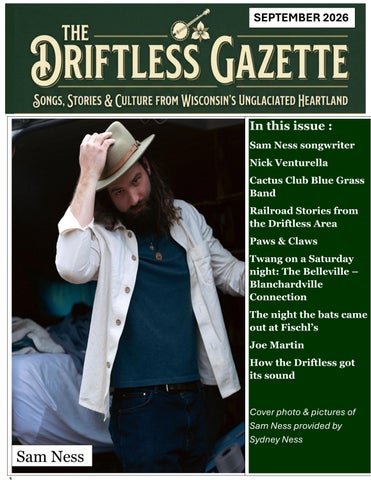
In this issue : Sam Ness songwriter Nick Venturella Cactus Club Blue Grass Band Railroad Stories from the Driftless Area Paws & Claws Twang on a Saturday night: The Belleville – Blanchardville Connection The night the bats came out at Fischl’s Joe Martin How the Driftless got its sound
Cover photo & pictures of Sam Ness provided by Sydney Ness
Sam Ness
Editorial Policy
Driftless Gazette is the sole property of Andy and Joyce Ziehli, and is part of the Driftless Roots Group, LLC. The Driftless Roots Group, LLC, includes the Driftless Gazette and the Driftless Roots Recording. Driftless Roots Group, LLC
We at the Driftless Gazette welcome different opinions and different ideas. We believe in free speech and we welcome diversity . Our editorials printed in the Driftless Gazette unless sited are the sole opinion of the author and do not represent the opinions or ideas of our staff and owners. If you would like to submit an OP ED please contact either Joyce or Andy and we will send you the layout and writing instructions for printing and submission.
PO Box 71 313 East Church Street
Mission Statement of The Driftless
Belleville, WI 53508
Roots Group, LLC
608-558-8131
608-558-8132
Andy Ziehli
Joyce Ziehli
Our mission is to expand and promote the original art, literature, music, and lives of the people who live in the Driftless Area of Wisconsin. Driftless Roots Group, LLC exists to educate and provide timely information and news on the arts and music happenings in the Driftless Area.
Online@driftlessgazette.com Substack@driftlessgazette2026 A.I. Statement & Polices We at the Driftless Gazette believe in using the tools that will enhance and expand our end product. We use A.I. in a very limited form. Number one we use it to create drawings and images (never photographs) to compliment our writings and stories. Number two we use Grammarly to proof and edit our writings. Our staff write and create all their our own stories by human touch and thought. We do not use A.I. in a malicious form nor do we accept any articles that are written and created with A.I. ___________________________________ Stories and photographs submitted for publication remain the property of the author or photographer. If you are interested in submitting an article, story, or photograph, please contact Joyce or Andy and they will send you the writing and photography instructions for publication.
Diversity Statement We believe that everyone is created equally and that the application of prejudice is immoral and wrong. We celebrate everyone's diversity and what it brings to the table as we share our lives and stories together. We do not tolerate prejudices or hate in any form. We are all brothers and sisters and deserve to teach and share our skills, stories, and talents to make the world a better place to live.
Table of Contents Pages 1-2
Chief Troubleshooter – Andy Ziehli
Pages 2-5
All aboard: Railroad stories from the Driftless
Pages 6-7
Joe Martin: A place and a time
Page 8
Paws & Claws
Page 9
Recipes: From Joyce’s Kitchen
Pages 10-12
The night the Bats came out at Fischl’s
Pages 12-14
Twang on a Saturday night: BellevilleBlanchardville connection
Page 16
Belleville Musicians Pictures past & present
Pages 17-22
Sam Ness: The power of grassroots Music
Pages 22-23
CD Reviews: Sam Ness Of Heart and Home
Pages 24-27
Cactus Club Bluegrass Band
Pages 28-30
Nick Venturella Songwriter and Creative Guy
Page 31-36
How the Driftless Area got its sound
From the Chief Trouble Shooter/Publisher
1.
Andy Ziehli, September 1, 2026 Driftless Gazette as far as we want. Our plans include live interviews, videos, podcasts, and audio from artists who live in the Wisconsin's Driftless Area. All of this will be available with the next issue, which will be released on our website on November 1, 2026.
Welcome to the first issue of the Driftless Gazette Magazine! My wife Joyce and I hope you enjoy reading the Gazette as much as we enjoyed producing it. If you are not familiar with us, we previously published The Americana Gazette (A.G.) from 2007 to 2013, which was the first music magazine online. The Americana Gazette was a beloved print and online publication that covered Americana and Country music. We stopped publishing it when I took a job with UW Extension in Richland County in 2013. The Driftless Gazette is an old idea made possible by modern technology. When we first went online with the A.G., we wanted to incorporate video, audio, and live streaming, but the technology wasn't there yet, and what was available was very expensive. Now, the technology is free and allows us to grow the
We welcome all feedback (unless you are being nasty just for the sake of it) about what you like and dislike about the Gazette. We will be adding writers and new columns in future issues. If you are a writer or want to become one, please reach out to us at aziehli@yahoo.com or jziehli@yahoo.com. You don’t have to be a pro, you just need to want to contribute to the magazine. We are also always looking for people and subjects to write about. In this issue we have the extremely talented Sam Ness on our cover and our feature story. Sam is a well-traveled and beloved musical artist who lives in Fennimore, WI. We also feature Nick Venturella, another great original songwriter and performer who lives in Cross Plains, WI. Joe Martin signs on to write a column for us. We look back at the 80’s and 90’s to talk about the Cactus Club String Band, a Bluegrass Band, and their musical history. We go to the edge of the Driftless on the east side and learn about the BellevilleBlanchardville music connection that has been in place for over 65 years. We'll explore the railroad that brought the city to Richland County. We'll feature how the Driftless got its sound,
Bats overtaking a bar, Joyce's Paws and Claws pet stories, and her recipe page.
2.
We won’t be covering cover bands or artists. Our main focus is original Americana, Folk, and Roots artists and songwriters in the Driftless area, so reach out if you are an artist, musician, songwriter, or craftsperson, and let us know what you are up to. Until next issue, “Keep writing, performing, and creating great art and music.” Andy Ziehli Publisher, Driftless Gazette September 1, 2026
All Aboard: Family Memories and Railroad Stories from Wisconsin’s Driftless Country There’s something about an old railroad story that still feels close enough to hear the whistle across the valley, the clatter of wheels, the bustle of a depot platform, and a family waiting for the weekend train. In our family, those stories lead back to Lone Rock, where my greatgrandparents lived and where the train connected farm life, city work, and family homecomings.
When their children grew up and headed off to jobs in Madison, Wisconsin, the train made the distance feel a little shorter. My grandmother would bring my mom and uncle back to Lone Rock while
my grandpa stayed in Madison to work. Come the weekend, he would climb aboard and ride west to join them. My mom often remembered those trips the passing farms, river bottoms, bluffs, and little towns rolling by the windows as if each ride held its own adventure. (continued on the next page)
3. • 1857: The Mineral Point Railroad was completed, directly linking the lead-mining district in southwest Wisconsin to the eastern markets. • 1870: The Dubuque, Platteville and Milwaukee Railroad opened a line into Platteville.
Long before those family weekend rides, the railroad had already changed the shape of life in southern Wisconsin. In the 1850’s, rails began pushing into the Driftless area, linking Lake Michigan with the Mississippi River, and bringing new movements to a landscape of steep bluffs, coulees, and winding valleys. The Milwaukee and Mississippi Railroad reached Mazomanie in 1855, Lone Rock in 1856, and Prairie du Chien in 1857, opening a route that connected communities, farms, river towns, and markets. • 1855: The Milwaukee and Mississippi Railroad arrived in Mazomanie and pushed on to the Mississippi River at Prairie du Chien by 1857. This path ran alongside Military Ridge, avoiding many of the deep valleys.
• 1875: The Galena and Southern Wisconsin Railroad was fully opened, connecting Galena, Illinois, to Platteville, Wisconsin. Many of these scenic, winding rural lines faced early abandonment as agricultural traffic dwindled in the 20th century. Today, you can explore the paths of these historic routes on state trails like the Military Ridge State Trail and the Elroy-Sparta State Trail, which both follow former railroad grades. Madison first welcomed the railroad in May 1854. From there, the tracks kept moving west, through Dane County, past Mazomanie, and toward the Wisconsin River country. By 1856, Lone Rock had its place on the line, and that arrival helped turn the village into a lively shipping point for timber, farm goods, mail, and passengers. How the Line Came West • May 1854: The first locomotive arrived at the newly built depot in Madison, creating the initial connection to Milwaukee. • 1855: Tracks crossed westward through Dane County, reaching Mazomanie. • 1856: The railroad reached Lone Rock, transforming the area into a booming shipping village.
4. • Late 1856: The tracks crossed the river just west of Lone Rock to enter Avoca, continuing along the south side of the Wisconsin River through Muscoda. • 1857: The line reached its ultimate destination, Prairie du Chien, opening up a direct shipping corridor between Lake Michigan and the Mississippi River. The Little Branch That Made a Big Difference Lone Rock also became the jumping-off point for a memorable little branch line. In 1876, a 16-mile narrow-gauge route opened north to Richland Center, giving that inland community a practical outlet to the wider world. To save money, the first version used maple rails, an almost storybook detail that did not last long under the weight of real trains. By 1880, the line had been rebuilt with iron rails and standard gauge track. Although passenger service has ended, sections of the old Madison-to-Prairie du Chien route still carry regional freight for the Wisconsin & Southern Railroad. One of the pleasures of following old railroad stories is that some of the buildings are still here to greet us. Along the Madison-to-Prairie du Chien corridor and nearby Driftless routes, restored depots and trail stops offer a friendly way to step back into the era when the train was the quickest link between town and countryside. Depots Worth a Sunday Drive Mazomanie Depot (Built 1857)
• Significance: This is the oldest remaining wooden railroad depot in the United States. • The Details: Built directly by the Milwaukee and Mississippi Railroad right after tracks arrived. It sits in a beautifully preserved historic downtown district. • What it is today: It houses the Mazomanie Historical Society Museum, displaying early railroad tools and the legendary Appleby twine binder invention. • Richland Center Passenger Depot (Built 1909) • Significance: Served as the terminal for the well-known branch line that extended north from Lone Rock to Richland Center. • The Details: Replaced an early 1882 wooden depot that dramatically exploded after a fire ignited stored gunpowder. The 1909 brick structure features two distinct levels of hipped roofs and classic Circassian walnut interior woodwork.
• What it is today: Rescued from severe neglect by local volunteers, it is now the Richland Museum & Visitor Center. It connects directly to the Pine River Recreation Trail, which follows the original rail grade down to Lone Rock. Boscobel Heritage Depot (Built 1857) • Significance: A vital mainline hub deeper west in the Driftless Area along the Wisconsin River. • The Details: Built entirely of wood, it famously served as a major military assembly point, processing over 2,000 Union Army soldiers during the Civil War. • What it is today: Functions as a walk-through museum replicating a turn-of-the-century rural depot layout. So, What’s Left? The original Lone Rock Depot is no longer standing, which is unfortunate for those who imagine a platform once bustling with suitcases, lunch buckets, and waiting families. Still, the railroad’s footprint has not disappeared. The iron Lone Rock Railroad Bridge still spans the nearby Wisconsin River, a sturdy reminder of the days when freight and passengers crossed this country by rail. The last train on the Lone Rock-toRichland Center branch ran in 1988. After that, the rails were removed, but the route found a second life as a place for walkers, bicyclists, and anyone who enjoys a quiet trail with a bit of history underfoot.
From Rails to Trail
5.
Originally established as a narrow-gauge line known as the Pine River Valley & Stevens Point Railroad, it was later standardized and absorbed by the Milwaukee Road railroad system. After the Milwaukee Road's financial collapse in the late 1970s, the Wisconsin Western Railroad (WIWR), and later the Wisconsin & Calumet Railroad, briefly managed regional operations in the area. Trains stopped running completely when the line was officially abandoned, and the tracks were pulled up in 1988. The Corridor Today: Today, you can follow much of the old corridor on the Pine River Recreation Trail, a 14.3-mile crushed limestone path between Lone Rock and Richland Center. It is a fitting ending for the old branch line: still carrying people through the valley, just at a gentler pace. By: Andy Ziehli
Joe Martin: A place and a time
6.
(Joe Martin is a well-known guitar/mandolin player who likes to keep his successes hidden and his talent busy playing and recording throughout Wisconsin. Raised on Rock & Roll he took a side trip into Bluegrass music and never turned back. Besides being a top-notch picker, he is also a luthier. Joe likes to keep a very low profile; his concerts are few and far between, and very hard to score tickets for.)
Joe has agreed to write a column for us, and we are sure glad we have been able to bring his talent to the Driftless Gazette. Joe’s unique look at the world and his incredible knowledge of old times and bluegrass music will surely enrich all of our readers. In this issue, Joe shares how he got started in music and the hold it has had on him for the rest of his life. We at the Driftless Gazette welcome Joe aboard and hope you all enjoy his insights and stories!) When the Beatles got off their plane in New York, the footage was aired on the 6:00 nightly news program. This was the beginning of the music world for me. Seeing my three older sisters go crazy for these long-haired English boys, I knew I had to become a musician. I loved music, and it was always playing in my head, but when I learned that musicianship attracted girls, well, it was off to the races. I picked up my sister’s acoustic Yamaha guitar and asked her to show me the
chords. I learned to play along with the Beatles records while my sisters danced to “I Want to Hold Your Hand.” One year later, a good friend whose dad was a performing country musician asked me to join him in his band. He lived just two blocks from my house. His dad worked during the day, so we had all his equipment to practice with. My friend was a better lead player, so I quickly took up the bass. We decided that our water-skiing buddy would make a great drummer. And it was now
official—the world welcomed The Stone Foundation to the music scene. "Welcomed" is a little strong—what we lacked in talent, we made up for in volume. "Hanky Panky" and "Wild Thing" were staples of our repertoire. Amazingly, in our town of 700 people, two other good bands vied for the limited places to play. The Revolutionaries were older than us, and the Red Barrons were two very talented brothers heading their lineup. These young bands and players had plenty of great musicians to learn from.
7. At least three country bands played the bars, dinner clubs, etc. I spent the better part of 10 years learning from an 80year-old fiddle player—never was my time better used. Of course, this was my evolution to acoustic music. More about that in the next edition. May the force be with you,
Joe Martin
Attention Songwriters and Original Music Bands: If you have a CD or a song that you would like to have reviewed and appear in the Driftless Gazette, send it to us at: The Driftless Gazette, PO Box 71, 313 East Church Street, Belleville, WI 53508, or email it to aziehli@yahoo.com. We would love to hear your music!!!
8.
Paws & Claws By Joyce Ziehli As a lifelong animal lover, I am thrilled to introduce a new recurring feature dedicated to our animal companions— whether they walk on two legs or four. Animals bring an irreplaceable joy to our lives, each possessing their own unique quirks and personalities. To launch this column, I would love to introduce you to my own trio of rescued companions: Patches, Sadie, and Annie. Patches is my seven-year-old Calico cat and the true supervisor of our household. Her daily routine begins promptly at 5:00 a.m. with a request for attention, followed by a discerning taste test of various morning treats. She spends her afternoons birdwatching and napping and always manages to claim the best seat in the living room well before evening television time. Sadie, a five-year-old Labrador and Greyhound mix, joined my family during the pandemic. While she remains naturally timid around strangers, she is
an incredibly affectionate companion who never misses an opportunity to snuggle or claim her spot on the bed. Annie is the youngest of the family at three years old. A Beagle and Rottweiler mix, she is exceptionally gentle and known for her enthusiastic greetings. Despite managing a thyroid condition that affects her weight, her enthusiasm remains unmatched, especially when she hears the distinct sound of food packaging from across the house. While my pets are undoubtedly spoiled, they bring endless happiness to my home. Feature Your Pet Would you like to see your animal companion featured in an upcoming issue? Please submit a photograph and a brief story to jziehli@yahoo.com for consideration.
9.
The night the Bats came out at Fischl’s Belleville, Wisconsin, and bats have always had a way of finding each other once those soft summer evenings roll in. Around here, plenty of folks can tell you about ducking those swooping little rascals, whether they were crossing Library Park or walking past the tennis courts in Community Park. I can still remember being a kid and making a quick dash from the library steps to the water bubbler, hoping with all my heart that one of those winged critters wouldn’t land on me or worse, decide I looked like supper. And of course, every child in town heard the same old stories about bats getting tangled in girls’ hair and sinking their sharp little fangs into some poor, unlucky soul. But there’s one Belleville bat story that rises above the rest, the time the bats moved into a local bar and gave the staff and customers a weekend nobody was likely to forget.
10.
The exact date has gotten a little fuzzy over the years, tucked away in the dusty corners of memory, but the summer of 1971 seems to be just about where this tale begins. Norm and Florence Fischl, who owned Fischl’s Bar where the Dam Bar stands today, had taken a well-earned vacation up to the Northwoods. While they were away, Ozzie and Rosemary Hare were keeping an eye on the place for them. Before heading out of town, Norm had hired a local contractor to climb up on the roof of the old Park Hotel building and patch a few holes that had been letting rainwater sneak inside. On one mighty hot Friday afternoon, the contractor covered the holes with lumber and sealed things up with tar. (continued on page 11)
11.
Well, not long after dark that Friday evening, Rosemary and Ozzie noticed bats flying around inside the tavern. At first, they didn’t make too much of it. Every now and then, a bat would find its way down the stairwell, circle the bar a few times, and head back out again. But this was no ordinary visit. Before long, there were bats everywhere, swooping low and dive-bombing the customers like they had paid for the place. Ray Manater, who lived upstairs at the time, thought the whole scene was pretty funny as Rosemary and Ozzie tried to shoo them out. His laughter didn’t last long. He went upstairs to his apartment and came back down within minutes to announce that his place was full of bats too. Around 11:00 that night, Rosemary called her son Scott and told him to get up to the bar and lend a hand. When Scott arrived, he could hardly believe his eyes. They finally closed the bar for the night and went home hoping that, come Saturday morning, the bats would have moved along. Saturday morning, Larry Roosili showed up at the bar carrying a five-gallon bucket full of badminton rackets,which
tells you right there what kind of day they were in for. Rosemary and Ozzie opened the bar, and for a little while it looked as if the winged troublemakers might have cleared out. But sure enough, they started flying again, this time in swarms. Everybody made for that bucket, grabbed a racket, and started swinging. Ozzie found a Blatz beer case, the kind that held twenty-four long-neck bottles, emptied it out, and before long the Hares and the patrons were dropping dead bats into the empty case. That went on through Saturday and well into Saturday night, with the Blatz case slowly filling up. Later, Rosemary, Ozzie, and Scott went upstairs to check Norm and Florence’s apartment. When they opened it up, they found bats hanging from the curtains, crawling across the floor, and flying through the rooms. One bat came at Ozzie, so he grabbed a mop and took a swing. He thought he had knocked it to the floor, but no such luck the bat was tangled in the mop head and still very much alive. As Ozzie pulled the mop closer, the bat freed itself and flew straight at his head. Ozzie backpedaled, tripped, and landed on the floor with the bat nearby. Then the bat began crawling toward him while Ozzie tried with all his might to get up without putting his hands on any of the other bats crawling around. Scott later said it was quite a show. On Sunday, the exterminator arrived, and the whole building was fogged. Once it was safe to go back inside, the Hares and a few brave souls went room to room gathering up the dead bats. They
pulled them from curtains, floors, windowsills, and just about every corner of the building. All told, they counted 485 bats more than enough to overflow that poor Blatz beer case. Later, when the contractor was asked whether any bats had flown out while he was covering the holes, he said yes, a few had. He just hadn’t figured it was anything to fuss over. After that, they removed the boards and patched the holes properly so nothing like that would happen again.
12. So, here’s to the brave folks who battled the great bat invasion of Fischl’s Bar back in 1971. They earned themselves a fine little place in Belleville legend,and I’ll tell you one thing for certain, you never would have caught me in there, not even for a free beer.
Submitted by: Andy Ziehli & Scott Hare
Twang on Saturday Night!!! The Belleville-Blanchardville Music Connection
Back in the 1960’s and ’70s, the music drifting through Blanchardville, Belleville, and the Pecatonica valley had a homegrown heartbeat. It came from neighbors with guitars in their hands, family bands packed into station
wagons, and dance halls where everybody seemed to know everybody. In a rural corner of Wisconsin where folks made their own fun, local musicians filled VFW halls, county fairgrounds, taverns, and high school
gyms with the kind of live music that brought whole communities together. At the center of that BellevilleBlanchardville connection were brothers Paul and Al Gruenenfelder, who formed The Country Kings in 1969. With their twangy, Nashville-style sound, a rare private-press LP, and street dances that drew big crowds from Belleville, New Glarus, and beyond, the band helped give the region its own soundtrack.
Al, Paul, Gary and Mark Gruenenfelder The Country Kings stood out in those days as one of the few dedicated, electrified country-and-western groups working the southwest Wisconsin dance circuit during the rockand-roll boom of the late ’60’s and early 70’s. Brothers Al and Paul Gruenenfelder, along with Gary Godfrey, played the bars, halls, and dances that kept weekends lively across the countryside. Al handled rhythm guitar and vocals, Paul played bass and sang
13. lead, and Gary brought a blazing lead guitar that helped lock in the band’s signature twang. For three years, they worked as a trio until the breakup of Belleville’s own Northmen opened the door to a new partnership with Arnie Alme. The Northmen had been a wellknown contemporary country and variety band in the region, and when they disbanded in 1972, Arnie joined the Country Kings, adding steady musicianship, strong vocals, and another fine guitar to the mix. With that new lineup, the Country Kings found themselves playing to packed rooms and busy dance floors. When Paul later took leave and moved south for a new job, the youngest Gruenenfelder brother, Mark, stepped in on bass guitar and vocals. He was only 16 at the time, but that early start helped shape him into one of the Driftless Area’s most seasoned musicians. Over the years, Mark’s bass playing and vocals have been heard on countless stages and festival grounds with groups including the Eric Nofsinger Band, Remuda, Toby’s Trailblazers, Maggie Mae and the Sawmill Creek Band, the Zweifel (continued on the next page)
Brothers Band, and many more. While Mark was still in high school, he met Andy Ziehli, a Belleville musician whose name would become woven into the same musical fabric. Andy was more
Gary Godfrey (Gordo) than a Local guitar player, he became a keeper of stories, a luthier, a community organizer, and one of the people helping preserve southern Wisconsin’s musical heritage. For anyone tracing the roots of this area’s music, Andy’s work helps connect the old dance-hall days with the lively local scene that continues today. Mark and Andy went on to play together in numerous bands over the next 40 years, crossing paths with a wide circle of Belleville musicians, including Dewey Sies, Rosalie Pennisten, Doug Sies, John Fahey, John Remy, Scott Hare, Dale Friedig, and Tim Francois. From Blanchardville came more familiar names in that shared musical
14. family: John Roethke, Todd Kittleson, Dave Hardyman, Roger and Ron Kittleson, Larry Hendrickson, Kevin Hendrickson, and Jerry Hendrickson. The circle stretched beyond those two towns, too, with musicians such as Bill Gempler of Monticello and Wally Barger of Oregon adding their talents. Through the years, these players turned up in bands including the Eric Nofsinger Band, the Zweifel Brothers, Backwards Glance, Keith and the Klassics, Remuda, Toby’s Trailblazers, and the Country Four. Taken together, they helped build a musical web that has stretched across more than half a century. That connection between communities is still alive and well. Musicians continue to play gigs in Belleville, Blanchardville, and the surrounding towns, carrying forward a tradition that was never just about the music. It was about the people who gathered to hear it, dance to it, and sometimes even fall in love because of it. Over the years, more than a few romances began at dances where these musicians played, leading to marriages between families from Belleville, Blanchardville, Hollandale, and beyond. Family ties were even formed when musicians married the siblings of their fellow musicians. In that way, the music did more than fill a room,it stitched communities together, one song, one dance, and one Saturday night at a time. Written by: Andy Ziehli
Advertising Rates for the Driftless Gazette 2026 Advertising in the Driftless Gazette is easy and affordable. Our current advertising rates are listed below. If the Driftless Gazette designs the ad, please add 25% to the rate for the selected ad size.
Ad Type
1 Issue
2 Issues
3 Issues / Multiple Issues
¼ page ad
$85.00
$150.00
$195.00
½ page ad
$150.00 $280.00
$390.00
Full page ad
$300.00 $560.00
$750.00
Full page inside cover ad
$400.00 10% discount for multiple issues
10% discount for multiple issues
Back cover ad
$375.00 10% discount for multiple issues
10% discount for multiple issues
Banner ad
$100.00 10% discount for multiple issues
10% discount for multiple issues
Page sponsorship
$125.00
10% discount for multiple issues
10% discount for multiple issues
Driftless Gazette PO Box 71 Belleville, WI 53508 You may also call us at 608-558-8131 or email us at aziehli@yahoo.com.
15 .
16.
If you have an interesting story about an artist, band, songwriter, instrument maker, or artesian group and would like to have a story about them appear in the Driftless Gazette please get a hold of us at aziehli@yahoo.com or 608-558-8131. Thanks!!! Also, if you would like to submit a story for publication you can get a hold of us the same way and we can talk about your story and our policies. You don’t need to have any experience, just the love of art, music, and writing.
17.
18.
Sam Ness: The Power of Grassroots Music & Staying True to Yourself Sam Ness is a world-class songwriter and performer who, since age 16, has crafted and performed his own songs for crowds throughout the Midwest, Europe, and New Zealand. At 18, a benefactor bought him a plane ticket to anywhere he wanted to go. He chose Edinburgh, Scotland, after hearing it mentioned in a song's lyrics. With $200 in his pocket and his guitar, he set off on the adventure that launched his traveling musical life. Sam’s heartfelt, threadbare lyrics have touched thousands of listeners. His life as a traveling minstrel began at age 18 in Edinburgh, Scotland, where he performed as a street busker throughout Europe, then traveled on to New Zealand before making his way back to Wisconsin. There, he has honed his craft in concert halls, outdoor festivals, bar rooms, and living rooms across the United States. I caught up with Sam as he was heading north to Rhinelander for an outdoor concert on the worst air quality day, we have ever seen in Wisconsin! The smoke and haze made Baraboo the city with the worst air quality in the U.S. He was on his way to pick up the first boxes of his new record Of Heart and Home (check out the CD review in this issue). We met at the Sow’s Ear coffeehouse in Verona to talk about the new record, Sam’s take on local grassroots music, building community, and a look back on his songs from the perspective of a seasoned performer and songwriter. AZ: What is the power of the original grassroots movement in Southern Wisconsin to you, and how do you see it progressing in the near future? Sam: I feel that the grassroots movement and culture are the most important things we have going for us in the arts world today. I’ve been doing this for the last fifteen years, and I’ve seen how the corporate world and their overlords, like Spotify, Ticketmaster, and streaming platforms, have changed the way that music is digested and
distributed. In many cases, this has taken away fans' and music lovers' ability to hear and obtain new music. They tell you what to enjoy and push music and art onto people without giving them a chance to experience new, original music. I think back to when I was eighteen years old, just starting to build my local community and fan base, and how important it was for me to listen to the fans and how they helped push me in the direction I am still moving today. Today, you see content creators getting burned out from trying to keep up with daily changes and
happened when I moved to New Zealand, we all found each other and were able to support and create this fantastic level of music and art.
constantly producing new and existing content. I feel the only way artists and musicians can cut through all the noise is to build a community around them that supports them and helps them break through the chatter on the internet. I also feel that all these distractions and new media being pushed onto us will eventually burn themselves out. People want to be part of the local art and music scenes, not bystanders sitting there watching it pass by. AZ: In the last three years, have you seen a revolution in the local original music scenes and communities in Wisconsin, with more original music acts and songwriters? Sam: Most definitely. I have been lucky to witness four beautiful happenings in my life. One was in Glasgow, Scotland. It just so happened that there were a dozen players from all over the world who had not planned on playing music there. We all came together and created this wonderful jam scene. The level of talent was so high that it brought up everyone’s skills. The same thing
19 .
There was also a Madison scene that had this amazing group of people who worked together and supported each other. It kind of dispersed for awhile, but it's taken hold again across Wisconsin, especially in the northeast and southern part of the state. Musicians jump in and help each other with equipment and join each other onstage. It is very collaborative. It’s really beautiful to see people supporting and helping each other, not just trying to get the headlining slot. It’s not just musicians, it’s the fans, club owners, and people who love art and music. I’m really proud to be a part of that. AZ: After being a touring musician all these years, what keeps you creatively focused? Sam: Seeing other acts and musicians perform. I play an average of 200–220 shows a year, so getting inspired is a challenge at times. Once I go out and see other performers, it always makes me want to go home, pick up my guitar, and work to be better. After I see a show, whether it’s a local music event or a touring act, I always want to get home and practice. Traveling also inspires me; seeing other cultures and local communities always makes me want to accomplish something creative. AZ: So, the traveling hasn't gotten old yet? Sam: Well, there are “those” days when it can get tiring and frustrating. The driving and wrapping cables can get old (they both laugh). Ninety per cent of my
job is driving and wrapping cables. Ten per cent of my job is playing music. So, getting there and loading equipment is the part that takes its toll, but once I’m on stage, I’m energized, and it always puts me in a wonderful mood. I use songwriting to sort through life. It gives me peace of mind, it’s my therapy.
20 .
AZ: You have a new record coming out soon. Tell me about it. Sam: Well, it’s a concept album, a true story about my life. It’s called Of Heart and Home. It starts out with the first song about how I met this woman, and we fell in love. It’s a song I never intended to share with anyone. It’s about leaving Sauk City and living a transient life for ten years. I didn’t really live anywhere during that time; I couldn’t justify paying rent when I was never really there. I met a wonderful partner and had this fantastic relationship. The album is about that relationship and how my life was during those years together. It also talks about finally finding a home and how my life has changed over the last ten years. Some songs talk about life on the road and how hard it is. They tell the true story of playing under the bright lights of a concert hall, then playing in the corner of a dive bar, and what each entails. It ends nostalgically with the last song, called "Fennimore," where I live now. AZ: Was it hard to share those memories and thoughts? Sam: Yes, definitely. I feel that a lot of people who follow my career and music kind of know the story, but this is a much more detailed presentation of it. Sharing such deeply personal parts of your life is hard. I don’t write songs to
get hits; I do it because it is cathartic for me. I’m only playing these songs three times, and then they will no longer be part of my set. After these three shows, it’s time to move on to the next chapter. AZ : Has life as a singer-songwriter changed from when you started, and if so, how has it changed? Is it easier or harder today? Sam: It’s harder. I saw a lot of this when I was starting out as a performer— you can ask younger audiences who their favorite singer is, and they don’t know a name, but they know the words to a song. Shows like The Voice highlight the glamorous side of performing, and that’s all younger people see. They don’t know who wrote the song. That’s really sad to see. There’s a lot of noise out
there now. It’s so hard to push through all of it. When I was growing up, my favorite artists were never on big labels or shows. Today, I’ll play a big theatre show and headline and sell it out, and the next night I’ll be in a little dive bar somewhere, and the same comment I always get from someone in the crowd is, “You’re pretty good at this. Did you ever think about doing it full time?” It’s the optics of it. It’s the shiny thing that catches people’s eyes. People don’t pay attention to the lyrics or the meaning of songs like they used to. They are forcefed so much material that they don’t have the bandwidth to take it all in. That makes it harder to get your songs across to them.
21. My band is as invested in my songs as I am. To me, the chemistry off stage matters more than the musicianship on stage. I don’t really care how talented someone is, I care about what kind of person they are. I only want good, kind people to play music with me. AZ: Well, thank you, Sam, for your time and your honest, open conversation this morning. I have one more question: If there were any venue you could play your music at, what would it be?
AZ: How do you look at songwriting? Sam: I look at my songs as photographs of where I am at that time in my life. They're snapshots of where I am at that time in my life. Sometimes it takes years for a song to come out, and other times it appears instantly and as a songwriter, you need to stop and capture it before it gets away. When I write, it is usually a five-minute thing. I don’t rewrite at all; I capture the moment or thought instantly. AZ: You both act as a solo act and with a band. Which is your favorite? Sam: With my band, for sure. They are wonderful friends and our chemistry off stage is so great that it makes traveling and working together wonderful. I have had many bands over the last 10 years, and I never thought that I would work with a band again because my songs were too personal to play with others until I met these folks.
Sam: Red Rocks in Colorado! It is by far the ultimate concert venue! It would be the thrill of a lifetime to play a show there. Thank you to Sam Ness for his time and his wonderfully fantastic music. I have interviewed hundreds of artists, both locally and internationally, yet I have found few with Sam Ness's sincerity and humility. He truly is a kind, friendly person. His personality is just
one part of the talent and creativity that comes from his pen and guitar. We here at the Driftless Gazette also want to thank Jonathon Little for helping set up this interview and introducing us to Sam. Jonathon is a dear friend and also a great guy. So, check out Sam’s CD review in this issue along with his concert schedule.
22. Sam Ness is a musical force who will keep climbing skyward with his music and his efforts to bring people together into a strong artists’ community! We will have more of this interview with Sam in future issues of the Driftless Gazette. Andy Ziehli
All photos of Sam Ness by: Sydney Ness https://www.instagram.com/_sydsnaps/ Sam Ness samnessmusic@gmail.com Jonathan Little, Manager jlittle@troyresearch.net
CD Review Of Heart and Home Sam Ness 5 Stars This CD is a special collection of heartfelt, stripped-down songs that will give you a sly smile and pull at your heartstrings. Sam Ness is a master storyteller and one of Wisconsin's top singer-songwriters today. Ness crafts songs that transport listeners into his heart. He really knows how to weave strong lyrics with pleasing melodies that build into perfect songs. His outstanding ability to capture a moment in time and take the listener right along with him is magical. You can taste the whiskey, feel the cold, and smell the coffee that Ness has written and sung about so eloquently.
23. While listening to this collection of songs on Of Heart and Home, I was whisked away to the kitchen table to drink whiskey with Sam, and to the barroom getting ready for the gig. You can shut your eyes and see and feel every note turn into a cornucopia of colors and textures that this master songwriter presents. The sadness of Ness’s heartbreak after ending his long-time relationship is beautifully told and laid bare in this collection of songs, especially in “Proud of Me.” The journey from first love to the final breakup is captured and recorded in living color and sound. With a crack group of musicians helping Ness record this CD, the beautifully layered, well-produced work highlights Ness’s strong, weathered voice and click-track-perfect rhythm guitar playing. Standout tracks for me were "She’s the One," "Whiskey With You," and "Proud of Me." The rest of the tracks were just as good! The loneliness of the traveling troubadour living the van life comes through with a pinch of melancholy and a smattering of heartache, but this is far from a CD of despair. It is the true tale of love and loss, then finding oneself starting over in a new house and town with a smile on your face. Sam lived this, and he shared the journey with us, nothing held back! Of Heart and Home is a master class in storytelling. Ness deserves all the accolades and awards he has received for his songwriting. I give this CD 5 stars out of five. It’s about as perfect a CD as I have ever heard. This includes songwriting, recording, and production. See Sam when he is in your area, because if the big guys in Nashville or LA were smart, they would sign this guy now!
Guitar Setups & Repairs Over 35 years of experience setting up, repairing, and building guitars Electric guitar setup: $70.00 Acoustic guitar setup $60.00 Bass guitar setup
$60.00
Bench rate for repairs $50.00 an hour Andy Ziehli 608-558-8131 -- 313 East Church St. Belleville, WI 53508 actionguitars57@gmail.com
Cactus Club String Band: The Pickers Who 24 Kept Belleville Tapping Its Toes Back in the late 1970s, before bluegrass had found its regular seat at the
Belleville table, a few local musicians heard some players from Madison pick their way through that high, lonesome sound and something clicked. Jeff Sarbacker, for one, decided right then to learn an instrument. He called up a fellow in Madison who gave fiddle lessons and asked if he could learn. The man asked the obvious question: did Jeff have a fiddle? Jeff’s answer was just a plain: “No.” So, the instructor invited him to an apartment on Dayton Street in Madison, where there happened to be a fiddle Jeff could use for that first lesson. They
started with “Happy Birthday,” as humble a beginning as any musician could ask for. Not long after, Jeff headed to Spruce Tree Music in Madison and bought himself a fiddle. After a couple of lessons, his teacher gave him advice that would help shape the next several decades: find somebody to practice with. Jeff called Rick Francois, who played a little guitar, and Rick came along for a lesson and some picking. That was all it took— Rick got hooked on bluegrass, too. From there, the music started finding its own hours. Jeff and Rick would meet up most evenings after J&M Bar closed, practicing while most of town was asleep. Those sessions often ran from two in the morning until five, the kind of hours that separate a passing interest from a real calling. Jeff eventually grew frustrated with the fiddle and switched to mandolin, which seemed to fit his hands and ear right away. Along the way, they learned from Eric Mueller, a champion fiddle and clawhammer banjo player who authored books on bluegrass banjo, and from Orville Fry, a local old-time fiddler who
shared mountain and folk tunes with them. Bit by bit, late night by late night, Jeff and Rick became mighty fine players. Before long, the circle widened. Jeff, Rick, Dewey Sies, and
Rick’s wife, Carol, began gathering at the community park and other spots around town to jam. At one of those gettogethers, Paul Cate Jr. stopped by to listen. The music got hold of him fast. He went out, bought a Dobro, and learned to play so he could join the fun. Mike O’Dair soon added banjo to the mix, and when Paul brought in Glen Lubbe, a doghouse bass player from the Madison area, the pieces finally settled into place. The Cactus Club String Band was born. Folks took to them quickly. The band played old bluegrass and folk songs at barn dances, house parties, and local events—the sort of places where music is
25. close enough to hear the fingers on the strings and see the grins around the room. They practiced at Jeff’s house at first, then moved the sessions out to Paul’s place near Cottage Grove. Paul had a habit that may not have been popular at the time, but it worked, he recorded every practice and made the band listen back. Rick remembered it as “very painful,” but it pushed everyone to improve. The Cactus Club boys were proud of the
sound they were making, and the opportunities began to stretch beyond Belleville. They attended bluegrass festivals around the Midwest and even made their way to Kentucky for the National Bluegrass Association’s annual conference and concerts. Closer to
26. home, the Madison Area Bluegrass Association was getting its footing, and Cactus Club was right there in the middle of it, playing events and fundraisers to help the scene grow. Like any band that lasts, Cactus Club saw its share of comings and goings. Glen eventually left for a job in Illinois, and the band looked for a new bass
player and vocalist who stayed with them for a couple of years before heading off to Alaska. Then came Bill Grey, an accomplished bassist and singer with plenty of stage experience. Later, in the late 1980’s, the band added fiddle player Patty Rheinhardt, whose playing brought a more traditional mountain flavor to the sound. Her time with the group was brief, and when she moved on, Paul Kienes stepped in. Kienes had played violin in high school and soon found his way into bluegrass fiddling. Today, he is recognized as one of Wisconsin's outstanding bluegrass fiddlers.
For years, Cactus Club kept bluegrass ringing through town, playing Music in the Park concerts, the Community Picnic, and other local gatherings. But time has a way of changing things. Family, business, and the steady pull of everyday life made the road less practical. So, the band eased away from public shows and returned to what had started it all, sitting in a circle and playing for the joy of it. Nearly fifty years later, they still gather on Wednesday evenings at a local warehouse to laugh, swap stories, enjoy a couple of beers, and pick bluegrass tunes. These days, Jeff, Rick, Paul K., and Glen still anchor the circle. In recent years, local musician Dale Ward— an outstanding mandolin, banjo, and guitar picker—has become part of those Wednesday night jams. Other local pickers, including John Fahey and Dewey Sies, have stopped by, too. What began as a handful of friends chasing a sound has grown into one of Belleville’s finest local music stories. Cactus Club helped shape the area’s music community with pure acoustic picking, careful listening, and a love for old songs that carried history in every note. Their appearances at the Belleville Country Music Show were true showstoppers, and they hold the distinction of playing all ten years of the
show’s run. Their musicianship could stand proudly alongside many of the state’s best players.
Sadly, banjo player Mike O’Dair passed away from cancer in 2024, leaving behind music, memories, and a place in
27. the band’s long story. But the sound he helped build keeps traveling, in the hands of the friends who still gather and in the ears of those who heard Cactus Club bring bluegrass home. The Cactus Club String Band will always be remembered as a group of local pickers who reached back into the music of the Southern mountains and the folk songs of our shared past, then carried them forward in their own Belleville way. They kept the old tunes alive, made new fans along the road, and proved that sometimes the best music doesn’t need a big stage. Sometimes all it needs is a circle of friends, a few well-worn instruments, and one more song before calling it a night. By: Andy Ziehli
Coffee, Conversation & Community! Where community gathers for excellent coffee & wonderful conversations! We have fresh-baked pastries, breakfast sandwiches, burritos, and a wonderful lunch menu! We hope you enjoy our oasis away from daily stress! We proudly serve RUSTY DOG COFFEE! Located at: Hours:
Tuesday – Saturday 7:00 – 3:00 p.m.
103 W Main St Belleville, WI 53508 (608) 424-0011
Sunday 8:00-3:00 p.m.
info@thellamacoffee.com
Closed Mondays
28.
Nick Venturella: Musician, Author, Visual Artist Nick Venturella is a singer-songwriter from Cross Plains who has been part of the local music scene for over thirty years. He has written and published a book about Madison’s music scene, titled "The Local Music Journey: Thoughts, Advice, and Inspiration for Your Independent Music Career." In addition to his music career, Nick is a visual artist, marketing professional, and speaker. He also upcycles guitars, which he sells both as playable instruments and as art—on his website, nickventurella.com. (Look for a feature on his guitar artwork in the November 1st edition of the Driftless Gazette.) AZ: Nick, how did you get into writing songs? Nick: I grew up surrounded by music as the youngest of three boys, with my older brothers constantly playing and listening to records. I naturally wanted to imitate them. My parents weren’t musicians, but they supported our musical interests. In the '80s and '90s, my brothers were into hair metal, and I was drawn to the guitar harmonies in Def Leppard’s music and the production style of Mutt Lange. My parents preferred folk and folk rock, which I also grew to enjoy for its melodies and storytelling. Even though I always wanted to play guitar, I didn’t have one while we lived in St. Louis. We moved to Wisconsin when I was ten. I was always thinking up song lyrics and melodies, jotting down lines and ideas. My maternal grandfather was a creative person and a harmonica player in a jug band. One of his bandmates lent him an electric guitar, which I found in a closet when I was about twelve. My grandfather, who worked as an electrician for Anheuser-Busch, had a small bar in his basement. He asked me to draw a picture of his bar with a
Budweiser can on it. I made a deal: if I did the drawing, he would send me the electric guitar. He agreed, and that’s how I got my first guitar a nearly unplayable Teisco. Meanwhile, my middle brother, a drummer, started learning guitar and bought one for himself. I watched him closely, studying his finger placement and strumming techniques. When he left
the house, I’d sneak into his room and try to replicate what I had seen. Eventually, my brother discovered I’d been using his guitar. Instead of being upset, he suggested to my parents that I take guitar lessons. I began studying with Ben Banjo in Waukesha, who’s still teaching today. Ben let me learn songs I was interested in, and after four years of lessons, I branched out to develop my own style. Once I could finally play, I started bringing to life all the musical ideas I’d been saving in my head. AZ: Do you publish your own songs and have your own label? Nick: I do. My label and publishing company is Nicholas Venturella Music, and I’m licensed through ASCAP. I always tell people to register their songs; otherwise, you won’t get paid when your music is streamed. AZ: How would you describe the style/genre of the songs you write? Nick: I’m definitely a singersongwriter,a sonic storyteller. My music is stripped-down rock, somewhere between the BoDeans and early John Mayer, with elements of folk rock and Americana. My songs explore life's highs and lows. AZ: When you write, do you write with a specific person or style in mind? Do you try to emulate other artists’ styles and incorporate them into your own music? Nick: Yes, sometimes I write with a particular artist or style in mind as a creative exercise. This approach is especially helpful when I’m stuck or
29. unsure of a song’s direction; it can help me break through a creative block. Often, I’ll just start playing around on the guitar, humming a lyric or melody as it comes to me. If a song starts to remind me of a certain artist like Hendrix, I’ll let that influence take me where the muse moves me to. AZ: Do you write on just the acoustic guitar, or do you switch over to an electric guitar? Nick: I write on both acoustic and electric guitar. If a song leans toward Americana or folk, I use an acoustic. If it’s more rhythmic or rock-oriented, I’ll start with an electric. Sometimes I start on electric but switch to acoustic as the song develops, and the melody becomes clearer. AZ: Do you or have you ever cowritten with someone? Nick: In high school, I played music with my long-term friend, Dan Lazama. We started a garage band, where I handled lead guitar and backup vocals and he played rhythm and was the lead singer. We later performed as a duo called Gemini’s Rival. We wrote dozens of songs and recorded them on cassettes. Years later, I digitized those old recordings and sent them to Dan. That led to us reuniting, writing new material, and playing a couple of shows together. It’s been a blast.
AZ: Do you handle all your own recording, or do you use a studio? Nick: I record most of my music at home using my computer. I lay down my parts in my home office, then send the tracks to Dan so he can add his own. I started out recording on a four-track Fostex cassette recorder, which I still have. Dan is more of the engineer, while I focus on arranging. AZ: What advice do you have for artists today, both starting out and established? Nick: Always engage your audience; keep them entertained and focused on your music. I mostly play original songs, but I mix in covers to hold the crowd’s attention. You can’t please everyone, but it’s important not to alienate anyone either.
30. songwriters, or artists. People help each other by attending shows, sharing equipment, and offering support. In other places, competition for gigs and publicity can be intense, but here, it’s rarely an issue. If you’re new, people will help you find opportunities. If you’re struggling, there’s always someone to talk to. Community really is at the heart of a thriving music scene. Thanks to Nick for sharing his time and talent. Look for part two of this interview in the next issue of the Driftless Gazette, where Nick discusses his artwork and upcycled guitar business. The second issue will be released on November 1, 2026.
AZ: One of the magazine’s main goals is to build community among musicians, songwriters, artists, and craftspeople to create a supportive network where everyone helps each other. How do you feel about building this kind of community, and how important is having a “tribe” to an artist’s career? Nick: I’m all for it! Being a musician feels like belonging to a club, and the sense of camaraderie is vital. The Driftless area is unique; there’s not much competition among musicians,
Written by: Andy Ziehli
How the Driftless Found Its Sound Something lively is stirring in the hills and hollows of southwestern Wisconsin. Across
31. for generations, but during those years, the music grew from backyard jams and porch sessions into something more connected, durable, and proudly regional. The Genesis Timeline • 2006–2007: The movement’s structural roots were planted when the Driftless Folk School was founded in Viroqua to preserve traditional music and rural arts. Around the same time, Three Springs Barn in Lancaster began hosting intimate acoustic shows, which grew by word of mouth into a regional listening series. • 2012: The founding of the Driftless Music Festival in Viroqua created a permanent annual gathering for the genre, drawing regional fans and showing that independent acoustic music could be a meaningful cultural and economic force in the unglaciated region.
the Driftless Area among limestone bluffs, winding valleys, and artist-rich small towns, a new wave of Americana, folk, bluegrass, and roots music is taking hold. At its heart, this music is built on strong songs, close listening, and mutual support. It is not slick or overproduced part of its appeal. The new Driftless sound favors acoustic storytelling, nimble string work, honest voices, and recordings that still feel as if there is sawdust on the floor. You can hear it across Iowa, Green, Lafayette, Grant, Richland, Sauk, Crawford, Dane, and neighboring counties that make the region feel like one broad front porch. The modern Driftless roots and Americana scene began taking shape between 2006 and 2012. Old-time tunes and bluegrass picking had echoed through these valleys
• 2014–2015: As festivals expanded and local acts gained wider Upper Midwest attention, engineers and venue owners built analog tracking rooms and quiet listening spaces closer to home, reducing the need to rely on metropolitan music hubs. The History of Key Regional Music Festivals The Driftless movement solidified as scattered barn dances evolved into curated, community-backed annual festivals.
Send us your story ideas! We are always looking for stories, artists, festivals, coffeehouses, and recording studios to write about and feature in the Driftless Gazette! aziehli@yahoo.com jziehli@yahoo.com
32. and a love of front-porch jams, kitchentable songs, and string bands. Madison’s Wild Hog in the Woods, founded in 1978, helped set the tone by creating listening rooms where the music came first. That spirit was later carried into places such as Three Springs Barn and the Driftless Folk School, where fiddles, banjos, woodworking, homesteading skills, and rural crafts all found a common home. • The Driftless Music Festival (Viroqua): Founded in 2012, this free, single-day festival in Eckhart Park became an annual gathering point for the movement. It blends local oldtime string bands with global roots and blues acts, drawing listeners to Vernon County each July. • Larryfest (La Farge): Tucked in the Kickapoo River Valley, this independent bluegrass and Americana festival began as a backyard party. Over time, it became a rite of passage for regional string bands, powered by volunteers and word-of-mouth promotion. • Gays Mills Folk Festival (Crawford County): With more than three decades of history, this festival emphasizes traditional square dancing, fiddle tunes, and acoustic songwriting workshops, bridging the 1970’s back-to-the-land generation with the current wave of Americana artists. This 21st-century revival did not appear overnight. It grew from seeds planted by folk cooperatives, back-to-the-land families, old-time musicians, organic farmers, and artists who believed music should be shared face to face. In the late 1960’s and 1970’s, many settled in the quiet valleys of the Driftless, bringing a do-it-yourself spirit
The Geographic Protection of the Sound The land itself helps explain the sound. Because the last glaciers missed this corner of the Midwest, the Driftless was left with steep limestone bluffs, deep ridges, hidden hollows, and winding coulees. That rugged terrain slowed industrial farming and major highway development, preserving small valley communities where musicians could develop their own tempos, stories, and styles before meeting at crossroads such as Spring Green, Viroqua, Mineral Point, or New Glarus. For years, those hills kept outside trends at a distance, giving local songwriters room to focus on acoustic storytelling, regional history, and placerooted songs. Over the past two decades, craft breweries, wineries, cideries, and farm-based gathering places have given the scene a major boost. In many ways, these businesses have become today’s patrons of local Americana, folk, and roots music. By opening patios, barns, taprooms, lawns, and riverfront spaces, they give musicians steady places to play and offer neighbors welcoming ways to gather. The Songwriters of the Driftless Area Songwriters here tend to live close to the land and close to their neighbor’s. Their songs are shaped by weather, workweeks, back roads, and the small-town gatherings that stitch southwestern Wisconsin
together. Rather than chasing a distant commercial ladder, many artists build creative lives alongside farm chores, shop work, teaching, caregiving, and the daily rhythms of rural life. Many Driftless musicians wear more than one hat. Few live on streaming royalties or ticket sales alone, so the music grows directly from the lives they are already living. Farmers with guitars: Many regional songwriters tend organic farms, work around dairies, prune orchards, or help keep small rural businesses running. Long days, shifting weather, good years, hard years, and the pull of the land all find their way into the songs.
33. whether along Military Ridge or through a string of small towns. Those rides become traveling workshops, with new songs tested, feedback shared, and encouragement offered before anyone reaches the stage. Songwriter rounds: Borrowing from Nashville but adapting the format, Driftless musicians gather in cafés, barns, taprooms, and community rooms to trade songs and stories. One person sings, another adds a fiddle line or harmonica, and the room can feel less like a show and more like a shared front porch jam.
Songwriters & Original bands
Makers and teachers: Others are woodworkers, instrument builders, independent publishers, teachers, or handson craftspeople. For them, songwriting resembles shaping a board, setting type, or tuning an old fiddle: careful work, made by hand, and meant to last. A Community That Keeps Showing Up Living down winding roads and tuckedaway valleys takes effort if people want to stay connected. In the Driftless, that effort often becomes practical, generous, and musical. Open mic carpools: Songwriters often share the long drive to a midweek open mic,
Are you looking for a place to record your demos or maybe an EP? Well, you are in luck! Driftless Roots Recording is located in Belleville, WI. We are here to help you capture your sound in its true organic form. We specialize in songwriting demos and EP’s. We don’t use a DAW, nor do we use any sound manipulation software. That’s right, no autotune, no computers, just pure analog gear to a digital hardware recorder. We have a complete studio filled with analog tube compressors, preamps, and eq’s! We concentrate on the song and the emotion you are trying to capture. Give us a call at 608-558-8131.
“We make records the old way”
Women leading the way: Women songwriters across the region have built strong circles of support, collaboration, and performance. Through showcases, recording projects, and local leadership, they keep rural women’s stories at the heart of the Driftless sound. The Creation of the Agri-Tourism Stage For years, local musicians often chose
between smoky taverns, late-night bar gigs, and occasional community festivals. Wineries and breweries changed that by creating family-friendly, daytime listening spaces where audiences can sit outside, sip something local, and hear the songs. These venues draw travelers, neighbors, food lovers, and weekend visitors, so musicians do not have to build every crowd from scratch. Many are set in old barns, stone buildings, open valleys, or timber-framed taprooms that suit guitars, fiddles, banjos, mandolins, and close harmonies. Instead of playing from 10 p.m. to 2 a.m., songwriters can now play a 2 to 5 p.m. set and still get home for chores, family, or an early morning on the farm. With craft beverage stops tucked along bluffs and river valleys, a musician can now build a weekend run close to home. An
34. Americana act might play a vineyard one afternoon, a riverfront brewery the next, and a restored dairy or depot before the weekend ends. Seven-Acre Dairy Company in Belleville and Paoli, set along the Sugar River in a restored butter factory, has become an eastern anchor for outdoor roots and Americana music. Nearby, the Hop Garden offers a relaxed riverside feel, while Belleville’s restored spaces and summer festivals keep adding places for local music to take root. New Glarus Brewing Company is known for its beer, but its hilltop setting and ruinstyle amphitheater also make it a memorable gathering place in Green County. Around town, places such as Dirty Dog Taphouse welcome locals and visitors with taps, food, and live music from original acts and cover musicians. Bailey’s Run Vineyard and Winery adds wine, spirits, food, and music to the mix, while Botham Vineyards & Winery near Barneveld offers an intimate outdoor setting where a songwriter can sing with rolling hills behind the stage. Mineral Point and Shake Rag Alley bring the feel of a historic arts colony, where acoustic musicians gather for small performances, workshops, and creative weekends. Spring Green and Viroqua serve as cultural hubs where roots music blends with independent publishing, organic farming, folk education, and community festivals. Smaller towns hold it together with tavern sessions, backyard concerts, open-air gatherings, and neighbors who still show up for a good song.
Direct Financial Influx into the Scene Because many wineries, breweries, and cideries can charge more than a corner tavern, they are often able to pay musicians better, provide meals, and sometimes help with lodging or sales shares. That support matters. It allows more local artists to keep writing, recording, and playing without leaving the region. Many of these businesses also sponsor festivals, songwriter circles, and community events, helping keep the music affordable and accessible .
Regional Radio Stations & Indie Podcasts The Driftless sound also travels through community-minded radio stations and independent podcasts that act like digital front porches. 91.9 FM WDRT in Viroqua, known as Driftless Community Radio, is one of the scene’s main homes. Rather than relying on commercial playlists, it gives local songs, regional voices, and independent artists passing through time and care. Shows include: • Driftless Morning: A daily showcase blending bluegrass, alternative country, and regional tracks. • Playing Favorites: Hosted by singer-songwriter Jay A. Hoffman of Soldiers Grove, this show profiles independent musicians living in, recording in, or traveling through the Driftless corridor.
35. • Complexly Folk: Hosted by Eddy Nix, the show explores the outer edges, deep roots, and rougher historical corridors of folk music. That kind of local airplay reminds listeners to pay attention and support original music made close to home. Other outlets, including The Folk School Radio Hour, connect regional music with conversations about craft, woodworking, rural skills, and the land itself. The Driftless Makers Podcast also highlights the builders, artists, instrument makers, engineers, and creative neighbors who keep the roots humming behind the scenes. Open Mics and Recording Studios Midweek open mics are among the region’s best incubators. On any given night, a seasoned touring musician might test a new song right after a farmer, teacher, carpenter, or neighbor steps up with a guitar. Some nights are loose gatherings; others are organized sign-up sessions. Together, they keep the music moving from person to person. Acoustic Recording Studios A growing network of small, acousticminded recording studios is helping capture the natural sound of Driftless roots music without polishing away its life. Autumn Records Studio in Belleville, an analog 24-channel facility, blends vintage recording methods with modern flexibility. Owner Geoff Wilbourn is a Grammynominated producer and independent music award winner.
The Peace Farm Collective
Also in Belleville, Driftless Roots Recording Studio, owned by Andy and Joyce Ziehli, focuses on song demos and small projects in a warm, wood-walled space. Rather than relying on digital correction, it aims to preserve the raw sound of the artist and the song. Megatone Studios in Mount Horeb, run by producer and guitarist Paul Schluter, is another respected regional studio and was voted Recording Studio of the Year at the Madison Area Music Awards. While many of its projects lean rock and roll, it remains a strong home for Americana, country, and folk artists. Taken together, the Driftless Area of Southern Wisconsin is more than a beautiful place on the map. It is a living mix of music, food, wine, beer, art, old barns, river valleys, and hardworking people who have built a culture worth hearing. The music reflects that culture: honest, handmade, neighborly, and rooted deep in the hills. Andy Ziehli
36.
Artesian market at our property and creative space. Peace Farm is a place rooted in art and connection, and we’re honored to share it with you. This day highlights handmade work, supports one another, and creates a relaxed, welcoming experience for everyone who attends to celebrate creativity and shop for great art!
Location: Spring Green, Wisconsin. Founders/Organizers: Melissa and Mike Chamberlin. Concept: An unplugged, slow-paced gathering and creative marketplace where visitors can view and purchase art pieces directly from local makers and regional artists. Featured Creators: Highlights include regional craftspeople and creators like Kurt Messner of Mohawk Metal Designs Community Focus: Designed as a space for conversation, connection, and appreciation of local craftsmanship outside of a fast-paced commercial environment.
37 .
AUTUMN RECORDS
38.
41 FREDERICK STREET, BELLEVILLE, WISCONSIN LOCATED ON THE CORNER OF WEST MAIN STREET AND FREDERICK STREET IN DOWNTOWN BELLEVILLE, WISCONSIN Fully analog equipped recording studio with 2” 24 track analog recording along with Protools! Large selection of pro level microphones, analog processing gear, and amps. Owner Geoff Wilbourn is a grammy nominated producer Hourly studio charge is $60.00 which includes a house engineer. The Day rate and block rate is $450.00 per day and four days at $1900.00. Geoff Wilbourn built Autumn Records Studio in March 2024 after doing a big chunk of his work at the world-famous Sound Emporium Studios in Nashville, TN. The studio had to have two main things, Analog Console, and a 2" Tape machine. The first album Autumn Records Studio was done over the winter of 24 into 25. It was called Bobby Messano "Still-life" and in Los Angeles on January 30th it won a 2026 World Entertainment Award for Best Blues Album and Best Blues Song. Geoff has been producing records for over 2 decades, being nominated for various awards and winning a few. In addition, Geoff has a Billboard Blues Chart #1 and spent a total of nine weeks in the Top 10, a #7 on the Billboard Heat Seekers Chart and a Top 40 on both the Billboard Rock and Indie Charts. Add to that he had a Number One Album in the UK with Trevor Sewell "Calling Nashville" and a duet with Janis Ian called "Fade to Grey" was on the Jazz chart for over 40 weeks! In 2024 Geoff and Bobby won a World Entertainment Award for Best Americana Album.
Winner 2026 World Entertainment Award Best Blues Album and Best Blues Song Contact Geoff at 608-424-0070 or email gw@autumnrecords.rocks to book $60 per hour or $450 daily rate