Letter from the Department
Welcome to this concert presentation by the Music Program in the Department of Performing Arts. We are delighted to have the wonderful support of great families and friends. A very special welcome goes out to our visitors from the community who may not have any affiliation to our students, and simply come to hear spectacular musical performances by these talented student musicians. We hope everyone in our audience is pleased with the musical selections; and proud of the achievement of the students involved.
The students you will hear at this performance are not music majors. They do this for their love of music and dedicate their time and energy to cultivating their passion for this art form. They are as dedicated to their studies and career pursuits as they are to this intrinsic passion they have within them. The program is fortunate to have a bounty of students with this yearning. We would not exist without them!
The Music Program and Department of Performing Arts is dedicated to providing robust opportunities in the performing arts while students are at Drexel. Our goal is to provide a positive and supportive environment for our students. It is our hope that students and audiences alike feel they are represented in the selections being performed. The human connection is most important to us all.
Thank you for attending this performance. Being here is the greatest show of support for the students, the Music Program, and the Department of Performing Arts. Thanks to the dedicated leadership of the faculty ensemble directors and staff, we are pleased to present you with the following program.
Sincerely,
Luke Abruzzo, Music Program Director Miriam Giguere, PhD, Department Head, Performing Arts
Acknowledgements
Thank you to Luke Abruzzo, Music Program Director; Miriam Giguere, Performing Arts Department Head; Debra Ruben, Antoinette Westphal College of Media Arts & Design’s Interim Dean; the administrative team, Ellie Ebby, Hannah Burke, Lauren Tracy; and our graduate assistant Elisha Robinson for your work, guidance, and support of our students in the Drexel University Concert Band.This does not happen without you!
Thank you to the Drexel community at large for your support and encouragement of this group of young musicians.
Drexel Performing Arts would like to thank Senior Vice President for Student Success, Dr. Subir Sahu, for his continued support of Performing Arts at Drexel.
About the Ensemble
The Drexel University Concert Band connects students from across the university through shared experience and performance. The students who make up this ensemble are non music performance majors who come from backgrounds in architecture, biology, engineering, computer science, fashion design, behavioral and health sciences, music industry, and more. These students rehearse twice a week, Monday and Wednesday, and perform great works from the concert band repertoire. Concerts are held at the end of fall, winter, and spring terms and are free and open to the public. Admission to the ensemble is by audition only.

About the Concert
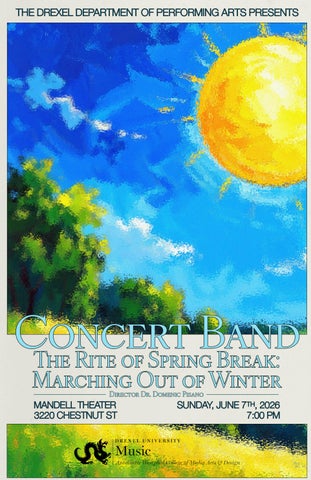
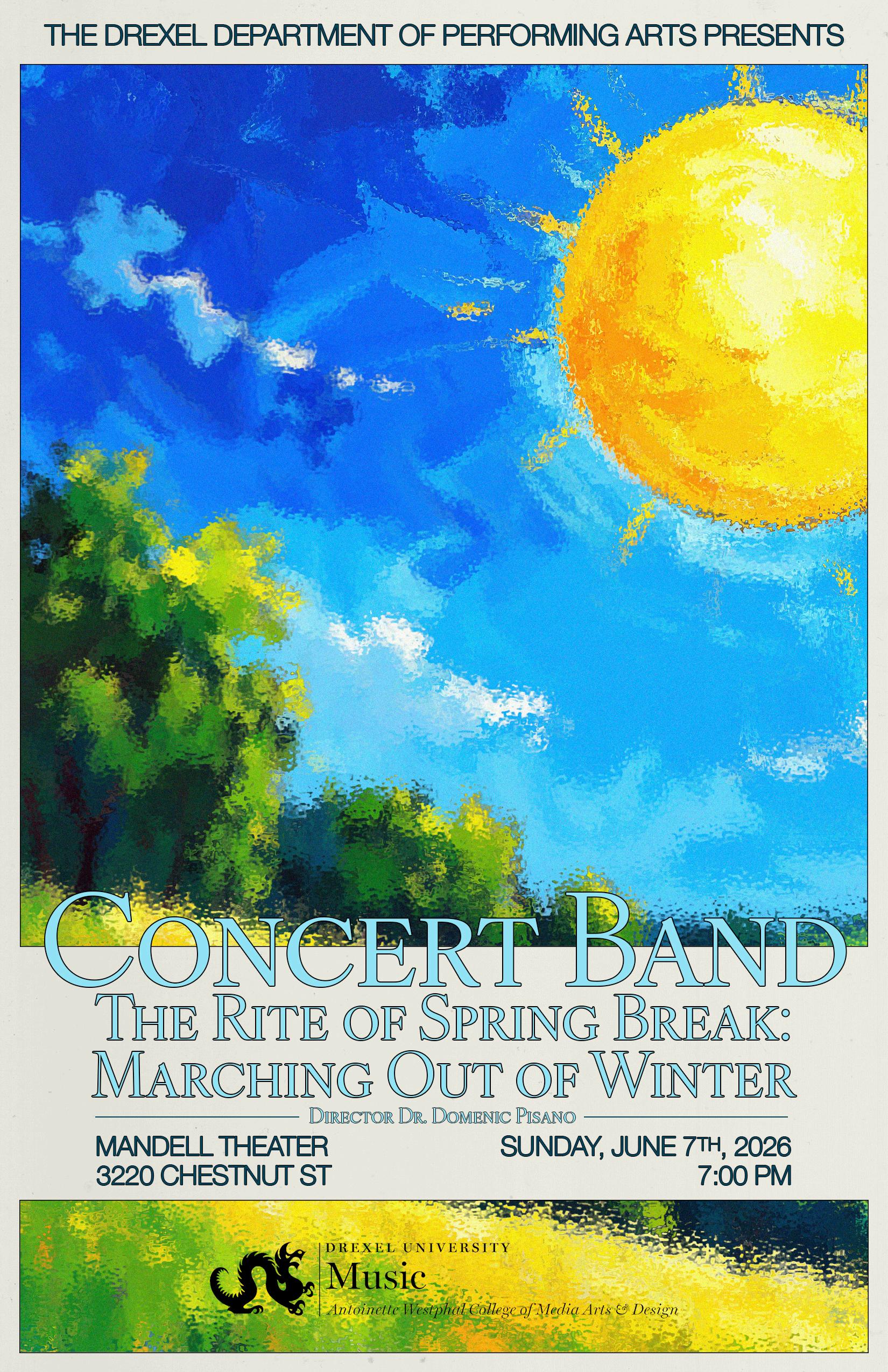
Welcome to "The Rite of Spring Break: Marching Out of Winter." Tonight's program celebrates the transition out of the cold winter months and the vibrant energy of the approaching summer. As we welcome the return of baseball season, we celebrate the legacy of "Hammerin' Hank" Aaron with Anthony O'Toole's Fanfare to "The Hammer." The ensemble steps lively forward with spirited works like Gustav Holst's Marching Song and Percy Grainger's The Gum Sucker's March. We also invoke the brighter days ahead with Frank Ticheli's Sun Dance and Katahj Copley's Syzygy Flow. The concert features powerful moments of reflection as well, particularly with Quincy Hilliard's moving tribute, The Unknown Soldier. Together, these varied selections capture the momentum of marching out of the cold and the joyful anticipation of a well earned summer break.
Drexel University Concert Band
Dr. Domenic Pisano, Music Director & Conductor
The Rite of Spring Break: Marching Out of Winter
Sun Dance ---------------------------------------------
Frank Ticheli
Gustav Holst, Arg. by Frank Erickson
Percy Grainger, Arg. by Glenn Cliffe Bainum
Percy Grainger/ Ed. M Rogers
Anthony O’Toole
Ensemble Members
Piccolo/Flute
Sydney Chiang
Flute
Hannah Bashore
Dane Gentles
Arina Glozman
Arya Gopikrishnan
Oboe
Abby Holmberg
Bass Clarinet/Alto Clairnet
Thomas Cope
Bass Clarinet
Arthur Millet
Contra Alto/Bass Clarinet
Talia Spolansky
Clarinet
Fisher Anderson
Brandon Colan
Eleanor Davis
Nelson Feidelson
Akhil Roy
Angela Silva
Katherine Wolfe
Vincent Yang
Alto Saxophone
Allison Dern
Carys Raber
Andrea Sperl
Tenor Saxophone
Ana Clara Ramirez
Chelsea Douglas
Bass/ Contra Bass Clarinet
Amanda Douglas
Program Note
Drexel University Concert Band Members are listed in alphabetical order to denote each member’s importance to the ensemble.
Ensemble Members
Baritone Saxophone
Elena Gonzales
Faith Harden
Trumpet
Nicholas Gazzara
Ethan King
Karson Paul
Brandon Stern
Mason Vetter
French Horn
Natalie Cisneros
Trombone
Luke Faircloth
Muniru Kabba
Leandro Lucas
Guillermo Martinez-Rodero
Bass Trombone
Nikola Jokic
Euphonium
Hannah Buckleman
Andrew Cox
Benjamin Liber
Tuba
Lane Winterstein
Matt Velardi
Percussion
Jason Adams
Alex Craig
Nicholas Croft
Benjamin Elliot
Reeve Kleger
Alex Lopez
Mia Nagy
Jacob Soslow
Loretta St Andre
Sim Wafula
Program Note
Drexel University Concert Band Members are listed in alphabetical order to denote each member’s importance to the ensemble.
About the Composers
Frank Ticheli
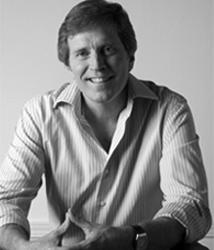
Frank Ticheli (b. 21 January 1958, Monroe, La.) is an American composer and conductor. Ticheli joined the faculty of the University of Southern California's Thornton School of Music in 1991, where he served as Professor of Composition until 2023. From 1991 to 1998, Ticheli was Composer in Residence of the Pacific Symphony, and he still enjoys a close working relationship with that orchestra and their music director, Carl St. Clair.
Ticheli is well known for his works for concert band, many of which have become standards in the repertoire. In addition to composing, he has appeared as guest conductor of his music at Carnegie Hall, at many American universities and music festivals, and in cities throughout the world, including Schladming, Austria, at the Mid-Europe Music Festival; London and Manchester, England, with the Meadows Wind Ensemble; Singapore, with the Singapore Armed Forces Central Band; and numerous cities in Japan, with the Bands of America National Honor Band.
Frank Ticheli is the winner of the 2006 NBA/William D. Revelli Memorial Band Composition Contest for his Symphony No. 2. Other awards for his music include the Charles Ives and the Goddard Lieberson Awards, both from the American Academy of Arts and Letters, the Walter Beeler Memorial Prize, and First Prize awards in the Texas Sesquicentennial Orchestral Composition Competition, Britten-on-the-Bay Choral Composition Contest, and Virginia CBDNA Symposium for New Band Music.
Dr. Ticheli received his doctoral and masters degrees in composition from The University of Michigan. His works are published by Manhattan Beach, Southern, Hinshaw, and Encore Music, and are recorded on the labels of Albany, Chandos, Clarion, Klavier, Koch International, and Mark Records.
About the Composers
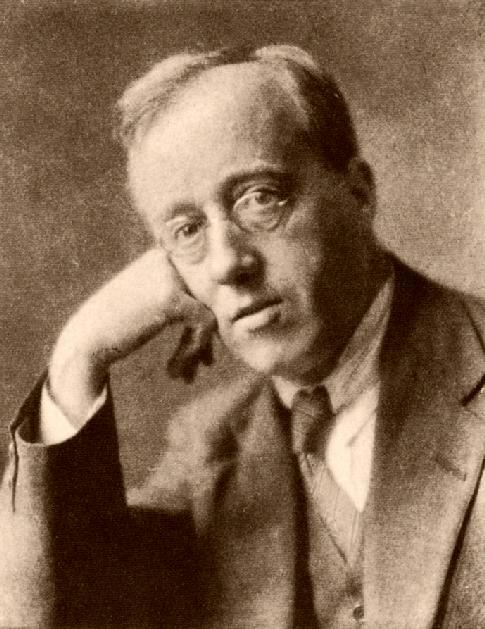
Gustav Holst
Gustav Holst (21 September 1874, Gloucestershire, U.K. – 25 May 1934, London) was a British composer and educator.
Holst learned piano at an early age, but was stricken with a nerve condition that affected the movement of his right hand, forcing him to give up the piano for the trombone.
He received his degrees from The Royal College of Music in London, where he met fellow composer (and lifelong friend) Ralph Vaughan Williams and became interested in Hindu mysticism and spirituality, interests that would later shape the course of his compositional output. In 1901 Holst married Isobel Harrison, who would remain with him the remainder of his life.
Before Holst became a well-known composer, he relied for income from playing the trombone in the Carl Rosa Opera Company and in the White Viennese Band, a popular orchestra specializing in "light music." In 1905, Holst became director of music at the St Paul's Girls' School in Hammersmith, London, and in 1907, he also became director of music at Morley College, retaining both positions until his death in 1934. Holst's compositions for wind band, although only a small portion of his total output, have made him a cornerstone of the genre.
About the Arranger
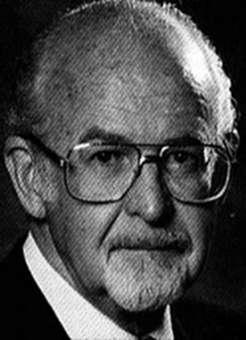
Frank Erickson
Frank William Erickson (1 September 1923, Spokane, Washington – 21 October 1996, Oceanside, Calif.) was an American composer, conductor, arranger, educator and author.
Erickson began studying piano at the age of eight, trumpet at ten, and wrote his first band composition when he was in high school.
He received his Mus.B. in 1950 and his Mus.M. in 1951, both from the University of Southern California. Before entering college he studied privately with Mario Castelnuovo-Tedesco, and with Halsey Stevens and Clarence Sawhill after enrolling at USC.
He served with the United States Army Air Force from 1942-1946, and wrote arrangements for army bands during that time. After the war ended he worked in Los Angeles as a trumpet player and jazz arranger. Erickson was a composer, conductor, arranger, and author of books on band method. He also lectured at the University of California at Los Angeles (1958) and was professor of music at San Jose State University. For a number of years he worked for a music publishing company, and later began his own company.
He was a life member of the National Band Association, elected to the Academy of Wind and Percussion Arts in 1986, and a member of ASCAP (American Society of Composers, Authors and Publishers), Phi Mu Alpha Sinfonia, Pi Kappa Lambda, Phi Beta Mu, and the American Bandmasters Association.
About the Composers
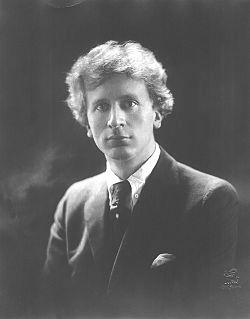
Percy Aldridge Grainger
George Percy Grainger (8 July 1882, Brighton, Victoria, Australia – 20 February 1961, White Plains, N.Y.) was an Australian-born composer, pianist and champion of the saxophone and the concert band, who worked under the stage name of Percy Aldridge Grainger.
Grainger was an innovative musician who anticipated many forms of twentieth century music well before they became established by other composers. As early as 1899 he was working with "beatless music", using metric successions (including such sequences as 2/4, 2½/4, 3/4, 2½/4).
In December 1929, Grainger developed a style of orchestration that he called "Elastic Scoring". He outlined this concept in an essay that he called, "To Conductors, and those forming, or in charge of, Amateur Orchestras, High School, College and Music School Orchestras and Chamber-Music Bodies".
In 1932, he became Dean of Music at New York University, and underscored his reputation as an experimenter by putting jazz on the syllabus and inviting Duke Ellington as a guest lecturer. Twice he was offered honorary doctorates of music, but turned them down, explaining, "I feel that my music must be regarded as a product of non-education."
About the Arranger
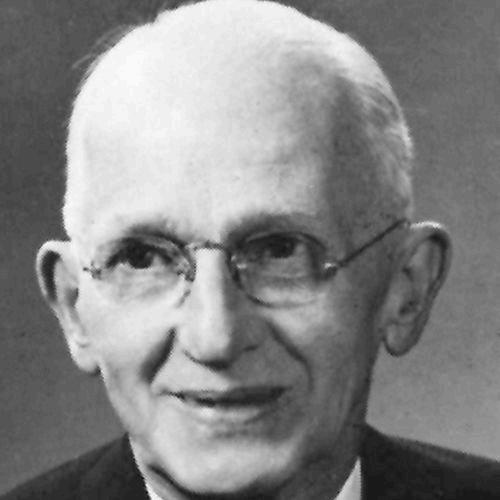
Glenn Bainum
Glenn Cliffe Bainum (6 January 1888, Olney, Ill. – 4 October 1974, Evanston, Ill.) was an American arranger and conductor.
Bainum began his study of music at age ten playing trombone and alto horn. He attended the University of Illinois, studying English and engineering, and played bass drum in the band under A.A. Harding.
After teaching high school for a year, he became director of music at Southern Illinois Normal University (1914–22). Bainum worked toward completing a B.A. in music while serving as Harding’s first assistant director (1922–4), then became director of music for the Grand Rapids (MI) public schools (1924–6). In 1926 he was appointed director of bands at Northwestern University, a position he held until his retirement in 1953. From 1942–5, Bainum was Chief of the United States Army Overseas Music Branch of Special Services, responsible for music in the European theater. In 1953, after 27 years at Northwestern, Bainum retired from the University. Far from having an idle retirement, he soon found himself busy as a guest conductor. From the summer music camp at Interlochen, Michigan, to the New Jersey all-state band, Bainum taught and conducted groups, ranging from grade school to professional in age and abilities, in all 50 states. He also continued to arrange and transcribe music for bands.
About the Editor
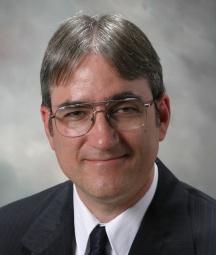
R. Mark Rogers
R. Mark Rogers (b. 20 January 1955) is an American composer, arranger and conductor.
Dr. Rogers has degrees from Texas Tech University and the University of Texas.
As managing editor for Southern Music Company, he is the author of editions of the music of Percy Aldridge Grainger and John Philip Sousa that have entered band repertory worldwide. He is also widely published as an arranger and transcriber, with performances by all five of the Washington, D.C. service bands.
Dr. Rogers is on the adjunct faculty of San Antonio College, Texas Lutheran University, and Trinity University. Prior to coming to San Antonio, Dr. Rogers was on the faculty of the University of South Alabama and a staff member of the University of Texas Longhorn Band. He has guest conducted numerous community and professional bands, regional honor bands and orchestras, and is an active clinician for area high school and middle school bands and orchestras.
A bassoonist, he performs with the Corpus Christi Symphony Orchestra, the Victoria Symphony Orchestra, the Laredo Philharmonic, the MidTexas Symphony, the Austin Symphony Orchestra and the San Antonio Symphony Orchestra. Rogers is the conductor of the Heart of Texas Concert Band in San Antonio. He was elected to the American Bandmasters Association in 2022.
About the Composers
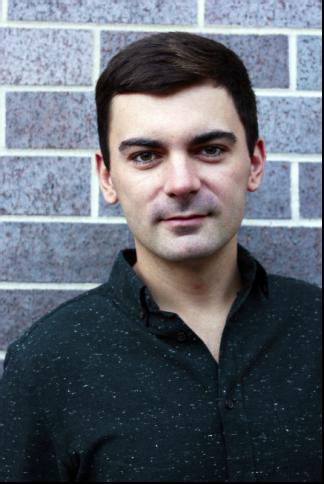
Anthony O'Toole
Anthony O’Toole (b. 1988, Philadelphia, Penn.) is an American composer.
Mr. O'Toole holds a bachelor’s degree in music theory and composition from the Indiana University of Pennsylvania where he studied composition with Daniel Perlongo, Jack Stamp and David Martynuik. He also has his master's in composition from George Mason University where he studied with Mark Camphouse.
Mr. O’Toole has written more than 100 works for almost every medium and began writing music in his early teens. In high school his interest in composition stemmed from his studies as a percussionist and love of performing. He also became a competent multi-instrumentalist learning piano, viola, saxophone, clarinet, trombone and tuba. Although he is largely self-taught as a composer he credits many of his teachers for being mentors and advocates of his music. While at IUP he had the pleasure of receiving lessons and attending lectures from guest composers such as Cindy McTee, Samuel Hazo, Christopher Marshall, Frank Ticheli, Clark McAlister, Richard Danielpour, Bruce Yurko and Drew Hemenger.
His music has been commissioned and performed by musicians and ensembles all around the world. Mr. O’Toole’s music for wind band has been performed and recorded by some of the finest bands including the United States Coast Guard Band, The Kansas State University Wind Ensemble, ‘The President’s Own’ United States Marine Band, The University of North Texas Wind Symphony, The Singapore Wind Symphony, The Alabama Winds and others.
About the Composers
Anthony O'Toole
His piece Fanfare to ‘The
d in the 10th edition of the GIA Publications series Teaching Music Through Performance in Band, which features a recording by the UNT Wind Symphony an in-depth analysis of the work. Hammer also appears in the Sourcebook for Wind Band and Instrumental Music by Russ Girsberger, Frank L. Battisti, and William Berz. Prelude to Something Big is in the 11th edition of Teaching Music Through Performance in Band. His Concerto for Tuba and the Concerto for Euphonium can be found in the Solos with Wind Band Accompaniment edition.
He has received numerous awards for his compositions, including the Grand Prize in the 2012 Garritan Composition Contest, and Second Place in the 2014 Van Galen Prize for wind chamber music. In 2014 Mr. O’Toole was inducted into the Sigma Alpha Iota Music Fraternity as an honorary member for his musical contributions. He is also a member of Phi Mu Alpha Music Fraternity, ASCAP and The American Composer’s Federation.
Anthony O'Toole currently resides in Long Beach, California, where he fulfills his commissions for new works and does orchestrations and arrangements as a freelance writer; he also serves as composer-inresidence for the Carson Symphony Orchestra and staff arranger for the Southern California Brass Consortium.
About the Composers Katahj Copley
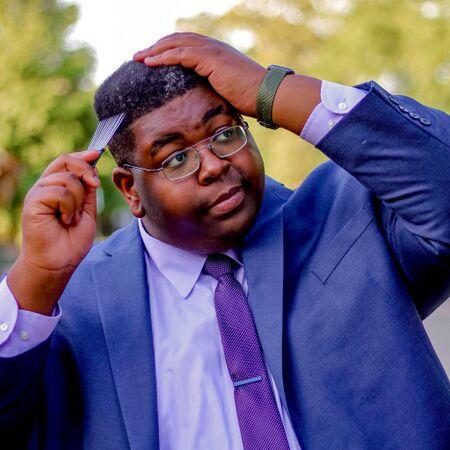
Katahj Copley (b 15 January 1998, Carrollton, Ga ) is an American saxophonist, composer and educator.
Dr. Copley holds a bachelor’s degree in music education and composition from the University of West Georgia, and a master's in music composition from the University of Texas at Austin. He received a Doctorate of Musical Arts from Michigan State University in 2026. Dr. Copley’s first work, Spectra, was premiered in 2017 by the University of West Georgia’s Saxophone Ensemble. Since then, the composer has written over sixty pieces, including over twenty-five for wind band, which have been performed by many local high schools.
At the University of West Georgia, Dr. Copley wrote pieces for UWG’s brass ensemble, concert choir, saxophone ensemble, symphonic band, jazz ensemble and wind ensemble. His compositions have been performed and commissioned by colleges, organizations, universities and professional ensembles, including the 1st Infantry Brass Choir, Rhode Island Recording Ensemble, Axos Saxophone Quartet, the Admiral Launch Duo and the Nu Alpha chapter of Kappa Kappa Psi at Georgia State University. In February of 2020, Dr. Copley’s Sunshine was featured at the Georgia Music Educators Association’s District XIII’s performance, and Nova was premiered by the University of West Georgia’s Wind Ensemble at the College Band Directors National Association Southeast Division Conference.
Aside from composing, Dr. Copley is an educator who teaches young musicians the joy of discovering music and why music is a phenomenal language. Music for Copley has always been impactful in his life. It can soothe, it can enrage, it can quiet and it can evoke emotions that are beyond him and this world we live in. He believes that music is the ultimate source of freedom and imagination, and the most freedom he has had as a musician was through composing. Composition is like opening one's heart and showing the world one's spirit, drive, and passion.
Dr. Copley is one of eight founding members of the Nu Black Vanguard, a composers collective dedicated to the promotion and advancement of Black composers in the medium of music; the other seven founding members are Kevin Day, Marie A. Douglas, Benjamin Horne, Kelijah Dunton, JaRod Hall, Dayla D. Spencer, and Adrian B. Sims.
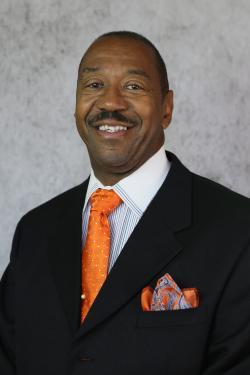
About the Composers Quincy Hilliard
Quincy C. Hilliard (b. 22 September 1954, Starkville, Miss.) is an American composer, author and educator.
Dr. Hilliard’s early music experience was as a trumpet player in the public elementary and high school of his native Starkville, Mississippi. Dr. Hilliard holds a Ph.D. in music theory and composition from the University of Florida where, in 1999, he was recognized as the outstanding alumnus of the School of Music. He holds the Masters of Music Education from Arkansas State University and the Bachelor of Science in Music Education from Mississippi State University where he was designated College of Education 1998 Alumnus of the Year. Quincy C. Hilliard’s compositions for wind band are published by a variety of well-known publishers. In 2014, Hilliard received the prestigious Mississippi Institute of Arts and Letters Award in the Classical Music Division. He was also recognized with a Global Music Award for his work as a composer. In 2012, one of his pieces, Coty (for clarinet and piano) was recorded on a CD that was nominated for a Grammy Award. In 2008, he was commissioned by the Library of Congress to compose a work in celebration of the bicentennial of the birth of Abraham Lincoln. He is frequently commissioned to compose works, including one for the 1996 Olympic Games in Atlanta and a score for a documentary film, The Texas Rangers. For many years, the American Society of Composers, Authors, and Publishers (ASCAP) has recognized him with annual awards for the unusually frequent performance of his compositions. Hilliard is regularly invited to conduct, demonstrate effective techniques, and adjudicate festivals throughout the world.
About the Works
Sun Dance by Frank Ticheli
Sun Dance was written to evoke a general feeling of bright joy and was later found to present a more specific impression of a sundrenched town festival, with various groups of townspeople walking, dancing, sitting in small groups, and generally enjoying the day. The work’s essentially motivic construction is evident throughout, as the song-like and dance-like characteristics are heard in various instruments - beginning with the solo oboe, responded to by dance rhythms in mellow tones, and continuing through a more lush, lyrical passage at the center of the arch form.
- Program note by Dr. Brian Casey, with credit to the composer
Sun Dance has been described as a sparkling ballet full of light, playful motives and warm melodies. The dance-like transparent score and variety of interesting musical elements are enhanced by a syncopated rhythmic figure that is used as the structural building block for virtually everything in the piece.
Sun Dance was commissioned by the Austin Independent School District for the Silver Anniversary Celebration of the 25th Annual AllCity Band Festival, on March 18, 1997.
- Program Note by the Austin (Texas) Symphonic Band concert program, 7 February 2015
About the Works
Sun Dance by Frank Ticheli
Sun Dance was written in 1997 on a commission from the Austin Independent School District to celebrate the twenty-fifth anniversary of their All-City Honor Band Festival, and it was premiered by that group on March 18 of that year. Ticheli writes about the piece: While composing Sun Dance, I was consciously attempting to evoke a feeling: bright joy. After completing the work, I found that the music began to suggest a more concrete image -- a town festival on a warm, sun-washed day. I imagined townspeople gathered in the park, some in small groups, some walking hand in hand, others dancing to the music played by a small band under a red gazebo. Throughout the composition process, I carefully balanced the songlike and dancelike components of “bright joy.” The oboe’s gentle statement of the main melody establishes the work’s song-like characteristics, while in the work’s middle section, a lyrical theme of even greater passion appears. Several recurring themes are indeed more vocal than instrumental in nature. The work’s dancelike qualities are enhanced by a syncopated rhythmic figure... The figure is used not only in the main melody, but also as a structural building block for virtually everything in the piece, including other melodies, accompaniment figures, and episodes.
- Program Note from Baylor University Concert Band concert program, 18 February 2018
- Program Note from publisher
About the Works
Marching Song by Gustav Holst
Gustav Holst's Two Songs Without Words were composed for small orchestra in 1906 and received their first performance at the Royal College of Music, London, under the composer's baton in the same year on July 19th. They were dedicated to Ralph Vaughan Williams who wrote to Holst:
'My dear V' It was nice to open your parcel and find my initials over your pieces - I don't know what you owe to me - but I know all I owe to you - if I ever do anything worth doing it will be greatly owing to having such a friend as you "at my command" as the folk-songs say, always ready to help and advise - and someone whose yea is always yea and nay, nay - which is a quality one really wants in a friend and so seldom gets.
In 1929-1930 the march was scored for small band by Holst and put on hire by Novello, since when it has been largely superseded by the arrangement for full symphonic band by Erik Leidzén, published in 1940.
Marching Song was scored, as most of his wind works, for a small military band. By omitting all of the optional extra parts, the work can be played by as few as 25 players.
- Program Note from Program Notes for Band
About the Works
Australian Up Country Tune by Percy Grainger
Grainger’s Australian Up-Country Tune is based on the composer's Up-Country Song, written for unaccompanied and wordless voices. "In the tune," the composer wrote, " I had wished to voice an Australian up-country feeling as Stephen Foster had with American country-side feelings in his songs."
- Program Note by Heritage Encyclopedia of Band Music
This piece (written for chorus in 1928) is based on a tune I wrote in 1905 called “Up-Country Song”. In that tune I had wished to voice Australian up-country feeling as Stephen Foster had with the American country-side feelings and his songs. I have used this same melody in my Australian Colonial Song and in my Australian the Gum Suckers March.
This choral version was first sung at my wedding to Ella Viola Strom at the Hollywood Bowl, California, August 9, 1928, by the exquisite Smallman a capella Choir.
- Program Note by Percy Aldridge Grainger (18821961)
About the Works
The Gum Sucker's March by Percy Grainger/ ed.
M. Rogers
A "Gum-Sucker" is an Australian nickname for Australians born in Victoria, the home state of the composer. The eucalyptus trees that abound in Victoria are called "gums", and the young shoots at the bottom of the trunk are called "suckers"; so "gum-sucker" came to mean a young native son of Victoria, just as Ohioans are nicknamed "Buck-eyes". In the march, Grainger used his own Australian Up-Country Tune melody, written by him to typify Australia, which melody he also employed in his Colonial Song for two voices and orchestra, or military band.
- Program Note by Percy Aldridge Grainger
The Gumsuckers March was sketched for wind band in the late 1930s but not finished until the summer of 1942. The first theme was composed by Grainger at Hill Hall, Epping, England, around 1911, and the second theme dates from 1905. The complete march was worked out in the summer of 1914 at Evergood Cottage, Goudhurst, Kent, England, and scored for orchestra late that year in New York. Grainger used what he called "toneclashfulness" (writing of independent harmonies for various families of instruments, creating moments of dissonance). The lyric theme from this march can also be found in his Colonial Song and Australian Up-Country Tune. The second theme contains motives from The Widow's Party March. - Program Note by California Polytechnic State University, San Luis Obispo, Wind Ensemble concert program, 6 December 2015
For the time of its composition, the piece is notable in its integral use of piano and a wide variety of mallet percussion instruments.
- Program Note from University of North Texas Concert Band concert program, 5 October 2016 Continued
About the Works
The Gum Sucker's March by Percy Grainger/ ed. M. Rogers
“Gum-Suckers” is a somewhat humorous nickname for Australians from the state of Victoria. During the very warm summers, these people would refresh themselves by sucking on the blades from the Eucalyptus trees native to that region. Pianist and writer Joseph Robert Smith wrote the following concerning Grainger and such titles: "The general public is not aware of the sophisticated musicianship of his music, while the celebrated tastemakers are not generally attracted to pieces with such titles as The Gum-Suckers."
This march is the fourth movement from Grainger’s In a Nutshell Suite, a work originally for orchestra that was arranged for band in 1942.
- Program Note from State University of New York, Fredonia, Concert Band concert program, 27 September 2018
‘Gum-Suckers’ is a nickname for Australians from the state of Victoria, sucking refreshing blades from the typical Eucalyptus trees of the region during the warm summers. The pianist and writer Joseph Robert Smith had the following to say about Grainger and such titles: "The general public is not aware of the sophisticated musicianship of his music, while the celebrated tastemakers are not generally attracted to pieces with such titles as “The Gum-Suckers”." This march is the fourth movement from In a Nutshell Suite, orchestrated for band in 1942 and dedicated to ‘Henry and Abbie Finck, with love’. In our performance, we used the complex and colorful percussion parts from the orchestral version, including, for example, staff bells and some of Grainger’s special Deagan instruments like the steel marimba-phone. We even built our own version of the nabimba. Grainger sometimes played the piano part himself with bands in this march. Even though the piano is not really treated as a virtuoso solo instrument here, it still is a somewhat outstanding item in the scoring.
- Program Note by Bjarte Engeset for the University of Texas Symphony Band concert program, 7 December 2018
About the Works
Fanfare to "The Hammer" by Anthony O'Toole
Fanfare to “The Hammer” was written as a musical tribute to Hank Aaron (1934-2021), the legendary baseball player. Hank Aaron’s long career in the sport is full of notable achievements and milestones. While foremost paying tribute to this great slugger and his achievements, overall the piece evokes the imagery and experience of attending a baseball game and playing a game at the playground on a hot summer day or even just playing catch with your father in the backyard. I remember all those things a kid: playing in little league, playing in the street with friends and collecting the cards. Baseball holds a special place in the heart of most Americans. It is more than just a sport; it’s our pastime.
- Program Note by composer
Dedicated to my friend and mentor, Dr. Jack Stamp.
- Program Note from score
O'Toole uses several concepts borrowed from Jack Stamp's 1999 baseball piece, Pastime. These include using the combined slapstick and woodblock to simulate the crack of a baseball being hit by a bat, and the rhythm of O'Toole's Take Me Out to the Ballgame quote is rhythmically similar to that in Pastime.
- Program Note from Teaching Music through Performance in Band
About the Works
Syzygy Flow by Katahj Copley
Syzygy is the nearly straight-line configuration of three celestial bodies -- the alignment of sun, moon, and Earth -- a flow of energy, a flow of color, a flow of everything. Syzygy Flow is a sonic illustration of the three bodies. The piece opens with a lively melody representing the balance of the earth. From this melody, the music traverses into a rhythmic and epic 3/4 motif representing the flames and heat of the sun. Finally, from the heat of the sun the music is again taken to a different place with the final addition of a lyrical, moving section representing the moon. With all these motifs, themes, and colors, the reprise of the piece is a culmination of all three celestial bodies -- creating an epic fusion of space, matter, meter, and color.
Syzygy Flow was written for the University of Missouri University Band as well as the Zeta Omega chapter of Tau Beta Sigma and the Eta Upsilon chapter of Kappa Kappa Psi.
- Program Note from score
The Unknown Soldier by Quincy Hilliard About the Works
This dignified work pays tribute to all who have died in battle in defense of our country. This is a stirring composition that incorporates familiar elements to add to its patriotic nature. A 21 gun salute is portrayed in the bass drum part, The Battle Hymn Of The Republic is incorporated into the thematic material, and finally, the sound of taps is heard as the great sacrifice of individuals is recognized.
Dr. Domenic Joseph Christian Pisano
Concert Band Music Director & Conductor
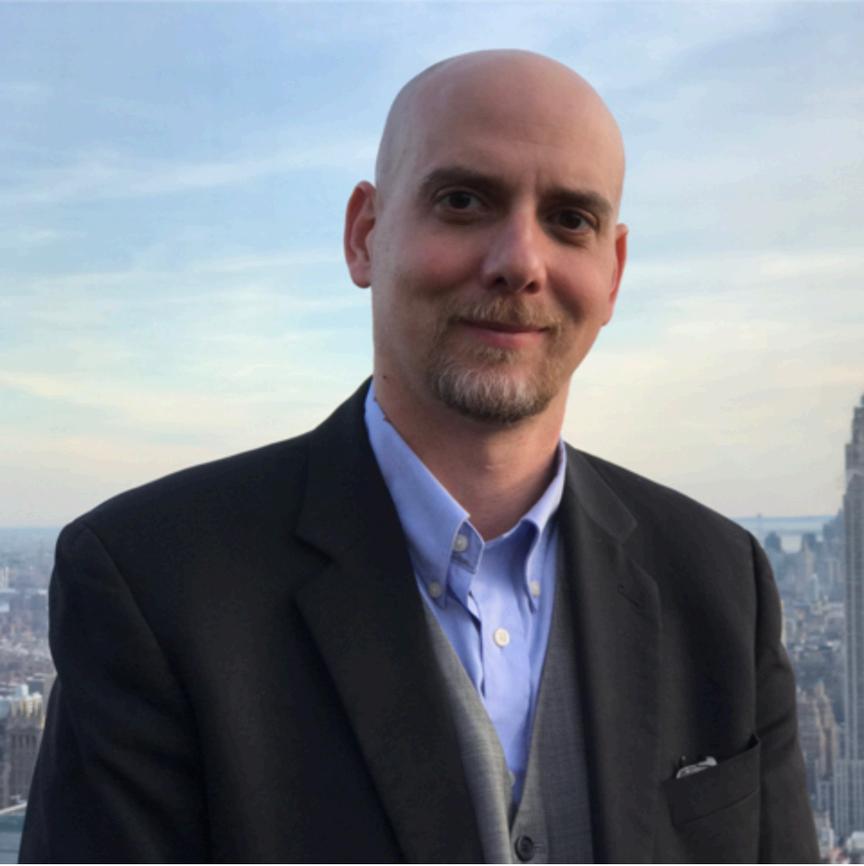
Dr. Pisano is currently the Director of the Drexel University Concert Band and Pep Band, as well the Coordinator of Visual and Performing Arts for the Brandywine School District, serving over 80 teachers in 16 schools with over 8,000 Visual and Performing Arts students.
Dr. Pisano has been a music educator for over 27 years, teaching at the Philadelphia High School for the Creative and Performing Arts and the Upper Perkiomen School District before becoming the Music Department Chair and instrumental music teacher at Concord High School in Wilmington, Delaware for 17 years.
Dr. Pisano has written extensively about music education, including “Music Educators: Investigating the Relationship Between Undergraduate Music Education, State Certification, and Professional Responsibilities,” and he was a contributing author for the book “Creative Music Making at Your Fingertips: A Mobile Technology Guide for Music Educators.”
He has directed ten honor bands through Europe with American Music Abroad and edited several pieces of band literature with his mentor, Dr. Jack Stamp. Dr. Pisano has also served as a clinician, guest speaker, adjudicator, guest conductor, and lecturer for Universities and several state MEAs and worked on educational policy with various state agencies.
Drexel offers four different music minors:
Music: requires 26 credits, including work in Music Theory, History, private lessons, ensemble performance, and 9 credits of music electives.
Music Theory and Composition: aimed at people who are writing their own music or who would like to begin doing so. You will take courses in Music Theory, Arranging, Composition, and Digital Composition, and end with a portfolio of several completed pieces.
Music Performance: requires two years of private lesson studies with our artist faculty culminating in a recital. The Music Program will provide support for the recital venue and accompanist.
Jazz & African-American Music: includes course work in Jazz History, African-American Music, Jazz Theory, private study in Jazz performance, and ensemble work in several ensembles devoted to jazz.
Support Great Performance
Dance, Music, and Theatre are a vital, central part of the Drexel academia and student life. Donations support performing arts ensembles and programs, as well as the operation of our performing arts venues, including the Mandell Theater and URBN Annex Black Box Theater.

Drexel University Department of Performing Arts Staff
Department Head
Dr. Miriam Giguere
Program Directors
Luke Abruzzo
Music
Nick Anselmo Theatre
Jennifer Morley Dance
Administrative Staff
Ellie Ebby Administrative Coordinator
Hannah Burke Department Administrator
Caroline Leipf
Mandell Theater Managing Director
Elisha Robinson
Performing Arts Graduate Assistant
Liv Shoup
Audience Services Coordinator
Lauren Tracy
Ensemble Production Associate
Production Staff
Paul Jerue
Theatre Production Manager/Black Box Theater Technical Director
Asaki Kuruma
Costume Shop Manager
Chris Totora
Mandell Theater Technical Director