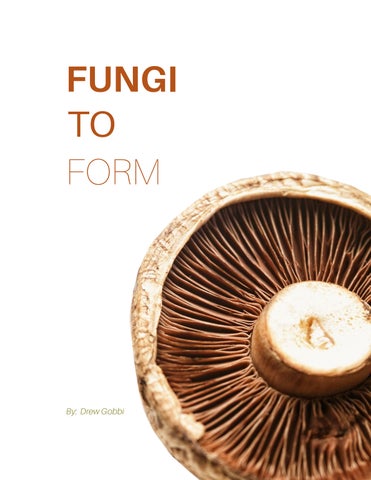
FUNGI TO FORM
By: Drew Gobbi
FUNGI TO FORM
FUNGI TO FORM Exploring Mushroom Mycelium as a Bio-material for Zero-waste Interior Furnishings and Forms
DREW GOBBI University of Arkansas Honors Capstone - 2025 Interior Architecture & Design
2
FUNGI TO FORM
3
FUNGI TO FORM
4
FUNGI TO FORM
5
CAPSTONE COMMITTEE
CONTENTS
CHARLES SHARPLESS – Capstone Chair
Abstract + Question + Introduction
5
Background + Project Context
7
Process + Parameters
14
Case Study Research
16
Experimentation Process
32
Results
44
Conclusion
52
References
56
Image Index
58
Assistant Professor Interior Architecture & Design Department Fay Jones School of Architecture & Design University of Arkansas JENNIFER WEBB – Departmental Committee Member Associate Professor Interior Architecture & Design Department Fay Jones School of Architecture & Design University of Arkansas ANGELA CARPENTER – Non-Departmental Committee Member Fabrication Labs Manager Fay Jones School of Architecture & Design University of Arkansas
Figure 1. Mushroom Sketch, Author
FUNGI TO FORM
6
FUNGI TO FORM
7
INTRODUCTION Figure 2. Wild Mushroom Plant
FUNGI TO FORM
ABSTRACT This capstone explores new applications for mycelium, the root structure of mushrooms, in the architecture and interior design industry. Due to its naturally renewable and 100% compostable nature, mycelium proves itself to be a highly sustainable material. Through a combination of research, analysis, and hands-on experimentation, both the challenges and possibilities of mycelium are documented and defined in the context of solutions for fast-furniture waste, a phenomenon that includes mass-produced, low-cost items designed for short-term use. Following a foundation of literature reviews and case studies, this paper documents small-scale prototyping of myceliumbased models for the Ground-Up Chair, a simple yet uniquely crafted design for a seat that users can grow in their very own living room and fertilize their garden with it as the end of its life as a chair.
8
FUNGI TO FORM
Significance It is up to the new generation of professionals to resist the quickly evolving problem of global warming. While greenhouse gas emissions, gases that trap heat in the atmosphere , do not solely result from building construction and demolition-related production and waste, they contribute to almost a quarter of the total waste produced in the U.S. today. The Intergovernmental Panel on Climate Change (IPCC) has defined the current climate situation as “code red,” reporting that “ in order to keep the rise in global temperatures below 1.5C this century, emissions of carbon dioxide would have to be cut by 45% by 2030” (McGrath 2019). The specifications of materials within architecture and design projects and their sustainability play a huge role in the percentage of waste produced during construction as well as the long-term waste generated from maintenance, updates, and ultimately demolition. The most sustainable building materials are derived from naturally occurring sources within the environment such as plants, animals, and microbes. Discovering, researching, and experimenting with new bio-materials can introduce new methods to decrease a building’s overall carbon footprint. Buildings, structures, and furnishings that implement sustainable materials are proven to be healthier, more efficient, longer-lasting, and less harmful to the Earth. This is true for every aspect of a building from the outer facade to interior finishes, and everything in between. The planet has reached a point that requires architects, designers, and engineers to push beyond typical ‘green’ alternatives and rather incorporate innovative material solutions that can be sourced directly from the nature. Therefore, a collective initiative towards decreasing the negative environmental impact within the architecture and design industry is essential for the future human inhabitation on planet Earth. While there has been already a sizable push towards eco-friendly choices by large architecture and design firms, many sustainable alternatives continue to be expensive, underdeveloped, or simply unattainable.
Figure 3. Mycelium growing on tree bark
9
FUNGI TO FORM
10
FUNGI TO FORM
11
BACKGROUND Figure 4. Underside of a mushroom
FUNGI TO FORM
12
FUNGI TO FORM
Sustainability in Construction and Demolition Interest + Theoretical Context
The Construction and Demolition (C&D) Industry is one of the leading
As an emerging designer, the emphasis on sustainability has been a key
contributors to waste across the globe. In fact, 600 million tons of C&D debris
consideration in my education. After four years of design school, I have gained
were generated in the United States in 2018, which is more than twice the
a deeper appreciaion for the life-span and future impact of a project that is
amount of generated municipal solid waste (US EPA, 2013). Within this large
determined by decisions made through every phase of the design process.
statistic, it has been reported that of the generated waste, over 90% comprises deconstructed materials that cannot be recycled or reused within a new project.
This capstone stems from a set of inquiries related to the environmental impacts
As a result of these alarming and impactful statistics, architects and designers
of the architecture, design and construction industry. The starting point of
have been turning to sustainable solutions as key initiatives for successful,
my research is aimed at understanding the contributions of waste from both
forward-thinking projects. Not only does making sustainability a priority reduce
building construction and demolition (C&D). This research begins by developing
overall C&D waste, but it also reduces material extraction, production, and
an understanding of the current situation of the Global Climate Crisis. After
transportation costs. The key goal, however, is ultimately to reduce the negative
digesting statistics such as “23% of the national waste stream is estimated
environmental impacts that result from C&D waste emissions. The issue at
to be C&D waste” and “C&D waste generation in the U.S. increased by 342%
hand becomes more complicated by defining these negative impacts, which
from 1990 to 2018” (US EPA 2017), it became a goal of mine to narrow these
reveal that “Every stage of a product's life cycle—extraction, manufacturing,
generalized percentages into specific categories, with a focus on materiality.
distribution, use, and disposal—indirectly or directly contributes to the
Though more specific, the category of materials still has many smaller facets
concentration of Greenhouse Gases (GHSs) in the atmosphere and affects the
and considerations. The two main types of building materials are artificial/
global climate (US EPA, 2013). Due to the scale of considerations regarding
manufactured and natural materials (Dhawan 2022). Under these umbrella terms,
construction and demolition waste, achieving a sustainably built project can be
properties such as recyclability, durability, re-usability, and life cycle all provide
complicated, requiring thoughtful decision making and coordination throughout
new challenges and standards for overall degree of sustainability.
each phase of the design process.
After studying diverse materials in these categories, I have narrowed my inquiry to one specific material that is both recyclable and compostable, producing 0% carbon-emissions through its use. Mycelium-based Biocomposites (MBCs), are derived from the structural root system of mushrooms. MBCs are biomaterials presenting renewable and bio-degradable alternatives for a wide range of design and manufacturing processes, including the building industry (Ghazvinian, Gursoy 37). The potential of increased use and application of MBCs is very high because “...mycelium grows at such a fast rate, which allows a cost-effective, natural means to produce different kinds of goods” (Alexander 2023).
Every stage of a product's life cycle—extraction, manufacturing, distribution, use, and disposal—indirectly or directly contributes to the concentration of Greenhouse Gases (GHSs) in the atmosphere and affects the global climate. (US EPA, 2013)
13
FUNGI TO FORM
14
FUNGI TO FORM
Zero-Waste Architectural Solutions Current construction practices typically aim to create buildings with a functional life of 50 to 60 years, although many buildings are demolished after much shorter lives. This is because “programmatic needs change, technical innovations render older systems obsolete, and materials are damaged and deteriorate” (Gorgolewski 2013). Regardless of how sustainable a project within the built environment may be, there will almost certainly be some percentage of waste that is generated from the process of ideation to completion. However, decisions made regarding material components and construction methods can significantly reduce the levels of GHG-emissions, carbon footprint, and overall contribution to landfills. There are a variety of methods and solutions for creating zero-waste within the construction of a project that have been heavily researched and experimented with such as Design for Disassembly, Buildings as Material Banks, and Recycling, Upcycling, Downcycling (Grmela.) The phrase “Closed-
Figure 5. Furniture and Furnishings Waste Management: 1960-2018
Loop Cycle (CLC)” has been adopted by a quickly developing category of sustainable materials that ultimately produce zero waste or emissions throughout their production, application, and re-use. The two most commonly used CLC materials are steel and timber, but the majority of CLC materials derive from raw organic matter and are developed through means of construction ecology. This category is often referred to as “bio=materials” and are sourced straight from the Earth.
The principle of closed-loop material cycle (CLMC) construction is defined as “a construction constituting materials and building elements that can be recovered from buildings and infinitely recycled through natural or industrial processes (Sassi, 2008) Figure 6. Furniture Waste Pile
15
FUNGI TO FORM
16
FUNGI TO FORM
The “Fast-Furniture” Dilemma
Mushroom Mycelium
One of the largest contributors of architecture-related waste is furniture,
Mycelium is the vegetative root of a fungal body, made of a branching hyphal
specifically “fast-furniture” which is defined as “cheap, fragile furniture that
structure (Fig. 7). These web-like branches spread throughout the substrate
causes steep environmental costs in production, distribution and disposal
that the fungus is growing on, such as wood, soil, compost, coffee, sugar cane,
and disproportionately harms marginalized communities” (Laura 2023). The
or grains like rice and oats. The purpose of the mycelium is to find and break
Environmental Protection Agency estimates that nearly 9 million tons of furniture
down food sources in the substrate and collect nutrients and water for the
are tossed every single year, which equates to 5% of all landfill waste. One of the
final creation of the mushroom. The structural qualities of the mycelium root
main factors of this concerning statistic is that much of today’s furniture is not
system have demonstrated many possibilities for its use and application as an
built to have a long lifespan. In fact, many pieces of “fast-furniture” are actually
adequate material. Existing research shows that Mycelium-based bio-composites
designed for more of a temporary use or to have a short lifespan due to lack
(MBCs) can reduce fossil fuels’ reliance and embodied energy and decrease
of consideration for potential repairs and re-finishes. This leads most users to
building waste. Because of their organic structural chemistry, MBCs are 100%
opt for the easier option, which is to replace the item entirely. That being said,
compostable/recyclable, and lie under the category of Closed-Loop Materials.
consumers are constantly contributing to the e-commerce furniture market,
MBC materials have been experimented with and applied within different
which is projected to grow from $27 billion in 2021 to $40 billion in 2030.
industries including construction, manufacturing, agriculture, and biomedical.
Some of the most well-known “environmentally negligent corporations” (Laura
Its low-cost and environmentally friendly features attract interest in their research
2023) such as Walmart, Target, Amazon and IKEA are expanding their furniture
and commercialization.
operations, making it easier and more accessible for consumers to obtain unsustainable pieces. The most common material used by these companies is
Through these different applications, several characteristics of mushroom
non-recyclable particle board with plastic laminate coating and chemical resin
mycelium have been identified that lead many to advocate for its potential in
adhesive. There is a blatant gap in the design market for furniture that can be
the architecture and design field. Mycelium is a strong candidate for sustainable
returned to the Earth in a positive manner through composting and recycling
construction primarily due to its lightweight biodegradable structure and its
techniques (Fig. 5).
capacity to be grown from waste sources. In addition to this, mycelium has a relatively high strength-to-weight ratio and a much lower embodied energy compared to traditional building materials. The three most currently researched uses of mushroom mycelium through design are structural support, acoustic and thermal insulation. “Given the properties of MBC, it has great potential to revolutionize the construction industry, which is so far dominated by energy and emission intense materials such as steel, plastic, and concrete and even wood which is only to a certain extend available in a sustainable way” (Volk 2024). Over the past decade, the material has grown significant traction for sustainabilitydriven individuals from biologists and ecologists to architects and interior
Fast Furniture Mega-Manufacturing Companies
designers.
17
FUNGI TO FORM
18
FUNGI TO FORM
Cap
Gills
Stalk
Mycelium
Figure 7. Mushroom + Mycelium root structure
Figure 8. Mushroom + Mycelium root structure
19
FUNGI TO FORM
PROCESS + PARAMETERS
20
FUNGI TO FORM
Experimentation Hands-on experimentation plays a crucial role in not only understanding the material from a direct perspective, but being able to create a tangible solution
Research The investigation of mushroom mycelium as a sustainable building material merges architecture and design applications and methodology with industrial ecology research and implications. In addition, mycology, the study of fungi plays a significant role in understanding the properties of MBCs throughout their journey from the organic environment to the built environment. Linking these fields of study together allows them to support research and application of mushroom mycelium, and work to prove its potential role in sustainable construction. Proving the ultimate environmental impacts of a material that is still gradually emerging and developing is a process that requires review of existing literature, data collection and direct experimentation and application/ prototyping from a diverse range of sources and perspectives. In order to understand existing applications from both ends of the built environment, two distinctive projects were selected for research-based case studies. The first project analyzes a large-scale exterior application of mycelium, the second analyzes a small-scale interior-based application. The range in process of both projects demonstrate different techniques for growing, molding, and building mycelium structures. The case studies consist of research, process breakdown, and analysis of concept, impact, outcome, and overall impact within the world of sustainable architecture and design.
for the problem at hand. This project follows a design-build process with three separate iterations, each following a distinctive point of curiosity or question while working towards a collective goal. Utilizing lessons learned from the research and analysis portion, each iteration increases in complexity following a greater familiarity of how the material behaves and what is possible from an ‘athome’ experimentation setting with limited supplies compared to those used in professional case studies. The altered variable between each iteration was primary the type of mold used to grow the substrate in. The first iteration used rectilinear block forms, a basic unit that serves as a ‘control’ for further experiments. The second iteration focuses on a switch from linear forms to organic, embracing curves, domes, and rounded edges. It also explores varying depth and scale of the grown material, and utilized common household items as the growth forms and molds. The final iteration uses lesson from the previous forms to design and grow a small scale chair that serves as a prototype-level solution for fast furniture. This iteration adopts 3D printing as the mold-making design process to create a custom shape suitable for the substrate. The innate value of the material experimentation process is first-hand learning and experience that continues the conversation of mycelium and its potential for use within the context of innovative architecture, design, and engineering.
INTERIOR VS EXTERIOR SMALL SCALE VS LARGE SCALE
RESEARCH EXPERIMENT
PROCESS ORGANIC VS GEOMETRIC
ANALYSIS ITERATE
OUTCOME
CONCEPT DOCUMENT
IMPACT
21
FUNGI TO FORM
22
FUNGI TO FORM
23
Mycelium has grown in popularity in the architecture and design industry in the past decade, and has made great strides in research, experimentation, and application. From temporary structures to full-scale projects, the versatility of mycelium has already been recognized in many sectored of construction such as insulation panels, bricks, and even structural elements.
CASE STUDIES Figure 9. Mycelium Brick Wall
FUNGI TO FORM
24
FUNGI TO FORM
CASE STUDY #1: Hy-Fi Mushroom Brick Tower Within the field of architecture, there have been a few well recognized applications such as the Hy-Fi Mushroom Brick Tower, created by The Living Architects, designed for and commissioned by the MoMA PS1 Young Architects Program (Fig. 10). The Living team worked in collaboration with Ecovative, a company that has been growing "bricks” from mycelium and using them to replace typical plastic packaging material. This remarkable project has earned lots of recognition in the architecture and design world for its innovation and sustainable initiatives. After its completion in 2014, David Benjamin, head architect and designer was chosen as the winner of the “Young Architects Program” (Benjamin 2015). The project was also a finalist and Bronze medal winner for the Global Holcim Awards in 2015. The outstanding collaboration between The Living and Ecovative led to the development if a new type of brick that could be used for scalable architectural structures (Figs. 1519). The aspect of this project that caught the attention of many was the ability the mushroom “brick” modules to be both” produced and demolished without releasing any embodied energy, waste, or by-products” (Benjamin 2015). Not only was this project groundbreaking in term of mushroom mycelium study and application, but its properties allowed it to be utilized for more than just a simple structure. The organic material gave the tower an opportunity to be used as a base for growing plants and was basically self-fertilizing (Fig. 11). The strong acoustic properties of mushroom mycelium were also put to the test in this project. The Modern Museum of Art in New York, the tower’s location, hosted events like concerts around Hy-Fi (Fig. 12). By observing these events, it was found that when positioned inside the walls of the tower, “the sound generated from surrounding noise was significantly less” (Chichaki 2014).
Figure 10. Hy-Fi Mushroom Brick Tower
25
FUNGI TO FORM
26
FUNGI TO FORM
The design process of Hy-Fi started with a desire to push the boundaries of sustainability in architecture through a prototype structure to serve as a launch pad for future innovation. “Like all of our projects, we imagine this as kind of a test or a prototype for the architecture of the future,” Benjamin tells The Creators Project, in our documentary, viewable above. “We can try to do things differently. We don’t have to accept the way that buildings are always designed” (Chichaki 2014). By focusing on a singular brick component, then aggregating it into a large-scale structure, the Living team was able to quickly and effectively iterate their design until reaching the most promising outcome. Hy-Fi’s central design goal was to create an architectural structure that results in little to now waste through both the construction and deconstruction process. The use of living materials essentially allows the entire project to return to the earth through composting at the end of the structure’s life-cycle. The manufacturing process engages bio-technology, agriculture, and industrial manufacturing. The composting process engages the municipal solid waste stream, which illustrates Figure 11. Base of Hy-Fi Tower being used as a garden
that following the ‘material end-of-life’ stage, mycelium is able to divert from the typical landfill path and instead make its way back into the Earth though soil composting and eventual bio-degradation (Fig. 13). There for, the clear initiative for Hy-Fi, the idea that it was designed to disappear as much as it is designed to appear was proven successful following the deconstruction of the tower in the fall of 2014.
Figure 12. Hy-Fi Tower being used as concert venue
Figure 13. Mycelium’s Role in the Waste System
27
FUNGI TO FORM
28
FUNGI TO FORM
The mushroom brick production process begins in local farms through sourcing
After five to seven days of growth, the form solidified, appearing entirely white.
and collection of agricultural waste. Some examples of these byproducts are
The grown form was then removed from the mold and places into an oven at 180
cornstalks, grain, sawdust, and straw. In the Hy-Fi tower, the type of waste used
degrees for four to eight hours to dry out the material and kill the active organism.
was cornstalks from farmland within 10 miles of the construction site. Corn stalks
During the dehydration process, the bricks shrink to 30% of their original weight,
are primary composed of cellulose, which the mushroom spores feed off of in
yet remain the same size and appearance (Figs. 15-19).
order to build a fungal root system. Essentially, a small ecosystem forms in each
1.) Combining mycelium with agri. waste
brick which allows it to solidify into a tangible unit. The stalk is the central part of the corn plant which transports nutrients, water, and oxygen throughout the organism (Fig. 14). The corn harvesting process utilizes a combine harvester, which separates the kernels from the cobs and leaves behind the stalks and other natural byproducts in the field. Designers with The Living saw these cornstalks as an opportunity rather than waste, and collected and transported them to their production site. The cornstalks were shredded or
3.) Growth and removal from brick form)
4.) Drying + Firing to kill fungus
5.) Compression (aggregation with other bricks)
tassel
grinned down into small aggregates and combined with a mushroom
2.) Fungal root system production
stalk
spawn. This substrate was then hydrated to initiate growth of spores. The combined substrate was compacted into a mold or form
ear
leaf
and placed into a room-temperature space out of direct sunlight. Over the next five days, the mushroom culture grew by feeding on the agricultural waste, binding the substrate together through the development of hyphae. The fungus created a network of interconnected mycelium
Figure 14. Corn Stalk Structure
that surrounds and connects the agricultural material to form a selfsupporting composite.
Figures 15-19. Mushroom Brick Production Process
29
FUNGI TO FORM
30
FUNGI TO FORM
The full-scale logistics of this project were
Takeaways
determined through the development of
The Hy-Fi tower was the project that first introduced me to mycelium as a
an algorithmically-run 3D model that was
building material, and has remained a consistent precedent for information and
designed by structural engineers at Arup.
inspiration regarding innovative bio-material use. Not only did this project have
This model processed data from various tests
a significant impact within the context of the MoMA PS1 program, but inspired
done to the mycelium bricks such as strength,
a community of sustainability-driven architects and designers. The ability for
compression, and weather resistance. The
The Living to create such dynamic structure as the large scale of 40 feet tested
shape of the structure was determined by
the limits of mycelium and its architectural characteristics such as structural
highest potential for strength, which is why
integrity, durability, and longevity. They simultaneously pushed the boundary
the team landed on arches, tubes, and vaults
of sustainable, closed-cycle construction by creating a goal that the entirety of
as the basic design language. They also
the project has the ability to be deconstructed with zero-waste leftover. Their
determined that a wide base was needed to
thoughtful planning, process, and concept allowed their goal to be successful
carry the wind loads. Using the results of their
by the end of Hy-Fi’s display at the MoMA. This success sparked a greater
‘standing-on-a-brick test’ it was calculated
conversation about mycelium as a building material within the architecture and
that a 40-foot-tall chimney would work as a
design industry, inspiring many others, including myself to ask what else can
base scheme. As the design evolved, one
be done with it. Over the past decade, large leaps of progress have been made
chimney eventually became three, and finally
regarding research and experimentation of mycelium-based biocomposites. This
one tower woven out of three chimneys
has led to a wide variety of resources and knowledge that have made it easier
(Fig. 21). Following a three month process
for more questions to be asked and answered about mycelium, contributing to
of design, iteration, and experimentation,
Figure 20. Hy-Fi Structure Breakdown
a greater conversation of sustainability in construction. The simple geometry
the team was successfully able to grow over
of a brick is considered to be the foundation of many forms of architecture due
10,000 mycelium bricks.
to its durability, versatility, and aesthetic appeal. The approach of this projects utilizes this basic unit to test the potentials of mycelium in the built environment. The impact of iterating upon and aggregating the brick is very powerful and impactful, especially at a scale of 10,000 bricks. Not only were the individual forms simple, but the overall design of the structure was as well, an organic, tubular mass was relatively simple as well, allowing the mycelium’s innate qualities to remain the center of attention within the tower. Additionally, sticking to a simple form reduces extraneous complexity of the experimentation process, letting the materiality to remain at the forefront of the investigation. Starting from simple growth and experimentation techniques will direct towards a variable for
Figure 21. Sketches from Arup Structural Engineers
further questioning.
31
FUNGI TO FORM
32
FUNGI TO FORM
33
CASE STUDY #2: Ecovative X bioMASON MycoFurniture Collection First unveiled at the Biofabricate convention in 2016, the ‘stack stool’ (Fig. 23) along with a collection of tables and chairs were part of a breakthrough product of a collaboration between Ecovative Design, the pioneer and world leader in the bio-fabrication of mycelium-based products, and bioMASON which employs natural microorganisms and chemical processes to manufacture biological cement-based masonry building materials. The collection was built around Ecovative’s pioneering idea that “the mycelium of a mushroom can work as ‘nature’s glue’ to bind agriculture waste and wood together” (Lush 2016). Customers of the upstate New York-based manufacturing company include Fortune 500 companies, small businesses, and boutique shops. Having produced more than a million pounds of biofabricated furniture and packaging this year alone, it is clear consumers and business customers are driving demand for these well designed, and earth friendly products. This collaboration has enabled bioMASON to think outside the rectangle, and seek further aesthetics for understanding more about the material’s potential to make a beautiful, durable and smooth bio-material that is pleasing to accent the everyday. The MycoFurniture collection consists of three distinct pieces, one table, and two types of stools. Each piece is entirely mycelium-based, ad utilize stacking and puzzle-like joinery to maintain a 100% decomposable outcome.
Figure 22. Ecovative’s Material Principles
Figure 23. Ecovative’s Stack Stool
Figure 14. Ecovative x bioMASON ‘Stack Stool’
FUNGI TO FORM
34
FUNGI TO FORM
35
The entirety of the Ecovative x bioMASON furniture collection is made out of mycelium, a thread-like tissue that makes up mushroom, and agricultural byproducts. These components create legs, seats, upholstery, cushioning and even the packaging to protect the furniture during its travel. With slight tweak in the temperature or carbon dioxide levels, mycelium can be changed into different shapes and strengths (Figs. 25-27). Ecovative’s furniture is made from 3 forms of patented technology that the
Figure 25. ’Stack Stool’
Figure 26. ’Kings Table’
Figure 27. ’Imperial Stool’
company has developed and tested over the past 10 years. MycoBoard, My c oB o a rd B as e
MycoFoam, and MycoFlex are three different iterations of premium,
2 ” My c oF o a m Ta b l e to p s
customizable, and certified sustainable mycelium panels (Fig. 24). Changes in
x1
substrate ingredients, mycelium ratios, and growth process gives these panels different characteristics and abilities. Rather than being bound together with formaldehyde and other toxic resins, the panels are grown together using
x1
Ecovative’s mResin adhesive system. Derived from the mycelium, this “nature’s glue” is safe, healthy, a formaldehyde-free
x2
My c oB o a rd B as e F o rms
1 ” My c oB o a rd To p & B as e
My c o b o a rd B as e F o rms
x1 x2
x1
x2 x1
1 ” My c oF o a m S tru c tu re F o rms
2 ” My c oF o a m Ta b l e to p
x2 x1 x2
Figure 24. Ecovative’s MycoTechnology Types
x2
FUNGI TO FORM
36
FUNGI TO FORM
The use of mycelium in packaging was another move by Ecovative in an effort
Takeaways
to reduce waste generated from the shipping process such as styrofoam and
The collaboration between Ecovative and bioMASON introduced new
plastic (Fig. 28). This additional push towards sustainability allows the project
possibilities for the use of mycelium within interior-based applications. Rather
to maintain a zero-waste initiative throughout every step of the manufacturing
than aggregating a small and simple planar unit as seen in many larger-scale
process. Ecovative’s Mushroom Packaging can be tossed straight into the
architectural applications, this project experiments with interesting shapes,
garden or compost bin once it is no longer needed. It will then decompose and
configurations, and joinery methods that take the abilities of mycelium to the next
rejoin the soil as nutrients to support plant growth and soil health, or metabolized
level. The patented mycelium products developed by Ecovative, paired with the
by animals and microbes to become nutrition for other parts of the ecosystem.
fabrication techniques of bioMASON opens new doors of design thinking. This
Life cycle assessments have been conducted by Ecovative to understand the
project has designed geometric forms that interlock with one another to form
exact time-based impact these solutions have on the environment. They found
the furniture’s structure, as well as further is simple sustainability without the use
that “Mushroom® Packaging is fully home-compostable and Cradle to Cradle
of additional joinery. The distinction in form and composition of three different
Gold Certified. Whereas many products that claim to be compostable require
mycelium products, MycoBoard, MycoFoam, and MycoFlex allows each panel to
energy-intensive processing, Mushroom® Packaging naturally reverts to soil
perform a certain way and possess different properties. It is helpful to know that
nutrients after just 45 days” (Ecovative). The packaging can be easily broken
there is not just one recipe or growth process that works for mycelium, it is an
down into small chunks by hand or with a hammer to ensure the organism can
adaptable material with lots of potential due to its desirable characteristics. The
be fully broken down. The shelf life of mycelium products is estimated to be
key characteristics utilized within this project are its strength, durability, density,
around 30 years if kept in standard dry conditions.
texture, and its aesthetically appealing natural appearance. One of the most promising qualities of mycelium is its ability to adapt for different applications, as well as its potential to performs well in a variety of environments, both interior and exterior. This case study has emphasized the importance of a simple process elevated by iteration of a select variable. This system of experimentation often leads to a stronger result as well as a more informative investigation. It also introduced the idea of geometric planar-grown mycelium that can be attached without the use of extra joinery or materials. This method has a lot of potential of use in both interior and exterior applications. This allows larger products and structures to be created through aggregation processes such as stacking and joining, rather than relying on large-scale mycelium growth. Combination of smaller aggregates also increases the overall strength and durability of the mycelium structure. With this project being one of the few examples of mycelium furniture, it brought up questions regarding the weight capacity that mycelium could handle. Therefore, seeing it used in applications that typically require drastically different materials was very encouraging.
Figure 28. Ecovative’s MycoPackaging
37
FUNGI TO FORM
38
FUNGI TO FORM
39
The largest research component involved in answering the project question is hands-on experimentation. In order to gain familiarity and comprehension of mycelium as a material, including its properties and potential, a series of three growth iterations were conducted as part of the process. Each iteration focuses on understanding the material at a more complex level, and focuses on a different potential use for mycelium.
PROCESS Figure 29. Mycelium Growth Substrate
FUNGI TO FORM
40
FUNGI TO FORM
Iteration #1: Building Blocks
The process required to produce mycelium products from the Grow-It Yourself
Following the case study analysis of the Hy-Fi Tower, it became apparent
refined and patented their MycoComposite™ technology over the past decade
that starting with the most basic form, a block or brick, would be crucial for
following the tower’s demolition. That being said, the same four key steps were
the foundational framework of the entire experimentation process. This initial
used through each experimentation iteration, hydration, growth, molding, and
experimentation set a goal of creating simple rectilinear forms at a small scale to
dehydration.
substrate is very similar to that of the Hy-FI tower. This is because Ecovative has
focus on personal understanding how the material behaves, rather than jumping right in to a more complex investigation. The growth substrate used for the first
The GIY Kit includes a plastic bag with w built in filter containing three pounds
iteration were sourced from Grow.bio, a branch of the Ecovative company that
of hemp hurd with the mushroom spores. Hemp hurd derives from the stalk of
advocates for hands-on learning with mycelium-based materials. Advertised
the hemp plant, making it composed primarily of cellulose (Fig 32). Fungi often
as “the perfect way to bring your Earth-friendly creations to life”(Ecovative),
get their nutrients from sugars. These can be large chains of sugars known as
Grow.bio offers a line of “Grow It Yourself” products that make it easy for novice
carbohydrates, like starch, glycogen or cellulose. In this experiment, cellulose
users such as myself to experiment with mycelium from home (Fig 30).. These
is the main source of nutrition that the mushroom spores feed on in order to
products are formulated with Ecovative’s MycoComposite™ technology which
produce mycelium. Digestive enzymes work by binding themselves to the hemp
is a combination of dehydrated hemp hurd,defined as agricultural waste made
substrate. Once it binds, it forms an enzyme-substrate complex that results in
from hemp stalk inner cores, and mushroom culture, an ideal pair for mycelium
breaking the bonds that hold the monomers together (Fig 31).
growth.
Figure 32. Hemp Hurd
Figure 30. Ecovative’s ’Grow-It-Yourself’ Substrate
Figure 31. Enzyme-Substrate complex
41
FUNGI TO FORM
42
FUNGI TO FORM
4
HYDRATION
5 HYDRATION
1
Disinfect all surfaces and supplies with 70% isopropyl alcohol to ensure a sanitized workspace.
2
Cut open the bag above the filter patch and substrate mass.
3
Whisk together 4 Tbsp flour and 3 cups water in a separate bowl, then pour directly into the bag.
4
Fold over opening of bag and seal tightly with tape.
5
Shake bag for 1 minute to spread flour and water mixture evenly throughout the substrate. Flour provides carbohydrates and some proteins, which serve as a food source for the mycelium
6
Store the bag in a cool, dry environment out of direct sunlight for 3-5 days to let the mycelium grow.
Pre-hydrated Substrate
After 5 days
43
FUNGI TO FORM
44
FUNGI TO FORM
PACKING + GROWTH 1
Cut top of growth bag, pour contents into a large bowl
2
Use hands to break apart the material into small aggregates, ensuring there are no large chunks remaining.
3
Mix an additional 4 Tbsp flour into the substrate to re-feed the mycelium
3 4 5
Disinfect all growth forms and lay them out on a clean, flat surface. Begin packing each form one-by-one, tamping down the surface after
6
Tightly warp each growth form in plastic seal wrap, ensuring no parts of the substrate are left exposed.
7
Poke small holes in the top layer of plastic for ventilation
8
Place filled growth forms in a cool, dry environment out of direct sunlight for 5-7 days
each layer of substrate is added.
45
FUNGI TO FORM
46
FUNGI TO FORM
REMOVAL + DEHYDRATION
TESTING
In order to grow the basic brick forms, two different sized molds were used to
Following the dehydration process, the completed
compare differences between less and more substrate material. The three pound
bricks were tested for their basic durability and
bag of substrate was calculated to fill eighteen 3.2 x 2.2” bricks, and two 9.25 x
compressive strength. A standing and pulling test were
4” bricks. The larger size used a hard plastic molds and the smaller bricks used
used to determine that the bricks can support over
flexible silicone molds.
100 pounds of weight without upper body support,
x3
x2
and have high tension, only breaking with the use of
3.2”
9.25”
9.25”
slicing tools.
3
8”
4”
1
Gently remove solidified bricks from growth forms and place them on flat oven-safe pans.
2
Place them in the oven at 180 degrees for 4-8 hours to dehydrate the substrate while simultaneously killing the active organism to prevent over-growth of fungal matter
47
FUNGI TO FORM
48
FUNGI TO FORM
Iteration #2: Circular Studies
The use of household items as growth molds required creative and strategic
The second course of experimentation focused on mycelium growth within
and forms. To achieve round, dome-shaped models, various sized bowls were
curved and rounded forms, rather than linear. It also explores variables of scale
stacked on top of one another, leaving the perimeter exposed to pack the
and thickness that differ from the ‘control’ experiment. The growth forms used for
substrate within. This iteration also took another attempt at basic block forms,
this iteration were primarily ‘found objects’ that the common consumer likely has
but used a standard cupcake pan to create circular units, rather than rectilinear.
in their own home, primarily kitchen supplies such as bowls, glasses, and even a
A martini glass was used to create a conic form with a wide, round base and
cupcake pan. The goal of using household items to house mycelium growth was
central point. Finally, a thin, rounded-edge soap dish tested limits of depth for the
to reiterate the idea that ‘new’ items do not always have to come at the expense
substrate. These models demonstrate not only the ability for mycelium to grow in
of the environment, and can adapt to what already exists in the world.
non-linear shapes, but in a greater range of size and thicknesses.
thinking to determine how to successfully grow mycelium as curved shapes
Cupcake Pan Drinking Glass Martini Glass
Side Bowl Flower Pot
Cereal Bowl
Mixing Bowl
Fruit Bowl
Soap Dish
= Mycelium Substrate
49
FUNGI TO FORM
Iteration #3: Ground - Up Chair
50
FUNGI TO FORM
“Ground-Up” Chair Ideation
The final experiment focused on a hypothetical solution for fast-furniture with a focus on dining/accent chairs, which are some of the most often replaced items. Inspired by some of the most commonly purchased chairs from fast furniture sources such as IKEA, Amazon, and Target, a small-scale prototype was designed to serve as a sustainable alternative to the existing options. Entitled the “Ground-Up Chair,” this product combines popular stylistic choices such as curves with a minimalist yet functional design that is actually good for the environment. Based on the results and findings from the previous iterations, the
ODGER
possibilities, limitations, and
Chair, white/beige
overall goals of the chair became
$125.00
clear. Each component of the chair needed to be able to support effective mycelium growth, with adequate thickness and depth. The design process started with iterative 3D modeling on RHINO 7, a digital software used by
YOUNUOKE Beige Dining Chair
3D Print Model #1
$270.00
The first 3D print model focused on the solid portion of the chair, in attempt
architects and designers. The
to create a self-supportive mold out of silicone. While the silicone mold was
intent of digital modeling was to
unsuccessful, the model served as a foundation for further digital iterations.
create a custom chair shape that could be 3D printed at a small scale. Working back-and-fourth between the solid and void chair
LeisureMod
model led to the development of
Boucle Accent Chair
an outer shell form, which once
$365.00
printed would serve as a mold for mycelium and substrate growth.
Figure 33-35. Non-Sustainable Chair Precedents
51
FUNGI TO FORM
52
FUNGI TO FORM
3D Print Model #2 The second 3D print model revised the original design, yet focused on the void region of the chair by outlining and printing the profile to allow the ‘solid’ region to server as a hollow template for the mycelium substrate.
DAY 1
Initial packing of growth form
DAY 6 After mycelium growth
MATERIAL Plastic Filament STRUCTURE 2 Layer Filament + Structural Truss SCALE 1/4” = 1’-0”
DAY 7
After removal from mold + dehydration
53
FUNGI TO FORM
54
FUNGI TO FORM
55
RESULTS Figure 36. Mycelium grown into substrate
FUNGI TO FORM
Iteration #1: Building Blocks
56
FUNGI TO FORM
57
FUNGI TO FORM
Iteration #1: Building Blocks
58
FUNGI TO FORM
59
FUNGI TO FORM
Iteration #2: Circular Studies
60
FUNGI TO FORM
61
FUNGI TO FORM
Iteration #2: Circular Studies
62
FUNGI TO FORM
63
FUNGI TO FORM
Iteration #2: Circular Studies
64
FUNGI TO FORM
65
FUNGI TO FORM
Iteration #2: Circular Studies
66
FUNGI TO FORM
67
FUNGI TO FORM
Iteration #3: ‘Ground-Up’ Chair
68
FUNGI TO FORM
69
FUNGI TO FORM
Iteration #3: ‘Ground-Up’ Chair
70
FUNGI TO FORM
71
FUNGI TO FORM
72
FUNGI TO FORM
73
Each experimentation result provides a new opportunity for application within both interior and exterior environments. Understanding the potential use for the completed models throughout diverse site and spatial context and scales allows them to become much greater than a simple unit, and rather a counterpart of a meaningful space.
SPATIAL CONTEXT & SCALED ENVIRONMENTS Figure 37. Mushroom growth close-up
FUNGI TO FORM
74
FUNGI TO FORM
75
FUNGI TO FORM
76
FUNGI TO FORM
77
FUNGI TO FORM
CONCLUSION Successes The initial curiosity surrounding the project topic successfully transitioned from broad inquires to detailed case study investigation and analysis, establishing framework regarding mycelium use in the architecture and design industry. A well-rounded conversation including issues regarding global warming, construction waste, issues of fast furniture, and sustainability built a strong foundation for the importance of innovation with bio-materials. Following the research process, the three experimental iteration conducted were each effective in terms of furthered knowledge and exploration of mycelium as a design material. Additionally, they each resulted in successful forms, models, and prototypes based on the intented outcome. Overall, this capstone contributed to the continued conversation of bio-materials and their opportunity help combat the quickly warming world we live in through a decreased carbon footprint. Challenges The key challenges of this project arose primarily during the experimentation process. Limitations including material cost, workspace, oven size, and lack of advanced supplies restricted the project to strictly small-scale prototyping and an overall speculative final product. Data collection during the experimentation process came with many obstacles. Because it took place over a ten-week period, there were limitations regarding long-term testing for values such as decomposition timeline, life-cycle analysis, and potential full-scale growth times. In addition, precise measurements of weight, stress-resistance, and compression strength throughout each iteration were difficult to determine.
78
FUNGI TO FORM
Lessons Learned The entirety of this project, including research and experimentation was my first experience learning about and working with mushroom mycelium. It concluded in comprehensive understanding of physical properties, growth and decomposition process, environmental impact, and existing applications. With hands-on-material testing being at the forefront of this investigation, I learned the importance of defining procedures, controls, independent and dependent variables, and documenting each step of the process within an design-based experiment. The growth form design process was also the first time I attempted hands- onmodeling through 3D Printing. 3D printing is a fairly new technology that is quickly revolutionizing the architecture industry by enabling more efficient and innovative construction methods. 3D Printing and sustainable design overlap in their material-conscious efforts in cutting waste, energy use, and emissions, making it a very valuable skill to take away from this project.
79
FUNGI TO FORM
80
FUNGI TO FORM
81
DISCUSSION Consideration for Improvement Room for improvement within this project lies primarily in the experimentation process. A more in-depth documentation including additional pictures, videos, and even audio files would have greatly strengthened the hands-on learning aspect of this project. Some process images that were not taken, especially during Iteration #2, would have created a clearer and more understandable sequence of actions from a viewer’s perspective. Additionally, supplementing existing imagery with more data related to acoustics, thermal transmission, tension and compression, and durability would provide a more direct framework for the potential of mycelium in real-world architectural applications. Further Research Opportunities Because this project was largely speculative and resulted in small-scale prototyping, the room for continued exploration is quite sizable. The clear next step would be to create a full-size model of the “Ground-Up” Chair, followed by tests for weight support and structural integrity. In addition, each of the models created in this project can be upscaled, aggregated, and iterated, with the eventual goal of being a counterpart within a full-scale architectural design project. Each product of the experimentation process can also be furthered through: • • • • • • • •
Increased iterations Variety in size and source of substrate used Variety in mushroom species used Weather/Wear Testing over time Implications of cutting, joining, aggregating Larger Scale Prototyping Higher Detail Documentation Implementation of color, pattern, and texture
Figure 38. Wild fungal root exposure
FUNGI TO FORM
REFERENCES Alexander, S. (2023, January 6). How Fungi and Plants Use the Mycelial Network to “Talk.” Shroomer. https://www.shroomer.com/mycelium-what-is-benefits-uses/ Benjamin, D. (2015). Hy-Fi: Zero carbon emissions compostable structure, New York, NY. Holcim Foundation Website. Cichacki, S., Uitti, J., Jancer, M., Vatankhah, M., Fike, A., & Prada, L. (2014, August 9). Hy-fi: The living’s local, sustainable, 10,000 Brick Mushroom Tower at Moma PS1. VICE. https://www.vice.com/en/article/hy-fi-the-livings-local-sustainable10000-brick-mushroom-tower-at-moma-ps1-video/
82
FUNGI TO FORM
McGrath, M. (2021, August 9). Climate change: IPCC report is “code red for humanity.” BBC News. https://www.bbc.com/news/scienceenvironment-58130705 Sassi, P. (2008). Defining closed-loop material cycle construction. Building Research & Information, 36(5), 509–519. https://doi. org/10.1080/09613210801994208 US EPA. (2013, August 12). Climate Change. US EPA. https://www.epa.gov/ climate-change US EPA, O. (2017, September 12). Construction and Demolition Debris: MaterialSpecific Data. US EPA. https://www.epa.gov/facts-and-figures-about-materialswaste-and-recycling/construction-and-demolition-debris-material
Dhawan, N. (2022, September 12). What are the classification of architectural materials? RTF | Rethinking the Future. https://www.re-thinkingthefuture.com/ architectural-community/a7812-what-are-the-classification-of-architecturalmaterials/
Volk, R. (2024, June 3). Life cycle assessment of mycelium-based composite materials. https://www.sciencedirect.com/science/article/pii/ S0921344924001745#sec000
Ecovative. (n.d.-a). Dehydrated mycelium material. Grow.bio. https://grow.bio/ collections/giy-material/products/dehydrated-mycelium-material
Yang, Libin & Park, Daekwon & Qin, Zhao. (2021). Material Function of MyceliumBased Bio-Composite: A Review. Frontiers in Materials. 8. 737377. 10.3389/ fmats.2021.737377.
Ecovative. (n.d.). Mushroom packaging. Mushroom Packaging. https:// mushroompackaging.com/ Ghazvinian, Ali & Gursoy, Benay. (2022). BASICS OF BUILDING WITH MYCELIUMBASED BIO-COMPOSITES. Journal of Green Building. 17. 37-69. 10.3992/ jgb.17.1.37. Gorgolewski, M., & Ergun, D. (2013). Closed-loop materials systems. https://www. irbnet.de/daten/iconda/CIB_DC26516.pdf Kibert, C.J., Sendzimir, J., & Guy, G.B. (2002). Construction ecology: nature as the basis for green buildings Laura, T. (2023, April 13). America’s fast furniture epidemic must be solved | new university | UC Irvine. https://newuniversity.org/2023/04/13/americas-fastfurniture-epidemic-must-be-solved/ Lush, K., & Hill, T. (2016, November 22). Ecovative and Biomason collaborate to advance biofabricated furniture for the home and Office - Synbiobeta. https:// www.synbiobeta.com/read/ecovative-and-biomason-collaborate-to-advancebiofabricated-furniture-for-the-home-and-office
83
FUNGI TO FORM
IMAGE INDEX Figure 1. - Mushroom Sketch, Author Figure 2. - Wild Mushroom Plant Figure 3. - Mycelium growing on tree bark Figure 4. - Underside of a mushroom Figure 5. - Furniture and Furnishings Waste Management: 1960-2018 Figure 6. - Furniture Waste Pile Figure 7. - Mushroom + Mycelium root structure Figure 8. - Mushroom + Mycelium root structure Figure 9. - Mycelium brick wall Figure 10. - Hy-Fi Mushroom Brick tower Figure 11. - Base of Hy-Fi Tower being used as a garden Figure 12. - Hy-Fi Tower being used as concert venue Figure 13. - Mycelium’s Role in the Waste System Figure 14. - Corn Stalk Structure Figures 15-19. - Mushroom Brick Production Process Figure 20. - Hy-Fi Structure Breakdown Figure 21. - Sketches from Arup Structural Engineers Figure 22. - Ecovative’s Material Principles Figure 23. - Ecovative’s ‘Stack Stool’ Figure 24. - Ecovative’s MycoTechnology Types Figure 25. - Ecovative’s ‘Stack Stool’ Figure 26. - Ecovative’s ‘Kings Table’ Figure 27. - Ecovative’s ‘Imperial Stool’
84
FUNGI TO FORM
Figure 28. - Ecovative’s MycoPacking Figure 29. - Mycelium Growrth Substrate Figure 30. - Ecovative’s ‘Grow-it-Yourself’ Substrate Figure 31. - Enzyme-Substrate complex Figure 32. - Hemp Hurd Figure 33-35. - Non-Sustainable Chair Precedents Figure 36. - Mycelium grown into substrate Figure 37. - Mushroom growth close-up Figure 38. - Wild fungus root exposure
85