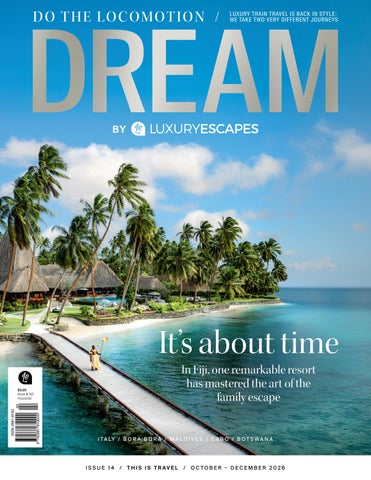
D O T H E LO C OMOT IO N /
LUXURY TRAIN TRAVEL IS BACK IN STYLE: WE TAKE TWO VERY DIFFERENT JOURNEYS
BY
It’s about time In Fiji, one remarkable resort has mastered the art of the family escape
9 782981 819000
ISSN 2981-8192
02
$9.95 (Aust & NZ inclusive)
I T A LY / B O R A B O R A / M A L D I V E S / C A B O / B O T S W A N A
ISSUE 14
/
T H I S I S T R AV E L
/
OCTOBER – DECEMBER 2026
Where Joy Runs Wild Whether you’re chasing adventure, culture, food or wildlife, South Africa has a way of making every moment count.
Scan to start your adventure
DR EAM BY L U X U RY E S CA P ES
THE LUX FILES 24
Dive into the waters of Bora Bora Known for its incredible overwater accommodation there is beauty underwater, too.
30
Experience summit different in Colorado Pop-up carpark bars, crafty brewers and incredible mountain scenery abound.
36
High flyer on the Sunshine Coast Fine dining, rooftop revelry and avian encounters at the new Avani Mooloolaba Beach Hotel.
44
NEW. NOW. NEXT
16
Trieste is an Italian city that has been shaped by its turbulent, often shifting, borders.
Cover image Jean-Michel Cousteau Resort, Fiji. Photo: Kyle Hunter.
2
DRE A M BY L U X U RY ES CA P ES
Taking the family on an adventure in Zimbabwe, Botswana and South Africa.
Page 28
The seaside city blurring the lines
Going wild on a southern African safari
54
Beyond the pale in the Maldives White Night parties are just the beginning of a luxurious stay at Finolhu Beach Resort.
Contents
O CTO BE R – DE C E M BE R 2 0 2 6
69
The Luxury Escapes insider guide to Singapore The best drinking, dining, sleeping and hawker stalls in the Lion City.
78
Clocking off on a family trip to Fiji
86
Baha California dreaming
Jean-Michel Cousteau Resort in Fiji gives families the most precious gift of all: time.
94
The state of the arts in Austria
102
Luxury train travel is having a moment
Cabo is known for its beaches and bling but there is plenty of food and culture to be had.
Editorial Head of Content Penny Cordner-Maas Managing Editor Paul Chai Creative Lead Natalie Meneghetti Content Manager Stephanie Mikkelsen
Contributing writers Nate Robinson, Adam Schwab, Jessica Bedewi, Rebecca Elwood, Craig Tansley
A summer of music and theatre in Vienna and the neighbouring state of Burgenland.
We take the slow train in outback Australia and the wilds of Canada.
HERE & FAR
Design team Elise Ackland, Sabrina Gigliotti, Nathan Pascual, Veronica Sam
For all editorial enquiries, contact editorial@luxuryescapes.com
Advertising Strategic Partnerships Leader Chris Neill
Strategic Partnerships Executive Annika Rothschild
Tourism Boards Partnerships Manager Jodie Collins For all advertising enquiries, contact mediasales@luxuryescapes.com
Luxury Escapes CEO and Co-founder Adam Schwab
Chief Marketing Officer Ben Connell
Dream by Luxury Escapes is published by Luxury Escapes (ACN 150 650 927), Level 4, 68 Clarke Street, Southbank, VIC 3006. Ph: 1300 88 99 00. Printed in partnership with Invicium print management company.
DESTINATION DEEP DIVES
Page 78
DREAM BY L U X U RY E S CAP E S
3
Do more dreaming online Be inspired by wanderlustworthy destinations, travellers’ tales and the latest travel trends online at Dream by Luxury Escapes.
From the Luxury Escapes CEO
Melbourne to Malé: new 2027 direct flight dates announced
The best five-star resorts in Phuket
Also catch us at:
@luxury.escapes facebook.com/luxuryescapes youtube.com/luxuryescapes @luxury.escapes
4
DRE A M BY L U X U RY ES CA P ES
Luxury Escapes is heading back to the Maldives in 2027. When we launched Australia’s first-ever direct flight to paradise – our overnight charter flight from Melbourne to Malé in partnership with Maldivian – we had no idea how it would be received. We took a punt on the “if we build it, they will come” strategy and enthusiastic Australian travellers absolutely showed up. Since launching in May, the service has been flying at an incredible 91 per cent “load factor”: in just four months; which is airline speak for lots of people on the plane. And it’s not just the flights. Demand for Luxury Escapes’ resort packages in the Maldives are up 65 per cent year-on-year, with a new wave of travellers jumping on board. We are seeing families, friend groups and multigenerational crews joining the loved-up honeymooners. So, we are back with year-round flights running through 2027 and we would like to thank our partners, Maldivian and Melbourne Airport, for helping take our little “what if” and turning it into an ongoing service.
In this issue, we head to the Maldives to attend a decadent White Night party at Finolhu resort (“Beyond the pale”, page 54); we also celebrate our new season of Luxury Escapes: the World’s Best Holidays TV show, with a behind-the-scenes spread (page 66). Our cover story looks at the juggle of holidaying with small kids, the challenges presented to achieve that perfect family getaway and how Jean-Michel Cousteau resort in Fiji has the answer (“A matter of time”, page 78). On the family theme, I take my kids to southern Africa where they learn to track wildlife and visit the thunderous Victoria Falls (“Pride and joy”, page 44) We are also proud to announce that Dream by Luxury Escapes won Print Publication of the Year at the Mumbrella Travel Marketing Awards in August, a testament to the power of our inspirational editors, storytellers, photographers and designers who vividly bring each destination we feature in the magazine to life. Join us for another issue of inspiration and celebration.
Adam Schwab CEO and Co-founder Luxury Escapes
IMAGE (FAR LEFT) : ICEMANPHOTOS/SHUTTERSTOCK.COM
luxuryescapes.com/inspiration
THE LUX FILES
Shining a light on the new, the next, the people and the places you need to know about. The EVE Hotel, page 28.
24 / The brilliant blues of Bora Bora
28 / Exploring around Sydney’s EVE Hotel
36 / The Sunshine Coast’s shiny new resort
44 / Going on safari in Southern Africa
THE LU X FI LES N EW & NE X T
N E E D TO KN OW
T H E E X H I BI T I O N
RENEGADE PAINTER Sidney Nolan, the famous Australian artist who immortalised the outlaw Ned Kelly, gets an exhibition exploring his early years.
ROCK SOLID The Granite Belt has long been one of Queensland’s under-the-radar cool-climate highland wine regions and with new Meteora Vineyard it has a destination to match. By Nanette Holliday. THE VINEYARD
AHEAD OF THE PACK New Samonsite range means you can have a hardcase carry-on with the convenience to grab personal items when you need them. 8
DRE A M BY L U X U RY ES CA P ES
T H E BAG
Why should origin stories be limited to superheroes? The Art Gallery of New South Wales is exploring the early years of visionary Australian artist Sidney Nolan in Nolan: Origins beginning on October 3. Spanning the remarkable creative period from the late 1930s until the artist’s departure for the United Kingdom in 1953 – and bringing together more than 150 significant works from public and private collections – Nolan: Origins is the first major exhibition dedicated exclusively to the artist’s formative years. The exhibition traces the output of a young artist and the locations and myths that inspired Nolan’s creative breakthroughs and shaped one of the most celebrated oeuvres in Australian art.
“Sidney Nolan is a pivotal figure in the history of Australian art, creating works that redefined perceptions of place and nation in our cultural imagination,” said Denise Mimmocchi, exhibition curator and Art Gallery of New South Wales senior curator of Australian art. “It is a pleasure to look more closely at the crucial years of Nolan’s beginnings – arguably the most vital of his career – when he created works that remain central to the imaging of Australia as an expansive, imaginative place, and as a psychic and poetic space.” These works include Nolan’s iconic series of images centring on the bushranger Ned Kelly as well as the ill-fated Burke and Wills expedition of 1860-61, images and events that came to define a young nation.
Nolan: Origins is on display at the Art Gallery of New South Wales from October 3, 2026 to February 7, 2027. Tickets are now on sale, including discounted two-for-one tickets on Wednesday evenings for Art After Hours.
Two hours south-west of Brisbane, the Granite Belt’s altitude brings four seasons, and small family wineries have been quietly producing some of Australia’s most notable drops for decades. Queensland Wine Awards judges recently declared it “up there with the best Australia has to offer”. Meteora Vineyard, a new arrival that opened in July, sees founders Andrew and Karen Catsoulis create the Belt’s most ambitious hospitality offering: a restaurant, cellar door and the region’s first wine cave, built from more than 10,000 reclaimed heritage bricks and railway sleepers, set among 35-yearold vines, with a helicopter transfer from Brisbane for guests.
In the kitchen is executive chef Simon Treller, who traded a Great Barrier Reef island posting for the cool highland air and has built a tasting menu including local beef tenderloin, wild mushrooms and regional truffles; a love letter to the landscape on the plate. In the cellar, chief winemaker Andy Williams is producing fiano, vermentino, lagrein and aglianico alongside the estate’s Pét Nat releases – a wine program inspired by the Mediterranean and anchored in Granite Belt terroir. Luxury residences and a wellness centre placed amongst the vines will open in the coming months.
Samsonite’s new Paralux range is the ideal mix of security and convenience with the new hardside luggage – in carry-on and large spinner sizes – coming with an innovative front door that allows easy access to belongings (like a passport or headphones) without having to split the bag in two. Paralux also offers removable packing cubes and thoughtful pockets and straps to make sure you can pack
your way while getting easy access when you need it most. The Paralux range includes an everyday backpack and a weekender duffle bag as well as a full range of suitcase sizes for check-in. Colours like Dusty Pink have proven particularly popular but the range of luggage also comes in Stone Grey, Midnight Navy and Black.
Paralux range starts from $499 for 55cm hardside carry-on and $279 for weekender duffle bag; samsonite.com.au
THE LU X FI LES G R AN D O P E NING S
H OTE L N E W S
The latest and hottest hotel and resort openings to get on your radar Little National Adelaide Little National Adelaide takes the brand beyond its compactroom formula with more space and facilities. In the new hotel there are 237 rooms, including Luxe Apartments, family suites and the brand’s first Luxe Penthouses; there’s a Technogym wellness centre, meeting spaces and a rooftop bar reserved for guests, with 360-degree views across the Adelaide Hills, Parklands and coastline.
T HE L A NGHA M, CU STO M H O U SE , BAN G KO K
The Langham, Custom House, Bangkok The 78-room hotel will bring Langham staples including T’ang Court, Chuan Spa, a destination bar and a pastry shop.
L I T T LE NAT IONA L A D EL A ID E
Serras Sevilla This stay puts 43 rooms opposite Seville Cathedral in the historic heart of the city.
Set to occupy Bangkok’s 1888 Customs House on the Chao Phraya, the restored neo-Palladian building will be joined by a former post office and elegant accommodation. SE R R AS SE V I L L A
There are high-ceilinged rooms, suites named for the Giralda and the building’s original aristocratic owner. Upstairs, a rooftop terrace serves tapas and drinks with front-row views of the cathedral.
Raffles The Red Sea On Shura Island, Raffles The Red Sea has 121 rooms, 14 suites and 33 pool villas, most with lagoon or beach views.
T H E S H E P H E R D M AY FA I R
The Shepherd Mayfair The Shepherd Mayfair is set within the historic Shepherd Market, with 82 rooms and 16 private residences. Tucked behind a restored Georgian facade, interiors nod to the neighbourhood’s past without going full period drama. There’s all-day dining at Fayre and cocktails downstairs at Teddy’s.
10
D R E A M BY L U X U RY ES CA P ES
AVA N I QU EENSTOW N
Avani Queenstown Located on the Queenstown lakefront, this hotel is the brand’s first outpost on the New Zealand South Island. Interiors take influence from local design, and the all-day diner, Six to Midnight, puts on globally inspired menus. Look to AvaniSpa to soothe and knead slope-weary muscles during ski season.
Every room comes with a private terrace and Raffles Butler service. Dining covers Singaporean, Eastern Mediterranean and PanArabic flavours, alongside a spa, watersports, padel and plenty of reasons to stay put.
R AF F L E S TH E R E D SE A
BOOK 2027 NOW & SAVE Discover ever-changing landscapes, world-class food and wine, culture and people, exploring Australia by train. While there are many ways to see it, there’s only one way to really do it. That’s on an all-inclusive, fabulously fun rail journey. 2027 adventures from $3,190* per person. Visit journeybeyondrail.com.au, call 1800 703 357, or contact your local travel agent.
*Conditions apply. Advertised price is per person based on the Advance Purchase fare on the Indian Pacific from Sydney to Perth in a Gold Twin cabin in June or July 2027. Prices are subject to availability. Booking and credit card fees may apply. For full terms and conditions visit www.journeybeyondrail.com.au/terms-conditions. Prices correct as at 1 September 2026.
THE LU X FI LES T W I N TOW NS
EAT
Eska Part bakery, part restaurant, Eska takes Czech staples and gives them a modern edge. The kitchen works with fire, fermentation and local produce, with dishes ranging from wood-fired bread with butter to smoked trout and roasted vegetables. The fermented potato bread is a signature. Come early for breakfast, before the pastry shelves are cleared out.
One has beer halls with properly poured pilsner, the other tea houses with precisely whisked matcha. Prague and Kyoto have spent centuries perfecting the things worth waiting for, and beneath their Gothic towers and temple roofs, these traditions continue to shape how people eat, drink and live. Skip the shortcuts. Take your time.
D R IN K
Letná Park Beer Garden Prague’s beer culture is best enjoyed outdoors. Letná’s hilltop beer garden has shaded communal tables beneath the trees, cold brews and sweeping views across the Vltava to the Old Town. Sunset is particularly popular here, especially with locals.
DO
PRAGL Czech glass has been prized for centuries, and this Old Town workshop shows exactly why. Watch master glassmakers transform molten glass into delicate sculptures before trying your own hand at the furnace under expert guidance.
PRAGUE Look beyond Prague’s postcard beauty and the city becomes more than castles, Charles Bridge and chimney cakes. Behind the Baroque facades are neighbourhood pubs, grand cafes and workshops where generations-old skills are still practised. It’s a city that rewards wandering, whether you’re chasing architecture, a perfect pint or a slow-cooked Czech classic. STAY
E XPLO RE
Kunsthalle Praha One of Prague’s newest galleries occupies one of its oldest industrial buildings. Inside the restored former Zenger transformer station, contemporary art takes centre stage across a rotating exhibition program. Afterwards, head to the rooftop terrace for a drink and one of Prague’s best vantage points away from the crowds.
Augustine Hotel This is one of Prague’s most atmospheric escapes, set across seven historic buildings, including a former 13thcentury monastery. Along with original vaulted ceilings and quiet courtyards, there are 101 contemporary rooms, a fine-dining restaurant and spa. Head to The Refectory Bar to quench any thirst with an exclusive St. Thomas Beer, a brew made to an original monastic recipe.
WORDS: STEPHANIE MIKKELSEN. IMAGES: VLAS TELINO STUDIO / SHUTTERSTOCK.COM, GUITAR PHOTOGRAPHER / SHUTTERSTOCK.COM
P RG/KI X
STAY
EAT
Ace Hotel Kyoto
Monk
Occupying a restored 1920s heritage building, this design-forward 213-key hotel is home to Japan’s first Stumptown Coffee Roasters, lively taco bar Piopiko and rooftop Italian diner, where housemade pasta and wood-fired pizzas are served with cocktails overlooking the courtyard below. The hotel neighbours Karasuma Oike Station for easy access into the city.
Tucked beside the Philosopher’s Path, Monk is a small restaurant where the fire does much of the work. The menu is built around whatever is freshest from Kyoto’s farmers and markets, with dishes such as roasted vegetables, seasonal fish and wood-fired pizza topped with ingredients like kujo negi, shiitake or wild greens. Plan well ahead for reservations; there are just two sittings per day, 14 diners at a time.
KYOTO Kyoto is a city of careful hands, where tea masters, potters, chefs and artisans have spent generations perfecting their craft. Here, the smallest details make the biggest impression – a hidden garden, a lantern-lit alley in Gion, a bowl of noodles prepared with precision. Follow the details and Kyoto does the rest.
DR I NK
toka A small, welcoming room where exceptional tea is the main event. Choose from a selection of Japanese teas, watch it being prepared with care, and pair your cup with a seasonal wagashi, a traditional plant-based confectionery.
DO
Aritsugu Inside Nishiki Market, Aritsugu has been crafting kitchen knives since the 16th century. Originally sword-makers, Aritsugu evolved into one of Japan’s most respected knife shops. Watching staff sharpen and explain each knife is part of the experience and makes for a souvenir in a league of its own.
EX P LO R E
Otagi Nenbutsu-ji Kyoto has plenty of famous temples, but Otagi Nenbutsu-ji has largely escaped the notice of the Arashiyama crowds. More than 1,200 stone rakan statues dot the hillside, each with a different expression – laughing, praying, playing instruments or looking bemused. Wander to find a favourite.
DREAM BY L U X U RY E S CAP E S
15
THE LU X FI LES WAY FI N D E R
TR I E STE
Border forces
I TALY
Its unique combination of Italian and Middle-European culture – thanks to a history of redrawn international borders – makes Trieste an Italian city like no other. Justine Costigan discovers that the complicated history, the heady mix of nationalities and the local coffee are worth getting excited about.
In Trieste’s Antico Caffè San Marco long tables piled with books affirm its reputation as one of the city’s intellectual gathering places. Despite living in a digital age, the bookshop in the middle of this elaborate art nouveau cafe is still a hub for students, writers and journalists and anyone fascinated by the echoes of more than a century of political, literary and social upheaval. I’m here to drink in the atmosphere and a coffee, the trade that helped build Trieste’s wealth, proudly exhibited in the city’s imposing Imperial palaces and the neoclassical facades that line the port. In this part of Italy, where it’s said locals drink more coffee than anywhere else in the country, coffee drinking has its own unique vocabulary. Sure, I could order a macchiato and the waiter would understand what I mean, but that would instantly paint me as an outsider. Instead, I hesitantly ask for a “goccia in b”, indicating a drop of milk in my
espresso, served in a glass (bicchiere). I’m delighted when the waiter simply nods and smiles and heads off to the sparkling copper coffee machine to make it. Ordering a coffee is not the only thing that’s different about Trieste. Only officially part of modern Italy for the past 100 years, it existed under the Austro-Hungarian empire until 1918 and remained Italian until the occupation of Northern and Central Italy by the Germans in WW2. When the war ended, the city was in limbo until 1953, when it was finally ceded back to Italy. This history is part of the reason why some Italians scoff at the idea that Trieste is authentically Italian. One local describes its citizens to me as “bastards”: people made up of so many different cultures and languages, buffeted by the winds of events out of their control, that they don’t know if they’re Italian, Slovenian, Croatian, Serbian or Austrian.
OPPOSITE: Trieste is a fascinating mix of cultures. THIS PAGE: coffee is a mainstay of Trieste life.
DREAM BY L U X U RY E S CAP E S
17
WAY FI N D E R
I TALY
CLOCKWISE FROM LEFT: Palazzo Gopcevich in Trieste; Palazzo del Municipio; the city celebrates Italian cuisine.
True multiculturalism They may have a point. It’s true that every pasticceria offers strudel, you can’t go past the pork knuckle and sauerkraut at the iconic Buffet da Pepi, its cafes wouldn’t be out of place in Vienna, and it’s not uncommon to hear German or even Serbian and Croatian spoken, but as the capital of Friuli Venezia Giulia, Trieste passionately celebrates the region’s quintessentially Italian fare: think paper-thin San Daniele prosciutto, creamy Montasio cheese, bitter radicchio and, of course, prosecco, named after the small town just a 10-minute drive from the city. The evening passeggiata (social stroll) and pursuit of la dolce vita is as evident here as anywhere else in Italy. In summer, in its tiny medieval old town, where Roman ruins provide a backdrop to the narrow, hilly streets, Triestini spill out of the bars and into the streets every evening and
18
D R E A M BY L U X U RY ES CA P ES
concerts and events fill the squares, parks and beaches. Annual celebrations such as its coffee, seafood and film festivals or the magnificent Barcolana regatta, which fills the harbour with sails every October and is one of the biggest regattas in the world, mean there’s always something going on. Described as one of Italy’s most literary cities, Trieste has birthed some of its most acclaimed writers. James Joyce made his home here from 1904 to 1920 and it’s said he penned his novel Ulysses in Pirona, another of the city’s many historic cafes. In 2024, a new literature museum opened sharing the story of the city’s many storytellers, both past and present. Throughout this elegant city, statues of writers, including Joyce, are a reminder of its proud intellectual tradition. Even in Caffe San Marco, among the customers working on laptops are young
WAY FI N D E R
I TALY
THIS PAGE FROM TOP: celebrating Italy’s la dolce vita is key to Trieste life; the seaside city ranks highly for cultural and leisure activities, as well as liveablility.
20
D R E A M BY L U X U RY ES CA P ES
people absorbed in books and newspapers. History has been unfair to this city. When the Habsburg Empire collapsed, it lost strategic importance. The late travel writer Jan Morris’ melancholy 2001 book about the city, Trieste and the Meaning of Nowhere, was a eulogy for the once glittering city she loved, but the 25 years since publication have seen another era of change. Always a university town, Trieste is now a tech hub, and the popularity of neighbouring Slovenia, and nearby Croatia, a little more than an hour’s drive away, has brought more visitors to the city. The port is being redeveloped and many of its classic imperial buildings have been restored. The rail yards will soon be a new hub for retail and residences. I’m not surprised that liveability surveys have ranked Trieste as one of the best cities in Italy for cultural and leisure activities. Walking on the port in late summer, the sunset has turned the white imperial buildings orange and the bars and restaurants are full of people. Its enormous Piazza Unità d’Italia proudly faces the sea, determinedly looking outwards. No longer the fading city of Morris’ imagination, Trieste now feels like a place full of possibility.
Introducing the NEW Société Credit Card
Earn 2 Luxury Escapes Société Points when you spend 2 Luxury Escapes Société Points per $1*
Travel perks you’ll love
$150 Luxury Escapes Credit
Ready in minutes. Lives on your phone
Earn points to use towards your next escape, eligible across the Luxury Escapes website
Complimentary lounge access when your flight is delayed, zero fees when you spend overseas and more.
Spend $5,000 in your first 90 days and get $150 to use on your next booking. Terms apply.
Apply digitally and use your card immediately after approval, earning Société Points from your first tap.
*Earn 2 Société Points for each AUD $1 spent up to AUD $15,000 on Eligible Domestic Purchases per month, and 1 Société Point per AUD $1 spent above AUD $15,000 per month. Exclusions apply.
THE LU X FI LES O N E N IG H T IN
O NE NI G HT I N. . .
Cairo In a city that never sleeps, finding great local music, palatial dining locations and ancient and medieval history is possible at all hours in the Egyptian capital. A great night out in Cairo sends you on a journey through millennia.
Here’s your navigator to a great night out in Cairo.
6pm Mini Nile cruise To get under Cairo’s skin, start your evening sailing on its lifeblood, the Nile. Come late afternoon, when the light is liquid gold, ease into the night with a felucca ride. These traditional wooden sailboats are moored along the Nile, including near the Qasr el Nil bridge in Downtown and in front of the Intercontinental Cairo Semiramis. Bring snacks and drinks and negotiate a price with the captain for either a one- or two-hour sail; expect to pay about $20 for the boats, which can fit groups. Alternatively, book a tour online, or get directions from your hotel. Local wisdom says that if you drink from the Nile, you’ll return. Don’t.
WORDS: BELINDA JACKSON. IMAGES: ALEX ANTON/SHUTTERSTOCK.COM, SALMA EL LEITHY/SHUTTERSTOCK.COM, KEEM AHMED/SHUTTERSTOCK.COM, REPINA VALERIYA/SHUTTERSTOCK.COM, ALEXANDRA LANDE/SHUTTERSTOCK.COM,
E GYP T
7:30pm Chic & boutique
8:30pm Walk through the centuries
For a glimpse at Downtown’s glamorous past (as well as a sneaky look into the apartments of Cairo today), skip up to the swanky rooftop haven of boutique Mazeej Balad hotel. An icy, locally brewed Stella or Sakkara beer, or a fresh mango or lemon mint juice always hits the spot when it’s hot. Here, you’re on top of the freshly renovated La Viennoise building, constructed in the late 1800s when the Khedive of Egypt, Ismail the Magnificent, ordered the city centre to be modelled on Haussmann’s Paris. Minutes from Tahrir Square, the rooftop is open til 1am, should you need to circle back later in the evening.
Possibly Cairo’s most beautiful street, medieval Sharia Al-Mu’izz is best visited at twilight, when a flood of coloured light washes over the kilometre-long street’s palaces, temples and mosques. The (mostly) pedestrian street is perfect for pre-dinner perambulation; the oldest surviving building, the Al-Hakim mosque, was built in 1013 AD, while the 13th-century Qalawun complex is its most striking. When built in 1284, the complex included subterranean cisterns, a palace, school and a hospital; incredibly, an eye hospital still operates here today.
9:30pm Palatial dining Cairo’s long backstory means it has some unique dining locations, such as in the remains of a 500-year-old palace. Built by a Mamluk prince in 1469, the dramatic, openair Mamai Restaurant is just off Al-Mu’izz, and serves up classic Egyptian dishes – go all out with the banquet, great platters of kebab, kofta, mombar (spicy sausages), sambousek and the absolute classic, stuffed pigeon. Surrounded by mosques in Islamic Cairo, there’s no alcohol served and it’s open until 2am because, well, it’s Cairo. Far from fusty, there’s live music most nights featuring local singers and tanoura (Egyptian Sufi whirling).
OPPOSITE: a great start to an evening is to cruise the famous River Nile. CLOCKWISE FROM TOP LEFT: Cairo streets; Sharia AlMu’izz; pizza is a popular snack; street decorations.
11pm Cairo clubbing
2am 100 years of pizza
Cairo’s club scene is mostly found in the newer suburbs, away from the city centre. While clubs come and go, Cairo Jazz Club is a live-music staple that’ll never let you down. Running for two decades (with a new, larger outpost in the new-money Sheikh Zayed district), the original, in inner-city Agouza, packs them in for local and international live performances. Note that you have to be 23 and over; best to call ahead to reserve or book online for their ticketed events.
You didn’t think you could ever be hungry again, but here you are, having danced off all your dinner. Age has not slowed Maison Thomas, which has been flipping pizzas since 1922. The glorious old cafe is still as popular as it was a century ago and, in a city that refuses to sleep early, the original Zamalek branch, with its long-aproned waiters and black-and-white tiled floors, is open 24 hours a day.
DREAM BY L U X U RY E S CAP E S
23
IMAGES: (LEFT TO RIGHT) GRÉGOIRE LE BACON, STÉPHANE MAILION PHOTOGRAPHY
WAY FI N D E R THE LU X FI LES
Dive right in BORA BORA
F RE N C H P O LYN E SI A
From the air, Bora Bora is the perfect postcard setting having drawn some of the biggest names in luxury hotels to this magical lagoon overlooked by verdant Mount Otemanu. But, as Jessica Bedewi discovers, underwater exploration off the island is equally fantastic with views of manta rays, stingrays and tropical fish. The manta ray turns beneath me and for a moment; I forget to kick. I’ve been following it through Bora Bora’s lagoon for several minutes, but its inky silhouette keeps disappearing into the sapphire waves. Now, it’s rising in the water, heading straight towards me. At this angle, I can see the bright white of its underbelly and its dark, open mouth as it moves with impossible calm. I know it’s harmless. My guide, Toiki, has told me more than once. But when an animal wider than my outstretched arms is suddenly staring me down, instinct suggests I should get out of its way.
Instead, I stay still. The manta ray continues to come closer for a beat, then two, and for a moment I genuinely wonder if our paths will collide. Then it shifts again, correcting course and passing right below me. After long minutes searching the depths of the waters around this French Polynesian idyll, unsure whether the morning’s light rain would keep the manta rays away, the encounter is so much more than what I expected. I came to Bora Bora prepared for the incredible island beauty but the place feels alive in ways I hadn’t imagined.
THIS SPREAD: the French Polynesian paradise of Bora Bora has long been entrenched in the minds of luxury travellers due to its overwater stays and perfect lagoon.
DREAM BY L U X U RY E S CAP E S
25
THE LU X FI LES WAY FI N D E R
Postcard-perfect vision Before that morning in the water, I understood Bora Bora mostly as an image: upscale resorts, overwater villas and stunning blue water – the epitome of luxury and romance in the heart of the South Pacific. As my plane descends to Bora Bora’s narrow runway, less than an hour after leaving Tahiti, the image starts to come to life. In the centre, the emerald peak of Mount Otemanu spears the sky, the highest point in a blanket of lush green that cascades down the hillsides of the main island, eventually meeting pristine white-sand beaches that melt into the multi-coloured lagoon. Fringing the lagoon on all sides are slender motu – or barrier islands – that protect the seemingly calm water within from the crashing ocean beyond. It’s on the motu that some of the world’s most recognisable luxury names – Four Seasons, St. Regis, Conrad and InterContinental among them – have claimed positions for their sprawling resorts, with overwater villas branching into the lagoon. Even as I take in the island’s details, it’s the colours of the water I can’t look away from. The lagoon breaks into impossible bands of sapphire, pale turquoise and aquamarine. From above, it looks like a paint-by-number, each new shade confined to its designated
box, the changes between them sudden and jarring. Fitting with the island’s reputation as a resort paradise, everything in Bora Bora seems to revolve around the lagoon – something I realise as soon as I land. Instead of a taxi, a shuttle boat picks me up, crossing the water and delivering me to the motu that houses Le Bora Bora by Pearl Resorts. As I step onto the dock, waves lap against white beachfront, sun loungers rest on the sand and thatched-roof garden villas line the path that leads me to the open-air lobby. After checking in, I meander the winding walkways – past a beachfront bar busy with patrons – eventually reaching the long overwater boardwalk that leads to my own residence – an expansive villa perched over Bora Bora’s greatest asset. Inside, wooden flooring and plush furnishings contrast with soaring ceilings that contribute to a feeling of space. I pass by a glass panel at the foot of the bed – a window to the water below, often known as “Tahitian TV” – and step through the sliding door that stretches along the entire back wall, leading to a deck with private pool. Otemanu rises directly ahead, accentuated by pink skies and the fading light of the setting sun, clouds crowning its peak.
F RE N C H P O LYN E SI A
Lagoon life
IMAGES: (LEFT TO RIGHT) GRÉGOIRE LE BACON, STÉPHANE MAILION PHOTOGRAPHY
The next morning, I set out with Toiki to explore Bora Bora’s depths. The manta ray is first, then we reboard the boat. In another spot on the lagoon I lower myself in once again; Toiki and I set off, making our way through the waves to a circle of boats. Unlike the manta ray, it’s not hard to find what we’re searching for. Blacktip sharks zip through the shallows in a constant flurry of activity. In contrast, the stingrays float around me and do not share the sharks’ respect for personal space. They come right up to us, like sea puppies looking for attention, flapping their fins and pressing their soft underbellies close to our bodies. At the next stop, there is a riot of colour. Masked bannerfish surround me, their bright yellow tails contrasting with the black and white stripes across their bodies. Fish dip in and out of sight, little more than flashes of
colour. Clams nestle into the coral, the wavelike openings of their shells ranging from a deep purple to an electric blue. I lose track of time trying to catalogue the garden’s every change, and for a while the rest of Bora Bora disappears. It’s almost a relief when Toiki finally motions for me to return to the boat. Otherwise, I might have stayed there all afternoon, suspended inside the lagoon’s endless movement. Back at the resort, Otemanu towering above me, I enter my villa and immediately make my way to the deck, collapsing on a sun lounger to rest muscles that ache slightly after a day spent swimming through Bora Bora’s blues. The postcard is true, but incomplete. Bora Bora is undeniably beautiful from a distance. But to truly understand it, you have to dive in.
THIS SPREAD: the whole area is dominated by Mount Otemanu; resort life; swimming with reef sharks.
DREAM BY L U X U RY E S CAP E S
27
THE LU X LI ST R ADI U S
There is a real joy to a centrally located hotel; a stay where you can drop your bags and walk to everything you need; where your entire weekend is contained in an easy-to-navigate radius.
The epicentre
The EVE Hotel Sydney
The position
The EVE Hotel Sydney is part of TFE Collection Hotels and each boutique stay (think Brisbane’s The Calile or Melbourne’s Hannah St Hotel) has its own unique identity. The idea behind EVE is new beginnings, from the original inhabitant of the Garden of Eden (the pomegranate, which scholars believe was the real forbidden fruit, is a recurring motif) or the evening before a new day. This hotel is also a fresh start for what was previously an unloved shopping mall. Now, Wunderlich Lane is a precinct attracting locals and visitors to hole-in-the-wall coffee, omakase delights and pizza. The hotel lobby is an Instagrammable haven with bold art featuring suns crying tears of light, designer chairs and The
The radius
500 metres
Redfern’s border with Surry Hills
Cloisters, an avenue of artistically lit, white-washed archways that separates the rooms from the popular common area. The star of the show is the rooftop pool, bringing some Palm Springs style to inner city Sydney. Cabanas and sun lounges ring the pool, which is heated year-round and decked out with speakers so you can hear music while underwater. Our Sunset Balcony King has thick royal blue curtains, a green-and-cream cubist rug; the bathroom has a free standing bath and emerald-green tiling. The cumulative effect is one of comfortable decadence, the sort of place you would put up visiting artists and rock stars. The mini bar adds to the indulgence with items like Tromba tequila (order
a kit from the in-room menu to make a Tommy’s Margarita), Four Pillars gin and local Archie Rose spirits as well as take-home glassware and crockery from Saardé. Saardé also takes care of the bathroom amenities. Art is at the heart of The EVE Hotel Sydney, with international and Australian artists’ works throughout the hotel. It also recently kicked off the Art House stays where a renowned artist makes the space a living gallery; first up was a curated display of new works by Dinosaur Designs co-founder Louise Olsen. The hotel is set in Wunderlich Lane – packed with hospitality, design and practical supermarkets – providing one of the most compact radiuses ever.
IMAGES: GEORG ROSKE FOR THE EVE HOTEL SYDNEY. OLYMPUS. REGINA LA PIZZERIA. R BY RAITA NODA. SAARDÉ. BOURKE STREET BAKERY.
The EVE Hotel Sydney
SYDN E Y
21
metres
Regina La Pizzeria
Award-winning pizza masters Matteo Ernandes and Michela Boncagni have created a modern pizzeria with huge respect for some of the art’s more obsessive chapters. The restaurant has Australia’s first Fazzone oven – an Italian pizza oven made with refractory bricks – and they use long-fermented bases for a light, crisp pie.
15
metres
Olympus
This eye-catching Greek restaurant is currently hotter than Homer’s The Odyssey with tables positioned around the half-century old bougainvillea tree. A banquet that might include taramasalata, a smoky serve of arnaki (Greek lamb) and chunky, sinful hand-cut chips cooked in olive oil. But the dish you will remember is the Greek frozen yoghurt with fruit.
25
Saardé
metres
This homewares store also draws on Ancient Greece, particularly the concept of kairos – the moment so special you are aware of being in it. You will find Saardé’s luxuriant throws and seductive ceramics throughout The EVE. The flagship store has a central marble washing basin at its heart, a practical and eye-catching affair that allows you to try the scented bars of soap before you buy.
110 R by Raita Noda
metres
The dinner theatre and Japanese craftsmanship offered at R by Raita Noda is an intimate omakase experience. Just 12 guests sit at the bar, a regular sight in Japan but less so in Sydney, as father-and-son omakase chefs Raita and Momotaro Noda metre out a seafood-heavy chef’s selection that might include jellyfish salad or fresh caviar.
500
metres 5
Book your stay now 4
3 2
1
Bourke Street Bakery
This is the OG outlet of the baker credited with starting Sydney’s artisan baking revolution, and the line out front tells you it is still cooking some of the best snacks in the city. Pastry classics like the pain au chocolat are fabulously flaky and the pear danish a perfect purse of cooked fruit. Savoury scrolls include jalapeno and cheese scrolls and mitey cheese scrolls.
The EVE Hotel Sydney 1. Olympus 2. Regina La Pizzeria 3. Saardé 4. R by Raita Noda 5. Bourke Street Bakery DREAM BY L U X U RY E S CAP E S
29
THE LU X FI LES WAY FI N D E R
Summit different
IMAGES: VIBRANTGALLERY/SHUTTERSTOCK.COM
C O LO R A D O
We know this US state for the Rocky Mountains, luxury ski resorts and epic national parks, but Colorado is also home to craft brews, world-famous chefs and quirky cuisine concepts. From Denver to Aspen, Matt Shea eats his way across a state that’s flexing some serious dining muscle.
U N I TE D STATE S
One of Colorado’s best food and drink experiences is in an Aspen carpark. Wine director Chris Dunaway has led us from our table at Element 47, with its beguiling summer evening views, straight up one of the iconic ski town’s vertiginous wood-lined slopes, and through a service door at The Little Nell, perhaps Aspen’s most iconic hotel. Suddenly, we’re back-of-house, descending a staircase. Then we hit the carpark.
Alpine hotels like this have a habit of repurposing carparks – for ski-equipment drying rooms, storage, that kind of thing. But Little Nell boasts something else entirely. Chris pushes open a pair of doors to reveal a candlelit cellar. Our eyes take a moment to adjust. Every wall is stacked high with wine, as is a second annex through a narrow doorway – as is a third area reached by ladder. It’s 20,000 bottles in all. Chris is one of those classic American hospitality types: zero ego, egalitarian. He mentions some of the bottles that surround us go for as much as US$18,000. It’s customary here to take a marker and write a message on the heavy timber beams and shelves. “I’ll be back with the 18K”, I scrawl in a far-flung corner. Back at our table, the stars are beginning to unfurl themselves across the crisp Colorado sky, and we settle in for a series of elevated, produce-driven dishes, accompanied by a By Farr pinot from Geelong in Victoria. It’s all brilliant, precise stuff, and reflects Aspen’s modern clout as a dining town.
OPPOSITE: the iconic woodlined slopes for which Colorado is known. CLOCKWISE FROM ABOVE: Little Nell’s carpark cellar; dining at Petit Trois; Colorado is punching above its weight in the food scene.
Earlier, we’d checked into the beautiful boutique digs of The Mollie, which now boasts a Petit Trois, the French concept by acclaimed chef Ludo Lefebvre. And the legendary Nobu Matsuhisa recently opened his high-end Japanese concept Yuki Aspen. “We’ve seen a tonne of investment in the
food scene,” Chris says. “It’s bringing in fresh concepts such as Thai cuisine, which didn’t really exist here before, and [New York’s] Sant Ambroeus has arrived. “But as much as Aspen plays a huge role, I’d say Denver still writes the narrative of where we’re headed as a state.”
DREAM BY L U X U RY E S CAP E S
31
WAY FI N D E R
P L AC E H O L DE R
Art, the outdoors and community The imposing Interstate 70 cuts through the titanic peaks of the Rockies towards the buzzy state capital. In Denver, we go large on Mexicaninspired breakfasts among the locals at Fox and the Hen in leafy Highland, and join the bright young things over fragrant tapas at the sky-high El Five, with views towards the blinking downtown skyscrapers. The restaurant that sticks with me is Mister Oso. We do an expansive lunch in its colourful trellised dining room after mainlining some street art via a Discover
Denver Tours walking trail through the River North Art District (or RiNo as the locals call it). It’s exceptional. Chef-patron Blake Edmunds has an endlessly inventive approach to Latin American cuisine, and we feast on watermelon ceviche, guacamole spiked with sesame and pistachio, and coconut prawn and then smoked short rib tacos. “There was a period maybe 10 years ago where you saw a lot of imported concepts in Denver,” Blake says. “But it’s the unique offerings that have lasted. “I’m not sure we could’ve done Mister Oso 10 years ago. It was like lightning in a bottle, particularly after the pandemic – people were looking for well-executed food that was still approachable.” Colorado’s trump card is of course its access to nature, and that becomes the rhythm of our trip: remarkable scenery punctuated by fabulous food. We sit beneath towering spruce trees in the retreat-like Roger Staub Park, soaking up the quiet glamour of Vail, snacking from a generous spread put on by Picnic Vail, before enjoying generous, unctuous pasta at Sweet Basil. We ride on horseback to the top of a dramatic, tussocked ridge outside winsome
Loveland with Sylvan Dale Guest Ranch, before cracking craft beers and settling in for a barbecue dinner. And we take the rim road through the dramatic Colorado National Monument, humbled by its enormous, otherworldly monoliths, before settling in at warmly decorated Bin 707 in Grand Junction for a rustic, elevated menu that fills the soul as much as the stomach. Perhaps no other Colorado town captures this infectious, youthful confluence of nature and food quite like Fort Collins. Home to Colorado State University and on the doorstep of Rocky Mountain National Park, its picture-perfect historic downtown is alive with a community spirit. Fort Collins is also the spiritual home of Colorado’s craft beer scene, with more than 20 breweries dotted about town. We tour the influential New Belgium Brewing, famous for its cellar of massive imported oak timber foeders (oak barrels), before retiring to its expansive lawn to sample its flagship Fat Tire Amber Ale and Voodoo Ranger IPA. “The sense of community we have in Fort Collins is so special,” says Katey Schneider, who arrived here to study 25 years ago and never left. “And craft breweries sit at that intersection of art, the outdoors and community, so they’re this perfect reflection of the town itself.”
Ready to explore? FROM TOP: craft breweries like New Belgium Brewing in Colorado “sit at the intersection of art, the outdoors and community”; Mister Oso’s Mexican food stuck with the writer; Independence Monument.
32
D R E A M BY L U X U RY ES CA P ES
THE LU X FI LES FI R ST LO O K
Monarto Safari Lodge The hype An hour’s drive from Adelaide, Monarto Safari Lodge is a collection of 20 luxury safari tents within the Wild Africa precinct of Monarto Safari Park, the largest open-air safari experience outside Africa. Operated by Journey Beyond, the tents wrap around a central lodge with its own restaurant, plunge pools, gym and pickleball court. Multi-day admission to Monarto Safari Park is included with the stay, and lodge guests have full access to the main resort. The lodge facilities, meanwhile, are exclusive to safari-tent guests. It’s an all-inclusive setup: accommodation, meals, drinks and a safari experience are rolled into the stay. A safari holiday with a South Australian postcode, and the first ultra-luxe offering of its kind in Australia.
First impressions The recalibration starts before check-in. It takes a moment to realise those black shrubs moving across the plains aren’t shrubs at all. They’re two ostriches, running at full pelt. And then there is the lodge itself. The interiors resist the usual safari schtick. The only overt nod to animal print is the cover of a coffee-table book in the lounge. Otherwise, muted, earthy tones, stone greys, taupes and soft browns, run through locally sourced
FROM TOP: the view across the park; cheetahs; the lodge OPPOSITE, FROM TOP: a zebra; the accommodation; Marula Day Spa.
Wallaroo granite, dry-pressed brick and custom timber joinery. Commissioned works by South Australian and Victorian artists line the walls, and almost every sightline points towards the plains outside. Guests are welcomed with drinks, and even the wine list is in on the theme: bottles are grouped not by grape but by animal, from giraffe (well-bodied, gentle: fiano, semillon) through to cheetah (docile, but gets to you fastest: pinot noir, grenache). There are house cocktails, too, plus the classics made on request.
Stay at Monarto Safari Resort
S O U TH AU STR AL I A
The hospitality situation Flavours draw on South African influences and South Australian produce, with native ingredients making an appearance too. Canapés are served before dinner nightly, and the main event alternates between a degustation and a feast, the latter served family-style on a sprawling communal table. Eight degustation courses may run from oxtail bitterballen to honeycomb pannacotta; house sourdough is made from 60-year-old starter. The feast makes for the kind of table you don’t want to leave, where conversation flows as easily as the
pinotage over dishes like slow-cooked beef cheek with creamy polenta, spicestudded jollof rice, coconut-braised barramundi, lamb tagine. Lodge guests also get a sunset safari drive through the Wild Africa precinct in an open-sided LandCruiser. Before stopping for a sundowner, close encounters may include giraffe, oryx, waterbuck and even addax. Critically endangered, fewer than 100 addax are thought to remain in the wild. Hippos and a southern white rhino are admired at a respectful distance.
Where am I sleeping? There aren’t many accommodations where you can make eye contact with a zebra mid-shampoo-rinse in the shower. Through the cantilevered shutters in the bathroom of my King Safari Tent, angled straight onto the savannah pasture, I do here. The tents sit atop a hill crest, with views sweeping across the valley and the expanse of the resort grounds. Proportions are generous enough to swing a big cat: tents hold a pillow-topped king bed and lounge in one open space, a walk-in dressing room and a deck that puts the plains on your doorstep. There is a cabinet with board games and a set of binoculars. No TV. You don’t need it. Sleep with the curtains open to wake to fog blanketing the pasture beyond, and eland already having breakfast just in front of your deck. Move quietly to avoid spooking them, retreating inside only when the cold becomes too much for bare toes.
Our conclusion Relax and revive Treatments are offered at Marula Day Spa, named for the deciduous tree native to Africa’s warm savannahs. Within it is the Soak House, an indoor space with a magnesium-enriched hydrotherapy pool, dry sauna and cold plunge. Transfers ferry lodge guests to and from the spa at the main resort. Back at the lodge, private outdoor pools can be booked by the hour. The water is heated to a near-tropical 35°C, with the option to take lunch during your booking. A platter arrives; “grazing” is an undersell: cured meats (ham, salami, sausages) from an Adelaide Hills producer, fresh fruit, nuts, pickled vegetables and housemade crackers. Fifty metres away, nyala have their own grazing lunch.
“Feels a world away” is a travel cliché. But Monarto Safari Lodge does. There’s something surreal about watching giraffe journey across a South Australian valley, zebra grazing outside your shower and kangaroos hopping alongside them. Monarto takes the best bits of an Africa safari – the wildlife, the sense of discovery, the feeling that something unexpected might wander past at any moment – and drops them among the gum trees. A wild idea.
DREAM BY L U XU RY E S CAP E S
35
THE LU X FI LES WAY FI N D E R
SUNSHINE C OAST
In fine feather
As the first internationally branded hotel built in this region in four decades, there has been a lot of hype, and hope, surrounding the new Avani Mooloolaba Beach Hotel. Paul Chai finds not only is it buzz-worthy but also it’s a great base for exploring the Sunny Coast hinterland for great food and memorable avian encounters. Arms outstretched in a cavernous metal cage that would not look out of place in Jurassic Park, I look like a scarecrow, but it’s not the birds that are concerned. Several brightly coloured macaws perch on my arms and head; they are weighty and flighty, flicking me with feathered wings and screeching loudly in my ear. My guide, Verena Olesch, has mentioned that some of the macaws are naughty and she stands next to me brandishing a feather duster and warning “not you, Diego” to the matriarch of the group known to have a thing for piercing ears. Reviewing a brand-new luxury hotel I did not expect to end up draped in flying dinosaurs, but here we are. I am on a day trip from the new Avani Mooloolaba Beach Hotel to Maleny Botanic Gardens and Bird World in the Sunshine Coast Hinterland and I have already provided a perch for parrots, redtailed black cockatoos, and a sulphur-crested cockatoo named Chicken who bobs up and down on my arm at the sound of her name. Most of these birds are rescues and are used to people; staff know who is naughty and nice, meaning there is no real peril to visitors. “We don’t train them to come and land on you; they are free to do as they please, but they enjoy the interaction which we think is quite special,” says Verena, who is also the general manager of the park. The birds are not the only prehistoric links at the park, and Verena takes me past
honeycomb-shaped rock formations that have been there for 25 million years, as well as an Indigenous garden and whimsical modern displays of fairies and unicorns. My road trip takes in the hinterland’s Triple Ms: Maleny, Montville and Mapleton. It’s a scenic drive through ancient jungles and postcard-cute townships, the constant being the cloud-shrouded outlines of the Glasshouse Mountains. After the bird park, Maleny itself offers a musical coffee stop with a busker on almost every corner; Montville has incredible views, and Mapleton has a showstopper dining room. Mapleton Public House is set in a palepink wooden Queenslander-style pub that has a wrap-around verandah made for rocking chairs and lost afternoons. If the setting harks back to an earlier time, the menu goes back even further, trying to reconnect us to the land via simple, unprocessed food. Partnering with nearby Falls Farm, the standout is the “kitchen set” menu, which might have beetroot with Davidson plum, macadamia and mint or sugarloaf cabbage with smoked coconut and fried curry leaf. It’s the sort of place where the bread is a course unto itself, with cultured butter made on premises, and a pesto of overgrown wild basil earmarked for destruction – jokingly dubbed “waste paste” – paired with raw vegetables almost eclipses everything else on my table.
THIS SPREAD, CLOCKWISE FROM TOP: sunset cocktails at Maleny Botanic Gardens and Bird World; Mapleton Public House food; Mooloolaba; a cheeky macaw.
IMAGES: DMITRY MUJIE MEDIA/SHUTTERSTOCK.COM.
Q U E E N SL AN D
DREAM BY L U X U RY E S CAP E S
37
WAY FI N D E R
CLOCKWISE FROM ABOVE: the view from Sully’s Rooftop; the casual-cool lobby; an Ocean Suite; the hotel’s rooftop pool.
Book your stay now
Q U E E N SL AN D
Sand-flecked luxury The new Avani Mooloolaba Beach Hotel has the right sunny disposition for this part of the coast. You see it the moment you enter a curvaceously cool lobby bar with casual check-in and it reaches its height, quite literally, at Sully’s Rooftop with its peach-andwhite sun umbrellas and coastal outlook. Sunshine Coast scenesters have descended on this bright-and-airy party spot like seagulls on a hot chip, and the place is jumping every time I poke my head in. Stepping into my Ocean Suite the unusual design immediately puts a smile on my face. In general, I think the open-bathroom concept can be a bit much, even for longmarried couples, but the sheer audacity of being greeted by a gigantic circular tub just inside the door of my room is playful, bold and on brand for this Sunny Coast stay. The tub sits behind your king-size bed and a couch connects at the side like a giant kids’ puzzle. The shower and toilet are along the back wall enclosed in glass, and a massive
balcony with outdoor furniture looks out on to Mooloolaba Beach. I spend a fair bit of time at Sully’s, including a welcome diner that embraces the area’s proximity to the freshest seafood you will find. The local fishers land their trawlers so close to the hotel that they bring their daily catch straight to the Avani Mooloolaba Beach Hotel kitchen in their waders. Then Sully’s executive chef Marky Godbeer, formerly of Brisbane’s boutique hotel wunderkind The Calile Hotel, does as little as possible to it to give you the maximum flavour on the plate. Just-shucked oysters are dressed in a fermented chilli vinaigrette; lime-cured Mooloolaba yellowfin comes on a bed of jalapeno crema with sweetness from green apple; calamari has the tart-sweet tension of plum vinegar caramel and plenty of lemon; and Sully’s fried chicken with sweet cucumber, yoghurt and smoked jalapeno is a beachside banger that will take you back to childhood takeaways on the sand.
Breakfast is also at Sully’s, offering up some very beachy brunch options including a zucchini and preserved lemon fritter, chilli fried eggs with jalapeno cream and coconut waffles. But I spy with my tired eyes a halloumi eggs Benny with a burnt butter Hollandaise sauce which I now need to find back home somewhere; all breakfasts come with a pastry and fruit cart, which changes daily. The AvaniSpa is a tranquil haven that is already a wellness hub as it is open to the public (though guests will get priority). The Surfers Release massage is one of the sportier, stretchier options (its chill counterpart is the Mooloolaba Melt) on the spa menu and is perfect for removing knots and stiffness even if you don’t surf. With its bright design, premier F&B and easy access to Sunshine Coast tourist hotspots, Avani Mooloolaba Beach Hotel is an instant classic and certainly something worth squawking about.
DREAM BY L U X U RY E S CAP E S
39
THE LU X FI LES B ARTE ND E R ’S H A NDS H A KE
N O RWAY
Character study
TRO ND HE I M
An aquarium pump may not seem a typical bartender’s tool, but Øyvind Lindgjerdet compared no less than four to perfect the blueberry foam that tops Ingeborg, one of the luxe libations featured on Britannia Bar’s now legendary Portraits cocktail menu. The beverage list, awarded Norway’s best two years running at the Bartenders’ Choice Awards – which also named Øyvind Bartender of the Year in 2025 – draws on the 150-year history of the iconic Britannia Hotel, where the bar is located. Served alongside seasoned sips and classic mixes, the 10-drink line-up highlights a former owner and colourful characters whose personalities helped shape the hotel. “Each cocktail tells the story of one individual, highlighting their contribution to the hotel while expressing their personality through flavour, ingredients, presentation and artwork,” explains Øyvind, who spent months digging through archives, reading memoirs
and speaking to living descendants and former colleagues. “We wanted every story to be historically accurate and worthy of the people we were honouring,” he says. His research became the foundation for each subject’s recipe. “We incorporated ingredients connected to their home region, their travels or the era they lived in,” says Øyvind, who also penned the introductory profiles and digitally created the portraits that feature in the 3D-printed menus. Artisan glassware, matched to each ingredient-inspired colour palette, further refines the storylines, as do the likes of precision-drilled ice cubes, that beautifully bubbled foam and marbled chocolate domes. “The dome combines white and milk chocolate with a filling of sea buckthorn and yarrow gel, echoing flavours already found in the James cocktail,” Øyvind points out. The delicate confection offers a taste of the minutiae within a cocktail menu that Øyvind suggests “could only exist at Britannia Hotel”.
Øyvind Lindgjerdet’s Viktor 40ml coconut fat-washed Bareksten Botanical Gin* 25ml toasted cardamom syrup** 25ml fresh lime juice 10ml fresh cucumber juice Garnish: pistachio leaf Shake all ingredients with ice and fine strain over a large ice cube into a double old-fashioned glass. * Coconut fat-washed gin Infuse Bareksten Botanical Gin with coconut oil to impart a silky texture and delicate coconut aroma. Freeze overnight, then fine strain before use. ** Toasted cardamom syrup Toast green cardamom seeds until fragrant, then infuse in a 1:1 simple syrup, then fine strain.
40
D R E A M BY L U X U RY ES CA P ES
Bar Moskus “A true local institution,” Øyvind says, “particularly for anyone interested in craft beer or vintage spirits”. Relaxed, unpretentious and full of character, its regular live concerts, recording facilities and vinyl background soundtracks are also a draw for music devotees.
Kombo “One of Trondheim’s most exciting all-round dining destinations,” Øyvind says. The rooftop location of this modern bistro/sky bar combination dishes up panoramic city views and excellent food – much of it woodfired – together with creative cocktail pairings.
Tollbua Gourmet producers abound in this city and surrounding Trøndelag county – named a European Region of Gastronomy in 2022 – and this is a great place to discover them. “A fantastic showcase of modern Nordic cuisine, with a menu built around exceptional local produce,” Øyvind says.
Raus Bar Nordic ingredients like lingonberries also feature at this lively cocktail bar. “It’s got great energy, talented bartenders and a fun atmosphere that makes it perfect for a night out with friends.”
Vinbaren and Speilsalen “I’m obviously biased,” says Øyvind when he mentions two of Britannia Hotel’s other establishments, but his recommendations are well founded. Speilsalen restaurant’s Michelin star and modern Norwegian menu speak for themselves, and the atmospheric Vinbaren cellar-cum-wine bar boasts more than 10,000 curated bottles of the world’s best drops.
IMAGE: BRITANNIA HOTEL / EVEN B. SOLHEIM
The Bartender’s handshake is the greeting between hospitality workers: it might be a signature cocktail or a simple shot. Tanya Bywater shakes hands with Øyvind Lindgjerdet of Trondheim’s illustrious Britannia Bar.
ØY VI ND’S FAVOURITE T RO NDHEIM SPOTS
AUSTRALIA’S ONLY DIRECT FLIGHT
Fly from Melbourne to the Maldives in less than 12 hours 2027 Flight + Hotel Bundles now available
Operated by
Scan to see offers T&Cs apply.
*
Experience Malta Malta is Europe’s trio of magical island getaways, a Mediterranean paradise with the produce, passion and sunny disposition of the continent but with a unique history and local cuisine unlike anything else in the region. Once upon a time, Malta was very much on everyone’s radar due to its strategic location at the heart of the Mediterranean, between Europe and North Africa. The island’s natural harbours made it a beacon for traders and it has been occupied in myriad waves of influence over many millennia, by Phoenicians, Romans, Arabs, Normans, French and British; the walled cities you see now on Malta are not for decoration but to repel marauders. Standing on the fortifications at Valletta, the nation’s capital, or in the walled city of Mdina, known as the Silent City, you get a sense of the layered
I N PA RT N ERSHIP W ITH
history that has forged the national psyche. But there is a softer, contemporary side to modern Malta, one of local chef’s creating world-class dishes and wineries making subtle, balanced wines in such small quantities they will never leave the islands. There are beautiful handicrafts, luxury hotels in historic surrounds and coastal wonders from blue lagoons to hidden caves and underwater wonderlands. The days of repelling marauders may be long gone, but for travellers to Malta, Gozo and Comino there are myriad reasons to recommend a visit.
Live history in Valletta In Valletta, Malta has one of the most charismatic capitals in the world. Wander the historic cobblestone streets past bars and restaurants spilling out into the Mediterranean sun, discover historic bridges full of revellers and historic homes open to the public. The baroque interior of St John’s Co-Cathedral is not to be missed, where you can walk on the memento-mori-laden graves of the warrior knights and see Caravaggio’s famous The Beheading of St John the Baptist. Pay a visit to the Casa Rocca Piccola, the Living Museum, in the backstreets of the capital and the 16th century home of Maltese nobility, open to the public with a sunny courtyard and talking pet macaw. Head to the Upper Barrakka Gardens with incredible views over the Grand Harbour across to the Three Cities of Birgu, Senglea and Cospicua, and fortifications from the days of conflict and upheaval. Valetta is both beautiful and deeply moving as you live the history of the city.
Get lost on Gozo Just a short ferry ride from the main island of Malta, Gozo is instantly quieter and more chill, the place mainland Maltese come to get away from it all. Here you will find luxury resorts like the Kempinski San Lawrenz Resort & Spa surrounded by beautiful gardens with a subterranean steakhouse serving up Gozitan twists on traditional dishes. Nearby is Dwejra Bay, where colourful fishing cottages line the shore and you can take a boat ride out through the cave mouth that protects the bay and into the open ocean. Visit the historic Citadel for more historical wonders, learn about the beautiful craft of Maltese lace making or take a dip in Ramla Bay, known for its dusky sand and clear waters.
IMAGES: AROBERT HARDING VIDEO/SHUTTERSTOCK.COM, JELLYMAN PHOTOGRAPHY/SHUTTERSTOCK.COM
Explore medieval Mdina This medieval city, which you enter via a limestone bridge that was once heavily guarded, is so historically intact that many scenes from Game of Thrones were filmed here. But Mdina is more than just a pretty façade. It was once the capital of Malta and remains home to many of Malta’s most famous families. Just outside the walls of Mdina at Is-Serkin Crystal Palace Bar, you can feast on Maltese favourite, pastizzi - flaky pies filled with ricotta and peas or anchovies that are a daily feature of Maltese life. Not far along the limestones lanes you will also find Malta’s national cocktail The Maltese Falcon created in 2017 by local bartender James Aquilina. This uniquely Maltese beverage contains local soft drink Kinnie and the prickly pear liqueur for which the islands are famous. Sip it while you plan your route walking around the historic streets taking photos of the ornate doorknockers that are a feature of Malta’s colourful and welcoming front doors.
Ready to explore?
Embrace the blues on Comino Comino is the smallest of the Maltese islands and remains entirely uninhabted, so it is a natural playground for those wanting to explore the great outdoors. Its most famous spot is the Blue Lagoon, a postcard-worthy stretch of water popular for swimming, snorkelling and trying to take a picture that does justice to the rich array of blues in the water. Hikers can also take a break at St Mary’s Tower an historic fortification used to spot seabound threats, and have a picnic in quiet Santa Marija Bay.
Malta’s rich and dramatic history and modern passion for food, wine and fun make it an irresistible draw for curious travellers who want to visit a Europe that many antipodeans never see.
DREAM BY L U X U RY E S CAP E S
43
THE LU X FI LES WAY FI N D E R
A F R I CA
Pride and joy
AF RI CA
IMAGES: BORIS MAYER/SHUTTERSTOCK.COM. ANTON_IVANOV/SHUTTERSTOCK.COM. FOKKE BAARSSEN/SHUTTERSTOCK.COM. HANS – STOCK.ADOBE.COM.
Despite the thunderous beauty of Victoria Falls, the chance to dine in the company of wild elephants, and having your kids taught how to track big game by local experts, it took Luxury Escapes Co-Founder and CEO Adam Schwab a while to make it to Africa. After a luxury safari with ICS – he wonders why he didn’t do it sooner. Despite having African heritage – my father was born in South Africa – I’d never set foot on the continent. Eight days after my first visit, I wished I hadn’t waited so long. While some travellers travel across Africa on their own schedule, the complexity of the continent and distance between key destinations makes Africa an ideal touring destination. Luxury Escapes’ long-time operating partner, ICS, created our once-in-a-lifetime experience traversing Zimbabwe, neighbouring Botswana and South Africa. First stop is Victoria Falls, one of the Seven Natural Wonders of the World and home to the legendary Victoria Falls Hotel. Built in 1904, and known as The Grand Old Lady of the Falls, it was originally built as a lodge for workers on the Cape to Cairo rail line developed by Cecil Rhodes. The structure was rebuilt a decade later and converted into a super-luxe hotel. There’s something special about being guided around the manicured grounds by a concierge
dressed in full regalia (including pith helmet, white tunic and matching trousers). The hotel was visited by Princess Elizabeth (later Queen Elizabeth II) in 1947 who would have felt quite at home. The soon-to-be-renovated property sits upon a plateau within the Victoria Falls National Park and is a 10-minute walk to the park entrance. From the legendary Stanley Terrace, where High Tea is served, diners have a direct view of the Falls’ mist. The Falls is an incredible sight. Viewable from Zimbabwe or neighbouring Zambia, it is the largest single sheet of falling water on earth, with a peak flow rate of 700,000 cubic metres per minute. The spray from the torrent of water travels over 400 metres and drenches onlookers (who are given raincoats, but prepare for your shoes to get drenched). There are 16 viewpoints on the Zimbabwean side from a gentle rainforest walk (and three from Zambia), each providing a different aspect.
OPPOSITE: Victoria Falls is one of the Seven Natural Wonders of the World and home to the legendary Victoria Falls Hotel built in 1904. THIS PAGE FROM TOP: Siviti Timbavati Plains Lodge in South Africa; wildlife, like a cheetah, can be seen on safari in southern Africa. DREAM BY L U X U RY E S CAP E S
45
SECTI ON
Tour Africa with us Experience the wild beauty and the incredible luxurious stays that make an African safari so memorable.
Our next stop is the Elephant Valley Lodge in Botswana. A 90-minute drive from Victoria Falls, Elephant Valley Lodge sits in Lesoma Valley which links the Chobe National Park with the Matetsi Conservancy. The location isn’t an accident, developed within the Kasane Forest Reserve, it is home to the world’s largest population of elephants (believed to be more than 125,000 strong).
The Lodge has its own waterhole, which attracts swarms of the gentle giants each day. Each evening, dinner is served in an outdoor boma (enclosure), around a campfire. While you dine on mouth-watering barbeque, a herd of elephants lingers for a few hours, we counted a dozen one evening. During the day the Lodge provides a morning and
evening game drive (or boat cruise) at the Chobe National Park, around 30 minutes away. The swamps are home to bloats of hippos alongside many crocodiles and other wildlife. The sparsely vegetated land nearby is teeming with elephants, giraffe and even lions. The sheer volume of animals is incredible.
IMAGES: ELEPHANT VALLEY LODGE. SIVITI TIMBAVATI PLAINS LODGE. SHIRLEY JAYNE PHOTOGRAPHY/SHUTTERSTOCK.COM.
WAY FI N D E R
AF RI CA
Africa’s most elite guides Our final stop is at the ultra-exclusive Siviti Timbavati Plains Lodge, located in the private Thornybush Private Nature Reserve. Thornybush sits within the wider Kruger National Park ecosystem but is only accessible to a limited number of guided tours from a very small number of lodges. Siviti Timbavati itself has nine suites and a larger eight-person homestead. Thornybush Reserve was originally a self-contained, fully fenced 14,000-hectare reserve. In 2017, it dropped its fence line to restore ancient traditional routes to the Timbavati Game Reserve and Kruger National Park. This allowed free-roaming herds of elephants, lions, leopards, and rhinos move across all three parks while keeping hordes of people away. A critical part of any game drive is the calibre of the guide. The best guides are able to track the animals through the wide expanses of the park, understanding the clues they leave and, like a great detective, piece together their movements. Siviti Timbavati is home to some of the most elite guides and trackers in the world. Jacques, our guide, was in 2021 ranked as one of the one of the most elite guides in Africa (there are actual competitions to determine this). He even taught our (9- and 11-year -old) kids
how to identify different animal tracks, testing them track by track. They picked it up quickly, unsurprisingly, far more adeptly than the writer. On our first morning, within the thirty minutes at Thornybush we’d seen two leopards, generally considered the hardest of the Big Five to track down. An hour later another guide, Nick, hears a light wailing, following the clues we stumble across a pride of five lions attacking a lone buffalo. This is truly an epic sight. After three minutes of frenzied movement, a massive herd of 50 buffalo hears the cries of the lone victim and comes to the rescue, the lions quickly flee. The rules of the jungle remain. (The Big Five: lions, leopards, buffalo, elephants and rhinos are not the hardest animals to locate, but instead get their notoriety from being the five most dangerous animals to hunt on foot.)
A typical day at Siviti Timbavati involves an early morning game drive (in winter they start at 6:30am, during the hotter summer months, at 5:30am) which lasts around three hours. Gourmet breakfast is served (usually at the lodge, one day in the jungle), before guests retreat to their suites. The ultra-luxury suites wouldn’t feel out of place in a six-star Maldivian resort, measuring more than 300 square metres with floor-to-ceiling glass and their own private pool. At 3:00pm there’s a second game drive, complete with a break to enjoy wine and
snacks in a suitable clearing. While the accommodation is pure luxury, the ability to be so close to animals is what makes the experience so memorable. One moment we were metres from a pair of two-tonne rhinos walking down a dirt path, a few minutes later three lionesses and a lion gently strolled past our LandCruiser, no more than a foot from us. There are few, if any destinations globally that are able to so seamlessly combine true luxury with unforgettable natural experiences; in this respect, southern Africa truly sits alone.
THIS SPREAD: scenes from Elephant Valley Lodge in Botswana with the herd believed to be 125,000 strong (opposite). Siviti Timbavati Plains Lodge in South Africa has some of the country’s best guides (this page). DREAM BY L U X U RY E S CAP E S
47
THE LU X FI LES CH EF ’S TA B L E
AU STR AL I A
Flame on
M E L B O U R NE
AL L AN’S FAVOURITE MEL B O U R NE SPOTS
Traveller Coffee
Côte Basque is the latest restaurant from Gimlet’s Andrew McConnell and Jo McGann offering a European grill in Melbourne’s Crossley Street. We pull up a chair with head chef Allan Doert Eccles.
“The team makes an incredible coffee. There is often a line, but it moves unbelievably quickly, and they know everyone’s order.”
Inspired by Spain’s Basque country and Europe’s history of taking great produce from the land and sea and cooking it simply over flames and embers, Côte Basque is pitching itself as an upscale dining experience that is both “rustic and refined”. There is a dynamic daily grill list of fresh-caught seafood and fine cuts of David Blackmore’s exclusive Rohne hybrid of wagyu and Galician Rubia Gallega, richly marbled and aged in-house for a month. “And for desserts, we’ve gone nostalgic think chocolate soufflé and Gâteau Basque,” says head chef Allan Doert Eccles. “We’ve also restored the original 1950s green
Super Taco
terrazzo flooring, the cherrywood panelling and the stainless-steel framed windows angled onto Crossley Street, honouring the venue’s history as Pellegrini’s Tavola Freddo Cantina and then Becco. We feel very lucky to be its next chapter, and it has already become one of Melbourne’s most beautiful dining rooms.”
“Opening just before Côte Basque, it has been an amazing addition to the street. They’ve brought a vibe, together with awesome tacos and super-fresh salsas.”
Cumulus Inc. “I was head chef here before Côte Basque, and I proudly handed the reins to Hannah Holleran, who’s doing great things with the food. On a day off I love to pop past, have half a dozen oysters and a few snacks, and catch up with the team.”
Three Horses Signature dish CAL AMARI À L A BRU T E “It’s early days, but the calamari à la brute is already shaping up to be a Côte Basque classic; world-class Victorian calamari seasoned with its own ink,” says Allan.
48
D R E A M BY L U X U RY ES CA P ES
“I love the cool vibes here and their focus on sherry. The martini seasoned with dry sherry is a favourite.” CLOCKWISE FROM LEFT: Andrew McConnell (left) and Allan Doert Eccles; the historic interior; flamegrilled fare; the signature calamari a la brute.
FILFLA
Endless blue seas, dramatic coastlines, hidden gems. A rare blend of natural beauty and serenity. Discover the magic of Malta, where every moment feels effortlessly Mediterranean.
THE LU X FI LES O N E OF A K IND
Point of difference TAS M A NI A
Tasmania’s most sought-after wilderness hideaway stands like a forgotten Art Deco temple, framed by ancient myrtle forests and the moody, still waters of Australia’s deepest lake. With frolicking platypuses, sumptuous dining and three new allinclusive onshore Retreats, it’s become one of the Apple Isle’s best stays. Nate Robinson stays at Pumphouse Point on Lake St Clair.
The details 1 Lake St Clair Rd pumphousepoint.com.au
AU STR AL I A
The lowdown
The locale
Built in 1940 by the Hydro-Electric Commission to pump water from Lake St Clair, this heritage station was transformed in 2015 by Tasmanian architecture practice Cumulus Studio. The firm’s mission was to build an adults-only luxury retreat while preserving the existing character of both the five-storey Pumphouse itself, suspended above unbelievably still waters and connected to the mainland by a 240-metre flume, and the Shorehouse on firm land. The result is a triumph of modern low-impact design in one of the country’s most unforgettable settings, with rambling wombats and frolicking platypuses aplenty. Guests can stay in either building – the Pumphouse is more dramatically positioned, but the winds coming off the water are no joke – or in the property’s extraordinary new Retreat villas.
Pumphouse Point is located at the southern end of Cradle Mountain-Lake St Clair National Park, approximately a 2.5-hour drive from both Hobart and Launceston. The lake’s traditional name, leeawuleena, means “sleeping water”; the lake itself, carved over the millennia by melting glaciers, is almost three times the depth of Bass Strait. As I roam local bush trails, it’s hard not to become hypnotised by the water’s glasslike
stillness. I’m told Tasmanian devils den on the property’s eastern reaches. Nocturnal and deeply secretive, the devils elude me during my stay, but the search itself is a fun adventure. A valid parks pass is required to stay at the property; passes cost $49.15 and can be purchased at reception. A four-wheel-drive is also recommended.
The abode The addition of three exclusive Retreats on the lake’s edge raises the bar – each villa is hugged by native bushland and features a generous ensuite with sustainable amenities and floor-to-ceiling windows with views over the lake. My all-inclusive package includes a larder that’s stocked with incredible Tassie treats, more local beer and wine than I know what to do with and a Hellyers Road whisky
tasting. My king-size bed faces the lake; two comfortable lounge chairs, strategically positioned in front of the crackling wood fire, make for the perfect place to while away an afternoon with a good book and (almost) too much La Cantara coffee- and paprika-rubbed cheese. The best part? I can call reception at any time for complimentary freshly baked sourdough, a privilege I almost abuse.
The highlight The menu The Shorehouse dining room makes for Pumphouse Point’s social heart. The buffet breakfast has a small selection of high-quality local dishes, including artisan granola, eggs and barista-made coffee poured to order. In the evening, guests arrive at 6pm and enjoy a cocktail and amuse-bouche. A three-course dinner is included for all guests (Retreat guests also receive a matched wine pairing); I enjoy a black truffle and mushroom vol-au-vent, roasted pork scotch fillet topped with a fennel and cabbage salad and, to finish, a crème brûlée whose burnt sugar topping shrieks wonderfully as I crack it with my spoon. The Retreat’s larder, matched with sourdough on demand, makes for a fantastic lunch, and an in-room picnic set makes wilderness dining a tantalising possibility.
The pictures don’t do the landscape justice: Lake St Clair is one of the most jaw-droppingly beautiful places in the world. My bush wanderings were met with curious pademelons, defiant wombats and fickle platypuses. Then, as the clouds sank low and twilight fell, another creature: a guest taking a dip in the lake’s ice-cold waters. “Come in, the water’s fine,” he yelled. His wife, snug on shore, sighed and continued with her paperback. At dinner later we grinned at each other like lunatics.
The verdict The new Retreats don’t reinvent Pumphouse Point – they refine what it already does best, adding greater privacy and a lavish allinclusive experience without diluting its lowimpact spirit. Between the serious Tasmanian
dining and a front-row seat to Lake St Clair, the experience earns its price. For couples who like their luxury quiet, local and kissed by woodsmoke, nowhere else comes close.
DREAM BY L U XU RY E S CAP E S
51
NORTH star Former AFLW player, now commentator, presenter and passionate traveller, Abbey Holmes, has a strong connection to the Northern Territory. And she is about to pass that passion on to the next generation with a family road trip to some of the Red Centre highlights.
Abbey Holmes lived in the Northern Territory for eight years and has explored many areas of the region but there is one memory that stands out to her. “Uluru will always be incredibly special to us because it’s where Keegan and I got both engaged and married,” she says. “Now, to be returning there, this time with our son, feels like coming back to a beautiful chapter of my life. I have so many amazing memories tied to that place. It will be really special to experience somewhere that has meant so much to us and create a whole new set of memories there as a family.” Abbey is headed to the Red Centre on a classic “road trip through the heart of Australia”: two nights in Alice Springs, two at Kings Canyon and two at Uluru. “This is one of my favourite road trips, and whilst you’re in the Red Centre region it’s always great to experience a few different areas and see how unique each place is,” she says. “Uluru, Kings Canyon and Alice Springs all offer something so different. From the landscapes and natural beauty to the culture and experiences.” Abbey says that taking to the road means that one of the biggest highlights is the ever-changing landscape as you watch the kilometres tick over. “The sense of space, the changing colours and the feeling that you’re a long way from everyday life,” says Abbey. “Sometimes the journey is just as memorable as the destination.”
U LU RU - KATA TJU TA NAT IONA L PA R K
IN PART N E R S H I P WI TH
U L U RU - K ATA TJ U TA N AT I O N A L PA R K
K I N G S CA N YO N , WATA R R K A N AT I O N A L PA R K
Family connections This time around Abbey will be travelling with her one-year-old son who she is excited to have experience a Red Centre road trip. “There’s something really special about sharing places that mean so much to you with your own family, and I think we’ll come home with some pretty incredible memories and of course, some beautiful family photos for us to treasure, too,” she says. Abbey is a passionate traveller with a particular interest in exploring the remote and regional parts of Australia. She loves immersing herself in history and getting off the beaten track. “I love becoming more educated on our beautiful country that we are lucky enough to call home,” says Abbey. “I think it’s so important for all Australians to educate themselves on the 65,000 years of culture right here in our own backyard. The NT is raw, wild, beautiful and incredibly diverse. Having lived in Darwin for eight years, the NT has always been incredibly special to me, but Central Australia has such a different character. There’s this incredible sense of freedom, space and adventure, alongside such a strong connection to Country, culture and community. The red landscapes, ancient history and sheer scale of the Red Centre make it feel completely different to anywhere else.”
IMAGES: ABBEY HOLMES. TOURISM NT.
Ready to explore?
S I M P S O N S G A P, A L I CE S P R I N G S
L IG HT TOW E RS , KINGS CA NYON, WATA R R KA N ATI O N AL PAR K
Making magic moments With a wealth of memories already tied up in the arid lands and rugged beauty of the heart of Australia, Abbey is hard pressed to pick what she is most looking forward to on her upcoming road trip, but Uluru is a candidate. Abbey is setting out on a classic Red Centre driving adventure. Beginning in Alice Springs, she’ll experience the town’s rich history and culture before heading out to explore the wider Red Centre. Crowne Plaza Alice Springs Lasseters makes a comfortable base for exploring Australia’s true heart and the nearby MacDonnell Ranges are a stunning collection of red cliffs, rocky gorges and lush outback waterholes. While at Kings Canyon, Abbey and her family can wander the sheer sandstone walls that rise from the desert. A walk along the canyon rim reveals the true scale of this natural wonder and the Discovery Resorts - Kings Canyon offers a place to unwind beneath the outback stars. She will also be enjoying experiences like a Wintjiri Wiru Sunset Dinner at Uluru and staying at the iconic Sails in the Desert. “I think it will be really special to reconnect with the NT and, most importantly, I hope we come away with lots of memories as a family; the kind of trip that we’ll look back on for years to come,” Abbey says.
Discover the Northern Territory’s special places on a Red Centre road trip. DREAM BY L U X U RY E S CAP E S
53
THE LU X FI LES WAY FI N D E R
Beyond the pale BA A ATOL L
M AL DI V E S
Indulgent White Night parties are a signature of Finolhu, a Seaside Collection Resort, but Amanda Bolger also finds plenty to celebrate in the hidden speakeasies, party beach clubs and fine-dining hotspots on this far-flung atoll.
Hollywood actor Leonardo DiCaprio probably made a graceful exit from the seaplane when he arrived at Finolhu Seaside Resort in the Maldives. I did not. Thankfully, our welcoming committee offered a steady hand along with a refreshing coconut water, as I half-stepped, half-stumbled onto the jetty for my first taste of this famous celebrity playground. Located in the southern Baa Atoll, a 20-minute scenic flight from the capital Malé, the resort sits a stone’s throw from Hanifaru Bay, a snorkeller’s paradise of crystal-clear turquoise water teeming with marine life. As if to underscore the point, an enormous manta ray glides serenely beneath the wooden walkway during the buggy ride to our overwater villa, eliciting squeals of delight. Our host mentions, almost in passing, that two sea turtles were mating in that very spot this morning. We gawk back at the water.
The resort features 125 luxury private villas, from the highly photogenic overwater bungalows, including two spectacular two-bedroom suites aptly named the Rock Star Villas, to Beach Pool Villas. Contrary to what you might assume, the beach villas are actually the premium category, with the region’s famous overwater villas considered the entry-level option. Both are stunning; it simply comes down to whether you prefer being gently rocked to sleep by the sound of the lagoon or being firmly landlocked when you slumber. Finolhu means “sandbank” in Dhivehi, the local language of the Maldives, and the name is well earned: the resort boasts the longest natural sandbank of any resort in the archipelago, stretching two kilometres and home to Crab Shack, the jewel in Finolhu’s casual-dining crown.
DREAM BY L U XU RY E S CAP E S
55
WAY FI N D E R
M AL DI V E S
ALL white ON THE night We arrive on a Friday evening, perfectly timed for Finolhu’s iconic White Night dinner at Crab Shack. Pre-arrival communications flag the all-white dress code, so our group is appropriately attired, as are all the other guests, which lends the evening an instantly exclusive “we’re-all-in-on-this” feeling. It’s a five-minute ride by traditional dhoni in the late afternoon sun, and at the end of the jetty, two glamorous stilt walkers beckon us hypnotically with sweeping silk fans. We totter obediently towards them before slipping off our heels and stepping straight onto the sunwarmed sandbank. Glass of chilled rosé in hand, we wander off in search of the “bubble tent”, a climatecontrolled glamping experience tucked discreetly behind foliage nearby, offering a one-night romantic beachfront sleepover under the stars. It looks as though it was beamed down from another galaxy, and when occupied, privacy is very much assured, unlike for the sea turtles. We’re lured back to Crab Shack by drifting plumes of barbecue seafood smoke. It’s golden hour, mini photo shoots are in full swing, and the menu is presented with great flourish, and for good reason. Crab Shack has claimed the global title of Best Luxury Beachside Restaurant at the World Luxury Restaurant Awards, so we order dishes to share and maximise our tasting opportunities. Highlights include Maldivian tuna tartare, mango and papaya salad, coconut prawns,
Ready to explore?
the Crab Shack lobster sandwich, soft-shell crab tacos, and a spectacular Sri Lankan mud crab curry. And suddenly, it all makes sense. The ambience is breathtaking, but where Finolhu truly shines is its world-class dining. And Crab Shack is just the beginning. Across the resort, dining options range from Beach Kitchen, the relaxed, convivial heart of the resort, with themed live cooking stations and exceptional buffet dining, to Kanusan, an uber-polished modern Japanese restaurant that tastes and feels as though it belongs in Tokyo’s ritzy Ginza neighbourhood. We work our way through the freshest tuna sashimi and sushi imaginable
(tuna is practically the national dish of the Maldives; it’s abundant, revered, and lifegiving here), before saving room for the marinated grilled black cod in sweet miso. It’s quite possibly the most sublime piece of fish I have ever tasted. The Beach Club quickly becomes our firm favourite for lunch, the salmon poke bowl a crowd-pleaser for three days running as we alternate between snorkelling, snoozing and snacking. Elsewhere, the Arabian Grill delivers a Moroccan-inspired feast that is as much a sensory experience as a meal, while the endearingly cute Milk Lab, a bougie milk bar offering fresh juices, milkshakes and sweet treats, becomes an essential pit stop between activities. Come sundown, those in the know head for Finolhu’s secret speakeasy, hidden behind a wall in the library and available for private hire, complete with your own dedicated bartender, drinks and a show. For everyone else, there’s no shortage of atmospheric spots to sip a Maldivian Mojito between DJ sets. It’s a cool vibe, but then Finolhu is a cool resort. Just ask Leonardo DiCaprio and his famous friends.
CLOCKWISE FROM TOP: White Night celebrations; the exclusive “bubble tent”; Kanusan Japanese cuisine. PREVIOUS SPREAD: the stunning overwater villas on Finolhu are actually considered “entry level” here.
56
D R E A M BY L U X U RY ES CA P ES
Twinpalms Treehouses Phuket Welcoming guests from December 2026
An exclusive tropical hideaway inspired by nature, designed for wellbeing
Hidden within lush tropical surroundings moments from Bangtao Beach, Twinpalms Treehouses is an adults-only retreat where contemporary architecture, nature and thoughtfully designed wellbeing experiences come together to create one of Phuket’s most distinctive luxury escapes.
book@twinpalmshotelsresorts.com | Tel: +66 76 316 555 | twinpalmshotelsresorts.com
THE LU X FI LES SN AP D E C IS IO NS
A PHOTO GRAPH I C JOU R N E Y T H ROUG H
Western Australia Sarah Royall, aka Salty Luxe, is a Byron Bay-based traveller and content creator. She travels to Western Australia for this photo essay.
W E STE RN AU STR AL I A
CLOCKWISE FROM TOP LEFT: the inviting coastline of WA; the beautiful waters; walking to an iconic lighthouse; does this sort of tranquility float your boat?; stay right on the beachfront. OPPOSITE: Western Australia’s ruggedly beautiful coastline.
DREAM BY L U X U RY E S CAP E S
59
THE LU X FI LES WAY FI N D E R
Reality check-in BA L I
I N D O N E SI A
It is one thing to have the fond memories of a childhood family retreat, and quite another to experience, in person, this chameleon island two decades later as an adult. Finn Doyle returns to Bali after a long absence to experience The Meru Sanur, a popular resort in a region known for its peace and solitude. The birds are twittering melodically, munias and swallows dashing across the lush garden. It’s not long after sunrise, but the temperature is already rising. It’s been over 20 years since I last visited Bali as a child, and my lasting impressions are the humidity and a dizzying contrast of tranquillity and tumult. Now, strolling through the greenery, I also remember the birds, the dragonflies and that near-equatorial light. It’s Earth Day, and I’ve joined The Meru Sanur team for the short walk to the gardens, where a tree-planting ceremony honours the last year’s progress in sustainability. Complementing the resort’s laidback beachside indulgence with a space for quiet reflection, the gardens are home to some 150 indigenous plants, ranging from medicinal herbs to local fruits. Bali continues to draw Australian travellers because of its incredible diversity. You can be fine dining in Canggu, hitting the yoga mat in
Ubud, surfing hollow reef breaks in Uluwatu or snorkelling and diving crystal-clear water in the remote north at Menjangan Island. This Indonesian isle feels constantly in motion and on my previous visit so was I – a kid excited by what international travel had to offer. Sanur has always been on Bali’s quieter side, with calmer water, unhurried streets and some of the island’s best sunrises; now, with the opening of The Meru Sanur – part of the Preferred Hotels & Resorts portfolio – it has a destination-worthy resort. This is the Bali I am seeking as an adult: a refined, sustainable stay where you are more likely to hear birdsong than the roar of a scooter engine. This all-suite beachfront property has already collected acclaim – it was named Tatler Best New Hotel (Indonesia) 2026 and got a spot in Savour BlackBookAsia’s 100 Best Hotels in the World 2025. This resort offers a signature “tropical Indulgence” architecture – wooden accents
and woven textures with marble minimalism – intended to complement and connect with the local area through low walls, elegant greenery and easy beach access. My Tropical Suite – one of 184 guest rooms – is generously appointed with a comfortable lounge area, walk-in wardrobe, a balcony that feels as spacious as the suite itself, and a truly Instagram-worthy bathtub overlooking a pocket of the resort’s lush jungle greenery. The beach itself is much calmer than the beaches I remember from so many years ago. And it’s rare to see this many Balinese and travellers sharing the same sands, but it’s clear that this peaceful stretch is as much a part of the local scene as it is the resort experience. OPPOSITE: The Meru Sanur’s lobby is designed to help regulate the temperature in a sustainable manner. ABOVE: the resort has 184 guest rooms.
DREAM BY L U X U RY E S CAP E S
61
WAY FI N D E R
I N D O N E SI A
Comfort and calm The Meru Sanur caters to a wide variety of foodie interests. At Arunika, a bustling breakfast buffet offers an impressive selection that will have you touring the globe from your plate thanks to dedicated Indian, Korean and French stations (among many others) serving everything from pork sausages and made-to-order eggs to heaven-scented crepes with your choice of toppings. Roso restaurant leans into locality with Indonesian specialties spanning the country from Sabang to Merauke, making for a superb selection of regional sambals and piquant, spicy grilled tempeh. After a satisfyingly spicy Roso lunch, I set out to explore the meandering paths around the resort. Back in the gardens for Earth Day, I have a roving chat with general manager Ed Brea, who highlights the thought behind The Meru’s design. On first impression, the lobby seems more akin to a subterranean hall, with natural light flooding in from pools to each side. But it’s not just ostentation: “The overhead pools act as an ambient temperature control,” Ed says. The exquisite Taru Pramana Spa is where The Meru’s design comes together most
62
D R E A M BY L U X U RY ES CA P ES
gracefully, surrounded by tranquil water and cast in elegant wood and stone. Here, wellness is a journey, where I’m greeted with a ginger and turmeric welcome drink and the chance to choose which massage oil I would prefer (I opt for comforting rosemary and fennel, for relief of muscle aches). Bookended with the resonant sound of singing bowls, my hour-long traditional Balinese massage is blissful and restorative. I sip a warm cinnamon, ginger and fresh pear tea and remember how my childhood visit revolved around waterslides and breakfast buffets. Now, I’m content with stillness and a soothing herbal brew. Offering my thanks, I step back out as the sun breaks through the heavy clouds. No picture, no words on a page could capture the uncomplicated charms of The Meru Sanur. Who knows when I’ll be back, but something tells me this easy feeling will be here waiting. Among the towering resort gardens, the birds resume their singing from across the years. CLOCKWISE FROM ABOVE: The Meru’s dining offers a tour of global cuisine; the resort’s pool; Sutasoma Lounge cocktail bar.
The Meru Sanur Head down to the water and enjoy a day at the resort beach, or take advantage of other recreational amenities including an outdoor pool and a fitness centre. Additional amenities at this resort include complimentary wireless internet access, concierge services, and a banquet hall.
Ready to explore?
EXCLUSIVE
Signature Series Tours Celebrity-hosted, ultra-exclusive journeys designed and led by some of Australia’s most-loved personalities. With iconic itineraries, Luxury Escapes’ Signature Series takes you to the world’s top destinations on the adventure of your dreams.
9-Day Thailand Foodie Tour with Diana Chan & Khanh Ong
Explore Tours Celebrity & Expert Hosts
Meticulously Researched
Iconic Itineraries
One-Off Departures
THE LU X FI LES SN ACKOV E R
Pubs & grub LON D ON
We have stopovers and shopovers, layovers and flopovers, but for food lovers a 24–36 hour city stay between flights can be an opportunity to sink their teeth into a place’s food culture. Welcome to our regular snackover column; this issue Stephanie Mikkelsen in London.
7pm
The Blackbird
First night in London, it has to be a pub. The Blackbird’s chicken, bacon and leek pie arrives with a bronzed, buttery lid, hiding a creamy, savoury filling beneath. There’s cabbage salad, for health, but thick-cut chips, twice-fried and golden crisp, are the only side I’m interested in.
8am
Gail’s
Breakfast begins after a short walk to Gail’s. The ham and cheese croissant weighs about as much as a small loaf of bread, loaded with what tastes like bechamel. We tell ourselves we’ll have one bite for the walk home. Ten minutes later, I’m staring into an empty paper bag. An almond croissant suffers the same fate.
9am
Blank Street
Normally, I’m a strict long black drinker. Travel me is different: I’ll order anything vaguely coffee adjacent. Blank Street obliges with a cookies and cream matcha that’s less coffee and more dessert in a cup.
THIS SPREAD: London has plenty for the food-loving traveller, from sweet treats to duck pancakes.
LO N D O N
9:30am
Buns from Home
There’s always room for second breakfast. We keep things conservative with just one of the signature cinnamon buns. It’s sticky, sweet and bridges the appetite gap until lunch.
1:30pm
Beer break
A tactical pause. We claim a table overlooking the Thames, order a glass of rosé and a beer respectively, and slow down for an hour.
3pm
IMAGE: (FAR LEFT) MISTERVLAD /SHUTTERSTOCK.COM, (TOP RIGHT) REBECCADLEV/SHUTTERSTOCK.COM.
11:30am
Borough Market
Black Bear Burgers
The afternoon slump is no match for the two signatures: the Double Miso Bacon and the Black Bear. The patties are juicy, the burgers the right amount of messy without sacrificing structural integrity. The miso bacon, cheese, jam and sauce create a tangle of textures that has me reaching for extra napkins.
This obvious tourist choice needs strategy. We work through Mei Mei’s fried chicken rice with an egg, and three empanadas (chorizo, beef and chicken) from Porteña. I have Matthew Jones’ Bread Ahead cookbook at home and even attempted their doughnuts myself; having the real thing is nonnegotiable. Lemon curd, pistachio and crème brûlée disappear in quick succession – light, fluffy and leaving sugar stuck to my fingers.
8pm 4.30pm
Blank Street
One novelty matcha isn’t enough. I emerge from the Tube, spot another Blank Street and find myself ordering a second iced matcha.
Fallow
We end at Fallow, in the heart of the West End. A spicy marg to start, followed by old breeder duck pancake, beetroot crapaudine and beef tartare served in an oyster shell. I have no room for dessert, but the sweetcorn and brown butter softserve with cornflake crunch and smoked caramel is the day’s curtain call. DREAM BY L U X U RY E S CAP E S
65
THE LU X FI LES B EHI ND T H E S C E NE S
Candid camera
That’s a wrap on the new season of Luxury Escapes: The World’s Best Holidays where our hosts explored destinations including the Maldives, South Africa, Bali, Alaska and the Northern Territory.
CLOCKWISE FROM ABOVE: Diana Chan takes to the skies above Japan; Khanh Ong and Miguel Maestre in Cape Town; hosts Cameron Daddo and Diana Chan in Japan; overwater luxury in the Maldives.
LUXU RY E S CAP E S T V SH OW
CLOCKWISE FROM ABOVE: hosts Tom Williams and Mike Reid at luxury hotel HYDE Melbourne Place; Khanh Ong and Jane Hall in Vietnam; prepping food for the cameras; Cameron Daddo and Pia Miranda in Singapore; Vietnam’s famous Hanoi Train Street.
NEW TV SEASON
DREAM BY L U X U RY E S CAP E S
67
Never miss a Dream moment.
Subscribe today MAG S HO P.C O M. AU
INSIDER:
SINGAPORE
Singapore likes to be misunderstood. Call it strait-laced and a local will smile and let you believe it, right up until they take you to a plastic-stool hawker stall with a Michelin star, or a bar hidden behind an unmarked shophouse door.
IMAGE: TRAVEL WILD VIA GETTY IMAGES.
This is a country that built its own coastline, folds a jungle’s worth of green into its concrete and relishes in its reputation as a “fine city” before a foreigner can beat them to it. Singlish does the rest of the talking. Beneath the skyline that everyone photographs sits a quieter city
of characterful HDB blocks, kopitiams and Peranakan shopfronts. Singapore isn’t one thing. It’s the friction between all of them, and that’s exactly what makes it worth the layover you were only supposed to spend at the famous airport.
Here is our insider guide to the perfect Singapore escape. DREAM BY L U X U RY E S CAP E S
69
I N SI D E R
DRINKING & DINING
808 Eating House This is Singapore’s food scene condensed into one highly digestible bite. Tourists who venture out of the CBD into the lively Joo Chiat neighbourhood are rewarded with unpretentious, fun fusion cuisine: tom yum mussels, barramundi in Hainanese curry broth and five-spice duck breast. Friendly staff are happy to answer questions and they never rush diners.
Burnt Ends Getting a reservation here makes scoring Oasis tickets look easy. Diners book months in advance to feast on Michelinstarred barbecue meats from the custom, four-tonne oven. The menu is just as elusive, changing daily – insiders go off-menu and ask for the Signature Sanger, featuring pulled pork and homemade slaw.
Singapore There are no traditional seasons in Singapore, just times you’re more or less likely to get caught in a downpour. November to January tends to be the wettest time of the year, although carrying an umbrella is encouraged year-round. The heat and humidity are impossible to avoid, with temperatures consistently hovering between 26°C and 33°C. Outdoor activities are best planned in the mornings. Singapore is a city of late risers, so Gardens by the Bay, the Botanic Gardens and the zoo will be cooler and quieter if you come early. Universal Studios on Sentosa has an early entry option. Luckily, Singapore handles its cloying climate with trademark efficiency. Gardens by the Bay offers the air-conditioned Cloud Forest and Flower Dome, the Botanic Gardens has the SBG Heritage Museum to duck into, and the zoo’s covered walkways protect from both rain and shine.
Odette This three Michelin-starred masterpiece is inside Singapore’s National Gallery. Dishes on the set menu are so exquisitely plated, it’s painful to eat them: wafer-thin truffle; a plump, single scallop studded with flowers; goldflecked desserts. Expect the bill to run into four figures – and for every course to earn it.
SI N G AP O RE
KOMA Singapore
IMAGES: (FAR LEFT) BURNT ENDS. (TOP RIGHT) KOMA. (BOTTOM) FAZON1 & TUACHANWATTHANA VIA GETTY IMAGES.
Step through KOMA’s orange arches (based on Kyoto’s Fushimi Inari shrine) into a fever dream of Japan, where a 2.5-metre Japanese bell hangs over a traditional footbridge. Cocktails and desserts lean theatrical; the baked Alaska must be ordered ahead, is drizzled with whisky and set alight tableside.
Long Bar at Raffles The birthplace of the Singapore Sling retains its colonial charm, from the traditional canvas ceiling fans down to the peanut shells on the floor. It’s a nod to plantation owners, who swept them off the bar as they drank. Anywhere else in Singapore it’s criminal to litter; here, it would be criminal not to.
ATLAS Great Gatsby grandeur is revealed as you ascend the steps, pass the golden crane and enter the Art Deco doorway. A sweeping painted ceiling studded with an intricate chandelier is topped only by the towering gin bar, home to 1,300 bottles. Sneak up the staircase to the mezzanine to take photos before leaving.
by season Shops don’t tend to open until 10 or 11am, so save the malls for lunchtime, when the air conditioning will be a welcome reprieve. Marina Bay Sands is best for high-end designer; ION Orchard is a close second. Getting lost is no hyperbole in VivoCity, Singapore’s largest mall. Jewel Changi Airport, home to the world’s tallest indoor waterfall, is worth more than a pre-departure detour. Local families favour the cooler evenings, and it’s not unusual for kids’ play areas to be open until 10pm. Be brave and embrace a later bedtime for the little ones to enjoy more manageable temperatures for activities such as al-fresco dining beside the Singapore River and wandering amid the colourful shophouses of Clarke Quay. Special events are shaped less by the seasons than by the natural rhythm of the day. The F1 operates as a night race, and the bright lights of Orchard Road’s Christmas display and National Day fireworks (August) are prime evening activities. Downpours over Chinese New Year send lion dancers into the air-conditioned comfort of the malls. DREAM BY L U X U RY E S CAP E S
71
I N SI D E R
SLEEPING & RELAXING
Mandarin Oriental, Singapore Impeccably trained staff offer attentive service against a Marina Bay backdrop. The 25-metre pool overlooks the Singapore skyline and is dotted with beach-club-worthy cabanas. Onsite dining spans Cantonese and Teochew at Cherry Garden by Chef Fei, contemporary Italian at Dolce Vita and a showstopping buffet at Embu.
COMO Metropolitan Singapore Right in the beating heart of Orchard, guests benefit from personal shopping and styling appointments at in-house boutique Club 21, plus direct access to premium retail hub Paragon. Weary shoppers are restored with a wellness offering of redlight therapy suites, Pilates and yoga studios, and a rooftop infinity pool.
The Fullerton Hotel Singapore This neoclassical building formerly housed Singapore’s General Post Office; now, it’s one of the city’s landmark hotels. Select rooms overlook Marina Bay’s eyecatching ArtScience Museum and the Singapore Flyer. High tea at The Courtyard offers three tiers of English sophistication.
Pan Pacific Singapore Its Raffles Boulevard position in Marina Bay places guests within easy strolling distance of Gardens by the Bay, the National Gallery and Merlion Park. The Pacific Club Lounge on level 38 serves champagne breakfast with a sweeping skyline view. Eight bars and restaurants keep guests onsite for dinner.
SI N G AP O RE
BE ST KN OW N F O R :
Hawker culture Ask a local where to eat and they won’t send you to a restaurant – they’ll send you to a carpark or a shed with plastic stools. UNESCO recognised hawker culture in 2020, but Singaporeans have known since the 1800s that the best food rarely comes with a tablecloth. Food stalls don’t always have the best reputation for hygiene – but this is Singapore. Hawker centres are a highly regulated business, and all outlets must prominently display their hygiene grades, ranging from A (excellent) to D. You’re unlikely to spot the latter, as D-rated stalls usually face immediate suspension. There are more than 100 hawker centres in Singapore, from neighbourhood lunchtime gems to the globally recognised. Maxwell Food Centre is home to Tian Tian – the chicken rice stall that beat Gordon Ramsay in a televised 2013 cook-off and snaking queues that defy regular dining hours. The Victorian architecture of Lau Pa Sat houses food that is
quite literally traffic-stopping: every evening, the road outside closes to vehicles and transforms into Satay Street, lined by vendors grilling smoky meats on hot coals. The multi-storey Chinatown Complex contains Singapore’s only Michelinstarred street food stall: Hill Street Tai Hwa Pork Noodle, where a regular bowl still retails for SG$8. The etiquette at these beloved hawker centres is understated and considerate. Seating is communal and sharing tables with strangers during peak hours is expected. Families or larger groups can “chope” their table by reserving it with a packet of tissues or other small personal items. It’s not unusual to see phones and handbags briefly abandoned – in a city as tightly controlled as Singapore, even highvalue items remain untouched. Many stalls continue to run on a cash-only basis, and having the correct change ready for your turn is highly appreciated. Trays must be returned
once you’ve finished, often to designated Halal and non-Halal stations. The hawker atmosphere is unhurried and quiet in the mornings, dominated by the older generation of locals sipping kopi with kaya toast. At lunchtime the office workers descend with an air of impatience – it’s all about getting the best bowl for the best price, as efficiently as possible. Evenings buzz with a mix of local families and tourists. The varied, laidback nature of traditonal local hawker centres appeals to those with young children, particularly. Kids who want to learn more about Singapore’s hawker culture can do so at the Children’s Museum, where they can even play at running their own interactive stall.
Mandai Rainforest Resort by Banyan Tree
IMAGE: (TOP RIGHT) ZKRUGER VIA GETTY IMAGES.
From the only hotel within Mandai Wildlife Reserve, guests can comfortably walk to Singapore Zoo, Bird Paradise and River Wonders. The spa combines ancient healing techniques and a lush green setting; the kids’ club offers hands-on nature activities. After a Night Safari, it’s just a short stroll to bed.
Shangri-La Rasa Sentosa, Singapore Singapore’s only beachfront resort takes full advantage of its Sentosa location. Paddleboard or kayak straight off the private beach, and sip cocktails overlooking the Singapore Strait at Siloso Beach Bar. For kids there’s a dedicated pool, water slides and a splash pad, plus Nestopia open-air playground. DREAM BY L U X U RY E S CAP E S
73
I N SI D E R
OUT & ABOUT isit Chinatown’s Buddha V Tooth Relic Temple The mezzanine hums with the chants of practising Buddhists, setting the scene for four storeys of spiritual and cultural discovery. The Sacred Light Hall houses the sacred Buddha tooth; meditation platforms invite quiet reflection. On the roof terrace, turn the prayer wheel of the Ten Thousand Buddhas Pagoda.
Hit a Sentosa beach club Singapore’s island resort of Sentosa is known for theme park thrills, but a quieter side awaits at its beach clubs. Tanjong Beach Club is equal parts sophisticated and relaxed – families are welcome in the mornings; at 3pm the pool turns adults only and DJs take over. Bottomless rosé brunch is a regular fixture.
Fly a kite at Marina Barrage Locals pack a picnic mat and gather here to fly kites in the sea breeze at dawn and sunset. The lawn, roughly four football fields wide, delivers the same Marina Bay skyline view MBS charges for, alongside a look at the city’s water-recycling engineering below. Gardens by the Bay next door almost feels like an afterthought.
T HE S U R P R I S I NG T HI NG :
The quiet indie boutique revolution Everyone assumes Singapore’s shopping story is Chanel, Gucci, fast and polished. That’s the Orchard Road version, and it’s the one every tourist finds without trying. The real story is happening one street back, in the shophouses, where independent owners are cutting, stitching, hammering and glazing things you won’t find in any mall. You’ll forgo the air conditioning but emerge with something far more rewarding. Kampong Glam’s Bali and Haji Lane are lined with colourful shophouses selling sustainable local brands to a mellow
soundtrack of live music. Vintagewknd reworks discarded items into unique pieces, so far saving over 50,000kg of textiles from landfill. Crafune encourages slow fashion by inviting customers to make their own leather goods. New Bahru in River Valley calls itself a “creative cluster for Singapore”. Housed in a former high school, the low-rise mall focuses predominantly on local brands. Beyond the Vines makes compact, practical bags; Curious Creatures does customisable fine jewellery; Soilboy’s curated plants come in
handmade ceramics. Even the kids’ play area is so well designed, you’ll find social media curators jostling for space on the trampoline. Katong’s Joo Chiat Road is the East Coast’s answer to indie shopping. The WYLD Shop stocks local and international brands curated by its Aussie owner, selling everything from fashion to homewares and aromatherapy. Cat Socrates is the address for Singapore-themed souvenirs and gifts – tote bags are adorned with the city’s native otters and monitor lizards, and tea towels printed with pastel shophouses.
SI N G AP O RE
FAMI LY AF FAI R :
Safe & relaxing
Take the Tiong Bahru Heritage Trail
IMAGES: (FAR LEFT) TANJONG BEACH CLUB. (BOTTOM RIGHT) TANG90246 VIA GETTY IMAGES. SINGAPORE TOURISM BOARD.
Tiong Bahru is Singapore’s oldest public housing estate and heritageprotected since 2003. Streamline Moderne blocks curve around a 1955 wet market where aunties still queue for chwee kueh, while indie bookshops and coffee roasters have moved into the shophouses next door. Stop in at Tiong Bahru Bakery for Paris-level pastries with a Singapore twist.
Hike the Southern Ridges A free, 10-kilometre trail links five hilltop parks along Singapore’s south coast, from Mount Faber to Kent Ridge, weaving through rainforest, colonial-era gardens and elevated walkways. The undisputed highlight is Henderson Waves, a 274-metre timber bridge and the country’s highest pedestrian crossing, best crossed just after sunset when its wave-shaped ribs light up.
iscover Singapore’s D best free viewing platform Most of Singapore’s skyline views come at a price – the Sky Garden at CapitaSpring is completely free. Ascend 51 storeys to the elevated kitchen garden, where edible flowers and herbs frame sweeping views over the CBD and Marina Bay. Time slots must be booked.
Children aren’t simply tolerated in Singapore; they’re welcomed with genuine warmth. It’s the little (and practical) details that matter. Every MRT station is equipped with lifts and ramps – the only time you’ll need to reconsider a stroller is when visiting areas with heritage shophouses like Chinatown and Kampong Glam. Families aren’t restricted to food courts and traditional hawker centres for dining: it’s rare to find a restaurant without highchairs and kids’ menus. Many even have in-built play areas, from the bouncy castle at Aussie-style Cafe Melba to the ride-on cars at Carrotsticks & Cravings by the Singapore River. Children are commonplace at the high-end hotel’s upscale brunch buffets and afternoon teas – the Grand Copthorne Waterfront Hotel’s brunch has a kids’ corner with popcorn and candy floss. Days out range from animal encounters at Mandai Wildlife Reserve to free water play at Singapore Botanic Gardens and Gardens by the Bay. Sentosa could fill multiple days: Universal Studios Singapore, Adventure Cove Waterpark and the Skyline Luge. Curiosity is encouraged at the interactive exhibits of the Children’s Museum and ArtScience Museum. Some of the best playgrounds are free: HDB gems like Play @ Heights Park are worth venturing out of the CBD for. Malls stock global brands, premium diapers and organic baby formulas. The Shoppes at Marina Bay Sands has a whole area dedicated to children’s designer stores. Most malls offer free play areas, from the rooftop water zone at VivoCity to the Canopy Park at Jewel Changi Airport. The most notable thing about Singapore for families is that here, parents have permission to relax a little. It’s one of the safest cities in the world, ranked 6th globally and the most peaceful country in Asia on the 2025 Global Peace Index. Changing facilities and kids’ play areas are plentiful and impeccably clean. A nice touch: nursing rooms are equipped with comfy chairs and charging stations. DREAM BY L U X U RY E S CAP E S
75
JOIN OUR FREE LOYALTY PROGRAM
More rewarding escapes start with Société
Join now
Earn points on every booking, and unlock room upgrades, private airport transfers, lounge access & more rewards.
HERE & FAR
A Fijian getaway that incorporates family time, couples time and downtime. Jean-Michel Cousteau Resort, Fiji, page 78.
78 / The key to a successful family getaway abroad.
86 / Is it time to book a trip to the “other” California?
94 / The sound of music, arts and culture in Austria.
104 / All aboard for two slowtravel train adventures.
H E R E A N D FA R
A matter of time
IMAGE: KYLE HUNTER.
FIJI
Frazzled families that finally make it away for a much-needed escape often find themselves forced to choose between family time and couple time. But, as Penny Cordner-Maas discovers, on Jean-Michel Cousteau Resort in Savusavu Bay, children disappear happily into the care of Fijian nannies, parents remember how to relax together, and time slowly loosens its grip. DREAM BY L U X U RY E S CAP E S
79
H E R E A N D FA R
IMAGES: KYLE HUNTER.
An elderly Fijian woman looks up at me from her seat in the tiny domestic departure lounge, face smiling. “Where are you off to?” she enquires as I frantically chase my one-year-old son, Lincoln, from one side of the departure gate to the other. “Savusavu,” I tell her. “We say that in Savusavu time stands still,” she says.
I smile back, not exactly sure what she means, scooping my little one off the ground as I grab our bags, rushing off to board. The twin-otter plane is smaller than I expect – just 21 seats with the sound of the propeller so loud that it drowns out all questions from my inquisitive four-year-old daughter, Primrose. My husband, Tom, with Lincoln squirming on his lap, smiles from across the aisle. In just over an hour, we’ll be touching down in Savusavu on our way to Jean-Michel Cousteau Resort. This is our first attempt at juggling two kids on an overseas trip, let alone one that requires small-plane transfers, but this Fijian resort has a legendary reputation for its familyfriendliness; and I have two very active kids ready to put it to the test. But can this island resort give us the holiday we are looking for? Savusavu sits on the southern coast of Vanua Levu, Fiji’s secondlargest island, but even with its notable size, it feels worlds away from Nadi. The airport matches the size of the plane: a tiny open-air terminal with a single counter and lush green hills beyond the fence; notably absent are the stress and noise of a larger arrival hall. Pulling up to the resort there’s a welcome party in full swing with jovial Bula music, smiling staff to greet us, and an icy-cold mocktail in my hand within minutes. We take a seat in the main pavilion, a long open-air bure with blackened timber posts holding up a steeply pitched thatch roof. There are no walls, nothing between us and the greenery that pushes through the sides. It’s warm, but not too hot, the breeze from the nearby ocean a welcome addition. Moments later, the Bula Club staff whisk both children away to give them a tour of the kid’s club, and we are given the rundown of what to expect. “One nanny per child?” I ask incredulously, as Asena, the front office manager, runs through how things work. “Yes,” she says. “You’ll have one from 8:30am to 6:30pm, and the other from 8:30am to 9:30pm, because both of your kids are under five.” My jaw drops a little – no wonder so many families return.
ABOVE FROM TOP: the luxurious bures at Jean-Michel Cousteau Resort in Fiji; Bula music welcomes you to the island. OPPOSITE: Primrose taking no time at all to get used to island life (left); the Serenity Pool at Jean-Michel Cousteau Resort.
FIJI
Family ties
Jean-Michel Cousteau Resort opened in the mid-1990s on the site of an old coconut plantation, on the sheltered shores of Savusavu Bay. Jean-Michel, an architect and son of the renowned ocean explorer Jacques Cousteau, built it as a model eco-resort, to show that conservation and a profitable business could co-exist. The layout is simple to remember: one big triangle. On one side is the Serenity Pool and adults-only restaurant, overlooking the ocean and pier: quiet, calm, set apart. Down the middle sit the 25 bures, linked by a single winding path that runs barefoot-smooth between them with coconut palms stretching into the bright blue sky above. On the other side there’s the Bula Club, games area and tennis courts. At the far point, where the bures end, we’ll find the spa, gym, organic garden and sustainable mangrove forest. The open-air lounge where we are sitting, forms the base, linking both sides. The layout gives the resort a division between the loud and the quiet that feels natural but showcases the considered geometry of a someone trained to think about space. Although the numbers of adults and children are almost evenly matched during our stay, 55 and 47 respectively, you would never know it. Much of this comes down to the nannies. On day one, we jump into the kids’ pool as a family, and before we’ve even thought about getting out, one of our nannies, Julia, returns with fresh towels for each of us. When we move to another part of the Bula Club, our other nanny, Mila, quietly gathers
our bags and follows. Over the week, they never intrude, but are always close enough to provide what we need in that moment. This is the art of exceptional, almost invisible, service that sets the resort apart. When I sit down with the resort manager, Kitty, who has worked at Jean-Michel Cousteau for more than 20 years, and ask how the Bula Club manages this, her answer is simple. In Fiji, familial care is rarely confined to a single household. Children grow up surrounded by aunties, cousins, neighbours and older siblings; someone is always there to lend a hand and it comes to them naturally. She smiles proudly when I tell her how wonderful our nannies are, and how quickly both children have formed a comfortable, playful bond. “We don’t always get it right,” she says, explaining that they watch how each child settles, then quietly adjust the pairings if needed. Most of the time, parents rarely aware of the behind-the-scenes choreography taking place around them. They simply feel the result: their children are happy, and they are free to make the most of each day. It’s no wonder so many families return. Kitty shares that some families have come back eight or nine times, and sometimes with a new generation in tow. A recently renovated Signature Oceanfront Two-Bedroom Bure is our home for the week. It’s a thing of subtle craft: soaring thatched ceilings rise to an exposed frame of dark timber beams, lashed and bound in the old way, with woven bark panels and
wall hangings showcasing traditional motifs. Underfoot, wide planks of dark polished timber; overhead, ceiling fans turn slowly. A panelled timber hallway lined with built-in robes and storage leads to the generous second bedroom with two queen beds and a portacot. The ensuites are clean and modern against all the timber: twin basins on a white stone top, a wood-framed mirror over a rippled feature wall. As the days pass, I can feel my mental checklist evaporating, the pressure easing off my shoulders, the release of a long exhale I hadn’t realised I was holding. This is the luxury of time and mental space. The lightness follows me along the winding path to the spa at the tip of the property: a simple bure of two rooms, each with a single enclosed wall and the rest left open to the elements. There’s no soundtrack to my signature Fijian massage and no essential oils to breathe, just the wind in the trees and the sounds of the tide coming in – and the tension leaves all the same. It’s lying here that I realise something about travelling as a parent. The choice usually feels impossible: leave the kids behind and miss them so much the holiday never feels worth it, or bring them along and trade your own rest for the chaos of managing small children somewhere unfamiliar. Here, neither applies. We can have the mornings to ourselves, the afternoons with them – time apart and time together in the same day, with no guilt attached to either. DREAM BY L U X U RY E S CAP E S
81
H E R E A N D FA R
All or nothing At breakfast each morning we take our pick from a spread of a la carte specials alongside a buffet of pastries, fruit and cereals. It’s also the time of the day that we are quietly asked to order the children’s meals (their own daily a la carte selections for us to tick off the menu) and decide whether they’ll eat at the Bula Club with their nannies or join us in the family restaurant. The three-course lunch and dinner menus change daily and come in Fijian: tekivu (starters), tomani (mains) and otioti for dessert. Lunch runs lighter: chargrilled prawns with sweet potato, cucumber ribbons and a mustard-seed brown butter worth mopping up. Dinners are a little heartier, a braised lamb shank on beetroot purée with charred green beans followed by a chocolate lamington for dessert: salted caramel, whipped cream, chocolate ganache. But the dish I keep thinking about weeks later is the coconut fish taco: local fish in a crisp coconut crumb, tropical slaw, pineapple and tomato salsa, with herbs from the organic garden scattered over the top. The daily resort program – placed on our pillow as part of turndown each night – helps shape how much, or how little, we do each day. There’s twice-daily yoga (one morning Julia’s sister, Ana, leads us through a slow and restorative flow overlooking the beach) and daily snorkels. Afternoons are structured around the day’s theme: Fijian Culture, Ecological Awareness or the Day of the Rainforests. The last is an unexpected highlight: a bus drive through dense green to what our guide calls the “safest rainforest in the world”, then a short, muddy hike to Maroroya Waterfall, where the gushing falls plunge into a pool below and many guests opt for a swim. Throughout the weekly schedule, adults can choose anything from diving, snorkelling and mangrove exploration to eco-walks, stand-up paddleboarding and tennis. Children have their own parallel world at the Bula Club, with nannies or buddies guiding them through pool time, face painting, tree planting, cookie making, leaf printing, sailboat races, water balloons, language lessons and family snorkel trips. A private island morning tea means snorkelling the nearby reef – the six of us, nannies included, fitted for gear and loaded onto a boat skippered by Julia’s brother, who introduces himself before throwing in a few celebratory donut spins on the open water. We pull up to a
secluded island less than five minutes later, with nothing but a daybed, a couple of loungers, soft sand and a pair of kayaks greeting us. About 50 metres offshore, a small rock juts from the water – that, we’re told, is where the good snorkelling is. They aren’t wrong. The moment my face breaks the surface the world goes quiet; I can only hear the soft rush of my own breath down the snorkel. Below me the reef is full of soft corals in pink, ochre and violet, a vibrant blue sea star – bigger than any I have seen back home. A reef this vivid doesn’t stay this way on its own – these waters sit within a network of protected zones that the resort has long helped fund. Lincoln runs along the sand, chasing hermit crabs; Primrose cautiously takes her first real look beneath the water. Fiddling to get the snorkel on properly, she pops her head under and points at something only she can see, then surfaces, beaming, with saltwater running off her chin, before tugging me back down to see what else she can find.
FIJI
IMAGES: KYLE HUNTER.
Book your stay now
OPPOSITE, FROM TOP: private sandy beaches await on Jean Michel-Cousteau Resort; the food is a highlight, fresh and from the sea; afternoons can be as busy or as restful as you like. THIS PAGE: the resort layout is organic and thoughtful, with the Serenity Pool acting as something of a social hub throughout the day. DREAM BY L U X U RY E S CAP E S
83
H E R E A N D FA R
Where to stay in Nadi Fiji Gateway Hotel Ideal for late arrivals or early connections to the islands, with two swimming pools, a poolside bar and a complimentary airport shuttle running 24 hours a day.
Hilton Fiji Beach Resort & Spa
IMAGES: KYLE HUNTER.
Set on the beachfront, this family-friendly resort offers a wide choice of rooms and suites, a dedicated family pool area, a kids’ club and three restaurants – all just 20 minutes from the airport.
OPPOSITE, CLOCKWISE FROM TOP LEFT: you can take part in a traditional kava ceremony held at the resort; the Bula Club keeps the kids busy; Lincoln and Primrose quickly form a playful bond with their carers. THIS PAGE: a classic hammock for when the kids are being taken care of.
FIJI
It takes a village The week quickly finds its rhythm; each day the island offers something new. On the morning of our Day of Fijian Culture, we join the trip to the local village, Nukubalavu. I have been to Fiji before, but never to one of its villages, and I am excited by the chance to see Fijian life. When we arrive, we are escorted into a simple hall. Our shoes off in the corner, women on one side, men on the other, the children up front on a woven mat. Once seated, Mika, our resort representative, presents the sevusevu to the chief: the traditional welcoming ceremony in which visitors offer a gift of kava root and ask permission to enter the community. Afterwards, Mika turns to us and says, “From today onwards, you’re part of the family. If you come back to Savusavu and need a place to stay, the village is always open to you.” After, the villagers put on a performance, before we are waved over to join in, the local children rushing to grab our kids’ hands. To my surprise, the chief holds his hand out to me and I take it; arms
linked, we shuffle a simple two-step around the room to a chorus of voices and one lone lali – a traditional Fijian wooden drum carved from a hollowed-out log. Soon the whole hall is dancing, the crowd folding into a giant conga line around the edge of the room. I understand now what the woman in the airport meant. Time hasn’t stopped, of course. Days still pass and schedules tick on. But each moment, each day has been so full – of time together and time apart, time to rest and time to share. This, I’m starting to understand, is the balance this haven is built around – not a holiday from my family, but a holiday that lets me have it all. As we leave, I think back to something Kitty said when I asked whether 20 years felt like a long time here. She answered: “For me, the only measure of time is seeing how much the children have grown. Three years… five years from now, seeing how tall they grow, that’s how time passes for me.” I hope in the future she gets to measure mine; that we’ll return with our kids a little taller than this time.
Fly with Fiji Airways Fiji Airways is Fiji’s national airline, connecting the country with destinations across the Pacific, Australia, Asia and North America. The airline is known for its friendly Fijian hospitality and modern fleet, and it recently launched its inaugural direct service between Nadi International Airport (NAN) and Gold Coast Airport (OOL), connecting Fijians and visitors with one of Australia’s most popular leisure destinations. The return service, the first-ever Fiji Airways flight from Gold Coast to Nadi is a 3-hour 25 minute journey. Operating three times weekly on Mondays, Thursdays and Saturdays aboard the modern Boeing 737 MAX 8 the new service will add over 53,000 seats annually to the market. fijiairways.com
DREAM BY L U X U RY E S CAP E S
85
H E R E A N D FA R
California duping From flashy nightclubs owned by hair metal pioneers to quiet farm-to-table restaurants hidden down unmarked dusty roads, Cabo has it all, plus miles of stunning coastline to boot. Craig Tansley discovers the other California – Baja California – is every bit as enticing as its northern counterpart.
M E XI C O
DREAM BY L U X U RY E S CAP E S
87
H E R E A N D FA R
They’re trying to sell me Cabo from the roadside. It’s not cheap, a block of land here is priceless, apparently – it says so up there on the billboards. You’ll be buying more than real estate, allegedly – a home down here is a ticket to a better life. It’s the Californian dream, in a whole different California.
Going by the number of ex-pats I’ve seen so far, the advertising is working. For who doesn’t want a better life? Without its spiralling taxes, and the freeway congestion and an increasingly erratic government, maybe this California – Baja California – is worth the journey south? It only takes two-and-a-half hours to fly to Cabo in this California from LAX and when I deplane at Cabo’s international airport, the Sierra de la Laguna mountains might as well be Los Angeles’ San Gabriel or Santa Monica Mountains. I see the same sunburnt calico-coloured grassy slopes and grey-black peaks and ridges, which look like they’re still forming right out of the earth in front of you. The sea is the exact tint of SoCal blue, and there’s that familiar dry desert-meets-the-ocean heat you feel most destinations south of San Francisco – the kind that, even when it’s 35 degrees, you barely break a sweat. It’s a destination whose very name – like Aspen, the French Riviera or Byron Bay – conjurs up Hollywood images like fictional movie star Vincent Chase, seducing women here in the hit 2000s TV series Entourage. Or real movie star John Wayne reeling in marlin in the 1960s, even the case of The Real Housewives of Beverly Hills arriving by private jet to opulent villas by the Sea of Cortez. I’m bypassing the glossier Cabo San Lucas for the more chilled-out San Jose del Cabo. These are the two “cities” of Cabo, separated by a 32-kilometre coastal highway dubbed The Corridor, which winds its
ABOVE: Baja California has a lot in common with its northern counterpart, including mountains like the Sierra de la Laguna range. OPPOSITE, CLOCKWISE FROM LEFT: Cabo’s distinctive rock formations in the Sea of Cortez; one of the famous beaches; paddleboarding.
M E XI C O
IMAGES: RUTH PETERKIN VIA GETTY IMAGES. FSCSTOCK – STOCK.ADOBE.COM. VISIT LOS CABOS.
way past billiard-table-green golf courses and fancy seaside resorts. Ironically, San Jose is much closer to the airport you’ll arrive at (it’s a little over 10 kilometres south). But a lot of Cabo frequenters prefer to pass the more authentic slice of Mexico it offers for the action-packed, mega-club, motorised water sports Mecca that is San Lucas.
It’s just as well, really, because I doubt this little pocket of relatively unspoilt and authentic Mexico – heavy on food, art and traditional Spanish architecture – would benefit from thousands of American college kids descending each spring break.
Cultural Cabo The sun is setting on the town’s large main square; narrow cobblestone streets lead off from the meeting place in a pretty labyrinth of confusing laneways that surround centuries-old Spanish colonial buildings. They’re low-rise structures painted in warm whites and creams and terracotta, with red clay tile roofs, thick stucco walls and black wrought-iron balconies. Bougainvillea creeps up walls and into courtyards, like a creature of the desert that can’t be tamed. Local musicians offer a modern Mexican soundtrack from the streets and
I see bands in the patios of small bars and restaurants. Vendors sell food from street stalls and there are rooftop bars among rows of palm trees, offering the best way of all to view the streets of San Jose, with a mandatory margarita. The origins of Mexico’s most famous cocktail are debated – it’s said to have originated everywhere from Juarez to Tijuana to Acapulco – but for me, here in a breezy bar with the last patch of afternoon sun shining on my face, its rightful home is Cabo.
DREAM BY L U X U RY E S CAP E S
89
H E R E A N D FA R
I’ve accidentally timed my entry to the city around the event that helped define San Jose as an international art hub, and one of Mexico’s top art districts. San Jose combines Mexico’s rich cultural heritage with a far more contemporary kind of art scene. During High Season, there’s a weekly Art Walk where galleries open late into the night, and new exhibitions introduce walkers to artists and sculptors and ceramicists and photographers. But you could come to San Jose entirely for the food. It’s at the heart of Baja California’s world-famous farm-to-table movement. There are more Michelin-starred restaurants in Mexico City, but if you want to eat dishes whose ingredients come metres from your dinner plate, well, San Jose del Cabo is your town. It is full of restaurants built in and around the art district; dishes are often cooked in a stone
Book your stay at Hotel El Ganzo
oven, so meals have a hint of mesquite wood about them. There are restaurants here like Don Sanchez and Jardin Secreto and Le Lupita, with its insanely good tacos. But I’d been told by a friend who really knows Cabo that the culinary surprises are actually outside San Jose’s town limits, down dirt roads with no signs on them. In Cabo, she’d told me, it’s still entirely possible – and advisable – to get lost. I’m hunkered down five minutes’ drive out of San Jose, among a marina of fishing boats and pretty yachts, at an art hotel: Hotel El Ganzo. There’s a horizon pool on the rooftop with a killer view over the beaches of The Corridor. It feels out of the way, but it isn’t – nowhere in Cabo is ever far from the action. It’s only a few minutes by Uber to San Jose’s best culinary attractions, yet my Uber driver tells me he’s never been out here – on these narrow, winding, dusty roads – before. I tell him there’s three of Mexico’s best farm-to-table restaurants here, all within a few kilometres’ drive of each other. Flora Farms is the best known; partly because Maroon 5 singer and The Voice (USA) head judge Adam Levine was married there. Set within 10 hectares of farmland among sunflowers, cactus and palm trees, Flora Farms looks like a Californian commune with a bar, spa and grocery store, and a restaurant set in a barn, all owned by a San Francisco couple who arrived 35 years ago and decided this was a much better California. Lunch here is only surpassed by drinks and dinner at Acre Restaurant, barely 120 seconds’ drive further down that unremarkable dirt road. I’m sure I’m in the wrong place till I find a clearing in a palm forest and stumble on a Michelin Green Star-rated open-air restaurant lit by candles which feels like I’m in a movie, maybe one starring Javier Bardem, or Penelope Cruz, or both. Same time, next day, that sense of wonder happens again at Tamarindos, up that same dirt road. I sit at a table on a terrace in a quiet restaurant overlooking a 12-hectare farm, lit by Mexican moonlight.
IMAGES: MATT GUSH/SHUTTERSTOCK.COM.
M E XI C O
OPPOSITE, FROM TOP: the farm-to-table food scene in Cabo is a huge draw for travellers, with venues like Tamarindos and Flora Farms down dusty dirt roads; street decorations in Cabo San Jose. ABOVE: San Jose combines Mexico’s rich cultural heritage with the beaches and modern art scene that brings people to Cabo. DREAM BY L U X U RY E S CAP E S
91
HE R E A N D FA R
Delightful duality I’d be quite okay spending my time around San Jose, feeling removed from everybody, and everything. But most people come to Cabo for the beaches, and the scene. There are 20 beaches alone in The Corridor – that 32-kilometre stretch between San Jose and San Lucas. Humpback whales visit, too, between December and April. And the surf in this part of the Baja Peninsula is legendary. What’s more, the water’s a lot warmer than the water in the US California (even in winter, it won’t drop below 22 degrees Celsius). I stop at a beach called Costa Azul. There are surf shops with hire boards and surf schools and dreamy little beach bars positioned along the sand. But there are also little bays and coves all over this part of Cabo; the Sea of Cortez meets the mighty Pacific Ocean at the bottom of this peninsula, at San Lucas, and the interaction can make swimming a little adventurous. Just around the corner – on the Pacific side – you can be swept all the way back to southern California. But there are plenty of calm spots up and down The Corridor. Celebrities like Jennifer Aniston and George Clooney tend to find them at old-time Hollywood haunts, like Palmilla where Clark Gable and Lucille Ball travelled before them. It’s a seaside community terraced along the coast, when the rich and famous first started coming 70 years ago; now they’re spread across over 240 luxury villas, and at the One&Only Palmilla, Cabo’s most decadent resort. There are all kinds of luxury villas here, and golf courses like Cabo de Sol, where I watch whales breach, then hit my ball into the cacti. This part of Cabo is no-one’s secret, but that’s its appeal: you come to San Jose for the mystique, but you come to The Corridor and San Lucas to be seen. The desert meets the Sea of Cortez right along this roadway and the colour show should have an admission fee. There’s every type of high-end luxury resort here – I’m sleeping at one with a swim-up bar in every pool – but then, at dawn, when there’s no-one else down here but me; it’s so quiet I hear the sighing of humpback whales from the shore as they pass by.
7
DRE A M BY L U X U RY ES CA P ES
M E XI C O
IMAGES: RUI DUARTE/SHUTTERSTOCK.COM. CREATIVE OUTFIT/SHUTTERSTOCK.COM. VISIT LOS CABOS.
San Lucas is the shiny disco ball at the end of The Corridor. There are flashy marinas here full of superyachts and every kind of craft that can hold a tourist. It’s crammed with the tourist bling San Jose has none of (C- to Z-grade celebs, for instance, gather at former Van Halen singer Tommy Hagar’s cheesy nightclub,
Cabo Wabo Cantina), but there’s an obvious physical beauty to the place even the biggest cynic couldn’t deny. So, what if they play Christopher Cross’s yacht-rock hit Sailing every day right when the sun sinks into the sea on a sunset yacht cruise past the famous El Arco rockform at Land’s End? And so what if you can visit Lover’s Beach, then find Divorce Beach just around the corner?
I’m sold hook, line and sinker on Cabo. While it’s San Jose that could keep me here, I love the duality of LA’s favourite Californian getaway. It has a mighty reputation that precedes it, and its multi-functionality allows it to hide secrets while being the most obvious place to go and be seen in all of Mexico, all at the same time. And what could be more Californian than that?
THIS SPREAD: there are 20 beaches along The Corridor (opposite, top); humpbacks visit the coast between December and April (opposite, centre); dining on the coast (left); the scenery is similar to the US’s California (top); the dirt roads lead to great food (above).
DREAM BY L U XU RY E S CAP E S
93
H E R E A N D FA R
State of THE ARTS The southern Austrian state of Burgenland, and nearby Vienna, punch above their weight in the arts with a scene spanning everything from the classics to hard rock.
AU STRI A
Rebecca Ellwood goes on a whirlwind cultural summer road trip taking in opera, classical, musical theatre and hard rock in the picturesque European countryside.
Book your stay now
I arrive in Austria’s capital with the glitter still settling on the ground from the Eurovision Song Contest and rainbow flags fluttering for Vienna Pride. Within hours, I’ll be watching an orchestra in wigs and frock coats play Mozart; within days, I’ll be in a muddy field as an onstage rocker screams expletives and a reveller scurries by with a taxidermied fox underarm, at Nova Rock Festival. Such is the cultural scene of Vienna and neighbouring Burgenland, the lesser-known state to the south, that’s drawing city visitors with its more laid-back open-air concerts amid vineyards and villages. My mission, on a culture-packed four-day visit, is to experience the region’s diverse summer cultural program, scratching beneath the formal veneer of the “music capital of the world”. It’s impossible to avert your eyes from the taxi windows as you enter Vienna. This is one visually delicious city; it’s a kaleidoscope of ornamental architecture, gilt-flecked palaces and Baroque grandeur that continually compels you to look skyward. I arrive at Hotel Sans Souci, in the seventh district near Vienna’s MuseumsQuartier. The 1872 exterior is classical, the boutique interior is not: designed by the Philippe Starck-led YOO, it’s all Roy Lichtenstein lithographs and arty, Instagrammable pockets (a shot of the 20-metre spa pool, reflecting the jewelled chandeliers overhead, is the best frame of the trip and pictured left).
Even dinner comes with a side of wow factor. We order traditional Wiener schnitzel – served simply with a squeeze of lemon, cranberry sauce and potato salad – at Palmenhaus, an imposing Art Nouveau greenhouse beside the Imperial Palace, modelled on the Orangerie of Schönbrunn. From there it’s a twilight walk onto the grand, gold-ceilinged Musikverein Wien, the setting for this evening’s concert of the Wiener Mozart Orchestra. A succession of performers are welcomed onstage, including a tenor and a flautist with seemingly superhuman lung capacity. The composer is animated and hamming it up, his wig virtually in flight as he interacts with the audience and raises plentiful laughs. His vivacity is infectious. This is lighter than a traditional classical concert, it’s accessible and, dare I say, it’s fun. As a spectator beside me, visiting Vienna on a Viking cruise of the Danube, said, you simply can’t come to Vienna and not see classical music, so deeply woven into its heritage as it is. Music is the lifeblood of the city; for centuries, students have travelled from around the world to study where Mozart and Beethoven lived and worked.
THIS SPREAD: Vienna’s Hotel Sans Souci has interiors by Philippe Starck-led YOO design group.
DREAM BY L U X U RY E S CAP E S
95
H E R E A N D FA R
Plein air arts The next morning, we board a train for Krems an der Donau. It’s a pleasant hour of Austrian countryside flashing by, followed by a short shuttle, to get to the Grafenegg Castle estate. The 32-hectare, deckchair-dotted grounds host state-of-the-art indoor and outdoor concert spaces, cottages for overnight stays, a wine bar serving regional Lower Austrian pours, and the Michelin Bib Gourmandcommended Mörwald Grafenegg Restaurant by prominent Austrian chef Toni Mörwald. Presiding over it all is the castle. This fairytale confection, whose origins date back to 1435, was rebuilt in romantic historicism style in the 19th century, with Disneyesque turrets, bridges and clock towers. Its history – passing through the descendants of various European noble families before being stripped of many of its treasures by Russia post-war – is fascinating. You can imagine it’s a dreamlike setting for the estate’s annual Christmas markets. But we’re here today for the televised opening night of the Sommernachtsgala, a classical gala
concert at the Wolkenturm – one of the finest purpose-built open-air stages in Europe – that marks the start of the 70-performance summer season that runs until mid-August. Rain lashes down 15 minutes prior but clears for showtime, saving the considerable logistics of moving the performance indoors (something that happens roughly twice per summer season). The lingering chill doesn’t deter the spectators wrapped in furs and blankets. As the sky deepens to an inky, star-studded blue against the glow of the stage, US soprano Angel Blue, Austrian cellist Julia Hagen and Ukrainian tenor Bogdan Volkov deliver enrapturing performances of Tchaikovsky and Mozart, and even the light-hearted I Could Have Danced All Night from the musical My Fair Lady. There’s a sense of accessibility here, too, as families picnic on blankets on the surrounding lawns for the performance. “It’s a very different atmosphere to a usual Viennese concert hall, which can be a bit stuffy,” explains the estate’s marketing lead Quirin Gerstenecker.
IMAGE: IVANOVAV/SHUTTERSTOCK.COM
AU STRI A
“[We believe it’s more accessible], that’s what our data shows as well, when we research, that people wouldn’t go to other venues.” The estate is popular with Viennese escaping the summer heat of the city and Germans who travel for the holiday-like atmosphere, local bike rides and vineyards. From classical to jazz hands, next is a dose of musical theatre at Seefestspiele Mörbisch, a colossal lakeside performance venue at Neusiedler See – one of Europe’s largest open-air stages, with 6,200 seats. Right on the Austria-Hungary border, it’s popular with those staying around the lake’s perimeter who’ll catch a ferry over for a performance. Alternatively, it’s a bus ride from the airport or The Vienna State Opera. As we arrive, the stage is set for the current run of La Cage aux Folles, with performers rehearsing their steps with a choreographer. Putting on a show here is quite the feat. The open elements of the waterside setting mean moving sets with electric hoists are not an option; it all must be operated manually. The sheer scale of the stage means there’s a lot of space to fill: each performance calls for 300 performers and supporting staff, a 40-person orchestra, 15 dressers, 14 make-
up artists and around 415 costumes. Onstage performers walk 8–12 kilometres per night. The seating area is so vast that visitors will often book to watch the same show twice: once from the front to appreciate fully what’s on stage, and once from the back for the sunset lake views. The first and last 10 rows always sell out first. It’s insatiably popular: each show has a five-week run with four to five performances a week, and after all tickets had sold for its last run of Mamma Mia, the waitlist was still at 20,000. While the shows are predominantly German-speaking, it doesn’t deter non-native visitors and the roughly 20 per cent of the audience who are tourists. “After the first song, they forget it,” says artistic director Alfons Haider, a well-known actor and TV host in Austria. “Even people who don’t speak German at all are happy – if it’s a good show, you don’t have to understand the lines.”
THIS SPREAD: Grafenegg Castle in Lower Austria offers old-school European grandeur.
DREAM BY L U X U RY E S CAP E S
97
H E R E A N D FA R
AU STRI A
Stork nests and accessible opera Our next stop is the UNESCO World Heritage-listed old town of Rust, Burgenland, near the border with Hungary. It’s all cobblestone streets, colourful flowers and pastel-hued, chocolate-box houses – whose chimneys are stuffed with straw by nesting storks, who’ve bred here every summer for over a century. There surely couldn’t be anywhere more charming for lunch than Kirchenwirt, a tavern-like restaurant on the square that has sat in the shadow of the Fischerkirche church since 1535. A black labrador snoozes at my feet as I savour beef goulash with butter dumplings and a bottle of Almdudler, a sparkling soft drink made with Alpine herbs, and church bells clang overhead. Burgenland is called the state of the sun, both for its climate and the disposition of its people. “The people are very warm and very friendly… people care for each other,” Alfons tells me. “You might even see in the afternoon, people sit in front of their houses. They have got benches. They don’t watch television – they watch people passing by.” Another short spell on the bus brings us to Oper im Steinbruch in St. Margarethen, Europe’s largest natural open-air stage set in a historic, sculpture-dotted quarry that’s been showcasing opera for 30 years. It’s quite something to see the opulent, Roman-inspired set of Tosca against the hewn rock walls. The attention to detail is remarkable: the crew even brought in a pontiff
to curate the oil in the onstage burner. “We have 80 per cent what we call ‘event audience’, and 20 per cent opera aficionados who come because we play Tosca or The Dutchman,” says managing director Katharina Reise. It’s making opera less formal, more accessible – even for new onstage talent who are frequently given their debut here alongside international names. The team are well versed in navigating the challenges of nature, with the set nailed down against potential winds, costumes waterproofed against rain and the live 76-piece orchestra set in an acoustically amplified room to the right of the stage – and 90 per cent of performances go ahead each summer season. The nearby capital of Burgenland, Eisenstadt, is a small yet culturally significant city as the home of classical composer and “Father of the String Quartet”, Joseph Haydn. Our stop for the night is Hotel Galántha, which has a rooftop bar overlooking the pretty, red-tiled rooftops and a regional restaurant serving Burgenland classics.
THIS SPREAD, CLOCKWISE FROM TOP: Spittelberg in Vienna; Rust in Burgenland; Oper Im Steinbruch.
DREAM BY L U X U RY E S CAP E S
99
H E R E A N D FA R
Music without borders As the light falls, it’s time to experience a different type of entertainment entirely at Nova Rock Festival 2026, one of the largest rock festivals in Europe, which draws tens of thousands of international visitors. The unassuming Pannonia Fields in the town of nearby Nickelsdorf could wake the dead with thundering guitars, strobe lights and a general vibe of good-natured, headbanging fun as emerging and international acts perform across three stages. There are fairground rides, pop-up piercing parlours and a food village, including curated regional Burgenland cuisine like nudelsalat (pasta salad) and bauernkrapfen (a sweet fried doughnut-style delicacy). Now in its 20th year, the festival is set to draw 250,000 attendees over four days in 2026, with headliners including Iron Maiden and The Cure. The Motörhead-jacket-wearing head of promotion and DJ, Gerold Haubner, whose little black book is priceless, him having been in the music industry for more than 30 years, describes the camping event as “a rock’n’roll holiday” that welcomes everyone from the age of 60 down to young children in ear defenders being indoctrinated by parents. “My aim is to see happy people laughing the whole time,” he says. “Music has no borders – even if it’s pop music, it’s classical music. I just call it music.” After a night on the wild side, it’s time to return to Vienna, where the Pride parade is in full swing to the reverberating sounds of Lady
Gaga (naturally) on the Ringstrasse. The Zur Libelle Rooftop Bar – adjacent to the Leopold Museum, with its Gustav Klimt and modern Austrian artworks – is the ideal spot to take in the effervescent, rainbow-hued excitement on the ground below. Our final night in the city is like a metaphorical warm goodbye hug at the Zum Martin Sepp tavern in Grinzing, which serves wine from its own Martinshof vineyard on the city’s outskirts. Known as heurigers, these country-style wine taverns evolved from the 18th century, following a decree by Emperor Joseph II to allow vineyards to sell wine directly to the public. It gives us our final, and very different again, taste of music on this trip. This time, it’s served tableside by a jaunty male duet with a guitar and button accordion, in humorous folky style: “shut your mouth and drink your beer, don’t be so loud, I cannot hear, I am a quiet drinker!” In the age of AI, it’s a gift to experience what feels like the epicentre of human creativity across centuries, spanning architecture, music and art. Burgenland’s concert scene is the perfect contemporary complement to Vienna’s treasured classical heritage, welcoming new, untapped audiences into the fold. I return richer, with a renewed passion for creation.
THIS SPREAD: Austria’s cultural scene is a broad church that includes Nova Rock hard rock festival.
IMAGE: NOVA ROCK FESTIVAL
AU STRI A
DREAM BY L U X U RY E S CAP E S
101
H E R E A N D FA R
Trains of THOUGHT “Anything is possible on a train: a great meal, a binge, a visit from card players, an intrigue, a good night’s sleep, and strangers’ monologues framed like Russian short stories.” Paul Theroux, The Great Railway Bazaar: By Train Through Asia
R AI L TR AV E L
Tales of romance, convenience, grand luxury and quiet contemplation: there is a reason that luxury rail travel is having a moment. This centuries-old method of transport encompasses trends like slow travel and sustainability – adding bespoke offtrain experiences and discoveries – yet remains a thing of timeless beauty. We take two very different train journeys: an inward-looking trip across Australia and an outwardbound journey across Canada.
THIS SPREAD: the miles of railway track in the Australian outback allow for a journey of contemplation and reflection, and exploration of some of the countries rural treasures.
H E R E A N D FA R
COOK KALG O O R L I E
NULLARBOR PLAIN
Taking stock
PERTH
I arrive at East Perth Terminal exactly two hours early, but it turns out that I’m already late: the platform is packed with eager passengers, hands full with sparkling wine and bruschetta. “We have people arrive before we do some days,” says a Journey Beyond staff member as she checks me in. Several people I meet on the train platform have travelled on the Indian Pacific or other luxury trains before, with one woman commemorating her 70th journey. This train has a hold on people, and it’s easy to see why: with 29 carriages weighing 1,300 tonnes and spanning 731 metres, it dwarfs the average train platform. I knew the Indian Pacific would be large, but standing here with both sides stretching out of eyeshot, I’m still awe-struck by it. I find the idea of ambling train journeys incredibly romantic. Perhaps it’s the vintage glamour of the carriages that leaps from the pages of an Agatha Christie novel, where people had more time to explore the world at a slower pace. As a cardcarrying member of Doing Nothing Fanclub (my perfect day consists of sitting in the sunshine with zero plans) this slowness draws me to train travel like a moth to a
flame. But the Indian Pacific journey across the Nullarbor presents a new challenge – five days travelling through some of the most isolated parts of Australia on a solo trip with limited phone reception and Wi-Fi. Named after the oceans on each coast it stops at, the Indian Pacific was the first train in Australia to make an unbroken journey across the Nullarbor Plain from Perth to Sydney, a staggering 4,352 kilometres away. Now, nearly 60 years later, it’s become one of the country’s most beloved luxury train odysseys. So, with a bag of books in tow, I set off to test my relaxation stamina. Onboard, my cabin and home for the next few days echoes the Art Deco train cabins of yesteryear with polished wooden walls, paisley carpet that my feet sink into, antique sconce lights gleaming like pearls, two velvet green armchairs, a fold-out table, an in-built speaker and a coffee table that converts into a footrest. The centrepiece is a large window that frames the outside world like an antique landscape oil painting. A warm, rustic scent of pine engulfs me, and I feel instantly settled. With the sun setting and a glass of Bollinger in
hand, the train horn blares and we set off. It feels strange seeing modern cars from this antique locomotive as we depart Perth. Then, suddenly, inky blackness fills the window. After dinner, my armchair has been transformed into snug single bed and soon the rocking of the train, as it rolls along the tracks, lulls me to sleep. Travelling through the Goldfields region of Western Australia, the trees recede and red dirt peeks through the saltbush and bluebush shrubs: we’ve reached the Nullarbor. I settle into my book with the warm sunlight streaming in and smooth jazz filling my ears. Soon I begin to settle into the rhythm of this boundless leisure time. Hours pass before I know it. The solitude is revitalising. When I venture out of my cabin along the corridor, I find other guests also enjoying time for analogue activities: someone sits alone with their book, a couple argue feverishly over a game of Scrabble, new friends sit and get to know each other over a bottle of wine. “We’re not used to all this relaxing,” one guest says with good humour. Everyone is finding their own way to switch off.
IMAGES: (LEFT TO RIGHT) MM_PHOTOS /SHUTTERSTOCK.COM
Helena Melton journeys across the vast expanses of the Nullarbor Plain on the Indian Pacific by Journey Beyond and discovers time passes differently when riding the rails.
R AI L TR AV E L
BROKEN HILL LAKE HART
SYDNEY FLINDERS RANGES
BAROSSA VALLEY
BLUE MOUNTAINS / KATOOMBA
LONG PLAINS ADELAIDE
THIS SPREAD: the Indian Pacific crosses Australia from west to east (and back) and is almost a kilometre long; the train, by Journey Beyond, also takes in the Nullarbor.
DREAM BY L U X U RY E S CAP E S
105
H E R E A N D FA R
Meals punctuate the meandering days. I dine in the glamorous Platinum Club, where a white marble bar meets a formal dining space with a mirrored ceiling that floods the carriage with light. Ella Fitzgerald croons over the carriage speaker. The outback rockets past us outside. My fellow passengers are jovial, leaning over tables to include everyone in the conversation. On the first night, another solo traveller sits at my table, so we begin enjoying our meals together. The key ingredient of this afternoon’s meal is lemon myrtle, so we are presented with fluffy lemon myrtle bread rolls before grilled Pacific Ocean swordfish and a lemon myrtle curry steal the show. I return to my cabin full to the brim and ready for an afternoon nap. One morning I wake to an announcement that we’re passing by Lake Hart, the first major body of water we’ve encountered on the trip. Colossal and with a dusty-pink hue, Lake Hart is a vast salt lake in the South Australian outback. I quickly roll up my window blinds and see a lake that could be mistaken for an ocean, with the waves lapping up to the tracks and the other side of this body of water barely perceptible in the early morning light. After seemingly
endless dryness, the sight of so much water this close to the train is a shock to the senses. That morning I lie in bed a bit longer to savour the views – after all, what’s the rush? While it is possible to spend every day entirely onboard under the watchful eye of the ever-attentive staff, I choose to visit local towns along the way as part of the included experiences. After days that pass like molasses, stepping back into civilisation feels jarring but these brief jaunts into town make returning to the comforts of the train extra luxurious. We travel through the Flinders Ranges, past angular hills that undulate irregularly, through four time zones across the tangerine dirt of Broken Hill and far west New South Wales. Waking on the last day, outside is suddenly an explosion of vivid green in the Blue Mountains. This ever-changing landscape outside my perfectly framed window was the ideal backdrop to long days of uninterrupted serenity. I feel free from anxiety and hold this calmness with me as I step off the train. The Indian Pacific is more relevant now than ever: what could be more luxurious than taking the time out from our busy lives to watch the world pass by?
THIS SPREAD: the ever-changing outback view and fine dining in the Platinum Club, as well as off-train experiences, fill the days on the Indian Pacific.
IMAGES: (LEFT TO RIGHT) JUN ZHANG /SHUTTERSTOCK.COM, CLARANILA – STOCK.ADOBE.COM, MICHAEL EVANS – STOCK.ADOBE.COM, CHILLODI /SHUTTERSTOCK.COM.
Days like molasses
R AI L TR AV E L
What to read on the Indian Pacific KA LG O O RL I E : OUR S H ADOW S BY G AIL JO N E S This novel encapsulates both the history of the fictional Kelly family and the gold mining town where it’s set, including a retelling of the life of Paddy Hannan (the first person to find gold in Kalgoorlie). It also features some brilliant descriptions of Sydney to get you excited about your final destination.
T H E AU ST R AL I AN O U T BAC K : M Y BR I L L I AN T CAR E E R BY M I L ES FR ANK L I N This classic Australian novel articulately describes the landscape surrounding our main character Sybylla and the desolateness of her life in the outback at the turn of the 20th century. Published in 1901, it still resonates with modern readers.
B RO K EN HI L L : WA KE IN FRIG HT BY K ENNET H C O O K See the sights from the movie in town, then read the book. The story follows John, a teacher in the outback, as he attempts to make it to Sydney for Christmas; with varying levels of success. It’s a funny and harrowing critique on life in regional Australia in the 1960s.
B L U E MO U NTAI NS: SO NG O F THE FU TU R E BY BANJO PATERS ON AND THE B L U E MO UNTA INS BY HENRY L AWS O N (POEMS) Two Australian literary legends, two dramatic depictions of the Blue Mountains. Reading either of these poems will make you really feel like you’re standing in the rainforest itself, breathing in that crisp air and the hint of eucalyptus.
WE ST E RN AUSTRA L I A : TH E SHEP H E R D ’S H UT BY T I M W I N TON Beloved writer Tim Winton has always been inspired by Western Australia’s landscape, and this time he turns his attention to the saltlands of the Wheatbelt region. It’s a dusty, hot, arid region that is captured perfectly on the page.
F L I NDER S R ANG ES : I N THE FL I N D E R S BY RO S S JAC KS O N ( P OEM) Short and sweet yet dripping with thought-provoking prose, this poem will help you begin to articulate the enormity of this impressive region. This is a free online piece, so make sure to download it before you start your journey.
SY DNEY: THE L I FE TO CO ME BY MI C HEL L E DE K RESTER Connecting five distinct stories together, this book is as quintessentially Sydney as it gets, from the blooming jacarandas to the bustling streets of the western suburbs. If you’re after something a bit more existential that still makes you laugh at its sharp wit, then this one is for you.
DREAM BY L U X U RY E S CAP E S
107
H E R E A N D FA R
FRASER RIVER VALLEY
VANCOUVER
A glacial pace “We’ll be slowing down to Kodak speed,” announces our co-host, Kelly, using a phrase passed between generations of host. Instinctively, the whole carriage reach for their cameras. Her colleague Tony takes the mic as the photo opp approaches, heaving open a 170-page binder to regale us with some railbased fun facts. I’m aboard Canada’s most luxurious train, the Rocky Mountaineer, travelling two days from Vancouver to Jasper. Only an hour ago, I stood on the platform with my golden ticket and carry-on; the relinquished control filling me with the child-like excitement of family road trips. As a ceremonial bagpiper played us off into the distance, I realised this would be no ordinary train journey. Over the next 20 onboard hours, we’ll be crossing the “almost desert” shrublands of British Columbia’s interior, staying the night in Kamloops and climbing into the foothills of the Canadian Rockies. From there, the route reaches a crescendo in Lake
Louise beyond the tracks, and I’m keen to pick up the pace. Kodak speed has other ideas, and the train slows to a photo-friendly crawl. With the restless legs of a backpacker, I recline my heated seat and accept the hospitality of Kelly and Tony as they pair our thirst for knowledge with telepathic drink recommendations. I empathise with Vegemite virgins, cringing as I sip Canada’s clamato juice-based take on a Bloody Mary – the Caesar – but when in Rome, right? At Kodak speed, there’s more time to appreciate the intricacies of Canadian life, thanks to Tony’s personal titbits. Having grown up outside Vancouver, the host of five years keeps the carriage engaged with local knowledge and trademark wit. “If you ride with 10 different hosts, you’ll hear 10 different stories,” he says as the train trundles past his brother’s home in Barriere, British Columbia. From gold rush towns and burgeoning wine regions, the landscape slowly
evolves into dense pine forests and icy terrain. Between sights, there are bites aplenty. Sitting in the downstairs dining room of my double-decked GoldLeaf carriage, I’m served chef-made meals – service I could have only dreamed of as a kid savouring backseat trail mix on those road trips. For breakfast on day two, I order my first-ever eggs Benedict with sauce as smooth as the railroad. My table agree that while I’ve waited too long to try this famous meal, I’ve picked one hell of a setting as the Rockies come into view. Just as my legs begin to settle and the rhythms of the rail become second nature, a heartfelt hosts’ farewell kicks me back into gear approaching the end of the line in Jasper National Park. Given we averaged 50km/h, our time on board has flown by fast. “You may not remember everything you saw, everything you ate, or everything we’ve said,” says Kelly, handing out signed postcards to us as we depart. “But we hope
IMAGES: (LEFT TO RIGHT) BEV G /SHUTTERSTOCK.COM, SL-PHOTOGRAPHY /SHUTTERSTOCK.COM, STORIES IN LIGHT /SHUTTERSTOCK.COM.
Henry Ballard carves through mountainous scenery on the famous Rocky Mountaineer and finds plenty of excitement to be had off the train itself.
R AI L TR AV E L
YELLOWHEAD PASS PYRAMID FALLS
FRASER CANYON
JASPER MOUNT ROBSON
BARRIERE
THOMPSON RIVER
MONASHEE & CARIBOO MOUNTAINS
KAMLOOPS LAKE
NORTH THOMPSON RIVER
KAMLOOPS
you remember how you felt aboard the Rocky Mountaineer.” We disembark and transfer to Fairmont’s Jasper Park Lodge, a lakeside utopia. The snowcapped peaks of the Trident Range dominate the horizon. If I could paint them, I would. But I’m sure the onsite art gallery offers a worthy alternative. I arrive the day after the lodge’s grand reopening, following a $100 million redevelopment. The new digs are an ode to the property’s 100-year history, and they hero its two most valued distinctions – being part of a UNESCO World Heritage Site and the world’s largest Dark-Sky Preserve. The afternoon is filled with as much movement as possible, as encouraged by the onsite Adventure Concierge: kayaking the lake, biking the paths (bear spray on hand) and half-swimming, half-gazing upon the Trident Range. After two days by train, there are few more picturesque places I’d rather stretch my legs before the evening brings another slow moment to remember.
A fireside chat with Indigenous Cree Knowledge Keeper Matricia Bauer helps us wind down over s’mores and hot chocolate. A member of the Sturgeon Lake Cree Nation, Matricia leads the 100 per cent Indigenous, women-owned collective Warrior Women. Together with her daughter, Mackenzie, the women provide education, craft workshops and Indigenous tourism experiences like this one. “People are dying to slow down,” says Matricia. “You can feel something special in Jasper and when people fall in love with the land, they want to protect it.” Staring up at the swaying pine as wildlife whispers goodnight and firelight replaces the sun, I get it. THIS SPREAD: Canada’s Rocky Mountaineer has glasstopped carriages to make sure that guests don’t miss a nook or cranny of the famous mountain scenery.
DREAM BY L U XU RY E S CAP E S
109
H E R E A N D FA R
Five Rocky Mountaineer surprises 02
03
T HE BAGPI PE W E LC OM E
T H E S EAT I NG S I T UAT I O N
A NOT-S O -RO C KY RIDE
In luxury train travel, some receive a welcome drink, sometimes a red carpet, while others enjoy a ceremonial bagpiper’s welcome as everyone cheers “all aboard!” On the Rocky Mountaineer, it’s all three.
Every seat in my GoldLeaf carriage is a picture – all brown leather and leg room. Built into the arm rest, a panel controls seat temperature, lumbar support, leg rests, recline depth and feel hi-tech enough to predict tomorrow’s lotto numbers.
The onboard ride is as smooth as expected, but it’s the world outside that blows me away. From the arid shrublands of British Columbia and up into the pine-laden Rockies, this corner of Canada offers a far broader landscape than I bargained for.
04
05
BE SP O KE MACARO N S
A H EART F ELT HO ST ’S FAR EWEL L
A menu that heroes local produce and a team of onboard chefs that do it all justice. Encapsulating this local devotion: a custom-made, earl grey macaron from local patisserie, Bon Macaron, wrapped up in the Rocky Mountaineer’s royal colour palette.
It’s only 20 onboard hours – many of them spent eating and sightseeing. But in between everything, you get to know the people behind the hosts. By journey’s end, a signed postcard and a hug could never do them justice.
IMAGES: (LEFT TO RIGHT) SL-PHOTOGRAPHY /SHUTTERSTOCK.COM, MO WU /SHUTTERSTOCK.COM, MARIEKE KRAMER /SHUTTERSTOCK.COM, TATSUO NAKAMURA /SHUTTERSTOCK.COM
01
R AI L TR AV E L
Frozen in time The Fairmont Chateau Lake Louise has stood sentinel over its namesake lake for more than a century. First built in 1890 as a log cabin for explorers off the Canadian Pacific Railway before burning down (twice), it recently commemorated 100 years as the grand establishment we know today. After 900 kilometres by train and 230 driving the scenic Icefields Parkway from Jasper to Lake Louise, my nervous system has settled and I’m in the holiday phase where you Google local house prices. The chateau’s centenary was celebrated in 2025 with a $130 million renovation of its 539 rooms and thermal wellness spa, ensuring I’m treated to breathtaking views from my bed to the ice bath. Three hours in the new thermal wellness spa could never be enough,
but it’s impossible to rush through the various phone-free saunas, plunge pools, tearoom and cafe. Sitting on the 40°C floor of the hot stone room, prescribed by my curated wellness “trail”, I stare through massive arched windows transfixed by the view. Surrounded by snowcapped mountains on three sides, Lake Louise is bookended by Victoria Glacier and the Fairmont – it’s often said to be one of the most photographed lakes in the world. The azure waters are reminiscent of a tropical island or the skies of a children’s book. On an afternoon hike from the hotel, I follow an exuberant guide through the last of the season’s slurry. He shows me photos of himself summitting the province’s highest peaks while I catch my breath at altitude – hiking poles akimbo.
As we reach the lookout, conversation is replaced by pure awe. The lake sits below us like topaz on an emerald blanket; the Fairmont stacked on its shoreline. I’m not often left speechless – as my family would attest on those long holiday drives – but this trip has stolen my words. Little did I know upon boarding the Rocky Mountaineer that my final destination would be cold and alone on this lookout, but even in the cold I could stand here forever. Baffled as to how the others peeled their eyes from Lake Louise, I realise I’ve finally learned how to slow down. Perhaps there’s something to this Kodak speed after all. THIS SPREAD: the Rocky Mountaineer journey ends at picturesque Lake Louise where the Fairmont Chateau Lake Louise has stood for a century.
DREAM BY L U XU RY E S CAP E S
111
M AN Y H APPY R E T U R N S
Why Diana Chan can’t quit Thailand The celebrity chef, and Luxury Escapes: the World’s Best Holidays host, can’t get enough of Thailand’s beaches, hospitality and of course the food. Thailand is one of my favourite destinations because it truly has it all — from vibrant cities and incredible food to beautiful beaches and that unmistakable Thai hospitality. I love that you can go from city to sea so effortlessly. One moment you’re exploring bustling streets, discovering local markets and eating your way through some of the most delicious food in the world, and the next you’re slowing down by the water, surrounded by beautiful beaches and tropical landscapes.
My recent trip with Luxury Escapes was a wonderful reminder of why I keep coming back. Travelling with my two little girls, I also appreciated just how family-friendly Thailand is. There’s so much for children to enjoy, from beautiful resorts and pools to activities and adventures, while still feeling like a holiday for the whole family. And, of course, the food is a huge part of the experience for me. From fragrant curries and spicy salads to fresh seafood and incredible street food, every meal feels like an adventure. For me, Thailand is the perfect combination of culture, food, adventure and relaxation — a place where you can experience a little bit of everything, or simply slow down and enjoy the moment.
112
D R E A M BY L U X URY ES CA P ES
IMAGES: KOSMOS111 VIA GETTY IMAGES.
What keeps you coming back?
More ways to save with LuxPlus+ MEMBERS SAVE MORE THAN $800 PER YEAR*
Start Free Preview
Member-only savings year-round, from hotels and flights to tours and experiences. Become a LuxPlus+ member *T&Cs apply