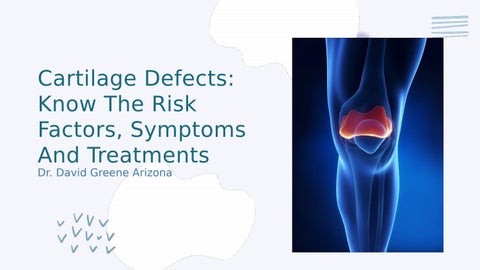
Cartilage Defects: Know The Risk Factors, Symptoms And Treatments Dr. David Greene Arizona
What is Cartilage? Cartilage is a flexible connective tissue found in many parts of the body. It can bend a bit, but resists stretching. Its main function is to connect bones together. It is also found in the joints, the rib cage, the ear, the nose, the throat and between the bones of the back.
Is cartilage damage common? Cartilage damage is a relatively common type of injury. It often involves the knees, although joints such as the hips, ankles and elbows can also be affected. Cartilage is a tough, flexible tissue found throughout the body.
Symptoms Inflammation – the area swells, becomes warmer than other parts of the body, and is tender, sore, and painful. Range limitation – as the damage progresses, the affected limb will not move so freely and easily. Stiffness. You may also experience a feeling of instability and weakness.
Causes Direct blow – If a joint receives a heavy impact, perhaps during a bad fall or an automobile accident, the cartilage may be damaged. Sportspeople have a higher risk of suffering from articular damage.
Wear and tear – A joint that experiences a long period of stress can become damaged. Inflammation, breakdown, and eventual loss of cartilage in the joints are known as osteoarthritis.
Lack of movement – The joints need to move regularly to remain healthy. Long periods of inactivity or immobility increase the risk of damage to the cartilage.
Diagnosis Magnetic resonance imaging (MRI) – The device uses a magnetic field and radio waves to create detailed images of the body. Although useful, an MRI cannot always detect cartilage damage. Arthroscopy – A tube-like instrument (arthroscope) is inserted into a joint to examine and repair it. This procedure can help determine the extent of cartilage damage.
Treatment Conservative treatment (nonsurgical) – some patients respond well to conservative treatment, which can include special exercises, NSAIDs (non-steroidal anti-inflammatory drugs), and sometimes steroid injections. Surgery – Patients who do not respond to conservative treatment will need surgery.
Stem Cell Therapy Repair Damaged Knees Stem cell therapy uses the body's own healing mechanisms to help repair and slow the deterioration of body tissues, such as cartilage. Stem cell therapy for knees aims to: slow and repair damaged cartilage. decrease inflammation and reduce pain.
Thank You!