Head Office
TimeLine Auctions Limited
The Court House
363 Main Road
Harwich, Essex
CO12 4DN, UK
Tel: +44 (0)1277 815121
Website www.timelineauctions.com
Antiquities Auction
Tuesday 2 June 13:00 (Lots 1 - 400)
Wednesday 3 June 13:00 (Lots 401 - 1039)
Thursday 4 June 13:00 (Lots 1040 - 1678)
Friday 5 June 13:00 (Lots 1679 - 2317)
Saturday 6 June 13:00 (Lots 2318 - 2949)
Numismatic Auction
9 - 10 June 13:00 (Lots 2950 - 4376)
Viewing
By Appointment Only
Bids
+44 (0)1277 815121
+44 (0)1277 814122 fax bids@timelineauctions.com
Telephone bidding by prior arrangement. Please see back of the catalogue for Terms & Conditions
Consignments
+44 (0)1277 815121 consignments@timelineauctions.com
Illustrations
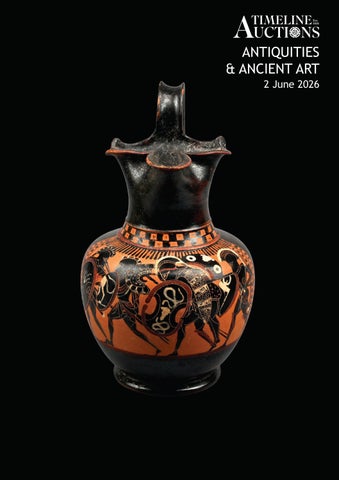
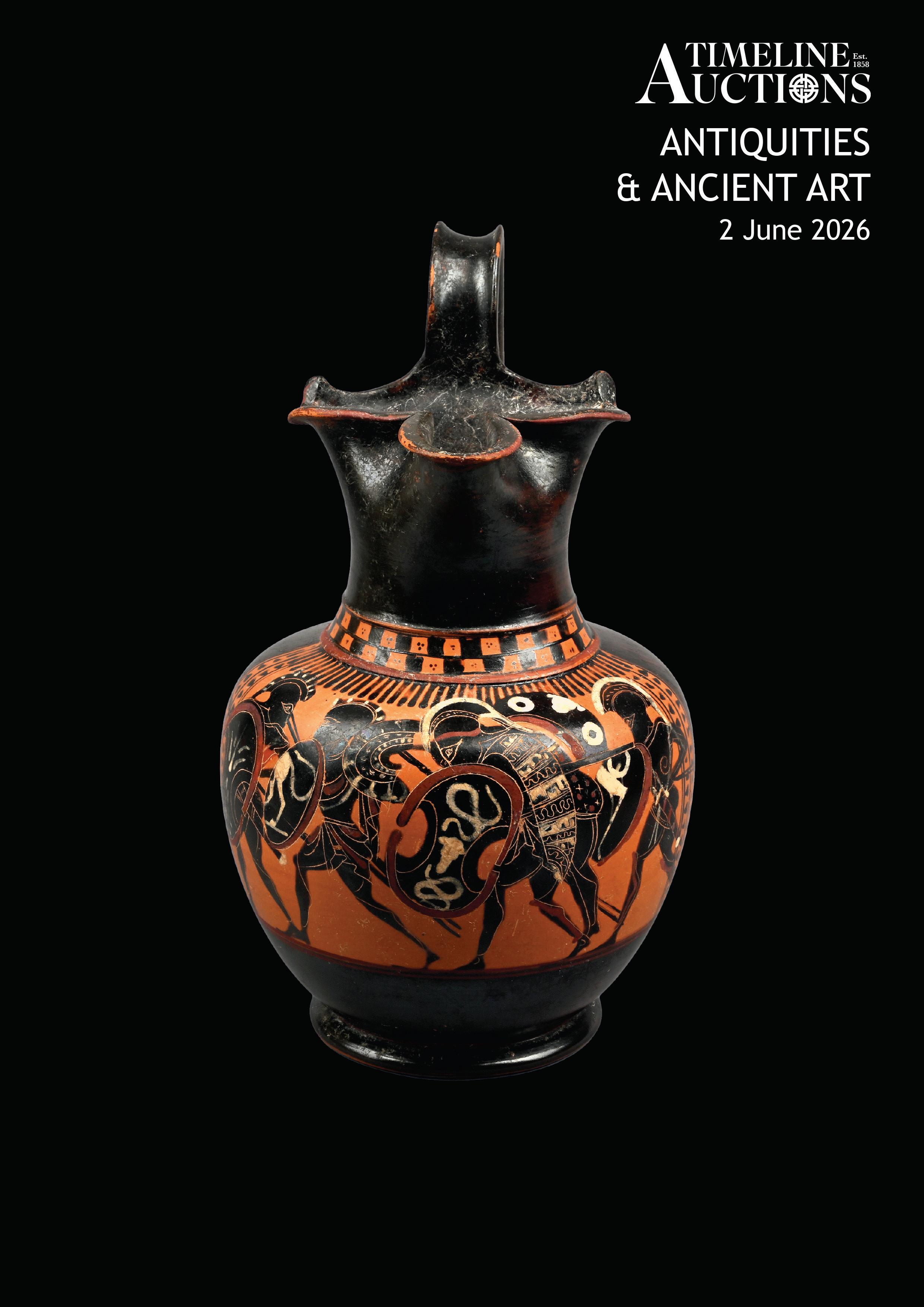
Cover: Lot 95
Sale Number: 312
Catalogue Production & Layout
Damir Radic DRs d.o.o.
Davor Radic DRs d.o.o.
Photography & Video Production
Michael Healy
Kyle Elmer
Jason Williams
Antiquities Department
Dr Raffaele D'Amato (Head of Department)
Stephen Pollington (Cataloguer)
Michaela Simonova, MA (Cataloguer)
Tanja Maijala (Cataloguer)
Numismatic Department
Periklis Mastrangelis, MA (Head of Department)
Dane Kurth (Cataloguer)
Michaela Simonova, MA (Cataloguer)
Brett Hammond, FRSA (Cataloguer)
Consultants
Professor Neritan Ceka (Classical & General Antiquities)
Professor Dr phil. Peter Rothenhoefer (Classical Archaeology, Chinese Antiquities, & Coins)
Professor Livio Zerbini (Classical Archaeology & Roman Epigraphy)
Dr Ronald Bonewitz (Antiquities & Geological)
Dr Manuel Ceccarelli (Western Asiatic Antiquities)
Dr Robert Chandler (Paleontology)
Dr Paul A. Fox, MA, FSA (Heraldry)
Dr Brian Gilmour (Arms & Armour & General Antiquities)
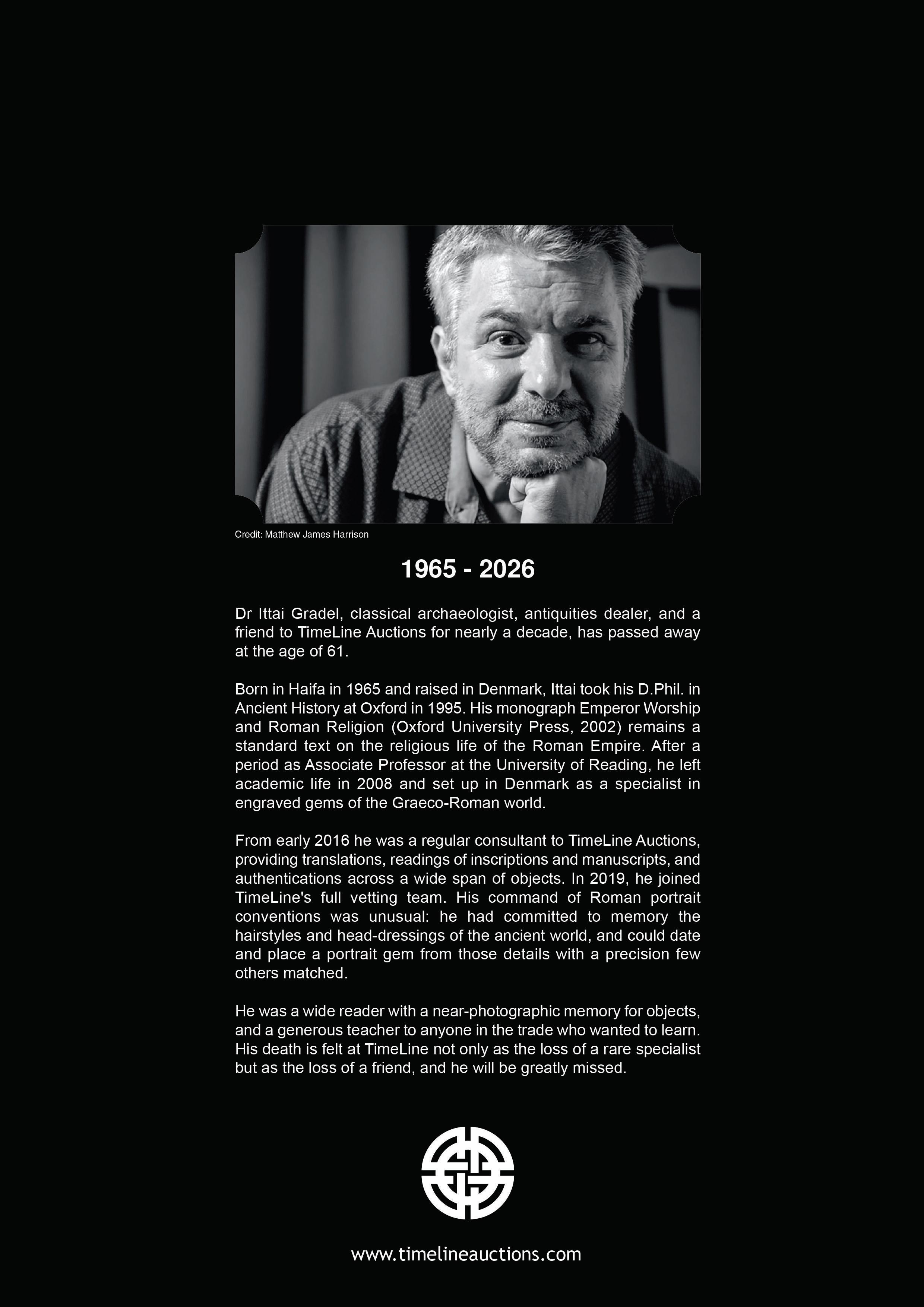
Dr Ittai Gradel (Classical & General Antiquities)
Dr Malcolm Jones (Medieval & Later Antiquities)
Dr Alberto Pollastrini (Egyptian & Associated Antiquities)
Dr Laura Proffitt (Classical & General Antiquities)
Dr Laura Vigna (Ancient Jewellery, Ceramics & Marble)
Laetitia Delaloye, MA (Egyptian & General Antiquities)
Michaela Simonova, MA (Mesoamerica, Viking & Religious)
Thomas Sturm, MA (Cylinder Seals)
Paul Whelan, MA (Egyptian Antiquities)
Peter Bufton (Far Eastern, Islamic & Ethnographic)
Peter Clayton, FCILIP, Dip, Arch, FSA, FRNS (Egyptian)
Richard Falkiner, FSA (Jewellery & General Antiquities)
Michael Howgate, B.Sc. M.Sc. PGCE FLS (Natural History)
Igor Gorokhovsky (Metallurgist & General Antiquities)
Joseph Hubbard (Natural History)
Dane Kurth (Greek & Roman Coins & Antiquities)
Stephen Pollington (Anglo-Saxon & Viking Antiquities)
Amin Rezai (Western Asiatic & General Antiquities)
Richard Roy (Ancient Americas)
Simon Schmidt (Jewellery & General Antiquities)
Mehdy Shaddel (Western Asiatic & Islamic Antiquities)
Stefany Tomalin (Beads & Associated Jewellery)
For further information and biographies see: www.timelineauctions.com
Team
Chief Executive Officer: Brett Hammond, FRSA
Chief Operating Officer: Aaron Hammond
Head of Administration: Tanja Maijala
Client Account Manager: Lisa Fricker
Admin Assistants: Law Yuen Ying, Heather O’Neil The







A PRIVATE COLLECTION OF GEMSTONES (LOTS 1 & 3 - 42)
From the private collection of a European gentleman (1942-2024), formed since the 1970s.
1
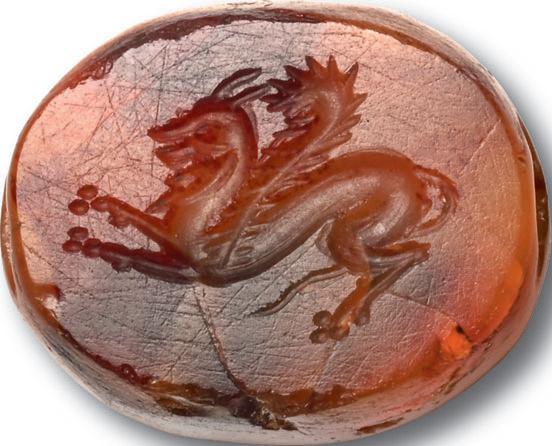
ROMAN CARNELIAN GEMSTONE WITH CHIMERA
2ND-3RD CENTURY A.D.
½ in. (1.57 grams, 13.84 mm)
With intaglio winged beast, forelegs extended; supplied with a museum-quality impression.
£600 - 800
2
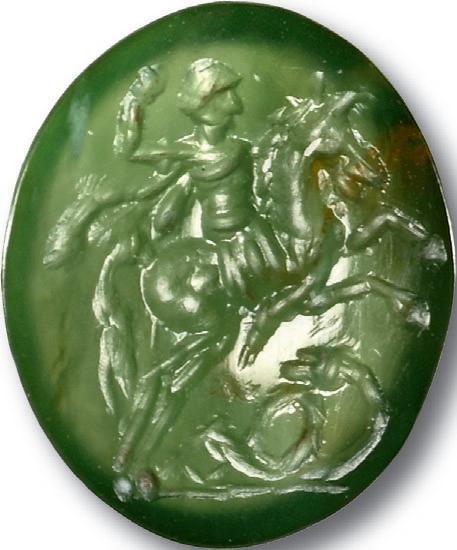
ROMAN GREEN CHALCEDONY GEMSTONE OF HORSE AND RIDER WITH A SNAKE
3RD CENTURY A.D. in. (0.43 grams, 10 mm)
Plano-convex type with incuse image of a horseman on rearing steed, plunging a spear into a coiled serpent; supplied with a museumquality impression.
£600 - 800
PROVENANCE:
Private English collection, formed between the late 1970s and early 1990s.
Private collection, London, UK.
FOOTNOTES:
The image is a precursor of the later iconography of military saints killing the dragon.
3
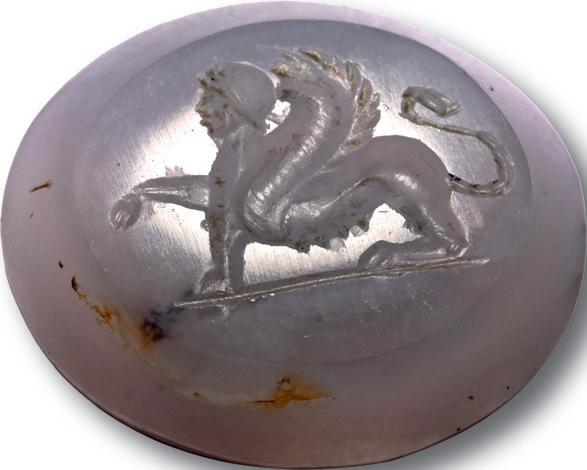
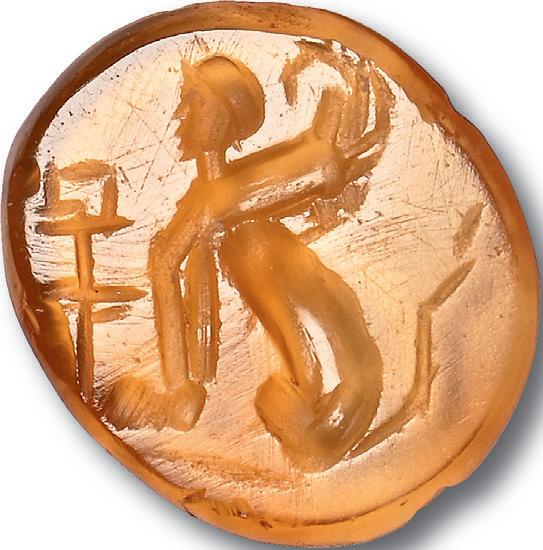
ROMAN CHALCEDONY GEMSTONE WITH SPHINX
2ND-3RD CENTURY A.D.
½ in. (1.11 grams, 14.49 mm)
With intaglio sphinx advancing on a baseline; supplied with a museum-quality impression.
£500 - 700
4
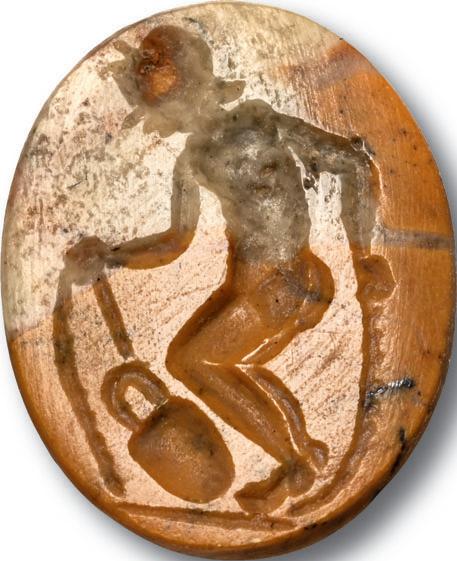
ROMAN ORANGE JASPER GEMSTONE WITH NUDE YOUTH
2ND-3RD CENTURY A.D. ½ in. (0.48 grams, 13.21 mm)
With intaglio scene of a nude youth raising a basket with a drawstring; supplied with a museum-quality impression.
£300 - 400
5
ROMAN RED JASPER GEMSTONE WITH THE GOD MERCURY 2ND-3RD CENTURY A.D. in. (0.36 grams, 11.62 mm)
With intaglio standing figure of Mercury wearing the petasos, holding the caduceus and supporting two bags.
£400 - 600
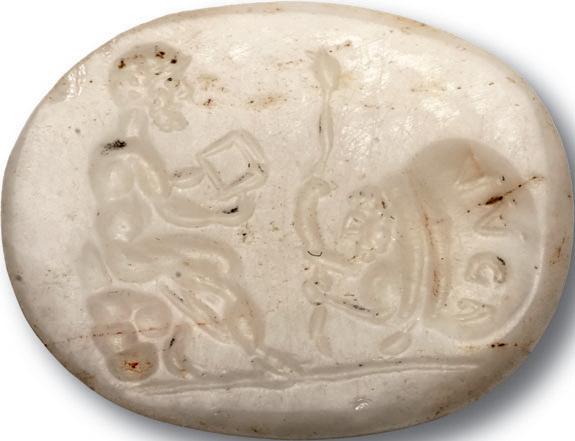
6
ROMAN WHITE GEMSTONE WITH ALEXANDER THE GREAT AND PHILOSOPHER DIOGENES OF SINOPE
2ND-3RD CENTURY A.D. in. (1.24 grams, 16.27 mm)
Frieze depicting a seated Alexander the Great holding a ring or collar towards a philosopher emerging from a cauldron; supplied with a museum-quality impression.
£400 - 600
FOOTNOTES:
Diogenes of Sinope (c. 412-323 BCE) was an ancient Greek philosopher and one of the founders of Cynicism. He became famous for rejecting wealth, comfort, and social rules, choosing instead to live with very few possessions. He is often said to have lived in a large ceramic jar in Athens, sometimes described as a barrel or tub. Known for his sharp wit and simple way of life, he is also remembered for telling Alexander the Great to step out of his sunlight.
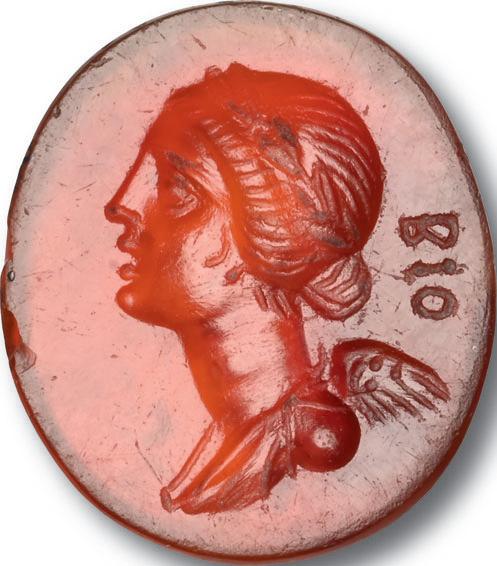





7
ROMAN CARNELIAN GEMSTONE WITH PORTRAIT OF GODDESS EBE
2ND-3RD CENTURY A.D.
½ in. (0.54 grams, 13.66 mm)
With intaglio profile female bust with wing to the shoulder and legend ‘BIO’ below (perhaps for bios ‘life’); supplied with a museum-quality impression.
£1,000 - 1,400
8
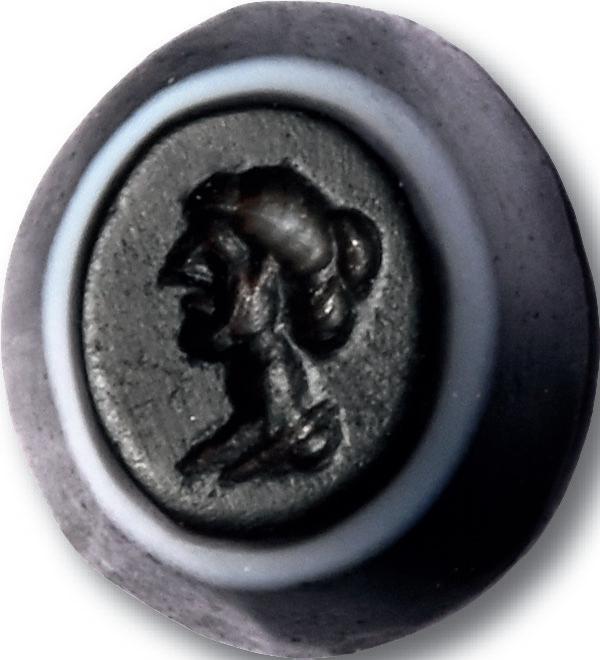
ROMAN BANDED AGATE GEMSTONE WITH FEMALE BUST
2nd-3rd century A.D.
¼ in. (0.26 grams, 7.02 mm)
With intaglio profile female bust with hair drawn up; supplied with a museum-quality impression.
£400 - 600
9
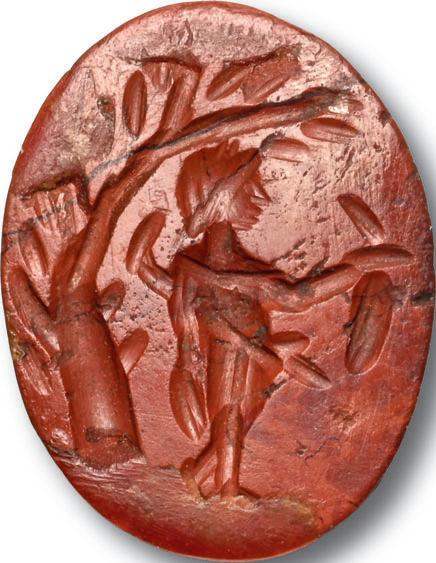
ROMAN RED JASPER GEMSTONE WITH CUPID
2ND-3RD CENTURY A.D. in. (1.16 grams, 15.66 mm)
With intaglio Cupid holding his bow beneath the curved branch of an olive tree; supplied with a museum-quality impression.
£300 - 400

10
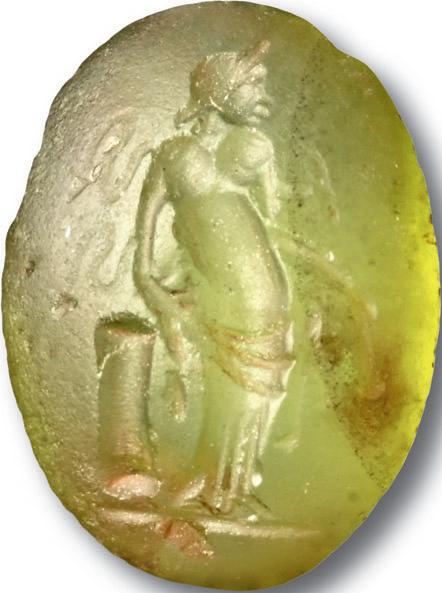
ROMAN PERIDOT GEMSTONE WITH VENUS
2ND-3RD CENTURY A.D. in. (0.58 grams, 11.71 mm)
With intaglio Venus standing with palla draped around her hips, beside an altar; supplied with a museum-quality impression.
£300 - 400
11
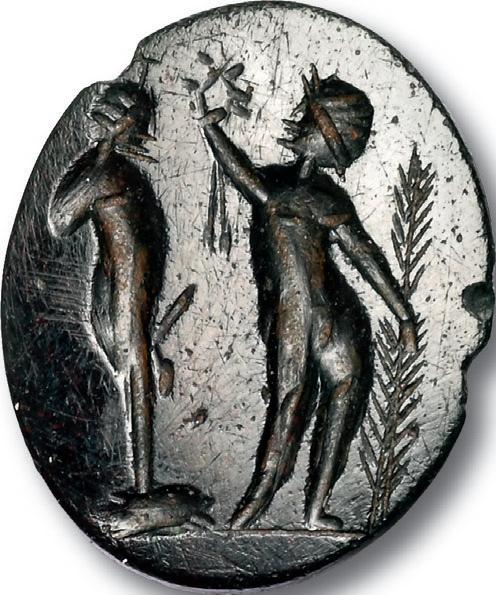
ROMAN DARK GREEN GEMSTONE WITH EROTIC SCENE
2ND-3RD CENTURY A.D. ½ in. (0.52 grams, 13.13 mm)
With intaglio nude figures, a herm of Priapus with an erect phallus adorned by a female worshipper with a wreath; supplied with a museum-quality impression.
£300 - 400
12
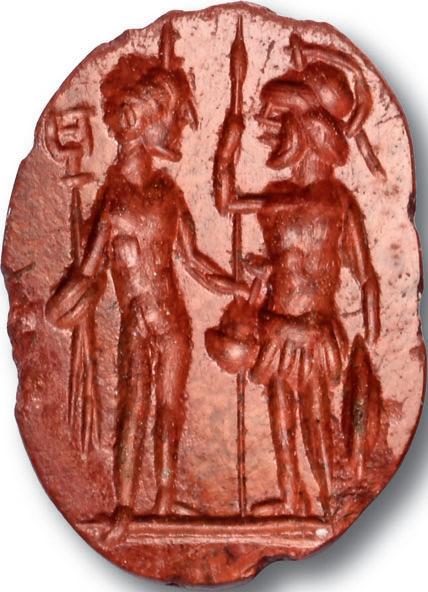
ROMAN RED JASPER GEMSTONE WITH MERCURY AND MARS
2ND-3RD CENTURY A.D. in. (0.40 grams, 11.56 mm)
With intaglio Mercury standing nude holding a caduceus beside Mars with spear and shield; supplied with a museum-quality impression.
£300 - 400






13
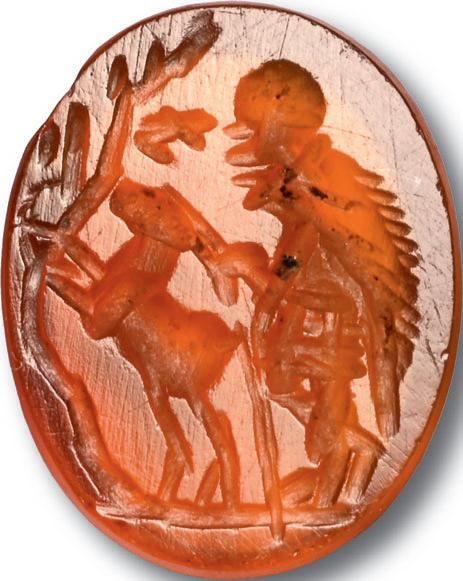
ROMAN CARNELIAN GEMSTONE WITH SHEPHERD AND GOAT
2ND-3RD CENTURY A.D.
½ in. (0.54 grams, 11.82 mm)
With intaglio scene of a goat reaching up to nibble the bark of a tree, profile old man with a stick to the rear.
£400 - 600
14
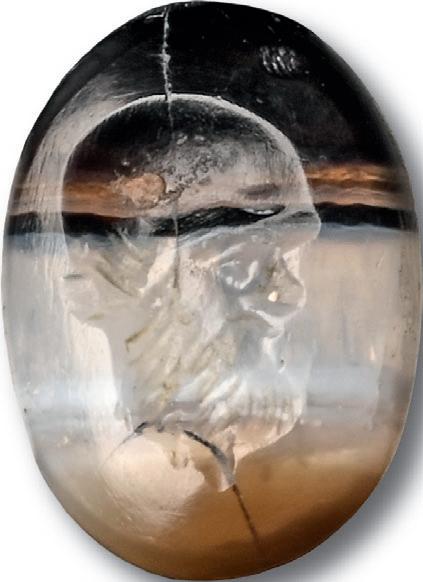
ROMAN BANDED AGATE GEMSTONE WITH SILENUS
2ND-3RD CENTURY A.D. in. (0.30 grams, 9.87 mm)
With intaglio head of Silenus in profile; supplied with a museumquality impression.
£600 - 800
15
ROMAN CARNELIAN GEMSTONE WITH BIGA
2ND-3RD CENTURY A.D.
½ in. (0.74 grams, 14.61 mm)
With intaglio biga chariot and horses with driver; supplied with a museum-quality impression.
£300 - 400
16
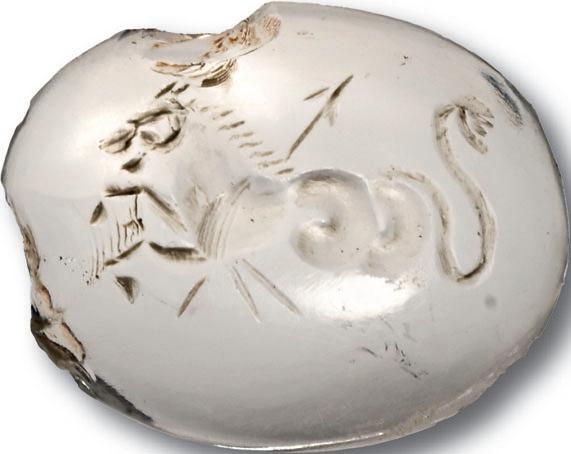
ROMAN ROCK CRYSTAL GEMSTONE WITH HIPPOCAMP
2ND-3RD CENTURY A.D. in. (1.16 grams, 15.98 mm)
With intaglio figure of a hippocamp pierced by a spear; supplied with a museum-quality impression.
£500 - 700
17
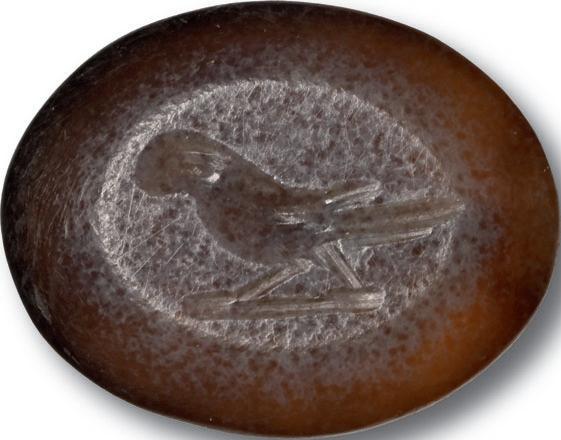
ROMAN AGATE GEMSTONE WITH BIRD
2ND-3RD CENTURY A.D. ½ in. (0.65 grams, 12.16 mm)
With intaglio perching bird with long swept tail.
£400 - 600
18
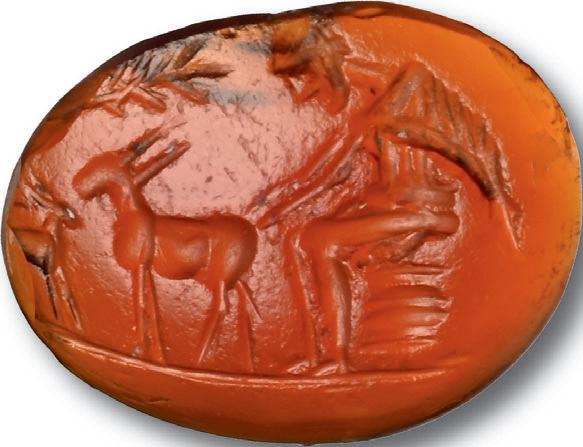
ROMAN CARNELIAN GEMSTONE WITH MAN AND GOAT
2ND-3RD CENTURY A.D. in. (0.26 grams, 10.42 mm)
With intaglio scene of a man sitting behind a goat browsing on leaves; supplied with a museum-quality impression.
£300 - 400

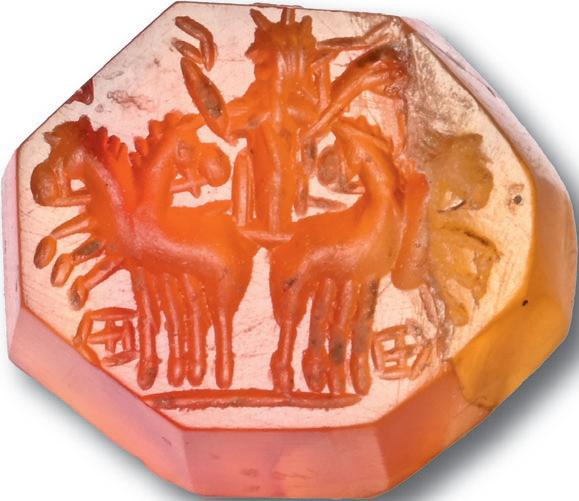





19
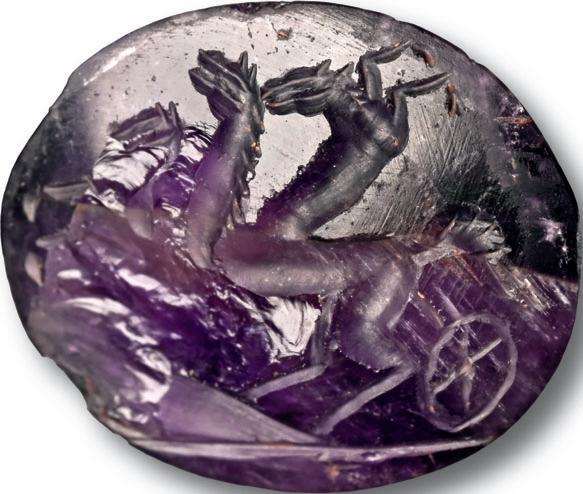
ROMAN AMETHYST GEMSTONE WITH QUADRIGA
2ND-3RD CENTURY A.D. in. (1.29 grams, 14.63 mm)
Intaglio quadriga with rearing horses; supplied with a museum-quality impression.
£1,000 - 1,400
20
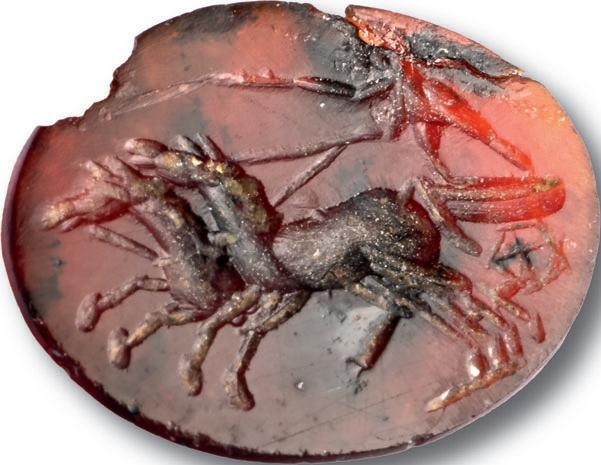
ROMAN CARNELIAN GEMSTONE WITH SOL IN QUADRIGA
2ND-3RD CENTURY A.D.
½ in. (0.99 grams, 13.33 mm)
Octagonal in plan with intaglio scene of Sol in his quadriga on a baseline; supplied with a museum-quality impression.
£300 - 400
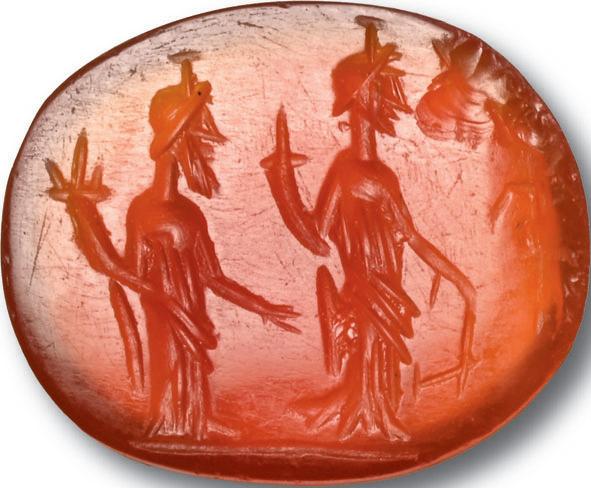
21
ROMAN CARNELIAN GEMSTONE WITH FORTUNA AND ABUNDANTIA
2ND-3RD CENTURY A.D.
½ in. (0.60 grams, 12.90 mm)
With intaglio scene of two figures, each standing with a cornucopia, possibly Fortuna and Abundantia; supplied with a museum-quality impression.
£300 - 400
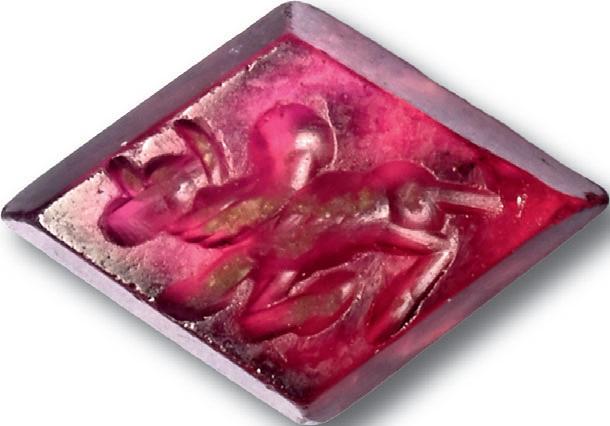
22
ROMAN GARNET GEMSTONE WITH ZEBU
2ND-3RD CENTURY A.D. in. (0.18 grams, 9.00 mm)
Lozengiform in plan with intaglio zebu image; supplied with a museum-quality impression.
£300 - 400
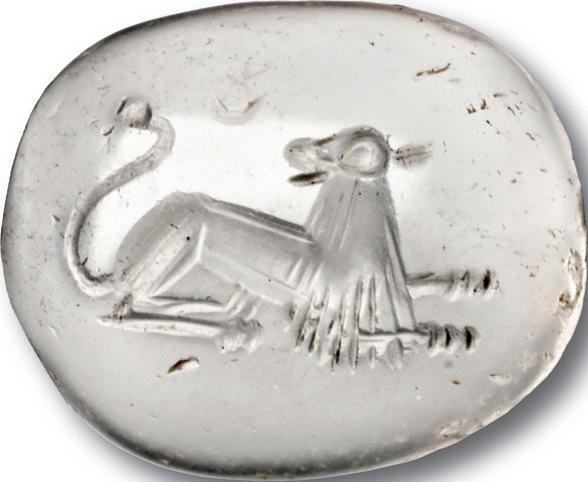
23
ROMAN ROCK CRYSTAL GEMSTONE WITH CROUCHING LION
2ND-3RD CENTURY A.D. in. (1.40 grams, 15.92 mm)
With intaglio lion crouching with head reversed towards a crescent; supplied with a museum-quality impression.
£400 - 600
24
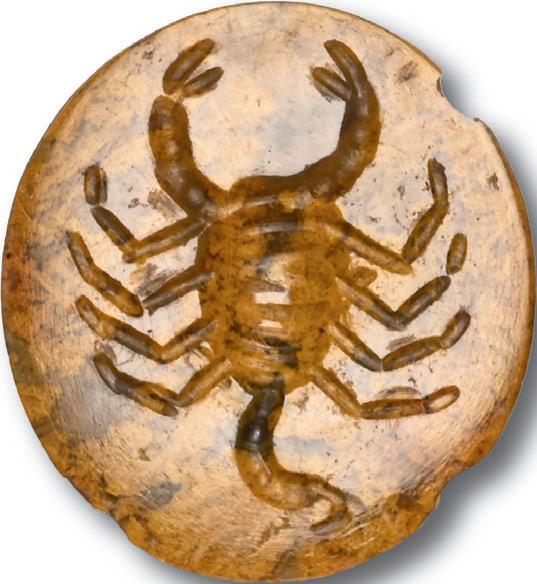
ROMAN ORANGE JASPER GEMSTONE WITH SCORPION
2ND-3RD CENTURY A.D.
½ in. (0.91 grams, 14.33 mm)
With intaglio scorpion motif; supplied with a museum-quality impression.
£400 - 600
FOOTNOTES:
It is possible that the intaglio was once part of a ring carried by a Praetorian guardsman, as the scorpion was one of their emblems.






25
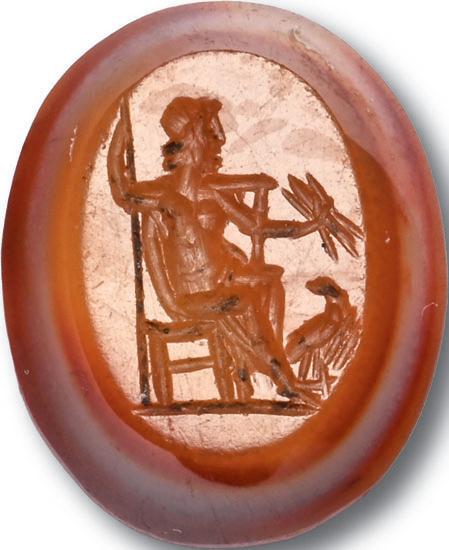
ROMAN BANDED AGATE GEMSTONE WITH JUPITER SEATED
2ND-3RD CENTURY A.D. in. (1.41 grams, 15.2 mm)
With intaglio Jupiter sitting on his throne with a spear in one hand and an eagle at his feet; supplied with a museum-quality impression.
£300 - 400
26
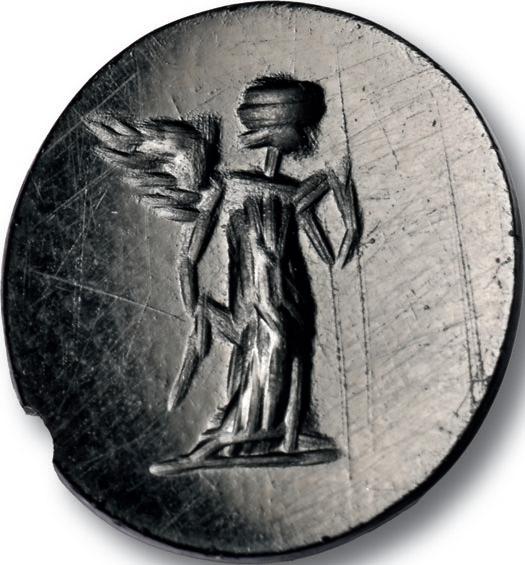
ROMAN BLACK GEMSTONE WITH VICTORY
2ND-3RD CENTURY A.D.
½ in. (0.62 grams, 13.26 mm)
With intaglio Victory standing in floor-length robe, wreath in one hand; supplied with a museum-quality impression.
£300 - 400
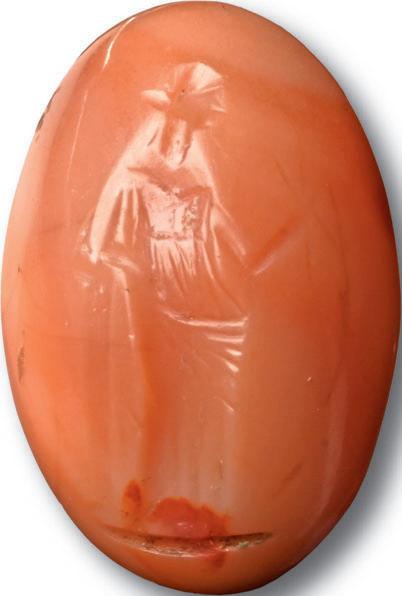
27
ROMAN ORANGE AGATE GEMSTONE WITH STANDING FIGURE
1ST CENTURY B.C.
1 in. (2.50 grams, 20.50 mm)
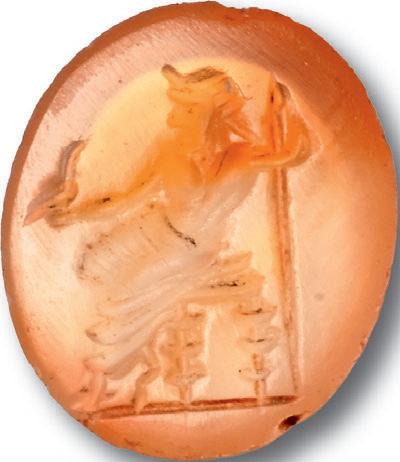
Cabochon with intaglio to the convex face, standing female figure with pillar to her rear, one hand raised holding a starburst; supplied with a museum-quality impression.
£800 - 1,000
28
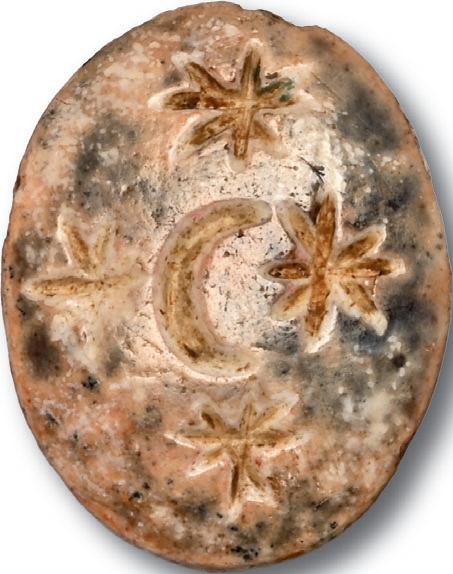
ROMAN AGATE GEMSTONE WITH MOON
2ND-3RD CENTURY A.D. in. (1.46 grams, 16.98 mm)
With an intaglio crescent moon among four stars; supplied with a museum-quality impression.
£300 - 400
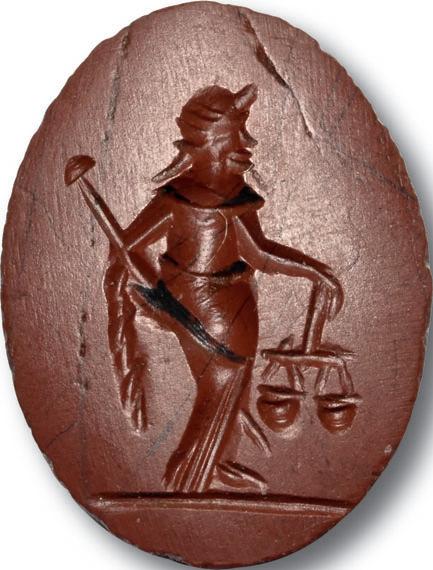
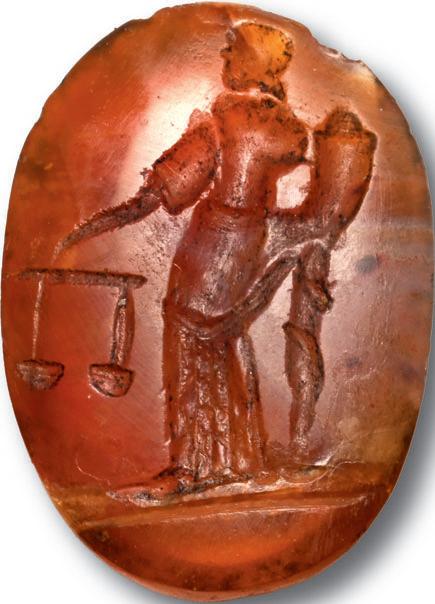
29
ROMAN CARNELIAN GEMSTONE WITH THE GODDESS FORTUNA
2ND-3RD CENTURY A.D. in. (1.06 grams, 17.28 mm)
Intaglio profile figure of Fortuna in draped robe with cornucopia and scales; supplied with a museum-quality impression.
£400 - 600
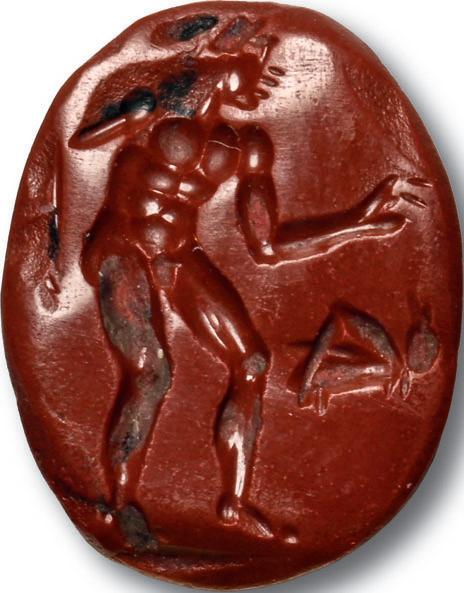
30
ROMAN RED JASPER GEMSTONE WITH NUDE WRESTLER
2ND-3RD CENTURY A.D.
½ in. (0.61 grams, 12.94 mm)
With intaglio nude male advancing; supplied with a museum-quality impression.
£500 - 700
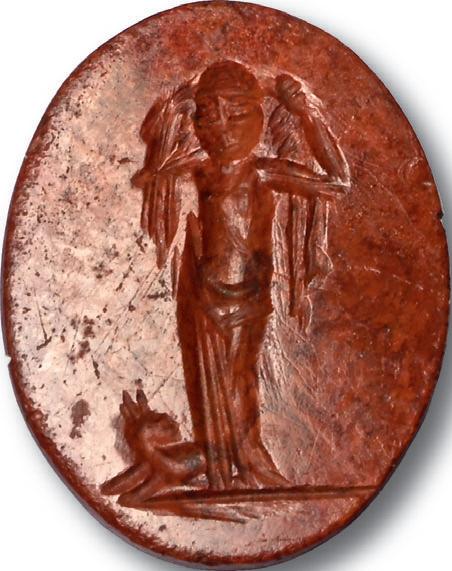






31
ROMAN RED JASPER GEMSTONE WITH THE GODDESS VENUS
2ND-3RD CENTURY A.D.
½ in. (0.63 grams, 12.62 mm)
Intaglio standing facing figure of Venus in tight-fitting robe with hand raised dressing her long hair; supplied with a museum-quality impression.
£400 - 600
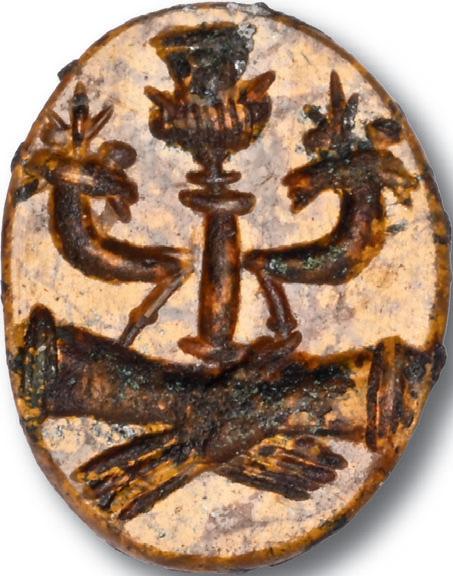
32
ROMAN ORANGE JASPER GEMSTONE WITH CLASPED HANDS
2ND-3RD CENTURY A.D.
½ in. (0.65 grams, 13.22 mm)
With intaglio motif of two hands clasped beneath a vase on a pillar flanked by cornucopiae; supplied with a museum-quality impression.
£400 - 600
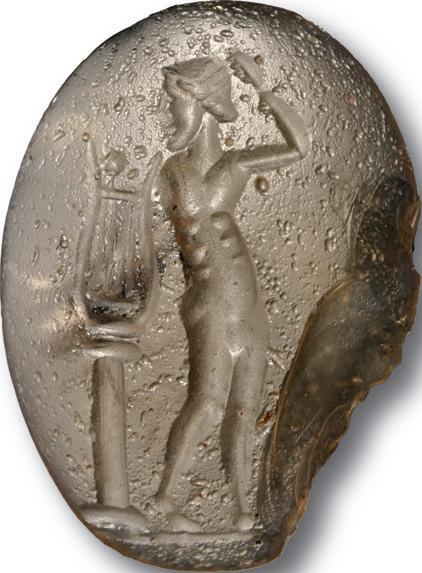
33
LARGE ROMAN GLASS GEM WITH APOLLO
1ST CENTURY B.C.
1 in. (4.66 grams, 29.72 mm)
Plano-convex in section with intaglio image of Apollo standing nude beside a column with his lyre; supplied with a museum-quality impression.
£300 - 400
34
ROMAN CARNELIAN GEMSTONE WITH SPHINX
2ND-3RD CENTURY A.D. in. (0.36 grams, 10.83 mm)
With intaglio sphinx sitting beside a military standard; supplied with a museum-quality impression.
£300 - 400
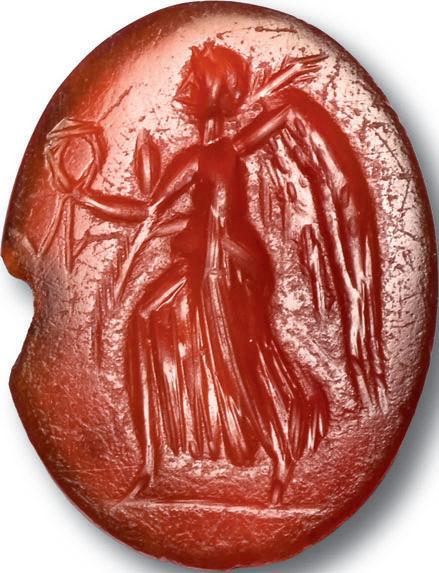
35
ROMAN CARNELIAN GEMSTONE WITH VICTORY
2ND-3RD CENTURY A.D. in. (0.78 grams, 16.60 mm)
With intaglio Victory standing with wings spread and a wreath in her hand; supplied with a museum-quality impression.
£400 - 600
36
ROMAN BANDED AGATE GEMSTONE OF THE GODDESS FORTUNA
2ND-3RD CENTURY A.D. in. (0.69 grams, 10.09 mm)
With intaglio bust of Fortuna in profile with one hand raised, cornucopia to the rear; supplied with a museum-quality impression.
£400 - 600


37
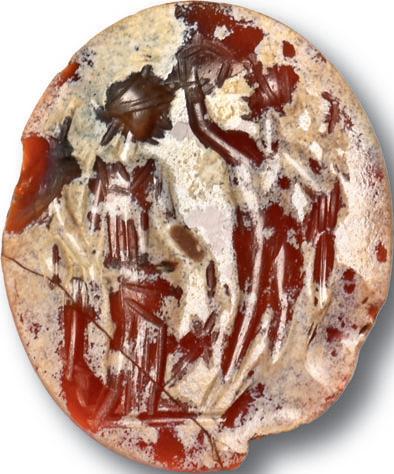

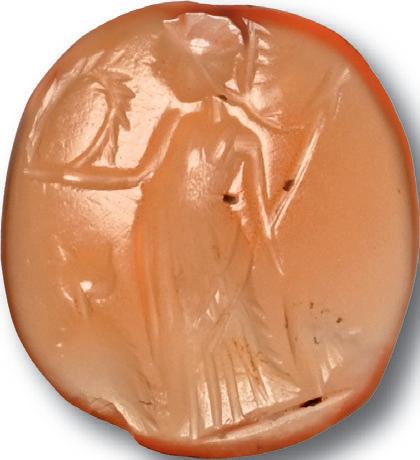

ROMAN CARNELIAN GEMSTONE WITH GOD ZEUS SEATED HOLDING EAGLE
2ND-3RD CENTURY A.D. in. (0.28 grams, 10.16 mm)
With an intaglio figure of a seated man with a staff, supporting a bird in one hand; supplied with a museum-quality impression.
£300 - 400
38
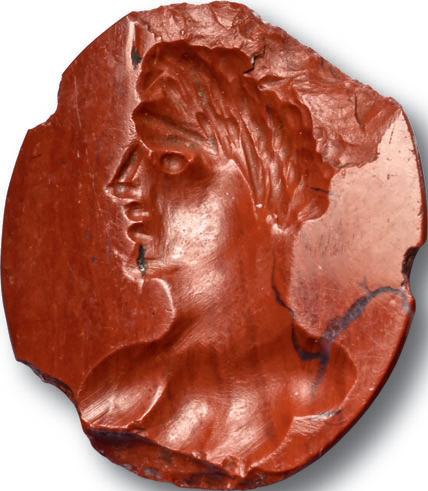
ROMAN RED JASPER GEMSTONE WITH APOLLO
2ND-3RD CENTURY A.D. in. (0.87 grams, 15.92 mm)
With intaglio bust of Apollo; supplied with a museum-quality impression.
£300 - 400
39
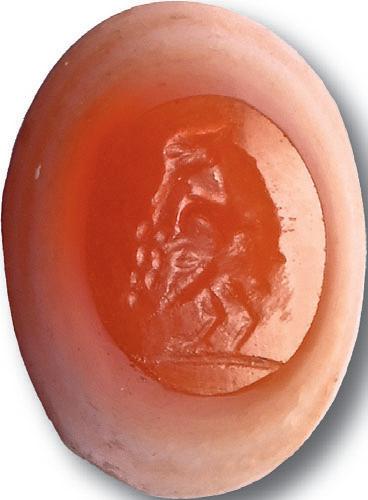
ROMAN BANDED ORANGE AGATE GEMSTONE WITH GRYLLUS
2ND-3RD CENTURY A.D. in. (0.36 grams, 8.90 mm)
With an intaglio figure with a large head advancing left on bird legs, long beard and nose, wearing a curving helmet with a cockerel-head finial with drips falling from its nose; supplied with a museum-quality impression.
£400 - 600


40
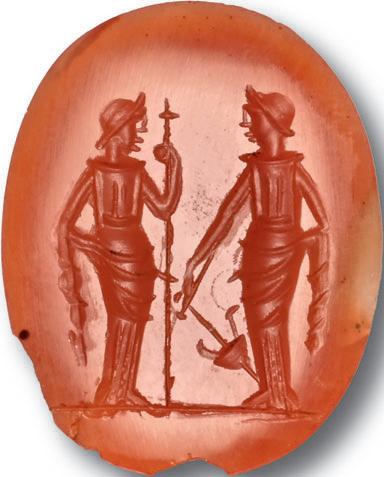
ROMAN CARNELIAN GEMSTONE WITH GODS MERCURY AND MINERVA
2ND-3RD CENTURY A.D. in. (1.02 grams, 17.11 mm)
With intaglio scene of two figures in a landscape; supplied with a museum-quality impression.
£300 - 400
41
ROMAN CARNELIAN GEMSTONE WITH VICTORY
2ND-3RD CENTURY A.D. in. (0.34 grams, 10.16 mm)
With intaglio Victory standing with shield and wreath; supplied with a museum-quality impression.
£300 - 400
42
ROMAN CARNELIAN GEMSTONE WITH GODDESSES
2ND-3RD CENTURY A.D. in. (2.48 grams, 22.32 mm)
Intaglio scene with two standing female figures, Minerva with helmet and spear beside Abundantia with an amphora; supplied with a museum-quality impression.
£600 - 800


43



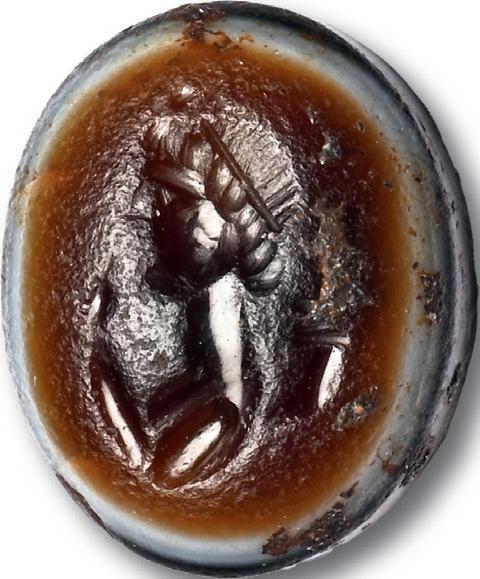
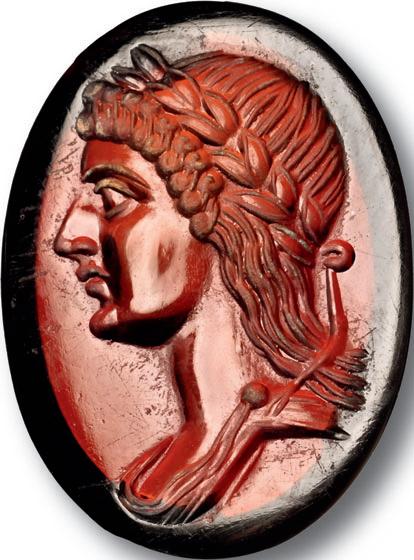
ROMAN CARNELIAN GEMSTONE WITH APOLLO 2ND-3RD CENTURY A.D. ¾ in. (1.59 grams, 18 mm)
Ellipsoid in plan with intaglio profile bust of Apollo with long cascading hair on the shoulders, braided wreath to the brow.
£1,500 - 2,000
PROVENANCE: Private collection, 1990s-early 2000s.
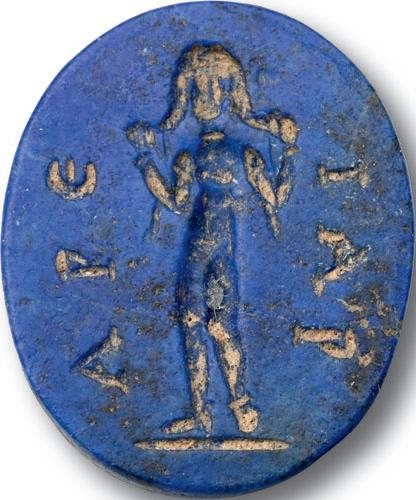
44
ROMAN LAPIS LAZULI GNOSTIC GEMSTONE WITH APHRODITE ANADYOMENE ‡ 4TH-5TH CENTURY A.D. in. (1.38 grams, 17 mm)
Ellipsoid in plan with enigmatic Greek legend ‘BPE/IMW’ to underside, facing figure of Aphrodite Anadyomene to obverse on baseline with Greek legend ‘APE IAP’, possibly an abbreviation for [ ] [ ] [ ].
£600 - 800
PROVENANCE: Private collection, acquired on the German art market in 1993; thence by descent.
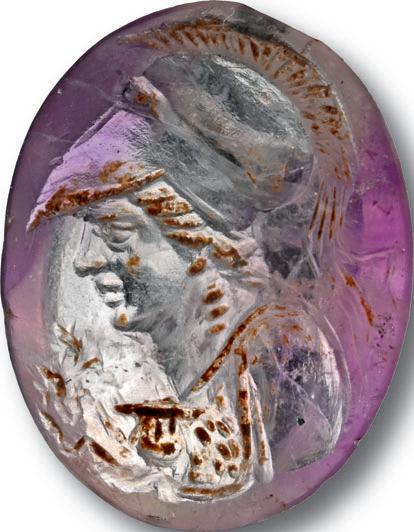
45
ROMAN AMETHYST GEMSTONE OF THE GODDESS MINERVA 1ST-2ND CENTURY A.D. in. (0.48 grams, 11 mm)
Plano-convex in section with incuse bust of Minerva wearing a Corinthian-style crested helmet; supplied with a museum-quality impression.
£800 - 1,000
PROVENANCE:
Private English collection, formed between the late 1970s and early 1990s.
Private collection, London, UK.
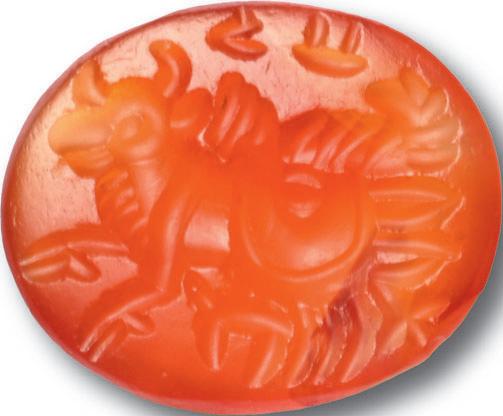

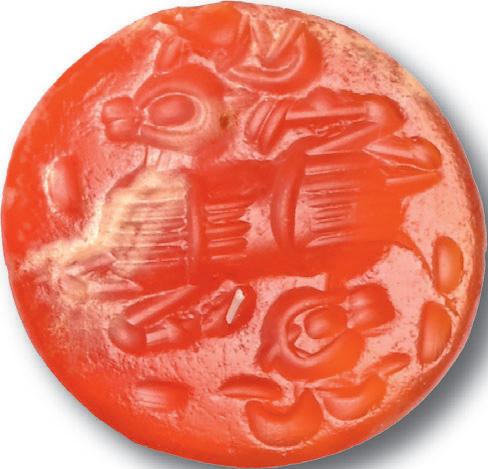
46
SASANIAN CARNELIAN GEMSTONE OF AN IBEX WITH INSCRIPTION
5TH-7TH CENTURY A.D. in. (0.42 grams, 11 mm)
Discoid in plan with incuse ibex with the legs folded beneath the body; text in the field; supplied with a museum-quality impression.
£500 - 700
PROVENANCE:
Private English collection, formed between the late 1970s and early 1990s. Private collection, London, UK.
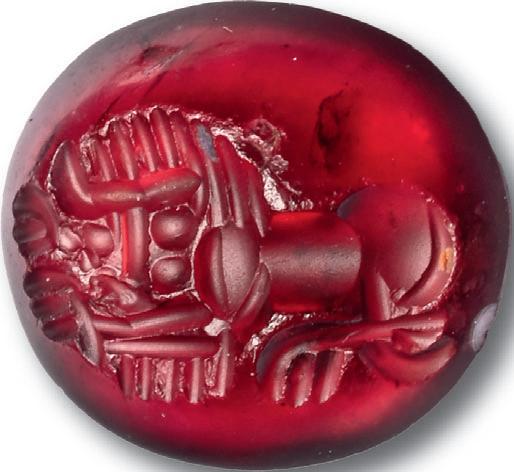
47
SASANIAN GARNET GEMSTONE OF A LION 5TH-7TH CENTURY A.D. in. (0.55 grams, 10 mm)
Plano-convex in section with incuse sleeping lion; supplied with a museum-quality impression.
£400 - 600
PROVENANCE:
Private English collection, formed between the late 1970s and early 1990s. Private collection, London, UK.
48
SASANIAN CARNELIAN GEMSTONE OF A FANTASTIC CREATURE WITH PAHLAVI LEGEND 4TH-5TH CENTURY A.D. in. (0.32 grams, 10 mm)
Plano-convex in section with advancing winged and horned beast, Pahlavi legend to the border; supplied with a museum-quality impression.
£400 - 600
PROVENANCE:
Private English collection, formed between the late 1970s and early 1990s. Private collection, London, UK.
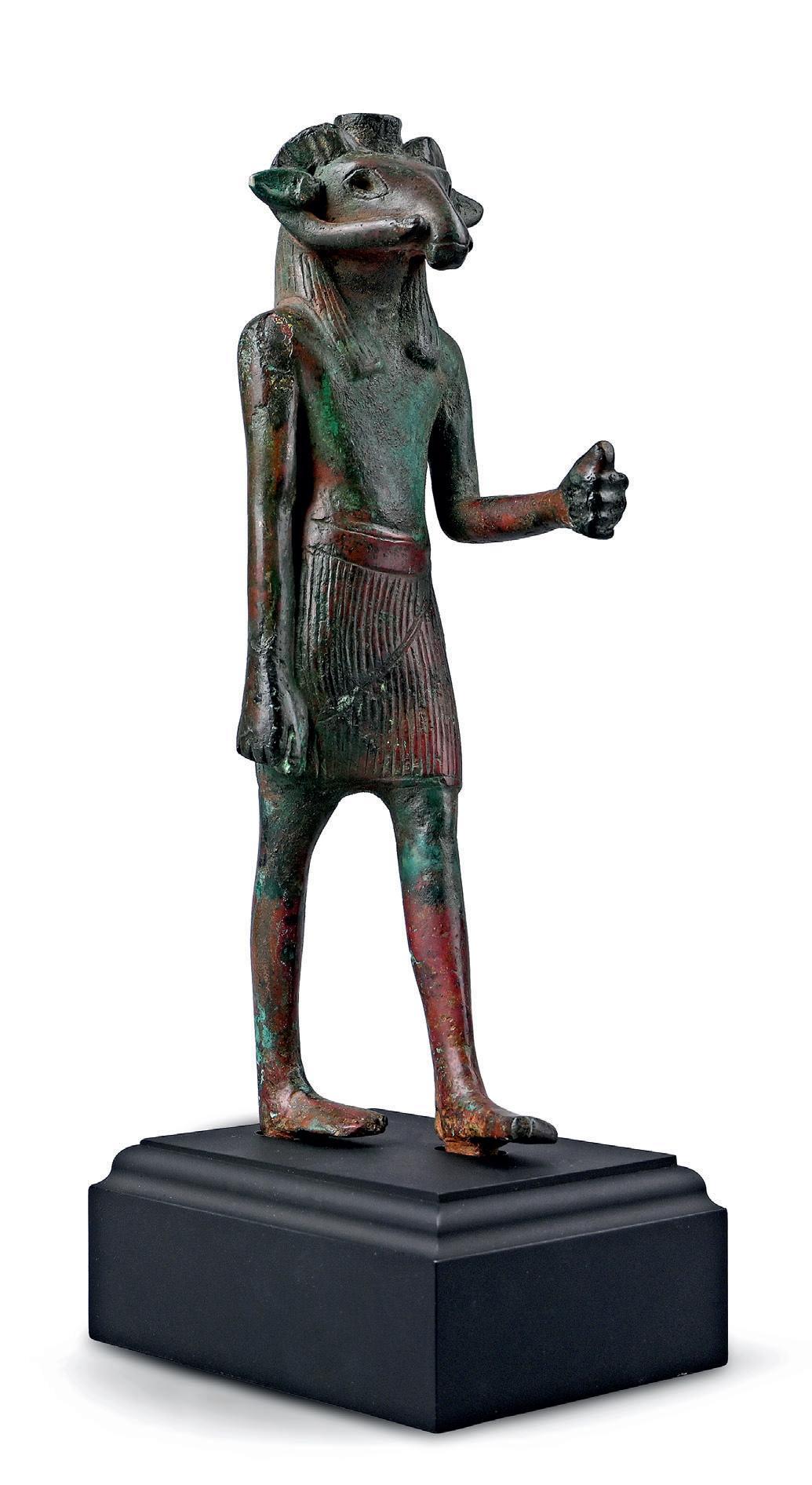
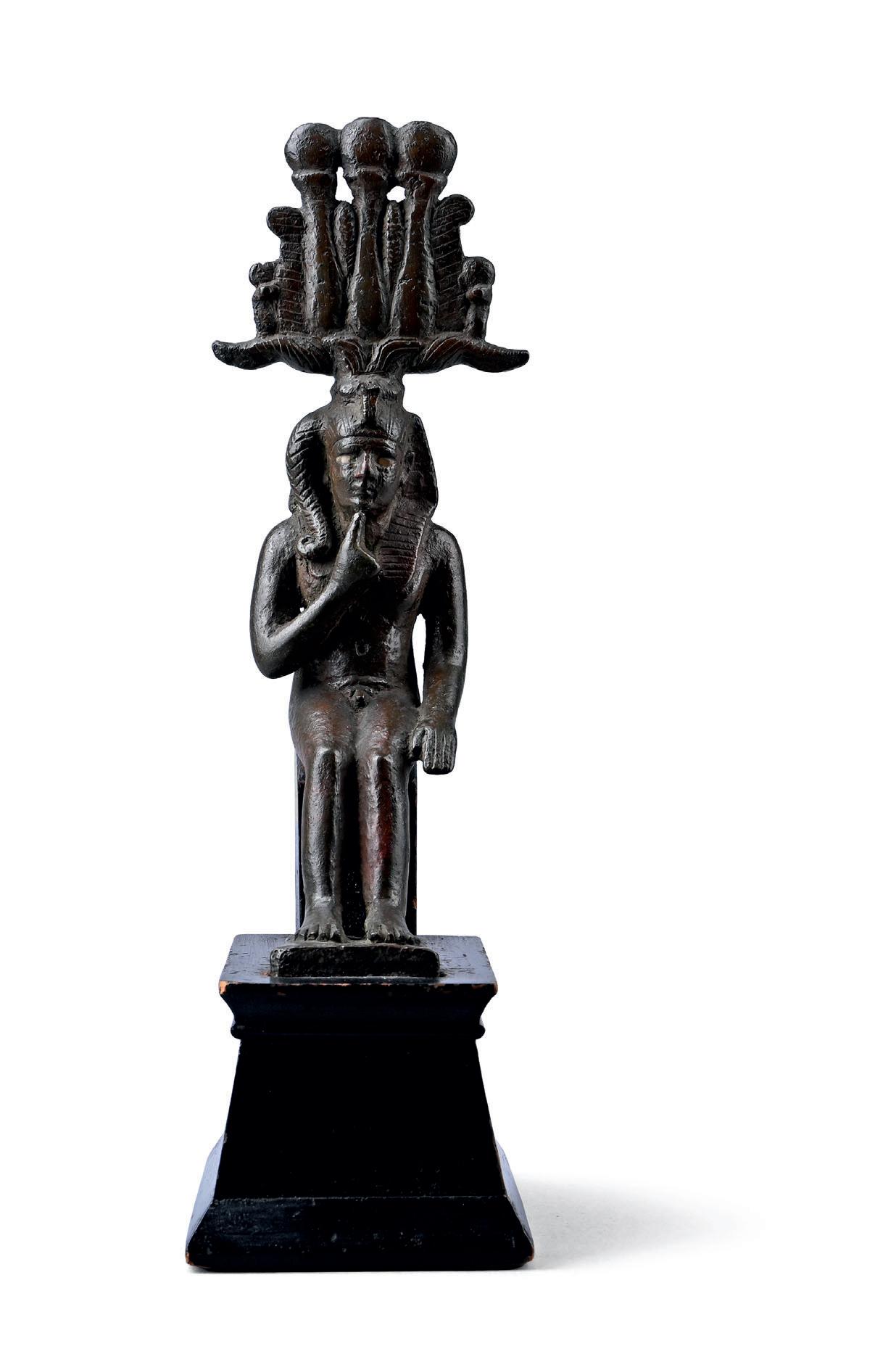
49
EGYPTIAN BRONZE FIGURE OF KHNUM, THE CREATOR GOD
LATE PERIOD, 664-332 B.C.
8 in. (9 in.) (466 grams, 22 cm high (803 grams total, 23.8 cm high including stand))
A substantial figure of the ram-headed god Khnum advancing, wearing a tripartite wig with low central modius drilled for a separately cast headdress and finely pleated kilt, with ram’s horns and eyes recessed for inlay, raised left hand, the right arm along the side; mounted on a custom-made stand.
£10,000 - 14,000
PROVENANCE:
With Stendahl Art Gallery, Los Angeles, by at least circa 1950s, accompanied by an inventory card #39, with a matching number on the original base, and a photograph.
Private collection, Hollywood, California, acquired from the above, circa 1950s.
FOOTNOTES:
The god Khnum (or Khnemu), the ‘Moulder’, was one of the earliest gods of Egypt, worshipped especially at Philae and Elephantine, both in Nubia. He was thought to have made mankind out of clay on a potter’s wheel. It was Khnum who helped Isis to gather the severed fragments of the body of the god Osiris and reassemble them. He was considered the father of the gods, along with Amun-Ra and Ptah.
50
EGYPTIAN BRONZE HARPOCRATES STATUE
26TH DYNASTY, 664-525 B.C.
7¾ in. (480 grams total, 19.8 cm including stand)
Modelled in the round, shown nude, seated with his left arm by his side and his right forefinger on his chin, wearing a sidelock of youth, nemes headdress surmounted by an elaborate hem-hem crown; mounted on a custom-made stand with dealer’s label to underside.
£5,000 - 7,000
PROVENANCE:
Ex Fitzthum collection, Vermont, New England.
Acquired New York, USA, 2000.
Acquired from Royal Athena Galleries, New York, USA, 20 March 2008. Ex Keane collection, UK.
Accompanied by a copy of the original Royal Athena Galleries invoice no.11164.
FOOTNOTES:
Harpocrates is the Greek equivalent of the Egyptian name Hor-pa-khered, which means ‘Horus the Child’. This name refers to Horus as the divine infant of Isis and Osiris. Wearing an amulet of Harpocrates was believed to provide the same protection that Isis granted to her beloved son. Larger bronze statuettes were probably votive offerings to Harpocrates, intended to secure his favour and protection.
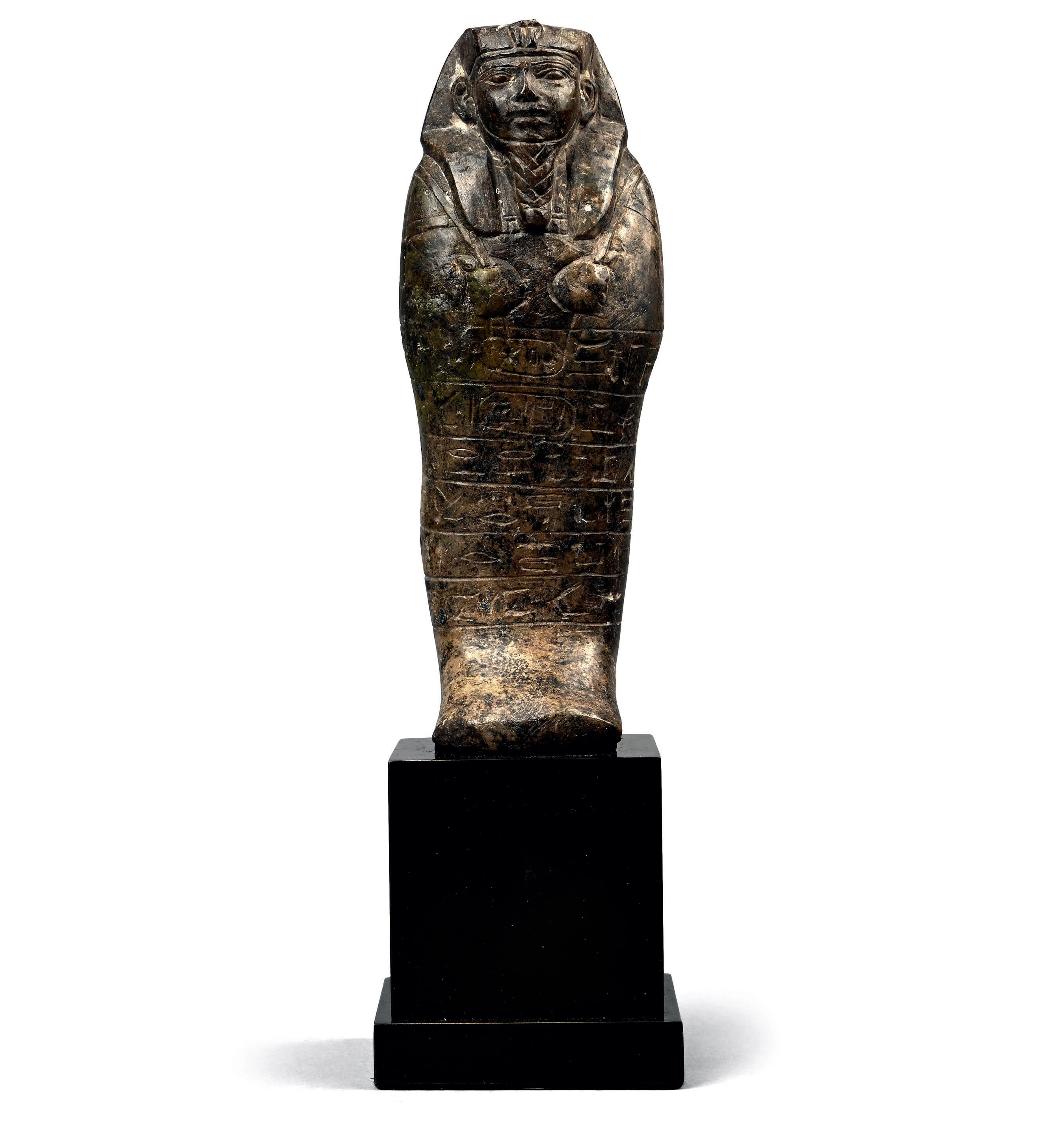
EGYPTIAN SERPENTINE SHABTI FOR KING SENKAMENISKEN NUBIA, NAPATAN PERIOD, 643-623 B.C. 8¼ in. (659 grams total, 21 cm including stand)
Mummiform figure wearing a braided beard with chin-straps in relief, broad collar visible between the lappets of the nemes headdress adorned with a double uraeus, the crossed hands holding a hoe and pick, with a seed bag over the left shoulder, his broad face with straight nose, wide-set eyes and large ears, six horizontal lines of inscription, giving a version of Chapter 6 from the Book of the Dead; mounted on a custom-made display stand.
£18,000 - 24,000
PROVENANCE:
J.J. Klejman, Madison Avenue, New York, USA, 1960s. UK private collection, acquired from the above, 1960s. Bluett and Sons, London, 1979.
Sheppard & Cooper, UK, private collection, 1980s. Sheikh Saoud Al-Thani, the ‘Princely’ private collection, UK. Acquired from the above in 2017. with Sotheby’s, London, 5 July 2024, no.126.
Accompanied by a copy of the Bluett and Sons invoice, 22 January 1979.
FOOTNOTES:
Of the 1277 shabtis of Senkamenisken found in the king’s burial chamber of his pyramid tomb at Nuri (Pyramid 3), 410 are made of serpentine, the remaining 867 of faience. The inscription reads: ‘The illuminated one, the Osiris, the good god, lord of the two lands, Sekheper[en]re, true of voice, He says: O this shabti, if anyone summons the Osiris Senkamenisken, true of voice, in order to do any work which is to be done in the God’s Land (i.e. necropolis), to cultivate the fields, to irrigate the canals, to carry sand from the east to the west and vice versa, ‘Here I am’, you shall say’.
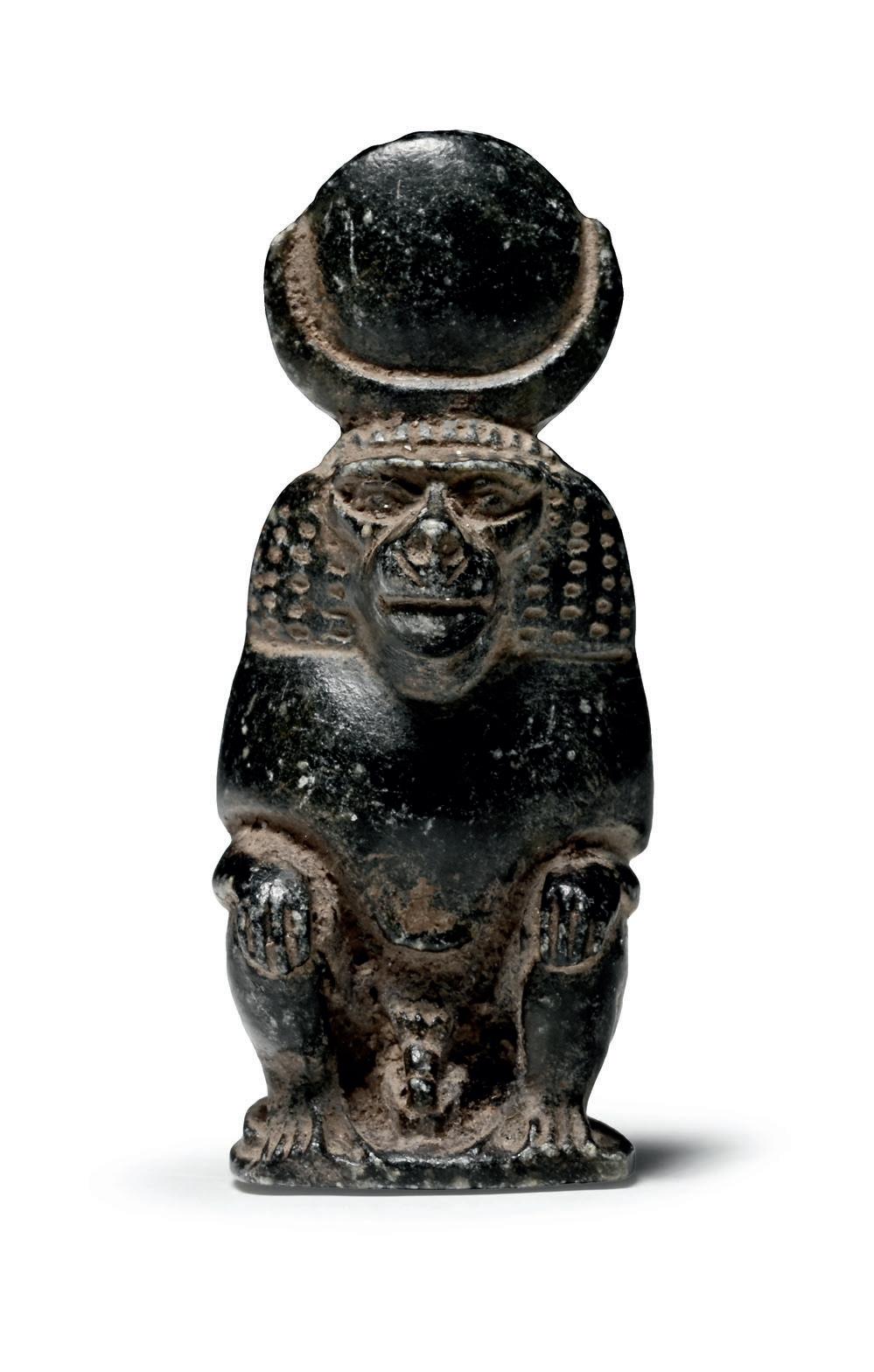
EGYPTIAN GREEN STONE BABOON STATUETTE ‡
NEW KINGDOM, 1550-1070 B.C.
1¼ in. (6.21 grams, 33 mm)
Carved in the round as an amuletic baboon figure with a solar disc headdress, ribbed suspension loop behind the neck.
£2,000 - 3,000
PROVENANCE:
Private collection, acquired in the late 1980s-early 1990s; thence by descent.
FOOTNOTES:
Amulets of squatting baboons were often associated with Thoth, the patron deity of scribes. 53
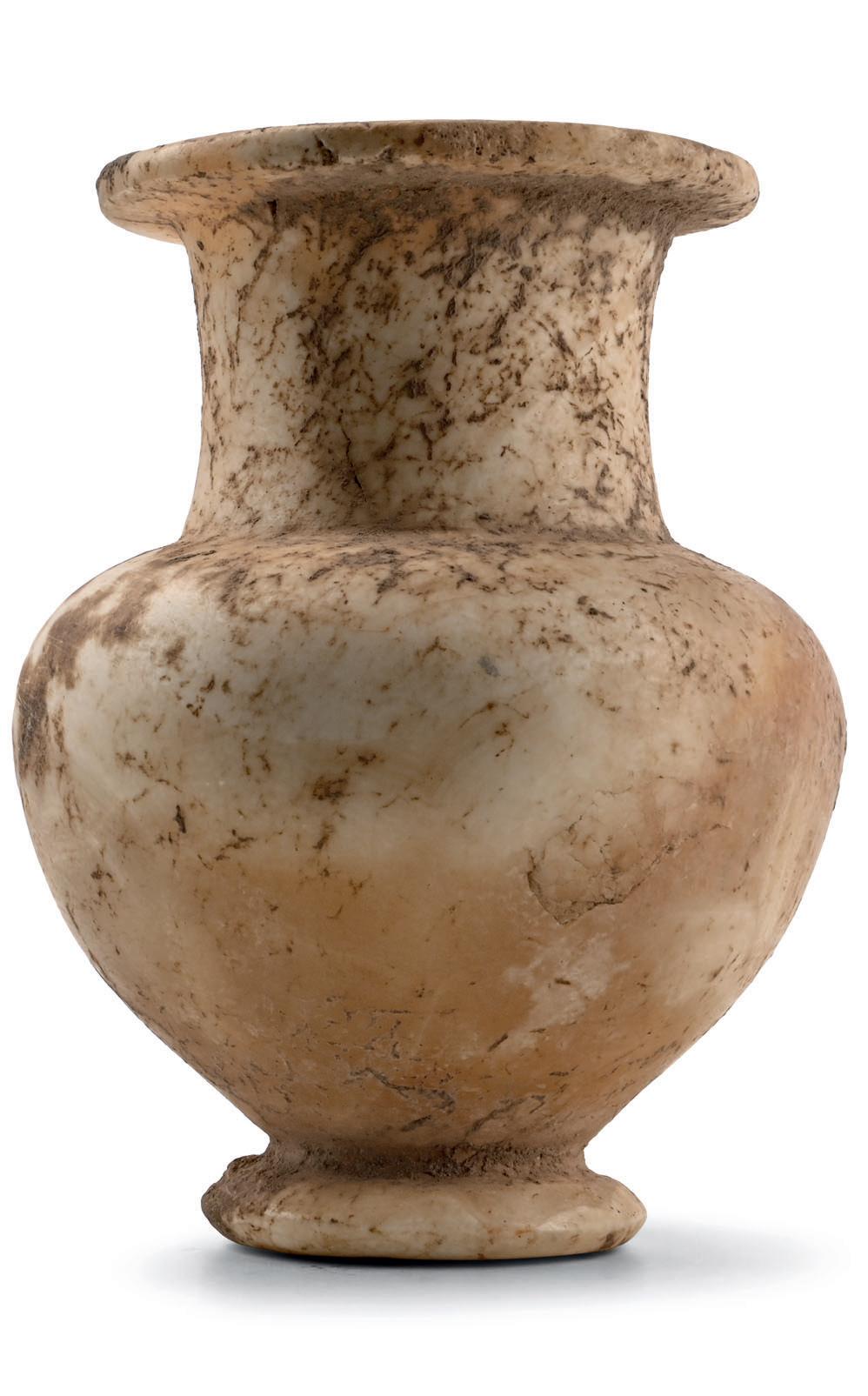
EARLY PHOENICIAN ALABASTER VASE ‡
1ST MILLENNIUM B.C.
5 in. (769 grams, 13.1 cm)
With bulbous body, broad flared neck, flange rim, dimple to underside of base.
£4,000 - 6,000
PROVENANCE:
Private collection, USA and Switzerland, acquired in the late 1980s-early 1990s; by descent to the current owner.
54
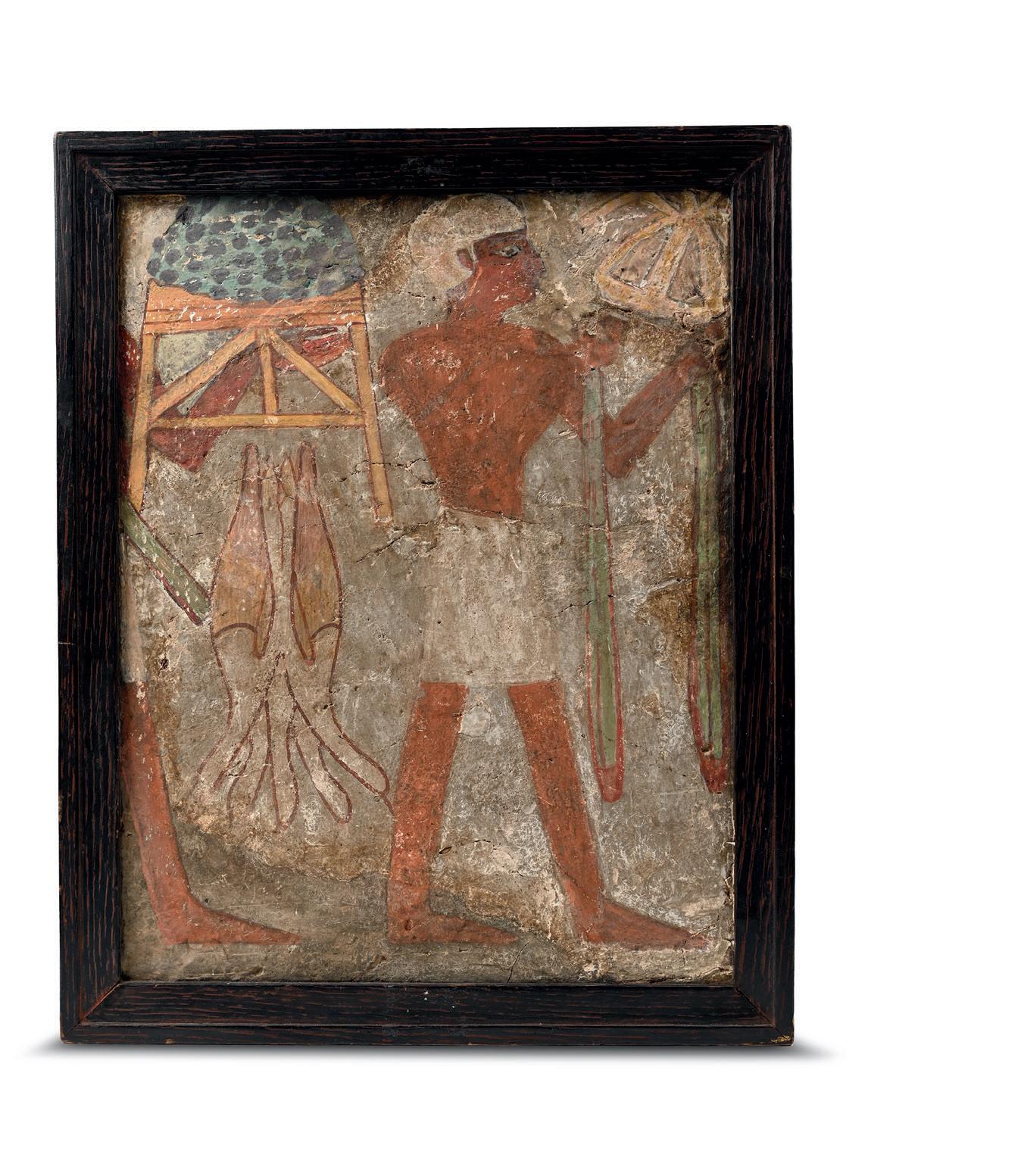
EGYPTIAN LIMESTONE FRESCO WITH SERVANT CARRYING GEESE ‡
NEW KINGDOM, 1580-1077 B.C.
16 x 12 in. (6.8 kg, 40.5 x 32.2 cm)
Rectangular frieze fragment with advancing figure in profile wearing a shendyt kilt holding up two poles in his raised hands; to his rear, part of a second figure with an openwork wooden frame (footstool) and other items; mounted in sturdy wooden frame with suspension rings to the reverse; surface has been extensively cleaned, restored, and repainted.
£8,000 - 10,000
PROVENANCE:
Mounted in an early 20th-century wooden frame bearing a stamped inscription reading ‘Exposition Paris …’
From the collection of L.V. (1950-1960), Paris, France.
Collection of Monsieur X. (1931-2017), dispersed for the benefit of the Monaco Red Cross.
Private collection, Europe.
FOOTNOTES:
The servant is carrying geese, like in many other representations of the New Kingdom. Many portrayals of ducks and geese in ancient Egyptian art show the importance of the birds as food. Servants plucking geese are visible in the tomb of Nakht, in Luxor (1567-1320 B.C.), and in the famous tomb of Nebamun, at the British Museum, a fresco fragment shows workers standing in front of a gaggle of geese.
55
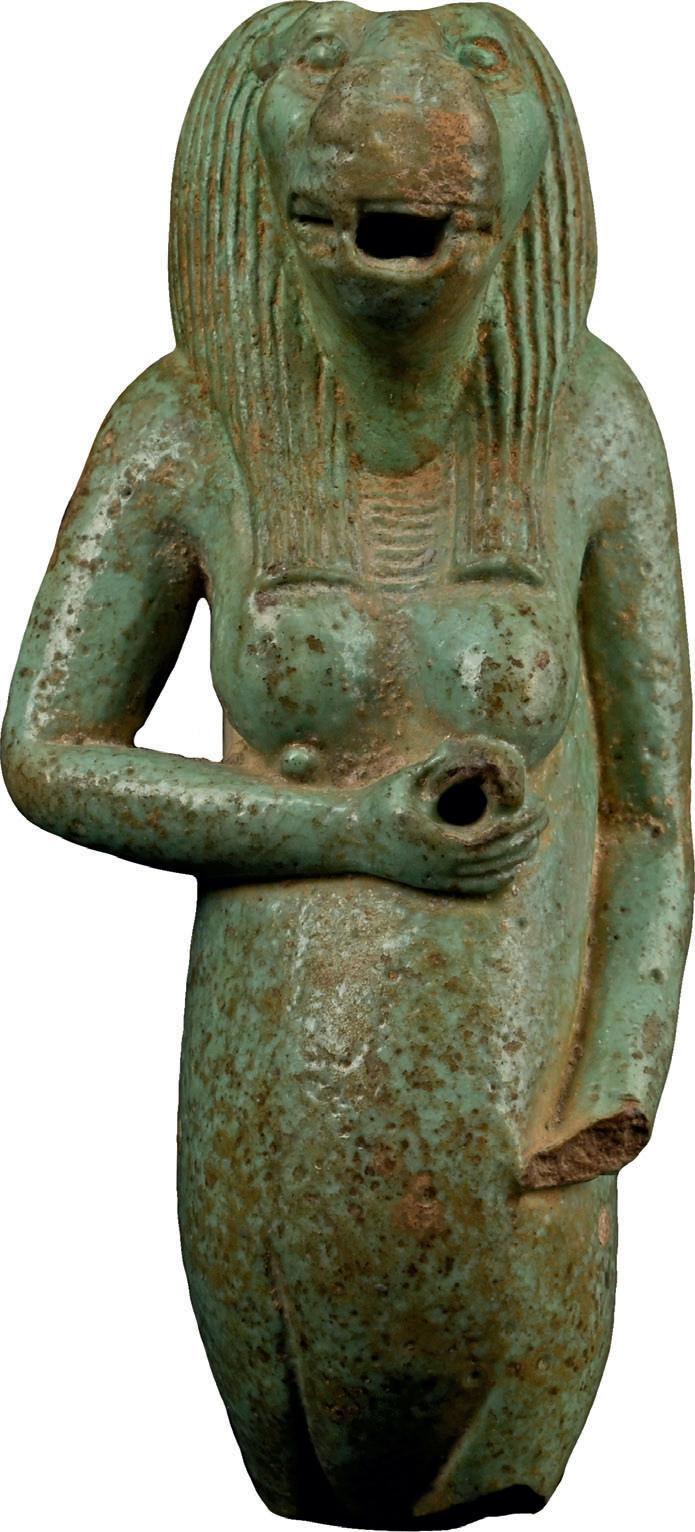
LARGE EGYPTIAN BLUE FAIENCE TAWERET VESSEL ‡ LATE PERIOD, 26TH DYNASTY, 664-525 B.C. 6¾ in. (160 grams total, 17.3 cm including stand)
Composite animal figure with a hippopotamus’s head and body, a crocodile’s tail, and a human torso with arms, topped with a finely striated tripartite wig; the right hand, positioned beneath the left nipple, encloses a drilled hole connecting to the hollow body; a hole at the top of the head; mounted on a custom-made stand.
£8,000 - 10,000
PROVENANCE:
Ex private French collection, since the early 1990s. Acquired from Galerie Reiner, rue Bonaparte, Paris. Artcurial, Paris, 6 November 2013, no.55.
Accompanied by an academic report by Egyptologist Paul Whelan. Accompanied by a copy of French passport no.150578.
FOOTNOTES:
The vessel’s shape indicates it was likely used in magical and libationary rituals meant to invoke Taweret’s protective powers during childbirth and maternity. Usually depicted as a female hippopotamus with lion-like arms and legs and a crocodile’s back and tail, Taweret remains one of the most distinctive and recognisable deities in the Egyptian pantheon. Her name comes from the Egyptian word for great or large (t w rt), emphasising her powerful and protective nature.
56
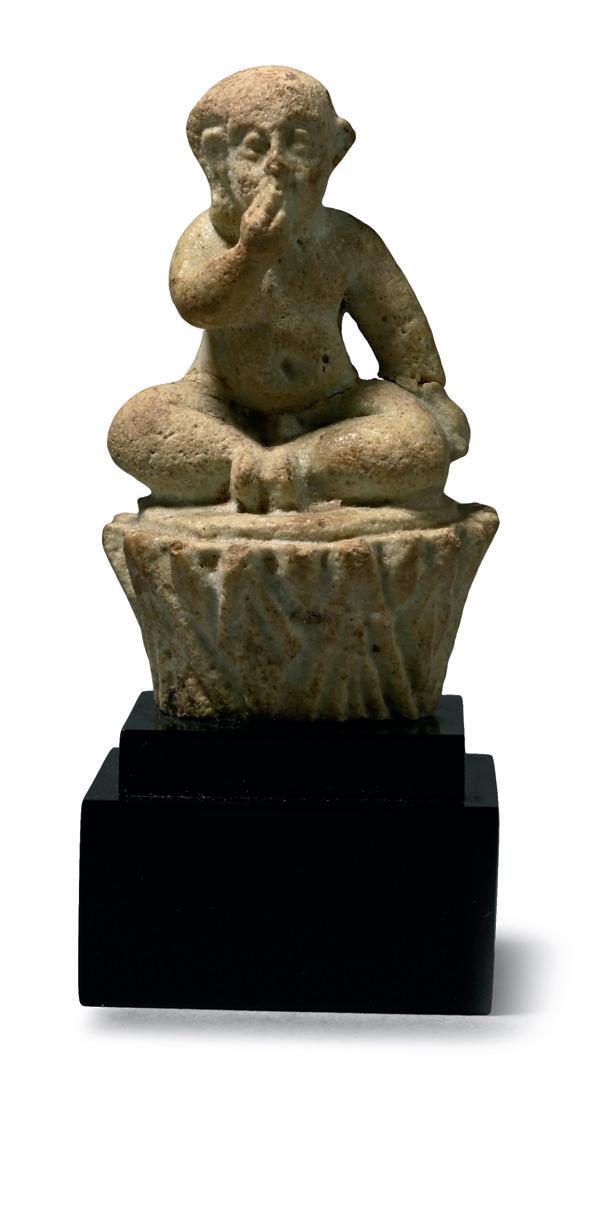
EGYPTIAN GREEN GLAZED SOMTOUS SEATED ON LOTUS FLOWER
LATE PERIOD, CIRCA 664-332 B.C.
2 in. (39.76 grams total, 68 mm high including stand)
Modelled in the round, the nude seated figure of the child Somtous, with one hand to his lips and a prominent sidelock, emerging from a lotus flower; mounted on a custom-made stand.
£700 - 900
PROVENANCE:
Noriuchi Horiuchi, Tokyo, Japan, 1993. Private collection, London, UK.
FOOTNOTES:
The earliest attestations of the cult of Somtous, known as Sematawy in ancient Egyptian, date back to the New Kingdom, although it became particularly popular during the Late Period. Associated with Horus (Horsomtous), the symbol of the child emerging from the lotus represented the (re)birth of the sun god. Thus, Somtous was regarded as a life-giving amuletic symbol, sometimes even referred to as ‘Sematawy the child who gives life.’
57
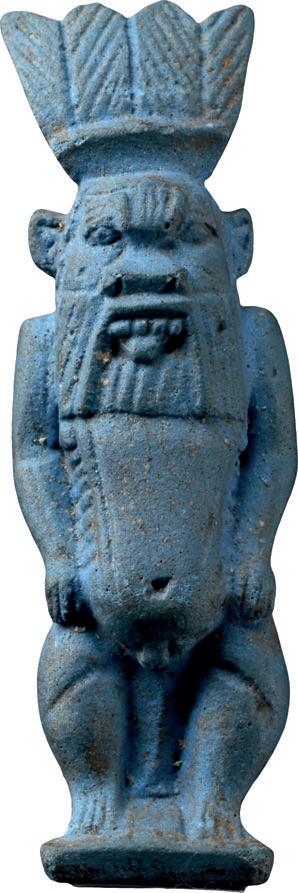
EGYPTIAN BLUE GLAZED AMULET OF BES
THIRD INTERMEDIATE PERIOD, CIRCA 1069-735 B.C.
1 in. (3.07 grams, 42 mm)
Modelled in the round, Bes standing nude with a lion’s tail, wearing a feathered headdress.
£1,000 - 1,400
PROVENANCE:
Olivia Tiano, Paris, 1993.
Private collection, London, UK.
FOOTNOTES:
From the New Kingdom onwards, Bes became one of ancient Egypt’s most popular apotropaic deities. Despite his somewhat fearsome appearance, Bes served as the patron and protector of pregnant women and children and was also believed to shield them from snakes.
58
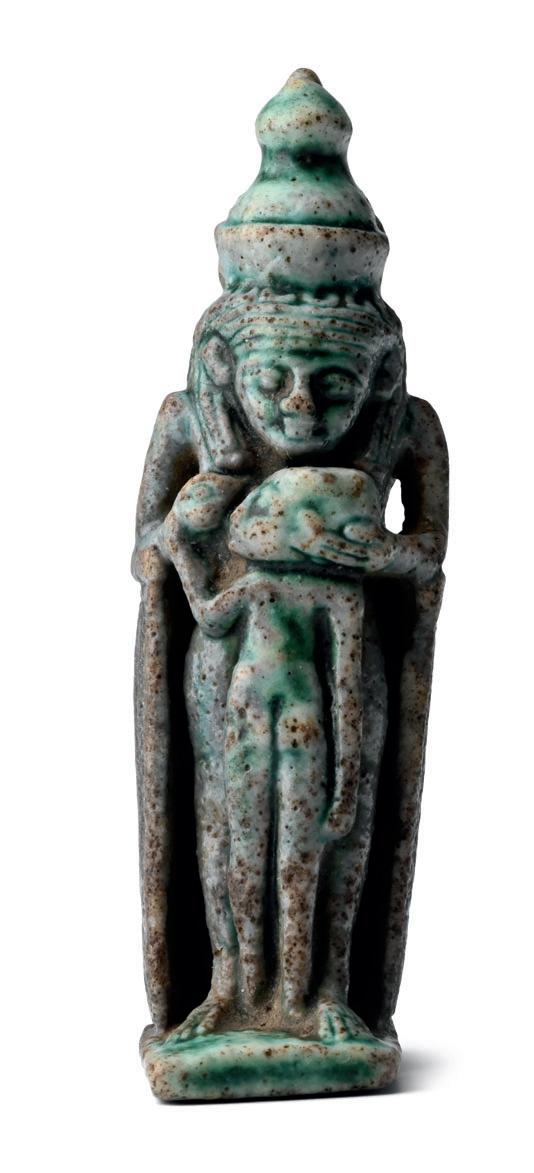
EGYPTIAN GREEN GLAZED FAIENCE MUT SUCKLING KHONSU WITH WINGED SEKHMET ON THE BACK THIRD INTERMEDIATE PERIOD, CIRCA 1069-735 B.C.
2 in. (22.6 grams, 60 mm)
Modelled in the round, formed as the goddess standing before a highbacked throne, cradling the head of a standing naked child to her chest; the goddess with tiered double-crown and tripartite wig; throne with low-relief figure of the lioness-headed goddess Sekhmet to the rear with spread wings forming the arms of the chair.
£1,800 - 2,400
PROVENANCE:
Jean Phillip Mariaud De Serres, Paris, France, 1992. Private collection, London, UK.
FOOTNOTES:
Mut was a prominent mother goddess in ancient Egyptian religion, associated with creation, motherhood, and the sky. She was the consort of the god Amun and the mother of Khonsu, forming the Theban triad with them in Thebes. Mut’s name (mother in ancient Egyptian) reflects her role as a divine mother and patroness of motherhood. Sekhmet was revered as a powerful and fierce protector. Her presence was believed to ward off evil and safeguard the people from harm. In ancient Egyptian mythology, Sekhmet was also a manifestation of Hathor, another powerful birth goddess.
59
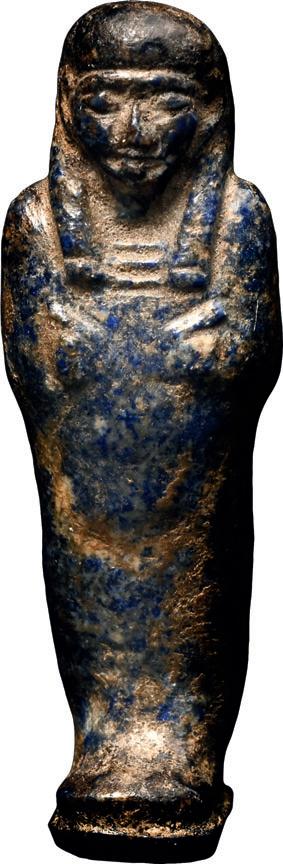
EGYPTIAN LAPIS LAZULI SHABTI AMULET ‡ NEW KINGDOM, 1550-1070 B.C.
1¼ in. (3.12 grams, 31 mm)
Carved in the round as a mummiform figure, with a detailed collar and tripartite wig; rear suspension loop.
£1,500 - 2,000
PROVENANCE:
Private collection, acquired on the Swiss art market in 1992; thence by descent.
EGYPTIAN BRONZE KNEELING FIGURE OF A KING ‡ LATE PERIOD-PTOLEMAIC PERIOD, CIRCA 664-30 B.C. 6½ in. (1.62 kg total, 16.7 cm high including stand)
A solid cast statuette modelled in the round as a kneeling pharaoh wearing a thigh-length shendyt kilt, a broad collar and a nemes headdress adorned with a uraeus to the brow; with open hands positioned as though they once held an object, palms facing inward; mounted on a custom-made stand.
£30,000 - 40,000
PROVENANCE:
Private collection, E.M. (1880-1954), since the 1930s.
Accompanied by an academic report by Egyptologist Paul Whelan.
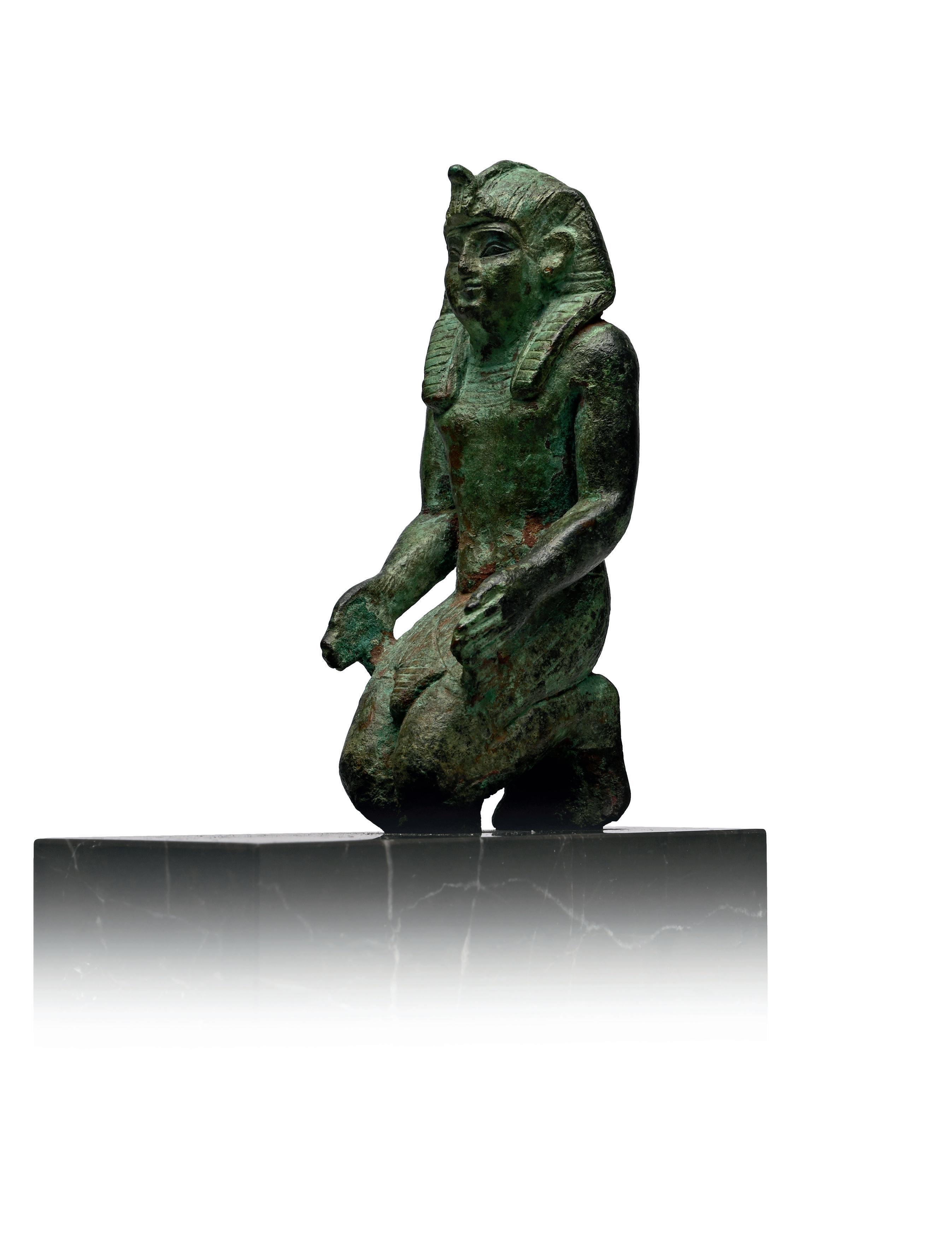
FOOTNOTES:
The figure’s overall appearance, particularly the muscular upper body, resembles two kneeling bronze figures – Brooklyn Museum 71.11 and Pennsylvania Museum E.13004 – both bearing the cartouche of 26th Dynasty pharaoh Necho II (610-595 BC). Unlike the varied poses of kneeling stone statues, those in bronze consistently rest on their knees and toes, with heels positioned under their buttocks. Figures with this hand gesture are often thought to have originally held an offering vessel or ritual object. However, none of the existing examples shows signs of having held an object. Instead, the gesture may symbolise both giving and receiving, representing veneration, offering, and a plea for protection to a particular deity.
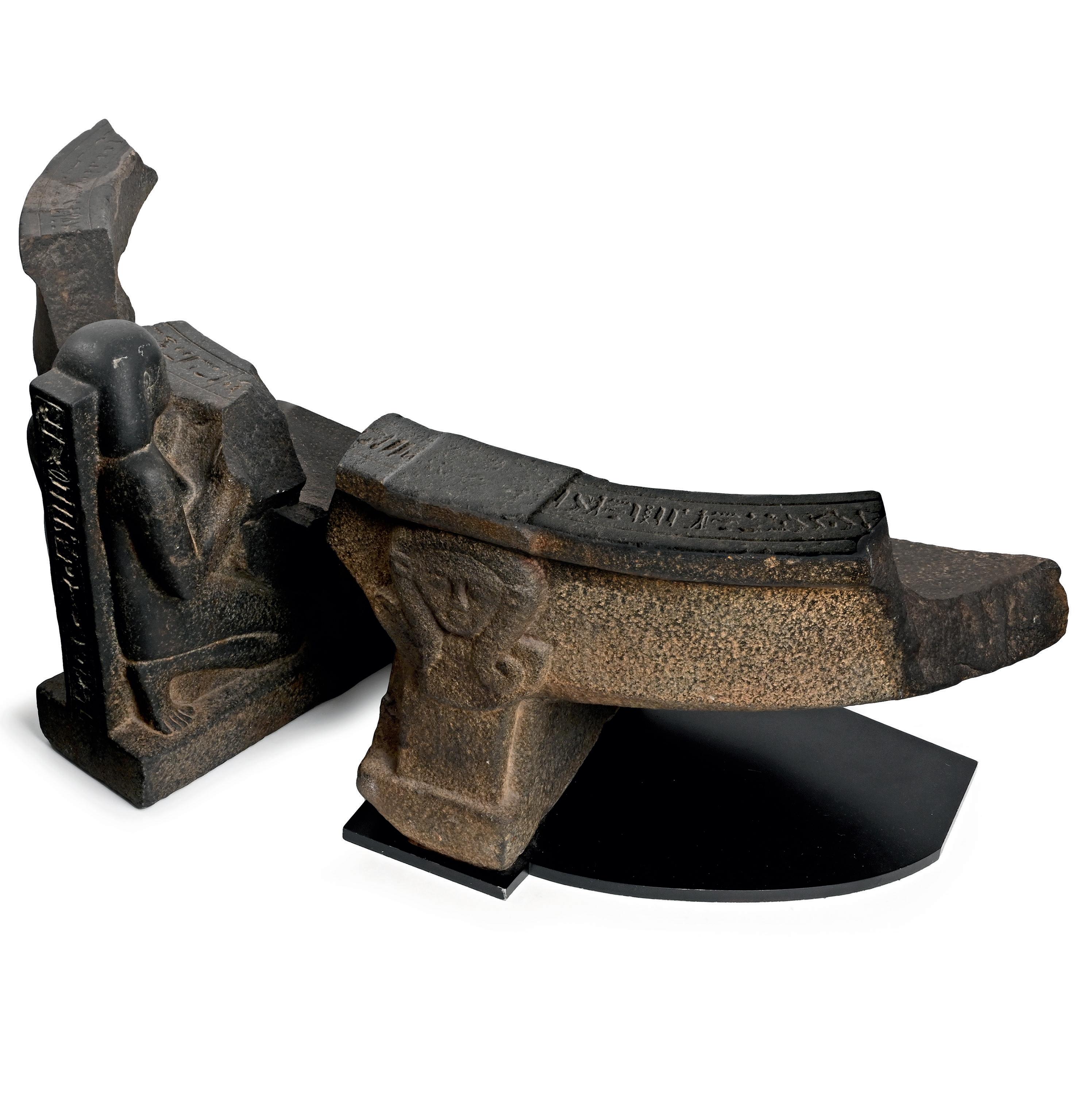
61
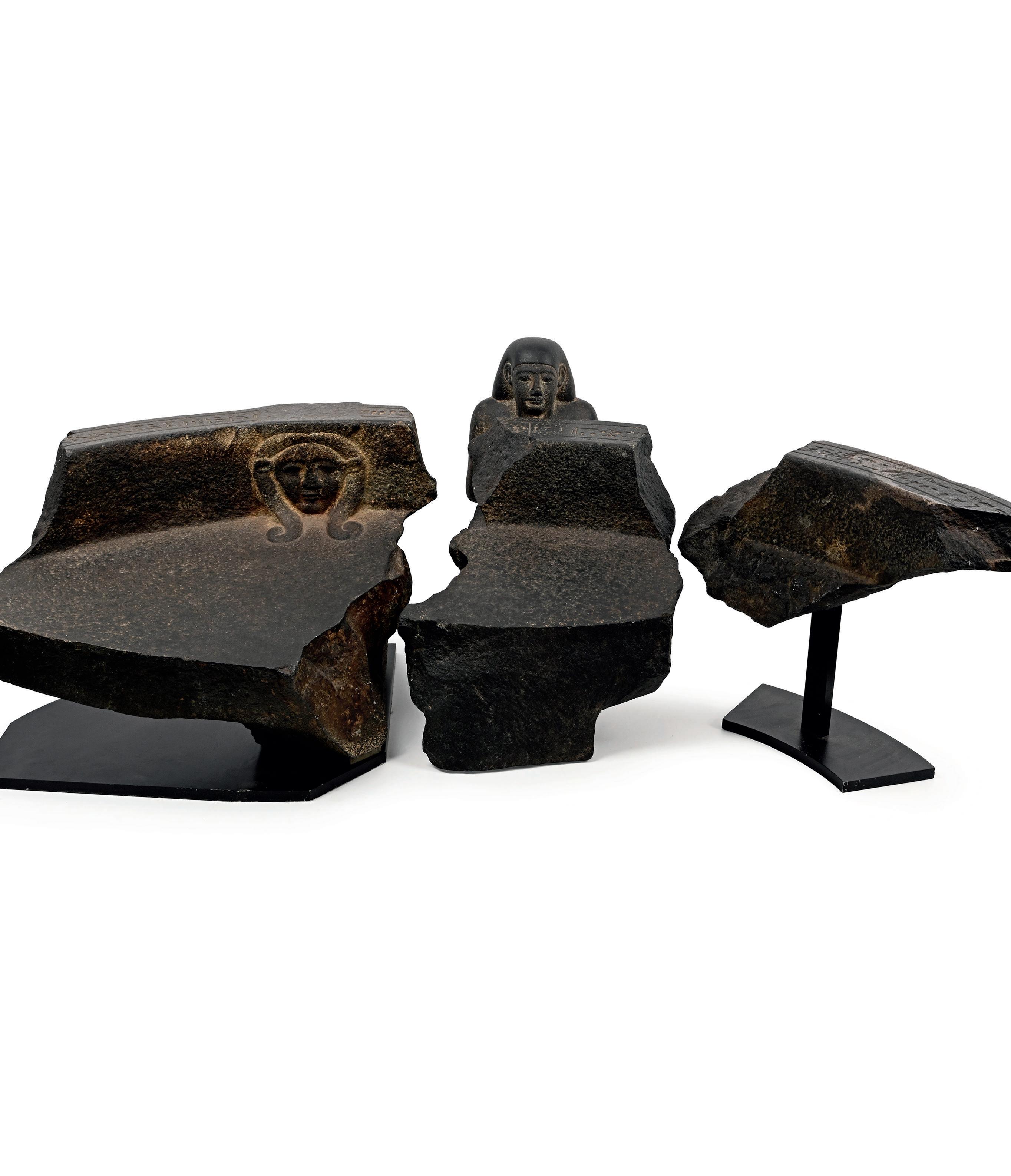
EGYPTIAN BASALT BASSINOPHORE FRAGMENTS FOR THE CUSTOMS OFFICIAL WAHIBRE, SON OF PAEFTCHAWY LATE PERIOD, 26TH DYNASTY, REIGN OF AMASIS, CIRCA 570-525 B.C. 15¾, 18½ - 22 in. (107.7 kg total, figure: 40 cm high, fragments: 4758 cm wide including stand)
Modelled in the round kneeling on an integral base and wearing a broad rounded wig, holding a fragmentary offering basin before him; dorsal pillar engraved with a single vertical column of hieroglyphs, translating: ‘The Count, Overseer of the Entrance to the Hill Countries, Chief Supervisor of the Shrines [of Neith], Wahibre, son of Paeftchawy’; upper rim of the basin further inscribed with a ritual formula intended to be recited during the presentation of its contents. [3]
£80,000 - 100,000
PROVENANCE:
For the two basalt sections: UK private collection, formed 1970s-1990s. Princely collection, until 2014; thence to a private foundation. Acquired by the current owner from Rupert Wace, London, UK.
For the kneeling basalt figure: European private collection, since the mid-19th century.
Sold at Christie’s, New York, 8 June 2001, no.114.
Sold at Drouot-Richelieu, Paris (Boisgirard), 14 February 2005, no.313. European private collection, acquired at the above sale; thence by descent to the previous owners.
FOOTNOTES:
The figure on this vessel represents the customs official Wahibre, son of Paeftchawy, a well-attested individual known from at least fourteen other sculptures. Additional evidence for Wahibre’s identity is provided by a fragment of his mummiform sarcophagus, found at el-Hagar, within the territory of his native city of Sais. The titles inscribed on his surviving monuments reflect a career that combined priestly responsibilities with significant administrative and military authority. In southern Egypt, Wahibre served as chief customs officer and commanded a contingent of foreign troops tasked with protecting the frontier, probably Greek mercenaries from Caria.

63
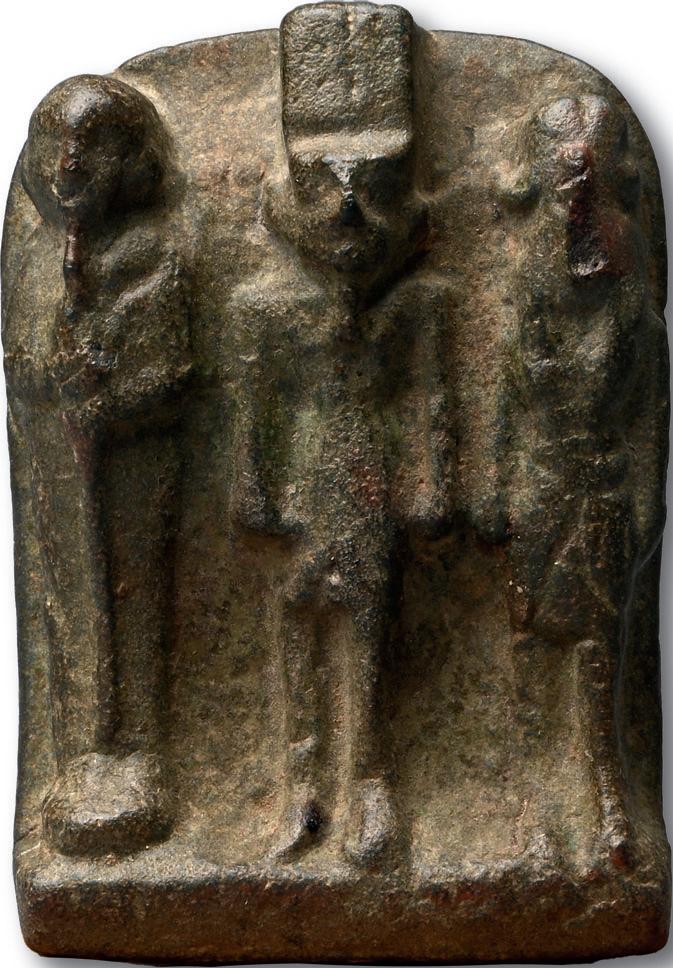
EGYPTIAN FAIENCE PTAH, AMUN-RA AND RA-HORAKHTY TRIAD AMULET ‡
PTOLEMAIC PERIOD, 332-30 B.C.
3 in. (88.8 grams total, 85 mm including stand)
Rectangular plaque with a ledge along the lower edge, featuring the half-round figures of Ptah, Amun-Ra, and Ra-Horakhty; each invoked in offering formulae written in three vertical columns on the back; a fragmentary suspension loop at the rear; mounted on a wooden display stand.
£3,000 - 4,000
PROVENANCE:
From a deceased American estate, 1970-1989. with Bonhams, London, 28 October 2009, no.81. Private collection, Europe.

62
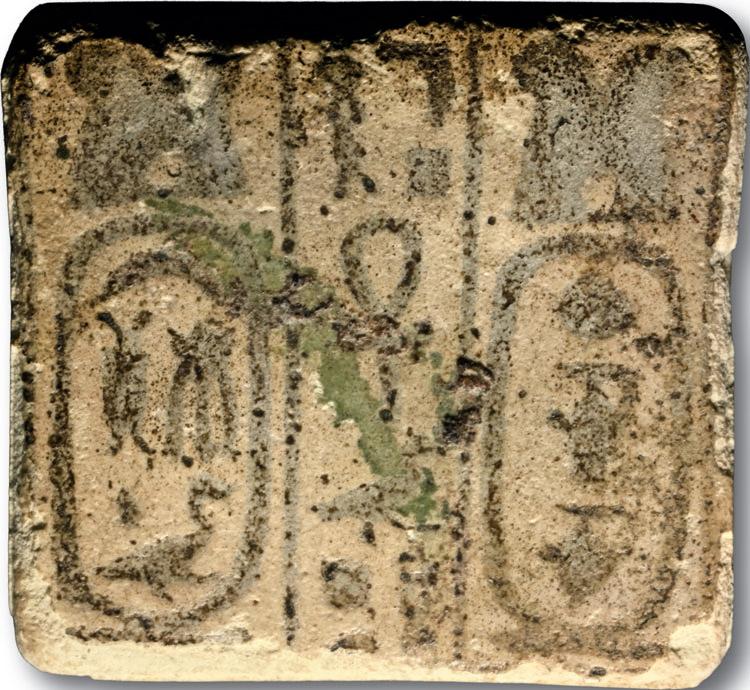
EGYPTIAN FAIENCE BEAD WITH CARTOUCHES OF PHARAOH AMASIS ‡ LATE PERIOD, 26TH DYNASTY, CIRCA 664-525 B.C.
1 in. (4.96 grams, 26 mm)
Square in plan with transverse piercing, obverse with three panels: the left bearing a cartouche surmounted by two plumes containing the pharaoh’s birth name, i ms s nt (Ahmose, son (of) Neith); the right, a similar cartouche containing his throne name, nm-ib-R (He who embraces the heart of Re); the centre inscription reads, pw n s pt(?) (the living Apis, son [of] Hepet?) two with a cartouche for Amasis, text to the centre.
£2,000 - 3,000
PROVENANCE:
Ex private collection, Germany. with Galerie Günter Puhze, Freiburg, Germany, prior to 2003. Private collection, acquired on the German art market, 2004.
FOOTNOTES:
The three-column text arrangement closely resembles that of another rectangular spacer bead, engraved with Ahmose II’s cartouches flanking a central inscription, now held at The Walters Art Museum, Baltimore (accession number 42.377). Although the central inscription differs in content, the bead’s connection to the Apis bull is shown on the opposite side, where the sacred animal is depicted. Amasis II (Egyptian: Ahmose II), fifth king of the 26th Dynasty (Saite Period), reigned c. 570–526 BC.

64
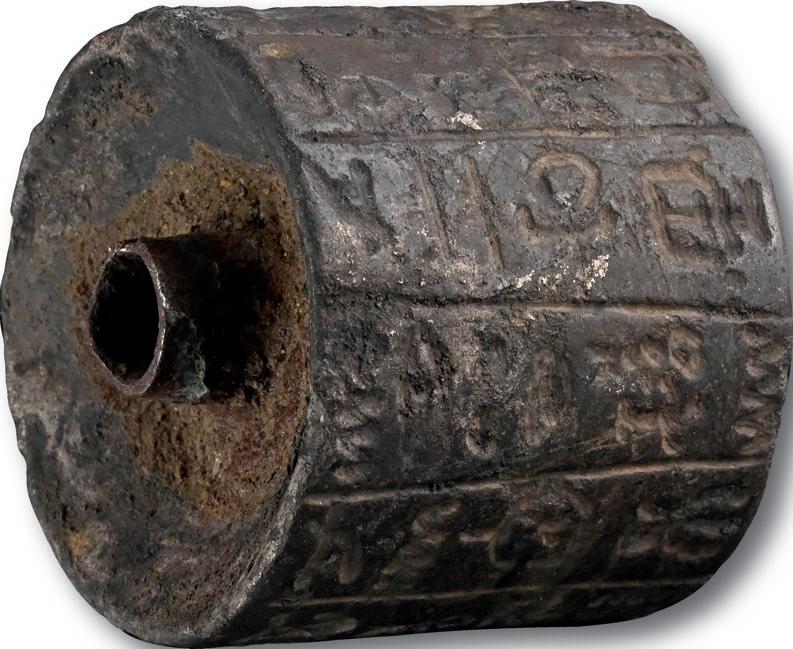
PHOENICIAN SILVER CYLINDER SEAL WITH PSEUDO-EGYPTIAN HIEROGLYPHS
LEVANT, 1ST MILLENNIUM B.C.
1 in. (97.8 grams, 40 mm)
Tubular with concave disc ends pierced by a sleeve to accept the axle; outer face divided by longitudinal straight lines, the resultant panels with shapes and symbols reminiscent of hieroglyphs but not interpretable using the Egyptian system.
£400 - 600
PROVENANCE:
London, UK, art market, 1980s. Private collection, London, UK.
65
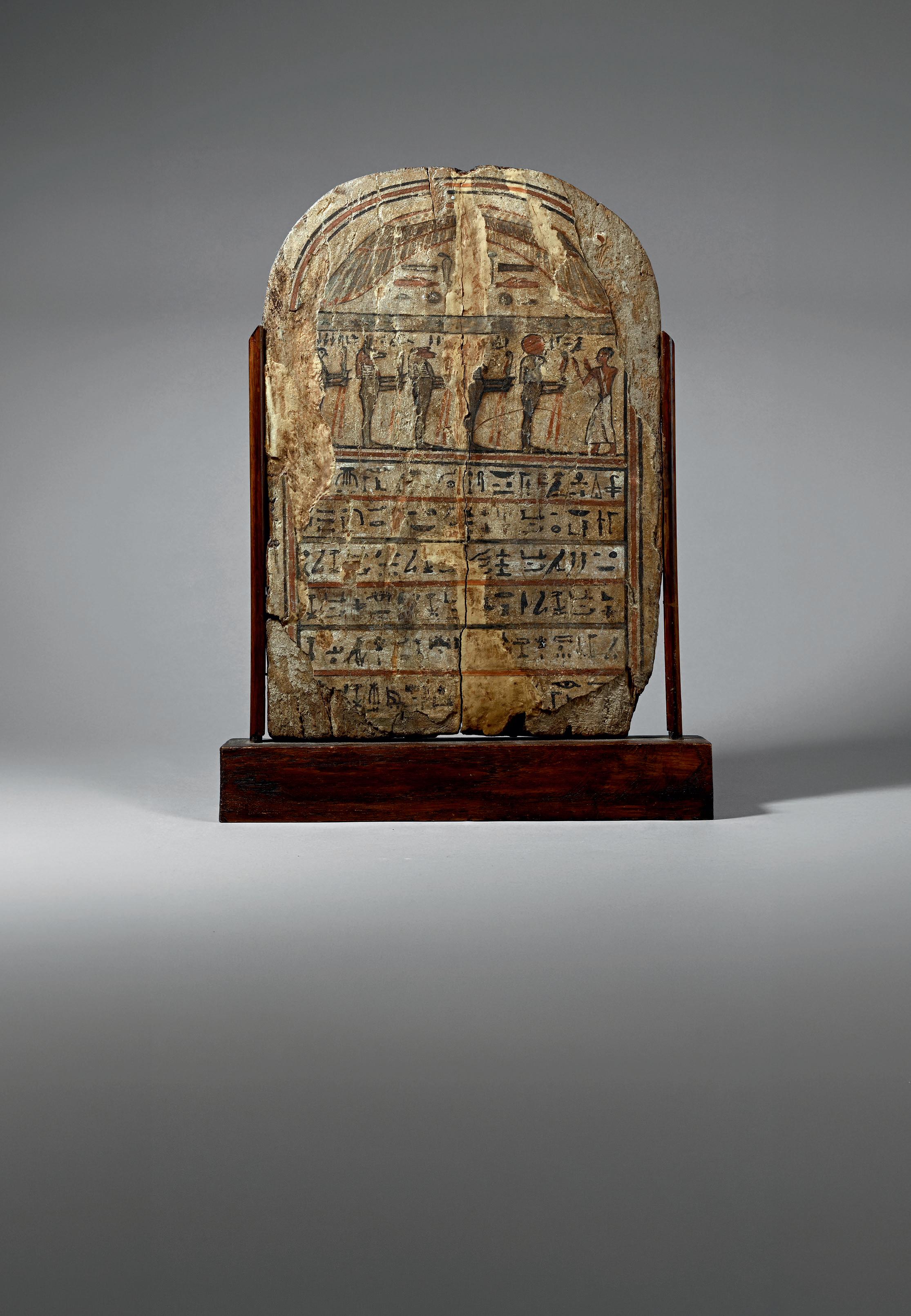
EGYPTIAN WOODEN STELE FOR PA-DI-AMUN-(EM)-IPAT WITH RA-HORAKHTY
LATE PERIOD-PTOLEMAIC PERIOD, 664-30 B.C. 17¾ in. (1.94 kg, 45 cm high)
Arch-topped and composed of two vertical boards, coated with gesso and skilfully painted on one side; the lunette decorated with a winged sun-disc and two pendant uraei; the central vignette depicting the deceased worshipping the falcon-headed god Ra-Horakhty with the Four Sons of Horus standing behind, each with their name written above; the lower register with six lines of hieroglyphic text providing an offering formula for the benefit of the deceased: Transliteration of the hieroglyphs: 1) tp-dı-nsw r - r- tın r nb pt s [.....] wsır ntt [ımntt?] 2) n r nb b w dı f pr.t- rw t n t k pd [....] t nb(t) (n) fr(t) w bt […] 3) t nbt n m dı f tpw f w [...]f m t dı f m 4) n
ırp [...] dı
r ımnt nfr 6) n [..] wsır [......] p -dı-ımn(m) ıp .t ms (n) [....]
Translation: 1) An offering that the king and Ra-Horakhty, Great God, Lord of Heaven, the illuminated [...] Osiris Foremost [of the West?] 2) Great God, Lord of Abydos (that) he may give a voice-offering (of) bread, beer, oxen, and fowl […] everything good and pure […] 3) everything sweet, he gives offerings of provisions […] a thousand of bread, he gives a thousand of 4) beer, he gives a thousand of wine
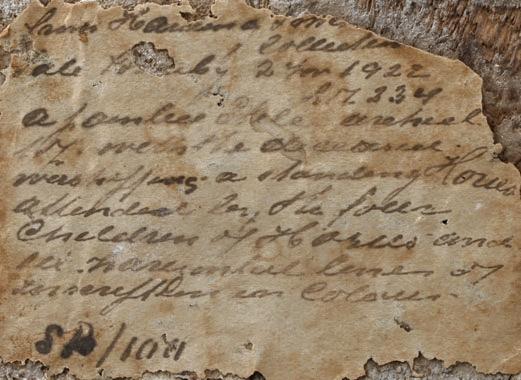
[…], he gives a thousand of vines, he gives a thousand of 5) incense on the altar […] a good burial in the beautiful West 6) for […] the Osiris[…] Pa-di-Amun-(em)-ipat born (to) Kha[…]; on the verso, an old handwritten collection label reading: ‘From Harding & Sm[ith] Collection Sale Sotheby 2 Nov 1922 L.N. 234. A families [sic] stele, arched top, with the deceased worshipping a standing Horus attended by the four Children of Horus and six horizontal lines of inscription in colour. SP/10a’; mounted in a custom-made wooden frame.
£15,000 - 20,000
PROVENANCE:
From the collection of the late W. Harding Smith (1848-1922). with Sotheby, Wilkinson & Hodge, 34 & 35 New Bond Street, 2 November 1922, no.234.
Old handwritten label to verso reading ‘From Harding & Sm[ith]’ collection Sale Sotheby 2 Nov 1922 L.N.234...’
Accompanied by an academic report by Egyptologist Paul Whelan. Accompanied by a copy of the 1922 Sotheby, Wilkinson & Hodge catalogue pages.
FOOTNOTES:
The syncretism of two strong gods, Re and Horus, is one of the most significant events in Egyptian mythology, and it appears to have had a substantial iconographic impact on Egyptian history. Re’s power was augmented by this, which consisted of a falcon-headed man crowned with a sun disc; in the mornings, Re was combined with Horus to become Re-Horakhty.


66
EGYPTIAN BLUE GLASS MUMMY EYE PAIR
LATE PERIOD, 664-332 B.C.
2¼ in. (44.35 grams total including stand, 56 mm each)
Composed of overpainted white sclerae with obsidian irises, set into contoured blue glass lids with extending cosmetic lines; mounted on a custom-made display stand.
£2,000 - 3,000
PROVENANCE:
Property of a North American gentleman, London, UK, 1990-2010.
67
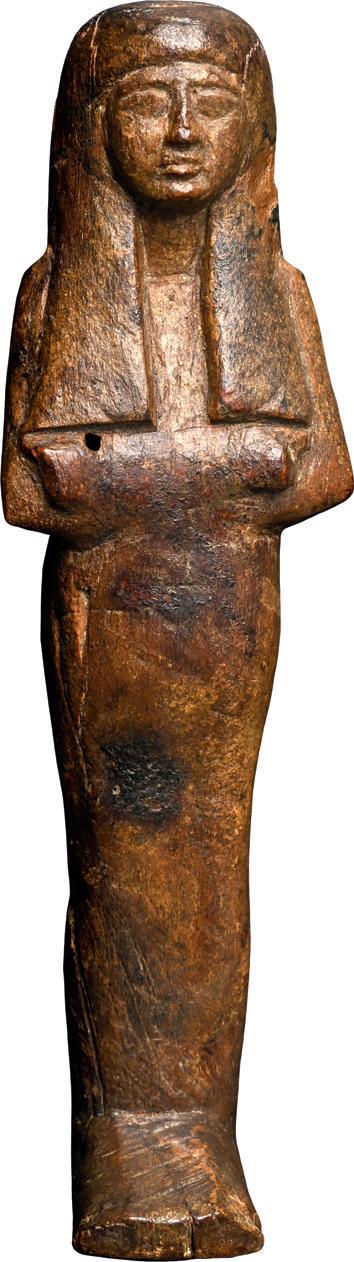
EGYPTIAN WOODEN SHABTI ‡
NEW KINGDOM, 19TH DYNASTY, CIRCA 1292-1185 B.C.
8½ in. (140 grams, 21.5 cm)
Carved in the round in a typical mummiform shape with hands crossed on the chest, wearing a tripartite wig with long, splayed lappets; collector’s number to base ‘E.803’.
£6,000 - 8,000
PROVENANCE:
Private collection, acquired in the late 1980s-early 1990s; thence by descent.
68
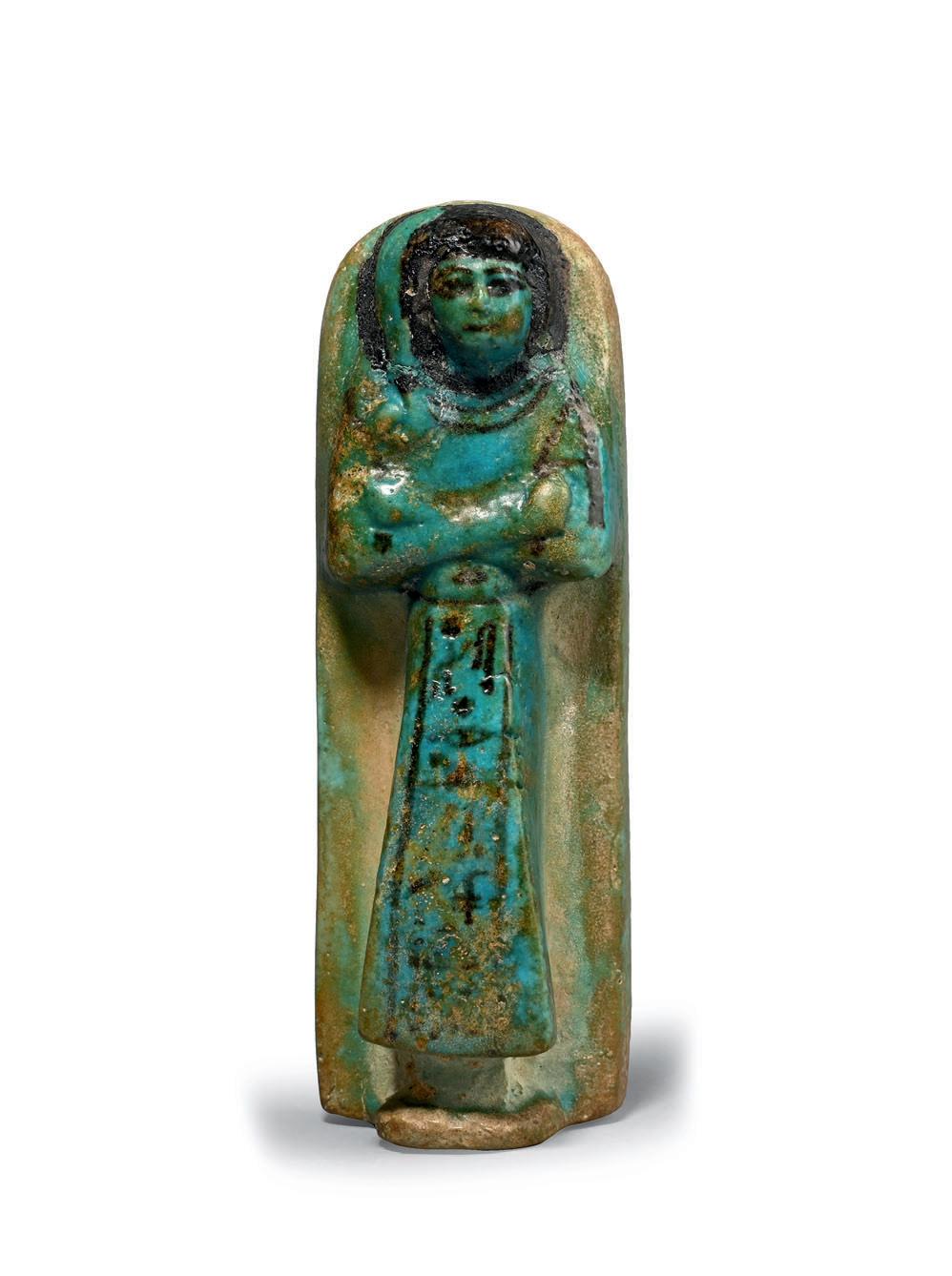
EGYPTIAN TURQUOISE FAIENCE SHABTI OF PRINCE KHAEMWASET
NEW KINGDOM, 19TH DYNASTY, CIRCA 1292-1185 B.C.
6 in. (284 grams, 15.1 cm)
Wearing daily dress and carrying agricultural implements, with dark blue details including his short wig with side-lock, designating him as a Sem-priest of Ptah at Memphis, the text on the kilt naming him as ‘Sem-priest and King’s son Khaemwaset’; with round-topped back support, the reverse with two columns of hieroglyphs with part of the shabti formula: ‘He says: O shabti, if one counts, if one is reckoned to do all the works that are to be done there in the God’s land—now indeed obstacles are implanted therewith—as a man at his duties, ‘Here I am,’ you shall say when you are counted off to cultivate the fields, transport by boat the sand of the east to the west and vice versa; ‘Here I am,’ you shall say.’
£6,000 - 8,000
PROVENANCE:
With Barakat, Beverly Hills: reputed to be from the Omar Pasha Sultan collection, (1806-1871) but unpublished in the 1929 catalogue of the collection, nor in Aubert’s 1976 article on the shabtis in the collection. Bonhams, London, 1 May 2013, no.282.
Accompanied by copies of the relevant Bonhams catalogue pages. Accompanied by an academic report by Egyptologist Paul Whelan.
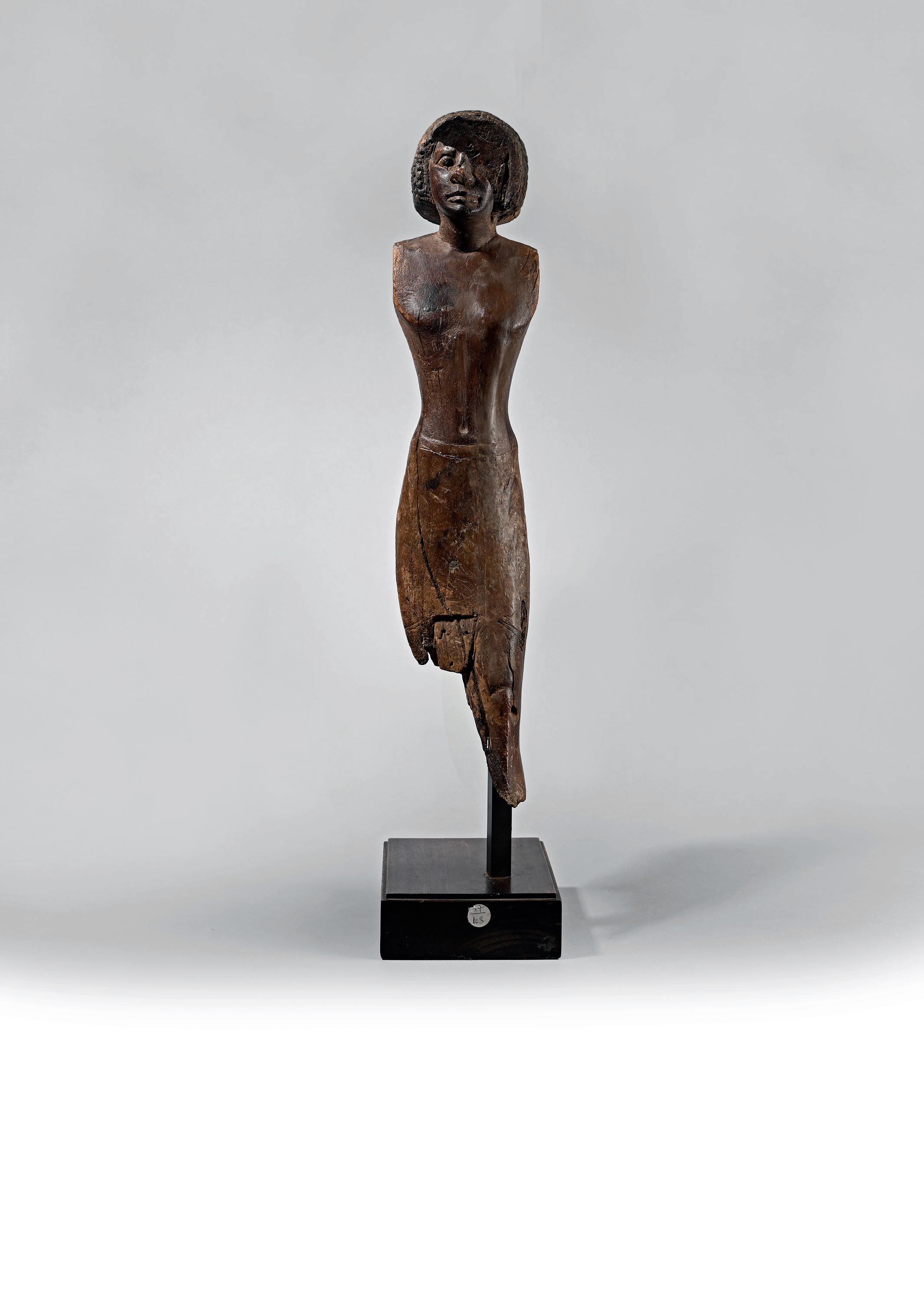
LARGE EGYPTIAN WOODEN FIGURE OF A MAN
OLD KINGDOM, 5TH-6TH DYNASTY, 2450-2182 B.C. 22 in. (1.46 kg total, 55.7 cm high including stand)
Of slender form, shown striding and wearing a kilt with a central tab, and a rounded wig covering the ears, composed of echeloned rectangular curls; the face with a broad mouth with finely outlined lips, rounded at the corners; the front of the kilt and portion of the advancing left leg preserved; the arms and the lower right leg missing, having been carved separately; with traces of polychrome.
£40,000 - 60,000
PROVENANCE: Joseph Altounian (1889-1954) and Henriette Lorbet, Altounian-Lorbet Gallery, Mâcon, France.
Believed acquired at Sotheby’s, London: The MacGregor Collection of Egyptian Antiquities, 26 June–3 July 1922.
Acquired by the previous owner from Henriette Lorbet, January 4th, 1967.
FOOTNOTES:
The statue stands as another admirable example of wooden sculpture from the early dynasties. Its highly realistic face depicts a young man, mirrored by the slender body, with a sober and elegant design. The statue was undoubtedly originally coated in stucco and colour. The striking figure, slightly asymmetrical, along with the serious mouth and haughty expression, gives this portrait a remarkably lively appearance.
70
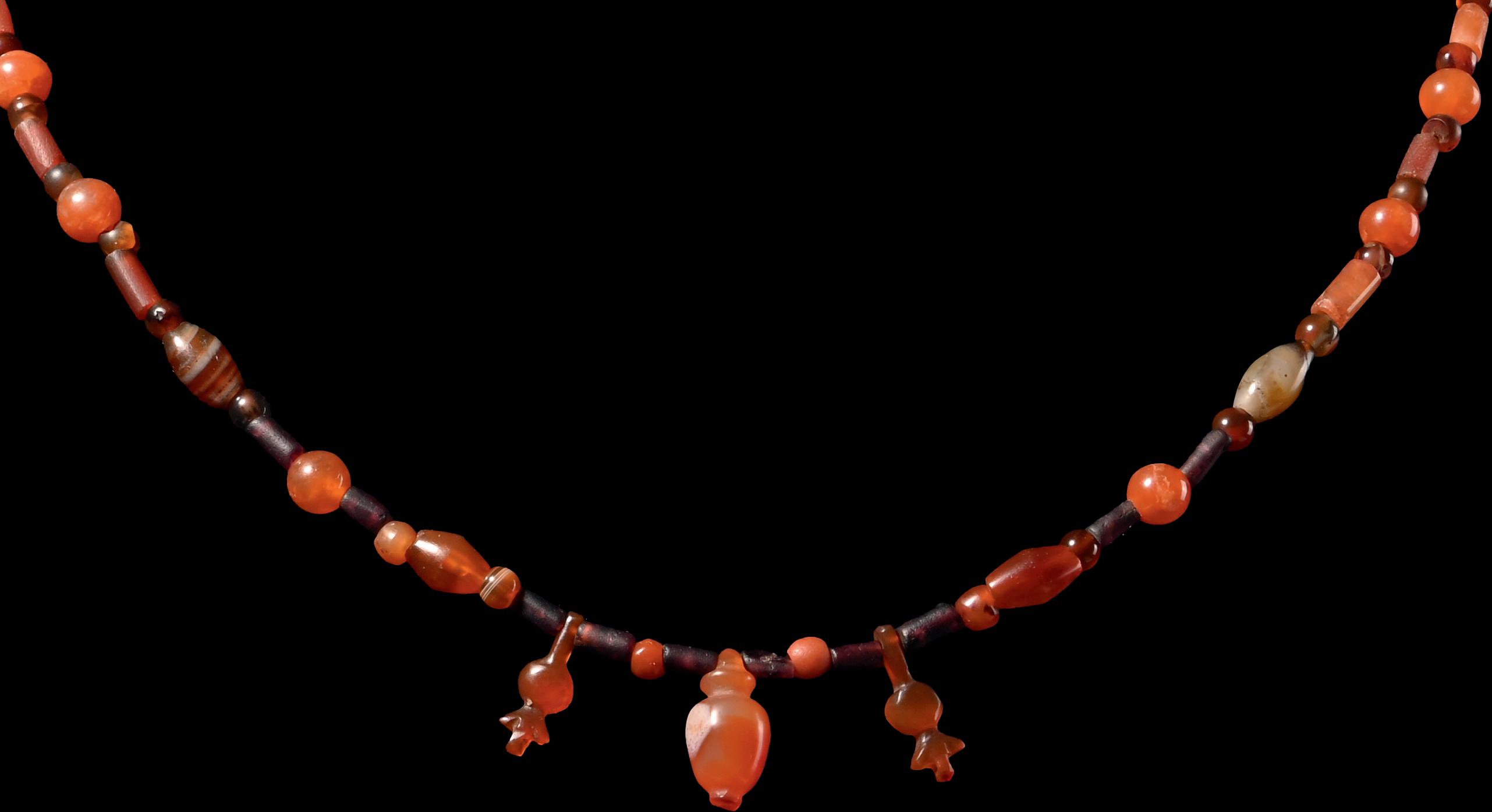
EGYPTIAN HARDSTONE NECKLACE WITH AMULETS
NEW KINGDOM, 1550-1295 B.C.
16½ in. (17.45 grams, 42 cm)
Spherical, bicone, and tubular stone beads with a vessel, and two cornflower amulets, restrung with a modern clasp fitting.
£500 - 700
PROVENANCE:
Ex London, UK, collection, 1990s-2000s.
71
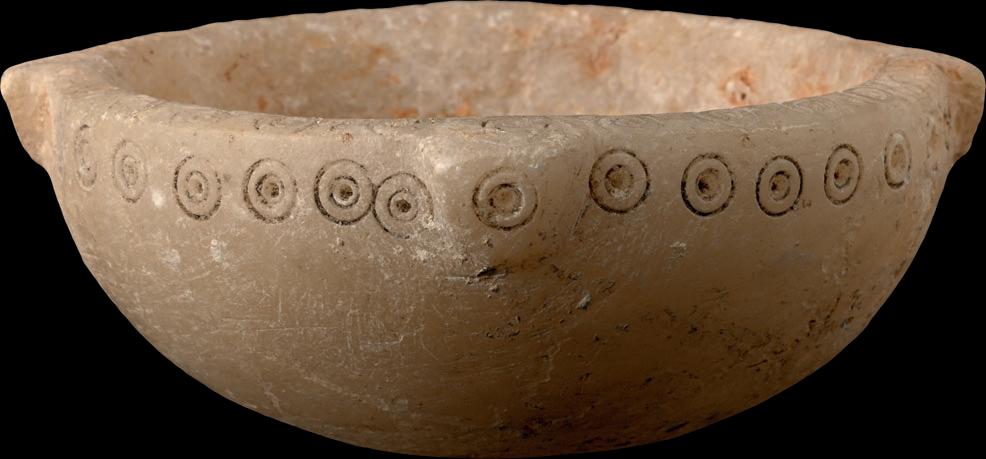
ROMANO-EGYPTIAN ALABASTER BOWL ‡
4TH-5TH CENTURY A.D.
5¼ in. (503 grams, 13.2 cm wide)
With flat rim and four projecting lugs; band of incised concentric rings to the rim and shoulder; curving sidewall to a narrow flat base.
£1,000 - 1,400
PROVENANCE:
Private collection, USA and Switzerland, acquired in the late 1980s-early 1990s; by descent to the current owner.
FOOTNOTES:
Vessels of this typology were used mainly as mortars for crushing legumes, cereals, fruit, spices, the bare minimum needed for preparing daily food, but also for pharmaceutical products and for painting, for mixing colours and ointments.
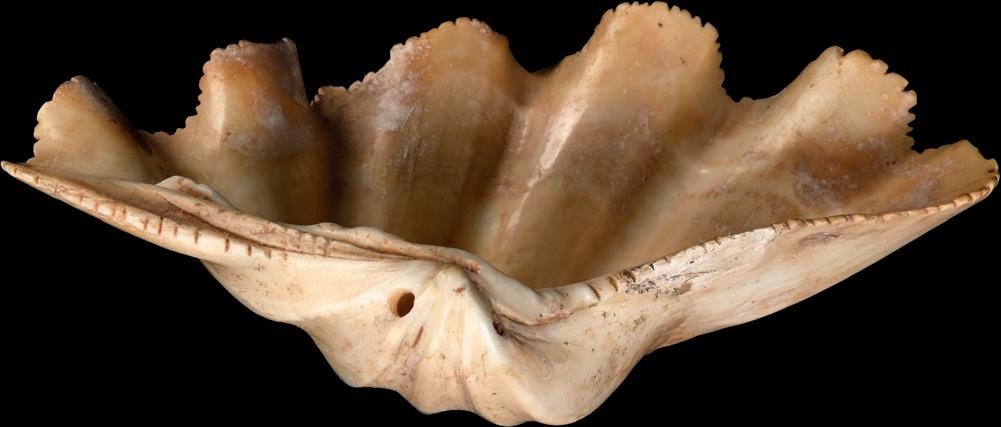
72 PHOENICIAN SHELL COSMETIC VESSEL WITH CARVED EYES
CIRCA 7TH-6TH CENTURY B.C.
5¾ in. (110 grams, 14.6 cm)
A tridacna squamosa shell with drilled eyes on the apex, the edges decorated with parallel cuts.
£1,000 - 1,400
PROVENANCE:
Acquired before 1983. Ex London gallery, 1990s. Private collection, London, UK.
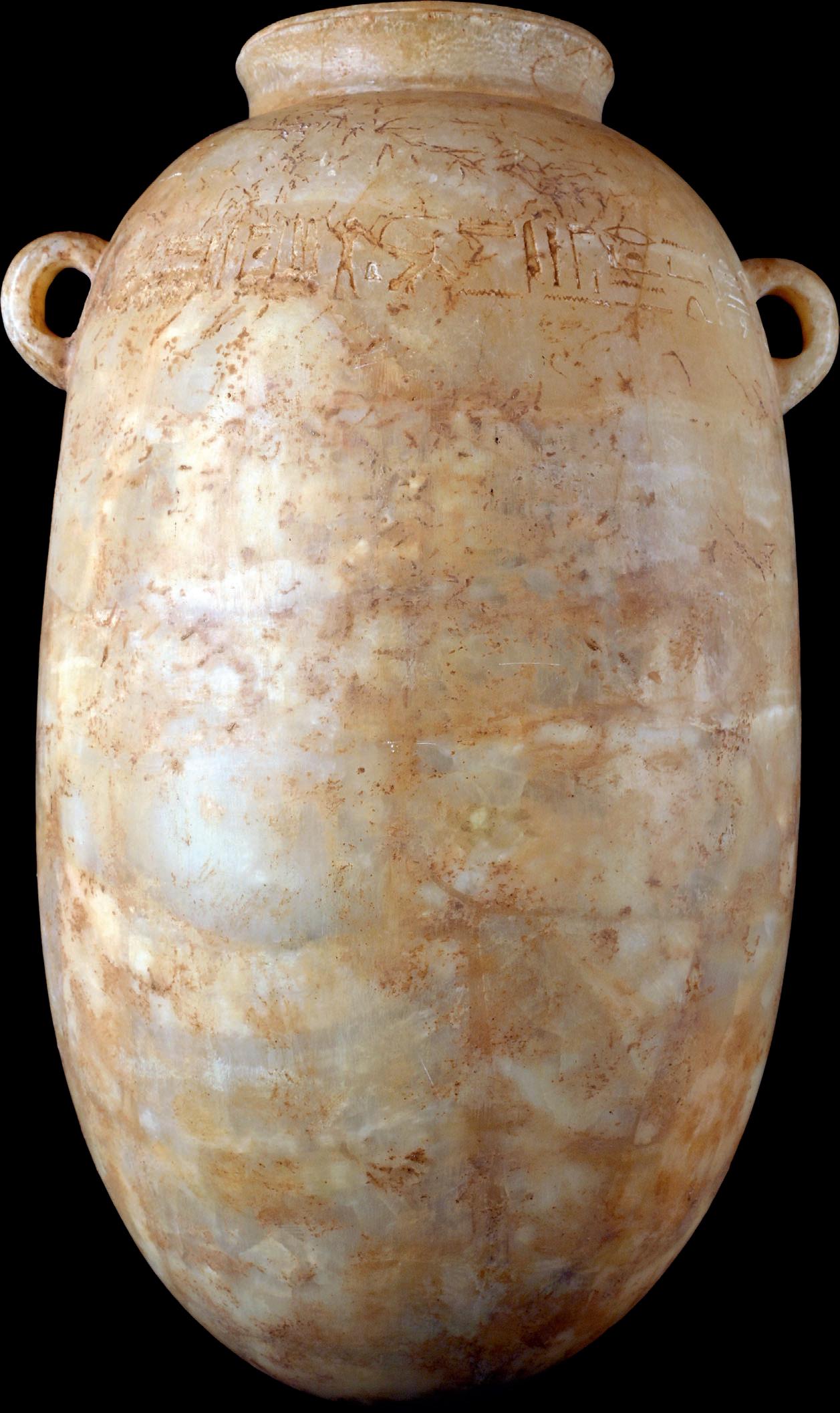
LARGE PHOENICIAN ALABASTER ALABASTRON WITH HIEROGLYPHIC INSCRIPTION ‡
CIRCA 600 B.C.
14 in. (420 grams, 37 cm)
Barrel-shaped in profile with a rounded base, broad shoulder and flared mouth, two lateral integral loop handles; incised hieroglyphic legend to the shoulder.
£15,000 - 20,000
PROVENANCE: Formerly in a private collection, Beirut, Lebanon, 1990s. Swiss private collection, acquired from Mr H., Geneva, 2010.
FOOTNOTES:
In the Phoenician necropolises of Andalusia, the ashes of the deceased were enclosed in luxurious alabaster urns of Egyptian manufacture. In the Phoenician necropolis of Almuñécar, for example, some urns preserved inscriptions and emblems of various Egyptian pharaohs, who ruled the Nile region between the 16th and 8th centuries B.C. Alabaster vessels of this type, originally containing fine wines, have been discovered, albeit in smaller numbers, in the royal palaces of Assur and Samaria in the East, as part of war booty or gifts exchanged between royal houses.
74
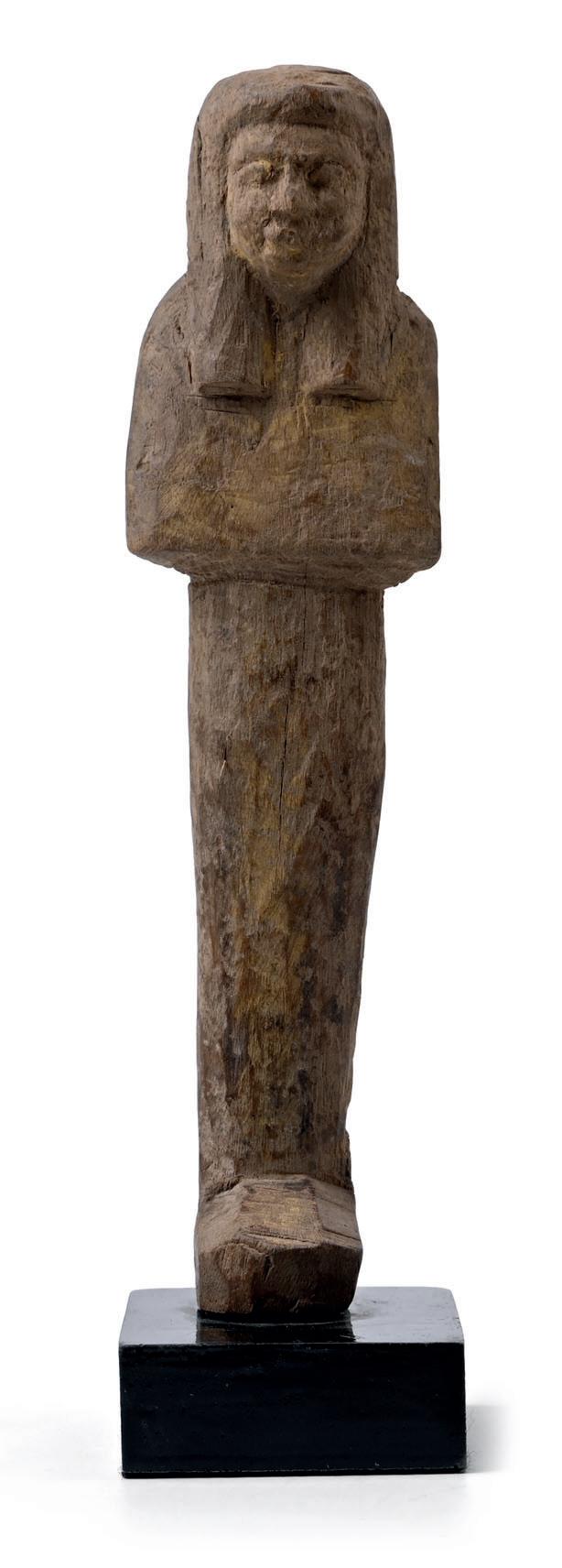
EGYPTIAN WOODEN SHABTI FIGURE
NEW KINGDOM, 19TH DYNASTY, CIRCA 1292-1185 B.C.
8 in. (138 grams total, 21.9 cm including stand)
Typical mummiform figure, carved in the round with folded arms, wearing a tripartite wig; remains of gesso on the surface; mounted on a wooden base.
£800 - 1,000
PROVENANCE:
Ex Budo Bleb (1940-2022) collection, Berlin, formed 1960s onwards.
75
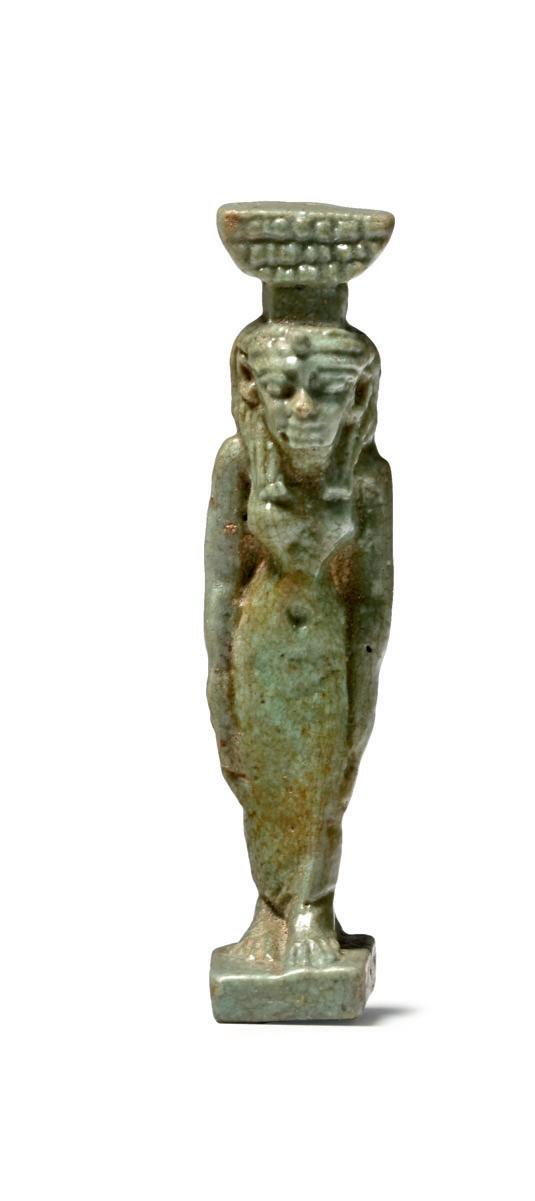
EGYPTIAN GREEN GLAZED FAIENCE AMULET OF NEPHTHYS
LATE PERIOD, 664-332 B.C.
1½ in. (2.62 grams, 37 mm)
Depicting the goddess Nephthys wearing the two hieroglyphic parts of her name (Neb(et)-Hut), with dorsal pillar and base.
£400 - 600
PROVENANCE: with Bizhan Soumekh, 14 September 1981. Private collection, London, UK.
76
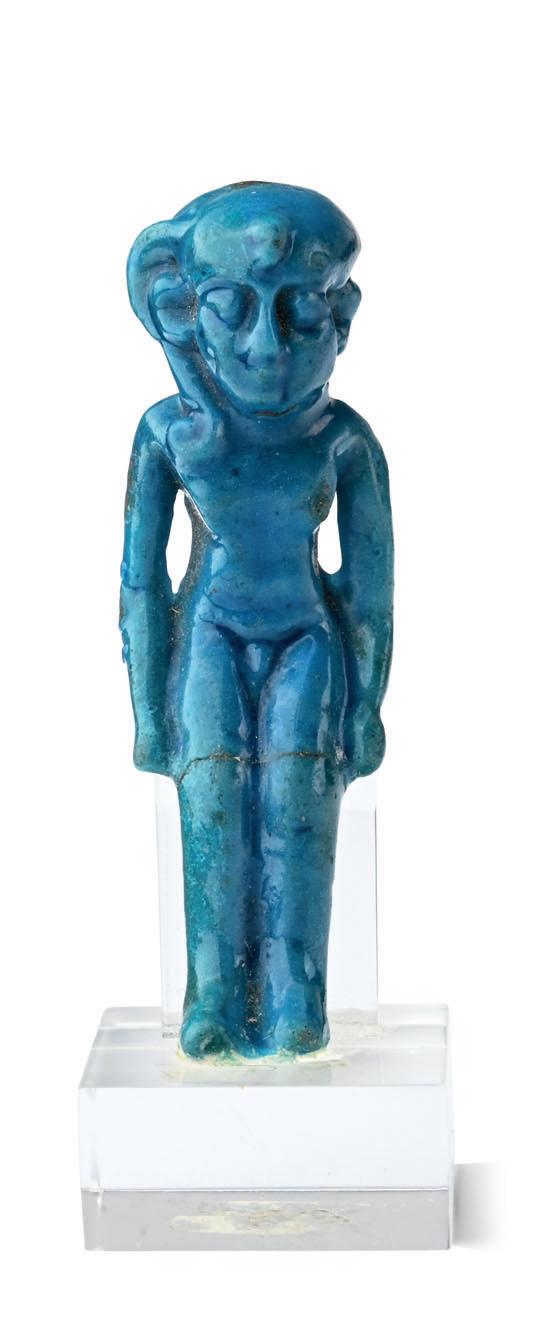
EGYPTIAN TURQUOISE-GLAZED SEATED HARPOCRATES
LATE PERIOD, 664-332 B.C. OR LATER
2 in. (10.09 grams total, 52 mm including stand)
Modelled in the round, depicted in a seated pose with bold sidelock reaching to the shoulder, uraeus on the forehead; ribbed suspension loop behind the neck; mounted on a custom-made display stand.
£700 - 900
PROVENANCE: Collection of His Excellency Mandou Riaz 1895-1963. Archaeology Auction, Paris, Drouot Montaigne, 11-12 Nov 2001, no.186. Private collection, London, UK.
77
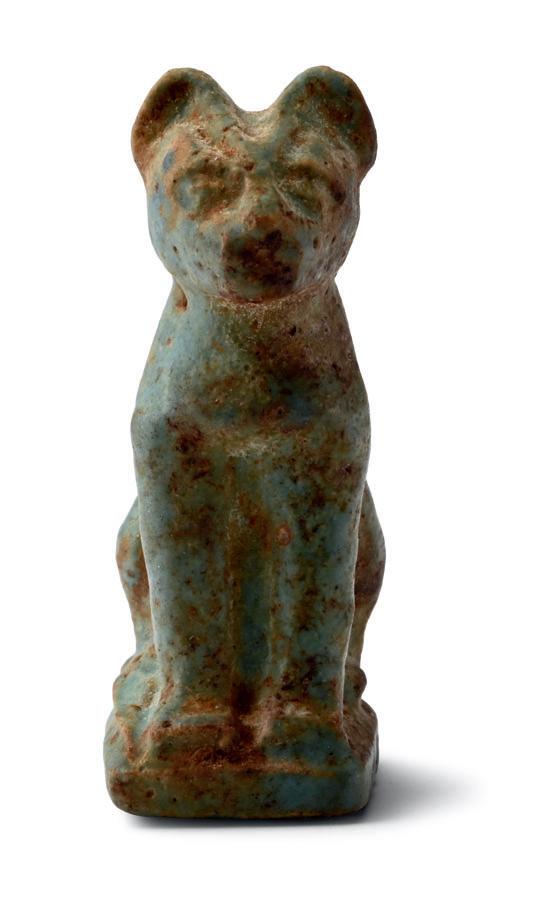
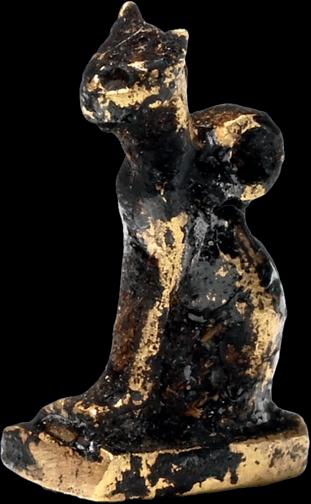
LARGE EGYPTIAN FAIENCE CAT AMULET
LATE PERIOD, 664-332 B.C. 1 in. (12.46 grams, 40.75 mm)
Modelled seated on a tongue-shaped base, with simple facial detailing and suspension loop to the shoulders.
£800 - 1,000
PROVENANCE: Ex early 20th century London, UK, collection.
78
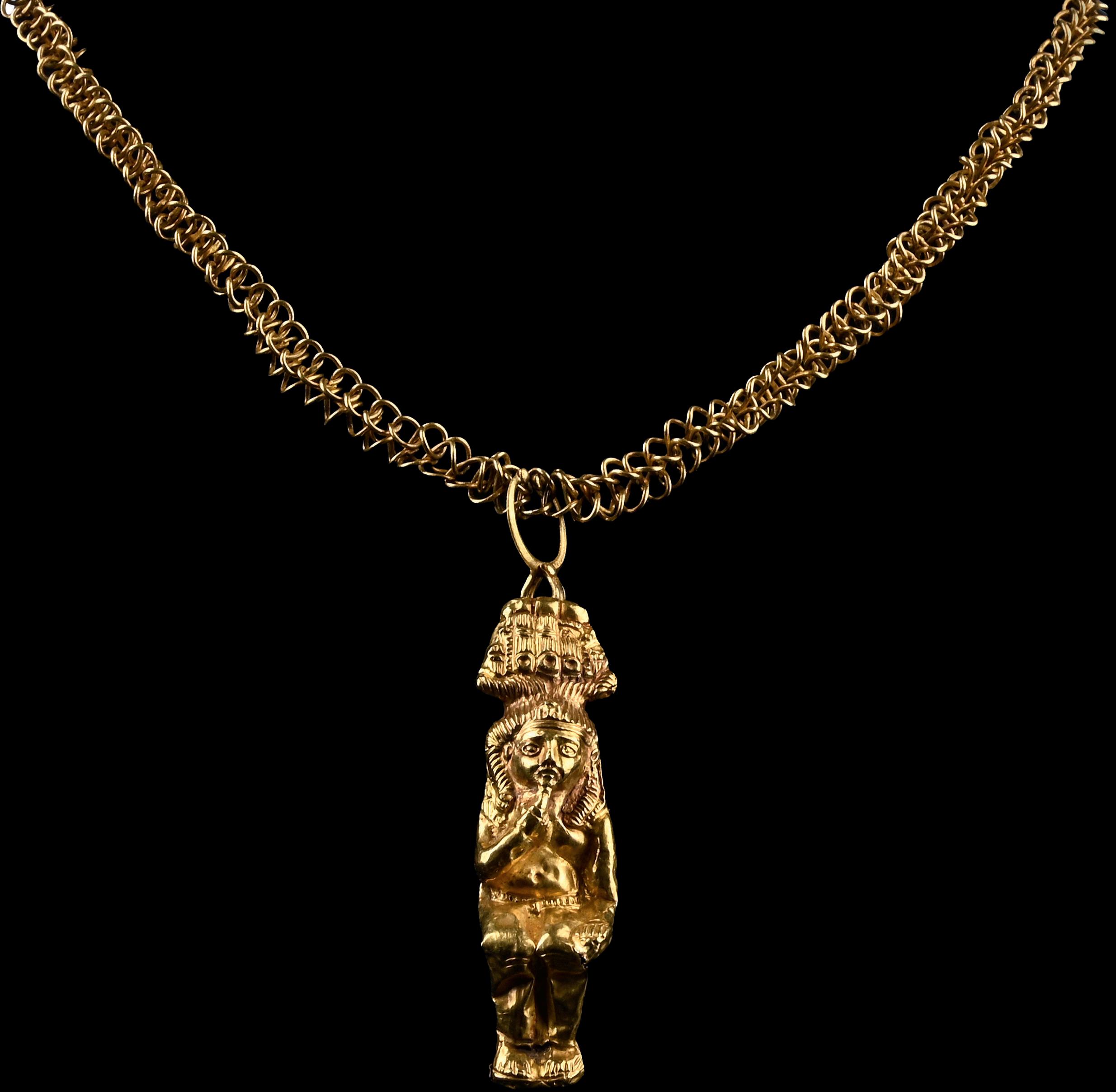
EGYPTIAN GOLD NECKLACE WITH HARPOCRATES PENDANT ‡ ROMAN PERIOD, 1ST CENTURY B.C.-1ST CENTURY A.D. 16 In. (49.80 grams, 40.5 cm)
Gold chain of double-looped links terminating in corrugated end elements, with hook-and-eye clasp; suspension ring embellished with applied granulation and a ribbed loop; hollow-formed sheet-gold pendant in the round depicting Harpocrates seated, his right forefinger raised to his mouth, wearing a finely detailed nemes headdress surmounted by a complex hemhem, crown incorporating multiple hedjet elements, flanking uraei, and ram’s horns.
£15,000 - 20,000
PROVENANCE: Ex Elie Boustros collection, Lebanon. Private collection, acquired in the late 1980s-early 1990s; thence by descent.
FOOTNOTES:
The fully three-dimensional modelling of the pendant aligns it with a group of high-quality Roman-period Egyptian goldwork characterised by pronounced plasticity and sculptural ambition. A pertinent comparison may be drawn with the gold diadem depicting Serapis from the Dush Treasure, discovered concealed within the wall of a Roman fort in the Baris Oasis (Reddé, M., Douch IV. Le trésor de Douch, DFIFAO 28, Cairo, 1992). That assemblage, plausibly associated with a nearby temple of Serapis and Isis, demonstrates a similarly bold treatment of divine imagery in precious metal. Comparable small-scale representations of Harpocrates in gold - often amuletic in function - are known from Roman Egypt, though examples combining such intricate crown iconography with fully rounded modelling remain relatively rare. The present piece therefore occupies an interesting position between personal adornment and cultic or apotropaic object, reflecting both Alexandrian iconographic synthesis and provincial workshop virtuosity. Harpocrates is the Greek version of the Egyptian Hor-pa-khered, which means ‘Horus the Child’. This name refers to Horus as the divine infant of Isis and Osiris. Wearing an amulet of Harpocrates was believed to provide the same protection that Isis offered to her beloved son.
79
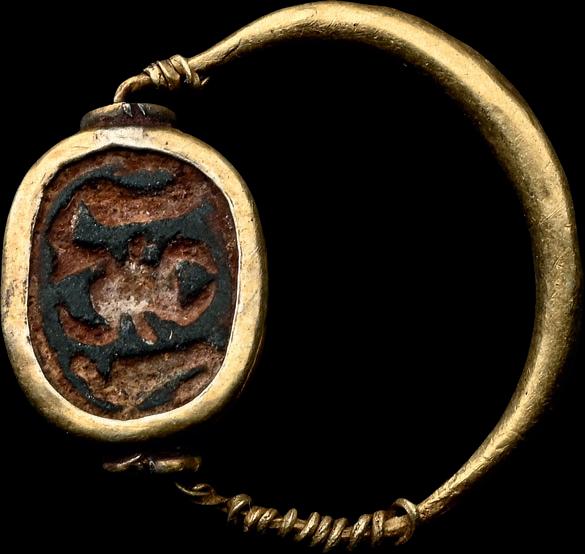
EGYPTIAN GOLD SWIVEL RING WITH GREEN JASPER HEDGEHOG SCARABOID ENGRAVED WITH A SCARAB FLANKED BY TWO COBRAS NEW KINGDOM, 1570-1070 B.C.
¾ in. (1.67 grams, 19.01 mm overall, 16.18 mm internal diameter (approximate size British D½, USA 2, Europe 1.78, Japan 1))
Penannular hoop with swivel mount and frame; inset stylised hedgehog scaraboid featuring large, round ears and a protruding snout, with the underside bearing an incuse scarab flanked by rearing snakes.
£500 - 700
PROVENANCE: UK private collection before 2000. Acquired on the UK art market. Private collection, London, UK.
80
EGYPTIAN GOLD BASTET SEATED CAT AMULET LATE NEW KINGDOM-THIRD INTERMEDIATE PERIOD, CIRCA 1069-900
B.C.
¼ in. (0.51 grams, 8 mm)
Modelled seated on a tongue-shaped base, with simple facial detailing and suspension loop to the back.
£400 - 600
PROVENANCE: Ex French collection, early 20th century.
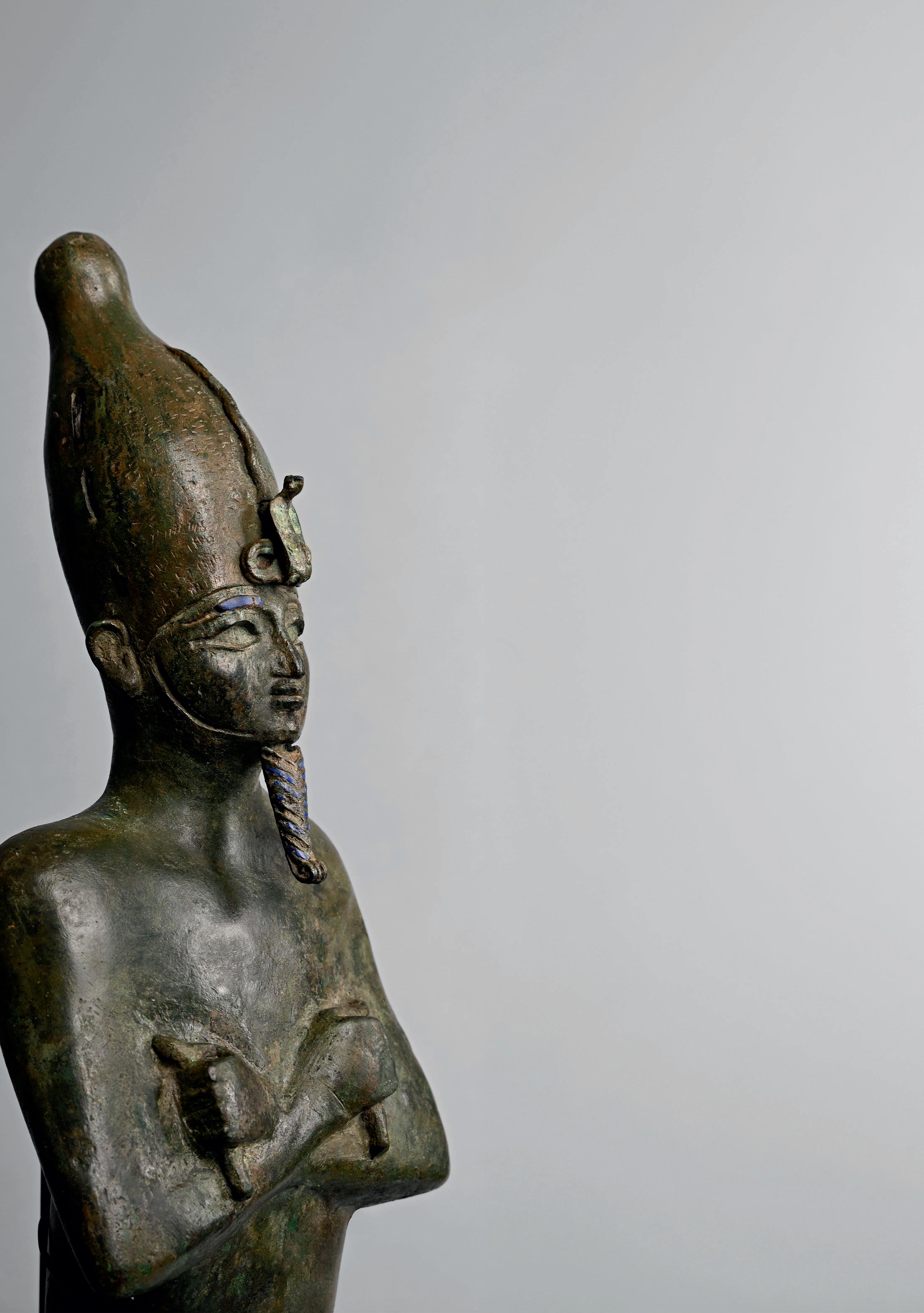
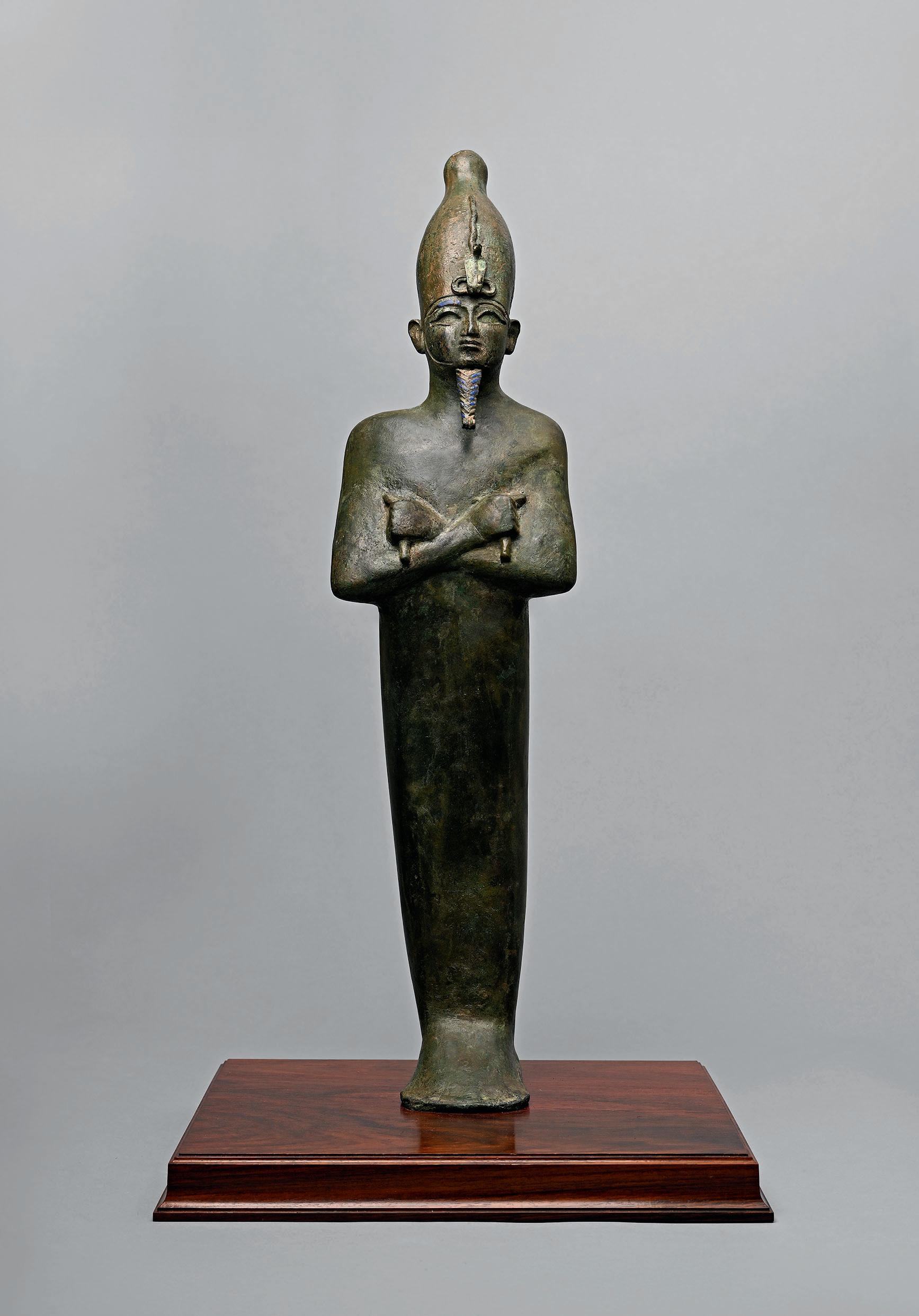
LARGE EGYPTIAN BRONZE FIGURE OF OSIRIS WITH LAPIS LAZULI INLAYS
LATE PERIOD, 664-525 B.C.
35¼ x 14 x 16 in. (27 in.) (19 kg total, the case: 89.5 x 36 x 41 cm (10.65 kg total, 69.5 cm high including stand))
Standing mummiform figure of Osiris wrapped in a body-hugging shroud; the figure wearing a tall Hedjet crown – representing the central element of Osiris’s lateral plume-flanked Atef crown; three vertical slots visible on either side of the preserved crown represent the mortices for the attachment of the separately cast plumes; a raised uraeus at the front of the crown, with a body coil on each side and a slightly undulating tail extending vertically up the crown; the broad face rendered with deeply recessed eyebrows, one still retaining a portion of lapis-lazuli inlay, almond-shaped eyes deeply recessed for inlay, a straight nose, and a small, closed mouth; once inlayed chin straps run from the temples to the chin, where a separately cast divine beard is attached, with deep chevron-like recesses, some retaining traces of blue inlay; arms crossed over the chest, with the hands emerging from the wrappings to hold the god’s traditional attributes – the crook (heka) and flail (nekhakha) – of which only the lowest portions are visible; holes for insertion of the separately fashioned upper parts present at the top of the fists; mounted on wooden base and supplied with custom fitted case.
£80,000 - 100,000
PROVENANCE: with Seiyou Kobijyutsu, Osaka, Japan, 20th century.
The acquisition was facilitated by Ichikawa Kiyoshi (September 1897–1976), a prominent consultant to the firm at the time.
Private Japanese collection, Kumamoto, Kyushu, Japan, acquired in the 1960s by a medical doctor residing in Kumamoto, reportedly on the recommendation of Ichikawa Kiyoshi; thence by descent within the family until 2023.
Accompanied by an academic report by Egyptologist Paul Whelan.
The sculpture is accompanied by a Japanese wooden fitted box bearing the signature and seal (hanko) of Ichikawa Kiyoshi, supporting the attribution and authenticity.
FOOTNOTES:
As the principal god of the underworld, Osiris was worshipped continuously for more than 2,500 years, from the late Old Kingdom to the Roman period. The deity played a central role in Egyptian funerary belief, and his consistently mummiform imagery became widely incorporated into both royal and non-royal iconography. A major phase in the development of his cult occurred during the Middle Kingdom, when Abydos in Upper Egypt emerged as the principal cult centre and an important pilgrimage site for both royal and non-elite individuals. By the Late Period, the influence of the Osirian cult is clearly reflected in the material record, most notably in the widespread distribution of bronze statuettes across temple sites in Egypt. While such objects are often interpreted as expressions of personal devotion, their standardised forms and large-scale production may equally point to more formalised, institutionally mediated ritual practices.
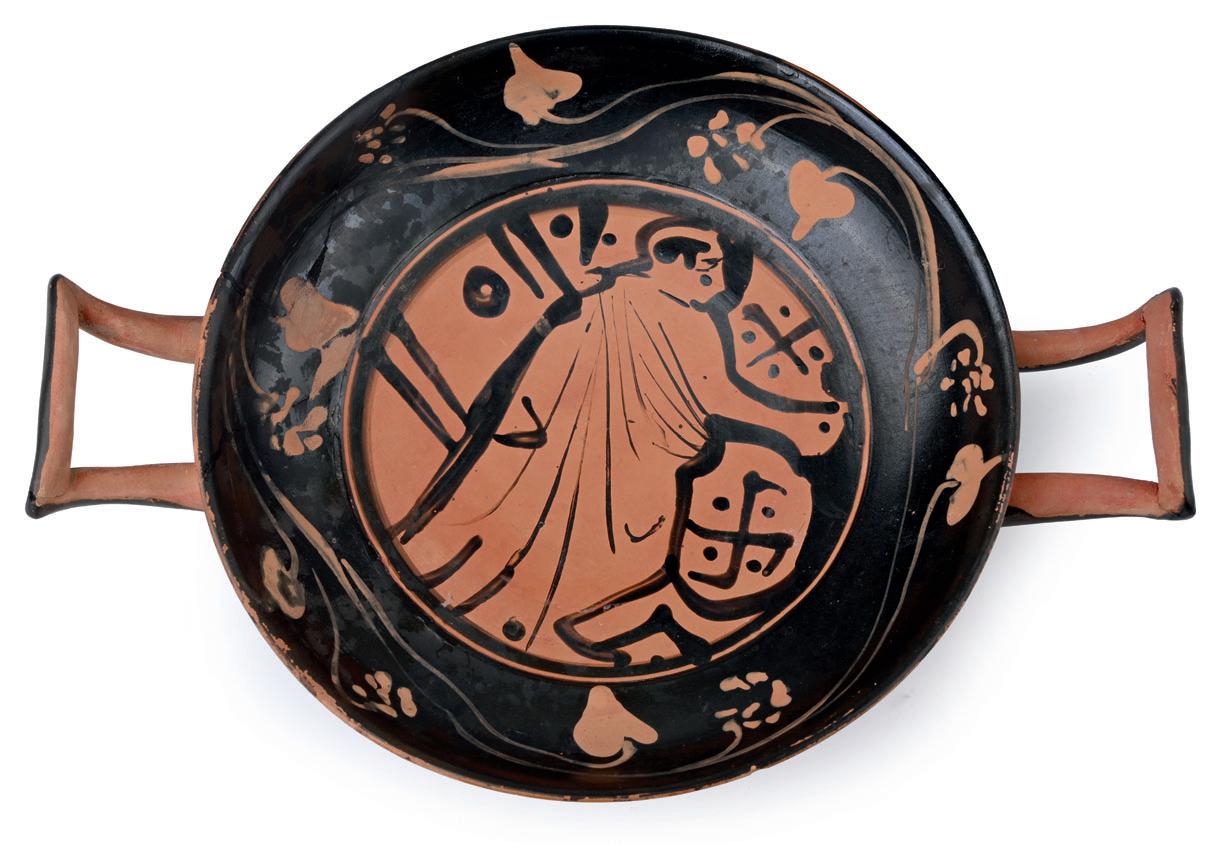
82
GREEK RED-FIGURE KYLIX WITH YOUTH IN THE TONDO FROM THE GROUP OF VIENNA 116
ATTIC, CIRCA 375-350 B.C.
8 in. (220 grams, 22 cm wide)
Broad and shallow with two strap handles; ivy leaves and berries on the inside rim, tondo with cloaked figure surrounded by geometric motifs; outside with palmettes, scrolls and other motifs; repaired.
£1,000 - 1,400
PROVENANCE:
Acquired on the art market between the late 1990s and mid-2000s. Estate of the late Barry Paul Buxton (1944-2024), Oakham, Rutland. Acquired on the UK art market, 2025.
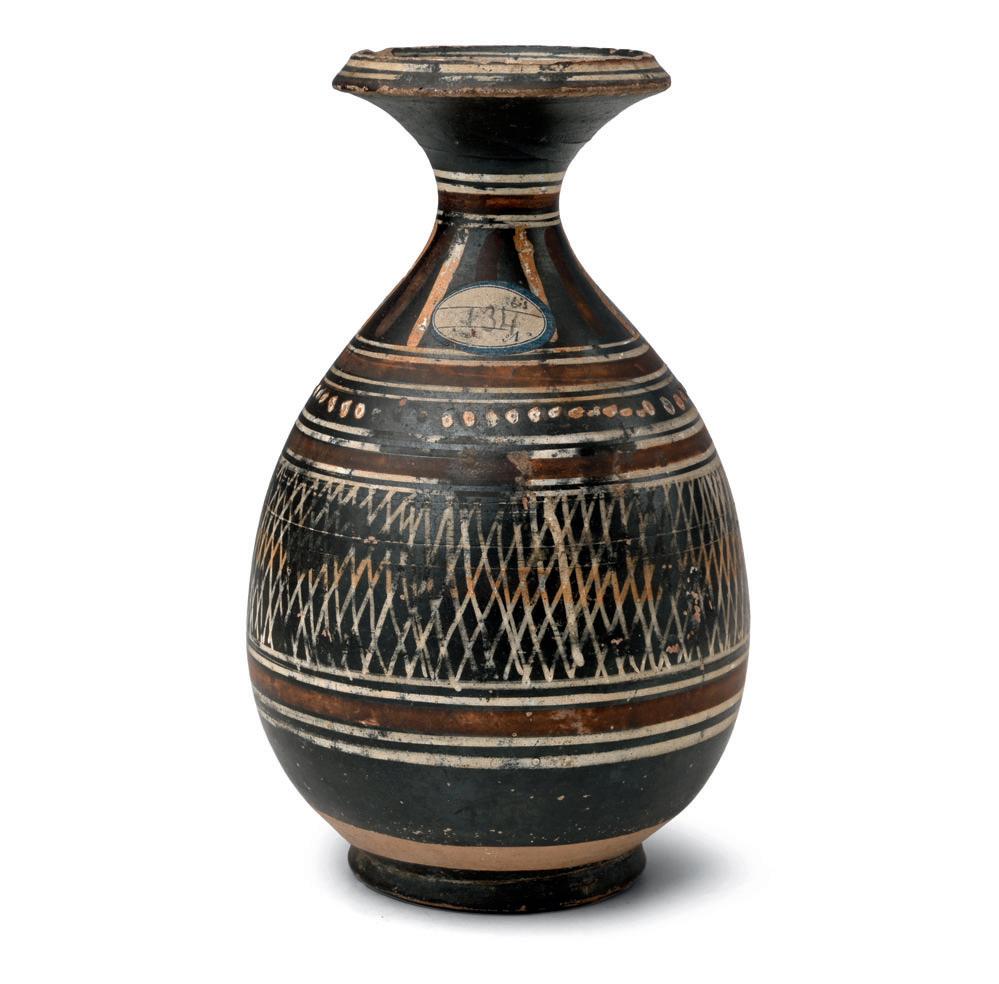
84
GREEK TERRACOTTA GNATHIAN-WARE ALABASTRON ‡ APULIAN, CIRCA 3RD CENTURY B.C.
5¼ in. (255 grams, 14.5 cm)
Piriform in profile with a carinated rim to the mouth, a low basal ring; horizontal bands and a hatched panel, concentric rings.
£1,000 - 1,400
PROVENANCE: Louis-Gabriel Bellon (1819-1899) collection, France. European private collection, 2009.
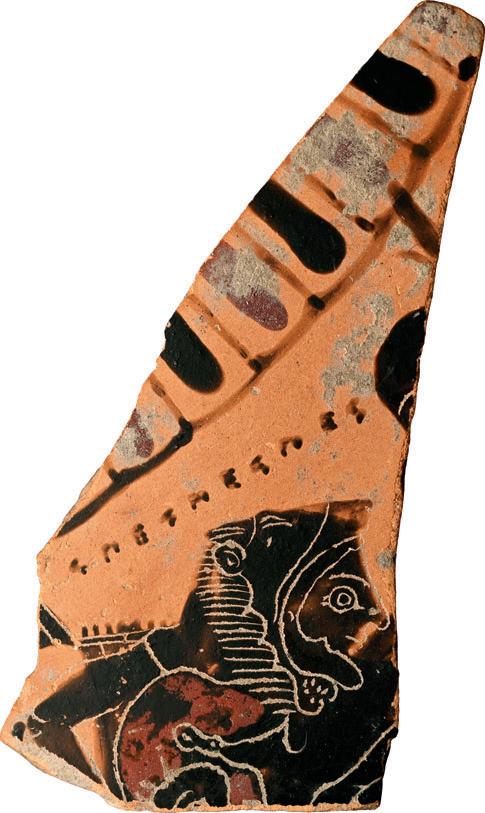
83
GREEK POTTERY SHERD WITH INSCRIPTION ABOVE HERCULES WRESTLING A WARRIOR
ATTIC, CIRCA 5TH CENTURY B.C.
2½ in. (8.37 grams, 64 mm)
Fragment from a large vessel showing Hercules wearing the Nemean lion skin in close combat with a bearded warrior, Greek inscription above.
£400 - 600
PROVENANCE: From an old Belgian collection, circa 2000.
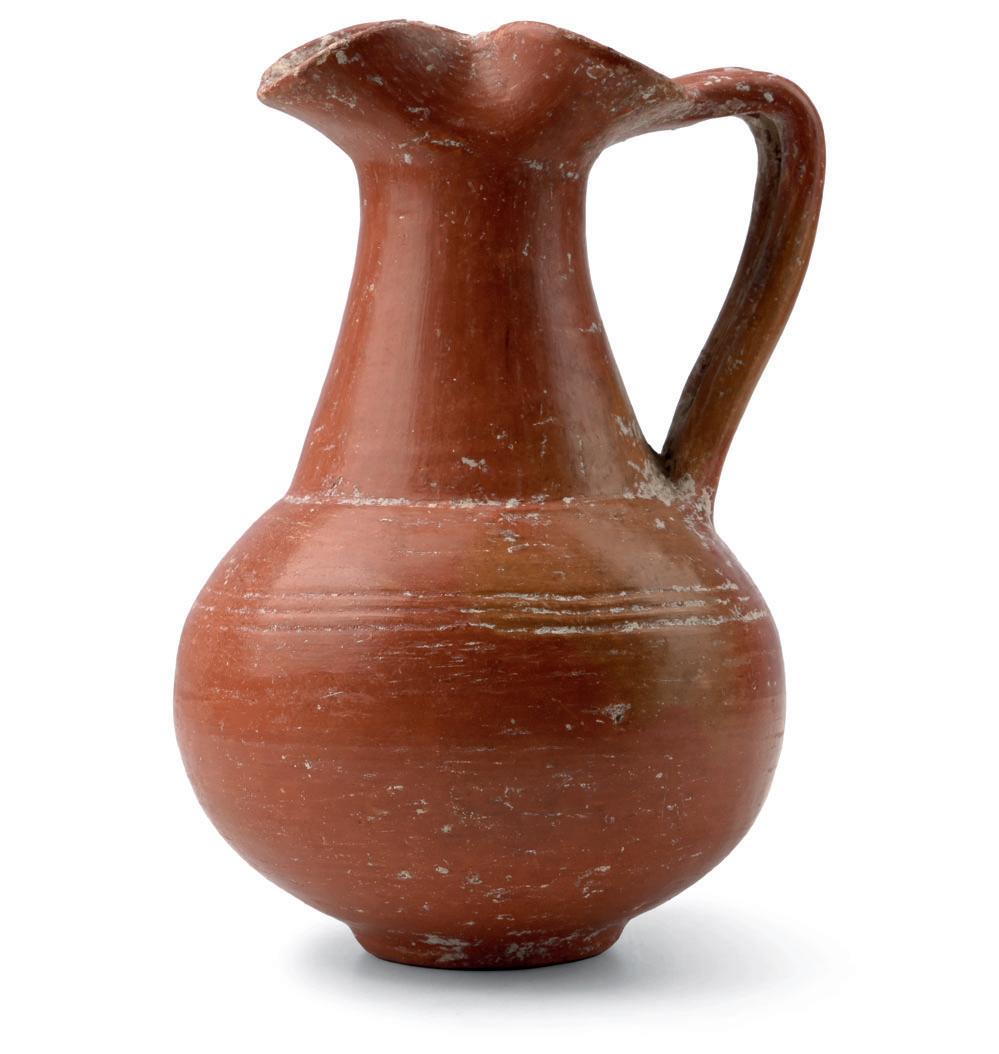
85
GRAECO-PHOENICIAN GLAZED TERRACOTTA OINOCHOE ‡ 7TH CENTURY B.C.
6 in. (491 grams, 17 cm)
With a folded trefoil mouth, an applied ribbed handle and basal ring, and incised concentric rings above the equator.
£800 - 1,000
PROVENANCE: Private collection, acquired in the late 1980s-early 1990s; thence by descent.
86
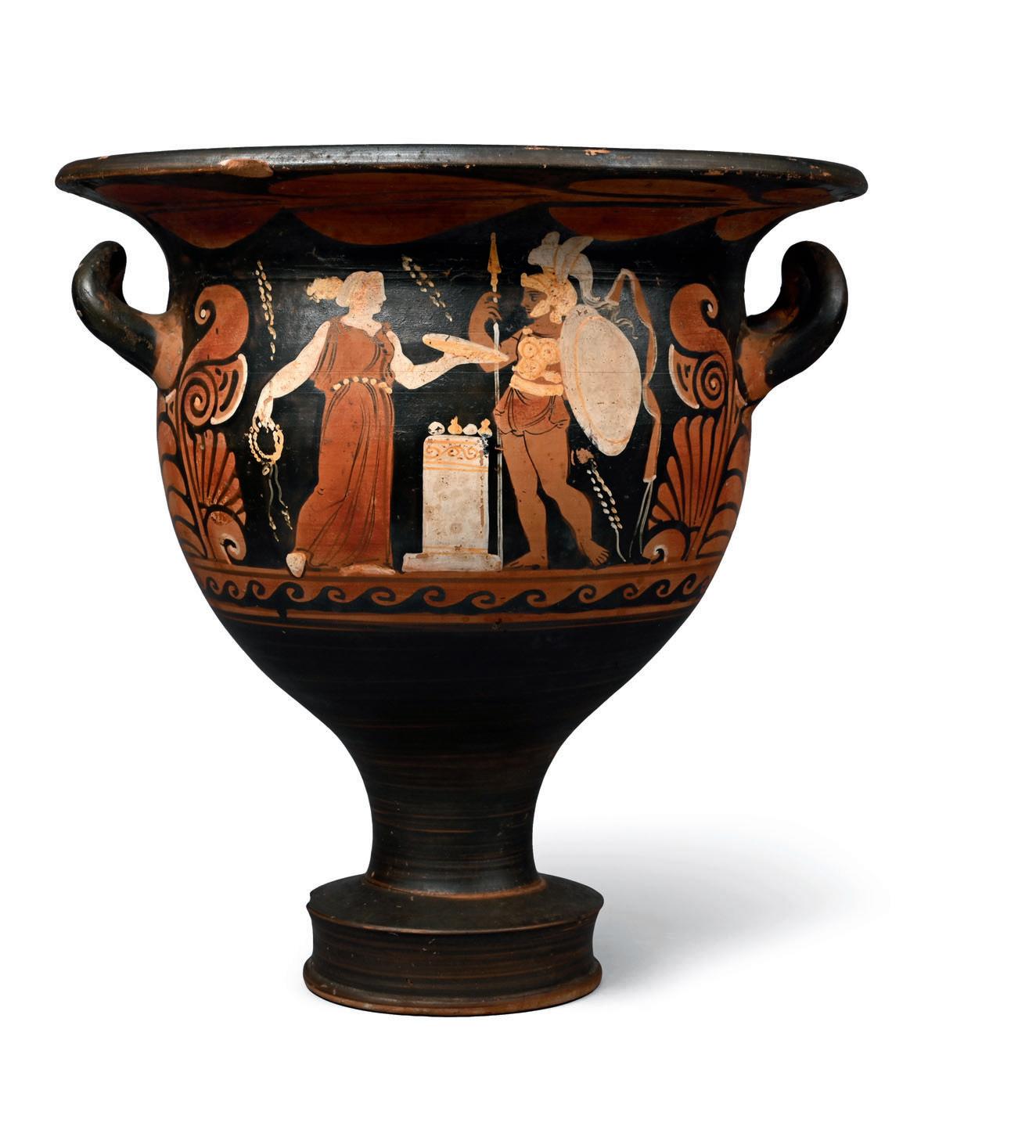
GREEK RED-FIGURE BELL KRATER WITH WARRIOR FUNERARY OFFERING SCENE, ATTRIBUTED TO CA PAINTER ‡ CAMPANIAN, 350-300 B.C.
11 in. (2.38 kg, 29.5 cm high)
Comprising a bell-shaped body with narrow stem and stepped pedestal foot, broad rim with square loop handles and palmettes beneath, frieze to sidewall: Side A: Oscan warrior with cuirass, helmet, shield and spear standing beside an altar with a female holding a patera in her extended hand, diadem in the other at her side; Side B: seated female with a patera and wreath facing a standing cloaked figure with thyrsus
£5,000 - 7,000
PROVENANCE:
Private collection, Geneva, acquired in the late 1960s. Private collection, acquired in Geneva in 2000.
Accompanied by collector’s notes and old images.
Accompanied by an original copy thermoluminescence analysis report no.QED1412/.SG-0602 from QED Laboratoire.
Accompanied by an academic report by Dr Raffaele D’Amato.
FOOTNOTES:
The krater offers an interesting glimpse into the local life of Campania in the 4th century B.C. Particularly noteworthy is the depiction of the Oscan Samnite warrior, fully armed in the style of Campanian, Samnite, or Lucanian mercenaries, performing a funerary sacrifice. The depiction of the Chalcidian helmet, with its central crest and twin lateral plumes (geminae pinnae), dedicated to Mars, is extremely detailed. The style and the way in which the figures are realised, the conformation of the women, the details of the warrior, seem to point to the workshop of the CA Painter, a Campanian red-figure vasepainter whose name is unknown. Nevertheless, consistent individual characteristics of style suggest the existence of a unique artistic personality.
Trendall called him the CA Painter because he was the chief painter in the first stage of Cumaean red-figure vase-painting, the initials standing for Cumaean (C), first stage (A).
87
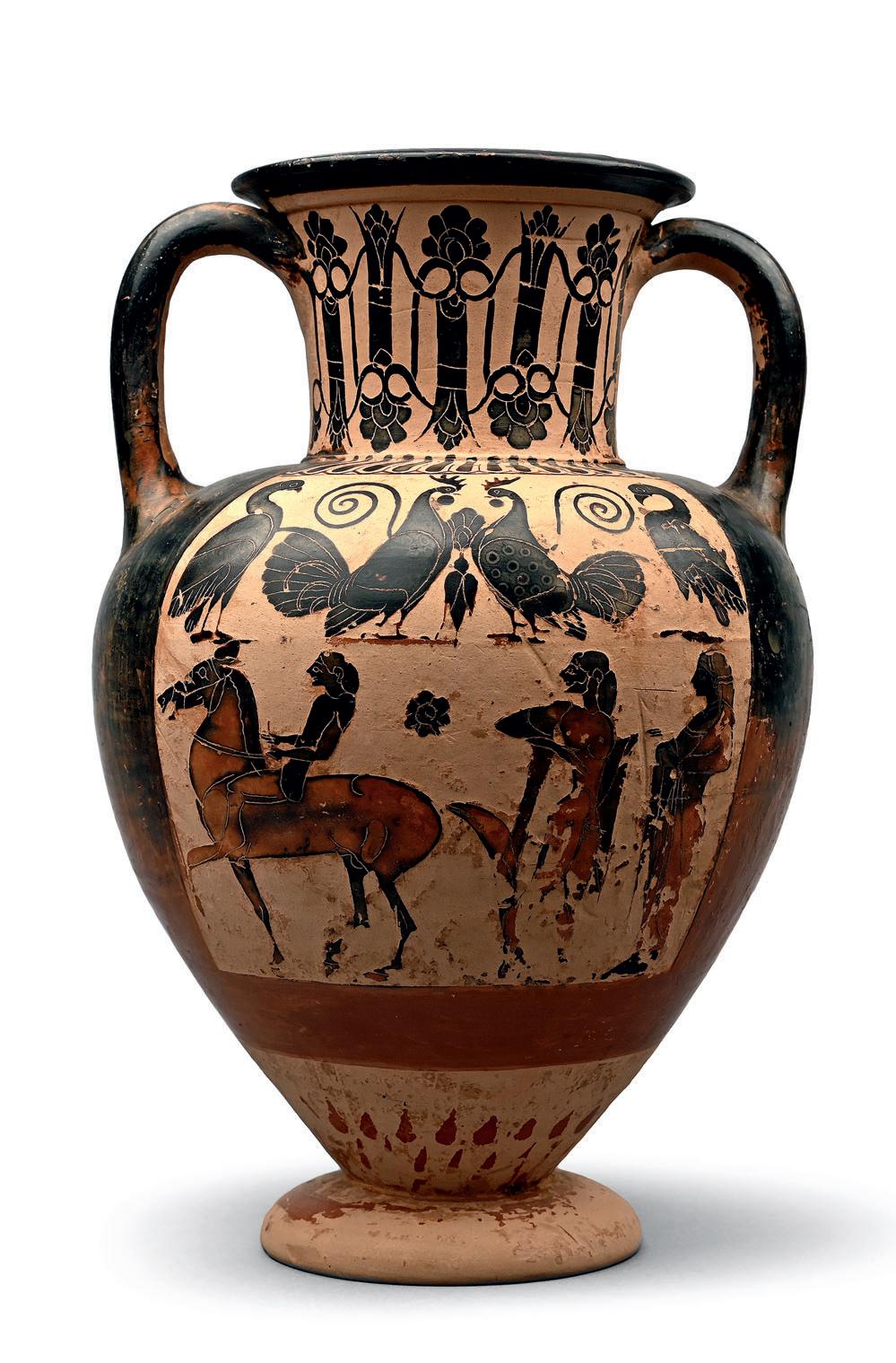
GREEK TERRACOTTA AMPHORA ATTRIBUTED TO THE PHINEUS PAINTER ‡ CHALCIDIAN, CIRCA 525 B.C. 11 in. (1.06 kg, 28 cm)
Piriform body with splayed foot and narrow handles; the neck with slender lotus blossoms and palmettes, Side A) two opposing roosters with a lotus blossom in between, two standing swans flanking, below a youth on horseback holding the reins of a trotting horse, a man and a woman behind the horse; Side B) a grazing deer before an advancing panther looking back, two opposing sphinxes below with their heads turned back and front paws raised.
£4,000 - 6,000
PROVENANCE: Ex Münzen und Medaillen A.G., H. Cahn, Basel, 13 April 1985. Private collection, Bern, Switzerland.
FOOTNOTES:
An important work by the leading master of the ‘Chalcidian’ workshop, which, despite the name, is not to be located in Chalkis itself but rather in a Chalcidian colony in Magna Graecia (possibly Rhegion). Within the oeuvre of Phineus, who is known for his neck-amphorae, examples with two image zones are very rare—see, for example, the fragmentary amphora in the Faina Collection in Orvieto, with similar sphinxes.
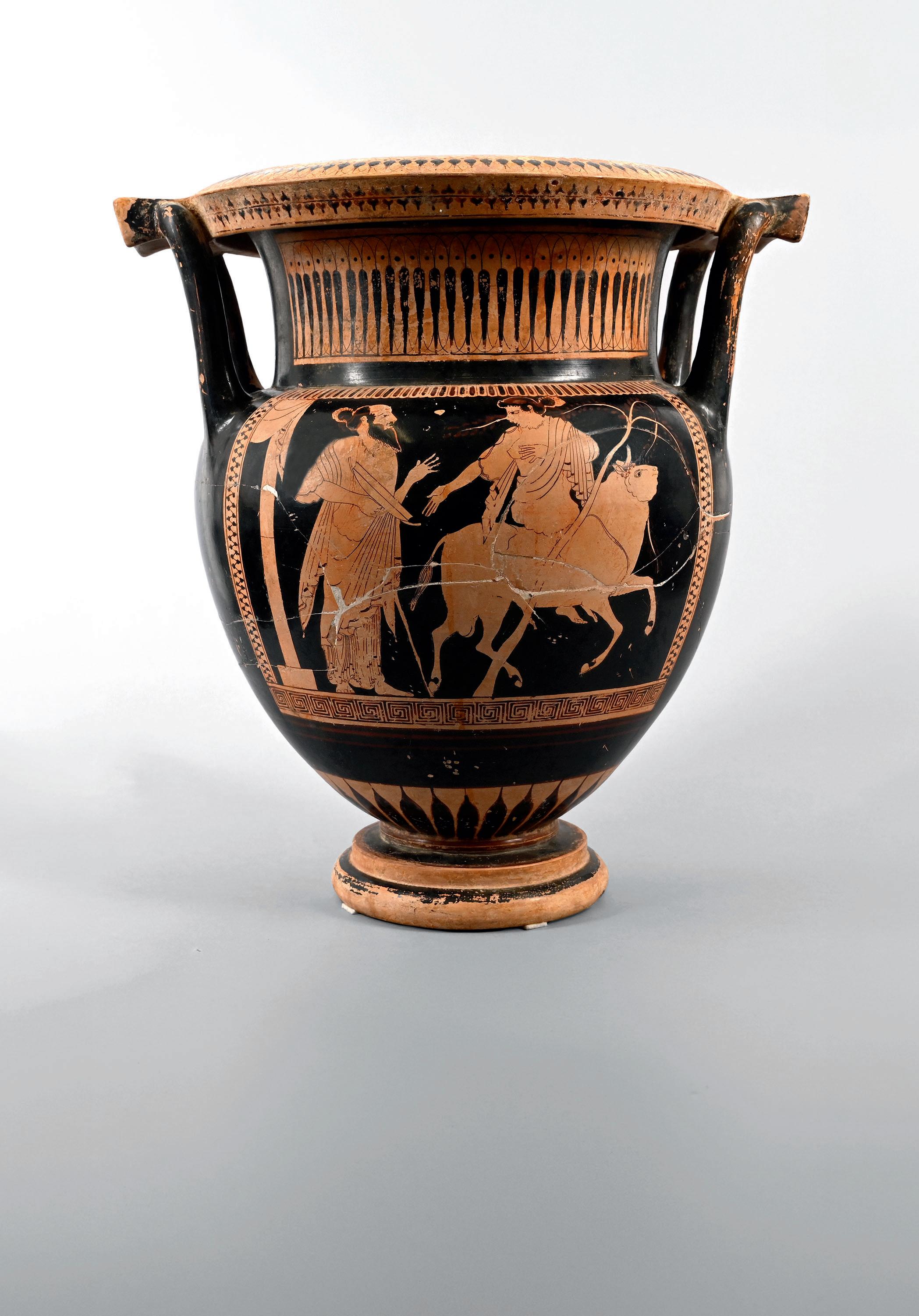
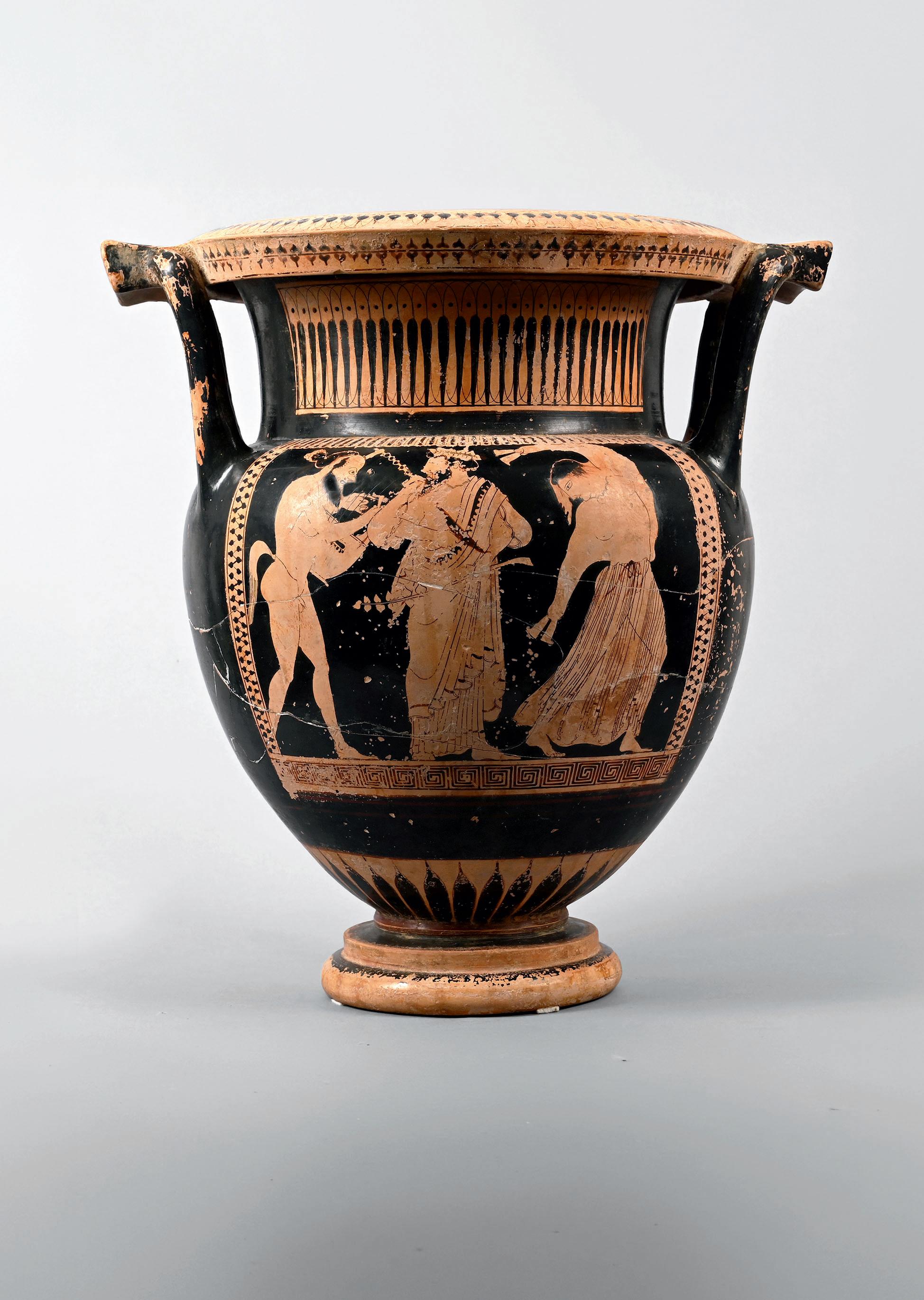
GREEK RED-FIGURE COLUMN KRATER WITH BULL AND RIDER ‡ ATTIC, 5TH CENTURY B.C.
17½ in. (5.85 kg, 44.5 cm high)
With a flared and stepped foot, poppy-head border around the lower body and neck, strap handles with palmettes to the upper faces opening to two columnar legs; red-figure scenes to the neck and body: Side A, Europa’s abduction: standing bearded figure in profile wearing a loose himation holding the lid of a krater in one hand facing a female figure in draped himation revealing one breast, turning to face the male while mounted on an advancing bull and carrying a frond; Side B, Dionysiac scene: satyr standing nude, playing a lyre beside a standing robed male wearing a laurel wreath in his hair, dancing female in active pose with musical instruments in each hand, turning to face the robed figure; some restoration.
£30,000 - 40,000
PROVENANCE: German private collection (870632).
Anonymous sale, Hampel Fine Arts auction, Munich, 21 September 2012, no.625.
Private collection, acquired on the German art market.
Accompanied by an academic report by Dr Jacques Chamay.
FOOTNOTES:
The two figurative scenes are of equal importance. The Dionysian one depicts the god, in the centre, between a satyr playing a lyre and a dancing maenad. The other scene depicts a well-known subject: the abduction of Europa. This is the daughter of Agenor, king of Tyre in Phoenicia. Of great beauty, she is desired by Zeus. He approaches her in the form of a white bull while she is playing on the beach. Initially frightened, the young woman begins to caress the animal, then becomes more daring and climbs onto its back. Zeus immediately abducts her and rushes out to sea, toward Crete. There, he will be united with Europa, who will bear him three children, including Minos.

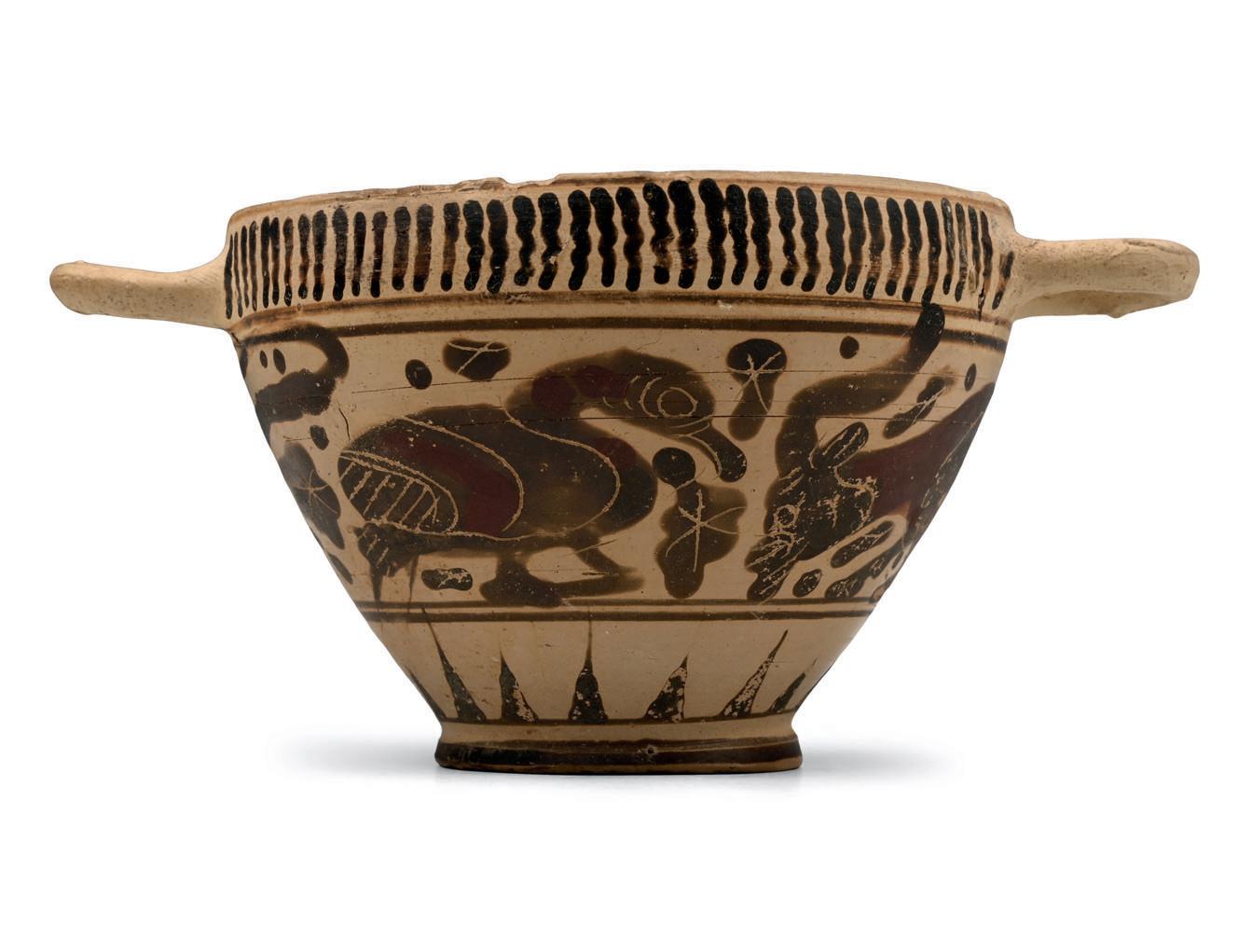
90
GREEK WHITE-GROUND KOTYLE WITH PANTHER, GOAT AND SWAN ‡
CORINTHIAN, 6TH CENTURY B.C.
6 in. (102 grams, 15.1 cm)
Squat in profile with lateral loop handles, vertical stripes to the rim, frieze with a grazing goat, a panther to its rear and a perching swan.
£3,000 - 4,000
PROVENANCE:
Ex private collection, Tokyo, Japan, since the 1980s. Private European collection, acquired in 2010.
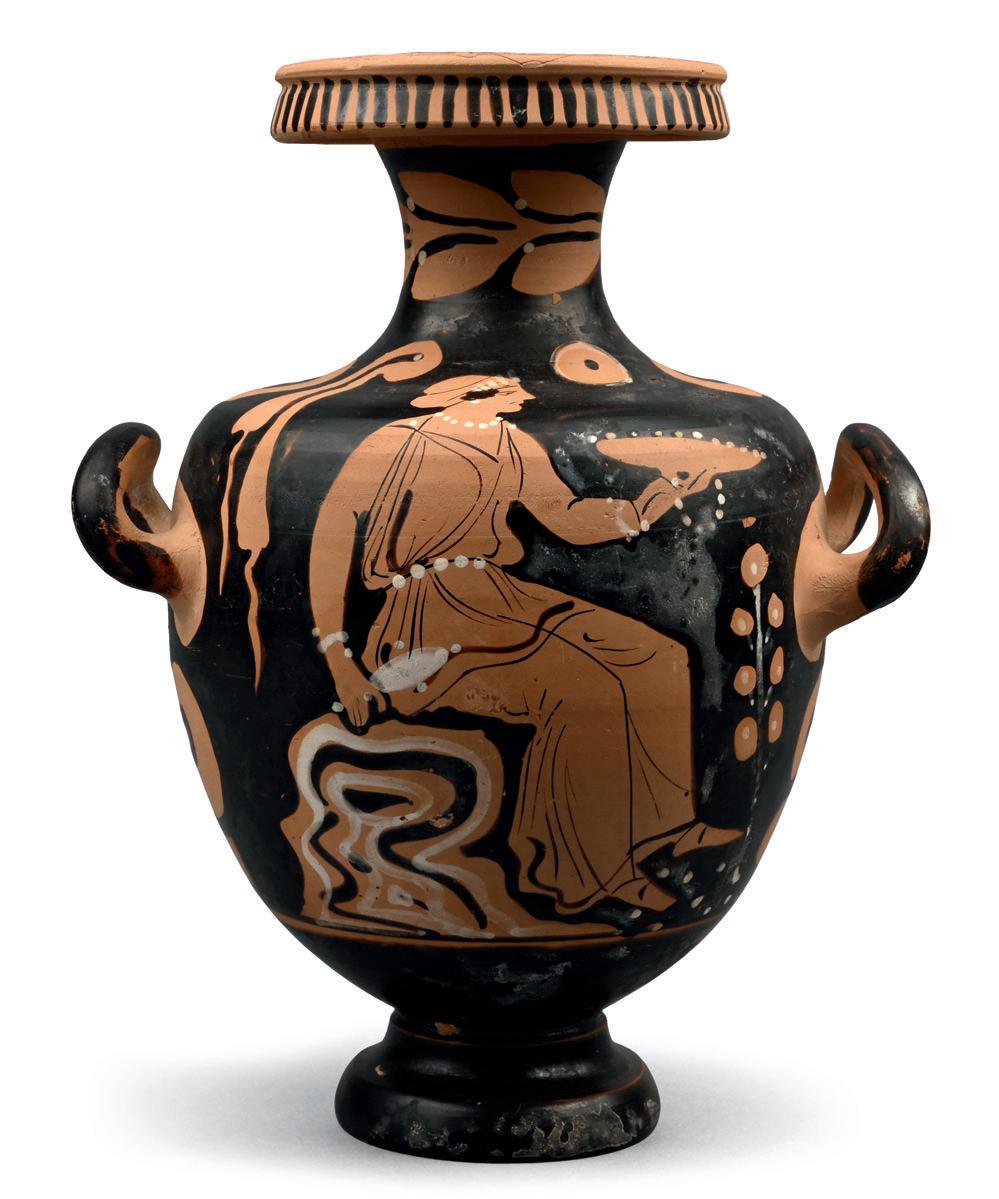
89
GREEK TERRACOTTA RED-FIGURE HYDRIA DEPICTING OFFERING SCENE
APULIAN, 3RD-2ND CENTURY B.C.
9 in. (771 grams, 23 cm high)
With cylindrical body and broad bevelled shoulder, stepped foot, lateral squared loop handles and strap handle to shoulder, broad mouth; Side A: seated female in himation holding an offering bowl in her extended left hand; white detailing to the diadem, necklace, earrings, mirror in her right hand, rim of the bowl and elsewhere; Side B: reserved palmette motif extending to the shoulder and neck; repainted.
£1,200 - 1,700
PROVENANCE:
Acquired on the art market between the late 1990s and mid-2000s. Estate of the late Barry Paul Buxton (1944–2024), Oakham, Rutland. Acquired on the UK art market, 2025.
Accompanied by a thermoluminescence analysis report no.N126a16 from Oxford Authentication.


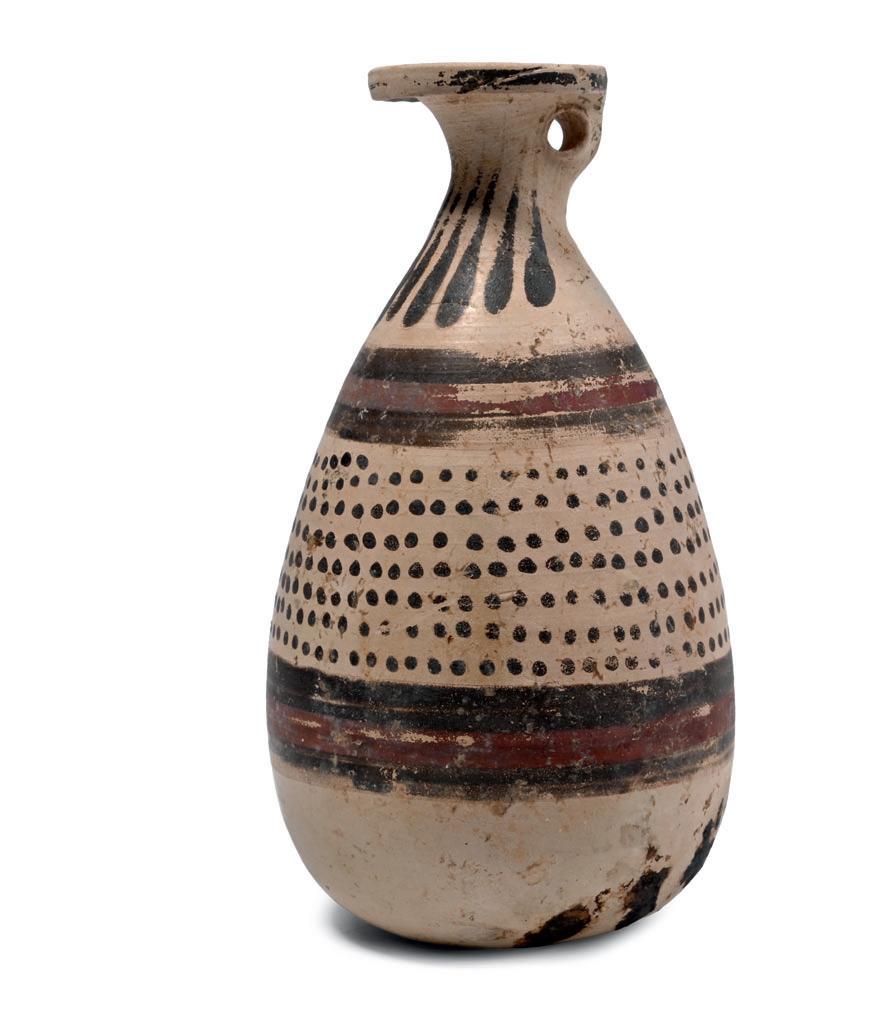
91
GREEK TERRACOTTA ALABASTRON ETRUSCO-CORINTHIAN, CIRCA 6TH CENTURY B.C.
4 in. (88 grams, 11.1 cm)
Piriform body with narrow neck and flaring rim with a small loop handle below, decorated with radiating strokes below the neck, followed by eight rows of dot decoration flaked by red and black circumferential bands.
£400 - 600
PROVENANCE:
From the collection of the late Sir Clinton Charles Donald Cory, 5th Baronet of Coryton.
Ex Philip Auction House, 24 September 1985.
Accompanied by two previous information cards.
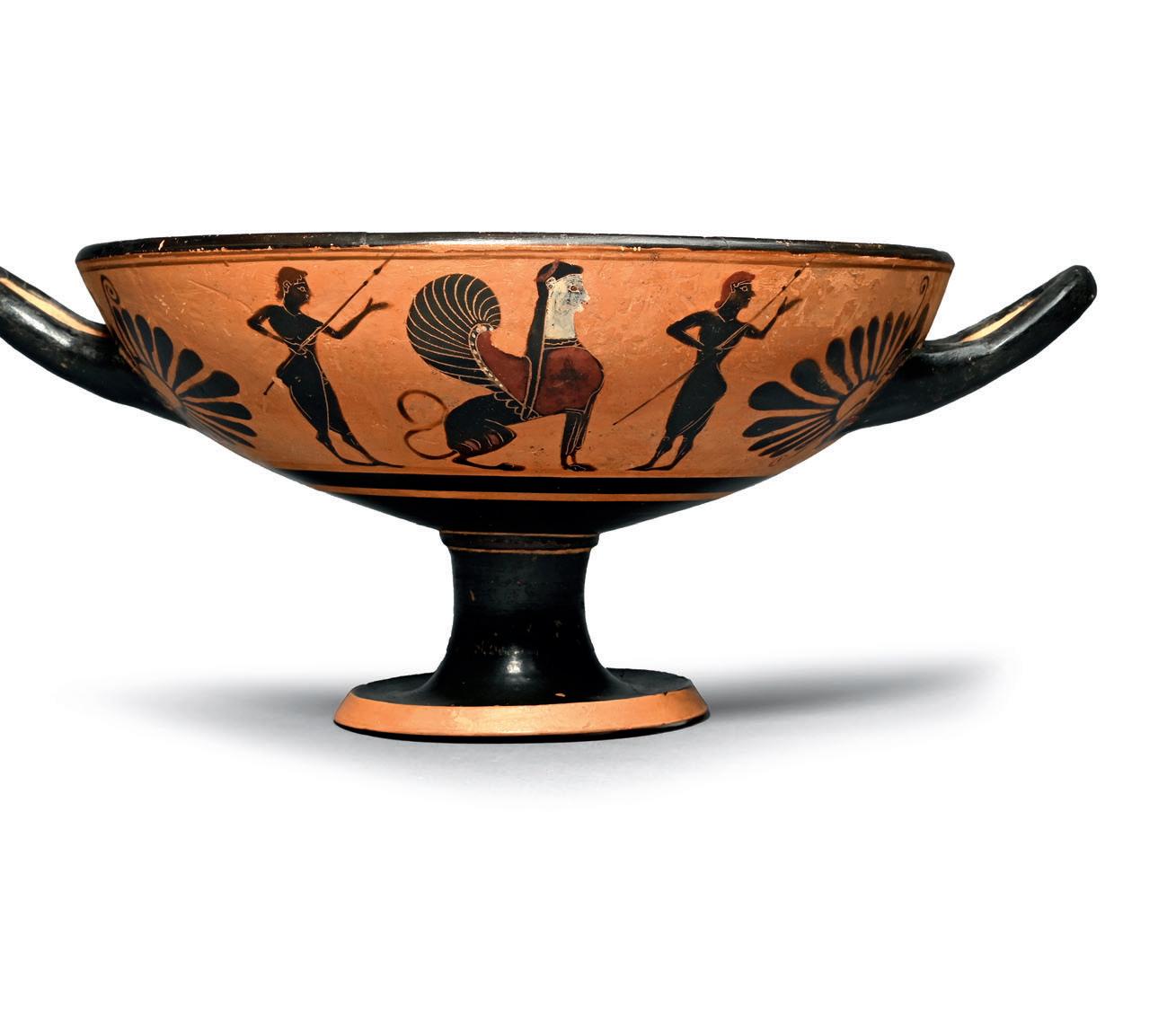
92
GREEK BLACK-FIGURE KYLIX WITH WARRIORS AND SPHINXES
ATTIC, CIRCA 530 B.C.
10¾ in. (414 grams, 27.3 cm wide)
Comprising: a broad shallow bowl with two loop handles curving up towards the rim, short stem and broad foot with chamfered outer edge; the bowl with reserved central disc to inner face, palmette motifs at the junctions of the handles, frieze depicting two standing nude males flanking a crouching sphinx in profile; restored and with old dealer’s labels beneath base.
£7,000 - 9,000
PROVENANCE:
Ex Prof. F.S., Villingen-Schwenningen, Germany, 1991. with Gallery Drees Archeo S.P.R.L., Brussels. Acquired from the above, 16 December 2017.
Accompanied by a Gallery Drees Archeo certificate of authenticity. Accompanied by a thermoluminescence report no.0102 0910 from Laboratory Ralf Kotalla, 6 September 2010.


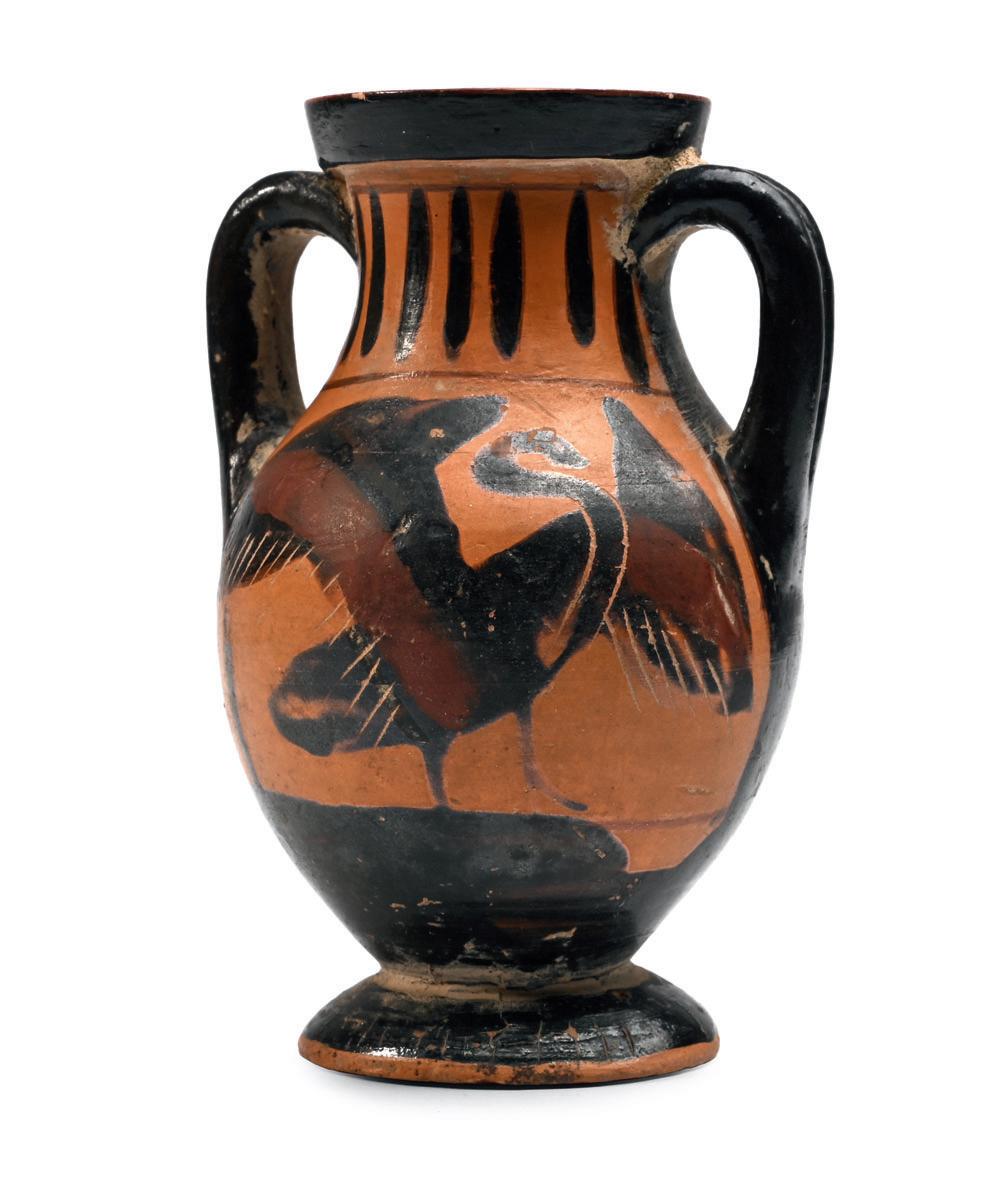
93
GREEK BLACK-FIGURE MINIATURE AMPHORA WITH SWAN ‡
ATTIC, 6TH-5TH CENTURY B.C.
3 in. (57.1 grams, 76 mm)
With two handles and an everted rim; parallel, vertical strokes on the neck and below a swan with its wings open and neck elegantly curved, a staff on the background.
£4,000 - 6,000
PROVENANCE:
Swiss private collection, assembled in the 1960s and 1970s. Acquired by the present owner in 2004.
Accompanied by an academic report by Dr Raffaele D’Amato.
FOOTNOTES:
The swan was a favoured motif in Greek art, admired for its elegance and associations with divinity and beauty. In mythology, the bird was sacred to Apollo, god of music and light, whose chariot was said to be drawn by swans on his annual journey to the land of the Hyperboreans.

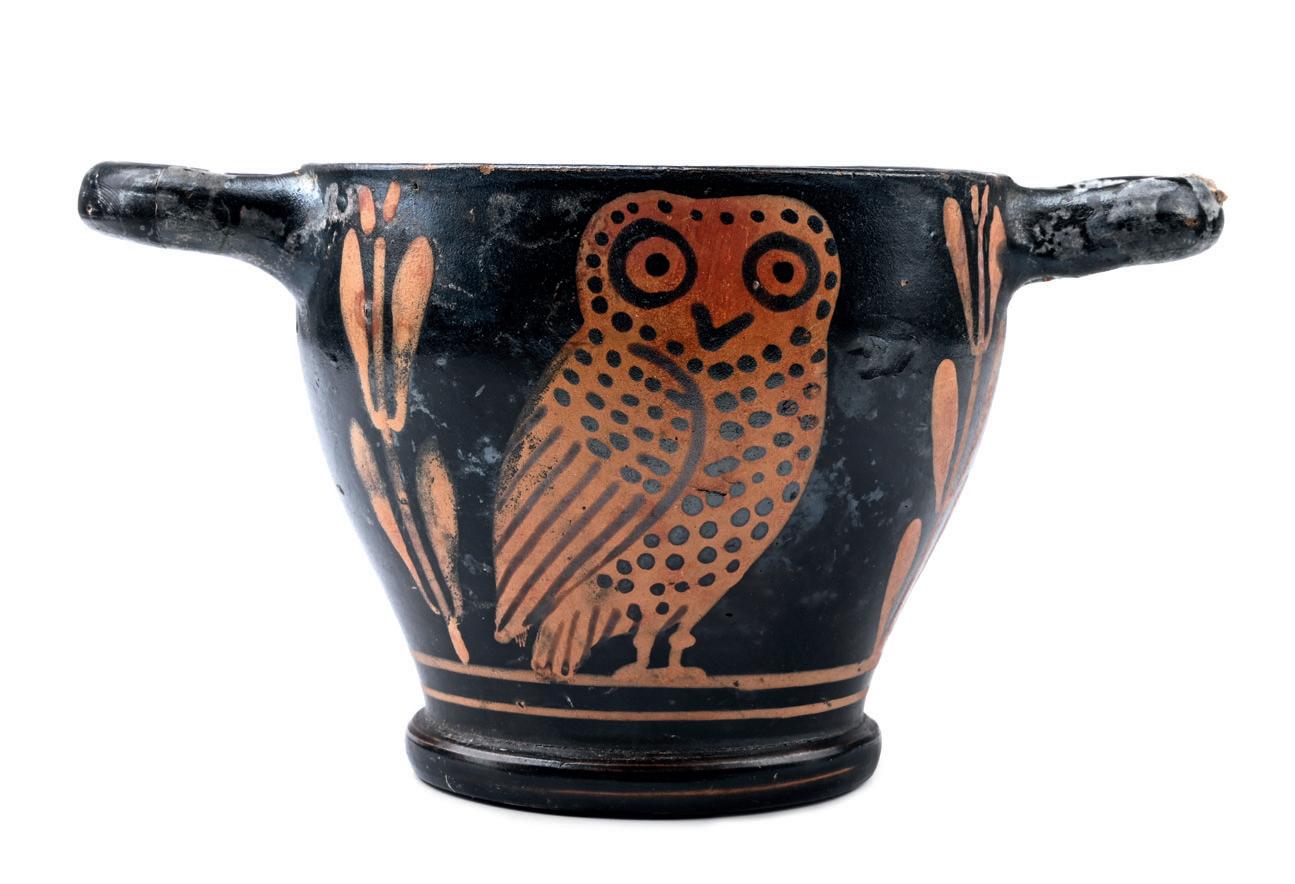
94
LARGE GREEK RED-FIGURE SKYPHOS WITH OWL ‡ SOUTH ITALIAN, 5TH-4TH CENTURY B.C.
6 in. (239 grams, 17.5 cm)
With mammiform body, pedestal base and two loop handles; each side with a facing image of an owl between laurel fronds.
£2,000 - 3,000
PROVENANCE:
Swiss private collection, assembled in the 1960s-1970s. Private collection, acquired in 2013.
Accompanied by a thermoluminescence analysis report no.N126a14 from Oxford Authentication.
FOOTNOTES:
Bubo was the holy beloved magical owl of the goddess Athena, and it was a common subject on Greek painted ceramics.
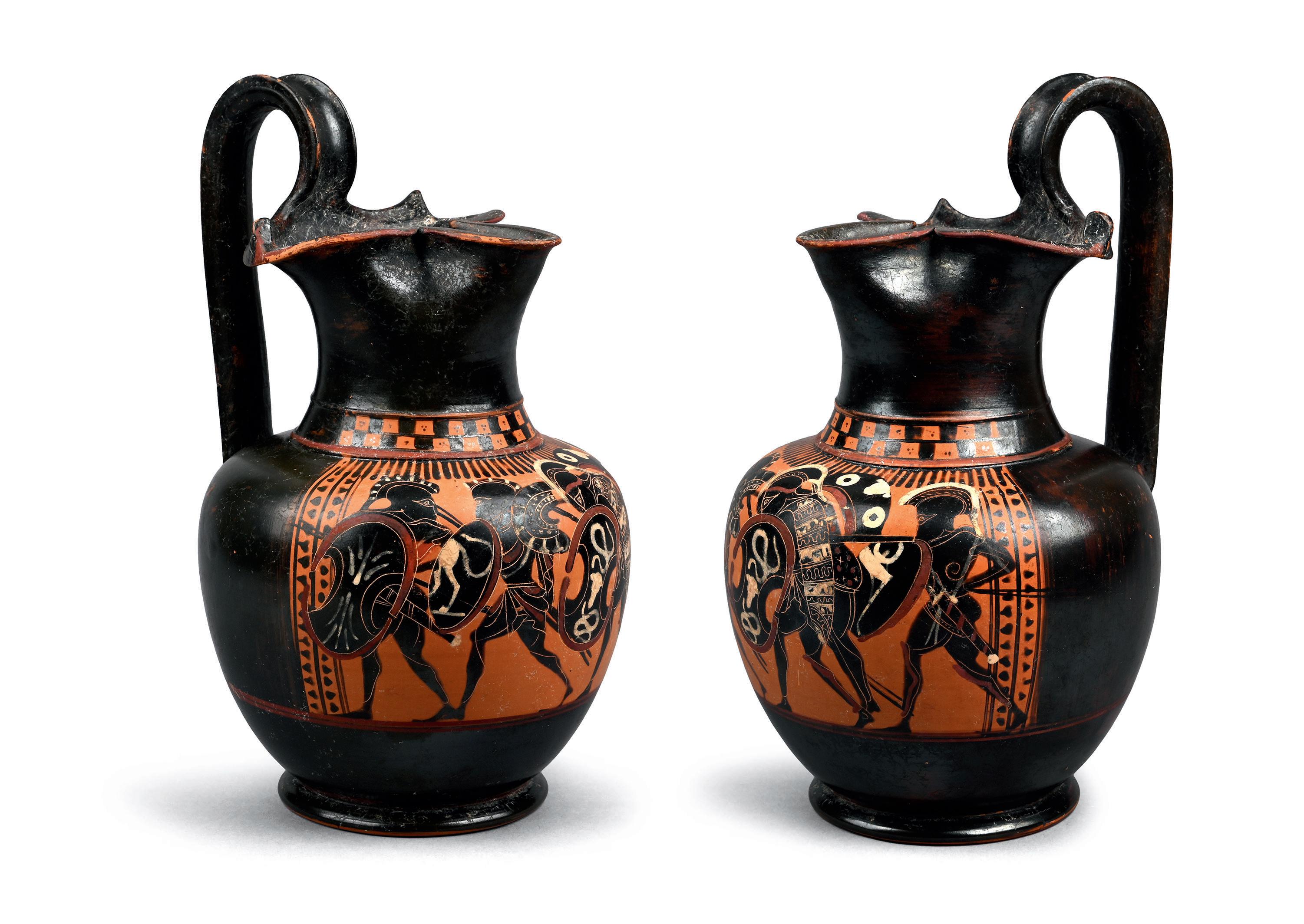
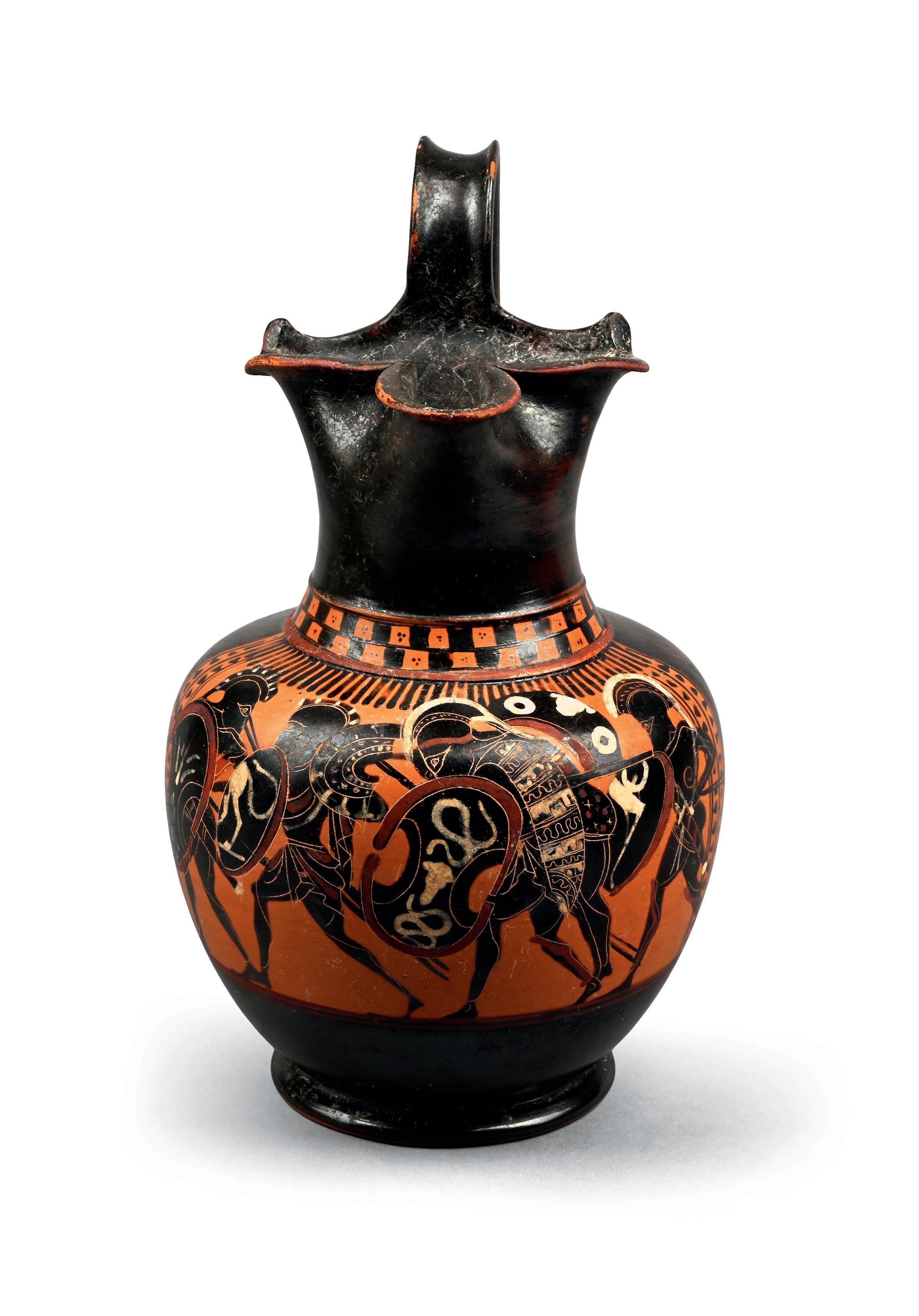
GREEK TERRACOTTA BLACK-FIGURE OINOCHOE WITH FIGHTING WARRIORS ‡
ATTIC, LATE 6TH CENTURY B.C.
9 in. (487 grams, 23.2 cm)
With flared foot, ovoid body, tapering neck and scooped trefoil mouth; tall gusseted strap handle to the rear; painted frieze of a phalanx of hoplites wearing crested helmets and bell-shaped armour with round aspis and eight-shaped (Boeotian) shields, knemidai greaves, long spears and scabbarded swords.
£25,000 - 35,000
PROVENANCE: Private Swiss collection, 1980s. Acquired on the European art market, 1992; thence by descent.
Accompanied by an academic report by Dr Jacques Chamay. Accompanied by an academic report by Dr Raffaele D’Amato.
FOOTNOTES:
The scene depicts a succession of warriors, marching to the left at a rapid pace. Closely packed, one behind the other, they are confined within the figurative field and extend well beyond the upper and lower edges. It is a scene taken from the Homeric poems. The style of the oinochoe is characterised by the abundant use of thick white and burgundy highlights, resulting in a striking polychrome effect. There is a tendency to extend the figures beyond the frame, due to the subject being too ambitious for the available surface. The chequerboard motif on the neck is a very rare decorative motif. The vase’s importance is reinforced by its exceptional state of preservation.
GREEK TERRACOTTA BLACK-FIGURE PYXIS WITH CHARIOT ‡ ATTIC, 6TH CENTURY B.C.
8 in. (1.05 kg, 22.5 cm wide)
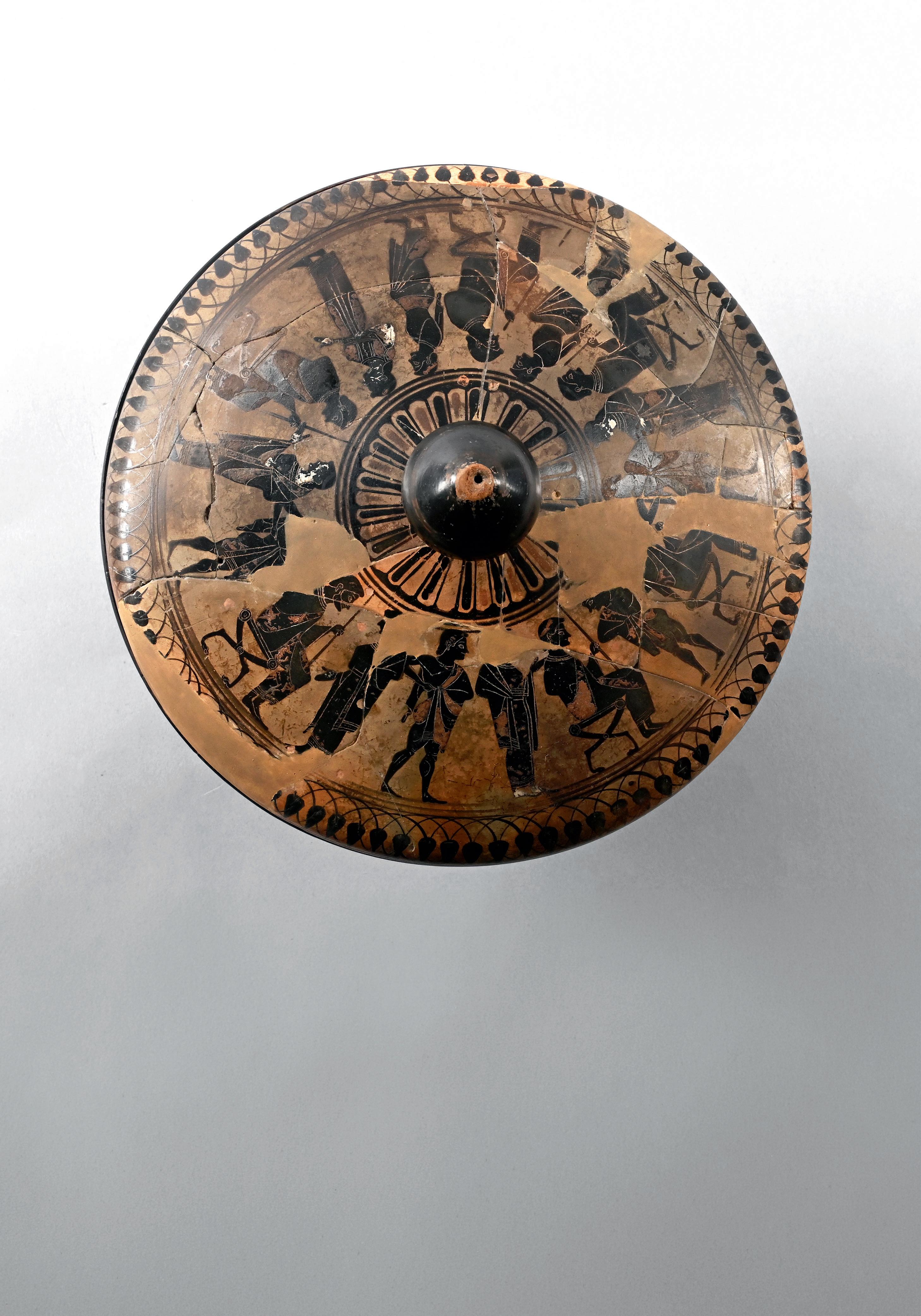
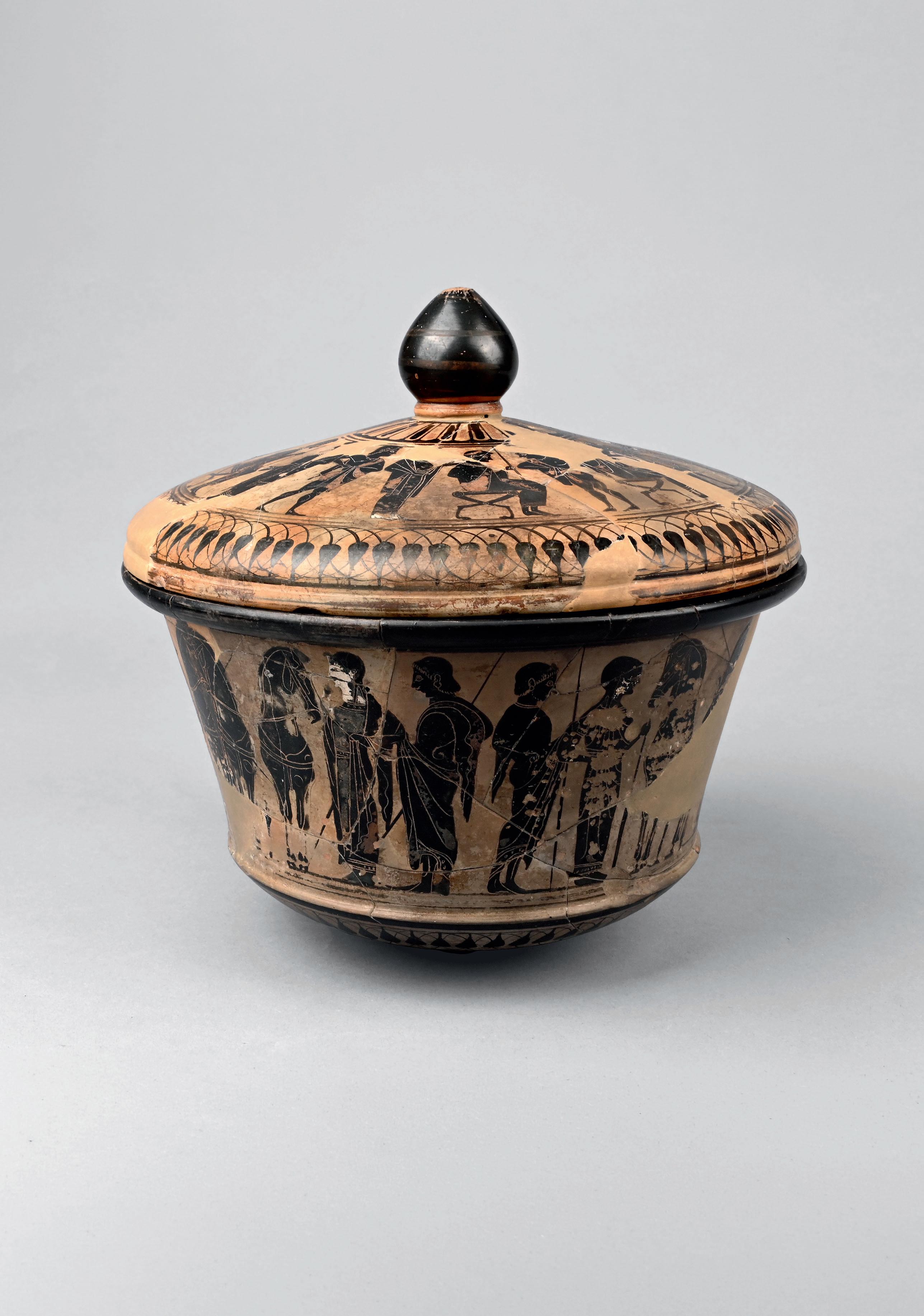
Squat vessel with rounded foot and carination with band of tendrils, flared sidewall with carination and rim, broad watchglass lid with central knop handle; blackware frieze to the sidewall, chariot with four horses and attendants carrying spears and dressed in chitons and himatia, among them a noblewoman dressed in a long chiton and chlamys; lid with frieze of profile figures seated on folding chairs with attendants and petitioners, and two women in long robes within a band of coiled tendrils; repaired and restored.
£40,000 - 60,000
PROVENANCE:
Private collection, Mrs Lambelet, Neuchâtel, Switzerland, acquired before 1972; thence by descent.
Private collection N.S., acquired in 2012.
Accompanied by an academic report by Dr Raffaele D’Amato.
FOOTNOTES:
Many Athenian vases depict a quadriga, often in racing or military scenes, but in this case, the depicted scene is peaceful and could be linked to a wedding. The painting can be divided into two scenes: the first, on the sides, is the bridal procession, where the bride is conducted on the chariot which will bring her to the groom, accompanied by her father and relatives; the second, the lid painting, where the nuptial feast is prepared, and the conversing guests are waiting for the bride.
98
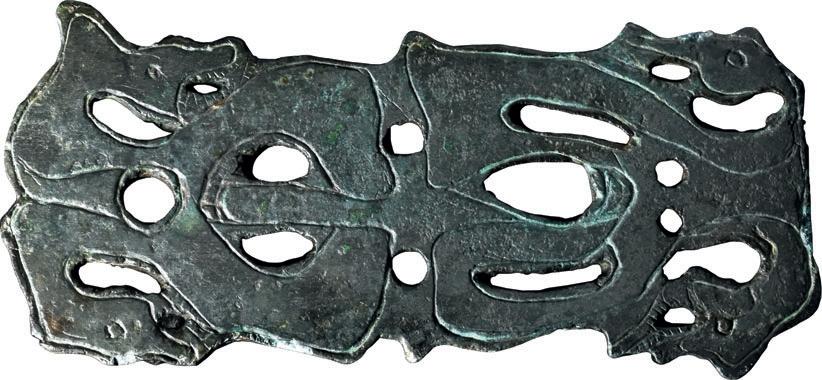
SCYTHIAN BRONZE HARNESS FITTING
5TH-4TH CENTURY B.C.
5¼ in. (170 grams, 13.4 cm)
Sub-rectangular flat panel with attachment loop to reverse; openwork design comprising two D-shaped panels, each with voids to the centre extending to two addorsed long-necked beasts with incised outline, eye and mouth detailing.
£700 - 900
PROVENANCE:
Private European collection, 1990s. Private collection, London, UK.
100
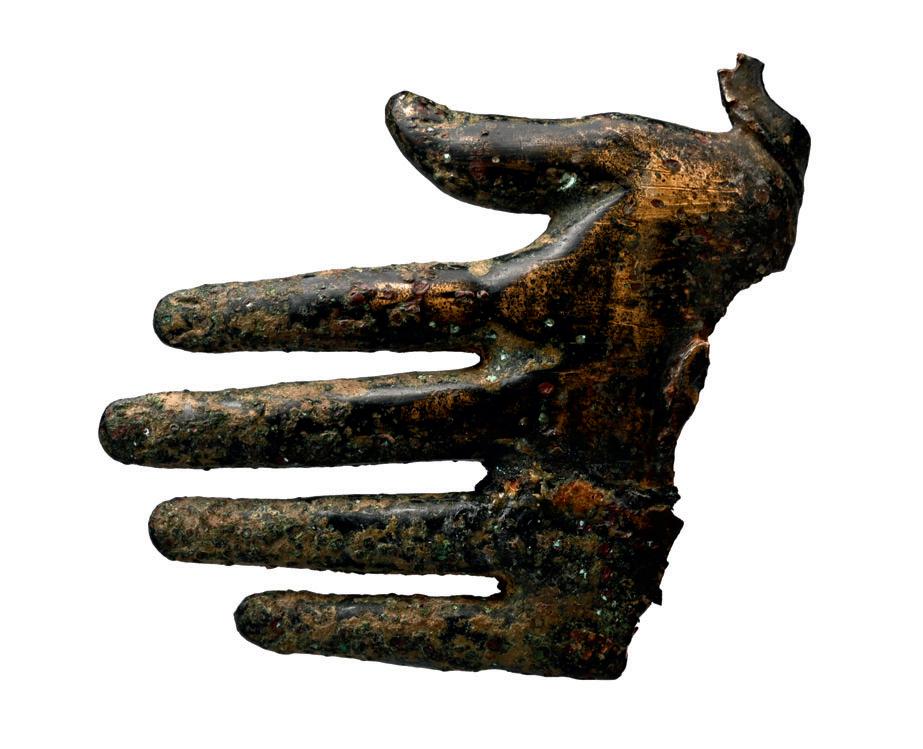
ETRUSCAN VOTIVE BRONZE HAND ‡ CIRCA 7TH-6TH CENTURY B.C.
4 in. (187 grams total, 11.8 cm high including stand)
Modelled in the half-round with D-section fingers, portion of cuff behind the thumb; mounted on a custom-made display stand.
£2,000 - 3,000
PROVENANCE:
Acquired on the German art market, before 1992; thence by descent.
97
SCYTHIAN BRONZE FINIAL WITH ANIMAL HEAD
5TH-4TH CENTURY B.C.
9¾ in. (570 grams, 24.6 cm)
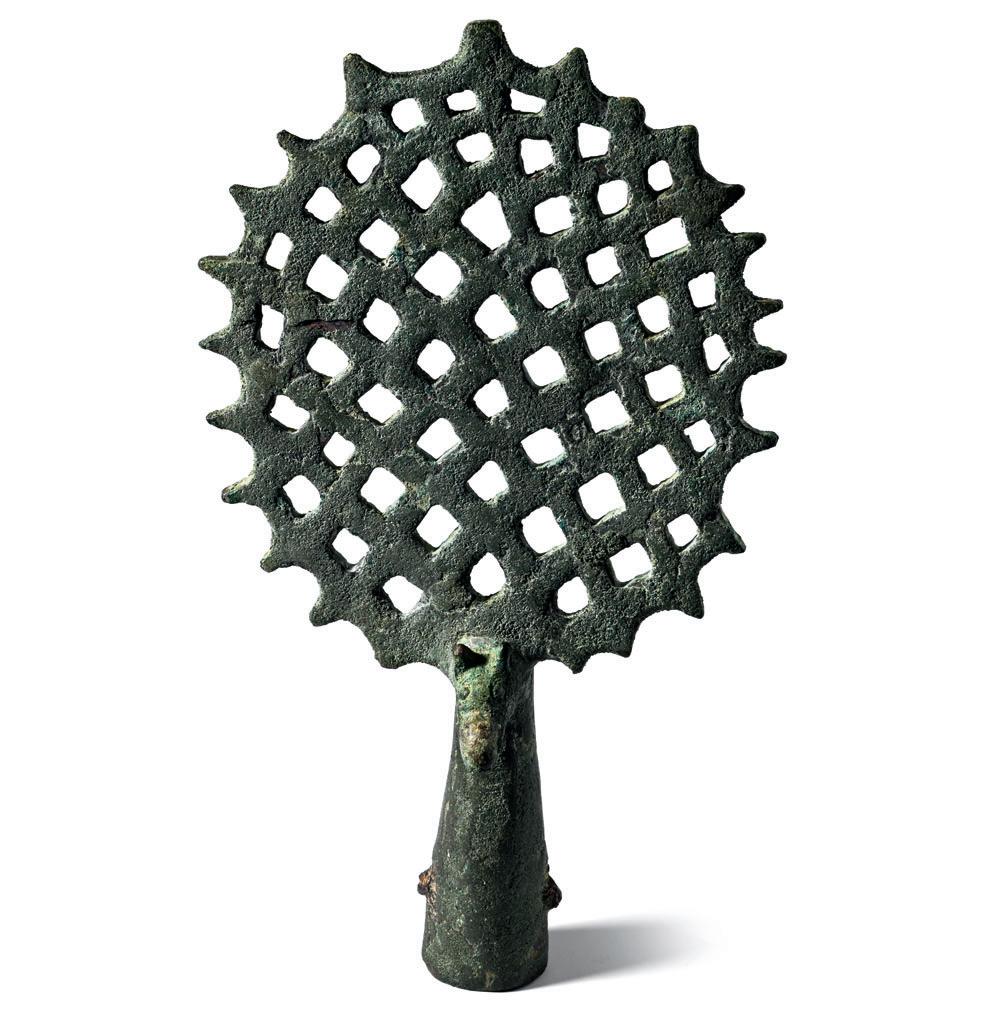
Comprising an ellipsoid panel mounted on a conical socket; openwork lattice design with lozenge voids; socket with horse-head to one face, lateral lugs above the mouth.
£2,000 - 3,000
PROVENANCE:
Private European collection, 1990s. Private collection, London, UK.
99
PARTHIAN BRONZE SATYR OIL LAMP SECTION
1ST CENTURY B.C.-1ST CENTURY A.D.
8¼ in. (799 grams, 21 cm)
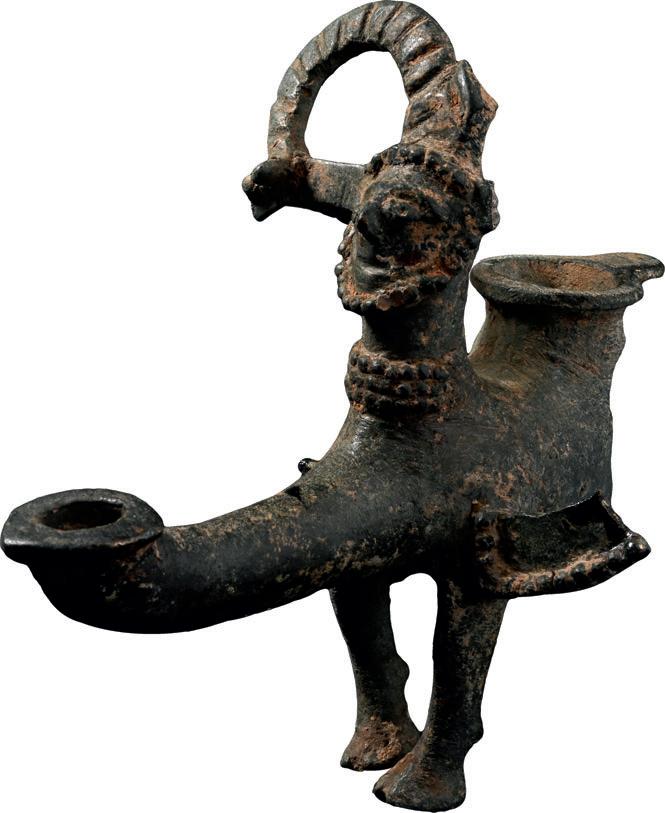
Fragment comprising: tubular body with raised neck to the filler hole, everted rim and spur to reverse; raised tubular neck and head with pelletted collar, hair and bead, pinched nose, pellet eyes, crescent brow, goat’s horn extending above in an arch to meet lateral extension from the brow and remains of similar to the other side; goat’s legs below the body with hooves, pelletted bracket at the thigh and part of an arched extension connecting to the brow; nozzle to the forward edge and ovoid everted rim.
£600 - 800
PROVENANCE:
Acquired before 1983. Ex London gallery, 1990s. Private collection, London, UK.
101
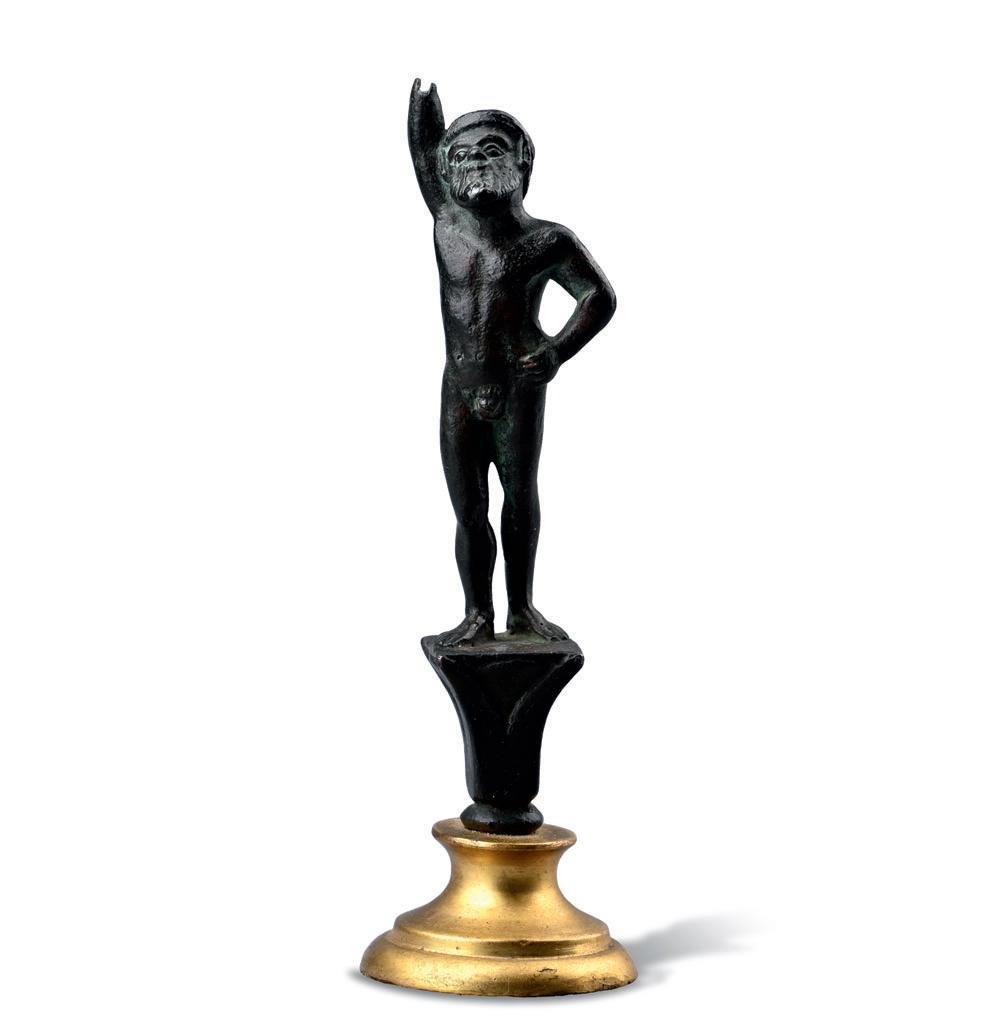
ETRUSCAN BRONZE STATUE OF A SATYR
3RD-2ND CENTURY B.C.
8 in. (679 grams total, 20.4 cm including stand)
Modelled in the round in energetic pose with left hand resting on the hip and right arm raised, head tilted slightly upwards, tail curled gracefully over the rump; on a square base with papyrus stalk detailing; on a later gilt-metal stand mounted on a polished stone cube.
£4,000 - 6,000
PROVENANCE: Iris Cornelia Love (1933–2020), New York, collection primarily formed in the 1950s-1970s.
PUBLISHED:
Hannegan, B., Classical Antiquities from the Collection of Miss Iris Love, Durham, North Carolina, 1965, no.8, illustrated.
EXHIBITED:
Durham, Duke University, The Art Department Gallery, Classical Antiquities from the Collection of Miss Iris Love, 25 January–24 February 1965.
103
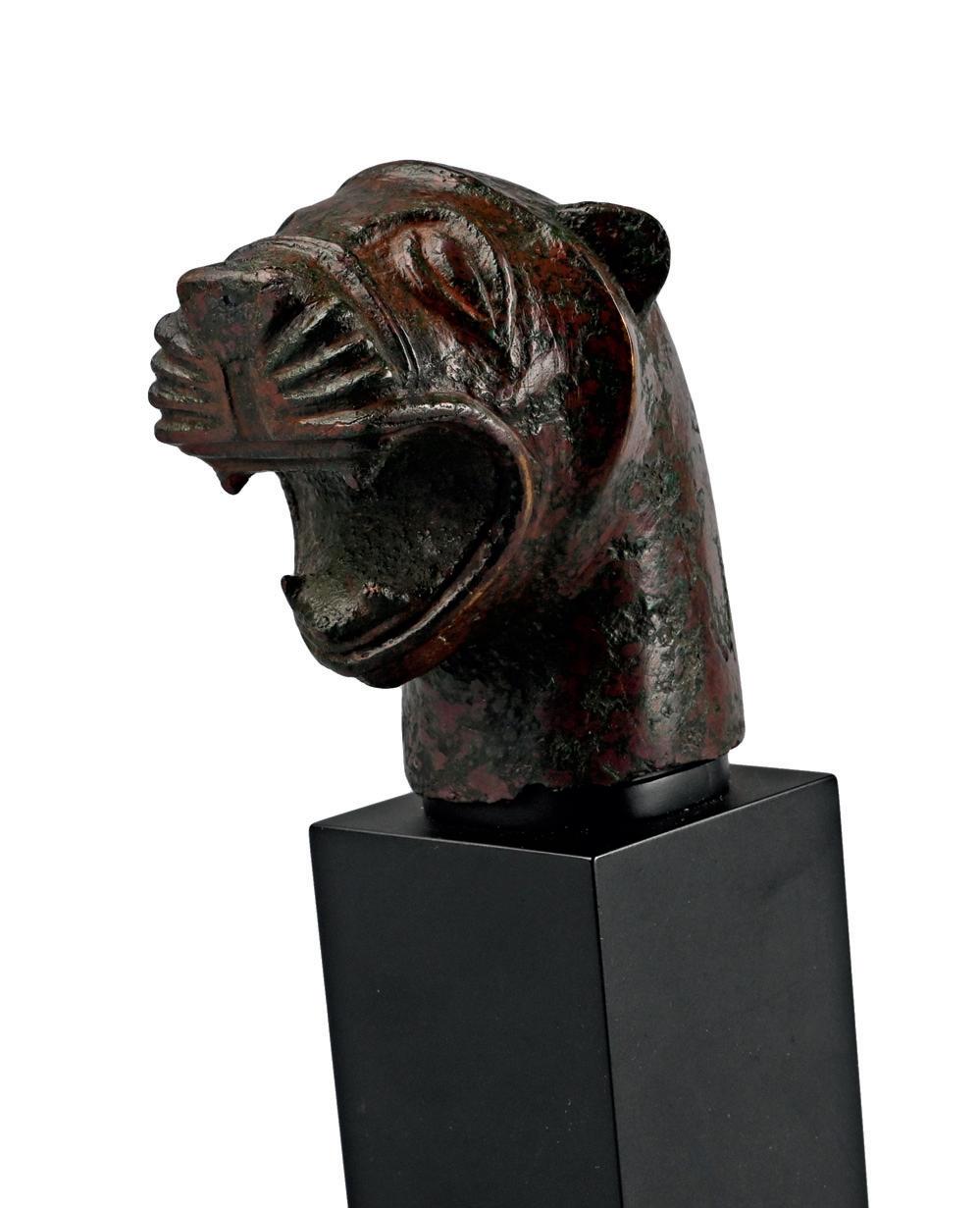
ETRUSCAN BRONZE LION HEAD ‡ CENTRAL ITALY, LATE 6TH CENTURY B.C. 6 in. (1.11 kg total, 17.5 cm including stand)
A decorative fitting with roaring mouth and protruding fangs and tongue, the whiskers depicted in raised radiating ridges, with lidded, elongated almond-shaped eyes and small, round ears; mounted on a custom-made display stand.
£7,000 - 9,000
PROVENANCE: with Christie’s, New York, 8 June 2001, no.58. Donati collection, Lugano, prior to 1982. Collection of Banca della Svizzera Italiana, Lugano, prior to 1986. Formerly in the Bourgknecht collection, Switzerland.
Accompanied by Art Loss certificate no.S00123227.
PUBLISHED: Testimonianze d’arte Etrusca in collezioni private Ticinesi, collection of Banca della Svizzera Italiana, 1986, p.31, no.7.2, illus.
FOOTNOTES:
This head was probably, as was the parallel head of the Barberini Tomb, originally attached to a magnificent bronze cauldron. These large cauldrons of hammered bronze were realised with the heads and necks of two lions and two gryphons attached to the rim. The cauldrons were spherical in form and rested on a stand.
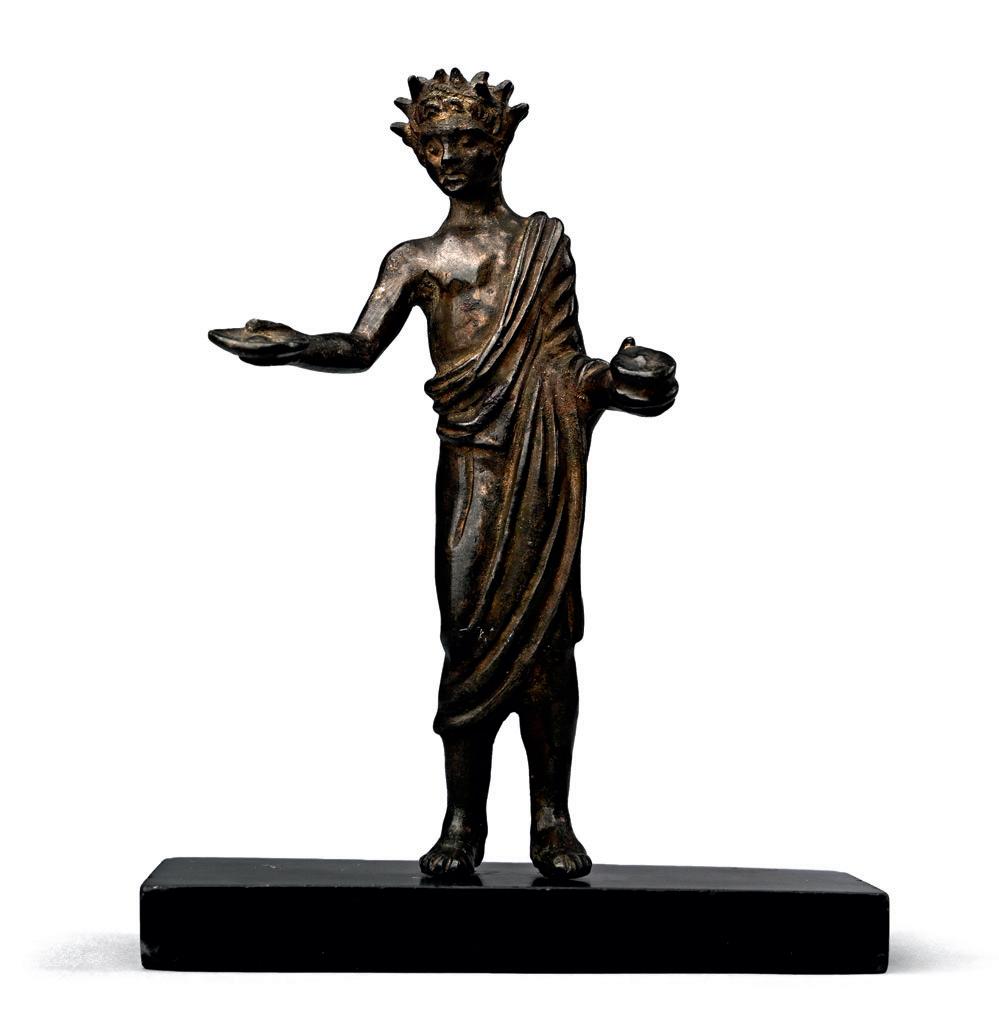
102
ETRUSCAN BRONZE VOTIVE FIGURE OF GENIUS SACRIFICULUS
6TH-5TH CENTURY B.C.
4¾ in. (5¼ in.) (189 grams, 12.1 cm (367 grams total, 13.4 cm high including))
Depicting a ‘genius’ making a sacrifice, his head surrounded by a radiate crown or a wreath of laurel leaves arranged in rays; barechested with a cloak (tebenna) falling over his left shoulder, covering his back and resting on his left arm, enveloping his legs to below the knee; holding a patera in his right hand and an acerra in his left; accompanied by a display stand.
£2,000 - 3,000
PROVENANCE:
Anne Betgoner, Paris, by descent.
French private collection, acquired in the early 20th century. Acquired from the above by the present owner.
Private collection, UK.
FOOTNOTES:
The figure represents a genius dressed as a priest according to the Etruscan tradition. He is celebrating a sacrifice by offering to the gods with a patera of precious liquids and perfumes, kept in the acerra or pyxis Acerra was the name given to the casket in which the incense intended for sacrifices was placed (arcula turalis). A servant carried it to the altar, and the granules from the casket were scattered on the flames (acerra libare).
104
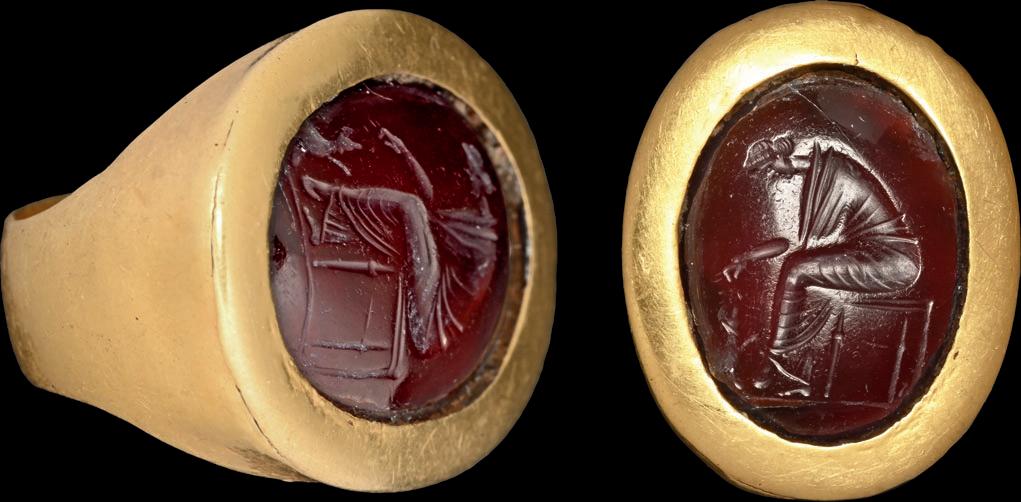
GREEK GOLD RING WITH GARNET GEMSTONE HELLENISTIC, 3RD-2ND CENTURY B.C.
1 in. (16.11 grams, 26.13 mm overall, 20.19x14.09 mm internal diameter (approximate size British J, USA 4¾, Europe 8.69, Japan 8))
Broad ellipsoid plaque with inset cabochon, intaglio seated figure in ankle-length robe feeding a cat.
£8,000 - 10,000
PROVENANCE:
Ex David Lindhal, London, UK, circa 1997.
From a privately held London, UK, collection from the 1980s-1990s.
105
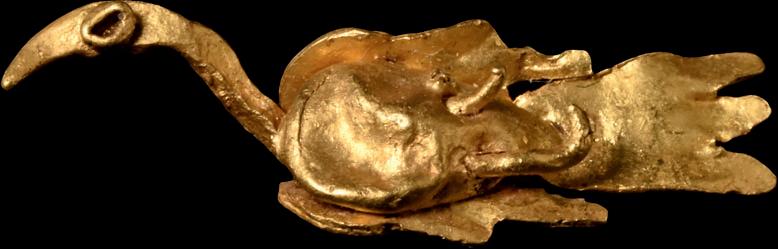
GREEK GOLD AMULETIC BIRD ‡
5TH-1ST CENTURY B.C.
¾ in. (0.57 grams, bird: 19 mm)
Comprising a sheet-gold hollow-formed avian figure with applied filigree detailing, and a separate beaked head; accompanied by a rectangular blue glass fragment. [3]
£1,500 - 2,000
PROVENANCE: Private collection, USA and Switzerland, acquired in the late 1980s-early 1990s; thence by descent.
106
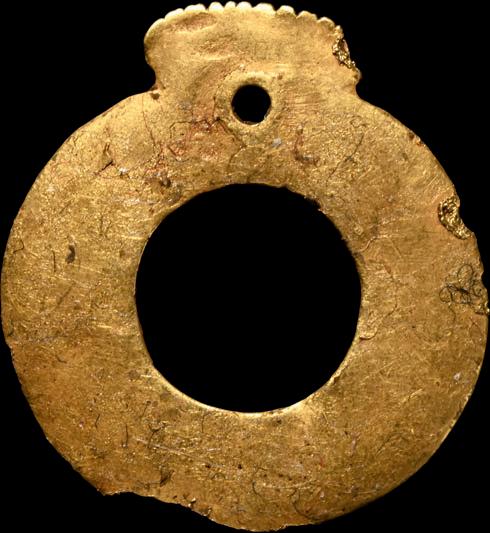
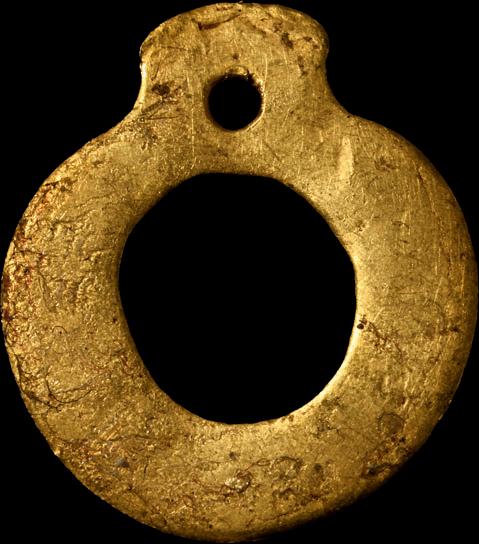
GREEK SOLID GOLD RING IDOL ‡ 5TH-4TH MILLENNIUM B.C.
¾ in. (1.65 grams, 20 mm)
Annular in form with pierced tab.
£1,500 - 2,000
PROVENANCE: Private collection, acquired in the late 1980s-early 1990s; thence by descent.
FOOTNOTES:
During the Greek Neolithic, certain types of ornaments share common morphological characteristics; one such example is the so-called ‘ring-idols’. The prototype of these ring-shaped pendants seems to have been made out of gold, which began to be used during these late phases of the Neolithic in Greece and the Balkans, in general.
107
GREEK SOLID GOLD RING IDOL ‡ 5TH-4TH MILLENNIUM B.C. ¾ in. (0.66 grams, 18 mm)
Annular in form with pierced tab.
£1,500 - 2,000
PROVENANCE: Private collection, acquired in the late 1980s-early 1990s; thence by descent.
108
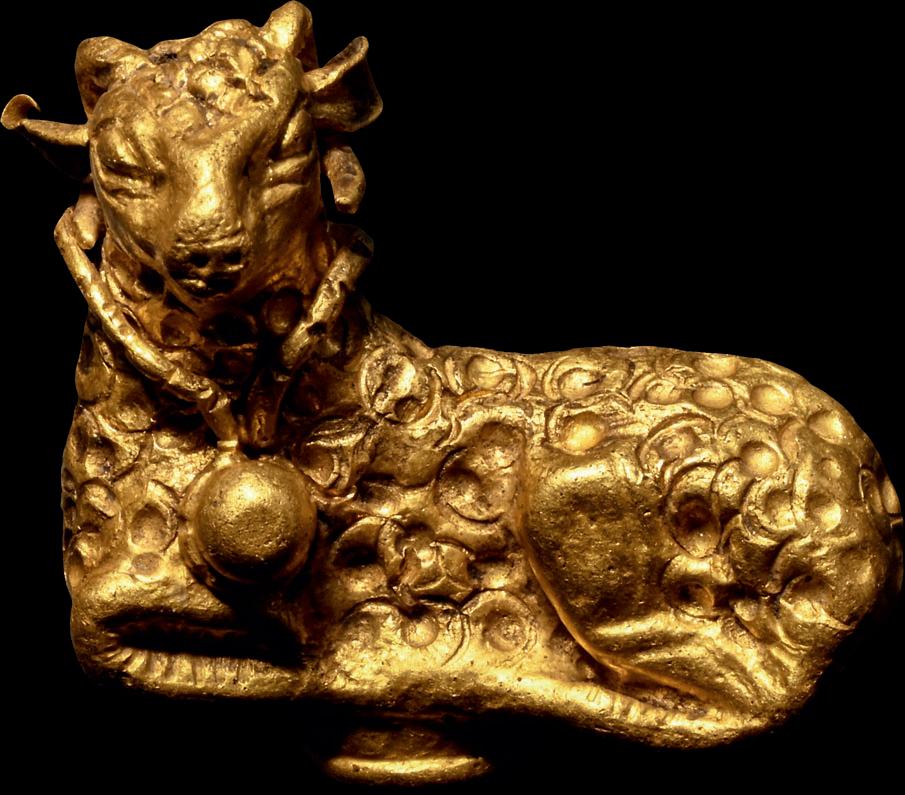
GRAECO-PERSIAN GOLD RAM-SHAPED AMULET ‡
3RD-2ND CENTURY B.C.
1 in. (12.87 grams, 30 mm)
Modelled in the round in the form of a ram lying with its legs folded beneath the body, head turned with hooked horns, collar to the neck with a large pellet pendant; ribbed suspension loop behind the shoulders, mounting lug beneath the trunk.
£15,000 - 20,000
PROVENANCE: Private collection, acquired on the European art market in 2002.
FOOTNOTES:
The ram, a male symbol, was associated with various divinities. Turned into a ram as a child by Zeus, and a common sacrifice to the god, the ram was a symbol of Dionysus, which he shared with Aphrodite. Ram heads and pendants frequently occur in jewellery. In the animal kingdom, Eros favours the cockerel and the ram, both of which are indicative of sexual potency.
109
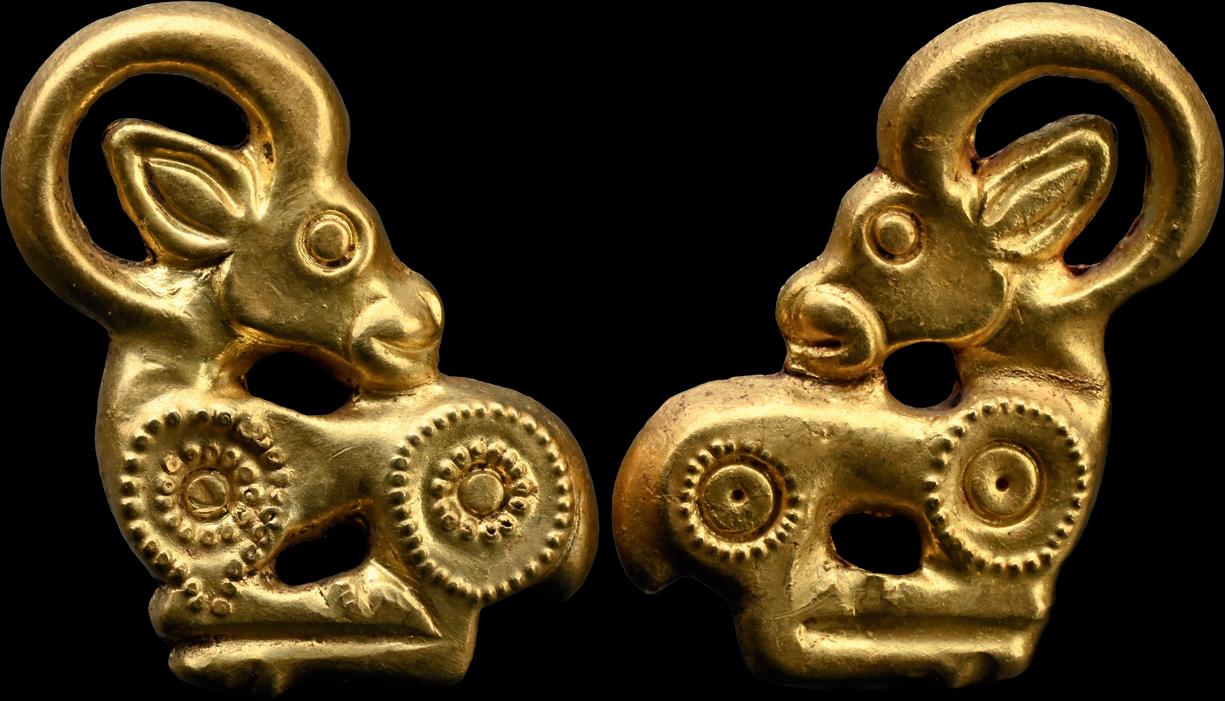
SCYTHIAN GOLD IBEX PLAQUE PAIR
CIRCA 7TH CENTURY B.C.
1¼ in. (15.6 grams total, 34-34.2 mm)
Each a profile ibex with head reversed, horn returned to attach at the neck, pellet eye, beaded ring-and-dot motif to the shoulder and hip; thick attachment loop to the reverse. [2]
£7,000 - 9,000
PROVENANCE: Acquired in the 1980s. Private collection, London, UK.
Accompanied by an academic report by Dr Raffaele D’Amato.
FOOTNOTES:
It is possible to hypothesise that these two elements were bridle plaques, like the two wolf-shaped bridle plaques, in a similar position and style, found in the Kurgan of Pazyrik (Piotrowskij, 1987, p.107, no.137). Belt plaques with zoomorphic motifs illustrate not only the recognised unity of the zoomorphic art of the Steppes, but also the links between the Scythians and the eastern nomadic groups.





110
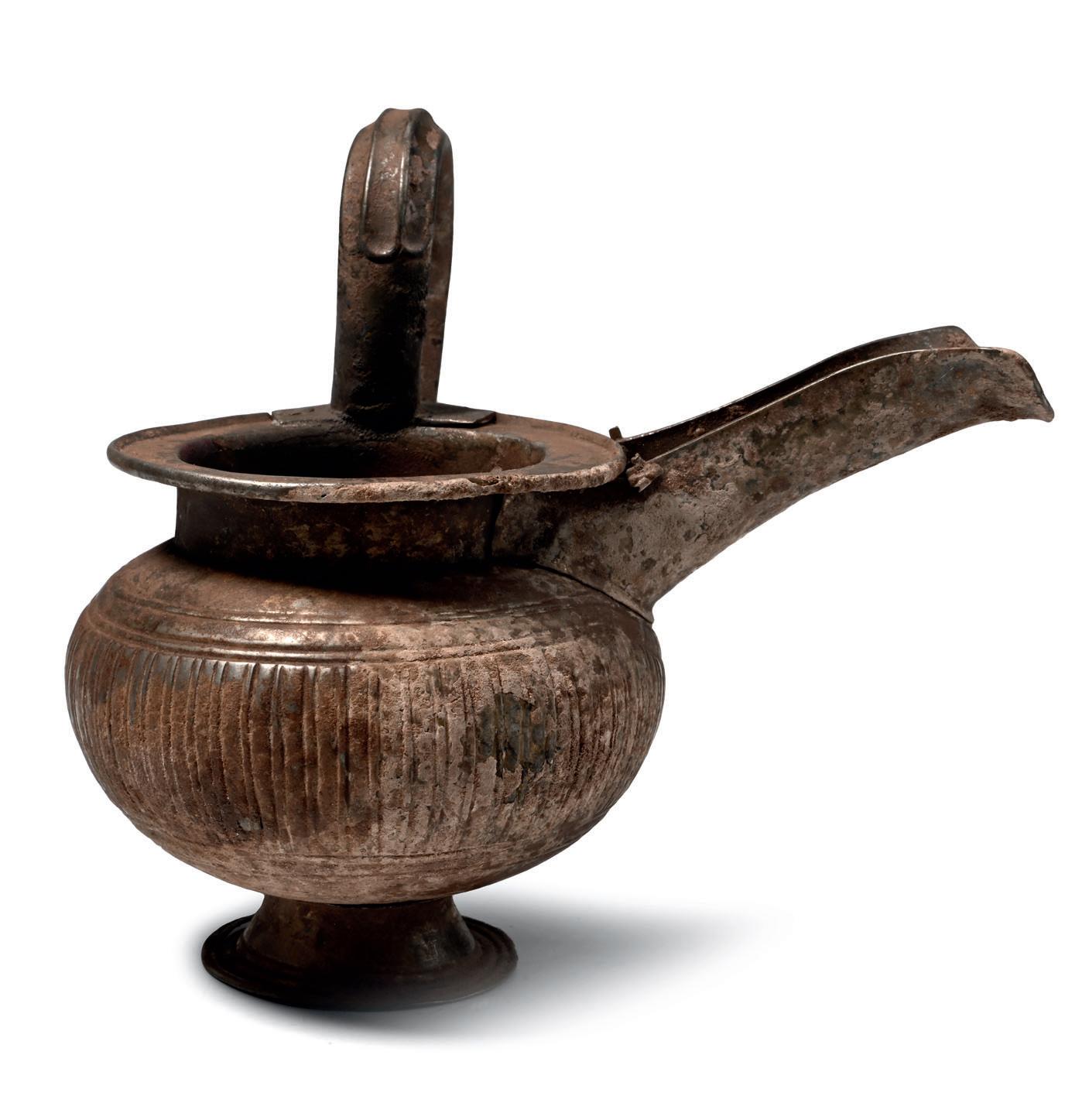
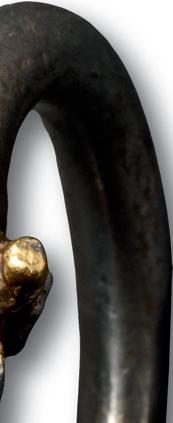
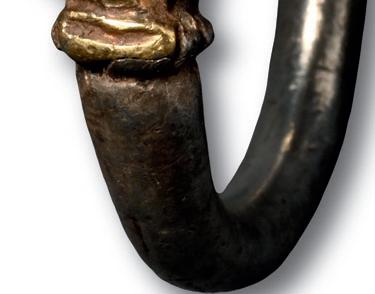
LYDIAN SILVER RIBBED JUG WITH SPOUT AND HANDLE ARCHAIC, 6TH CENTURY B.C.
5½ in. (211 grams, 14 cm)
Comprising a squat body with a median band of vertical ribbing, a short neck with a broad flared rim, and a thickened outer rim, a flared foot; fluted strap handle and a U-section spout flared at the outer end.
£6,000 - 8,000
PROVENANCE:
UK private collection before 2000. Acquired on the UK art market. Private collection, London, UK.
111
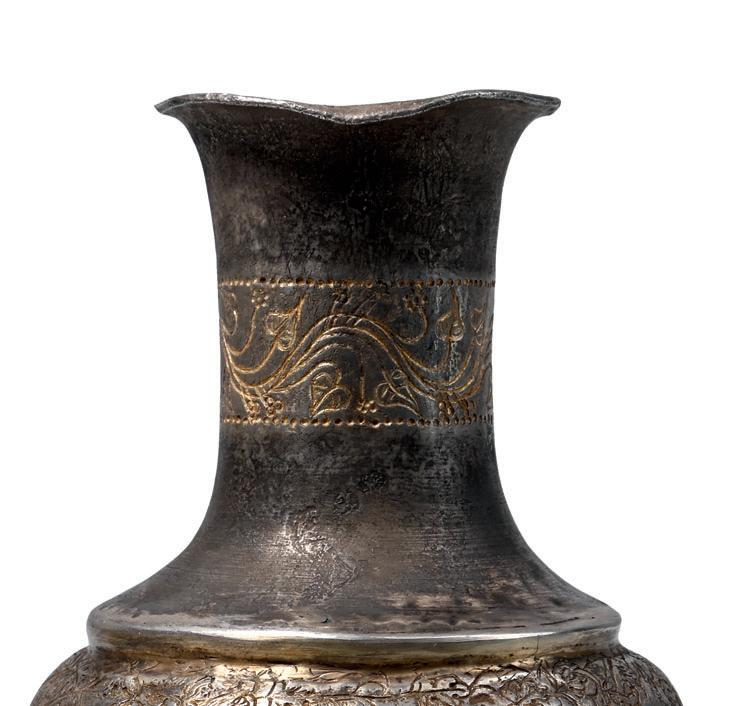
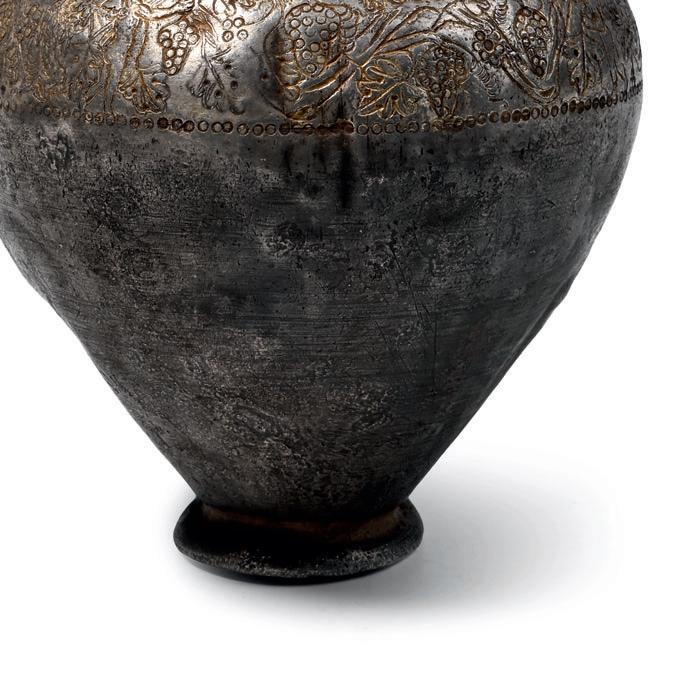
GREEK SILVER-GILT VASE WITH WINGED PUTTI PICKING GRAPES
HELLENISTIC, 2ND-1ST CENTURY B.C.
5¾ in. (150 grams, 14.5 cm)
Piriform in profile with flared foot and carinated ring at the shoulder, everted rim at the mouth; band of punched decoration on the neck with vinescrolls; similar band to the shoulder with bunches of grapes, tendrils and putti.
£2,000 - 3,000
PROVENANCE:
Acquired on the US art market, early 1990s. Private collection, North America. Private collection, London, UK.
FOOTNOTES:
There is ample evidence that the princes of the Hellenistic world had a large appetite for expensive tableware. In a procession preceding games organised by the eccentric Antiochos IV Epiphanes (175-163 B.C.) in the Antiochene suburb of Daphne, 1000 silver vessels and 800 gold ones were carried. Kallixeinos of Rhodes reported the combined weight of gold and silver vessels displayed inside the pavilion of Ptolemy II Philadelphos as 10,000 talents, a weight of well over 200 tons.
112
GREEK
SILVER-GILT
BULL RING
CIRCA 6TH-4TH CENTURY B.C.
1 in. (11.25 grams, 27.39 mm overall, 19.38 mm internal diameter (approximate size British P½, USA 7¾, Europe 16.86, Japan 16))
Annular in form with plaque formed as a parcel-gilt bucranium with solar motif to the brow.
£400 - 600
PROVENANCE:
From the private collection of a European gentleman (1942-2024), formed since the 1970s.




113
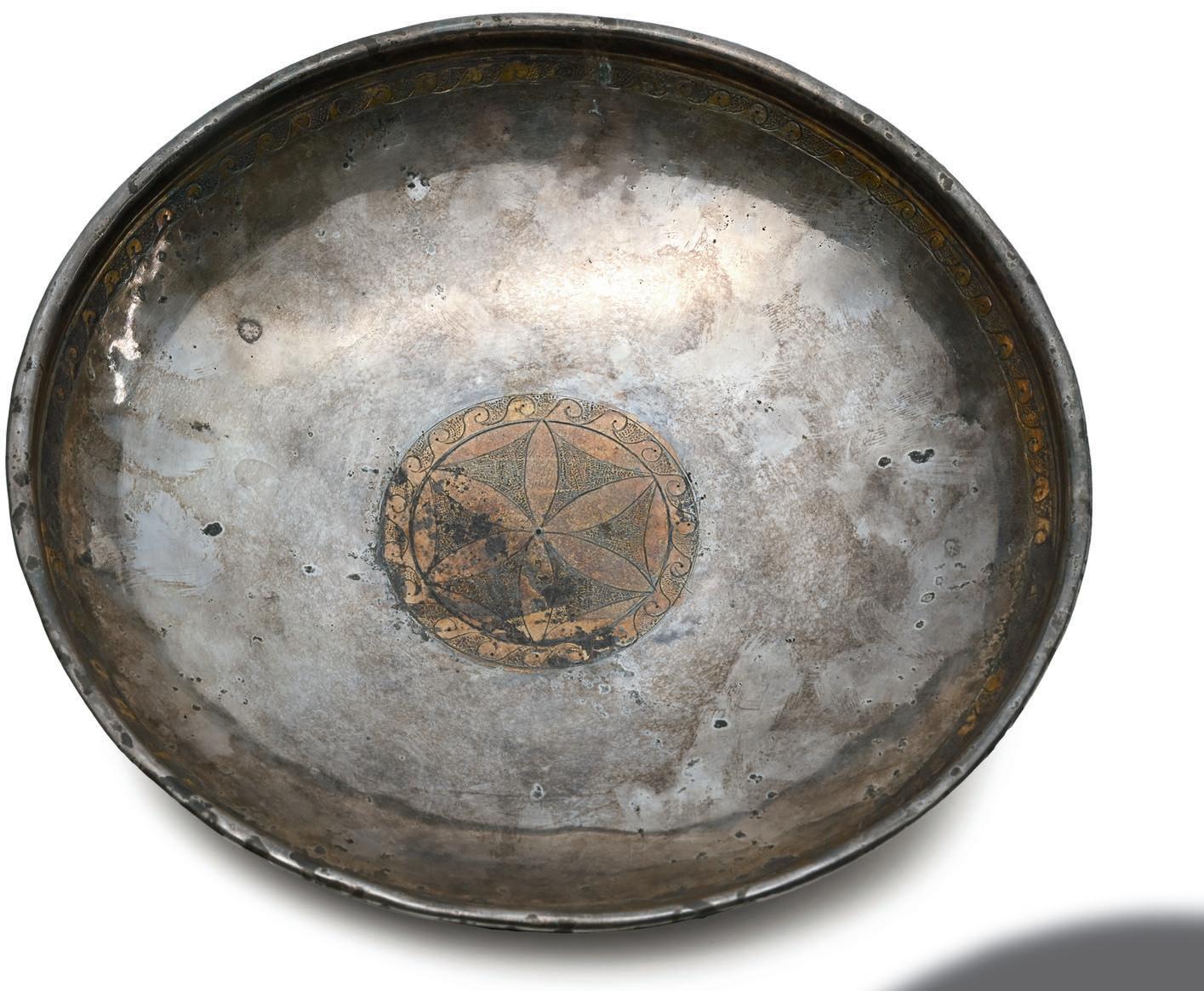
EASTERN GREEK PARCEL-GILT BOWL WITH INSCRIPTION ‡ HELLENISTIC, LATE 2ND-EARLY 1ST CENTURY B.C.
8 in. (413 grams, 20.6 cm wide)
Broad and shallow with thick rolled rim; parcel-gilt band to the inner face below the rim of running scrolls on a pounced field; to the centre, a hexafoil reserved on a pounced field with border of running scrolls; pointillé cursive Aramaic inscription to the outer face.
£6,000 - 8,000
PROVENANCE:
Private collection, London, 1990s or earlier. with Gorny & Mosch, 22 June 2007, no.37. with Christie’s, New York, 5 December 2012, no.52.
114
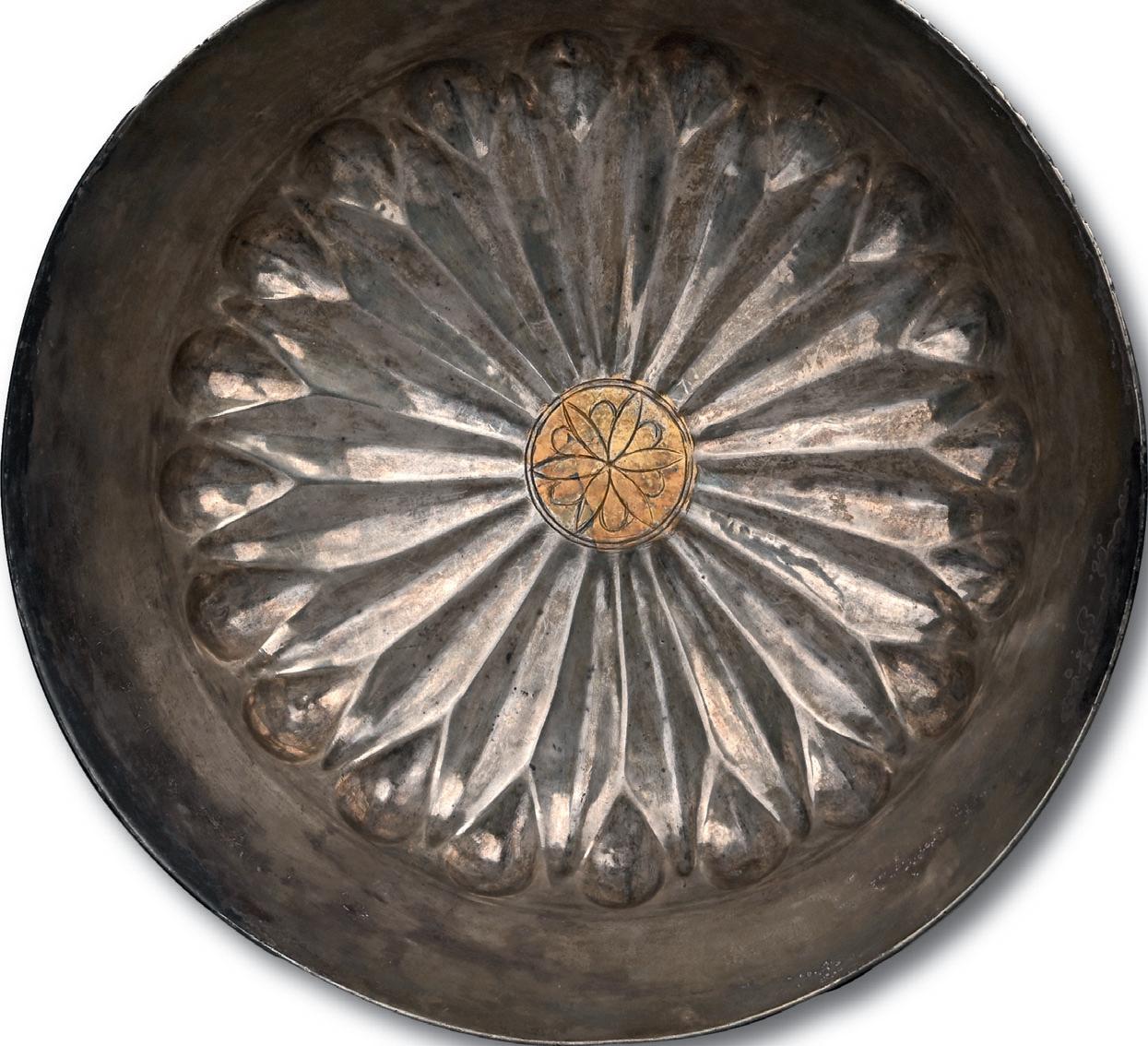
GREEK SILVER-GILT PHIALE WITH PETALS AND LOZENGES
6TH-4TH CENTURY B.C.
7¼ in. (412 grams, 18.5 cm)
Broad lotiform bowl with flared rim, flat mesomphalos with incised rosette and gilt finish.
£4,000 - 6,000
PROVENANCE:
Private collection, London, UK. with Gorny and Mosch, 19 June 2013, no.34. Private collection, London, UK.
116
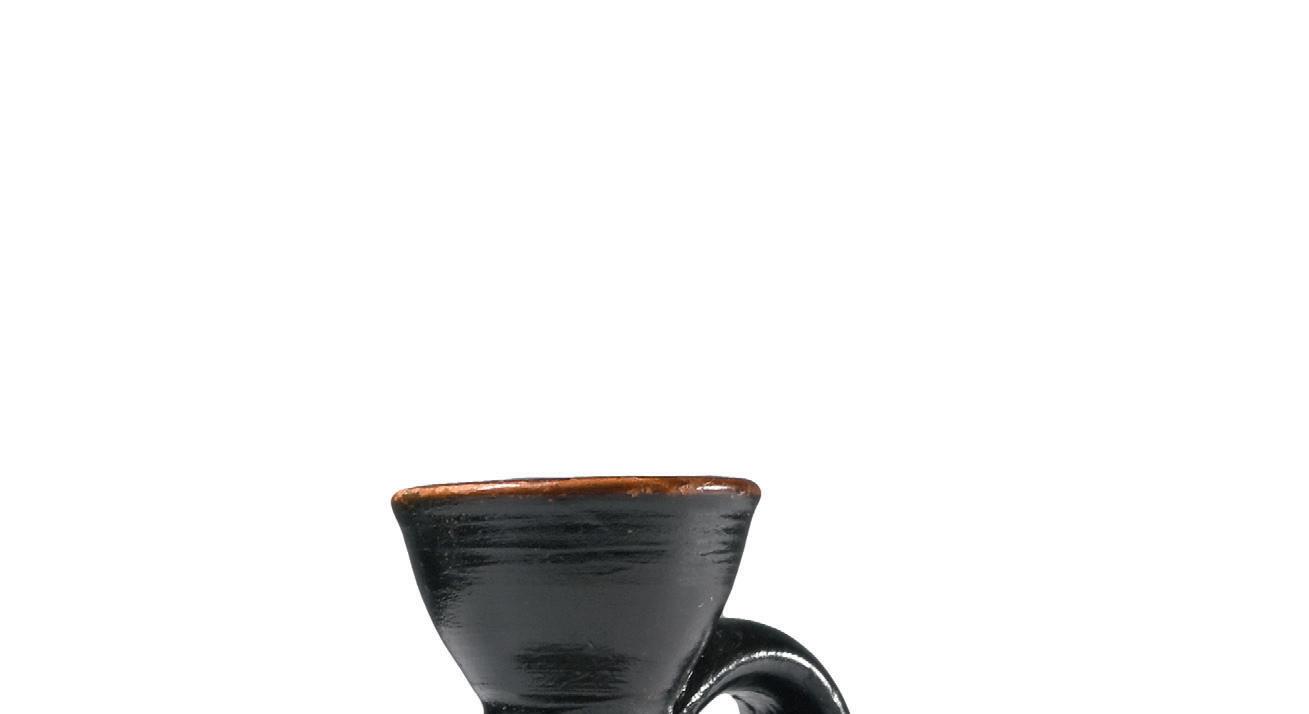
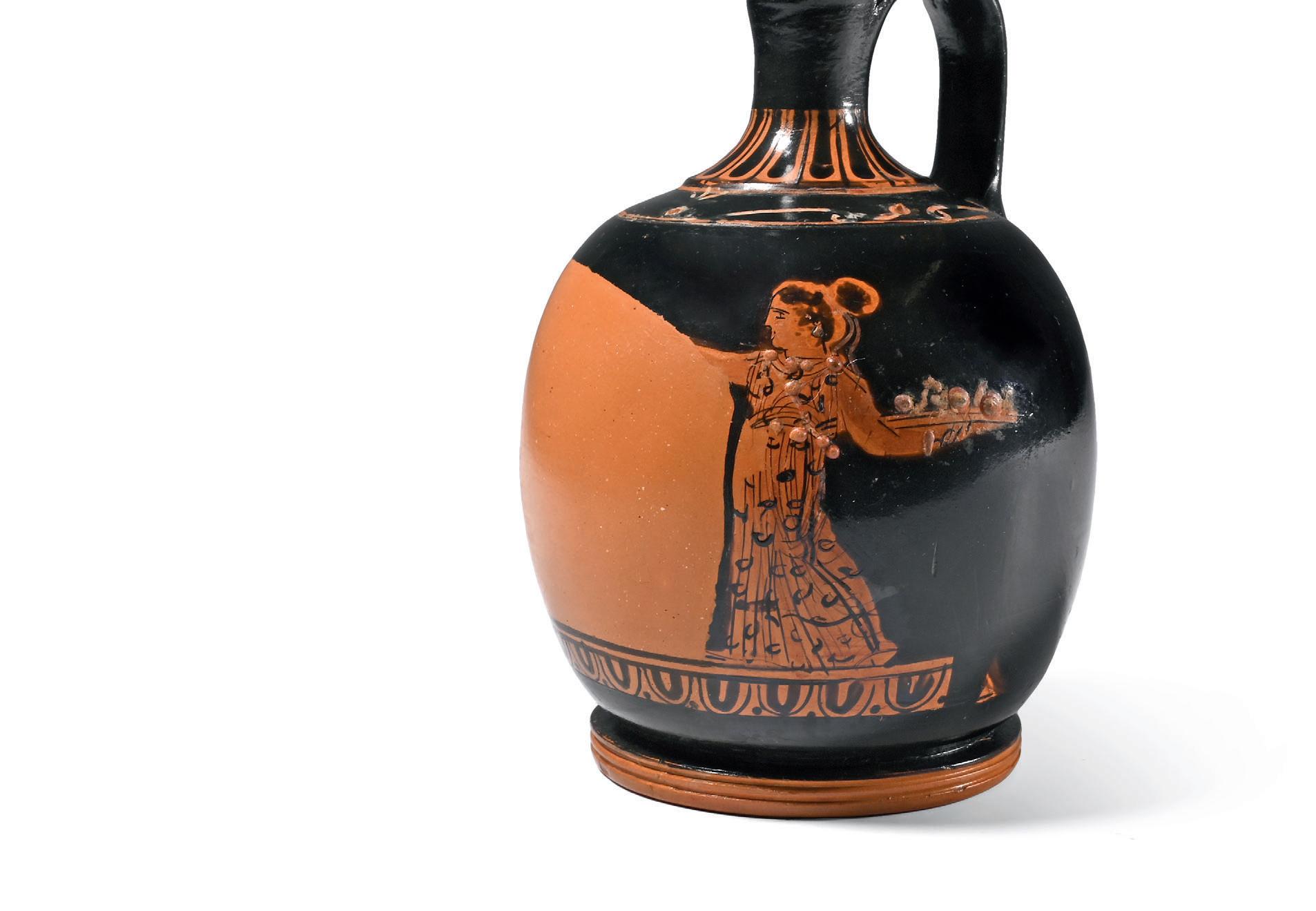
GREEK RED-FIGURE SQUAT LEKYTHOS ATTRIBUTED TO THE MEIDIAN PAINTER
ATTIC, CIRCA 420-400 B.C.
4 1/4 in. (95 grams, 10.9 cm)
Comprising a bulbous body with narrow neck and handle to the rear; radiating petals on the neck with a band of volute scrolls below, the body showing a female in a dynamic pose, dressed in an elaborate long dress and holding a plate of fruit with her left hand, a seated female before her; attributed to the Meidian Painter; some restoration.
£1,200 - 1,700
PROVENANCE:
Ex Prof. Dr Hans (1918-1984) and Dr Ines (1922-2013) Jucker, classical archaeologists, Bern, Switzerland. with Galerie Rhéa, Zurich, Switzerland.
115
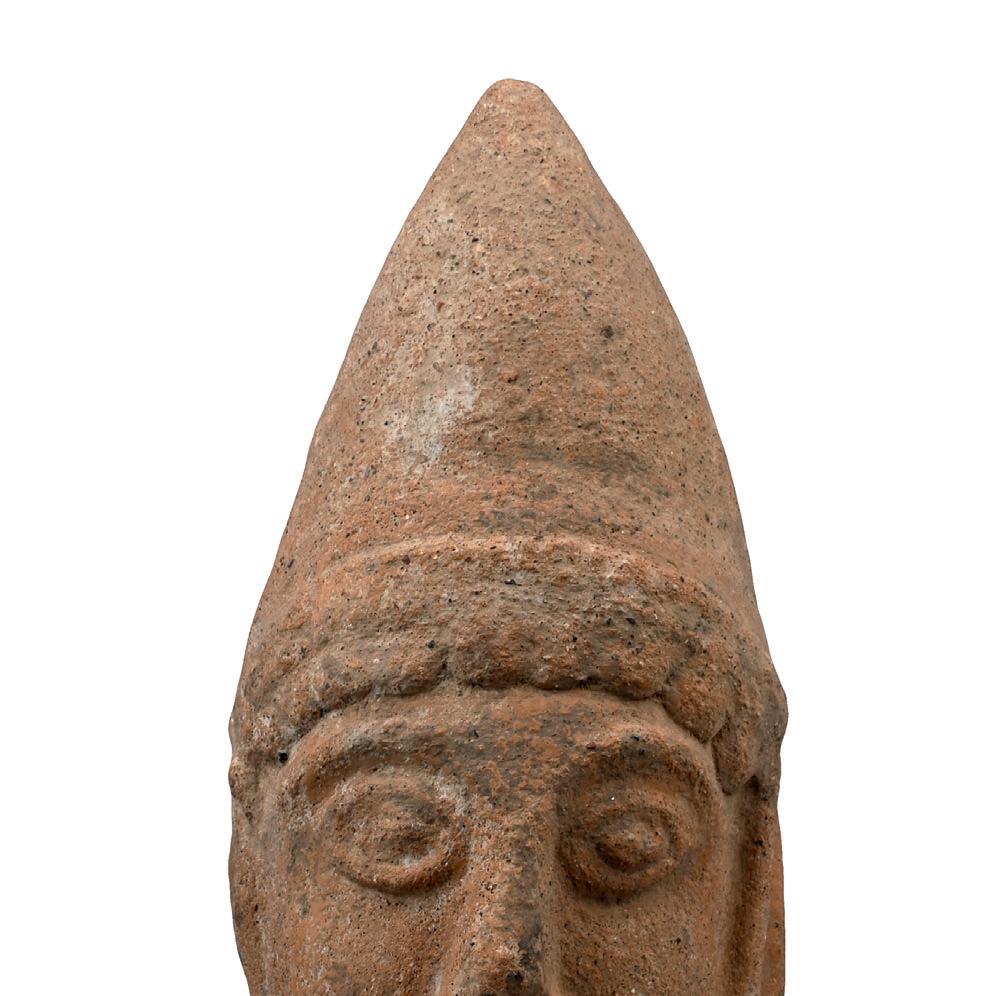
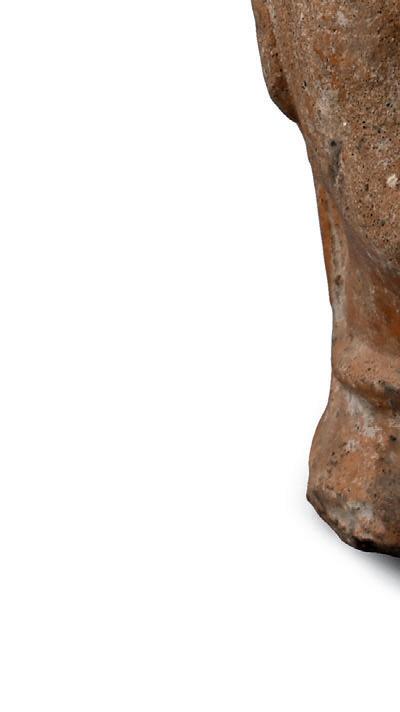
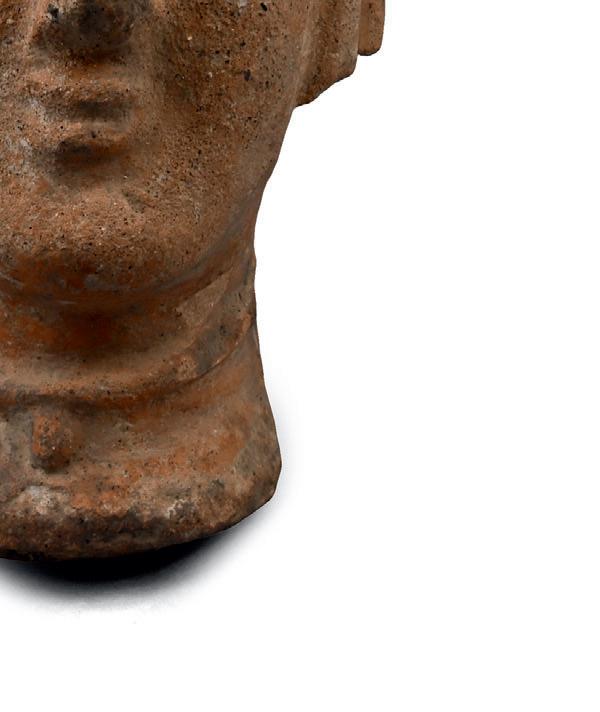
LARGE PHOENICIAN TERRACOTTA HEAD OF A MAN
LEVANT, CIRCA 4TH CENTURY B.C.
10 in. (1.73 kg, 27.5 cm)
Hollow-formed moulded head with conical cap, band above the brow with curls beneath, high-relief eyebrows and triangular nose, scaphoid protrusive eyes, tiny pursed mouth; collar to the neck with frontal pendant; ellipsoid vent to rear, flared rim to mouth; some loss to lateral edges at ear-level.
£4,000 - 6,000
PROVENANCE: with Phillips, London, 6 July 1993, no.127 (part). Private collection, London, UK. Acquired in London, UK, 2006.
LARGE GREEK SILVER-GILT BOWL
HELLENISTIC, 2ND-1ST CENTURY B.C.
8 in. (428 grams, 21.2 cm)
A shallow phiale with chamfered, thickened rim; narrow band of gilding beneath the rim, broad parcel-gilt decorative band with wave borders framing reserved tendrils and foliage; to the centre a parcelgilt panel with keystone border and quatrefoil motif. £18,000 - 24,000
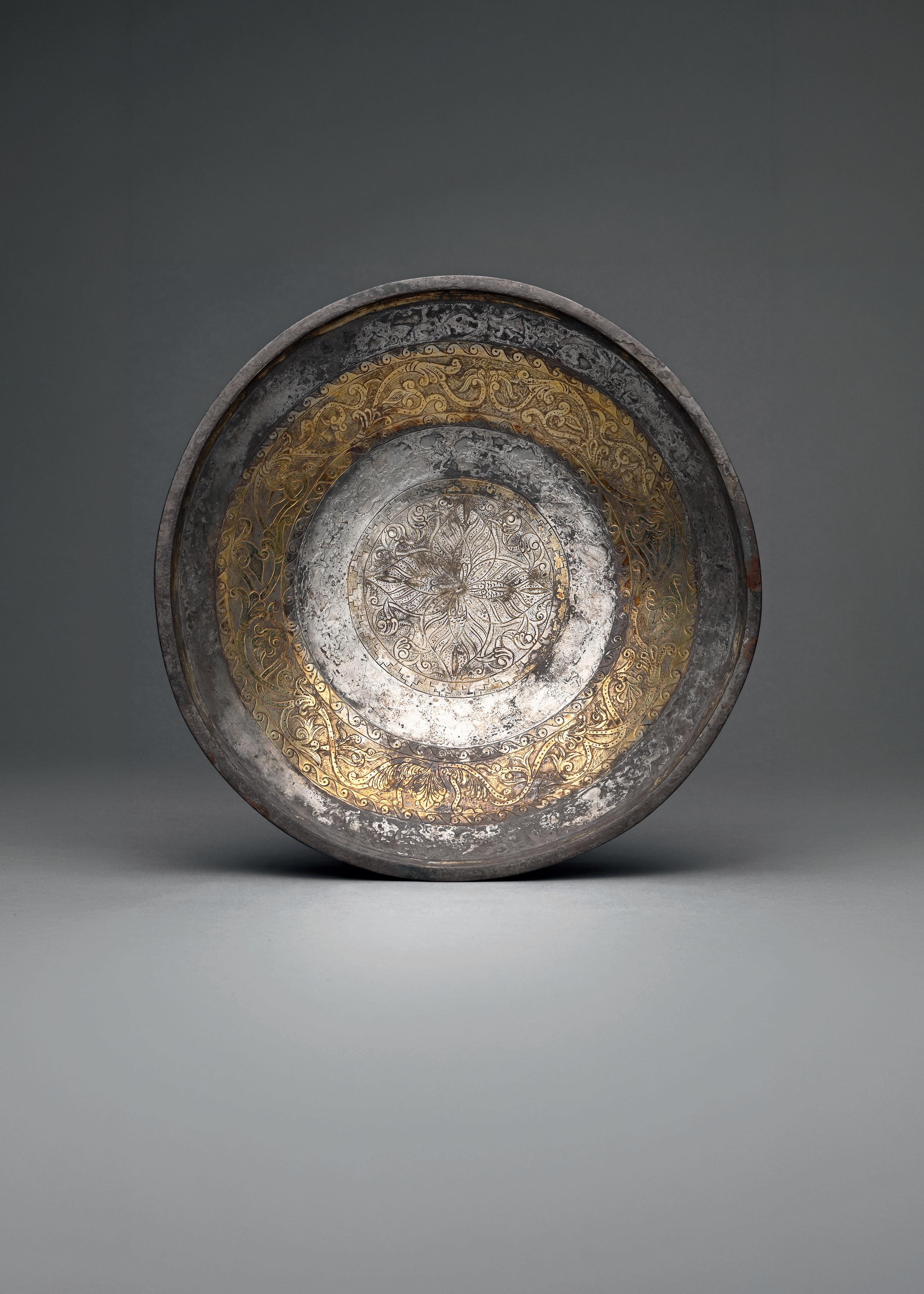
PROVENANCE: French collection, 1980s. Pierre Berge & Associes, Paris, Archéologie, 16 May 2018, lot 214.
Accompanied by a copy of a seven-page examination report number 113/2019 by Dr habil Mikhail Treister.
Accompanied by the original French archaeological passport.
Accompanied by a copy of the relevant Pierre Berge & Associes catalogue pages.
FOOTNOTES:
The bowl is comparable to an early group of Parthian bowls, kept in the P. Getty Museum, dated to the 2nd century B.C. It belongs to a group of bowls with parcel-gilt decoration on the interior, most probably manufactured in one of the Eastern Hellenistic workshops.
119
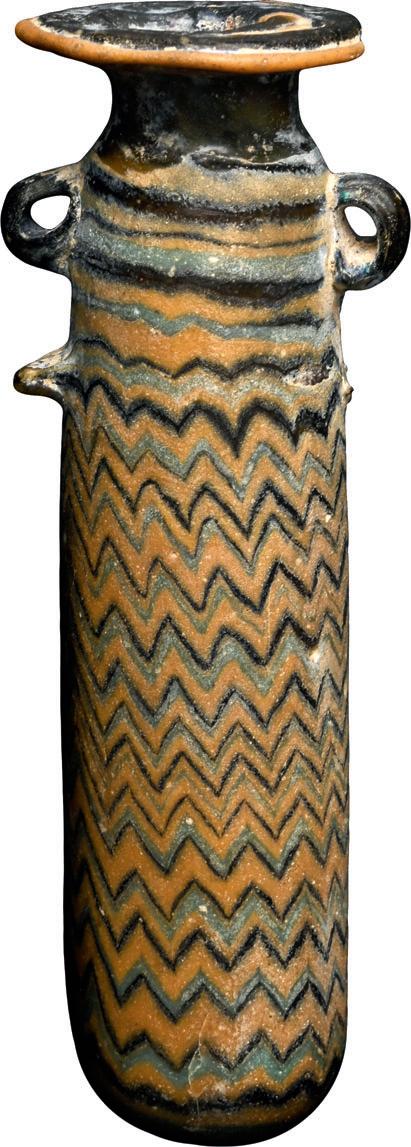
GREEK IRIDESCENT PALE AQUA GLASS BOWL HELLENISTIC, MID 2ND-EARLY 1ST CENTURY B.C.
6¼ in. (380 grams, 16 cm wide)
Conical in profile with a rounded apex, aqua glass with three incised bands below the rim on the inner face.
£1,800 - 2,400
PROVENANCE:
Dr Jutaro Kawabe, Nagoya, Japan, his collection formed in the 1960s-1970s. with Hoshigaoka Gallery until the late 1990s. Private collection, London, UK.
118
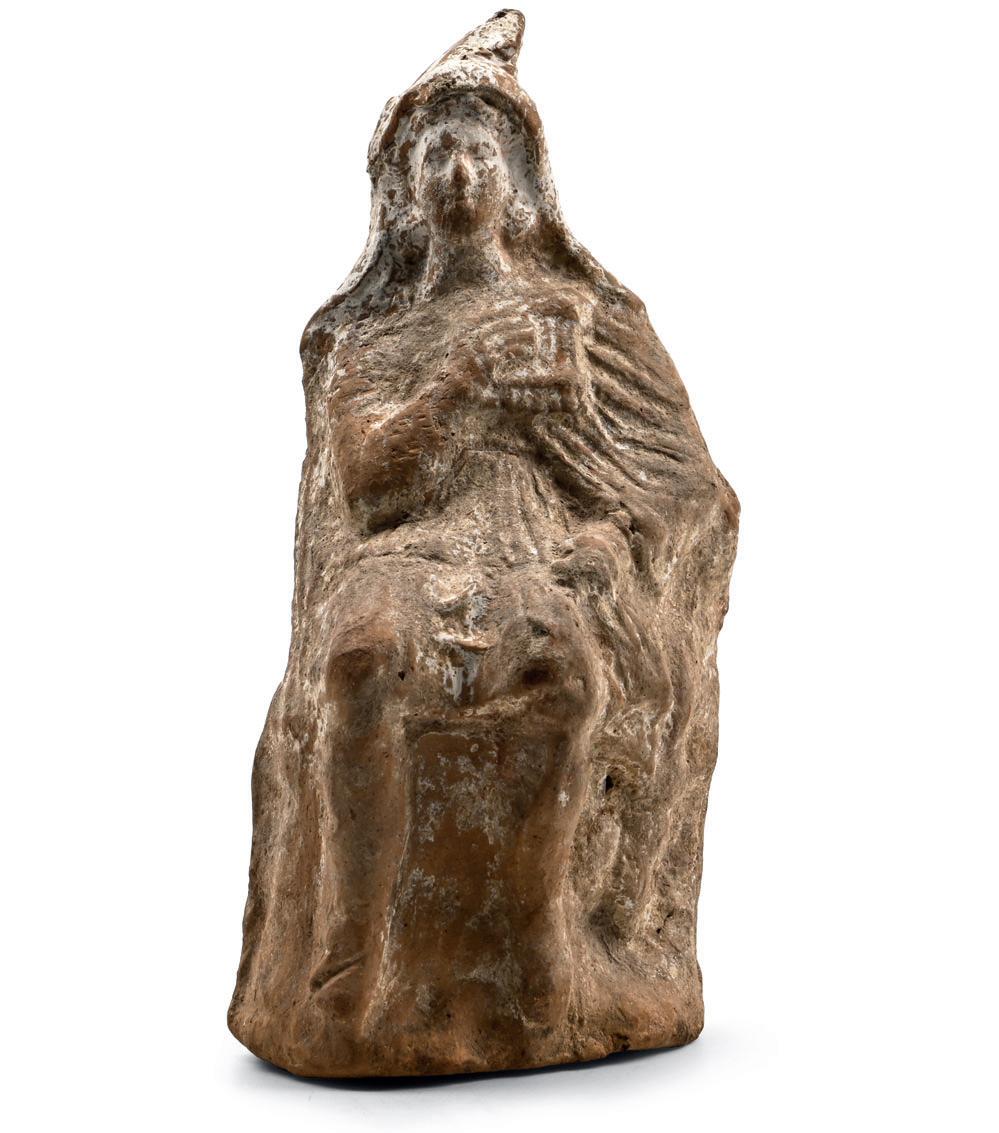
GREEK CORE-FORMED TALL GLASS ALABASTRON ‡ 6TH-5TH CENTURY B.C.
3 in. (36.69 grams, 91 mm)
With a fusiform body, slender neck and broad flange rim, decorated with marvered feathering and spiralling trails; two lateral loop handles and a pinched lateral lug.
£4,000 - 6,000
PROVENANCE: Anonymous sale, Binoche & Giquello, Paris, 30th May 2012, no.124. Private collection, Switzerland.
120
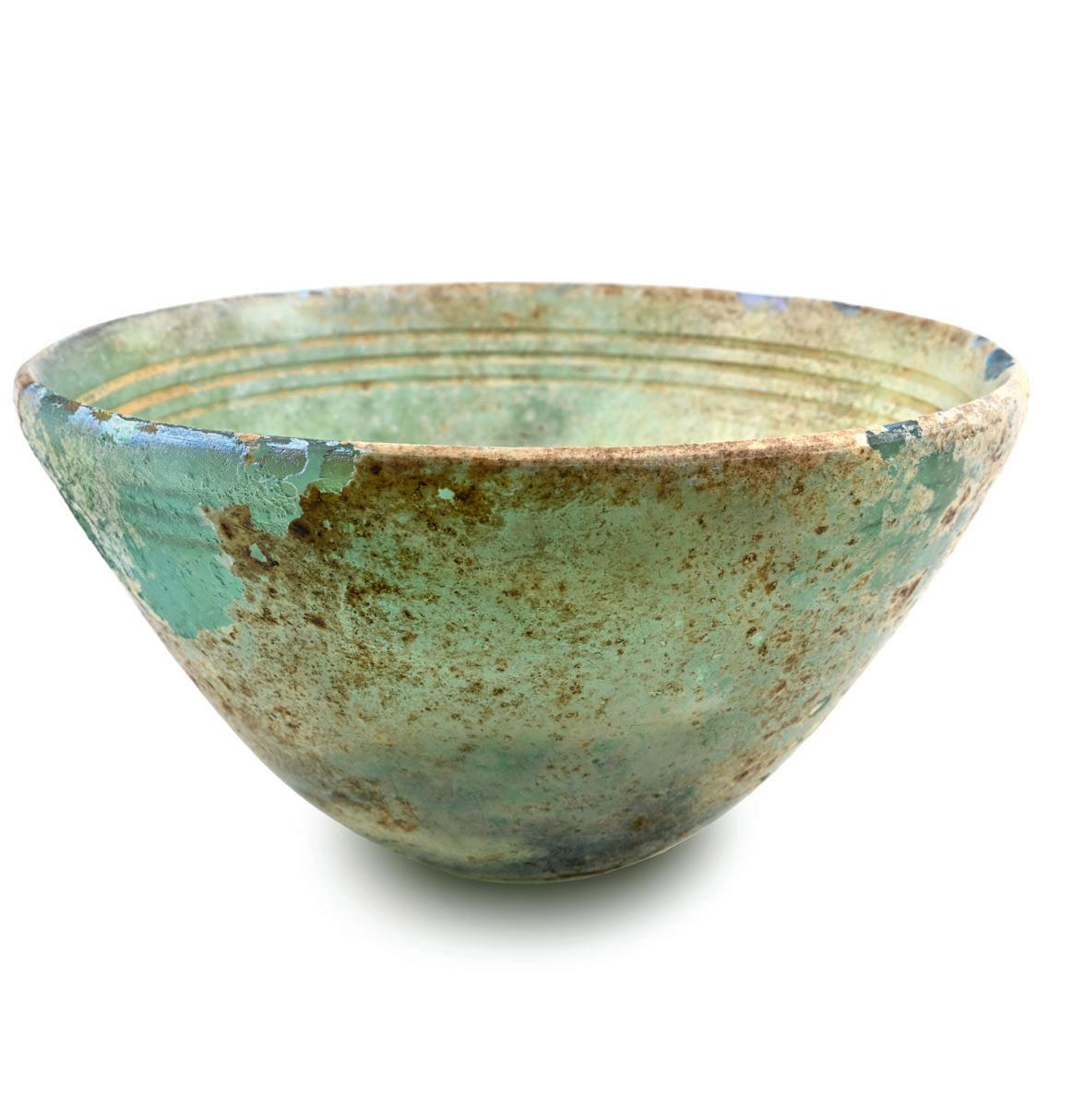
GREEK TERRACOTTA SEATED PAN ‡ CIRCA 400 B.C.
6 in. (205 grams, 15.8 cm)
Hollow-formed statue showing a young pan wearing a short tunic and hooded cloak, holding pipes in his right hand; rectangular slot on the reverse.
£600 - 800
PROVENANCE:
Private collection Mr T.B., Zürich, Switzerland, before 1970. with Galerie Rhéa, Zurich, Switzerland.
121
GREEK TERRACOTTA WHITE-GROUND PAINTED LEKYTHOS
ATTRIBUTED TO THE ATHENA PAINTER ‡
CIRCA 510-500 B.C.
10 in. (459 grams, 26.4 cm)
Cylindrical with stepped foot, five palmettes above the shoulder, dynamic frieze of two men visiting two hetairai, each of the figures dressed in long pleated garments, at the centre of the scene, a hetaira on the right reaching towards the bearded male and gently touching his chin with her open hand, a tall draped table behind her with an amphora underneath and a standing bird on the top.
£4,000 - 6,000
PROVENANCE:
H.A.C. (Herbert A. Cahn), 19 October 1979. Private collection, Bern, Switzerland.
Accompanied by an original thermoluminescence analysis report no.N125q45 by Oxford Authentication.
FOOTNOTES:
The Athena Painter is known as the painter who designed several Greek blackfigure pottery works using the 5th-century BC white-ground technique. He specialised in lekythoi and refers to Athena as the main subject in his works. Together with the Theseus Painter, they continued the tradition of painting large lekythoi. His black figures are of high quality, and in addition to lekythoi, he decorated other potteries such as oenochoai. Some archaeologists say that he may have been the same person as the Bowdoin Painter of red-figure pottery, although they may have just worked in the same workshop.
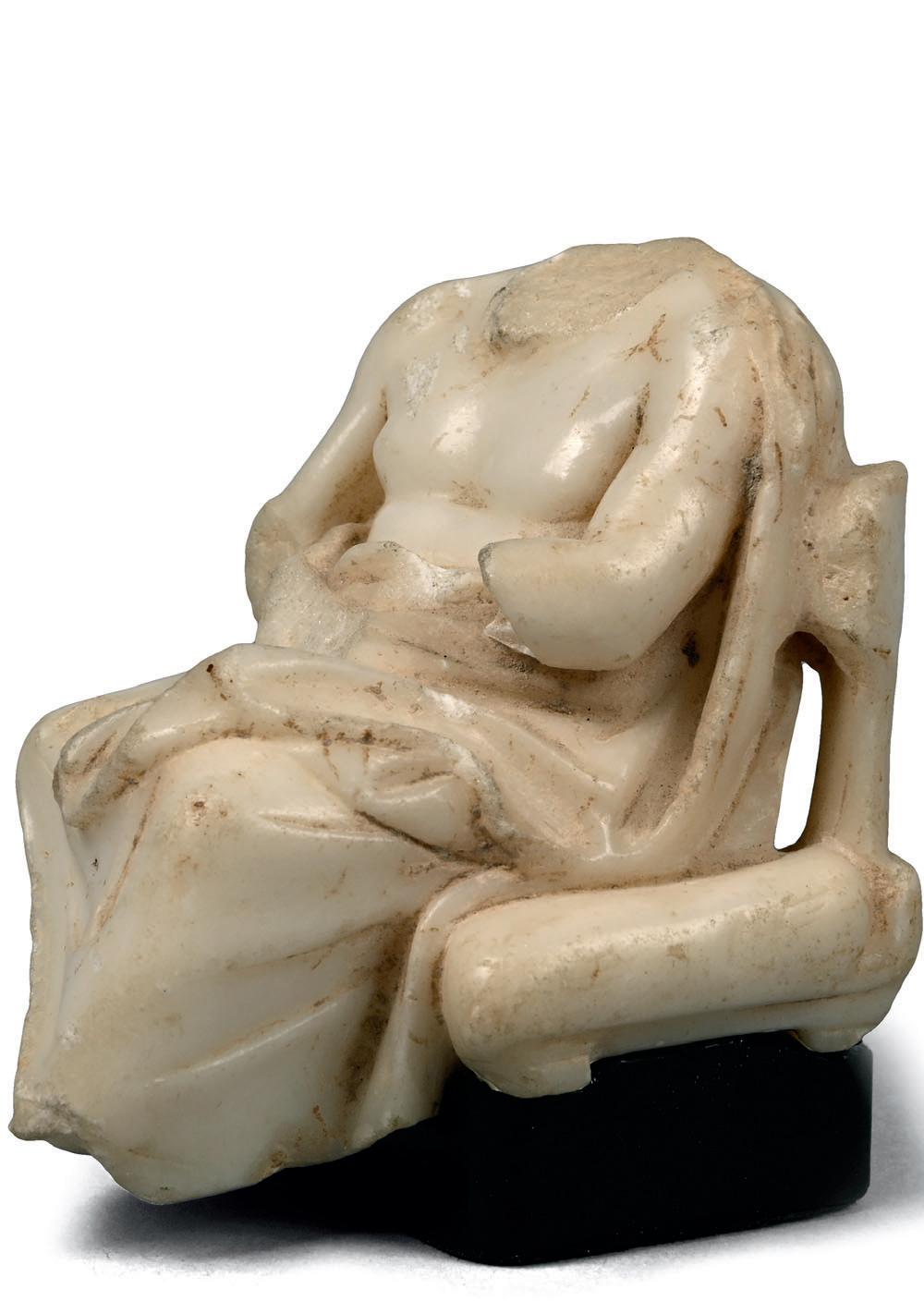
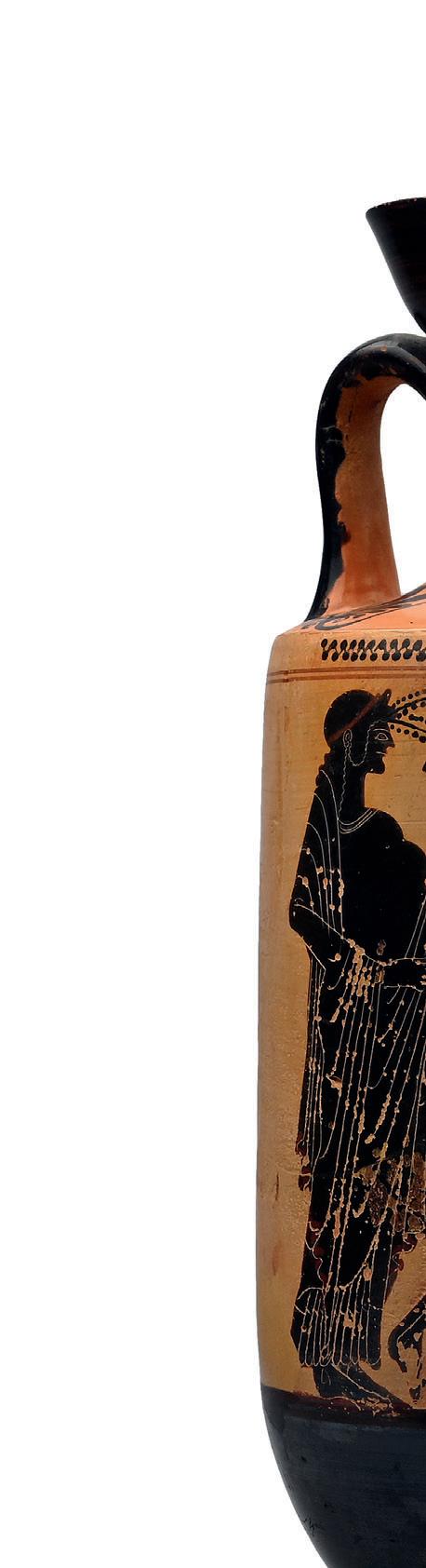

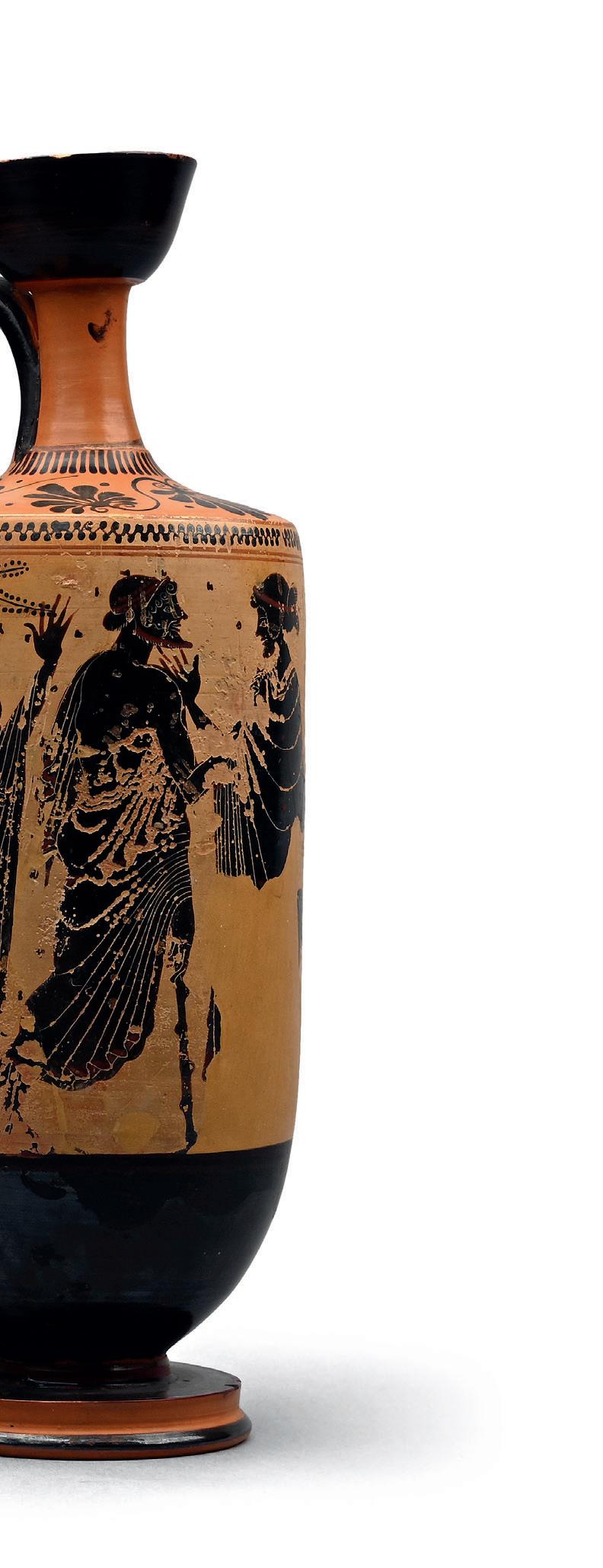
122
GREEK MARBLE FIGURE OF A SEATED GOD OR PHILOSOPHER ‡ HELLENISTIC, 3RD-1ST CENTURY B.C. 3 in. (563 grams total, 86 mm high including stand)
Carved in the round male figure in a seated pose wearing a loosely draped pallium on the shoulders and lower body, legs crossed at the knees; openwork frame to the chair with deep undercuts; mounted on a custom-made stand.
£15,000 - 20,000
PROVENANCE:
Formerly in a private collection, London. European private collection, acquired in 2002.
FOOTNOTES:
The statuette could represent Zeus or Chronos, based on similarities with two statues in the Vatican Museums and two statues in the Thebes Museum. The god is depicted seated, with his torso exposed, and his left hand, which normally holds the sceptre in statues of seated Zeus, is instead stretched out across his legs.
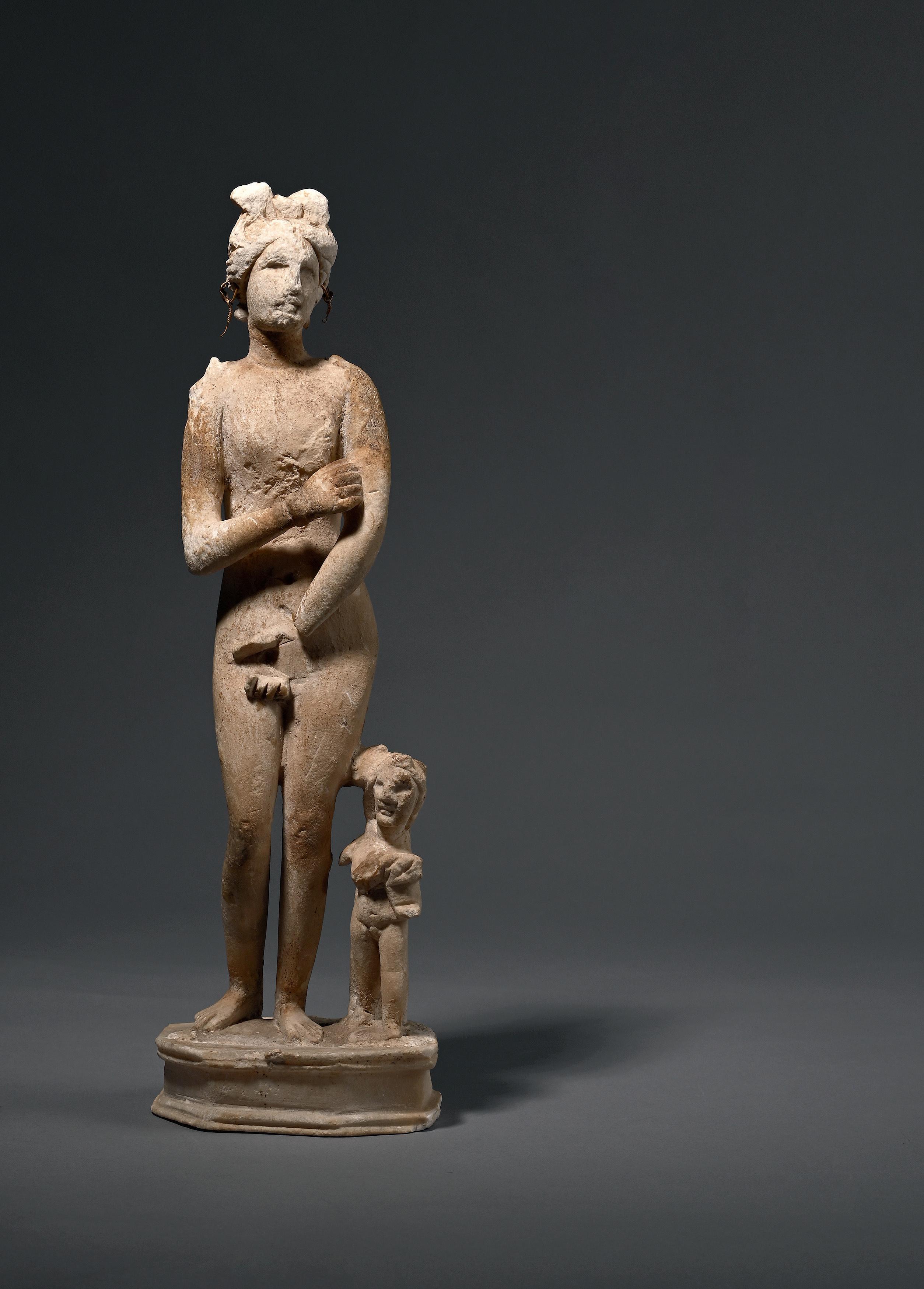
EASTERN GREEK MARBLE FIGURE OF APHRODITE, THE GODDESS OF LOVE AND BEAUTY ‡ 1ST CENTURY B.C.-1ST CENTURY A.D.
12¾ in. (1.2 kg, 32.7 cm)
Carved in the round figure of the goddess standing nude with one hand raised and the other on her pudendum, her hair gathered into a chignon with lateral bunches on the crown and with voids to allow for the suspension of small gold earrings; putto at her left knee; left hand partly absent; remounted on a socle base.
£4,000 - 6,000
PROVENANCE: Acquired in the 1992.
Private collection, Switzerland, thence by descent.
Private collection, since the late 1990s.
FOOTNOTES:
Aphrodite, the Greek goddess of love and beauty, was one of the most widely worshipped deities in the ancient world, particularly across the eastern Greek regions of Asia Minor. In these areas, her image often blended traditional Greek ideals with local influences, giving rise to distinctive regional styles. Marble figures such as this would have served not only as works of art but also as expressions of devotion, reflecting both personal piety and broader cultural values surrounding beauty, fertility, and desire. The enduring popularity of Aphrodite’s image speaks to her central role in daily life, where she was invoked not just in matters of love, but also in marriage, prosperity, and well-being.
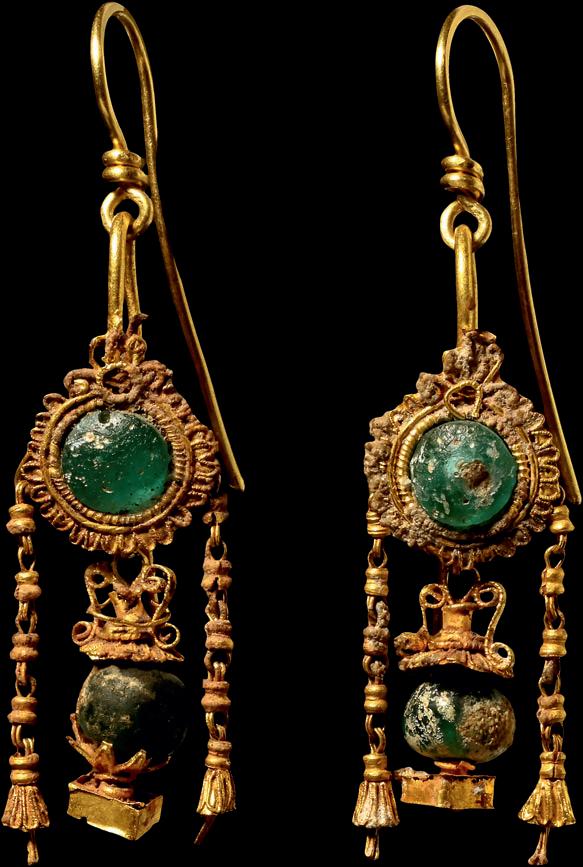
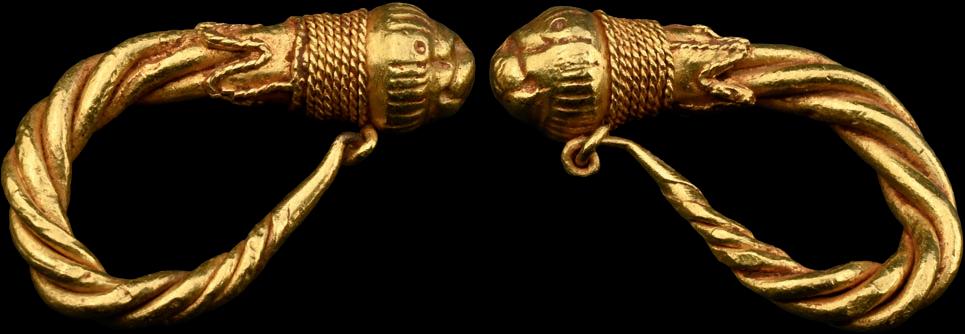
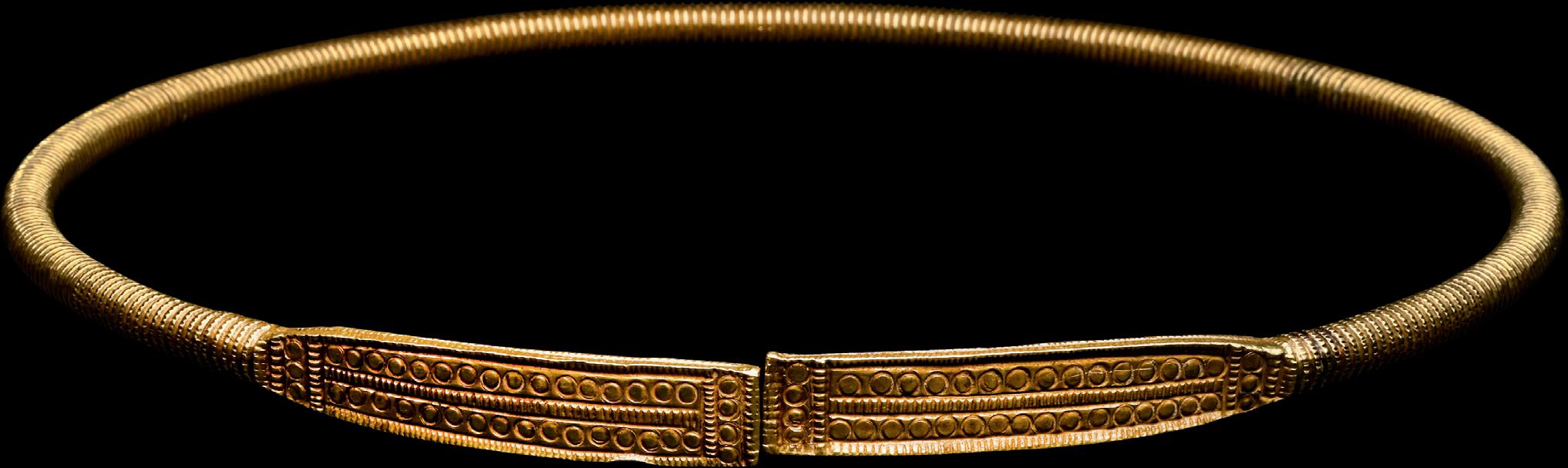
124
GREEK GOLD AND BEAD DROP EARRINGS ‡
HELLENISTIC, 2ND-1ST CENTURY B.C.
1¾ in. (5.15 grams total, 46 mm each)
Matched pair of hooked wire earrings, each with an inset cabochon, articulated dangles and other ornaments. [2]
£8,000 - 10,000
PROVENANCE:
Private American collection, 1970s-1980s. with Robert Haber, New York, USA, circa 1990s. Private collection, Europe.
FOOTNOTES:
This pair belongs to the Hellenistic group of earrings with pendants, a broad group including pendants shaped as amphorae, birds, erotes and other exotic elements. Most of them come from sites around the Aegean or the Eastern Mediterranean and were probably produced in workshops in these regions. They usually date from the 2nd to the 1st centuries B.C.
125
GREEK SOLID GOLD EARRING PAIR ‡
4TH-2ND CENTURY B.C.
1 in. (18.43 grams total, 27 mm each)
Each a thick braided hoop with a collar of twisted filigree and a lion’s mask finial. [2]
£3,000 - 4,000
PROVENANCE:
Private London collection, 1980s.
Private collection, acquired on the British art market in 1993.
FOOTNOTES:
The earrings belong to the hoop-type earrings, in which animal and human heads form the terminal as small miniature sculptures modelled in the round. The heads were attached to collars made from a single piece of gold. The group is characterised by lion heads.
126
SCYTHIAN GOLD-CLAD RIBBED TORC WITH DECORATED TERMINALS
4TH-3RD CENTURY B.C.
11 in. (481 grams, 28 cm)
Round in section with ribbing, rectangular finials with billeting to the borders and edges, and rows of impressed roundels.
£8,000 - 10,000
PROVENANCE:
Private collection, Wagner family, Germany, 1955.
Private collection, London.

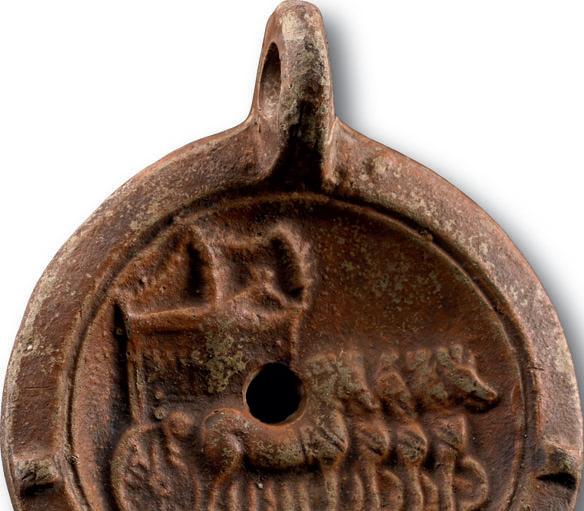
127
ROMAN TERRACOTTA OIL LAMP WITH VICTORY QUADRIGA 1ST-2ND CENTURY A.D.
4 in. (77 grams, 11.2 cm)
Squat and shallow with broad base; pierced lug handle to rear and small stub nozzle; lateral spurs to shoulder; discus with low-relief quadriga; underside with ‘CCLOD’ maker’s mark.


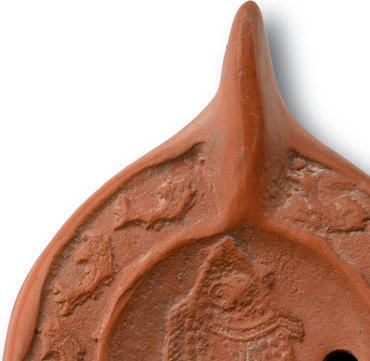




£300 - 400
PROVENANCE:
From the private collection of Mr Brian Edwards, New Malden, Surrey, UK, formed from the late 1970s-early 1980s; thence by descent.
FOOTNOTES:
The mark ‘CCLOD’ appears in the Index of Signatures and Inscriptions for the J. Paul Getty Museum on a late 1st century lamp (Accession No. 83.AQ.377.96).
128
LATE ROMAN TERRACOTTA LAMP WITH CHRISTIAN FISH ‡ 5TH-6TH CENTURY A.D.


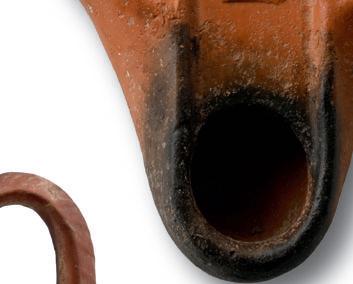

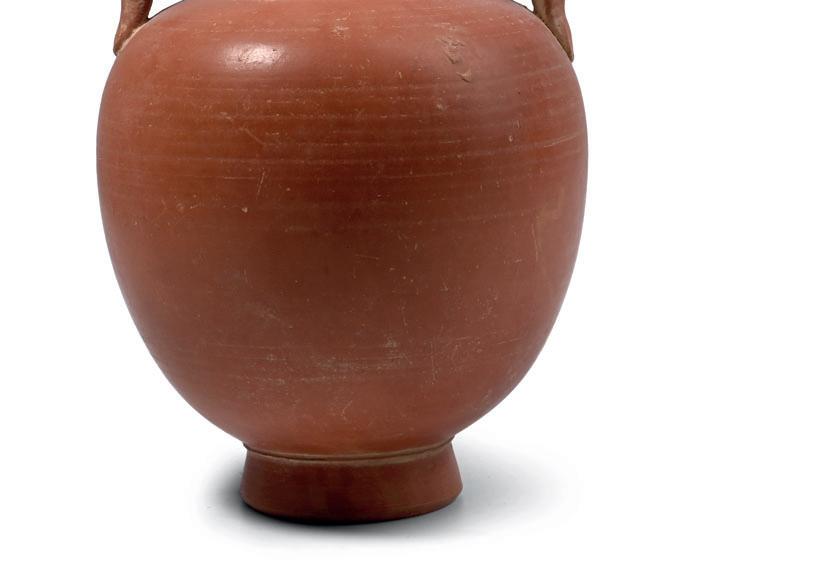



5¾ in. (146 grams, 14.5 cm)
Low discus with two filler holes flanking a low-relief fish in profile, a band of arched fish to the shoulder, lug handle to the rear and a low basal ring.
£1,000 - 1,400
PROVENANCE:
Private collection, Tokyo, Japan, 1980s.
Private European collection, 2010.
129
LATE ROMAN TERRACOTTA LAMP WITH CHI RHO ‡
LATE 5TH-EARLY 6TH CENTURY A.D.
5½ in. (173 grams, 13.9 cm)
Recessed discus with two filler holes flanking a low-relief letter rho with cruciform stave, lozenge detailing; band of concentric circles and arrowheads on the rim, lug handle and a low basal ring.
£500 - 700
PROVENANCE:
Private collection, acquired in 1994; thence by descent.
130
ROMAN RED WARE AMPHORA-SHAPED VASE
CIRCA 3RD-4TH CENTURY A.D.
8 in. (370 grams, 21.3 cm)
With bulbous body and gently flared foot, deep shoulder, tall neck with everted rim to the mouth, two lateral loop handles with moulded herringbone detailing.
£400 - 600
PROVENANCE:
From the private collection of Mr Brian Edwards, New Malden, Surrey, UK, formed from the late 1970s-early 1980s; thence by descent.
131
ROMAN ARRETINE RED SLIP TERRA SIGILLATA CUP WITH ROSETTES AND RABBITS AND SEX.M.D. MAKER’S MARK
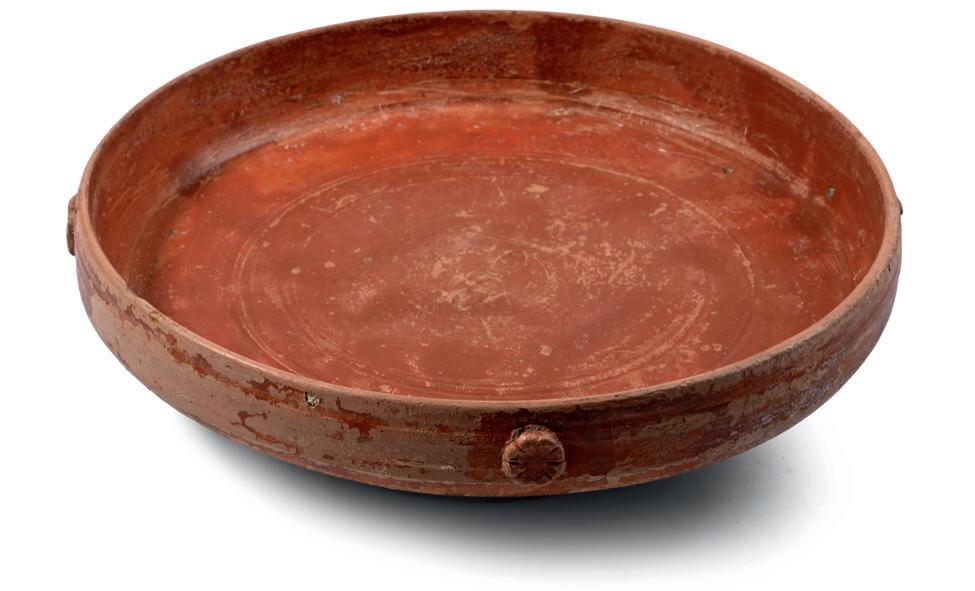
AUGUSTAN, EARLY 1ST CENTURY A.D.
6½ in. (285 grams, 16.5 cm)
Squat bowl with carinated profile and low foot; to the rim, applied rosettes and hares; stamped to the centre, a sandaled foot with legend ‘SEX.M.D’ legend.
£400 - 600
PROVENANCE:
From the private collection of Mr Brian Edwards, New Malden, Surrey, UK, formed from the late 1970s-early 1980s; thence by descent.
ROMAN BRONZE CHARIOT MOUNT WITH BUST OF SILENUS ‡
1ST-2ND CENTURY A.D.
5¼ in. (435 grams total, 13.5 cm including stand)
Ovoid in profile with hollow reverse, modelled in high-relief with pallium tied at his right shoulder and garland draped across his shoulders and wreath of ivy around his brow; mounted on a custommade stand.
£15,000 - 20,000
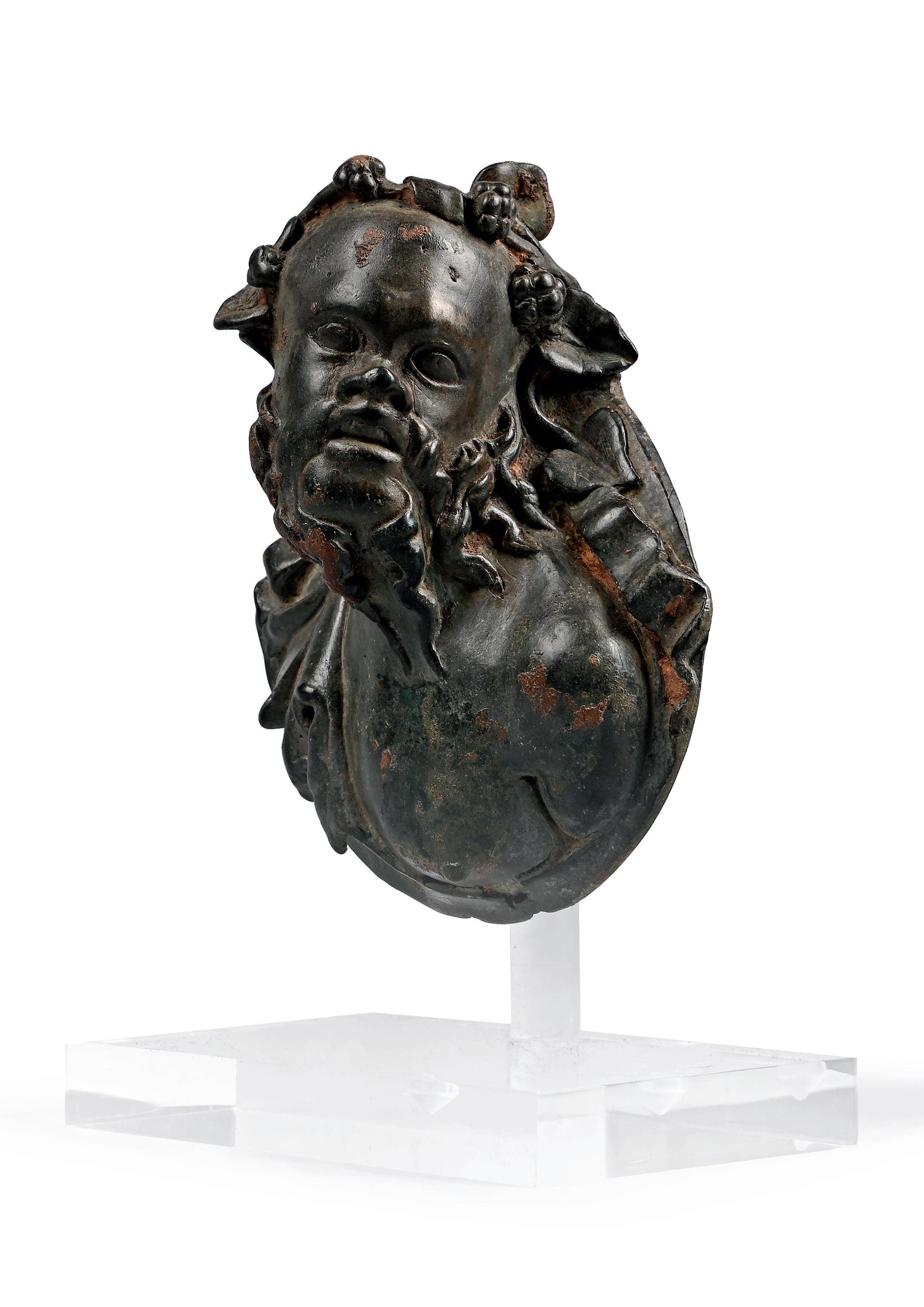
PROVENANCE: Private Swiss collection, before 1976. with Bonhams Antiquities, London, 3rd October 2000, no.202. Private European collection.
Accompanied by copies of the relevant Bonhams catalogue pages. Accompanied by an academic report by Dr Raffaele D’Amato.
FOOTNOTES:
This type of mount was probably used as bridle holders and placed near the driver’s seat, on the wagon platform or as a central decoration on the back of the wagon.
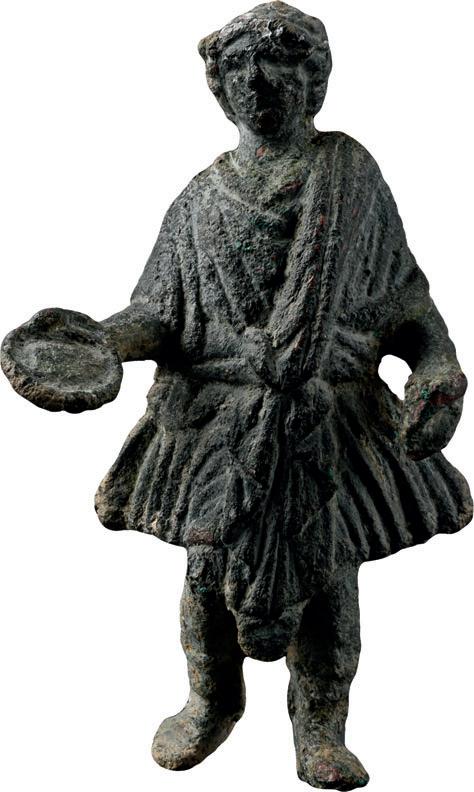
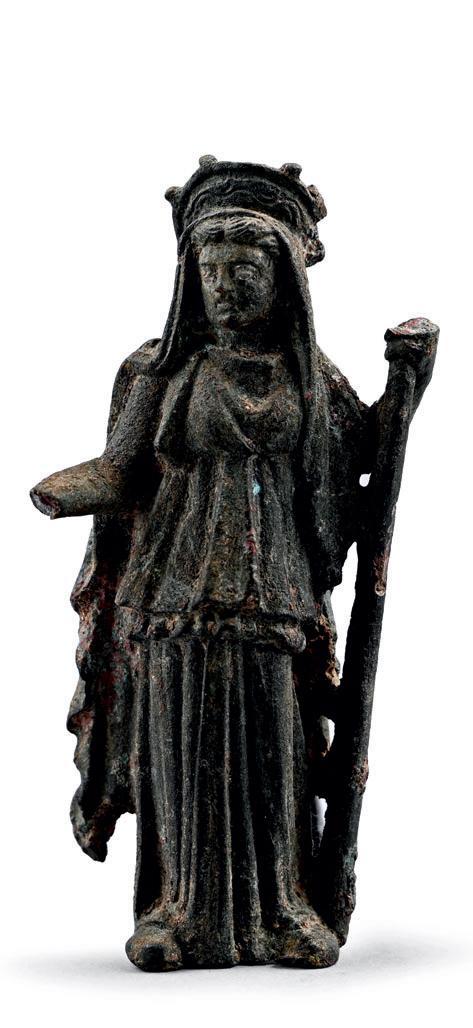
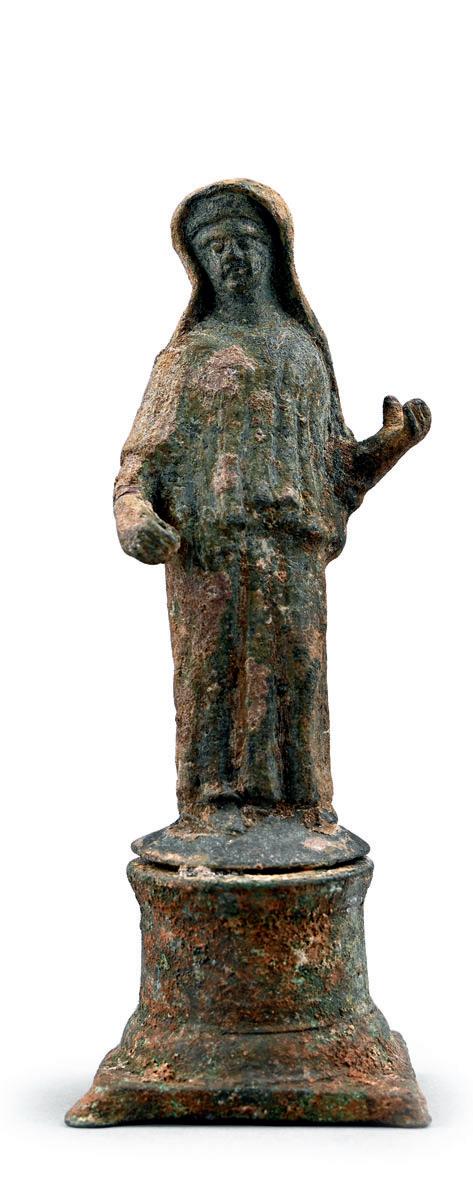
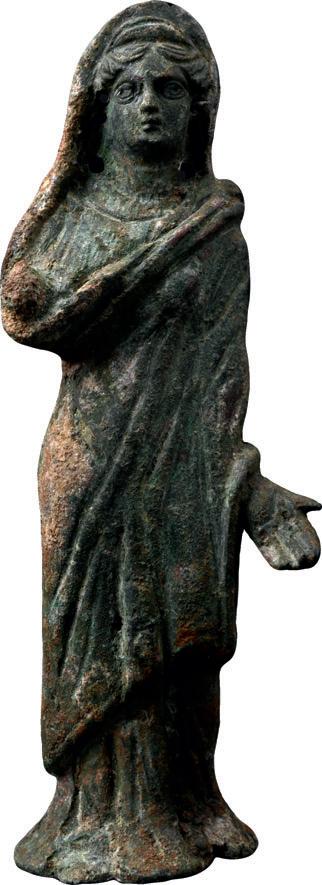
133
ROMAN BRONZE STATUETTE OF THE GREEK GOD HERMES
1ST CENTURY B.C-1ST CENTURY A.D.
4 in. (220 grams, 10.4 cm)
Modelled in the round figure of Turms (Greek Hermes), standing and holding a patera in his right hand, wreath in the left; wearing a flared tunic with elaborate frontal fastening.
£1,000 - 1,400
PROVENANCE:
From the collection of a gentleman, acquired on the London art market in the 1990s.
134
ROMAN BRONZE LAR STATUETTE
1ST CENTURY B.C.-1ST CENTURY A.D.
4 in. (272 grams total, 10.2 cm)
Standing female figure in flounced peplos robes holding a staff in her left hand and with her right hand extended (absent); the face carefully modelled, with silver applied to the eyes; crescent tiara above the palla with undulating tendril ornament; bracket to reverse for attachment.
£1,000 - 1,400
PROVENANCE:
From the collection of a gentleman, acquired on the London art market in the 1990s.
135
ROMAN BRONZE PRIESTESS STATUETTE
1ST-2ND CENTURY A.D.
5 in. (188 grams, 13 cm)
Standing figure wearing a floor-length robe gathered at the waist, and with the palla drawn over the head; hands raised to support an object (absent), possibly a cornucopia; mounded on a tubular base on a square foot.
£1,000 - 1,400
PROVENANCE:
From the collection of a gentleman, acquired on the London art market in the 1990s.
136
ROMAN BRONZE STATUETTE OF THE GODDESS JUNO
1ST-2ND CENTURY A.D.
4½ in. (154 grams, 11.3 cm)
Hollow-formed, modelled in the round figure of Juno standing erect wearing a floor-length robe and palla over her head and shoulders; left hand at her side, right arm extended (absent, probably with a patera); crescent diadem to the brow; eyes exaggerated to accept silver inlay; lateral piercings to the head to accept applied earrings.
£800 - 1,000
PROVENANCE:
From the collection of a gentleman, acquired on the London art market in the 1990s.
LARGE ROMAN BRONZE CHARIOT OR LECTICA MOUNT OF CUPID ‡
2ND-3RD CENTURY A.D.
8 in. (1.79 kg, 19.9 cm)
Modelled in the round hollow-formed figure of Cupid standing nude emerging from a flower, with dressed curly hair bound into a forelock, small dorsal wings on the shoulders, a recurved bow in his left hand and an arrow supported on his right forearm; looped handles to the rear and stepped base below.
£25,000 - 35,000
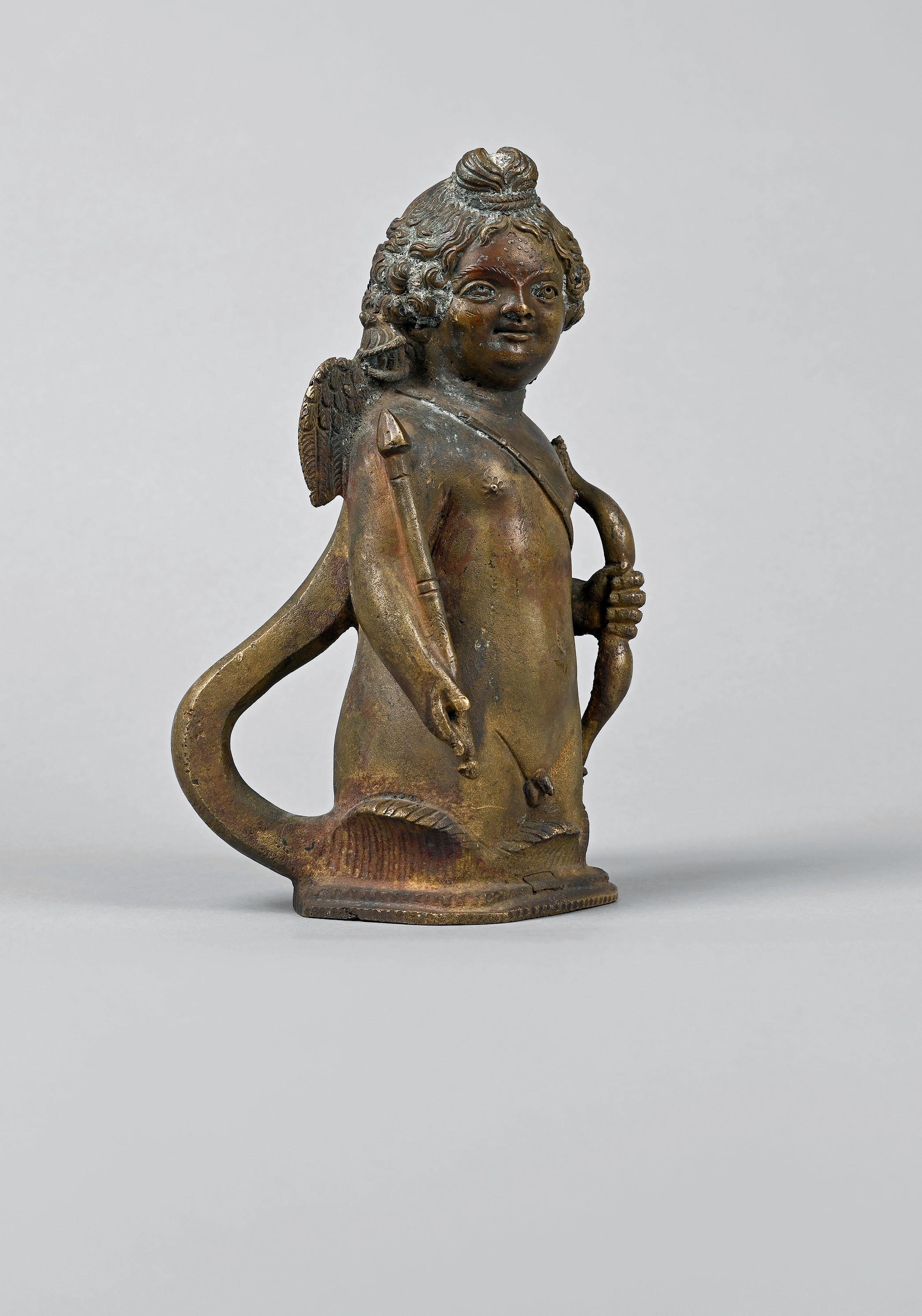
PROVENANCE:
From the collection of J-Ph, Mariaud de Serres, Paris, France, 1990s. Piasa Auctions, 17-18 March 2003, no.584.
Private collection, Europe.
Accompanied by an academic report by Dr Raffaele D’Amato. Accompanied by a copy of French passport no.237039.
FOOTNOTES:
These prismatic fittings covered the ends of the wooden beams, reinforcing the floor of the undercarriage on both long sides. The heavy and ornate nature of these accessories suggests they were originally attached to a more substantial vehicle such as a pilentum (used to transport aristocrats on state occasions), a carruca (for transporting emperors and aristocratic matrons) or even a thensa (a ceremonial chariot used to transport deities to the imperial games) or a lectica (portable bed for patricii and matronae). Contemporary sources describe ornate inlay, rare woods and metalwork incorporated into these vehicles, and, probably, the present fitting would originally have been gilded.
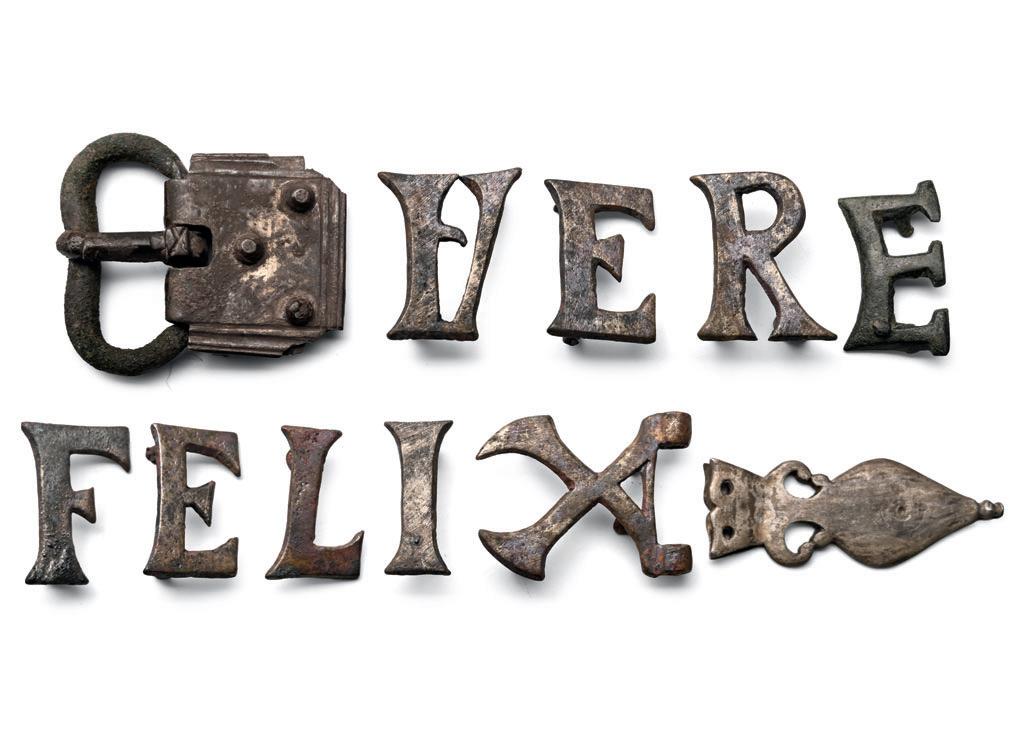
ROMAN SILVER MILITARY ‘USE THIS WITH GOOD FORTUNE’ BELT MOUNT GROUP
1ST-2ND CENTURY A.D.
1 - 1¾ in. (63 grams total, 24-46 mm)
Group of belt fitting comprising: kidney-shaped buckle with tongue and square plate with studs; ‘amphora-type’ strap end with pierced and split upper end; silver letter-shaped plaques each with attachment studs to reverse: ‘E’ x 3, ‘F’, ‘I’, ‘L’, ‘R’, ‘V’, ‘X’ with suspension loop at the lower ends of the pars; the group may be assembled to read ‘U[t]ere Felix’ (use [this] with good fortune’. [11]
£1,200 - 1,700
PROVENANCE:
Ex German art market, 2000s.
Acquired from an EU collector living in London. From the collection of a Surrey, UK, gentleman.
FOOTNOTES:
One letter ‘E’ is bronze, the ‘T’ is absent. 139
ROMAN BRONZE MILITARY DIPLOMA FRAGMENTS FOR A SOLDIER OF THE COHORS I ULPIA DACORUM
129 A.D.
1 in. (16.1 grams total, 40-42 mm)
Two adjacent fragments of bronze sheet with incised script to both faces; the larger with two straight edges; obverse with incised lateral margin and text in rustic capitals: ‘SFR · POSTI[.] ISQ EO / NUBIVM.CV VXORI / CVM· EST.CIV [.]TAS · ISD / SENT · CVM · ILS QVAS / TAXAT · SINGVLI · SINE / P I V V ENTI OCEL / COH I VLP [.] ACOR’; reverse with looser, wider-spaced capitals written perpendicular to the obverse: ‘..THICIF ·OI / IANVSANI / COS / ..IFP CP / ...ASCRI .. / ETI NIP [.] / ...N...’ [2]
£400 - 600
PROVENANCE:
Ex German art market, 1990s.
Acquired from an EU collector living in London.
From the collection of a Surrey, UK, gentleman.
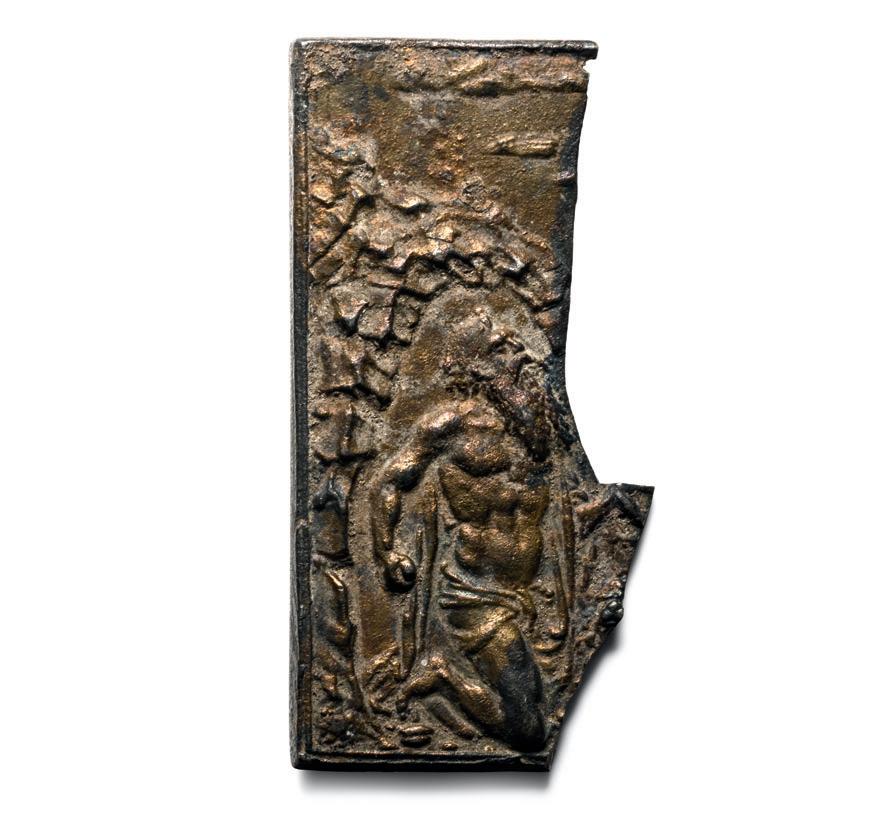
141
ROMAN BRONZE HORSE HARNESS DECORATION
1ST-2ND CENTURY A.D.
3 in. (91.4 grams, 81 mm)
Rectangular plaque with a profile bust of a man with carefully arranged hair.
£300 - 400
PROVENANCE:
Ex German art market, 2000s.
Acquired from an EU collector living in London. From the collection of a Surrey, UK, gentleman.
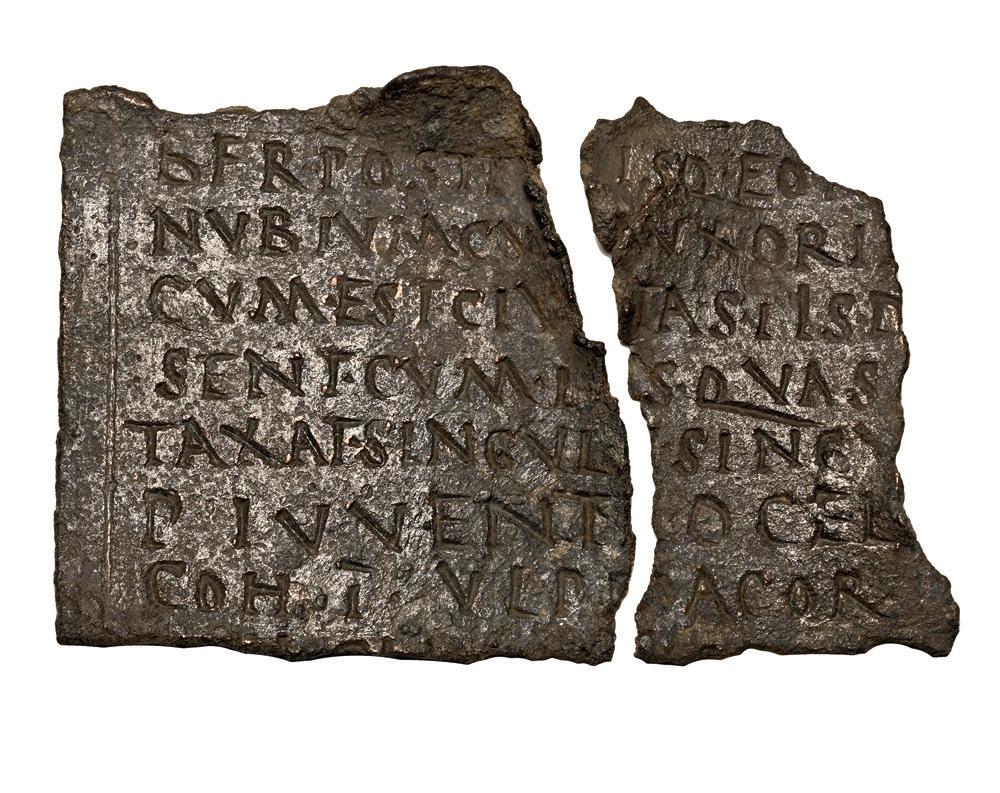
140
ROMAN BRONZE PLAQUE FRAGMENT WITH KNEELING PHILOSOPHER
CIRCA 2ND CENTURY A.D. OR LATER
3 in. (37.3 grams, 77.48 mm)
Plaque fragment with low-relief scene, kneeling figure in a cave with one hand stretched out.
£300 - 400
PROVENANCE:
From the private collection of a European gentleman (1942-2024), formed since the 1970s.

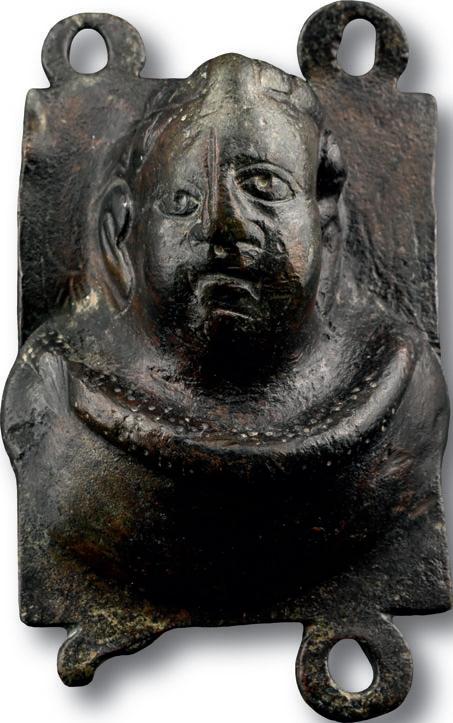
142
ROMAN BRONZE STATUETTE OF HERCULES ‡ CIRCA 2ND-3RD CENTURY A.D.
5 in. (244 grams, 13.5 cm)
Modelled in the round with a lionskin mantle over his extended forearm, standing nude with a club raised over his shoulder; provided with a contemporary custom-made stand.
£5,000 - 7,000
PROVENANCE:
Private collection, USA and Switzerland, before 1992; thence by descent.
EXHIBITED:
Harwich Museum, Harwich, Essex, UK, 4th March 2026-7th June 2026; accompanied by a copy of a photograph of the artefacts on display.
FOOTNOTES:
This type of representation of Hercules, inspired by Etruscan or Italic models, was widespread in Gallo-Roman sanctuaries dedicated to the god, where several votive statues attributable to this type have been found. The musculature of the back is well-executed, as are the facial features and the details on the Nemean lion’s skin.

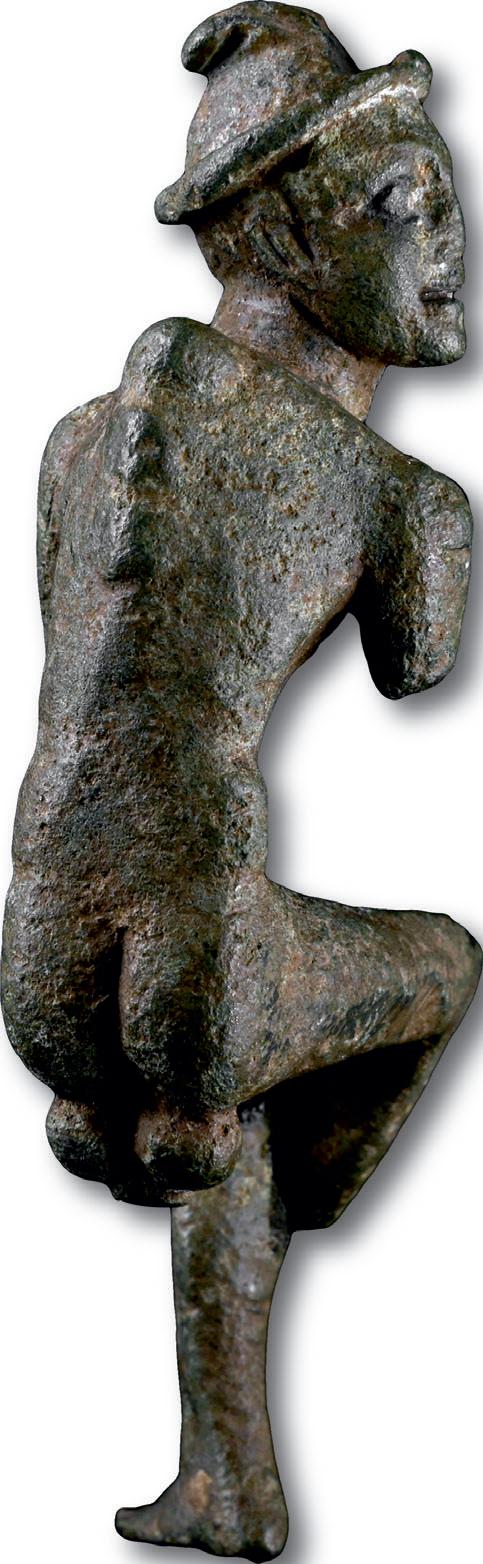
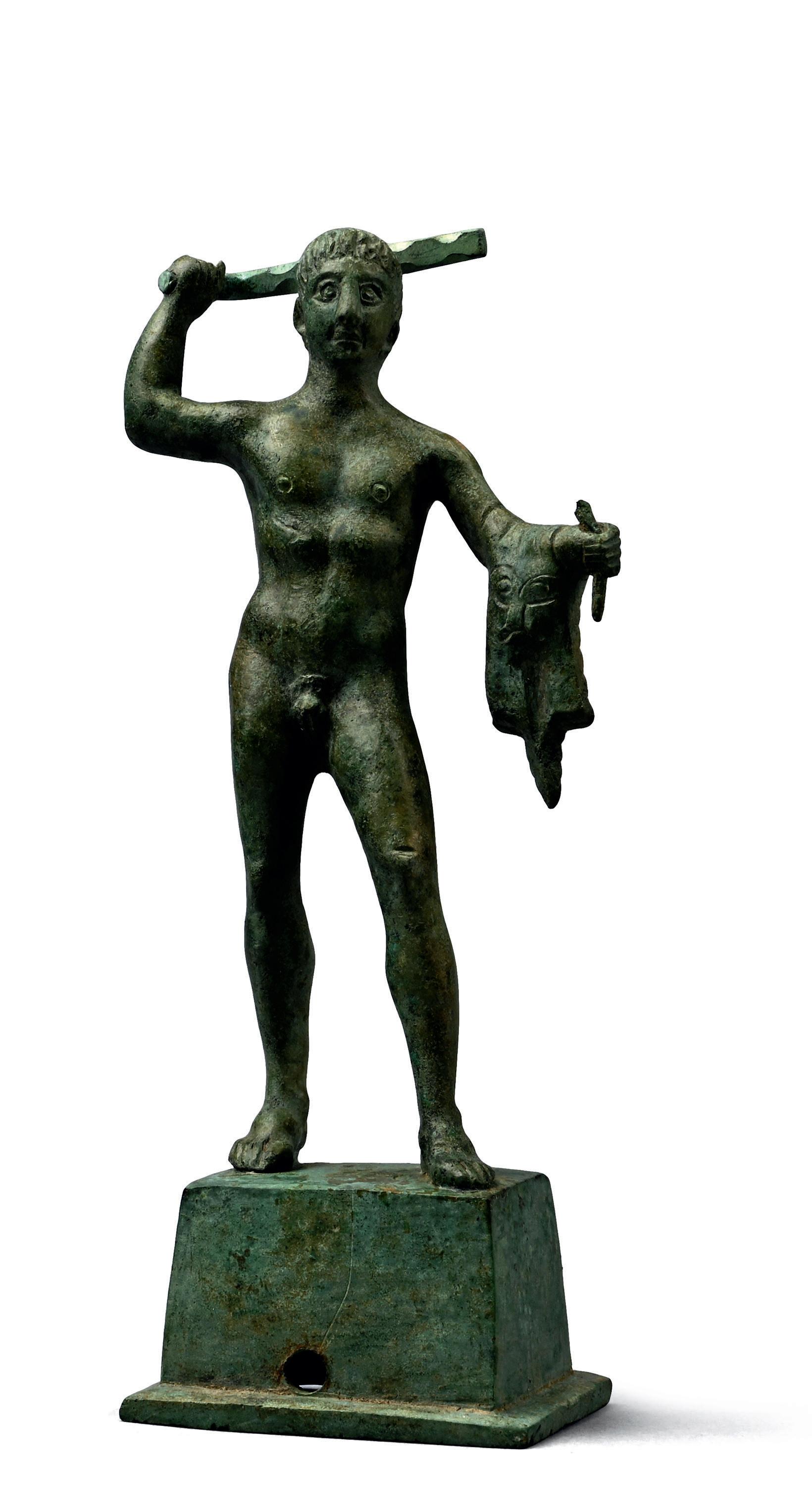
142
143
ROMAN BRONZE HUNCHBACK GROTESQUE STATUETTE 1ST CENTURY B.C.-1ST CENTURY A.D. 3 in. (130 grams, 93 mm)
Modelled in the round, sitting nude with head turned, arms and legs bent; wearing a brimmed cap with a feather in the crown; the spine and sternum modelled protruding, large, impressed eyes, genitals protruding below the crossed legs.
£3,000 - 4,000
PROVENANCE:
Acquired from Helios Ancient Art, Mayfair, London, UK, circa 1986. From a privately held London, UK, collection from the 1980s-1990s.
FOOTNOTES:
Such small bronzes with physical abnormalities and exaggerated features served as entertainment, but also had the function of warding off evil.

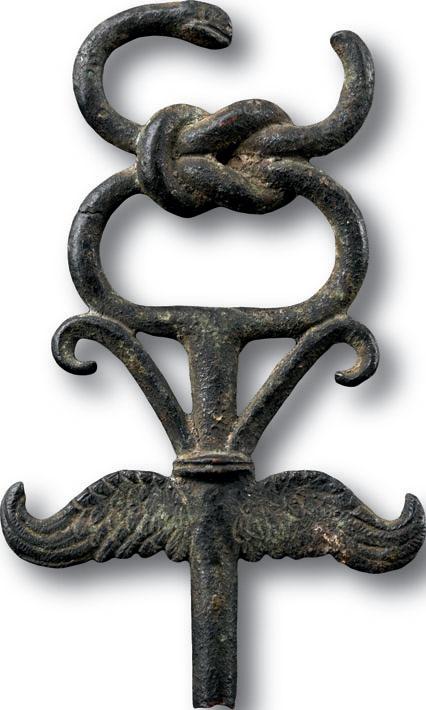
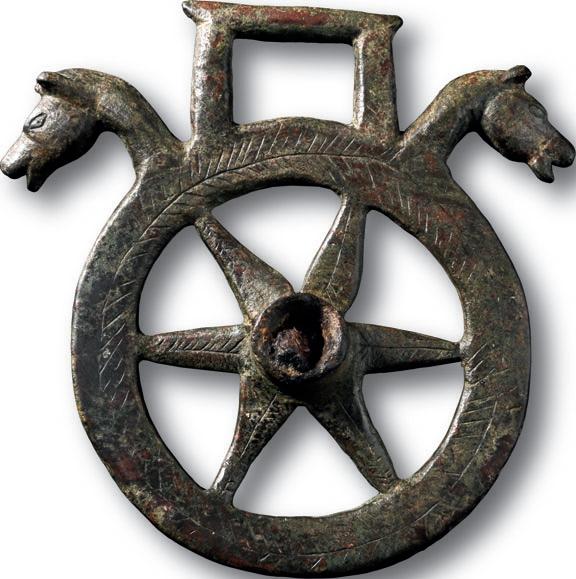

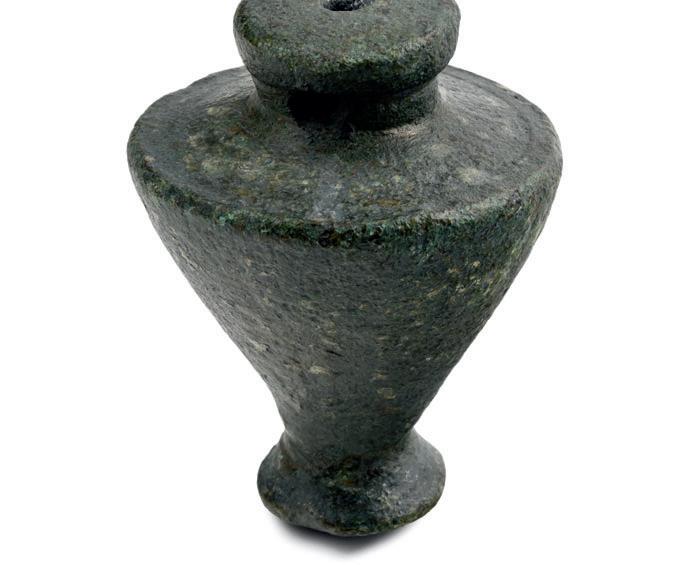

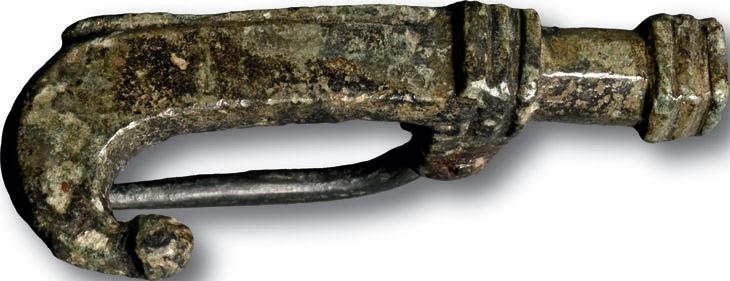
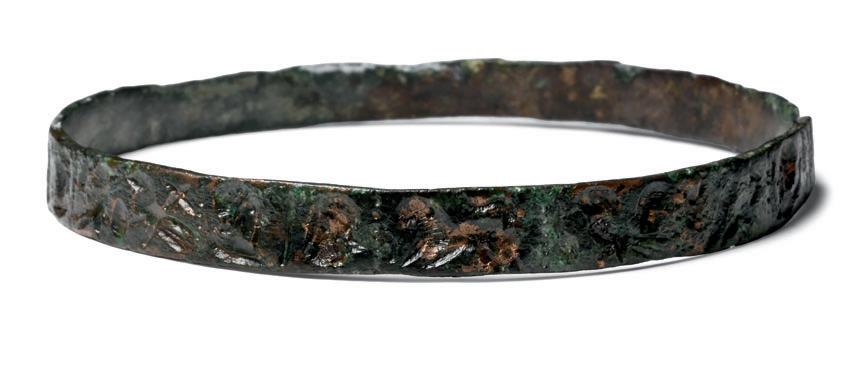
144
‘THE COLCHESTER’ ROMAN BRONZE CADUCEUS SCEPTRE FINIAL
1ST-4TH CENTURY A.D.
4 in. (77 grams, 10.7 cm)
Monofacial openwork finial formed as a serpent entwined and knotted above a pair of spread wings; from a large statue of Mercury (Hermes).
£500 - 700
PROVENANCE:
Found in Colchester in the 1960s.
From a late gentleman archaeologist’s collection, thence by family descent.
145
LATE ROMAN BRONZE HORSE HARNESS PHALERA WITH HORSE HEADS
4TH-6TH CENTURY A.D.
4¾ in. (283 grams, 11.9 cm)
Formed as a six-spoked wheel with raised rim to the hub and wreath detailing to the rim and spokes; rectangular slot above flanked by two addorsed horse-heads; ferrous spike to centre.
£600 - 800
PROVENANCE:
From an English private collection, 1980s. Property of a London, UK, antiquarian.
146
LARGE ROMAN BRONZE MASON’S PLUMB BOB WEIGHT
1ST-4TH CENTURY A.D.
2 in. (333 grams, 59 mm)
Conical body with a flaring point and top.
£300 - 400
PROVENANCE:
From the estate of Mr Eduard Steiner, Hainburg/Carnuntum (1933-2025). Acquired on the European art market.
147
ROMAN BRONZE DAGGER PLATE BROOCH CIRCA 2ND CENTURY A.D.
1¾ in. (12.5 grams, 44 mm)
Formed as a dagger inside a scabbard with a curving finial, catchplate and pin on the reverse.
£300 - 400
PROVENANCE: Ex German art market, 2000s. Acquired from an EU collector living in London. From the collection of a Surrey, UK, gentleman.
148
ROMAN BRONZE BRACELET WITH GLADIATORIAL BUSTS AND ANIMALS
1ST-2ND CENTURY A.D.
3 in. (17.5 grams, 75 mm)
Flat-section penannular band with overlapping ends; outer face divided by rows of vertical points and populated with stamped figures including bird, horse, profile bust, lion and other motifs.
£400 - 600
PROVENANCE:
From the private collection of a European gentleman (1942-2024), formed since the 1970s.
149
ROMAN BRONZE OIL LAMP WITH MASK HANDLE
1ST-3RD CENTURY A.D.
5 in. (442 grams, 14.2 cm)
Hollow-formed pear-shaped body with waisted nozzle, recessed discus with phallus-shaped void, arched strap handle to rear with reflector plate formed as an actor’s mask with palmette below; integral socketted base.
£1,500 - 2,000
PROVENANCE:
Acquired on the German art market before 2000. Ex European private collection.

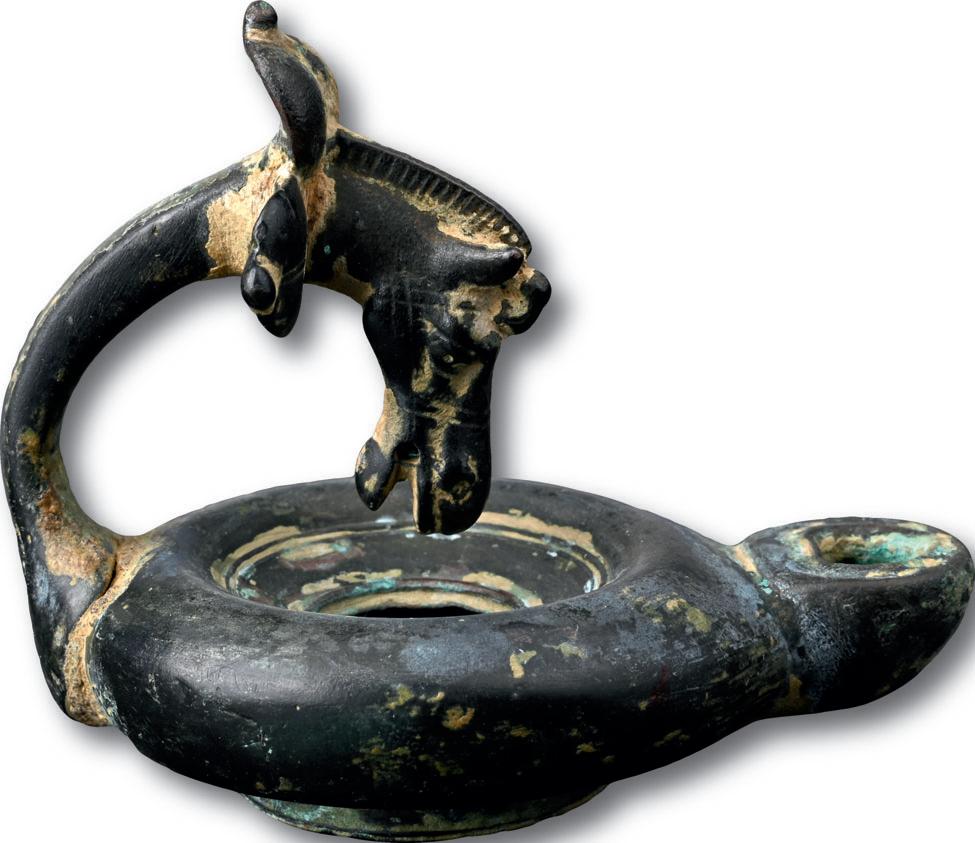
151
LATE ROMAN BRONZE LAMP AND STAND
CIRCA 5TH-6TH CENTURY A.D.
3 - 6 in. (543 grams total, 8.6-15.4 cm)
Comprising a slipper-shaped lamp with broad flange rim to the shoulder and rear with hooked spurs; scooped recessed nozzle; handle to rear formed as a vertical bar with lateral coils converging at the apex (one partly absent) and finger-loop below; two small hinge lugs to the rear of the flange to attach a hinged cover (absent); base with socket and portion of peg; separate conical stand with carination and collar to top. [2]
£500 - 700
PROVENANCE: Ex German art market, 2000s.
Acquired from an EU collector living in London. From the collection of a Surrey, UK, gentleman.
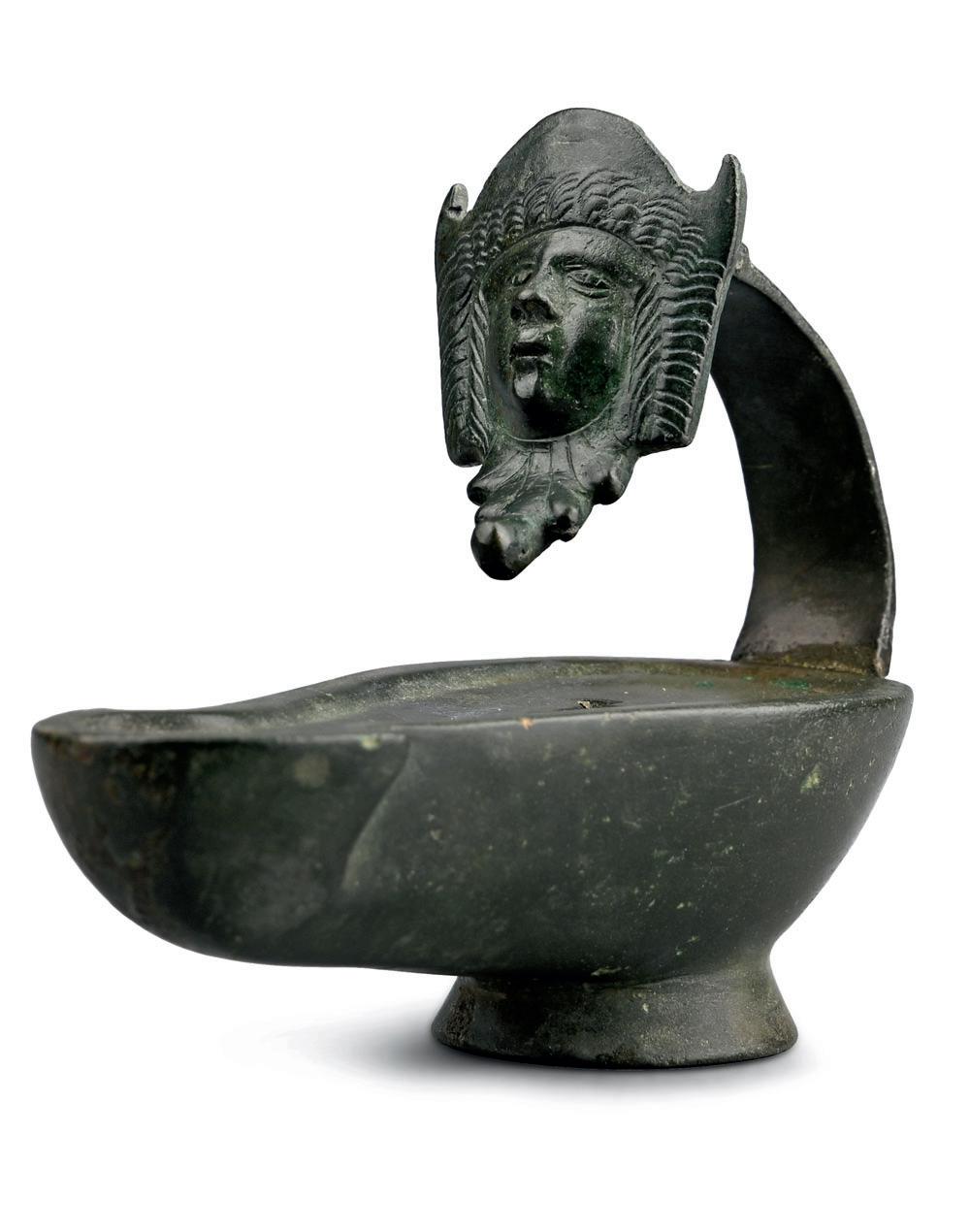
150
ROMAN BRONZE OIL LAMP WITH HORSE-HEAD HANDLE
2ND-3RD CENTURY A.D.
3¾ in. (246 grams, 95 mm)
Squat in profile with broad discus, rounded nozzle, thick basal ring; arched handle with trefoil reflector and horse-head finial, pierced at the mouth to accept reins (absent).
£1,000 - 1,400
PROVENANCE: From the collection of a gentleman, acquired on the London art market in the 1990s.
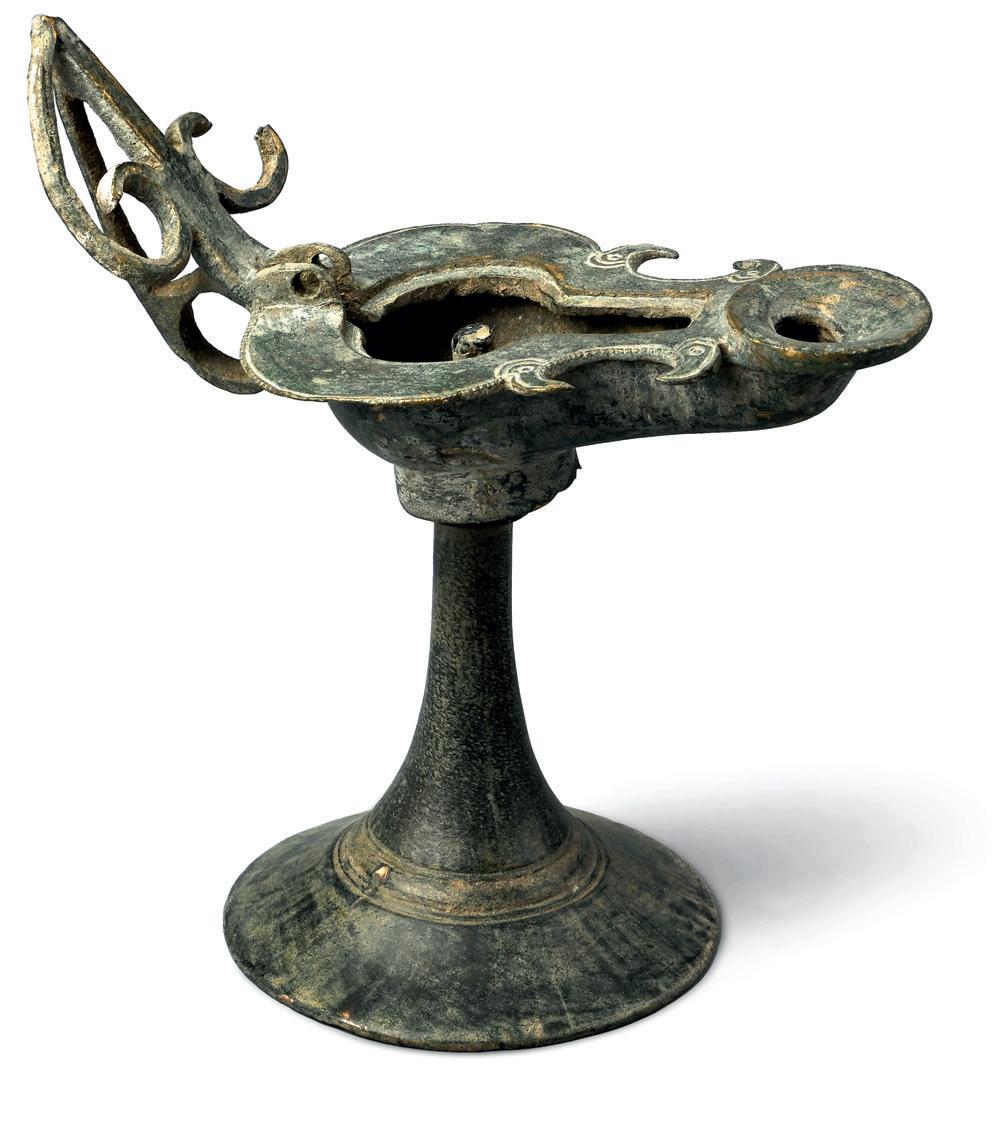
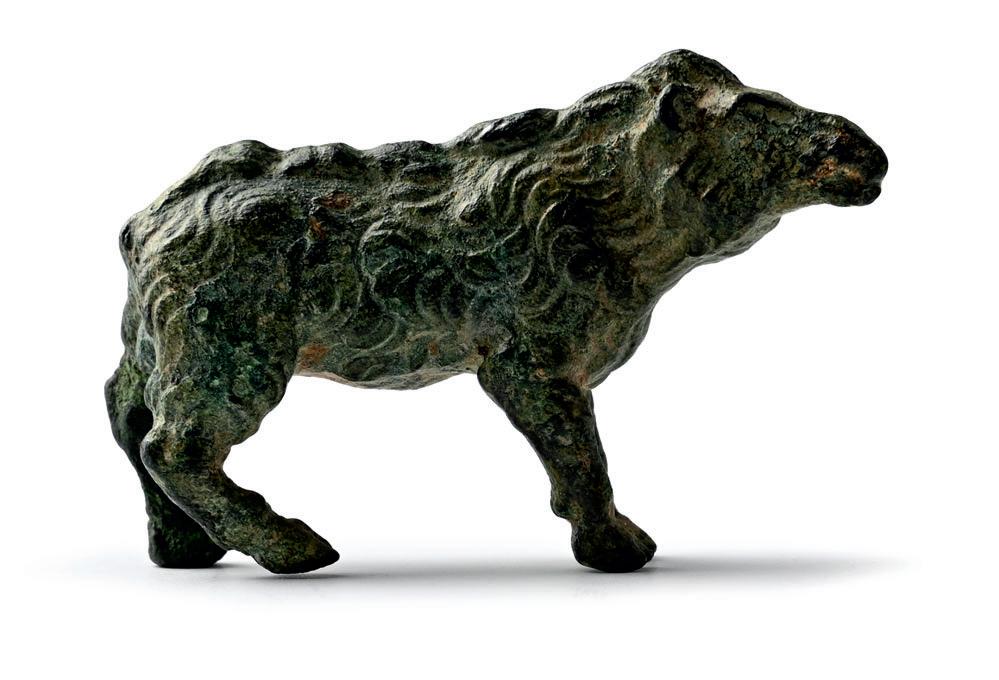
153
ROMAN BRONZE FIGURE OF HARPOCRATES, THE GOD OF SECRECY ‡
1ST CENTURY A.D.
2¾ in. (145 grams, 72 mm)
Modelled in the round, sitting with miniature double-crown, serpent arm-ring on left wrist, sidelock; fixing socket to right thigh.
£2,000 - 3,000
PROVENANCE:
Private collection, Me. A., Florida, USA, early 1990s. European private collection, acquired in Germany, September 2000.
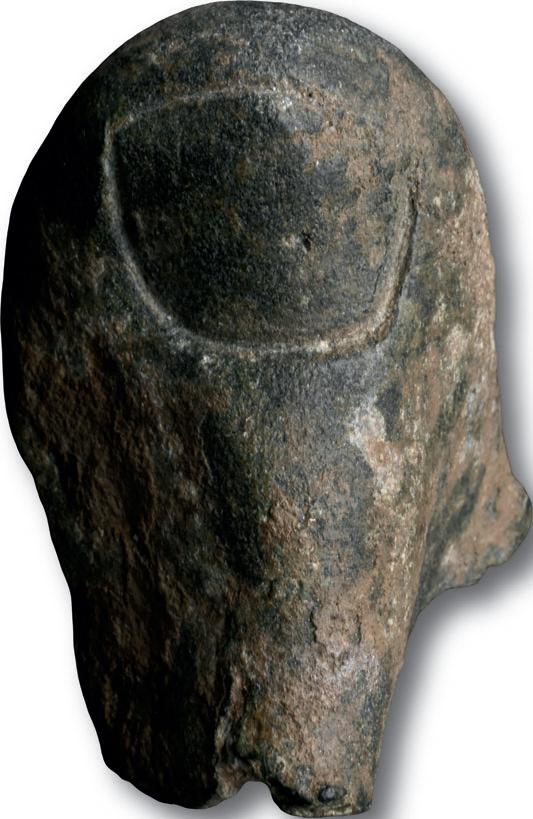
152
ROMAN BRONZE STATUETTE OF A WILD BOAR
1ST-2ND CENTURY A.D.
2 in. (51.26 grams, 52 mm)
Modelled in the round with ridge of bristles along the spine.
£800 - 1,000
PROVENANCE:
UK private collection before 2000. Acquired on the UK art market. Private collection, London, UK.
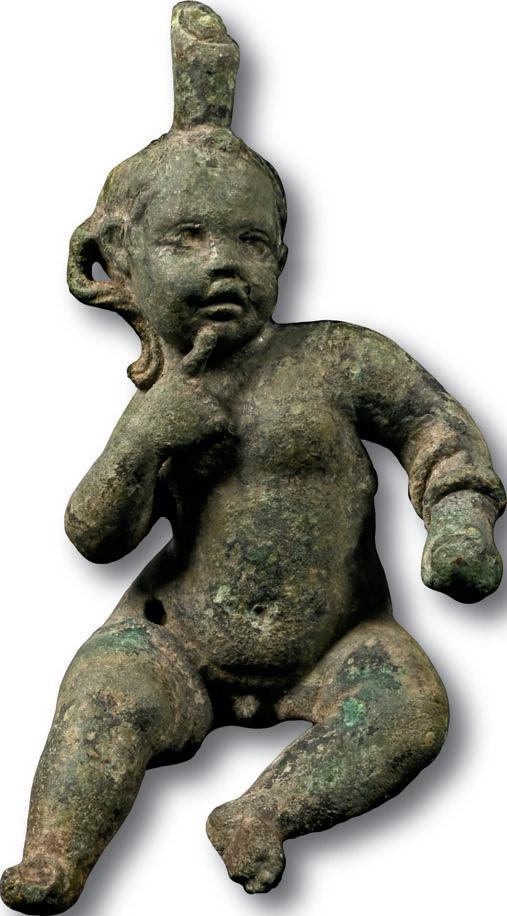

154
TWICE LIFE-SIZE ROMAN BRONZE STATUE BIG TOE 1ST-4TH CENTURY A.D.
2¼ in. (179 grams, 57 mm)
Comprising the tip of a big toe with nail detailing; hollow-form. £300 - 400
PROVENANCE:
From the private collection of a European gentleman (1942-2024), formed since the 1970s.




155
ROMAN MARBLE RELIEF FRAGMENT OF A BOY WITH OUTSTRETCHED ARM
3RD CENTURY A.D.
5 in. (386 grams, 12.6 cm)
High-relief image of a youth with Julian hairstyle, left arm extended.
£300 - 400
PROVENANCE:
From the private collection of a European gentleman (1942-2024), formed since the 1970s.

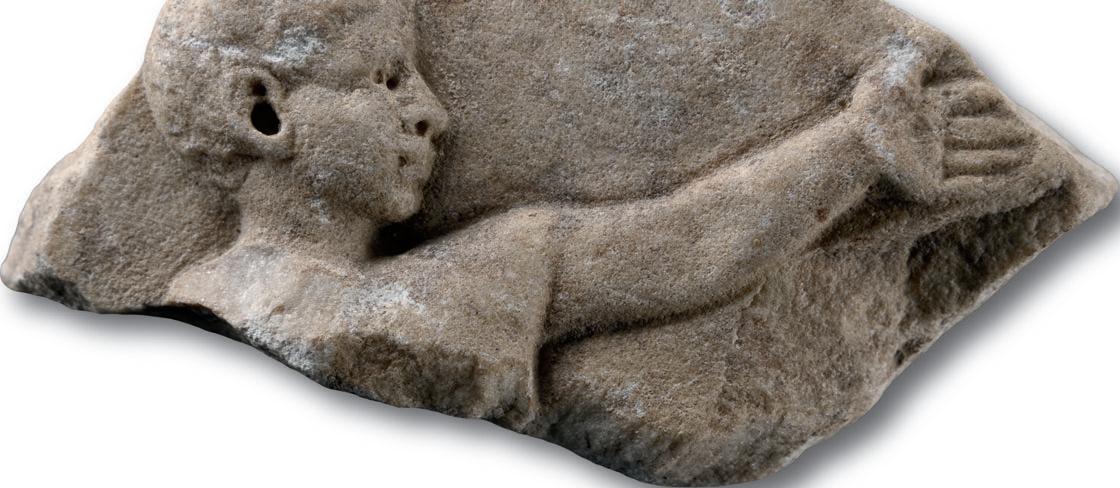


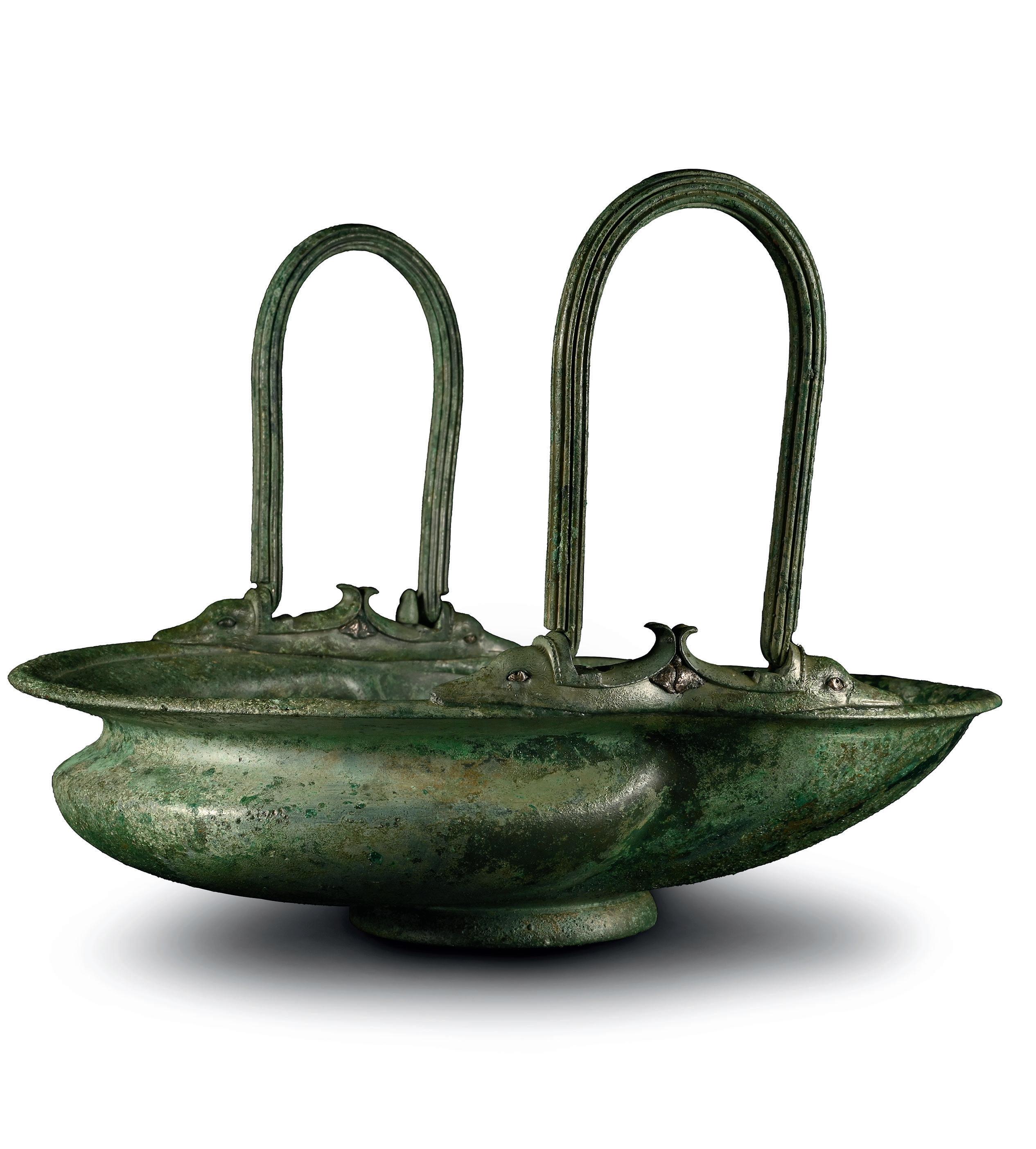
LARGE ROMAN BRONZE WINE BASKET-VASE ‡
ROMAN IMPERIAL, 1ST CENTURY B.C.-1ST CENTURY A.D. 11 in. (1.68 kg, 28 cm)
Ellipsoid in plan, with a low basal ring, thick convex rim, and carination towards the front, lateral hinges, the knuckles formed as addorsed duck-heads, each with silver-inlaid eyes, a scrolled panel to the rear retaining the pivot of the ribbed D-shaped handles.
£12,000 - 17,000
PROVENANCE: Acquired in Switzerland, 1996. Private collection, Europe.
Accompanied by an academic report by Dr Raffaele D’Amato. Accompanied by a copy of an Art Loss Register certificate dated 30th April 2004.
FOOTNOTES:
This vessel (lanx) was part of Roman and provincial bronze instrumentum domesticum, i.e. culinary or domestic utility ware. The form of the bowl resembles a type of helmet with carination to the front, the handles placed as hinged cheek-protectors.
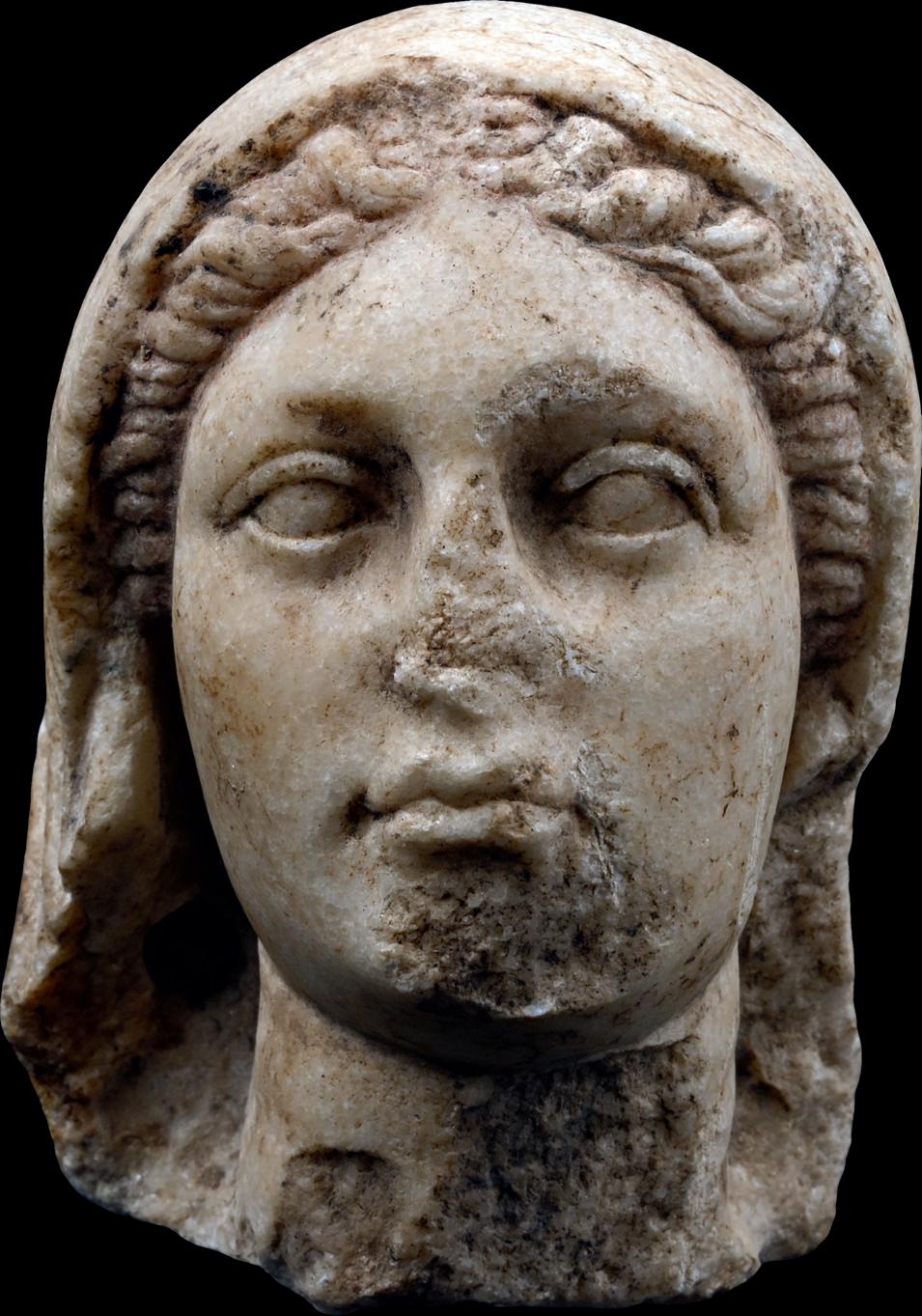
158
ROMAN MARBLE HEAD OF A PUTTO
2ND-3RD CENTURY A.D.
7 in. (3.95 kg, 17.9 cm)
Statue fragment with juvenile head of a putto carved in high-relief with full head of curly hair.
£1,500 - 2,000
PROVENANCE:
From the private Netherlands collection of Mr Edward P. Van Dijk (1942-2024); his collection formed since the 1970s.
157
ROMAN MARBLE HEAD OF A VEILED GODDESS
1ST CENTURY A.D.
7¼ in. (1.47 kg total, 18.5 cm including stand)
With a palla drawn up over her hair, stepped at the rear to indicate a chignon; soft, youthful facial features with fleshy cheeks and a rounded jawline; mounted on a custom-made stand.
£4,000 - 6,000
PROVENANCE: with Gorny & Mosch, Munich, 21 June 2005, no.344. Private collection, Europe.
Accompanied by copies of the relevant Gorny & Mosch catalogue pages.
FOOTNOTES:
The head comes from a statue that most likely represented a matronly deity, Demeter or Hestia/Vesta, the goddess protector of the home hearth. The latter seems the most likely, as she was usually depicted (as in the Hestia Iustiniani, a prototype often replicated in the Roman era) with a covered head (velato capite), a symbol of modesty and marital virtue for the Roman matron.
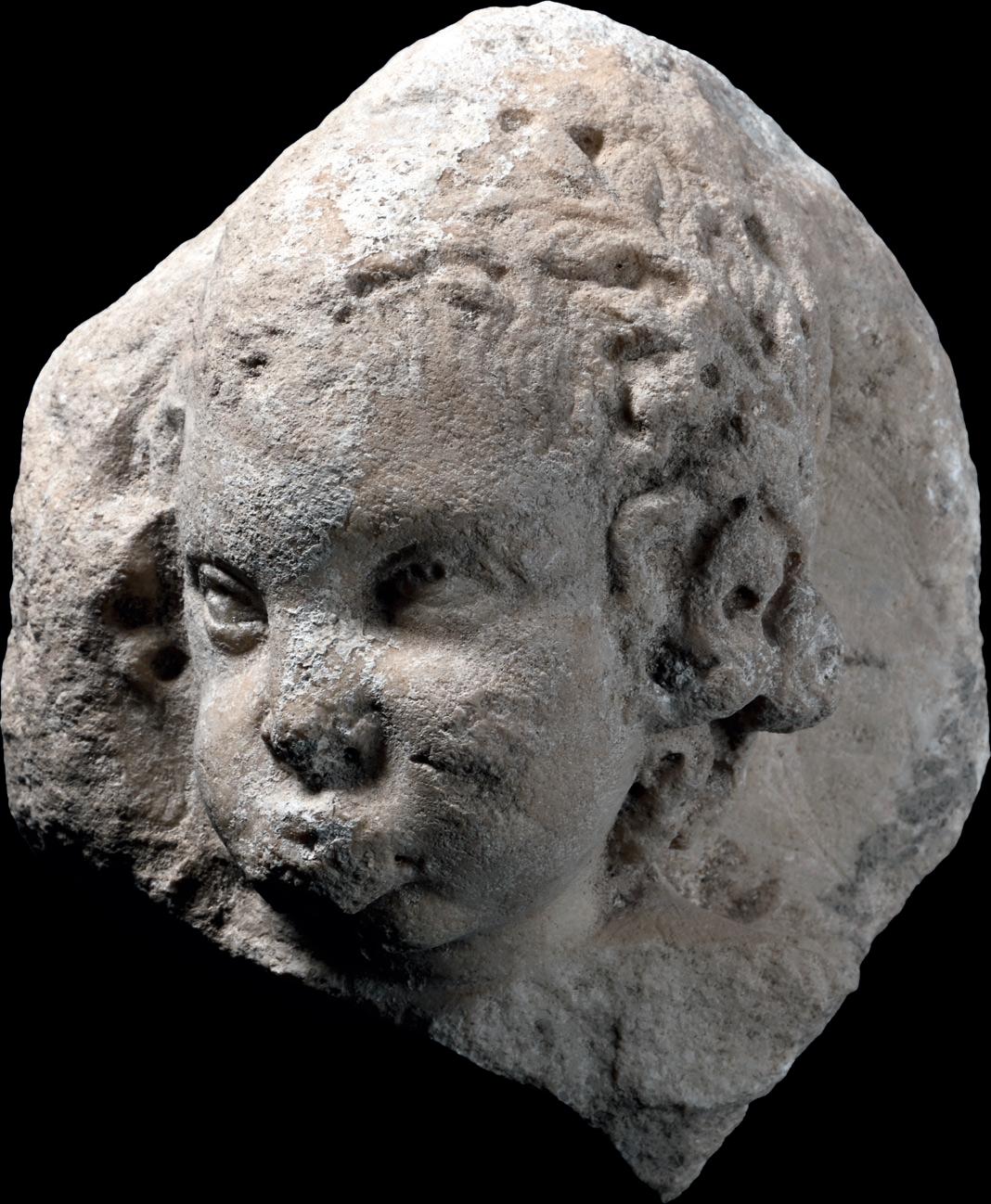
159
ROMAN MARBLE HEAD OF A WEALTHY LADY ‡
1ST CENTURY A.D.
16 in. (24.5 kg total, 41 cm including stand)
Carved in the round with dressed hair and braided band with fanned closure above the brow; finely modelled facial detailing; mounted on a custom-made stand.
£1,500 - 2,000
PROVENANCE:
From the collection of L.V. (1950-1960), Paris, France. Collection of Monsieur X. (1931-2017), dispersed for the benefit of the Monaco Red Cross. Private collection, Europe.
Accompanied by a copy of French passport no.229089.
FOOTNOTES:
The portrait is of an idealised feminine head, probably modelled on an Aphrodite type, with the hair in a bun on the nape, adorned with circles and with a tuft knotted at the top of the forehead, re-used as a portrait of a Roman lady. Many statue types were used both for portraits of women of the imperial family and for the portraits of other women, some of them based on images of goddesses.
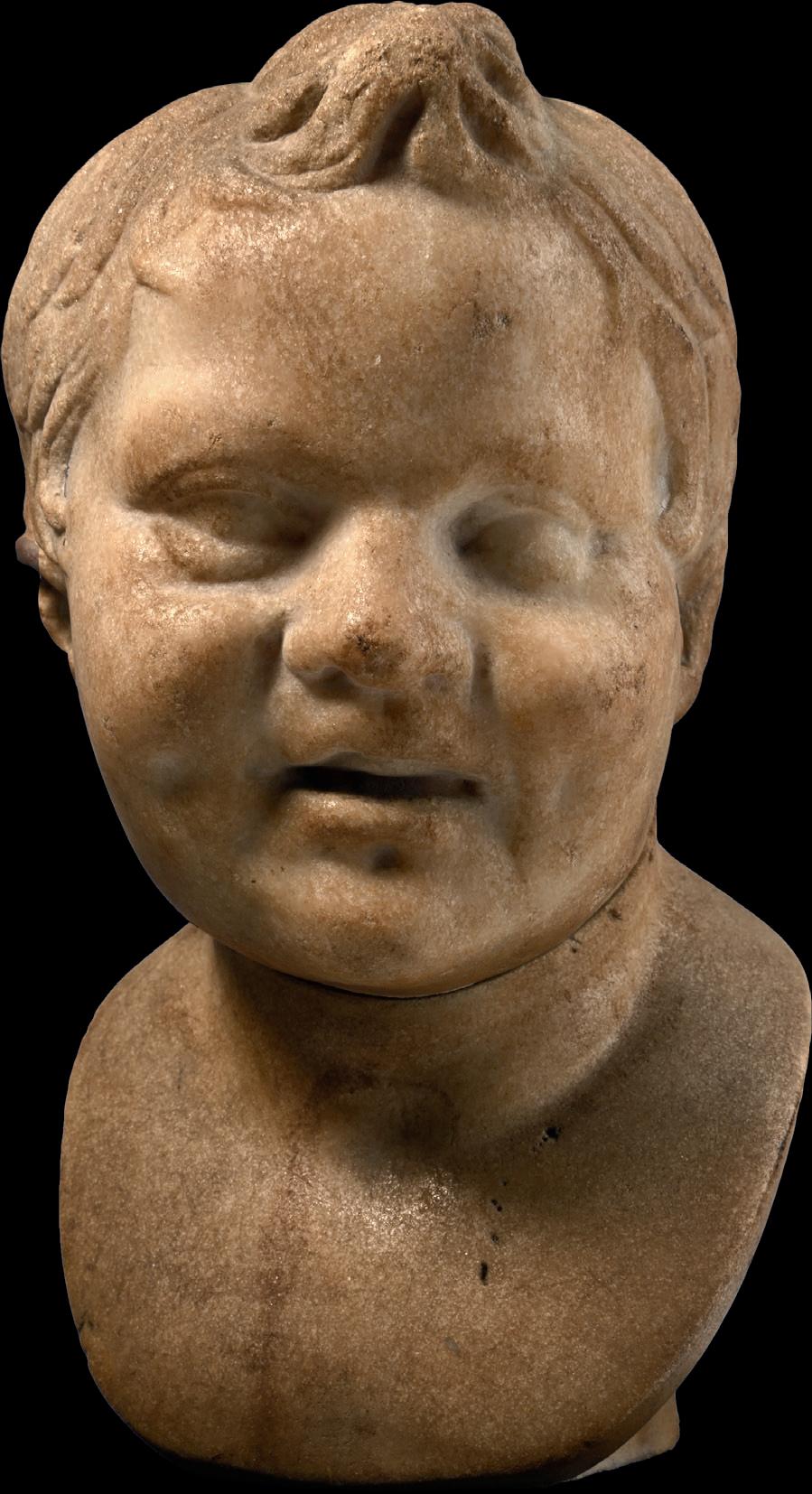
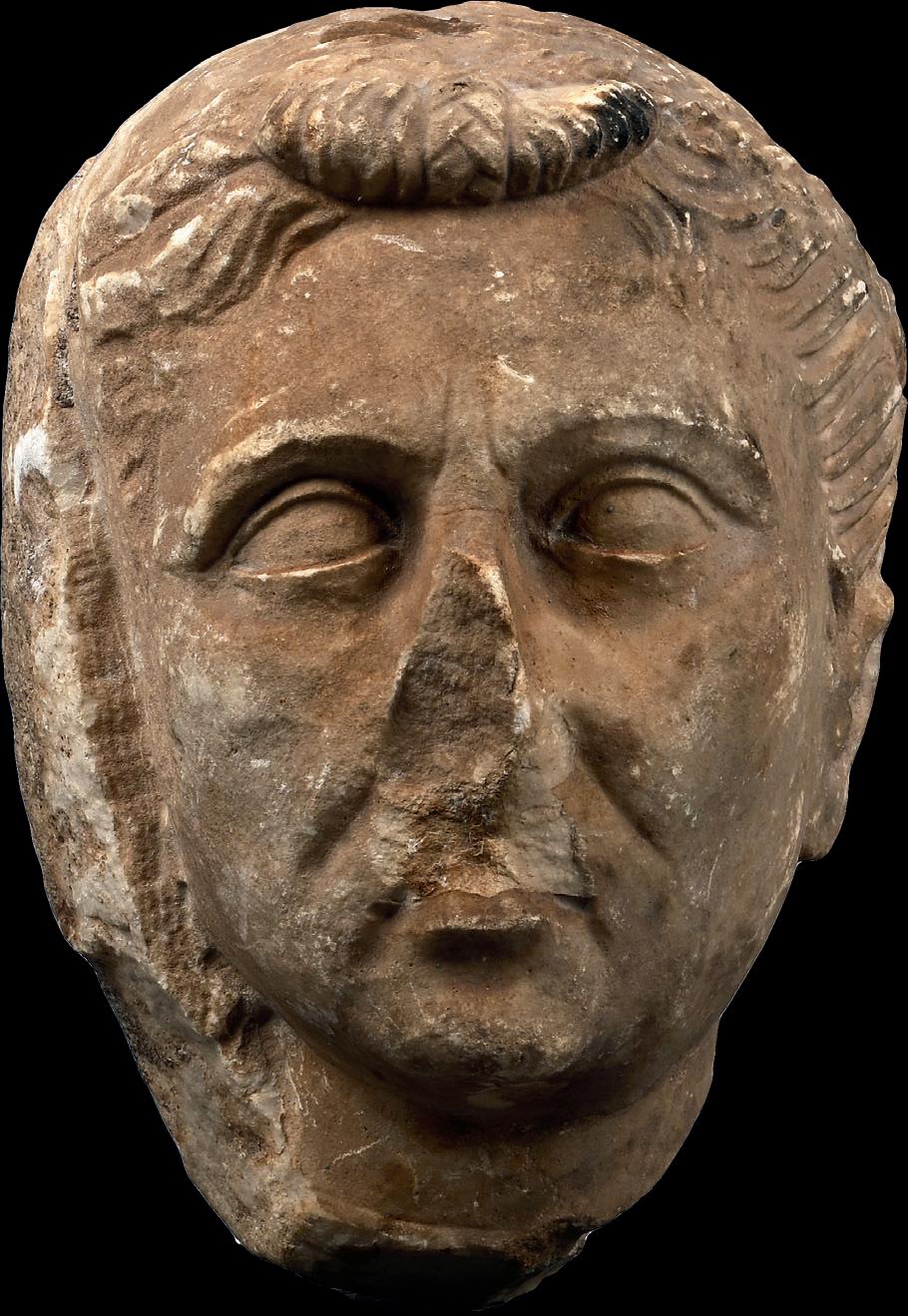
160
ROMAN MARBLE HEAD OF CUPID ON GEORGIAN PEDESTAL ‡
1ST-2ND CENTURY A.D.
11 in. (6.12 kg total, 30 cm including stand)
Carved in the round as a bust of a child with short hair combed into a peak, fleshy features, lips slightly parted in a smile, fitted to an 18th century marble pedestal; mounted on a display stand with collection note ‘Buste d’Enfant / Epoque Romaine / 1er Siècle’.
£18,000 - 24,000
PROVENANCE: Collection of B. Poindessault (1935-2014), France, acquired before October 1975.
Oger & Blanchet Enchères, Paris, 2014. German private collection, Cologne. Private collection, acquired in 2015.
Accompanied by an academic report by Dr Marina Mattei.
Accompanied by a copy of French passport no.167453.
FOOTNOTES:
The finely sculpted head represents a young child, probably intended as Eros (Cupid). Such depictions were produced in numerous variations to illustrate the stages of childhood and the capacity of children to undertake meaningful or symbolic actions. The softly modelled features and gentle expression recall the celebrated work of Boethos, The Boy Strangling the Goose, as well as the widespread images of Eros and the Erotes found throughout Graeco-Roman sculpture and painting. In Graeco-Roman art, representations of children occupied an important and evolving role. Initially, youthful figures were portrayed as miniature adults, but from the 4th century BC onwards - particularly during the Hellenistic and Roman periods - artists began to study children’s anatomy more closely, reproducing their characteristic proportions and expressions with naturalistic sensitivity. The figure of Eros, the constant companion of Aphrodite, became the quintessential model of the child in ancient art, identifiable by his traditional attributes of wings and bow. As evidenced by numerous statuettes and wall paintings unearthed at Pompeii, scenes of childhood were among the most popular subjects for adorning the gardens and interiors of wealthy Roman villas. These figures appear in lively and varied activities - playing, working, performing, or interacting with animals such as birds, hares, and dolphinscelebrating both the charm and vitality of early life within an idealised artistic vision.
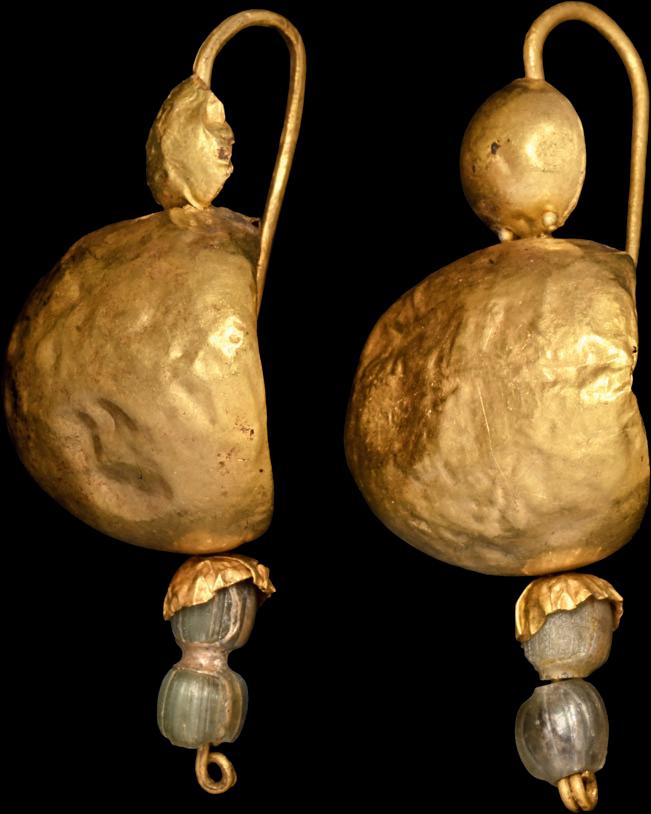
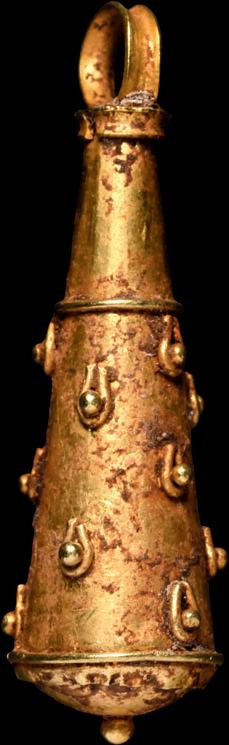
161
ROMAN GOLD BEETLE TYPE EARRINGS ‡
1ST-2ND CENTURY A.D.
1 in. (4.48 grams total, 40 mm each)
Matched pair, each a hooked pin with a large hollow-formed domed panel and a smaller one above, dangle beneath with two iridescent glass beads.
£1,000 - 1,400
PROVENANCE:
Private collection, USA and Switzerland, acquired in the late 1980s-early 1990s; thence by descent.
FOOTNOTES:
The pair of gold earrings is in the form of a very broad boat-shaped crescent. The back was often filled in with a concave plate of gold, and a lenticular disc above masked the junction of the S-shaped wire hook with the body of the earring. They are typical of the 1st -2nd century A.D.
162
ROMAN GOLD EARRING PAIR WITH PEARLS
2ND-3RD CENTURY A.D.
2½ in. (6.06 grams total, 62-64 mm)
Matched pair, each comprising a tubular shank with hook-and-eye closure, free-running dangle with pearl bead and granule cluster below. [2]
£600 - 800
PROVENANCE: with Gorny & Mosch, Munich, 14 December 2010, no.158. Private collection, Europe.
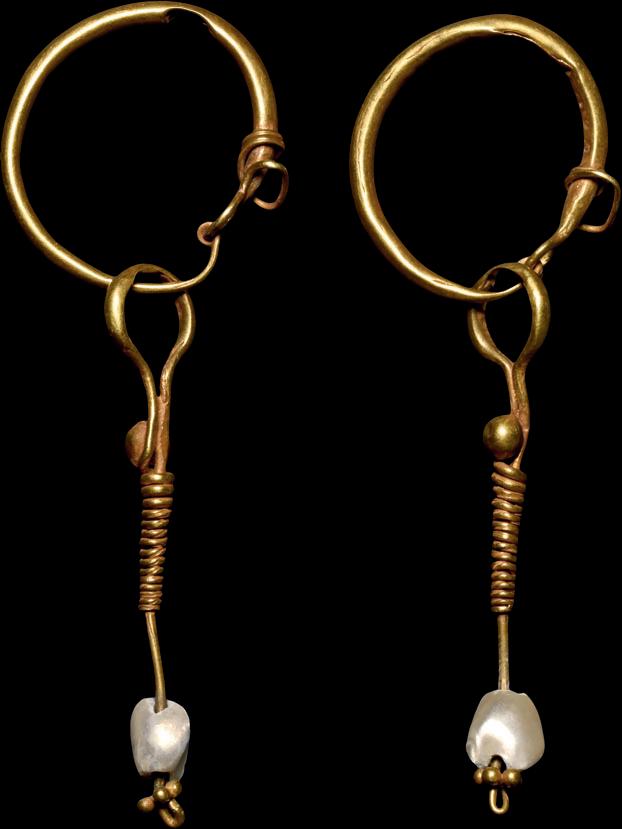
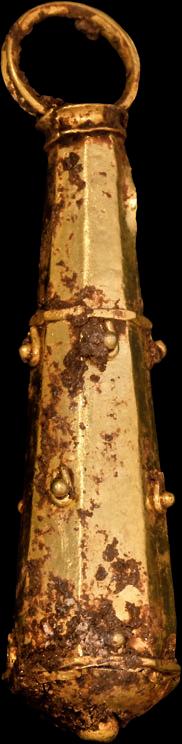
163
ROMAN GOLD HERCULES CLUB AMULET ‡
1ST-3RD CENTURY A.D.
1 in. (1.1 grams, 25 mm)
Formed as a tapering club with applied granule decoration, suspension loop at the narrow end.
£500 - 700
PROVENANCE:
Private collection, acquired in the late 1980s-early 1990s; thence by descent.
FOOTNOTES:
A similar object formed part of the remarkable hoard of late Roman gold jewellery and silver tableware found near Thetford, Norfolk, in 1979.
164
ROMAN GOLD HERCULES CLUB AMULET ‡
1ST-3RD CENTURY A.D.
1 in. (1.1 grams, 28 mm)
Hexagonal in section, tapering with integral loop, applied granule studs, domed finial with a knop.
£500 - 700
PROVENANCE:
Private collection, acquired in the late 1980s-early 1990s; thence by descent.
FOOTNOTES:
A similar object formed part of the remarkable hoard of late Roman gold jewellery and silver tableware found near Thetford, Norfolk, in 1979.
165
ROMAN GOLD AND GARNET GEMSTONE RING WITH BIRD ‡
1ST-3RD CENTURY A.D. in. (3.52 grams, 22.74 mm overall, 17.38 mm internal diameter (approximate size British K½, USA 5½, Europe 10.58, Japan 10))
Hollow-formed with inset cloison, incuse profile bird motif.
£1,500 - 2,000
PROVENANCE:
Private collection, acquired on the German art market in 1993; thence by descent.
166
ROMAN GOLD RING WITH SARDONYX GEMSTONE ‡
1ST-2ND CENTURY A.D.
1 in. (6.41 grams, 27.10 mm overall, 18.42 x 15.45 mm internal diameter (approximate size British M, USA 6, Europe 12.46, Japan 12))
Hollow-formed shank with inset cabochon, flattened top.
£2,000 - 3,000
PROVENANCE:
Private collection, acquired on the German art market in 1993; thence by descent.
167
ROMAN GOLD RING WITH ENGRAVED AGATE GEMSTONE ‡
1ST CENTURY B.C.-1ST CENTURY A.D.
1 in. (3.26 grams, 23.66 mm overall, 18.15 x 14.73 mm internal diameter (approximate size British J½, USA 5, Europe 9.32, Japan 9))
Hollow-formed with inset banded agate cloison, intaglio vine-leaf motif.
£2,000 - 3,000
PROVENANCE:
Private collection, acquired on the German art market in 1993; thence by descent.
168
ROMAN GOLD RING WITH CARNELIAN GEMSTONE WITH CENTAUR
CIRCA 2ND CENTURY A.D.
1 in. (4.51 grams, 26.50 mm overall, 23.05 x 12.76 mm internal diameter (approximate size British J, USA 4¾, Europe 8.69, Japan 8))
With broad openwork shoulders and applied filigree scrolls, granulations flanking the cell with inset facetted intaglio advancing centaur with a syrinx
£1,500 - 2,000
PROVENANCE: Ex German art market, 2000s. Acquired from an EU collector living in London. From the collection of a Surrey, UK, gentleman.
169
ROMAN CARNELIAN JUPITER GEMSTONE IN GOLD RING
CIRCA 2ND CENTURY A.D. AND LATER
1 in. (6.09 grams, 25.34 mm overall, 17.27 mm internal diameter (approximate size British O, USA 7, Europe 14.98, Japan 14))
With intaglio profile image of Jupiter seated on a high-backed throne, wreath to the brow; in a later gold ring.
£1,200 - 1,700
PROVENANCE: Ex M. Bartlett collection, 1990s.
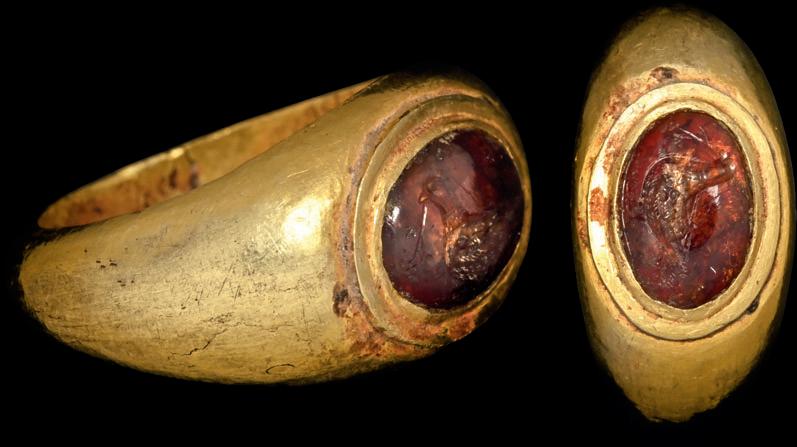
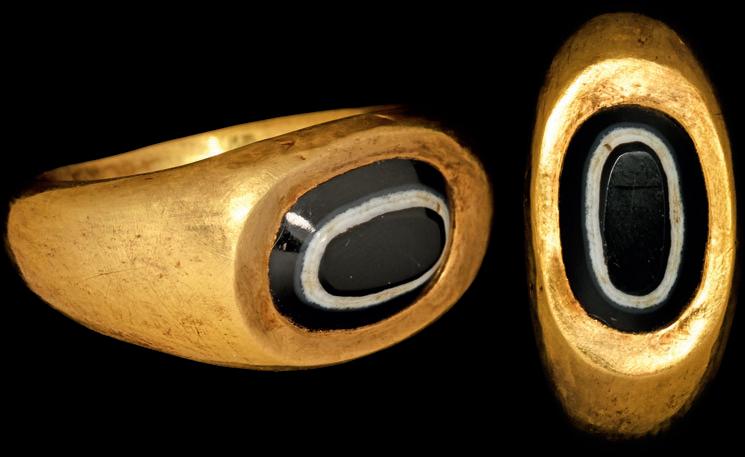
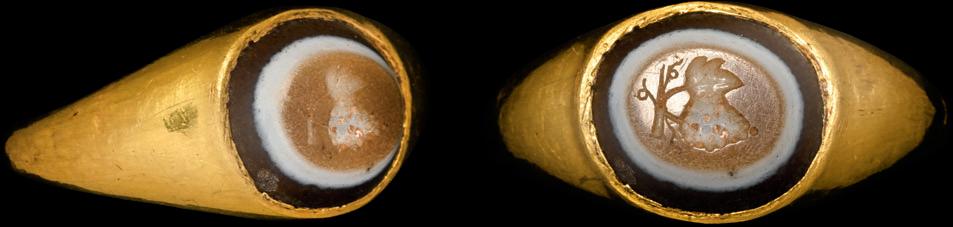
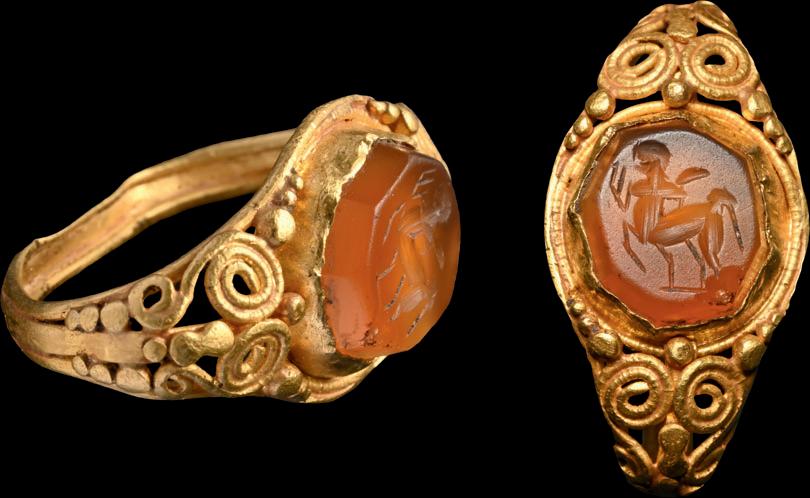
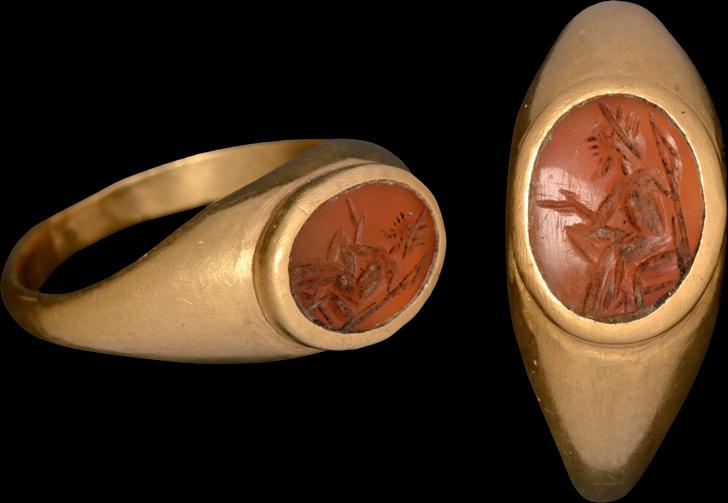
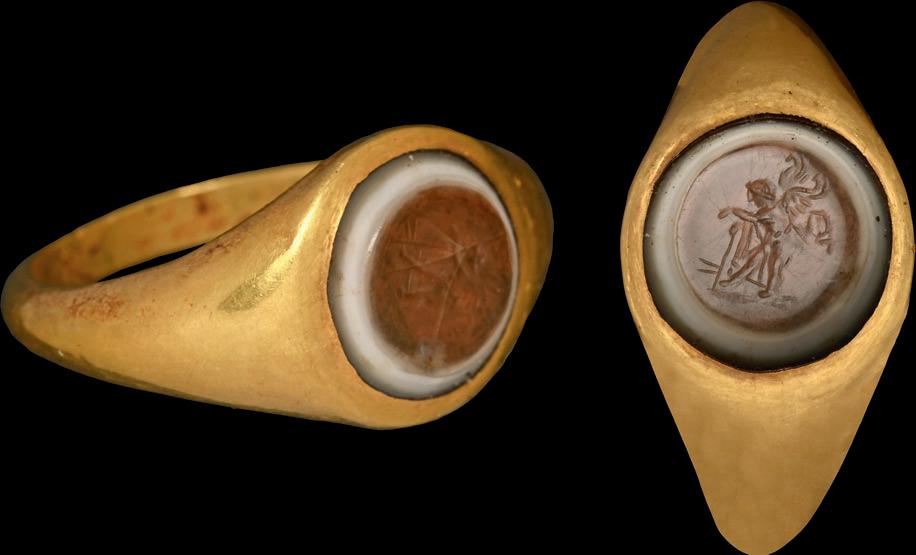
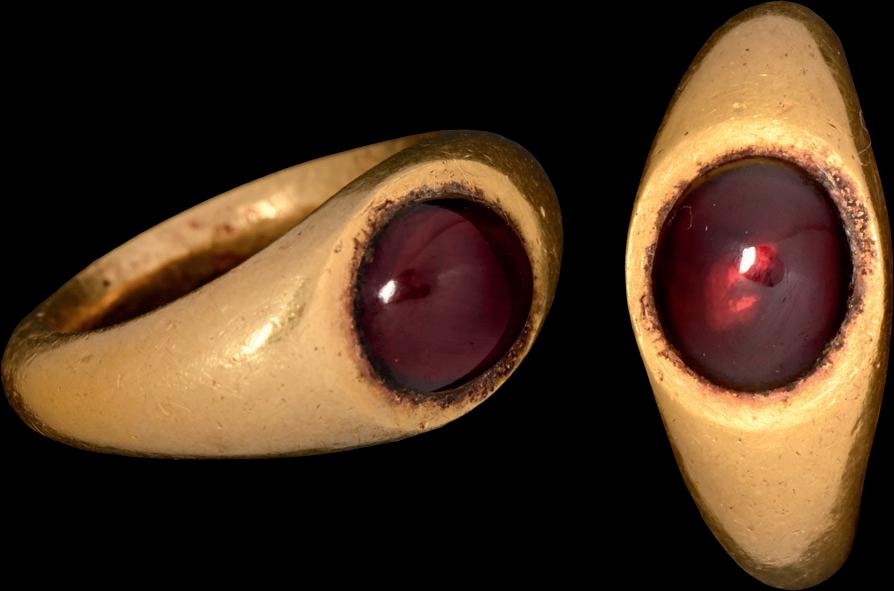
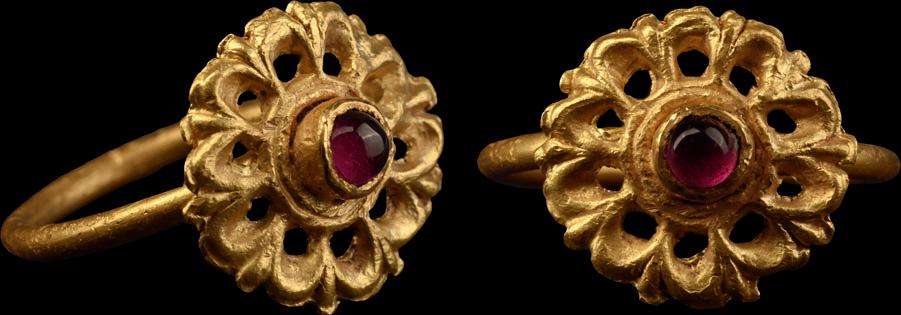
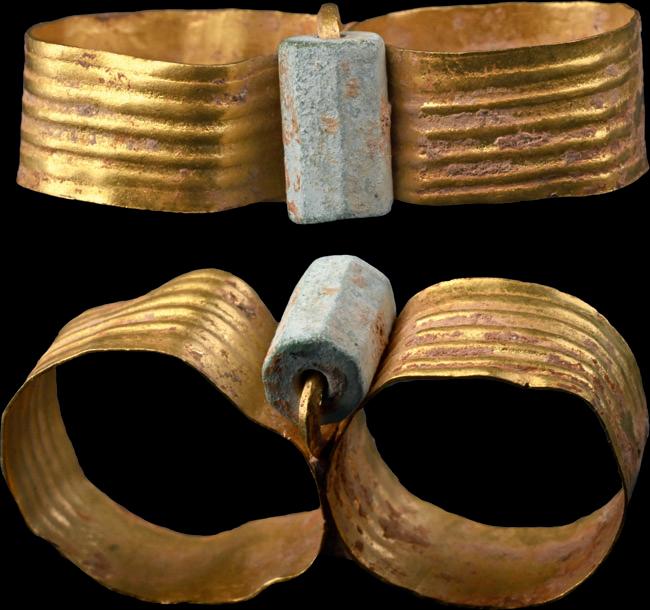
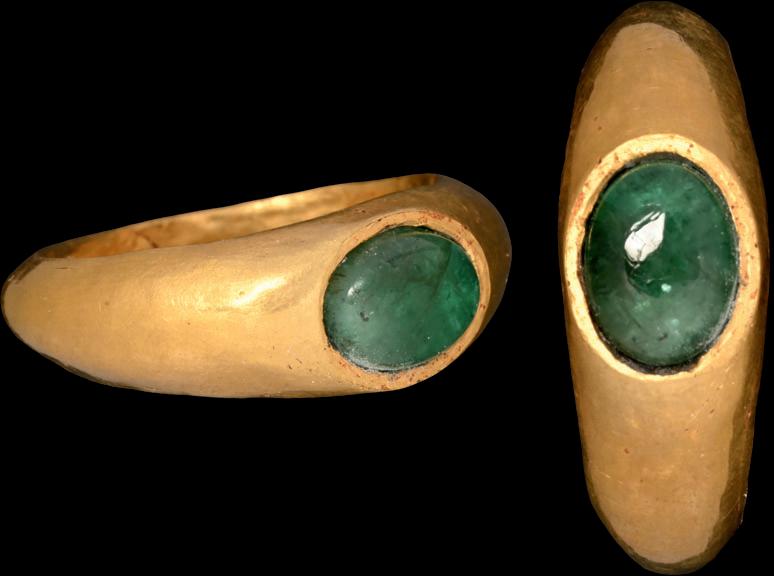
170
ROMAN GOLD RING WITH INTAGLIO OF CUPID
2ND-3RD CENTURY A.D.
1 in. (3.00 grams, 24.50 mm overall, 19.95 x 17.34 mm internal diameter (approximate size British Q, USA 8, Europe 17.49, Japan 16))
Hollow-formed hoop with inset glass cloison, intaglio winged figure with a staff.
£1,200 - 1,700
PROVENANCE:
Private collection, 1990s-early 2000s.
171
ROMAN GOLD RING WITH EMERALD CABOCHON
2ND-3RD CENTURY A.D.
in. (3.11 grams, 21.73 mm overall, 16.44 x 14.07 mm internal diameter (approximate size British I, USA 4½, Europe 7.44, Japan 7))
Hollow-formed with a later inset cabochon to the bezel.
£800 - 1,000
PROVENANCE: Private collection, 1990s-early 2000s.
172
ROMAN GOLD RING WITH RED GLASS CABOCHON
2ND-3RD CENTURY A.D.
¾ in. (4.57 grams, 20.77 mm overall, 13.99 mm internal diameter (approximate size British D½, USA 2, Europe 1.78, Japan 1))
Hollow-formed with inset cabochon to the bezel.
£700 - 900
PROVENANCE:
Private collection, 1990s-early 2000s.
173
ROMAN GOLD RING WITH GARNET CABOCHON 3RD-4TH CENTURY A.D. in. (2.55 grams, 22.48 mm overall, 17.72 mm internal diameter (approximate size British M½, USA 6¼, Europe 13.09, Japan 12))
Comprising an openwork rosette bezel with interstitial pellets between the petals, central cell with inset garnet cabochon.
£700 - 900
PROVENANCE: Ex German art market, 2000s.
174
ROMAN GOLD DOUBLE RING WITH BEAD 1ST-2ND CENTURY A.D.
1¼ in. (3.52 grams, 31 mm)
Comprising two broad sheet-gold hoops, each with reeded outer face, joined with applied granules below and a wire loop above, securing a facetted glass bead.
£700 - 900
PROVENANCE: Ex German art market, 2000s.
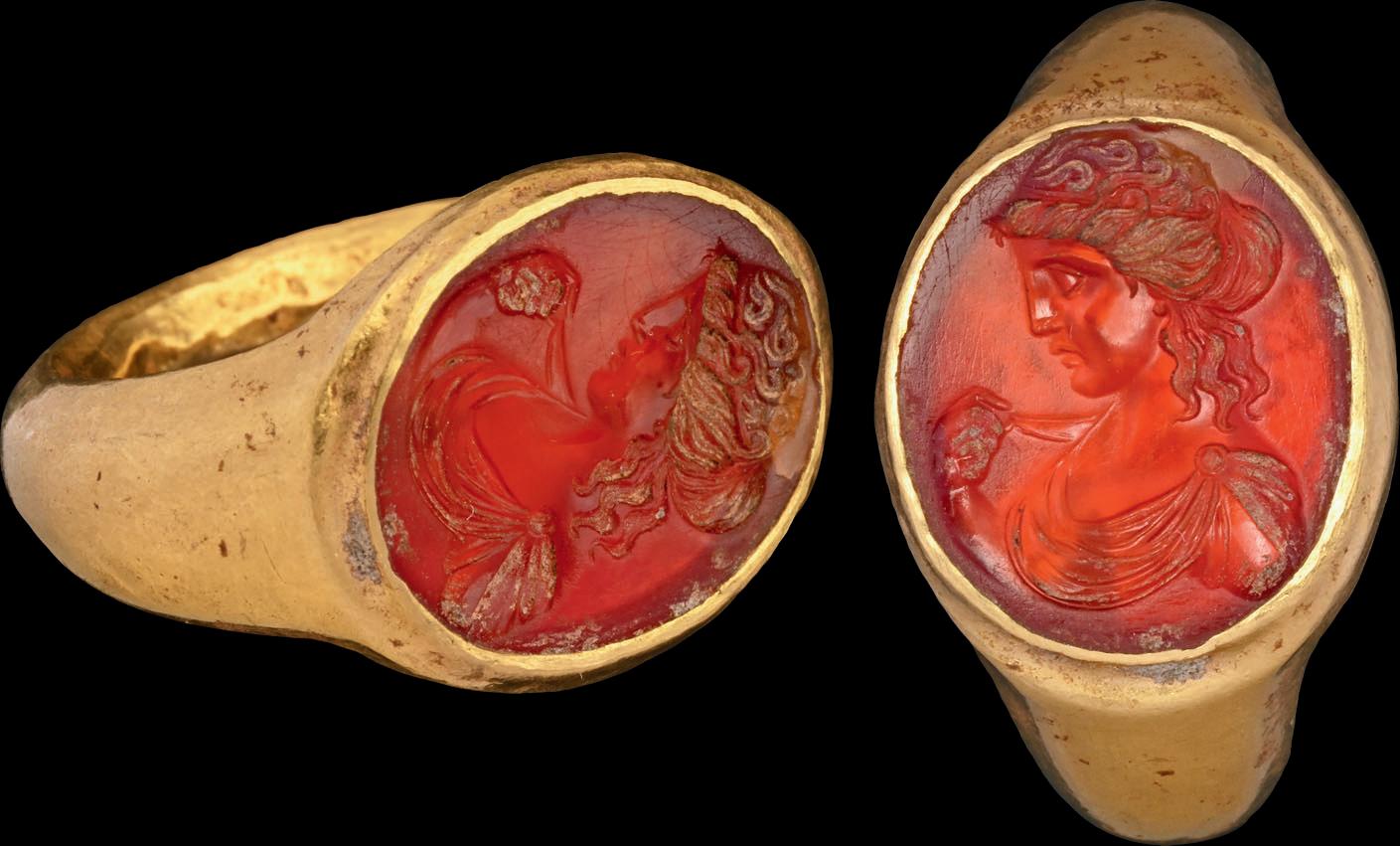
175
ROMAN GOLD RING WITH CARNELIAN GEMSTONE WITH BUST OF A GODDESS ‡
2ND-3RD CENTURY A.D.
1 in. (9.46 grams, 29.95 mm overall, 19.70 x 17.34 mm internal diameter (approximate size British P½, USA 7¾, Europe 16.86, Japan 16))
Hollow-formed shank and bezel with inset cloison intaglio profile of a female bust with a diadem, inspecting a jewel hung around her neck.
£20,000 - 30,000
PROVENANCE:
Private collection, acquired on the German art market in 1992; thence by descent.
FOOTNOTES:
The gem motif represents a deity, most probably Aphrodite-Venus, although we cannot exclude less important divinities, such as Flora or a nymph.
176
ROMAN GOLD RING WITH PORTRAIT GEMSTONE
CIRCA 2ND-3RD CENTURY A.D.
1 in. (9.75 grams, 29.29 mm overall, 16.57 x 12.76 mm internal diameter (approximate size British F½, USA 3, Europe 4.3, Japan 4))
Hollow-formed with a broad hoop, lateral facets, an inset cloison with intaglio profile of a youthful male bust.
£2,500 - 3,500
PROVENANCE:
Property of a North American gentleman, London, UK, 1990-2010.
177
ROMAN CARNELIAN GEMSTONE WITH PANTHER IN GOLD RING 1ST-2ND CENTURY A.D. AND LATER
1¼ in. (13.72 grams, 33.34 mm overall, 16.97 mm internal diameter (approximate size British M½, USA 6¼, Europe 13.09, Japan 12))
Ellipsoid cabochon with intaglio scene of a panther resting with forepaws extended beside a rocky outcrop with a frond extending above, thyrsus behind the shoulders; mounted in a later gold ring; supplied with a museum-quality impression.
£1,500 - 2,000
PROVENANCE:
From the private collection of a European gentleman (1942-2024), formed since the 1970s.
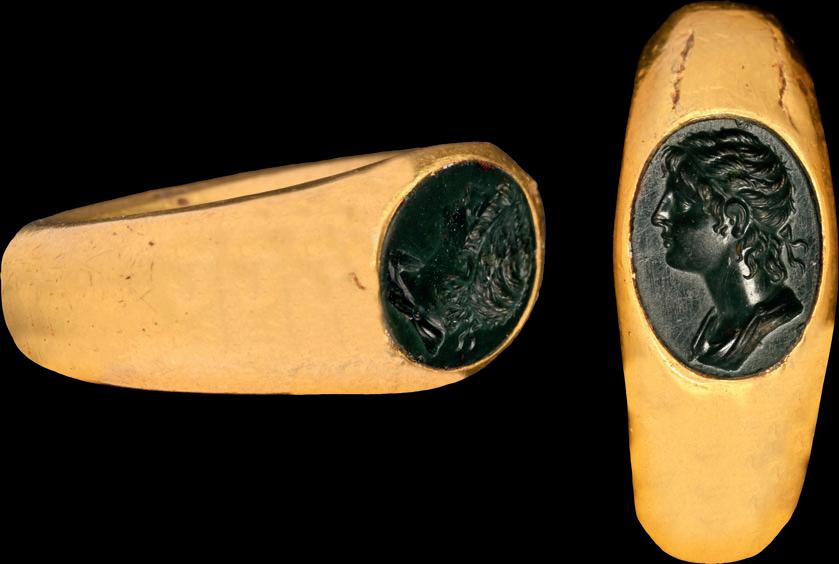
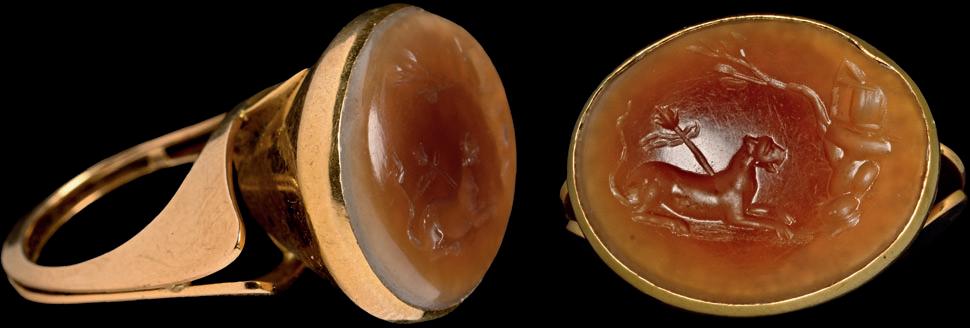
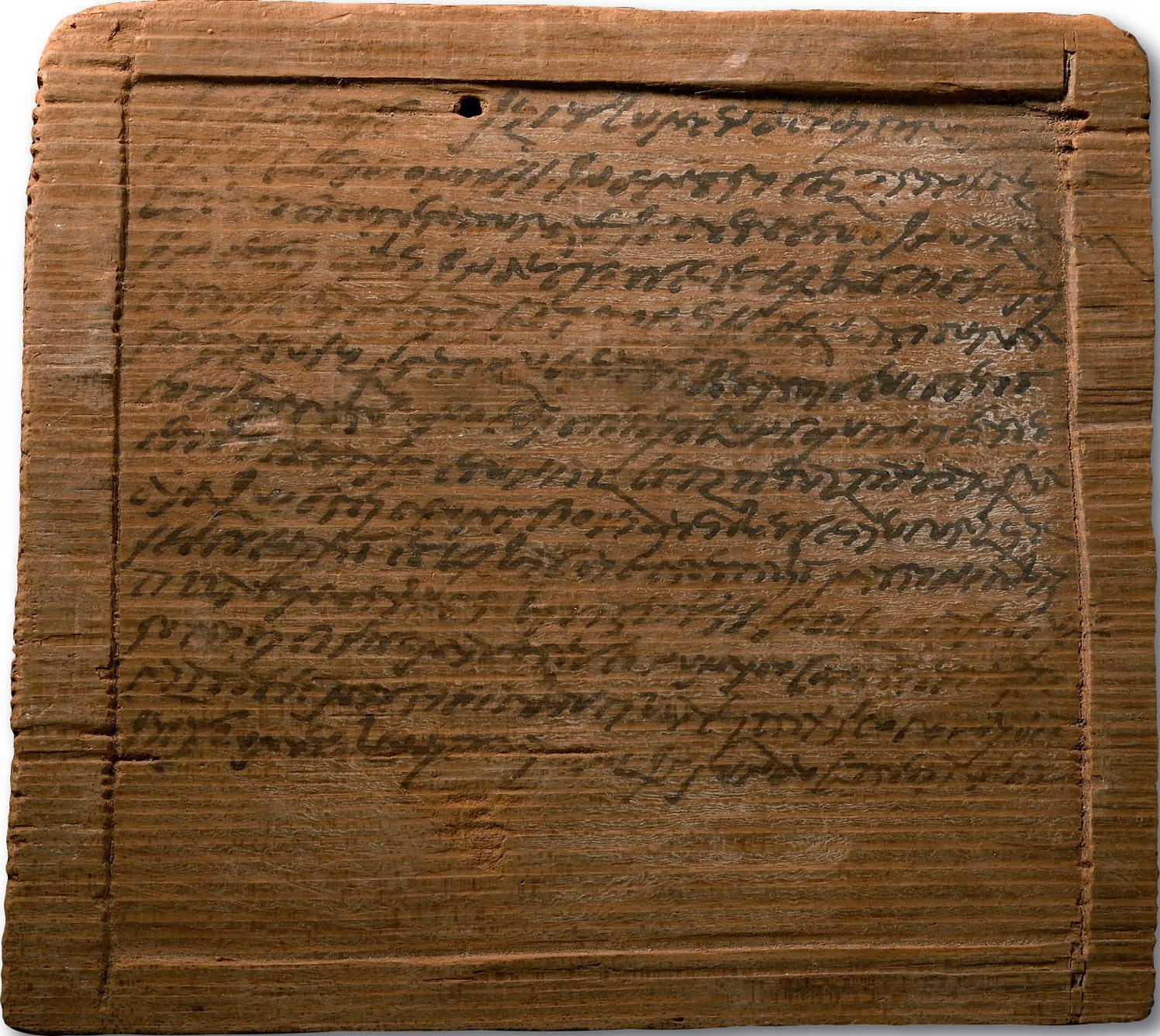

178
ROMAN WOODEN TABLET WITH A SALES CONTRACT MADE ON THE GORETIANO ESTATE IN THE PROVINCE OF BYZACENA
4TH CENTURY A.D.
6 x 5½ in. (44.3 grams, 15.6 x 14.1 cm)
Well preserved rectangular tablet made of cedar wood with a recessed panel to the inner face, the outer face flat and not inscribed; the second and last tablet of a Roman sales contract; the inner face inscribed in Roman cursive script using ink and calamus, fourteen lines of Roman cursive script written within the recess; two small holes both near the upper and lower rim (for binding the tablets of this document together); the text consists of dispositions regarding the
sale of a special category of land (gemiones) and ends with the obligatory stipulatio formula: ‘stipulata est Macrinia B., spopondidit Iulius L. – Macrinia B. stipulated, Iulius L. (as the vendor) gave the counter promise’.
£1,500 - 2,000
PROVENANCE:
Acquired by Albert Sfez in the early 1950s.
Formerly the property of Monsieur Alain Sfez, a Belgian collector; acquired by gift from his father, Albert Sfez, in 1965.
Acquired by a London dealer in 1973.
From an important London collection since 1975; thence by descent.
Accompanied by a copy of an illustrated academic report by Professor Dr phil. Peter Rothenhöfer.
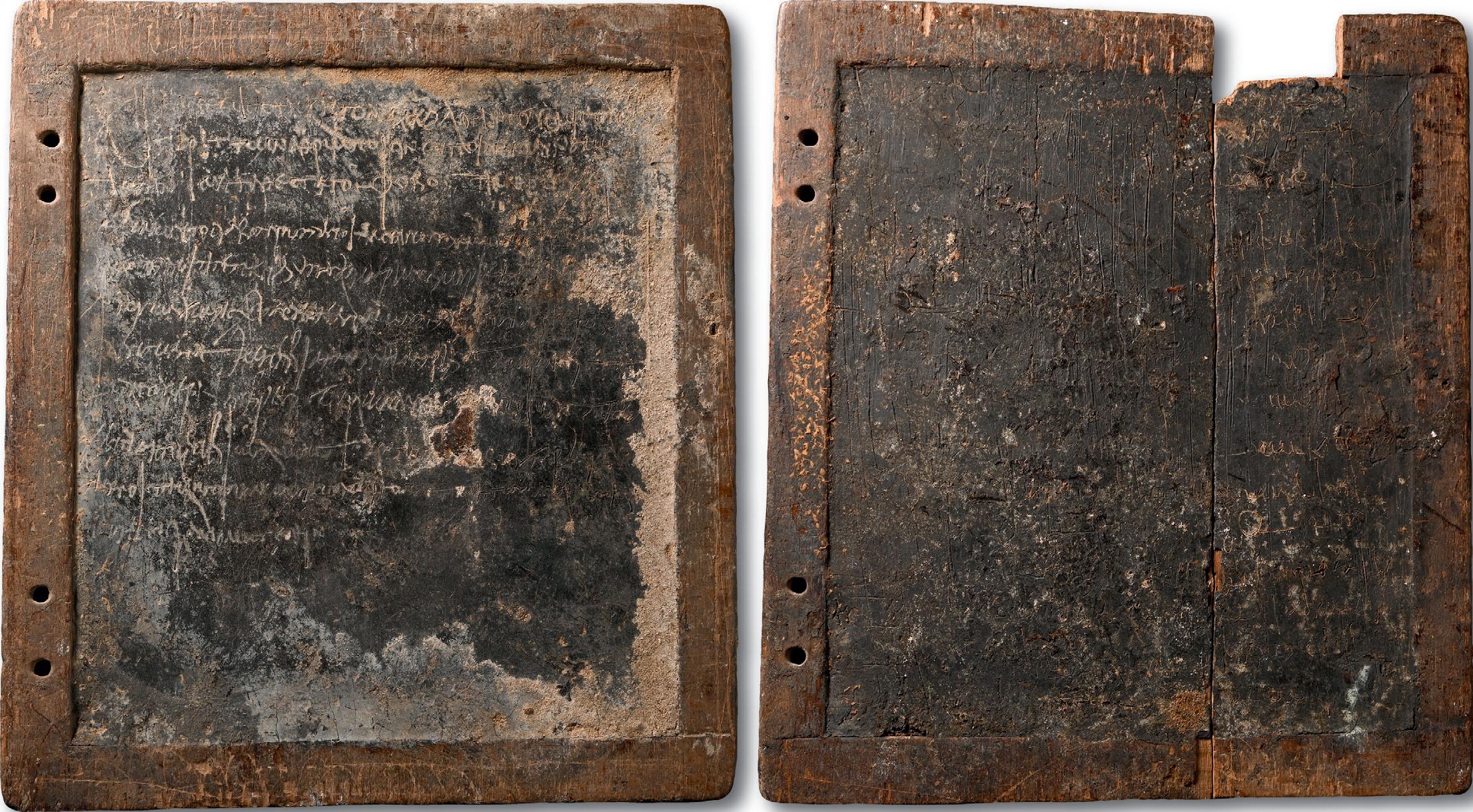

ROMAN WOODEN WAX TABLETS FROM A CODEX
CIRCA 2ND-3RD CENTURY A.D.
7¼ x 6¾ in. (263 grams total, 18.6 x 17 cm)
Two well-preserved rectangular wax tablets of a polyptych, each made of dark hardwood, probably acacia; the inner leaf in two adjoining parts, with recessed panels on both sides, covered with dark layers of wax; the second is the rear cover of the polyptych, with a recessed wax covered writing panel to the inner face, the outer face flat and not inscribed; both tablets with two pairs of holes on the left frame for linking them together; remains of stylus engraved Greek script on all three writing panels; on the second tablet 11 lines in cursive Greek script, mentioning inter alia a gymnasiarchos, a local magistrate in Roman Egypt, probably from an accounting codex. £3,000 - 4,000
PROVENANCE: Property of a North London gentleman; previously in the Dean family collection since 1975.
Accompanied by a copy of an illustrated academic report by Professor Dr phil. Peter Rothenhöfer.
FOOTNOTES:
Wax tablets written in Greek or Latin, were used by Romans as account registers (codices accepti et expensi); for transactions (for example, the tablets of the banker Lucius Caecilius Iucundus found in Pompeii); for lists of goods, inventories, and notes to be kept and archived; for Roman magistrates to annotate the salient events of their bureaucratical activities; for writing letters; for drawing up legal texts of various kinds: legacies, declarations of births and citizenship, reports of trials and diplomata militaria.
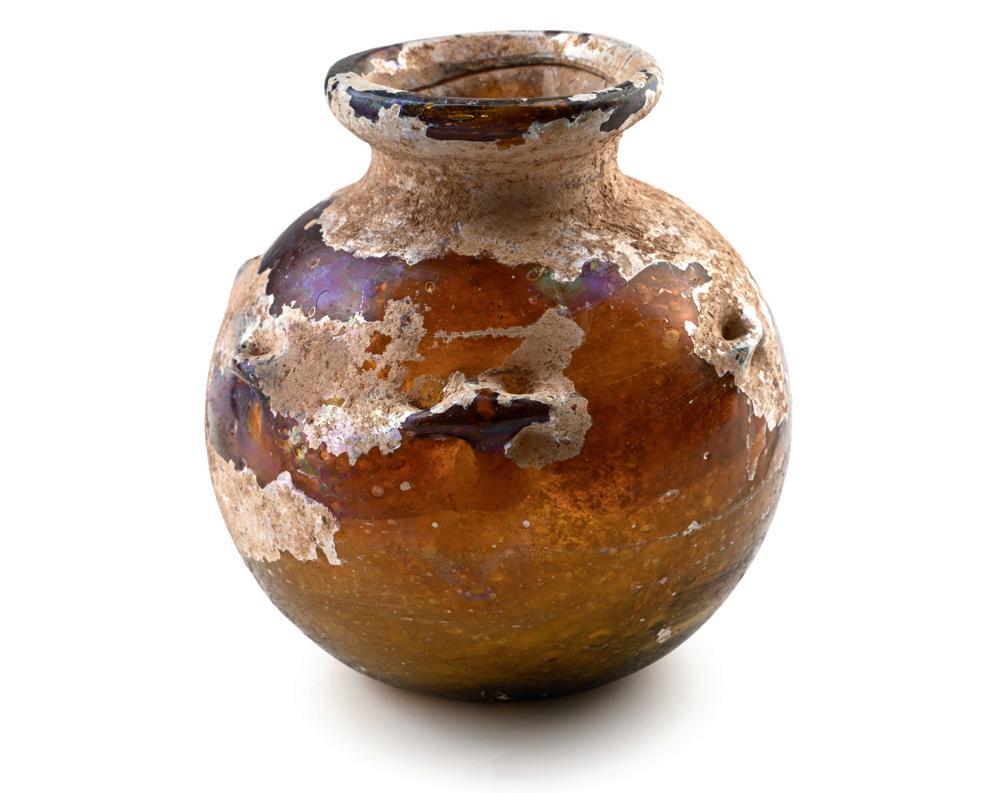
181
ROMAN GLASS SPRINKLER VESSEL
3RD-4TH CENTURY A.D.
3 in. (26 grams, 77 mm)
Globular body with pinched vertical ribs; short neck constricted at the bottom to leave only a narrow opening allowing the controlled release of precious oils drop by drop; broad mouth with folded and everted rim.
£300 - 400
PROVENANCE:
From a specialist collection of glass, acquired from dealerships during the 1990s.
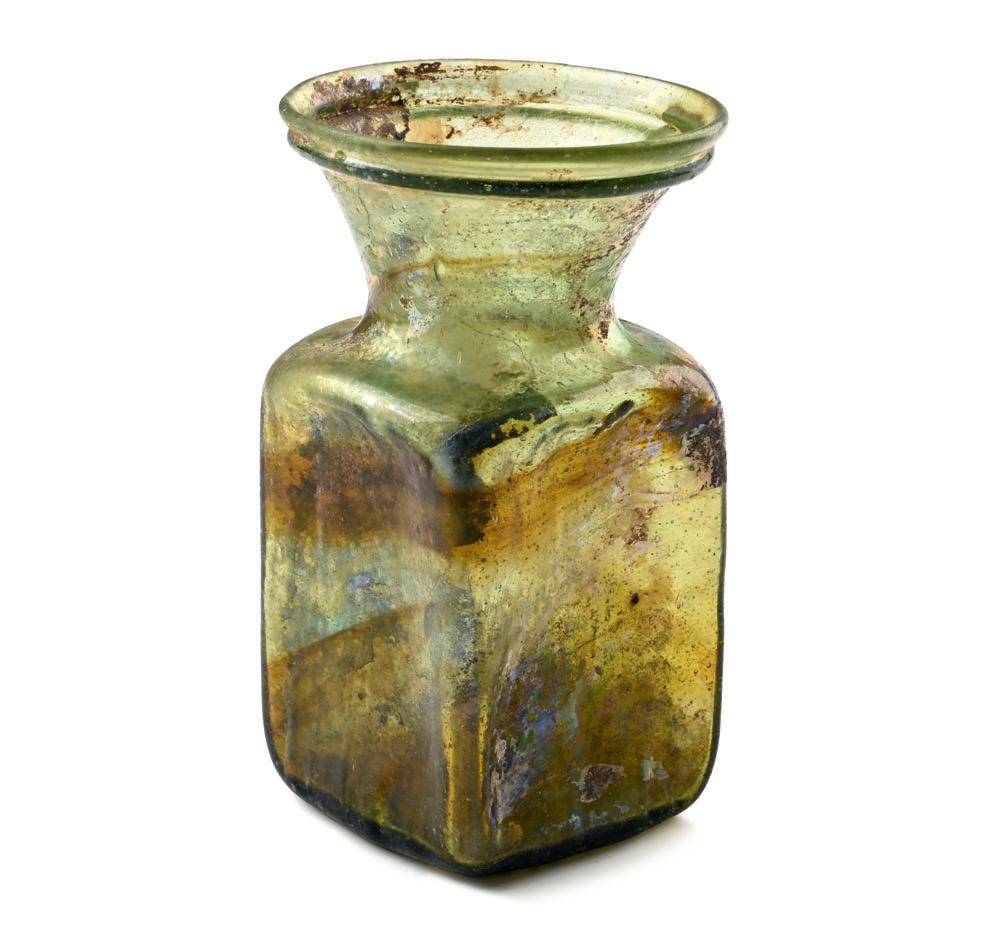
183
ROMAN TALL GLASS FLASK WITH IRIDESCENCE
1ST CENTURY A.D.
7¾ in. (85 grams, 19.6 cm)
Piriform body with narrow neck and median bulb, trumpet-shaped mouth with applied trail to the rim, flared with thick trail; diagonal moulded fluting to the body, iridescent finish.
£400 - 600
PROVENANCE:
From a specialist collection of glass, acquired from dealerships during the 1990s.
180
ROMAN HONEY-COLOURED GLASS JAR WITH FINE IRIDESCENCE
1ST-4TH CENTURY A.D.
3½ in. (125 grams, 90 mm high)
Squat in profile with trumpet-shaped neck and mouth, rolled rim, dimple base, pinched lobes to the shoulder; some iridescence.
£400 - 600
PROVENANCE:
From a specialist collection of glass, acquired from dealerships during the 1990s.
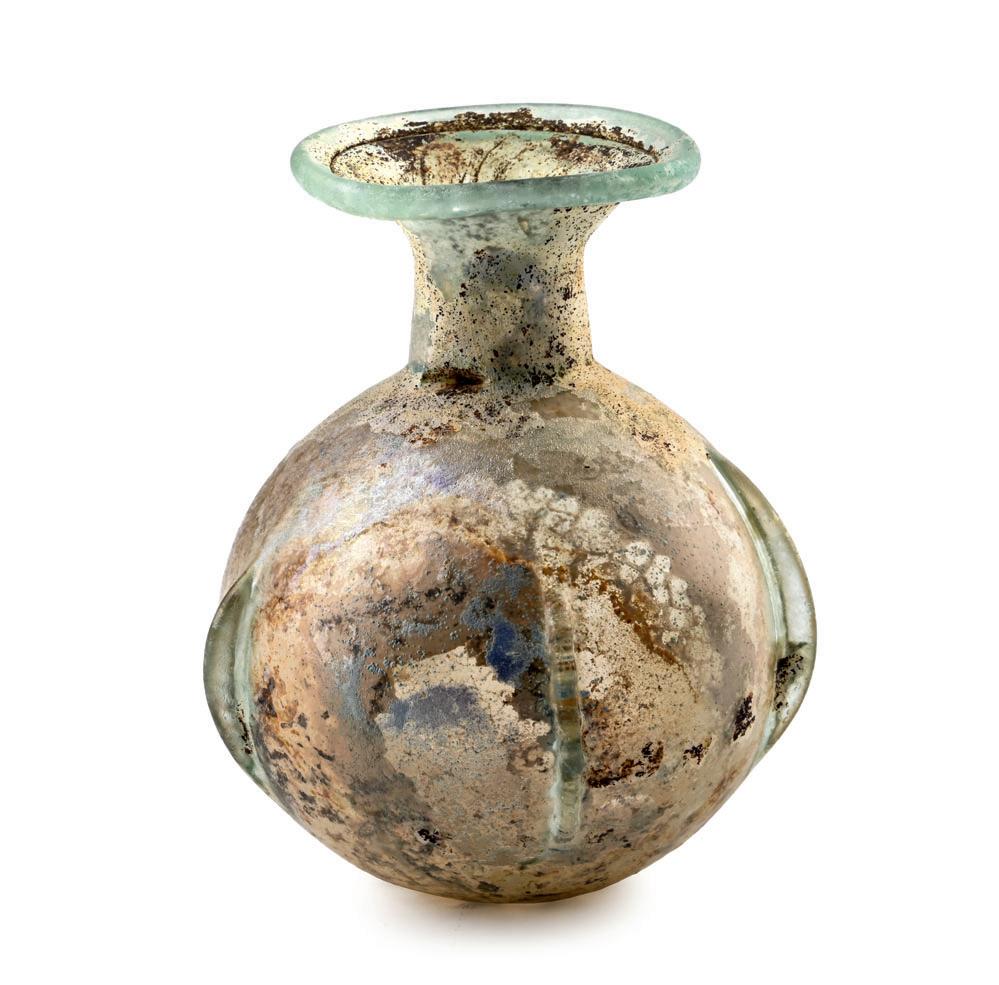
182
ROMAN SQUARE GLASS FLASK
1ST-4TH CENTURY A.D.
3 in. (81 grams, 93 mm)
With a dimple to the underside, a square-section body and a wide everted rim with a step to the edge.
£300 - 400
PROVENANCE:
From a specialist collection of glass, acquired from dealerships during the 1990s.
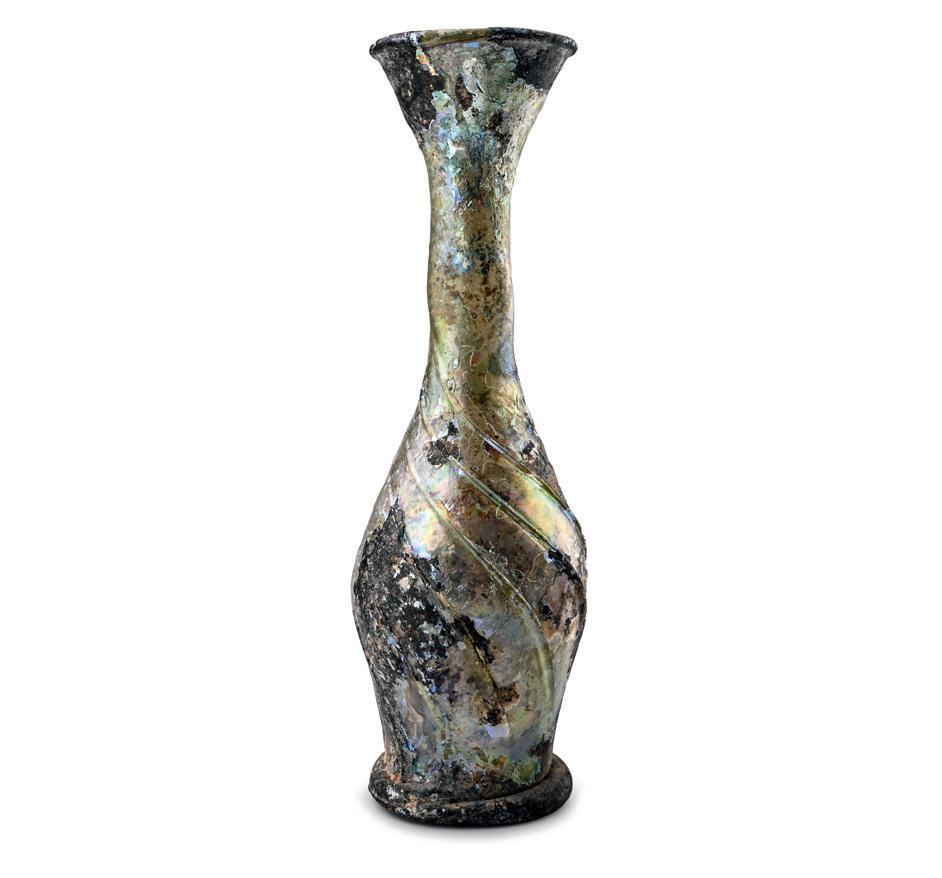
184
LARGE ROMAN DOUBLE-HANDLED GLASS AMPHORA WITH FLARED MOUTH
1ST-4TH CENTURY A.D.
5¾ in. (127 grams, 14.4 cm)
Globular body with rolled rim and trumpet-shaped neck, two applied handles and a pontil base.
£500 - 700
PROVENANCE:
From a specialist collection of glass, acquired from dealerships during the 1990s.
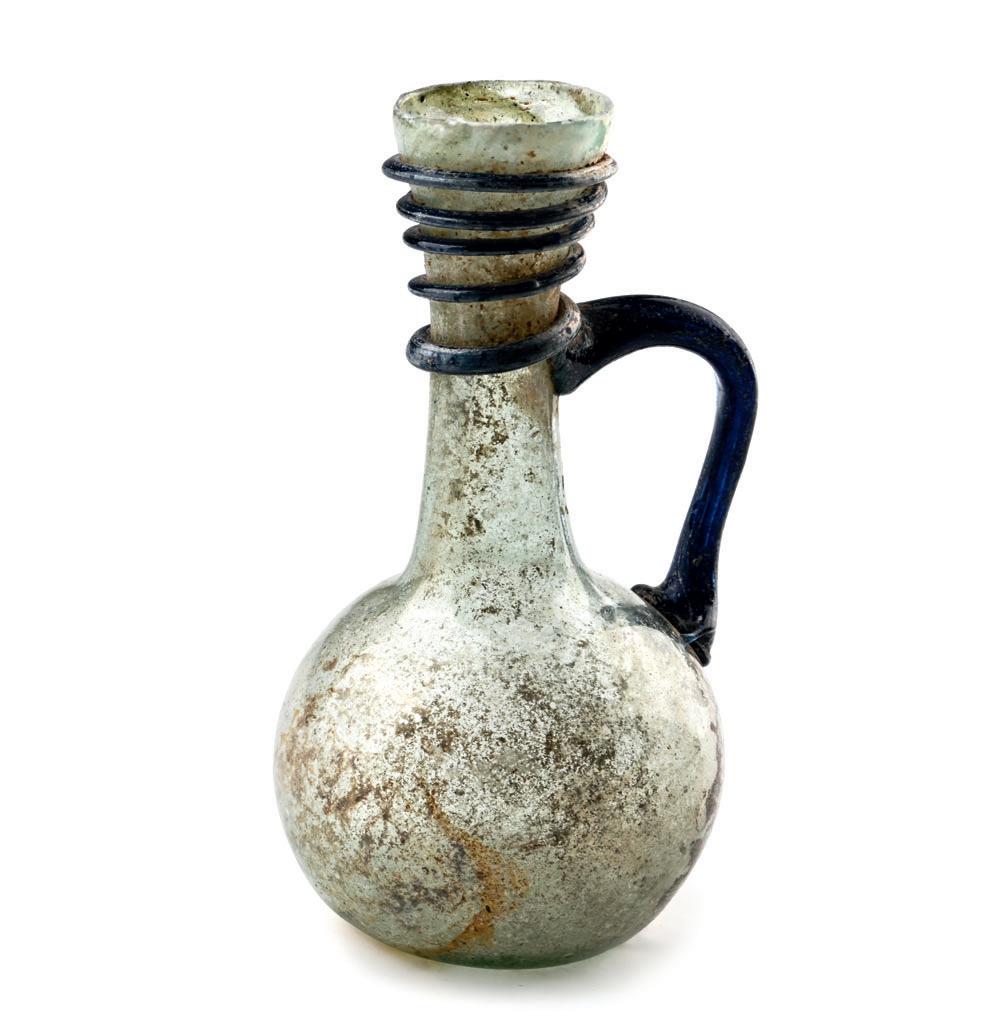
186
ROMAN GLASS TREFOIL-MOUTHED JUGLET
2ND-3RD CENTURY A.D.
3¼ in. (30 grams, 84 mm)
With bulbous body and pontil base, slender neck, rolled rim pinched to a trefoil; applied handle to the rear.
£300 - 400
PROVENANCE:
From a specialist collection of glass, acquired from dealerships during the 1990s.
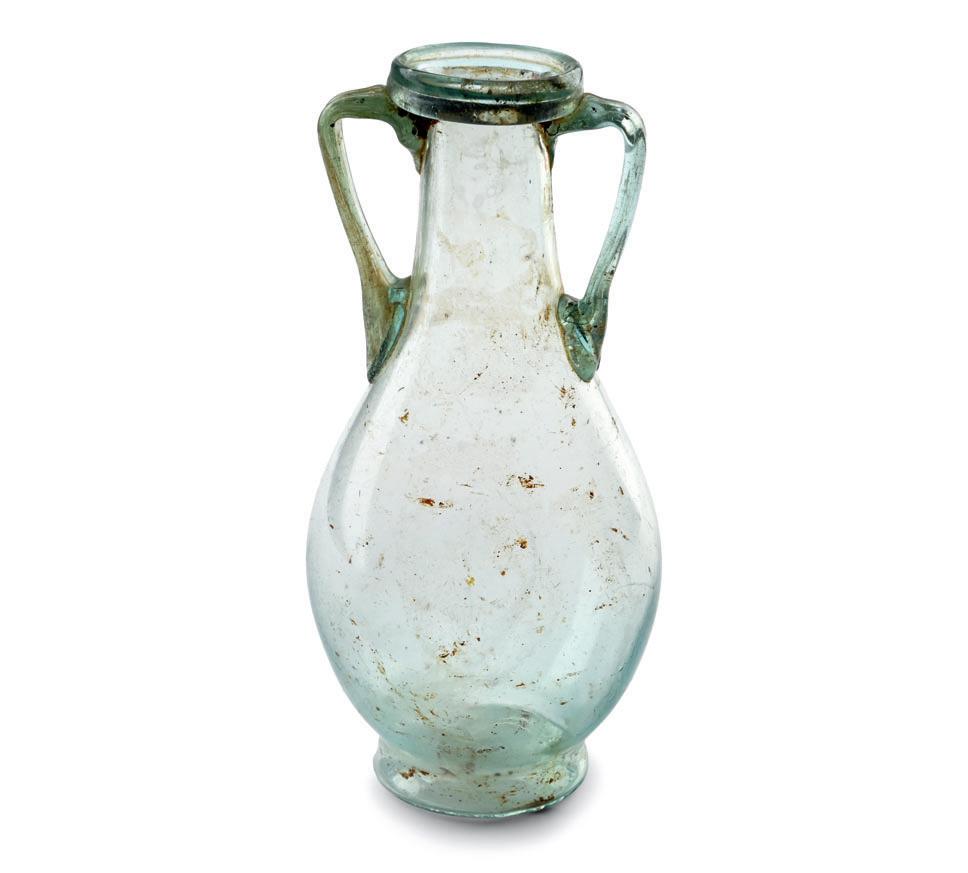
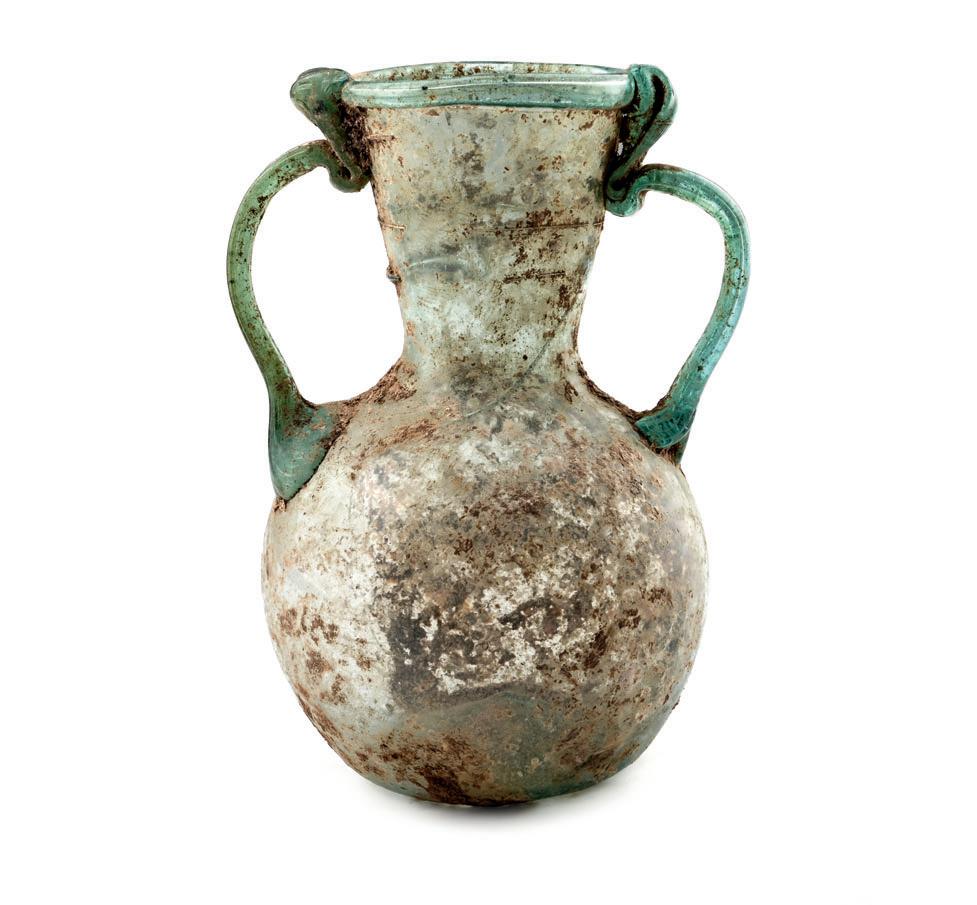
185
ROMAN TRANSLUCENT GLASS JUG WITH TRAIL
1ST-4TH CENTURY A.D.
4 in. (38 grams, 10 cm)
With a dimple base; applied trail to the flared mouth forming a handle.
£400 - 600
PROVENANCE:
From a specialist collection of glass, acquired from dealerships during the 1990s.
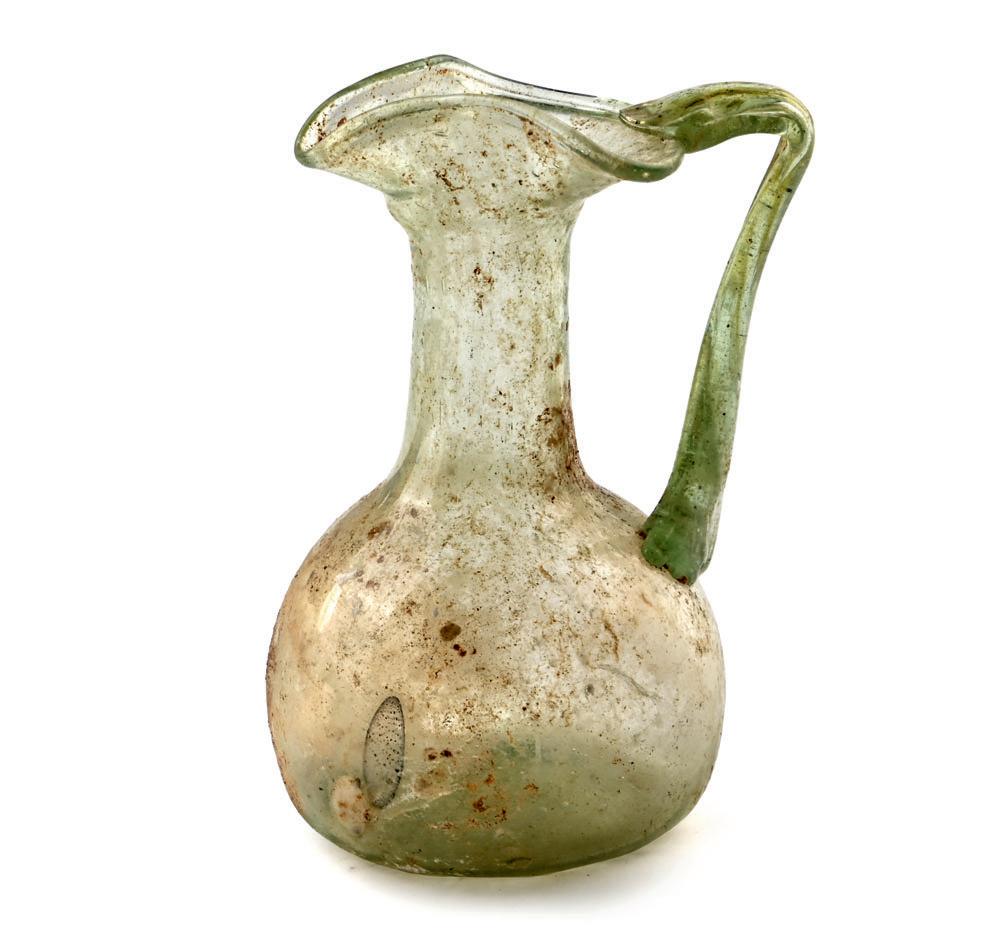
187
ROMAN TRANSLUCENT GLASS AMPHORA
1ST-3RD CENTURY A.D.
5 in. (69 grams, 12.9 cm)
With sloping, rounded shoulder, a globular body tapering to a flared base, a cylindrical neck and a stepped rim, applied handles.
£500 - 700
PROVENANCE:
From a specialist collection of glass, acquired from dealerships during the 1990s.
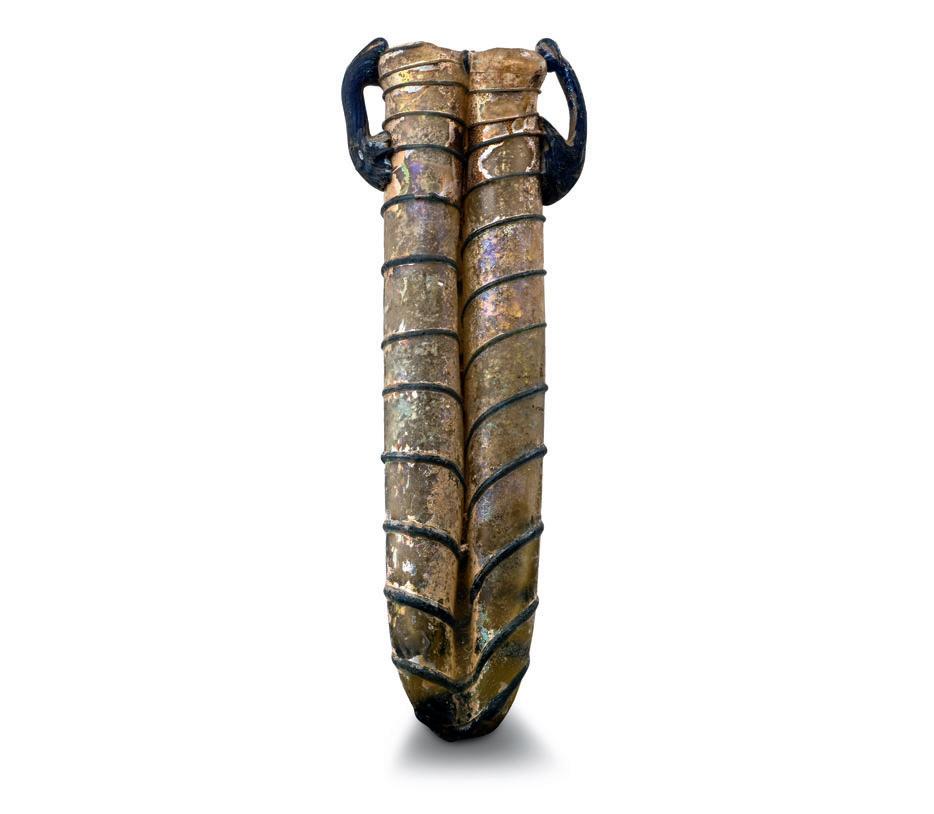
189
ROMAN BLUE GLASS UNGUENTARIUM WITH TRAIL
1ST-4TH CENTURY A.D.
4 in. (29.4 grams, 11.1 cm)
With a spherical body, a tall tubular neck with everted rolled rim; fine applied trails across the body.
£400 - 600
PROVENANCE:
From a specialist collection of glass, acquired from dealerships during the 1990s.
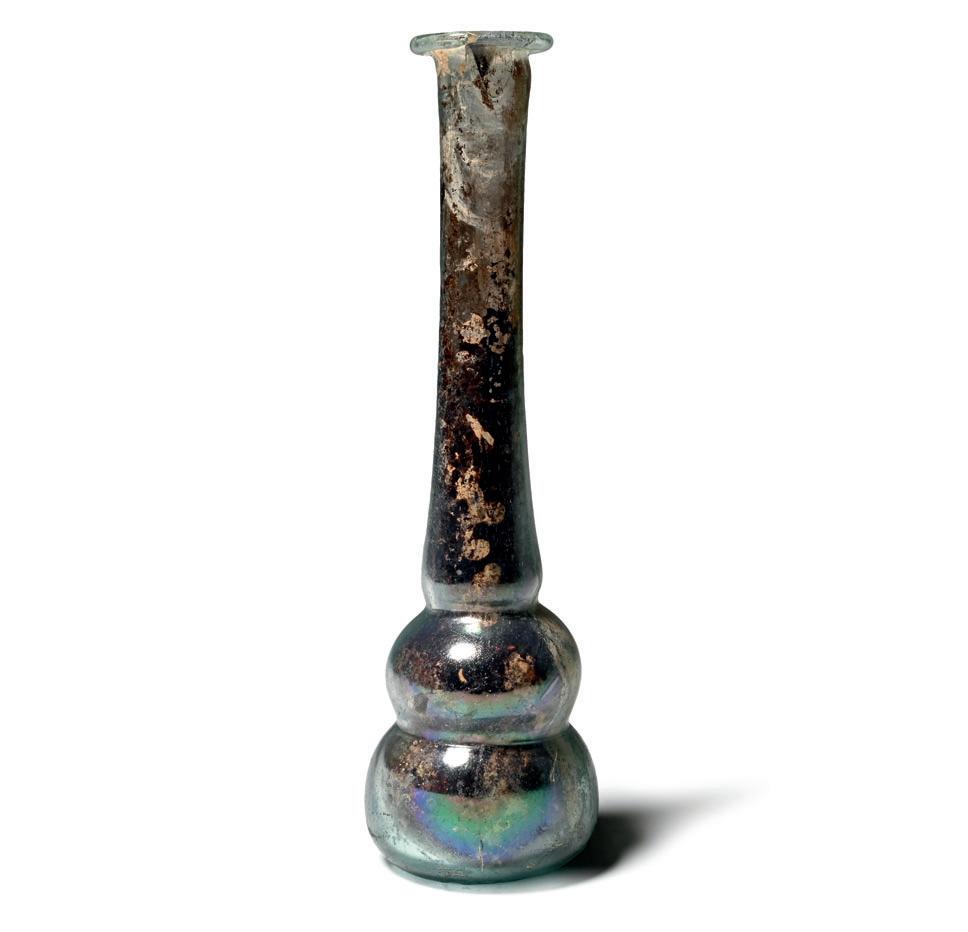
191
ROMAN TALL GLASS FLASK WITH RED TRAIL
1ST-4TH CENTURY A.D.
8 in. (147 grams, 20.1 cm)
With bulbous body, tall tubular neck, broad everted rim; applied red glass trail at upper neck and from shoulder to base; extensive iridescence.
£500 - 700
PROVENANCE:
From a specialist collection of glass, acquired from dealerships during the 1990s.
188
ROMAN GLASS DOUBLE UNGUENTARIUM WITH BLUE TRAIL
4TH CENTURY A.D.
4 in. (30.62 grams, 11.8 cm)
Comprising two conjoined tapering tubular cells with laterally applied handles at the shoulder, decorated with applied trails; iridescent surface.
£400 - 600
PROVENANCE:
From a specialist collection of glass, acquired from dealerships during the 1990s.
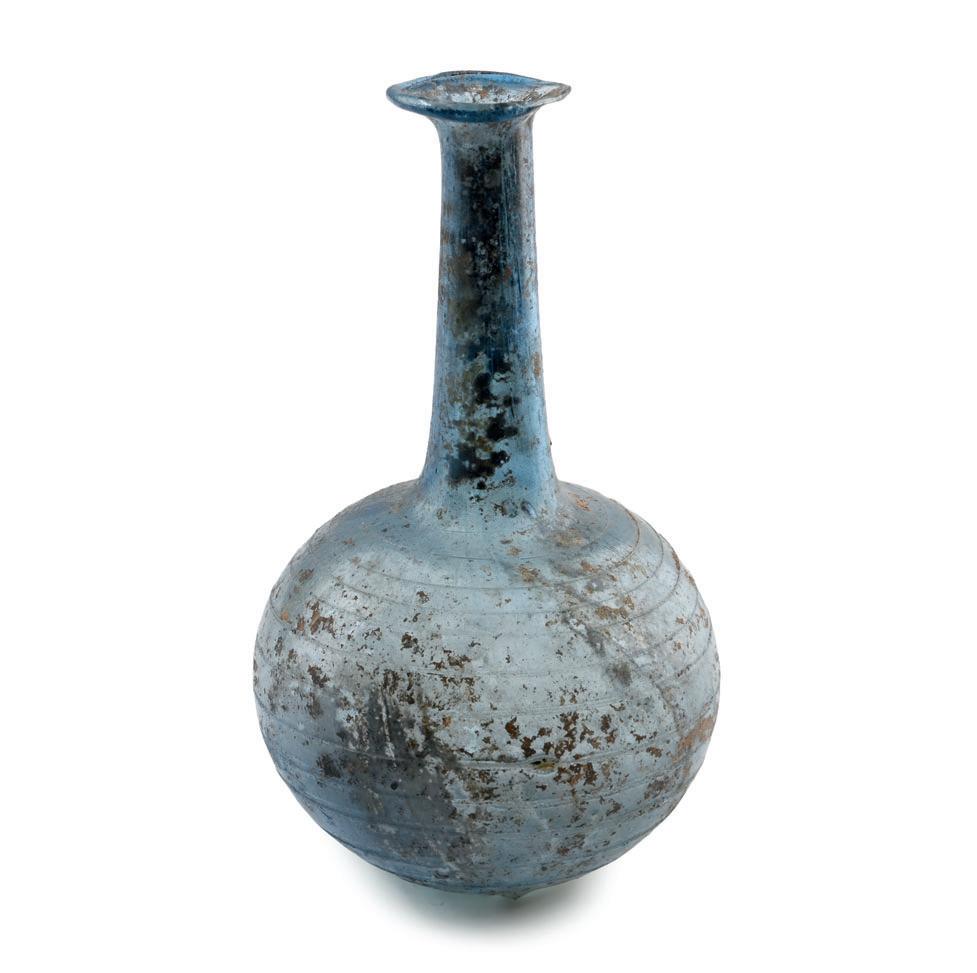
190
ROMAN TALL GLASS FLASK WITH IRIDESCENCE
2ND-3RD CENTURY A.D.
5¾ in. (46 grams, 14.7 cm)
Tall unguentarium with a waisted body and tubular neck with rolled rim.
£400 - 600
PROVENANCE: Private collection, 1990s-early 2000s.
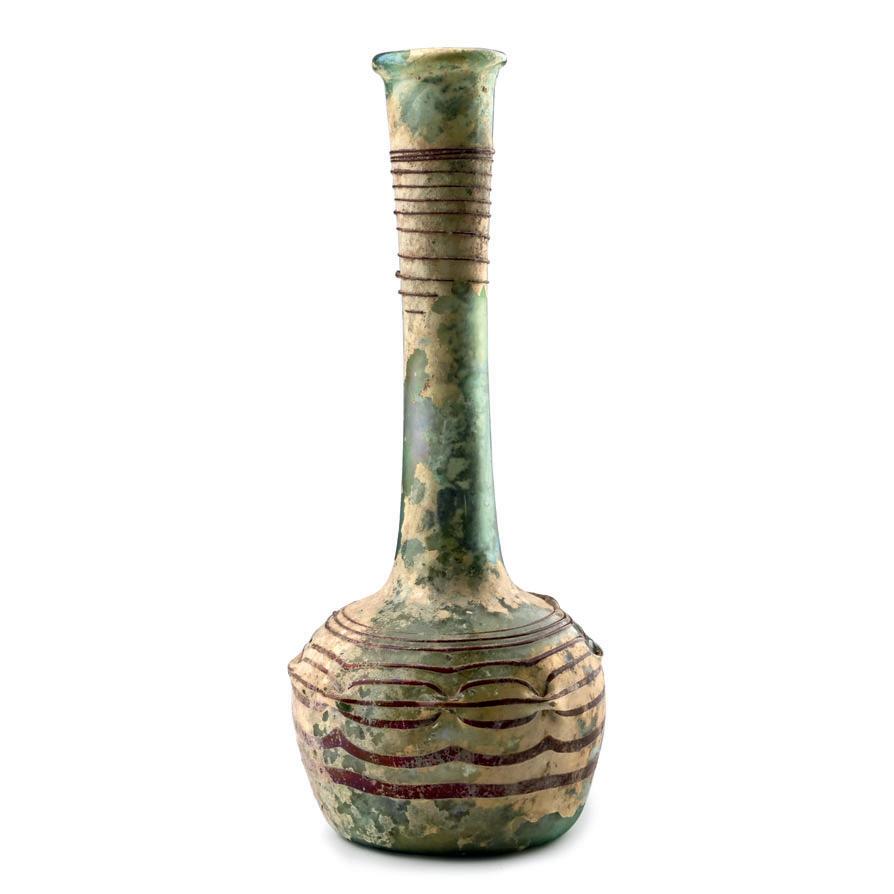
192
ROMAN GREEN GLASS CUP WITH DARK BLUE APPLIED DECORATION
3RD-4TH CENTURY A.D.
3 in. (71.7 grams, 86 mm)
Aqua glass drum-shaped jar with everted rim and dimple base; applied blue glass pellets to equator.
£500 - 700
PROVENANCE:
Ex German art market, 2000s. Acquired from an EU collector living in London. From the collection of a Surrey, UK, gentleman.
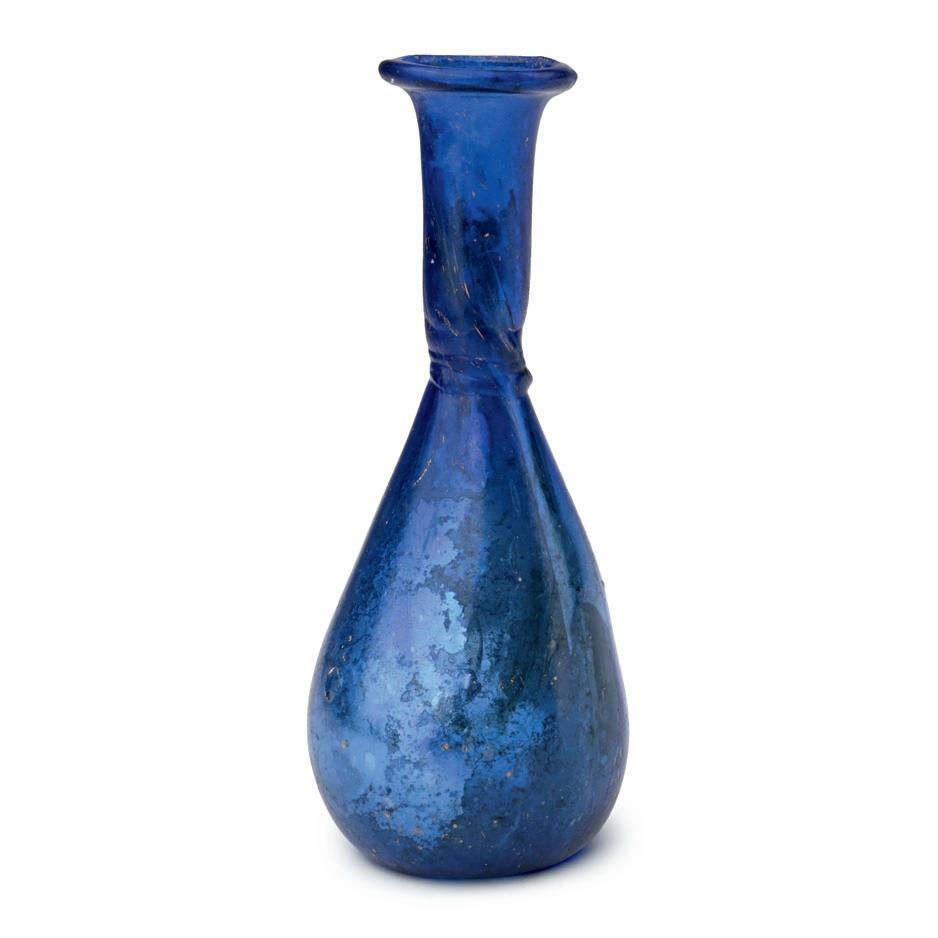
194
ROMAN GLASS BEAKER
1ST-4TH CENTURY A.D.
4 in. (49.4 grams, 10.1 cm)
With a biconical carinated body, dimple base, and chamfered rim.
£400 - 600
PROVENANCE:
From a specialist collection of glass, acquired from dealerships during the 1990s.
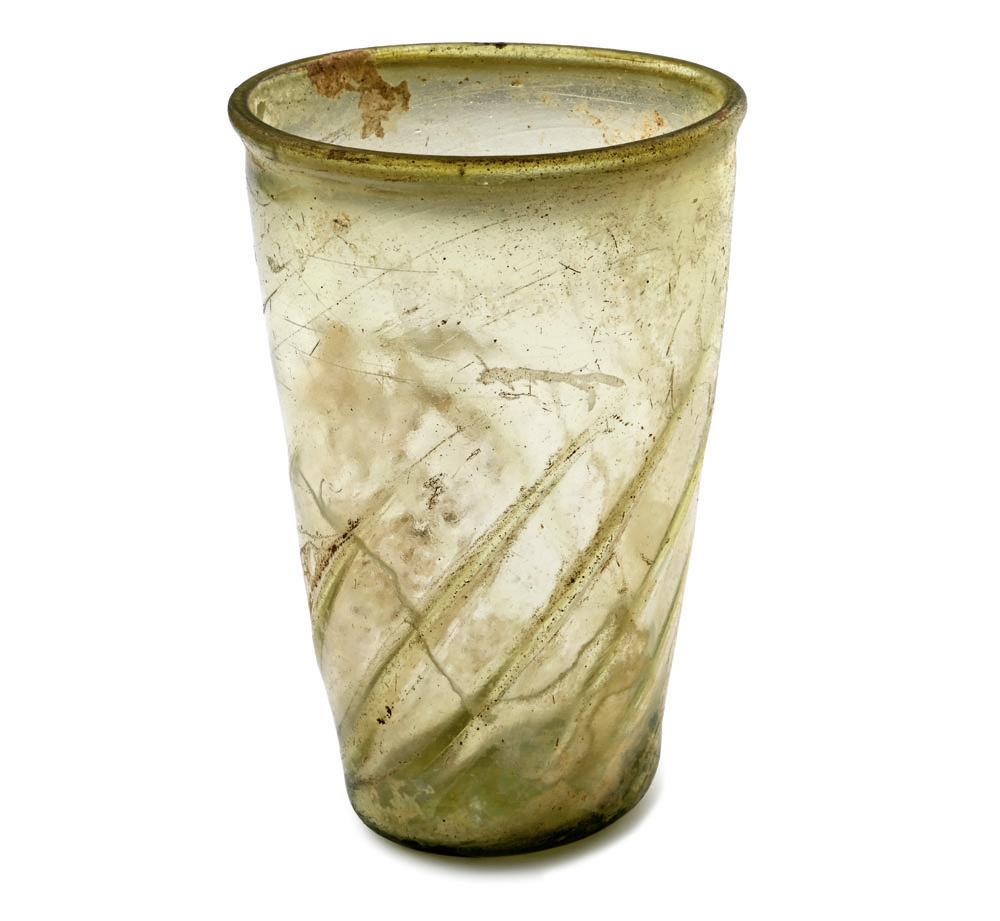
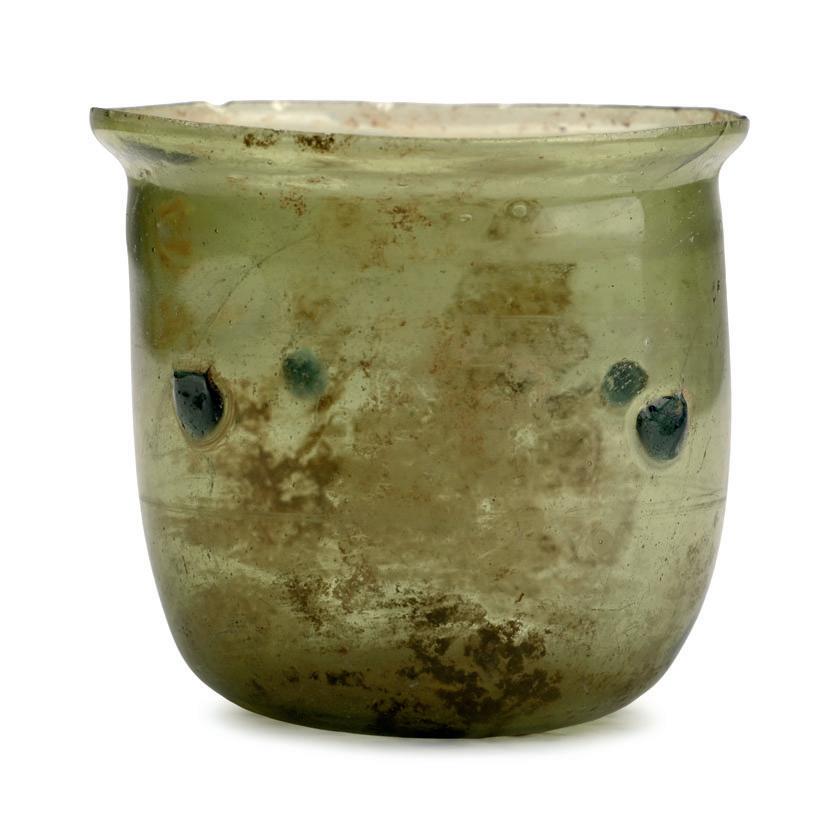
193
ROMAN COBALT BLUE GLASS UNGUENTARIUM
1ST-3RD CENTURY A.D.
3½ in. (15 grams, 88 mm)
Delicate cobalt-blue glass unguentarium comprising a piriform body with slight constriction at the base of the cylindrical neck, everted folded rim and a slightly concave base; traces of earthly deposits to the surface.
£600 - 800
PROVENANCE:
Private collection, 1990s-early 2000s.
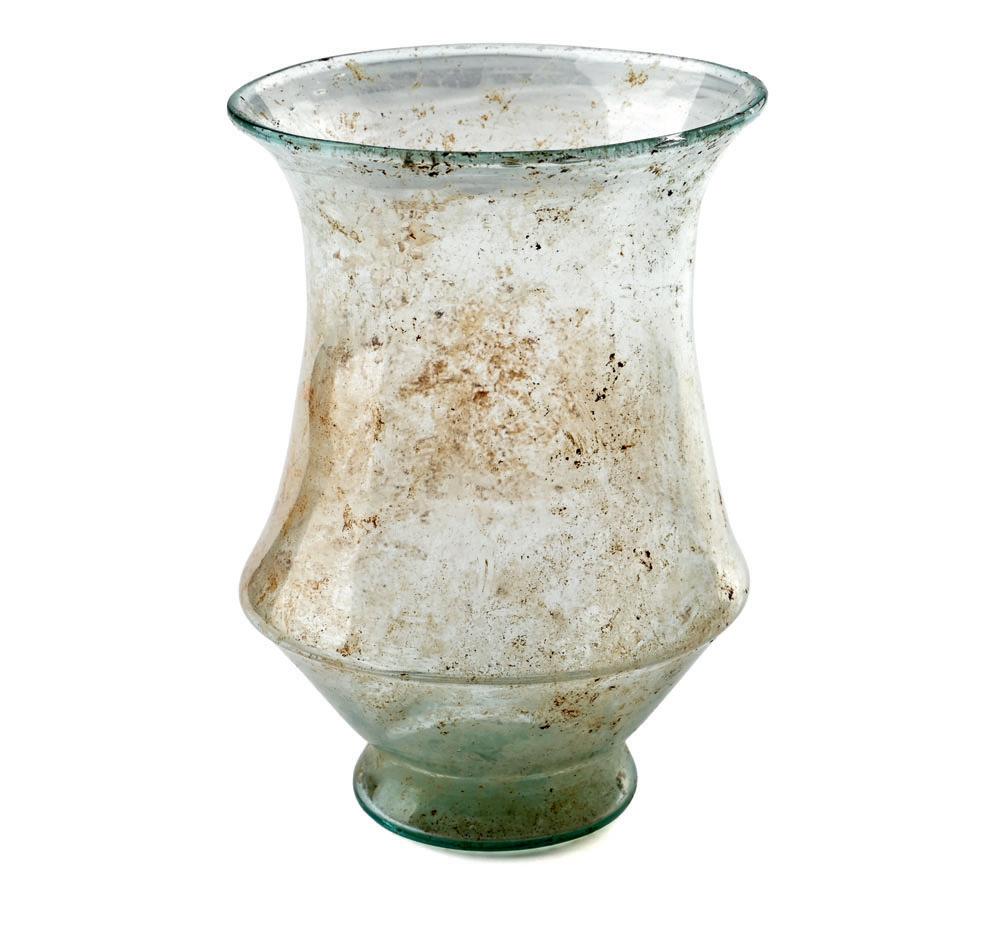
195
ROMAN GREEN GLASS BEAKER WITH DECORATED BODY
2ND CENTURY A.D.
4½ in. (62 grams, 11.5 cm)
With straight sides narrowing to the dimpled base, a rolled rim; the body decorated with diagonal ribbed lines.
£400 - 600
PROVENANCE: From a specialist collection of glass, acquired from dealerships during the 1990s.
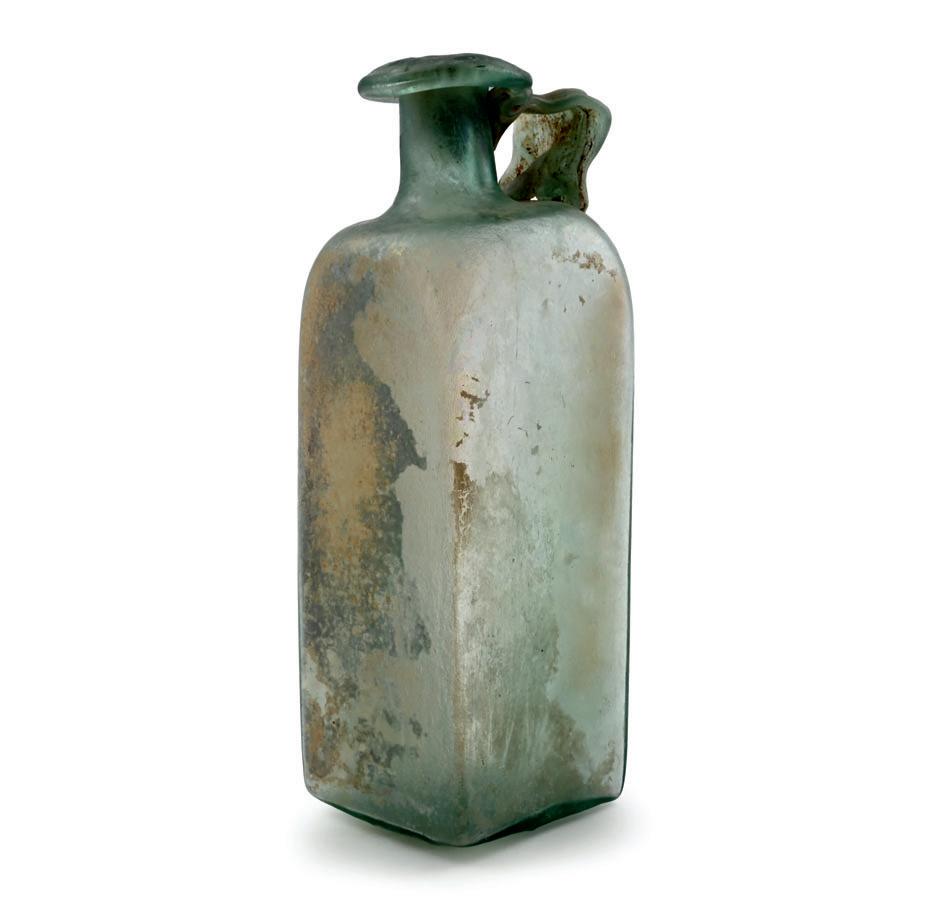
197
ROMAN IRIDESCENT GLASS DOUBLE UNGUENTARIUM
2ND-3RD CENTURY A.D.
6 in. (77 grams, 17.5 cm)
With rolled rim to each tapering tube, applied trail detailing to each upper body, lateral angled handles and large applied loop handle above; iridescent surface.
£500 - 700
PROVENANCE:
Private collection, 1990s-early 2000s.
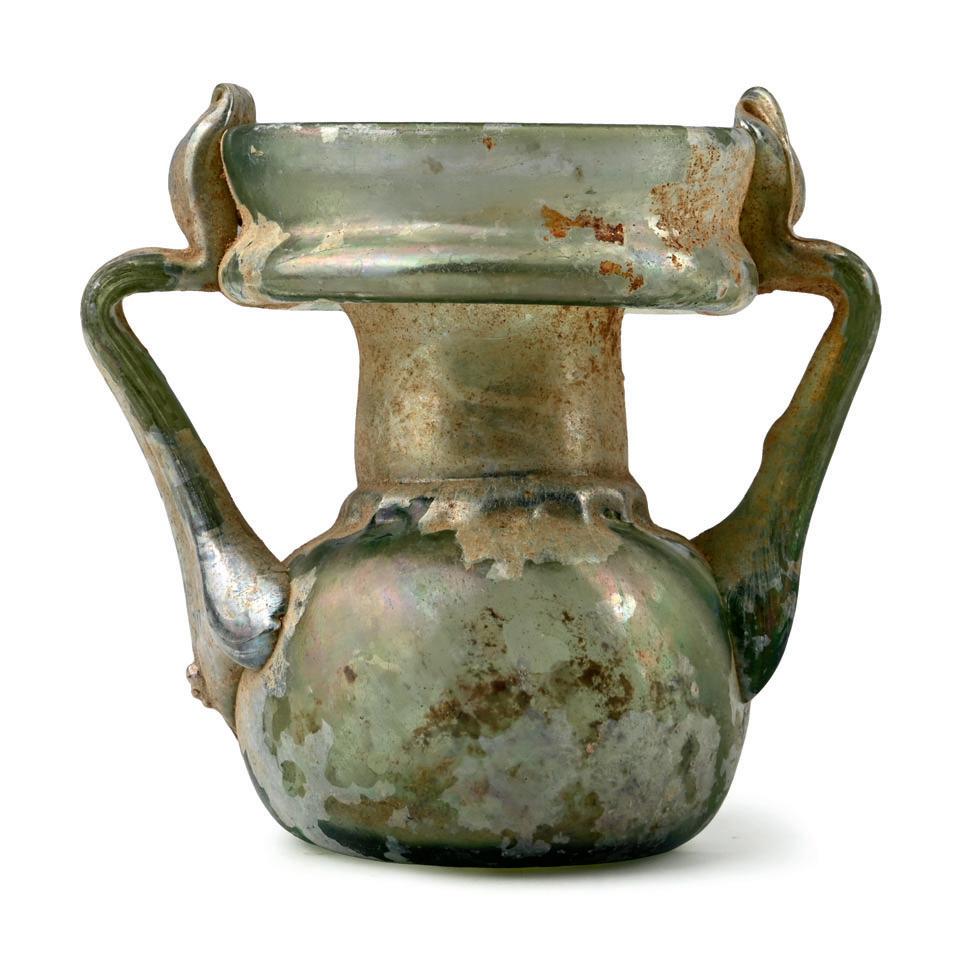
199
ROMAN CLEAR GLASS JAR WITH IRIDESCENCE
2ND-3RD CENTURY A.D.
3 in. (29.6 grams, 85 mm)
Squat in profile with trumpet-shaped neck and mouth, collar below the rim, dimple base; some iridescence.
£200 - 300
PROVENANCE:
Private collection, 1990s-early 2000s.
196
LARGE GALLO-ROMAN MOULD-BLOWN GREEN GLASS FLASK ‡ 1ST-2ND CENTURY A.D.
8 in. (303 grams, 20.6 cm)
Square in plan with rounded shoulder and trumpet-shaped mouth; folded strap handle.
£600 - 800
PROVENANCE: Collection F. Martens Netherlands, 1980s-1990s. Anonymous sale, Cahn International Auction, Basel, Switzerland, 2010. Private collection, Europe.
EXHIBITED: Harwich Museum, Harwich, Essex, UK, 4th March 2026-7th June 2026; accompanied by a copy of a photograph of the artefacts on display.
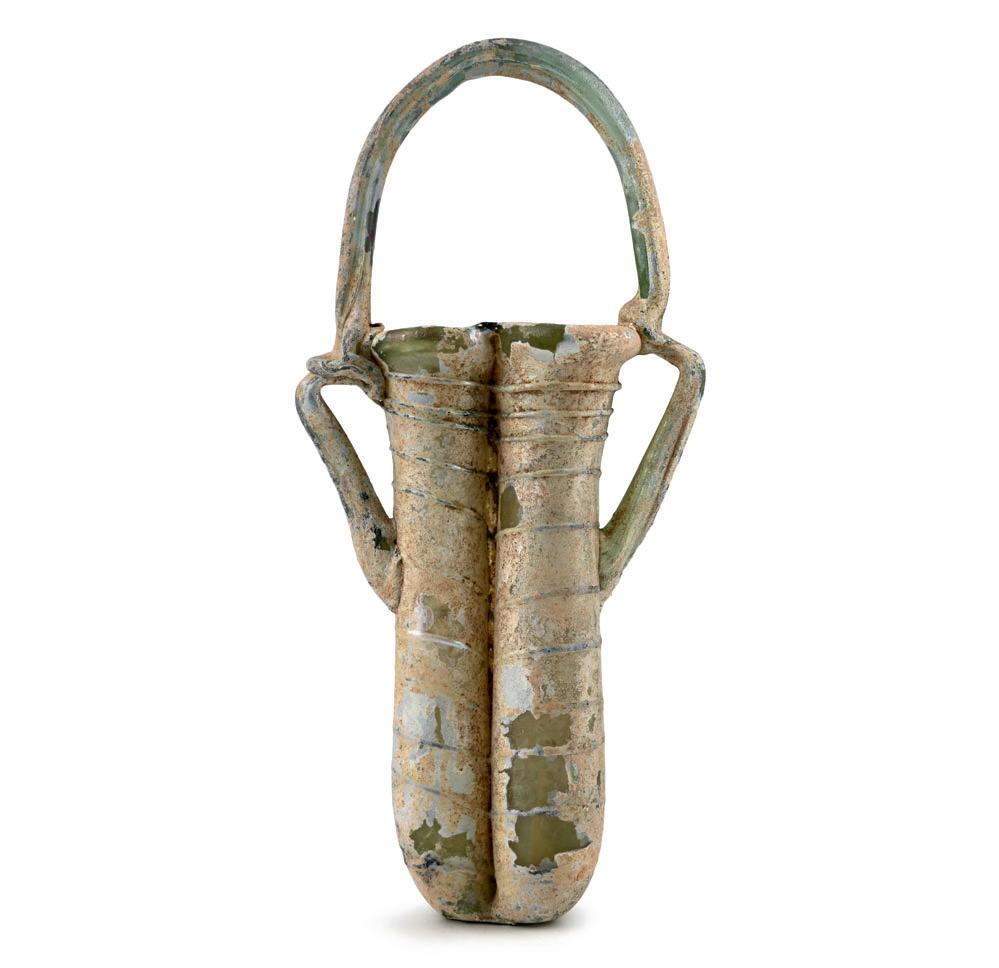
198
ROMAN GLASS HANDLED JAR
2ND-3RD CENTURY A.D.
3 in. (59 grams, 76 mm wide)
With a dimpled base, bulbous body with a carinated flange to the neck and a broad mouth, applied lateral handles.
£400 - 600
PROVENANCE: Private collection, 1990s-early 2000s.
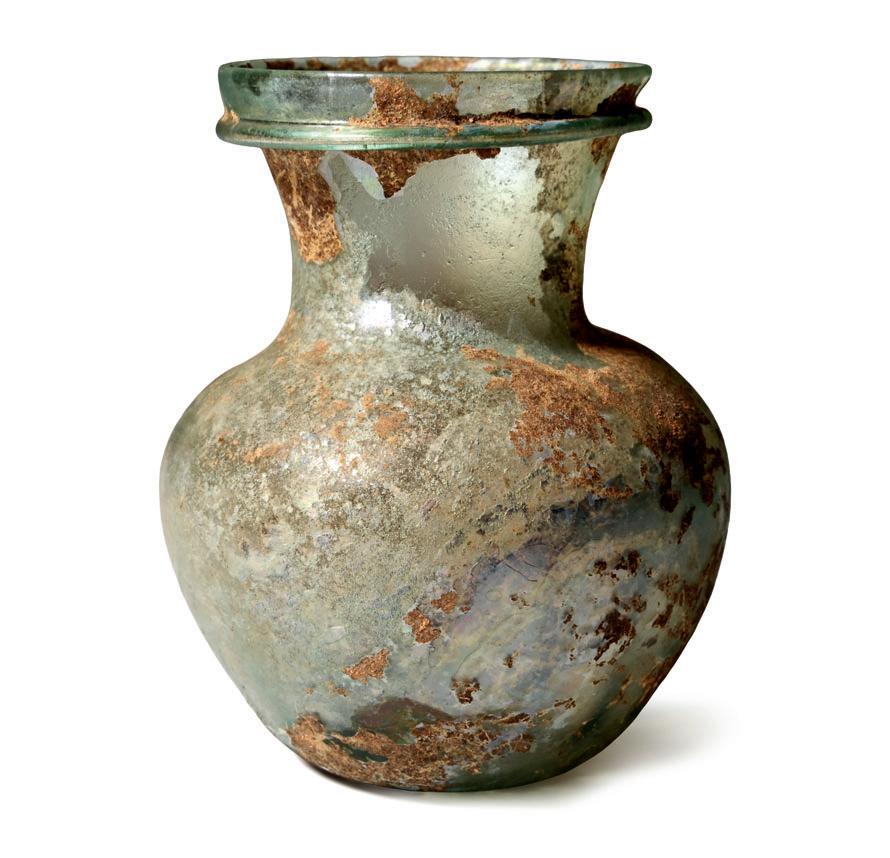
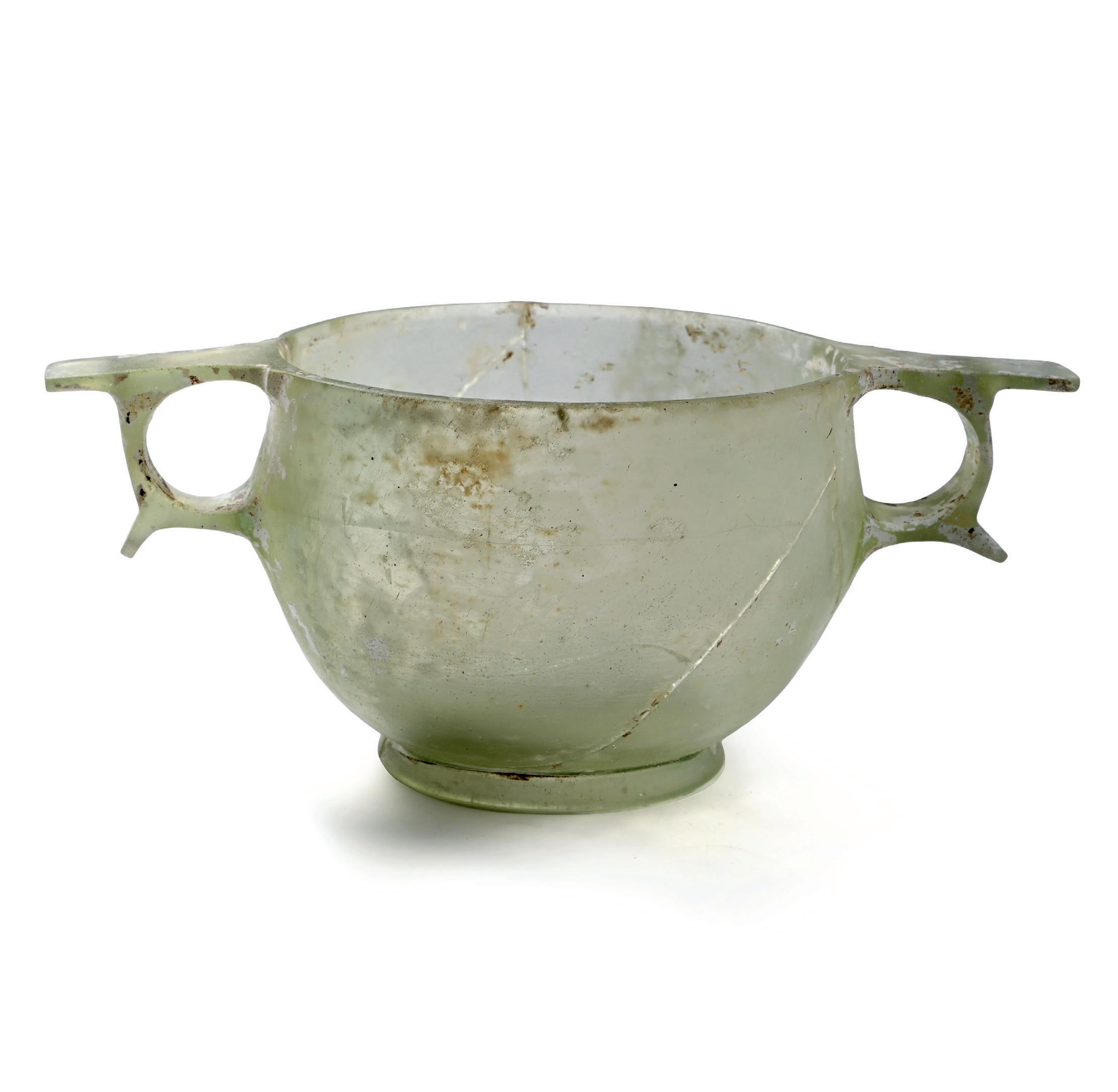
200
ROMAN CUT-GLASS SKYPHOS
1ST CENTURY B.C.-1ST CENTURY A.D.
7 in. (260 grams, 18.3 cm wide)
Drum-shaped frosted glass vessel on a low basal ring, lateral loop handles each with an angled spur below and fish-tail plaque above.
£4,000 - 6,000
PROVENANCE:
Acquired in the 1980s. with Christopher Sheppard, London, UK. Acquired from the above in 2007.
Accompanied by an academic report by Dr Raffaele D’Amato.
FOOTNOTES:
The classic shape of this skyphos, a two-handled drinking cup from the 1st century, reflects the metal prototypes of the period. The most famous are the silver cups from Boscoreale and the House of the Menander at Pompeii (Hilgers, 1969, pl.2, nos.5-6 and pl.4, nos.1-4; Pappalardo, 1986, pp.206-207, nos.1-4).

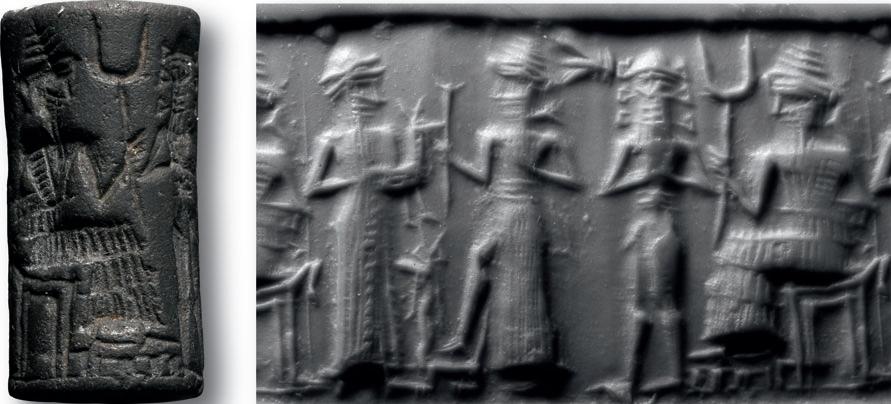

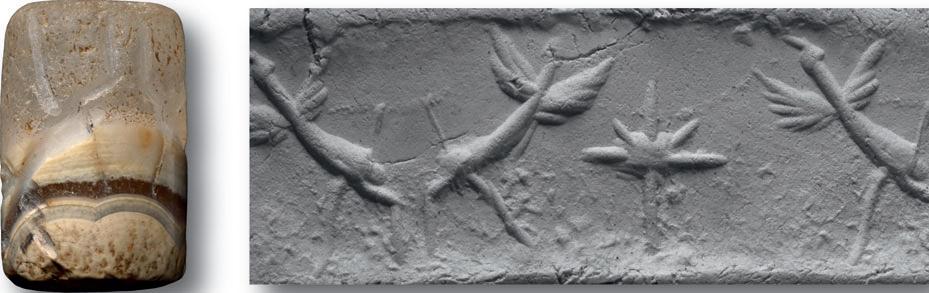

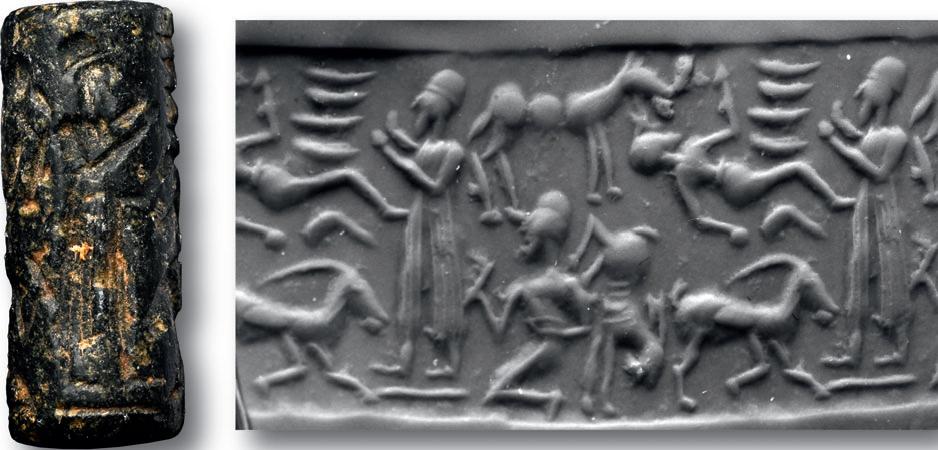

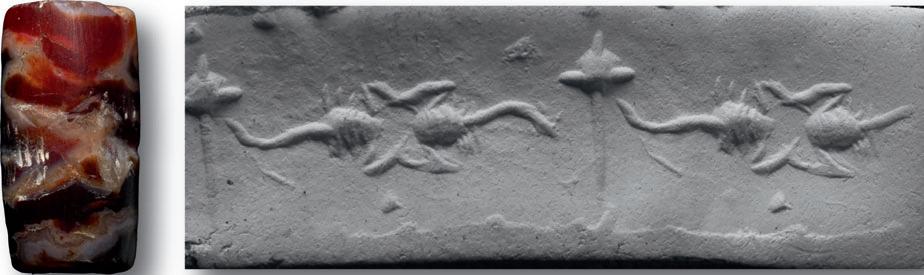

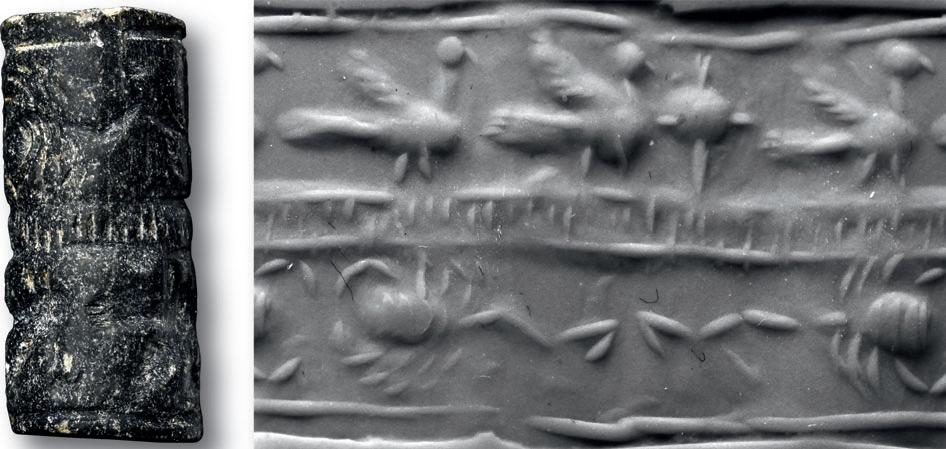
230
OLD BABYLONIAN HEMATITE CYLINDER SEAL WITH GOD AMURRA, THE GOD OF SHEPHERDING MESOPOTAMIA, 1800-1600 B.C.
1 in. (11.86 grams, 25 mm)
With incuse frieze; accompanied by an old scholarly note, typed and signed by W.G. Lambert, late Professor of Assyriology, University of Birmingham, 1970-1993, which states: ‘Cylinder Seal of Hematite 26 x 13. The scene consists of two pairs of figures. In the one pair the noon-god Sin is seated on an angular stool, with small footstool. He is wearing a horned tiara and long flounced robe, and holds up a pole with the lunar crescent on the top. In front of him stands a Lahmuhero, nude save for a triple-stranded belt, with big beard and curls either side of his face, clasping his hands. The other pair consists of a standing god in horned tiara and long pleated robe open at the front, from which one leg projects with foot resting on a snake-dragon. This god holds up a wedge in one hand. Facing him is a worshiper in a long pleated robe, offering in his arms a kid to the god. There is one filler: a large fly. This is an Old Babylonian seal, from Mesopotamia, c. 1900-1700 B.C. It is in good condition, and is an interesting example of its type’.
£500 - 700
PROVENANCE:
Private collection, London, UK.
231
WESTERN ASIATIC BANDED AGATE CYLINDER SEAL WITH BIRDS
2ND-1ST MILLENNIUM B.C.
½ in. (2.22 grams, 14.23 mm)
Frieze with starburst motif and two birds with outstretched wings.
£300 - 400
PROVENANCE:
From the private collection of a European gentleman (1942-2024), formed since the 1970s.
232
WESTERN ASIATIC BLACK STONE CYLINDER SEAL WITH WORSHIP SCENE
2ND-1ST MILLENNIUM B.C. in. (3.09 grams, 21.8 mm)
Comprising a standing figure in profile with both arms raised towards a supine figure with a pile of transverse knives above and a goat or ibex below; to the rear, a standing horse above a kneeling figure with an adze and a crouching dog perpendicular.
£400 - 600
PROVENANCE:
From the private collection of a European gentleman (1942-2024), formed since the 1970s.
233
WESTERN ASIATIC AGATE CYLINDER SEAL WITH SCORPIONS
2ND-1ST MILLENNIUM B.C.
½ in. (1.02 grams, 13.24 mm)
Frieze depicting two scorpions advancing towards each other, starburst to the rear; supplied with a museum-quality impression.
£300 - 400
PROVENANCE:
From the private collection of a European gentleman (1942-2024), formed since the 1970s.
234
WESTERN ASIATIC CYLINDER SEAL WITH BIRDS AND SCORPIONS
2ND-1ST MILLENNIUM B.C.
¾ in. (2.47 grams, 18.91 mm)
Frieze in two registers: above, row of perching birds with orb; below, row of scorpions; supplied with a museum-quality impression.
£300 - 400
PROVENANCE:
From the private collection of a European gentleman (1942-2024), formed since the 1970s.
235
WESTERN ASIATIC CYLINDER SEAL IN GOLD MOUNT
2ND-1ST MILLENNIUM B.C. AND LATER 1 in. (5.45 grams, 24.7 mm)
Cylindrical hematite seal showing a robed figure standing on a supplicant, and holding a long staff, symbols behind; another scene positioned vertically showing two standing figures holding an idol(?) between them; mounted on a gold loop.
£500 - 700
PROVENANCE:
From the private collection of a European gentleman (1942-2024), formed since the 1970s.
236
WESTERN ASIATIC CHALCEDONY CYLINDER SEAL WITH TREE OF LIFE
900-600 B.C. in. (4.47 grams, 22 mm)
With frieze of a tree flanked by winged worshippers, surmounted by faravahar symbol; accompanied by a museum-quality impression.
£600 - 800
PROVENANCE:
UK private collection before 2000. Acquired on the UK art market. Private collection, London, UK.
237
WESTERN ASIATIC BLACK STONE CYLINDER SEAL WITH MASTER OF ANIMALS
2ND-1ST MILLENNIUM B.C.
1 in. (2.43 grams, 24.2 mm)
With frieze depicting a profile figure standing on a hatched block, one hand extended above the neck of a rearing horse, the other relaxed holding a leash extending to a standing dog(?); gryphon above, foal beneath the horse, objects in the field; supplied with a museumquality impression.
£400 - 600
PROVENANCE:
From the private collection of a European gentleman (1942-2024), formed since the 1970s.
238
WESTERN ASIATIC PINK STONE CYLINDER SEAL WITH FIGURAL SCENE
2ND-1ST MILLENNIUM B.C.
¾ in. (2.44 grams, 19.5 mm)
Frieze comprising a standing figure with wings spread above two ringand-dot motifs, altar with bowl on a stem, facing nude figure with arms bent, second figure with floor-length robe; supplied with a museumquality impression.
£400 - 600
PROVENANCE:
From the private collection of a European gentleman (1942-2024), formed since the 1970s.
239
WESTERN ASIATIC BLACK STONE CYLINDER SEAL WITH WINGED GOD
2ND-1ST MILLENNIUM B.C. in. (3.43 grams, 21.97 mm)
Frieze depicting a standing winged deity advancing above a hunting dog perpendicular, small attendant to the rear holding a vessel beside a standing gryphon, second crouching figure above; supplied with a museum-quality impression.
£400 - 600
PROVENANCE:
From the private collection of a European gentleman (1942-2024), formed since the 1970s.

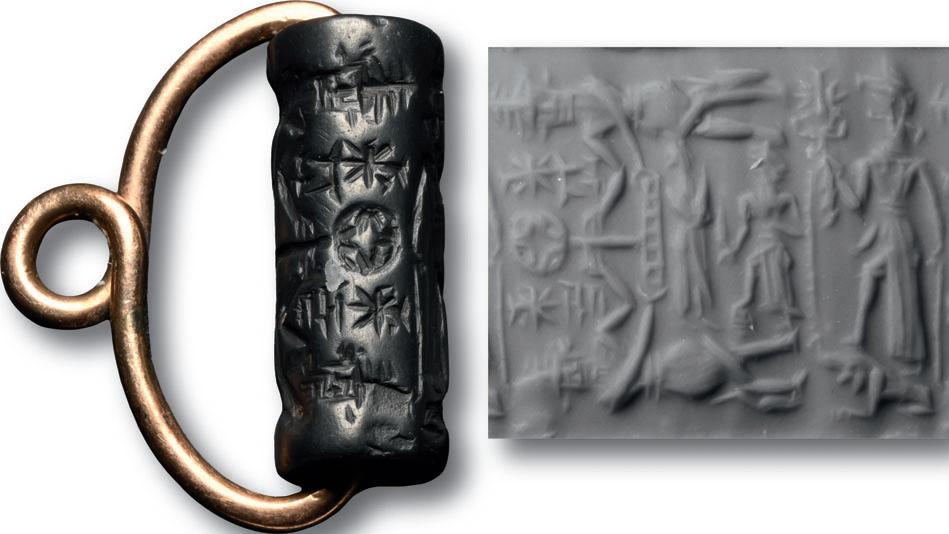

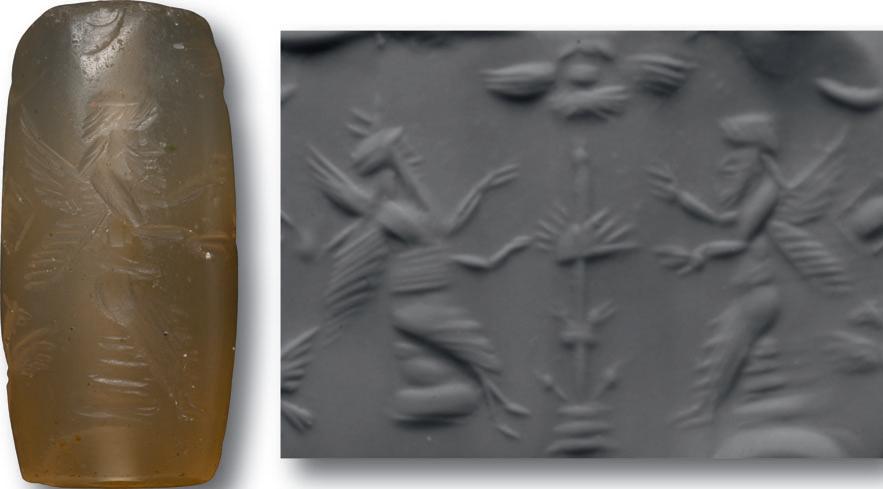

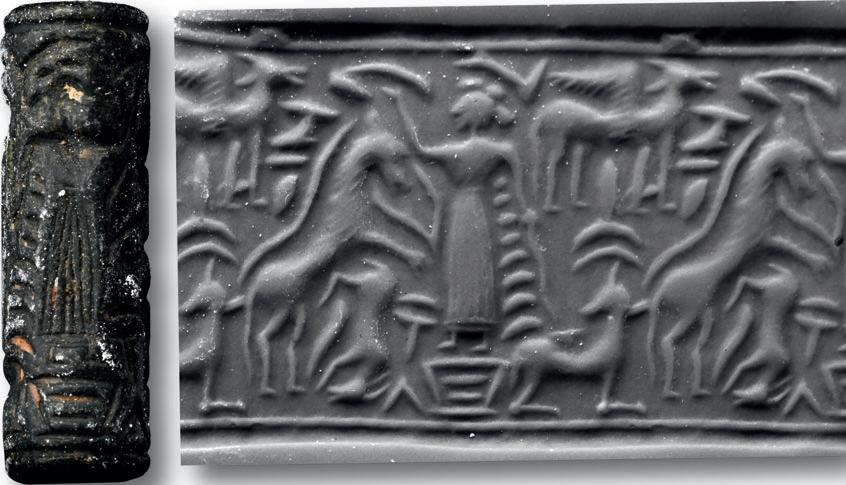

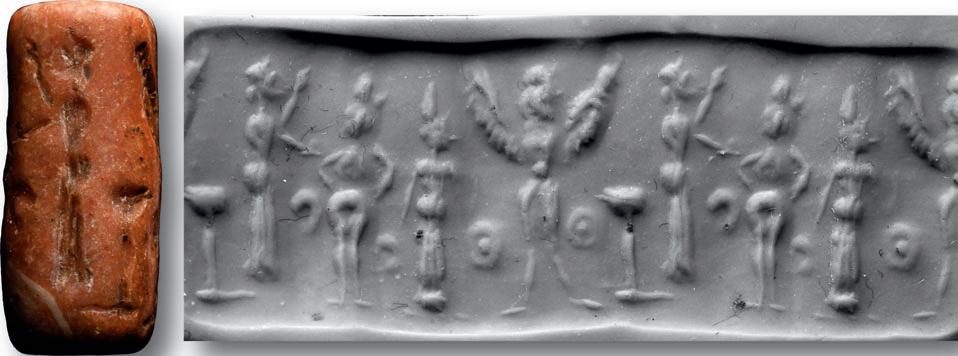

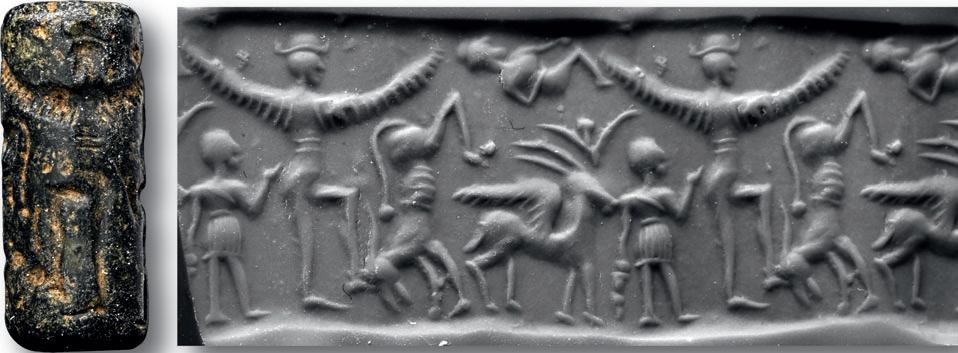
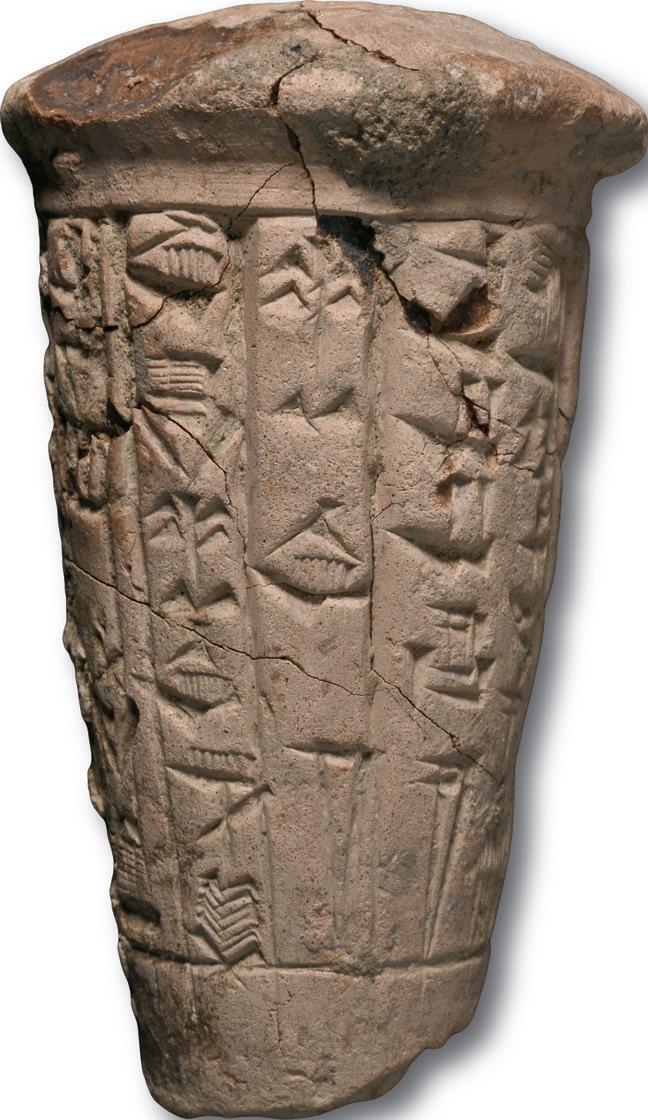

241
MESOPOTAMIAN TERRACOTTA CUNEIFORM TABLET
2ND MILLENNIUM B.C.
1¾ in. (42.9 grams, 45 mm)
A discoid tablet with cuneiform text covering one side, the other side divided into three sections, with one section containing cuneiform text.
£400 - 600
PROVENANCE:
From the private collection of a European gentleman (1942-2024), formed since the 1970s.

240
SUMERIAN TERRACOTTA CUNEIFORM FOUNDATION CONE
CIRCA 2000 B.C.
4 in. (288 grams, 10.26 cm)
With domed upper face, conical body; incised vertical lines dividing the surface into segments, with impressed cuneiform text; tip absent.
£400 - 600
PROVENANCE:
From the private collection of the late Mr W. Magee, Hartlepool, County Durham, UK, 1960s-1990s, thence by descent.
Accompanied by a previous catalogue information card.
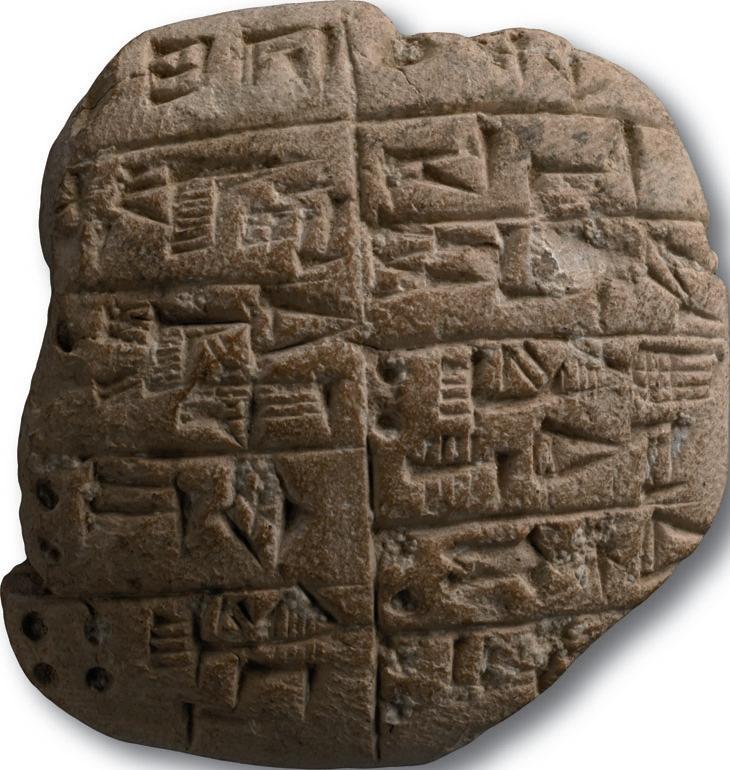

242
MESOPOTAMIAN CLAY BULLA WITH CLAY TOKENS
URUK, 3RD MILLENNIUM B.C.
2 in. (74 grams, 50 mm)
Spherical, undecorated bulla envelope containing clay tokens.
£500 - 700
PROVENANCE:
Specialised collection of cuneiform texts, the property of a London gentleman and housed in London before 1992.
Thence by descent to family members.
Examined by Professor Wilfrid George Lambert FBA (1926-2011), historian, archaeologist, and specialist in Assyriology and Near Eastern archaeology, in the late 1980s and early 1990s.
This small collection is exceptional for the variety of types, including some very rare and well-preserved examples.
Accompanied by a previous cataloguing slip.
FOOTNOTES:
Small globular and hollow clay balls are defined as ‘bulla’. They are also known as ‘bulla-envelopes’, some of which are plain and some displaying epigraphic, zoomorphic and/or figural decoration, impressed by either cylinder or stamp seals. Bullae first emerged in Mesopotamia, and their earliest occurrence can be traced to circa 8000 B.C. Most known decorated bullae come from the Uruk area and offer an insight into its culture.
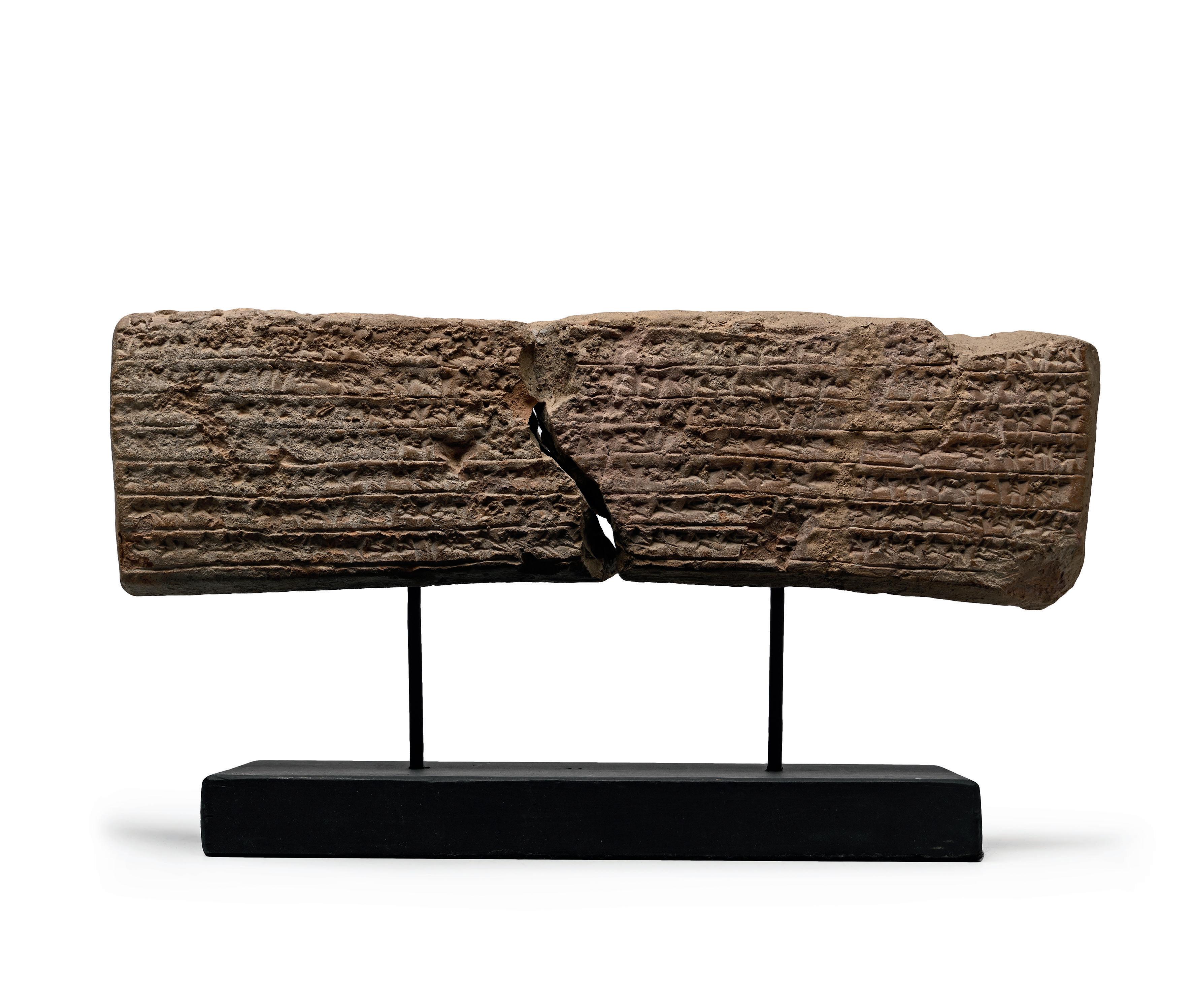
243
ROYAL ELAMITE CUNEIFORM BRICK FOR KING SHIHAKINSUSINAK I 1150-1120 B.C.
13 in. (2.96 kg total, 34.5 cm wide including stand)
A fired clay brick with seven lines of cuneiform text referring to King Shihak-Insusinak I; accompanied by a scholarly note by Dr Manuel Ceccarelli, PhD earned at the University of Tübingen, Germany, which states: ‘Brick with Elamite cuneiform inscription of Shilhaklnshushinak, king of Elam (South-West Iran), ca. 1150-1120 BCE. This royal inscription celebrates the restoration of the temple of the goddess Kirisha. The inscription can be reconstructed thanks to similar bricks.’I, Shilhak-lnshushinak, son of Shutruk-Nahhunte, beloved servant of Kiririsha and Inshushinak, King of Anzan and Susa: Humbanumena built the temple of Kiririsha-of-Liyan with unbacked mudbricks, and, as it threatened ruin, I restored it to its original state: with backed bricks, I (re)built it, and for my life, for the life of Nahhunte-Utu, of Hutelutush-lnshushinak, of Shilhina-hamruLakamar, of Kutir-Huban, of lshnikarab-huhun, of Urutuk -EI-halahu and of Utu-ehihi-Pinigir, with this intention,for our sake(?), I gave it to Kiririsha, my goddess.’’; mounted on a custom-made stand. £4,000 - 6,000
PROVENANCE:
Private UK collection. with Bonhams, London, 22 September 1998, no.140. Private collection, UK. Acquired on the UK art market.
Accompanied by copies of the relevant Bonhams catalogue pages and Dr Manuel Ceccarelli’s notes.
FOOTNOTES:
The name of this king, like that of many kings of Elam, was linked to a deity. Inshushinak was one of the major gods of the Elamites and the protector of the city of Susa in the state of Elam. He played an important role as a deity associated with royal power in the official ideology of many Elamite dynasties. King Atta-Hushu of the Sukkalmah dynasty called himself ‘the shepherd of the god Inshushinak’. Many rulers dedicated new building projects to Inshushinak, using the formula ‘or his (i.e., the king’s) life.’ The Shutrukids commonly used the title ‘(king) whose kingdom Inshushinak loves.’
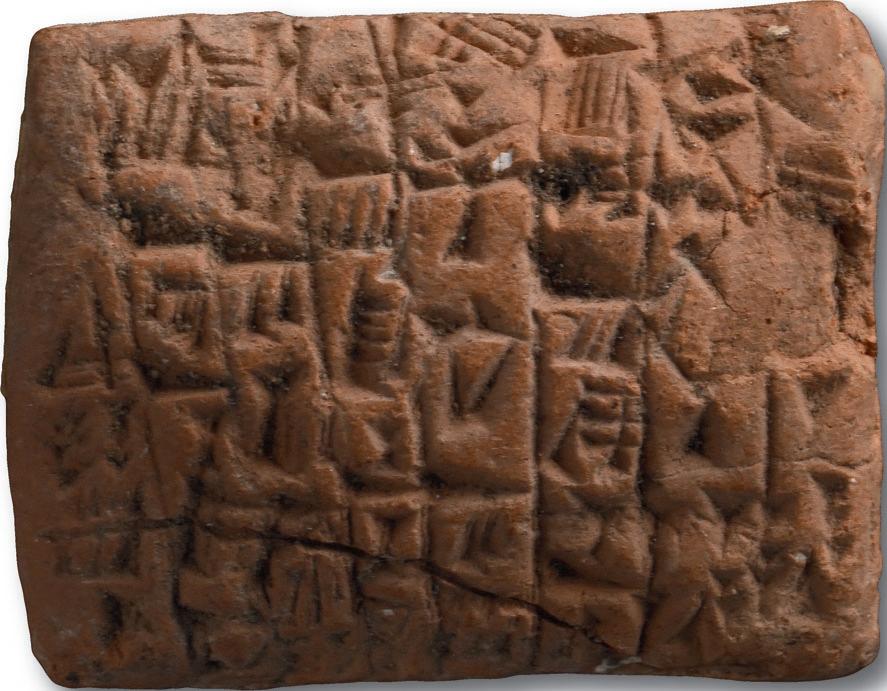

OLD BABYLONIAN TERRACOTTA CUNEIFORM TABLET
2ND MILLENNIUM B.C.
2¼ in. (74.4 grams, 57.5 mm)
Pillow-shaped tablet with rows of cuneiform text on one side.
£500 - 700
PROVENANCE:
From the private collection of a European gentleman (1942-2024), formed since the 1970s.

244
MESOPOTAMIAN TERRACOTTA CUNEIFORM TABLET
2ND MILLENNIUM B.C.
1¼ in. (13.8 grams, 30.7 mm)
A small pillow-shaped tablet, with dense lines of cuneiform on both sides.
£400 - 600
PROVENANCE:
From the private collection of a European gentleman (1942-2024), formed since the 1970s.

246
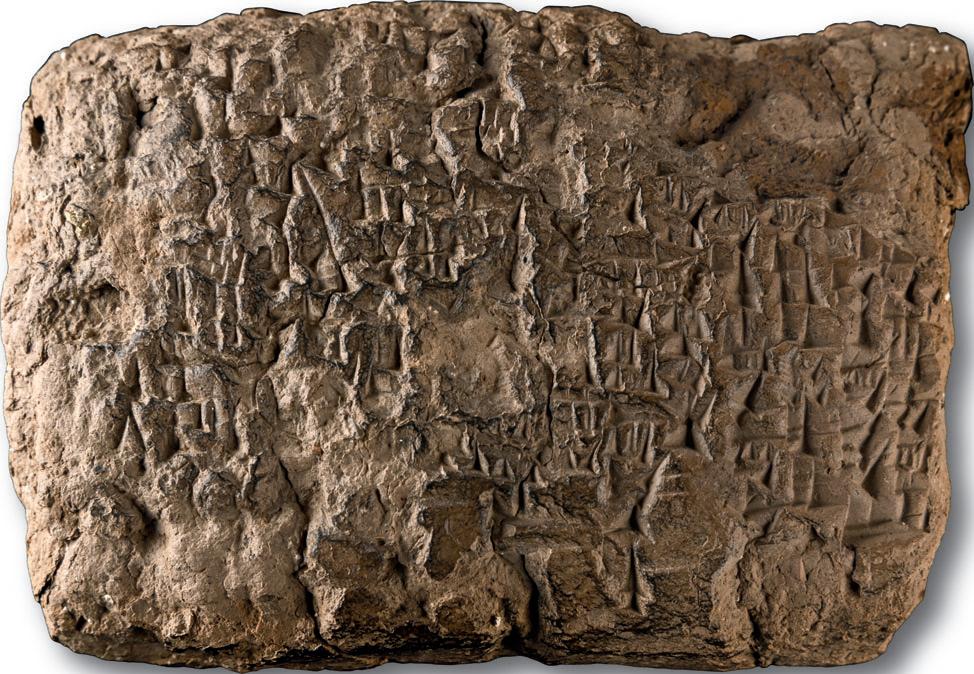
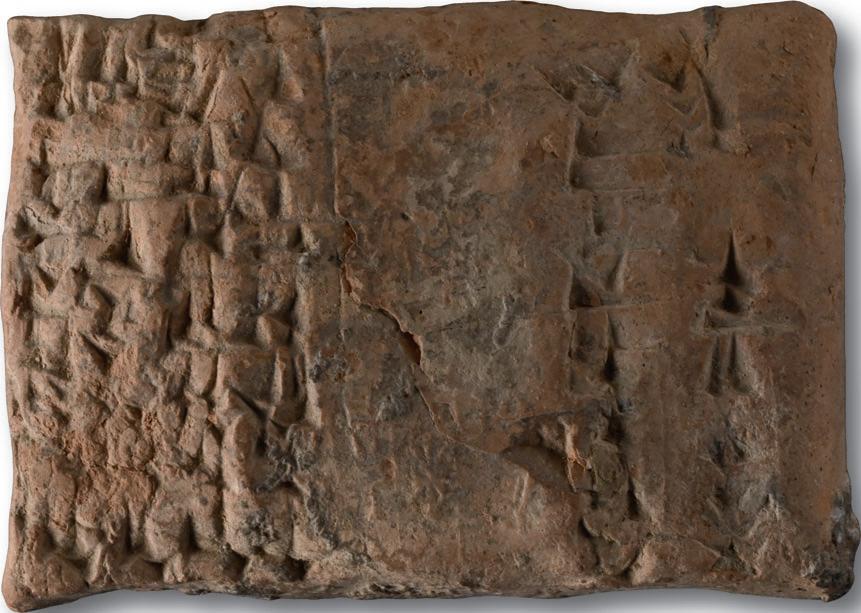
OLD BABYLONIAN TERRACOTTA CUNEIFORM TABLET OF A POEM
EARLY 2ND MILLENNIUM B.C.
3¼ in. (163 grams, 83 mm)
Pillow-shaped tablet with a Sumerian hymn to Sin-idinam, king of Larsa (1849-1843 BC), reading:
’5-6 (the gods) granted him to exercise, in a sublime manner, kingship and the priestly office.
7-8 They made him sit upon a seat whose foundation is firm, a radiant throne ...
9-10 Once he had firmly secured the crown and the sublime radiance upon his head.
11 Sin, the firstborn son of Enlil, 12 bestowed upon him a sublime name.
13 Utu, the great judge of the universe, 14 caused law and justice to be established for him].
15 The praise Sumer [...] ...
16 The vast and shining wisdom ...’
£3,000 - 4,000
PROVENANCE:
Specialised collection of cuneiform texts, the property of a London gentleman and housed in London before 1992.
Thence by descent to family members.
Examined by Professor Wilfrid George Lambert FBA (1926-2011), historian, archaeologist, and specialist in Assyriology and Near Eastern archaeology, in the late 1980s and early 1990s.
This small collection is exceptional for the variety of types, including some very rare and well-preserved examples.
247
LARGE PROTO-SUMERIAN TERRACOTTA CUNEIFORM TABLET ‡
4TH-3RD MILLENNIUM B.C.
3½ in. (236 grams, 89 mm)
Pillow-shaped with incised grid to the broad faces, dense cuneiform text in the columns with impressed pellet numerals.
£4,000 - 6,000
PROVENANCE:
Private collection, acquired in the late 1980s-early 1990s; thence by descent.
FOOTNOTES:
Various collections of cuneiform tablets form a corpus of texts mainly of an administrative nature, from the Uruk III and Ur III periods. The proto-cuneiform, as a system of proto-writing, emerged in Mesopotamia ca.3500-3200 BC, during the Uruk period.
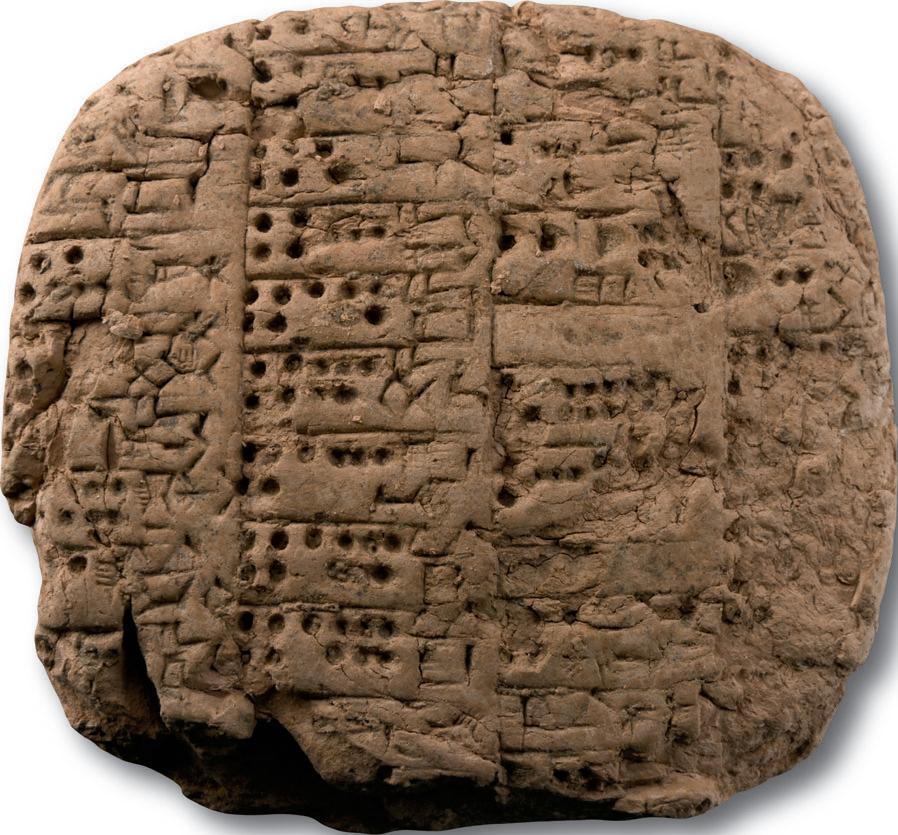


248
MIDDLE ASSYRIAN BRICK-SHAPED TABLET WITH FUNERARY INSCRIPTION FOR ADAD-SHUMU-LESIR’S TOMB ‡
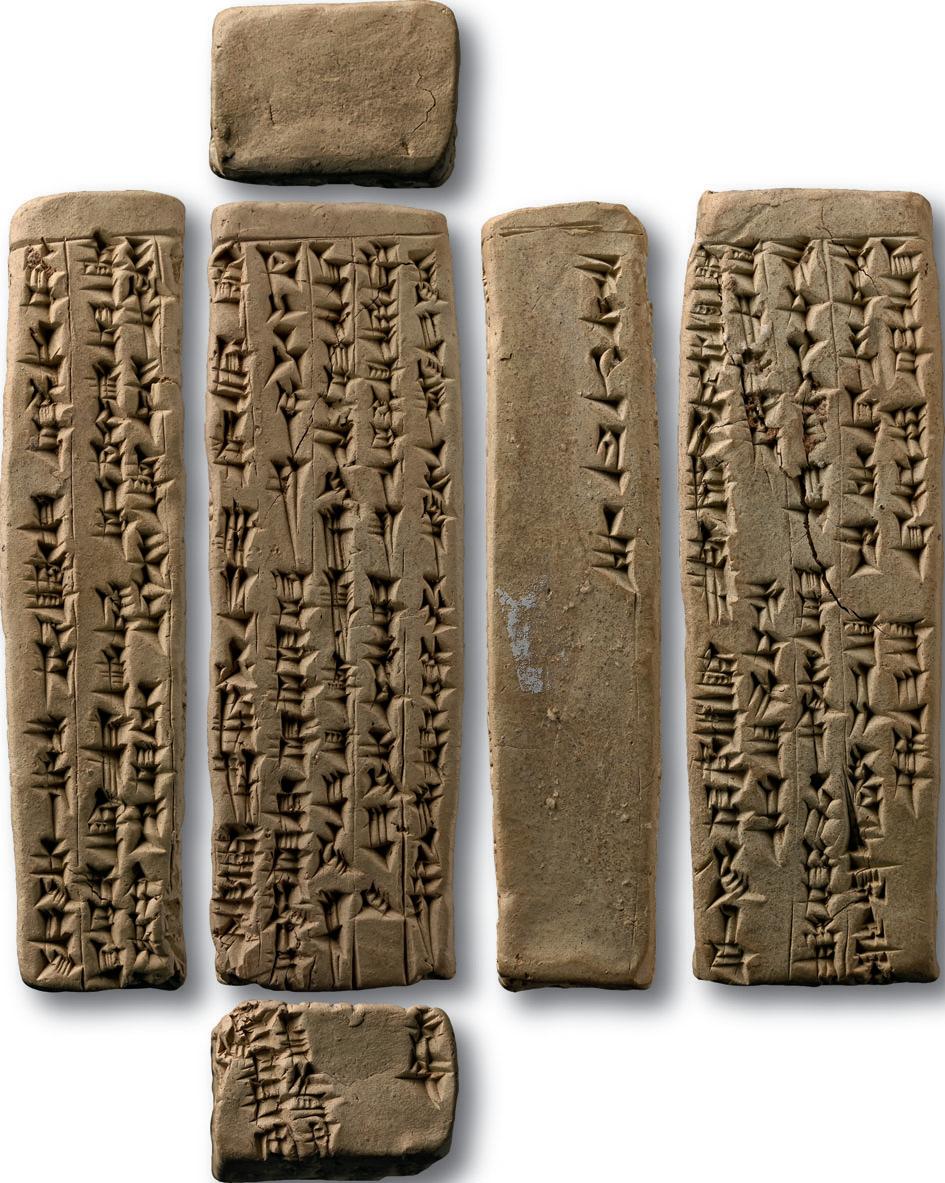
1363-912 B.C.
5 in. (333 grams, 14.3 cm)
A rectangular brick-shaped tablet, inscribed in cuneiform script across three vertical faces, with a single column to the fourth and a continuation of text across the top surface; the inscription a funerary curse relating to the tomb of Adad-šumu-lešir, warning against interference with the burial, reading in part: ’As for a stranger, or somebody who would approach that tomb, or would bring up a corpse out of it and bury his own within, or would touch the silver inside - Adad, Šamaš, or Nergal will fill his house and field with shortage, collapse, and murder. He will repay the property of that tomb sevenfold, dedicating it to Šuriha. For the offspring of Adad-šumu-lešir he shall be undone for taking out and bringing down objects in the tomb, and for burying another body within it. Month Kalmartu, third day, eponymy of Aššur-mušezib.’
£4,000 - 6,000
PROVENANCE: Acquired in 1996.
Private collection, Switzerland, thence by descent.
Private collection, since the late 1990s.
FOOTNOTES:
This Middle Assyrian brick-shaped tablet bears a funerary inscription for the tomb of Adad-shumu-lesir, a name that reflects devotion to the storm god Adad, an important deity in the Assyrian pantheon. Tablets of this kind were often placed within or near tombs as a lasting record of the individual and to mark ownership or dedication of the burial space. The brick-like form reflects the architectural traditions of Mesopotamia, where inscribed bricks were commonly used in both building and commemorative contexts. Such inscriptions not only honoured the deceased but also served to preserve their name and memory, which was believed to be essential for the afterlife. Objects like this provide valuable insight into Assyrian funerary practices and the importance placed on remembrance and identity beyond death.
249
AKKADIAN BRONZE BOWL FOR KING MANISHTUSHU ‡ 2270–2255 B.C.
5¼ in. (273 grams, 13.5 cm)
Hemispherical in profile with a thin rim; inscribed rectangular panel with three fields, two each with a glyph and the right field with five cuneiform characters referencing King Manishtushu.
£40,000 - 60,000
PROVENANCE:
Private collection, London, UK.
Swiss private family collection.
Believed to be from the same ownership as the bronze bowl sold at Sotheby’s, London, 21 April 1975, no.238.
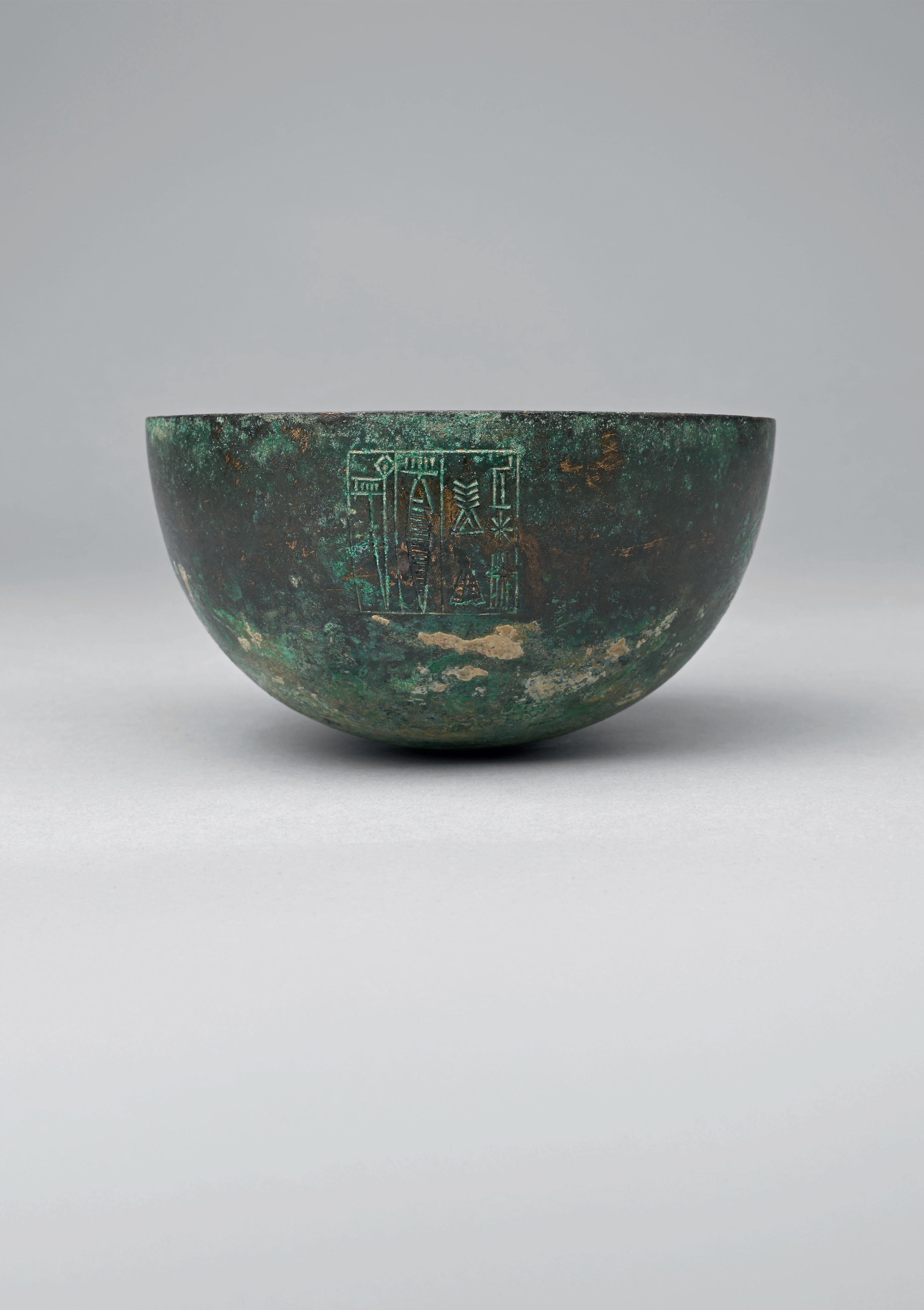
FOOTNOTES:
Manishtushu (Akkadian: Man-iš-tušu), son of Sargon of Akkad and brother and successor of Rimush, reigned as king of the Akkadian Empire c. 2270-2255 BC (Middle Chronology). His reign is known primarily from royal inscriptions, administrative texts, and later king lists. Manishtushu consolidated imperial control following internal revolts suppressed under Rimush and pursued military campaigns in both southern Mesopotamia and the Persian Gulf region, notably leading an expedition across the sea, probably to Magan (modern Oman), to secure supplies of diorite and metals for monumental construction. He is particularly associated with extensive land purchases in northern Babylonia, recorded on inscribed stone monuments, which provide rare insight into Akkadian legal and economic practices. These texts suggest a deliberate policy of royal acquisition and redistribution of land, possibly to strengthen central authority. Manishtushu also undertook significant building projects, including temple works at Nippur and elsewhere, dedicating offerings to major deities such as Enlil. His reign ended violently, and later tradition suggests he was assassinated in a palace conspiracy, after which he was succeeded by his son Naram-Sin, under whom the empire reached its greatest territorial extent.
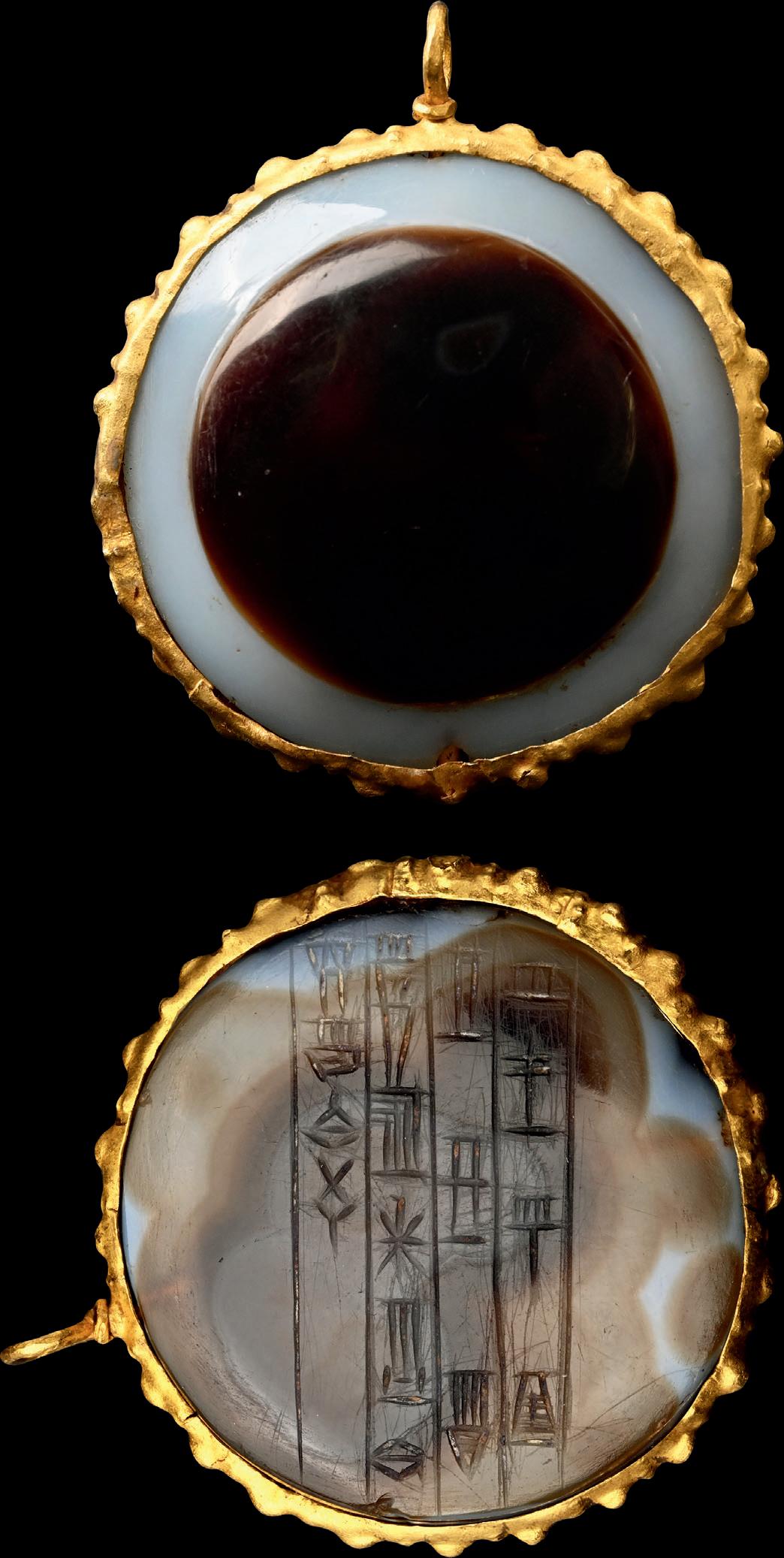
250
KASSITE AGATE EYE BEAD WITH CUNEIFORM INSCRIPTION FOR KING KURIGALZU II IN GOLD MOUNT ‡
1400-1000 B.C.
1 in. (18.30 grams, 42 mm)
Polished cabochon in a gold frame with radiating bosses, integral loop; reverse with four incised columns of cuneiform text naming Kurigalzu II.
£80,000 - 100,000
PROVENANCE: Private collection, Mrs M.V., circa 1980s. Kept in Switzerland since the late 1980s.
FOOTNOTES:
The cuneiform inscription names Kurigalzu II (c.1332-1308 B.C.), 'strong man, King of Babylon, son of Burnaburiaš.' Kurigalzu II was one of the most powerful Kassite rulers, known for his military campaigns and extensive building projects, including the foundation of the city of Dur-Kurigalzu. Inscribed Kassite agate eye beads are rare and are generally understood to have served amuletic or votive functions, combining royal titulary with protective symbolism.
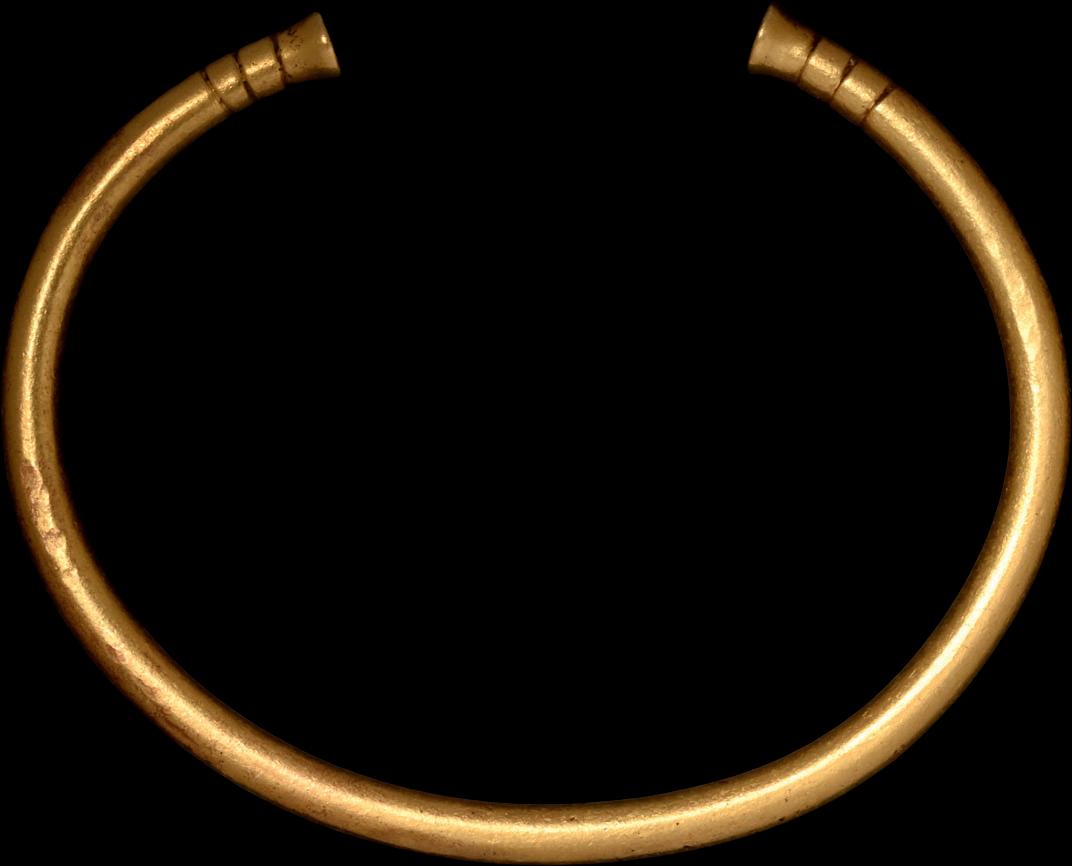
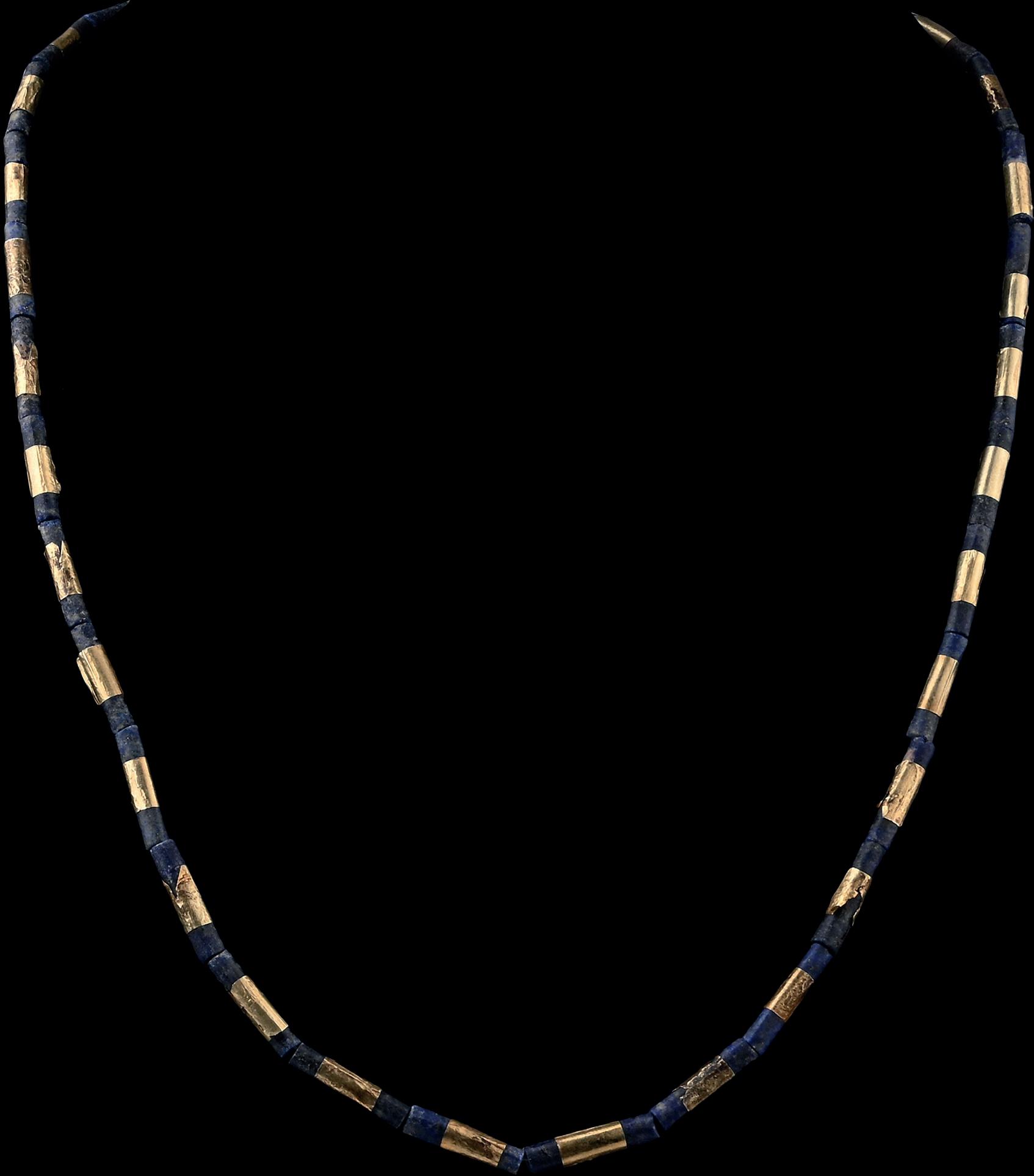
251
ACHAEMENID SOLID GOLD BRACELET ‡
5TH-4TH CENTURY B.C.
2 in. (42.88 grams, 73 mm)
Penannular in form and round in section with clubbed ends, three incised gussets below each finial.
£4,000 - 6,000
PROVENANCE:
From the collection of Contessa L.G., assembled in the 1980s.
Private collection, acquired in Switzerland in 1999.
FOOTNOTES:
The bracelet resembles a specimen found in Persepolis, in the Treasury, room 65, made from plain bronze wire. If the Achaemenid bracelets are characterised by their extremities shaped like goats or other wild animals, simpler gold bracelets existed, used abundantly by children and women, and also by royal courtiers and even slaves.
252
BACTRIAN LAPIS LAZULI BEAD NECKLACE WITH LATER GOLD FOIL
1ST MILLENNIUM B.C.
24 in. (22 grams, 61 cm)
Restrung group of tubular lapis lazuli beads, each with a sheet-gold sleeve; modern clasp.
£600 - 800
PROVENANCE:
Acquired on the London art market.
Private collection, UK.
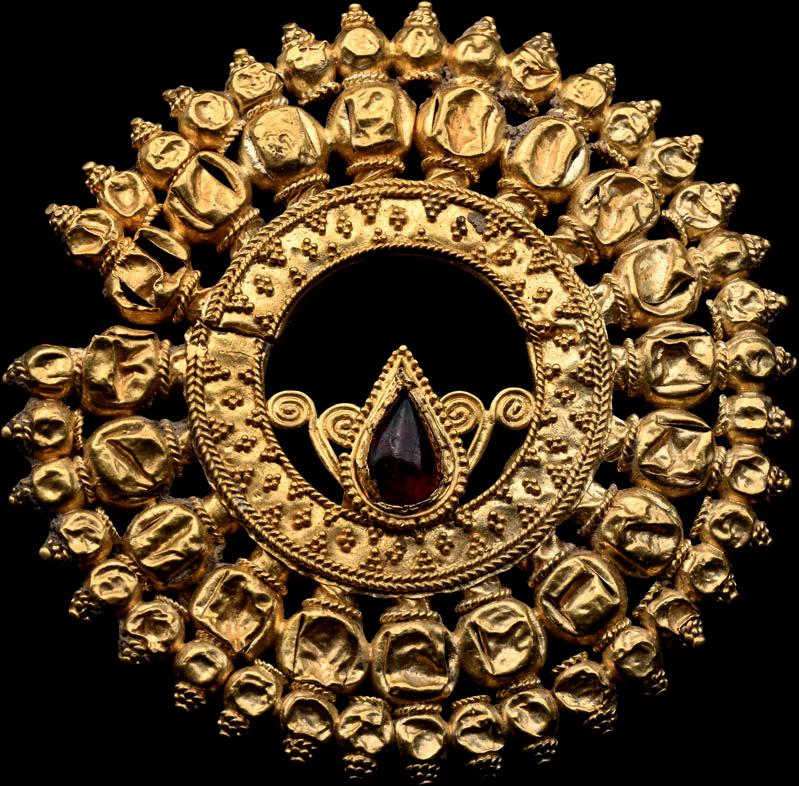
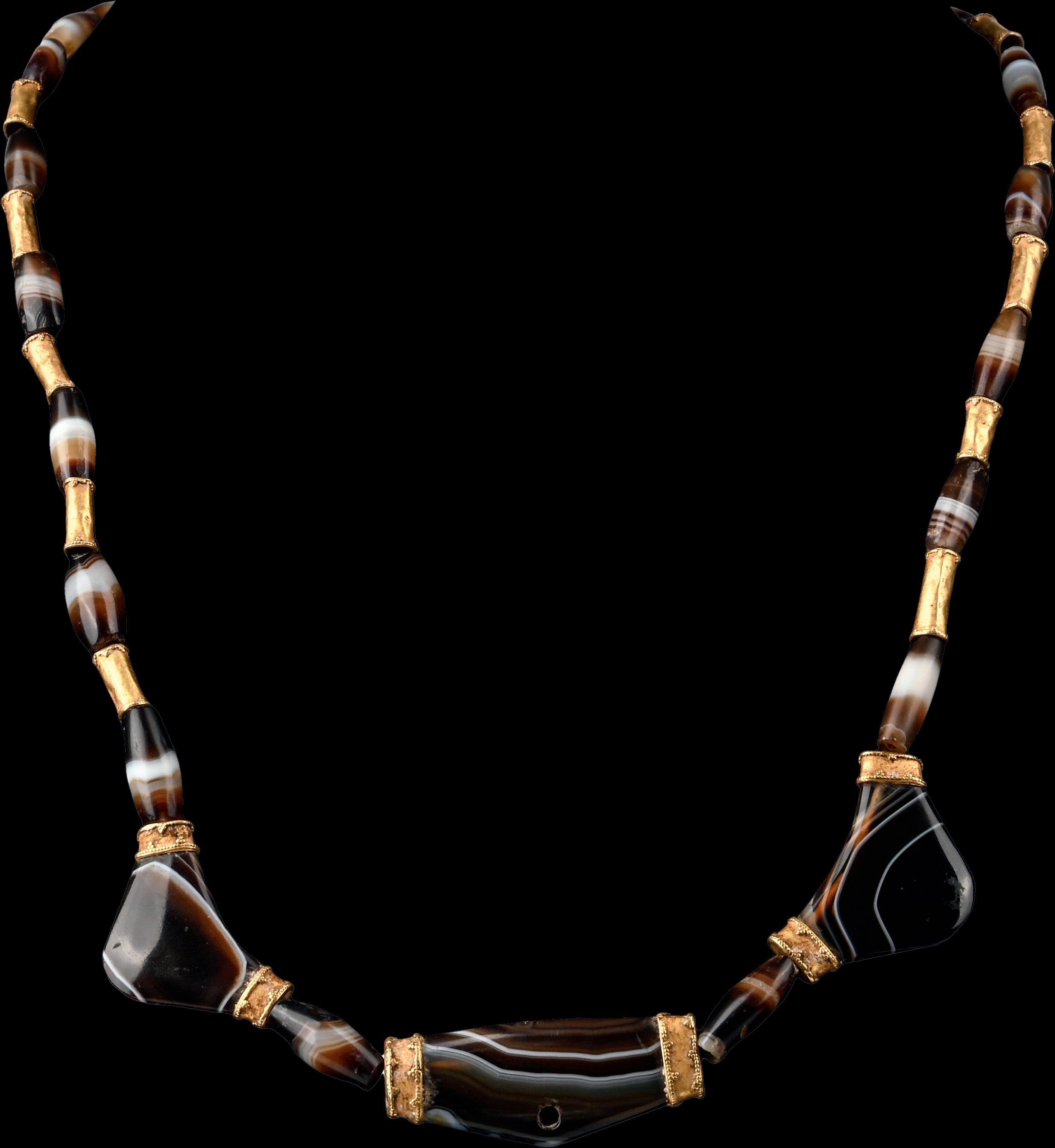
253
ACHAEMENID ELABORATE GOLD EARRING
CIRCA 5TH CENTURY B.C.
2 in. (13.55 grams, 51 mm)
Crescent plaque with granulated inner borders and radiating triangles of granulation surrounded by a band of nineteen spheres, representing pomegranates, each with a filigree collar above and below, the outer band consisting of smaller spheres with a granulated pyramidal finial, at the centre a teardrop-shaped garnet cabochon set in a cell with a granulated border flanked by spirals.
£3,000 - 4,000
PROVENANCE: Ex David Lindhal, London, UK, in the 1990s. From a privately held London, UK, collection from the 1980s-1990s.
FOOTNOTES: Fruits were generally considered to be a symbol of sensuality, temptation and fertility; the giving and accepting of fruit may be regarded as a symbolic sexual act, or at least a prelude to marriage. It follows naturally that the pomegranate, with its innumerable fleshy seeds symbolising life and fecundity, was an attribute of Aphrodite.
254
BABYLONIAN AGATE BEAD NECKLACE WITH GOLD BEADS ‡ 9TH CENTURY B.C.
12¼ in. (43.24 grams, 31 cm)
Restrung necklace of tubular and fusiform beads with interstitial gold tubular beads, three D-shaped plaques with granulated gold caps, one pierced to accept a pendant.
£5,000 - 7,000
PROVENANCE: Private collection, acquired in the late 1980s-early 1990s; thence by descent.
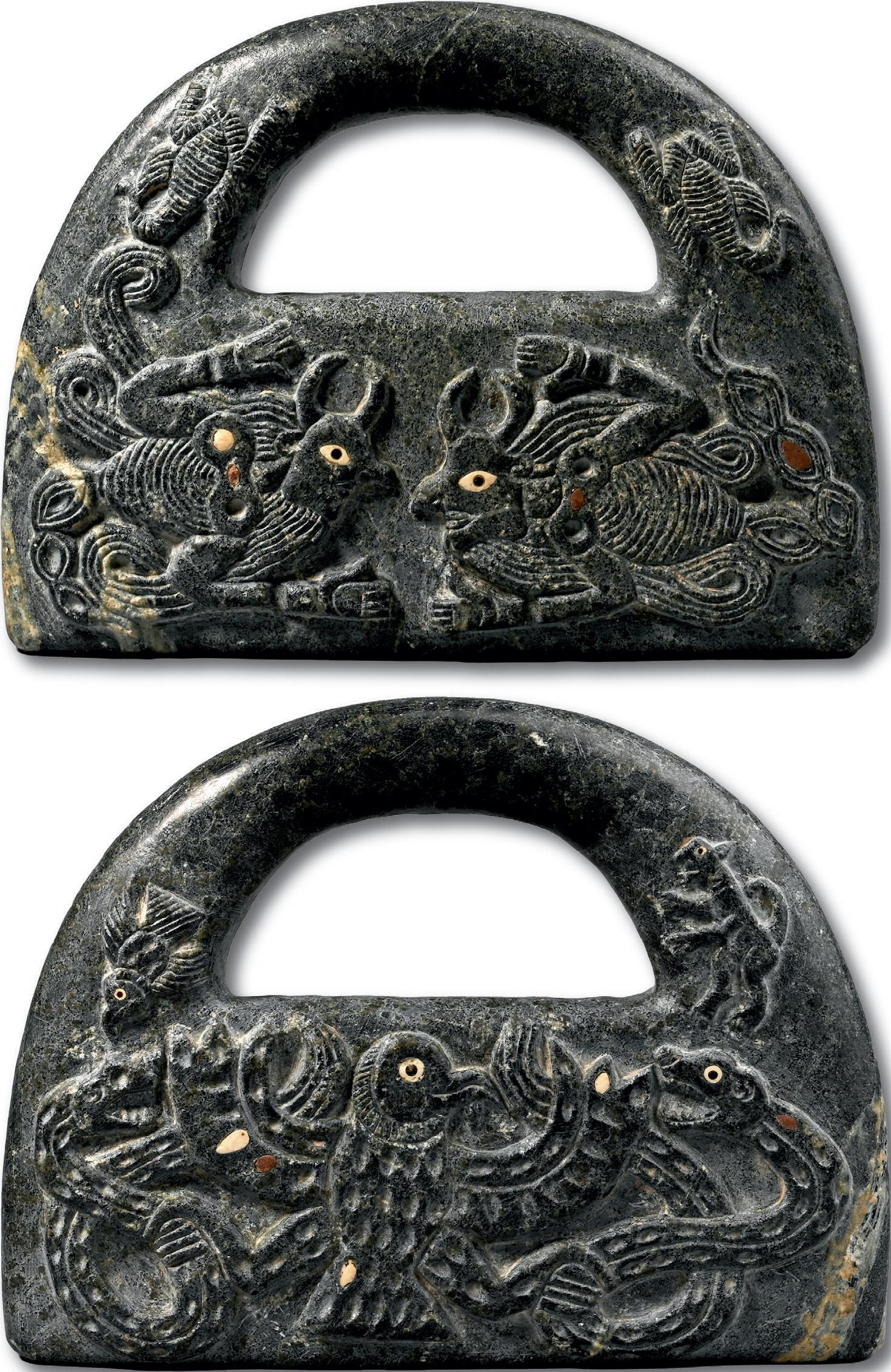

LARGE BACTRIAN BLACK CHLORITE ‘HAND BAG’ CEREMONIAL
WEIGHT
3RD MILLENNIUM B.C.
10 in. (3.81 kg, 26.2 cm)
D-shaped in profile with a round-section loop and incuse sockets to accept inlay in contrasting colours (mostly absent); obverse with a reserved scene of two opposed human-headed scorpions with ribbed detailing advancing below two smaller scorpions placed
perpendicular to them; reverse with a median eagle with wings extended and feather detailing, flanked by rearing serpents and other animals.
£15,000 - 20,000
PROVENANCE:
Acquired before 1983.
Ex London gallery, 1990s. Private collection, London, UK.
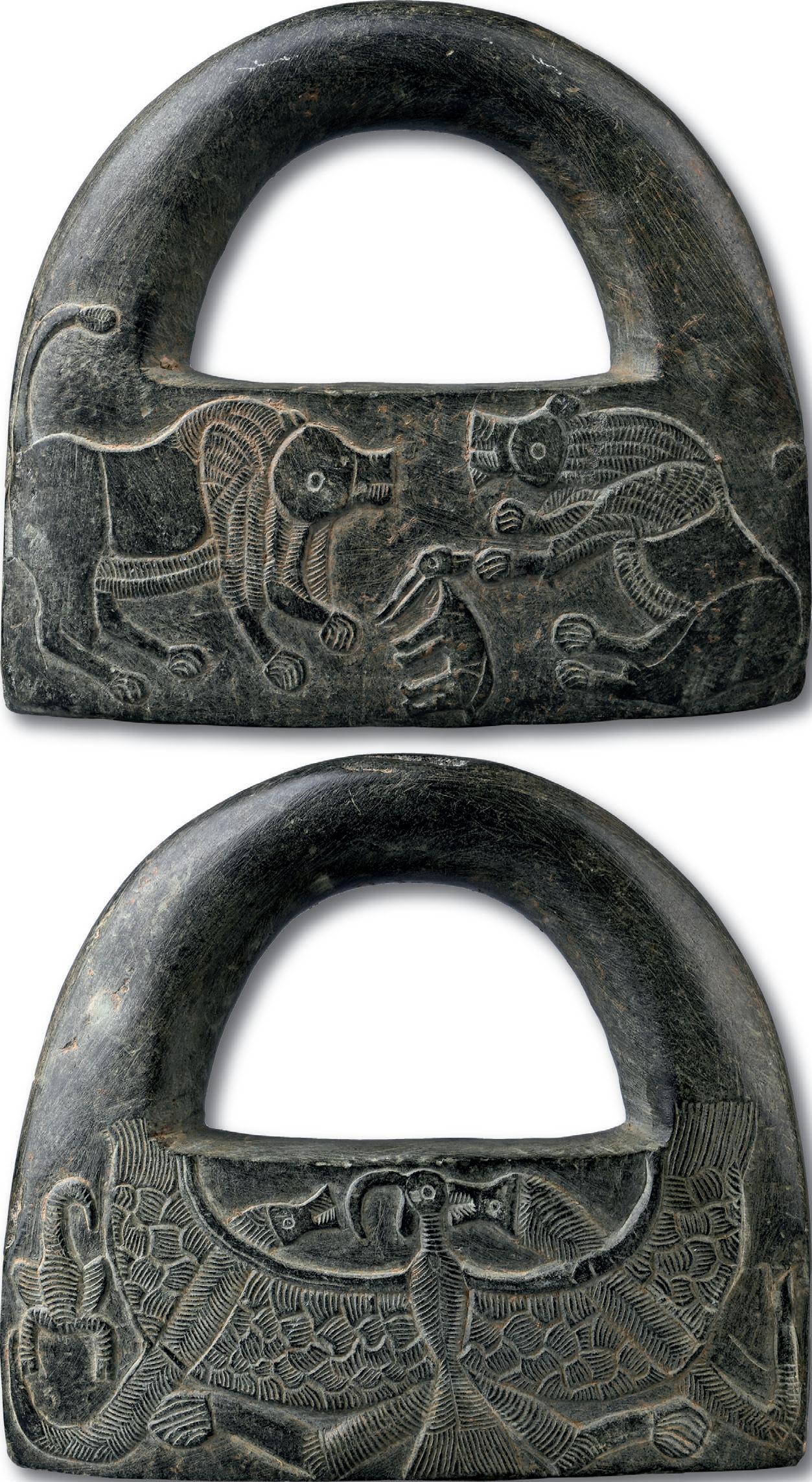

LARGE BACTRIAN BLACK CHLORITE ‘HAND BAG’ CEREMONIAL
WEIGHT
3RD MILLENNIUM B.C.
11 in. (6.25 kg total, 28.3 cm high including stand)
D-shaped in profile with a round-section loop; obverse with a reserved scene of two lions with hatched detailing to the fur advancing towards a small quadruped placed perpendicular to them; reverse with a median eagle with wings extended and feather detailing, flanked by rearing serpents and a scorpion; mounted on a custom-made stand.
£15,000 - 20,000
PROVENANCE: with Gallery Rosen Ancient Art, Tel Aviv, 10 November 1969. Ex London, UK, gallery, 1971-early 2000s. London, UK, collection.
Accompanied by a copy of an original invoice from Gallery Rosen Ancient Art, 10 November 1969.
Accompanied by an academic report by Dr Raffaele D’Amato.
FOOTNOTES:
Among the most iconic intercultural style objects are the so-called ‘lock’ or ‘handbag’ weights. They have been found in a variety of different colourful stones, such as breccia, chlorite, fossiliferous limestone, calcite and onyx. At the beginning, these objects were probably not weights at all, but were likely badges of high office, carried to indicate authority. Similar objects have been found throughout Mesopotamia, the islands of the Persian Gulf, on the Iranian steppe, and in the Indus Valley.
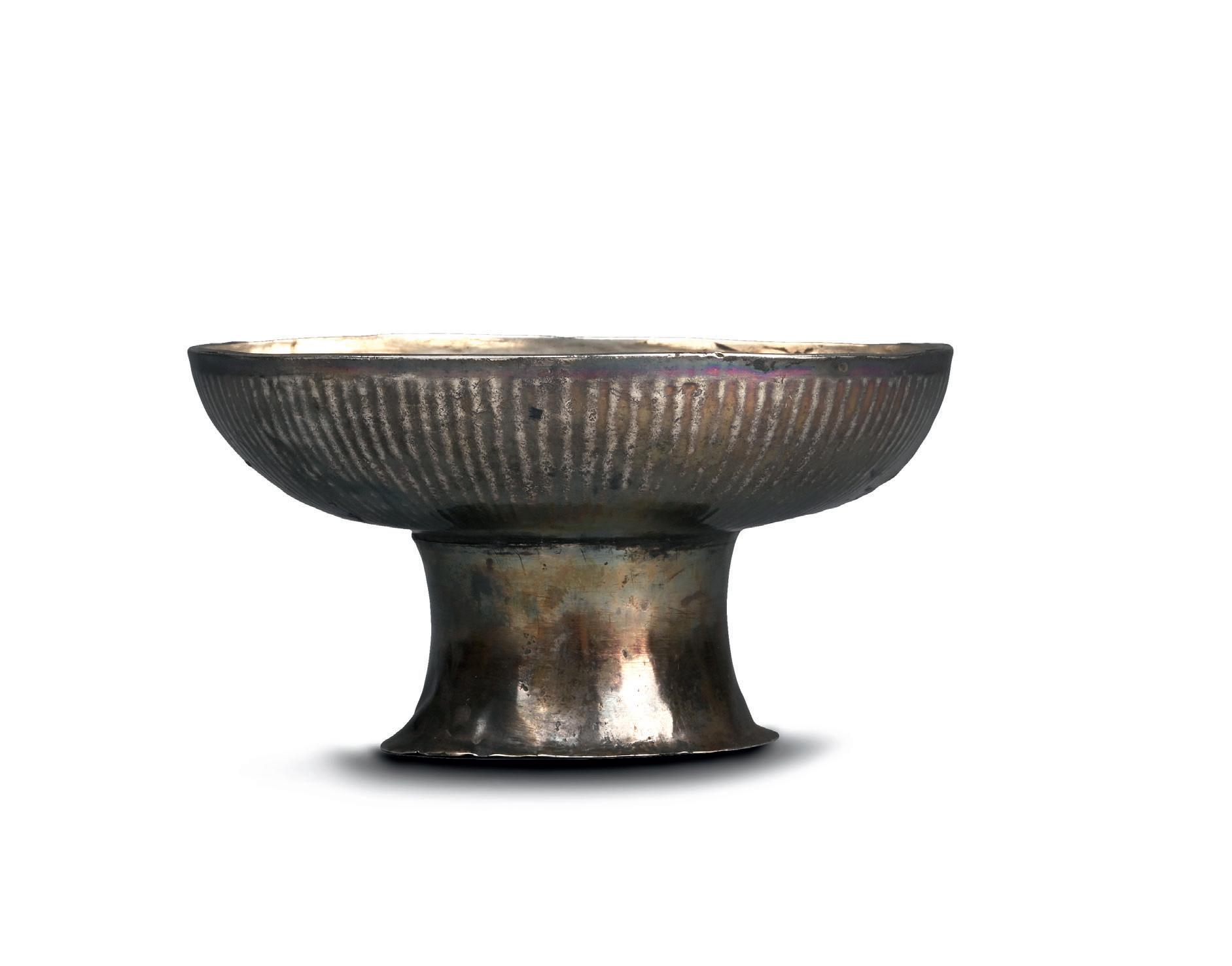
258
SASANIAN SILVER-PLATED LION SHIELD BOSS
6TH-7TH CENTURY A.D.
3 in. (80.9 grams, 78 mm)
With stylised repoussé head and face detailing showing two faces, one to the side and the other to the top, the mane represented by a scalloped border; sheet-silver cladding to the head over bronze; pierced for attachment.
£1,000 - 1,400
PROVENANCE:
Ex London, UK, gallery, 1971-early 2000s. London, UK, collection.
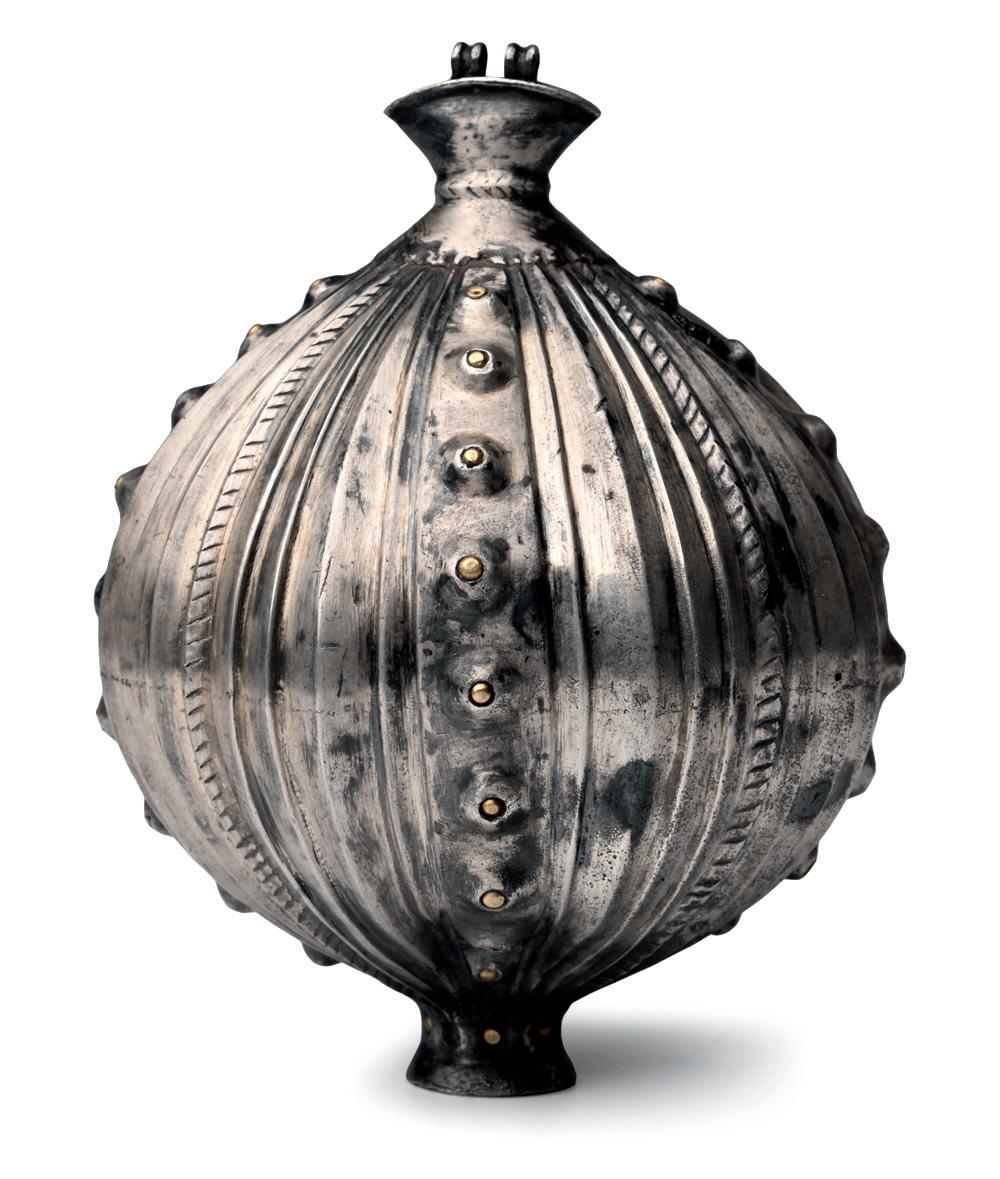
257
SASANIAN SILVER FOOTED RIB BOWL
6TH CENTURY A.D.
5¼ in. (146 grams, 13.4 cm)
Fluted bowl composed of a D-section body and splayed pedestal foot.
£2,500 - 3,500
PROVENANCE:
Acquired in the late 1980s-early 1990s. Private collection, London.
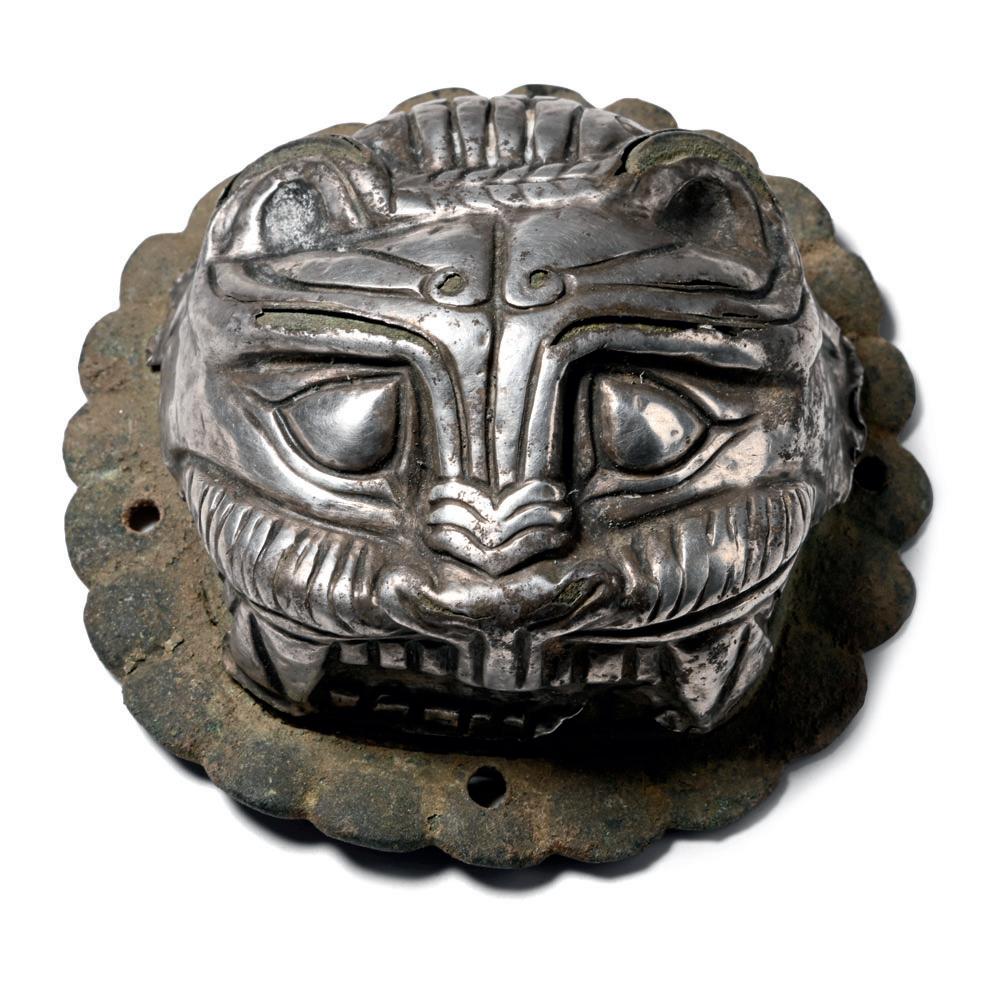
2ND-1ST MILLENNIUM B.C.
3 in. (135 grams, 91 mm)
Spherical hollow-form pendant with a collar at each end, ribbed body divided into segments with bands of herringbone decoration and bands with raised bosses inlaid with small yellow metal insert, similar inset granules around the lower collar, two ribbed loops at the top.
£1,000 - 1,400
PROVENANCE:
Acquired before 1983. Ex London gallery, 1990s. Private collection, London, UK.
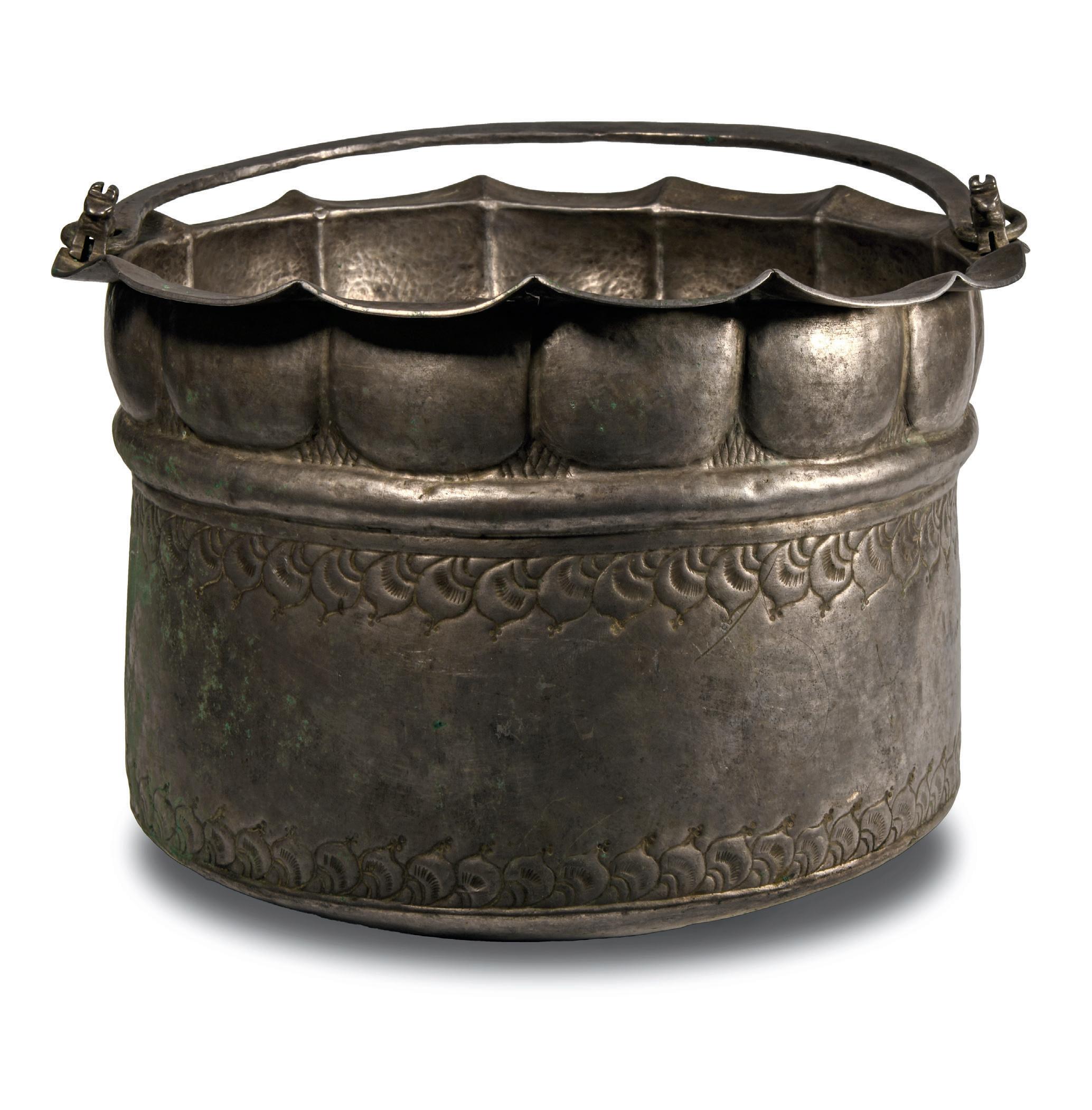
260
LARGE SOGDIAN SILVER VESSEL WITH ANIMAL FIGURES
EASTERN SOGDIAN, 8TH-9TH CENTURY A.D.
10½ in. (1.2 kg, 26.5 cm wide)
Sheet-silver vessel with drum-shaped body, narrow discoid repoussé base; bands of repoussé foliage to the body beneath a raised collar and fluted neck and rim; rectangular-section crescent handle held by two securing hoops formed as miniature rams.
£20,000 - 30,000
PROVENANCE:
From an old private collection. with Oxus Fine Arts Pte. Ltd, Singapore. Acquired by the current owner in London, 2012.
FOOTNOTES:
Dr Grigoriev, in his studies on Sogdian silver artworks, has traced specific Sogdian features of metalwork prototypes on the basis of the ceramic replicas. Some of these features were distinguished on gold and silver vessels, which possess many other characteristics bringing them together. In our bucket, the style and the decoration of the flowers resemble those of the bucket with deer from Shirokovskoe (Perm, see Marshak, 1971, T,35), while the bands of repoussé foliage to the body beneath the raised collar and fluted neck and rim recall the decoration of the dish with deer from Rep’evka, in Samara Province (Darkevich, 1976, n.12).
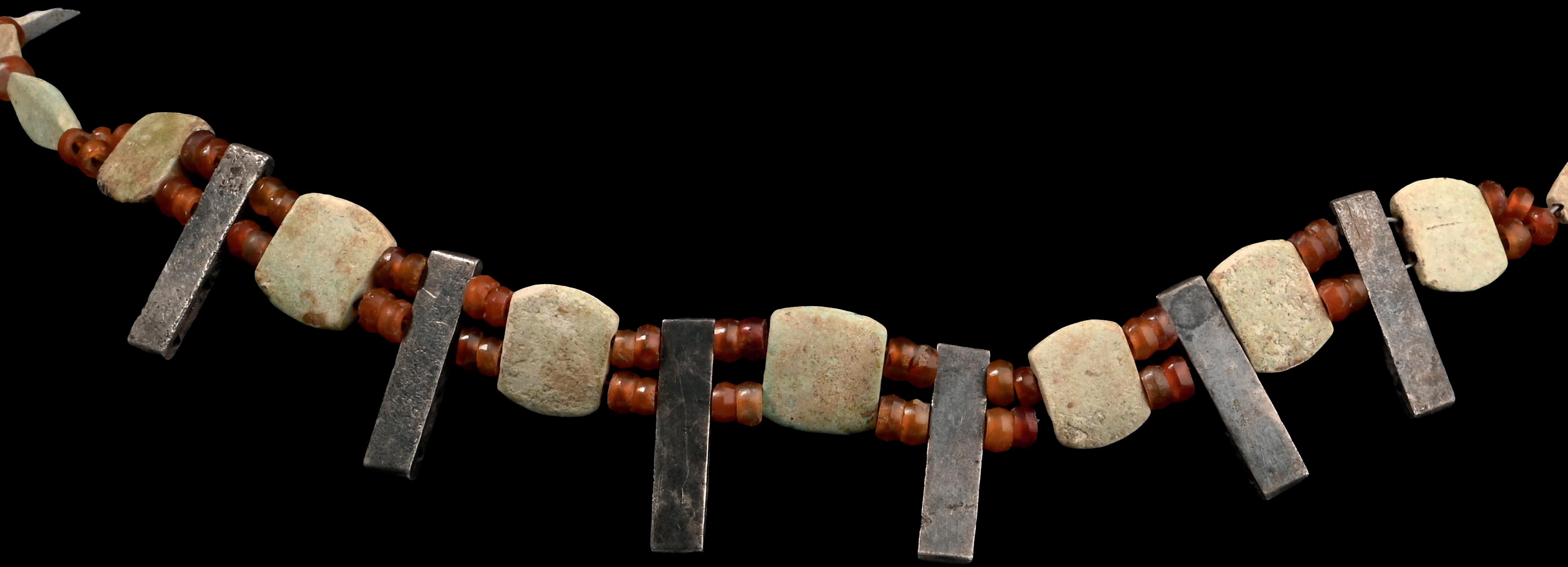
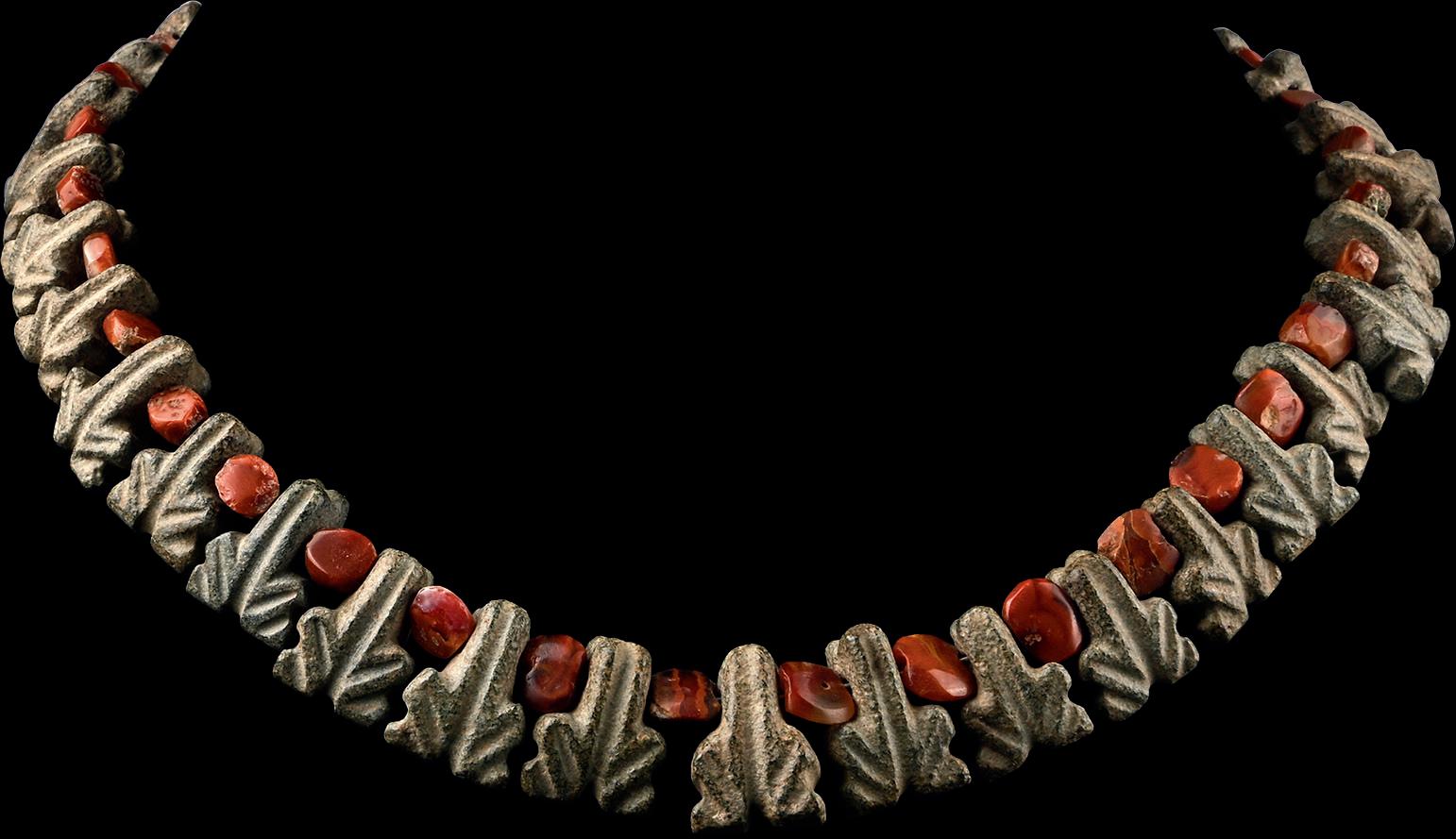
261
ELAMITE CARNELIAN NECKLACE WITH SILVER PENDANTS
3RD-2ND MILLENNIUM B.C.
19 in. (51 grams, 50 cm)
Restrung group of tabular beads with interstitial carnelian annular beds, rectangular silver panels.
£500 - 700
PROVENANCE: Acquired before 1983. Ex London gallery, 1990s. Private collection, London, UK.
262
MESOPOTAMIAN CARVED STONE FROG BEAD NECKLACE
1500-1200 B.C.
14 in. (56.39 grams, 36 cm)
Restrung group of frog-shaped dangles, each pierced at the neck, with interstitial irregular spacer beads.
£1,800 - 2,400
PROVENANCE: Acquired in the late 1980s-early 1990s. Private collection, London, UK.
263
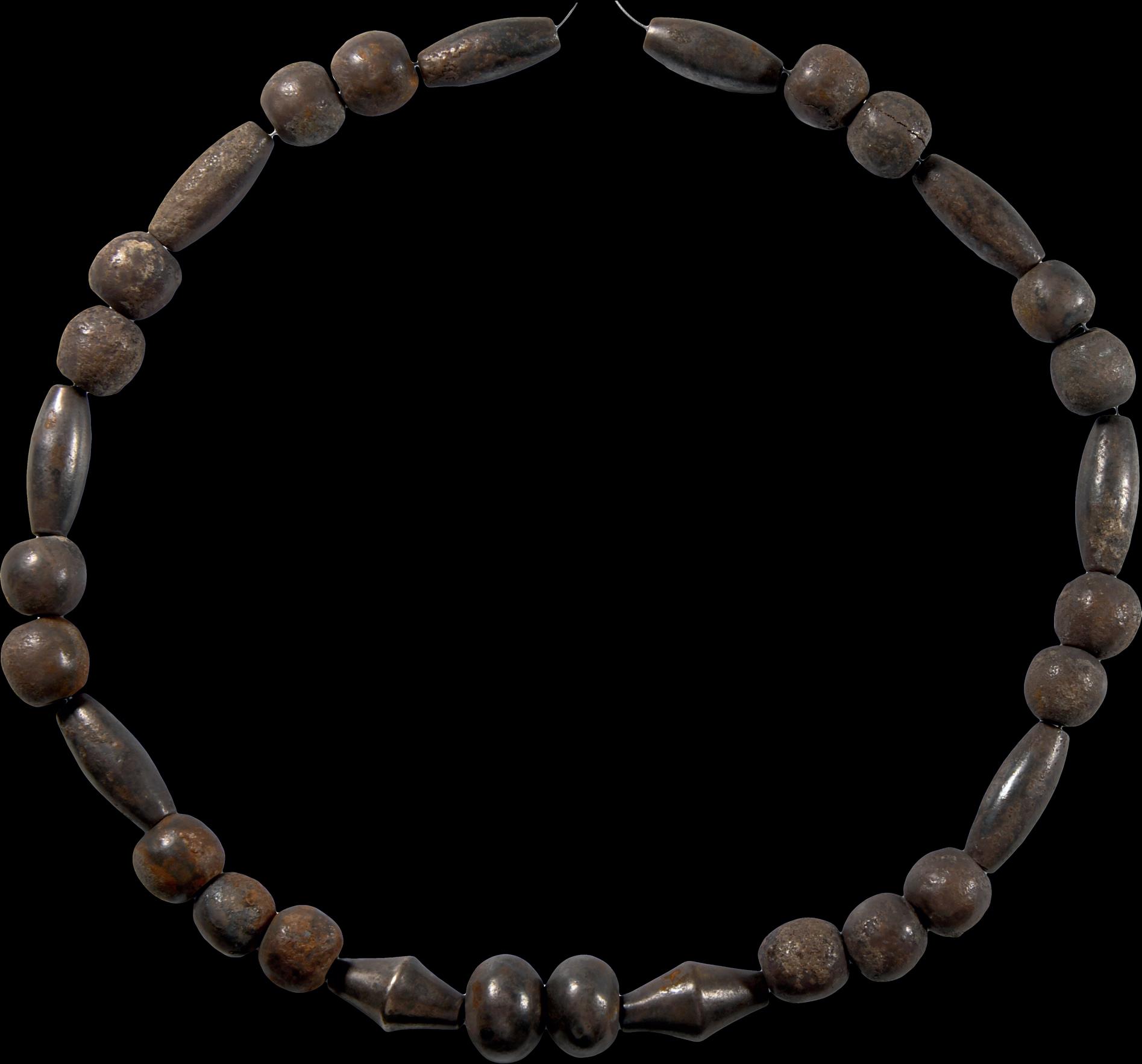
MESOPOTAMIAN HEAVY SILVER BEAD NECKLACE
3RD-EARLY 2ND MILLENNIUM B.C. 22 in. (224 grams, 56 cm)
Restrung and comprising mainly spherical, elongated ovals, oblates, and biconical shapes; accompanied by a custom-made lined display box.
£5,000 - 7,000
PROVENANCE:
Numismatic and Ancient Art Gallery AG, Ancient Art of the Mediterranean World, No 8, no.5, c.1982.
Taisei Gallery, Gold & Silver Auction, Part II, Ancient to Renaissance, 5 November 1992, The Conrad Salon, The Waldorf-Astoria, New York, no.39. Private collection, London.
FOOTNOTES:
The Sumerian word for silver is kú-babbar, which means ‘white metal’. Silver was mined from ores that contained significant amounts of other metals and impurities and therefore requires a great deal of further processing before it can be used. It was considered sacred and immutable, and an extremely high-status material, used for royal jewellery.
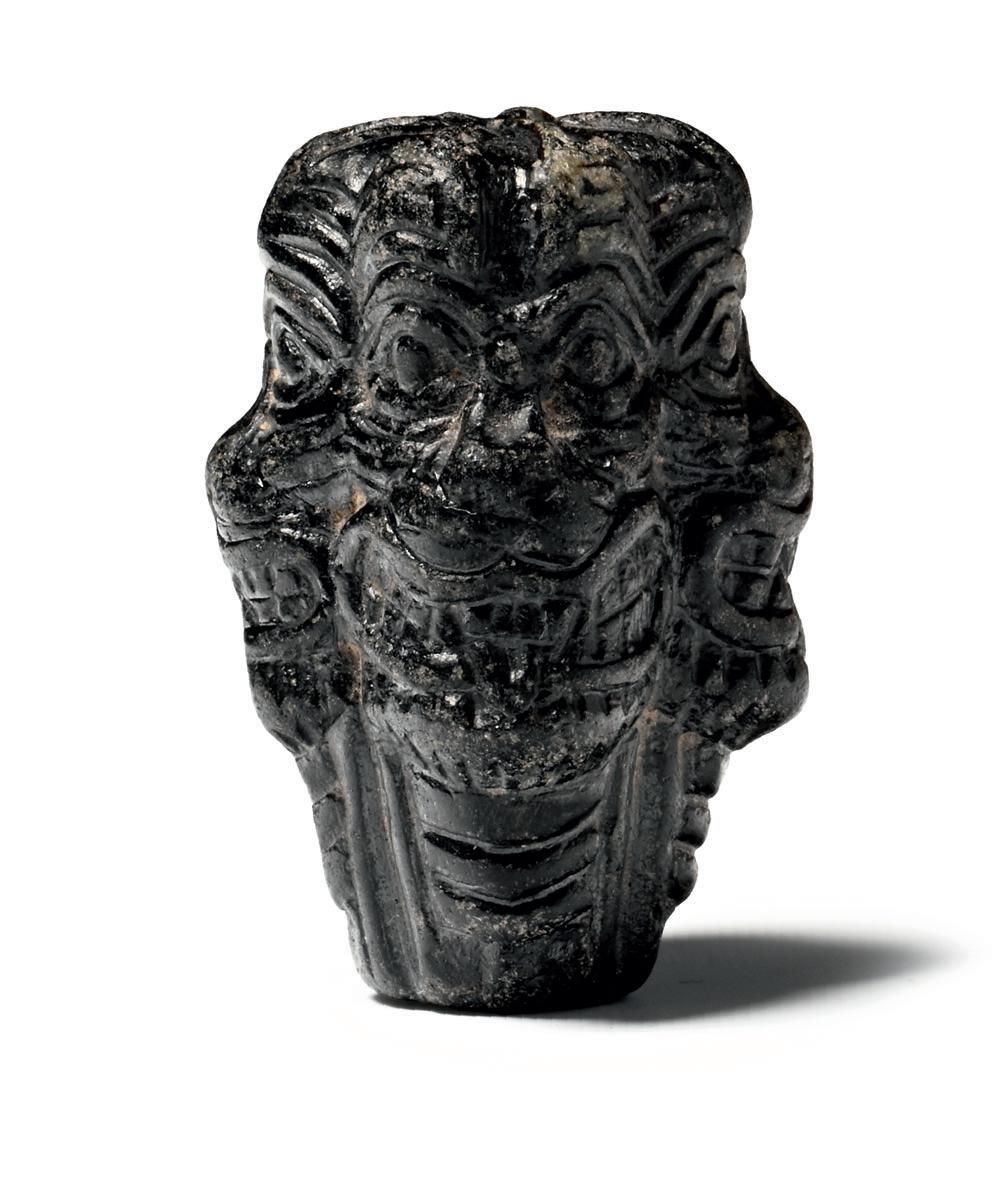
265
WESTERN ASIATIC BRONZE STATUETTE OF A HORNED DEMON
1ST MILLENNIUM B.C.
3 in. (43.4 grams, 87.5 mm)
Columnar in form with stub to base, arms bent, bearded face surmounted by a conical cap with lateral lugs.
£300 - 400
PROVENANCE:
From the private collection of a European gentleman (1942-2024), formed since the 1970s.

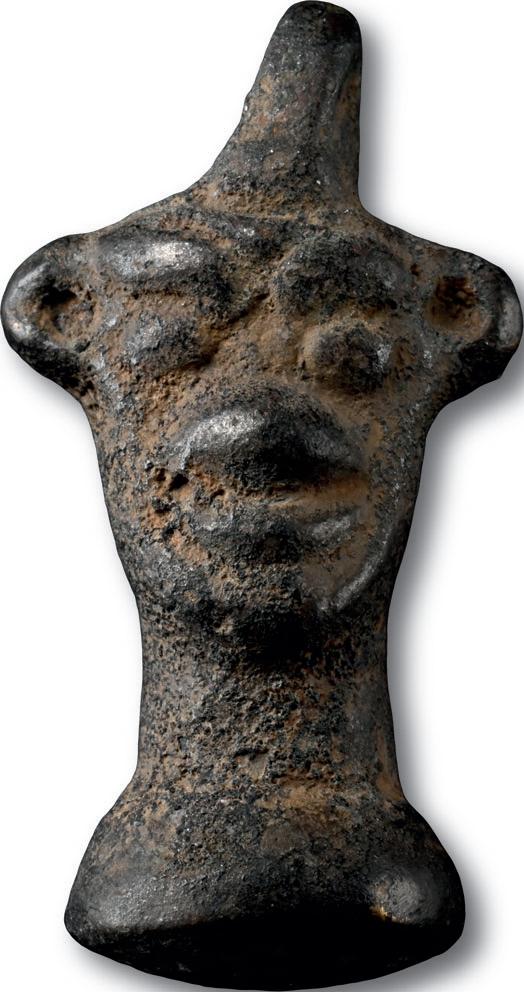
264
NEO-ASSYRIAN BLACK STONE MULTIFACETTED PAZUZU HEAD
CIRCA 600 B.C.
1 in. (19.94 grams, 34.28 mm)
Modelled in the round, four addorsed heads, each with snarling mouth and furrowed brow; pierced vertically.
£2,500 - 3,500
PROVENANCE:
From the ‘S’ collection, London, UK, 1970-1990s.
FOOTNOTES:
Pazuzu, in the Mesopotamian mythology, is described as ‘the son of Hanbu and king of wind demons’. Amulets with images of his full body or, more often, just his head, were common in the early first millennium B.C. Pazuzu was most popular in the Neo-Assyrian and Neo-Babylonian periods, from about the late 8th century B.C. through the 6th century B.C.

266
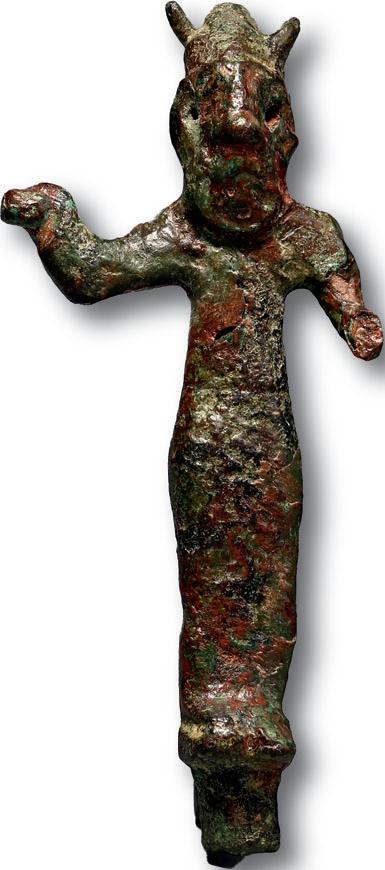
ASSYRIAN DOUBLE-FACED PENDANT DEPICTING PAZUZU, KING OF WIND DEMONS
8TH-6TH CENTURY B.C.
1¾ in. (50.24 grams, 44 mm)
Carved in the round with flared base, addorsed faces of the demon with suspension lug above.
£500 - 700
PROVENANCE:
UK private collection before 2000. Acquired on the UK art market. Private collection, London, UK.
FOOTNOTES:
The figure described as the ‘King of Wind Demons’ is commonly identified with Pazuzu, a well-known demon in Assyrian and Babylonian tradition. Despite his fearsome appearance, often shown with a canine face, bulging eyes, a scaly body, and wings, Pazuzu was not simply a malevolent force. He was understood as the ruler of the winds, particularly the hot, destructive winds from the desert, but was also invoked for protection. Most notably, Pazuzu was believed to ward off the demon Lamashtu, who threatened pregnant women and infants. Small amulets and pendants bearing his image were therefore worn or placed in domestic spaces as protective devices. Objects such as this pendant belong to that world of everyday belief, where the boundary between danger and protection was fluid, and where even a demon could serve an apotropaic role.

267
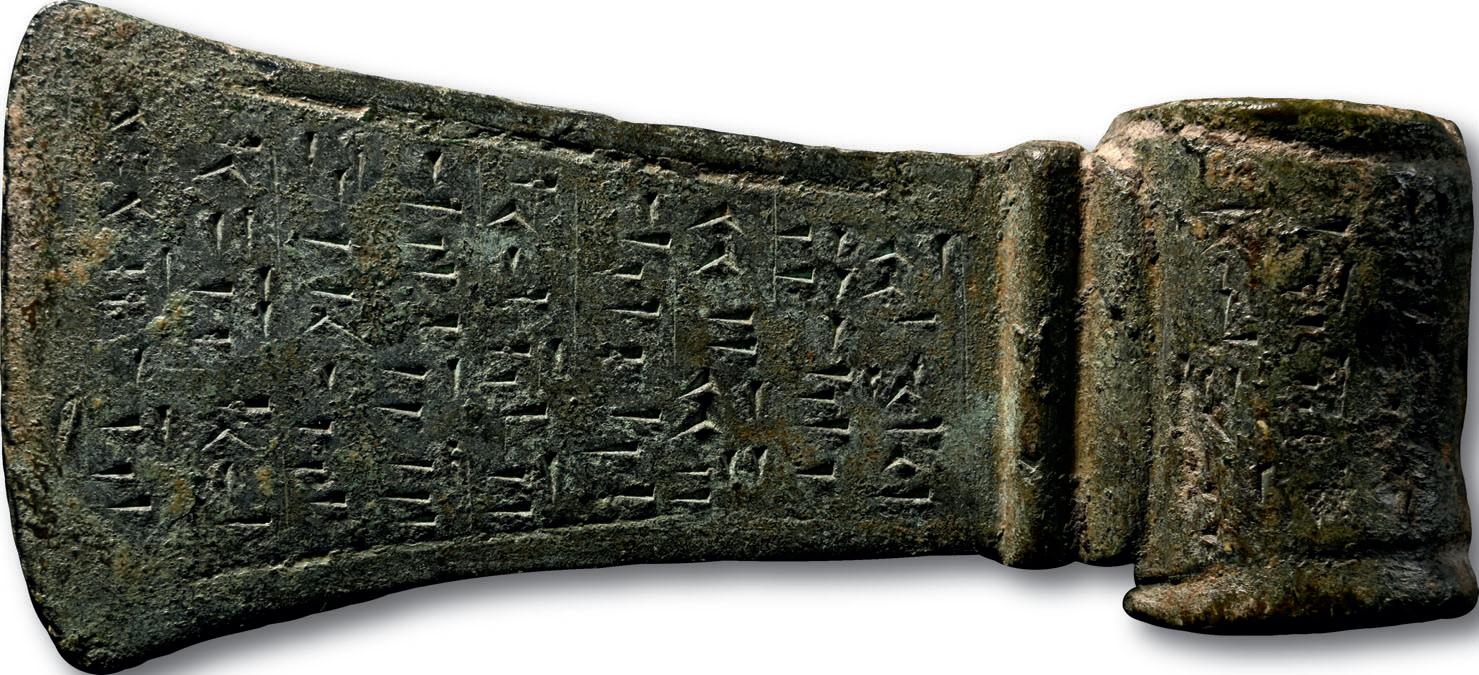

ASSYRIAN BRONZE AXEHEAD WITH CUNEIFORM INSCRIPTION ‡
8TH CENTURY B.C.
3¾ in. (141 grams, 94 mm)
Comprising a barrel-shaped socket with rounded collars and a hole to the rear to accept a mounting peg, a wedge-shaped blade with a stepped neck; incised cuneiform text on both faces of the blade and the socket; votive type.
£2,000 - 3,000
PROVENANCE:
Private collection, acquired on the European art market in 2002.
FOOTNOTES:
The royal inscriptions on weapons were common in Mesopotamia. Our blade, although younger, finds a parallel with an Assyrian cuneiform-inscribed bronze axe blade bearing the name of the Assyrian king Adad-nirari I, dating back to the reign of King Adad-Nirari I (1307-1275 BC) from Assyria, currently on display at the Louvre Museum in Paris.
268
LARGE MESOPOTAMIAN BRONZE SPEARHEAD INSCRIBED: ‘BELONGING TO THE PALACE OF IPIQ-ADAD’ A KING OF THE CITY ESHNUNNA
2ND MILLENNIUM B.C.
14 in. (260 grams, 36 cm)
Rectangular-section tapering body with a short tang with cuneiform text to one side translating to: ‘(belonging to) the Palace of Ipiq-Adad’.
£2,000 - 3,000
PROVENANCE:
UK private collection before 2000. Acquired on the UK art market. Private collection, London, UK.
FOOTNOTES:
There were three kings of the name Ipiq-Adad, kings of the city Eshnunna in the Diyala region of Mesopotamia in the early Old Babylonian period. Eshnunna was an ancient Sumerian (and later Akkadian) city and city-state 12.6 miles northwest of Tell Agrab. Although situated in the Diyala Valley northwest of Sumer proper, the city nonetheless belonged securely within the Sumerian cultural milieu. Ipiq-Adad II was the son of Ibal-pi-el I, king of Eshnunna. Upon his ascent, he used the title ensi; later in his reign, he shifted to describing himself as lugal (king). He was the first ruler of Eshnunna to use the term lugal since Shu-iliya. Inscriptions also refer to him as ’king who enlarges Eshnunna’, ’shepherd of the black-headed people’, and ’king of the universe’. He oversaw a great expansion of the state and laid the foundation for Eshnunna to become a regional power.



269
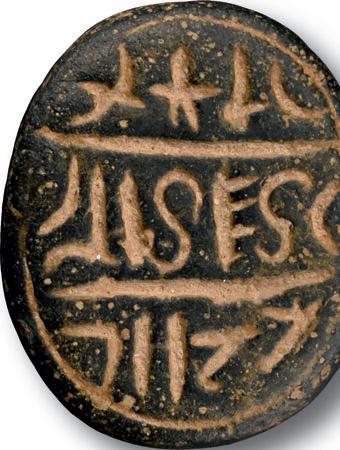


BRONZE SCARABOID SEAL WITH ARAMAIC INSCRIPTION LATE 1ST MILLENNIUM B.C. in. (9.32 grams, 16 mm)
Plano-convex in section with three rows of incised ornament to the underside.
£800 - 1,000
PROVENANCE: From the collection of a gentleman, acquired on the London art market in the 1990s.
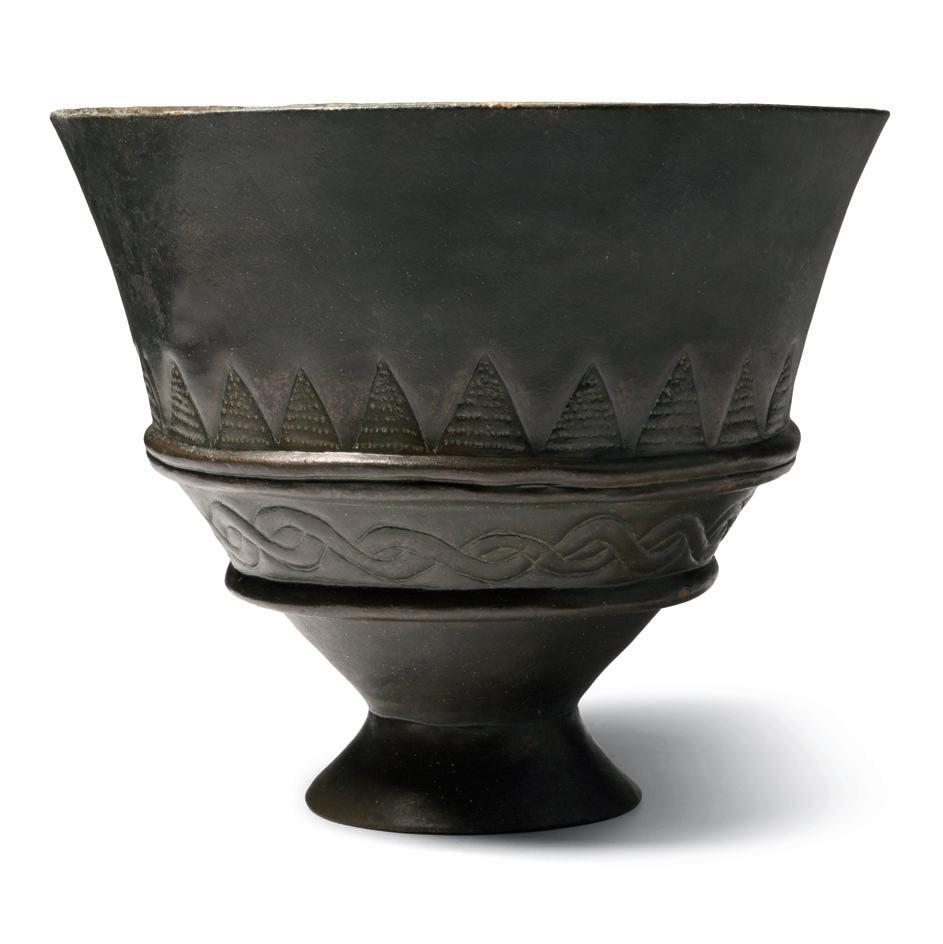
271
WESTERN ASIATIC BRONZE VESSEL WITH ANIMAL HANDLE
1ST MILLENNIUM B.C.
6½ in. (533 grams, 16.5 cm wide)
Squat in profile with drum-shaped body and repoussé base; circumferential bands of pellets beneath rim and above foot; applied loop handle with thumb-pad and spur beneath.
£400 - 600
PROVENANCE:
Ex Abelita family collection, 1980s-2000s.
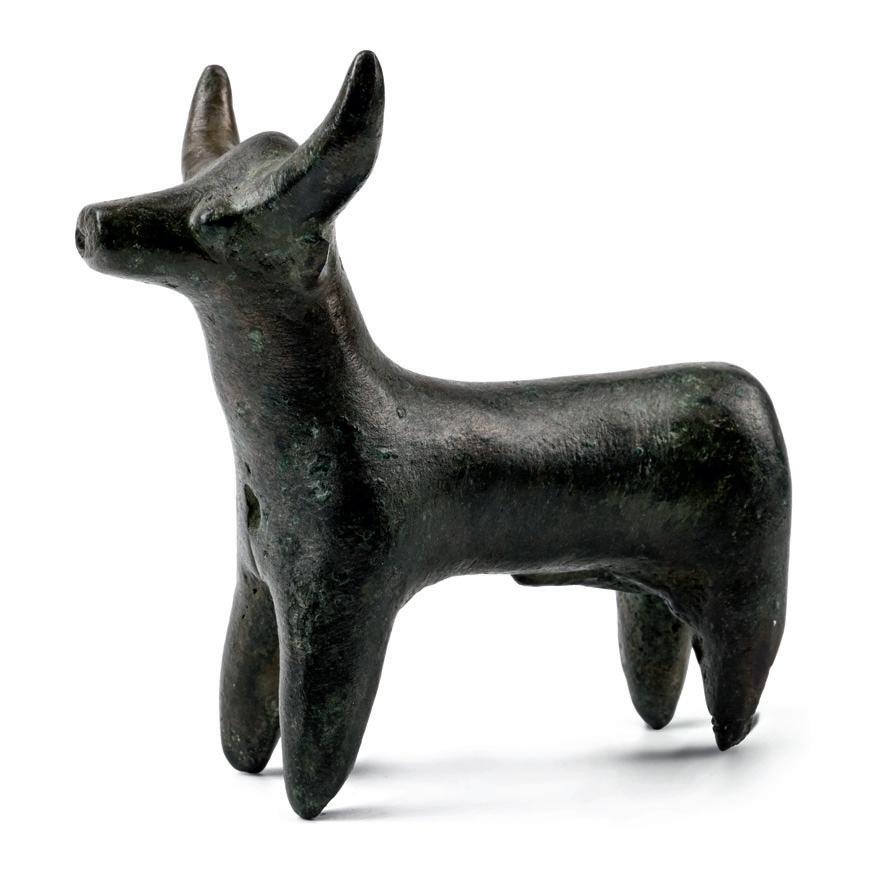
273
BACTRIAN BRONZE STAMP SEAL WITH ZEBU
2ND MILLENNIUM B.C.
2 in. (153 grams, 55 mm)
Substantial rectangular block with loop handle; incuse image of an advancing zebu in profile.
£400 - 600
PROVENANCE:
UK private collection before 2000. Acquired on the UK art market. Private collection, London, UK.
270
URARTU DECORATED BRONZE CHALICE EARLY 1ST MILLENNIUM B.C.
5¾ in. (255 grams, 14.6 cm wide)
With pedestal foot and rib above, bowl with repoussé collar to the equator, guilloche below; mouth with hatched vandykes at the shoulder.
£700 - 900
PROVENANCE:
Ex property of a London, UK, gentleman, Mayfair gallery, 1990s.
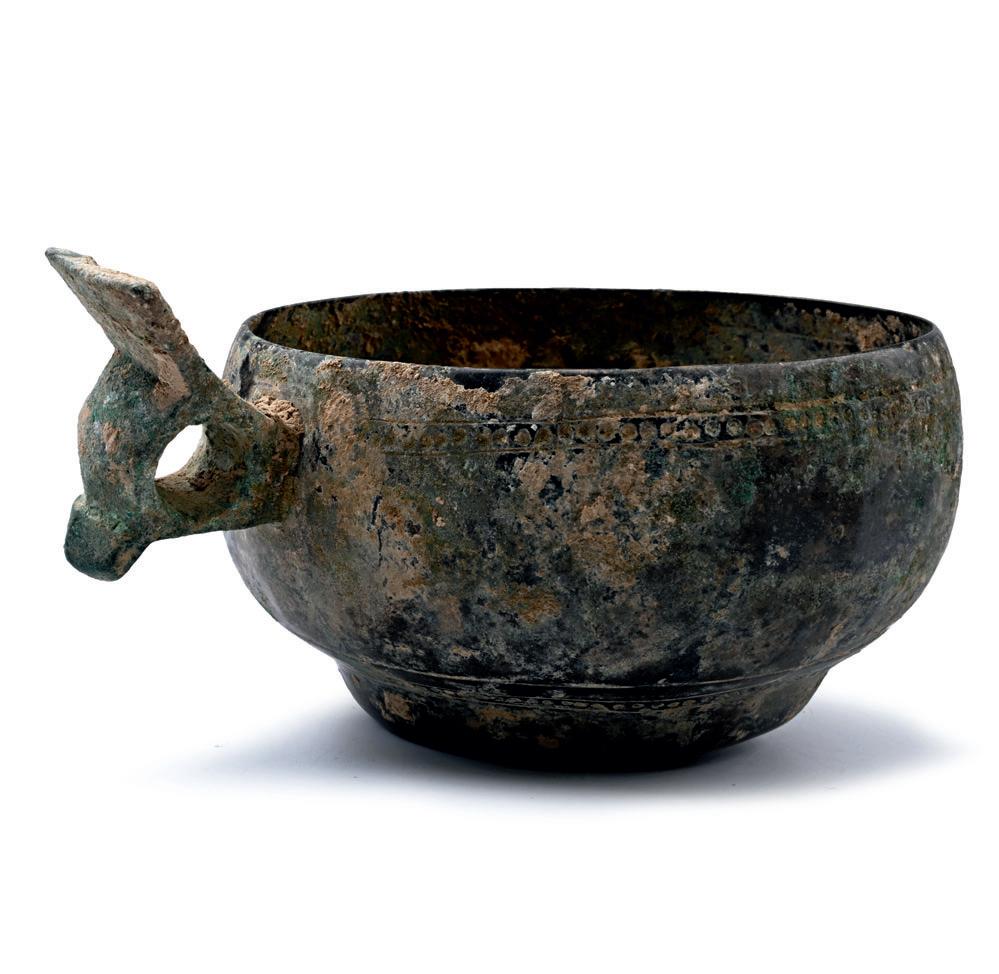
272
URARTU BRONZE STANDING BULL 8TH-7TH CENTURY B.C.
4 in. (732 grams, 10.5 cm wide)
Modelled standing with an erect head, large curving horns and bulbous eyes, male genitals underneath.
£800 - 1,000
PROVENANCE: Acquired before 1983.
Ex London gallery, 1990s. Private collection, London, UK.

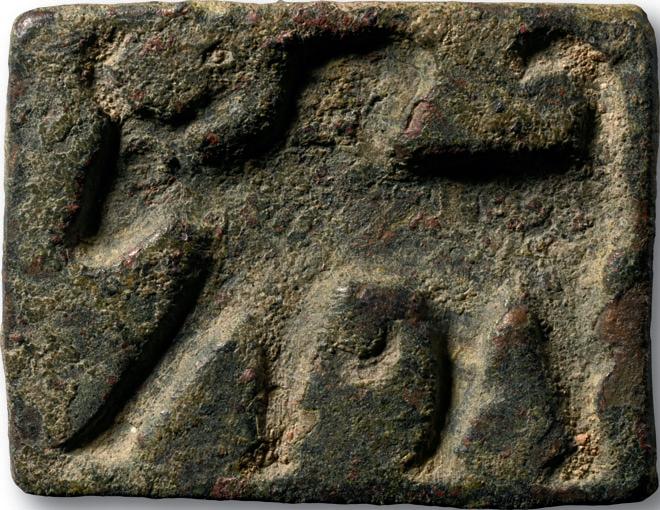
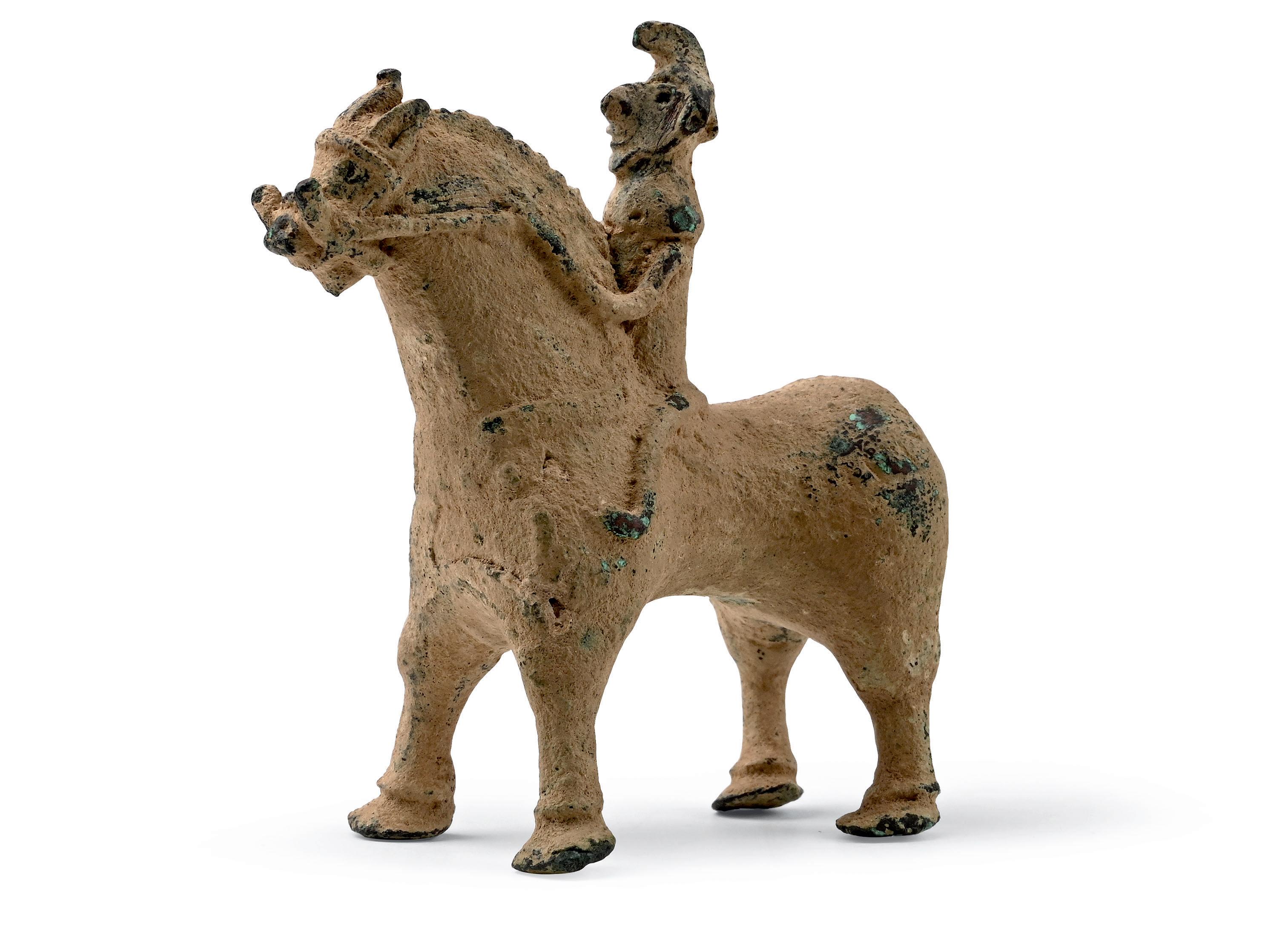
274
WESTERN ASIATIC BRONZE STATUETTE OF A LEVANTINE CAVALRYMAN ‡
7TH-4TH CENTURY B.C.
3½ in. (140 grams, 88 mm wide)
Modelled in the round figurine of a sturdy horse with saddlecloth and chest-band, bridle and reins, integral rider wearing a Phrygian helmet.
£4,000 - 6,000
PROVENANCE:
Formerly in a private collection, Beirut, Lebanon, 1990s. Swiss private collection, acquired from Mr H., Geneva, 2010.
Accompanied by an academic report by Dr Raffaele D’Amato.
FOOTNOTES:
The figure possibly represents a Phrygian cavalryman of the Persian Achaemenid army. It shows minute details of the harness, with muzzle and snaffle bit, which suggest Assyrian or Syrian in origin. The transversal decoration of the antilina strap remembers that of the Persian cavalry of the period (Cassin Scott, 1977, plate D).
275
OLD BABYLONIAN TALL COPPER STATUETTE OF A PRIEST
CIRCA 1894-1595 B.C.
8 in. (540 grams total, 20.5 cm including stand)
Modelled in the round standing figure wearing a floor-length robe; the head surmounted by a pillbox hat with thick shoulder-length hair to the rear, prominent triangular nose flanked by incised lentoid eyes, thick lips and a strong segmented bead; the arms bent forwards at the elbow to support a dish or patera; ellipsoid-section body and Dshaped flange for the feet; small lug to the underside; mounted on a custom-made stand.
£5,000 - 7,000
PROVENANCE: Moussaieff collection, Israel, formed from 1948.
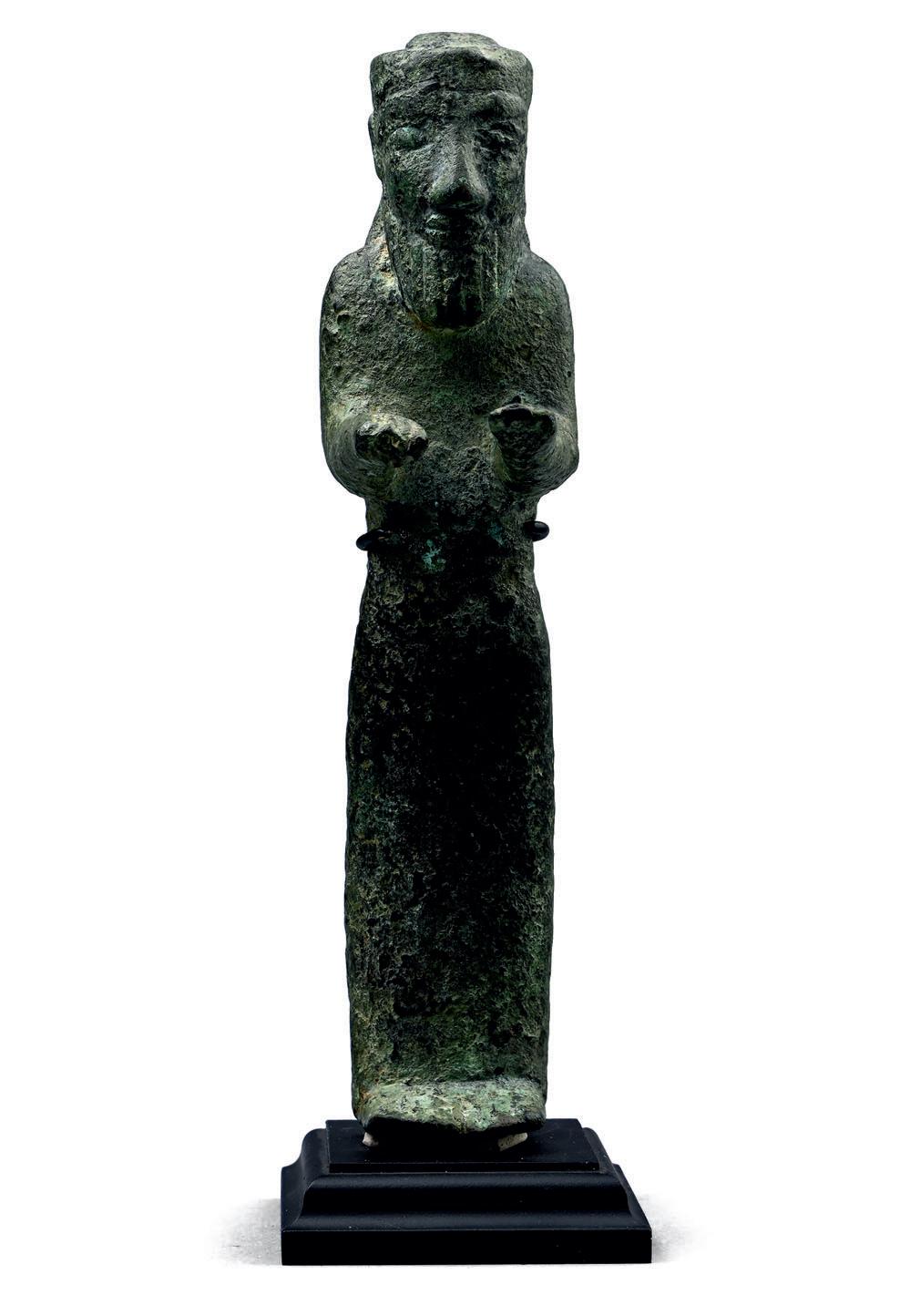
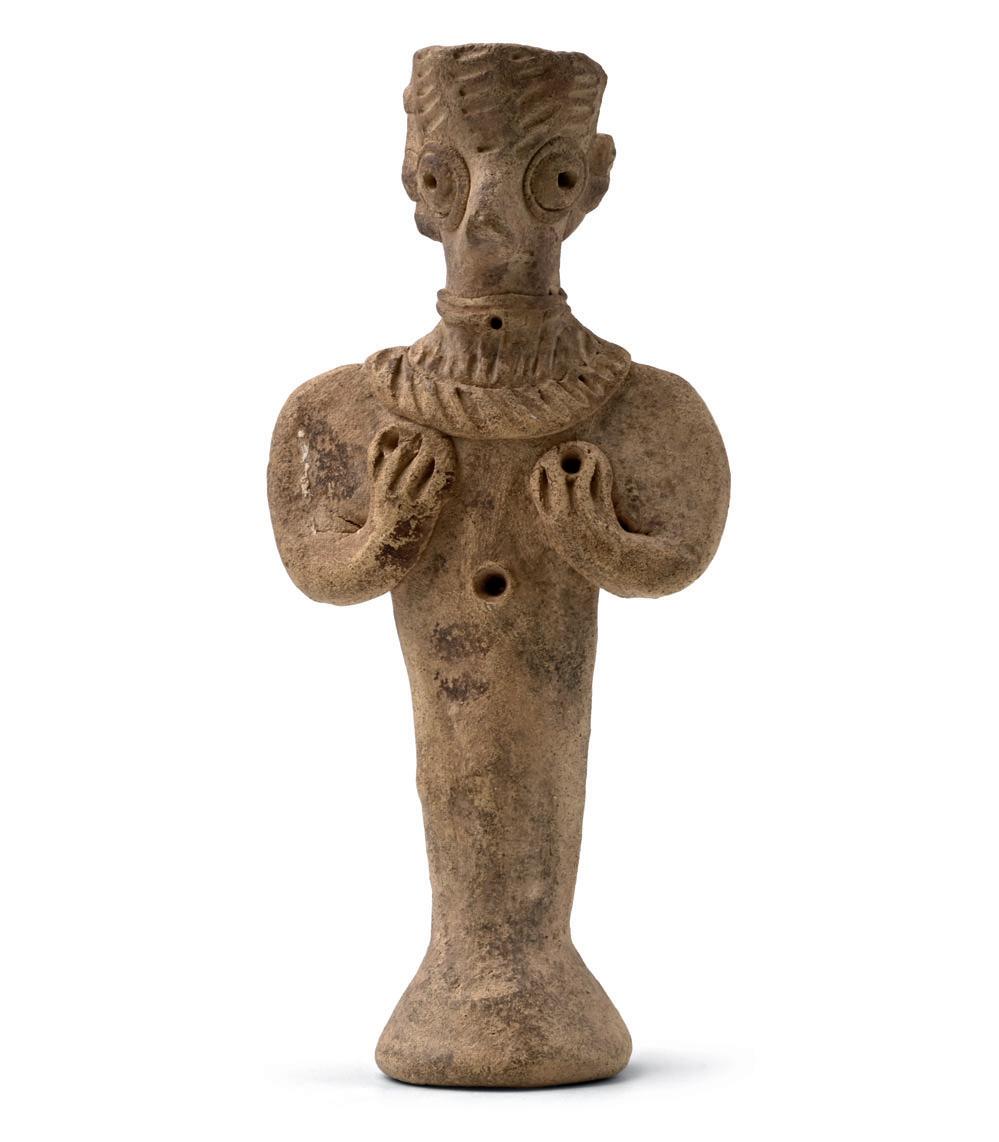
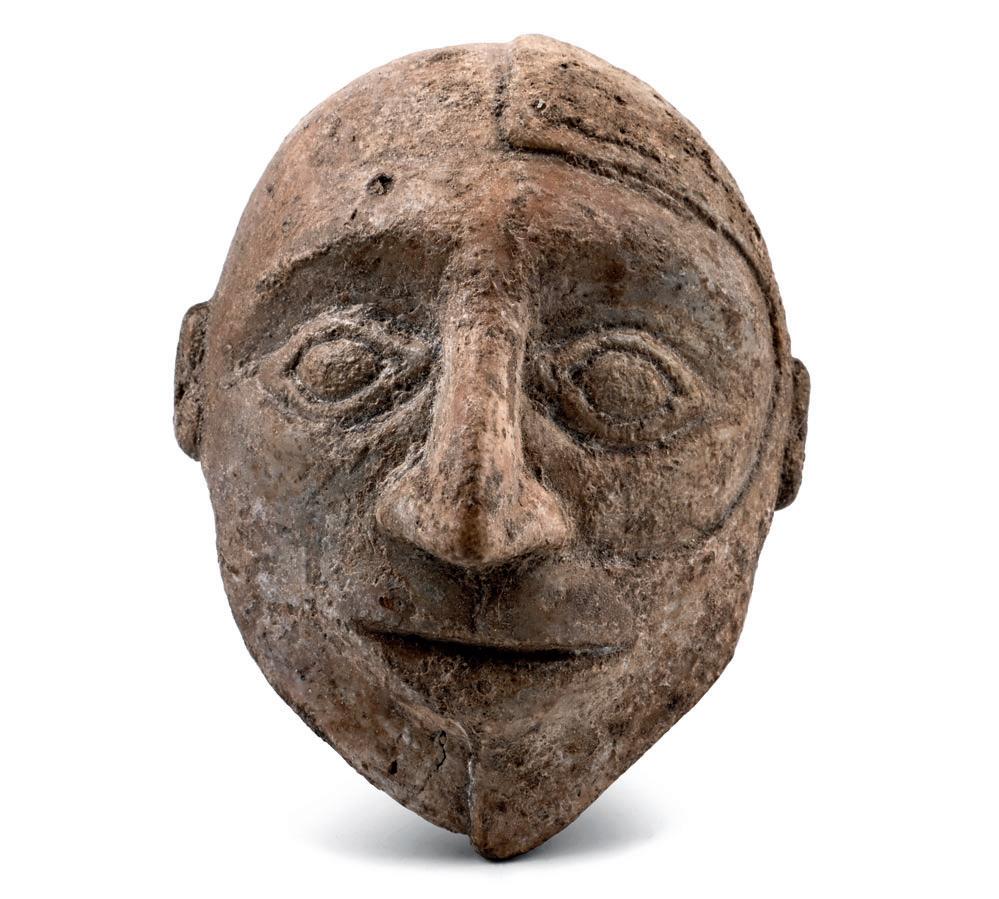
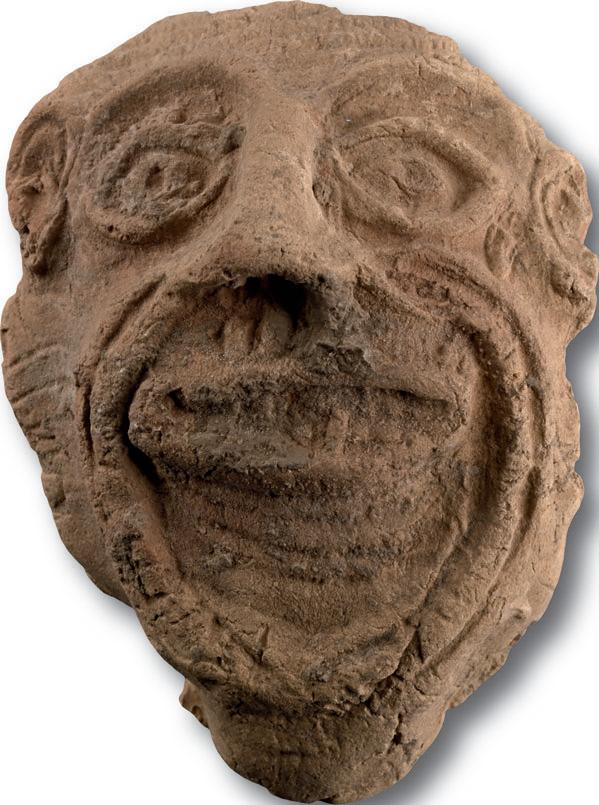
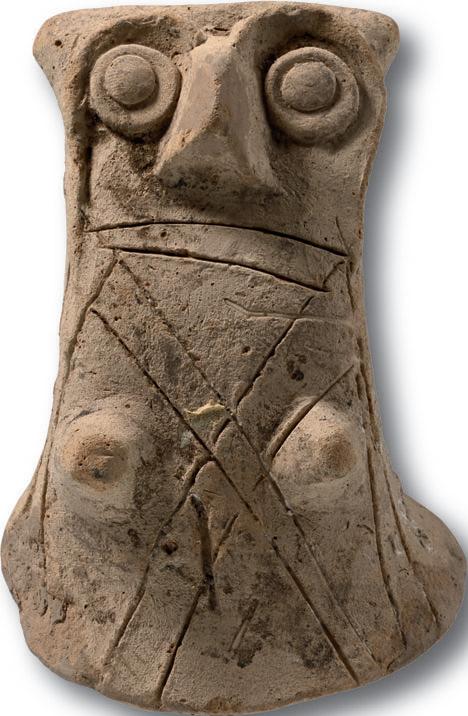

276
SYRO-HITTITE TERRACOTTA IDOL ‡
2ND MILLENNIUM B.C.
5¾ in. (102 grams, 14.5 cm)
Modelled in the round with columnar body and flared base, arms bent and hands placed flat on the chest holding the nipples, herringbone pattern to the collar, hatched headdress, socket to rear of head.
£1,200 - 1,700
PROVENANCE:
Collection T. Arakji, Hamburg, Germany.
Private collection, Switzerland, acquired in 1994; thence by descent.
277
WESTERN ASIATIC TERRACOTTA VESSEL ATTACHMENT
1ST MILLENNIUM B.C.
4¼ in. (351 grams total, 10.96 cm including stand)
Hollow-formed with flared conical base and rectangular upper end; applied facial features, incised saltire, domed breasts; mounted on a custom-made stand.
£500 - 700
PROVENANCE:
Property of a North American gentleman, London, UK, 1990-2010.
278
OLD BABYLONIAN TERRACOTTA HEAD OF A DEMON ‡
CIRCA 1900-1800 B.C.
3 in. (191 grams, 87 mm)

Modelled in the round, depicting the (severed?) head of a Mesopotamian demon, with iconic facial features in relief; hollow with a vent to the neck; produced from a two-piece mould, with a median seam through the facial features.
£1,000 - 1,400
PROVENANCE:
Private collection, Israel. with Holy Land House of Antiquities, Jerusalem, 1980s.
Acquired by the current owner from the above, 2001.
FOOTNOTES:
Within traditional Mesopotamian religion, Humbaba was a creature regarded as the guardian of the cedar forest and the brother of Pazuzu. He was represented as a giant who had been raised by the sun god, Shamash. However, this head could also refer to another deity or demon, like one of the heads found in the Kish excavations.
279
OLD BABYLONIAN TERRACOTTA PLAQUE OF DEMON PAZUZU ‡
CIRCA 1750-1550 B.C.
4¼ in. (170 grams, 10.9 cm)
Ovoid in plan with moulded high-relief facial detailing, suspension ledge to reverse.
£800 - 1,000
PROVENANCE:
From the collection of Contessa L.G., assembled in the 1980s. Private collection, acquired in Switzerland in 1999.
280
LATE HITTITE SHOE-SHAPED VESSEL ‡
2ND MILLENNIUM B.C.
9 in. (585 grams, 23 cm)
Hollow-formed shoe-shaped jug with rolled rim to the ankle, tab with hole for thong and stopper; welt-line to upper face and around sole.
£3,000 - 4,000
PROVENANCE:
Private collection, acquired on the German art market in 1993; thence by descent.



282
WESTERN ASIATIC TERRACOTTA BOWL WITH PAINTED BIRDS
4TH-3RD MILLENNIUM B.C.
6¼ in. (298 grams, 16 cm wide)
With a rounded underside and flared rim; painted asterisk to centre, hatched chevrons to mouth with profile birds in the voids; early Iranian workmanship.
£800 - 1,000
PROVENANCE:
Ex London, UK, gallery, 1971-early 2000s. London, UK, collection.

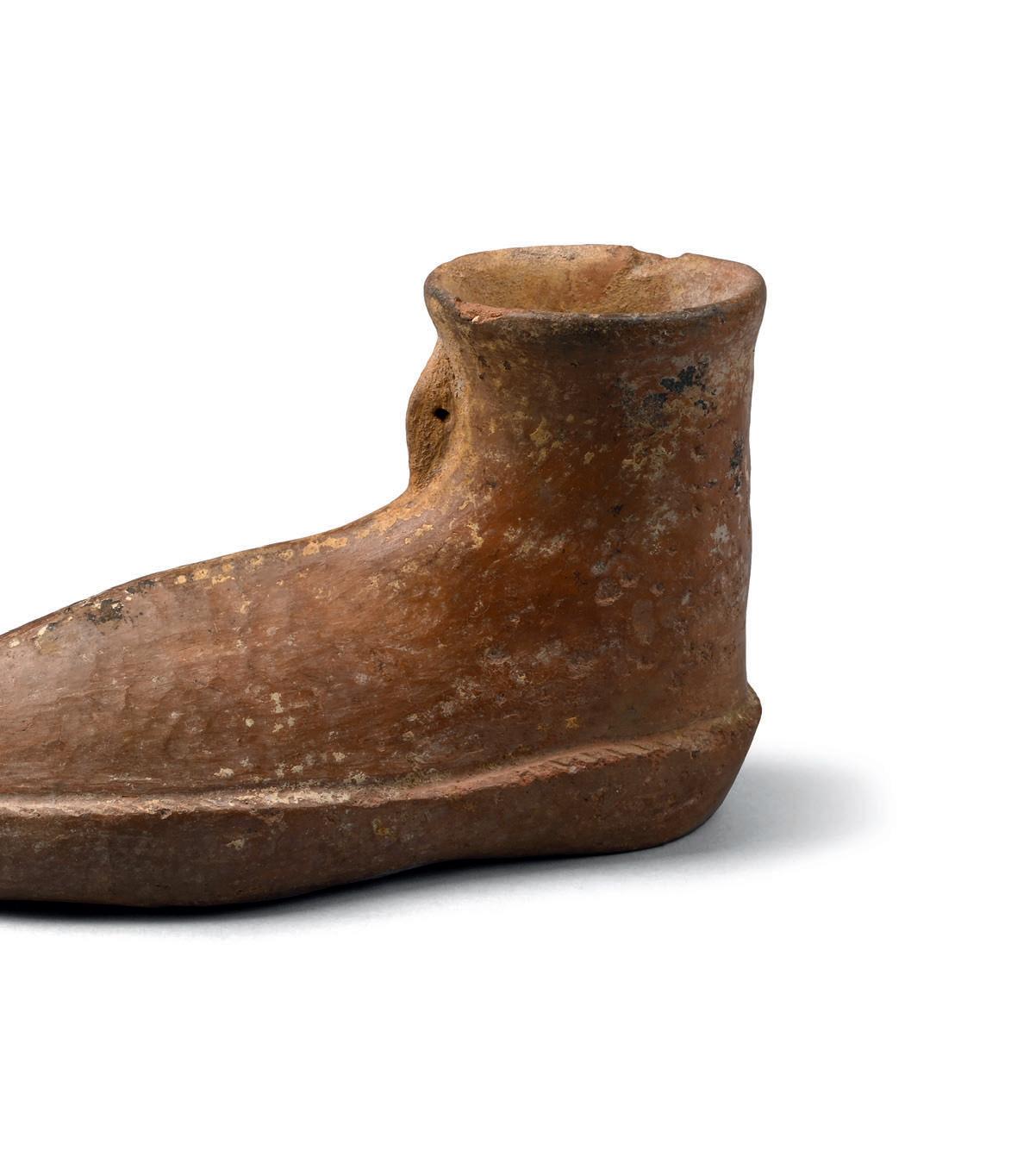

281
WESTERN ASIATIC ZOOMORPHIC TERRACOTTA RHYTON
3RD-1ST MILLENNIUM B.C.
7 in. (670 grams, 18 cm)
With a flaring neck and zoomorphic spout, possibly a horse’s head with a circular opening in its chest.
£500 - 700
PROVENANCE: with a London, UK gallery, 1971-early 2000s.
Accompanied by an original thermoluminescence analysis report no.281z11 from Oxford Authentication, 16 June 1981.


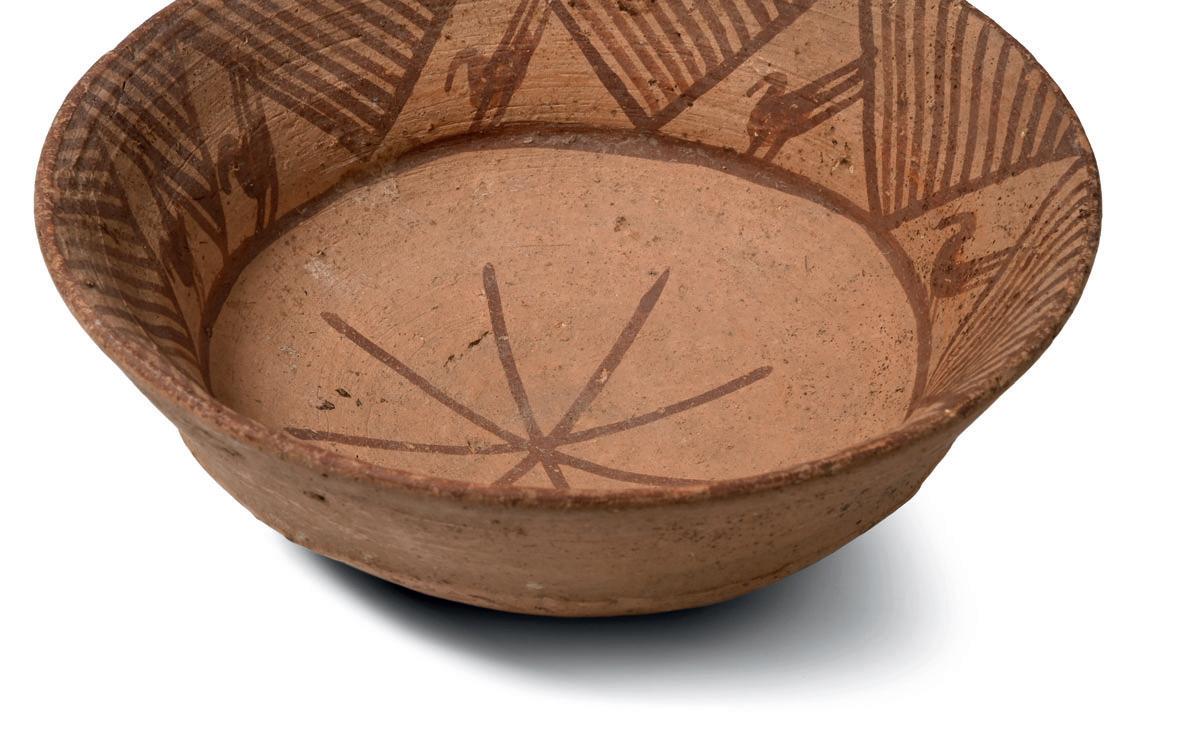

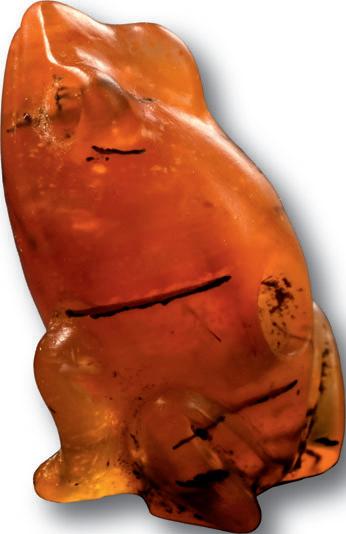
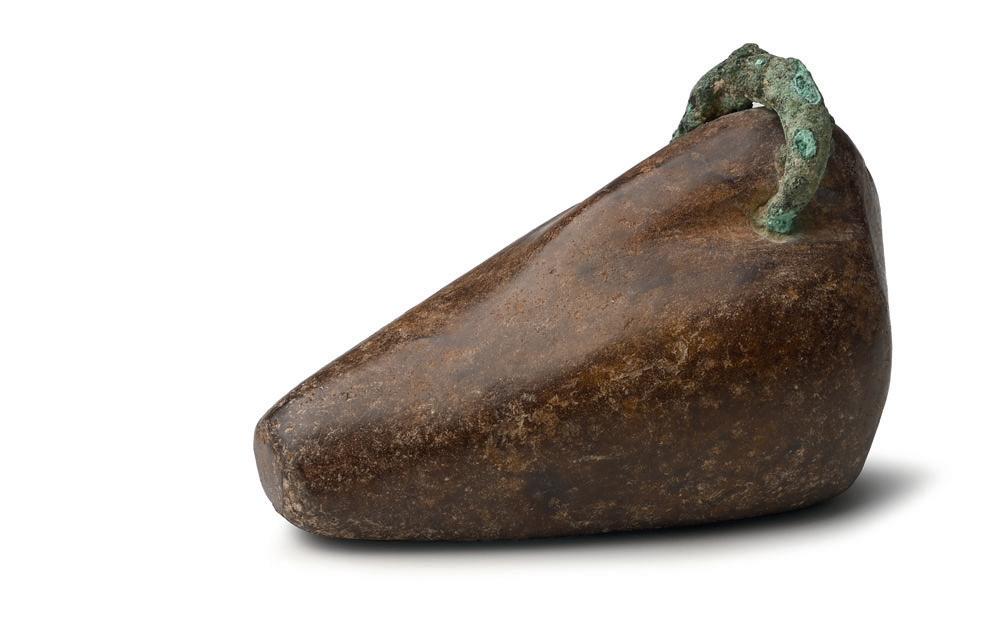
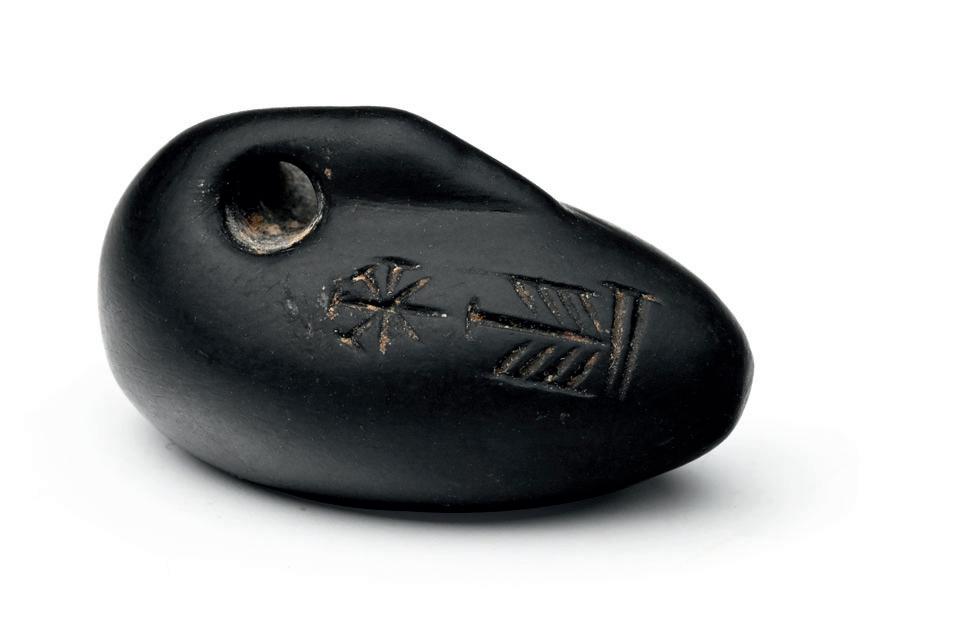
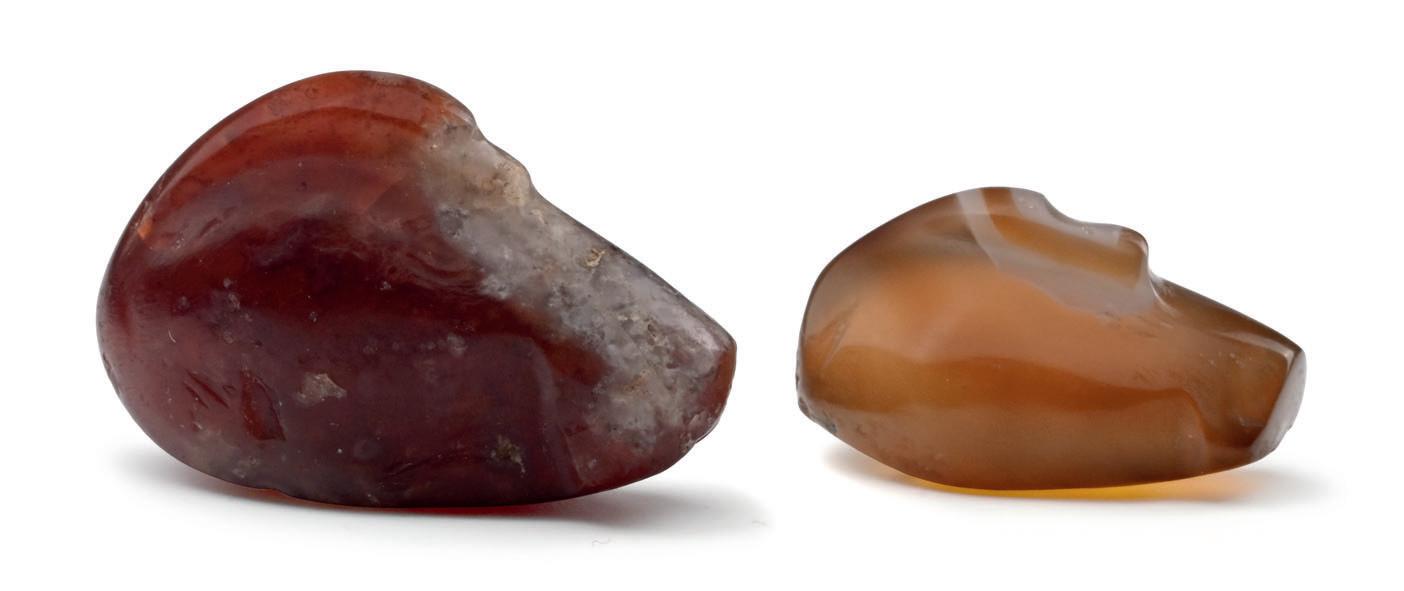
283
BABYLONIAN CARNELIAN FROG-SHAPED AMULET ‡
1ST MILLENNIUM B.C.
¾ in. (2.33 grams, 19 mm)
Carved in the round with hind legs folded behind the body, pierced at the stomach.
£1,000 - 1,400
PROVENANCE: Private collection, acquired in the late 1980s-early 1990s; thence by descent.
284
NEO-BABYLONIAN STONE DUCK WEIGHT WITH LOOP ‡
CIRCA 700-600 B.C.
2 in. (153 grams, 68 mm)
Carved in the round as a duck with its head laid back along its spine; pierced and set with a bronze suspension loop.
£500 - 700
PROVENANCE:
Private collection, USA and Switzerland, acquired in 1994; thence by descent.
285
NEO-BABYLONIAN BLACK STONE DUCK WEIGHT WITH CUNEIFORM INSCRIPTION
CIRCA 600-500 B.C. 1 in. (9.30 grams, 27 mm)
Carved in the round as a duck with its head laid back along its spine; pierced and inscribed on one flank.
£1,200 - 1,700
PROVENANCE: UK private collection before 2000. Acquired on the UK art market. Private collection, London, UK.
286
NEO-BABYLONIAN AGATE DUCK WEIGHT COLLECTION ‡
CIRCA 700-600 B.C. - in. (6.67 grams total, 17-22 mm)
Each carved in the round as a duck with its head laid back along its spine. [2]
£700 - 900
PROVENANCE: Private collection, Israel. with Holy Land House of Antiquities, Jerusalem, 1990s. Private European collection, acquired from the above in 2001.

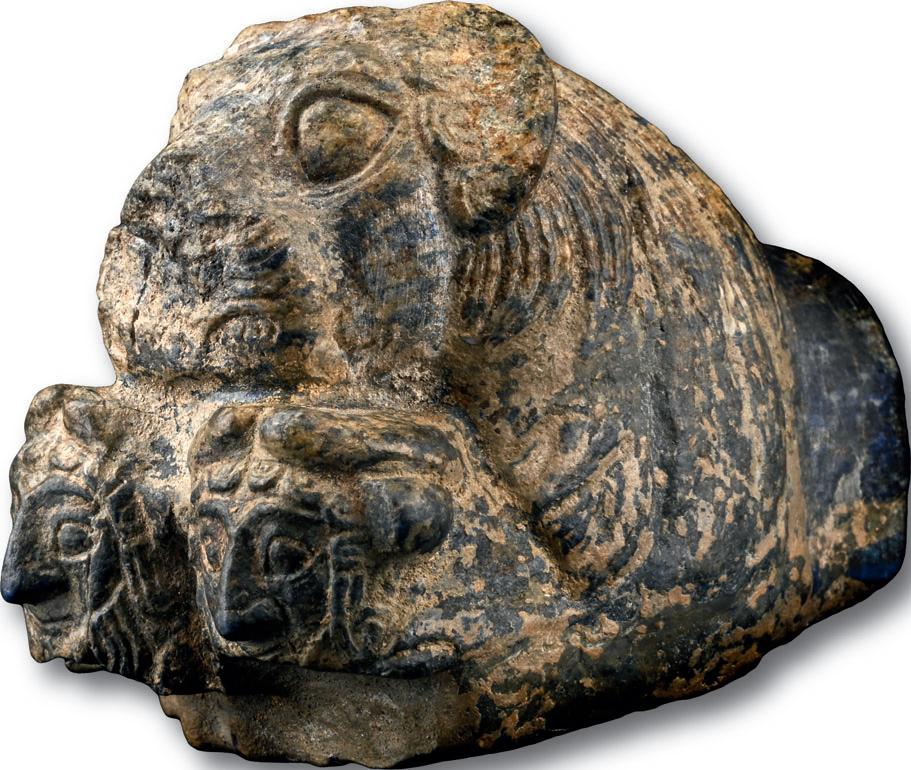
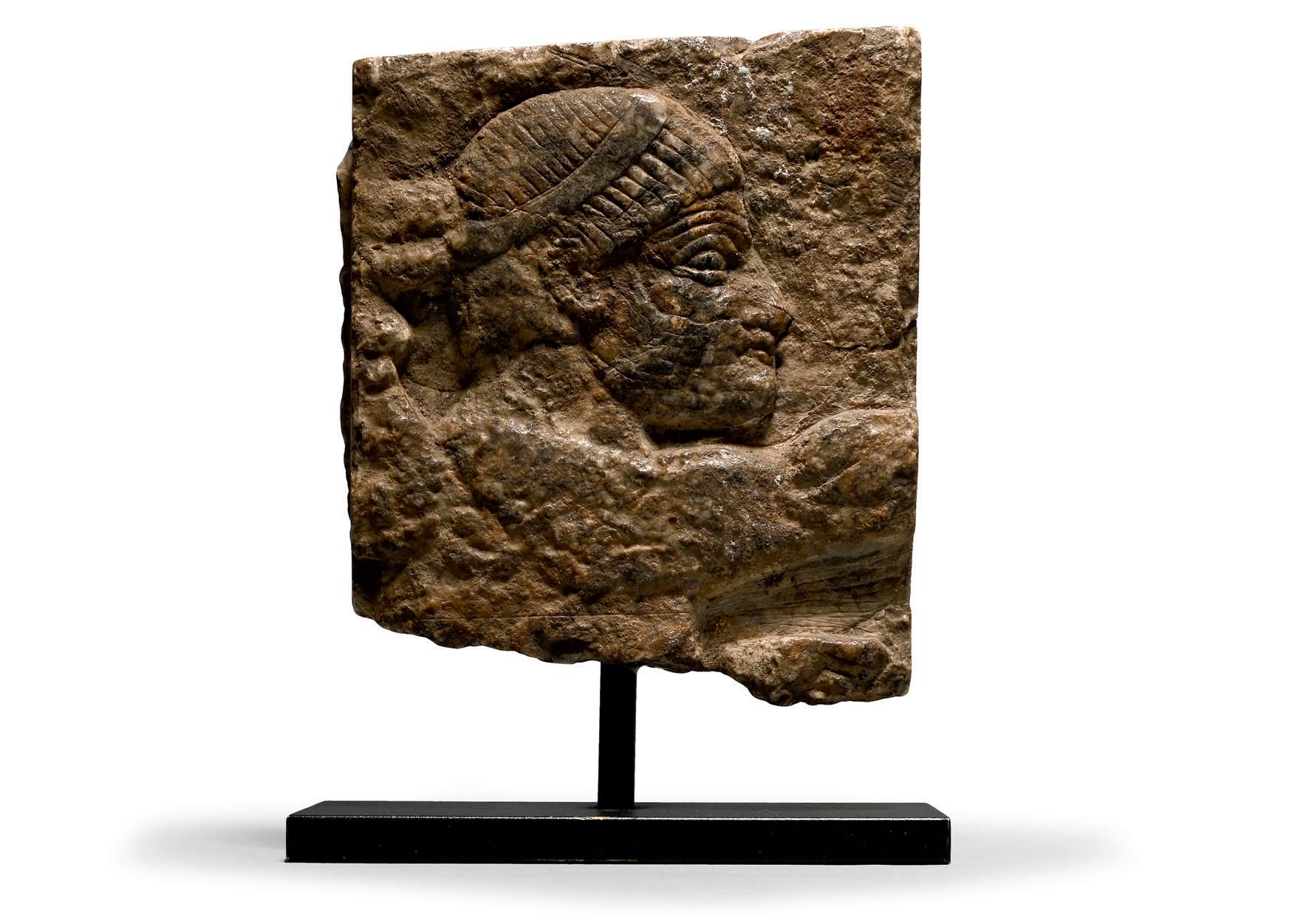
287
WESTERN ASIATIC LAPIS LAZULI THRONE FITTING WITH LION
1ST MILLENNIUM B.C.
3 in. (404 grams, 85 mm)
From the arm of a throne with a D-shaped socket to the rear; formed as the foreparts of a lion with abundant mane covering two lion-cub heads with bearded human faces.
£6,000 - 8,000
PROVENANCE:
Ex London gallery, 1990s. Private collection, London, UK.
288
ASSYRIAN GYPSUM RELIEF WITH HEAD OF A BEARDED MAN ‡
704-681 B.C.
4½ in. (530 grams total, 11.6 cm including stand)
Rectangular frieze fragment with low-relief carving of a profile bust with short straight hair confined by a brow-band, segmented curls forming the beard, furrowed brow, one arm extended; handwritten label to rear ‘from the Koyunjik palace of Sennacherib at Nineveh and incised legend ‘KOUYUNJIK’ and ‘A’; mounted on a custom-made stand.
£7,000 - 9,000
PROVENANCE: Allegedly found in the Koyunjik Palace of Sennacherib.
Ex property of a gentleman, UK, acquired in the 1970s.
Ex private collection, Oxfordshire, UK, 1988.
Anonymous sale, Christie’s, London, 7 December 1994, no.235.
Art market, New York.
Ex private collection, Tokyo, Japan.
Private European collection, 2009.
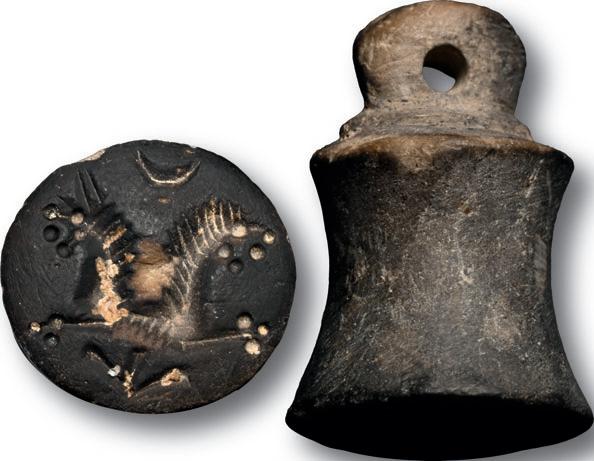

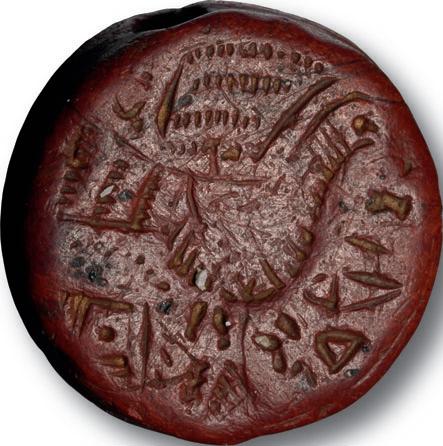

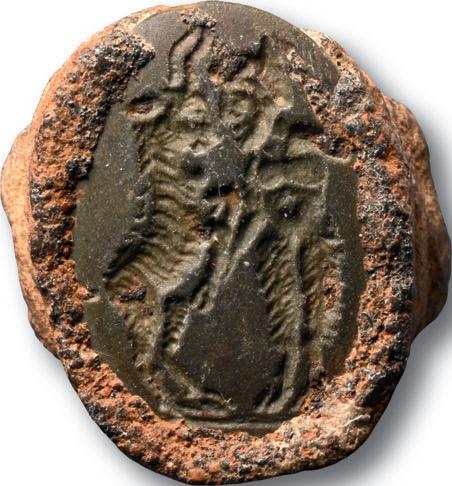

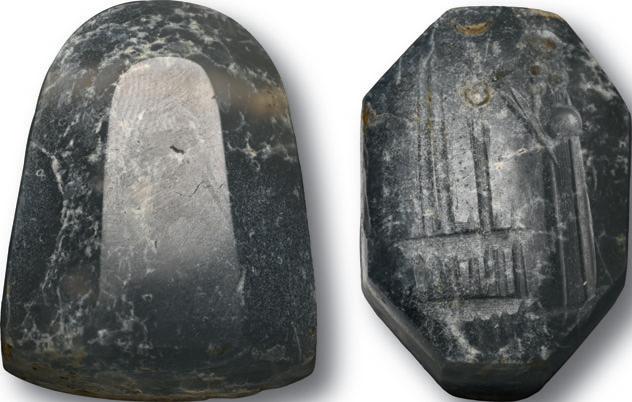

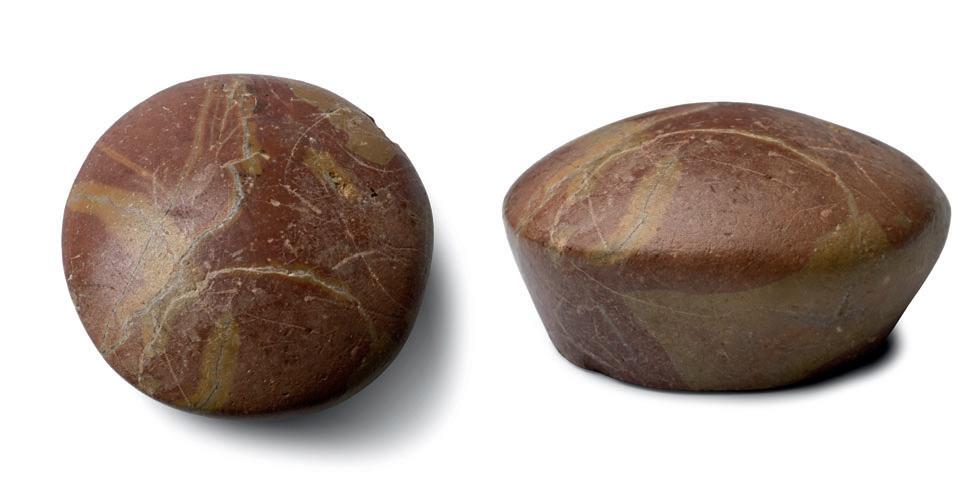
289
WESTERN ASIATIC STONE STAMP SEAL WITH ENGRAVED DESIGN
1ST MILLENNIUM B.C.
1 in. (6.89 grams, 26 mm)
Bell-shaped with scooped sidewall and pierced lug; engraved with addorsed bull and lion beneath a crescent; accompanied by a museum-quality impression.
£400 - 600
PROVENANCE:
Acquired before 1983. Ex London gallery, 1990s. Private collection, London, UK.
290
HITTITE RED JASPER STAMP SEAL WITH BIRD CIRCA 1500-1300 B.C.
1 in. (12.8 grams, 24 mm)
Domed seal with transverse piercing, upper face with a floral border and schematic motifs, underside with a standing bird with an inscription(?) below; supplied with a museum-quality impression.
£300 - 400
PROVENANCE:
From an English private collection, 1980s. Property of a London, UK, antiquarian.
291
ACHAEMENID STONE SEAL IN IRON RING BEZEL
6TH-4TH CENTURY B.C.
¾ in. (3.55 grams, 20 mm)
Ellipsoid gemstone with intaglio motif of a standing male figure in profile facing a rearing goat; set in an iron ring fragment.
£400 - 600
PROVENANCE:
From the collection of a gentleman, acquired on the London art market in the 1990s.
292
LARGE NEO-BABYLONIAN CHALCEDONY STAMP SEAL WITH KING CIRCA 7TH-6TH CENTURY B.C.
1¼ in. (22.04 grams, 31.72 mm)
Standing robed figure in profile with hands raised towards a stepped dais with vertical stems.
£600 - 800
PROVENANCE:
From the private collection of a European gentleman (1942-2024), formed since the 1970s.
293
LARGE MESOPOTAMIAN CARVED STONE WEIGHT
3RD-2ND MILLENNIUM B.C.
3 in. (380 grams, 80 mm)
Circular body with flaring walls and a domed top.
£500 - 700
PROVENANCE:
Acquired in the late 1980s-early 1990s. Private collection, London.
294
SUMERIAN GREEN STONE EYE IDOL ‡
3RD MILLENNIUM B.C.
1 in. (13.2 grams, 41 mm)
Carved in the round as a rectangular block with a slit to the upper edge, vertical spike with two annulet ‘eyes’; pierced for suspension.
£2,500 - 3,500
PROVENANCE: with M. Petropoulos, Zurich, early 1990s. with Rhéa gallery.
Private collection, acquired in 1999.
FOOTNOTES:
Idols were an important part of religious life in South Arabia and across the ancient Near East. They were made as images of gods, spirits, or protective powers, and helped people feel a closer connection to the divine. These figures might be placed in temples, shrines, or even in the home, where they could have a protective or devotional role. Their shapes were often simple and stylised, with more importance placed on their meaning than on making them look fully realistic.
295
JEMDET NASR TYPE MARBLE GAZELLE SEAL ‡
CIRCA 3000 B.C.
1¼ in. (11.08 grams, 31 mm)
Plano-convex in section with ellipsoid body, high-relief legs and reversed head; underside with incuse animal motifs.
£1,500 - 2,000
PROVENANCE:
Private collection, acquired in the late 1980s-early 1990s; thence by descent.
296
BABYLONIAN STONE BEAD IN THE SHAPE OF A RAM ‡
1ST MILLENNIUM B.C.
1½ in. (8.66 grams, 40 mm)
Carved in the round to take advantage of the banded colouration, pierced vertically through the rump, with eye and ribbed horn detailing.
£800 - 1,000
PROVENANCE:
Private collection, acquired in the late 1980s-early 1990s; thence by descent.
297
MESOPOTAMIAN CARVED STONE MACEHEAD
3RD-2ND MILLENNIUM B.C.
2 in. (484 grams, 73 mm)
Carved from a mottled stone as a large sphere with a round socket.
£500 - 700
PROVENANCE: Acquired in the late 1980s-early 1990s. Private collection, London.
298
ACHAEMENID ALABASTER VESSEL
CIRCA 500-400 B.C.
2 in. (150 grams, 60 mm)
Squat, ‘bag’ shaped vessel with flared rim and flat base.
£400 - 600
PROVENANCE:
Private collection, 1990s-early 2000s.

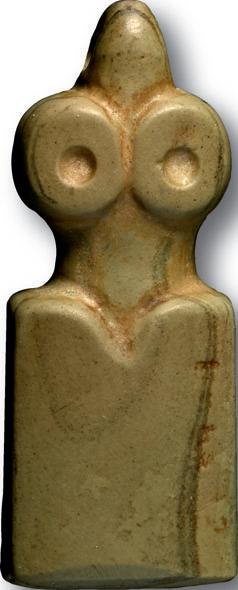

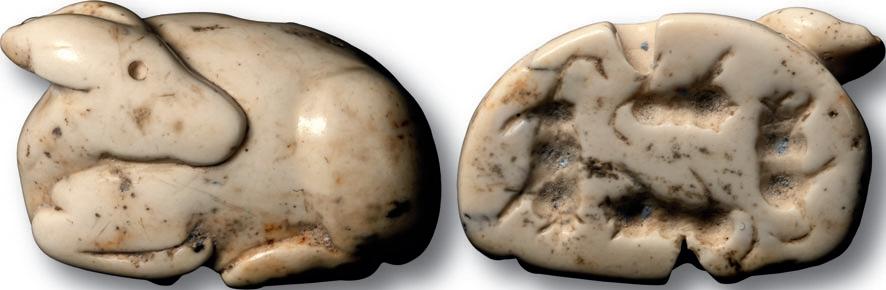

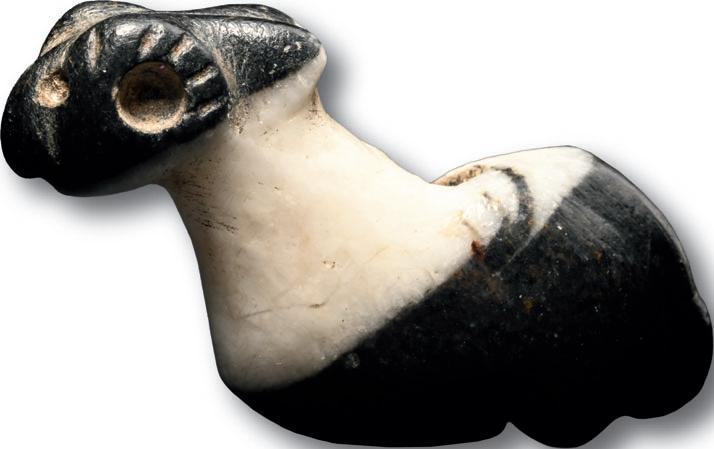
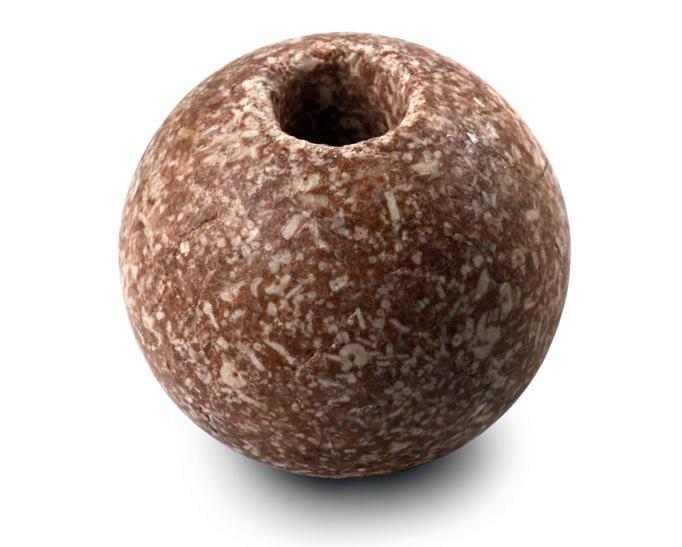
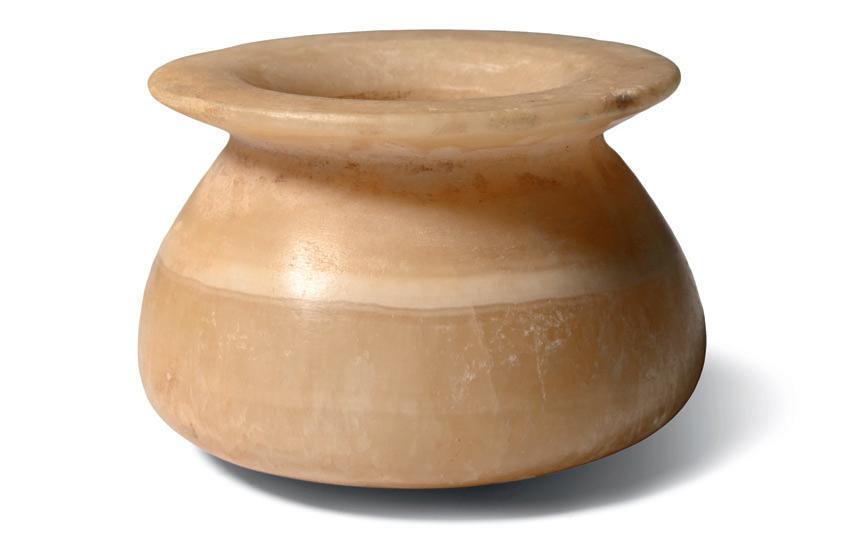

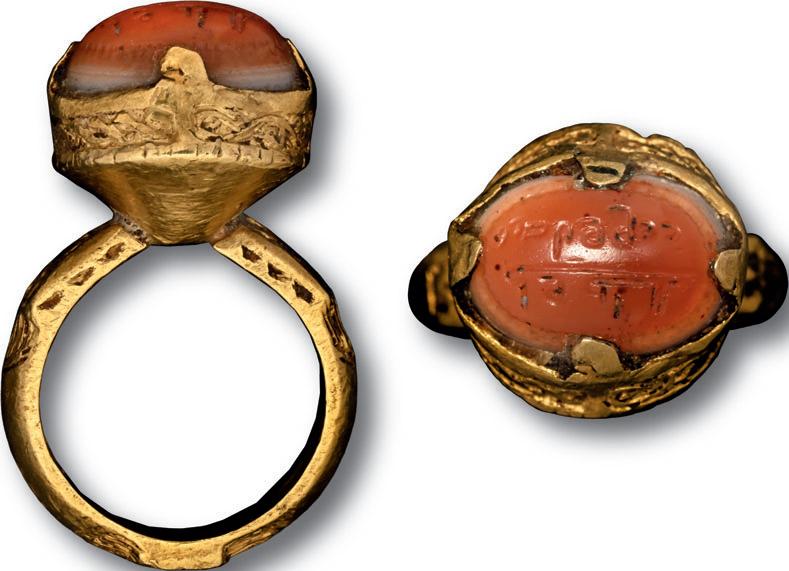
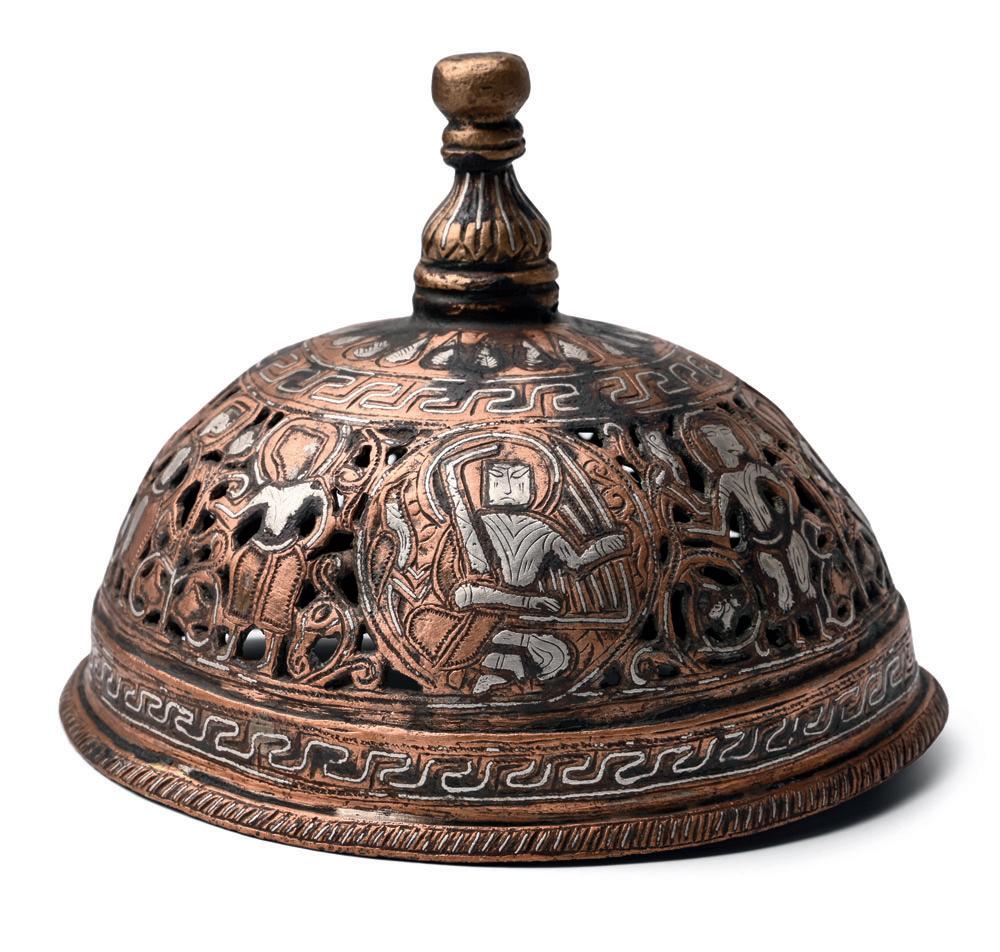
299
WESTERN ASIATIC GOLD RING WITH INSCRIBED SARDONYX GEMSTONE ‡
10TH-12TH CENTURY A.D.
1 in. (7.33 grams, 27.65 mm overall, 13.76 x 14.32 mm internal diameter (approximate size British E½, USA 2½, Europe 3, Japan 3))
With stepped shoulders supporting a cell bezel with a claw setting.
£2,000 - 3,000
PROVENANCE:
Private collection, acquired on the German art market in 1993; thence by descent.
FOOTNOTES:
Rings from the 9th-13th centuries represent a variety of artistic achievements; the techniques were elaborate, and the rings show rich decoration. The rings were set with cabochons, table-cut oval or rectangular stones such as turquoise, rubies, garnets or other precious stones. The Arabic inscription, engraved with early Kufic characters, contains the expression AL__LLH, which could be interpreted as il-la-lah, i.e. For/to Allah.
300
WESTERN ASIATIC GOLD BIRD PENDANT WITH DROPLETS
12TH-15TH CENTURY A.D.
1 in. (2.93 grams, 35 mm)
Hollow-formed sheet gold bird pendant with beaded dangles.
£500 - 700
PROVENANCE: Acquired before 1983.
Ex London gallery, 1990s. Private collection, London, UK.

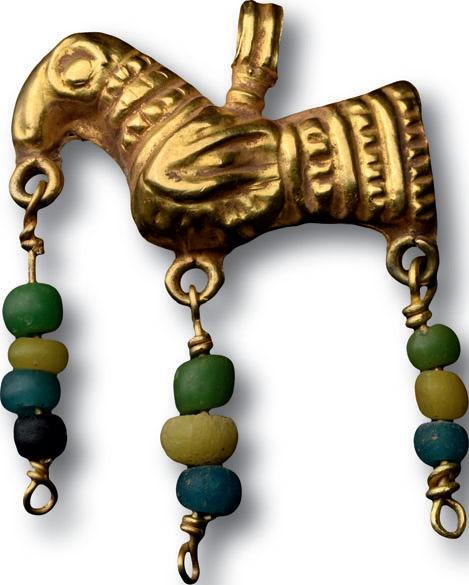
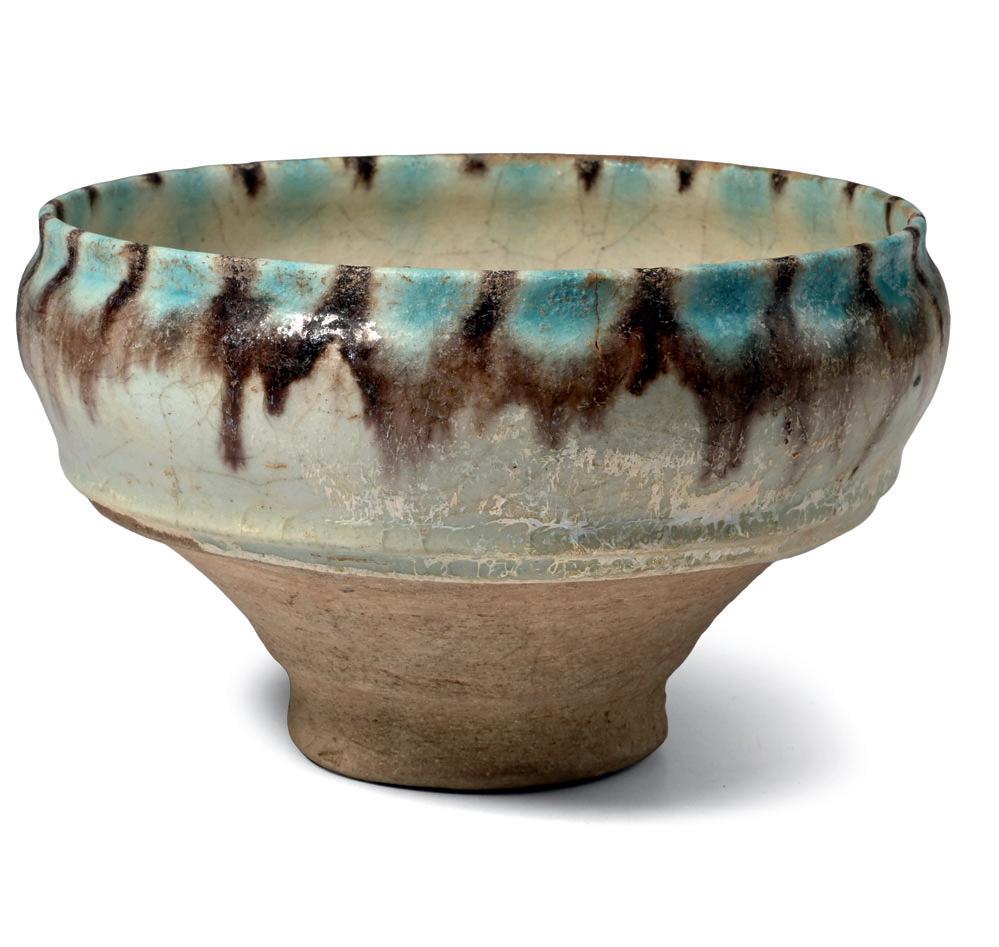
301
SELJUK BRONZE INCENSE BURNER WITH SILVER INLAYS 12TH CENTURY A.D. OR LATER
5½ in. (345 grams, 14 cm)
Domed openwork cover with inlays, the knop surrounded by a band of inlaid leaves, a band of Greek key motifs below and above the basal rim enclosing a series of figures in dynamic poses, three of the figures enclosed within a medallion and depicting a seated male with crossed legs and a bird on his right side.
£700 - 900
PROVENANCE: with a London, UK gallery 1971-early 2000s.
302
WESTERN ASIATIC BOWL WITH BLUE GLAZE
CIRCA 12TH CENTURY A.D.
6 in. (394 grams, 17 cm wide)
With conical lower body, carination and rounded bowl; white glaze with blue and black zigzags.
£1,000 - 1,400
PROVENANCE: Ex London, UK, gallery, 1971-early 2000s. London, UK, collection.
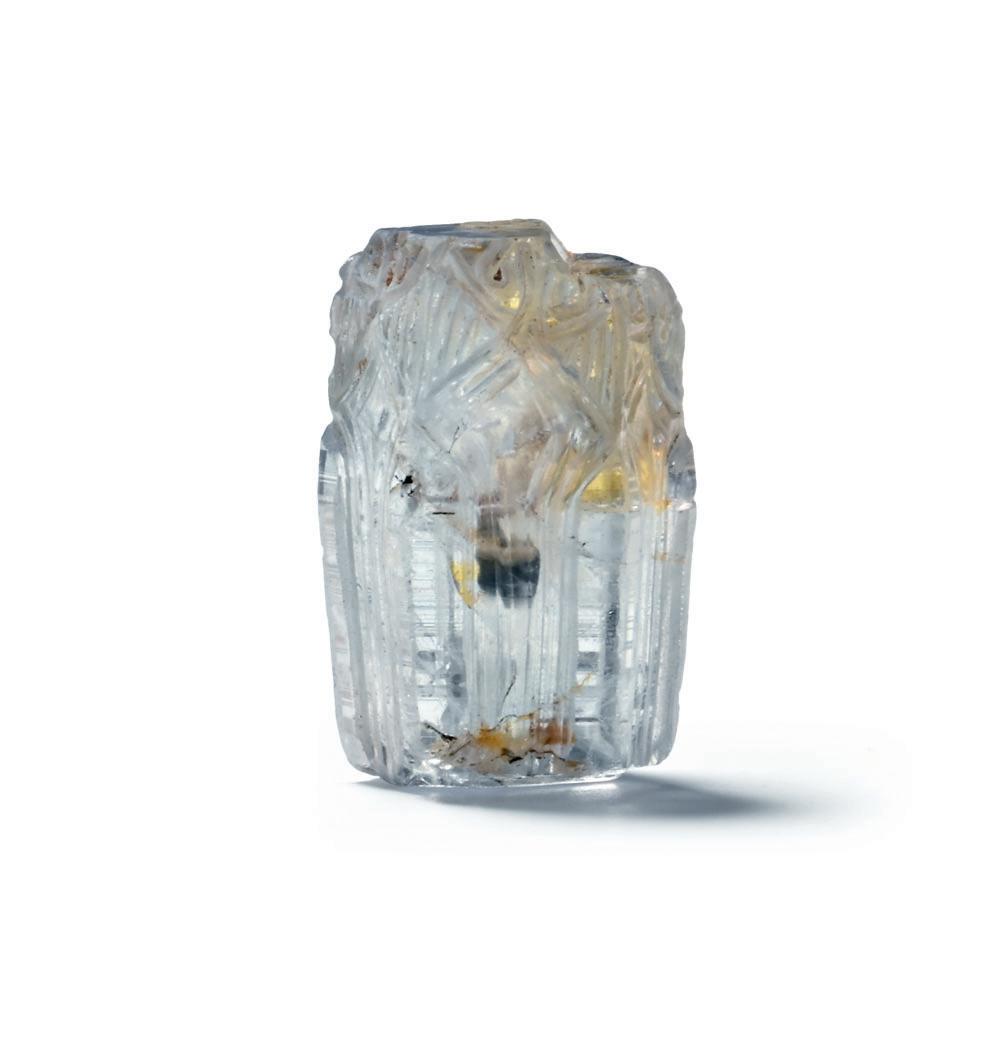
303
FATIMID SAPPHIRE CHESS PIECE CIRCA 9TH-10TH CENTURY A.D. in. (3.29 grams, 16 mm)
Columnar type with facetted sidewall, hatching.
£2,000 - 3,000
PROVENANCE: Ex Oasis Art, London, UK, 1990-2000s.
304
SASANIAN CUT-GLASS VESSEL
3RD-7TH CENTURY A.D.
3 in. (103 grams, 91 mm)
With a piriform body with three rows of cut facets or dimples and a slender flared neck.
£700 - 900
PROVENANCE: Private collection, 1990s-early 2000s.
305
WESTERN ASIATIC ROCK CRYSTAL GEMSTONE ‡ SAFAVID DYNASTY, 1501-1722 A.D. ¾ in. (2.75 grams, 20 mm)
Square in plan with finely engraved Nastaliq calligraphic text.
£1,000 - 1,400
PROVENANCE: Private collection, Germany. Anonymous sale, Agora Numismatik, Woerden, Netherlands, 2015, no.333. Private collection, Europe.
306
SELJUK CARVED STONE HEAD OF A PRINCE 12TH CENTURY A.D.
2 in. (50.5 grams, 60 mm)
Comprising a shield-shaped finial with a stylised human head wearing a tall headdress with a double-band at the top, U-shaped neck with a crescentic plaque; accompanied by a custom-made display stand.
£300 - 400
PROVENANCE: with a London, UK gallery 1971-early 2000s.
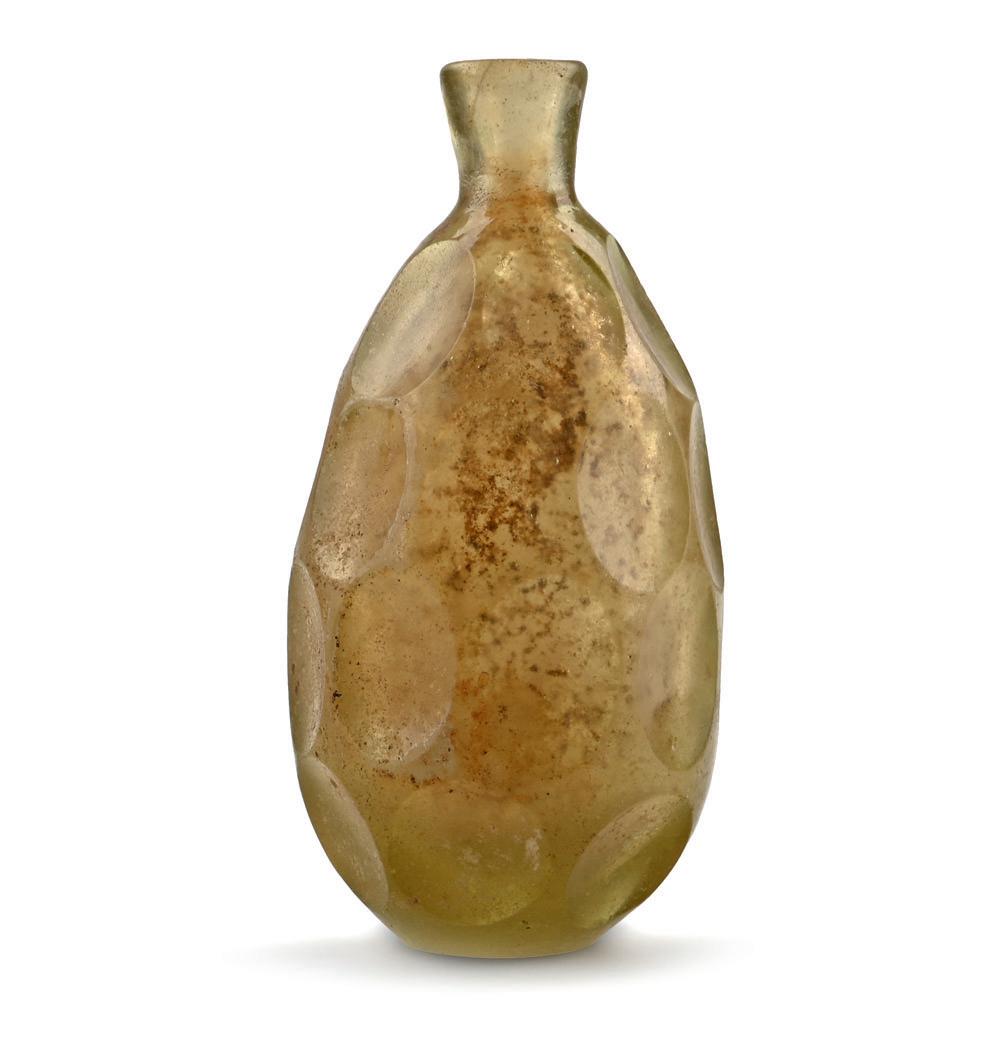
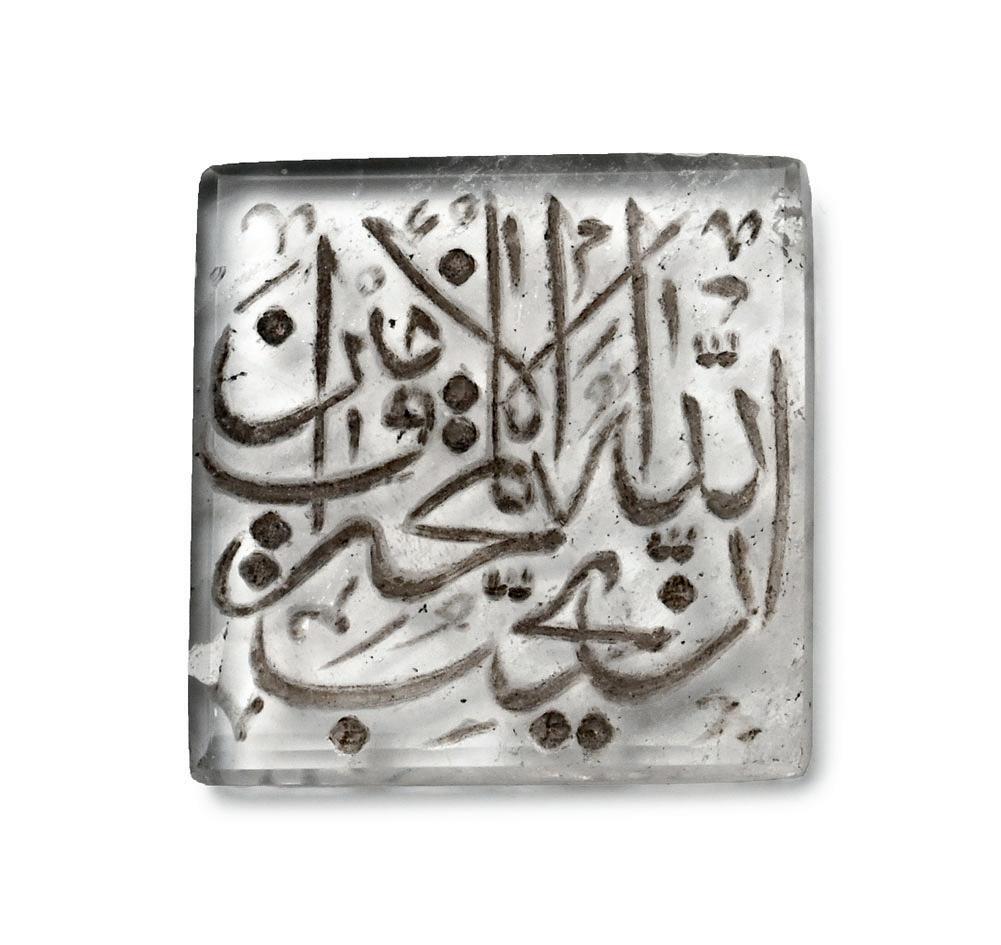
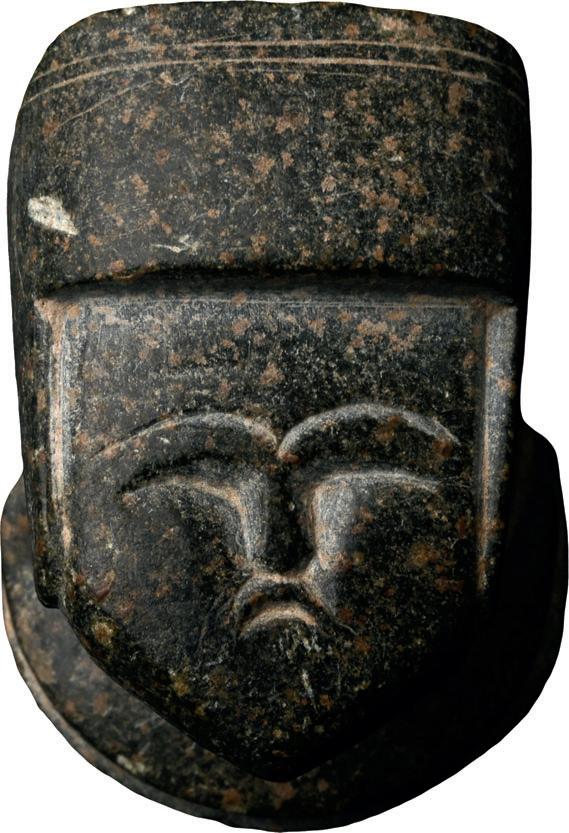
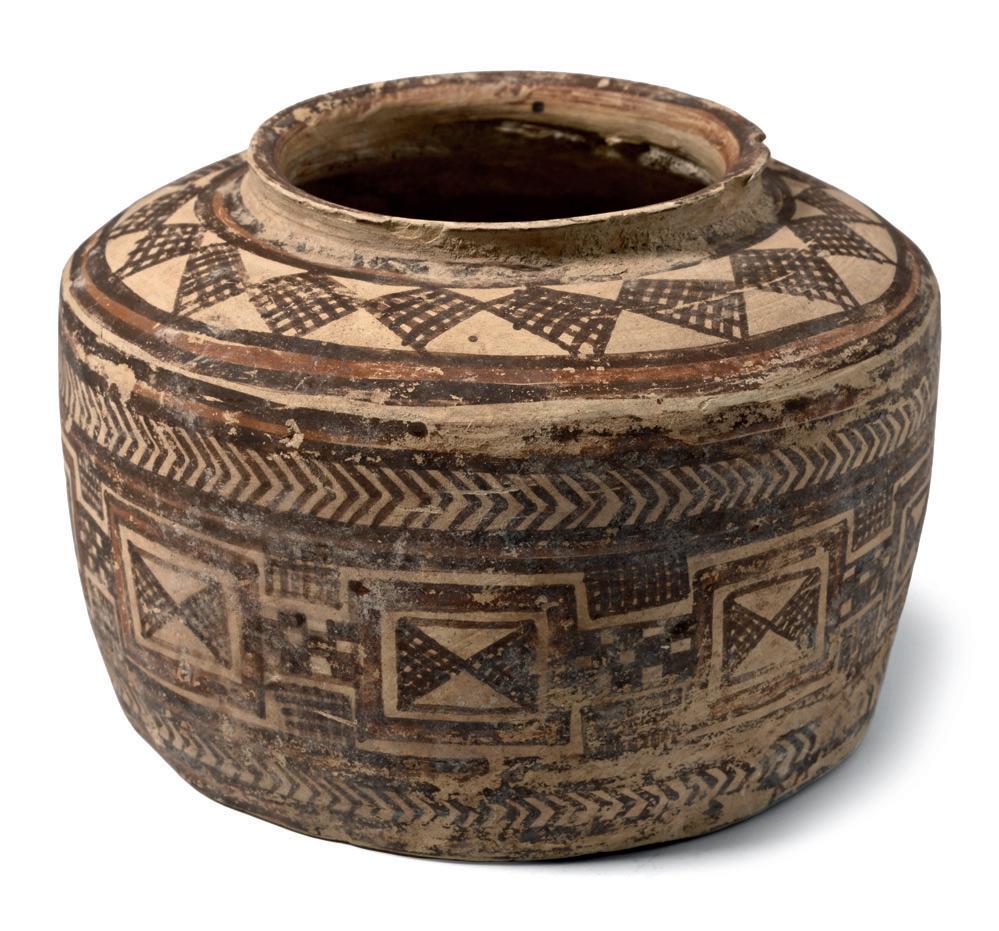
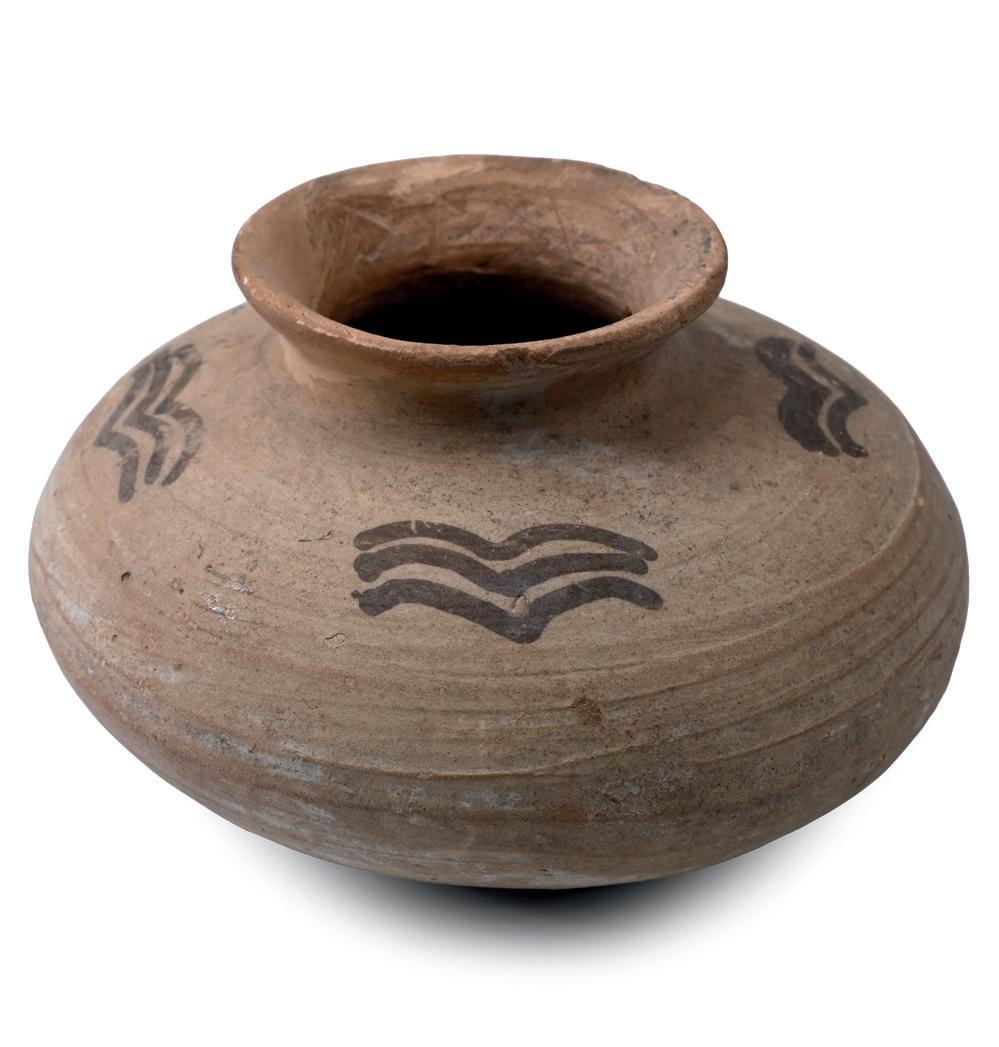
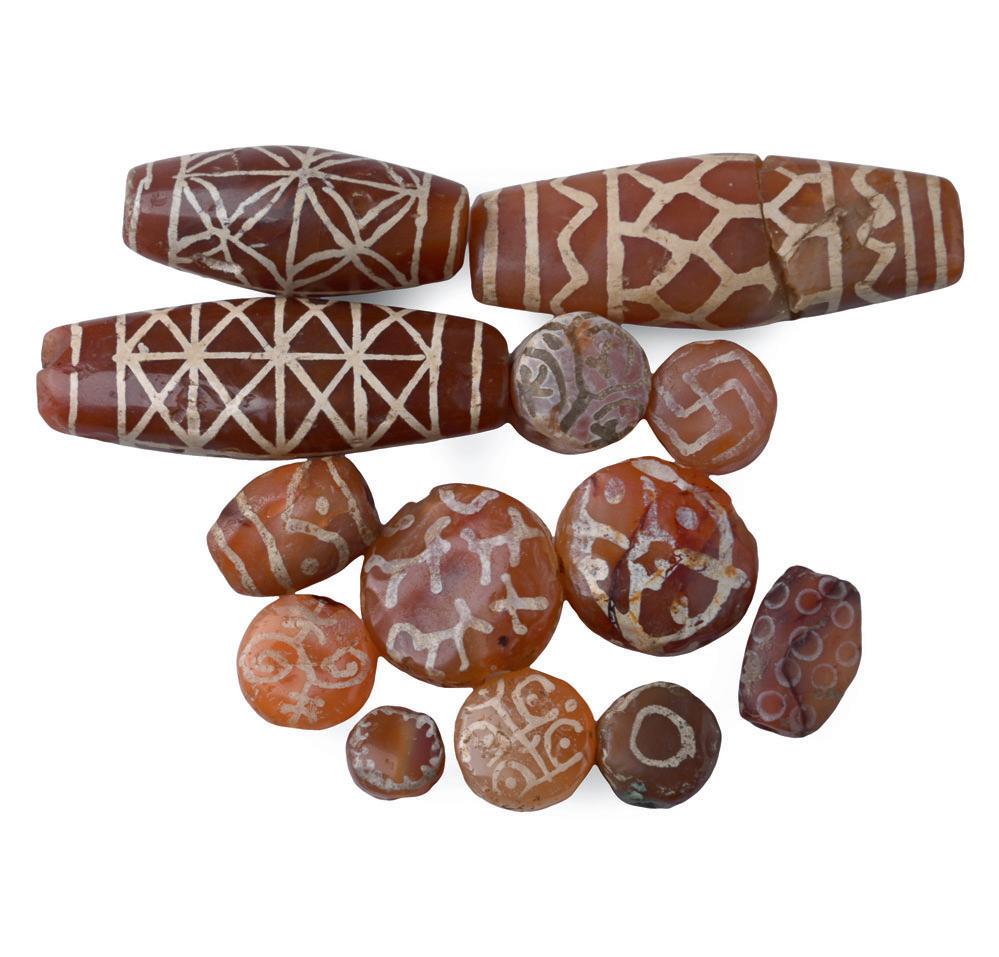
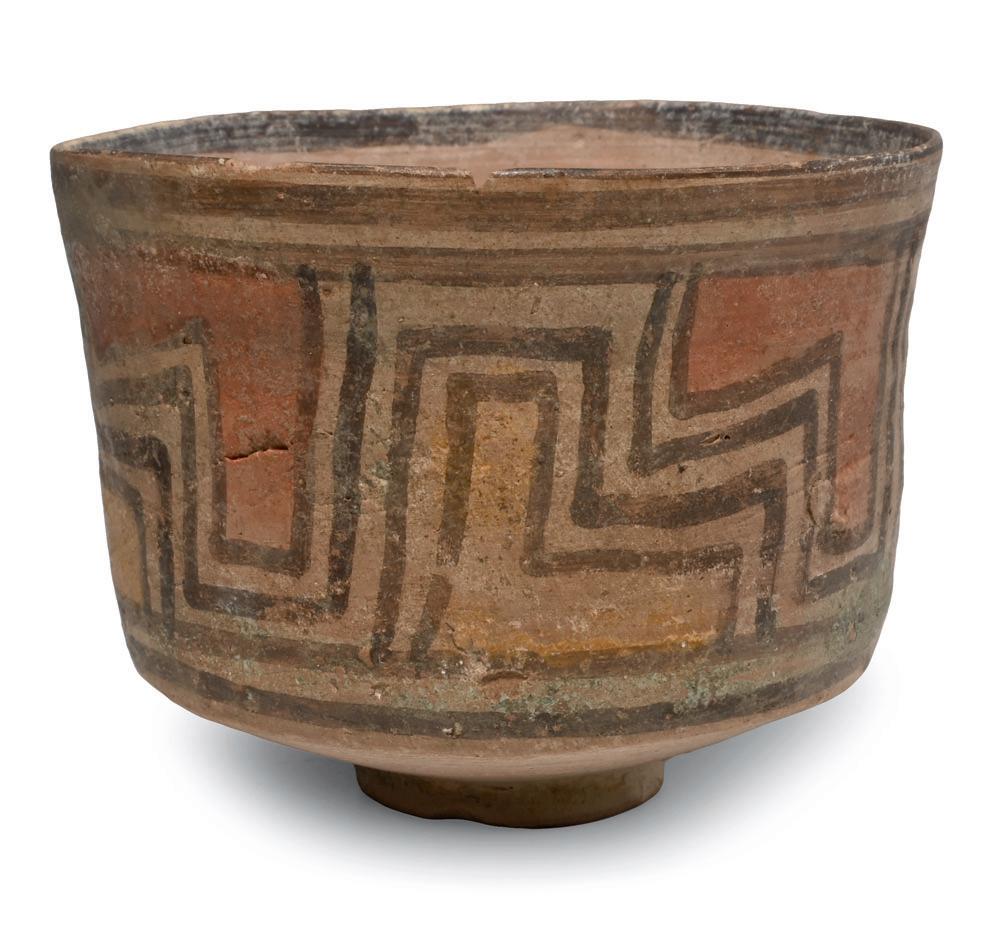
307
INDUS VALLEY DECORATED TERRACOTTA JAR
3RD-2ND MILLENNIUM B.C.
4 in. (324 grams, 11.8 cm wide)
Drum-shaped in profile with broad shoulder and mouth, flared rim; concentric painted bands to the shoulder and sidewall, with hatched and geometric detailing.
£500 - 700
PROVENANCE:
Ex London, UK, gallery, 1971-early 2000s. London, UK, collection.
308
INDUS VALLEY PAINTED TERRACOTTA VESSEL
3RD MILLENNIUM B.C.
6¼ in. (933 grams, 16 cm)
Drum-shaped vessel with a small mouth, the body with a standing lion and a grazing gazelle with panels of geometric decorations in between, the upper face with concentric circles and hemicircles.
£400 - 600
PROVENANCE:
From a collection acquired on the UK art market from various auction houses and collections mostly before 2000.
From an important Cambridgeshire estate; thence by descent. Private collection, London, UK.
309
INDUS VALLEY PAINTED TERRACOTTA VESSEL
3RD MILLENNIUM B.C.
4 in. (151 grams, 10 cm wide)
Squat body with a short neck and an everted rim, painted wave motifs on the shoulder.
£200 - 300
PROVENANCE:
Ex London, UK, gallery, 1971-early 2000s. London, UK, collection.
310
LARGE INDUS VALLEY ETCHED ORANGE CARNELIAN NECKLACE
BEAD COLLECTION
CIRCA 2ND MILLENNIUM B.C.
¼ - 1 in. (61.03 grams total, 9.84-49.06 mm)
Comprising: a barrel-shaped bead with floral decoration, two flattened barrel-shaped beads with geometric motifs, one discoid bead with crux gammata, and other beads with geometric decoration. [13]
£400 - 600
PROVENANCE:
From the private collection of a European gentleman (1942-2024), formed since the 1970s.
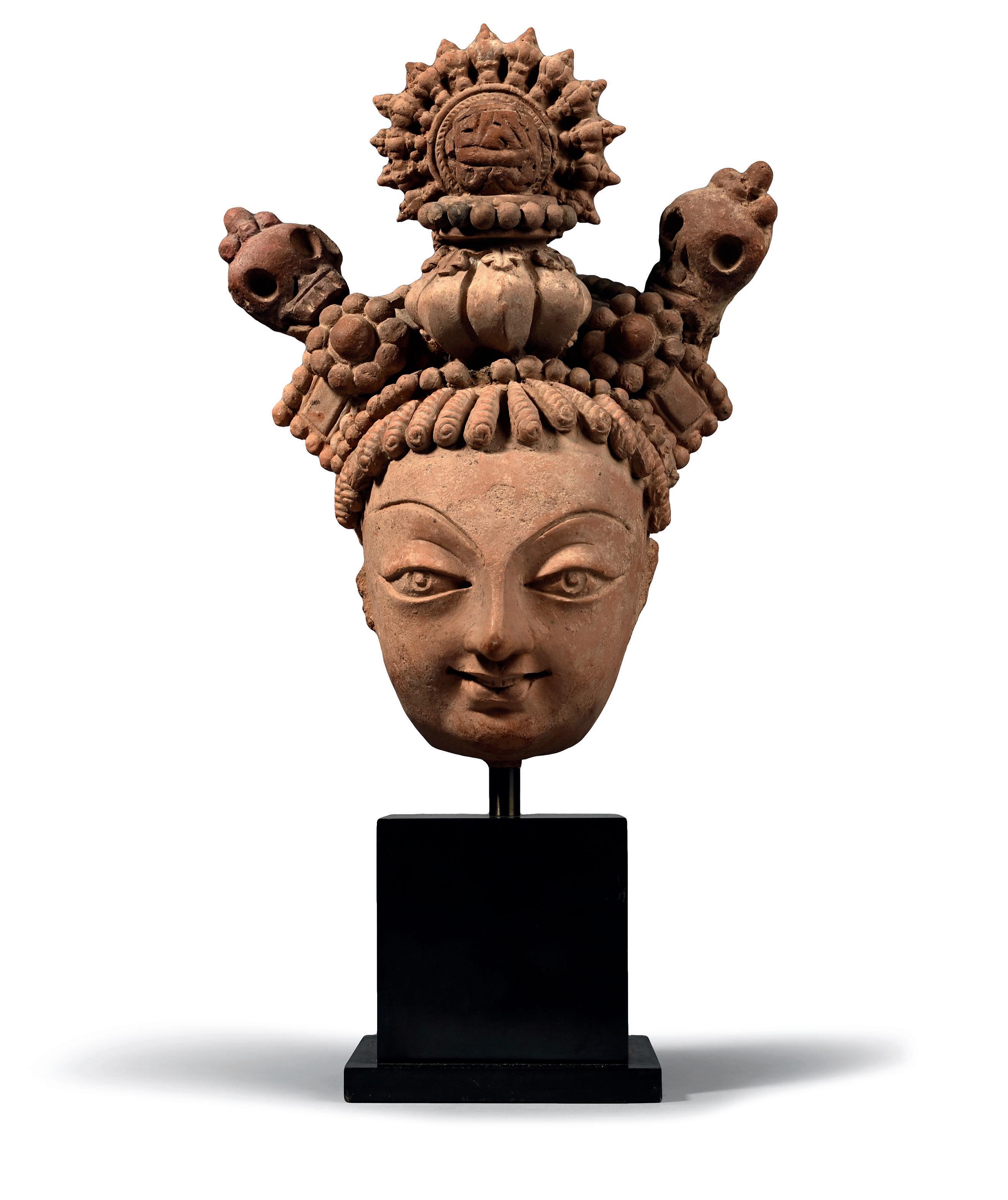
KASHMIR TERRACOTTA HEAD OF A BODHISATTVA
HUND REGION, 6TH-7TH CENTURY A.D.
16¾ in. (5.76 kg total, 42.5 cm high including stand)
Modelled in the round with heavily-lidded eyes, aquiline nose, thinlipped mouth; band of conch shells to the brow hanging from a brow-band with segmented bulb above supporting a radiating plaque and sphere, flanked by two rosette collars each supporting a skull; mounted on a custom-made stand.
£8,000 - 10,000
PROVENANCE:
American collection, probably from the 1990s. Private collection, London.
Accompanied by a thermoluminescence analysis report by Oxford Authentication.
FOOTNOTES:
Many terracotta fingers, toes and hair curls from such statues have been found at sites in Kashmir, like Harwana. Such terracotta objects depict the influences of Gandharan art in the Kashmir valley. The terracotta objects found at the sites depict the strong influences of the Gandhara school of art in the Kashmir valley. The bodily limbs of Lord Buddha and bodhisattva in terracotta and their art, besides the isolated plague represent the replica of the miniature stupa.
312
LURISTAN BRONZE SPEARHEAD COLLECTION
CIRCA 1000-700 B.C.
13 - 15¼ in. (1.65 kg total, blades: 34.5-38.6 cm)
Group of three tanged spearheads, each with a slender leaf-shaped two-edged blade and midrib, tiered ribbing to the neck, square-section tang with chisel tip; mounted on a custom-made stand. [3]
£4,000 - 6,000
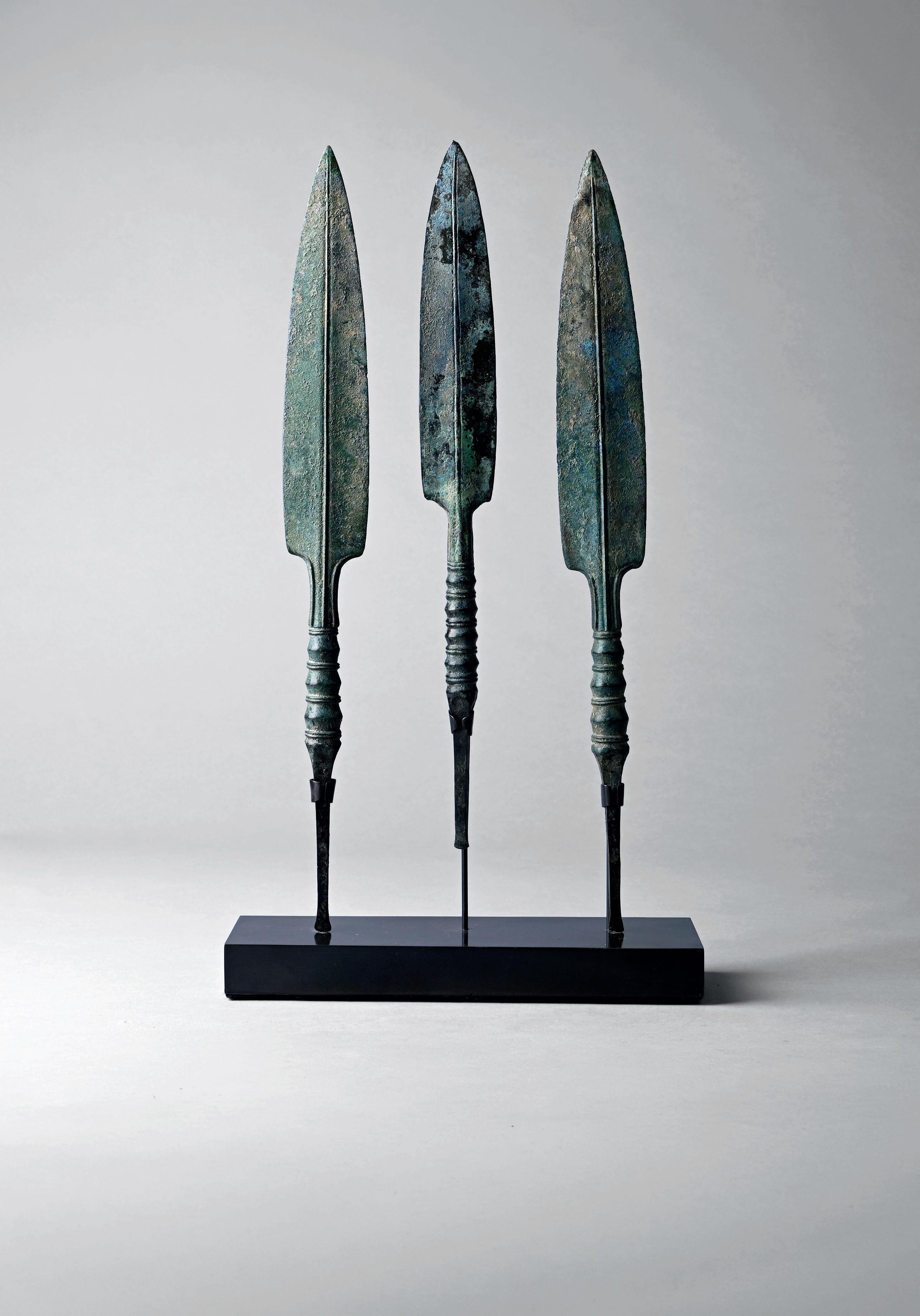
PROVENANCE: Ex London, UK, gallery, 1971-early 2000s. London, UK, collection.
FOOTNOTES: Spearheads of this kind were realised by mould casting. They were of different lengths and used by Luristan, Hamadan, early Median and Achaemenid warriors.
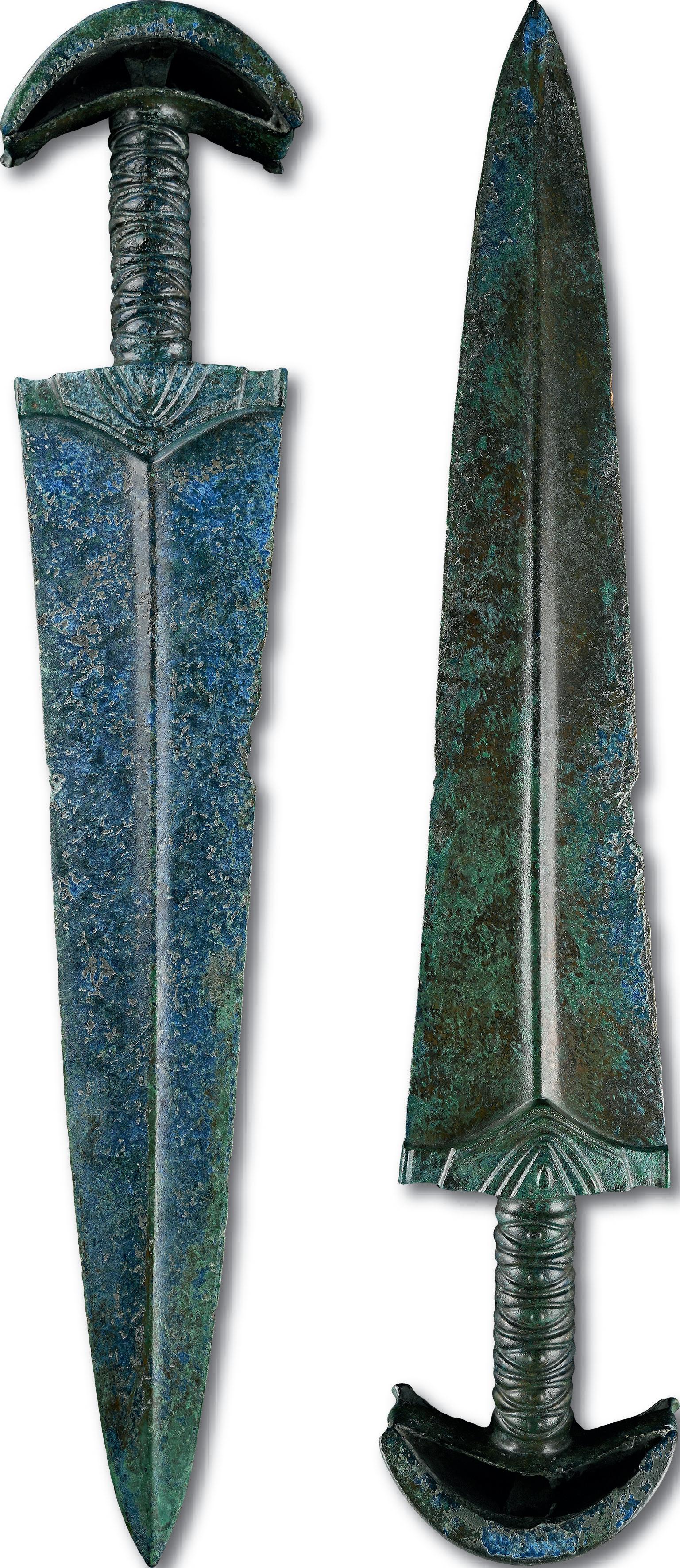

313
20¼ in. (1.12 kg, 51.5 cm)
Comprising a triangular blade with a thick midrib; the grip with a series of raised coffee bean-shaped bosses, and a fine crescentic openwork pommel.
£5,000 - 7,000
PROVENANCE: Private collection, Japan, formed 1970-2010. with Ancient and Oriental, UK. Private collection, London, UK, acquired from the above. Private collection, London, UK.
Accompanied by an academic report by Dr Raffaele D’Amato.
FOOTNOTES: The now empty cavities of the pommel were once filled with organic material.
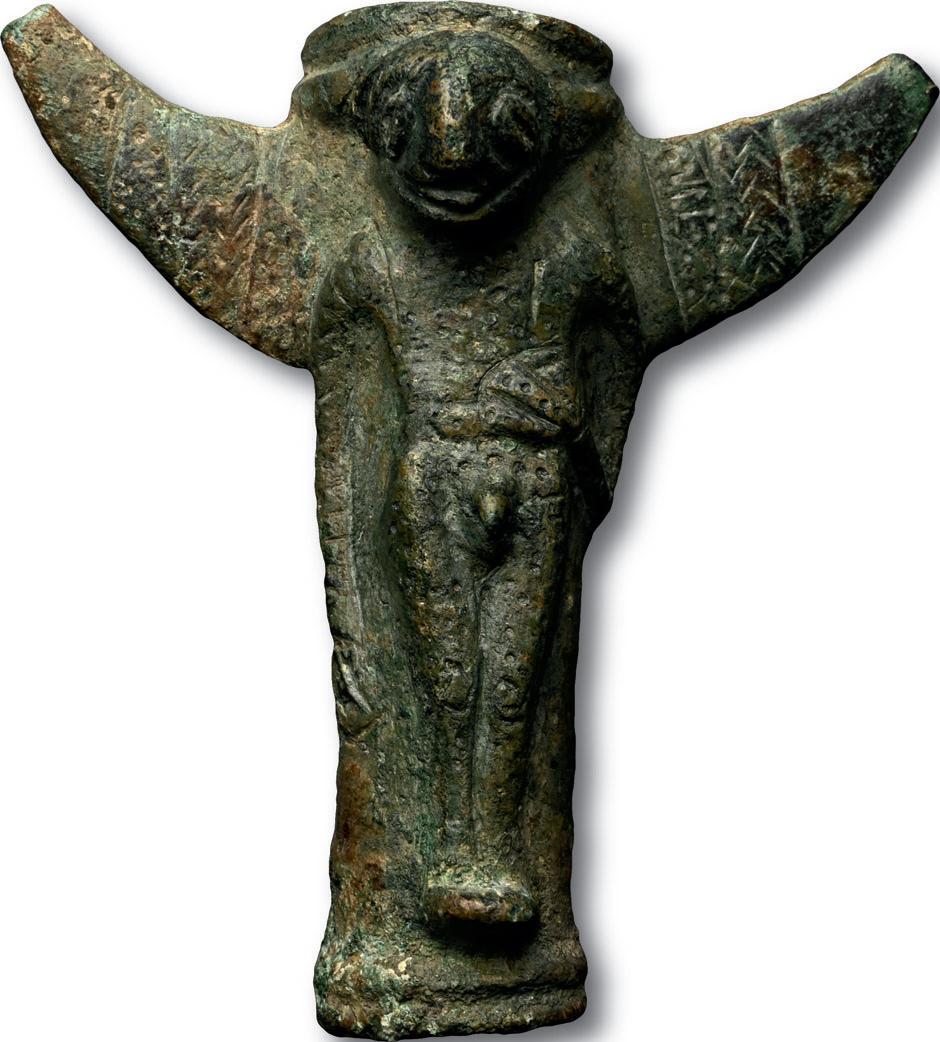

314
ELAMITE BRONZE MACEHEAD WITH WINGED HUMAN AND ANIMAL FIGURE
2ND MILLENNIUM B.C.
3 in. (285 grams, 98 mm)
Of cylindrical form with a raised collar at each end, one side depicting a nude male with a projecting grotesque head, the other side with a projecting ram’s head with a long, curving serpent below, two crescentic wings projecting from the upper part of the socket.
£1,500 - 2,000
PROVENANCE:
Acquired before 1983.
Ex London gallery, 1990s.
Private collection, London, UK.
FOOTNOTES:
Maces in the Middle East had always had a double function since the early periods: a) as a weapon and b) as a status symbol or symbol of rank and office. The bull-headed mace, called gorz-e gavsar in Persian, was already in use in the ancient Elam and Luristan, and was also common in religious ceremonies.

315
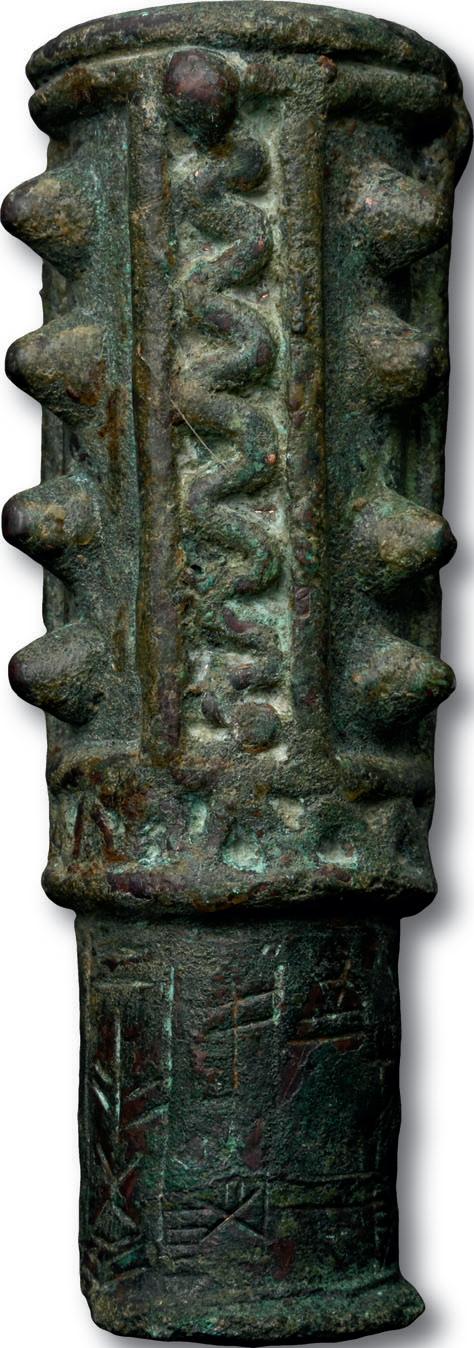
ELAMITE BRONZE MACEHEAD INSCRIBED ‘TO NIN’AZU, BALA, SON OF LUGAL-KARE-SI’ EARLY DYNASTIC IIIB PERIOD, CIRCA 2500-2340 B.C.
4½ in. (350 grams, 11.6 cm)
Comprising a cylindrical shaft with a narrow flanged base, the upper section with three vertical relief panels decorated by round spikes alternated with a wavy pattern, divided and bordered by parallel ridges, engraved with five lines of Sumerian cuneiform text around the socket, a votive inscription translating to: ‘To Nin’azu, Bala, son of Lugal-kare-si, the merchant, has presented (it)’.
£1,800 - 2,400
PROVENANCE: Acquired before 1983.
Ex London gallery, 1990s. Private collection, London, UK.
FOOTNOTES:
This gorz mace head belongs to the category of truncheon-shaped mace heads, a type developed on the Iranian plateau during the Bronze Age, used by Elamite and Luristan warriors since the 3rd millennium B.C. This category of objects was also interpreted as a part of a shaft or cudgel, but most scholars agree on the interpretation of use as a mace.

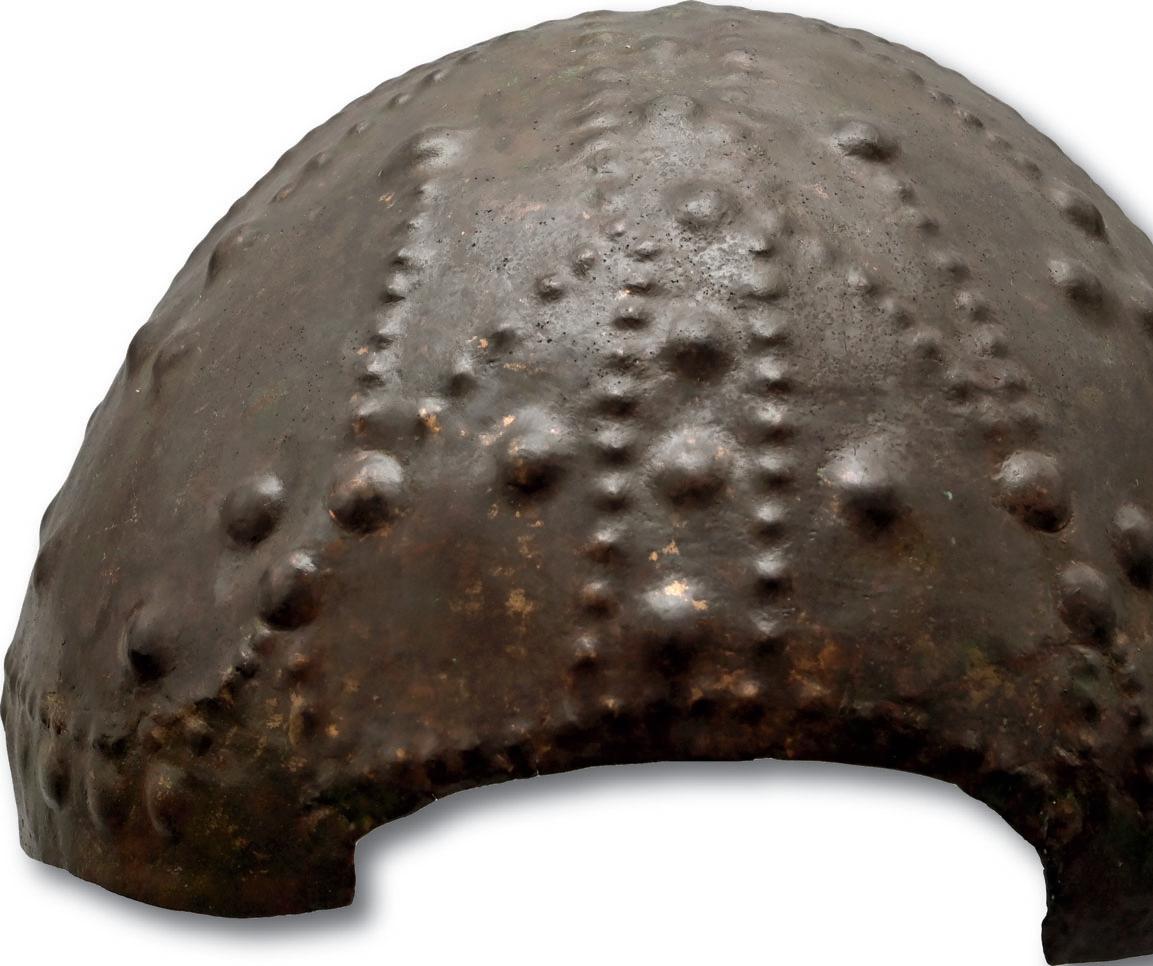


URARTIAN BRONZE HELMET WITH EMBOSSED DECORATION
9TH-7TH CENTURY B.C.
16 in. (1.5 kg total, 41 cm including stand)
A Caucasian or Urartian helmet of domed profile, hammered from a single sheet of metal; radiating rows of small repoussé bosses with interstitial rows connecting larger examples; shallow recess at the forward edge; old accession label to inner face ‘AG334’; later pseudo-inscription; some restoration.
£6,000 - 8,000
PROVENANCE:
Ex Axel Guttmann Collection of Ancient Arms and Armour, Germany [1944-2001], AG 334, 1990. with Hermann Historica, Munich, Germany, 2008. Private collection, New York, USA.
Accompanied by an academic report by Dr Raffaele D’Amato.
FOOTNOTES:
The Urartian craftsmen were especially famous for their metalworking skills. However, the shape of this helmet differs considerably from the usual pointed Urartian examples, and shows a strong influence from the Scythian and Moeotic military headgear, which is not surprising if we consider that Urartu had been at war with the Scythian tribes of Caucasus since the 7th century B.C. The remainder of the helmet is its bowl, embossed and decorated, and an unusual recess on the front part. The helmet was used with a padded cap, which probably formed an integral part of the same headgear.
317
LURISTAN BRONZE LONG SWORD WITH DOUBLE-EDGED BLADE AND DOMED POMMEL
CIRCA 1200 B.C.
25¾ in. (1.12 kg, 65.5 cm)
With a tapering, double-edged, triangular blade and three-column midrib; crescentshaped guard at the shoulder; cylindrical hilt with grips, domed pommel with recesses for inlay.
£1,000 - 1,400
PROVENANCE:
Ex German collection. with Hermann Historica, Munich, Germany, 2008. Private collection, New York, USA.








318
GREEK IRON SHORT SWORD
HELLENISTIC, 2ND-1ST CENTURY B.C.
22 in. (400 grams, 56 cm)
Lentoid in section with two cutting edges and narrow point; slight flare towards the tip; small shoulder and rectangular-section tang.
£400 - 600
PROVENANCE:
Ex German art market, 2000s.
Acquired from an EU collector living in London.
From the collection of a Surrey, UK, gentleman.
319
‘BOURTON-ON-THE-WATER’ CELTIC SWORD-SHAPED IRON CURRENCY INGOT
IRON AGE, CIRCA 200 B.C.-1ST CENTURY A.D.
32¼ in. (561 grams, 82 cm)
A substantial long iron bar in the shape of a sword with the original short folded-over handle to one end.
£300 - 400
PROVENANCE:
Found Bourton-on-the-Water, Gloucestershire, UK, during the period between WWI and WWII.
Property of the finder’s family until sold by regional auction house, Tayler & Fletcher in Bourton-On-The-Water.
From the private collection of a Stratford-upon-Avon, UK, gentleman.
320
VERY LARGE IRON AGE CELTIC IRON LA TÈNE SOCKETTED SPEARHEAD
1ST CENTURY B.C.-1ST CENTURY A.D.
28¾ in. (819 grams, 73 cm)
Extremely long, slender leaf-shaped blade with a median rib, rounded tip, short shoulder, and a socket with lateral holes to accept a fixing peg.
£1,000 - 1,400
PROVENANCE:
Ex German art market, 2000s.
Acquired from an EU collector living in London.
From the collection of a Surrey, UK, gentleman.
321
LATE ROMAN IRON-SHAFTED LEAD PLUMBATA
CIRCA 3RD-7TH CENTURY A.D.
5 in. (67.4 grams, 13 cm)
Comprising a barrel-shaped lead body with a round-section shaft with a barbed finial.
£300 - 400
PROVENANCE:
Ex German art market, 2000s.
Acquired from an EU collector living in London.
From the collection of a Surrey, UK, gentleman.







322
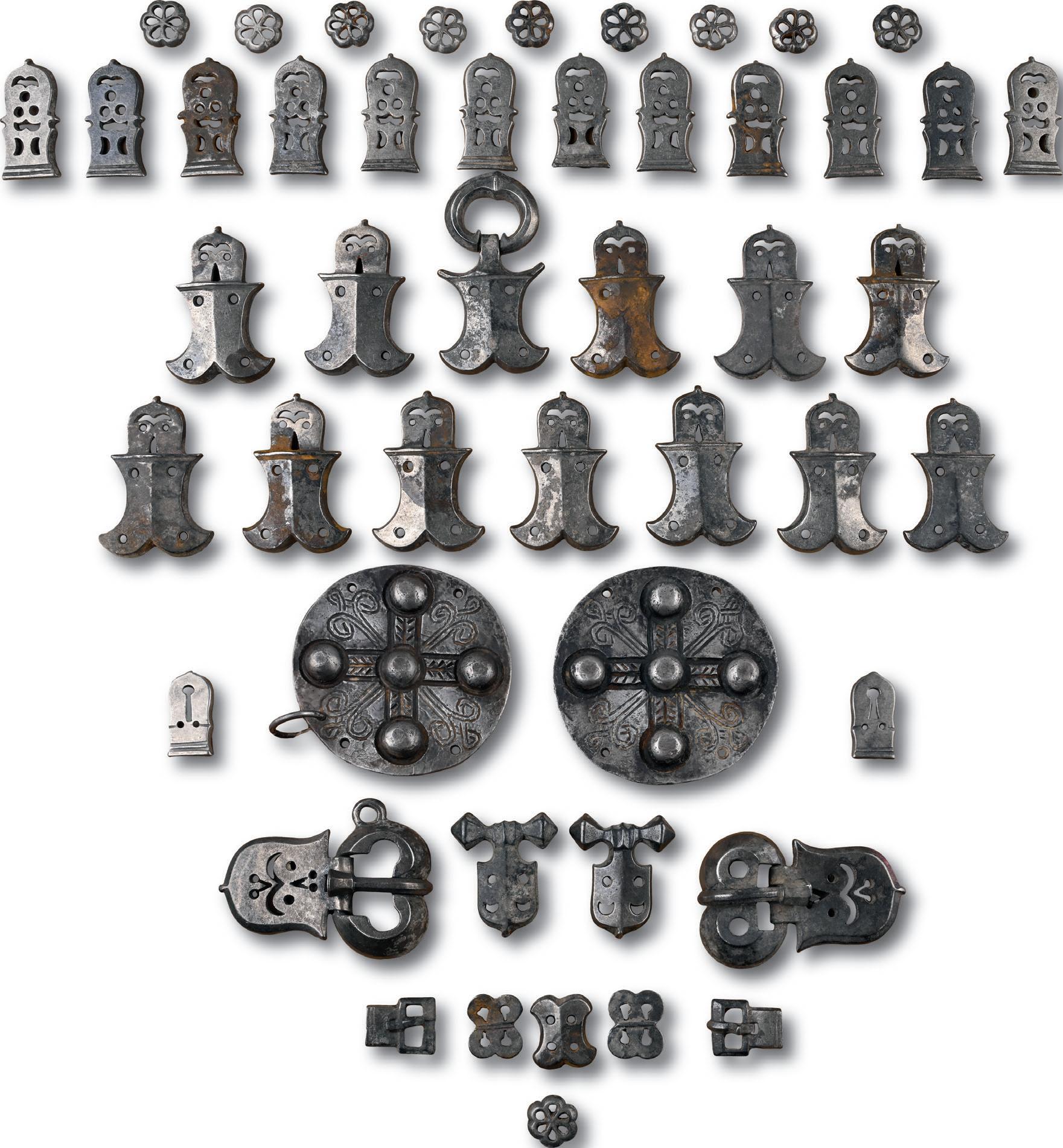
EASTERN ROMAN MILITARY SILVER BELT ELEMENT SET
6TH-7TH CENTURY A.D. - 3 in. (722 grams total, 16.08-79.52 mm)
A complete set of military belt fittings of Martinovka type, comprising forty-eight elements: two massive shield-shaped buckles, the buckle plate with a central chip-carved mask-shaped decoration, the hinged prong of rectangular form with rounded terminal; twelve shield-shaped belt pendants with wavy edges and the bottom ending in a sharp angle; ten decorative rosettes; twelve belt pendants in the form of a double crescent, with mask-shaped decoration on the oval head, decorated with chip-carved comma and dot ornaments; one pendant of the same typology fitted with a circular massive ring for the suspension; two massive circular phalerae, decorated with a double cross, one ornamented with volutes at the end of the arms, the other with five massive bosses at the sides and centre; two shield-shaped pendants with projections for the fastening of elements; two small rectangular buckles; three trapezoidal openwork pendants and two further small drop-shaped pendants. [48]
£3,000 - 4,000
PROVENANCE:
From the private family collection of a lady, UK; acquired in Germany mid-20th century.
Accompanied by an academic report by Dr Raffaele D’Amato.
FOOTNOTES:
These belt elements, which form the fittings of at least two belts, are typical of the Roman garrisons of Black Sea and the Balkans, for the late 6th and the 7th century A.D. They were connected especially with Gothic and Alan soldiers militating in the Roman army, and considered part of the Martinovka typology by the academics. Numerous finds of these multi-part belt sets have been found in the area between the Balkans, the north-northeastern Pontus region, the Kama region in the northeast, and the Caspian Sea in the east. The range of the type includes areas controlled by the Avars and the Roman Empire, the south-Danubian region (Moesia II: Beroe, Callatis, Tropaeum Traiani, Ibida, Argamum), the Carpathian area, the northern Black Sea, the Caucasus and up to the Euphrates and other areas of Europe; these elements should therefore be seen as a ‘multi-ethnic’ or ‘international’ element. They were used to hold two types of offensive weapons: a quiver with arrows, and bladed weapons such as the spatha, and the shorter culter venatorius



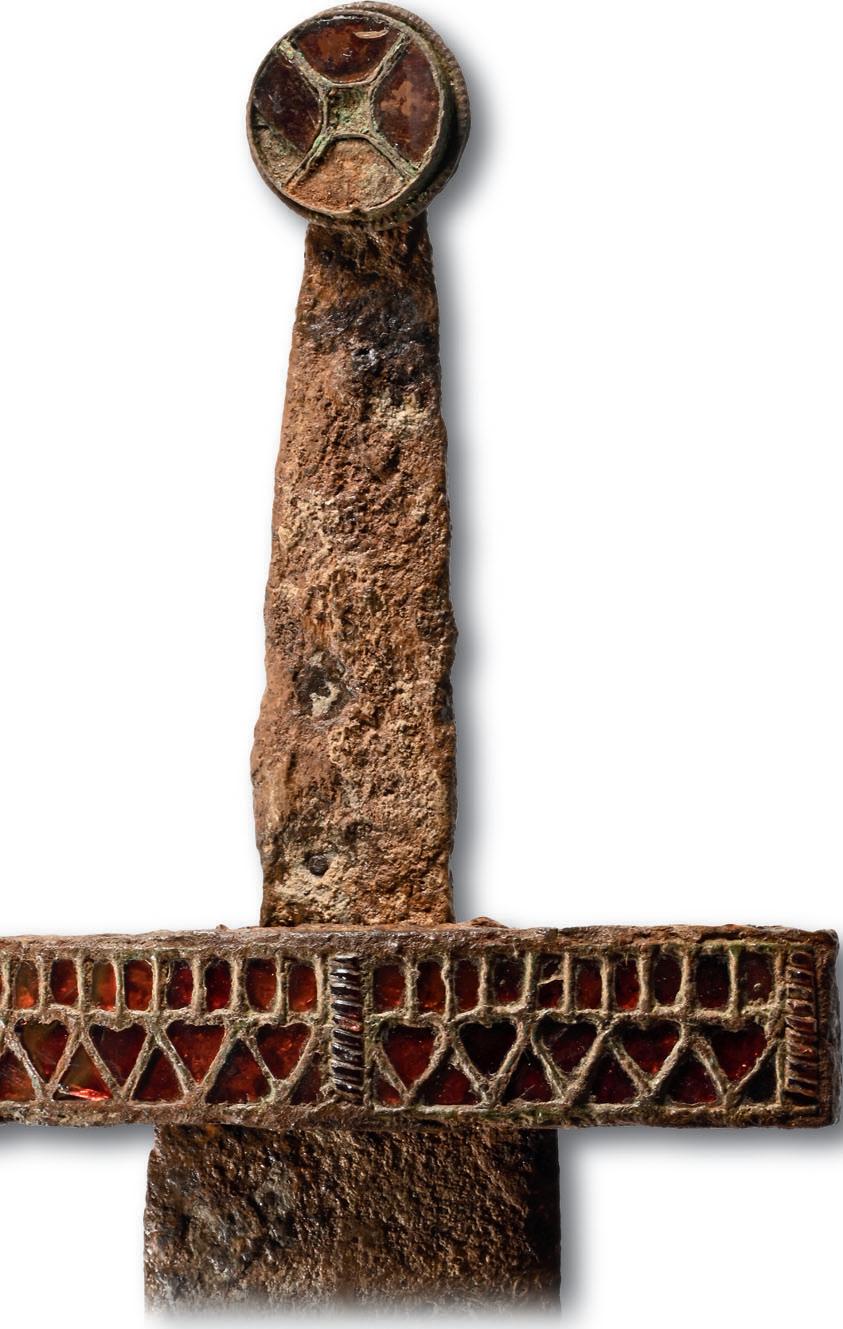

323
MIGRATION PERIOD IRON SWORD WITH JEWELLED HILT
5TH-6TH CENTURY A.D.
33 in. (954 grams, 84.5 cm)
Comprising: a spatha-type two-edged tapering blade, lentoid in section with sloped shoulders and short tang pierced by an attachment rivet for the grip; traces to both faces of the blade of wooden fibre from the scabbard; edges lightly notched but substantially complete; the lower guard rectangular in plan and scaphoid in section with inset garnet cloisons, triangular along the lower row and heart-shaped above, rectangular at the top, with small rectangular slivers at each end; accompanied by the upper roundel of the pommel, set with four garnet cloisons.
£5,000 - 7,000
PROVENANCE:
From the private collection of a London gentleman, from his grandfather’s collection formed before the early 1970s.
Accompanied by an academic report by Dr Raffaele D’Amato.
FOOTNOTES:
These ‘ceremonial’ swords (in reality widely used in battle) with an inlaid guard are, according to Kazanski, Late Roman in origin. The cloisonné decoration was probably linked with the production of particularly ornamented swords in the ateliers of the Roman capital of Constantinople. This typology of weapon was not only produced as a gift for foreign chiefs allied to the empire, but it was also adopted by the Imperial army, and reserved for the Imperial officers, who were often of Germanic or Asiatic origin.
324
VIKING IRON SWORD OF PETERSEN TYPE L
10TH CENTURY A.D.
34 in. (775 grams, 86.5 cm)
Double-edged cutting sword with tapering blade showing battle nicks along the length, tapering fullers showing shallow traces of pattern-welding, long tang, a boat-shaped lower guard and a threelobed pommel.
£3,000 - 4,000
PROVENANCE:
From the private collection of a London gentleman, from his grandfather’s collection formed before the early 1970s.
Accompanied by an academic report by Dr Raffaele D’Amato.
FOOTNOTES:
This type, considered as Anglo-Saxon in origin, is usually dated to 850-975 A.D., and is considered to form a distinctive group of Viking Age swords. Although used by the Vikings, it is probable that these swords were of English manufacture or inspiration. Swords of Type L are remarkable for their crosspieces and pommel bases curved away from the grip and lobed pommels.
325
VIKING IRON SWORD POMMEL AND LOWER GUARD
10TH-11TH CENTURY A.D.
3 - 3 in. (480 grams total, 77-92 mm)
Comprising: lower guard, lentoid in plan with recessed underside, slot to accept the tang; pommel with integral upper guard, Petersen’s Type X with semicircular profile and raised upper section, slot for tang in the underside. [2]
£600 - 800
PROVENANCE:
London, UK, collection, formed in the late 1990s.
326
VIKING IRON SWORD POMMEL, UPPER GUARD AND LOWER GUARD
LATER 10TH CENTURY A.D.
3 - 3 in. (520 grams total, 77-91 mm)
Comprising: lower guard, lentoid in plan and slightly curved in profile with recessed underside, slot to accept the tang; upper guard, lentoid in plan with scooped long edges; pommel with large median lobe and lateral shoulders, Petersen’s Type S. [3]
£600 - 800
PROVENANCE:
London, UK, collection, formed in the late 1990s.
327
VIKING IRON SWORD POMMEL, UPPER GUARD AND LOWER GUARD
LATER 11TH CENTURY A.D.
2 - 4½ in. (522 grams total, 6.7-11.5 cm)
Comprising: lower guard, parallel-sided in plan with rounded ends and slightly curved in profile with recessed underside, slot to accept the tang; upper guard, lentoid in plan with scooped long edges and section of tang in situ; pommel with large median lobe and lateral shoulders, Petersen’s Type Z. [3]
£600 - 800
PROVENANCE: London, UK, collection, formed in the late 1990s.

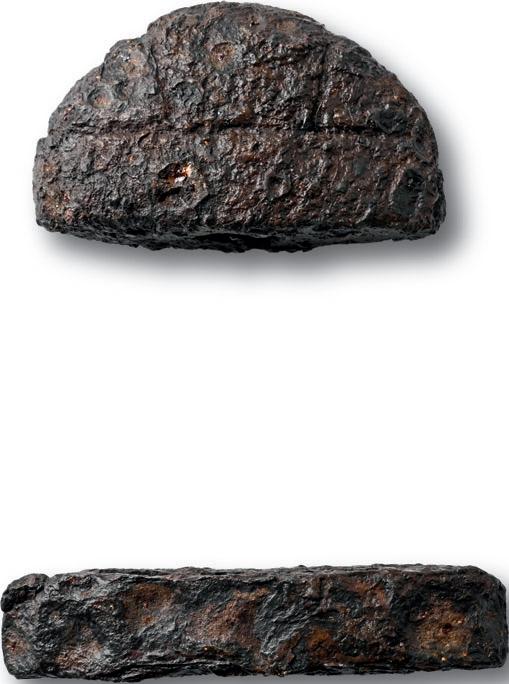

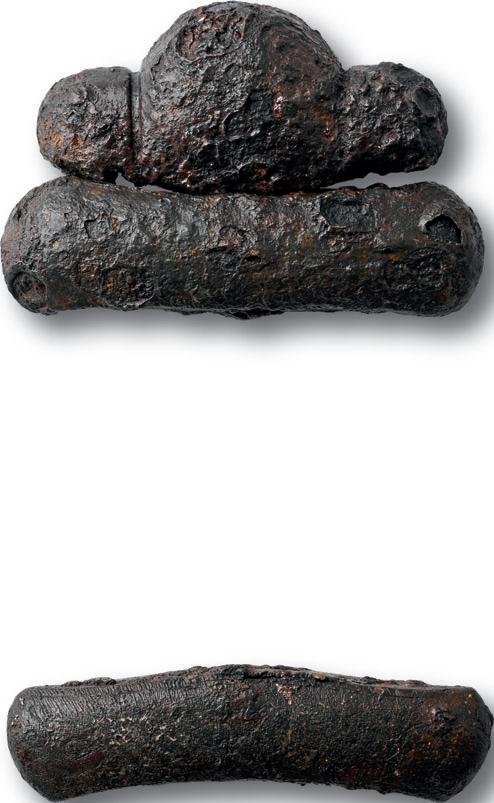


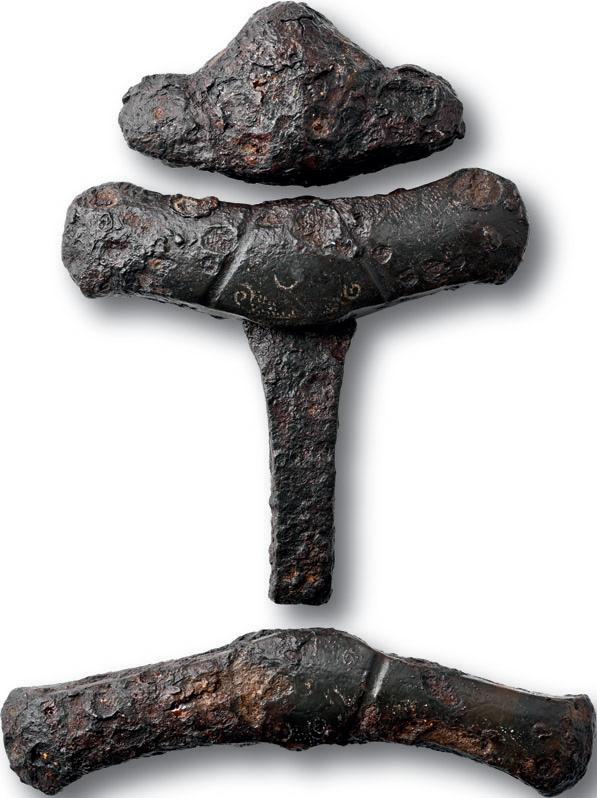
328
JAPANESE EDO PERIOD SAMURAI SUIT OF ARMOUR WITH WOODEN STORAGE BOXES
EDO PERIOD, 1603–1867 A.D. AND LATER
61¾ in. (29.95 kg total, 157 cm high (assembled))
Comprising: an iron and copper-alloy old style Gomai kabuto ridged helmet with suji-kabuto bowl, suji-tate raised ridges, terminating in a small four-stage tehen kanamono hole, fitted with a crossed plate; giltcopper maedate (frontal ornament) with high raised datemono, antennae; mabizashi, (integral peak visor), lined with silk; fukigaeshi, (steel wings); the neck of the helmet is protected by a laminated shikoro (neck guard with solid plates), made of five steel plates (hachi tsuke- not-ita, ni-no-ita, san-no-ita, yon-no-ita), with red braid sugakeodoshi spaced lacing; the helmet with internal lining (ushibari); behind the nape of the bowl attached a kasa jirushi no kan ring for the red tuft;
a fine memp iron face mask, black lacquered on the outside, red on the inside, with high cheekbones engraved with deep wrinkles on either cheek, detachable nose with simple hooked nails odayori no kugi, flared nostrils and open mouth, moustache, to which is attached a laminated yodare-kake, (throat guard), made of four numbered iron gilded plates with red braid sugake-odoshi spaced lacing;
a hybrid armour, composed of a okegawa-do type, constructed with large gilded iron solid horizontal plates joined by the lacing system known as sugake-odoshi in the upper part and kebiki-odoshi in the lower part; composing two valves (ni-mai) attached on the right side and over the shoulders by strings (aibiki no o), attached to it a kusazuri protection made from hardened leather plates hanging from the front and back of the d to protect the lower body and upper leg; fastening lace agemaki-bow suspended from a ring on the back upper plate and on the sides of a central bronze dragon plaque; oda gote vambraces, arm protection with gilded lacquered splint iron plates (shino) connected with chain armour gusari fitted with tekk gauntlets, the shino and tekk decorated with gilded rosette motifs; mogani-sode, slightly curved shoulder guards, composed from six gilded raw-hide plates, fitted with red kake-o (suspending cords) and uke-o (securing cord), bordered by kesho-no-ita (strips of wood covered with leather) and a silk-lined kamuri-ita; Ita-haidate, thighguards, faced with fusa-gusari mail and connected with gilded rawhide splint armour, the upper part lined with silk; O-tateage no-suneate, with gilded iron splint armour (shino), fitted with small round armour plates (kikko) protecting the knees; in two metal-bound wooden transport cases.
£10,000 - 14,000
PROVENANCE: Private collection, UK.
Accompanied by a certificate issued by Chairman Hitoshi Nagata of the Japan Armour and Weapons Research Preservation Association, certificate no. Qing 1309.
Accompanied by an academic report by Dr Raffaele D’Amato.
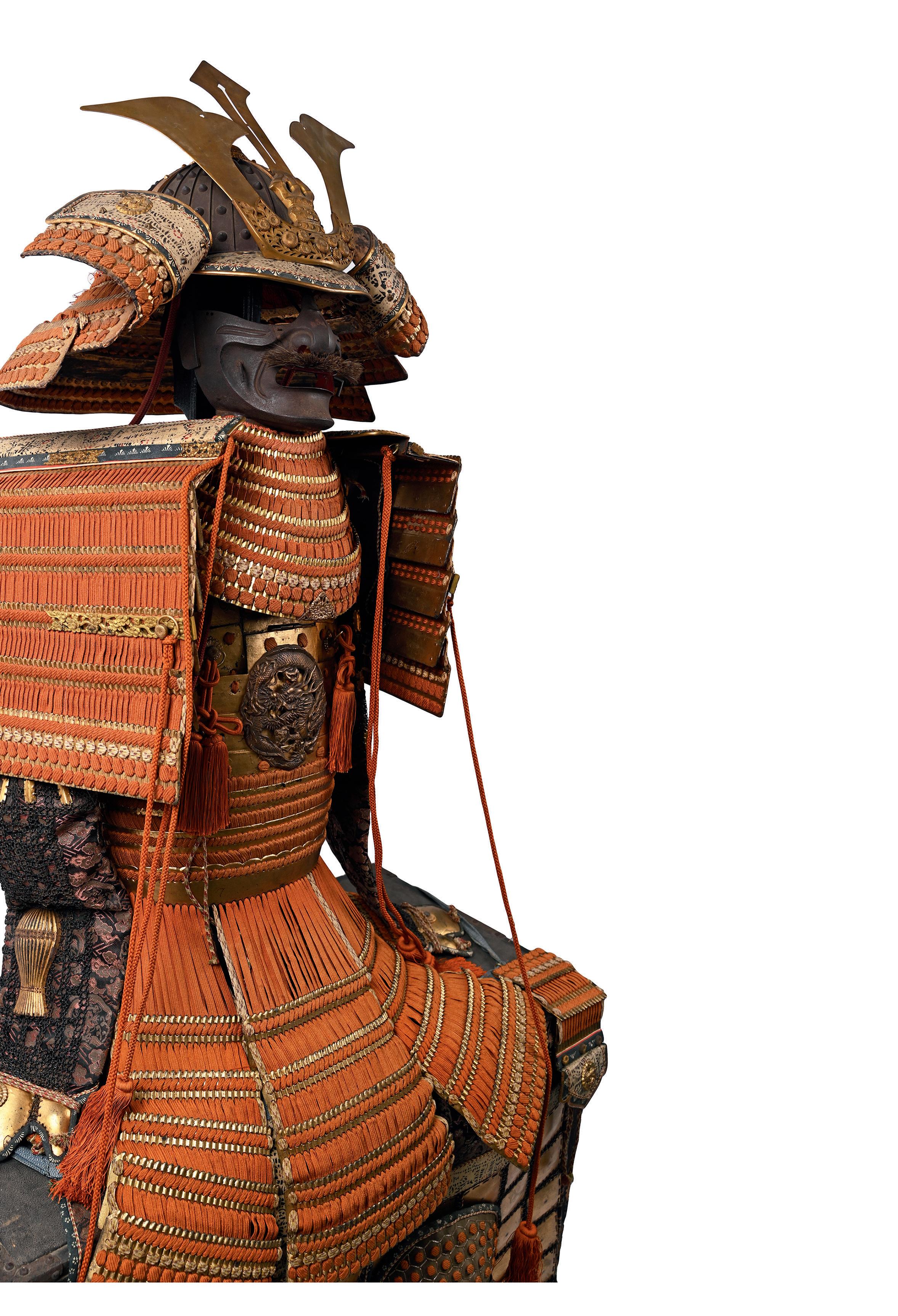
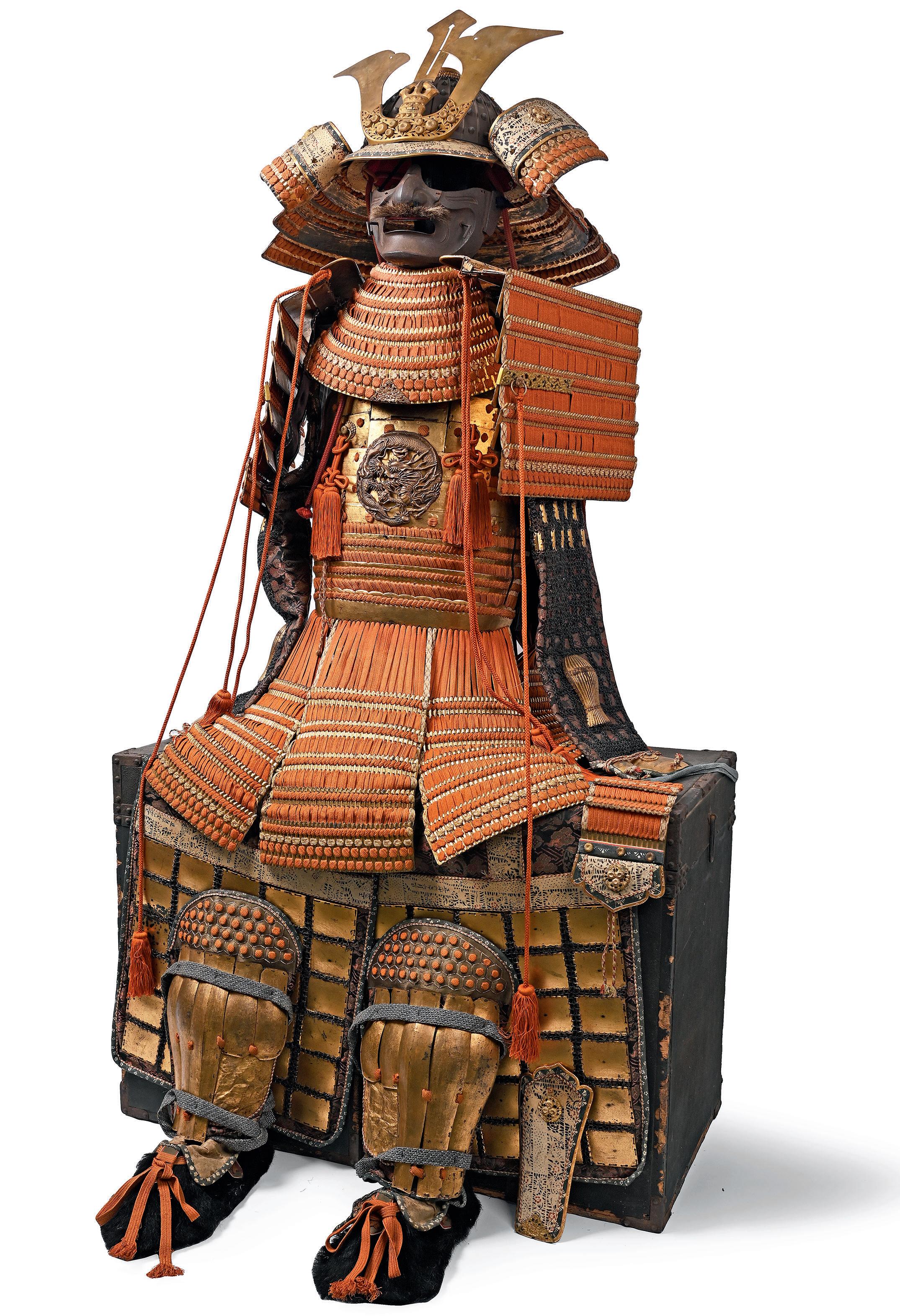
329

330
STONE AGE ACHEULEAN KNAPPED FLINT HANDAXE
LOWER PALAEOLITHIC, CIRCA 700,000-300,000 B.P. 5¾ in. (459 grams, 14.4 cm)
Triangular in profile with chipped point; bifacial type.
£300 - 400
PROVENANCE: Northern France.
Collection of Jean-Claude Debenne (1936-2020), formed between the 1950s and 1990s.
Accompanied by an original French Ministry of Culture export certificate no.CBC 242920.
329
VERY LARGE BRITISH MUSEUM RECORDED PALAEOLITHIC HANDAXE FROM THE HAPPISBURGH AREA
PALAEOLITHIC PERIOD, CIRCA 600,000 B.P. in. (773 grams, 16.1 cm)
Handaxe of Wymer’s type D, slightly buff patinated rolled flint.
£800 - 1,000
PROVENANCE:
Found by Mr P. Macro in the Parish of Walcott (via GPS location), which is directly next to the Parish of Happisburgh, where this stretch of beach adjoins.
The discovery was made in 2019 after the ‘Beast from the East’ storm, which stripped the beach of the sand and helped to erode the Palaeolithic artefacts from the ancient Thames river bed.
During the time the artefacts were dropped, the Thames ran through North Norfolk and what is now Happisburgh before it was pushed down to its current position in London via the Ice Age glacial melts.
Accompanied by a copy of the British Museum’s Portable Antiquities Scheme (PAS) report no.NMS-8D526A.
FOOTNOTES:
The site of Happisburgh in Norfolk has helped to push the history of inhabitation of the British Isles back by 200,000, making it a site of special importance.


331
STONE AGE ACHEULEAN KNAPPED FLINT HANDAXE
LOWER PALAEOLITHIC, CIRCA 700,000-300,000 B.P.
5¾ in. (540 grams, 14.5 cm)
Ovate in profile with broad base; inked legend to cortex at base ‘Longeuil Ste Marie / Oise et [...]’; point absent.
£300 - 400
PROVENANCE:
Longueil, Seine-Maritime, Oise.
Collection of Jean-Claude Debenne (1936-2020), formed between the 1950s and 1990s.
Accompanied by an original French Ministry of Culture export certificate no.CBC 242901.

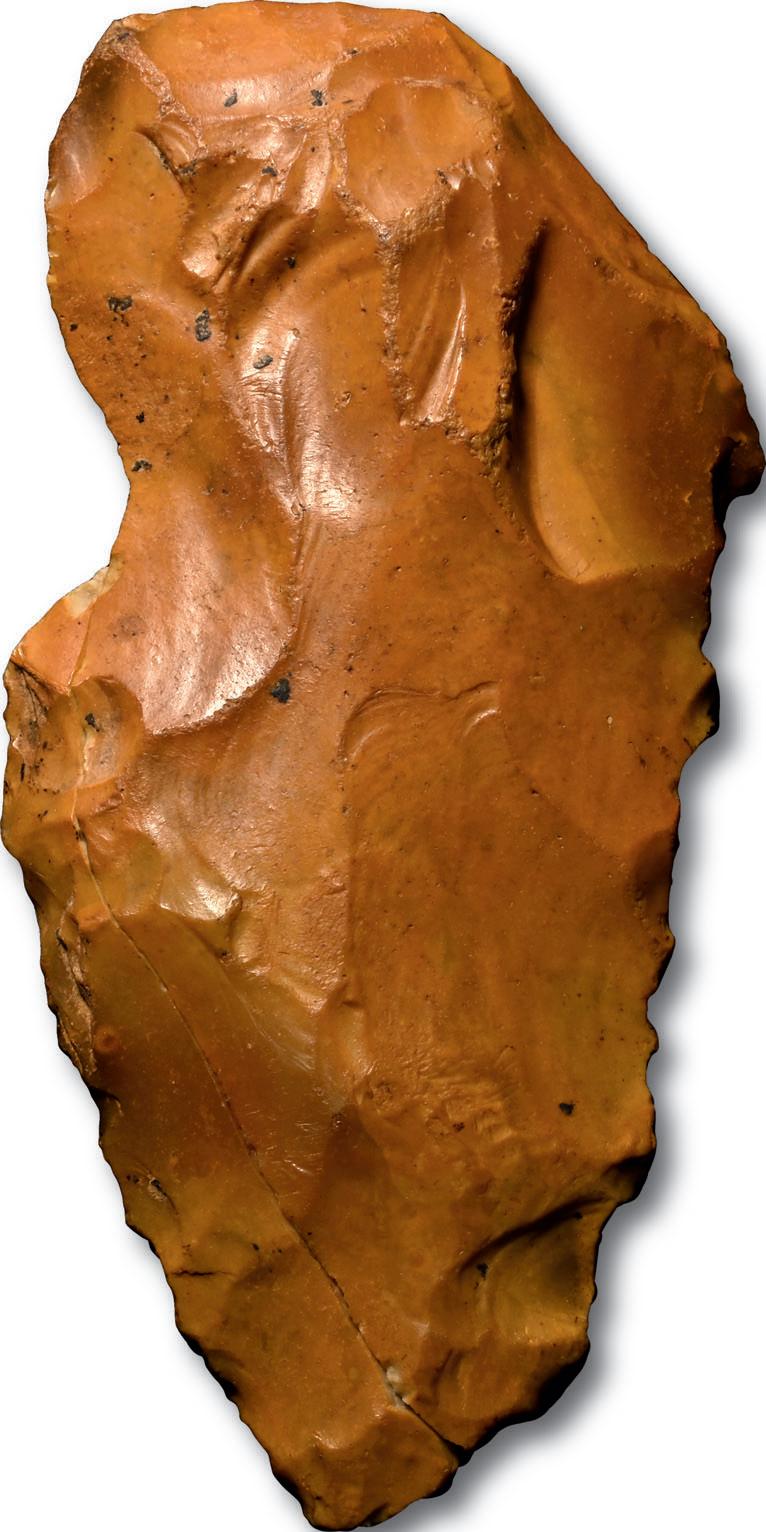

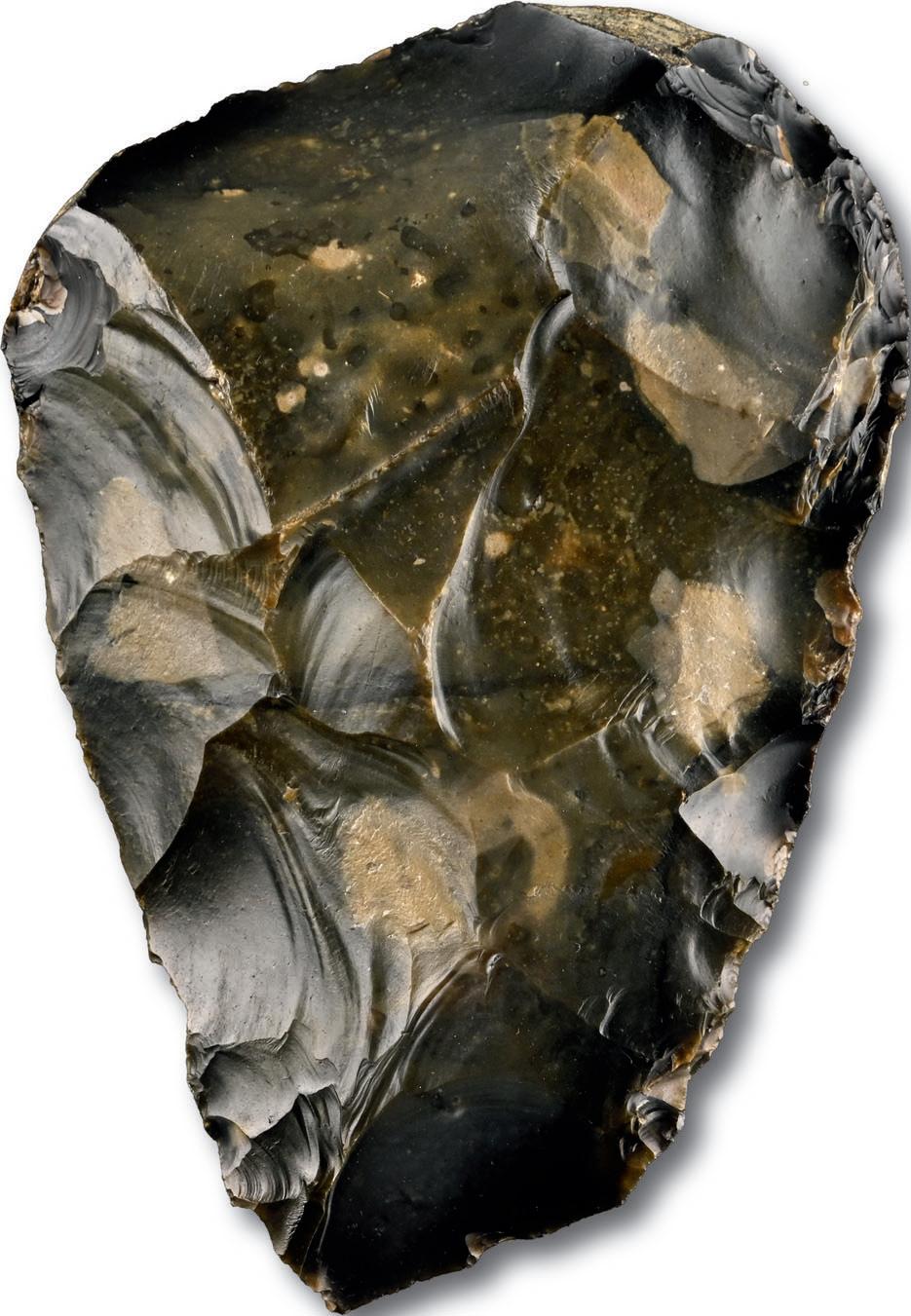
332
BRITISH STONE AGE KNAPPED FLINT HANDAXE FROM FARNHAM, GREENHILL
MIDDLE PALAEOLITHIC PERIOD, CIRCA 150,000-60,000 B.P.
6 in. (301 grams, 15.6 cm)
Lanceolate in profile with broad point; inked findspot ‘Farnham 1901’; repaired.
£500 - 700
PROVENANCE:
Found in 1901.
From the collection of Captain Streatfield who helped to fund the archaeology excavations at Farnham, Kent.
After Captain Streatfield passed away in the 1940s, his collection was sold at auction to a gentleman in Kent.
The collection was then sold again in the 2020’s via a UK auction house.
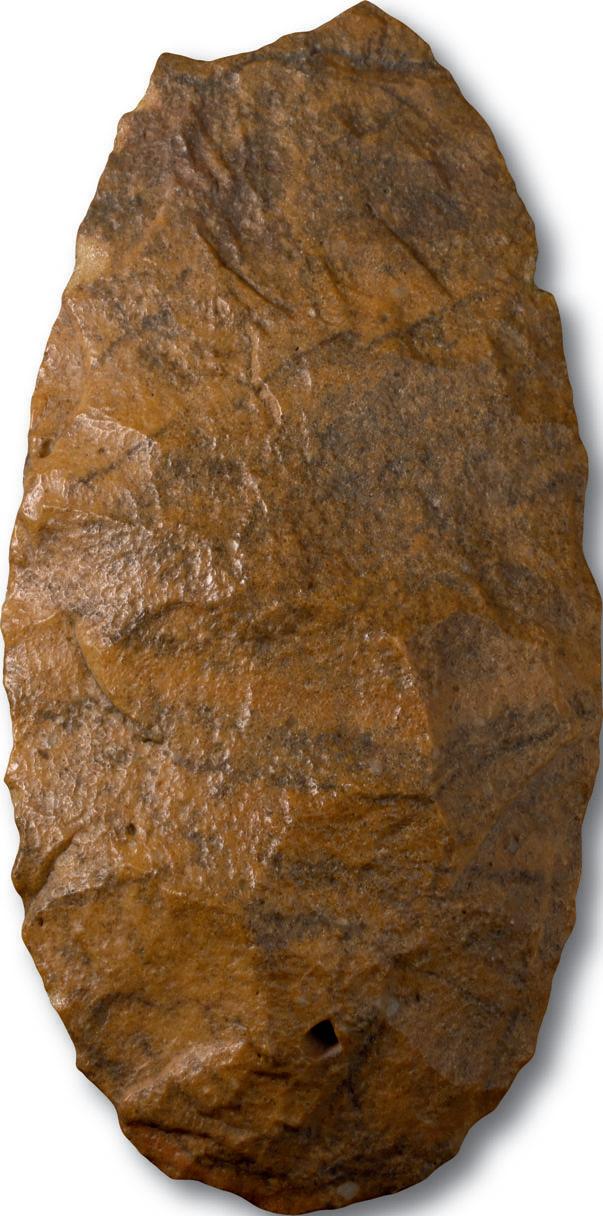

334
VERY LARGE AFRICAN STONE AGE HOMO ERECTUS KNAPPED RED STONE HANDAXE
PALAEOLITHIC PERIOD, CIRCA 1,000,000-500,000 B.P.
9¾ in. (1.2 kg, 24.9 cm)
Piriform in plan with broad, rounded butt; old inked findspot ‘Nr Guezzam’;
£400 - 600
PROVENANCE:
From Guezzam, Sahara.
Ex old German collection formed in the 1970s. Purchased on the European art market.
FOOTNOTES:
Made from a material with quartzite inclusions.

333
VERY LARGE AFRICAN STONE AGE HOMO ERECTUS KNAPPED QUARTZITE HANDAXE
PALAEOLITHIC PERIOD, CIRCA 1,000,000-500,000 B.P.
10 in. (1.5 kg, 26.5 cm)
Lentoid in section and leaf-shaped in profile with old collector’s label ‘Zentral Sahara’; point absent.
£400 - 600
PROVENANCE:
From the central Saharan area.
Ex old German collection formed in the 1970s. Purchased on the European art market.
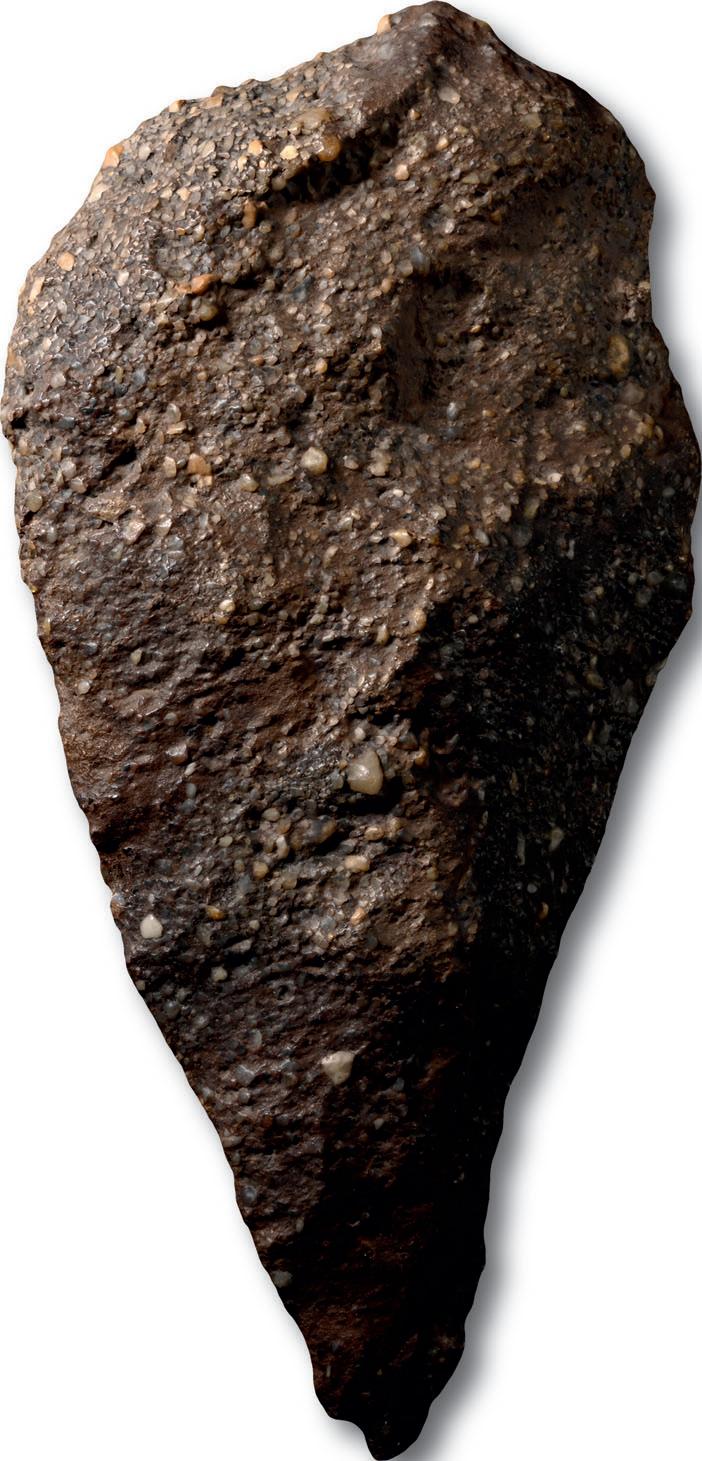
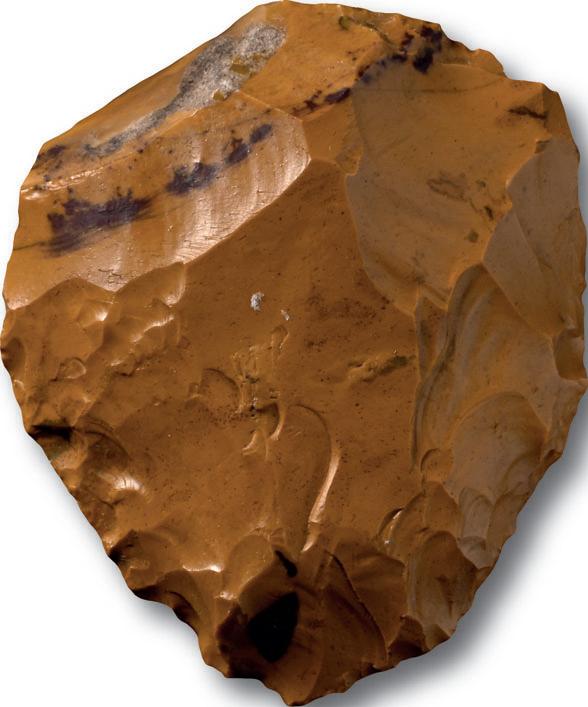

335
STONE AGE MOUSTERIAN KNAPPED FONTMAURE JASPER
NEANDERTHAL BIFACIAL HANDAXE
MIDDLE PALAEOLITHIC PERIOD, CIRCA 150,000-60,000 B.P. 2 in. (38.54 grams, 52.43 mm)
Ovate in plan with a squared butt.
£400 - 600
PROVENANCE:
Fontmaure, Vienne department, France. Acquired in the 1970s-1990s.
From the collection of the famous UK musician and amateur archaeologist, Victor Brox (1941-2023).
Acquired on the UK art market at auction after being sold by Mr Brox’s family. From the private collection of an East Anglian, UK, specialist collector.
FOOTNOTES:
Made by a Neanderthal; from the well-regarded area of Fontmaure, the jasper has vibrant colours and traces of chalcedony running through it.
336
FRENCH STONE AGE MAGDALENIAN BONE AWL MAGDALENIAN PERIOD, CIRCA 21,000-13,000 B.P. 3¾ in. (9.05 grams, 94.4 mm)
Well-preserved bone awl from ‘’Abris Val De Seine’’.
£350 - 450
PROVENANCE:
From an auction with Art Remy Le Fur. Acquired on the European art market in the 2020s.
Accompanied by a copy of French export licence no.257541.
FOOTNOTES:
The Magdalenian is a technocomplex of the Late Upper Palaeolithic. It dates from around 21,000 to 13,000 years BP. It is named after the type site of Abri de la Madeleine, a rock shelter located in the Vézère valley of Tursac in Dordogne, France.

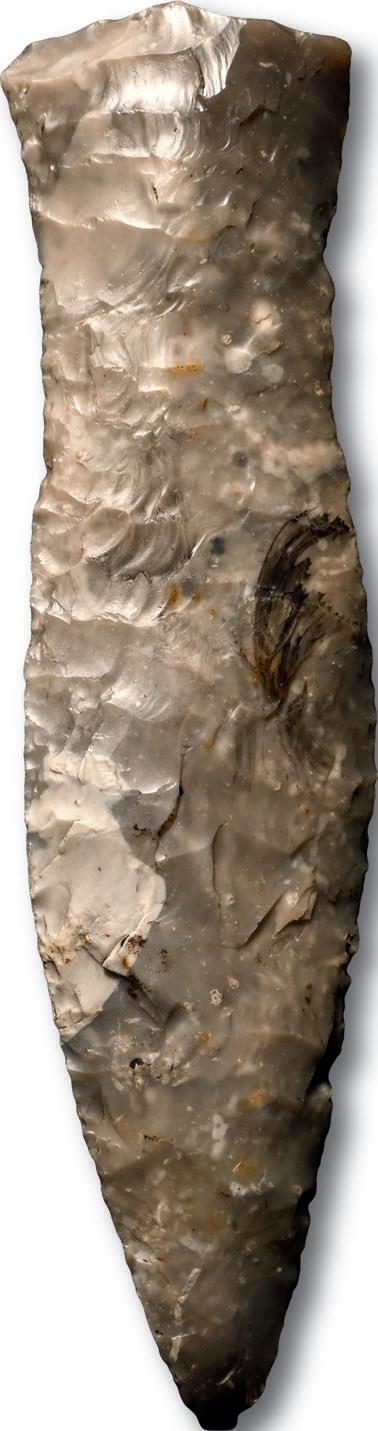

337
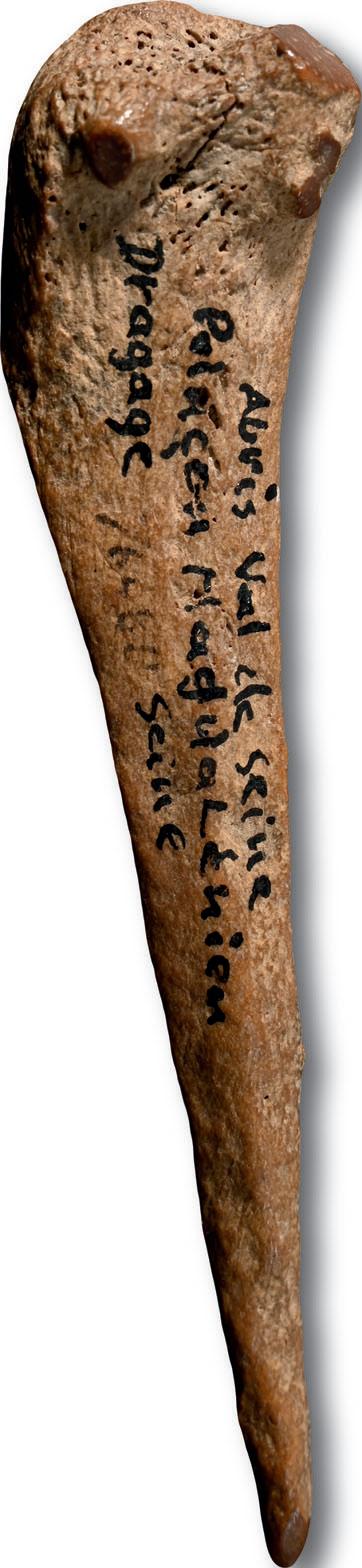
STONE AGE DANISH TYPE KNAPPED FLINT DAGGER NEOLITHIC PERIOD, CIRCA 3950-3600 B.P. 5 in (52.65 grams, 12.8 cm)
With mottled grey patina and fossil inclusions, a waisted profile and a rounded tip.
£400 - 600
PROVENANCE: From the Jutland area.
Ex old German collection formed in the 1970s.

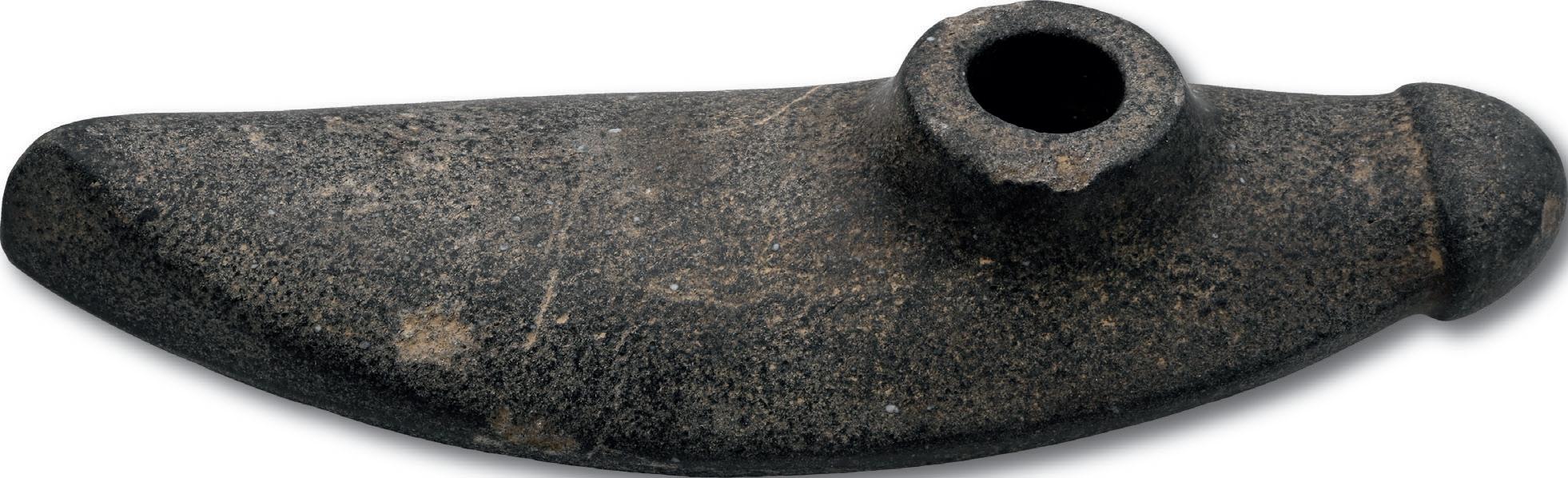

338
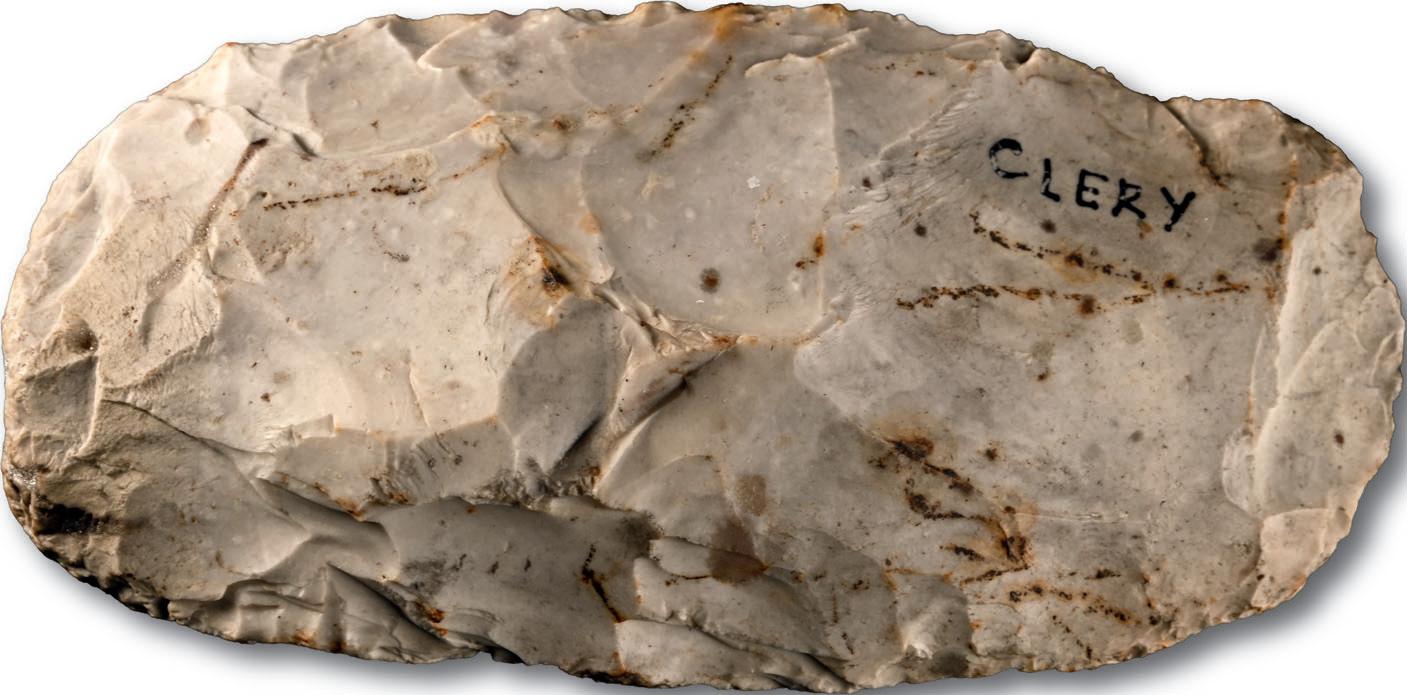
LARGE STONE AGE CORDED WARE BOAT-SHAPED AXEHEAD
6TH-5TH MILLENNIUM B.P.
8¼ in. (843 grams, 21 cm)
A large and finely formed boat-shaped axe with asymmetric convex cutting edge, with pronounced ridge to upper surface copying a bronze casting seam, rounded hammer-butt, pierced to receive handle with a projecting socket to underside.
£3,000 - 4,000
PROVENANCE:
From the private family collection of a lady, UK; acquired in Germany mid-20th century.
FOOTNOTES:
These axes, usually of black fine-grained rock, are mostly of Swedish or Norwegian origin. The asymmetrical lentoid cross-section is flattened towards the cutting edge.
339
STONE AGE KNAPPED FLINT AXEHEAD
NEOLITHIC PERIOD, CIRCA 6000 B.P.
5¼ in. (389 grams, 13.5 cm)
Regularly formed with parallel long sides and rounded corners; inked findspot ‘Clery’ and number ‘67’ to reverse.
£800 - 1,000
PROVENANCE:
Acquired in the 1970s-1990s.
From the collection of the famous UK musician and amateur archaeologist, Victor Brox (1941-2023).
Acquired on the UK art market at auction after being sold by Mr Brox’s family.
From the private collection of an East Anglian, UK, specialist collector.
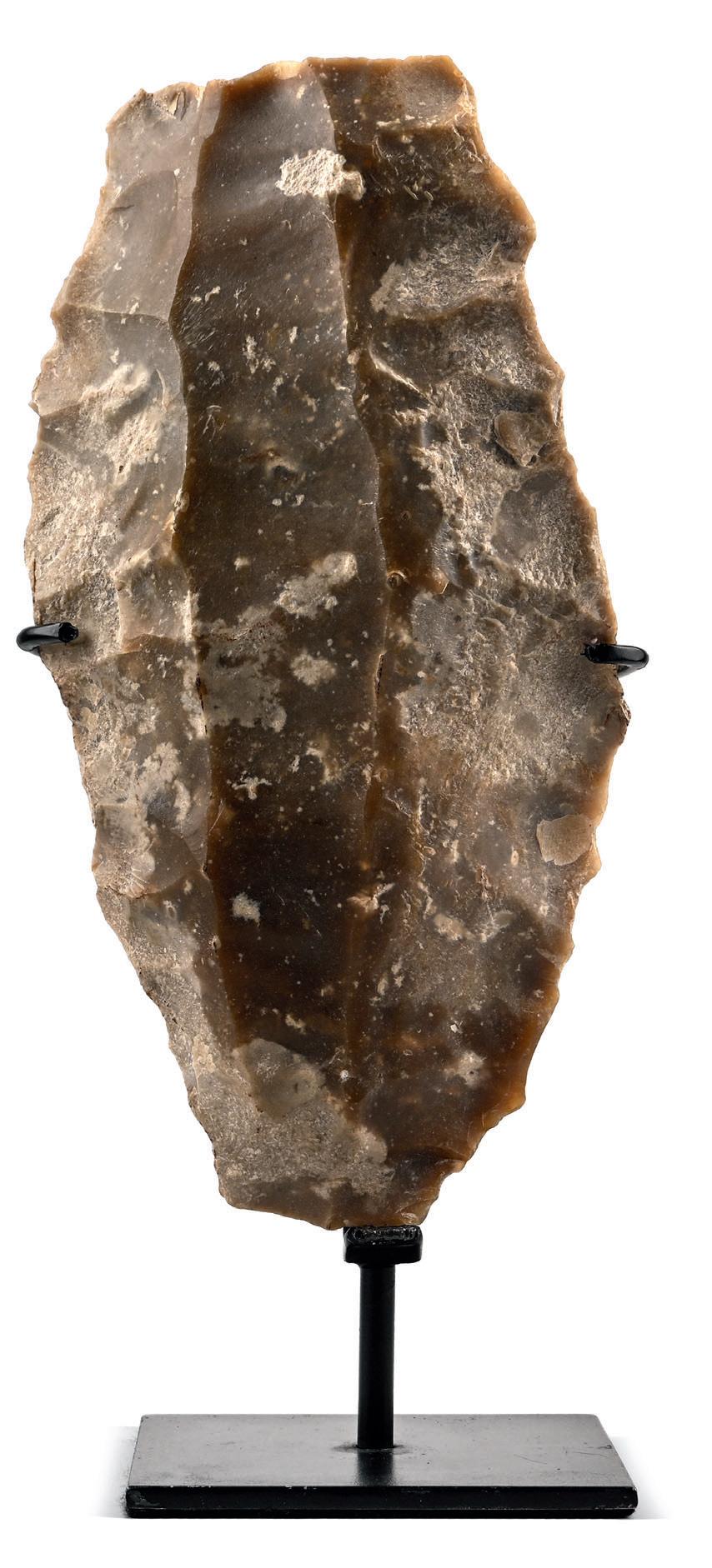
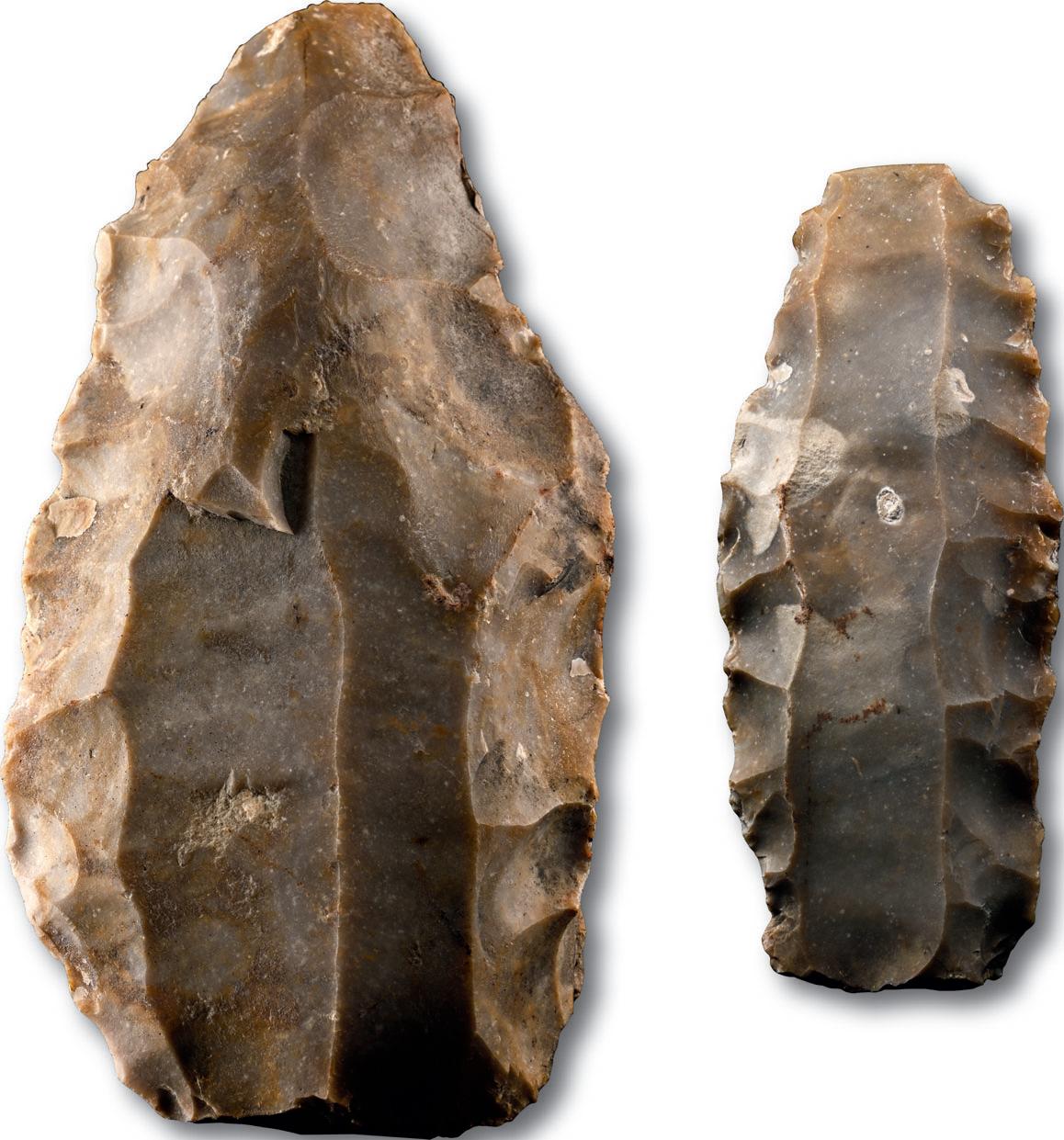

340
VERY LARGE STONE AGE FLINT CORE
NEOLITHIC PERIOD, 3RD MILLENNIUM B.C.
12¼ in. (6.82 kg total, 31 cm)
Substantial leaf-shaped core with parallel facets to one face, some cortex to reverse; mounted on a custom-made stand.
£400 - 600
PROVENANCE:
Found at les Pivots, le Grand-Pressigny, France.
From an old collection, Mons, Belgium. Private collection London, UK.
341
VERY LARGE STONE AGE FLINT CORE GROUP
NEOLITHIC PERIOD, 3RD MILLENNIUM B.C.
9½ - 11¾ in. (8.01 kg total, 24-30 cm)
Comprising: one tongue-shaped core with parallel facets to one face, cortex to reverse, old inked inscription to base ‘La Bonnetierre / Abilly (FR)’; one similar, leaf-shaped with small patch of cortex, old inked inscription to side ‘Les Pivots / Le Gd. Pressigny / Imbre Loire (FR) mounted on a custom-made stand. [2]
£400 - 600
PROVENANCE:
Found at la Bonnetière, Abilly, Indre-Loire, France.
From an old collection, Mons, Belgium. Private collection London, UK.

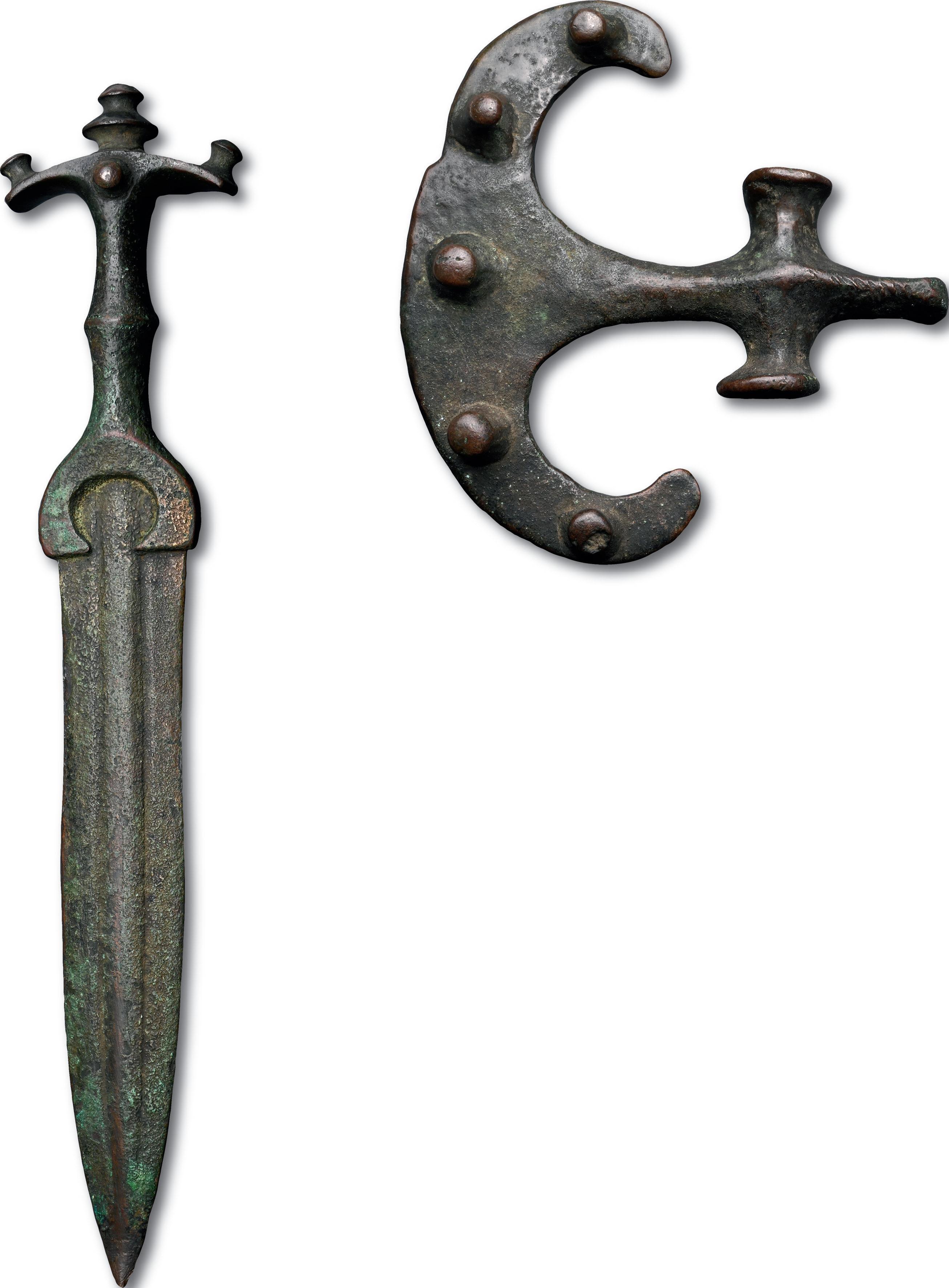
342
CORSICAN BRONZE AGE HOARD FROM THE AJACCIO AREA, DISCOVERED C. 1880–1890 ‡
LATE BRONZE AGE, CIRCA 900 B.C.
2 - 11 in. (2 kg total, 7.4-29 cm including stands)
Including: a) a dagger or short sword in bronze, with grooves on the blade and semicircular guard, oval pommel with a large, two-tiered button in the centre, two smaller buttons at the ends, and two other buttons on the sides; b) the pommel of a second dagger; c) a small axe in crescent shape ornamented by bosses; d) a harness element shaped like a bronze disc fitted with a spike; e) a large violin bow fibula; f) a small boat fibula, decorated on the surface with lines forming a cross; g) a small arched fibula; h) a large bronze ring, with shape and dimensions of a bracelet; i-j) two smaller rings of rhomboid shape. [10]
£15,000 - 20,000
PROVENANCE:
Discovered c.1880-90 near Ajaccio, Corsica.
Private collection of Mr Ducasse.
Thence by descent to Jean Dimitri Ducasse (b.1883), Sarrebourg.
Thence by descent.
Belle Vente Meuble et Objets d’Art, Cortot et Associés, 26 November 2022, no.133.
Acquired from the above sale.
Accompanied by a copy of French cultural export passport no.237816.
PUBLISHED:
Forrer, R., ‘Un trésor de bronzes préhistoriques decouvert en Corse’, in Bulletin de la Société préhistorique de France, 10, 1924, pp. 224-232.
FOOTNOTES:
According to the examination of R. Forrer, the hoard belonged to the culture of the Shardana, who colonised Sardinia and part of Corsica at the end of the first millennium B.C. Forrer dated the hoard to 900 B.C., a period in which the culture of the Nuraghes of Sardinia was at its zenith. The hoard possibly represents a votive treasure, because the axe is without a hole for insertion in a shaft, although the dagger and the other elements could be perfectly usable in the everyday life of the ancient Sardinian people.
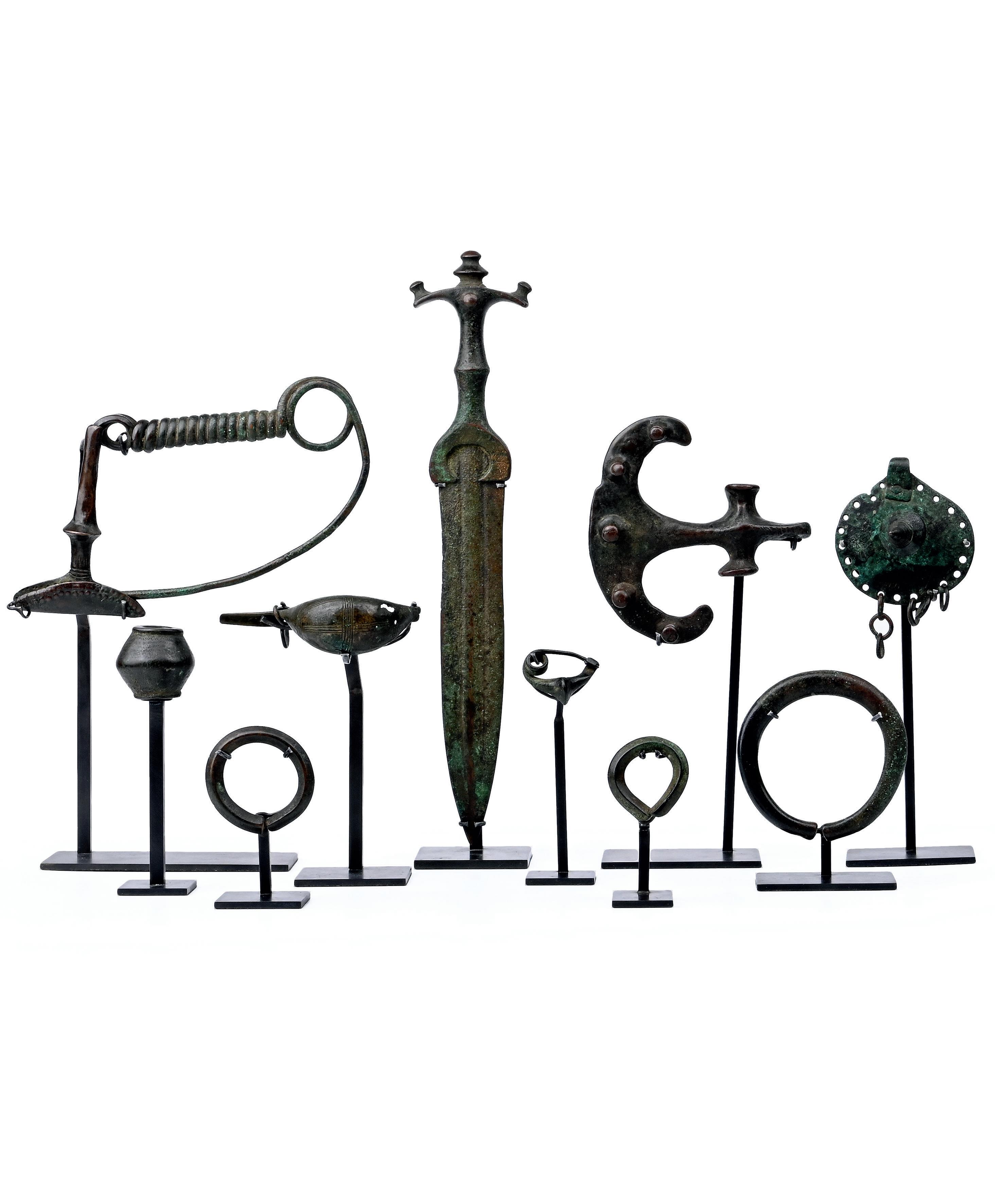
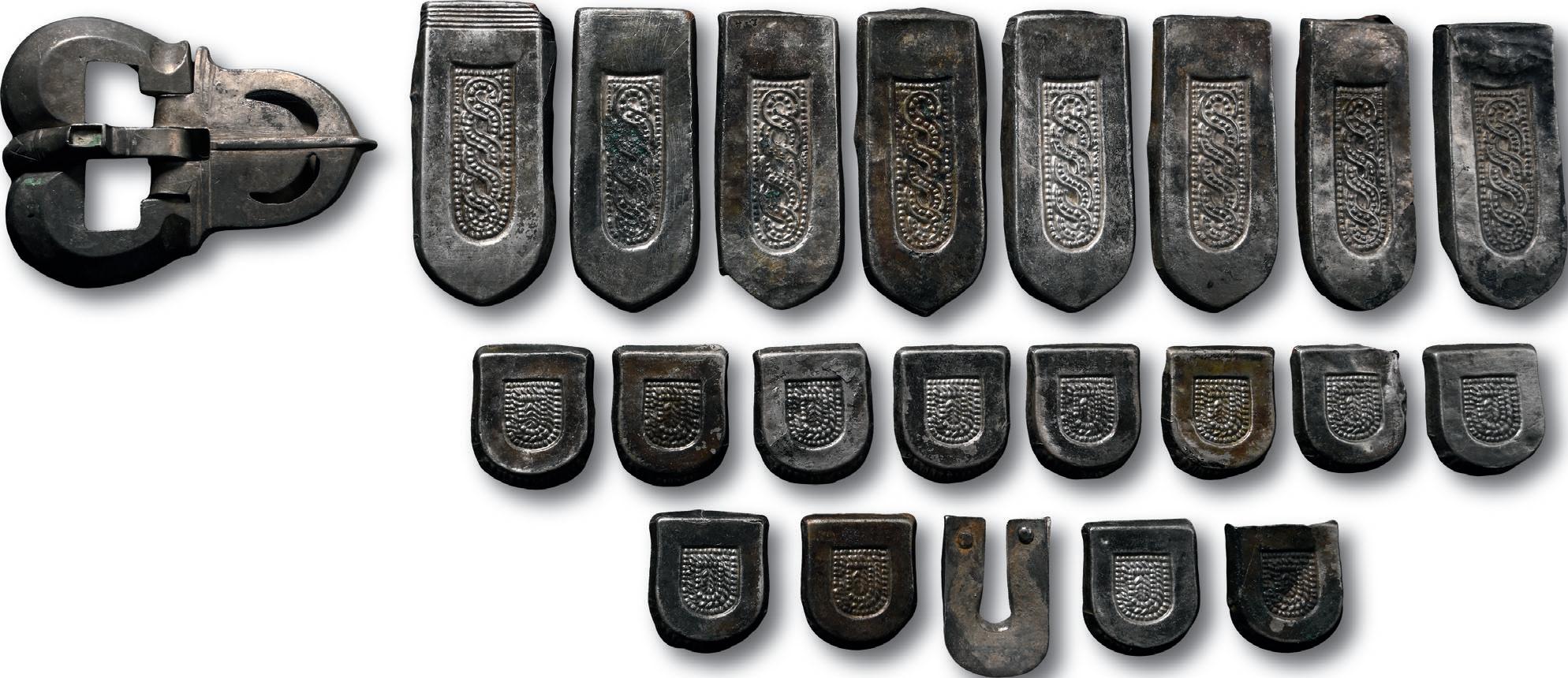

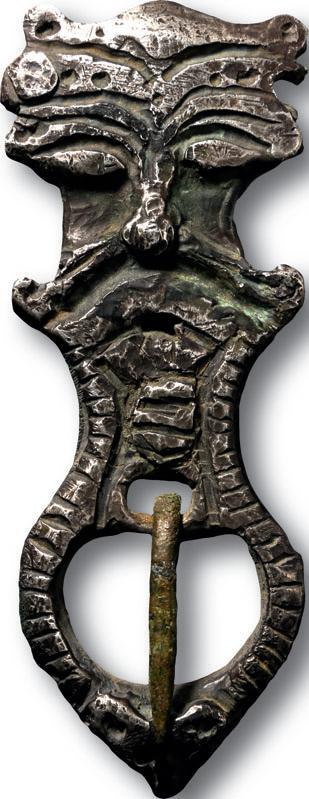

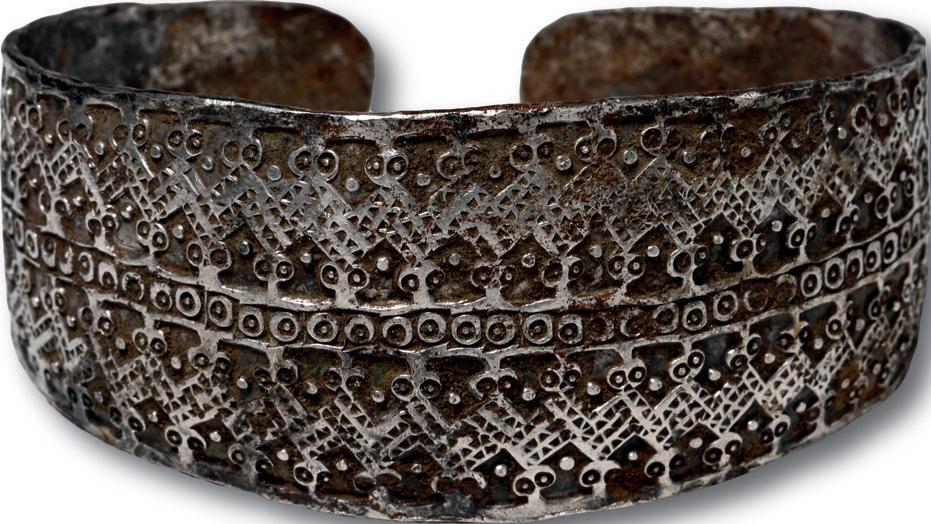

343
LANGOBARDIC SILVER SWORD BELT SET
CIRCA 5TH-7TH CENTURY A.D.
1 - 2½ in. (74 grams total, 26.10-62.53 mm)
Comprising: twelve D-shaped appliqué plates each with a central panel of repoussé pellets; eight appliqué strap ends, each tongueshaped with central repoussé guilloche and pellets motif; U-shaped chape or strap end with mounting rivets at the mouth; buckle formed as a kidney-shaped loop and D-section tongue with rectangular cell to the apex, D-shaped plate to rear with crescent voids and medial rib, rivet and folded counterplate to reverse. [22]
£800 - 1,000
PROVENANCE:
From the private collection of a London gentleman, from his grandfather’s collection formed before the early 1970s.
344
VIKING SILVER BUCKLE WITH MOUSTACHIOED FACE
CIRCA 8TH-9TH CENTURY A.D.
3 in. (35.13 grams, 75.36 mm)
With ovoid loop and integral buckle-plate, coiled wire tongue; loop with segmented frame, and bear-head motif to forward edge; plate with narrow neck developing to a male mask with broad flaring moustache, snub nose and lentoid eyes; fixing lugs to reverse.
£800 - 1,000
PROVENANCE:
From the private collection of a London gentleman, from his grandfather’s collection formed before the early 1970s.
345
VIKING STAMPED SILVER BRACELET
CIRCA 9TH-11TH CENTURY A.D.
2 in. (43.11 grams, 74.13 mm)
Featuring a wide penannular body with rounded finials, the upper face divided into two fields with rich stamped decoration comprising ringand-dot and triangular motifs.
£700 - 900
PROVENANCE:
From the private collection of a London gentleman, from his grandfather’s collection formed before the early 1970s.
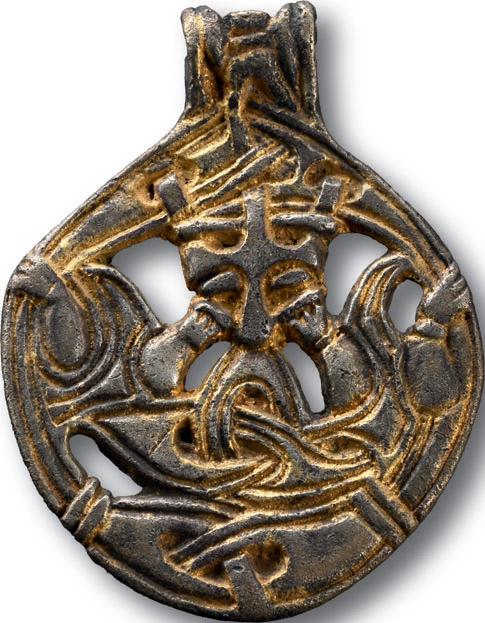

346
VIKING AGE SILVER-GILT GRIPPING BEAST PENDANT
CIRCA 10TH CENTURY A.D.
1½ in. (8.69 grams, 40 mm)
Comprising an integral suspension loop; the openwork plaque with banded border and panels, internal stylised zoomorph with hatched panel to the hip, gripping three-fingered hands to the body and border, two detailed feet, clearly visible facing mask below the loop with pellet eyes.
£600 - 800
PROVENANCE:
Private collection formed in Europe in the 1980s. Westminster collection, central London, UK.
347
VIKING AGE SILVER FILIGREE PENDANT WITH SCROLL CROSS
CIRCA 9TH-11TH CENTURY A.D.
1½ in. (4.99 grams, 38 mm)
Discoid with applied filigree looped bands, granules and other detailing; cleaned and polished.
£800 - 1,000
PROVENANCE:
Private collection formed in Europe in the 1980s. Westminster collection, central London, UK.
348
SCANDINAVIAN VIKING SILVER FILIGREE TAU CROSS PENDANT
CIRCA 10TH-12TH CENTURY A.D.
1¼ in. (3.62 grams, 31 mm)
Cruciform hollow pendant with applied interlaced granulation to the obverse, filigree borders and scrolled interlaced ‘face’ design on the suspension bar.
£1,200 - 1,700
PROVENANCE:
Private collection formed in Europe in the 1980s. Westminster collection, central London, UK.
349
VIKING AGE SCANDINAVIAN SILVER-GILT PENDANT WITH MASK CIRCA 9TH-11TH CENTURY A.D. in. (3.81 grams, 23 mm)
With integral loop, border enclosing a low-relief image of a male facing mask between two birds embraced at the necks; Kipplingeberg type.
£300 - 400
PROVENANCE:
Private collection formed in Europe in the 1980s. Westminster collection, central London, UK.

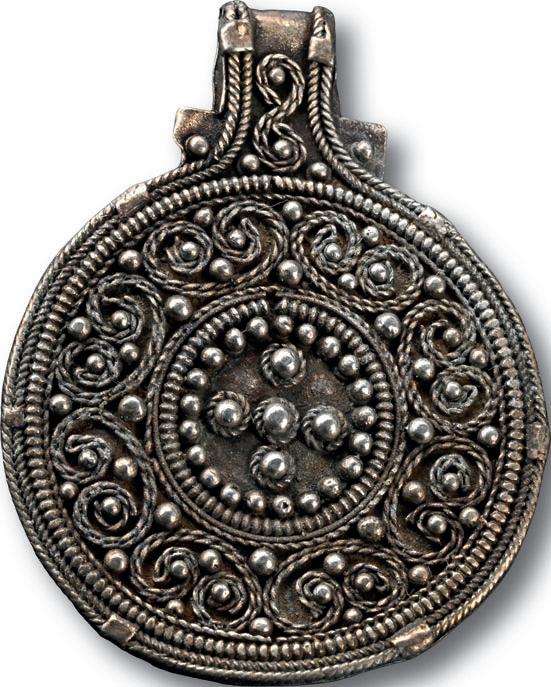

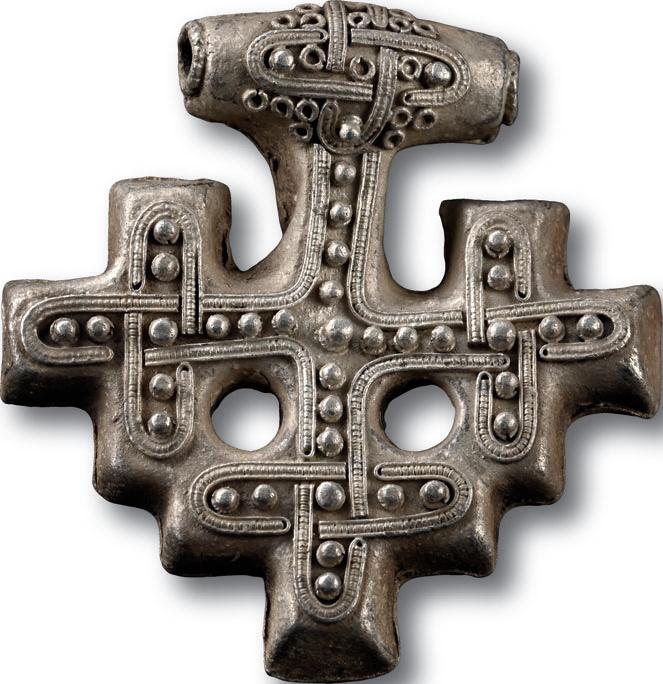

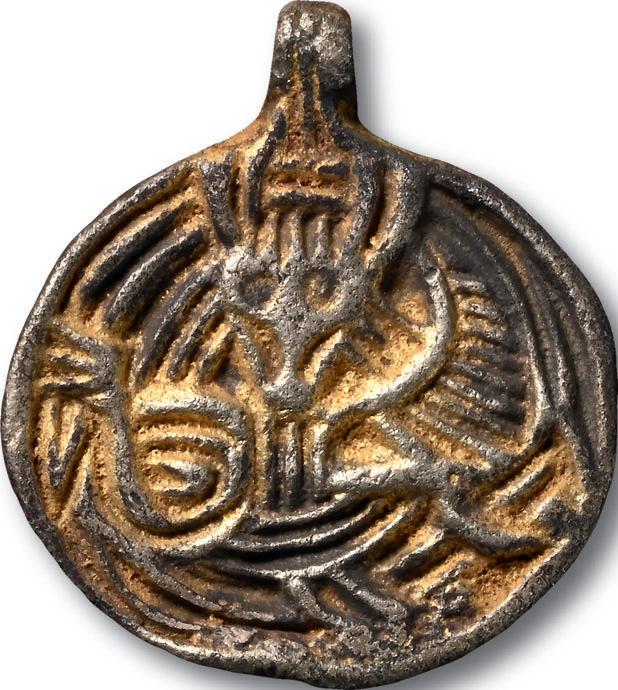

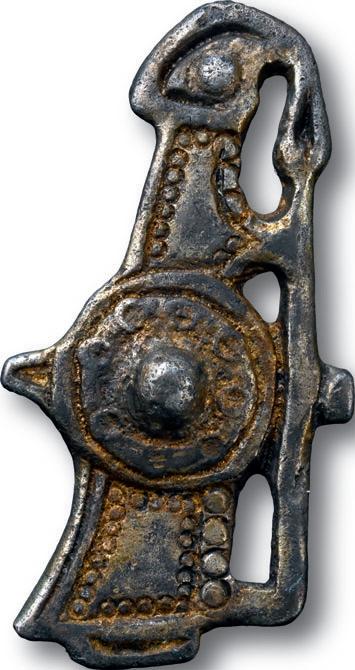
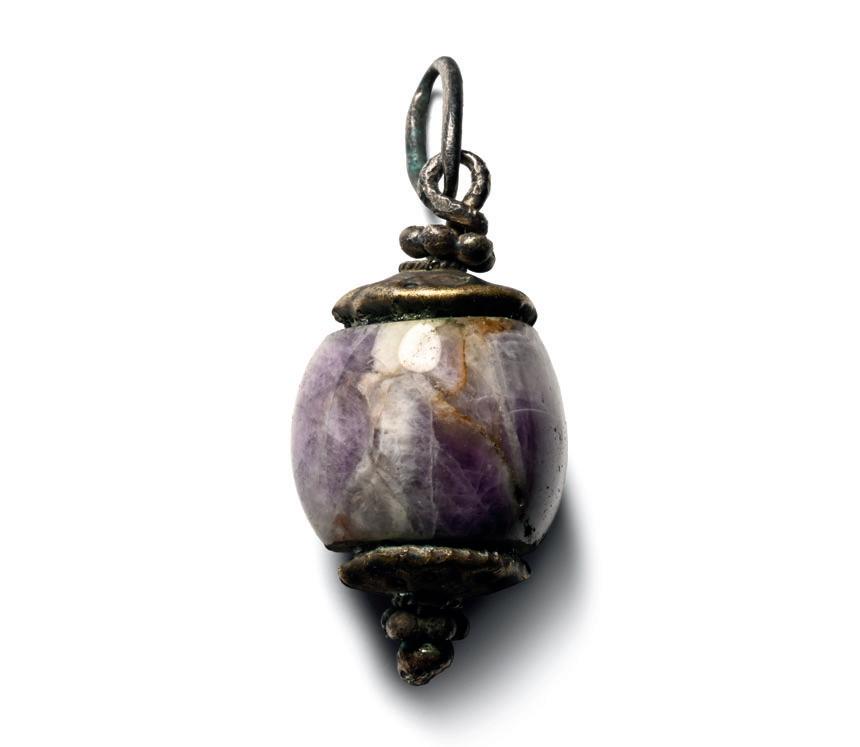

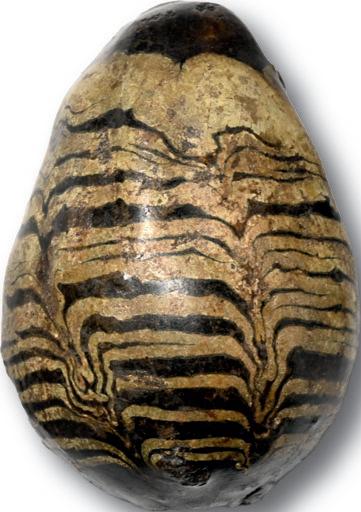

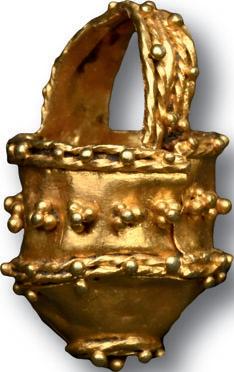
350
VIKING AGE SILVER-GILT SHIELD-MAIDEN PENDANT
CIRCA 9TH-10TH CENTURY A.D.
1 in. (7.57 grams, 42.5 mm)
A female in floor-length robe holding a shield in her right hand and spear in her left, stylised headdress, pointillé detailing; pierced lug to the reverse.
£1,200 - 1,700
PROVENANCE:
Private collection formed in Europe in the 1980s. Westminster collection, central London, UK.
351
VIKING AGE BRONZE PENDANT WITH POLISHED AMETHYST BEAD
CIRCA 9TH-11TH CENTURY A.D.
2 in. (18.93 grams, 55 mm including loop)
Comprising an amethyst bead with stamped conical disc above and below, suspension pin through centre with ring and loop above.
£400 - 600
PROVENANCE:
Private collection formed in Europe in the 1980s.
Westminster collection, central London, UK.
352
VIKING GLAZED ‘RESURRECTION EGG’
CIRCA 9TH-10TH CENTURY A.D.
1 in. (30.4 grams, 41 mm)
A glazed hollow ceramic egg with a hole to the underside and a smaller pellet inside; regular, dragged yellow lines to the outer face.
£1,000 - 1,400
PROVENANCE:
From the private collection of a London gentleman, from his grandfather’s collection formed before the early 1970s.
FOOTNOTES:
These eggs are usually assigned to Kievan Rus workmanship, but in fact, they were found in a wider geographical area. They are thought to represent an early form of a popular Orthodox tradition of painted eggs, or ‘pysanka’, popular during the Easter holiday as a symbol of resurrection. However, the symbolism may be pre-Christian, with a connection to an idea of a Cosmic Egg, from which the world was created.
353
PRE-VIKING GOLD AROMA BUCKET PENDANT CIRCA 4TH-7TH CENTURY A.D.
½ in. (0.78 grams, 13.52 mm)
Miniature drum-shaped vessel covered in filigree bobbles with strap handle.
£300 - 400
PROVENANCE:
Private collection formed in Europe in the 1980s.
Westminster collection, central London, UK.
FOOTNOTES:
Pendants in the form of miniature buckets have been found in a number of pagan Anglo-Saxon and Viking contexts and are generally made of bronze or iron, with gold examples being rare; three gold examples were found with the hoard from Hoen, Norway. Bronze bucket amulets have been found at Driffield in Yorkshire, and Vimose bog in Denmark, among other places. In form they represent wooden buckets bound with bronze or iron bands which have been found in Anglo-Saxon and Viking graves and are believed to have held mead or ale and were used to replenish the cups from which warriors drank. As amulets they probably represent the ecstatic power of alcoholic drink and the role of women as the dispensers of these precious beverages.

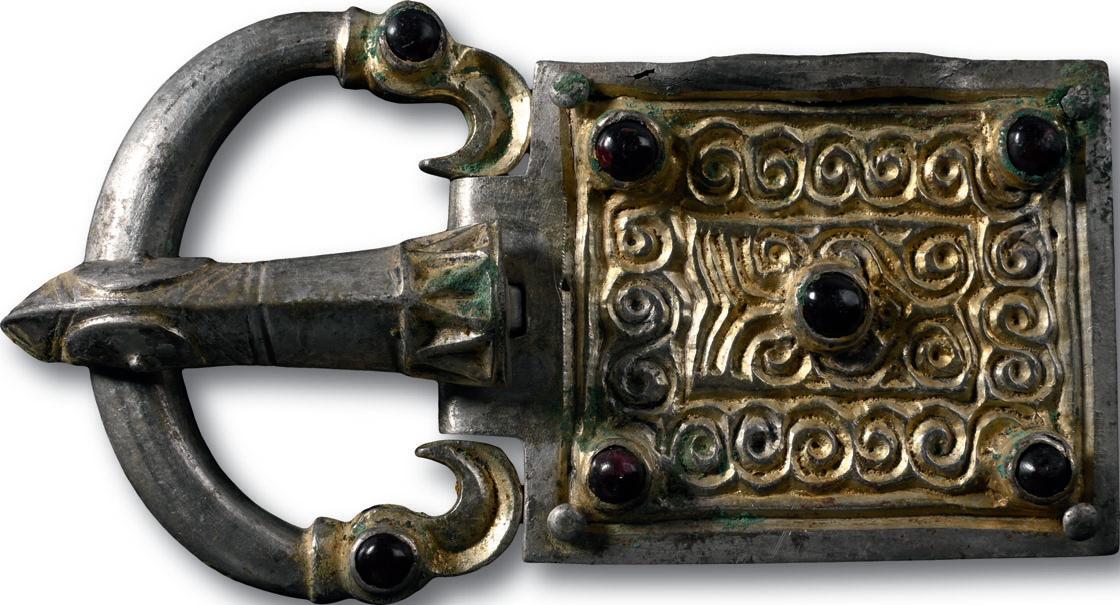
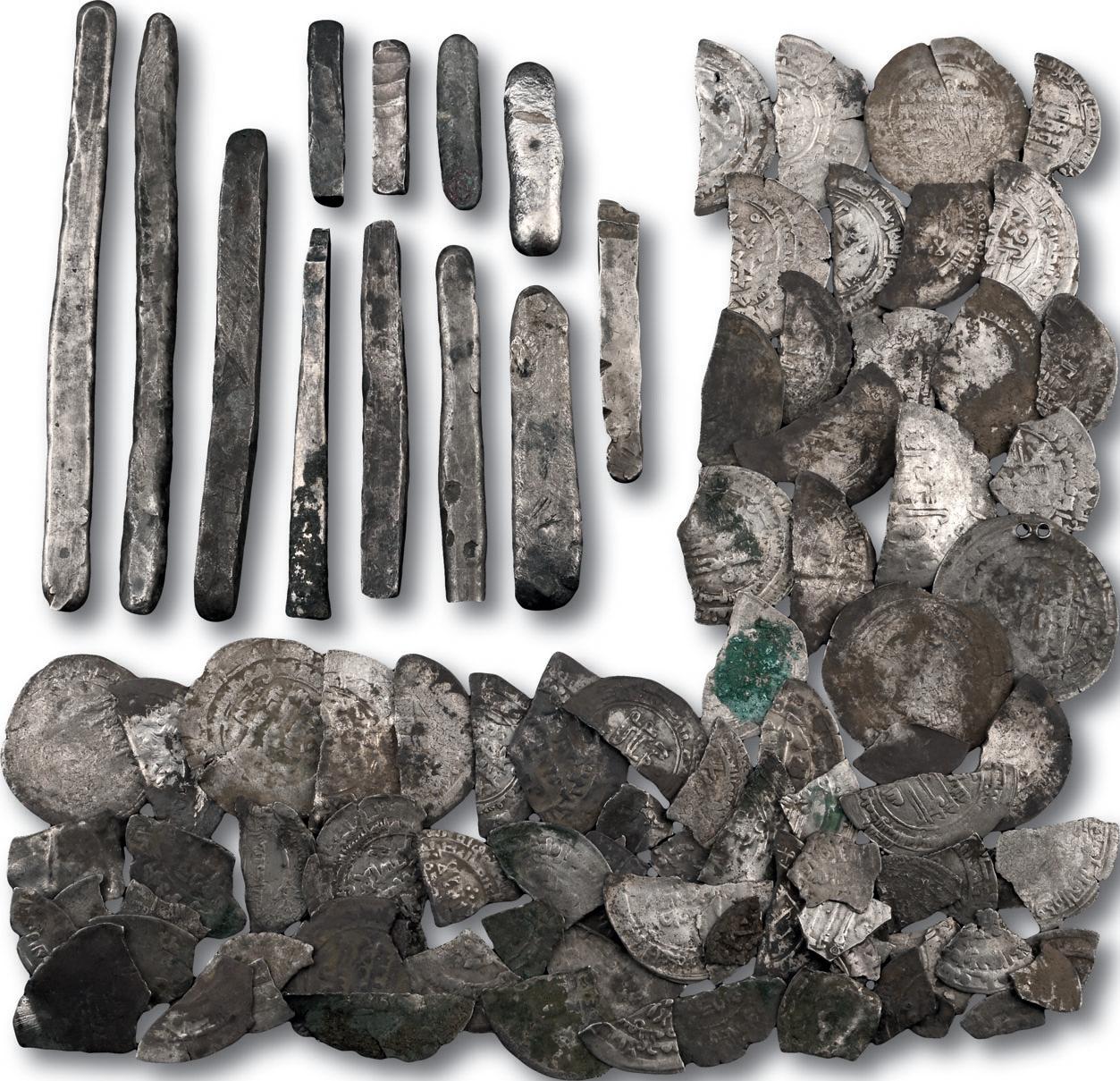

354
GOTHIC SILVER-GILT EAGLE BUCKLE WITH PLATE AND CABOCHON GARNETS
CIRCA 6TH-7TH CENTURY A.D.
4 in. (101 grams, 11.2 cm)
Comprising: D-section loop with gilt curved beak at each end, cell with inset garnet cabochon; D-section tongue with bird-head finial to the forward edge, faceted band at the rear; rectangular gilt plate with border, bands of repoussé scroll motifs and five cells with inset garnet cabochons, recurved backplate with roves.
£3,000 - 4,000
PROVENANCE:
From the private collection of a London gentleman, from his grandfather’s collection formed before the early 1970s.
FOOTNOTES:
A similar silver buckle was found in female burial 4 at Lucistoe, belonging to the Gothic-Alan necropolis. These buckles fastened the waist belts of deceased noblewomen, who must have belonged to the aristocracy of these foederati of the Eastern Empire.
355
VIKING SILVER BAR AND COIN ‘HACK HOARD GROUP’
CIRCA 9TH-11TH CENTURY A.D.
½ - 4 in. (275 grams total, 1.2-10.2 cm)
Comprising: a quantity of dirhem and other silver coins, cut into halves, quarters and irregular fragments; a quantity of square-section and other cast bars.
£1,000 - 1,400
PROVENANCE:
From the private collection of a London gentleman, from his grandfather’s collection formed before the early 1970s.
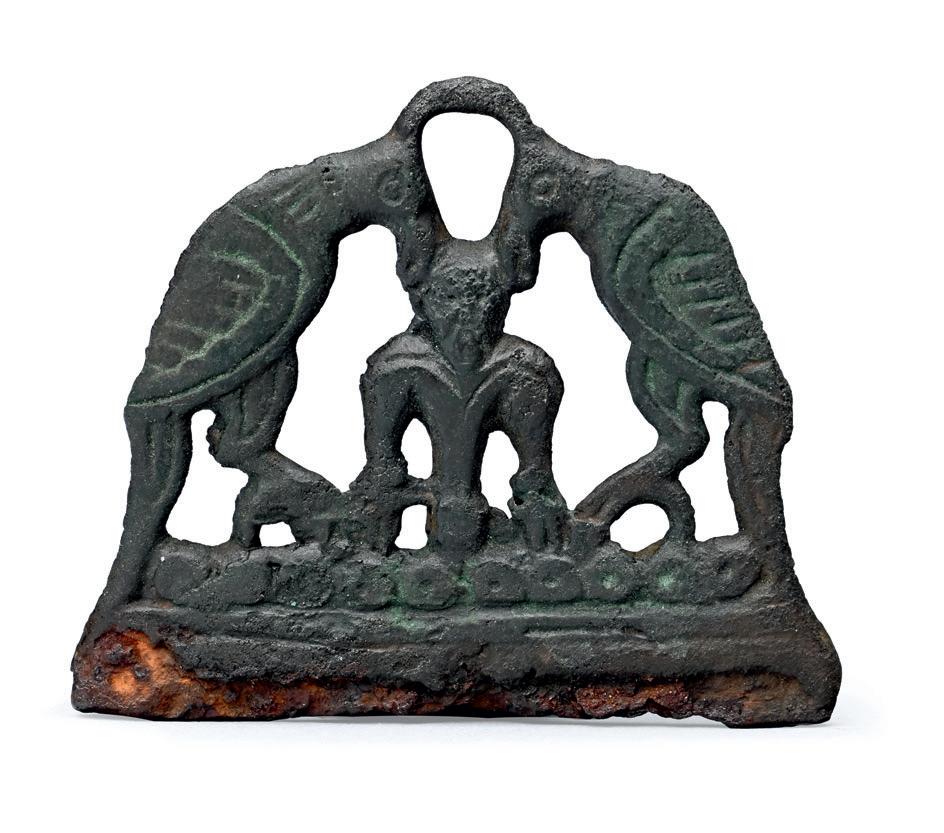


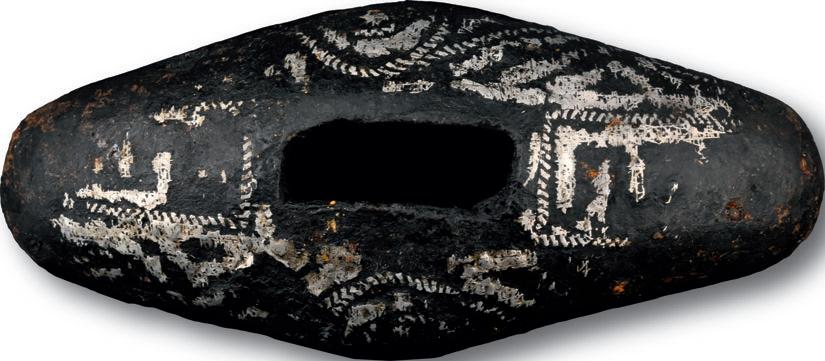
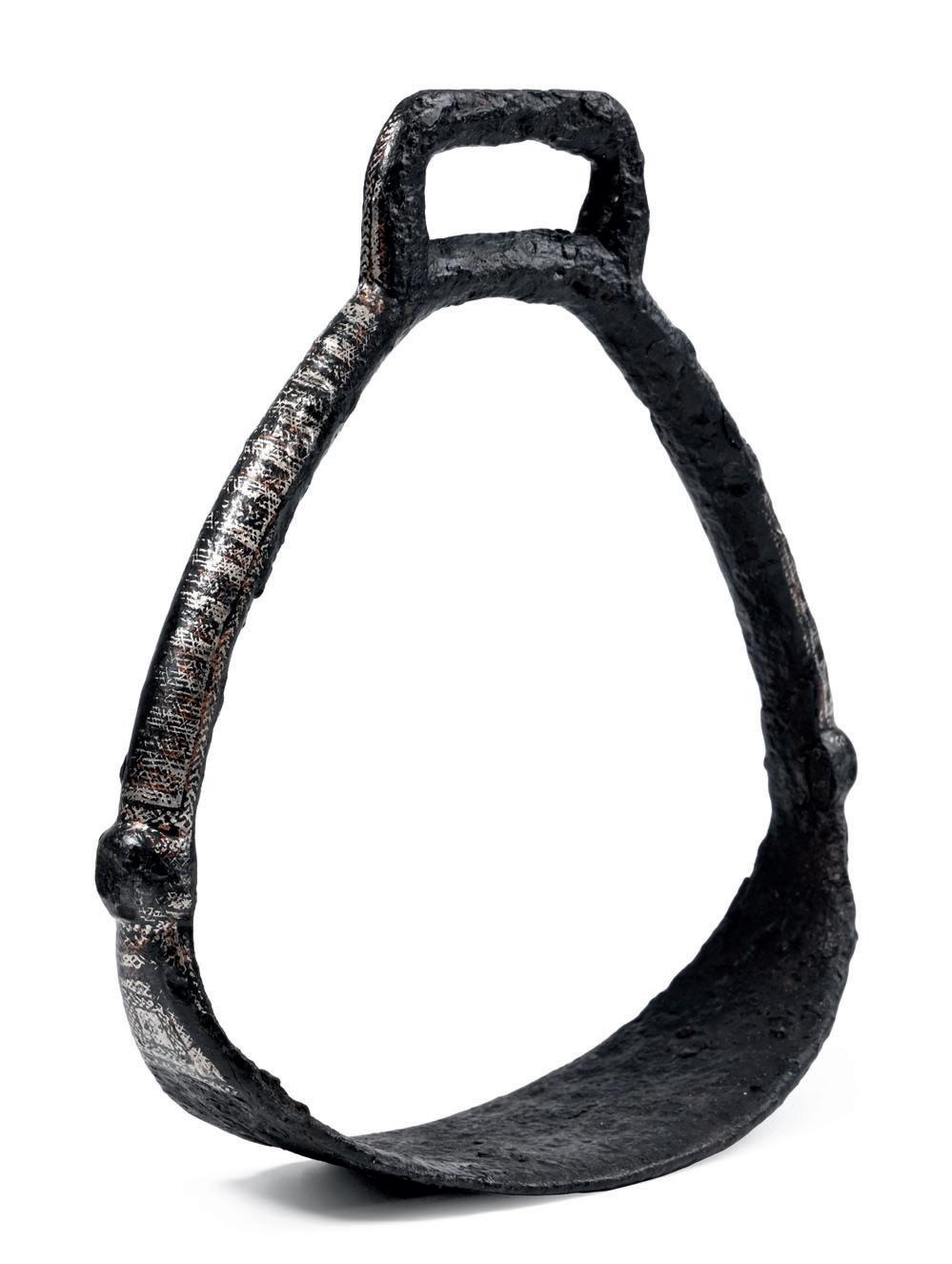
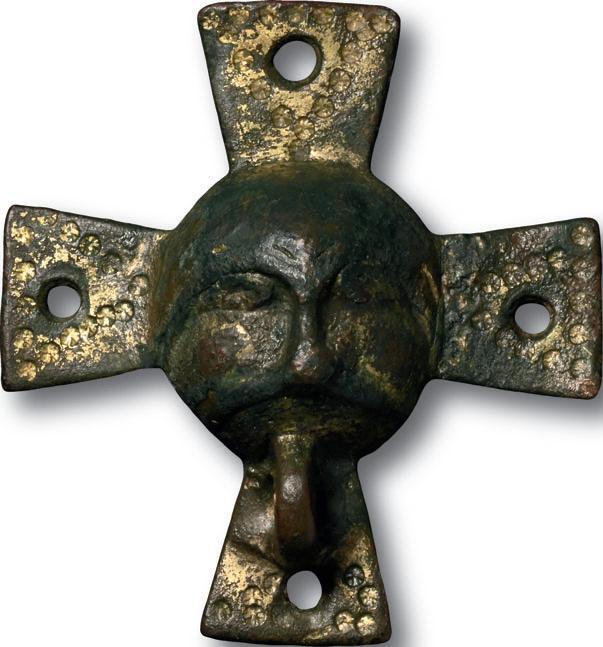
VIKING AGE BRONZE ODIN WITH RAVENS FIRE STRIKER
CIRCA 10TH CENTURY A.D.
2¼ in. (25.83 grams, 58 mm)
Openwork handle depicting confronted birds of prey flanking a crouching figure, facing, on a band of pellets; iron striking face below.
£1,200 - 1,700
PROVENANCE:
From the private collection of a London gentleman, from his grandfather’s collection formed before the early 1970s.
357
VIKING GILT BRONZE HORSE HARNESS MOUNT WITH FACE
CIRCA 10TH CENTURY A.D.
1 in. (17.31 grams, 47.67 mm)
Comprising a hollow central dome with four radiating trapezoidal arms, each with central piercing and bands of punched roundel decoration; dome with male face detailing, thick brow (or helmet) over two piriform eyes, rounded nose and wide-flaring moustache; suspension loop beneath the chin.
£300 - 400
PROVENANCE:
From the private collection of a London gentleman, from his grandfather’s collection formed before the early 1970s.
358
SCANDINAVIAN VIKING AGE SILVER INLAID IRON HILT GUARD
CIRCA 10TH-11TH CENTURY A.D.
2 in. (70 grams, 72 mm)
Hollow-formed with a deep curved profile; rectangular slot in the upper face for the tang; bands of applied silver ropework ornament on a sheet-silver field.
£400 - 600
PROVENANCE:
Private collection formed in Europe in the 1980s. Westminster collection, central London, UK.
FOOTNOTES:
The guard is too narrow to have been used on a sword, but it may have been part of the hilt furniture of a high-status seax or knife. The form is approximately consistent with Petersen’s Type Z of late-10th century date.
359
SCANDINAVIAN VIKING AGE SILVER INLAID IRON STIRRUP
CIRCA 10TH-11TH CENTURY A.D.
5¼ in. (172 grams, 13.2 cm)
With inlaid silver ropework bands to the loop and frame.
£500 - 700
PROVENANCE:
Private collection formed in Europe in the 1980s. Westminster collection, central London, UK.
VIKING PERIOD ORNATE CROWN WITH BROOCH AND PIN SET
CIRCA 8TH-9TH CENTURY A.D.
crown: 14¼ in. (2.3 kg total, crown: 36 cm high including stand, brooches: 15-22.5 cm high including stand)
Comprising: a restrung headdress formed as ten square panels, each with vertical bands of pellets framing four columns of ring-and-dot ornament, with interstitial groups of three tubular spacer beads with corrugated profile; two dress-pins each with a lobed cruciform head and appliqué panel, pierced lug at the top of the shank to mount a
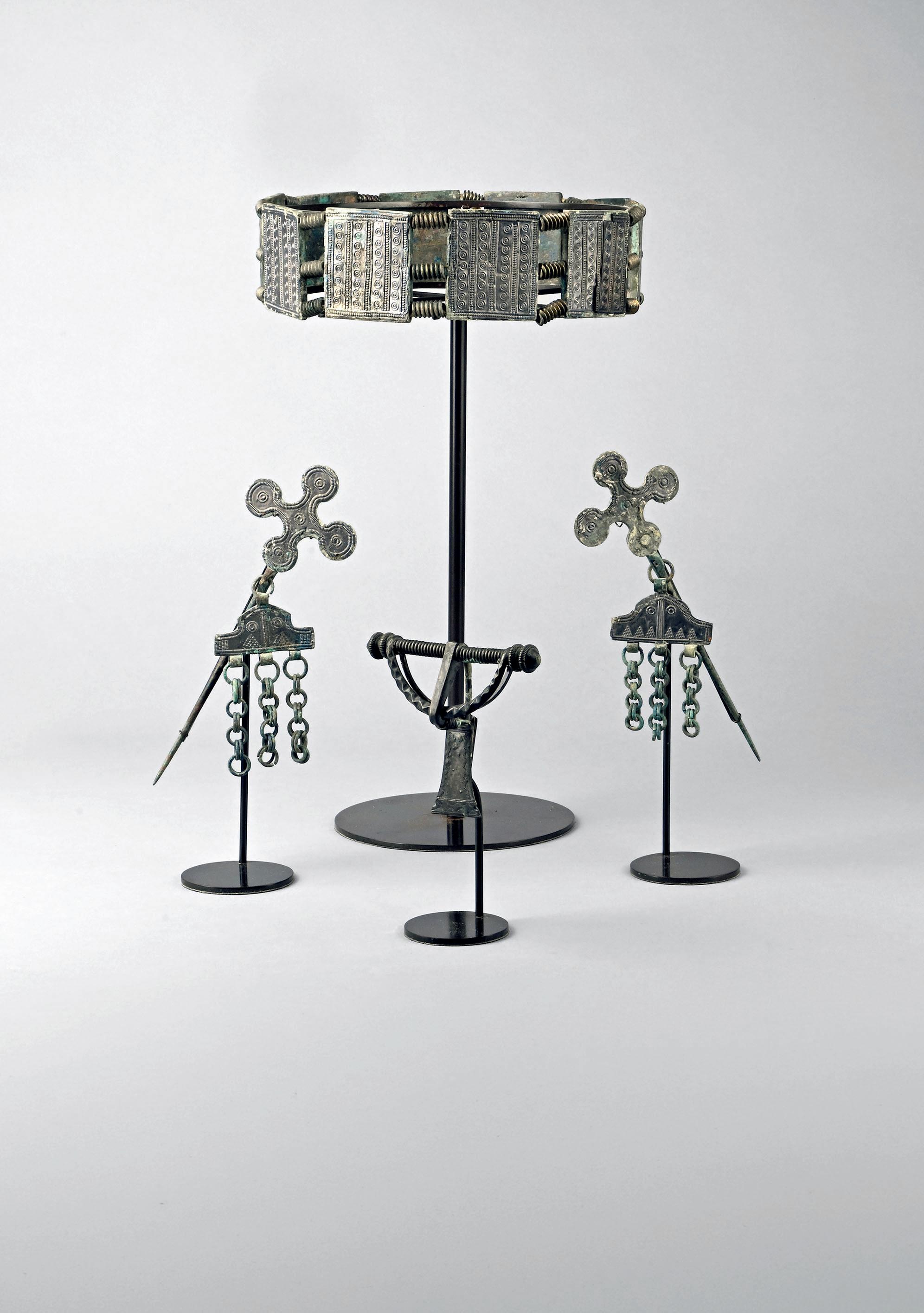
transverse cocked-hat panel with three pendant chains of double links, faced with an appliqué tinned sheet with stamped motifs of hatched triangles, ring-and-dot and billets to the border; bow-brooch with transverse spring and header with knop finials ornamented with beaded collars, stepped bow with coiled wire collar and semicircular bar with notched upper face, trapezoidal footplate with catch and pin to reverse; each mounted on a custom-made stand. [4]
£5,000 - 7,000
PROVENANCE: Acquired on the UK art market, 1995-2000s. Private collection, London.

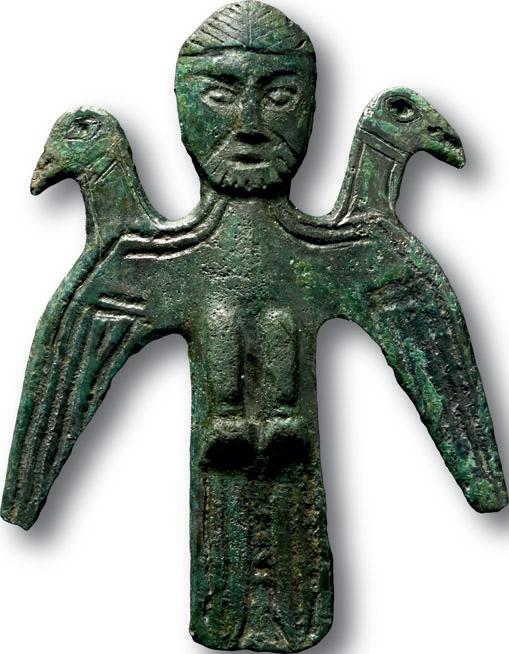
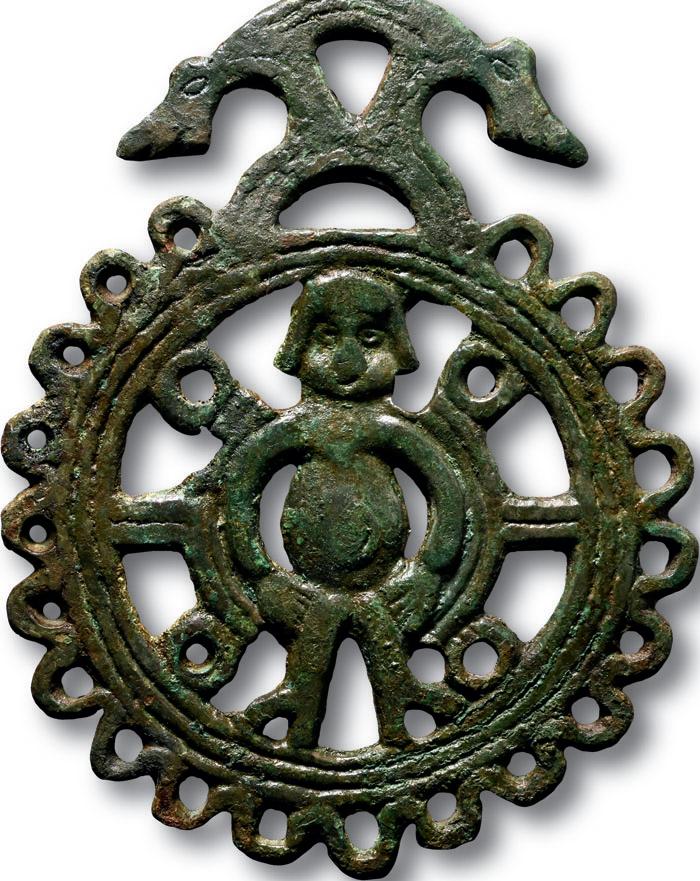

361
PRE-VIKING AGE BRONZE SHAMAN PENDANT
CIRCA 6TH-8TH CENTURY A.D.
2 in. (18.58 grams, 66.13 mm)
Flat in section with spread wings and talons to the lower body, feather detailing to tail and wings; male mask above, flanked by profile birdheads at the pinions; loop to reverse; Samoyed type.
£2,000 - 3,000
PROVENANCE:
From the private collection of a London gentleman, from his grandfather’s collection formed before the early 1970s.
FOOTNOTES:
The pendant likely represents the soul of the shaman in bird form on a spirit journey.
362
PRE-VIKING BRONZE OPENWORK PENDANT WITH BOUND
FIGURE AND DRAGONS
CIRCA 6TH-10TH CENTURY A.D.
4¼ in. (83.77 grams, 10.7 cm)
Openwork Zierscheibe with triple-band ring surrounding a facing female figure with flexed arms, annulets and arcs flanking her body, annulets to the outer rim of the enclosing ring, suspension loop above flanked by addorsed beasts.
£800 - 1,000
PROVENANCE:
From the private collection of a London gentleman, from his grandfather’s collection formed before the early 1970s.
FOOTNOTES:
These openwork discs are often found at the waist and may have formed an ornamental lid to a belt-pouch.
363
VIKING BRONZE ‘WAYLAND THE SMITH’ MOUNT
CIRCA 10TH CENTURY A.D.
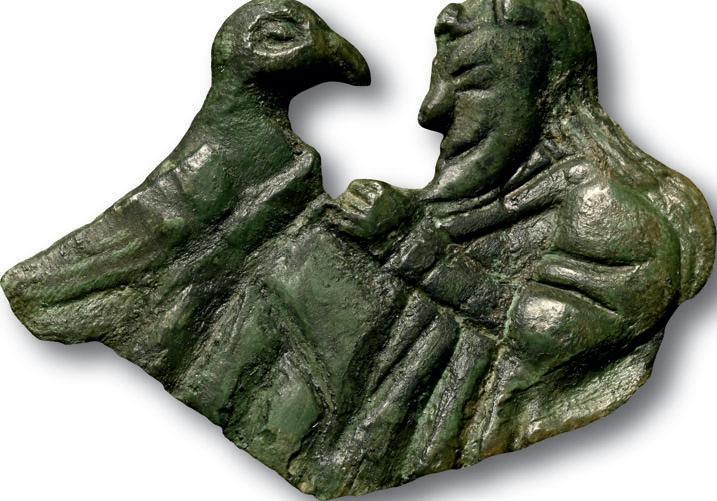

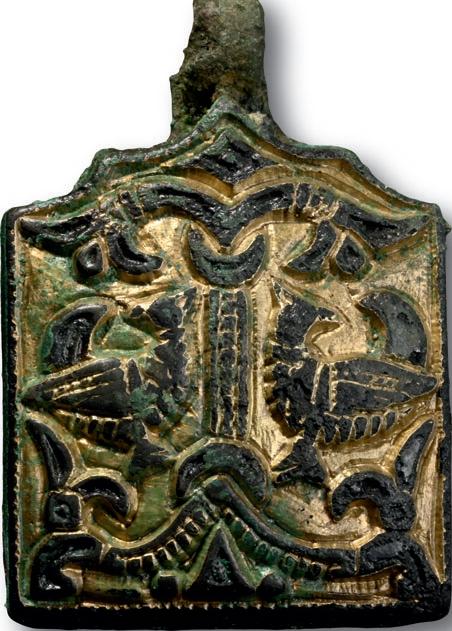

1¾ in. (8.66 grams, 43.14 mm)
Depicting a male figure with almond-shaped eye, pointed curved chin, small nose, long hair with a curl above the forehead; dressed in a loose short-sleeve tunic(?), with hands and neck tied together; facing a bird with large almond-shaped eye, curved beak and prominent crest or feather(?) on the top of its head, finely incised feather decoration; a pin to the reverse.
£1,200 - 1,700
PROVENANCE:
From the private collection of a London gentleman, from his grandfather’s collection formed before the early 1970s.
364
VIKING GILT BRONZE HORSE HARNESS PENDANT WITH BIRDS
CIRCA 10TH CENTURY A.D.
1¾in. (19.42 grams, 44.78 mm)
Square in plan with hollow body, repoussé motif of a tree with flanking birds at the sides and serpents below; integral suspension loop.
£1,200 - 1,700
PROVENANCE:
From the private collection of a London gentleman, from his grandfather’s collection formed before the early 1970s.
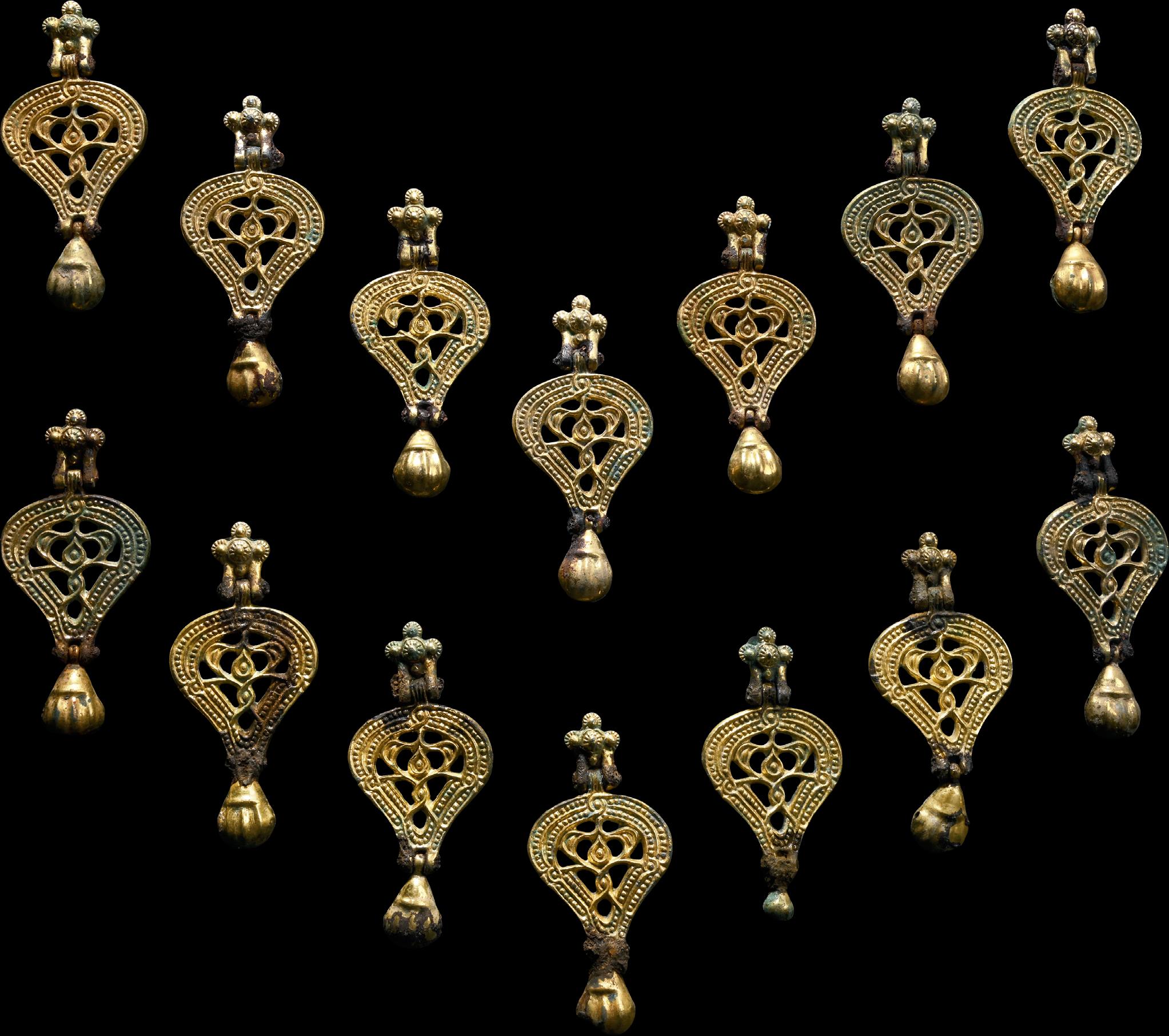
VIKING AGE GILT BRONZE MILITARY HORSE HARNESS PENDANT SET
CIRCA 10TH-11TH CENTURY A.D.
2¾ - 2 in. (194 grams total, 71.11-71.89 mm)
Comprising fourteen openwork pendants, each a piriform openwork plaque with pelleted bands and hinged hollow bulb finial, hinged at upper edge to a trefoil plate with mounting pins to reverse. [14]
£3,000 - 4,000
PROVENANCE: From the private family collection of a lady, UK; acquired in Germany mid 20th century.
FOOTNOTES: Such horse harness pendants were common to the culture of the Alan, Kabarian and Hungaro-Magyar warriors, and also in use among the Eastern Viking (Rus) warriors.
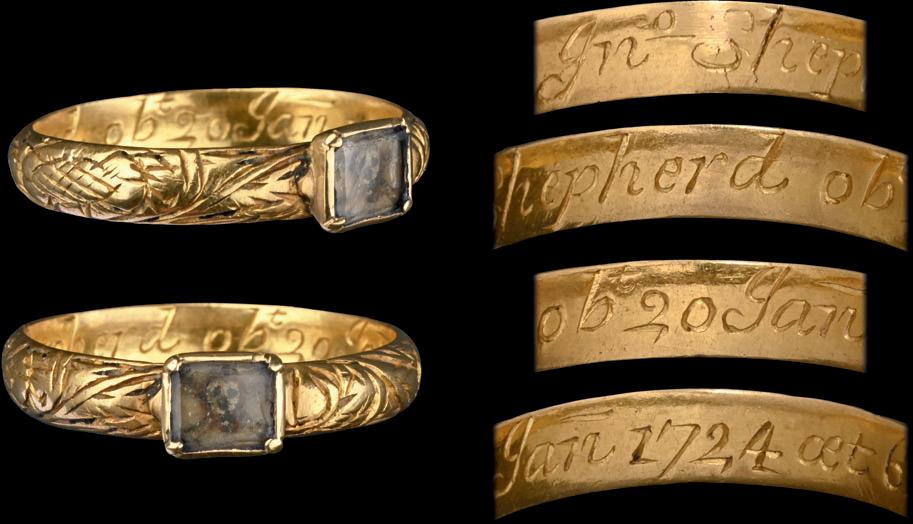
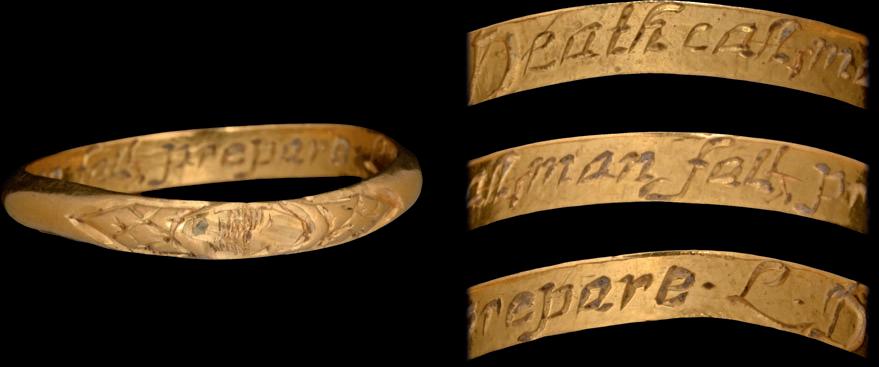
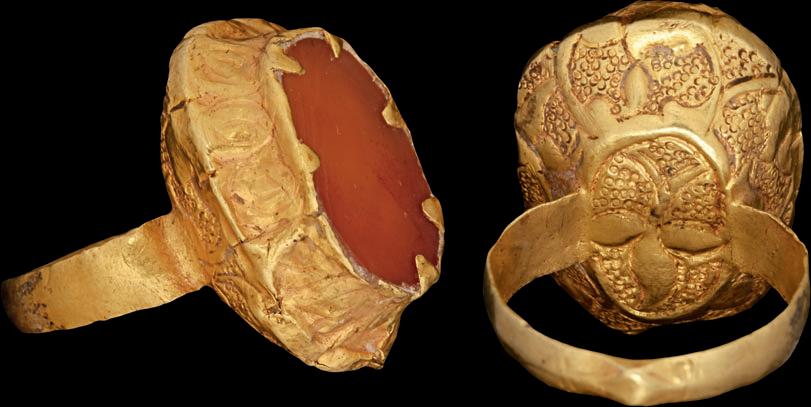
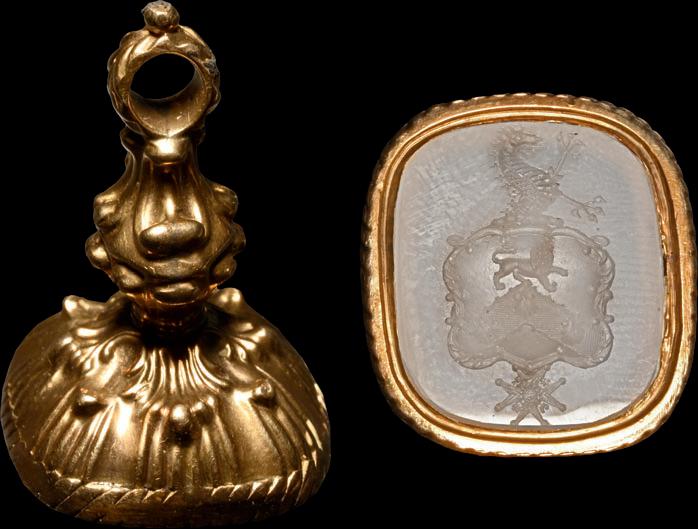
366
STUART PERIOD GOLD MEMENTO MORI RING WITH SKULL AND CROSSED BONES FOR IAN SHEPHERD
DATED 1724 A.D.
in. (4.60 grams, 22.48 mm overall, 18.44 mm internal diameter (approximate size British Q½, USA 8¼, Europe 18.12, Japan 17))
Comprising a D-shaped hoop with foliate and floral decoration, rectangular bezel set with a facetted rock crystal(?) gemstone with a skull and crossed bones beneath the gem; engraved to the inner face ‘In˚ Shepherd Obt 20 Jan 1724 æt 62’ and a worn maker’s mark.
£3,000 - 4,000
PROVENANCE:
Acquired from a London, UK, auction house. From a private Bristol, UK, collection.
367
POST MEDIEVAL GOLD ‘DEATH CALLS MAN FALLS, PREPARE’ DECORATED MEMENTO MORI RING
LATE 17TH-EARLY 18TH CENTURY A.D. in. (1.95 grams, 18.94 mm overall, 16.39 mm internal diameter (approximate size British K½, USA 5½, Europe 10.58, Japan 10))
D-sectioned hoop with oval cartouche flanked by elongated mouldings with pointed ends; cartouche with a skull, the mouldings on each side decorated with double rows of incised cross hatching; inscription on the internal surface with a maker’s mark reading: ‘Death calls man falls, prepare L..D.’ followed by the maker’s mark, a heater shield with indistinct liner design.
£1,000 - 1,400
PROVENANCE:
Found whilst searching with a metal detector in Lewes, West Sussex, UK, on Wednesday, 9th October 2024.
Declared as treasure under the Treasure Act with reference no.2024T1242, subsequently disclaimed and returned to the finder.
Accompanied by a copy of the British Museum’s Portable Antiquities Scheme (PAS) report no.SUSS-1D0CDB.
FOOTNOTES:
See examples with similar style script and moulded skulls flanked with crosshatched mouldings on the PAS website :SF-223B48 (2021T585) dated to 1697; DEV-200F91 (2019T823) with black niello inlay surviving dating 1676; LONA96750 (2010T192) also with niello inlay dating 170¾ and DUR-4FC118 (2015T249) dating 1673.
368 STUART PERIOD ENGRAVED GOLD RING WITH CARNELIAN GEMSTONE
17TH-18TH CENTURY A.D.
1 in. (5.49 grams, 25.50 mm overall, 15.41 x 13.82 mm internal diameter (approximate size British H½, USA 4, Europe 6.81, Japan 6))
Hoop with knop to the underside; elongated bezel, ellipsoid in plan with carinated profile, reserved foliage on a pounced field, plain shoulder and claw setting for a carnelian cloison.
£500 - 700
PROVENANCE: Acquired in the late 1980s-early 1990s. Private collection, London, UK.
369
POST MEDIEVAL GOLD FOB SEAL WITH CHALCEDONY GEMSTONE WITH HERALDIC ARMS
19TH CENTURY A.D.
1 in. (20.3 grams, 34.5 mm)
Rectangular inset gem with engraved heraldic achievement: the crest a gryphon rampant, elaborate ovoid shield with lion passant guardant over a chevron with three roundels, pendant Maltese cross below; set in an ornate ribbed cell with baroque scrolls to the handle; supplied with a museum-quality impression.
£800 - 1,000
PROVENANCE: From the private collection of a European gentleman (1942-2024), formed since the 1970s.
370
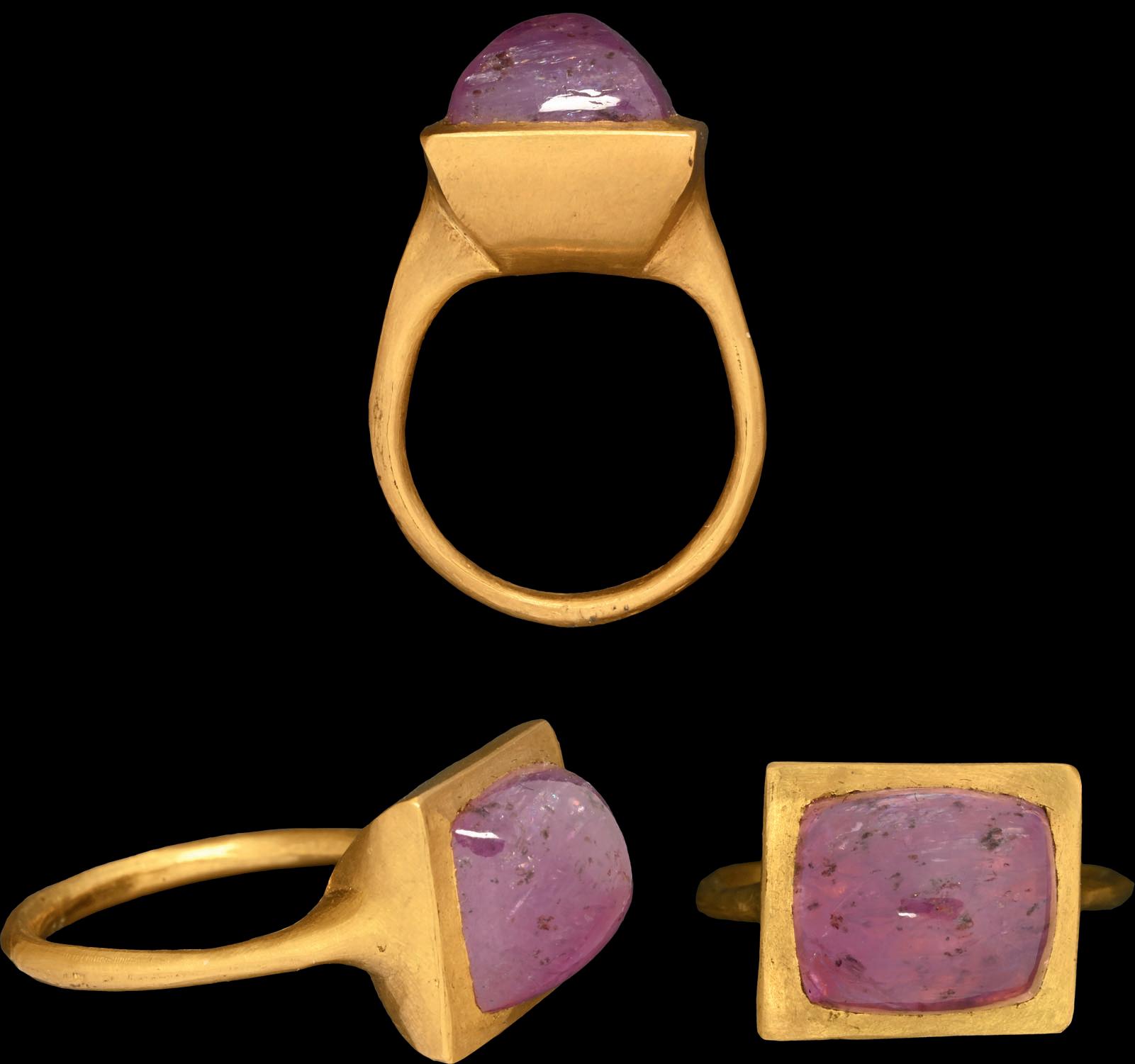
LARGE NATURAL PINK SAPPHIRE IN 24 CARAT GOLD MUGHAL RING
BURMA, CIRCA 18TH CENTURY A.D.
1¼ in. (20.3 grams, 33.21 mm overall, 16.21x17.28 mm internal diameter (approximate size British M½, USA 6¼, Europe 13.09, Japan 12))
Comprising a solid round-section ring with a large, rectangular bezel set with a vibrant pink sugarloaf-shaped sapphire.
£12,000 - 17,000
PROVENANCE:
From the private collection of Lord Ian Balfour, author of ‘Famous Diamonds’; received by gift to the present owner circa 2001.
Accompanied by a copy of a Gemmological Certification Services lab report invoice no.41731.
FOOTNOTES: According to the GCS report, there is no indication of heating, and they have estimated the weight of the sapphire to be between 10 and 20 carats. Subsequent CT scanning has confirmed that the weight of the sapphire is 16.3 carats.
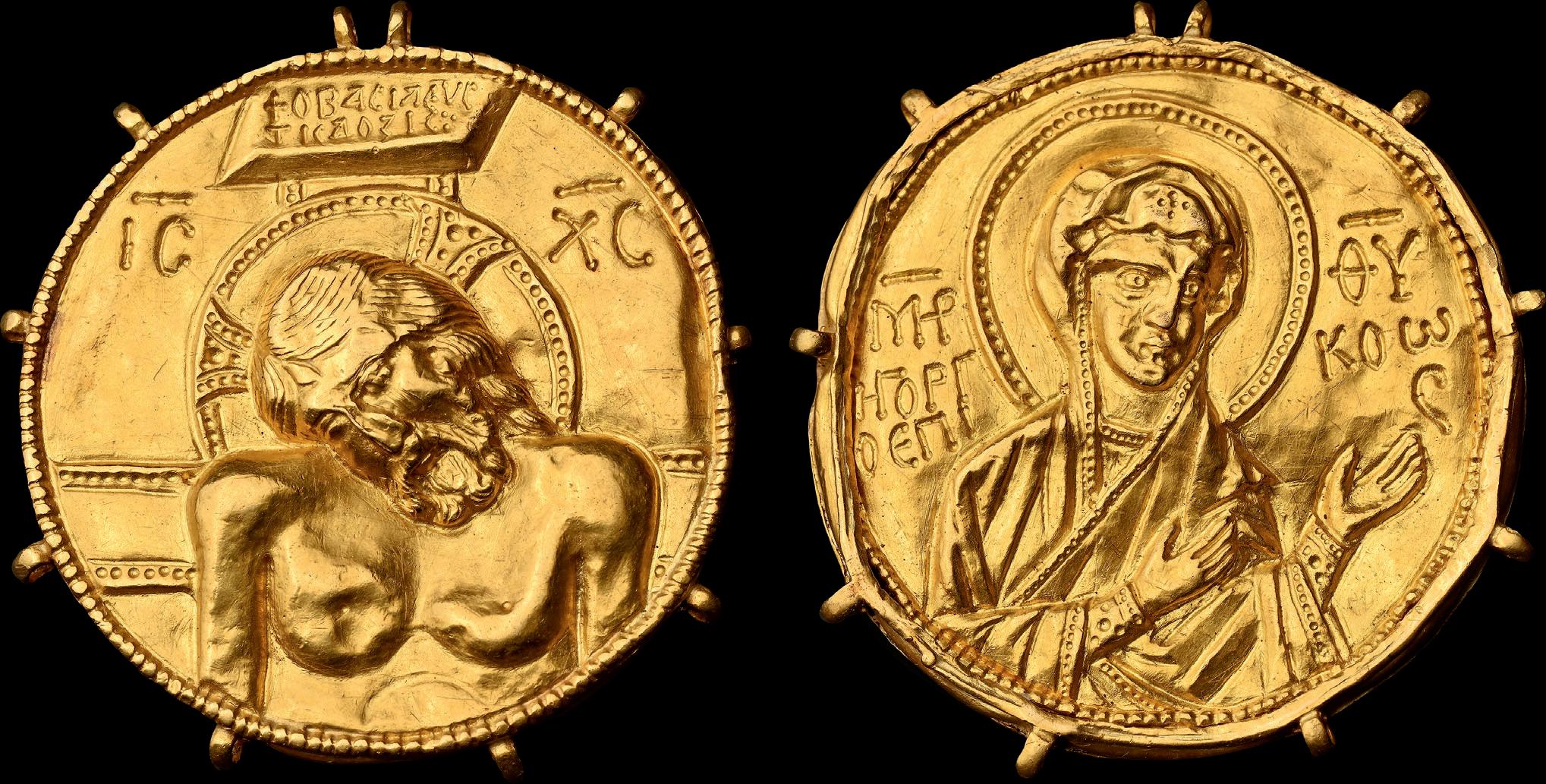
371
POST-BYZANTINE GOLD ARCHBISHOP’S PECTORAL PENDANT
16TH-17TH CENTURY A.D.
1¾ in. (21.3 grams, 44 mm)
Round enkolpion with finely worked icons both on the front and back, and eight small side eyelets for lost pearl ropes on the edge; at the top, a double eyelet for the chain; bordered by a delicate beaded edge with a slight knock in one place due to age; embossed depictions on both sides, finely rendered in repoussé; on the obverse a frontal bust portrait of the deceased Saviour, both arms of Christ limply hanging at his sides, the lifeless head resting on his right shoulder, behind him a nimbus and the cross, to the left of the soma (body of Christ) the abbreviation ‘IC’ (= Jesus), on the right ‘XC’ (= Christus), above the head a plaque with a Greek two-line inscription: ‘O Basilevs tis doxis Christos’ (Christ, the King of Glory); the Virgin Mary (Theotokos) depicted on the back, her hands raised in a gesture of prayer (orans) with exquisitely modelled facial features, flanked by an inscription referring to the Mother of God: the abbreviation ‘MP’ on the left, ‘THY’ on the right, furthermore, she is invoked as ‘He Gorgoepikoo’ (She who is quick to hear).
£8,000 - 10,000
PROVENANCE: Acquired by the previous owner on the European art market in the late 1990s. Property of a German university professor. Hermann Historica, Auction 87, 2020 no.19.
FOOTNOTES: Adorned with an icon of Christ and the Virgin Mary, this outstanding enkolpion symbolises purity of heart and the seal of confession and faith. Since the Byzantine era, golden enkolpia were pontifical insignia and usually worn by bishops. In this case, the size, the artistic craftsmanship, and the topics of the icons, depictions of Christ and the Theotokos, lead to the conclusion that it must have been the enkolpion of a high-ranking primate or archbishop. Extremely rare in this size and quality. Remarkable is also the artist’s choice to depict the Mother of God slightly turned to the right and not show her frontally, as is common.
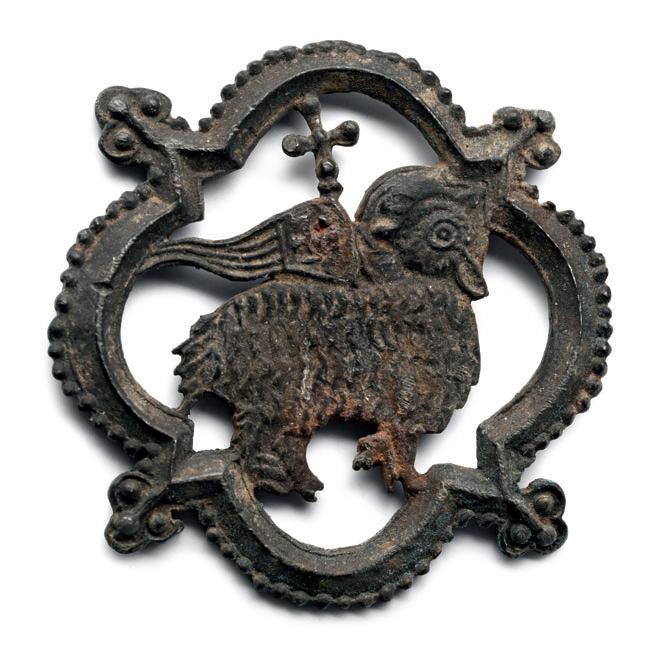
372
MEDIEVAL PEWTER AGNUS DEI PILGRIM’S BADGE
14TH-15TH CENTURY A.D.
1¾ in. (8.39 grams, 45 mm)
Quatrefoil frame with quatrefoil at each angle, beaded outer edge; central Agnus Dei motif with head reverse, cross and banner above.
£300 - 400
PROVENANCE:
From a retired Lincolnshire, UK, gentleman’s collection, a long time member of the Pewter Society.
373
MEDIEVAL PEWTER PILGRIM’S BADGE OF ARCHBISHOP BECKET
CIRCA 14TH-15TH CENTURY A.D.
1¼ in. (3.33 grams, 31 mm)
Head of Thomas Becket wearing archbishop’s mitre; pin to reverse. £200 - 300
PROVENANCE:
From a retired Lincolnshire, UK, gentleman’s collection, a long time member of the Pewter Society.
374
MEDIEVAL PEWTER PILGRIM’S BADGE OF THOMAS BECKET
14TH-15TH CENTURY A.D.
1½ in. (5.28 grams, 38 mm)
Comprising the facing bust of Thomas Becket wearing his mitre and with flanking tracery, a carinated ring with reserved legend 'SANCTVS' (holy, saint) and a pin to the reverse.
£200 - 300
PROVENANCE:
From a retired Lincolnshire, UK, gentleman’s collection, a long time member of the Pewter Society.
375
MEDIEVAL PEWTER AGNUS DEI PILGRIM’S BADGE
CIRCA 15TH CENTURY A.D.
1¼ in. (4.8 grams, 32.9 mm)
Comprising a rectangular bifacial pelletted frame with integral loop and pellets; obverse with openwork Agnus Dei image; reverse with inset amber-coloured glass pane, a very rare type.
£300 - 400
PROVENANCE:
Ex European collection, 1990s.
376
MEDIEVAL OUR LADY’S SHRINE PILGRIM’S BADGE
CIRCA 15TH CENTURY A.D.
2 in. (5.65 grams, 51.5 mm)
Formed as a tongue-shaped plaque with three trefoil crosses to the upper edge, a low-relief scene with Mary and the infant Jesus between fronds, lug below; reverse with a hatched panel.
£200 - 300
PROVENANCE:
Ex European collection, 1990s.
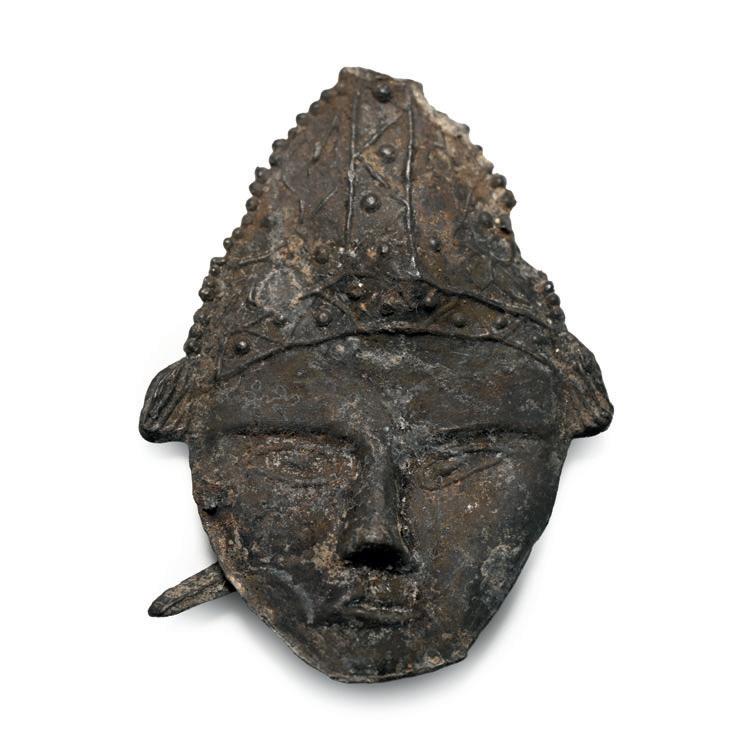
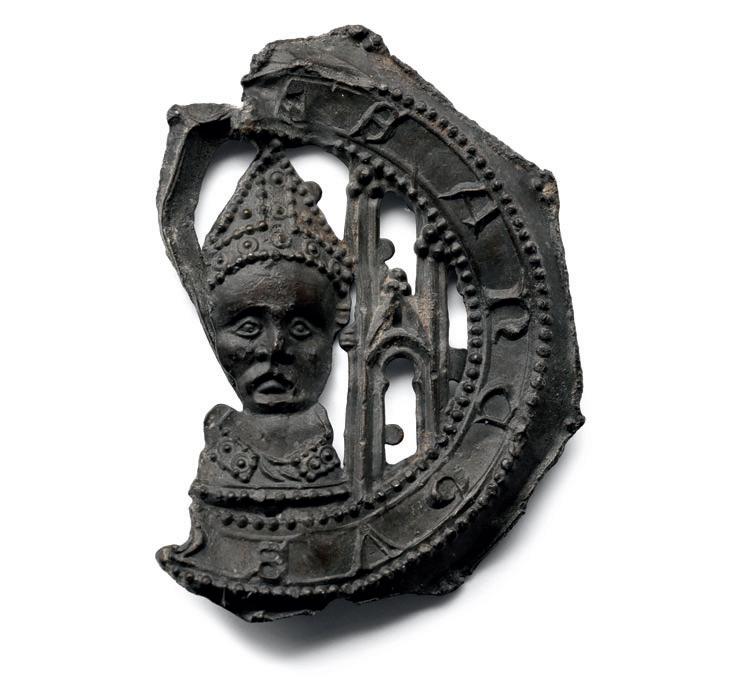
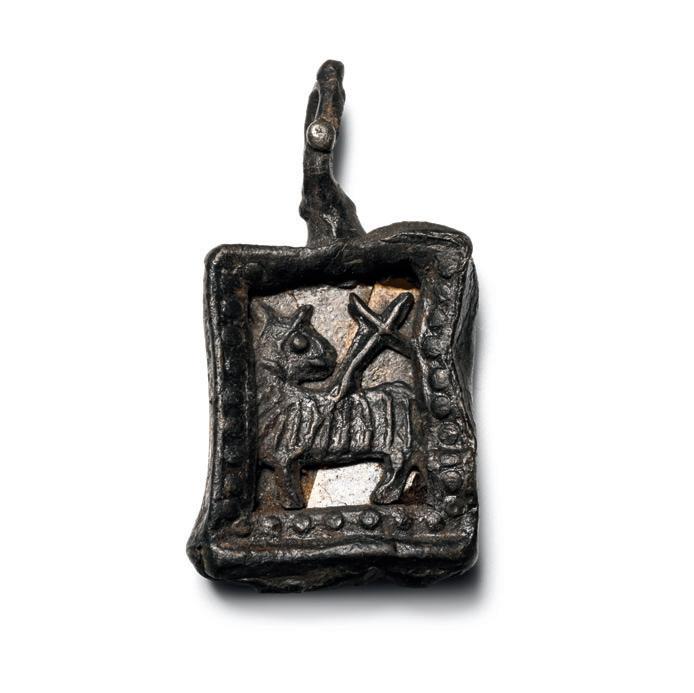
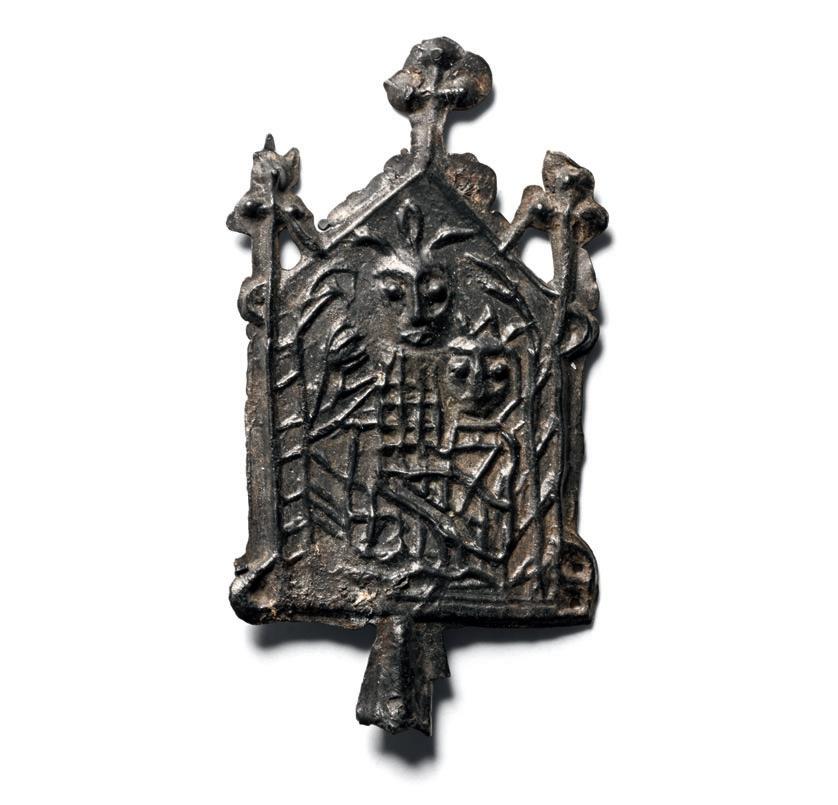
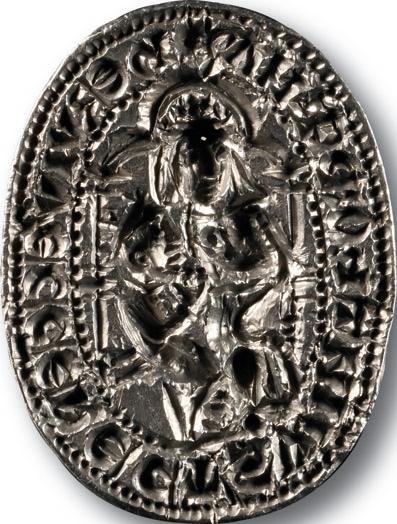


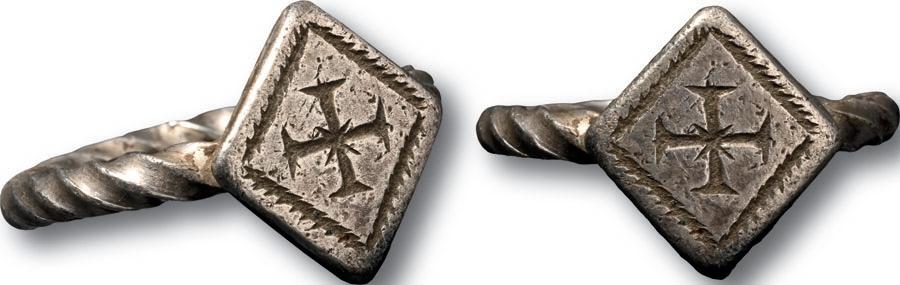

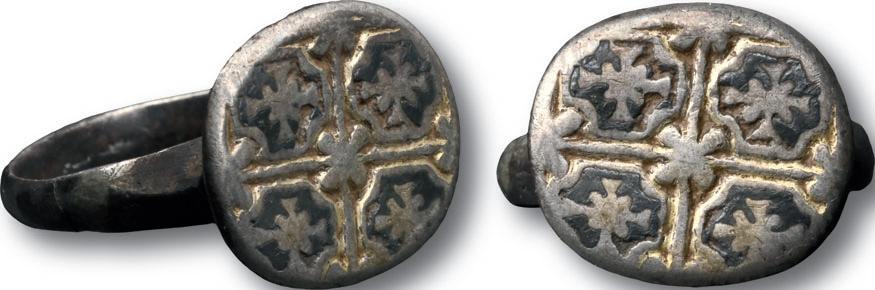

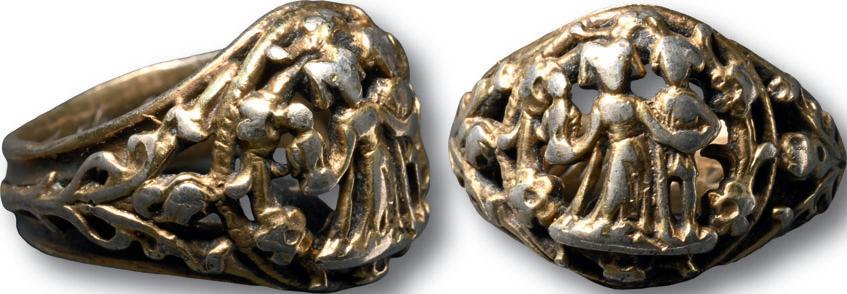

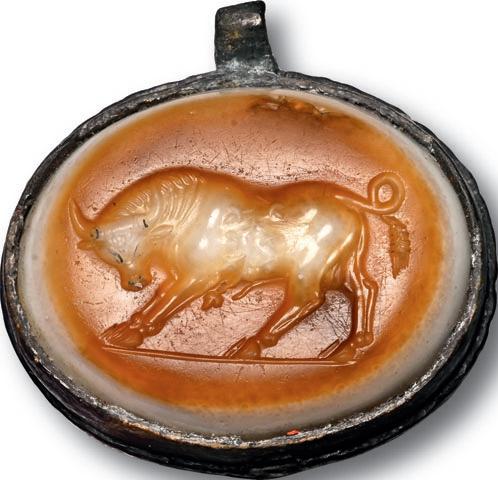
377
MEDIEVAL SILVER SEAL MATRIX FOR THE RECTOR OF SWAINSTHORPE MAGNA EARLY 15TH CENTURY A.D.
1 in. (5.29 grams, 24 mm)
An ellipsoid seal matrix with a strap to the reverse; incuse motif of crowned Mary seated on a throne with infant Jesus; legend to the edge within pelletted borders ‘*hERVIV’ ECC[’]E SWINThORPE’ MA’ (Harvey, rector of the church of Great Swainsthorpe); inked accession(?) number ‘1036’ to verso with later loop.
£1,500 - 2,000
PROVENANCE:
The Matrix Collection, formed by David Morris since the late 1980s. Found near the site of the church of Saint Mary in October 2002. Recorded with Norwich Castle Museum, retained for consideration as Treasure and subsequently returned to the finder.
FOOTNOTES:
The RCEWA reviewed an export application and determined that it meets the third Waverley criterion, making this lot currently non-exportable.
378
MEDIEVAL SILVER RING WITH KNIGHTS CROSS 10TH-12TH CENTURY A.D.
1 in. (6.74 grams, 25.17 mm overall, 19.31 mm internal diameter (approximate size British R½, USA 8¾, Europe 19.38, Japan 18))
With twisted shank, lozenge bezel with tremolier frame and cross potent to the centre.
£800 - 1,000
PROVENANCE:
UK private collection before 2000. Acquired on the UK art market. Private collection, London, UK.
379
MEDIEVAL CRUSADER PERIOD SILVER RING WITH CROSSES 12TH-14TH CENTURY A.D. in. (4.13 grams, 21.39 mm overall, 16.74 mm internal diameter (approximate size British K½, USA 5½, Europe 10.58, Japan 10))
D-shaped hoop with large oval bezel bearing a large cross motif, with four small crosses on a nielloed field.
£200 - 300
PROVENANCE: Ex German art market, 2000s. Acquired from an EU collector living in London. From the collection of a Surrey, UK, gentleman.
380
EASTERN EUROPEAN BRONZE MARRIAGE RING LATE 17TH-18TH CENTURY A.D.
1 in. (13.02 grams, 28.57 mm overall, 20.94 mm internal diameter (approximate size British W, USA 11, Europe 25, Japan 24))
Hoop with ribbed exterior, openwork tendrils to the shoulders, bezel with beaded wire collar and marriage scene; initials to inner face ‘П.Ф.Ш.’.
£400 - 600
PROVENANCE: Private collection, London, UK.
381
EASTERN POST-CLASSICAL AGATE GEMSTONE OF A DIONYSIAC BULL WITH VINE LEAF IN ANCIENT SILVER PENDANT 19TH CENTURY A.D. AND EARLIER 1¼ in. (14.81 grams, 32 mm)
Silver cell with beaded band to the equator, fragment of suspension loop; inset sardonyx gemstone with possibly later intaglio profile bull on a baseline with head lowered; supplied with a museum-quality impression.
£2,000 - 3,000
PROVENANCE:
Private English collection, formed between the late 1970s and early 1990s. Private collection, London, UK.
382
MEDIEVAL GILT BRONZE HORSE HARNESS MOUNT WITH FLORAL CROSS
CIRCA 13TH-14TH CENTURY A.D.
2½ in. (19.58 grams, 62.04 mm)
Hollow-formed, tau-shaped with a dome to the junction; upper face with repoussé scrolls, attachment rivets.
£300 - 400
PROVENANCE:
From the private collection of a London gentleman, from his grandfather’s collection formed before the early 1970s.
383
MEDIEVAL KNIGHT’S ENAMELLED BRONZE HERALDIC ‘DE BOHUN, EARLS OF HEREFORD’ HORSE HARNESS PENDANT
CIRCA 14TH CENTURY A.D.
1½ in. (7.55 grams, 39.6 mm)
Heater-shaped with a loop above, heraldic design of two groups of three lions divided by two diagonal bands.
£200 - 300
PROVENANCE:
Ex Graham Slater collection, Cambridge, 1980s-1990s.
384
MEDIEVAL KNIGHT’S GILT BRONZE HERALDIC BADGE WITH TEMPLAR’S CROSS
14TH-16TH CENTURY A.D.
2 in. (7.61 grams, 52.59 mm)
Discoid in plan with openwork design of scrolled bands and hatched panels, central cross pattee; reinforcing strip to reverse.
£200 - 300
PROVENANCE:
From the private collection of a European gentleman (1942-2024), formed since the 1970s.
385
MEDIEVAL BRONZE HERALDIC PERSONAL SEAL MATRIX CIRCA 13TH-14TH CENTURY A.D.
1 in. (15.08 grams, 25 mm)
Plano-convex type, discoid in plan with loop and strap to reverse; heraldic heater shield with quartered design of lion rampant and fleurde-lys; legend to border ‘S’GERARDUS DE BINIBIO’; accompanied by a museum-quality impression. £150 - 200
PROVENANCE:
From an old English collection, Bournemouth, UK. Ex Parthenon Gallery, London, UK, 2001. Property of a North London, UK, private collector.
386
ENAMELLED BRONZE DAGGER POMMEL
CIRCA 18TH CENTURY A.D. OR EARLIER
1½ in. (42.9 grams, 38 mm)
Comprising a rectangular-section body pierced longitudinally with knop finial; lateral bowed arms with scrolled ends rising to the level of the knop and similar flared below; panels of arabesque tendril ornament to both flat faces and to the lateral arms; damaged.
£500 - 700
PROVENANCE:
From an English private collection, 1980s. Property of a London, UK, antiquarian.
FOOTNOTES
There seems to be a good argument for this pommel to be part of the French group of crusader pommels in the Metropolitan Museum of Art and in the University of Chicago, which date to the 12th-13th century A.D. This object has parallels with this group in terms of its crude manufacture, type of enamel, and overall style, as well as the fleur in scallop shape, which is almost identical to the lobes found on many of the circular sword pommels of this group.
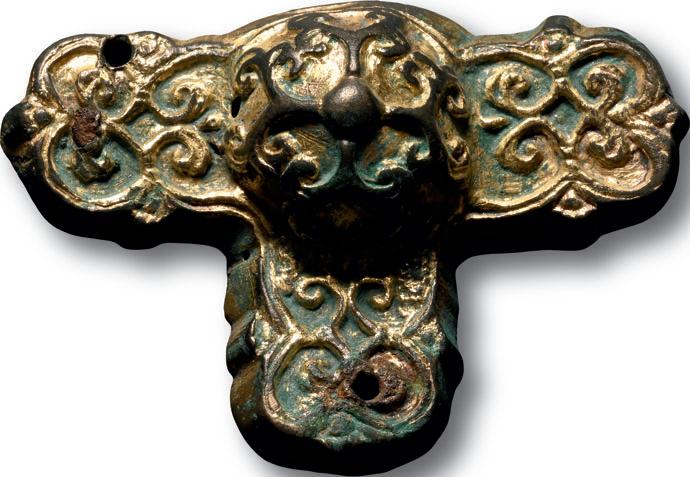

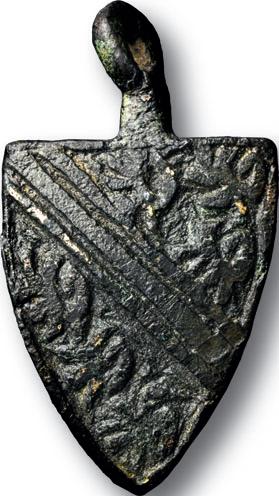


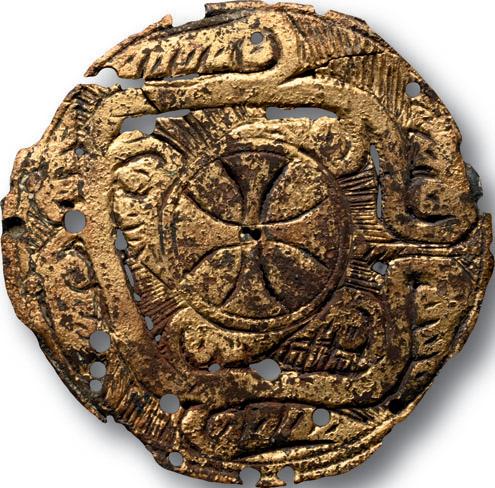

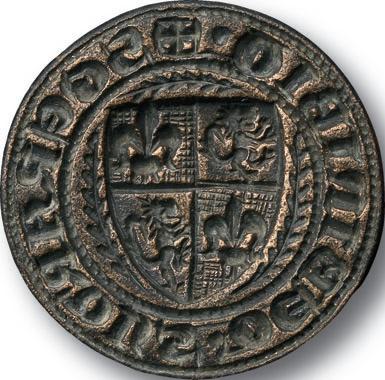
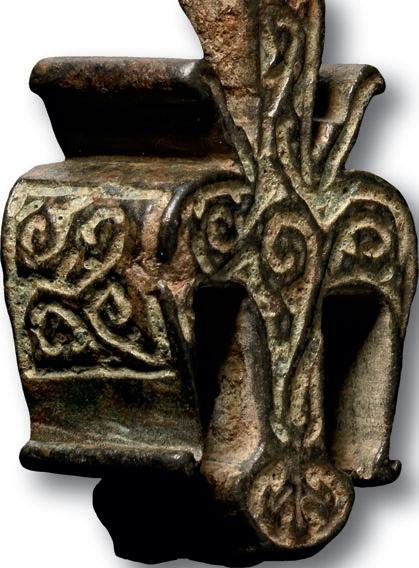

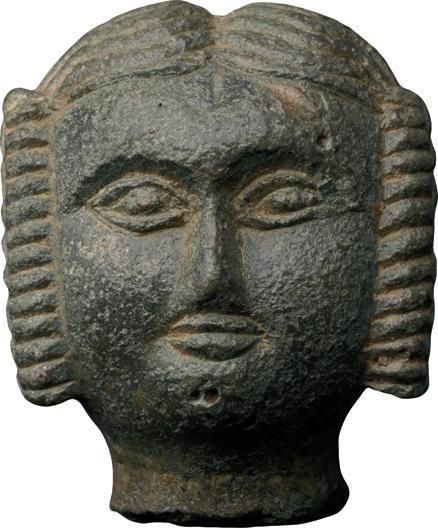
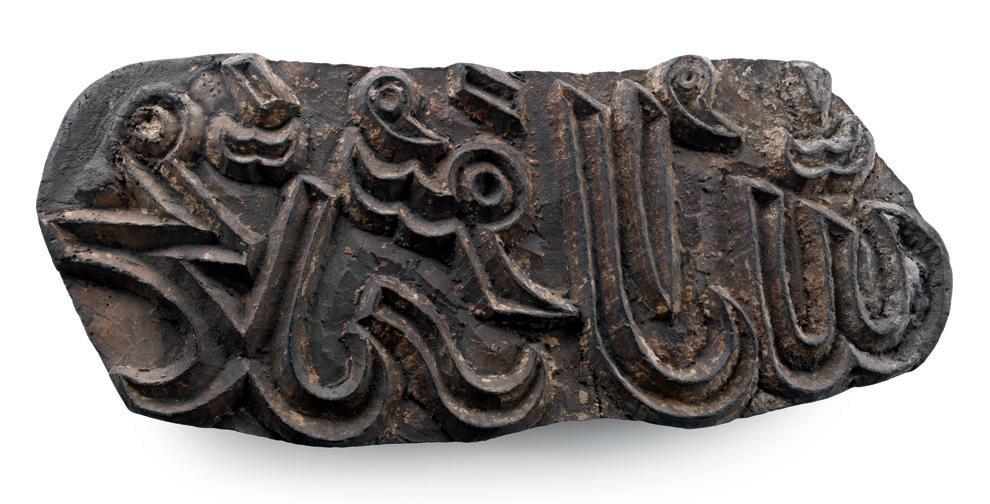
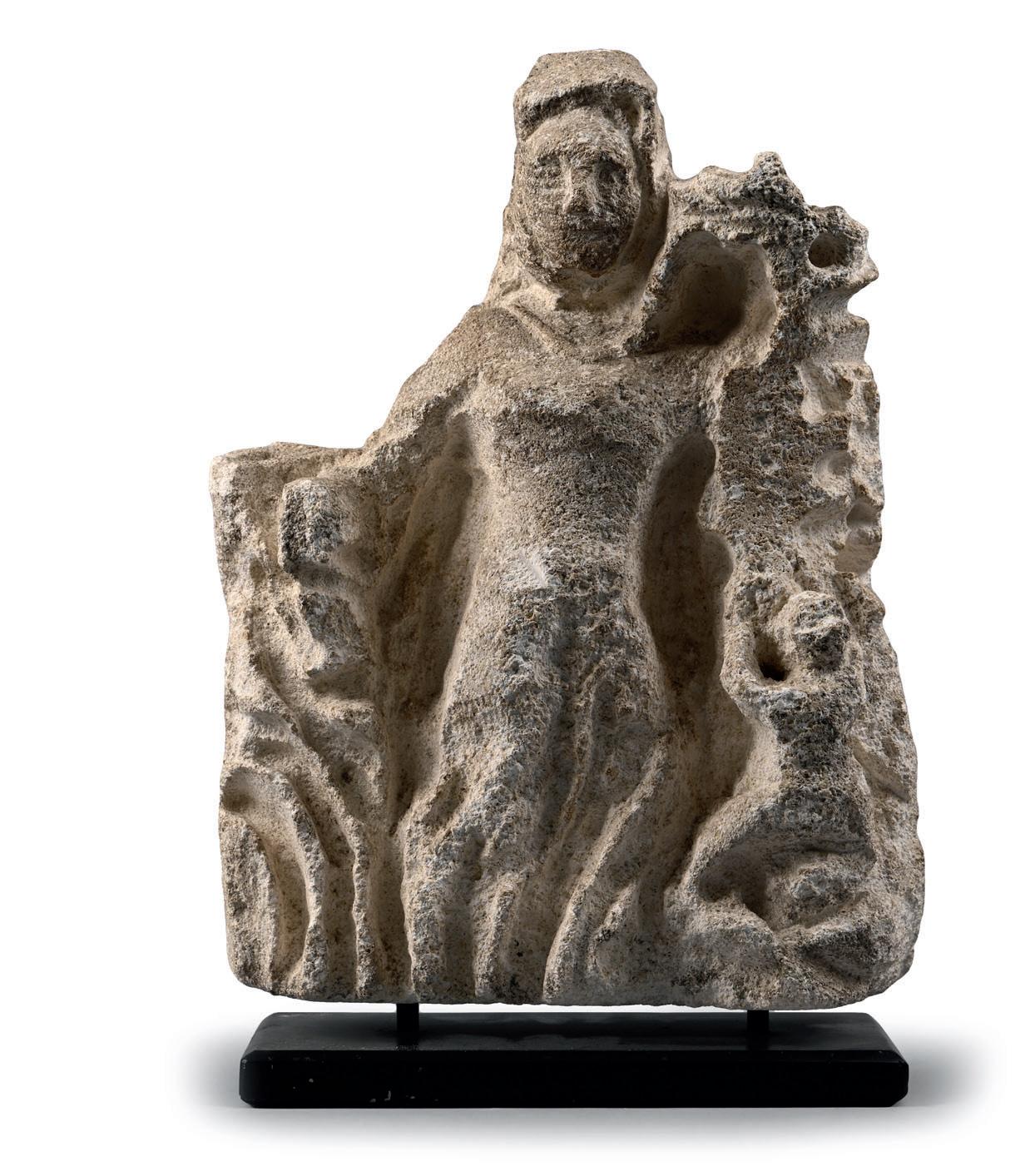
387
MEDIEVAL BRONZE HEAD OF A LADY 12TH-15TH CENTURY A.D.
1 in. (105 grams, 36 mm)
Female head with centre-parted hair and lateral wings, deep-set lentoid eyes and small pursed mouth; neck broken; socket to rear.
£200 - 300
PROVENANCE: Found Lincolnshire, UK.
388 MIZORAM BURMESE AMBER BEAD NECKLACE WITH NATURAL INCLUSIONS
CRETACEOUS PERIOD, CIRCA 99 MILLION YEARS B.P.
32¼ in. (54 grams, 82 cm)
Restrung necklace of dark honey-coloured beads of cylindrical and annular shape formed by hand, containing various organic inclusions.
£500 - 700
PROVENANCE:
From the Hukawng Valley in northern Myanmar. Acquired in Assam in the 1980s.
From the private collection of a Somerset gentleman.
Accompanied by a copy of a letter from Dr Andrew J. Ross FRES, of the National Museum of Scotland, concerning testing carried out on the necklace.
FOOTNOTES:
Dr Ross states: ‘The internal fractures and flow planes are consistent with what you see in amber, and although it does not contain any identifiable insect inclusions, the organic fragments that are present and the general colours appear consistent with Burmese amber.’
389
WOODEN BREAD STAMP WITH ‘MOHAMMED PROPHET OF GOD’ EARLY 19TH CENTURY A.D.
12 in (865 grams, 32 cm)
Subrectangular in plan with rounded ends, applied handle to reverse with modern hanger; high-relief calligraphic text.
£500 - 700
PROVENANCE: London, UK, collection.
390
MEDIEVAL ‘OUR LADY OF THE FLAMES’ FIGURAL SCENE
15TH CENTURY A.D. OR LATER
14 in. (10.55 kg total, 37.7 cm including stand)
Carved in the half-round frieze fragment or devotional sculpture of the Madonna del Fuoco, facing female in wimple and long robe with her right arm bent forward, left arm extended above a child gripping the folds of her robe; billowing flames surrounding the pair; mounted on a custom-made stand.
£300 - 400
PROVENANCE: Acquired Lukas Pearsie, Suffolk, 2012. Property of a Kent collector.
From the N.J. collection, Leicester, UK.
391
LARGE MEDIEVAL HERALDIC TILE WITH THE HEADS OF THREE AFRICANS WITHIN A SHIELD NORMANDY, 15TH CENTURY A.D.
8 in. (2.65 kg, 22 cm)
Square in plan and thick in section; upper face with reserved heater shield, chevron between three profile ‘Moor’s head’ motifs.
£400 - 600
PROVENANCE: Benjamin Proust, Paris, 2015.
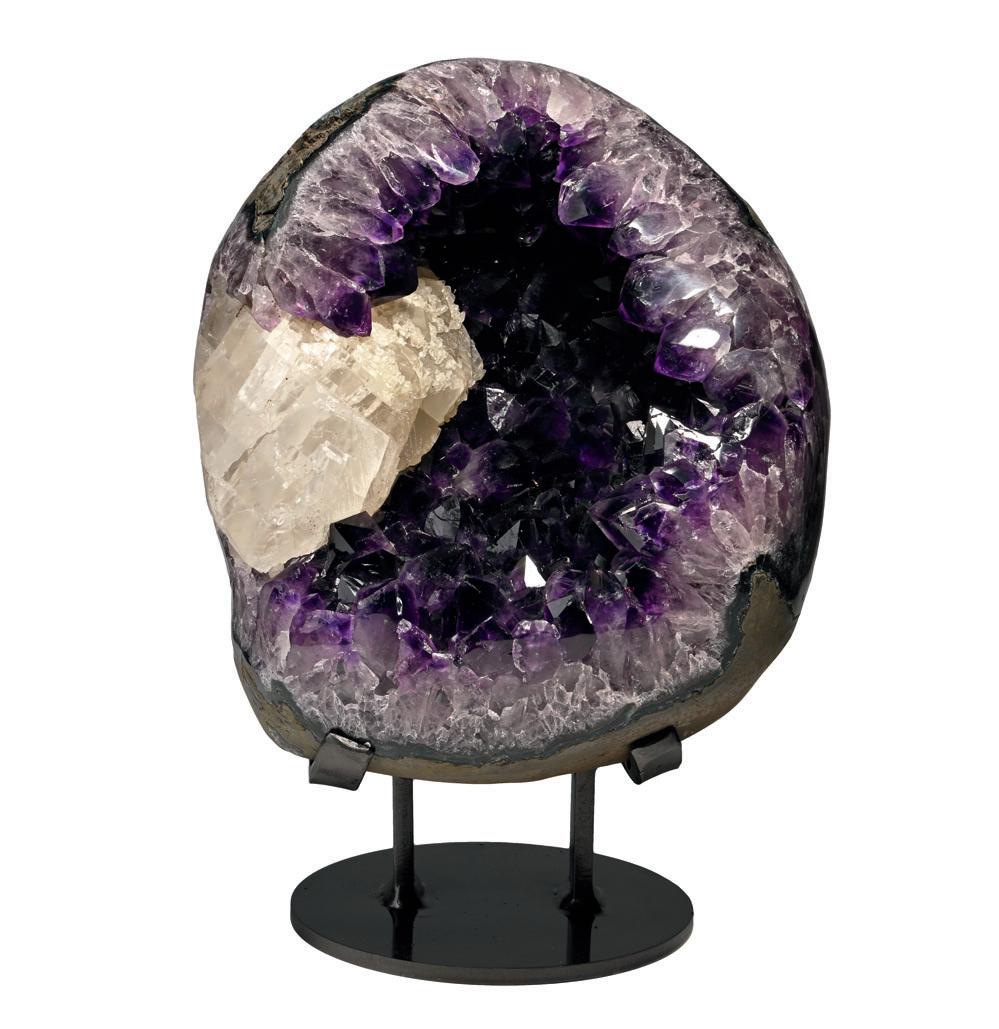
393
MASSIVE PYRITE ‘FOOL’S GOLD’ CLUSTER
10 in. (16.1 kg, 27 cm)
An intergrown mass of pyrite crystals showing bright metallic lustre. £600 - 800
PROVENANCE: From a Cambridgeshire, UK, collection.
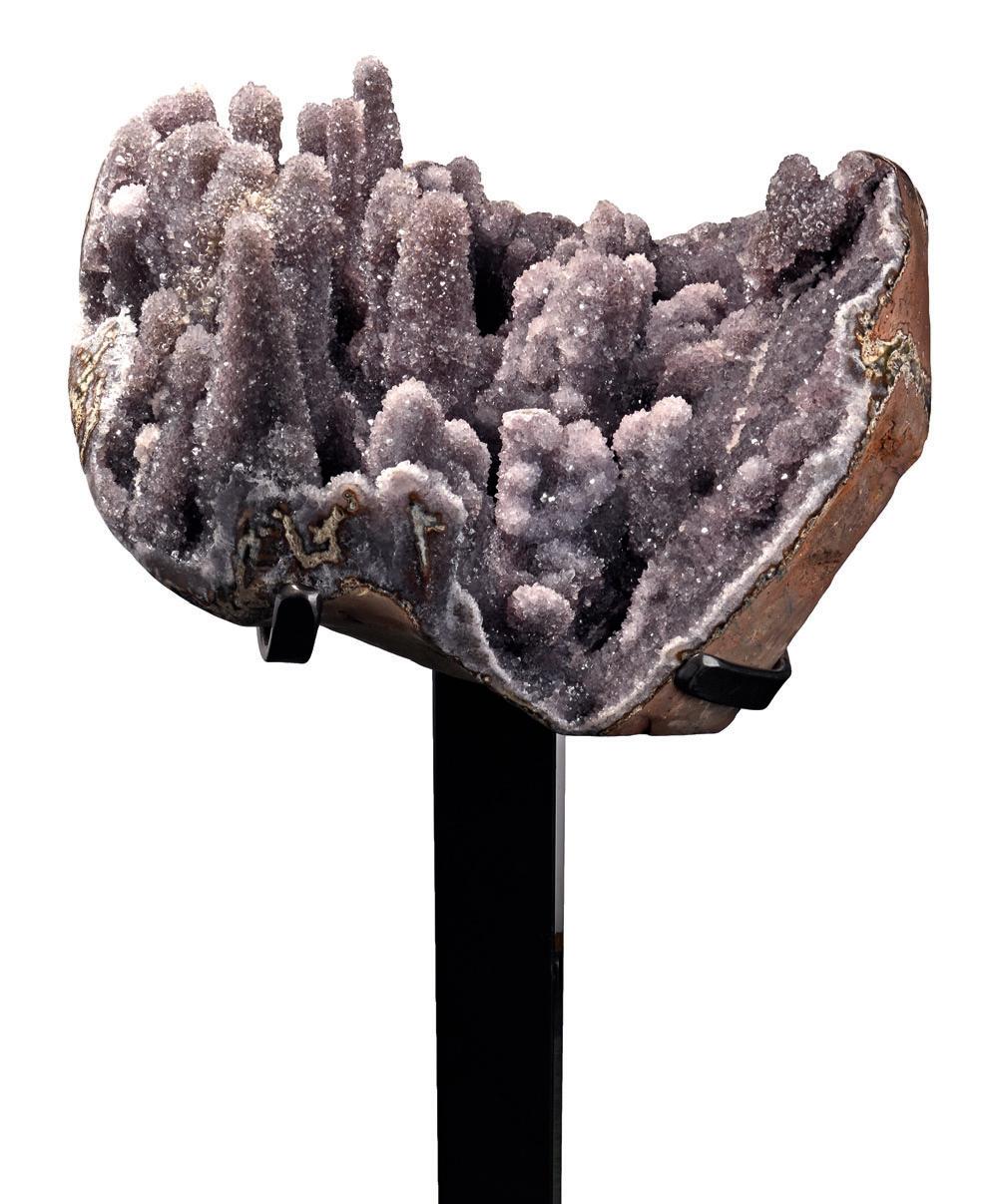
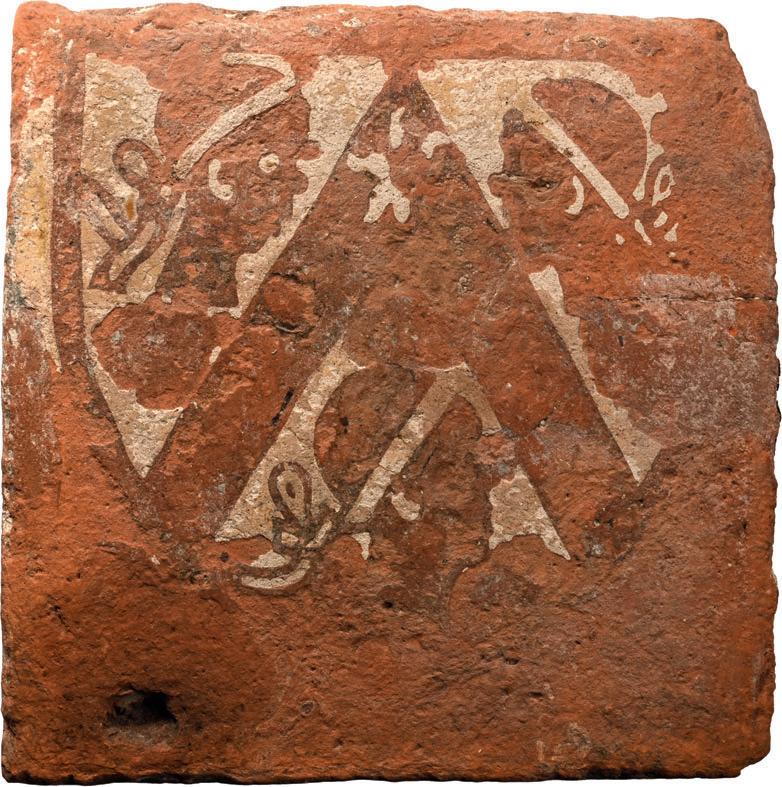
392
EGG-SHAPED AMETHYST CRYSTAL GEODE DISPLAY WITH CALCITE
13½ in. (17.1 kg total, 34.5 cm including stand)
Large, polished section of geode showing prismatic dark purple amethyst crystals on the inner surface with a large mass of calcite to one side, the calcite with clusters of small quartz crystals; mounted on a custom-made display stand.
£1,800 - 2,400
PROVENANCE: From Artigas, Uruguay. Property of a London lady.

394
MONUMENTAL GEODE SECTION WITH DRUZY QUARTZ STALAGMITES
39¼ in. (68.4 kg total, 100 cm including stand)
A rounded geode section with towering stalagmites with druzy grey quartz; mounted on a custom-made display stand.
£4,000 - 6,000
PROVENANCE: From Artigas, Uruguay. Property of a London lady.

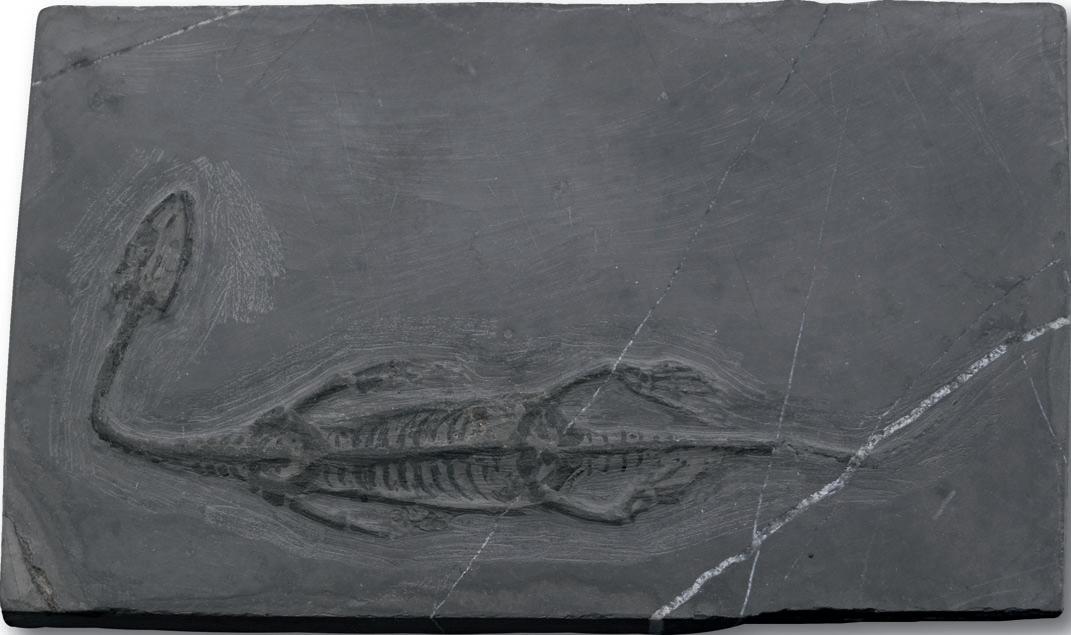
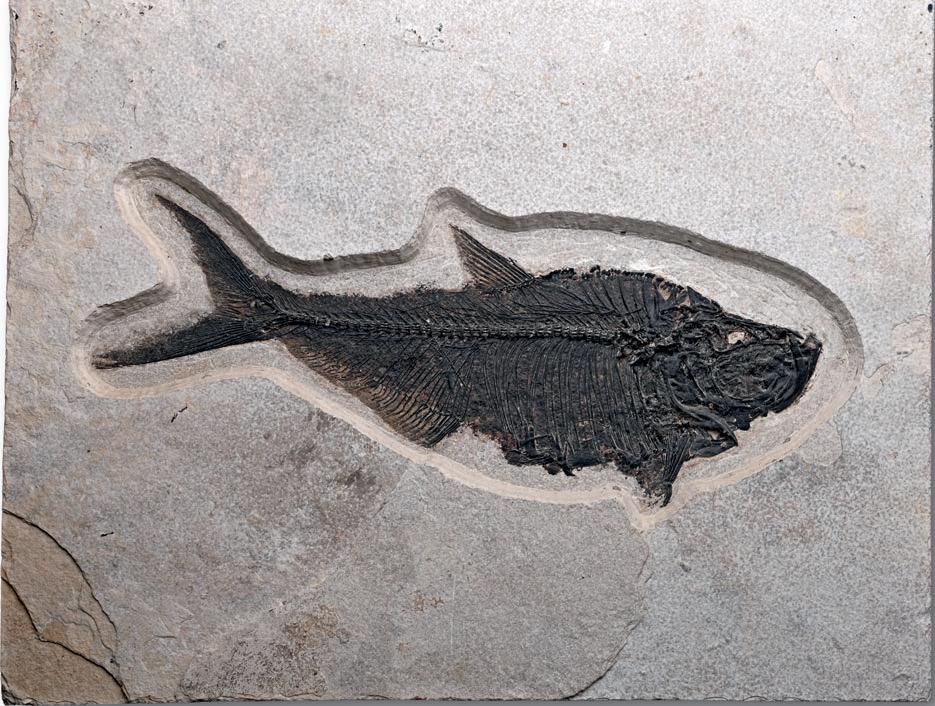

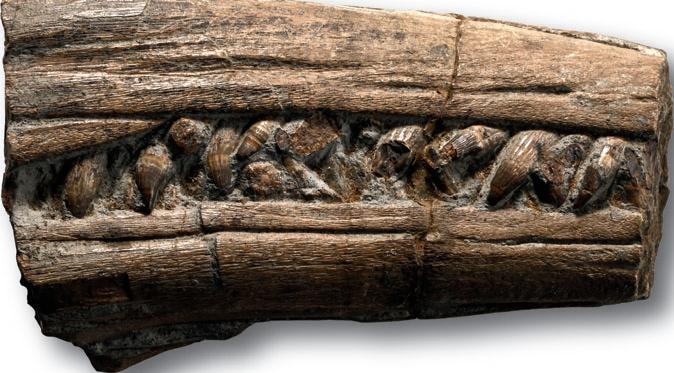

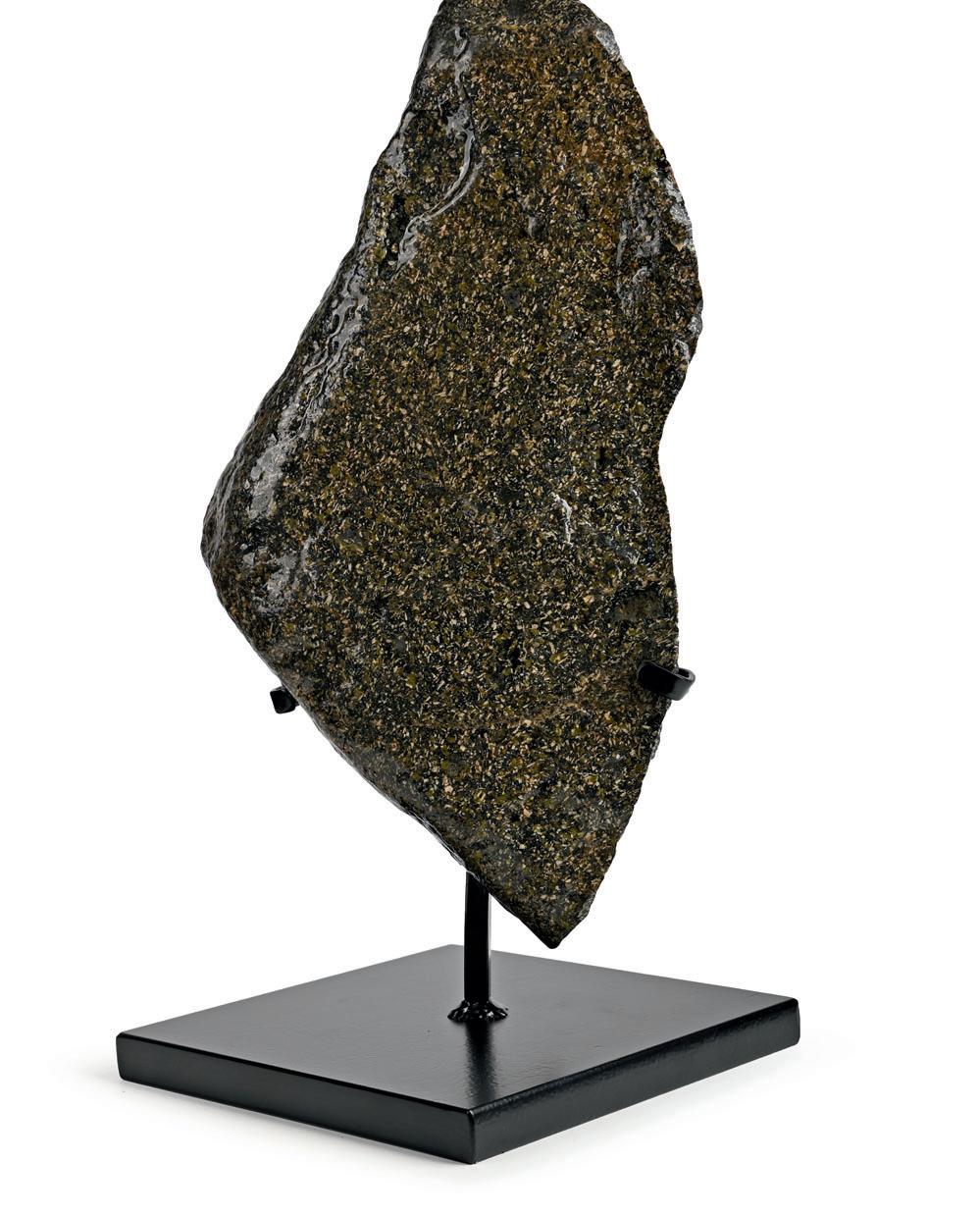
FOSSIL KEICHOUSAURUS MARINE REPTILE SKELETON
TRIASSIC PERIOD, CIRCA 250 MILLION YEARS B.P.
4 in. (197 grams, 11.7 cm)
Comprising a complete Keichousaurus hui skeleton on a rectangular matrix.
£300 - 400
PROVENANCE:
From a Cambridgeshire, UK, collection.
FOOTNOTES:
Keichousaurus was a late Triassic marine reptile, a member of the Pleurosaur family, which went extinct 250 million years ago during the Triassic-Jurassic extinction event. They were specialised fish eaters, and were highly unusual amongst marine reptiles in that they gave birth to live young rather than laying eggs.
396 VERY LARGE FOSSIL DIPLOMYSTUS FISH ON MATRIX
EOCENE PERIOD, 58-36 MILLION YEARS B.P.
23 x 18 in. (18 kg, 58.5 x 46 cm)
Diplomystus sp. fossil fish on a matrix slab showing good detail to the spine and ribs.
£1,000 - 1,400
PROVENANCE:
From Wyoming, USA.
From a Cambridgeshire, UK, collection.
397
BIFACIAL PARTIAL FOSSIL ICHTHYOSAUR JAW
MESOZOIC-JURASSIC PERIOD, CIRCA 250-90 MILLION YEARS B.P.
4 in. (270 grams, 10.6 cm)
Showing multiple sharp teeth and a section of well-formed, slender jaws.
£600 - 800
PROVENANCE: Discovered at Lyme Regis, UK, during the time of Mary Anning and her family. From an old English collection.
Ian Wilkinson collection, Nottinghamshire, UK, formed since 1985.
With an original early 19th-century handwritten identification label ‘Nose of a Saurian’, the original discovery of this fossil can be dated to the period 18001830.
398
HISTORIC SPARTAN BASALT CUT AND POLISHED DARK GREEN PORPHYRY SLAB
17¼ in. (9.82 kg total, 44 cm including stand)
Cut and polished section, mined in Greece, cut and polished on one side, probably recycled material mined in ancient Roman times; mounted on a custom-made metal display stand.
£1,000 - 1,400
PROVENANCE: Acquired on the UK art market since the 1990s. From the private collection of a Somerset gentleman.
399
ADULT TRICERATOPS DINOSAUR FOSSILISED BROW HORN ‡
CRETACEOUS PERIOD, CIRCA 68-65 MILLION YEARS B.P. 30 in. (25 kg total, 76 cm including stand)
A robust supraorbital brow horn from an adult individual, exhibiting the natural surface detail of the bone, the shaft clearly showing the numerous deep branching grooves and pits (nutrient canals and foramina), which supplied blood to the outer horn sheath; preserved in fragmentary condition, restored, and mounted on a custom-made display stand.
£4,000 - 6,000
PROVENANCE:
Discovered in Kervouster, Guengat, France, according to the inscription.
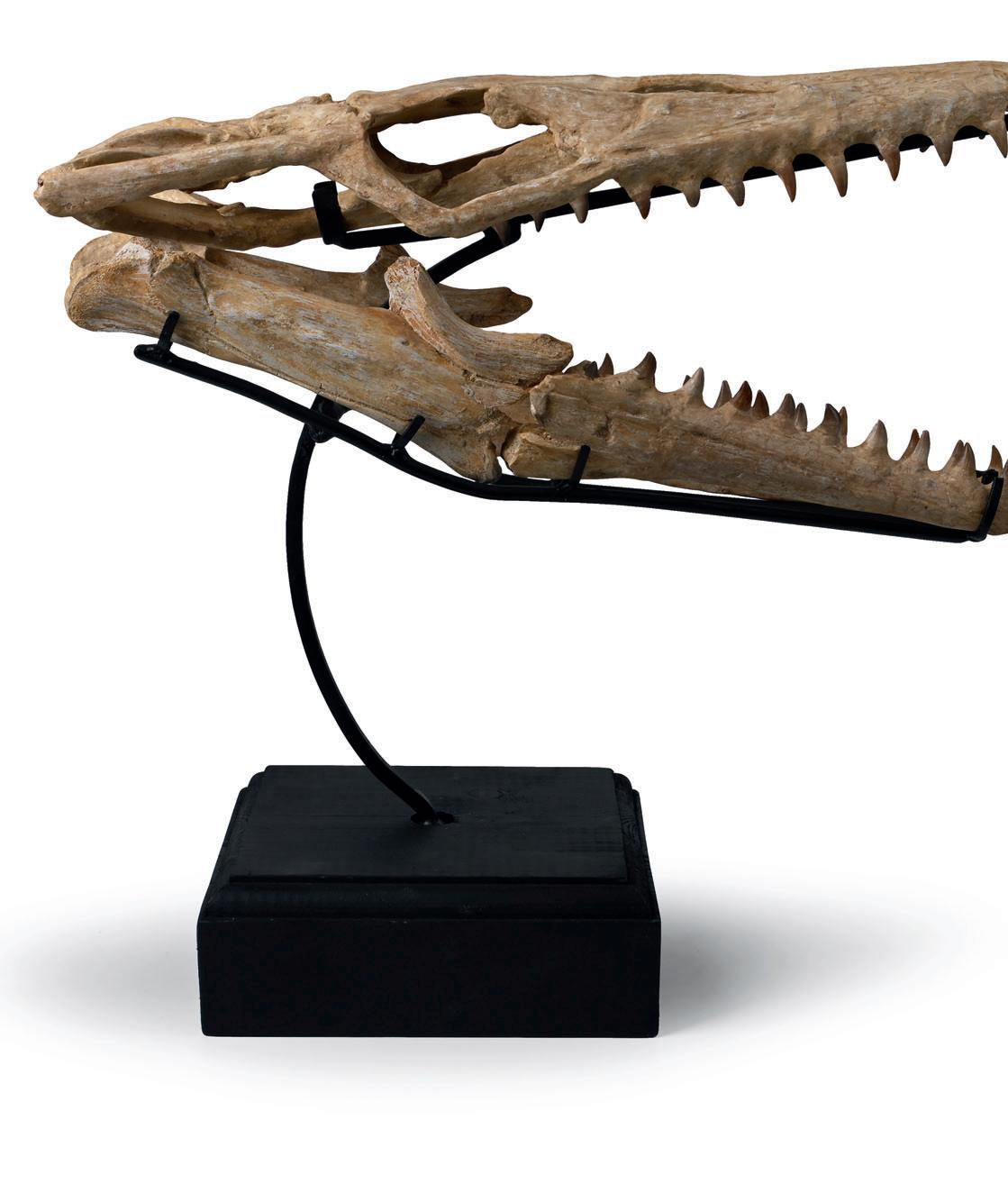

PROVENANCE: From Morocco, West Africa. From a Cambridgeshire, UK, collection. 399 400
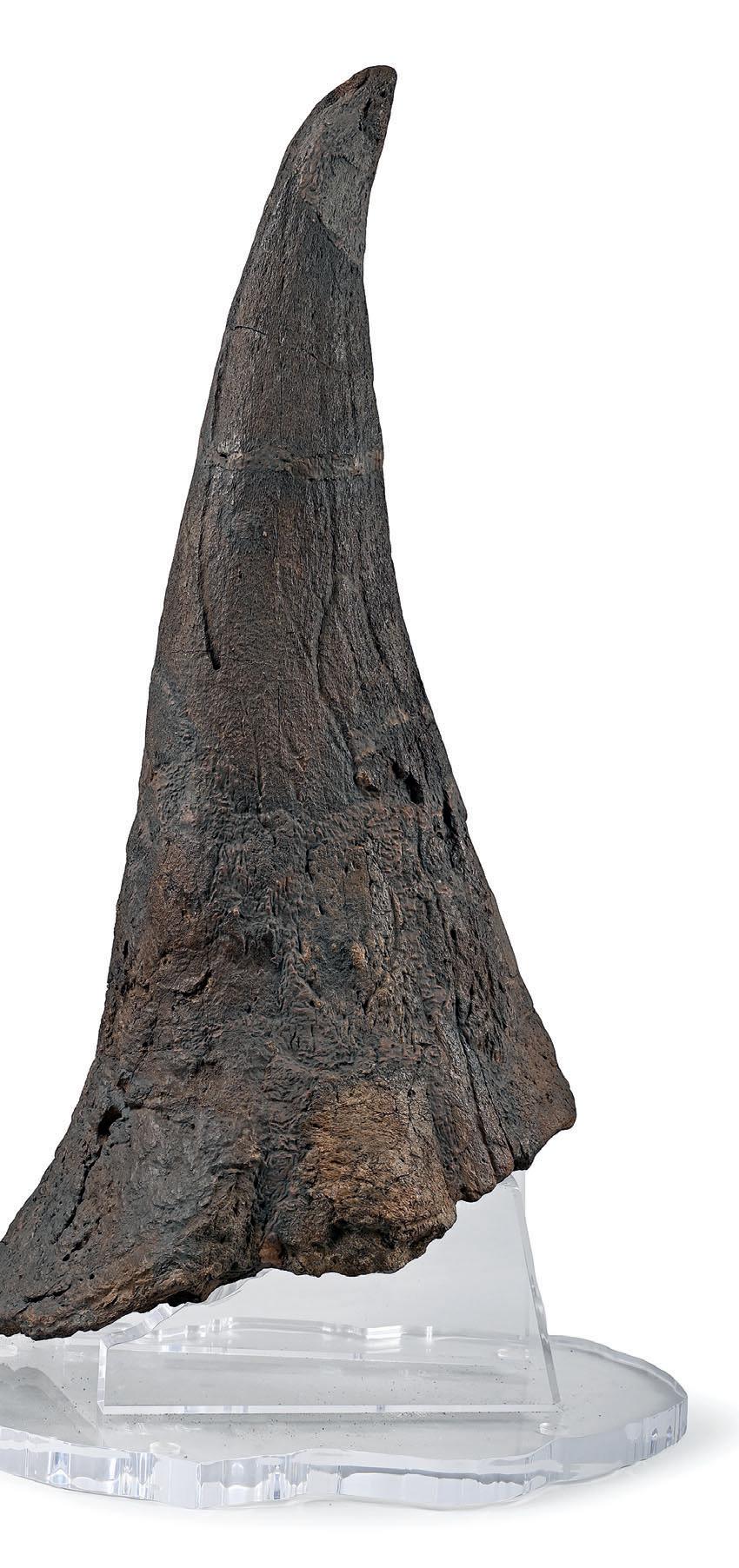

400
MOSASAUR ‘MARINE DINOSAUR’ FOSSIL SKULL
CRETACEOUS PERIOD, CIRCA 145-65 MILLION YEARS B.P. 18 in. (8.35 kg total including stand and box, 46 cm wide)
A magnificent, full three-dimensional fossil skull of a juvenile Mosasaur Prognathodon with upper and lower mandibles, eye sockets and brain cavity; including jaw teeth and throat teeth; some restoration; with custom-made display stand.
£3,000 - 4,000
Bidder/Buyer Terms and Conditions
1. Interpretations and Definitions: the following terms generally apply within these Terms and Conditions; other terms are defined within specific sections following:
Auctioneer – the firm TimeLine Auctions Ltd (“TimeLine” hereafter) or its authorised auctioneer, acting as Agent for the Seller.
TimeLine is a company registered in England and Wales (company no: 06873501) with registered office at The Court House, 363 Main Road, Harwich, CO12 4DN, UK. The website and telephone number are https://timelineauctions.com and +44 (0) 1277 815121.
Agent – a person or body acting on behalf of another.
ALR – Art Loss Register - All lots with an upper estimate value of £1,500 and above and all ancient Western Asiatic lots are searched against the Art Loss Register database.
Auction – a sale event whether taking place live in real-time or of extended duration (Timed Auction).
Bid – a sum offered by a Bidder to purchase the Lot.
Bidder – the person offering a Bid.
Buyer – the Bidder who the Lot is Knocked Down to.
Buyer’s Premium – the percentage of the Hammer Price payable by the Buyer to TimeLine in accordance with clause 21.
CITES - Convention on International Trade in Endangered Species.
Data Protection Legislation –all applicable data protection and privacy legislation in force from time to time in the UK including the General Data Protection Regulation ((EU) 2016/679) (83) (GDPR); the Data Protection Act 2018; the Privacy and Electronic Communications Directive 2002/58/EC (as updated by Directive 2009/136/EC) and the Privacy and Electronic Communications Regulations 2003 (SI 2003/2426) as amended, and any and all applicable national data protection laws made under or pursuant to the GDPR, as may be amended or superseded from time to time.
Date of Sale – the date on which the Auctioneer Knocks Down the Lot. Group – any Lot comprising more than one item.
Hammer Price – the amount of the winning bid when Knocked Down by the Auctioneer to a Bidder.
Knock(ed/ing) Down – the act of the Auctioneer in bringing the Hammer down to complete the contract for the sale of the Lot to the Bidder submitting the highest bid.
Lot – the goods for sale.
Purchase Price – the total sum due for any Lot, including the Hammer Price, the Buyer’s Premium, any internet bidding fees, any shipping charges, taxes, duties or any other costs payable to TimeLine.
Registered Bidder –a Bidder who has registered with TimeLine for the purpose of taking part in any Auction. Reserve Price –the minimum Hammer Price at which a Lot may be Knocked Down.
Seller – the person offering the Lot for sale. Terms – means these Terms and Conditions. Title – legal rights of ownership of the Lot.
2. Application: the singular includes the plural and vice versa and any reference to ‘he’, ‘she’ or ‘it’ applies to all of them.
3. Basis of Contract:
a. These Terms and Conditions apply to the exclusion of any other terms that the Bidder/Buyer seeks to impose or incorporate, or which are implied by trade, custom, practice or course of dealing.
b. Each Buyer is required to carefully read the Terms and Conditions before offering a Bid. When a Buyer makes a Bidhe/she acknowledges that he/she has read, understood and accepted these Terms. c. TimeLine does not act for or give any advice to Bidders/Buyers.
4. Dimensions, weights and colour: All dimensions and weights (including ring sizes) are approximate and are for general guidance only; a single dimension given is normally the greatest dimension for the piece(s). Although TimeLine have made every effort to precisely display the colours and condition of a Lot, TimeLine does not guarantee or represent that a device displays them accurately. The Lot may vary slightly from those images.
5. Condition: A condition statement for Lots
is not given in the catalogue, printed or online. This does not infer that any Lot is free from faults and prospective Bidders must satisfy themselves entirely as to the fullcondition of each piece before placing Bids. Condition Reports may be requested for any lot but are given only for general guidance and are inevitably subjective in character. Requests for Condition Reports should be made as early as possible; requests received at a late time may not be available before the lot is offered. Bidders are encouraged to carefully examine in person any Lot(s) for which they intend or do Bid for. It is not possible to note all marks or defects and neither TimeLine or the Auctioneer make any guarantee as to the physical quality or condition of any Lot(s).
6. Dating: Dates may be given in several forms, as examples below:
527 AD - an item that bears a date upon it or that can otherwise be dated with precision; 6th century AD - an item that can be dated with considerable confidence to a specific period;
Circa 6th century AD - an item that can be approximately dated by comparison with other pieces;
Probably 6th century AD - an item that is likely to be of this period in the light of similar pieces; Possibly 6th century AD - an item that might be of this period by comparison with items of a broadly similar character; and Undated - no date is known or suggested for the piece.
6th Century AD or later – an item is dated to a specific period but may also be a revival of style of a later date.
7. Attributions: Works of art attributions may be given in several forms, as examples below:
Signed – a work bearing the signature of the named artist;
Attributed to – a work of the period of the artist which may be in whole or in part the work of the artist named;
Circle of – a work of the period of the artist and showing his influence; Follower of – a contemporary or nearly so work executed in the style of the artist; Manner of – a work executed in the style of the artist but of a later date; and After – a copy of any date of a work of the artist.
8. Other Descriptive Matters: Some other words or phrases are used descriptively, as examples below:
Style - an item made in the style of an earlier age but thought to be probably of later date. Archaistic - an item made in the style of a much earlier age; Grand Tour - an item usually of some age but in the style of an earlier age; After the Antique - an item made as a reproduction, usually of quite modern date; and Faux - used descriptively when the material used is probably imitative in character.
9. Lots including Archaeological or Cultural Property: A UK export licence from the Department for Digital, Culture, Media and Sport, is required for Lots originating from UK soil or territory leaving the UK and for such Lots of non-UK origin when leaving the UK. TimeLine will make applications for the necessary Cultural Property Export Licence as a ‘free of charge’ service to Buyers, where the Export Licence is legally required. If a Buyer requests for TimeLine to apply for an Export Licence where this is not legally required, an additional fee of £24 (VAT inclusive) will be invoiced to the Buyer. Buyers are advised to check concerning any Regulations applicable in their country of residence regarding importation and to enquire prior to bidding. The deferment of any Export Licence shall not be reason to cancel any bid nor to delay payment.
10. Compliance with Cultural Goods Regulation: Each Bidder/Buyer acknowledges that the importation of cultural goods into the EU is subject to EU Regulation 2019/880, effective from 28 June 2025. Each Bidder/Buyer agrees to comply fully with all applicable laws and regulations governing the importation, including but not limited to:
a. Obtaining any required import licence (for Category B items: archaeological objects or items >250 years old).
b. Submitting a valid importer statement for
Category C items (objects >200 years old valued ≥ €18,000).
c. Providing proof of lawful export from the country of origin (including the UK) where applicable.
11. TimeLine’s limited obligation in relation to the Cultural Goods Regulation: TimeLine shall, to the extent it has received from the Seller and the Buyer has paid in full the due Purchase Price in accordance with clause 30, provide supporting documentation to each relevant Bidder/Buyer, relating to:
a. Provenance and ownership of the relevant Lot.
b. Customs export declaration from the UK.
c. Any UK cultural property export licences (if required under the UK’s own export control regime).
However, TimeLine shall not be liable to any Bidder/Buyer for:
i. Delays in EU customs clearance.
ii. The Bidder’s/Buyer’s failure to obtain the required import documentation or statements.
iii. Any seizure, forfeiture or return of Lots by EU customs or authorities.
iv. Delays caused by the Seller’s failure to provide any requested information. TimeLine makes no representation or warranty that the Lot(s) will be accepted for import by the EU authorities, and shall not be liable for any rejection, seizure, or delay once the Lot(s) have left the UK.
12. Lots including materials from Endangered Species: Buyers are responsible for obtaining a CITES licence when required for the export from the UK of any item(s) made of or containing materials such as ivory, tortoiseshell, rhinoceros horn, whalebone, etc.
13. Import Licences: Buyers are responsible for checking and ensuring compliance with any regulations applicable in their country of residence regarding importation.
14. Copyright: all cataloguing text, images and other material published by TimeLine whether physically or electronically is the property of TimeLine and may not be reproduced, stored in any retrieval system or otherwise transmitted in any form or by any means, electronic, mechanical, photocopying, recording or otherwise without the prior written consent of TimeLine.
15. General Conduct of Auction: TimeLine shall have absolute discretion as to lots offered for sale, lots withdrawn and the conduct of any Auction. TimeLine shall have absolute discretion to refuse entry, decline bids and expel any person from the Auction whether present in person or by agent or proxy or attending by way of any electronic media or telecommunications.
16. Viewing: all Lots are available to view. All prospective Bidders are advised to view any Lot(s) prior to bidding and the Bidder must form their own opinion before bidding. Public viewing arrangements will be advised in advance of the Date of Sale and private viewing can be arranged at the TimeLine premises by appointment.
17. Lot Descriptions: all Lots are offered ‘as seen’ and ‘as is’ and are available for inspection. The Buyer is obligated to make all and any enquiries he wishes as to the accuracy and authenticity of any sale description (including Condition, Dating and Attributions, as set out in clauses 7-9).The principle of caveat emptor applies except where expressly excluded by operation of law. While materials (such as catalogues) are vetted by an external committee of experts, TimeLine do not make or give any guarantee, warranty or representation or undertake any duty of care in relation to the description, illustrations or photographs of any Lot, including condition, quality, provenance, authenticity, background, style, period, age, origin, value and estimated selling price. TimeLine undertakes no obligation to examine, investigate or carry out any tests either in sufficient depth or at all to establish the accuracy or otherwise of any description or opinions given by TimeLine whether in the catalogue or elsewhere. Lots comprising Groups are sold strictly subject to them not being returnable for any reason whatsoever; the provisions set out under clause 45 are specifically excluded in respect of such Lots. For coins that have been authenticated, graded and
encapsulated ('slabbed') by an independent grading company, no guarantee of any kind is offered by TimeLine. Buyers should note that removal or attempted removal from any slab will immediately void any independent guarantee that might have been offered by that grading company.
18. Condition Reports: All Lots are available for inspection. TimeLine will provide a report on the physical condition of any Lot on request. Bidders should note that reports are provided as a free service to interested Bidders. Descriptions therein are not warranties and all Lots are offered ‘as seen’ and ‘as is’.
19. Estimates: estimates are for general guidance only and Lots may sell outside their indicated range(s). Bidders must make their own assessment as to the value of any Lot and conduct their bidding accordingly.
20. Reserves: Lots may be subject to a Reserve Price set by the Seller, at a level not exceeding the low estimate, below which bids cannot be accepted; TimeLine reserves the right to bid on behalf of a Seller, up to the amount of any Reserve Price.
21. Buyer’s Premium: the Buyer’s Premium is 30% of the Hammer Price [inclusive of VAT] for all successful Bidders. Use of the TimeLine Auctions online in-house bidding service is free of additional charge. For those using any other internet bidding platforms, the provider’s normal charges at up to 6% (inclusive of VAT) will be payable by the Buyer in addition to the Buyer’s Premium.
22. Registration and Bidding: all prospective Bidders must register their personal details with TimeLine before bidding and a Bidder Number will be allocated for their use in relation to a specific sale; prospective Bidders will be asked to provide proof of identity and address. TimeLine reserves its right to refuse any Bidder or any Bid at its discretion. A deposit in accordance with clause 29 may be required before accepting any Bid(s). The Bidder Number must be shown by Bidders to the Auctioneer when placing a bid and by the successful Bidder when the Lot is Knocked Down. The auctioneer shall conduct the Auction at his sole discretion for all matters, accept Bids from any source and may exercise bids on behalf of absent Bidders or on behalf of Sellers up to any Reserve Price. Bidding shall be in pounds sterling only and generally in accordance with the increments set out below:
1. £0 to £99 – in increments of £5
2. £100 to £199 – in increments of £10
3. £200 to £499 – in increments of £20
4. £500 to £999 – in increments of £50
5. £1000 to £1999 – in increments of £100
6. £2000 to £4999 – in increments of £200
7. £5000 to £9999 – in increments of £500
8. £10000 to £19999 – in increments of £1000
9. £20000 to £49999 – in increments of £2000
10. £50000 to £99999 – in increments of £5000
11. £100000 to £249999 – in increments of £10000
12. £250000 and up – in minimum increments of £20000
23. Absentee Bidding/Auto Bidding: Registered Bidders may leave absentee/auto Bids in advance of a live Auction directly through the TimeLine website or in writing by mail, email, fax or other delivery means and will be automatically exercised at the Reserve Price or at one bid increment above any competing Bid up to the submitted maximum Bid amount.
24. Commission Bidding: while Bidders are advised to attend the Auction and to bid in person, TimeLine will accept written instructions in advance of a live Auction from a Registered Bidder to personally execute bids on behalf of the Bidder up to a stated maximum. Unlimited bids or bids to ‘buy’ will not be accepted. In the event of identical bids being received from more than one Bidder, the earliest received will have priority. TimeLine offers this as a free service for live Auctions but] no liability is accepted for any errors in bidding or in the event that a Bid is not placed. A deposit may be required In accordance with clause 29.
25. Internet Bidding: live, real-time bidding is available to Bidders through the TimeLine website for all live Auctions. Bidders intending to use any other internet bidding service must Register in advance with that service and the provider’s normal charges at up to 6% (VAT inclusive) will be payable in addition to the Buyer’s Premium. It is entirely the responsibility of the Bidder using any bidding service to ensure that Bids are made accurately; Bids cannot be retracted once made and are binding on the Bidder in all circumstances. TimeLine are not responsible for any technical or other failure which results in Bids not being received.
26. Telephone Bidding: facilities for telephone bidding are available at live Auctions at the discretion of TimeLine for Bidders on Lots with a low estimate in excess of £250 and must be booked and confirmed in advance. It is a condition for acceptance by TimeLine of any telephone bidding request that the Bidder undertakes to execute a minimum Bid at the low estimate sum. TimeLine offers telephone bidding as a free service but no liability is accepted for any errors or in the event that a connection cannot be made or is interrupted before the Lot is Knocked Down.
27. Agents: all Bidders making Bids through any means shall be deemed to be acting as principal in their bidding and shall be directly and fully liable for all Bid amounts, Buyer’s Premium and any other charges or costs. If any prospective Bidder wishes to appoint a person to bid on their behalf, then this must be agreed and authorised in writing by TimeLine in advance of the Auction. A deposit may be required in accordance with clause 29.
28. Value Added Tax and Duties: VAT is charged on an inclusive basis, under the Auctioneer’s Margin Scheme on all Buyer's Premiums and other charges and is not claimable as Input VAT. For some items, such as investment gold, modern jewellery and gemstones, where marked with a ‘dagger’ (†) symbol, VAT on the Hammer Price will be payable in addition. Where import duties are payable, these lots are marked with symbols ‡ or Ω and are payable by all buyers at the corresponding rates; for overseas buyers, a refund of import duty will be payable or credited, provided that the item(s) have left the UK within 30 days of date of payment.
29. Deposits: Timeline reserves the right to request a deposit in certain circumstances. The amount of the deposit will be set by Timeline. If a Bid is not placed the deposit will be paid back within a reasonable timeframe after the close of the auction. In case of a successful bid, the deposit will be reduced from the Purchase Price payable by the Buyer.
30. Payment: the Purchase Price becomes due and payable when the Lot is Knocked Down by the Auctioneer. Requests and Statements detailing the purchase information will be sent out by email or post; Bidders may be telephoned or otherwise contacted when payment is not received promptly or where there are queries in any respect.
a. The full Purchase Price must be paid in Pounds Sterling and can be made by bank transfer (for transfers from outside the UK, subject to payment of an additional £10 overseas bank transaction fee), by cash up to the value of £7,000, by cheque from a UK bank (subject to clearance) or by bank debit card or credit card (up to a maximum of £500). It is the responsibility of the Buyer to ensure that TimeLine receives the correct amount payable.
b. Unless agreed by TimeLine in writing in advance of the Auction, the Buyer must pay the Purchase Price in full in cleared funds to TimeLine by no later than 4.30pm on the third working day following the Date of Sale. In case of delayed payment, clause 34 applies.
31. Title, Risk and Insurance: Title to any Lot is retained by the Seller until the Purchase Price and all other sums payable by the Buyer have been paid in full in cleared funds to TimeLine; at this point, Title will transfer from the Seller to the Buyer. Risk for the Lot passes to the Buyer at the time the Lot is Knocked Down to the Bidder. TimeLine does not hold property insured after the Lot has been Knocked Down. In addition, risk and
responsibility for compliance with EU cultural goods import laws (or any other equivalent laws affecting the import of the Lot(s))shall transfer to the relevant Bidder/Buyer upon(i) delivery to the carrier at the UK export point or (ii) collection by the Buyer (or their agent), from that point forward, the relevant Buyer assumes full responsibility for securing the Lots lawful entry into the EU or non-UK country.
32. Collection of Lots and Storage: Once the Buyer has paid the Purchase Price in full, TimeLine will release the Lot to the Buyer for collection. The Buyer must collect, or arrange the collection of, all purchases from the location advised by TimeLine by 4.30pm on the seventh working day following the Date of Sale. The Buyer must present photographic ID for any collection. If a third party is collecting on behalf of the Buyer, please contact TimeLine in writing to provide prior written authorisation confirming the third party who would be collecting on the Buyer’s behalf. The third party will need to present their photographic ID for collection also.
TimeLine may provide the Buyer with a quotation and contact details for the services of Mail Boxes Etc on TimeLine documentation (any storage/shipping contract is between the Buyer and Mail Boxes Etc). The Buyer may arrange a service of their choice for collection, packing and shipping services. Lots not collected by the seventh working day following the Date of Sale will be moved to storage at a transfer cost of £20 plus VAT per Lot and storage charges will thereafter be applied at the rate of £1.90 plus VAT per Lot per day until collected; no Lots may be removed/released to the Buyer until all storage and transfer costs have been paid in full. In the event that the accrual of storage charges reaches 50% of the Hammer Price paid or after the expiration of three months from the transfer date, whichever occurs first, Timeline reserve the right to re-sell any and all Lots stored without notice and in any manner at their sole discretion and to apply any proceeds in defrayment of such costs. The Buyer will be entitled to receive any credit balance above the amount of the costs on request but will remain liable for any deficit.
33. Delivery by TimeLine: at the absolute discretion of TimeLine, TimeLine may, on request, directly arrange delivery of certain Lots to the address registered to the Buyer, on payment by the Buyer to TimeLine of any advised handling and delivery charge.
34. Remedies for Buyer’s Failure to Make Payment and/or Remove Lots: if the Purchase Price and/or all sums payable are not paid in full when they fall due and/or the Lot is not removed in accordance with these terms, TimeLine may without further notice to the Buyer be entitled to exercise one or more of the following rights:
a. To terminate the agreement immediately for breach of contract;
b. To retain possession of the Lot;
c. To remove and/or store the Lot at the Buyer’s expense, as detailed at clause 32 at a cost to the Buyer of £20 + VAT for the transfer per Lot plus a daily cost of £1.90 plus VAT per Lot for the storage;
d. To take legal proceedings against the Buyer for payment of any sums due to TimeLine by the Buyer;
e. To be paid interest on any monies due to TimeLine at the annual rate of 8% per annum from time to time to be calculated on a daily basis from the date upon which such monies became payable until the date of actual payment;
f. To sell the Lot without a Reserve Price at Auction or by any other means and apply any proceeds against the amount owing by the Buyer to TimeLine;
g. To apply any monies received from the Buyer in payment or part payment of any sums due from the Buyer to TimeLine under these terms;
h. To refuse to allow the Buyer to register for a future Auction or to reject a bid from the Buyer at a future Auction.
35. Limitation of Liability: The Auctioneer has obtained insurance cover in respect of its own legal liability for individual claims. The limits and exclusions in this clause reflect the insurance cover the Auctioneer has been able to arrange and the Buyer is responsible for making his own arrangements for the insurance of any excess loss.
Timeline will under no circumstances be liable to the Buyer, whether in contract, tort (including negligence), breach of statutory duty, or otherwise, arising under or in connection with the contract for:
a. any loss of profits, sales, business or revenue
b. loss of business opportunity
c. an indirect or consequential loss.
Our total liability to you for all losses arising under or in connection to the contract, whether in contract, tort (including negligence), breach of statutory duty, or otherwise, will in no circumstances exceed £500.
Nothing in the Contract limits any liability which cannot legally be limited, including but not limited to liability for:
a. death or personal injury caused by negligence;
b. fraud or fraudulent misrepresentation; and
c. breach of the terms implied by section 12 of the Supply of Goods and Services Act 1979 (title and quiet possession).
The sale and purchase of the Lot(s) that is completed under these Terms and the delivery to the carrier at the UK export point or collection by the Buyer (or their agent), shall not be subject to rescission, return, or non-payment due to:
a. Unforeseen EU customs measures;
b. Reclassification of the item by import authorities;
c. Non-issuance or denial of import licence; and
d. Delay in clearance, inspection, or release.
Failure by the Bidder/Buyer to comply with the requirements set out at clause 10 shall not constitute grounds to terminate, cancel, or void the contract of sale.
This clause 35 shall survive termination of the Contract.
36. Buyer’s Indemnity: The Buyer agrees to indemnify and hold TimeLine harmless on a full indemnity basis all claims and all direct, indirect or consequential losses (including loss of profits, loss of business, depletion of goodwill and similar losses), costs, proceedings, damages and expenses (including legal and other professional fees and expenses) awarded against or incurred or paid by TimeLine as a result or in connection with as a result of: a. TimeLine taking steps under clause 35; b.the Bidder’s/Buyer’s failure to comply with EU import requirements;and c. incorrect or false importer statements.
37. Use of your personal information: TimeLine will only use the Seller’s personal information as set out in their privacy policy. TimeLine may amend this policy from time to time. Where Timeline processes any personal data, it will comply with the requirements and obligations under the Data Protection Legislation.
38. Anti-Money Laundering: TimeLine’s AntiMoney Laundering Policy sets out TimeLine’s policy for ensuring compliance anti-money laundering legislation that applies to some of TimeLine’s activities. TimeLine may amend this policy from time to time.
39. Sale of Goods Act: The terms implied by sections 13 to 15 of the Sale of Goods Act 1979 are, to the fullest extent permitted by law, excluded.
40. Severance: If any provision or partprovision of these terms and conditions is or becomes invalid, illegal or unenforceable, it shall be deemed modified to the minimum extent necessary to make it valid, legal and enforceable. If such modification is not possible, the relevant provision or partprovision shall be deemed deleted. Any modification to or deletion of a provision or part-provision under this clause shall not affect the validity and enforceability of the rest of the terms and conditions.
41. Amendments: TimeLine may amend these Terms and Conditions from time to time. Please check our website for our latest terms and conditions.
42. No waiver: No failure or delay by TimeLine to exercise any right or remedy provided under the these Terms and Conditions or by law shall constitute a waiver of that or any other right or remedy, nor shall it prevent or restrict the further exercise of that or any other right or remedy.
43. Third-Party rights: These Terms & Conditions are between Timeline and a Seller. No other person shall have any rights to enforce any of these terms.
44. Governing Law: these terms and conditions and any dispute or claim arising out of or in connection with them or their subject matter or formation (including noncontractual disputes or claims) shall be governed by, and construed in accordance with, the law of England and Wales.
45. Jurisdiction: the Bidder irrevocably agrees that the courts of England and Wales shall have exclusive jurisdiction to settle any dispute or claim arising out of or in connection with these terms and conditions or its subject matter or formation (including non-contractual disputes or claims). At the sole discretion of TimeLine, the auctioneer may instigate any proceedings within the jurisdiction of the bidder's country of residence.
46. Disputes: in the event that the Buyer has any dispute in relation to any Lot, not being a Lot described as a Group, Collection or other term indicating that the lot comprises more than one object, (such lots being sold cannot be returned in accordance with clause 17), which has been sold, that dispute must be notified to TimeLine in writing within 14 days following the Date of the Sale in order that TimeLine can hold the proceeds pending resolution of the dispute. In the event of deliberate forgery being claimed for any Lot, the Buyer shall submit two opinions in writing from recognised experts for consideration; the inability of different experts to agree shall not be sufficient grounds. No liability is accepted by TimeLine for any costs/losses of the Buyer, including but not limited to fees, shipping, loss of profit, consequential costs or any other matters beyond the Hammer Price and Buyer's Premium. In all cases, any item must be returned to TimeLine, strictly in the condition it was in at the date of the sale being held; Buyers are advised that any form of destructive examination or testing undertaken will result in claims being rejected; claims resulting from results of tests under a scientific process not generally accepted for use at the Date of the Sale or which were unreasonably expensive in relation to the estimates for the lot or impractical or likely to have caused damage to the Lot at the Date of the Sale will not be allowed.
TimeLine will have no liability to the Buyer after a period of 14 days as then TimeLine will release monies and make payments to Sellers.
47. Import restrictions: Auction lots (or individual item/s within any given lot) of either Persian or Iranian origin are subject to United States trade restrictions which currently prohibit their import into the US, without exception. Buyers should be aware that similar (or other) restrictions may apply to other categories of items offered for sale. It is the sole responsibility of the buyer to satisfy themselves that any lot/s purchased at auction can be legally imported into the desired shipping destination prior to bidding.
Seller’s Terms and Conditions
1. Interpretations and Definitions: the following terms generally apply within these Terms and Conditions; other terms are defined within specific sections following: Auctioneer – the firm TimeLine Auctions Ltd (“TimeLine” hereafter) or its authorised auctioneer, acting as Agent for the Seller. TimeLine is a company registered in England and Wales (company no: 06873501) with registered office at The Court House, 363 Main Road, Harwich, CO12 4DN, UK. The website and telephone number are https://timelineauctions.com and +44 (0) 1277 815121. Agent – a person or body acting on behalf of another.
ALR – Art Loss Register - All lots with an upper Estimate value of £1,500 and above and all ancient Western Asiatic lots are searched against the Art Loss Register database.
Auction – a sale event whether taking place live in real-time or of extended duration (Timed Auction).
Bid – a sum offered by a Bidder to purchase the Lot.
Bidder – the person offering a Bid.
Buyer – the person who the Lot is Knocked Down to.
Date of Sale – the date on which the Auctioneer Knocks Down the Lot.
Data Protection Legislation –all applicable data protection and privacy legislation in force from time to time in the UK including the General Data Protection Regulation ((EU) 2016/679) (83) (GDPR); the Data Protection Act 2018; the Privacy and Electronic Communications Directive 2002/58/EC (as updated by Directive 2009/136/EC) and the Privacy and Electronic Communications Regulations 2003 (SI 2003/2426) as amended, and any and all applicable national data protection laws made under or pursuant to the GDPR, as may be amended or superseded from time to time.
Estimate – the estimate for any Lots as set out in the Property Receipt.
Group – any Lot comprising more than one item.
Hammer Price – the amount of the winning bid when Knocked Down by the Auctioneer to a Bidder.
Knock(ed/ing) Down – the act of the Auctioneer in bringing the Hammer down to complete the contract for the sale of the Lot to the Bidder submitting the highest bid. Lot – the goods for sale.
Net Proceeds-the Hammer Price less the Selling Commission and any charges or expenses levied at Timeline’s discretion in accordance with these Terms and Conditions.
Purchase Price – the total sum due for any Lot, including the Hammer Price, the Buyer’s Premium, any internet bidding fees, any shipping charges, taxes, duties or any other costs payable to TimeLine.
Reserve Price – the minimum Hammer Price at which a Lot may be Knocked Down Seller – the person offering the Lot for sale.
Selling Commission – the sum due to TimeLine from the Seller in accordance with clause 11.
Timed Sale –in relation to an unsold Lot, a 28 day timeframe to allow a sale post Auction in accordance with clause 16.
Title – legal rights of ownership of the Lot. Unsold Fee – 6% (VAT inclusive) of the Reserve Price.
Withdrawal Fee – the fee payable to TimeLine in the event the Seller withdraws a Lot in accordance with clause 15, which shall be 6% (VAT inclusive) of the low Estimate or Reserve Price, whichever is higher.
2. Application: the singular includes the plural and vice versa and any reference to ‘he’, ‘she’ or ‘it’ applies to all of them.
3. Basis of Contract:
a. These terms and conditions apply to the exclusion of any other terms that the Seller seeks to impose or incorporate, or which are implied by trade, custom, practice or course of dealing.
b. Each Seller is required to read the terms and conditions attached to the Property Acceptance/Receipt and acknowledges that he/she has read, accepted and acknowledged the terms of such attachment, in advance of signing the same.
c. As auctioneer, TimeLine acts solely for, and in the interest of, the Seller.
4. Copyright: all cataloguing text, images and other material published by TimeLine (including in relation to any Lot) whether physically or electronically is the property of TimeLine and may not be reproduced, stored in any retrieval system or otherwise transmitted in any form or by any means, electronic, mechanical, photocopying, recording or otherwise without the prior written consent of TimeLine. Timeline does not guarantee that a device accurately displays the colours and condition of a Lot.
5. Rights to Photographs, Illustrations and Documents: the Seller grants to Timeline full and absolute right to photograph or illustrate any Lot and to use such photographs or illustrations, and any photographs, illustrations or documents provided by the Seller, at any time and at TimeLine’s absolute discretion (whether or not in connection with any Auction).
6. Title, Risk and Insurance: Title to any Lot is retained by the Seller until the Purchase Price and all other sums payable by the Buyer have been paid in full in cleared funds to TimeLine; at this point, Title will transfer from the Seller to the Buyer. Risk for the Lot
passes to the Buyer at the time the Lot is Knocked Down to the Bidder. TimeLine does not hold any Lot insured after the Lot has been Knocked Down.The relevant Seller shall indemnify and hold harmless TimeLine against all and any claims, fines, penalties, or losses (including legal fees) arising from, (i) the Seller’s failure to comply with EU import requirements; (ii) incorrect or false importer statements; (iii) misrepresentation of the Lot’s origin, age, value, or cultural classification.
7. Compliance with Cultural Goods Regulation:The Selleracknowledges that the importation of cultural goods into the EU is subject to EU Regulation 2019/880, effective from 28 June 2025. The Seller agrees to comply fully with all applicable laws and regulations governing the importation, including but not limited to:
a. Obtaining any required import licence (for Category B items: archaeological objects or items >250 years old).
b. Submitting a valid importer statement for Category C items (objects >200 years old valued ≥ €18,000).
c. Providing proof of lawful export from the country of origin (including the UK) where applicable.
The Sellerwarrants and represents to TimeLine and it shall carry out reasonable due diligence of the Lot(s) in line with industry standards, and shall:
a. discloseto TimeLine in writing any known export restrictions or provenance concerns;
b. consent to TimeLine notifying any potential Bidder/Buyer if the Lot may fall under Categories B or C under EU Regulation 2019/880; and
c. provide to TimeLine all and any supporting documentation and consent to the same being shared with any potential Bidder/Buyer.
8. Seller’s Representations and Warranties: in submitting any Lot for sale, the Seller warrants and represents to TimeLine the matters set out in the Property Acceptance/Receipt and Seller’s statement of provenance. The Seller will be asked to provide proof of identity and address.
9. Limitation of Liability: The Auctioneer has obtained insurance cover in respect of its own legal liability for individual claims. The limits and exclusions in this clause reflect the insurance cover the Auctioneer has been able to arrange and the Seller is responsible for making his own arrangements for the insurance of any excess loss.
Timeline will under no circumstances be liable to the Seller, whether in contract, tort (including negligence), breach of statutory duty, or otherwise, arising under or in connection with the Contract for: a. any loss of profits, sales, business or revenue;
b. loss of business opportunity; and c. an indirect or consequential loss.
TimeLine’s total liability to the Seller for all losses arising under or in connection to the Contract, whether in contract, tort (including negligence), breach of statutory duty, or otherwise, will in no circumstances exceed £500.
Nothing in these terms and conditions limits any liability which cannot legally be limited, including but not limited to liability for:
a. death or personal injury caused by negligence;
b. fraud or fraudulent misrepresentation; and c. breach of the terms implied by section 12 of the Supply of Goods and Services Act 1979 (title and quiet possession). The sale and purchase of the Lot(s) that is completed under these Terms, shall not be subject to rescission, return, or non-payment due to:
a. Unforeseen EU customs measures;
b. Reclassification of the item by import authorities;
c. Non-issuance or denial of import licence; and
d. Delay in clearance, inspection, or release. This clause 9 shall survive termination of the Contract.
10. Seller’s Indemnity: The Seller shall indemnify and hold TimeLine harmless from all claims and all direct, indirect or consequential losses (including loss of profits, loss of business, depletion of goodwill and similar losses), costs, proceedings, damages and expenses (including legal and other professional fees
and expenses) awarded against or incurred or paid by TimeLine as a result or in connection with:
a. any breach of the warranties referred to in clause 8;
b. any claim made against TimeLine concerning the authenticity of any Lot;
c. any alleged or actual infringement, whether or not under English law, of any third party’s Intellectual Property Rights or other rights arising out of the Auction or sale of the Lot;
d. any failure of the Seller’s to comply with EU import requirements;
e. incorrect or false importer statements made to TimeLine that are shared with any potential Bidder; and f. misrepresentation of the Lot’s origin, age, value, or cultural classification.
11. Selling Commission: The standard rate of selling commission payable to TimeLine shall be 18% of the Hammer Price (VAT inclusive).
12. Additional Charges: TimeLine may levy additional charges regarding:
a. Collection of goods from Seller’s premises, storage of goods submitted for sale by a Seller and storage of Lots unsold in accordance with clause 16;
b. Further charges at the discretion of TimeLine on advance warning to the Seller for any unusual research, special or additional imaging, testing, consultation with external specialists, conservation, cleaning or other services concerned with presenting the Lot, including VAT or other taxes or duties as applicable.
c. All items submitted for sale in the 'Western Asiatic' category (other than items designated as 'style') and all lots over £1000 will incur an administration charge of £6.00 (VAT inclusive) per item for additional checking, including searches against the ALR.
13. Lots: all goods submitted to TimeLine will be lotted, catalogued and offered by live auction sale, limited timed auction sale, 'buy it now' direct sale or other method at the sole discretion of TimeLine; antiquities, antiques and collectables Lots with a low Estimate of £200 or less and coin Lots with a low Estimate of £100 or less will not normally be illustrated in any printed catalogue and printed text entries may be minimised (images and full text will always be shown on the TimeLine website); Estimates are provided for information only and Hammer Prices may differ from the estimated range.
14. Reserve Price: The Seller may set a Reserve Price on any Lot where the low Estimate exceeds £120 subject to agreeing that an Unsold Fee will become payable to Timeline for any such Reserved Lot which fails to sell; in addition the Seller agrees that the auctioneer may accept a bid received at one bid increment or 10% of the Reserve Price (whichever is higher) below the Reserve Price sum if necessary to sell the Lot.
15. Withdrawal of Lots: Once entered for sale, Lots may be withdrawn by the Seller only upon the agreement of TimeLine and payment to TimeLine of the Withdrawal Fee; a Withdrawal Fee will also be payable should any post-Sale offer be received in accordance with clause 15 but not accepted by the Seller. TimeLine reserves the absolute right to withdraw any Lot from sale for any reason in which circumstance no Withdrawal Fee will be payable. The Seller is thereafter responsible for collection of any Lot which has been withdrawn and clause 16 applies.
16. Unsold Lots and Storage: in the event that a Lot is not sold no Selling Commission is payable unless the Lot was subject to a Reserve Price in which case a sum of 6% (VAT inclusive)of the Reserve Price is payable by the Seller to TimeLine. TimeLine shall retain possession of unsold Lots for a period of twenty-eight days from the date of any Auction for entry into any Timed Sale or against the possibility of receiving post-Sale offers for such Lots. The Seller is thereafter responsible for collection of any unsold goods immediately after this period and Lots will be released after any charges due have been paid in full. Lots not removed by 4.30pm on the seventh working day after the due date will be moved to storage at a transfer cost of £20 plus VAT per Lot and storage charges will thereafter be applied at
the rate of £1.90 plus VAT per Lot per day until collected; no Lots may be removed until any storage or other amounts due to TimeLine have been paid in full. In the event that the accrual of storage charges reaches 50% of the Reserve Price or after the expiration of three months from the transfer date, whichever occurs first, Timeline reserve the right to re-sell any and all Lots stored without notice and in any manner at their sole discretion and to apply any proceeds in defrayment of such costs. The Seller will be entitled to receive any credit balance above the amount of the costs on request but will remain liable for any deficit.
17. Payment to Sellers: the Net Proceeds of the Auction will become due and payable to the Seller 30 days following the Date of Sale provided that TimeLine have received cleared payment of the Purchase Price in full from the Buyer. The Seller agrees and accepts that TimeLine shall not payable the Net Proceeds to the Seller until it has received in cleared funds the sum equal to the Purchase Price from the Buyer.
18. Use of your personal information: TimeLine will only use the Seller’s personal information as set out in their privacy policy. TimeLine may amend this policy from time to time. Where Timeline processes any personal data, Timeline will comply with the requirements and obligations under the Data Protection Legislation.
19. Anti-Money Laundering: TimeLine’s AntiMoney Laundering Policy sets out TimeLine’s policy for ensuring compliance with antimoney laundering legislation that applies to some of TimeLine’s activities. TimeLine may amend this policy from time to time.
20. Sale of Goods Act: The terms implied by sections 13 to 15 of the Sale of Goods Act 1979 are, to the fullest extent permitted by law, excluded.
21. Severance: If any provision or partprovision of these terms and conditions is or becomes invalid, illegal or unenforceable, it shall be deemed modified to the minimum extent necessary to make it valid, legal and enforceable. If such modification is not possible, the relevant provision or partprovision shall be deemed deleted. Any modification to or deletion of a provision or part-provision under this clause shall not affect the validity and enforceability of the rest of the terms and conditions.
22. Amendments: TimeLine may amend these Terms and Conditions from time to time. Please check our website for our latest terms and conditions.
23. No waiver: No failure or delay by TimeLine to exercise any right or remedy provided under the these Terms and Conditions or by law shall constitute a waiver of that or any other right or remedy, nor shall it prevent or restrict the further exercise of that or any other right or remedy.
24. Third-Party rights: These Terms & Conditions are between Timeline and a Seller. No other person shall have any rights to enforce any of these terms.
25. Governing Law: these terms and conditions and any dispute or claim arising out of or in connection with them or their subject matter or formation (including noncontractual disputes or claims) shall be governed by, and construed in accordance with, the law of England and Wales.
26. Jurisdiction: each party irrevocably agrees that the courts of England and Wales shall have exclusive jurisdiction to settle any dispute or claim arising out of or in connection with these terms and conditions or its subject matter or formation (including non-contractual disputes or claims); however, Timeline may, at its sole discretion, elect to institute proceedings in a different court or jurisdiction, including that of the country of residence of any party, in connection with any dispute or claim.