The Court House 363 Main Road Harwich CO12 4DN Head Office TimeLine Auctions Limited The Court House 363 Main Road Harwich, Essex CO12 4DN, UK Tel: +44 (0)1277 815121 Website www.timelineauctions.com
Antiquities Department Dr Raffaele D'Amato (Head of Department) Stephen Pollington (Cataloguer) Michaela Simonova, MA (Cataloguer) Tanja Maijala (Cataloguer) Numismatic Department Periklis Mastrangelis, MA (Head of Department) Dane Kurth (Cataloguer) Michaela Simonova, MA (Cataloguer) Brett Hammond, FRSA (Cataloguer)
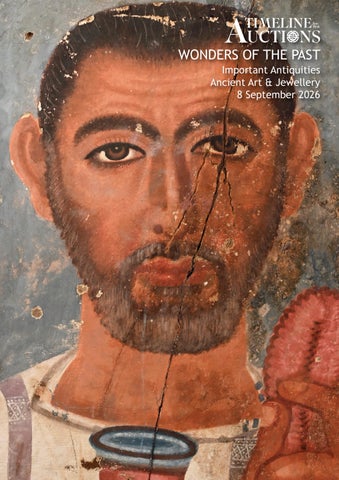
WONDERS OF THE PAST Tuesday 8 September 13:00 (Lots 1 - 405) DISCOVER THE PAST Wednesday 9 September 13:00 (Lots 406 - 1049) Thursday 10 September 13:00 (Lots 1050 - 1693) Friday 11 September 13:00 (Lots 1694 - 2278) THE NATURAL HISTORY SALE Saturday 12 September 13:00 (Lots 2279 - 2558) THE PHILATELIC SALE Saturday 12 September 17:00 (Lots 2559 - 3055) NUMISMATIC SALE 15 - 16 September 13:00 (Lots 3056 - 4289) Viewing By Appointment Only Bids +44 (0)1277 815121 +44 (0)1277 814122 fax bids@timelineauctions.com Telephone bidding by prior arrangement. Please see back of the catalogue for Terms & Conditions Consignments +44 (0)1277 815121 consignments@timelineauctions.com Illustrations Cover: Lot 116 Sale Number: 319 Catalogue Production & Layout Damir Radic DRs d.o.o. Davor Radic DRs d.o.o.
Photography & Video Production Michael Healy Kyle Elmer Jason Williams
Consultants Professor Neritan Ceka (Classical & General Antiquities) Professor Dr phil. Peter Rothenhoefer (Classical Archaeology, Chinese Antiquities, & Coins) Professor Livio Zerbini (Classical Archaeology & Roman Epigraphy) Dr Ronald Bonewitz (Antiquities & Geological) Dr Manuel Ceccarelli (Western Asiatic Antiquities) Dr Robert Chandler (Paleontology) Dr Paul A. Fox, MA, FSA (Heraldry) Dr Brian Gilmour (Arms & Armour & General Antiquities) Dr Malcolm Jones (Medieval & Later Antiquities) Dr Alberto Pollastrini (Egyptian & Associated Antiquities) Dr Laura Proffitt (Classical & General Antiquities) Dr Laura Vigna (Ancient Jewellery, Ceramics & Marble) Laetitia Delaloye, MA (Egyptian & General Antiquities) Michaela Simonova, MA (Mesoamerica, Viking & Religious) Thomas Sturm, MA (Cylinder Seals) Paul Whelan, MA (Egyptian Antiquities) Peter Bufton (Far Eastern, Islamic & Ethnographic) Peter Clayton, FCILIP, Dip, Arch, FSA, FRNS (Egyptian) Richard Falkiner, FSA (Jewellery & General Antiquities) Michael Howgate, B.Sc. M.Sc. PGCE FLS (Natural History) Igor Gorokhovsky (Metallurgist & General Antiquities) Joseph Hubbard (Natural History) Dane Kurth (Greek & Roman Coins & Antiquities) Stephen Pollington (Anglo-Saxon & Viking Antiquities) Amin Rezai (Western Asiatic & General Antiquities) Richard Roy (Ancient Americas) Simon Schmidt (Jewellery & General Antiquities) Mehdy Shaddel (Western Asiatic & Islamic Antiquities) Stefany Tomalin (Beads & Associated Jewellery) For further information and biographies see: www.timelineauctions.com
Team Chief Executive Officer: Brett Hammond, FRSA Chief Operating Officer: Aaron Hammond Head of Administration: Tanja Maijala Client Account Manager: Lisa Fricker Admin Assistants: Law Yuen Ying, Heather O’Neil
1
EGYPTIAN FUNERARY LINEN FRAGMENT WITH HIERATIC TEXT FROM THE BOOK OF THE DEAD FOR TA-SHERIT-N-TA-IHET GRAECO-ROMAN PERIOD, C. 3RD CENTURY B.C.-2ND CENTURY A.D. 5.08 grams, 22 cm wide (8⅝ in.) Bearing a portion of Chapter 17, a spell written in late hieratic script executed in black ink on woven linen, consistent with funerary bandages of the Graeco-Roman period; the inscription identifies the owner as a woman named Ta-sherit-n-ta-ihet, with her mother named Iset-(m-)khebit; as is typical for funerary manuscripts of this period, the father’s name is not recorded. £500 - 700 PROVENANCE:
Found inside an 18th-century Bible and believed to be a souvenir acquired in the 19th century. From the private collection of a North American lady.
1
An academically identified and unpublished fragment, offering potential for further scholarly study and publication. Accompanied by a report in progress dated 28 April 2026 by Holly Lund.
2
EGYPTIAN BIFACIAL MAGICAL STELA WITH BES PTOLEMAIC PERIOD, CIRCA 280-180 B.C 450 grams total, 11.6 cm high including stand (4½ in.) Upper portion of an arch-top limestone stele fragment with two dressed faces; the obverse lunette features a winged sun disc flanked by uraei and two partial rows of incised pseudo-hieroglyphs below; the reverse displays the head of the god Bes in high relief, with traces of the head of the young Horus immediately below, who would have been depicted grasping the two partially preserved snakes and a scorpion carved in raised relief to the right; mounted on a custommade display stand. £500 - 700 PROVENANCE:
Frossart Collection, France, by the 19th century. Private collection, London, UK.
2
3
EGYPTIAN BRONZE STATUETTE OF YOUNG HORUS LATE PERIOD, 664-332 B.C. 202 grams total, 12.8 cm including stand (5 in.) Modelled in the round in striding pose with one arm resting along the body and the right hand raised to his mouth, wearing an elaborate side-lock of youth and Pschent crown fronted by uraeus; mounted on a display stand. £700 - 900 PROVENANCE:
3
with R.H. Blanchard’s Egyptian Museum, Cairo, early 20th century. Private collection, London, UK. Accompanied by its original base, retaining the Blanchard label.
4
EGYPTIAN BRONZE SEATED CAT STATUETTE LATE PERIOD, 664-332 B.C. 74 grams, 87 mm (3⅜ in.) Bastet in squatting pose, ears pricked and alert with her tail wrapped close to right side of her body, two short lugs beneath for attachment to a separate base, and a suspension loop behind the shoulders. £800 - 1,000 PROVENANCE:
4
Acquired on the UK art market, 1990s. Private collection, New York, USA.
2
For charges payable in addition to the final hammer price of each Lot see paragraphs 21 & 28 of buyer's T&C's
5
LARGE EGYPTIAN BRONZE STATUE OF THE GOD IHY WITH GOLD NECKLACE AND SILVER INLAID EYES LATE PERIOD, 664-332 B.C. 899 grams total, 25 cm including stand (9⅞ in.)
PROVENANCE:
From the Singer family collection, Germany, acquired circa 1962. with A.A.L., Geneva, 1980. with Christie’s, London, 25 April 2015, lot 163 [£50,000-£70,000]. Private collection, London, UK. Accompanied by copies of the relevant Christie’s catalogue pages.
Depicted nude in an advancing pose; silver inlaid eyes, braided sidelock of youth; left hand by his side, drilled to accept a separate element, the other outstretched at a right angle to his body, holding a tapering cylindrical staff, not belonging; he may originally have held a sistrum, an ancient Egyptian percussion instrument, or a menat, both closely associated with the goddess Hathor; here, Ihy wears the Pschent crown with remains of uraeus, and an inlaid gold necklace suspended with an ib pendant around his neck; finely detailed facial features, with engraved Nekhbet vulture with outspread wings at the back of the crown; integral lugs on soles of feet; mounted on a custom-made stand. £20,000 - 30,000
For charges payable in addition to the final hammer price of each Lot see paragraphs 21 & 28 of buyer's T&C's
FOOTNOTES:
Ihy was an Egyptian god associated with music, joy, and ritual celebrations, particularly as the divine child of Hathor and of Horus or Ra. He is typically depicted as a youthful figure, often naked or lightly clothed, wearing a sidelock of youth and carrying a sistrum or menat, both percussion instruments closely connected with ritual performances in Hathor’s cult, especially at the temples of Dendera and Edfu. His name is generally understood to mean ‘the musician’ or ‘the one who plays music,’ although it may also mean ‘calf’, a reference to his relationship with the cow-goddess Hathor. Bronze statuettes of Ihy, such as this example, were probably produced as votive offerings dedicated in temples, especially those devoted to Hathor. Worshippers may have commissioned such figures in the hope of obtaining divine favour, protection, fertility, healing, or participation in the blessings linked with music and festivity. Some examples may also have served as cult images used in temple ceremonies or as protective objects placed in domestic or funerary settings.
3
6
7
9
8 6
8
EGYPTIAN ALABASTER AND GLASS EYE PAIR
EGYPTIAN FAIENCE HEART SCARAB
LATE-PTOLEMAIC PERIOD, 664-30 B.C. 15.33 grams, 31mm (1¼ in.)
LATE PERIOD, 664-332 B.C. 1.89 grams, 20 mm (¾ in.)
The sclera white alabaster stone and the iris black glass. £800 - 1,000
With fine anatomical detailing on the body and striated wingcase, legs folded beneath the body and flanked by a ribbed suspension loop. £400 - 600
PROVENANCE:
From a North American gentleman’s collection, 1990s.
PROVENANCE:
FOOTNOTES:
Ex Swedish gentleman’s collection, early 20th century, reputedly from Petrie’s excavations.
Egyptian coffin eye inlays were both decorative and symbolic, intended to make the coffin appear lifelike and assist the deceased in the afterlife. Typically, they featured a white sclera (glass, travertine, alabaster or quartz), a dark iris (glass or often obsidian), and sometimes red paint at the inner corner. The eyes were often set in bronze or copper frames, occasionally with faience or bronze eyebrows.
7
EGYPTIAN DIORITE HEART SCARAB LATE PERIOD, 664-332 B.C. 7.5 grams, 25 mm (1 in.) Finely carved, with naturalistic detailing to the upper body, legs shown folded beneath the body with suspension loop at centre. £1,000 - 1,400
9
EGYPTIAN BLACK STEATITE EYE OF HORUS AMULET LATE PERIOD, 664-332 B.C. 1.45 grams, 19 mm (¾ in.) Carved unifacial amulet with hatched eyebrow and ribbed suspension loop. £700 - 900 PROVENANCE:
Ex Swedish gentleman’s collection, early 20th century, reputedly from Petrie’s excavations.
PROVENANCE:
Ex Swedish gentleman’s collection, early 20th century, reputedly from Petrie’s excavations.
4
For charges payable in addition to the final hammer price of each Lot see paragraphs 21 & 28 of buyer's T&C's
10
EGYPTIAN BRONZE STATUETTE OF THE GOD NEFERHOTEP PTOLEMAIC PERIOD, 332-30 B.C. 345 grams total, 17.3 cm high including stand (6¾ in.)
PROVENANCE:
Private collection of Mrs Bogaert, formed in 1949, Ghent, near Brussels, Belgium. Ex private collection, London, UK. FOOTNOTES:
Neferhotep depicted advancing on a rectangular base, holding in the left hand the was sceptre, topped with the stylised head of an animal linked to the god Seth, with the right arm held rigid by the side with a clenched fist; wearing a Pschent crown with uraeus above the brow, a short, pleated shendyt kilt, and a broad multi-strand collar; the head features a tightly curled wig, false beard, and lentoid wire rims around the eyes; mounted on a custom-made stand. £8,000 - 10,000
For charges payable in addition to the final hammer price of each Lot see paragraphs 21 & 28 of buyer's T&C's
Neferhotep was explicitly recognised as a deity with a cult only from the Late Period, although it may have been understood earlier and later as the incarnation of the youthful divine king, since pharaohs from the 18th Dynasty to the Ptolemaic Period are sometimes depicted wearing the same wig. Neferhotep, whose name translates as ‘the perfect one is at peace,’ was considered to be the son of Hathor and was venerated at Hu (Diospolis Parva), as well as at Karnak, Dendera, and Behbeit el-Hagar. Provenanced statues of the god originate from the Memphite region.
5
11
EGYPTIAN FAIENCE AMULETIC BES PLAQUE LATE PERIOD, 664-332 B.C. 23.8 grams, 52 mm (2 in.) Oval plaque with ribbed outer edge, central depiction of the typically grimacing face of Bes wearing a feathered headdress. £1,500 - 2,000 PROVENANCE:
From an early 20th century collection. FOOTNOTES:
From the New Kingdom onward, Bes became one of ancient Egypt’s most popular apotropaic deities. Despite his somewhat fearsome appearance, Bes served as the patron and protector of pregnant women and children, and was also believed to shield them from snakes.
11
12
EGYPTIAN STEATITE BUST IN A GOLD PENDANT PTOLEMAIC-ROMAN PERIOD, 2ND CENTURY B.C.-2ND CENTURY A.D. 8.75 grams, 38 mm (1½ in.) Fragment of a carved panel or vessel depicting a female bust, possibly a queen or Isis, modelled in half-round relief, wearing a loosely draped tunic, a tiered wesekh collar, and a heavy curled, tripartite wig; reverse with lotus flower ropework and other ornamentation; mounted in a later gold suspension frame. £700 - 900 PROVENANCE:
Private collection, Southern France, 1970s. Acquired on the English art market. FOOTNOTES:
This fragment likely originates from an elaborately decorated bowl belonging to a specific group thought to have been made in Alexandria (cf. Page-Gasser, M., Wiese, A.B., Ägypten: Augenblicke der Ewigkeit, Mainz, 1997, for a complete example). The purpose of these bowls is unclear, but they may have been used as votive offerings in sanctuaries.
12
13
EGYPTIAN GOLD SEATED BASTET CAT AMULET LATE NEW KINGDOM-THIRD INTERMEDIATE PERIOD, CIRCA 1069-900 B.C. OR LATER 0.54 grams, 8 mm (⅛ in.) Modelled seated on a tongue-shaped base, with simple facial detailing and a suspension loop to the back. £500 - 700 PROVENANCE:
Ex French art market, 1920s.
13
14
EGYPTIAN BRONZE SEATED CAT STATUETTE LATE PERIOD, 664-332 B.C. 90 grams, 55 mm (2⅛ in.) Bastet in crouching pose with her tail wrapped close to right side of her body, seated on a tongue-shaped base, with a suspension loop on the creature’s back. £600 - 800 PROVENANCE:
Acquired on the UK art market, 1990s. Private collection, New York, USA.
6
14
For charges payable in addition to the final hammer price of each Lot see paragraphs 21 & 28 of buyer's T&C's
15
VERY TALL EGYPTIAN BLACK-TOPPED VASE PREDYNASTIC PERIOD, NAQADA II, CIRCA 3900– 3400 B.C. 3.67 kg total, 40 cm (40.5 cm high including stand) (15¾ in. (16 in.)) A finely made, coil-formed Nile silt clay, redpolished pottery vessel with elongated ovoid body, pointed base, rounded shoulder, and narrowing neck widening to a slightly everted rim; the upper section blackened through inverted firing, creating the characteristic black-topped finish of Upper Egyptian Predynastic ceramic production; the surface retaining a lustrous burnish with visible vertical polishing marks; accompanied by a display stand. £8,000 - 10,000 PROVENANCE:
with Joe Gerena Fine Arts, New York, USA. Collection of Erich Spangenberg, Texas, 1980s. Fortuna Fine Arts Ltd, New York, USA. Wyvern Collection, acquired from the above on 20 March 2018. FOOTNOTES:
This is an exceptionally large Naqada II black-topped vessel; comparable large examples generally measure approximately 33–37 cm (e.g., Aberdeen Museums ABDMS003532, 36.5 cm; British Museum EA30966, 33.6 cm; National Museum of Ireland 1899:311, 36 cm; Metropolitan Museum of Art 36.1.2, 35 cm), although most examples are significantly smaller. Black-topped vessels were hand-made from finely prepared Nile silt clay, often tempered and coated with a red hematite slip. Larger examples frequently took the form of hes-jars with tapered or pointed bases and narrowing necks and vases with rather more torpedo-like bodies, like this example, while others were made as beakers or wide bowls. Experimental studies suggest that the vessels were fired inverted, with their openings buried in sawdust or other organic material, producing the characteristic blackened rim and interior. After firing, their surfaces were carefully burnished to a high polish, leaving visible polishing marks. These vessels were used mainly in ritual and funerary contexts for the presentation and pouring of liquid offerings. Found chiefly in higher-status burials and cultic deposits, their distinctive red-and-black colour scheme was probably associated with Egyptian concepts of death, regeneration, and cyclical renewal, making them especially appropriate for funerary ceremonies and ritual activities.
For charges payable in addition to the final hammer price of each Lot see paragraphs 21 & 28 of buyer's T&C's
7
16
MONUMENTAL EGYPTIAN GRANITE STATUE BASE FOR PRINCE PARAHIRWENEMEF ‡ NEW KINGDOM, 19TH DYNASTY, CIRCA 1250 B.C. 140 kg, 58.5 cm (23 in.) Reddish granite base and lower part of a kneeling statue of Prince Parahirwenemef, preserving the lower legs and feet, which feature detailed sandals and well-defined toes; a portion of kilt preserved with a line of sunken hieroglyphs along each side; a broad frontal pillar, and a narrower back pillar, both inscribed, emerging from the base, bearing a hieroglyphic inscription on all four sides. £40,000 - 60,000
8
PROVENANCE:
Private collection of Mr A., acquired circa 1983–1984. Thence by descent, private collection. Private collection, since the late 1990s. An article on this significant piece is currently being prepared by Egyptologist Paul Whelan. FOOTNOTES:
Prince Parahirwenemef, the third son of Ramesses II and Queen Nefertari, is shown in several relief scenes and two colossal statues linked to Ramesses II’s temples, as well as in two smaller, three-dimensional representations of the prince (remaining only in fragmentary form). This object is a valuable addition to the prince’s monument record, especially as it bears inscriptions that reveal a previously unknown title for the prince and provide new insights into his connection with Wadjet-khayty, a woman previously known only from a single, poorly documented monument at Karnak.
For charges payable in addition to the final hammer price of each Lot see paragraphs 21 & 28 of buyer's T&C's
9
17
EGYPTIAN GLAZED FAIENCE NEW YEAR FLASK WITH BABOONS LATE PERIOD, 664-332 B.C. 263 grams, 16 cm (6¼ in.) Lentoid body with segmented collars and blue detailing around the shoulders, neck with papyrus stalk detailing and a domed rim; addorsed stylised baboons flanking the neck. £2,000 - 3,000 PROVENANCE:
Acquired on the UK art market, 1990s. Private collection, New York, USA.
17
18
EGYPTIAN ‘BECKER’ SERPENTINE VESSEL ‡ NEW KINGDOM, 18TH DYNASTY, CIRCA 1450 B.C. 1.2 kg, 15.5 cm (6⅛ in.) Piriform jar with wide, flat rim and short neck, narrow neck and flat base. £2,500 - 3,500 PROVENANCE:
Ex Becker collection, 1920s. Private collection, Los Angeles, USA, 1990s. Private European collection. Accompanied by an academic report by Dr Raffaele D’Amato.
18
19
EGYPTIAN GRANITE SEATED FIGURE OF AN OFFICIAL ‡ MIDDLE KINGDOM, 2ND MILLENNIUM B.C. 4.1 kg, 18.7 cm (7⅜ in.) Comprising the torso and legs clad in an ankle-length robe and seated on a rectangular-section seat with stepped base and short, curved backrest and rear dorsal pillar; the left hand carved with the palm resting along the thigh; the right hand similarly placed but with the hand gripping a folded piece of cloth of which the ends are draped over the lower thigh above the knee; traces of an old label to reverse. £2,500 - 3,500 PROVENANCE:
Private collection, Europe. with Bonhams & Brooks, 8th November 2001, no.265. Private collection, Europe.
19
Accompanied by copies of the relevant Bonhams & Brooks catalogue pages. FOOTNOTES:
The official would have been shown wearing a longer cloak-like garment rather than a waist-height kilt, as the line of the folded edge is visible above where a waistband would typically be.
10
For charges payable in addition to the final hammer price of each Lot see paragraphs 21 & 28 of buyer's T&C's
20
23
21
22
20
22
EGYPTO-ROMAN SEATED LIMESTONE STATUETTE OF BES
EGYPTIAN FAIENCE SHABTI FOR THE FOURTH SON OF RAMESSES II, PRINCE KHAEMWASET
PTOLEMAIC-ROMAN PERIOD, CIRCA 332 B.C.-300 A.D. 942 grams, 18.5 cm (7¼ in.) Modelled in the round in a crouching pose on a rectangular base; the beard modelled in hanks with curled ends, the eyes recessed to accept inserts, mouth gaping; animal head amulet on the chest suspended on a cord; socket to reverse; chipped. £2,000 - 3,000 PROVENANCE:
Bonhams, London, 4 July 1995, no.36. Private collection, New York, USA.
21
EGYPTIAN BLUE GLAZED SHABTI FOR HOR NEW KINGDOM, 19TH DYNASTY, 13TH CENTURY B.C. 146 grams, 13.8 cm (5⅜ in.)
NEW KINGDOM, 19TH DYNASTY, 1279-1213 B.C. 103 grams, 12.7 cm (5 in.) In brownish-black and white faience with black detailing, depicted wearing a round wig featuring a side-lock, the white face displaying eyes, eyebrows, nostrils, and a short beard in black; the arms crossed, and the white-glazed hands (one missing) holding hoes; a slightly raised white-glazed frontal panel containing a column of hieroglyphic text reading: ‘The Osiris, the sem (priest), the King’s Son, Khaemwaset, True of Voice’. £1,500 - 2,000 PROVENANCE:
Acquired on the UK art market, 1990s. Private collection, New York, USA.
23 Modelled with a rounded wig and sidelock; painted black detailing to the eyes, lips, collar and agricultural tools held in the crossed hands; painted vertical panel to lower body with hieroglyphic legend “The illuminated one, the Osiris, the sem priest, the great director of craftsmen, Hor, justified” (s wsır sm wr rp(w) mw(w)t r m - rw); repaired. £1,500 - 2,000 PROVENANCE:
Acquired on the UK art market, 1990s. Private collection, New York, USA.
LARGE EGYPTIAN GREEN FAIENCE FIGURE OF NEFERTUM WITH FIGURE OF SEKHMET TO THE REVERSE PTOLEMAIC PERIOD, CIRCA 332-30 B.C. 480 grams total, 19.5 cm high including stand (7⅝ in.) Modelled standing with arms held vertically at his sides, wearing a tripartite wig surmounted by a lotus flower flanked by scrolled leaves; dorsal pillar with low-relief image of Sekhmet in lioness-headed form and solar disc above; mounted on a custom-made stand. £2,000 - 3,000 PROVENANCE:
with Art Ancient, London, UK. Private collection, London, UK.
For charges payable in addition to the final hammer price of each Lot see paragraphs 21 & 28 of buyer's T&C's
11
24
EGYPTIAN PREDYNASTIC STONE FROG ‡ 4TH MILLENNIUM B.C. 537 grams, 81 mm (3⅛ in.) Pyramidal in form with shallow-carved hip and facial detailing. £1,200 - 1,700 PROVENANCE:
with Artemis Gallery, Munich, Germany, 2001. Private collection, Europe. FOOTNOTES:
The frog had a great role in ancient Egyptian mythology and was connected with the mythology of creation. A number of gods and goddesses were connected with the frog such as Heqet, Ptah, and Heh. The connection with the god Ptah as a god of creation was probably due to the idea that Ptah was the only god who created the world in ancient Egypt through his heart and his tongue. Every work of the god came about through what his heart devised and his tongue commanded. Frogs were often associated with Hekat, deity of birth and fecundity. Amulets of frogs were frequent votive gifts at such Predynastic and Archaic sites at Abydos, Naqada, and Saqqara.
24
25
EGYPTIAN BLUE GLAZED FAIENCE PECTORAL LATE PERIOD, 664-332 B.C. 20 grams, 45 mm (1¾ in.) Large rectangular shrine-shaped pectoral with subtle cavetto cornice top; obverse with black-painted Anubis reclining on a low pedestal, the reverse with two stylised tyet flanking a djed pillar; four piercings through the rear edge. £200 - 300 PROVENANCE:
From a 20th century UK collection.
25
26
EGYPTIAN BRONZE SEATED BASTET CAT AMULET LATE PERIOD, 664-332 B.C. 5.76 grams, 21 mm (⅞ in.) Modelled seated on a tongue-shaped base, with simple facial detailing and a suspension loop to the back. £500 - 700 PROVENANCE:
26
UK private collection before 2000. London collection, acquired on the UK art market.
27
EGYPTIAN ROCK CRYSTAL LOCUST PENDANT NEW KINGDOM, CIRCA 1400–1292 B.C. 3.7 grams, 26 mm (1 in.) Carved in the round with closed wings and a slightly curving body, pierced through the body for suspension. £400 - 600 PROVENANCE:
From the private collection of a European gentleman (1942-2024), formed since the 1970s.
12
27
For charges payable in addition to the final hammer price of each Lot see paragraphs 21 & 28 of buyer's T&C's
28
28
ROMANO-EGYPTIAN LIMESTONE FUNERARY NICHE COPTIC, 5TH-6TH CENTURY A.D. 57.55 kg, 49 cm (19¼ in.) Carved architectural block fragment comprising: a shallow niche with arched top and parallel sides, with concentric mouldings to create a reveal and ledge below to accept offerings; above each figurine recess an incised initial, ‘A’ and ‘M’. £2,000 - 3,000 29
PROVENANCE:
From the estate and private collection of Matthew Upham (1962-2025), an antiques trader from Budleigh Salterton, Devon, UK. Acquired at an estate sale at auction. Property of a Cambridgeshire, UK, gentleman.
29
COPTIC MARBLE INSCRIBED LITURGICAL VESSEL FRAGMENT ‡ 6TH CENTURY A.D. 87 grams, 55 mm (2⅛ in.) Tongue-shaped with low rounded pad on the underside, raised edge with low-relief decoration of grape vines and leaves, the edge with pairs of opposing doves eating grapes; dedicatory Demotic inscription on the underside. £1,200 - 1,700 PROVENANCE:
Acquired in the mid 1980s-1990s. Private collection, Switzerland, thence by descent. Private collection, since the late 1990s.
30
ROMANO-EGYPTIAN ALABASTER ALABASTRON 1ST CENTURY B.C.-1ST CENTURY A.D. 7.71 grams, 44 mm (1¾ in.) Small alabastron in banded Egyptian calcite-alabaster, pointed ovoid body and tall neck divided by a broad annular collar and finished with a plain straight rim. £300 - 400 PROVENANCE:
Acquired on the European art market in 1990s. English private collection.
For charges payable in addition to the final hammer price of each Lot see paragraphs 21 & 28 of buyer's T&C's
30
31
31
ROMANO-EGYPTIAN AGATE SCARAB ENGRAVED WITH THE GODDESS FORTUNA MOUNTED IN A GOLD RING 1ST CENTURY B.C.-1ST CENTURY A.D. 4.34 grams, 22.63 mm overall, 19.34 mm internal diameter (⅞ in.) Scarab with incuse image to the underside of Fortuna with cornucopia and ship’s rudder; in later gold swivel ring. £1,000 - 1,400 PROVENANCE:
Private collection, Europe. Acquired on the English art market.
13
32
GREEK BLACK-FIGURE LEKYTHOS WITH HORSES AND FIGHTING WARRIORS ATTIC, 4TH CENTURY B.C. 472 grams, 23.5 cm (9¼ in.) Cylindrical with echinus mouth and stepped torus foot, on the body a dynamic scene consisting of four rearing horses, side-by-side and wearing harnesses, nestled between the horses a standing warrior wearing a crested helmet, behind the horses an advancing warrior wearing a plumed helmet, holding a long spear in his raised hand a round shield in the other; before the horses a fleeing opponent in a running pose, facing back and holding a spear in one hand while protecting himself with a shield held in the other; long tongue motifs on the shoulder; restored. £1,200 - 1,700 PROVENANCE:
Bonhams, Knightsbridge, London, 1900s. Private collection, Suffolk. FOOTNOTES:
32
The scene depicts a battle between hoplites, possibly an episode from the Iliad. Originally, one or two of the combatants were positioned on a chariot; four horses from it remain visible. The scene may represent the wounding of Ares, the god of war, as he is pursued by Diomedes and accompanied by the goddess Pallas, whose helmet is emerging from behind the horses.
33
GREEK BLACK-FIGURE WARE KYLIX ATTIC, CIRCA 5TH CENTURY B.C. 373 grams, 26 cm (10¼ in.) Broad and shallow with two strap handles, an advancing figure holding a shield at the tondo, outside with a figural frieze of two robed figures in discussion, seated on churule chairs, an attendant behind the left figure, a rider on horseback on each side of the scene; restored. £1,800 - 2,400
33
PROVENANCE:
From a German collection, pre 1970.
34
GREEK RED-FIGURE SKYPHOS WITH OWL ATTIC, 5TH-4TH CENTURY B.C. 115 grams, 14.1 cm wide (5½ in.) Mammiform body with flared pedestal base and two loop handles to the rim; each side with a facing image of an owl between laurel fronds; concentric circles to the base, Attic workmanship. £500 - 700 PROVENANCE:
Bonhams, Knightsbridge, London, 5 July 1994, no.39. Private collection, Suffolk.
34
35
GREEK BLACK-GLAZED TWIN-HANDLED STEMLESS KYLIX WITH SWAN APULIA, 4TH CENTURY B.C. 206 grams, 20.6 cm (8⅛ in.) Shallow with arched loop handles below the rim, low stepped foot; tondo with painted wreath of laurel leaves surrounding a standing swan in profile; to the outer face, two horizontal sprigs of laurel leaves; possibly by the Swan painter. £600 - 800 PROVENANCE:
Bonhams, Knightsbridge, London, 5 July 1994, no.43. Private collection, Suffolk.
14
35
For charges payable in addition to the final hammer price of each Lot see paragraphs 21 & 28 of buyer's T&C's
36
GREEK RED-FIGURE BELL KRATER WITH EROS APULIA, 4TH CENTURY B.C. 1.81 kg, 33.5 cm (13¼ in.) With flared and carinated foot, broad stem, ovoid body, carinated shoulder, everted rim with lip, Dshaped antefixes and lateral pendant loop handles; band of ivy to the neck and meander to the lower edge, frieze with figural scenes: Side A - seated female with thyrsos pointing towards Eros with head turned regarding her, wings spread; Side B - seated female in tiered robe pointing towards standing Eros with wreath, objects in the field; by the Ascoli Satriano Painter; restored. £3,000 - 4,000 PROVENANCE:
Ex private collection, previously with Bonhams, Bond Street, London, UK. FOOTNOTES:
Female heads and Eros figures are common features on the vases attributed to the Ascoli Satriano Painter. His real name is unknown, and he has been named after a northern Apulian town, where many of his vases have been found.
36
37
GREEK RED-FIGURE BELL KRATER BELONGING TO THE CHEVRON GROUP APULIA, 4TH CENTURY B.C. 1.11 kg, 23.2 cm wide (9⅛ in.) With reserved herringbone band beneath the rim, wave pattern to be the baseline; Side A: young man with thyrsus and pendant streamer holding a phiale, a loose mantle draped from the elbows; Side B: head of a lady of fashion with white accents to her stephane and hair drawn up in a chignon, a volute and window before her. £1,500 - 2,000 PROVENANCE:
Acquired on the art market between the late 1990s and mid-2000s. Estate of the late Barry Paul Buxton (1944-2024), Oakham, Rutland. Acquired on the UK art market, 2025. Accompanied by an academic report by Dr Raffaele D’Amato. FOOTNOTES:
37
For charges payable in addition to the final hammer price of each Lot see paragraphs 21 & 28 of buyer's T&C's
Bell kraters were commonly used in regions of ancient Italy for mixing and serving wine during communal gatherings, thanks to their wide shape and flared mouth. These vessels also served as artistic expressions, reflecting the cultural tastes of the time. The Chevron Group is the conventional name for a group of ancient Apulian red-figure vase painters who were active in Southern Italy between approximately 335-310 B.C. They are named for their distinctive use of a band of chevron patterns to encircle the rims of the small kraters (mixing vessels) they decorated.
15
38
GREEK RED-FIGURE BELL KRATER WITH SATYR AND EROS APULIA, CIRCA 450-400 B.C. 814 grams, 20 cm (8 in.) With laurel-leaf wreath beneath the flared rim, band of meander ornament as a baseline; Side A: striding satyr with torch and oinochoe followed by Eros holding a scroll behind; Side B: woman wearing a himation in active pose with sphere advancing towards a tendril. £1,500 - 2,000 PROVENANCE:
Acquired on the art market between the late 1990s and mid-2000s. Estate of the late Barry Paul Buxton (1944-2024), Oakham, Rutland. Acquired on the UK art market, 2025. Accompanied by an academic report by Dr Raffaele D’Amato. FOOTNOTES:
Often, the iconography of an ‘elevated’ mythological subject was applied to members of Dionysos’ retinue. Here we have three typical examples of them: a satyr, an Eros, and a woman, all three behaving according to Bacchic ecstasies.
38
39
LARGE GREEK BLACK-GLAZED TREFOIL-LIPPED OINOCHOE APULIA, 5TH CENTURY B.C. 405 grams, 22.1 cm (8¾ in.) With a trefoil mouth, an applied D-section handle and a tiered foot. £4,000 - 6,000 PROVENANCE:
Property from a private collection. with Sotheby’s, New York, 9 December 2003, no.9. Accompanied by copies of the relevant Sotheby’s catalogue pages.
39
40
EXCEPTIONALLY LARGE GREEK GNATHIAN SKYPHOS APULIA, 5TH-3RD CENTURY B.C. 2.21 kg, 34.4 cm (13½ in.) Mammiform body with pedestal base and two loop handles to the rim; Side A - band of white ovolo detailing to the neck, median red band with vine leaves and tendrils; Side B - bilinear band below neck with lateral pellets. £1,500 - 2,000 PROVENANCE:
40
16
Ex Orivate collection, formerly with Art Ancient, previously Derek Glover collection.
For charges payable in addition to the final hammer price of each Lot see paragraphs 21 & 28 of buyer's T&C's
41
GREEK BRONZE HERCULES AND ANTAEUS STATUE GROUP ‡ HELLENISTIC, 3RD-1ST CENTURY B.C. 1.01 kg total, 20.3 cm high including stand (8 in.) Dynamic scene of two nude wrestlers, the giant Antaeus and Hercules, Hercules lifting Antaeus off the ground with his arms, while Antaeus is trying to pry his arms open to regain contact with Mother Earth, which would restore his strength; set on a custom-made display stand. £10,000 - 14,000 PROVENANCE:
FOOTNOTES:
Here, the giant Antaeus is depicted with the more common dimensions of the hero, Hercules. Antaeus was a giant, the son of Neptune and Gaia. Antaeus would challenge all passers-by to wrestling matches and remained invincible as long as he remained in contact with his mother, the Earth. As in Greek wrestling, like its modern equivalent, he typically attempted to force opponents to the ground, and he always won, killing them. He built a temple to his father using the skulls of his defeated opponents. Antaeus fought Hercules as he was on his way to the Garden of Hesperides as his Eleventh Labour. Hercules realised that he could not beat Antaeus by throwing or pinning him. Instead, he held him aloft and then crushed him to death in a bear hug. The scene is famously depicted on a Greek krater dating to the sixth century BC and now in the Louvre, and was a popular subject for Renaissance artists. The episode in which Hercules defeats Antaeus is mentioned in Ovid's Metamorphoses.
Mallams Oxford. From a UK private collection since the 1970s.
For charges payable in addition to the final hammer price of each Lot see paragraphs 21 & 28 of buyer's T&C's
17
43
42
PHOENICIAN TERRACOTTA ANTHROPOMORPHIC VESSEL 42
3RD CENTURY B.C. 514 grams, 15.2 cm (6 in.) With three splayed stub feet, tubular body with flared shoulder and neck; applied facial detailing, pointillé circlet and collar, arms bent beneath the breasts, incised loincloth detail. £1,200 - 1,700 PROVENANCE:
with J.F. collection, Madrid. Ex Ars Historica Arqueologia, 7 October 2019.
43
‘THE METROPOLITAN MUSEUM OF ART’ CYPRIOT LIMESTONE VOTIVE HEAD OF A MAN CIRCA 5TH CENTURY B.C. 367 grams total, 13.1 cm high including stand (5⅛ in.) Finely carved votive head with almond-shaped eyes and strong nose, lips set to a gentle smile, typical of the Greek kouroi of this period, wearing a conical headdress leaving the ears exposed; set on its original base from the Metropolitan Museum of Art, New York, with item number ‘163’ and three sale labels on the base. £700 - 900 PROVENANCE:
Likely discovered by Luigi Palma di Cesnola in Cyprus, 1860s-70s. Collection of The Metropolitan Museum of Art, New York, likely acquired from the above in 1872. Collection of Ira Martin, New York, acquired from the above on 12 March 1926. with Christie’s, New York, Antiquities, 5 June 1998, no.133. Private collection, thence by descent.
44 44
GREEK TERRACOTTA FEMALE PROTOME ‡ EARLY 5TH CENTURY B.C. 606 grams, 19.5 cm (7¾ in.) Mould-made female protome with oval face, graceful nose and typical archaic smile; forehead framed by snail-shell curls descending to shoulder-height; with a low polos with a central perforation and large disc earrings. £1,200 - 1,700 PROVENANCE:
Ex Herbert A. Cahn, Kunst der Antike, Basel, 1997. with Paul and Vreny Vosseler-Studer, Riehen.
45
GREEK TERRACOTTA CITHARODE ‡ 6TH-4TH CENTURY B.C. 62 grams, 86 mm (3⅜ in.)
45
D-shaped in section with close-cut hairstyle, standing, holding a cithara supported on the left arm, strumming with the right hand. £1,200 - 1,700 PROVENANCE:
Ex Shlomo Moussaieff (1925-2015), Israel. European private collection.
18
For charges payable in addition to the final hammer price of each Lot see paragraphs 21 & 28 of buyer's T&C's
46 PROVENANCE:
46
FRAGMENT OF AN GREEK RED-FIGURE CUP DEPICTING A SATYR COPULATING WITH A MAENAD, ATTRIBUTED TO EPIKTETOS ATTIC, CIRCA 520–490 B.C. 31.2 grams, 11.7 cm (4⅝ in.) Dynamic scene featuring a nude, muscular satyr engaged in coitus with a young maenad; the satyr depicted with long curly hair and long dressed beard, a crown of ivy leaves resting on his head, holding the hand of the maenad with his right hand and her waist with the other; the maenad in a half-kneeling position; partial Greek inscription above ‘KTETO’ referring to the artist Epiktetos. £4,000 - 6,000
Oswald Burchard collection, Zurich, until 1983. M. Hess collection, Hotel Jura, Basel. Private collection, Germany. Private collection, London. One fragment, Antikenmuseum [ACR] Auctions, 17, 30 June 2015, no.14. Two fragments, Bertolami Fine Art, Auction 43, 19 April 2018, no.55. Comprising three fragments, subsequently joined. FOOTNOTES:
Epiktetos is considered a master of the circular image and painted mainly the interiors of cups—specifically “eye-cups”, so named because of the two painted eyes on the exterior, which likely served an apotropaic function. His so-called bilingual vases feature black-figure painting on the interior, while the exterior of the bowl is decorated in the red-figure style.
47
48
47
48
GREEK FRAGMENTARY TERRACOTTA RED-FIGURE HYDRIA ‡
GREEK BLACK-FIGURE WARRIORS ‡
PAESTAN OR APULIAN, 4TH CENTURY B.C. 1.95 kg, 31 cm (2.6 kg total, 47.5 cm high including stand) (12¼ in. (18¾ in.)) Comprising the upper two thirds of the vessel; on the shoulder a facing woman’s head with diadem and half-veiled face; to the reverse, palmettes and vines; band of laurel with rosettes around the neck; reassembled from various fragments with three large areas of restoration. £4,000 - 6,000 PROVENANCE:
Ex Herbert A. Cahn, Basel, 1990s.
ALABASTRON
WITH
FIGHTING
ATTIC, 500-480 B.C. 262 grams total, 16 cm high including stand (6¼ in.) Of ovoid shape, the central scene representing a Greek Ekdromos fighting a Scythian archer; the Greek warrior, wearing a light sleeveless chiton, and a crested Corinthian helmet, carrying a wide hoplon shield, and a long spear; the Scythian archer wearing a tall cap flowing backwards, carrying a quiver and composite bow with arrow. £20,000 - 30,000 PROVENANCE:
Louis-Gabriel Bellon (1819-1899) collection, France. European private collection, 2009.
For charges payable in addition to the final hammer price of each Lot see paragraphs 21 & 28 of buyer's T&C's
19
49
52
50
51
49
51
ETRUSCAN BRONZE FIGURE OF A KOUROS
ETRUSCAN BRONZE STATUE OF A SATYR ‡
LATE 6TH CENTURY B.C. 118 grams, 11.2 cm (4⅜ in.)
CIRCA 6TH CENTURY B.C. 679 grams total, 20.4 cm including stand (8 in.)
Depicting a youthful nude kouros standing frontally, with a long, slender body, broad shoulders, a narrow waist, and arms hanging close to the sides; the head, slightly oversized, characterised by an oval face, large almond-shaped eyes, an Archaic smile, and finely modelled ears, the hair arranged in beaded locks framing the forehead and falling onto the shoulders, reflecting the influence of contemporary Greek Archaic sculpture; standing on an integral rectangular base provided with a long tang for attachment. £2,000 - 3,000
Modelled in the round in energetic pose with left hand resting on the hip and right arm raised, head tilted slightly upwards, tail curled gracefully over the rump; on a square base with papyrus stalk detailing. £3,500 - 4,500
PROVENANCE:
Hannegan, B., Classical Antiquities from the Collection of Miss Iris Love, Durham, North Carolina, 1965, no.8, illustrated.
Acquired on the European art market between 1960s and 1980s. English private collection, property of a gentleman. Bertolami Fine Art, London, Auction 54, 9 November 2018, no.88.
50
GREEK BRONZE FIGURE OF A BOUND CAPTIVE ‡ HELLENISTIC, 2ND CENTURY B.C. 491 grams, 17 cm including stand (6⅝ in.) Modelled in the round nude male standing with hands bound behind his back; with short cropped hair and slender figure; left foot absent; mounted on a custom-made stand. £2,500 - 3,500 PROVENANCE:
Ex S.K. collection. Acquired on the German art market, July 1995.
PROVENANCE:
Iris Cornelia Love (1933–2020), New York, collection primarily formed in the 1950s-1970s. PUBLISHED:
EXHIBITED:
Durham, Duke University, The Art Department Gallery, Classical Antiquities from the Collection of Miss Iris Love, 25 January–24 February 1965.
52
GREEK STATUETTE OF AN ALEXANDRIAN DANCING DWARF HELLENISTIC, 1ST CENTURY B.C.-1ST CENTURY A.D. 295 grams total, 15 cm high including stand (5⅞ in.) In an active pose with both legs bent and left arm raised dramatically, head tilted to the left; exaggerated facial features, short trimmed hair, slim body with developed pectoral muscles and pronounced kyphosis; mounted on a columnar stand. £3,000 - 4,000 PROVENANCE:
Belgian private art collection of M.A., Brussels, Belgium, 1995. with Gorny and Mosch, 14 December 2011, no.82.
20
For charges payable in addition to the final hammer price of each Lot see paragraphs 21 & 28 of buyer's T&C's
53
LARGE ETRUSCAN STATUE OF A PRIEST WITH PATERA 2ND CENTURY B.C. 1.23 kg, 28.4 cm high (11¼ in.) Modelled in the round standing figure with palla draped over the left shoulder and from the hips, extending to calf-length; the head with aquiline nose and dimpled chin modelled with a wreath of large leaves around the brow forming a corona; exaggerated eyes left blank to accept silver inserts; left arm bent, hand holding an incense-holder with cruciform design; right arm extended at shoulder-height with phiale mesomphalos offering dish; socket beneath left foot and screwthreaded post beneath right, repairs to both lower legs. £18,000 - 24,000
For charges payable in addition to the final hammer price of each Lot see paragraphs 21 & 28 of buyer's T&C's
PROVENANCE:
Sotheby’s, New York, 17 December 1996, no.79. Private collection, New York, USA. Accompanied by copies of the relevant Sotheby’s catalogue pages. FOOTNOTES:
The figure is probably a devotee or priest of Diana preparing to make ritual observances with the offering plate and incense burner. A group of similar figures was recovered from the shallows of Lake Nemi south of Rome, close to the site of the Temple of Diana.
21
54
LARGE EASTERN MEDITERRANEAN PAINTED TERRACOTTA PITCHER 1ST MILLENNIUM B.C. 1.03 kg, 22.5 cm (8⅞ in.) With a wide mouth, everted rim, and elongated, cylindrical neck, bulbous body with painted polychrome bands, a strap handle with painted linear decoration. £400 - 600 PROVENANCE:
From a 1980s UK collection. Acquired on the UK art market in the early 2000s. Property of a London, UK, antiquarian.
54
55
PROTO-CORINTHIAN PAINTED TERRACOTTA ARYBALLOS ‡ 7TH CENTURY B.C. 79 grams, 10.5 cm (4⅛ in.) Comprising a piriform body and a tubular neck with a wide rim, a strap handle to the rear, the rim with painted polychrome petals, the pattern repeating beneath the neck and on the base of the vessel; the body decorated with fishscale decoration. £1,800 - 2,400 55
PROVENANCE:
Swiss private collection, assembled in the 1960s and 1970s. Acquired by the present owner in 2004.
56
MYCENAEAN PAINTED POTTERY FLASK ‡ 14TH-13TH CENTURY B.C. 132 grams, 11.1 cm (4⅜ in.) Comprising a circular body with a rounded base and two strap handles, a short neck with an everted rim; the body with a painted expanding cross motif with the arms separated by a band of pellets. £1,200 - 1,700 PROVENANCE:
Private collection, Switzerland, acquired in the 1994. Private family collection since the late 1990s.
56
57
PHOENICIAN BOWL WITH CRIMSON AND BLACK DECORATIONS ‡ 4TH CENTURY B.C. 49.2 grams, 63 mm (2⅜ in.) With a narrow basal ring, a flared rim, and painted circumferential bands. £800 - 1,000 PROVENANCE:
Private collection, Los Angeles, USA. Acquired on the American art market. European private collection.
22
57
For charges payable in addition to the final hammer price of each Lot see paragraphs 21 & 28 of buyer's T&C's
58
GREEK TERRACOTTA RHYTON OF A GODDESS 3RD-2ND CENTURY B.C. 1.25 kg, 24 cm (9½ in.) With flanged and stepped rim, tapering curved body, figural finial of the goddess with diadem; bands of red and cream geometric detail to the rim and upper body, red wave patterns to the inner face; the goddess modelled with carefully dressed hair and floral diadem, ringlets cascading to her collar bone, alert facial expression with almond-shaped eyes and prominent nose, with C-shaped billetted collar and chiton, cupping her left breast in her right hand; mounted on a custom-made stand. £5,000 - 7,000 PROVENANCE:
Private collection, London, UK; formed 1970s-1980s.
58 59
LARGE GREEK TERRACOTTA OINOCHOE WITH SWASTIKAS ‡ GEOMETRIC, 8TH CENTURY B.C. 2.04 kg, 35.5 cm (14 in.) With flared mouth, wide neck, bulbous body and ring foot, painted in brown and red matte glaze; geometric pattern spread over several registers separated by bundles of encircling stripes, triangles with hatching inside them, neck with metopes containing swastikas, rosettes and rhombuses with a band of rhombuses beneath; the shoulder with five line friezes arranged one above the other; the body decorated with meander and a band of rhombuses and triangles with hatching below, a broad black stripe (in places reddish as a result of misfiring) to the lower part; transition to the ring foot and ring foot painted black; wide strap handle attached to the shoulder and painted on the outside with a wavy line framed by dots, edge stripes and three small stars, the connecting bar patterned with stripes; museumquality restoration. £3,000 - 4,000 PROVENANCE:
Ex Madame P., Paris.
59
60
LARGE GREEK TERRACOTTA FIGURE OF A KORE ‡ 6TH CENTURY B.C. 6.7 kg total, 57 cm including stand (22½ in.) Hollow-formed with scaphoid headdress, long hair hanging behind the shoulders, heavy peplos dress extending to the floor with splayed hem and feet visible beneath; left hand held straight at the thigh, right hand in a fist between the breasts; mounted on a custom-made stand. £4,000 - 6,000 PROVENANCE:
Swiss private collection, assembled in the 1970s-1980s. with Galerie Serodine, Ascona, Switzerland, 1993. Collection of Dr E.N., Zug, acquired in 1995.
60
For charges payable in addition to the final hammer price of each Lot see paragraphs 21 & 28 of buyer's T&C's
23
61
61
63
ETRUSCAN BRONZE HANDLE PAIR WITH HEADS OF MEDUSA
GREEK CORE-FORMED GLASS AMPHORISKOS
6TH-5TH CENTURY B.C. 683 grams total including stand, handle: 10.9-11 cm wide (4¼ in.)
5TH-3RD CENTURY B.C. 35 grams, 12 cm high (4¾ in.)
Each formed as a D-shaped fluted bar with the finials formed as grotesque Medusa heads (gorgoneia) in Archaic Greek style with protruding tongue and a pair of bearded snakes framing her forehead; mounted on custom-made display stands. [2] £10,000 - 14,000
With applied yellow festooning and trails, knop foot and everted rim to the mouth. £1,200 - 1,700
PROVENANCE:
Ex private collection of Athos Moretti, Bellinzona, Switzerland, in the 1960s. with Christie’s, London, 14 June 1978, lot 344. with Sotheby’s, New York, 29 May 1987, lot 154.
62
PROVENANCE:
Acquired on the UK art market, 1990s. Private collection, New York, USA.
64
THRACIAN SILVER TWISTED TORC 5TH CENTURY B.C. 221 grams, 19.7 cm (7¾ in.)
LARGE GREEK BRONZE DOUBLE-HEADED ANIMAL TERMINAL ‡ Penannular torc twisted around its axis with tapering finials. £600 - 800
GEOMETRIC, 8TH-6TH CENTURY B.C. 55.6 grams, 86 mm (3⅜ in.) Comprising a crescent body with a slender neck at each end, topped by a bird-head with a rectangular crest, vertical legs with raised block detailing conjoined at the lower end into a mounting peg. £1,200 - 1,700
PROVENANCE:
Acquired in the early 1970s. Private collection, Suffolk.
PROVENANCE:
Ex collection Mr K.H., Germany. Private collection, acquired in 2012.
62 63
24
64
For charges payable in addition to the final hammer price of each Lot see paragraphs 21 & 28 of buyer's T&C's
65
GREEK TERRACOTTA FIGURE OF EROS, THE GOD OF LOVE ‡ HELLENISTIC, 3RD-1ST CENTURY B.C. 808 grams total, 31 cm including stand (12¼ in.) Modelled nude in a dynamic pose with his wings spread open, the left leg slightly advanced, and the right arm extended with open palm, a diadem or a fillet on his head; circular socket between the wings; accompanied by a display stand. £8,000 - 10,000
For charges payable in addition to the final hammer price of each Lot see paragraphs 21 & 28 of buyer's T&C's
PROVENANCE:
Louis-Gabriel Bellon (1819-1899) collection, France. European private collection, 2009. Accompanied by an academic report by Dr Raffaele D’Amato. FOOTNOTES:
In classical times, Eros was usually depicted as a handsome adolescent, with only his wings distinguishing him from other kaloi and young athletes. Sometimes he was depicted younger and with less masculine features: Lysippos, in the famous statue of Eros of Thespiae, depicted him as a youth.
25
66
PARTHIAN CARNELIAN GEMSTONE OF A GOAT-HEADED RHYTON IN GOLD RING 4TH CENTURY B.C.-220 A.D. 8.51 grams, 24.02 mm overall, 21.18 mm internal diameter (approximate size British P, USA 7½, Europe 16.23, Japan 15) (1 in.)
66
Achaemenid or Parthian oval intaglio engraved with a style standing at the threshold between natural and stiff rigid linear style, depicting a goat-headed rhyton, the vessel terminating in the forepart of a wild goat with the front leg tucked under the body, the head rendered in profile with elegantly arched horns, pronounced muzzle, and carefully incised eye; the neck of the conical rhyton decorated with diagonal and cross-hatched incisions suggesting ribbing or chased metalwork; set in a modern gold ring with a small triangular area at the top left of the stone filled in with gold; supplied with a museum-quality impression. £2,000 - 3,000 PROVENANCE:
Acquired on the European art market.
67
GREEK GOLD RING AND CARNELIAN GEMSTONE WITH ASCLEPIUS AND HYGEIA HELLENISTIC, 1ST CENTURY B.C.-1ST CENTURY A.D. 2.12 grams, 22.48 mm overall, 14.21 x 16.13 mm internal diameter (approximate size British F½, USA 3, Europe 4.3, Japan 4) (1 in.)
67
Comprising a gold wire hoop with panels of baluster detailing, scrolled and securing a gold cell with an inset cabochon gemstone; to the domed face, the god Asclepius with caduceus symbol; to the flat face, goddess Hygeia standing holding a serpent; some usage wear. £2,000 - 3,000 PROVENANCE:
Private collection, UK.
68
ETRUSCAN CARNELIAN SCARAB OF A CHARIOTEER IN GOLD RING LATE 4TH CENTURY B.C. 4.26 grams, 25.07 mm overall, 17.77 x 16.22 mm internal diameter (approximate size British O, USA 7, Europe 14.98, Japan 14) (1 in.) 68
Opaque scaraboid engraved in globolo style with a dynamic scene of a charioteer driving a biga with his whip raised; set in a later sheetgold mount and swivel ring, possibly 19th century; supplied with a museum-quality impression. £2,500 - 3,500 PROVENANCE:
Private English collection, formed between the late 1970s and early 1990s. Private collection, UK.
69
ETRUSCAN CARNELIAN SCARAB OF A FLETCHER IN GOLD RING
69
LATE 4TH-3RD CENTURY B.C. 4.24 grams, 27.12 mm overall, 18.38 x 18.49 mm internal diameter (approximate size British P½, USA 7¾, Europe 16.86, Japan 16) (1 in.) With carapace detailing and intaglio of a crouching male carving an arrow, set within a dotted border; set into a later gold swivel ring. £1,000 - 1,400 PROVENANCE:
Private collection, Europe. Acquired on the English art market.
70 70
ETRUSCAN CARNELIAN SCARAB WITH BUST OF A WARRIOR IN LATER VICTORIAN GOLD BROOCH 5TH-4TH CENTURY B.C. AND LATER 10.35 grams, 55 mm (2⅛ in.) The scarab with anatomical detailing on the carapace, underside with a profile bust of a helmetted warrior; set in a later brooch frame with swivel mount for the scarab. £2,000 - 3,000 PROVENANCE:
Acquired on the European art market.
26
For charges payable in addition to the final hammer price of each Lot see paragraphs 21 & 28 of buyer's T&C's
71
‘THE MILDENBERG’ GREEK GOLD BULL’S HEAD PENDANT CIRCA 4TH CENTURY B.C. 3.05 grams, 21 mm (⅞ in.) Hollow-formed in sheet gold with finely modelled details and applied granulated wreath between its horns; attachment hole to the rear of the head. £3,000 - 4,000 PROVENANCE:
Christie’s, London, ‘A Peaceable Kingdom: The Leo Mildenberg Collection’, 27 October 2004, no.102.
71
PUBLISHED:
Walker, A.S. (ed.), Animals in Ancient Art from the Leo Mildenberg Collection, Part III, Mainz am Rhein, 1996, no.281.
72
GREEK GOLD LION HEAD RING WITH PLAITED BAND 3RD CENTURY B.C. AND LATER 8.43 grams, 32 mm (1¼ in.) Formed as a plaited band of gold and silver rods, the finials formed as large lion heads with gaping jaws, a rosette with a rivet behind the neck; possibly a marriage. £800 - 1,000 PROVENANCE:
Acquired in London, 1979.
72
73
GREEK CARNELIAN BEAD WITH GOLD END CAPS ‡ HELLENISTIC, 1ST CENTURY B.C.-1ST CENTURY A.D. 17.44 grams, 60 mm (2⅜ in.) Columnar bead with sheet-gold cap to each end, each with beaded circlets and applied granule clusters, domed end with loop; possibly assembled. £600 - 800 PROVENANCE:
73
Acquired in the mid 1980s-1990s. Private collection, Switzerland, thence by descent. Private collection, since the late 1990s.
74
GREEK GOLD BEAD COLLECTION ‡ 4TH-3RD CENTURY B.C. 11.19 grams total, 10-31 mm (⅜ - 1¼ in.) A collection of necklace pendants and dress appliques comprising: a hollow bead with a truncated conical shape, featuring appliques for precious stone inserts; three studs with a hemispherical dome; a pair of appliques decorated with rosette and mask-shaped elements; a pendant in the form of a myrtle berry, and another fragment. [8] £1,200 - 1,700 PROVENANCE:
Acquired by a Swiss family in the mid-1980s to late 1990s, thence by descent. Private collection, Switzerland, since the late 1990s.
74
75
ETRUSCAN AMBER HEAD PENDANT ETRURIA, 5TH CENTURY B.C. 23 grams, 50 mm (242 grams total, 81 mm including stand) (2 in. (3¼ in.)) Carved from translucent red-brown amber as a profile head with stylised Archaic features, large almond eye beneath a defined brow ridge, a softly smiling mouth, and carefully delineated hair arranged in striated bands sweeping back from the face; a drilled perforation at the crown indicates its original function as a suspended ornament; accompanied by a display stand. £1,800 - 2,400 PROVENANCE:
Sotheby’s, London, 14-15 December 1981, no.206. American private collection; acquired at the above sale.
For charges payable in addition to the final hammer price of each Lot see paragraphs 21 & 28 of buyer's T&C's
75
27
76
78
77
80
79
76
79
EASTERN GREEK CARNELIAN SCARABOID GEMSTONE WITH NUDE HERO HOLDING LIONS
ETRUSCAN AGATE TALISMANIC SCARAB
6TH-5TH CENTURY B.C. OR LATER 4.25 grams, 19 mm (¾ in.) Scaraboid type with incuse design to the underside of a nude hero facing, holding one lion by the neck and another by the hind leg; supplied with a museum-quality impression. £800 - 1,000
LATE 4TH-EARLY 3RD CENTURY B.C. 3.53 grams, 18 mm (¾ in.) Carved from banded orange agate and formed as a flattened scarab with a striated carapace, pierced for suspension. £500 - 700 PROVENANCE:
UK private collection, acquired on the English market in the 2000s.
PROVENANCE:
FOOTNOTES:
From the private collection of a European gentleman (1942-2024), formed since the 1970s.
The shape of an Etruscan scarab includes: (1) the scarab gem, where the engraving of the curved back of the stone more or less faithfully imitates the anatomical parts of the scarab beetle; (2) the scaraboid, which retains the overall shape of the scarab gem but with little or no engraving on the curved backside; and (3) the pseudo-scarab, which has an image carved in relief on its curved backside instead of a beetle. All three types have a flat, oval underside which carries an engraved miniature image (device) within a decorated border which is usually hatched.
77
GREEK CARNELIAN ONYX GEMSTONE WITH HORSEMAN 1ST CENTURY B.C. 4.14 grams, 17 mm (⅝ in.) Plano-convex ‘eye’ type with incuse design to the upper face of a huntsman on a rearing horse attacking a lion; supplied with a museum-quality impression. £800 - 1,000
80
ETRUSCAN CARNELIAN SCARAB WITH DEER 5TH CENTURY B.C. 1.1 grams, 11 mm (⅜ in.)
PROVENANCE:
From the private collection of a European gentleman (1942-2024), formed since the 1970s.
78
ETRUSCAN VARIEGATED AGATE SCARABOID GEMSTONE WITH DANCING SATYRS 4TH CENTURY B.C. 2.75 grams, 17 mm (⅝ in.)
With carved anatomical detailing, the underside featuring a running stag with a long spear about to pierce its neck from behind. £400 - 600 PROVENANCE:
Acquired on the European art market.
Scaraboid type with incuse design to the underside of two opposed dancing satyrs, heads and arms missing, possibly unfinished or cut down from a depiction of a lion and hero; supplied with a museumquality impression. £500 - 700 PROVENANCE:
From the private collection of a European gentleman (1942-2024), formed since the 1970s.
28
For charges payable in addition to the final hammer price of each Lot see paragraphs 21 & 28 of buyer's T&C's
81
81
MINOAN FACETTED CARNELIAN STAMP SEAL CIRCA 20TH-15TH CENTURY B.C. 4.21 grams, 21 mm (⅞ in.) Four-sided bead with an oval panel on each side: panel 1: reclining feline with frontal head with apotropaic eyes; panel 2: three-leaved plant opposite a goblet(?) with four pellets and two crosses; panel 3: a plant and a big frontal apotropaic eye; panel 4: three segments, a plant, a butterfly or a bird; accompanied by museum-quality impressions. £3,500 - 4,500 PROVENANCE:
From the collection of the late Mr Priday, Hertfordshire, UK, thence by descent. FOOTNOTES:
82
Four-sided prisms are usually fashioned in jasper, light-coloured chalcedony and lightly banded carnelian. The workmanship is usually excellent. Largely on stylistic grounds, these seals are datable mostly to MMII (c. 2100–1875 B.C.), although they occur both slightly earlier and later.
82
GREEK CARNELIAN GEMSTONE WITH HIPPOCAMP 4TH CENTURY B.C. 2.29 grams 16 mm (⅝ in.) Scaraboid type with incuse design to the underside of a winged hippocamp inside a ropework border, possibly later engraved water waves; supplied with a museum-quality impression. £500 - 700 PROVENANCE:
From the private collection of a European gentleman (1942-2024), formed since the 1970s.
83
83
EASTERN GREEK SCARABOID GEMSTONE WITH GRYPHON 4TH-2ND CENTURY B.C. OR LATER 1.24 grams, 13 mm (½ in.) Scaraboid type with incuse design to the underside of a winged gryphon with one foreleg raised; supplied with a museum-quality impression. £500 - 700 PROVENANCE:
From the private collection of a European gentleman (1942-2024), formed since the 1970s.
84
ROMAN AGATE CAMEO WITH BUST OF AN EMPRESS CIRCA 2ND CENTURY A.D. 0.26 grams, 9 mm (⅜ in.) An oval gemstone showing a female facing right. £300 - 400 PROVENANCE:
84
From the private collection of a European gentleman (1942-2024), formed since the 1970s.
For charges payable in addition to the final hammer price of each Lot see paragraphs 21 & 28 of buyer's T&C's
29
85
ROMAN CARNELIAN GEMSTONE WITH SOL AND GREEK INSCRIPTION 1ST CENTURY A.D. 1.24 grams, 16 mm (⅝ in.) Domed base, featuring a standing god Sol (Greek Helios) wearing a radiate crown and muscled cuirass, his left arm raised and the right hand holding a long whip, Greek inscription ‘ΦλλNOY’ = gem belonging to a man named Phaanos = ‘the radiant one, the shining one ‘, creating a play-of-words between the owner’s name and the solar deity. £800 - 1,000 85
PROVENANCE:
Private collection, UK. UK private collection, acquired on the English art market in the 2000s.
86
ROMAN CARNELIAN INTAGLIO WITH HEAD OF BACCHANTE LATE 1ST CENTURY B.C.-EARLY 1ST CENTURY A.D. 0.91 grams, 15 mm (⅝ in.) Translucent oval intaglio with a profile bust wearing an ivy-leaf wreath. £500 - 700 PROVENANCE:
Ex private French collection of Mr M., 1980s. UK private collection, acquired in London art market in the 2000s.
87 86
ROMAN GLASS CAMEO WITH A JULIO-CLAUDIAN PRINCE, POSSIBLY DRUSUS 1ST CENTURY A.D. 1.6 grams, 18 mm (¾ in.) Featuring a vibrant green-blue base with a white frontal bust of a young male with his head turned slightly to the right, big eyes and a small mouth. £600 - 800 PROVENANCE:
UK private collection, acquired on the French art market in the 2000s. FOOTNOTES:
87
Although the portrait is partially damaged, its style and composition are Augustan. Based on its resemblance to the portrait of Agrippa—though appearing more youthful—it could represent one of his sons, Gaius or Lucius Caesar.
88
ROMAN WHITE CHALCEDONY CAMEO OF A THEATRICAL MASK 1ST CENTURY A.D. 1.07 grams, 13 mm (½ in.) Showing a New Comedy, ‘Cook’ type theatre mask with an open mouth; supplied with a museum-quality impression. £1,000 - 1,400 PROVENANCE:
Private English collection, formed between the late 1970s and early 1990s. Private collection, London, UK. FOOTNOTES:
88
Miniature models of theatrical masks were mass-produced in the ancient world, and can be linked with the Dionysiac mysteries, in association with funeral rites, illustrating the Dionysiac thiasos, the orgiastic world of satyrs and maenads. However, they can also be miniature models of masks linked with highbrow Sophoclean and Euripidean tragedy, or with so-called Middle Comedy, which now only survives in fragments.
89
ROMAN AGATE CAMEO WITH DEVOURING HOUND CIRCA 1ST-2ND CENTURY A.D. 0.81 grams, 15 mm (⅝ in.) Black-and-white cameo featuring a raised image of a hunting dog devouring a hare with its long ears pulled against the neck, detailed ribs and claws on the back paw. £300 - 400 89
PROVENANCE:
From the private collection of a European gentleman (1942-2024), formed since the 1970s.
30
For charges payable in addition to the final hammer price of each Lot see paragraphs 21 & 28 of buyer's T&C's
90
ROMAN SAPPHIRE CAMEO WITH BUST OF SERAPIS LATER CONVERTED TO SAINT JOHN THE EVANGELIST CIRCA 2ND-3RD CENTURY A.D., REWORKED 6TH-7TH CENTURY A.D. 5.06 grams, 23 mm (1 in.) Carved in the half-round on a sapphire crystal showing striations on the reverse, depicting the upper body of St John with modius and pleated tunic, eagle with spread wings placed on the chest. £3,000 - 4,000
90
PROVENANCE:
Acquired circa 1980. Property of a Middlesex gentleman.
91
ROMAN RED JASPER MAGICAL STOMACH AMULET WITH HERCULES FIGHTING A LION 2ND-3RD CENTURY A.D. 1.06 grams, 16 mm (⅝ in.) Bifacial type with incuse design to one side of a Hercules fighting the Nemean lion, club adjacent, and to the other face with two columns of angular characters including ‘KKK’; supplied with a museum-quality impression. £600 - 800 PROVENANCE:
From the private collection of a European gentleman (1942-2024), formed since the 1970s.
91
92
AGATE CAMEO WITH A PORTRAIT OF A HELLENISTIC RULER 1ST CENTURY B.C. 0.75 grams, 17 mm (⅝ in.) Detailed bust of a man with his curly hair secured by tainia with the ends hanging behind his neck, aquiline nose and prominent chin, tryphe still visible. £2,000 - 3,000 PROVENANCE:
Formerly in a private collection of an European lady, 1970s-1980s. Private collection, UK.
93
ROMAN AGATE CAMEO WITH A JULIO-CLAUDIAN PORTRAIT OF AN EMPEROR
92
1ST CENTURY B.C.-1ST CENTURY A.D. 2.5 grams, 20 mm (¾ in.) Oval cameo with a profile bust facing left, a laurel crown resting on his close-cropped hair; in the background, a second portrait visible ‘capita iugata’. £1,000 - 1,400 PROVENANCE:
UK private collection, acquired on the English art market in the 2000s.
94
ROMAN SAPPHIRE GEMSTONE WITH CRESCENT MOON AND STAR THIRD QUARTER OF 1ST CENTURY B.C. 1.05 grams, 10 mm (⅜ in.)
93
Cushion-shaped greenish-blue intaglio engraved with a large crescent moon and star. £2,500 - 3,500 PROVENANCE:
Formerly in a private collection of an European lady, 1970s-1980s. Private collection, UK.
94
For charges payable in addition to the final hammer price of each Lot see paragraphs 21 & 28 of buyer's T&C's
31
95
96
95
96
ROMAN GARNET GEMSTONE WITH PORTRAIT
ROMAN CARNELIAN GEMSTONE COLLECTION WITH JUPITER EFFIGIES
LATE 5TH CENTURY A.D. 1.22 grams, 14 mm (½ in.) Ellipsoid type with dished underside, incuse-facing portrait bust, from a Constantinople garnet workshop. £500 - 700 PROVENANCE:
From the private collection of a European gentleman (1942-2024), formed since the 1970s.
1ST CENTURY B.C. 1.08 grams total, 9-14 mm (⅜ -½ in.) Comprising three oval intaglios, one with a domed base and each featuring a profile bust, one wearing a modius and one wearing a laurel wreath; supplied with museum-quality impressions. [3] £500 - 700 PROVENANCE:
UK private collection, acquired on the English market in the 2000s.
97
97
ROMAN IMPERIAL AND SASANIAN CARVED NICOLO GEMSTONE COLLECTION 2ND-5TH CENTURY A.D. 3.8 grams total, 8-12 mm (¼ -½ in.) Comprising seven oval intaglios with various motifs, including a winged horse, an Italic female profile bust, a zebu, a winged lion(?), a standing eagle, an advancing figure carrying an animal, a satyr or a man with lagobolon and grapebunch; supplied with a museumquality impression. [7] £1,200 - 1,700 PROVENANCE:
UK private collection, acquired on the English market in the 2000s.
32
For charges payable in addition to the final hammer price of each Lot see paragraphs 21 & 28 of buyer's T&C's
98
ROMAN GARNET CAMEO OF EROS THE GREEK GOD OF LOVE 1ST CENTURY A.D. OR LATER 0.42 grams, 8 mm (⅜ in.) Discoid in plan with a high-relief plastic head of Cupid (Greek Eros). £700 - 900 PROVENANCE:
Private English collection, formed between the late 1970s and early 1990s. Private collection, London, UK.
98
FOOTNOTES:
The finely engraved head on the cameo represents a young child, probably intended as Eros (Cupid). Such depictions were produced in numerous variations to illustrate the stages of childhood and the capacity of children to undertake meaningful or symbolic actions. The high relief type appears to have been especially popular and was probably derived from metalwork, like the plaster medallion from Begram, Afghanistan.
99
LARGE ROMAN CARNELIAN GEMSTONE WITH HERCULES 1ST-2ND CENTURY A.D. 3.2 grams, 25 mm (1 in.) Ellipsoid type with incuse design of Hercules standing under the tree of Hesperides, holding one of the apples; repaired; supplied with a museum-quality impression. £400 - 600
99
PROVENANCE:
From the private collection of a European gentleman (1942-2024), formed since the 1970s.
100
ROMAN CARNELIAN GEMSTONE WITH GODDESSES 1ST-2ND CENTURY A.D. 1.02 grams, 17 mm (⅝ in.) Tabular type with incuse design of Fortuna standing with a cornucopia and rudder, goddess Victory before her holding tainia, the tips of her wings visible; edge chipped; supplied with a museum-quality impression. £300 - 400 100
PROVENANCE:
From the private collection of a European gentleman (1942-2024), formed since the 1970s. FOOTNOTES:
A group of carnelian intaglios found in the Snettisham Hoard, Norfolk, comprised subjects like Fortuna, Diana, Spes, a modius with corn, a bird and a dolphin, from the mid-2nd century A.D.
101
ROMAN CARNELIAN ONYX GEMSTONE WITH HERMES 2ND CENTURY A.D. 2.44 grams, 16 mm (⅝ in.) Domed body layered horizontally, an engraved figure of standing Hermes facing right, wearing a petasos and holding a caduceus. £500 - 700 101
PROVENANCE:
Old French collection, 1980s. UK private collection, acquired in the French art market.
102
ROMAN RED VARIEGATED GEMSTONE WITH ELEPHANT 3RD CENTURY A.D. 3.04 grams, 17 mm (⅝ in.) Scaraboid type with incuse design to the underside of an elephant with stars above; supplied with a museum-quality impression. £600 - 800 PROVENANCE:
From the private collection of a European gentleman (1942-2024), formed since the 1970s.
For charges payable in addition to the final hammer price of each Lot see paragraphs 21 & 28 of buyer's T&C's
102
33
103
ROMAN BRONZE MARRIAGE MIRROR WITH FACING BUSTS AND INSCRIPTION CIRCA 4TH CENTURY A.D. 130 grams, 91 mm (3⅝ in.) Discoid in plan with a beaded rim and concentric rings, at the centre two draped busts, a male and a female, with faint remains of inscription surrounding; the other side polished and tinned. £400 - 600 PROVENANCE:
UK private collection before 2000. London collection, acquired on the UK art market. FOOTNOTES:
The image on the back of the mirror depicts an imperial couple from the 4th century, possibly a depiction of Constantine and Fausta, or of Constantine and his mother Helena.
103
104
ROMAN BRONZE THEATRICAL MASK MOUNT 2ND-4TH CENTURY A.D. 57.3 grams, 64 mm (2½ in.) Modelled in the half-round with large eyes and hair arranged in orderly curls, applied silver panels to the eyes and enamel pupils. £500 - 700 PROVENANCE:
Ex German art market, 2000s. Acquired from an EU collector living in London. From the collection of a Surrey, UK, gentleman.
104
105
ROMAN BRONZE HEAD OF AN EMPEROR ‡ 2ND CENTURY A.D. 440 grams, 10 cm (4 in.) Hollow-formed with long neck, abundant thick hair and beard, broad mouth; probably intended to represent an emperor. £800 - 1,000 PROVENANCE:
Acquired by a Swiss family in the mid-1980s to late 1990s, thence by descent. Private collection, Switzerland, since the late 1990s.
106
ROMAN BRONZE HEAD OF DIONYSUS MOUNT
105
1ST-2ND CENTURY A.D. 103 grams, 61 mm (2⅜ in.) Large convex mount depicting the head of the god of wine, shown facing with rounded cheeks and staring eyes, large vine leaves with bunches of grapes framing his face; ferrous spike on the reverse. £400 - 600 PROVENANCE:
Ex German art market, 2000s. Acquired from an EU collector living in London. From the collection of a Surrey, UK, gentleman.
107
ROMAN BRONZE VESSEL HANDLE WITH FACE ‡ 1ST CENTURY A.D. 110 grams, 14.2 cm (5⅝ in.) Swept in profile, comprising a horizontal crescentic panel to attach to the rim, with inlaid silver detailing, recurved cobra-shaped thumb pad, raised serpent to the outer face of the tapering handle, finial a mask of Bacchus or Pan, facing with volute scrolls to the brow and thick splayed beard; silver diadem and eyes. £1,500 - 2,000 106
PROVENANCE:
Private collection. with Christie’s, London, 11 June 1997, no.97 (part). with Bonhams, 13 April 2000, no.198. Private collection, Europe.
107
34
For charges payable in addition to the final hammer price of each Lot see paragraphs 21 & 28 of buyer's T&C's
108
109
108
109
ROMAN BRONZE STATUETTE OF RESTING HERCULES
ETRUSCO-ITALIC BRONZE FIGURE OF YOUNG HERCULES ‡
3RD CENTURY A.D. 715 grams, 15.5 cm (6⅛ in.)
ARCHAIC STYLE, CIRCA 4TH-3RD CENTURY B.C. 307 grams, 12 cm (4⅝ in.)
Depicted as lar and modelled nude in a standing pose with the right hand resting on the handle of his club, left arms supporting the lionskin mantle; hair cut short and beard textured. £4,000 - 6,000
Modelled in the round figure standing in advancing pose with the right hand raised and fist clenched; left shoulder and arm covered with the skin of the Nemean lion and left hand modelled hollow; hair cut short and textured. £2,500 - 3,500
PROVENANCE:
Acquired on the UK art market, 1990s. Private collection, New York, USA. Accompanied by an academic report by Dr Raffaele D’Amato. FOOTNOTES:
The position of the statuette, belonging to the typology of ‘resting’ Hercules, is unconventional, probably belonging to a more archaic period prototype (Reinach, 1897, p.211,7). By the late 300s or early 200s B.C., the depiction of Hercules wearing the lion’s skin over his head had fallen out of favour in Greek art. A worshipper probably placed this statuette in a sanctuary as an offering to the deity, or in his house as a symbol of protection. The majority of small Heracles statuettes are ex-votos, and the donors were possibly herdsmen, considering his function as protector of the flocks. Statuettes of the god found in provinces like Gallia, Britannia, or Pannonia might have appealed to Italic soldiers serving further north and could easily have been carried with them on campaign.
For charges payable in addition to the final hammer price of each Lot see paragraphs 21 & 28 of buyer's T&C's
PROVENANCE:
Acquired in the mid 1980s-1990s. Private collection, Switzerland, thence by descent. Private collection, since the late 1990s. Accompanied by an academic report by Dr Raffaele D’Amato. FOOTNOTES:
There were several cult sites of Hercules in Etruria and old Latium, particularly in the Sabellian region, and the bronze statuettes discovered here exhibit a wide range of styles. Etruscan bronzes of the half-god usually represent him with the lion skin draped over his arm (Metropolitan accession number 96.9.419).
35
110
ROMAN MARBLE HEAD OF JUPITER 1ST-2ND CENTURY A.D. 574 grams, 10.5 cm (4¼ in.) Modelled in the half-round with luxuriant curls to the hair and beard, strong nose and brow with lentoid eyes; undercut modelling to the nose, mouth and hair; large mounting socket to the right side of the brow and smaller beneath the chin. £1,200 - 1,700 PROVENANCE:
The father of Christopher Frederick, a general practitioner based in Brighton, East Sussex, who acquired it prior to 1969. Thence by descent to his son, Christopher Frederick, Brighton, East Sussex. Acquired from the above by the present owner.
110
111
ROMAN MARBLE LEFT FOOT FROM A SCULPTURE 2ND CENTURY A.D. 771 grams total, 15 cm high including stand (5⅞ in.) Comprising an elegantly carved lower part of the calf and foot, a detailed rendering of the toes; the proportions suggesting that the subject was a child or a young woman; mounted on a custom-made display stand. £3,000 - 4,000 PROVENANCE:
Nicolas Koutoulakis (1910-1996), thence by descent. Ex Galerie Dominique Thirion, Brussels, 1990s. Private collection of Mr K.A., France. with Kallos Gallery, London, UK. Accompanied by an academic report by Dr Raffaele D’Amato. EXHIBITED:
Harwich Museum, Harwich, Essex, UK, 8th June 2026-14th September 2026; accompanied by a copy of a photograph of the artefacts on display.
111
112
ROMAN VESSEL WITH ACTOR’S MASK HANDLE ‡ EARLY 3RD CENTURY A.D. 695 grams, 13.2 cm (5¼ in.) A squat jar in lead-rich copper-alloy with concentric rings to the base, bulbous body, trefoil mouth with egg-and-dart detailing, strap handle with vine-leaf detailing, actor’s mask at the lower end and a lion’s head with open mouth at the other. £2,000 - 3,000 PROVENANCE:
Acquired on the Swiss art market, 2001. Private European collection. Accompanied by an academic report by Dr Raffaele D’Amato. EXHIBITED:
Harwich Museum, Harwich, Essex, UK, 8th June 2026-14th September 2026; accompanied by a copy of a photograph of the artefacts on display.
112
36
For charges payable in addition to the final hammer price of each Lot see paragraphs 21 & 28 of buyer's T&C's
113
ROMAN MARBLE PORTRAIT OF DRUSUS THE YOUNGER 13 B.C.-23 A.D. 15.15 kg total, 35 cm high including stand (13¾ in.) Finely carved bust of Drusus, son of Emperor Tiberius; the hair shaped in a mop of short locks combed forward towards the brow; the features adolescent with soft lips and smooth skin; the nose chipped; mounted on a custom-made stand. £10,000 - 14,000
For charges payable in addition to the final hammer price of each Lot see paragraphs 21 & 28 of buyer's T&C's
PROVENANCE:
Previously mounted in an 18th–19th century bust. Private collection, Northern England, acquired in the 1980s. FOOTNOTES:
The facial features of the sculpture reveal the physiognomic characteristics of a Julio-Claudian prince; specifically, Drusus the Younger, supported by comparisons with coin portraits.
37
114
115
114
115
ROMAN WOODEN TABLET WITH ‘PACTUM DOTIS’ MARRIAGE CONTRACT
ROMAN WOODEN TABLET WITH MARRIAGE PACT BETWEEN IULIUS FLAVIANUS AND THE MOTHER OF THE BRIDE, AURELIA SALVIA
FIRST HALF OF 4TH CENTURY A.D. 27 grams, 14 x 16.1 cm (5½ x 6⅜ in.) Rectangular wooden tablet, probably cedarwood, the inner side with a recessed panel inscribed with 20 lines of inked text in Roman cursive script, two small holes, the bigger in the upper rim, the smaller in the centre of the lower rim; the flat outer side inscribed with 14 lines of inked text; in a good state of preservation with signs of age and parts of the text barely visible. £1,500 - 2,000 PROVENANCE:
Acquired by Albert Sfez in the early 1950s. Formerly the property of Monsieur Alain Sfez, a Belgian collector; acquired by gift from his father, Albert Sfez, in 1965. Acquired by a London dealer in 1973. From an important London collection since 1975; thence by descent. Accompanied by a copy of an illustrated academic report by Professor Dr phil. Peter Rothenhöfer. PUBLISHED:
This tablet will be published by Peter Rothenhöfer together with further documents from the same collection in a monograph (presumably in the series Münchner Beiträge zur Papyrusforschung und antiken Rechtsgeschichte). FOOTNOTES:
Professor Dr Peter Rothenhöfer, Department of History (Zhuhai Campus) states: ‘This important tablet shows that its use was apparently not restricted to the administrative sphere but widely spread in civic life and used for private purposes. As handwritten documents from the late 3rd and 4th century AD are quite rare, this tablet is generally of great importance for the history of Latin palaeography. The text is fluently written and shows a uniform typeface. Typical features of ancient writing can be observed: The text is continuously written without any separation between words (scriptio continua), sentences have no dots at the end.’ Wax tablets written in Greek or Latin, were used by Romans as account registers (codices accepti et expensi); for transactions (for example, the tablets of the banker Lucius Caecilius Iucundus found in Pompeii); for lists of goods, inventories, and notes to be kept and archived; for Roman magistrates to annotate the salient events of their bureaucratic activities; for writing letters; for drawing up legal texts of various kinds: legacies, declarations of births and citizenship, reports of trials and diplomata militaria.
38
322 A.D. 24.97 grams, 13.5 x 14 cm (5¼ x 5½ in.) Rectangular wooden tablet, probably cedarwood, the outer side divided by a sulcus into a smaller part with names of witnesses and a greater part with 11 lines of inked text in Roman cursive script; three small holes near the rim, two in the sulcus, one on the right rim; the inner side with a recessed panel filled with wax with traces of writing; in an excellent state of preservation with signs of age. £1,500 - 2,000 PROVENANCE:
Acquired by Albert Sfez in the early 1950s. Formerly the property of Monsieur Alain Sfez, a Belgium collector; acquired by gift from his father Albert Sfez, in 1965. Acquired by a London dealer in 1973. From an important London collection since 1975; thence by descent. Accompanied by a copy of an illustrated academic report by Professor Dr phil. Peter Rothenhöfer. PUBLISHED:
This tablet will be published by Peter Rothenhöfer together with further documents from the same collection in a monograph (presumably in the series Münchner Beiträge zur Papyrusforschung und antiken Rechtsgeschichte). FOOTNOTES:
Professor Dr Peter Rothenhöfer, Department of History (Zhuhai Campus) states: ‘This important tablet shows that its use was apparently not restricted to the administrative sphere but widely spread in civic life and used for private purposes. As handwritten documents from the late 3rd and 4th century AD are quite rare, this tablet is generally of great importance for the history of Latin palaeography. The text is fluently written and shows a uniform typeface. Typical features of ancient writing can be observed: The text is continuously written without any separation between words (scriptio continua), sentences have no dots at the end.’ Wax tablets written in Greek or Latin, were used by Romans as account registers (codices accepti et expensi); for transactions (for example, the tablets of the banker Lucius Caecilius Iucundus found in Pompeii); for lists of goods, inventories, and notes to be kept and archived; for Roman magistrates to annotate the salient events of their bureaucratical activities; for writing letters; for drawing up legal texts of various kinds: legacies, declarations of births and citizenship, reports of trials and diplomata militaria; and especially testaments in private civil law.
For charges payable in addition to the final hammer price of each Lot see paragraphs 21 & 28 of buyer's T&C's
116
ROMAN FAYUM WOODEN PORTRAIT OF A BEARDED MAN EGYPT, 3RD-4TH CENTURY A.D. 8.53 kg total, 50 x 37.5 cm including frame (19¾ x 14¾ in.) An intimate portrait depicting a middle-aged man with a slightly doleful expression, receding hair with grey flecks, and a furrowed brow, wearing a white tunic with lilac-coloured clavi (vertical stripes) and white stitching over a white undertunic; holding a glass vessel containing red liquid in his right hand, most probably wine, whilst his left hand cradles a garland of roses, a ring visible on the little finger of his left hand; the figure set against a pale blue background, painted in tempera on a wooden panel; set in a glazed display frame. £18,000 - 24,000 PROVENANCE:
International art market, by at least 1997. with Sotheby’s, London, 12 June 1997, Western Asiatic Antiquities and Cylinder Seals from the Erlenmeyer Collection (Part II), no.338 (£40,000-£50,000). Private collection of an Italian scholar, New York. Accompanied by copies of the relevant Sotheby’s catalogue pages. PUBLISHED:
Klaus Parlasca, in Bailey, D.M. (ed.), Archaeological Research in Egypt,1996, note 8; Sotheby’s, Antiquities, London 12 June 1997,p.148, no.338, col.fig.p.149; Parlasca, K., Ritratti di Mummie. Serie B. Volume IV, (Rome, 2003), No. 689, Series B, pl. L.
For charges payable in addition to the final hammer price of each Lot see paragraphs 21 & 28 of buyer's T&C's
FOOTNOTES:
From the late 19th century onwards, a large number of painted wood portraits began to appear on the European and American art market, originating from the Fayum region of Egypt, to the southwest of Cairo, where wealthy RomanoEgyptian families buried their dead. Following ancient custom, the mummified body was fitted with a painted wood portrait over its face, preserving the likeness of the deceased for eternity. In 1887, over three hundred such portraits were acquired by the Austrian dealer Theodor Graf (1840–1903) from the cemetery of Er-Rubayat, on the northeast side of the Fayum. Portraits from this area are characteristically identifiable by their clipped upper corners and the undertunics worn by the subjects — both features present in this work. During his lifetime, Graf sold ninety of these portraits, with the remainder disposed of by his heirs after his death. Examples from his collection entered many of the world’s great institutions, including the Staatliche Museen zu Berlin, the National Gallery, London, and the British Museum, London. Two particularly close comparanda are of note. A portrait of a boy holding a garland and a glass vessel containing liquid, also from Er-Rubayat, is held in the Brooklyn Museum (see The Brooklyn Museum Handbook, Brooklyn, 1967, p. 100). An even closer parallel exists in the J. Paul Getty Museum, Malibu, likewise from Er-Rubayat (see E. Doxiadis, The Mysterious Fayum Portraits: Faces from Ancient Egypt, 1995, p. 221, no. 7; and S. Walker and M. Bierbrier, Ancient Faces: Mummy Portraits from Roman Egypt, exhibition catalogue, London, 1997, p. 102, no. 95). Significantly, the distinguished scholar Dr Klaus Parlasca attributed both the Brooklyn and Getty portraits to a single anonymous master he designated as the Brooklyn Painter, and some years ago suggested that the present portrait may be attributed to the same hand. Should this attribution hold, this work joins a small and distinguished group of panels recognised as the output of one of the most accomplished artists working in Roman Egypt.
39
117 118
120 119 117
119
ROMAN PYRE ON BASE DEDICATED BY AURELIUS RUFUS
ROMAN BRONZE OIL LAMP WITH MASKS
CIRCA 3RD CENTURY A.D. 731 grams, 11.5 cm (4½ in.)
1ST-2ND CENTURY A.D. 560 grams, 15.5 cm (6⅛ in.)
Model of an altar with tiered flames, separate socle base with flared base and pointillé Greek inscription in two lines: ‘AYPHΛ [vine leaf] POYΦΟC THEω ΦΑΛ / [/]AMAE ZAMΕΝΟC ]ANETHEKEN’: for ‘Aurelius Rufus dedicated this for the god FAL ... The Roman name of the dedicant as well as the letter forms point most probably to the 3rd century A.D. £1,000 - 1,400
With an elongated body, long nozzle with a rounded tip; raised rim to filling hole with hinged lid bearing a mask with sockets to the eyes for silver inserts; handle curved and terminating in a female mask with hair dressed in tiers, eyes recessed to be inlaid with silver; broad nozzle with cup and raised rim; socket to underside for mounting on a stand. £1,000 - 1,400
PROVENANCE:
PROVENANCE:
Ex collection, before 1980. Private collection, Netherlands.
From the collection of a gentleman, acquired on the London art market in the 1990s.
118
EXHIBITED:
ROMAN FIGURE OF HERCULES WITH LION-SKIN HEADDRESS 2ND CENTURY B.C. 443 grams total, 14 cm including stand (5½ in.) Depicting Hercules in heroic nudity, standing with his legs slightly apart, the right leg set back and the left, slightly bent, advanced outward; his right arm raised, the forearm bent at a right angle, while the clenched hand originally held a club, now lost; the left arm extending forward and supporting the lion skin; the left hand, also clenched, probably held a further attribute; the stylised lion skin draped over the hero’s head, terminating in two pointed flaps at either side, and fastened across the chest with the so-called ‘Heracles knot’, beneath which the forepaws of the lion are rendered with deeply incised claw; accompanied by a display stand. £700 - 900
Harwich Museum, Harwich, Essex, UK, 8th June 2026-14th September 2026; accompanied by a copy of a photograph of the artefacts on display.
120
ROMAN GILT BRONZE EAGLE ON GLOBE HOLDING A VICTORY WREATH 2ND-3RD CENTURY A.D. 193 grams, 88 mm (3½ in.) Modelled in the round as a standing eagle with its wings spread and short tail; incised feather detailing to the body and wings, head with detailed eyes, victory wreath held in its hooked beak. £2,000 - 3,000 PROVENANCE:
Acquired on the UK art market, 1990s. Private collection, New York, USA.
PROVENANCE:
Acquired in Germany before 2000s. English private collection. Bertolami Fine Art, London, Auction 85, 14 December 2020, no.11. This lot has been checked against the Carabinieri Database of stolen works of art.
40
FOOTNOTES:
As an animal associated with Jupiter, king of the Olympian gods, the eagle was a pre-eminent symbol of imperial power, including military power. The laurel wreath was a symbol of victory and was included among the military gifts (dona militaria).
For charges payable in addition to the final hammer price of each Lot see paragraphs 21 & 28 of buyer's T&C's
121
ROMAN BRONZE GODDESS JUNO
STATUETTE
OF
THE
3RD-4TH CENTURY A.D. 693 grams total, 25 cm high including stand (9⅞ in.) A substantial hollow-form figure of Juno (Greek Hera) standing with right hand in gripping pose, left hand extended palm-upwards, engraved collar to the neck and diadem to the hair, palla gathered at the waist, slipping from the right shoulder; mounted on a custom-made stand. £8,000 - 10,000 PROVENANCE:
Horatio and Patsy Melas Collection, Alexandria and later Switzerland, acquired by 1960 and until 1989. Kyros Melas Collection, London, 1989 until 1999. with Bonhams, Knightsbridge, 21 October 1999, no.178 [£6,000-£8,000]. Private collection, London. Accompanied by copies of the relevant Bonhams catalogue pages. FOOTNOTES:
The figure’s pose recalls that of the statue of Juno Sospita in the Vatican Museum, Rome, inv. no.241. Horatio Melas was born in 1904 into a family of Greek merchants established in Alexandria, Egypt. It was there that he met and, in 1960, married Patsy, and together they maintained the family collection. Following the family’s departure from Egypt in 1967, the collection was relocated to Switzerland, remaining there until 1989, when their son, Kyros Melas, settled in London. Kyros, who worked in the City as a private equity trader, continued to care for the collection and occasionally added to it during the 1990s.
For charges payable in addition to the final hammer price of each Lot see paragraphs 21 & 28 of buyer's T&C's
41
123
122 124
125
122
124
ROMAN BRONZE PLAQUE WITH GODDESS CYBELE
ROMAN BRONZE DIPLOMA FRAGMENT
3RD CENTURY A.D. 430 grams, 94 mm (3¾ in.)
3RD CENTURY A.D. 20.75 grams, 46 mm (1¾ in.)
Rectangular plaque with stepped herringbone border, facing bust of Cybele with flaring turret-crown and cascading hair, symbols in the field. £2,000 - 3,000
Bifacial fragment with piercing at one corner; Side A - trilinear margin with seriffed legend ‘QVI MILI[TAVERUNT ...IN CO-] / HORTIBVS [PRAETORIIS SE-]/ VERIANIS [DECEM I II III] / IV V VI [VII VIII VIIII X] / PIIS VIND[ICIBUS]’ and below ‘]TAVERVN[‘; Side B - legend set perpendicular to reverse ‘MODESTO / S CONISEVE / M A]VRELIO M F V[LP SECVNDO —- / +DESCRIPT[VM —-’. £400 - 600
PROVENANCE:
From the collection of a European gentleman living in South London; acquired 1970-1980.
123
FRAGMENT OF A ROMAN BRONZE MILITARY DIPLOMA GRANTED BY EMPEROR SEPTIMIUS SEVERUS 195 A.D. 27.13 grams, 50 mm (2 in.) Issued for a member of the equites singulares Augusti, the emperor’s horse guards; granted by Septimius Severus in the summer of AD 195, during his Parthian expedition; obverse with seven lines of text with well engraved letters: (1) [… IMP] • VI • C[OS …] / (2) [EQVITIBVS Q]VI•INTER•S[INGVLAR MILITAVERVNT CASTRIS] / (3) [NOVIS QVIB]VS PRAEEST [. . .] / (4) [TRIBVNVS QVI]NIS ET VICEN[IS PLVRIBVSVE STIPENDIS] / (5) [EMERI]TIS DIMISSIS H[ONESTA MISSIONE QVORVM] / (6) [NOMINA SVB]SCRIPTA SVNT [CIVITATEM ROMANAM] / (7) . . . + ++ . . . . On the inner face traces of 7 lines of text: (1) [- - -]MAX·TR[IB / (2) [- - -]+ COS [- - -] / (3)[EQVITIBVS QVI I]NTER·SINCV[LAR MILITAVER CASTRIS] / (4) [NOVIS QVIBVS] PRAEEST + [- - -] /(5) TRIBVNVS] QVINIS ET VI[CENIS PLVRIBVSVE STIPENDIS] / (6) [EMERITIS] DIM[ISSIS HONESTA MISSIONE QVORVM] / (7) +++. £600 - 800
PROVENANCE:
Ex German art market, 2000s. Acquired from an EU collector living in London. From the collection of a Surrey, UK, gentleman.
125
ROMAN BRONZE DIPLOMA FRAGMENT 228 A.D. 28.4 grams, 56 mm (2¼ in.) Rectangular fragment with irregular clipped edges; Side A - trilinear concentric border to the corner; Side B - inscription in serifed capitals ‘[.]NAS IN MATRI[MONIO / [D]VXERINT PRIO[—-] / [.]TOLLANT AC SI [—-] / [CIVI]BVS RO[M]ANIS [—-] / [ID]VS IANQATICI / [M.] MAECIO PRO[BO COS] / [.]A SEVERIANA’. £400 - 600 PROVENANCE:
Ex German art market, 2000s. Acquired from an EU collector living in London. From the collection of a Surrey, UK, gentleman.
PROVENANCE:
Property of a European gentleman, acquired on the London art market. PUBLISHED:
F. Matei-Popescu and P. Rothenhöfer, A new fragment of a military diploma for the equites singulares Augusti, in Journal of Ancient History and Archaeology 12, 2025, pp. 256-258.
42
For charges payable in addition to the final hammer price of each Lot see paragraphs 21 & 28 of buyer's T&C's
126
LIFE-SIZE ROMAN BRONZE HEAD OF AN EMPRESS MID-3RD CENTURY A.D. 4.07 kg, 40.5 cm high including stand (15⅞ in.) A member of the Imperial family, possibly an empress, depicted with an elaborate coiffure, the hair at the back of the head parted in the middle and the two strands folded over each other, then pulled to the front to form a looped horizontal layer parted in the middle of the smooth forehead and drawn back, individual curls represented as vertical lines along the forehead hairline up to the exposed ears, two locks hanging down the sides behind the ears, extending to the upper part of the neck; beautiful facial rendering with stoic expression, exquisite detailing to the eyebrows, eyelids and pupils; snub-nose, closed lips, thin and graceful neck; mounted on a custom-made display stand. £30,000 - 40,000 PROVENANCE:
Acquired on the German art market, early 1970s. German private family collection; by gift to the owner’s son in 2015. Private collection, London. Accompanied by an academic report by Dr Raffele D’Amato, and Dr Marina Mattei, former curator of the Capitoline Museums for over 40 years. FOOTNOTES:
The oval, gaunt, deep-set eyes and the folds at the sides of the nose and mouth reveal the mature age of the woman depicted in the portrait. The woman’s head shows the typical traits of the full and mature 3rd century A.D., executed in a Hellenistic style tradition. Our sculpture fits well in the imperial portrait type, bearing technical and aesthetic parallels to portraits in bronze. The hairstyle could be Scheitelzopf (or reverse plait), tightened by a hairnet, pinned to the top of the head. The same type of hairstyle, albeit with variations in the details (decorative curls and position of the hair loop), is found on a few other portraits of women that were dated to the period of Gallienus by Marianne Bergmann. Some of the portraits in this typologically related group are likely to be private portraits. Hereby, physiognomic features and especially imperial coin portraits need to be taken into account. In this context, it is important to compare the portrait with that of Trebonianus Gallus in the MET. Like the sculpture of Trebonianus Gallus, the head fits stylistically with Roman provincial bronzes from the Eastern Mediterranean or North Africa, possibly from workshops of Asia Minor or from the great metropolis of Alexandria, where bronze statuary was more common and Hellenistic influences remained strong.
For charges payable in addition to the final hammer price of each Lot see paragraphs 21 & 28 of buyer's T&C's
43
127
LARGE ROMAN BLUE GLASS TOILET BOTTLE 1ST CENTURY A.D. 194 grams, 18.2 cm (7⅛ in.) With a piriform body with a dimple base, a long tubular neck with an everted rim. £400 - 600 PROVENANCE:
From an important London, UK, collection 1980-2020. FOOTNOTES:
The toilet bottle corresponds to the Isling Form 28a or Vessberg flask type A.III.a. The transparent greyish green glass suggests that the object belongs to the Hayes’ fabric 2 of Cypriot blown glass.
128
ROMAN IRIDESCENT GREEN GLASS TREFOIL OINOCHOE 3RD-4TH CENTURY A.D. 28 grams, 79 mm (3⅛ in.) 127
Bulbous, dimpled body and a tubular neck with trefoil mouth, a strap handle to the rear. £400 - 600 PROVENANCE:
Acquired in the 1990s from London dealerships and auction houses. From the Lonson collection.
129
ROMAN MARBLED TURQUOISE GLASS BOTTLE ‡ 1ST-3RD CENTURY A.D. 9.44 grams, 84 mm (3¼ in.) 128
Comprising an iridescent piriform body, tapering tubular neck with pinched and everted rolled rim. £400 - 600 PROVENANCE:
Acquired on the European art market in 2001. FOOTNOTES:
Indented toilet bottles with long necks are rather common. In Western provinces of the Roman Empire, they occur most frequently in and around the Rhineland. In the Eastern part of the Empire, find places include Crete, Cyprus, Anatolia, Syria and Egypt.
130
ROMAN IRIDESCENT GREEN GLASS TREFOIL JUG 2ND-3RD CENTURY A.D. 83 grams, 11.8 cm (4⅝ in.)
129
With a globular, dimpled body, a tapering neck with a trefoil mouth, and an applied strap handle to the rear. £800 - 1,000 PROVENANCE:
Sotheby’s, New Bond Street, London, 8 July 1994, no.35. Private collection, Suffolk.
131
ROMAN SIDONIAN MOULD BLOWN GLASS JUGLET 130
3RD-4TH CENTURY A.D. 22.9 grams, 83 mm (3¼ in.) With a broad mouth, applied D-section handle and flattened foot, integral bands of vertical corrugation and S-scrolls to the equator. £2,000 - 3,000 PROVENANCE:
Acquired on the UK art market, 1990s. Private collection, New York, USA. FOOTNOTES:
There are several published mould-blown flasks decorated with a tendril scroll around the body, flanked by tongues and petals, a decoration that appears in at least three different variants. They have either one or two handles.
131
44
For charges payable in addition to the final hammer price of each Lot see paragraphs 21 & 28 of buyer's T&C's
132 133 132
ROMAN PILLAR-MOULDED PALE GREEN GLASS BOWL 1ST CENTURY B.C.-1ST CENTURY A.D. 142 grams, 12.6 cm wide (5 in.) Shallow bowl with moulded pillar detailing on the outer face. £1,500 - 2,000 PROVENANCE:
Acquired from Millennium Antiquities, Lancashire, UK, in 2001. From the collection of a Bedfordshire, UK, lady.
133
ROMAN GLASS JAR WITH BLUE HANDLES AND ZIG-ZAG TRAIL CIRCA 4TH-5TH CENTURY A.D. 98.9 grams, 95 mm wide (3¾ in.) Bulbous body with funicular neck and ribbed mouth, applied blue handles and trail decoration on the body. £1,000 - 1,400 PROVENANCE:
Acquired from Shirley Warren Antique Glass, Surrey, UK, in 1993 with reference no.4155/4083. From the collection of a Bedfordshire, UK, lady.
134
LARGE ROMAN GLASS AMPHORA WITH TRAIL 3RD CENTURY A.D. 125 grams, 21.2 cm (8⅜ in.) With broad rounded shoulder, piriform body tapering to a stub foot, cylindrical neck and flared rim with rolled edge, applied twisted green glass handles (one partly absent); slightly iridescent surface. £1,200 - 1,700
134
PROVENANCE:
Acquired on the UK art market, 1990s. Private collection, New York, USA.
135
ROMAN RIBBED GLASS VESSEL 3RD CENTURY A.D. 98.3 grams, 13.1 cm (5⅛ in.) The body with fine ribs and a dimpled base, a carinated shoulder and a funicular neck with a raised collar below the rim. £400 - 600 PROVENANCE:
From an important London, UK, collection 1980-2020.
136
ROMAN GLASS JUG WITH TRAIL 1ST-4TH CENTURY A.D. 53 grams, 96 mm high (3¾ in.) Squat body with domed shoulder, tubular neck and broad flared rim, applied strap handle, applied trail to neck and shoulder, dimple base. £1,500 - 2,000 PROVENANCE:
Acquired on the UK art market, 1990s. Private collection, New York, USA.
For charges payable in addition to the final hammer price of each Lot see paragraphs 21 & 28 of buyer's T&C's
135
136
45
137
ROMAN MARBLED BLUE GLASS TOILET BOTTLE ‡ 1ST-2ND CENTURY A.D. 19.7 grams, 83 mm (3¼ in.) An iridescent unguentarium with piriform body, tubular neck with everted rolled rim. £1,000 - 1,400 PROVENANCE:
Acquired on the European art market in 2001.
138
ROMAN GLASS DOUBLE UNGUENTARIUM 2ND-3RD CENTURY A.D. 87.5 grams, 15.6 cm (6⅛ in.) With rolled rim to each tapering tube, applied trail detailing to each Lower body, lateral angled handles and a large applied loop handle above; iridescent surface; accompanied by a custom-made display stand. £400 - 600 PROVENANCE:
From an important London, UK, collection 1980-2020.
139
ROMAN AUBERGINE GLASS PITCHER 3RD-4TH CENTURY A.D. 93.2 grams, 10.8 cm (4¼ in.)
137
Comprising a bulbous body with a dimple base and a funicular neck with an applied band below the rim and a handle to the rear. £400 - 600 PROVENANCE:
From an important London, UK, collection 1980-2020.
140
ROMAN FOOTED GLASS VESSEL 3RD CENTURY A.D. 59.6 grams, 16.7 cm (6½ in.) 138
Bulbous body with a flaring foot and a tall funicular neck. £400 - 600 PROVENANCE:
From an important London, UK, collection 1980-2020.
141
ROMAN IRIDESCENT GLASS PITCHER WITH TRAIL 3RD-4TH CENTURY A.D. 76 grams, 10.7 cm (4¼ in.) Bulbous body with an applied zig-zag trail and a circumferential band above, and an applied collar at the base of the tubular neck and another beneath the flaring mouth, with a strap handle to the rear. £500 - 700 PROVENANCE:
Acquired in the 1990s from London dealerships and auction houses. From the Lonson collection.
139
140 141
46
For charges payable in addition to the final hammer price of each Lot see paragraphs 21 & 28 of buyer's T&C's
142
LARGE ROMAN CUT-GLASS BEAKER 4TH-5TH CENTURY A.D. 288 grams, 18.8 cm (7⅜ in.) With a thick conical body and a pontil base, five horizontal grooves cut around the outer face of the body; traces of iridescence. £1,500 - 2,000 PROVENANCE:
Dr Jutaro Kawabe, Nagoya, Japan, his collection formed in the 1960s-1970s. with Hoshigaoka Gallery until the late 1990s. Private collection, London, UK.
143
ROMAN GLASS VESSEL WITH APPLIED TRAILS 1ST-4TH CENTURY A.D. 37.1 grams, 98 mm (3⅞ in.) Candlestick type vessel with tall tubular neck with applied trail decoration, applied cagework around the mouth. £400 - 600 PROVENANCE:
From an important London, UK, collection 1980-2020.
144
ROMAN IRIDESCENT GREEN GLASS OINOCHOE 3RD-4TH CENTURY A.D. 66 grams, 11.6 cm (4½ in.)
142
Bulbous body with a dimple base, tubular neck with a trefoil mouth and a strap handle to the rear. £400 - 600 PROVENANCE:
Acquired in the 1990s from London dealerships and auction houses. From the Lonson collection.
145
ROMAN GLASS VESSEL WITH IRIDESCENCE 4TH-5TH CENTURY A.D. 59.8 grams, 73 mm wide (2⅞ in.) Squat body with a short trumpet-shaped neck with rolled rim, applied openwork gallery encircling the neck. £400 - 600 PROVENANCE:
From an important London, UK, collection 1980-2020.
146
ROMAN GREEN GLASS HANDLED JAR 2ND-3RD CENTURY A.D. 74.4 grams, 95 mm wide (3¾ in.)
143
With a dimpled base, bulbous body with a carinated flange to the neck and a broad mouth, applied lateral handles. £400 - 600 PROVENANCE:
From an important London, UK, collection 1980-2020.
144
145
146
For charges payable in addition to the final hammer price of each Lot see paragraphs 21 & 28 of buyer's T&C's
47
147
147
VERY LARGE EASTERN ROMAN BLUE GLASS BOTTLE 2ND-3RD CENTURY A.D. 949 grams, 29.1 cm (11½ in.) Piriform in profile with a narrow neck and flared mouth with a chamfered rim, dimple base. £2,000 - 3,000 PROVENANCE:
From the Xavier Guerrand-Hermès private collection. with Artcurial, Paris, 25 March 2014, no.39. Private collection, London, UK.
148
LARGE ROMAN GREEN MOSAIC GLASS FRAGMENT LATE 1ST CENTURY B.C.-EARLY 1ST CENTURY A.D. 193 grams, 15.5 cm (454 grams total including stand) (6⅛ in.) Large fragment of green glass with white swirls and petals, accompanied by a custom-made display stand. £2,000 - 3,000 148
PROVENANCE:
Bearing an old collection number ‘240’ on the reverse. Dr Jutaro Kawabe, Nagoya, Japan, assembled during the 1960s-1980s. with Hoshigaoka Gallery until the late 1990s.
149
ROMAN GOLD EARRINGS WITH PEARLS 2ND-3RD CENTURY A.D. 3.94 grams total, 50 mm each (2 in.) Matched pair, each comprising a tubular shank with hook-and-eye closure, free-running dangle with pearl bead and granule cluster below. [2] £600 - 800 PROVENANCE:
149
48
Private collection, 1990s-early 2000s. with Gorny and Mosch, Munich, 14 December 2010, no.160.
For charges payable in addition to the final hammer price of each Lot see paragraphs 21 & 28 of buyer's T&C's
150
LARGE GRAECO-ROMAN SILVER WINE INFUNDIBULUM 5TH CENTURY B.C.-1ST CENTURY A.D. 356 grams, 29.5 cm (11⅝ in.) With a hollow spherical body decorated with slightly concave petals radiating from each end, separated by a central grooved band; one end with a tapering funnel marked by horizontal grooves, the other with a short tapering neck and a wide rim. £30,000 - 40,000 PROVENANCE:
Old Austrian private collection, 1980s. Accompanied by a copy of a nine-page examination report number 154/2026 by Dr habil Mikhail Treister. Accompanied by an academic report by Dr Raffaele D’Amato. FOOTNOTES:
Comparable instruments, usually called clepsydra in Greek and infundibulum in Latin, were in use in the 5th – first half of the 4th centuries B.C. A total of 13 such objects, or clepsydra, are known, including two of the unknown origin), represented by the finds both from Central (Lazio) and South (Campania, Calabria and Basilicata) Italy, Illyria (Apollonia) and Central Greece (Boeotia, Phocis) (all made of bronze), from the Taman peninsula in the North Pontic area, a fragmented one – from the Ulyap kurgan necropolis in the Trans-Kuban region and a silver piece from an aristocratic Thracian burial in the Plovdiv region. A distinctive feature of all these metal objects is the combination of a narrow vertical tube, at the lower end turning into a container with holes in the bottom.
For charges payable in addition to the final hammer price of each Lot see paragraphs 21 & 28 of buyer's T&C's
151
ROMAN GOLD RING WITH NICOLO GEMSTONE OF A BEARDED BACCHUS AS A HERM 151
1ST CENTURY A.D. RING: 3RD-4TH CENTURY A.D. 5.90 grams, 22.20 mm overall, 16.36 x 13.99 mm internal diameter (approximate size British I, USA 4¼, Europe 7.44, Japan 7) (⅞ in.) The intaglio deeply carved to depict a profile of Bacchus, set within a closed-back bezel; the band formed as a triple-twisted rope with granules and beadwork upon the shoulders. £3,500 - 4,500 PROVENANCE:
Acquired on the European art market.
152
ROMAN GOLD RING WITH BUST OF THE GOD SERAPIS ‡ 1ST-2ND CENTURY A.D. 5.65 grams, 27.68 mm overall, 18.70 x 15.32 mm internal diameter (approximate size British L½, USA 6, Europe 11.87, Japan 11) (1 in.) 152
Hollow-formed hoop with broad ellipsoid cell, inset red jasper intaglio profile bust of Serapis with modius; possibly a marriage, supplied with a museum-quality impression. £2,500 - 3,500 PROVENANCE:
Private European collection. Acquired in 2002.
153
ROMAN GOLD RING WITH JASPER GEMSTONE WITH DOLPHIN 2ND-3RD CENTURY A.D. 6.94 grams, 18.78 mm overall, 15.99 x 11.46 mm internal diameter (approximate size British E, USA 2¼, Europe 2.41, Japan 2) (¾ in.)
153
Facetted rectangular-section hoop with square bezel set with a tall oval intaglio engraved with a dolphin. £1,000 - 1,400 PROVENANCE:
UK private collection before 2000. London collection, acquired on the UK art market.
154
ROMAN CHILD’S RING WITH EMERALD 1ST-2ND CENTURY A.D. 1.22 grams, 13.23 mm overall, 10.74 mm internal diameter (½ in.) Integral flat bezel with inset green emerald. £500 - 700 PROVENANCE:
154
Private English collection, formed between the late 1970s and early 1990s. Private collection, UK.
155
ROMAN GOLD RING WITH BURNT AGATE CAMEO OF EROS, THE GREEK GOD OF LOVE RIDING A HIPPOCAMPUS 1ST CENTURY A.D. 3.59 grams, 20.92 mm overall, 16.98 mm internal diameter (approximate size British M, USA 6, Europe 12.46, Japan 12) (¾ in.) D-section hoop with ellipsoid cell, inset cameo with Eros on a hippocamp. £1,200 - 1,700 PROVENANCE:
Private collection, Europe. Acquired on the English art market.
155
50
For charges payable in addition to the final hammer price of each Lot see paragraphs 21 & 28 of buyer's T&C's
156
ROMAN GOLD MATRIMONIAL RING WITH NICOLO GEMSTONE 2ND-3RD CENTURY A.D. 8.40 grams, 23.52 mm overall, 18.89 x 17.87 mm internal diameter (approximate size British Q, USA 8, Europe 17.49, Japan 16) (1 in.) A 3rd-century A.D. opus interrasile ring featuring an expanding hoop with openwork volute scroll shoulders, set with a 2nd-century A.D. dextrarum iunctio nicolo intaglio showing an opposing man and a woman holding hands, the woman holding an ear of wheat, the male figure wearing a long military mantle hanging down his back; supplied with a museum-quality impression. £8,000 - 10,000
156
PROVENANCE:
Acquired on the European art market.
157
THREE ROMAN GEMSTONES IN A GOLD RING 1ST-2ND CENTURY A.D. 8.92 grams, 25.35 mm overall, 19.62 x 17.86 mm internal diameter (approximate size British O½, USA 7¼, Europe 15.61, Japan 15) (1 in.) Featuring three intaglios: on the left, a carnelian intaglio of Minerva holding a winged figure of Victory in her hand, shield and spear on the field; at the centre, a green plasma intaglio of Omphale with club and lionskin; at the far right, a carnelian intaglio of a cupid stirring a bucket with a stick, a rare motif; set in a later Georgian-style gold ring. £4,000 - 6,000
157
PROVENANCE:
Acquired on the European art market.
158
ROMAN RING WITH JASPER GEMSTONE OF THE GODDESS FORTUNA 2ND-3RD CENTURY A.D. 25.07 grams, 23.40 mm overall, 18.18 x 12.80 mm internal diameter (approximate size British H, USA 3¾, Europe 6.18, Japan 6) (1 in.) Comprising a heavy facetted hoop and a wide rectangular bezel set with a tall intaglio with goddess Fortuna or Concordia, standing and holding a cornucopia, and a rudder. £4,500 - 5,500
158
PROVENANCE:
Acquired on the European art market.
159
ROMAN NICOLO GEMSTONE OF A HORSE IN GOLD RING 1ST CENTURY A.D. 7.72 grams, 23.21 mm overall, 18.46 x 18.02 mm internal diameter (approximate size British Q, USA 8, Europe 17.49, Japan 16) (1 in.) Ellipsoid with chamfered edge, incuse grazing horse image on a baseline; set into a later gold ring; supplied with a museum-quality impression. £1,800 - 2,400 PROVENANCE:
159
Private collection, Europe. Acquired on the English art market.
160
ROMAN GOLD RING WITH CARVED HEDGEHOG 1ST CENTURY B.C. 7.53 grams, 20.12 mm overall, 15.03 mm internal diameter (approximate size British F½, USA 3, Europe 4.3, Japan 4) (¾ in.) Comprising a thick hoop expanding at the shoulders, the bezel with a standing hedgehog on a baseline with detailed spines. £1,000 - 1,400 PROVENANCE:
Private collection, 1990s-early 2000s.
For charges payable in addition to the final hammer price of each Lot see paragraphs 21 & 28 of buyer's T&C's
160
51
161
ROMAN JASPER GEMSTONE WITH MITHRAIC TAUROCTONY IN GOLD RING 3RD CENTURY A.D. 9.93 grams, 23.61 mm overall, 18.88 mm internal diameter (approximate size British R½, USA 8¾, Europe 19.38, Japan 18) (1 in.)
161
An oval intaglio depicting Mithras, a snake and a dog killing a bull, six stars on the field; set in a later gold ring; supplied with a museumquality impression. £2,000 - 3,000 PROVENANCE:
English private collection. Reportedly acquired several decades ago in Covent Garden, London, still mounted in its original, heavily corroded iron ring; removed from this setting and remounted in a gold ring in recent years by the owner, a commercial airline pilot.
162
ROMAN GOLD RING WITH GREEK BOAR GEM ‡ 4TH CENTURY B.C.-1ST CENTURY B.C. 1.93 grams, 22.40 mm overall, 15.77 mm internal diameter (approximate size British J, USA 4¾, Europe 8.69, Japan 8) (⅞ in.)
162
Hollow-formed and widening at the shoulders to a high elliptical bezel set with a black and white banded glass intaglio imitating striped sardonyx, depicting a running boar in profile on a baseline; Greek letters KΠ on the surface under the boar; supplied with a museumquality impression. £600 - 800 PROVENANCE:
Ex private collection, Contessa L.G., since the 1980s. Private collection, acquired in 1997.
163
ROMAN GOLD RING WITH RED GEM 1ST CENTURY A.D. 1.55 grams, 21.78 mm overall, 15.63 x 14.16 mm internal diameter (approximate size British H½, USA 4, Europe 6.81, Japan 6) (⅞ in.) 163
Comprising a hollow-form round-section hoop widening towards the shoulders, set with a table-cut garnet or paste with foil backing, polished. £500 - 700 PROVENANCE:
From the old family collection of a West Country, UK, lady; acquired by descent from her grandfather circa 2001.
164
ROMAN GOLD CHILD’S RING WITH AMETHYST CABOCHON 1ST CENTURY A.D. 1.34 grams, 17.24 mm overall, 10.57 x 11.34 mm internal diameter (⅝ in.) With slender hoop and integral cell bezel, inset amethyst cabochon. £400 - 600 PROVENANCE:
164
Ex German art market, 2000s. Acquired from an EU collector living in London. From the collection of a Surrey, UK, gentleman.
165
ROMAN GOLD CHILD’S RING WITH GARNET PITCHER GEMSTONE 1ST CENTURY A.D. 0.87 grams, 9.77 mm overall, 7.20 mm internal diameter (⅜ in.) Solid ring inset with an intaglio of a guttus (pitcher) with socle foot and handle; supplied with a museum-quality impression. £500 - 700 PROVENANCE:
Private English collection, formed between the late 1970s and early 1990s. Private collection, UK.
165
52
For charges payable in addition to the final hammer price of each Lot see paragraphs 21 & 28 of buyer's T&C's
166
ROMAN RED JASPER GEMSTONE WITH GROUP OF AMORES HARVESTING GRAPES IN GOLD RING 1ST-2ND CENTURY A.D. 6.77 grams, 22.48 mm overall, 18.92 x 17.38 mm internal diameter (approximate size British R , USA 8½, Europe 18¾, Japan 18) (⅞ in.) The hoop with flaring shoulders and an oval bezel set with a jasper intaglio engraved with a winged Amore (Erote) standing beneath a tree bearing grapevines, another Amore climbing up a ladder propped against the trunk; supplied with a museum-quality impression. £4,500 - 5,500
166
PROVENANCE:
Acquired on the European art market.
167
ROMAN CARNELIAN GEMSTONE WITH GRYLLUS IN GOLD RING 2ND CENTURY A.D. 9.29 grams, 23.83 mm overall, 20.32 x 17.88 mm internal diameter (approximate size British R½, USA 8¾, Europe 19.38, Japan 18) (1 in.) Translucent oval intaglio featuring a standing gryllus wearing a gryphon-headed helmet, flanked by the inscription ‘KAΛHI’ meaning ‘to the beautiful one’; set in a later gold ring with a D-section hoop; supplied with a museum-quality impression. £2,000 - 3,000 PROVENANCE:
Acquired on the European art market.
167
168
ROMAN CARNELIAN GEMSTONE WITH EROS BEFORE AN ALTAR IN GOLD RING 1ST CENTURY A.D. 3.55 grams, 21.09 mm overall, 18.46 mm internal diameter (approximate size British Q, USA 8, Europe 17.49, Japan 16) (⅞ in.) Finely engraved Roman carnelian intaglio showing nude winged Amor in front of a pillar with his weapons, helmet, shield, and spear, putting on a shin guard, standing before an altar, set in a later gold ring; supplied with a museum-quality impression. £2,000 - 3,000 PROVENANCE:
Acquired on the European art market.
168
169
ROMAN CARNELIAN ONYX GEMSTONE OF A SEATED MUSE SET INTO A GOLD GEORGIAN RING 2ND-3RD CENTURY A.D. 3.44 grams, 25.11 mm overall, 17.50 mm internal diameter (approximate size British N, USA 6½, Europe 13.72, Japan 13) (1 in.) Cabochon with incuse enthroned Muse with a mask and one hand extended; set into an antique gold ring; supplied with a museumquality impression. £500 - 700 PROVENANCE:
Private collection, Europe. Acquired on the English art market.
169
170
ROMAN CARNELIAN GEMSTONE WITH STORK EMERGING FROM A SEASHELL IN GOLD RING 1ST CENTURY B.C. 4.25 grams, 24.31 mm overall, 19.30 mm internal diameter (approximate size British T, USA 9½, Europe 21.26, Japan 20) (1 in.) The oval intaglio engraved with a whimsical image of a stork emerging from the mouth of a large seashell, its neck arched forward to seize a small mouse by the tail; set in a finely made 19th-century ring with openwork shoulders; supplied with a museum-quality impression. £3,000 - 4,000 PROVENANCE:
Acquired on the European art market.
For charges payable in addition to the final hammer price of each Lot see paragraphs 21 & 28 of buyer's T&C's
170
53
171
ROMAN GOLD RING WITH CARNELIAN GEMSTONE WITH CENTAUR LATE 2ND-3RD CENTURY A.D. 4.51 grams, 26.50 mm overall, 23.05 x 12.76 mm internal diameter (approximate size British J, USA 4¾, Europe 8.69, Japan 8) (1 in.) With broad openwork shoulders and applied filigree scrolls, granulations flanking the cell with an inset facetted octagonal carnelian intaglio with an advancing centaur with a syrinx; supplied with a museum-quality impression. £1,200 - 1,700
171
PROVENANCE:
Ex German art market, 2000s. Acquired from an EU collector living in London. From the collection of a Surrey, UK, gentleman.
172
ROMAN NICOLO INTAGLIO DEPICTING A HORSE BENEATH A TREE IN GOLD RING 1ST CENTURY A.D. 5.33 grams, 20.30 mm overall, 17.24 x 16.55 mm internal diameter (approximate size British M, USA 6, Europe 12.46, Japan 12) (¾ in.) Comprising a dark blue layered chalcedony, engraved with the figure of a horse standing beneath a stylised tree, within which perch two birds, mounted in a later gold ring of broad, flat-shouldered form, engraved with floral and scrollwork motifs; supplied with a museumquality impression. £2,000 - 3,000
172
PROVENANCE:
Acquired on the European art market.
173
ROMAN AGATE GEMSTONE OF SYNCRETISTIC FORTUNA IN GOLD RING 2ND-3RD CENTURY A.D. 3.22 grams, 23.31 mm overall, 19.46 x 19.15 mm internal diameter (approximate size British R, USA 8½, Europe 18¾, Japan 18) (1 in.) 173
Intaglio of syncretistic Fortuna, winged like Victory and helmeted like Minerva in a long robe holding a rudder with an ear of corn and poppy; set into an antique gold ring; supplied with a museum-quality impression. £700 - 900 PROVENANCE:
Private collection, Europe. Acquired on the English art market.
174
ROMAN GOLD-PLATED BRONZE RING WITH BUST OF MINERVA 1ST-2ND CENTURY A.D. 4.23 grams, 24.14 mm overall, 17.40 mm internal diameter (approximate size British G, USA 3¼, Europe 4.92, Japan 4) (1 in.)
174
Integral scaphoid bezel with female bust modelled in the round. £300 - 400 PROVENANCE:
Private collection, UK. Acquired on the English art market.
175
ROMAN GOLD PENDANT WITH SKELETON GEMSTONE CIRCA 2ND-3RD CENTURY A.D. OR LATER 2.7 grams, 26 mm (1 in.)
175
Ellipsoid onyx gemstone with an incuse skeleton motif, set in a goldsheet cell with granule cluster below and ribbed loop above, reverse with border of pellets enclosing three rosettes. £1,500 - 2,000 PROVENANCE:
From a North American gentleman’s collection, 1990s.
54
For charges payable in addition to the final hammer price of each Lot see paragraphs 21 & 28 of buyer's T&C's
179 176
180
178 181 177 176
179
ROMAN SILVER BRACELET WITH FILIGREE WIRES AND BOSSES
ROMAN SARDONYX GEMSTONE IN SILVER RING
1ST-4TH CENTURY A.D. 24.8 grams, 62 mm (2½ in.)
1ST CENTURY B.C. 3.37 grams, 23.00 mm overall, 16.66 mm internal diameter (approximate size British L½, USA 6, Europe 11.87, Japan 11) (1 in.)
Penannular in plan and rectangular in form with applied bands of filigree ropework to the outer edges, granule to each corner. £400 - 600 PROVENANCE:
From the old family collection of a West Country, UK, lady; acquired by descent from her grandfather circa 2001.
177
ROMAN SILVER PIN WITH GOD SOL 1ST-4TH CENTURY A.D. 9.39 grams, 10.9 cm (4¼ in.) Comprising a tapering pin with the finial formed as the draped bust of Sol wearing a radiate crown. £200 - 300 PROVENANCE:
Ex German art market, 2000s. Acquired from an EU collector living in London. From the collection of a Surrey, UK, gentleman.
178
An oval intaglio showing a hand with summum bonum: cornucopia and poppy ear, set in a later ring with granulation; supplied with a museum-quality impression. £400 - 600 PROVENANCE:
Acquired on the European art market.
180
ROMAN IMPERIAL SILVER RING WITH GRYLLOS GEMSTONE 2ND CENTURY A.D. 8.83 grams, 22.17 mm overall, 16.02 x 13.65 mm internal diameter (approximate size British H½, USA 4, Europe 6.81, Japan 6) (⅞ in.) Comprising a D-section hoop expanding at the shoulders, set with an intaglio with a composite animal figure (gryllos) advancing on a baseline, wearing a bridled horse protome with a twig in its mouth, a silen’s mask on the breast, the tail formed as a ram’s head with a twig in its mouth, and the legs of a cockerel. £700 - 900
ROMAN VALENTINIAN I GOLD SOLIDUS COIN SET IN GOLD PENDANT MOUNT
UK private collection, acquired on the English market in the 2000s.
364-375 A.D. AND LATER 12.05 grams, 38 mm (1½ in.)
181
Obverse with pearl-diademed bust with legend ‘DN VALENTINIANVS PF AVG’, the reverse with ‘RESTITVTOR REIPVBLICAE’, Valentinian standing facing, holding a labarum and Victory on globe; set in a later 18 carat gold mount with diamond, set in a silver swivel mount with ropework decoration. £1,000 - 1,400
1ST CENTURY A.D. 6.30 grams, 25.14 mm overall, 19.63 x 16.97 mm internal diameter (approximate size British P, USA 7½, Europe 16.23, Japan 15) (1 in.)
PROVENANCE:
Acquired 1960s-1990s. From the private collection of the late Alison Barker (1951-2021).
PROVENANCE:
ROMAN IMPERIAL MILITARY IRON RING WITH BURNT AGATE GEMSTONE WITH A HELMETTED WARRIOR
Comprising a slender D-section hoop expanding at the shoulders, oval bezel set with an intaglio of a young soldier wearing a crested helmet, either Minerva or Roma. £500 - 700 PROVENANCE:
UK private collection, acquired on the English market in the 2000s.
For charges payable in addition to the final hammer price of each Lot see paragraphs 21 & 28 of buyer's T&C's
55
182
BYZANTINE AGE GILT BRONZE HORSE BRIDLE DECORATION GROUP 9TH-10TH CENTURY A.D. 357 grams total, 8.2-13.3 cm (3¼ - 5¼ in.) Comprising: a domed cap with lateral scoops and attachment holes to the edges, a central applied tapering tube with flared rim; twelve gently domed disc-scales with two attachment points. £1,500 - 2,000 PROVENANCE:
From the private collection of a London gentleman, from his grandfather’s collection formed before the early 1970s. FOOTNOTES:
The cap is provided with a plume-holder and two lateral slots for the ears; the scales decorate the rest of the bridle or harness.
182
183
BYZANTINE GILT BRONZE HORSE HARNESS DECORATION SET 8TH-10TH CENTURY A.D. 556 grams total, 11-92 mm (⅜ - 3⅝ in.) Comprising: a large octofoil harness frontal plate with beaded rim and granulation; studs with quatrefoil plates; bell-shaped dangles. £1,200 - 1,700 PROVENANCE:
From the private collection of a London gentleman, from his grandfather’s collection formed before the early 1970s. FOOTNOTES:
The military technology of Byzantium and Khazar Kingdom were interconnected in the 8th-10th centuries A.D. Many military items, like horse harnesses, were produced in both countries and object of interchange between the two military cultures.
183
56
For charges payable in addition to the final hammer price of each Lot see paragraphs 21 & 28 of buyer's T&C's
184
185
186
187
184
186
BYZANTINE GOLD MARRIAGE RING
BYZANTINE GOLD PENDANT WITH CARNELIAN CAMEO BUST
CIRCA 6TH-7TH CENTURY A.D. 9.62 grams, 23.93 mm overall, 18.92 mm internal diameter (approximate size British R½, USA 8¾, Europe 19.38, Japan 18) (1 in.)
CIRCA 3RD-6TH CENTURY A.D. 8.97 grams, 39 mm (1½ in.)
D-section hoop with expanding shoulders, trumpet-shaped bezel with two facing busts and a cross between and a nimbate bearded bust above, legend ‘OMONOIA’ (harmony) below. £5,000 - 7,000 PROVENANCE:
From an important Byzantine collection, formed in the 1970s, Surrey, UK.
185
BYZANTINE GOLD SOLIDUS IN GOLD RING 6TH CENTURY A.D. 21.14 grams, 24.51 mm overall, 17.47 x 16.14 mm internal diameter (approximate size British J½, USA 5, Europe 9.32, Japan 9) (1 in.) The coin showing a facing bust of a pearl-diademed emperor, cuirassed and holding a cross; set in a thick frame with a double rectangular-section hoop below; the solidus a cast or barbarised version. £2,500 - 3,500 PROVENANCE:
Carved bust modelled in the half-round with large lentoid eyes and braided hair to the brow, depicting a disciple, an apostle, or a portrait; gold cell with band of granules to the outer edge, ribbed suspension loop with granule detailing. £3,000 - 4,000 PROVENANCE:
From a North American gentleman’s collection, 1990s. FOOTNOTES:
Towards the end of the 3rd century, the Roman production of gemstones decreased quickly. At the same time, early Christian motifs appeared on the gemstones. Rare motifs like the one in the current gemstone show portraits of noblewomen or men.
187
BYZANTINE GOLD OPENWORK BEADS FROM EARRINGS ‡ 10TH-11TH CENTURY A.D. 13.8 grams, 22 mm each (⅞ in.) Each a spherical cage with ropework texturing, a granule at each node; oval glass bead within. [2] £550 - 750
Acquired on the European art market.
PROVENANCE:
FOOTNOTES:
Acquired on the Swiss art market, 1998. Private collection, Europe.
The coin represents a frontal bust of Justinian I in helmet (kamelaukion) with plume, diadem with trefoil ornament on front, and cuirass decorated with four pellets. Globus cruciger in right hand, shield with horseman device on left shoulder. Inscription: DNIVSTINIANVSPPAVC (Dominus Noster Justinianus Semper Augustus). Probably Mint of Rome 537-542.
For charges payable in addition to the final hammer price of each Lot see paragraphs 21 & 28 of buyer's T&C's
FOOTNOTES:
The openwork beads were prepared to be inserted in an earring of ‘Grapevine’ typology, III type of earring in the Niederle classification. Similar specimens, imported from Byzantium, were found in Tokaj (Hungary) and dated to the time of the Emperor Romanus Lekapenos (920-944 A.D.).
57
188
189
190
191
188
190
BYZANTINE GOLD CROSS PENDANT WITH BOSSES
BYZANTINE FILIGREE GOLD CROSS PENDANT WITH BEAD DROPS
CIRCA 6TH-8TH CENTURY A.D. 3.41 grams, 35 mm (1⅜ in.) Formed of five hemispherical bosses, likely representing the five wounds of Christ, with a small raised boss at each junction; applied suspension loop. £800 - 1,000 PROVENANCE:
UK private collection before 2000. London collection, acquired on the UK art market.
CIRCA 6TH-8TH CENTURY A.D. 3.68 grams, 50 mm (2 in.) Formed as a Maltese cross, each arm with twisted filigree frame and filigree coils, dangle to the outer end with pearl and other beads (pearls ancient but possibly not original), central stepped cell with beaded collar and inset garnet cabochon, loop with filigree detailing. £1,500 - 2,000 PROVENANCE:
189
From a North American gentleman’s collection, 1990s.
BYZANTINE GOLD CROSS PENDANT
191
CIRCA 6TH-8TH CENTURY A.D. 1.88 grams, 24 mm (1 in.) Comprising an annular plaque with beaded wire frame to inner and outer edges, granule clusters to three cardinal points and a cruciform cluster to the centre; a suspension loop with cluster at the junction and beaded wire edges. £600 - 800 PROVENANCE:
BYZANTINE GOLD OPENWORK EARRING PAIR 6TH-8TH CENTURY A.D. 5.75 grams total, 28-29 mm (1⅛ in.) Each a crescent plaque with beaded borders, sprung hook and catch; openwork foliage motif with two opposing birds. [2] £1,000 - 1,400 PROVENANCE:
Private collection, 1990s-early 2000s.
From a North American gentleman’s collection, 1990s.
58
For charges payable in addition to the final hammer price of each Lot see paragraphs 21 & 28 of buyer's T&C's
192
193
195
194 192
194
LARGE BYZANTINE BRONZE RELIQUARY CROSS PENDANT WITH CHRIST
LATE BYZANTINE SILVER SPOON WITH ‘ST PETER’ INSCRIPTION ON THE HANDLE
CIRCA 10TH-12TH CENTURY A.D. 123 grams, 11.2 cm (4⅜ in.)
LATE 6TH-8TH CENTURY A.D. 60.77 grams, 21.5 cm (8½ in.)
Enkolpion with hinged loop; obverse with low-relief nimbate Corpus Christi with arms extended laterally, inlaid silver detailing; reverse with robed figure in orans pose with silver detailing to nimbus and robe. £800 - 1,000
Featuring a large, shallow piriform bowl, stepped junction with a boar’s head above, a hexagonal-section stem extending from behind the boar’s neck bearing a Greek inscription ‘TTETPOY’ (of Peter); a balustered handle with a cuboid, striated finial. £800 - 1,000
PROVENANCE:
From the private coin collection of a West London, UK, gentleman, formed since the mid 1980s.
193
LARGE BYZANTINE BRONZE RELIQUARY CROSS PENDANT WITH SAINT GEORGE AND MARY
PROVENANCE:
Acquired on the UK art market. Private collection, Surrey, UK.
195
BYZANTINE CARVED AGATE CAMEO OF THE HOLY BANQUET
CIRCA 10TH-12TH CENTURY A.D. 82 grams, 10.8 cm (4¼ in.)
6TH-8TH CENTURY A.D. 9.95 grams, 32 mm (1¼ in.)
With separate hinge and suspension loop; obverse with nimbate robed figure in a tondo with legend ‘ΓΕΟΡΓ[Η]’ (St George); reverse with robed and nimbate figure in orans pose with ‘ICX’ beneath each wrist, smaller nimbate figure before, legend ‘MHP ΘV’ (Mother of God). £400 - 600
Plano-convex in section with low-relief carving: scene with a meal at a so-called sigma table surrounded by Christ, Peter, John and the other disciples; Christ and Peter attending and beardless Saint John the Evangelist preparing the fish. £4,000 - 6,000
PROVENANCE:
PROVENANCE:
From a North American gentleman’s collection, 1990s.
From the private collection of a West London, UK, gentleman, formed since the mid 1980s.
For charges payable in addition to the final hammer price of each Lot see paragraphs 21 & 28 of buyer's T&C's
59
196
NEO-ASSYRIAN TERRACOTTA HEAD OF PAZUZU CIRCA 8TH-6TH CENTURY B.C. 73 grams, 75 mm (119 grams total, 10.5 cm including stand) (3 in. (4⅛ in.)) Modelled with a grimacing expression and exposed teeth, long horns extending from the brow towards the back of the head; pierced through the rear edge; accompanied by a custom-made display stand. £1,000 - 1,400 PROVENANCE:
Private Swiss collection, before 2005. Private collection, London.
196 197
SUMERIAN LIMESTONE PLAQUE WITH LION ‡ 3RD MILLENNIUM B.C. 246 grams, 96 mm (3¾ in.) Fragment from a plaque or large bowl with high-relief head and foreparts of a lion with broad piriform face and sunken eyes; rounded rim above. £500 - 700 PROVENANCE:
Ex Mr J.K. Maryland, USA. Private collection. Acquired in 1999.
197
198
LARGE OLD BABYLONIAN ADMINISTRATIVE TEXT
CUNEIFORM
TABLET
WITH
CIRCA 2000-1900 B.C. 363 grams, 15.5 cm (6⅛ in.) Long tablet with rows of densely arranged impressed cuneiform text on one side. £800 - 1,000 PROVENANCE:
Private collection, 1980s. UK private collection before 2000. Acquired on the UK art market. Private collection, London, UK.
198
Academically researched and catalogued by the late Professor Lambert. Accompanied by an original handwritten slip written by Professor Wilfrid George Lambert.
199
OLD BABYLONIAN CUNEIFORM TABLET WITH LEGAL TEXT CIRCA 2000-1900 B.C. 214 grams, 76 mm (3 in.) The majority of a pillow-shaped tablet with impressed cuneiform text on three sides and a cylinder seal impression on the short face. £500 - 700 PROVENANCE:
Private collection, 1980s. UK private collection before 2000. Acquired on the UK art market. Private collection, London, UK. Academically researched and catalogued by the late Professor Lambert. Accompanied by an original handwritten slip written by Professor Wilfrid George Lambert.
199
60
For charges payable in addition to the final hammer price of each Lot see paragraphs 21 & 28 of buyer's T&C's
200
LARGE NEO-ASSYRIAN CUNEIFORM FRIEZE SECTION WITH ANNALS FOR KING ASHURNASIRPAL II 883-859 B.C. 2.85 kg total, 36.5 cm wide including stand (14⅜ in.) A stone frieze with four lines of large cuneiform text accompanied by documentation to support that this a section from the annals of King Ashurnasirpal II: ‘Ashurnasirpal (II), great king, mighty king, king of the universe, king of Assyria, son of Tukulti-Ninurta (II), great king, mighty king, king of the universe, king of Assyria, son of Adadnirari (II), great king, mighty king, king of the universe, king of Assyria, valiant man, who acts with the support of the weapons of Assur, his lord, who has no equal among the princes of the four regions, king who has subdued (the territories extending) from the opposite bank of the Tigris to Mount Lebanon and the Great Sea, the entire land of Laqû, the land of Suhu as far as the city of Rapiqu. He conquered the sources of the Subnat river as far as the land of Nirbu…’; mounted on a custom-made display stand. £7,000 - 9,000 PROVENANCE:
Belgian private collection, acquired before 1960, and thence by descent to the collector’s widow. with Mrs Drees (?), Brussels, acquired from the widow of the above, 2004. with Pierre Bergé & Associés, Paris, 28 October 2006, lot 219. with Gorny & Mosch, Munich, 12 December 2023, lot 416.
200
FOOTNOTES:
Most of the reliefs and inscriptions of this king are in the British Museum and Louvre. Further holdings are in the New York Historical Society, the Metropolitan Museum of Art and Yale University. They celebrated the glory of the Assyrians at the apogee of their Empire.
201
201
WESTERN ASIATIC BASALT TABLET WITH CUNEIFORM INSCRIPTION ‡ 2ND-1ST MILLENNIUM B.C. 7.85 kg, 32.6 cm (12¾ in.) Architectural fragment with rectangular band to one edge, carved decorative detailing with inscription. £2,000 - 3,000
For charges payable in addition to the final hammer price of each Lot see paragraphs 21 & 28 of buyer's T&C's
PROVENANCE:
Private collection, Europe, thence by descent. Private collection, since the late 1980s. FOOTNOTES:
Amid the many architectural, sculptural, and textual riches of Assyria and Mesopotamia, the broken pieces of basalt bearing fragmentary cuneiform inscriptions have received little attention, but are of fundamental importance. Despite being quite fragmentary, these broken pieces of basalt are the remains of an important witness to the Assyrian imperial presence in the Near East.
61
202
AMLASH BRONZE FERTILITY FIGURE WITH BABY 13TH-12TH CENTURY B.C. 58.6 grams, 91 mm (3⅝ in.) Formed as a standing figure cradling an infant; stylised facial and anatomical detailing; openwork cage structure and suspension loop to reverse of head. £700 - 900 PROVENANCE:
Ex Samuel Dubiner (1914-1993), Canada, a prominent businessman, arts patron, and one of the world’s most distinguished collectors of Bronze Age and Iron Age Iranian art, including Amlash material. Acquired by the current owner from the above, circa 1985-1995.
203
HITTITE BRONZE STANDARD FINIAL WITH ANIMAL CIRCA 13TH-10TH CENTURY B.C. 405 grams, 17 cm (922 grams total, 31 cm including stand) (6¾ in. (12¼ in.))
202
With a central bar with a semi-circle on either side, surmounted by a flat platform with a stag with large, elaborate horns, standing behind a doe; accompanied by a custom-made display stand. £1,500 - 2,000 PROVENANCE:
From a private collection, since 1989. Ex West London, UK collection.
204
203
204
BACTRIAN COPPER STANDING ZEBU 3RD-2ND MILLENNIUM B.C. 215 grams, 11.1 cm wide (351 grams total, 11.7 cm including stand) (4⅜ in. (4⅝ in.)) Standing with head raised, dewlap to the chin and chest, angled hump behind the shoulders; mounted on a custom-made stand. £1,200 - 1,700 PROVENANCE:
Acquired before 1972. with a London, UK gallery. Private collection, UK.
205
LURISTAN BRONZE ANTELOPE STATUETTE 13TH-7TH CENURY B.C. 98 grams, 96 mm (279 grams, 22.6 cm including stand) (3¾ in. (8⅞ in.)) Depicted standing with head erect and prominent curving horns; mounted on a custom-made display stand. £400 - 600 PROVENANCE:
205
62
From a private collection, since 1989. Ex West London, UK collection.
For charges payable in addition to the final hammer price of each Lot see paragraphs 21 & 28 of buyer's T&C's
206
WESTERN ASIATIC BRONZE STATUETTE OF A KNEELING PRIEST LATE 3RD MILLENNIUM B.C. 359 grams, 83 mm (3¼ in.) Modelled as a kneeling priest wearing a knee-length kilt, the long hair combed back from the face and extending down the back, arms bent, and fists clenched, resting on the belt, recessed to the underside. £4,000 - 6,000 PROVENANCE:
Ex London family collection, since the 1970s. Accompanied by a report of metallurgical analytical results, written by Metallurgist Dr Brian Gilmour of the Research Laboratory for Archaeology and the History of Art, University of Oxford.
206
207
MIDDLE ELAMITE COPPER FIGURE OF A WORSHIPPER CIRCA 1500–1100 B.C. 106 grams total, 87 mm including stand (3⅜ in.) Figure of a worshipper with the hands raised at the waist and standing barefoot on a rectangular plinth, wearing a dress without any visible seams, the embroidery and pattern of the fabric represented by a concentric chevron design; stylised facial features and large almondshaped eyes, thick twisted roll of fabric holding the hair with a small knot at the top; set on a custom-made stand. £4,000 - 6,000 PROVENANCE:
with Mr Modjallal Iradj, France. Acquired by a London, UK gallery, 18 March 1977. Private collection, UK.
207
208
WESTERN ASIATIC BRONZE KNEELING PRIEST WITH SACRED RAM STATUETTE 3RD-2ND MILLENNIUM B.C. 155 grams, 58 mm wide (2¼ in.) Diorama on a L-shaped base depicting a ram standing with a shackle to one foreleg attached to a stub pillar, bowl by the forelegs, kneeling kilted male to the side with a pot on his lap, hands clasped, mouth open; attachment lugs to the underside. £1,800 - 2,400 PROVENANCE:
Property of a London gentleman; in the family collection since the 1970s. FOOTNOTES:
According to some scholars, the ram should be considered a symbol of farreh, an important Iranian concept sometimes translated as ‘glory’ or ‘charisma’ that mythical kings needed to rule and heroes to defeat their enemies.
208
For charges payable in addition to the final hammer price of each Lot see paragraphs 21 & 28 of buyer's T&C's
63
209
209
OLD BABYLONIAN ALABASTER VESSEL WITH RECUMBENT LAMASSU EARLY 2ND MILLENNIUM B.C. 781 grams, 19.5 cm (1.12 kg total including stand) (7¾ in.)
body, the left front leg raised on the side of the head, the head modelled in the half-round with a characteristic long beard and hair framing the face; accompanied by a display stand. £3,000 - 4,000
Deep elongated vessel, carved with an image of a reclining Lamassu on one side, the hind legs and the right front leg tucked beneath the
From an important London-Geneva collection, formed before 1988, by family descent.
PROVENANCE:
210 211 210
SUMERIAN HEAD WITH INLAID EYES CIRCA 3000 B.C. 28.7 grams total, head: 28 mm wide, 83 mm including stand (1⅛ in., 3¼ in.) D-section carved mask with lateral spurs to the brow, exaggerated aquiline nose and broad mouth with raised lips; applied shell and glass inlay to each eye; pierced at the cheeks for attachment; mounted on a custom-made stand. £1,200 - 1,700 PROVENANCE:
211
ASSYRIAN STONE BUST OF THE DEMON HUMBABA ‡ 8TH-7TH CENTURY B.C. 47 grams, 37 mm (1½ in.) Carved in the round bust with heavily hatched brow and cheeks, Dshaped eyes, snubbed feline nose, ellipsoid mouth gaping with teeth exposed, segmented panel to chest. £1,200 - 1,700 PROVENANCE:
European art market, 1997. Acquired by the present owner from the above.
From the private collection of the late Mr S.M., London, UK, 1970s-1990s; and a North American collection.
64
For charges payable in addition to the final hammer price of each Lot see paragraphs 21 & 28 of buyer's T&C's
212
BACTRIAN STONE FEMALE ‘PRINCESS’ IDOL BACTRIA-MARGIANA, LATE 3RD-2ND MILLENNIUM B.C. 540 grams total, 95 mm high (3¾ in.) Carved as a seated human figure, body with rows of overlapping tufts of fur, set with a bald head carved from cream stone with seminaturalistic detailing to the face; a separate wig with wavy hair, and separately modelled hands. £10,000 - 14,000
For charges payable in addition to the final hammer price of each Lot see paragraphs 21 & 28 of buyer's T&C's
PROVENANCE:
Palace Galleries, New York, early 2000s. Acquired by the current owner from the above. Private collection of a North American lady. FOOTNOTES:
This wonderful composite stone sculpture of a seated female figure with finely carved features is typical of the area of Bactria-Margiana, from the late 3rd to early 2nd millennium B.C.
65
213
ARAMAIC TERRACOTTA MAGICAL INCANTATION BOWL CIRCA 4TH-8TH CENTURY A.D. 360 grams, 17.6 cm (7 in.) Flat-based bowl, inscribed in spiral from the bottom inner wall to the rim with Aramaic text. £500 - 700 PROVENANCE:
Private collection, 1980s. UK private collection before 2000. Acquired on the UK art market. Private collection, London, UK
213
214
WESTERN ASIATIC TERRACOTTA BOWL WITH PAINTED BIRDS 4TH-3RD MILLENNIUM B.C. 298 grams, 16 cm wide (6¼ in.) With a rounded underside and flared rim; painted asterisk to centre, hatched chevrons to mouth with profile birds in the voids; early Iranian workmanship. £600 - 800 PROVENANCE:
Ex London, UK, gallery, 1971-early 2000s. London, UK, collection.
214
215
LARGE AMLASH TERRACOTTA VESSEL EARLY 1ST MILLENNIUM B.C. 846 grams, 30 cm wide (11¾ in.) Of zoomorphic form, with a globular body, u-section spout and loop handle to the rear. £1,200 - 1,700 PROVENANCE:
Acquired before 1978. Private collection, UK.
215
216
AMLASH SINGLE-HANDLED JUG WITH HEAD ATTACHMENT ‡ CIRCA 1000-800 B.C. 723 grams, 20.6 cm (8⅛ in.) Comprising a rounded body resting on three stub legs; funicular mouth and short neck; beneath the rim a mask with pinched nose and two pointed ears, impressed circular eyes and mouth; three vertical decorative strips impressed with the same tool as formed the eyes and mouth; tiered strap handle with two finger-grips to the outer face and impressed detailing running from the neck to the shoulder; rim and one foot partly restored. £600 - 800 PROVENANCE:
Ex Zackary, Los Angeles, 1960s. Thereafter London art market, 1992.
66
216
For charges payable in addition to the final hammer price of each Lot see paragraphs 21 & 28 of buyer's T&C's
217
SABEAN YEMENI DEDICATORY PLAQUE FROM THE KINGDOM OF QATABAN 1ST CENTURY A.D. 1.01 kg total, 23.7 cm high including stand (9¼ in.) With eight lines of qatabanic Sabaean text regarding an unknown temple of the kingdom of Qatabān, dedicated to the gods Amm dhuRaymatum and Warafum: ‘1 Dlwn -b-Gbln bd (s¹q)ny[ m] 2 -Rymtm w-Wrfm (s¹)qnyt- = 3 hbm g tkrb-s¹mn gwm/ 4 b w mhrt Nb m w(yt s¹) 5 w- bl-s¹ g t(k)rb-s¹mn l-m= 6 t n-s¹ b-s¹wt br n r d D..= 7 wn m w-Wrfm n-s¹ w-(mqm)-s¹ 8 w-qny-s¹ b- g m w- nby’ ‘Dalwān ... offered [to Amm] (2) dhu-Raymatum and Warafum the offering of (3) bronze according to the promise he made to them ... (4) ... mares of Naba um ... (5) his camel in accordance with the promise he had made to them to be (6) protected in this expedition. Dalwān has confided (7) to Amm and Warafum his faculties, his abilities (8) and his possessions, with the approval of Amm and Anbī’; mounted on a custom-made stand. £1,200 - 1,700 PROVENANCE:
Ex London W1 collector; acquired between 1970 and the late 1990s.
217
218
VERY LARGE BACTRIAN COPPER ARMBAND WITH ANIMALHEADED TERMINALS 2ND MILLENNIUM B.C. 616 grams, 10.4 cm (4⅛ in.) Penannular armband with shallow D-section hoop and terminals formed as stylised ram-heads, each with exaggerated coiled horns, circular eyes set with cream-coloured beads and shallow semicircular muzzles; transverse bands of geometric motifs along the neck. £2,000 - 3,000 PROVENANCE:
218
with a London, UK gallery 1971-early 2000s. Private collection, London, UK.
219
LARGE AMLASH BRONZE SPOUTED LIBATION VESSEL CIRCA 1200-1000 B.C. 735 grams, 46 cm (18⅛ in.) One of the largest known examples, comprising a thin-walled body and flaring foot, a separately made long spout rivetted to the body; the U-shaped spout resembling the beak of a bird with stylised linear feather detailing to the gracefully curving neck, eleven domed rivets to the edges; the base of the foot with concentric circle decoration. £3,000 - 4,000 PROVENANCE:
Believed to have been acquired in the 1960s-1970s. From the collection of Mr Jay Gluck (1927–2000) and Mrs Sumi Hiramoto Gluck. Malter Galleries Inc., Auction 80, The Gluck Collection of Ancient Art, 7 April 2002, no.54. Alexander Ancient Art, Netherlands. Private collection, London, UK.
219
For charges payable in addition to the final hammer price of each Lot see paragraphs 21 & 28 of buyer's T&C's
67
220
WESTERN ASIATIC BANDED AGATE CYLINDER SEAL WITH WINGED FIGURE 2ND-1ST MILLENNIUM B.C. 8.37 grams, 30 mm (1⅛ in.)
220
Frieze depicting a standing winged figure in profile facing a column with disc above and radiating beams; supplied with a museum-quality impression. £400 - 600 PROVENANCE:
From the private collection of a European gentleman (1942-2024), formed since the 1970s.
221
OLD BABYLONIAN CYLINDER SEAL WITH TWO STANDING FIGURES ‡ 2ND MILLENNIUM B.C. 8.96 grams, 27 mm (1⅛ in.)
221
Representing a god in short mantle and round cap with upturned brim, holding a mace in his left hand, before him a goddess standing in a horned crown and kaunakes, her hands raised in supplication; accompanied by a museum-quality impression. £1,200 - 1,700 PROVENANCE:
Ex Mr J.K. collection, USA. Acquired from the above, 1997.
222
WESTERN ASIATIC STEATITE SEAL WITH ANIMALS ‡ 3300-2900 B.C. 38.9 grams, 61 mm (2⅜ in.) Rectangular in plan and triangular in section with a median hole, flat face with incuse frieze of ibexes. £600 - 800 PROVENANCE:
222
Acquired in the mid 1980s-1990s. Private collection, Switzerland, thence by descent. Private collection, since the late 1990s.
223
LARGE AKKADIAN RED JASPER SEAL ‡ CIRCA 2200 B.C. 82.8 grams, 66 mm (2⅝ in.) Plano-convex in section with incuse animal forms to the underside. £600 - 800 PROVENANCE:
Private collection. Acquired from a Swiss collection, 2002.
223
224
SASANIAN BANDED AGATE STAMP SEAL WITH A DROMEDARY CAMEL AND INSCRIPTION 5TH-7TH CENTURY A.D. 8.9 grams, 20 mm (¾ in.) Plano-convex in section with transverse piercing; incuse image on the underside of a charging dromedary camel inside a circular Sasanian inscription; supplied with a museum-quality impression; very rare type. £1,000 - 1,400 PROVENANCE:
From a privately held London, UK, collection from the 1990s.
224
68
For charges payable in addition to the final hammer price of each Lot see paragraphs 21 & 28 of buyer's T&C's
225
LARGE BACTRIAN BLACK CHLORITE ‘HAND BAG’ CEREMONIAL WEIGHT 3RD MILLENNIUM B.C. 6.25 kg total, 28.3 cm high including stand (11⅛ in.) D-shaped in profile with a round-section loop; obverse with a reserved scene of two lions with hatched detailing to the fur advancing towards a small quadruped placed perpendicular to them; reverse with a median eagle with wings extended and feather detailing, flanked by rearing serpents and a scorpion; mounted on a custom-made stand. £12,000 - 17,000 PROVENANCE:
with Gallery Rosen Ancient Art, Tel Aviv, 10 November 1969. Ex London, UK, gallery, 1971-early 2000s. London, UK, collection. FOOTNOTES:
Among the most iconic intercultural style objects are the so-called ‘lock’ or ‘handbag’ weights. They have been found in a variety of different colourful stones, such as breccia, chlorite, fossiliferous limestone, calcite and onyx. At the beginning, these objects were probably not weights at all, but were likely badges of high office, carried to indicate authority. Similar objects have been found throughout Mesopotamia, the islands of the Persian Gulf, on the Iranian steppe, and in the Indus Valley.
225
226
MESOPOTAMIAN STEATITE BOWL WITH ANIMALS AND PALM TREES ‡ 3RD MILLENNIUM B.C. 5.3 kg, 24.5 cm wide (9⅝ in.) Drum-shaped steatite vessel with broad flat rim; low-relief frieze to the outer face: dense vegetation panels with hatched treetrunks and fronds, resting quadrupeds, each with the legs folded beneath the body. £10,000 - 14,000 PROVENANCE:
Acquired by a Swiss family in the mid-1980s to late 1990s, thence by descent. Private collection, Switzerland, since the late 1990s. Accompanied by an academic report by Dr Raffaele D’Amato. FOOTNOTES:
226
For charges payable in addition to the final hammer price of each Lot see paragraphs 21 & 28 of buyer's T&C's
In Mesopotamia ancient stone-carvers produced a variety of vessels from soft soapstone (steatite) and pale yellow alabaster, along with jewellery. They include cylindrical boxes, cups, high open-rim vases and a few globular jars. Among it the most prominent products were the cups with tall, slender stalks, apparently intended for religious purposes. The repertoire of motifs of the ‘Intercultural Style’ includes vegetal, architectural, and abstract or naturalistic representations of people and animals, depicted in a carved and inlaid technique.
69
227
SASANIAN GOLD RING WITH GARNET GEMSTONE OF AN IBEX 3RD-4TH CENTURY A.D. 6.00 grams, 22.16 mm overall, 17.21 x 16.14 mm internal diameter (approximate size British L½, USA 6, Europe 11.87, Japan 11) (⅞ in.) With a characteristic knop to one shoulder, an ellipsoid plaque with cell and inset intaglio, advancing ibex; hollow-formed; supplied with a museum-quality impression. £1,000 - 1,400
227
PROVENANCE:
From a privately held London, UK, collection from the 1990s.
228
ACHAEMENID GOLD RING WITH AGATE BULL FIGURE CIRCA 500 B.C. 4.71 grams, 27.98 mm overall, 19.07 mm internal diameter (approximate size British N, USA 6½, Europe 13.72, Japan 13) (1 in.) Comprising a round-section swivel ring set with a carved bull depicted recumbent with its head turned to the right. £4,000 - 6,000 PROVENANCE:
228
Private collection, UK.
229
SASANIAN BLUE CHALCEDONY GEMSTONE WITH ANIMAL IN GOLD RING 5TH-7TH CENTURY A.D. 5.95 grams, 25.63 mm overall, 18.29 x 18.82 mm internal diameter (approximate size British Q½, USA 8¼, Europe 18.12, Japan 17) (1 in.) An oval grey-blue intaglio featuring a reclining antelope, set in a later hollow-form gold ring; supplied with a museum-quality impression. £400 - 600 PROVENANCE:
Acquired on the European art market.
230
NEO-ASSYRIAN ROCK CRYSTAL PENDANT IN DECORATIVE GOLD SETTING
229
CIRCA 900-600 B.C. 15.43 grams, 34 mm (1⅜ in.) Polished plano-convex crystal gem in sheet gold cell with two bands of herringbone braid to the sidewall and five more to the loop, applied granules at the junction with the cell. £2,000 - 3,000 PROVENANCE:
From a North American gentleman’s collection, 1990s. FOOTNOTES:
230
Rock crystal beads were found in Tomb I of the Assyrian Princess in Nimrod. In the same graves were found crouching monkeys, recumbent bulls, seals depicting a nude Ishtar and other seals, all carved from rock crystal.
231
SASANIAN GOLD PENDANT WITH THREE REGISTERS ‡ 6TH-7TH CENTURY A.D. 3.47 grams, 45 mm (1¾ in.) Ovoid in plan with a loop to the narrow end, repoussé pellets to the rim, star-and-crescent motifs, and ropework borders. £700 - 900 PROVENANCE:
Acquired by a Swiss family in the mid-1980s to late 1990s, thence by descent. Private collection, Switzerland, since the late 1990s.
231
70
For charges payable in addition to the final hammer price of each Lot see paragraphs 21 & 28 of buyer's T&C's
232
233
232
233
LARGE KUSHAN GOLD PENDANT WITH BUST OF A GODDESS ‡
WESTERN ASIATIC BANDED AGATE AND GOLD BEAD NECKLACE
CIRCA 4TH CENTURY A.D. 22.11 grams, 71 mm (2¾ in.)
1ST MILLENNIUM B.C. AND LATER 42 grams, 55.5 cm (21⅞ in.)
A late Kushan or Hephthalites Dynasty discoid pendant with a female deity, possibly Nana, at the centre holding a lotus flower in her right hand, hair elaborately dressed and wearing large earrings, necklace and bracelets; enclosed by a border of stylised bull heads and a double-plaited border, the outer edge with raised bosses; later applied polygonal suspension loop with granulated collars and an oval garnet cabochon. £10,000 - 14,000
Restrung group of graduated fusiform lentoid-section beads and at the centre interstitial collars with granulated borders; modern clasp. £600 - 800 PROVENANCE:
Ex London, UK, collection, 1970-1990.
PROVENANCE:
Acquired by a Swiss family in the mid-1980s to late 1990s, thence by descent. Private collection, Switzerland, since the late 1990s.
For charges payable in addition to the final hammer price of each Lot see paragraphs 21 & 28 of buyer's T&C's
71
234
WESTERN ASIATIC COBALT-BLUE FOOTED CERAMIC BOWL 9TH CENTURY A.D. 498 grams, 18.5 cm (7¼ in.) With a carinated sidewall, rolled and everted rim, shallow foot, partial lustre-glaze to the surface with four trapezoidal panels: two with a reserved regardant bird and two with a tracery motif; restored. £3,000 - 4,000 PROVENANCE:
Private collection, Japan, acquired prior to 1982. Private collection, UK. PUBLISHED:
Masterpieces of Lustre-Painted Pottery: Persian Ceramics from Distant Lands ( ― ), The Asahi Shimbun Company, 1982, no. I-32, illustrated.
234
EXHIBITED:
Nihonbashi Takashimaya, Tokyo, 20–25 May 1982. Maruei Sky Building, Nagoya, 29 May–3 June 1982. Takashimaya, Osaka, 10–15 June 1982. Takashimaya, Okayama, 17–22 June 1982.
235
WESTERN ASIATIC BOWL WITH BLUE GLAZE CIRCA 12TH CENTURY A.D. 394 grams, 17 cm wide (6⅝ in.) With conical lower body, carination and rounded bowl; white glaze with blue and black zigzags. £800 - 1,000 PROVENANCE:
Ex London, UK, gallery, 1971-early 2000s. London, UK, collection.
235
236
NISHAPUR TERRACOTTA GLAZED BOWL 10TH CENTURY A.D. 651 grams, 25 cm wide (9⅞ in.) Hemispherical in profile with basal ring, painted rim and trefoil motif on a textured field. £600 - 800 PROVENANCE:
Acquired before 1978. Private collection, UK.
236
237
SYRIAN LUSTRE POTTERY BOWL 13TH CENTURY A.D. 142 grams, 13.8 cm (5⅜ in.) Conical in profile with ring foot; glazed inner face with reserved cross and panels of calligraphic text; text to underside inside foot; old collectors’ labels to sidewall. £400 - 600 PROVENANCE:
with Christie’s, London, Islamic Manuscripts, Miniatures, and Works of Art, 10 October 1989, no.485. Private collection, London.
72
237
For charges payable in addition to the final hammer price of each Lot see paragraphs 21 & 28 of buyer's T&C's
238
LARGE WESTERN ASIATIC FACETTED GLASS VESSEL 9TH-11TH CENTURY A.D. 412 grams, 20.6 cm (8⅛ in.) With drum-shaped body and broad shoulder, tapering neck and flared mouth, recessed underside, segmented facets to the neck and edge of the shoulder, iridescent surface; repaired. £5,000 - 7,000 PROVENANCE:
Acquired on the UK art market, 1990s. Private collection, New York, USA. FOOTNOTES:
This object was probably produced in Nishapur, a vital city in the early and middle Islamic period, located on the Silk Road. The people of high and lowlevel classes of Nishapur, land-owning aristocracy and literates or simple farmers and miners, were able to adapt the cultural trends arriving from the Silk Road, creating a material culture with a distinctive visual language.
238
239
ISLAMIC GLASS CALLIGRAPHIC VESSEL WITH INSCRIPTIONS 13TH-14TH CENTURY A.D. 92.3 grams, 93 mm (3⅝ in.) Conical in profile with carinated collar above the waisted foot; iridescent surface; applied band of calligraphic Kufic text within borders; single applied narrow loop handle. £2,000 - 3,000 PROVENANCE:
Acquired on the UK art market, 1990s. Private collection, New York, USA.
239
240
FATIMID OPAQUE MOSAIC GLASS VASE CIRCA 10TH-12TH CENTURY A.D. OR LATER 242 grams, 15.5 cm (6⅛ in.) Comprising a squat, rounded body and tubular neck with a rounded rim, pontil base; dragged swirl motifs in white on a navy blue field; repaired. £600 - 800 PROVENANCE:
Private collection, UK. FOOTNOTES:
These vessels were core-formed, in opaque green manganese, with a flattened spherical body and tall, thin tapering neck. Such categories of vessels were especially produced in the region of the Fayoum.
240 241
WESTERN ASIATIC OPAQUE GLASS VESSEL 9TH-10TH CENTURY A.D. 28.5 grams, 10.6 cm (91.1 grams total, 13.2 cm including stand) (4⅛ in. (5¼ in.))
241
Piriform body and funicular neck; accompanied by a custom-made display stand. £400 - 600 PROVENANCE:
From an important London, UK, collection 1980-2020.
For charges payable in addition to the final hammer price of each Lot see paragraphs 21 & 28 of buyer's T&C's
73
242
LARGE SASANIAN SILVER BULB-SHAPED VESSEL 5TH-6TH CENTURY A.D. 485 grams, 17 cm (6¾ in.) Ovoid in profile with a short neck and a flat rim, pierced at the bottom; minor dents to the surface. £2,000 - 3,000 PROVENANCE:
London, UK gallery, 1971-early 2000s. Private collection, London, UK.
243
WESTERN ASIATIC SILVER RING WITH INSCRIPTION CIRCA 8TH-10TH CENTURY A.D. 8.28 grams, 22.88 mm overall, 17.46 mm internal diameter (approximate size British K½, USA 5½, Europe 10.58, Japan 10) (⅞ in.) Comprising a D-section hoop expanding towards the shoulders, a raised oval bezel with a two-line cursive Kufic inscription. £400 - 600 PROVENANCE:
From the private collection of a European gentleman (1942-2024), formed since the 1970s.
242
244
SELJUK SILVER RING WITH GILT CROSS 11TH-12TH CENTURY A.D. 7.68 grams, 24.33 mm overall, 17.70 x 18.33 mm internal diameter (approximate size British O, USA 7, Europe 14.98, Japan 14) (1 in.) Comprising a D-section hoop with expanding shoulders, a gilt shield with scrolls on each shoulder, and a low-relief cross expanding across the bezel with scrollwork background. £400 - 600 PROVENANCE:
Acquired on the European art market.
245
PERSIAN IRON DRAGON-SHAPED FLINT STRIKER 243
244
17TH-18TH CENTURY A.D. 297 grams, 11.5 cm (4½ in.) With thick looped body and striking face to the outer edge; handle formed in openwork with stylised serpent-head, open mouth with recurved teeth, trident tail with similar, pellet-clusters; engraved and drilled detailing. £400 - 600 PROVENANCE:
Acquired Christie’s, The Longridge Collection, London, UK, 2010 (£1,276.00). Personal collection of a Suffolk lady, UK.
246
WESTERN ASIATIC AGATE BIFACIAL NAMED GEMSTONE CIRCA 15TH CENTURY A.D. 1.63 grams, 17 mm (⅝ in.)
245
Octagonal tabular bifacial panel with incised borders; dense nastaliq script to each face; with old collector’s note with transliteration and translation ‘Constant hearing with the blessing of the name Muhammed / Sakander Abbas’. £400 - 600 PROVENANCE:
From the private collection of a European gentleman (1942-2024), formed since the 1970s.
246
74
For charges payable in addition to the final hammer price of each Lot see paragraphs 21 & 28 of buyer's T&C's
247
RAJASTHAN MUSICIANS
RED
SANDSTONE
FIGURES
OF
CELESTIAL
11TH-12TH CENTURY A.D. 55.1 kg total, 53 cm high including stand each (21 in.)
PROVENANCE:
Private collection, Rome, acquired in the 1980s. with Christie’s, New York, Indian and Southeast Asian Art, 21 September 2007, no.70 [$60,000-$80,000]. FOOTNOTES:
Depicting two celestial musicians: one holding a stringed instrument, head turned to the right; the other playing a drum, head turned to the left; each positioned to create a sense of movement and carved with very fine details, including carefully manicured hair and facial hair, extensive jewellery and beautifully crisp eyelids; mounted on modern steel bases. [2] £20,000 - 30,000
For charges payable in addition to the final hammer price of each Lot see paragraphs 21 & 28 of buyer's T&C's
Sculpture and music have played a prominent part in the cultural development of Indian civilisation. From the representation of the dynamic art of music and dancing on sculpture, we can acquire knowledge of the type of music and dance practised at different periods, and in the study of the history and evolution of music in general and musical instruments in particular.
75
248
SCYTHIAN IRON WIDE-BLADED SWORD WITH ENGRAVED DECORATION 6TH-5TH CENTURY B.C. 603 grams, 68 cm (26¾ in.) Double-edged blade with a triangular point and squared shoulders, vertical ornamental lines on both sides of the blade, strong hilt with an engraved wave-like decoration on one side. £2,000 - 3,000 PROVENANCE:
From the private collection of a London gentleman, from his grandfather’s collection formed before the early 1970s. Accompanied by an academic report by Dr Raffaele D’Amato.
249
LURISTAN BRONZE DAGGER 13TH CENTURY B.C. 255 grams, 32.7 cm (12⅞ in.) With a lentoid-section blade, tongue-shaped in plan, with an integral tapering hilt with flared finial, lateral flanges to accept the remains of a panel of cream-coloured stone to each face which would have formed the grip. £1,000 - 1,400 PROVENANCE:
Acquired on the UK art market, 1990s. Private collection, New York, USA.
250
ELAMITE BRONZE DECORATED HILT
DAGGER
WITH
2ND MILLENNIUM B.C. 165 grams, 24.5 cm (9⅝ in.) Leaf-shaped blade with a separately cast hilt; blade tapering to a point, incised with three lines of incised linear decoration; hilt with flared guard, pierced with a pin and with a raised geometric pattern. £1,000 - 1,400 PROVENANCE:
Acquired on the UK art market, 1990s. Private collection, New York, USA.
251
LURISTAN DAGGER WITH ANIMAL-HEADED HILT CIRCA 1000-700 B.C. 540 grams total, 36 cm including stand (14⅛ in.) With a lentoid-section blade, tongue-shaped in plan; integral tapering hilt with flared lobes to the finial, lateral spurs to the grip with incised detailing; baluster formed as a pair of addorsed horse-heads forming a stylised grotesque mask; mounted on a custom-made stand. £600 - 800
250
249
PROVENANCE:
with Art Ancient, London, UK. Private collection, London, UK.
251
248
76
For charges payable in addition to the final hammer price of each Lot see paragraphs 21 & 28 of buyer's T&C's
252
CUMAN SILVER MILITARY SCEPTRE 12TH-13TH CENTURY A.D. 353 grams, 56 cm (22 in.) Comprising a slender tapering body in graduated gilded sheet-silver sleeves with rolled rims; at base, a bronze ferrule with a squared finial; at top, a mushroom-shaped boss with lateral attachment rivet; restored. £15,000 - 20,000 PROVENANCE:
Private collection, UK.
253
LARGE LURISTAN LEAF-SHAPED BRONZE SPEARHEAD CIRCA 1000-700 B.C. 771 grams total, 44 cm including stand (17¼ in.) Comprising a leaf-shaped blade with a midrib and a long tapering socket; accompanied by a display stand. £600 - 800
252
PROVENANCE:
with Art Ancient, London, UK. Private collection, London. FOOTNOTES:
The spear, belonging to type 3 of the Khorasani classification, was used by chariot fighters to strike each other or the enemy infantry from above. Similar specimens with longer sockets were excavated by Negahban in the Amlash area. According to Moorey, sockets as long, if not longer than the blade, are a characteristic of Iranian spearheads in the late 2nd and early 1st millennium B.C. A similar spearhead from the Tappeh Sialk has been dated to the 9th-7th century B.C.
254
SASANIAN SILVER-PLATED LION SHIELD BOSS 6TH-7TH CENTURY A.D. OR EARLIER 80.9 grams, 78 mm (3 in.) With stylised repoussé head and face detailing showing two faces, one to the side and the other to the top, the mane represented by a scalloped border; sheet-silver cladding to the head over bronze; pierced for attachment. £800 - 1,000
253
PROVENANCE:
Ex London, UK, gallery, 1971-early 2000s. London, UK, collection.
254
For charges payable in addition to the final hammer price of each Lot see paragraphs 21 & 28 of buyer's T&C's
77
255
MEDIEVAL IRON SINGLE-HANDED SWORD WITH DECORATED BRONZE POMMEL 14TH-15TH CENTURY A.D. 1.07 kg, 105 cm (41⅜ in.) Longsword of Oakeshott's Type XVa, cross style 1, with two-edged lenticular-section piled blade with taper overall to a narrow point; quillons round in section with taper to ends and bronze lobe finials, median locket to lower edge; flat-section tang tapering to the upper end; the pommel a variant of Oakshott's Type V with median vertical band to each face, piriform block with lateral scoops. £3,000 - 4,000 PROVENANCE:
From the private family collection of a lady, UK; acquired in Germany, mid-20th century. Accompanied by an academic report by Dr Raffaele D’Amato. FOOTNOTES:
The Type XVa of Oakeshott has a blade similar to the Type XV, being generally more slender than its parent type, and having a grip which is much longer, ranging from seven to nine inches long or more. This style of sword appears to have been popular in the 14th century, based on surviving examples. Interesting is here the style of the quillons, which are rare: in style 11 the guard may be long or short, curved or straight, but always characterised by knobbed ends and a circular or rhomboidal in section. A sword found in the River Ouse in Surrey shows a similar blade, with a flat oval diamond section, and the outline is such that the sword could be regarded as of type XV, although many swords of type XVII are of the same shape and proportions.
256
MEDIEVAL IRON HAND-AND-HALF SWORD 14TH-15TH CENTURY A.D. 873 grams, 99.5 cm (39⅛ in.) Longsword of Oakeshott’s Type XVIIIa or b, comprising: two-edged, slender lenticular-section piled blade with taper overall to a narrow point; quillons square in section with taper and slight droop to ends; flat-section tang tapering to the upper end; pommel of Oakshott’s Type I1 with scooped border to each face, central panel. £2,000 - 3,000 PROVENANCE:
From the private collection of a London gentleman, from his grandfather’s collection formed before the early 1970s. Accompanied by an academic report by Dr Raffaele D’Amato. FOOTNOTES:
255
78
256
Examples of this category of swords show almost every kind of hilt used during the 15th century, from the classic forms of the 13th century to all the new varieties of pommel and cross which developed after 1400. Because the previous types of swords were practically useless against the fully armoured man-at-arms, Western European warfare needed a sword able to pierce the weak points of the protective equipment, a circumstance that led to the creation of types XV, XVI and XVII that found their quintessence in the type XVIII. The subtypes XVIIIa and XVIIIb had longer blades, and especially the type XVIIIb was a very long-gripped bastard sword.
For charges payable in addition to the final hammer price of each Lot see paragraphs 21 & 28 of buyer's T&C's
257
MEDIEVAL IRON HAND-AND-HALF SWORD WITH BRONZE POMMEL WITH COAT OF ARMS 13TH CENTURY A.D. 1.32 kg, 101 cm (39¾ in.) Comprising: two-edged lenticular-section piled blade (Oakshott’s Type XII) with gentle taper overall to a narrow point; quillons round in section with taper to ends and hooked finial; broad flatsection tang tapering to the upper end; disc pommel of Oakshott’s Type K with scooped border to each face, central disc with beaded rim, inner heater-shaped panel with reserved cross potent. £5,000 - 7,000 PROVENANCE:
From the private family collection of a lady, UK; acquired in Germany, mid-20th century. Accompanied by an academic report by Dr Raffaele D’Amato.
258
MEDIEVAL IRON SINGLE-HANDED SWORD 12TH-13TH CENTURY A.D. 1.01 kg, 95 cm (37⅜ in.) Comprising: two-edged lenticular-section piled blade (Oakshott’s Type XI) with gentle taper overall to a rounded point and fuller to both faces; quillons round in section with taper to ends; flatsection tang tapering to the upper end; disc pommel of Oakshott’s Type G with slightly domed faces. £3,000 - 4,000 PROVENANCE:
From the private collection of a London gentleman, from his grandfather’s collection formed before the early 1970s. Accompanied by an academic report by Dr Raffaele D’Amato.
257
For charges payable in addition to the final hammer price of each Lot see paragraphs 21 & 28 of buyer's T&C's
258
79
259
260
261
262 259
261
LARGE FRENCH STONE AGE MAGDALENIAN BONE AWL
HUGE STONE AGE ACHEULEAN OVATE FLINT HANDAXE
LATE UPPER PALEOLITHIC, CIRCA 21,000-13,000 B.P. 25.9 grams, 14.4 cm (5⅝ in.)
LOWER PALAEOLITHIC PERIOD, CIRCA 600,000-350,000 B.P. 1.54 kg, 21.1 cm (8¼ in.)
Well-preserved bone awl with a long tapering point, inked collector’s note ‘Abris Val de Seine Poinçon, Magdalenien Dragage / Seine 75480’. £500 - 700
Extremely large example of a chopping tool, likely made by Homo heidelbergensis; mounted on a custom-made display stand. £400 - 600 PROVENANCE:
From Abris Val De Seine, France. From an auction with Art Remy Le Fur. Acquired on the European art market in the 2020s.
From the well-regarded, long-closed quarry site of St Meme, Charente, France. From an old, large French collection. Acquired on the European art market. From a UK private collection.
Accompanied by a copy of a French export licence no.257541.
262
PROVENANCE:
260
LARGE AND IMPRESSIVE NORDIC STONE AGE FLAKED FLINT PREFORM FOR A HANDAXE NEOLITHIC PERIOD, CIRCA 5000-3500 B.P. 790 grams, 19 cm (7½ in.) Large ovate handaxe ‘blank’ with initial knapping work already undertaken, preparatory to finishing and dressing. £500 - 700 PROVENANCE:
Formerly in the collection of Swedish Industrialist Nils Thorwaldsen (19182019). Ex private collection; acquired during the 1970s-1980s.
80
LARGE STONE AGE ACHEULEAN OVATE FLINT HANDAXE LOWER PALAEOLITHIC PERIOD, CIRCA 600,000-350,000 B.P. 719 grams, 17.5 cm without stand (6⅞ in.) Substantial and well-made handaxe with thick butt and rounded cutting edge; marked ‘St Même FR’; likely made by Homo heidelbergensis; mounted on a custom-made display stand. £500 - 700 PROVENANCE:
From the well-regarded, long-closed quarry site of St Meme, Charente, France. From an old large French collection. Acquired on the European art market. From a UK private collection.
For charges payable in addition to the final hammer price of each Lot see paragraphs 21 & 28 of buyer's T&C's
265
264
266 263
263
LARGE BRITISH GREENSTONE POLISHED AXEHEAD NEOLITHIC PERIOD, CIRCA 6TH MILLENNIUM B.P. 1.8 kg, 29.2 cm (11½ in.) Trapezoidal in form with thick butt and curved cutting edge; cracked. £1,000 - 1,400 PROVENANCE:
Private collection, United Kingdom; reportedly found whilst fieldwalking, 1980s. Thence by descent.
264
VERY LARGE FARNHAM STONE AGE POLISHED AXEHEAD NEOLITHIC PERIOD, CIRCA 6,000 B.P. 986 grams, 21 cm (8¼ in.)
Much of the material is now in the prestigious Farnham museum. The present part of the collection having been gifted to their good friend and Haselmere Parish Priest, Charles Borelli (c.1914-2000) of Farnham, who was part of the Borelli family from Italy who emigrated from Lake Como in 1828 to set up the Borelli family watch and jewellery business; thence by family descent to his nephew.
265
STONE AGE PIERCED BOAT-SHAPED AXEHEAD ‡ NEOLITHIC PERIOD, 4TH MILLENNIUM B.P. 656 grams, 14.8 cm (5¾ in.) Boat-shaped in plan with central drilling; domed hammer-face to butt, carination to each broad face. £400 - 600 PROVENANCE:
Lentoid in section with broad rounded butt; edge chipped; effaced inked text to one face. £400 - 600 PROVENANCE:
Found during the original official excavations in the Farnham area, Surrey, UK, which were conducted by Harold Faulker (1875-1963), and William Francis Rankine (c.1877-1962), who were instrumental with the excavation works and pit dwellings at sites including Six Bells, Frensham, Tilford, Thursley and Bagshot, and Waverley, amongst others at and near Farnham in the 1930s and 1940s.
Acquired in the 1996. Private collection, Switzerland, thence by descent. Private collection, since the late 1990s.
266
FARNHAM STONE COLLECTION
AGE
KNAPPED
FLINT
ARROWHEAD
NEOLITHIC PERIOD, CIRCA 6,000 B.P. 13.2 grams total, 21-34 mm (⅞ - 1⅜ in.) Barbed and tanged types, lentoid in section. [6] £300 - 400 PROVENANCE:
See Lot 264.
For charges payable in addition to the final hammer price of each Lot see paragraphs 21 & 28 of buyer's T&C's
81
267
GIANT FRENCH STONE AGE 12 INCH ACHEULEAN KNAPPED HANDAXE LOWER PALAEOLITHIC PERIOD, CIRCA 650,000-350,000 B.P. 2.1 kg, 30.5 cm (12 in.) Made from a tabular nodule utilising its cortex as the grip, long cutting edges with a dual patina; attributed to Homo heidelbergensis. £800 - 1,000 PROVENANCE:
From Car Bouresches, Haut-de-France. Acquired in the 1970s-1990s. From the collections of the famous UK musician and amateur archaeologist, Victor Brox (1941-2023). Acquired on the UK art market. From a private collection.
268
BRITISH STONE AGE KNAPPED FLINT AXE MIDDLE PALAEOLITHIC PERIOD, CIRCA 150,000-60,000 B.P. 572 grams,19 cm (7½ in.) Piriform body in cream-coloured flint, with remains of an old handwritten label on one side. £300 - 400 PROVENANCE:
Found Test Road, Huzbourough Copse, Hampshire, UK, August 1965. From the collection of Martin Doyle, Leverstock, UK, 1980s-2000s.
267
268
269
AFRICAN STONE AGE HOMO ERECTUS KNAPPED HANDAXE LOWER PALAEOLITHIC PERIOD, CIRCA 1,000,000-500,000 B.P. 515 grams, 20 cm (7⅞ in.) Piriform axe with narrow point, the surfaces weathered smooth, inked collector’s note ‘Seguedine 71’. £250 - 350 PROVENANCE:
From Seguedine, Africa. Ex old German collection formed in the 1970s by Dr J Fehkhaber. Acquired on the European art market.
270
STONE AGE ACHEULEAN HANDAXE LOWER PALAEOLITHIC, CIRCA 700,000-300,000 B.P. 617 grams, 15.3 cm (6 in.) 269 Ovate axe in dark brown stone with some cortex visible, old collector’s note ‘ 2 P. Abbevillier alluvions de la Somme.’ £300 - 400 PROVENANCE:
From St Acheul, France (according to inscription). Collection of Michel C. Vaes (1934-2024), Belgium, formed 1960s-90s.
270
82
For charges payable in addition to the final hammer price of each Lot see paragraphs 21 & 28 of buyer's T&C's
271
MASSIVE NORTH AMERICAN STONE AGE KNAPPED GREY CHERT CEREMONIAL ADENA SPEAR POINT EARLY WOODLAND PERIOD, CIRCA 2500-1900 B.P. 193 grams, 26.3 cm (10⅜ in.) With yellow patina and some polished areas, a ceremonial blade of exceptional length, fashioned from high-quality chert with controlled percussion flaking and well-balanced symmetry. £1,000 - 1,400 PROVENANCE:
Acquired in 1977 by the archaeologist owner from a private collection in Ohio, USA. FOOTNOTES:
Blades of this size exceed functional hunting requirements and belong to the class of oversized ritual pieces placed in high-status Adena mound burials. This spearpoint is a rare and impressive example of Early Woodland craftsmanship.
272
DANISH ‘TYPE-1B’ KNAPPED FLINT DAGGER NEOLITHIC EARLY DAGGER PERIOD, CIRCA 4400-3800 B.P. 66 grams, 18.3 cm (7¼ in.) A finely made and complete early fine Senonian or Danian flint dagger belonging to the Danish Single Grave Culture (Dolktid), a slender lanceolate outline with near-parallel sides, a discreetly indicated hafting zone, and the maximum width placed at or just ahead of the midsection. £500 - 700
272
PROVENANCE:
Found Ordrup, Sjaelland Island, Denmark, 1970. From the private collection of amateur archaeologist Jorgen Faxholm, UK.
271
273
BRITISH STONE AGE KNAPPED FLINT BEAKER DAGGER BEAKER PERIOD, 4700-3700 B.P. 67 grams, 13.7 cm (5⅜ in.) Lentoid body with finely knapped edges, inked collector’s note ‘Suffolk. 86’ to one side; very rare. £300 - 400 PROVENANCE:
Found Suffolk, UK, 1986(?). From the collection of Martin Doyle, Leverstock, UK, 1980s-2000s.
274
VERY LARGE FARNHAM STONE AGE KNAPPED FLINT AXE NEOLITHIC PERIOD, CIRCA 6,000 B.P. 540 grams, 19.6 cm (7¾ in.) Piriform in plan and lentoid in section with narrow point; two natural cavities with cortex, one passing through the depth of the stone; old inked legends ‘Tumuli Pit’, ‘15’, Heath B 1 / O’Morell Col’ and to reverse ‘1807’. £300 - 400 PROVENANCE:
See Lot 264.
274
273
For charges payable in addition to the final hammer price of each Lot see paragraphs 21 & 28 of buyer's T&C's
83
275
275
277
BRONZE AGE VOTIVE SWORD HILT AND UPPER BLADE SECTION WITH ‘SHOOTING STAR’ DECORATION
CELTIC BRONZE OPENWORK CHARIOT TERET RING
1150-950 B.C. 358 grams, 23.8 cm (9⅜ in.) With a broad median rib and flared shoulder, grip with flange to each edge, five perforations for attachment of the organic components, engraved with a motif resembling a shooting star or comet. £600 - 800 PROVENANCE:
Possibly from the collection of relative Scott Langshaw Burdett (1896-1961), who served in the Great War as a Lieutenant in the Royal Sussex Regiment, was awarded the Military Cross, and later became Consul-General in Hong Kong. From an old Sussex family collection since at least 1946, thence by descent 2011.
IRON AGE, 1ST CENTURY B.C.-1ST CENTURY A.D. 64.6 grams, 63 mm (2½ in.) Comprising: a substantial ring, the upper section formed as a series of conjoined bulbs, the lower portion lentoid in section springing from a bulb; the bulb mounted on a base, C-shaped in section, carinated and recurved at each end to terminate in a knop attached to the underside of the ring; the base developing to a vertical strap with flanking crescent horns meeting at a ribbed collar; beneath the bulb, a rectangular loop to accept a bridle strap; one side of base absent. £200 - 300 PROVENANCE:
Acquired on the UK art market. Property of a Lancashire, UK, collector.
277
278 276 278
CENTRAL BALKANS SILVER RING WITH SPIRALLED TERMINALS AND AXE MOTIF ORNAMENT 276
‘THE MILLER’ ROMANO-CELTIC BRONZE LEAPING BOAR STATUETTE 1ST CENTURY B.C.-1ST CENTURY A.D. 165 grams total, 73 mm wide including stand (2⅞ in.) Depicted in a dynamic pose with its front legs raised and the weight of the body borne on its hind legs, flared nostrils and large, round eyes; mounted on a custom-made display stand. £3,000 - 4,000 PROVENANCE:
Found Hampshire, UK, in the 1980s. From the collection of the late David Miller of Hemel Hempstead, UK, and a Cambridge collection of the 2000s.
84
IRON AGE, 1ST-2ND CENTURY A.D. 8.30 grams, 28.40 mm overall, 21.70 x 19.32 mm internal diameter (1⅛in.) Robust ring of octagonal section, fashioned from drawn and hammered wire, the hoop terminating in tightly coiled spirals, which flank a rectangular ornament soldered across the bezel, recalling a miniature axe-head; the coils further reinforced with wrapped silver wire, securing the decorative composition. £700 - 900 PROVENANCE:
Bonhams, Fine Antiquities, 4 July 1998, no.19. Private collection, UK, 1990s. with Rupert Wace Ancient Art Ltd, London. with Ariadne Galleries, New York and London, acquired from the above at TEFAF 2014, New York.
For charges payable in addition to the final hammer price of each Lot see paragraphs 21 & 28 of buyer's T&C's
279
ANGLO-SAXON GOLD NECKLACE PENDANT WITH AMBER CIRCA 600-700 A.D. 1.51 grams, 14 mm (½ in.) Circular in plan and comprising a thin sheet backing plate with applied tall sides set perpendicular to create a mount for the stone; the sides formed from six bands of twisted wire that are set at alternating directions to create a chevron pattern; the aperture of the mount made from flat and undecorated sheet metal that folded inwards to hold the stone in place, the setting a cabochon-cut red stone, believed to be amber. £1,200 - 1,700
279
PROVENANCE:
Found whilst searching with a metal detector near Twyning, Tewkesbury, Gloucestershire, UK, on Sunday 17th August 2025 by Ben Williams; recorded as Treasure and disclaimed by the Crown with Treasure case tracking no.2025 T1597.
280
MEROVINGIAN GOLD PENDANT WITH CABOCHON GARNET CIRCA 5TH-6TH CENTURY A.D. 0.94 grams, 20 mm (¾ in.) Foil disc with central cell surrounded by a beaded filigree collar, ropework filigree rim and granule clusters to the tondo; cell with inset garnet cabochon; broad ribbed loop with hollow-formed granule stud at the junction. £1,000 - 1,400
280
PROVENANCE:
From a European collection, 1980s. Property of an Essex, UK, gentleman
281
MIGRATION PERIOD GOLD DOUBLE AXEHEAD PENDANT CIRCA 6TH-8TH CENTURY A.D. 0.64 grams, 13 mm (½ in.) Formed as a miniature twibil with loop handle and granule to each corner. £300 - 400 PROVENANCE:
Ex German art market, 2000s. Acquired from an EU collector living in London. From the collection of a Surrey, UK, gentleman.
281
282
PRE-VIKING GOLD AROMA BUCKET PENDANT CIRCA 4TH-7TH CENTURY A.D. 1.60 grams, 12 mm (½ in.) Miniature drum-shaped vessel covered in filigree meander pattern with granules and strap handle. £400 - 600 PROVENANCE:
Private collection formed in Europe in the 1980s. Westminster collection, central London, UK.
282
283
MEROVINGIAN GOLD EARRINGS WITH GARNETS 6TH CENTURY A.D. 21.44 grams total, 30-32mm (1¼ in.) Of circular form, each composed of a plain gold hoop terminating in a cube-shaped setting displayed upon panels of almandine garnet, carefully cut and backed with gold foil to enhance their translucency and depth of colour; the polygonal settings formed of intersecting gold struts. [2] £2,500 - 3,500 PROVENANCE:
New York art market. Christie’s, New York, 18 December 1998, no.316. with Ariadne Galleries, New York, acquired at the above sale.
283
For charges payable in addition to the final hammer price of each Lot see paragraphs 21 & 28 of buyer's T&C's
85
284
286
285
287
284
286
VIKING AGE SILVER TWISTED TORC
GERMANIC SILVER RADIATE-HEADED BOW BROOCH
8TH-9TH CENTURY A.D. 54 grams, 14 cm (5½ in.)
6TH-8TH CENTURY A.D. 67 grams, 10 cm (4 in.)
Penannular torc formed of two round-section rods with a looped terminal. £500 - 700
Comprising a D-shaped headplate with scrolled tendril fill and seven radiating knops; flattened bow above triangular foot plate with similar tendril motifs, profile bird-heads to each edge, lobe finial with facing mask; ferrous pin to reverse. £700 - 900
PROVENANCE:
Acquired on the UK art market. Private collection, Suffolk.
285
VIKING DECORATED BRONZE ARM RING PAIR 8TH-9TH CENTURY A.D. 154 grams total, 11.3-11.8 cm (4½ - 4⅝ in.) Matched pair of penannular arm bands with hatched decoration on the upper face. [2] £400 - 600 PROVENANCE:
From a 1980s collection. Ex North West London gallery. Private collection, Suffolk.
86
PROVENANCE:
From the private collection of a London gentleman, from his grandfather’s collection formed before the early 1970s.
287
VIKING AGE SILVER CROSS PENDANT CIRCA 10TH CENTURY A.D. 18.5 grams, 52 mm (2 in.) Equal-arm type with raised borders to the arms, trilobe finial, central domed roundel and pierced lug. £400 - 600 PROVENANCE:
From the private collection of a London gentleman, from his grandfather’s collection formed before the early 1970s.
For charges payable in addition to the final hammer price of each Lot see paragraphs 21 & 28 of buyer's T&C's
289
288
290
291
288
290
SCANDINAVIAN VIKING SILVER PENDANT WITH BEAST FACING BACK
LARGE ANGLO-SAXON GILT BRONZE SAUCER BROOCH
9TH-11TH CENTURY A.D. 5.62 grams, 33 mm (1¼ in.) Openwork pendant with integral loop, pelleted rim, profile beast with head turned to the rear, parcel gilt detailing. £800 - 1,000
LATE 5TH-6TH CENTURY A.D. 20.4 grams, 37 mm (1⅜ in.) Discoid in plan with raised rim and inner ridge decorated with notches, six radiating arms with notch detailing and interstitial chevrons; central knop rivetted from reverse; remains of catch to reverse. £800 - 1,000
PROVENANCE:
PROVENANCE:
Private collection formed in Europe in the 1980s. Westminster collection, central London, UK.
Found Seaham, Co Durham, UK. Property of a Durham private collector.
289
291
SCANDINAVIAN VIKING SILVER PENDANT WITH BEAST
FRANKISH SILVER-GILT RADIATE-HEADED BOW BROOCH
9TH-11TH CENTURY A.D. 3.53 grams, 24 mm (1 in.)
CIRCA 6TH CENTURY A.D. 23.8 grams, 76 mm (3 in.)
Discoid type with suspension loops, pellets to the border enclosing a bird-head in profile; Baltic type. £600 - 800
Comprising a D-shaped headplate with notched border and reserved lattice ornament; three collared knops to the outer edge; shallow segmented bow; lozengiform footplate with notched border, reserved lattice ornament and collared knop finial; spring, pin and catchplate to the reverse. £400 - 600
PROVENANCE:
Private collection formed in Europe in the 1980s. Westminster collection, central London, UK.
PROVENANCE:
Ex German art market, 2000s. Acquired from an EU collector living in London. From the collection of a Surrey, UK, gentleman.
For charges payable in addition to the final hammer price of each Lot see paragraphs 21 & 28 of buyer's T&C's
87
293
292
292
293
LARGE GOTHIC SILVER-GILT FIBULA ‡
DARK AGE BRONZE DECORATED PYXIS
BOSPHOREAN CULTURE, 5TH CENTURY A.D. 67 grams, 20.7 cm (8⅛ in.)
CIRCA 5TH-6TH CENTURY A.D. OR LATER 56.9 grams, 77 mm (3 in.)
Comprising: a semi-circular headplate with a ram-head knop at the apex and applied gilt projections at the sides forming part of the spring mechanism; deep keeled bow with a petalled finials; keeled subrectangular footplate with a rounded finial and a tapering catchplate below. £3,000 - 4,000
Tubular in section with planar base; circumferential ribbing to the sidewall and pounced field with reserved tendrils and leaves; with later Lombardic script legend above base ‘+ XTVS EVANGELII REDIMITVS HONORE DECENTI’ (Christ ... of the Gospel submitted with noble honour). £500 - 700
PROVENANCE:
PROVENANCE:
L. De Clercq collection, Belgium, 1980s. Ex private European collection.
Ex German art market, 2000s. Acquired from an EU collector living in London. From the collection of a Surrey, UK, gentleman. FOOTNOTES:
A similar dedicatory inscription appears on the Farfa Casket.
294
VIKING AGE INLAID IRON HORSE BIT CHEEK PIECE PAIR NORTHERN EUROPE, 11TH-12TH CENTURY A.D. 79.2 grams total, 79 mm each (3⅛ in.) Matched pair of bridle fittings formed as two opposing fantastical creatures with their heads turned back and front legs resting on a globe forming a passage for a strap, the bodies decorated with bands of herringbone decoration. [2] £1,800 - 2,400 294
PROVENANCE:
From a European collection, 1990s.
88
For charges payable in addition to the final hammer price of each Lot see paragraphs 21 & 28 of buyer's T&C's
295
VERY LARGE SCANDINAVIAN VIKING SILVER TAU CROSS PENDANT 10TH-12TH CENTURY A.D. 23.1 grams, 71 mm (2¾ in.) Hollow-formed type with barrel-shaped suspension bar, narrow neck, trefoil plaque with two lateral piercings; applied filigree knotwork to the plaque and suspension bar, domed ‘eyes’ and nose at the junction with the plaque; plain reverse. £4,000 - 6,000 PROVENANCE:
Private collection formed in Europe in the 1980s. Westminster collection, central London, UK. FOOTNOTES:
Although the ornament is decorated with a traditional double-braid band, it no longer features animal ornamentation, but intertwined rings made of multi-row filigree wire. The shape of the Tau cross also finds parallels with the patrices of the Busdorf hoard (Schleswig-Holstein).
295
296
SCANDINAVIAN VIKING SILVER FILIGREE PENDANT WITH SCROLLS 9TH-11TH CENTURY A.D. 4.05 grams, 35 mm (1⅜ in.) Discoid type with hollow boss to centre, ropework border enclosing scrolled filigree and granulation ornament. £800 - 1,000 PROVENANCE:
Private collection formed in Europe in the 1980s. Westminster collection, central London, UK.
296
297
SCANDINAVIAN VIKING SILVER PENDANT WITH MAGICAL AMETHYST GEM 9TH-11TH CENTURY A.D. 10.29 grams, 63 mm (2½ in.) Comprising a beaded wire hoop with a returned fastening, a pendant with a bell-shaped cap and a filigree cage enclosing a square-section amethyst bead grooved to accept the filigree wires. £1,200 - 1,700 PROVENANCE:
Private collection formed in Europe in the 1980s. Westminster collection, central London, UK.
297
298
VIKING AGE SILVER PENDANT WITH WOLF’S TOOTH 10TH-11TH CENTURY A.D. 16.2 grams, 85 mm (3⅜ in.) Comprising a tubular sleeve with raised collar above and below, the body with chevrons and hatched panels, ring loop above, set with a canine tooth secured with a rivet. £300 - 400 PROVENANCE:
From the private collection of a London gentleman, from his grandfather’s collection formed before the early 1970s.
298
For charges payable in addition to the final hammer price of each Lot see paragraphs 21 & 28 of buyer's T&C's
89
299
MEDIEVAL CARVED WOODEN PANEL WITH KNEELING ANGELS SUPPORTING THE CROSS SOUTH NETHERLANDS, 1500-1520 A.D. 6.4 kg total, 40.7 cm high (16 in.) A finely carved late Gothic group depicting two kneeling angels supporting the Cross, executed in walnut with a deep, time-worn patina, the angels, shown in reverent adoration, kneeling upon a naturalistic ground, their flowing drapery falling in deep, angular folds; each figure gently steadying the cross with expressive, delicately carved hands; on the reverse apertures indicating the former attachment of separately carved wings, now lost; the recessed compartments within the cross retaining traces of red pigment, suggesting that it originally housed relics or fragments of the True Cross; accompanied by a fabric-covered display stand. £3,000 - 4,000 PROVENANCE:
Acquired on the European art market.
299
300
MEDIEVAL WOODEN BENCH FINIAL IN THE FORM OF AN ELEPHANT AND CASTLE ENGLAND, 15TH CENTURY A.D. 1.31 kg total, 34.2 cm including stand (13½ in.) Carved stylised elephant with elongated ears supporting a palanquin in the form of a castle with a carved cross, foliage motif to the reverse; mounted on a velvet-covered stand. £3,000 - 4,000 PROVENANCE:
Private collection, Europe. Acquired on the English art market.
300 301
MEDIEVAL OAK STATUE OF SAINT LONGINUS ANTWERP, 16TH CENTURY A.D. 1.26 kg, 53.2 cm (21 in.) Modelled standing with downcast eyes, wearing a short tunic, helmet and holding the shaft of a lance in his hands. £1,000 - 1,400 PROVENANCE:
Acquired on the European art market. FOOTNOTES:
Longinus is the Roman soldier who pierced the side of the crucified Christ with a spear to see if he had died. As Christ had already passed, the wound released both water and blood (as described in John 19:34).
301
90
For charges payable in addition to the final hammer price of each Lot see paragraphs 21 & 28 of buyer's T&C's
302
MEDIEVAL ILLUMINATED VELLUM LEAF FROM THE BOOK OF GENESIS PARIS, 13TH CENTURY A.D. 585 grams total, 32.5 x 24.6 cm (12⅞ x 9¾ in.) Featuring a large initial ‘I’ with the scenes of Creation with gold highlights, text from the Book of Genesis with red punctuation; set in a gilt glazed display frame. £2,000 - 3,000 PROVENANCE:
Piasa, Paris, 6 June 2014, no.51. Private collection, UK.
302
303
MEDIEVAL ILLUMINATED VELLUM LEAF FROM THE BOOK OF GENESIS PARIS, 13TH CENTURY A.D. 620 grams total, 28.6 x 28.6 cm (11¼ x 11¼ in.) A large illumination with silver and gold highlights, a tall capital ‘I’ occupying the left margin, depicting the seven scenes of the Creation of the World within an interlacing design terminating in small leaves, fine Gothic script with red punctuation; set in a gilt glazed frame. £2,000 - 3,000 PROVENANCE:
Piasa, Paris, 25 June 2015, no.7. Private collection, UK. FOOTNOTES:
This large initial introduces the text of the Book of Genesis—the opening phrase of which, *IN PRINCIPIO CREAVIT DEVS* (‘In the beginning God created’), can be read along its right edge—extending to Chapter 3, verse 18. The large initial is embellished with burnished gold but, notably, also with silver—a feature that is extremely rare in the art of illumination from this period.
303
For charges payable in addition to the final hammer price of each Lot see paragraphs 21 & 28 of buyer's T&C's
91
304 304
ROMANESQUE LIMESTONE CAPITAL WITH REEF KNOT VISIGOTHIC STYLE, 12TH CENTURY A.D. 74 kg total, 51.5 cm high including stand (20¼ in.) Pillar capital for an architectural column or pier decorated with dense vegetation motifs, tapering swags or garlands; reef-knot motif and leaves above; unworked to the reverse. £6,000 - 8,000 PROVENANCE:
Ex French collection. Holz Artles, 25 April 2015, no.83. Private collection, Kensington, London. Private collection, UK. FOOTNOTES:
This finely carved capital belongs to a group of Romanesque capitals known as knotwork capitals, widespread in the South of France and North of Spain, where the influence of the architecture of the old Visigothic Kingdom was still strong. These capitals probably originate in one of the most famous sculpture workshops of Romanesque France. The base of the capital is topped by a row of abstractly sculpted acanthus leaves. The dominant section of the capital is decorated with stylised knotwork, composed of ornament that entwine and end in folded acanthus leaves. In between the entwined branches, there is more foliage forming the ‘head of a monster’ which playfully animates the sculpture.
305
MEDIEVAL MARBLE HEAD OF A DEMONIC LION SPAIN, 11TH-13TH CENTURY A.D. 610 grams, 94 mm (3¾ in.)
305
Carved in the round with low pricked ears and hatched mane to the rear of the head, broad nose developing between domed lentoid eyes, broad upper lip, open mouth displaying teeth; repaired. £800 - 1,000 PROVENANCE:
with a London, UK gallery 1971-early 2000s. Private collection, London, UK.
92
For charges payable in addition to the final hammer price of each Lot see paragraphs 21 & 28 of buyer's T&C's
306
LARGE MEDIEVAL CARVED LIMESTONE OF ST MARTIN ON HORSEBACK WITH CLOAK AND BEGGAR FLEMISH, 15TH CENTURY A.D. 108 kg, 78.5 cm high (30¾ in.) Carved in high relief, limestone scene depicting Saint Martin of Tours on horseback with his sword raised to cut off a portion of his military cloak to share it with a beggar; the saint wearing articulated armour buckled at his forearms and on his lower leg, with a billowing cloak draped across his shoulders; the horse shown in a contrapposto stance with one foreleg raised, with ornamental caparison and harness pendants; the beggar depicted with emaciated form wearing only underclothes, hands pressed together in supplication; to the reverse, traces of original fixing to a wall or architectural setting; restored. £20,000 - 30,000
For charges payable in addition to the final hammer price of each Lot see paragraphs 21 & 28 of buyer's T&C's
PROVENANCE:
Ex Richard Chester Master, Cirencester, UK. Kate Thurlow & Robin Thompson Collection, 21 October 1998. FOOTNOTES:
The subject derives from the episode recorded by Sulpicius Severus in his Vita Sancti Martini (c. 397 A.D.), in which the young Roman soldier Martin, stationed at Amiens, divided his cloak to share it with a freezing beggar; that same night, he dreamt that Christ appeared to him wearing the half of the garment which he had given away. Martin subsequently converted to Christianity and eventually became Bishop of Tours, where he was venerated as one of the most important saints of early medieval Western Europe; his feast day is celebrated on 11th November. The present relief belongs to a tradition of Flemish devotional sculpture that flourished in the 15th century, when the prosperous towns of the Low Countries — Bruges, Ghent, Brussels, and Mechelen — became pre-eminent centres of religious carving exported across Northern Europe. Comparable examples to this piece are held in the collections of the Musée de Cluny, Paris, and the Rijksmuseum, Amsterdam.
93
307
ROYAL MEDIEVAL BRONZE CARRIAGE PLATE OF EDWARD III AND HIS WIFE QUEEN PHILIPPA OF HAINAULT ENGLAND, 1327-1377 A.D. 37.2 grams, 59 mm (2⅜ in.) Discoid appliqué, flat in section and slightly distorted; incuse heraldic detailing to obverse blazoned ‘Quarterly 1st and 4th Gules three lions passant guardant [Or] 2nd and 3rd [Or] four lions rampant [in a quadrangle] the 1st and 4th Sable the 2nd and 3rd [Gules]’. £500 - 700 PROVENANCE:
Found Lowick, East Northamptonshire, UK.
308
VERY LARGE MEDIEVAL BRONZE KEY 14TH-15TH CENTURY A.D. 142 grams, 15.6 cm (6⅛ in.) 307
With voided lozenge bow and pierced lugs to the edges, tubular shaft with rounded forward end, split ward with bits. £500 - 700 PROVENANCE:
Ex German art market, 2000s. Acquired from an EU collector living in London. From the collection of a Surrey, UK, gentleman.
309
WOODEN SCULPTURE OF SAINT FRANCIS OF ASSISI IN SILVER PENDANT SPANISH COLONIES, 17TH-18TH CENTURY A.D. 48.1 grams, 11 cm (4⅛ in.) A carved wooden figure of Saint Francis of Assisi holding a skull in his left hand and a cross in his right hand, set on a red fabric inside a silver tongue-shaped case with applied twisted wire decoration to the outer rim; attachment loop with ring to the top. £350- 450 PROVENANCE:
308
309
Private collection, Europe. Acquired on the French art market.
310
SPANISH MEDIEVAL SOCARRAT WALL TILE SHOWING SAINTS COSMAS AND DAMIAN LATE 15TH CENTURY A.D. OR LATER 8.25 kg, 43 cm (16⅞ in.) Showing two opposing surgeon saints, Cosmas and Damian, holding their medical attributes and shown nimbate, dressed in contemporary garments, with an inscription naming them at the centre, the background with densely arranged decorative motifs. £500 - 700 PROVENANCE:
Private collection, Spain. Private collection, London, UK. FOOTNOTES:
Cosmas and Damian were two Arab physicians who were martyred in Syria during the persecutions under Emperor Diocletian.
311
LARGE MEDIEVAL STONE CHURCH GARGOYLES ENGLAND, 15TH CENTURY A.D. 400 kg total, 118 -121.5 cm (46½ - 47¾ in.) Matched pair of carved stone corbels, each a mythical beast with a rounded body, bat-like wings folded behind the back, long arched neck and reptilian head with gaping mouth; mounted on an integral square-section base with stepped rear face; socket to forward face with bronze insert; some surface accretions. [2] £3,000 - 4,000 PROVENANCE:
310
94
Private collection, UK.
For charges payable in addition to the final hammer price of each Lot see paragraphs 21 & 28 of buyer's T&C's
312
313
314
315
311
312
314
MEDIEVAL DE BLANCHFORT OR DE MOLAY FAMILY PERSONAL SILVER HERALDIC SEAL MATRIX
MEDIEVAL GOLD RING BROOCH WITH BEAST HEADS
CIRCA 1400-1540 A.D. 12.41 grams, 27 mm high (1⅛ in.) With a hexagonal-section facetted handle tapering to a collar of three ridges and openwork trefoil terminal; the face of the matrix with incised heater shield and heraldic arms: a bend and crescent top right; within a trefoil arched tressure a Latin inscription: ‘ * AVE MARIA GRACIA PLENA’ meaning: ‘Hail Mary, full of grace’; possibly the arms of the de Blanchfort or de Molay family. £1,200 - 1,700
13TH CENTURY A.D. 1.18 grams, 14 mm (½ in.) Annular brooch decorated with leopard heads, each originally with gem-set eyes, with two blue glass cabochons on each side of the pin. £1,000 - 1,400 PROVENANCE:
From the collection of Gordon Bailey, Essex, UK; formed since 1968. PUBLISHED:
Bailey, G., Buttons & Fasteners 500 BC-AD 1840, Witham, 2004, p.107, fig.(1)3.25.
PROVENANCE:
Found whilst searching with a metal detector near Charlton Marshall, North Dorset, on 16 February 2022 by John Earley; recorded as Treasure with Treasure case tracking no.2022T500, and subsequently disclaimed by the Crown.
315
POST MEDIEVAL GOLD FEDE RING 17TH-18TH CENTURY A.D. 4.08 grams, 21.08 mm overall, 18.89 mm internal diameter (⅞ in.)
313
MEDIEVAL SILVER ‘+OF CANFILD’ HAWKING RING OR VERVEL CIRCA 16TH CENTURY A.D. 1.35 grams, 10.92 mm overall, 7.69 mm internal diameter (⅜ in.) Plain hoop inscribed in large seriffed capitals ‘+ OF CANFILD’ for Canfield in Essex. £400 - 600 PROVENANCE:
Comprising a wide hoop, the shoulders with rectangular panels embellished with scrolling motifs framed by delicate wirework borders, the bezel formed as a pair of clasped hands, finely modelled in low relief, symbolising trust, fidelity, and contractual union, the hands articulated with tapering fingers and subtly defined cuffs. £1,000 - 1,400 PROVENANCE:
Acquired on the European art market.
From the private collection of a European gentleman (1942-2024), formed since the 1970s.
For charges payable in addition to the final hammer price of each Lot see paragraphs 21 & 28 of buyer's T&C's
95
316
MEDIEVAL GOLD RING WITH CABOCHON EMERALD 15TH CENTURY A.D. 4.69 grams, 25.71 mm overall, 18.73 mm internal diameter (approximate size British P, USA 7½, Europe 16.23, Japan 15) (1 in.)
316
With a fluted band and a rectangular pie-crust bezel set with a vibrant green emerald; European workmanship. £4,000 - 6,000 PROVENANCE:
Acquired on the European art market.
317
LARGE MEDIEVAL GOLD RING WITH AMULETIC TURQUOISE GEMSTONE 1200-1500 A.D. 2.75 grams, 27.20 mm overall, 20.05 mm internal diameter (approximate size British U, USA 10, Europe 22.52, Japan 21) (1⅛ in.)
317
With a high conical bezel decorated with four bifid scallop-shaped depressions to the outer surface forming a quatrefoil, flower-like design with the scallops acting as petals; a circular and deep central setting holding a turquoise cabochon; the decoration continuing to the reverse of the bezel resulting in a scalloped design, the shoulders sloping down and extending from between two of the quatrefoil petals at opposite sides of the bezel, with restored fine narrow hoop of large wearable size. £2,500 - 3,500 PROVENANCE:
Found by Jason Ashley whilst searching with a metal detector near Hutton Conyers, Harrogate, North Yorkshire, UK, on Sunday, 2nd November 2025.
318
MEDIEVAL GOLD RING WITH CABOCHON GARNET 13TH-14TH CENTURY A.D. 2.93 grams, 24.96 mm overall, 19.05 mm internal diameter (approximate size British N, USA 6½, Europe 13.72, Japan 13) (1 in.) 318 Featuring a round-section hoop and a large collet set with a vibrant red garnet cabochon. £2,000 - 3,000 PROVENANCE:
Acquired on the European art market.
319
MEDIEVAL GOLD RING WITH CABOCHON SAPPHIRE 13TH-14TH CENTURY A.D. 2.03 grams, 26.68 mm overall, 19.10 x 19.45 mm internal diameter (approximate size British R½, USA 8¾, Europe 19.38, Japan 18) (1 in.)
319
Featuring a large round-section hoop and raised cell set with a polished sapphire cabochon. £2,000 - 3,000 PROVENANCE:
Acquired on the European art market.
320
MEDIEVAL GOLD STIRRUP RING WITH SAPPHIRE 13TH-14TH CENTURY A.D. 2.24 grams, 23.70 mm overall, 18.14 x 19.03 mm internal diameter (approximate size British Q, USA 8, Europe 17.49, Japan 16) (⅞ in.) Slender keeled hoop and a high bezel set with a polished sapphire cabochon. £2,000 - 3,000 PROVENANCE:
320
96
Acquired on the European art market.
For charges payable in addition to the final hammer price of each Lot see paragraphs 21 & 28 of buyer's T&C's
321
MEDIEVAL SILVER-GILT CABOCHONS
RING
BROOCH
WITH
GARNET
EUROPE, 13TH-14TH CENTURY A.D. 5.42 grams, 26 mm (1 in.) Annular in form with tapering cells to each end, with inset garnet cabochons, and leaf detailing, quatrefoil opposite the sword-shaped pin. £300 - 400
321
PROVENANCE:
Private collection, London, UK.
322
MEDIEVAL SILVER-GILT BETROTHAL RING WITH ANGEL HOLDING A HEART 15TH CENTURY A.D. 3.62 grams, 19.65 mm overall, 17.20 mm internal diameter (approximate size British L½, USA 6, Europe 11.87, Japan 11) (¾ in.) Featuring a flat-section hoop with chevrons set with an openwork bezel formed of a winged angel holding a heart. £800 - 1,000
322
PROVENANCE:
Acquired on the European art market.
323
MEDIEVAL SILVER-GILT BETROTHAL RING 15TH CENTURY A.D. 6.18 grams, 23.84 mm overall, 19.30 mm internal diameter (approximate size British R½, USA 8¾, Europe 19.38, Japan 18) (1 in.) Featuring a fluted band with a crowned heart flanked by roses. £400 - 600 PROVENANCE:
Acquired on the European art market.
324
323
MEDIEVAL SILVER RING WITH ‘S’ BEZEL ENGLAND OR GERMANY, 15TH CENTURY A.D. 4.35 grams, 21.25 mm overall, 17.64 mm internal diameter (approximate size British M½, USA 6¼, Europe 13.09, Japan 12) (⅞ in.) The hoop formed of ten raised bosses and the bezel in the form of a Lombardic letter ’S’. £600 - 800 PROVENANCE:
Acquired on the European art market.
324 325
MEDIEVAL GILT BRONZE STATUE OF THE ACT OF ALMSGIVING ENGLAND, 12TH CENTURY A.D. 26 grams, 43 mm (284 grams total, 68 mm including stand) (1¾ in. (2⅝ in.)) Featuring a standing figure extending a purse to a kneeling supplicant, an allegory of almsgiving, preserving substantial traces of its original gilding, this rare Romanesque figural group likely formed part of a larger liturgical object such as a portable altar, reliquary, or candlestick; accompanied by a custom-made display stand. £2,000 - 3,000 PROVENANCE:
By repute to have originated from Romney Marsh, Kent. From the collection of Paul Moore.
325
For charges payable in addition to the final hammer price of each Lot see paragraphs 21 & 28 of buyer's T&C's
97
326
TUDOR GOLD ‘BE . TRVE . IN . HART’ POSY RING CIRCA 16TH CENTURY A.D. 4.25 grams, 20.66 mm overall, 18.06 mm internal diameter (approximate size British P, USA 7½, Europe 16.23, Japan 15) (⅞ in.) Featuring a smooth exterior and D-shaped in cross-section, a flat internal face with an inscription in upper case Roman letters, reading ‘BE . TRVE . IN . HART’ for ‘Be true in heart’ with the stops formed as small crosses and the N reversed. £1,000 - 1,400
326
PROVENANCE:
Found whilst searching with a metal detector near Edgmond, Telford & Wrekin, UK, by George Elymn, on 27 October 2024. Recorded with the British Museum’s Portable Antiquities Scheme (PAS) with reference no.HESH-B237EA; handed in as Treasure under the Treasure Act, and subsequently disclaimed and returned to the finder.
327
MEDIEVAL GOLD RING WITH TURQUOISE 1200-1500 A.D. 3.46 grams, 22.77 mm overall, 16.01 mm internal diameter (approximate size British J, USA 4¾, Europe 8.69, Japan 8) (⅞ in.) Comprising a slender hoop with a high pie-crust bezel with a cabochon turquoise within a rub-over setting. £3,000 - 4,000
327
PROVENANCE:
Acquired on the European art market.
328
RENAISSANCE GOLD RING WITH GEM 16TH CENTURY A.D. 2.75 grams, 22.97 mm overall, 15.54 mm internal diameter (approximate size British I½, USA 4½, Europe 8.07, Japan 7) (⅞ in.)
328
Comprising a slender hoop with scroll-decorated shoulders, a high hexagonal colette setting with a point-cut rock crystal with foil backing. £1,500 - 2,000 PROVENANCE:
Acquired on the European art market.
329
RENAISSANCE ENAMELLED GOLD RING WITH FACETTED GEMS 17TH CENTURY A.D. 5.75 grams, 25.32 mm overall, 19.74 mm internal diameter (approximate size British S, USA 9, Europe 20, Japan 19) (1 in.) With a closed back setting and carved shoulders, the bezel set with seven facetted paste gemstones in cut-down collets with black enamel decoration to the gallery; European workmanship. £1,500 - 2,000 PROVENANCE:
Acquired on the European art market.
329
330
RENAISSANCE GOLD RING WITH TABLE-CUT HESSONITE GARNET WESTERN EUROPE, 16TH CENTURY A.D. 7.07 grams, 27.56 mm overall, 19.87 x 19.76 mm internal diameter (approximate size British U, USA 10, Europe 22.52, Japan 21) (1 in.) Tiered hoop and shoulders supporting a cup bezel with scallop detailing, inset with an octagonal cloison. £2,500 - 3,500 PROVENANCE:
Private collection, Europe. Acquired on the English art market.
330
98
For charges payable in addition to the final hammer price of each Lot see paragraphs 21 & 28 of buyer's T&C's
331
GEM-SET GOLD MASQUERADE RING WITH LOVE INSCRIPTION ITALY, CIRCA 1760 A.D. 2.28 grams, 21.10 mm overall, 17.45 x 16.35 mm internal diameter (⅞ in.) Finely modelled with a black-and-white enamelled mask with rosecut diamond eyes and a ruby set into the open mouth; the head framed by a gold collet and flanked by silver foliate clusters set with a rose-cut diamond; the shank formed as asymmetrical rococo scrolls, the reverse of the bezel open, revealing white enamel engraved with faint traces of an original posy inscription. £5,000 - 7,000
331
PROVENANCE:
Acquired on the European art market.
332
GOLD RING WITH CAMEO WITH ADORATION OF THE MAGI ITALY, 15TH CENTURY A.D. 4.62 grams, 21.88 mm overall, 18.25 mm internal diameter (⅞ in.) Featuring a finely carved sardonyx cameo illustrating the Nativity, with the Virgin Mary extending the Christ Child toward the three Magi bearing gifts, while Joseph stands beside her; the family shown emerging from an arched doorway, beneath the Star of Bethlehem; set in a 19th-century high-carat gold mount, probably English in origin. £5,000 - 7,000
332
PROVENANCE:
Acquired on the European art market.
333
LATE RENAISSANCE DOUBLE-SIDED HELIOTROPE CAMEO OF CHRIST AND THE VIRGIN IN GOLD RING ITALY, 17TH CENTURY A.D. 15.59 grams, 25.53 mm overall, 16.26 mm internal diameter (1 in.) Comprising a dark green oval cameo with bright red flecks, on the upper side, a veiled head of Mary with a solemn expression, the underside featuring a classical depiction of bearded Jesus with long hair and wearing a draped garment; set in a substantial gold ring with a wide hoop. £3,500 - 4,500
333
PROVENANCE:
Acquired on the European art market.
334
CARNELIAN GEMSTONE OF THE PRINCE OF TROY IN GOLD RING ITALY, 19TH CENTURY A.D. 5.04 grams, 21.88 mm overall, 18.74 mm internal diameter (⅞ in.) With a profile bust of Paris wearing a Phrygian cap, a Greek pseudosignature for Maronos on the field; set in a later swivel-ring; supplied with a museum-quality impression. £3,500 - 4,500 334
PROVENANCE:
Acquired on the European art market.
335
HARDSTONE CAMEO OF A MUSE IN RING ITALY, 18TH CENTURY A.D. 6.47 grams, 25.88 mm overall, 16.12 mm internal diameter (1 in.) Depicting a classical muse in right-facing profile with flowing hair, and drapery, the laurel wreath identifying her as an embodiment of poetic or artistic inspiration; the cameo set in a 19th-century mount with a border of single-cut diamonds set in platinum, a pierced, open-backed construction and bifurcated shoulders enriched with classical leaf motifs. £2,000 - 3,000 PROVENANCE:
Acquired on the European art market.
335
For charges payable in addition to the final hammer price of each Lot see paragraphs 21 & 28 of buyer's T&C's
99
336 336
LARGE MARBLE RELIEF WITH THREE FIGURES 18TH-19TH CENTURY A.D. 145 kg total including stand, 106.5 cm wide (42 in.) Rectangular slab with raised border and high-relief scene; three standing females wearing floor-length draped and tiered robes, holding hands; the left figure with right hand extended slightly, holding out the folds of her robe, head turned back towards the middle figure whose hand she holds; middle figure facing with diadem in her neatly dressed hair, holding the extended hand of the third figure holding the hem of her robe and angled stiffly away from the others. £5,000 - 7,000
PROVENANCE:
Private collection, UK. FOOTNOTES:
A group of three young females is often interpreted as the Three Graces. However, in classical art, these three figures usually stand close together and are nude or sparsely clothed - unlike the females in this carving. Groups of three goddesses - such as Persephone, Demeter and Hekate - may denote the phases of the moon or, more broadly, the three phases of a female life as maiden / mother/ elder. The scene bears some resemblance to the 1st century AD relief of ‘Three dancing nymphs’ in Santa Barbara Museum of Art, California; however, that has a more exuberant and lively air contrasted with the rigid formality of the piece.
337
BAROQUE PERIOD MARBLE FRIEZE DEPICTING A RIVER GOD ‡ 17TH-18TH CENTURY A.D. 13 kg, 44.5 cm wide (17½ in.) Depicted lying on a riverbed, leaning on his right side, his aged face framed by a rich, flowing beard, his wavy hair held back by a tainia; his body, naked and corpulent, is covered only by a light cloak wrapping his legs; his left hand is stretched forward, his right hand resting on a vase pouring water from the river; the figure stands out against a smooth, semicircular cut wall; mounted on an old collection marble base. £2,000 - 3,000 PROVENANCE:
Previously in an old European collection, probably from the 18th/19th century, based on the old collection marble base and mounting technique. Private collection, France. FOOTNOTES:
337
100
The representations of river or sea divinities usually depicted them in the same position, with naked torso wrapped only in a wide cloak, and usually bearded. The sculpture bears similarities with the sculpture of a river divinity, in the Archaeological Museum of Napoli (inv. 5977), from Rome and belonging to the Farnese Collection, from the second half of the 2nd century A.D.
For charges payable in addition to the final hammer price of each Lot see paragraphs 21 & 28 of buyer's T&C's
338
LIFE-SIZE STONE HEAD OF A CENTAUR 18TH CENTURY A.D. 21.4 kg, 45 cm high (17¾ in.) Carved in the round bust depicting a faun or centaur with a youthful face; the hair falling in exuberant curls over the goat-like ears, the mouth parted in laughter, the eyes set beneath a stern brow; on an integral pedestal base with repair to reverse. £3,000 - 4,000 PROVENANCE:
Private collection, UK. FOOTNOTES
Monumental marble centaurs were excavated together at Hadrian's Villa in December 1736. Pope Clement XIII secured them for the Capitoline Museum, where they remain to this day. Bronze reproductions of the famous centaurs were very much in vogue amongst the Grand Tour travellers of the 18th century.
338
339
LARGE MARBLE RELIEF WITH ROMAN-ERA SCENE OF A BOY PRESENTING A SCROLL 18TH-19TH CENTURY A.D. 127 kg total including stand, 87.5 cm high (34½ in.) Rectangular scene with ledge to lower edge; high-relief carved scene depicting a standing male in loosely draped toga, holding the upper edge of a papyrus scroll; beside him, a small boy in similar attire holding the lower two corners of the document; legend in seriffed Roman capitals ‘VICTORIAE / AVGVSTO / RE[...]’ (to Victoria, to Augustus, ...). £6,000 - 8,000 PROVENANCE:
Private collection, UK.
339
For charges payable in addition to the final hammer price of each Lot see paragraphs 21 & 28 of buyer's T&C's
101
340
RENAISSANCE GOLD RING WITH CARNELIAN GEMSTONE OF A RESTING HERO WESTERN EUROPE, 16TH-EARLY 17TH CENTURY A.D. 4.66 grams, 23.39 mm overall, 17.88 mm internal diameter (1 in.)
340
Comprising a round-section hoop with foliate decoration on the shoulders, oval setting with a beaded border and gadrooned underside, set with a dark carnelian intaglio depicting a warrior hero, in heroic nudity, resting after the battle; such images usually referring to the god Ares or heroes like Achilles or Theseus; supplied with a museum-quality impression. £5,000 - 7,000 PROVENANCE:
Acquired on the European art market.
341
POST MEDIEVAL GEMSTONE DEPICTING AN OFFERING TO PRIAPUS IN GOLD RING ITALY, 18TH CENTURY A.D. 9.36 grams, 25.97 mm overall, 19.15 mm internal diameter (1 in.)
341
Intaglio engraved with satyr playing aulos behind a tall column with statue on the top, a woman in long robe and satyr standing in front of an altar; set into a later gold ring with hoop formed from three roundsection wires holding an oval bezel; supplied with a museum-quality impression. £1,200 - 1,700 PROVENANCE:
Private collection, Europe. Acquired on the English art market.
342
RENAISSANCE GEMSTONE WITH KNEELING SATYR DRINKING FROM A GOBLET IN GOLD RING 19TH CENTURY A.D. 2.51 grams, 22.29 mm overall, 19.70 mm internal diameter (⅞ in.)
342
Black stone intaglio featuring a kneeling satyr before a grapevine, holding a large goblet in his right hand and a thyrsus in the crook of his left arm, a wine amphora behind him; set in a gold ring; supplied with a museum-quality impression. £1,200 - 1,700 PROVENANCE:
Acquired on the European art market.
343
RENAISSANCE AGATE GEMSTONE WITH EROS RIDING A HIPPOCAMPUS IN GOLD RING 16TH-17TH CENTURY A.D. 4.57 grams, 25.29 mm overall, 17.36 mm internal diameter (1 in.) Oval banded agate intaglio engraved with Eros riding a hippocamp through the waves and wielding a whip in his hand; set in a later gold ring with openwork shoulders. £2,000 - 3,000 PROVENANCE:
343
Acquired on the European art market.
344
ROMAN GLASS MARS GRADIVUS GEMSTONE IN GOLD RING 2ND CENTURY A.D. 5.75 grams, 22.89 mm overall, 18.13 mm internal diameter (⅞ in.) Vibrant red intaglio featuring the god of war striding left, carrying a spear with one hand and the other holding a trophy resting upon his shoulder; the reverse of the intaglio engraved with the word ‘ADYNAIE’, probably the name of the original owner; set in a modern gold ring; supplied with a museum-quality impression. £2,000 - 3,000 PROVENANCE:
Acquired on the European art market.
344
102
For charges payable in addition to the final hammer price of each Lot see paragraphs 21 & 28 of buyer's T&C's
345
GEORGIAN GOLD RING WITH CARNELIAN GEMSTONE WITH HEAD OF PAPPOSILENUS ITALY, 18TH CENTURY A.D. 3.31 grams, 21.59 mm overall, 18.67 mm internal diameter (approximate size British P, USA 7½, Europe 16.23, Japan 15) (⅞ in.) Narrow hoop forked at the shoulders and supporting an oval openbacked setting with a slightly convex orange carnelian intaglio depicting the head of Papposilenus facing, wearing a wreath on his bald head, long beard and open mouth; supplied with a museumquality impression. £2,000 - 3,000
345
PROVENANCE:
Acquired on the European art market.
346
ROMAN INTAGLIO OF THREE WRESTLING EROTES IN SILVER RING 1ST-2ND CENTURY A.D. AND LATER 16.07 grams, 29.75 mm overall, 17.58 mm internal diameter (approximate size British O, USA 7, Europe 14.98, Japan 14 (1⅛ in.) D-section hoop with widening lozenge-shaped shoulders supporting two discoid bezels; one with orange stone intaglio of three winged erotes, two engaged in a wrestling competition; a mirror image in gold below. £700 - 900
346
PROVENANCE:
Private collection, Europe. Acquired on the English art market.
347
ANTIQUE GOLD RING WITH AGATE CAMEO OF AN AFRICAN LATE 17TH CENTURY A.D. 4.69 grams, 27.33 mm overall, 18.81 mm internal diameter (approximate size British Q½, USA 8½, Europe 18.12, Japan 17) (1 in.) D-section hoop and an oval bezel set with a grey banded agate cameo featuring a mature man in three-quarter view facing left, furrowed brow and short-cropped curly hair. £1,500 - 2,000
347
PROVENANCE:
Acquired on the European art market.
348
POST MEDIEVAL BANDED AGATE CAMEO OF A WOMAN IN GOLD RING 18TH CENTURY A.D. 3.17 grams, 21.26 mm overall, 17.72 mm internal diameter (approximate size British L, USA 5¾, Europe 11.24, Japan 10) (¾ in.) Hollow-formed with pie-dish bezel and inset cameo. £600 - 800 PROVENANCE:
Private collection, Europe. Acquired on the English art market.
348
349
RENAISSANCE AGATE CAMEO WITH LIONESS IN GOLD RING EUROPE, 17TH CENTURY A.D. 8.19 grams, 24.60 mm overall, 17.03 x 17.62 mm internal diameter (approximate size British N, USA 6½, Europe 13.72, Japan 13) (1 in.) An orange agate came depicting a lioness on a baseline with its head lowered, the cameo drilled longitudinally and set in gold ring. £2,000 - 3,000 PROVENANCE:
Acquired on the European art market.
349
For charges payable in addition to the final hammer price of each Lot see paragraphs 21 & 28 of buyer's T&C's
103
350
350
RENAISSANCE FONTAINEBLEAU MARBLE PLAQUE WITH PSYCHE REVIVED BY EROS’S KISS FRANCE, 16TH CENTURY A.D. 33.5 kg total including stand, 63 cm wide (25 in.) Ellipsoid plaque with carved high-relief scene depicting Psyche crouching with left leg extended, her right arm raised to support a veil,
head turned towards Eros, left arm passing between the legs of Eros, standing nude with wings spread to kiss Psyche, his bow and quiver cast aside in the field. £3,000 - 4,000 PROVENANCE:
Private collection, UK.
351
MARBLE FOUNTAIN SCULPTURE OF A PUTTO WRESTLING A FISH ‡ BAROQUE, 17TH CENTURY A.D. 20.75 kg, 48 cm (18⅞ in.) Standing on an angular base resting his left knee on the open jaws of a fish, his left arm holding the jaws open, the body and tail held upright be the raised right hand (partly absent); with heavy sulphured patina. £4,000 - 6,000 PROVENANCE:
Acquired prior to 1970. From the estate of a Swiss gentleman, Ticino. Private collection, Zurich, Switzerland. FOOTNOTES:
351
104
In ancient Roman art and architecture, fountains were often decorated with sculptures of young boys or putti holding fish. These sculptures were known as ‘putti with fish’ or ‘boy with fish’ and were a popular motif in the decoration of fountains. The young boy or putto was shown holding a fish or a shell, which would spout water into the fountain basin below. The fish was a particularly popular motif because it symbolised abundance, fertility, and prosperity, which were all important values in ancient Roman society. Overall, the putti with fish sculptures are a notable example of the art and architecture of ancient Rome and have continued to be an enduring symbol of beauty, abundance, and prosperity throughout the centuries. Archaeological excavations in Pompeii have revealed many examples of sculptures of putti with fish. The putti with fish sculptures from Pompeii were usually made of bronze, marble, or terracotta. They were often placed in the centre of the fountain, surrounded by other decorative elements such as flowers, plants, and other sculptures. Many of these putti with fish sculptures are now on display in the National Archaeological Museum of Naples. The museum also houses a famous mosaic of a putto with a fish, which was discovered in the House of the Faun in Pompeii. The putti with fish sculptures from Pompeii and those in the Naples Museum provide valuable insights into the art and culture of ancient Rome. They demonstrate the importance of beauty and abundance in ancient Roman society and offer a glimpse into the everyday life of the people who lived in Pompeii over two thousand years ago. In the 17th and 18th centuries these sculptures were imitated and used to decorate the fountains of royal palaces and palaces.
For charges payable in addition to the final hammer price of each Lot see paragraphs 21 & 28 of buyer's T&C's
352
METAL-THREAD EMBROIDERED SILK PANEL WITH THE TUGHRA OF SULTAN MAHMUD II OTTOMAN EMPIRE, CIRCA 1808-1839 A.D. 17.8 kg, 294 x 179 cm (115½ x 70¼ in.) Rectangular in plan, the lime green silk field with two large roundels of red silk tied by a tassel in the rococo style, signature of Sultan Mahmud II contained within a mosque lamp, ten smaller roundels of alternating cream, orange and cream silk; large central rectangular panel and two bands above incorporating inscriptions in Thuluth, tughra of the Sultan framed by swags in lower part of field, ground richly decorated with floral swags and vegetal motifs, backed. £15,000 - 20,000 PROVENANCE:
Acquired before 2000. Private collection, UK. with Bonhams, London, 6 October 2008, no.216 (est. £80,000 - £120,000). FOOTNOTES:
The inscriptions comprise: in two horizontal cartouches: Qur’an, surah alAhzab (XXXIII, verses 45-46) inscription contained in mosque lamp; the signature of Sultan Mahmud Il in the two large roundels: the Shahadah in the six roundels above central rectangular panel; the names of the four Orthodox Caliphs, and the Imams Hasan and Husain in the central panel; Quran, surah al-Baqarah (Il), verse 255, ayat al-Kursi in the six side panels; the names of the companions of the Prophet in the lower part; the tughra of Sultan Mahmud.
For charges payable in addition to the final hammer price of each Lot see paragraphs 21 & 28 of buyer's T&C's
105
353
FRENCH CARNELIAN GEMSTONE WITH KING HENRY IV IN GOLD RING 19TH CENTURY A.D. 5.24 grams, 21.83 mm overall, 19.35 mm internal diameter (⅞ in.)
353
Finely engraved intaglio portraying a left-facing bust of Henry IV (1553–1610), King of France, in armour, with a decorated gorget and distinctive curled beard, set in a high-carat gold bezel and later fitted with a modern plain shank; supplied with a museum-quality impression. £1,200 - 1,700 PROVENANCE:
Acquired on the European art market.
354
POST MEDIEVAL GOLD RING WITH CARNELIAN GEMSTONE WITH FOURTEEN FACES ITALY, 17TH-18TH CENTURY A.D. 4.66 grams, 22.60 mm overall, 20.70 mm internal diameter (⅞ in.)
354
Composed of a D-section large hoop and an oval collet set with an intaglio intricately carved with a composite head composed of at least fourteen distinct faces, based on an image engraved after Jean Berain c.1675; supplied with a museum-quality impression. £3,500 - 4,500 PROVENANCE:
Acquired on the European art market.
355
HOLY ROMAN EMPIRE GOLD SIGNET RING WITH CARNELIAN INTAGLIO GERMANY, 18TH CENTURY A.D. 5.64 grams, 24.89 mm overall, 21.56 x 17.76 mm internal diameter (1 in.)
355
Comprising a fluted band with openwork shoulders set with facetted rock crystals, rub-over setting engraved with floral motifs on the reverse and set with a red carnelian intaglio carved with the coat of arms of the owner; supplied with a museum-quality impression. £1,500 - 2,000 PROVENANCE:
Acquired on the European art market.
356
RENAISSANCE GOLD ENAMELLED RING WITH ROCK CRYSTAL 16TH CENTURY A.D. 2.91 grams, 26.70 mm overall, 18.36 x 17.64 mm internal diameter (1 in.)
356
Featuring a slender hoop with black-enamelled shoulders, a hexagonal collet setting with point-cut quartz with foil backing, and black-enamelled decoration beneath the setting. £1,500 - 2,000 PROVENANCE:
Acquired on the European art market.
357
ARCHAELOGICAL REVIVAL APOTROPAIC ‘EYE’ RING EUROPE, 19TH CENTURY A.D. 3.57 grams, 24.17 mm overall, 19.26 x 17.26 mm internal diameter (1 in.) The ring with a U-shaped hoop and lentoid bezel with ropetwist border, set with a polished banded agate resembling the all-seeing eye. £600 - 800 PROVENANCE:
357
106
Acquired on the European art market.
For charges payable in addition to the final hammer price of each Lot see paragraphs 21 & 28 of buyer's T&C's
358
RENAISSANCE GOLD RING WITH TOADSTONE WESTERN EUROPE, 16TH CENTURY A.D. 13.01 grams, 32.42 mm overall, 23.12 x 19.25 mm internal diameter (1¼ in.) Featuring a round-section large hoop expanding towards the shoulders, a large circular bezel with a Greek key motif encircling the outer rim and set with a brown ‘toadstone’. £8,000 - 10,000
358
PROVENANCE:
Acquired on the European art market.
359
RENAISSANCE AGATE CAMEO OF TWO OWLS IN GOLD RING ITALY, 17TH CENTURY A.D. 12.74 grams, 24.90 mm overall, 17.00 mm internal diameter (1 in.) Comprising a D-section hoop expanding towards the open-backed setting set with a large brown agate intaglio modelled as two conjoined standing owls, the one at the front facing, and the other looking to the right, intricate feather and facial details, the cameo with a loss on the right-hand side, with the ring incorporating a fine gold repair. £3,000 - 4,000
359
PROVENANCE:
Acquired on the European art market.
360
RENAISSANCE AGATE CAMEO OF A WOMAN IN GOLD RING ITALY, 16TH-17TH CENTURY A.D. 10.26 grams, 24.74 mm overall, 18.91 mm internal diameter (1 in.) Brown oval cameo depicting a profile bust of a veiled young woman with large eyes and a small button nose, set in a ring with a closedback setting. £2,000 - 3,000 PROVENANCE:
Acquired on the European art market.
360
361
GEORGIAN GOLD RING WITH RENAISSANCE CAMEO OF A MUSE 16TH-18TH CENTURY A.D. 11.70 grams, 27.74 mm overall, 18.38 mm internal diameter (1 in.) Comprising a D-section hoop and a large fluted bezel set with a cameo depicting a female profile bust, her hair pulled to a chignon at the nape of her neck, with two loose strands elegantly resting on her shoulder. £3,000 - 4,000 PROVENANCE:
Acquired on the European art market.
362
GEORGIAN MOURNING RING WITH OPENING CLASPED HANDS DATED 14TH DECEMBER 1774 A.D. 8.44 grams, 24.71 mm overall, 17.09 mm internal diameter (1 in.)
361
Formed of a wide band with faux-ropework borders and plaited brown hair, hinged outer cover with the locking mechanism formed as two clasping hands, three circular openings with decorative cuts on each arm; inside engraved with ‘Dbre 14/74’. £400 - 600 PROVENANCE:
From the old family collection of a West Country, UK, lady; acquired by descent from her grandfather circa 2001.
362
For charges payable in addition to the final hammer price of each Lot see paragraphs 21 & 28 of buyer's T&C's
107
363
SILVER ILLUMINATED MINIATURE PENDANT FRANCE, 16TH CENTURY A.D. 36.2 grams, 58 mm (2¼ in.) The glazed silver pendant containing illuminated miniatures on each side, one side depicting Saint Roch and the other Saint Matthew; Saint Roch shown seated on the ground while an angel is attending his bubonic plague sore on his thigh, and a white dog at his feet; Saint Matthew on the other side depicted writing the Gospel with a young attendant holding a book beside him; the frame with a fixed bale to the top and the sides adorned with a twisted silver wire decoration. £1,000 - 1,400
363
PROVENANCE:
Acquired on the European art market.
364
BOURBON ERA GOLD DEVOTIONAL PENDANT WITH VERRE EGLOMISE MINIATURES OF SAINT CATHERINE OF ALEXANDRIA AND SAINT JOHN OF NEPOMUK SPAIN, CIRCA 1700 A.D. 29.1 grams, 43 mm (1¾ in.) Featuring a gold mount with twisted ropework border and scalloped edges securing bevelled glass coverings, one side depicting nimbate Saint Catherine of Alexandria wearing a pale blue dress with a red cloak, holding a gilt palm frond; the other side with Saint John of Nepomuk dressed in clerical attire and holding a gilt cross and a palm frond. £1,000 - 1,400
364
PROVENANCE:
Acquired on the European art market.
365
SILVER AND DIAMOND PENDANT WITH HOLY TRINITY SPAIN, CIRCA 1700 A.D. 31.97 grams, 66 mm (2⅝ in.) The elaborate openwork pendant set with old-cut diamonds, the hanger centred with a table-cut diamond; at the centre a circular glazed compartment containing a Greek Orthodox, micro-sandalwood carving of the Holy Trinity, featuring three elaborately carved nimbate figures; the reverse of the pendant with a flowering tulip; a brooch pin added in the 19th century to the reverse. £2,000 - 3,000 PROVENANCE:
Acquired on the European art market.
366
LARGE ROCK CRYSTAL PENDANT WITH CROSS
365
ITALY, 17TH CENTURY A.D. 32.3 grams, 84 mm (3¼ in.) 366
Transparent hexagonal slice of polished rock crystal engraved with the Arma Christi, instruments of the passion, relating to the crucifixion of Christ. £1,500 - 2,000 PROVENANCE:
Acquired on the European art market.
367
POST MEDIEVAL SILVER RELIGIOUS SEAL WITH BOXWOOD HANDLE 17TH-18TH CENTURY A.D. 51.96 grams, 85 mm (3⅜ in.) Comprising a balustered wooden handle and a silver stamp seal with a large cross behind two crossed hands with stigmata, the cross with an inscription, supplied with a museum-quality impression. £400 - 600 PROVENANCE:
Acquired on the European art market.
367
108
For charges payable in addition to the final hammer price of each Lot see paragraphs 21 & 28 of buyer's T&C's
368
MEXICAN GOLD MOUNTED WOODEN CROSS WITH ST JOSEPH CIRCA 1600 A.D. 50.7 grams, 81 mm (3⅛ in.) The wooden cross set behind glass panels set within a large gold mount, the cross with Saint Joseph holding the Christ child, beneath the Dove, flanked by angels and above the praying Virgin; the other side with the crucified Christ, flanked on three sides by angels and above a Nun Saint. £5,000 - 7,000 PROVENANCE:
Acquired on the European art market.
369
SPANISH ENAMELLED GOLD CRUCIFIXION PENDANT EARLY 17TH CENTURY A.D. 12.58 grams, 34 mm (1¼ in.)
368
Devotional pendant with a finely chased and adorned frame with black enamel, encased within a double-sided polychrome enamelled gold Calvary scene, depicting Christ upon the cross with St. John the Evangelist and the Virgin Mary standing on either side; each side with domed pieces of rock crystal, which open to expose both crucifixion scenes. £4,000 - 6,000 PROVENANCE:
Acquired on the European art market.
370
ENAMELLED GOLD PENDANT FOR THE ORDER OF ST DOMINIC SPAIN, CIRCA 1630 A.D. 18.33 grams, 56 mm (2¼ in.) Bifacial openwork pendant decorated with black and white enamel, featuring a central cross with fleur-de-lys terminals, the border decorated with alternating lozenges and annulets; some reenamelling. £2,000 - 3,000
369
370
PROVENANCE:
Acquired on the European art market.
371
ENAMELLED GOLD CROSS PENDANT WITH INSTRUMENTS OF PASSION GERMANY, 17TH CENTURY A.D. 4.06 grams, 43 mm (1⅝ in.) A devotional pendant in the form of a Latin cross, the obverse set with twelve table-cut almandine garnets within rub-over collets and inset with painted enamel scene depicting symbols of the Arma Christi,the Instruments of the Passion, the upper terminal with a gilt inscription ‘INRI’; the reverse with guilloché enamel forming a cross with foliate terminals; some restoration on the enamel. £2,000 - 3,000
371
PROVENANCE:
Acquired on the European art market.
372
RENAISSANCE GOLD AND ENAMELLED CRUCIFIX PENDANT SPAIN, 16TH CENTURY A.D. 8.56 grams, 75 mm (3 in.) The body of Christ hanging from the cross, wearing an enamelled loincloth, the bones of Adam at his feet; above his head with the initials ‘INRI’; carefully rendered three-dimensional cross imitating wood, a baroque pearl suspended from both arms and the base of the cross. £3,000 - 4,000 PROVENANCE:
Acquired on the European art market.
For charges payable in addition to the final hammer price of each Lot see paragraphs 21 & 28 of buyer's T&C's
372
109
373
RENAISSANCE GOLD FOB SEAL WITH CARNELIAN GEMSTONE OF A HERM AND FIGURES 16TH-19TH CENTURY A.D. 6.60 grams, 25 mm (1 in.) An oval intaglio finely engraved with a classical scene, at the centre a herm upon a plinth, flanked by two figures: the woman on the left wearing a gown with loose drapery falling across her arms, while the figure to the right is shown nude, the body scarcely veiled by a fine transparent cloth; at the far right a sacrificial altar surmounted by a lyre, introducing a musical or poetic dimension to the scene and emphasising its votive character; mounted in an ornate 18th-century French gold fob mount, pierced with scrolling foliate ornament and stamped with duty marks; supplied with a museum-quality impression. £1,000 - 1,400
373
PROVENANCE:
Acquired on the European art market.
374
GOLD FOB SEAL SET WITH JASPER INTAGLIO OF ZEUS ENGLAND, 19TH CENTURY A.D. 14.7 grams, 32 mm (1¼ in.) Comprising a fluted bezel and looped handle, set with an oval intaglio bearing a profile bust of Zeus with long hair and beard, wearing a wreath on his head; supplied with a museum-quality impression. £500 - 700
374
PROVENANCE:
Acquired on the European art market.
375
GEORGIAN ERA GOLD FOB SEAL WITH CARNELIAN INTAGLIO OF INIGO JONES ATTRIBUTED TO EDWARD BURCH ENGLAND, 18TH CENTURY A.D. 11.72 grams, 33 mm (1¼ in.) Vibrant red carnelian intaglio skilfully carved with a bust of a mature man in three-quarter view, gazing right, wearing a wide-collared, buttoned tunic and a cap, long curly hair framing his bearded face with a deeply furrowed forehead; set in a gold frame with an amphoralike looped handle; supplied with a museum-quality impression. £1,500 - 2,000 PROVENANCE:
375
Acquired on the European art market.
376
GEORGIAN PERIOD GEMSTONE WITH CHRIST FISHING 17TH-18TH CENTURY A.D. 0.55 grams, 14 mm (½ in.) Oval heliotrope intaglio showing a boat on water with an open sail, Christ casting a net in the water, and the boat drawn by the disciples; supplied with a museum-quality impression. £600 - 800 376
PROVENANCE:
Acquired on the European art market.
377
RENAISSANCE CARNELIAN ‘MICHELANGELO’S SEAL’ GEMSTONE 18TH CENTURY A.D. 1.21 grams, 21 mm (⅞ in.) Vibrant orange carnelian intaglio depicting a lively Bacchic scene with satyrs, wine-bearers and other participants beneath a canopy supported by two flying Cupids; below in the exergue, a small figure of a fisherman, fishing with a hook on the sea shore; supplied with a museum-quality impression. £600 - 800 PROVENANCE:
377
110
Acquired on the European art market.
For charges payable in addition to the final hammer price of each Lot see paragraphs 21 & 28 of buyer's T&C's
378
HELIOTROPE CAMEO WITH CHRIST IN GOLD MOUNT ITALY, 17TH CENTURY A.D. 16.3 grams, 42 mm (1⅝ in.) Carefully rendered bust of Christ facing left, crown of thorns resting on his curly hair, short beard and pained expression on his face; set in a gold mount with applied ropework collars, pin and catch on the reverse. £2,500 - 3,500 PROVENANCE:
Acquired on the European art market.
378 379
SARDONYX CAMEO OF THE GREEK GODDESS ATHENA IN GOLD EUROPE, 18TH CENTURY A.D. 14.98 grams, 36 mm (1⅜ in.) Finely carved, high-relief cameo depicting profile bust of the goddess, wearing a plumed helmet with the crest supported by a winged Pegasus, her hair modelled in soft curls framing the face and falling over the shoulder above articulated lorica (battle armour); small grape-shaped earrings and multiple necklaces carefully rendered, creating an appealing contrast between martial attributes and feminine ornament; set in an unmarked, high-carat gold frame, probably struck and finished in England after the gem’s return from the Grand Tour, two lateral suspension loops. £1,500 - 2,000
379
PROVENANCE:
Acquired on the European art market.
380
RENAISSANCE GOLD RING WITH AGATE CAMEO OF THE PRESENTATION OF CHRIST AT JERUSALEM ITALY, CIRCA 1600 A.D. 8.91 grams, 24.68 mm overall, 19.41 x 17.44 mm internal diameter (1 in.) Ellipsoid bezel with flange rim, inset cameo with a group of four adults holding an infant on a plinth; a rare subject for depiction. £2,500 - 3,500 PROVENANCE:
Private collection, Europe. Acquired on the English art market.
380
381
GERMAN CARNELIAN CAMEO OF MARIA THERESA BROOCH 18TH CENTURY A.D. 9.69 grams, 37 mm (1½ in.) Skilfully carved cameo depicting the jewelled profile bust of Maria Theresa facing right, the background is highly polished, whilst the relief is rendered with contrasting polished and matt elements; the high-carat gold brooch setting likely original to the jewel and set with a border of blister pearls. £1,000 - 1,400 PROVENANCE:
Acquired on the European art market.
381
382
RENAISSANCE SARDONYX CAMEO OF A YOUNG WOMAN ITALY, 16TH CENTURY A.D. 9.59 grams, 30 mm (1⅛ in.) High-relief bust of a young lady facing right, her curly hair neatly pulled back to a chignon at the nape of her neck, jewelled diadem resting on top of the head; mounted in an unmarked high-carat gold brooch setting dating to the 19th century. £1,000 - 1,400 PROVENANCE:
Acquired on the European art market.
For charges payable in addition to the final hammer price of each Lot see paragraphs 21 & 28 of buyer's T&C's
382
111
383
CHALCEDONY AND SILVER-GILT BUST OF THE EMPEROR VESPASIAN ITALY, 17TH-18TH CENTURY A.D. 208 grams total, 10.9 cm high including stand (4¼ in.) The head, carved from pale green chalcedony, polished to a smooth lustre and with a drilled aperture at the crown, the hair in tight curls around the nape and crown; the silver-gilt torso dressed in a draped toga carefully chased with deep folds and traces of gilding across the high points; mounted on a later patinated bronze column stand in the neoclassical manner. £1,500 - 2,000 PROVENANCE:
Acquired on the European art market.
383
384
SLIPWARE FROG ‘LOVING CUP’ NAMED TOM FROZON HALIFAX, ENGLAND, 1868 A.D. 938 grams, 21.5 cm wide (8½ in.) The two-handled pottery cup named and dated in slip ‘Tom Frozon 1868’ on the side; a frog located inside the base to surprise the unwary drinker; an exceptional example made at Howcans Pottery, Halifax, Yorkshire. £400 - 600 PROVENANCE:
From the Martin Harrison collection, North Wales. Ex John Howard, English pottery specialist. Property of a Kent, UK, lady collector.
384
EXHIBITED:
Harwich Museum, Harwich, Essex, UK, 8th June 2026-14th September 2026; accompanied by a copy of a photograph of the artefacts on display.
385
POST MEDIEVAL GILT BRONZE CHALICE WITH BIBLICAL PROVERB IN LATIN CONTINENTAL EUROPE, CIRCA 19TH CENTURY A.D. 575 grams, 11.2 cm wide (4⅜ in.) Squat in profile with stepped and carinated foot, deep shoulder to the bowl; engraved to the outer face in batada script between double horizontal rulings the legend ‘Luxuriosa res vinum et tumultuosa ebrietas’, a quotation from the biblical book of Proverbs, 20:1, translating to ‘Wine is [a] luxurious [thing], and drunkenness is riotous’. £800 - 1,000 PROVENANCE:
Acquired in Paris, France, circa 2000. Personal collection of a Suffolk lady, UK.
385 386
NUREMBERG BRASS LION STATUE GERMANY, 16TH CENTURY A.D. 855 grams, 96 mm (3¾ in.) Modelled in a half-seated pose, gazing upwards with compact body, broad forequarters, the mane rendered in long, parallel strands; the tail emerging from underneath the body and resting diagonally on top of the neck. £500 - 700 PROVENANCE:
Acquired on the European art market.
386
112
For charges payable in addition to the final hammer price of each Lot see paragraphs 21 & 28 of buyer's T&C's
387
POST MEDIEVAL ENGRAVED SILVER-GILT ROCK CRYSTAL SET BOX GERMANY, 18TH CENTURY A.D. 65 grams, 59 mm (2⅜ in.) Lid set with a large rock crystal cabochon; gilded interior; sides engraved with a continual Renaissance interlace and similar to the base; small French duty mark to the front of the base of the box and to the rim of the lid. £700 - 900 387
PROVENANCE:
Private collection, Europe. Acquired on the English art market.
388
POST MEDIEVAL SILVER SNUFF BOX SET WITH AGATE INTAGLIO OF SAINT JEROME ITALY, 16TH-17TH CENTURY A.D. 52.7 grams, 53 mm (2 in.) Decorated with a repeating motif of acanthus leaves and facing masks of Bacchus; lid of set with an agate intaglio of Saint Jerome kneeling before a crucifix within a rope-twist and dog’s tooth border, surrounded by leafy swags on a pounced field; old collector’s label ‘Walecki Collection 207006’ to inner lid. £1,000 - 1,400 PROVENANCE:
Private collection, Europe. Acquired on the English art market.
388
389
DIAMOND LOCKET RING SET WITH EMERALD INTAGLIO OF AMOR, GOD OF LOVE, PLAYING DIAULOS LATE 19TH CENTURY A.D. 5.82 grams, 23.60 mm overall, 16.50 mm internal diameter (approximate size British L½, USA 6, Europe 11.87, Japan 11) (1 in.) Comprising a segmented hoop with scroll-shaped shoulders, a hinged oval bezel with a secret compartment, and a bezel decorated with twelve cut diamonds around a central green stone intaglio of a winged Amor standing on a prora playing a diaulos. £1,200 - 1,700 PROVENANCE:
Private collection, Europe. Acquired on the English art market.
389
390
SILVER PENDANT IN THE FORM OF SAINT ANTHONY OF PADUA AND CHRIST CHILD SPAIN, 17TH CENTURY A.D. 64 grams, 58 mm (2¼ in.) Modelled in the round, Saint Anthony standing on a square base and holding the infant Jesus, who is holding a lily in his left hand; the saint dressed in long robes tied at the waist with a rope, loop at the rear and a separately made base. £600 - 800 PROVENANCE:
Acquired on the European art market.
390
For charges payable in addition to the final hammer price of each Lot see paragraphs 21 & 28 of buyer's T&C's
113
391
391
GERMAN SILVER-GILT AND ENAMELLED FIGURE OF A SAILOR 17TH CENTURY A.D. 31.62 grams, 54 mm (2⅛ in.) 392
The mariner modelled in a lively stance, holding a coiled rope in both hands, which falls in a naturalistic spiral at his feet, wearing a brimmed and gilt-edged cap, a red enamelled doublet with chased detail, and voluminous green enamelled trunk-hose, his boots and gloves parcel-gilt. £700 - 900 PROVENANCE:
Acquired on the European art market.
392
RENAISSANCE GOLD PENDANT WITH AGATE GEMSTONE OF CUPID ITALY, LATE 16TH-EARLY 17TH CENTURY A.D. 13.53 grams, 75 mm (3 in.) Cupid shown standing amid the vegetation, his wings and arms spread and holding two short staffs in his hands, clouds and the sun above; set in a gold frame with a conical pendant drop below; supplied with a museum-quality impression. £2,000 - 3,000 PROVENANCE:
393
Acquired on the European art market.
393
GOLD PENDANT WITH GLASS HEAD 19TH CENTURY A.D. 11.5 grams, 44 mm (1¾ in.) In low-relief, facing bust with braided band to his brow and bunch of grapes to each temple. £500 - 700 PROVENANCE:
Private collection, Europe. Acquired on the English art market.
394
POST MEDIEVAL AGATE CAMEO OF A CLASSICAL MUSE IN GOLD MOUNT ITALY, 18TH CENTURY A.D. 7.8 grams, 38 mm (1½ in.)
394
Gold cell with suspension loop, inset banded agate panel with reserved female profile bust with hair in a chignon. £700 - 900 PROVENANCE:
Private collection, Europe. Acquired on the English art market.
114
For charges payable in addition to the final hammer price of each Lot see paragraphs 21 & 28 of buyer's T&C's
395
POST MEDIEVAL AGATE CAMEO OF A LADY IN GOLD PENDANT 19TH CENTURY A.D. 6.40 grams, 36 mm (1⅜ in.) Carved in low-relief, a female profile bust wearing a straw hat and mantle. £800 - 1,000 PROVENANCE:
Private collection, Europe. Acquired on the English art market.
395
396
BANDED AGATE INTAGLIO DEPICTING ANDROMEDA IN GOLD PENDANT
PERSEUS
AND
ITALY, 17TH-18TH CENTURY A.D. 13.64 grams, 61 mm (2⅜ in.) Translucent intaglio featuring a dynamic mythological scene of Perseus rescuing Princess Andromeda; Perseus depicted nude and wearing a crested helmet, holding a round shield with a Medusa mask in his hand and a spear in the other, Andromeda standing behind him and dressed in long flowing robes; set in an elaborate late 18thcentury English gold frame; supplied with a museum-quality impression. £4,000 - 6,000 PROVENANCE:
Acquired on the European art market. FOOTNOTES:
Andromeda was the daughter of the Aethiopian king Cepheus and Cassiopeia. According to the legend, Cassiopeia angered Neptune by claiming that her daughter was more beautiful than the nereids, and Neptune, in revenge, sent a monster to ravage the coast. Told that the only way to save their country is to sacrifice their daughter to the creature, Andromeda’s parents chained her to a rock by the sea. The demigod Perseus, son of Jupiter, killed the sea monster by petrifying it with the head of Medusa and rescued Andromeda.
397
396
ELIZABETHAN PERIOD ENAMELLED GOLD SHIP PENDANT 16TH CENTURY A.D. 2.78 grams, 27 mm (1 in.) Crescentic bifacial pendant with winged putti on each side with traces of original polychrome enamel on the wings, five loops on the underside and a decorated suspension loop above. £800 - 1,000 PROVENANCE:
From a Cambridgeshire, UK, collection, 1990s.
398
MINIATURE BLUE GLASS SCENT BOTTLE WITH SILVER FILIGREE MOUNTS ENGLAND, 17TH CENTURY A.D. 4.62 grams, 28 mm (1⅛ in.) Of facetted deep blue glass, enclosed within an elegant silver filigree cage mount retaining traces of its original gilding; the domed screwcap similarly decorated with scrolling filigree ornament and fitted with a suspension loop, indicating that it was intended to be worn on a chain or ribbon, with an original clear glass stopper. £400 - 600
397
PROVENANCE:
Acquired on the European art market. FOOTNOTES:
Delicate in scale yet refined in execution, the bottle is a characteristic example of late 17th-century English personal luxury wares.
398
For charges payable in addition to the final hammer price of each Lot see paragraphs 21 & 28 of buyer's T&C's
115
399
ENAMELLED PENDANT IN THE FORM OF A HEART WITH SILVER DECORATIONS GERMANY, 17TH CENTURY A.D. 29.8 grams, 67 mm (2⅝ in.) Hinged pendant decorated in blue, yellow and red enamel with silver floral decoration, one side with a silver profile of the Virgin, and the other side with the profile of Christ; inside decorated with light blue enamel; possibly used to carry a relic or the host as a portable pyx. £2,000 - 3,000 PROVENANCE:
Acquired on the European art market.
399
400
POST MEDIEVAL CORAL MEMENTO MORI JANUS CHAPLET BEAD WITH HEAD OF CHRIST AND SKULL 17TH-18TH CENTURY A.D. 13.31 grams, 39 mm (1½ in.) Devotional prayer bead featuring a grimacing skull on one side and the other with the face of Jesus wearing the crown of thorns; set in a simple gold frame with suspension loop. £1,500 - 2,000 PROVENANCE:
Acquired on the European art market.
400
401
SILVER-GILT MOUNTED JET ‘FIGA’ AMULET SPAIN, 17TH CENTURY A.D. 19.6 grams, 56 mm (2¼ in.) Formed as a hand showing figa gesture, silver mount with applied twisted wires; attachment loop and ring to the top. £600 - 800 PROVENANCE:
Private collection, Europe. Acquired on the English art market. FOOTNOTES:
401
116
Mano Fico, as protective amulets, have been used since antiquity. It was believed to protect from the evil eye and other dark and magical forces and to promote fertility. In ancient Rome, the fig sign, or mano fico, was made by the pater familias (father of the family) to ward off the evil spirits of the dead as a part of the Lemuria ritual. The ancient Greeks wore amulets of the gesture around the neck to protect from the evil eye, and also used the gesture in artwork. What they considered an overtly sexual gesture was expected to distract evil spirits from causing harm. The pendant would have been worn from a belt or from a chatelaine containing other protective talismans. This carving would have served as a token representing a person’s pilgrimage to Santiago de Compostela, one of the very few places in which jet can be found and mined since at least the Middle Ages.
For charges payable in addition to the final hammer price of each Lot see paragraphs 21 & 28 of buyer's T&C's
402
THE TOOTH OF A NORTH AMERICAN TYRANNOSAURUS-REX FROM MONTANA MAASTRICHTIAN, UPPER CRETACEOUS, CIRCA 67-66 MILLION YEARS B.P. 53 grams total, tooth: 54 mm, 12.5 cm including stand (2⅛ in., 4⅞ in.) A well-preserved large tooth with knife-like serrations on two edges, designed to slice through flesh and bone, displaying beautiful dark brown patina. £4,000 - 6,000 PROVENANCE:
Found in the Hells Creek Formation, Montana, USA. Property of a Bristol, UK, gentleman collector.
402
403
LARGE IRIDESCENT PLACENTICERAS AMMONITE FROM ALBERTA BEAR PAW FORMATION, UPPER CRETACEOUS PERIOD, CIRCA 76-73 MILLION YEARS B.P. 952 grams, 26 cm (10¼ in.) Placenticeras costatum with gem quality fossilised shell with some visible suture lines, conserved and stabilised with natural polish and acrylic lacquer, with excellent iridescence showing red, green, orange and gold colours. £4,500 - 6,500 PROVENANCE:
Found St Mary River Valley, Lethbridge Mining District, Alberta, Canada. Property of a Bristol, UK, gentleman collector. Accompanied by a certificate of authenticity, exportable under Moveable Cultural Property Permit no.7021-25-12-22-0102.
403 404
SERICHO METEORITE CROSS-SECTION CIRCA 4.5 BILLION YEARS B.P. 1.3 kg, 48.5 cm (19⅛ in.) A spectacular polished slice displaying the characteristic crystalline structure of pallasites, with translucent amber-coloured olivine crystals suspended in a shimmering metallic iron-nickel matrix; accompanied by a custom-made display stand. £8,000 - 10,000 PROVENANCE:
Discovered in Isiolo County, Eastern Kenya, 2016. Private collection, USA.
404
405
SEYMCHAN METEORITE CROSS-SECTION CIRCA 4.5 BILLION YEARS B.P. 356 grams, 23.2 cm (9⅛ in.) A magnificent polished cross-section from the Seymchan pallasite meteorite, revealing the honeycomb-like structure characteristic of pallasites, with translucent olivine crystals embedded within ironnickel crystals; accompanied by a custom-made display stand. £6,000 - 8,000 PROVENANCE:
405
For charges payable in addition to the final hammer price of each Lot see paragraphs 21 & 28 of buyer's T&C's
Discovered in 1967, recovered from the bed of the river Hekandue in the Magadan District, Russia (62° 54’ N, 152° 26’ E).
117
Terms & Conditions
Bidder/Buyer Terms and Conditions 1. Interpretations and Definitions: the following terms generally apply within these Terms and Conditions; other terms are defined within specific sections following: Auctioneer – the firm TimeLine Auctions Ltd (“TimeLine” hereafter) or its authorised auctioneer, acting as Agent for the Seller. TimeLine is a company registered in England and Wales (company no: 06873501) with registered office at The Court House, 363 Main Road, Harwich, CO12 4DN, UK. The website and telephone number are https://timelineauctions.com and +44 (0) 1277 815121. Agent – a person or body acting on behalf of another. ALR – Art Loss Register - All lots with an upper estimate value of £1,500 and above and all ancient Western Asiatic lots are searched against the Art Loss Register database. Auction – a sale event whether taking place live in real-time or of extended duration (Timed Auction). Bid – a sum offered by a Bidder to purchase the Lot. Bidder – the person offering a Bid. Buyer – the Bidder who the Lot is Knocked Down to. Buyer’s Premium – the percentage of the Hammer Price payable by the Buyer to TimeLine in accordance with clause 21. CITES - Convention on International Trade in Endangered Species. Data Protection Legislation –all applicable data protection and privacy legislation in force from time to time in the UK including the General Data Protection Regulation ((EU) 2016/679) (83) (GDPR); the Data Protection Act 2018; the Privacy and Electronic Communications Directive 2002/58/EC (as updated by Directive 2009/136/EC) and the Privacy and Electronic Communications Regulations 2003 (SI 2003/2426) as amended, and any and all applicable national data protection laws made under or pursuant to the GDPR, as may be amended or superseded from time to time. Date of Sale – the date on which the Auctioneer Knocks Down the Lot. Group – any Lot comprising more than one item. Hammer Price – the amount of the winning bid when Knocked Down by the Auctioneer to a Bidder. Knock(ed/ing) Down – the act of the Auctioneer in bringing the Hammer down to complete the contract for the sale of the Lot to the Bidder submitting the highest bid. Lot – the goods for sale. Purchase Price – the total sum due for any Lot, including the Hammer Price, the Buyer’s Premium, any internet bidding fees, any shipping charges, taxes, duties or any other costs payable to TimeLine. Registered Bidder –a Bidder who has registered with TimeLine for the purpose of taking part in any Auction. Reserve Price – the minimum Hammer Price at which a Lot may be Knocked Down. Seller – the person offering the Lot for sale. Terms – means these Terms and Conditions. Title – legal rights of ownership of the Lot. 2. Application: the singular includes the plural and vice versa and any reference to ‘he’, ‘she’ or ‘it’ applies to all of them. 3. Basis of Contract: a. These Terms and Conditions apply to the exclusion of any other terms that the Bidder/Buyer seeks to impose or incorporate, or which are implied by trade, custom, practice or course of dealing. b. Each Buyer is required to carefully read the Terms and Conditions before offering a Bid. When a Buyer makes a Bidhe/she acknowledges that he/she has read, understood and accepted these Terms. c. TimeLine does not act for or give any advice to Bidders/Buyers. 4. Dimensions, weights and colour: All dimensions and weights (including ring sizes) are approximate and are for general guidance only; a single dimension given is normally the greatest dimension for the piece(s). Although TimeLine have made every effort to precisely display the colours and condition of a Lot, TimeLine does not guarantee or represent that a device displays them accurately. The Lot may vary slightly from those images. 5. Condition: A condition statement for Lots
118
TimeLine Auctions
is not given in the catalogue, printed or online. This does not infer that any Lot is free from faults and prospective Bidders must satisfy themselves entirely as to the fullcondition of each piece before placing Bids. Condition Reports may be requested for any lot but are given only for general guidance and are inevitably subjective in character. Requests for Condition Reports should be made as early as possible; requests received at a late time may not be available before the lot is offered. Bidders are encouraged to carefully examine in person any Lot(s) for which they intend or do Bid for. It is not possible to note all marks or defects and neither TimeLine or the Auctioneer make any guarantee as to the physical quality or condition of any Lot(s). 6. Dating: Dates may be given in several forms, as examples below: 527 AD - an item that bears a date upon it or that can otherwise be dated with precision; 6th century AD - an item that can be dated with considerable confidence to a specific period; Circa 6th century AD - an item that can be approximately dated by comparison with other pieces; Probably 6th century AD - an item that is likely to be of this period in the light of similar pieces; Possibly 6th century AD - an item that might be of this period by comparison with items of a broadly similar character; and Undated - no date is known or suggested for the piece. 6th Century AD or later – an item is dated to a specific period but may also be a revival of style of a later date. 7. Attributions: Works of art attributions may be given in several forms, as examples below: Signed – a work bearing the signature of the named artist; Attributed to – a work of the period of the artist which may be in whole or in part the work of the artist named; Circle of – a work of the period of the artist and showing his influence; Follower of – a contemporary or nearly so work executed in the style of the artist; Manner of – a work executed in the style of the artist but of a later date; and After – a copy of any date of a work of the artist. 8. Other Descriptive Matters: Some other words or phrases are used descriptively, as examples below: Style - an item made in the style of an earlier age but thought to be probably of later date. Archaistic - an item made in the style of a much earlier age; Grand Tour - an item usually of some age but in the style of an earlier age; After the Antique - an item made as a reproduction, usually of quite modern date; and Faux - used descriptively when the material used is probably imitative in character. 9. Lots including Archaeological or Cultural Property: A UK export licence from the Department for Digital, Culture, Media and Sport, is required for Lots originating from UK soil or territory leaving the UK and for such Lots of non-UK origin when leaving the UK. TimeLine will make applications for the necessary Cultural Property Export Licence as a ‘free of charge’ service to Buyers, where the Export Licence is legally required. If a Buyer requests for TimeLine to apply for an Export Licence where this is not legally required, an additional fee of £24 (VAT inclusive) will be invoiced to the Buyer. Buyers are advised to check concerning any Regulations applicable in their country of residence regarding importation and to enquire prior to bidding. The deferment of any Export Licence shall not be reason to cancel any bid nor to delay payment. 10. Compliance with Cultural Goods Regulation: Each Bidder/Buyer acknowledges that the importation of cultural goods into the EU is subject to EU Regulation 2019/880, effective from 28 June 2025. Each Bidder/Buyer agrees to comply fully with all applicable laws and regulations governing the importation, including but not limited to: a. Obtaining any required import licence (for Category B items: archaeological objects or items >250 years old). b. Submitting a valid importer statement for Category C items (objects >200 years old
valued ≥ €18,000). c. Providing proof of lawful export from the country of origin (including the UK) where applicable. 11. TimeLine’s limited obligation in relation to the Cultural Goods Regulation: TimeLine shall, to the extent it has received from the Seller and the Buyer has paid in full the due Purchase Price in accordance with clause 30, provide supporting documentation to each relevant Bidder/Buyer, relating to: a. Provenance and ownership of the relevant Lot. b. Customs export declaration from the UK. c. Any UK cultural property export licences (if required under the UK’s own export control regime). However, TimeLine shall not be liable to any Bidder/Buyer for: i. Delays in EU customs clearance. ii. The Bidder’s/Buyer’s failure to obtain the required import documentation or statements. iii. Any seizure, forfeiture or return of Lots by EU customs or authorities. iv. Delays caused by the Seller’s failure to provide any requested information. TimeLine makes no representation or warranty that the Lot(s) will be accepted for import by the EU authorities, and shall not be liable for any rejection, seizure, or delay once the Lot(s) have left the UK. 12. Lots including materials from Endangered Species: Buyers are responsible for obtaining a CITES licence when required for the export from the UK of any item(s) made of or containing materials such as ivory, tortoiseshell, rhinoceros horn, whalebone, etc. 13. Import Licences: Buyers are responsible for checking and ensuring compliance with any regulations applicable in their country of residence regarding importation. 14. Copyright: all cataloguing text, images and other material published by TimeLine whether physically or electronically is the property of TimeLine and may not be reproduced, stored in any retrieval system or otherwise transmitted in any form or by any means, electronic, mechanical, photocopying, recording or otherwise without the prior written consent of TimeLine. 15. General Conduct of Auction: TimeLine shall have absolute discretion as to lots offered for sale, lots withdrawn and the conduct of any Auction. TimeLine shall have absolute discretion to refuse entry, decline bids and expel any person from the Auction whether present in person or by agent or proxy or attending by way of any electronic media or telecommunications. 16. Viewing: all Lots are available to view. All prospective Bidders are advised to view any Lot(s) prior to bidding and the Bidder must form their own opinion before bidding. Public viewing arrangements will be advised in advance of the Date of Sale and private viewing can be arranged at the TimeLine premises by appointment. 17. Lot Descriptions: all Lots are offered ‘as seen’ and ‘as is’ and are available for inspection. The Buyer is obligated to make all and any enquiries he wishes as to the accuracy and authenticity of any sale description (including Condition, Dating and Attributions, as set out in clauses 7-9).The principle of caveat emptor applies except where expressly excluded by operation of law. While materials (such as catalogues) are vetted by an external committee of experts, TimeLine do not make or give any guarantee, warranty or representation or undertake any duty of care in relation to the description, illustrations or photographs of any Lot, including condition, quality, provenance, authenticity, background, style, period, age, origin, value and estimated selling price. TimeLine undertakes no obligation to examine, investigate or carry out any tests either in sufficient depth or at all to establish the accuracy or otherwise of any description or opinions given by TimeLine whether in the catalogue or elsewhere. Lots comprising Groups are sold strictly subject to them not being returnable for any reason whatsoever; the provisions set out under clause 45 are specifically excluded in respect of such Lots. For coins that have been authenticated, graded and encapsulated ('slabbed') by an independent grading company, no guarantee
of any kind is offered by TimeLine. Buyers should note that removal or attempted removal from any slab will immediately void any independent guarantee that might have been offered by that grading company. 18. Condition Reports: All Lots are available for inspection. TimeLine will provide a report on the physical condition of any Lot on request. Bidders should note that reports are provided as a free service to interested Bidders. Descriptions therein are not warranties and all Lots are offered ‘as seen’ and ‘as is’. 19. Estimates: estimates are for general guidance only and Lots may sell outside their indicated range(s). Bidders must make their own assessment as to the value of any Lot and conduct their bidding accordingly. 20. Reserves: Lots may be subject to a Reserve Price set by the Seller, at a level not exceeding the low estimate, below which bids cannot be accepted; TimeLine reserves the right to bid on behalf of a Seller, up to the amount of any Reserve Price. 21. Buyer’s Premium: the Buyer’s Premium is 30% of the Hammer Price [inclusive of VAT] for all successful Bidders. Use of the TimeLine Auctions online in-house bidding service is free of additional charge. For those using any other internet bidding platforms, the provider’s normal charges at up to 6% (inclusive of VAT) will be payable by the Buyer in addition to the Buyer’s Premium. 22. Registration and Bidding: all prospective Bidders must register their personal details with TimeLine before bidding and a Bidder Number will be allocated for their use in relation to a specific sale; prospective Bidders will be asked to provide proof of identity and address. TimeLine reserves its right to refuse any Bidder or any Bid at its discretion. A deposit in accordance with clause 29 may be required before accepting any Bid(s). The Bidder Number must be shown by Bidders to the Auctioneer when placing a bid and by the successful Bidder when the Lot is Knocked Down. The auctioneer shall conduct the Auction at his sole discretion for all matters, accept Bids from any source and may exercise bids on behalf of absent Bidders or on behalf of Sellers up to any Reserve Price. Bidding shall be in pounds sterling only and generally in accordance with the increments set out below: 1. £0 to £99 – in increments of £5 2. £100 to £199 – in increments of £10 3. £200 to £499 – in increments of £20 4. £500 to £999 – in increments of £50 5. £1000 to £1999 – in increments of £100 6. £2000 to £4999 – in increments of £200 7. £5000 to £9999 – in increments of £500 8. £10000 to £19999 – in increments of £1000 9. £20000 to £49999 – in increments of £2000 10. £50000 to £99999 – in increments of £5000 11. £100000 to £249999 – in increments of £10000 12. £250000 and up – in minimum increments of £20000 23. Absentee Bidding/Auto Bidding: Registered Bidders may leave absentee/auto Bids in advance of a live Auction directly through the TimeLine website or in writing by mail, email, fax or other delivery means and will be automatically exercised at the Reserve Price or at one bid increment above any competing Bid up to the submitted maximum Bid amount. 24. Commission Bidding: while Bidders are advised to attend the Auction and to bid in person, TimeLine will accept written instructions in advance of a live Auction from a Registered Bidder to personally execute bids on behalf of the Bidder up to a stated maximum. Unlimited bids or bids to ‘buy’ will not be accepted. In the event of identical bids being received from more than one Bidder, the earliest received will have priority. TimeLine offers this as a free service for live Auctions but] no liability is accepted for any errors in bidding or in the event that a Bid is not placed. A deposit may be required In accordance with clause 29. 25. Internet Bidding: live, real-time bidding is available to Bidders through the TimeLine website for all live Auctions. Bidders intending
TimeLine Auctions
to use any other internet bidding service must Register in advance with that service and the provider’s normal charges at up to 6% (VAT inclusive) will be payable in addition to the Buyer’s Premium. It is entirely the responsibility of the Bidder using any bidding service to ensure that Bids are made accurately; Bids cannot be retracted once made and are binding on the Bidder in all circumstances. TimeLine are not responsible for any technical or other failure which results in Bids not being received. 26. Telephone Bidding: facilities for telephone bidding are available at live Auctions at the discretion of TimeLine for Bidders on Lots with a low estimate in excess of £250 and must be booked and confirmed in advance. It is a condition for acceptance by TimeLine of any telephone bidding request that the Bidder undertakes to execute a minimum Bid at the low estimate sum. TimeLine offers telephone bidding as a free service but no liability is accepted for any errors or in the event that a connection cannot be made or is interrupted before the Lot is Knocked Down. 27. Agents: all Bidders making Bids through any means shall be deemed to be acting as principal in their bidding and shall be directly and fully liable for all Bid amounts, Buyer’s Premium and any other charges or costs. If any prospective Bidder wishes to appoint a person to bid on their behalf, then this must be agreed and authorised in writing by TimeLine in advance of the Auction. A deposit may be required in accordance with clause 29. 28. Value Added Tax and Duties: VAT is charged on an inclusive basis, under the Auctioneer’s Margin Scheme on all Buyer's Premiums and other charges and is not claimable as Input VAT. For some items, such as investment gold, modern jewellery and gemstones, where marked with a ‘dagger’ (†) symbol, VAT on the Hammer Price will be payable in addition. Where import duties are payable, these lots are marked with symbols ‡ or Ω and are payable by all buyers at the corresponding rates; for overseas buyers, a refund of import duty will be payable or credited, provided that the item(s) have left the UK within 30 days of date of payment. 29. Deposits: Timeline reserves the right to request a deposit in certain circumstances. The amount of the deposit will be set by Timeline. If a Bid is not placed the deposit will be paid back within a reasonable timeframe after the close of the auction. In case of a successful bid, the deposit will be reduced from the Purchase Price payable by the Buyer. 30. Payment: the Purchase Price becomes due and payable when the Lot is Knocked Down by the Auctioneer. Requests and Statements detailing the purchase information will be sent out by email or post; Bidders may be telephoned or otherwise contacted when payment is not received promptly or where there are queries in any respect. a. The full Purchase Price must be paid in Pounds Sterling and can be made by bank transfer (for transfers from outside the UK, subject to payment of an additional £10 overseas bank transaction fee), by cash up to the value of £7,000, by cheque from a UK bank (subject to clearance) or by bank debit card or credit card (up to a maximum of £500). It is the responsibility of the Buyer to ensure that TimeLine receives the correct amount payable. b. Unless agreed by TimeLine in writing in advance of the Auction, the Buyer must pay the Purchase Price in full in cleared funds to TimeLine by no later than 4.30pm on the third working day following the Date of Sale. In case of delayed payment, clause 34 applies. 31. Title, Risk and Insurance: Title to any Lot is retained by the Seller until the Purchase Price and all other sums payable by the Buyer have been paid in full in cleared funds to TimeLine; at this point, Title will transfer from the Seller to the Buyer. Risk for the Lot passes to the Buyer at the time the Lot is Knocked Down to the Bidder. TimeLine does not hold property insured after the Lot has been Knocked Down. In addition, risk and responsibility for compliance with EU cultural goods import laws (or any other equivalent laws affecting the import of the Lot(s))shall transfer to the relevant Bidder/Buyer upon(i) delivery to the carrier at the UK export point
Terms & Conditions
or (ii) collection by the Buyer (or their agent), from that point forward, the relevant Buyer assumes full responsibility for securing the Lots lawful entry into the EU or non-UK country. 32. Collection of Lots and Storage: Once the Buyer has paid the Purchase Price in full, TimeLine will release the Lot to the Buyer for collection. The Buyer must collect, or arrange the collection of, all purchases from the location advised by TimeLine by 4.30pm on the seventh working day following the Date of Sale. The Buyer must present photographic ID for any collection. If a third party is collecting on behalf of the Buyer, please contact TimeLine in writing to provide prior written authorisation confirming the third party who would be collecting on the Buyer’s behalf. The third party will need to present their photographic ID for collection also. TimeLine may provide the Buyer with a quotation and contact details for the services of Mail Boxes Etc on TimeLine documentation (any storage/shipping contract is between the Buyer and Mail Boxes Etc). The Buyer may arrange a service of their choice for collection, packing and shipping services. Lots not collected by the seventh working day following the Date of Sale will be moved to storage at a transfer cost of £20 plus VAT per Lot and storage charges will thereafter be applied at the rate of £1.90 plus VAT per Lot per day until collected; no Lots may be removed/released to the Buyer until all storage and transfer costs have been paid in full. In the event that the accrual of storage charges reaches 50% of the Hammer Price paid or after the expiration of three months from the transfer date, whichever occurs first, Timeline reserve the right to re-sell any and all Lots stored without notice and in any manner at their sole discretion and to apply any proceeds in defrayment of such costs. The Buyer will be entitled to receive any credit balance above the amount of the costs on request but will remain liable for any deficit. 33. Delivery by TimeLine: at the absolute discretion of TimeLine, TimeLine may, on request, directly arrange delivery of certain Lots to the address registered to the Buyer, on payment by the Buyer to TimeLine of any advised handling and delivery charge. 34. Remedies for Buyer’s Failure to Make Payment and/or Remove Lots: if the Purchase Price and/or all sums payable are not paid in full when they fall due and/or the Lot is not removed in accordance with these terms, TimeLine may without further notice to the Buyer be entitled to exercise one or more of the following rights: a. To terminate the agreement immediately for breach of contract; b. To retain possession of the Lot; c. To remove and/or store the Lot at the Buyer’s expense, as detailed at clause 32 at a cost to the Buyer of £20 + VAT for the transfer per Lot plus a daily cost of £1.90 plus VAT per Lot for the storage; d. To take legal proceedings against the Buyer for payment of any sums due to TimeLine by the Buyer; e. To be paid interest on any monies due to TimeLine at the annual rate of 8% per annum from time to time to be calculated on a daily basis from the date upon which such monies became payable until the date of actual payment; f. To sell the Lot without a Reserve Price at Auction or by any other means and apply any proceeds against the amount owing by the Buyer to TimeLine; g. To apply any monies received from the Buyer in payment or part payment of any sums due from the Buyer to TimeLine under these terms; h. To refuse to allow the Buyer to register for a future Auction or to reject a bid from the Buyer at a future Auction. 35. Limitation of Liability: The Auctioneer has obtained insurance cover in respect of its own legal liability for individual claims. The limits and exclusions in this clause reflect the insurance cover the Auctioneer has been able to arrange and the Buyer is responsible for making his own arrangements for the insurance of any excess loss. Timeline will under no circumstances be liable to the Buyer, whether in contract, tort (including negligence), breach of statutory duty, or otherwise, arising under or in connection with the contract for: a. any loss of profits, sales, business or
revenue b. loss of business opportunity c. an indirect or consequential loss. Our total liability to you for all losses arising under or in connection to the contract, whether in contract, tort (including negligence), breach of statutory duty, or otherwise, will in no circumstances exceed £500. Nothing in the Contract limits any liability which cannot legally be limited, including but not limited to liability for: a. death or personal injury caused by negligence; b. fraud or fraudulent misrepresentation; and c. breach of the terms implied by section 12 of the Supply of Goods and Services Act 1979 (title and quiet possession). The sale and purchase of the Lot(s) that is completed under these Terms and the delivery to the carrier at the UK export point or collection by the Buyer (or their agent), shall not be subject to rescission, return, or non-payment due to: a. Unforeseen EU customs measures; b. Reclassification of the item by import authorities; c. Non-issuance or denial of import licence; and d. Delay in clearance, inspection, or release. Failure by the Bidder/Buyer to comply with the requirements set out at clause 10 shall not constitute grounds to terminate, cancel, or void the contract of sale. This clause 35 shall survive termination of the Contract. 36. Buyer’s Indemnity: The Buyer agrees to indemnify and hold TimeLine harmless on a full indemnity basis all claims and all direct, indirect or consequential losses (including loss of profits, loss of business, depletion of goodwill and similar losses), costs, proceedings, damages and expenses (including legal and other professional fees and expenses) awarded against or incurred or paid by TimeLine as a result or in connection with as a result of: a. TimeLine taking steps under clause 35; b.the Bidder’s/Buyer’s failure to comply with EU import requirements;and c. incorrect or false importer statements. 37. Use of your personal information: TimeLine will only use the Seller’s personal information as set out in their privacy policy. TimeLine may amend this policy from time to time. Where Timeline processes any personal data, it will comply with the requirements and obligations under the Data Protection Legislation. 38. Anti-Money Laundering: TimeLine’s AntiMoney Laundering Policy sets out TimeLine’s policy for ensuring compliance anti-money laundering legislation that applies to some of TimeLine’s activities. TimeLine may amend this policy from time to time. 39. Sale of Goods Act: The terms implied by sections 13 to 15 of the Sale of Goods Act 1979 are, to the fullest extent permitted by law, excluded. 40. Severance: If any provision or partprovision of these terms and conditions is or becomes invalid, illegal or unenforceable, it shall be deemed modified to the minimum extent necessary to make it valid, legal and enforceable. If such modification is not possible, the relevant provision or partprovision shall be deemed deleted. Any modification to or deletion of a provision or part-provision under this clause shall not affect the validity and enforceability of the rest of the terms and conditions. 41. Amendments: TimeLine may amend these Terms and Conditions from time to time. Please check our website for our latest terms and conditions. 42. No waiver: No failure or delay by TimeLine to exercise any right or remedy provided under the these Terms and Conditions or by law shall constitute a waiver of that or any other right or remedy, nor shall it prevent or restrict the further exercise of that or any other right or remedy. 43. Third-Party rights: These Terms & Conditions are between Timeline and a Seller. No other person shall have any rights to enforce any of these terms. 44. Governing Law: these terms and conditions and any dispute or claim arising
out of or in connection with them or their subject matter or formation (including noncontractual disputes or claims) shall be governed by, and construed in accordance with, the law of England and Wales. 45. Jurisdiction: the Bidder irrevocably agrees that the courts of England and Wales shall have exclusive jurisdiction to settle any dispute or claim arising out of or in connection with these terms and conditions or its subject matter or formation (including non-contractual disputes or claims). At the sole discretion of TimeLine, the auctioneer may instigate any proceedings within the jurisdiction of the bidder's country of residence. 46. Disputes: in the event that the Buyer has any dispute in relation to any Lot, not being a Lot described as a Group, Collection or other term indicating that the lot comprises more than one object, (such lots being sold cannot be returned in accordance with clause 17), which has been sold, that dispute must be notified to TimeLine in writing within 14 days following the Date of the Sale in order that TimeLine can hold the proceeds pending resolution of the dispute. In the event of deliberate forgery being claimed for any Lot, the Buyer shall submit two opinions in writing from recognised experts for consideration; the inability of different experts to agree shall not be sufficient grounds. No liability is accepted by TimeLine for any costs/losses of the Buyer, including but not limited to fees, shipping, loss of profit, consequential costs or any other matters beyond the Hammer Price and Buyer's Premium. In all cases, any item must be returned to TimeLine, strictly in the condition it was in at the date of the sale being held; Buyers are advised that any form of destructive examination or testing undertaken will result in claims being rejected; claims resulting from results of tests under a scientific process not generally accepted for use at the Date of the Sale or which were unreasonably expensive in relation to the estimates for the lot or impractical or likely to have caused damage to the Lot at the Date of the Sale will not be allowed. TimeLine will have no liability to the Buyer after a period of 14 days as then TimeLine will release monies and make payments to Sellers. 47. Import restrictions: Auction lots (or individual item/s within any given lot) of either Persian or Iranian origin are subject to United States trade restrictions which currently prohibit their import into the US, without exception. Buyers should be aware that similar (or other) restrictions may apply to other categories of items offered for sale. It is the sole responsibility of the buyer to satisfy themselves that any lot/s purchased at auction can be legally imported into the desired shipping destination prior to bidding.
Seller’s Terms and Conditions 1. Interpretations and Definitions: the following terms generally apply within these Terms and Conditions; other terms are defined within specific sections following: Auctioneer – the firm TimeLine Auctions Ltd (“TimeLine” hereafter) or its authorised auctioneer, acting as Agent for the Seller. TimeLine is a company registered in England and Wales (company no: 06873501) with registered office at The Court House, 363 Main Road, Harwich, CO12 4DN, UK. The website and telephone number are https://timelineauctions.com and +44 (0) 1277 815121. Agent – a person or body acting on behalf of another. ALR – Art Loss Register - All lots with an upper Estimate value of £1,500 and above and all ancient Western Asiatic lots are searched against the Art Loss Register database. Auction – a sale event whether taking place live in real-time or of extended duration (Timed Auction). Bid – a sum offered by a Bidder to purchase the Lot. Bidder – the person offering a Bid. Buyer – the person who the Lot is Knocked Down to. Date of Sale – the date on which the Auctioneer Knocks Down the Lot. Data Protection Legislation –all applicable data protection and privacy legislation in force from time to time in the UK including the
119
Terms & Conditions
General Data Protection Regulation ((EU) 2016/679) (83) (GDPR); the Data Protection Act 2018; the Privacy and Electronic Communications Directive 2002/58/EC (as updated by Directive 2009/136/EC) and the Privacy and Electronic Communications Regulations 2003 (SI 2003/2426) as amended, and any and all applicable national data protection laws made under or pursuant to the GDPR, as may be amended or superseded from time to time. Estimate – the estimate for any Lots as set out in the Property Receipt. Group – any Lot comprising more than one item. Hammer Price – the amount of the winning bid when Knocked Down by the Auctioneer to a Bidder. Knock(ed/ing) Down – the act of the Auctioneer in bringing the Hammer down to complete the contract for the sale of the Lot to the Bidder submitting the highest bid. Lot – the goods for sale. Net Proceeds-the Hammer Price less the Selling Commission and any charges or expenses levied at Timeline’s discretion in accordance with these Terms and Conditions. Purchase Price – the total sum due for any Lot, including the Hammer Price, the Buyer’s Premium, any internet bidding fees, any shipping charges, taxes, duties or any other costs payable to TimeLine. Reserve Price – the minimum Hammer Price at which a Lot may be Knocked Down Seller – the person offering the Lot for sale. Selling Commission – the sum due to TimeLine from the Seller in accordance with clause 11. Timed Sale –in relation to an unsold Lot, a 28 day timeframe to allow a sale post Auction in accordance with clause 16. Title – legal rights of ownership of the Lot. Unsold Fee – 6% (VAT inclusive) of the Reserve Price. Withdrawal Fee – the fee payable to TimeLine in the event the Seller withdraws a Lot in accordance with clause 15, which shall be 6% (VAT inclusive) of the low Estimate or Reserve Price, whichever is higher. 2. Application: the singular includes the plural and vice versa and any reference to ‘he’, ‘she’ or ‘it’ applies to all of them. 3. Basis of Contract: a. These terms and conditions apply to the exclusion of any other terms that the Seller seeks to impose or incorporate, or which are implied by trade, custom, practice or course of dealing. b. Each Seller is required to read the terms and conditions attached to the Property Acceptance/Receipt and acknowledges that he/she has read, accepted and acknowledged the terms of such attachment, in advance of signing the same. c. As auctioneer, TimeLine acts solely for, and in the interest of, the Seller. 4. Copyright: all cataloguing text, images and other material published by TimeLine (including in relation to any Lot) whether physically or electronically is the property of TimeLine and may not be reproduced, stored in any retrieval system or otherwise transmitted in any form or by any means, electronic, mechanical, photocopying, recording or otherwise without the prior written consent of TimeLine. Timeline does not guarantee that a device accurately displays the colours and condition of a Lot. 5. Rights to Photographs, Illustrations and Documents: the Seller grants to Timeline full and absolute right to photograph or illustrate any Lot and to use such photographs or illustrations, and any photographs, illustrations or documents provided by the Seller, at any time and at TimeLine’s absolute discretion (whether or not in connection with any Auction). 6. Title, Risk and Insurance: Title to any Lot is retained by the Seller until the Purchase Price and all other sums payable by the Buyer have been paid in full in cleared funds to TimeLine; at this point, Title will transfer from the Seller to the Buyer. Risk for the Lot passes to the Buyer at the time the Lot is Knocked Down to the Bidder. TimeLine does not hold any Lot insured after the Lot has been Knocked Down.The relevant Seller shall indemnify and hold harmless TimeLine against all and any claims, fines, penalties, or losses (including legal fees) arising from, (i) the Seller’s failure to comply with EU import
120
TimeLine Auctions
requirements; (ii) incorrect or false importer statements; (iii) misrepresentation of the Lot’s origin, age, value, or cultural classification. 7. Compliance with Cultural Goods Regulation:The Selleracknowledges that the importation of cultural goods into the EU is subject to EU Regulation 2019/880, effective from 28 June 2025. The Seller agrees to comply fully with all applicable laws and regulations governing the importation, including but not limited to: a. Obtaining any required import licence (for Category B items: archaeological objects or items >250 years old). b. Submitting a valid importer statement for Category C items (objects >200 years old valued ≥ €18,000). c. Providing proof of lawful export from the country of origin (including the UK) where applicable. The Sellerwarrants and represents to TimeLine and it shall carry out reasonable due diligence of the Lot(s) in line with industry standards, and shall: a. discloseto TimeLine in writing any known export restrictions or provenance concerns; b. consent to TimeLine notifying any potential Bidder/Buyer if the Lot may fall under Categories B or C under EU Regulation 2019/880; and c. provide to TimeLine all and any supporting documentation and consent to the same being shared with any potential Bidder/Buyer. 8. Seller’s Representations and Warranties: in submitting any Lot for sale, the Seller warrants and represents to TimeLine the matters set out in the Property Acceptance/Receipt and Seller’s statement of provenance. The Seller will be asked to provide proof of identity and address. 9. Limitation of Liability: The Auctioneer has obtained insurance cover in respect of its own legal liability for individual claims. The limits and exclusions in this clause reflect the insurance cover the Auctioneer has been able to arrange and the Seller is responsible for making his own arrangements for the insurance of any excess loss. Timeline will under no circumstances be liable to the Seller, whether in contract, tort (including negligence), breach of statutory duty, or otherwise, arising under or in connection with the Contract for: a. any loss of profits, sales, business or revenue; b. loss of business opportunity; and c. an indirect or consequential loss. TimeLine’s total liability to the Seller for all losses arising under or in connection to the Contract, whether in contract, tort (including negligence), breach of statutory duty, or otherwise, will in no circumstances exceed £500. Nothing in these terms and conditions limits any liability which cannot legally be limited, including but not limited to liability for: a. death or personal injury caused by negligence; b. fraud or fraudulent misrepresentation; and c. breach of the terms implied by section 12 of the Supply of Goods and Services Act 1979 (title and quiet possession). The sale and purchase of the Lot(s) that is completed under these Terms, shall not be subject to rescission, return, or non-payment due to: a. Unforeseen EU customs measures; b. Reclassification of the item by import authorities; c. Non-issuance or denial of import licence; and d. Delay in clearance, inspection, or release. This clause 9 shall survive termination of the Contract. 10. Seller’s Indemnity: The Seller shall indemnify and hold TimeLine harmless from all claims and all direct, indirect or consequential losses (including loss of profits, loss of business, depletion of goodwill and similar losses), costs, proceedings, damages and expenses (including legal and other professional fees and expenses) awarded against or incurred or paid by TimeLine as a result or in connection with: a. any breach of the warranties referred to in clause 8; b. any claim made against TimeLine concerning the authenticity of any Lot; c. any alleged or actual infringement, whether or not under English law, of any third party’s Intellectual Property Rights or other rights arising out of the Auction or sale of the Lot;
d. any failure of the Seller’s to comply with EU import requirements; e. incorrect or false importer statements made to TimeLine that are shared with any potential Bidder; and f. misrepresentation of the Lot’s origin, age, value, or cultural classification. 11. Selling Commission: The standard rate of selling commission payable to TimeLine shall be 18% of the Hammer Price (VAT inclusive).
17. Payment to Sellers: the Net Proceeds of the Auction will become due and payable to the Seller 30 days following the Date of Sale provided that TimeLine have received cleared payment of the Purchase Price in full from the Buyer. The Seller agrees and accepts that TimeLine shall not payable the Net Proceeds to the Seller until it has received in cleared funds the sum equal to the Purchase Price from the Buyer.
12. Additional Charges: TimeLine may levy additional charges regarding: a. Collection of goods from Seller’s premises, storage of goods submitted for sale by a Seller and storage of Lots unsold in accordance with clause 16; b. Further charges at the discretion of TimeLine on advance warning to the Seller for any unusual research, special or additional imaging, testing, consultation with external specialists, conservation, cleaning or other services concerned with presenting the Lot, including VAT or other taxes or duties as applicable. c. All items submitted for sale in the 'Western Asiatic' category (other than items designated as 'style') and all lots over £1000 will incur an administration charge of £6.00 (VAT inclusive) per item for additional checking, including searches against the ALR.
18. Use of your personal information: TimeLine will only use the Seller’s personal information as set out in their privacy policy. TimeLine may amend this policy from time to time. Where Timeline processes any personal data, Timeline will comply with the requirements and obligations under the Data Protection Legislation.
13. Lots: all goods submitted to TimeLine will be lotted, catalogued and offered by live auction sale, limited timed auction sale, 'buy it now' direct sale or other method at the sole discretion of TimeLine; antiquities, antiques and collectables Lots with a low Estimate of £200 or less and coin Lots with a low Estimate of £100 or less will not normally be illustrated in any printed catalogue and printed text entries may be minimised (images and full text will always be shown on the TimeLine website); Estimates are provided for information only and Hammer Prices may differ from the estimated range.
21. Severance: If any provision or partprovision of these terms and conditions is or becomes invalid, illegal or unenforceable, it shall be deemed modified to the minimum extent necessary to make it valid, legal and enforceable. If such modification is not possible, the relevant provision or partprovision shall be deemed deleted. Any modification to or deletion of a provision or part-provision under this clause shall not affect the validity and enforceability of the rest of the terms and conditions.
14. Reserve Price: The Seller may set a Reserve Price on any Lot where the low Estimate exceeds £120 subject to agreeing that an Unsold Fee will become payable to Timeline for any such Reserved Lot which fails to sell; in addition the Seller agrees that the auctioneer may accept a bid received at one bid increment or 10% of the Reserve Price (whichever is higher) below the Reserve Price sum if necessary to sell the Lot. 15. Withdrawal of Lots: Once entered for sale, Lots may be withdrawn by the Seller only upon the agreement of TimeLine and payment to TimeLine of the Withdrawal Fee; a Withdrawal Fee will also be payable should any post-Sale offer be received in accordance with clause 15 but not accepted by the Seller. TimeLine reserves the absolute right to withdraw any Lot from sale for any reason in which circumstance no Withdrawal Fee will be payable. The Seller is thereafter responsible for collection of any Lot which has been withdrawn and clause 16 applies. 16. Unsold Lots and Storage: in the event that a Lot is not sold no Selling Commission is payable unless the Lot was subject to a Reserve Price in which case a sum of 6% (VAT inclusive)of the Reserve Price is payable by the Seller to TimeLine. TimeLine shall retain possession of unsold Lots for a period of twenty-eight days from the date of any Auction for entry into any Timed Sale or against the possibility of receiving post-Sale offers for such Lots. The Seller is thereafter responsible for collection of any unsold goods immediately after this period and Lots will be released after any charges due have been paid in full. Lots not removed by 4.30pm on the seventh working day after the due date will be moved to storage at a transfer cost of £20 plus VAT per Lot and storage charges will thereafter be applied at the rate of £1.90 plus VAT per Lot per day until collected; no Lots may be removed until any storage or other amounts due to TimeLine have been paid in full. In the event that the accrual of storage charges reaches 50% of the Reserve Price or after the expiration of three months from the transfer date, whichever occurs first, Timeline reserve the right to re-sell any and all Lots stored without notice and in any manner at their sole discretion and to apply any proceeds in defrayment of such costs. The Seller will be entitled to receive any credit balance above the amount of the costs on request but will remain liable for any deficit.
19. Anti-Money Laundering: TimeLine’s AntiMoney Laundering Policy sets out TimeLine’s policy for ensuring compliance with antimoney laundering legislation that applies to some of TimeLine’s activities. TimeLine may amend this policy from time to time. 20. Sale of Goods Act: The terms implied by sections 13 to 15 of the Sale of Goods Act 1979 are, to the fullest extent permitted by law, excluded.
22. Amendments: TimeLine may amend these Terms and Conditions from time to time. Please check our website for our latest terms and conditions. 23. No waiver: No failure or delay by TimeLine to exercise any right or remedy provided under the these Terms and Conditions or by law shall constitute a waiver of that or any other right or remedy, nor shall it prevent or restrict the further exercise of that or any other right or remedy. 24. Third-Party rights: These Terms & Conditions are between Timeline and a Seller. No other person shall have any rights to enforce any of these terms. 25. Governing Law: these terms and conditions and any dispute or claim arising out of or in connection with them or their subject matter or formation (including noncontractual disputes or claims) shall be governed by, and construed in accordance with, the law of England and Wales. 26. Jurisdiction: each party irrevocably agrees that the courts of England and Wales shall have exclusive jurisdiction to settle any dispute or claim arising out of or in connection with these terms and conditions or its subject matter or formation (including non-contractual disputes or claims); however, Timeline may, at its sole discretion, elect to institute proceedings in a different court or jurisdiction, including that of the country of residence of any party, in connection with any dispute or claim.