F R I E N D S
o f
D R A Y T O N
H A L L
INTERIORS FA L L 2 0 2 5
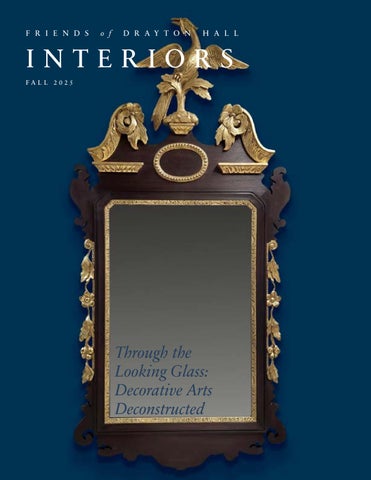
Through the Looking Glass: Decorative Arts Deconstructed
D ear Friends, As Drayton Hall commemorates 50 years of non-profit stewardship this year, I want to thank you for your commitment to safeguarding this National Historic Landmark. What has been saved, preserved and conserved over the last five decades would not have been possible without your support, nor would our endeavors to connect Drayton Hall visitors with the history of the site and its significance in the history of our nation. I have spent the better part of my career at Drayton Hall - first as the 2006 Wood Family Fellow following the completion of my Ph.D., and later as the President and CEO of Drayton Hall Preservation Trust following several years as the Director of Preservation and Education. Given my tenure and this year’s significant milestone, I want to highlight the fact that Drayton Hall stands tall today thanks to the shoulders of those giants that came before us. From brothers Frank and Charles Drayton who made the difficult decision to sell the property in the 1970s to the 96 trustees and advisory council members who have provided strategic guidance since 1975, the preservation of Drayton Hall has indeed been a local and national effort that has built on generations of knowledge, leadership and philanthropy. Such giants include the many preservationists, educators and archaeologists that have researched and safeguarded the property over the years and especially the current and past staff of Drayton Hall. I hope you will enjoy reading this special issue of Interiors and learning more about our recent efforts to acknowledge and protect the past. Much has been preserved over the last 50 years but there is still more work to be completed and your support and advocacy of the past remains as important as ever.
BOA R D O F T RU S T E E S Elizabeth S. Halstead, Chair Henry B. Smythe, Jr., Vice Chair Cynthia K. Kellogg, Vice Chair Dirk Brown, Treasurer Debra J. Gammons, Secretary Nathan P. Berry Matthew Cochrane-Logan Frank B. Drayton Jr. Shannon C. Eaves, Ph.D. Lee Goodman Mary Gregorie O. Howard Sarah R. Johnson Benjamin F. Lenhardt Jr. Peter McCoy Vanessa Turner Maybank Nancy S. Santi Sheila Wertimer Ashley R. Wilson TRUSTEES EMERITI W. Hampton Morris Michael B. Prevost EX-OFFICIO Omar Eaton-Martinez, National Trust for Historic Preservation Carter C. Hudgins, Ph.D., President and Chief Executive Officer Michelle Tyler, Executive Assistant and Board Liaison FINANCE Paula Marion, Chief Financial Officer Michelle Johanek, Finance Coordinator GUEST SERVICES Kate Ludwig, Director of Retail and Admissions Emily Hendrix, Event & Specialty Sales Guest Services Associates: Brian DiGennaro, Destiny Douglass, Mary Marsh, Leslie Ross, Donna Seymour, Kim Smith ARCHAEOLOGY Luke Pecoraro, Ph.D., Director of Archaeology and Collections Nicole Houck, Staff Archaeologist MUSEUM PROGRAMS Amber Satterthwaite, Curator of Education and Museum Programs Historical Interpreters: Loretta Akers, Kathleen Aller, Morgan Blackwelder, Chris Cone, William Dowd, Susan Falck, Jayne Flynn, Rosemary Giesy, Autumn Hall, Olivia Hipp, Caroline Howell, Isabella Inglin, Cody Mansfield, Betsy McAmis, Thomas Rogers, Florence Steele, Thompson Teasdale PRESERVATION Patricia Lowe Smith, Director of Preservation and Archives Will Young, Preservation Associate
With sincere gratitude,
L A N D S C A P E S A N D FAC I L I T I E S Jeff McNeely, Director of Landscapes and Facilities Benjamin Kiester, Head Landscape Gardener Cheryl Drosin, Landscape adn Horticulture Technician Hunter Ranly, Landscape and Horticulture Technician CO M M U N I C AT I O N S A N D M A R K E T I N G
Carter C. Hudgins, Ph.D. President and Chief Executive Officer
Patty B. Sailer, Communications and Marketing Manager Linda Motley, Communications and Marketing Assistant DEVELOPMENT Halley Cella, Director of Philanthropy Lela Gee-Boswell Solomon, Advancement Manager Molly Leonard, Leadership Giving Manager
D R AY T O N H A L L A N N O U N C E S N E W LY E L E C T E D B O A R D O F F I C E R S
ELIZABETH S. HALSTEAD, CHAIR grew up in Baltimore, Maryland. She received a Bachelor of Arts Degree in Historic Preservation and Art History from the College of Charleston. She received a Master's Degree in Fine and Decorative Arts from Sotheby's Institute, an affiliate of The University of Manchester in London, England. Betsy began her career with the AIG Private Client Group based in Charleston as an appraiser specializing in historic home and art valuation. Currently, Betsy works as a consultant in
home and construction project management.
HENRY B. SMYTHE, JR., VICE-CHAIR is a partner at Womble Bond Dickinson and has served on the Firm Management and Executive Committees. Previously, he was the Managing Director for 18 years of Buist Moore Smythe & McGee, P.A., which merged with Womble Bond Dickinson in 2011. Henry is also a business and community leader in Charleston, SC. He served on the Charleston City Council, as President of the Coastal Community Foundation during Hurricane Hugo, as a Board Member of Spoleto Festival USA, and the Saul Alexander Foundation. Henry is a past President of the South Carolina Bar and recently retired from the International African American Museum Board after twentyfour years of service. CYNTHIA K. KELLOGG, VICE-CHAIR lives a good deal of the year in South Carolina. She graduated from Smith College in 1964 with a B.A. in History of Art. She spent her childhood as well as a large part of her adult life in New Jersey. While there, she was president of the Short Hills Garden Club as well as serving on various Garden Club of America committees. She was also a board member of New Jersey Conservation Foundation and currently serves on its Advisory Board. She also was a trustee of Cheshire Home, a specialty care facility in Florham Park, NJ. She is currently on the board of Greenwood Garden, a public garden in Short Hills, NJ. In South Carolina, she is a former board trustee of the Coastal Conservation League. DIRK BROWN, TREASURER is a technologist and a classicist with the heart of a servant leader. In his career, he served as an executive with several multinational technology companies including Hitachi, MCI, AT&T, and PGi. Most recently, Dirk served as Vice President of Product Innovation for the financial startup Neighborly Software. He holds a B.A. in Classics from the College of William and Mary and an MBA from the Goizueta Business School at Emory University. Dirk currently focuses his time as a small residential developer with an interest in innovative, sustainable living. He is also in the process of publishing his first book, a narrative non-fiction based on his travels. In the community, Dirk serves as chair of the Michael C. Carlos Museum National Leadership Board, the advisory board for MicroLife Institute, and board member for the Oxford College Board of Counselors. He was chosen for the Regional Leadership Institute Class of 2019 for the Atlanta Regional Commission. DEBRA J. GAMMONS, SECRETARY was born in the Lowcountry and loves South Carolina. She earned her B.A. Degree from the College of Charleston and her Juris Doctor from the University of South Carolina School of Law. Gammons began practicing law as Assistant Solicitor in the Solicitor’s Office in Charleston. She currently has her own law practice concentrating on Immigration, Family Law, Personal Injury, Probate, and Contract issues. Gammons served as Distinguished Visiting Professor of Law and Director of the Office of Diversity Initiatives at Charleston School of Law for 15 years. Before Charleston School of Law, she served as Assistant City Attorney for Greenville, South Carolina for eleven years. She is a Certified Circuit Court Mediator, a public speaker, legal presenter and is a Delegate in the South Carolina Bar House of Delegates. Gammons is a past President of both the Charleston County Bar Association and the Greenville County Bar Association. She has served as Trustee on the College of Charleston Board of Trustees, as Commissioner of the South Carolina Supreme Court Commission on Lawyer Conduct, and as Chairperson of the College of Charleston Friends of the Library Board. She currently serves as Chairperson of Trinity Montessori School Board of Directors, a member of The Charleston Forum Board, a member of the College of Charleston Graduate School Advisory Board, and is a member of the College of Charleston African American Studies Board. Interiors
03
Preview Party
A SPECIAL E VENING BENEFITING D R AY T O N H A L L P R E S E R VAT I O N T R U S T
MARCH 19, 2026 F E S T I VA L H A L L
56 Beaufain Street Charleston
featuring a special exhibit curated by Drayton Hall
Through Time and Space LAYERS OF HISTORY REVEALED FROM THE GROUND BENEATH US TO THE STARS ABOVE
L E A R N M O R E AT D R AY TO N H A L L .O R G | 8 4 3 .76 9. 2 611
2025 DRAYTON HALL FELLOWS Autumn Hall Wood Family Fellow
Autumn is a recent graduate from Western Carolina University with a Bachelor of Arts in Anthropology and a minor in History. During her time there, she gained valuable archaeological field and laboratory experience in both forensic and historical contexts, which deepened her commitment to community-based archaeology and the importance of centering descendant voices. Autumn is excited to continue this work at Drayton Hall as both a member of the interpretation team and the Wood Family Fellow. Autumn says, "Now, not only am I able to share the rich and diverse history of the site with visitors, but I am also fortunate enough to have the meaningful opportunity to contribute to its ongoing discovery and interpretation."
CONTENTS
02
Message from Carter C. Hudgins, Ph.D.
03
New Board Officers at Drayton Hall
04
Preview Party 2026
Samantha Threlkeld Riley Collections Fellow
05
A native of Vidalia, Georgia, Samantha is a rising second-year graduate student in the Master of Science in Historic Preservation program at Clemson University. She holds a B.A. in Art with a concentration in Graphic Design and a Minor in Marketing from Georgia College & State University.
06 - 07
Samantha brings experience in building and site documentation, finishes analysis, conservation, and archival research. Her professional interests lie at the intersection of decorative arts, material culture, and technology, with particular enthusiasm for digital documentation and conservation practices. She has previously contributed to preservation efforts at Georgia’s Old Capital Heritage Center and completed design work for Garden & Gun magazine.Sam will be working with our collections database, producing an online exhibit, and completing a hands-on documentation/conservation component.
Jayne Flynn Jenrette Fellow Jayne Flynn will be attending Clemson University for a Master of Science in Historic Preservation beginning this fall. Jayne grew up in Richland, MI and attended Wake Forest University, where she earned a Bachelor’s degree in History and a minor in English. Jayne discovered a passion for historic preservation and public history. Since graduation, she has worked with Drayton Hall, the Charleston Museum, and Historic Charleston Foundation. Jayne is excited to be a Jenrette Foundation Fellow for Drayton Hall to continue to learn about historic preservation at this important site.
Florence Steele Jenrette Fellow Florence Steele is a rising second-year student in Clemson University’s Master of Science in Historic Preservation program. He was born and raised in Charleston, graduated from the University of South Carolina in 2023 with a Bachelor’s degree in History and Religious Studies, and currently works as an interpreter at both Drayton Hall and the Joseph Manigault House, His greatest passion lies in historic preservation, particularly material conservation, building surveys, and landscape documentation. Florence is thrilled to participate in the Jenrette Foundation Fellowship this summer to expand his hands-on experience, deepen his knowledge of preservation work, and contribute meaningfully to a historic site that has taught him so much.
2025 Family Fellows
The Great Hall Ceiling Update
08 - 09
2023 Wood Family Fellow: Of China that is Ancient & Blue
10
By the Numbers: Celebrating 50 Years at Drayton Hall
11
Donor Challenge 2024 Fiscal Report
12 - 15
Seven Watercolors Return
16 - 19
Archaeology at the North Flanker
20 - 31
Through the Looking Glasss: Decorative Arts Deconstructed
Interiors
05
Update: Great Hall Ceiling Like a gift that keeps on giving, the Great Hall plaster ceiling continues to reveal its secrets as we work toward its rehabilitation. A February 2024 meeting of preservation experts set the course for a year of careful investigation and documentation—essential groundwork to ensure this remarkable feature is fully understood and added to the historical record. Using that research, design professionals developed a repair plan, and now an exciting new phase begins as we prepare to carry it out. As with all major preservation projects at Drayton Hall, we believe the process is just as fascinating as the finished result. While the work continues, we are keeping as much of the house open to visitors as possible, so that you can experience history and preservation in action.
High-Tech Meets Old-School Before any repairs could begin, we tested several technologies that allow us to see behind plaster and paneling without disturbing them. To verify the results, we compared them to an old-school technique called sounding. Working in pairs, a team from Richard Marks Restorations tapped gently across the ceiling while listening for hollow or detached spots. At the same time, they mapped those areas with color codes. The sounding confirmed the high-tech findings and helped us adjust how visitors move through the Great Hall—so you can still enjoy its beauty without standing beneath fragile sections. Right: Sounding map of the Great Hall ceiling Below: Wafer cut-out and explanation
Looking Inside the Ceiling Sounding also helped us select an area of plaster to remove for closer study. Using a two-inch hole saw, our Director of Preservation and Archives, Trish Smith, cut a small wafer from a cracked section that sounded detached from the wooden lath. The wafer confirmed that the plaster there was no longer bonded to the lath—it was essentially being held in place by surrounding material. It also gave us a chance to evaluate repairs made with injected epoxy in the early 2000s. Some epoxy still clung to the lath but not the plaster; in other cases, it bonded to plaster but released from the lath. In both situations, it was no longer effective. We also saw that a crack had spread around, rather than through, an earlier epoxy repair. The takeaway: the repair did not stop the crack, it only redirected it. CONTINUED, PAGE 07
What the Wafer Revealed The wafer was sent to plaster expert Steve Stuckey for material analysis. His study identified the type of lime used in the plaster as well as what kinds of animal hair were used to help hold it together. This is all extremely valuable information for future preservation projects at Drayton Hall, and for our colleagues in the field who can incorporate lessons we’ve learned into their own preservation projects.
Discoveries in the Walls While plaster analysis was underway, engineers from Bennett Preservation Engineering (BPE) studied the framing above and around the ceiling. They presented several options for adding new beams to stabilize the structure, and we selected the design that preserves the most original material, respects the building’s historic intent, and will endure for generations. To refine their plans, we carefully removed two wooden pilasters, revealing hidden 18th-century framing materials. These temporary removals also created an unexpected opportunity: partnering with an archaeo-ethnobotanist to study seeds and artifacts left behind by long-ago rodents nesting in the walls. Such finds shed light on the plants and foods that once grew at Drayton Hall.
Above: Pilaster removal in the Great Hall Ceiling Left: Magnified contents of rodent nest loacted int the walls of the Lower Great Hall
What's Next With design drawings finalized, the project now moves into its next stage. Scaffolding experts are designing a system that will allow preservation teams to safely reach the ceiling while keeping pathways open for visitors. Thanks to a generous Innovation Grant from the Decorative Arts Trust, we will be able to carry out this complex work while keeping the Great Hall accessible. Structural repairs, led by Richard Marks Restorations, are expected to begin in late 2025 or early 2026. In preparation, decorative plaster will be carefully removed for safekeeping and later reinstallation.
Visit & Follow Along We invite you to experience this rare opportunity to see preservation in progress. Visit Drayton Hall to witness firsthand the craft, science, and care that go into saving one of America’s great historic interiors—and follow our updates online as the project unfolds. Interiors
07
OF CHINA THAT IS ANCIENT TRANSFER-PRINTED AND WARES IN THE HISTORIC CORE OF DRAY TON HALL
Blue :
L
ast summer, Olivia Shorter rejoined Drayton Hall as its 2024 Wood Family Fellow. Olivia was an archaeology intern at Drayton Hall in 2023 and has worked as an archaeological field tech in the Charleston
area. Born and raised in Charleston, South Carolina, Olivia is a first-year graduate student in the Interdisciplinary Linguistics Program at Tulane University. Olivia is studying Classic Maya epigraphy and linguistics through the study of Mesoamerican archaeology and contemporary Mesoamerican languages. She received her B.A. in Anthropology and Art History from the University of Colorado at Boulder in 2021. For her Wood Family Fellow project, Olivia analyzed the transferware ceramics in the Drayton Hall collection, building on the work of both Nicole Houck and Corey Sattes’ efforts on the flanker buildings of Drayton Hall. Beginning in 2005, Drayton Hall has awarded the Wood Family Fellowship to a rising professional in the field of archaeology, architectural history and conservation, landscape studies, or collections management. Supported by Tony Wood in memory of his brother and fellow preservationist, Stephen J. Wood, and his parents Tanya and Leonard Wood, the fellowship has been a formative experience for many graduate-level preservation professionals. Advances in collections management, documentary research, and archaeology have all been made possible by the Wood Family Fellowship, and this year’s fellow continues the tradition of scholarly progress at Drayton Hall.
Above: Olivia Shorter in the Stephen J. Wood Conservation Lab at Drayton Hall with a mended tea bowl.
To learn more about philanthropy at Drayton Hall and how you might support the next generation of preservationists, contact Halley Cella at hcella@draytonhall.org or 843-769-2601.
T
he 2024 project was centered around excavations of the historic core of the plantation comprising the main house, the flanker buildings, South Flanker Well, and main driveway. Excavations have been conducted at Drayton Hall since 1974 and many excavations have been reexamined in the last 15 years. The four objectives of the 2024 Wood Family Fellow project at Drayton Hall were: 1. To identify potential crossmends in previous excavations that produced transferware, specifically centered around the Flanker buildings and mend or rejoin these finds. 2. To identify the patterns and vessel types. 3. To classify the genres or styles and patterns. 4. Re-evaluate the relative dates of the excavation records using all transfer-ware excavated since 1974 across the entire historic core.
08
Interiors
CONTINUED, PAGE 09
T
ransfer-print was first invented in 1751 but not widely available until the 1760s, and not common in America until after 1812. It remained a popular ceramic until the 1870s. The process typically involves pressing a paper or glue-bat with the ink from a copperplate image into the ceramic and then firing like normal, allowing for mass production of detailed images.
T
his project confirmed that two units in the North Yard contain debris deposits from the destruction of the North Flanker. Unsurprisingly, almost all contexts mend into the South Flanker Well confirming its use as a trash receptacle for an extended period of time. However, the dating of the ceramics found in the upper levels suggest that the well was filled much later than previously believed, pushing the date of closing to around 1850 likely after the death of Charles Drayton I rather than in the late 18th century with the death of John Drayton, as previously believed. The Draytons collected popular British styles and patterns; no historic American views, American individuals, story, or moralizing vessels have been found at Drayton Hall. The Draytons continued to value a European aesthetic even after America gained independence. While floral was the most popular genre, Blue Willow was the most popular pattern, including vessels not used in the crossmending analysis. There was a minimum vessel number of 32. Most of the vessels are for tableusage, plates and cups make up the majority of the assemblage. Additionally, some collections of the same pattern or series exist but not necessarily from the same manufacturer. This suggests the purchase of individual pieces rather than sets and could be linked to availability or decisions based on the economics of collecting sets over time. Interiors
09
BY THE NUMBERS
1975-2025 YOUR DONOR DOLLARS AT WORK
LION + 1AMR TI LI FA CTS
22 E XC AVAT I O N
+ 2 MILLION VISITORS
57COUNTRIES
SITES
280
COMPLETED P R E S E R VAT I O N P R OJ E C T S
20
COMPLETED F E L LOWS H I P S
ILLION + 7 MWEBSITE VISITORS
800+ AC R E S P R OT E C T E D ON 17 OBJECTS LOAN AT TOP MUSEUMS,
INCLUDING COLONIAL WILLIAMSBURG & THE SMITHSONIAN
31K STUDENTS REACHED
You keep our gates open, help educate the next generation of preservationists, and foster new discoveries. None of the progress in this issue would have been possible without your generosity! Thank you for your support over the past 12 months and 50 years. 10
Interiors
Fiscal Report July 1, 2023 - June 30,2024 REVENUE & SUPPORT
EXPENDITURES
TOTAL: $3,050,666
TOTAL: $ $3,398,306 Interiors
11
Reunited: Seven Watercolors Return to Drayton Hall Our last issue of Interiors, featuring the cover story Flights of Fancy: An Exploration of Uncommon Birds, took us on the journey of the 1733 portfolio of 47 orginial watercolors by British Orniothologiest, George Edwards. In 1733, John Drayton (1715-1779), received a portfolio containing 47 watercolor paintings by artist George Edwards (1694-1773), the father of British ornithology. These watercolors were completed ten years before the publication of the first volume of Edwards' A Natural History of Uncommon Birds (1743) and are the oldest of their type to survive in North America. Drayton was 18 years old, and this exchange is the best evidence for him experiencing a grand tour of Europe as Edwards never visited North America. Long forgotten, the watercolors were discovered in the attic of 25 East Bay Street upon the death of Charlotta Drayton in 1969. Over time, portions of the portfolio were sold. In 2009, Drayton Hall was able to purchase 21 of the 47 paintings thanks to Ben and Cindy Lenhardt and other generous donors. We are delighted to share that seven watercolors from the 1733 portfolio have returned to Drayton Hall. Read along as President and CEO, Carter C. Hudgins and longtime Friend of Drayton Hall, Virginia F. White recount their own George Edwards journeys. Above: George Edwards
Stewarding the Past, Together Carter C. Hudgins, Ph.D. President and Chief Executive Officer My tenure at Drayton Hall began nearly twenty years ago, when I was the proud recipient of the 2006 Wood Family Fellowship. This program has revolutionized the research and preservation of Drayton Hall, as well as the development of budding professionals. The central focus of my fellowship was John Drayton’s collection of ornithological watercolors from 1733. Such works were rediscovered in 1969, yet they were discounted as amateur efforts before the groundbreaking investigations by scholars Margaret Pritchard and Sumpter Priddy. The pair had recently identified George Edwards, the father of British ornithology, as the artist, yet questions remained regarding how Drayton received these works and what Drayton’s ownership represented. Significantly, this collection of 47 watercolors had been divided in the early 1980s between brothers Frank and “Charlie” Drayton, with 24 of the birds being sold to both private collectors and public museums. While the locations of those pieces held by museums were relatively easy to discern, the whereabouts of a significant part of this Above: Black and white photo of the collection remained a mystery. portfolio, photographed af ter the 1969 attic discovery CONTINUED, PAGE 13 12
Interiors
CONTINUED FROM, PAGE 12
Thanks to the Friends of Drayton Hall and the leadership of Ben and Cindy Lenhardt, in 2008 Drayton Hall was able to purchase 21 of this assemblage still held by the Drayton family, and subsequently exhibited these works at Drayton Hall, the New York Winter Show, and alongside Queen Elizabeth II's collection at the Gibbes Museum of Art. Most recently, Drayton’s watercolors were exhibited at the 2024 Charleston Show, and a Drayton Hall advertisement that featured an George Edwards watercolor ahead of this event caught the eye of a retired antiques dealer in Atlanta who had been part of the original sale of these items in the 1980s. Miraculously, her client still held the seven watercolors that she had purchased 40+ years ago, and the former dealer facilitated the loan of these birds for the 2024 exhibit. Fast forward to the present, it is my honor to announce that the owner of these seven works donated all to Drayton Hall Preservation Trust in early 2025, increasing our holdings to 28 of the original 47 works owned by Drayton. Painted Bunting with Ruby-throated Hummingbirds ( female and male) George Edwards It should come as no surprise that this discovery, loan, and England, 1733 ultimate gift have been highlights of my time at Drayton Hall. Wa t e r c o l o r o n p a p e r Not only were parts of a mystery solved that were central to my Deen Day Sanders Collection of work in 2006, but original objects from Drayton Hall returned G e o r g e E d w a r d s Wa t e r c o l o r s a t to the site for research and public education. However, topping Drayton Hall all this sentiment was the spirit of philanthropy expressed by the dealer and the owner and a clear understanding from both that we are all the stewards rather than owners of the past. With this in mind, I have recently been considering the diverse contributions that each of us has made to the modern history of Drayton Hall. Just like the dealer and owner described above, you, the Friends of Drayton Hall, are active and vital stewards of Drayton Hall, and your many contributions are central to preserving the past for the benefit of our future.
In digo Bu n t i ng (n o n b re e d i ng m ale)
George Edwards England, 1733 Wa t e r c o l o r o n p a p e r Deen Day Sanders Collection of G e o r g e E d w a r d s Wa t e r c o l o r s a t Drayton Hall C O N T I N U E D , PAG E
R e d- headed Wo odpeck er
George Edwards England, 1733 Wa t e r c o l o r o n p a p e r Deen Day Sanders Collection of G e o r g e E d w a r d s Wa t e r c o l o r s a t Drayton Hall
Blue Jay
George Edwards England, 1733 Wa t e r c o l o r o n p a p e r Deen Day Sanders Collection of G e o r g e E d w a r d s Wa t e r c o l o r s a t Drayton Hall
14
Interiors
13
Memories, Connections, & Collections Virginia F. White, Friend of Drayton Hall My passion for Drayton Hall started 52 years ago. In 1973, my husband and I, and our not-yet-one- year-old daughter, and dog, moved from New York City to Charleston, SC with all our belongings to start a new job on Kiawah Island. This job was surrounded by mystery and intrigue. Mrs. Mae Royal, owner of Kiawah Island, and her son Dennison, wanted to keep Kiawah in the family, but it needed to become income producing. Kiawah was wild and pristine, with 10 miles of crescent white sandy beach, virtually no development, and very few residences. There were tangled trails, massive trees, ocean and marsh vistas, with many birds, wild animals and alligators. Mrs. Royal, our daughter, and I would go on expeditions around the island; we ventured into Charleston and often on excursions to plantations and other out-of-the-way places. This adventuresome spirit brought us to Drayton Hall one day. As the trees opened on the road, there before my eyes was the grand structure of Drayton Hall. I fell in love with it at that moment!
Discovering Drayton Hall We had learned it was being vandalized, and things were being taken. Many people hoped it could be saved, and a volunteer organization I belonged to, The Junior League of Charleston, was trying to raise awareness to protect this magnificent place. Little did I know that nearly 50 years later I would have the privilege and opportunity to reunite this interest. We moved from Charleston when Kiawah Island was sold, but over the years, we've returned many times to visit the Royal family and friends. Drayton Hall was saved, becoming part of the National Trust properties, and is a crown jewel in the architectural history of our nation.
The Watercolors and their Journey I grew up in Virginia in an old circa 1760’s property named Back Creek, now a Virginia and National Historic Landmark. This began my love of learning the stories of architecture and decorative arts, especially as they relate to America. My career in interior design has allowed me to learn much and have opportunities to work on some great collections and projects. In 2023, the Fall issue of The Magazine Antiques, there was a magnificent image of an owl announcing the Charleston Antique Show exhibit of Flights of Fancy. I knew immediately that this image was part of a collection, being sold, that I had been involved with in 1988-1989, at that time I was working with a client who was building a strong collection of American Decorative Arts and had a keen interest in botanicals and natural history. At that time the best research and family history attributed these works to John Drayton, which had been found in the attic of Miss Charlotta Drayton’s Charleston home on E. Bay Street. I encouraged my client to consider adding some to her collection, and seven were purchased and placed in her home. These watercolors have been enjoyed by family and friends, and, especially me, for over 37 years. CONTINUED, PAGE 15 14
Interiors
Above: Virginia White (center) and her daughters at the 2024 Preview Party for the Chalreston Show
CONTINUED FROM, PAGE 14
A Full Circle Moment Seeing this magazine advertisement prompted me to research my records and verify that the image in The Magazine Antiques and my client’s watercolors were from My heartfelt gratitude to Virginia White & her the same collection. This prompted me to call Drayton client for their reuniting, after many years of separation, a significant portion of the original Hall. Quite frankly, I thought they were stunned and collection. curious, and wanted to know more about them, as several of the 47 original watercolors’ whereabouts were still unknown. I spoke with my client about this and Wouldn’t it be wonderful if all 48 of the originals asked if she would allow me to pursue this with Drayton could be together again?! Hall, which she kindly did. I met with Director of - Anne Drayt on Ne l s on Philanthropy Halley Cella and Director of Archaeology Daughter of Charlie Drayton and Collections Luke Pecoraro to review the images and history of how they came to this collection. There was much discussion and excitement about this connection. Two were selected to be on exhibition in The Charleston Show- the Unidentified Goshawk and the Grey Parrot. In the process of connecting these pieces and this exhibition, I learned that much more research had been conducted since my client’s early purchase in 1988. These watercolors were in fact by the famous ornithologist, George Edwards, and extremely rare images of his earliest known work. This new knowledge held mixed feelings for me, but the research and papers by Carter C. Hudgins, Margaret Pritchard, and Sumpter Priddy added a new chapter to the material world of John Drayton.
A Gift Returned Home Following the exhibition I returned watercolors. Then the owner and I talked about how wonderful it would be for them to all return to Drayton Hall one day. The next step was a promised gift, which was a thrilling moment for me to share with the Drayton Hall team. Shortly thereafter the owner decided to give all seven watercolors to Drayton Hall during her lifetime, as she has a truly philanthropic heart and loves to share from her own life-blessings with others. My husband and I drove them to Drayton Hall, their true home. They now are a part of the permanent collection of the original watercolors belonging to John Drayton. WHAT A GIFT!! From just Memories of a place I visited and loved, to Connections with my career, now these pieces are in the Drayton Hall Collections-more than a 52-year journey. I hope you will visit Drayton Hall to experience its history and significance.
Virginia's story highlights why your support is so critical and your loyalty is invaluable. Every once in a while, we have the opportunity to do something extraordinary, like bringing these seven water colors home to Drayton Hall. Interiors
15
ARCHAEOLOGY RETURNS TO THE NORTH FLANKER
D
rayton Hall’s distinctive Palladian architectural style featured a five-part design that included the main house, two flanking dependency buildings, and two connecting colonnades. Both flanker buildings, contemporary with the construction of the house, remained standing for over one hundred and fifty years until they were dismantled around the turn of the 20th century. The south flanker was fully excavated in the 1970s and it was determined during the excavation that the building was likely used as a kitchen Drayton Hall house. Prior fieldwork in Pi e r r e E u g è n e D u S i m i t i è r e ( 1 7 3 6 – 1 7 8 4 ) 1981 exposed the north C h a r l e s t o n , S . C . 1 76 5 flanker’s foundation Wa t e r c o l o r o n p a p e r and partially excavated C o u r t e s y o f J . L o c ka r d its interior, though the building’s original use remained undetermined, and the fieldwork was not completed.
I
n October 2023, archaeologists at Drayton Hall reopened the interior of the north flanker and the surrounding area. The excavation recovered over 15,000 artifacts and exposed evidence of not only the Drayton occupation but an earlier colonial and Native American presence as well. While the postprocessing of artifacts is still ongoing, initial analysis has revealed several key findings.
North Flanker
E x c a va t i o n 2 0 2 4 Pr e - D r a y t o n d i t c h a n d p o s t h o l e s
CONTINUED, PAGE 17
16
Interiors
CONTINUED FROM, PAGE 16
NATIVE AMERICANS
T
he archaeological record at Drayton Hall reveals the presence of Native Americans on the landscape as far back as the Early Woodland period (1000 - 200BC) and continuing through the contact period c. 1670. Tribes such as the Edisto, Kussoe, Kiawah, Yamasee and several others inhabited the Ashley River region and surrounding Charleston area prior to the English colonization of Charleston. As English settlers established themselves in South Carolina, they relied heavily on labor and trade relationships with coastal and backcountry tribes but ultimately displaced the indigenous communities from their ancestral land. Excavations at the north flanker have uncovered Early Woodland (1000 - 200BC) and Late Woodland (500 - 1000AD) period Native pottery with diverse stylistic techniques, along with worked stone tools and a variety of glass trade beads. Many of these artifacts were found alongside European-made artifacts, suggesting the presence — and possible enslavement — of Native Americans during the 17th and early 18th century pre-Drayton era of the property. Ashley River Road, where Drayton Hall is located, was once a well-traveled Native American trade route. Historic documents indicate that members of the Catawba tribe, South Carolina’s only Federally recognized tribe, continued to visit Charleston from the upstate to trade pottery into the mid-19th century. The excavation at the north flanker recovered several pottery sherds identified as Catawba, further highlighting the site’s complex indigenous history.
PRE-DRAYTON COLONIAL ERA
T
he plot of land on which Drayton Hall was built changed hands amongst the Carolina Lord Proprietors and other prominent figures several times between 1676, when the land grant was initially applied for, and 1738 when John Drayton ultimately acquired the property. Historical records indicate that there were two long-term owners of the property before John Drayton. The first being Joseph Harbin, a Above: Porcelain bowl merchant based in Barbados. Documents suggest Harbin never traveled to South Carolina himself but rather sent his nephew to handle his South Carolina landholdings. It is likely that during Harbin’s ownership (1680 - 1692) the first homestead was established on the property. The second long-term owner was Francis Yonge who held the property from 1718 - 1734. While documents reveal little about Yonge’s life along the Ashley River, we know he was a prominent political figure serving as South Carolina’s Surveyor General and Colonial Agent. CONTINUED, PAGE 18 Interiors
17
CONTINUED FROM, PAGE 17
During the excavations at the north flanker, archaeologists uncovered a large drainage or boundary ditch running north-south through the property. The artifacts recovered from the ditch date to the late 17th and early 18th centuries hinting at these early colonial homesteads. Among the finds was an intact wine bottle dating to the late 17th century indicating the ditch may have been part of Harbin’s original plantation landscape. Historical records, along with a significant quantity of butchered cattle bone and whetstones (used to sharpen knives and tools), may suggest Harbin operated a cattle plantation. A portion of the boundary ditch’s assemblage can be attributed to Francis Yonge’s ownership including a purple glass perfume bottle, a gold gilded porcelain bowl, and 15 sherds of a rare black delft teapot. These recent discoveries are just a glimpse of the artifacts recovered from this portion of the ditch feature, shedding new light on the property’s early colonial history.
DRAYTON OCCUPATION
I
n 1738, John Drayton purchased 350 acres from Jordan Roche. It is evident in the archaeological record that John dismantled and redesigned the previous plantation landscape to construct what is now Drayton Hall.
Above: Drayton Hall c. 1886
Artifact analysis from the north flanker suggests the building may have served as a laundry or washhouse during the Drayton occupation. Over 1000 sewing-related artifacts were recovered during the excavations, more than anywhere else on site. These sewing-related items include thimbles, awls, buttons, straight pins, clothing clasps, scissors and flat irons.
Given that the structure was two stories, it is possible that it served multiple domestic functions including housing enslaved individuals. A significant quantity of colonoware, a distinct type of pottery made and used by enslaved Africans, was recovered from the flanker fill. A newspaper article from the late 19th century also states the flankers formally housed “servants,” possibly enslaved. CONTINUED, PAGE 19
18
Interiors
CONTINUED FROM, PAGE 18
Little is known about the use of the flankers during the Phosphate Mining Era (1865-1910), but oral history suggests the Bowens family, formerly enslaved at Drayton Hall and caretakers of the property, lived in the north flanker following the Civil War. The exact reason for dismantling the flanker buildings remains unknown, but their deterioration throughout the 19th century along with the 7.5 earthquake of 1886 likely made them structurally unsound. Combined with the 1981 fieldwork, over 60,000 artifacts were recovered from the north flanker area. The evidence found during these excavations shows an evolving landscape, from Native Americans to phosphate mining and, ultimately, to what Drayton Hall is today. Now that the excavation is complete, a protective layer of filter fabric will be installed, A b o v e : I n p r o g r e s s e x c a v a t i o n a t t h e No r t h and the area will be filled with builder’s grade sand Flanker 2024 before being covered with gravel and sod leaving the foundation visible to guests.
Thank you for your continued interest and support throughout this exciting excavation! Archaeological investigations provide valuable insights and help preserve the diverse history of Drayton Hall.
Interiors
19
Through the Looking Glass: Decorative Arts Deconstructed
You’ve seen the handsome furniture and the delicate artifacts, but perhaps you’re curious about what lies beneath those gleaming surfaces. From x-rays and radar to flashlights and filters, we’ll share some of the methods we use to learn about our historic objects and illuminate the stories they can tell.
T
HIS REPLICA PIER MIRROR EXEMPLIFIES THE BENEFITS OF DRAYTON HALL’S UNIQUE PRESERVATION PHILOSOPHY. In the drawing room, crude pockets of carving on the outside of two window architraves show that an object slightly wider than this space once hung between the windows, and that these flanking architraves had to be carved out to accommodate it. The nature of the carvings, as well as hardware evidence, strongly suggests that the object was a pier mirror. We began studying this evidence more closely in 2019 with Chris Swan, Senior Conservator of Wooden Artifacts at Colonial Williamsburg, and in 2024 Eli Wilner & Associates awarded Drayton Hall a Replica Frame Grant, funding the reproduction of the piece that once hung in the drawing room. Drawings and measurements were sent to the team at Eli Wilner who combed through catalogs of eighteenth-century pier mirrors looking for existing mirrors with carved ornaments that might fit our specifications. After compiling a few likely candidates, we selected a mirror from the Museum of the City of New York as our inspiration for the replica. In the course of our research, we also looked closely at the holes in the wall made by the hardware that supported the mirror. In our quest to find matching holes to prove the location of a matching pier mirror, we discovered that the Draytons did own such a mirror but, to our surprise it was hung on the opposite side of the house, creating an interesting visual axis through three rooms of Drayton Hall. Thus, by preserving carvings and abandoned nail holes, partnering with colleagues at other institutions, and conducting thorough research, we were able to reverse-engineer a long-lost object and confirm that another just like it once adorned the walls of Drayton Hall. Replica of a late 18th Century-style Pier Mirror (2024–2025) Walnut, basswood, and parcel-gilt Eli Wilner & Company for Drayton Hall Preservation Trust 12 I n t ePreservation riors Drayton Hall Trust Museum Collection
IMAGE: locations of car vings used to reverse-engineer pier mirror located in the Drawing Room. Carvings are called out in the white boxes.
IMAGEs: the making of the replica p i e r m i r r o r a t E l i W i l n e r.
IMAGE: Up close car vings
Interiors
21
Easy Chair
T
H E F U R N I T U R E F O R M K N OW N AS THE EASY CHAIR FIRST APPEARED IN ENGLAND IN 1614. Describing an upholstered c h a i r w i t h a b a c k a n d a r m s , t h e s e we r e g e n e r a l l y f o u n d i n o n e’ s p e r s o n a l chamber with many being fitted with an opening for a close or chamber p o t . T h i s c h a i r c o n ve y e d t h r o u g h t h e D r a y t o n f a m i l y, a n d t h e p r o ve n a n c e a n d a g e i n d i c a t e s i t wa s o n c e l o c a t e d at Drayton Hall. By the time this easy c h a i r wa s m a d e , m a n y u p h o l s t e r s we r e in the business of producing them; t h e y we r e c o n s i d e r e d l u x u r i e s d u e t o t h e a m o u n t o f f a b r i c n e e d e d t o c o ve r t h e c h a i r. A s o r i g i n a l / h i s t o r i c f u r n i t u r e and furnishings return to the Drayton H a l l Pr e s e r va t i o n Tr u s t t h r o u g h gift, purchase, or loan, the ability to interpret these pieces alongside those i n p r i va t e c o l l e c t i o n s g i ve u s a s e n s e o f t h e m a t e r i a l wo r l d o f t h e D r a y t o n family at home.
Creamware Chamber Pot
T
HIS MENDED CHAMBER P O T WA S R E C OV E R E D D U R I N G A RC H A E O LO G I C A L I N V E S T I G AT I O N S A RO U N D T H E P R I V Y D U R I N G E A R LY P H A S E S O F F I E L DWO R K A F T E R T H E N AT I O N A L T RU S T ’ S AC Q U I S I T I O N O F T H E P RO P E RT Y. Ve s s e l s l i ke t h e s e we r e u s e d b o t h i n s i d e D r a y t o n H a l l and in the b ox close sto ols inside the privy and emptied on a regular basis b y m e m b e r s o f t h e e n s l a ve d h o u s e h o l d s t a f f. T h e c r e a m wa r e e x a m p l e d i s p l a y e d h e r e c o u l d h a ve b e e n u s e d during John D rayton or Charles D r a y t o n’ s t e n u r e o f o w n e r s h i p — there are at least thirty other chamber pots in the archaeological record from this period. Chamber pots could also be inserted into close s t o o l s o r e a s y c h a i r s , l i ke t h e o n e o n display in this exhibit.
Easy Chair
American, likely Charleston, c. 1810 Cypress frame with yellow pine seat Courtesy of Charles H. D rayton, Jr. and Julia S. Drayton
Creamware Chamber Pot
England, 1762–1820 Refined earthenware P r i v y, D r a y t o n H a l l , e x c a v a t e d i n 1 9 8 1 C o u r t e s y o f t h e N a t i o n a l Tr u s t f o r Historic Preservation
22
Interiors
Pier Table
T
H I S F U L LY C O N S E RV E D TA B L E I S O N E O F A M AT C H I N G PA I R O F P I E R TA B L E S T H AT P R E DAT E T H E C O N S T RU C T I O N O F D R AY T O N H A L L A N D A R E T H E EARLIEST FURNITURE OBJECTS IN T H E D R AY T O N H A L L C O L L E C T I O N S . It is possible that these tables date to t h e t i m e o f J o h n D r a y t o n’ s f i r s t marriage to Sarah Cattell in 1736. The table features cabriole legs and pad f e e t w h i c h a r e i n d i c a t i ve o f e a r l y 1 8 t h century taste. A large shell carving is in the center of the table apron s u r r o u n d e d b y f l o we r b u d s a n d l e a ve s ; p r i o r t o c o n s e r va t i o n o n l y t h e s h e l l a n d l e f t f l o we r b u d r e m a i n e d . G h o s t m a r k s of the additional ornamentation along with a sketch of the table from c.1845 b y L e w i s R e e ve G i b b e s c o n f i r m e d t h e additional ornamentation. These tables we r e m a d e t o s i t a ga i n s t a wa l l a s t h e back legs are formed to be flush a ga i n s t t h e wa l l w i t h m i r r o r s l i ke l y h u n g a b o ve t h e t a b l e s .
E n g l a n d , c . 1 7 3 0 - 1 74 0 L a r c h f r a m e w i t h m a h o g a n y ve n e e r, c a r v i n g s , a n d l e g s . Original Italian marble top. Drayton Hall Museum Collection G i f t o f t h e l a t e M r. C h a r l e s H . D r a y t o n I I I a n d t h e l a t e M r s . Martha Drayton Mood C o n s e r va t i o n g i f t p r o v i d e d b y M r. a n d M r s . P. Fr e d e r i c k Kahn
Pre-Conservation E n g l a n d , c . 1 7 3 0 - 1 74 0 L a r c h f r a m e w i t h m a h o ga n y ve n e e r, c a r v i n g s , a n d l e g s . Original Italian marble top. Drayton Hall Museum Collection G i f t o f t h e l a t e M r. C h a r l e s H . D r a y t o n I I I a n d t h e l a t e M r s . Martha Drayton Mood
Through the Looking Glass: Decorative Arts Deconstructed
P i e r Ta b l e
P i e r Ta b l e
Interiors
23
Sketch of Bookcase and Pier Table
L
EW I S R E EV E G I B B E S , W H O S E M AT E R N A L G R A N D FAT H E R WA S C H A R L E S D R AY T O N ( 1 74 3 – 1 8 2 0 ) , F I L L E D T H I S S K E T C H B O O K W I T H S C E N E S F RO M D R AY T O N H A L L A RO U N D 1 8 4 5 . Pe r h a p s i n s p i r e d b y h i s g r a n d f a t h e r ’ s s c i e n t i f i c p u r s u i t s , G i b b e s wa s a n accomplished botanist and professor of m a t h e m a t i c s , a s t r o n o m y, a n d p h y s i c s a t the College of Charleston.
Through the Looking Glass: Decorative Arts Deconstructed
This sketchb o ok is comprised of interior and exterior drawings of Drayton H a l l w i t h s e ve r a l d e t a i l e d s t u d i e s o f
24
Interiors
S k e t c h o f B o o k c a s e a n d P i e r Ta b l e L e w i s R e e ve G i b b e s ( 1 8 1 0 – 1 8 9 4 ) Charleston, c. 1845 D r a y t o n Pa p e r s C o l l e c t i o n , C o u r t e s y o f t h e N a t i o n a l Tr u s t f o r H i s t o r i c Pr e s e r va t i o n G i f t o f t h e l a t e M r. C h a r l e s H . D r a y t o n I I I and the late Mrs. Martha Drayton Mood
f u r n i t u r e , d e c o r a t i ve p l a s t e r c e i l i n g s , and architectural flourishes throughout. Some of these drawings depict things t h a t wo u l d b e o t h e r w i s e l o s t t o h i s t o r y including a neoclassical ceiling in the d r a w i n g r o o m , a m a h o ga n y s t a i r r a i l t e r m i n a t i n g i n a n e l e g a n t vo l u t e , p l u s t h e b o o kc a s e s h o w n h e r e . G i b b e s ’ decision to include measurements of t h e b o o kc a s e e n a b l e d u s t o c o n f i r m t h a t t h e c a r ve d e g g a n d d a r t m o l d i n g i n o u r collection is the one shown adorning the t o p o f t h e b o o kc a s e .
Computer-generated Images of Bookcase
O
NE OF THE TO OLS WE USE IN OUR R E S E A RC H I S 3D MODELING S O F T WA R E . N e w d i s c o ve r i e s about architectural changes, paint colors, materials, and furnishings are modeled in 3D on the computer and then rendered with realistic lighting and shadows. These models help us understand and interpret how Drayton H a l l ’ s i n t e r i o r s l o o ke d in the eighteenth and nineteenth centuries. They also help us test furnishing plans with a few mouse clicks. In the rendering on the right, you can see that we wa n t e d t o v i s u a l i z e s o m e of the Draytons’
ceramics in the case behind historic glass. Wh i l e t h e b o o kc a s e is modeled closely o n t h e s ke t c h b y L e w i s R e e ve G i b b e s , t h e wa y we show it being used is purely conjectural. It is a lows t a ke s wa y of testing hypotheses about the interiors of Drayton Hall.
IMAGES: Computer-generated bookcase created in AutoCAD 3D and 3D Studio Max
Eg g and Dart Molding
C
particles, chunks of carbon, and wood fibers,” along with red ochre, iron oxide, and red lead. Dr. Buck’s assessment also indicates that this paint is not related to the very fine and evenly ground pigments in the red paint found in the dining room and builtin shelves of the south cellar passage. Rather, this paint is more likely to have been used on the exterior of the house or one of its outbuildings.
OMPARING THE DIMENSIONS OF THIS MOLDING FRAGMENT TO THE MEASURED DRAWING MADE BY LEWIS REEVE GIBBES SUGGESTS THAT THIS OBJECT ONCE ADORNED THE TOP OF THE MISSING DRAYTON BOOKCASE. Half of this molding remains unpainted and unvarnished while the other half is coated in a red oil-bound paint. It IMAGES: Pigments in the f irst deep red is possible that this carefully paint layer: red ochre, widely dispersed carved embellishment burnt sienna, red lead, charcoal black and suffered the indignity of calcium carbonate. being used as a stir stick for paint — especially given its similarity to the color and composition of paint used to coat Drayton Hall’s roof following replacement in 1875. E g g a n d D a r t Mo l d i n g Mahogany Pigment analysis by Susan Drayton Hall Museum Collection, Courtesy of the Buck, Ph.D., Conservator and N a t i o n a l Tr u s t f o r H i s t o r i c Pr e s e r va t i o n . Paint Analyst notes that the paint contains “colorless sand Interiors 25
Shield
T
HIS SHIELD IS AMONG THE M O R E M YS T E R I O U S O B J E C T S IN THE COLLECTION. It can b e seen in this photograph taken in the drawing room in 1964. The shield is also depicted adorning the top of t h e b o o k c a s e i n L e w i s R e e ve G i b b e s ’ s k e t c h c . 1 8 4 5 . Pa i n t a n a l y s i s s h o w s that its paint relates to the layers a p p l i e d t o t h e wa l l s i n t h e d i n i n g r o o m a n d l i b r a r y i n t h e 1 8 t h c e n t u r y. T h e s e va r i o u s a p p e a r a n c e s r a i s e m a n y questions. Is this the same object that adorned the b o okcase, or a similar one displayed in a different location? If it did come from the b o okcase, do es this m e a n t h a t t h e b o o kc a s e wa s l o c a t e d i n the library or dining room and either partially or fully painted to match the wa l l c o l o r ? I f t h e m i s s i n g b o o kc a s e s u r v i ve s and can be located, it may help us understand where and how this shield wa s u s e d .
shield
I M A G E : D e b u t a n t e p a r t y f o r A n n e Tr a p i e r D r a y t o n a n d A r d e n B a l l “ M i s s J a c k” H o w a r d , D e c e m b e r 2 8 , 1 9 6 4. P h o t o g r a p h e d f r o m the Drawing Room of Drayton Hall Pictured from lef t to right: Charles Henry Drayton, III, Anne Tr a p i e r D r a y t o n , M a r y J e r v e y D r a y t o n , B e v e r l y E g g l e s t o n “ B e v o” H o w a r d , A r d e n B a l l “ M i s s J a c k” H o w a r d , A r d e n B a l l H o w a r d (Mrs. Bevo Howard) 26
Interiors
Sketch of Bookcase
L e w i s R e e ve G i b b e s ( 1 8 1 0 – 1 8 9 4 ) Charleston, c. 1845 D r a y t o n Pa p e r s C o l l e c t i o n , C o u r t e s y o f t h e N a t i o n a l Tr u s t f o r H i s t o r i c Pr e s e r va t i o n G i f t o f t h e l a t e M r. C h a r l e s H . D r a y t o n I I I and the late Mrs. Martha Drayton Mood
Mounted Paint Samples
P
A I N T A N A LYS I S I S O N E O F T H E M O S T U S E F U L T O O L S AT O U R DISPOSAL. The procedure i n vo l ve s u s i n g a s c a l p e l t o r e m o ve a t i n y s a m p l e o f p a i n t a n d t h e s u b s t r a t e t o w h i c h i t wa s a p p l i e d — u s u a l l y wo o d o r p l a s t e r. S a m p l e s a r e e x c e e d i n g l y s m a l l a n d a r e t a ke n adjacent to areas of existing paint loss to minimize their physical and v i s u a l i m p a c t . I n t h e l a b o r a t o r y, samples are suspended inside cubes made of polyester resin and then cut and polished to expose a cross-section. M a g n i f i e d h u n d r e d s o r e ve n t h o u s a n d s of times under a microscope, the cross-section shows each paint layer as we l l a s a c c u m u l a t i o n s o f d i r t o r s o o t that can indicate the passage of time b e t we e n l a y e r s .
Through the Looking Glass: Decorative Arts Deconstructed
I M AG E S : S h i e l d-1 . L o w e r e dge o f c re s t a t l o s s a re a
Pa i n t a n a l y s i s i s u s e f u l f o r d e t e r m i n i n g h i s t o r i c p a i n t c o l o r s , b u t we o f t e n u s e i t t o u n d e r s t a n d a s e q u e n c e o f e ve n t s . Fo r e x a m p l e , t h e p a i n t l a y e r s i n t h e dining room are different than those in the drawing room; so when paint a n a l y s i s s h o we d t h a t t h e s h i e l d ’ s p a i n t stratigraphy matched that of the dining r o o m , we u n d e r s t o o d t h a t t h e s h i e l d m u s t f i r s t h a ve b e e n l o c a t e d i n a r o o m on the north side of the house then l a t e r m o ve d t o t h e d r a w i n g r o o m o n the south side of the house where it appears in the photo from 1964.
Interiors
27
Side Chair
O
Through the Looking Glass: Decorative Arts Deconstructed
N E O F A S E T O F AT L E A S T T W E LV E S I D E C H A I R S F RO M AN ORIGINAL SUITE OF F U R N I T U R E C R E AT E D F O R D R AY T O N H A L L , T H E C H A I R F R A M E I S M A R K E D V I I W H I L E T H E S E AT FRAME IS MARKED XII. The chair has elaborate carvings on the pierced back splat and crest rail, f u l l y c a r ve d s e a t r a i l s , a n d c a b r i o l e l e g s terminating with hairy-paw feet. The use of the hairy-paw feet is significant as it is the first example of this type of carving found on a suite of furniture in the American colonies.
28
Interiors
The cabinet shop that created this suite of furniture is not known nor is the exact location of where the f u r n i t u r e wa s m a d e . M o s t e x p e r t s a g r e e t h a t t h i s s u i t e o f f u r n i t u r e wa s n o t produced in London but somewhere outside of the city center or possibly e ve n i n S c o t l a n d . T h i s m a y r e f l e c t t h e i n f l u e n c e o f M a r ga r e t G l e n D r a y t o n , Jo h n D r a y t o n’ s t h i r d w i f e , o n t h e furnishings of Drayton Hall. The red wo o l u p h o l s t e r y f a b r i c o n t h e s e a t s of the side chair and matching settee replicates the original fabric recently d i s c o ve r e d u n d e r a f i r s t- g e n e r a t i o n nail head on the seat frame during the c o n s e r va t i o n p r o c e s s .
Side Chair
England or Scotland, c. 1750 Mahogany with beech seat frame D r a y t o n H a l l P r e s e r v a t i o n Tr u s t Decorative Arts Collection Gift of Historic Charleston Foundation Conserved by Chris Swann
Desk and Bookcase
O
NE OF THE MOST REMARKABLE S U RV I V I N G O B J E C T S F RO M C O LO N I A L A M E R I C A I S T H E D E S K A N D B O O KC A S E AC Q U I R E D BY J O H N D R AY T O N ( 1 7 1 5 – 1 7 7 9 ) S P E C I F I C A L LY F O R D R AY T O N H A L L . Pr o d u c e d i n G r e a t B r i t a i n , t h i s e x t r a o r d i n a r y o b j e c t wa s c r e a t e d w i t h wo o d s ga t h e r e d f r o m e ve r y c o n t i n e n t w i t h t h e e x c e p t i o n o f Antarctica and fitted with elaborate t i n t - l a c q u e r b r a s s h a r d wa r e . T h i s o b j e c t wa s c l o s e l y i n ve s t i ga t e d b y C o l o n i a l Wi l l i a m s b u r g a n d c o n s e r ve d o ve r t h e c o u r s e o f t wo y e a r s , a n d e x a m i n a t i o n s r e ve a l e d 1 3 h i d d e n c o m p a r t m e n t s a l o n g w i t h e v i d e n c e o f a n o r i g i n a l b e ve l e d mirror with gilded surround, now r e p l i c a t e d i n t h e b o o kc a s e d o o r. T h e c a r ve d a r c h i t e c t u r a l e l e m e n t s o n t h e d e s k a n d b o o kc a s e c l o s e l y m i m i c t h e carving found in the mantel pediment a n d p i l a s t e r c a p i t a l s o f t h e Up p e r Great Hall of Drayton Hall. Due to the similarities in carving and the addition o f t h e h a i r y - p a w f e e t , i t i s b e l i e ve d t h a t t h e d e s k a n d b o o k c a s e wa s i n t e n d e d t o a d o r n t h e Up p e r G r e a t H a l l . Jo h n Drayton, or perhaps his Scottish-born w i f e M a r g a r e t G l e n , wo u l d h a ve u s e d this object to store important books a n d d o c u m e n t s i n t h e u p p e r b o o kc a s e and sat at the desk to compose his c o r r e s p o n d e n c e w i t h t h e l i ke s o f h i s b r o t h e r- i n - l a w, R o ya l G o ve r n o r Ja m e s G l e n , a s we l l a s s o n s C h a r l e s a n d Wi l l i a m H e n r y w h i l e t h e y c o m p l e t e d t h e i r s t u d i e s a t O x f o r d Un i ve r s i t y.
Desk and Bookcase
E n g l a n d , 1 74 5 - 1 75 5 M a h o ga n y, e b o n y, p a d a u k , h o l l y, c e d r e l a , o a k , s p r u c e , t o r t o i s e s h e l l , m i r r o r e d g l a s s , t i n t- l a c q u e r b r a s s , a n d l i n e n Drayton Hall Museum Collection, courtesy of the N a t i o n a l Tr u s t f o r H i s t o r i c Pr e s e r va t i o n G i f t o f t h e l a t e M r. C h a r l e s H . D r a y t o n I I I a n d t h e l a t e Mrs. Martha Drayton Mood C o n s e r ve d b y C o l o n i a l Wi l l i a m s b u r g
Interiors
29
Plaster Ceiling Mockup
T
H E I C O N I C C A S T- P L A S T E R C E I L I N G AT D R AY T O N H A L L H A S B E E N C O N S E RV E D S EV E R A L T I M E S S I N C E T H E N AT I O N A L T RU S T F O R H I S T O R I C P R E S E RVAT I O N P U RC H A S E D T H E P RO P E RT Y I N 1 9 74 . T h e s e c o n s e r va t i o n treatments include the installation o f m e t a l m e s h , p l a s t e r o f Pa r i s , m e t a l angles, and injected ep oxies. In 2021, a g r a n t f r o m t h e N a t i o n a l Pa r k S e r v i c e’ s N a t i o n a l C e n t e r f o r Pr e s e r va t i o n Te c h n o l o g y a n d Tr a i n i n g m a d e i t p o s s i b l e f o r u s t o t e s t s e ve r a l n o n d e s t r u c t i ve t e c h n i q u e s f o r e va l u a t i n g t h e c o n d i t i o n o f h i s t o r i c p l a s t e r. Pr o j e c t G o a l s : 1 ) To t e s t n o n - d e s t r u c t i ve m e t h o d s that detect the hidden components of h i s t o r i c p l a s t e r a n d e va l u a t e h o w u s e f u l they are for assessing the condition of a ceiling. 2 ) To c o n t i n u e o u r t r a d i t i o n o f l e a d e r s h i p i n h i s t o r i c p r e s e r va t i o n b y publishing our findings,emphasizing accessible and affordable methods that other sites can use to determine if their c e i l i n g s a r e i n n e e d o f c o n s e r va t i o n o r might pose a safety threat.
This mockup of a historic plaster c e i l i n g i n c l u d e s s e ve r a l d e f e c t s s u c h a s b r o ke n ke y s a n d h i d d e n vo i d s deliberately created to replicate c o n d i t i o n s we a n t i c i p a t e d f i n d i n g i n t h e r e a l c e i l i n g . N o n - d e s t r u c t i ve methods including digital radiography ( x- r a y ) , t h e r m a l i m a g i n g , a n d p e n e t r a t i n g r a d a r we r e a l l f i r s t t e s t e d on this mockup to indicate how e f f e c t i ve l y t h e y wo u l d s h o w o u r h i d d e n defects—if at all. The results of these tests on the Great Hall ceiling informed our current p r o j e c t w h i c h i n vo l ve s c a r e f u l l y disassembling the ceiling, repairing the structural problems that caused it to crack, reinstalling new flat p l a s t e r, a n d t h e n p u t t i n g b a c k a l l o f t h e o r i g i n a l d e c o r a t i ve e l e m e n t s . D r a y t o n Hall will remain open to the public during this multiyear effort. A n e v i d e n c e - b a s e d a n d c o l l a b o r a t i ve a p p r o a c h t o h i s t o r i c p r e s e r va t i o n i s a t t h e c o r e o f o u r wo r k a t D r a y t o n H a l l , and this plaster mockup illustrates our commitment to careful and methodical experimentation with the goal of improving outcomes for historic places e ve r y w h e r e .
IF YOU LIVE OR WORK UNDER A HISTORIC PLASTER CEILING AND WOULD LIKE TO KNOW WHAT METHODS YOU MIGHT CONSIDER TO EVALUATE ITS CONDITION, WE WILL GLADLY SHARE THE RESULTS OF OUR TESTS UPON REQUEST.
IMAGE: CBZ Consulting uses penetrating radar to search for hidden defects in the mockup.
30
Interiors
Iron Artifacts
T
H E A RC H A E O LO G I C A L R E C O R D AT D R AY T O N H A L L H A S Y I E L D E D W E L L OV E R A M I L L I O N A RT I FAC T S O F VA R I O U S T Y P E A N D C O M P O S I T I O N . Some materials — ceramic, stone, a n d g l a s s — s u r v i ve m u c h b e t t e r i n t h e g r o u n d t h a n o r ga n i c o b j e c t s s u c h as textiles, bone, and ferrous metals. E va l u a t i n g w h a t a r t i f a c t s s h o u l d g o t o c o n s e r va t i o n c a n b e a d i f f i c u l t t a s k when the objects are obscured by metal concretions which form during the natural process of metal decomposition. X- r a y s a r e u s e d t o “ s e e t h r o u g h” t h e concretions to stable metal, often r e ve a l i n g c l u e s w h i c h h e l p t o identify the artifact and prioritize c o n s e r va t i o n .
IMAGE: Radiograph of Iron Artifacts. Pictured clockwise:
Through the Looking Glass: Decorative Arts Deconstructed
Through careful methods, the metal c a n b e c l e a n e d a n d t r e a t e d t o p r e ve n t f u r t h e r d e c a y. T h e m e t a l c o l l e c t i o n a t Drayton Hall helps us to interpret daily plantation life including what tools we r e a va i l a b l e f o r a g r i c u l t u r a l o r c o n s t r u c t i o n p r a c t i c e s a n d e ve n t h e utensils used for meal preparation and consumption.
Interiors
31
Culinary Charleston Gift Box The perfect gift for family, friends & clients. We have rounded up some of our favorite treats, all locally sourced from Charleston, South Carolina. Each box is elegantly finished with our our custom Delft Tile wrapping paper and grosgrain ribbon.
Carolina Gold Rice & Rice Spoon Gift Set
Meyer Lemon Tree
Fresh Wreaths Delivered!
Classic Magnolia Wreath
Colonial Trimmings Wreath
Classic Boxwood Wreath
A L L I M AG E S A R E C O U RT E SY O F D R AY TO N H A L L P R E S E RVAT I O N T R U S T U N L E S S OT H E R W I S E N OT E D.