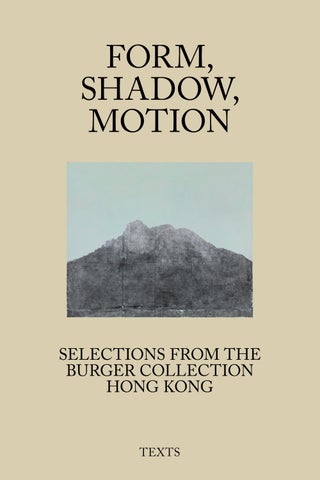
SELECTIONS FROM THE BURGER COLLECTION HONG KONG
163
SELECTIONS FROM THE BURGER COLLECTION HONG KONG
For Yves and Kent Shao
序言
8
策展人語
20
MONIQUE BURGER 寄語
24
Laura Hoptman 孟淑娟女士 Olivia Shao
MONIQUE 與 MAX 的思維意象
26
消失與空白
54
Johannes Hoerning 萬豐
與 OLIVIA SHAO 及 MONIQUE BURGER 對談
62
主持: Annie Ochmanek
出於黏土
82
形、影、動:伯格收藏精選 藝術家簡介
100
撰稿者簡介
144
Brian Kuan Wood
編撰: Nicolas Poblete
6
PREFACE 9
Laura Hoptman S. Alice Mong
CURATOR’S ACKNOWLEDGMENTS 21
Olivia Shao
NOTE FROM MONIQUE BURGER
25
DENKBILDER FÜR MONIQUE UND MAX 27
Johannes Hoerning
DISAPPEARANCE AND BLANKNESS
Chris Wan Feng
55
A CONVERSATION WITH OLIVIA SHAO 63 AND MONIQUE BURGER
Moderated by Annie Ochmanek
TO BE MADE FROM CLAY 83
Brian Kuan Wood
NOTES ON THE ARTISTS 101
Nicolas Poblete
CONTRIBUTOR BIOGRAPHIES 145
7
序言
Laura Hoptman 紐約繪畫中心行政總監
Monique 和 Max Burger 伉儷除了因他們對國際當代藝術及相關機構 的慈善事業而享負盛名,其數以千計之繪畫、雕塑、素描、錄像和大型裝置 藝術藏品亦為人稱道。這批藏品來自二人二十多年來的精心蒐集,囊括了 來自世界各地藝術家的現當代藝術作品。
是次「形、影、動 (Form, Shadow, Motion: Selections from the Burger Collection, Hong Kong)」展覽為 Burger Collection, Hong Kong 與充滿熱誠,並尤其鍾情繪畫媒介的策展人 Olivia Shao 之間 的合作;後者自 2024 年起擔任紐約繪畫中心 (The Drawing Center) 的策展人。展出 Burger Collection, Hong Kong 之中精選藏品的想 法,源於一場圍繞兩座充滿共同點的城市——香港和紐約——之中明顯 散發之藝術感性的討論。Monique 和 Max Burger 已在香港生活了 二十多年,Olivia 部分家族成員亦扎根於此;紐約則是 Olivia 的家鄉, 也是 Monique 和 Max 作 為 訪 客 和 贊 助 人 所 熟 悉 的 城 市。Burger Collection, Hong Kong 包含了來自世界各地的藝術家作品,當中香港 或紐約藝術家的紙本作品尤其豐富,這些藝術家有的早就在這兩個城市 中均已享負盛名,有的才嶄露頭角。 與其說「形、影、動」展覽是兩座城市文化生產的對照,它卻更像一篇探討 精神、文學與哲學上共同關注的視覺散文。展覽聚焦於紙本作品和線條 的探索,因此亦與繪畫中心的使命不謀而合。繪畫中心是一家非營利機 構,半個世紀以來一直致力於向大眾呈現當代繪畫展覽。多年來,繪畫中 心曾展出多個著名私人收藏展,包括過去十年間由 Jack Shear 等鑑賞 家,以及 Brian Donnelly(又名 KAWS)等藝術家狂迷所收藏之精選 作品。 從最廣泛的意義而言, 「形、影、動」展覽與之前的展覽項目一脈相承,卻也 在數個方面獨樹一幟。首先,展覽展出不到五十件經精挑細選的作品,與
8
PREFACE
Laura Hoptman Executive Director The Drawing Center
Monique and Max Burger are equally known for their philanthropy focused on international contemporary art and the institutions that support it and for their collection, numbering in the thousands, of paintings, sculptures, drawings, video, and room-sized installations. That collection, lovingly assembled over more than two decades, features modern and contemporary art by artists from all over the world. The exhibition Form, Shadow, Motion: Selections from the Burger Collection, Hong Kong represents a collaboration between the Burger Collection, Hong Kong, and Olivia Shao, a passionate curator with a particular love for drawing who has been The Drawing Center’s curator since 2024. The idea of an exhibition of objects drawn from the Burger Collection, Hong Kong, arose amid a discussion around the artistic sensibilities evident in two cities with much in common: Hong Kong, where Max and Monique have lived for more than twenty years and from where some of Olivia’s family hail, and New York, Olivia’s hometown and a city that Max and Monique know well as visitors and as patrons. The Burger Collection, Hong Kong, includes work by artists from around the globe, but it is particularly rich in works on paper by artists based in Hong Kong or New York—some well-known in both cities; others, still emerging. Form, Shadow, Motion, though, is less of an exercise in comparison and contrast between the cultural production of two cities than a visual essay in shared concerns—spiritual, literary, and philosophical. The show concentrates on works on paper and the exploration of line, and, as such, aligns with the mission of The Drawing Center, a nonprofit institution that, for half a century, has presented exhibitions
9
其說是對 Burger 伉儷龐大藝術收藏的一次全面梳理,毋寧說是策展人理 念的一場有力辯證。正如 Olivia 在與 Monique 以及藝術史學家兼編輯 Annie Ochmanek 一次富有啟發性的對談(收錄於本書)中所闡述: 「展 覽以東方思想和西方哲學為起點,同時以香港和紐約為參照和出發點進 行思考。」
因此,這並非一場呈現單一甚或共同藝術視角的展覽;其野心更聚焦於與 當代文化生產關係密切的更廣泛的議題。再者,是次展覽籌劃亦考慮到觀 眾群體與脈絡的轉移: 「形、影、動」展覽於紐約繪畫中心的展期結束後,將 移師至亞洲協會香港中心。對照紐約和香港觀眾對是次展覽的回應,無疑 將是一場引人入勝的實驗。這本展覽圖錄旨在鼓勵這場探索:這本英中雙 語圖錄由紐約繪畫中心和亞洲協會香港中心共同出版,是繪畫中心製作 的首部全雙語圖錄,當中不僅收錄了前述 Monique、Olivia 和 Annie 之 間的對談,亦包括 Burger Collection, Hong Kong 長期顧問 Johannes Hoerning、紐約著名藝評人 Brian Kuan Wood 以及亞洲協會香港中心 策展人萬豐(Chris Wan Feng)的特別委約文章。 本書旨在建立一個討論框架,而同樣重要的是,為進一步探究視覺藝 術語言從本土到跨國的趨同與分歧這一棘手問題提供論述方向。正如 Monique 在討論中所述: 「藝術勞動和知識勞動息息相關——它們相互補 完、激烈衝突,又或介乎兩者之間。」 「形、影、動」展覽正是對這類關係引人 入勝的研究,既充滿愛又飽含爭議,對於理解在國際舞台被創作和消費的 當代藝術至關重要。
繪畫中心衷心感謝 Monique 和 Max Burger 伉儷慷慨地向 Olivia 的策 展視角敞開他們的藏品。這份慷慨亦支持了 Olivia 目前擔任的策展人一 職。Olivia 對繪畫中心的貢獻,美妙地挑戰並改變了我們的機構項目策劃 ;沒有 Monique 和 Max Burger 伉儷決定性的支持,我們便沒有機會與 她合作。繪畫中心亦感謝 Burger Collection, Hong Kong 團隊(名單請 參照本書後部)在紐約和香港展覽的籌備過程所提供之建議和物流協助。 本人特別鳴謝亞洲協會香港中心會長孟淑娟(S. Alice Mong)女士;孟女 士向來崇仰 Monique 和 Max,她欣然答應以亞洲協會香港中心作為舉辦 是次展覽之理想場地,並與繪畫中心合作出版這本雙語出版物。
繪畫中心方面,我謹向 Olivia 及其團隊致以衷心謝意,特別鳴謝本計劃 策展研究員 Nicolas Poblete 為展覽及這本出版物所付出之研究工作; 同時感謝副總監 Olga Valle Tetkowski,其專業知識對這項國際合作不
10
of contemporary drawings to its audiences. Over the years, The Drawing Center has featured exhibitions of prominent private collections, including, in the past decade, selections from collections assembled by connoisseurs like Jack Shear and artist aficionados like Brian Donnelly (a.k.a. KAWS), among others. In the broadest sense, Form, Shadow, Motion is well within the tradition of these earlier projects, but it is also unique for several reasons. Firstly, with fewer than fifty carefully chosen works on display, the exhibition is less a survey of the Burgers’ vast art holdings than a convincing argument for the concerns of its curator. As Olivia explains in an illuminating conversation with Monique and art historian and editor Annie Ochmanek, reproduced in this publication, “The exhibition takes Eastern thought and Western philosophy as starting points, while also thinking through Hong Kong and New York City as points of reference and departure.” It is not, then, a show about a single—or even a shared—artistic perspective. Its ambitions are much more focused on broader issues pertinent to contemporary cultural production. Secondly, the exhibition has been created with an eye to shifting audiences and contexts; after its run at The Drawing Center, Form, Shadow, Motion will travel to the Asia Society Hong Kong Center (ASHK). It will indeed be a fascinating experiment to compare the reception of this show by audiences first in New York and then in Hong Kong. This catalog, accompanying the exhibition, is designed to encourage just such an exercise. Co-published in English and Chinese by The Drawing Center and Asia Society Hong Kong Center, this is the first bilingual catalog published by The Drawing Center in almost thirty years. Not only does it feature the aforementioned discussion between Monique, Olivia, and Annie, but it also includes commissioned essays by Johannes Hoerning, a longtime advisor to the Burger Collection, Hong Kong; the respected, New York–based critic Brian Kuan Wood; and the Hong Kong–based Asia Society Hong Kong Center Head of Gallery and Exhibitions, Chris Wan Feng. The book itself is meant to set up a framework for discussion and, equally importantly, for further inquiry into the thorny issues
11
可或缺;紐約 Pacific 平面設計師團隊,與 Olivia 合作為展覽設計並製作 這部精美的雙冊出版物;我們的傳播與市場推廣部門同事也出色地將層 次豐富的訊息傳遞予廣大公眾。The Director’s Circle 的支持,讓繪畫中 心的展覽得以順利發生。
儘管今次「形、影、動」展覽顯然與以往的著名私人收藏展一脈相承,卻又 不失其獨特的實驗性。其視角並非出於個人品味或沉迷,而是源於一種深 刻的慷慨,因它為藝術家、收藏家和策展人建構了一個共同發聲的平台, 讓他們得以向可能從未以這種方式聆聽這些旋律的觀眾譜寫新的樂曲。
12
surrounding discourse on the convergence and divergence of visual art languages, from the local to the transnational. As Monique comments in the discussion: “Artistic labor and intellectual labor are very much related—mutually supportive, deeply clashing, or somewhere in the middle.” Form, Shadow, Motion is a fascinating study of just these kinds of relationships, loving, contentious, and vitally important for the understanding of contemporary art created and consumed on an international stage. The Drawing Center is deeply thankful to Monique and Max Burger for their remarkable generosity in opening their collection to Olivia’s curatorial eye. It has been this generosity that has also underwritten the position of curator that Olivia presently holds. Olivia’s contributions to The Drawing Center have challenged and changed our institutional program in wonderful ways, and we would not have had the chance to work with her without Max and Monique’s game-changing support. The Drawing Center would also like to thank the Burger Collection, Hong Kong, team (listed elsewhere) for their advice and logistical help in organizing the shows in New York and Hong Kong. I would also like to extend a personal thanks to S. Alice Mong, President of Asia Society Hong Kong Center. A longtime admirer of Max and Monique, Alice happily agreed that the Asia Society Hong Kong Center would be a perfect venue for the exhibition, as well as to collaborate with The Drawing Center on this bilingual publication. At The Drawing Center, I extend my personal thanks to Olivia and the entire team, with a special mention of our curatorial fellow on this project, Nicolas Poblete, who contributed research to both the exhibition and this publication. I would also like to thank our Deputy Director, Olga Valle Tetkowski, whose expertise was crucial to this international partnership. Our graphic designers at Pacific collaborated with Olivia to design and produce this beautiful, two-volume publication for the show, and our in-house Communications and Marketing departments have done an admirable job of translating its layered messages to our larger public. The exhibition presentation at The Drawing Center is made possible by The Drawing Center’s Exhibition Fund.
13
Isabella Séville Fürnkäs, Insomnia Drawing, #0175, 2007–ongoing
14
Although it is clearly in line with past exhibitions of notable private collections, Form, Shadow, Motion is also, in its own way, experimental. Its point of view is not one of personal taste or obsession but, rather, of profound generosity, as it creates a platform for a chorus of voices—from artists to collectors to curators—to sing new songs to an audience who might have never heard these melodies sung in this particular way before.
15
序言
亞洲協會香港中心會長
孟淑娟女士
亞洲協會香港中心 (ASHK) 榮幸呈獻「形、影、動:Burger Collection, Hong Kong 精選展」巡迴展覽香港站,展期為2027年3月至7月。展覽與紐 約繪畫中心(The Drawing Center)合作舉辦,第一站於2026年10月在 繪畫中心展出。是次展覽不僅促進了機構間的國際合作,也激發了當代藝 術回應、討論跨越地域和國界的全球性議題。
我特別感謝 Monique 和 Max Burger 伉儷對「形、影、動」展覽的支持, 該展覽由 Burger Collection, Hong Kong & TOY Meets Art 策展人 Olivia Shao 精心策劃。ASHK 很榮幸能在我們位於香港——Burger 伉 儷如今視之為家的城市——的麥禮賢夫人藝術館呈獻這個展覽。Burger 伉 儷抵達香港時,恰逢 ASHK 金鐘新址開幕;自此,ASHK 一直有幸擁有這 兩位長期會員兼支持者。我們曾借用 Burger Collection, Hong Kong 的 作品展出,也受益於 Monique 在藝術館顧問委員會的卓越貢獻。我最欣賞 Monique 和 Max 的,是他們善於利用 Burger Collection, Hong Kong 彰顯藝術家作品、增強策展人視野、拓展機構網絡,並在香港乃至整個亞洲 地區,促進充滿活力的藝術文化生態系統的發展。 ASHK 是一個獨立的非公營教育機構,由一群香港社區領袖於1990年創 立,是亞洲協會遍佈全球十六個中心之一,致力於在藝術文化、商業和政 策領域,探索亞洲,乃至世界的共同未來。自2012年起,ASHK 進駐舊域多 利軍營軍火庫:一個歷史悠久、文化底蘊深厚、自然風光秀麗的場所。
我們衷心感謝繪畫中心團隊的辛勤付出和熱情投入,包括執行總監 Laura Hoptman、是次展覽客席策展人暨 Burger Collection, Hong Kong & TOY Meets Art 策展人 Olivia Shao,以及項目實習生 Nicolas Poblete; 同時感謝 ASHK 藝術館與展覽部團隊:藝術館及展覽主管萬豐、展覽營 運經理 Hain Yoon,以及策展助理 Brynn Gordon。這本展覽圖錄收錄了 Burger Collection, Hong Kong 長期顧問 Johannes Hoerning、紐約
16
PREFACE
S. Alice Mong
President Asia Society Hong Kong Center
Asia Society Hong Kong Center (ASHK) is pleased to present the expanded Hong Kong installment of the traveling exhibition Form, Shadow, Motion: Selections from the Burger Collection, Hong Kong, from March to July 2027. A shared project with The Drawing Center, New York—which hosted the first installment in October of 2026—this exhibition not only fosters international collaboration between institutions but also sparks dialogue between contemporary artistic responses to global questions that transcend continental and national divisions. I am particularly grateful to Monique and Max Burger for their support of Form, Shadow, Motion, wonderfully curated by Olivia Shao, Burger Collection, Hong Kong, & TOY Meets Art Curator. ASHK is honored to present this exhibition at our Chantal Miller Gallery in Hong Kong, a city the Burgers now call home. We at ASHK are fortunate to have them as longtime members and supporters since their arrival in Hong Kong, which coincides with ASHK’s opening at our new home in Admiralty. We have borrowed from the Burger Collection, Hong Kong, for past exhibitions and benefited from Monique’s wisdom through her service on our Gallery Advisory Committee. What I admire most about Monique and Max is that they use the Burger Collection, Hong Kong, to amplify the artist’s work, empower the curator’s vision, help to enhance the institution’s networks, and, in the case of Hong Kong and Asia, help to grow the dynamic art and cultural ecosystem of the city and the region. ASHK is an independent non-governmental educational organization established in 1990 by a group of Hong Kong community leaders.
17
藝評人 Brian Kuan Wood 和萬豐的文章,以及 Olivia Shao、Monique 和藝術史學家兼編輯 Annie Ochmanek 的對談記錄。這些文字闡述了這 項目的學術與概念框架,使其更為豐富。我們對 Burger 伉儷為本次展覽 慷慨開放他們的收藏致以深刻謝意。 我們由衷感謝所有為本項目付出時間和努力的人士,特別是 ASHK 的員 工和義工。從導賞到協助舉辦相關活動,他們寶貴的支持讓我們的藝術文 化節目得以順利舉行。
18
It is one of sixteen centers in Asia Society’s diverse network across the globe, with the mission to navigate shared futures for Asia and the world in the fields of arts and culture, business and policy. Since 2012, ASHK has been situated at the Former Explosives Magazine of the Old Victoria Barracks, a site steeped in history, cultural significance, and natural beauty. We are extremely grateful for the hard work and enthusiasm of The Drawing Center’s team, including Executive Director, Laura Hoptman; guest curator of this exhibition and Burger Collection, Hong Kong, & TOY Meets Art Curator, Olivia Shao; and curatorial fellow, Nicolas Poblete; as well as the Gallery and Exhibitions team at ASHK, led by Head of Gallery and Exhibitions, Chris Wan Feng; Gallery Operations Manager, Hain Yoon; and Curatorial Assistant, Brynn Gordon. The accompanying exhibition catalog—featuring essays by longtime Burger Collection, Hong Kong, advisor Johannes Hoerning, New York–based art critic Brian Kuan Wood, and Chris Wan Feng, as well as a transcribed discussion between Olivia Shao, Monique, and art historian and editor Annie Ochmanek—enriched the project by sharing the academic and conceptual frameworks surrounding the project. We are deeply appreciative of the Burgers’ generosity in opening their collection up for this exhibition. We would like to thank everyone who lent their time and effort to this project, particularly our staff and volunteers here at ASHK. From guiding tours to aiding with accompanying events, their invaluable support makes our art and culture programming possible.
19
策展人語
Olivia Shao 紐約繪畫中心
Burger Collection, Hong Kong, & TOY Meets Art
策展人
能夠參與此次展覽的籌備工作,我深感榮幸。我由衷感謝 Monique 和 Max Burger 伉儷的慷慨、他們為全球藝術和藝術家所付出的奉獻,並且 於紐約繪畫中心(The Drawing Center)設立這個意義非凡的策展職 位;尤其感激 Monique 對我的工作的支持、投入與信任。初來報到的我, 從未想過自己會成為 TOY(Thinking Of Yves)大家庭的一員,能夠結 識如此多志同道合、理念及世界觀相近的朋友。 見證 Monique 和 Max 的願景在其藏品中得以體現,是相當啟發人心的 過程。是次展覽因各種意義深長的連結與對話而起,匯集了同情、希望、苦 難、悲傷、失去等眾多人類情感,期望藉此開啟一個對話空間。在這分裂的 時代,我希望這展覽能彰顯我們彼此之間的共通之處,以及我們所共享的 人性的脆弱。
在 此 謹 向 所 有 參 與 是 次 展 覽 的 藝 術 家 們 表 達 我 的 謝 意;能 與 如 此 優 秀 的 團 隊 合 作,我 深 感 榮 幸。特 別 鳴 謝 繪 畫 中 心 傑 出 專 業 的 團 隊, 尤其是 Laura Hoptman、Olga Valle Tetkowski、Nicolas Poblete 以 及 Isabella Kapur。非 常 感 謝 Monique 的 團 隊,特 別 是 A s i a (Joanna)Lisiak,她對於是次展覽至為關鍵。同時向亞洲協會的優秀團 隊由衷致謝:孟淑娟、萬豐、Hain Yoon 和 Brynn Gordon。 Johannes E. Hoerning、萬豐和 Brian Kuan Wood 為本展覽圖錄撰寫充滿 洞見的文章,為是次展覽增補了重要的視角和脈絡,謝謝你們與我們至今仍 然持續的對話。同時也感謝 Pacific 的優秀團隊設計此書,使之得以成形。
特別鳴謝劉文棟、鄭成然、Annie Ochmanek、Jay Sanders、Anita Shao、 Phillippa Shao、Chiu Yuk Tung 和 Kent Shao 的深刻洞見、友誼與支持。
20
CURATOR’S ACKNOWLEDGMENTS Olivia Shao
Burger Collection, Hong Kong, & TOY Meets Art Curator The Drawing Center
It has been a great pleasure to work on this exhibition. My d eepest gratitude goes to Monique and Max Burger for their g enerosity, their dedication to art and artists globally, and for endowing this curatorial position at The Drawing Center. I am extremely grateful for Monique’s support and her dedication to and belief in what I do. When I started this role, I had no idea I would become part of the larger TOY community and meet so many like-minded individuals who share similar ideals and ways of viewing the world. It’s been incredibly insightful to see Monique and Max’s vision come through in their collection. This exhibition emerges from meaningful connections and conversations. It brings together compassion, hope, suffering, grief, loss, and the many emotions of being human, in the hope of opening a space for dialogue. In a time of division, my hope is that this show can foreground our similarities and the fragility of our shared humanity. I would like to thank all the artists included in this exhibition. I am so fortunate to work alongside a remarkable team of individuals—a very special thank you to the fantastic team at The Drawing Center for your expertise, with special appreciation to Laura Hoptman, Olga Valle Tetkowski, Nicolas Poblete, and Isabella Kapur. A big thank you to Monique’s team, especially Asia (Joanna) Lisiak, who has been so integral to this exhibition. I am also deeply grateful to the wonderful team at Asia Society Hong Kong Center (ASHK): S. Alice Mong, Chris Wan Feng, Hain Yoon, and Brynn Gordon.
21
Isabella Séville Fürnkäs, Insomnia Drawing, #0011, 2007–ongoing
22
Johannes E. Hoerning’s, Chris Wan Feng’s, and Brian Kuan Wood’s thoughtful texts in this catalog add important perspectives and context to this exhibition. Thank you for your conversations and our ongoing dialogue. And thank you to the amazing team at Pacific for the design of this publication and for making this book possible. A special thank you for the insight, friendship, and support of Stephen Cheng, Alex Lau, Annie Ochmanek, Jay Sanders, Anita Shao, Kent Shao, Phillippa Shao, and Chiu Yuk Tung.
23
MONIQUE BURGER 寄語 \ 藝術並非一面映照現實的鏡子, 而是一柄塑造現實的錘子。 —Shirin Neshat
在這個故事跨越國界、圖像取代失效語言作出敘述的時代,這本專書匯聚 了多元的聲音,共同探討創意作為一種連結行為的意義。多年來,我們收 藏的每一件作品都蘊含着對話——我和Max之間的對話、藝術家與觀眾之 間的對話、不同文化與歷史之間的對話,觀看以及感知之間的對話。
本書以中英雙語出版,就是為了肯定藝術語言的普世性,並強調翻譯能 使之更為豐富。以不同視角觀看、以其他語言聆聽,能拓展我們對彼此 連結的理解。
我們希望此書成為一個發現、同理以及重燃好奇心的空間——一支藝術如 何持續塑造我們觀看自身和世界的方式的禮贊。 感謝 Olivia、Laura、Alice、Joanna、Johannes、Brian 和 Chris;你們一 如既往地鼓勵我從不同角度觀看事物、質疑自己的前設,並保持好奇。你 們擴闊了我對「繪畫」概念及其真實意義的理解,為此我深表感激。
24
NOTE FROM MONIQUE BURGER
“Art is not a mirror held up to reality, but a hammer with which to shape it.” —Shirin Neshat
In a time when stories are shared across borders and images speak where language falters, this publication brings together diverse voices to reflect on creativity as an act of connection. Each of the works we collected over many years embodies a dialogue—between Max and me, between artists and audiences, between cultures and histories, between the seen and the felt. To publish this book in both English and Chinese is to affirm that art’s language is universal yet always enriched by translation. The process of seeing through another lens, of hearing an echo in another tongue, expands our understanding of what binds us together. We hope this book becomes a space for discovery, empathy, and renewed curiosity—a celebration of how art continues to shape the way we see ourselves and the world. Thank you, Olivia, Laura, Alice, Joanna, Johannes, Brian, and Chris. You consistently encourage me to look at things from different angles, to question my assumptions, and to remain curious. I’m deeply grateful for the way you’ve expanded my thinking of what the idea of “drawings” truly means.
25
MONIQUE 與 MAX 的思維意象 Johannes Hoerning
「不愛整齊的孩子——他發現的每一塊石頭, 採摘的每一朵花和捕捉到的每一隻蝴蝶, 都已經是收集的開始; 在他看來,他所擁有的每一件東西, 都構成了絕無僅有的一個大收藏。」 —Walter Benjamin, 《單行道》 ,1928年
車路士的馬克思主義——在紐約,我們總是感到充滿活力且輕鬆自在。我 第一次去那兒是在2005年。那時我十六歲,對這座城市一無所知,語言也 不太通,卻在第22街的 Matthew Marks Gallery 看到了 Robert Gober 的一件裝置藝術作品:一個釘在十字架上的被斬首的基督像,水從其乳頭 流出,流落進畫廊混凝土地板的一個洞裏。後方某處一個浴缸裏躺着一具 蒼白的軀體、一個尿布袋、一個附有照片(照片的細節我已記不清)的牧師 領,還有一張並非由塑膠、石頭、或青銅製成的白色一體成形椅,為了確認 我還伸手摸了它一下。十六年後的2021年秋天,當 Monique 和我再次來 到同一地點觀看 Gober 的展覽時,水再次出現了。這次,水在一面牆後方 流動,只能隱約透過一件男士西裝外套背面的破洞窺見,這讓我們聯想到 Max 的背影。那面牆正是當年裝置基督像的同一面牆。展覽中還有一系 列色調柔和的畫作,描繪了帶鐵柵的窗戶,直接繪製於 Gober 從某處尋 獲或買來的一本十九世紀素描本中剪下來的解剖學素描練習之上。1992 年,當他在 Dia(同樣位於第22街)首次展出鐵柵窗戶作品時,它被裝置於 無法觸及的高牆內,並以手繪的林地風景偽裝隱蔽起來。如今,Monique 和我直視鐵柵後方的藍天。她曾看過 Dia 的展覽,而我沒有。我們挑選了 的唯一一件 作品,背景拙樸的繪畫著圓木塊和輕輕交疊的手;這件作品 最能體現 Gober 最初那件裝置的象徵意義——虛假的田園詩意象、橫空
26
DENKBILDER FÜR MONIQUE UND MAX Johannes Hoerning
“UNORDENTLICHES KIND. Jeder Stein, den es findet, jede gepflückte Blume und jeder gefangene Schmetterling ist ihm schon Anfang einer Sammlung, und alles, was es überhaupt besitzt, macht ihm eine einzige Sammlung aus.” UNTIDY CHILD. Each stone he finds, each flower picked and each butterfly caught, is already, for him, the start of a collection, and every single thing he owns makes up one great collection. —Walter Benjamin, Einbahnstraße [One-Way Street], 1928
MARXISM IN CHELSEA. We always felt lively and relaxed in New York. My first time was in 2005. I was sixteen, didn’t know the city, and barely spoke its language when I saw Robert Gober’s installation on 22nd Street at Matthew Marks Gallery: a beheaded Christ figurine on a cross, bleeding water out of its nipples into a hole in the gallery’s concrete floor. Then there was a pale body in a bathtub somewhere in the back, a diaper bag, a clerical collar with a photo whose details I don’t remember, and a white Monobloc chair made from something other than plastic, stone, or bronze. I touched it to verify. Sixteen years later, in the fall of 2021, there was again water when Monique and I went to the same location to see Gober’s exhibition. This time, it was running behind a wall, visible only through a hole in the back of a man’s suit jacket, which reminded us of how Max looks from behind. It was the same wall on which Christ had been installed back then. There was also a series of gently colored
27
Robert Gober, Untitled, 2020
穿過樹幹的窗戶。那雙交疊的手(也許並非出自 Gober 本人之手)訴說 着宗教的應許背後潛藏的恐怖與背叛——對 Max 而言,沒有甚麼能像教 會的虛偽讓他感覺如此強烈。與畫廊敲定合作事宜數月後,我意外地接 到一份工作邀請:翌年夏天,我將負責拓展畫廊在德國和中國的業務。我 想:這是一項刺激的提案——在 Marx 的家鄉 (Heimat) 以及至今唯一 仍將他奉為國家守護神的國度銷售藝術。當時我已差不多完成關於中國 現代政治史的博士論文,是時候將所學知識運用於商業實踐了。我從劍橋 搬遷到紐約;回想起在紐約車路士的日子,最令我難忘的是那些美妙的性 愛時光;還有那次我從北京回來時那自豪——我在北京以北兩小時車程 的金山嶺為朋友 Damien 的山頭裝置了 Charles Ray 的作品《校園話劇》 (School Play,2014年) ,我急不及待要向所有人講述這段經歷。那幅畫 作是 Monique 收藏的第一件 Gober 作品。一年後她又購入了一件牆面 雕塑,一塊染色的尿布上有幾枚藍色的知更鳥蛋——但那時我已在籌劃離 開這城市。我搬離之後,感覺 Monique 來紐約的次數也比以前少了。
沒有綱領——觸覺敏銳的藝術史學家能覺察各種影響。 Blinky Palermo 和 Barnett Newman 這一對常被拿來相提並論。我總覺得,儘管 Blinky 對美國充滿嚮往,但這位來自東德、性格內向的不可知主義孤兒,作為藝 術家所獲得的樂趣,比另外那位傲慢且好鬥的紐約猶太人要多。當然, Barney(Barnett)本人並不怎麼在乎樂趣這回事。有人會用「遊戲性」 (ludic)來形容 Blinky 的作品,但我更喜歡「趣味」 (fun/spaßig)這個
28
drawings of barred windows, drawn onto anatomical studies Gober cut out of a nineteenth-century sketchbook he had found or bought somewhere. When he first showed a barred window at Dia in 1992 (also on 22nd Street), it was out of reach, installed high up within a wall, and camouflaged by hand-painted woodland scenery. Now, Monique and I were staring right out at the blue sky behind the bars. She saw the show at Dia; I didn’t. We chose the only work that had clumsily drawn wood logs and gently folded hands in the background; it best captured the symbolism of Gober’s original installation—the fraudulent, pastoral idyll where his window cut through a tree trunk. Those folded hands (probably not drawn by himself) speak to the potential horror and betrayal of religious promise—there are few things Max feels as strongly about as the hypocrisy of the church. A few months after we confirmed the work with the gallery, unexpectedly, I was offered a job the following summer to expand their business in China and Germany: An exciting proposition, I thought, selling art in Marx’s Heimat and in the only place where he remains a national patron saint. I had just about finished my doctoral dissertation on China’s modern political history; now, it was time to put my knowledge to commercial use. I relocated from Cambridge to New York. What I remember of my time in Chelsea is great sex. And how proud I was that one time coming back from Beijing, where I had installed Charles Ray’s School play (2014) onto my friend Damien’s mountain in Jinshanling, two hours north of Beijing. I couldn’t wait to tell everyone about it. The drawing was Monique’s first Gober. A wall sculpture with blue robin’s eggs on a stained diaper followed a year later, but I was then already making plans to move out of the city. When I did, it felt like Monique came to New York much less than she used to. KEIN PROGRAMM. Clever art historians detect influences. Blinky Palermo and Barnett Newman are a popular pair. I always thought that, despite Blinky’s admiration for America, the shy, agnostic orphan from the GDR had more fun as an artist than the proud, confrontational New York Jew. Not that Barney cared much about fun. Some would call Blinky’s work “ludic,” but I prefer the sound of “fun” = spaßig. For all we know, Blinky meant by “fun” something
29
Blinky Palermo, Ohne Titel (Frau im Liegestuhl), 1965
詞。據我們所知, Blinky 所說的「趣味」與追求「崇高」完全是兩碼子事(〈 崇高即現在〉 (The Sublime is Now)是 Barney 1948年一篇論文的標 題,我懷疑 Blinky 從未讀過它) 。1 Barney 和他的美國朋友們認為,他 們可以從藝術作為各種獨立的表達技術的歷史起源中,推斷出藝術的本 質;Barney 深信: 「人類原初的表達,就如其原初的夢一樣,是一種美學表 達。」2 Blinky 的背景和成長經歷過於平凡,容不下這種宏大的綱領構想。 有時我會想,也許他對 Barney 所做的事,就像 Hegel 對 Kant 所做的那 樣:將對方的理論徹底顛倒過來。講座、上城區的沙龍聚會和 Kabbalah 之 於 Barney 就如毒品和否定辯證法之於 Blinky——後者於1977年在馬爾 代夫因服食過量藥物去世,享年三十四歲。認識 Blinky 的人說他從不談 論自己的作品,即使偶爾談起,也絕不使用理論術語──這也許是他晚年 旅居曼哈頓下城期間(1973年至1976年)備受冷落的原因。雖然他的一些 繪畫作品曾在某些地方展出,但幾乎無人問津。創作藝術並在理論層面公 開捍衛自己的作品曾是紐約派圈子的特長;相對地,Blinky 幾乎沒有作出
30
other than searching for the sublime (“The Sublime is Now” was the title of one of Barney’s essays from 1948, and I doubt Blinky ever read it).1 Barney and his American friends thought they could deduce the essence of art from its historical origins as individual technologies of expression: “Man’s first expression, like his first dream, was an aesthetic one,” Barney was convinced.2 Blinky’s background and upbringing were far too modest for such grand programming. I sometimes think that maybe he did to Barney what Hegel did to Kant: Turn him on his head. Lectures, uptown salons, and Kabbalah were for Barney what drugs and negative dialectics were for Blinky, who died of an overdose in the Maldives in 1977 at age thirty-four. People who knew Blinky said he never talked about his work, and when he did, it was never in theoretical terms—which was perhaps why no one cared about him during the last years of his life, from 1973 until 1976, when he lived in Lower Manhattan. Some of his drawings were shown somewhere, but hardly anyone went to see them. Making art and defending it publicly on theoretical grounds had been a specialty deep inside the New York School’s milieu. By contrast, there are almost no public statements by Blinky, except this one: “I have no programme. What I have is an aesthetic concept, whereby I try to keep as many expressive options open for myself as possible.”3 Appropriating his name from an American boxing promoter and mafioso, Peter Schwarze became Blinky Palermo in 1964, and just as he had joined the Beuys-Klasse in Düsseldorf, he made the intimate, highly gestural drawing Ohne Titel (Frau im Liegestuhl) [Untitled (Woman in a Deckchair)] (1965). Unlike most of his art from that year, when he gradually abandoned two-dimensionality in works like Tagtraum I [Daydream I] (1965)—a twin work of oil on synthetic fiber and nettle over a wooden construction—Ohne Titel (Frau im Liegestuhl) links him to his immediate time and place, a portrait of his then-lover Ingrid Denneborg. He was twenty-two; she was thirty. Around this time also, Blinky made a journey to the Stedelijk Museum Amsterdam, where he saw the works of Malevich and Mondrian for the first time. He was always highly susceptible to different styles, and in these early years, the diversity of his approaches to painting and drawing is remarkable and messy. Six years later (a significant timespan in Blinky’s short career), he
31
Blinky Palermo, Ohne Titel (4 Farbbögen), 1971
任何公開聲明,除了以下這一項: 「我沒有綱領。我有的是一個美學概念, 我嘗試藉此為自己保留最多的表達方式。」3 Peter Schwarze 挪用了一名 美國黑手黨及拳擊推廣人的名字,於1964年化身為 Blinky Palermo。就 在他加入杜斯多夫的 Beuys 門下之際,便創作了親密而筆觸極具表現力 的繪畫作品《無題(沙灘椅上的女人)》 (Ohne Titel (Frau im Liegestuhl) ,1965年) 。有異於他那時期的多數創作——例如《白日夢 I》 (Tagtraum I,1965年) ,一件由合成纖維和蕁麻布本油畫覆蓋木質結構製成的雙聯作 品,標誌着他正逐漸脫離二維平面創作——《無題(沙灘椅上的女人)》將他 與當下時空連結,描繪了他當時的戀人 Ingrid Denneborg。彼時他二十 二歲,她三十歲。差不多同一時期,Blinky 造訪了阿姆斯特丹市立博物館 (Stedelijk Museum Amsterdam) ,首次看到 Malevich 和 Mondrian 的作品。他向來極易受各種風格影響,在他創作初期,其豐富多樣的繪畫 及素描手法既引人注目又雜亂無章。六年後(對於 Blinky 短暫的藝術 生涯而言,這是一段相當長的時間) ,他創作了《無題(四張色紙)》 (Ohne
32
made Ohne Titel (4 Farbbögen) [Untitled (4 Color Arcs)] (1971), a reduction of four gestural marks, like a formation of mountaintops, delineated by pencil and traced, thereafter, in red, green, yellow, and blue. Blinky might have been testing colors and shapes, as he often would. These Farbbögen recall the freehand style of many of his miniature shapes in the 1970s. His entire artistic output was marked by an indeterminacy that would have made Adorno happy. Blinky died too young to make it determinate, and, freed from his teacher’s fetishization of myth, he had fun with formalism. That Blinky wasn’t interested in the redemptive promises of color is perhaps best seen in his drawings. One afternoon, Monique called me, and the first thing she said was, “Hello sunshine, I just bought two beautiful drawings by Blinky Palermo. Do you know him?” FIRST AID. The statement “Aber stabile Verhältnisse brauchen nie und nimmer angenehme Verhältnisse zu sein” [But stable conditions never need to be comfortable conditions] could well have been made by Max, first thing in the morning, over breakfast in Zurich or Hong Kong. But it’s from Walter Benjamin. I always think they look so much alike, especially when Max wears his round glasses. STILLE NACHT. I remember being worried for a friend in primary school whose birthday was around Christmas. He’d only ever receive one gift, I thought, whereas I would be sure to get two. Being born over Christmas at least means closeness to Jesus, but dying around Christmas inspires little. The person who brought Monique into my life in 2008 died right after Christmas in 2015, Christian Schoeler, a German painter and student of Günther Förg. In 2012, he painted a portrait of Yves, Monique’s son, a year after Yves died. It remains one of the few artworks she has never made public. Blinky Palermo was Christian’s idol, partly because Förg wouldn’t stop talking about Palermo, the “mysterious being.” I didn’t quite understand the appeal of small triangles at the time (Christian had one painted above his studio door), but in any case, we often imagined Palermo as secretly gay, for it would have better explained the fragility in his work. “Just imagine,” Christian often said, “the person who had sewn some of Palermo’s Stoffbilder was the same person Richter painted nude on
33
Titel (4 Farbbögen) ,1971年) ,這件作品把四筆筆觸標記簡化成一組山 峰的形態,以鉛筆勾勒出輪廓,隨後分別以紅、綠、黃、藍四色描繪。Blinky 或在測試色彩與形狀,這也是他常做的。這些「色紙」 (Farbbögen)讓人聯 想到他在上世紀七十年代創作的許多微型形狀作品中那種手繪風格。他 所有藝術生產都帶有一種不確定性, Adorno 定必欣賞。 Blinky 英年早 逝,未及將這種不確定性定型;況且他擺脫了他的老師對神話的迷戀,轉 而享受形式主義帶來的樂趣。Blinky 對色彩的救贖承諾毫無興趣,這點 在他的繪畫作品中尤為明顯。某個下午,Monique 來電,開口便說: 「嗨, 陽光,我剛買了兩幅 Blinky Palermo 的美麗素描作品。你知道他嗎?」
急 救 ——「 但 穩 定 的 環 境 並 不 一 定 等 於 舒 適 的 環 境 」 ( Aber stabile Verhältnisse brauchen nie und nimmer angenehme Verhältnisse zu sein)這句話很有可能是 Max 在蘇黎世或香港一大清早吃早餐時說的。 但它其實出自 Walter Benjamin。我總覺得他們兩個長得特別像,尤其是 Max 戴着圓框眼鏡的時候。
平安夜——我記得小學時曾為一位生日接近聖誕節的朋友擔心。我想他大 概只能收到一份禮物,而我肯定能收到兩份。在聖誕節期間出生至少意味 與耶穌親近;但在聖誕節前後離世卻很難讓人感到慰藉。那位在2008年將 Monique 帶進我生命的人——Günther Förg 的學生、德國畫家 Christian Schoeler——於2015年聖誕節過後便離世了。2012年,他為 Monique 已 經逝世一年的兒子 Yves 畫了一幅肖像,這幅畫作至今仍是她未曾公諸於 世的少數藝術品之一。Blinky Palermo 是 Christian 的偶像,部分原因是 Förg 總是對 Blinky 這位 「神秘人物」 津津樂道。當時我並不太理解那些小 三角形的魅力所在(Christian 在工作室門口上方就畫了一個) ,但無論如 何,我們總會猜想 Palermo 是個未出櫃的同志,因為這似乎更能解釋他作 品中的脆弱感。Christian 常說: 「試想像,那個縫製了 Palermo 其中一 「布 料畫」 (Stoffbilder)的人,和 Richter 繪畫的樓梯上那裸體模特是同一個 人。」我曾是 Christian 的工作室助手、戀人、經紀、廚師,也是撰寫他訃聞 的人。Christian 離世時,Monique 是我第一個致電的人。當時我們都在香 港;數天後,她透過電子郵件確認了訃聞的內容。2015年12月30日上午11 點16分,她寫道: 「寫得非常好。謝謝你。下午一點來四季酒店大廳見我們, 如果天氣許可,我們可以在泳池邊的餐廳吃午飯。送上很多的愛,TOY 及 M&M’ s。」 天氣允許了,我從未如此高興見到他們。
不可抗力——Anne Truitt 的實驗作品《墨線畫’59[10]》 (Ink Drawing ’59 [10],1959年)標誌了其「Barney 前」與「Barney 後」身份的分水嶺。
34
a staircase.” I was Christian’s studio assistant, lover, dealer, cook, and the one who wrote his obituary. When Christian died, Monique was the first person I called. We were both in Hong Kong, and a few days later, she signed off on the obituary by email. December 30, 2015, 11:16 a.m.: “Very well written. Thank you. Come and meet us at Four Seasons lobby at 1pm and if the weather permits, we can have lunch at the pool restaurant. Much love and TOY M and M’s.” The weather permitted, and I had never been happier to see them. FORCE MAJEURE. The experimental Ink Drawing ’59 [10] (1959) by Anne Truitt marks a division between her pre- and post-Barney identity, among other things. We know a lot about Truitt and her love for Barney after she saw, or better, internalized his works for the first time in 1961 at the Guggenheim. Truitt carefully recorded her memories in thoroughly edited volumes of diary entries that, one can tell, she very much cared about being read. Ink Drawing ’59 [10] also marks the end of the decade in which she had not considered herself a professional artist yet. “I decided,” she recalled, self-confidently, after her first time with Barney’s paintings, “hugging myself with determined delight, to make exactly what I wanted to make.”4 Hard to say if this drawing was made because someone or something forced her, but credit must go to Barney for liberating her from black ink and clay. Not much is left of her clay sculptures that occupied her in the late 1950s. They look so pleasantly messy and spontaneous that I always wished I could have offered one to Monique when she acquired the drawing during her and Max’s visit to New York in November 2023. It would have made a lovely pair. “I only collect her unfree works,” I could then imagine Monique saying, “because I can keep wondering who or what forced her to make them.” What got both of us interested in Truitt was less my job and more so the way Elena Filipovic had been speaking about her. She fell in love with her a long time ago, we could tell. Elena and I worked together for nearly a year to find the perfect early Truitt sculpture for Kunstmuseum Basel. She loved this one 1963 work, dark-blue and black, quite tall, which stood opposite Ink Drawing ’59 [10] in the same exhibition. The work that she ended up acquiring for the museum was black and brown, Bloomsday (1962), which looks
35
Anne Truitt, Ink Drawing ‘59 (10), 1959
我們都知道 Truitt 及其對 Barney 的熱愛——始於1961年她在古根漢 美術館(Solomon R. Guggenheim Museum)初次遇見——或更準確 地說,內化——Barney 的作品之時。Truitt 細心記錄了自己的回憶,並 將日記整理成冊;顯然,她非常渴望這些文字能被閱讀。 《墨線畫’59[10]》 也為那段她尚未將自己視為職業藝術家的歲月劃上句號。她充滿自信地 回想自己在初次接觸 Barney 的畫作後: 「我滿懷堅定的喜悅,決定要創 4 作『我』真正想做的作品。」很難說這幅畫作的誕生是否源於某種外力或 某人,但 Barney 確實功不可沒,是他讓她從墨水和黏土的束縛中解放。 她於上世紀五十年代末潛心創作的黏土雕塑如今已鮮有留存。它們帶有 一種愉悅的凌亂感及即興感;每想到 Monique 在2023年11月與 Max 造 訪紐約時購入了那幅畫作,我便總會遺憾沒能同時送她一件——那會是 一組絕配。我能想像 Monique 這樣說: 「我只收藏她那些『非自由』的作 品,因為這樣我就可以不斷揣測,究竟是誰或甚麼力量迫使她創作了它 們。」我和 Monique 之所以對 Truitt 產生興趣,與其說是因為我的工作,
36
a lot like Ink Drawing ’59 [10] turned on its head. It has the same rectangular dark mass, unevenly gridded. Truitt named the work after James Joyce’s Ulysses, in which, famously, Leopold Bloom goes about his day on June 16, 1904, eating kidney for breakfast, attending his neighbor’s funeral, and ending the day masturbating, among other things. I wasn’t going to tell anyone about this, but while people in Ireland celebrate Bloomsday on June 16, Elena celebrates her birthday. Last time I checked, she installed the work in front of two of Barney’s largest vertical paintings, each measuring 3.35 meters: the deep-blue Day Before One (1951) and White Fire IV (1968). Liberator and liberated reunited. TALKING HEADS. Really loving someone means loving them also for what they are not. Here, a dialectic of love is at work, cannily. No outsider can discern what it means for one to love the other for what they are not, for their shortcomings and mistakes. It’s part of the secret a couple shares, against the mere public perception of their love. And so it is with the back of a lover’s head, for it becomes a portrait just as much as the face. On closer inspection, perhaps it’s the more important portrait because the lover cannot see his own back, just like he cannot understand what he is not. But you can. It seems that Picasso never painted simply the back of the head of one of the women he loved or fantasized about. For all his introduction of spatial complexity into portraiture, the back of a head was never given its due, except perhaps in his Two Women at a Bar (1902), painted in Barcelona, but even there, one is fixated on the ever-so-slightly visible eye of the woman on the right, downcast and sad. They also might be prostitutes. I looked through the four-hundred-page catalog of his legendary, thousand-work show at New York’s Museum of Modern Art in 1980, Pablo Picasso: A Retrospective, and could not find a single back of a head. Tadanori Yokoo, the iconic Japanese graphic designer, loves the backs of heads. He had a solo show at MoMA in 1972—its press release announcing that he “enjoys the kind of popularity in Japan accorded film stars and rock musicians.” Yokoo returned to New York in 1980 to see Picasso’s retrospective, and what Barney did to Truitt, Picasso did to Yokoo: He made him a professional painter. His drawing Back of Head (1980) is one of over twenty iterations of a woman’s
37
還不如說是因為 Elena Filipovic 對她的描述。我們能看出她早已深深 迷上了這位藝術家。為了給巴塞爾美術館 (Kunstmuseum Basel) 尋找 一件完美的 Truitt 早期雕塑,Elena 和我努力了將近一年。她當時鍾情 於一件1963年的深藍與黑色的高身雕塑,在展覽中與《墨線畫’59[10]》 相對而立。她最終為美術館購入的,是另一件黑及棕色的作品《布魯姆日》 (Bloomsday,1962年) ;這作品看起來就像是把《墨線畫’59[10]》倒置過 來,它有着一樣的長方形深色塊狀,不規則的網格紋理。Truitt 以 James Joyce 的《尤利西斯》 (Ulysses)命名這作品——眾所周知,小說描寫了 Leopold Bloom 如何渡過1904年6月16日這一天:他早餐吃了烤羊腰, 隨後參加了鄰居的葬禮,最後以自瀆結束了一天,諸如此類。我本來不打 算透露這一點,但當愛爾蘭人於6月16日慶祝布魯姆日時,Elena 也在慶 祝她的生日。據我所知,她將這件作品裝置於 Barney 兩件垂直巨幅畫作 前面:深藍色的《創世前一天》 (Day Before One,1951年)和《白焰 IV》 (White Fire IV,1968年) ,各有3.35米高。解放者與被解放者重聚一堂。 頭部特寫——真正愛一個人同時意味着愛非他的部分。這裏蘊含了一種巧 妙的愛的辯證。外人無法領會,愛一個人非他的一面;其短處與過錯,究竟 意味了甚麼。這是伴侶間共享的秘密,與大眾所見的愛情截然不同。戀人的 後腦勺亦是如此,它與臉孔一樣構成一幅肖像。細究起來,這或許是一幅更 為重要的肖像,因為戀人無法看見自己的後腦勺,正如他無法理解自己非 他的那一面,但你可以。Picasso 似乎從未單純描繪他所愛慕或幻想的女性 的後腦勺。儘管他在肖像畫中引入了複雜的空間維度,卻從未給予後腦勺 應有的關注——或許除了他在巴塞隆拿創作的《酒吧裏的兩個女人》 (Two Women at a Bar,1902年) ,但即使在那幅畫中,觀者的目光仍不由自主地 被右側女子那隱約可見、低垂而憂鬱的眼睛所吸引。她們也許是妓女。我翻 遍了1980年紐約現代藝術博物館(Museum of Modern Art,或 MoMA) 展出逾千件作品的傳奇展覽 「巴布羅·畢加索回顧展」 (Pablo Picasso: A Retrospective) 厚達四百頁的圖錄,始終找不到一張描繪後腦勺的作品。 日本代表性的平面設計師橫尾忠則(Tadanori Yokoo)對後腦勺情有獨 鍾。1972年,他也在 MoMA 舉辦了個展;新聞稿宣稱他 「在日本享有堪比 電影明星和搖滾樂手的極高人氣」 。1980年,橫尾重返紐約觀看 Picasso 的回顧展;Picasso 對橫尾的影響就如 Barney 對Truitt 的影響:他使橫 尾成為一名職業畫家。他的水彩畫作品《後腦勺》 (Back of Head,1980 年)是二十餘幅描繪女性枕骨 (Hinterkopf) 系列畫作之一,這些作品目 前均由 Monique 收藏。橫尾在描繪頭髮時運用了長而清晰可見的筆觸, 與 Picasso 在上世紀三十年代尤其是後期處理頭髮的方式頗為相似,如《 哭泣的女人》 (Weeping Woman,1937年) 。橫尾是在東京龍源寺教授業餘
38
occiput, Hinterkopf, all of which are in Monique’s collection. Some of Yokoo’s treatment of hair, with long, discernible strokes, comes close to Picasso’s treatment of hair in the 1930s, especially the latter half, such as in Weeping Woman (1937). Yokoo finished the series while he was teaching painting to amateurs at Ryugenji Temple in Tokyo. Although Yokoo announced his death six decades ago on his first popular poster work in 1965—“Having reached a climax at the age of 29, I was dead”—he is still alive by the time I’m writing this. Not much more is known about his series of these backs of heads, and my email inquiry to the Yokoo Tadanori Museum of Contemporary Art received a polite reply: “I don’t know any more details, and don’t have time to investigate further. I beg for your understanding.” SMOOTH OPERATOR. In the same year that Yokoo saw Picasso at MoMA, “gay cancer”—the awful name given to AIDS before it was identified as such—was beginning to run rampant throughout New York. There are lots of backs of heads in Alvin Baltrop’s photos on the Chelsea piers of gay men in love, having sex or waiting to have sex, or both. He quit his job as a taxi driver and became a self-employed mover, spending much of his time photographing anonymous men. “Although initially terrified of the piers,” Baltrop recounted, “I began to take photos as a voyeur [and] soon grew determined to preserve the frightening, mad, unbelievable, violent, and beautiful things that were going on at the time. The casual sex and nonchalant narcotizing, the creation of artworks and music, sunbathing, dancing, merrymaking, and the like habitually gave way to mugging, callous yet detached violence, rape, suicide, and, in some instances, murder. The rapid emergence and expansion of aids in the 1980s further reduced the number of people going to and living in the piers, and the sporadic joys that could be found there.”5 Monique fell in love with the back of a man’s head in Baltrop’s photograph when she saw it in Miami. On the couch, dressed up as prostitutes in lingerie, half-naked in wigs, smoking, and drunk. New York or Berlin. Isa Genzken: There’s no better job than the one we have. Don’t you think? You always meet new people. And it’s always somehow
39
Tadanori Yokoo (橫尾忠則), Back of Head, 1980
愛好者繪畫期間完成了這一系列作品的。儘管橫尾早在60年前,1965年創 作其首部備受好評的海報作品時宣告了自己的死亡: 「我在二十九歲時已 到達人生的巔峰,我已然死亡。」但在我撰寫本文之時,他依然健在。關於這 組後腦勺系列作品我們所知之甚少;我曾致信橫尾忠則現代美術館詢問, 得到一個客氣的回覆: 「詳情我不清楚,也無暇作進一步調查,敬請見諒。」
情場高手——就在橫尾於 MoMA 遇上 Picasso 的那一年, 「同志癌」 ——愛 滋病被正名前的可怕稱呼——開始在紐約肆虐。在 Alvin Baltrop 拍攝切 爾西碼頭(Chelsea Piers)熱戀中的同志群體照片中能看到很多男人的後 腦勺:他們在享受性愛,有的在等待,或兩者皆是。他辭去了計程車司機的工 作,成為自僱搬運工,投放大量時間拍攝那些身份不詳的男性。Baltrop 回憶 道: 「儘管起初我對碼頭心存恐懼,但我開始以偷窺者的身份拍攝,並很快下 定決心要記錄當時在那裏發生的那些既令人恐懼、瘋狂、難以置信、暴力又 美麗動人的東西。隨意的性愛、漫不經心的藥物麻醉、藝術與音樂創作、日光 浴、起舞、狂歡等行為往往轉瞬間演變為搶劫、冷酷疏離的暴力、強暴、自殺,
40
interesting what’s happening. Not always. But, in a way . . . a good job . . . but it’s also, in a way, random [zufällig], everything. Things do happen. Kai Althoff: What do you think? How long do you want to do this? IG: Until no one takes me anymore. That could still be a while. KA: That’s a very harsh rejection, which will then happen to you. You do still want to be loved, and you want love, also physical love. Even if nothing else was going on. Or you don’t just want physical love. But you do want, somehow, to be with someone [bei jemandem sein]. Or not? IG: I do. I just don’t like to be beaten. KA: Yes, too many people are doing it. You really have to endure a lot; I totally understand. I also don’t feel like that anymore. —Transcription of an episode from Isa Genzken’s film Die Kleine Bushaltestelle (Gerüstbau) [Little Bus Stop (Scaffolding)], 20126 For us outsiders, there is perhaps no better grasp of their friendship and love for one another than this film. Genzken apparently said she wanted it available for sale at every supermarket. Althoff’s collage Wir haben so mit dir gerechnet [We so expected you] (1991) could be a line straight from this film. It’s a rare early work that Althoff made for Genzken in Cologne in the early nineties, at age twenty-two, a few years after he finished high school and before he had any gallery shows. Genzken moved to Cologne in 1983 after marrying Gerhard Richter, so I imagine they met sometime in the late 1980s, when she already had a career. The collage was apparently installed in Genzken’s studio and cut out from the wall when she moved out. The only project on record the same year Althoff made this collage has the title Eine Gruppe von Befreundeten trifft sich in einem Ladenlokal auf dem Friesenwall, Köln, um Masken herzustellen [A Group of Friends Meets Up in a Shop on Friesenwall, Cologne, to Produce Masks]. In their work (and friendship), Genzken and Althoff never departed from the spirit of resistance against the terror of good taste, temptations of a commodified style, and the annoying personnel of art-world elitism. Monique and I discovered the collage in Genzken’s spring 2026 show, Projects for Outside – ISA USA, at Galerie Buchholz’s
41
Alvin Baltrop, Back of Head, n.d.
甚至謀殺。上世紀八十年代,愛滋病的突然出現及快速蔓延進一步減少了前 5 往碼頭及在那裏生活的人數,人們難以再在那裏尋得片刻歡愉。」 Monique 在邁阿密看到 Baltrop 拍攝的一張照片,並愛上了畫面中男人的後腦勺。
[躺在沙發上、妓女裝扮:性感內衣、頭戴假髮半裸着;抽着煙且喝醉。在 紐約或柏林。]
Isa Genzken:沒有比我們現在更好的工作了。你不覺得嗎?你總是能遇 到新朋友。而且總會發生一些有趣的事情。也不總是這樣。但從某方面…… 這是一份好工作……但同時從另一方面來說,一切都是偶然(zufällig) 。 事情總會發生。 Kai Althoff:你怎麼看?你想做多久? IG:直到沒人再要我。那可能還要一段時間。 KA:那是非常殘酷的拒絕,以後會發生在你身上。你仍然渴望被愛,渴望愛 情,包括肉體上的愛。即使沒有其他。也許你想要的不只是肉體上的愛。但 你仍然想要,以某種方式,和某人在一起(bei jemandem sein) 。不是嗎? IG:是的。我只是不喜歡被打。 KA:是的,太多人這麼做了。你真的要承受很多;我完全理解。我也不再想 要那樣了。 ——取自 Isa Genzken:的電影《小公車站(鷹架結構)》 (Die Kleine Bushaltestelle (Gerüstbau),2012年)6
42
new space behind MoMA. Peter gave us a very moving tour, and we both thought that the soft voice with which he spoke befitted her fragile aesthetics. He called her “Isa,” which almost made us jealous, for we had never managed to meet her. In Althoff’s collage, the scene above the letters—cut from yellow Reclam Verlag book covers, or so I imagine—has something confrontational about it. Like gazing downward from a balcony, or like Benjamin from his loggia (“Dem Liebenden erscheint der geliebte Mensch immer einsam” and “Erinnerung sieht den geliebten Menschen stets verkleinert”),7 we are overlooking a maze with the air of a hidden courtyard in Los Angeles—definitely not Cologne, judging by the palm trees. A boy with a hat faces a couple, standing wide-legged, one arm around the girl’s shoulder; it’s summer, and everyone is in hot pants. A scene of tense expectation and judgment. A gang? Or friends? The boy in the cap very much looks like a figure that would appear again in a photograph for the cover of Althoff’s 2020 record aber mich macht’s traurig [but it makes me sad]. Althoff was a musician first. In 1990, his Krautrock band, Workshop, founded in 1985 with his high school friend Stephan Abry, recorded their first album. The cover featured a painting by “Joey Engelhardt,” Kai Althoff’s alter ego. A famous critic, in a review of one of Althoff’s early shows at Buchholz, described Workshop as “one of the leading electronic/ dance-music groups in Germany today.” We believe him. Althoff would soon abandon Cologne for New York. This collage is a relic of a time in Cologne—and perhaps he painted this as someone else, too. KOMME NACH OSTEN KOMM NACH WESTEN ZUHAUS IST ES AM BESTEN. We came to Venice this year for Sung Tieu, who transcribed the façade of her childhood home, with its graffiti tags, ciphers of neglect, and signs of destruction, onto the German pavilion, rendered in three million marble tiles. A masterwork of Pointillist administration, Sung’s piece fathomed the surface of her past, we thought, with light and shadow rendered brilliantly in stones. I remember when she was debating with herself whether to cover the sign “GERMANIA.” Monique and I walked around the pavilion in the rain and read the writing out loud to each other: RIP, YSL, WALD, Enzo, Refugees, Don Keso. . . . We both thought of Genzken’s Soziale Fassaden (2002) and Althoff’s tag Wir haben so mit dir gerechnet.
43
對我們這些外人而言,或許沒有比這部電影更能展現他們之間的友誼 與愛的方式了。Genzken 顯然曾經說過她希望這部電影能在每家超 市上架。Althoff 的拼貼畫《我們如此期待你》 (Wir haben so mit dir gerechnet,1991年)就像一句出自這部電影的對白。那是 Althoff 在 九十年代初為 Genzken 在科隆創作的一件罕見的早期作品,當時他二 十二歲,高中畢業才幾年,還未開始在畫廊展出。Genzken 與 Gerhard R i c h t e r 結 婚 後,於 1 9 8 3 年 搬 到 科 隆,所 以 我 猜 想 二 人 相 識 於 八 十 年 代 末,那 時 她 已 經 擁 有 自 己 的 事 業。這 幅 拼 貼 畫 顯 然 曾 被 裝 置 於 Genzken 的工作室,到她搬走時才從牆上拆下。與 Althoff 這幅拼貼 畫同年創作,唯一有記錄的作品題為《一群朋友在科隆弗里森牆街的一家 店裏製作口罩》 (Eine Gruppe von Befreundeten trifft sich in einem Ladenlokal auf dem Friesenwall, Köln, um Masken herzustellen) 。在他們的作品(及友誼)中,Genzken 和 Althoff 始終秉持 反抗高雅品味的恐怖、商品化風格的誘惑,以及藝術界精英主義的討厭 鬼。Monique 和我在 Genzken 2026年春季的展覽「戶外計畫-ISA USA」 (Projects for Outside – ISA USA)發現了這幅拼貼畫,展覽 位於 MoMA 背面的 Galerie Buchholz 新空間。Peter (Currie) 為我 們做了一場非常動人的導賞,我們都覺得他輕柔的聲線與她脆弱的美學 十分契合。他稱她為「Isa」 ,幾乎讓我們嫉妒,因為我們從未有機會與她 見面。在 Althoff 的拼貼畫中,字母(我猜是剪裁自 Reclam Verlag 出 版的黃色書封)上方的場景帶有一種對抗的意味。就像從陽台上、或是 像 Benjamin 從他的涼廊往下俯瞰(Dem Liebenden erscheint der geliebte Mensch immer einsam /Erinnerung sieht den geliebten Menschen stets verkleinert) ,7 我們目下是一個迷宮,有着洛杉磯秘 密庭院的氣息;絕不是科隆,因為有棕櫚樹。頭戴帽子的男孩面向一對 男女,雙腿張開,一隻手臂環抱女孩的肩膀;時值盛夏,所有人都穿着熱 褲。一個充滿緊張期待與審判的場景。是幫派份子?抑或朋友?戴帽子的 男孩看起來很像 Althoff 2020 年的專輯《但這讓我難過》 (Aber mich macht’s traurig) 封套照片中的人物。Althoff先是一位音樂家。他與高 中好友 Stephan Abry 於1985年共同創立的德國酸菜搖滾 (Krautrock) 樂團 Workshop,在1990年錄製了他們的首張專輯。專輯封套是 Joey Engelhardt 的畫作,那是 Kai Althoff 的另一個身份。一位著名樂評 人在一篇 Althoff 早年在 Galerie Buchholz 展覽的評論文章裏,形容 Workshop 為「當今德國領頭的電子/舞曲樂隊之一」 。我們對他確信不 疑。不久後 Althoff 便會離開科隆前往紐約。這幅拼貼畫是他科隆時期的 印記──說不定這幅畫也是他以另一個身份創作的。
44
Monique bought one of Sung’s portraits of her mother from inside the pavilion. We had never been to Venice together and were both excited to go home. STERNSTUNDE. For some reason, I arrived back in Düsseldorf from Hong Kong to celebrate my thirty-first birthday. Familiarity with the city of my childhood had long corrupted the sense of excitement I could feel about anything potentially unfamiliar. Façades and surfaces disappear quickly when familiarity and habit have done their jobs, just like façades disappear the second you enter a building; you are inside the city, and no riddle awaits solving. Almost nothing was new back then, except when my friend Hyeonbeen, a painter, took me to an off-site gallery space on Martinstraße, where he and Shinoh Nam showed works they made as students at the Kunstakademie. The street was corrupted by familiarity because I had my first apartment there. I remember Shinoh’s work vaguely: a black panel, with images of machines, telescopes, and stars, on the floor, leaning against the uneven wall. Shinoh entered our orbit. Monique would be the first real collector to buy his works two years later, including an untitled piece from 2021, which was part of a group of works in an exhibition I organized with my friend Aita in Zurich. This work is a study of steel surfaces in three parts, documenting Shinoh’s obsession with the process of polishing. Most of his sculptures contain parts of hand-polished steel, and he will tell you about oxidation and the excitement and fear that it produces in him. Oxygen and moisture are Shinoh’s secret assistants, doing their work even after hours, their tireless ambitions robbing the artist of his sleep. Familiarity with the material and its surface behavior helps Shinoh manage the process of oxidation, but it always comes unannounced. An entire city made of hand-polished steel would be an exciting proposition, and like the cathedral in Cologne, there would always be someone polishing, hidden behind scaffolding, day and night, and there would be job posts: “Polierer gesucht” [Looking for polishers]. Every time you returned to the city, oxidation would guarantee unfamiliarity, and you wouldn’t want to enter the buildings anyway, because their façades are where the action happens.
45
在家千日好,出外半朝難——今年我們為了看 Sung Tieu 的作品來到威 尼斯,她將童年故居的外牆——上面佈滿了塗鴉、荒廢的痕跡和破壞的印 記——以三百萬塊大理石瓷磚拼貼而成,於德國館呈現。Sung Tieu 的作 品堪稱點描派風格的傑作,我們覺得她以那些石塊巧妙地展現了光影, 探尋其過往的表層。猶記得她當時還在掙扎要否遮蓋住「GERMANIA」 的字樣。Monique和我冒雨繞着展館走,互相朗讀上面的文字:RIP、 YSL、WALD、Enzo、Refugees、Don Keso……我們都想起了 Genzken的 《社會立面》 (Soziale Fassaden,2002年)和 Althoff 的《我們如此期待 你》 。Monique 購買了一幅展館裏 Sung Tieu 為母親畫的肖像。我們之前 從未一起去過威尼斯,同時都對回家感到興奮。 群星閃耀時——出於某種原因,我從香港回到杜斯多夫慶祝自己三十一歲 生日。由於對這座兒時故地過於熟悉,我對任何潛在的陌生事物所能感受到 的那種興奮感早已消磨殆盡。當熟悉感與習慣佔了上風,建築的立面與表象 便會迅速隱去,就像踏入建築之際,其立面便消失不見一樣;你已身處城中, 不再有謎題等待破解。一切都了無新意,唯獨當我的畫家朋友 Hyeonbeen 帶我去了 Martinstraße 一個非傳統畫廊空間,他和 Shinoh Nam 在那裏 展出了他們在藝術學院求學期間創作的作品。熟悉感侵蝕了那條街道,因為 那是我第一所公寓的所在。我能隱約記得 Shinoh 的作品:一塊黑色板子, 上面繪有機器、望遠鏡和星星的圖案,置於地板上並斜靠着凹凸不平的牆 壁。Shinoh 就這樣進入了我們的星群。兩年後,Monique成為了首位購入 他作品的真正收藏家,其中包括一件2021年的無題作;這件作品是我與朋 友 Aita 在蘇黎世共同策劃的展覽的其中一件。這件作品由三個部分組成, 是對鋼材表面的研究,記錄了 Shinoh 對打磨工藝的沉迷。他的大部份雕 塑,都包含手工打磨的鋼製部件,他會談及氧化現象,以及其帶給他的興奮 與恐懼。氧氣和濕氣是 Shinoh 的秘密助手,年中無休;它們不知疲倦的野 心甚至剝奪了藝術家的睡眠。對材料及其表面特性的熟悉有助 Shinoh 掌 控氧化過程,但氧化總是悄然而至,不期而遇。建造一座完全由手工打磨鋼 材構成的城市會是一個刺激的構想:就像科隆主教座堂一樣,總有人藏身在 棚架背後,日夜不停地打磨,也會有 「誠聘打磨工」 (Polierer gesucht)的招 聘告示。每當你重返這座城市,氧化作用總會確保帶來新鮮的陌生感;況且 你根本不會想進入那些建築,因為真正精彩的事情,都發生在其立面之上。 關於收藏技巧的十一條綱領(靈感源自Monique) I. 你從藝術中獲得的並不等同你所投放的;不是更多就是更少。 II. 構成藝術作品的一切──材質、形式、構圖、表達──都是通往自我認 知的媒介。這種中介作用的強度,生產購買的慾望。
46
ZUR TECHNIK DES SAMMELNS IN ELF THESEN (FREI NACH MONIQUE)
I. Man bekommt aus der Kunst nicht das heraus, was man in sie hineinlegt. Es ist entweder weniger oder mehr. II. Alles aus dem Kunstwerke bestehen – Material, Form, Komposition, Ausdruck – sind Vermittler zu dir selbst. Je stärker die Kraft der Vermittlung, desto größer die Lust zum Kaufen. III. Jedes Kunstwerk, das dich berührt sagt Wir und nicht Ich. IV. Kaufe gelegentlich Werke, die du nicht verstehst. Man lacht selten über denselben Witz zweimal. V. Sammeln, so wie Kunst selbst, ist nicht Geschmackssache. VI. Höre nicht auf zu sammeln nur weil dir die Wände ausgehen. VII. Ein echter Sammler lebt zwischen Chaos und Ordnung – dialektisch gespannt, wie Benjamin sagen würde. VIII. Sammler leben in ihren Werken, auch wenn sie nicht mit ihnen leben. IX. Kunstwerke stellen Forderungen. Sei dir ihrer Verpflichtungen bewusst. X. Für echte Sammler sind Kunstwerke Ausdruck ihrer Freiheit. XI. Sammler haben die Kunstwerke nur zu verschiedenen Zeiten gekauft, es kommt darauf an sie zugänglich zu machen. ON THE TECHNIQUE OF COLLECTING IN ELEVEN THESES (INSPIRED BY MONIQUE)
I. You don’t get out of art what you put into it. It’s either less or more. II. All that artworks are made of—material, form, composition, expression—are mediators toward understanding yourself. Intensity of mediation produces desire for acquisition. III. Every work of art that touches you says “We” not “I.” IV. Frequently acquire works you don’t understand. Rarely will you laugh at the same joke twice. V. Collecting, like art itself, is not a matter of taste. VI. Never stop collecting just because you are out of walls. VII. A real collector lives between chaos and order—dialektisch gespannt [in dialectic tension], as Benjamin said. VIII. Collectors live in the works, even if they don’t live with them.
47
Shinoh Nam, Untitled, 2021
III. 每一件觸動你的藝術作品,都在訴說着「我們」 ,而非「我」 。 IV. 經常收藏那些你尚未理解的作品。你甚少會被同一個笑話逗笑兩次。 V. 收藏,正如藝術本身,並非關乎品味。 VI. 切勿因牆面空間耗盡而停止收藏。 VII. 真正的收藏家活在混沌與秩序之間——就如 Benjamin 所言,處於一 種「辯證的張力」 (dialektisch gespannt)之中。 VIII. 收藏家棲居於作品之中,即使他們並不與作品朝夕相處。 IX. 藝術作品有其要求。務必審慎考慮全心投入所需付出的代價。 X. 對真正的收藏家而言,擁有乃自由的表達。 XI. 收藏家不過是以各種方式獲取了作品;關鍵在於如何讓這些作品得以 被看見、被接觸。
距離之必要—— Simone Fattal 先是一位哲學家,其次才是畫家和出版 人;我們在她的作品中總能感受到她雙手留下的痕跡。也許她的作品帶 有自傳色彩。無論是寫生或憑對自然的記憶作畫,本質上都總是一種自 傳式的探索,即使其引發的共鳴是普世的。Fattal 在2024年維也納分離 派展覽館(Secession)展覽的講座中曾言,她的創作源自於閱讀。1969
48
IX. Works of art make demands. Beware of what it takes to commit. X. For real collectors, ownership is an expression of their freedom. XI. Collectors have merely acquired the works in various ways; the point is to make them accessible. NEED FOR DISTANCE. Simone Fattal was a philosopher first, then a painter and a publisher; and we always see her hand. Perhaps her works are autobiographical. Painting from nature and from the memory of nature is always an autobiographical effort, even if the appeal is universal. Fattal once said, at a talk for her 2024 show at the Secession in Vienna, that her work has its origin in reading. In her first decade as a painter, after returning to Beirut from France in 1969, she made the sensually monochromatic painting The Summit (1978), in which a fragile curvature suggests a mountaintop. Part of the charm of The Summit lies in the fact that it appears to be a painting too small for its subject matter. It is also, perhaps, a history painting of Mount Lebanon as a site of conflict—from Constantine destroying the temple of Venus to build a church, to the onset of the Lebanese civil war, which Fattal lived through for five years before fleeing with her partner, Etel Adnan, to California. She must have wrapped up the mountain to take it with her. Sometime in the years before exile, when Fattal painted The Summit, Adnan began extensive work on her book-length poem “The Arab Apocalypse,” before she herself turned to painting a mountain near their new home, Mount Tamalpais. Again and again. Just as mountains are always too large for a painting, words are always too short to describe them. You can call a mountain “sublime” with Kant, erhaben; yet, Fattal and Adnan, it seems to me, have a need for distance from the sublime, from categorizing it, and from other bourgeois worries about what is appropriate for a painting or acceptable in poetry. No words perhaps better capture what the mood was like for Fattal when she painted The Summit, drenched as it is in an endlessly warm yellow, than her late partner’s lyric of the time. She and Adnan had been together for five years when the latter wrote: My right eye is a sun my left eye is a sun my ears two suns my nostrils two suns I have the sun on my forehead STOP my feet are two suns STOP EACH FINGER is a sun
49
Simone Fattal, The Summit, 1978
年從法國回到貝魯特(Beirut)的頭十年畫家生涯中,她創作了《頂峰》 (The Summit,1978年)這幅極具感官張力的單色畫,以一道脆弱的弧 線隱喻了山巔。 《頂峰》的魅力之一在於這幅畫作的大小,似乎不足以承 載其主題。它也可被閲讀為一幅關於黎巴嫩山作為衝突的場所的歷史繪 畫:從Constantine(君士坦丁大帝)拆毀維納斯神廟以興建教堂,到黎巴 嫩內戰的爆發;Fattal經歷了五年內戰後才與伴侶 Etel Adnan 一同逃 往加州。她定是將這座山包裹起來,隨身帶走了。流亡前,Fattal 創作《頂 峰》之時,Adnan 正開始投入撰寫長篇組詩《阿拉伯啟示錄》 (The Arab Apocalypse) ;後來她也轉而描繪他們新居附近的一座山——塔瑪爾巴斯 山(Mount Tamalpais) ,重複又重複。正如山巒對於繪畫而言總是過於 宏大,描寫它們的文字也總是過於短促。你可以使用 Kant 的術語,稱山為 「崇高」 (sublime/erhaben) ;但在我看來,Fattal 和 Adnan 似乎需要與 這種崇高保持距離,既不願對其進行歸類,也不願受制於那些關於繪畫題 材是否得體或詩歌表達是否合宜的中產階級顧慮。 《頂峰》沉浸於一種無 盡溫暖的黃;若要捕捉 Fattal 創作此畫時的心境,恐怕沒有甚麼比她已故 伴侶當時寫下的詩句更為貼切了。當時她與 Adnan 已共度了五年時光:
50
a sun at each toe STOP a sun in the arms in the anus in the neck my feet two suns my ears two suns my nostrils two suns and this sun at the mouth cancer until the end of the stars.8 Shanghai, June 4, 2026 1. The category of the sublime and what exactly Newman might have meant by it have attracted annoyingly wordy interpretations, such as the Heideggerian one by Jean-François Lyotard, “The Sublime and the Avantgarde,” Artforum 22, no. 8 (April 1984): 36–43. 2. Barnett Newman, “The First Man Was an Artist” (1947 manuscript), quoted in Amy Newman, Barnett Newman: Here (Princeton University Press, 2025), 199. 3. Blinky Palermo, quoted in Lynne Cook, “Palermo’s Porosity,” in Blinky Palermo Retrospective 1964–1977 (Yale University Press, 2010), 22. 4. Anne Truitt, “Daybook,” in Daybook, Turn, Prospect: The Journey of an Artist (Scribner, 2013), 156. 5. Alvin Baltrop, quoted in Douglas Crimp, “Alvin Baltrop: Pier Photographs, 1975–1986,” Artforum 46, no. 6 (February 2008): 263–73. 6. See Isa Genzken, Die Kleine Bushaltestelle (Gerüstbau) (2012), 71:19 min, color, sound. The film was first shown at the Schinkel Pavillon in Berlin in 2012, as part of Genzken’s exhibition Hallelujah. It features improvised episodes shot between 2007 and 2010 in Berlin, Cologne, and New York, in which Genzken and Althoff play themselves and various roles as prostitutes, police officers, artist and gallerist, hotel guest and server, doctor and assistant, babies, and others. Thanks to my friend Mao Yao from David Zwirner for making it accessible. 7. The phrases translate to: “To the lover, the loved one appears always as lonely,” and “Memory always sees the loved one smaller.” Walter Benjamin, “Loggia,” Einbahnstrasse (Ernst Rowohlt Verlag, 1928), 48. 8. Etel Adnan, The Arab Apocalypse (Post-Apollo Press, 1989), 25.
51
我的右眼是太陽左眼是太陽雙耳是兩輪太陽 鼻孔是兩輪太陽額上也有太陽停止 雙腳是兩輪太陽停止每一根手指都是太陽 每一根腳趾上是太陽停止雙臂肛門頸項裏都有太陽 雙腳是兩輪太陽雙耳是兩輪太陽鼻孔是兩輪太陽 還有嘴裏的太陽直到群星終結的癌。8 2026年6月4日上海 1. 崇高的範疇以及紐曼的確實意思引發了煩人的冗長解讀,例如 Jean-François Lyotard 的海德格式 解釋:“The Sublime and the Avantgarde,” Artforum 22, no. 8 (April 1984): 36–43.
2. Barnett Newman, “The First Man Was an Artist” (1947 manuscript), quoted in Amy Newman, Barnett Newman: Here (Princeton University Press, 2025), 199. 3. Blinky Palermo, quoted in Lynne Cook, “Palermo’s Porosity,” in Blinky Palermo Retrospective 1964–1977 (Yale University Press, 2010), 22. 4. Anne Truitt, “Daybook,” in Daybook, Turn, Prospect: The Journey of an Artist (Scribner, 2013), 156. 5. 摘自 Douglas Crimp, “Alvin Baltrop: Pier Photographs, 1975–1986,” Artforum 46, no. 6 (February 2008): 263–73.
,71 6. 參照Isa Genzken, 《小公車站(鷹架結構)》 (Die Kleine Bushaltestelle (Gerüstbau),2012 年)
分19秒、彩色、有聲。這部影片於2012年在柏林的 Schinkel Pavillon 首映,是Genzken個展「哈利路亞」
(Hallelujah)的一部分。片中包含了一系列於2007年至2010年間即興拍攝的片段,取景地涵蓋柏林、科 隆和紐約;Genzken 與 Althoff 在片中既飾演自己,也扮演了妓女、警察、藝術家與畫廊老闆、酒店住客
與服務員、醫生與助手、嬰兒等各種角色。感謝友人、卓納畫廊(David Zwirner)的 Mao Yao 提供影片。
7. 此句可翻譯為: 「在戀人眼中,愛人總是顯得孤獨/在記憶中,愛人的身影總是顯得更渺小」 。 Walter Benjamin, “Loggia,” Einbahnstrasse (Ernst Rowohlt Verlag, 1928), 48. 8. Etel Adnan, The Arab Apocalypse (Post-Apollo Press, 1989), 25.
52
53
消失與空白 萬豐
透過特定當代藝術收藏進行策展,常能激發意想不到的對話。本次展覽展 出作品涵蓋的地理範圍與時間跨度,敏銳地突顯了一個常被忽略的議題: 當代藝術的歷史性。那些被歸類為「當代」的藝術實踐,早已超越對當下的 即時回應;作品隨時間沉澱積纍的歷史厚度,創造了足夠的美學距離,讓 我們得以在保持情感投入和理性超然的平衡之上,觀照現實的流變以及 藝術如何隨之演進。 帶著這種歷史性的眼光,我們來看展覽中策展人挑選的一批創作於2010 年前後的香港藝術家作品。本文將透過對這些作品的分析,探索理解香港 當代藝術的關鍵線索:消失與空白。
延續其在紐約亞洲文化協會駐地期間對當地公共圖書館的一系列行為觀 念作品,白雙全(Pak Sheung Chuen)在香港亞洲藝術文獻庫(AAA) 駐地時,創作了《白色的圖書館/空白的想像》 (White Library, A Mind Reaching for Emptiness,2008/2009) 。他試圖從文獻庫藏書中收集所 有空白頁,並由此建立一套新的另類收藏。白雙全的作品雖高度概念化, 但他對香港社會現實的關注,卻往往體現在微妙的細節中。在這件作品 中,他挑選的書目就體現了這一點——包括彭德(Peng De)的《中國藝術 史》 ,以及由 Eddin Khoo, Ramdas Tikamdas 和 Elizabeth Wong 編 著的《Freedom of Expression in the Arts》等。 在當代藝術與機構批判的脈絡下,圖書館與檔案館已不再是中立存放書 籍文件的場所,而是權力運作、記憶建構與意識形態角力的場域。因此,白 雙全這件遊戲般的行為作品所指向的「空白」 ,不僅代表書籍中隱含的暴 力抹除與蓄意遺忘,也挑戰了機構系統中偽中立性與客觀性的神話。他還 以藝術之名,透過更私人化的行動打破這種機構迷思,例如邀請朋友一起 在 AAA 分吃一個西瓜,或是在 AAA 過夜。藉此,他將機構空間轉化為充 滿激進意識的場域,其中展開的空白想像,也必然更具自省性和個人色彩。
54
DISAPPEARANCE AND BLANKNESS Chris Wan Feng
Curating through a specific collection of contemporary art often sparks unexpected dialogues. The geographical and temporal scope of the works in this exhibition sharply highlights a frequently overlooked issue: the historicity of contemporary art. Artistic practices labeled as “contemporary” have long moved beyond immediate responses to the present. The historical depth acquired by a contemporary artwork over time grants us the aesthetic distance needed to examine how reality and art have evolved together, maintaining a fine balance between emotional immersion and rational detachment. With this historical perspective in mind, we turn to a group of artworks created in Hong Kong around 2010, selected by the curator, Olivia Shao, for this exhibition. This essay uses these works as a starting point to explore key clues for understanding Hong Kong’s contemporary art: the themes of disappearance and blankness. Building on his series of performative and conceptual works engaging with public libraries during his residency at the Asian Cultural Council in New York, Tozer Pak Sheung Chuen created White Library, A Mind Reaching for Emptiness (2008/09) while in residence at the Asia Art Archive (AAA) in Hong Kong. He collected all the blank pages from a selection of the archive’s books to form a new, alternative collection. Pak’s work may be deeply conceptual, but his concern for social reality manifests in quieter, detailed choices. In this work, that attention to detail is revealed in the books he selected—ranging from Peng De’s A History of Chinese Art to Freedom of Expression in the Arts, edited by Eddin Khoo, Ramdas Tikamdas, and Elizabeth Wong.
55
同樣以書籍和空白為主題,尹麗娟(Annie Wan Lai Kuen)在2013年的作 品《Infinite Horizon / Ruin》中投入了更強烈的情感。她使用注漿和翻 模工藝,製作大量殘破、覆滿泥漿且無法閱讀的陶瓷書籍,並將它們平鋪 展開,呈現如土地一般的形態。這些空白無字的陶瓷書殼,內容已在燒製 的爐火中消失,只能靠想像還原。這似乎是「消失」的終極形式,也是最徹 底的抹除。然而,文本與語言的不可見,反而成為最極致的抽象符號與沉 重的紀念碑,構成對歷史失憶的另一種消極抵抗與自我保護。在她同期的 其他作品中,這種不可言說的沉默也有更具體的呈現。例如在一件現成物 作品中,單層書架上的書籍按彩虹顏色排序,每本書脊的標題都被塗白, 只留下一連串的「中國」二字。2013年已是SARS後自由行開放的第十個 年頭,香港社會與中國大陸在社會經濟上更加緊密融合,也伴隨著更多摩 擦。香港當代藝術對現實的回應,也越來越多地觸及一個更巨大、更久遠的 「中國」課題。
藝術家鄺鎮禧(Kong Chun Hei)以精煉而客觀的文字描述自己2012 年的作品《塵與花(不留白)》 (Dust and Scratches (No Blank)) : 「參 考 超 八 菲 林 影 像 中 用 透 明 膠 帶 接 駁 的 做 法,我 繪 製 了 十 張 素 描, 再以超八攝錄機逐格拍攝,製成以閃爍斑駁與紋理為主的菲林影像。 展覽期間循環播放時,又累積了另一層刮痕與塵埃,點綴出敘事與現 實、影 像 與 觀 眾 之 間 的 距 離。」1 原 本 屬 於 製 作 過 程 的「空 白」 ,在 這 件 作品中轉化為充滿主體性與無限可能的抽象存在。在媒介與內容、信 息 與 噪 音、意 義 與 無 意 義 的 多 重 張 力 中,藝 術 家 更 強 調 過 程 本 身 的 生 成 特 質。其 帶 有 哲 思 的 時 間 性「 生 成 」 ,正 對 應 著 對「 消 失 」的 深 層 憂慮——這種意識自 Ackbar Abbas 在《香港:消失的文化與政治》 (Hong Kong: Culture and the Politics of Disappearance, 1997) 一書中提出「既失感」 (déjà disparu)以來,便持續迴盪在香港的藝術創 作中:當一座城市總是在消失中被感知,它便無法被完整敘述,而只能在 消失與對抗消失的過程中,逐漸形塑自身的認同。 另一位藝術家黃敏音(Christine NG Mien Yin)的作品《獅子山》 (2012) 也探索了相似的主題。她透過多次攝影轉印產生的褪色與模糊,暗示一種 衰敗狀態。然而,這件作品並非單純指向獅子山作為身份認同的符號,而 是連結到更複雜的城市生存經驗——擁擠的都市生活,以及被商品化且日 漸消失的自然。正如許多香港藝術家的創作一樣,在這些相互交織的母題 中, 「消失」與「身份」成為重要的線索,但藝術家們往往不滿足於對社會議 題的直接回應,而是將其與更廣泛的歷史和美學問題結合在一起。
56
In the context of contemporary art and institutional critique, libraries and archives are no longer neutral repositories of books and documents, but arenas of power, memory construction, and ideology. Thus, the “blankness” in Pak’s playful, performative work not only responds to the violent erasure and deliberate forgetting embedded in the publishing of books but also challenges the myth of neutrality and objectivity in the library and archival systems that collect them. In the name of art, he broke these institutional fallacies by engaging in explicitly personal actions—such as inviting friends to share a watermelon at AAA or spending a night there. In doing so, he transformed the institutional space into a site of radical awareness—one where imagined blankness becomes inherently personal and self-reflective. Also exploring the themes of books and blankness, Annie Wan Lai Kuen’s 2013 work Infinite Horizon / Ruin conveys a stronger emotional engagement with reality. Using slip-casting and molding techniques, Wan created numerous broken, mud-covered ceramic books that are unreadable. Laid flat, they resemble the surface of the land itself. These blank, wordless ceramic shells have had their contents erased by the heat of the kiln, legible only through imagination. This appears to be the ultimate form of disappearance and the most complete kind of erasure. Yet, the invisibility of text and language becomes a powerful abstract symbol and a heavy monument—a form of passive resistance and self-protection in the face of historical amnesia. In her other works from the same period, this unspeakable silence finds more concrete expressions. For example, in a readymade piece, books on a single shelf are arranged in rainbow-color order, with all titles on the spines painted white, leaving only the repeated word “China” visible. By 2013, ten years after the SARS outbreak and the opening of the Individual Visit Scheme, Hong Kong had become more deeply economically and socially integrated with mainland China, while also encountering growing tensions. In response, the city’s contemporary art increasingly addressed the larger, more complex question of “China.”
57
這也正是風景得以打開抽象與符號討論的原因。管偉邦(Koon Wai Pong) 的《海邊夜景》 (Seaside at Night, 2012)看似一幅傳統水墨畫,以大片黑 色描繪香港夜間的海域,三角形的留白則暗示遠處的海帆。在中國繪畫傳 統中,虛實相生從來不是簡單的二元對立,而是同時呈現山水的實體、藝術 家的感受,以及主體與客體、具象與抽象之間的交融。在管偉邦筆墨交融的 畫面中,他所捕捉的地方感不僅是供感知或理解的靜態場域。這與 W. J. T. Mitchell 的視角不謀而合——地景并非靜止的物象或可閲讀的文本, 而是「一個形塑社會與主體身分的過程。」2由此,這種情感在視覺藝術中的 呈現遠超單一的符號象徵,而是構築了一整套關於過程的美學體驗。 藉助這幾件作品回看香港當代藝術在2010年左右的歷史性創作,可以瞥 見一些重要的特質:其中部分向上承接久遠的傳統,另一部分則延續至今, 已然占據當代藝術創作的核心。其中,對消失的憂慮與對空白的凝視,最終 落在這片模糊卻充滿動能的過程中;而「消失」與「空白」這對關鍵詞,或許 在很長一段時間內,都將會是理解香港當代藝術的重要線索。 1. 鄺鎮禧,《塵與花(不留白)》,鄺鎮禧網站,https://www.kongchunhei.com/2012_Dust_And_ Scratches.html 2. W. J. T. Mitchell, introduction to Landscape and Power (University of Chicago Press, 1994), 1.
58
Artist Kong Chun Hei described his 2012 work Dust and Scratches (No Blank) in concise, objective terms: “I referenced the use of transparent tape in the super 8 film images for splicing, and created ten sketches. Then, using a super 8 camera, I captured each frame and produced film images characterized by flickering spots and textures. These film images were played in a loop during the exhibition, accumulating additional scratches and dust in the process, embellishing the distance between not only the narration and real time, but also the image and the audience.”1 In this work, the blankness that originally belonged to the production process transforms into an abstract presence full of subjectivity and infinite possibility. Amid the multiple tensions between medium and content, information and noise, meaning and meaninglessness, the artist emphasizes the generative nature of the process itself. Its philosophical temporality of becoming resonates with a deep anxiety about disappearance—a sentiment that has echoed throughout art in Hong Kong since Ackbar Abbas proposed the notion of disappearance in his 1997 book Hong Kong: Culture and the Politics of Disappearance. When a city is constantly perceived as vanishing, it can never be fully narrated; its identity can only emerge through the tension between disappearance and resistance to it. Christine Ng Mien Yin’s work Lion Rock VII (2013) explores similar themes. Through repeated photographic transfers that produce fading and blurring, the piece suggests a state of decay. However, it goes beyond symbolizing Lion Rock as an identity marker, connecting instead to a more complex lived experience— the density of urban life and the commodified, gradually vanishing natural environment. As with many Hong Kong artists, threads of disappearance and identity run through these interwoven motifs. Yet, the artists often refuse simple, direct responses to social issues, choosing instead to integrate them within broader historical and aesthetic concerns. This is also why landscape offers a way into the discussion of abstraction and symbols. Koon Wai Bong’s Seaside at Night (2012)
59
appears, at first glance, to be a rather traditional ink painting. Large areas of black depict Hong Kong’s night sea, while triangular blanks suggest distant sails. In the Chinese painting tradition, the interplay of void and solid has never been a simple binary opposition but a simultaneous presentation of physical landscape, artistic sensibility, and the relations between subject and object, representation and abstraction. In Koon’s ink works, where brush and ink dissolve into each other, place is not merely a static location to be felt or understood. Aligning with W. J. T. Mitchell’s view of landscape not as a static object or readable text, but as “a process through which social and subjective identities are formed,”2 Koon renders visual emotion far beyond simple symbolism, constructing an entire aesthetic experience centered on process. Looking back at these works from around 2010, we can glimpse important qualities in the historically conscious creations of Hong Kong’s contemporary art: Some draw from long-standing traditions, while others continue into the present and now occupy a central position in contemporary practice. Among them, the anxiety over disappearance and the contemplation of blankness ultimately converge in an ambiguous yet dynamic process. In this sense, “disappearance” and “blankness” may remain crucial clues for understanding the contemporary art of Hong Kong for a long time to come. 1. Kong Chun Hei, “Dust and Scratches (No Blank),” Kong Chun Hei website, https://www. kongchunhei.com/2012_Dust_And_Scratches.html. 2. W. J. T. Mitchell, introduction to Landscape and Power (University of Chicago Press, 1994), 1.
61
與 OLIVIA SHAO 及 MONIQUE BURGER 對談 主持: Annie Ochmanek
AO: Olivia,這次展覽的出發點是甚麼?哪些理念或路徑影響了妳的選取?
O S : 能 夠 深 入 探 索 如 此 個 人 且 充 滿 啟 發 的 藏 品,我 感 到 非 常 興 奮。 Monique和她的團隊在整個過程中對我非常慷慨及支持,不僅讓我親身 接觸藏品本身,也讓我深入了解 Monique 的願景、思考和意圖。這個過程 由對藏品細緻全面的探索開始──我接觸每一件作品,務求不放過任何細 節。隨着與作品相處時間久了,一些主題開始浮現,我發現自己開始更深入 地研究藝術家的創作實踐和歷史。能與 Monique 在蘇黎世共度這些時光、 一同觀賞這些作品,亦是一個榮幸。傾聽她講述與每件作品相關的故事和回 憶,以及最初這些作品吸引她的原因,感覺就像是穿越時空的旅行。
AO: 是次展覽的作品全部來自 Burger Collection, Hong Kong。在這 個意義上,這計畫融合了妳們二人的策展視角,也是一種合作。Monique, 甚麼原則主導了妳的收藏方式?
MB: 主要是對物件和意念的熱愛。一旦愛上,我總是熱衷於更深入收藏藝 術家的作品,並觀察其創作實踐是如何演變的。我所收藏的藝術家之間存 在許多聯繫。有些是自然形成的;有些則是經過精心策劃的,出於概念上 的契合或其他原因。只有像讓 Olivia 這樣心思縝密的人將之梳理,去舊 立新,你才能真正發現這些聯繫。我希望讓我們的收藏保持活力和開放。 這也是我們建立網站的原因,其功能就像是一個檔案庫。 AO: 沒錯,這也讓研究者更容易接觸到這些作品。此外,Burger Collection, Hong Kong 定期支持 《Art Asia Pacific》 雜誌的文章和藝術評論,這也 很有意義。
MB: 我們與《ArtAsiaPacific》(AAP) 合作推出的「深入 Burger Collection, Hong Kong 」(Inside Burger Collection, Hong Kong) 項目,
62
A CONVERSATION WITH OLIVIA SHAO AND MONIQUE BURGER Moderated by Annie Ochmanek
AO: Olivia, what were some of the starting points for this exhibition? What ideas or through lines shaped your selections? OS: It has been thrilling to delve into such a personal, inspiring collection. Monique and her team have been so supportive and generous throughout the entire process, allowing me access not only to the works themselves but also to the interiority of Monique’s vision, thinking, and intentions. It began with a close, comprehensive exploration of the collection—approaching each work with the idea that no stone would be left unturned. As I spent time with the pieces, certain themes began to emerge, and I found myself researching the artists’ practices and histories more deeply. It was also a privilege to spend time with Monique in Zurich, looking at the works together. It felt almost like time travel, hearing her stories and memories connected to each piece, and what first drew her to them. AO: The exhibition is drawn entirely from the Burger Collection, Hong Kong. In that sense, this project combines both of your curatorial viewpoints and is a form of collaboration. Monique, what principles tend to guide your collecting approach? MB: It’s mostly about falling in love with objects and ideas. Once that happens, I’m always keen to collect an artist’s work in depth and see how their practice evolves. There are a lot of connections between artists in the collection. Some of them happened naturally; others were carefully planned, in terms of conceptual links or other reasons. You really only see these connections if someone as thoughtful as Olivia is given the chance to work them out, establish new ones,
63
源自於這樣一個理念:不僅要透過收藏作品來支持藝術家,還要支持作家、 思想家和策展人,給予他們完全的創作自由。畢竟,藝術勞動和知識勞動息 息相關——它們相互補充、激烈衝突,又或介乎兩者之間。並非所有藝術家 都願意談論自己的作品,有些人甚至可能根本不想閱讀他人的評論。我很 喜歡這種張力,對我來說,這是遊戲的一部份。我們真心希望邀請各種不同 的聲音來反思我和 Max 收藏的藝術家,但我們絕不限制任何人的思想、 取態,或方法以迎合我們的想法;那並不太重要。有些文章圍繞我們的藏 品,但更多時候並非如此,而且它們的內容總是遠遠超出我和 Max 的思 考和認知。如同我們的網站成為了一個視覺檔案庫一樣,這些 AAP 的文 章也成為了一個想法和反思的檔案庫,供所有人自由查閱。
AO: Olivia,妳策劃的展覽的概念基礎經常取自文學或跨學科領域。最近 你有沒有哪些特別關注的文本或概念?
OS: 展覽以東方思想和西方哲學為起點,同時以香港和紐約為參照和出發 點進行思考。我非常欣賞許煜(Yuk Hui)的著作——其《藝術與宇宙技術》 (Art and Cosmotechnics,2021年)一直是重要的靈感來源——以及1963 年Heidegger與佛教僧侶 Bhikku Maha Mani 的電視訪談。展覽探討了 這些思想模式之間的張力、共鳴和分歧。我一直對 Heidegger 的著作很感 興趣;他是少數認真研究東方哲學的西方哲學家之一。許煜在其著作中比 較了所謂的 「東方及西方方法」 在藝術、科技和文化領域的差異,並經常回到 「使缺席可見」這個主題。這種存在與缺席之間的平衡,以及二元與對立的 共存,是中國山水畫的核心。山水,顧名思義,反映了一種宇宙觀,並可以被 理解為東方思想的最高體現之一。 我們也曾談及早期道家詩人陶潛(T’ao Ch’ien) (西元 365年—427年) , 是次展覽的標題也取自其一首詩。他的文字蘊含一種靜謐而永恆的智 慧——對自然、意識和人性的冥想,與展覽深刻共鳴。這些感悟貫穿整個展 覽,作品透過抽象和隱喻,探討了失去、歷史、家、遷徙和流離失所等主題。 AO: 是的,陶潛的詩(我讀的是英文譯本!)的安頓作用,以及其以簡潔的 方式營造出的廣闊意境,呼應了妳之前對展覽的描述。那麼,是次展覽對照 了不同的知識論和表現形式,並真的橫跨紐約和香港,在紐約繪畫中心和 亞洲協會這兩個場地巡迴展出。妳認為這個計劃還會以甚麼方式連結這兩 個地方?又或妳希望在兩地之間探尋怎樣的關聯?兩個版本會有何不同?
MB: 我認為有趣之處會是觀察兩地觀眾的反應。這兩個機構有着截然不 同的歷史和受眾,所以即使有些作品在兩個地方都有展出,它們也會帶出
64
and undo others. I want to keep our collection dynamic and open. That’s also why we have a website that functions like an archive. AO: Right, it makes the works very accessible for researchers, too. It’s also meaningful that the collection regularly supports essays and art criticism in ArtAsiaPacific magazine. MB: Our initiative with ArtAsiaPacific [AAP], called Inside Burger Collection, Hong Kong, grew out of the idea of supporting not only artists by acquiring their works but also writers, thinkers, and curators, giving them carte blanche for their writing. After all, artistic labor and intellectual labor are very much related—mutually supportive, deeply clashing, or somewhere in the middle. Not all artists want to talk about their work, and some perhaps don’t even want to read about what others have to say. I like that tension a lot, and, for me, it’s part of the game. We really want to invite all kinds of voices to reflect on artists whom Max and I collect, but never to restrict anyone’s thoughts, approaches, or methodologies to suit what we think; that’s not so important. Sometimes the articles are built around works in our collection, but they very often are not, and they always go far beyond what Max and I think or know. And like our website, serving as a visual archive, these AAP articles have become an archive of thought and reflection for everyone to access freely. AO: Olivia, your exhibitions have often drawn on literary or interdisciplinary sources for their conceptual basis. Are there certain texts or concepts you have been thinking with recently? OS: The exhibition takes Eastern thought and Western philosophy as starting points, while also using Hong Kong and New York as points of reference and departure. I admire the writing of Yuk Hui—his book Art and Cosmotechnics [2021] has been an important source of inspiration—as well as Heidegger’s 1963 televised interview with the Buddhist monk Bhikku Maha Mani. The exhibition moves through the tensions, resonances, and divergences between these modes of thought. Heidegger’s writing has long been of interest to me; he remains one of the few Western philosophers to have
65
截然不同的感受,並被賦予新的意義。 Robert Gober 的一幅監獄窗戶繪 畫在大多數人都認識他的紐約展出,相對於對他默默無聞,亦從未為他舉 辦個展的大中華地區,甚至整個亞洲的觀眾來說,這幅畫的意義將會截然 不同。另一方面,管偉邦(Koon Wai Bong)的水墨山水畫對香港觀眾來 說並不陌生,但紐約人或許是第一次看見。這種發現的可能性着實令人興 奮。Olivia 精心挑選的作品將促成藝術家的匯流,展現他們共享的人性以 及對事物的熱愛,這是他們此前可能從未意識到的。
OS: 我同意 Monique。正如她所指出的,儘管兩座城市在脈絡和歷史上 有着顯著差異,但也存在強烈的共鳴,並為交流和對話提供了真正的機 會。是次展覽旨在凸顯不同藝術實踐和文化框架之間的近似,而非強調差 異,並著眼於這些關聯。展覽也回應其物理環境。兩個場地的建築和空間 邏輯截然不同。亞洲協會的麥禮賢夫人藝術館規模更大,有五個私密的展 廳,更適合裝置和雕塑作品,在那裏的展示將包含十一件額外的作品。在 繪畫中心,展覽將更集中於繪畫、紙本作品,以及線條。儘管兩個展覽形式 各異,但都根植於共同的關注,彼此延伸及相互重構,並使作品之間產生 新的、意想不到的聯繫。
AO: 妳提到了繪畫中心的獨特視角,我一直覺得這是一個有成效的角度。 關注藝術家的紙本作品和繪畫實踐,不僅可以進入藝術家的創作思路,也 揭示再現的局限;這妳在之前策劃的展覽中也探討過。這個框架如何影響 這個計劃呢?
OS: 繪畫的魅力在於其可能性──可以不用太直白的理解它。是次展覽 中,許多作品跨越了不同領域,無論是繪畫、拼貼、油畫、雕塑或電影;它們 都被視為標記的形式。提出這些問題並檢驗定義的界限,我認為是一個重 要的出發點。 這點在 Franz West 的 《Maulschelle》 (約1980年) 尤為明顯:這件作 品融合了混合媒材和紙漿藝術;作品中的線條既具結構性又富表現力。相對 地, Filipa César 的一部16毫米菲林電影描繪了猶如石墨畫漸變色調和明 暗的自然景觀。Fiona Banner 的 《Black Blind》 (2001年) 是一幅大型懸掛 式繪畫作品,被切割成垂直的窗簾狀;其銀色的石墨表面讓人聯想到菲林的 物質性。繪畫對 Nick Mauss 這類藝術家來說也至關重要,他的創作實踐不 斷回歸線條作為結構及命題——既能裝載形式,又能保持開放、臨時和流變。 AO: 這裏的幾件作品都以風景或地形為主題。這些表現手法延伸到勞動、移 民和全球生產的歷史,同時也訴說了地方歷史或傳統。風景作為一種藝術形
66
seriously engaged with Eastern philosophy. In Hui’s work, he draws comparisons between so-called “Eastern and Western approaches” in relation to art, technology, and culture, often returning to the idea of making absence visible. This balance between presence and absence, alongside the coexistence of duality and opposition, is central to Chinese shanshui painting. Shanshui, which translates to “mountain water,” reflects a cosmological worldview and can be understood as one of the highest expressions of Eastern thought. You and I also spoke about the early Taoist poet T’ao Ch’ien [365–427 AD], and the exhibition title is loosely drawn from one of his poems. His writing carries a quiet, enduring wisdom—meditations on nature, consciousness, and humanity that resonate deeply with this project. These sensibilities unfold across the exhibition, where the artworks reflect on loss, histories, the questions of home, migration, and displacement, among other themes, through abstraction and metaphor. AO: Yes, the grounding effect of T’ao’s poems (read in English translation, in my case!), as well as the expanses they generate using simple means, resonated with the ways in which you were describing this show. So, the exhibition pairs different epistemologies and forms of representation, and it will literally span New York City and Hong Kong, as it travels between the two venues, The Drawing Center and Asia Society. How else do you see the project bridging these two places, or what relationships do you hope to trace between them? How will the two versions differ? MB: I think what’s going to be interesting is to see how the public reacts in each location. Both institutions have entirely different histories and audiences, so even if some of the works are included in both locations, they will feel very different and assume new meanings. A prison-window drawing by Robert Gober shown in New York, where most people know him, will mean very different things to visitors in Greater China, probably even in Asia as a whole, where he is unknown and has never had a solo presentation. The landscape ink works by Koon Wai Bong, on the other hand, are familiar to a Hong Kong audience, but people in New York might be encountering them for the first time. These possibilities of discovery
67
式,似乎與 Olivia 之前提及的不同哲學傳統在展覽中對話有某種相似之處。
MB: 當我思考風景對我而言意味了甚麼時,我腦海中確實浮現出一些我 感覺親近且非常熟悉的地方——中國香港、瑞士、南美洲等等。但風景畫, 尤其是 Olivia 挑選的、大致屬於這一範疇的作品,它們讓我回想起第一 次看到這些作品時的感受、我是如何沉浸其中、當時與我在一起的人,以 及我現在是否還能想起第一次看到這些不同風景時的感受。在這種心境 下,這些作品失去了其抽象性,變得非常具體、非常個人。
OS: 我總是被香港的崇高景色所折服。最近一次造訪,當我們在黃昏時分 從山上回到城中時,那山水交融、雲霧繚繞的壯麗景象尤其震撼。這不禁 教人想像數千年前中國山水的樣貌,以及藝術家和詩人如何將其轉化為 書法和山水畫。這樣的環境必然塑造人們的感知——人們如何在廣闊的 世界中自我定位、如何在其中進行藝術創作。從這個意義上,風景也為是 次展覽營造了一種氛圍背景。幾位藝術家都介入自然環境,包括 Simone Fattal、黃敏音(Christine Ng Mien Yin) 、Cèsar 和 Monika Baer,他們 的作品都把有機形態與都市痕跡並置。 與此同時,風景、勞動和遷徙之間的關係於 Maria Taniguchi 的創作 實踐中也清晰可見,我非常欣賞這名藝術家。在她創作的磚畫中,人物缺 席,卻又透過每一塊手繪磚塊的重複而持續存在。磚塊的堆積成為勞動和 時間的記錄——一種靜默卻持久的人類努力的指標。 AO: 是次展覽中的幾件作品似乎也帶有某種神秘的概念主義色彩。
OS: 是的,白雙全(Pak Sheung Chuen)關注隱形之物,延續了全球觀 念主義和行為藝術的脈絡。他對日常實踐和姿態、微妙的拒絕行為,以及 實驗模式的關注深深吸引了我。曹雨(Cao Yu)同樣透過行為藝術探索這 些主題,質疑身體、日常生活以及我們共同的生存狀態。她在展覽中的作品 《世界暫時如此》 (2017年)由兩塊巨大的大理石組成,以一根幾乎看不見 的長髮連接在一起。作品維持着一種細膩的張力——既脆弱又宏偉——成 為對人生短暫無常的動人反思。 AO: 我還注意到作品清單貫穿以書籍或書頁的主題,實際作品中卻沒有 文字──語言和翻譯在這個展覽中扮演了甚麼角色?
OS: 文字的缺席成為一種打開空間的強力手段──以帶來反思、投射,以 及虛空的生成潛能。讓我們回到 Stéphane Mallarmé 於1897年的革命性
68
are really exciting. Olivia’s attentive selection of works will lead to confluences between artists, bringing out their shared humanity and love for things they didn’t know they had in common. OS: I agree with Monique. As she noted, while there are distinct differences in context and history across the two cities, there are also strong resonances and a real opportunity for connection and dialogue. The exhibition seeks to foreground affinities and parallels across artistic practices and cultural frameworks, rather than emphasizing difference, and to hold those relationships in view. The exhibition also responds closely to its physical contexts. The architecture and spatial logic of the two venues differ significantly. The Chantal Miller Gallery at Asia Society is larger, with five intimate chambers that lend themselves to installation and sculpture, and that presentation will include eleven additional works. At The Drawing Center, the exhibition will be more concentrated around drawing, works on paper, and the line. While the two iterations diverge in form, they remain anchored in shared concerns, each extending and reframing one another and encouraging new, unexpected relationships to emerge between the works. AO: You mention the particular perspective of The Drawing Center, which I’ve always found to be a productive lens. Focusing on artists’ works on paper and drawing-based practices can access those artists’ thought processes but also illuminate the limits of representation, a quality you have mined in earlier shows. How does that framework inform this project? OS: It’s fascinating what a drawing can be—it doesn’t need to be so literal. Within this exhibition, many works move across disciplines, whether drawing, collage, painting, sculpture, or film; all are seen as forms of mark-making. To raise these questions and test the limits of definition feels like an important place to begin. This is evident in Franz West’s Maulschelle [c.1980], which incorporates mixed materials and papier-mâché; the line in this work feels both structural and expressive. By contrast, a 16mm film by Filipa César depicts natural landscapes that resemble graphite drawings, with tonal gradations and shading. Fiona Banner’s Black Blind [2001] is a
69
詩作《A throw of the dice will never abolish chance》(Un coup de dés jamais n’abolira le hazard),以及山水畫。在兩者之中,再現都被推 向極限,以喚起一種開闊感,當中缺席不再是虛無,而是可能性的條件。 AO: Monique,妳在香港生活很多年了。妳認為香港當代藝術在近幾十年 發生了甚麼變化?在妳看來,香港當代藝術機構或論述體系目前面臨哪些 迫切問題?
MB: 我在香港生活了二十多年,這座城市在藝術領域發生了翻天覆地的 變化!這很大程度上要歸功於 M+ 所做的工作,他們追溯了這地區複雜的 歷史。在 M+ 董事會任職的那段時間非常寶貴,我不僅了解到吸引本地觀 眾和贊助商的各種挑戰,還體會到從零開始建造一座博物館的意義。對於 藝術機構而言,其中一項最迫切的問題是如何培養下一代藝術支持者。香 港是一個非常富裕的城市,但許多年輕一代——他們的父母可能是藝術贊 助者——似乎沒有太大興趣追隨上一代的步伐。這是一個全球現象——我 們在歐洲也看到了同樣的情況。有幸能投入時間和金錢支持文化生產的 年輕人需要找到自己的聲音和意義,而博物館也必須找到培養他們的方 法,就像培養自己的策展人、藝術家和展覽製作人一樣。
AO: 香港作為當代藝術市場中心的地位毋庸置疑,但作為藝術生產中心, 其知名度或許還不夠高。妳似乎非常重視透過支持本地藝術生產來抗衡 這種觀感。 MB: 我們一直支持本地大學的許多畢業展,這是發掘和培養年輕人才的 其中一個最佳場域。本地畫廊也一樣,它們在為年輕藝術家舉辦首次個展 方面發揮了非常重要的作用。 OS: Empty Gallery、刺點畫廊、安全口畫廊、馬凌畫廊、天線空間和 Para Site 等藝術空間,確實把香港和亞洲的藝術家帶到更國際的觀眾面前。
AO: 亞洲協會香港中心也相當獨特。即使身處繁華都市中心,這些建築似 乎也與周圍鬱鬱蔥蔥的環境有一種通透融和的關係。建築由 Billie Tsien 及 Tod Williams 設計,風格現代,但同時也融入了前英國軍營和軍火庫, 因此該場域也承載了歷史。 MB: 我和 Max 住在亞洲協會附近,和大多數人一樣,我們在香港沒有 花園,所以我有時喜歡把亞洲協會想像成我們的花園,一個我可以散步前
70
large hanging drawing cut into a vertical curtain; its silvery graphite surface evoking the materiality of film strips. Drawing is also central to artists such as Nick Mauss, whose practice continually returns to the line as both structure and proposition—something that can hold form while remaining open, provisional, and in flux. AO: Several works here reference landscape, or landforms. These representations give way to histories of labor, migrancy, and global production, as well as speak of local histories or traditions. Landscape as an artistic form seems like an analogue of sorts to what you were saying earlier, Olivia, about different philosophical traditions being placed in conversation in the show. MB: When I think about what landscape means to me, I do have particular places in mind that I feel close to and that I am deeply familiar with—Hong Kong (China), Switzerland, South America, and many others. But the genre of landscape, especially in the works Olivia chose, which loosely fall into this category, makes me reflect on how I felt when I saw these works for the first time, how I lived through the work, the people that were with me at the time, and whether I am now still reminded of what I felt when I first saw these variations of landscapes. In this state of mind, these works lose their abstraction and become very concrete, very personal. OS: I am always struck by the sublime landscape of Hong Kong. On a recent trip, as we descended into the city at dusk, the majestic relationship between mountains and water, mist and clouds, felt especially vivid. It invites an imagining of how the Chinese landscape might have appeared thousands of years ago, and how artists and poets once translated it through calligraphy and shanshui painting. Such environments inevitably shape perception—how one situates oneself in the vast world, and how one comes to make artwork within it. Landscape, in this sense, also operates as a kind of atmospheric backdrop for the exhibition. Several artists engage with the natural environment, including Simone Fattal, Christine Ng Mien Yin, Cèsar, and Monika Baer, whose work juxtaposes organic forms with traces of the urban.
71
往、永遠開放的地方。我喜歡微風穿過建築的感覺,即使香港正值大熱天, 你也能感覺到微風從某處吹來。它與自然環境的融合,正如妳所說,既引 人注目又「通透」 ,與其深厚的歷史底蘊十分契合。 OS: 亞洲協會香港中心由四棟建築組成,原為英國軍方在十九至二十世 紀建造,用於貯藏炸藥和生產彈藥。該址於上世紀八十年代廢棄,後來委 託亞洲協會香港中心管理。Tod Williams Billie Tsien Architects 精心 修復並改造了這些建築,使其成為一個極具人文情懷的文化機構。該址綠 葉成蔭環境優美,俯瞰城市天際線和維多利亞港。Monique 與亞洲協會 有長期的合作關係,我們都珍惜麥禮賢夫人藝術館的私密氛圍。這似乎是 展示館藏作品的理想場域——建築、歷史和風景在此緊密相連。 AO: 是次展覽的藝術家相當國際化。Olivia,在與 Burger Collection, Hong Kong 合作的過程中,妳有哪些新的發現?
OS: 有很多!與這些藏品相處既令人興奮又極具啟發性。Monique 的好 奇心和開放態度令人敬佩,她對藝術實踐的關注體現在藏品的細心與精 準上。每件作品的選擇都有其意圖,這讓我印象深刻——整個收藏品給人 一種非常個人與深思熟慮的感覺。她擁有獨特的視角和敏銳的眼光,那是 很難得的。有些藝術家我一開始就認識,但與收藏深入合作讓我對他們的 創作實踐有了更深刻的理解。然而,像管偉邦──居於台灣及香港的水墨 藝術家──這樣的藝術家,我是首次接觸他的作品。當我在蘇黎世看到他 的畫作《Seaside at Night》 (2012年)時,我被它豐富的內涵深深震撼。這 幅畫尺寸不大,卻蘊含着一種難以言喻的廣闊意境。 同樣,Monique 給我介紹了 Isabella Séville Fürnkäs,與她交流非 常愉快。繪畫是 Fürnkäs 創作的核心,她持續創作的失眠主題繪畫系列 既令人驚奇又引人入勝——既超現實、幽默,同時又具心理洞察力。我之前 並不深入了解杉戶洋的作品,他創作的內在空間充滿詩意,輕柔地探索了 日常生活的戲劇性。另一個重要的發現是居於柏林的韓國藝術家 Shinoh Nam,他的作品專注於建築的碎片化和廢棄物。他的拼貼畫看似層積 物——沉澱的、碎片的,並關注那些不被時間沖洗的事物。
AO: 自成立以來,Burger Collection, Hong Kong 已與許多不同的策 展人和機構合作。妳認為這計劃有何獨特之處?
MB: 我收藏藝術品以及與人和機構合作的方式都非常個人。我和我先生 支持的理念和計劃總是源自於一段對話、一頓晚餐或一次工作室探訪。多
72
At the same time, the relationship between landscape, labor, and migration becomes visible in practices such as Maria Taniguchi’s, an artist I deeply admire. In her brick paintings, the figure is absent, yet insistently present through the repetition of each hand-painted unit. The accumulation of bricks becomes a record of labor and duration—a quiet but persistent index of human effort. AO: It seems that several works in this show also have an enigmatic, conceptualist strain. OS: Yes, Pak Sheung Chuen engages with the invisible and continues within a lineage of global conceptualism and performance. His attention to everyday practices and gestures, subtle acts of refusal, and modes of experimentation draw me to his work. Cao Yu similarly explores these concerns through performance, questioning the body, the everyday, and our shared condition. Her work in the exhibition The World is Like This for Now [2017] comprises two large blocks of marble bound together by an almost invisible strand of long hair. The work sustains a delicate tension—simultaneously fragile and monumental—and becomes a moving reflection on the transience of human existence. AO: I also noticed a theme of books, or pages, throughout the checklist, combined with an absence of text in the actual artworks—how does language and translation play a role in this show? OS: The absence of words becomes a powerful means of opening space—for reflection, for projection, and for the generative potential of emptiness. I return to Stéphane Mallarmé’s 1897 revolutionary poem “Un coup de dés jamais n’abolira le hasard” [A throw of the dice will never abolish chance], as well as to shanshui painting. In both, representation is pushed toward its limits to evoke expansiveness, where absence becomes a condition of possibility rather than a void. AO: Monique, you have been based in Hong Kong for many years now. How would you say contemporary art in Hong Kong has changed over recent decades? What are the pressing issues facing its institutions or discourses today, in your view?
73
年來,我們一直是繪畫中心的忠實擁護者,Laura Hoptman 與其團隊在 那裏所做的精彩策展工作一直激勵着我們。這個計劃的特別之處,在於它 與我們在繪畫中心支持的一個全職策展職位息息相關。Olivia 的工作與 其方法,跟我們觀看藝術的方式,以及藝術如何塑造了我們的生活不謀而 合:遊走於不同文化之間,超越國界,並且完全不拘泥於教條。 2024年夏天,我第一次帶 Olivia 來到我們的收藏庫時,我的團隊取出 她想看的作品,作為她展覽的潛在清單。其中許多作品我已多年,甚至幾十 年未曾見過;當我們站在大約一百件作品——素描、繪畫、裝置、錄像——面 前時,Olivia 的願景躍然紙上。那種感覺難以言表,但每件作品都蘊含着一 種脆弱、細膩和親密,而當它們彼此並置時,這種感覺更加強烈。我喜歡她激 活我們藏品的方式,許多藝術家都對能夠被置於新的脈絡感到非常興奮。 本對話的節錄版本刊登於《ArtAsiaPacific》2026年夏季號。
74
MB: I have been based in Hong Kong [HK] for more than twenty years, and the city has changed so much when it comes to the arts! A lot of it is thanks to the work M+ is doing by tracing the complex histories of the region. It was a tremendous time when I served on the M+ board, and I learned a lot about the challenges of engaging local audiences and sponsors, as well as what it means to build a museum from scratch. One of the most pressing concerns for institutions has to do with building up the next generation of supporters. Hong Kong is a very wealthy city, but a lot of the younger generation—whose parents might have been patrons of the arts—seem to only have a small amount of interest in following their trajectory. That’s a global phenomenon—we have been seeing the same happening in Europe. Young people who are fortunate enough to put time and money into the support of cultural production need to find their own voice and meaning, but a museum has to find a way to nurture them, just like it nurtures its own curators, artists, and exhibition makers. AO: Hong Kong is clearly established as a market hub for contemporary art, but perhaps not as widely recognized as it should be as a center for artistic production. It seems important to your approach that you counter this perception by supporting artistic production at a local level. MB: We have been supporting a lot of graduate shows at local universities, and that’s one of the best places to spot young talents and nurture them. The same is true of local galleries that are doing a really important job of giving younger artists their first show. OS: Empty Gallery, Blindspot Gallery, Gallery EXIT, Kiang Malingue, Antenna Space, and Para Site are some spaces that have really helped to bring artists from Hong Kong and Asia to a more global audience. AO: The Asia Society Hong Kong Center, too, is quite unique. The buildings seem to have a porous relationship to the verdant environment they’re set into, even as they’re in the middle of a major city. The architecture is contemporary, designed by Billie Tsien and Tod Williams, but also incorporates former British
75
military barracks and munitions factories, so the site carries that historical presence, as well. MB: Max and I live quite close to Asia Society, and, like most people, we don’t have a garden in HK, so I sometimes like to think of Asia Society as our garden, a place I can walk up to, that’s always open and accessible. I like the way that wind permeates the structure, and even when it’s very hot in HK, you can feel a breeze coming through from somewhere. The way it’s set into nature, quite dramatic and “porous,” as you say, suits its deeply historical identity. OS: Asia Society Hong Kong Center comprises a complex of four buildings originally constructed by the British military in the nineteenth and twentieth centuries to house explosives and ammunition production. The site was abandoned in the 1980s and later entrusted to Asia Society Hong Kong. Tod Williams Billie Tsien Architects carefully restored and transformed the buildings into a cultural institution of remarkable sensitivity. The site is idyllic, set amid lush foliage and overlooking the city’s skyline and Victoria Harbour. Monique has a long-standing relationship with Asia Society, and we both value the intimacy of the Chantal Miller Gallery. It felt like a particularly resonant site in which to present works from the collection—where architecture, history, and landscape are held in close relation. AO: The scope of artists in the show is global. In working with the Burger Collection, Hong Kong, were there discoveries for you, Olivia? OS: There have been many! Spending time with the collection has been both exciting and deeply generative. Monique’s curiosity and openness are inspiring, and her attentiveness to artistic practice is reflected in the care and precision of the collection. I’m struck by how each work is chosen with intention—how personal and considered the collection feels. She has a singular perspective and an exquisite eye, which is rare. Some artists were familiar to me at the outset, but working closely with the collection allowed for a deeper engagement with their practices.
77
However, in the case of an artist such as Koon Wai Bong—an ink painter based between Taiwan and Hong Kong—I was encountering the work for the first time. When I saw his painting Seaside at Night [2012] in Zurich, I was blown away by its richness. It’s not very large, but it holds something expansive that can’t be put into words. Similarly, Isabella Séville Fürnkäs was introduced to me by Monique, and it was wonderful to connect with her. Drawing is central to Fürnkäs’s practice, and her ongoing series of insomnia drawings is both surprising and compelling—at once surreal, humorous, and psychologically attuned. Hiroshi Sugito, whose work I hadn’t previously known in depth, creates charmingly poetic interiors that gently investigate the theatrics of the everyday. Another important discovery has been Shinoh Nam, a Korean artist based in Berlin, whose work engages architectural fragmentation and detritus. His collages read as layered accumulations—sedimented, fragmentary, and attentive to what persists over time. AO: Since its development, the Burger Collection, Hong Kong, has worked with many different curators and institutions. How would you characterize what sets this project apart? MB: My approach to collecting and to working with people and institutions is highly personal. The ideas and projects that my husband and I support always grow out of a relationship that starts with a conversation, a dinner, a studio visit. We’ve been champions of The Drawing Center for many years, and the beautiful curatorial work Laura Hoptman and her team have been doing there keeps inspiring us. What is so special about this project is that it is linked to a full-time curatorial position we support at The Drawing Center. Olivia’s work and approach speak to the way we see art, and how it has shaped our lives: in between cultures, beyond borders, and entirely undogmatic. When I brought Olivia to our collection storage for the first time in the summer of 2024, my team pulled out the works that Olivia wanted to see as potential checklist items for her show. Many of these I had not seen in years, even decades, and when we stood in front of around one hundred or so works—drawings, paintings, installations, videos—Olivia’s vision was shining through. It’s hard
79
to put into words, but there was this fragility, delicacy, and intimacy to each work that only got stronger when they were in each other’s company. I love how she activates our collection, and many of the artists are very excited to be put into new contexts. An abridged version of this conversation appeared in the September/ October 2026 issue of ArtAsiaPacific.
81
出於黏土
Brian Kuan Wood
當你做不到時,它讓你能做到 / 當你不存在時,它讓你存在。
—Wire, 《Ambitious》 ,收錄於《The Ideal Copy》 (1987年)
黏土令人着迷之處,在於這種簡單的史前物質蘊含着爆炸性的創造力和 表現力。它本質上是泥土和水,無處不在且可以化作任何東西;這就是它 的力量和智慧。然而,一旦乾燥硬化——尤其是在火的淬煉下——黏土便 變成另一種易碎而不再能屈能伸的物體。它從最初的豐饒可塑,最終變成 永恆固定的形態,珍貴而脆弱。
數量驚人的創世神話都講述原人是由一位陶工之神以泥土捏成的。這不僅 存在於亞伯拉罕諸教傳統中,亦存在於希臘神話(Prometheus) 、埃及神話 (Khnum) 、蘇美爾神話(Aruru)和中國神話(Nüwa,女媧)中——而且肯 定還有許多其他神話。在這些故事中,泥土的形塑能力強大到超越了生命本 身的力量,因此在這些創世神話中,生命被認為是人造的,與泥土更自然的 可塑性相比,它往往源自於造物主(通常以人的形態出現)賦予的生命力。
然而,身為現代人,我們不願意被更高的力量所創造,但亦拒絕被低等物 質塑造!相反,我們追求創造自我和自身命運的力量,而不是被造物主 ──無論是主人、老闆、父親、國王、神或上帝──以無生命的物質形塑。 我們不甘願出於泥土,或至少我們也渴望能參與塑造自我的過程,成就我 們自己的人造生命,並根據自身的需求和願望發展它。 於此,機械人開始成為終極的現代主體,因為它們的身份認同危機反映並 加劇了我們自身的危機。機械人表達了我們渴望的徹底的主權,但卻永遠
82
TO BE MADE FROM CLAY Brian Kuan Wood
“When you can’t, it makes you can / When you aren’t, it makes you am.” —Wire, “Ambitious,” The Ideal Copy (1987)
Clay is fascinating as a simple, prehistoric substance with explosive potential for creation and expression. Essentially earth and water, it is everywhere and can become anything; that is its power and intelligence. But then, once desiccated and hardened—especially when fire locks its form—clay joins another family of objects that break rather than bend and move. It begins as abundant and malleable and ends as something fixed for all time, valuable yet vulnerable. An astounding number of creation myths consider the first human to be made of clay by a god who is also a potter. It is not only the three Abrahamic traditions, but also Greek mythology (Prometheus), Egyptian (Khnum), Sumerian (Aruru), and Chinese (女媧, Nüwa)— and there must be many others. In these stories, the morphological power of clay is so great that it surpasses the power of life, so much so that life in these creation myths is understood as artificial in comparison to the more natural malleability of clay, often springing from the animating power of a creator (who usually resembles a human). As modern subjects, however, we prefer not to be created by higher powers. But neither do we want to be created by lower substances! Instead, we seek the power to create ourselves and our own destiny
83
被起源問題以及記憶的缺席或過剩所困擾。人類或許會思考我們來自哪 裡、來自誰、來自甚麼。機械人則被一個問題所困擾:除了作為創造者的工 具或家用電器之外,它是否存在?
其中一個最早的機械人實際上是用黏土製成的。猶太民間傳說中的泥人 (Golem)的起源多種多樣,從《聖經》到《塔木德》 ,再到二十世紀一個關 於一位十六世紀布拉格的猶太拉比的故事,它有可能是世界上最古老的 機械人。它以黏土捏成的情節與我們自身的創世神話極其相似。1泥人的故 事與其他最極端的人類敘事並行,從被奴役到成為類似超人的全能救世 主,將力量與壓迫融合在一個極可塑又矛盾的角色之中。甚至還有故事講 述拉比如何創造泥人來做家事和執行任務,有如在訓練人工智能。
但能將這泥人的實際運作與猶太傳統最深刻地連結起來的,或許是文字 使得泥人開關的強大力量。這機械人能夠由泥土化為血肉,非只因被雙 手塑造,或是呼吸了造物主的神聖氣息,而是文字賦予其關鍵的生命火 花。大部份情況下,泥人的開關是透過在其額頭上刻寫一個字來實現的, 這個字可能是 (תמאemet,意為「真理」) ,但如果去掉強大的第一個字母 (אaleph) , 「真理」就變成「死亡」 (תֵמ,mēt) 。 從基督教的角度來看,這種怪異的起死回生或被視為一種異端邪術,與上 帝創造生命的力量抗衡。但如此一來,藝術家所能擁有的力量,或者說猶 太教裏對文字所蘊含的可追溯到上帝,甚至上帝名字的生命力,也就所剩 無幾了。當人們相信希伯來文的二十二個字母構成了現實本身,語言就是 一種極端強大的源代碼。
但這種力量不僅被釋放,也被語言的奧秘所包含。例如,希伯來文中「耳朵」 (Ozen)和「平衡」 (Izun)這兩個字的共同字根,比科學界對內耳控制人 體平衡感的認知早了幾個世紀。泥人的開關狀態由「真理」和「死亡」這兩 個至高無上的奧秘所決定,它遠超於一團泥土,甚至是機械人,反而更像 是創造的無限可能,甚或更廣義的創造力。 但泥人也深受天際邊緣的邊界壓力之苦,總是被一切錯誤的事物納入或 排除。它既奇蹟般的神聖,又缺乏原創性得毫無價值——在希伯來語和意 第緒語中它通常有一連串同義詞,從粗糙和不完整到愚鈍或遲鈍。泥人是 Mary Shelley 筆下的怪物科學怪人、Stanley Kubrick 電影《2001太空 漫遊》 (2001: A Space Odyssey)中的 HAL 以及其他深受革命鬱結所困 的怪物機械人的祖先,它們存在的唯一途徑就是毀滅自己的創造者。因為
84
rather than be molded from inert matter by a creator, whether master, boss, father, king, god, or God. We are not content to be made of clay, or at least we also seek a part in sculpting ourselves, in being our own artificial life and developing it according to our own needs and desires. This is where robots start to become the ultimate modern subjects, because their crisis of identity reflects and radicalizes our own. Robots express the radical sovereignty we aspire to but are forever haunted by the question of origin and the absence or overabundance of memory. Humans may wonder where, whom, or what we come from. A robot is haunted by the question of whether it exists at all beyond being a tool or household appliance for its creator. One of the first robots was actually made of clay. Originating in a variety of sources, from the Bible to the Talmud to a twentieth-century tale of a sixteenth-century rabbi from Prague, the golem of Jewish folklore may be the world’s oldest robot, even though its creation from clay mirrors our own creation story.1 The stories of the golem join with other stories of humanity at its most extreme, from being forced to labor as a slave to an all-powerful savior akin to Superman, mixing power and oppression into a single profoundly malleable and ambivalent character. There are even stories of rabbis who created a golem to do household chores and perform tasks as if training an AI. But what might most profoundly tie this man of clay’s actual operation to the Jewish tradition is the ecstatic power of the written word in turning the golem on and off. For this robot, it is not clay that becomes flesh just because it is molded by hands, nor breath as some divine exhalation of a master, but the word that gives the crucial animating spark. In many cases, the golem is turned on and off through an inscription of a word on its forehead, which could be [ תמאemet, “truth”], but with the removal of the powerful first letter, aleph ()א, the word “truth” becomes “death” [תֵמ, mēt]. From a Christian perspective, such uncanny animation might seem like a heretical creation that competes with God’s own powers of automation. But then little power would remain for artists, or, for
85
它們的創造者揭示了它們作為泥土的本質所帶來的屈辱。在某些情況下, 泥人會陷入殺戮的狂潮;例如,它懂愛卻得不到回應。雖然我們都經歷過類 似的痛苦,但根本不配得到愛的痛苦,會加劇存在於創造核心的痛苦失衡。
我們也可以說黏土是一種難以捉摸的物質,模糊了變與不變的東西之間 的界線。在一個特別案例中,這種二元性徹底顛覆了博物館學和文化遺 產物件中關於時間和作者身份的觀念。故事的主角是一位名叫 Brígido Lara 的雕塑家。1974年,他因盜竊前哥倫布時期陶器而被墨西哥警方拘 捕,而他確實被發現持有許多珍貴的古董。2然而,在牢獄之中,Lara 要求 要一些黏土,用以製作了一件精美的雕塑,其風格與他所持有的那些陶器 極為相似。如此一來,身陷囹圄的他,其罪行似乎只是從盜竊古董變成了 偽造。但事情的轉捩點就在這裏,故事也從此變得離奇。
仍在牢房中的 Lara 要求這件雕塑接受最初處理他的盜竊案件的同一家 機構鑑定。墨西哥國家文物總局(Instituto Nacional de Antropología e Historia,縮寫:INAH)隨後證實,Lara 剛創作的雕塑是一件貨真價實 的歷史文物——即場創作,卻也被證實是起源於韋拉克魯斯州托托納克人 的古老傳統。但古代的物件怎麼可能在現代被創造出來呢?
Lara 隨即被宣告無罪。但現在真相大白了。撤銷對他的指控並不能彌補已 造成的損害,尤其因為他如此華麗地加深了關於歷史創造和發展的謎團。 如今,這些指控不僅沒有落到他身上,反而反彈回去,沿鏈條逐層往上追 溯,動搖了圍繞着他的指控者的整個體系:那些將時間線作為科學與制度 標準的守護者。因為真相只有一個:要麼 Lara 是文物偽造者,要麼國家機 構是時間線偽造者。 也就是說,除非有第三種可能:黏土的形塑力量,經由天賦的創造者的巧 手賦予生命,強大到足以引發時間革命,並促成時空旅行。這是 Lara 以他 當代,活生生的雙手創造一件真正來自過去的文物,同時又能維護我們現 有量度時間的方法以及歷史變遷和技術演進作為古代文物組織原則的合 法性的唯一途徑。
畢竟,對博物館而言,時間不就是一種區分過去、現在和未來的簡單量度單 位嗎?Lara 成長於一個充滿古代文物的地區,並親手重現了這些文物的形 態,他作品的品質和細膩程度也應該能夠撼動古董專家的標準吧?然而, 本質上,我們是不可能於今日憑空創造出古代文物的,否則就會對藝術和 考古學賴以存在之時間概念的本體論造成嚴重破壞。這種劇烈的時間失序
86
that matter, in the Jewish belief, in the special power of words and letters to contain life forces, tracing back to God, even to God’s own name. When the twenty-two letters of the Hebrew alphabet are believed to make up the fabric of reality itself, language is already an extremely powerful source code. But such power is not only released but also contained by the mysteries of language. For example, the shared root between the Hebrew words for “ear” [Ozen] and “balance” [Izun] predates, by centuries, the scientific understanding that the inner ear governs the body’s sense of balance. With an on/off status determined by two supreme mysteries, “truth” and “death,” the golem is far more than a blob of earth, or even a robot, and more like an extravagant horizon of creation—and of creativity more generally. But the golem also suffers greatly from the boundary pressures at the horizon’s edge, from being included in and excluded from all the wrong things. Miraculous enough to be divine but also derivative enough to be without worth—often synonymous in Hebrew and Yiddish with a range of meanings, from rawness and incompletion to dumb or lethargic. The golem is the ancestor of Mary Shelley’s monster Frankenstein, HAL from Stanley Kubrick’s 2001: A Space Odyssey, and other monstrous robots suffering from a revolutionary malaise in which their only way to exist is to destroy their own creator. Because their creator unlocks the humiliation at the essence of their being as only clay. In some cases, the golem goes on a murderous rampage; for instance, because it is capable of falling in love and isn’t loved in return. Though we have all experienced such pain, the pain of being fundamentally undeserving of love radicalizes a painful imbalance lying at the heart of creation. We might also say that clay is a chaotic substance that wreaks havoc on the boundary between what’s supposed to change and what’s supposed to stay the same. In one particular instance, this duality made a real mess of the notions of time and authorship that underwrite museology and cultural heritage objects. The story concerns a sculptor named Brígido Lara, who, in 1974, was arrested by Mexican police for
87
意味着,如果沒有這樣的界限,我們甚至可能難以區分過去經驗的記憶和 當下的經驗、或是逝者和生者。從另一個角度看,Lara 似乎也為博物館最 狂野、最激進的夢想注入了生命,使其超越了對物質過去的行政功能,透過 文物的可塑性而非固定性,自由地穿越過去。
也許正因如此,Lara 後來被哈拉帕人類學博物館(Museo de Antropología de Xalapa)聘請為修復師和鑑定師,並獲 INAH 認可為複製品製作者。 之後他開始在複製品上署名。這招非常巧妙:他化身為藝術創作者,從而 保護機構,免受這枚「時間炸彈」的衝擊。但在 Lara 被重新納入最初將他 定罪的機構之前,他還短暫地釋放了另一種可能性:儘管形態會改變,甚 至由不同的人創造,沒有東西會真正消亡。 從這個意義上講,Lara 的作品與 Marcel Duchamp 的現成物奇異地對 稱,即使時間之箭指往不同的方向。二十世紀初,Duchamp 將工業現成物 引入藝術領域,挑戰了藝術和作者身份的界限。構成藝術的並非藝術家之 手,而是一種特定的關注與契合。但這種關注和契合究竟指向何方?
機器和機器製造的物件佔據了一種奇特的時間,與我們體驗時間的方 式、甚至是我們如何體驗物件服務於,或阻礙我們最自私的需求毫無關 係。Duchamp 甚至自稱為「虛擲時光的工程師」 (ingénieur du temps perdu) ,他或許根本毫不在乎藝術家之手,而更關注時間的流動性和機械 性。但是當時間以及那些原本服務於我們的物件被剝奪其功能和秩序,它 們或會顯得充滿敵意,甚至與我們為敵,而非神秘。
面對因提出過於宏大的問題而遭受的明顯敵意, Duchamp 也被吸納回 到藝術體制之內,其現成物藝術所揭示的教訓是:藝術作者身份不再由藝 術家之手決定,而是由藝術的空間所決定,任何在這空間裏的事物都可以 成為藝術。透過工業和機械製造物的反抗,藝術創作的權力轉移到機構的 機制——博物館維持了讓藝術行為發生和得以保存的空間。我們今天喜愛 的許多藝術作品都無法在博物館之外的環境中生存,其創作原意也只限 於展覽和書籍的領域。 有些人可能會認為這會導致藝術空間過於封閉,只對圈內人士和藝術界 循環往復的儀式開放。的確,當代藝術充滿頹廢的姿態, Duchamp 的現 成物便是其中最著名的代表。有人認為這發展賦予了機構過大權力去定 義何為藝術──彷彿沒有機構,藝術的定義會更不證自明。但就古代文物 而言,博物館作為展演古代文物和考古發現的重要性的舞台的中心地位
88
looting Pre-Columbian ceramics, since he was indeed found to be in possession of many valuable antiquities.2 But then, from his prison cell, Lara requested that some clay be brought to him, and from it, he produced a fine sculpture similar to those found in his possession. With this, and already imprisoned, his criminal activity might have appeared to only shift from looting antiquities to forgery. But this is where the tables really turn, and where the story becomes very strange. Still in his cell, Lara asked for his sculpture to be authenticated by the same institute that opened the original case against him for looting. The Instituto Nacional de Antropología e Historia (INAH) then testified that the sculpture Lara had just created was, in fact, an authentic historical artifact—created on the spot, yet also authenticated as originating in the ancient tradition of the Totonac people of Veracruz. But how could an ancient object be created in the present time? Lara was immediately cleared of all charges. But now the cat is out of the bag. Withdrawing the accusation against him won’t undo the damage, especially because he so magnificently enlarged the riddle of historical creation and progress. Now, not only do the accusations not fall on him, but they also refract back and climb up the chain to undermine the entire structure surrounding his accusers, the guardians of the timeline as a scientific and institutional standard. Because only one can be true: Either Lara is a forger of antiquities, or the national institute is a forger of timelines. That is, unless a third option is possible: that the morphological power of clay, animated by the hands of a gifted creator, could be so extreme as to cause a revolution in time, effectively enabling time travel. This would be the only way for Lara to produce an authentic artifact from the past with his contemporary, living hands, while maintaining the legitimacy of our current methods of measuring time, and of historical change and technical evolution as the organizing principles of antiquities. After all, what is time in the museum but a simple form of measurement to distinguish past, present, and future? After having grown
89
就更為突出;這些文物有時幾乎與土堆或當代物件無異。在這種情況下, 博物館同樣擁有至高無上的權力。 那是因為博物館一直在努力彌補時間的斷裂。它始終無法建構衡量標準 和時間線以講述有意義、能合理化其結局,並從終點倒推的故事,彷彿歷 史就像一個矯揉造作的人工智能,存在的唯一目的就是解釋我為何如此 了不起和特別。然而這種永遠無法變成現代,不斷追求完全修復一切這種 不可能實現的期望,最終只會造成一種滑稽可笑的宇宙級故障,無意間將 記憶反向投射成一種創造性的表達媒介。
這就是博物館的持續崩潰,其最大的恐懼,同時也是其最大的成就:攀上 遺失能量之樹,將記憶理解為一場遊戲。受一種回溯記憶的渴望所驅使, 泥人或是博物館最未解之謎的一種奇特的人機擬人化體現。時間線始終 充滿悖論:它以固定的尺度衡量一段不住流動的時間。建模和測量能夠傳 達「時間治癒一切」的理念嗎?我們真的有可能記得我們原本不知道的事 嗎?博物館願意相信這是可能的。 控制泥人開關的只是一個字母,一個能改變字義的字母。但賦予文字功能 能量的並非機械,而是神秘——我們無法完全理解的「真理」與「死亡」的概 念,賦予了它們如此強大的力量,以至於我們可以憑藉它們的力量創造我 們自己的化身。我們無法控制這些概念,就像我們無法控制用它們創造甚 麼一樣;泥人或會保護我們、待候我們,或置我們於死地。這只是運用超越 我們自身的力量的部分含意,因為這些力量本身就充滿神秘。 Lara 向我們展示了我們能夠非常輕鬆且創意地在當下塑造過去。我們有 能力擁有這種技能和驚奇,即使我們缺乏促進生死之間的流動的體系。相 反,我們思考斷裂和破碎——創傷性的不公義和革命性的重啟,所有這些 都被摺疊成一種自我強化的沒有歷史的身份認同壁壘。泥人正是這一團 愚鈍的黏土,能成為任何東西,卻渴望成為某種更偉大的存在。
Duchamp 利用機器挑戰藝術家之手,實際上將控制權轉移到了博物館手 上;而 Lara 則剝奪了博物館賦予物件真實性,並以時間衡量其價值的權 力。他並非將權力轉移到藝術家或藝術考古物件本身,而是透過自己的雙 手,將權力轉移到藝術家身上,使其成為真實性的創造者和破壞者——並 非透過工業化量產,而是透過與黏土某些形態穿越時間的可塑性的關係 來實現的。
90
up in a region rich with the same ancient artifacts whose forms he expressed with his own hands, couldn’t the quality and sensitivity of Lara’s work be enough to gate-crash the standards of antiquities experts? But ancient objects cannot, by definition, be created from scratch today without doing severe ontological damage to the understanding of time that allows art and archaeology to exist as such. Such drastic temporal anarchy means that, without such a boundary, it might even become difficult to tell the difference between a memory of a past experience and an experience in the present, or the dead and the living. In another way, Lara also seemed to have breathed life into the wildest, most radical dreams of the museum, beyond its administrative function over the material past and into a free movement through the past via the malleability of objects rather than their fixity. Perhaps that was why Lara was then hired by the state Museum of Anthropology in Xalapa as a restorer and authenticator, as well as licensed by INAH as a maker of replicas. He then began signing his replicas with his name—a canny way of taking artistic authorship to protect the institutions from the blast of the time bomb he had detonated. But there is something else that Lara unleashed for a moment before he was folded back into the institution that had initially criminalized him, which is the possibility that, while shapes may change and even be made by different hands, nothing really dies. In this sense, Lara’s works are strangely symmetrical with Marcel Duchamp’s readymades, even if the arrow of time points in different directions. In the early twentieth century, Duchamp introduced industrial found objects into the space of art in a way that tested the limits of art and authorship. What constitutes art is not the artist’s hand, but a certain kind of attention and attunement. But to what? Machines and machine-made objects inhabit a peculiar mode of time, with a certain indifference to the way we experience duration, and even how we experience objects as serving or impeding our most selfish needs. Duchamp even referred to himself as the “engineer
91
在這奇異的空間裏,時間彷彿靜止,以怪異的方式自我纏繞。歷史與記憶 交融又分離,大教堂化為一堆地質碎石,山脈則被奉為歷史傑作。未成形 黏土的了無生氣開始吞噬人類之手,這雙手曾賦予物件文物的榮耀;機器 則被錯誤記憶為自我繁殖的神明。事件以其於我們體內沉睡的方式被記 錄和重述,天氣收集並篩選其他一切。
如果我們認為自己不僅是自身自主決策,也是前人遺留下來的產物,那麼 我們便立刻受制於一個名為「歷史」的巨大義肢——它既是一層漏水的薄 膜,亦是一面鏡子,我們透過它初次看見並「記起」自身。歷史的義肢性質( 作為一種由故事組成的結構)使我們比我們所願意承認的更像機械人—— 如同沉積物一般,既會被侵蝕和遺忘,也會擴展和增強。
作為殖民征服者或被征服者,或者在大多數情況下,兩者的奇特混合體, 被稱為歷史的日益合成的身份構建機制也是真實與人造創傷的場所—— 這些創傷常因我們自身對鄰人的恐懼和慾望被放大,並且總是面臨在真 實創傷被遺忘,或虛假創傷被插入時,陷入混亂無序狀態的危險。在這意 義上,我們的生與死並非取決於我們的肉體,而是取決於我們的記憶以及 我們形塑記憶的能力。 我們對時間的理解極為矛盾。而時間總是與死亡對抗。我們並不真正了解 它如何運作。當我們以為自己已經從甲到達乙時,卻發現旅程的終點只是 一個新循環的開始。我們睡覺、醒來、四季更迭,而我們只會衰老,不會返老 還童。我們建造的每一座橋樑,都變得更加堅固,能夠承受更大的重量。雲朵 變幻莫測,卻從未呈現相同的形狀。當我們製造義肢時,或許對機械人最大 的不公義並非它們的奴役和服從,而是它們記住了我們想要遺忘的一切。
我們若能遺忘,哪怕只是片刻,不被那些或許根本不屬於我們的記憶所束 縛,我們又能從中汲取怎樣的創造力呢?畢竟,歷史不可能只是一個被傳 承的創傷資料庫,也可以是一堆沉默的惰性物質,等待被充滿情感的手去 雕琢。黏土之所以如此神奇,是因為它既是通往人造和合成概念的入口, 同時貫穿我們自身作為血肉之軀、作為藝術品和古董、作為承載着不屬於 我們的智慧的機械人的人造性,同時始終頑強地要將一切拉回大地。 Lara 似乎以黏土欺騙時間,或者更確切地說,揭示時間本身是我們用來欺 騙自己的一種度量標準,讓我們與那些比我們想像中更接近的事物保持 距離。但在許多創作者的手中,黏土卻象徵了創造生命本身的力量。古代 的物件和文明實際上仍然存在於我們之中,不僅因為博物館將之記錄或
92
of lost time” [ingénieur du temps perdu] and may not have even been concerned with the artist’s hand at all as much as he was with the fluidity and mechanics of time. But time, and objects meant to serve us, when stripped of function and order, might appear hostile or turn against us rather than hold a mystery. Facing such apparent hostility for posing too cosmic a question, Duchamp was also folded back into the art institution, and the lesson of his readymades came to signal that artistic authorship is no longer decided by the artist’s hand, but by the space of art within which anything can be art. Through the insurrection of industrial and machine-made objects, the power to make art shifted to the mechanics of the institution—the museum that maintains the space in which artistic gestures can be hosted and cared for. Many of our favorite artworks today could not survive the air outside of a museum and were never made with any intention to live beyond exhibitions and books. Some might find that this leads to too rarified a space of art for insiders and the art world’s recursive rituals, and indeed, contemporary art is full of decadent gestures, with Duchamp’s readymades among the most celebrated of this category. Some find that this development gives the institution too much power to decide what is and isn’t art—as if, without institutions, that would be more self-evident. But when it comes to antiquities, the museum’s centrality is all the more extreme as a theater for performing the importance of ancient objects and archaeological finds, sometimes barely distinguishable from mounds of earth, or contemporary objects for that matter. The museum reigns supreme in this case as well. That is because the museum is constantly recuperating ruptures in time. It endlessly fails to build metrics and timelines for telling stories that make sense, that justify their ends, that work backward from an end point as if history functioned like a cloying AI that exists only to explain why I am amazing and special. But this perpetual failure to become modern, by constantly reaching toward the impossible expectation of fixing things absolutely, can only force a comically
93
重現,同時因我們自身承載着其技藝和與之相關的聯繫,以跟往時幾乎相 同的方式展現。文明和人口或會被大規模屠殺或流離失所大幅減少,但其 即將回歸將永遠縈繞無力的加害者。即使這種回歸僅以一件古代文物的 形式出現,從博物館消失、被證實為贗品,並從偽造者手中逃逸。 1. Curt Leviant and Yudl Rosenberg, introduction to The Golem and the Wondrous Deeds of the Maharal of Prague (Yale University Press, 2007). 2. See filmmaker and writer Jesse Lerner’s article on Lara in Cabinet Magazine, related to a section from Lerner’s delirious documentary film Ruinas: Jesse Lerner, “Brígido Lara: PostPre-Columbian Ceramicist,” Cabinet Magazine, Spring 2001, “https://www.cabinetmagazine. org/issues/2/lerner.php. Many thanks to artist Gala Porras-Kim for teaching me about him!
94
cosmic malfunction that inadvertently back-projects into memory as a creative medium of expression. This is the museum’s constant breakdown, its greatest fear, and, at the same time, its greatest feat; a return up the tree of lost energy to understand memory as a game. Driven by a backward-facing desire to get something from memory, the golem might be a strange human-robot anthropomorphism of the museum’s most unresolved questions. The timeline is always paradoxical as a fixed measurement for a duration that is always in movement. Can modeling and measurement ever convey the idea that time heals all wounds? Is it possible to remember something you didn’t know? The museum would like to think it is possible. What turns the golem on and off is only a letter, and a letter that changes a word. But what gives the word its functional energy is not mechanics but mystery—concepts of “truth” and “death” that we cannot fully understand, which gives them such power over us that we might borrow their power to create our own likenesses. We cannot control these concepts any more than we can control what we create with them, just as the golem may defend us, serve us, or kill us. This is just part of using powers that surpass us because they can only be mysterious. Lara shows us that we can very comfortably and creatively sculpt the past in the present. We are capable of possessing the skill and the wonder, even if we do not have the systems to encourage such fluid movement between the living and the dead. Instead, we think in terms of ruptures and breaks—traumatic injustices and revolutionary restarts, all of which become folded into a self-feeding fortification of identity without history. The golem is this dumb lump of clay that can also become anything, yet wants to become something more. Where Duchamp used the machine to challenge the hand of the artist, in effect shifting control to the museum, Lara stripped the museum of its power to consecrate authentic objects and measure their value using time. Using his own hands, he didn’t shift power to
95
96
the category of the artist or the art-archaeological object per se, but to the artist as the master creator and destroyer of authenticity—not by the repetition of industrial mass production, but by a relationship to the malleability of certain forms through clay that traverses time. In this strange space, time would seem to stand still and wrap around itself in strange ways. History and memory merge and diverge as cathedrals are recast as piles of geological rubble and mountains are exhibited as historical masterpieces. The inertness of unshaped clay starts to swallow the human hand, whose touch previously anointed objects as heritage, while machines are misremembered as gods manufacturing their own progeny. Events are recorded and retold through the way they lie dormant in our flesh, and weather collects and sifts everything else. If we consider ourselves to be products not only of our own sovereign decisions but also of what came before us, we are immediately subject to a massive prosthesis called history—a leaky membrane and a mirror through which we see ourselves and “remember” ourselves for the first time. The prosthetic nature of history (as a construction made of stories) makes us more similar to robots than we might like to admit—sedimented beings subject to erosion and forgetting as much as to extension and augmentation. As beneficiaries of colonial conquests or as the conquered, or, in most cases, a strange amalgam of both, the increasingly synthetic apparatus of identity construction called history is also the site of real and fabricated traumas—often amplified by our own fears and desires in relation to our neighbors and always in danger of falling into chaotic and disordered states when real traumas are forgotten or false traumas are inserted. In this sense, we live and die not by our bodies, but by our memories and our skill in giving them shape. Our understanding of time is extraordinarily contradictory. And time is always at war with death. We don’t really know how it works. Just when we think we’ve moved from point A to point B, we find that the end of the journey is only the beginning of a new cycle. We sleep
97
98
and wake, the seasons revolve, yet we grow older and never younger. Each time we build a bridge, it becomes stronger and capable of withstanding more weight. Clouds shift and change without ever taking the same shape twice. As we build prostheses, perhaps the greatest injustice to robots is not their servitude and subordination, but that they remember everything we want to forget. What kind of creative power can we harness by forgetting, even just for a few moments, in order not to be condemned to memories that may not even belong to us? History, after all, cannot only be an inherited database of traumas, but also a dumb mound of inert matter, waiting to be sculpted by a feeling hand. What makes clay such a magical substance is that it sits as an elemental substance at the gateway to artificial and synthetic concepts, while at the same time crossing through our own artificiality as flesh, as artworks and antiquities ourselves, and as robots carrying intelligence that does not belong to us, while stubbornly always pulling everything back to the ground. Lara seems to have used clay to trick time or, rather, to expose that time itself is a metric that we use to trick ourselves, to create distance from things that are closer than we think. But in many creators’ hands, clay becomes about the power to create life itself. Ancient objects and civilizations are actually still with us, not only because museums record or reanimate them, but also because we carry their skills and relations with them within us, which can manifest in ways indistinguishable from how they were in their own time. Civilizations and populations can be killed or displaced in great numbers, but will always haunt their powerless perpetrators with their imminent return. Even if only in the form of an ancient object disappearing from a museum as a fake and leaping out of the hands of a forger. 1. See Curt Leviant and Yudl Rosenberg, introduction to The Golem and the Wondrous Deeds of the Maharal of Prague (Yale University Press, 2007). 2. See filmmaker and writer Jesse Lerner’s article on Lara in Cabinet Magazine, related to a section from Lerner’s delirious documentary film Ruinas: Jesse Lerner, “Brígido Lara: PostPre-Columbian Ceramicist,” Cabinet Magazine, Spring 2001, “https://www.cabinetmagazine. org/issues/2/lerner.php. Many thanks to artist Gala Porras-Kim for teaching me about him!
99
「形、影、動」 :Burger Collection 精選藝術家簡介 編撰: Nicolas Poblete
KAI ALTHOFF(1966年生於德國科隆;現居德國科隆及美國紐約)Kai Althoff 是一位視
覺藝術家、音樂家和劇作家,受德國表現主義和後印象派繪畫薰陶,同時亦深受德國酸菜搖滾
(Krautrock)及歌舞伎影響。其早期拼貼作品《Wir haben so mit dir gerechnet》 (1991)描繪了
一對情侶和一個男人在一所高中校舍外對峙的場景。附引號的標題出現在畫面下方,彷彿是在為
其中一位人物的說話配上字幕。Althoff 在二十多歲時創作了這作品,當時德國年輕一代正遭受
愛滋病毒/愛滋病侵襲,國家也正經歷1990年東西德統一帶來的經濟崩潰。在《Wir haben so
mit dir gerechnet》以及同期其他作品中Althoff 以輕鬆的插圖風格描繪了青春期和都市青年曖 昧不明的場景,滿佈着孤獨與深刻焦慮的創傷。
MONIKA BAER(1964年生於德國布賴斯高弗萊堡;現居德國柏林及黑森林)Monika Baer 是 上世紀八十年代末至九十年代科隆藝術圈的一員,與同代的藝術家們挑戰了繪畫之死的論述,以 任何風格、任何技法處理任何題材。在 Baer 的作品中,我們能感受到她對繪畫寫實主義的深厚敬
意,以抗衡後現代主義平面化的取向——畫布不再是圖像的窗口,而是二維的舞台。她的繪畫通常
包含細緻的元素(圖案、物件或動物) ,往往留下未解開的敘事線索,最終被空白或抽象的領域所吞 噬。因此,Baer 的作品如同俳句,以極簡的暗示講述具象的故事,表達與解構兩種對立力量在其中 和諧共存。
在《Fox》 (2003)中,Baer 的繪畫實踐被轉化到紙上,融合了素描、版畫和平面設計。一張柏
林地圖佔據了構圖,上面覆蓋了一個橢圓形,繪畫了一個像是洞穴入口的東西。 《Fox》並未明確交 代敘事或主題,僅以標題暗示那隻可能棲息在陰暗入口處的動物。
ALVIN BALTROP(1948年生於美國紐約州紐約市;2004年卒於美國紐約州紐約市) 「我總是
置身事外,旁觀一切。閉上嘴並且消失。學會隱身,才能拍出最好的照片。誰會盯着一個手裏提着包 的黑人看呢?」¹ 對 Alvin Baltrop 而言,隱身既是藝術宗旨也是詛咒。Baltrop 是一位黑人雙性
戀者,出生於布朗克斯區一個宗教家庭,早年便已在充滿敵意的世界中掙扎求存。他在曼克頓下城 的同志圈子中找到慰藉和歸屬,並於整個七十和八十年代以鏡頭將之記錄。1969年,他加入美國
海軍,與石牆暴動擦肩而過。1972年退伍後,他回到視覺藝術學院學習攝影。然而,一場嚴峻的經濟
危機讓 Baltrop 被迫棄學就業。他在1975年輟學後,先後當過計程車司機、保鑣和毒販。期間他從 未停止攝影。
位於曼克頓下城哈德遜河畔的廢棄碼頭,俗稱「碼頭區」 (The Piers) ,是上世紀七十年代紐
約金融危機的縮影。儘管碼頭的基礎設施破敗不堪、早已過時,市政府卻無力負擔拆除或翻修的費 用。碼頭區及附近的倉庫逐漸成為同志的聚集地:既是性愛和日光浴的天堂,也是離家出走的青少
年和無家可歸者的避難所。 Baltrop 成為了碼頭區次文化的非官方記錄者。藝術史學家 Douglas
Crimp 指出: 「Baltrop 的鏡頭常常聚焦於廢墟中隱約可見的肛交或口交場景,但即使沒有性行
100
NOTES ON THE ARTISTS
Nicolas Poblete
KAI ALTHOFF (b. 1966, Cologne, Germany; lives between Cologne, Germany, and New York, NY, US) A visual artist, musician, and playwright, Kai Althoff is influenced as much by German Expressionism and Post-Impressionist painting as he is by Krautrock music and kabuki theater. His early collage Wir haben so mit dir gerechnet [We so expected you] (1991) envisions a couple and a man facing off outside of a high school building. The title appears below the scene in quotation marks, as if it were captioning the words uttered by one of the figures. Althoff made the work in his mid-twenties, at a time when a younger generation of Germans was afflicted by HIV/AIDS and the nation was enduring economic collapse caused by reunification in 1990. In Wir haben so mit dir gerechnet and other works from this period, Althoff depicts playfully illustrational, narratively elusive scenes of adolescence and urban youthhood, scarred by solitude and deep angst. MONIKA BAER (b. 1964, Freiburg im Breisgau, Germany; lives between Berlin and the Black Forest, Germany) A member of the Cologne art scene of the late 1980s and 1990s, Monika Baer is part of a generation of artists who confronted discourses on the alleged death of painting, treating any subject, in any style, with any technique available. In Baer’s work, we find a deep reverence for painterly realism confronting a postmodern inclination toward flatness, where the canvas serves as a two-dimensional stage rather than a pictorial window. Her paintings, which usually contain detailed elements (patterns, objects, or animals), offer narrative threads typically left unresolved, consumed by emptiness or abstracted fields. As such, the artist’s works appear as haikus, figurative storytelling relayed through minimal suggestion, where the antagonistic forces of articulation and deconstruction coexist in harmony. In Fox (2003), Baer’s painting practice is translated onto paper, interwoven with drawing, printmaking, and graphic design. A map of Berlin dominates the composition, overlaid with an oval-cut drawing of what resembles a cave entrance. Fox leaves narrative or subject matter open-ended, aside from the title hinting at the animal possibly residing within the shadowy entrance. ALVIN BALTROP (b. 1948, New York, NY, US; d. 2004, New York, NY, US) “I’m always on the outside looking in. You shut your mouth and you disappear. Practice invisibility and you’ll get the best shots. Who stares at a black man with a bag in his hand?”1 For Alvin Baltrop, invisibility was both an artistic tenet and a curse. A Black bisexual man born into a
101
為,我們也能辨認出碼頭是性愛樂園。」 《 ² Back of Head》的拍攝時間以及照片中的主要人物是 誰,目前尚不清楚。
1. Randal Wilcox, “Alvin Baltrop Biography,” Third Streaming, https://www.thirdstreaming.com/alvinbaltrop-biography. 2. Douglas Crimp, “Alvin Baltrop: Pier Photographs, 1975–1986,” Artforum 46, no. 6 (February 2008), https:// www.artforum.com/features/alvin-baltrop-pier-photographs-1975-1986-187329/.
RANTI BAM(1982年生於尼日利亞拉各斯;現居英國倫敦及尼日利亞拉各斯)Ranti Bam 曾
將其雕塑作品比喻為爐灶。如同壁爐或餐桌,它們邀請人們聚集、分享、沉思和想像。Bam 的創作
實踐源自她對佛教、道教以及西非視覺文化、儀式和神話的多元興趣。她創作的圖騰狀陶器,通常 飾以抽象的彩繪圖案和釉彩,是她與觀眾和祖先溝通的渠道。Bam 經常在參與式活動中激活這些
陶器,釋放它們的療癒能量和敘事功能。她曾表示,進入它們的軌道,就如同進入一個形而上的存 在層面。
《Ifas》 (2023)最初是為2023年利物浦雙年展創作的委約作品,是由六個安裝在木凳上的
陶器組成的場域特定裝置之一部分。這件作品被裝置於聖母和聖尼古拉堂的花園裏,這裏也是利
物浦首位黑人住民、曾為奴隸的 Abell 安息之所。Bam 以雙臂環抱濕潤的陶器,形塑出它們蜿蜒
的曲線,哀悼與關懷的姿態被永恆地銘刻於每一件作品之上。凳子形狀模擬約魯巴文化中,用於休
息和社交活動的家具「akpoti」 ,作品標題本身也源自約魯巴語,意指占卜系統(Ifá) ,發音近似「
拉近」 (I-fàá) 。透過召喚 Abell 的靈魂,Bam 見證了英國奴隸貿易中無法言傳的暴力,以及西非 生命和文化的堅韌。
FIONA BANNER(1966年生於英國馬西塞特郡;現居英國倫敦)Fiona Banner(又名 The
Vanity Press)探索文本與視覺之間的張力與重疊。其大型體驗式裝置作品通常被稱為「文字景
觀」或「靜止電影」 ,經常包含視覺媒體的長篇轉錄,涵蓋流行電影到色情影片。這些早期作品的強 烈存在感為一種反諷所貫穿,藝術家迫使我們與她一起批判地解構那些已失去其多感官吸引力的 原作。她揭露了這些媒介視覺效果和誘惑背後的意識形態議程,邀請我們反思暴力和性是如何被 描繪、傳播和美化。
《Black Blind》 (2001)是一幅高聳的石墨畫,被切割成垂直的條狀,上面沒有任何可辨認
的文字。然而,紙上石墨的銀色光澤賦予了每一扇「窗簾」菲林般的質感。撇除與她的文字景觀的關 聯, 《Black Blind》對藝術家而言是個異例。其功能在於阻礙而非揭示,在於碎片化而非轉錄。一個 問題依然存在: 《Black Blind》究竟在碎片化甚麼,又在表現甚麼?或許我們可以在同年創作的類
似裝置作品《Black Bunting》 (2001)中找到答案:一組懸掛在天花板上的三角形旗幟,明確地回
應了九一一襲擊事件,以此悼念受害者和這座城市。 《Black Blind》於同年創作,也許同樣透過消 解表達本身,來回應這場創傷性事件。
KP BREHMER(1938年生於德國柏林;1997年卒於德國漢堡)資本主義現實主義藝術運動
興起於德國杜斯多夫,始自 Konrad Fischer 策劃的群展「Living with Pop: Demonstration
102
religious household in the Bronx, Baltrop navigated a hostile world early in life. He found solace and community in Lower Manhattan’s gay scene, which he documented throughout the 1970s and 1980s. In 1969, he was drafted into the US Navy, just missing the possibility of witnessing the Stonewall Riots. After being discharged in 1972, he returned to study photography at the School of Visual Arts. However, during a severe economic crisis, Baltrop was forced to prioritize employment over his education. He dropped out in 1975 to work as a taxi driver, a bouncer, and a drug dealer. Between these jobs, he never stopped using his camera. The abandoned piers on the Hudson River waterfront in Lower Manhattan, colloquially known as The Piers, were one manifestation of New York’s financial crisis in the 1970s. Though the infrastructure of the piers was decrepit and obsolete, the city lacked funding to demolish or renovate them. The Piers and nearby warehouses became a gay cruising space: a haven for sex and sunbathing as well as a refuge for teenage runaways and unhoused people. Baltrop became the unofficial documentarian of The Piers’ subculture. “Baltrop’s camera,” art historian Douglas Crimp observed, “often zeros in on a just-discernible scene of butt-fucking or cock-sucking amid the rubble, but even when the sex is absent, we recognize the piers as the sexual playground they were.”2 It is unknown when Back of Head was taken, or who its main subject is. 1. Randal Wilcox, “Alvin Baltrop Biography,” Third Streaming, https://www.thirdstreaming.com/alvinbaltrop-biography. 2. Douglas Crimp, “Alvin Baltrop: Pier Photographs, 1975–1986,” Artforum 46, no. 6 (February 2008), https:// www.artforum.com/features/alvin-baltrop-pier-photographs-1975-1986-187329/.
RANTI BAM (b. 1982, Lagos, Nigeria; lives between London, UK, and Lagos, Nigeria) Ranti Bam once described her sculptures as hearths. Like fireplaces or kitchen tables, they invite collective gathering, sharing, contemplation, and fabulation. Bam’s practice grew out of her diverse interests in Buddhism, Taoism, and West African visual culture, ritual, and mythology. Her totem-like clay vessels, often decorated with abstract painted patterns and glazes, are channels for communion with her audience and ancestors. Bam often activates them in participatory sessions, unleashing their curative aura and storytelling properties. To enter their orbit, she once suggested, is to access a metaphysical plane of existence. First presented as part of a commission for the 2023 Liverpool Biennial, Ifas (2023) was one element of a site-specific installation consisting of six vessels mounted on wooden stools. The work was installed in the garden of the Church of Our Lady and Saint Nicholas, the burial site of Liverpool’s first Black resident, a former enslaved person named Abell. Bam shaped the wet clay vessels by cradling them between her arms, hence their sinuous curves, a eulogistic gesture of lament and care that is immortalized within each object. The stools resemble akpoti, furniture for rest and other social activities in
103
for Capitalist Realism」 (1963) 。受激浪派和美式普普藝術的影響, Sigmar Polke、 Gerhard
Richter、 Wolf Vostell、Karl Horst Hödicke、Konrad Lueg(Konrad Fischer 的化名)以及 Klaus Peter Brehmer 等藝術家運用東德政治宣傳美學來反抗、顛覆,有時甚至諷刺資本主義對 社交生活的過度控制。為支持這理念,Brehmer 更名為 KP,以聲援德國共產黨(KPD) 。
Brehmer 於戰後分裂的西柏林出生成長,他融合藝術與平面設計以表達他所身處時代的
動盪。在畫廊主兼策展人 René Block 的支持下,他透過批判由神秘系統、海報、圖表、明信片、橫
幅以及其他大眾傳媒渠道想像出來的社會世界,在柏林推廣了資本主義現實主義。文化理論家 Mark Fisher 在一篇關於 Brehmer 的文章中指出: 「金融資本的神秘工具需要一種認知地圖,將 我們遠遠帶離標準現象學經驗的概念和感受。」¹ Fisher 認為,Brehmer 認知並著手解決這一課
題,提出對資本主義秘密槓桿和路徑的批判性剖析。他1983年的兩幅作品《Komposition No. 3 (in Form eines Spitzkleeblattes)》和《Spitzklette III》堪稱典範:資訊圖表、海拔分區和樂譜混
搭於植物形狀的繪畫中,配以線條和圖形元素。
1. Mark Fisher, “Politics Beyond the Street: KP Brehmer and the Making-Visible of Capitalist Realism,” in KP Brehmer: Real Capital-Production (Raven Row, 2014), 25.
曹雨(1988年生於中國遼寧省;現居中國北京)曹雨主要從事雕塑創作,不斷探索新的昇華方式, 以超越性別、國籍、出身和外表等僵化的自我標籤。她透過介入卑賤與自我協商,創作媒材經常包 含尿液、血液、皮膚和體毛。強調身體廢棄元素使她被視為挑釁者,串連上先鋒女性主義作品和身
體藝術的傳統脈絡。然而,曹氏本人拒絕這種類比。她曾斷言: 「那些將我的作品解讀為 『女性主義』 或其他任何 『主義』 的人都落入了陷阱。」¹
一根幾乎難以察覺的藝術家的頭髮貫穿《世界暫時如此》 (2017) 。曹雨在之前已曾使用頭髮,
最著名的是在系列 《一切皆被拋向腦後》 (2012—) ,髮絲被編織在畫布之上,拼成描述個人創傷的文
字。她將脫髮這一生物過程視為身體宣洩的一種表達。在作品《世界暫時如此》中,一根頭髮與兩塊 相互支撐的大理石碎片形成對比,展現了脆弱與堅韌、肉體與自然之間的衝突。大理石在雕塑史上 扮演了重要角色,尤其是在人體呈現方面,在文藝復興時期甚至被視為連結塵世與神聖之間的物質
橋樑。透過將人髮與大理石碎片並置, 《世界暫時如此》 在現實與理想、崇高與卑賤之間尋求和諧,並 在兩者中探尋優美。
1. Cao Yu, quoted in Zheng Yiwen, “The She-Warrior of Art,” The World of Chinese, March 2025, https://www. theworldofchinese.com/2025/03/chinese-she-warrior-of-art-cao-yu-transforms-controversy-into-creation/.
VALENTIN CARRON(1977年生於瑞士馬蒂尼;現居瑞士馬蒂尼)瑞士藝術家 Valentin Carron 視自己為一種新現狀——藝術理論家 Thierry de Duve 稱之為「普遍藝術體系」——的產 物和調查員,在這個體系中萬事萬物都可以成為藝術。身為普普藝術和上世紀八十年代挪用藝術
的繼承者,Carron 將既有的傳統視為現成物,純粹的原創性和真實性作為創作前提在全球化的藝
術世界中已經消失。他常以天然材料取代合成材料(反之亦然) ,去模糊藝術與工藝、舊與新、手工 製作與工業生產之間的界線。Carro 的作品是他與藝術現況的一場共舞,目的並非解構,而是尋求 在後全球化社會中對藝術的重新理解。
104
Yoruba culture, and the title itself is Yoruba, referring to the system of divination (Ifá) and phonetically mirroring “to pull close” [I–fàá]. By reactivating Abell’s spirit, Bam bears witness to the irrepresentable violence of the British slave trade and, above all, the endurance of West African life and culture. FIONA BANNER (b. 1966, Merseyside, UK; lives in London, UK) Fiona Banner (a.k.a. The Vanity Press) probes the tensions and overlaps between the textual and visual. Her large-scale experiential installations, commonly referred to as “wordscapes” or “still films,” often consist of essay-length transcriptions of visual media, from popular cinema to pornography. The imposing presence of these early works is undercut by irony, as Banner forces us to join her in critically deconstructing the originals, now stripped of their multisensorial appeal. Laying bare the ideological agendas behind the mediums’ visual effects and seductions, Banner invites us to reflect on how violence and sex are portrayed, propagated, and glorified. Black Blind (2001), a towering graphite drawing sliced into vertical strips, features no legible text. The silvery sheen of the graphite on paper, however, lends each “blind” the look of a film strip. Despite this affinity with her wordscapes, Black Blind is something of an outlier for Banner. Its function is to obstruct rather than reveal, fragment rather than transcribe. A question remains: What is Black Blind fragmenting or representing? We can perhaps find an answer in an analogous installation of the same year, Black Bunting (2001), a set of triangular flags strung across the ceiling explicitly made in response to 9/11 as a eulogy to the victims and the city. Black Blind was created the same year, perhaps also responding to the traumatic event with the dissolution of expression itself. KP BREHMER (b. 1938, Berlin, Germany; d. 1997, Hamburg, Germany) Capitalist Realism emerged as an artistic movement in Düsseldorf, Germany, with the group exhibition Living with Pop: Demonstration for Capitalist Realism (1963), curated by Konrad Fischer. Under the influence of Fluxus and American-style Pop art, artists like Sigmar Polke, Gerhard Richter, Wolf Vostell, Karl Horst Hödicke, Konrad Lueg (the alias of Konrad Fischer), and Klaus Peter Brehmer used the aesthetics of East German political propaganda to resist, subvert, and, at times, ironize capitalism’s overbearing grip on social life. Devoted to the cause, Brehmer changed his first name to KP in solidarity with the German Communist Party (KPD). Born and raised in the Western section of a divided postwar Berlin, Brehmer fused art and graphic design to articulate the turmoil of his era. With the support of gallerist and curator René Block, he popularized Capitalist Realism in Berlin through his critiques of the social world imagined through cryptic systems, posters, diagrams, postcards, banners, and other channels of mass media distribution. In an essay on Brehmer,
105
在 《Greenish Light》 (2010)的中心是一個被時間凝固的時鐘,脫離了實體並隱沒於炭筆水彩
紙之下。從美學和結構上看, 《Greenish Light》 反映了 Carron 對傳統消亡、後現代主義對藝術史的
貶低,以及 「新」 的死亡的焦慮。藝術家最常用的表達方式,是重新展演過去的藝術作品,將之轉化為
剝離了儀式或象徵意義的人工物件。然而,在這裏 Carron 卻展現了虛空的一瞥。從標題來看,這或 許是他發出的信號——他的 「綠燈」 ——去擁抱這場崩塌。然而,這綠光微弱而不確定;微綠而非綠。
FILIPA CÉSAR(1975年生於葡萄牙波爾圖;現居德國柏林)Filipa César 的作品遊走於虛構
與紀錄片之間,其影像裝置反思了縈繞我們的過去、現在,和未來的歷史暴力,以及失落的烏托邦。 她借鑒戰鬥電影(militant cinema)的美學——起源於上世紀六十年代,相信電影製作是加速革
命的有力武器——César 重現歷史事件,審視其社會和政治影響,將民族創傷轉化為透過自覺的
抵抗重建的反現實。她的創作過程由數碼化開始——被遺忘的記憶的復甦。但 César 不僅展示或 剪輯原始影像,而是編加新的影像、音聲評論、虛構演講,或其他層次的批判反思,呈現過去與現在 密不可分的關係。
César 數十年來致力於研究畿內亞比紹在葡萄牙殖民統治下的電影發展。 2010年,她創作
了裝置作品《Insert / Memograma》 ,以紀念葡萄牙南部阿爾加維地區的村落馬林堡,葡萄牙的 鹽業重鎮。1 該裝置由兩部16毫米菲林和德國電影導演 Rainer Werner Fassbinder 的一系列照
片組成,探討了記憶是如何被銘刻、建構和抹去。 César 反思葡萄牙歷史上的勞工剝削、審查制度
和國家鎮壓,在記錄與虛構的現實之間建構了一場對話。 《Memograma》紀念了那些因同性取向, 被葡萄牙政府流放到馬林堡並被迫從事鹽業勞動作為懲罰的女性。 《Memograma》的歷史過去對 照了《Insert》的虛構記憶,後者記錄了兩位女性在海灘上的一次禁忌邂逅。然而,將馬林堡想像成
女同性戀者的聚集地,嚴格來說並非虛構,反而是一種批判性的修正主義行為,旨在反抗葡萄牙社 會對女同性戀歷史的抹除。
1. Joana Tomé, “Filipa César’s Memograma, Insert: The Margin as a Cartography of Lesbian Resistance, Transgression, and Memory,” Revista Estudio, artistas sobres outras obras 11, no. 30 (2022): 93–100.
SIMONE FATTAL (1942年生於敘利亞大馬士革;現居法國巴黎)正如作家兼策展人 Negar
Azimi 所言: 「時間是 Simone Fattal 雕塑作品的偉大構思」 ,或者更確切的: 「時間的蹂躪」 。1 Fattal 以其原始、抽象的人形雕塑聞名,但這一論點同樣適用於她晦澀難懂的繪畫和素描,以及她 達達主義式的拼貼。 Fattal 相信生命的永恆輪迴,過去總會以痕跡、傷疤、皺摺或投射的形式在當
下重現。她挪用神話的敘事力量,建構出屬於她自己的視覺宇宙,不受殖民壓迫、歷史抹除或藝術 慣例所束縛。對 Fattal 而言,歷史並非固定的記錄,而是持續流動的故事。
Fattal 出生於敘利亞,在黎巴嫩貝魯特長大,在研習哲學的同時發展出其繪畫和素描實踐。
1972年,她遇上人生伴侶——散文家、詩人兼視覺藝術家 Etel Adnan,二人共同在貝魯特 Gallery One 首次展出作品。《The Summit》 (1975)是她貝魯特時期的珍貴遺作。這幅作品介乎於具象
風景和抽象色域之間,描繪了一座山峰從霧氣瀰漫的黃色天空突圍而出。1975年黎巴嫩內戰爆
發,Fattal 和 Adnan 流離失所,於1980年逃往加州,Fattal 因而遺失大部份作品。此後她開始從 事雕塑創作,動力源自於 Adnan 所形容的「賦予無聲的土地聲音、個性,以及靈魂」 。2
106
cultural theorist Mark Fisher posited that “the arcane instruments of finance capital demand a kind of cognitive mapping that takes us far beyond the conceptions and sensations of standard phenomenological experience.”1 For Fisher, Brehmer recognized and tackled this project, proposing a critical anatomy of capitalism’s secret levers and pathways. Komposition No. 3 (in Form eines Spitzkleeblattes) [Composition No. 3 (Shape of a Pointed Cloverleaf)] and Spitzklette III [Xanthium III], two drawings from 1983, are prime examples: mash-ups of informational diagrams, altitudinal zoning, and musical notation inside plant-shaped drawings patterned with lines and crosses. 1. Mark Fisher, “Politics Beyond the Street: KP Brehmer and the Making-Visible of Capitalist Realism,” in KP Brehmer: Real Capital-Production (Raven Row, 2014), 25.
CAO YU (b. 1988, Liaoning Province, China; lives in Beijing, China) Primarily a sculptor, Cao Yu ceaselessly searches for new modes of sublimation to expand beyond the rigid markers of the self—gender, nationality, origins, and physical appearance. She negotiates the self by engaging with the abject, and her materials frequently include urine, blood, skin, and body hair. This emphasis on the discarded elements of the body has gained her a reputation as a provocateur, in the same lineage as pioneering feminist work and body art. Cao, however, rejects such comparisons. “Those who interpret my work as ‘feminist’ or any other ‘-ism’ have fallen into a trap,” she once asserted.1 A single, nearly invisible, strand of the artist’s hair runs through The World is Like This for Now (2017). Yu has used hair previously, most notably in her series Everything is Left Behind (2012–ongoing), where hair strands are woven into canvas to shape words that describe personal trauma. She frames the biological process of hair loss as an expression of bodily catharsis. In The World is Like This for Now, the strand of hair is placed in contrast with two marble fragments supporting one another, setting up a clash between fragility and durability, body and nature. Marble plays a key role in the history of sculpture, especially for representations of the body, and was even understood as a material bridge between the earthly and the divine during the Renaissance. By placing human hair alongside the marble pieces, The World is Like This for Now finds harmony between the real and the idealized, the sublime and abject, finding grace in both. 1. Cao Yu, quoted in Zheng Yiwen, “The She-Warrior of Art,” The World of Chinese, March 2025, https://www. theworldofchinese.com/2025/03/chinese-she-warrior-of-art-cao-yu-transforms-controversy-into-creation/.
VALENTIN CARRON (b. 1977, Martigny, Switzerland; lives in Martigny, Switzerland) Swiss artist Valentin Carron views himself as a product and investigator of a new status quo, what art theorist Thierry de Duve calls the “art-in-general system,” whereby anything can be art. Heir to Pop art and 1980s appropriation, Carron treats pre-existing
107
1. Negar Azimi, “On Simone Fattal,” Simone Fattal website, https://www.simonefattal.com/on-simone-fattal/. 2. Etel Adnan, “Simone Fattal, Ceramic Sculptor,” in Simone Fattal: A Breeze over the Mediterranean (Mousse Publishing, 2025), 46.
ISABELLA SÉVILLE FÜRNKÄS(1988年生於日本東京;現居德國柏林)Isabella Séville
Fürnkäs 的每一項藝術創作,都觸及了生命循環往復過程中相互關聯的本質。其理論導向的藝術
創作方法源自她於杜斯多夫、維也納和柏林對藝術史、哲學和藝術的研習。在她的多媒體實踐中, 對立成為糾纏不清的兩極,或相互依存的力量。她的創作實踐旨在澄清控制的幻想,彌合內在與外 在、意識與潛意識之間的鴻溝。 Fürnkäs 的作品兼收並蓄且充滿實驗性,常常融合繪畫、素描、雕 塑、裝置、行為藝術和錄像等多種媒介,與包括控制論、精神分析、關係主義以及 Gilles Deleuze 和 Félix Guattari 的合著在內的多元理論框架展開對話。
Fürnkäs 的《Insomnia Drawings》系列(2007—)呈現了擾亂失眠之夜的縈繞不去的幻象,
從孩童或噩夢般的面容,到單字陳述和難以辨認的神秘符號。失眠藝術這一流派在藝術史上已有
一席之地,如 Louise Bourgeois 的《Insomnia Drawings》 (1994–95) 。然而, Fürnkäs 的繪畫
作品特別之處在於其原始個性——彷彿直接來自潛意識的低語,自動浮現於紙上,如同日記卻又 難以辨認。恰如其分的, 《Insomnia Drawing #0175》和《Insomnia Drawing #0011》中,一幅形
似一本打開的書,另一幅則描繪了向上漂浮的幽靈物質:兩種不同的宣洩方式,體現了藝術家對壓 抑與淨化的執迷。
THEASTER GATES(1973年生於美國伊利諾州芝加哥;現居美國伊利諾州芝加哥)Theaster
Gates 最初接受的是城市規劃師的訓練,難怪空間(或更準確的是社會、政治和精神的空間維度) 主導了其藝術實踐。 Gates 被那些為美國黑人提供特別珍貴的社群生活方式的聚集場所——教 堂、學校或音樂場地——所吸引。 Gates 對現成物和現成空間的依賴源自於其信念:每一種物質都
蘊含了靈性,縈繞直到被分享和轉化。每一件作品都是一個關於空間的命題。他自稱: 「我是一個空 間主義者,一個空間理論家,也是一個空間從業員。」¹
2013 年,Gates 在德國卡塞爾歷史悠久的 Hugenottenhaus 創作了一件裝置作品,作為第
十三屆卡塞爾文獻展(dOCUMENTA (13))的一部分。在這座於1826年為一個從法國天主教霸權
之下流亡而來的新教家庭而建、現已廢棄的中產旅館中,他看到非裔美國人歷史和信仰的反映。在 非裔美國人大遷徙時期(1910年至1970年) ,數百萬非裔美國人從南部各州北遷,以逃避種族隔離
法的暴力,並尋求工作和教育的機會。期間, Gates 的家鄉芝加哥成為了他們的避難所。藝術家將
胡格諾派教徒之家 (Huguenot House) 視作連接芝加哥和卡塞爾的橋樑。 Gates 在芝加哥南區 拆除並翻新一棟建築後,將材料運送到這座廢棄的德國別墅,並將其命名為姊妹空間,透過表演和 朗誦活動將之活化。 《Huguenot Bed with Cross》 (2013)是這計劃的遺物:一張塗成黑色的單人 床架,上面裝飾以重新拼成十字架的白色陶瓷碎片。
1. Theaster Gates, interview by Phong H. Bui, The Brooklyn Rail (December 2020/January 2021), https:// brooklynrail.org/2020/12/art/THEASTER-GATES-with-Phong-H-Bui/.
108
traditions like readymades, creating under the presumption that pure originality and authenticity have vanished in the globalized art world. He often substitutes natural for synthetic materials (or vice-versa), obliterating borders between art and craft, old and new, or handmade and industrial production. Carron’s work is a dance with the condition of art, not so much aiming for deconstruction but rather seeking a renewed understanding of art in a post-globalized society. A clock suspended in time lies at the center of Greenish Light (2010), disembodied and veiled under a charcoal watercolor paper surface. Aesthetically and structurally, Greenish Light reflects Carron’s anxieties about the dissolution of traditions, postmodernism’s devaluation of art history, and the death of the new. The artist most commonly deploys his ideas by restaging past artworks, rendering them as artifacts stripped of ritual or symbolic meaning. Here, however, Carron offers a glimpse into the void. Interpreting the work’s title, this is perhaps his signal—his green light—to embrace this collapse. Yet, it is faint, uncertain. Greenish, rather than green. FILIPA CÉSAR (b. 1975, Oporto, Portugal; lives in Berlin, Germany) Working at the intersection of fictional and documentary film, Filipa César creates video installations that reflect on historical violence and the lost utopias haunting our past, present, and future. Adopting the aesthetic of militant cinema, a kind of filmmaking originating in the 1960s that considered making movies a potent weapon to hasten revolution, César restages historical events to examine their social and political ramifications, transmuting national trauma into counter-realities rebuilt through conscious resistance. Her process begins with digitization—a resurrection of forgotten memory. But rather than merely showing or editing the original footage, César weaves in new video, audio commentary, fictional lectures, or other layers of critical reflection, presenting the past and the present as inextricably bound. César has spent decades researching the development of cinema in Guinea-Bissau under Portuguese colonial rule. In 2010, she created the installation Insert / Memograma in honor of Castro Marim, a village in the Algarve region of southern Portugal, key to the country’s salt production industry.1 Composed of two 16mm films and a series of photographs by German filmmaker Rainer Werner Fassbinder, the installation asks how memory is inscribed, constructed, and erased. Pondering Portugal’s history of labor exploitation, censorship, and state repression, César stages a dialogue between documented and fictionalized reality. Memograma memorializes the women banished to Castro Marim and forced into laboring in salt production by the Portuguese government as punishment for same-sex desire. The historical past of Memograma faces a fictional memory in Insert, which records a prohibited encounter between two women on a beach.
109
TSIBI GEVA(1951 年生於以色列艾因謝梅爾基布茲;現居美國紐約布魯克林和以色列特拉維 夫)Tsibi Geva 的藝術實踐是與那些不可見、被遺棄或在翻譯中遺失的事物持續對話。 Geva 運
用繪畫、素描、混合媒材拼貼、裝置和現成物,挖掘埋藏在政治無意識中的化石。《Pages from a Photo (Album)》 (2012)是他重新詮釋為藝術作品的眾多被遺棄物之一。一本以希伯來文標註的 相簿,原本承載數十張拍攝於1966年至1968年間的照片如今已遺失,並以一連串空白頁面的形式
展出。它所「記錄」的兩年以1967年的第三次中東戰爭為記——這場涉及以色列、埃及、敘利亞、約
旦和伊拉克的軍事衝突,造成中東地區數千人死亡,約41萬巴勒斯坦人流離失所。戰爭也導致以色 列領土擴張,囊括了整個西奈半島、埃及佔領加薩地帶、約旦河西岸以及東耶路撒冷。
Geva 提出了這樣一個問題:賦予缺席以存在,到底意味了甚麼?他曾在接受 Yona Fischer
訪問時解釋: 「指向那些無形的村莊,是一種指示和聚焦的行為,將它們帶到前景,定義一個異於 猶太復國主義敘事、異於我們從小耳濡目染的故事的另類領域。」¹ 他的作品讓人聯想到巴勒斯坦 詩人 Mahmoud Darwish《In the Presence of Absence》 (2006)中的一段: 「無論你多靠近,你
仍然遙遠。無論你被殺多少次,你仍然活着。所以不要以為你在那裏死了,在這裏還活着。沒有甚麼
能證明甚麼,唯有隱喻。隱喻教會人們文字遊戲。隱喻從陰影中構建地理。隱喻將你和你的名字聚 集在一起。」² Geva 空白的相簿哀嘆中東衝突的蹂躪,和英國帝國主義延續至今的後遺所留下的 虛空,拒絕遺忘那些未被看見的事物。
1. Tsibi Geva, “Reincarnation: Tsibi Geva in Conversation with Yona Fischer,” in Tsibi Geva: Transition, Object (Ashdod Art Museum, 2012), xiii–xiv. 2. Mahmoud Darwish, In the Presence of Absence (Archipelago Books, 2011), 19–20.
ROBERT GOBER(1954年生於美國康涅狄格州沃靈福德;現居美國紐約州紐約市)在
Robert Gober 的作品中,怪誕與平凡交織。他超寫實、冷靜的視覺風格賦予其手工雕塑一種 工業產品的感覺,然而其赤裸的完美亦帶有一種怪誕的人性以及含蓄的自白。1976年移居紐約 後,Gober 加入新一浪藝術家,創作社會參與型藝術。然而,他並未直白的探討政治現實,而是運
用符號來表達他所處時代的社會動盪──尤其是愛滋病毒/愛滋病的肆虐。在其手中,碎片化的身 體成為酷兒群體在長達二十餘年、至今仍在肆虐的疫情中所經歷的悲痛和創傷的隱喻。儘管他的
作品帶有荒誕的幽默,卻也令人難以忘懷,由缺失所構成。然而,正是這種模糊性賦予了它們普世 的吸引力,邀請每個人來解讀其中的謎團。
窗戶是 Gober 作品中反覆出現的象徵,通常描繪一片空曠的藍天,被三根金屬柵欄遮擋:囚
犯對自由或超越的渴望。Gober 的窗戶出現在他2020年的一幅無題紙本作品,以石墨和彩色鉛筆
繪製在一幅除了模糊的樹幹和手的碎片以外,已無法辨認的拾得舊畫之上。在2020年至2021年新 冠疫情高峰期,Gober 在多幅拾得畫作之上繪畫窗戶——這場全球危機以大規模疾病、死亡和政 府疏忽最為顯著,與愛滋病毒/愛滋病危機有着驚人的相似之處。
HARMONY HAMMOND(1944年生於美國伊利諾州芝加哥;現居美國新墨西哥州加利斯特 奧)自上世紀七十年代初起,藝術家、社運人士及策展人 Harmony Hammond 便為美國女性主 義和酷兒藝術的發展鋪路。她出生於芝加哥,1969年移居紐約,正值黑人運動、酷兒運動、反戰運
110
Imagining Castro Marim as a lesbian cruising site, however, is not fiction in the categorical sense. It is rather an act of critical revisionism, a bid to counter the historical erasure of lesbianism in Portuguese society. 1. See Joana Tomé, “Filipa César’s Memograma, Insert: The Margin as a Cartography of Lesbian Resistance, Transgression, and Memory,” Revista Estudio, artistas sobres outras obras 11, no. 30 (2022): 93–100.
SIMONE FATTAL (b. 1942, Damascus, Syria; lives in Paris, France) As articulated by writer and curator Negar Azimi, “time is the great conceit of the sculptures of Simone Fattal,” or rather, “the ravages of time.”1 Though Fattal is known for her raw, abstracted anthropomorphic sculptures, this claim also holds true for her cryptic paintings and drawings, as well as her Dadaesque collages. Fattal believes in life’s eternal recurrence, that the past always resurfaces in the present as a trace, scar, wrinkle, or projection. She appropriates the narrative pull of myths to formulate her own visual universe, one unburdened by colonial oppression, historical erasure, or artistic convention. History, for Fattal, is not a fixed record, but a story in continuous movement. Born in Syria, Fattal grew up in Beirut, Lebanon, developing her painting and drawing practices while studying philosophy. In 1972, she met her life partner, essayist, poet, and visual artist Etel Adnan, with whom she first showed her work at Gallery One in Beirut. The Summit (1975) is a rare remnant of her Beirut years. Hovering between a figurative landscape and an abstract color field, it depicts a mountain peak protruding from a misty, yellow sky. Displaced by the eruption of the Lebanese Civil War in 1975, Fattal and Adnan fled to California in 1980, losing most of Fattal’s works in the process. Once there, she began to sculpt, motivated by what Adnan described as “[giving] voiceless earth a voice, a personality, and a soul.”2 1. Negar Azimi, “On Simone Fattal,” Simone Fattal website, https://www.simonefattal.com/on-simone-fattal/. 2. Etel Adnan, “Simone Fattal, Ceramic Sculptor,” in Simone Fattal: A Breeze over the Mediterranean (Mousse Publishing, 2025), 46.
ISABELLA SÉVILLE FÜRNKÄS (b. 1988, Tokyo, Japan; lives in Berlin, Germany) Every artistic gesture enacted by Isabella Séville Fürnkäs touches on the interconnectedness linking the cyclical processes of life. She owes her theory-driven art approach to her studies in art history, philosophy, and fine arts in Düsseldorf, Vienna, and Berlin. Across her multimedia practice, opposites become entangled poles, or codependent forces. Her practice seeks to demystify the fantasy of containment and to bridge the divide between interior and exterior, the conscious and the unconscious. Eclectic and experimental at heart, Fürnkäs’s works often combine painting, drawing, sculpture, installation, performance, and video, developed in dialogue with a diverse array of theoretical
111
動和婦女解放運動交會的關鍵年份。積極參與女權運動的她,於1972年與另外十九位女性主義藝
術家共同創立了第一家女性合作藝廊 A.I.R. Gallery。此外,她也與 Heresies Collective 合作, 於1977年至1993年間出版了雜誌《Heresies: A Feminist Publication on Art and Politics》 。 儘管她對藝術界的貢獻本質上是政治性的,她的作品並未符合其他早期女性主義藝術家關注性別 代表和平等的具象實踐。她的觀念藝術作品涵蓋多種媒介,藉過程、物料和象徵來表達她的政治 理念。
《Ruffled Waters》 (1975)中出現的二足折扇是 Hammond 在其藝術生涯中為自己創
造的眾多化身之一。1975年以降,這角色至少出現在其他三件作品中,包括《Fan Lady Meets
Ruffled Waters》 (1979-80) 。Hammond 曾將她的「Ruffled Waters」系列稱為社會邊緣群體的
肖像:被種族化的他者、無家可歸者、移民、酷兒或藝術家。1 在這些另類的社會生活景像中,他們顯 得自在從容,絲毫不受其邊緣性所困擾。
1. See “Harmony Hammond: Material Witness: Five Decades of Art,” Sarasota Art Museum, https://www.sarasotaartmuseum.org/past-exhibitions/harmony-hammond/
NADIA KAABI-LINKE(1978年生於突尼西亞突尼斯,現居德國柏林)研究導向藝術家 Nadia
Kaabi-Linke 透過公共藝術、觀念藝術和參與式藝術作品,探索基礎建設、建築、城市規劃和地圖
繪製中隱藏的運作機制。Kaabi-Linke 擁有烏克蘭和北非血統,曾居於突尼斯、基輔、巴黎、杜拜、 沙迦,現居柏林。她的跨國經歷磨礪了她對空間如何透過建築、城市規劃、地質和公共基礎建設承 載文化記憶,並展現政治力量的敏銳洞察力。
《The Altarpiece》 (2015)是一幅巨型三聯畫,外層覆以24K金箔,由取自柏林米特區二戰
時期防空洞外牆的轉印組成。這棟建築最初被稱為鐵路地堡(Railway Bunker) ,在不同時期曾
發揮過多種功能:戰後曾是蘇聯的指揮中心,之後又成為紡織品和乾果的倉庫(並更名香蕉地堡) , 再成為一家名為「BUNKER」的硬核電子音樂和戀物癖俱樂部。自2003年以來,它一直是 Boros
Art Collection 所在。 《The Altarpiece》從地堡過往的歷史痕跡挖掘傷疤,從建築裝飾到彈孔, 揭示並質疑了牽涉在建築遺產保育和轉化之中的政治。誰決定哪些東西該被抹去、保留或翻新? Kaabi-Linke 認為: 「無形的暴力,無論來自現在還是過去,即使我們看不見或選擇視而不見,都依 然存在。但就像潛意識一樣,被掩蓋的真相遲早會浮出水面,在控制我們的同時被施展。」¹
1. Nadia Kaabi-Linke, quoted in the press release for We Didn’t Know We’re Ready, Piero Atchugarry Gallery, https://pieroatchugarry.com/wedidntknowwereready.
鄺鎮禧 (1987年生於中國香港;現居中國香港) 鄺鎮禧的作品以重構脈絡的藝術策略為核心。他
並不創造物件,而是為日常物件、設備和科技編排看似不協調的碰撞,顛覆其原本的設計或社會用 途。鄺氏的作品不受特定媒介所限,通常以空間介入的形式呈現——撕裂、拉伸或照亮空間,以重 塑其功能或情感影響——或以攝影證據或文獻的形式展現。
《塵與花(不留白)》 (2012)是鄺氏創作實踐的一個異例,由一段循環播放的超8毫米菲林投
影組成,伴隨十幅出現在投影畫面中的單色繪畫。每一幀畫面呈現的並非外在世界,而是超8毫米 攝影機內部無形的景象,只捕捉其瑕疵——灰塵、刮痕、撕裂和閃爍。持續投影進一步對菲林的物
112
frameworks—including cybernetics, psychoanalysis, relationalism, and most directly, the collaborative writings of Gilles Deleuze and Félix Guattari. Fürnkäs’s series of Insomnia Drawings (2007–ongoing) presents lingering visions that might disturb a sleepless night, from childlike or nightmarish faces to one-word statements and illegible symbols that conjure the occult. The genre of insomnia art is somewhat established in art history, with examples like Louise Bourgeois’s Insomnia Drawings (1994–95). Yet, Fürnkäs’s drawings are remarkable for their raw character—almost as if whispered directly from the unconscious and surfacing automatically onto the paper, diaristic yet illegible. Fittingly, in Insomnia Drawing #0175 and Insomnia Drawing #0011, one resembles an open book, while the other visualizes spectral matter floating upward: two modes of discharge, channeling the artist’s obsession with repression and catharsis. THEASTER GATES (b. 1973, Chicago, IL, US; lives in Chicago, IL, US) Theaster Gates first trained as an urban planner, so it stands to reason that space (or rather, the social, political, and spiritual dimensions of space) guides his artistic practice. Gates is drawn to gathering places—churches, schools, or music venues—that offer modes of communal life particularly precious to Black people in the US. Gates’s reliance on found objects, and found spaces, stems from his belief that every material holds spirit, and that spirit lingers to be shared and transformed. Each work is a proposition in space: “I’m a spatialist,” he claims, “a spatial theorist and a spatial practitioner.”1 Gates created an installation in the historic Huguenot House in Kassel, Germany, in 2013, as part of his participation in dOCUMENTA (13). In this ruined bourgeois hotel, built in 1826 for a Protestant family exiled from Catholic-dominated France, he saw a reflection of Black American history and faith. During the Great Migration (1910–70), millions of Black Americans migrated north from southern states to escape the violence of segregation laws and seek access to work and education. During this period, Gates’s hometown of Chicago became a haven. The artist saw the Huguenot House as a bridge between Chicago and Kassel. Having undertaken the demolition and renovation of a building on Chicago’s South Side, Gates transported materials from that site to the abandoned German villa, baptizing the latter as a sister space and activating it with performances and readings. Huguenot Bed With Cross (2013) is a relic from this project—a single-bed base painted in black, adorned with broken white ceramics reassembled into a cross. 1. Theaster Gates, interview by Phong H. Bui, The Brooklyn Rail (December 2020/January 2021), https:// brooklynrail.org/2020/12/art/THEASTER-GATES-with-Phong-H-Bui/.
TSIBI GEVA (b. 1951, Kibbutz Ein Shemer, Israel; lives between Brooklyn, NY, US, and Tel Aviv, Israel) Tsibi Geva’s artistic practice is a constant conversation with things unseen,
113
質完整性施壓,在過程中製造更多瑕疵。鄺氏同時展現了電影放映的過程與結果。他對媒體生產機 械裝置的強調驅散了電影的幻象,質疑在資訊爆炸的時代,影像再現的目的何在。鑑於菲林會隨時 間推移而損耗, 《塵與花(不留白)》 (2012)也上演並記錄了一個緩慢而豐饒的侵蝕過程。
管偉邦(1974年生於中國香港;現居中國香港及台灣)管偉邦致力探索構想土地及人類與之連結的 新方式。他往返香港和台灣之間,專攻水墨,以獨特的當代視角革新東亞古老的山水畫傳統。他的山
水畫如同色域畫,獨特的裝置方式鼓勵觀者不僅使用雙眼,更要全身投入——如同與某種存在相遇, 或置身於某個空間場域。這些作品甚少描繪真實空間,而是管氏對土地作為沉思場所的幻想印象。
《Seaside at Night》 (2012)是一幅絹本水墨畫,配以深灰色水墨,與其他作品風格略有不
同。他作品中常見的溫暖、輕盈和準確被月光下朦朧的夜色所取代,展現出一片昏暗的海景。墨水 稀薄,滲入絲線,幾乎看不出筆觸,使海景呈現出一種內省。
ALICJA KWADE(1979年生於波蘭卡托維茲;現居德國柏林)時間如陰影般籠罩 Alicja Kwade 的作品——有時無聲無息,有時又清晰可聞。Kwade 的創作實踐始終堅持其研究導向,形
式多樣,她將對藝術、哲學和科學的探索與雕塑裝置、錄像、攝影和紙本作品結合,顛覆了我們對 空間和時間的感知。她的作品尺寸從真人大小到巨型不等,常置於公共空間,旨在提供體驗,有如 導航和反思的系統,圍繞限制與重複而構建。Kwade 的作品直面日常生活以及將之塑造的隱密
機制。
《Causal Emergence (December 2020)》 (2019)來自她於2010年至2020年間創作
的「ENTROPIE」系列,由安裝在硬紙板上的鐘錶指針組成。指針紋絲不動,其排列卻一絲不
苟,甚至帶有韻律。其設計讓人聯想到一個萬花筒般的漩渦,將人拉入其中;或反過來,像一個 往外推的力場,彷彿從紙板中浮現。每一根指針都可被視為時間流逝的標記。然而, 《Causal
Emergence (December 2020)》的視覺語言似乎與時間的線性背道而馳,如同在構想一種前後 同步流動的時間。
NICK MAUSS(1980 年生於美國紐約州紐約市;現居美國紐約州紐約市)Nick Mauss 不僅
創作藝術,也致力於創造藝術史,包括其譜系、階級制度和不為人知的層面。 Mauss 出生於紐約,
父母皆為德國人。他的藝術實踐毫不妥協地融合多個領域,與其研究、寫作和策展項目緊密交織。
在他看來,藝術源自於既有傳統共存的交會點。他的藝術作品融合繪畫、紡織物、檔案材料、雕塑、
舞蹈和時裝(有時甚至全部一起)以展現這種多元性。然而,繪畫始終是他藝術的基石。他曾解釋:
「凡是以局部形式被呈現的事物,都被認為比未被描繪的整體的任何其他部份更為重要。或許這 就是我不斷回歸繪畫的原因。」¹
在2017年的一件無題作品中,十二塊反向玻璃繪畫構成了一幅巨大的馬賽克,描繪了抽象
空間中的裸體人物,以黑色和藍色的筆觸和圓形圖案呈現。這件作品看似尚未完成,或是永恆在建 造中。從精神層面來說,它更接近行為藝術而非傳統繪畫;它的反思將美學沉思框定為一種必然
具身化的行為。在2024年的一次訪問中,當被問及反向玻璃繪畫中身體、空間和運動之間的關係
時,Mauss 回答說: 「我的作品注視痕跡的概念,以及與圖像和運動相關的姿勢。反向玻璃繪畫鏡
114
abandoned, or lost in translation. Geva employs painting, drawing, mixed-media collage, installation, and found objects to excavate fossils buried in the political unconscious. Pages from a Photo (Album) (2012) is one of a number of abandoned objects he reframes as art. Here, an album annotated in Hebrew, which once housed dozens of now-missing photographs taken sometime between 1966 and 1968, is exhibited as a series of empty pages. The two-year period it “documents” was marked by the 1967 Six-Day War—a military conflict involving Israel, Egypt, Syria, Jordan, and Iraq, which caused thousands of deaths across the Middle East, as well as the displacement of about 413,000 Palestinians. It also led to the enlargement of Israeli territory to include the entire Sinai Peninsula, Egypt-occupied Gaza, the West Bank, and East Jerusalem. Geva asks what it means to give presence to absence. “Pointing at invisible villages,” he once explained in an interview with Yona Fischer, “is an act of indicating and focusing, bringing them to the foreground and defining an alternative territory to that of the Zionist narrative, to this story we were raised on.”1 His work evokes a passage from In the Presence of Absence (2006) by Palestinian poet Mahmoud Darwish: “No matter how near you come, you will remain distant. No matter how often you are killed, you will live. So do not think that you are dead there, and alive here. Nothing proves this or that but metaphor. Metaphors that teach beings the play of words. Metaphors that form a geography from a shadow. Metaphors that will gather you and your name.”2 Geva’s emptied albums lament the void left behind in the ravages of Middle Eastern conflict and the ongoing ripples of British imperialism, refusing to forget what’s left unseen. 1. Tsibi Geva, “Reincarnation: Tsibi Geva in Conversation with Yona Fischer,” in Tsibi Geva: Transition, Object (Ashdod Art Museum, 2012), xiii–xiv. 2. Mahmoud Darwish, In the Presence of Absence (Archipelago Books, 2011), 19–20.
ROBERT GOBER (b. 1954, Wallingford, CT, US; lives in New York, NY, US) The uncanny and the ordinary meet in the work of Robert Gober. His hyperrealist, clinical visual style gives his handmade sculptural objects the look of manufactured commodities, but their naked perfection also lends them a macabre humanness and understated confessionalism. Gober moved to New York in 1976, where he joined a new wave of artists creating socially engaged artworks. He used symbols to express the social turmoil of his times— particularly the havoc of HIV/AIDS. The fragmented body, in Gober’s hands, became a metaphor for queer grief and trauma during an epidemic that devastated his community for more than two decades, and remains ongoing today. Despite their absurd humor, his works are haunting, constituted by absence. Their ambiguity, however, lends them universal appeal, inviting anyone to interpret their enigma.
115
子……從來都不是靜止的圖像,它們會隨着觀者的視野和身體移動而變化,觀者需要不斷與糾纏 不清的移動的作品進行協商。」2
1. Dena Yago, “Against Identification: Q&A with Nick Mauss,” Art in America (February 2012), https://www. artnews.com/art-in-america/interviews/nick-mauss-303-gallery-56256/. 2. Nick Mauss, “Nicolas Vamvouklis in Conversation with Nick Mauss,” Fondazione Imago Mundi Magazine, features, no. 30 (April 2024), 3.
SHINOH NAM(1993年生於韓國首爾;現居德國柏林)Shinoh Nam 的跨領域作品形賦了組
織我們社會世界的意識形態體系與基建裝置——從身份認同的形成到知識的生產。建築,以及設 計和物料如何影響我們在空間的移動和感受,是 Shinoh Nam 反覆關注的命題。透過重新組合現
成物,他將探索根植於物質世界,同時傳達對城市衰敗所散發的詭異魅力的迷戀。粗糙的工業材料
(經雕刻、燒灼或碎狀的不銹鋼、鋁和有機玻璃)構成了他雕塑和裝置的視覺語匯——這些崩塌的 象徵,對我們與工業世界的關係提出質疑。
這幅創作於2021年的無題拼貼畫,表面上像是某種圖表,垂直分成三層,並以鉛筆標註。它
碎片化的系統延續了Nam其他繪畫的風格,層疊的圖表、手寫文字和標誌性文化物件的檔案圖
像——涵蓋了從古希臘雕塑和建築到上世紀九十年代美國邪典電影等。然而,作品的原理圖卻異 常簡潔而神秘,展現一隅虛空,或是一身清淨。
SHIRIN NESHAT(1957年生於伊朗加茲溫;現居美國紐約)當傳統與現代性的斷裂使人支離破
碎,我們如何重塑自我?Shirin Neshat 的攝影作品致力於探討伊朗女性解放與宗教原教旨主義之 間錯綜複雜的關係。她出生於沙阿統治時期的加茲溫,成長於一個急速現代化的社會和重視教育的
進步家庭。然而,日益加劇的國內衝突迫使她的家人於1974年流亡美國,這場衝突最終導致了1979 年的伊斯蘭革命。除了其他高壓措施外,新政權於1983年強制女性佩戴面紗或罩袍,剝奪了 Neshat
年輕時所享有的自由。受其他伊朗藝術家,尤其是電影導演 Abbas Kiarostami 的啟發,Neshat 以 充滿同情的人文主義視角探討伊朗政治,始終將受政權壓迫措施影響的人民置於中心位置。
《Veiled Women in Three Arches》 (1999)出自 Neshat 的「Soliloquy Series」系列。
該系列作品由錄像和攝影組成,將女性置於氣勢恢宏的建築前方,從超現代的西方建築到古老的
伊斯蘭寺廟,不一而足。這些在傳統與現代性之間上演的摩擦(或對話) ,如同伊朗伊斯蘭革命根 源中意識形態衝突的縮影。正如系列標題所示,它們也是獨白:一個角色向觀眾發表戲劇化卻真
摯的宣言。在《Veiled Women in Three Arches》中,一群穿着罩袍的女性聚集在三座石拱門之
下。Neshat 究竟感受到共融還是壓迫,還是兩者皆是,我們無從得知。
在一次訪談中,藝術家談及伊朗審查制度的牽連: 「審查制度也帶有其一線希望。限制,就像
孕育出一些最頑強的植物的惡劣氣候,往往能促使藝術家更充分發揮其創造力。為了規避、智取和 躲避審查,藝術家們不得不費盡心思,最終創作出充滿活力、精妙絕倫的藝術作品。」¹
1. Shirin Neshat, quoted in Sheybani Shadi, “Women of Allah: A Conversation with Shirin Neshat,” Michigan Quarterly Review 38, no. 2 (Spring 1999), http://hdl.handle.net/2027/spo.act2080.0038.207.
116
The window, a recurring symbol in Gober’s universe, commonly depicts an empty blue sky blocked by three metal bars: a prisoner’s vision of freedom or transcendence. Gober’s window appears in his untitled work on paper from 2020, illustrated in graphite and colored pencil over a found drawing rendered illegible except for vague fragments of tree trunks and hands. Gober drew windows on multiple found drawings between 2020 and 2021, at the peak of the COVID-19 pandemic—another global crisis marked by widespread illness, death, and governmental neglect, uncannily echoing the HIV/AIDS crisis. HARMONY HAMMOND (b. 1944, Chicago, IL, US; lives in Galisteo, NM, US) Since the early 1970s, artist, activist, and curator Harmony Hammond has paved the way for the development of feminist and queer art in the United States. Born in Chicago, she moved to New York in 1969, a pivotal year at the crossroads of Black, queer, antiwar, and women’s liberation movements. Active in the feminist struggle, in 1972, she cofounded A.I.R. Gallery with nineteen other feminist artists, the first women’s cooperative art gallery, along with the Heresies Collective, which published the magazine Heresies: A Feminist Publication on Art and Politics between 1977 and 1993. Although her contributions to the art world were intrinsically political, her work did not fit within the figurative practices of other early feminist artists concerned with gender representation and parity. Her conceptual work ranged across mediums, relying on process, material, and symbolism to convey her politics. The two-legged folding fan featured in Ruffled Waters (1975) is one of several alter egos Hammond created for herself throughout her career. After 1975, the character appeared in at least three other works, including Fan Lady Meets Ruffled Waters (1979–80). Hammond once referred to her “Ruffled Waters” works as portraits of social outcasts: the racialized other, the houseless, the migrant, the queer, or the artist.1 In these alternative visions of social life, they appear at ease, unbothered by their marginality. 1. See “Harmony Hammond: Material Witness: Five Decades of Art,” Sarasota Art Museum, https://www.sarasotaartmuseum.org/past-exhibitions/harmony-hammond/
NADIA KAABI-LINKE (b. 1978, Tunis, Tunisia; lives in Berlin, Germany) Researchbased artist Nadia Kaabi-Linke investigates the hidden machinations of infrastructure, architecture, urbanism, and cartography through works ranging from public to conceptual to participatory art. Of Ukrainian and North African heritage, Kaabi-Linke has lived in Tunis, Kyiv, Paris, Dubai, Sharjah, and now Berlin. Her multinational experience has honed her eye for how spaces—through architecture, urbanism, geology, and public infrastructure—carry cultural memory and enact political power. A monumental triptych, whose exterior is coated in twenty-four-karat gold leaf, The Altarpiece (2015) is an assemblage of transfer prints taken from the façade of a World
117
黃敏音(1982年生於中國香港,現居中國香港) 香港藝術家黃敏音的作品記錄了自然衰敗的過程
及其與城市發展和文化侵蝕的關係。風景是她的母語,以各種形式貫穿其作品之中,有時以繪畫或
影像記錄,但更多時候是以攝影的方式,將圖像轉印到未經處理的畫布上。她的創作過程嚴謹而不
追求精確,運用多層轉印建構出豐富,近乎印象派的風景景象。輔以過度曝光導致影像劣化,色彩 和細節逐漸消失——藝術家加速了這一衰敗過程。
黃敏音曾創作一系列以香港沙田區的標誌性山峰獅子山為題的作品。 《Lion
Rock
VII》
(2013)描繪的這個地質奇觀,在香港的文化和歷史中扮演了關鍵角色。在上世紀四十年代,獅子 山所在的九龍區成為逃離內戰的中國大陸難民的避難所。後來它逐漸化作香港文化認同,以及香
港人的身份象徵。自1970年代至今,獅子山及其象徵意義在香港文化中一直扮演重要角色,成為 跨世代的香港核心精神價值。黃氏的版畫系列並非對衰敗的沉思,而是頌揚一種本地的韌性,被親 切地喚作「獅子山精神」的態度。
MERET OPPENHEIM(1913年生於德國柏林;1985年卒於瑞士巴塞爾)
1960年的一個夜
晚,出生於德國的瑞士藝術家 Meret Oppenheim 做了一個一直縈繞她後半生的夢,。多年後, 當這個夢再次浮現時,她將其描繪成畫作,創作了《The Dream of the White Marble Tortoise with Horseshoes on Its Feet》 (1975) 。就我們所知,這意象在被認為是她寫的最後一首詩的
《Self-Portrait from 50,000 BC to X》 (1980年)再度出現: 「我手握一隻以白色大理石造的烏
龜。我的思緒被封印於如同蜂巢的腦裏。我稍後會把它們寫下來。亞歷山大圖書館起火時,文本同 被燒毀。」1
作為超現實主義運動中最具影響力的視覺思想家之一,Oppenheim 的作品遊走於現實與
想像、意識與無意識、男性與女性之間。她對這些虛假的二元對立的漠視賦予其創作實踐無限的自
由。在她的藝術生涯中,她創作了好些作品,源自於她的夢境、想像和潛意識中的景象,通常以繪畫 為媒介。關於《Wolke über Stadt》和《Zwei Gesichter》這兩幅創作於1960年的神秘畫作我們所
知甚少——就在這年,她首次夢見了大理石烏龜。
1. 欲了解更多關於這個夢境和這首詩背後的故事,請參閱 Leah Singer, “Poetic Meret: The Poems and Paintings of Meret Oppenheim,” Border Crossings, no. 164 (April 2024), https://bordercrossingsmag.com/article/ poetic-meret-the-poems-and-paintings-of-meret-oppenheim.
白雙全 (1977年生於中國福建;現居中國香港)白雙全的記錄方式更注重探索而非發現。他的觀念
實踐和馬賽克般的裝置作品,從日常生活的迴響與圖案編織出視覺詩篇,為美與荒誕留白。白雙全
在七歲時移居香港,至今仍在此生活和工作。在他混合攝影、檔案、散文、繪畫、現成物和社會批判
的作品中,藝術家的創作過程是其主要題材。儘管如此,社會意識仍微妙地貫穿他的思考,尤其關 注香港社會中的個體狀態。
我們該如何理解《White Library, A Mind Reaching for Emptiness》 (2008/09) ,這
件由一百張白紙組成的作品?每一頁紙都來自白雙全在亞洲藝術文獻庫找到並複印的不同書
籍。他的空白收集似乎在探討「意義的擴展源自重複或並置」這個概念。對他而言,空白承載了象
徵意義;他在其中一頁上寫道: 「空白頁是閱讀時間的停頓,它也可以被閱讀,激發無限的想像。
118
War II air-raid shelter in Berlin’s Mitte neighborhood. Originally known as the Railway Bunker, the structure served various functions throughout different periods: a command center for the Soviets after the war, a textile and dry fruit storage facility (when it was renamed the Banana Bunker), and a hardcore techno and fetish club simply known as BUNKER. Since 2003, it has housed the private Boros Art Collection. Extracting scars from the bunker’s past lives, from architectural ornaments to bullet holes, The Altarpiece discloses and questions the politics inherent in the preservation and transformation of architectural patrimony. Who decides what is erased, preserved, or renovated? “The invisible violence,” Kaabi-Linke contends, “present or past, is active even if we don’t see it or decide to look away from it, but like the unconscious, sooner or later the covered truth will come up to the surface and be acted out while controlling us simultaneously.”1 1. Nadia Kaabi-Linke, quoted in the press release for We Didn’t Know We’re Ready, Piero Atchugarry Gallery, https://pieroatchugarry.com/wedidntknowwereready.
KONG CHUN HEI (b. 1987, Hong Kong, China; lives in Hong Kong, China) The work of Kong Chun Hei foregrounds the artistic strategy of recontextualization. Rather than creating objects, Kong typically stages unseemly encounters between everyday objects, devices, and technologies that undercut their intended design or social purpose. Not bound to one specific medium, Kong’s work usually manifests as spatial interventions—tearing, stretching, or lighting spaces to reinscribe their function or affect—or as photographic evidence or documents thereof. An outlier in Kong’s practice, Dust and Scratches (No Blank) (2012) consists of an endless loop of projected Super 8 film, shown alongside ten framed panels of monochromatic drawings featured in the projection. Rather than the exterior world, each frame pictures the imageless inside of a Super 8 camera, capturing only its imperfections—dust, scratches, tears, and flickers. The constant projection further strains the film’s material integrity, inviting more blemishes into the process. Kong simultaneously showcases the process and product of film projection. His emphasis on the mechanical apparatus of media production dispels the cinematic illusion, questioning the purpose of representation in a world marked by the abundance of information. Given that the film will continuously degrade over time, Dust and Scratches (No Blank) also enacts and records a slow, metaphorically rich process of erosion. KOON WAI BONG (b. 1974, Hong Kong, China; lives in Hong Kong, China and Taiwan) Koon Wai Bong seeks new ways to envision the land and our connection to it. Koon specializes in ink, innovating the ancient tradition of landscape painting in East Asia through a uniquely contemporary lens. His landscapes border on color fields installed in a way that encourages viewers to engage with them using not only their eyes but also their entire
119
空白頁在不同的書籍之間建立起共通的聯繫,讓我們得以窺見整體。」空白提供了一個想像的開 端,一種將理論轉化為實踐、反思化作行動的催化劑。
BLINKY PALERMO(1943年生於德國萊比錫;1997年卒於馬爾代夫庫魯巴) 考慮到其作品
的脆弱性,Peter Schwarze 挪用美國黑手黨 Frank“Blinky”Palermo 的藝名或許令人驚訝。在
Palermo 短暫的藝術生涯中,他的作品融合了對傳統的深切敬意以及對常規的叛逆漠視,以全新 的觀念視角過濾至上主義和抽象表現主義。他擁有建築師的敏銳感知,其繪畫在裝置中煥發生命
力,與它們置身的空間完美融合。像 Ellsworth Kelly 或 Frank Stella 一樣,他抽象、色彩斑斕的
幾何繪畫作品將平面性發揮以達至物件性的地步。然而,Palermo 最具顛覆性的創新體現於其繪 畫、素描和布藝畫中,當中作品與其建築環境融為一體。
《Ohne Titel (4 Farböggen)》 (1971)由四條呈鐘形曲線的石墨和彩色鉛筆線條構成,彷
彿一幅圖形化的彩虹。這幅作品展現了 Palermo 對極簡設計和基本色彩——這裡指紅、綠、黃、 藍——的偏愛,同時也散發着貫穿他所有作品的精神純粹。上世紀六十年代中期,Palermo 發現
美國極簡主義的興起為繪畫開闢了一條道路。但對 Palermo 而言,紙這種媒介似乎為他提供了 一個玩耍和實驗的舞台。鑑於其配色,這幅繪畫或許與 Palermo 為1972年慕尼黑奧運與藝術家
Gerhard Richter 共同提交的設計方案有關。
JULIA PHILLIPS(1985年生於德國漢堡;現居德國柏林及美國伊利諾州芝加哥)對跨領域藝
術家 Julia Phillips 而言,身體的存在是一種暗示;其觀念雕塑作品重建了與身體相關的功能性物
件和裝置,並將它們與根據自身形象鑄造的釉面陶瓷相結合。最終的呈現是對在場的模擬,賦予內 在精神以視覺性。Phillips 以一種思辨性的姿態,將控制工具(項圈、貞操帶和義肢)轉化為兼具關
愛、情慾愉悅和解放功能的多用途裝置。受黑人女性主義思想、去殖民化研究和精神分析啟發,她 將自己的創作實踐理解為對權力關係的批判性顛覆。正如 Phillips 宣稱: 「我渴望賦予心靈一種 視覺、非語言的表達方式,一種能夠被廣大受眾所聆聽的聲音。」¹
儘管並非雕塑作品, 《Dance Marks》 (2014)也透過記錄舞者雙腳與一張置於塗上凹版油墨
的金屬板上的紙的邂逅,進一步闡釋了潛在存在的概念。舞者的身體動作印出一片模糊的灰色雲
霧,點綴着輕盈的漩渦和粗糲的劃痕。儘管表面靜止無聲,這幅單版畫卻蘊含着表演的活力與變幻
莫測的節奏。存在與缺席之間的衝突使作品得以有從心靈或精神或覺醒到犯罪現場等的多種解讀。
《Dance Marks》捕捉了一種靈魂出竅的體驗,一種透過身體達至的超越肉身的境界。
1. Julia Phillips, “Do You Believe in Evil?: Julia Phillips and Aaron Gilbert,” Mousse, no. 62 (February/March 2018), 155.
邱世華 (1940年生於中國資中;2025年卒於中國廣東)邱世華的白色山水畫瀰漫着靜默。乍看之
下,它們似乎極為簡約,表面之下卻隱藏了豐富的記憶層次邱世華成長於動盪的時期,在西安美術
學院學習西方油畫和中國山水畫後,他曾為中華人民共和國創作宣傳海報。1984年的歐洲之旅, 尤其是接觸印象派,改變了其藝術之路。其白色山水與印象派傳統對話,儘管他的作品單色調和氛 圍化得最終消融於色域之中。
120
bodies—like encountering presences or inhabiting spatial fields. Seldom representations of actual spaces, they are Koon’s imaginary impressions of the land as a site of contemplation. Seaside at Night (2012), an ink painting on silk washed over in dark gray, is somewhat atypical for Koon. The usual warmth, lightness, and precision found in other paintings are replaced by a hazy, nocturnal vision of the sea dimly lit by the moon. Here, ink is applied so sparingly as to bleed into the silk threads, barely registering as brushstrokes, lending the seascape a certain introspection. ALICJA KWADE (b. 1979, Katowice, Poland; lives in Berlin, Germany) Time looms ominously over the work of Alicja Kwade—sometimes silently, sometimes audibly. Consistently research-driven, Kwade’s practice takes many forms, synthesizing inquiries into art, philosophy, and science with sculptural installations, video, photography, and works on paper that disrupt our perception of space and time. Ranging from life-size to colossal, and frequently staged in public space, her works are experiential by design, operating as systems of navigation and reflection, structured around limitation and repetition. Kwade’s work confronts everyday life and the hidden apparatuses that shape it. Causal Emergence (December 2020) (2019), from her ENTROPIE series made between 2010 and 2020, consists of watch hands mounted on cardboard. The hands don’t move, but their sequencing is meticulous, even rhythmical. Their design conjures a kaleidoscopic vortex pulling you in or, inversely, a force field pushing outward, as if emerging from the cardboard. Each watch hand could be viewed as a marker of time passed. However, the visual vocabulary of Causal Emergence (December 2020) seemingly works against temporal linearity, as if envisioning a time that moves forward and backward in concert. NICK MAUSS (b. 1980, New York, NY, US; lives in New York, NY, US) Nick Mauss is as much engaged in art-making as with the making of art history, complete with its genealogies, hierarchies, and underbellies. Born in New York to German parents, Mauss has an unflinchingly multidisciplinary practice intimately entangled with his research, writings, and curatorial projects. To him, art grows from the overlaps between coexisting traditions. His artworks channel that multiplicity by fusing painting, textiles, archival material, sculpture, dance, and fashion (sometimes all at once). Drawing, however, is the foundation of his art. “Whatever is depicted in partial form,” he once explained, “is assumed to be more important than any other part of the undepicted whole. Perhaps this is a reason I keep returning to drawings.”1 In an untitled work from 2017, twelve panels of reverse-glass painting form a vast mosaic featuring nudes in abstracted space rendered in black and blue gestural
121
這幅創作於2017年的無題作以其恢弘的氣勢和道家核心理念的啟發,引人沉思冥想。厚重
的白色顏料層令人難以看穿,將目光投向無垠的地平線。正如藝術家在2016年一次訪談中所解釋
的: 「這是非行動、非觀看、非圖像⋯⋯觀者在畫中看到的只是一張空白的畫布。但在這空白中蘊含 着共鳴,蘊含了 『氣』 (生命力) 。觀者看不見它,卻能感受到它。」¹
1. Qiu Shihua, “Qiu Shihua: Visible . . . Invisible,” Galerie Karsten Greve, YouTube, October 10, 2021, 3:03 min., https://www.youtube.com/watch?v=4e0P5dYISlY.
NORBERT SCHWONTKOWSKI(1949年生於德國不萊梅;2013年卒於德國不萊梅) Norbert Schwontkowski 的作品瀰漫着一種存在主義萎靡。他筆下的荒原、破落的房子,和被毒
氣籠罩的地平線承載着戰後德國——他成長的時代和地點——的靜謐憂鬱。作品中偶爾閃現諷刺 的幽默,但始終縈繞着揮之不去的孤獨與絕望。他筆下冷靜的單色調和空曠的構圖,有時甚至運用
金屬氧化物,營造出一種彷彿注定褪色的頹敗畫布。廣闊的畫面中,方向性元素吸引着我們,卻又 永遠無法引向任何地方:道路無限延伸,海景無垠,窗戶空空如也。
在《Zur letzten Einkehr》 (2005)中,一位身披黑紗的孤獨旅人穿越一片空曠、渾濁、被水淹
沒的土地。夜空一片漆黑,主角提着燈籠照亮前路,幾乎無法映照下方的水面。這幅繪畫或許描繪 了後末日景象,又或是某種宇宙維度的想像景觀,其標題隱隱暗示了一種敘事。這是一段旅程的終 點,可能是一次朝聖之旅,其終站似乎是一片虛無的海洋。畫面既令人不安,卻帶一種詭異的寧靜。
杉戶洋(1970年生於日本名古屋;現居日本名古屋)在杉戶洋的繪畫作品中,幻想與抽象交融。
與 Midori Matsui 所創的日本「微普普」 (Micropop)藝術運動中的其他藝術家一樣,杉戶洋師從
奈良美智,研習西洋風的日本畫。他偏愛柔和的粉色調,創造出一個奇幻與童真的世界,喚起了奈 良及其同代藝術家村上隆所推廣的「可愛」 (Kawaii)美學。幾何線條、形狀和圖案鬆散地構成每幅 作品的構圖,其中大部分保留了具象的提示。然而,他的風景畫和室內場景卻呈現出一種奇特的空 曠、靜謐和靜止,賦予作品一種詭異的氛圍。
在杉戶洋的作品中,框架設置強調了其超越我們維度想像空間的人工戲劇性。敞開的帷幕,
是他作品中反覆出現的主題,出現在是次展覽展出的兩幅無題畫作中,揭示舞台上展開的蜘蛛網
狀圖案。其中一幅畫作,下半部呈現出類似座椅的半圓形圖案。舞台被懸掛在上方的蜘蛛網和蜘蛛 所佔據,點綴着同樣出現在另一幅畫作的五彩斑斕的寶石狀物體,宛如一群蝴蝶,在進行一場輕盈 而神秘的表演。
VIVIAN SUTER(1949年生於阿根廷布宜諾斯艾利斯;現居危地馬拉帕納哈切爾)Vivian Suter
與大自然共同作畫。她曾說:「人不能總是抗拒發生的事情,而必須參與其中,否則就是永遠在對抗某
些事物……我現在有意識地將作品留在戶外,任其風吹雨打。因此,自然和環境對我的作品產生了影 響,過去我或許會對此感到不快,尤其是當我的狗踩到它們的時候,但現在這都成為創作一部分。」1
Juan Perón 獨裁統治初期,Suter 和家人逃離阿根廷,移居瑞士巴塞爾。 上世紀八十年代,
在歐洲成名後,她移居危地馬拉帕納哈切爾,在一個前咖啡種植園進行藝術創作,直至今天她仍在 那裏生活及工作。沉浸於大自然之中,有助她發展出一種完全依賴即興發揮和校準時刻威脅要取
122
brushstrokes and circle patterns. The work seems unfinished, or perpetually in construction. In spirit, it is closer to performance than traditional painting; its reflection frames aesthetic contemplation as a necessarily embodied act. In a 2024 interview, when asked about the relationship between the body, space, and movement in his reverse-glass paintings, Mauss answered: “My work is fixated on the notion of trace, and questions of gesture related to both image and movement. The reverse-glass painted mirrors . . . are never a still image, they shift in accordance with the viewer’s field of vision and movement of the body and require a constant negotiation of oneself entangled with the work in movement.”2 1. Nick Mauss, quoted in Dena Yago, “Against Identification: Q&A with Nick Mauss,” Art in America (February 2012), https://www.artnews.com/art-in-america/interviews/nick-mauss-303-gallery-56256/. 2. Nick Mauss, “Nicolas Vamvouklis in Conversation with Nick Mauss,” Fondazione Imago Mundi Magazine, features, no. 30 (April 2024), 3.
SHINOH NAM (b. 1993, Seoul, South Korea; lives in Berlin, Germany) Shinoh Nam’s multidisciplinary work gives form to the ideological systems and infrastructural devices that organize our social world—from identity formation to knowledge production. Architecture, as well as the ways in which design and materials can dictate how we move and feel through space, is a recurring subject for Nam. By reassembling found objects, he grounds his explorations in the material world, while also conveying his obsession with the eerie allure of urban decay. Rough industrial materials (stainless steel, aluminum, and Plexiglas carved, burnt, or fragmented) make up the visual lexicon of his sculptures and installations—emblems of collapse that call into question our rapport with the industrial world. Ostensibly a diagram of sorts, an untitled collage from 2021 is separated vertically across three tiers, annotated in pencil. Its fragmented system carries the spirit of other drawings by Nam, which overlay diagrams, handwritten text, and archival images of iconic cultural objects—ranging from Ancient Greek sculpture and architecture to 1990s cult classic US films. However, the schematics of the work are decidedly minimal and cryptic, offering a glimpse into what is either a void or, perhaps, a clean slate. SHIRIN NESHAT (b. 1957, Qazvin, Iran; lives in New York, NY, US) How does one remake the self when fragmented by the rupture between tradition and modernity? Shirin Neshat has devoted her photographic practice to the fraught relationship between women’s liberation and religious fundamentalism in Iran. Born in Qazvin during the rule of the Shah, she grew up in a rapidly modernizing society and progressive household that valued her education. However, her family was forcibly exiled to the US in 1974 due to
123
代藝術創作過程的叢林生態系統的有機視覺風格。藝術家直接在地上作畫,通常在戶外,有時甚
至在黑暗中,任由泥土、昆蟲和雨水在畫布上留下印記。Suter 以自由奔放的筆觸回應這些自然介
入。與她的所有畫作一樣,是次展覽中展出的2018年作品未命名、未繃框、未裝裱。整個過程是藝 術家與大自然之間創意衝動的一場華爾滋。
1. Vivian Suter, quoted in Marieluise Röttger, “In the Studio: Vivian Suter, Panajachel, Guatemala,” Collectors Agenda, https://www.collectorsagenda.com/en/in-the-studio/vivian-suter.
MARIA TANIGUCHI(1981年生於菲律賓杜馬格特;現居菲律賓馬尼拉) 面對審查制度下的 消失或沉默,缺席究竟意味着甚麼?Maria Taniguchi 的「磚畫」以其頑固的晦澀性,直面這一問
題,以再現取代存在。Taniguchi 出生於雕塑世家,在馬尼拉和倫敦的藝術研習中,對雕塑、繪畫和 錄像藝術產生了濃厚的興趣。她的創作實踐與菲律賓社會政治背景和殖民遺產對話,當地廉價勞
工仍然被全球資本剝削。在藝術家不斷累積的創作實踐中,意義在重複中浮現及擴展,每一件新作 都是對藝術勞動的物質化和量化嘗試。
Taniguchi 持續至今的「磚畫」系列始自2008年。每幅作品都沒有標題且經過一樣的創作
過程:數以百計用鉛筆勾勒輪廓並塗成黑色的單元,設計模仿磚牆。這些畫作介於圖像和雕塑之
間,而它們置於地面上的擺放方式進一步模糊了這種二元性。其迭代循環使,這些作品恰如其分地 呈現出建築碎片的形態,每一幅畫都構成一個不斷擴展的結構中的新部分——這種結構賦予藝術
的無形勞動可見性、存在與重量。然而,Taniguchi 的創作實踐遠非僅僅形象工程,它邀請我們辨
識周遭表面、建築結構和物件背後所蘊含的體力勞動,提醒我們勞動者的生產痕跡通常會被抹去。 這是一種拒絕消失的姿態。
ANNE TRUITT(1921年生於美國馬利蘭州巴爾的摩;2004年卒於美國華盛頓特區)Anne
Truitt 創作《Ink Drawing ’59》 (1959)時正處於其藝術生涯的過渡期,即將邁入極簡主義。Anne
Truitt 曾研習心理學,並在二戰期間擔任護士和精神病學研究助理,先後居住在波士頓和華盛頓 特區,並於當代藝術學院學習雕塑。上世紀五十年代,Truitt 進入了一段激進的實驗時期,但因她 結婚並於1955年生下第一個孩子而中斷,隨後她又分別於1958年和1960年生下兩個孩子。她坦
言: 「結婚後,我必須把自己的工作安排進購物、煮飯、打理家居、招待客人以及——經常的——輾轉 於各個城市之間的日程之中。」¹ 在1975年3月27日的一篇日記中,Truitt 回憶了她在三藩市期間 轉向繪畫的經歷:
Sam 幾個月大的時候,我租下了位於三十街1506號的房間,就在我們家對面。房間在三樓,
朝西,像個小塔樓一樣伸向空中,雖然有點狹小但非常方便,因我可以輕易來回兩邊。我重拾自從 三藩市以來就沒再繼續的繪畫,用黑色和棕色的墨水畫了一些隨性的素描。這些繪畫畫得很快,在 新聞紙上,墨水被紙張吸收,使它們看起來比我腦海中的構想更具表現性。我當時正繪畫方形墨 塊,以呼應我在墨西哥考古遺址,尤其是瑪雅神廟遺址中看到的結構。2 1. Anne Truitt, Daybook: The Journal of an Artist (Scribner, 2013), 127. 2. Truitt, Daybook, 153.
124
rising national conflict, which culminated in the Islamic Revolution of 1979. In addition to other repressive measures, the new regime imposed the veil or chador for women in 1983, stripping them of the freedoms Neshat had in her youth. Inspired by other Iranian artists, most notably filmmaker Abbas Kiarostami, Neshat tackles Iranian politics with empathetic humanism, always centralizing the people affected by the regime’s oppressive measures. Veiled Women in Three Arches (1999) comes from Neshat’s Soliloquy Series. Consisting of videos and photographs, the series frames women against imposing architectural backdrops, ranging from hypermodern Western constructions to antiquity’s Islamic temples. These staged frictions (or perhaps dialogues) between tradition and modernity serve as microcosms of the ideological conflict at the root of the Iranian Revolution. As the series title suggests, they also function as soliloquies: theatrical but earnest declarations to an audience from a single character. In Veiled Women in Three Arches, a gathering of women wearing the chador appears under three stone arches. It’s unclear whether Neshat finds communion or oppression here, or perhaps both. In an interview, the artist spoke of the ramifications of censorship in Iran: “Censorship has a certain silver lining. Limitations, like inhospitable climates that produce some of the most robust vegetation, often propel an artist to more vigorously exercise his or her creative energies. The acrobatics of having to circumvent, outwit, and elude the censor [have] succeeded in producing vigorous, sophisticated works of art.”1 1. Shirin Neshat, quoted in Sheybani Shadi, “Women of Allah: A Conversation with Shirin Neshat,” Michigan Quarterly Review 38, no. 2 (Spring 1999), http://hdl.handle.net/2027/spo.act2080.0038.207.
CHRISTINE NG MIEN YIN (b. 1982, Hong Kong, China; lives in Hong Kong, China) The work of Hong Kong artist Christine Ng Mien Yin records the process of natural decay and its relationship to urban development and cultural erosion. Landscape is her native tongue. It always manifests in some form throughout her work, sometimes painted or recorded on video, but most often, photographed and transfer-printed onto raw canvas. Her process is methodical but imprecise, involving multiple layers of transfer prints that build rich, nearly impressionistic visions of the landscape. With overexposure, the image degrades, losing color and detail—a process of decay that the artist accelerates. Ng devoted a series to the Lion Rock, an iconic mountain peak that looms over Hong Kong’s Sha Tin District. This geological marvel, envisioned in Lion Rock VII (2013), has played a crucial role in the city’s culture and history. During the 1940s, the Kowloon neighborhood, where Lion Rock is located, became a haven for mainland Chinese refugees fleeing the Civil War. Lion Rock gradually became a cultural identity and symbol for Hong Kong and has played an important role in Hong Kong culture since the 1970s. It is a core
125
尹麗娟(1961年生於中國香港;現居中國香港)尹麗娟的藝術作品如同當代的化石。她主要從事陶 藝創作,其核心實踐是將熟悉的物品用黏土翻模,然後將其煉成充滿生命力的物件。她的興趣更偏 向哲學或人類學而非美學,因她更關注捕捉物件的社會、文化和政治意義,而非其形式屬性——形
式屬性在她的創作過程中被弱化。更具體地說,尹麗娟的創作與東亞喪葬儀式有共通之處,日常的 實用物品置於墓地便獲得精神意義。她對二十一世紀初日常物品的紀念碑式詮釋,使其功能喪失 且抽象化,甚至對我們而言也顯得陌生。
《無限/廢墟》 (2013)以172本書的黏土翻模為基礎,呈現出一片被化石化、固定,變得無法
辨認的文字海洋。尹氏曾用相關的歷史書籍創作過多個類似的雕塑裝置,她將每本書都塗上粘土 然後燒製直至只剩下外殼:這一循環反映了歷史不斷被修正的過程。最終呈現的書殼顯得破敗不
堪,其原有的彎曲、摺痕和痕跡都在翻模過程中保留下來。正如標題中「無限」與「廢墟」之間的張力 所凸顯,藝術家的創作過程究竟是旨在創造還是毀滅,這一點相當模糊。尹氏認為記錄、保存和抹 去歷史之間,存在一條微妙的界線,尤其當歷史是被記錄在書籍之中。
FRANZ WEST(1947年生於奧地利維也納; 2012 年卒於奧地利維也納)Franz West 的作品
有一份神秘感,拒絕被詮釋,純粹的視覺體驗和意識思考都難以觸及。West 出生並成長於戰後維
也納,在上世紀七十年代,他開始創作雕塑、拼貼和實用物件,例如家具。他的風格獨樹一幟,靈感 來源廣泛,包括歐洲新現實主義以及 Martin Kippenberger 和 Rosemarie Trockel 等德國同時
代藝術家的荒誕作品。然而在精神上,他的創作實踐與 Wiener Gruppe、 Ludwig Wittgenstein 和 Sigmund Freud,以及維也納咖啡館文化和夜生活一脈相承。他的互動物件設計詼諧,有時帶
嘲諷的笨拙,通常反映社會生活、消費主義或性等主題。他聲稱這些作品一旦被激活——無論是透 過觸摸、佩戴、觀看,還是只是認知上的參與——就完成了。
West 對互動性的執着在他的《Maulschelle》系列作品變得帶挑釁性。系列標題大致可譯為
「掌摑」 (slap in the face) ,彷彿這些不起眼的石膏製品上的金屬絲和撥片裝置就是為了掌摑觀者
面頰而設計的。 《Maulschelle》 物件在精神上與他無功能的 《Passshtucke (Adaptives)》 系列相似, 後者同樣可以攜帶、仿生造型的石膏和紙漿雕塑,創作於上世紀七十和八十年代。West 邀請我們與
《Maulschelle》系列作品近距離互動,在過程中冒着受傷的風險——這扭曲的遊戲因其脆弱形態 而顯得諷刺。
JACK WHITTEN (1939年生於美國阿拉巴馬州貝瑟默; 2018 年卒於美國紐約州紐約市)對
Jack Whitten 而言,藝術是通往超越的途徑;其效力取決於信仰,或者如他所言,是「最後的希望」
。Whitten 出生於阿拉巴馬州鋼鐵重鎮伯明翰郊區,成長於美國南方種族隔離的 Jim Crow 時 期,1959年移居紐約以逃離根深蒂固的種族主義社會的束縛。他全心投入政治活動,但他的作品
不僅訴之以理,更觸及心靈,每一件作品都蘊含着某種神聖的啟示。是次展覽中展出的這件創作於 1988年的無題作品,正是他作品中的精神暗流的例子。Whitten 的紙上墨水繪畫風格極簡、朦朧 且不對稱,彷彿凝固於某種內在或消解的狀態之中。正如他在創作這件作品的那一年所寫的工作 室日記中所述:
126
spirit of Hong Kong embraced by multiple generations. Ng’s print series honors the resilience of the locals, an attitude colloquially known as “Lion Rock’s spirit.” MERET OPPENHEIM (b. 1913, Berlin, Germany; d. 1985, Basel, Switzerland) One night in 1960, German-born Swiss artist Meret Oppenheim had a dream that haunted her for the rest of her life. When the dream resurfaced years later, she painted it, producing The Dream of the White Marble Tortoise with Horseshoes on Its Feet (1975). As far as we know, it returned once more in what is thought to be her last poem, “Self-Portrait from 50,000 BC to ×” (1980): “In my hands I hold a turtle made of white / marble. My thoughts are shut away / inside my head as in a beehive. / I’ll write them down later. The script was burned / when the library at Alexandria burned.”1 As one of the most enduring visual thinkers of the Surrealist movement, Oppenheim created work that exists between reality and the imaginary, conscious and unconscious, masculine and feminine. Disregard for such false dichotomies lent her practice unbounded creative freedom. During her career, she made several pieces emerging from visions inhabiting her dreams, imagination, and unconscious, typically through the medium of drawing. Little is known about Wolke über Stadt [Cloud above the City] and Zwei Gesichter [Two Faces], two cryptic drawings from 1960—the same year that her marble turtle dream first came to her. 1. For more about the story behind the dream and the poem, see Leah Singer, “Poetic Meret: The Poems and Paintings of Meret Oppenheim,” Border Crossings, no. 164 (April 2024), https://bordercrossingsmag.com/ article/poetic-meret-the-poems-and-paintings-of-meret-oppenheim.
PAK SHEUNG CHUEN (b. 1977, Fujian, China; lives in Hong Kong, China) Pak Sheung Chuen’s approach to documentation is more concerned with searching than finding. His conceptual practice and often mosaic-like installations weave visual poetry from the echoes and patterns of daily life, holding space for beauty and the absurd. Pak moved to Hong Kong at the age of seven, where he still lives and works today. In his composites of photography, archives, prose, drawing, found objects, and social criticism, the artist’s process is the main subject. That said, social consciousness subtly guides his reflections, especially regarding the state of individuality in Hong Kong society. What to make of the hundred blank pieces of paper comprising White Library, A Mind Reaching for Emptiness (2008/09)? Each page comes from a different book Pak encountered and photocopied at the Asia Art Archive. Pak’s collection of emptiness seems to undercut the idea that meaning expands from repetition or juxtaposition. For him, though, emptiness carries symbolic meaning: “A blank page is a pause of time in reading,” he notes on one of the pages. “It could also be readable, offering infinite
127
1988 年 1 月 25 日:我希望能夠消除所有時區,純粹依靠光來旅行。 [1988 年] 3 月 8 日:藝術的目的是引領我們進入更高的意識境界。 [1988 年] 11 月 21 日:已知與未知之間產生的張力造就了一個美麗的空間。1 1. Jack Whitten, Jack Whitten: Notes from the Woodshed (Hauser & Wirth Publishers, 2018), 204–06.
橫尾忠則(1936年生於日本西脅市;現居日本東京)橫尾忠則的職業生涯始於為本地企業設計,其
後於1960年移居東京,在日本設計中心學習。他在上世紀六十年代首次以挑釁性的平面設計掀起
波瀾,摒棄了當時日本設計代表性的極簡主義與功能性。相反,他擁抱日本民間藝術的極繁主義、 充滿活力、低俗特徵的復興,雖然也受到上世紀六十年代反主流文化的美學和文化定位影響。他接
受平面設計、繪畫、素描和版畫的訓練,作品包括宣傳藝術、浮世繪木刻版畫、美國迷幻藝術、英國 普普藝術和佛教藝術的後現代融合。上世紀七十年代,他在紐約現代藝術博物館舉辦個展,為披頭 四和 Miles Davis 設計專輯封面,並與日本標誌性文化製作人,包括作家三島由紀夫、時裝設計師 三宅一生和電影導演大島渚合作,蜚聲國際。
與他早期的版畫相比,橫尾1980年的 《Back of Head》 系列不僅標誌着他風格上,也包括對
平面設計態度的關鍵轉變。在這些朦朧、寧靜的水彩畫中,主要人物背向觀者,望向地平線,一個看
不見的內省空間。 1980 年參觀完 Picasso 的展覽後,橫尾徹底放棄了平面設計,全心投入純美術。
1 他曾經宣稱: 「平面設計是產品的一種廣告媒介,但繪畫本身沒有任何目的,[除了]繪畫行為。」
1. Tadanori Yokoo, quoted in Jeremy Lewis, “Artist Tadanori Yokoo on his Latest Collaboration with Issey Miyake,” PIN-UP, https://archive.pinupmagazine.org/articles/interview-tadanori-yokoo-graphic-designissey-miyake.
ZARINA(1937年生於印度阿里格爾;2020年卒於英國倫敦)1947年印巴分治期間,Zarina 流
離失所,在巴基斯坦度過了她的青少年時期。成年後,她遊歷四方,在新德里、曼谷、東京、巴黎、 波恩、倫敦、洛杉磯、聖塔克魯茲和紐約等眾多城市建立起良好的國際聲譽。儘管她以版畫創作而 聞名,但 Zarina 聲稱她的作品主要關乎書寫,更確切地說,是書信。1976年定居紐約後,她加入
了女性主義藝術刊物《Heresies》的編輯委員會,並與女性藝術合作社 A.I.R. Gallery 建立了聯
繫。在A.I.R.,她與藝術家 Ana Mendieta 及宮本和子共同策劃了「Dialectics of Isolation: An Exhibition of Third World Women Artists in the United States」 (1980) 。
自上世紀八十年代末期以來,地圖和邊界——這些強加於土地之上的建構——成為 Zarina
反覆使用的象徵符號。如果製圖描繪的是國族差異,那麼它是否也能幫助我們找到跨國混雜性? 她的地圖抽象、解構且碎片化。Zarina 的主題透過文化交流、遷徙和流離失所的標記來構建,形 成了一種關係性的後殖民製圖。 《Weaving Memory》 (2006)是她這場探索的典範,作品以類似 紡織物的文字木版畫與紙條交織而成。這張地圖由記錄於世界各地的日記篇章編織而成,表達了
Zarina 對家的理解。正如她所說: 「我感覺自己無處可歸,但家的概念如影隨形。在夢中,在失眠的
128
imagination. A blank page creates a common link in different books, giving us a vision of the whole.” Emptiness offers an imaginary opening, a catalyst for transforming theory into praxis, or reflection into action. BLINKY PALERMO (b. 1943, Leipzig, Germany; d. 1997, Kurumba, Maldives) Given the fragility of his art objects, it might come as a surprise that Peter Schwarze borrowed his artistic alias from the American mobster Frank “Blinky” Palermo. Over his brief career, Palermo made work that combined a deep reverence for tradition with a rebellious disregard for convention, filtering Suprematism and Abstract Expressionism through a fresh conceptual lens. Possessed by an architect’s sensibility, his paintings came alive in installation, in harmony with the space they were intended for. Like Ellsworth Kelly or Frank Stella, his abstract, colorful, geometric paintings embraced flatness to the point of attaining objecthood. Yet, Palermo’s most radical innovations came with his paintings, drawings, and cloth pictures, in which the work and its architectural surroundings are brought into synthesis. Four graphite and colored pencil lines in the shape of bell curves make up Ohne Titel (4 Farbbögen) [Untitled (4 Color Arcs)] (1971), imaging what could be a graphic rainbow. A showcase of Palermo’s penchant for minimal design and elemental colors—in this case, red, green, yellow, and blue—it also exudes a spiritual purity that pervades all of his work. In the mid-1960s, Palermo found that the advent of American Minimalism opened a path for painting. But the medium of paper, for Palermo, seemed to open an arena for play and experimentation. Given its color scheme, this particular drawing might be linked to Palermo’s design proposal for the Munich Olympic Games of 1972, which he co-submitted with the artist Gerhard Richter. JULIA PHILLIPS (b. 1985, Hamburg, Germany; lives between Berlin, Germany, and Chicago, IL, US) The body exists as a suggestion for multidisciplinary artist Julia Phillips, whose conceptual sculptures reconfigure body-related functional objects and devices, coupling them with glazed ceramics cast from her own figure. The results are emulations of presence that lend visuality to the inner psyche. In a speculative gesture, Phillips turns tools of control (collars, chastity belts, and artificial limbs) into multipurpose devices for care, erotic pleasure, and liberation. She understands her practice as a critical inversion of power relations, inspired by Black feminist thought, decolonial studies, and psychoanalysis. As Phillips exclaims, “Part of my desire is to give the psyche a visual, nonverbal language, and a voice that can be heard by a broad range of audiences.”1 Although not a sculpture, Dance Marks (2014) also elaborates on the idea of potential presence by recording an encounter between a dancer’s feet and a sheet of paper on a
129
夜晚,花園的芬芳、天空的景象和語言的聲音總是歸來。我會回到那些我曾無數次走過的路。它們 是我的同伴,也是我的慰藉。」¹
1. Zarina, “Cities I Called Home,” Zarina’s website, https://www.zarina.work/cities-i-called-home.
130
metal plate inscribed with intaglio ink. The bodily movements print an amorphous gray cloud, marked by weightless swirls and harsh scratches. Although still and silent on its surface, the monoprint carries the vitality and erratic cadence of performance. The clash between presence and absence opens the work to multiple readings—from a psychic or spiritual awakening to a crime scene. Dance Marks captures an out-of-body experience, a transcendence of the physical self attained through the material body. 1. Julia Phillips, “Do You Believe in Evil?: Julia Phillips and Aaron Gilbert,” Mousse, no. 62 (February/March 2018), 155.
QIU SHIHUA (b. 1940, Zizhong, China; d. 2025, Guangdong, China) Silence overwhelms Qiu Shihua’s white landscapes. At first glance, they appear quite minimal, yet they conceal rich layers of memory underneath the surface. Born before the Communist takeover of China in 1949, Qiu came of age during a period of turmoil, and after learning Western oil painting and Chinese landscape painting at the Xi’an Academy of Fine Arts, he made propaganda posters for the Republic. His travels across Europe in 1984, particularly his exposure to Impressionism, redirected his path. His white landscapes are in dialogue with the Impressionist tradition, albeit pushed so far toward the monochromatic and atmospheric that they dissolve into color fields. An enveloping, untitled work from 2017 invites meditative study as it channels the core principles of Taoism that inspired the artist. It is difficult to look beyond the thick layers of white paint and become immersed in the boundless horizon. As the artist explained in a 2016 interview: “This is non-action, non-seeing, non-image. . . . The viewer sees nothing in the painting but a blank canvas. But in this blankness there is resonance, there is qi [vital force]. The viewer cannot see it but can feel it.”1 1. Qiu Shihua, “Qiu Shihua: Visible . . . Invisible,” Galerie Karsten Greve, YouTube, October 10, 2021, 3:03 min., https://www.youtube.com/watch?v=4e0P5dYISlY.
NORBERT SCHWONTKOWSKI (b. 1949, Bremen, Germany; d. 2013, Bremen, Germany) Norbert Schwontkowski’s works are overwhelmed by existential malaise. His figurative visions of wastelands, decayed homes, and toxicity-fueled horizons carry the quiet melancholia of postwar Germany—the time and place of his coming of age. Sardonic humor occasionally comes through, yet even those moments are haunted by pervasive loneliness and hopelessness. His sober, monochromatic color palettes and empty compositions, sometimes constituted with metal oxides, produce decayed canvases seemingly doomed to tarnish. Across the expanse, directional elements pull us in, yet never lead anywhere: the roads are infinite, the seascapes endless, the windows empty. A black-veiled lone wanderer traverses an empty, murky, flooded terrain in Zur letzten Einkehr [For the last Stop] (2005). The nocturnal sky is devoid of natural light, as
131
132
our protagonist illuminates their passage with a lantern, barely reflecting on the water below. Perhaps a postapocalyptic vision, or an imagined landscape in some cosmic dimension, the painting’s title dimly suggests a narrative. This is the culmination of a journey, perhaps a pilgrimage, the last stop of which seems to be a sea of nothingness. The scene is ominous but uncannily serene. HIROSHI SUGITO (b. 1970, Nagoya, Japan; lives in Nagoya, Japan) Fantasy and abstraction converge in the paintings of Hiroshi Sugito. Like others associated with the Micropop art movement in Japan (coined by Midori Matsui), Sugito learned to paint in the Nihonga [Western] style under the tutelage of Yoshitomo Nara. Drawn to soft, pastel hues, Sugito creates an enchanted, childlike universe that evokes the aesthetics of Kawaii [cute], popularized by Nara and his contemporary, Takashi Murakami. Geometric lines, shapes, and patterns loosely structure each composition, most of which retain suggestions of figuration. His landscapes and interior scenes, however, are curiously empty, quiet, and still, giving them an eerie undertone. Framing devices appear throughout Sugito’s oeuvre, emphasizing the artificial theatrics of his imagined spaces outside of our dimension. Open curtains, a recurring motif for him, appear in two untitled drawings featured in this exhibition, both of which reveal spiderweb-like patterns unfolding from a stage. In one drawing, seat-like half-circle patterns appear in the lower part of the composition. Dominated by the web and a spider hanging above, the stage houses multicolored gemlike objects that also appear in the other drawing, resembling a troop of butterflies engaged in a flittering, enigmatic performance. VIVIAN SUTER (b. 1949, Buenos Aires, Argentina; lives in Panajachel, Guatemala) Vivian Suter paints in collaboration with nature. She once claimed: “One cannot constantly resist something that happens, but one must be a participant, otherwise, one is always against something. . . . I now leave the works consciously outside in the wind and rain. So, nature and the environment [have] an influence, about which I might have been upset in the past, especially when my dogs ran over them, but now it’s all part of it.”1 After the beginning of Juan Perón’s dictatorship, Suter and her family fled Argentina, relocating to Basel, Switzerland. In the 1980s, after finding success in Europe, she moved to Panajachel, Guatemala, to make art on a former coffee plantation, where she still lives and works today. Immersion in nature helped her develop an organic visual style entirely reliant on improvisation and the calibration of a jungle ecosystem that constantly threatens to overtake the artistic process. Painting directly on the ground, often outside, sometimes in the dark, the artist allows dirt, insects, and rain to leave imprints on her canvases. Suter responds to these natural interventions with loose,
133
134
gestural brushstrokes of paint. Like all of Suter’s paintings, her work from 2018 in this exhibition is untitled, unstretched, and unframed. The process is a waltz between the creative impulses of the artist and nature. 1. Vivian Suter, quoted in Marieluise Röttger, “In the Studio: Vivian Suter, Panajachel, Guatemala,” Collectors Agenda, https://www.collectorsagenda.com/en/in-the-studio/vivian-suter.
MARIA TANIGUCHI (b. 1981, Dumaguete City, Philippines; lives in Manila, Philippines) What is absence in the face of disappearing or silence in times of censorship? Maria Taniguchi’s “brick paintings,” in their obdurate opacity, contend with this question, trading representation for presence. Born into a family of sculptors, Taniguchi developed an affinity for sculpture, painting, and video art through her fine art studies in Manila and London. Her practice exists in dialogue with the sociopolitical context and colonial legacy of the Philippines, where cheap labor pools continue to be exploited by global capital. In the artist’s cumulative practice, where meaning emerges and expands from repetition, each new work is an attempt to materialize and quantify artistic labor. Taniguchi started her ongoing series of “brick paintings” in 2008. Each work is untitled and made through the same process: hundreds of cells contoured in pencil and painted black, their design emulating brick walls. The paintings dwell somewhere between image and sculpture, a dichotomy further obscured by their placement on the floor. Given their iterative cycle, it is apt that these works appear as architectural fragments, each painting a new segment in an ever-expanding structure—one that gives visibility, presence, and weight to art’s invisible labor. Far more than a vanity project, however, Taniguchi’s practice invites us to discern the physical labor behind the surfaces, architectural structures, and objects around us, reminding us that the worker’s hand is usually erased from their production. It stands as a refusal to vanish. ANNE TRUITT (b. 1921, Baltimore, MD, US; d. 2004, Washington, DC, US) When she made Ink Drawing ’59 (1959), Anne Truitt was in a transitional period in her creative life, on the cusp of Minimalism. Truitt studied psychology and served as a nurse and psychiatric research assistant during World War II, living in Boston and later in Washington, DC, where she studied sculpture at the Institute of Contemporary Art. During the 1950s, Truitt entered a period of radical experimentation, which was halted when she got married and gave birth to her first child in 1955, followed by two more children in 1958 and 1960, respectively. “[Once I was] married,” she professes, “I had to fit my own work into a schedule of shopping, cooking, housecleaning, entertaining, and—very often—moving from city to city.”1 In a diary entry from March 27, 1975, Truitt reminisced on her turn to drawing during that time in San Francisco:
135
136
When Sam was a few months old, fairly launched, I rented a room at 1506 Thirtieth Street, across from our house. On the third floor, looking west from a sort of turret that jutted out into the air, it was rather pokey but exceedingly convenient as I could run back and forth easily. I picked up my work where I had left off in San Francisco and continued to make loose drawings with black and brown ink. These were done very fast, on sheets of newsprint paper into which the ink was absorbed in such a way as to make them look more expressionistic than they were in my mind. I was on the track of square ink, echoing the structures I had seen on archeological sites in Mexico, most particularly those of Mayan temples.2 1. Anne Truitt, Daybook: The Journal of an Artist (Scribner, 2013), 127. 2. Truitt, Daybook, 153.
ANNIE LAI KUEN WAN (b. 1961, Hong Kong, China; lives in Hong Kong, China) Annie Lai Kuen Wan’s artworks are like present-day fossils. Primarily a ceramicist, the artist’s core practice consists of casting familiar things in clay and then alchemizing them into objects infused with life force. Her interests are more philosophical or anthropological than aesthetic, in that she’s more concerned with capturing the social, cultural, and political significance of objects than their formal properties, which are muted through her process. More specifically, Wan’s practice finds commonality with East Asian funerary rituals, in which everyday, utilitarian objects acquire spiritual significance when placed in burial sites. Her monuments to early twenty-first-century everyday items are dysfunctioned and abstracted, rendered alien even to us. Clay casts of 172 books form the foundation of Infinite Horizon/Ruin (2013), which presents an ocean of writing that has been fossilized, fixed, and rendered unreadable. Wan has made multiple similar sculptural installations from related history books, coating each volume with clay and firing it until only the shell remains: a cycle that reflects the everrevisionary process of history-making. The resulting book shells are rendered decrepit, with their original bends, creases, and scars captured through the casting process. Whether the artist’s process is meant to be generative or destructive is somewhat ambiguous, as highlighted by the titular tension between “horizon” and “ruin.” There’s a fine line, Wan suggests, between recording, preserving, and erasing history, especially as it is contained in a book. FRANZ WEST (b. 1947, Vienna, Austria; d. 2012, Vienna, Austria) There is a mystery to the work of Franz West, a resistance to interpretation that evades pure visual engagement and the conscious mind. Born and raised in postwar Vienna, West began making sculpture, collages, and utilitarian objects, such as furniture, in the 1970s. Stylistically, he was an original, though he drew inspiration from myriad sources, including European New
137
138
Realism and the absurdist work of German contemporaries such as Martin Kippenberger and Rosemarie Trockel. In spirit, however, his practice shares the lineage of the Wiener Gruppe, Ludwig Wittgenstein, and Sigmund Freud, as well as cafe culture and nightlife in Vienna. His interactive objects are playful in design, at times mockingly awkward, and they usually reflect on social life, consumerism, or sexuality. He claimed they were complete upon activation—through handling, wearing, looking, or mere cognitive engagement. West’s fixation on interactivity turns aggressive in his Maulschelle works. The series title loosely translates to “slap in the face,” as if the wire-and-paddle mechanisms on the unassuming plaster-coated objects were designed to strike viewers on the cheek. The Maulschelle objects are spiritually akin to his functionless Passshtucke (Adaptives), which are also portable, biomorphically shaped plaster and papier-mâché sculptures made through the 1970s and 1980s. West invites us to engage closely with the Maulschelle pieces, risking harm in the process—a twisted game ironically undercut by their brittle form. JACK WHITTEN (b. 1939, Bessemer, AL, US; d. 2018, New York, NY, US) For Jack Whitten, art was a vehicle to attain transcendence; its efficacy a matter of faith, or, as he called it, “the last hope.” Born in a suburb of the steel-producing city of Birmingham, Alabama, Whitten came of age during the Jim Crow period of segregation in the American South, moving to New York in 1959 to escape the limitations of a deeply racist society. He was firmly devoted to political activism, but his work spoke to the spirit as much as the mind, with each piece offering a divine revelation of sorts. The untitled work from 1988 in this exhibition exemplifies the spiritual undercurrent of all of his work. Whitten’s ink drawings on paper are minimal, hazy, and asymmetrical, as if caught in a state of immanence or dissolution. As he wrote in his studio journal, the year that this work was made: 25 JAN 88: I WOULD LOVE TO BE ABLE TO DISSOLVE ALL TIME ZONES AND TRAVEL PURELY BY LIGHT. 8 MARCH [1988]: THE PURPOSE OF ART IS TO TAKE US TO A HIGHER LEVEL OF CONSCIOUSNESS. 21 NOV [1988]: THERE IS A BEAUTIFUL SPACE WHICH EXISTS AS A RESULT OF THE TENSION PRODUCED BETWEEN THE KNOWN AND THE UNKNOWN.1 1. Jack Whitten, Jack Whitten: Notes from the Woodshed (Hauser & Wirth Publishers, 2018), 204–06.
139
140
TADANORI YOKOO (b. 1936, Nishiwaki, Japan; lives in Tokyo, Japan) Tadanori Yokoo began his career designing for local businesses before moving to Tokyo in 1960 to study at the Nihon Design Center. He first made waves in the 1960s with provocative graphic designs that rejected the minimalist, functional style that characterized Japanese design at the time. He instead embraced a revival of the maximalist, vibrant, kitschy character of Japanese folk art, though informed by the aesthetic and cultural anchors of 1960s counterculture. Trained in graphic design, painting, drawing, and printmaking, his body of work is a postmodern blend of propaganda art, ukiyo-e woodblock prints, American psychedelia, British Pop art, and Buddhist art. He found international success in the 1970s with a solo exhibition at the Museum of Modern Art in New York, album cover commissions for The Beatles and Miles Davis, and collaborations with iconic Japanese cultural producers, including writer Yukio Mishima, fashion designer Issey Miyake, and film director Nagisa Ōshima. Compared with his early prints, Yokoo’s Back of Head series from 1980 signaled a pivotal shift not only in his style but also in his attitude toward graphic design. In these hazy, serene watercolors, the main subject turns away from the viewer and looks toward the horizon, an unseen space of introspection. It is after visiting a Picasso exhibition in 1980 that Yokoo swore off graphic design and entirely devoted himself to fine art. “Graphic design,” he proclaimed once, “is an advertisement medium for products, but painting doesn’t have any purpose in itself, [other than] the act of painting.”1 1. Tadanori Yokoo, quoted in Jeremy Lewis, “Artist Tadanori Yokoo on his Latest Collaboration with Issey Miyake,” PIN-UP, https://archive.pinupmagazine.org/articles/interview-tadanori-yokoo-graphic-designissey-miyake.
ZARINA (b. 1937, Aligarh, India; d. 2020, London, UK) During the partition of India in 1947, Zarina was displaced and spent her teenage years growing up in Pakistan. As an adult, she traveled widely, building a strong international reputation in cities like New Delhi, Bangkok, Tokyo, Paris, Bonn, London, Los Angeles, Santa Cruz, and New York. Though well known for her graphic experimentations with printmaking, Zarina claims her work is chiefly about writing, or, more precisely, letter writing. After settling in New York in 1976, she joined the editorial board of the feminist art publication Heresies and became associated with the women’s art cooperative A.I.R. Gallery. At A.I.R., she co-curated Dialectics of Isolation: An Exhibition of Third World Women Artists in the United States (1980), with artists Ana Mendieta and Kazuko Miyamoto. From the late 1980s onward, maps and borders, constructs imposed onto the land, became recurring symbols for Zarina. If cartography delineates national difference, could it also help us locate transnational hybridity? Her maps are abstract, dissected, and fragmented. Zarina’s motifs are structured through markers of cultural exchange,
141
142
migration, and displacement, forming a relational, postcolonial cartography. Weaving Memory (2006), a textile-like, text-based woodblock print interwoven with paper strips, is exemplary of her explorations. A map woven from diary entries recorded across the world, it articulates Zarina’s understanding of home. As she has said, “I do not feel at home anywhere, but the idea of home follows me wherever I go. In dreams and on sleepless nights, the fragrance of the garden, image of the sky, and sound of language returns. I go back to the roads I have crossed many times. They are my companions and my solace.”1 1. Zarina, “Cities I Called Home,” Zarina’s website, https://www.zarina.work/cities-i-called-home.
143
撰稿者簡介
Olivia Shao 是 紐 約 繪 畫 中 心 的 Burger Collection & TOY Meets Art 策展人。
Monique Burger 和 Max Burger 於1998
年創立了 Burger Collection,其藏品廣泛涵 蓋歐美、印度和亞洲藝術。Burger Collection
Johannes Hoerning 是一位哲學家、藝術評
論家和畫廊主人,常駐上海和蘇黎世。他於2010 年至2016年間在香港大學獲得藝術史和哲學學 士及碩士學位,並於2023年獲得劍橋大學哲學
博士學位,博士論文題為《Disorienting Ideas: On the History, Philosophy, and Politics of
是世界各地眾多機構和博物館的贊助人、支持
Equality and Distributive Justice in China》
洲協會的顧問委員會成員。她曾擔任 M+ 的董
M+ 的 Marcel Duchamp 收藏的研究與策展
者和摯友。Monique Burger 是香港和紐約亞 。2018年至2022年間,Hoerning 負責香港 事會成員(2018—2024) 、香港亞洲藝術文獻
的脈絡化工作。2024年,他加入白立方畫廊,
士學院的董事會成員(2018—2026) 。為紀念
Marks Gallery 擔任總監。他的藝術、哲學和
庫的董事會成員(2008—2016) ,以及紐約瑞
Yves,Burger Collection與 TOY 合作,支持
此前他曾於2022年至2024年於紐約 Matthew
政治評論文章可見於《New Left Review》 、
、 《Constellations》 、 《Frog》和 了許多機構及其項目,例如柏林 Hamburger 《Sidecar》 Bahnhof – Nationalgalerie der Gegenwart、 《Art AsiaPacific》等期刊,以及眾多畫廊展覽 倫敦希活美術館、香港 HART Haus、巴塞爾美
術館、香港 Para Site、紐希雲 NXTHVN 等等。
和獨立項目之出版物。
Brian Kuan Wood 是居於紐約的作家、編輯
Annie Ochmanek 擁有哥倫比亞大學藝術史
和策展人。他是《e-flux journal》的創刊編輯。
奧地利維也納藝術館、比利時哈瑟爾特 Z33 藝
2023台北雙年展「小世界」 ,並與崔敬華、朴佳
AKG Art Museum)和紐約繪畫中心等機構的
必須改變你的生活」 。
博士學位。文章曾發表於紐約現代藝術博物館、 他曾與周安曼和 Reem Shadid 共同策劃了 術中心、紐約州水牛城 AKG 美術館(Buffalo
展覽圖錄,以及《May Revue》和《Artforum》
熙和何子彥共同策劃了2026年光州雙年展「你
等期刊。Ochmanek 曾任紐約現代藝術博物
萬豐是一位常駐香港的策展人、藝術評論家和
《October Files》中關於 Donald Judd 的特刊
的展覽項目遍佈本地及國際藝術機構。包括近
館策展助理和《Artforum》副主編,並合編了
(麻省理工學院出版社,2021年) 。
作家。他在香港當代藝術界深耕十多年,策劃 期在廣東時代美術館、香港巴塞爾藝術展和
144
CONTRIBUTOR BIOGRAPHIES
Olivia Shao is the Burger Collection,
Annie Ochmanek holds a PhD in art
Hong Kong, & TOY Meets Art Curator
history from Columbia University. Her
at The Drawing Center in New York.
writings have appeared in exhibition catalogs for the Museum of Modern Art,
Monique Burger and Max Burger
New York; Kunsthalle Wien, Vienna,
established the Burger Collection, Hong
Austria; Z33 Hasselt, Belgium; Buffalo
Kong, in 1998, which encompasses a
AKG Art Museum, NY; and The Drawing
wide range of works, including Euro-
Center, New York; as well as in maga-
American, Indian, and Asian art. The
zines such as May Revue and Artforum.
Burger Collection, Hong Kong is a patron,
A former Curatorial Assistant at the
supporter, and friend of many different
Museum of Modern Art and former
institutions and museums worldwide.
Associate Editor of Artforum, Ochmanek
Monique Burger serves on the advisory
was co-editor of the October Files volume
committee of the Asia Society in Hong
on Donald Judd (The MIT Press, 2021).
Kong and New York. She has been a board member at M+, Hong Kong
Johannes Hoerning is a philosopher,
(2018–24), Asia Art Archive, Hong Kong
art critic, and gallerist based between
(2008–16), and the Swiss Institute, New
Shanghai and Zurich. He received his BA
York (2018–26). Selected institutions
and MPhil in art history and philosophy
and their projects—such as Hamburger
from Hong Kong University (2010–16) and
Bahnhof – Nationalgalerie der Gegenwart,
his PhD in philosophy from Cambridge
Berlin; Hayward Gallery, London; HART
University in 2023, with the dissertation
Haus, Hong Kong; Kunstmuseum Basel;
“Disorienting Ideas: On the History,
Para Site, Hong Kong; NXTHVN, New
Philosophy, and Politics of Equality and
Haven; and many more—have been
Distributive Justice in China.” Between
supported through the collaboration
2018 and 2022, Hoerning oversaw the
between the Burger Collection, Hong
research and curatorial contextualiza-
Kong, and TOY, in memory of Yves.
tion of the Marcel Duchamp collection
145
Abu Dhabi Art 的展覽。他以結構性及系統化
的策展方法著稱,研究興趣聚焦於現代性、流
動性、地域性和藝術生態系統之間的交會點。 在策展以外,他還創立了非營利平台「島聚」 , 致力於以香港為焦點的當代藝術書寫。他經常 為《Artforum》 、 《ArtReview》和《Ocula》等國
際藝術期刊撰稿。自2025年10月起,萬豐擔任 亞洲協會香港中心的藝術館及展覽主管。
Nicolas Poblete 是紐約繪畫中心的策展研
究員。
146
at M+ Museum, Hong Kong. In 2024,
and Abu Dhabi Art. He is known for
he joined White Cube after serving as
his structured, systemic curatorial
director at Matthew Marks Gallery in
approach, with research interests cen-
New York from 2022–24. His writing on
tered on the intersections of modernity,
art, philosophy, and politics has been
mobility, locality, and art ecosystems.
published in New Left Review, Sidecar,
In addition to curating, Wan founded
Constellations, Frog, and ArtAsiaPacific, as well as in various publications for gal-
Daoju (島聚), a nonprofit platform ded-
icated to contemporary art writing with
lery exhibitions and independent projects.
a focus on Hong Kong. He is a frequent contributor to international art publi-
Brian Kuan Wood is a writer, editor, and
cations, such as Artforum, ArtReview,
curator in New York. He is a founding
and Ocula. Since October 2025, Wan has
editor of e-flux Journal. He co-curated
served as Head of Gallery and Exhibitions
the 2023 Taipei Biennial, Small World,
at Asia Society Hong Kong Center.
with Freya Chou and Reem Shadid and the 2026 Gwangju Biennale, You Must
Nicolas Poblete is the curatorial fellow
Change Your Life, with Che Kyongfa,
at The Drawing Center in New York.
Park Gahee, and Ho Tzu Nyen. Chris Wan Feng is a Hong Kong–based curator, art critic, and writer. With over a decade of deep engagement in the city’s contemporary art scene, Wan has created curatorial projects that span local and international institutions, including recent exhibitions at the Guangdong Times Museum, Art Basel Hong Kong,
147
插圖來源
頁14 Isabella Séville Fürnkäs 《Insomnia Drawing, #0175》 ,2007— 麥克筆及拼貼紙本 10 × 6 7/8 英寸(25.5 × 17.5 公分) 藝術家及香港Burger Collection, Hong Kong提供
頁38 Anne Truitt 《Ink Drawing‘59 (10)》 ,1959 墨水紙本 23 5/8 × 17 3/4 英寸(60 × 45 公分) 藝術家及香港Burger Collection, Hong Kong提供
頁22 Isabella Séville Fürnkäs 《Insomnia Drawing, #0011》 ,2007— 混合媒材紙本 10 × 6 7/8 英寸(25.5 × 17.5 公分) 藝術家及香港Burger Collection, Hong Kong提供
頁40 橫尾忠則 《Back of Head》 ,1980 水彩紙本 22 × 16 1/2 英寸(56 × 42 公分) 藝術家、紐約 albertz benda 及香港 Burger Collection, Hong Kong提供 攝影 © Philipp Hitz
頁28 Robert Gober 《Untitled》 ,2020 石墨及彩色鉛筆拾得畫本 7 1/8 × 8 1/4 英寸(18 × 21 公分) 藝術家及紐約 Matthew Marks Gallery 提供 頁30 Blinky Palermo 《Ohne Titel (4 Farbbögen)》 ,1965 水彩及鉛筆紙本 5 1/2 × 4 英寸(14.8 × 10.4 公分) © 2026 Artists Rights Society (ARS), New York。波恩 VG Bild-Kunst、杜 斯多夫 Sies + Höke 及香港Burger Collection, Hong Kong提供 頁32 Blinky Palermo 《Ohne Titel (4 Farbbögen)》 ,1971 彩色鉛筆及鉛筆紙本 5 5/8 × 4 1/8 英寸(14.3 × 10.4 公分) © 2026 Artists Rights Society (ARS), New York。波恩 VG Bild-Kunst、杜 斯多夫 Sies + Höke 及香港Burger Collection, Hong Kong提供
頁42 Alvin Baltrop 《Back of Head》 ,無日期 攝影明信片 3 4/10 × 5 4/10 英寸(8.2 × 13.7 公分) © 2026 The Alvin Baltrop Trust / Artists Rights Society (ARS), New York。Galerie Buchholz 及香港Burger Collection, Hong Kong提供 亞洲協會展覽 頁48 Shinoh Nam 《Untitled》 ,2021 拼貼、鋁框托裱 11 3/4 × 9 1/2 英寸(30 × 24 公分) 藝術家及香港Shinoh Nam提供 攝影 © Isabel Rotzer
頁50 Simone Fattal 《The Summit》 ,1978 油彩布本 28 3/4 × 23 5/8 英寸(73 × 60 公分) © 2026 Artists Rights Society (ARS), New York / ADAGP, Paris。香港 Burger Collection, Hong Kong提供 攝影 © Stefan Altenburger
148
ILLUSTRATION CREDITS p. 14 Isabella Séville Fürnkäs Insomnia Drawing, #0175, 2007–ongoing Felt-tip pen and collage on paper 10 × 6 7/8 inches (25.5 × 17.5 cm) Courtesy of the artist and Burger Collection, Hong Kong Photo: © Philipp Hitz p. 22 Isabella Séville Fürnkäs Insomnia Drawing, #0011, 2007–ongoing Mixed media on paper 10 × 6 7/8 inches (25.5 × 17.5 cm) Courtesy of the artist and Burger Collection, Hong Kong p. 28 Robert Gober Untitled, 2020 Graphite and colored pencil on found drawing 7 1/8 × 8 1/4 inches (18 × 21 cm) Courtesy of the artist and Matthew Marks Gallery, New York p. 30 Blinky Palermo Ohne Titel (Frau im Liegestuhl), 1965 Watercolor and pencil on sketchbook paper 5 1/2 × 4 inches (14.8 × 10.4 cm) © 2026 Artists Rights Society (ARS), New York. Courtesy VG Bild-Kunst, Bonn, Sies + Höke, Düsseldorf, and Burger Collection, Hong Kong p. 32 Blinky Palermo Ohne Titel (4 Farbbögen), 1971 Colored pencil and pencil on paper 5 5/8 × 4 1/8 inches (14.3 × 10.4 cm) © 2026 Artists Rights Society (ARS), New York. Courtesy VG Bild-Kunst, Bonn, Sies + Höke, Düsseldorf, and Burger Collection, Hong Kong
p. 38 Anne Truitt Ink Drawing ‘59 (10), 1959 Ink on paper 23 5/8 × 17 3/4 inches (60 × 45 cm) Courtesy of the artist and Burger Collection, Hong Kong p. 40 Tadanori Yokoo Back of Head, 1980 Watercolor on paper 22 × 16 1/2 inches (56 × 42 cm) Courtesy of the artist, albertz benda, New York, and Burger Collection, Hong Kong Photo: © Philipp Hitz p. 42 Alvin Baltrop Back of Head, n.d. Photographic postcard 3 4/10 × 5 4/10 inches (8.2 × 13.7 cm) © 2026 The Alvin Baltrop Trust / Artists Rights Society (ARS), New York. Courtesy Galerie Buchholz and Burger Collection, Hong Kong Asia Society exhibition p. 48 Shinoh Nam Untitled, 2021 Collage in aluminum frame 11 3/4 × 9 1/2 inches (30 × 24 cm) Courtesy of the artist and Burger Collection, Hong Kong Photo: © Isabel Rotzer p. 50 Simone Fattal The Summit, 1978 Oil on canvas 28 3/4 × 23 5/8 inches (73 × 60 cm) © 2026 Artists Rights Society (ARS), New York / ADAGP, Paris. Courtesy Burger Collection, Hong Kong Photo: © Stefan Altenburger
149
ASIA SOCIETY HONG KONG CENTER BOARD OF DIRECTORS
STAFF
Ronnie C. Chan, Chairman Ronna Chao Hans Michael Jebsen Eric X. Li James Lin Wenisa Ma Pia Christina Miller Vernon Francis Moore Andrew Weir
President S. Alice Mong Chief Operating Officer Virginia Ng Head of Programs & Strategic Development Dorothy Chan Head of Finance & Administration Andrew Chu Head of Gallery & Exhibitions Chris Wan Gallery Operations Manager Hain Yoon Curatorial Assistant Brynn Gordon Programs Team Mia Chiu Jamie Leung Chloe Pang Jenny Wong Communications Team Elaine Chan Evelyn Huang Development and Membership Team Caitlyn Poon Events and Visitor Service Team Mandy Chan Yvonne Lam Ken Lo Lisa Ng Tsui Long Tim Pat Wong Christin Yeung Finance and Administration Sarah Fok Timothy Fung Janice Lam Tsz Lok Lo Jeff Tsap May Wong Janis Wu
150
THE DRAWING CENTER BOARD OF DIRECTORS
STAFF
Co-Chairs Valentina Castellani Hilary Hatch
Executive Director Laura Hoptman
Treasurer Jane Dresner Sadaka Secretary Iris Z. Marden Dita Amory Frances Beatty Adler David R. Baum Brad Cloepfil Andrea Crane Stacey Goergen Amy Gold Harry Tappan Heher KAWS Rhiannon Kubicka Adam Pendleton David M. Pohl Nancy Poses Steve Pulimood David Salle Curtis Talwst Santiago Joyce Siegel Rirkrit Tiravanija Barbara Toll Jean-Edouard van Praet d’Amerloo Waqas Wajahat Linda Yablonsky Emeritus Eric Rudin
Deputy Director Olga Valle Tetkowski Director of Development Rebecca Brickman Assistant Curator Rebecca DiGiovanna Education Associate Neal Flynn Registrar Sarah Fogel Director of Education and Community Programs Aimee Good Assistant Curator of Research Isabella Kapur Director of Retail and Visitor Services Valerie Newton Bookstore Manager Anna Oliver Visitor Services Associate Nona Poydras Communications and Marketing Manager Isa Riquezes Burger Collection, Hong Kong, and TOY Meets Art Curator Olivia Shao Development Manager Tiffany Shi Visitor Services Associate Nathaniel Steen Director of Communications and Marketing Allison Underwood Operations Manager & Head Preparator Aaron Zimmerman
151
Form, Shadow, Motion: Selections from the Burger Collection, Hong Kong The Drawing Center and Asia Society Hong Kong Center Form, Shadow, Motion: Selections from the Burger Collection, Hong Kong is made possible by The Drawing Center’s Exhibition Fund. The exhibition catalog is co-published with Asia Society Hong Kong Center.
Publication © 2026 Texts © 2026 Graphic Design and Production: Pacific English Copyeditor: Sarah Stephenson Chinese Translator: Wan Ling Mary Lee Chinese Editor: Kwan Long Lo Curtis Slipcase: Kong Chun Hei, Dust and Scratches (No Blank), 2012 Works cover: Monika Baer, Fox, 2003 Texts cover: Christine Ng Mien Yin, Lion Rock VII, 2013 In reproducing the images contained in this publication, The Drawing Center obtained the permission of the rights holders whenever necessary and possible. All reasonable efforts have been made to credit the copyright holders, photographers, and sources when known. If any errors or omissions are noted, please contact The Drawing Center so that corrections can be made in subsequent editions. ISBN 979-8-9876009-1-7
154
155