































with Aria Dean
Rebecca DiGiovanna
Laura Hoptman
Hamza Walker
Simone White











Director’s Foreword
and Acknowledgments
Laura Hoptman
Rebecca DiGiovanna
Simone White
Aria Dean
Laura Hoptman with Hamza Walker
with Aria Dean
Rebecca DiGiovanna
Laura Hoptman
Hamza Walker
Simone White
Director’s Foreword
and Acknowledgments
Laura Hoptman
Rebecca DiGiovanna
Simone White
Aria Dean
Laura Hoptman with Hamza Walker
Laura Hoptman
When Pope.L died in 2023, he left an enormous legacy to the history of American visual art, performance, and art pedagogy. As the curators of The Drawing Center soon found out, he also left thousands of works on paper in his studio, many of which are parts of series the artist had worked on throughout his career. These series include the stacked phrases painted on paper that he called Skin Sets; painted works on paper, cardboard, and board he termed Proto-Skin Sets; and Failure Drawings, a group of more than one thousand mostly pen-and-ink drawings on various supports, including napkins and hotel stationery. These three bodies of work do not encompass the entirety of the artist’s output on paper, as they do not include notes for his performances, his sketches for exhibition installations, or a group of photocollages that he declined to exhibit in their original form, preferring to rephotograph them and show them as photomontages. That said, the sheer number of extant works on paper indicates that drawing held a central place in his life’s work. It is a notion that is reinforced again and again in his writings and lectures. “To mark anything is to create a difference,” he wrote in an essay published in 2013, “maybe a world, maybe a wound, certainly an act, let’s call it a notion.” “A mark,” he concludes, “divides the world into this and that.”1
During his lifetime, Pope.L’s work was exhibited in prestigious venues around the world. Less than a decade ago, the Whitney Museum of American Art, the Museum of Modern Art, and Public Art Fund in New York teamed up to present simultaneous exhibitions, concentrating primarily on his time-based works. Certainly an Act can be seen as a kind of coda to these exhibitions,
revealing a part of the artist’s practice that was central to the other elements, but until this moment, never comprehensively studied.
The Drawing Center team would not have known about the cache of works on paper left in Pope.L’s studio without MitchellInnes & Nash, Pope.L’s longtime gallery representative. It was Lucy Mitchell-Innes who picked up the telephone to inform us of the unseen treasures, now carefully preserved in Chicago by Dave Lloyd, Pope.L’s assistant during his lifetime. Lydia Grey, a frequent collaborator and friend to Pope.L, was an invaluable source of information. Our deep thanks also go to Larry Smallwood, advisor to the Estate of Pope.L, as well as Desmond Tarkowski-Pope.L and Christine Tarkowski, who generously gave us permission to borrow the bulk of the exhibition from the Estate.
Over the past year, The Drawing Center team worked with Larry and Dave in Chicago, as well as with Lucy, her assistant Kerly Noisette, shipping and production manager Sheldon Mukamal, and former Director Isabelle Hogenkamp, to create an exhibition featuring a preponderance of work exhibited for the first time. We also could not have made the exhibition we envisioned without the loan of key works by generous Pope.L collectors, among them Darby English, Jill and Peter Kraus, Jason Kraus, Adam Pendleton and Karsten Chi’en, Tamara White, the Irving Stenn Jr. Family Collection, the Rennie Collection, Jamie and Robert Soros, and a small number of private collections.
Certainly an Act is accompanied by a catalog that features an essay by the artist and art critic Aria Dean, as well as by the poet Simone White. We thank these important cultural voices for illuminating this challenging artist’s work with their brilliant insights. We are deeply indebted to Hamza Walker, legendary curator and Director of Los Angeles’s nonprofit exhibition space The Brick, who served as our curatorial advisor during the process of creating the exhibition. Hamza also contributed to the catalog by joining me in a conversation that illuminates elements of Pope.L’s practice mixed with Hamza’s memories of working with the artist for the first time more than twenty years ago.
The central essay of the catalog examines Pope.L’s relationship to the medium of drawing, and it has been ably
written by Rebecca DiGiovanna, The Drawing Center’s Assistant Curator and co-curator of the exhibition. Rebecca organized every aspect of this show, doing so with her usual accuracy and sangfroid. Aiding her every step of the way was The Drawing Center’s Assistant Curator of Research, Isabella Kapur, who supervised the checklist of the exhibition and played a key role in the show’s design. Other colleagues at The Drawing Center who deserve our profound thanks are Olga Valle Tetkowski, Deputy Director; Sarah Fogel, Registrar; Aaron Zimmerman, Facilities Manager; Allison Underwood, Director of Communications and Marketing; Isa Riquezes, Communications and Marketing Manager; Valerie Newton, Director of Retail and Visitor Services; Anna Oliver, Bookstore Manager; Rebecca Brickman, Director of Development; Tiffany Shi, Development Manager; Aimee Good, Director of Education and Community Programs; Neal Flynn, Education Associate; and finally, our Curatorial Fellows, Nicolas Poblete and Gonçalo Preto, both of whom provided research support during the preparation of this exhibition.
Lead support for Certainly an Act: Works on Paper by Pope.L has been provided by Marie-Josée and Henry R. Kravis. Generous funding is provided by Jill and Peter Kraus, Sarah Arison, and Martin and Rebecca Eisenberg. Additional support is provided by Gladstone; Hilary and Peter Hatch; Bernard Lumpkin and Carmine Boccuzzi; Modern Art, London; Adam Pendleton and Karsten Ch’ien; Vielmetter, Los Angeles; Timur Galen and Linda Genereux; the Hudgins Family; and Ann and Mel Schaffer. The Drawing Center is enormously grateful to all of these donors, passionate supporters of contemporary art in its many forms. We are so proud and grateful that they are part of The Drawing Center family.
1. William Pope.L, “Some Notes on the Ocean . . .,” in Black People Are Cropped, ed. Clément Dirié (JRP|Ringier, 2013), 9–10.
Rebecca DiGiovanna
Pope.L (1955–2023), the performance artist:1 This is usually the entry point into the artist’s expansive practice—one that spanned over five decades and unfolded across New York, Maine, Chicago, and numerous sites abroad.2 The artist is often recognized for his endurance-based public actions, particularly his Crawl works (begun in the late 1970s), such as Tompkins Square Crawl (1991) and The Great White Way: 22 miles, 9 years, 1 street (2001–09), in which he propelled his horizontal body, dressed in business attire or Superman costume, through the gutters of New York City. Army-crawling on his stomach along the asphalt, Pope.L rendered his body a site of public spectacle but also obstacle—hypervisible and vulnerable all at once. Reflecting on these Crawl interventions, he remarked, “The path was a drawing. . . . It’s a drawing as well as a sculpture in time.”3 Through the lens of drawing then, the body that drags itself across pavement finds its analogue in the hand that drags pencil across paper. The line is no longer confined to the page but instead stretching across urban infrastructure. Performance as drawing; drawing as performance.
Pope.L’s legacy, though, extends well beyond the confines of performance. He was also a wordsmith, a teacher, and, crucially, a draftsman. A longtime professor at Bates College in Maine and later at the University of Chicago, Pope.L had a practice that includes writings, installations, sculptures, paintings, collages, and drawings by the thousands. And yet his drawings and works on paper remain comparatively under-examined, despite the fact that they operate not as supplements or afterlives of performance, but rather as parallel and equally charged arenas of action. “What is drawing?” Pope.L queried. “It’s time. It’s action. It’s event. It’s a way of marking time by enacting an event. If you have a bunch of
drawings, then each event would seem to have beget another event. And so on.”4 In this formulation, drawing, at least for Pope.L, is not simply representation but also durational act. It unfolds in time; it accumulates; it falters. Scribbles, erasures, collage, and repetition make visible the labor of thinking and, in the case of Pope.L’s practice, the breakdown of articulation. Each mark is an index of the artist who made it.
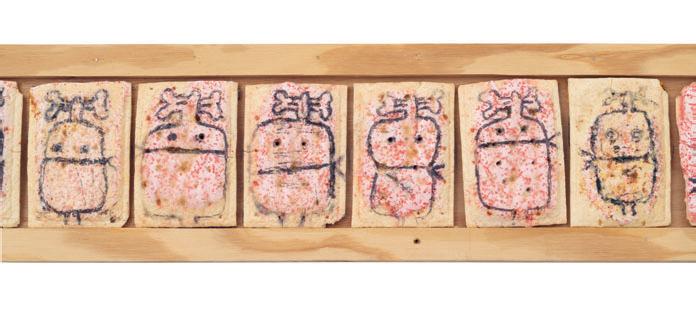
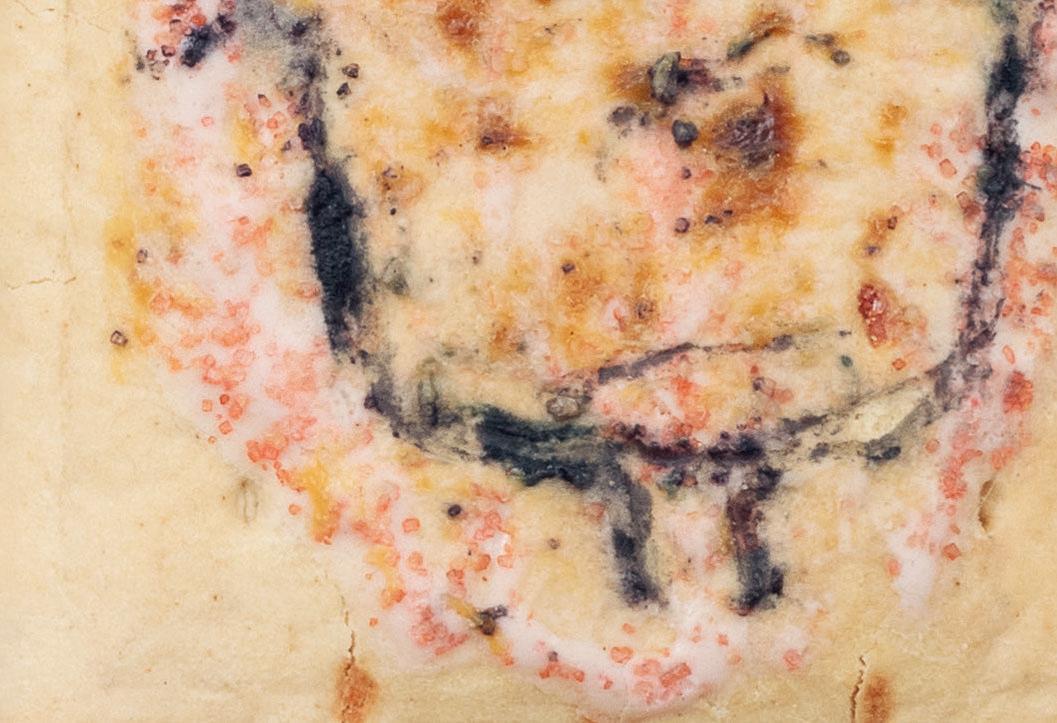
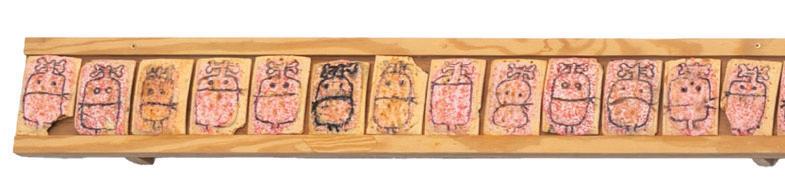
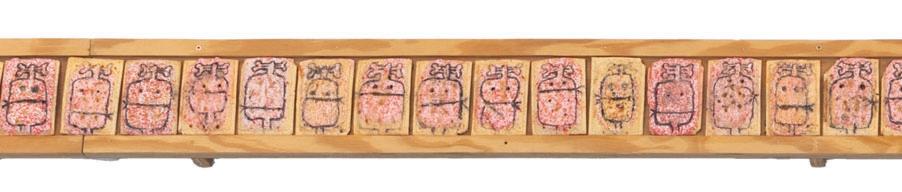
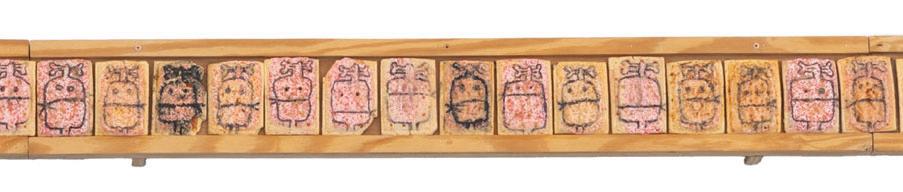
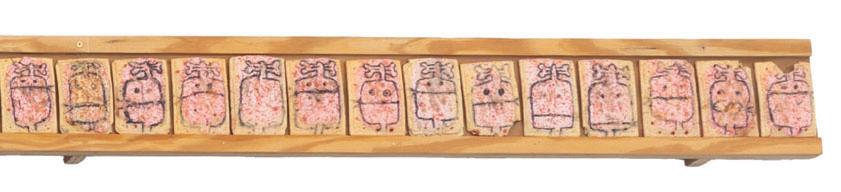
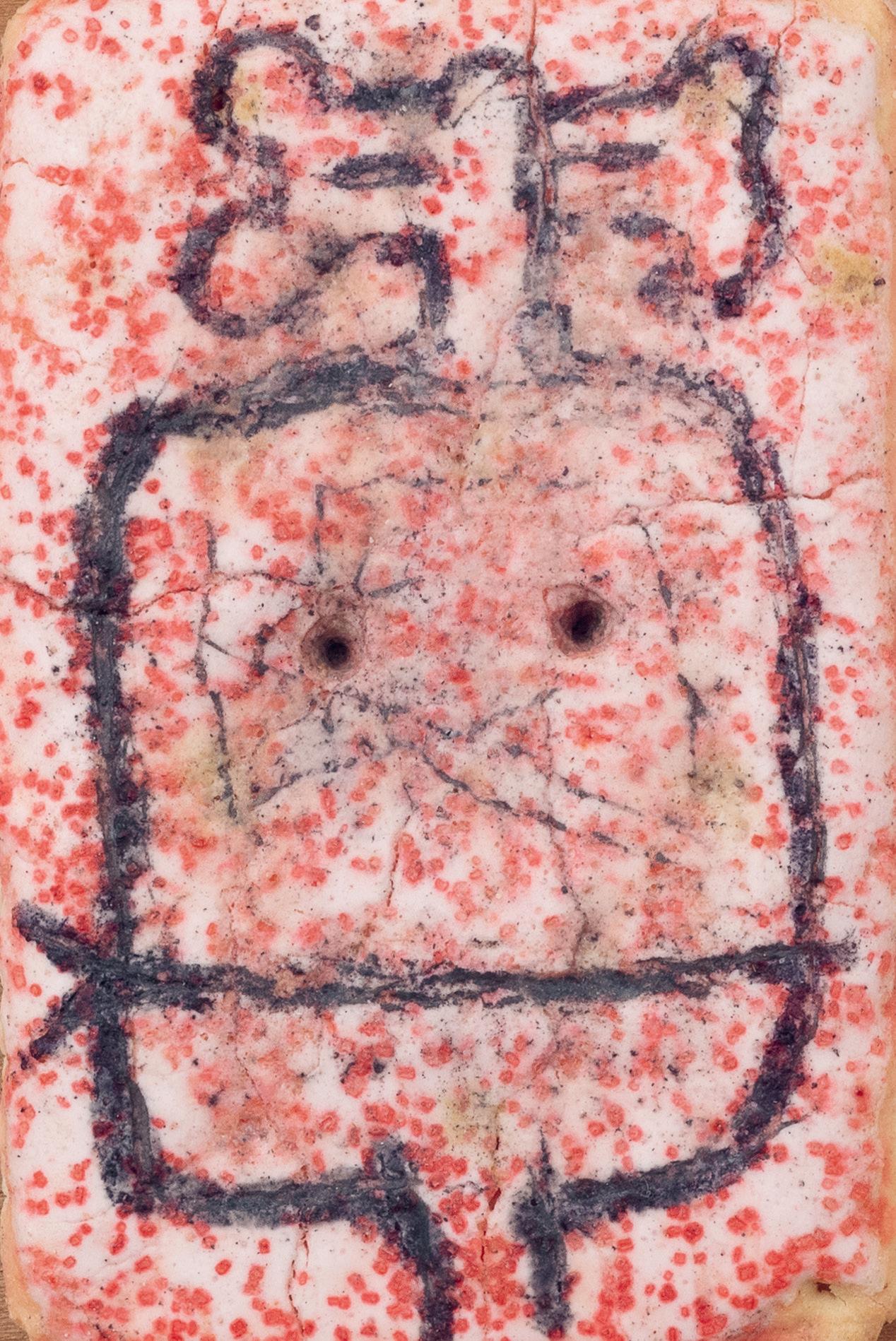
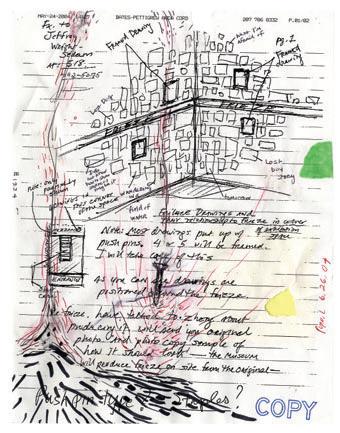
Pope.L’s material vocabulary further expands the formal field of drawing. Peanut butter and Pop-Tarts, hair and coffee, flour and Wite-Out—everyday materials are enlisted alongside graphite and ink. The use of low-budget foodstuffs may be read as self-reflexive—reminders of the artist’s upbringing where food was sometimes scarce—but they also connote consumption, waste, race, humor, and survival. Peanut butter stains and congeals; flour coats and disperses; correction fluid obscures and corrects, its brand name, Wite-Out, echoing and complicating constructions of whiteness and Blackness. Pop Tart Frieze (fig. 1) offers a particularly incisive example. Here, store-bought pastries are mounted in a horizontal row along the wall, invoking the serial logic and industrial repetition of a Donald Judd sculpture. The format suggests order, even neutrality, and yet each frosted surface bears a crudely drawn face, suggestive of racial caricature, in black marker and acrylic paint. The frieze—traditionally a vehicle for narrative— becomes a procession of edible, expendable bodies. By mobilizing perishability, Pope.L insists that drawing is not a stable or neutral act of representation but a contingent event. These substances evolve; they mold; they decay. They exceed the artist’s control and implicate time as an active collaborator. Like the body, particularly the racialized body, they are vulnerable and charged with social meaning.
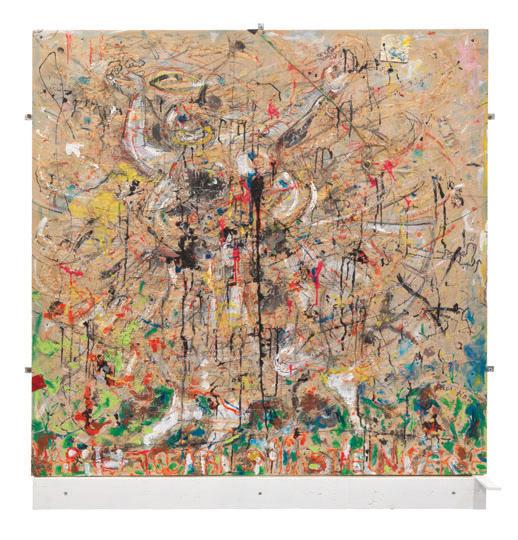
Consider, too, Harriet Tubman Spins the Universe (fig. 2), a drawing in peanut butter on sheetrock with acrylic, ballpoint pen, marker, ink, graphite, and Post-its. The work reimagines the abolitionist as a centrifugal force—arms whirring in frantic, cosmic motion. Conceived in relation to a ten-foot fresco created for an earlier exhibition at Horodner Romley Gallery in SoHo in 1992 (fig. 3), the image evolved over years, accruing collage elements
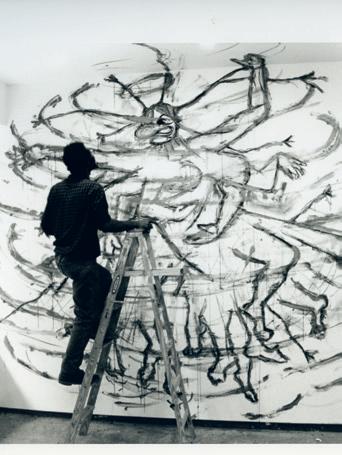
3 Installation view: Harriet Tubman Spinning the Universe, Horodner Romley Gallery, December 15–19, 1992
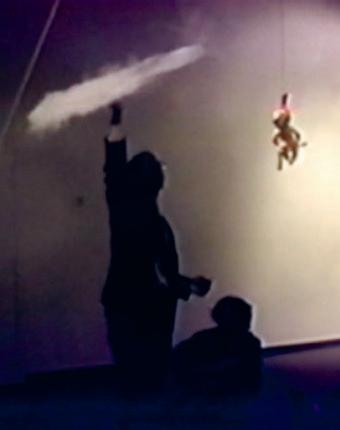
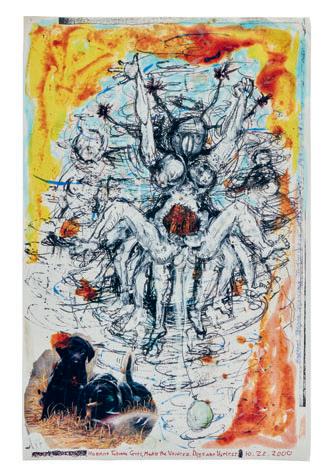
and taking various forms on paper (PL. 20, PL. 22, PL. 23, pp. 54, 56–7, 59). Its swirling motion resonates with Pope.L’s video performance White Baby a.k.a. How Much Is That Nigger in the Window? 5 (fig. 5), in which he spins a bag of flour above his head, generating a cloud of white dust that coats his body. He considered this gesture a drawing as well: a body tracing circles in space; flour dispersing as a particulate line.
Pope.L often restaged, reimagined, and cannibalized his own work in this way, negating any notion of the original. “Originals should be tools, not objectives,”6 he observed. “No drawing is an island. Each drawing begets another in a bastardization.”7 This ethos is particularly evident in what he described not as “series” but as “sets”—a term Pope.L preferred for its resistance to attempts to stabilize and categorize his oeuvre. “Not bodies of work,” he explained, “but more so a set of things connected by family relations . . . linked conceptually but separated by time.”8 Their hinge is language that seeks to describe our world and sometimes “a possible, parallel world.”9 Pope.L’s “sets” operate associatively rather than hierarchically; works may share a family resemblance— materially, conceptually, visually—without ever resolving into a unified style or thesis.
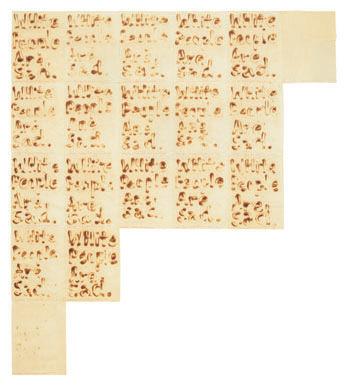
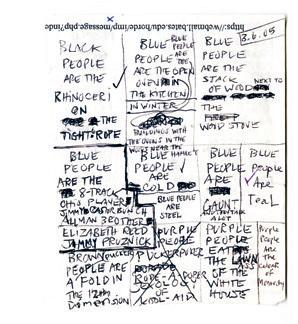
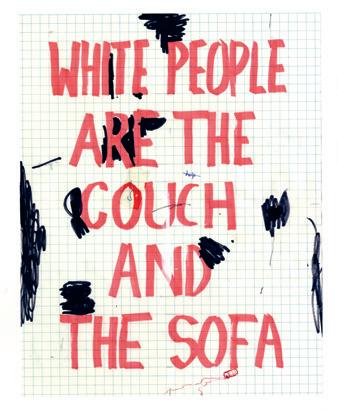
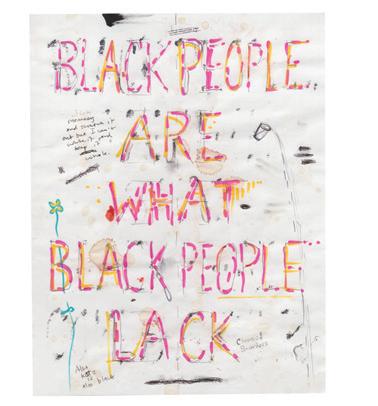
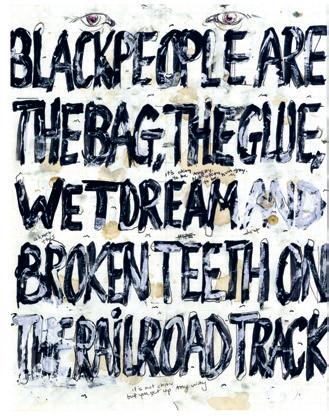
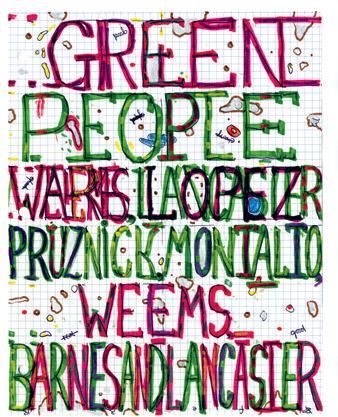
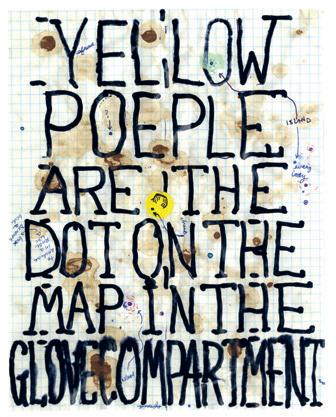
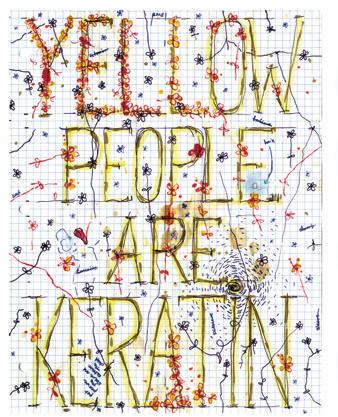
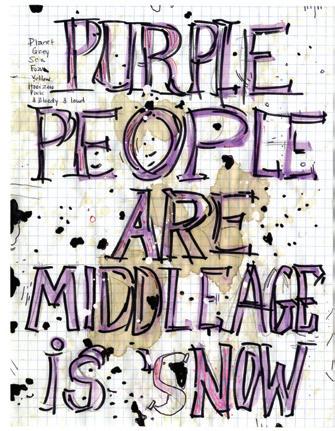
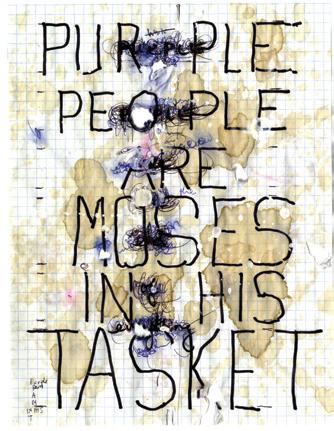
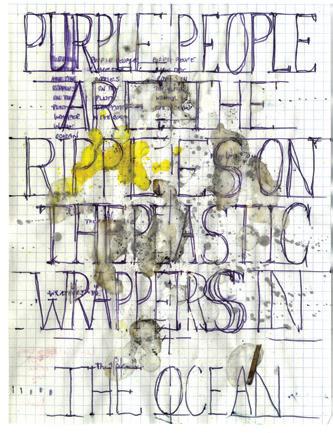
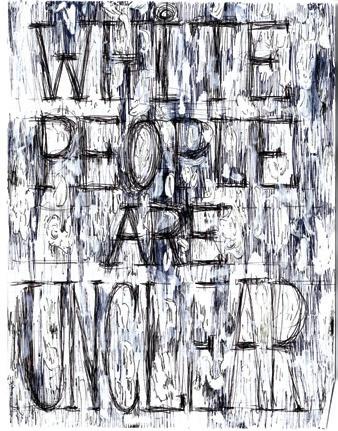
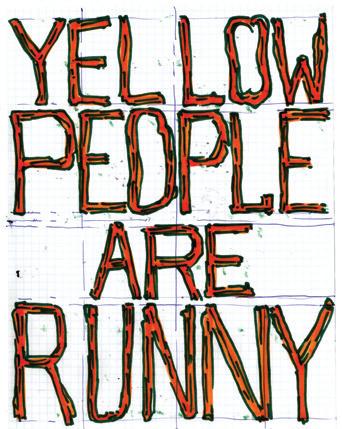
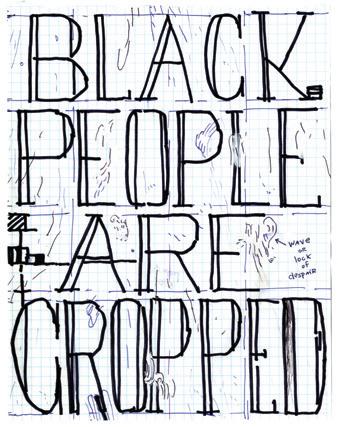
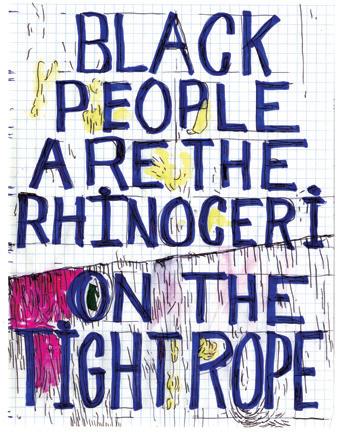
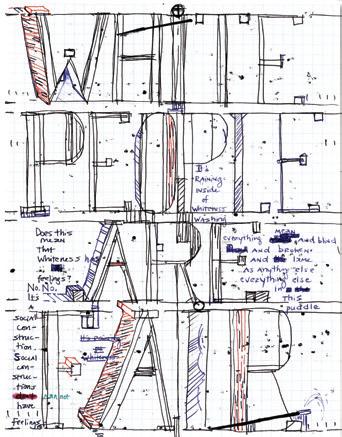
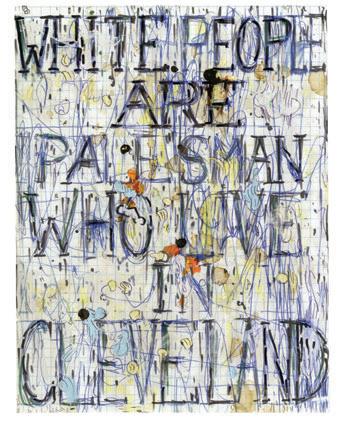
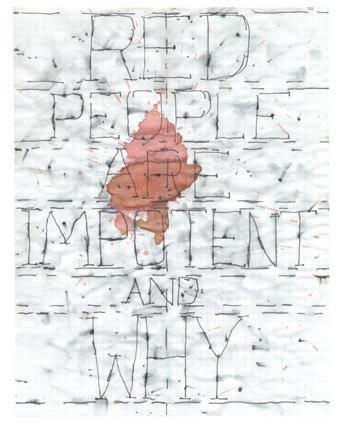
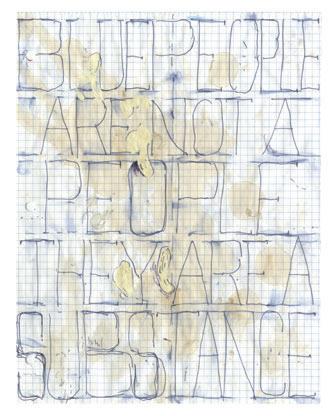
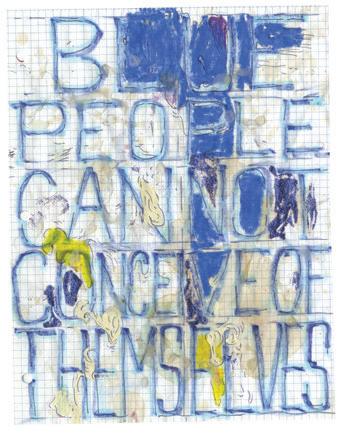
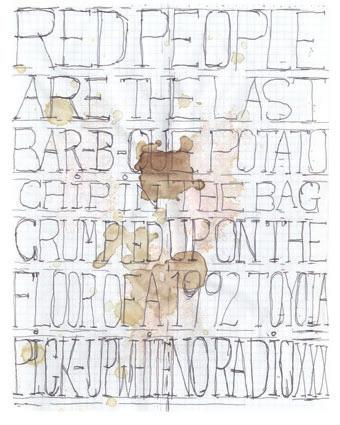
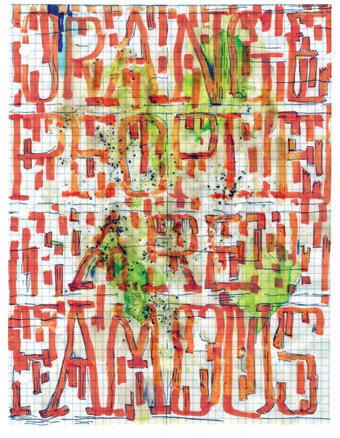
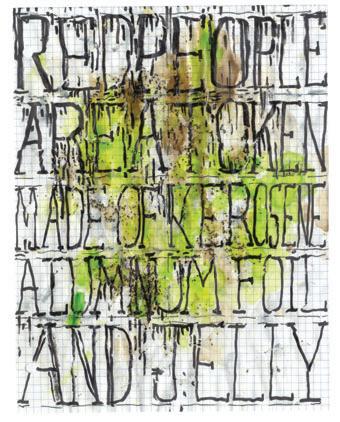
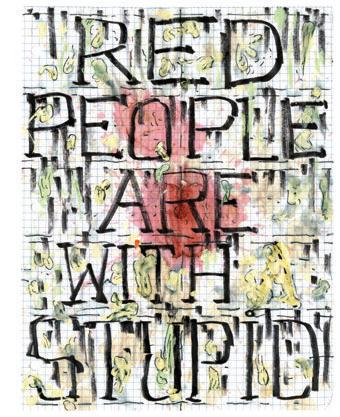
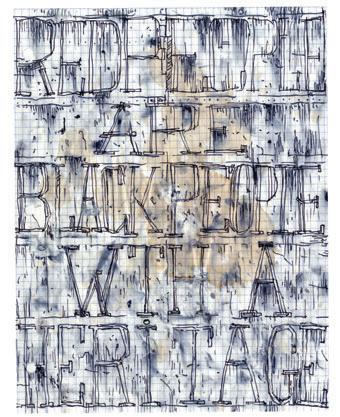
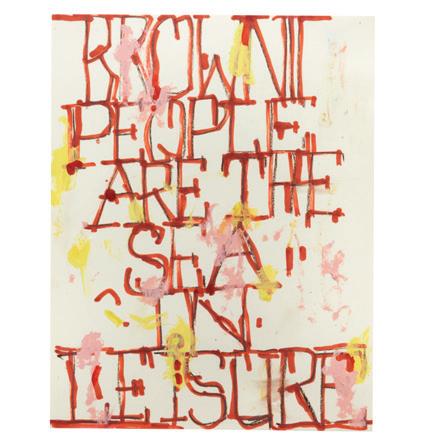
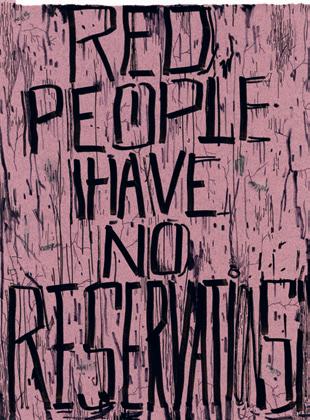
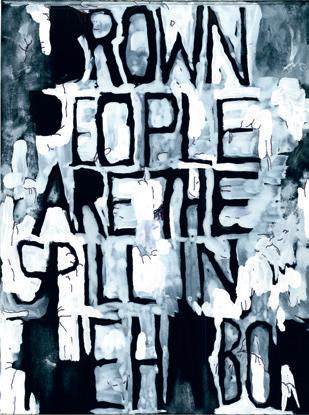
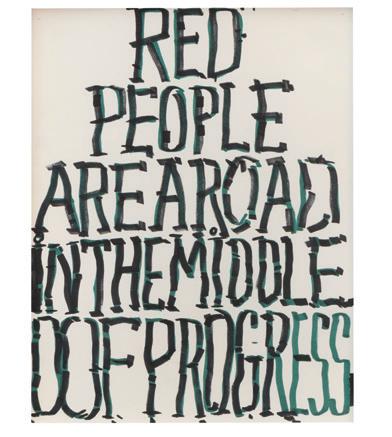
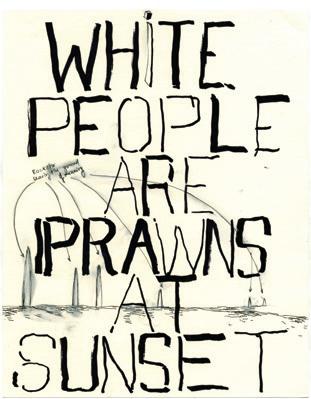
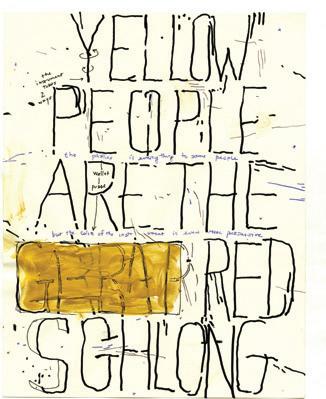
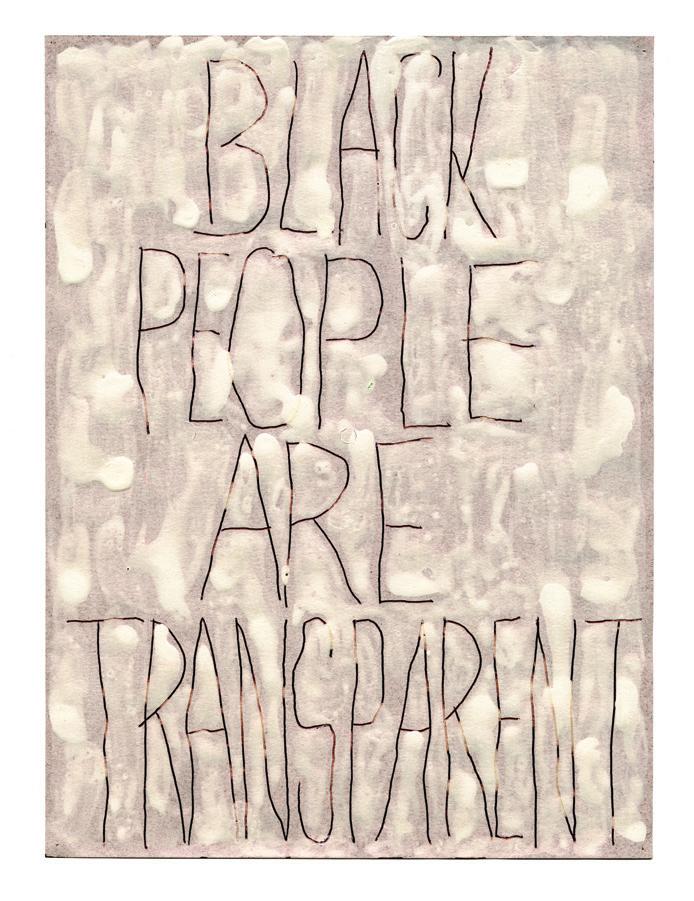
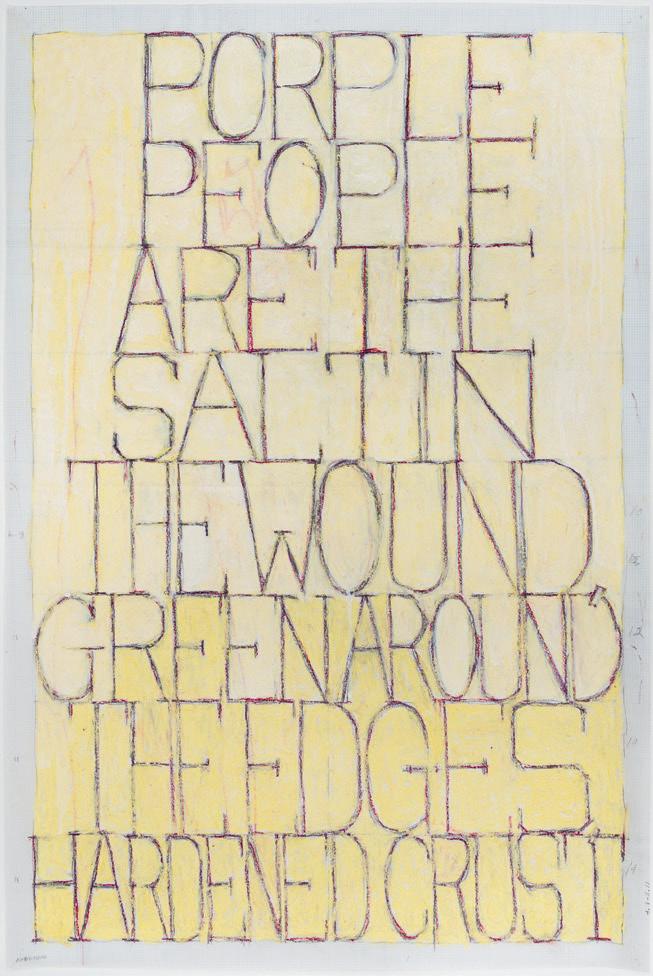
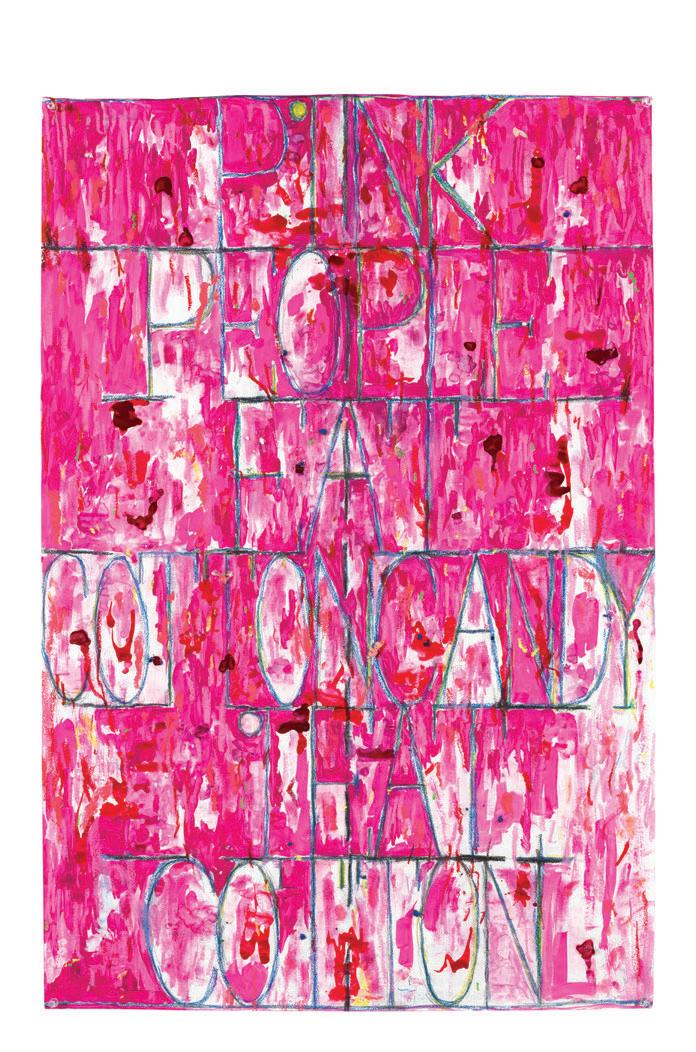
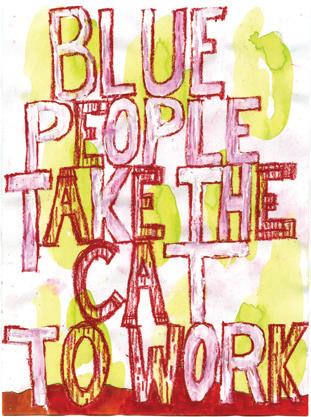
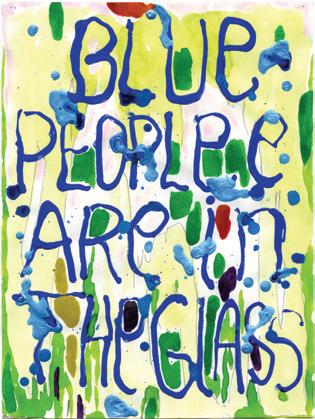
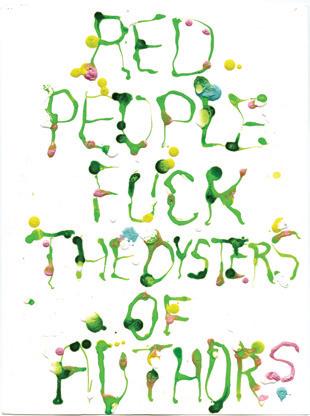
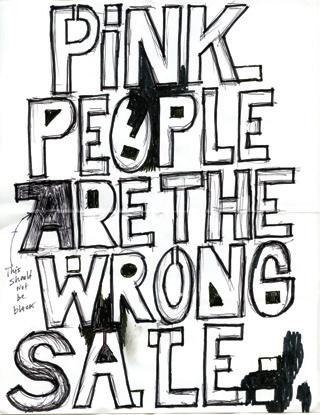
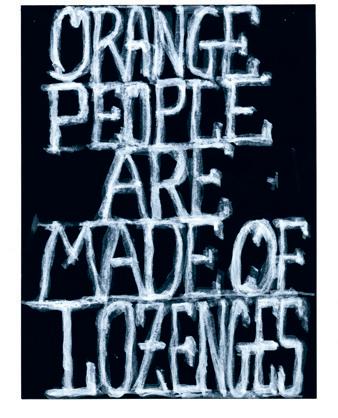
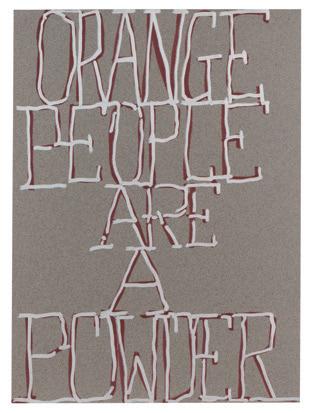
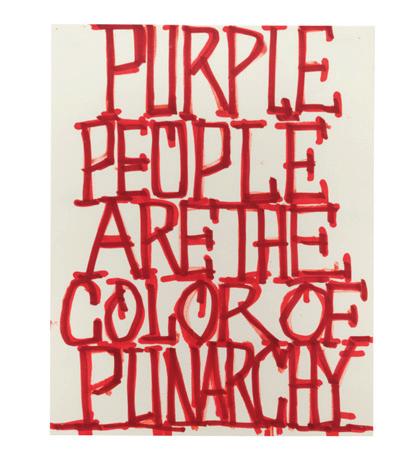
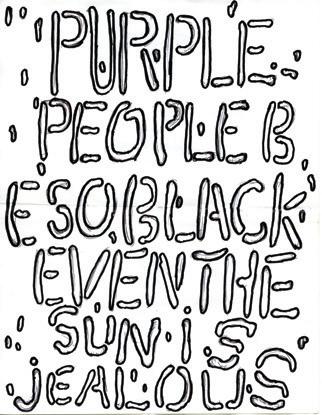
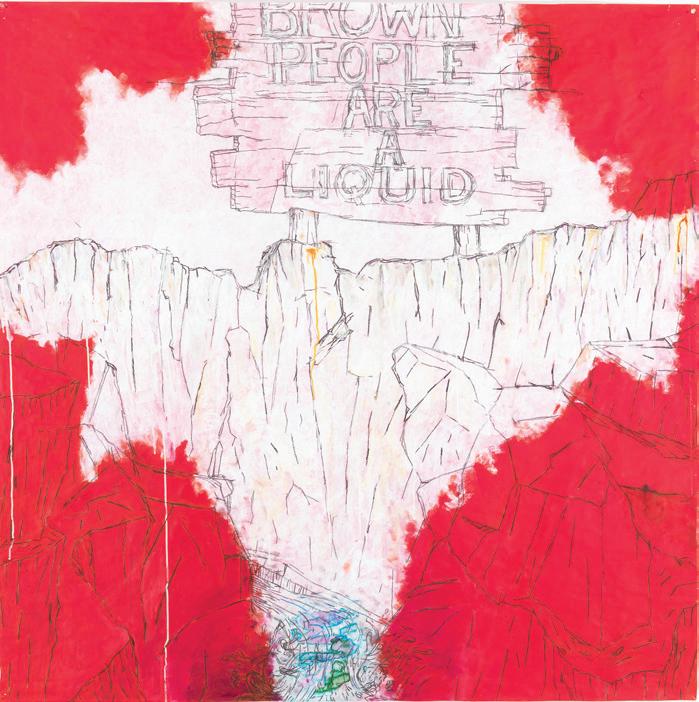
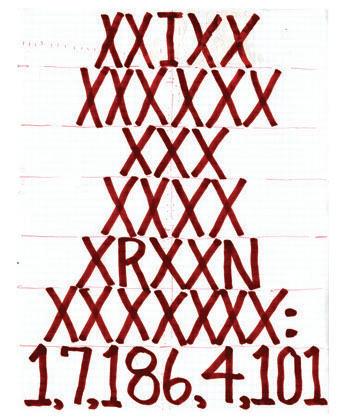
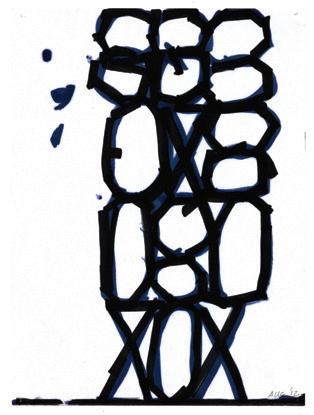
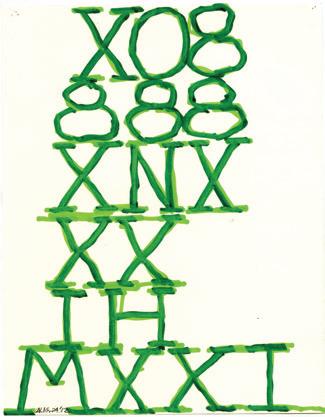
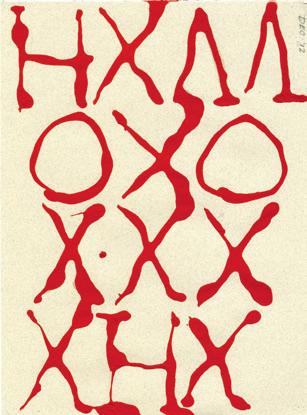
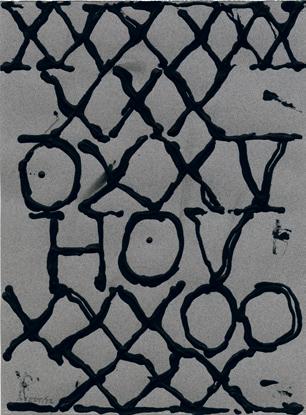
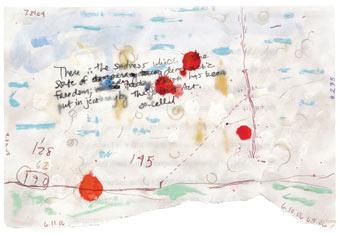
Among the most expansive of these sets are his Skin Sets, begun around 1997 as small drawings originally titled White Drawings (fig. 6) and Black Drawings. These works address race, language, and naming as instruments of prejudice.10 In their later, more recognizable form, SkinSets appear as modest, letter-sized sheets on lined notebook paper with distinct chromatic characteristics—red, green, black, purple, white, yellow, and so on—each inscribed with declarative sentences that hover between aphorism and absurdist proclamation: Black People Are The Rhinoceri On The Tight Rope (PL. 41, p. 75); Blue People Cannot Conceive Of Themselves (PL. 46, p. 76); White People Are Palesman Who Live In Cleveland (fig. 7); Red People Are The Last Bar-b-que Potato Chip In The Bag Crumpled Up On The Floor Of A 1992 Toyota Pick-up With No Radio XXX (fig. 8). Pope.L uses cheap materials in their construction: BIC pens, Wite-Out, coffee, so that they retain the provisional quality of doodles in the margins of a notebook.11 Yet, the everydayness
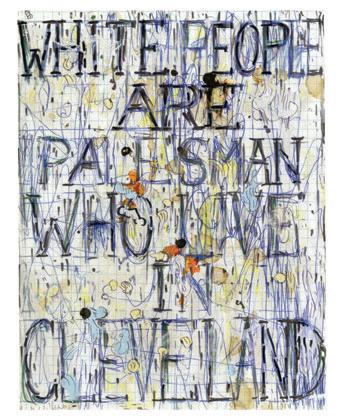
FIG. 7 Pope.L, White People Are Palesman Who Live In Cleveland, 2008
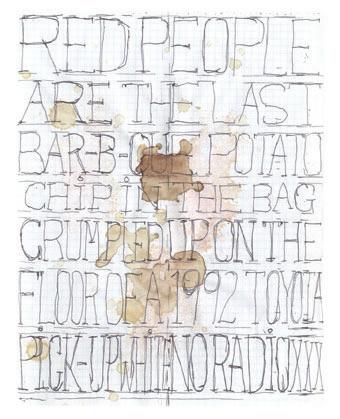
FIG. 8 Pope.L, Red People Are The Last Bar-b-que Potato Chip In The Bag Crumpled Up On the Floor Of A 1992 Toyota Pick-up With No Radio XXX, 2008
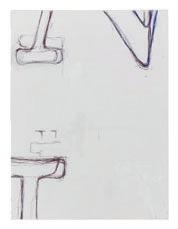
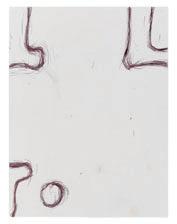
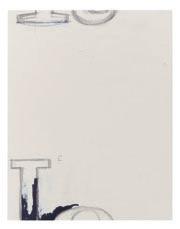
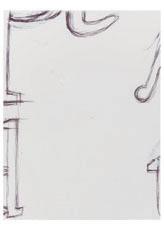
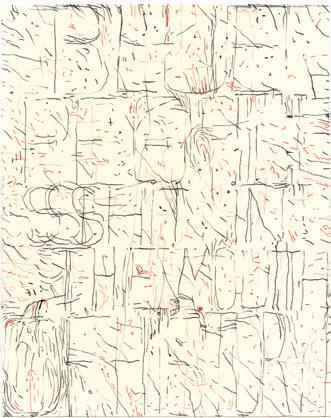
FIG. 9 Pope.L, Four works from the space between the letters: 087, 10-11, N/LY; 091 35-36, h, b/Hi, B; 092, 10-11, he/b, B; and 092 19-20, pty/d, t, A, each dated 2013
of these materials belies the sharpness of the Skin Sets’ critique. The declarative sentence suggests authority, even as their content slips between grotesque humor and absurdity. Meaning destabilizes itself mid-sentence. Drawing becomes a stage on which language performs—and fails. Pope.L mobilizes this illegibility as a strategy against racial legibility and social surveillance: an undoing of language and, by extension, identity.
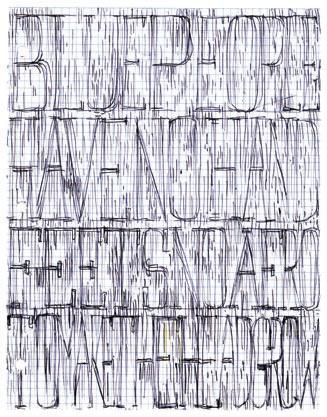
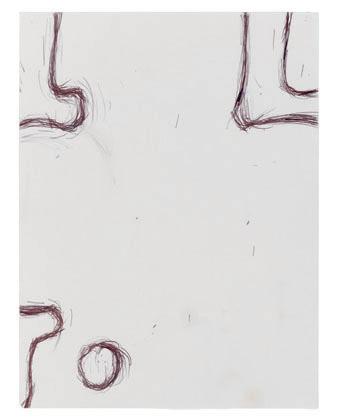
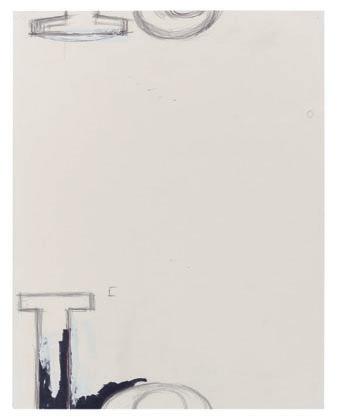
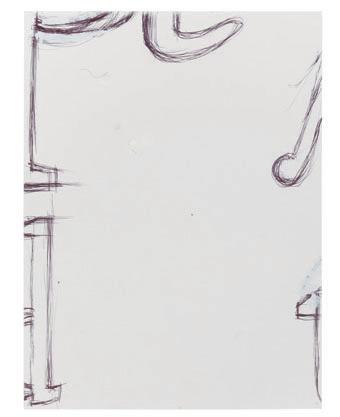
A related iteration within the corpus of Skin Sets, subtitled the space between the letters (fig. 9), extends this inquiry into absence. In these works, Pope.L isolates and makes visible the empty intervals between typeset lines in “Forlesen” (1974), a short story by the science-fiction writer Gene Wolfe.12 Letters are enlarged to the point of fragmentation—partial curves, severed stems, cropped diagonals. At times, what is drawn is not the letter but the gap that separates it from the next. Language is magnified until it disintegrates into abstraction. “What cannot be seen is what we most like to see,” Pope.L remarked.13 Absence is not a byproduct but the point. These works occupy the interval between identities—the space between two or more positional “holes.” That in-betweenness becomes a conceptual strategy, a way of locating change not within fixed categories but in-between them.
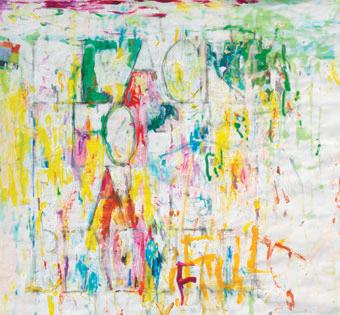
Over time, Pope.L’s Skin Sets have proven radically elastic, assuming forms that range from modest Skin Set Notes (fig. 10) to writings and large-scale painting. “Race is almost always hovering somewhere around the edges of some of these projects,” he observed, “but there are some projects in which it is only a perfume. Race as a perfume, very subtle. So that you might not know it’s in the Skin Set family.”14 Take, for example, The Winter of Black People (fig. 11), a five-by-ten-foot Skin Set Painting. Affixed within a red shadow box and secured with pushpins, the work comprises a diptych of two adjoining sheets of paper. The surfaces are largely white, interrupted by hastily dashed strokes of oil stick and acrylic concentrated in the upper corners. Beneath the pigment, barely legible phrases emerge: “[B]LACK TO ALL BEAUTIFUL” on the left, the “B” mostly obscured, converting the reading to “LACK”; “BLACK PEOPLE ARE BEAUTIFUL” on the right. The slippage between “lack” and “Black” is both typographic
and conceptual, a hinge on which presence and absence pivot. Tears in the crinkled paper expose yellow lined notebook sheets beneath, formally and conceptually tethering the monumental work to the modest, letter-sized Skin Sets. Across the surface, fragments of the artist’s musings appear and dissolve: crossed-out queries— “when,” “where”—alongside statements such as “when did identity become everything?,” “this striving is a kind of hiving,” and “when did beauty become identity?” A sketch of an erupting hole labeled “blackness” points toward its spouting center. The hole is both wound and aperture for Pope.L—an emblem of his conviction that absence generates meaning.
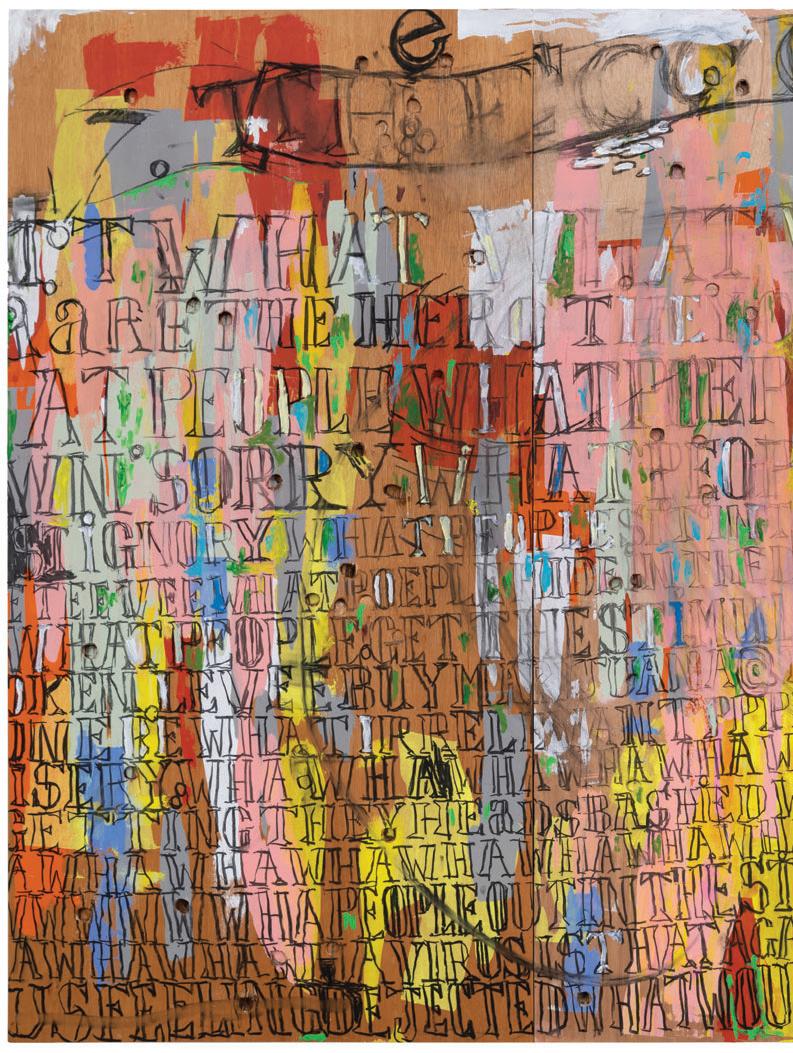
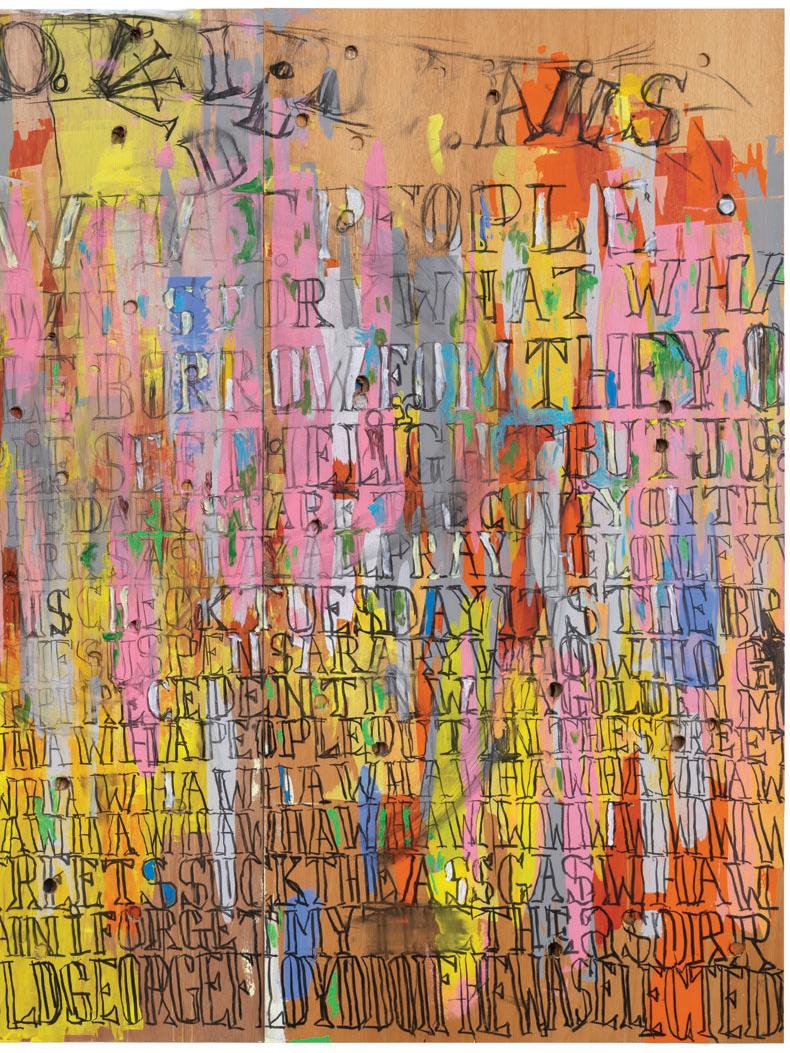
Perhaps the largest of the Skin Sets—and the latest in date within our exhibition—is the nearly eight-by-twelve-foot drawing on panel from 2020–21 entitled WHA (fig. 12). Here, legibility is pushed to the brink. Across the top register, a banner of text announces itself in stuttering, doubled letters that slip and collapse out of alignment: “T TH e E C COVID D ANS.” Reading the text demands labor. Meaning seems present but is perpetually obscured as words fracture as they form. Throughout, the repeated fragment “WHA” echoes the question “what?”—a stammer that structures the composition and suspends it in uncertainty. Phrases surface only to destabilize themselves: “WHAT WHAT WHAT PEOPLE / ARE THE HERO THEY OWN STORY,” followed by “WHATPOEPLEBORROWFOMTHEYO / WNSORRY.”15 Letters invert, transpose, or drop away entirely. “WHAWHAWHAPEOPLEOUTINTHESTREET / GETTINGTHEYHEADSBASHED.” Further down: “WHAPEOPLEOUTINTHESTREETSSUCKTHEASSGASWHA,” and “WHAVIRUSISTHATAGAINIFORGET.” Near the bottom, a searing line emerges: “FEELINGDEJECTED WHATWOULDGEORGEFLOYDDOIFHEWASELECTED.” The strain of reading is intentional. The viewer must actively assemble coherence from broken syntax and unstable spelling, yet another effort required to navigate a moment defined by larger challenges like a global pandemic and racialized violence against Black people. The work stages a crisis of language. By pulling words apart and edging them toward nonsense, Pope.L reveals how fragile
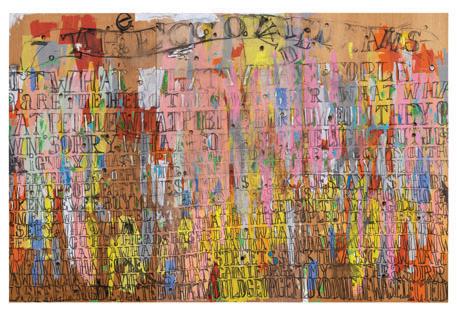
our systems of meaning can be and how deeply we rely on them to make sense of a world that often doesn’t make sense. And yet, in that disruption lies possibility: If language can fracture, it can also be reimagined, opening up space for us to remake who we are and how we relate to one another in the world.
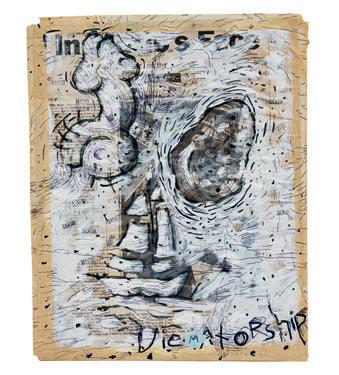
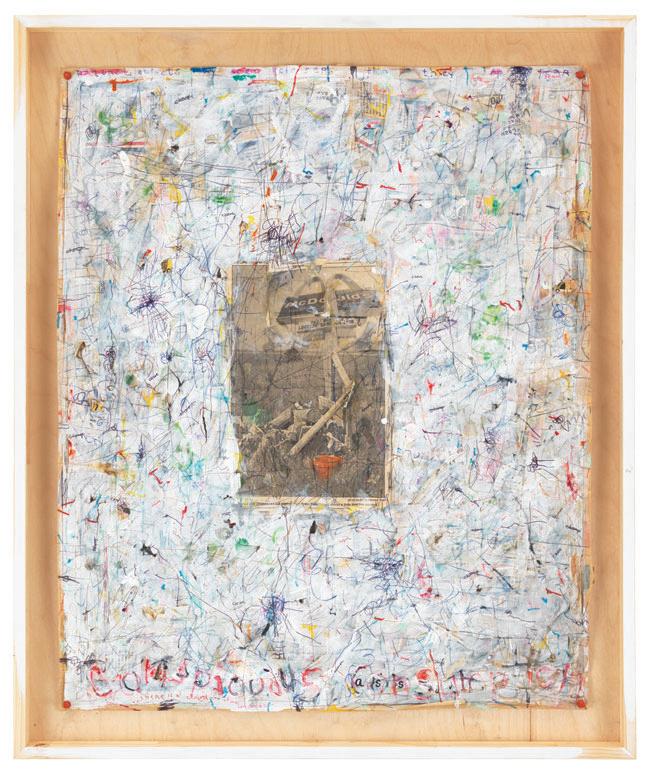
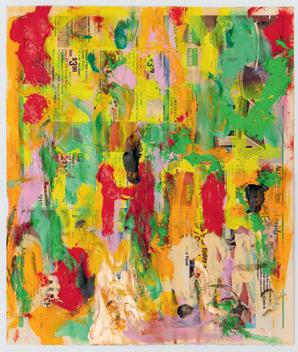
Predating the Skin Sets is a set of earlier provocations that Pope.L referred to as Proto-Skin Sets—works initiated around 1976, during the artist’s time as an undergraduate at what is now Montclair State University. Proto-Skin Sets are more overtly painterly and materially dense than their later “cousins”; these earlier works are thick with collage and vernacular debris, such as billboard fragments, newspapers, domestic detritus, and hair.16 If the later Skin Sets distill language through pared-down strategies aligned with Conceptualism, the Proto- works seem to evoke the improvisational spirit of Dada through their irreverent juxtapositions, embrace of found materials, and deliberately unruly compositions. In Painting on Advertisement Never to Be Finished (fig. 13), for example, a printed ad depicting the face and hands of a white child holding a beverage is overlaid with the proclamation: “PALL COLOR VARIETY NO BASTARD S NO PAIN NO DISTRESS DRINK S, UP !” A disembodied hand hovers above the slogan “got the good,” while fragments of graphic text seep through veils of white pigment. The entire assemblage is thumbtacked inside a plywood shadowbox of the artist’s design. “The idea of a finished artwork is a fiction,” Pope.L insisted. “The claim of ‘being done’ is wishful thinking and a bit impatient.”17
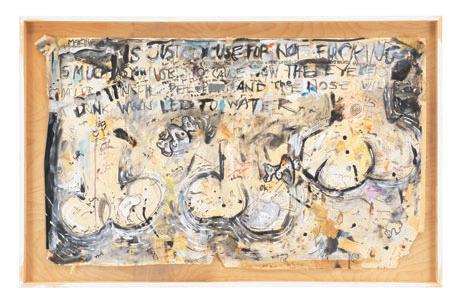
Portrait a.k.a. The American Dream Is to Be Able to Think (fig. 14), a dense drawing in acrylic, oil stick, marker, and pencil, presents a headless bust in suit and tie, overlaid with the phrase “In Clear Acrylic Polymers.” The addendum literalizes the condition of emptiness—the “American Dream” rendered hollow, a political body presented as incapable of thought. In Yet Another Excuse (fig. 15), language proliferates across the surface in sprawling, confrontational script: “ART MAKING ART IS JUST AN EXCUSE FOR NOT FUCKING / S MUCH AS You USED TO CAUSE NOW THE EYE IS / MALER THAN THE PEE-P AND The NOSE WILL (Fallow) NOT DRINK WHEN LED TO WATER”. Words fracture
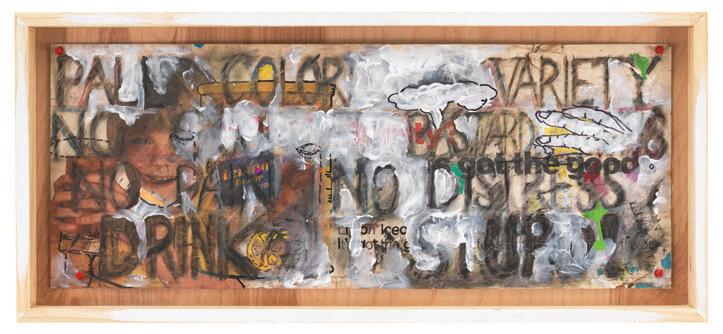
Painting on Advertisement Never to Be Finished,1983–2013
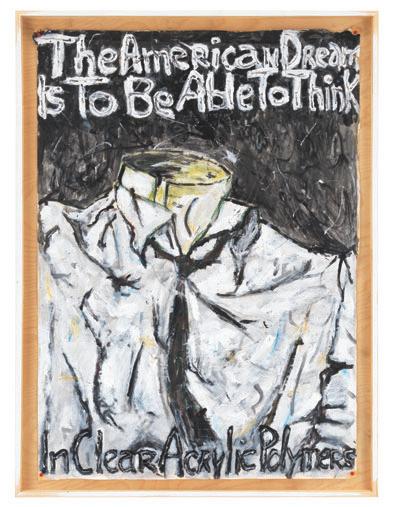
into puns—“PEE PEE OPLE,” “USSR” countered by “USSA of the self.” A parenthetical aside—“(NOT THAT YOU KNEW WHAT YOU WERE DOING, THE GRASS ALWAYS BEING GREENER”— unspools into a visual echo as “And greener, and greener and greener . . .” follows a directional arrow into a tightening black spiral, collapsing meaning in upon itself. Incidental marks and doodles crowd the field: a sketch of a dog labeled “digging up bones,” flaccid penises, floating anatomical fragments.
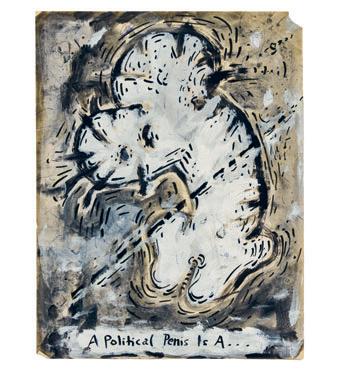
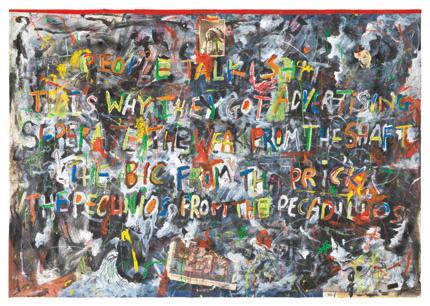
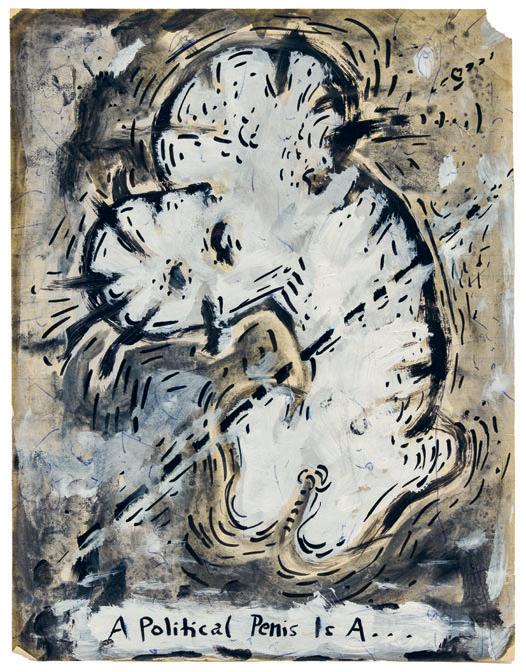
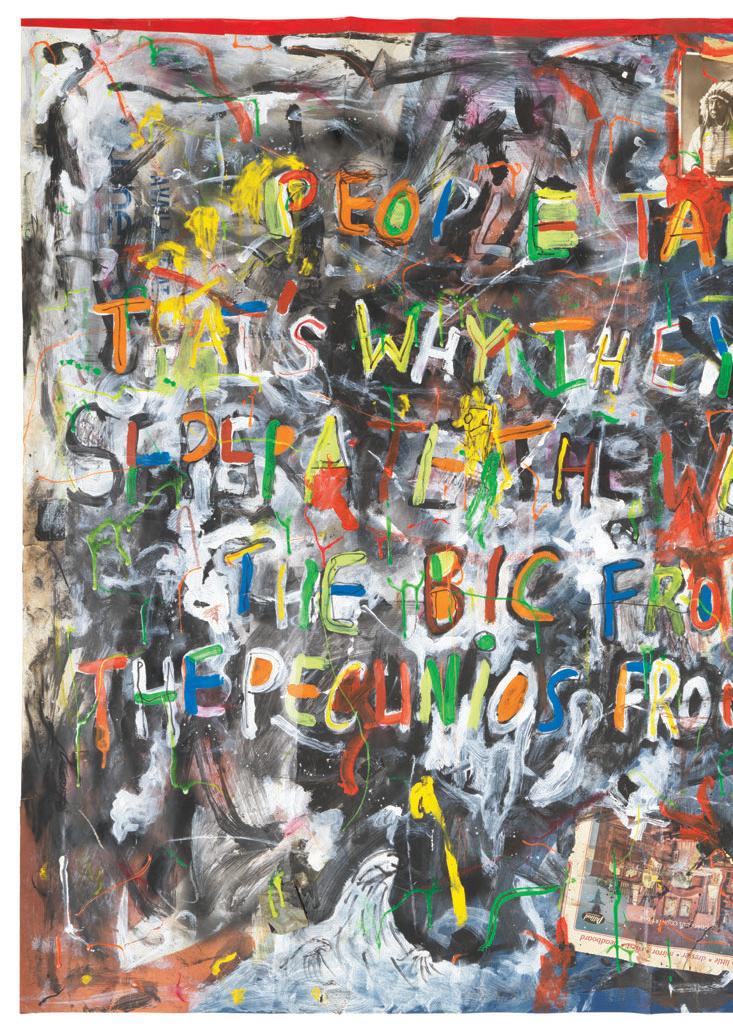
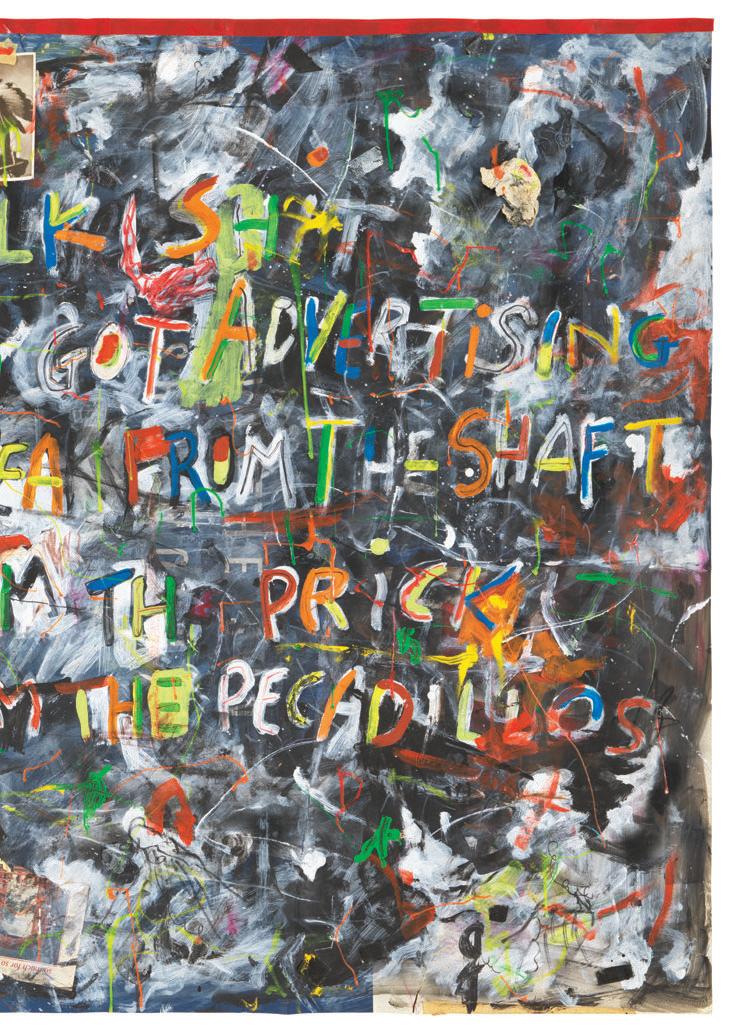
The significance of the phallus—and the hypersexualized construction of the Black male body—recurs insistently throughout these works. It surfaces explicitly in Yet Another Excuse and related pieces such as A Political Penis Is . . . (fig. 16) and Dictator (fig. 17), and later reaches performative extremes in Member a.k.a. Schlong Journey (1996), in which Pope.L walked through Harlem with a six-foot plastic tube affixed to his groin, exaggerating the phallus to grotesque scale in order to expose and satirize the racist fantasies often projected onto Black masculinity. Elsewhere, the theme mutates into text-based wordplay, as in Kemosabe (fig. 18), which declares amid dense pigment: “PEOPLE TALK SHIT THAT’S WHY THEY GOT ADVERTiSING SEPERATE THE WEAK FROM THE SHAFT THE BIC FROM THE PRiCK THE PECUNiOS FROM THE PECADILLOS.”
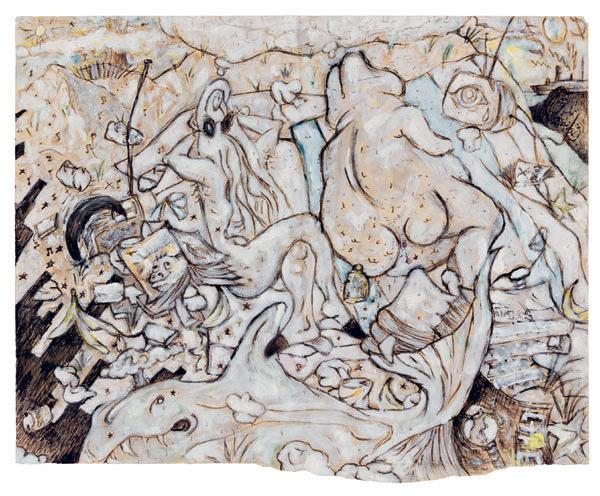
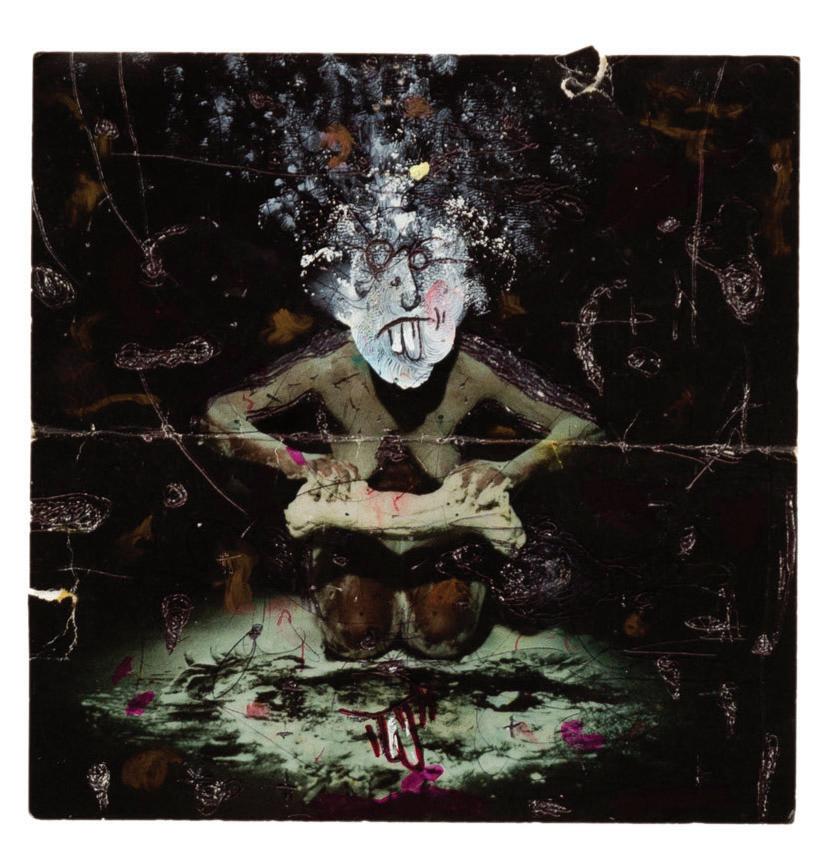
Throughout the 1990s and 2000s, Pope.L persistently probed the boundaries of race through portraiture alongside these text-based works. Some of these pieces fall within the designations of Proto-Skin Sets or Skin Sets; others stand apart. Taken together, however, they reveal the strategies through which Pope.L appropriated and destabilized iconic historical and pop-cultural figures via drawing, unsettling the conventions through which society consecrates its heroes and martyrs. In Death Queen Chaney (fig. 19), Pope.L invokes James Chaney, one of three Congress of Racial Equality activists murdered by the Ku Klux Klan during the 1964 Freedom Summer in Mississippi. Chaney’s collaged head is affixed to a white gown outlined in black marker and furnished with breasts; his arms are replaced by cartoon bones extended outward in a cruciform pose. Cartoonish shoes with untied laces dangle below. Embedded in a nest of glue and hair, Chaney’s body appears
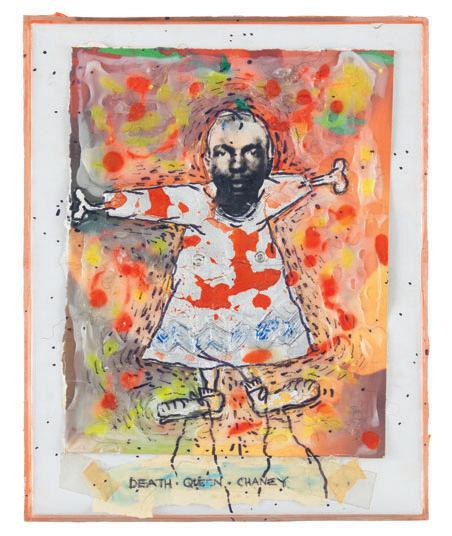
both sanctified and grotesquely reconstituted. Pope.L’s portrayal resists any solemn commemoration, offering instead an unsettling image that complicates the ways in which we memorialize martyrs and remember history.
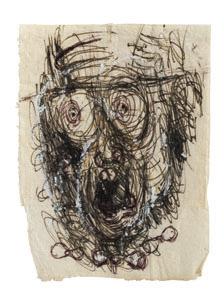
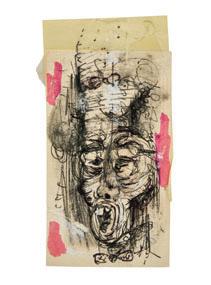
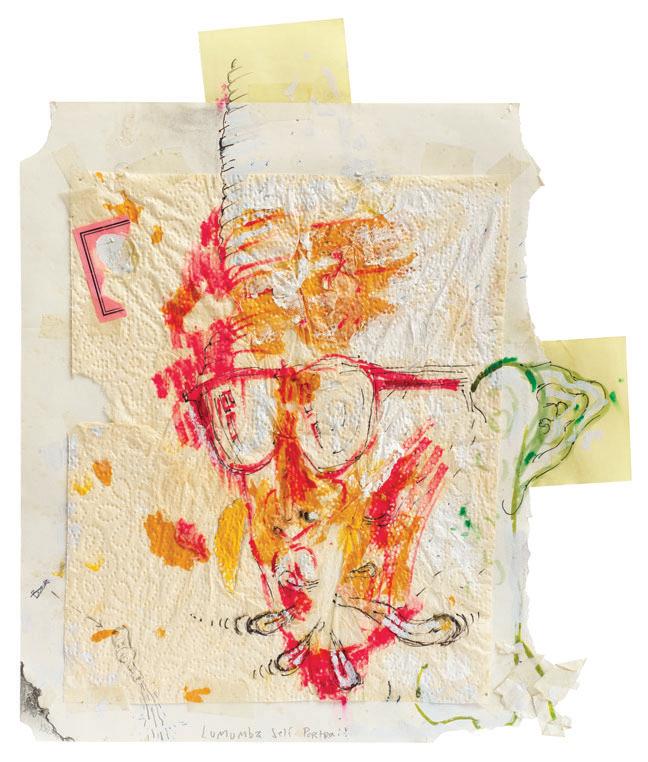
The historical figure in Pope.L’s drawings operates in a similar register to the use of masks in his performances—offering images that are distorted and ventriloquized, rather than faithfully rendered. In the Lumumba works (1990–95), for example, Patrice Lumumba, former Prime Minister of the Democratic Republic of the Congo who was brutally deposed and murdered by the Belgian government, is less portrayed than inhabited—his likeness conflated with pop-cultural references embedded in the work’s titles. Munch Lumumba (fig. 20) borrows the iconic, gaping scream of Edvard Munch’s The Scream (1893), exaggerating Lumumba’s mouth into an expression of existential dread. ET Lumumba (fig. 20) invokes Steven Spielberg’s 1982 science-fiction film E.T., recasting the Congolese leader through the lens of alien otherness. And in Lumumba Self Portrait (fig. 20), Lumumba’s visage merges with that of Pope.L himself, collapsing artist and subject into one single, unstable mask. The fragmented nature of identity within these cultural icons becomes a means through which cultural anxieties—about race, erasure, otherness, and history—are projected and scrambled.
A related strategy appears in Title unknown (fig. 21), a Proto-Skin Set that reads: “MAYA ANGELOU’S CAR BREAKS DOWN ON THE WAY TO THE WHITE HOUSE Reception.” A smoking car occupies the middle ground beside a figure holding an outsized spoon, its legs whirring around in circles in a manner reminiscent of the Harriet Tubman Spinning drawings. A speech bubble declares, “NOW I KNOW WHY THE CAGED BIRD SINGS!!,” invoking Angelou’s autobiography, while spoons spring forth from the windows and openings of a house, cascading down the page like rain droplets or sperm. The image veers between satire and lament: a cartoonish rendering of the civil rights icon set against a darker undercurrent, as the utensil motif may allude to Angelou’s account of enslaved Africans forced to lie “spoon-fashion” in the holds of slave ships.18
Pope.L’s works on paper extend the central tensions that animate his broader oeuvre: Namely, the persistent disruption of cultural identity and the insistence that lack—economic, social, existential—can be generative. This is theorized most explicitly in Pope.L’s artist’s book Hole Theory (PL. 193, pp. 212–13), which proposes that holes are conduits, thresholds, and “means to”— opportunities that take many forms and materials and duration.19 “Have-not-ness permeates everything I do,”20 Pope.L has said, framing deprivation not as deficit but instead as source material. Raised in poverty within what he described as an “unstable” family environment, Pope.L also grew up surrounded by improvisational creativity. He recalls relatives ironing in the living room while reciting lines by Nikki Giovanni, Gwendolyn Brooks, and Langston Hughes—building verses in a call-and-response cadence akin to freestyle.21 His grandmother, an artist, exhibited appliquéd quilts at the Studio Museum in Harlem in the 1960s.
Alongside this creativity ran precarity: incarceration, addiction, homelessness. “In my family, there was this tendency for things to fall apart. The conflict was in the desire to keep things together. The driving force in my work is recognizing those two tendencies and seeing them as ways to make things happen, i.e. how to produce a world or object with these types of tensions.”22 That tension—between falling apart and putting together—became the engine of Pope.L’s work. He would later describe Blackness itself as a “lack worth having” and “have-not-ness” as the economic precarity that shaped his family history.23 In his street performances, Pope.L often theorized this tension through the opposition of verticality and horizontality. Verticality signified agency, mobility, and power—the ability to stand and move freely. Horizontality marked vulnerability, exposure, prey. “If you can remain vertical and moving you deal with the world. . . . But people who are forced to give up their verticality are prey to all kinds of dangers. What if someone who can remain vertical chooses to give that up? That person would learn something. I did.”24 The voluntary surrender of uprightness transformed failure into method. These contradictions—vertical and horizontal, ascent and collapse, success and failure—crystallize most potently in his
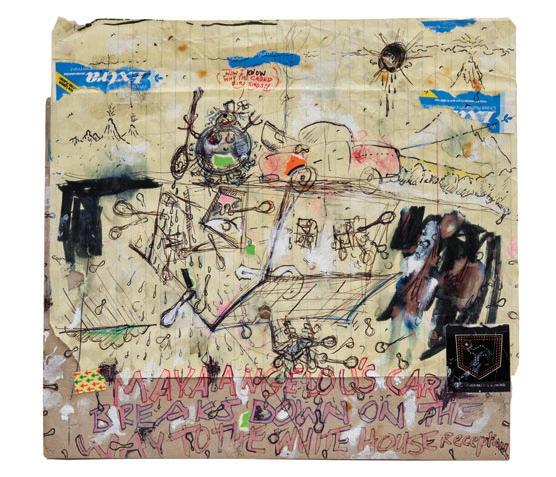
21 Pope.L, Title unknown, c. 1998
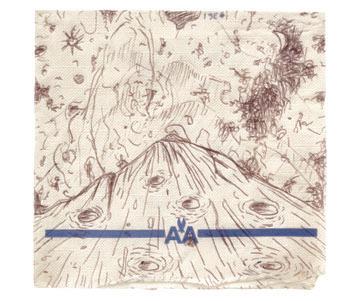
22 Pope.L, Failure Drawing #361, 3.22.04, Rocket Fall, the Night Receives, Pittsburgh, 2004
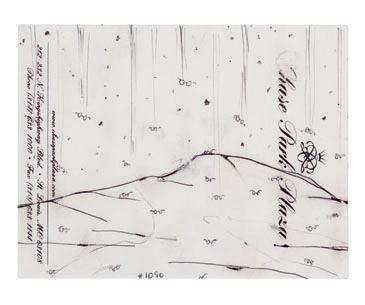
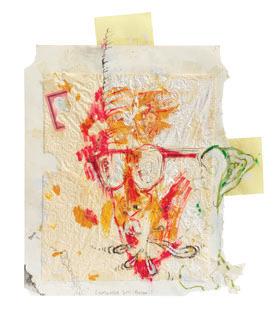
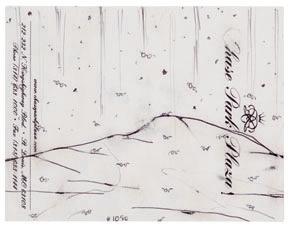
23 Pope.L, Failure Drawing #1090, 5.15.04, Spectacled, 2004
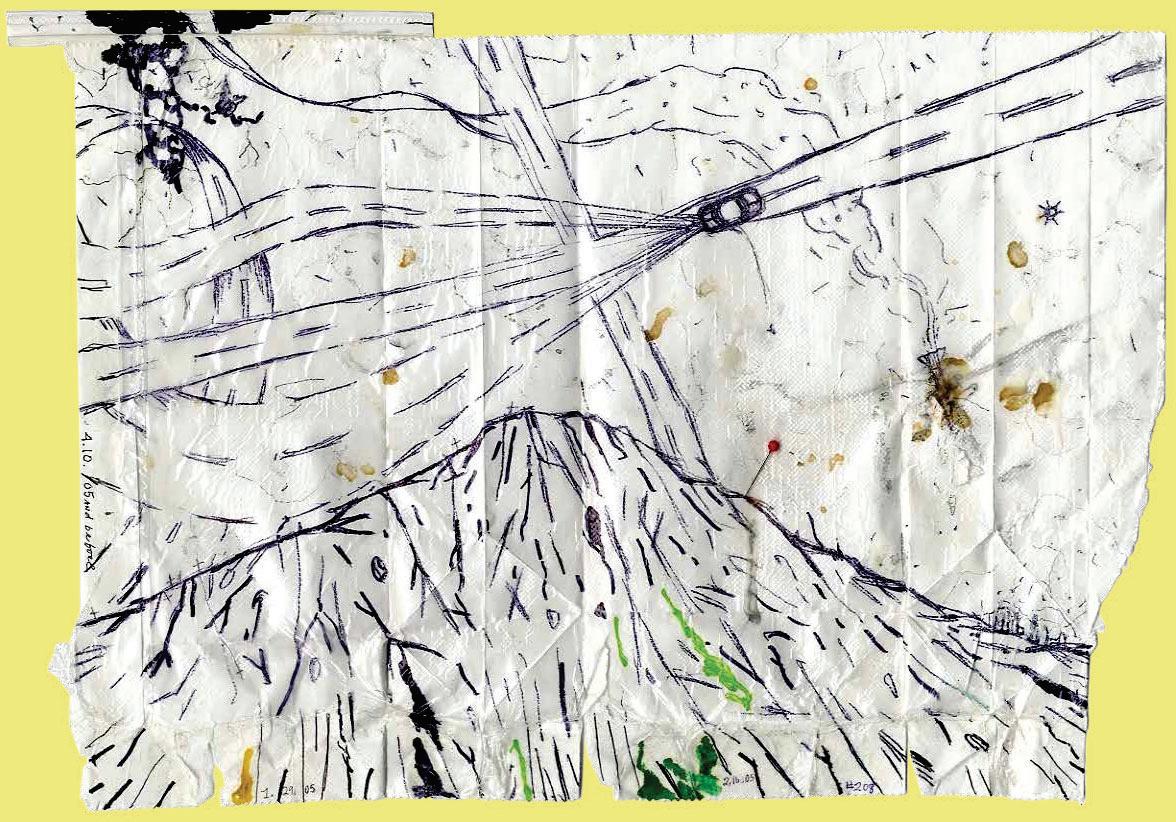
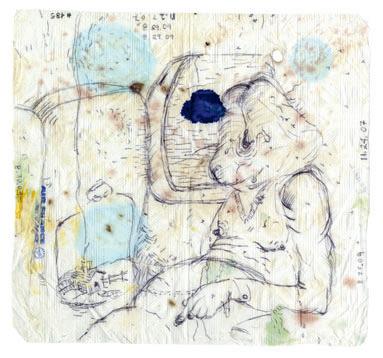
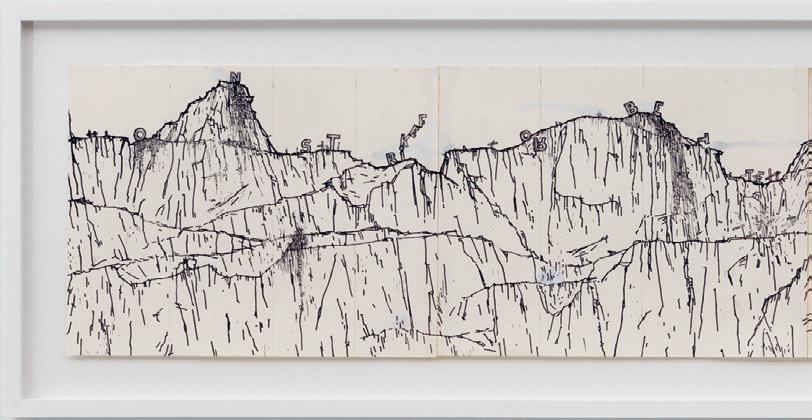
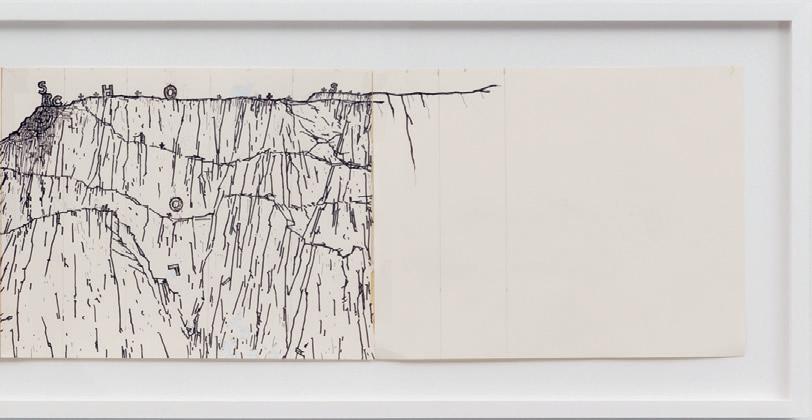
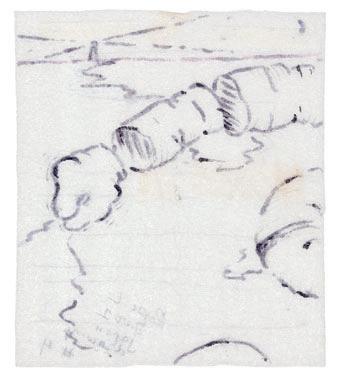
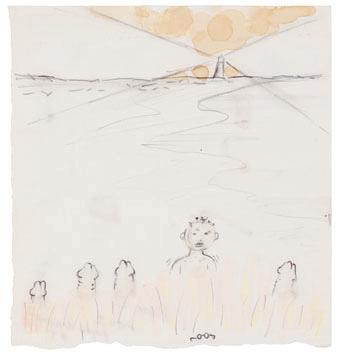
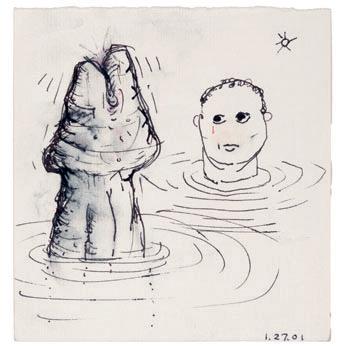
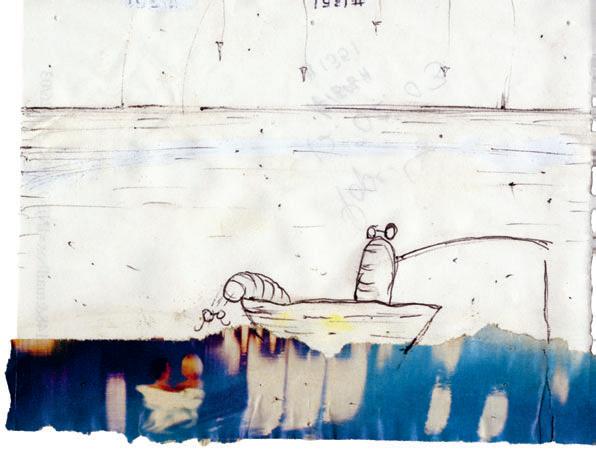
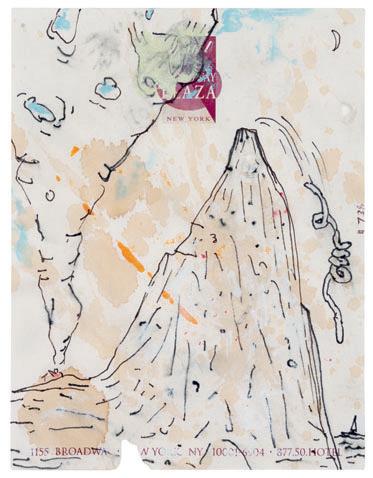
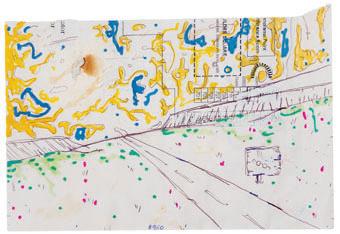
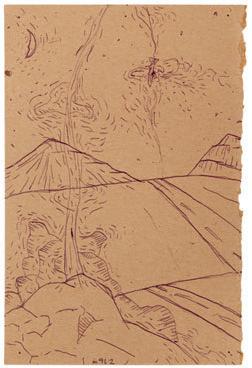
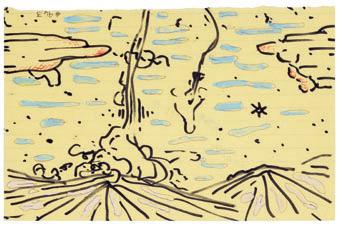
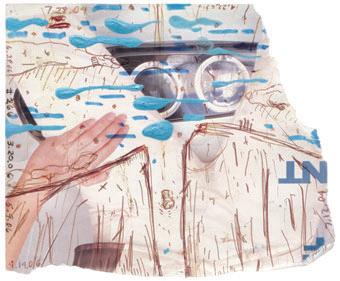
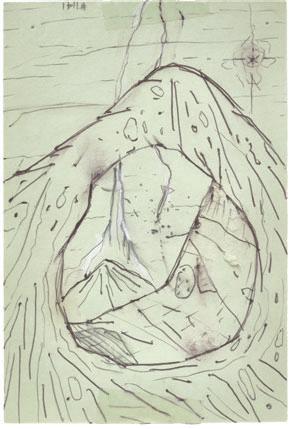
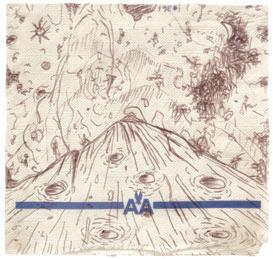
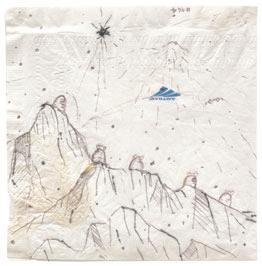
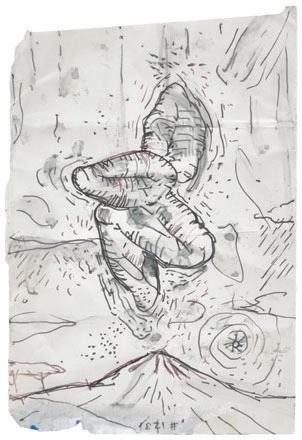
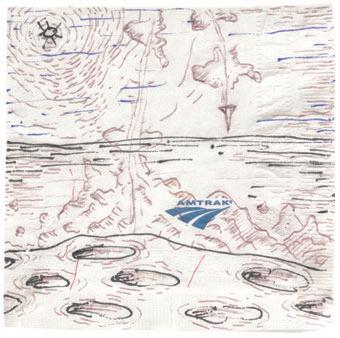
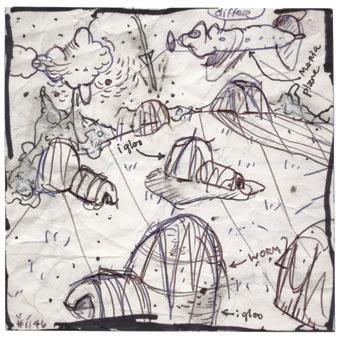
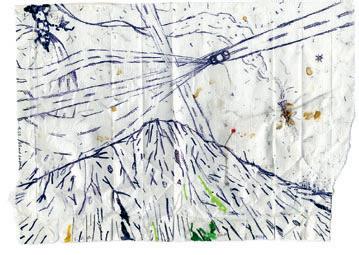
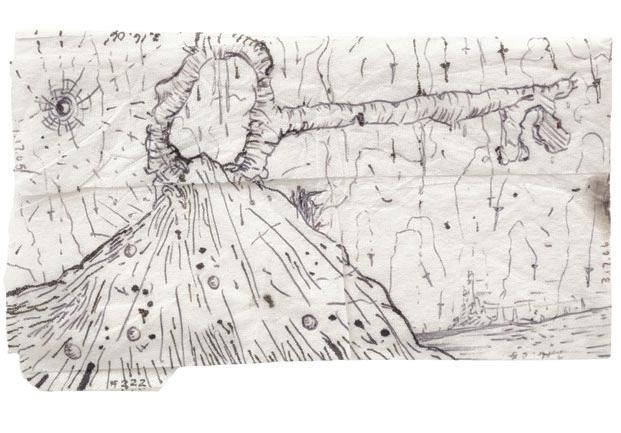
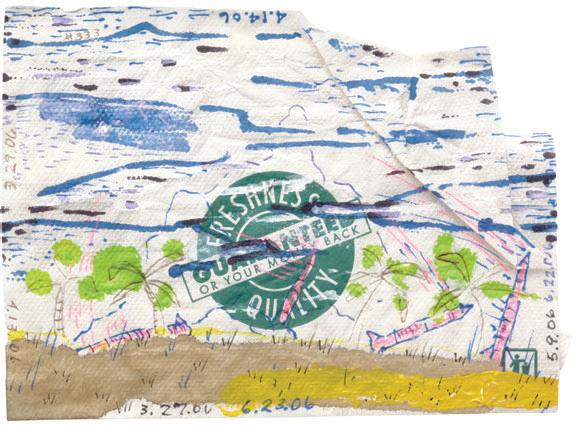
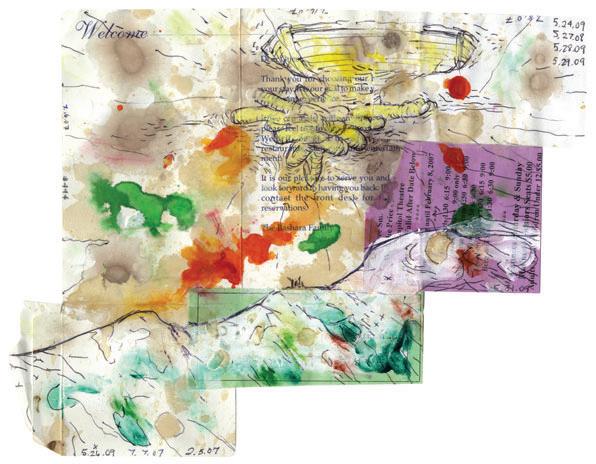
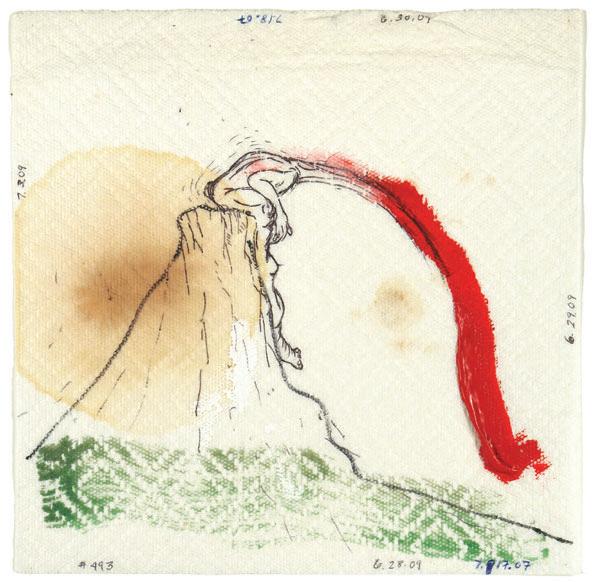
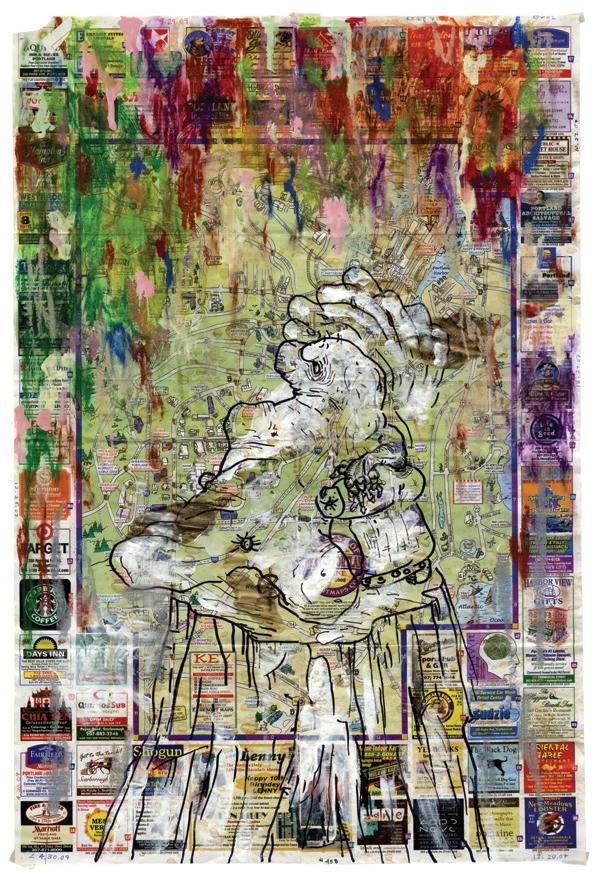
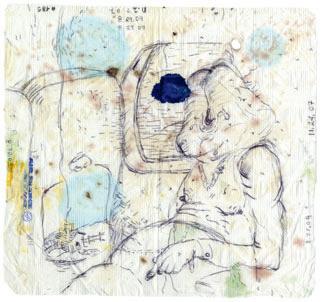
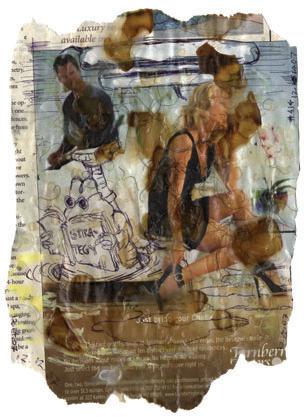
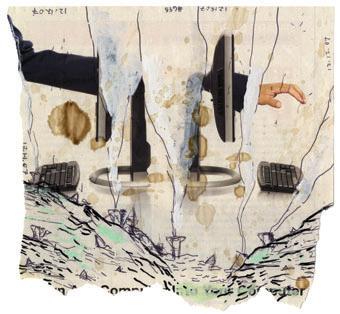
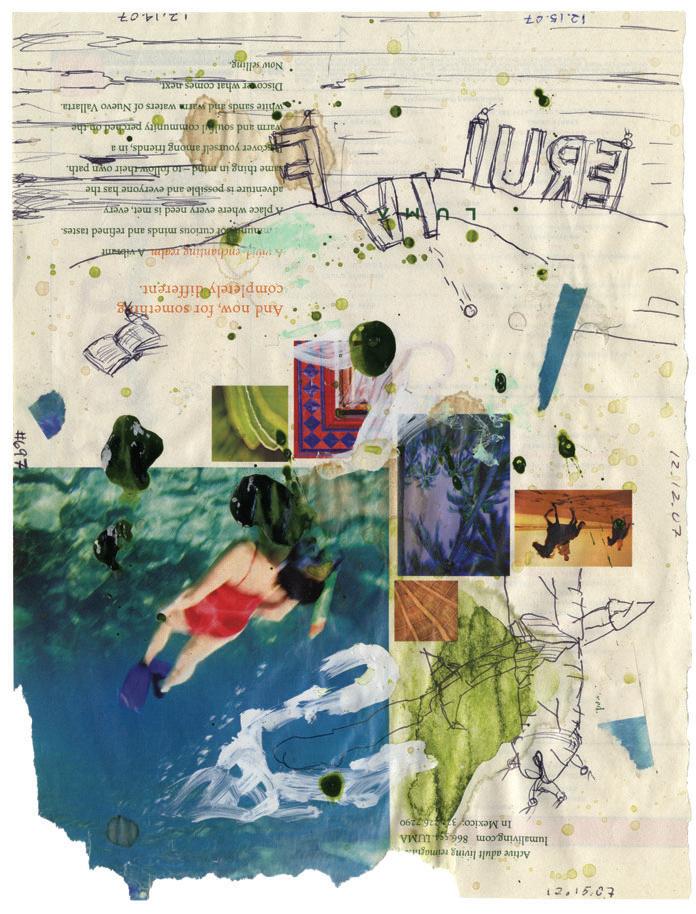
Failure Drawings, begun in late 2003 and eventually numbering over a thousand works. Produced exclusively while traveling, they are made on found and often disposable supports—newspapers and magazines, cardboard food containers, hotel stationery, envelopes, matchbooks, medicine packets, napkins, taxi receipts, and maps— whatever materials are at hand. These works are drawn in ink, ballpoint pen, coffee, color marker, highlighter, pastel, correction fluid, and pencil. Most of the drawings are organized around a strong horizon line or mountainous silhouette—a stabilizing device anchoring Pope.L’s strange cosmologies in a familiar world. Yet, what rises in Failure Drawings rarely remains aloft. Rockets arc upward only to plummet (fig. 22); eyeglasses rain from the sky (fig. 23); cities tilt sideways, sprouting improbably from mountain flanks. Descent is not incidental but philosophical. Few Failure Drawings are the product of a single sitting. Many accrue over months or even years, their layered dates marking the artist’s repeated returns, as in Failure Drawing #485, 11.24.07, 11.27.07, 8.28.09, 8.29.09, 8.29.09, 8.30.09, Sweater Vest (fig. 24), which notates each individual drawing session around the work’s perimeter. The works, at times, feel provisional, as though the artist was musing aloud with a pen. For Pope.L it seems, failure is not terminal but iterative—an ongoing condition of endurance and revision.
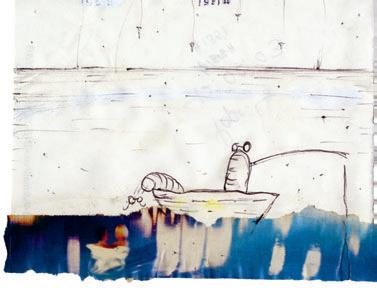
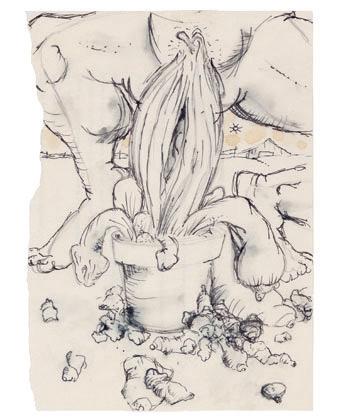
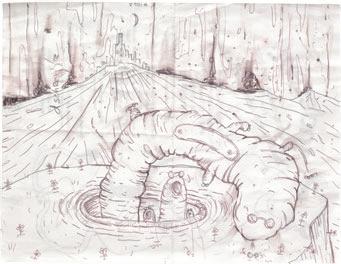
Among the drawings’ most telling motifs is the worm. In Failure Drawing #1351, Fishing Story (fig. 25), two worms sit in a boat atop a collaged reflection of water while failing rockets puncture the distant sky. The image recalls Pope.L’s wry selfdescription: “I like to sell things at astronomical prices while fishing for humanity with the worm of the social unconscious. . . . I am a fisherman of social absurdity.” The worm—lowly, earthbound, expendable—functions both as bait and as self-portrait: a creature of the earth’s crust, unsettling surfaces from below. Elsewhere, worms appear as broadcasters, students (fig. 26), sky-watchers, dog owners. They mirror the recurring shape of a fragmentary phallus, an equally unstable signifier that evokes notions of vulnerability, lack, sexuality, weakness, and irony. Often, worms and penises appear interchangeable, bound by dark humor and irony. Penises emerge from holes as birds perch menacingly overhead (PL. 170,
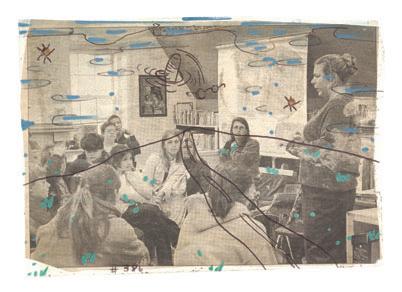
p. 172), recline precariously at cliff’s edge, sport hairpieces, or trudge home from the corner grocery. As with most of Pope.L’s oeuvre, holes have a prominent presence. They puncture the landscape, sprouting bespectacled worms (PL. 146, p. 161) or opening voids within mountainous terrain. Worms, worm holes, outer space, collapsing landscapes; each of these conjures meditations on transience, mortality, and the erosion of time. In Pope.L’s terrain, failure—or perhaps rather the perception of it—becomes a virtue.
Each horizon, rocket, worm, portrait, Pop-Tart, line, and fragment of text in Pope.L’s drawing practice is less an illustration than an event—an action compressed into a mark on paper. His embrace of failure and absurdity binds drawing to performance as parallel forms of rehearsal, revision, and incompletion. In complicating figures from Harriet Tubman to Maya Angelou, he unsettles the authority of historical narrative and exposes identity— race, gender, class—not as fixed truths but as something unstable, constructed, and performed. On paper, rockets misfire, language stammers and restarts, and historical heroes falter. His drawings do not simply record performance; they enact it. For Pope.L, paper is a laboratory for public action: a bounded yet charged field in which spectacle and vulnerability are translated into lines, stains, and erasures. “To mark anything,” Pope.L suggested, “is to create a difference; maybe a world, maybe a wound, certainly an act.”25 His drawings insist on all three. They conjure provisional worlds from scraps and fragments; they register the abrasions of history and the instability of self; and they assert, again and again, the stubborn, generative force of drawing itself.
1. Born William Pope, “Pope.L” is the artist’s amalgamation of the names of his father, William Pope, and mother, Lucille Lancaster.
2. When asked when he decided to make performance his primary practice, Pope.L responded, “I never decided that performance would be my primary vehicle. Other folks made this assumption about my practice because the performances were what they were most aware of. In fact, I’ve worked concurrently in the studio and at my desk writing stories and novels all the while I was performing.” William Pope.L, quoted in Lowery Stokes Sims, “Interview with William Pope.L,” in The Friendliest Black Artist in America ©, ed. Mark Bessire (MIT Press, 2002), 63.
3. Pope.L, quoted in Alzheimer’s Talk (2020; PL. 215, pp. 238–39), digital video.
4. Pope.L, Lecture notes on drawing (PL. 194, p. 215). Courtesy of the Estate of Pope.L.
5. Pope.L intentionally used this term as part of his ongoing critique of systemic racism and racialized language. The original title is retained here, without alteration, in order to respect and accurately represent the artist’s intent.
6. Stuart Comer, “Introduction: A Lack in the Wake,” in member: Pope.L, 1978–2001, ed. Stuart Comer and Danielle Jackson (Museum of Modern Art, 2019), 22. Originally cited in Pope.L, “On Versions,” in William Pope.L: snow, spraypaint, hair, sperm, and baloney (Kenny Schachter/ ROVE, 2007), 35.
7. Pope.L, Lecture notes on drawing (PL. 194, p. 215). Courtesy of the Estate of Pope.L.
8. Pope.L, quoted in “A Self-Interview with Pope.L and Aliza Conducted February 24–28, 2017,” in Pope.L: Proto-Skin Set, ed. Pope.L (Mitchell-Innes & Nash, 2017), n.p.
9. Pope.L, quoted in “A Self-Interview with Pope.L and Aliza Conducted February 24–28, 2017.”
10. Pope.L, Artist talk on the occasion of the exhibition opening of This Machine Creates Opacities: Robert Fulton, Renée Green, Pierre Huyghe, and Pope.L at the Carpenter Center, October 5, 2023, carpenter.center/programs/pope-l-artist-talk-and-openingreception-for-this-machine-creates-opacities.
11. Helen Molesworth, “When Pope.L Shakes His Head,” in Black People Are Cropped, ed. Clément Dirié (JRP|Ringier, 2013), 24.
12. Pope.L and Karen Reimer, “Introduction,” in Showing Up to Withhold (University of Chicago Press, 2014), 11.
13. William Pope.L, Hole Theory (Parts: Four & Five), facsimile of artist’s book, edition 9/10 (2001–21; pp. 212–23), 5.1, n.p.
14. Pope.L, Artist talk, Carpenter Center.
15. Note that the text here and those that follow are all written verbatim.
16. “Cousin” is another term preferred over “series” by Pope.L to link his works. “What is a Notation? Everything is a notation. All my work are notations, not ends but particles of instances linked by fragmentation that are cousined by non-relation, familied by a tenuous style maybe not there at all.” Pope.L, Artist talk, Carpenter Center.
17. Pope.L, quoted in Margaret Carrigan, “‘As a Tool, Meaning Has Its Limits’: Pope.L on Being Inspired by the Romantics and the Power of the Absurd,” The Art Newspaper, November 17, 2023, theartnewspaper.com/2023/11/17/as-a-tool-meaning-has-itslimits-popel-on-being-inspired-by-the-romantics-and-the-power-of-the-absurd.
18. Maya Angelou, quoted in Bill Moyers, Facing Evil With Maya Angelo (1988), 22:06 min., vimeo.com/103388260?fl=pl&fe=ti.
19. Danielle Jackson, quoted in “A Conversation with Pope.L,” in member: Pope.L 1978–2001, 33.
20. Pope.L, quoted in Martha Wilson, “William Pope.L by Martha Wilson,” BOMB (Spring 1996), bombmagazine.org/articles/1996/04/01/william-pope-l/.
21. Pope.L, quoted in Wilson, “William Pope.L by Martha Wilson.”
22. Pope.L, quoted in Wilson, “William Pope.L by Martha Wilson.”
23. Darby English, “The Aesthetics of Dispossession: William Pope.L’s Performance Interventions,” in How to See a Work of Art in Total Darkness, ed. Darby English (MIT Press, 2007).
24. Pope.L, quoted in Wilson, “William Pope.L by Martha Wilson.”
25. William Pope.L, “Some Notes on the Ocean …,” in Black People Are Cropped, 9.
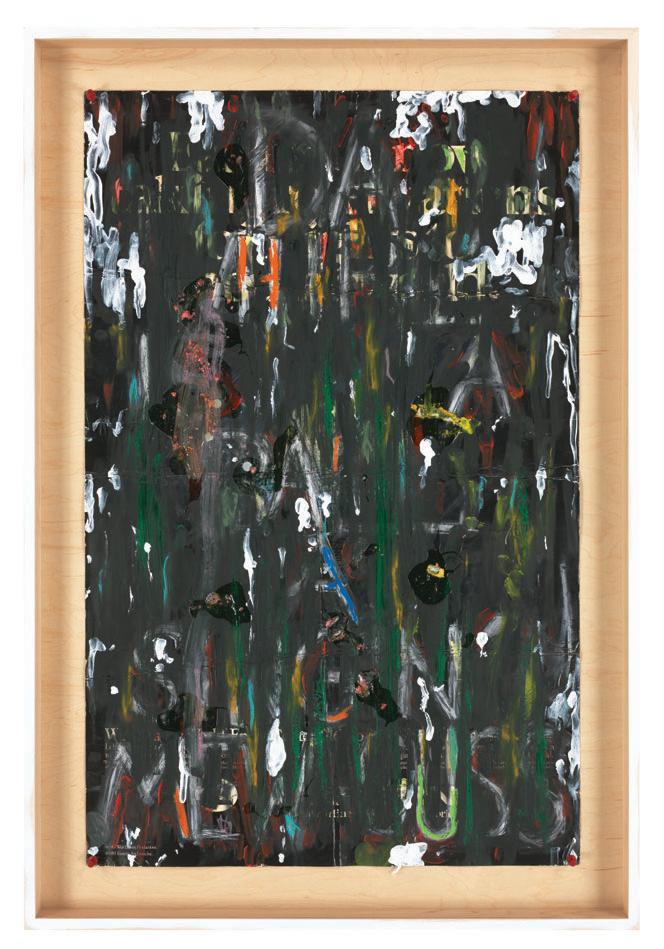
PL. 1, Ad Space, 1983–2013
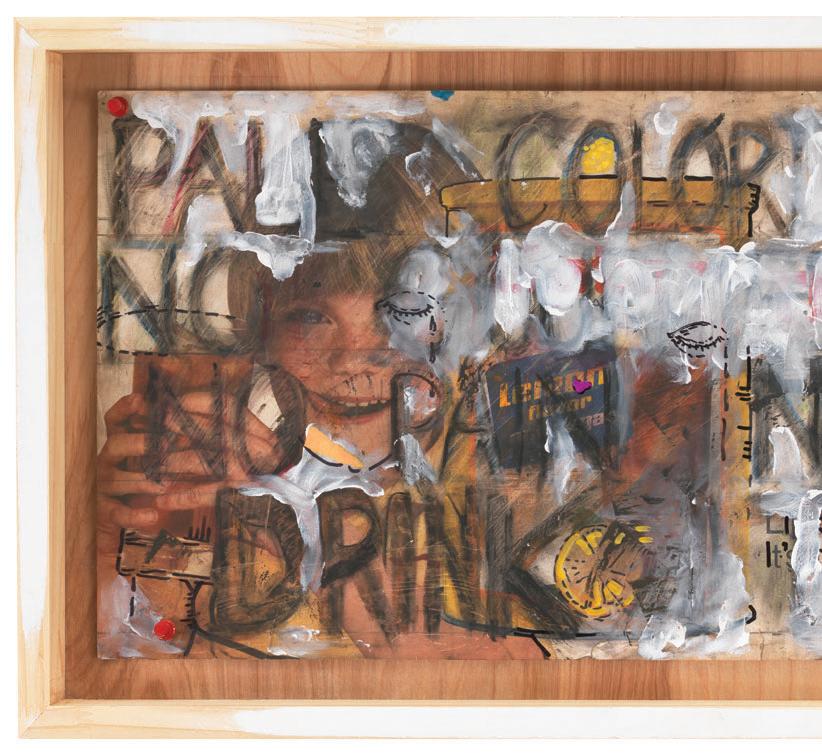
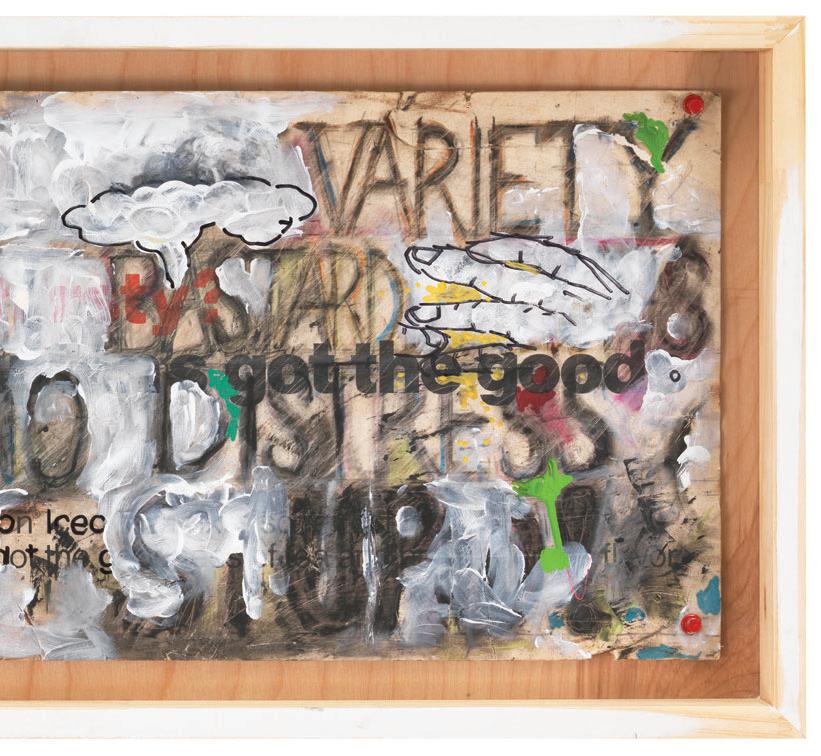
PL. 2, Painting on Advertisement Never to Be Finished, 1983–2013
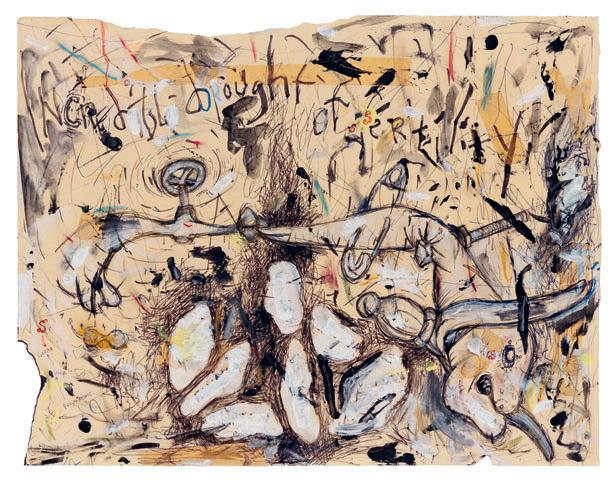
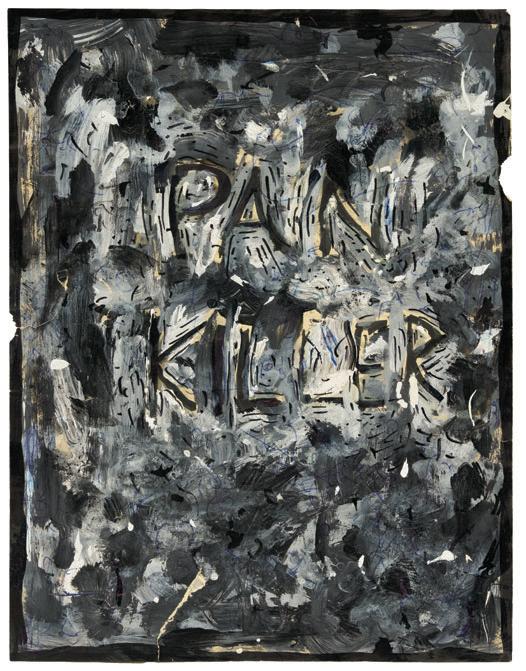
PL. 3, Incredible Drought of Fertility, 1989–unknown end date
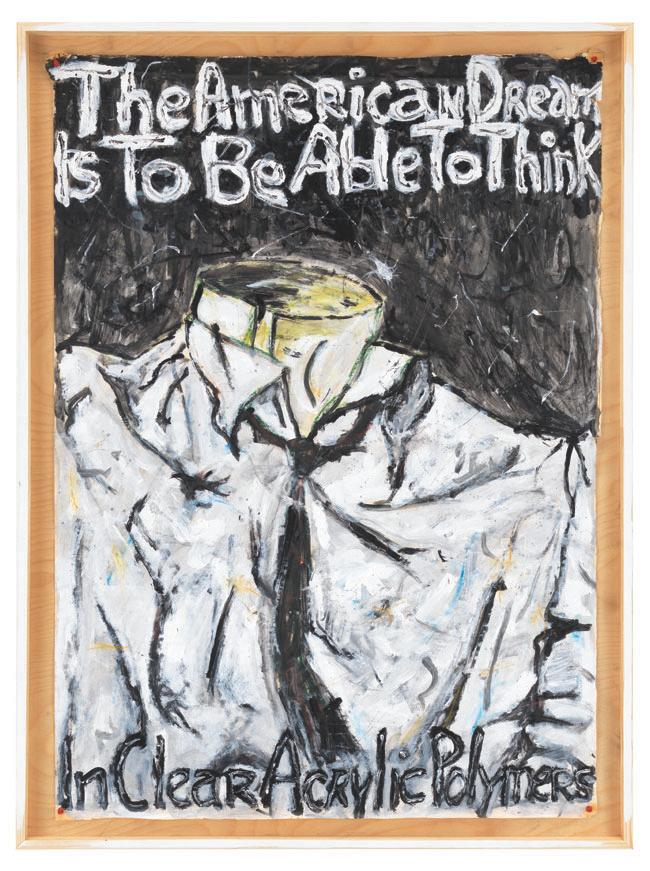
PL. 5, Portrait a.k.a. The American Dream Is to Be Able to Think, 1989–90
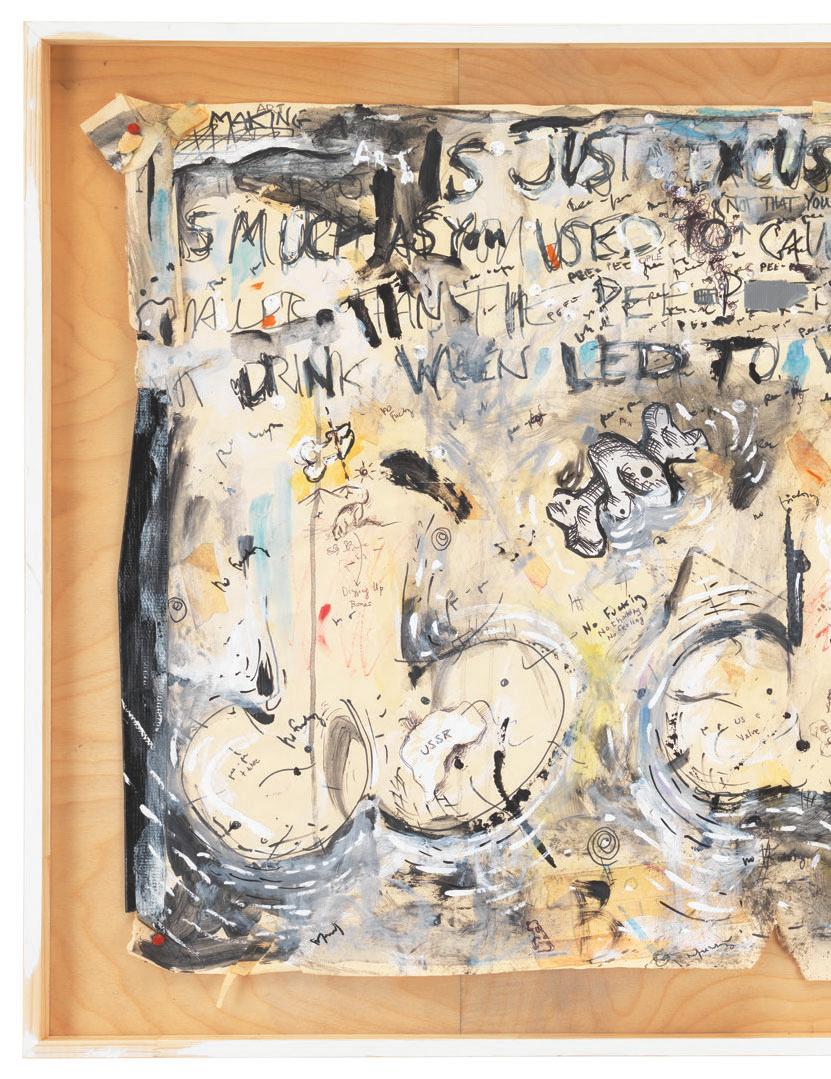
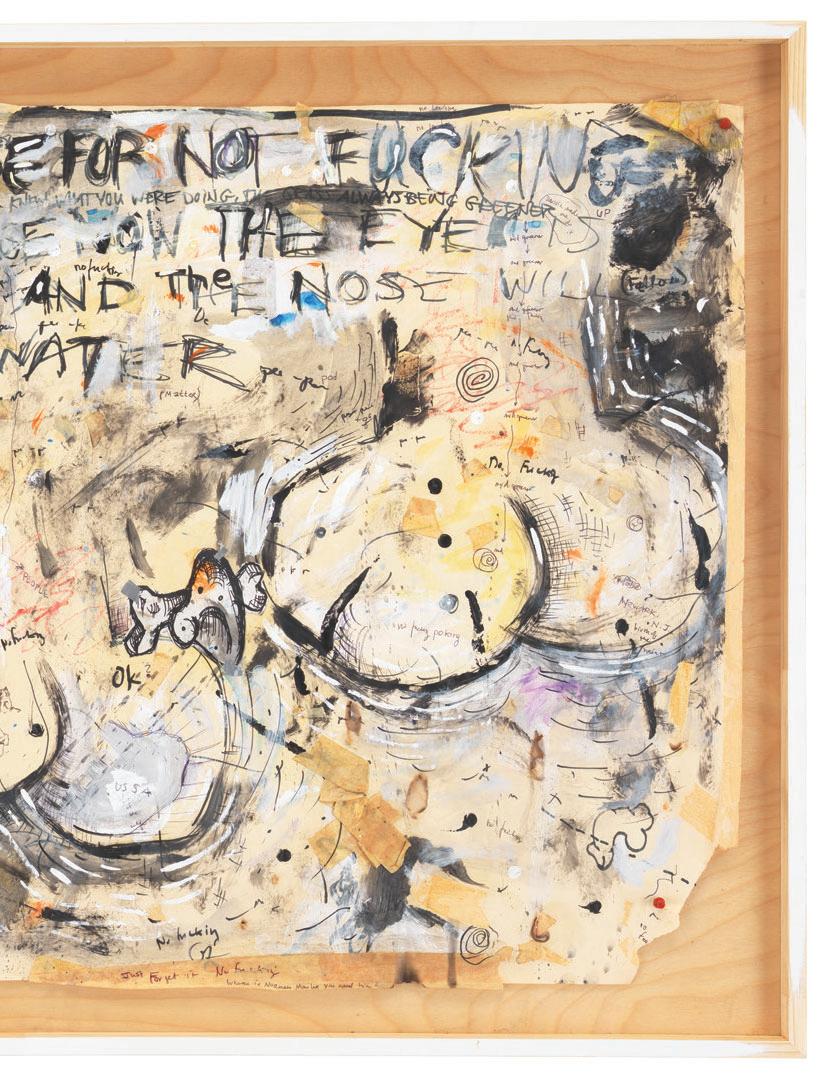
PL. 6, Yet Another Excuse, 1989–2013
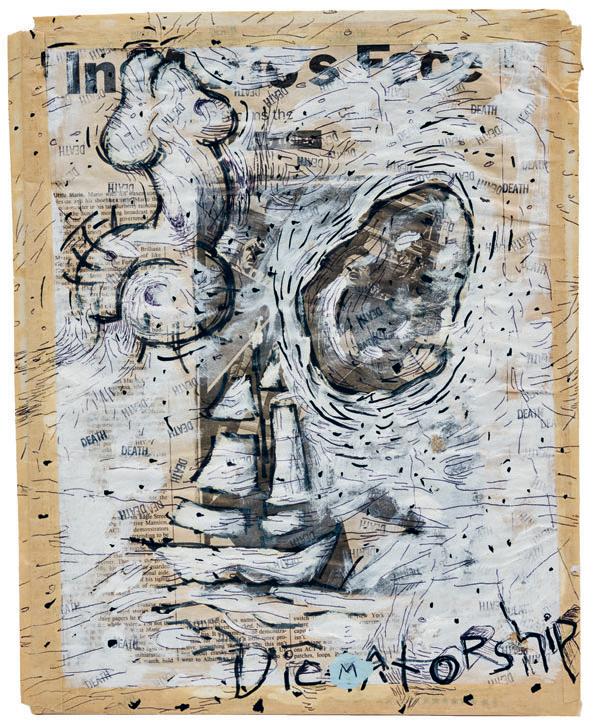
PL. 10, Dictator, 1991–unknown end date
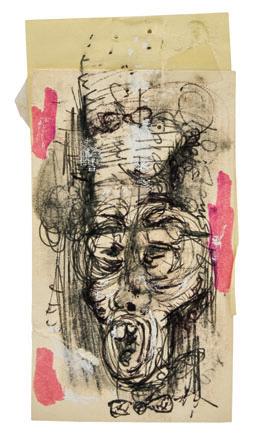
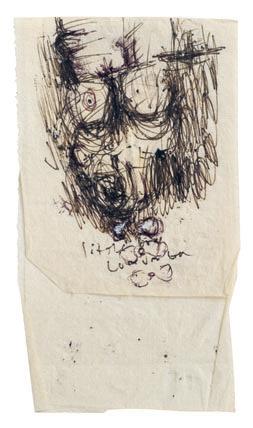
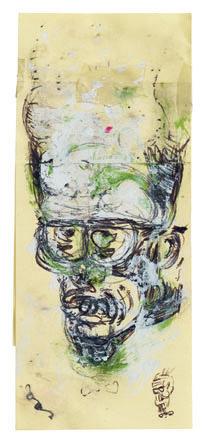
FROM LEFT TO RIGHT
PL. 11, ET Lumumba, 1990–95
1990–95
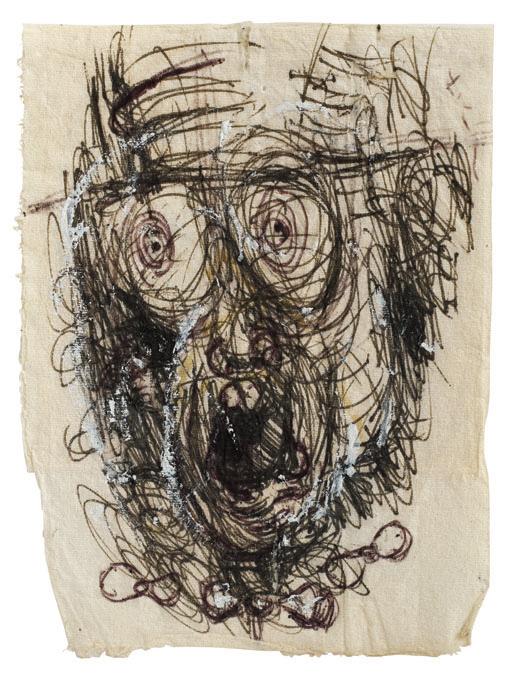
PL. 14, Munch Lumumba, 1990–95
PL. 16, Title unknown, n.d.
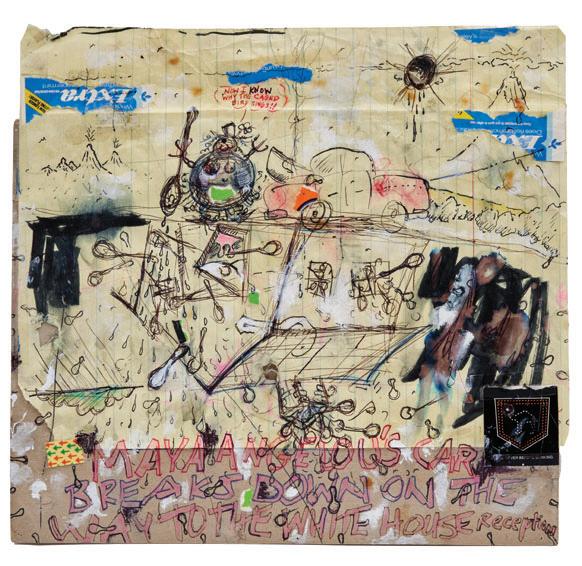
PL. 18, Title unknown, c. 1998
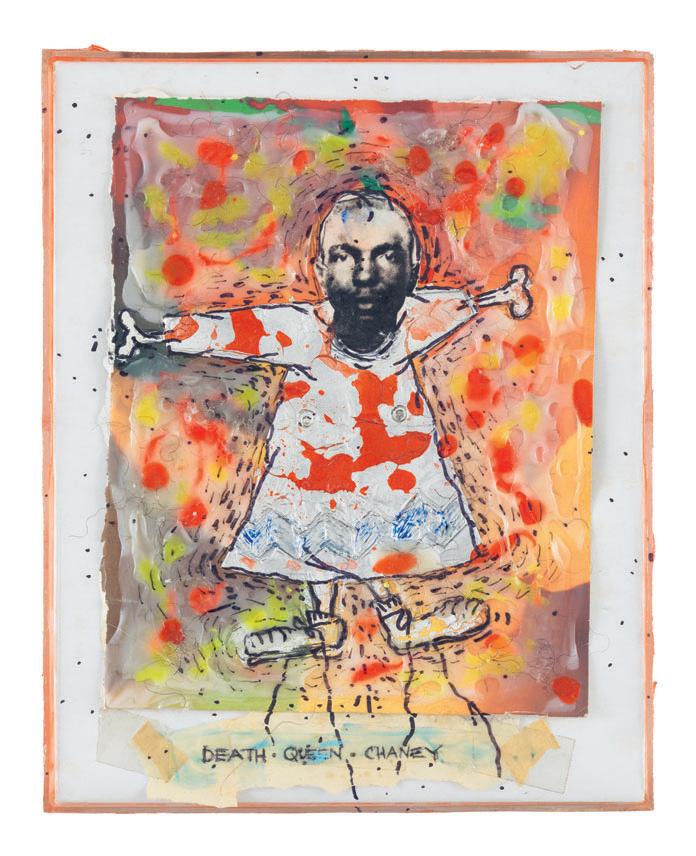
PL. 19, Death Queen Chaney, 1998–2008
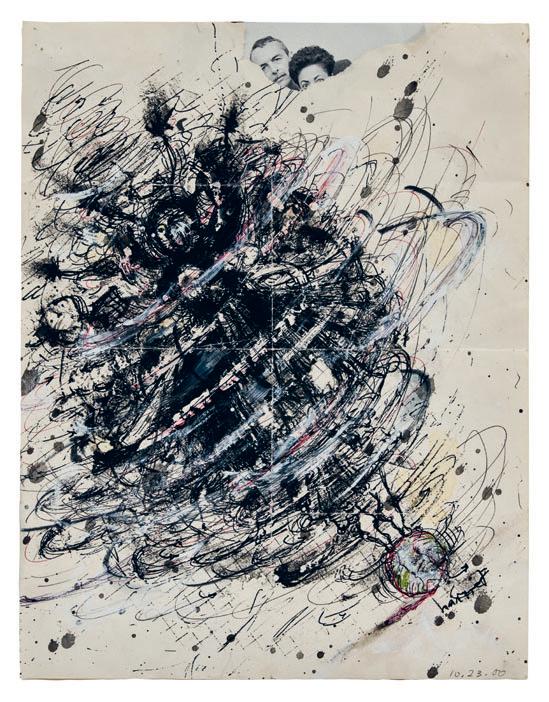
PL. 20, Title unknown, 1992/93–2000
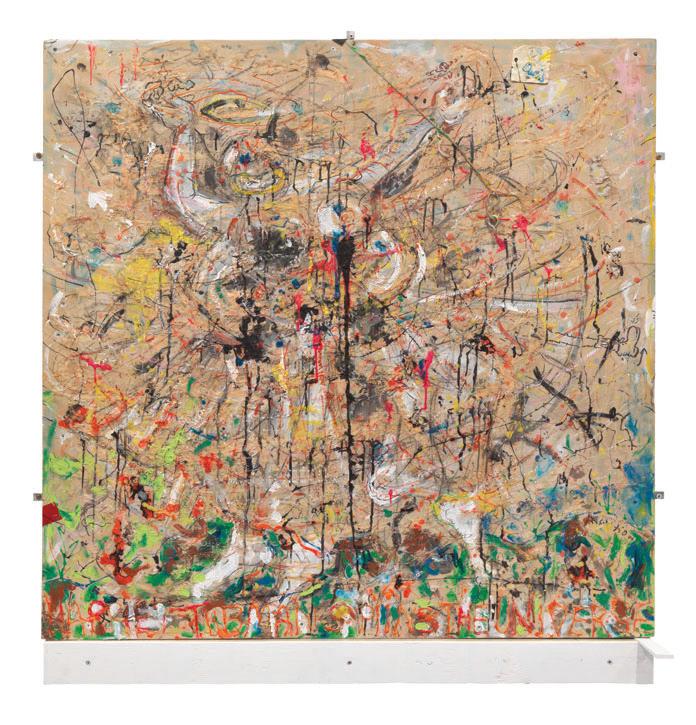
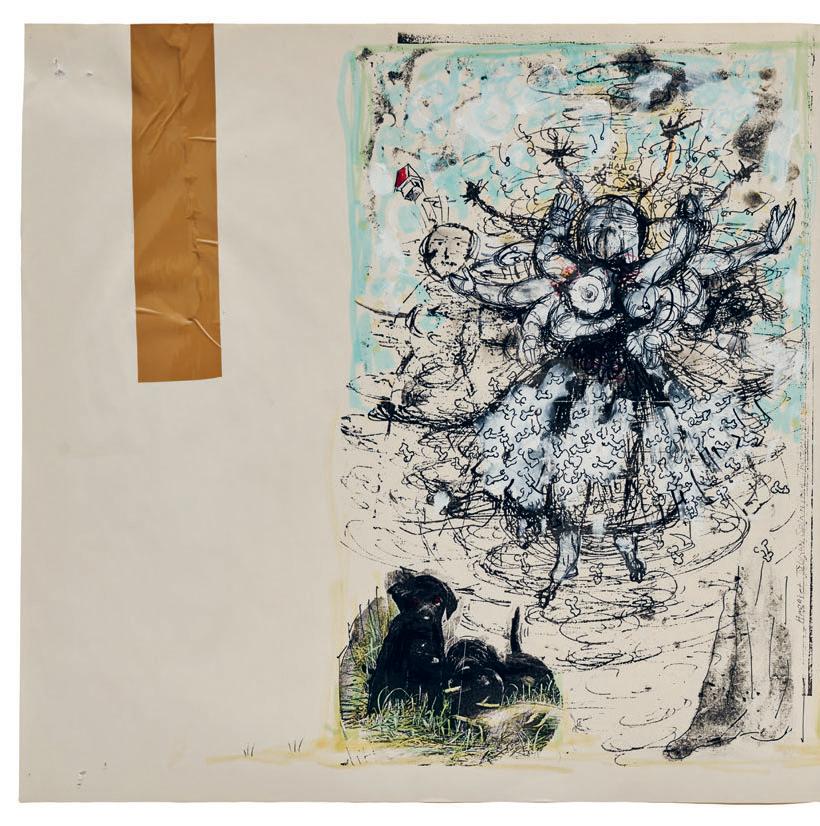
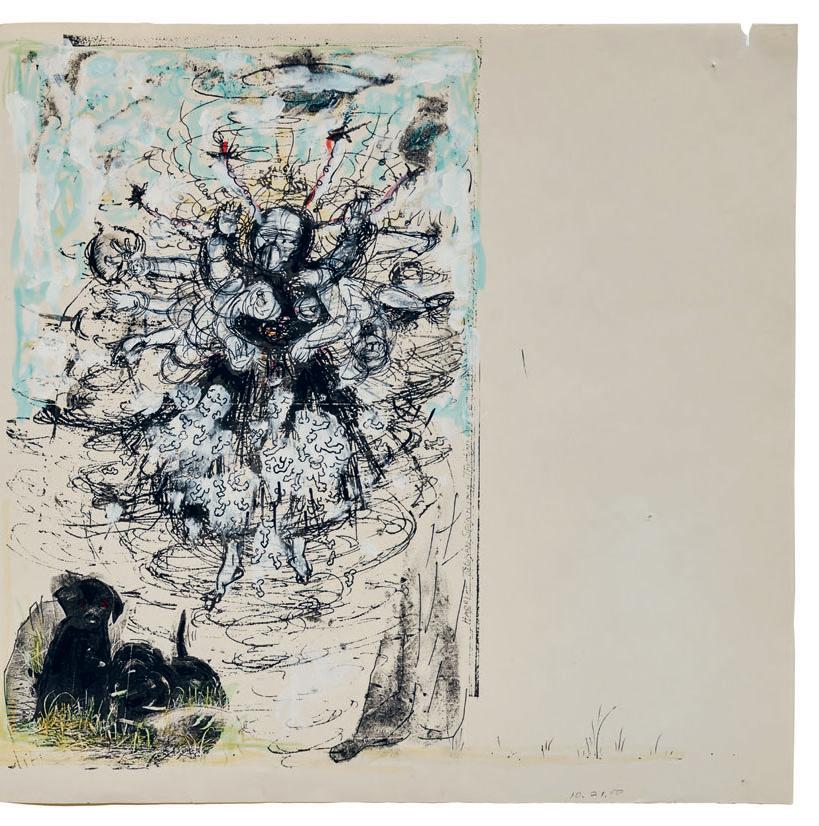
PL. 22, Title unknown, 2000
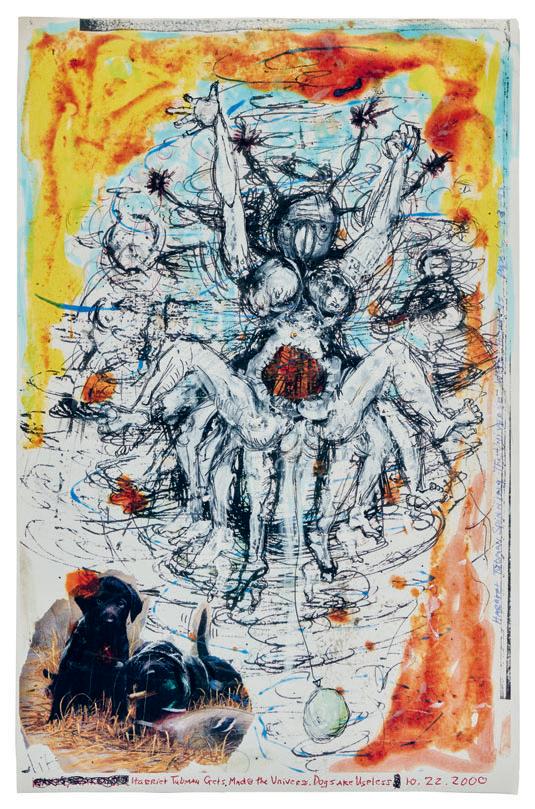
PL. 23, Title unknown, 2000
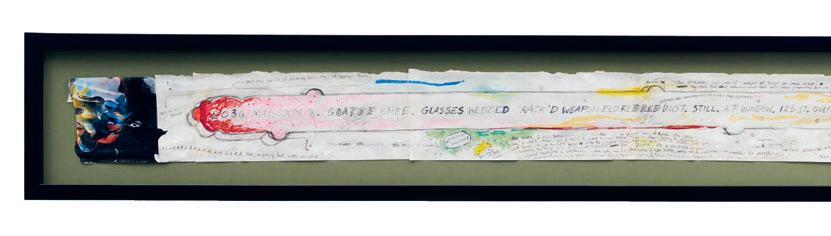
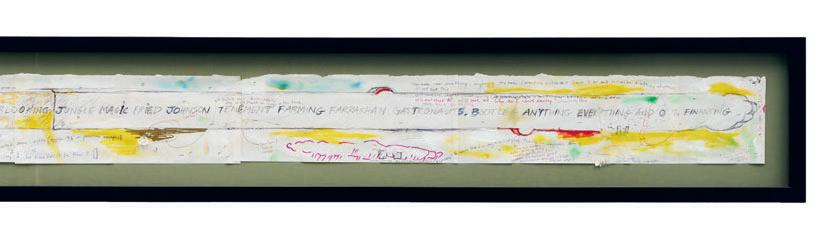
24, Drawing for Malcolm X, 2002
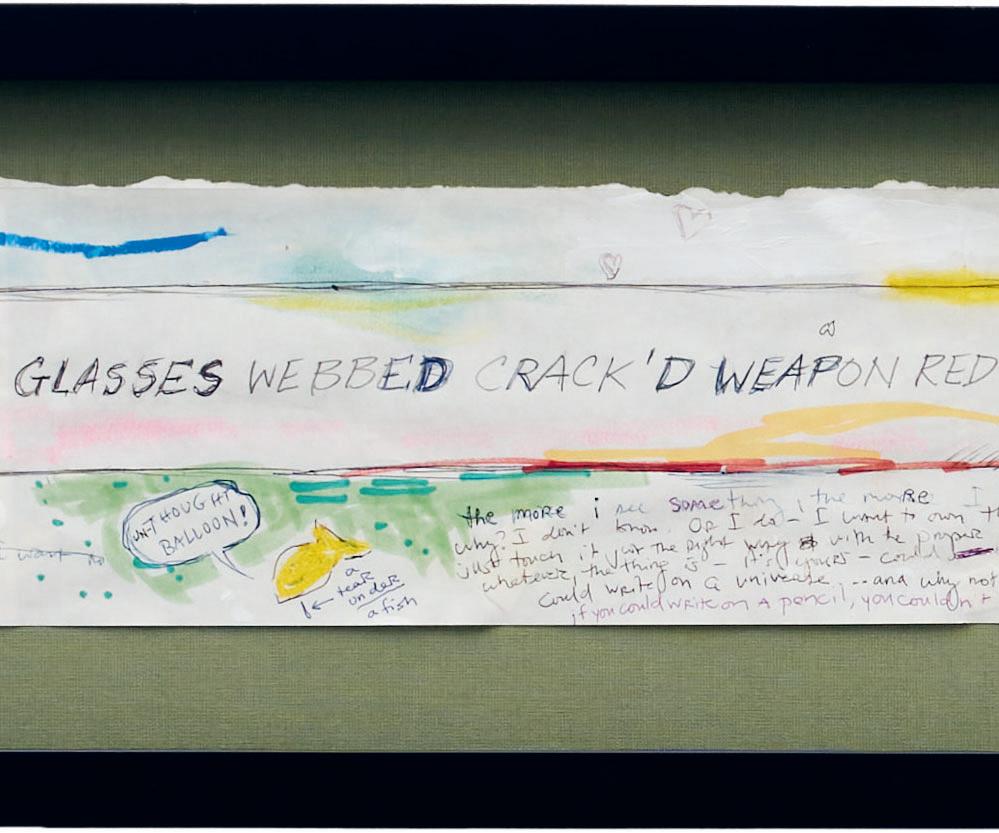
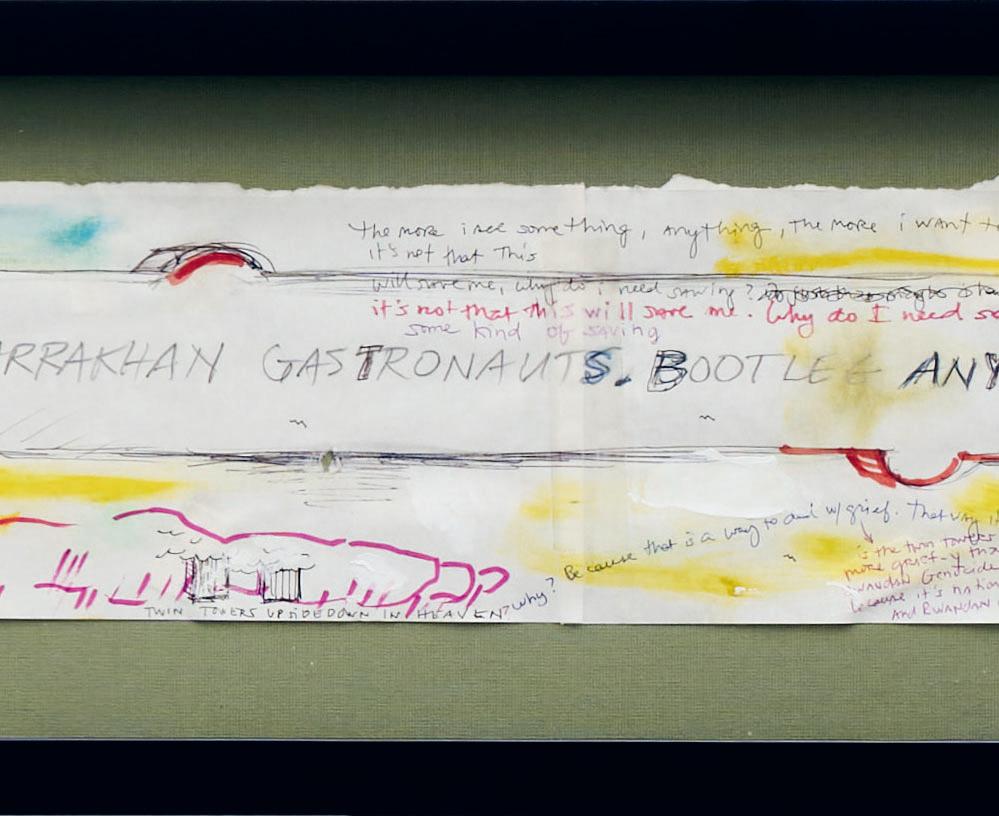
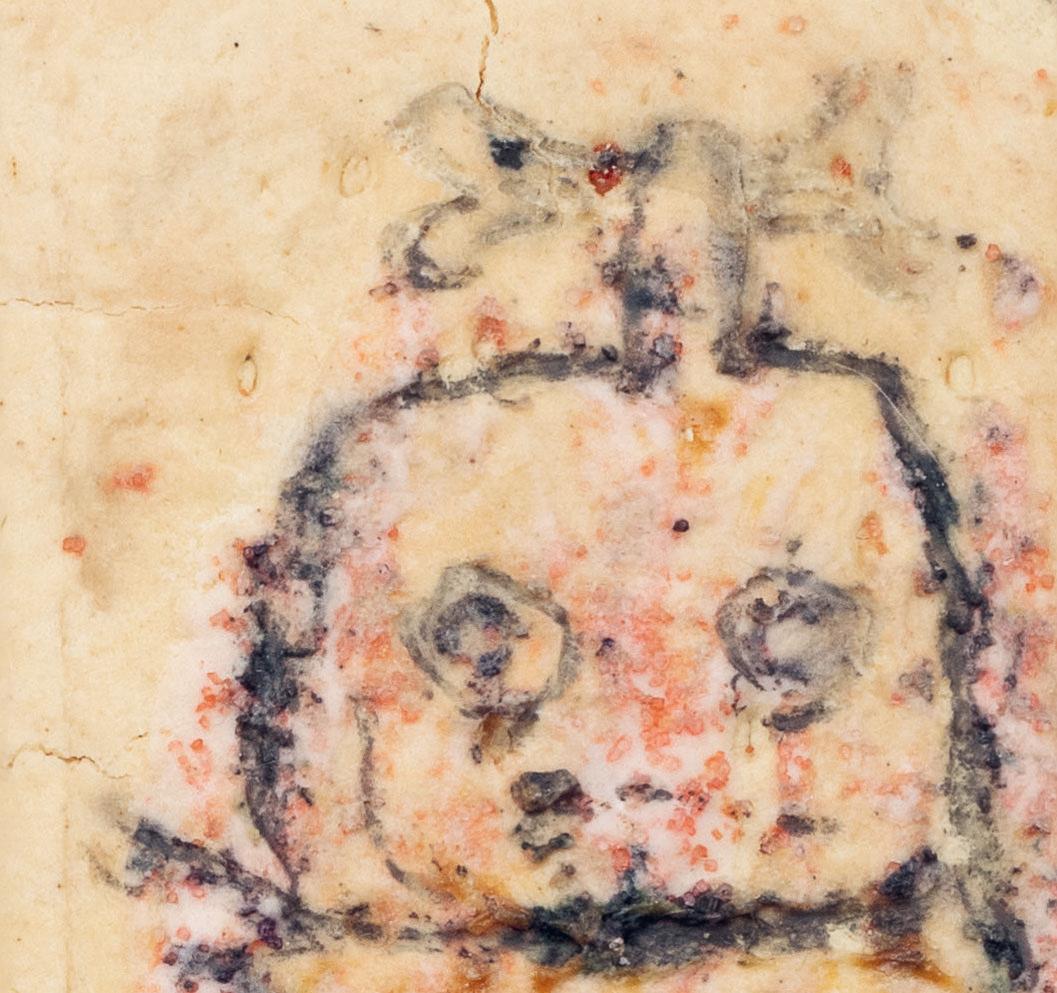

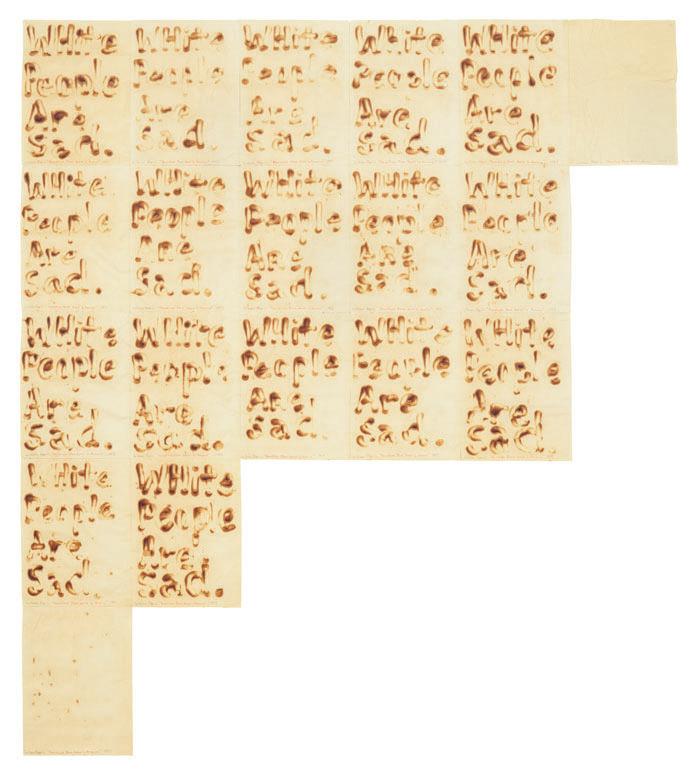
PL. 26, White Drawing, 1997
FROM LEFT TO RIGHT
FROM LEFT TO RIGHT
FROM LEFT TO RIGHT
FROM LEFT TO RIGHT
FROM LEFT TO RIGHT
PL. 43, White People Are Palesman Who Live In Cleveland, 2008
PL. 44, Red People Are Impotent And Why, 2008
PL. 45, Blue People Are Not A People They Are A Substance, 2008
PL. 46, Blue People Cannot Conceive Of Themselves, 2008
FROM LEFT TO RIGHT
FROM LEFT TO RIGHT
FROM LEFT TO RIGHT
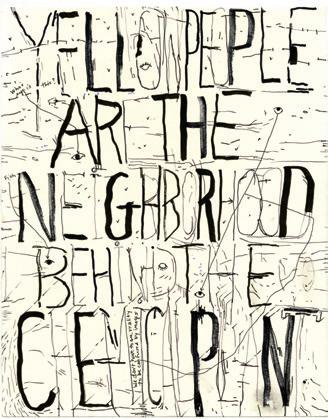
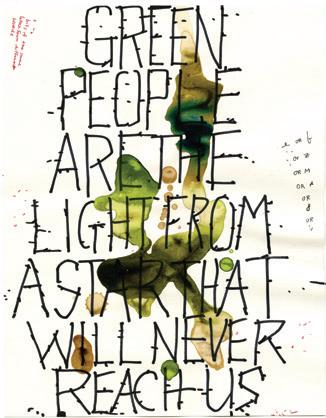
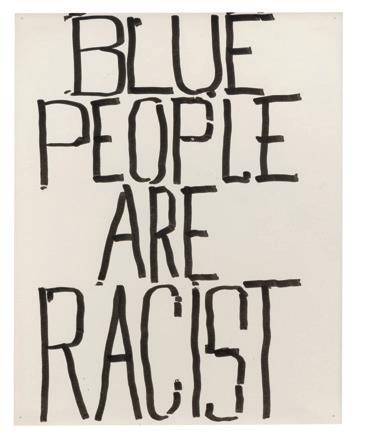
FROM LEFT TO RIGHT
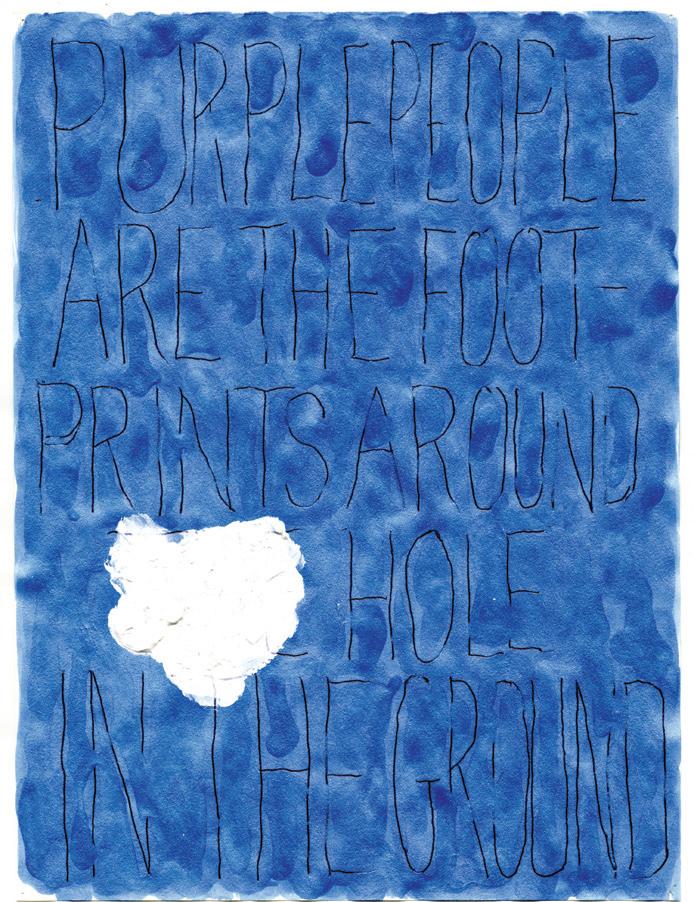
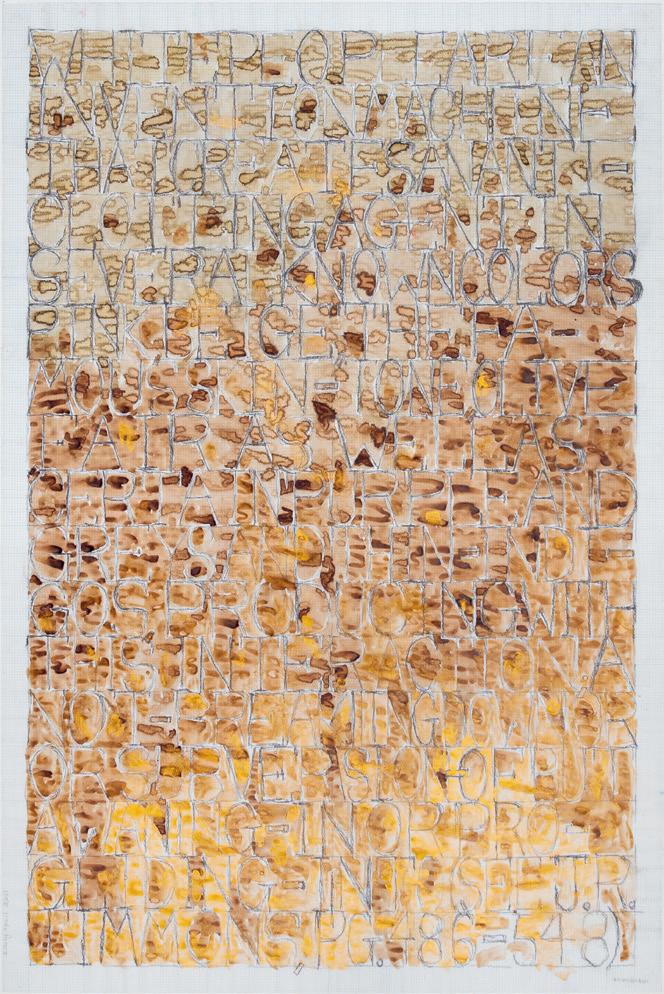
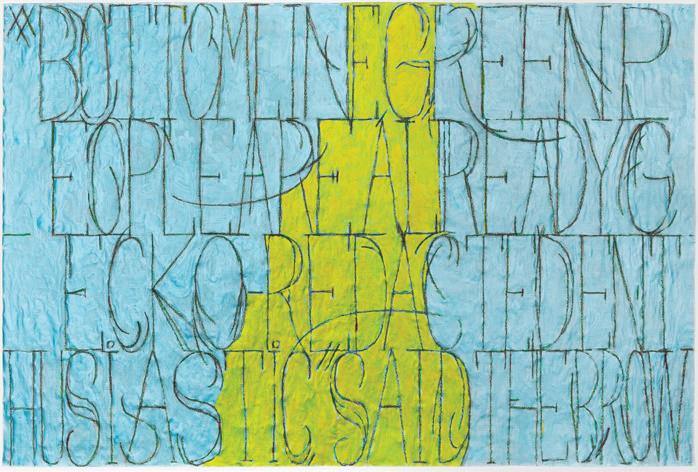
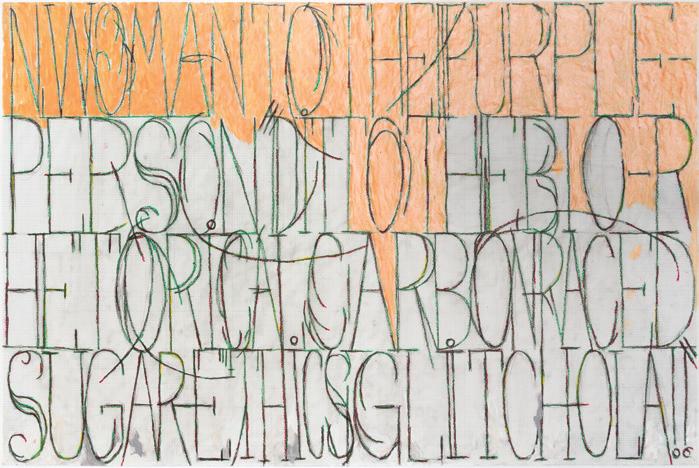
PL. 65, #Bottom Line Green People Are Already Gecko-Redacted Enthusiastic,” Said The Brown Woman To The Purple-Person “Ditto The Bio-Rhetorical Carbon Raced Sugar Ethics Glitchola!!”, n.d.
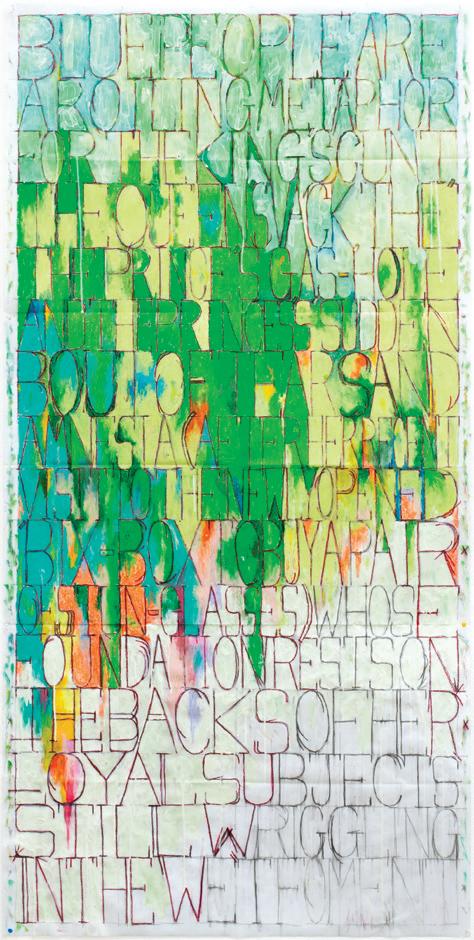
PL. 67, Blue People Are A Roiling Metaphor For The King’s Cunt, The Queen’s Vack; The The Prince’s Gas-Hole And The Princess’ Sudden Bout Of Tears And Amnesia (After Her Recent Visit To The Newly Opened ‘Bix-Box To Buy A Pair Of Stun-Glasses) Whose Foundation Rests On The Balks Of Her Loyal Subjects Still Wriggling In The Wet Foment, 2011
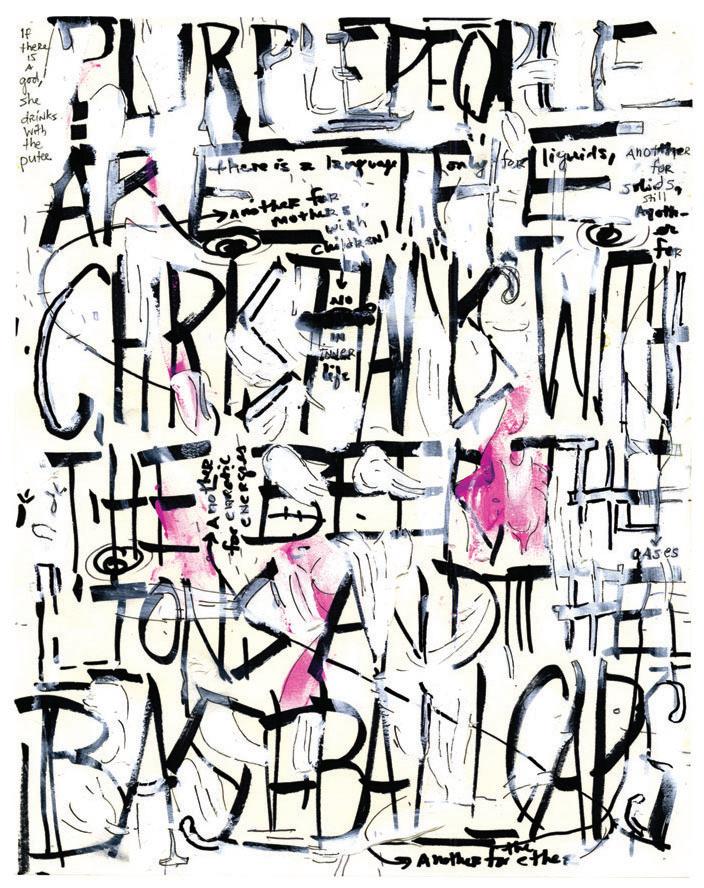
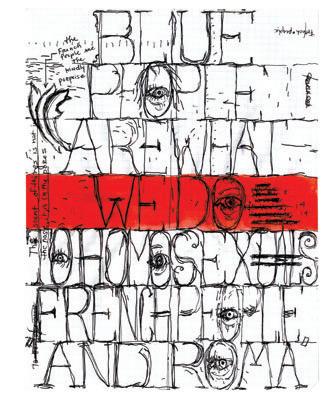
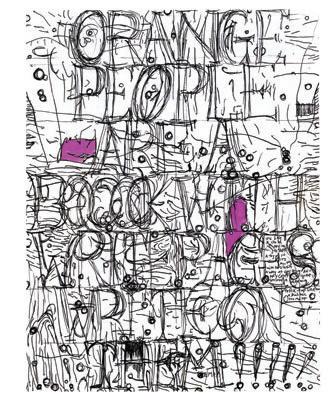
FROM LEFT TO RIGHT
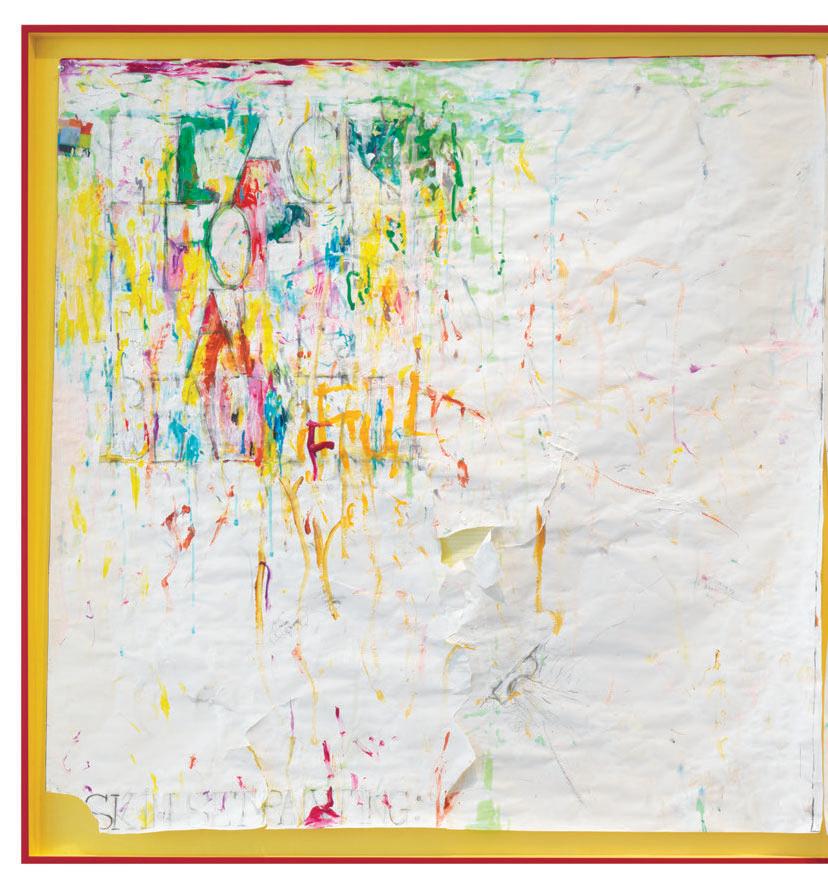
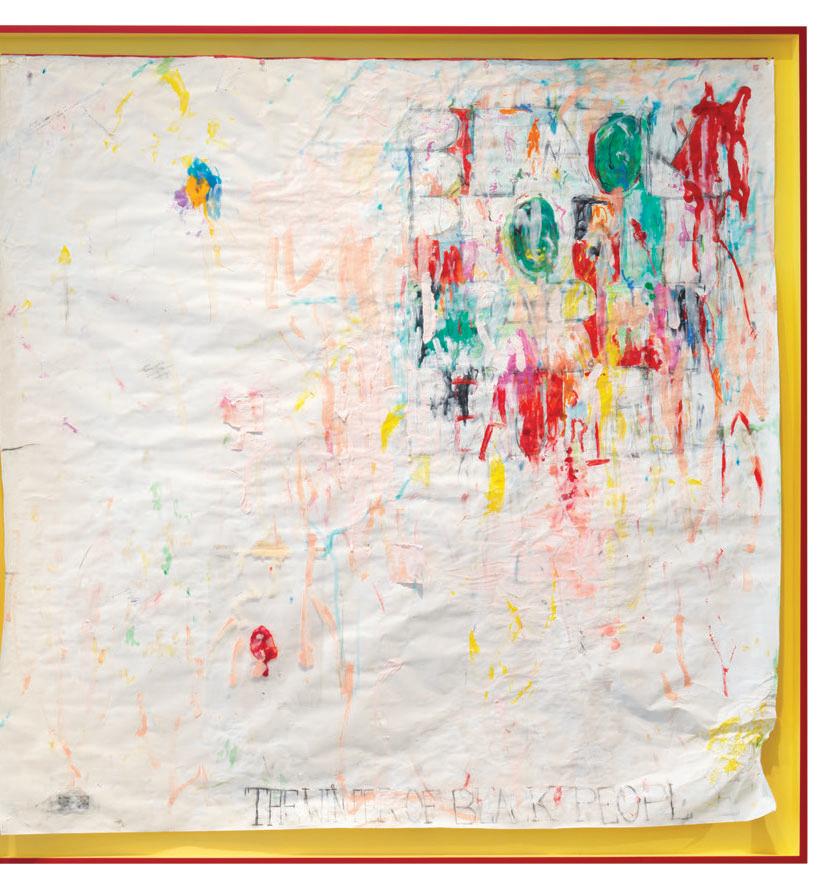
PL. 71, The Winter of Black People, 2011–13
FROM LEFT TO RIGHT
FROM LEFT TO RIGHT
FROM LEFT TO RIGHT
FROM LEFT TO RIGHT
FROM LEFT TO RIGHT
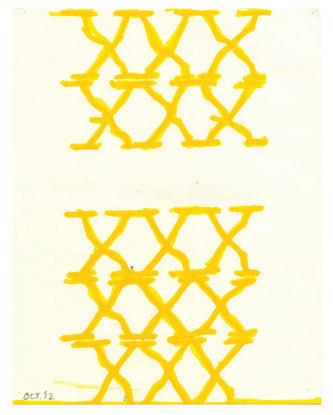
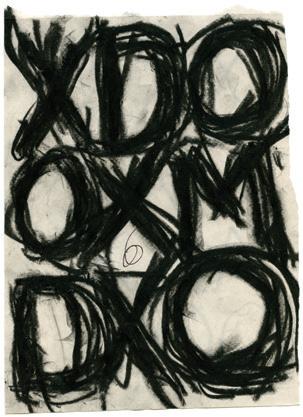
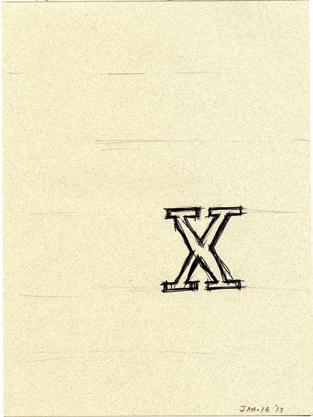
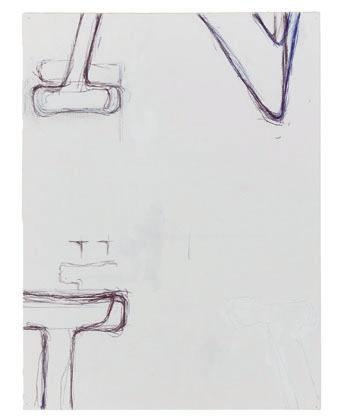
PL. 92, 087, 10-11, N/LY, 2013
PL. 93, 091, 35-36, h, b/Hi, B, 2013
PL. 94, 092, 10-11, he/b, B, 2013
PL. 95, 092, 19-20, pty/d, t, A, 2013
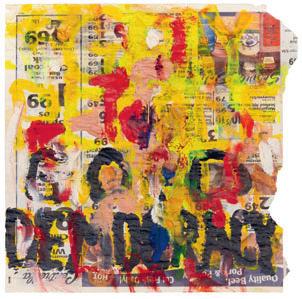
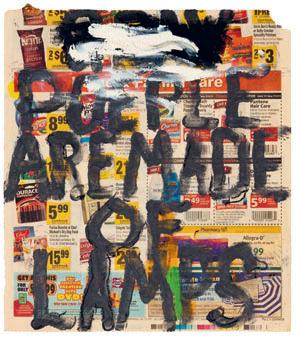
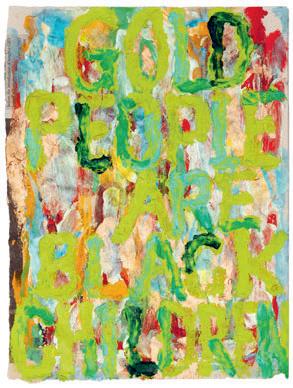
FROM LEFT TO RIGHT
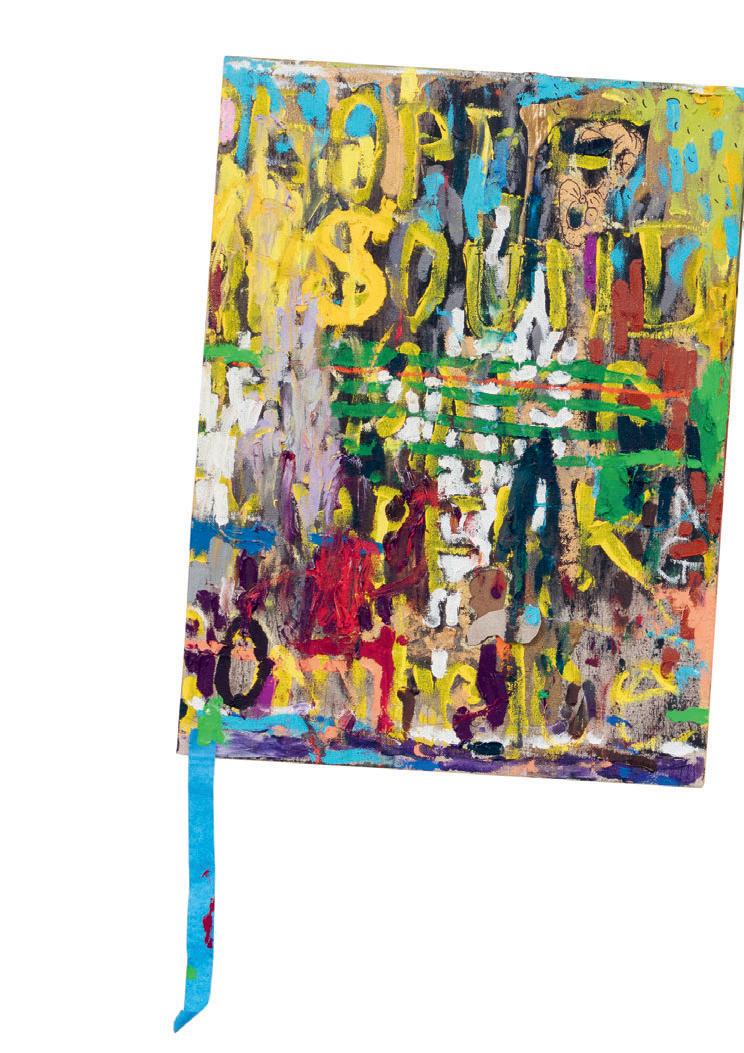
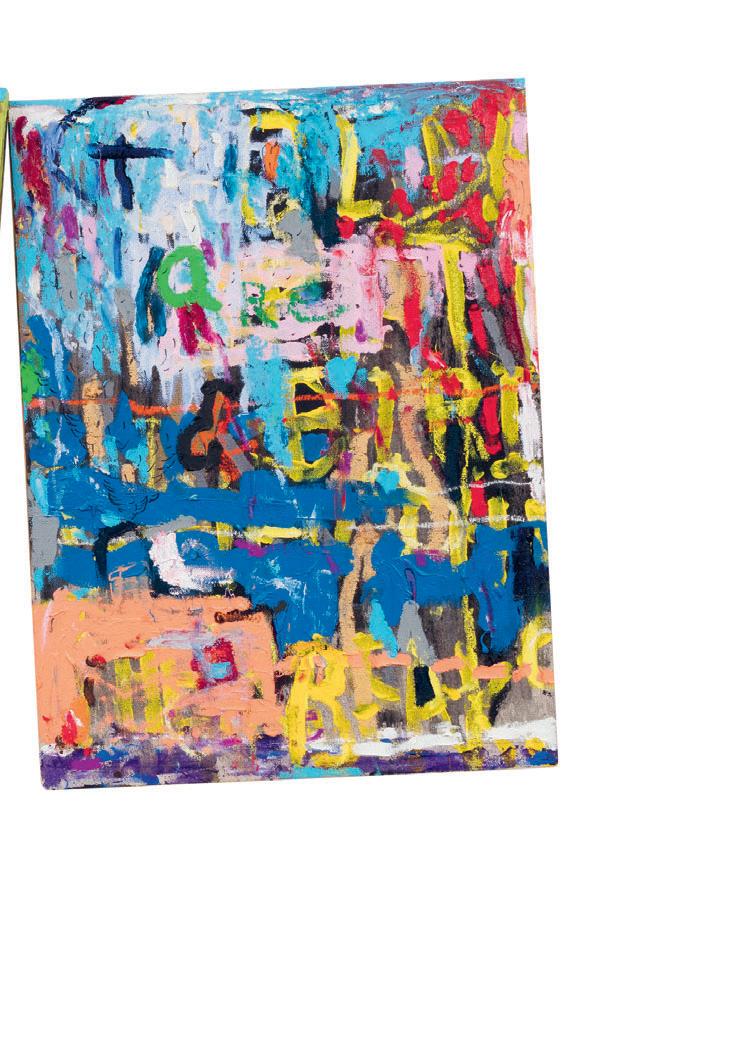
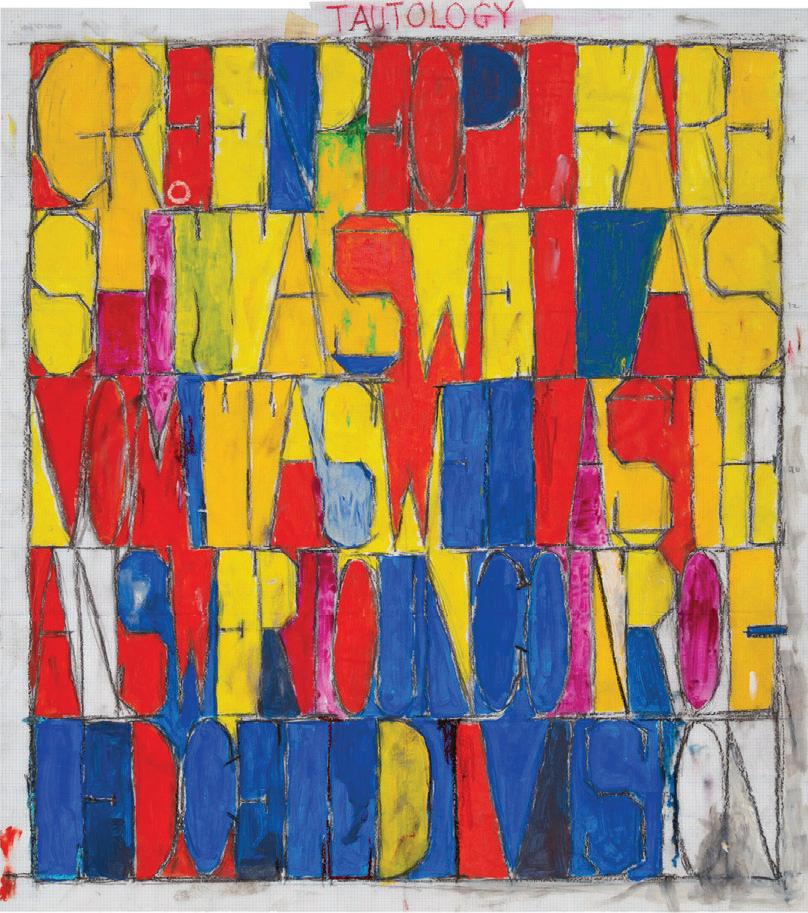
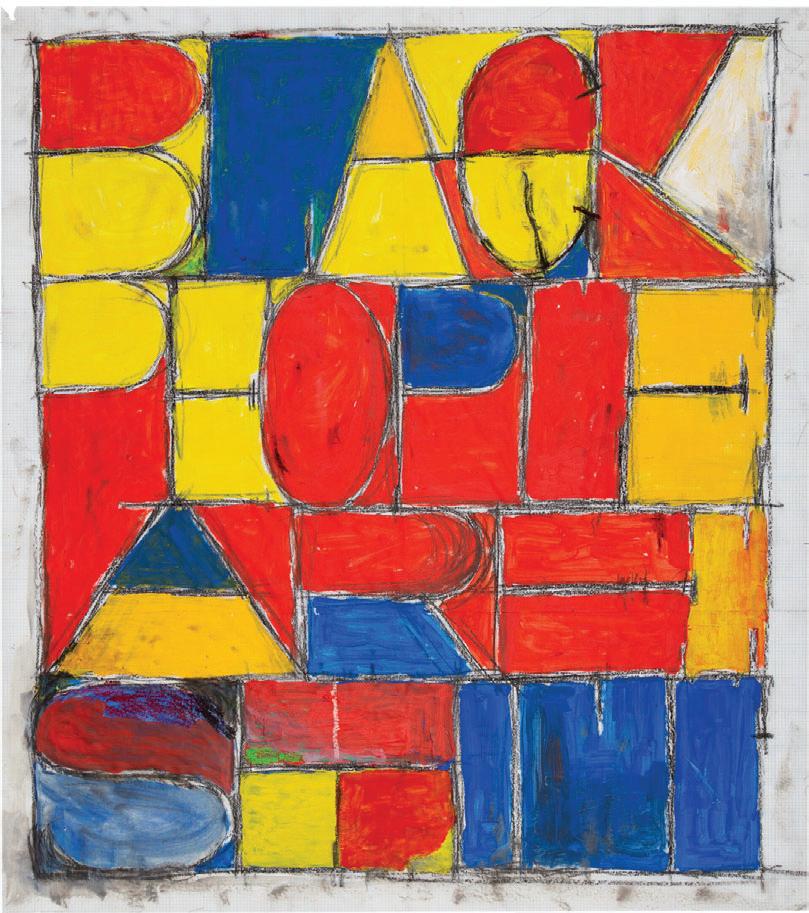
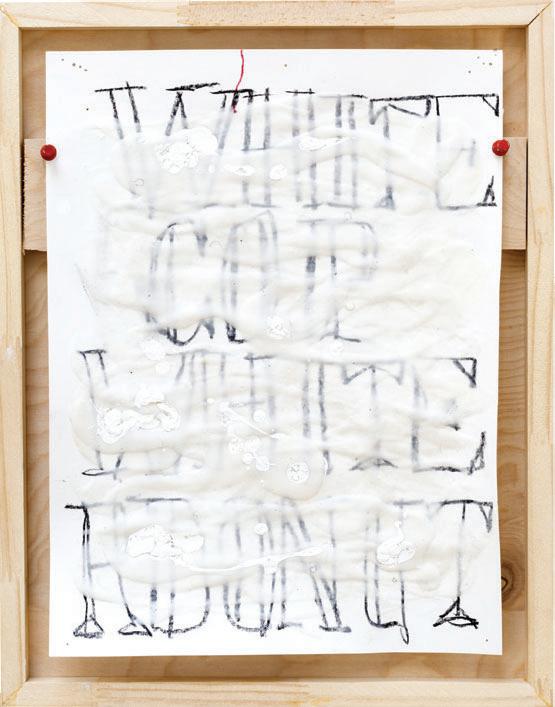
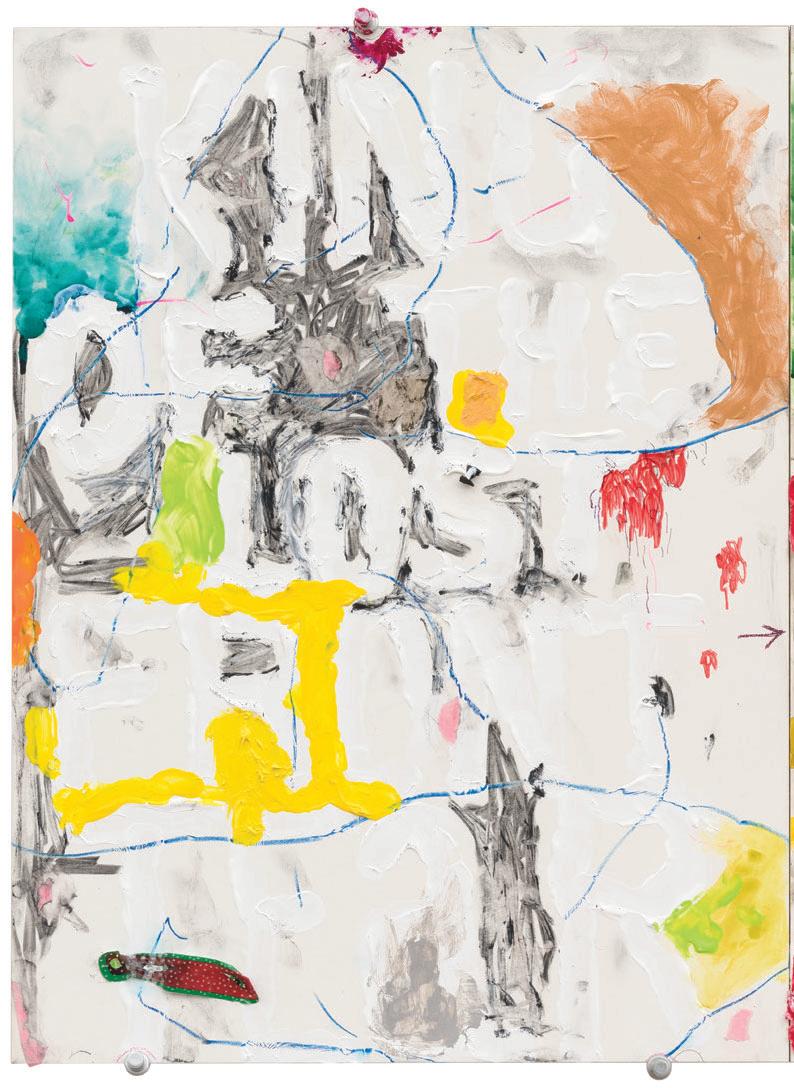
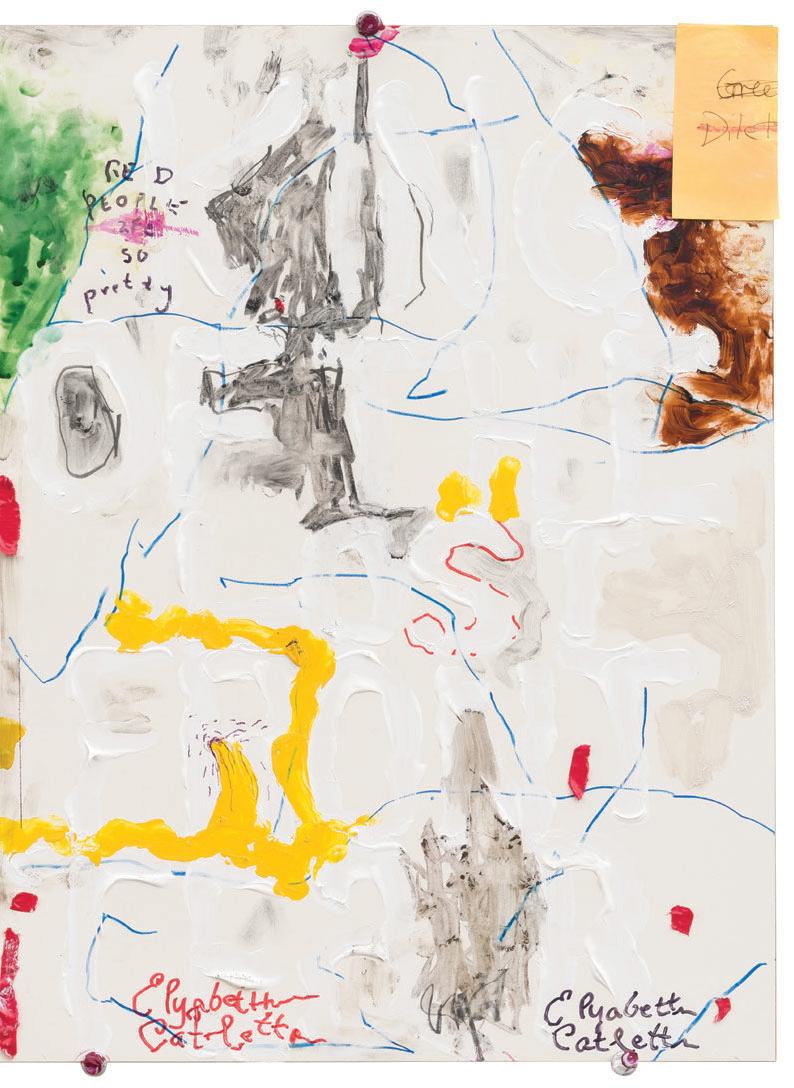
PL. 103, Two Kingdoms, 2021
Simone White
My kid has been sleepwalking. Tonight, he wandered into my room, stacked pillows atop his head while kneeling on my bed, fell forward, then rolled onto his back, repeatedly punching himself in the trunk and face through his pillow-cushion, called out for a Chipotle honey chicken bowl, and pantomimed the inscription of a letter of apology, which he also recited: “Dear Mother, I am sorry for being a jerk earlier. I am afraid I am not wired well.” After about six minutes, he passed out with his legs thrown across mine at a ninety-degree angle. I covered him up with a quilt and pushed him off me. On this occasion, his performance was loose, appetitious, frightening, comic—and short.
I was, of course, working the whole time—thoroughly prepared for the possibility that I would get a little work done while this shit was happening, partly attuned to making sure the kid didn’t injure himself, materials on Pope.L open in various windows on my laptop.
On duration:
In one way or another, I’m always thinking about duration, whether I’m working with onions or ketchup or video or chickens. And it’s mighty hard to think about duration without thinking about ending. We need endings, but they
don’t exist, so we manufacture them. When I end a crawl, for example, I’m still crawling inside, even after I’ve physically stopped. It’s like a seven second song by the Dead Kennedys. An ending is not the last word or action: the silence is. Or the expectations built up in the passage of the work through the ether.1
In the drama of the sleepwalking child, what is horrifying (“transposes all that is out of its previous existence”2) is the possibility that the weird conduct will never end; the child will, in effect, be suspended in the state of un-sleep—abnormal and disorderly—which, at one and the same time, provides him access to the raw, incisive truth of his world and denies rest not only to his own body but to everything with which he is entangled.
Night after night, strangeness without end unleashed upon the micro-society of our household, the symbolic state of repose/ health—when? When does childhood “end”? What is its “end”?—to which he is constantly subjected, crushed by the ether (hole) that receives his performance of willful becoming.
Part 2: Not Sentences: Titles, Sub-titles, Scraps3 (Generativity)
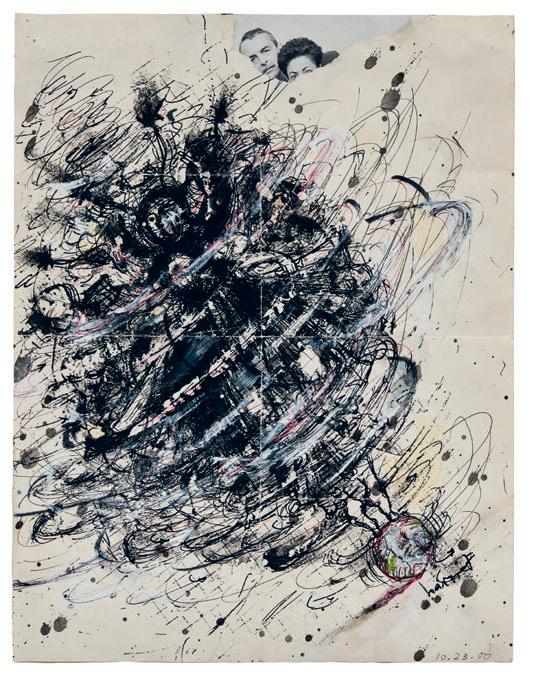
Harriet Tubman Spins the Universe (1998–2017)
Title unknown (2000), with handwritten text: “Harriet Tubman Gets Mad @ The Universe. Dogs Are Useless 10.22.2000”
Title unknown (2000)
Title unknown (1992/93–2000)
I think the titling works like this, or this is one possible way a Pope.L title is made to function, how we might see a title as a discrete work: occupying a level of abstraction beneath which other strata of meaning-making activity are generated and manipulated by the
Pope.L, Title unknown, 1992/93–2000
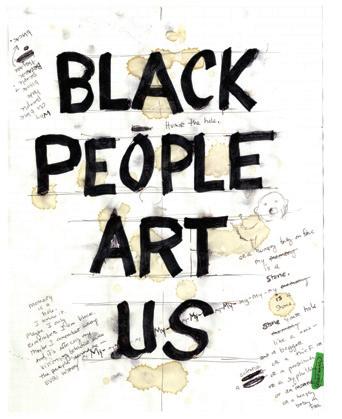
works’ forces, which expand across media, time, and dimension. This is not to say, as in the example of the Harriet Tubman drawings, that titles, sub-titles, and silence (named in the catalogue raisonné “unknown”4) cannot organize horizontally to create a single work or a series of works that are linked statements—not sentences— operating in a space where BLACK PEOPLE ART US.5
Pope.L nominates “Harriet Tubman” as a force with its own momentum in an imagined universe. Relying provisionally on if/ then logic, we might read the works and their titles as suggesting that Harriet Tubman’s spinning is a necessary condition of such a universe’s existence. Harriet “spins”; that is, she rotates, her movement initiated in the past by an external force. But what force could be external to Harriet when it is she who creates the universe? (Harriet as god; Harriet as cosmic nothingness.) Perhaps we should consider that her spinning—action she might do in the manner of a dervish and is, thus, spin-ny—is not, fundamentally, an instance of mechanical rotation but of creaturely making, like the spider’s.
If imagination is “the handmaiden of social action,”6 then “social action” can be said to be the first cause of this reality. Harriet, the General, has inside her the molten stuff of revolutionary evacuation. What is formed is formed from the elements of her will to facilitate human passage beyond enslavement.
Reliance on the if/then logic above can only be provisional since Harriet Tubman Spins the Universe and Title unknown are syntactically ambiguous. Harriet as spider could be understood to spin the universe; or, Harriet could spin the universe like a basketball. “Unknown,” as a discursive unit and a title, tracks onto a monochrome white painting that incorporates the words “Martin Luther King’s dick as seen from Pluto,” as well as the anonymous white couple (I never know whether people who look white are “white,” but this adds to the verbal intrigue here) collaged/stuck onto the upper-right corner of Title unknown.
Let’s say that Pope.L engaged, over a long period of time, in making certain works that posit the generativity of iconographic black revolutionary action, distributed across the poles of biological sex: Harriet literally giving birth to a universe by pushing it out of her vagina; Martin Luther King Jr.’s shapeless whitewash of a “black penis” that could easily be understood as semen.
In a seminal essay on the Skin Set Drawings (1997–2011), Darby English writes, “Like any wordplay, the Pope.L-ian variant requires a playmate.”7 The playmate of these works is a profound epistemological reversal that turns the problem of viewing inside-out: To see the works right, you have to take an alien perspective, one that does not know an entirely racialized system of signification. You’d have to be alien. Horrible. To art us.
Not pictured: the universe. What is pictured is a small planet, rolled, as clay or rubber cement balls, by the rotation of Harriet Tubman’s balletically arched and out-of-proportion feet. Pope.L’s articulation of still burning—regard the planet’s fiery, smoking tail— and watery proto-geology, with Wite-Out, red ink, and a bunch of random-seeming black dots, manages to feel simultaneously spare and absurdly specific.
This is one of many possible ways to understand how the meta-title Skin Set can operate as a statement with the same discursive heat as White Cop White Donut (2016).
Those that are big
Those that cannot spell
Those that are not on graph paper
Those that do not become part of the Skin Set Drawings; those that vanish
Those that have profane words in/on them like fuck dick ssshit or cunt and those that are neologistically profane (PURPLE PEOPLE ARE I’LL FUCK YOU WHOLE FAMILY AND CUT THEY SHIT OFF)
Those in which you cannot make out letters, only color and mistake
You are to read them like a book, if at all, but only if the book is Pope.L: My Kingdom for a Title. The table of contents (TOC), read in a normal way, lists Choir (2019) under the heading “Part 3: Skin Sets,” which is either an instance of misdirection or an opportunity to rethink Choir. I turned the pages of the book in all directions before I grasped the organization of the TOC, which refers readers to content sequentially, indexically, and both. There is a part called “And:” Numbered parts (“Part 1: Performance,” “Part 2: Stories”) are general categories of Pope.L’s practice, having nothing to do with textual imperatives.
A description of the various ways the Skin Set Drawings play linguistic ping-pong with racial discourse is bound to be a pitiful act of critical deflation. (An exception such as English’s ebullient and attentive commentary in To Describe a Life proves the rule).
Anaphora is messianic rhetoric, impossible to think separately from words attributed to Jesus of Nazareth in the Sermon on the Mount:
Blessed are the poor in spirit: for theirs is the kingdom of heaven. Blessed are they that mourn: for they shall be comforted. Blessed are the meek: for they shall inherit the earth. (Matthew 5:3–5)
When Pope.L declares “[COLOR] people are . . .” over and over again:
BLACK PEOPLE ARE WHITE PEOPLE ON FIRE
BLACK PEOPLE ARE TRANSPARENT
That’s that heat. “Real blak” is not black but an amalgamated slash of undifferentiated color. To the extent that this is conceptual or about anything, it may be about painting. Says Gilles Deleuze, “There’s a grey of colors mixing together, which is the grey of failure. And then there’s another grey, which perhaps is like the grey of fiery cinders, an essential luminous grey from which colors emerge.”8 Pope.L, coming, he says, from a “histrionic tradition, like James Brown,”9 pulls out of the mushy, incoherent gray of race, the hot-flash/butterflies sensation—quickening of blood—that is and is not painting, is and is not philosophy.
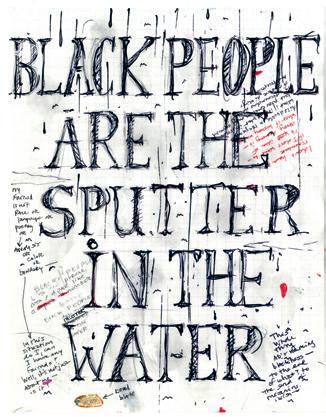
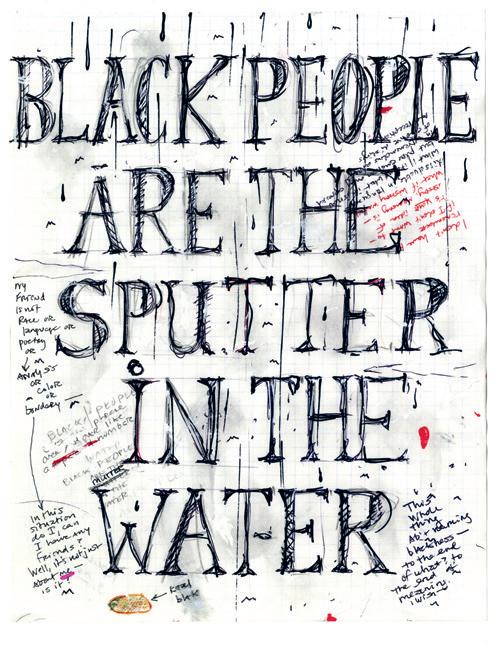
A black comic sublime is obtained when the performer summons the devil of racial hatred and quick, in a fraction of a second, lifts the threat of death off the audience with a joke, a discursive anagram. Hilarity/laughter is the vapor of this reaction. In Black People Are The Sputter In The Water (2003), Pope.L writes (“mutter”):
I don’t have to remember if I don’t want to—it’s your idea of history—memory is. What if history wasn’t dissolvable in language? What if it isn’t what it is now only expressed in a tremendous array of [emotive?] dialings and receptions?
Tautology (Diptych: GREEN PEOPLE ARE SHIT AS WELL AS VOMIT AS WELL AS THE ANSWER TO UNCONTROLLED CELL DIVISION AND BLACK PEOPLE ARE SHIT)
I don’t know what to make of the assertion that, in the Skin Set Drawings, “the topic of the [thought] is not people.”10 I have to sit with multiple iterations of English’s claim in this regard; iterations that exegetically mirror Pope.L’s “ritualistic” life-work at the skin set, their “strictly iterative demeanor.” English writes: “If they appear to remain occupied with what is true only in the imagination, that’s because they are. . . . Their ‘people’ are fictions, everlastingly
Pope.L, Black People Are The Sputter In The Water, 2003
fugitive entities”; and, “The Skin Set Drawings . . . traffic exclusively in irreal images, representations of people who aren’t and never will be. . . . Alas, they aspire to no sociological validity at all”; and, “‘People’ keep getting made up and made over into unthinkable objects. The encounter is with a thinker who is already well down a path of thought, one whose topic is not people.”11
One appears at the writing place and says a version of the same thing one said before, or is always saying, but differently. Because one is different from one day to another, slowly changing in contemplation of what one thinks (changed by that thing) in the slow change of who is thinking. (I suggest that the drawings may also engage in a not-at-all subtle way with prophetic mania, an exorbitant crystallization of literal single-mindedness, but my claim and English’s can exist side by side, repelling one another with opposite charge).
It is very hard to separate one word from another; thus, English’s repetition seems to reflect a critical impulse to lend additional force to the effort to distance the words “colored” and “people” from “meaning in its socially instituted form.”12 This effort that is both right there on the surface of the works AND, in my view, impossible this is their central drama. While the idea of “drawing writing” might function as a poetic wedge for describing the way Skin Sets brings forth a perpetual interruption, or eruption, of meaning within the vocabulary of race, co-occurring with the abnormal AND delightful imagination of the black artist Pope.L, drawing is powerless against time, gorgeously and painfully encapsulated by two words: “colored people.” Moreover, the imagination is extremely populous. We are, I think, being real people in the deep rustle and extraordinary movement of the mind Pope.L gives in his drawing performance of daily writing. People are me. Art us. AND black people are shit.
I’m making an affectionate point, in awe of the various ways Pope.L gives “people” back to us, like a cat dropping its kill at the foot of a human companion.
1. Pope.L, interview between Pope.L and Hamza Walker, in Showing Up to Withhold (The Renaissance Society, University of Chicago Press, 2014), 150.
2. Martin Heidegger, “The Point of Reference,” in Bremen and Freiburg Lectures: Insight Into That Which Is and Basic Principles of Thinking (Indiana University Press, 2012), 3.
3. See W. J. T. Mitchell, “The Ventriloquism of Being: Words and Images in Pope.L,” Portable Gray 8, no. 1 (Spring 2025): 98–106. “Strangely, Pope.L does not see the texts he creates as ‘sentences’: ‘Rather, I see them as titles.’ Or, even more interesting, as ‘sub-titles’ or ‘scraps whose ontology is more open, always “calling” to its cousin-scraps . . . floating in the conversation.’”
Pope.L, Pope.L: Proto-Skin Set, ed. Pope.L (Mitchell-Innes & Nash, 2017), n.p.
4. Works designated “Title unknown” follow the naming convention established by the Estate after the artist’s passing. The use of “Unknown,” rather than the art-world convention “Untitled,” acknowledges the activity of withholding language or speech as nonetheless generative.
5. In “The Description of Statements,” Michel Foucault reflects on defining the statement: I was dealing with an enunciative function that involved various units (these may sometimes be sentences, sometimes propositions; but they are sometimes made up of fragments of sentences, series or tables of signs, a set of propositions or equivalent formulations); and, instead of giving a “meaning” to these units, this function relates them to a field of objects; instead of providing them with a subject, it opens up for them a number of possible subject positions; instead of fixing their limits, it places them in a domain of coordination and coexistence; instead of determining their identity, it places them in a space in which they are used and repeated.
Michel Foucault, “Chapter 3: The Description of Statements,” in The Archaeology of Knowledge and the Discourse on Language, trans. A.M. Sheridan Smith (Vintage, 2010), 106.
6. William Pope.L, Hole Theory (Parts: Four & Five), facsimile of artist’s book, edition 9/10 (2001–21), 10, n.p.
7. Darby English, “Chapter 2: Differing, Drawn,” in To Describe a Life: Notes from the Intersection of Art and Race Terror (Yale University Press and Hutchins Center for African & African American Research, 2019), aaeportal.com/default.aspx?id=-18031.
8. Gilles Deleuze, On Painting: Courses March–June 1981, ed. David Lapoujade, trans. Charles J. Stivale with the Deleuze Seminars Translation Collective (University of Minnesota Press, 2025), 15.
9. “I come from a more histrionic tradition, like James Brown. You feel like screaming, you scream. You want people to feel hot and bothered.” William Pope.L, interview with Martha Wilson, BOMB magazine, April 1, 1996, bombmagazine.org/articles/1996/04/A01/william-pope-l/.
10. English, “Chapter 2: Differing, Drawn.”
11. English, “Chapter 2.”
12. English, “Chapter 2.”
Aria Dean
“[Audience Member:]… You get preempted, you can read it. It kind of defeats the purpose.
WP.L: Well how close did you get, this close? *Makes a foot length gesture.*
Audience Member: A respectful distance. I was trying to read it.
WP.L: OK, see, audience feedback. I am learning something. We gotta work on that. What’s your name?
Audience Member: Herb
WP.L: Well, Herb, we gotta work on that.
Herb: I don’t know about “we.”
—Erik Wenzel, “William Pope.L: Drawing, Dreaming, Drowning,” Art or Idiocy? (2007)
I found this exchange in a blog post about a talk given by Pope.L on the occasion of his 2007–08 exhibition Drawing, Dreaming, Drowning at the Art Institute of Chicago.1 It was in this exhibition that Relational Painting a.k.a. If Black Is Beautiful . . . (2003–22) was first exhibited. If everything recounted in the post actually transpired, the devolution of post-talk question-and-answer into a conversation focused on the sheer conditions of viewing the
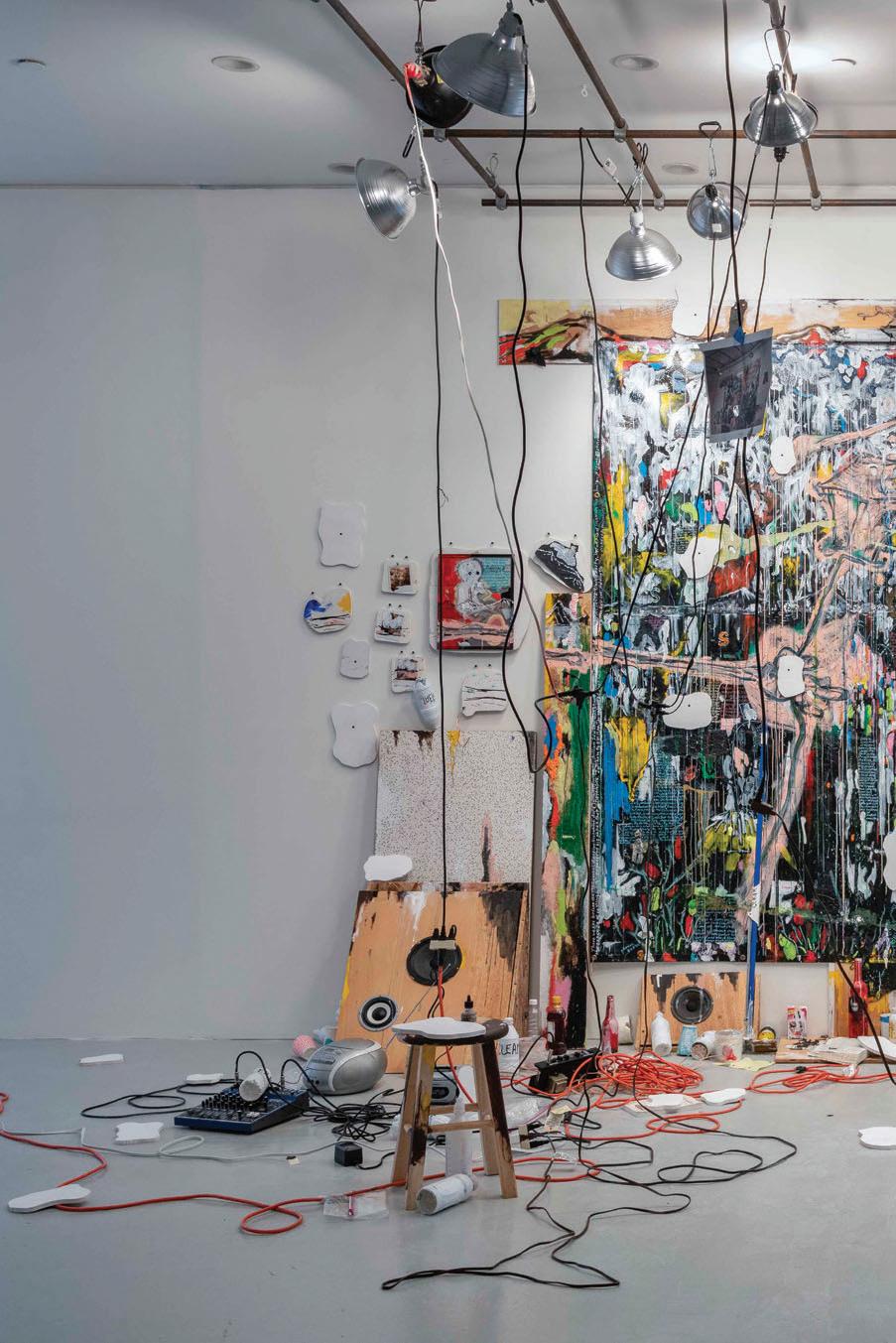
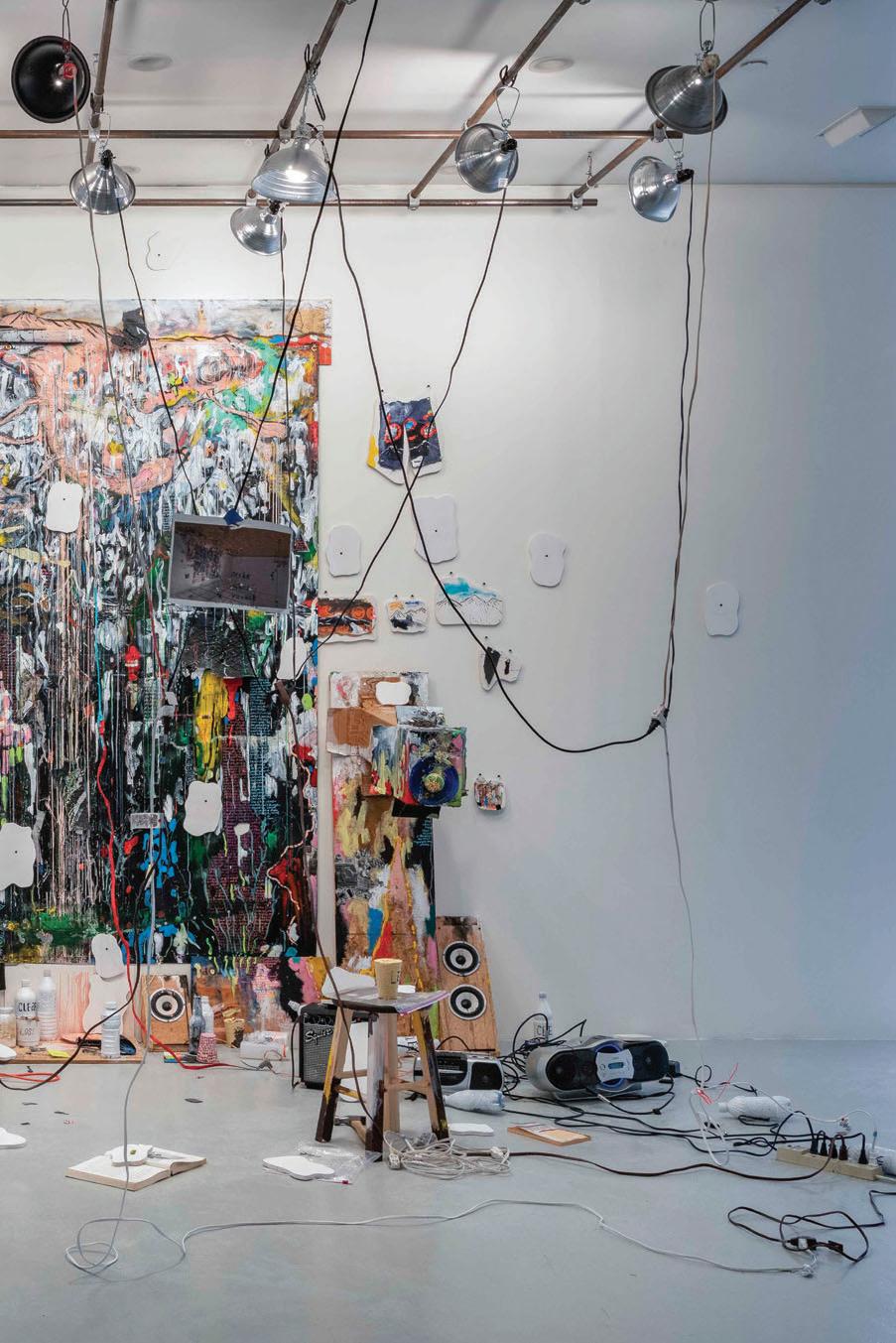
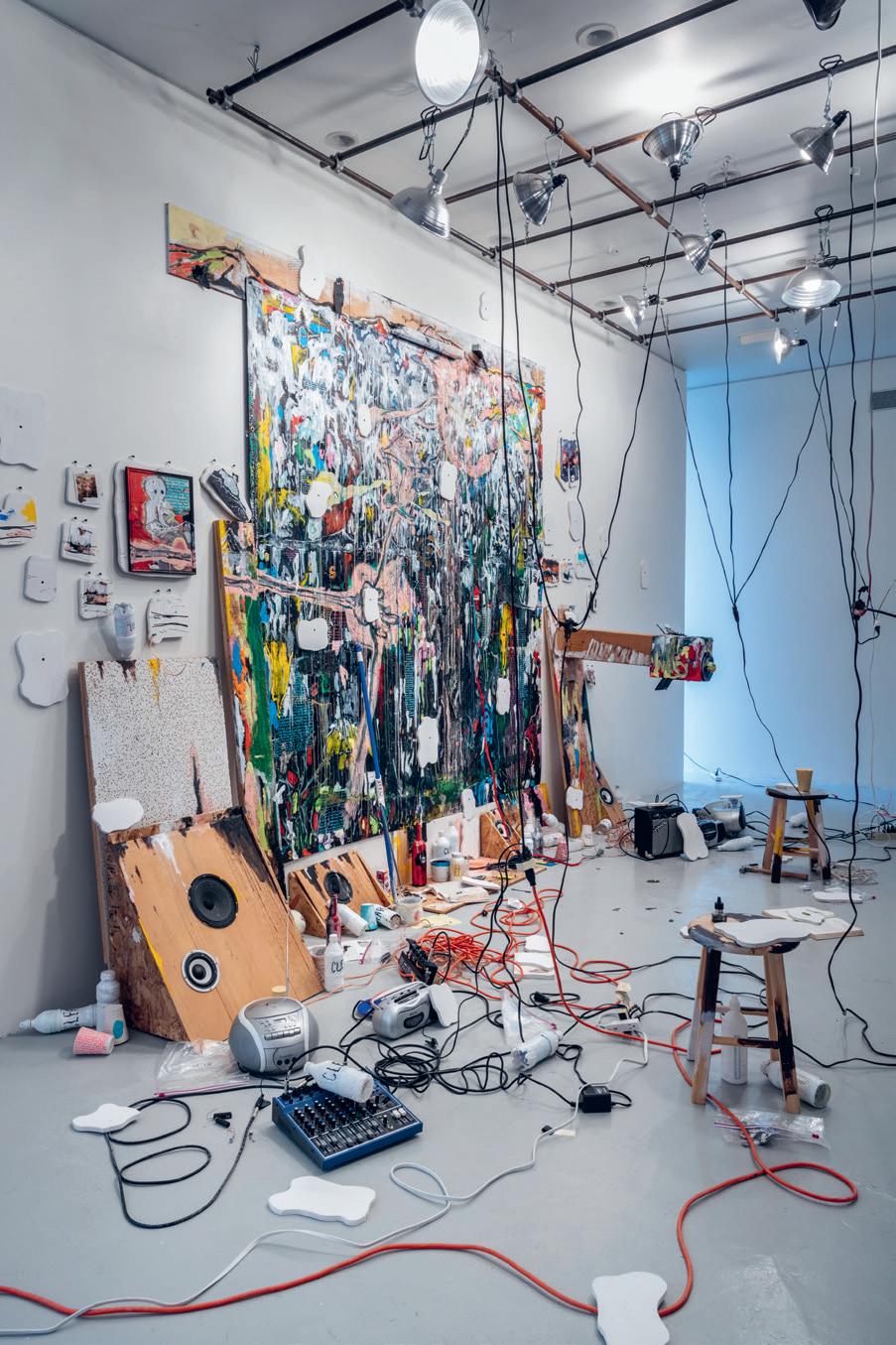
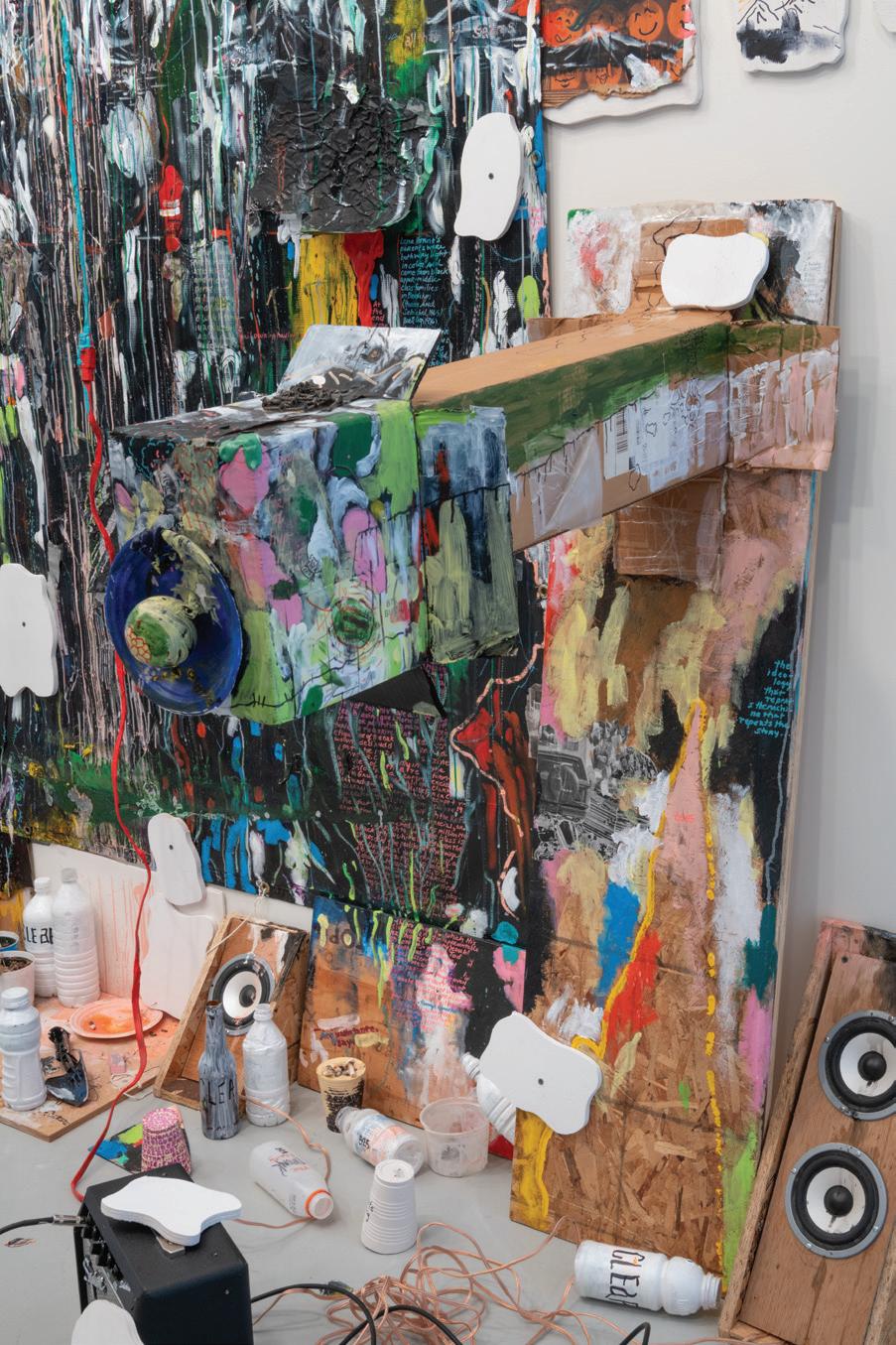
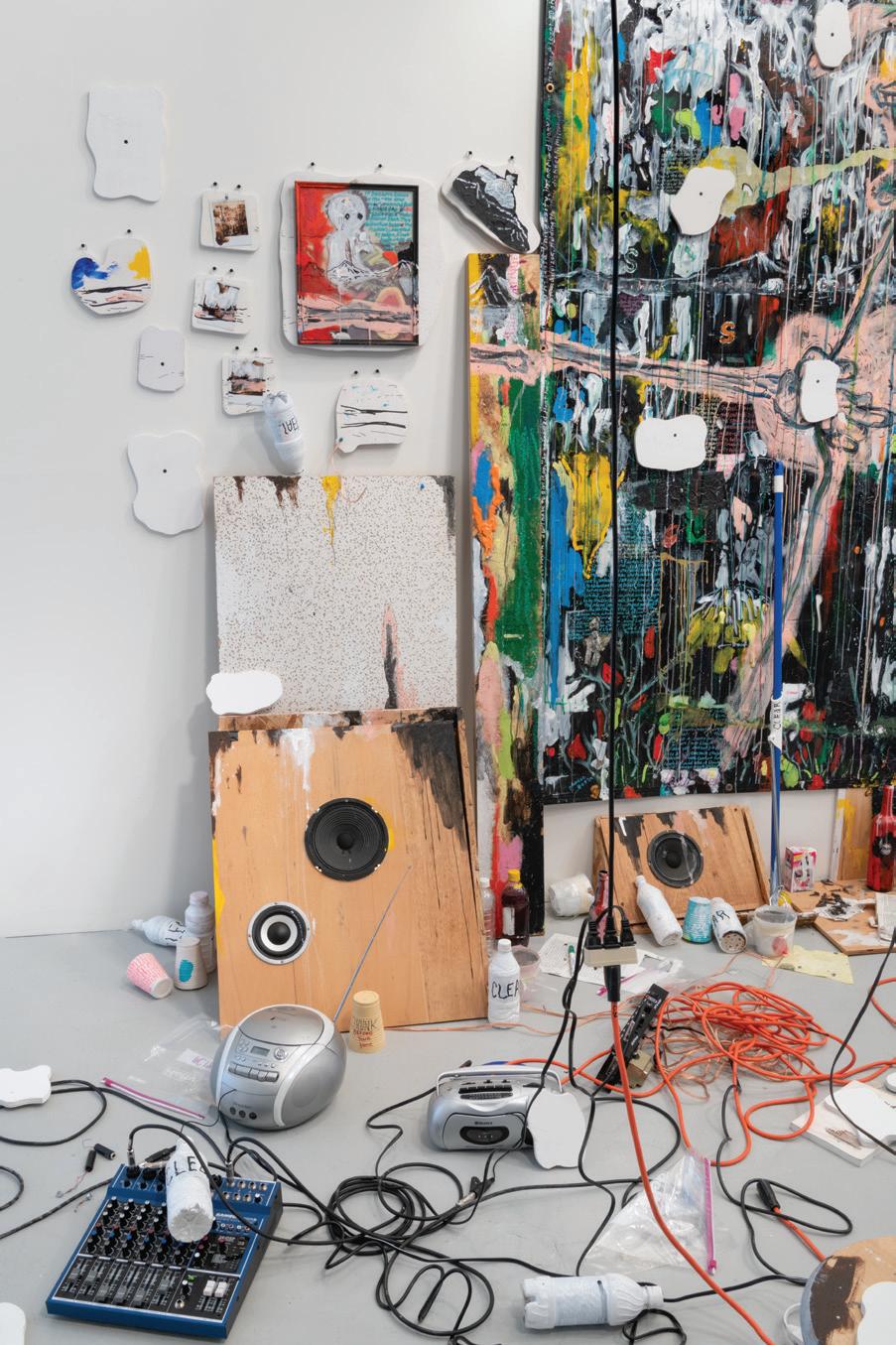
work is an interesting one. Relational Painting a.k.a. If Black Is Beautiful . . ., while titled as though its axis is two dimensional, is a multimedia installation, beginning or ending on a wall with a cobbled-together composition of things that look like paintings, as well as text, tacked-on sculptural elements, appendages and other objects that extend out into the room, and a sound composition of white noise and jungle sounds.
Relational Painting a.k.a. If Black Is Beautiful . . . has often been considered in terms of relational aesthetics. In these terms, the work explodes the traditional enclosed artwork such that it becomes participatory and “creates its social context.”2 But, as evidenced by this brief exchange in 2007, the work still appears to be experienced by some as more of an enclosed tableau, like a large diorama. If the work is indeed enclosed, then the work’s “relationality” might refer to its internal relations, the many elements that comprise it, and, in classic Pope.L style, their instability or insufficiency to make and fix meaning or form. Here, I will argue that we might do well to think the relationality, to which the painting’s title refers immanently, has less to do with the “relational aesthetics” characteristic of the 2000s contemporary art world and more to do with the relation of part to whole, both formally and anagogically. At the anagogic level, Pope.L pursues an inquiry into Black being and subjectivity, extending a line of questioning found in his other conceptual artworks from this period. This line of questioning has to do with both the “destabilization of meaning” and the experimentation with the possibility of Black collective identity.
It is most useful to first analyze the work from a distance, as audience members felt they were asked to. According to this handful of viewers, phenomenologically, Relational Painting apparently asks to be considered as its title dictates: as a painting. To this effect, we might first take note of the two sheets of printer paper included in the work, each featuring an image of Relational Painting. They both hang from wires, each attached by a single piece of blue painters’ tape, each paper showing a different shot of the work. These and the rest of the work’s foreground together suggest a connection to “meta-painting,” historically figured, following in its tradition of not only nesting recursive imagery within the picture
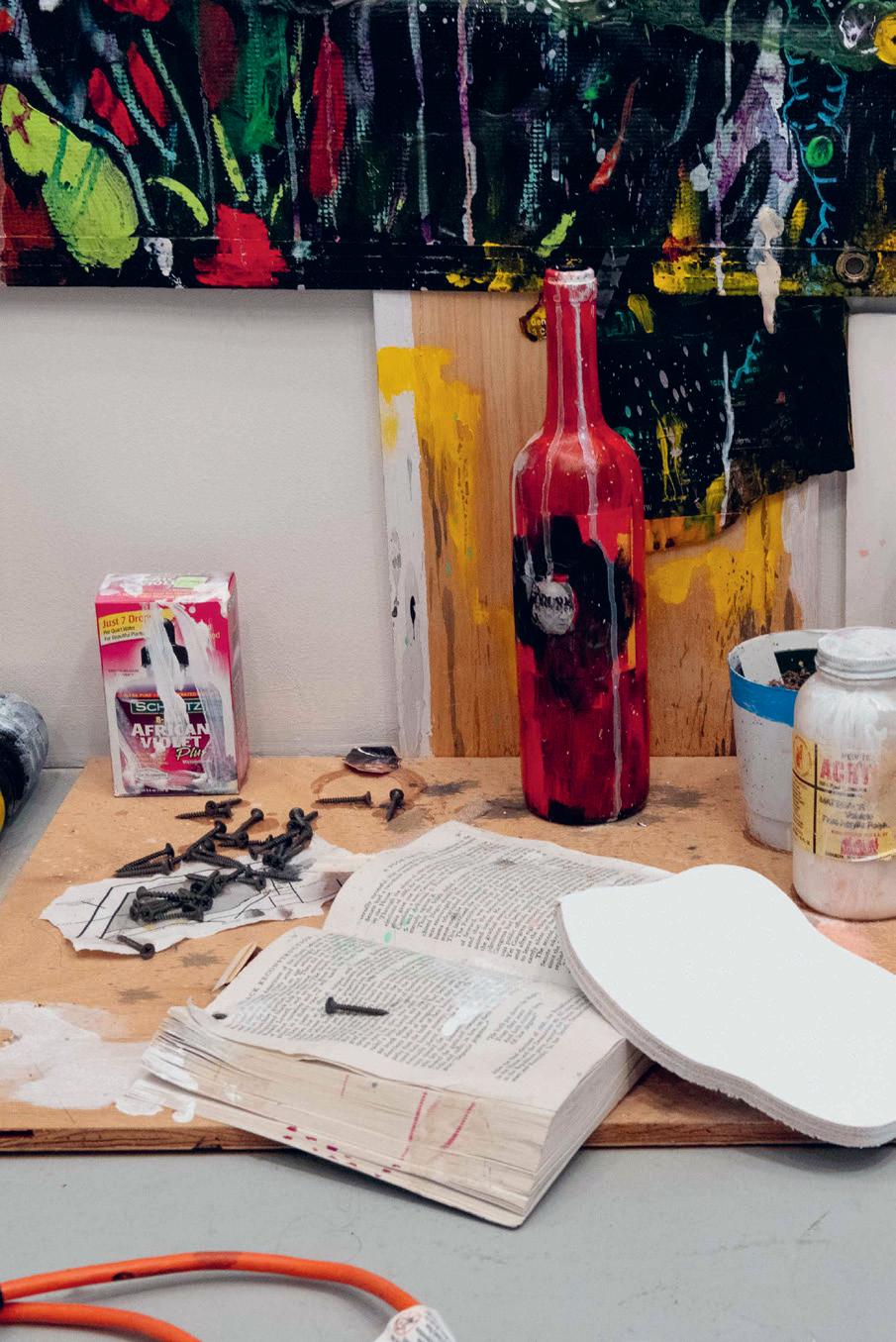
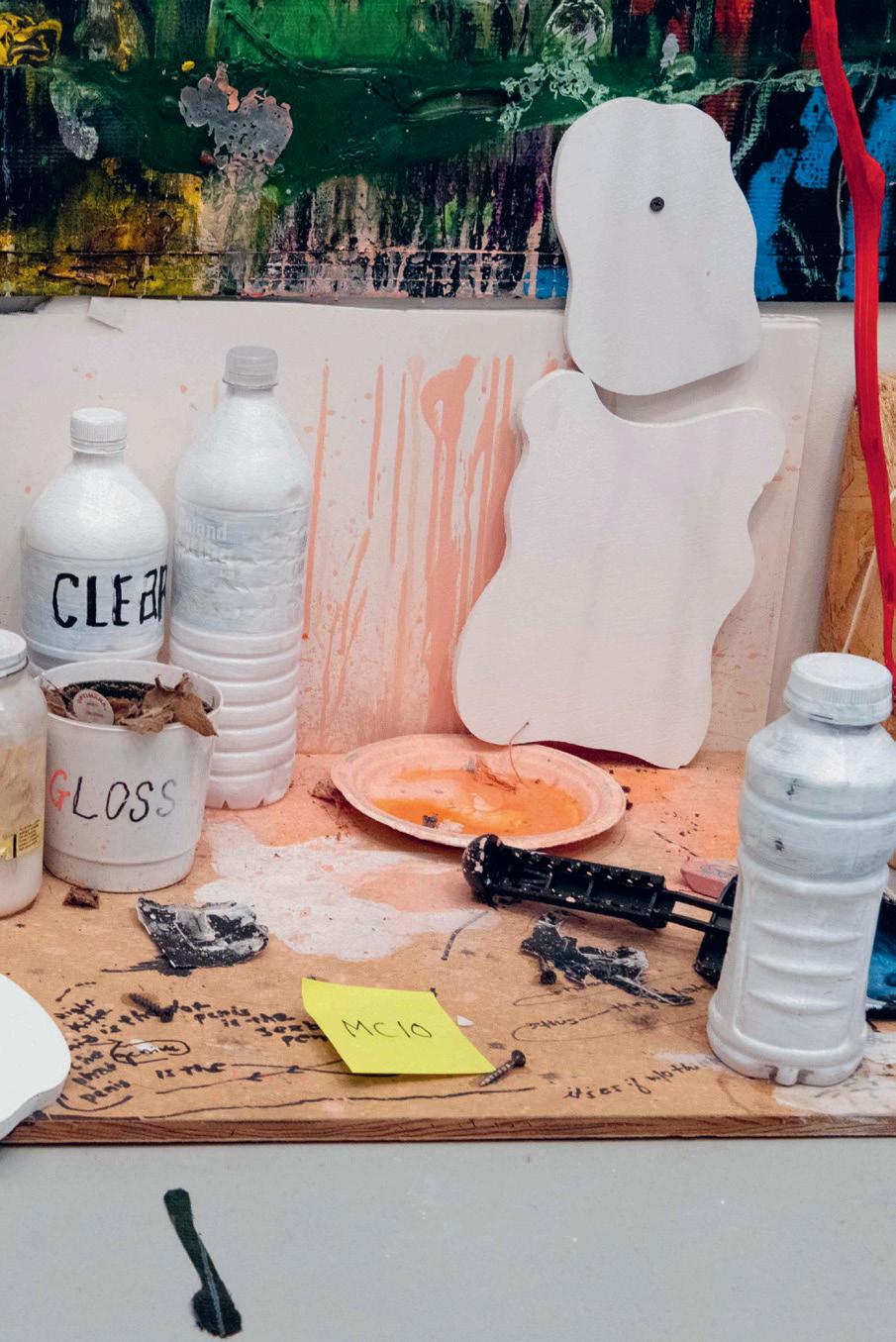
plane but also often setting such recursions within the artist’s studio environs. Relational Painting, taken as a whole, looks like an artist’s studio moved into the gallery. There are bottles and cups littering the floor in front of the wall; they look like the kind of receptacles you find in a painter’s studio, and, perhaps, they were in fact used by Pope.L in the production of this “painting.” At the same time, their exteriors—alternately bearing the words “ELIXIR,” “CLEAR,” and “GLOSS,” in large, neat handwriting—are uniform, doused in white paint. These could be functional labels, but they also feel tongue-in-cheek.
Close to the installation’s center, a squeegee rests against the painting’s surface, also labeled “CLEAR,” hinting at the arbitrariness of this labeling system. Functional as the setup is, it also seems to mock the studio and the gallery both. Returning our attention to the printed-out images, everything that sits behind them can be designated as part of the “picture.” The printed image hangs in front, as though it’s a reference image to paint from, as though it precedes the installation in front of us, though, logically, it cannot. This could be a joke about the artistic process, but it might also pose a serious question about indexicality, about how things are gathered formally and considered together, considered holistically as a thing.
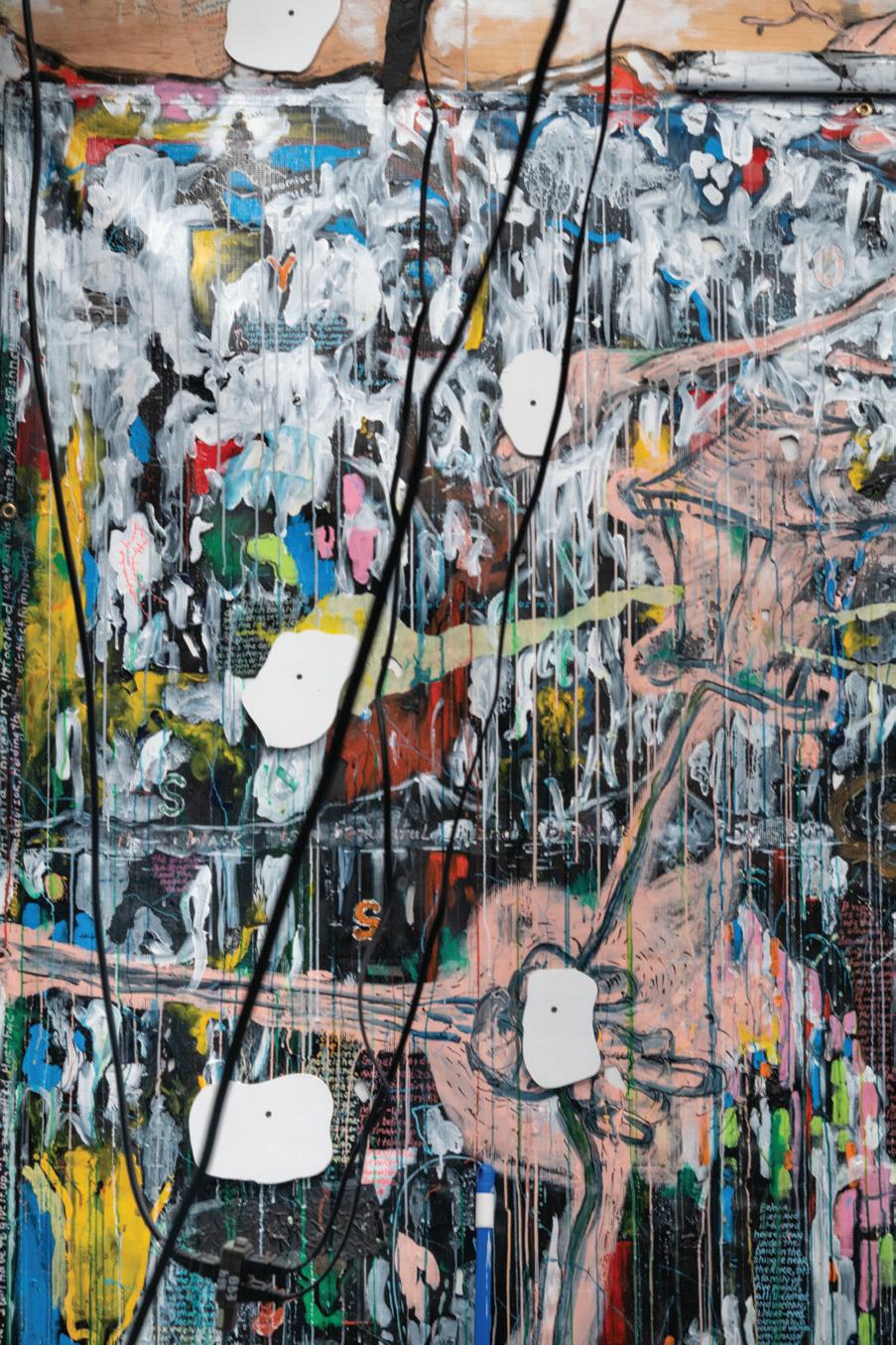
Pushing past the physical foreground and toward the actual painting, or wall-based components of the work, Relational Painting is relatively compositionally coherent, though physically fragmented across multiple surfaces. The various panels are linked by formal mechanisms, such as text, paint drips and splatters, and, stylistically, by Pope.L’s playful drawing and painting style, through which he has rendered smaller, more figural sections, most of which fall into the landscape genre. These various panels are most prominently connected by a shower of white paint and tacked-on wooden blobs, as well as sickly, flesh-pink forms and drippings. A skeletal arm enters the picture from its left edge, holding a standing lamp or streetlight; above it, an amorphous, organic shape hovers in the upper-right corner, just over the lamp’s shade. It looks sort of intestinal, like a stomach, liver, colon—a generic digestive mechanism. Painted in the same sickly pink as the rest of the “form”
that runs around the work, it recasts the other parts in the same pallor—like it’s all part of someone turned inside out, or at least part of the same system. The splatters of sick-pink elsewhere on the panels and dripping onto the wall increase the sense that something is being, or has been, processed or metabolized.
Pope.L’s interest in “abjection” is well-known. Defined by Julia Kristeva, the “abject” is “the jettisoned object,” that which is “radically excluded and draws [one] toward the place where meaning collapses.”3 In art and aesthetics, abjection has often been objectified and reduced to mere reference to the filthy, dead, and dying, the all-around gross. Pope.L’s forms participate in this register, but his interest in the abject must be considered primarily as an engagement with this impossibility of meaning, the disturbance of “identity, systems, [and] order.”4 Performance works, such as his crawls, exemplify this par excellence, literally and figuratively disturbing the order of social space as well as implicit logics of high and low culture, class, and literal distance from the ground. Relational Painting also mobilizes the abject—beyond its mess and grubby flesh tones. The work performs a similar function to Pope.L’s performances, disturbing identity at multiple levels. Here, Pope.L asks us to consider this clearly fragmentary thing—a bricolage, perhaps—as a unit, or to consider whether to consider it as such. Can this thing, whatever it is, be a whole?
This same inquiry steers the work conceptually and produces a political-psychological tension. Relational Painting was produced just one year after the conception of Pope.L’s touring project, The Black Factory (2002–09), and during another multiyear and multi-platform project distributingmartin (2000–08), both of which found the artist directly working on the question of Blackness’s constitution and circulation. These two works, both web-based and dispersed in real social space through performance, advertising, and sculpture, were meant to operate as a pair, but Relational Painting a.k.a. If Black Is Beautiful . . . could retroactively be inserted as a third term, making a trio. The works share a suspicion of prevailing narratives around Blackness, preferring instead to investigate and upend them—not by offering an alternative, “true” narrative, pro-Black or otherwise—but by making impossible
any claim to truth when it comes to the meaning of Blackness or such meaning’s structure. The very title of this work sets this up; it is the first term of a hypothesis—“If Black is Beautiful . . .” It is not a declaration that Black is beautiful, in the style of the refrain that emerged from 1960s Black radicalism, but a conditional statement. And forming the second half of the title, one must conclude that the relation between this “if” and its unspoken “then” must be one of the “relations” at issue for Pope.L.
If The Black Factory and distributingmartin can provide us with any insight into how exactly Pope.L might be thinking of this relation, what they offer is a vision of Blackness without subjects. In The Black Factory, Blackness is configured as a product or series of products brought into the world through industrial production, or at least a process that can be analogized to industrial production. Blackness is figured as a series of commodities used to mark an identity and, therefore, is presented as largely inorganic. In distributingmartin, something similar happens, though here the inquiry is tethered to one great, Black individual—questioning the “relationship between [Martin Luther] King [Jr.] as concept and [Martin Luther] King [Jr.] as a singular body.”5 The work traces Pope.L’s semi-fictional efforts to disperse Martin Luther King Jr. widely—through postering projects, the supposed injection of his DNA into grocery store fruit, the dispersal of this same matter through an “aerosol system,” and more. What makes Martin Luther King Jr. Martin Luther King Jr.? Pope.L plays with ironically positing that it is not the deeds that make the man, but his hair, skin, fingernails, genetic code, cock, and that anyone can become a little more like him by being infused with or penetrated by him.
The distributingmartin work speculatively inverts The Black Factory’s ontology of Blackness. On one end, the Black subject is defined as radically material, radically organic, perhaps calling to mind Hortense J. Spillers’s notion of “flesh” as anterior to the “body,” which describes the “total objectification” of the “captive body,” as well as the effect of producing a subject that is “absent from a subject position.”6 On the other, the Black subject is radically produced through and circumscribed by an ideologicalmaterial assemblage, which is intrinsically entangled in logics of
capitalist production. Further, in distributingmartin, the Black subject is established as a singularity that can be dispersed and replicated ad infinitum—perhaps centrifugally, from flesh-subject outward toward the world—while in The Black Factory, the subject is approached from the out-in, and Blackness is approached as a totality, constructed by a really-existing centripetal force.
Relational Painting also considers the production, reproduction, and circulation of Blackness, but dispenses with analogies of the factory or the body. Instead, it directly approaches the operations of Black identity as a negotiation with a profound “lack,” a lack that subtends the void at the center of subjectivity in Lacanian psychoanalysis, and which Pope.L has magnified and mobilized in his anti-programmatic “hole theory.” Put differently, in Relational Painting, and across all his work, Pope.L is interested in a kind of ur-lack, a lack that precedes and encompasses all other instances of lack—which is not only psychoanalytic and ontological, but also a “political condition”7 connected to Blackness and, for him, embodied by the “hole.” For him, Blackness can be figured as “a lack worth having.”8 This lack necessarily poses a problem for a visual artist such as Pope.L. How can one engage lack and engage art from its position without plastering over it, just as the psyche unwittingly attempts to? Or, in “Pope.L-ian”9 terms, how can one deal with or embody this lack or the hole that embodies it without “picturing it”? To represent the hole would be the same as its disavowal, a misrecognition. Whereas a work like The Black Factory intentionally and critically models a series of misrecognitions—or, dealing in the realm of commodities, we could also call them reifications—and where distributingmartin uses satire to do the same, Relational Painting directly explores the management of this lack through visual, textual, and object relations.
Relational Painting uses the painting as a model for testing the ways that Blackness-as-lack is given form in the world. Perhaps through the boundedness of “painting” as a frame, its removal from the world of economics and politics, Relational Painting drops down a layer, acting at the level of theory rather than aesthetics or narrative, and circumvents any attempt to produce something that directly corresponds to Blackness or the subjective experience of
being Black. It is removed in that “painting” is phenomenologically bracketed and might be related to, but cannot be considered continuous or coextensive with, such concerns as the economic and political. Where the “relational” of “relational aesthetics” poses such continuities, “relational painting” poses a paradox. If this work, Relational Painting, must be considered coextensive with or related to the world, it is so only as the operations of the psyche can be continuous with the world, through various alienated processes. In Relational Painting, we get Blackness-as-lack’s sublimation, repressions, its bubbling up in other forms.
As such, we might say that Relational Painting borrows its structure from language, borrows the structure of the unconscious— operates as but does not refer to or reflect the unconscious. Relational Painting does, or shows, the work of giving form to the subject— individual or collective. At the risk of stating the all-too-obvious, the texts throughout the work signal this, not by virtue of being text and being present, but by their contents and execution; Pope.L incorporates texts by transcribing them onto the painting’s surface in both fragments and whole passages. For example, the artwork’s title is scattered across the main black vinyl tarpaulin, which also includes lengthy passages about actress Lena Horne’s racial and economic background, as well as unattributed quips like “Africa is a continent not a mirror.” He also includes physical books, such as W. E. B. Du Bois’s Black Reconstruction in America, which lies open to a page containing a passage from the Magnificat: “He hath put down the Mighty / From their seats / And hath exalted them / Of low degree!”10 This text and the others wrestle and tend to exalt a “lack across economic and cultural and political boundaries,”11 but they remain the material of the work, never coming together to erect a meaningful structure, never providing a “then” to the “if.”
Further, in many cases, the text is unreadable, text for text’s sake. These moments appear to hold the promise of analogy, but all they offer are stoppages and dead ends, hanging clauses. Or, in Kristevan terms, Relational Painting might figure “a yearning after Meaning together with its absorption, ingestion, digestion, and rejection.”12
Even the work’s invocation of Black historical figures, like Du Bois and Horne—others who get a nod: O. J. Simpson, by way
of Darnell M. Hunt’s book, O. J. Simpson Facts and Fictions: News Rituals in the Construction of Reality—does miraculously little to lend the work legibility. Other artworks might openly pay homage to or reference a “great” to affectively define the work, lend it purpose, give it historical roots, or place it in a genealogy. Especially in the case of Black artworks of the twentieth and twenty-first centuries, we might call this an appeal to what Cedric J. Robinson calls the “historical being.” In Black Marxism, he writes of this form of being as part of “preserv[ing] the ontological totality” of Black people, meaning the maintenance of a kind of hereditary revolutionary consciousness and commitment to collective resistance. Relational Painting might then seem to subordinate its noted, notable individuals to the work and, thus, to the “ontological totality.” (After all, Maurice Merleau-Ponty once offered that painting itself models historical being.15)
However, the treatment of these figures is difficult to slot into a metaphysics like Robinson’s, where history trumps actuality—“actual being” having been renounced in its favor. Rather, they appear to function as material rather than citations, lending themselves to the complexity of the object rather than its elucidation of any specific political or identitarian outlook. Perhaps there could be some overlap between Du Bois’s Black Reconstruction and Betty Wood’s The Origins of American Slavery, but there are definite contradictions and divergences between the two books published decades apart. Black Reconstruction signals one thing in isolation, but another when placed in conversation with Wood’s text; but in both cases, in Relational Painting, the books are presented to the viewer as mute, fixed objects, conveying minimal information through their display in this context. All of this is to say that Relational Painting comes to represent, if anything, a tension between actual and historical being, a mutual dependence between theory and history, a radical contingency.16
Like the viewers who kept their respectful distance, I write this having never come nose to nose with Relational Painting—and so this essay has been written from a phenomenologically reduced, but honest position—an especially and appropriately limited epistemological view. However, the catalog for Drawing, Dreaming,
Drowning tells us that somewhere in the work is the line of text: “If black is beautiful and beauty is only skin deep then blackness is not all that it seams.”17 This, then, is at least one of the conclusions we can draw from Pope.L’s initial hypothesis. The statement echoes Pope.L’s declaration a few years earlier: “I am interested in holes because I am wounded by absence. Marked by this trauma, I have a choice. Either be ruled by circumstance or be circumstance.”18 Together, these would seem to suggest that what matters most are the fault lines, the gaps, the “seams”—not appearances. Neither the part (the individual) nor the whole (“the ontological totality”), but the ever-shifting relation between the two, posing Blackness and its ultimate lack as its “actual being,” as nothing other than sheer circumstance.
1. Eric Wenzel, “William Pope.L: Drawing, Dreaming, Drowning,” Art or Idiocy? (October 2007), artoridiocy.blogspot.com/2007/10/william-popel-drawingdreaming-drowning.html.
2. Wenzel, “William Pope.L.”
3. Julia Kristeva, “Approaching Abjection,” in Powers of Horror: An Essay on Abjection, trans. Leon S. Roudiez (Columbia University Press, 1982), 2.
4. Kristeva, “Approaching Abjection,” 3.
5. “distributingmartin,” Net Art Anthology, Rhizome, anthology.rhizome.org/ distributing-martin.
6. Hortense J. Spillers, “Mama’s Baby, Papa’s Maybe: An American Grammar Book,” Diacritics 17, no. 2, Culture and Countermemory: The “American” Connection (Summer 1987): 67.
7. William Pope.L, Hole Theory (Parts: Four & Five), facsimile of artist’s book, edition 9/10 (2001–21), 9.31.
8. Darby English, “The Aesthetics of Dispossession: William Pope.L’s Performance Interventions,” in How to See a Work of Art in Total Darkness, ed. Darby English (MIT Press, 2007), 259.
9. As often invoked by my friend and Pope.L enthusiast, the sculptor Louis Osmosis.
10. W. E. B. Du Bois, Black Reconstruction in America (Oxford University Press, 2014), 321.
11. Pope.L, Hole Theory, 9.4.
12. Kristeva, “Approaching Abjection,” 136.
13. Cedric J. Robinson, Black Marxism: The Making of the Black Radical Tradition (University of North Carolina Press, 2000), 168.
14. Robinson, Black Marxism, 168
15. Maurice Merleau Ponty, quoted in Galen A. Johnson, “Merleau-Ponty’s Early Aesthetics of Historical Being: The Case of Cézanne,”Research in Phenomenology 17 (1987), 213.
16. Worth noting in relation to this work are David Joselit’s comments on Jutta Koether’s Hot Rod (after Poussin) (2009), exhibited at Reena Spaulings Fine Art in 2009. Joselit wrote that “instead of attempting to visualize the overall contours of a network, [Koether] actualizes the behavior of objects within networks by demonstrating what I would like to call their transitivity.” David Joselit, “Painting Beside Itself,” Slash Seconds, September 17, 2017, slashseconds.co.uk/david-joselit/16/515/submission/painting-beside-itself-text. An analysis of Pope.L’s Relational Painting in terms of networks would be warranted, and perhaps doing so could lead to a compelling argument about whether “network” can only be applied to overtly rational systems.
17. Wenzel, “William Pope.L.”
18. Pope.L, Hole Theory, handwritten page between 9.1 and 9.2.
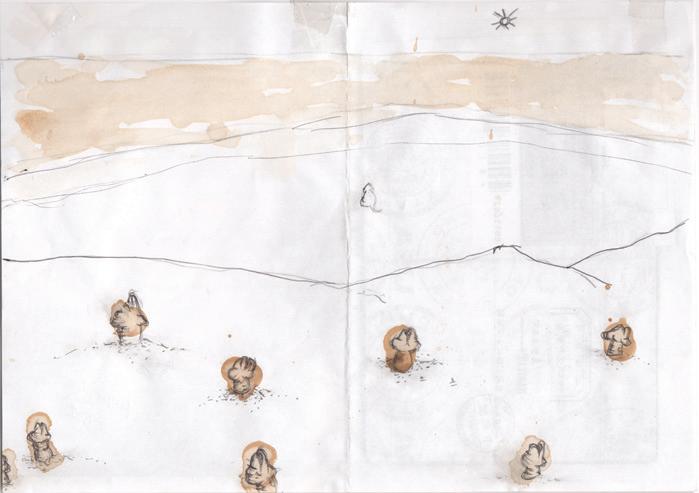
PL. 106, Sino Drawing (2 of 8), 2001
FROM LEFT TO RIGHT
PL. 107, Sino Drawing (4 of 8), 2001
PL. 108, Sino Drawing (5 of 8), 2001
PL. 109, Sino Drawing (6 of 8), 2001
PL. 110, Sino Drawing (7 of 8), 2001
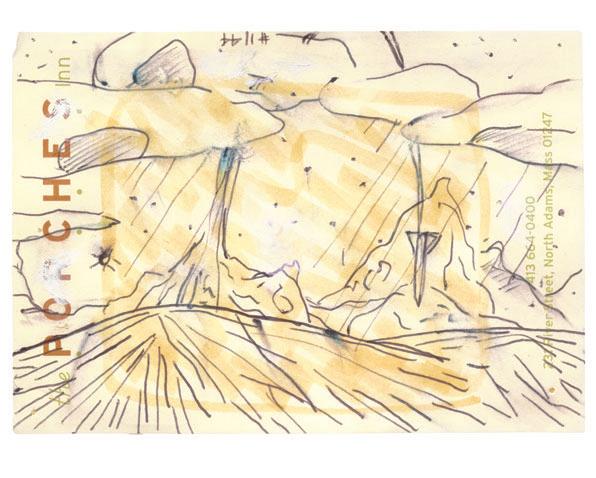
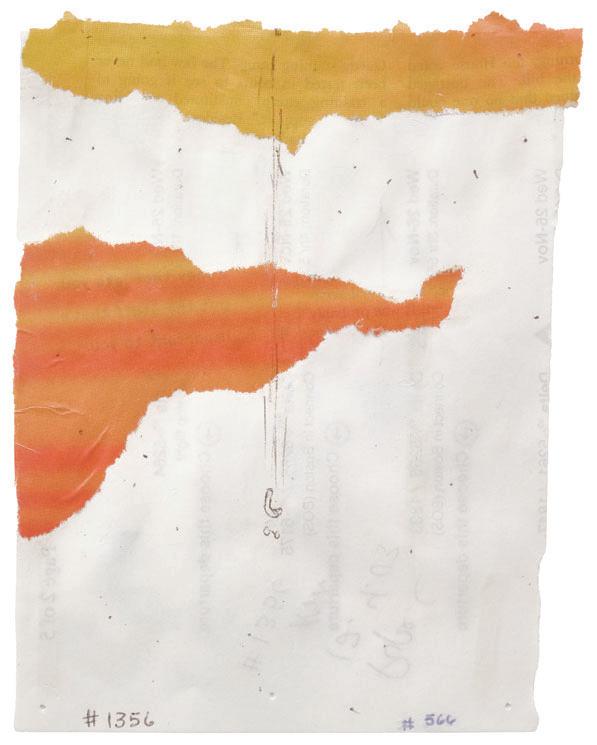
PL. 113, Failure Drawing #1356, 12.4.03, An Orange Sky, 2003
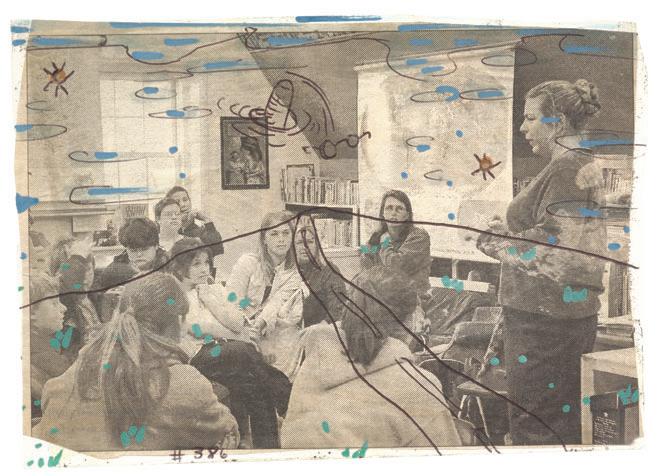
PL. 114, Failure Drawing #386, 2003, 2008, Worm in Class, 2003, 2008
PL. 115, Failure Drawing #738, 1.04, House and Leap, 2004
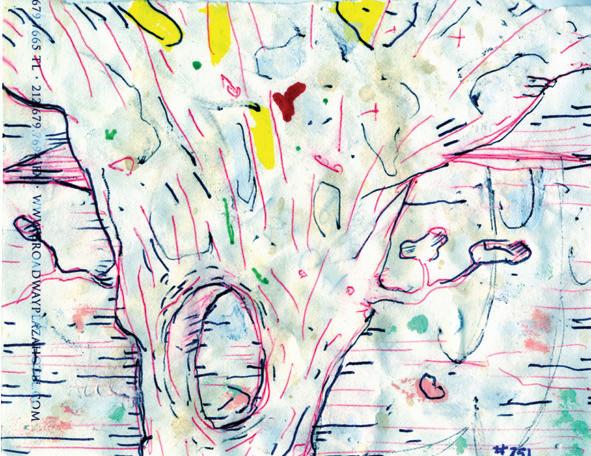
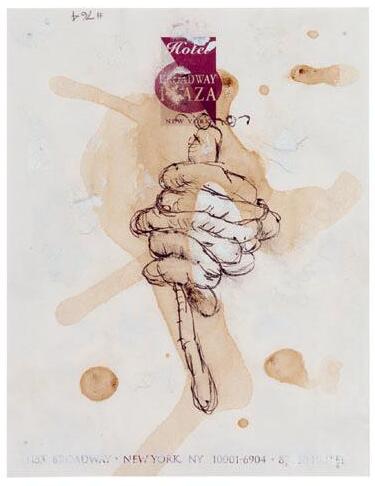
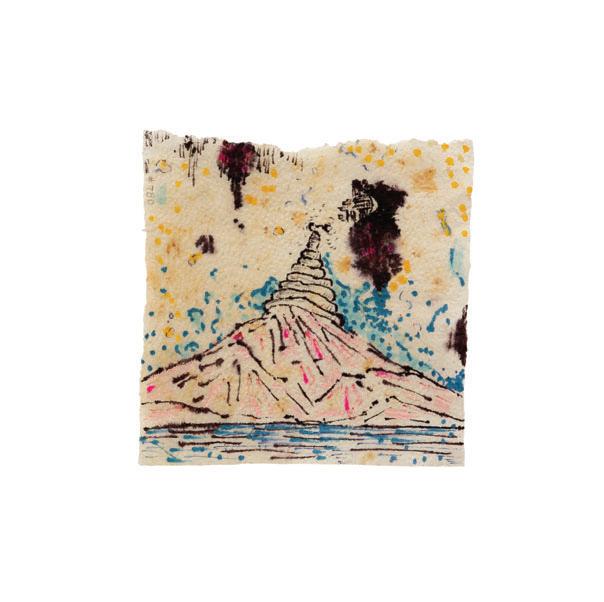
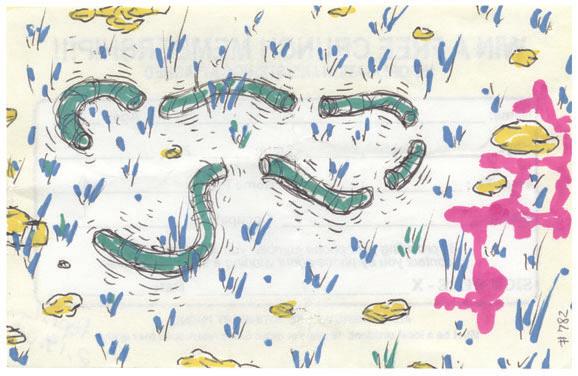
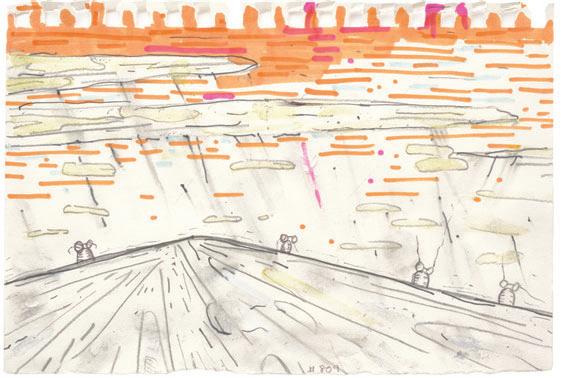
PL. 119, Failure Drawing #782, 2.14.04, Penis Segments on Grass, 2004
PL. 120, Failure Drawing #809, 3.0.04, Communicating With the Mourning, 2004
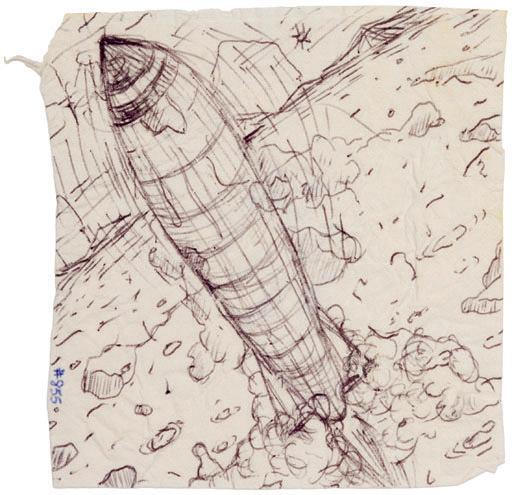
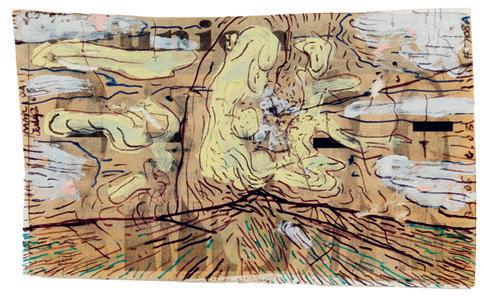
PL. 122, Failure Drawing #708A, 3.04, 6.05, 7.2.05, 7.6.05, 3.27.06, Even the Mountain is Ash, 2004–06
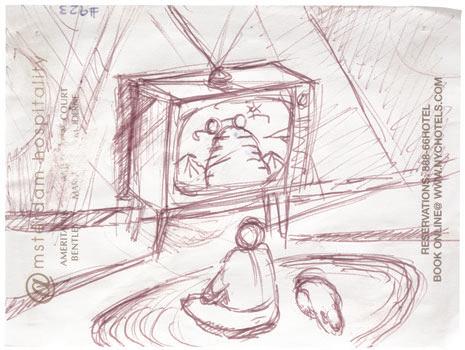
PL. 123, Failure Drawing #923, 4.6.04, Snake on TV, 2004
FROM LEFT TO RIGHT
PL. 124, Failure Drawing #950, 4.11.04, 4.12.04, 4.19.04, Roadside with Yellow and Blue Sky, Lewiston, 2004
PL. 125, Failure Drawing #962, 4.12.04, Rocket Over Road, Cardboard, 2004
PL. 126, Failure Drawing #963, 4.12.04, 4.19.04, Black Marker Rocket, Legal Paper, 2004
PL. 127, Failure Drawing #1090, 5.15.04, Spectacled, 2004
FROM LEFT TO RIGHT
PL. 128, Failure Drawing #1224, 6.26.04, 7.2.07, Rocket Into Copy, 2004
PL. 129, Failure Drawing #266, 7.12.04, 7.28.04, 4.22.05, 3.20.06, 4.14.06, 7.28.04, Between Cliffs Some Penis Must Fall, 2004–06
PL. 130, Failure Drawing #275, 7.29.04, 4.22.05, 6.9.06, 6.10.06, 6.11.06, There Is the Sadness With Hair, 2004–06
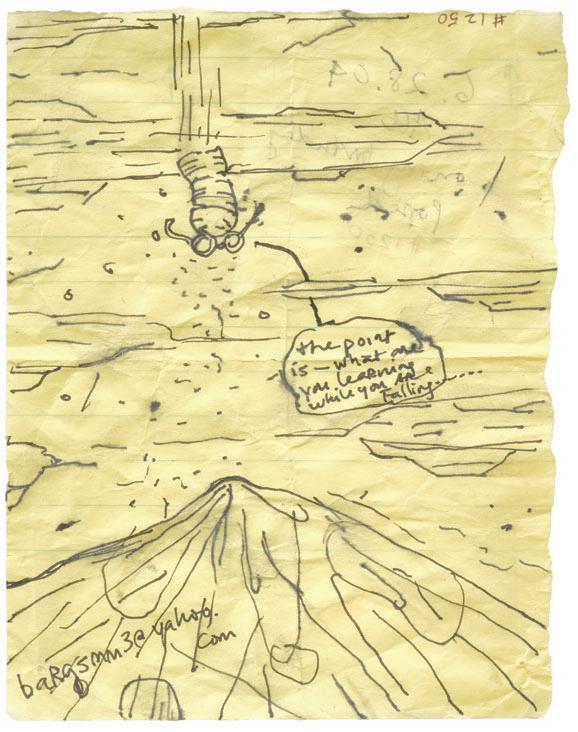
PL. 131, Failure Drawing #1250, 6.25.04, The Point Is…, 2004
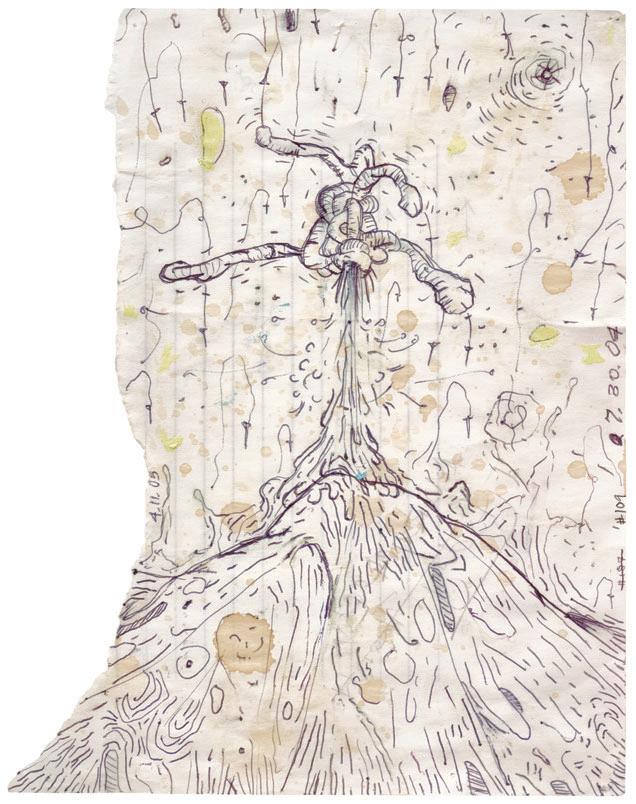
PL. 132, Failure Drawing #109, 7.30.04, 4.11.05, Geyser With Sun, 2004–05
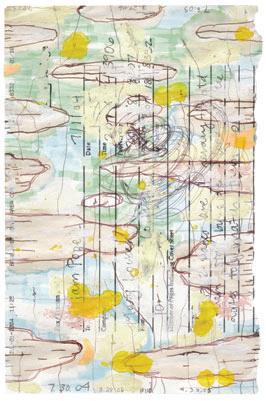
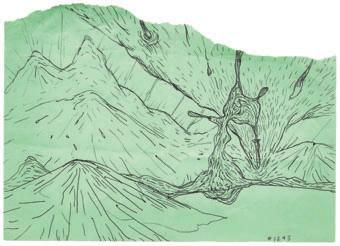
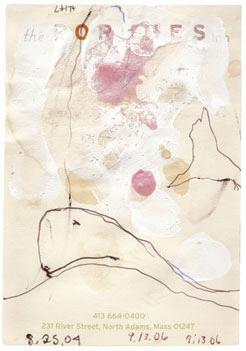
FROM LEFT TO RIGHT
PL. 133, Failure Drawing #110, 7.30.04, 4.22.05, 7.6.05, 7.8.05, 3.28.06, 3.29.06, Rocket Fumble, Yellow, Green, Blue Sky, 2004–06
PL. 134, Failure Drawing #147, 8.25.04, 9.13.06, 9.13.06, Porches Whale Memo, 2004, 2006
PL. 135, Failure Drawing #1243, 6.27.04, Sputum In The Mountain, Albany Best Western, 2004
PL. 136, Failure Drawing #1141, 5.27.04, A Simple Return, 2004
FROM LEFT TO RIGHT
PL. 137, Failure Drawing #361, 3.22.04, Rocket Fall, the Night Receives, Pittsburgh, 2004
PL. 138, Failure Drawing #964, 4.19.04, 4.28.04, 5.18.04, 5.21.04, Looking Back at the Sun, 2004
PL. 139, Failure Drawing #1231, 6.26.04, 6.27.04, Phallus Sweat, Albany, 2004
FROM LEFT TO RIGHT
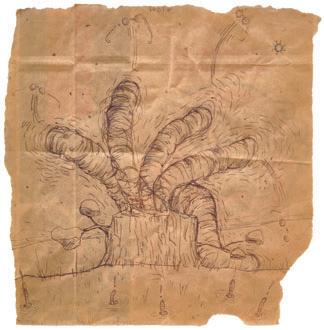
PL. 140, Failure Drawing #1249, 6.28.04, Stump, Albany, NY, My Birthday. The End of the World, 2004
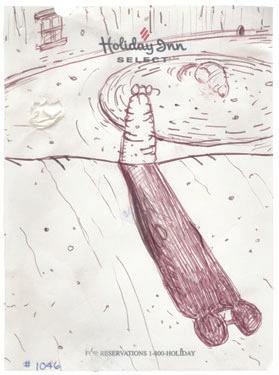
PL. 141, Failure Drawing #1046, 4.28.04, 5.21.04, Worm, Dog, Shadow, 2004
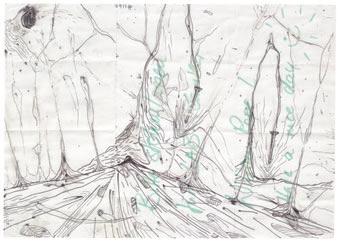
PL. 142, Failure Drawing #1160, 6.6.04, 6.7.04, Stalagmites Green Writing, 2004
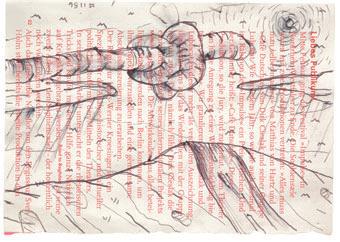
PL. 143, Failure Drawing #1156, 6.4.04, 6.5.04, Libes Publikum Tangle, Berlin, 2004
FROM LEFT TO RIGHT
PL. 144, Failure Drawing #952, 4.11.04, 4.12.04, Rocket Falling and Worm Holes Or?..., 2004
PL. 145 Failure Drawing #1146, 5.31.04, 7.2.07, Igloos, 2004–07
PL. 146, Failure Drawing #1062, 5.3.04, 5.18.04, 5.25.04, Near the City, 2004
PL. 147, Failure Drawing #208, 1.29.05, 2.16.05, 4.10.05, And The Sky . . ., 2005
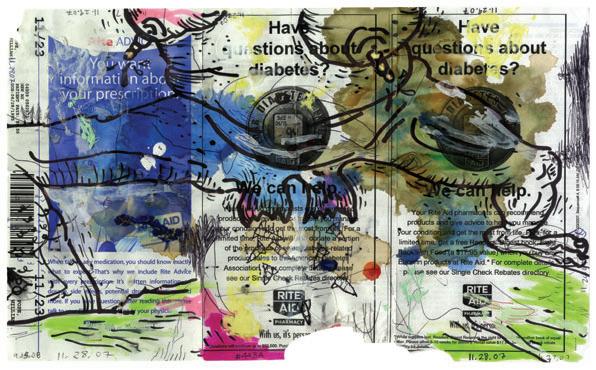
PL. 150, Failure Drawing #443A, 1.27.07, 11.20.07, 11.26.07, 11.27.07, 11.28.07, 11.28.07, 11.29.07, 11.29.07, 11.29.07, 9.15.08, Half Question, 2007–08
PL. 151, Failure Drawing #444, 2.05.07, 7.6.07, 7.7.07, 7.8.07, 7.16.07, 5.24.09, 5.26.09, 5.27.09, 5.28.09, 5.29.09, 5.31.09, Positive Growth, 2007, 2009
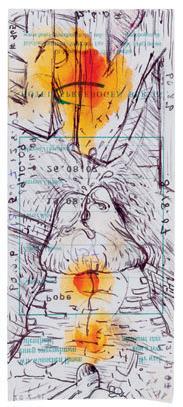
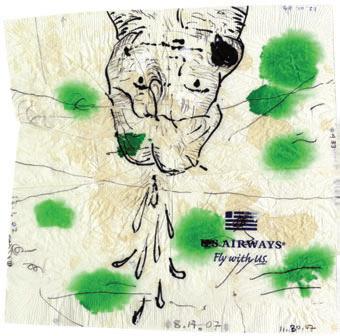
FROM LEFT TO RIGHT
PL. 154, Failure Drawing #459, 7.26.07, 7.29.07, 12.25.07, 12.26.07, 12.27.07, 4.30.09, 4.30.09, 5.8.09, 5.10.09, Mobile, 2007, 2009
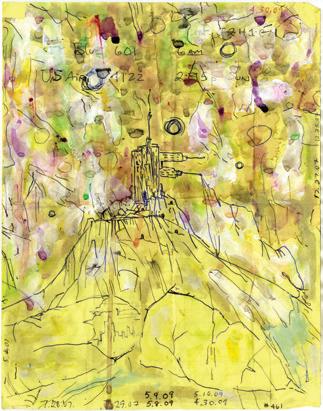
PL. 155, Failure Drawing #461, 7.28.07, 7.29.07, 12.24.07, 12.27.07, 4.30.09, 4.30.09, 5.8.09, 5.8.09, 5.9.09, 5.10.09, Too Many Suns, 2007, 2009
PL. 156, Failure Drawing #465, 8.8.07, 8.18.07, 12.5.07, 12.6.07, 12.7.07, 12.8.07, 12.9.07, 9.06.09, 9.8.09, 9.10.09, 9.16.09, To Forget, 2007, 2009
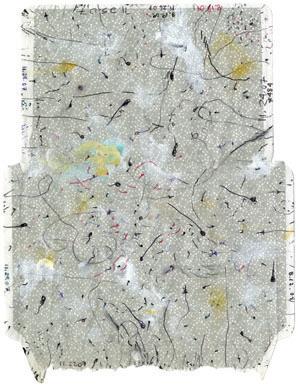
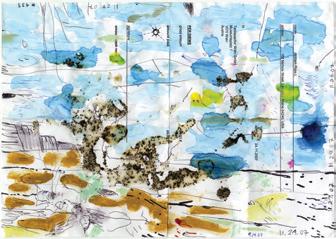
PL. 157, Failure Drawing #433, 8.14.07, 8.14.07, 11.30.07, 12.01.07, 12.01.07, Toupee, 2007
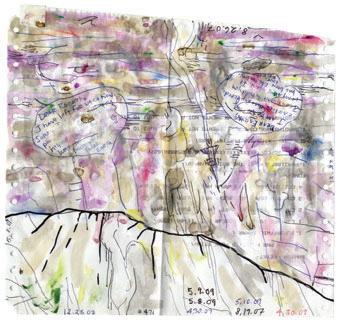
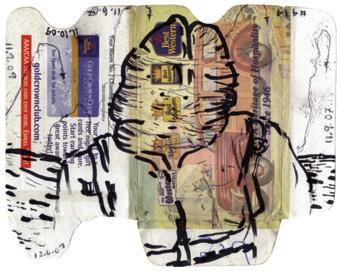
FROM LEFT TO RIGHT
PL. 158, Failure Drawing #471, 8.19.07, 8.26.07, 12.25.07, 12.27.07, 4.30.09, 4.30.09, 5.8.09, 5.8.09, 5.9.09, 5.10.09, Correspondence, 2007, 2009
PL. 159, Failure Drawing #434, 11.6.07, 11.6.07, 11.9.07, 12.6.07, 11.9.09, 11.10.09, Walking Home from the Corner Grocery, 2007, 2009
PL. 160, Failure Drawing #484, 11.24.07, 11.25.07, 11.26.07, 11.27.07, 11.29.07, 11.29.07, 8.12.09, 8.18.09, 8.19.09, Mark Making, 2007, 2009
PL. 161, Failure Drawing #439, 11.24.07, 11.25.07, 11.27.07, 11.28.07, 11.29.07, 9.14.08, Per Diem, 2007–08
FROM LEFT TO RIGHT
PL. 162, Failure Drawing #485, 11.24.07, 11.27.07, 8.28.09, 8.29.09, 8.29.09, 8.30.09, Sweater Vest, 2007, 2009
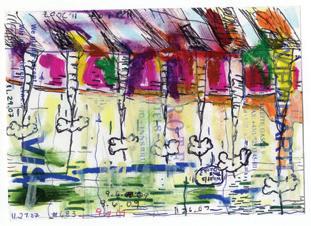
PL. 163, Failure Drawing #683, 11.24.07, 11.26.07, 11.26.07, 11.27.07, 11.29.07, 9.4.09, 9.6.09, 9.6.09, This Dark on Skewers, 2007, 2009
PL. 164, Failure Drawing #414, 12.12.07, 12.14.07, 12.14.07, 12.14.07, Party, 2007
PL. 165, Failure Drawing #695, 12.12.07, 12.14.07, 12.15.07, Landscape with Two Keyboards and Several Rockets, 2007
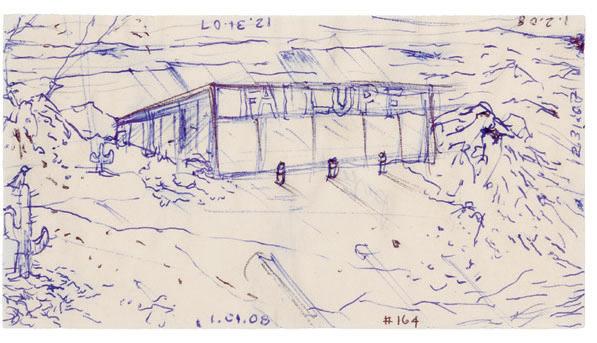
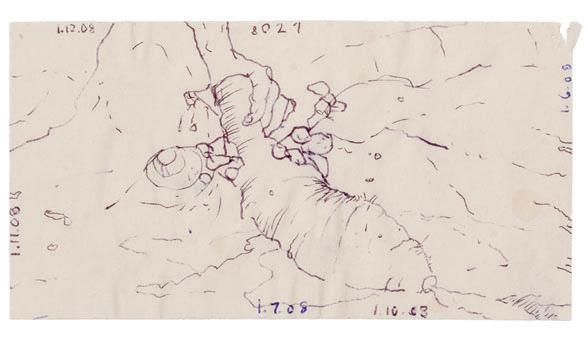
PL. 167, Failure Drawing #164, 12.31.07, 12.31.07, 1.1.08, 1.2.08, Convenient Store, 2007–08
PL. 168, Failure Drawing #531, 1.6.08, 1.7.08, 1.7.08, 1.10.08, 1.11.08, 1.12.08, Rock Formation, 2008
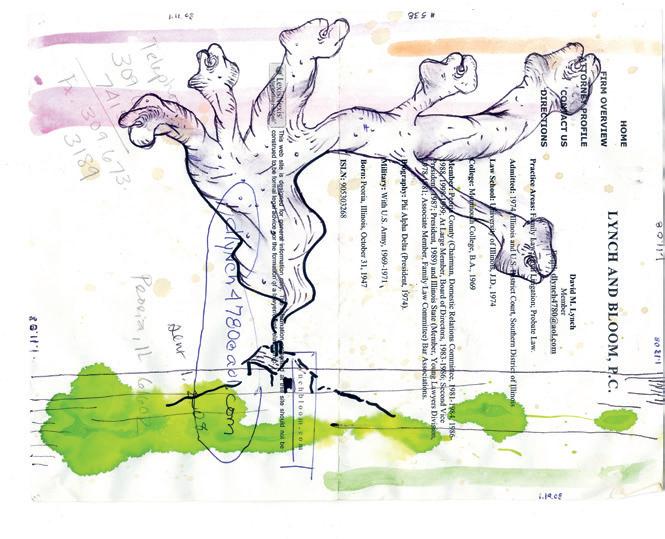
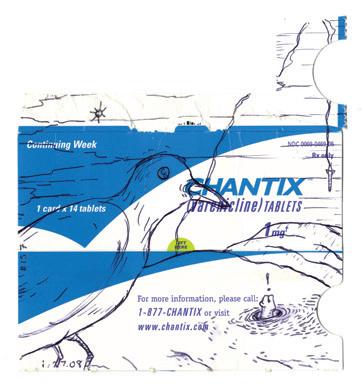
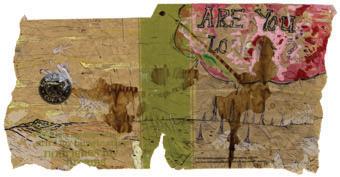
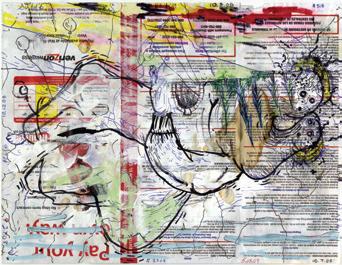
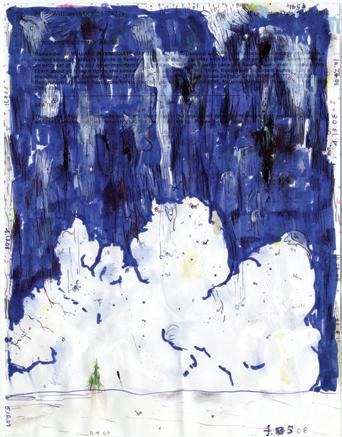
FROM LEFT TO RIGHT
PL. 170, Failure Drawing #157, 1.27.08, Bird, 2008
PL. 171, Failure Drawing #518, 2.7.08, 2.23.08, 9.17.08, 9.19.08, 9.20.08, 9.27.08, 10.4.08, 10.7.08, 10.8.08, 10.12.08, 11.19.08, 5.15.09, Uncoupling, 2008–09
PL. 172, Failure Drawing #520, 2.21.08, 9.17.08, 9.20.08, 9.21.08, 9.21.08, 9.22.08, 9.29.08, 10.1.08, Horizon Seeking, 2008
PL. 173, Failure Drawing #541, 4.5.08, 4.13.08, 4.13.08, 10.24.08, 10.28.08, 11.3.08, 11.4.08, 5.16.09, Problem, 2008–09
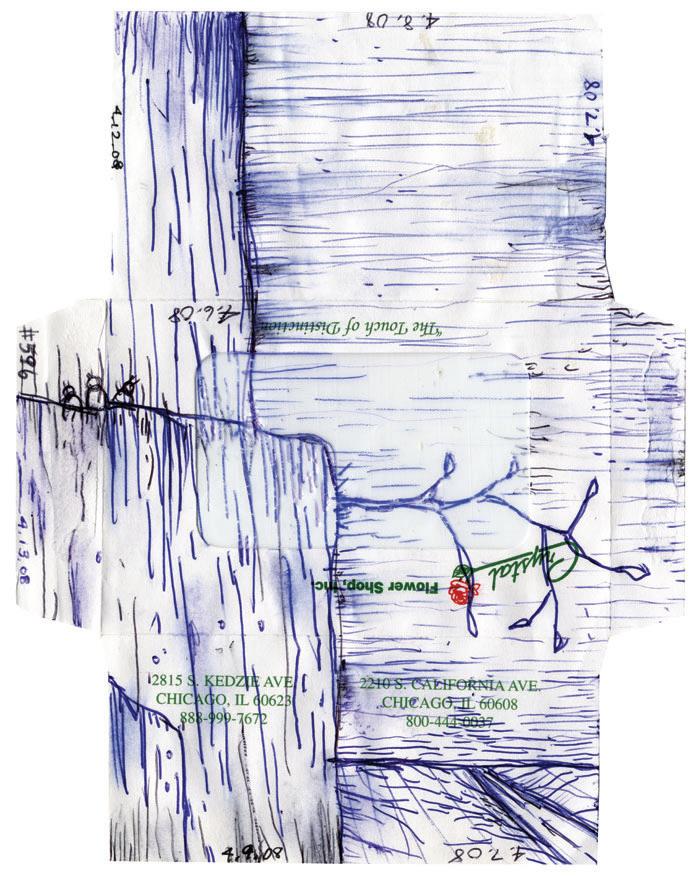
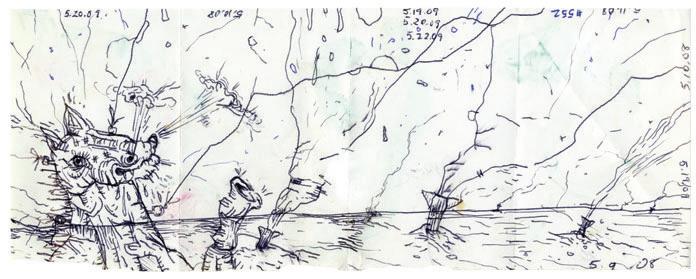
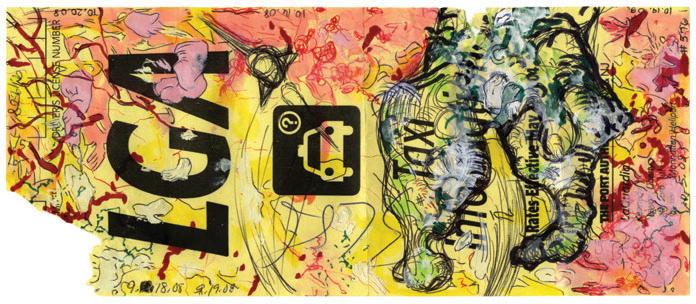
PL. 175, Failure Drawing #552, 5.9.08, 5.10.08, 5.10.08, 5.11.08, 5.19.09, 5.19.09, 5.20.09, 5.20.09, 5.22.09, Field, 2008–09
PL. 176, Failure Drawing #576, 9.18.08, 9.19.08, 9.19.08,10.5.08, 10.16.08, 10.19.08, 10.20.08, Transportation, 2008
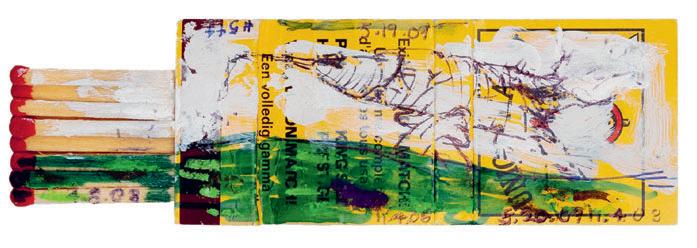
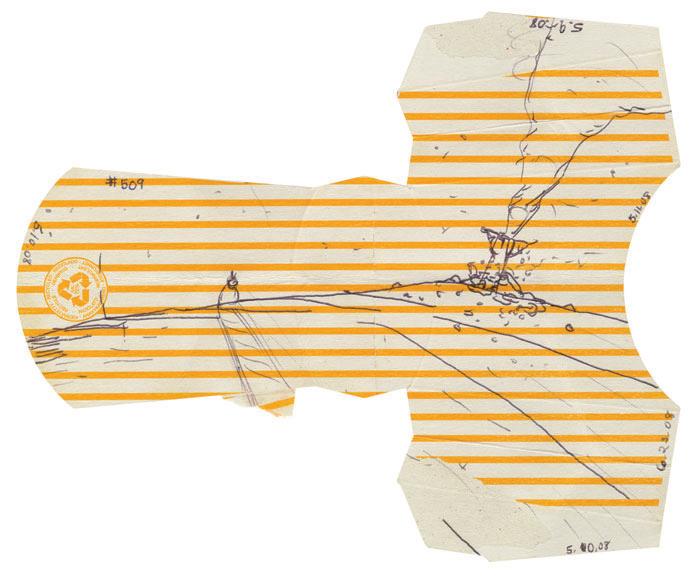
PL. 177, Failure Drawing #544, 4.8.08, 11.4.08, 11.4.08, 5.19.09, 5.20.09, It’s Always that Direction, 2008–09
PL. 178, Failure Drawing #509, 5.9.08, 5.10.08, 5.11.08, 6.23.08, Landscape and Shadow, 2008
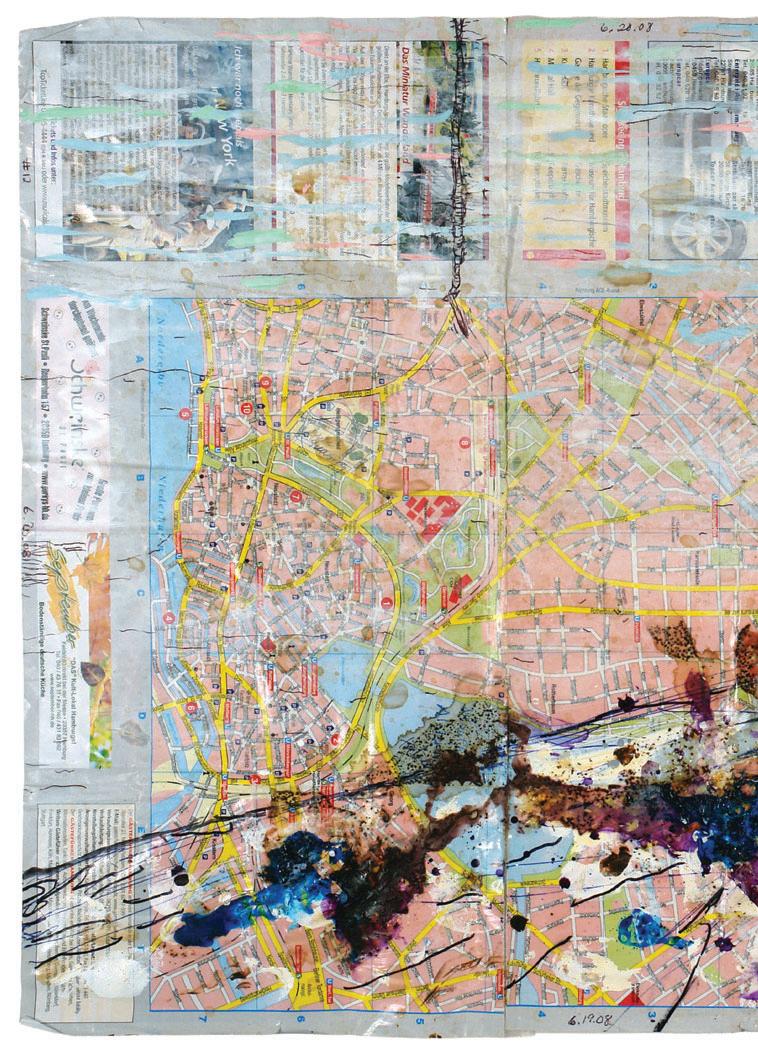
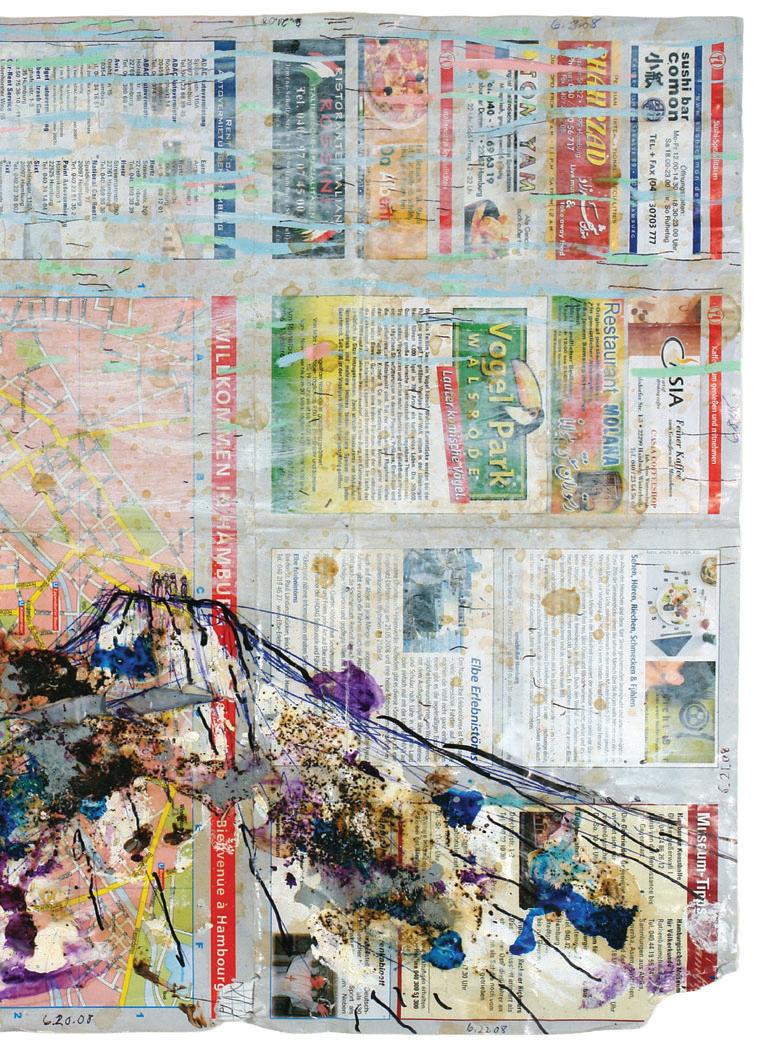
179, Failure Drawing #12, 6.3.08, 6.8.08, 6.19.08, 6.20.08, 6.20.08, 6.20.10, 6.21.08, 6.21.08, 6.22.08, 6.30.08, The Night is Never Young, 2008
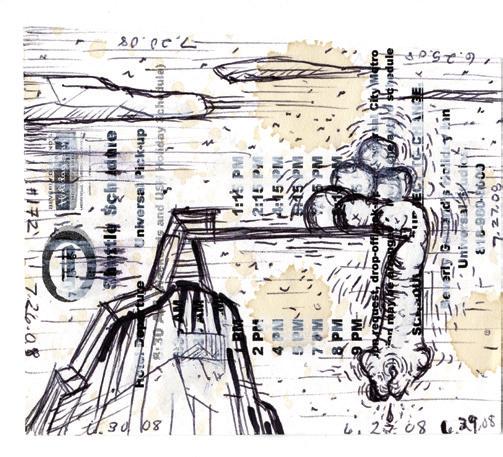
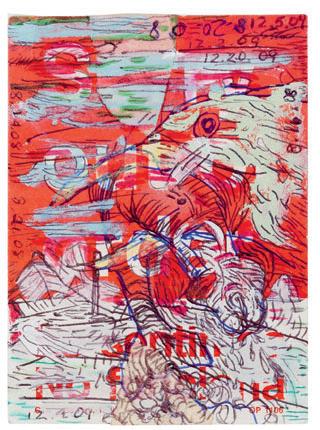
PL. 180, Failure Drawing #172, 6.25.08, 6.27.08, 6.29.08, 6.30.08, 7.20.08, 7.26.08, 7.27.08, Shuttle Schedule, 2008
PL. 181, Failure Drawing #511, 8.14.08, 8.16.08, 8.20.08, 8.21.08, 12.2.09, 12.4.09, 12.5.09, 12.20.09, Air or Sea, 2008–09
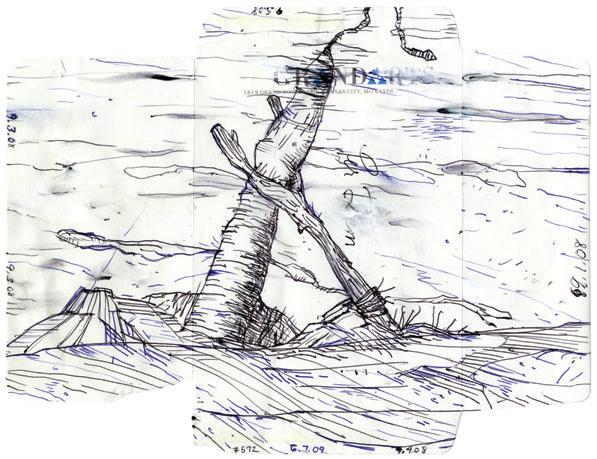
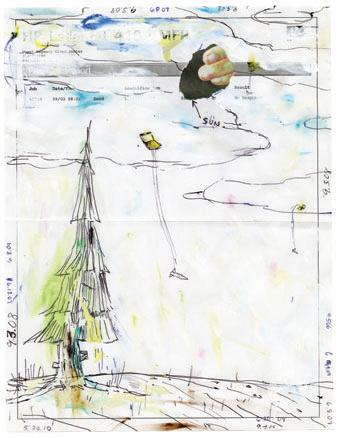
PL. 182, Failure Drawing #572, 9.1.08, 9.3.08, 9.4.08, 9.5.08, 6.7.09, Demonstrating a Technology, 2008–09
PL. 183, Failure Drawing #566, 9.3.08, 9.3.08, 9.3.08, 9.4.08, 9.5.08, 6.8.09, 6.8.09, 6.8.09, 6.13.09, 6.14.09, 6.10.09, 5.30.10, The Attic, 2008–10
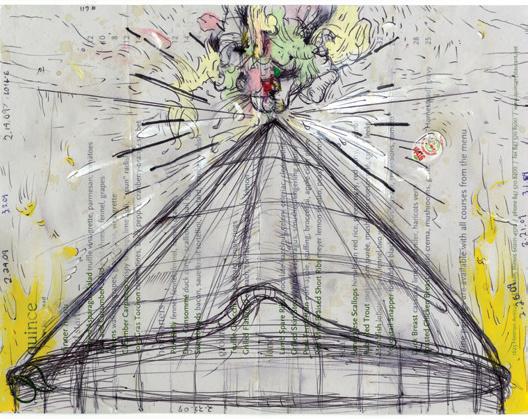
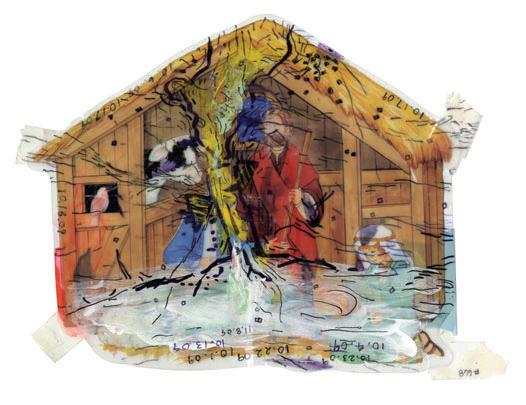
PL. 184, Failure Drawing #611, 2.14.09, 2.21.09, 2.22.09, 2.24.09, 2.25.09, 3.1.09, 3.3.09, 3.4.09, Quince, 2009
PL. 185, Failure Drawing #668, 10.1.09, 10.4.09, 10.6.09, 10.13.09, 10.17.09, 10.17.09, 10.18.09, 10.22.09, 10.23.09, 11.8.09, If There Is No God Then Why Is There Plastic?, 2009
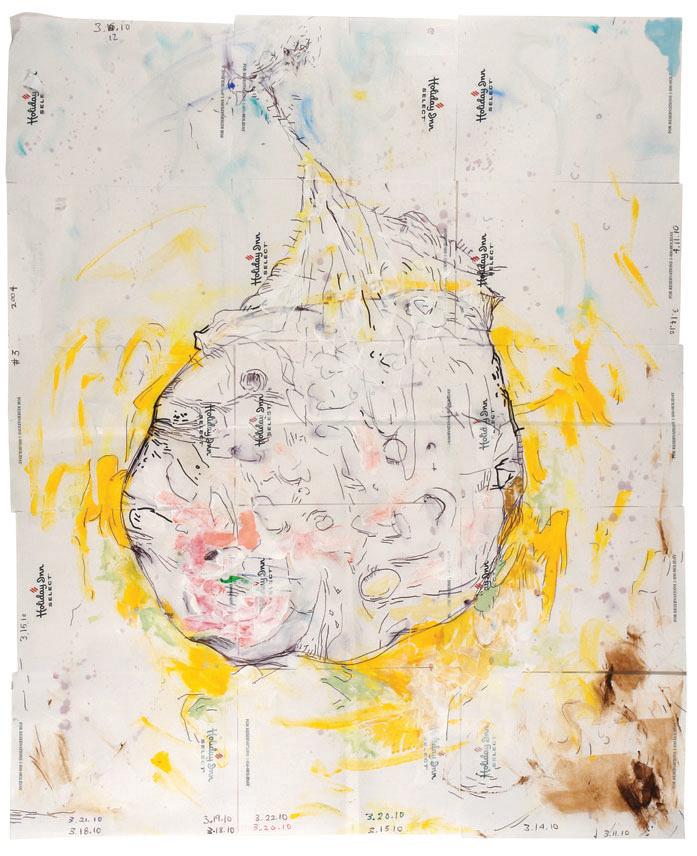
PL. 186, Failure Drawing #3, 2004, 3.11.10, 3.12.10, 3.14.10, 3.14.10, 3.15.10, 3.15.10, 3.18.10, 3.19.10, 3.20.10, 3.20.10, 3.21.10, 3.22.10, 4.11.10, World View, 2004, 2010
Laura Hoptman: I’m speaking with Hamza Walker, a curator and Director of The Brick, a nonprofit space in Los Angeles. Thank you so much, Hamza, for joining me.
Hamza Walker: Thank you, Laura.
LH: Maybe we could jump straight in: When did you meet Pope.L and under what circumstances?
HW: I met Pope.L in the early aughts. He had received a Creative Capital grant for The Black Factory, and I was one of the visiting critics who met with the grantees to talk about their projects. I knew of Pope.L’s work through, I believe, the Mark Bessire catalog that accompanied the touring exhibition William Pope.L: eRacism.1 I may have already seen documentation of a Crawl work or some of his now-canonical street-based performances in New York, but that would have been about it.
LH: eRacism was in 2002, I believe. So, when you first met Pope.L, he must have been in Maine.
HW: He was teaching in Maine and had just received the Creative Capital grant. During our meeting in upstate New York at the Creative Capital retreat, he showed me the strangest video of a young white male sitting on the edge of a bed, reading a newspaper. The setting looked like a hotel room, and the newspaper reader was
reading in a calm, straightforward manner. I believe Pope.L was sitting next to him. At one point, unannounced, Pope.L reaches over and snatches the newspaper from him—just takes it out of his hands, violently. I found the gesture ironic since he had been billed as the friendliest Black artist in America. We had the most elliptical conversation.
LH: You also had a conversation at the time at The Renaissance Society at the University of Chicago, where you were the longtime Director of Education and Associate Curator, right?
HW: Yes. I remember Pope.L coming up to The Renaissance Society for a couple of openings with Christine, my friend and his partner at the time. So he would crop up. This is well before he moved to Chicago. And then he had an exhibition at the Art Institute of Chicago.
LH: Oh, I see—before your project at The Renaissance Society in 2013.
HW: Yeah, several years before his solo exhibition at The Renaissance Society. Lisa Dorin did the show at the Art Institute in 2007.2 In 2006, I started working on a group exhibition, Black Is, Black Ain’t, which was something of a rejoinder to Thelma Golden’s Freestyle exhibition [2001] at the Studio Museum in Harlem. The term “post-Black” was in circulation at the time, so I was wrestling with it, and Thelma asked me to write for the Freestyle catalog. It was a tight deadline in terms of getting the essay done, and I just abruptly ended the essay without really coming to any kind of resolve about post-Black—if there’s any getting to the bottom of it, which is probably what brought me into Pope.L’s orbit, conceptually.
As I was working on Black Is, Black Ain’t, Pope.L’s show was up at the Art Institute, and that’s when I really took an interest in his work. I approached him about being in Black Is, Black Ain’t, and he was the last addition to the show—it was a real back-andforth between the two of us in a very delightful way. He had agreed
to participate with a grid of twenty Skin Set drawings. But I also took an interest in one of his videos, A Negro Sleeps Beneath the Susquehanna [1998–2008]. When I expressed interest in including it, he said the video needed an additional element: “How about a table in the gallery with a mountain of flour on it?” The flour would have been messy, and we didn’t have the real estate for it—even if it wasn’t a mess—so I told him I couldn’t accommodate his request. He said, “Okay, well, can you fax me the floor plan of the show?”
He then made a new piece and made marks for the location of its components, which were eight small shelves painted in Fisher Price–like primary colors: purple, orange, yellow, green, etc. We had to roll a piece of paper into a cone, pack it with flour, turn it upside down, and put cones of flour on the shelves. They would always crumble slightly, which is the look he wanted, and they were positioned in relatively marginal areas. Brilliant piece. The work was called One Substance, Eight Supports, One Situation [2008]. It was as if I had given him a piece of writing, and he then added syntax—putting commas and periods in exactly the right spots. It was incredible.
LH: How were the drawings installed?
HW: The Skin Set drawings were in a straight-up grid. You had written to me with a question about materiality and the drawings as objects, and at one point, you made a reference to the frames Pope.L specced for that body of drawings. He liked those really cheap frames—that’s part of it. It’s a class statement, in a way, to place them in what are clearly not museum frames. Those frames make me think of his use of mayonnaise. I don’t know why. Maybe it’s because the frames remind me of the ones my grandmother used, and she liked mayonnaise. But you were asking about the “anti-object.” To me, Pope.L’s work does not have an “anti-object” ethos. It sounds funny to use the word “object” when referring to his work—“object” is too formal. Pope.L was into “stuff,” and those frames are part of how he wanted us to perceive those drawings.
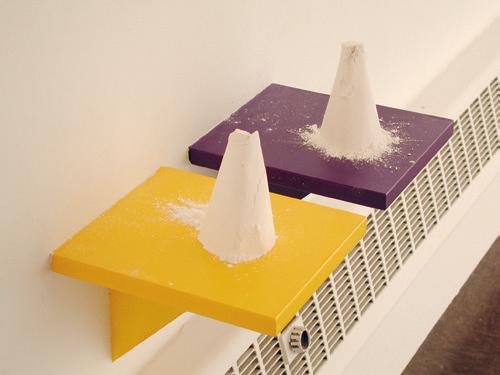
Pope.L, One Substance, Eight Supports, One Situation, 2008
Installation view: Black Is, Black Ain’t, The Renaissance Society at the University of Chicago, April–June 2008
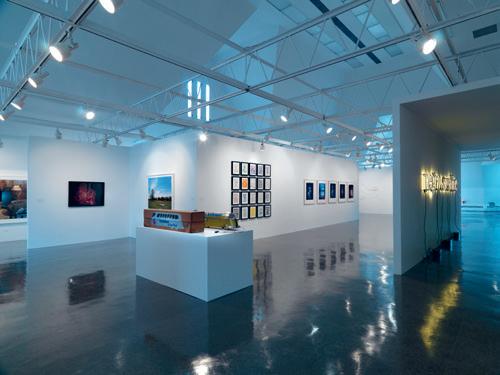
Installation view: Black Is, Black Ain’t, The Renaissance Society at the University of Chicago, April–June 2008
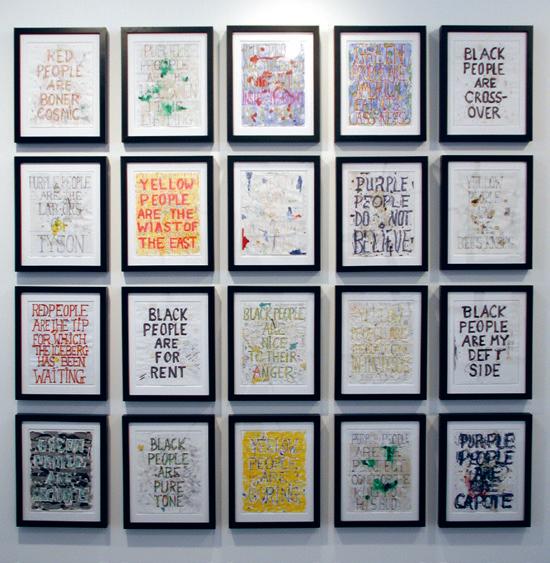
Pope.L, Skin Set Drawings, 2003–06
Installation view: Black Is, Black Ain’t, The Renaissance Society at the University of Chicago, April–June 2008
LH: I would love to continue talking about the medium of drawing. He’s best known, of course, for his performative and multimedia work, which we wouldn’t consider drawing at all. Yet, Pope.L used the language of drawing to refer to works like his Crawls and Pull! performances. What are your thoughts on the way that Pope.L used various mediums in his work?
HW: Not only is Pope.L post-Black, but more importantly, he is also post-medium. Generationally, Pope.L’s is a Post-Conceptual art, but not so much “post” in terms of after Conceptual art as much as continuing immediately in its wake, albeit taking it somewhere the previous generation wouldn’t recognize. He is very much a child of certain legacies, notably Fluxus. That’s really important to keep in mind when thinking about him and performance and the issue of medium. There’s a breadth and, at the same time, dissolution of medium specificity in the work—even though he is specific about his choice of materials in his approach to a given situation. He’s fully aware of that, but at the same time, there’s no hierarchy.
LH: It’s stunning and very evident to me when you read his writings and hear his lectures that he uses drawing as this very powerful metaphor for almost everything.
HW: I think there are two things: drawing and writing. I don’t think you can separate them, but they’re different. If you were to, say, in a traditional sense, cite drawing as being at the core of artistic practice, it’s like the old adage, “You ain’t no artist; you can’t even draw!” I like that statement because, given our training in contemporary art, we’ve learned that art is so many things, and we can disregard that question. It’s taken me years to think, Actually, I don’t want to disregard that question, because drawing is at the center of things. If you were able to translate illusionistic representation in the form of drawing and not painting, people wouldn’t say, “You’re not an artist because you can’t paint.” They’ll just say, “You can’t paint.” But if you can’t draw . . .
LH: We don’t want to paint!
HW: Yeah, right. But drawing occupies a very privileged place in defining a specific skill set. It’s like, “I’m a doctor, but I can’t perform surgery.” Well, how can you call yourself that? In terms of practices, as they are defined by the acquisition of a certain kind of knowledge and skill set, I would say drawing is what people think of as a necessary skill to be an artist in a lot of ways. I would say for Pope.L, it occupies that place.
LH: Doesn’t it surprise you, though, that such a radical artist—in terms of so many different things—would have this sort of traditional attitude toward medium?
HW: No, it doesn’t surprise me at all because it’s not medium. I mean, we’re thinking about medium in a medium-specific sense—in terms of medium as an end in itself. Whereas, for Pope.L, it’s at the service of something; it’s at the service of thought. I would say it’s the same thing for Kara Walker. Drawing is at the center, but it’s at the service of her imagination.
LH: Absolutely.
HW: But it is no more or less volcanic and active and lava flows and then stays where it’s hardened. Writing is, I would say, the other part at the core of his practice, but people don’t talk about it as much. He was writing this novel—hundreds and hundreds and hundreds of pages of writing. So, those two things—drawing and writing— everything grows out of them. There’s a dissolution of any kind of hierarchy behind things, but at the same time, the dissolution allows him to think about drawing and writing in an incredibly expanded field. It’s part of everything.
LH: Two things I want to say in response: The first is that it reminds me of that postwar quest among really radical types, like William S. Burroughs, whose whole thing was to explore the possibility of conjoining words and images. Some people went off on the Concrete poetry thing to try to solve that riddle. So, there’s an old-fashioned avant-gardism to the way that Pope.L is looking at
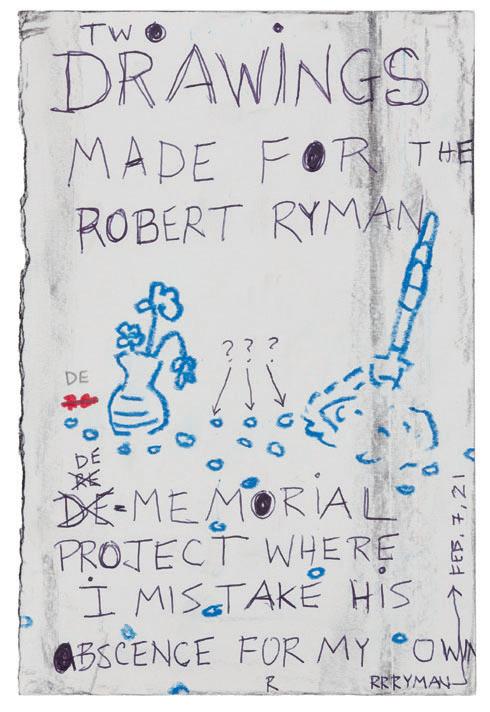
Pope.L, Sketch for My Kingdom for a Title, 2021
drawing—at least, I see it that way. The second thing is a question about seriality. Because the notion of writing a novel—there’s a kind of serial form in that.
I’ll skip over seriality for a moment, though, to zoom out to the subject of postwar modernism. It always fascinated me with Kerry James Marshall, as well—an artist of a similar generation as Pope.L; I know they’re very different artists, but both have an obvious relationship to modernity, or maybe to struggle, or a fight, and it’s grounded in this respect for an old-fashioned modernity. There’s a veneration of form for its own sake: the clarity of geometric abstraction, serial repetition, or the grid. Pope.L was also famously interested in the work of Robert Ryman. I wonder if you had thoughts about that.
HW: Because you brought up seriality, I had a thought; it’s a simple one. Whether you define seriality in terms of music or the visual arts, the same meaning applies to both:to reduce the work to a series of components and to then explore all the permutations and combinations of those components until you have exhausted all the possibilities. I’m thinking of Sol LeWitt and seriality. He didn’t like the term “Minimalism”—I mean, nobody liked it because it was only on the way to something. The term “seriality” was a way to be generative in the face of Minimalism. So, it was like: reductive for reductive’s sake is not interesting.
LH: So, we can’t put Pope.L’s work in the context of serial repetition and/or the grid?
HW: I think you can, but the permutations and combinations become finite in a sense; you can exhaust them in the LeWitt sense. There’s no question of which one is good, which one is bad; one over another is not the point. It’s like I’ve exhausted all the possible combinations of these colors, of these combinations of lines, but there isn’t one that’s better than another.
LH: Do you think we’re meant to read Pope.L’s works with words, or look at them, or do both at the same time? I’m talking about the Skin Sets, particularly, which are these stacks of words on paper.
HW: With the Skin Sets, I would say formalism is the key to them. Pope.L understands seriality, except what if it’s a seriality that is inexhaustible? That, to me, is the big distinction. With seriality in music, there are the notes, and I’m going to just rearrange the same notes. It’s like you are suddenly able to have a composition that behaves almost like a mobile. In its rearrangement, you get an understanding of it, in a way.
LH: So, did he see the Skin Set gambit as infinite, as the possibilities of pluralization?
HW: I think of the Skin Sets as infinite, but because it’s a fixed formula. It’s a color, and then the structure of the sentence. It produces an absurdity that becomes inexhaustible. So, to treat race—something as the basis of a subject’s being, subject’s formation—like a formal proposition is to then produce the absurdities that are inherent, that are then inexhaustible.
LH: Is that his connection to Ryman then: exhausting the formal possibilities?
HW: Oh, yeah. I think his connection to Ryman is just the idea of Ryman rendering vision opaque, meaning his famous statement, which I can paraphrase: “I took everything, took the color out, everything, so that I could see the painting that much better, to see it more clearly. Like, that’s what white allows me to do.” And Pope.L, obviously, he’s like, “Huh, formalism”—even if you defined formalism as the science of culture: subjecting art to a breakdown of its fundamental properties and characteristics.
LH: Right, which, again, connects to Concrete poetry.
HW: Yeah, with language, and the Russian formalists. When Clement
Greenberg was accused of being a formalist, he said, “Wow, that’s really weird. Formalists that I know are Russian literary critics.” But Pope.L wanted to know how form collides with the issue of race. That, to me, is the conundrum; that’s when you get Pope.L. So, if Ryman is one of the many logical conclusions, one of the zeniths of modernism in that way, that’s a Pope.L field day for sure— as a father figure, as a punching bag, as a doormat.
LH: There’s a contradiction because if you look at the way Ryman played with formalist parameters—the parameters of what a painting is—Pope.L takes that to his sets, which he calls “particles.”3 He’s also leaving things open for the metaphor to creep in, which is anti-formalist. Is it possible that Ryman’s white is akin to the way that Pope.L is interested in flour, mayonnaise, and other white materials—as metaphor? Is it a metaphor for whiteness, or is it an actuality?
HW: That’s the whole point. You asked the question about whether he is anti-object, and it’s complicated, but I don’t think he is. Pope.L is pro-metaphor and anti-illusion. Things are what they are. And that, obviously, situates him squarely as a child of Conceptual art in a nutshell. On the one hand, it was the wholesale dismantling of references—an anti-referential art; it is what it is, so it doesn’t refer to anything outside of itself, which is the abandoning of metaphor. At the same time, when you abandon metaphor, you enter into a realm of anti-illusion, of concreteness—where this thing isn’t a reference to anything else. It is what it is again. And so, to me, Pope.L is that zero degree.
LH: It doesn’t even need a metaphor because it’s so obvious?
HW: Right, exactly. When Pope.L said, “Well, you know, I’ve been dealing with particles for a long time,” it’s also the part he’s not saying: It’s particle and wave theory, the way they go together. He’s particle and wave. In one minute, it’s mayonnaise; it’s a particle. And in another minute, it’s a wave, and it becomes, “Is this about whiteness?”
When he did the performance in Chicago at the Art Institute—an unbelievable, staggering performance—it went through the bowels of the Art Institute. You know, only fifteen people or so could do the piece twice a day for a short period of time, and there were black Legos just off in the corner. And then, further along, there were a couple more black Legos on the floor. Pope.L had scattered them. It’s just like the mayonnaise. What is that about? It’s black Lego—do with it what you will.
LH: Confronted by everything that is the oeuvre of Pope.L, how are we supposed to read it and interpret everything? Or are we supposed to see it?
HW: That’s the crux. You’re supposed to do both. Pope.L uses mayonnaise the way Paul McCarthy uses ketchup for blood, and he knows you can’t not read it that way. We are meaning-making animals. You can put a piece of abstraction in front of me, but to what extent do you want me to read it? Abstraction, in and of itself, becomes an allegory for modernism. When I can’t read it, that’s the postmodern condition. Pope.L is one of those artists, par excellence, who says you can have your cake and eat it, too. When he tells a story about a mayonnaise sandwich, and there’s no meat, it’s about poverty or lack. When asked what his medium was, he said, “Lack.” And maybe he said that on a Wednesday, and he changed the answer on a Thursday, but that does not erase what he said on Wednesday. He wasn’t kidding when he said “lack.” You can also look to Carl Andre, who views a thing as a whole and a thing it is not, and that’s also some Pope.L shit from Carl Andre in advance of Pope.L.
LH: Surely he was familiar with all of this?
HW: Yes, absolutely. But the Fluxus background is really key, with Robert Watts and Geoffrey Hendricks. Pope.L went to Rutgers, where they taught. He’s a latter-day child of Fluxus.
LH: There’s a rub here, and that is Fluxus ephemerality versus the materiality of Pope.L. Fluxus was so militantly ephemeral, and
Pope.L leaves a trace. He also talks about drawing, in particular, in terms of objecthood. When he was talking about category-making as a kind of drawing, he said that crawling was a kind of drawing. Making categories was a kind of drawing. And then he has produced thousands and thousands of objects. Maybe I’m mistaken, but I can’t think of a Fluxus artist who did that.
HW: Yeah, but I wouldn’t hold fast to any kind of orthodoxy around Fluxus methodology. What are the conditions that allow him to put Legos together and make that a piece? And it is a real piece. I would say the conditions that allow for it are his performances and the way that he generates meaning, so a Pope.L is a Pope.L, with reference to that messy slurry of thoughts and notations. It could be anything.
LH: And yet, order is so important to him . . .
HW: There’s structure.
LH: Yes, structure. Let me read this to you: “What is a notation? Everything is a notation. All my works are notations, not ends but particles of instances linked by fragmentation that are cousined”—I love the way he uses familial terms—“by non-relation, familied by a tenuous style, maybe not there at all.”4 Is he talking about drawing here?
HW: Yeah, there’s a great Pavement lyric that this reminds me of: “Father to a Sister of Thought.” To me, it’s all just an extension of thinking—drawing is the first stop to that thinking, but because everything is an extension of that thinking, then everything is everything.
LH: Even more, not controversial, but piquant, he says: “Blackness and race in general are competing marks on the same map of human possibility.” I link this to drawing—is that a mistake? Is he just using it as a metaphor?
HW: I would be much more expansive in my thinking about the issue of human possibility when he says it—that is a very neutral
definition of race. To me, what he’s really getting at is either we are all marked or none of us is marked. The issue is about the mark— meaning it’s like white and whiteness are colorless and, therefore, not marked; it is the standard and the norm, and everybody else has ethnic baggage. It’s within a system in which Pope.L is saying, “We must deal with Gerhard Richter—that’s as culturally specific as it gets. He’s not just German, he’s from East Germany.” If you want to talk about where that work comes from and understand it without reference to context, you’re doing it a disservice—or you don’t get it in its fullness. I feel like that’s what he’s saying—that within human possibility, once you acknowledge that we are all marked, then you’re saying: “Oh, we’re blue; we’re orange; we’re red; we’re green.” It’s like, okay, let’s abide by this system, this fiction, and recognize that this framework is a social construction— it is something we made.
Race itself is a human possibility. How do we organize and categorize ourselves? Pope.L is saying this in an economic, value-neutral way. That’s what’s interesting to me. And to say, “Yeah, this is who we are in all our potential for good and all our potential for bad,” is, again, the idea of the “mark” on human possibility. It’s independent of how race has been used and the history of race as a framework for talking about superiority versus inferiority, rassenkunde [race science], and all of that baggage. Pope.L is negating that by saying: “Oh yeah, we invented that; we came up with that. That’s a human possibility.” That, to me, is where his head is at, and not just in terms of his art-making.
LH: I’m so interested in this sort of non-metaphoric art. We know, as art historians, that when you have a blank surface, and you have one mark on it, you don’t “get” what that mark is. You don’t get an explanation or definition until you have another mark. Two marks in relation to one another make the story.
HW: Exactly. That’s the thing, like how we know race is not the province of a singular part. Race is the difference. We produce race in the production of difference—as opposed to: you have race; I don’t have race. So it’s an important equation to keep in mind.
LH: He’s using drawing as a kind of explanation. As I said, in a physical sense, you need two individual things in order to create a relationship.
HW: The Skin Set drawings, to me, are an example of this. When you accept the way that Pope.L frames it, then you are also able to deal with it in terms of formalism: red, blue, yellow, green—colors then assume a meaning in relationship to one another. I would say Pope.L might have even subscribed to Piero Manzoni’s definition of the white canvas as a colorless field, or, in the case of a piece of paper, perhaps as Ernest Hemingway famously referenced the blank page as “staring down the white bull”—the page with no words on it.
LH: And it’s not nothing—it’s something; it glows with value and values. Manzoni, who called his white paintings Achromes [1957–63], as in “without color,” was hoping to figure out a way to not have any metaphor at all. I want to read you something else, because this is where we’re taking the title of our show from. Pope.L said, “To mark anything is to create a difference”—which makes me think of it as a description, but also a kind of activism—“maybe a world, maybe a wound, certainly an act.”5
HW: Yeah. He’s full of them; he’s got a million of them. “Maybe a world, maybe a wound”—Pope.L’s world can be a world of unicorns and rainbows or a wound.
LH: Last question: Pope.L says that artists don’t make art—they make conversations. The conversation he started with his work about social absurdity and the absurdity of categorization—whether by type, name, or race, or about consumption or disenfranchisement— what does that mean post-Pope.L?
HW: Brilliant question, and I’m going to go in the opposite direction. To me, it isn’t post-Pope.L; it’s that Pope.L already happened. The blueprint for Pope.L and his combination of race and formalism already happened.
LH: How incredible that you said that. The combination of putting formalism and race together versus this sort of artistic strategy.
HW: Yeah. Oh, you’re right. And he’s very bold about it. It’s like, race and formalism, how do you want to approach this? It isn’t a given. So, to talk about him in terms of figuration, that goes to performance. He’s anti-illusion in that way. He’s a child of the sixties, because he is using the body; he is a figurative artist.
LH: Using his body.
HW: Using his body and materials at the same time. So, is he an abstract artist? Equally, he made monochromes. The green glowing light piece he made for the people of Nicaragua—he’s being earnest, and in another way, he’s fucking with us. It’s up there with Dan Flavin’s light pieces dedicated to Donald Judd. Pope.L is dialed into that conundrum about abstraction and race, but he’s much more stark about it—bold. It’s like the joke hidden beneath Kazimir Malevich’s painting inspired by Alphonse Allais, the French artist, who made monochrome prints—a red, white, and a black one with jokes below them. The black one is subtitled Negroes Fighting in a Cellar at Night, and Malevich wrote that joke on the canvas underneath the Black Square [1915], which was only revealed through X-ray in 2015. To me, that’s Pope.L. It was written into modernism at birth—it was always there—Pope.L just crystallized it. The idea was underneath this thing—lurking, waiting. Ryman and Malevich allowed Pope.L to do and say whatever he wanted. He had license to take that anywhere.
LH: That’s right. They weaponized abstraction. It’s unfortunate that their weapon was taken away from them, but it was the moment that, perhaps, a square could go fight the revolution.
HW: Yeah, and beneath that revolution are two Negroes in a cellar fighting, which Pope.L would appreciate—let’s extend the metaphor or make the metaphor more robust.
Alphonse Allais, Combat des Nègres dans une cave, pendant la nuit [Negroes Fighting in a Cellar at Night], 1897
LH: Do you think we can tell a robust part of the complicated story that is Pope.L through the works on paper?
HW: Of course. And you do. But the task is also for you to interpret. And like Pope.L said, everything is wrong. So, what do you do now? I would be orthodox about it, but I would only be orthodox about the construction of the rules—that I would then break.
LH: Walking in Pope.L’s footsteps, in a way.
1. Mark Bessire, ed., William Pope.L: The Friendliest Black Artist in America© (MIT Press, 2002), the first comprehensive monograph on the work of Pope.L, accompanied the exhibition William Pope.L: eRacism, which opened at the Institute of Contemporary Art at Maine College of Art (Portland, ME; 2002) and traveled to DiverseWorks, Artspace (Houston, TX; 2003); Portland Institute for Contemporary Art (Portland, OR, 2003); and Artists Space (New York, NY; 2004).
2. William Pope.L: Drawing, Dreaming, Drowning was curated by Lisa Dorin, Assistant Curator, and Darby English, Associate Professor of Art History, University of Chicago, at the Art Institute of Chicago (October 11, 2007–January 21, 2008).
3. See Pope.L, Artist talk on the occasion of the exhibition opening of This Machine Creates Opacities: Robert Fulton, Renée Green, Pierre Huyghe, and Pope.L, at the Carpenter Center, Cambridge, Massachusetts (October 5, 2023).
4. Pope.L, Artist talk, Carpenter Center.
5. William Pope.L, “Some Notes on the Ocean . . .,” in Black People Are Cropped, ed. Clément Dirié (JRP|Ringier, 2013), 9.
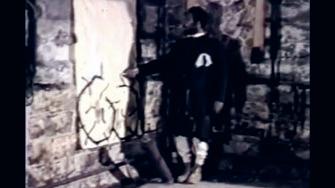
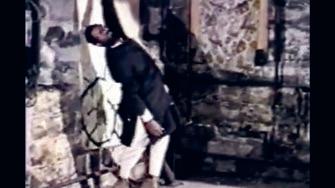
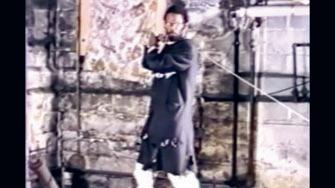
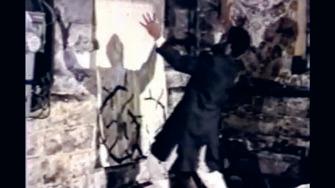
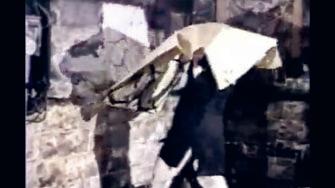
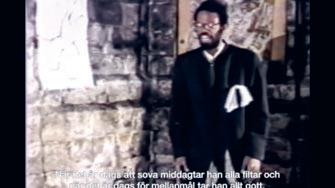
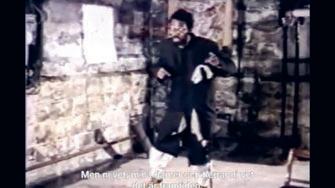
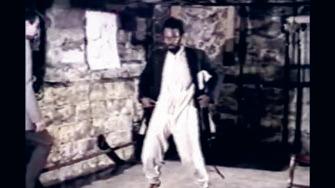
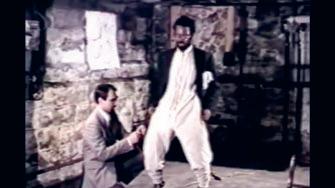
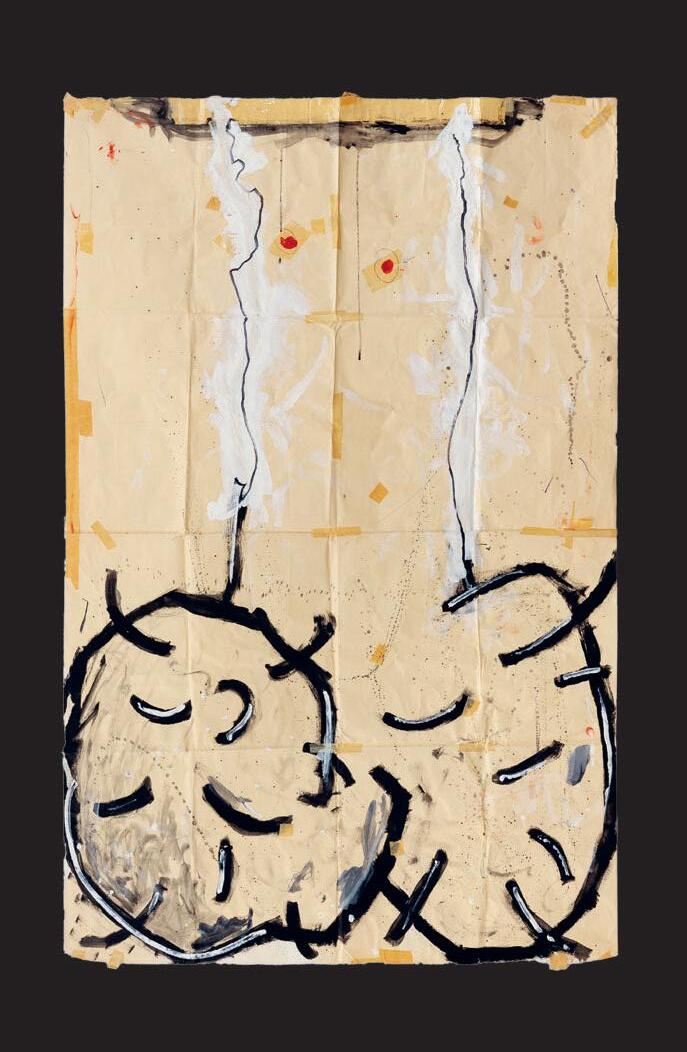
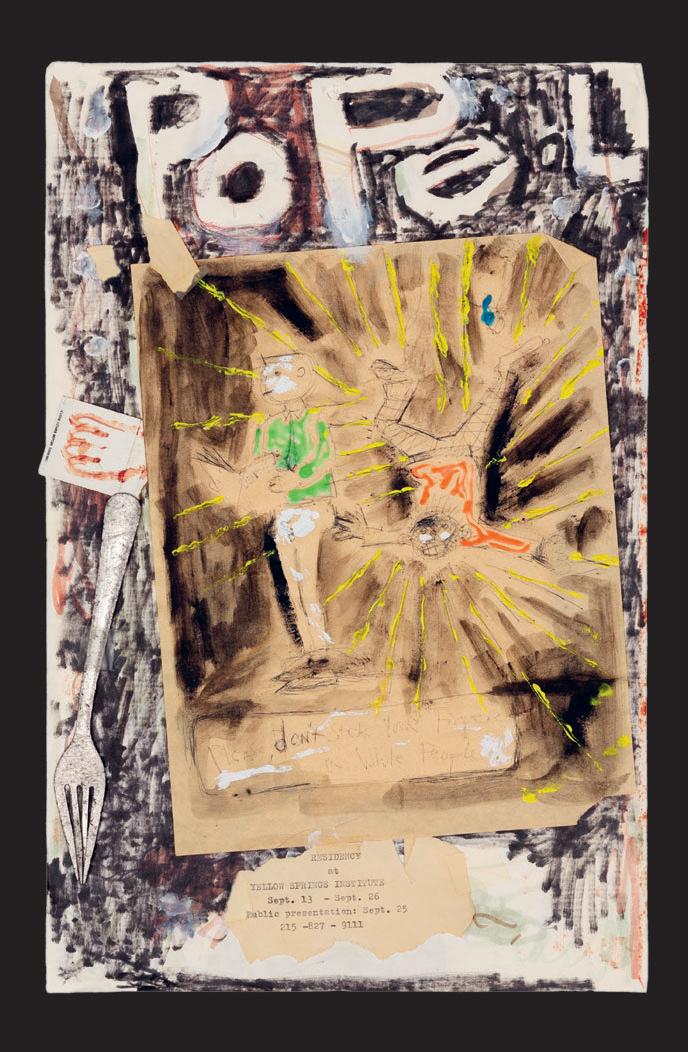
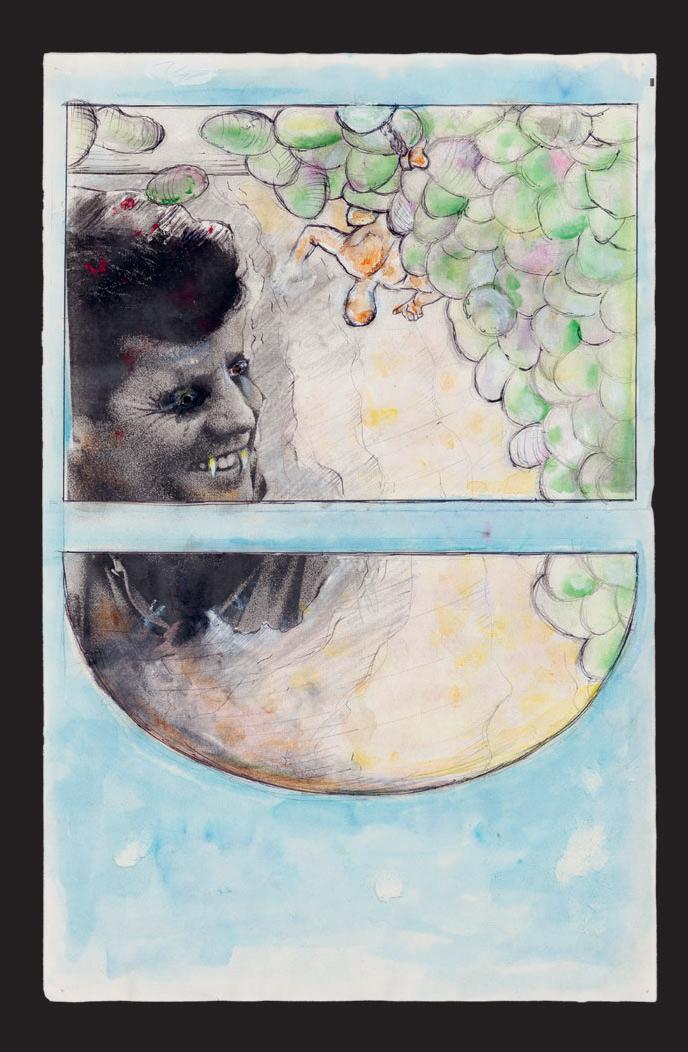
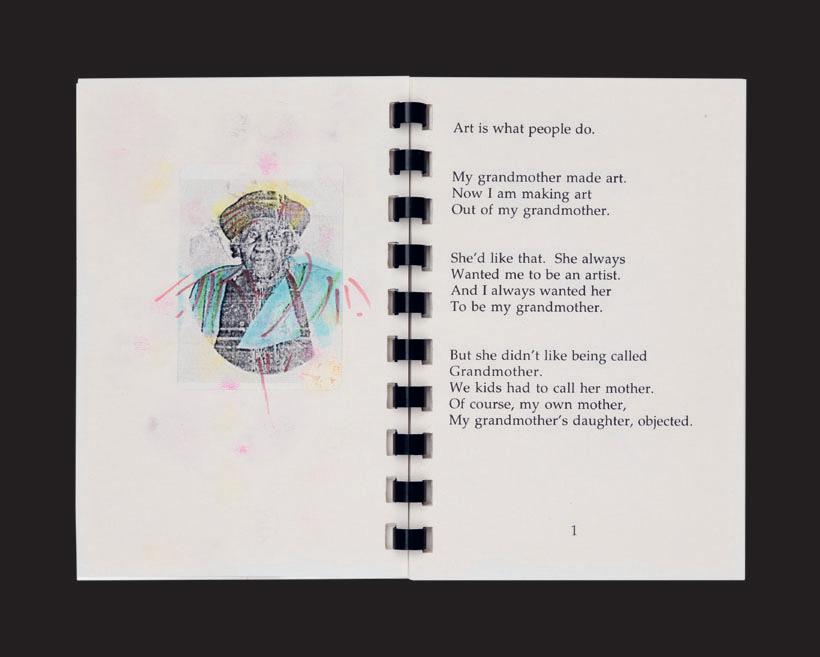
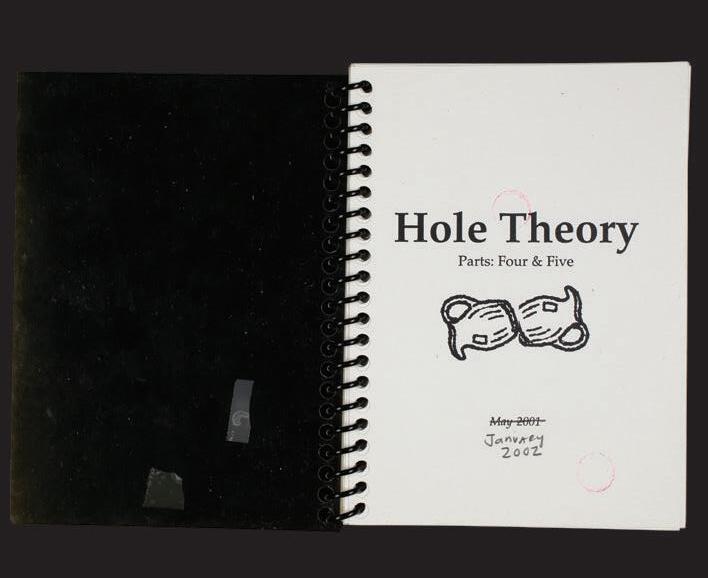
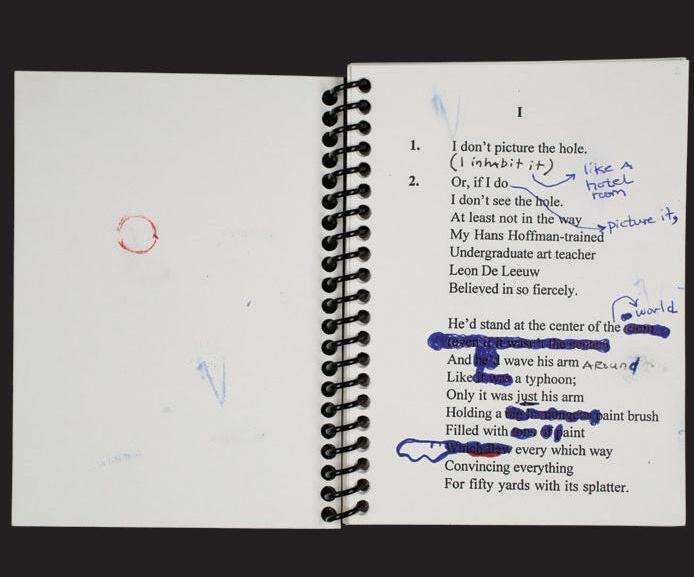
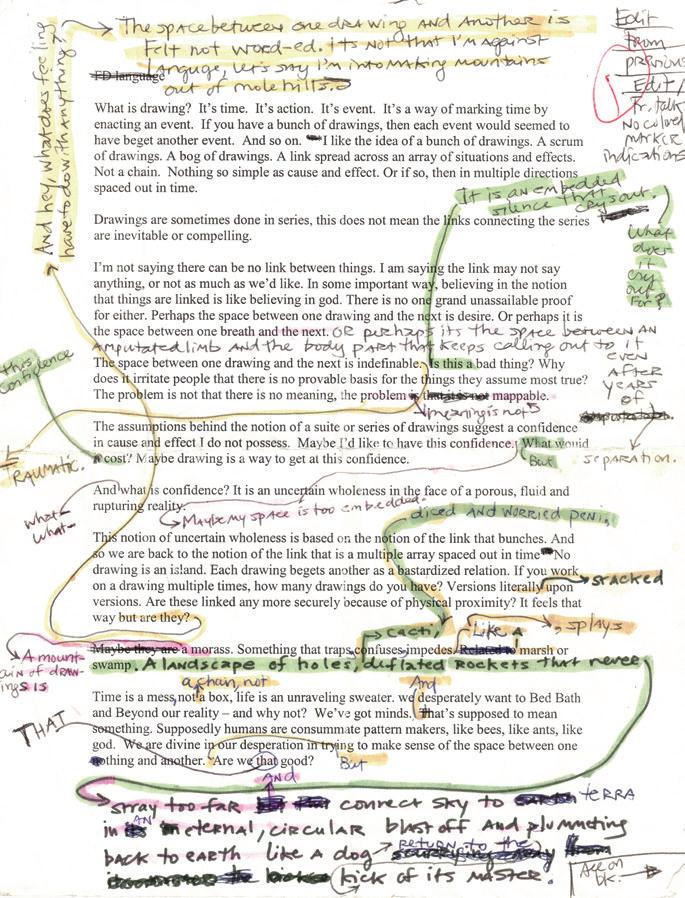
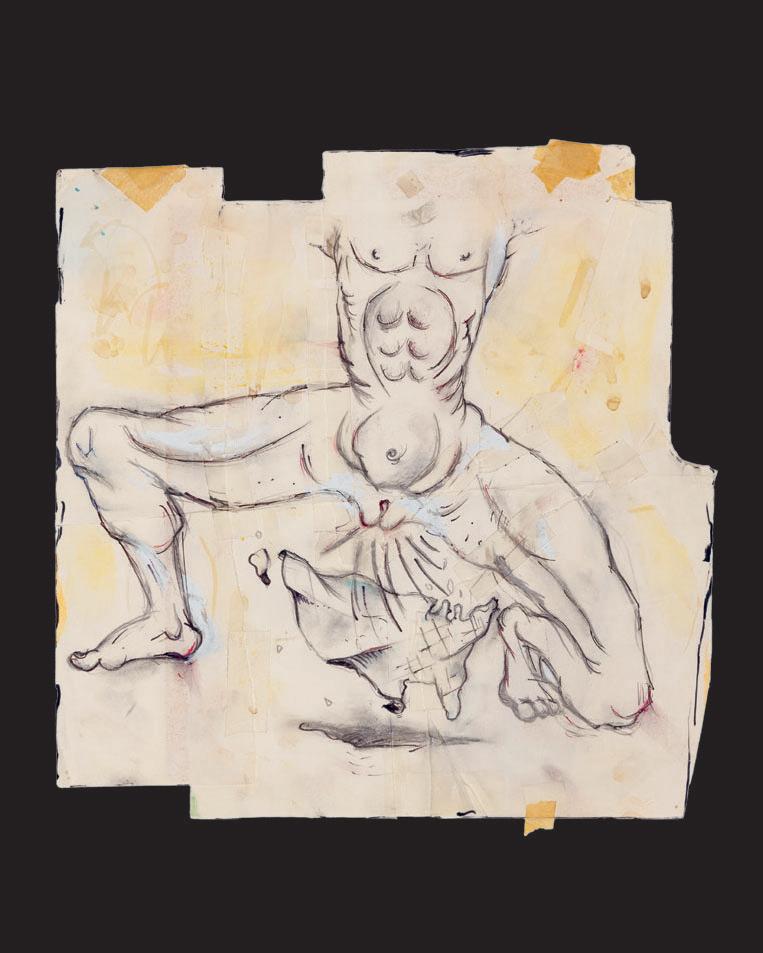
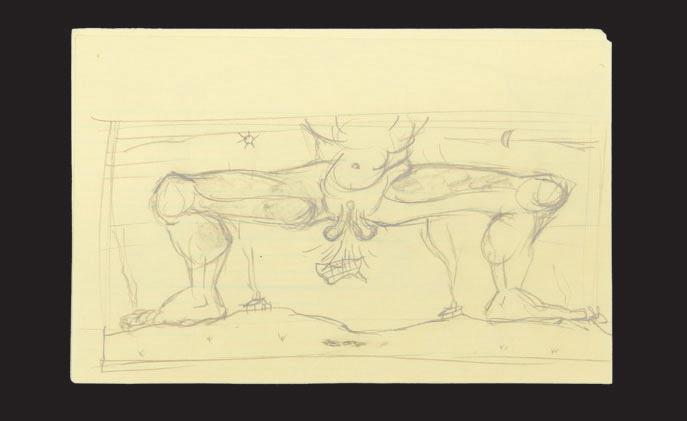
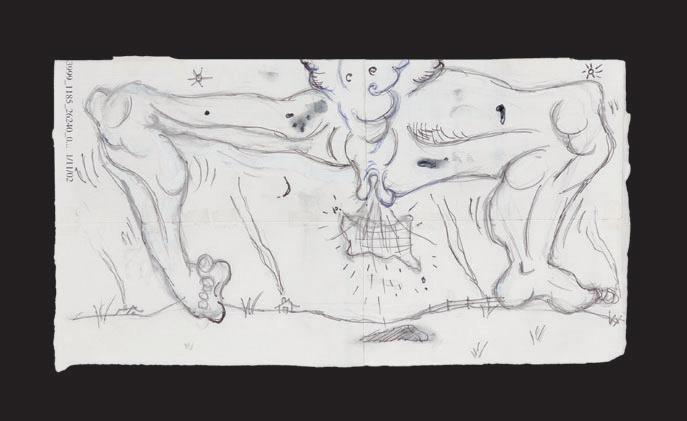
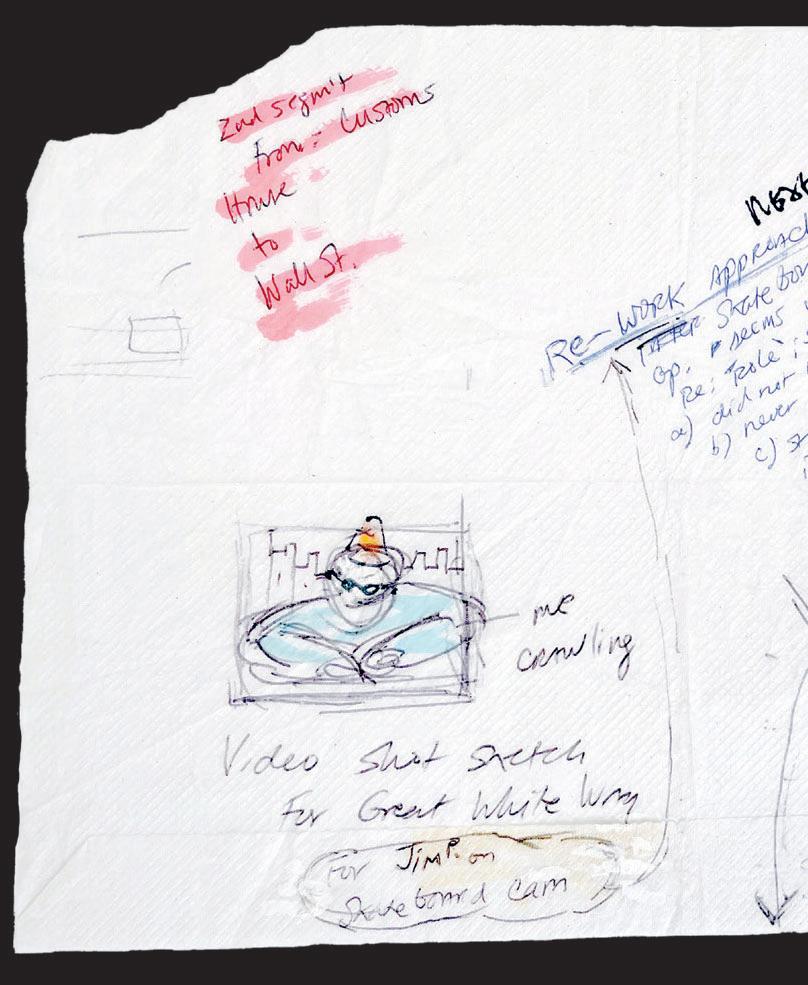
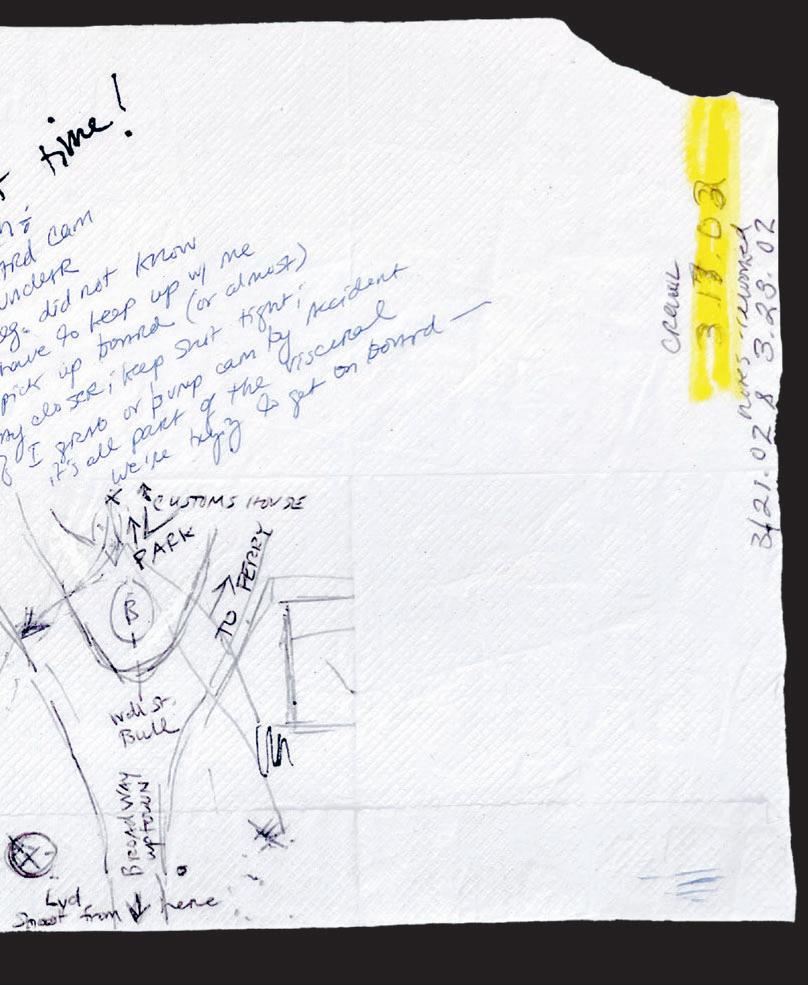
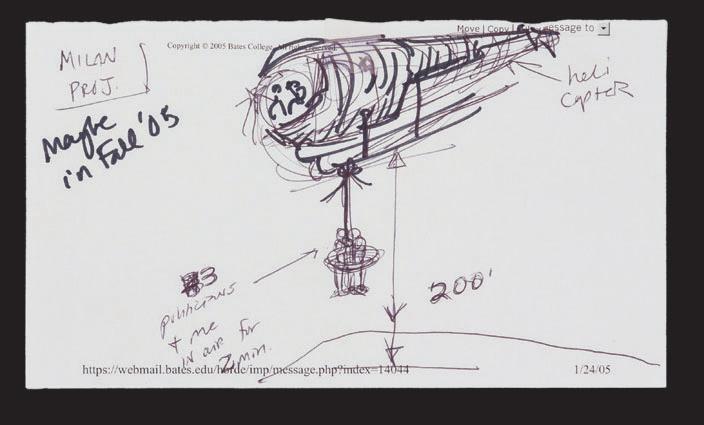
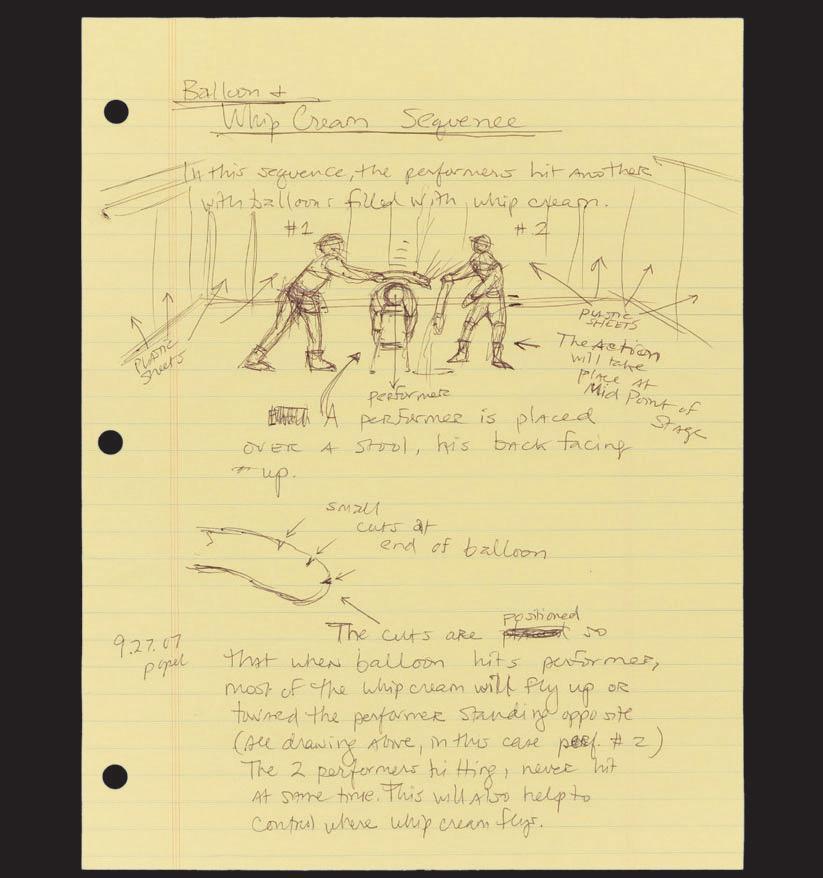
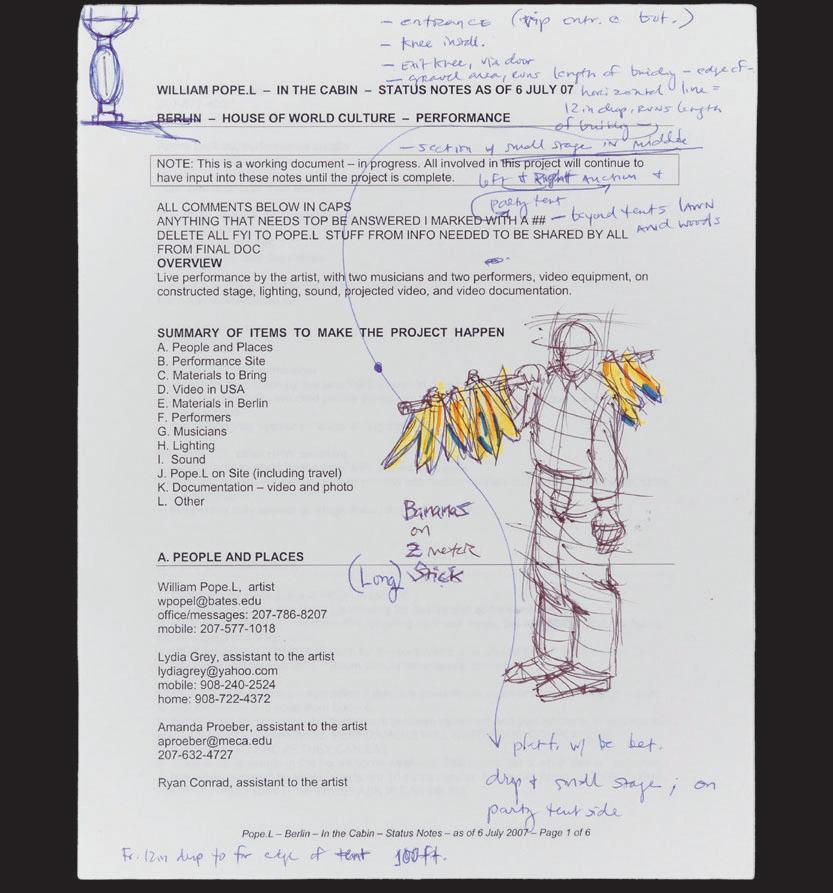
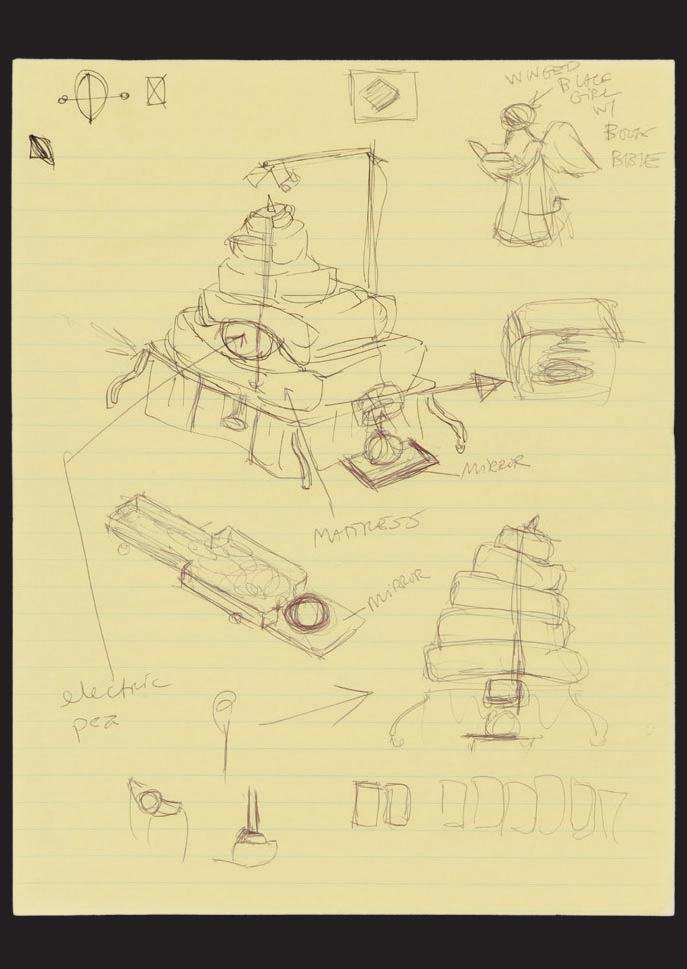
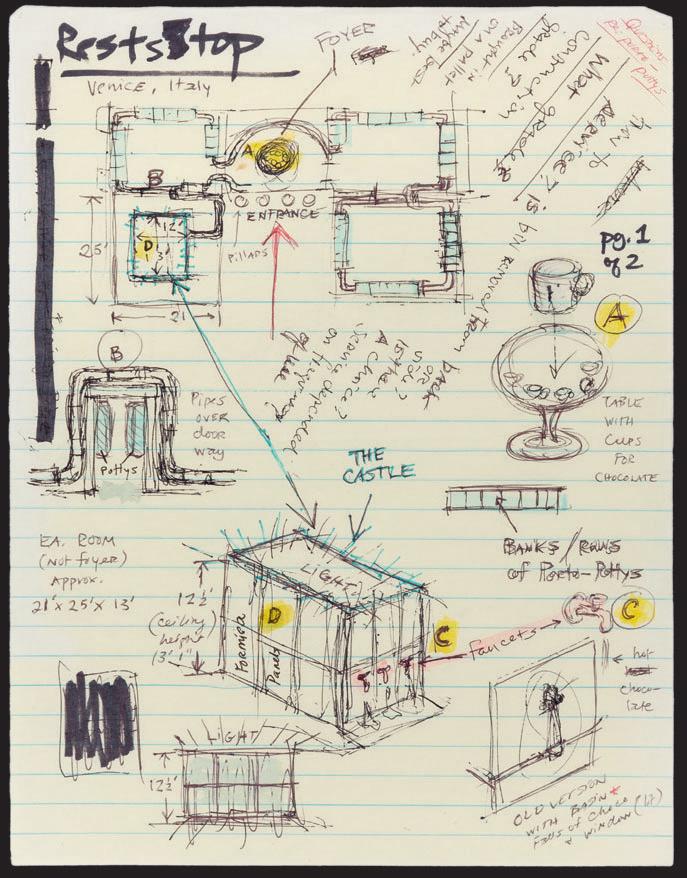
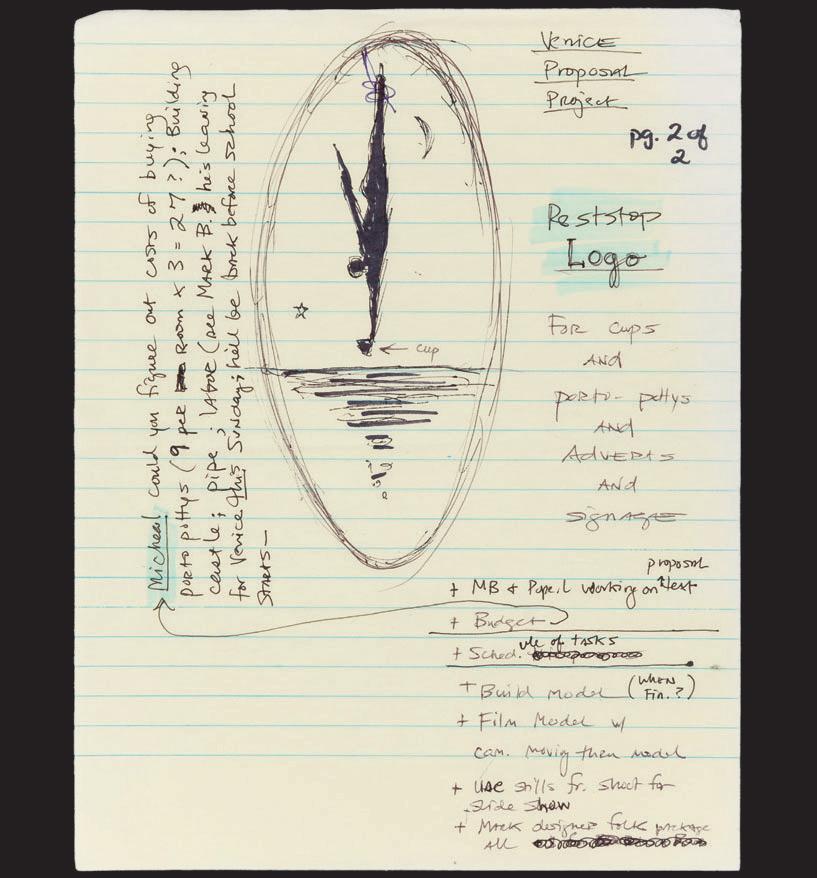
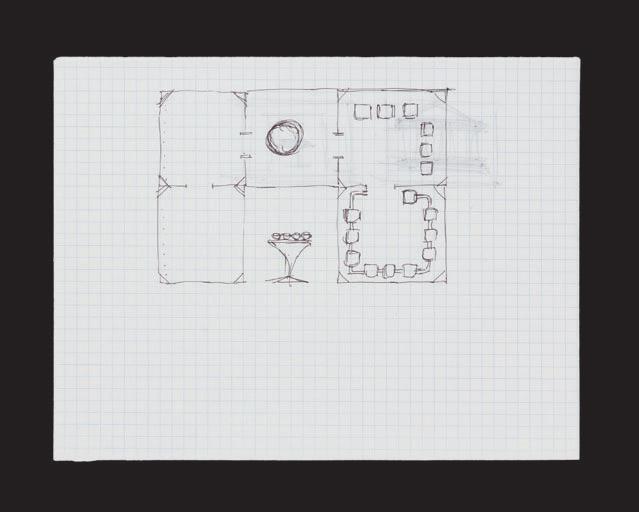
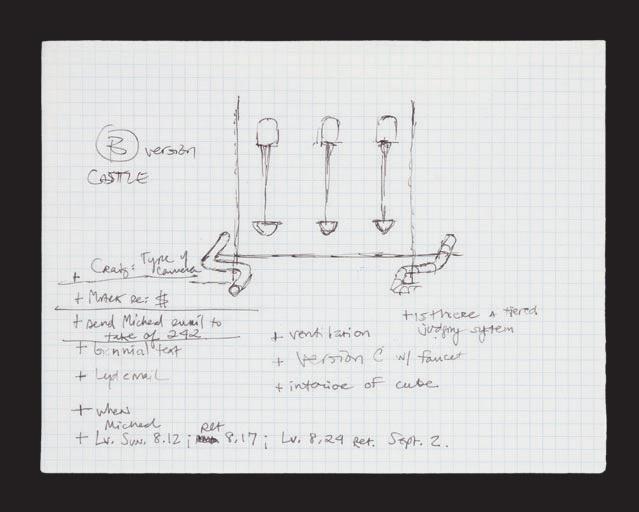
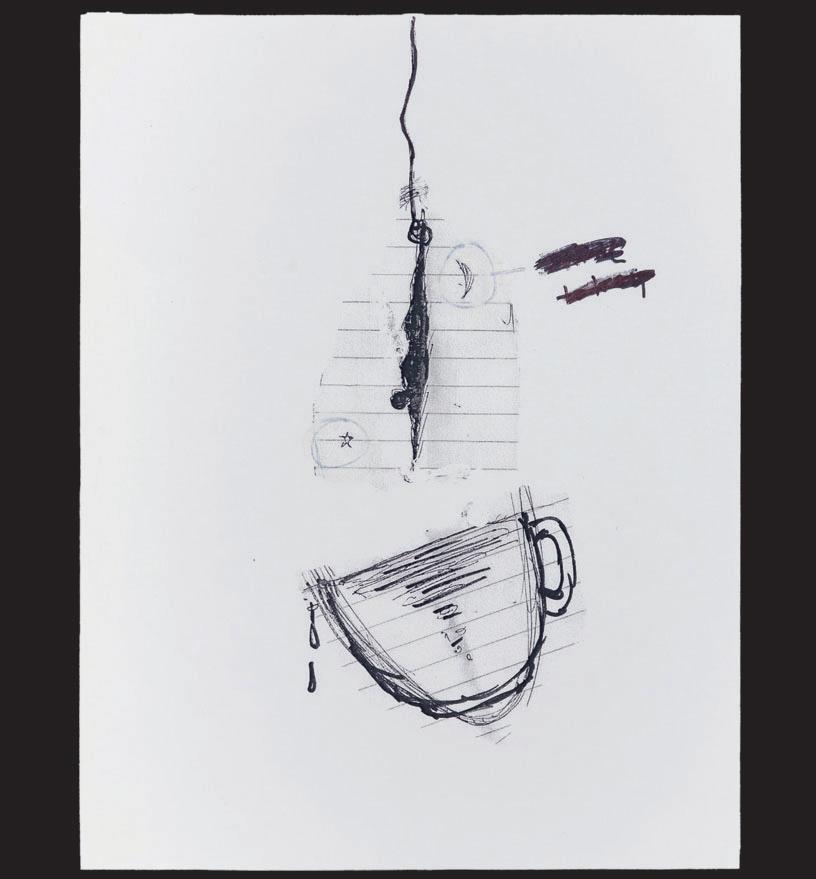
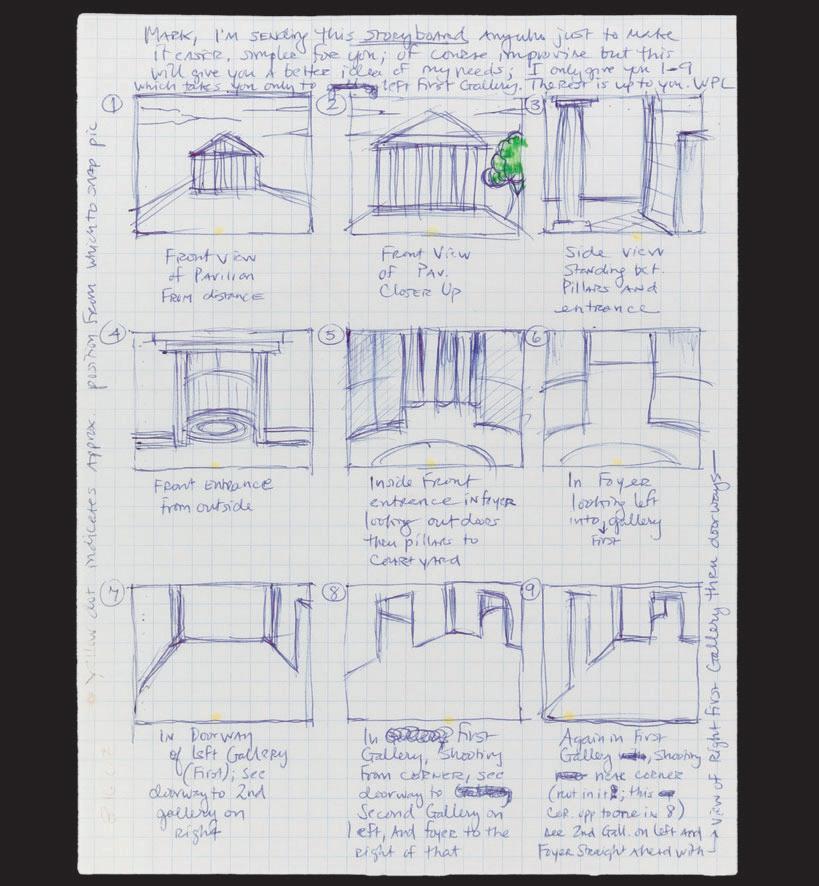
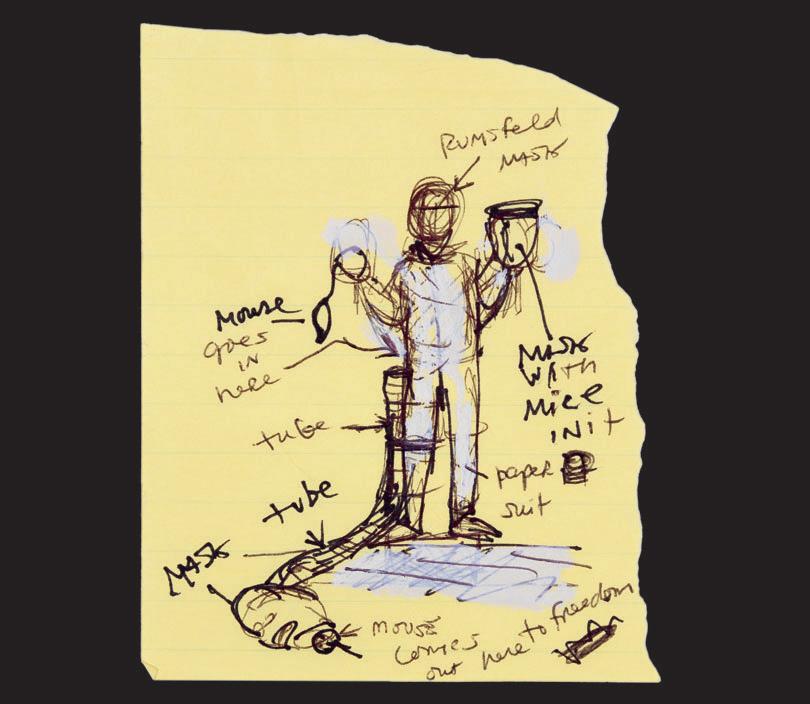
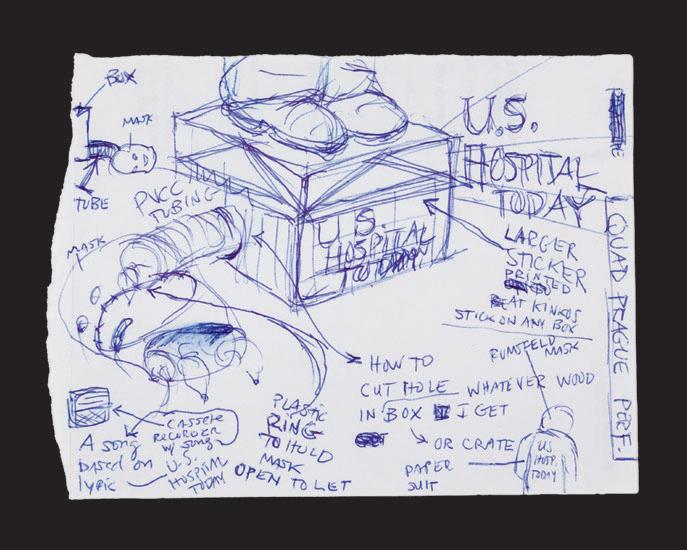
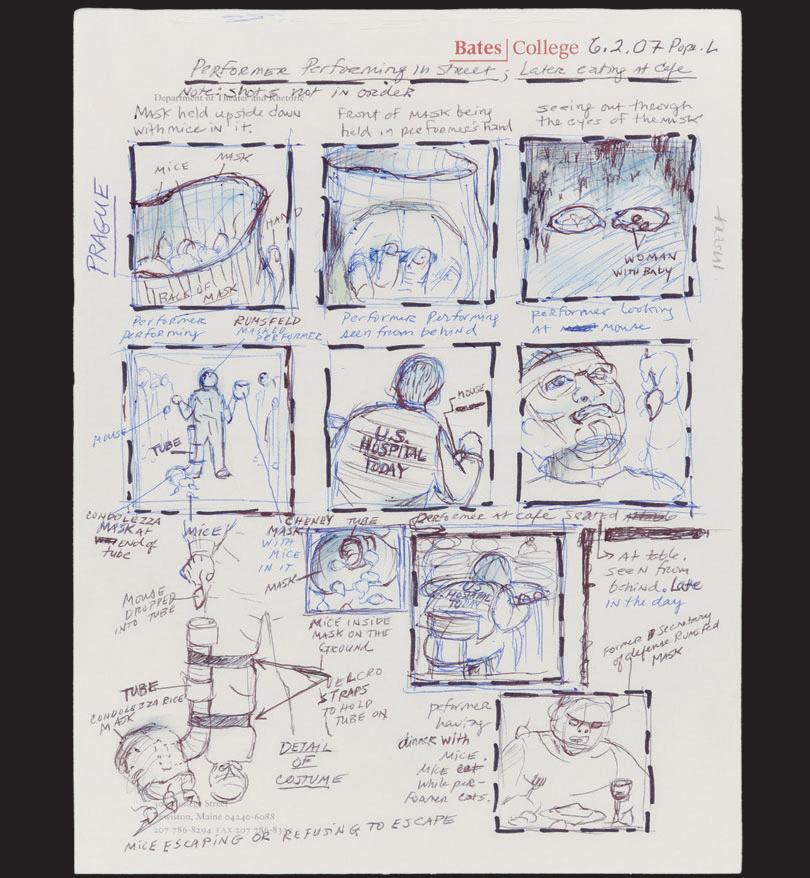
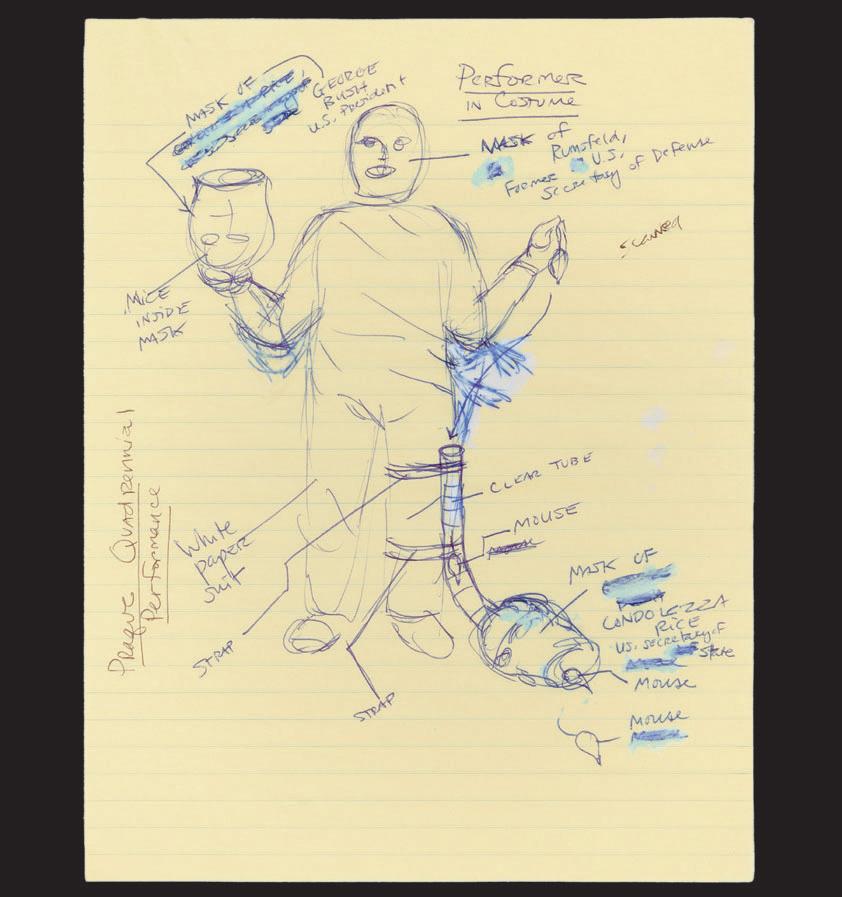
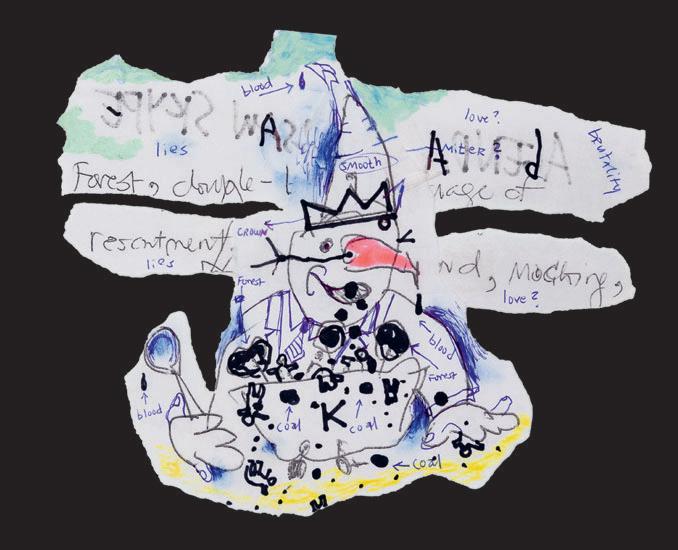

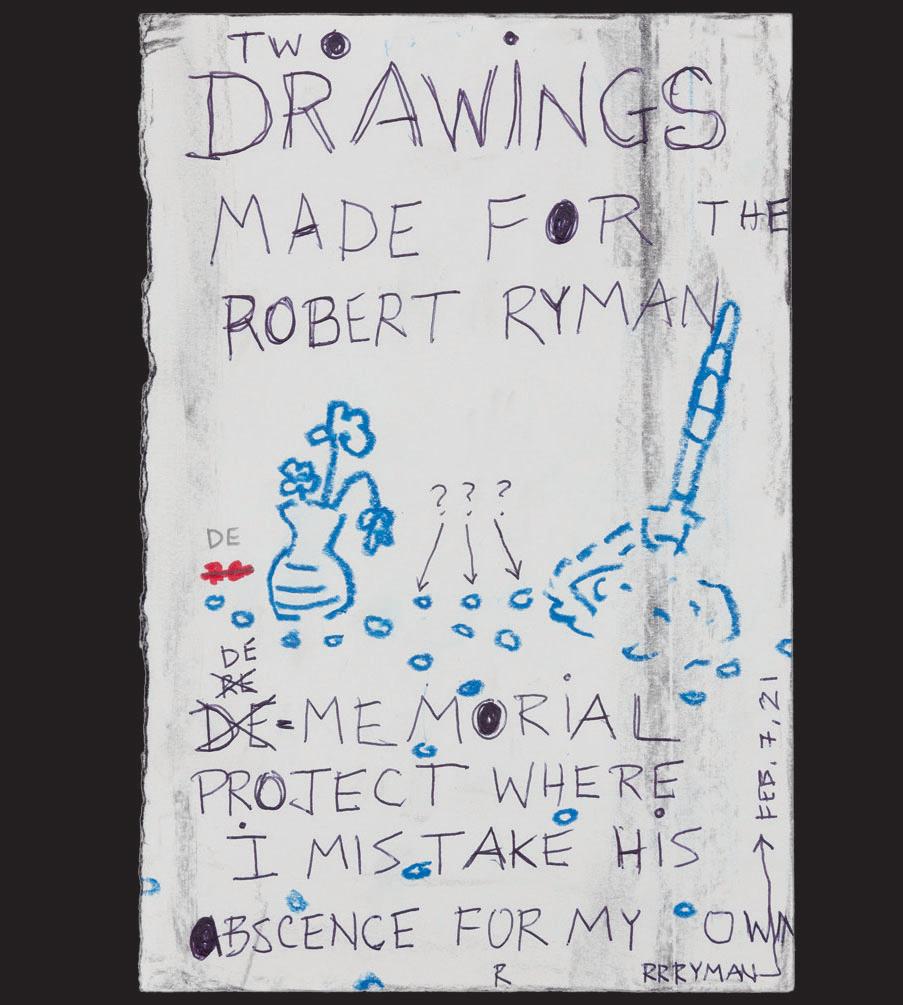
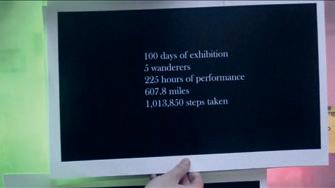
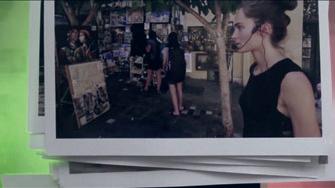
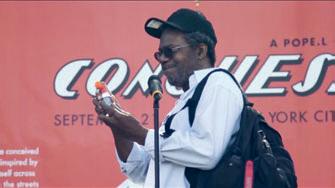
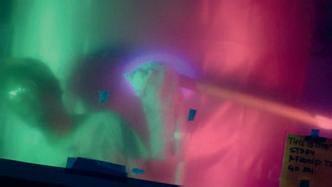
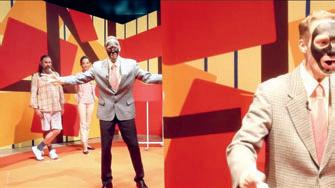
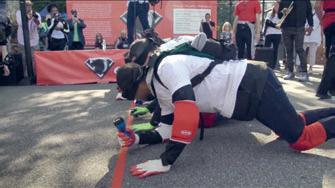
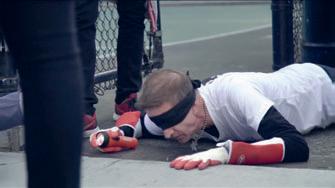
PL. 1
Ad Space, 1983–2013
Oil, acrylic, and clear resin on found cardboard with pushpins in artist’s frame
33 1/4 × 21 inches (84.5 × 53.3 cm)
Collection of Adam Pendleton and Karsten Ch’ien
PL. 2
Painting on Advertisement Never to Be Finished, 1983–2013
Acrylic, crayon, marker, and oil on found cardboard advertisement with pushpins in artist’s frame
13 3/4 × 30 1/2 inches (34.9 × 77.5 cm)
Private collection
PL. 3
Incredible Drought of Fertility, 1989–unknown end date
Acrylic, tape, glue, ballpoint pen, pastel, charcoal, and collage on paper
16 1/2 × 21 1/4 inches (41.9 × 54 cm)
Courtesy the Estate of Pope.L and Gladstone
PL. 4
At the Beach, 1989–unknown end date
Ballpoint pen, marker, pencil, acrylic, watercolor, and charcoal on paper
17 1/4 × 21 5/16 inches (43.8 × 54.1 cm)
Courtesy the Estate of Pope.L and Gladstone
PL. 5
Portrait a.k.a. The American Dream Is to Be Able to Think, 1989–90
Acrylic, oil pastel, marker, pencil, and tape on craft paper with pushpins in artist’s frame
42 × 30 3/4 inches (106.7 × 78.1 cm)
Collection of Darby English
PL. 6
Yet Another Excuse, 1989–2013
Oil, collage, graphite, marker, and tape on craft paper with pushpins in artist’s frame 26 × 42 inches (66 × 106.7 cm)
Courtesy of Jamie and Robert Soros
PL. 7
Pain Killer, 1990
Acrylic, ballpoint pen, marker, and correction fluid on paper 11 × 8 1/2 inches (27.9 × 21.6 cm)
Courtesy the Estate of Pope.L and Gladstone
PL. 8
There Is A Cloud, 1990
Acrylic, ballpoint pen, collaged newsprint, graphite, hair, and ink on newsprint with pushpins in artist’s frame 26 3/4 × 22 inches (67.9 × 55.9 cm)
Irving Stenn Jr., Family Collection, Chicago. Courtesy Mitchell-Innes & Nash, New York
PL. 9
A Political Penis Is . . ., 1990
Acrylic, marker, ink, watercolor, and ballpoint pen on paper 11 × 8 1/2 inches (27.9 × 21.6 cm)
Courtesy the Estate of Pope.L and Gladstone
PL. 10
Dictator, 1991–unknown end date
Acrylic, ballpoint pen, marker, and tape on found newspaper 15 3/8 × 12 1/2 inches (39.1 × 31.8 cm)
Courtesy the Estate of Pope.L and Gladstone
PL. 11
ET Lumumba, 1990–95
Ink, marker, and correction fluid on business card 4 × 2 inches (10.2 × 5.1 cm)
Courtesy the Estate of Pope.L and Gladstone
PL. 12
Eugene Lumumba, 1990–95
Ballpoint pen, correction fluid, ink, marker, acrylic, and tape on paper 4 3/4 × 2 inches (12.1 × 5.1 cm)
Courtesy the Estate of Pope.L and Gladstone
PL. 13
Little Boy Lumumba, 1990–95
Ink on paper
6 7/8 × 3 3/4 inches (17.5 × 9.5 cm)
Courtesy the Estate of Pope.L and Gladstone
PL. 14
Munch Lumumba, 1990–95
Ink on paper
4 7/8 × 3 3/4 inches (12.4 × 9.5 cm)
Courtesy the Estate of Pope.L and Gladstone
PL. 15
Lumumba Self Portrait, 1990–95
Acrylic, ink, pencil, ballpoint pen, color marker, hair, tape, correction fluid, highlighter, collage, oil pastel, and Post-it notes on paper towel mounted on paper
14 7/8 × 12 5/8 inches (37.8 × 32.1 cm)
Courtesy the Estate of Pope.L and Gladstone
PL. 16
Title unknown, n.d.
Ballpoint pen, marker, correction fluid, and color marker on printed paper
6 × 6 inches (15.2 × 15.2 cm)
Courtesy the Estate of Pope.L and Gladstone
PL. 17
Kemosabe, 1994
Acrylic, marker, ballpoint pen, duct tape, masking tape, collaged paper, and collaged photograph on found advertisement
47 1/2 × 68 inches (120.7 × 172.7 cm)
Courtesy the Estate of Pope.L and Gladstone
PL. 18
Title unknown, c. 1998
Ballpoint pen, marker, ink, hair, and tape on collaged paper
10 3/8 × 11 inches (26.4 × 27.9 cm)
Rennie Collection, Vancouver
PL. 19
Death Queen Chaney, 1998–2008
Mixed media on paper
10 1/4 × 8 1/4 inches (26 × 21 cm)
Courtesy the Estate of Pope.L and Gladstone
PL. 20
Title unknown, 1992/93–2000
Ink, correction fluid, stains, pigment, and collage on paper
11 × 8 1/2 inches (27.9 × 21.6 cm)
Collection of Tamara White
PL. 21
Harriet Tubman Spins the Universe, 1998–2017
Acrylic, peanut butter, ballpoint pen, marker, ink, pencil, Post-it note, twine, eye screw, S-hook, glue, and mending plates on sheetrock on ledger with tape and shim
52 3/8 × 50 3/8 inches (133 × 128 cm)
Private collection, San Mateo, California. Courtesy MitchellInnes & Nash, New York
PL. 22
Title unknown, 2000
Paint and print with tape on folded paper
17 1/2 × 35 7/8 inches (44.5 × 91.1 cm)
Courtesy the Estate of Pope.L and Gladstone
PL. 23
Title unknown, 2000 Collage, photocopy, pen, and paint on paper
17 × 11 inches (43.2 × 27.9 cm)
Collection of Jill & Peter Kraus
PL. 24
Drawing for Malcolm X, 2002
Graphite, ink, tape, acrylic, correction fluid, and collage on paper
8 × 78 inches (20.3 × 198.1 cm)
Courtesy the Estate of Pope.L and Gladstone
PL. 25
Pop Tart Frieze, 1998
Acrylic, marker, pencil, and ballpoint pen on fifty-eight
Pop-Tarts on wooden shelves
Each: 6 × 3 inches (15.2 × 7.6 cm); total length: 16 feet (4.9 m)
Courtesy the Estate of Pope.L and Gladstone
PL. 26
White Drawing, 1997
Ketchup and ballpoint pen on newsprint
52 × 59 inches (132.1 × 149.9 cm)
Courtesy the Estate of Pope.L and Gladstone
PL. 27
White People Are The Couch And The Sofa, 2001
Ballpoint pen, correction fluid, marker, pencil, tape, and hair on graph paper
11 × 8 1/2 inches (27.9 × 21.6 cm)
Courtesy the Estate of Pope.L and Gladstone
PL. 28
Black People Are What Black People Lack, 2001–02
Pen, marker, and paint on graph paper 11 × 8 1/2 inches (27.9 × 21.6 cm)
Private collection. Courtesy MitchellInnes & Nash, New York
PL. 29
Black People Are The Bag, The Glue, Wet Dream And Broken Teeth On The Rail Road Track, 2001–02
Ballpoint pen, coffee, correction fluid, marker, and tape on graph paper
11 × 8 1/2 inches (27.9 × 21.6 cm)
Courtesy the Estate of Pope.L and Gladstone
PL. 30
Black People Art Us, 2001–02
Ballpoint pen, coffee, correction fluid, and marker on graph paper 11 × 8 1/2 inches (27.9 × 21.6 cm)
Courtesy the Estate of Pope.L and Gladstone
PL. 31
Black People Are The Sputter In The Water, 2003
Ballpoint pen, correction fluid, marker, and pencil on graph paper 11 × 8 1/2 inches (27.9 × 21.6 cm)
Courtesy the Estate of Pope.L and Gladstone
PL. 32
Green People Are Wars Weems Lancaster Lopez Pruznick Montalto Weems
Barnes And Lancaster Thomas, 2004
Acrylic, ballpoint pen, correction fluid, and marker on graph paper 11 × 8 1/2 inches (27.9 × 21.6 cm)
Courtesy the Estate of Pope.L and Gladstone
PL. 33
Yellow Poeple Are The Dot On The Map In The Glove Compartment, 2004
Acrylic, ballpoint pen, coffee, coffee grounds, collage, and marker on graph paper 11 × 8 1/2 inches (27.9 × 21.6 cm)
Courtesy the Estate of Pope.L and Gladstone
PL. 34
Yellow People Are Keratin, 2004
Ballpoint pen, coffee, and marker on graph paper 11 × 8 1/2 inches (27.9 × 21.6 cm)
Courtesy the Estate of Pope.L and Gladstone
PL. 35
Purple People Are Middle Age Is Snow, 2006–07
Ballpoint pen, coffee, correction fluid, marker, oil marker, and pencil on graph paper 11 × 8 1/2 inches (27.9 × 21.6 cm)
Courtesy the Estate of Pope.L and Gladstone
PL. 36
Purple People Are Moses In His Tasket, 2006–07
Ballpoint pen, coffee, correction fluid, ink, and marker on graph paper 11 × 8 1/2 inches (27.9 × 21.6 cm)
Courtesy the Estate of Pope.L and Gladstone
PL. 37
Purple People Are The Ripples On The Plastic Wrappers In The Ocean, 2006–07
Acrylic, ash, ballpoint pen, coffee, hair, ink, collage, white glue, matte medium, and fixative on graph paper
11 × 8 1/2 inches (27.9 × 21.6 cm)
Courtesy the Estate of Pope.L and Gladstone
PL. 38
White People Are Unclear, 2008
Ballpoint pen, correction fluid, and ink on graph paper
11 × 8 1/2 inches (27.9 × 21.6 cm)
Courtesy the Estate of Pope.L and Gladstone
PL. 39
Yellow People Are Runny, 2008
Ballpoint pen and color marker on graph paper
11 × 8 1/2 inches (27.9 × 21.6 cm)
Courtesy the Estate of Pope.L and Gladstone
PL. 40
Black People Are Cropped, 2008
Ballpoint pen, correction fluid, and marker on graph paper
10 3/8 × 8 1/2 inches (26.4 × 21.6 cm)
Courtesy the Estate of Pope.L and Gladstone
PL. 41
Black People Are The Rhinoceri On The Tight Rope, 2008
Ballpoint pen, colored correction fluid, and marker on graph paper
11 × 8 1/2 inches (27.9 × 21.6 cm)
Courtesy the Estate of Pope.L and Gladstone
PL. 42
White People Are Fair, 2008
Ballpoint pen, ink, and color marker on graph paper 11 × 8 1/2 inches (27.9 × 21.6 cm)
Courtesy the Estate of Pope.L and Gladstone
PL. 43
White People Are Palesman Who Live In Cleveland, 2008
Acrylic, ballpoint pen, coffee, correction fluid, and marker on graph paper
11 × 8 1/2 inches (27.9 × 21.6 cm)
Courtesy the Estate of Pope.L and Gladstone
PL. 44
Red People Are Impotent And Why, 2008 Ink and color ink on graph paper
11 × 8 1/2 inches (27.9 × 21.6 cm)
Courtesy the Estate of Pope.L and Gladstone
PL. 45
Blue People Are Not A People They Are A Substance, 2008
Ballpoint pen, colored correction fluid, hair, and white glue on graph paper
11 × 8 1/2 inches (27.9 × 21.6 cm)
Courtesy the Estate of Pope.L and Gladstone
PL. 46
Blue People Cannot Conceive Of Themselves, 2008
Ballpoint pen, coffee, correction fluid, oil stick, glitter, hair, marker, and white glue on graph paper
11 × 8 1/2 inches (27.9 × 21.6 cm)
Courtesy the Estate of Pope.L and Gladstone
PL. 47
Blue People Have No Hand Feets No Afro To Make The Head Grow, 2008 Ballpoint pen on graph paper 11 × 8 1/2 inches (27.9 × 21.6 cm)
Courtesy the Estate of Pope.L and Gladstone
PL. 48
Red People Are The Last Bar-b-que Potato Chip In The Bag Crumpled Up On the Floor Of A 1992 Toyota
Pick-up With No Radio XXX, 2008
Ballpoint pen, pigment, pencil, coffee, and coffee grounds on graph paper
11 × 8 1/2 inches (27.9 × 21.6 cm)
Courtesy the Estate of Pope.L and Gladstone
PL. 49
Orange People Are Famous, 2008
Ballpoint pen, coffee, coffee grounds, correction fluid, marker, and white glue on graph paper
11 × 8 1/2 inches (27.9 × 21.6 cm)
Courtesy the Estate of Pope.L and Gladstone
PL. 50
Red People Are A Token Made Of Kerosene Aluminum Foil And Jelly, 2008
Acrylic, Pilot pen, coffee, coffee grounds, correction fluid, hair, ink, and marker on graph paper
11 × 8 1/2 inches (27.9 × 21.6 cm)
Courtesy the Estate of Pope.L and Gladstone
PL. 51
Red People Are With Stupid, 2008
Acrylic, ballpoint pen, correction fluid, color ink, and marker on graph paper
11 × 8 1/2 inches (27.9 × 21.6 cm)
Courtesy the Estate of Pope.L and Gladstone
PL. 52
Red People Are Black People With A Heritage, 2008
Ballpoint pen, coffee, ink, correction fluid, and hair on graph paper
11 × 8 1/2 inches (27.9 × 21.6 cm)
Courtesy the Estate of Pope.L and Gladstone
PL. 53
Brown People Are The Sea In Leisure, 2010
Correction fluid, oil marker, and oil pencil on white art paper
11 1/2 × 9 inches (29.2 × 22.9 cm)
Courtesy the Estate of Pope.L and Gladstone
PL. 54
Red People Have No Reservations, 2010
Ballpoint pen and marker on pink art paper
11 1/2 × 9 inches (29.2 × 22.9 cm)
Private collection. Courtesy MitchellInnes & Nash, New York
PL. 55
Brown People Are the Spill in the Harbor, 2010
Ballpoint pen, ink, and marker on black art paper
12 × 9 inches (30.5 × 22.9 cm)
Collection of Adam Pendleton and Karsten Ch’ien
PL. 56
Red People Are A Road In The Middle Oof Progress, 2010
Marker on off-white art paper
11 1/2 × 9 inches (29.2 × 22.9 cm)
Courtesy the Estate of Pope.L and Gladstone
PL. 57
White People Are Prawns At Sunset, 2010
Ballpoint pen and marker on off-white paper
11 1/2 × 9 inches (29.2 × 22.9 cm)
Courtesy the Estate of Pope.L and Gladstone
PL. 58
Untitle, 2010
Acrylic, ballpoint pen, ink, and marker on off-white paper
11 1/2 × 9 inches (29.2 × 22.9 cm)
Courtesy the Estate of Pope.L and Gladstone
PL. 59
Blue People Ssshit In The Mouth Of History, 2010
Ballpoint pen on off-white paper
11 1/2 × 9 inches (29.2 × 22.9 cm)
Courtesy the Estate of Pope.L and Gladstone
PL. 60
Yellow People Are The Neighborhood Behind The Chemical Plant, 2010
Ballpoint pen, ink, and marker on off-white paper
12 × 9 inches (30.5 × 22.9 cm)
Courtesy the Estate of Pope.L and Gladstone
PL. 61
Green People Are The Light From A Star That Will Never Reach Us, 2010
Ballpoint pen, coffee, coffee grounds, adhesive, ink, hair, and marker on off-white paper
11 1/2 × 9 inches (29.2 × 22.9 cm)
Courtesy the Estate of Pope.L and Gladstone
PL. 62
Blue People Are Racist, 2010–12
Marker on off-white art paper
11 3/8 × 8 7/8 inches (28.9 × 22.5 cm)
Courtesy the Estate of Pope.L and Gladstone
PL. 63
Purple People Are The Foot-Prints Around The Hole In The Ground, 2011
Ballpoint pen, ink, acrylic, and correction fluid on white art paper
12 × 9 inches (30.5 × 22.9 cm)
Private collection. Courtesy of Mitchell-Innes & Nash, New York
PL. 64
Untitle, 2011
Acrylic ink, ink, and pencil on vellum graph paper
35 1/2 × 23 3/4 inches (90.2 × 60.3 cm)
Courtesy the Estate of Pope.L and Gladstone
PL. 65
#Bottom Line Green People Are Already Gecko-Redacted Enthusiastic,” Said The Brown Woman To The PurplePerson “Ditto The Bio-Rhetorical Carbon Raced Sugar Ethics Glitchola!!”, n.d. Pencil, crayon, and acrylic on vellum graph paper
47 1/2 × 35 3/4 inches (120.7 × 90.8 cm)
Courtesy the Estate of Pope.L and Gladstone
PL. 66
Black People Are Transparent, 2011 Ballpoint pen, hair, and ink on gray art paper
12 × 9 inches (30.5 × 22.9 cm)
Courtesy the Estate of Pope.L and Gladstone
PL. 67
Blue People Are A Roiling Metaphor For The King’s Cunt, The Queen’s Vack; The The Prince’s Gas-Hole And The Princess’ Sudden Bout Of Tears And Amnesia (After Her Recent Visit To The Newly Opened ‘Bix-Box To Buy A Pair Of Stun-Glasses) Whose Foundation Rests On The Balks Of Her Loyal Subjects Still Wriggling In The Wet Foment, 2011 Oil, acrylic, and pencil on vellum graph paper
72 × 35 3/4 inches (182.9 × 90.8 cm)
Courtesy the Estate of Pope.L and Gladstone
PL. 68
Untitle, 2011
Ballpoint pen, marker, acrylic, and oil on white art paper
11 1/2 × 9 inches (29.2 × 22.9 cm)
Courtesy the Estate of Pope.L and Gladstone
PL. 69
Blue People Are What We Do With Homosexuals, French People And Roma, 2011
Ballpoint pen and marker on graph paper
11 × 8 1/2 inches (27.9 × 21.6 cm)
Courtesy the Estate of Pope.L and Gladstone
PL. 70
Orange People Are A Book With Write Pages Writ On Them!!!!!, 2011 Ballpoint pen, correction fluid, and marker on graph paper
11 × 8 1/2 inches (27.9 × 21.6 cm)
Courtesy the Estate of Pope.L and Gladstone
PL. 71
The Winter of Black People, 2011–13 Water-based oil, acrylic, oil stick, pencil, china marker, Post-it note, marker, acetate, and collage on paper in artist’s frame
61 × 120 inches (154.9 × 304.8 cm)
Collection of Jill & Peter Kraus
PL. 72
Porple People Are The Salt In The Wound, Green Around The Edges Hardened Crust, 2012
Acrylic, china marker, oil stick, pencil, and water-based oil paint on vellum graph paper
36 × 24 inches (91.4 × 61 cm)
Courtesy the Estate of Pope.L and Gladstone
PL. 73
Pink People Eat Cotton Candy I Eat Cotton, 2012
Acrylic, china marker, ink, oil stick, pencil, and water-based oil on vellum graph paper
36 × 23 3/4 inches (91.4 × 60.3 cm)
Collection of Adam Pendleton and Karsten Ch’ien
PL. 74
Blue People Take The Cat To Work, 2012
Paint stick, ink, and pencil on white art paper
12 × 9 inches (30.5 × 22.9 cm)
Courtesy the Estate of Pope.L and Gladstone
PL. 75
Blue Peoplee Are In The Glass, 2012
Pencil and ink on white art paper 12 × 9 inches (30.5 × 22.9 cm)
Courtesy the Estate of Pope.L and Gladstone
PL. 76
Red People Fuck The Oysters Of Authors, 2012 Cel paint, ink, and watercolor on white art paper
12 × 9 inches (30.5 × 22.9 cm)
Courtesy the Estate of Pope.L and Gladstone
PL. 77
Pink People Are The Wrong Sale, 2012
Ballpoint pen and marker on office paper 11 × 8 1/2 inches (27.9 × 21.6 cm)
Courtesy the Estate of Pope.L and Gladstone
PL. 78
Orange People Are Made Of Lozenges, 2012 Magic marker and oil marker on black art paper
12 × 9 inches (27.9 × 21.6 cm)
Private collection. Courtesy of Mitchell-Innes & Nash, New York
PL. 79
Orange People Are A Powder, 2012 Magic marker and oil marker on gray art paper 12 × 9 inches (30.5 × 22.9 cm)
Courtesy the Estate of Pope.L and Gladstone
PL. 80
Purple People Are The Color Of Plinarchy, 2012 Magic marker and oil marker on white art paper 12 × 9 inches (30.5 × 22.9 cm)
Courtesy the Estate of Pope.L and Gladstone
PL. 81
Purple People Be So Black Even The Sun Is Jealous, 2012 Ballpoint pen and marker on office paper 11 × 8 1/2 inches (27.9 × 21.6 cm)
Courtesy the Estate of Pope.L and Gladstone
PL. 82
Brown People Are A Liquid, 2011–12 Acrylic, china marker, pencil, and water-based oil paint on white art paper 59 3/16 × 59 5/8 inches (150.3 × 151.4 cm)
Courtesy the Estate of Pope.L and Gladstone
PL. 83
Cliff, 2012–13
Marker, ballpoint pen, graphite, and correction fluid on four sheets of joined paper 11 × 56 1/4 inches (27.9 × 142.9 cm)
Courtesy the Estate of Pope.L and Gladstone
PL. 84
XXIXX XXXXXX XXX XXXX XRXXN
XXXXXXX: 1,7,186,4,101, 2011
Ballpoint pen, correction fluid, and marker on graph paper
11 × 8 1/2 inches (27.9 × 21.6 cm)
Courtesy the Estate of Pope.L and Gladstone
PL. 85
888 0X8 080 XOX, 2012
Marker, oil marker, and pencil on off-white art paper
12 × 9 inches (30.5 × 22.9 cm)
Courtesy the Estate of Pope.L and Gladstone
PL. 86
X08 888 XNX XX IH MXXI, 2012
Marker, oil marker, and pencil on off-white art paper
11 1/2 × 9 inches (29.2 × 22.9 cm)
Courtesy the Estate of Pope.L and Gladstone
PL. 87
HXM OXO XXX XHX, 2012
Cel paint and pencil on off-white art paper
12 × 9 inches (30.5 × 22.9 cm)
Courtesy the Estate of Pope.L and Gladstone
PL. 88
XXXXXX XXX OXXV HOV
XXXOO XXX, 2012
Cel paint and pencil on gray art paper
12 × 8 7/8 inches (30.5 × 22.5 cm)
Courtesy the Estate of Pope.L and Gladstone
PL. 89
XXX XXX XXX XXX XXX, 2012
Marker, oil marker, and pencil on off-white art paper
11 1/2 × 9 inches (29.2 × 22.9 cm)
Courtesy the Estate of Pope.L and Gladstone
PL. 90
XDO OXM DXO/ XXX
XXXX MLX OOO, 2012
Litho crayon and ballpoint pen on newsprint
10 × 7 1/2 inches (25.4 × 19.1 cm)
Courtesy the Estate of Pope.L and Gladstone
PL. 91
X, 2013
Ballpoint pen and pencil on off-white art paper
12 × 9 inches (30.5 × 22.9 cm)
Courtesy the Estate of Pope.L and Gladstone
PL. 92
087, 10-11, N/LY, 2013
Acrylic, ballpoint pen, and correction fluid on white art paper
12 × 9 inches (30.5 × 22.9 cm)
Courtesy the Estate of Pope.L and Gladstone
PL. 93
091, 35-36, h, b/Hi, B, 2013
Ballpoint pen and pencil on white art paper
12 × 9 inches (30.5 × 22.9 cm)
Courtesy the Estate of Pope.L and Gladstone
PL. 94
092, 10-11, he/b, B, 2013
Ballpoint pen, correction fluid, marker, and pencil on white art paper
12 × 9 inches (30.5 × 22.9 cm)
Courtesy the Estate of Pope.L and Gladstone
PL. 95
092, 19-20, pty/d, t, A, 2013
Ballpoint pen, correction fluid, hair, and matte medium on paper
12 × 9 inches (30.5 × 22.9 cm)
Courtesy the Estate of Pope.L and Gladstone
PL. 96
Hi’, 2014
Oil and acrylic on c-insert
10 3/4 × 9 inches (27.3 × 22.9 cm)
Courtesy the Estate of Pope.L and Gladstone
PL. 97
Goo Democracy, 2014
Oil and acrylic on advertising insert 11 × 11 inches (27.9 × 27.9 cm)
Courtesy the Estate of Pope.L and Gladstone
PL. 98
Untitle, 2014
Charcoal and acrylic on advertising insert
9 1/2 × 10 1/2 inches (24.1 × 26.7 cm)
Courtesy the Estate of Pope.L and Gladstone
PL. 99
Gold People Are Children, 2014
Oil and acrylic on newspaper
11 1/4 × 8 1/2 inches (28.6 × 21.6 cm)
Courtesy the Estate of Pope.L and Gladstone
PL. 100
Gold People are birds breaking their beaks on the ice, 2015 Oil, acrylic, oil stick, marker, ballpoint pen, and masking tape on canvas
34 × 39 inches (86.4 × 99.1 cm)
Collection of Jill & Peter Kraus
PL. 101
Tautology, n.d.
Pencil, acrylic, oil stick, and crayon on vellum graph paper
26 1/2 × 47 1/2 inches (67.3 × 120.7 cm)
Courtesy the Estate of Pope.L and Gladstone
PL. 102
White Cop White Donut, 2016
Transparent gesso, acrylic, charcoal, ink, china marker, and painted pushpins on paper with artist’s frame
12 x 9 inches (30.5 x 22.9 cm)
Courtesy the Estate of Pope.L and Gladstone
PL. 103
Two Kingdoms, 2021 PL. 103
Acrylic, oil, charcoal, marker, and collage on two panels 16 × 24 inches (40.6 × 61 cm)
Courtesy the Estate of Pope.L and Gladstone
PL. 104
WHA, 2020–21
Acrylic, charcoal, oil, and epoxy on panel 94 1/2 × 145 5/8 inches (240 × 370 cm)
Collection of Jill & Peter Kraus
PL. 105
Relational Painting a.k.a. If Black Is Beautiful . . ., 2003–22
Paint, marker, tapes, printed paper collage and paper collage on polyethylene tarp, steel pipes and aluminum couplings, painted plywood cut outs, painted Polaroids mounted on plywood cutouts, plastic wrapper, painted framed print, painted plastic and glass bottles, plastic shoe tree, plate and container, cast plaster, cigarette butts and ashes, sticky note, screws, gum eraser, painted glass fragments, cardboard boxes, mop handle, ziplock bag with pencil, thumb tacks, hammer, plug-in timer switch, painted light strip, painted particle board, plywood and foam-core panels, acoustic tile, dried potted plants, Schultz plant food box, cutout poly tarp shapes, denim fabric, extension cords, power strips, hooded clip on lights, audio equipment, amplifiers, mixers, microphones, boom boxes, loudspeakers, and audio cables, The Origins of American Slavery by Betty Wood, Fragments for a History of the Human Body by Michel Feher and Ramona Naddaff, Who is Black?: One Nation’s Definition by F. James Davis, and Black Reconstruction by W. E. B. Du Bois 132 × 228 inches (335.3 × 579.1 cm)
Courtesy the Estate of Pope.L and Gladstone
PL. 106
Sino Drawing (2 of 8), 2001
Ink, pencil, and coffee on paper
8 1/4 × 10 1/2 inches (15.2 × 26.7 cm)
Courtesy the Estate of Pope.L and Gladstone
PL. 107
Sino Drawing (4 of 8), 2001
Ink, pen, and coffee on paper
8 1/2 × 6 inches (21.6 × 15.2 cm)
Courtesy the Estate of Pope.L and Gladstone
PL. 108
Sino Drawing (5 of 8), 2001 Marker, tape, and highlighter on styrofoam
7 1/2 × 6 1/2 inches (19.1 × 16.5 cm)
Courtesy the Estate of Pope.L and Gladstone
PL. 109
Sino Drawing (6 of 8), 2001
Ballpoint pen, pencil, and coffee on paper
6 × 5 inches (15.2 × 12.7 cm)
Courtesy the Estate of Pope.L and Gladstone
PL. 110
Sino Drawing (7 of 8), 2001
Ink on paper
4 × 4 inches (10.1 × 10.1 cm)
Courtesy the Estate of Pope.L and Gladstone
PL. 111
Failure Drawing #1351, Fishing Story, 2003
Ballpoint pen, correction fluid, and collage on paper
4 1/4 × 5 3/4 inches (12.7 × 13.9 cm)
Courtesy the Estate of Pope.L and Gladstone
PL. 112
Failure Drawing #1144, 5.29.03, How To Say Goodbye, 2003
Ink, acrylic, and highlighter on hotel stationery
3 1/2 × 5 inches (8.9 × 12.5 cm)
Courtesy the Estate of Pope.L and Gladstone
PL. 113
Failure Drawing #1356, 12.4.03, An Orange Sky, 2003
Ballpoint pen and torn magazine paper collage on verso-printed paper
5 5/8 × 4 1/4 inches (14.3 × 10.8 cm)
Courtesy the Estate of Pope.L and Gladstone
PL. 114
Failure Drawing #386, 2003, 2008, Worm in Class, 2003, 2008
Ballpoint pen and watercolor on newspaper over card
4 1/2 × 6 5/16 inches (11.4 × 16 cm)
Courtesy the Estate of Pope.L and Gladstone
PL. 115
Failure Drawing #738, 1.04, House and Leap, 2004
Ink, marker, acrylic, and coffee on hotel stationery
5 1/2 × 4 1/4 inches (13.9 × 10.7 cm)
Courtesy the Estate of Pope.L and Gladstone
PL. 116
Failure Drawing #751, 1.13.04, Mound with Hole, 2004
Pen, highlighter, color marker, and tape on hotel stationery
4 1/4 × 5 1/2 inches (10.8 × 14 cm)
Courtesy the Estate of Pope.L and Gladstone
PL. 117
Failure Drawing #764, 1.16.04, Worm in Space, 2004
Ballpoint pen, coffee, and correction fluid on hotel stationery
5 1/2 × 4 1/4 inches (13.9 × 10.7 cm)
Courtesy the Estate of Pope.L and Gladstone
PL. 118
Failure Drawing #780, 2.13.04, Worm Ziggurat on Napkin, 2004
Acrylic, color marker, and ink on paper towel
5 1/2 × 5 1/2 inches (14 × 14 cm)
Courtesy the Estate of Pope.L and Gladstone
PL. 119
Failure Drawing #782, 2.14.04, Penis Segments on Grass, 2004
Ballpoint pen and color marker on reverse side of gym membership sweepstakes ticket
3 1/2 × 5 1/2 inches (8.8 × 13.9 cm)
Courtesy the Estate of Pope.L and Gladstone
PL. 120
Failure Drawing #809, 3.0.04, Communicating With the Mourning, 2004
Pencil, ink, ballpoint pen, color marker, and acrylic on paper
6 3/16 × 9 inches (15.7 × 22.9 cm)
Courtesy the Estate of Pope.L and Gladstone
PL. 121
Failure Drawing #855, 3.22.04, Rocket Launch and Sun, Pittsburgh, 2004
Ballpoint pen on napkin
5 × 5 inches (12.7 × 12.7 cm)
Courtesy the Estate of Pope.L and Gladstone
PL. 122
Failure Drawing #708A, 3.04, 6.05, 7.2.05, 7.6.05, 3.27.06, Even the Mountain is Ash, 2004–06
Ballpoint pen, ink, and acrylic on newsprint on paper
3 1/8 × 5 inches (7.9 × 12.7 cm)
Courtesy the Estate of Pope.L and Gladstone
PL. 123
Failure Drawing #923, 4.6.04, Snake on TV, 2004
Ink and ballpoint pen on hotel stationery
4 1/8 × 5 1/2 inches (10.5 × 14 cm)
Courtesy the Estate of Pope.L and Gladstone
PL. 124
Failure Drawing #950, 4.11.04, 4.12.04, 4.19.04, Roadside with Yellow and Blue Sky, Lewiston, 2004
Ballpoint pen, color marker, highlighter, and correction fluid on paper
5 3/4 × 8 1/2 inches (14.6 × 21.5 cm)
Courtesy the Estate of Pope.L and Gladstone
PL. 125
Failure Drawing #962, 4.12.04, Rocket Over Road, Cardboard, 2004
Ballpoint pen on cardboard 8 1/2 × 5 5/8 inches (21.5 × 14.2 cm)
Courtesy the Estate of Pope.L and Gladstone
PL. 126
Failure Drawing #963, 4.12.04, 4.19.04, Black Marker Rocket, Legal Paper, 2004
Marker, ballpoint pen, and acrylic on lined legal paper
5 1/2 × 8 1/2 inches (13.9 × 21.5 cm)
Courtesy the Estate of Pope.L and Gladstone
PL. 127
Failure Drawing #1090, 5.15.04, Spectacled, 2004
Ballpoint pen on hotel stationery 4 1/4 × 5 1/2 inches (10.7 × 13.9 cm)
Courtesy the Estate of Pope.L and Gladstone
PL. 128
Failure Drawing #1224, 6.26.04, 7.2.07, Rocket Into Copy, 2004 Ballpoint pen, marker, collage, and Post-it note on photocopy paper 11 × 8 1/2 inches (27.9 × 21.5 cm)
Courtesy the Estate of Pope.L and Gladstone
PL. 129
Failure Drawing #266, 7.12.04, 7.28.04, 4.22.05, 3.20.06, 4.14.06, 7.28.04, Between Cliffs Some Penis Must Fall, 2004–06 Ink, color marker, and acrylic on printed paper 4 9/16 × 5 5/8 inches (11.6 × 14.3 cm)
Courtesy the Estate of Pope.L and Gladstone
PL. 130
Failure Drawing #275, 7.29.04, 4.22.05, 6.9.06, 6.10.06, 6.11.06, There Is the Sadness With Hair, 2004–06 Ink, acrylic, hair, and glue on paper 5 3/4 × 8 1/2 inches (14.6 × 21.6 cm)
Courtesy the Estate of Pope.L and Gladstone
PL. 131
Failure Drawing #1250, 6.25.04, The Point Is…, 2004 Ink on ruled paper 5 3/8 × 4 1/4 inches (13.7 × 10.8 cm)
Courtesy the Estate of Pope.L and Gladstone
PL. 132
Failure Drawing #109, 7.30.04, 4.11.05, Geyser With Sun, 2004–05 Ink, acrylic, and stains on paper 8 1/2 × 6 11/16 inches (21.6 × 17 cm)
Courtesy the Estate of Pope.L and Gladstone
PL. 133
Failure Drawing #110, 7.30.04, 4.22.05, 7.6.05, 7.8.05, 3.28.06, 3.29.06, Rocket
Fumble, Yellow, Green, Blue Sky, 2004–06
Ink, ballpoint pen, acrylic, highlighter, color marker, and collage on printed paper
8 1/2 × 5 3/4 inches (21.6 × 14.6 cm)
Courtesy the Estate of Pope.L and Gladstone
PL. 134
Failure Drawing #147, 8.25.04, 9.13.06, 9.13.06, Porches Whale Memo, 2004, 2006
Ink, ballpoint pen, acrylic, eraser rubbings, and stains on hotel stationery
5 × 3 1/2 inches (12.7 × 8.9 cm)
Private collection. Courtesy of Mitchell-Innes & Nash, New York
PL. 135
Failure Drawing #1243, 6.27.04, Sputum In The Mountain, Albany Best Western, 2004
Ballpoint pen on paper
6 1/8 × 8 1/2 inches (15.6 × 21.6 cm)
Courtesy the Estate of Pope.L and Gladstone
PL. 136
Failure Drawing #1141, 5.27.04, A Simple Return, 2004
Ink, acrylic, and tape on index card
6 × 4 inches (15.2 × 10.2 cm)
Courtesy the Estate of Pope.L and Gladstone
PL. 137
Failure Drawing #361, 3.22.04, Rocket Fall, the Night Receives, Pittsburgh, 2004
Ballpoint pen on napkin
5 × 5 1/4 inches (12.7 × 13.3 cm)
Courtesy the Estate of Pope.L and Gladstone
PL. 138
Failure Drawing #964, 4.19.04, 4.28.04, 5.18.04, 5.21.04, Looking Back at the Sun, 2004
Ink, ballpoint pen, and stains on Amtrak napkin
8 3/8 × 8 3/8 inches (21.3 × 21.3 cm)
Courtesy the Estate of Pope.L and Gladstone
PL. 139
Failure Drawing #1231, 6.26.04, 6.27.04, Phallus Sweat, Albany, 2004
Ink and ballpoint pen on verso-printed paper
6 × 4 inches (15.1 × 10.2 cm)
Courtesy the Estate of Pope.L and Gladstone
PL. 140
Failure Drawing #1249, 6.28.04, Stump, Albany, NY, My Birthday. The End of the World, 2004
Ballpoint pen on brown paper
9 5/16 × 9 1/8 inches (23.7 × 23.2 cm)
Courtesy the Estate of Pope.L and Gladstone
PL. 141
Failure Drawing #1046, 4.28.04, 5.21.04, Worm, Dog, Shadow, 2004
Ballpoint pen and ink on hotel stationery
5 1/2 × 4 inches (14 × 10.2 cm)
Courtesy the Estate of Pope.L and Gladstone
PL. 142
Failure Drawing #1160, 6.6.04, 6.7.04, Stalagmites Green Writing, 2004
Marker and ballpoint pen on paper
8 1/4 × 11 1/2 inches (21 × 29.4 cm)
Courtesy the Estate of Pope.L and Gladstone
PL. 143
Failure Drawing #1156, 6.4.04, 6.5.04, Libes Publikum Tangle, Berlin, 2004
Ink on printed paper
4 1/8 × 5 13/16 inches (10.5 × 14.8 cm)
Courtesy the Estate of Pope.L and Gladstone
PL. 144
Failure Drawing #952, 4.11.04, 4.12.04, Rocket Falling and Worm Holes Or? . . ., 2004
Ballpoint pen and ink on Amtrak napkin
5 × 5 inches (12.7 × 12.7 cm)
Courtesy the Estate of Pope.L and Gladstone
PL. 145
Failure Drawing #1146, 5.31.04, 7.2.07, Igloos, 2004–07
Pencil and marker on paper
4 × 4 inches (10 × 10 cm)
Courtesy the Estate of Pope.L and Gladstone
PL. 146
Failure Drawing #1062, 5.3.04, 5.18.04, 5.25.04, Near the City, 2004 Ink and ballpoint pen on verso-printed paper
8 1/2 × 11 inches (21.6 × 27.9 cm)
Courtesy the Estate of Pope.L and Gladstone
PL. 147
Failure Drawing #208, 1.29.05, 2.16.05, 4.10.05, And The Sky . . ., 2005 Ink, ballpoint pen, acrylic, stains, mixed media, and glue on plastic-coated paper
11 3/16 × 16 1/8 inches (28.4 × 41 cm)
Courtesy the Estate of Pope.L and Gladstone
PL. 148
Failure Drawing #222, 1.17.05, 2.16.05, 3.16.06, 3.17.06, Big Key Fat Pig Earth, 2005–06 Ink on napkin
4 x 6 5/8 inches (10.2 x 17 cm)
Courtesy the Estate of Pope.L and Gladstone
PL. 149
Failure Drawing #333, 3.27.06, 3.29.06, 4.13.06, 4.14.06, 5.9.06, 6.22.06, Rocket Fumble Palm Trees, 2006
Ballpoint pen, color marker, acrylic, and magic marker on napkin
4 3/4 × 6 1/2 inches (12.1 × 16.5 cm)
Courtesy the Estate of Pope.L and Gladstone
PL. 150
Failure Drawing #443A, 1.27.07, 11.20.07, 11.26.07, 11.27.07, 11.28.07, 11.28.07, 11.29.07, 11.29.07, 11.29.07, 9.15.08, Half Question, 2007–08
Color marker, color ink, ballpoint pen, acrylic, and glue on prescription receipt 8 1/2 × 14 inches (21.5 × 35.5 cm)
Courtesy the Estate of Pope.L and Gladstone
PL. 151
Failure Drawing #444, 2.05.07, 7.6.07, 7.7.07, 7.8.07, 7.16.07, 5.24.09, 5.26.09, 5.27.09, 5.28.09, 5.29.09, 5.31.09, Positive Growth, 2007, 2009
Ballpoint pen, acrylic, coffee, and collage on hotel stationery 9 1/8 × 12 inches (23.1 × 30.4 cm)
Courtesy the Estate of Pope.L and Gladstone
PL. 152
Failure Drawing #493, 7.17.07, 6.28.09, 6.29.09, 6.30.09, 7.3.09, Faucet, 2007, 2009
Ballpoint pen, acrylic, marker, and stains on paper towel 11 × 11 inches (27.9 × 27.9 cm)
Courtesy the Estate of Pope.L and Gladstone
PL. 153
Failure Drawing #458, 7.24.07, 12.25.07, 12.27.07, 12.27.07, 12.27.07, 12.28.07, 4.29.09, 4.30.09, 4.30.09, Head, 2007, 2009
Correction fluid, ballpoint pen, acrylic, oil pastel, marker, and tape on map of Portland, Maine 25 1/2 × 17 1/2 inches (64.7 × 44.4 cm)
Courtesy the Estate of Pope.L and Gladstone
PL. 154
Failure Drawing #459, 7.26.07, 7.29.07, 12.25.07, 12.26.07, 12.27.07, 4.30.09, 4.30.09, 5.8.09, 5.10.09, Mobile, 2007, 2009
Ballpoint pen, acrylic, coffee, and collage on Google Maps instructions 8 1/2 × 11 1/2 inches (21.5 × 29.2 cm)
Courtesy the Estate of Pope.L and Gladstone
PL. 155
Failure Drawing #461, 7.28.07, 7.29.07, 12.24.07, 12.27.07, 4.30.09, 4.30.09, 5.8.09, 5.8.09, 5.9.09, 5.10.09, Too Many Suns, 2007, 2009
Ballpoint pen, watercolor, and correction fluid on lined paper 10 7/8 × 8 1/2 inches (27.6 × 21.5 cm)
Courtesy the Estate of Pope.L and Gladstone
PL. 156
Failure Drawing #465, 8.8.07, 8.18.07, 12.5.07, 12.6.07, 12.7.07, 12.8.07, 12.9.07, 9.06.09, 9.8.09, 9.10.09, 9.16.09, To Forget, 2007, 2009
Ballpoint pen, correction fluid, and color ink on hotel receipt 6 × 2 1/2 inches (15.2 × 6.3 cm)
Courtesy the Estate of Pope.L and Gladstone
PL. 157
Failure Drawing #433, 8.14.07, 8.14.07, 11.30.07, 12.01.07, 12.01.07, Toupee, 2007
Ballpoint pen, marker, pigment, and stains on US Airways napkin 9 1/2 × 9 3/4 inches (24.1 × 24.7 cm)
Courtesy the Estate of Pope.L and Gladstone
PL. 158
Failure Drawing #471, 8.19.07, 8.26.07, 12.25.07, 12.27.07, 4.30.09, 4.30.09, 5.8.09, 5.8.09, 5.9.09, 5.10.09, Correspondence, 2007, 2009
Ballpoint pen, marker, acrylic, coffee, tape, and watercolor on continuous feed paper
9 1/2 × 9 inches (24.1 × 22.8 cm)
Courtesy the Estate of Pope.L and Gladstone
PL. 159
Failure Drawing #434, 11.6.07, 11.6.07, 11.9.07, 12.6.07, 11.9.09, 11.10.09, Walking Home from the Corner Grocery, 2007, 2009
Marker and ballpoint pen on hotel card sleeve
4 1/4 × 5 1/4 inches (10.7 × 13.3 cm)
Courtesy the Estate of Pope.L and Gladstone
PL. 160
Failure Drawing #484, 11.24.07, 11.25.07, 11.26.07, 11.27.07, 11.29.07, 11.29.07, 8.12.09, 8.18.09, 8.19.09, Mark Making, 2007, 2009
Ballpoint pen, pigment, and correction fluid on envelope 9 1/2 × 7 3/16 inches (24.1 × 18.2 cm)
Courtesy the Estate of Pope.L and Gladstone
PL. 161
Failure Drawing #439, 11.24.07, 11.25.07, 11.27.07, 11.28.07, 11.29.07, 9.14.08, Per Diem, 2007–08
Ballpoint pen, marker, watercolor, acrylic, coffee grounds, and glue on invoice paper
8 1/8 × 11 1/2 inches (20.6 × 29.2 cm)
Courtesy the Estate of Pope.L and Gladstone
PL. 162
Failure Drawing #485, 11.24.07, 11.27.07, 8.28.09, 8.29.09, 8.29.09, 8.30.09, Sweater Vest, 2007, 2009
Ballpoint pen, glue, ink, and acrylic on Air France napkin 9 1/4 × 10 inches (23.4 × 25.4 cm)
Courtesy the Estate of Pope.L and Gladstone
PL. 163
Failure Drawing #683, 11.24.07, 11.26.07, 11.26.07, 11.27.07, 11.29.07, 9.4.09, 9.6.09, 9.6.09, This Dark on Skewers, 2007, 2009
Ballpoint pen, highlighter, color marker, oil pastel, and acrylic on hotel stationery
4 × 6 inches (10.1 × 15.2 cm)
Courtesy the Estate of Pope.L and Gladstone
PL. 164
Failure Drawing #414, 12.12.07, 12.14.07, 12.14.07, 12.14.07, Party, 2007
Ballpoint pen, glue, and hair on magazine page
8 1/8 × 5 3/8 inches (20.6 × 13.6 cm)
Courtesy the Estate of Pope.L and Gladstone
PL. 165
Failure Drawing #695, 12.12.07, 12.14.07, 12.15.07, Landscape with Two Keyboards and Several Rockets, 2007
Ballpoint pen, marker, acrylic, correction fluid, and coffee on US Airways magazine page
7 7/8 × 7 3/8 inches (20 × 18.7 cm)
Courtesy the Estate of Pope.L and Gladstone
PL. 166
Failure Drawing #697, 12.12.07, 12.14.07, 12.15.07, Falling Faliure, 2007
Ballpoint pen and acrylic on magazine page
10 1/2 × 8 inches (26.6 × 20.3 cm)
Courtesy the Estate of Pope.L and Gladstone
PL. 167
Failure Drawing #164, 12.31.07, 12.31.07, 1.1.08, 1.2.08, Convenient Store, 2007–08
Ballpoint pen on paper
2 3/4 × 5 1/4 inches (6.9 × 13.3 cm)
Courtesy the Estate of Pope.L and Gladstone
PL. 168
Failure Drawing #531, 1.6.08, 1.7.08, 1.7.08, 1.10.08, 1.11.08, 1.12.08, Rock Formation, 2008
Ballpoint pen on paper
2 3/4 × 5 1/4 inches (6.9 × 13.3 cm)
Courtesy the Estate of Pope.L and Gladstone
PL. 169
Failure Drawing #538, 1.11.08, 1.11.08, 1.11.08, 1.13.08, 1.19.08, Lighting a Fire in the Morning to Make Restless, 2008
Ballpoint pen, marker, pencil, and color ink on printer paper
8 1/2 × 11 inches (21.5 × 27.9 cm)
Courtesy the Estate of Pope.L and Gladstone
PL. 170
Failure Drawing #157, 1.27.08, Bird, 2008
Ballpoint pen on medicine packet 7 × 6 1/4 inches (17.7 × 15.8 cm)
Courtesy the Estate of Pope.L and Gladstone
PL. 171
Failure Drawing #518, 2.7.08, 2.23.08, 9.17.08, 9.19.08, 9.20.08, 9.27.08, 10.4.08, 10.7.08, 10.8.08, 10.12.08, 11.19.08, 5.15.09, Uncoupling, 2008–09
Ballpoint pen, correction fluid, acrylic, color marker, and tape on Greyhound flyer
8 1/4 × 11 3/4 inches (20.9 × 29.8 cm)
Courtesy the Estate of Pope.L and Gladstone
PL. 172
Failure Drawing #520, 2.21.08, 9.17.08, 9.20.08, 9.21.08, 9.21.08, 9.22.08, 9.29.08, 10.1.08, Horizon Seeking, 2008 Acrylic, ballpoint pen, glue, coffee, oil pastel, and marker on Starbucks paper bag 9 × 18 inches (22.8 × 45.7 cm)
Courtesy the Estate of Pope.L and Gladstone
PL. 173
Failure Drawing #541, 4.5.08, 4.13.08, 4.13.08, 10.24.08, 10.28.08, 11.3.08, 11.4.08, 5.16.09, Problem, 2008–09
Ballpoint pen, color marker, and acrylic on printer paper
11 × 8 1/2 inches (27.9 × 21.5 cm)
Courtesy the Estate of Pope.L and Gladstone
PL. 174
Failure Drawing #596, 4.6.08, 4.7.08, 4.8.08, 4.9.08, 4.12.08, 4.13.08, Delicious, 2008
Ballpoint pen on envelope
7 5/8 × 6 inches (19.3 × 15.2 cm)
Courtesy the Estate of Pope.L and Gladstone
PL. 175
Failure Drawing #552, 5.9.08, 5.10.08, 5.10.08, 5.11.08, 5.19.09, 5.19.09, 5.20.09, 5.20.09, 5.22.09, Field, 2008–09
Ballpoint pen and pigment on coated paper
4 1/8 × 10 1/2 inches (10.4 × 26.6 cm)
Courtesy the Estate of Pope.L and Gladstone
PL. 176
Failure Drawing #576, 9.18.08, 9.19.08, 9.19.08,10.5.08, 10.16.08, 10.19.08, 10.20.08, Transportation, 2008
Ballpoint pen, color marker, highlighter, acrylic, and correction fluid on taxi receipt
4 × 9 3/4 inches (10.1 × 24.7 cm)
Courtesy the Estate of Pope.L and Gladstone
PL. 177
Failure Drawing #544, 4.8.08, 11.4.08, 11.4.08, 5.19.09, 5.20.09, It’s Always that Direction, 2008–09
Acrylic, marker, correction fluid, oil pastel, and ballpoint pen on matchbook 1 5/8 × 5 inches (4.1 × 12.7 cm)
Courtesy the Estate of Pope.L and Gladstone
PL. 178
Failure Drawing #509, 5.9.08, 5.10.08, 5.11.08, 6.23.08, Landscape and Shadow, 2008
Ballpoint pen on McDonald’s Fry Box 8 × 9 3/4 inches (20.3 × 24.7 cm)
Courtesy the Estate of Pope.L and Gladstone
PL. 179
Failure Drawing #12, 6.3.08, 6.8.08, 6.19.08, 6.20.08, 6.20.08, 6.20.10, 6.21.08, 6.21.08, 6.22.08, 6.30.08, The Night is Never Young, 2008
Acrylic, marker, ballpoint pen, coffee grounds, tape, glue, and collage on map of Hamburg, Germany 16 1/2 × 24 inches (41.9 × 60.9 cm)
Courtesy the Estate of Pope.L and Gladstone
PL. 180
Failure Drawing #172, 6.25.08, 6.27.08, 6.29.08, 6.30.08, 7.20.08, 7.26.08, 7.27.08, Shuttle Schedule, 2008
Ballpoint pen, coffee, and correction fluid on shuttle bus schedule 3 3/4 × 4 1/4 inches (9.5 × 10.7 cm)
Courtesy the Estate of Pope.L and Gladstone
PL. 181
Failure Drawing #511, 8.14.08, 8.16.08, 8.20.08, 8.21.08, 12.2.09, 12.4.09, 12.5.09, 12.20.09, Air or Sea, 2008–09
Ballpoint pen, correction fluid, acrylic, collage, and tape on “out of order” sign 4 1/4 × 3 inches (10.7 × 7.6 cm)
Courtesy the Estate of Pope.L and Gladstone
PL. 182
Failure Drawing #572, 9.1.08, 9.3.08, 9.4.08, 9.5.08, 6.7.09, Demonstrating a Technology, 2008–09 Ballpoint pen and correction fluid on hotel envelope 8 × 10 5/6 inches (20.3 × 27.5 cm)
Courtesy the Estate of Pope.L and Gladstone
PL. 183
Failure Drawing #566, 9.3.08, 9.3.08, 9.3.08, 9.4.08, 9.5.08, 6.8.09, 6.8.09, 6.8.09, 6.13.09, 6.14.09, 6.10.09, 5.30.10, The Attic, 2008–10 Ballpoint pen, acrylic, oil pastel, and newspaper on fax paper 11 × 8 1/2 inches (27.9 × 21.5 cm)
Courtesy the Estate of Pope.L and Gladstone
PL. 184
Failure Drawing #611, 2.14.09, 2.21.09, 2.22.09, 2.24.09, 2.25.09, 3.1.09, 3.3.09, 3.4.09, Quince, 2009 Ballpoint pen, produce label, pencil, and acrylic on paper menu 9 1/2 × 11 inches (21.5 × 27.9 cm)
Courtesy the Estate of Pope.L and Gladstone
PL. 185
Failure Drawing #668, 10.1.09, 10.4.09, 10.6.09, 10.13.09, 10.17.09, 10.17.09, 10.18.09, 10.22.09, 10.23.09, 11.8.09, If There Is No God Then Why Is There Plastic?, 2009
Marker, pen, acrylic, and tape on acetate 7 1/4 × 8 inches (18.4 × 20.3 cm)
Courtesy the Estate of Pope.L and Gladstone
PL. 186
Failure Drawing #3, 2004, 3.11.10, 3.12.10, 3.14.10, 3.14.10, 3.15.10, 3.15.10, 3.18.10, 3.19.10, 3.20.10, 3.20.10, 3.21.10, 3.22.10, 4.11.10, World View, 2004, 2010
Ballpoint pen, oil stick, acrylic, marker, correction fluid, cellophane tape, wine, and hair on hotel stationery 20 3/8 × 16 3/8 inches (51.8 × 41.6 cm)
Courtesy the Estate of Pope.L and Gladstone
PL. 187
Egg Eating Contest (basement version), 1990
Digital video, performance documentation 8 minutes, 1 second
Courtesy the Estate of Pope.L and Gladstone
PL. 188
Appendage Prop, 1990
Synthetic polymer paint, ink, and tape on paper
65 1/2 × 42 inches (166.4 × 106.7 cm)
Courtesy the Estate of Pope.L and Gladstone
PL. 189
Please, 1993
Ballpoint pen, marker, puff paint, matchbook cover, correction fluid, tape, and fork on exhibition flyer 17 × 11 inches (43.2 × 27.9 cm)
Courtesy the Estate of Pope.L and Gladstone
PL. 190
Title unknown, n.d.
Collage, ballpoint pen, and watercolor on paper
16 7/8 × 10 3/4 inches (42.9 × 27.3 cm)
Courtesy the Estate of Pope.L and Gladstone
PL. 191
Eat Notes, 2000 Ink on paper in artist’s book with acetate binding
5 1/2 × 4 1/10 inches (14 × 10.4 cm)
Courtesy the Estate of Pope.L and Gladstone
PL. 192
Selling My Grandmother, 2000 Ink, collage, marker on paper in artist’s book with acetate binding
5 1/2 × 4 1/10 inches (14 × 10.4 cm)
Courtesy the Estate of Pope.L and Gladstone
PL. 193
Hole Theory, 2001, 2002, 2021
Ink, ballpoint pen, tape, paper, hair, correction fluid, collage, acrylic paint, gel pen, marker, stickers in artist’s book with acetate binding
5 1/2 × 4 1/10 inches (14 × 10.4 cm)
Courtesy the Estate of Pope.L and Gladstone
PL. 194
Untitled, n.d.
Pen and highlighter on paper
11 × 8 1/2 inches (27.9 × 21.6 cm)
Courtesy of the Estate of Pope.L
PL. 195
Sketch for Figure Piece (USA Birthing), n.d.
Pencil, coffee, ink, correction fluid, collage, and tape on found paper
12 1/2 × 12 inches (31.8 × 30.5 cm)
Courtesy the Estate of Pope.L and Gladstone
PL. 196
Sketch related to Beginning of the World, Figure Piece (USA Birthing), and I Can Write #1, n.d. Pencil on lined paper
5 1/2 × 8 1/2 inches (14 × 21.6 cm)
Courtesy the Estate of Pope.L and Gladstone
PL. 197
Sketch related to Beginning of the World, Figure Piece (USA Birthing), and I Can Write #2, n.d.
Ink and pencil on paper
5 1/2 × 10 1/8 inches (14 × 25.7 cm)
Courtesy the Estate of Pope.L and Gladstone
PL. 198
Preparatory sketch for Crawl project, c. 2002
Ballpoint pen, ink, correction fluid, and highlighter on found napkin
7 × 12 inches (17.8 × 30.5 cm)
Courtesy the Estate of Pope.L and Gladstone
PL. 199
Preparatory sketch from The Fear Project, c. 2005
Marker and ballpoint pen on paper
5 × 8 1/2 inches (12.7 × 21.6 cm)
Courtesy the Estate of Pope.L and Gladstone
PL. 200
Preparatory sketch from In the Cabin project folder, #1 (balloon & whip cream sequence), c. 2007
Ballpoint pen on lined paper
11 × 8 1/2 inches (27.9 × 21.6 cm)
Courtesy the Estate of Pope.L and Gladstone
PL. 201
Preparatory sketch from In the Cabin project folder, #2 (status notes as of July 6, 07), c. 2007
Ballpoint pen and highlighter on paper 11 × 8 1/2 inches (27.9 × 21.6 cm)
Courtesy the Estate of Pope.L and Gladstone
PL. 202
Preparatory sketch from de-Vice project folder, n.d.
Ballpoint pen on lined paper
11 × 8 1/2 inches (27.9 × 21.6 cm)
Courtesy the Estate of Pope.L and Gladstone
PL. 203
Preparatory sketch from Venice Biennale proposal project folder, #1 (pg. 1 of 2), n.d.
Ballpoint pen and highlighter on lined paper
11 × 8 1/2 inches (27.9 × 21.6 cm)
Courtesy the Estate of Pope.L and Gladstone
PL. 204
Preparatory sketch from Venice Biennale proposal project folder, #2 (pg. 2 of 2), n.d.
Ballpoint pen and highlighter on lined paper
11 × 8 1/2 inches (27.9 × 21.6 cm)
Courtesy the Estate of Pope.L and Gladstone
PL. 205
Preparatory sketch from Venice Biennale proposal project folder, #3, n.d.
Ballpoint pen on grid paper
8 1/2 × 11 inches (21.6 × 27.9 cm)
Courtesy the Estate of Pope.L and Gladstone
PL. 206
Preparatory sketch from Venice Biennale proposal project folder, #4, n.d.
Ballpoint pen on grid paper
8 1/2 × 11 inches (21.6 × 27.9 cm)
Courtesy the Estate of Pope.L and Gladstone
PL. 207
Preparatory sketch from Venice Biennale proposal project folder, #5, n.d.
Photocopy
11 × 8 1/2 inches (27.9 × 21.6 cm)
Courtesy the Estate of Pope.L and Gladstone
PL. 208
Preparatory sketch from Venice Biennale proposal project folder, #6, n.d.
Ballpoint pen and marker on grid paper
11 × 8 1/2 inches (27.9 × 21.6 cm)
Courtesy the Estate of Pope.L and Gladstone
PL. 209
Preparatory sketch from Prague Quadrennial project folder, #1 (character with Rumsfeld mask), c. 2007
Ballpoint pen, marker, and correction fluid on lined paper
4 1/4 × 3 1/2 inches (10.8 × 8.9 cm)
Courtesy the Estate of Pope.L and Gladstone
PL. 210
Preparatory sketch from Prague Quadrennial project folder, #2 (US Hospital Today), c. 2007
Ballpoint pen on paper
4 1/2 × 5 7/8 inches (11.4 × 14.9 cm)
Courtesy the Estate of Pope.L and Gladstone
PL. 211
Preparatory sketch from Prague Quadrennial project folder, #3 (performer performing in street; later eating at cafe), c. 2007
Ballpoint pen and marker on found paper
11 × 8 1/2 inches (27.9 × 21.6 cm)
Courtesy the Estate of Pope.L and Gladstone
PL. 212
Preparatory sketch from Prague Quadrennial project folder, #3 (performer in costume), c. 2007
Ballpoint pen and correction fluid on lined paper
11 × 8 1/2 inches (27.9 × 21.6 cm)
Courtesy the Estate of Pope.L and Gladstone
PL. 213
Preparatory sketch from PLAMA (Poland) project folder, c. 2016
Ballpoint pen, marker, and highlighter on cut paper
7 3/4 × 9 1/2 inches (19.7 × 24.1 cm)
Courtesy the Estate of Pope.L and Gladstone
PL. 214
Sketch for My Kingdom for a Title, 2021
Ballpoint pen, pastel, and marker on paper
9 × 6 inches (22.9 × 15.2 cm)
Courtesy the Estate of Pope.L and Gladstone
PL. 215
Alzheimer’s Talk, 2020
Digital video, performance documentation 38 minutes, 22 seconds
Courtesy the Estate of Pope.L and Gladstone
COVID shield from Alzheimer’s Talk, 2020–21
Wood frame with plastic screen and painter’s tape
40 1/8 × 48 3/8 inches (101.9 × 122.9 cm)
Courtesy the Estate of Pope.L and Gladstone
Am Am Am I Glad, 2020
Writing, text, voice, noise, file, sound, space, now 64 minutes, 33 seconds
Courtesy the Estate of Pope.L and Gladstone
Rebecca DiGiovanna: “Performance as Drawing”
p. 14, Fig. 3
Installation view: Harriet Tubman
Spinning the Universe
Horodner Romley Gallery, December 15–19, 1992
Photo: Stuart Horodner
p. 14, Fig. 5
Pope.L, White Baby a.k.a. How Much Is That Nigger In The Window?, 1992 (still) © The Estate of Pope.L
p. 19, Fig. 10
Pope.L, Skin Set Notes, 2005 © The Estate of Pope.L
Laura Hoptman and Hamza Walker: “On the Subject of Pope.L”
p. 186
Pope.L, One Substance, Eight Supports, One Situation, 2008
Installation view: Black Is, Black Ain’t, The Renaissance Society at the University of Chicago, April–June 2008
Photo: Tom Van Eynde, image courtesy The Renaissance Society at the University of Chicago © The Estate of Pope.L
p. 186
Installation view: Black Is, Black Ain’t, The Renaissance Society at the University of Chicago, April–June 2008
Photo: Tom Van Eynde © The Renaissance Society at the University of Chicago
p. 187
Pope.L, Skin Set Drawings, 2003–06
Installation view: Black Is, Black Ain’t, The Renaissance Society at the University of Chicago, April–June 2008
Photo: Tom Van Eynde, image courtesy of The Renaissance Society at the University of Chicago © The Estate of Pope.L
p. 199
Alphonse Allais, Combat des Négres dans une cave, pendant la nuit (Negroes Fighting in a Cellar at Night), 1897
PL. 1, 2, 5, 6, 8, 17, 19, 26
Photo: Christopher Burke Studio
© The Estate of Pope.L
PL. 3, 4, 16, 64, 65, 72, 83, 92, 93, 94, 95, 96, 97, 98, 99, 101, 107, 108, 109, 110, 115, 117, 118, 121, 122, 124, 125, 126, 127, 156, 167, 168, 177, 181, 188, 189, 190, 191, 192, 195, 196, 197, 199, 200, 201, 202, 203, 204, 205, 206, 207, 208, 209, 210, 211, 212, 213, 214
Photo: Daniel Terna
© The Estate of Pope.L
PL. 7, 9, 10, 11, 18, 20, 22, 23, 24
Photo: Kunning Huang
© The Estate of Pope.L
PL. 12, 13, 14, 15
Photo: Frankie Tyska
© The Estate of Pope.L
PL. 21, 104
Photo: James Prinz
© The Estate of Pope.L
PL. 25, 28, 105
Photo: Adam Reich
© The Estate of Pope.L
PL. 27, 29, 30, 31, 32, 33, 34, 35, 36, 37, 38, 39, 40, 41, 42, 43, 44, 45, 46, 47, 48, 49, 50, 51, 52, 53, 54, 55, 56, 57, 58, 59, 60, 61, 62, 63, 66, 67, 68, 69, 70, 71, 73, 74, 75, 76, 77, 78, 79, 80, 81, 82, 84, 85, 86, 87, 88, 89, 90, 91, 106, 111, 116, 119, 128, 150, 151, 152, 153, 154, 155, 157, 158, 159, 160, 161, 162, 163, 164, 165, 166, 169, 170, 171, 172, 173, 174, 175, 176, 178, 179, 180, 182, 183, 184, 185, 186, 187, 193, 194, 198, 215
© The Estate of Pope.L
PL. 112, 113, 114, 120, 123, 129, 130, 131, 132, 133, 134, 135, 136, 137, 138, 139, 140, 141, 142, 143, 144, 145, 146, 147, 148, 149
Photo: Alexis Salas
© The Estate of Pope.L
PL. 100
Photo: Pierre Le Hors
© The Estate of Pope.L
PL. 102
Photo: Nabiha Khan-Giordano
© The Estate of Pope.L
PL. 103
Photo: Jeff McLane
© The Estate of Pope.L
ARIA DEAN (b. 1993, Los Angeles, CA) is an artist, writer, and filmmaker based in New York City whose work across moving image, writing, sculpture, and installation mounts a critique of representational systems, examining the structures of individual and collective subjectivity in relation to aesthetics, political histories, and technology. She has exhibited widely in the US and internationally; recent exhibitions include: Material Evidence at Fundação de Serralves, Porto, Portugal (2025); Facts Worth Knowing at Chateau Shatto, Los Angeles (2024); Figuer Sucia at Greene Naftali, New York (2023); Abattoir, U.S.A! at The Renaissance Society, Chicago (2023); and Quiet as It’s Kept: Whitney Biennial 2022 at the Whitney Museum of American Art, New York (2022). Her writing has appeared in Artforum, e-flux, Spike Magazine, Art in America, Frieze, X-Tra Contemporary Art Quarterly, The New Inquiry, Texte zur Kunst, and many other publications. Her films have been screened at the New York Film Festival, Villa Medici Film Festival, TIFF Cinematheque, ICA London, and Anthology Film Archives. Her most recent publication, a catalog for Abattoir, U.S.A!, was published in April 2025. Dean’s most recent work, The Color Scheme, a play for two actors co-commissioned by Performa and The Hartwig Foundation, premiered in New York City in November 2025 and travels to Berlin in summer 2026.
REBECCA DIGIOVANNA is an Assistant Curator at The Drawing Center, where she has worked since January 2019. Her projects include Joan Jonas: Animal, Vegetable, Mineral (2024) and In the Medium of Life: The Drawings of Beauford Delaney (2025). Before joining The Drawing Center, she curated the traveling exhibition Blurring Boundaries: The Women of American Abstract Artists, 1936–Present (2018–23). She holds an MA from Hunter College.
LAURA HOPTMAN is the Executive Director of The Drawing Center, a post she has held since 2018. She came to The Drawing Center after eight years as a curator in the Department of Painting and Sculpture at The Museum of Modern Art, New York, an institution where she also began her career in the 1990s as a curator with a specialty in drawing.
HAMZA WALKER is the Director of the Los Angeles alternative art space The Brick. From 1994 to 2015, he was Director of Education and Associate Curator at The Renaissance Society in Chicago. Walker has curated numerous groundbreaking exhibitions, including MONUMENTS (2025–26) and Sperm Cult (2018) at The Brick; Made in L.A. 2016 at the Hammer Museum, Los Angeles; and Black Is, Black Ain’t (2008) at The Renaissance Society. His writings have appeared in Artforum, Trans, and Parkett, as well as in artist monographs on Dana Schutz, Mark Bradford, Tony Tasset, and Ben Gest, among others.
SIMONE WHITE is a poet and critic, currently serving as Associate Professor of English and Associate Faculty Director of Kelly Writers House at the University of Pennsylvania. White is the author of the forthcoming Warring (2026), or, on being the other woman (2022), Dear Angel of Death (2018), Of Being Dispersed (2016), Unrest (2013), and House Envy of All the World (2010). Recent writing has also appeared in The Paris Review, Mousse Magazine, and Artforum, among other places.
Co-Chairs
Valentina Castellani
Hilary Hatch
Treasurer
Jane Dresner Sadaka
Secretary
Iris Z. Marden
Frances Beatty Adler
Dita Amory
David R. Baum
Brad Cloepfil
Andrea Crane
Stacey Goergen
Amy Gold
Harry Tappan Heher
KAWS
Rhiannon Kubicka
Adam Pendleton
David M. Pohl
Nancy Poses
Steve Pulimood
David Salle
Curtis Talwst Santiago
Joyce Siegel
Rirkrit Tiravanija
Barbara Toll
Jean-Edouard van Praet d’Amerloo
Waqas Wajahat
Linda Yablonsky
Emeritus
Eric Rudin
Laura Hoptman, Executive Director
Olga Valle Tetkowski, Deputy Director
Rebecca Brickman, Director of Development
Rebecca DiGiovanna, Assistant Curator
Neal Flynn, Education Associate
Sarah Fogel, Registrar
Aimee Good, Director of Education and Community Programs
Isabella Kapur, Assistant Curator of Research
Valerie Newton, Director of Retail and Visitor Services
Anna Oliver, Bookstore Manager
Nona Poydras, Visitor Services Associate
Isa Riquezes, Communications and Marketing Manager
Olivia Shao, Burger Collection & TOY Meets Art Curator
Tiffany Shi, Development Manager
Nathaniel Steen, Visitor Services Associate
Allison Underwood, Director of Communications and Marketing
Aaron Zimmerman, Operations Manager & Head Preparator
Certainly an Act: Works on Paper by Pope.L The Drawing Center
Lead support for Certainly an Act: Works on Paper by Pope.L is provided by Marie-Josée and Henry R. Kravis. Generous funding is provided by Jill and Peter Kraus, Sarah Arison, and Martin and Rebecca Eisenberg. Additional support is provided by Gladstone; Hilary and Peter Hatch; Bernard Lumpkin and Carmine Boccuzzi; Modern Art, London; Adam Pendleton and Karsten Ch’ien; Vielmetter, Los Angeles; Timur Galen and Linda Genereux; the Hudgins Family; and Ann and Mel Schaffer.
Special thanks to the Estate of Pope.L and Mitchell-Innes & Nash.
Publication © 2026 Texts © 2026
Graphic Design and Production: Pacific Copyeditor: Sarah Stephenson
In reproducing the images contained in this publication, The Drawing Center obtained the permission of the rights holders whenever necessary and possible. All reasonable efforts have been made to credit the copyright holders, photographers, and sources when known. If any errors or omissions are noted, please contact The Drawing Center so that corrections can be made in subsequent editions.
ISBN: 979-8-9876009-0-0