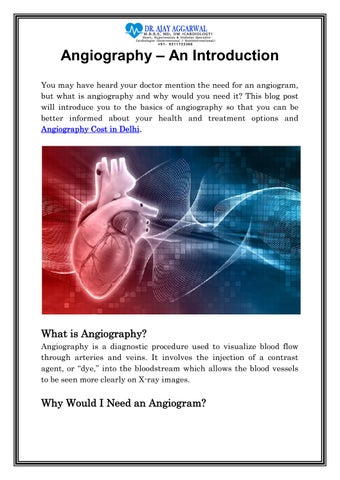
Angiography – An Introduction You may have heard your doctor mention the need for an angiogram, but what is angiography and why would you need it? This blog post will introduce you to the basics of angiography so that you can be better informed about your health and treatment options and Angiography Cost in Delhi.
What is Angiography? Angiography is a diagnostic procedure used to visualize blood flow through arteries and veins. It involves the injection of a contrast agent, or “dye,” into the bloodstream which allows the blood vessels to be seen more clearly on X-ray images.
Why Would I Need an Angiogram?
There are many reasons why your doctor may recommend an angiogram. Some common reasons include: To evaluate chest pain or suspected blockages in the coronary arteries (the arteries that supply blood to the heart) To diagnose or treat a heart attack To diagnose or treat heart failure To diagnose or treat abnormal heart rhythms (arrhythmias) To evaluate suspected blockages in other arteries in the body, such as those in the legs, brain, or kidneys To place a stent (a small mesh tube used to hold open a blocked artery)
How is Angiography Performed? The angiogram procedure is performed by interventional radiologists, doctors who specialize in minimally invasive procedures using imaging guidance. The procedure is usually performed on an outpatient basis, which means you can go home the same day. It begins with an X-ray exam of the area of interest. Then, a small incision is made in your skin and a long, thin tube called a catheter is inserted into an artery. The catheter is threaded through the artery to the area of interest. Once it is in place, the contrast agent is injected through the catheter and X-ray images are taken. The contrast agent allows your blood vessels to be seen more clearly on the X-rays. In some cases, a special type of dye that fluoresces under ultraviolet light may be used so that your blood vessels can be seen more clearly during surgery.
After the Procedure After the procedure, you will be monitored for any adverse reactions to the contrast agent. These reactions are rare but can include hives, itching, swelling of the face and throat, and difficulty breathing. If you experience any of these symptoms, please notify your doctor or nurse immediately.
You will be able to go home when your reactions have resolved and your vital signs are stable. Your doctor will give you specific instructions on how to care for yourself at home and when to call back if you have any problems. It is important that you follow these instructions carefully so that you can avoid complications from the procedure.
Conclusion: An angiogram is a diagnostic procedure used to visualize blood flow through arteries and veins. It involves the injection of a contrast agent into the bloodstream which allows blood vessels to be seen more clearly on X-ray images. Angiography is performed by interventional radiologists, doctors who specialize in minimally invasive procedures using imaging guidance. The procedure is usually performed on an outpatient basis, which means you can go home the same day make sure you check Angiography Cost in Delhi. There are many reasons why your doctor may recommend an angiogram including evaluation of chest pain or suspected blockages in coronary arteries, diagnosis or treatment of heart failure, placement of a stent, etc. After the angiogram procedure, you will be monitored for any adverse reactions to the contrast agent and then discharged home with specific instructions on how to care for yourself post-procedure. Follow all instructions carefully to avoid complications from the procedure..
,
Address: Aman Vihar, Police Station, PSP, CH Bhim Singh Nambardar Marg, Sector 22,Rohini, Delhi, 110086 Call On : 9311733366, 9312233366