8 Home
My Network
Jobs
Messaging
Notifications
Edit article View post
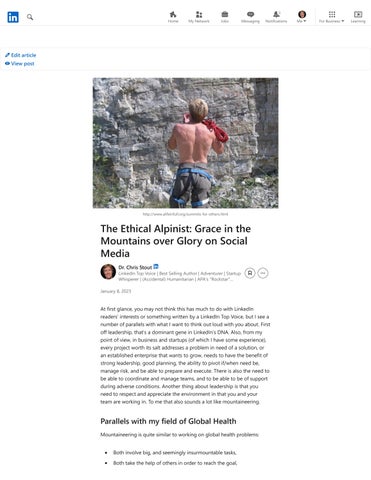
http://www.alifeinfull.org/summits-for-others.html
The Ethical Alpinist: Grace in the Mountains over Glory on Social Media Dr. Chris Stout
LinkedIn Top Voice | Best Selling Author | Adventurer | Startup Whisperer | (Accidental) Humanitarian | APA's "Rockstar"… January 8, 2023
At first glance, you may not think this has much to do with LinkedIn readers’ interests or something written by a LinkedIn Top Voice, but I see a number of parallels with what I want to think out loud with you about. First off leadership, that’s a dominant gene in LinkedIn’s DNA. Also, from my point of view, in business and startups (of which I have some experience), every project worth its salt addresses a problem in need of a solution, or an established enterprise that wants to grow, needs to have the benefit of strong leadership, good planning, the ability to pivot if/when need be, manage risk, and be able to prepare and execute. There is also the need to be able to coordinate and manage teams, and to be able to be of support during adverse conditions. Another thing about leadership is that you need to respect and appreciate the environment in that you and your team are working in. To me that also sounds a lot like mountaineering.
Parallels with my field of Global Health Mountaineering is quite similar to working on global health problems: Both involve big, and seemingly insurmountable tasks, Both take the help of others in order to reach the goal,
Me
For Business
Learning
Both deal with risks, and Both require large doses of planning, team work, concentrated effort, and hope. I believe what makes the difference in all these situations, what is predicated and build upon a strong foundation, is that of ethics and doing what’s right. As of the time of this writing, the lack thereof seems to be very topical in the business press with so many high profile founder flameouts and fraudsters as of late. I just read a piece by Ben Ayers (who is a journalist who knows what he’s talking about), titled The Speed Demons and Selfie Seekers at the Top of the World. He also references Jon Krakauer’s cautionary tale, Into Thin Air. Seems a lot of rich folks may not have read it.
Ethics and Ethos I get it. Record setting and breaking is cool and impressive. I’ve had Colin O’Brady on my podcast twice, and Olympic medalist, John Coyle. The difference for them is that they put in the work. And even doing so, sh*t happens, as Colin shares in a K2 disaster where he lost fellow climbing team mates. Competition can be different in extreme endeavors or sports. For example, it is not unusual during an ultra-run that if someone needs help, another runner (competitor) will lend a hand.
Likewise in non-competitive climbing and expeditions, the stakes can literally be life and death. I’ve dabbled in some organized ultra-distance races as well as selfsupported runs, but in the former, it also seems that there is no doping in ultras. Perhaps that’s due to the nature of the athletes, or the kind of person who’s drawn to ultra-running, or perhaps it’s that there is no cutthroat competition for sponsor monies, as there is not really much. I have also attended car and motorcycle land speed racing events where the same camaraderie exists between competitors. Folks willingly share tools, parts and often lend a hand with doing repairs on others’ machines. I hope mountaineering will never lose its comradeship, but when record setting/breaking starts to factor into the equation, I get worried.
Bagging Peaks or Bagging Followers? A long time ago, and in all honesty, this was pre-social media’s existence, my wife asked me would I climb “X” if I could not tell anyone about it? I really thought about that, and I concluded that I would. In fact, I never had the hubris to think that I could always summit everything I attempted. So, yes, I would climb regardless of others’ knowing. And back when I got
started, I did not carry an extra ounce of any gear, so no cameras or film ever went up with me anyway.
You can’t cram for a climb, or can you? On a personal note, when I got into climbing, it was to be in nature, to have a personal challenge. I liked the travel. An upcoming expedition was a motivator for me to develop my skills in learning proper techniques, mastering ropes and knots, getting education on managing the gear, and doing proper planning, running, aerobic capacity building, and strength training. Ayers quotes Simone Moro, who said that “The old style and the old community attempting the 8000-meter peaks doesn’t exist anymore, (and many of today’s climbers) are learning to climb while they are on the mountain.” That is a concern, from not just the ethics of being on the mountain and having respect for where you are, but also for the safety of the climber and those supporting them. I suppose I may have a bit of a competitive streak or that I am simply jealous, but if I make a comparison, is it that I am a better athlete/climber, or is it that I can afford a step-saving helicopter approach, or a hypoxic tent, or a team to carry me up? It’s not my intention to be the judgy-mountain-police, but perhaps it’s time to take a step back and re-examine our own personal motivations for climbing and to consider how our actions support or counter the more wholesome cultural aspects of alpinism? I have a great deal of respect for world-class Conrad Anker, and he argues that “…the speed records are the latest expression of a dynamic that has existed in the mountains for decades. Climbers must sustain the interest of the public and attract the financial backing that their expeditions would be impossible without.” Okay, fair point, but I bet he’s not endorsing anyone being in the mountains without putting in the work and earning it on their own efforts/merits.
Is it Cheating? No one likes someone having an unfair advantage. No one is a fan of doping. But where do we draw the line in climbing? Should we compare Diamox with HGH? What about climbing with or without supplemental oxygen? How about fixed ropes? Are helicopters acceptable or must folks hike in? I don’t have any great answers, other than considering classifying a climb by noting the different support tools one uses (e.g., supplemental Os or not). Is less more? I’m not supporting a throwback to hob-nail boots rather than double-plastic for example, but when is it that a speedy summit record is more so a Pyrrhic victory because of all the “hacks” used and others' lives put at risk?
My Personal Philosophy and Backstory When I took up mountain climbing (as very much the amateur), I originally set out to do the Seven Summits - reaching the top of the highest mountain on each of the seven continents. I have been fortunate to have
summited three of the easy ones so far: Mt. Kilimanjaro, Africa; Mt. Elbrus, Europe (Russia); and Mt. Kosciusko, Australia. I have also made it to the tops of Mt. Whitney (the highest peak in the continental United States, via the Mountaineer’s Route), Yosemite’s Half Dome, Mt. Rainier, and Adams Peak in Sri Lanka.
Having a penchant for challenges, wanting to help others, having a background in working on international humanitarian aid and medical service projects, being a tad bit creative, and enjoying climbing, I founded Summits for Others. The idea being with every climb I do, I do so as a fundraiser for the nonprofit Center for Global Initiatives in order to raise not only funds, but also awareness of the projects we’re involved with. While this may seem hypocritical in the context of what I have just been harping on, I suppose part of my thinking is that my training and preparation and climbing seems like an “alone-thing” (except for my expedition partners). I also put in the work to train and prepare, and while it’d be nice, I’ve never been carted up. I’m more so a fan of the proverbial dirt-bag approach over the more expensive, hacked-style.
And climbing became a family-thing as well. I built a pretty complete climbing wall in our home to play and practice on, including campus rungs, quick draws, the ability to rope up and belay. As a high schooler, my son became co-captain of his high school climbing club. My daughter and I climbed Inspiration Point in the Grand Teton National Park and Colorado’s Pikes Peak. Our family did Mt. Liamuiga together.
Someone once said “No summit can change who you are, it merely changes the way you see who you are.” I have learned of the power of the individual and the collective team, the power and the importance of my family and faith, and the many metaphorical parallels of climbing applied to living. After being in the mountains, I bring back the typical trinkets to family and friends, but for myself, I bring back more personal souvenirs of hope, inspiration, and renewal. I cannot for the life of me think this is also true for those who are just doing it for the likes and followers.
Perhaps my point is simply to consider that it is important to be mindful of one’s motivations for action, to consider and weigh different ways of doing things, and the concomitant results. My bias is that authenticity comes from the introspection one has while in the mountains, and even in the preparation before. If you'd like to learn more or connect, please do, just click here. You can join my email list to keep in touch. Tools and my podcast are available via http://ALifeInFull.org. And be sure to click here for a free subscription to our monthly LinkedIn Newsletter, Tools for Change. Summits For Others Consortium for Humanitarian Intervention A New Tool for the Humanitarian Emergency Medical Kit Special Edition: Open-Sourcing Humanitarian Intervention Inside the Harvard Humanitarian Initiative with Dr. Tim Erickson Putting the Humanity (and Humility) in Humanitarian Work with Dr. Glenn Geelhoed Emergency Medicine and Global Health Perspectives from Academic Rockstar, Janet Lin, MD, MPH Building Peace from Chaos—Around the World with Dr. Mari Fitzduff Alonzo’s World of Risks and Rewards in Diplomatic and Humanitarian Work Global Innovators Series - Dr. Tiffany Masson and Global HOPE My Best Mistake: Becoming an Accidental Humanitarian
When It Only Takes a Few Pennies to Save a Life, Here's What I Start Asking Myself State of Philanthropy: Finding Hope Among the 'Disaster' of Humanitarian Aid Opportunities to Create Change like Never Before Cool Tools for Humanitarians Why Global Health Needs its Own "Huff Post" DIY Humanitarianism Philanthropy for the Rest of Us: Changing the World for 73-Cents a Life Creative Destruction in Philanthropy? A Picture is Worth a Thousand Words, but a Naming Opportunity.... Building a “Portfolio Career” Living a Life in Full: Revolution over Resolutions 2.0 A Career (and Life) in a Box It’s like a TED talk for Mentoring Epic Ideas for 2020: Revolution over Resolutions What You Need to Know to have an Optimized Healthspan: Bio-hacking for Beginners If I Were 22: To the Class of 2016 (and '17 and my daughter) What Inspires Me: Blueprinting A Life in Full What Happens When Pursuing Your Goals Goes Wrong (And What To Do About It) Dear Graduates, Now Is the Time to Mess Up Why I'd Rather Lose My Phone Than My To-Do List Productivity Hacks: Have Impossible To-Do Lists Ask Yourself: 'How Long Have I Got?'
Comments
22 · 7 comments Like
Comment
Share
Add a comment… Most recent • 1st Author, Speaker & Founder | Helping Leaders Grow Their Impact, Voice …
Octavia Goredema MBE
3w
I love that you've shared this, Dr. Chris Stout. My youngest is a rock climber, she's in middle school and she's just hit a four figure MRR in her business. I definitely see parallels between her determination in climbing and how entrepreneurial motivation. She's always working on finding a way forward! …more Like
Reply · 1 reply
Dr. Chris Stout
Author LinkedIn Top Voice | Best Selling Author | Adventurer | Startup Whi…
3w
Oh my goodness! Octavia Goredema MBE, I shouldn't be surprised that your daughter is similarly as amazing as you are! That's awesome! Please share with her my heart-felt congratulations. May I ask what she's doing in her start-up? …more Like
Reply
6 impressions 2y
• 2nd Executive Advisor-Recovery Beyond
Bill Goodgion
Nice blog and post! Like ·
1
Reply
Dr. Chris Stout
Author LinkedIn Top Voice | Best Selling Author | Adventurer | Startup W…
(edited) 2y
This is a sad support to my article's thesis: https://www.rbth.com/lifestyle/334283-die-elbrus-highestmountain I summitted Mt. Elbrus some years ago, and we were plagued with bad weather. Like ·
1
Reply
97 impressions
• 2nd Founder & CEO @ Quanrio | Technical Consultancy, Workflow Automatio…
Salik Khan
2y
“No summit can change who you are, it merely changes the way you see who you are” Perhaps that’s how we’re supposed to think of all the challenges we face. …more Like ·
2
Reply
Dr. Catherine Millis Juvonen • 3rd+
3y
Musician
Love this. My husband climbed Denali. He thinks the same way. His name is Cary Juvonen Like ·
2
Reply · 1 reply
Dr. Chris Stout
Author LinkedIn Top Voice | Best Selling Author | Adventurer | Startup Whis…
3y
Thanks Dr. Catherine Millis Juvonen , much respect, that is a cold and unforgiving climb Like ·
1
Reply
61 impressions
Dr. Chris Stout LinkedIn Top Voice | Best Selling Author | Adventurer | Startup Whisperer | (Accidental) Humanitarian | APA's "Rockstar" Psychologist | Éminence Grise