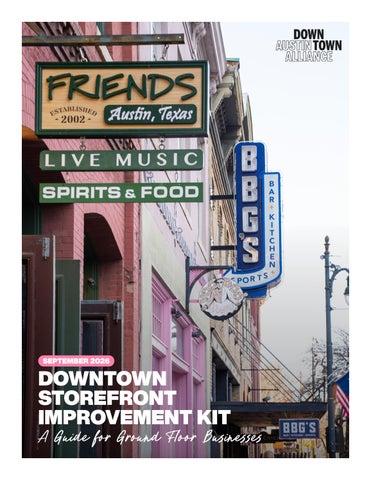
SEPTEMBER 2026
DOWNTOWN STOREFRONT IMPROVEMENT KIT
A Guide for Ground Floor Businesses
2
DOWNTOWN AUSTIN ALLIANCE
TABLE OF CONTENTS Toolkit Overview
I. The Value of Storefronts............................................. 4 II. Elements of a Storefront........................................... 6 • Facade Materials........................................ 8 • Entrances & Windows............................10 • Awnings & Canopies................................12 • Permanent Signage............................... 14 • Exterior Lighting.........................................16 • Storefront Placemaking...................... 18 III. Business Resources.................................................. 20 • Local Resources......................................... 22 • Budget & Timeline Estimates.......... 24 III. Regulatory Framework.......................................... 26 • The Permit Process Hub..................... 28
STOREFRONT IMPROVEMENT TOOLKIT
3
THE VALUE OF STOREFRONTS
Small Changes, Big Impact ABOUT THE TOOLKIT This toolkit is a design guide to help your businesses understand the elements of a successful storefront and connect you with resources and information to bring these improvements to life. Storefronts are essential to the vibrancy, economic health and character of downtowns. In Downtown Austin, storefronts are home to local businesses, restaurants and destinations that reflect Austin’s unique identity and spirit. Active, inviting ground-floor businesses help create a downtown that is lively, welcoming and connected. Thoughtful improvements, whether large or small, can enhance the experience, attract customers and contribute to a stronger, more vibrant downtown. By investing in your storefront, you can attract customers, strengthen your business’s identity and create a more welcoming experience, while contributing to a vibrant and inviting downtown.
4
DOWNTOWN AUSTIN ALLIANCE
SPOTLIGHT: JO’S COFFEE Temporary bunting is a low-cost way to add energy and excitement to a storefront while creating seasonal or themed visual interest.
STOREFRONT IMPROVEMENT TOOLKIT
5
ELEMENTS OF A STOREFRONT Designing First Impressions
5 2
5
1
3 4
BUSINE S S NAME 4
2
Window Sign 2 6 6 6
DOWNTOWN AUSTIN ALLIANCE
A successful downtown storefront is carefully composed of multiple elements that work together to create an inviting first impression. From large facade elements to small architectural details, each work together and encourage passersby to pause and take a closer look.
1 FACADE
MATERIALS
A storefront facade has integral elements that are not changed often but should be regularly maintained to ensure it is free of dirt, debris and unwanted tagging. No matter the material of your facade, long-term care solutions should be customized to ensure the longevity of your storefront. FOR MORE INFORMATION ON FACADE MATERIALS, TURN TO PAGE 8.
PERMANENT
4 SIGNAGE
Beyond appearance, functionality and atmosphere deepen a storefront’s appeal. Accessibility, lighting and a welcoming sidewalk reinforce the visual components and give visitors a sense of trust and security in the business.
2 ENTRANCES & WINDOWS
Ground floor windows should highlight your business and merchandise - inviting the outside in. Keep upper windows clean and clear of clutter or signage. Entrances should be unobstructed and inviting to visitors, highlighting useful information such as branding or hours of operation. FOR MORE INFORMATION ON ENTRANCES & WINDOWS, TURN TO PAGE 10.
5 EXTERIOR LIGHTING
3 AWNINGS & CANOPIES
Awnings not only protect your facade from the elements, but they also add depth to a storefront. Pairing an awning or canopy with business signage establishes a visible presence on the street. Since awnings are exposed, it is important to regularly clean and maintain the finish materials. FOR MORE INFORMATION ON AWNINGS & CANOPIES, TURN TO PAGE 12.
6 STOREFRONT
PLACEMAKING
Signage is the best opportunity to advertise your business to the public. Effective signage is simple and appropriately scaled to the building’s facade. Successful combinations include a mix of window, awning and hanging signage to ensure your business’s visibility from all viewpoints.
Exterior lighting does more than create an eye-catching storefront after dark. It enhances the customer experience by making your business safe and welcoming. Successful lighting is layered, combining exterior and interior lighting to create a warm, inviting glow that draws people inside.
Placemaking is an opportunity to bring the spirit of your business to the sidewalk through public art, business branding, landscaped planters and creative activations. An attractive and engaging sidewalk presence invites visitors and passersby to stop into your business.
FOR MORE INFORMATION ON PERMANENT SIGNAGE, TURN TO PAGE 14.
FOR MORE INFORMATION ON EXTERIOR LIGHTING, TURN TO PAGE 16.
FOR MORE INFORMATION ON STOREFRONT PLACEMAKING, TURN TO PAGE 18.
STOREFRONT IMPROVEMENT TOOLKIT
7
FACADE MATERIALS
A Storefront’s Building Blocks The quality of your storefront’s facade materials shapes first impressions. Regular maintenance is recommended to protect the long-term performance of your building. Since every facade is different, maintenance should always be tailored to the building’s unique materials.
PAINTED BRICK FACADE
MATERIAL REGULATIONS Typically, meaningful changes to your storefront’s materials will require a permit. Additionally, if your business is housed in a landmarked building or a historic district, exterior material changes require a historic review process. Regular maintenance and repair of your facade’s existing materials or finishes are encouraged and typically allowed without a permit or review process. • Repairs | Improvements or repairs to preserve your building’s existing exterior materials are typically not regulated.
BRICK FACADE
PERMIT NOT NEEDED
• Painting | Repainting exterior materials that are already painted are allowable, easy changes; however, unpainted, historically significant materials may require a review process. REVIEW POSSIBLE
PERMIT REQUIRED
See pages 23 & 28 for more information on historic regulations, permitting requirements and review processes.
8
DOWNTOWN AUSTIN ALLIANCE
IMAGE: GIANT NOISE
• New Materials | Changing, modifying or adding new exterior materials to the exterior of your building will likely require a building permit.
WOOD PANEL FACADE
FACADE MATERIAL MAINTENANCE Brick | To ensure brick facades are kept dry, routine maintenance of gutters and adjacent vegetation is recommended. Brick facades can be cleaned as needed with a low-pressure wash and powdery or missing mortar joints should be repointed. Painting unpainted brick or masonry, especially on historic buildings, is typically not recommended.
STONE FACADE
Stone | Common stones used in Austin include Texas limestone, sandstone and granite. These stones can be cleaned with a low-pressure power wash and missing joints can be repaired with a soft mortar. Historic stone should never be painted or sealed, as it can damage the original materials. Wood | Wood features on facades should be protected from excessive water and UV exposure where possible. Painted wood should be repainted every 5-10 years, or sooner with sun exposure. Wood should be regularly inspected for rot and insects, and any problems should be addressed immediately. Wood features can be cleaned with a soft brush and low-pressure rinse, but should not be power washed.
STUCCO FACADE
Stucco | Cracks in stucco should be quickly repaired to avoid moisture infiltration and any finish coats should be breathable finishes such as a limewash or mineral-based paints. Stucco can be cleaned with a low-pressure rinse (i.e. garden hose), but should not be power washed. The type of stucco used should be identified before any maintenance.
FACADE DOS & DON’TS • Utilize durable, timeless materials • Prioritize human scale • Respect historic context • Cover up unique details • Neglect repairs or regular maintenance GLASS FACADE STOREFRONT IMPROVEMENT TOOLKIT
9
ENTRANCES & WINDOWS
Inviting Patrons Inside Entrances and windows are some of the most critical elements of your storefront as they impact your business’s visibility and accessibility from the sidewalk. Not only can these features secure your business, but they also are a patron’s first impression, welcoming them into your space.
WOOD-FRAMED ENTRANCE
ENTRY & WINDOW REGULATIONS Updating your storefront’s entrances and windows is often necessary with age and typically requires a permit or review process. Upgrades that significantly improve your building’s energy performance may be eligible for local rebates. • Replacement at Existing Openings | Replacement of doors or windows within the existing openings is allowable; however, if your business is housed within a historic building or district, a historic review process may be required. PERMIT NOT NEEDED
REVIEW POSSIBLE
TRANSOM WINDOW SIGNAGE
• New or Modified Openings | Modifying an existing opening’s size or adding an opening for new windows or doors often requires a building permit. If you business is housed within a historic building or district, this work is typically not permitted on primary facades. PERMIT REQUIRED
• Restoration or Replacing of Framing | Upgrading framing materials for openings may trigger a review, depending on the extent of the work. If you business is housed within a historic building or district, a review process is may be required. REVIEW POSSIBLE
See pages 23 & 29 for more information on historic regulations, permitting requirements and review processes. 10
DOWNTOWN AUSTIN ALLIANCE
METAL-FRAMED ENTRANCE
TYPES OF ENTRANCES & WINDOWS Main Entrance | The main entrance connects visitors to your business. Its material and finish can highlight a business brand while complementing the facade’s architectural features. Entrances can communicate useful information, such as hours of operation or recent awards and recognitions.
UPPER FLOOR WINDOWS
Display Window | A window display shapes how customers experience and interact with your business before entering. Display windows should be clean and organized to highlight your business’s unique offerings or experience. Additional signage or graphics on display windows can enhance your brand’s visibility. Transom Windows | Transom windows are common features, especially for historic buildings. Keeping them clean and clear can increase daylight to the interior. This space above the display windows and doors also provides opportunities for additional signage, imagery or business promotion. Upper Floor Windows | Openings on upper floors of businesses don’t directly impact ground-level perception, but it is important to keep them clean, maintained and free of interior clutter visible at street level.
DISPLAY WINDOW
Framing Materials | Framing for openings varies by architectural style. It is important to maintain framing regularly, especially wood framing that may deteriorate with environmental exposures more quickly than metal framing.
ENTRY AND WINDOWS • Feature your brand identity • Utilize interior lighting • Prioritize security & use • Overcrowd or clutter display windows • Block visibility to the interior ORDER WINDOW STOREFRONT IMPROVEMENT TOOLKIT
11
AWNINGS & CANOPIES
Protecting the Storefront The use of awnings and canopies on buildings not only provides a striking visual element, but also helps make your business’s entrance more inviting by providing shade, protection and coverage from external elements year-round.
FLAT AWNING
AWNING & CANOPY REGULATIONS Awning size and installation method directly impact the review process. Typically, if awnings project more than 54” from the building face or require wall supports, a building permit is required. • New Awning | A new awning does not require a building permit if it meets the size and installation requirements (above). If your business housed within a historic building or district, new awnings are not permitted without historic documentation of the condition. PERMIT POSSIBLE
REVIEW POSSIBLE
• Repaired Awning | Regular maintenance and repair of your building’s existing awning is encouraged. If your business’ awning is a historic element, any repairs that change the material or style may require a review process. PERMIT NOT NEEDED
FIXED SHED AWNING
REVIEW POSSIBLE
• Awning with Signage | Any modifications to your business’s awning that include text or signage will require a sign permit. PERMIT REQUIRED
See pages 23 & 29 for more information on historic regulations, permitting requirements and review processes.
SHED AWNING & SIGNAGE 12
DOWNTOWN AUSTIN ALLIANCE
TYPES OF AWNINGS Fixed Awning | These awnings are a permanent, non-retractable shading structure over a storefront window or entrance. Fixed awnings can come in several different styles or shapes. Retractable Awning | These awnings are an adjustable shade structure on a storefront that can extend and fold back, either manually or by a motor.
FIXED SHED AWNING
Shed Awning | Either fixed or retractable, a shedstyle awning has a single slope that projects outward from a building at a downward angle and forms a triangle shape from the side view. Bullnose Awning | Typically fixed, a bullnose-style awning has a rounded, dome-like feature at the corners, softening the edges and overall aesthetic. Concave Awning | Typically fixed, a concave-style awning has an inward-curving profile at the corners. Concave awnings are not common in Downtown Austin. Flat Awning | Typically fixed, a flat-style awning has a cantilevered, level surface that projects from the building face. Flat awnings are usually integrated architectural elements.
FIXED ARCH CANOPY
Arch Canopy | Typically fixed, arch-style canopies consist of a curved, tunnel-like projection that extends outward from a storefront, often emphasizing an entrance. Arch canopies are useful where there is limited horizontal width on a building’s facade.
AWNINGS & CANOPIES DOS & DON’TS • Select durable materials • Reflect brand identity • Ensure proper clearances • Go too large or too small • Block business signage • Forget about awning lighting SLATTED FLAT AWNING STOREFRONT IMPROVEMENT TOOLKIT
13
PERMANENT SIGNAGE
Making First Impressions Business signage is one of the most impactful tools your business has to communicate its brand identity, attract new customers and enhance the streetscape appeal. Clear, visible signage acts as a beacon for your business, helping visitors identify local offerings and become new patrons.
LETTER SIGN - 3D & FLAT PANEL
SIGNAGE REGULATIONS Typically, all new or replaced signage requires a sign permit. Signage that is architecturally integrated into the facade or consists of a new, freestanding structure may also require a building permit. • New Signage | Any new, permanent signage located on your building’s facade, integrated into awnings or implemented through a freestanding structure will require a sign permit and may require a building or electrical permit. PERMIT REQUIRED
• New Signage in a Historic District | If your business is housed in a historic building or district, a historic review process is required in addition to the permit process. PERMIT REQUIRED
LETTER SIGN - CHANNEL
REVIEW REQUIRED
• Restoration of Existing Signage | Typically, on site restoration does not require a sign permit; however if a sign is removed, restored off-site and reinstalled, a sign permit may be required. PERMIT POSSIBLE
See pages 23 & 30 for more information on historic regulations, permitting requirements and review processes.
FREESTANDING SIGN 14
DOWNTOWN AUSTIN ALLIANCE
TYPES OF SIGNAGE Painted Signs | Painted signage on a facade is a cost-effective way to highlight your brand. Flat Panel Signs | Panel signs are printed designs on a three-dimensional box or structure and can be internally lit for evening visibility. Blade Signs | Blade signs are flat, thin panels that hang perpendicular to the building face, making them visible from the sidewalk. NEON SIGN
Letter Signs - Three-Dimensional or Channeled | Letter signs are typically attached to the building’s facade and provide visual depth to the exterior. Three-dimensional letter signs can be channeled to include interior lighting for evening visibility. Neon Signs | Neon lighting is a vibrant and exciting way to establish a unique aesthetic while also highlighting your business at night. Window Signs | Signage in display or transom windows is a low-cost way to include business branding. These signs can be hand-painted or printed decals.
BLADE SIGN
Awning Signs | Business name, brand and other useful information can be attached or printed directly onto awning materials. Freestanding Signs | Separate from the facade, these structures provide business visibility by reaching into the right of way or extending beyond the height of the building.
SIGNAGE DOS & DON’TS • Reflect your brand • Prioritize visibility • Ensure clear & legible text • Overcrowd design • Use long phrases or jargon • Neglect lighting or maintenance WINDOW SIGN STOREFRONT IMPROVEMENT TOOLKIT
15
EXTERIOR LIGHTING
The Impact of Illumination Exterior lighting is a small, yet impactful aspect of your storefront. Lighting is inviting, increasing your business’s visibility and attracting new patrons. Not only does it enhance your business identity, but it also improves safety and security at night.
AWNING LIGHTING
A layered lighting approach utilizes sidewalk lighting, exterior facade lighting, illuminated signage and interior display lighting to create a vibrant evening streetscape.
EXTERIOR LIGHTING REGULATIONS Updating your business’ existing light fixtures or adding new light locations may require a review or permit process. Upgrades that improve energy performance may be eligible for local rebates. • Replaced Light Fixture | Changing a fixture at an existing exterior light location does not require a permit. PERMIT NOT NEEDED
UPPER FLOOR LIGHTING
• New Fixture Location | Installing a light fixture at a new location requires electrical work that may result in electrical and building permits. PERMIT POSSIBLE
• Lighting on Historic Buildings | If your business is housed in a historic building or district, changes to exterior lighting may require a historic review process. REVIEW POSSIBLE
See pages 23 & 30 for more information on historic regulations, permitting requirements and review processes.
FACADE & ENTRY LIGHTING 16
DOWNTOWN AUSTIN ALLIANCE
TYPES OF EXTERIOR LIGHTING Wall Sconce | Most storefronts utilize exterior wall sconces to provide directional or ambient lighting. While functional, they can also be decorative and complement your building’s or brand’s aesthetics. Entrance Lighting | Buildings with recessed entrances can utilize recessed or surface-mounted fixtures to increase visibility and safety. Awning & Canopy Lighting | While awnings provide shade during the day, in the evening, these structures may block street lights or other lighting sources. Incorporating lighting into the structure is recommended for enhanced visibility and safety.
ILLUMINATED SIGNAGE
WINDOW DISPLAY LIGHTING
IMAGE: SLOAN BREEDEN PHOTOGRAPHY
Illuminated Signage | Illuminated signage raises brand visibility and business awareness after dark. Window & Display Lighting | Illuminating a storefront’s display window creates ambiance and signals that your business is open to visitors. Upper Floors Lighting | While focusing on the ground floor is most critical for business visibility, it is important not to neglect facade lighting on upper floors. This type of lighting can provide ambient light while highlighting the architectural features of a building.
LIGHTING DOS & DON’TS • Prioritize visibility & safety • Consider historic context • Reduce glare & light pollution • Overlight the property • Mix different color temperatures • Block fixtures with landscaping WALL SCONCE STOREFRONT IMPROVEMENT TOOLKIT
17
STOREFRONT PLACEMAKING Activating the Sidewalk
Placemaking is the process of improving the spaces around your business to be more welcoming, functional and enjoyable. Whether through small enhancements or larger transformations, placemaking strategies can transform the area outside a storefront into an inviting destination.
PUBLIC ART - MURAL
PLACEMAKING REGULATIONS Many placemaking tools can be implemented with relatively few regulations. Requirements depend on whether the improvement extends into the sidewalk or affects historic properties. • Public Art | Integrating art into your storefront typically does not require permits. If your business is housed within a historic building or district, a historic review process is often required. REVIEW POSSIBLE
• Outdoor Seating | Incorporating outdoor seating for diners requires a sidewalk cafe permit. In historic districts, the scope of the work may also require a historic review process. PERMIT REQUIRED
SIDEWALK BRANDING
REVIEW POSSIBLE
• Activations | Activities that happen outside of your building and take up sidewalk space may require a right-of-way permit. PERMIT POSSIBLE
• Sidewalk Signage or Planters | Placing movable signage or planters in front of your business is allowed when placed within your building’s property lines. PERMIT NOT NEEDED
See pages 23 & 31 for more information on historic regulations, permitting requirements and review processes. 18
DOWNTOWN AUSTIN ALLIANCE
PUBLIC ART - ARTBOX
TYPES OF PLACEMAKING Planters | Landscaping can enhance curb appeal and first impressions by creating an inviting atmosphere for visitors. Sidewalk Branding | Information with your business’s branding and services along the facade of the building is a cost-effective tool to improve brand visibility and awareness while also promoting current promotions or deals.
OUTDOOR SEATING
Outdoor Seating | Seating along the sidewalk can expand your business’s usable space while activating the streetscape. Public Art - Murals & ARTBOXES | Utilizing secondary facades, underutilized space or nearby utility infrastructure for public murals is a powerful tool that can drive foot traffic, establish business identity, enhance curb appeal and strengthen community connection. Activations | Thoughtful programming, such as community events or live music, drives new foot traffic, increases sales opportunities and encourages community engagement.
PLANTERS
Historic Storytelling | Highlighting the historic context of the street and building can engage and educate the community on the history of the site and building that houses your business.
PLACEMAKING DOS & DON’TS • Prioritize customer experience • Leverage local character • Collaborate with neighbors • Clutter the sidewalk space • Neglect pedestrian comfort • Assume one size fits all ACTIVATION - MUSIC STOREFRONT IMPROVEMENT TOOLKIT
19
SPOTLIGHT: 2ND STREET DISTRICT Awnings, signage, display windows and sidewalk activations create a comfortable and engaging environment for visitors.
20
DOWNTOWN AUSTIN ALLIANCE
BUSINESS RESOURCES
Local Support & Investment
FINDING THE RIGHT FIT Businesses play a key role in shaping the vibrancy and vitality of Downtown Austin, and a strong network of resources is available to help local businesses thrive. The Downtown Austin Alliance, the City of Austin and other local and national organizations offer a variety of tools, programs and resources designed to support your business. These opportunities can help build on your strengths, invest in your business and take the next step towards growth. Resources are not one-size-fits-all, and opportunities are available to support a wide range of business needs - from marketing and promotional support to direct financial assistance for improvements. Explore the resources in this section to discover opportunities that may be a good fit for your business.
STOREFRONT IMPROVEMENT TOOLKIT
21
LOCAL RESOURCES
Supporting Entrepreneurs Downtown Austin is a dynamic place to do business, with unique opportunities to grow, connect with customers and contribute to the energy of the city. The Downtown Austin Alliance is continually developing programs and compiling resources to help strengthen the local business community.
These resources can be used individually or together to maximize impact and support your business’s goals. Together, they enhance the vibe, value and vitality that make Downtown Austin a great place to do business.
LOCAL GRANTS, INCENTIVES & RESOURCES DOWNTOWN AUSTIN ALLIANCE
CITY OF AUSTIN
NON-PROFIT PARTNERS
• Facade Improvement Grant | Small to medium matching grants for facade improvements and renovations.
• Small Business Resource Directory | A directory of resources offered by local, state and federal governments and non-profit agencies to support small businesses.
• Preservation Austin | Matching and non-matching grants that can be utilized for education, construction, or efforts in planning, surveying and historic designations.
• Economic Development Department | Online courses and workshops to support small business growth and development.
• Storefront Design Directory | A directory of designers and architecture firms with experience in storefront design, developed by AIA Austin and DAA.
• Construction Impact Relief Grant | Small to medium reimbursement grants for businesses directly impacted by ongoing construction. • Business Promotion | Contact communication@ downtownaustin.com to learn more about marketing support and resources. • Ambassador Services | The Downtown Ambassadors provide direct services to clean and beautify downtown. If in need of support, businesses can submit a Service Request. Visit downtownaustin.com to learn more about these resources.
22
DOWNTOWN AUSTIN ALLIANCE
• Heritage Preservation Grants | Up to $250,000 in grant funding for Capital Improvement Projects that restore, preserve or promote historic designated sites and structures. • Austin Energy Rebates | Savings for small businesses making energy efficient improvements or upgrades. Visit austintexas.gov to learn more about these resources.
• Austin Chamber of Commerce | A compiled list of city, state and national resources for small businesses. • Diversity & Ethnic Chamber Alliance | An alliance of smaller Chambers of Commerce, focused on supporting diversity and economic growth in small Central Texas businesses.
LOCAL LANDMARKS & HISTORIC DISTRICTS In addition to standard review processes, individual properties that are historic landmarked buildings or that sit within a registered historic district often require additional review processes.
In Downtown Austin, there are two National Register Historic Districts with a high concentration of commercial activity: • Congress Avenue • East Sixth Street
Modifications to designated properties may require an administrative review by the City’s Historic Preservation Office (HPO) or a commission review by the Historic Landmark Commission (HLC). This additional review ensures that future modifications honor and respect the historic character of the building or district.
In addition to these districts, there are several individual buildings throughout downtown that are landmarked. To learn if your building is landmarked or within a historic district, visit the City of Austin’s Historic Property Viewer at austintexas.gov/planning/historicpreservation.
STOREFRONT IMPROVEMENT TOOLKIT
23
CATEGORY
BUDGET & TIMELINE ESTIMATES
Facade Materials
Planning for Improvements
Having a clear sense of project costs and timelines can help you plan your storefront improvements with confidence. Understanding the anticipated costs can help you build a realistic budget, explore potential funding opportunities and prioritize improvements that align with your business goals.
Entrances & Windows
A general project timeline can also help you coordinate the work with your day-to-day operations and plan ahead for any changes to access or business activity during improvements. Every project is unique, and actual costs and timelines will vary based on the scope, materials, design and other project-specific factors. For a more accurate picture of your investment and timelines, consider working with a local designer, architect or contractor to develop project-specific estimates and schedule before moving forward.
Awnings & Canopies
Permanent Signage
Exterior Lighting
Storefront Placemaking
Regulations
24
DOWNTOWN AUSTIN ALLIANCE
Disclaimer: Costs and timelines are est market costs. Please consult qualified
MODIFICATION
QUALITY/SIZE
EST. COST
Low Complexity
$2.50 per sq. ft.
Standard
$3 - $5 per sq. ft.
Premium
$5 - $8 per sq. ft.
Facade Cleaning / Pressure Washing
---
$0.50 - $0.90 per sq. ft
1 - 2 days
Brick / Masonry Repointing
---
$8 - $15 per sq. ft
2 - 4 weeks
Minor Repairs
$8 - $15 per sq. ft
Major Repairs
$30 - $50 per sq. ft
Wood Facade Repair
---
$5 - $15 per sq. ft
Replace a single display window
Standard
$500 - $2,000
Premium
$1,500 - $5,000+
Facade Repainting
Stucco Facade Repair
EST. TIME 3 - 7 days
3 - 7 days 1 - 3 weeks 3 - 6 weeks
Replace a single transom window
Standard
$500 - $1,500
Premium
$1,500 - $3,000
Replace commercial entry door
Standard
$800 - $2,500
Premium
$2,500 - $5,000
Door Repair
---
$300 - $2,500
1 - 5 days
Low-end
$2,000 - $3,500
2 - 4 weeks
Mid-range
$3,500 - $5,000
3 - 5 weeks
High-end
$5,000+
1 - 2 weeks
---
$250 - $6,000
1 - 3 days
Small
$1,000 - $4,000
1 - 2 weeks
Medium
$3,000 - $8,000
2 - 4 weeks
Large
$8,000 - $12,000
4 - 6 weeks
Small
$1,500 - $5,000
Medium
$5,000 - $10,000
Large
$10,000 +
Repair existing signage
---
$250 - $2,000
1 - 10 days
Install window signage
---
$300 - $2,000
1 - 2 days
Low-end
$200 - $300 per fixture
Mid-range
$300 - $450 per fixture
High-end
$500+ per fixture
Low-end
$400 - $900 per fixture
Mid-range
$900 - $2,000 per fixture
High-end
$2,000+ per fixture
Planters
---
$1,000 - $3,500 per planter
1 - 2 weeks
Temporary Sidewalk Signage
Standard
$50 - $500
1 - 4 weeks
Illuminated
$200 - $1,000
1 - 2 weeks
ARTBOX Sponsorship
---
$3,000
4 - 6 weeks
Replace existing awning
Repair existing awning Install new, non-illuminated signage
Install new illuminated or neon signage
Replace light fixture at an existing location
Install light fixture at a new location
2 - 4 weeks
3 - 6 weeks
3 - 8 weeks
1 - 2 days
3 - 5 days
Mural Installation
---
$25 per sq. ft.
varies
Certificate of Appropriateness
---
$80 - $1,000
1 - 2 months
Sign Permit
---
$60 - $130
2 - 6 weeks
Building Permit
---
$500 - $2,000
1 - 5 weeks
Electrical Permit & Inspection
---
$150 - $400
1 - 3 weeks
Right-of-Way Use Permit
---
$300 - $1,200+
4 - 8 weeks
timates intended to support preliminary project planning. Estimates are subject to change over time due to fluctuations in material, labor and d professionals to determine your project’s actual cost and timeline. STOREFRONT IMPROVEMENT TOOLKIT 25
REGULATORY FRAMEWORK Navigating the Process
PERMITTING & COMPLIANCE Storefront improvements are a great opportunity to showcase your business, attract customers and enhance the character and curb appeal of your property. Whether considering a fresh coat of paint, new signage, updated lighting or other exterior enhancements, thoughtful improvements can make your business stand out. This section provides an overview of common permitting and review processes that may apply to the improvements featured in this toolkit. Use it as a starting point to understand the steps that may be a bigger part of bringing your storefront vision to life. Permitting requirements may change over time, so be sure to confirm current requirements with the appropriate City departments before beginning any work. Taking this step can help you plan your project with confidence and ensure you have the necessary approvals and permits in place.
26
DOWNTOWN AUSTIN ALLIANCE
SPOTLIGHT: ROYAL BLUE GROCERY A vibrant frontage with visible signage communicates the business’s offerings. The awning, lighting, planters and seating provide a welcoming perception from the sidewalk.
STOREFRONT IMPROVEMENT TOOLKIT
27
THE PERMIT PROCESS HUB Quick Links + Guidance
Different improvements have varied permitting and review requirements. Use this section to understand what processes may be required with your planned improvements.
Visit austintexas.gov or schedule an appointment with the Permit & Development Center to learn more about how these steps may apply to your specific project.
Storefront Improvement Permits
Historic Guides & Permits
• Sign Permit Application • Commercial Building Permit Application • Electrical Permit Application
Downtown Austin Art & Activations • Writing on the Walls Program • ARTBOX Program • Musicians Activating Spaces
• Historic Design Standards • Historic Sign Guidelines • Certificate of Appropriateness • Historic Landmark Commission
Right-of-Way Permits • Sidewalk Cafe Permit • Temporary Use of Right-of-Way
Note: For the following regulatory processes, a historic check is recommended early to guide project design and planning. Any required administrative or commission reviews will be identified and pursued once a permit is filed.
I. REGULATIONS: FACADE MATERIALS STEP 1: HISTORIC CHECK Is the building landmarked or part of a Historic District? IF NO, ADVANCE TO STEP 2 IF YES, REQUIREMENTS BELOW:
Improvements must follow the City’s Historic Design Standards. • Historic District | Contributing: » Primary Facade: Certificate of Appropriateness and review by the Historic Landmark Commission required. » Secondary Facade: Administrative review by the City’s Historic Preservation Office required. • Landmarked Buildings: Work on facades require a Certificate of Appropriateness and review by the Historic Landmark Commission. 28
DOWNTOWN AUSTIN ALLIANCE
STEP 2: BUILDING REVIEW Does work include constructing, enlarging or replacing the facade materials? IF NO, ADVANCE TO STEP 3 IF YES, REQUIREMENTS BELOW:
A building permit is likely required for any facade work beyond minor repairs and routine maintenance to existing materials. Visit the City’s Development Services Department’s website to learn more about the building permit process.
STEP 3: PROCEED WITH WORK Once historic review and building review processes are complete and all necessary permits are obtained, the proposed facade material changes can begin.
II. REGULATIONS: ENTRANCES & WINDOWS STEP 1: HISTORIC CHECK Is the building landmarked or part of a Historic District? IF NO, ADVANCE TO STEP 2 IF YES, REQUIREMENTS BELOW:
New or replaced windows and doors must follow the City’s Historic Design Standards. • Historic District | Contributing: » Primary Facade: Certificate of Appropriateness and review by the Historic Landmark Commission required. » Secondary Facade: Administrative review by the City’s Historic Preservation Office required.
STEP 2: BUILDING REVIEW Does the work change the opening size, structural supports or building’s egress? IF NO, ADVANCE TO STEP 3 IF YES, REQUIREMENTS BELOW:
A building permit is likely required for any replaced windows or doors that require changes to the existing framed opening, structural supports and egress.
STEP 3: PROCEED WITH WORK Once historic review and building review processes are complete and all necessary permits are obtained, the proposed window and/or door modifications can begin.
Visit the City’s Development Services Department’s website to learn more about the building permit process.
• Landmarked Buildings: Replacement of windows or doors on any facade requires a Certificate of Appropriateness and review by the Landmark Commission. Note: New window or door openings are typically not permitted unless restoring a historically-documented condition.
III. REGULATIONS: AWNINGS & CANOPIES STEP 1: HISTORIC CHECK Is the building landmarked or part of a Historic District? IF NO, ADVANCE TO STEP 2 IF YES, REQUIREMENTS BELOW:
For both landmarked buildings and historic districts, awning repair and/ or replacement typically requires an administrative review by the City’s Historic Preservation Office. New awnings on historic facade are not permitted unless there is historic documentation of the condition. Note: The Awning & Canopy regulations are for the structure and materials only. Any signage incorporated in an awning must following the ‘IV. Regulations: Permanent Signage’ process.
STEP 2: BUILDING REVIEW Does work include modifications to the awnings size, structure, support type or weight? IF NO, ADVANCE TO STEP 3 IF YES, REQUIREMENTS BELOW:
Since awnings attach to the structural elements of a building, a building permit is typically required.
STEP 3: PROCEED WITH WORK Once historic review and building review processes are complete and all necessary permits are obtained, the proposed awning or canopy work can begin.
Visit the City’s Development Services Department’s website to learn more about the building permit process.
STOREFRONT IMPROVEMENT TOOLKIT
29
IV. REGULATIONS: PERMANENT SIGNAGE STEP 1: HISTORIC CHECK Is the building landmarked or part of a Historic District? IF NO, ADVANCE TO STEP 2 IF YES, REQUIREMENTS BELOW:
Signage must follow the City’s Historic Sign Guidelines Standards. • Historic District | Contributing: » Complies with Guidelines: Administrative review by the City’s Historic Preservation Office required. » Does not comply with Guidelines: Certificate of Appropriateness and review by the Historic Landmark Commission required. • Landmarked Buildings: Any new or modified signage requires a Certificate of Appropriateness and review by the Landmark Commission.
STEP 2: SIGN REVIEW New signage must submit a Sign Permit for review. If a sign is removed for repairs, then reinstalled, a Sign Permit is required. Additional conditions may require further permits and approvals, including:
STEP 3: PROCEED WITH WORK Once historic review and building review processes are complete and all necessary permits are obtained, the proposed sign modifications or installation may begin.
• Illuminated Signage: An Electrical Sign Permit is required, followed by a 303 Electrical Sign Inspection. • Right-of-Way Extension: Any sign that extends into the sidewalk may require a Right-of-Way permit and Encroachment Agreement. Note: Regular maintenance to existing signage does not require review.
V. REGULATIONS: EXTERIOR LIGHTING STEP 1: HISTORIC CHECK Is the building landmarked or part of a Historic District? IF NO, ADVANCE TO STEP 2 IF YES, REQUIREMENTS BELOW:
Lighting changes on exterior facades are the same for both landmarked buildings a historic districts. Review type is determined by the type of work. • Minor Work: Requires administrative review by the City’s Historic Preservation Office. Examples include replacement of a light fixture at an existing location. • Major Work: Requires a Certificate of Appropriateness and review by the Historic Landmark Commission. Examples include new light locations on primary facades.
30
DOWNTOWN AUSTIN ALLIANCE
STEP 2: ELECTRICAL REVIEW Does work include new electrical power, wiring or circuits?
STEP 3: PROCEED WITH WORK
IF NO, ADVANCE TO STEP 3 IF YES, REQUIREMENTS BELOW:
Once historic review and building review processes are complete and all necessary permits are obtained, the proposed facade material changes can begin.
An electrical permit and inspection will be required. If the lighting installation requires structure support or extends into the sidewalk, the following reviews may apply: • Structural Attachment: A City building permit is required. • Right-of-Way Extension: A City Right-of-Way permit and Encroachment Agreement may be required.
VI. REGULATIONS: PLACEMAKING (PUBLIC ART) STEP 1: HISTORIC CHECK Is the building landmarked or part of a Historic District? IF NO, ADVANCE TO STEP 2 IF YES, REQUIREMENTS BELOW:
Integrating public art, such as mural, into a building’s facade requires a historic review. • Historic Districts & Landmarked Buildings: » Primary Facade: Artwork not permitted. » Side wall or Secondary Facade: Requires a Certificate of Appropriateness and review by the Landmark Commission.
STEP 2: BUILDING REVIEW Does the proposed art installation require any structural support or new facade materials? IF NO, ADVANCE TO STEP 3 IF YES, REQUIREMENTS BELOW:
The type and scale of the proposed art may require a building permit to ensure proper installation.
STEP 3: PROCEED WITH WORK Once historic review and building review processes are complete and all necessary permits are obtained, the proposed art installation can begin.
Visit the City’s Development Services Department’s website to learn more about the building permit process.
Note: There are no defined or adopted regulations regarding public art on historic buildings; however the guidelines above are based on recent cases decided on by the Historic Preservation Office and Historic Landmark Commission.
REGULATIONS: PLACEMAKING (ACTIVATION) STEP 1: CITY REVIEW Eligible projects for right-of-way use include cafe zones, seating, planters and vendor sales. Each space activation has a specific application and review process. • Sidewalk Cafe or Street Patio: A cafe application is required if placing seating, tables or planters in the public sidewalk. There are additional requirements if serving alcohol. • Vendor Permit: A vendor permit is required for businesses that use the sidewalk as an extension for sales.
STEP 2: HISTORIC REVIEW Some right-of-way permits include or require semipermanent structures, such as planters or fencings. If the activated right-of-way is part of a registered historic district, any semi-permanent structure requires administrative review by the Historic Preservation Office.
STEP 3: PROCEED WITH WORK Once the right-of-way permits and historic reviews are complete, businesses are allowed to activate their storefront with the approved uses.
Note: Busking (street performing) in the public right-of-way does not require a permit and is legal as long as pedestrian access is maintained and no amplified sound is used after 10:30pm.
STOREFRONT IMPROVEMENT TOOLKIT
31
STOREFRONT TOOLKIT
DOWNTOWN AUSTIN
DOWNTOWNAUSTIN.COM